/

Текст
                    Combinatorial Enumeration of Groups,
Graphs, and Chemical Compounds

j3. Polya R.c. Read
Combinatorial Enumeration
of Groups, Graphs,
and Chemical Compounds
With 17 Illustrations
Springer-Verlag 0
New York Berlin Heidelberg
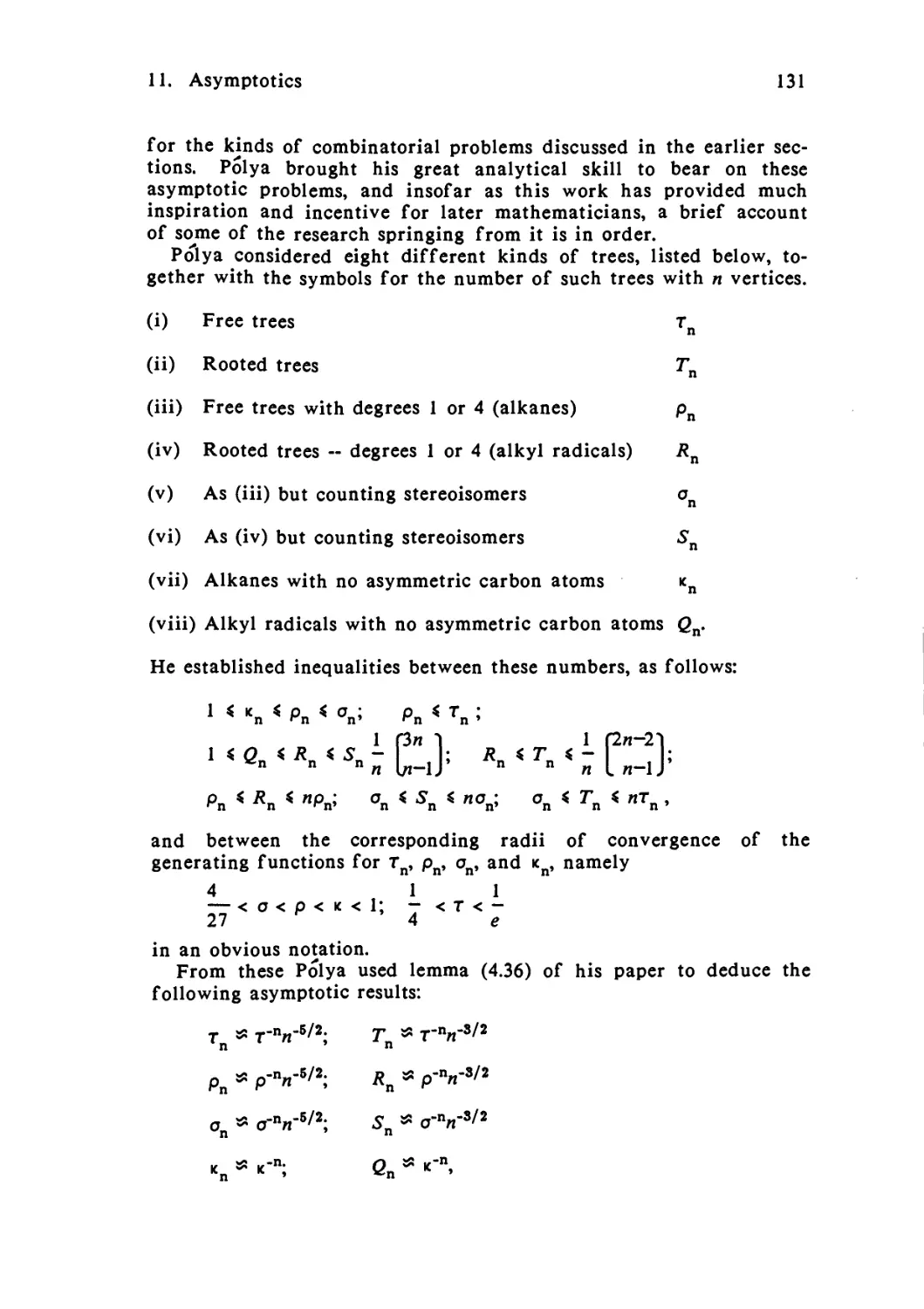
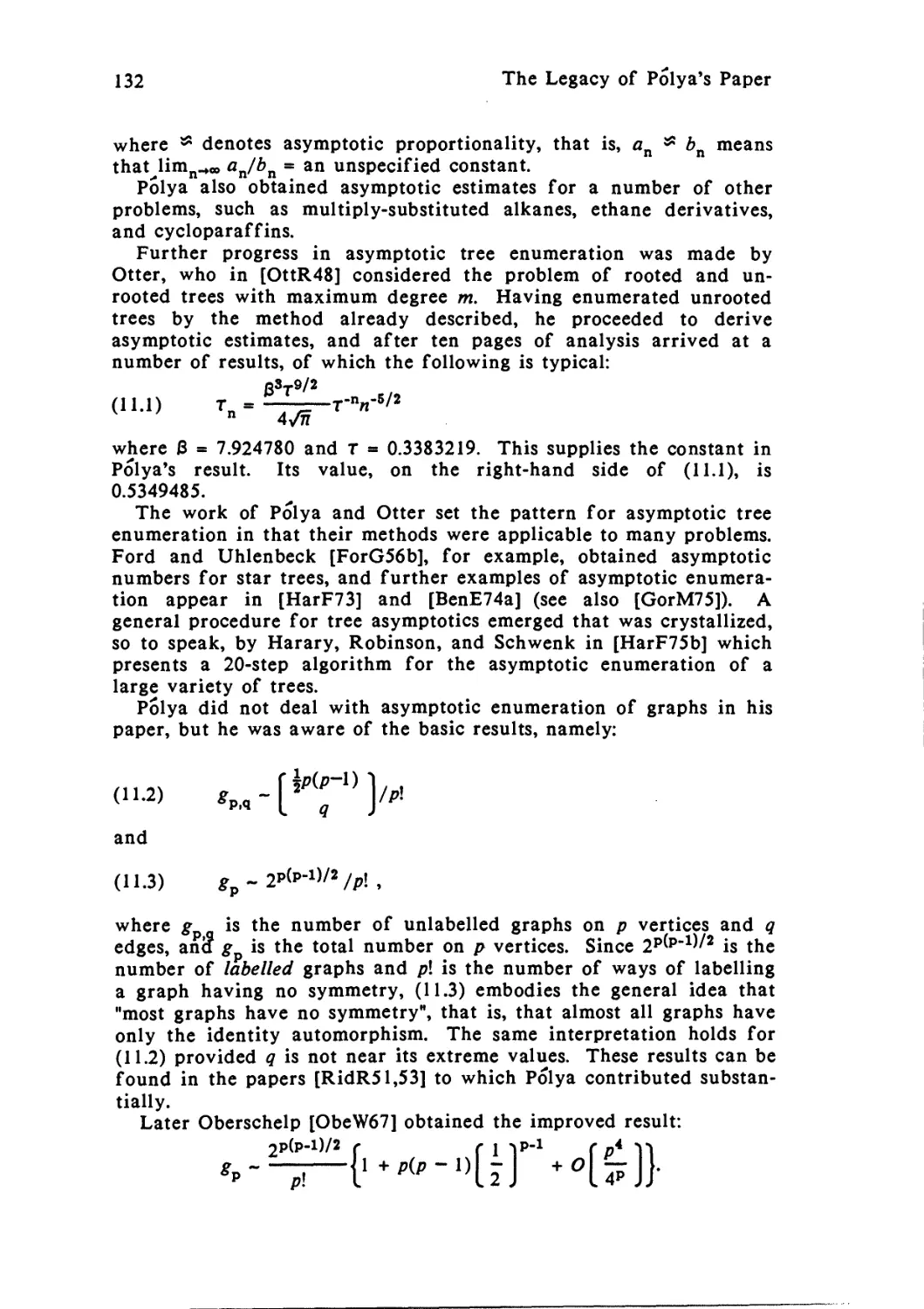
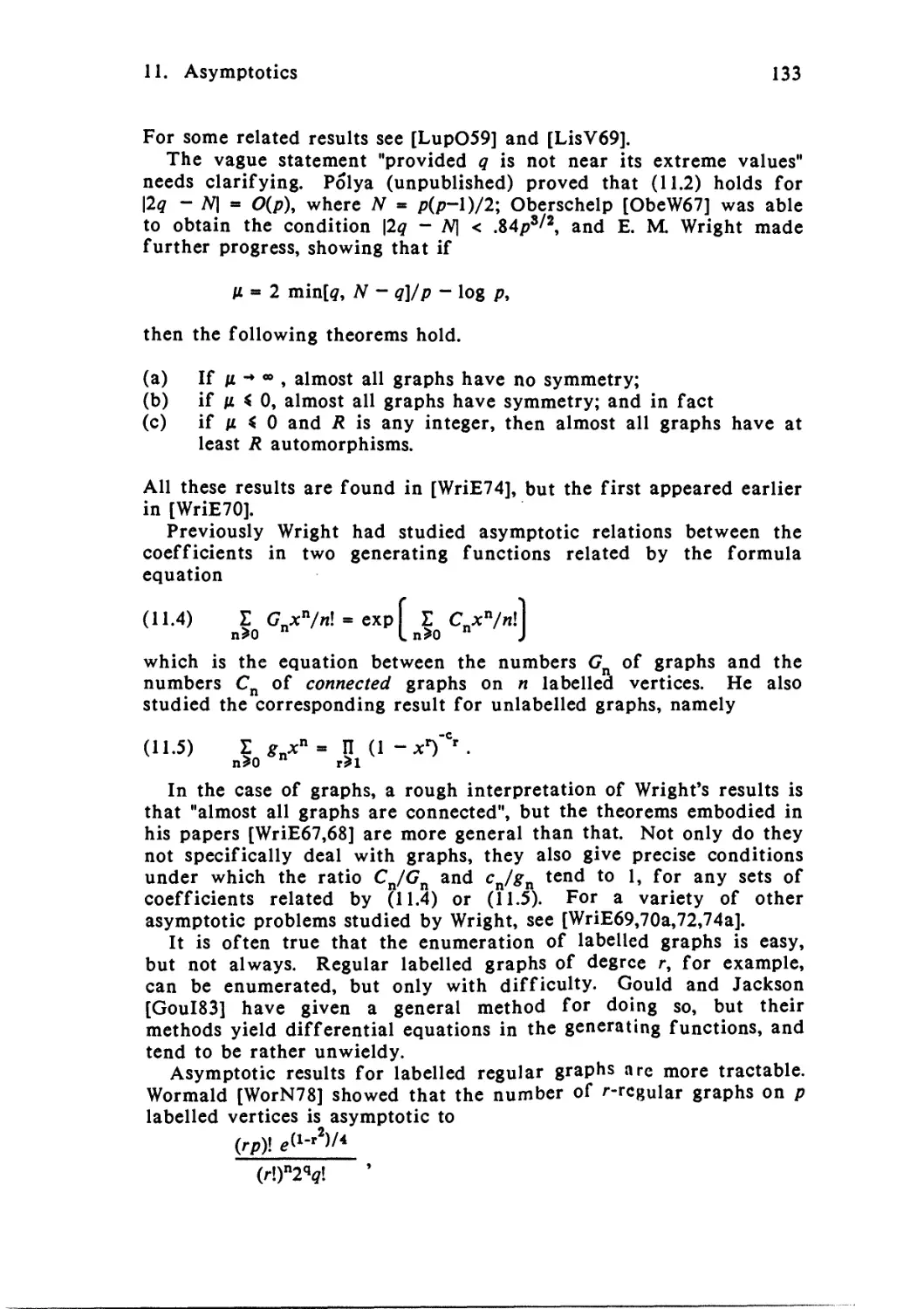
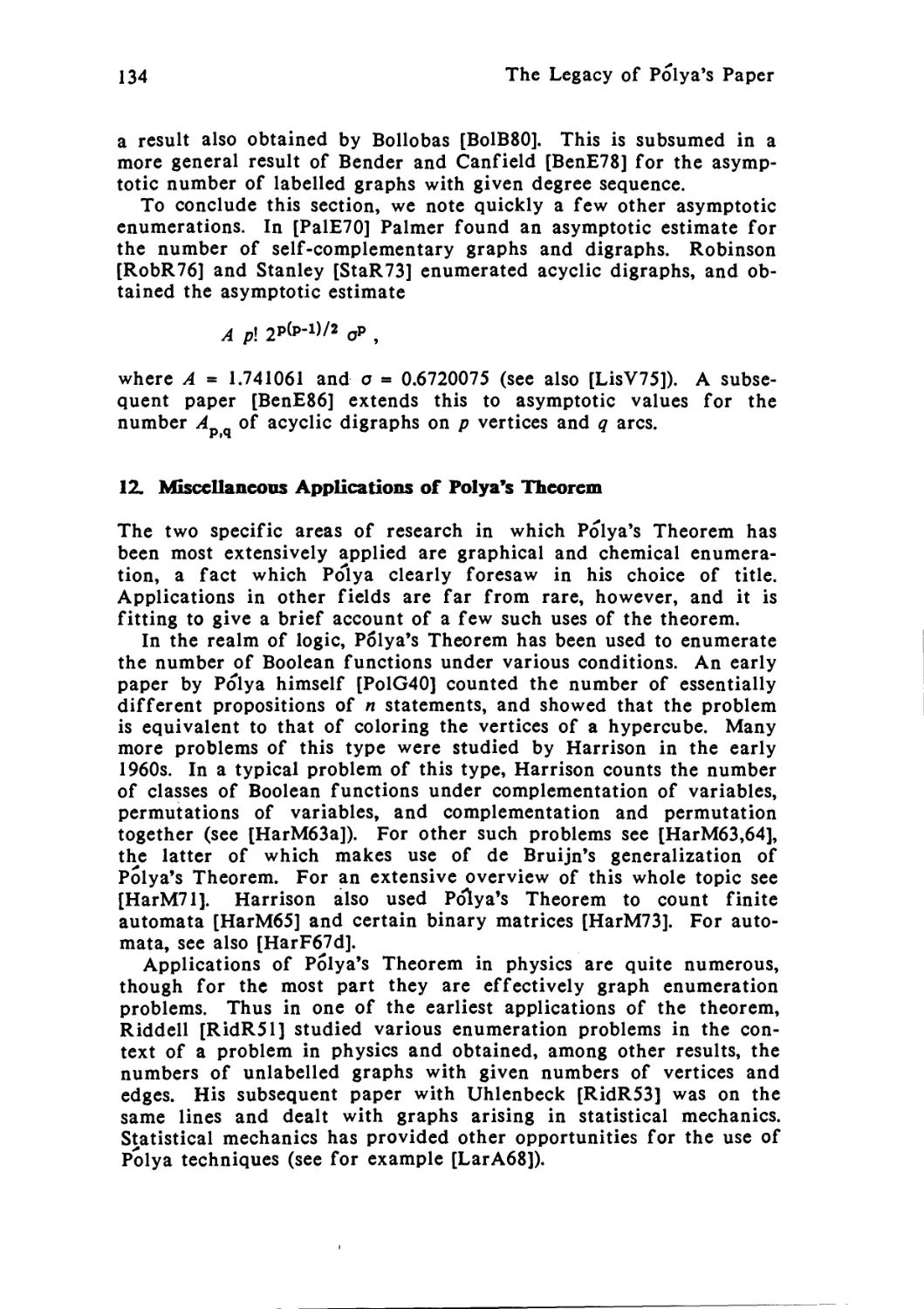
London Paris Tokyo

R.C. Read
Department of Combinatorics
and Optimization
University of Waterloo
Waterloo, Ontario N2L, 3G1
Canada
Translated by:
Dorothee Aeppli
Division of Biometry, School of Public Health
University of Minnesota
Minneapolis, MN 55455
U.S.A.
Library of Congress Cataloging-in-Publication Data
P61ya, George
Combinatorial enumeration of groups, graphs, and chemical compounds.
Bibliography: p.
1. Combinatorial enumeration problems.
I. Read, Ronald C. II. Title.
QA164.8.P65 1987 51T.62 86-31634
© 1987 by Springer-Verlag New York Inc.
All rights reserved. This work may not be translated or copied in whole or in part with-
without the written permission of the publisher (Springer-Verlag, 175 Fifth Avenue, New
York, New York 10010, USA), except for brief excerpts in connection with reviews or
scholarly analysis. Use in connection with any form of information storage and retrieval,
electronic adaptation, computer software, or by similar or dissimilar methodology now
known or hereafter developed is forbidden.
The use of general descriptive names, trade names, trademarks, etc. in this publication,
even if the former are not especially identified, is not to be taken as a sign that such
names, as understood by the Trade Marks and Merchandise Marks Act, may acccording-
ly be used freely by anyone.
Printed and bound by R.R. Donnelley and Sons, Harrisonburg, Virginia.
Printed in the United States of America.
987654321
ISBN 0-387-96413-4 Springer-Verlag New York Berlin Heidelberg
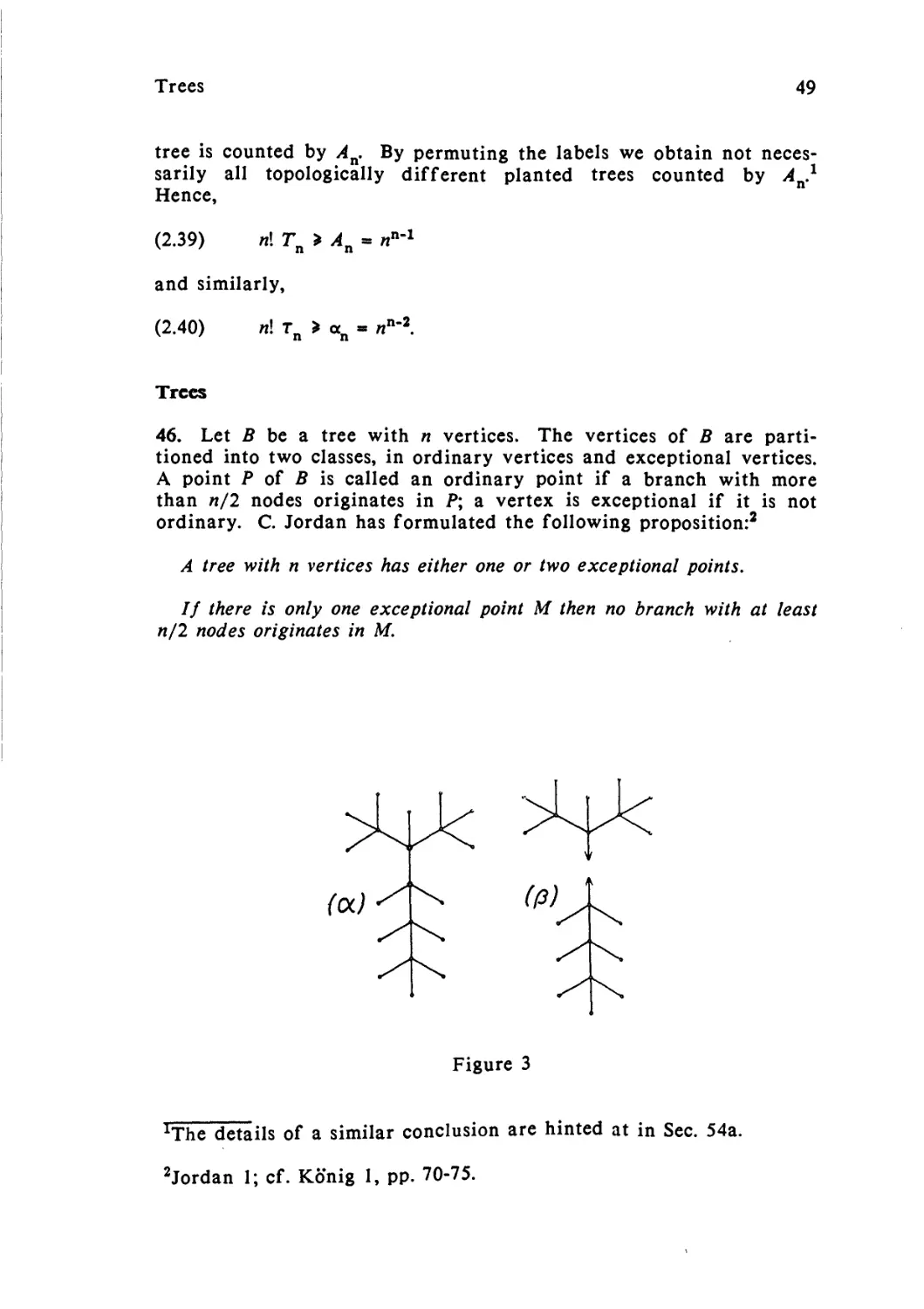
ISBN 3-540-96413-4 Springer-Verlag Berlin Heidelberg New York

PREFACE
In 1937 there appeared a paper that was to have a profound
influence on the progress of combinatorial enumeration, both in its
theoretical and applied aspects. Entitled Kombinatorische Anzahlbest-
immungen fur Gruppen, Graphen und chemische Verbindungen, it was
published^in Ada Mathematical Vol. 68, pp. 145 to 254. Its author,
George Polya, was already a mathematician of considerable stature,
well-known for outstanding work in many branches of mathematics,
particularly analysis.
The paper in question was unusual in that it depended almost
entirely on a single theorem -- the "Hauptsatz" of Section 4 -- a
theorem which gave a method for solving a general type of enumera-
enumeration problem. On the face of it, this is not something that one
would expect to run to over 100 pages. Yet the range of the applica-
applications of the theorem and of its ramifications was enormous, as Polya
clearly showed. In the various sections of his paper he explored
many applications to the enumeration of graphs, principally trees,
and of chemical isomers, using his theorem to present a comprehen-
comprehensive and unified treatment of problems which had previously been
solved, if at all, only by ad hoc methods. In the final section he
investigated the asymptotic properties of these enumerational results,
bringing to bear his formidable insight as an analyst.
Polya's paper was, and should still be, essential reading for
anyone pursuing research in any field relating to enumeration, but
for many English-speaking mathematicians the fact that it was
written in German was an obstacle not lightly to be overcome. My
own experience in this regard was no doubt similar to that of many
others. I well remember how, as a raw Ph.D. student still unsure of
the direction in which I wanted my research to go, I became
convinced, for some reason, that Polya's paper was one that I ought
to read. Tackling such a long paper was a daunting task, for my
German was rudimentary and the only copy of the paper available
to me was a rather poor microfilm. But I struggled through, and
was amply rewarded. Not only did the paper provide me with a

vi Preface
powerful tool for the solution of combinatorial problems, it also
revealed a whole vista of possible lines of investigation. The re-
research path ahead was made clear to me.
Mathematical papers in German are not routinely translated into
English as are those in Russian or Chinese, but in view of its
obvious importance and the fact that it is as long as many books, it
is surprising that P6"lya's paper has not been translated before now.
True, there have been rumors from time to time during the last few
decades that someone, somewhere, was planning a translation, but
none of these projects ever materialized. Now at last a translation
has been produced, and is presented in this volume. It appears, very
fittingly, on the 50th anniversary of the publication of the original
paper.
Polya's paper can truly be said to be a classic of mathematical
literature -- worthwhile reading for anyone with an interest in com-
combinatorics; but as with most classics, it is not enough to read the
paper by itself. Largely as a result of Polya's work, the subject of
combinatorial enumeration has blossomed greatly during the last 50
years, and the importance of P6*lya's paper can be properly appre-
appreciated only in light of these later developments. The publishers have
done me the honor of asking me to supply an article to accompany
the translation, giving a survey of the many different kinds of re-
research that have stemmed from Polya's work. In doing this I have,
perforce, had to be selective -- it would be quite impossible to say
something about every paper that has made use of Polya's theorem --
but I have tried to indicate the main streams of development and to
show the tremendous diversity of problems to which the theorem can
be applied.
It is a great pity that Polya did not live to see the completion of
this translation. He died on September 7, 1985, having achieved the
ripe old age of 97. This volume, appearing as it does on the 100th
anniversary of his birth, serves as a fitting tribute to one of the
most outstanding mathematicians of our time.
Ronald C. Read
University of Waterloo

CONTENTS
Preface v
Introduction 1
Chapter 1
Groups 10
Chapter 2
Graphs 32
Chapter 3
Chemical Compounds 58
Chapter 4
Asymptotic Evaluation of the Number of Combinations 75
The Legacy of Polya's Paper: Fifty Years of Polya Theory 96
References 136

INTRODUCTION
1. This paper presents a continuation of work done by Cayley.
Cayley has repeatedly investigated combinatorial problems regarding
the determination of the number of certain trees1. Some of his
problems lend themselves to chemical interpretation: the number of
trees in question is equal to the number of certain (theoretically
possible) chemical compounds.
Cayley's extensive computations have been checked and, where
necessary, adjusted. Real progress has been achieved by two Ameri-
American chemists, Henze and Blair2. Not only did the two authors ex-
expand Cayley's computations, but they also improved the method and
introduced more classes into the compound. Lunn and Senior3, on
the other hand, discovered independently of Cayley's problems that
certain numbers of isomers are closely related to permutation groups.
In the present paper, I will extend Cayley's problems in various
ways, expose their relationship with the theory of permutation
groups and with certain functional equations, and determine the
asymptotic values of the numbers in question. The results are
described in the next four chapters. More detailed summaries of
these chapters are given below. Some of the results presented here
in detail have been outlined before4.
2. The combinatorial problem on permutation groups stands out
for its generality and the simplicity of the solution. The following
Cayley, 1-8.
2Blair and Henze, 1-6.
3Lunn and Senior, 1.
4Polya, 1-5.

Introduction
example reveals the close relationship of this problem with the first
elements of combinatorics.
Suppose you have six balls with three different colors, three red, two
blue, one yellow. Balls of the same color cannot be distinguished. In
how many ways can you assign the six balls to the six vertices of an
octahedron which moves freely in space! If the octahedron is fixed in
space in such a way that the vertices are designated as upper, lower,
front, back, left, and right vertex, then the number is determined by
basic permutation principles as
6!
m 60.
3! 2! 1!
The crux of the problem lies in the fact that the vertices are neither
completely identifiable nor completely indistinguishable, but that
those and only those among the 60 arrangements which can be trans-
transformed into each other by rotations of the octahedron, may be con-
considered indistinguishable.
To answer the question one has to examine carefully the permuta-
permutations which correspond to the 24 rotations of the octahedron. We
partition these permutations into cycles and assign to each cycle of a
certain order k the symbol /k: assign f1 to a cycle of order 1 (vertex
which is invariant under rotation), f2 to a cycle of order two (trans-
(transposition), /3 to a cycle of order three, etc. A permutation which is
decomposed into the product of cycles with no common elements is
represented by the product of the symbols /. associated with the cor-
corresponding cycles. Thus the rotations of the octahedron are des-
described by the following products:
f\ : "rest" or "identity"; that is, six first order cycles.
/j/4 : 90* rotation with respect to a diagonal.
f\f\ : 180* rotation with respect to a diagonal.
f\ : 180* rotation with respect to the line through the midpoints
of two opposite edges.
f\: 120* rotation with respect to the line connecting the centers of
two opposite faces.
We note these five rotation types occur with the respective
frequencies
16 3 6 8.
Evaluate the arithmetic mean of the 24 products assigned to the 24
rotations. I will call the resulting polynomial in the four symbols fv
J2' '3' '4'

Introduction
U\ + 6/?/4 + 3/J/J + 6f\ + 8/*)/24
the cycle index of the permutation group which gives rise to the
octahedron group of the six vertices.
The solution of the combinatorial problem is determined by the
following rule: introduce
/j ¦ x + y + z, f2 m x2 + y2 + z2
/, - xs + yz + z3, f4 m x4 + y4 + z4
into the cycle index and expand in powers of x,y,z. The desired
number is equal to the coefficient of xzy2z in this expansion. It is
equal to 3, which can be checked by means of a figure. The
solution for the simple combinatorial problem of six distinguishable
vertices discussed above follows the same rules: The only
permutation compatible with distinguishable vertices is the identity,
that is, the permutation group of degree 6 with cycle index f\. The
coefficient of xsy2z in the expansion of (x + y + zN is precisely
6!
3! 2! 1! '
Chapter 1 expands on the above introduced concept of "configura-
"configurations which are equivalent with respect to a permutation group".
General rules are established and some related topics are mentioned.
3. Cayley defines a tree as a geometric-combinatorial structure
consisting of "vertices" and "edges". Each edge connects two vertices,
an arbitrary number of edges can meet in a vertex. A tree is con-
connected; given the number of vertices, the number of edges is the
smallest number necessary to connect the vertices: that is, the num-
number of vertices is exactly one more than the number of edges, and
there are no closed paths. One distinguishes between one-edged, two-
edged, three-edged, etc., vertices of the tree depending on the num-
number of edges originating in a vertex. A one-edged vertex is also an
endpoint of a tree.
An arbitrary endpoint can also be marked as "root". A tree with a
root will be called a planted tree; the vertices different from the
root are nodes. If no root is marked, the tree is called an unrooted
or free tree. From a topological point of view, two trees with the
same structure are identical; the exact definition of this and some
similar, less familiar notions, will be discussed in Sections 34-35. In
the sequel, we use the following notations:
/ : number of topologically different free trees with n vertices;
T : number of topologically different planted trees with n nodes.

Introduction
Cayley has advanced the computation of /n and Tn to an impres-
impressive degree. The definition of /n, ignoring the notion of root, is
simpler than that of T . However, we will see that, from an analyti-
analytical point of view, Tn is easier to handle than /n: /n can be derived
from Tn. To evaluate Tn Cayley has established the remarkable
equation
A)
Txx
Tnxn
... (l-jen)"Tn
which, considered as an identity in x, allows the successive computa-
computation of the numbers Tv Tv ... . Extracting Tv T2, ... from equation
A) or determining these numbers by inspection (see Fig. 1), we find
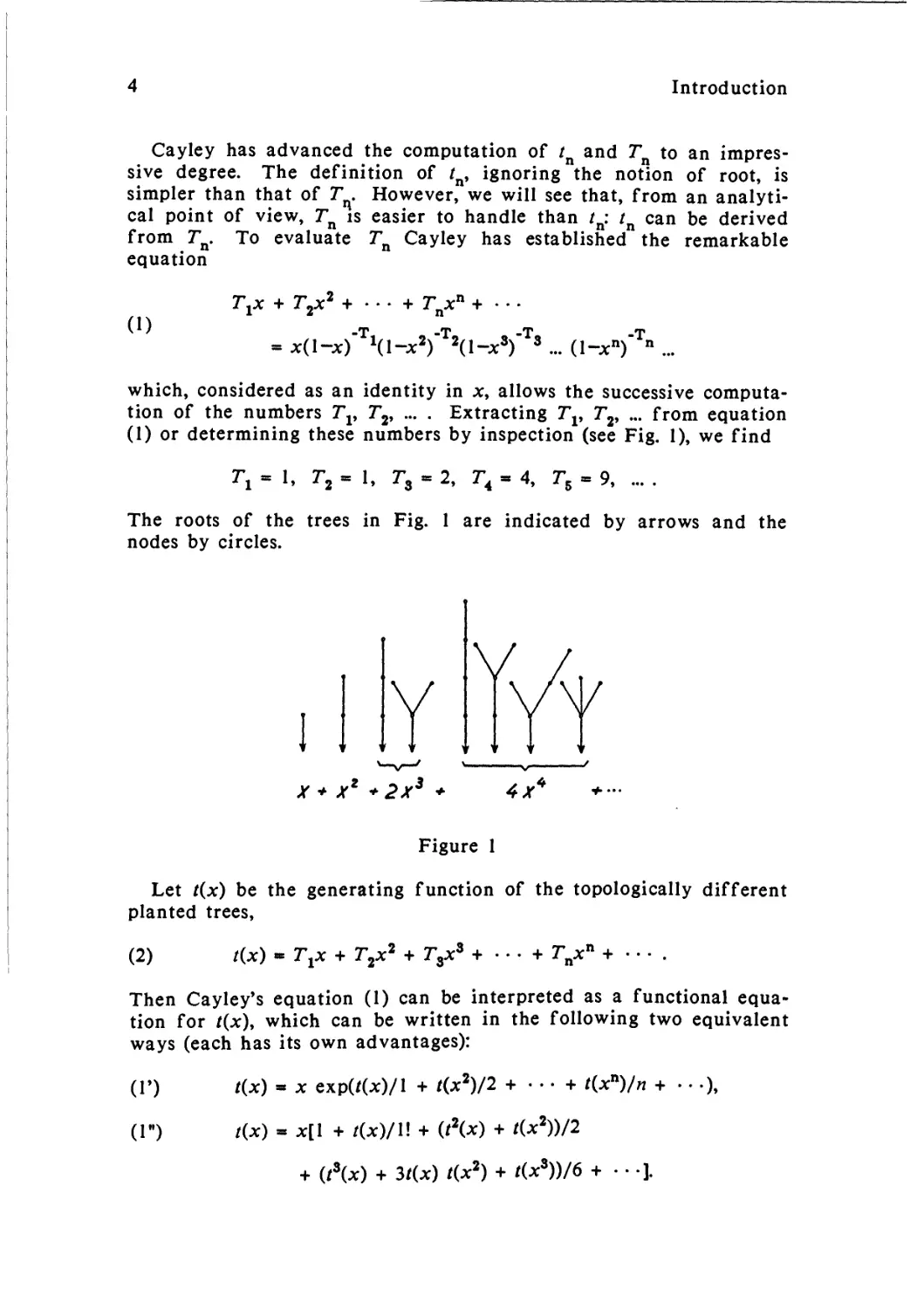
tx - i, r2 * i, r3 * 2, t4 - 4, r5 = 9, ....
The roots of the trees in Fig. 1 are indicated by arrows and the
nodes by circles.
i I
x * xz *2x3 *
Figure 1
Let t(x) be the generating function of the topologically different
planted trees,
B)
Txx + T2x2
Tnxn
Then Cayley's equation A) can be interpreted as a functional equa-
equation for t(x), which can be written in the following two equivalent
ways (each has its own advantages):
(T)
A")
t(x) - x exp(/(*)/l + t(x2)/2 + • • • + t(xn)/n
t(x) » *[1 + t(x)/U + (t\x) + t(x2))/2
t(x2) + t(x*))/6 + - • •].

Introduction
Formula (P) is the base for asymptotic computations of Tn and /n
and A") lends itself to generalizations. (Indeed, in the general term
of the series on the right hand side of A") we recognize the cycle
index of the symmetric group of n elements.)
Cayley's equation A) rewritten in the form of A") serves, with
proper interpretation of the group theoretical aspects, as model for
any number of counts defined analogously to Tn and /n.
Two examples of counts may suffice:
pn » number of topologically different free trees consisting
entirely of one- and four-edged vertices, specifically n four-edged
vertices.
Rn » number of topologically different planted trees consisting
entirely of one- and four-edged vertices, specifically n four-edged
vertices.
The definitions of pn and Rn are, from a purely geometric-combina-
geometric-combinatorial point of view, somewhat artificial. However, pn is related to
Rn like /n to T : pn will be derived from Rn, and Rn is the
coefficient of xn in the power expansion of the generating function
C) r(x) ¦ Ro + /?!* + R2x2 + • • • + Rnxn + • • •
satisfying the functional equation
D) r(x) = 1 + x(r(jeK + 3r(x)r(x2) + 2r(*3))/6.
4. The chemical importance, not the geometric-combinatorial con-
considerations, justifies the in-depth analysis of the numbers pn and R .
A tree included in the family considered first (of size pn), that is,
a tree consisting of one-edged and n four-edged vertices, has exactly
In + 2 one-edged vertices, hence a total of 3« + 2 vertices (see Sec.
36). By identifying the four-edged vertices with C-atoms of valence
4 and the 2n + 2 one-edged vertices with the H-atoms of valence 1
the tree turns into the structure of a paraffin; that is, of a chemical
compound with molecular formula CnH2n+2. Topologically different
trees with n and 2n + 2 vertices correspond to structurally different
substances (isomers) with the common molecular formula Cn//2n+2,
thus
p is the number of isomers with molecular formula CnH2n+2.
Similarly,
R is the number of isomers of molecular formula Cn//2n+1OH
(alcohol).
The root of the tree corresponds to the OH group; the remaining 2«
+ 1 endpoints correspond to H-atoms.

Introduction
The interpretation of the geometric-combinatorial counts p and
Rn as numbers of possible isomers, suggests that concepts in organic
chemistry give rise to many analogous numbers which allow for
geometric-combinatorial definition and computation. The most im-
important numbers of this type in organic chemistry are listed below;
translation into geometric-combinatorial definitions requires careful
examination (see Sees. 33-36). Let
an « number of stereoisomeric paraffins of molecular formula
n
Sn m number of stereoisomeric alcohols of molecular formula
CnH2n+lOH'
*n « number of structurally isomeric paraffins of molecular for-
formula CnH2n+2 without asymmetric carbon atoms;
Qn « number of structurally isomeric alcohols of molecular for-
formula CnH2n+1OH without asymmetric carbon atoms.
The relationships between an and Sn, *n and Qn are similar to those
of Tn and Tn, pn and Rn. The number an can be calculated in terms
of 5"n, Kn in terms of Qn, while Sn and Qn are the coefficients in the
respective generating functions
E) s{x) « So + Sxx + S2x2 + • • • + Snxn + •. •
F) g(x) - Qo + Qxx + Q2x2 + . • • + Qnxn + • • •
defined by the functional equations
G) s{x) « 1 + xisix)* + 2s(x2))/3
(8) g(x) « 1 + ^(jc)^(jc2).
Among the four functions g(x), r(x\ s(x), t(x), the first, q(x), has the
simplest structure. Its functional equation (8) is solved by the con-
continued fraction
(8') g(x) « 1/A-*/ A-jcV (I-*4/ (l-x8/ ...).
Chapters 2 and 3 contain proofs of the claims on the numbers Qn,
R , S , T , k , p , a , Tn, as well as discussions of a few other
geometric-combinatorial, chemical-combinatorial numbers.
5. The fact that the number of isomers of homologous series in-
increases rapidly with the number of C-atoms is-well known. The
methods described above allow for more precise statements and for

Introduction
asymptotic evaluation of the number of isomers. Thus we are on the
right track.
The combinatorial definition leads partly immediately, partly with
the help of some derivations (see Sees. 36-37), to the inequalities
(9) 1 < 1^ < Pa < Oa, Pn*Tn,
A0) i < Ga < *a < sn, Rn s rn,
A1) Pa < *a < «Pa. °n < *n < «an, Tn « rn « «Tn.
Further combinatorial considerations (Sees. 41, 43, 45) imply
1 f3n 1 n*-1 1 f2n-2 1
A2) Sn $ - , -— * rn * -
n n U-iJ «! « L n-i J
Denote the radii of convergence of the four series g(x), r(x), s(x),
t(x) by k, p, a, T, respectively. In the limit, the inequalities A0) and
A2) turn into the following inequalities between k, p, a, T, but they
are less precise than the inequalities deduced from the functional
equations A'), D), G), (8):
A3) I > k > p > a p > T
A4) a> 4/27 - > T > -.
e 4
Determination of the radii of convergence k, p, a, T is the first
step in the asymptotic evaluation of the respective combinatorial
counts. The next step consists in examining the four power series
q(x\ r(x), s(x), t(x) on the circle of convergence. Each of the four
series has exactly one isolated singular point on the circle of con-
convergence; in fact, it lies on the positive real axis. The singular point
is a pole of first order for g(x), and for r(x), s(x), t(x), it is an alge-
algebraic branch point of first order in the neighborhood of which the
function is bounded. The asymptotic behavior of 0n, Rn, 5"n, Tn can
now be deduced easily.
I will use the following notations:
Suppose
v»» -c •
where C is a positive real number @ < C < •). Then
which means An is asymptotically proportional to 5n; C is called the
proportionality factor. Asymptotic equality

Introduction
holds if An and Bn are asymptotically proportional with proportion-
proportionality factor 1.
The analytic methods described above lead to
A6) Qn * K-n, Rn * p-n«/2, Sn * a-n/T3/2, Tn * T"V3/2,
whence
A7) Kn * K-n, pn * «-5/2p"n, an * crn/T5/2, Tn * T"n«/2 .
The relationship between Qn and *n is particularly simple:
A8) <2n~2Kn-
Some generalizations of the asymptotic formulas regarding Rn and pn
in chemical context will emphasize the importance of these results.
The number of structurally isomeric hydrocarbons with formula
CnH2n+2.2At is asymptotically proportional to p-nwCA*-5)/2. For the
paraffins \l is equal to zero, that is, the number is asymptotically
proportional to pn. For fi « 1, the proportionality factor is 1/4.
Let X\ X%\ X"\ ..., JfW be mutually different radicals with
valence 1. The number of structurally isomeric compounds of formula
CnH2n+2-l X* X* ' ••• ^ is asymptotically proportional to p-«rtB^-5)/2
These compounds are really -fold substituted paraffins"; the
radicals have to be different from each other and from alkyls. In
case of & « 0 and Jt « 1, the mentioned result gives the asymptotic
behavior of pn and Rn respectively. The proportionality factor is of
the form ?X*, where L and X are independent of t.
The number of isomeric homologues of benzene with formula
^6+n^6+2n /5 asymptotically proportional to the number of isomeric
alcohols CnH2n+1OH with proportionality factor [r(ps) + r(p)r(p2J]/2.
Similarly, the increase in the number of isomers in other homologous
series (e.g., in the series starting with naphthalene and anthazene) is
asymptotically proportional to the number Rn of isomers of the
alcohol series. The proportionality factor can easily be derived from
the cycle index of the permutation group of the replaceable bonds of
the basic compound.
6. The preceding four sections summarize only part of the
content of the following four chapters; several interesting results
have not been mentioned. To keep the paper within bounds, I had to
forego detailed discussion of aspects I deemed less important. For
this subject matter, definitions and even formal calculations and
heuristic deductions seem to me often more important than complete
proofs. Thus, proofs were eliminated first; in particular, in the case
of several analogous propositions the proof of only one theorem is

Introduction
given, the proofs of the others are left, some with hints, to the
reader. Obvious steps are omitted.

Chapter 1
GROUPS
Definitions
7. We begin by generalizing the problem which is at the root of the
example in Sec. 2. There are two types of generalizations: on the
one hand the colored balls discussed in Sec. 2 have to be replaced by
more complex objects, which we will call figures; on the other hand,
the special permutation group of the octahedron rotations will have
to be replaced by a more general permutation group.
The definitions concerning figures will be followed by those on
permutation groups. The terminology is suggestive. Symbols will
have the same meaning throughout.
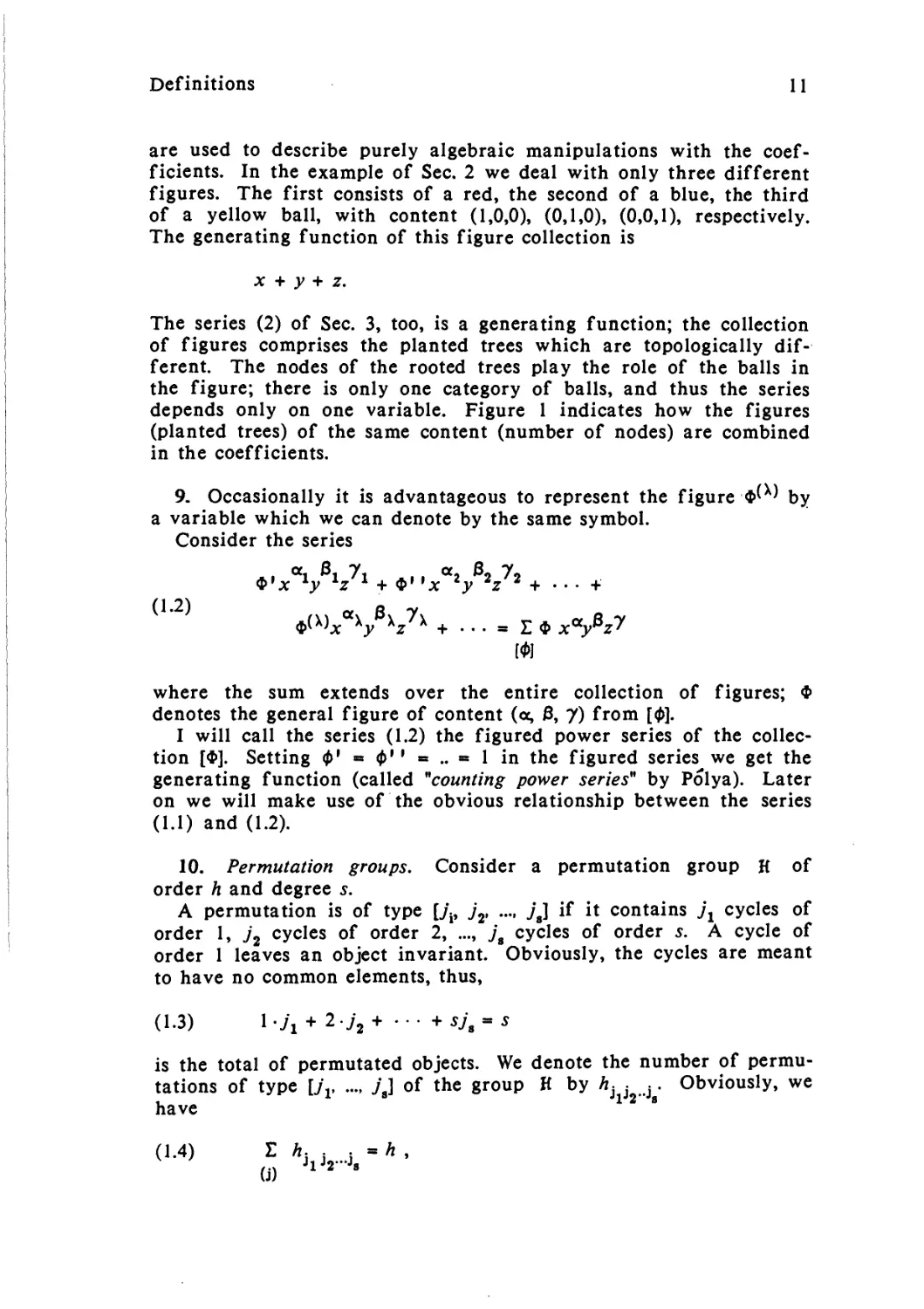
8. Collection of figures: Consider a series of distinct objects 0',
Q1 ', ..., <t>^\ ... called figures. The collection of these figures is the
set [$].
The figure 4>^ contains three categories of balls, ccx are red, 3X
are blue, 7X are yellow (X « 1, 2, ...J1; the figure 4>^ has, for short,
content (ax, 3X, 7X).
Different figures may have the same number of balls of each
color. Let akim denote the number of figures of content (&, I, m).
The power series
<U> Jo Jo Jo **&^ - k,L *'
is the generating function of the collection
The values a^m are supposed to be finite. There are no assump-
assumptions on the convergence of the power series A.1); formal expansions
Restricting attention to three categories instead of arbitrarily many
categories is not an essential limitation.

Definitions 11
are used to describe purely algebraic manipulations with the coef-
coefficients. In the example of Sec. 2 we deal with only three different
figures. The first consists of a red, the second of a blue, the third
of a yellow ball, with content A,0,0), @,1,0), @,0,1), respectively.
The generating function of this figure collection is
x + y + z.
The series B) of Sec. 3, too, is a generating function; the collection
of figures comprises the planted trees which are topologically dif-
different. The nodes of the rooted trees play the role of the balls in
the figure; there is only one category of balls, and thus the series
depends only on one variable. Figure 1 indicates how the figures
(planted trees) of the same content (number of nodes) are combined
in the coefficients.
9. Occasionally it is advantageous to represent the figure Q^ by
a variable which we can denote by the same symbol.
Consider the series
where the sum extends over the entire collection of figures; *
denotes the general figure of content (a, /3, 7) from [$].
I will call the series A.2) the figured power series of the collec-
collection [¦]. Setting <t>' « <t>'' « .. « 1 in the figured series we get the
generating function (called "counting power series" by Polya). Later
on we will make use of the obvious relationship between the series
A.1) and A.2).
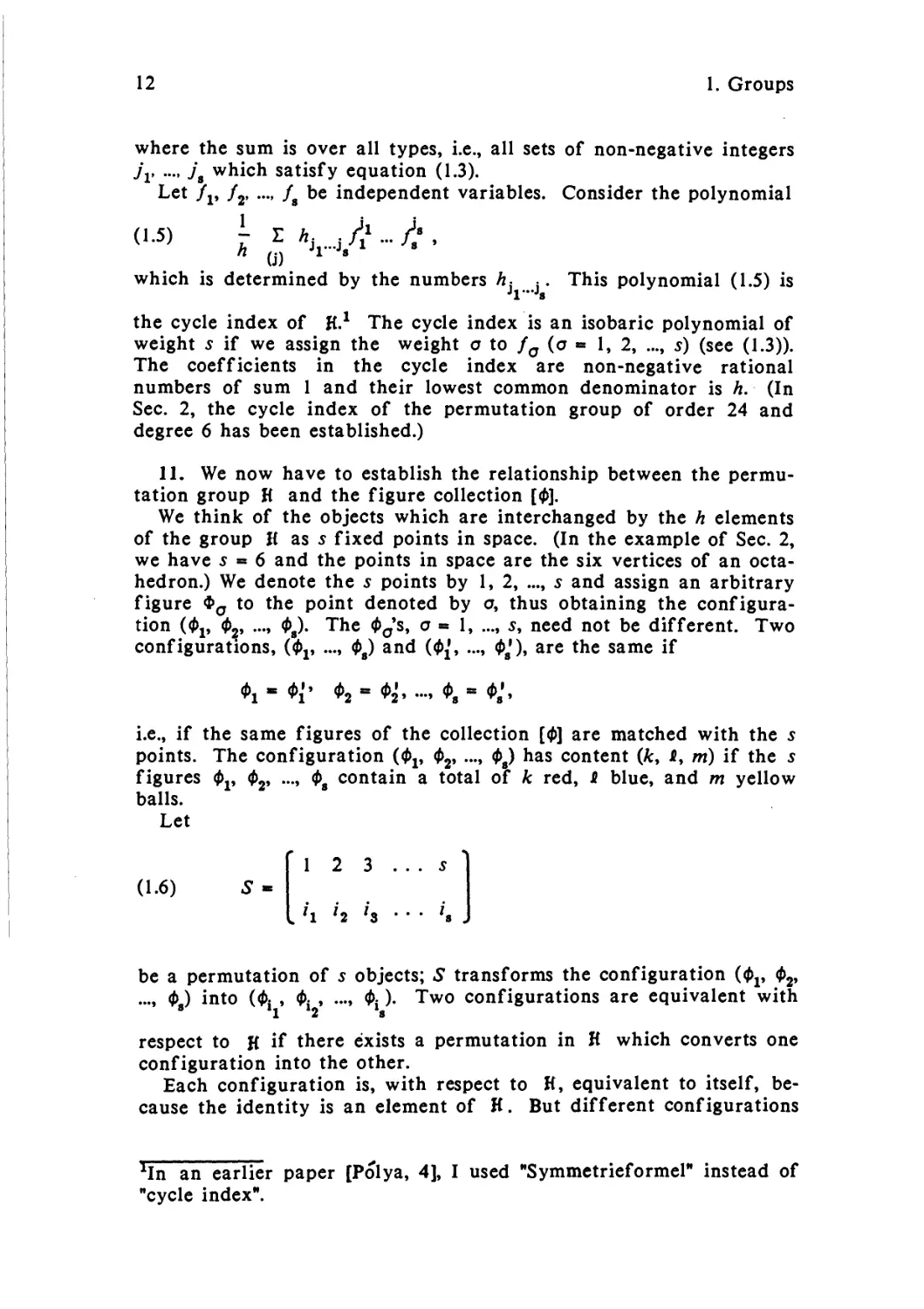
10. Permutation groups. Consider a permutation group H of
order h and degree s.
A permutation is of type [j^ j2, .... j8] if it contains j1 cycles of
order 1, j2 cycles of order 2, ..., j8 cycles of order s. A cycle of
order 1 leaves an object invariant. Obviously, the cycles are meant
to have no common elements, thus,
A.3) l-j\ + 2j2+ ... + sja = s
is the total of permutated objects. We denote the number of permu-
permutations of type [j\ ja] of the group H by h. . r Obviously, we
have 12 "
A.4) I

12 1. Groups
where the sum is over all types, i.e., all sets of non-negative integers
j\ ja which satisfy equation A.3).
Let fv f2 fa be independent variables. Consider the polynomial
1
which is determined by the numbers h, ¦. This polynomial A.5) is
J1""JS
the cycle index of H.1 The cycle index is an isobaric polynomial of
weight 5 if we assign the weight a to /a (a « 1, 2, ..., 5) (see A.3)).
The coefficients in the cycle index are non-negative rational
numbers of sum 1 and their lowest common denominator is h. (In
Sec. 2, the cycle index of the permutation group of order 24 and
degree 6 has been established.)
11. We now have to establish the relationship between the permu-
permutation group H and the figure collection [<?].
We think of the objects which are interchanged by the h elements
of the group I{ as s fixed points in space. (In the example of Sec. 2,
we have s « 6 and the points in space are the six vertices of an octa-
octahedron.) We denote the s points by 1, 2, ..., s and assign an arbitrary
figure *a to the point denoted by a, thus obtaining the configura-
configuration (<t>v 4>v ..., <t>a). The 4>a's, a « 1, ..., 5, need not be different. Two
configurations, (<j>v ..., 4>a) and ($j\ ..., 4>g'), are the same if
i.e., if the same figures of the collection [<t>] are matched with the s
points. The configuration (<t>v 4>2> •••> #s) has content (k, t, m) if the s
figures 4>v <t>2, ..., 4>a contain a total of k red, t blue, and m yellow
balls.
Let
A.6)
1 2 3 ... 5
h
be a permutation of s objects; S transforms the configuration D>v <t>2,
..., <t>) into (& , <t>- , ..., <t>s )• Two configurations are equivalent with
8 1 2 s
respect to H if there exists a permutation in H which converts one
configuration into the other.
Each configuration is, with respect to H, equivalent to itself, be-
because the identity is an element of H. But different configurations
JIn an earlier paper [Polya, 4], I used "SymmetrieformeP instead of
"cycle index".

Preliminary Problems 13
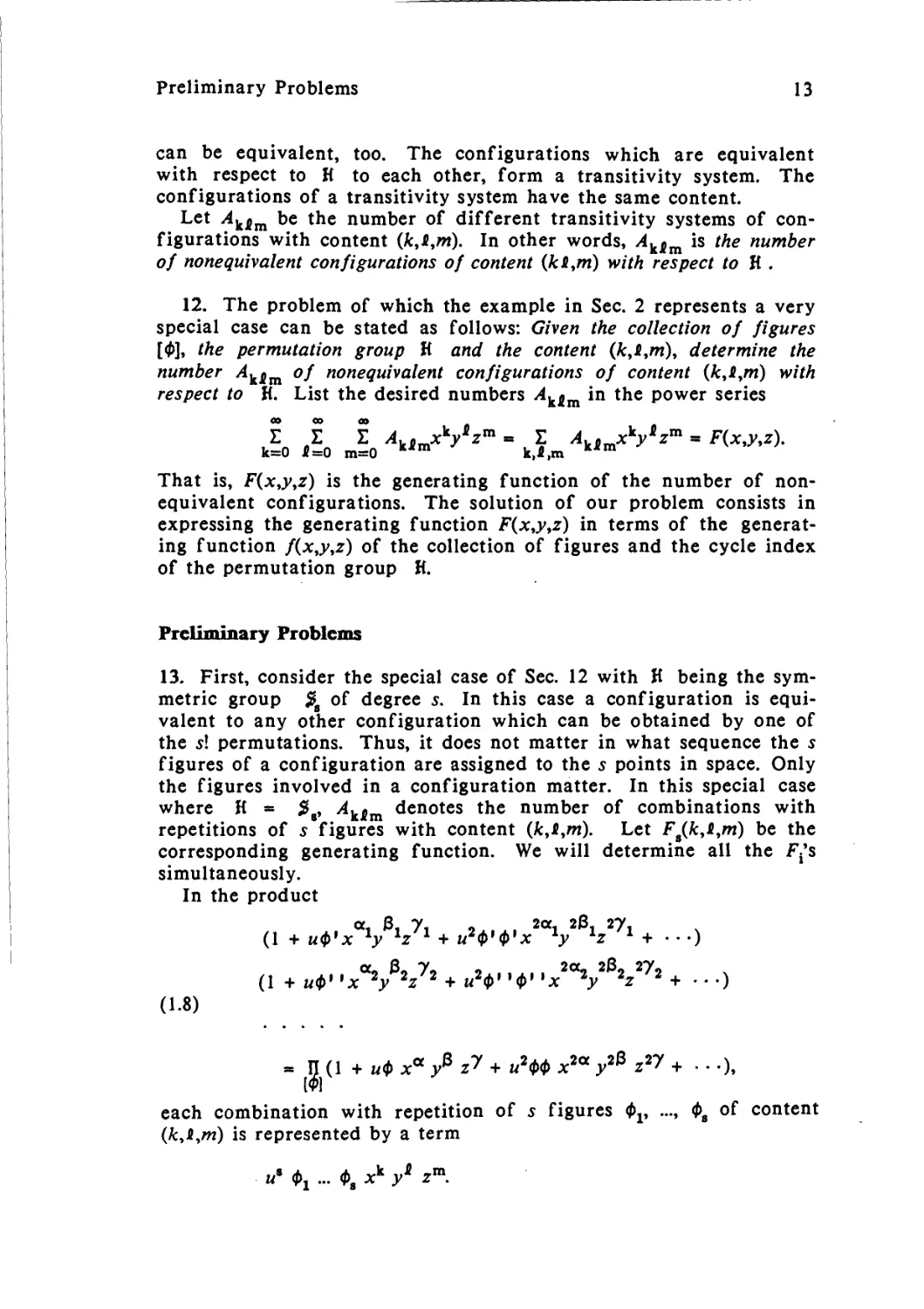
can be equivalent, too. The configurations which are equivalent
with respect to H to each other, form a transitivity system. The
configurations of a transitivity system have the same content.
Let Akim be the number of different transitivity systems of con-
configurations with content (k,t,m). In other words, Akim is the number
of nonequivalent configurations of content (kJt,m) with respect to H .
12. The problem of which the example in Sec. 2 represents a very
special case can be stated as follows: Given the collection of figures
[<t>], the permutation group H and the content (k,l,m), determine the
number Akim of nonequivalent configurations of content (k,Jt,m) with
respect to H. List the desired numbers Akim in the power series
Jo ,1 Jo W**" - J^U-xV*- - FtoA
That is, F(x,y,z) is the generating function of the number of non-
equivalent configurations. The solution of our problem consists in
expressing the generating function F(x,y,z) in terms of the generat-
generating function f(x,y,z) of the collection of figures and the cycle index
of the permutation group H.
Preliminary Problems
13. First, consider the special case of Sec. 12 with H being the sym-
symmetric group $a of degree 5. In this case a configuration is equi-
equivalent to any other configuration which can be obtained by one of
the s\ permutations. Thus, it does not matter in what sequence the 5
figures of a configuration are assigned to the s points in space. Only
the figures involved in a configuration matter. In this special case
where K - $g, Ak]tm denotes the number of combinations with
repetitions of s figures with content (k,t,m). Let Fa(k,t,m) be the
corresponding generating function. We will determine all the F.'s
simultaneously.
In the product
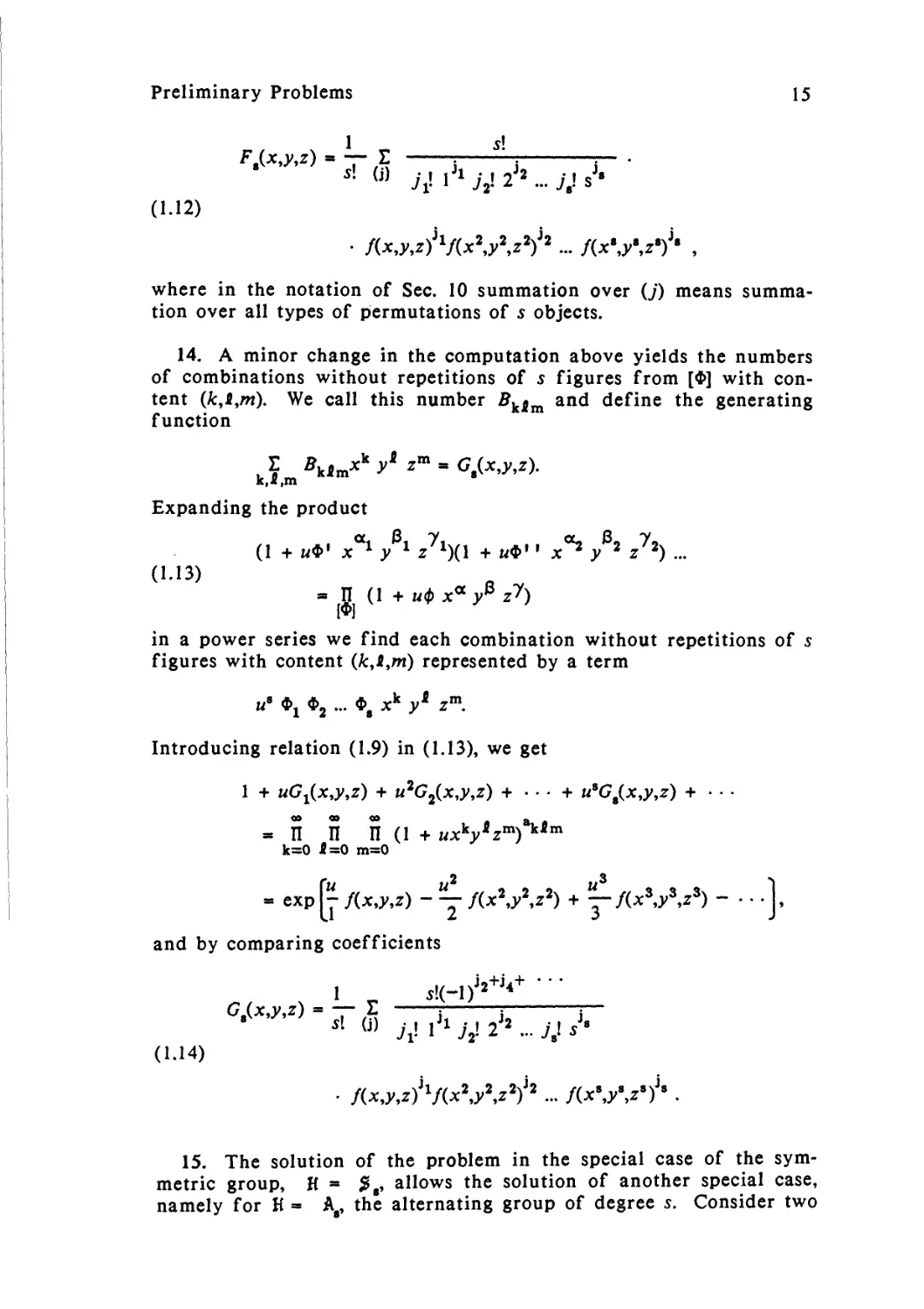
A.8)
A + kO'/VV1 + ttVt'Jc'VV71 + • • •)
(i + «¦¦ '/W2 + «v ¦¦• '
3 A + u* x« / z? + u2to> x2
3 A + u* x« / z? + uto> x2ct
m
each combination with repetition of s figures <t>v ..., 4>a of content
(^,i,/n) is represented by a term
. xk y'

14 l. Groups
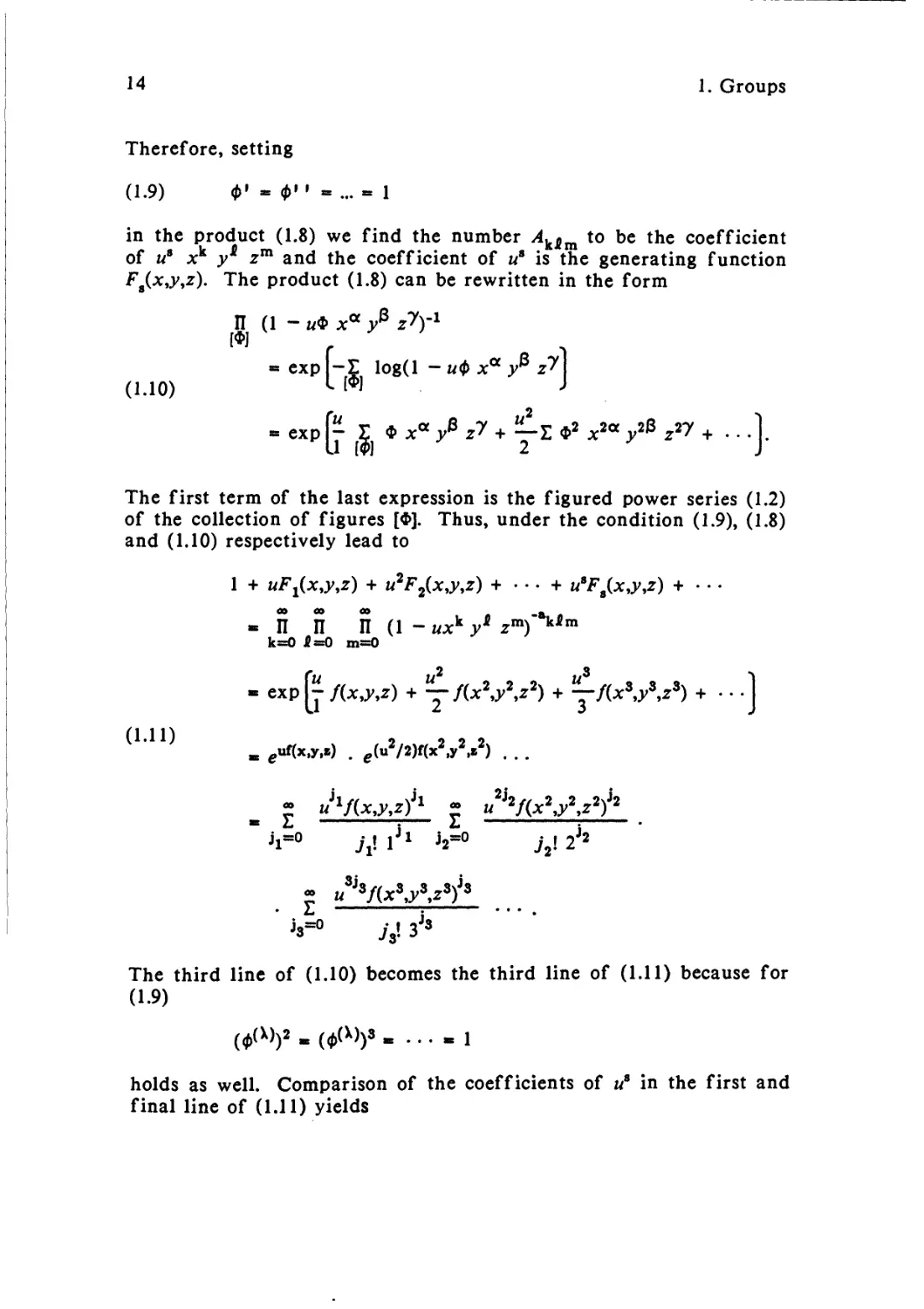
Therefore, setting
A.9) $'-$"-.... i
in the product A.8) we find the number Akim to be the coefficient
of u* xk y* zm and the coefficient of ua is the generating function
Fa(x,y,z). The product A.8) can be rewritten in the form
A - «* x* yB
n
m exp I-I log(l - u<t> x* y* zA
A.10)
expP I *«fiy
P I *x«)fizy+ yl *2 x2cc y2* z**+ • • •].
The first term of the last expression is the figured power series A.2)
of the collection of figures [*]. Thus, under the condition A.9), A.8)
and A.10) respectively lead to
1 + uFx(x,y,z) + u2F2(x,y,z) + - • • + u*Fa(x,y,z) + • • •
00 40 00
- n n n (i - uxk y* zm)~*kim
k=0 t=0 m=0
(u u2 u3
m exp I- f(x,y,z) + y/UV,22) + y.
" * . e(u2/2)f(x2,y2>82) . . .
2j#2//v2 ,,2 .2\h
uhf{x,y,z)h ? «2J2/(;tV,22)
The third line of A.10) becomes the third line of A.11) because for
A.9)
holds as well. Comparison of the coefficients of u* in the first and
final line of A.11) yields

Preliminary Problems 15
±z- s<-
j< \h jji
A.12)
where in the notation of Sec. 10 summation over (j) means summa-
summation over all types of permutations of s objects.
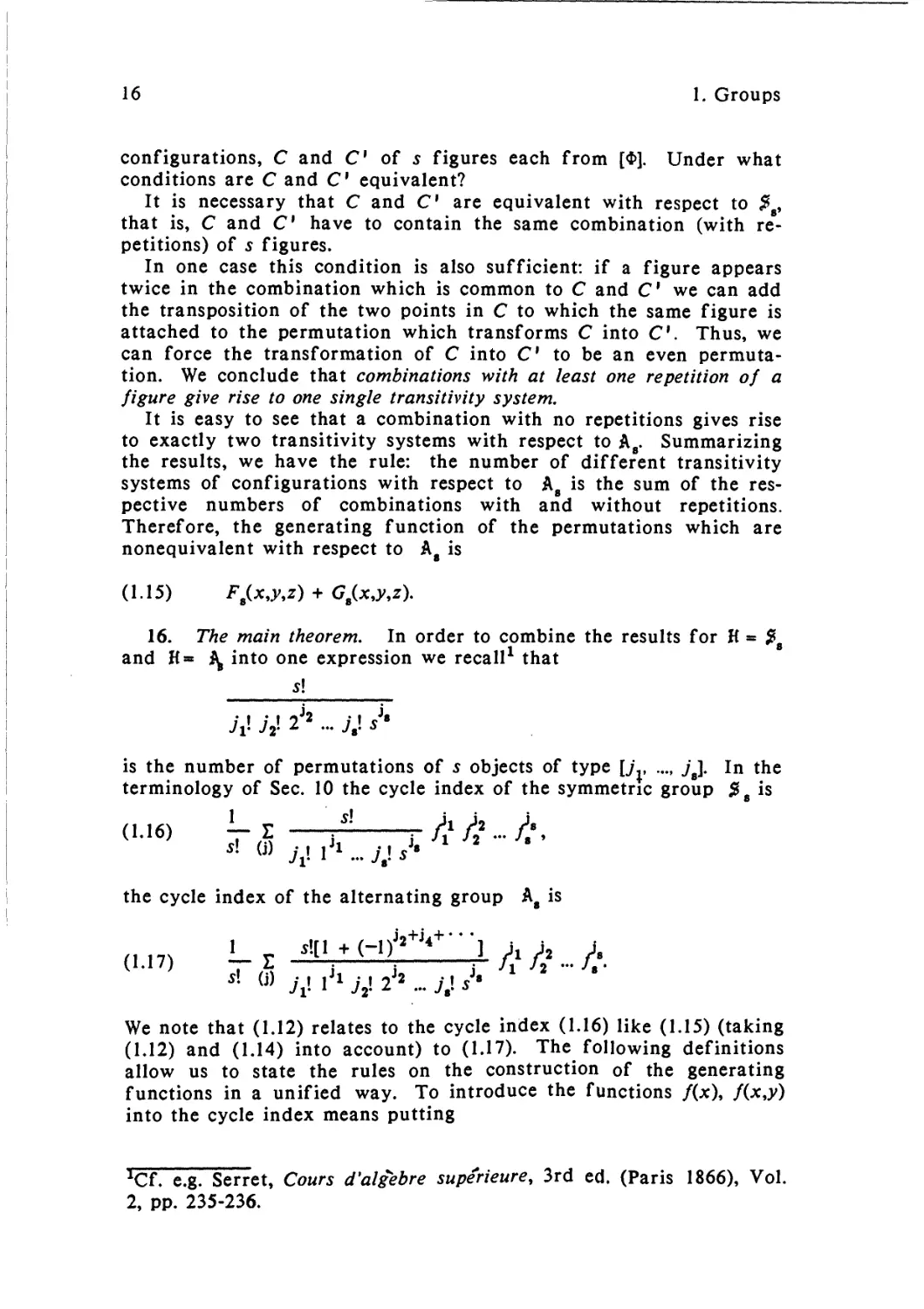
14. A minor change in the computation above yields the numbers
of combinations without repetitions of s figures from [4>] with con-
content (k,t,m). We call this number Bklm and define the generating
function
k,t,m m '
Expanding the product
a, 3. y. a. 8. y.
A + «4>' x l y l z x)(l h
A.13)
in a power series we find each combination without repetitions of 5
figures with content (k,t,m) represented by a term
«s ro ro ro y V T
Introducing relation A.9) in A.13), we get
1 + uGx(x,y,z) + u2G2(x,y,z) + • • - + u*Ga(x,y,z)
00 09 09 _
* n n n (i + uxky*zm
k=0 J=0 m=0
C ^
= exp - f(x,y,z) —— /(x2j
and by comparing coefficients
A.14)
JJ
15. The solution of the problem in the special case of the sym-
symmetric group, H « $a, allows the solution of another special case,
namely for K = Ag, the alternating group of degree s. Consider two

16 1. Groups
configurations, C and C of s figures each from [¦]. Under what
conditions are C and C equivalent?
It is necessary that C and C are equivalent with respect to $,
that is, C and C have to contain the same combination (with re-
repetitions) of s figures.
In one case this condition is also sufficient: if a figure appears
twice in the combination which is common to C and C we can add
the transposition of the two points in C to which the same figure is
attached to the permutation which transforms C into C Thus, we
can force the transformation of C into C to be an even permuta-
permutation. We conclude that combinations with at least one repetition of a
figure give rise to one single transitivity system.
It is easy to see that a combination with no repetitions gives rise
to exactly two transitivity systems with respect to A8. Summarizing
the results, we have the rule: the number of different transitivity
systems of configurations with respect to A8 is the sum of the res-
respective numbers of combinations with and without repetitions.
Therefore, the generating function of the permutations which are
nonequivalent with respect to Ag is
A.15) FB(x,y,z) + Gs(x,y,z).
16. The main theorem. In order to combine the results for H = $
and H» ^ into one expression we recall1 that
5!
is the number of permutations of s objects of type [j. je]. In the
terminology of Sec. 10 the cycle index of the symmetric group $ is
8
the cycle index of the alternating group Ag is
(. 171 L e "t'+H)''*14*"'! A A A
*! CJ) A« iJi ;2« 2J' ... ;8! s3'
We note that A.12) relates to the cycle index A.16) like A.15) (taking
A.12) and A.14) into account) to A.17). The following definitions
allow us to state the rules on the construction of the generating
functions in a unified way. To introduce the functions /(x), f(x,y)
into the cycle index means putting
. e.g. Serret, Cours d'algebre superieure, 3rd ed. (Paris 1866), Vol.
2, pp. 235-236.

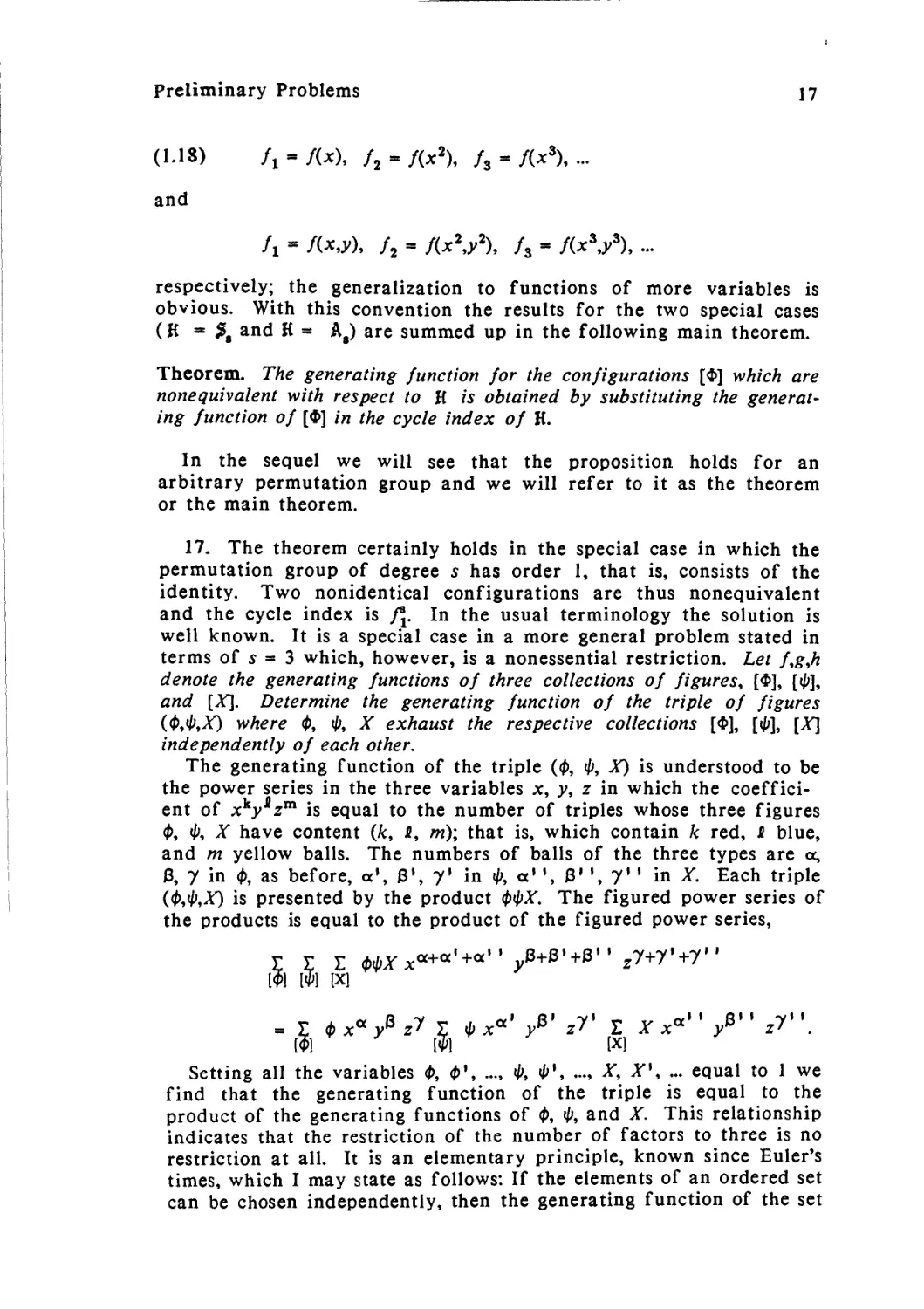
Preliminary Problems 17
A.18) A
and
respectively; the generalization to functions of more variables is
obvious. With this convention the results for the two special cases
(Ji sj5, and H * Ag) are summed up in the following main theorem.
Theorem. The generating function for the configurations [<t>] which are
nonequivalent with respect to H is obtained by substituting the generat-
generating function of [4>] in the cycle index of H.
In the sequel we will see that the proposition holds for an
arbitrary permutation group and we will refer to it as the theorem
or the main theorem.
17. The theorem certainly holds in the special case in which the
permutation group of degree s has order 1, that is, consists of the
identity. Two nonidentical configurations are thus nonequivalent
and the cycle index is f\. In the usual terminology the solution is
well known. It is a special case in a more general problem stated in
terms of s » 3 which, however, is a nonessential restriction. Let f,g,h
denote the generating functions of three collections of figures, [*], [<f>],
and [X]. Determine the generating function of the triple of figures
(<t>,<l>,X) where <t>, 0, X exhaust the respective collections [*], [0], [X]
independently of each other.
The generating function of the triple @, 0, X) is understood to be
the power series in the three variables x, y, z in which the coeffici-
coefficient of x*y*zm is equal to the number of triples whose three figures
<t>, 0, X have content (k, I, m)\ that is, which contain k red, I blue,
and m yellow balls. The numbers of balls of the three types are a,
0, 7 in <fc as before, a', 0', y1 in ft a'', 0' ', y1' in X. Each triple
D>,<I>,X) is presented by the product QtyX. The figured power series of
the products is equal to the product of the figured power series,
i e
W [X]
Ei
**«• y** zt ^ x
Setting all the variables 4>, <t>\ ..., & *' X, X\ ... equal to 1 we
find that the generating function of the triple is equal to the
product of the generating functions of <t>, 0, and X. This relationship
indicates that the restriction of the number of factors to three is no
restriction at all. It is an elementary principle, known since Euler's
times, which I may state as follows: If the elements of an ordered set
can be chosen independently, then the generating function of the set

18 1. Groups
is equal to the product of the generating function of the individual
elements.
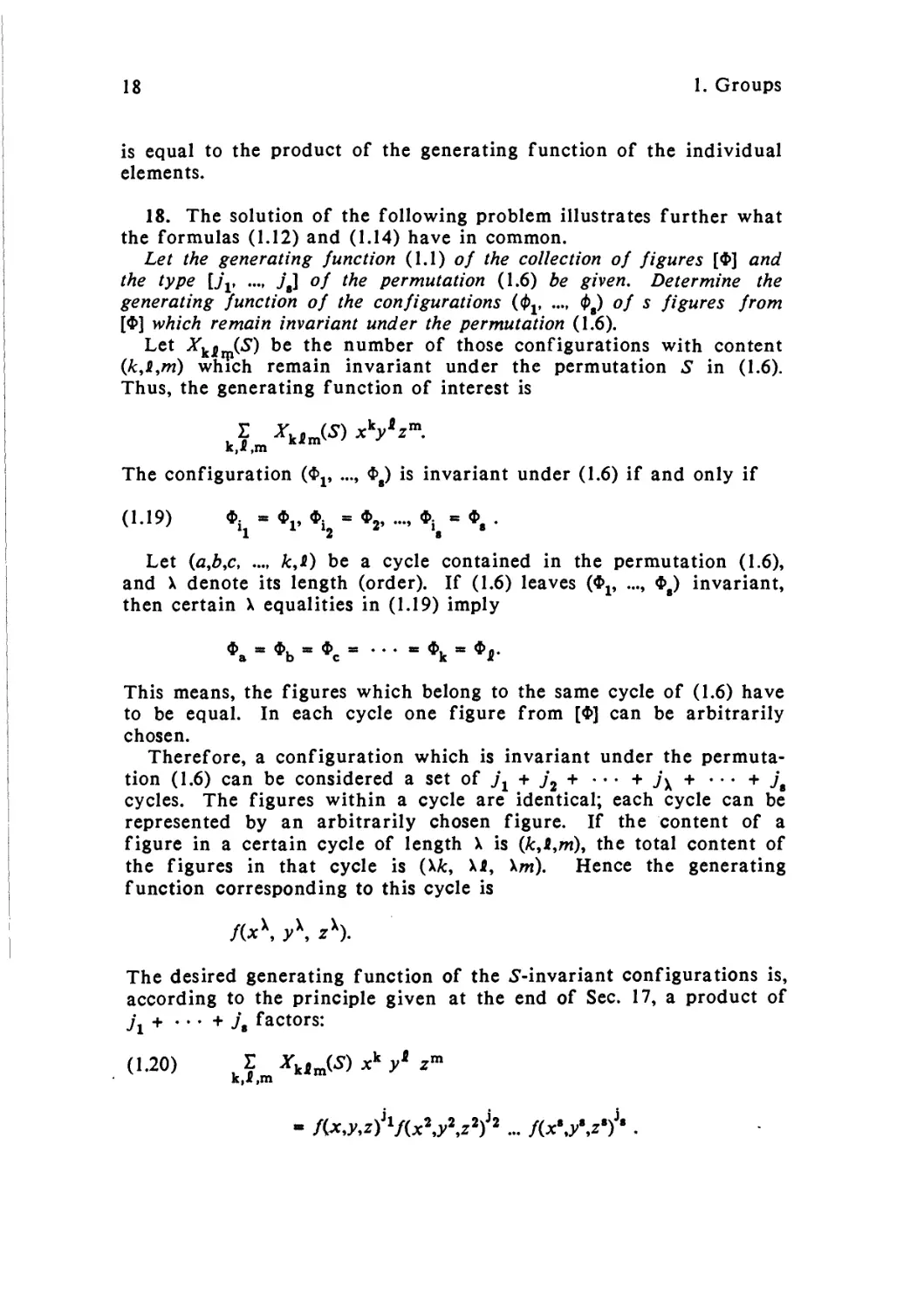
18. The solution of the following problem illustrates further what
the formulas A.12) and A.14) have in common.
Let the generating function A.1) of the collection of figures [4>] and
the type [j\ jt] of the permutation A.6) be given. Determine the
generating function of the configurations @j <t>B) of s figures from
[4>] which remain invariant under the permutation A.6).
Let A^jj E) be the number of those configurations with content
(k,l,m) which remain invariant under the permutation S in A.6).
Thus, the generating function of interest is
k?
K,Jf ,m
The configuration (*r ..., <t>g) is invariant under A.6) if and only if
A.19) ¦^ - *v *i2 - <J»2 *ig - <*», .
Let (a,b,c k,t) be a cycle contained in the permutation A.6),
and X denote its length (order). If A.6) leaves ($v ..., 4>g) invariant,
then certain X equalities in A.19) imply
This means, the figures which belong to the same cycle of A.6) have
to be equal. In each cycle one figure from [4>] can be arbitrarily
chosen.
Therefore, a configuration which is invariant under the permuta-
permutation A.6) can be considered a set of j\ + j2 + • • • + j\ + • • • + jB
cycles. The figures within a cycle are identical; each cycle can be
represented by an arbitrarily chosen figure. If the content of a
figure in a certain cycle of length X is (k,t,m), the total content of
the figures in that cycle is (\k, \t, \m). Hence the generating
function corresponding to this cycle is
Ax\ y\ zx).
The desired generating function of the S-invariant configurations is,
according to the principle given at the end of Sec. 17, a product of
jl+ - - • + JB factors:
(U0) ^k'

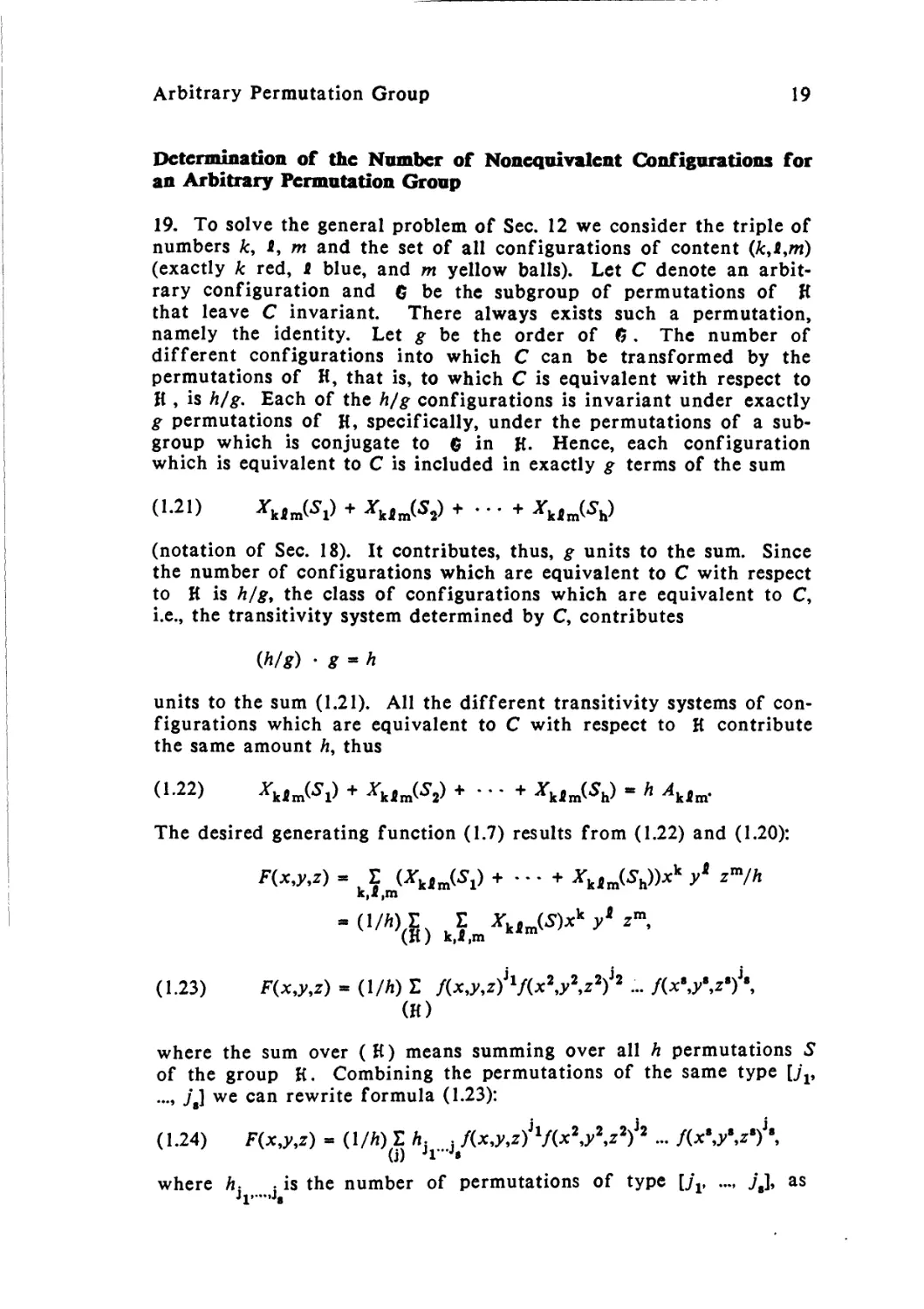
Arbitrary Permutation Group 19
Determination of the Number of Nonequivalent Configurations for
an Arbitrary Permutation Group
19. To solve the general problem of Sec. 12 we consider the triple of
numbers k, t, m and the set of all configurations of content (k,fi,m)
(exactly k red, t blue, and m yellow balls). Let C denote an arbit-
arbitrary configuration and 6 be the subgroup of permutations of ft
that leave C invariant. There always exists such a permutation,
namely the identity. Let g be the order of 6. The number of
different configurations into which C can be transformed by the
permutations of H, that is, to which C is equivalent with respect to
H , is h/g. Each of the h/g configurations is invariant under exactly
g permutations of H, specifically, under the permutations of a sub-
subgroup which is conjugate to © in H. Hence, each configuration
which is equivalent to C is included in exactly g terms of the sum
A.21) X^JSJ + XkiJSJ + . •. + Xktm(SJ
(notation of Sec. 18). It contributes, thus, g units to the sum. Since
the number of configurations which are equivalent to C with respect
to H is h/g, the class of configurations which are equivalent to C,
i.e., the transitivity system determined by C, contributes
(h/g) ¦ g * h
units to the sum A.21). All the different transitivity systems of con-
configurations which are equivalent to C with respect to H contribute
the same amount h, thus
A.22) X^JSJ + XklJS2) ¦ • • • + XkiJSh) - h Aklm.
The desired generating function A.7) results from A.22) and A.20):
F(x,y,z) - Z {X^JSJ + • • • + *kjm<Sh))xk V* zm/h
k,Jt,m
A.23) F(x,y,z) - (l//i) Z
(H)
where the sum over (H) means summing over all h permutations S
of the group K. Combining the permutations of the same type [jv
•••» ja] we can rewrite formula A.23):
A.24) F(x,y,z) = (\/h) Z h. , f(x,y,z)hf(x\y\z2)i2 .
(j) Ji >J»
where h. is the number of permutations of type [j\ ja], as

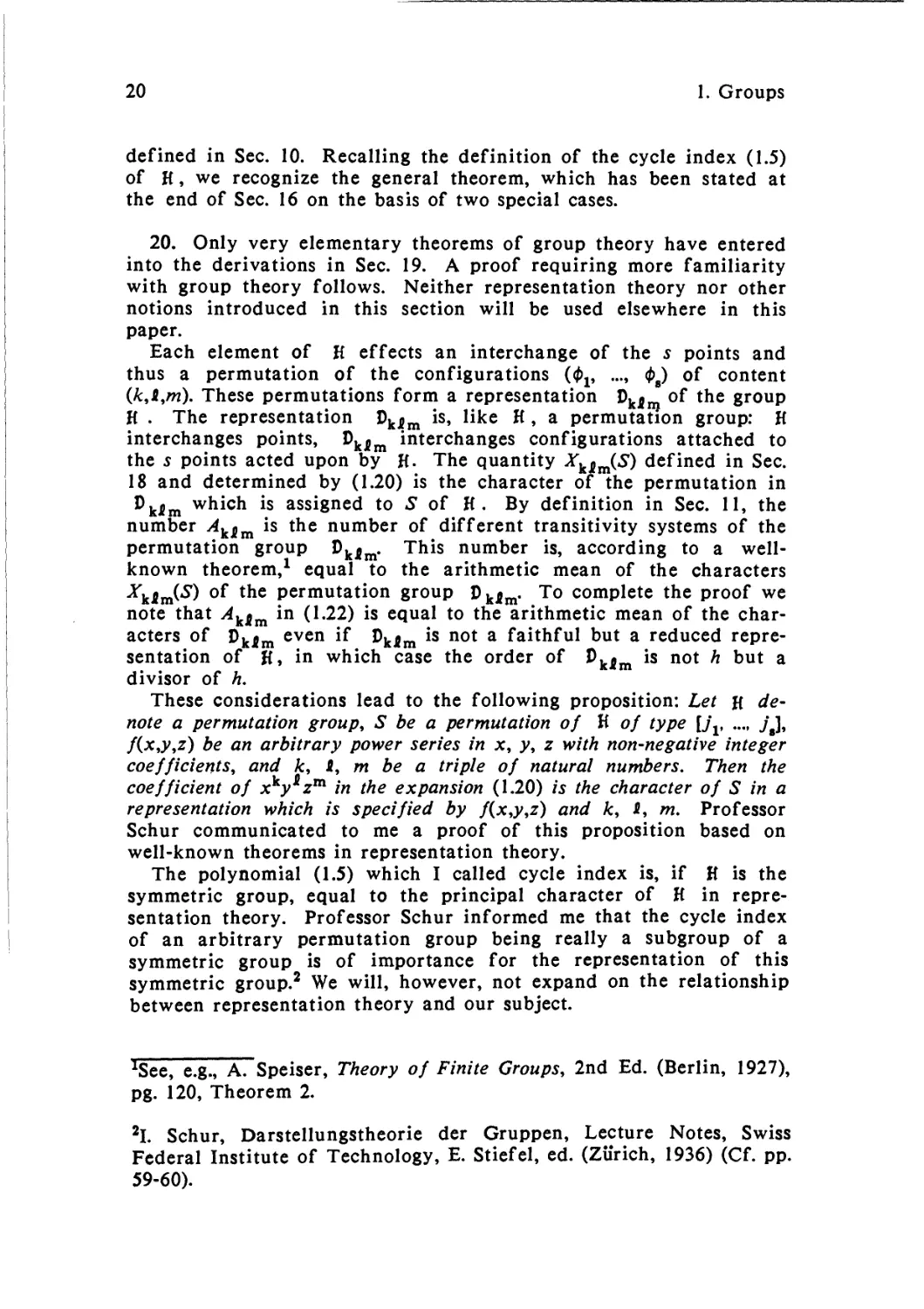
20 1. Groups
defined in Sec. 10. Recalling the definition of the cycle index A.5)
of H, we recognize the general theorem, which has been stated at
the end of Sec. 16 on the basis of two special cases.
20. Only very elementary theorems of group theory have entered
into the derivations in Sec. 19. A proof requiring more familiarity
with group theory follows. Neither representation theory nor other
notions introduced in this section will be used elsewhere in this
paper.
Each element of K effects an interchange of the s points and
thus a permutation of the configurations (<t>v ..., <t>B) of content
(k,t,m). These permutations form a representation DkJln? of the group
H . The representation DkJ&m is, like H, a permutation group: H
interchanges points, DkJjm interchanges configurations attached to
the s points acted upon by H. The quantity Xkim(S) defined in Sec.
18 and determined by A.20) is the character of the permutation in
^kHm wni°h is assigned to S of H . By definition in Sec. 11, the
number Akim is the number of different transitivity systems of the
permutation group Dkjjm. This number is, according to a well-
known theorem,1 equal to the arithmetic mean of the characters
Xktm(S) of the permutation group DkJjm. To complete the proof we
note that Akim in A.22) is equal to the arithmetic mean of the char-
characters of DkJjm even if Pkjjm is not a faithful but a reduced repre-
representation of U, in which case the order of PkJjm is not h but a
divisor of h.
These considerations lead to the following proposition: Let H de-
denote a permutation group, S be a permutation of U of type [j1 ja],
f(x,y,z) be an arbitrary power series in x, y, z with non-negative integer
coefficients, and k, t, m be a triple of natural numbers. Then the
coefficient of x*y*zm in the expansion A.20) is the character of S in a
representation which is specified by f(x,y,z) and k, I, m. Professor
Schur communicated to me a proof of this proposition based on
well-known theorems in representation theory.
The polynomial A.5) which I called cycle index is, if H is the
symmetric group, equal to the principal character of H in repre-
representation theory. Professor Schur informed me that the cycle index
of an arbitrary permutation group being really a subgroup of a
symmetric group is of importance for the representation of this
symmetric group.2 We will, however, not expand on the relationship
between representation theory and our subject.
*See, e.g., A. Speiser, Theory of Finite Groups, 2nd Ed. (Berlin, 1927),
pg. 120, Theorem 2.
2I. Schur, Darstellungstheorie der Gruppen, Lecture Notes, Swiss
Federal Institute of Technology, E. Stiefel, ed. (Zurich, 1936) (Cf. pp.
59-60).

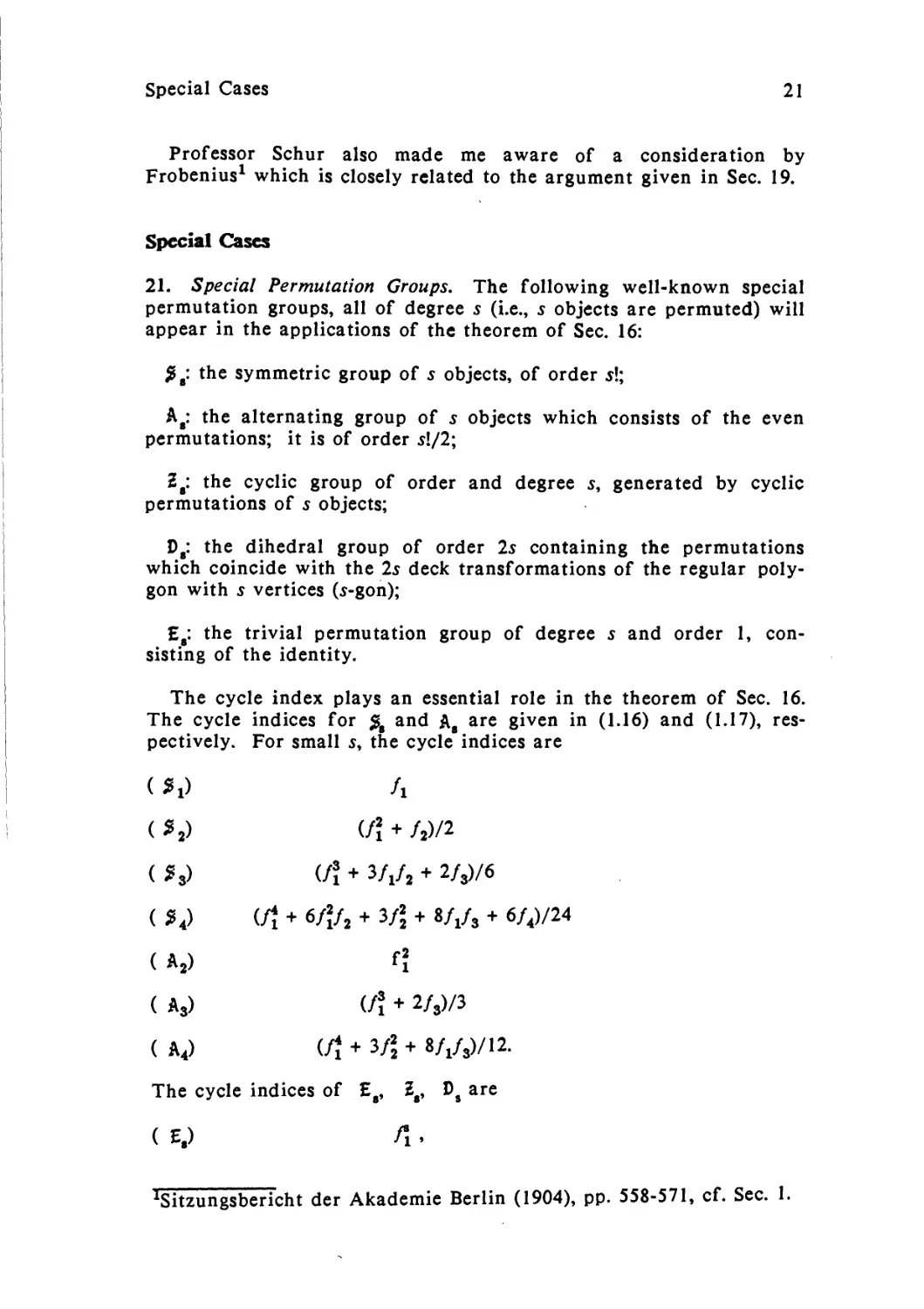
Special Cases 21
Professor Schur also made me aware of a consideration by
Frobenius1 which is closely related to the argument given in Sec. 19.
Special Cases
21. Special Permutation Groups. The following well-known special
permutation groups, all of degree s (i.e., s objects are permuted) will
appear in the applications of the theorem of Sec. 16:
<tlg: the symmetric group of s objects, of order s\\
Ag: the alternating group of s objects which consists of the even
permutations; it is of order sl/2;
Zg: the cyclic group of order and degree s, generated by cyclic
permutations of s objects;
Dg: the dihedral group of order 2s containing the permutations
which coincide with the 2s deck transformations of the regular poly-
polygon with s vertices (s-gon);
Eg: the trivial permutation group of degree s and order 1, con-
consisting of the identity.
The cycle index plays an essential role in the theorem of Sec. 16.
The cycle indices for <gg and A8 are given in A.16) and A.17), res-
respectively. For small s, the cycle indices are
(*i> A
(*2) (/J + /2)/2
< *4> (ft + 6/J/2 + 3/22 + 8V, + 6/4)/24
( A2) fj
( A3) (f\ h
( A4) (ft + 3/22
The cycle indices of Eg, 2g, Dg are
^itzungsbericht der Akademie Berlin A904), pp. 558-571, cf. Sec. 1.

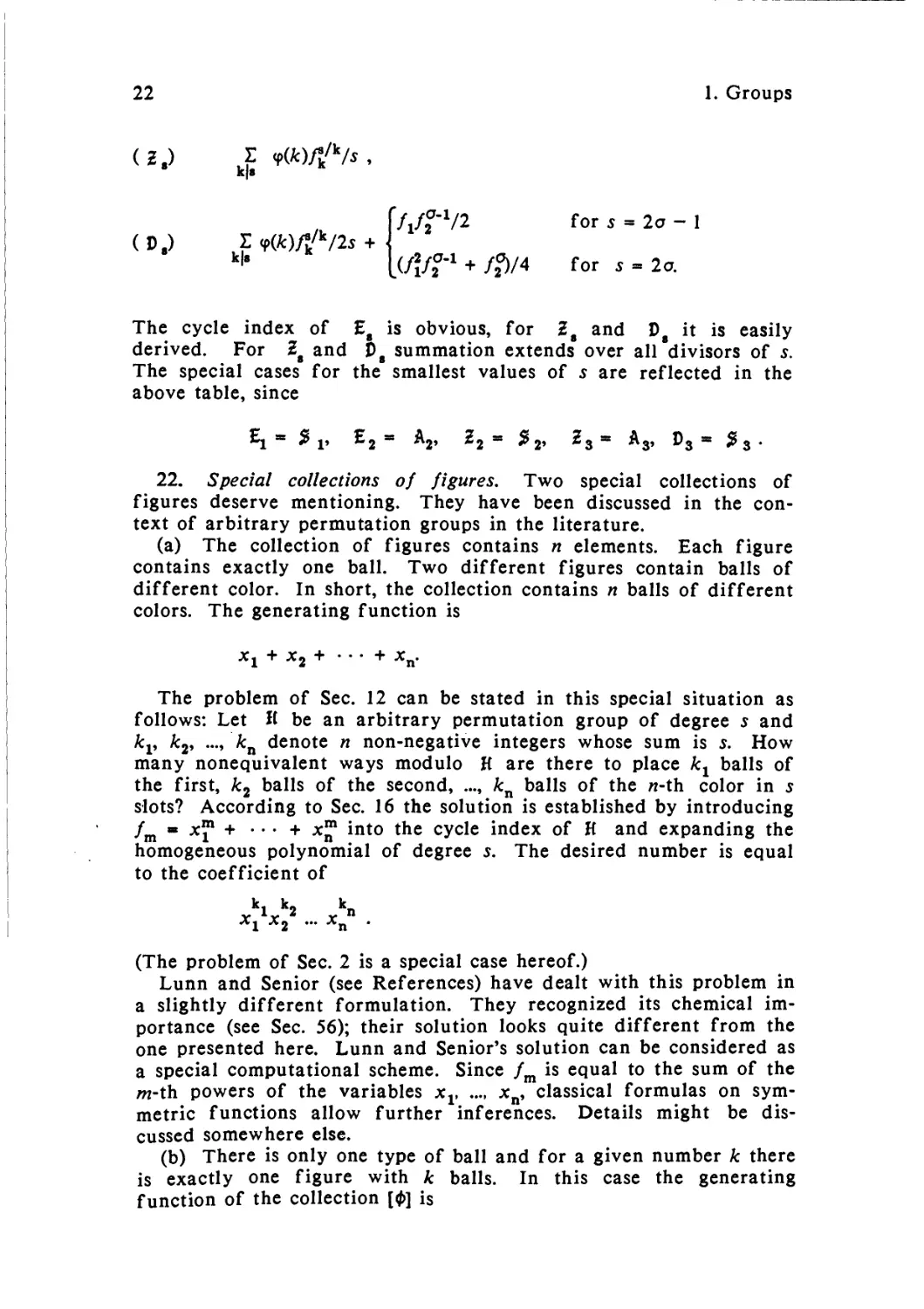
22 1. Groups
'fxf^l/2 for s = 2a - 1
[(/J/f'1 + /JW for s - 2 a
The cycle index of Eg is obvious, for Hg and Dg it is easily
derived. For Hg and Pg summation extends over all divisors of s.
The special cases for the smallest values of s are reflected in the
above table, since
Ej ¦ p i» E2 * A2, E2 » >2, Z3 * A3, D3 * ?3 .
22. Special collections of figures. Two special collections of
figures deserve mentioning. They have been discussed in the con-
context of arbitrary permutation groups in the literature.
(a) The collection of figures contains n elements. Each figure
contains exactly one ball. Two different figures contain balls of
different color. In short, the collection contains n balls of different
colors. The generating function is
xl + X2 + + *n'
The problem of Sec. 12 can be stated in this special situation as
follows: Let It be an arbitrary permutation group of degree 5 and
kv k2, ..., kn denote n non-negative integers whose sum is s. How
many nonequivalent ways modulo H are there to place kx balls of
the first, k2 balls of the second, ..., kn balls of the n-th color in 5
slots? According to Sec. 16 the solution is established by introducing
An " XT + '' ' + x™ int0 tne °ycle index of H and expanding the
homogeneous polynomial of degree s. The desired number is equal
to the coefficient of
(The problem of Sec. 2 is a special case hereof.)
Lunn and Senior (see References) have dealt with this problem in
a slightly different formulation. They recognized its chemical im-
importance (see Sec. 56); their solution looks quite different from the
one presented here. Lunn and Senior's solution can be considered as
a special computational scheme. Since fm is equal to the sum of the
w-th powers of the variables xx xn, classical formulas on sym-
symmetric functions allow further inferences. Details might be dis-
discussed somewhere else.
(b) There is only one type of ball and for a given number k there
is exactly one figure with k balls. In this case the generating
function of the collection [$] is

Special Cases 23
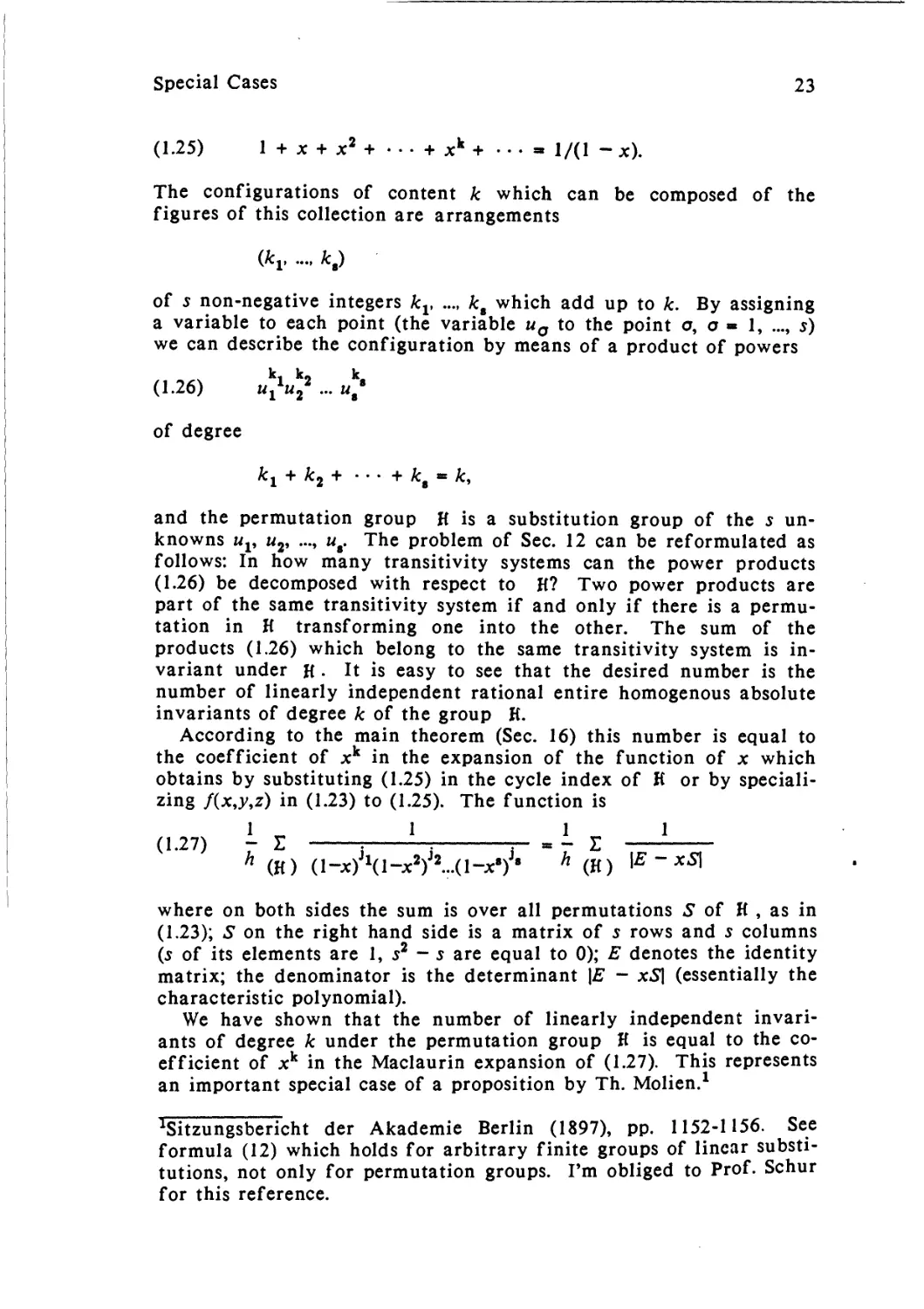
A.25) l+x + x2+ ... + xk+ •-.» 1/A - x).
The configurations of content k which can be composed of the
figures of this collection are arrangements
of 5 non-negative integers k1 kt which add up to k. By assigning
a variable to each point (the variable ua to the point a, a « 1, ..., 5)
we can describe the configuration by means of a product of powers
A.26) u^u* ... t?
of degree
k1 + k2+ ¦" + ka~ k,
and the permutation group H is a substitution group of the 5 un-
unknowns uv «2, ..., «g. The problem of Sec. 12 can be reformulated as
follows: In how many transitivity systems can the power products
A.26) be decomposed with respect to H? Two power products are
part of the same transitivity system if and only if there is a permu-
permutation in H transforming one into the other. The sum of the
products A.26) which belong to the same transitivity system is in-
invariant under H . It is easy to see that the desired number is the
number of linearly independent rational entire homogenous absolute
invariants of degree k of the group K.
According to the main theorem (Sec. 16) this number is equal to
the coefficient of xk in the expansion of the function of x which
obtains by substituting A.25) in the cycle index of K or by speciali-
specializing f(x,y,z) in A.23) to A.25). The function is
A.27) - 1 5 —. r- . 7 1 —]
(H) (I x) \i x ) ...(l x )
where on both sides the sum is over all permutations S of H , as in
A.23); S on the right hand side is a matrix of 5 rows and 5 columns
E of its elements are 1, s2 - 5 are equal to 0); E denotes the identity
matrix; the denominator is the determinant \E - xS\ (essentially the
characteristic polynomial).
We have shown that the number of linearly independent invari-
invariants of degree k under the permutation group H is equal to the co-
coefficient of xk in the Maclaurin expansion of A.27). This represents
an important special case of a proposition by Th. Molien.1
^itzungsbericht der Akademie Berlin A897), pp. 1152-1156. See
formula A2) which holds for arbitrary finite groups of linear substi-
substitutions, not only for permutation groups. I'm obliged to Prof. Schur
for this reference.

24 1. Groups
23. Corollaries. Many very special cases of the problem stated in
Sec. 12 and solved by the main theorem appear isolated in the litera-
literature. A slightly more general special case is the case of the cyclic
permutations with repetitions. It arises from the combination of the
cyclic group Z8 with the collection of figures described in Sec.
22(a). The results discussed in the literature follow from the main
theorem.1 By combining the symmetric and alternating groups with
the collection of figures of Sec. 22(a), we recover by means of the
main theorem the classical formulas for symmetric functions, thus
gaining further support for the approach.
In the following applications we will repeatedly encounter the
special cases examined in Sees. 13-15 regarding the symmetric and
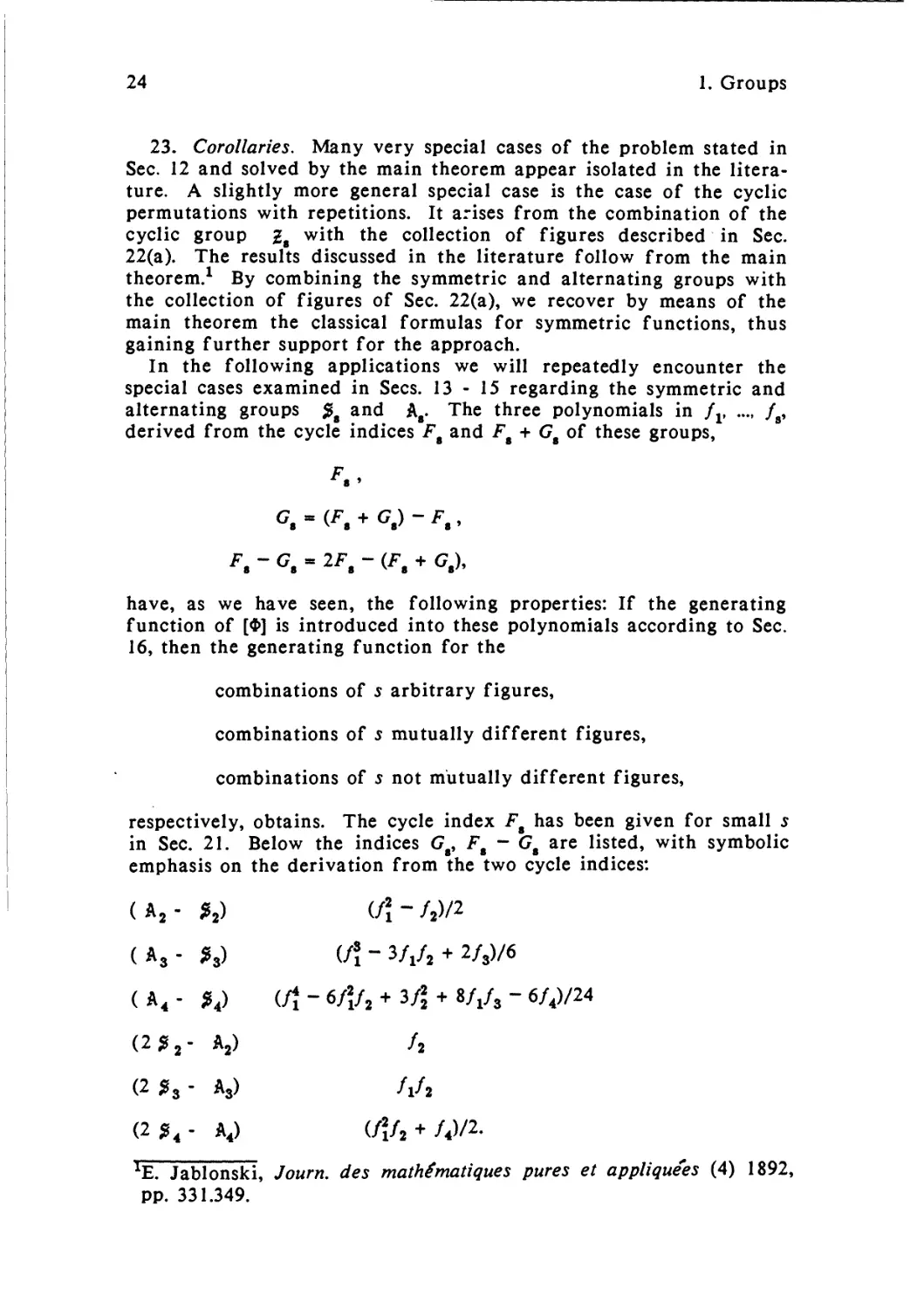
alternating groups $t and Ag. The three polynomials in fx /s,
derived from the cycle indices FB and Fa + Gg of these groups,
Ft - Gt - 2Ft - (Ft + G8),
have, as we have seen, the following properties: If the generating
function of [4>] is introduced into these polynomials according to Sec.
16, then the generating function for the
combinations of 5 arbitrary figures,
combinations of 5 mutually different figures,
combinations of 5 not mutually different figures,
respectively, obtains. The cycle index Ft has been given for small 5
in Sec. 21. Below the indices GB, Ft - Gt are listed, with symbolic
emphasis on the derivation from the two cycle indices:
(A2- *2) (/2!-2
(A,- *3) (/? ~ 3/^ + 2/3)/6
(A4- $A) (/}- 6/}/, + 3/5 + 8/i/, - 6/4)/24
B*,- A2) /2
B*,- A3) A/2
B *4 - A4) (flf2 + /4)/2.
lE. Jablonski, Journ. des mathimatiques pures et appliquees D) 1892,
pp. 331.349.

Generalization 25
The combinatorial interpretation (or the computations of Sec. 14
regardless of combinatorial considerations) implies the following use-
useful result: Substituting a power series with non-negative integer co-
coefficients in the difference of the cycle indices of Ag and % g, we
get a power series with non-negative integer coefficients.
Generalization
24. We point out a generalization of the problem of Sec. 12 which
will not be taken up again (except in Sec. 65) but which might be
useful in related questions.
Let H be an intransitive permutation group of degree s + t; the
elements permuted by H decompose into two classes, of s and /
elements, respectively. The two classes are closed with respect to H,
that is, there is no permutation in H which substitutes an element
of one class with one from the other class. (The generalization from
two to n classes is obvious.) Imagine the s + t elements upon which
K operates as points in space; s figures from the collection [<J>] are
assigned to the s points of the first class, / figures from [Y] are
assigned to the / points of the second class. The resulting configura-
configuration is
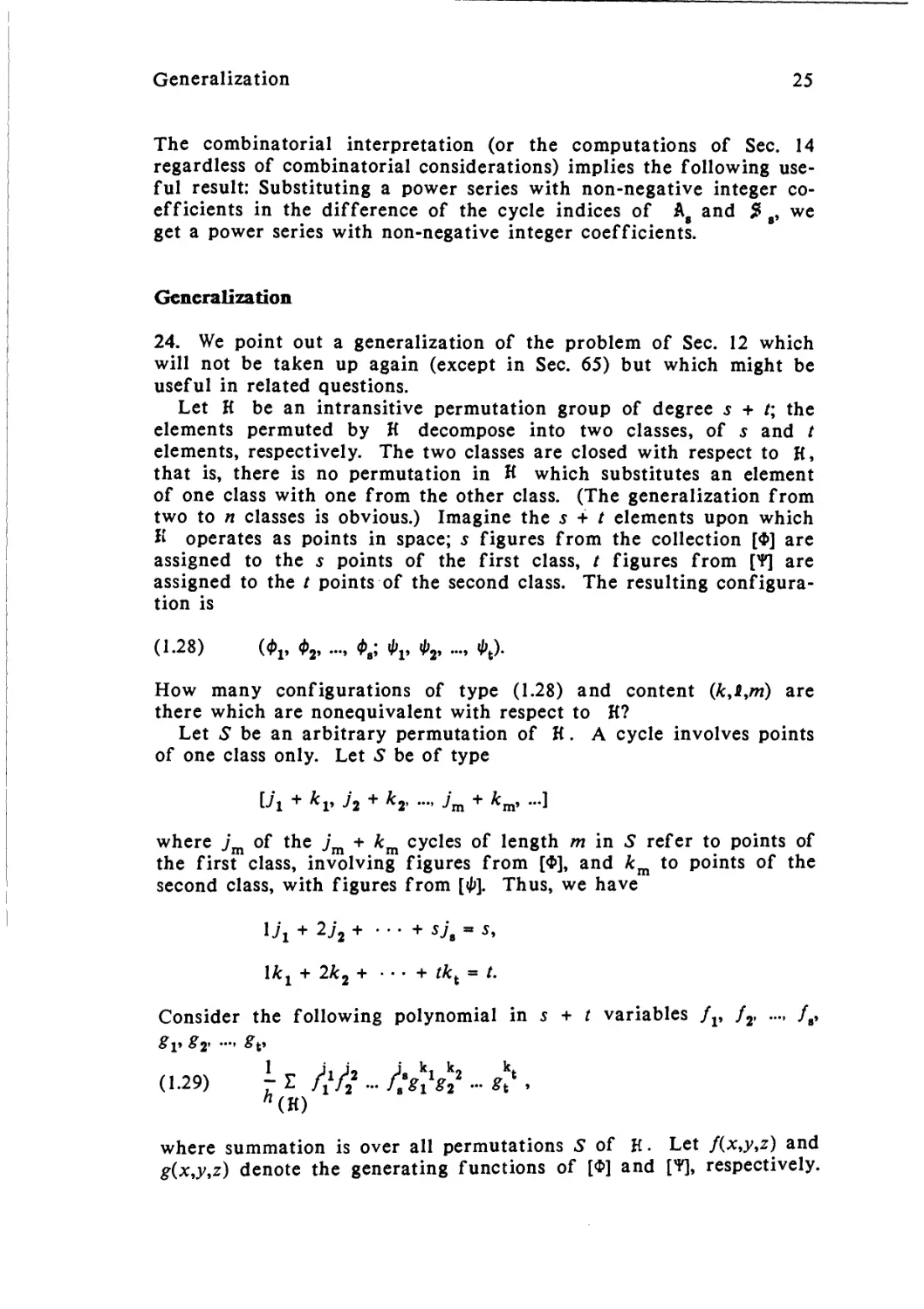
A.28) D>v 4>2 4>a; 4>v 4>2 <f>t).
How many configurations of type A.28) and content (k,t,m) are
there which are nonequivalent with respect to H?
Let S be an arbitrary permutation of H. A cycle involves points
of one class only. Let S be of type
U\ + kv j2 + k2, .... jm + *m, ...]
where jm of the jm + km cycles of length m in S refer to points of
the first class, involving figures from [¦], and km to points of the
second class, with figures from [4>]. Thus, we have
\jx + 2j2 + • • • + sja - s,
\kx + 2k2 + • • • + tkt « /.
Consider the following polynomial in s + t variables fv f2 /,,
A.29) - I /i1^2 f?\l\2 '
h
where summation is over all permutations 5 of K. Let f{x,y,z) and
g(x,y,z) denote the generating functions of [*] and [?], respectively.

26 1. Groups
The desired number is the coefficient of xky*zm in the expansion of
A.29) with
/» = /(x W), gn - g(xn,yn,zn), n - 1, 2, 3
Relations Between Cycle Index and Permutation Group
25. The property of the cycle index given in Sec. 16 uniquely deter-
determines the cycle index. More accurately: Let f(xv x2, ...) denote the
generating function of an arbitrary collection of figures [<t>]. Suppose
that the following relationship holds between the polynomial Y(fv f2, ...,
/g) in the s variables fv fv ..., fe and a given permutation group H of
degree s: If the variables
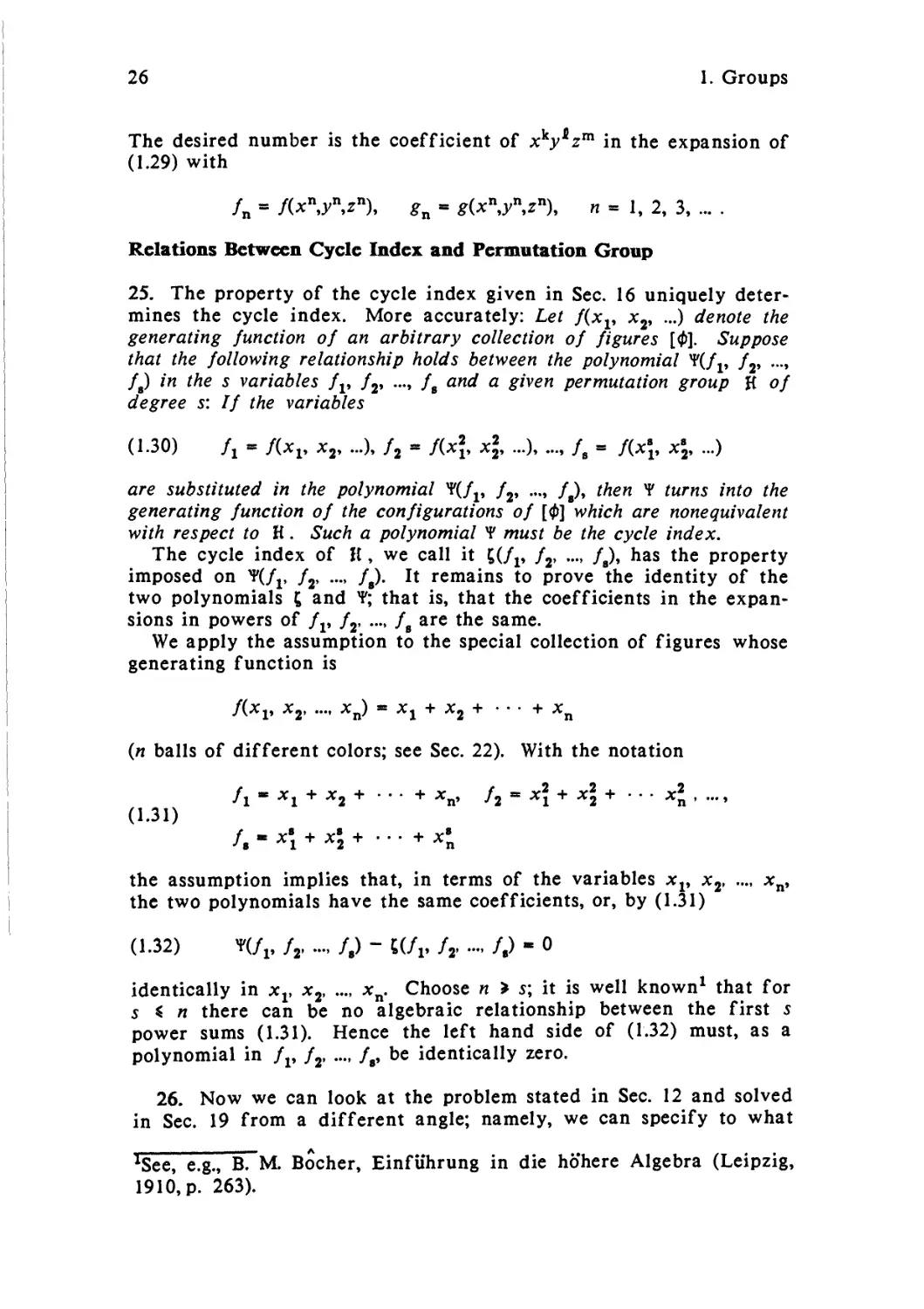
A.30) fx - f(xv x2, ...), f2 « f(x\, x\, ...), ..., /, = f{x\, x\, ...)
are substituted in the polynomial Y(fv f2, ..., fs), then Y turns into the
generating function of the configurations of [$] which are nonequivalent
with respect to H. Such a polynomial Y must be the cycle index.
The cycle index of ft, we call it $(fv f2, ..., /g), has the property
imposed on Y(fv f2, ..., /g). It remains to prove the identity of the
two polynomials ? and Y; that is, that the coefficients in the expan-
expansions in powers of fv f2, ..., /g are the same.
We apply the assumption to the special collection of figures whose
generating function is
f(xv x2, .... xn) m xx + x2 + • • • + xn
{n balls of different colors; see Sec. 22). With the notation
fx m x + x2 + ¦ - ¦ + xn, f2 m x\ + x\ + ¦ ¦ ¦ x\ , ...,
A.31)
/. - x\ + x\ + • • • + x\
the assumption implies that, in terms of the variables xv x2, ..., xn,
the two polynomials have the same coefficients, or, by A.31)
A.32) Y(/r /,, ..., /,) - Ufv fr ».. /,) - 0
identically in xv x2, ..., xn. Choose n > s; it is well known1 that for
sin there can be no algebraic relationship between the first s
power sums A.31). Hence the left hand side of A.32) must, as a
polynomial in fv f2 /s, be identically zero.
26. Now we can look at the problem stated in Sec. 12 and solved
in Sec. 19 from a different angle; namely, we can specify to what
xSee, e.g., B. M. Bocher, Einfuhrung in die hohere Algebra (Leipzig,
1910, p. 263).

Relations Between Cycle Index and Permutation Group 27
extent the solution depends on the structure of H. Two permutation
groups of the same degree are labeled combinatorially equivalent if
the solution of problem Sec. 12 is the same for any given collection
of figures and any given content. (It goes without saying that the
number of different colors is arbitrary, not restricted to three.)
Specifically: two permutation groups, Ht and H2 of the same degree
s are called combinatorially equivalent if the numbers of nonequi-
valent configurations derived from an arbitrary collection [4>] and
with arbitrary content (ar a2, ...) are the same for Hi and H2-
The main theorem, stated in Sec. 16 and proved in Sec. 19, com-
combined with the proposition of Sec. 25 yields the following proposi-
proposition: Two permutation groups are combinatorially equivalent if and only
if they have the same cycle index.
Referring to the definition A.5) of the cycle index we find
further:1 two permutation groups are combinatorially equivalent if and
only if there exists a unique correspondence between the permutations
of the two groups such that corresponding permutations have the same
type of cycle decomposition.
It is of interest that two combinatorially equivalent permutation
groups need not be identical.2 They need not be isomorphic as ab-
abstract groups. Let p be an odd prime and m be an integer larger
than 2 (p * 3, m * 3 furnishes the simplest example). It is known3
that there exists a non-Abelian group of order pm whose elements,
except the identity, are of order p. Let Hx denote the regular
representation of this group as a permutation group and H2 denote
the regular representation of the Abelian group of order pm and type
(p p). Hx and H2 are permutation groups of order and degree
pm, and they are combinatorially equivalent: each of their permuta-
permutations, except the identity, is decomposed into cycles the same way, in
^m-i CyCies of length p, and the cycle index of both is
iff + (Pm ~ Dff'^/P™
xIf we restrict our attention to figures consisting of balls, as in Sec.
22, then the proposition is changed, with more restrictive necessary
conditions and less restrictive conditions for sufficiency. The proof
of this modified proposition is contained in our proof. Lunn and
Senior, 1, p. 1053, state the proposition and provide a proof for
sufficiency. Mr. Senior kindly communicated to me the second part
(necessity) of the proof. The reasoning differs from the one pre-
presented in Sec. 25.
2Lunn and Senior 1, p. 1053.
3W. Burnside, Theory of Groups of Finite Order, 2nd ed. (Cambridge
1911), pp. 143-144.

28
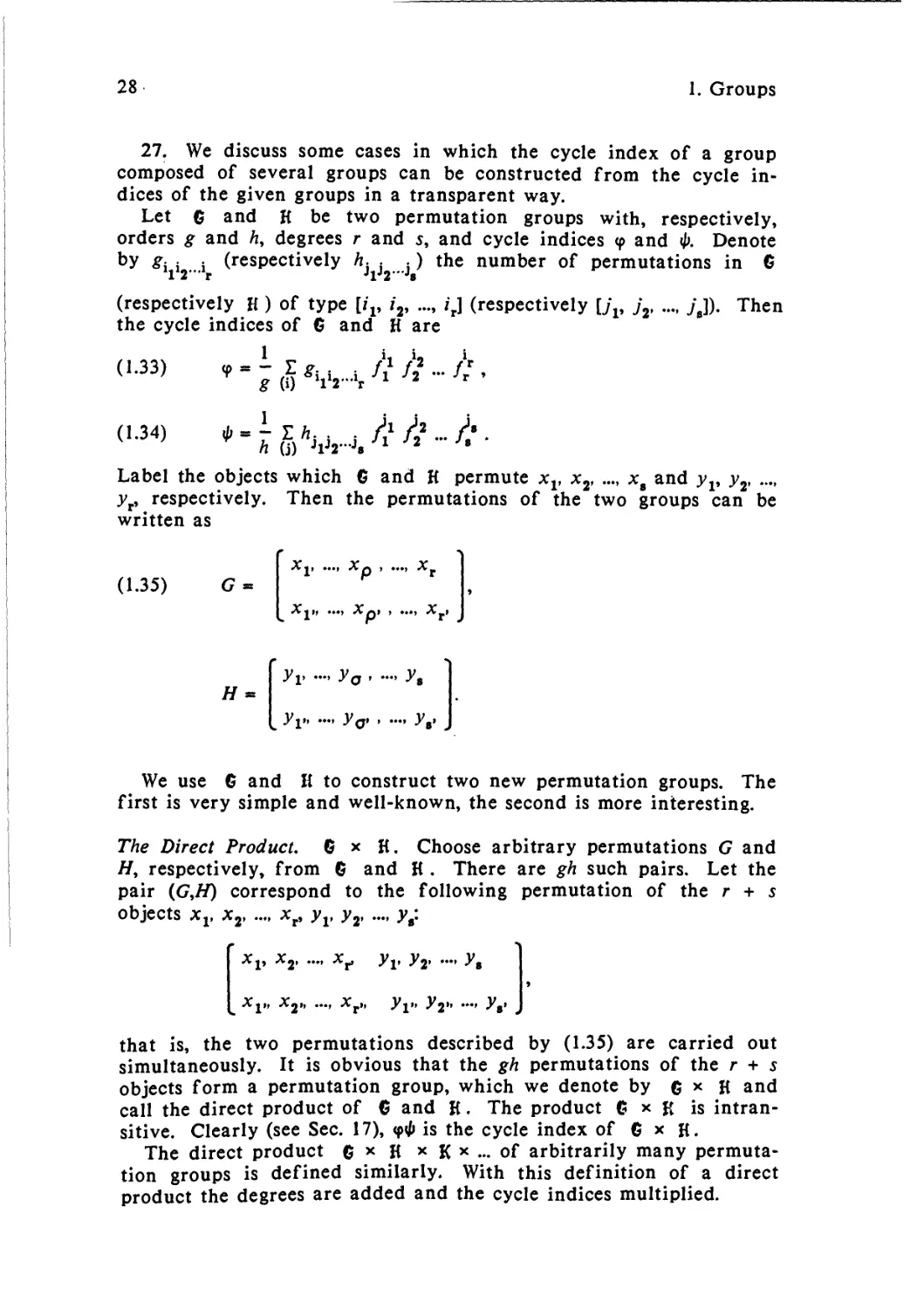
1. Groups
27. We discuss some cases in which the cycle index of a group
composed of several groups can be constructed from the cycle in-
indices of the given groups in a transparent way.
Let 0 and H be two permutation groups with, respectively,
orders g and h, degrees r and s, and cycle indices <p and </>. Denote
by gi j . (respectively h.} j j) the number of permutations in 0
(respectively H ) of type [iv i2 ij (respectively [jv j2 je]). Then
the cycle indices of 0 and H are
(U3) ' " J 5 'VH & * - * '
A.34)
Label the objects which 0 and H permute xv x2, ..., xs and yv y2
yr, respectively. Then the permutations of the two groups can be
written as
A.35)
1 Xp ' "" Xi
k J If ¦••> ** Qt j ••¦) A_»
^•J
We use 0 and U to construct two new permutation groups. The
first is very simple and well-known, the second is more interesting.
The Direct Product. G x H. Choose arbitrary permutations G and
H, respectively, from G and H . There are gh such pairs. Let the
pair (G,H) correspond to the following permutation of the r + s
objects xv x2 xr, yv y2 y8:
x*t, x2>,..., x i, ^i" y%*''"' y$'
that is, the two permutations described by A-35) are carried out
simultaneously. It is obvious that the gh permutations of the r + s
objects form a permutation group, which we denote by 0 x H and
call the direct product of © and K. The product 0 x K is intran-
intransitive. Clearly (see Sec. 17), <p# is the cycle index of Ox h.
The direct product 0 x H * K x ... of arbitrarily many permuta-
permutation groups is defined similarly. With this definition of a direct
product the degrees are added and the cycle indices multiplied.

Relations Between Cycle Index and Permutation Group
29
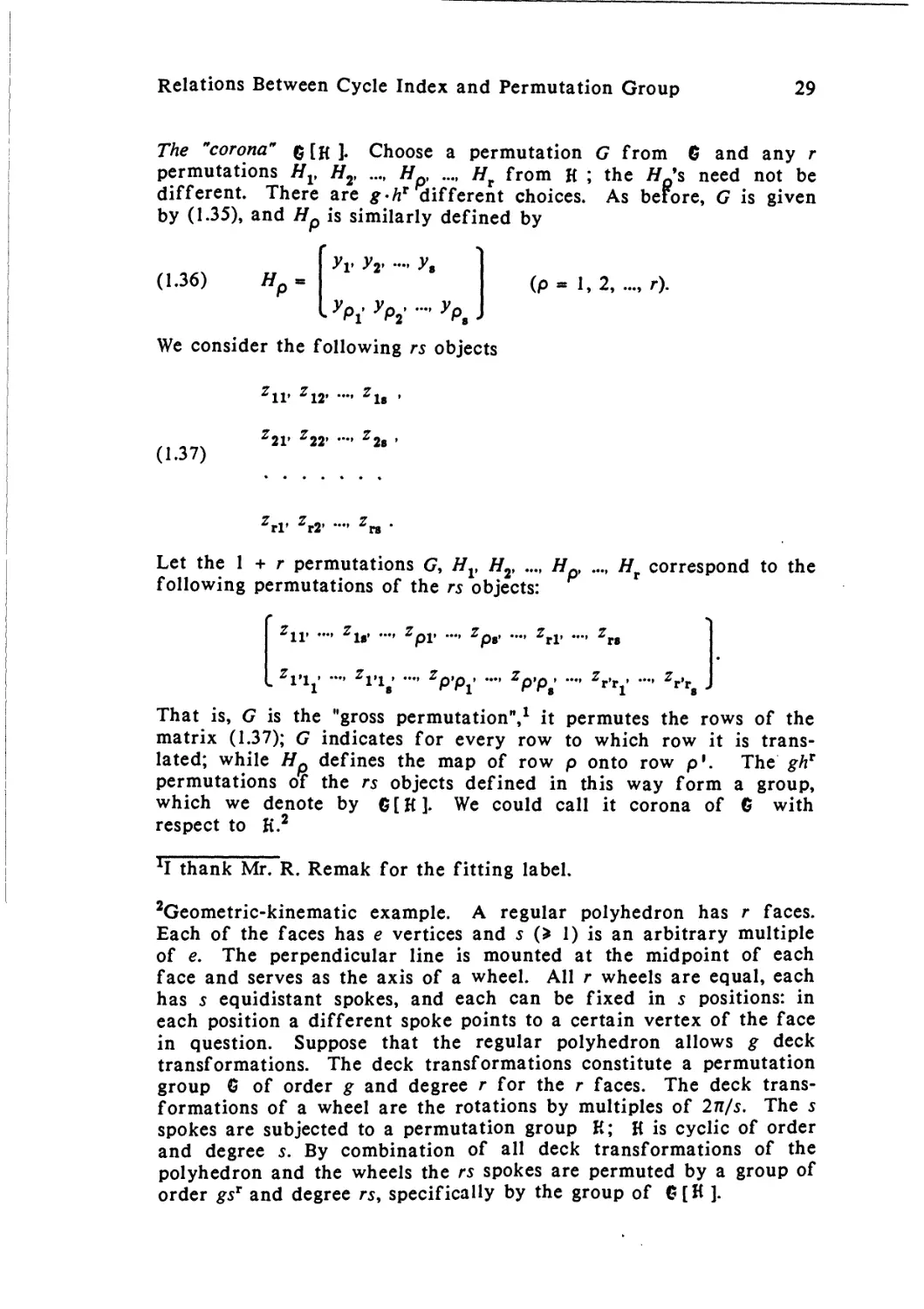
The "corona" © [h ]. Choose a permutation G from 6 and any r
permutations Hv H2 Hp Hf from H ; the H's need not be
different. There are g-hT different choices. As before, G is given
by A.35), and Hp is similarly defined by
A.36)
H,
yv
y.
(p * 1,2 r).
We consider the following rs objects
z\v zn zu '
\v
u
A.37)
ZtV Zv2
rs
Let the 1 + r permutations G, Hv H2 Hp Hr correspond to the
following permutations of the rs objects:
'pi
rs
'I'll '". ZP'Pi ZP'P. Z''h Z*\
That is, G is the "gross permutation",1 it permutes the rows of the
matrix A.37); G indicates for every row to which row it is trans-
translated; while Hp defines the map of row p onto row p'. The ghr
permutations of the rs objects defined in this way form a group,
which we denote by 0[H]. We could call it corona of 0 with
respect to K.2
XI thank Mr. R. Remak for the fitting label.
2Geometric-kinematic example. A regular polyhedron has r faces.
Each of the faces has e vertices and s {> 1) is an arbitrary multiple
of e. The perpendicular line is mounted at the midpoint of each
face and serves as the axis of a wheel. All r wheels are equal, each
has s equidistant spokes, and each can be fixed in s positions: in
each position a different spoke points to a certain vertex of the face
in question. Suppose that the regular polyhedron allows g deck
transformations. The deck transformations constitute a permutation
group 6 of order g and degree r for the r faces. The deck trans-
transformations of a wheel are the rotations by multiples of 2n/s. The s
spokes are subjected to a permutation group K; H is cyclic of order
and degree s. By combination of all deck transformations of the
polyhedron and the wheels the rs spokes are permuted by a group of
order gsT and degree rs, specifically by the group of G[H ].

30 1. Groups
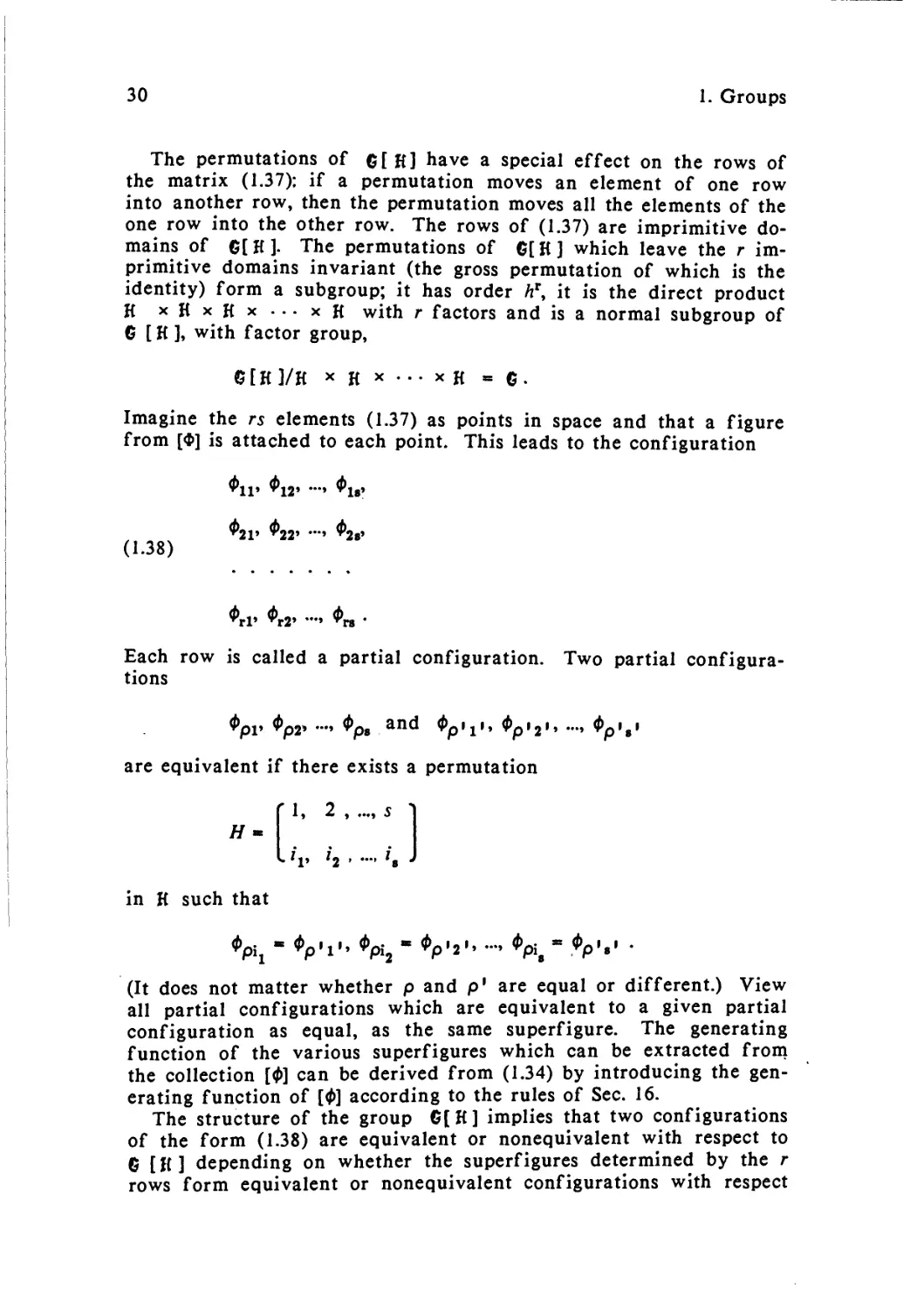
The permutations of G[Jt] have a special effect on the rows of
the matrix A.37): if a permutation moves an element of one row
into another row, then the permutation moves all the elements of the
one row into the other row. The rows of A.37) are imprimitive do-
domains of 0[H]. The permutations of 6[H] which leave the r im-
imprimitive domains invariant (the gross permutation of which is the
identity) form a subgroup; it has order hv, it is the direct product
H xHxHx...xH with r factors and is a normal subgroup of
0 [ H ], with factor group,
G[H]/H x H x • •• x H - 0.
Imagine the rs elements A.37) as points in space and that a figure
from [<J>] is attached to each point. This leads to the configuration
A.38)
Each row is called a partial configuration. Two partial configura-
configurations
tpv fy>2» -' fy>s and Vi'» *p'2 fy>V
are equivalent if there exists a permutation
H
in K such that
(It does not matter whether p and p' are equal or different.) View
all partial configurations which are equivalent to a given partial
configuration as equal, as the same superfigure. The generating
function of the various superfigures which can be extracted from
the collection [0] can be derived from A.34) by introducing the gen-
generating function of [4>] according to the rules of Sec. 16.
The structure of the group 0[H] implies that two configurations
of the form A.38) are equivalent or nonequivalent with respect to
G [ft] depending on whether the superfigures determined by the r
rows form equivalent or nonequivalent configurations with respect

Relations Between Cycle Index and Permutation Group 31
to 0 . To determine the generating function of the nonequivalent
configurations of rs figures 0 modulo 0[ H], we have to establish
the generating function of the nonequivalent superfigures in A.33)
according to Sec. 16 (i.e., the function A.34), where / stands for the
generating function of [0]), and insert this function in A.33), accord-
according to Sec. 16. Thus we form
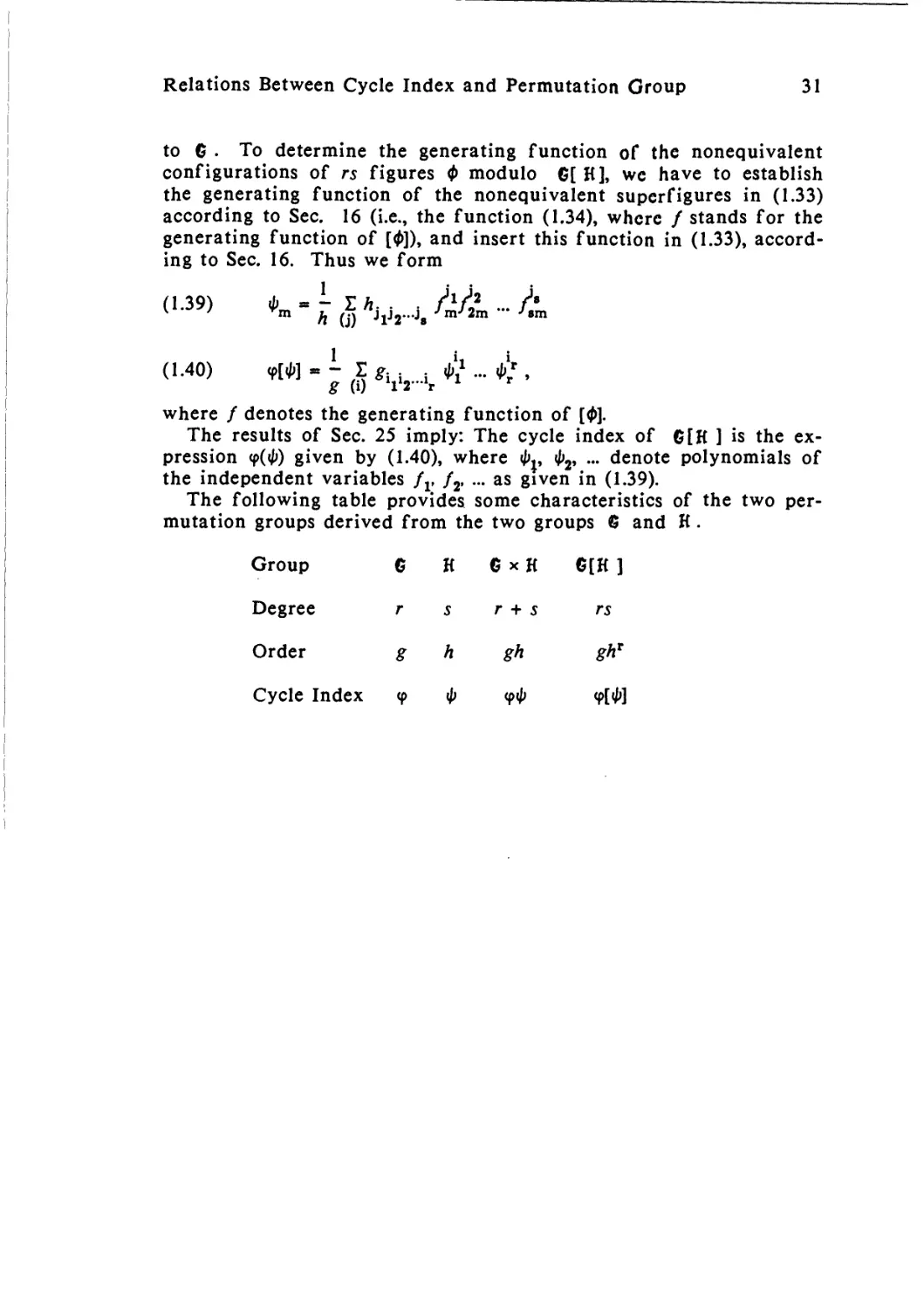
(U9) *-
\
j r ghh^ *',»... ?,
where / denotes the generating function of [0].
The results of Sec. 25 imply: The cycle index of 0[H ] is the ex-
expression <p(i/0 given by A.40), where </>,, </>2, ... denote polynomials of
the independent variables fv f2, ... as given in A.39).
The following table provides some characteristics of the two per-
permutation groups derived from the two groups 6 and H .
Group 0 H 0 x H 0[H ]
Degree r s r + s rs
Order g h gh ghT
Cycle Index <p i/> <pi/>

Chapter 2
GRAPHS
Definitions
28. In the next sections we describe in axiomatic-combinatorial
terms what the chemists call structure and stereoformulas. To en-
enhance the clarity of the exposition I provide more than the bare
essentials. I begin by repeating some known definitions in graph
theory. Some problems touched upon in the Introduction are going
to be presented "officially" later on. I will adhere as much as pos-
possible to the terminology used by D. Konig in his elegant text.1 I will
highlight where substantial departure seemed to better serve the
special purpose of this paper.
29. In the sequel, "graph" stands for "connected finite graph with-
without loops." A graph is a system consisting of two kinds of elements,
vertices and edges; the number of elements is finite; a relationship,
called fundamental relationship is defined between a vertex and an
edge. The fundamental relationship between the vertex P and the
edge a is given in terms borrowed from geometry: P is an endpoint
of cr, a starts in P, etc. The following two conditions are satisfied:
I. Every edge is bounded by two vertices.
II. By virture of the fundamental relationship, the elements of a
graph, edges and vertices, form a connected system. In other
words, any two vertices can be joined by a path consisting of a
sequence of edges and vertices.
^onig, 1. The reader is not expected to master the "theory of
graphs" to understand this paper; it suffices to grasp the idea of
graphs with the help of diagrams.

Definitions 33
Condition I describes the fundamental relationship between an edge
and exactly two points. The number of edges which relate to a
given vertex is not restricted; it can be any natural number, zero in-
included. A vertex which is not endpoint of an edge, is not related to
any edge and thus not connected with any other element of the
graph. Condition II implies that in this case the graph consists of
this vertex. A graph which consists of a single vertex is called a
single vertex graph.1
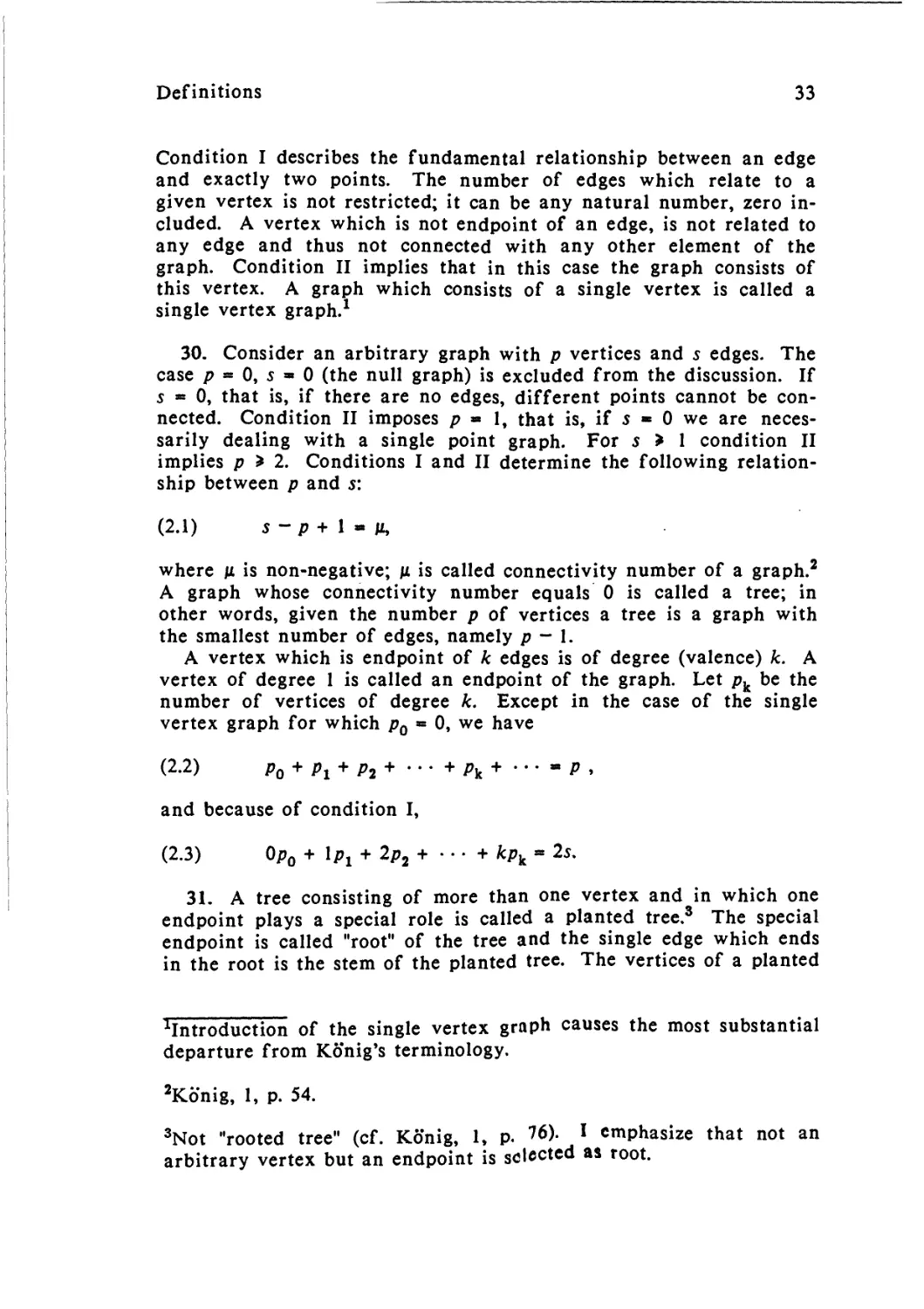
30. Consider an arbitrary graph with p vertices and s edges. The
case p * 0, s ¦ 0 (the null graph) is excluded from the discussion. If
s * 0, that is, if there are no edges, different points cannot be con-
connected. Condition II imposes p » 1, that is, if s « 0 we are neces-
necessarily dealing with a single point graph. For s > 1 condition II
implies p > 2. Conditions I and II determine the following relation-
relationship between p and 5:
B.1) 5 - p + 1 » m,
where jx is non-negative; jx is called connectivity number of a graph.2
A graph whose connectivity number equals 0 is called a tree; in
other words, given the number p of vertices a tree is a graph with
the smallest number of edges, namely p - 1.
A vertex which is endpoint of k edges is of degree (valence) k. A
vertex of degree 1 is called an endpoint of the graph. Let pk be the
number of vertices of degree k. Except in the case of the single
vertex graph for which pQ ¦ 0, we have
B.2) p0 + px + p2 + • • • + pk + • • • » p ,
and because of condition I,
B.3) 0p0 + lpt + 2p2 + - • • + kpk « 2s.
31. A tree consisting of more than one vertex and in which one
endpoint plays a special role is called a planted tree.3 The special
endpoint is called "root" of the tree and the single edge which ends
in the root is the stem of the planted tree. The vertices of a planted
introduction of the single vertex graph causes the most substantial
departure from Konig's terminology.
2Konig, 1, p. 54.
3Not "rooted tree" (cf. Konig, 1, p. 76). I emphasize that not an
arbitrary vertex but an endpoint is selected as root.

34 2. Graphs
tree which are different from the root are called nodes.1 In the
figures of planted trees, nodes are denoted by circles, roots by
arrows; see Figs. 1 - 3.
Trees without a special vertex, that is, without a root, are free
trees or, simply, trees.
Let P be a vertex of a tree B and Q be the other endpoint of an
edge (PQ) from P. The vertices P and Q together with other points
of B which are not connected to P but to Q form with the connect-
connecting edges a planted tree with root P and stem PQ. This planted
(sub)tree is a branch2 of B at P or originating in P.
The following example may serve as a commentary to this
definition: If B contains exactly p vertices then all the branches
originating in P comprise together at least p vertices but exactly p -
1 nodes. See Fig. 2 (a), (fi), the branches originating in M.
32. The vertices of an arbitrary graph can be arbitrarily parti-
partitioned into species, subject to the obvious restriction that each vertex
belongs to exactly one species. That is, two different species have
no element in common. Imagine the vertices of one species as balls
of the same color, or as atoms of the same element.
Planted trees have two types of vertices, roots and nodes, subject
to two conditions: a root is the unique element of its species, it has
valence one. In the general case there is no restriction. The parti-
partition into species can be arbitrary and is not tied to the valence. If
the number of species is equal to the number of vertices, we are
dealing with individually different vertices. At the other extreme is
the graph in which all the vertices are interchangeable.
33. A point P of valence k forms together with the k edges a
corona of edges;3 P is its center. The k edges originating in P are
numbered 1, 2, ..., k. I will list some examples of such numbering.
(a) Imagine the corona in the plane with the edges being straight
line segments. The edges are numbered sequentially counterclock-
counterclockwise. Depending on the starting point, k different numbering
schemes obtain. These k schemes are equivalent under the cyclic
permutation groups k of order and degree k.
xThe term "node" has a specific meaning and is used exclusively for
vertices which are not roots of planted trees, in contrast to D.
Konig's definition; Konig, 1, p. 1.
2A branch is always considered a planted tree. This definition
deviates slightly from Konig's terminology, 1, p. 70.
3Not "star"; cf. Konig 1, p. 50. I emphasize that a corona contains
a single point only. A corona is not a graph because its line
segments are closed at one end only.

Definitions
35
Figure 2
(b) Let k « 4. Suppose that the center of a corona coincides with
the center of a regular tetrahedron and that the 4 edges connect the
center with the vertices. Each edge is labelled by the same number
as the corresponding endpoint. The tetrahedron vertices are num-
numbered so that the tetrahedron carries the positive orientation. This
means that a person, with the head in vertex 1 and the feet in
vertex 2, facing edge 3 - 4 has 3 on the left and 4 on the right-hand
side. In this way we can order the edges of the corona in 12 ways.
It is easy to see that an even permutation of the vertices leaves the
numbering "right-handed", an odd one produces a "left-handed"
numbering.1 Thus the 12 different numbering schemes are mapped
into each other by the 12 permutations of the alternating group of
degree 4, A4.
(c) Again, we consider a corona of k edges, but this time we do it
with respect to its topological qualities; that is, regardless of the
space in which it is located. Then all k\ permutations of the sym-
symmetric group ?k are admissible.
Summing up the results: Depending on whether the corona of
edges is treated as a configuration in two- or three-dimensional
space or as a topological object, the admissible permutations form
the "associated" groups Zk, A4, ^ respectively.
The numbering of the edges and the proper permutation groups
describe the problem completely and, therefore, it can be treated in
purely combinatorial terms.
34. After this introduction we get to the main thrust of this paper.
We are now in a position to determine completely and concisely,
xThe 12 even permutations of the 4 vertices correspond to the rota-
rotations which are deck transformations of the regular tetrahedron.

36 Graphs
without recourse to special cases, when two graphs are distinct and
when they are not distinct. I will use the term "congruent" for not
distinct, "noncongruent" for distinct.
Let G and G' be two graphs. The vertices of both are partitioned
into species, the edges of all coronas are numbered,1 for each k (k =
1, 2, ...) a group Gk is given, associated with the coronas of degree k.
The graphs G and G' are congruent if and only if there exists a
one-to-one correspondence between G and G' by which
I. each edge is mapped onto an edge;
II. each vertex is mapped onto a vertex of the same species;
III. the fundamental relationship is preserved;
IV. a permutation of the edge numbers is induced, and this permu-
permutation is in the associated group of each corona.
The last two conditions will be dealt with below in more detail. We
call a mapping of G onto G* satisfying these four conditions a con-
congruent mapping. Two elements which can be mapped onto each
other may be called congruent; in this sense [(I), (II)] one may say:
Any two edges are congruent to each other. Vertices of the
same species are congruent, vertices of different species non-
congruent.
By condition III, that the fundamental relationship is preserved,
we mean the following: if P and P1 denote vertices, a and o' edges,
P, a belong to G and P\ o' to G\ and if P is mapped to P\ a to o\
then P' is an endpoint of o1 if and only if P is an endpoint of o.
Condition IV needs more explaining. Let P be the center of a Ac-
edged corona of G and av o2, ..., o. be the numbered edges. Condi-
Conditions I, II, III induce a mapping of these k + 1 elements of G onto
the k + 1 elements P\ oj, ..., ok' of G*. The numbering of the
respective edges does not have to be the same. Let the correspond-
correspondence be indicated by arrows:
Then the induced permutation is understood to be
xWith complete numbering of the coronas each edge is assigned two
unrelated numbers.

Definitions 37
Condition IV means that this permutation belongs to the group 0k
which is associated with the coronas of degree k.
Re-examining the four conditions, one notices that the congru-
congruence of graphs as defined here establishes a reflexive, symmetric,
and transitive relation between graphs. Observe that (IV) does not
involve an arbitrary set but a group of permutations.
35. As far as I can judge, the definition of congruence and non-
congruence (nondisparity, disparity) of two graphs is essential to fix
the meaning of chemical formulas, especially "stereoformulas". I
restrict attention to the meaning of the numbers which are calcu-
calculated in the present chapter with respect to this definition. I will
introduce chemical terminology only in the next chapter, and
proceed here with geometric-combinatorial considerations, including
comparisons with the planar realization of graphs which is
uninteresting from the chemical point of view.
The given definition of congruence of two graphs contains many
special cases. Specialization can go in three directions: one considers
special graphs; the vertices are subdivided in a special way into
species; special permutation groups associated with the coronas are
given. The following terminology serves the threefold specialization.
A C-graph is a graph in which no vertex is endpoint of five or
more edges. In the notation of Sec. 30, a C-graph is characterized by
B.4) psm p6mp7m ... mO.
A C-H graph contains only vertices of degree 1 (endpoints) and
degree 4, that is,
B.5) PQ - 0, p2 * Pz m 0, Ps m p6 m Pj * • • • . 0.
Unless stated otherwise, we consider all the vertices of a free tree to
be of the same species (Sec. 45 in this chapter is the only exception).
In planted trees we distinguish between two species of points, the
nodes and the root; that is, all nodes are considered to be of the
same species unless stated otherwise (as in Sec. 45).
We consider only the groups Zk, A4, and ?k. If % k is the group
associated with coronas of degree k (k ¦ 1, 2, 3, ...), then two graphs
which are congruent according to Sec. 34 are topologically nondistinct;
if they are noncongruent then they are topologically distinct.
If the cyclic group 2 k is associated with the coronas of order k
(k * 1, 2, ...) then two graphs which are congruent according to the
definition of Sec. 34 are called "planar nondistinct", while if they
are noncongruent in this sense they are called "planar distinct".
xWhether it is possible to sketch a graph on a piece of paper in such a
way that no edges intersect which have no point in common is
irrelevant. A graph in the plane has nothing to do with a graph of genus
0. (Cf.Konigl.p. 198).

38 2. Graphs
Congruence of C-H graphs can be defined by associating the al-
alternating group A4 with the coronas of degree 4. (This is true for
C-H graphs only.) For coronas of degree 1 condition (IV) adds
nothing to (I), (II), (III); the permutation group of degree 1 consists
of the identity. Two C-H graphs are spatially nondistinct if they
are congruent under JV4; if they are noncongruent they are spatially
distinct.
The difference between free and planted trees has to do with con-
condition (II) of Sec. 34. For free trees (II) can be restated: any two
vertices are congruent; for planted trees: nodes are congruent among
each other, roots are congruent among each other; a node is never
congruent to a root. The partition into planar, spatial, topological
graphs is tied to condition (IV); for topological graphs it does not
add anything.
36. In light of the above expositions the definitions given in the
Introduction of the numbers Tn and 7*n have a purely combinatorial
meaning. The other quantities introduced, Kn, pn, on, Qn, Rn, Sn, are
tied to C-H trees, and thus, they have to be discussed further.
(a) Let n denote the number of vertices of degree 4 of a C-H graph;
in the notation of Sec. 30, this means p4 * n. Equation B.5)
combined with B.1), B.2), and B.3) leads to
B.6) px - In + 2 - 2il
Specifically, a C-H graph with n vertices of degree 4 is a C-H
tree if and only if the number of endpoints equals In + 2 and
the total number of points equals 3n + 2. A planted C-H tree
with n vertices of degree 4 has 2n + 1 endpoints which are dif-
different from the root, hence a total of 3n + 1 nodes.
(b) Certain vertices of degree 4 of a C-H tree are asymmetric,
namely those from which 4 topologically different branches
originate (e.g., the point M in Fig. 2 (a) is asymmetric). The de-
definition of an asymmetric vertex of a planted C-H tree is the
same except for the qualifier: The branch originating in the
point P of degree 4 which contains the root of the tree is by
definition different from any other branch from P: it carries the
root which is noncongruent to the vertices of all 3 other
branches. (The point K of the planted tree in Fig. 2(a) is asym-
asymmetric; if it were a free tree, not a planted tree, then K would
be symmetric.)
The numbers o , pn, *n refer to free C-H trees, the numbers Sn,
R , Q to planted C-H trees with n vertices of degree 4:
a (resp. S ) the number of all spatially different trees;

Definitions 39
pn (resp. Rn) the number of all topologically different trees;
*n (resp. Qn) the number of all topologically different trees which
have no asymmetric vertices.
(See Sec. 55 for the equivalence of these combinatorial definitions
and the chemical ones given in the Introduction.) The following re-
relations will help to elucidate the definitions.
The transitions from pn to *n as well as from Rn to Qn are transi-
transitions from a set to a subset. Hence,
B-7) Pn > «a. Ra > Qn.
The transition from pn to on as well as from Rn to Sa consists in
replacing the permutation groups associated with the coronas of
degree 4, replacing ?4 with A4. The condition that the permutation
induced by the mapping (see Sec. 34, condition (IV)) belong to A4 is
more restrictive than that it belong to ?4. By restricting the group
to a subgroup we cannot end up with fewer nonequivalent configu-
configurations. Hence,
B.8) pn « on, Rn S Sn.
37. Cayley has pointed out that there exists a one-to-one relation-
relationship between topological C-H graphs and C-graphs which can be ex-
explained as follows: Delete all endpoints and the corresponding edge,
except the root and the stem in the case of a planted tree. What is
left is the associated C-tree, specifically, the associated tree of a
planted tree has the same root and stem. (In Fig. 2, move from (a)
to G) and from (a) to (c).) The C-H graph can be reconstructed from
the C-graph by adding to each vertex of the C-graph except to the
possible root, so many edges that it turns into a point of degree 4.
Each of the new edges is capped by an endpoint. (In Fig. 2 return
from G) to (a), from (c) to (a).I
Pursuing this correspondence between a C-H graph and the corres-
corresponding C-graph we find a new interpretation of the numbers pn
and R : pn is the number of topologically different free C-trecs with
n vertices, Rn is the number of planted C-trees with n nodes. In
other words:
If the C-H graph contains n vertices of degree 4, the associated C-
graph consists of n points, respectively n + 1 points in the case of a
planted tree. In the first case, n - 0 is not admissible; in the second
(planted trees) it is. With this agreement the one-to-one correspon-
correspondence holds throughout, and the special case of the null graph is in-
included. In the reconstitution of the C-H graph from the c-graph, 4
edges are added only in the case of the single-vertex grapn.

40 2. Graphs
p^ is the number of topologically different free trees with n
vertices each of which is an endpoint of at most 4 edges;
Rn is the number of topologically different planted trees with n
nodes, each of which is an endpoint of at most 4 edges.
Compare this with the definitions of the numbers Tn and Tn in the
Introduction (Sec. 3). The transition from Tn to pn as well as from
Tn to Rn is the transition from a set to a subset, whence
B.9) Tn>pa, Ta>,Ra.
Planted Trees
38. Henceforth we assume that the group 6k associated with the
coronas of degree k is transitive (k * 1, 2, ...). This assumption is
satisfied for the groups ?k, 2 k, A4 which characterize the topologi-
cal, the planar, and the spatial arrangement.
The stem of a planted tree S is bounded by two vertices, one is the
root, the other the principal node, K for short (see Fig. 2(a)). Let K be a
vertex of degree k. One of the k branches originating in K (see Sec. 31)
contains the stem and the root of S (in everyday language this would
not be a branch). We call the other k - 1 branches principal branches of
the planted tree S. We number the principal branches: Each principal
branch contains an edge originating in K which, as an element of the
corona of edges from AT, carries a number; the same number is assigned
to the corresponding principal branch.
I claim that one can find a planted tree S% which is congruent to
S and whose principal branches are numbered 1, 2, ..., k — 1. This is
a consequence of the transitivity of the group 6k. This group con-
contains a permutation which maps the number assigned in the corona
of K to the stem of S into k. Subject the corona of K to this permu-
permutation and leave everything else unchanged. The resulting planted
tree S' has the desired properties (cf. Sec. 34, in particular (IV)).
39. Consider planted trees whose k - 1 principal branches carry
the numbers 1, 2, ..., k - 1. Denote the principal branches of S by
4>v 02, ..., 0k v with the indices corresponding to the numbering.
Assign to S the configuration of its principal branches,
The name "configuration" has here the same connotation as in Sec.
II.1 Congruent principal branches are considered equivalent, non-
llf we want to retain the spatial image of Sec. 11, we may assign k-l
points in space to the k-l different endpoints of the fc-1 principal
branches near, but different from, K, i.e. to their roots.

Planted Trees 41
congruent principal branches of different figures. Since each prin-
principal branch is a planted tree (Sec. 31), the collection of figures
contains all (pairwise noncongruent) planted trees.
Two planted trees whose principal branches form the same con-
configuration are certainly congruent in the sense of Sec. 34.1 Is it
possible that different configurations of the principal branches be-
belong to congruent planted trees?
The letters K\ k1 ,$[,$} Q^ mean for S1 what K, k, <t>v 02,
..., 0. j mean for S. If S and S1 are congruent to each other (see
conditions (I), (II), (III), (IV) in Sec. 34) then the root of S has to
correspond to the root of S1', the stem of S to the stem of S\ and K
to A:1, hence k « k%. Since in the numbering of the coronas around
K and K\ respectively, the stems of S and 51' carry the number k,
the induced permutation must be of the form
B.10)
1 2 ... &-1 k
'k-i *
and it must belong to the group Gk (Sec. 34 (IV)). Finally, because
congruent principal branches are, as figures, identical, we must have
B.11) 0'-^, 0'-0.2 *U-\.{
The permutation B.10) belongs to 6 k, specifically it belongs to
the subgroup of Ck which leaves k invariant. This subgroup, which
is a permutation group of degree k - 1 (it permutes 1, 2, ..., k-l) is
called the associated subgroup. The equations B.11) can now be
stated in terms of Sec. 11: the configurations @X, 02, ..., 0k_j) and @^,
^2' -' ^k'-i) are eQuivalent with respect to the associated sub-
subgroup.
Reading the deductions in reverse order, we conclude: two planted
trees are congruent to each other if and only if they have the same
number of principal branches and the configurations of the prin-
principal branches are equivalent with respect to the associated sub-
subgroup. Depending on the associated groups ?k, A4, H k, the as-
associated subgroups are $k-1> As * Zs, and Zk.r respectively. These
cases are of import below.
40. We examine the planted C-H trees with n vertices of degree 4:
the number of topologically different trees is Rn, of spatially dif-
different trees S , and of two-dimensionally different trees P . The
xFor a proof of this statement, one has to consider two planted trees,
S and S\ whose principal branches, numbered in the same way, are
congruent with each other. The k - 1 congruent mappings of the
principal branches are used to construct a congruent mapping from
S to S1. The details are left to the reader.

42 2. Graphs
principal node of a planted C-H tree is either an endpoint or of
degree 4.
If the principal node K is an endpoint, the planted tree consists of
A:, the root and the stem, which connects these two points. There are
no vertices of degree 4, there are no principal branches. There are
no two noncongruent planted trees of this type, whether we deal
with topological, spatial, or planar congruence. Hence
B.12) RQ = S0 = PQ = 1.
If the principal node of a planted C-H tree S has valence 4, then the
tree has 3 principal branches, and together they contain exactly one
vertex of degree 4 less than S does. Hence, there are, for n 2 1,
exactly the same number of noncongruent planted C-H trees with n
nodes of degree 4 as there are nonequivalent configurations, with
respect to the associated subgroup, of three planted C-H trees
containing a total of n - 1 four-edged nodes. (Cf. Fig. 2(a) and (b);
depending on the topological, spatial, or planar interpretation of the
congruence, the three given mutually different principal branches
give rise to 1, 2, or 6 different configurations.)
According to the nature of the congruence, topological, spatial, or
planar, the generating functions of the planted C-H trees are given
by
r(x) - Z Rnxa, s(x) = Z Snxn, p(x) * Z Pnxn;
0 0 0
the associated subgroups are
^3' 3' 3 ¦
the cycle indices of these subgroups are
(/? + yj2 + 2/j)/6, </} + 2/s)/3, f\ .
Making use of the relationship discussed above, "the number of non-
noncongruent planted trees equals the number of nonequivalent config-
configurations of three planted trees", of the generating function and the
main theorem of Chapter 1 (Sec. 16) and taking the special case n »
0 into account, we establish for each of the three situations an equa-
equation:
B.13) r(x) - Ro + x(r(xf + 3r(x) r(x2) + 2r(xs))/6,
B.14) s(x) * So + x(s(xf + 25(xs))/3,
B.15) p(x) - Po + xp(x)\

Planted Trees 43
41. Together with equation B.12), equations B.13) and B.14) are
identical with D) and G). When PQ from B.12) is substituted in
B.15) a trinomial equation of third degree for p(x) obtains. The
solution can be given in terms of a power series1
p(x) - 1 + I f 3" }xn/n.
n=l I n - 1 J
Hence, we have
n I n -
Noting that the transition from Su to Pn corresponds to the transi-
transition from JW to ?s, from the group to a subgroup, we find, as in
B.8),
B-17) Sn<Pn.
42. Again, we are dealing with planted C-H trees with n vertices
of degree 4. We restrict our attention to topologically different ones
with exactly a asymmetric points; let Rn<x denote their number. Ob-
Obviously, the relation
B.18) *n0+ *m + *n2+ •••-*»
holds, and by an earlier definition (Sec. 36)
B.19) *n0 - Qn.
We write
n=0 a=0 n=0
B.20)
Clearly,
B.21) Ro = *00 - 1.
Therefore, we assume n ? 1 and we consider here planted trees
among the total of Rn trees. Each such planted tree is represented
by the configuration of its three principal branches; specifically,
since ?3 is the associated subgroup, we have to know only which
planted trees appear as principal branches. The numbering does not
play any role; that is, only the combination of the three principal
branches matters.
xCf. e.g., P6"lya and Szego, Problems and Theorems in Analysis, Vol. 1,
Problem III, 211, pp. 146, 348.

44 2. Graphs
A planted tree counted in the number Rn(X belongs to one of the
following two types:
A) The principal node K is not an asymmetric point; in this case
the three principal branches are not all different and they have
a total of a asymmetric vertices.
B) The principal node K is asymmetric; in this case the three prin-
principal branches are all different and they have a total of a - 1
asymmetric vertices.
In both cases the three principal branches contain n - 1 nodes of
degree 4. Taking the special case n » 0 into account and using the
results of Sec. 23 [B $z - As) applies to case A) and ( A, - $z) to
case 2)], we find
B.22)
z \y2) + 2<Kx
Equations B.18), B.20), C) imply
B.23) ftx, 1) - /•(*),
and B.19), B.20), F) imply
B.24)
In fact, the functional equation B.22) reduces for y « 1 to D), and
f or y m 0 to (8).
43. Now we turn to arbitrary planted trees with a total_of n
nodes: 7*n denotes the number of topologically different trees, Pn the
number of two-dimensionally different trees. In addition to the gen-
generating function B), we consider
~p{x) - Ptx + P2x2 + Pzxz + • • • .
It is easy to see [same figure as for B.12)] that
B.25) Tx - Pt - 1.
For n > 2 the planted tree has principal branches; let k - 1 be their
number, as in Sec. 38. These k - 1 principal branches contain a total
of n - 1 nodes, the subgroup associated with their configuration is
$ k_! or Ek.!, depending on whether 7"n or Pn is involved. The num-
number" of configurations of principal branches which are non-
equivalent with respect to $k_x is, according to Sec. 16, the
coefficient of x" in the series which obtains upon substitution of
t(x) in the cycle index of $k_r Compare formula A.12) and, for

Planted Trees 45
special cases, Sec. 21. The number of configurations which are non-
equivalent with respect to E^j is the coefficient of x*'1 in the
series t(x)kml. Introducing k - 2, 3, 4, ... and taking the special case
of n » 1 and B.25) into account, one finds
t(x) * x + xt(x) + x(t(xJ + t(x2))/2
B.26)
+ x(t(xf + 3/(x) /(x2) + 2/(xs))/6 + • • • ,
B.27) />(*) - x
The left-hand sides count the noncongruent planted trees, the right-
hand sides the principal branch configurations which are non-
equivalent with respect to the associated subgroups. They are con-
configurations of planted trees of the same type and, according to Sec.
39, there are exactly as many as there are noncongruent planted
trees.
Relation B.26) is the one mentioned in the Introduction A").
Specialize formula A.11) in two ways: firstly, set f(x,y,z) » t(x) and
correspondingly
*ooo - °> *koo = rk> aUm - 0 for j + m > 0.
Secondly, let u » 1; then comparison of the first, second, and third
line of A.11) yields the other two equations A) and A').
Equation B.27) is equivalent to an equation of second degree for
p(x) - p(xJ - x,
which is satisfied by the series
n I J n
Therefore
1 f 2n - 2 I
B.28) Pn - ~ , •
n n I n - 1 J
The transition from T to Pn corresponds to the transition from $kml
to Ek v that is, from group to subgroup; accordingly, we have
(similar to B.8) and B.17))
B.29) TniPn.
The transition of PSn+1 to Pn is a transition from a set to a subset;
hence [it is easy to see that there is no contradiction to B.16) and
B.28)]

46 2. Graphs
44. The number of topologically different planted C-trees with n
nodes is Rn (« > 1), as we have noted in Sec. 37. It is easy to see that
[as in B.25)]. For n > 2 the planted C-tree has 1, 2, or 3 principal
branches. The reasoning which yielded B.26) leads for the series
R^ + R2x2 + Rzx* + • • • = r(x) - 1 - g(x)
to the functional equation
g(x) m x + xg(x) + x(g(xf + g(x2))/2
B.30)
+ x(g(xf + 3*U)lK*2) + 2s(xs))/6.
The right-hand side of B.30) contains only four terms; they corres-
correspond to the four possible cases of a rooted C-tree: there are 0, 1, 2,
or 3 principal branches. (The right-hand side of B.26) contains in-
infinitely many terms.) Substituting g(x) « r(x) - 1 in B.30), we ob-
obtain equation D) as expected.
A slight generalization of the reasoning shows that all equations,
which are derived from B.26) or B.27) through elimination of some
of the terms on the right-hand side which are not identical to x,
reduce to generating functions of easily characterizable types of
planted trees.1
45. Now we examine the structure of A') and A' ') of equation
A) from a different angle. We consider free trees with n mutually
different vertices; an is the number of different trees. Cayley was
the first to calculate or; others followed.2 Here we present a new (as
far as I know) calculation of « .
Each tree of the type described here gives rise to a planted tree
by addition of an edge to an arbitrarily selected vertex. The added
endpoint is declared the root. Since the n vertices are different we
xFor example, by retaining only one term which differs from x we
derive from B.27) y(x) « x + xy(xJ. The solution of this equation
represents the different planar planted trees with n nodes which
have only vertices of degrees 1 and 3. Cayley already established
this result, 2. Cf. F. Levi, Christiaan Huygens, 2 A922), pp.
307-314, No. 5, further A. Errera, Meimoires de TAcadfcmie royale de
Belgique 11, 1931, pp. 1-26, No. 15-16. Both contain B.28) in differ-
different form and investigations of planar free trees.
2Cayley, 8, D. Dziobek, Sitzungsber. d. Berliner Math. Ges. 16A917),
pp. 64-67, H. Priffer, Archiv. d. Math. u. Physik C) 27A918), pp.
142-144.

Planted Trees 47
can construct n different planted trees. Let An be the number of
topologically different planted trees with n mutually different nodes.
Then the above considerations imply
B.31) A^
Obviously,
B.32) Ax m l.
Examine the planted trees with n + 1 distinct nodes which satisfy
the following two conditions:
A) The "red point" plays the role of K, the principal node.
B) There are three principal branches originating in K.
(I use "red point" instead of "a certain point" to emphasize its special
role; the number of principal branches is set at three only to fix the
ideas.) If the three principal branches at K have /, j, and k, nodes,
respectively, then
B.33) / + j + k - n.
The number of different assignments of n distinguishable elements
into three classes of /, j, and k elements is given by
/! j\ k\
Once the classification is fixed, the first principal branch can be
chosen in A{, the second in Ay and the third in Ak different ways.
Thus the number of configurations of principal branches is
with the summation over all triples /, j, k which satisfy B.33). Of
these configurations 3! are equivalent with respect to ^gj1 hence
there are
B.34) l— I -—-.A^A.A^
3! i+j+k=n l\ j[ k\ l J K
configurations of principal branches which are nonequivalent with
respect to ?3; that is, the number is equal to the number of the
planted trees counted by A +1, which satisfy the conditions A) and
B). By removing A), that is, by successively choosing every vertex
the nodes are mutually different, permutation of the princi-
principal branches cannot leave the configurations invariant (except the
identity).

48 2. Graphs
as "red point", we get (« + 1) times the number B.34), and by remov-
removing B) in addition to A), that is, by considering arbitrarily many
principal branches, we find all planted trees counted by An+y That
is,
B.35)
3! i+j+k=n U! y! A:! J J
The terms on the right-hand side correspond to the different pos-
possible cases of 1, 2, 3, ... principal branches. Introducing the generat-
generating function
A.x A-x2 A*xz
and taking the case of no principal branch into account (cf. B.32)),
we obtain
f(xJ f(x)*
B.36) f{x) = x + xf(x) + x ~- + x J±f- + • ¦ • .
We see this by comparing the coefficients of xn+1 on the left- and
right-hand sides of B.36), which leads (for n + 1 > 2) to the equa-
equation B.35) divided by (« + 1)!. Therefore, B.36) becomes1
B.37) f(x) m xe{M.
The solution of
Ax)
Thus, we find
B.38) An -
and because of
this functional
X
"IT 4
B.31)
B*J
2!2 +
equation is given by the series
(nx)n
n\n
the second is Cayley's surprisingly simple result.
A relationship between the numbers An and Tn corresponds to the
similarity of the two equations B.36) and A") [of B.37) and (I1)].
Choose a topological planted tree counted by Tn with n nodes of the
same species. Then label these n nodes individually. The resulting
*Cf. e.g., Polya and Szego, Problems and Theorems in Analysis, Vol. 1,
Problem III, 209, pp. 146, 348.

Trees
49
tree is counted by An. By permuting the labels we obtain not neces-
necessarily all topologically different planted trees counted by An}
Hence,
B.39) n\ Tx
and similarly,
B.40) n\ t
n
n-2
Trees
46. Let B be a tree with n vertices. The vertices of B are parti-
partitioned into two classes, in ordinary vertices and exceptional vertices.
A point P of B is called an ordinary point if a branch with more
than n/2 nodes originates in P; a vertex is exceptional if it is not
ordinary. C. Jordan has formulated the following proposition:2
A tree with n vertices has either one or two exceptional points.
If there is only one exceptional point M then no branch with at least
n/2 nodes originates in M.
Figure 3
xThe details of a similar conclusion are hinted at in Sec. 54a.
2Jordan 1; cf. Konig 1, pp. 70-75.

50 Graphs
// there are two exceptional points Mx and M2, then the number n is
even and both vertices, Mx and M2, carry branches of n/2 nodes each,
and Mx and M2 are the endpoints of a certain edge.
Trees with a single exceptional point are centric and the excep-
exceptional point is the center of the tree. Trees with two exceptional
vertices, called bicenters, are bicentric and the connecting edge is the
axis of the tree.1 (Figure 2(<x) shows a centric, Fig. 3(<x) a bicentric
tree.) The simplest centric tree is a single vertex graph; it consists
of the center. The simplest bicentric tree has two points; it consists
of the two bicenters and the connecting axis.
47. In a congruent mapping of the tree B onto the tree B' the
point Pl of Bl corresponds to the point P of B. Then each branch
from Pl corresponds to a branch originating in P, specifically a
branch with the same number of nodes (Sec. 34 (I), (II), (III); (IV)
does not play a role yet). It follows that in congruent mappings, ex-
exceptional points correspond to each other. A centric tree can be
congruent to a centric tree only, and a bicentric tree can be congru-
congruent to a bicentric tree only.
For this reason we want to determine the number of centric and
bicentric trees separately. Numbers of centric trees will be distin-
distinguished from those of bicentric trees by primes and double primes,
respectively. Of the pn, on, Tn, respectively, free trees pn, on, Tn are
centric, and pn', on', Tn' are bicentric, such that
B.41) Pn = P^ + Pn', °n - °J + oj ', Tn - Tj + Tj '.
We call pn(X the number of topologically distinct free C-H trees with
n vertices of degree 4, which have exactly a asymmetric points.
Suppose pn(X are centric and p^ are bicentric, such that
Kn
B.43)
Pn - PnO + Pnl + Pn2 + ' ' ' '
48. Let B denote a bicentric tree with n points, Mx and M2 its bi-
bicenters, tf>x and 4>2 tne branches with n/2 nodes originating in Mx and
Af2, respectively; M{, M2\ ^, 4>2' have the corresponding meaning for
the tree B' (see Figure 3). The two trees B and Bl are congruent if
and only if one of the following two (not necessarily exclusive)
situations occurs: Either 4>i is congruent to 4>[ and 4>2 t0 ty, or $x is
congruent to 4>2 and 4>2 to 4>[- Consequently, the number of bicentric
free trees with n points is equal to the number of (not ordered)
pairs of planted trees with «/2 nodes.
1Konig 1, p. 73, uses the more precise (here not necessary) labels of
masscenter, massbicenter, massaxis.

Trees 51
The following are special cases:
(?.44) tj ¦ - - rn/2(rn/2 + i),
B.45) oi'-1^,(^+1),
B.46) Pm - j*n/2(*n/2 + 1),
B.47) pm + pMy + p^y* + ...
B.48)
2" |0 2' X 2 >2
1
In the last four formulas, « stands for the number of vertices of
degree 4; the number of vertices of this tree is 3« + 2. For odd «,
both sides of the five formulas may be assigned the value 0. With
this agreement they hold for all n, n ¦ 1, 2, 3,... . Relation B.47) is
derived by means of the main theorem of Chapter 1, applied to the
special case of $2.
49. Let B be a centric tree, whose center M is a vertex of degree
k, and <pv tf>2, ..., <pk are the branches originating in M. Each of the
branches carries the number the edge is assigned to in the corona of
M. We consider the configuration
Similar arguments as in Sec. 39 lead to the following result: Two
centric trees are congruent if and only if the same number of
branches originates from their centers and the configurations of
these branches are equivalent with respect to the group associated
with the corona of the center.
Accordingly, counting the noncongruent free trees of a certain
type is reduced to counting the nonequivalent configurations of the
planted trees of the corresponding type, in particular the determina-
determination of p,J is reduced to the computation of Rn, a^ to that of Sn, T^
to that of Tn, as we will see in more detail below.
50. I will use the following abbreviations in the sequel:
f(x) ¦ a0 + axx + a2x2 + • - •

52 2. Graphs
denotes an arbitrary power series. The sum of the first n + 1 terms
is written as
n
ao + anx
and the n-th coefficient of f(x) as
an - Coef f
n
Let m be the maximum number of nodes of a branch which ori-
originates in the center of a centric tree with n vertices. In other
words, m is the integer which satisfies the double inequality
B.49) j - 1 S m < j .
51. We consider free centric C-H trees with n vertices of degree 4,
that is, with a total of 3« + 2 points [Sec. 36(a)]. Some branch with
v vertices of degree 4 has a total of 3v + 1 nodes [Sec. 36(a)]. Thus,
we have for a branch originating in the center
3v + 1 < C« + 2)/2, v < -.
In other words, the number of vertices of degree 4 in a branch from
the center is at most m [cf. B.49)]. The center is of degree 4, hence:
the number of vertices of degree 4 of all the branches originating in
the center is equal to n - 1.
We examine first the topological congruence, the number p^ of
topologically different free centric C-H trees with n vertices of
degree 4. According to the preceding remark, p^ is the number of
nonequivalent configurations, modulo ?4, of four planted C-H trees
which contain a total of n - 1 nodes and none of which contains
more than m nodes. The generating function of these planted trees
is
m
RQ + R^ + R2x2 + • • • + Rmxm « r(x)
(notation of Sec. 50). Substituting this series, according to the
theorem of the first chapter (Sec. 16), in the cycle index of ?4 (cf.
Sec. 21) and determining the coefficient of a:", we find
m mm m m m m
B.50) pJ-Coeff^x ~
For the spatial congruence, that is, with group &+ and its cycle
index (cf. Sec. 21), we find

Trees 53
m m mm
B.5.) 4 . Coeffn [x
Remembering the alternatives of a symmetric or an asymmetric
center, we obtain similarly as in Sec. 42, based on the formulas B $A
- A4) and (A4 - <?4) of Sec. 23,
m m m m mm m mm m
B.52) p^ + p^y +
m
fx ^ »« + *'
where
v=o oc=o vor k
Setting j> = 0 in B.52) we get
mm m
B.53,
52. Now we get to the determination of the number t,J of topol-
ogically different free centric trees with n vertices. Select those
among the T^ trees whose center carries 5 branches. The number of
such trees is, according to the preceding discussion, equal to the
number of nonequivalent configurations of s planted trees with res-
respect to ?s. It is the coefficient of x" in the expression we obtain
by replacing f(x,y,z) in A.12) by
m
Txx + T2x2 + • • • + Tmxm m t (x).
Denote the result of this calculation by
Coeffn{x Fa).
Putting successively s « 0, 1, 2, ..., we obtain
B.54) Tj - Coeffn{x(l + Fl + F2 + Fz+ •¦•)}.
Specialize A.11) in two ways: Firstly, let
m
f(x,y,z) * / U),
and correspondingly
n =7* for 1 i k $ m,
ak00 l k l°

54 2. Graphs
flkX# " 0 if any of the three conditions
k - 0, k > m, X + # > 0
is satisfied. Secondly, let u = 1. Comparison of the first two lines
of A.11) and B.54) leads to
B.55) T^ - Coeffn {x{\ - x)T\\ - x2)*2 ... A - xm)~T|n}.
Remarks on Computations
53. Consider, as an example, the functional equation D) which is
satisfied by the power series C). Comparing the coefficients we
find the equations
B.56) R1 . (*J + 3*5 + 2*0)/6,
R2 - (R2 R1 + RQ R
and, generally, Rn as a polynomial in RQ, Rv .... RnmV Thus, we can
determine Rn recursively; Qn, Sn, Tn can similarly be determined by
means of the functional equation. The computation of R a by means
of B.22) is more cumbersome, involving a two-fold recursion.
The method to derive Tn was given by Cayley,1 who established
the functional equation in the form of A) for the function t(x).
Cayley's computations of Rn are more laborious. Henze and Blair2
have derived the recursion formula B.56) by direct combinatorial
considerations, without knowledge of the functional equation. Here,
B.56) is a consequence of the functional equation D).
The number pn can be derived directly from B.46) and B.50) be-
because of B.41); however, the recursively established RQ, Rv .... Rm,
and R>2 (in the case of n even), are involved in the computation.
The calculation of the quantities Tn, on, pn0P and Kn is similarly tied
to the numbers Tn, Sn, R and Qn, respectively.
The expressions B.44) and B.55), useful in computations, have
been derived by Cayley.3 It is of interest to note that Cayley first
, 1.
2Blair and Henze, 1.
sCayley, 7.

Remarks 55
computed (what we call) pn and Tn in a very tedious way by means
of a different definition of center. He found the elegant formula
B.55) only later. He does not seem to have gone beyond the original,
cumbersome method of calculating pn; the much more useful ap-
approach which corresponds to formula B.50) has been developed by
Henze and Blair.1
The functional equations A'), D), G), (8), B.22), which have been
established earlier2 and proved in the present paper, not only sum-
summarize the recursion formulas for the numbers Tn, i?n, Sn, Qn, RnQC>
but allow also general inferences (e.g., Sec. 60), in particular on the
asymptotic behavior (in Chapter 4).
Remarks on the Group of Automorphism of a Free Topological Tree
54. In this section a "tree" is understood to be a free tree with n
vertices. Two trees are considered as distinct or nondistinct depend-
depending on whether they are topologically different or not. Thus, the
number of different trees is Tn,
for short.
The group of automorphisms of a tree comprises all one-to-one
mappings of the tree onto itself which satisfy the conditions (I), (II),
(III); that is, which map vertices onto vertices, edges onto edges
while conserving the fundamental relationship. The group of auto-
automorphisms can be regarded as permutation group of the n points of
the tree. Indeed, if each of the n points remain invariant under the
automorphism, then the {n - 1) edges remain invariant. I insert two
remarks on automorphisms which are loosely tied to various of the
preceding discussions.3
(a) All n\ permutations of the symmetric group can be generated by
n — 1 suitable transpositions. A tree can be assigned to a collection
of n - 1 transpositions that generate $n. All collections which are
conjugates of each other with respect to $n belong to the same tree,
and the normalizer of the collection is the group of automorphisms
xBlair and Henze, 2.
2Polya 3, 4, 5. The last paper contains a direct proof for the equi-
equivalence of the recursion formulas based on combinatorial considera-
considerations and on the functional equation D).
3Konig 1, p. 5, raises an interesting question about jjroups of
graphs.

56 2. Graphs
of the assigned tree. There are a total of nn~2 such collections.1
Denoting by hv h2 hT the orders of the groups of automorphisms
which correspond to the T different trees, we have
L. L L. *"'2
hx h2 hf n\
This equation is stronger than the resulting inequality B.40).
(b) Jordan2 indicated a method to determine the order of the group
of automorphisms of an arbitrary graph. For graphs of connectivity
number 0, i.e., for trees, Jordan's procedure yields a more tangible
result than for higher connectivity numbers, namely the following:
Each tree is associated with certain natural numbers mv m2 mT
r > 1, Wj < m2 < • • • < mT, mx + m2 + • • • + mT ? n,
such that the group of automorphisms of the tree can be con-
constructed from the symmetric groups $m , $_, ..., $m by repeated
mi
application of the two in Sec. 27 discussed operations: the direct
product 6 x K and the corona construction of 6 with respect to
U » 6[ H]. In particular, the order of the group of automorphisms
has to assume the form
! x m2\
m2\
oc
! r
where ccx, o^, ..., ocr are some natural numbers. On the basis of
obvious examples, we find further: an integer can represent the
order of a group of automorphisms of a tree if and only if it is of
the form
where dv d2 dm arc natural numbers and dx > d2 > • • • > dm > 1.
That means, to each number
1, 2, 4, 6, 8, 12, 16, ...
there exists a tree the order of whose group of automorphisms is
equal to that number, while no trees exist with a group of automor-
automorphisms of order
3, 5, 7, 11, 13, 14, 15, 17, 18, 19, 20, ... .
xCf. footnote 2, p. 46.
2Jordan, 1.

Remarks 57
On the other hand, every natural number is the order of the auto-
automorphism group of a graph with connectivity number 1.

Chapter 3
CHEMICAL COMPOUNDS
General Remarks
55. The elements of a graph have their interpretation in chemistry,
the vertices are atoms, the edges are bonds, the graph turns into a
chemical (structural) formula. Conditions I and II in Sec. 29 become
meaningful in chemical terms. Every edge terminating in two end-
points means that there are no free valences. The connectedness of a
graph indicates that all atoms are tied together into a molecule. The
number of edges ending in the same vertex corresponds to the val-
valence of the atom: endpoints are atoms of valence one, vertices of
degree k represent atoms of valence k.
In particular, a C-H graph represents a molecule of a chemical
which is formed by atoms of valences 1 and 4. Unless the vertices
are a priori required to be different, all the points of degree 4
present atoms of valence 4 and all the endpoints atoms of valence 1.
By identifying the atom of valence 4 with C and the atom of val-
valence 1 with H we turn the C-H graph into the formula of a carbo-
carbohydrate. In particular, a free C-H tree with n vertices of degree 4,
which must (Sec. 36) have In + 2 endpoints, represents a paraffin
CnH2n+2. A planted C-H tree with n edges of degree 4, a root, and
In + 1 endpoints is the structural formula of a mono-substituted
paraffin, e.g., of CnH2n+1Cl. It is most natural to interpret a
C-graph (cf. construction in Sec. 37) as carbon skeleton of a carbo-
carbohydrate (for a mono-substituted paraffin).
Topological congruence is meaningful for arbitrary graphs which
represent chemical formulas. Conditions (I), (II), (III) state explicitly
what is automatically understood when one encounters a chemical
formula: (I) indicates that the length or shape of the bonds is ir-
irrelevant, that only the presence or absence of a bond matters; (II)
tells us that atoms of the same element cannot be distinguished and
that atoms of different elements have to be distinguished; (I), (II),
and (III) together point out that the relationships among the elements

General Remarks 59
[i.e., the structure] are crucial. Since (IV) is meaningless for the
topological congruence, among the elements, the conditions (I), (II),
and (III) are sufficient in this case: the relationships, the structure,
are all that matters. The topological congruence of graphs implies
interpretation of a chemical formula as structure formula. I use the
word structural isomers in this sense. For example, the number of
different structural isomers CnH2n+2 is equal to the number of
topologically different free C-H trees with n vertices of degree 4;
this number was called pn in Sec. 36.
Spatial congruence of C-H graphs is applied essentially only in
chemical formulas which represent a compound of carbon atoms and
atoms of valence 1 (or radicals of valence 1). In this case condition
(IV), besides (I), (II), (III), adds another restriction: not only the re-
relationships are important but also the spatial arrangement of the
bonds. The spatial interpretation of the congruence of C-H graphs
coincides with the interpretation of the chemical formula as stereo-
formula. I use stereoisomers in this sense. For example, the number
of different stereoisomers CnH?n+2 is equal to the number of spati-
spatially different free C-H trees with n vertices of degree 4. In Sec. 36,
this number was denoted by on.
It is easy to establish the correspondence of the chemical interpre-
interpretation of the numbers Rn, Sn, Kn, and Qn given in the Introduction,
Sec. 4, and the definitions in graph theory discussed in the previous
chapter (Sec. 36).
Two pictures of two spatial (three-dimensional) models can repre-
represent the same structural formula without representing the same
stereoformula: they describe the same structural formula if they
exhibit the same relationships (if they are topologically congruent,
i.e., they satisfy conditions (I), (II), (III)). In order to describe the
same stereoformula they must display the same relationships and the
same spatial orientation [they satisfy (I), (II), (III), and in addition
(IV) (with A4), that is, be spatially congruent]. If two formulas
viewed as stereoformulas are equal then they are certainly equal
when they are treated as structural formulas. Consequently there
are at least as many stereoisomers as there are structural isomers.
This fact is reflected by B.8). It is true particularly for paraffins
and monosubstituted paraffins.
In this paper, asymmetric carbon atoms are considered only in
paraffins and substituted paraffins, and the following definition
will be retained (cf. Sec. 36(b)): A carbon atom is called asymmetric
if the four bonded radicals are pairwise structurally different.
(Thus, it is not sufficient to require that the four radicals are not
stereoisomers in order to declare a carbon atom asymmetric. One
could envisage other, possibly useful, definitions.)
Not all chemistry textbooks provide a clear description of what
stereo- and structural formulas imply. Maybe the concepts of spatial
and topological congruence of graphs could contribute to the clarifi-
clarification of the chemical terminology.

60 3. Chemical Compounds
56. Lunn and Senior1 remarked that each basic chemical com-
compound is associated with three permutation groups. The expositions
of the first chapter of this paper gain considerably in importance in
relation to the questions arising in chemistry. Thus, the three
groups are illustrated by cyclopropane, C3H6. This compound also
provides an example for the concepts of structural and
stereoformulas, of topological and spatial congruence.
The graph of cyclopropane (cf. Fig. 4) consists of three vertices of
degree 4 which are joined by single bonds and of six endpoints
which separate into three pairs. The points of a pair are linked by
single bonds to the same vertex of valence 4. We are examining the
question: In how many ways can the graph of cyclopropane be
mapped congruently onto itself with respect to spatial and topologi-
topological arrangements?
(a) Spatial interpretation. The triangle, whose vertices are the nodes
of degree 4 allows 3! mappings on itself. If a mapping of the
triangle is selected, the mapping of the other elements of the
graph is fixed. Indeed, the mapping of the triangle determines
the mapping of two edges of each of the coronas of the three
vertices of degree 4. This fixes, however, the mapping of the
other two edges of the corona since the group A4 is twice
transitive. (Intuitively: If you fix two vertices and the center of
a rigid tetrahedron, the tetrahedron cannot be rotated, the other
two vertices are held fast.) The number of spatially congruent
selfmaps is 6.
(b) Topological interpretations. As before, the triangle whose vertices
are the points of degree 4 can be mapped onto itself in 6 ways.
Once a mapping is chosen, the remaining elements of the graph
can be permutated in 23 ¦ 8 ways. Indeed, the two endpoints
TLunn and Senior.

General Remarks 61
which are directly linked to the same vertex of degree 4 can be
interchanged. The number of topologically congruent selfmaps
is, thus, 6 x 8 - 48.
The six selfmaps of (a) form a group. Elementary geometry pro-
provides a simple interpretation of the selfmaps as the group of rota-
rotations which leave a right prism with regular triangular base invari-
invariant. In fact, the 6 endpoints of the "graph (see Fig. 4) can be
matched with the six vertices of the prism. The six endpoints are
subjected to a permutation group which we may call the group of
the stereoformula. Its cycle index (Sec. 10) is
C.1) (/f + 3/| + 2/|)/6.
The 48 selfmaps of (b) form a group which is a permutation
group of the six vertices. [The permutation group is the same as the
permutation group of the six vertices of an octahedron subject to the
48 rotations and reflections which leave the octahedron invariant.
This group is best described in the notation of Sec. 27 as $3[ $ 2]:
$ 3 interchanges the three C atoms (the three vertices of the triangle
in Fig. 4) corresponding to the three diagonals of the octahedron,
and $2 the two H-atoms linked to a C-atom corresponding to the
two endpoints of an octahedral diagonal.] We may call this permu-
permutation group of order 48 the group of the structural formula. Its
cycle index is best derived as an example of the formula A.40), cf.
also ($ 2) and ( $3) in Sec. 21:
C.2)
A third permutation group of the graph of cyclopropane obtains if
the regular prism discussed as a model for (a) is subjected to rota-
rotations as well as to reflections which leave it invariant. The six ver-
vertices are thus subject to a permutation group of order 12. We call it
the extended group of the stereoformula. Its cycle index is
C.3) (ff + /f + 3/f + 2/| + 3/?/2 + 2/g)/11
[One can establish that the 12 rotations which leave a regular
hexagon invariant subject the six vertices to the 12 permutations of
the extended group of the stereoformula i>f cyclopropane; the
relationship between the Ladenburg prism foftnula and the usual
hexagon formula of benzene is based on »his. Formula C.3)
follows from ( ts) in Sec. 21 for 5 « 6.]
The three groups are related in the following waV: The group of
the stereoformula of order 6 is a subgroup of I**0 c*'ended group of
order 12 which, in turn, is a subgroup of the g*0UP or the structural
formula of order 48.

62 3. Chemical Compounds
57. The three groups discussed in Sec. 56 arc fundamental for the
understanding of the isomers of the derivatives of cyclopropane,
C3H6, where the six H atoms are replaced by radicals of valence 1.
Recalling the model of Sec. 56, imagine six radicals of valence 1
at the six endpoints of the graph of cyclopropane (Fig. 4); they form
a configuration and each configuration provides the chemical for-
formula of a derivative of cyclopropane. It is, however, possible that
two different configurations, that is, different assignments of the
radicals to the six endpoints, represent the same derivative. This is
the case if and only if the two configurations can be transformed
into each other by a permutation of the relevant group, that is, if
they are equivalent with respect to the associated group. The
relevant group is the group of the stercoformula in the case of
stereoisomers, the associated group of the structural formula in the
case of structure isomers. By extended group of the stereoformula
(which we visualized as the group of 12 rotations and reflections of
the right prism with a regular triangle as base) we understand the
following: the permutations of the group transform the pairs of
spatially different isomers, which are mirror images of each other
(optical antipodes), into each other. Mirror image isomers are equi-
equivalent with respect to the extended group of the stereoformula, the
two antipodes of a pair of mirror images are not distinct.1
Calculating the number of configurations which are nonequival-
ent with respect to the three groups we find:
for the group of the stereoformula the numbers of stereoisomers;
for the extended group of the stereoformula, the number of
stereoisomers minus the number of pairs of mirror images;
for the group of the structural formula, the number of structure
isomers.
As an example we calculate the number of different isomeric sub-
substitutes of cyclopropane of the form
C3 Xk Yt Zm ,
where k + i + m ¦ 6 and X, Y, Z are different independent radicals.2
Stereo differences within the individual substitutes are not taken
into account when we talk about antipodes.
independent means that Xk Yt Z and Xkt Ytt Zmi have the same
molecular structure only if k « & , i « i', m « m\ For example,
the radicals -H, -CH3, -C2H5 are not independent of each other be-
because C3H5 (C2H5) and C3H4 (CH3J have the same molecular struc-
structure. The discussion of the simultaneous substitution of different
alkyls will be taken up in the next.section.

General Remarks 63
According to the main theorem of Chapter 1, we introduce
/j - x + y + z, /2 - x2 + y2 + z\ fs = x3 + y3+ z3
into the cycle index. Expansion of the series yields for the three
groups, respectively,
x6 + xBy + 4*V + 5x4yz + 4xzy3 + 10xzy2z + l&x2y2z2 + ... ,
x6 + x6y + 3*V + 3x4yz + 3*V + 6x3y2z + \\x2y2z2 + • • • ,
x6 + xBy + 2x4y2 + 2x4yz + 2x*yz + 3x3y2z + 5x2y2z2 + • • • .
The coefficient of x4y2 in the three expressions indicates that there
exist four different derivatives of cyclopropane of the form C3H4X2
(disubstituted cyclopropane with two identical substituents). Two of
the four derivatives are mirror images of each other, that is, they
form a pair of optical antipodes. If the spatial arrangement is dis-
disregarded, only two distinct cyclopropanes with formula C3H4X2 are
left, two structural isomers.
We note that chemical substitution of a radical into a basic com-
compound corresponds (in the sense of the main theorem of Chapter 1)
to the algebraic substitution of the generating function into the
cycle index of the group of the basic compound.
58. The series r(x), in which the coefficient of x is equal to Rn,
the number of structurally isomeric alcohols CnH2n+1OH, is the
generating function of these alcohols. However, it is also the
generating function of the alkyl radicals CnH2n+r Chemical substi-
substitution of the alkylradicals CnH2n+1 for H in the cyclopropane mole-
molecule C3H6 leads to the homologues of cyclopropane. Algebraic sub-
substitution of the generating function r(x) of the alkyl radicals in the
cycle index C.2) of the group of the structural formula of cyclopro-
cyclopropane yields the generating function of structurally isomeric
homologues of cyclopropane
C.4) 1 + x + 3x2 + 6x3 + 15x4 + 33x5 + • • • .
In detail, we find the series C.4) according to the main theorem of
Chapter 1 by setting
/x = r(x), /, = r(x\ /, = r(x3)
in the cycle index C.2) and expanding in powers of x. The coeff-
coefficient of xn in the series C.4) equals the number of structurally
isomeric homologues with molecular formula C3.nH6 2n. We deter-
determine the number of stereoisomeric homologues of cyclopropane with
the same molecular formula by introducing the generating function

64 3. Chemical Compounds
s(x) of the stereoisomeric alkyl radicals in the cycle index C.1) of
cyclopropane.
59. The procedure used in the preceding sections for cyclopropane
serves equally well in the analytic determination of the numbers of
structure and stereoisomeric compounds which obtain when
essentially different radicals of valence one or alkyl radicals are
substituted in the basic compound. We have to assume, however,
that there is enough information on the basic compound to deter-
determine the three groups discussed in Sec. 56. This is certainly the case
for the most important basic compounds, benzene and naphthalene.
I omit the formulation of rules1 which are obvious in the preceding
example.
The example demonstrates that the concepts in chemistry rely
heavily on notions from group theory, specifically the concept,
introduced in Sec. 11, of the equivalence of configurations with res-
respect to a permutation group. The cycle index and the main theorem
of Sec. 16 play a role.
Referring again to the paper of Lunn and Senior, I conclude these
general remarks and turn to the analytic determination of the num-
number of isomers of certain special compounds.
Special Questions
60. Structural isomers of CnH2n+1OH with a given number of
asymmetric C-atoms. We return to the number Rn<x which has been
defined in Sec. 42 with respect to graphs.
Rna denotes the number of distinct structural isomers of
CnH2n+1OH with exactly a asymmetric carbon atoms.2
The generating function 4>(x,y) of Rn<x and its functional equation
B.22) have been established in Sec. 42. Now we derive some proper-
properties of the numbers Rn<x from the functional equation B.22).
(a) Determination of the lowest CnH2 +1OH with a given number of
asymmetric C-atoms. The molecule CnH2n+1OH contains n carbon
atoms, thus there cannot be more than n asymmetric C-atoms,
Rn<x « 0 for o>n.
This trivial remark prompts the question: For which combinations of
a and n does RniX vanish; for which is it positive?
Since tf>@,0) « 1 and since the last term on the right-hand side of
the functional equation B.22) has non-negative coefficients (cf. Sec.
xCf. Sec. 77 and Polya 4.
2Cf. definitions in Sec. 36(b).

Special Questions 65
23, final statement) the left-hand side dominates the right-hand side,
which implies
Thus we can reformulate the question: Which is the first non-
vanishing term in the monotone sequence RQa , R1<x , R2<x » - ?
Put
C.5) R0<x + Rlax + ... + Rnaxn + qM(x).
We want to determine the first nonvanishing term of this power
series.
Put
*l°l(x) - rfx), qW(x) - q\x\ qW(x) - qn(x\ ...
(the first equation coincides with F) and B.19)), and rewrite
in this notation:
C.6) KxjO - q{x) + q\x)y + qn(x)y2 + qm(x)y* + • • • .
Introduce the variable
C.7) x2y - z
and define the function M*(x,z) by
C.8) <Kx,y) - 1 + x + x2%x,z).
Substituting C.8) in B.22) we find the functional equation for Y(x,y):
where P stands for a specific polynomial in five variables. The
structure of the functional equation makes it clear that V(x,z) is a
power series in x and z; that is, none of the exponents in the expan-
expansion of Y is negative. In particular, it satisfies the two relations
2 + z3
) » 1 + z + z2 + z3 + • • • •
Comparing the above to the expansion derived from A/,), C.7), and
C.8),

66 3. Chemical Compounds
we find
C.9)
The result contains the statement: ^« alcohol CnH2n+1OH containing a
asymmetric C-atoms must have at least 2a + 2 carbon atoms. If the
number of C-atoms is n « 2a + 2, /ftere ex/5/5 exactly one structure
CnH2n+1OH w>/M a asymmetric C-atoms.
i?na > 1 for « » 2a + 2.
(b) Determination of the lowest CnH2n+1OH in which the asymmetries
compensate each other. We have mentioned in Sec. 42 that
Kx,0) - <7(x), «x,l) - r(x).
What is the relation between 4>{x,2) and s(xO Equation B.22) implies
or
C.10)
+ 2x(<Kx\Z) - <Kx\2))/3.
Compare the second equation to G):
s(x) m 1 + x(s(xf + 2s(x2))/3.
According to C.6) the power series
) - (8 - 2)q\x) - F4 - A)ql\x)
has no negative coefficients; the first positive coefficient was de-
derived from C.9). Therefore, the power series
C.11) y
has only non-negative coefficients.
Comparison of G), C.10), and C.11) shows that s{x) is dominated
by 0C*,2) (by arguments similar to those given below in Sec. 68); that
is, taking the definition of these series into account (cf. E), B.20),
respectively), we have the inequality
C.12) Sn < Rn0 + 2J?nl + 4*
n2

Special Questions 67
Careful inspection of the result [recall the first term of C.11)]
reveals: The equal sign in C.12) holds for n < 12, and strict in-
inequality for n > 13.
Inequality C.12) ensues from the well-known fact that a given
structure which contains a asymmetric carbon atoms gives rise to 2a,
in general distinct, stereoisomers and in some exceptional cases to
fewer than 2a stereoisomers. Nevertheless, the purely analytical de-
deduction of inequality C.12) from G) and B.22) corroborates the ob-
observation. The exception, that is the case in which there are fewer
than 2a stereoisomers in the presence of a asymmetric carbon atoms,
involves compensation of asymmetries. The corollary of C.12) indi-
indicates that compensation of asymmetries in CnH2n+1OH cannot occur
for n < 12, that it does occur, however, for n > 13 for each n in at
least one structure formula. [For n ¦ 13, compensation occurs in
exactly one structure formula, as can be seen by checking the
numerical value of the first coefficient of C.11) and by scrutinizing
the chemical formula involved. The compound is described by
(C4H9KCOH, where C4H9 is shorthand for
H
3 '
The number of asymmetric carbon atoms in this formula is a » 3;
the number of distinct stereoisomers is 4, not 8; the difference 8-4
appears in C.1) as the first coefficient.]
61. Structurally isomeric disubstituted paraffins. The number Rn
of structurally isomeric alcohols CnH2n+1OH is, apparently, the same
as the number of any monodistributed paraffins CnH2n+1A\ where X
is a given radical of valence one (but not an alkyl); e.g., -Cl, -Br,
-OH, etc.
Now we focus on the number of different structurally isomeric
disubstituted paraffins of the form CnH2 AT, where X and Y are
radicals of valence one which are distinct from each other and from
alkyls (e.g., X ¦ -OH, Y ¦ -Cl). We aim directly at the generating
function in which the coefficient of xn is equal to the desired
number.
The structure formula of CnH2nAT is a tree with n vertices of
degree 4 and In + 2 endpoints. These are partitioned into three
types, In endpoints are hydrogen atoms, one is an X and one a Y.
Consider the path from X to Y in this tree. Let m be the number of
C-atoms on this path.
If m m 0, the number of carbon atoms is n » 0, and we are deal-
dealing with the (formal) compound AT, which we include.
If m - 1 we are dealing with a derivative of CXYH, (disubstituted
methane) which obtains when two H-atoms are replaced by alM

68 3. Chemical Compounds
radicals. The two H-atoms are exchangeable (structural, not stereo-
isomers!), its group is the symmetric group $2 whose cycle index is
given in Sec. 21. Replacing r(x) in Sec. 21 ( $2) and taking the
C-atom in CXYH2 into account we get the generating function of
the special disubstituted paraffins which correspond to the condition
m = 1,
C.13) x(r(xJ + r(x2))/2 = xR(x).
(The abbreviation R(x) will be used repeatedly.)
If m > 1, i.e., if X and Y are not bound to the same C, we are
dealing with a derivative of a normal paraffin in which the H-atoms
at the two ends are substituted, i.e. with
CH2X (CH2)m_2 CH2Y.
The derivative obtains when the m pairs of H-atoms are replaced by
alkyl radicals. The group of the structure formula (Sec. 56) is the
direct product (Sec. 27) of m factors
Because X and Y are different, no pairs of -H are interchangeable.
The cycle index is, according to Sec. 27,
m
{ + /2)/2]
Replacing the H-atoms by alkyl radicals, that is, replacing / by
the generating series r(x) of the alkyl radicals (as in Sec. 58) and
representing the m C-atoms of the initial compound by the factor
xm, we get the generating function of the special disubstituted
paraffins discussed here, namely
C.14) xm((r(xJ + r(x2))/2)m - [xR(x))m.
The sum of C.14) over all m, m =* 0, 1,2, ..., equals
C.15) 1/A -xR(x)).
It is the generating function of all structurally isomeric disubsti-
disubstituted paraffins CnH2nXY.
62. Trisubstituted paraffins. A trisubstituted paraffin with three
different substituents X, Y, Z (none of which can be an alkyl radical)
has the molecular formula CjjH^jXYZ. The structure formula is a
tree. Examine the three linking paths XY, YZ, and ZX. It is easy to
see that there exists one and only one point which is common to all
three paths, a vertex of degree 4 (a C-atom); we call it "traffic center" of
the tree, point Ffor short (Ffor "Verkehrszentrum").

Special Questions 69
The tree can be constructed in five steps and, correspondingly, the
generating function of the structurally isomeric CJH^jXYZ-
molecules can be built up from five factors (multiplication of the
generating function in the case of independence; cf. Sec. 17).
We start with the point V, which corresponds to the factor x (a
C-atom). Next, V is connected to X by a path which contains m car-
carbon atoms which are capped by a pair of alkyl radicals, m ¦ 0, 1,2,
... . This construction produces the factor C.15), as we have seen in
the previous section.
The construction is now repeated for V and Y, generating another
factor C.15). The connection of V with Z gives rise to a third fac-
factor C.15). Finally, V is linked to an alkyl radical, which introduces
the factor r(x).
The generating function of the structural isomers CnH2n XXYZ is
63. Multiply substituted paraffins. If there are more than three
substitutions in a paraffin the generating function of the structural
isomers becomes more involved. I will describe the construction but
will forego the details of the proof.
The structural form of an 1-times substituted paraffin, with 1 dis-
distinct substituents, that is, of CnIi2n+2mtX'X1' ... X^M\ is a tree 1 of
whose 2n + 2 endpoints are marked. We subject the tree to the
following two operations as often as possible.
(a) Omission of an unmarked endpoint including its bond.
(b) Omission of a point of degree 2 and fusion of the two adjacent
bonds.
We are left with a reduced tree with exactly 1 distinct endpoints
labeled X\ X1', ..., A^1* and which contains, besides the endpoints,
only vertices of degrees 3 and 4.
As in Sec. 30, pv p3, p4 denote the number of vertices of degree 1,
3, and 4, respectively, and 5 the number of its edges.
We have
and the relations [cf. B.1), B.2), B.3); note that v - 0]
1 + P3 + Pa m s + !> ^ + 3p3 + 4p4 - 25
which combine to
5 » 21 - 3 - p4 i 21 - 3
C.17)

70 3. Chemical Compounds
Hence, 5, pz, p4 can assume only finitely many values: For given 1
there exist only finitely many topologically different reduced trees.
The following rule holds: The generating function of the structurally
isomeric CnH2n+2.JjA'lA'1' ... X^^ molecules is equal to
\j.io) l.x r\x) /[i aa^a^j ,
the sum extends over all topologically different reduced trees which be-
belong to the given value 1.
The simplicity of the formulas derived for 1 = 2 and 1 = 3 in the
preceding two sections is due to the fact that in those two cases
there exists only one reduced tree. The sum C.18) consists, thus, in
those two cases in a single term; we get
C.15) for 1 - 2, ps = 0, p4 = 0, 5=1,
C.16) for 1 = 3, pz m l, p4 . 0, 5 = 3.
For the sake of completeness, we note: The number of those reduced
trees for which relation C.17) is an equality, that is, the number of
those topologically different trees with 1 distinct endpoints and which
have, besides the endpoints, only vertices of degrees 3 and 4, is equal to
C.19) 1 -3 -5 ... B1 - 5) = B1 - 4)!/[2* • A - 2)!].
For 1 m 2 and 1 ¦ 3, the value of C.19) reduces to 1. Relation C.19)
can easily be proved by induction.*
64. Structurally isomeric cycloalkanes CnH2n. The structure for-
formula of these compounds is a graph of connectivity number 1 which
is subject to two conditions:
A) All vertices which are not endpoints have degree 4 (C-H graph
in the sense of Sec. 35).
B) Two vertices are linked by at most one path (the double bonds
C»C and thus the homologues of paraffins are excluded).
I I
If we remove from such graphs an endpoint including the edge
belonging to the endpoint and if we keep repeating this process as often
as possible, we end up with a ring; that is, a connected graph of m
xIn the preceding section we looked only at those multiply substituted
paraffins in which all the substituents are distinct. The case where
two or more substituents are equal can be treated too; however, the
description and justification of the formulas become so awkward that I
refer the reader to the generating function established elsewhere for
two and three substituents. Cf. P6*lya 4, p. 440.

Special Questions
71
points and m edges, each of which is bounded by two different
vertices while each vertex is endpoint of two different edges, m * 3,
4, 5, ... [m * 2 because of condition II]. Such a ring is the carbon
skeleton (C-graph in the sense of Sees. 35 and 37) of a purely ring-
shaped cycloparaffin. By substituting an alkyl radical into a purely
ring-shaped cycloparaffin we obtain a non-purely ring-shaped cyclo-
cycloparaffin; that is, these are the homologues of the purely ring-shaped
cycloparaffins.
It is easily seen that for given m there exists only one ring-shaped
C-graph with m vertices. The construction described in Sec. 37 de-
defines a topologically unique C-H graph: For a given m there exists
with respect to structure exactly one purely ring-shaped cycloparaf-
cycloparaffin. It is, in the simplest case m » 3, the above (Sees. 56 - 58)
discussed cyclopropane.
Generalizing properly what we have discussed for the case m = 3,
we can establish the group of the structure formula of the only
purely ring-shaped CmH2m: it has degree 2m and order 2m 2m and
the group is Dm[?2J *n tlie notati°n of Sees. 21 and 27. Therefore,
the cycle index of the group of the structure formula of the purely
ring-shaped CmH2m [cf. Sec. 21, ( pg), ( ?2); further A.39), A.40)] is
2m k|
m
2
m/k
C.20)
2 2 I 2
H-i
for m = 2n - 1,
for m = 2n
In order to set up the generating function of the homologues of the
purely ring-shaped CmH2 we substitute the generating function r(x)
of the structurally isomenc alkyl radicals for / according to Sec. 58,
corresponding to the chemical substitution of the alkyl radical for
-H. The m carbon atoms in CJH2m contribute the factor xm. Thus
C.20) becomes, with the abbreviation of C.13),
1 . o _ „
C.21)
2m
I <p(k)[xkR(xk)]m/k +
k|m
l-{[xR(x)]2+x2R(x2))
4

72 3. Chemical Compounds
Summing C.21) over m ¦ 3, 4, 5, ..., we obtain the generating func-
function of the structural isomeric cycloparaffins which we will denote
by P. Summation over m ¦ 1, 2, 3, ... is easier. Summation and re-
recombination of the terms provide the following sequence of results:
xR(x) + ~ (R(xJ + R(x2)) + P'1- I l— I
2 2 m=l m k|m
C.22) , + [xR(x) ¦ W
, _
2 m=l kJ=
2 & T08
This yields the power series
P m x3 + 2x4 + 5x5 + 12x6 + 29x
in which the coefficient of xn is the number of structurally isomeric
alkenes CnH2n (without double bonds).
65. Hydrocarbons CnH2n+. 2fl. The structure formula of such a
compound is a C-H graph of connectivity number n [cf. Sec. 36(a)].
It is possible to write the generating function of the structurally iso-
isomeric CnH2n+2_2» as has been done for n ¦ 1. From an analytic
point of view the function is simpler for n > 2 than for n » 1: It is
a rational function of finitely many of the quantities x, r(x), r(x2),
r(xs), ... . The formulas, though, are so unwieldy that I restrict
myself to a few hints for the case it » 2.
Subject a graph of some CnH2n_2 to the two procedures described
in Sec. 63(a) and (b) as often as possible. Since there are, in this
case, no distinct endpoints the graph is eventually stripped of all its
endpoints and we are left with one of the three in Fig. 5
represented forms. To fix ideas, consider, for example, the one in
which each arc has two distinct endpoints. (This is, incidentally, the
only one among the three forms which can be called a graph
according to the definition of Sec. 29; don't forget requirement I!)
Partitioning the three arcs by k, I, m points, respectively, that is, into
k + 1, l + 1, m + 1 segments, we obtain the graph of a carbon skeleton
(C-graph) of a certain basic compound Ck+J}+m+2H2k+2Jj+2m.2. One
can determine the group of its structure formula; it has degree 2k + 2i +
2m + 2 and order 12, 4, or 2, depending on k ¦ 1 ¦ w, k ¦ I * m, or all

Special Questions
73
Figure 5
three numbers k, 1, m being distinct. One can establish the cycle
index of this group and, by substituting r(x) in the index, derive the
generating function of the homologues, that is, of those hydro-
hydrocarbons CnH2n_2 which result when alkyl radicals are substituted in
the basic compound. Summation over the triple &, 4, m leads to
geometric series; I restrict my attention to the principal term,
C.23) —
12 A -xR(x))
3 »
and forego discussion of the other terms. The expression C.23) con-
consists of two factors. The first, constant, factor is the reciprocal of
the highest order the group of one of the basic compounds con-
considered can achieve. The second, x-dependent factor is of the type
of the summands in C.18) with
p3 m 2, p4 m 0,
3,
and corresponds to independent assignments to the two points and
the three arcs: alkyl radicals are placed at the two vertices; m
C-atoms, each bonded to two alkyls, are placed on the arc. Summa-
Summation extends over m » 0, 1, 2, ...; cf. the derivation of C.15) and
C.16).
The other two forms of Fig. 5 are tied to similar generating
functions whose principal terms are
1
x2r(x):
1
8 A -xR(x)K ' 8 A -xR(x)J '
respectively. Both expressions correspond to the same group of order
8 and to the parameters

74 3. Chemical Compounds
ps * 2, p4 m 0, 5 » 3,
and
p3 = 0, p4 - 1, 5 » 2,
respectively. The notation "principal term" will be explained in Sec.
79.

Chapter 4
Tffi of the number
Function Theoretic Properties
66. In the preceding section, we have established the importance of
the power series q(x), r(x), s(x), t(x) in combinatorics. Here we
examine their analytical properties: radius of convergence, singu-
singularities on the circle of convergence, analytic continuation. We
derive these characteristics from the functional equations whose
solutions these series present. I start with a summary of the equa-
equations and some notations.
D.1) /- l + */« Ixn,
o
D.2) q = / = 1 + xffv
D.3) r - / - 1 + x//2 + x(f - 3//2 + 2/3)/6,
D.4) s = / - 1 + xff2 + 2x(f3 - 3//2 + 2/3)/6,
D.5) / = 1 + xf « 1 +
D.6)
xn
D.7) / = / = x
oo n
= 1-7
n=l n\

76 4. Asymptotic Evaluation of the Number of Combinations
D.9) /
D.10) ;
f-
xe
f/1 H
= xe
f/i + f2/
V t2f2 H
•¦*
i- ys +
.+ ...
* r
/
o»
1
«
The function which satisfies the equation is denoted by /, and /k =
f(xk), cf. A.18), for short. The functional equation D) of r(x) appears
twice, in different forms, as D.3) and D.6); similarly / is given by two
different equations, D.7) and D.9); cf. A • ¦) and A '). Equation D.1)
determines the geometric series, equations D.5) and D.10) determine
algebraic functions, equation D.8) the inverse of an elementary entire,
transcendental function. The Maclaurin expansion of these four
functions is easily derived, e.g., with the help of Lagrange's theorem.1
For the combinatorial meaning of the series D.5), D.8), D.10) see, for
example, the discussions accompanying equations B.15),%B.37), B.27);
with respect to D.6), compare Sec. 44.
67. Each of the functional equations D.1) - D.10) determines a
unique power series. The constant term of the first five solutions is
equal to I, of the second five it is zero. The other coefficients are posi-
positive; moreover, they are integers except in the case of equation D.8).
The sequence of coefficients does not decrease.
These statements are a consequence of the recursion relations
obtained by identifying the coefficients of the power series expan-
expansion on the right- and left-hand side of the equation. For example,
in D.6), the coefficient of xn is Rn (n > 1) on the left-hand side, and
on the right-hand side a polynomial in Rv R2, .... Rnml [cf. B.56)],
which implies the uniqueness. The coefficients of the polynomial
mentioned are non-negative; the term Rnml occurs, coming from xf,
thus Rn > Rnml; and so on. The statements that the coefficients are
non-negative increasing integers are immediate consequences of the
combinatorial considerations. Some assertions which concern the
elementary functions follow from the explicitly given form of the
coefficients.
The power series in x which is determined uniquely by the
equation will be called the series associated with the equation.
68. The ten equations D.1) - D.10) form three groups; the first
consists of the first five, the second of the next two, and the third of
the last three. Within a group they are ordered such that the succeed-
succeeding power series is a majorant of the preceding power series.
The seven inequalities of A0) and A2) in the Introduction are an
expression of this statement. Meanwhile, the inequalities have been
established with the help of combinatorial considerations [cf. in
^urmann-Lagrange theorem. Polya-Szego, Problems and Theorems in
Analysis, Vol. I, A972) pp. 145-146.

Function Theoretic Properties 77
particular B.7), B.8), B.16), B.17); B.9), B.38), B.39); B.28), B.29)].
The proof below of the inequality Rn $ Sn illustrates the derivation
by means of the recursion relationship.
We use the method of induction to prove the inequality. We have
Ro ¦ SQ « 1 and assume that the inequality holds for all the terms,
up to n - 1 (n > 1);
Let
f(x) - Uo + UlX + C72x2 + • • •
denote a power series with indefinite coefficients Uo, Uv U2
Expand the two expressions
x(f(xf + 3/U) f(x2) + 2/(x3))/6,
xifixf - 3fix) fix2) + 2/(x3))/6
in powers of x and denote the coefficient of xn by FiUy U2 ^n.i)»
GiUv U2, .... Un_j), respectively. In this notation equations D.3) and
D.4) become
D.12) Rn - F(RV R2 Rnml\
D.13) Sn - F(SV S2 Sn_j) + GiSv S2 Sn_j).
Both F and G are polynomials in the unknowns UQ, (/,, .... Un_r
Obviously F has non-negative coefficients, hence, according to the
induction assumption D.11) we have
D.14) F(RV R2 R^j) S F(^ Snml).
Some of the coefficients of G could be negative but G assumes non-
negative values for non-negative integers Uo, Ux U^ (cf. final
observation of Sec. 23), and So, St Snml are positive integers (cf.
Sec. 67). Therefore, the inequality
D.15) G(SV S2 Snml) > 0
holds. Relations D.12) - D.15) imply
n n
69. The power series associated with the functional equations
D.1) - D.10) have all nonzero radii of convergence. For equations
D.1), D.5), D.8), D.10)

78 4. Asymptotic Evaluation of the Number of Combinations
the power series are explicitly given. The proposition is easily
verified. Inspection of the ratios of successive coefficients leads to
the respective radii of convergence
— I I
27 e 4
In the Introduction, the radii of convergence of the four power
series
q(x), r(x), s(x), t(x)
have been called
k, p, a, t.
In this case the statement follows from the inequalities A0) and A2),
which have been established in the preceding Sec. 68. To be exact,
we are not obtaining the strict inequalities A3) and A4) but the
weaker inequalities of equal or less, < instead of <.
In all cases, D.1) - D.10), the power series associated with the
equation defines a function element with center at the origin. In
the sequel, we call it the function element associated with the equa-
equation. The function elements associated with the equations D.1), D.3),
D.4), D.7) are the power series q(x), r(x), s(x), t(x).
70. Examine first the analytic continuation of the function ele-
element given by q(x).
The first inequality of A0) indicates that the radius k of q(x) is
at most equal to 1. It cannot be equal to 1: If k » 1, then q(x) and
consequently q(x2) converge in the unit circle and the power series
xq(x2) * x + x3 +
with all non-negative coefficients increases from 1 to above 2 as x
increases from x * 0 to x « 1 along the real axis. Thus, the func-
function xq(x2) assumes the value 1 at an intermediate point ?. Then the
function
D.16) q(x) -
1 - xq(x2)
[relation D.2)] has a pole at (, 0 < ( < 1, contradicting the assump-
assumption that the radius of convergence is 1. Consequently, the radius of
convergence must be less than 1.
The power series of q(x) converges in the circle \x\ < k, the power
series q(x2) converges in the circle |x2| < k, that is \x\ < vk', since k <
1, we have k < vk, which means the region of convergence of q(x2)
contains the region of convergence of q(x). The singularities of q(x)
on the circle of convergence must be due to the zeros of the
denominator of D.16), that is, they satisfy the equation

Function Theoretic Properties 79
D.17) xg(x2) - 1.
The left-hand side is a power series with the coefficients of the even
powers equal to zero and positive for the odd powers. The maxi-
maximum absolute value of such a series on a circle centered at zero is
assumed at exactly two points; on the positive and the negative real
axis, and the sign of the function value is the sign of x. Therefore,
equation D.17) has a root on the positive real axis, specifically, a
root closer to the origin than all the other roots. At this root the
derivative of the left-hand side of D.17) does not vanish, again as a
consequence of the signs of the coefficients in the series for xq(x2),
hence the root is simple. According to D.16), this root determines
the circle of convergence of g(x).
To sum up: The circle of convergence of q(x) contains exactly one
singular point, the point x - k; q(x) has a pole of first order at x » k.
71. The same argument implies that the analytic continuation of
q(x) in the unit circle is meromorphic. The argument is based on the
functional equation D.16) which is equivalent with the continued
fraction (8'). The continuation of q(x) is derived from the continu-
continuous fraction by a minor variation of the reasoning used above. We
note the following shortcut.
Let
D.18)
Equation D.2) turns into a functional equation for 0,
D.19) 4<x) - iKx2) - x<KxA),
which is linear. The MacLaurin expansion of the solution,
0(x) = ao + atx + a2x2 + • • •,
leads to the recursive relations
D.20) a2m = am, a4m+1 = -*m. a4m+3 = 0, m « 0, 1, 2
which uniquely determine the sequence of coefficients, if aQ is
given. Assume
D.21) a0 = 1,
then
1 ~ x - x2 - x4 + x5 - x8 + x9 + • • • .
The coefficients can assume only the values 0, 1,-1, thus the series
converges in the unit circle.

80 4. Asymptotic Evaluation of the Number of Combinations
Relation D.18) defines q(x) in terms of 0(x). This function q(x) is
regular at x » 0 because of D.21), and satisfies equation D.2) be-
because of D.19). Since, according to Sec. 67, the solution of D.2) in
terms of a power series is unique, the function defined by D.18) has
to be identical to the former. The function q(x) as represented by
D.18) is the quotient of two power series which converge in the unit
disk, which implies that q(x) is meromorphic in the unit disk.
We point out that numerator and denominator in the definition
D.18) of q(x) have no zeros in common in the unit disk. Namely, it
is impossible that there is a point xQ such that
0 < |xo| < 1, 0Oco) » 0, KxJ) = 0.
If not, relation D.19) would imply
K*J) = 0.
Repeating the argument we would find
J J6 *2) = 0,
that is, a sequence of zeros with accumulation point 0. This con-
contradicts D.21), thus 0(x) and 0(x2) cannot have common zeros in the
unit disk.
One can show with the help of the continued fraction (8') and
arguments which are used in the theory of sequences of Sturm's
fractions, that q(x) has infinitely many poles between x = k and x =
1. The function q(x) has the following properties:
firstly: q(x) « Qo + Qxx + • • • has integer coefficients;
secondly: q(x) is meromorphic within the unit circle;
thirdly: q(x) is not a rational function (e.g., because of the
infinitely many poles; also by inspection of the degrees in
D.2)).
According to a general theorem,1 the three properties combined
imply that the unit circle is a singular curve for q(x). This fact can
be established without involving the general theorem, by making
better use of the continued fraction (8'). A proof is outlined below.
72. This section deals with, the analytic continuation of the func-
function element r(x).
The power series r(x), r(x2), r(x3) converge within circles with
center 0 and radii p, p*/2, p1/3, respectively. We note that by Sees. 68
and 70, p * k < 1, hence
W. Carlson, Math. Zeitschrift, 9A921), pp. 1-13. G. Polya, Proc.
London Math. Soc. BJ1, A921), pp. 22-38.

Function Theoretic Properties 81
Let r(x) i y and consider the functional equation D.3) in the form
D.22) xy* - 3[2 - xr(x2)]y + 2[3 + xr(x3)] - 0.
The function y = r(x) satisfies the equation D.22) of degree 3 whose
coefficients are regular on the disk \x\ < p1'2. Under analytic
continuation of the function element y « r(x) on this disk, singu-
singularities can arise in only two ways:
either the coefficient of the highest power in equation D.22)
vanishes; this occurs for x « 0 only;
or equation D.22) has a multiple root y; in this case the partial
derivative on the left hand side with respect to y vanishes, that is
D.23) xy2 - 2 - xr(x2).
Elimination of y from D.22) by means of D.23) leads to the relation
D.24) [2 - xr(x2)]3 - x[3 + xr(x3)]2 - 0.
Since the left-hand side of D.24) is regular in the disk \x\ < p1/*, its
zeros cannot have a point of accumulation, and in the neighborhood
of a zero the branch of the function which becomes singular remains
bounded and thus continuous.
We are interested in the singularities of the power series on its
circle of convergence \x\ *» p, which is inside the disk \x\ <; p1?2. The
point x *» 0 is not on the circle, thus the second of the above alterna-
alternatives must hold: The singularities on the circle of convergence
satisfy the equations D.23) and D.24), and the function element
remains continuous. In particular, the power series r(x) remains
finite when x approaches p on the real axis. Since the coefficients
of the power series are all non-negative it converges also for x = p
and consequently converges absolutely on the entire circle of conver-
convergence. Therefore, for the singular point x on the circle of conver-
convergence, equation D.23) assumes the form
D.25) x(r(xJ + r(x2))/2 = 1,
where r(x), r(x2) are power series.
Since the coefficients of the power series r(x) are all positive, the
point x = p must be singular; thus, equation D.25) holds for x = p.
The coefficients of the power series on the left-hand side of D.25)
are all positive, except for the constant, which is equal to 0. On the
circle of convergence \x\ = p, the absolute value of the series
assumes, therefore, its maximum at x = p. We conclude that x - p is
the only solution of D.25) on the circle of convergence: the point

82 4. Asymptotic Evaluation of the Number of Combinations
x = p is the only singular point of r(x) on the circle of convergence.
It is easy to_see that the function element r(x) can be expanded in
powers of vx—p and that the first terms of the expansion are
D.26) r(x) = a - bvl - x/p + • • • ,
where a and b are positive numbers:
D.27) a - r(p)
D.28) b = B(r(p) - 1 + r(p)r'(p2)p* + r'l
Examining the behavior of equation D.3) beyond the circle of con-
convergence \x\ ** p1/2 we find that in any region of the open unit disk
the continuation of r(x) is algebroid, that is, it has only finitely
many branches and finitely many algebraic branch points. The
number of branches might increase to infinity if the region increases
to the open disk.
Later we will need the following corollary: On the closed disk
\x\ i p, x « p 15 the unique solution of equation D.25).
73. The singularities of the functions s(x) and t(x) can be
examined by the same methods. The equations corresponding to
D.16) and D.22) are, respectively,
xyz - 3y + 2xs(x3)
y f'(*2)
—y + xey exp +
The singularities on the circle of convergence are determined by the
equations
D.29) xs(xJ - 1,
D.30) t(x) - 1,
respectively. They are analogous to the equations D.17) and D.25).
Even on the circle of convergence, one can replace s(x) and t(x)
[D.29) and D.30)] by their power series. Since the coefficients are
all positive there is only one solution, namely the positive point on
the circle of convergence: the only singularities of the power series
s(x), t(x) on their circles of convergence are x » a and x = T, res-
respectively. The function elements can be expanded near a and t in
powers of vx—o and vtt-T. Specifically we have
a' - b' vl -x/a + •••, atf - bt
where a\ b\ a1 ', bl ', are positive.

Function Theoretic Properties 83
74. We return to the series r(x). Section 72 indicates that the
radius of convergence p of r(x) can be extracted from D.24) or from
D.25). We use both possibilities.
(a) Equation D.25) is, as discussed in Sec. 72, satisfied by x » p and,
because all the coefficients on the left-hand side are positive (except
the constant term being 0), no value x with 0 < x < p satisfies
D.25). Thus, we may state the criterion: a positive number x is smaller
than p // and only if r(x) converges and the left-hand side of D.25) is
smaller than 1.
Examine the value x « a ; as implied in Sec. 73, the sequence
s(x) converges for x ¦ a and it satisfies equation D.29). Therefore
the following equation holds:
D.31) as(aJ - 1;
we note that r(a) converges because of A0) and that
D.32) r(a) < s(a).
Because the coefficients are positive and r@) « 1, we have
D.33) r(aJ > r(a) > /-(o2).
The relations D.31), D.32), D.33) imply
1 - as(aJ > ar(aJ > o(r(oJ +
According to the criterion of the preceding paragraph we conclude a
< P-
All the inequalities of A3) and A4) in the Introduction can be de-
derived by the same method.
(b) Equation D.24) gives rise to the following criterion. // x is a
positive value for which the series r(x2) converges, then x is smaller or
equal or larger than p, depending on whether
xC + xr(x3)J
-— - < 1 or . 1 or > 1.
B - xr(x2)f
This criterion allows the computation of the radius of convergence p
by means of convergent series. The numerical evaluation requires an
estimate of the remainder terms of the series r(x). Relations A0)
and A2) provide the inequalities
1 Bn - 11
D.34) R $ T $ -\
n n n I n - lJ
The sequence

84 4. Asymptotic Evaluation of the Number of Combinations
1-3-5 ••• Bn-3)B«-l)
n J4n 2-4-6 -•• Bn-2Jn
is monotone decreasing; hence,
n I n-lj n+l I «J4 n+2 I n+lJ42
Combining this result with the inequality D.34) we find an upper
bound for the remainder
1 C2n~2"\ xn 1
n n+l n+2 t •••¦<; i i iur u < a < .
The above mentioned criterion together with the estimation of the
remainder provides a method to compute p; the computation of a can
be dealt with similarly. I have found
D.35) 0.35 < p < 0.36, 0.30 < a < 0.31.
Asymptotic Values of the Coefficients of Certain Power Scries
75. In the preceding section the analytical behavior of the power
series q(x), r(x), s(x), t(x) on the circle of convergence has been
examined. An easily derived and well-known relation between the
singularities and the coefficients of a power series is given below; it
allows for several inferences.1
Lemma: Assume that the power series
f{x) m a0 + axx + a2x2 + • • • + anxn ¦ • •
has its only singularity x ¦ a on the circle of convergence. In the neigh-
neighborhood of a the function has the form
D.36) f{x) - fl - -1 'g(x) + fl - -1 k(x),
where g(x) and k(x) are analytical functions which are regular in a
neighborhood of x « a , in particular g(tx) « A * 0; s and t are real
constants; s is not a nonpositive integer (i.e., s * 0, -1, -2, ...); either t <
s or t ¦ 0.
Under these conditions we have, for n increasing to infinity,
. e.g., R. Jungen, Commentarii Math. Helvetia, 3A931), pp. 266-306.
Theorem A, p. 269, and Theorem I, p. 275.

Asymptotic Values of the Coefficients of Certain Power Series 85
It is a consequence of the assumptions of the lemma that the
second term of the right-hand side of D.36) is either regular or at
least "less seriously" singular than the first term on the right; the
second term is, in particular, regular if t - 0. The proposition states
that the coefficient an behaves asymptotically like the coefficient of
xn in the power expansion of
K-r
76. Asymptotic behavior of Qn, Rn, Sn, 7*n. The conclusion at the
end of Sec. 70 can be restated as
D.37) I Qnxn m q(x) - \ - K [l - - 1 + h(x),
n=o n \-xq(x*) I k J
where h(x) denotes a function which is regular on the closed disk \x\
i k and - kK stands for the residue of g(x) at the pole x » k.
Hence,
*!!
Equation D.37) has the form required in Sec. 75 with
cc ¦ k, 5-1, / » 0, A m K.
Therefore, we conclude
D.38) Qn ~ K K'n.
The expositions in Sec. 72, specifically formula D.26), show that
the assumptions for the lemma of Sec. 75 are satisfied for the power
series r(x), where
a m p, s * -1/2, / - 0, A m -b.
Replacing the denominator by its numerical value
r(-i/2) * -2r(i/2) - -2/n,
we obtain for Rn, the number of structurally isomeric alcohols
CnH2n+1OH, the asymptotic formula
D.39) Rn - p-n
n
Recall the numeric estimation D.35) of the radius p of r(x) and the
expression D.28) of b. The asymptotic formula D.39) seems to

86 4. Asymptotic Evaluation of the Number of Combinations
provide a good approximation even for only moderately large n.1
The derivation of the other two asymptotic formulas given by A6)
in the Introduction is equally straightforward: combine the lemma of
Sec. 75 with the analytic properties discussed in Sec. 73.
77. Homologous series. Consider a chemical compound containing
s H-atoms which can be replaced by alkyl radicals, CnH2n+r We call
such a molecule a basic compound. The group of the structure for-
formula of the basic compound is a permutation group of degree s
which interchanges the s locations of the substituted H-atoms. The
cycle index of this group is a polynomial labeled 0(/r /2, .... fB) in
the notation of Sec. 25. According to Sec. 58, the number of those
structurally isomeric homologues (alkyl derivatives) of the basic
compound which contain n C-atoms more than the basic compound
is given by the coefficient of xn in the expansion of
D.40) KKx), r(x2) r(x*)).
The results of Sec. 72 imply that x * p is the only singular point of
the function D.40) on the disk |jc| S p. Expansion of D.40) in powers
of vx—p beginning, according to Sec. 26, with the difference
D.41) tKr(p) r(p*)) - tyWp) r{p*))bA - x/p + • • • ,
shows that x « p is an algebraic singularity of 0: the second term in
D.41) does not vanish because the partial derivative 0f' (fv ..., /8) has
positive coefficients and all the values r(p), r(p2) r(pa), are
positive.
The expansion D.41) of D.40) indicates that the lemma of Sec. 75
is applicable. We conclude that the coefficient of xn in the
MacLaurin expansion of D.40) is asymptotically
_p-nM-3/2 _?_ ^(/.(p) r(p8))
Using the terminology of Sec. 5 of the Introduction we can state: the
number of those structurally isomeric homologues of a given basic
compound which contain n carbon atoms more than the basic com-
compound is asymptotically proportional to the number of the structurally
isomeric CnH2n+1OH. The formula indicates, furthermore, how the
ratio depends on the index of the group of the structure formula of
the basic compound.
ICflPolya 5.
2Cayley calls it kenogram (Biggs, N. L. Algebraic Graph Theory,
Tracts in Mathematics Series, No. 67, Cambridge University Press,
1974, p. 61).

Asymptotic Values of the Coefficient of Certain Power Series 87
78. Multiply substituted paraffins. Now we turn to the function
R(x) defined in C.13). The analytic properties of R(x) are discussed
in Sec. 72, in particular in the expansion D.26) and the conclusions
of the section in question. With the help of Sec. 72 one easily es-
establishes that: The function
1 1 C jcV1/2
D.42) * 1 -H +•••
1 - xR(x) pab I p)
is regular in the closed disk \x\ $ p, with the sole exception of x = p; in
a neighborhood of the singular point, D.42) expands in increasing
powers of vx-p with -1 being the lowest exponent.
Next we turn to the sum C.18). Each of its finitely many terms
is, according to the above, regular in the open disk \x\ < p, with the
sole singularity x * p on the circle of convergence, and in a neigh-
neighborhood of x - p it can be expanded in increasing powers of vx-p.
The same holds true for the sum C.18). A term of the sum is the
"more singular" the higher the exponent s in the denominator. The
largest value of s occurs, according to C.17), for
D.43) pA - 0, 5-21-3, ps - I - 2.
There are, according to the remark at the end of Sec. 63
1-3-5 ••• B1 -5)
terms of the sum C.18), which reach the highest value of s. The
expansion of the sum near x * p starts with the sum of the first
terms of its summands whose parameters belong to D.43):
D.44) 1-3-5 ... B1 -5) f *yBJ!-3)/2
(pa*J'
The first term on the right-hand side of D.44) is based on D.26) and
D.42).
Application of the lemma of Sec. 75 to C.18) or, equivalently, to
D.44) shows: The number of structurally isomeric CnH2n+2.JjA'1 X1 ' ...
y(&) ;«;
_ -HtfU-Wi 1-3-5 •••QJ-iXpaI-' _J
(pab)"-' rBJ-3)/2
r» {•>!! o/4 pab r 2. I
= p-n%Bi-5)/2 _ ^
4/n [pab )
which shows that replacement of another H-atom multiplies the asymp-
asymptotic number by a further factor, proportional to the number n of carbon
atoms. This result has been announced in the Introduction. We have
proved it for 4 > 2 but it holds also for 4 - 1, in which case it is

4. Asymptotic Evaluation of the Number of Combinations
equivalent to D.39). We have not yet examined the case -8=0, that
is, the case of the unsubstituted paraffins. We will find out whether
the result holds for i = 0 at the end of the derivations presented in
Sees. 80 - 86.
79. Hydrocarbons CnH2n,2_2». We start with the case m s 1. The
hydrocarbons of the form CnH^n are either homologues of alkenes or
cycloparaffins, depending on whether they contain double bonds or
not. The number of structurally isomeric homologues of alkenes
CnH2n is by Sec. 77 asymptotically proportional to p~nn~3/2. The gen-
generating function P of the structurally isomeric cycloparaffins is
given by C.22). This equation implies that P has exactly one
singular point on the closed disk \x\ i p, namely the point x - p.
Only one term, for k - 1, in the sum in the last line of C.22) is sin-
singular for x » p:
1 1 1 f 1 f xV1/2
lO8 l[l\
2lO8l-xR(x)
[cf. D.42)]. It follows that in a neighborhood U of x « p, P is given
by
i r x i r xi1/2
D.45) P - - jlog [! - ~ J + [! - - J *<*> + *<*>•
where g(x) and h(x) are regular in U. The coefficient of xn in the
expansion of the first term on the right-hand side of D.45) is
l/D«pn), which dominates p~nn~3/2. The lemma of Sec. 75 implies
that the w-th coefficient of the last two terms on the right-hand side
of D.45) as well as the number of homologues of paraffins is
asymptotically proportional to p"n«/2. Hence, the number of
structurally isomeric hydrocarbons of molecular formula CnH2n is
asymptotically equal to
As far as structural isomeric hydrocarbons CnH2n+2_2pt with fixed
H > 2 are concerned, I leave it at a few remarks. The main term of
the generating function, that is, the summand which dominates at x
» p, is, apart from a constant factor, of the same type as the general
term of the sum C.18). The numbers p2, p4, s are tied to m [cf. B.1),
B.2), B.3)] by the following relations:
D.46) s - p3 - pA + 1 = H, 3p3 + 4p4 - 25
which leads to
5- 3(M-1) -P4.
The largest value of s obtains for pA » 0. The summand in C.18)
becomes, for p4 - 0,

The Number of Structurally Isomeric Paraffins 89
p
Invoking the lemma of Sec. 75 we can state: the number of
hydrocarbons CnH2n+2 „ with fixed jx is asymptotically proportional to
This asymptotic result agrees for jx * 1 with the one derived in
some detail for CnH2n. It holds also for n » 0 for which special
value it is, however, harder to prove; see the following sections.
The Number of Structurally Isomeric Paraffins
80. I will prove the second, concerning pn, of the four asymptotic
formulas quoted in A7). It takes a middle position: the formula for
Kn is much simpler, the one for an equally difficult, and the one for
Tn harder to prove than the formula for pn. Cayley has looked at
both pn and Tm; though pn caught more attention, likely because of
its importance in chemistry, than the number Tn.
We have to show that
converges with n -» • to a positive limit.
According to B.41)
D.47) pnpnn5/2 = p>n«6/2 + p1 'pn«6/2.
We deduce from B.50) that
D.48) Py
where
D.49) Un = «6/2 Z R.^R^R^Rup11, (i + j + k + J - n - 1),
D.50) Vn = w6/2 Z JR.piJR.pjJRkp2k, (i + j + 2k - n - 1),
D.51) Wn - M5/2p(n-l)/2 j; R.piR.pi, Bl- + 2j - n ~ 1),
D.52) ^ = n«/2p(n-i)/* Z R^R.ft-pV-b-W*, (/ + 3y » « - 1),
D.53) W;1 = W5/2p3(n-l)/4 Z ^^ D/ .„-!).
The summations extend over sets of integers (ijjc,i), (ij,k), (i,k),
(i), respectively, which satisfy the indicated equations as well as the
inequalities

90 4. Asymptotic Evaluation of the Number of Combinations
n n n n
D.54) 0 < i < -, 0 $ j < - 0 S k <-, 0 * 4 < -.
"Empty" sums are interpreted as zeros. For example, W^' consists of
a single term or assumes the value 0 depending on whether 4 is a
divisor of n — 1 or not.
To evaluate the quantities introduced we mainly use relation
D.39), whence we conclude that there exists a positive number C
such that
D.55) RmPmm3/2 < C for m = 1, 2, 3
and furthermore that the three positive series
D.56)
D.57)
D.58)
Ro + RlP+ •¦
IRO + 3RlP2 +
IR2 + 3R2p2 +
¦ + RkP +
••• + Bk
¦ ¦ • + Bk
• •• = r(p) m a,
+ l)Rkp2k + • •
+ l)R2kP2k+ -.
converge. The inequality
D.59) 0 < p < 1
will have to be taken into account.
81. Relations B.46) and D.39) imply
D.60) PllPn
Furthermore, it is easy to confirm
D.61) Wn - 0, W^ - 0, W*n' - 0.
For W^\ the convergence of r(p) and p < 1 suffice; for Wn, we note
that the square of the absolutely convergent series r(p) converges too;
for W^, the inequality, resulting from D.54) and the condition
imposed on the summation D.52),
n - 1 n - 1
3y - n - 1 - i > —-—, i.e. 2j > —¦-—,
has to be added.
82. The expression Vn is harder to deal with. We split the sum
D.50) into two parts: the terms for which
D.62) k $ (n - 3)/6
make up V±t the remainder V^' so that

The Number of Structurally Isomeric Paraffins 91
D.63) Vn - K' + VI • .
The second sum
K" » M5/2p(n-3)/6 Z R.piRipiRkpkpk-(n.3)/6
contains by definition only terms for which the exponent of the last
factor is positive. Since also the third power of r(p) converges, we
conclude
D.64) VI • - 0.
With the help of D.55) a dominant for V^ is found:
D.65) VI - n*l* (nj}o/6 *kp2k I
where jx denotes the smaller (not larger) of the two numbers / and j
and L(k) stands for the number of pairs ij which, in addition to
D.54) satisfy the equation
D.66) i + jmn-2k-l.
Because of D.54) and D.62) we have
n n + 3 n
D.67) n-l*>i + j + 2k<n+-+ — , jx > - .
2 3 6
Rewriting D.66) for n even and n odd as
(H ¦[!-')¦»¦'
and
+ 1
respectively, we see that
D.68) L(A:) ^ 2A: + 1.
Relations D.65), D.67), D.68) imply
D.69) VI < n-V2C26* ^P Bk
because the series D.57) converges.

92 4. Asymptotic Evaluation of the Number of Combinations
83. The sum Un, D.49), is split into three parts,
D.70) Un = Wn + U^ + U^>.
The last, C/^", contains the terms of the sum in which all four
summation indices, i, j, k, t, are larger than («-3)/6.
C/j|' consists of the terms for which the smaller two indices are
both S («-3)/6.
U^ comprises all the terms in which only one of the indices i, j, k,
2 is $ («-3)/6.
The sum Un, D.49), consists of fewer than n3 terms. Due to D.55),
each of the four factors in Un is of order
and thus
D.71) ^"- O(«6/2«2/V) = Oin'1'2).
The part of U^' which stems from k » 1 is not larger than
2k Z RARA
^2 2
k=0 k
k=0
< «/2C263 (n~f?/6 Bk
k=0
We use the same notation il, L(k) and the same estimations D.67),
D.68) as in Sec. 82. The only difference in the estimations of V^ in
Sec. 82 and of U^' ' here consists in the use of the convergence of
the series D.57) for V^ and of the series D.58) for U^*'.
We note that
D.72) U^ -
84. We partition the terms of the sum n'5^2U^ into four cate-
categories, depending on which of the four indices is the smallest of the
quadruple. By definition of U^ the smallest index is uniquely deter-
determined. The terms of the four categories add up to the same value.
Singling out t we write
D.73) tfJ-4lT R1PiUn!t ,
J! =0 '
where

The Number of Structurally Isomeric Paraffins 93
D'74)
= Z
i,j,k
I L " '
Summation extends over all triples of integers (i, y, &) for which
n n n
!</<-, t < j < -, t < k < -.
j? Jm 2m
Equation D.74) together with D.39) indicates that for fixed 4 and
increasing n
Uat ]
n>* \2vn J ijk L « n n
D-75) " t^w) I \lxy(l -x~
\l
J
The domain D of integration is characterized by the inequalities
1 1 1
0 $ x S -, 0 S y $ -, 0$\-x-yi~,
or, equivalently, by
D.76) x < j, y S1-, x + y>1-;
D is a triangle. The integral in D.75) is, in Riemann's definition, an
improper integral. It can be approximated by a finite sum because
the integrand is monotone, which implies, furthermore, that Un ^ is
bounded. I skip the details because considerations of this type' are
standard in the discussion of improper Riemannian integrals.1
Equations D.73) and D.75), in the notation of D.56), imply
D.77) lim C/' = 4 —= / Z Rip* - 4a —L /.
n-»» n L 2vn J ji=o * I 2vn)
85. The area integral / of D.75) is easy to evaluate. We have
fl/2
D.78) / = y'3/2K dy
Jo
for
y and Szego, Problems and Theorem* '" Analysis, Vol. 1, pp.
51-53, 236 (p. 53, problem 25).

94 4. Asymptotic Evaluation of the Number of Combinations
f1/2 dx 2 i^
l/2-y ^[(l-
K " Jl
(l-yJvT=Zy '
where t2 - (l-x-y)/x. Replacing # in D.78), we get
f:
with the substitution 1 - 2y = x. A special case of an integral
evaluated by Abel1 is
pi x-l/2(i _ x)-l/2
n(u + «2)/2.
'o u + x
Differentiating this equation first with respect to u and then setting
u = 1, we find / of D.79):
D.80) / = [ [ [xyB - x- y)Y3/2dx dy - 12n.
86. Combining D.47), D.48), D.60), D.61), D.63), D.64), D.69),
D.70), D.71), D.72), D.77), and D.80), we obtain
lim pnpnn5/2 - — lim U' * — 4af —-} 12n
n-»» pn^ 24 n-»~ n 24 L 2vn)
or
D.81) pn - p-V6/2 • ^- .
This indicates that the result of Sec. 78 holds also for 4 ¦ 0. The
derivation in Sec. 78 made it plausible but did not prove it. Com-
Comparison of D.39) and D.81) with the chemically (or combinatorially)
obvious second inequality of A1) implies
pab2 * 2.
Numerical evaluation shows that inequality holds.
The curious combinatorial number pn, that is, the number of the
structurally isomeric paraffins CnH2n+2, which intrigued
Cayley, is asymptotically given by D.81).
XN. H. Abel, Oeuvres A881), Vol. 1, p. 254.

References 95
References
C. M. Blair and H. R. Henze, Journal of the American Chemical
Society 1. 53 A931), pp. 3042-3046; 2. 53 A931), pp. 3077-3085; 3. 54
A932), pp. 1098-1106; 4. 54 A932), pp. 1538-1545; 5. 55 A933), pp.
680-686; 6.56 A934), p. 157.
A. Cayley, Collected mathematical papers (Cambridge, 1889-1898) 1.
Vol. 3, pp. 242-246; 2. Vol. 4, pp. 112-115; 3. Vol. 9, pp. 202-204;
4. Vol. 9, pp. 427-460; 5. Vol. 9, pp. 544-545; 6. Vol. 10, pp. 598-600;
7. Vol. 11, pp. 365-367; 8. Vol. 13, pp. 26-28.
C. Jordan 1. J. f. die reine und angewandte Math. 70 A869), pp. 185-
190.
D. Konig 1. Theorie der endlichen und unendlichen Graphen (Leipzig
1936).
A. C. Lunn and J. K. Senior, Journal of Physical Chemistry 33 A929),
pp. 1027-1079.
G. Poly a 1. Helvetica chimica Ada 19 A936), pp. 22-24; 2. Comptes
Rendus, Academie des Sciences 201 A935), pp. 1167-1169; 3. Ibid.
202 A936), pp. 1554-1556; 4. Zeitschr. f. Kristallographie (A) 93
A936), pp. 415-441; 5. Vierteljahresschrift d. Naturf. Ges. Zurich 81
A936), pp. 243-258.
G. Polya and G. Szego, Problems and Theorems in Analysis, Vol. 1,
Springer-Verlag, New York, 1972.

THE LEGACY OF POLYA'S PAPER:
FIFTY YEARS OF P0LYA THEORY
by Ronald C. Read
University of Waterloo
1. Introduction: The General Idea of Polya's Theorem
Polya's paper, translated here for the first time, was a landmark in
the history of combinatorial analysis. It presented to mathematicians
a unified technique for solving a wide class of combinatorial prob-
problems -- a technique which is summarized in Polya's main theorem,
the "Hauptsatz" of Section 16 of his paper, which will here be
referred to as "Polya's Theorem". This theorem can be explained and
expounded in many different ways, and at many different levels,
ranging from the down-to-earth to highly abstract. It will be con-
convenient for future reference to review the essentials of Polya's
Theorem, and to this end I offer the following, rather mundane, way
of looking at the type of problem to which the theorem applies and
the way that it provides a solution.
Suppose we have a set of boxes which for the moment we shall
assume are all distinguishable one from the other. Next we have a
"store" of objects, called figures, and we are going to put exactly one
figure in each box. We are allowed to put the same figure in several
different boxes. With each figure is associated a non-negative
integer -- its "content". The result of all this -- the set of boxes, each
containing a figure -- will be called a configuration. In more ab-
abstract terms, a configuration is a mapping from a set D (the boxes)
to a set R (the figures). Each configuration will have a content,
namely the sum of the contents of the figures in the boxes. The
basic problem then is: given the relevant information about the
figures and their contents and the number of boxes, how many dif-
different configurations are there with given content ki
One of the attractions of Polya's paper is the elegant way that
generating functions are introduced and used. In order to
summarize the information about the figures and their contents,
Polya introduced the "figure generating function" (also frequently
called the "figure counting series")

Introduction 97
f(x) ¦ aQ + tfj* + fl2x2 + a3x3 + • • •
where ar is the number of figures having content r. The solutions to
the problem just given, for all values of w, are displayed in another
generating function or counting series, the "configuration generating
function"
F(x) ¦ AQ + Axx + A2x2 + /ls;ts + • • •
where A^ is the number of configurations of content k. For the
problem just given, with distinguishable boxes, it is quite easy to see
by elementary arguments that
F(x) » [f(x)]n
where n is the number of boxes. This elementary result can also be
derived from Polya's Theorem, but to do so would be using a steam-
hammer to crack a nut. To exhibit properly the power of the steam-
hammer we must turn to problems where the boxes are not all dis-
distinguishable.
Suppose we have a group G of permutations of n objects, in our
case the boxes. We say that two configurations are equivalent if one
can be obtained from the other by permuting the boxes by an
element of G. For example, if the boxes are all identical, then two
configurations which can be obtained from each other by any per-
permutation of the boxes will be indistinguishable, and hence will be
regarded as equivalent; to all intents and purposes the same con-
configuration. In this case the relevant group G would be the
symmetric group Sn of all permutations of the boxes. At the other
extreme, if the boxes are all distinct, then the only allowable per-
permutation is the identity, and G is the group consisting of the
identity permutation alone.
To make use of the group G we need some way of summarizing
those properties of the group that are relevant to the problem. This
was provided by Polya in the form of the "cycle index". It is well
known that a permutation can be expressed as a product of disjoint
cycles. A permutation will be said to have cycle-type (yxj2 jn) if,
expressed in this way, it gives j\ cycles of length 1, j2 of length 2,
and so on. With such a permutation we associate a monomial 5XX522...
in indeterminates s. (which, for a reason to be seen later, are
better denoted this way than by P6*lya's f). The average of these
monomials over all the elements of G is called the cycle index of
G, denoted Z(G; sv s2, ...) or just Z(G). Thus
ZiG; sv sr J) - ±-J^s1**1* „ .
By collecting like terms this can also be writteN

98 The Legacy of Polya's Paper
Z{G; sv s2, ...) = ~p E A u/tf ... .
where the (j) denotes summation over all non-negative solutions of
j\ + 2j2 + 3js+ • • • + njn = n,
an obvious necessary condition on the j\, and A,.} denotes the
number of elements of G of cycle type Uvj2, ...)•
We can now display Polya's Theorem in its one-variable form as
follows.
Theorem. The configuration generating function is obtained by sub-
substituting the figure generating function in the cycle index, by which is
meant replacing every occurrence of s. in the cycle index by fix1). Thus
F(x) - Z(G; f(x), f(x2), fix5), ...).
More generally the content of a figure will be a vector of non-
negative integers. Polya frequently used vectors of dimension 3. In
that case the generating functions will be functions of three
variables, and the statement of Polya's Theorem then gives
Fix,y,z) » ZiG; fix,y,z), fix2,y2,z2), ...).
To illustrate the foregoing points, here is a typical problem.
Suppose we wish to enumerate necklaces of six beads, each of
which is either red or green. There are thus two figures, and six
boxes (locations) in which to put them. Since we may rotate the
necklace or turn it over, the appropriate group is the dihedral group
Z>6. Let "content" denote "number of green beads". The figure
generating function is then 1 + x. Since
Z(J>e> " h (*i + 2sl + 4sl + *slsl + 2*6>>
we see that the configuration generating function is
ZiD6; l+x) m k [A+xN + 2A +x3J + 4A +x2f
This seemingly almost frivolous example relates directly to a prob-
problem of chemistry. The benzene molecule consists of six carbon atoms
in a ring, to each of which is attached a hydrogen atom (see Figure
1). Derivatives of benzene are formed by replacing the hydrogen
atoms by other atoms or groups of atoms. If we allow just one kind
of substituent, say chlorine, then the problem of determining the
number of substituted benzenes is essentially the necklace problem
just mentioned. If a wider set of substituents is allowed, then the
simple figure generating function 1 + x must be replaced by the

Introduction
99
H
H
Figure 1. The benzene molecule.
H H Cl
Figure 2. The three dichlorobenzenes.
appropriate figure generating function for that set. In this way
Polya's Theorem can be used to enumerate chemical "isomers", that
is, molecules which have the same numbers of atoms of the various
kinds, but which, because the atoms are differently bonded to each
other, are chemically distinct. Figure 2 shows the three isomers
resulting from the three ways of substituting chlorine atoms for two
of the hydrogen atoms in benzene. This corresponds to the coeffici-
coefficient of x2 in the generating function for the necklace problem above.
A variation of the basic problem with indistinguishable boxes
occurs when the mapping from boxes to figures is required to be
one-to-one, that is, when we are not allowed to put the same figure
in two different boxes. In that case P6*lya showed that the substitu-
substitution of the figure generating function must be made, not in the
cycle index ZEn), but in the expression
where An is the alternating group. This expression is the same as
Z(Sn) except that those terms corresponding to odd permutations
have a negative sign.
We note here an important concept introduced by Polya, that of
the "corona" or "wreath product" of two permutation groups. If M is
an w x « matrix, and G and H are permutation groups of degree m
and «, consider all permutations of the mn elements of M obtained as
follows:

100 The Legacy of Polya's Paper
(a) for each row of M permute its elements by some element of //;
(b) permute the rows of M among themselves by an element of G.
The resulting group was denoted G[H] by Polya, who showed that
its cycle index can be obtained by "substituting" the cycle index of H
into that of G. By this is meant replacing every occurrence of Sj in
Z(G) by Z(H\ sits^sZi, ...). This kind of group is of common
occurrence in combinatorial problems.
2. Before Polya's Paper
It would be quite wrong to suppose that, in 1937, Polya's paper and
its results leapt fully armed from Polya's brain, like Athene from
the head of Zeus. Quite the contrary. Polya's 1937 paper was the
culmination and collation of work that had been under study for
some time previously, and much of this work had already appeared
in print.
An earlier paper [PolG35] contained the essence of Polya's
Theorem in its three-variable form, together with an informal proof
of it. This paper also entered into the field of isomer enumeration
by presenting a generating function for the substituted benzenes.
A paper in the same journal [PolG36b] elaborated on isomer
enumeration and the corresponding asymptotic results. Here the
functional equations for the generating functions for four kinds of
rooted trees were presented without proof. They were, in a slightly
different notation, formulae (8), D), and G) in the introduction to
Polya's main paper, and one form of the functional equation for the
generating function for rooted trees. From these results a number of
asymptotic formulae were derived. These results were all incor-
incorporated into the main paper.
Rather similar was the paper [PolG36a] which also derives
asymptotic formulae for the number of several kinds of chemical
compounds, for example the alcohols and benzene and naphthalene
derivatives. Unlike the paper previously mentioned, this one gives
proofs of the recursion formulae from which the asymptotic results
are derived. A third paper on this topic [PolG36] covers the same
sort of ground but ranges more broadly over the chemical com-
compounds. Derivatives of anthracene, pyrene, phenanthrene, and
thiophene are considered as well as primary, secondary, and tertiary
alcohols, esters, and ketones. In this paper Polya addresses the ques-
question of enumerating stereoisomers -- a topic to which we shall return
later.

3. Burnside's Lemma 101
3. Burnside's Lemma
Polya's Theorem depends on a group theoretical result which now
tends to be called Burnside's Lemma, by virtue of its appearance in
Burnside's book [BurWll]. This is somewhat of a misnomer since the
lemma was certainly known to Frobenius, and, in its essence, can be
traced back to Cauchy. For historical information on this point see
[NeuP79], [WriE81], and especially the amusing footnote to page 101
of [PalE85]. However, attempts to call the lemma something else,
such as the Cauchy-Frobenius theorem, or otherwise correct the mis-
attribution, have not met with much success, and at the risk of
seeming unjust I shall use the commonly accepted ascription. It is
not uncommon in mathematics for a theorem to be named, not after
the discoverer, but after someone who has popularized it or in whose
works it happens to be conveniently accessible, or even after some-
someone with no claim whatever to such eponymous immortality! In any
case, it behooves us not to be too critical, since, as we shall see in
Section 8, it can be argued that "Polya's Theorem" is also a
misnomer!
Burnside's Lemma in its simplest form states that, under condi-
conditions similar to those of the general Polya problem given above, the
number of inequivalent configurations can be obtained as follows.
For each element of G count the number of configurations that are
invariant under G, and take the average of these numbers. In
symbols, the number of inequivalent configurations is
where N(g) is the number of configurations invariant under g. This
lemma has been likened to the country yokel's method for counting
cows, namely "count the legs and divide by four". In adding up the
various counts (as given by the summation sign), each equivalence
class of configurations is counted many times; the force of the
lemma resides in the fact that the equivalence classes end up all
being counted the same number of times, namely |C|.
Looking at this result from a more abstract, group theoretical,
point of view, we see that the equivalence classes of configurations
correspond to orbits of the group G. Hence Burnside's Lemma
effectively counts the number of orbits. Let us now suppose that
each configuration c has a "weight" w(c), and that equivalent con-
configurations have the same weight, so that the weight function is con-
constant over an orbit of G. We can then ask for the sum of the
weights of the orbits. This is given by an extended (weighted) form
of Burnside's Lemma as
E W(C) = — E w(c),
all orbits |O|
where C denotes a general orbit, and the summation on the right-
hand side is over all pairs (eg) such that e is invariant under g.

102 The Legacy of Polya's Paper
Clearly, if we put w(c) ¦ 1 for every configuration we recover the
original, unweighted, form of Burnside's Lemma.
To obtain Polya's Theorem from this we take the "weight" of a
figure to be x\ where k is its content. (We should note here that the
term "weight" is regarded by some authors as synonymous with "con-
"content"; however, it is preferable to use them for the two different
concepts just given.) Suppose that a configuration is invariant under
a permutation of cycle-type s11s22t ... . Then for each cycle of length
r we must place the same figure, of content k say, in each of the r
boxes. These boxes then behave like a single box for which the
figure has content kr. This is what lies behind the substituting of
/(jt1) in place of sT in the statement of Polya's Theorem, and is the
main step in its derivation.
4. Early Expositions of Poiya's Theorem
It used to be the case that almost any author who wrote a paper on
some application of Polya's Theorem deemed it necessary to preface
the application with an account, perhaps brief, perhaps comprehen-
comprehensive, of the theorem. Thus the number of expositions of the theorem
in the early literature was almost equal to the number of publica-
publications. In this section we shall look only at some early expositions
that were given of the theorem for its own sake, for the purpose of
instruction, rather than as a means to an end.
Way back in the early 1950s books on graph theory or on the kind
of combinatorics with which Polya's Theorem is concerned were vir-
virtually nonexistent. In graph theory the only readily available book
was that of Konig [KonD36], and the only comprehensive source of
information about P6lya theory was P6*lya's paper itself. Thus the
theory remained largely inaccessible to those mathematicians who
did not read German. This situation improved in 1958 when
Riordan's book on combinatorial analysis [RioJ58] appeared, con-
containing among much other material a brief account of Polya's
Theorem. The same year saw the publication of Berge's Theorie des
Graphes [BerC58] which carried in an appendix an excellent account
of Polya's Theorem by J. Riguet. Thus information on the theorem
became available also to readers of English and French. (Berge's
book was translated into English four years later.) Nevertheless,
many mathematicians owe their first acquaintance with Polya theory
to the chapter by N. de Bruijn on "Polya's Theory of Counting" in
the book Applied Combinatorial Mathematics edited by Beckenbach
[deBN64], though, of course, the brief ad hoc accounts in various
papers were also available and useful.
The mid-1960s saw the beginning of the explosion of publications
in graph theory and combinatorics, which shows no^signs of abating,
and from the mid-1960s onwards, expositions of Polya theory from
varying points of view came thick and fast.

4. Early Expositions of Polya's Theorem 103
In 1967 Harary presented a proof of Polya's Theorem in Chapter 4
of his book [HarF67], and in the following chapter gave some appli-
applications. Four years later in Chapter 15 of "Graph Theory" [HarF71]
he again gave an exposition of Polya's Theorem and some
developments of it.
Comtet's two-volume work on combinatorics [ComL70] appeared in
1970. It contained an account and proof of Polya's Theorem
together with all the necessary preliminaries — definitions of cycle-
index, Burnside's Lemma, and so on. Comtet illustrated Polya's
Theorem by a single example, the coloring of the faces of a cube.
Also in that year appeared a set of notes by Garsia [GarA71]
which has been quoted several times and is evidently well esteemed;
unfortunately I have not seen a copy of it.
The next milestone was the 1973 monograph on graphical
enumeration by Harary and Palmer [HarF73] which covered in great
detail those combinatorial techniques, including the use of P6lya's
Theorem and its generalizations, appropriate to the enumeration of
many kinds of graphs and graph-like objects. Among much else, the
authors gave an authoritative account of their power group enumera-
enumeration theorem and its derivation from Polya's Theorem via the power
group of two groups, together with a wealth of illustrative examples.
Graphical enumeration in general, and this book in particular, are
discussed elsewhere in this article.
Meanwhile the "Introduction to Combinatorial Mathematics" by C.
L. Liu had appeared [LiuC68]. Chapter 5 of this book gives a full
account of Polya's theory of counting, including a proof of the
theorem using Burnside's Lemma, and several examples -- a necklace
problem, painting the faces of a cube, and a simple example of
chemical enumeration. It also discusses de Bruijn's generalization of
Polya's Theorem together with appropriate examples.
During the 1950s and 60s the study of Polya theory was probably
confined mostly to established mathematicians, graduate students,
and perhaps a few undergraduates. By the 1970s, interest in the
theory had percolated downwards sufficiently that the time was ripe
for the appearance of expositions more suited to undergraduate
courses. Two such can be mentioned. A second book by Liu, "Topics
in Com- binatorial Mathematics" [LiuC72], the outcome of a seminar
for college teachers held in 1972, expounds (in Chapter IX) both the
Polya and de Bruijn theorems together with several easily compre-
comprehended examples. Neither theorem is proved. Alan Tucker, in his
account of Polya enumeration [TucA74] unashamedly omits any
proofs, pointing out the well-known (but not often admitted) fact
that students do not need to know the proof of a theorem in order to
use it. Instead, in his "cookbook" approach to the subject, he gently
leads the reader through a simple necklace problem (four beads, two
colors), discussing the questions of symmetry until the reader is
ready to appreciate Burnside's Lemma. This leads on to the defini-
definition of cycle index, and hence by easy stages to the statement of
Polya's Theorem.

104
The Legacy of Polya's Paper
By this time Polya's Theorem had become a familiar combinatorial
tool, and it was no longer necessary to explain it whenever it was
used. Despite that, expositions of the theorem have continued to
proliferate, to the extent that it would be futile to attempt to trace
them any further. I take space, however, to mention the unusual
exposition by Merris [MerR81], who analyzes in detail the 4-bead
3-color necklace problem, and interprets it in terms of symmetry
classes of tensors -- an interpretation that he has used to good effect
elsewhere (see [MerR80, 80a]).
5. Enumeration of Trees
A tree is a connected graph having no circuits. Trees have been
prominent in graph-theoretical studies because in addition to being
related to many structures that occur frequently in real life, they
have the attractive property of being much easier to handle than
graphs in general. Problems that are quite intractable for graphs
often turn out to be quite manageable or even easy for trees. Thus
although trees are merely a special kind of graph, it will be con-
convenient to consider their enumeration separately from that of graphs
in general.
A considerable part of Polya's paper is concerned with trees and
their enumeration. Indeed, in his introduction, Polya states that his
work is a continuation of that done by Cayley on this kind of
enumeration.
In chemistry, the formula of an acyclic compound with no
multiple bonds corresponds in an obvious way to a tree having dif-
different kinds of vertices (corresponding to the different atoms). If
double or triple bonds are present, they are best regarded as dif-
different kinds of edges, and the formula is still represented as a tree.
Figure 3 shows a graphical tree, and the formula of a chemical com-
compound having its structure.
H-
O
C H
N
Figure 3.

5. Enumeration of Trees 105
A simplification in the graphical interpretation of acyclic chemi-
chemical compounds is possible in the case of saturated acyclic hydro-
hydrocarbons, once known as paraffins but now more usually called
"alkanes". These have the general formula CnH2n+2, indicating the
presence in each molecule of n carbon atoms and 2« + 2 hydrogen
atoms. If we assume that a carbon atom always has valency (or
degree) 4, then we need take no account of the hydrogen atoms but
look only at the structure formed by the carbon atoms; for if this
structure is known, the positions for the hydrogen atoms are deter-
determined uniquely. Figure 4 shows the structural formula of an alkane
(actually isobutane) and its "skeleton" of carbon atoms, which is a
tree. Polya called such a tree a "C-tree".
It was largely this chemical interpretation which led Cayley to
enumerate various kinds of trees. He gave (without much of a
proof) the formula nn~2 for the number of trees on n labelled ver-
vertices [CayA89], and the equation
E.1) T(x) - E tnxn - x(l - x)'\l - x2)'\l - x3)'*3 ...
n=l
for the number /n of rooted unlabelled trees on n vertices [CayA57,
59]. A tree is rooted if one of its vertices, called the root, is dis-
distinguished from the others. Cayley was also able to enumerate trees
of interest in chemistry, such as rooted trees with maximum degree
four. These correspond, in the manner described above, to saturated
hydrocarbons in which one carbon atom is distinct from the rest.
This distinction can arise, for example, if a hydrogen atom attached
to that carbon has been replaced (substituted) by some other atom or
group. Thus if one hydrogen is substituted by a chlorine atom, we
get an alkyl chloride with the formula CnH2n+1Cl; if the substitution
is by a hydroxyl group (OH), we get the alcohols with general for-
formula CnH2n+1OH, and so on. Cayley's pioneering work in this field
was embodied in a number of papers. The reader can consult
[CayA74, 75, 77, 81], or the expository articles [RouD75, 77].
The use of Polya's Theorem in the enumeration of rooted trees is
amply described in Polya's paper and needs little comment here. We
shall note an important point in connection with the enumeration of
alkyl radicals. A radical is a portion of a molecule that is regarded
as a unit; that is, it will be treated much the same as if it were a
H H H
H c c c H c C C
H H i
H C H C
I
H
Figure 4. An alkane and its C-tree.

100 The Legacy of Polya's Paper
Figure 5. General form of an alkyl radical.
single atom, and will have a "free bond" by which it is attached to
the rest of the molecule. The terms "side-chain", "substituent", and
"ligand" are roughly synonymous with "radical". An alkyl radical is
one of the form CnH2n+1, having one free bond. Such a radical has
the form shown in Figure 5, where X, Y, Z are themselves alkyl radi-
radicals (or, as a special case, hydrogen atoms). Here we have three
boxes, and the figure generating function -- call it s(x) -- is the
desired generating function for alkyl radicals — the same function
we wish to find. But what is the group? If we assume it is S3 then
we are allowing any permutation of X, Y, and Z, including a reflec-
reflection which interchanges two of these radicals while leaving the other
fixed. This, however, is not realistic, since the radicals exist in
three-dimensional space. If X, Y, and Z are all different there are
two possible forms for the radical, and they are mirror images of
each other. Thus the more appropriate group is the alternating
group Ay Hence the configuration generating function for the three
boxes is Z{AZ\ s(x)). Taking into account the extra vertex to which
X, Y, and Z are attached we see that
E.2) s(x) - 1 + xZ(A3; s(x)) - 1 + j[ss(x) + 2s(x3)],
which is Polya's equation B.14). The 1 on the right-hand side must
be added to ensure that the constant term, corresponding to a single
hydrogen atom, is present on the left-hand side.
This illustrates an important distinction in chemical enumeration;
that between the enumeration of "structural" isomers, in which only
the connections between the atoms are considered, and that of
stereoisomers, in which the situation of a molecule in space is
important, so that as above we can have right- and left-hand forms
of a molecule. This distinction will occur, for example, when a
carbon atom is bonded to four distinct substituents (it can occur in
many other ways). Such a carbon atom is said to be asymmetrical.
Polya's main results on tree enumeration are summarized at the
beginning of Section IV of his paper. His equation D.8) gives the
functional equation for the generating function of rooted labelled
trees, from which Cayley's result, nn'2, referred to above, follows
immediately; his D.9) is a heavily disguised form of Cayley's
equation for the number of (unlabelled) rooted trees given here as
E.1); while D.10) gives the generating function for what are now
known as planted plane trees.

5. Enumeration of Trees 107
In the realm of chemical enumeration we note Polya's equation
D.4) which gives the generating function for stereoisomers of the
alkyl radicals, or equivalently, alcohols - that is, equation E.2) of
this article. His equation D.3) gives the corresponding result for the
structural isomers of these compounds. His equations D.2) and D.5)
correspond, respectively, to the cases of alcohols without any asym-
asymmetric carbon atoms and the number of embeddings in the plane of
structural formulae for alcohols in general. The latter problem is
not chemically very significant.
In addition to these main results some others can be found in
Polya's paper, notably the enumeration of doubly and multiply sub-
substituted alkanes.
Both Cayley and Polya were able to enumerate unrooted trees and
C-trees, but the methods they used were somewhat involved. A
significant improvement in the enumeration of these trees, also
known as "free" trees, was made by Otter [OttR48]. Otter's method
depends on the concept of a dissimilarity characteristic, and deserves
a brief description.
Let «, v be two vertices of a tree. We say they are similar if there
is an automorphism of the tree which maps u onto v. This relation
of similarity is an equivalence relation and partitions the p vertices
of the tree into equivalence classes. Let p* be the number of equi-
equivalence classes. Similarly we say that two edges of the tree are
similar if there is an automorphism which maps one onto the other.
Let q* be the number of equivalence classes of edges under this
relation. A symmetric edge in a tree is an edge, uv say, such that
there is an automorphism of the tree which interchanges u and v.
Let 5 be the number of symmetric edges in a tree; it is easy to see
that 5 can only be 0 or 1. We then have the following theorem.
Theorem (Dissimilarity Characteristic Theorem). For any tree
p* - g* + 5 ¦ 1.
For a proof see [HarF73, page 56].
The enumeration result that we want is obtained by summing the
equation of the theorem over all unrooted trees with a given number
p of vertices. Thus we have
E.3) Lp* - Lg* + Ls - El.
Now p*, the number of dissimilar vertices, is precisely the number
of distinct ways of rooting the tree in question; hence Zp* will be
the total number of rooted trees, which is known, since it is given
by the generating function T(x) defined in Cayley's result E.1).
Similarly Zg* will be the number of trees on p vertices rooted at an
edge, that is, trees in which one edge has been distinguished. This
we shall determine in a moment. Ls will be the number of trees on
p vertices having a symmetric edge, and the right-hand side is pre-
precisely the number of unrooted trees on p vertices.

108 The Legacy of Polya's Paper
To find the number of trees rooted at an edge we have merely to
take the distinguished edge and add a rooted tree at each end. This
is a Polya-type problem with two interchangeable boxes, and figure
generating function T(x). Polya's Theorem thus gives
i[r2(x) + T(x2)]
as the configuration generating function. Now such a tree will have
a symmetric edge if and only if the boxes receive the same rooted
tree. Hence Ls gives rise to the generating function T(x2), and thus
from E.3) we derive
T(x) - %T2(x) - T(x2)]
as the generating function for unrooted trees. This is Otter's
formula.
Well before the publication of Polya's paper, Lunn and Senior
[LunA29], Blair and Henze and Coffman [BlaC31,31a,32,32a,33,34]
[CofD33], and Perry [PerD32] had extended Cayley's results to the
enumeration of many other "series" of organic compounds. A
summary of these results can be found in [ReaR76]. These new re-
results are essentially just variations on Cayley's original theme, and
with the advent of Polya's theory their derivation became a matter
of routine. For example, the enumeration of alkyl derivatives of
acetylene, with general formula
X - C s C - Y,
(where X, Y are alkyl radicals) is seen at once to be a Polya-type
problem with two interchangeable boxes and with the figure gen-
generating function s(x) for the alkyl radicals. In three early papers
[HilT43,43a,43b] T. L. Hill applied Polya's Theorem to this same kind
of chemical enumeration, paying special attention to various kinds
of isomerism. Another early paper of a similar kind is [TayW43].
These are among the very few papers about Polya theory to appear
in the period between the publication of Polya's paper and the early
1950s when the theorem began to be widely used.
Polya's Theorem clearly showed the way to the general enumera-
enumeration of all acyclic hydrocarbons, irrespective of how many double or
triple bonds they might have; but it was to be 35 years before this
enumeration was carried out. In two papers [ReaR72,76] I obtained
the solution to this general problem in both the structural isomer
and stereoisomer cases, as generating functions in three variables. Of
these variables, x marks the number of carbon atoms, y the number
of double bonds, and z the number of triple bonds. The de- rivation
of these generating functions was Polya theory all the way -- a
succession of applications of Polya's Theorem with occasional use of
Otter's result. The derivation was really rather tedious, but the
generating functions, once obtained, can be used to compute the

6. Generalizations and Extensions of Polya's Theorem 109
numbers of hydrocarbons with various required characteristics.
For example, the generating function for the alkyl derivatives of
acetylene mentioned above can be obtained immediately from the
generating function for general acyclic hydrocarbons by putting
y m 0 and finding the coefficient of z.
A question which chemical enumerators should not ignore is that
of the extent to which their results are realistic in the physical
world. Thus in [BlaC31a] it is stated that the number of alkanes
(paraffins) with 40 carbon atoms is 62,491,178,805,831. Can we
really be sure that all these compounds can exist; or could it be that
factors not catered for in the enumeration render some of them
chemically infeasible? In this connection we should note the paper
[KleD81], in which it is shown jthat because of such factors the
chemical tree enumerations by Polya and others give numbers that
are consistently higher than the number of compounds that are in
fact chemically possible. This does not detract from the mathe-
mathematical value of these results; it merely shows that care is needed in
relating them to problems of real life.
6. Generalizations and Extensions of Polya's Theorem
We have already noted that Polya's Theorem can be stated in the
context of mappings from one set to another. Let D and R be two
sets, and G a group of permutations of the elements of D, and con-
consider the set of all mappings /: D -» R. If D is a set of boxes and R
the set of figures, then each such mapping corresponds to a config-
configuration.
Under a permutation g of G a box x € D becomes the box g(x)
which maps into f(g(x)). Two mappings f1 and /2 are equivalent if
there is an element g of G such that fx(x) = /2(#(*)) for every ele-
element x € D; in other words, f, ¦ f2(g)-
An early direct generalization of Polya's Theorem was that of de
Bruijn [deBN59], which introduces the possibility of permuting the
figures as well as the boxes. Thus we have a second permutation
group //, acting on the set R of figures, and we allow for equival-
equivalence under the action of the group H also. That is to say, we regard
two mappings fx and /2 as equivalent if there is a g € G and h € H
such that
AU) - h/2(g(x)) for all x.
As a very simple example of the application of de Bruijn's
theorem, consider necklaces of six beads, of two colors, red and
green. This is a straight Polya-type problem as we have seen. If we
agree to regard two necklaces as equivalent if one can be obtained
from the other not only by rotating or turning the necklace, but also
by interchanging the colors of the beads, then we have a problem to
which de Bruijn's theorem can be applied. The group G is D& as

110 The Legacy of Polya's Paper
with the Polya problem, but now we have the group H = 52, which
interchanges two elements (figures) in R. We shall return to this
problem and give its solution later.
The original formulation of de Bruijn's theorem was for a quite
general problem of this type, with a broad definition of the "weight"
of a mapping. We assume that R is the union of a finite number of
pair wise disjoint sets R{ (i - 1, ..., k\ and that H is a direct product
of groups //j, where H{ acts on R{. For each R{ there is a weight
function «/>j(h), where n is the number of elements of D that are
mapped onto an element of Rv The weight of a mapping is then the
product of the numbers 0.(w) summed over all elements of R. We can
now state the theorem.
dc Bruijn's Theorem. For the problem just defined, the sum of the
weights over the equivalence classes of functions is
where
nit = E ZEn; tz
(i - 1,2 k; t - 1,2, ...).
The zero subscript indicates that the variables zvzv ... are to be put
equal to zero after the differentiations have been performed.
If the weight of a figure is taken to be the Polya-type weight,
that is, xk where k is the content of the figure, then this result can
be manipulated into a more convenient form. Examples of this,
with some applications, can be found in [ReaR68a]. In particular, if
H is the identity group, then de Bruijn's theorem reduces to Polya's
theorem. A fuller, embellished, version of de Bruijn's theorem was
presented in [deBN71a], where de Bruijn christens it the "Monster
theorem". Other papers by de Bruijn [deBN63,67,69,71,72] elaborate
on the theorem and its applications.
It was around this time that Gian-Carlo Rota was developing his
elegant theory of Mobius Inversion, a theory with far-reaching
consequences in many branches of combinatorial mathematics. The
basic paper on this topic is [RotG64]. Mobius inversion can be used
to derive a proof of Polya's Theorem which is not only different
from the usual proof via Burnside's Lemma, but also has potential
for generalization and application in new directions.
A theorem which, at first sight, does not seem to be very closely
related to Polya's Theorem, but which in fact has much affinity
with it, is the superposition theorem that appeared in my doctoral
thesis [ReaR58] and later in [ReaR59,60]. The general problem to
which it applies is the following. Consider an ordered set of k per-
permutation groups of degree «, say GVG2, .... Ck, and the set of all fc-ads

6. Generalizations and Extensions of Polya's Theorem 111
(ava2, .... ak) where a. € C7-. We say that two fc-ads (ara2, .... ak) and
(bvb2, .... bk) are similar if and only if there exists a permutation
x € Sn and g{ € G{ such that
b{ m x a{ g{ for i - 1, ..., k.
The superposition theorem then gives a method of determining the
number of equivalence classes under this relation of similarity.
This theorem has a direct interpretation in terms of graphs. Let
Tj (/ ¦ 1, ..., k) be k graphs, each on the same number, p, of vertices,
and let G{ be the automorphism group of rt. Consider the graphs
that can be obtained by superposing these k graphs on the same set
of vertices. In performing this superposition we must distinguish
between edges of different graphs, which we can do, for example, by
supposing that each graph has edges of a distinct color. It can be
shown that the isomorphism classes of the superimposed graphs are
precisely the similarity classes defined above for the set of graphs
GrG2, .... Gk. Thus the superposition theorem gives the number of
distinct (i.e. nonisomorphic) superposed graphs.
The theorem is as follows. Let the cycle index of Gi be
where A^l is the number of permutations of cycle type (j) * U\JV •••>
jp) in r.. Then the required number is
This result can be made more transparent by introducing an
operation, denoted *, between two cycle indexes. If
S * ?
0) (J) 1 2 p
and
B - (E
we define
A*B - E a{i)b{i) n^j^ 42 ... sp* ,
that is, for each monomial sJ11...SpP, the coefficient in A*B is the
product of the coefficients of that monomial in A and 5, multiplied
by lJl71! ... pipjJ. It turns out that if A and B are the cycle indexes
of two graphs, then A*B is the sum of the cycle indexes of the auto-
automorphism groups of the distinct superposed graphs. If C is an ex-
expression in srs2 5p, denote by N(C) the result of setting 5X - s2 -

112
The Legacy of Polya's Paper
... = s = 1. Thus N(C) is the sum of the coefficients in the
expression C. For a cycle index A we have, by definition, N(A) - 1.
From what has been stated above, it follows that N(A*B) will be the
num- ber of superpositions of the two graphs. Moreover the
"product" A*B can be extended, by associativity, to any number of
cycle indexes, and will again be the cycle index sum for the
superpositions of many graphs. Hence if A-x denotes, for brevity, the
cycle index of the automorphism group of Ti - our previous Z(C.) --
then the number of superposed graphs is given by
... ¦
By an abuse of notation, using the graph symbol to denote the cycle
index, this can be conveniently written as
... ¦ Ck).
Thus if k = 3, and rx « T2 ¦ r3 = the circuit on four vertices, we
see that the number of distinct ways of superposing three such cir-
circuits (of three different colors) is given by
Since
we have
N(D4*D4*D4).
Z(D4) - | [s{ + 2s
N(D4*D4*D4)
8
2s\s2)
9.DJ + 27.B2.2!J + 8.B.2J] = 5.
The distinct superpositions are shown in Figure 6 together with their
automorphism groups, from which we can verify the assertions made
above about the sum of their cycle indexes. For
D4*D4*D4 - § [9s} + 2s4 + 27s2 + 2s\s2)
= i [s} + 2s4 + s2 + 2s2s2] + 4.J [sj + 3s2],
as required.
Cycle index i-Is* + 3s
Figure 6.

6. Generalizations and Extensions of Polya's Theorem
113
We now look at one of the connections between the superposition
theorem and Polya's Theorem. This is that the superposition theorem
can be used to find individual coefficients in a configuration gen-
generating function obtained from Polya's Theorem, without deriving
the whole series. Take the case of a necklace of six beads, two of
which are red and four green. With x marking red beads and y
marking green beads, the figure generating function is x + y, the
group is D6 and Polya's Theorem gives Z(D6; x+y) as the configura-
configuration generating function. In this we want to find the coefficient of
x2y4, which can easily be seen to be 3.
Consider now the two graphs in Figure 7. In (b) the two compon-
components of the graph correspond to the red beads and the four green
beads. It is easy to verify that the distinct superpositions of these
two graphs correspond in a one-to-one way with the required neck-
necklaces. Hence the number of necklaces is
N(D6 * S2 x S4)
since the direct product S2 x S4 is the group of automorphisms of
(b). Since
and
Z(D6)
Z(S2 x s4)
2s6 + 2s\ + 45*
5**)
3*5**)
6s2s4),
we have
It goes without saying that neither Polya's Theorem nor the super-
superposition theorem is really needed to solve this simple problem -- a
N(D6*S2 x S4) = j^ F! + 4.3.31.23 + 3.9.2.22.2] - 3.
Figure 7.

114 The Legacy of Polya's Paper
moment's thought is all that is required to obtain the answer. It
serves, however, to illustrate the connection between the two
theorems.
An elegant general theorem encompassing the essence of Polya's
and de Bruijn's theorems was presented in 1966 by Harary and
Palmer [HarF65,66]; a more definitive presentation is given in
[HarF73]. It starts, as does de Bruijn's Theorem, with two sets D, R,
and considers the set Rp of mappings /: D -» R. There is a permuta-
permutation group G acting on D and another, //, acting on /?, and equival-
equivalence between functions is defined as with de Bruijn's Theorem.
Here, however, the functions play a role similar to that of the
"boxes" in Polya's Theorem, and the basic question is that of the
nature of the group of permutations of the functions that is induced
by the actions of the two groups G and H. Since this group acts on
the power set 2?D, it is called the power group, and denoted HG.
Harary and Palmer give a method for computing the cycle index of
this group, and from this, by what is essentially an application of
Polya's Theorem, they obtain their theorem, called the power group
enumeration theorem (PGET).
The power group enumeration theorem has been put to a great
number of uses, especially in graph theoretical and chemical
enumeration. One simple example will illustrate the value of the
theorem.
Let us consider again, and now solve, the necklace problem that
was mentioned in the discussion of De Bruijn's Theorem, namely, to
enumerate necklaces of six beads of two colors, red and green, where
the two colors can be interchanged. We shall ask only for the total
number, and can therefore use a simpler (unweighted) form of the
power group enumeration theorem which gives as the required
number the expression
F.1) -jr E Z(G; cx{h) cjh))
\n\ hcH
where
Here G * D6 and H « S2. The two elements of H are of types s\ and
s2. For the first we have ck(h) * sjt * 2 for all k; for the second, 5 »
2 and cJh) * 2 provided k is even. Hence from F.1) the required
number is
F.2) §[Z(D6; 2, 2, 2, ...) + Z(D6; 0, 2, 0, 2, ...)].
It is easily verified that the required number is 8. Compare this
with the number
; 2, 2, 2, ...) - 13

7. Applications to Graphical Enumeration 115
obtained from Polya's Theorem when the colors are not interchange-
interchangeable. In general, each necklace will be equivalent to another neck-
necklace under interchange of colors, but the fact that there are 13 not
16 necklaces in the Polya situation shows that there must be exactly
three necklaces equivalent to themselves under interchange of colors.
Moreover this value is exactly that of the term Z(D6; 0, 2, 0, 2, ...) in
F.2).
In more recent years several other generalizations of Polya's
Theorem have appeared. Some of these are discussed elsewhere in
this article, but considerations of space forbid more than a passing
mention of the others. The reader can consult [LI0E68] for a Polya-
type ^theorem using Dirichlet generating functions, a generalization
of Polya's Theorem in Theorem 10.1 of [StaR79], and a more general
setting of the theorem in [SolL77]. S. G. Williamson has investigated
the relation between Polya's Theorem and operator theoretic invari-
invariants, and its interpretation in the language of multilinear algebra;
see [WilS70,71,72,73,73a]. This work was continued by White in
[WhiD74,75,75a,75b,75c]. See also the joint paper [WhiD76].
7. Applications to Graphical Enumeration
Polya's Theorem can be applied in a very straightforward manner to
many problems concerning the enumeration of graphs, and in parti-
particular, to the basic problem of counting the number of graphs on a
given number of vertices and edges. We shall assume first that the
graphs have no loops or multiple edges.
If the vertices are labelled with labels 1,2, ..., p then there are N »
\p(p - 1) pairs of vertices, all distinct, and the problem of finding
the number of such graphs with q edges is simply that of choosing q
elements from a set of N elements. This number is, of course, (^).
If the vertices are unlabelled, however, the problem is less easy and
calls for the use of Polya's Theorem.
We can regard each pair of vertices as a "box" into which we can
put one of two figures: an "edge", with content 1, or a "non-edge",
with content 0. Thus the figure generating function for this
problem is 1 + x. The resulting configuration is then a graph, and
its content is the number of edges.
We now need to know the appropriate group G. Since they are not
labelled, we can permute the vertices in any way, that is, by any
element of S , the symmetric group of degree p. Each permutation
of the vertices will induce a permutation of the pairs of vertices,
and these permutations form the group that we require. We can
denote it by sf?\ Polya's Theorem then gives the configuration
generating function in the form
1 + x).

116 The Legacy of Polya's Paper
Now the cycle index of the group S^ can be found for any given
p by considering each of the various types of permutations, and
finding the type of permutation induced on the edges. In each case
the coefficient will be the same as in Sp. For details see [HarF55]
and many other references.
Computing the cycle index for general values of p is a little more
tricky, though not difficult. It turns out to be the following rather
unwieldy expression:
p\ 0) TT fcJk ' ' m(r>t) '
where m(r,t) and d(r,t) are the l.c.m. and g.c.d. of r and /, where the
last product is for 1 * r < t 4 p, and the other products are over the
relevant values of k.
Polya was aware of this application of his theorem but did not
publish it. He communicated it to Harary (see [HarF67a] for the
details), who set it out along with other results of a similar kind in
[HarF55]. These results include the enumeration of directed graphs
(by considering the group of permutations of the ordered pairs in-
induced by S ) and multigraphs of strength s, that is, multigraphs in
which up to s edges are allowed between two vertices. This requires
the use of the figure generating function
1 + x + x2 + • • • + x*
instead of 1 + x.
Unwieldy or not, the cycle index given in G.1) can be used to
compute the number of graphs; either by hand if p is small or by
computer for the larger values. In 1964 King and Palmer [KinC64]
computed the total number of graphs for each value of p up to 24.
More recently Stein and Stein [SteM67] enumerated graphs with
given numbers of vertices and edges up to p ¦ 18.
This work of Harary was not, strictly speaking, the earliest
enumeration of unlabelled graphs. The paper by Davis [DavR53]
two years earlier is effectively concerned with graphical enumera-
enumeration, though disguised as a problem in logic, and Slepian [SleD53]
had tackled the same problem. Harary, in [HarF67a], references two
other early enumerations in unpublished papers by A. M. Gleason
and S. Golomb; and J. H. Redfield, who will be discussed later, also
anticipated this work much earlier.
A series of four papers by G. W. Ford and others [ForG56,56a,56b,
57] amplified this work by using Polya's Theorem to enumerate a
variety of graphs on both labelled and unlabelled vertices. These
included connected graphs, stars (blocks) of given homeomorphic
type, and star trees. In addition many asymptotic results were de-
derived. The enumeration of series-parallel graphs followed in 1956
[CarL56], and in that and subsequent years Harary produced

7. Applications to Graphical Enumeration 117
variations on the basic graph enumeration problems: line-subgraphs
[HarF56], oriented graphs [HarF57], supergraphs of a subgraph
[HarF57a], subgraphs between a given graph-subgraph pair
[HarF58a], and bicolored graphs [HarF58], which were also
enumerated in [ReaR58]. The enumeration of functional digraphs
[HarF59] was along the same general lines, and the formula ob-
obtained by Harary was simplified by me in 1961 [ReaR61].
A type of problem to which Polya's Theorem was not applicable
was the enumeration of regular graphs. A fc-regular graph is one in
which every vertex has degree k, i.e., is incident with k edges. This
condition means that what is put in one box will influence what is
put in others, and under these circumstances Polya's Theorem in its
usual form is not applicable. Using the superposition theorem,
developed in 1958 [ReaR58], I was able to make some progress with
this problem [ReaR59,60].
In 1960 Harary published a list of 27 unsolved problems in enum-
erative graph theory [HarF60]. From time to time thereafter he
revised this list as some problems were solved and others pro-
propounded, but always contriving that the list contained 27 problems
[HarF64,67b,70a]. One problem listed in the first of these papers
was the enumeration of self-complementary graphs, that is, graphs
that are isomorphic to their complement. This is not a Polya-type
problem but yields readily to de Bruijn's generalization, and the
enumeration of self-complementary graphs was accomplished in 1963
in [ReaR63]. This paper also enumerated self-complementary di-
digraphs, and disclosed the curious fact that the self-complementary
graphs on An vertices are equinumerous with the self-complementary
digraphs on 2« vertices. It seems likely that there should be some
"natural" one-to-one correspondence between these two sets; but if
there is, it has so far eluded discovery. A similar result discovered
some years later is that the number of self-complementary graphs on
4« + 1 vertices is equal to the number of self-complementary rela-
relations over 2« elements (see [WilD78]).
By way of contrast we can note one problem that persisted
throughout the series of Harary's papers on unsolved problems, and
which is still unsolved. This is the problem of enumerating identity
graphs -- graphs with only the identity automorphism, or, in other
words, graphs with no symmetry. This problem has remained in-
intractable as has, a fortiori, the more general problem of enumerating
graphs with a given automorphism group. Stockmeyer [StoP71],
Sheehan [SheJ68], and others have shed light on this problem, though
without coming up with a really practical solution to it.
By this time -- the late 1960s -- it was probably true to say that
most of the significant graphical enumcnition problems that were
amenable to a direct application of Polya'i Theorem or of some gen-
generalization of it, had already been solved New enumerativc tech-
techniques were needed -- techniques which, while still using Polya's
Theorem, applied it in a more indirect wrtY- We shall look at one
such technique, the method of cycle index *ums, in a later section.

118 The Legacy of Polya's Paper
8. The Work of J. H. Rcdficld
All this time - behind the scenes, as it were - was a paper which,
since 1927, had been waiting to be recognized as a remarkable con-
contribution to combinatorial theory. Its title, "The Theory of Group
Reduced Distributions", gave no immediate intimation of its con-
content, and the author, J. H. Redfield, was not a well-known mathe-
mathematician; indeed, this was the only mathematical paper by him pub-
published during his lifetime. Nevertheless the paper appeared in a
reputable journal (the reference is [RedJ27]), and it is surprising that
it went unnoticed for so long; but that was what happened. Not
until 1960 did Frank Harary discover and reveal to the com-
combinatorial world the fact that this paper contained within it the gist
of much of the enumerative work that had been done since the pub-
publication of Polya's paper. Unlike Polya's paper, which delved deeply
and thoroughly into the applications and ramifications of the new
theorems, Redfield's paper often did little more than hint at some of
the results he had discovered. Nevertheless, it is clear that he had
an equivalent of P6*lya's Theorem, and knew how to enumerate un-
labelled graphs by numbers of vertices and edges. He also stated
and used the superposition theorem. In addition, he shed much light
on properties of cycle indexes (which he called group reduction
functions) and showed how to work with the sum of the cycle
indexes corresponding to a set of combinatorial objects.
The discovery of Redfield's paper had an immediate impact on
combinatorial research. Various expository papers appeared, inter-
interpreting Redfield's results in modern notation (see, for example,
[HarF67c], [FouH63], [FouH66]), and soon the effects of his
discovery began to become apparent.
Among other things, Redfield's paper led to a heightened aware-
awareness of something that was already beginning to be realized, namely
the interrelationship between Polya's Theorem (and other enumera-
enumeration theorems) on the one hand, and the theory of symmetric func-
functions, 5-functions, and group characters on the other; it helped to
show the way to the use of cycle index sums in the solution of
hitherto intractable problems; and in a more nebulous way it pro-
provided a refreshing new outlook on combinatorial problems.
Redfield had written and submitted a second paper in 1940, but it
had been rejected. It remained among his effects after his death in
1944, and by the kindness of his daughter, Mrs. Priscilla Redfield
Roe, was retrieved and published in a special issue of the Journal of
Graph Theory [RedJ84]. This special issue also included a paper by
Hall, Palmer, and Robinson [HalI84] interpreting Redfield's work in
the light of modern combinatorial mathematics. Further information
about Redfield and his work can be found in E. K. Lloyd's bio-
biographical article [LloE84] in the same issue of the journal.
The use of cycle index sums, mentioned above, is a powerful
technique for enumeration, and a comparatively recent development
of Polya theory. It will be instructive to consider a simple example

8. The Work of J. H. Redfield 119
of its use, and to that end let us consider the problem of enumerat-
enumerating connected graphs with no vertices of degree 1 — a problem that
was long considered intractable and not amenable to any form of
Polya's Theorem.
If we progressively delete vertices of degree 1 from a connected
graph C, until no more such vertices remain, we shall obtain a con-
connected graph F which we can call the "frame" of C. The graph C is
then seen to consist of the graph F at each vertex of which a rooted
tree has been attached, so that the root of the tree is identified with
the vertex of F. Figure 8 shows a typical example.
Suppose we want to enumerate, by number of vertices, connected
graphs whose frame is a given graph Fv This is a straightforward
Polya-type problem. The "boxes" are the vertices of Fv the figures
are rooted trees, and the group is the automorphism group of Fx; call
it Av Polya's Theorem gives Z(A^ T(x)) as the required configura-
configuration generating function, where T(x) is the generating function for
rooted trees.
For our present purpose we shall need to retain much more infor-
information about these graphs. Specifically, we want to find the sum of
the cycle^indexes of their automorphism groups. This is still basi-
basically a Polya-type problem, for which we replace T(x) by the sum of
the cycle indexes of rooted trees. If T denotes the set of rooted
trees, then this cycle index sum can be written Z(T ). Note that we
can always recover T(x) from Z( T); for since the sum of the coef-
coefficients in the cycle index is 1, we have only to replace each occur-
occurrence of si by xl. Each cycle index for a tree on n vertices then re-
reduces to xn. This result is general and applies to any cycle index
sum.
The required result can be written Z(.A^ Z( T)); but since we now
have a process very much akin to that of substituting one cycle
index in another - the process by which the cycle index of a wreath
product is obtained -- it is usual to use the notation of the wreath
product and write ZiA^Zi T )].
Now suppose we do this with every graph Fx in the set, 7 say, of
frames and add the results. We shall obtain a cycle index sum for
Figure 8. A connected graph, C, and its frame F.

120 The Legacy of Polya's Paper
the automorphism groups of all connected graphs; for every such
graph that can be obtained by adding rooted trees to a frame. Thus
if C denotes the set of connected graphs, we have the equation
(8.1) Z(C)
where Z( C) denotes the sum of the cycle indices of the automor-
automorphism groups for connected graphs.
In this equation it is the cycle index sum Z(J) that we do not
know. The cycle index sums Z(T) and Z(C) can be computed,
though the method is not immediately apparent and is a story in
itself. Thus equation (8.1) does, in theory, give a means for comput-
computing Z(T), but not a very practical one. The equation is the wrong
way round, and what is needed is an expression for Z(J) in terms of
Z( C ) and Z( T ). In what was an important breakthrough in this
kind of enumeration, R. W. Robinson showed that equation (8.1)
could be inverted to give an equation of the form
F(x) = Z(C )[M(x)],
where F(x) is the required generating function for frames, and
where M(x) can be effectively computed.
By means of his "composition theorem", which effects this inver-
inversion, Robinson was able to solve other difficult problems, such as
that of enumerating unlabelled blocks and acyclic digraphs, in
which, as above, the required generating function is defined by an
equation in which it appears to be inextricably entangled with other
functions. The way in which the composition theorem serves to
extricate the required generating function is explained in Robinson's
papers [RobR70,70a,73,76]. Hanlon [HanF81] has given a combina-
combinatorial interpretation of the function M(x) which appears in the
above example.
The light shed by Redfield's paper on the close connection bet-
between Polya theory and symmetric function theory is well illustrated
by a particularly simple way of looking at Polya's Theorem - one
that shows the way to further developments. Suppose the store of
figures consists of n distinct figures, as for example with necklace
problems using n kinds of beads. The figure generating function is
then
(8.2) xx + x2 + x3 + • • ¦ + xn
and the configuration generating function is obtained by replacing,
in the cycle index, every occurrence of sr by x[ + x\ + • ¦ • + xrn.
But this latter expression, called a power sum, is of common occur-
occurrence in the theory of symmetric functions, where it is universally
denoted by sr. It was for this reason that sr was used in the nota-
notation for the cycle index rather than Polya's /.

8. The Work of J. H. Redfield 121
It follows then that, as was pointed out in [ReaR68], the cycle
index and the configuration generating function are one and the
same thing, and Polya's Theorem reduces to the statement of this
equivalence. Note that this is not just a special case, due to the
particular form of the figure generating function (8.2). If the i-th
figure is given a constant «., and occurs mi times, its contribution to
the total content is m.«., and to enumerate configurations by total
n.
content we need only replace *• in (8.2) by x \ Thus (8.2) becomes
n-
Z JC1,
all figures
which is the general form for a finite figure generating function in
one variable. This result is easily extended to the infinite case, and
to the case of several variables. Thus there are good reasons for
interpreting the indeterminates si in the cycle index as power sums.
In this way every cycle index becomes a symmetric function, and the
door is then open to the use of the well-developed theory of sym-
symmetric functions, especially the theory of group representations.
This leads to a fruitful liaison between Polya theory and many
aspects of linear algebra.
It was shown in [ReaR68] that the operation N(A*B) which is re-
required by the superposition theorem is particularly simple if the
operands A and B are the symmetric functions known as ^-functions
(or Schur functions). In fact, for any two S-functions {X} and
1 if X - m
and - 0 if X / m,
where X and n are two partitions of an integer n. Hence if two
symmetric functions A and B are expressed as sums of 5-functions,
say
A - Z ax{X} and B - Z b^v),
then
N(A*B) - Z apbp ,
where the last summation is over all partitions p of n. If two cycle
indexes A and B can be easily expressed in terms of S-functions (and
they often can), then the computation of N(A*B) becomes much
simpler. In particular the wreath product Sn[S2] and certain other
related cycle indexes have simple expansions in terms of S-functions.
We have already seen how the cycle index of the wreath product
G[H] is obtained by substituting the cycle index Z(//; svs2, ...) of H in
the cycle index Z(C; svs2, ...) of G. Now this process of substitution
can be extended, in an obvious way, to "substituting" one symmetric

122 The Legacy of Polya's Paper
function, expressed as a polynomial in the power sums $., in another
such function. It turns out that the result of this operation is well
known in symmetric function theory as a "plethysm", and that what
in Polya's notation would be denoted A[B], is there written as B ® A
("B plethys A") (see [LitD50]). In view of the essentially
substitutional character of this operation, Polya's notation can be
deemed superior. Much work has been done by algebraists on
plethysms, and their labors can be turned to further good use by
combinatorialists.
It would take us too far out of our way to explore the territory
opened up by this way of looking at Polya's Theorem, but we can
take a quick look at the view and pick out some of the salient
features. The cycle index, in its new clothes, is expressible in terms
of 5-functions; conversely, an ^-function can be regarded as a sort
of cycle index. The S-function for a partition can be defined by
(8.3)
where p is a general partition — corresponding to our previous 0),
where sp stands for s11s22 ..., where Ap denotes the number of group
elements of type p, and x« is a group characteristic. This is called
the character weighted cycle index by White [WhiD80]. If X is the
partition («) then (8.3) is the cycle index of Sn; if X is (ln) then (8.3)
is Z(AJ - Z(Sn), that is, the polynomial into which the figure gen-
generating function is to be substituted in order to count configurations
with no repetitions of figures. White, in the same paper, showed
that for general X, the character weighted cycle index can be used
to enumerate sums of weights of column-strict tableaux.
9. Applications to Chemical Enumeration
The enumeration of chemical compounds was of particular interest
to Polya, to the extent that he specified it explicitly in the title of
his paper. We have already looked at his achievements with acyclic
compounds, and subsequent developments in their enumeration. We
now turn to the problem of enumerating cyclic chemical compounds,
a problem that is much more difficult and which, in its most gen-
general form, does not seem to admit any useful theoretical solutions.
The general problem of chemical enumeration is as follows.
Given the number of atoms of each kind that occur in a molecule,
determine the corresponding number of possible molecules, either as
structural isomers or stereoisomers. Computer programs have been
written which construct all such compounds for a given set of atoms,
thus determining the number of compounds for any given instance
of the problem (see [MasL74] and [TriN83]); but no theoretical solu-
solution, say in the form of a generating function, is known. For more
on chemical enumeration in general, see [RouD71,72,76].

9. Applications to Chemical Enumeration 123
The corresponding graph theoretical problem is that of determin-
determining the number of unlabelled graphs with given numbers of vertices
of given degrees, and is equally difficult. Parthasarathy [ParK68]
has given an expression for the solution to this problem, and so has
Hanlon [HanP79], working from an entirely different angle; but
these solutions do not appear to be of practical value in obtaining
exact numerical results. A computerized approach to this problem
was outlined in [ReaR80] and sufficed to generate the numbers of
graphs on 10 vertices according to their degree sequences; but even
this method would be impracticable for large graphs.
For this reason such results as have been obtained for chemical
enumeration have been for restricted types of compounds. The usual
method is to consider compounds which have a common basic struc-
structure. Imagine the structural formula of a cyclic compound, and
perform as many times as possible the operation of removing an
atom of valency (degree) 1, together with its bond, just as we did in
forming the frame of a graph in the last section. We shall be left
with a structure having no atoms of valency 1. This is illustrated in
Figure 9.
The basic structure thus defined can be called the frame of the
molecule. Reversing this procedure we can define a class of com-
compounds by taking a given frame, and attaching to each atom which,
in the frame, has less than its proper valency, enough acyclic radi-
radicals to bring its valency up to the correct value. (Figure 9, taken in
reverse, illustrates this process.) Since the generating function for
these radicals needs to be known, the range of possible radicals will
need to be restricted. A common restriction is to stipulate that they
are single atoms; another is that they should be alkyl radicals. Polya
studied several problems of this kind, including those for which the
frame was the 3-ringed carbon structure of cyclopropane, the
benzene ring, and, in [PolG36], the structures of naphthalene,
anthracene, pyrene, phenanthrene, and thiophene noted earlier.
In the general problem of this type the figure generating function
would be that for the allowable radicals, and the group will be the
group of automorphisms of the frame, restricted to those atoms
which do not enjoy their full valency within the frame.
o
H H "X /C—OH
H
~H %C^ N^
Figure 9. A structural formula and its frame.

124
The Legacy of Polya's Paper
It must be admitted that many chemical enumerations that have
appeared in the literature are more in the nature of academic exer-
exercises than results of practical interest to the chemist. Thus, for
example, no chemist really needs to know that the number of alkanes
having 60 carbon atoms is 22,158,734,535,770,411,074,184 (see
[PerD32]). However, the enumeration of compounds with a given
frame can produce results of practical importance.
An interesting case in point is that of the number of isomers of
porphyrin. The porphyrins are compounds derived from porphin,
which has the structure shown (somewhat simplified) in Figure 10.
In this figure the numerals 1 to 8 indicate the sites at which substi-
substitutions may take place. Two kinds of porphyrins are of particular
interest: (a) those in which one kind of radical is placed at four of
these sites and a second, different, radical at each of the other four;
and (b) those in which one kind of radical is placed at four sites,
another kind at two other sites, and yet a third radical at the re-
remaining two. How many possibilities are there for the two cases (a)
and (b)? The famous organic chemist Fischer [FisH66] had stated
that the numbers were 4 and 15, respectively. These figures were
questioned by Blackman [BlaD73] who obtained the values 8 and 33.
These values are incorrect since, as was pointed out by Pilgrim
[PilR74], they should be 13 and 16. Neither of these authors made
use of Polya's Theorem, but it is an elementary exercise in the use
of the theorem, with ^s\ + 2s\ + 5s%) as cycle index, to verify that
the latter are indeed the correct values. In fairness to Fischer it
should be mentioned that his figures were based on a restrictive
assumption concerning the mode of substitution and, given that
assumption, are correct. For the derivation of these results using
Polya's Theorem, as also those with Fischer's restrictions, see
[AlsB77] and [TapR78]. For similar problems relative to other basic
chemical structures, see for example, [BalA67,70,76a], [FluR84],
[HaiC77], [KenB64], [NouJ79], [RouD75a].
Figure 10. Diagram of the porphin structure.

9. Applications to Chemical Enumeration 125
A particularly comprehensive account of work on this kind of
problem is contained in the Ph.D. thesis of R. A. Davidson [DavR77].
Enumerations are carried out for a wide variety of frames, and with
various conditions on the nature of the radicals. This thesis also
contains a full account of tree enumeration in chemistry. Chemists
have been very ready to use Polya's theory and its generalizations in
their field, and much work of this nature has been done -- too much
to be described in detail here. The following additional references
form a representative selection: [BurJ81,82], [KinR81], [Kno075],
[KorM75], [McLT82].
Again it is worth noting how real-life considerations may compli-
complicate an otherwise simple combinatorial problem. In Section 1, when
we looked at derivatives of benzene, we tacitly assumed that the
benzene ring was flat -- a plane hexagon. It so happens that for
benzene this assumption is justified; but the same is not true for
cyclohexane, which also has a ring of six carbon atoms. This ring is
"buckled", so to speak, and this buckling must be taken into account.
For the effect that this has on the enumeration of its derivatives, see
[LeoJ75,77], [FluR76], and [SlaZ81, section b].
The use of Polya's Theorem in a specialized context such as the
above, has led to the extension of the theorem along certain useful
lines. One such derivation pertains to the situation where the boxes
are not all filled from the same store of figures. More specifically,
the boxes are partitioned into a number of subsets, and there is a
store of figures peculiar to each subset. To make sense of this we
must assume that no two boxes in different subsets are in the same
orbit of the group in question. A simple extension of Polya's
Theorem enables us to tackle problems of this type. Instead of the
cycle index being a function of a single family of variables, the $j,
we have other families of variables, one for each subset. An
example from chemical enumeration will make this clear.
Consider derivatives of cyclopropane (Figure 11) obtained as
follows. Each hydrogen atom may be left unchanged or can be
Figure

126 The Legacy of Polya's Paper
replaced by a fluorine atom (F) or an iodine atom (/); each carbon
atom can be left unchanged or replaced by an atom of radioactive
carbon. We seek the number of distinct derivatives. Here we have a
set of six boxes (the locations of the hydrogen atoms) for which the
figures are //, F, or /; and we have a set of three boxes (the carbons)
for which the figures are "normal carbon" or "radioactive carbon".
To keep these two sets of boxes distinct we shall retain the usual si
for the first set, and use a new family of variables, /;, for the second
set.
Consider the group element which rotates the molecule about a
median of the central triangle. It interchanges the hydrogen loca-
locations in pairs, leaves one carbon location fixed, and interchanges the
other two. Hence for this group element we write down the
monomial s*/^- *n **"s way we write down, for the whole group,
what Davidson calls the compound cycle index, namely
The figure generating function for the two sets are H + F + I and
x + y (in an obvious notation), and a complete description of all
distinct possibilities is given by the configuration generating
function
fr(H+F+rN(x+y)* + 2(Hs+F*+IsJ(xs+ys)
+ 3(H2+F2+I2f(x+y)(x2+y2)).
If we want only the total number of possibilities, we put H ¦ F » /
= x ¦ y m 1 and obtain
|{3623 + 2.32.2 + 3.27.2.2} - 1032.
This trick of manipulating two or more families of variables
simultaneously can be used also with applications of the superposi-
superposition theorem. This idea seems to have been discovered independ-
independently by several workers; for an example see [MulI69], where it is
used to enumerate a class of regular digraphs.
Another development that has stemmed from chemical enumera-
enumeration arises from the need to find the number of substituted com-
compounds for which the numbers of substituents of the various kinds
are given beforehand. To obtain such a result without at the same
time obtaining the results for all numbers of substituents, Ruch and
others [RucE70,72,83] developed a method of "double cosets" which
they are able to use to good effect. It turns out, however, that this
result is in effect the superposition theorem used, as described
earlier, to find particular terms in the configuration generating
function without computing the whole ^unc^ion. It therefore goes
back essentially to the work of Redfield. Chemical enumerators
have been quick to realize the significance of Redfield's work and

10. Back to Burnside 127
its applicability to chemical problems. For example, we have seen
how Polya's Theorem enables us to enumerate isomers. Let us go one
step further, and consider the process by which one isomer can
change into another by rearranging the radicals that are attached to
a given frame. The problem of counting the number of ways this
can happen - the number of permutational isomerizations — has been
addressed by Klempercr [KleW72], Klein and Cowley [KleD75],
Nourse [NouJ77], Davidson [DavR81], and others. The method is
clearly described in [LloE85], where it is shown that this reduces to
an application of the superposition theorem.
A very recent paper in the field of chemical enumeration is
[GarJ85], which describes a computer program that carries out the
tedious work of substituting the appropriate figure generating func-
functions into the cycle index of the group of automorphisms of a frame,
collecting up the resulting terms, and grouping them according to
their partitions. In this way extensive calculations are performed
for the permutation isomers of nonrigid pentane, adamantane,
dodecahedane, and ^rigid and nonrigid biphenyl. A copy of this
paper was sent to Polya shortly before his death in September 1985.*
10. Back to Burnside
Powerful though Polya's Theorem undoubtedly is, it is not difficult
to formulate problems which, though superficially very similar to
the general Polya-type problem, cannot be solved by use of the
theorem. We have already seen how some problems of this kind led
to generalizations of Polya's Theorem, such as de Bruijn's Theorem,
the power group enumeration theorem, and the superposition
theorem, but even these theorems have their limitations. For some
problems not amenable to solution by any of these results, it is
sufficient to fall back on the result from which they all stem,
namely Burnside's Lemma.
For example, one of the important requirements of a Polya-type
problem is that the placing of the figures in the boxes should be
independent, that is, that the placing of the figure in one box should
not be restricted or influenced by what has been placed in another
box. If this is not so -- if there is interaction between the boxes, so
to speak, then the problem takes on an entirely different aspect.
Consider the following necklace problem. How many necklaces
can be made from six beads, with three colors of beads available,
subject to the restriction that no two adjacent beads are to be the
same color? Without the restriction the problem is a straight Polya-
type problem of a kind that we have already met, and the solution is
Z(?>6; 3,3, ...) - 92. With the re3ir*ction' however, the problem no
*I am indebted to G. L. Alexander^ of Santa Clara University for
this piece of information.

128 The Legacy of Polya's Paper
longer fits Polya's Theorem, but can be solved by using Burnside's
Lemma. For each permutation of the group D6 we find how many
necklaces are invariant under the action of that permutation. For
the identity we have the problem of coloring the vertices of a fixed
hexagon, //, in three colors so that no two adjacent vertices are
colored alike. This is a straightforward graph coloring problem, and
the solution is the value, at x » 3, of the chromatic polynomial
PK(x) of H. Since PH(x) = (x-1N - (x-1), we have 26 + 2 = 66 as the
number of colorings. (For details on this see [ReaR68b].)
Now the two permutations of cycle-type s6 leave no colorings
invariant since they map vertices onto adjacent vertices. The two
rotations of type s% require alternate vertices to be similarly colored
and different from their neighbors. This is equivalent to coloring
the graph consisting of two vertices and one edge, and the number
of colorings is clearly 6. In general, for a given permutation, the
colorings are those of the graph obtained from H by identifying
vertices in the same orbit, with suppression of double edges if these
should occur. For the permutations of type s\ the graph is a triangle
with six colorings; while for each of the three reflections of type
s\s\ the graph is the path of length 3, with 24 colors. The other
reflections, of type s*, map some vertices on to their neighbors, and
thus do not give rise to any proper colorings.
Thus, applying Burnside's Lemma, we find the number of neck-
necklaces to be
+ 2 x 6 + 6 + 3 x 24] = 13.
This method can be used more generally to find what can be
called the "unlabelled chromatic polynomial" of a graph — giving the
number of ways of coloring in x colors the vertices of a graph when
two colorings are equivalent if one is converted to the other by an
automorphism of the graph.
Another type of problem to which Polya's Theorem is not directly
applicable occurs when the action of the group G which permutes
the boxes has an effect on the contents of the boxes. This effect
can be seen in the problem of enumerating regular dissections of a
polygon, or equivalently of tree-like "clusters" obtained by joining
together regular polygons. This problem is studied in [HarF70]. At
one stage in the solution of the problem it is necessary to enumerate
configurations consisting of a "root" hexagon, to alternate sides of
which are attached clusters rooted at an edge. Figure 12 gives the
general idea of what is happening.
Now this is at first sight a straight Polya-type problem, with three
boxes, permutable by the group S3 (since reflections are allowed) and
with the clusters as figures. Unfortunately those elements of Ss
that reflect the root hexagon also replace each figure by its mirror
image. Thus the action of the group can change the figures in the
boxes. This might not be so bad if the figures were always changed,
but if the figure happens to be symmetrical relative to that group

10. Back to Burnside 129
cluster
' \ / \ /
-cluster
root edge of
the cluster
root hexagon
cluster
Figure 12. Formation of a rooted polyhex.
operation^then it is not changed. This is a complication which
neither Polya's nor de Bruijn's theorems can handle. For although
the latter theorem allows the possibility of permutations of the
figures, these permutations are completely separate from the
permutations of the boxes, whereas what we have here is a group
that acts on the boxes and the figures in an interrelated way.
We can solve this problem by going back to Burnside's Lemma and
counting, for each group element, the number of configurations that
are invariant under it. This will require more information about the
figures in that we now need to know which figures have symmetry
and which do not. This approach was used in enumerating tree-like
polyhexes [HarF70] and several variations of the problem of dis-
dissecting a polygon into smaller polygons by chords (see [HarF75a],
[ReaR78]). The enumeration of stack polytopes [HerF82] presented
the same problem, and yielded to the same method of solution.
The type of problem just mentioned is of great importance in the
enumeration of chemical isomers when the situation of a molecule in
three-dimensional space is heeded, and leads to the consideration of
"chirality".
An object is said to be chiral if it cannot be brought into coinci-
coincidence with its mirror image by means of translation and rotation. A
right-hand glove, for example, is chiral since its reflection is a left-
hand glove, which is a distinct object under translation and rotation.
Consider a methane molecule CH4, and suppose that some or all of
its hydrogen atoms are replaced by some other monovalent atom. If
the atoms attached to the carbon are all different, that is, the carbon
atom is asymmetric, the resulting molecule is chiral and exists in
two so-called enantiomorphic forms — mirror images of each other.
(For further information on chirality see the interesting expository
paper [PreV76]).

130 The Legacy of Polya's Paper
If we apply Polya's Theorem to this problem with figure gen-
generating function w + x + y + z (for four possible substituents) and
with S4 as the group, thus allowing all possible permutations of the
substituents, including reflections, then we obtain the configuration
generating function ZE4; w + x + y + z). To find the total number
of configurations we put w = x » y » 1 and obtain Z(Sa 4,4,4,...) =
35.
If we disallow reflections, thus heeding the fact that the molecule
exists in three-dimensional space, we must use the alternating group
A4 instead of S4. In this case, as the reader can verify, the total
number of configurations becomes 36. This shows that in the latter
case there are two distinct configurations which become equivalent
if reflection is allowed; these are precisely the two configurations in
which the substituents are all different.
When there are many carbon atoms which might be asymmetrical,
the solution is more complicated. Nevertheless, by methods that
basically rely on Polya's Theorem, enumeration of compounds taking
chirality into account can be carried out. For alkanes and mono-
substituted alkanes see the paper [BalA76]; for the chiral alkanes
with some restrictions see [QuiL77,79]. See also [HarF75], [PalE77],
and [WorN81] for other problems in which chirality appears.
The problem that we noted above with clusters appears also in
chemical enumeration when we consider compounds formed by at-
attaching radicals which may be chiral or achiral to a frame which is
achiral. In this case, too, Polya's Theorem cannot be used, but the
problem can be solved by the appropriate use of Burnside's Lemma.
It is also amenable to the methods of Redfield, as shown in
[DavR81] and [LloE85];
However, just as Polya's Theorem is useful even though it is es-
essentially a particular application of Burnside's Lemma to a standard,
though very general, type of combinatorial problem, so it is useful
for chemical enumerators to have a theorem that embodies in some
simple form the method of solution for the type of problem just
mentioned. An extension of Pdlya's Theorem along these lines has
been published by J. E. Leonard [LeoJ77]. More recently,
Hasselbarth [HasW84] has given a theorem which not only covers the
case where there is a group action that acts both on the domain and
the range of the functions being considered, but also introduces
another generalization, namely a relaxation of the condition,
required in previous theorems, that the weight should be constant
over the orbits.
11. Asymptotics
The three specific topics explicitly mentioned in the title of PoKya's
paper, namely Groups, Graphs, and Chemical Compounds, each has a
section to itself following the Introduction. A fourth section,
equally important, deals with the determination of asymptotic results

11. Asymptotics 131
for the kinds of combinatorial problems discussed in the earlier sec-
sections. Polya brought his great analytical skill to bear on these
asymptotic problems, and insofar as this work has provided much
inspiration and incentive for later mathematicians, a brief account
of some of the research springing from it is in order.
Polya considered eight different kinds of trees, listed below, to-
together with the symbols for the number of such trees with n vertices.
(i) Free trees Tn
(ii) Rooted trees Tn
(iii) Free trees with degrees 1 or 4 (alkanes) pn
(iv) Rooted trees -- degrees 1 or 4 (alkyl radicals) Rn
(v) As (iii) but counting stereoisomers an
(vi) As (iv) but counting stereoisomers Sn
(vii) Alkanes with no asymmetric carbon atoms *n
(viii) Alkyl radicals with no asymmetric carbon atoms Qn.
He established inequalities between these numbers, as follows:
1 « Kn « Pn « <V Pn « Tn '
1 f3n 1 1 B/1-21
n n n n U-lJ n n n In-l)
Pn < *n < »P»; an ^n < «°n' an < Tn < nTn '
and between the corresponding radii of convergence of the
generating functions for Tn, pn, an, and *n, namely
4 1 1
— < o < p < k < 1; -<t<-
21 4 e
in an obvious notation.
From these Polya used lemma D.36) of his paper to deduce the
following asymptotic results:
Tn * T"n/|-5/2; Tn * T-n/i
an * a-nn-5/2; Sn

132 The Legacy of Polya's Paper
where * denotes asymptotic proportionality, that is, an * bn means
that limn^eo «n/*n = an unspecified constant.
Polya also obtained asymptotic estimates for a number of other
problems, such as multiply-substituted alkanes, ethane derivatives,
and cycloparaffins.
Further progress in asymptotic tree enumeration was made by
Otter, who in [OttR48] considered the problem of rooted and un-
unrooted trees with maximum degree m. Having enumerated unrooted
trees by the method already described, he proceeded to derive
asymptotic estimates, and after ten pages of analysis arrived at a
number of results, of which the following is typical:
T'n/l
where B = 7.924780 and T * 0.3383219. This supplies the constant in
Polya's result. Its value, on the right-hand side of A1.1), is
0.5349485.
The work of Polya and Otter set the pattern for asymptotic tree
enumeration in that their methods were applicable to many problems.
Ford and Uhlenbeck [ForG56b], for example, obtained asymptotic
numbers for star trees, and further examples of asymptotic enumera-
enumeration appear in [HarF73] and [BenE74a] (see also [GorM75]). A
general procedure for tree asymptotics emerged that was crystallized,
so to speak, by Harary, Robinson, and Schwenk in [HarF75b] which
presents a 20-step algorithm for the asymptotic enumeration of a
large variety of trees.
Polya did not deal with asymptotic enumeration of graphs in his
paper, but he was aware of the basic results, namely:
and
A1.3) gp ~ 2P(P>/2 lp\ ,
where g is the number of unlabelled graphs on p vertices and q
edges, and gp is the total number on p vertices. Since 2P^P^2 is the
number of labelled graphs and p\ is the number of ways of labelling
a graph having no symmetry, A1.3) embodies the general idea that
"most graphs have no symmetry", that is, that almost all graphs have
only the identity automorphism. The same interpretation holds for
A1.2) provided q is not near its extreme values. These results can be
found in the papers [RidR51,53] to which Polya contributed substan-
substantially.
Later Oberschelp [ObeW67] obtained the improved result:

11. Asymptotics 133
For some related results see [LupO59] and [LisV69].
The vague statement "provided q is not near its extreme values"
needs clarifying. Polya (unpublished) proved that A1.2) holds for
|29 - N\ - O(p), where N - p(p-l)/2; Oberschelp [ObeW67] was able
to obtain the condition \2q - N\ < .84p3/2, and E. M. Wright made
further progress, showing that if
H - 2 min[<?, N - q]/p - log p,
then the following theorems hold.
(a) If n -* • , almost all graphs have no symmetry;
(b) if fi $ 0, almost all graphs have symmetry; and in fact
(c) if ii $ 0 and R is any integer, then almost all graphs have at
least R automorphisms.
All these results are found in [WriE74], but the first appeared earlier
in [WriE70].
Previously Wright had studied asymptotic relations between the
coefficients in two generating functions related by the formula
equation
which is the equation between the numbers Gn of graphs and the
numbers Cn of connected graphs on n labelled vertices. He also
studied the corresponding result for unlabelled graphs, namely
y-n tt /1 _ vr\ r
In the case of graphs, a rough interpretation of Wright's results is
that "almost all graphs are connected", but the theorems embodied in
his papers [WriE67,68] are more general than that. Not only do they
not specifically deal with graphs, they also give precise conditions
under which the ratio Cn/Gn and cjgn tend to 1, for any sets of
coefficients related by A1.4) or A1.5). For a variety of other
asymptotic problems studied by Wright, see [WriE69,70a,72,74a].
It is often true that the enumeration of labelled graphs is easy,
but not always. Regular labelled graphs of degree r, for example,
can be enumerated, but only with difficulty. Gould and Jackson
[GouI83] have given a general method for doing so, but their
methods yield differential equations in the generating functions, and
tend to be rather unwieldy.
Asymptotic results for labelled regular graphs are more tractable.
Wormald [WorN78] showed that the number of r-rcgular graphs on p
labelled vertices is asymptotic to
p)\ g(i-r2)/4
(r!)n2ty.

134 The Legacy of Polya's Paper
a result also obtained by Bollobas [B0IB8O]. This is subsumed in a
more general result of Bender and Canfield [BenE78] for the asymp-
asymptotic number of labelled graphs with given degree sequence.
To conclude this section, we note quickly a few other asymptotic
enumerations. In [PalE70] Palmer found an asymptotic estimate for
the number of self-complementary graphs and digraphs. Robinson
[RobR76] and Stanley [StaR73] enumerated acyclic digraphs, and ob-
obtained the asymptotic estimate
A pi 2p(p-1)/2 aP ,
where A = 1.741061 and a > 0.6720075 (see also [LisV75]). A subse-
subsequent paper [BenE86] extends this to asymptotic values for the
number Apq of acyclic digraphs on p vertices and q arcs.
12. Miscellaneous Applications of Polya's Theorem
The two specific areas of research in which Polya's Theorem has
been most extensively applied are graphical and chemical enumera-
enumeration, a fact which Polya clearly foresaw in his choice of title.
Applications in other fields are far from rare, however, and it is
fitting to give a brief account of a few such uses of the theorem.
In the realm of logic, Polya's Theorem has been used to enumerate
the number of Boolean functions under various conditions. An early
paper by Polya himself [PolG40] counted the number of essentially
different propositions of n statements, and showed that the problem
is equivalent to that of coloring the vertices of a hypercube. Many
more problems of this type were studied by Harrison in the early
1960s. In a typical problem of this type, Harrison counts the number
of classes of Boolean functions under complementation of variables,
permutations of variables, and complementation and permutation
together (see [HarM63a]). For other such problems see [HarM63,64J,
the latter of which makes use of de Bruijn's generalization of
Polya's Theorem. For an extensive overview of this whole topic see
[HarM71J. Harrison also used Polya's Theorem to count finite
automata [HarM65] and certain binary matrices [HarM73]. For auto-
automata, see also [HarF67d].
Applications of Polya's Theorem in physics are quite numerous,
though for the most part they are effectively graph enumeration
problems. Thus in one of the earliest applications of the theorem,
Riddell [RidR51] studied various enumeration problems in the con-
context of a problem in physics and obtained, among other results, the
numbers of unlabelled graphs with given numbers of vertices and
edges. His subsequent paper with Uhlenbeck [RidR53] was on the
same lines and dealt with graphs arising in statistical mechanics.
Statistical mechanics has provided other opportunities for the use of
Polya techniques (see for example [LarA68]).

12. Miscellaneous Applications of Polya's Theorem 135
Graphs of a special type occur in the study of kinetic structures.
Their vertices are links and their edges, of two kinds, represent
turning pairs and gear pairs of links. These graphs have no isolated
vertices, no circuits of turning edges, and the property that the re-
removal of the geared edges leaves the graph connected. In [BucR70]
Polya's Theorem was used to derive a set of graphs from which, by a
hand calculation, these graphs could be extracted. In this connection
see also the discussion in [FreF67] where Freudenstein shows how
Polya's Theorem can be effectively used to carry out a graphical
enumeration that L. S. Woo had performed by ad hoc methods.
Mechanisms of a different kind are dealt with from an enumerative
point of view in [KopF75], giving rise to a problem on 2-coloring the
vertices of a graph. See also [MurF55] for an application to yet
another kind of mechanism.
We have already seen many applications of Polya theory in the
enumeration of isomers of organic chemical compounds, but there
are other applications of the theory in chemistry. It is occasionally
used in the investigation of crystal structure as in [MooP76,76a],
[BroC79], [McLT81], and [BerG83]. It is of use in the study of
nuclear magnetic resonance and NMR spectroscopy, as in [JesJ73],
for instance, and in several papers by Balasubramanian [BalK80a,82,
82b,83,83a]. See also this same author's papers [BalK79a,81,84] for
other applications in theoretical chemistry.
To round off this section we note a few unusual applications of
Polya's Theorem; an application to telecommunications network
[CatK75], and one to the enumeration of Latin squares [JucA76]. In
pure mathematics there is an application in number theory [ChaC82],
and one to the study of quadratic forms [CraT80], being the
enumeration of isomorphism types of Witt rings of fields. Finally,
we note a perhaps unexpected, but quite natural, application in
music theory to the enumeration of chords and tone rows for an
n-note scale [ReiD85]. In the latter paper it is shown that for the
usual chromatic scale of 12 semitones there are 80 essentially dif-
different 6-note chords, and 9,985,920 different tone rows.

REFERENCES
AlsB77 Alspach, B., Aronoff, S. Enumeration of structural iso-
mers in alicyclic hydrocarbons and porphyrins. Canad.
J. Chem. 55 A977) 2773-2777.
BalA67 Balaban, A. T., Harary, F. Rev. Roumaine Chim. 12
A967) 1511.
BalA70 Balaban, A. T., Farcasiu, D., Harary, F. Chemical
graphs IX Isotope-isomerism of multiply-labelled
compounds. J. Labelled Comp. 6 A970) 211-223.
BalA76 Balaban, A. T., Harary, F., Robinson, R. W. The number
of chiral and achiral alkanes and monosubstituted
alkanes. Tetrahedron 32 A976) 335-367.
BalA76a Balaban, A. T. Enumeration of Cyclic Graphs. Chap. 5.
Chemical applications of graph theory (A. T. Balaban, ed).
Academic Press 1976.
BalK79 Balasubramanian, K. Enumeration of interval rotation
reactions and their reaction graphs. Theoret. Chim. Acta.
53 A979) 129-146.
BalK79a Balasubramanian, K. A generalized wreath product
method for the enumeration of stereo and position
isomers of polysubstituted organic compounds. Theoret.
Chim. Acta 51 A979) 37-54.
BalK80 Balasubramanian, K. Graph theoretical characterization
of NMR groups, non-rigid nuclear spin species and the
construction of symmetry adapted NMR spin functions. J.
Chem. Phys. 73 A980) 3321-3337.
BalK81 Balasubramanian, K. Symmetry simplifications of spare
types in configuration int by orbital degeneracy.
Internat. J. Quantum Chem. 20 A981) 1255-1271.
BalK82 Balasubramanian, K. Topological and group theoretical
analysis of dynamics nuclear magnetic resonance spectro-
scopy. J. Phys. Chem. 86 A982) 4668-4674.

References
137
BalK82a Balasubramanian, K. Computer-assisted enumeration of
NMR signals. J. Magn. Res. 48 A982) 165-177.
BalK83 Balasubramanian, K. Operator and algebraic methods for
NMR spectroscopy II. NMR projection operations and spin
functions. J. Chem. Phys. 78 A983) 6369-6376.
BalK83a Balasubramanian, K. Operator and algebraic methods for
NMR spectroscopy I. Generation of NMR spin species. J.
Chem. Phys. 78 A983) 6358-6368.
BalK84 Balasubramanian, K. Comments on graph theoretical
analysis of NQR spectra of crystals. Theor. Chem. Acta 64
A984) 415-419.
BenE74 Bender, E. A., Canfield, E. R. The asymptotic number of
labelled graphs with given degree sequence. J. Combina-
Combinatorial Theory Ser. A 24 A978) 296-307.
BenE74a Bender, E. A. Asymptotic methods in enumeration. SIAM
Revue 16 A974) 485-515.
BenE86 Bender, E. A., Richmond, R., Robinson, R. W., Wormald, N.
C. The asymptotic number of acyclic digraphs. To appear
in Combinatorica.
BerC58 Berge, C. Theorie des Graphes et ses Applications. Dunod,
Paris 1958.
BerG83 Berces, G., Kovacs, I. Vacancies and vacancy complexes
in binary alloys. Phil. Mag. A. 48 A983) 838-901.
BlaD73 Blackman, D. Isomers of the porphyrins. J. Chem. Educa-
Education 50 A973) 258-259.
BlaC31 Blair, C. M., Henze, H. R. The number of structurally
isomeric alcohols of the methanol series. J. Amer. Chem.
Soc. 53 A931) 3042-3046.
BlaC31a Blair, C. M, Henze, H. R. The number of isomeric hydro-
hydrocarbons of the methane series. J. Amer. Chem. Soc. 53
A931) 3077-3085.
BlaC32 Blair, C. M., Henze, H. R. The number of stereoisomeric
and non-stereoisomeric mono-substitution products of the
paraffins. J. Amer. Chem. Soc. 54A932) 1098-1106.
BlaC32a Blair, C. M., Henze, H. R. The number of stereoisomeric
and non-stereoisomeric paraffin hydrocarbons. J. Amer.
Chem. Soc. 54 A932) 1538-1545.
BlaC33 Blair, C. M, Henze, H. R. The number of structurally
isomeric hydrocarbons of the ethylene series. J. Amer.
Chem. Soc. 55 A933) 680-686.
BlaC34 Blair, C. M., Henze, H. R. The number of structural
isomers of the more important types of aliphatic com-
compounds. J. Amer. Chem. Soc. 56 A934) 157.
BolB80 Bollobas, B. A probabilistic proof of an asymptotic for-
formula for the number of labelled regular graphs. Europ. J.
Comb. 1 A980) 311-316.

138 The Legacy of Polya's Paper
BroC79 Brown, C, Heaton, B. T., Towl, A. D. C, Chini, P.,
Fumagalli, A., Longoni, G. Stereochemical non-rigidity of
a metal polyhedron; carbon-13 and platinum-195 Fourier
transform nuclear magnetic resonance spectra of
[/n(COJn]2- (« - 3,6,9,12 or 15). J. Organomet. Chem. 181
A979J33-254.
BucR70 Buchsbaum, R., Freudenstein, F. Synthesis of kinematic
structures of geared kinematic chains and other
mechanisms. J. Mechanisms 5 A970) 357-392.
BurJ81 Burdett, J. K., McLarnan, T. J. A study of the arsenic,
black phosphorus and other structures derived from rock
salt by bond-breaking processes. I. Structural enumera-
enumeration. J. Chem. Phys. 75 A981) 5764-5773.
BurJ82 Burdett, J. K. Predictions of the structure of complex
solids. Adv. Chem. Phys. 49 A982) 47-113.
BurWl 1 Burnside, W. Theory of groups of finite order (second
edition). Cambridge University Press, Cambridge, 1911.
CarL56 Carlitz, L., Riordan, J. The number of labeled two
terminal series-parallel networks. Duke Math. J. 23 A956)
435-445.
CatK75 Cattermole, K. W. Graph theory and the telecommunica-
telecommunications network. Bull. Inst. Math, and Applications 11
A975) 94-106.
CayA57 Cayley, A. On the theory of the analytical forms called
trees. Phil. Mag. 13 A857) 172-176.
CayA59 Cayley, A. On the theory of the analytical forms called
trees II. Phil. Mag. 18 A859) 373-378.
CayA74 Cayley, A. On the mathematical theory of isomers. Phil.
Mag. 67 A874) 444.
CayA75 Cayley, A. On the analytical forms called trees with ap-
applications to the theory of chemical compounds. Rep. Brit.
Ass. Adv. Sci. A875) 257-305.
CayA77 Cayley, A. On the number of univalent radicals CnH2n+r
Phil. Mag. Series 5, 3 A877) 34-35.
CayA81 Cayley, A. On the analytical forms called trees. Amer.
Math. J. 4 A881) 266-269.
CayA89 Cayley, A. A theorem on trees. Quar. J. Pure Appl. Math.
23 A889) 376-378.
ChaC82 Chao, C-Y. Generalizations of theorems of Wilson,
Fermat and Euler. J. Number Theory 15 A982) 95-114.
CofD33 Coffman, D. D., Henze, H. R., Blair, C. M The number of
structurally isomeric hydrocarbons of the acetylene series.
J. Amer. Chem. Soc. 55 A933) 252-253.
ComL70 Comtet, L. Analyse Combinatoire v. 2. Presses Univer-
sitaires de France 1970.
CraT80 Craven, T. C. An application of Polya's theory of count-
counting to an enumeration problem arising in quadratic form
theory. J. Combinatorial Theory A 29 A980) 174-181.

References
139
DavR53 Davis, R. L. The number of structures of finite relations.
Proc. A.MS. 4 A953) 486-495.
DavR77 Davidson, R. A. Unified Combinatorial Molecular Stereo-
analysis. Ph.D. Thesis. The Pennsylvania State Univer-
University, May 1977.
DavR81 Davidson, R. A. Isomers and isomerization: Elements of
Redfield's combinatorial theory. J. Am. Chem. Soc. 103
A981) 312-314.
deBN59 de Bruijn, N. G. Generalization of Polya's fundamental
theorem in enumerative combinatorial analysis. Koninkl.
Nederl. Akad. Wetensch. A62 « Indag. Math. 21 A969)
59-69.
deBN63 de Bruijn, N. G. Enumerative combinatorial problems
concerning structures. Nieuw Archief voor Wisk. C) XI
A963) 142-161.
deBN64 de Bruijn, N. G. Polya's theory of counting, Chap. 5 of
Applied Combinatorial Mathematics (E. F. Beckenbach, ed.)
Wiley, New York, 1964.
deBN67 de Bruijn, N. G. Color patterns that are invariant under
a given permutation of the colors. J. Comb. Theory 2
A967) 418-421.
deBN69 de Bruijn, N. G. Enumeration of tree-shaped molecules.
Recent Progress in Combinatorics (W. T. Tutte, ed.)
Academic Press A969) 59-68.
deBN71 de Bruijn, N. G. Recent developments in enumeration
theory. Actes du Congres Intern, des Math. (Nice 1970)
Gauthier-Villars, Paris 1971. tome 3, 193-199.
deBN71a de Bruijn, N. G. A survey of generalizations of Polya's
enumeration theorem. Nieuw Archief voor Wisk. B) XIX
A971) 89-112.
deBN72 de Bruijn, N. G. Enumeration of mapping patterns. J.
Comb. Theory Ser A 12 A972) 14-20.
FisH66 Fischer, H. Nobel Lectures. Chemistry 1922-41. Nobel
Foundation, Elsevier, Amsterdam 1966.
FluR76 Flurry, R. L. On the apparent symmetry of cyclohexane.
J. Phys. Chem. 80 A976) 777-778.
FluR84 Flurry, R. L. Isomer counting for fluctional molecules. J.
Chem. Educ. 61 A984) 663-665.
ForG56 Ford, G. W., Uhlenbeck, G. E. Combinatorial problems in
the theory of graphs I. Proc. Nat. Acad. Sci. 42 A956)
122-128.
ForG56a Ford, G. W., Norman, R. Z., Uhlenbeck. G. E. Combina-
Combinatorial problems in the theory of graphs II. Proc. Nat.
Acad. Sci. 42 A956) 203-208.
ForG56b Ford, G. W., Uhlenbeck, G. E. Combinatorial problems in
the theory of graphs III. Proc. Nat. Acad. Sci. 42 A956)
529-535.

140
The Legacy of Polya's Paper
ForG57 Ford, G. W., Uhlenbeck, G. E. Combinatorial problems in the
theory of graphs IV. Proc. Nat. Acad. Sci. 43 A957) 163-167.
FouH63 Foulkes, H. O. On Redfield's group reduction functions.
Canad. J. Math. 15 A963) 272-284.
FouH66 Foulkes, H. O. On Redfield's range correspondences.
Canad. J. Math. 18 A966) 1060-1071.
FreF67 Freudenstein, F., Woo, L. S. Type synthesis of plane
linkages. J. Eng. Ind. 89 A967) 159-172.
GarJ85 Garavelli, J. S., Leonard, J. E. Improvements in the com-
computer enumeration of permutation isomers. Computers
and Chemistry 9 A985) 133-147.
GarA71 Garsia, A. A presentation of the enumeration theory of
Polya and de Bruijn. Analysis Seminar Notes. Univ. of
California, San Diego, 1971.
GorM75 Gordon, M, Kennedy, J. W. The counting and coding of
trees of fixed diameter. SIAM J. Appl. Math. 28 A975)
376-398.
GouI83 Goulden, I. P., Jackson, D. M, Reilly, J. W. The Hammond
series of a symmetric function and its application to
^-recursiveness. SIAM J. Alg. Disc. Math. 4 A983)
179-193.
HaiC77 Haigh, C. W. The combinatorial enumeration of meso-
ionic heterocyclic annulenes. MATCH 3 A977) 87-96.
HalI84 Hall, I. J., Palmer, E. M, Robinson, R. W. Redfield's last
paper in a modern context. J. Graph Theory 8 A984)
225-240.
HanP79 Hanlon, P. Enumeration of graphs by degree sequence. J.
Graph Theory 3 A979) 295-299.
HanP81 Hanlon, P. A cycle-index sum inversion theorem. J. Comb.
Theory A30 A981) 248-269.
HarF55 Harary, F. The number of linear, directed, rooted and
connected graphs. Trans. Amer. Math. Soc. 78 A955) 445-
463.
HarF56 Harary, F. On the number of dissimilar line-subgraphs of
a given graph. Pacific J. Math. 6 A956).
HarF57 Harary, F. The number of oriented graphs, Michigan
Math. J. 4 A957) 221-224.
HarF57a Harary, F. The number of dissimilar supergraphs of a
linear graph. Pacific J. Math. 7 A957) 903.
HarF58 Harary, F. On the number of bicolored graphs. Pacific J.
Math. 8 A958) 743-755.
HarF58a Harary, F. On the number of dissimilar graphs between a
given graph-subgraph pair. Canad. J. Math. 10 A958) 513-
516.
HarF59b Harary, F. The number of functional digraphs. Math.
Annalen. 138 A959) 203-210.
HarF60 Harary, F. Unsolved problems in the enumeration of
graphs. Proc. Math. Inst. Hung. Acad. Sci. Ser A 5 A960)
63-95.

References
141
HarF64 Harary, F. Combinatorial problems in graphical
enumeration. Applied Combinatorial Mathematics (E. F.
Beckenbach, ed.) Wiley, New York A964) 185-217.
HarF65 Harary, F., Palmer, E. M The power group of two per-
permutation groups. Proc. Nat. Acad. Sci. U.S.A. 54 A965)
680-682.
HarF66 Harary, F., Palmer, E. M The power group enumeration
theorem. J. Comb. Theory 1 A966) 157-173.
HarF67 Harary, F. A proof of Polya's enumeration theorem. A
seminar in graph theory. (F. Harary, ed.) Holt, Rinehart
and Winston, New York A967) 21-24.
HarF67a Harary, F. Enumeration of graphs and digraphs. A
seminar in graph theory. (F. Harary, ed.) Holt, Rinehart
and Winston, New York A967) 34-41.
HarF67b Harary, F. Graphical enumeration problems. Graph
Theory and Theoretical Physics (F. Harary, ed.) Academic
Press, London A967) 1-41.
HarF67c Harary, F., Palmer, E. M The enumeration methods of
Redfield. Amer. J. Math. 89 A967) 373-384.
HarF67d Harary, F., Palmer, E. M Enumeration of finite auto-
automata. Inf. and Control 10 A967) 499-508.
HarF70 Harary, F., Read, R. C. Enumeration of tree-like poly-
hexes. Proc. Edin. Math. Soc. Ser. II 17 A970) 1-13.
HarF70a Harary, F. Enumeration under group action: Unsolved
problems in graphical enumeration IV. J. Combinatorial
Theory 8 A970) 1-11; 9 A970) 221.
HarF71 Harary, F. Graph Theory. Addison-Wesley Pub. Co., 1971.
HarF73 Harary, F., Palmer, E. M. Graphical Enumeration.
Academic Press, 1973.
HarF75 Harary, F., Robinson, R. W. The number of achiral trees.
J. Reine Angen. Math. A975).
HarF75a Harary, F., Palmer, E. M, Read, R. C. On the cell-growth
problem for arbitrary polygons. Discrete Math. 11 A975)
371-389.
HarF75b Harary, F. Twenty step algorithm for determining the
asymptotic number of trees of various species. J. Austral.
Math. Soc. 20 A975) 483-503.
HarM63 Harrison, M A. The number of classes of invertible
Boolean functions. J. ACM 10 A963) 25-28.
HarM63a Harrison, M A. The number of transitivity sets of
Boolean functions. SIAM J. 11 A963) 886-878.
HarM64 Harrison, M. A. On the classification of Boolean functions
by the general linear and affine groups. SIAM J. 12
A964) 285-299.
HarM65 Harrison, M A. A census of finite automata. Canad. J.
Math. 17 A965).

142
The Legacy of Polya's Paper
HarM71 Harrison, M. A. Counting theorems and their applications
to clnssification of switching functions. Chap. 4 of Recent
Developments in Switching Theory (A. Mukhopadyay, ed.)
Academic Press A971).
HarM73 Harrison, M A. On the number of classes of binary
matrices. IEEE Trans. Comput.^C-22 12 A973) 1048-1051.
HasW84 Hasselbarth, W. A note on Polya's enumeration theorem.
Theor. Chim. Acta 66 A984) 91-110.
HerF82 Hering, F., Read, R. C, Shephard, G. C. The enumeration
of stack polytopes and simplicial structures. Discrete
Math. 46 A982) 203-217.
HilT43 Hill, T. L. On the number of structural isomers in simple
ring compounds - I. J. Phys. Chem. 47 A943) 253-260.
HilT43a Hill, T. L. On the number of structural isomers in simple
ring compounds - II. J. Phys. Chem. 47 A943) 413-421.
HilT43b Hill, T. L. An application of group theory to isomerism
in general. J. Chem. Phys. 11 A943) 294-297.
JesJ73 Jesson, J. P., Meakin, P. Determination of mechanistic
information for nuclear magnetic resonance line shape for
intramolecular exchange. Accounts of Chem. Res. 6 A973)
269-275.
JucA76 Jucys, A. - A.A. The number of distinct Latin squares as
a group theoretic constant. J. Comb. Theory 20 A976) 265-
272.
KenB64 Kennedy, B. A., McQuarrie, D. A., Brubaker, C. H. Group
theory and isomerism. Inorg. Chem. 3 A964) 265-268.
KinC64 King, C, Palmer, E. M Calculation of the number of
graphs of order p « 1AJ4. Unpublished report (see
[HarF73]).
KinR81 King, R. B. Chemical applications of topology and group
theory. 9. The symmetries of coordination polyhedra.
Inorg. Chem. 20 A981) 363-372.
KleD75 Klein, D. J., Cowley, A. H. Permutational isomerism. J.
Am. Chem. Soc. 97 A975) 1633.
KleD81 Klein, D. J. Rigorous results for branched polymer
models with excluded volume. J. Chem. Phys. 75 A981)
5186-5189.
KleW72 Klemperer, W. G. Enumeration of permutational isomeri-
zation reactions. I. J. Chem. Phys. 56 A972) 5478. II. Inorg.
Chem. 11 A972) 2668-2678.
KnoO75 Knop, O., Barker, W. W., White, P. S. Univalent (mono-
dentate) substitution on convex polyhedra. Acta Cryst. 31
A975) 461-472.
KonD36 Konig, D. Theorie der Graphen. Leipzig, 1936. Reprinted
by Chelsea Publishing Company, New York, 1950.
KopF75 Kopp, F. O. die Ermittlung selbstanpressungsfahiger
Zwischenra'de-Anordnung ftir Reibradergetreibe mit Hilfe
von Graphen. Mechanism and Machine Theory 10 A975)
521-529.

References
143
KorM75 Kornilov, M. Y. Number of structural isomers in the
adamantane series. J. Structural Chem. 16 A975) 466-468.
(Translated from Zh. Strukturnoi Khimii 16 A975)
495-498).
LarA68 Larsen, A. H., Pings, C. J. Counting graphs of interest in
statistical mechanics including nonadditivity effects. J.
Chem. Phys. 49 A968) 72-80.
LeoJ75 Leonard, J. E., Hammond, G. S., Simons, H. E. The
apparent symmetry of cyclohexane. J. Am. Chem. Soc. 97
A975) 5052-5054.
LeoJ77 Leonard, J. E. Isomer numbers of nonrigid molecules.
The cyclohexane case. J. Phys. Chem. 81 A977) 2212-
2214.
LisV69 Liskovec, V. A. On a recurrence method of counting
graphs with labelled vertices. Dokl. Akad. Nauk. SSSR 184
A969) No. 6 1284-1287. Translated in Soviet Math. Dokl.
10 A969) 242-246.
LitD50 Littlewood, D. E. Theory of Group Characters. Oxford
A950).
LiuC68 Liu, C. L. Introduction to Combinatorial Mathematics.
McGraw-Hill, New York 1968.
LiuC72 Liu, C. L. Topics in combinatorial mathematics. MAA
1972.
LI0E68 Lloyd, E. K. Polya's theorem in combinatorial analysis
applied to enumerate multiplicative partitions. J. London
Math. Soc. 43 A968) 224-230.
LloE84 Lloyd, E. K. J. Howard Redfield 1879-1944. J. Graph
Theory 8 A984) 195-203.
LloE85 Lloyd, E. K. Redfield's papers and their relevance to
counting isomers and isomerizations. Unpublished article
1985. To appear in Discrete Applied Mathematics.
LunA29 Lunn, A. C, Senior, J. K. Isomerism and configurations.
J. Phys. Chem. 33 A929) 1027-1079.
LupO59 Lupanov, O. B. Asymptotic estimates of the number of
graphs having n branches. Dokl. Akad. Nauk. SSSR 126
A959) 498-500.
McLT78 McLarnen, T. J. The combinatorics of cation-deficient
close-packed structures. J. Solid State Chem. 26 A978)
235-244.
McLT81 McLarnen, T. J. Mathematics tools for counting poly-
types. Z. fur Kristal. 155 A981) 227-245.
McLT82 McLarnen, T. J., Baur, W. H. Enumeration of Wurtzite
derivatives and related dipolar tetrahedral structures. J.
Solid State Chem. 42 A982) 283-299.
MasL74 Masinter, L. M., Sridharan, N. S., Lederberg, J., Smith, D.
H. Applications of artificial intelligence for chemical
inference. XII. Exhaustive generation of cyclic and
acyclic isomers. J. Am. Chem. Soc. 96 A974) 7702-7714.

144
The Legacy of Polya's Paper
MerR80 Merris, R. Manifestations of Polya's counting theorem.
Lin. Alg. and Appl. 32 A980) 209-234.
MerR80a Merris, R. Pattern inventories associated with symmetry
classes of tensors. Lin. Alg. and Appl. 29 A980) 225-230.
MerR81 Merris, R. Polya's counting theorem via tensors. Amer.
Math. Monthly 88 A981) 179-185.
MooP76 Moore, P. B., Asaki, T. The crystal structure of bredigite
and the genealogy of some alkaline earth orthosilicates.
American Mineralogist 61 A976) 74-87.
MooP76a Moore, P. B., Asaki, T. Braunite: its structure and rela-
relationship to bixbyite and some insights on the genealogy of
fluorite derivative structures. American Mineralogist 61
A976) 1226-1240.
MulI69 Mullat, I. E. On the Redfield-Read combinatory
algorithm. Mat. Zametki 6 A969) 213-223. (Translated in
Math. Notes 6 A969) 583-588.)
MurF55 Murray, F. J. Mechanisms and robots. J. ACM 2 A955)
61-82.
NeuP79 Neumann, P. A. A lemma that is not Burnside's. Math.
Scientist 4 A979) 133-141.
NouJ77 Nourse, J. G., Carhart, R. E., Smith, D. H., Djerassi, C.
Generalized stereoisomerism modes. J. Amer. Chem. Soc.
99 A977) 2063-2069.
NouJ79 Nourse, J. G. The configuration symmetry group and its
application to stereoisomer generation, specification and
enumeration. J. Am. Chem. Soc. 101 A979) 1210-1216.
ObeW67 Oberschelp, W. Kombinatorische Anzahlbestimmungen in
Relationen. Math. Ann. 174 A967) 53-58.
OttR48 Otter, R. The number of trees. Ann. Math. 49 A948) 583.
PalE70 Palmer, E. M Asymptotic formulas for the number of
self-complementary graphs and digraphs. Mathematika 17
A976) 85-90.
PalE77 Palmer, E. M., Schwenk, A. J. The number of self-
complementary achiral necklaces. J. Graph Theory 1
A977) 309-315.
PalE85 Palmer, E. M Graphical Evolution. An introduction to
the theory of random graphs. Wiley-Iifterscience Series in
Discrete Mathematics, John Wiley and Sons, 1985.
ParK68 Parthasarathy, K. R. Enumeration of graphs with given
partition. Canad. J. Math. 20 A968) 40-47.
PerD32 Perry, D. The number of structural isomers of certain
homologs of methane and methanol. J. Amer. Chem. Soc.
54 A932) 2918-2920.
PilR74 Pilgrim, R. L. C. The number of possible isomers in the
porphyrins. J. Chem. Education 51 A974) 316-318.
PolG35 P61ya, G. Un problfcme combinatoire gSngral sur les
groupes des permutations et le calcul du nombre des
compose! organiques. Comp. rend. Acad. Sci. Paris 201
A935) 1167-1169.

References
145
PolG36 Polya, G. Algebraische Berechnung der Isomeren einiger
organischer Verbindungen. Z. fiir Krystallogr. (A) 93
A936) 414.
PolG36a Polya, G. tber das Anwachsen der Isomerenzahlen in den
homologen Reihe der organischen Chemie. Vierteljschr.
Naturforsch. Ges. Zurich 81 A936) 243-258.
PolG36b Polya, G. Sur le nombre des isomeres de certains com-
composes chimiques. Comp. rend. Acad. Sci. Paris 202 A936)
1554.
PolG40 Polya, G. Sur les types de propositions composers. J.
Symbolic Logic 5 A940) 98-103.
PreV76 Prelog, V. Chirality in chemistry. Science 193 A976)
17-24.
QuiL77 Quintas, L. V., Yarmish, J. The number of chiral alkanes
having carbon automorphism group isomorphic to a sym-
symmetric group. Proc. 2nd Caribbean Conf. in Comb, and
Comput. Univ. of West Indies, Barbados A977) 160-190.
QuiL79 Quintas, L. V., Yarmish, J. The number of chiral alkanes
having given diameter and carbon automorphism group, a
symmetric group. Proc. 2nd Internat. Conf. on Comb.
Math., New York Acad. Sci. 1978 Annals of N.Y. Acad.
Sci. vol. 319 A979) 436-443.
ReaR58 Read, R. C. Some enumeration problems in graph theory.
Doctoral Thesis, University of London, 1958.
ReaR59 Read, R. C. The enumeration of locally restricted graphs
I. J. London Math. Soc. 34 A959) 417-436.
ReaR60 Read, R. C. The enumeration of locally restricted graphs
II. J. London Math. Soc. 35 A960) 344-451.
ReaR61 Read, R. C. A note on the number of functional
digraphs. Math. Annals 143 A961) 109-110.
ReaR63 Read, R. C. On the number of self-complementary graphs
and digraphs. J. London Math. Soc. 38 A963) 99-104.
ReaR68 Read, R. C. The use of S-functions in combinatorial
analysis. Canad. J. Math. 20 A968) 808-841.
ReaR68a Read, R. C. Some applications of a theorem of de Bruijn.
Graph Theory and Theoretical Physics (F. Harary, ed.)
Academic Press, 1968.
ReaR68b Read, R. C. An introduction to chromatic polynomials. J.
Comb. Theory 4 A968) 52-71.
ReaR72 Read, R. C. Some recent results in chemical enumeration.
Graph Theory and Applications (Y. Alavi, D. R. Lick, A.
T. White, eds.) Lecture Notes in Math. 303 Springer 1972.
ReaR76 Read, R. C. The enumeration of acyclic chemical com-
compounds. Chap. 4. Chemical Applications of Graph Theory
(A. T. Balaban, ed.) Academic Press, 1976.
ReaR78 Read, R. C. On general dissections of a polygon. Aequat.
Math. 18 A978) 370-388.
ReaR80 Read, R. C, Wormald, N. C. Counting the 10-point graphs
by partition. J. Graph Theory 5 A981) 183-196.

146
The Legacy of Polya's Paper
RedJ27 Redfield, J. H. The theory of group reduced distribu-
distributions. Amer. J. Math. 49 A927) 433-455.
RedJ84 Redfield, J. H. Enumeration by frame group and range
groups. J. Graph Theory 8 A984) 205-224.
ReiD85 Reiner, D. L. Enumeration in music theory. Amer. Math.
Monthly 92 A985) 51-54.
RidR51 Riddell, R. J. Contributions to the theory of condensa-
condensation. Ph.D. Dissertation. University of Michigan, 1951.
RidR53 Riddell, R. J., Uhlenbeck, G. E. On the theory of the
virial development of the equation of state of mono-
atomic gases. J. Chem. Phys. 21 A953) 2056.
RioJ58 Riordan, J. An introduction to combinatorial analysis.
John Wiley & Sons 1958.
RobR70 Robinson, R. W. Enumeration of acyclic digraphs. Com-
Combinatorial Mathematics and Its Applications (R. C. Bose,
et. al. eds.) Univ. of North Carolina, Chapel Hill A970)
391-399.
RobR70a Robinson, R. W. Enumeration of non-separable graphs. J.
Comb. Theory 9 A970) 327-356.
RobR73 Robinson, R. W. Counting labeled acyclic digraphs. New
Directions in the Theory of Graphs (F. Harary, ed.)
Academic Press A973) 239-273.
RobR76 Robinson, R. W. Counting unlabeled acyclic digraphs.
Lect. Notes in Math. 622 Springer A976) 28-43.
RotG64 Rota, G-C. On the foundations of combinatorial theory. I.
Theory of Mobius functions. Z. Wahrscheinlichkeits-
theorie 2 A964) 340-368.
RouD71 Rouvray, D. H. Graph theory in chemistry. R.I.C.
Reviews 4, 2 A971) 173-195.
RouD72 Rouvray, D. H. The mathematical theory of isomerism.
Chemistry 45 A972) 6-11.
RouD75 Rouvray, D. H. The pioneers of isomer enumeration.
Endeavour 24 A975) 28-33.
RouD75a Rouvray, D. H. Symmetry and isomer counts in the arenes.
South African J. Science 71 A975) 106-110.
RouD76 Rouvray, D. H., Balaban, A. T. Chemical applications of
graph theory. Chap. 7 of Chemical Applications of Graph
Theory (ed. A. T. Balaban) Academic Press, 1976.
RouD77 Rouvray, D. H. Sir Arthur Cayley - mathematician/
chemist. Chemistry in Britain A977) 52-57.
RucE70 Ruch, E., Hasselbarth, W., Richter, B. Doppelnebenklassen
als Klassenbegriff und Nomenklaturprinzip fur Isomere
und ihre Abzahlung. Theoret. Chim. Acta 19 A970) 288-
300.
RucE72 Ruch, E. Algebraic aspects of the chirality phenomenon
in chemistry. Accounts of Chem. Res. 5 A972) 49-56.
RucE83 Ruch, E., Klein, D. J. Double cosets in chemistry and
physics. Theor. Chim. Acta 63 A983) 447-472.

References
147
SheJ68 Sheehan, J. The number of graphs with a given automor-
automorphism group. Canad. J. Math. 20 A968) 1068-1076.
SlaZ81 Slanina, Z. Chemical isomerism and its contemporary
theoretical description. Advances in Quantum Chemistry
13 A981) 89-153.
SleD53 Slepian, D. On the number of symmetry types of boolean
functions of n variables. Canad. J. Math. 5 A953) 185-193.
SolL77 Solomon, L. Partition identities and invariants of finite
groups. J. Comb. Theory A 23 A977) 148-175.
StaR73 Stanley, R. P. Acyclic orientations of graphs. Discrete
Math. 5 A973) 171-178.
StaR79 Stanley, R. P. Invariants of finite groups and their appli-
applications to combinatorics, Bull. Amer. Math. Soc. New
Series 1 A979) 475-511.
SteM67 Stein, M L., Stein, P. R. Enumeration of linear graphs
and connected linear graphs up to p * 18 points. Report
LA-3775 Los Alamos Scientific Lab. of the Univ. of
California, Los Alamos, N.M 1967.
StoP71 Stockmeyer, P. K. Enumeration of graphs with prescribed
automorphism group. Ph.D. Thesis, U. of Michigan 1971.
TapR78 Tapscott, R. E. Enumeration of permutational isomers.
The porphyrins. J. Chem. Educ. 55 A978) 446-447.
TayW43 Taylor, W. J. Applications of Pdiya's Theorem to opti-
optical, geometrical and structural isomerism. J. Chem. Phys.
11 A943)^532.
TriN83 Trinajstic, N., Jericevic, Z. Computer generation of iso-
meric structures. Pure Appl. Chem. 55 A983) 379-390.
TucA74 Tucker, A. Polya's enumeration formula by example.
Math. Mag. 47 A974) 248-256.
WhiD74 White, D. E. Linear and multilinear aspects of isomorph
rejection. Linear and multilinear algebra A974) 211-226.
WhiD75 White, D. E. Classifying patterns by automorphism group:
an operator theoretic approach. Discrete Math. 13 A975)
277-295.
WhiD75a White, D. E. Multilinear enumerative techniques. Linear
and Multilinear Algebra 4 A975) 341-352.
WhiD75b White, D. E. Redfield's theorems and multilinear algebra.
Canad. J. Math. 27 A975) 704-714.
WhiD75c White, D. E. counting patterns with a given automor-
automorphism group. Proc. Amer. Math. Soc. 47 A975) 41-44.
WMD76 White, D. E., Williamson, S. G. Combinatorial structures
and group invariant partitions. Proc. A.M.S. 55 A976) 233-
236.
WhiD80 White, D. E. A Polya interpretation of the Schur func-
function. J. Comb. Theory A 28 A980) 272-281.
WilD78 Wille, D. Enumeration of self-complementary structures.
J. Comb. Theory B 25 A978) 143-150.

148
The Legacy of Polya's Paper
WilS70 Williamson, S. G. Operator^ theoretic invariants and the
enumeration theorem of Polya and de Bruijn. J. Comb.
Theory 8 A970) 162-169.
WilS71 Williamson, S. G. Polya's counting theorem. J. London
Math. Soc. 3 A971) 411-421.
WilS72 Williamson, S. G. The combinatorial analysis of patterns
and the principle of inclusion-exclusion. Discrete Math. 1
A972) 357-388.
WilS73 Williamson, S. G. Isomorph rejection and a theorem of de
Bruijn. SIAM J. Comput. 2 A973) 44-59.
WilS73a Williamson, S. G. Tensor compositions and lists of com-
combinatorial structures. Linear and Multilinear Algebra 1
A973) 119-138.
WilR76 Wilson, R. J. Graph theory and chemistry. Colloq. Math.
Soc. Janos Bolyai A976) 1147-1164.
WorN78 Some problems in the enumeration of labelled graphs.
Ph.D. thesis. University of Newcastle, 1978.
WorN81 Wormald, N. C. On the number of planar maps. Canad. J.
Math. 33 A981) 1-11.
WriE67 Wright, E. M. A relationship between two sequences, I, II.
Proc. London Math. Soc. 17 A967) 296-304, 547-552.
WriE68 Wright, E. M. A relationship between two sequences, III.
J. London Math. Soc. 43 A968) 720-724.
WriE69 Wright, E. M. The number of graphs on many unlabelled
nodes. Math. Annal. 183 A969) 250-253.
WriE70 Wright, E. M. Asymptotic relations between enumerative
functions in graph theory. Proc. London Math. Soc. 20
A970) 558-572.
WriE71a Wright, E. M. Graphs on unlabelled nodes with a given
number of edges. Acta Math. 126 A971) 1-9.
WriE72 Wright, E. M. The probability of connectedness of an un-
unlabelled graph can be less for more edges. Proc. Am. Math.
Soc. 35 A972) 21-25.
WriE74 Wright, E. M. Asymmetric and symmetric graphs. Glasgow
Math. J. 15 A974) 69-73.
WriE74a Wright, E. M. Graphs on unlabelled nodes with a large
number of edges. Proc. London Math. Soc. 28 A974)
577-594.
WriE81 Wright, E. M. Burnside's lemma. A historical note. J.
Comb. Theory B A981) 89-90.