/


Теги: magazine classic bike guide
Год: 2024

Текст
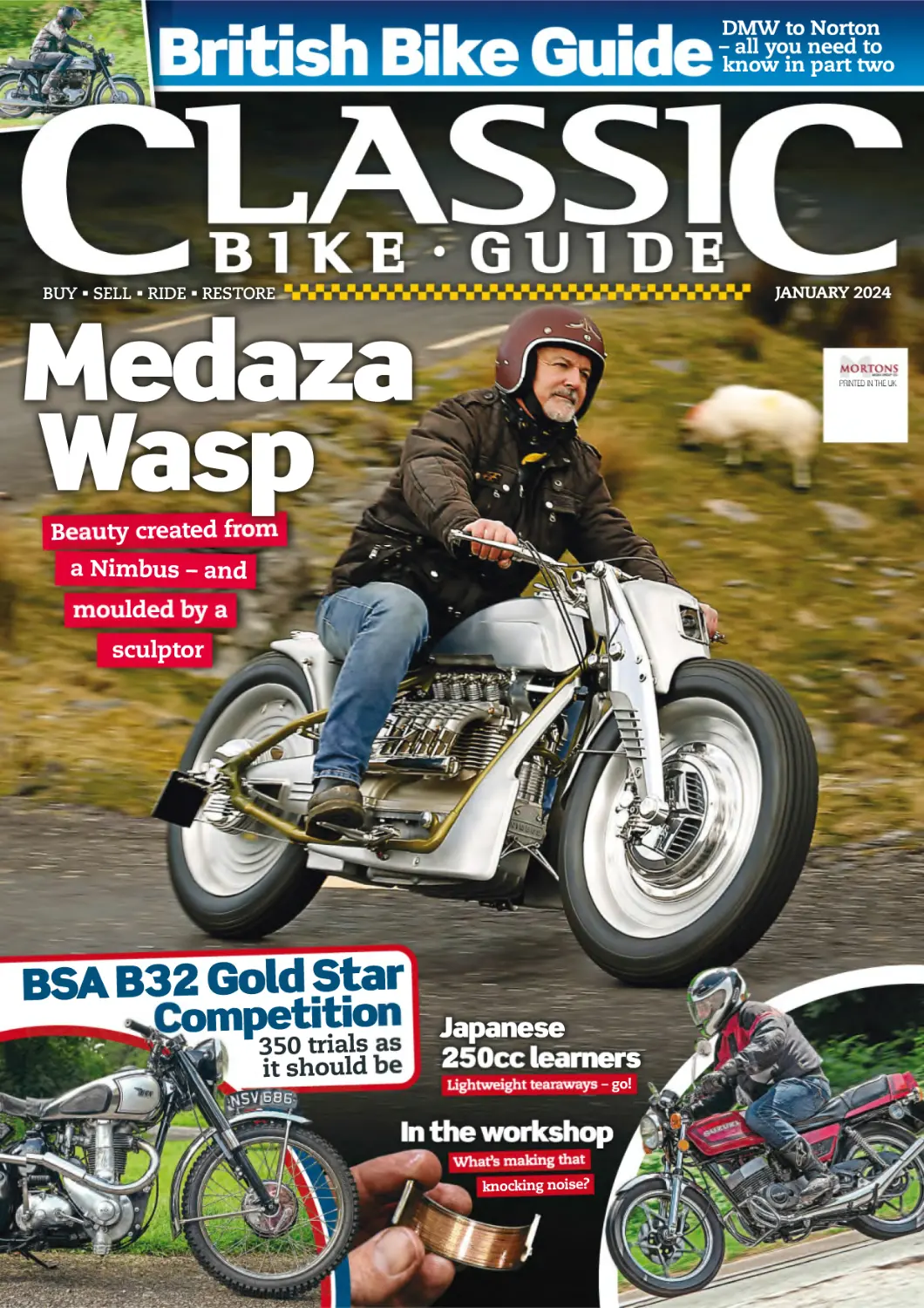
DMW to Norton
– all you need to
know in part two
JANUARY 2024
BUY SELL RIDE RESTORE
Medaza
Wasp
B
PRINTED IN THE UK
ty created f
a Nimbus – and
ld
sculptor
BSA B32 Gold Star
ompetitio
350 trials
it should
Japanese
2
l rners
– go!
p
knocking noise?
12
30
40
50
60
68
90
96
100
T
o Classic Bike Guide, head to
c
Alternatively, scan the QR code on this page and order your next copy today.
We will send it directly to you! Save time by not having to nip to the shop!
CLASSIC BIKE GUIDE || JANUARY 2024
3
Contents
#032
008 From the archive
An amazing photo from
Brooklands 100 years ago
012 BSA B32 Gold Star
The Competition model was
a rare beast indeed
022 Next Month
Honda NS400R was based around
Honda’s best Grand Prix era
024 Subscribe!
What a perfect Christmas
present to yourself!
026
News
What’s been going on in
our world of old bikes
been to:
028 We’ve
Motorcycle Live!
Not a lot new to see, but lots
of retro-styled bikes
bike mechanics
029 Old
directory
032 Medaza Wasp
Words cannot describe this
most beautiful of machines,
with a Nimbus engine
040 RS Motorbike Paints
Offering 48,500 different
bike colours, all painstakingly
formulated by eye – incredible
044
030
4
What can I spend my
Christmas money on?
JANUARY 2024 || CLASSIC BIKE GUIDE
Oli looks at autojumbling and Shaun
wonders why we buy bikes too big!
046 Letters
Write in, entertain us and
win a prize!
048
050
Who will fix your machine? Thank you
so far, but can still do with many more
Products
Oli and Shaun’s opinion
060
066 Buying a British Classic
Hints and tips on buying
a British classic
Bike Guide –
068 British
part two
In this month’s guide we
look at DMW to Norton
078 Reader adverts
Now, what I need for 2024 is
another motorcycle. Repeat…
Back to basics:
090 Painting
a bike
We look at whether it’s worth
doing it yourself, or getting a pro
What’s on
Tales from Hutch’s
096 workshop
Frank recalls: Norton
650SS Dominator
the workshop:
100 InBMW
engine strip
Japanese 250 learners
106 Frank’s last words
There isn’t much at this time of
year, but our own Winter Classic
is just a few days away
We’re not sure if he likes them
or not, but Frank has much
to say about the 650SS
Before they were banned, the 250s
gave much fun – and can now, too
A gear lever won’t change
gear – what’s going on?
When Matt runs low on oil, his
engine decides to be heard
Winter blues? Buy another
bike, reasons Frank
Welcome
Things are meant to slow down at this time of the year…
G
reetings, wondrous stalwarts of
the glorious classic bike world. May
you be warm, your battery be full
of charge, and your sidestand not flick up
at an inopportune moment. Here in the
motherland, bikes have taken another
month in the shadows, but it’s not been
quiet. Maria’s Tribsa looks on, jealously,
while my BMW R100 gets stripped to
the crank to sort its knock-knock-knock.
Madam’s Harley has had a shower of
anti-corrosion spray and the dormant
Norton ES2 has strangely been found in a
puddle of self-pity – it’s heard there may
be another Norton. I have promised Miss
EaZee2 there will be no queue jumping…
The new steed is a bike I’ve always
wished for but is, well, not a looker at
present. Where would be the fun in that?
It’s an early 1973 Norton Commando 850,
one of the first of the larger engine, that
has spent its life in Texas, where someone
of somewhat curious taste fitted a 16-inch
Harley-Davidson rim at the rear and what
looks like Hi-Rider handlebars. It may
even turn out to be a Hi-Rider (bizarre
Commando model with tall ‘bars and
small tank and headlamp to get a bit of
American cruiser market sales – never sold
too well), so I have joined the excellent
Norton Owners’ Club to use its incredible
knowledge and resources to find out more.
There is much to learn from clubs and all
that combined knowledge.
Condition-wise, there are a few parts
missing, like a wiring loom, headlamp,
switchgear, coils, chain and airbox.
Someone’s put the front end in the wrong
way, leading me to think it’s been hanging
around having parts liberated for some
time, but what’s left is in as-new condition.
It only has 6000 miles on the clock, the
shocks feel new, alloy and chrome is
perfect, and the Isolastic engine mounts
feel as soft as the day the rubber was
formed. The fuel tank has no rust, and the
seat has a tear but as-new foam. Looking
forward to it – but I’ve promised to finish
the others first!
Lots of other goings-on, with our friend
Steve dropping by in his Chrysler, going
to see the amazing new lifeboat station at
Wells, and Mid-Norfolk Railway volunteers
replacing a level crossing gate by hand!
BSB champion Tommy Bridewell came
to an evening at our friendly local Ducati
store, Seastar Superbikes – the week after
he announced he was leaving Ducati,
which made for great questions, and
Tommy was superb, entertaining everyone
with his West Country wit.
Had a good look round this year’s NEC
show, Motorcycle Live!, too. I saw a little to
get excited about, and the overall presence
of retro-styled bikes was huge – it shows
that we are all still really cool!
Matt Hull
editor@classicbikeguide.com
CLASSIC BIKE GUIDE || JANUARY 2024
5
Parts Sp
pecialists
While there are a number of companies that
seem to specialise in every aspect of our
two wheeled world, we have to remember
that there are also a large number of
companies that specialise in some very
specific areas. Not only are these companies
likely to have an expansive knowledge of
their chosen subject, they’re also far more
likely to stock the seemingly rare and
unobtainable parts that can’t be found at
the more generic dealers and suppliers
The logic is clear – if you want a haircut, you
don’t go to the supermarket. So, if you want
a certain part for your classic motorcycle,
then you approach the companies that deal
in parts and expertise in those very models.
And look what we have here – a number of
specialists whose focus is on certain makes
and models of classic motorcycle, just the job!
From our archive
■ BMCRC MEETING,
BROOKLANDS, 1923
One hundred years ago. That’s when
this photograph was taken. Is no. 5, the
external-flywheel Douglas, overtaking the
V-twin closest, or is it the other way round?
I’m not sure, but the front tyre certainly
seems to be off the ground thanks to the
speed and the uneven surface.
The bikes look 100 years old, but the
speed doesn’t. Nor the racing crouch, which
is up-to-date, though maybe the cricket
jumper, shorts and tie combo with no gloves
would be stretching it at MotoGP nowadays.
The photograph is stunningly sharp
considering the 5x4in glass plate negative
and the minimal speed shutter the camera
would have to catch these bullets. A digital
image with autofocus just wouldn’t have
the same sensory feel.
But as for the want to win, the thrill
of mastering a speeding motorcycle... a
century doesn’t change a thing.
8
JANUARY 2024 || CLASSIC BIKE GUIDE
CLASSIC BIKE GUIDE || JANUARY 2024
9
10
JANUARY 2024 || CLASSIC BIKE GUIDE
BSA B32
Competition 350cc
Electrical genius usually
turns up in a van – but this
one arrives in more style
Words and photography by Stuart Urquhart
W
hen my BMW R60/5 developed an
ignition fault, I suspected the complex
Bosch lighting/ignition switch to
be the source. Fortunately, our
classic club (SCMC) has an electrical
wizard (Derek Blackie) within its growing ranks –
an approachable chap who offers his expertise to
members. I cried for help, and Derek turned up with
his diagnostic equipment on a thundering BSA B32
Competition 350 single. As readers will have guessed,
I was smitten. One, I didn’t know Derek owned such a
rare machine, and two, I’d never encountered one in
the flesh. After fussing over his glittering restoration
and unashamedly bribing him with coffee and cakes,
I begged Derek for its story.
“When I saw the B32 advertised for sale in Speyside,
I wasn’t even looking for a bike,” said Derek. “But it
reminded me so much of a bike I had put together
in the mid-1970s based on a 1947 B31, fitted with a
genuine 1952 ZB32GS Clubman engine, that I couldn’t
help myself. I just had to have it.”
Derek brought the B32 back south to his Forfar
home in Angus. The documents confirmed the bike
was a 1948 B32 Competition 350 single, but at the time
of purchase (June 2021) it looked more like a B31, but
with lots of extra chrome. The fuel tank, oil tank and
toolbox all appeared to be correct, but Derek recalls
that the rear mudguard was entirely wrong, having
deep valances and an added plastic section behind
the gearbox. A standard B31 exhaust had been fitted,
and the 19-inch front wheel came with a matching
chrome mudguard.
Derek researched NSV686 on the internet and
uncovered pictures from the early 1980s when the
motorcycle was ‘posted’ as a B31. The vendor said he
hadn’t done any work on the bike; however, Derek
researched the year of manufacture from its tyres
and reckoned the ‘B31’ was probably returned to
B32 specification in about 2002 by another owner.
12
JANUARY 2024 || CLASSIC BIKE GUIDE
CLASSIC BIKE GUIDE || JANUARY 2024
13
After more research into B32 models, Derek decided
he should restore it back to its original factory
specification. This task was undertaken during
2021/22, when much of the UK was struggling through
Covid-19 lockdowns.
14
JANUARY 2024 || CLASSIC BIKE GUIDE
Above: Derek
and his B32
Below: An original
B32 Competition
illustration from the
Mortons Archive
Derek takes up the story: “My first job was to find
the correct flat profile rear mudguard. Fortunately,
a mild steel mudguard was sourced from Owen
Motorcycles, in Wrexham. It turned out to be one
of the last-remaining BSA mudguards that Chris
Williams, of Autocycle, had made some 20-plus years
ago. Using the correct supports, I spent considerable
time attempting fit the Autocycle mudguard correctly,
however, it would only fit with the rear section
protruding outwards! Having seen pictures of other
restored B32s, I deduced that this might just be the
way of them.
“The mudguard on the ‘touring’ models had a
detachable rear section, but I think the ‘competition’
mudguard was made so that in the event of a
puncture, perhaps during trials, the wheel could be
removed with haste.”
Whatever, Derek grinned, before explaining that it
was still a work in progress. If anyone knows better,
then please let us know.
“I then sent the mudguard for chroming to Agbrigg,
of Leeds, along with the kickstart lever, gear lever
and a silencer bracket, as I was hoping to purchase a
high-level competition exhaust from Armours. Next, I
partially stripped the engine to carry out an internal
inspection. I was chuffed when I discovered a 9.0:1
compression piston at +0.5mm – both it and the
cylinder bore were in very good condition. Ditto the
big end and main bearings.
“As well as the standard 6.5:1 piston, other pistons
for the B32 were originally available in 7.5, 9.0 and
12.5:1 compression ratios – the latter was intended
for running on ‘dope’ or alcohol,” Derek explained.
“The cams fitted were standard B31 type, but I
replaced them with the correct Gold Star competition
scrambler cams. Then the engine was reassembled
with new gaskets and seals throughout.”
He next contacted Armours and purchased the
correct 1948 style high-level exhaust and silencer.
Derek confided that his oil tank should have a
Above: The
competition head
and barrel needed
a lot of work
cutaway to allow a close-fitting exhaust pipe, and
although he does have a spare oil tank, the fabrication
work would be time-consuming and no doubt
expensive. “So, a closer-fitting exhaust has joined ‘the
work in progress’ list,” he quipped.
“When I stripped and inspected the dynamo, I
discovered the pick-up brushes were missing; also, its
armature had obviously seen better days, so I decided
to rebuild it using a new 12-volt armature and field
windings, plus a set of new bearings. Then I sourced a
V-REG 2A solid state regulator and mounted it inside
the original Lucas regulator casing, as one does these
days!”
In April 2022 Derek’s Competition B32 was back
on the road, with a newly chromed mudguard and
a new 3.50 x 19 Heidenau trials rear tyre (but Derek
later lamented that he really should have fitted a 4.00
x 19 rear tyre!). Other additions were the high-level
exhaust system, perky cams, and an upgraded 12-volt
electrical system. Derek said he rarely rides in the
dark, however, the lights are fairly good after having
sorted the electrics. He also fitted LED lights back
and front, although he’s not a fan of the blue(ish) hue
from the headlight. Derek affirmed that his rebuilt B32
performed faultlessly over that year.
CLASSIC BIKE GUIDE || JANUARY 2024
15
Rebuild part two
The rear mudguard took
a lot of shaping, as
opposed to the touring
one it came with
16
JANUARY 2024
The following July, Derek bought a competition alloy
head and barrel from Scottish Vintage Racing Club
chairman Jake Drummond.
“The parts were in a dreadful state, having been
stored in damp fertiliser bags for many years,” said
Derek. “The alloy of both the barrel and the cylinder
head were corroded and pitted. The rockers were
rusted to their spindles, which had unfortunately
seized in the head.
“It took me all of six weeks to free off and remove
the rockers, along with their spindles, from the head
– it was a nightmare job! With a one-inch inlet port, I
didn’t know if I had a B32A or a Gold Star Trials head,
however, the rockers were definitely not Gold Star, so
most likely I was looking at a B32A head. At this point
I hadn’t decided whether to fit the alloy head and
barrel to the B32, but if I could restore them, it would
be worth the effort.”
Derek said finding the correct valves was a concern,
but he did manage to source a correct inlet valve from
Draganfly Motorcycles. For the exhaust, he modified
a DBD34 valve by lengthening the stem and adding
cut-outs for the collets. ZB32 GS valve springs were
unobtainable, so he settled for B31 springs and collars
supplied by Draganfly. Derek’s (engineer) son made
up a set of collets from EN24 steel. ZB32 pistons are
equally unobtainable (unless Derek settled for a 6.5:1
B31 piston, but he said he wanted a bit more oomph!)
The barrel was STD bore with little wear. The only
pistons Derek could find were located in the USA and
Australia at astronomical prices. And unfortunately,
both were +60thou oversize – ruling them out.
“I found a CB32 Goldstar STD 8:1 piston on eBay for
a very reasonable sum, so I thought I’d give it a try.
But this turned into more hassle,” he sighed. “When
slipping the piston inside the barrel, it would only
go as far as the ring lands – yet the piston and barrel
were both STD!
“Researching the problem, I found that ZB barrels
are 71mm DIA and the matching pistons slightly
narrower to provide running clearance. However, on
the later CB and DB engines, the pistons are 71mm
and the respective cylinder bores are slightly wider to
provide clearance – and yet, all are nominally quoted
as 71mm! Frustrated, I passed the problem to Engine
Resource of Dundee, which simply rebored the barrel
to .005thou oversize to provide the required clearance.
“My next problem was the conrod’s length in
comparison to the barrel height, in that the distance
from the top of the gudgeon pin to the piston crown
for a CB32 piston turned out to be 2.8 mm higher than
that for a ZB32 piston. The easy solution was to make
up a 3mm compression plate and place it beneath the
barrel to prevent the piston from hitting the head at
TDC. I then bolted on the cylinder head but found that
at full lift, the exhaust valve prevented the engine
from turning over.
“I was aware that problems could arise when fitting
high-lift Gold Star cams to B31/B33 engines. Valve
springs could become coil-bound, or the valve collets
could end up hitting the valve guide collars. However,
The Angus region in which we
photographed Derek’s bike is famed
for its 9th century Pictish forts,
stone circles, beautifully carved
standing stones, and a famous
battle that defined the borders of
medieval Britain.
In 685AD the Picts won one of
the most decisive battles in the
history of Britain at Blàr Dhùn
Neachdain – also known as the
Battle of Dunnichen, or the Battle
of Nechtansmere. The Picts, led
by King Bridei Mac Bili, defeated
a Northumbrian invasion led by
King Ecgfrith, of Northumbria. King
Ecgfrith was killed during the battle
as his army fled. The Picts’ victory
brought lasting independence for
Pictland and, ultimately, Scotland.
Two large standing
stones can be
found
at the site of the ancient
battleground on the outskirts of
Letham village, just a few miles
from the Angus town of Forfar. The
Dunnichen Stone pictured by Derek’s
B32 is thought to commemorate
the battle, and another ‘cup and
ringed stone’ can be found at the
eastern fringe of the battleground.
Many examples of Pictish carved
stones can be seen at various sites
throughout Angus, as well as at
Aberlemno Parish Church,
The Meffan Museum in
Forfar, Meigle Museum,
and St Vigeons Museum
in Arbroath.
CLASSIC BIKE GUIDE || JANUARY 2024
17
Above: Derek’s
research leads to
the rear mudguard
being shaped
for easier wheel
changes
18
my problem was the rocker hitting the top of the
rocker box. If I’d managed to fit Gold Star rockers,
there would have been no problem. The solution
was to reprofile the arms on the rockers. I now had a
working engine – but my issues were not quite over
yet!
“As soon as I fired the bike up there were oil leaks
everywhere, mainly from the rocker feeds and the
cylinder head oil drain pipe. The poor seal on the
drain pipe was due to a corroded face on the banjo. I
eventually solved this by fitting the later ‘spectacletype’ banjo oil feed pipe. This fits over the rocker
spindles and mates perfectly against the machined
face of the cylinder head. The banjos were held by DIY
conventional banjo bolts, with flat annealed copper
washers between the bolt and the banjo. I used a
combination of copper and fibre washers to achieve a
good seal on the oil drain pipe.
“Another job was to change the front wheel from
19-inch to the correct 21-inch rim. The Devon Wheel
Company supplied a Valour stainless rim and spokes
kit – with nickel plated brass nipples. I rebuilt the
wheel myself, after which I added a 21 x 1.75-inch
Heindau tyre to match the rear. Now the 21-inch
front required a matching mudguard, so I contacted
Speedwell, which supplied an undrilled mudguard of
the correct profile in mild steel. At the time, I couldn’t
source the proper stays for the 21-inch mudguard,
JANUARY 2024 || CLASSIC BIKE GUIDE
so I made a set from thin-walled stainless tubing.
The centre stay was fabricated from flat mild steel
bar. After adding the stays, the mudguard was then
returned to Speedwell, which arranged chroming at a
very reasonable cost,” smiled Derek.
In the late spring of 2022, Derek’s B32 was back
on the road. But does it perform any better than the
original iron engine with its 9:1 piston? Derek admits
perhaps not – however, the finished B32 is now
noticeably lighter, and the 21-inch front wheel has
provided an unexpected handling characteristic: it
now falls into corners!
Derek is delighted with his rebuilt B32. He also
revealed he has another working ZB alloy engine
waiting in the wings, although he said it is perhaps
an anachronism to have a 1948 bike with a 1950
barrel and head. But he suggested this was a likely
modification of the time.
Next winter, Derek intends to have the inlet valve
guide sleeved: “I’d noticed it was a bit sloppy when
I fixed up the head. I thought it wouldn’t give me a
problem. But after a few days’ lay-up, the presence of
oily smoke on starting tells me otherwise. The only
other outstanding job is to fit a crankcase guard – if I
can find one! Perhaps I’ll just make my own.”
There is no doubt that Derek’s B32 is a first-class
restoration. Heads turn wherever it appears, and it
certainly looks splendid with its competition all-alloy
engine, and the extensive chrome bodywork and
fuel tank.
Riding impressions
I asked Derek what his B32 is like to ride. “Well, I
have plenty of experience of these old BSA singles,
having built a similar model more than 45 years ago.
Obviously it is a 75-year-old 350, so mind-shattering
performance isn’t its forte,” Derek smiled. “And being
a tad lethargic when compared to, let’s say, a 350
Gold Star Clubman – I don’t push it too hard. The bike
will happily cruise at 45-50mph, and I’ve had it up to
60mph, with a bit more to go. But it takes a while to
get there and above 60 it becomes quite vibey. So, in
respect to its age, I’m happy to stick to 50(ish).
“My model is fitted with the somewhat fragile
‘lightweight’ four-speed gearbox. First gear is so low
that it’s practically useless for road use. Actually, the
B32 can be comfortably ridden from standstill in
second gear. There is, however, a huge chasm between
second and third gears, with third to top being better
spaced. Out on country roads, I mostly use third and
top gear, although when climbing Cairn O’ Mount in
Angus (12% incline), it was a choice of either a ‘slog’ in
third or revving the B32’s nuts off in second!”
Derek informed me that an improved gearbox
was fitted in 1949 with different ratios (based on the
M20 gearbox). It was also fitted to the ZB32 Gold Star
introduced that year. When Derek acquired the bike, it
had 19-inch rims and handling was much as expected.
The BSA sprung forks tended to ‘top out’ (as most
forks did in the 1940/50s). He said the rigid rear end is
hard, but the sprung saddle does a remarkable job of
absorbing bumps. But hit a bump hard in mid corner
and the back end will step out. Also, due to fitting a
21in front wheel, Derek expected the B32’s increased
steering head angle to result in sluggish cornering
– however, the bike now falls into corners quickly,
taking Derek several weeks to get used to it!
The weaker 7-inch front brake is typical of the
period, and you ride accordingly, said Derek. The rear
is quite adequate, but the wheel can easily be locked
if too much pressure is applied.
Starting is never a problem. The procedure is
tickle the carb, apply full choke (when cold), retard
the ignition lever a fraction, pull in the valve lifter
and turn the engine over three or four times. Then
release the valve lifter and bring the piston up to
compression and pull in the valve lifter once again to
ease the engine over compression. Finally, release the
valve lifter and give the engine a good, firm kick with
the throttle closed. Predictably, the engine will fire at
the first or second kick. Just a few minutes later, the
choke can be backed-off. Most of the time, Derek rides
with the ignition set at fully advanced, and when the
engine is hot, it invariably starts first kick.
Above: Gearbox has
a very low first gear
and top cruises at
45-50mph
CLASSIC BIKE GUIDE || JANUARY 2024
19
Above: You can hear
it from the photo at
this angle!
It is happiest on rural roads – especially exploring
the Angus glens. “I can’t fault the excellent 90mpg
return on E5 fuel either. She’s a keeper!”
Below: Reshaping
of the oilways was
needed
A golden history
20
In 1937, road racer Wal Handley was awarded a
‘Gold Star’ for lapping the Brooklands racing circuit
at more than 100mph on a 500cc BSA Empire Star.
The following year, BSA decided to produce a sports
replica, the M24 ‘Gold Star’, each machine being fitted
with factory tuning parts. Aimed at the clubman racer,
special pistons were available for running on petrol or
alcohol, and the engine casings were part-magnesium.
Postwar, BSA launched a competition ‘Gold Star’ 350cc
model described as ‘the ultimate refined motorcycle
JANUARY 2024 || CLASSIC BIKE GUIDE
of its type, designed primarily for competition
work and not really for the tourist to potter around
the countryside’.
In 1947, BSA announced three new competition
models aimed at the ‘sporting enthusiast’ - trials,
scrambles, and road-racing. The new B32 was clearly
a competition-derived machine, but very much based
on the production B31 touring model. Thus, the B32
shared many common parts, such as the rigid frame,
front telescopic forks and lights – exceptions from
standard were a high-level exhaust system, off-road
competition tyres and chrome plated parts like the
fuel tank, mudguards, stays, front stand, primary
outer cover and rear chainguard. Other options were
gear ratios to suit trials or scrambles competition;
even a competition magneto was available. The
thinking was to offer the club racer, trials or
scrambles competitor unlimited choice and the
means to specify a machine built to the customer’s
own requirements.
Just one year later, and to satisfy demand, a
500cc B34 model was introduced along similar lines
to the B32. Then, in 1949, both models received an
alloy barrel and cylinder head, updated oil tank and
telescopic forks (basically the addition of oil drain
plugs). The BSA plunger frame became available as
an optional extra. Other parts like the clutch, gearbox
and hubs were destined to become common across
the entire range of ‘M’ and ‘B’ model singles.
Both the B32 and B34 competition models
continued relatively unchanged, apart from chrome
being discontinued on fuel tanks and wheel rims due
to a global chrome shortage in 1951, only to reappear
two years later. Production ended in 1957. The B31 and
B33 touring models continued until 1960.
Next month
Honda NS400R
Honda’s largest road-legal two-stroke – want to be Freddie Spencer?
Who’s who ||
EDITOR || Matt Hull
editor@classicbikeguide.com
PUBLISHER || Tim Hartley
thartley@mortons.co.uk
SALES AND DISTRIBUTION MANAGER || Carl Smith
Full subscription rates (but see page 24 for offer):
PUBLISHING DIRECTOR || Dan Savage
(12 months 12 issues, inc. post and packing) – UK
COMMERCIAL DIRECTOR || Nigel Hole
ART EDITOR || Kelvin Clements
SENIOR DESIGNER || Michael Baumber
DESIGNER || Charlotte Turnbull
PRODUCTION EDITOR || Lucy Wood
GROUP ADVERTISING MANAGER || Sue Keily
ADVERTISING ||
Mark Bainbridge 01507 529413
MBainbridge@mortons.co.uk
ARCHIVE ENQUIRIES || Jane Skayman
01507 529423 jskayman@mortons.co.uk
SUBSCRIPTION ||
MARKETING MANAGER || Charlotte Park
EDITORIAL ADDRESS ||
Mortons Media Group, Media Centre, Morton Way,
Horncastle, Lincs LN9 6JR
WEBSITE ||
www.classicbikeguide.com
£61.20. Export rates are also available – see
page 20 for more details. UK subscriptions are
zero-rated for the purposes of Value Added Tax.
DISTRIBUTION ||
Seymour Distribution Ltd, 2 East Poultry
Avenue, London, EC1A 9PT.
PRINTED BY || Acorn Web Offset Ltd,
Normanton, West Yorkshire
GENERAL QUERIES AND BACK ISSUES ||
01507 529529 24hr answerphone
Email: help@classicmagazines.co.uk
Web: www.classicmagazines.co.uk
ADVERT DEADLINE || January 11, 2024
NEXT ISSUE || January 31, 2024
© Mortons Media Group Ltd. All rights reserved. No part of this publication may be reproduced or transmitted in any form or by any means, electronic
or mechanical, including photocopying, recording, or any information storage retrieval system without prior permission in writing from the publisher.
T
o Classic Bike Guide, head to
c
Alternatively, scan the QR code on this page and order your next copy today.
We will send it directly to you! No need to nip out to the shops.
22
JANUARY 2024 || CLASSIC BIKE GUIDE
Join the classic motorcycle community
Owning, working on, and riding
a classic motorcycle is a truly
wonderful experience. And sharing
that experience with the inclusive
old bike community is even better.
At Classic Bike Guide, we have a
great job – doing our best to bring
all elements of our community
from around the world together,
to keep enthusiasm high, our
knowledge growing, and that smile
on everyone’s face. Villiers 125s,
MZ250s, Triumph 500s, Moto Guzzi
750s and Suzuki 1000s... our world
has machines and events that can
please everyone, and a subscription
to Classic Bike Guide brings that
wide variety to your door, every
month.
We hope you enjoy!
MATT AND THE CLASSIC BIKE GUIDE GANG
Call 01507 529529 and quote CBGDPS
Online: www.classicmagazines.co.uk/CBGDPS
or scan the QR code to go straight to our secure online store
CHOOSE WHICH CBG
SUBSCRIPTION SUITS YOU BEST
1:
12-MONTH SUBSCRIPTION
12 print issues for £46
Direct Debit
12 print issues for £50
credit/debit card
2:
BEST
VALUE
SAVE
£15.20
SIX-MONTH SUBSCRIPTION
6 print issues for £24
Direct Debit
6 print issues for £26
credit/debit card
SAVE
£6.60
WHAT OUR READERS SAY ABOUT CLASSIC BIKE GUIDE
A very good, interesting
read. Well worth the
subscription.
ROBERT ILES
An entertaining and
informative take on
classic motorcycles.
STUART GILES
A curious blend of
nostalgia, history and
practicality.
JIM LAWRENSON
WHY YOU SHOULD READ CLASSIC BIKE GUIDE EVERY MONTH
>> Expert advice from writers who will entertain and inform every month.
>> Save cash on buying your CBG in the shops. >> Subscriber-exclusive offers and competitions.
>> Workshop tales and real rides. >> Be part of our classic motorcycle community.
TERMS & CONDITIONS: Rates are based on UK orders only – for overseas, please visit www.classicmagazines.co.uk/cbg-overseas. Subscriptions will start with the next available issue.
Offer closes 31/01/24. Direct Debit payments will continue at the price you paid, on this offer, at these intervals thereafter unless you tell us otherwise. Full terms and conditions can be found at
www.classicmagazines.co.uk/terms. Quoted savings are based on a direct debit subscription when compared to the same number of issues at full printed price.
Classic news
Winter Classic is here!
Our Classic Bike Guide Winter Classic Bike
Show is just around the corner! The new
year begins for classic bikers on January
6/7, when Newark Showground opens its
gates to warmly (ish) welcome in 2024.
As well as a feast of classic motorcycles
(and scooters), traders, jumblers and the
howl of classics being given full throttle
in the fire-up area, there are some true
heroes of British motorcycling sharing
details of how they kept the tattered
Union flag flying in the industry’s
darkest days.
When most were falling by the wayside,
racer Trevor Nation and engineer Brian
Crighton were a crucial part of the Norton
resurgence in the late 1980s and early
1990s as the tiny factory took on the
world with its rotary racers, culminating
in winning both the 750cc Supercup
Championship and the British F1 title.
Crighton was the engineering genius
who transformed the rotary engine into a
race-winner that became a phenomenon,
to which Nation contributed strongly with
wins in the proddie class on both 750cc
and 1000cc machines.
Showgoers will get to see these racing
legends in action as they discuss their
current projects and reminisce about their
past glories together. Joining them will
be two of the iconic JPS racing bikes, with
both guests on hand to fire up the bikes
that Nation once rode. Take ear plugs…
Buy your tickets in advance, avoid
standing in a chilly queue, and
save £2 per ticket by visiting www.
newarkclassicbikeshow.com.
Also head to www.classicbikehub.uk
and search ‘Classic Bike Hub’ on social
media for further updates.
Can’t make Newark? Also coming soon
are the Classic Dirt Bike Show at Telford
International Centre, Shropshire, over the
weekend of February 10/11 and the Bristol
Classic Show on February 24/25. Visit
www.mortonsevents.co.uk for tickets and
more information.
Shotgun’s wedding
Royal Enfield has unveiled a new version
of the company’s 650cc twin, this one in
in factory custom trim. The Shotgun 650
debuted in Goa at RE’s special Motoverse
2023 event with limited edition version on
off to attendees. The production version
will be launched early next year.
The Shotgun 650 has a cast aluminium
headlamp and instrument nacelle, cutdown mudguards and angular bodywork.
Royal Enfield says the Shotgun 650 has
been designed so that owners can put
26
JANUARY 2024 || CLASSIC BIKE GUIDE
their own stamp on their machines. It can
be transformed from a classic singleseater to a dual-seater or into a weekend
tourer in minutes.
The production version will be
launched early next year across the world,
starting with Europe and India.
As well as the Shotgun 650, RE has
also launched an all-new Himalayan 450
adventure tourer with a liquid-cooled
single-cylinder engine, which will also
arrive in early 2024.
New Davida
Speedster v4
arrives
Classic biking’s favourite helmet
manufacturer, Davida, has managed
to crack the code demanded by the
guardians of safety: its designers
have come up with a new version
of its classic Speedster helmet that
meets all the current crash helmet
standards.
The Speedster 4 is certified to
ECE R22-06 and has maintained
the traditional look and feel that
Davida is known for. Davida gov’nor
David Fiddaman said: “Forty years
of sculpting helmets and certifying
them to safety standards across the
globe has enabled us to certify the v4.
“We managed to maintain nice
proportionality and size of the
helmet in relation to head sizes
by using four different shells, the
medium and large having their own
shell. It’s a much-improved version
of the v3. Everyone trying them has
been very happy at recent shows.”
The Speedster v4 features a glass
fibre shell using a clean design with
no visor studs, just a goggle retainer
on the rear.
The helmet is light, weighing
about 1kg depending on shell size,
and comes with a quilted airflow
comfort liner.
There is Davida’s standard
double-D ring fastening, as used in
racing, while the removable liners
and ears are replaceable for any
future additions or changes.
The helmet will come in Black
Matt, Cream Gloss, TT Silver Black
Gloss and TT Black Gold Gloss, and is
attractively priced at £170 for plain
colours and £180 for the TT finish.
The new Speedster will be
available to customers who reserve
their purchase early.
Visit www.davida-helmets.com,
call 0151 647 2419, or email sales@
davida.co.uk to reserve your helmet.
Delivery is expected at the end of
January or early February, ready for
the season. The v4 will be available
on a first come, first served basis.
Shows in the south
Elk Promotions has announced its
calendar of shows and bike jumbles for
2024, giving classic motorcycle fans plenty
to look forward to.
A total of seven events are planned,
starting with the South of England Classic
Show and Bikejumble on Sunday, March
24, running right through to the season
closer on Sunday, October 27. The bikeonly jumbles and classic motorcycle
shows will take place at Ardingly, Ashford,
and Romney Marsh. The Late May Bank
Holiday Monday show, traditionally held
at Romney Marsh, is moving to Ashford
Livestock Market, which is all hardstanding with inside halls. Keep an eye
on CBG’s What’s On pages for details of
the events or visit www.elk-promotions.
co.uk for tickets, stall bookings and
other information.
Electric start for
Yamaha singles
Classic motorcycle electrical specialist
Rex’s Speed Shop has introduced a new
electric start system for classic Yamaha
singles to its range. The XSTART can be
fitted to XT500 and SR 400/500 singles
as a bolt-on conversion. The unit is
self-contained and powered by its own
independent Li-on battery pack that can
be charged in situ or removed for charging.
The XSTART includes a 1kW starter
with alternator cover, adapters for the
original rotor sprag clutch, drive chain and
starter relay, all the necessary accessories,
and detailed, illustrated instructions
for quick and easy installation. The
lithium battery (LiFePo4) is located in a
housing made to look like the original
XT500 toolbox.
Depending on the temperature, the
battery can complete up to 100 starts
with one charge. Afterwards, it must
be recharged with the included mains
powered charger. The starting current is
300A, with a peak
current of 600A;
the 4S lithium
battery has
sufficient reserves.
The XSTART costs
£1500; visit www.
rexs-speedshop.
com
Langen’s new
British superbike
– the LightSpeed
After wowing the world of motorcycling
with a crazily powerful race-bred twostroke, British manufacturer Langen has
launched a new 185bhp, 1190cc v-twin –
the LightSpeed. Langen, which specialises
in hand-built, limited production
motorcycles, unveiled the machine at
Motorcycle Live at the NEC Birmingham
– and the LightSpeed was a big hit with
visitors... its power-to-weight ratio of
1000bhp per tonne had those with bulging
bank accounts reaching for their wallets
to secure a build slot and VIN number,
as only 185 of the launch specification
motorcycle will be available, with each
build individually commissioned for its
owner. Those with the desire to own a bike
that could end up being as legendary as a
Brough or a Vincent should visit
www.langenmotorcycles.co.uk
CLASSIC BIKE GUIDE || JANUARY 2024
27
New Classics at
Motorcycle Live!
Always a fun day, even if there was nothing new
T
here wasn’t an awfully large amount of new bikes
at the UK’s largest motorcycle show this year, and
hardly any new, classic-style bikes. As is regular these
days, Triumph had the largest pack, with fresh colours
and styles for its retro range, like the Speed Twin and
Bonneville. The outgoing Thruxton had a glorious green paint
scheme, bowing out proudly.
Watsonian and Ural kept up the three-wheeling name, BMW
continued with the R18 and RnineT models, while Royal Enfield
had plenty of the new 350 Bullet to look at, as well as the existing
650 range, and BSA had all the colours of its Gold Star for all to
see. Kawasaki’s well-proven and popular Z900RS and Z650RS
were there, Yamaha’s MT-09 with 1980s Gran Prix-inspired
bodywork looked gorgeous, and Honda’s CB1000R gave a nod to
the 1980s, but it’s pushing the retro theme a little far.
Norton was still causing a buzz around its 961 Commando,
showing signs that the public have put the torrid recent history
to one side. Indian had a large array, CCM had different takes on
its Spitfire model, and AJS was there with its Cadwell, as was the
Herald range. In fact, the smaller bikes were better catered for, as
Harley-Davidson didn’t even bother to turn up.
But many did make an effort. New British kids Langen, fresh
from the first new two-stroke in years, had a 1120cc V-twin
beauty to show off called the Lightspeed, and the National
Motorcycle Museum was rebuilding a girder-forked Enfield in
between such beauties as the Brough Superior Gold Dream, the
earliest Norton, and even Henry Cole, who spent ages talking to
people and signing autographs.
28
JANUARY 2024 || CLASSIC BIKE GUIDE
CBG Workshop
directory
Our directory of mechanics and engineers happy to work on older bikes, bikes with
points, and carburettors to help us keep on the road
T
his is our second running of
the old bike mechanics
directory, and there’s a few new
ones in there, so thank you!
However, I’m sure there are
many more mechanics out there we don’t
yet know about – please, let’s help those
new to our old-bike world find someone
local to them who will help keep these
great machines running. If we don’t,
our bikes become nothing but garden
ornaments – and worthless ones at that.
I’ve heard from no clubs: surely this
could be a great place for advice? Do you
have specialists or parts schemes? Who
helps you when you need assistance? Who
do you trust? Who do you know is happy to
sort the timing on your Sunbeam, fit some
head races to your Suzuki, or restore that
old Laverda you’ll never get around to? Let
us know at editor@classicbikeguide.com
UK
Mike Taylor: Ellesmere Port, Cheshire. 07922
838228/picknmixtaylor@hotmail.com. Mike
specialises in Triumph/BSA triples, and is
happy to work on much else – full rebuilds
included.
Northants Classic Bikes: Rushden,
Northamptonshire. 01933 355525. Steve and
Julie offer classic sales, parts, and workshop
expertise for all classics.
Mick Surmann Motorcycles Ltd: Bierton,
Aylesbury. 01296 486137. Proper oldfashioned bike shop for flat tankers to
modern bikes, with MoT station.
Brooks Engineering: Northwich, Cheshire.
01606 47008/brookesengineering.co.uk.
Has all the equipment necessary for turning,
machining, welding and so on, and removing
broken studs, etc.
Oak Lea Performance: Pilling, Lancashire.
07930 306009. Geoff repairs, services and
restores, and custom-made exhaust systems
are a speciality.
Kustom Choppers Ltd: Hingham, Norfolk.
01953 529150/Info@kustomchoppers.co.uk.
Daniel works on all older bikes, from servicing
and restoration to custom work.
Howard Evans: Barton-upon-Humber, North
Lincolnshire. 07788 501168.
Repair, restoration of
classic Japanese bikes,
and vapour blasting and
carburettor restoration.
Max Smeed
Restorations: South
Manchester. 07307
877781/max@maxrestorations.co.uk.
Max is a mechanical
engineer and MoT
tester, covering all
types of jobs on
all bikes.
Matt’s Machine Shop:
Abercynon, South
Wales. 01443 742791.
Works on all kinds of
bikes, specialises in
imperial British and American, and has a dyno.
Wilsons Motorcycles: Kirton, Lincolnshire.
01205 724314/sales@wilsonsmotorcycles.
co.uk. Just outside Boston, Wilsons can
work on any motorcycle and has run very
successful race teams.
Motorcycle Service Centre: 541 Harrow Road,
London W10 4RH. 0208 9606434. Robbie
looks after a huge array of classics in the
West London area.
HTE Motorcycles: Near Swaffham, Norfolk.
01328 700711. Hutch specialises in classics
and British bikes repairs, projects, wheel
building and engines.
RJ Motorcycles: Coalville, North
Leicestershire. 01530 833297/info@
rjmotorcycles.co.uk. Always ready to help and
will sell one O ring if that’s all
you need.
SRS Engineering: Sutton. 0208 6425685/
srsengineeringsutton.com. Mike can
do rebores, machining, head skimming...
anything old-school motor engineering
Specialist Welding Service: Banstead.
07957 557935/specialistwelding
service.co.uk. Andy is a time-served welder
capable of the most intricate work on fins,
heads and cases.
Red Dragon Refinishing: Rhostyllen, Cheshire
(near Wrexham). 01978 448983/wayne@
rdwales.com. Blasting, plating, powdercoating and painting are just part of what Red
Dragon can do.
SCOTLAND
Wells Forest Classics: Near Peterhead,
Aberdeenshire. 07766 727924/scottymcb3@
gmail.com. Scotty McBride specialises in Royal
Enfield and Moto Guzzi but is happy to look at
all makes.
Angus Classic Bikes: Forfar, Angus. 01307
463838/www.angusclassicbikes.co.uk. Happy
to work on any type of bike, fit tyres, MoT,
clean carbs and vapour blast.
Bob Grant Motorcycles: Pitscottie, Fife.
01334 829415. Service and repairs, parts,
suspension, dyno tuning, vapour blasting
and restoration.
Barrie Brown Wheel Building: Windygates,
Fife. 01333 352102 or 07711 916722.
Complete wheel building, blasting, and
restoration service available for any make.
Engine Resource Dundee: 01382 223686/
engineresource.co.uk. Nearly 50 years of
engine remanufacture and auto engineering.
Sandy Bloy Motorcycles: Perth. 07772
249309/sandybloymotorcycles.com. Stephen
and Cameron offer sales, repairs, parts, and
total classic restoration services.
Dynotech Ecosse: Hillington, Glasgow. 07779
159065/dynotechecosse.com. Modern bikes
and classics are welcome for routine to total
restoration and dyno tuning.
Steelworx Motorcycles: Wishaw, Lanarkshire.
07710 753912. Steelworx are known for
custom builds but is just as happy doing
general repairs and servicing.
CLASSIC BIKE GUIDE || JANUARY 2024
29
Products
Oxford Original
Approved AA
MS shirt
£149.99
www.oxfordproducts.com
Shirts like this will raise considerable
derision from the casual observer who
would rather swathe themselves in Gor-tex
and masses of Kevlar, but while on the
face of it this is just a shirt, it’s made out
of seriously high-tech protective materials.
Oxford’s kit has improved by leaps and
bounds in recent years and this looks to
be another step forward. It is made from
something called 12.5oz Armourlite®
denim, it is AA CE-certified, and protection
is further bolstered with CE level two
shoulder and elbow protectors. Formed
from a soft, flexible polymer that conforms
to the wearer’s individual body shape, these
protectors aren’t just bits of soft plastic,
but harden upon impact with high shockabsorbing properties. You can upgrade the
shirt with Oxford CE level one or two back
protection, too. Webbing loops with press
studs can be fastened around a jeans belt
to prevent the shirt from riding up in the
event of a spill. Disclaimer – we haven’t
seen this in the flesh or dragged it behind a
Rocket 3, but product standards being what
they are, it seems very unlikely that Oxford
is fibbing about the protective quality.
At the front, the press studs are
reinforced and there is a metal YKK zipper
for an ultra-secure fastening. The same
attention has been paid to the cuffs, which
can also be adjusted to fit larger or smaller
gloves thanks to two press stud settings.
It comes in black, indigo, and khaki, and
wearing it on your bike will definitely raise
eyebrows among traditionalists, while
being smart enough to serve as a casual
coat. Not waterproof, but who rides to their
local coffee shop for poetry slam in the
rain, anyway? Oli
Eversholt jacket and Killian vest
Jacket, £685; vest, £285
www.ashleywatson.co.uk
If you like the luxurious and have a regard
for quality kit that looks a little different,
then these items from Ashley Watson,
motorcycle tailor of the highest regard and
maker of fine outdoor accoutrements, are
for you.
The Eversholt MkII is described as
the world’s most protective waxed cotton
motorcycle jacket. “Working with the latest
innovations in materials technology, our
aim was to create a jacket that functions
perfectly on two wheels, while also being a
garment that can be worn day-to-day, off
the bike,” says Ashley. And it looks like a
jacket you’d wear in the park.
Behind the 8oz waxed-cotton outer is a
hybrid Dyneema/Aramid abrasive-resistant
lining, independently tested to pass the
highest AAA CE motorcycle standard.
Impact protection comes in the form of
removable D3O armour. All seams have
been engineered to withstand 12 N/m of
force – the equivalent of a one-inch strip of
30
JANUARY 2024 || CLASSIC BIKE GUIDE
fabric holding a 30kg weight.
There is a seam-sealed
waterproof drop-liner,
double front zip-guard and
adjustable storm baffle
at the neck and cuff
gauntlets to ensure the
Eversholt Jacket can
cope with year-round
riding conditions. The
signature three-point
neck baffle can be
adjusted to regulate
how much wind enters
the jacket.
The main bellows
pockets are expandable
– ideal when space is limited on a trip. An
elasticated document pouch is tucked
inside each bellows pocket for keeping
valuables to hand.
Ashley also sells the Killian vest, which,
being double-breasted, creates a barrier
that greatly increases wind resistance
and at the same time doubles the thermal
insulation at the front of the garment. To
further trap heat and reduce the effects of
wind chill, the two overlapping panels are
lined with a 100% windproof membrane.
The Killian vest has two deep
handwarmer pockets and is a garment that
will earn its keep year-round, on and off
the bike.
Weise Outlast® Sirius
2.0 Gloves with KP1
knuckle protection
SW-Motech drybag tail pack
Prices start at £55.44 for the Drybag
180, rising to £83.16 for the Drybag
600, and this 26-litre bag costs £64.68
www.sw-motech.co.uk
I’ve been looking for something chunky
that will take a change of clothes, a
laptop, and my ‘big’ camera for some
time. I usually just muddle through with
second-hand panniers and rucksacks,
but this has been a permanent fixture
on my Guzzi ever since it came into
my possession. The drybag is 100%
waterproof (hence the name) and will fit
any of my motorcycles. It’s soft, strong,
and waterproof, and is basically a large,
tough, fabric bag that is coated in soft,
waterproof PVC. You just fill it with
your stuff, fasten the top by pushing
together the big strips of Velcro, then
roll the top up until the contents of the
bag are nice and snug, and then fasten
the plastic buckles. This is the middle
size and it’s just big enough for my fullface helmet. SW-Motech says it has a
high tensile strength for durability and
is tear and puncture resistant – and I
see no reason to doubt this. They’ve
even given the inside a lighter colour to
make locating objects easier, and there
are a couple of zip-up pockets on the
outside, handy for documents/phones/
Deep Heat/fags and more.
There are four straps with plastic
buckles to hold it to the bike. I tie
the front two to my pillion pegs and the
two at the back to my indicators and
it’s solid. There’s even carry handles.
The bag could easily double up as
versatile luggage for non-motorcycle
trips and would be handy for any
outdoor activity where keeping contents
dry is a priority.
Brisk spark plugs
£3 (with postage at £3 for four)
www.f2motorcycles.ltd.uk
Along with the value of your bike and
which oil to use, one of the biggest
discussion points we come across
is, ‘which spark plug?’, with the oftrepeated claim that ‘fake’ NGK plugs
are flooding the market. This may or
may not be true, but it doesn’t matter
to me, because, after a brief move to
Champions, I now go for Brisk plugs on
my old bikes, as does Matt, Maria and
Neville. Made in the Czech Republic
since 1935, these are old-school plugs
for old-school motorcycles. They have
a very wide heat range and cover most
classic motorcycle needs. Brisk plugs
seem to burn fuel better, don’t foul,
and will recover well from over-rich
mixture when an engine is tickled or
choked. They won’t cure an incorrect
carb set-up, but they tolerate small
variations in mixture very well. This
makes them very useful when trying to
get your bike to run properly without
getting through multiple sets of
plugs. The website of distributor F2
Motorcycles has a very comprehensive
fitting and matching guide, too. Oli
£129.99
www.weiseclothing.com
When the winter came down like a hammer,
I wished I had a pair of these gloves to keep
out the weather.
Weise Outlast® Sirius 2.0 gloves are
made with liners designed for the cold void
of outer space, so they should be capable
of resisting a jaunt down the A1 in January.
Made with a full grain leather and textile
shell, Outlast® Sirius 2.0s have KP-1rated knuckle protection and also come
with a practical visor wipe and will work a
phone touchscreen.
Inside, the Outlast® lining provides builtin climate control. This space-age material,
originally developed for NASA, absorbs,
stores and releases heat to actively regulate
the body’s microclimate.
As the wearer’s hands warm up, the
Outlast® lining absorbs the heat, keeping
them cool and reducing the risk of
perspiration. If the temperature drops, the
heat is released to keep the hands warm.
This ‘active control’ helps reduce the
heat-up/chill-down cycle often experienced
when riding in varying temperatures and
conditions, keeping the wearer consistently
comfortable while sounding like some kind
of sorcery.
A waterproof and breathable membrane
keeps out wind and rain, while allowing any
perspiration to escape. Additional insulation
is provided by 3M™ Thinsulate G100 to
the back of hand and C40 at the palm.
The linings, membrane and outer shell
are held firmly in place with something
called a mcFit™ system, so there’s no
uncomfortable stitching or seams, and the
liners won’t twist or pull free. Weise has
been cagey about how this works, but if it
does, it is a massive game changer in glove
manufacturing. And as the gloves come
with the Weise two-year warranty, you will
have plenty of time to test the veracity
of the claims. Weise Outlast® Sirius 2.0
gloves come in men’s sizes S-4XL and
women’s XS-XL.
Like us facebook.com/classicbikeguide
Visit classicbikeguide.com
32
JANUARY 2024 || CLASSIC BIKE GUIDE
Medaza Wasp
Hand-crafted in Ireland, Don Cronin’s latest creation
looks like the sort of bike that Captain America
would ride, not a Royal Danish postman
Words and photography by Phillip Tooth
CLASSIC BIKE GUIDE || JANUARY 2024
33
W
hen it comes to choosing an engine
for his Medaza motorcycles, Don
Cronin has form. Forget about a big
Harley mill from The Motor Company,
or the latest big-bore Triumph twins
and triples. He’s used a 500 single with a ‘bacon slicer’
external flywheel that once powered a Guzzi Nuovo
Falcone, a V-twin liberated from a Morini Camel
enduro, and even a utilitarian two-stroke lifted from
an MZ 300ETZ. So, when he wanted an inline-four for
his latest project, he was guaranteed to come up with
something different. And in a world of high-revving,
huge horsepower fours, there’s nothing quite like
a Nimbus.
Vacuum cleaner manufacturer Nilfisk branched
out into making motorcycles way back in 1919, but
the Nimbus we are interested in was launched in
1934. The unit construction 750cc engine featured an
overhead camshaft. Just like the original MG sports
car, the vertical camshaft drive to the bevel gears
doubled as the armature spindle for the dynamo,
which was mounted in front of the cylinder block. The
lower half of the crankcase was cast in aluminium
and carried a couple of litres of oil, but the upper half
of the crankcase and the finned cylinder block were
a single piece of cast iron. The detachable one-piece
cylinder head, with its hemispherical combustion
chambers, was also cast iron and incorporated the
inlet manifold. An aluminium camshaft housing was
bolted to the head, with the rockers supported in ball
34
JANUARY 2024 || CLASSIC BIKE GUIDE
and socket bearings operating on the vintage-style
exposed valves.
The one-piece, drop-forged crankshaft runs in
two large-diameter ball-bearing journals, with the
flywheel incorporating a large single plate clutch fixed
at the rear. A three-speed gearbox was bolted to the
clutch housing, with drive shaft to the rear wheel.
The cradle frame was made from lengths of
40mm x 8mm flat steel, riveted to the steering head
and the unsprung rear end. It might not have been
sophisticated, but it was cheap and easy to make, and
practical. Up front was the first modern telescopic
fork, patented in 1933. That was two years before
BMW introduced its tele fork, but the Germans
pioneered oil damping. Hold on to your hair, Nimbus
lovers. The standard 1934 model managed with
18bhp, but a sports version introduced for 1937 had
the compression ratio upped to 5.7:1 and delivered
a thrilling 22bhp. When the four was revved towards
the 4500rpm limit, the straight-through exhaust with
its little fishtail really buzzed, which is why Danish
enthusiasts nicknamed the Nimbus the ‘Humlebien’,
or Bumblebee.
But the Nimbus was never meant to be a sports
motorcycle. It was a workhorse, and the biggest
buyers of Denmark’s homemade motorcycle were
the Army and the Royal Danish Post Office, which
finally pensioned off its fleet of sidecar outfits in 1976.
Numerous upgrades were made to the engine and
Left: Don replaced
the plain steel cover,
that keeps the crap
out of the contact
breaker mechanism,
with a Nimbus
sunburst design that
he cast in alloy
Below: The drive shaft
was extended to allow
for the longer frame
But Don had no intention of building a stock motor:
cycle parts before production officially ended in 1959,
“The engine was designed for long-term reliability, not
by which time more than 12,000 had been built, but
performance. The ports of the integral inlet manifold
factory policy meant that earlier models could easily
are square-section with right-angle bends, which is
be updated to the latest specification.
never great for gas flow. It is impossible to clean them
If Don wanted a 1265cc Indian or a 1301cc
up. And besides, the single Nimbus carburettor has
Henderson Four as his donor, he would have had to
a tiny 22mm choke. You could barely pass a man’s
pay north of 100,000 Euro. “And those are big engines,”
wedding ring through it!” His solution? Design a new
he says. “A late Henderson measures 360mm across
cylinder head with detachable inlet manifolds that
the front of the crankcase. The Nimbus is tiny, only
carry twin carbs.
200mm wide.”
Contacts count when you are designing and
You can pick up a fully restored Nimbus motorcycle
building a special. Don was at a party in the
for about 10,000 Euro, while a project bike costs less
Californian home of one of the members of Eagles
than half that. And that’s what Don shipped from
of Death Metal when he met Mark Atkinson. “He is
Denmark to his home in Ireland.
Speed of Cheese Racing,” laughs Don. “What a name!
Confirmed as a 1946 model, there was rust under
But after talking for only a few minutes, I realised that
the frame paint and a Japanese fork was a nonhe’s the real deal. Mark broke world speed records at
Nimbus upgrade, but at least the engine turned over.
Bonneville on his RD400 and runs his own machining
“Denmark’s Nimbus Touring Club is brilliant. They are
and design service in Salt Lake City.”
so proud of their national motorcycle, and everyone is
Don used Solidworks to create the drawings that
so supportive,” he says. “They have all the spare parts
that you can possibly need, including new crankshafts, were zipped over to Mark for machining from a billet
of 6082 grade alloy.
cast iron cylinder heads, and the combined cylinder
New carburettors, valve guides, valves and springs
block/crankcase top – all beautiful quality and they
were supplied by Jesper Jensen, of Nimbus-Shop.com.
don’t cost silly money.”
Don did think about making the cylinder block/
crankcase top in alloy but soon changed his mind. “It
would have been insanely expensive. There’s only a
couple of millimetres between the bores, so there’s
not enough room to fit cast iron liners unless I used
“ ‘You could barely pass a
man’s wedding ring through
it!’ His solution? Design
a new cylinder head with
detachable inlet manifolds
that carry twin carbs.”
CLASSIC BIKE GUIDE || JANUARY 2024
35
Left: Nimbus single-jet
carbs incorporate a fuel
‘pumper’ mechanism
for easy starting and
better acceleration
smaller pistons. And I didn’t want a 600cc Nimbus!”
Don is a sculptor whose work is on display in art
galleries, museums, and public spaces around the
world. In a review of one exhibition, The Irish Times
newspaper reported that “Don Cronin’s sculptures
exude an air of technical elegance… of moving at
speed through space.” If only they knew about his
passion for motorcycles and getting grease under
his fingernails.
Don has his own foundry, where he casts huge
bronze and aluminium pieces, so using the ancient
lost wax process to cast a pair of detachable inlet
manifolds, each with ports in a V formation, was easy
for this master craftsman. The same process was
used to make the ribbed exhaust manifold, but the
carburettor shields were sand cast. “The Americans
call those bird catchers,” says Don. “Only a bumblebee
can get sucked into one of these tiny carbs…”
Instead of shells, the Nimbus has vintage-style
big-end bearings made by pouring molten white
(babbit) metal into the eye of the connecting rods
and machining to size. Continuing the vintage theme,
instead of force-fed oil, the bearings are lubricated by
splash, so Don was expecting them to be knackered.
But when the crankshaft was stripped, they were
well within specified tolerances – and that tells you
something about the legendary long-term reliability of
these engines. The crankshaft was carefully balanced,
new ball bearings fitted to the camshaft housing, and
the oil pump rebuilt.
Danish riders might think that the riveted steel
strip frame is an iconic part of the Nimbus, but it had
to go – Don crafted one from tubular steel. “In the old
days, frames were made by brazing steel tubes into
malleable cast iron lugs,” he explains. “I wanted that
vintage look but couldn’t afford to make the castings,
so I fabricated my ‘lugs’ by TIG-welding sections of
steel before cutting them in half along the length
and welding them over the tubes.” You could have
fooled me…
Nimbus might have pioneered telescopic forks, but
Don went vintage again with girders and asked the
lads at Cork CNC to machine the legs to his design.
Strong but light, excess metal has been machined
away from the inside faces. The contrast between the
polished and satin alloy is often seen in his sculptures,
and his artist’s eye has repeated the horizontal cooling
vents in the front brake drum as fins on the fork legs.
While the triple clamps are machined from billet, to
avoid distortion, both top and bottom fork links were
machined in one piece from stainless steel. Don bent
his own handlebars and fabricated the inverted levers
CLASSIC BIKE GUIDE || JANUARY 2024
37
and open twist grip for that vintage look. “There’s no
point in making it look like a Superbike if there’s less
than 30bhp to play with,” he adds.
Styling cues came from the streamlined Milwaukee
Road ‘A’ Class, the largest and most powerful steam
locomotives to thunder across the United States in
the 1930s. Check out the hand-formed alloy headlamp
cowl with its stainless-steel visor and you’ll see what
we mean, but don’t forget to peek at the Fournales air
shock hidden behind it.
And while you’re paying attention, take a closer
look at that front stopper. Recognise it? That’s an
enclosed, ventilated twin disc brake with inverted
twin-pot calipers from a 1982 Honda CBX550F. Don’s
daily ride is a modified (surprise!) Mk.3 Le Mans.
“Moto Guzzi big twins have linked brakes, so I realised
that the foot pedal master cylinder is just what I
needed to operate the Honda set-up,” he says. The rear
brake started life as a Nimbus unit, but you wouldn’t
know it. Now, the steel drum has three alloy ribs
shrunk on, while the new brake plate, fabricated from
alloy plate, is a work of art in itself. Check out the
brake lever. Is that a propeller blade?
Don ordered alloy wheel blanks from Californian
company MSI. These have the rim and bead preformed, with a ¾-width solid slab in the middle. Don
was limited by the 19in tyre size, matched to the new
solo gearing in the final drive crown and pinion, but
he had a free hand in the design file that he sent to
Mark, at Speed of Cheese. There’s a hint of Honda
38
JANUARY 2024 || CLASSIC BIKE GUIDE
Comstar in the way the brakes appear to be bolted to
the wheel rims, and, of course, more of that sublime
satin and shine contrast.
Just about everything on this motorcycle has been
designed or made by Don. He continued to work
with Cork CNC, sending more files for machining
components like the silencer box with its internal
baffles, toolbox, fuel cap and neat little tail-light.
But he hand-formed the 7L (1.8 US gallon) fuel tank,
mudguards, and frame side skirts. Although much
of the build was done during Covid-19 lockdowns, it
wasn’t until the spring of 2023 that he was ready to
ride... and we were there to see the action.
Don wasn’t interested in checking the power on a
rolling road dyno before our test ride. “The twin carb
cylinder head has probably made bugger all difference
to the performance,” he laughs. “For me, it’s all about
the challenge – can I make one?”
Starting is effortless – a gentle swing on the kickstart pedal and the four immediately purrs into life,
the external valves rustling in the breeze. But after
Don snicks into first and opens the taps, the revs rise
rapidly to a frenzied buzz as he charges up the Healy
Pass, moving smoothly through second and into top
and sweeping through curves with effortless grace.
This looks like the sort of bike that Captain America
would ride, not a Royal Danish postman.
“Sounds more like a wasp than a bumblebee!” says
Don, with a satisfied grin. Medaza Wasp? Sounds good
to me!
THANKS TO:
Special thanks to old
friends Chris Harte for
wiring the bike, Mick
O’Shea for invaluable
help and advice, and
Jim C for generous time
and effort on the engine
build. Check out other
creations at medaza.com
Specialists who help us
RS motorbike paint
Arthur Bancroft always had an eye for colour. This accurate and unusual skill was to
lead to RS Bike Paint, a company now helping bike fans like us around the world to
repair and restore bikes, old or new, with accurate paint colours
Words and photography by Matt, with our thanks to Heidi and Phil Allen for their time, patience and expertise in the world of colour
F
orty-eight-and-a-half-thousand
different colours! I wasn’t aware
that many colours existed,
let alone just in the world of
motorcycles. Just try getting
to 100. Still, that’s how many different
tones, shades and variations RS paint has,
for all motorcycles, from Adler through
to Zundapp.
“We haven’t got them all,” smiles Heidi
Allen, daughter of Arthur Bancroft, who
now runs the business with husband Phil.
“We may be asked for the frame colour for,
say, a 1976 BMW R80. If we don’t currently
have it we’ll set a line on our database,
then when we do get a chance to see the
colour and match it, we can add it to the
list,” explains Phil.
So this database of motorcycle colours
is growing, all the time. And whereas
many bikes have a blue tank, with perhaps
chrome mudguards and black oil tanks,
other bikes may have several colours just
40
JANUARY 2024 || CLASSIC BIKE GUIDE
on the tank, with more on the fairing and
yet another for the wheel colour. Frames,
swing arms and even foot pegs often have
their own colour.
Manufacturers are also keen to keep
a model fresh for minimal outlay, so may
change a colour the following year to be
slightly darker, richer or lighter, bringing
yet another paint formulation. And this
has been happening since 1902, the date
of the first colour RS currently can make
up for you.
Trying to keep the database updated
can be as much about acting detective
as it can be paint formulation. While
it may seem questionable if the time
spent working out the colour match for a
Yamaha R6 gold wheel is worth it, you may
well find out that this colour has also been
used on a previous R6 model, as well as
more than one model of R1, so that time
investigating fills several missing lines of
colour, helping more owners.
Heidi and Phil, with a photo of Heidi’s
dad, Arthur Bancroft, at Triumph
Arthur toured Italy on a Triumph Thunderbird
A little sideline
What is now RS paints all started with
Arthur and Renate Bancroft. Arthur had
served his apprenticeship as a decorator,
and then moved to work for ICI (major
paint manufacturer amongst many
other industries including for Sunbeam
motorcycles, and for large swathes of
time the largest employer in the UK) as
a sales rep for Berger paints. He learned
how to colour blend and was working
with car bodyshops in the 1960s and 70s
as manufacturers were getting bolder
with their colours.
“Dad helped create a colour match for
car bodyshops, thanks to his incredible
eye for colour. He could work out what it
would take to match an original finish,”
explains Heidi.
Renate was a businesswoman and so
on August 1, 1978, they started up what
was essentially a car motor factors in
Barnsley, selling paint to the secondhand car trade. “The trade could bring
a panel in for it to be matched by dad,
by eye. It’s always been a hand process,
especially as some paint colours fade
more than others,” smiles Heidi. But
this skill morphed into bike parts with
Arthur being a keen biker, especially as
while cars have always had paint codes
since way back, bikes hadn’t; so that eye
for getting a matching shade was really,
really useful.
Arthur started writing down in a
book what his formulations were, which
morphed into a card index (kids, ask
The art of matching a colour is almost
entirely down to the human eye, along
with the knowledge, gained purely
through experience, of which colours to
start with and what mixing other colours
will do. Heidi, Phil and the others at RS still
work out the colours by eye, not machine,
which as the paint colours get more
complex, so does the working out.
What will be the base colour? What will
add that tint? How much should you add?
When RS paints started, people were often
using brushing synthetic paint (for solids,
like an enamel, like mist green on BSA A7s)
as well as spraying 2k (two-pack), where
you would have candy, that multi-layered
paint finish that comes alive in the light. It
was used by Triumph in the 1960s and 70s,
as well as Norton in the 70s and is complex,
using metal shards or flakes to create that
look, and taking a long time to work out an
accurate match. Even the manufacturer of
the flake has to be found, too small or too
large a flake and it won’t match.
This attention to detail has paid off.
Now RS Paints has the contract to provide
touch-up paints for both modern Triumph
and Harley-Davidson (outside the USA),
Kawasaki Europe, BSA and even Bimota; all
of which like to use candy paints nowadays!
your nanny) and as he got busier: “Mum
would go bonkers, with fuel tanks and
mudguards all over the house,” Heidi
remembers being told! But the bike paint
was just a small sideline.
Things weren’t always rosy, however, as
the miner’s strike decimated that entire
area. “Mum and dad went from having a
fleet of vans supplying the trade, to having
to sell everything, clinging onto the business
by the skin of their teeth.”Then Heidi’s mum
thought: “What about that niche of bike
paints you’ve been playing with?”
They went full speed into the bikes,
borrowing parts from dealers and even
bike clubs, so the colours could be
matched, all the time Arthur keeping his
formulations stored. That database grew.
By this time, Heidi was at university.
One holiday she came back home,
extolling the virtues of something she
had learned about, called ‘Microsoft
Excel’, a database programme. And that
was her time swallowed, putting – by
now – thousands of formulas onto this
new programme from her dad’s original
notebooks, cards and files, along with
the dates those colours were used.
“The great thing back then, and now,
is if you write it down, you cannot easily
see if one colour is the same as another
– but Excel picks that out straight away
– it means we have been able to find
thousands more colour formulas for
many more bikes we otherwise wouldn’t
be able to,” explains Phil.
“The trade could bring a panel in for it to be matched
by dad, by eye. It’s always been a hand process”
A colour swatch for getting the right tone
Some candy paints change dramatically
Paint is measured in weight when mixing
CLASSIC BIKE GUIDE || JANUARY 2024
41
Aerosols are also filled in-house
Most of the colours are mixed in-house
Certain spectrophotometers can help
find some colours, but only if it is on its
database. It cannot look at a colour and
ask you how to make that colour. And
strangely, Original Equipment paint
manufacturers who provide the original
colour seem reluctant to give any help. It
is down to RS to get it right.
How it works
If your bike has a colour from one of the
48,500 on RS Paints’ database, the website
colour finder should have you in the right
place. Unsure of the name? You have to
put in the year too, so hopefully that will
narrow your choice down to one. Then
you need to choose your lacquer, the clear
coat that goes over the colour, providing
the shine and the protection – many bikes
use a satin lacquer, not gloss. Once you
have that, it’s a case of ordering an aerosol
for something like a side panel, a touchup for stone chips or small scratches, or
in a tin to be used with a spray gun, for
larger areas, or even colour coding your
panniers!
Harley-Davidson tank panels are in all
European dealers, and RS ‘painted’ them all
Top tips
■ Any amateur painter should have
a hairdryer next to them, to help the
solvent or the water to evaporate.
■ Most touch-up is water-based paint.
Never be afraid of water-based paints –
it’s what Rolls-Royce uses. They can be
easier to put on, they are easier should
you need to wipe off, and cleaning
everything afterwards is so much better!
■ When touching up a scratch, try not to
fill the scratch with paint – your repair
will be a lot darker than you wish. Use
stopper to fill the scratch, on top of etch
primer if the scratch is down to bare
metal, then touch up on top of that. The
less paint used, the better.
Modern colours are getting more complex
42
JANUARY 2024 || CLASSIC BIKE GUIDE
CLASSIC BIKE GUIDE || JANUARY 2024
43
Who
do the
y
think
they a
re?
Oli Hu
lme is
an ex-m
mecha
otor
nic (se
postm
mi-skil
an, an
led) an
d lives
d
surrou
in the
nded b
West C
y book
motorc
ountry
s and
ycles.
decrep
His firs
it
moped
t bike
. His s
was a
kills in
Dutch
motorc
clude
ycles
puttin
and w
g
often
ords t
in the
ogeth
wrong
er,
order,
upset
and
ting ow
ners’
clubs.
Oli’s opinion
Buy another bike, or not?
V
ery occasionally, I’ll sell one of
my motorcycles. Even more
occasionally, I’ll make tiny profit
on what I paid for them. But I try not to
include in that profit calculation just
how much has been swallowed up by the
bits and pieces I’ve had to buy to put the
damn thing on the road again. Even if
there is a tiny profit, it is commonly little
more than enough for a slap-up feed for
one in Wetherspoons. “I’ll have a pint of
Leffe Blonde, thank you, barperson, being
as how it’s in the meal deal.”
And then I’ll use the money I didn’t
make to buy another motorcycle and
then I’ll end up with too many bikes in
the shed again, and every time I need to
work on them it involves a massive game
of motorcycle Jenga. This is the case right
now. I have too many bikes in the shed to
get any more in – and they are in my longsuffering good lady’s shed, too.
They’re in the dining room also, where
my unfinished Morini very nearly ended
up being joined by a 1958 Francis-Barnett
Falcon last week, after I almost bought it by
accident.
I’ve never been able to square the idea
that a motorcycle is an investment. All it
takes is some half-blind idiot in a Nissan
Qashqai to not see you coming and your
‘investment’ is a lump of twisted metal,
which is unlikely to happen to an ISA. An
ISA can be destroyed by inept government or
corrupt financial management, but it’s not
going to be reversed over by a caffeine-fried
delivery driver in a battered Ford Transit.
And if anyone thinks a Francis-Barnett
Falcon is an investment, I have some magic
beans you may be interested in.
Trying to predict the classic motorcycle
market is an inexact science, bordering
on sorcery, and best left to those dealers
who do it for a living, so let them take the
chances. It may surprise you, but I believe
they deserve the profits they make... if
they make any at all.
While investments can go down as well
as up, a classic motorcycle is a far riskier
speculation. A model can flood the market
and then suddenly experience a fashion
change and be worth two-thirds of what
it was a year ago. Compare the current
value of Honda CB400/4s to what they
were five years ago, if you don’t believe me.
Everybody who wanted a CB400/4 now has
one and they’re a lot cheaper as a result.
Great bike, yer 400/4, too.
Anyone watching ‘the market’ recently
can’t have missed that other types of bike
are slowly dropping in price – or at least
stagnating. Prices for old-style singles
aren’t what they were. The hipster market
flirted with them for a brief period, but
things have settled down now and Norton
ES2s and BSA B31s are pretty much back
where they were a couple of years ago.
And the great thing about that is it means
people who want to ride them can afford
them again. It is a bit rough on the seller,
though, I admit. Sorry guys, but look at
how happy you are making people.
Using a motorcycle can reduce the
value, too. Of course, you could buy a
classic motorcycle and never ride it, and
I’m not going to criticise anyone who does
that. ‘You do you’ is the current parlance,
I believe. If a thing gives someone joy just
by looking nice, that’s okay. What sort of
person feels they can criticise others for
what they do with their money? If you
are that sort, you are clearly some kind
of communist. You’ll be telling me people
shouldn’t drink Leffe Blonde next.
The best bit of buying a classic
motorcycle is often the hunt. I went to
Kempton Autojumble for the first time
in half a decade and was surprised by
how good it was. It was the friendliest
place between Slough and Westminster
that Saturday, with plentiful effing and
jeffing, much laughter, and good-natured
disrespect for old friends not seen in years.
And if you wanted a reasonably priced
classic motorcycle? Kempton was the
place to go. How about a BSA Thunderbolt
or a Victor Special or a Morini 500, all
up for grabs for about £3000? Triumphs
attracted Triumph tax, obviously, and I
felt the pretty-as-a-picture Tiger 90 was
pushing things a little at more than £4000.
But the spares were generally cheap, one
chap was finding it hard to literally give
away some old leather riding kit, and you
could pick up a running Yamaha FZR600
for less than two monkeys. That’s £950 in
‘sarf east’ talk, to you, guvnor. Cor blimey,
and no mistake.
Despite the usual grumbling jumblers, a
condition brought on by standing in a car
park in sub-zero temperatures for several
hours, most people went home happy.
The point I’m making is, really, that
you should buy the damn motorcycle you
want right now. You’ll regret the bikes you
didn’t buy much more than the bikes you
did.
“It was the friendliest place between Slough and Westminster that
Saturday, with plentiful effing and jeffing, much laughter, and goodnatured disrespect for old friends not seen in years.”
44
JANUARY 2024 || CLASSIC BIKE GUIDE
Shaun’s shrinking world
Guest columnist Shaun Varga looks at how large bikes are and asks – ‘should we go smaller?’
T
he other day, an original 1976
Honda Gold Wing drove past. Lovely
bike. With its water-cooled, flatfour engine, unmistakably a GL1000. Yet
what struck me was how small it looked.
Perplexing.
In 1976, it was common knowledge that
two things were Absolutely Massive. One
was ABBA, and the other was the newly
launched Gold Wing. At a dry weight of
265kg (584lb), it was a full 90kg heavier
than a Bonneville and weighed as much as
two, yes two, whole Suzuki X7s.
To folk riding round on CB200s and 400
Fours, the Wing seemed like the size of a
bus. Two years later we had the CBX, which
was the width of a bus. And the year after
that we had the Kawasaki 1300, which
was pretty much a tank balanced on two
wheels. Or so it seemed back in the day.
Forty-seven years on, ABBA are still
massive but the GL1000 has dropped down
a weight division. For the last decade or so,
BMW adventure bikes have dominated the
sales charts, and the R1250GS adventure
bike is only a Cocker Spaniel lighter than
the original Gold Wing. But that’s not the
end of it. Imagine building a brick wall,
two metres long and one metre high. Then
try to pick it up and carry it. You’d struggle,
because a 2m x 1m brick wall weighs the
same as the ‘new, improved’ 367kg Honda
Gold Wing Tour model. Absolutely massive.
But I think there’s a correction coming,
and it’s already started. The truth is,
you don’t actually need 130bhp and
the storage capacity of a skip to enjoy
motorcycling. When I were a lad, I toured
round France on a Yamaha XS500. My
four-stroke twin had double overhead
cams, eight valves, and balancer shafts,
and was then considered to be a modern,
reasonably large motorcycle and it never
missed a beat. I was touring with the same
luggage everyone else used in those days
– a pair of throw-over soft panniers and a
big bag strapped on the back. None of us
felt hard done by with soft bags and 50bhp.
It was normal.
I met three hapless Brummies on
Triumphs while touring France that
summer. Each bike had the regulation set
of throw-over panniers. One of them told
me it was impossible to travel more than
50 miles without having to stop for one
of the Triumphs to be mended (indicators
falling off, carburettor issues, bolts
coming loose, that sort of thing). They
had therefore devoted one of the pannier
sets exclusively to carrying spare parts, so
those guys only had two sets of panniers
between three for actual luggage!
I recently restored a small bike, an X7
250, and this light, low-tech machine is a
breath of fresh air. What’s not to like about
a two-stroke that’s half the bulk of a Gold
Wing? The complete lack of effort required
to back-pedal out of the garage heralds the
start of a ride so light, agile and responsive
that you quickly get lost in the ride – just
you and the bike, in the moment. But
it’s no good for long journeys (my local
mechanic insists that in the 1980s,
Australians bought X7s to tour Europe; I
think he may be losing it).
I vividly remember an excursion from
Manchester to Liverpool on my X7 as a
teenager. As the Suzuki was madly buzz-
buzzing away on a long dual carriageway,
I couldn’t help wishing I was sitting on
a Moto Guzzi California, lazily throbthrobbing along. How very civilised that
would be. So I’ve joined the growing
number of people ‘right-sizing’ their biking
and have bought a Moto Guzzi 850 V7
Special. It’s not too big. It’s not too small.
It’s a Goldilocks bike – just the right size.
I met a bloke recently who was telling
me he’d given up his GS because he was fed
up with manhandling it, and was enjoying
his much lighter replacement, a Royal
Enfield Interceptor 650. This was a top-10
best seller in the last five years, and I’ll
bet most of those traded in larger bikes. I
have a feeling me and that bloke are both
part of a right-sizing trend. There’s a new
generation of lightweight bikes out there.
The UK’s number two best-selling bike
(over 125cc) was the Enfield Meteor 350,
only 200 units behind the BMW R1250GS
Adventure. Triumph’s new Speed 400 and
Scrambler 400 seem set to be a big success.
The average age of motorcyclists is rising.
I daresay many folks in their 50s and 60s
don’t relish the prospect of wheeling a brick
wall in and out of the garage whenever
they fancy a ride out. I know I don’t.
After all, most things (but not beer) are
better when lighter – it’s the modern way.
Diet coke, low fat, low calories, low salt,
low carbs are all better for us than full fat
alternatives. It’s time to slim down our
bikes and rediscover that lost world. Sling
a couple of panniers over a lightweight
motorcycle at the drop of a hat and head
for the ferry terminal. Light bike, light
luggage, carefree mentality.
“What’s not to like about a two-stroke that’s half the bulk of a Gold Wing? The
complete lack of effort required to back-pedal out of the garage heralds the start
of a ride so light, agile and responsive that you quickly get lost in the ride.”
CLASSIC BIKE GUIDE || JANUARY 2024
45
Email || editor@classicbikeguide.com Write to || Classic Bike Guide, PO Box 99, Horncastle, Lincolnshire, LN9 6LZ
Anything
to say?
This month’s Star
Letter wins...
Weise Malmo Gloves, worth £74.99 The perfect partner for winter
rides, these waterproof gloves with a snug Thinsulate® G60
thermal lining are held firmly in place with mcFit® Technology.
Find out more at www.weiseclothing.com
I wish to illuminate you
Ref: your informative article on LED lights
(December CBG). I feel there’s more to say
about their use on British bikes with 6V
electrics. Replacing the 24/30W headlight
bulb – which was standard on many British
motorcycles using a Lucas 6v alternator –
with a modern LED component will produce
a wild positive swing of the ammeter needle
once the engine is running, indicating that all
is not well in the charging department. The
‘headlamp’ position, the third click on the
light switch, connects two more pairs of coils
which generate enough power to illuminate
the 24/30W bulb, plus a little bit more to keep
the battery charged, but the LED bulbs that
I’ve experienced for classics tend to have a
rating well below 5W; far too low for this simple
system which now has excess output and will
soon boil the battery dry.
The good news is that the Lucas RM13
or RM18 alternator output when running in
the ‘ignition’ configuration (ignition on, no
lights) is enough to power your new LED
low-wattage bulb, the tail-light (LED or
conventional 6W rear bulb) and to tricklecharge the battery but requires a small
circuit modification. According to posts on
classic bike forums, disconnecting the dark
green and black wire from
the three-wire alternator
connector is the simplest
way to isolate those now
unnecessary alternator
coils.
You should now be
prepared for the barely
perceptible twitch of the
ammeter needle when your
new low-wattage lighting
set is switched on; it could
easily be mistaken as an
electrical fault!
A further oddity of some LED
bulbs operating in a simple 6v circuit is
their flickering light, which is rather more
sensitive to each pulse of the rectified AC
current than a hot wire filament. My bikes still
use rectifiers instead of modern voltage
regulators (do they exist for 6v?), by the way.
This flicker isn’t an on-off interrupted light,
but a bright-to-brighter illumination which is
obvious at low engine speeds but becomes
fast enough to almost disappear as engine
revs increase. While some may find this
too irregular, I think it helps me to be noticed
by Mr Dozy Motorist.
STAR
LETTER
During several years of using 6V LED lights,
my priority has been one of safety: to be seen
in daylight when I do most of my motorcycling,
so I’m not too concerned about nighttime
illumination patterns.
Bob Murdoch
Bob, many thanks for your findings and
experience. While I shudder when hearing
‘according to forums’, your experience using
LED bulbs is invaluable. Just knowing they are
not going to be a straight swap should help
people – Matt
Harley Street
I’ve been reading the mag
intermittently for couple of years. I
recently bought a Harley-Davidson
XR1200; I fancied a Harley but
didn’t want a ‘HAWG’! I am the most
un-Harley rider... ex-Motocrosser,
occasionally race hillclimbs, do
trackdays on a Kawasaki ZX-9R, got a
1990s blade, and a VFR800. But the
XR1200 is the best Sunday morning
(any morning, really) road bike I’ve had.
Im 6ft 2in, fits me fine, goes just
well enough for some spirited riding
when my dander is up, and great for
46
JANUARY 2024 || CLASSIC BIKE GUIDE
tooling along, enjoying the view. I’ve
bought a single seat unit; next is
longer, better shocks and a betterlooking exhaust. I’m that enamoured
with my first HARLEY, so I’ve bought
a sportster frame, some wheels
and forks, and embarking on a bit
of a project. Now where did I put my
leather chaps?
Twiston Da Piston, from zunny
Darzet
Twiston, I’m speechless, but glad you
like your XR1200. Enjoy! – Matt
More on Oli’s Sprint?
As usual, I’m catching up on past issues and
enjoying reading them in the darker days. Two
articles have piqued my interest.
I have a 1969 Harley SS350 Sprint project
which is a non-runner but relatively complete.
Seeing Oli’s Sprint has inspired me to get it running,
oily rag-style rather than completely restore it (at
least to start with), so I can at least use it.
Is there a chance of Oli doing another article for
CBG on how he went about recommissioning his
Sprint? Or would it be possible to be put in touch
with him as this is my first project and finding
parts/knowledge is proving difficult for these
models.
Second article of interest was about registering
a classic. The thing I’m struggling with is finding
someone who can provide a dating certificate –
again, how did Oli do this for the Sprint?
Andy Golding
Thanks for your email, Andy. We have a lot of folks
who get the odd magazine from their friends
or read it in the dentists, asking a question
that we happen to have already answered, so
apologies for the blatant plug, but give yourself
a treat and subscribe! It’s cheaper than ever and
can all be found on page 24 of this issue or at
classicmagazines.co.uk – Matt
... and more on the Triumph resto!
Another update on the resto (I hope I’m not
boring you). Before starting this epic project,
I decided to break the habit of a lifetime and
actually give it some thought!
One of the things that causes much
stress is wiring. I’m no sparky, so I came
up with a cunning plan – a cheat’s guide, if
you like. I removed the harness with all the
components still attached, including the
headlight, then when reinstalling it I simply
laid it on the frame and all the parts fell
into place. I then removed parts for resto or
replacement one at a time and it worked a
treat. Skilled restorers will laugh, but it was
wiring for mugs – and it worked.
The other thing was to write down every part
I removed during strip-down and the order, to
avoid going back to fit a part in the wrong order.
Also, I took loads of photos on my phone, which
was great as I have a rubbish memory.
One mistake was not doing a thorough
enough ‘parts required’ list at the beginning, so
I ended up paying multiple delivery charges,
though I got a bit from autojumbles.
I realised that, after receiving quotes for
painting the tank and mudguards, I would have
to get a spray gun, which I did on eBay; it’s old
but good quality. Thought I would try doing the
mudguards first as it wouldn’t be as much of a
disaster as getting the tank wrong... I think they
look okay.
On the subject of quotes, I think there was a
misunderstanding with one guy who I assume
thought I meant a tank with a big gun rather
than a petrol tank!
My top tip for Zen-like concentration and
de-stress is Everton mints (other makes
are available).
Mind how you go! Walter Duroe
Walter, you are an inspiration! Thanks for the
updates. You’ve got me wanting to go into the
workshop, even though it’s bloomin’ freezing –
Matt
Group riding
Ref: Oli’s concern of riding in groups. I’m 72 and
quite fit (for my age), usually riding a 1999 Honda
Deauville – best bike ever produced by anyone –
there’s a little bit of controversy for a later feature
perhaps… I’m in the Northern Ireland branch of the
VMCC, having previously been in the Thirty Club of
Ulster. Neither club encouraged racing (where’s
the fun in that?), but invariably the Thirty Club
and VMCC use the ‘drop-off system’ when out on
runs. The ‘leader’ knows the route well, as does
the ‘tail-end Charlie’; there’s normally very little
overtaking and you’re not allowed to pass the
leader. Invariably, we tootle along at 40-50mph,
which suits everyone and is fast enough bearing
in mind the roads we use – generally fairly quiet,
picturesque, and unsuitable for fast riding anyway.
We’ll have a natter at the start and end of the runs,
as well as stopping at the odd lay-by to ‘gather’
everyone up. I’m possibly of average age, while
some guys are a lot older. Personally, if there were
an accident, I don’t think I’d bounce the way I used
to and if I survived, the wife would request I gave
up the bike. Hope this helps and keep up the good
work.
Raymond Dempster
Thanks, Raymond, it’s nice to hear that many groups
get it right. Biking is about riding in a group for some,
being a lone wolf for others. Trust, as I see it, is the
issue. And with classics, you must watch running old
and modern technology together, especially brakes!
But human (normally male) bravado always seems
to be the biggest issue, and so I like riding with close
friends I trust, personally – Matt
CLASSIC BIKE GUIDE || JANUARY 2024
47
What’s on
Fancy a day out?
We’ve had snow, storm-force winds, torrential rain, and plagues of
frogs – and that was just on Wednesday. Whether you are destructiontesting your waterproofs or stoking up the workshop burner with
splintered pallet wood lifted from the back of B&Q, we hope you have
had a fine festive season and received all the Silkolene-scented body
spray and Castrol R perfume your heart desired... and that there was
a Rocket Gold Star under your tree on Christmas morning. If not, you
have few months to build your own before the roads dry out.
It’s all about the odd weather-permitting ride-out, winter shows
and jumbles until March, so move your project into the living
room, turn off the telly, and get to work. And do let us know
about your own events this coming spring and summer.
December
27 Winter Wednesday Ride Out: From the Crown
Inn, Romsey Road, Kings Somborne, Stockbridge,
Hampshire S020 6PW.
29 Langport Bike Night Christmas Bike Meet:
Wood burners will be lit in the bars and breakfast
will be available, 10.30am-1pm at Bere Cider Farm,
Woodpecker Lodge, Bere, Aller, Langport TA10 0QX.
31 Huddersfield Autojumble: Old Market Building,
Brook Street HD1 1RY. Visit www.phoenixfairs.jimdo.
com for more information.
31 The Mike Kemp Classic Trial: Scheduled to
be held at Hungry Hill, Borley Road, Aldershot,
10am-4pm (venue TBC). The Mike Kemp Award will
be presented to the best performance on the red
route on a Villiers-engined machine. Please check
club website thamesmcc.org before travelling.
January
1 Ride-In to the Sammy Miller Museum: A day out
in Hampshire to celebrate the New Year. Park in
the courtyard from 10am until 1pm (or use the car
park if you want to leave earlier). All welcome; no
booking needed. Museum open 10am to 3pm with
discounted admission for all who have ridden in. At
Bashley Cross Roads, New Milton BH25 5SZ. See
sammymiller.co.uk
5/6 The Exeter Trial: A challenging 14-hour longdistance event that takes in some of England’s
most historic unsealed roads. Starts at Haynes
Museum, Sparkford, and ends at The Passage
House Inn, Kingsteignton, Devon.
6/7 Classic Bike Guide Winter Classic Show,
Newark: The first big show of the year – and
it’s ours! Newark Showground, Drove Lane,
Winthorpe, Newark, Notts NG24 2NY. Visit www.
newarkclassicbikeshow.com. See News.
7 Banbury Classic Bike and Car Meet: Reg’s Café
Thorpe Way, Banbury, Oxfordshire OX16 4SP.
14 Sand racing at Mablethorpe Beach: Central
Promenade, Mablethorpe, Lincs. Visit www.
mablethorpesandracing.co.uk
20 Scorton Giant Auto and Bike Jumble: North
Yorks Event Centre, DL10 6EJ.
20 Kempton Park Autojumble: Kempton Jumble
now accommodates at least 250 stalls for regular
traders and is a useful venue for enthusiasts having
clear-outs. Kempton Park, Middlesex TW16 5AQ.
Visit www.kemptonautojumble.co.uk
21 Mid-Kent’s Bike and Autojumble: 10am2.30pm at Lockmeadow Market Hall, Barker
Road, Maidstone, Kent ME16 8LW. Visit www.
midkentsautojumble.co.uk
27 Rockers Reunion: The Empire, High Street,
Aldershot, Hampshire GU11 1DJ. Call 01772 761522.
28 ‘Normous Newark Autojumble: A great day
out for any car or motorcycle enthusiast offering a
vast array of parts, restoration services and related
products. Newark and Notts Showground, Newark
NG24 2NY. Visit www.newarkautojumble.co.uk
28 Sand racing at Mablethorpe Beach: Central
Promenade, Mablethorpe, Lincs. Visit www.
mablethorpesandracing.co.uk
February
4 Banbury Classic Bike and Car Meet: Reg’s Café
Thorpe Way, Banbury, Oxfordshire OX16 4SP.
10/11 Classic Dirt Bike Show: Telford
International Centre, St Quentin Gate, Telford,
Shropshire TF3 4JH. www.classicdirtbikeshow.co.uk
16/17 HJ Pugh Auction, Ledbury: Two-day sale
of spares and more than 200 vintage, classic and
modern motorcycles and projects. Visit www.hjpugh.
com for more information.
18 ‘Normous Newark Autojumble: More wheeling
and dealing at Newark and Notts Showground,
NG24 2NY. Motorcycle and other parts, restoration
services and related products. Visit www.
newarkautojumble.co.uk
24/25 Bristol Classic Motorcycle Show: A magnet
for enthusiasts, club members and traders alike
– attracting thousands from all over the country
and beyond, it features some of the finest and
most imaginative themed club displays and there
is fierce competition for the much-coveted ‘best
stand’ award. See you there! Royal Bath and West
Showground, Shepton Mallet, Somerset BA54 6QN.
Visit www.bristolclassicbikeshow.com
Would you like your event, bike night or gathering to appear in these listings? Let
us know at least six weeks in advance by emailing editor@classicbikeguide.com
48
JANUARY 2024 || CLASSIC BIKE GUIDE
Norton 650SS
Words by Frank Westworth Photos by Chris Dickinson
650SS – Something Special – Super
Sports – but not Super Smooth. Frank
has history with Norton’s 650SS...
C
onfession time. I have broken more
Nortons with the model name 650SS than
any other. To be truthful, I’ve enjoyed
many involuntary periods of roadside
relaxation with a worryingly large number
of bikes, ancient and modern – although more of
the former, as you might expect. But Nortons? I
broke a piston on a Navigator, a primary chain on
an Atlas, and fell off a Commando when its exhaust
pipe came clear of its exhaust port, repeating a trick
first perfected with a 650SS – and there were others,
which memory has thankfully deleted, but the 650SS
in particular?
Picture this. It’s 1972 or so. It’s evening rush hour
on London’s North Circular Road. No one had yet
dreamed up the M25. A friend had asked me to ride
the bike he’d just bought unseen over the phone from
a dealer somewhere in North London back home
to Norwich. It was winter. It was cold and it was
wet, but 19-year-old me was happy as the proverbial
sandboy, astride the fastest roadster Norton of them
all: a 650SS. The rain dripped from my goggles onto
the chest of my ex-army combat jacket, confirming
once again that it had never ever been in any way
waterproof.
The more the traffic snarled up, the more the
Norton expressed its irritation by running badly. What
was a stutter became a misfire, then intermittent
cutting out, then it stopped completely. It started
again after only 100 kicks or something similar, but
died again, leaving me stranded at the roadside. No
AA membership. No cell phone. But I did remember
50
JANUARY 2024 || CLASSIC BIKE GUIDE
the name of the supplying shop and found a phone
box. Got the train back to Norwich, paid for by the
somewhat irritated trader. It was the head gasket, he
told me. And it was my fault for thrashing the bike.
My pointing out that it stopped less than a mile from
his shop and in heavy traffic did not calm him at all.
People are strange sometimes.
Fast-forward to more recent times. I had arranged
to borrow a 650SS so I could pen a piece about it.
Not the machine seen here, I hasten to add. It was
in glorious condition, as they often weren’t in the
monochrome early 1970s. First kick-starting – all
praise modern ignition. It ticked over – all praise new
carbs. And everything worked. For about five miles.
I became aware that my right shin was becoming
very warm, looked down and observed with
increasing interest that it was smothered in hot
engine oil. There was also a bizarre chirruping noise,
like a house sparrow who’s spotted a marauding
moggy. I blipped the throttle, which is always a
sensible thing to do in moments of stress. The
sparrow miraculously transformed into a herd of
rhinos with loud digestive problems and the twin
became a single.
Thankfully, the cell phone had been invented by
then and I had one in my pocket. Head gasket.
This has actually happened a few times, to the
point where I just refused to ride any Norton with
pretensions to being a 650SS. Until this one, which
came with a guarantee that I could thrash it as much
as I wanted, and nothing would break. Fair enough.
Nothing broke. And what a day out that was.
Mention the word ‘Norton’ and almost everyone
thinks ‘Ha! Commando!’ If they’re modernists, they
mean the current machine of that name; if they’re
of a more traditionalist bent, they drift off into
featherbed fantasies. Then confuse things by saying
that in your view the best featherbed Norton twin is
the 650 and watch them puzzle for a moment, then
lighten up with the memory of the 650SS. In fact, in
my view, the best 650 Norton had but a single carb
and wasn’t sporting at all, not really. But I digress into
personal stuff here: the feature machine is that outand-out sportster, the 650SS. Twin carbs and a tacho
and everything. Also guaranteed reliability.
Grim experience down the very many years with
very many friends riding many Norton twins – several
of them Commandos – has revealed that they do have
a vaguely alarming tendency to blow chunks out of
their head gaskets. This is rarely publicised but has
been true throughout my riding life. There was also
52
JANUARY 2024 || CLASSIC BIKE GUIDE
Above: Earlier
versions of Norton’s
SS machines used
the same Lucas
headlamp assembly
as the more mundane
roadsters, tacking on
their tachos using an
unlovely bracket
Above right: Twin
carbs, Norton-style.
The design of the
cylinder head placed
the carbs so close
together that the
right-hand instrument
needed to be chopped,
as in the inset. The
left-hand carb’s float
chamber worked for
both instruments
Below: The way it was.
Frank W’s jaundiced
view of Norton’s rapid
650SS may have been
influenced by breaking
down far too often
on this, a 1962 model,
tastefully modded
for café conflicts…
one common denominator (Oh! A joke! That was a
Norton Dominator joke! Okay, never mind…), which
was that one or two of my own Norton twins were
untouched mechanically in the engine dept since the
skilled fitters at the factory built them and they didn’t
blow their gaskets. That was the first clue.
Actually, it was the second clue, the first being that
whenever I replaced a blown head gasket – always
with whichever pattern was recommended by the
Norton OC – I struggled with the strange downwardfacing studs designer Bert Hopwood used beneath
the inlet tract and exhaust ports. The nuts for those
studs were always butchered, or stripped, or both.
It was really difficult to find a spanner to tighten
them properly and in the end a friend made me a
tool for the studs beneath the exhausts. After that,
no more blown gaskets. There has long been debate
about whether factory fitters used torque wrenches
when screwing down the heads on Norton twins.
Only recently, the inestimable Brian Slark – who
actually worked there and then – confirmed that they
did. Which would explain why none of the entirely
original twins I’ve ridden has blown a gasket.
You will be delighted to learn that this test 650SS
failed to blow up. In fact, it ran with boring perfection,
proving once again that if an engine has
been assembled by someone who knows
what they’re doing, then the chances
are that it will do what it does for longer
than an engine built by an ape using
cheap rubbish parts and the wrong tools.
This should be no surprise to any of us,
but folk still argue about it.
The 650SS, then. What is it and
where does it fit into the Norton twin
chronology? Would I like one, would
you like one, and is this the best Norton
twin? The last is easiest to answer, at
least in this scribbler’s opinion. It’s not the best of the
Dominator twins, although my own favourite ‘best’ is
in fact another 650 – the Mercury.
Norton’s range for 1961 included a 650 for the
first time, lining up that machine alongside 500 and
600cc versions of the Hopwood twin. Unhappily for
some, that machine – the Manxman – was intended
to be export-only, export in this case meaning mainly
for the US market. Britain still needed those export
dollars. The engine’s stretch was actually to 646cc
Norton’s brochure
for the 650SS made
much of the model’s
racing heritage – which
is, in fact, genuine
and was achieved by lengthening the stroke over
the earlier 600cc, 99 engine from 82 to 89mm, while
leaving the bore unchanged at 68mm. Only a year
later – remember that this was the age of the ‘white
heat of technology’ – the bore was increased to
73mm, producing the 745cc Atlas. Who said that the
old industry wasn’t capable of radical engineering?
Why, in less than 15 years, the original 500 twin
had grown all the way to a 750. White heat indeed.
Incandescence, almost.
The 650 engine was still instantly recognisable as
a descendant of the 1948 original twin, despite many
years of steady development. The hefty crankshaft
still drove the single camshaft and ignition system by
two short chains, and the cylinder head was still the
large, complex design which cast the rocker boxes as
part of the cylinder head itself, rather than as bolt-on
extras as was the Triumph way, right from Turner’s
original all the way to its final demise in the late
1980s. Norton also cast its pushrod tubes as part of
the barrel, plainly aiming to avoid the Triumph lube
leak problems. Part of that laudable aim for lessening
lube loss was the array of fasteners holding down
CLASSIC BIKE GUIDE || JANUARY 2024
53
the cylinder head – although that brought woes of its
own, as already discussed.
Part of the 650 engine’s development involved the
introduction of a revised cylinder head employing
race-bred ‘downdraught’ inlet tracts, which was
touted as being A Big Thing. Perhaps it is, although I
struggle to understand how raising the carbs above
the inlet tract improves the engine’s performance. The
idea of updraught carbs is easier to understand, as
there’s little likelihood of flooding the cylinder that
way, but… If you’re borrowing one of these machines,
try to remember not to tickle the carbs much … if
at all.
The rest of the Norton is exactly like the rest of the
Nortons in the range. One of life’s many oddities is
exactly why Norton made it so difficult to instantly
identify its various models. Park an Atlas and a 650SS
side by side and you need to be an expert anorak to
tell them apart. I mean, you and I may know that
the engine breathers are different and that the early
650SS mounted the speedo in the headlamp shell and
the tacho out on a limb, whereas the Atlas carried
both instruments on a single bracket, but that’s not
too exciting in the café car park vanity contest.
However, the frame is the famous featherbed,
complete with short Roadholder forks and decent
brakes. This particular example is still fitted with the
factory original 8in sls (single-leading shoe) drum
up front, which is no bad thing. Although fashion
prefers the Commando or aftermarket twin-leading
shoe conversions like those from John Tickle or Paul
54
JANUARY 2024 || CLASSIC BIKE GUIDE
Top left: Although
very many featherbed
Nortons have been
fitted with the
Commando’s 2ls front
brakeplate, this is the
original sls device –
and it worked well
Above left: Although
the 650SS engine
looks like pretty much
any other Norton
twin, the company
worked hard to boost
its performance,
adding downdraught
carbs and improved
cooling airflow
Dunstall, in fact the sls anchor is often as effective as
the ‘2ls’ device. It shouldn’t be, and maybe it depends
on the vigour of application, but this one worked very
well. Rather better than the Commando 2ls brake
fitted to my own Matchless CSR twin, which uses the
same forks and wheels. Strange but true.
Norton had followed the industry’s move away
from dynamos, replacing its Lucas items with crankmounted alternators, as did the other British bike
builders, but Norton persisted with magneto ignition
long after the majors – BSA and Triumph – had shifted
entirely to coils. This was still the case with this
machine, the magneto carrying the little red badge
announcing that it’s a ‘competition’ item, although
in all seriousness I doubt that matters these days.
Like the red HT pick-ups, I doubt that performance
is enhanced much by an alleged ability of the
CLASSIC BIKE GUIDE || JANUARY 2024
55
magneto to run underwater for a while. Although, it
has rained a lot recently…
And because the 650SS carried that ‘SS’ tag, of
course it was fitted with twin carbs; a pair of Amal
Monoblocs in this case – and a pair still grace the
featured machine. Triumph, and indeed BSA and other
companies which felt a need for the supposed speed
advantage offered by twin carbs, tended to redesign
the cylinder head – or at least the inlet manifold – to
make room for the seriously asymmetric Monoblocs,
but Norton didn’t do this. No, rather than introduce
a splayed head, to make space for said carbs, Norton
kept its inlet tracts parallel, instead using a version of
the carb which had no float chamber of its own.
Take a close look: you’ll see that the Norton has no
right-hand fuel tap, just a single tap on the left. This
feeds fuel to the left carb, which has the traditional
left-side float chamber. The carb on the right, however,
has no float chamber – a variety usually described
as a ‘chopped’ Monobloc. So, the fuel feed to the
right-hand cylinder is controlled by both the flow
through a single tap and by the level of fuel in the
carb feeding the carb on the left. Why did Norton do
this? Especially as Amal supplied Monobloc carbs
with its float chambers on the right to BSA, among
others. Curious. I have asked all manner of expertleaning fellows but have never heard a convincing
explanation. If you know the answer, feel free to share.
56
JANUARY 2024 || CLASSIC BIKE GUIDE
When those first, early 650 twins hit stunned US
showrooms, they were fitted with pistons offering
a reasonably sporting 8.3:1 compression ratio, but
that was raised to 8.9:1 a year later. If ever an engine
would have been driven to drink the old 5-star petrol,
this was it. And although there’s no sure way to
work out which pistons are inside an engine that
will certainly have been rebuilt more than once in
its lifetime, the amount of heft required to kick the
thing over suggested that these were decently highly
compressing items. However, that said, it didn’t pink
(pre-ignite, for those too young to recall the joys
of pinking).
Although this machine was blessed with those
essential matching engine and frame numbers, it
spent a decent part of its life fitted with an Atlas
engine, preferred by some for its lower (7.6:1)
compression pistons and considerably beefier bottom
end grunt than the 650SS.
The SS tries very hard to live up to that ‘Super
Sports’ tag, being an engine of two parts: fairly
familiar and unremarkable trad Brit 650 until at
about 4000rpm, where it endures something of a
transformation, becoming more harsh, clattery and
vibratory the more you rev it. Smooth at speed it
is not. The rasp and rattle accompany a noticeable
step in the powerband, and the SS does indeed pull
like a bike apparently developed from the factory’s
“The SS tries very hard to live up to that ‘Super Sports’ tag, being an engine
of two parts: fairly familiar and unremarkable trad Brit 650 until at about
4000rpm, where it endures something of a transformation, becoming more
harsh, clattery and vibratory the more you rev it. Smooth at speed it is not.”
production racers. Only you know whether this
is important to you. I suspect that most riders of
machines of this kind will not discover the high
performance available, but it might of course be
enough to simply know that it’s there should you
want it.
This engine’s nice and quiet at ‘classic’ revs, and
even ticks over dependably too. It all sounds so
civilised, with no real hints that if you need it to, the
bike can go very fast indeed. And it can, the quoted
49bhp at 6800rpm being more than enough to bring a
little excitement into your life – remember here that
the SS weighs in at 398lb (180kg), only 8lb more than
the 500cc 88SS.
The gearing was raised by changing from the
smaller machines’ 19-tooth (88SS) or 20-tooth
(99SS) engine sprockets, lifting the 650 to 21 teeth.
Not a shattering amount, but sufficient to raise
the probable top speed to about 120mph under
favourable conditions.
Which brings us to the brakes. This is a seriously
rapid machine, and although the sls 8in front brake is
one of the best of its type, I’d not want to try to haul
up from ton-plus, to be honest about it.
But if there’s a cautious question mark hanging
over the braking, there’s no such thing when it comes
to the handling. This is a featherbed, and you know
it as soon as you sit on it, mainly because of the
width of steelwork at the nose of the seat. You also
Above right: Although
it built a couple
of prototype unit
construction heavy
twins, Norton never
moved away from its
pre-unit design – even
when it introduced
the radically reengineered Commando.
The large and long
primary chaincase
was essentially a
prewar design
know it as you hit your first decently quick corners,
where that traditional and indeed fabled featherbed
handling is guaranteed to raise a smile. Modern
rubber – Avon RoadRiders on this machine – works
well with the fabled frame, and you’ll deck the
centrestand or your boots at will. It’s great! Unlike
the riding position, sadly, which is that strange
but entirely familiar Brit forward feet, flat ‘bars
combination. I’ve never liked it. The first 650SS I rode
back in the 1970s was fitted with rearsets to match
‘Norton flat’ ‘bars, and that was a lot better.
Starting the SS is actually okay – but you do need
to remember not to over-tickle the carbs; it is too easy
to flood things because of that downdraught head.
The right-hand ‘chopped’ carb’s tickler is not entirely
easy to reach and, if I owned one of these, I would
fit a single carb manifold. As soon as the engine’s up
and going, though, happy rider gets the opportunity
to admire the gloriously flickery Smiths chronometric
tacho, perched out on its limb above the ‘bars. Hours
of fun and fascination for all the family.
I’m not even going to mention low-speed riding,
because no one sensible buys an SS to potter gently
down leaf-strewn muddy lanes in winter. Get out
onto the roads a little and stretch the wire a little.
And it works – as a complete machine rather than a
collection of parts. It really does. You can hammer
along, with Mr Hopwood’s beefy twin making all
the right noises and making reasonable progress
CLASSIC BIKE GUIDE || JANUARY 2024
57
too, in absolute terms, not just by old-bike standards.
An easy A-road hauler – if you can tolerate the
strange and entirely unsporting and unsupportive
riding position.
The engine, though. Hmm. Norton intended this
machine to be a Bonnie beater, and on paper this
ambition appears to be achievable. As I’ve already
said, the Norton puts out 49bhp to power its 398lbs,
while a contemporary Triumph T120 delivers 46bhp,
but weighs in at 363lb – in theory, their real-life
performance should be much the same, with the
Triumph having an edge on acceleration. Except…
Except it doesn’t feel that way, not out on the real
roads. The Bonnie feels altogether faster. It certainly
sounds faster, and it feels as though you’re covering
the ground faster than aboard the Norton, which
seems less willing to rev and heavier than its stated
weight. It’s curious. The T120 develops peak poke
at 6500rpm, with the SS aiming a little higher at
6800rpm – except the Turner twin revs willingly and
hard past its peak power point, while the SS becomes
increasingly unwilling before it gets there. Suddenly, it
becomes clear why so many converted their Nortons
into Tritons…
NORTON 650SS TECH STUFF
All data for standard 1962 650SS ENGINE: Air-cooled ohv parallel twin
BORE/STROKE: 68mm x 89mm CAPACITY: 646cc COMPRESSION: 8.9:1 POWER: 49bhp at 6800rpm
LUBRICATION: Dry sump, gear pump IGNITION: 6V auto-advance magneto
CARBURETTOR: 2x Amal Monobloc 376 TRANSMISSION: Chain drive GEARBOX: AMC four-speed
positive stop FRAME: Slimline featherbed full duplex double cradle FRONT SUSPENSION: Oil damped
Roadholder tele forks REAR SUSPENSION: Swinging arm, twin shocks FRONT BRAKE: 8in sls full width
drum REAR BRAKE: 7in sls drum FRONT TYRE: 3.00 x 19 REAR TYRE: 3.50 x 19
WHEELBASE: 55.5in SEAT HEIGHT: 31in DRY WEIGHT: 400lb
PRICE NEW: £255 in 1962 TOP SPEED: 115mph
58
JANUARY 2024 || CLASSIC BIKE GUIDE
CLASSIC BIKE GUIDE || JANUARY 2024
59
Japanese 250s
1977 to 1983
In the final part of our look at Japanese
learner 250s, we reach the end of an era
PART
THREE
Words by Steve Cooper Photos by Mortons Archive
A
s the UK entered the second half of the
1970s, motorcycle sales had gone through
the roof. The vital 250cc learner sector
was especially buoyant, acting as a feeder
mechanism to larger-capacity bikes. And
manufacturers were only too aware that brand loyalty
was hugely important. A youngster who had learnt
their craft on a 250 from one particular marque and
enjoyed it was very likely to buy a bigger machine
from the same firm. In this vital transitioning process,
corporate styling also played a big role, with unified
looks across a particular model range. It certainly
wasn’t happenstance that Honda’s DOHC 750s and
900s ran profiles, decals and paint schemes similar to
the CB250N Super Dreams!
From here on in, customers would see the market
change with the promise of and/or introduction of
new models. Some would be considered revisions of
what had gone before, while others would be fresh
off the drawing boards from Japan. All four players
had now realised that the designs and technologies
with roots in the 1960s needed to be amended and
changed to remain competitive.
Elsewhere, Her Majesty’s Government was once
again beginning to show concern some 16 years after
the introduction of the 250cc learner law. Truth be
told, it had been keeping a watchful eye over kids on
two wheels for a fair while. By 1977 the lairy ‘sixteener
specials’ were outlawed because they were too fast –
as far as officials were converted, and from that point
on, ‘peds were limited to 30mph.
Five years later the bike test became a little more
serious and came in two parts for those
wanting a full motorcycle licence.
Part one consisted of riding a figure
of eight in a marked-out box, a slow
riding exercise, some other controlled
manoeuvres and a demonstrable
knowledge of road junction usage. All
common sense, really, considering
the increase in the amount of traffic
and speeds. Things were toughening
up and by 1982, learner riders who
failed to get some form of full licence
(car, motorcycle etc.) within two years
faced a one-year ban from riding
motorcycles with L-plates. Benevolently,
the Government conceded that those
affected could still ride a moped in the
ban period... which went down really
well – not! More changes were on the
horizon, but for that handful of years,
post-1976, UK learners were remarkably
well-served with a raft of 250s.
Honda
Below: Honda CB250N
and the 400 sibling
became a force to
be reckoned with,
attracting riders
from all worlds
Following the debacle that was the CJ250T, Honda
finally got its act together with an all-new 250. Back
at HQ, focus was once more on motorcycles now that
the four-wheel side of the business was properly
sorted out. Previously, Honda’s engineers had been
spread too thin and the bike side had suffered from a
serious lack of attention and investment.
The 1977 CB250T was a ground-up design that
borrowed nothing from the previous 250/350 models.
With a 62x41.4mm bore/stroke, the motor had an
ultra-short stroke that benefitted the newly developed
three-valve cylinder head – two inlet, one exhaust.
This arrangement also allowed for the fitment of
a balancing system that damped out most of the
vibrations.
Sold as the 250 Dream (a 400 version was also
offered), the bike came with Comstar wheels and
curiously bulbous panels, which didn’t exactly endear
it to the public. Sales weren’t exactly massive, which
saw the bike remodelled using Honda’s Eurostyle look
for the ’78 model year and it was a done deal. The
CB250N, aka the Super Dream, became the country’s
best-selling 250! It may have been heavy and lagging
behind in terms of performance, but it sold on the
legendary Honda reliability and the stylish looks.
The year 1980 saw the launch of the CB250RS single,
a bike that many felt was the firm’s best 250 to date.
Based around a four-valve SOHC motor in a relatively
light chassis, the bike proved to be popular due to
both its good levels of handling and its relatively low
mass. Variously upgraded through its lifecycle (1980-
CLASSIC BIKE GUIDE || JANUARY 2024
61
85), it proved to be reliable if fed clean oil. Its only real
vice was an appetite for rear chains due to the motor’s
power pulses, but heavy-duty chain and sprocket kits
were soon offered by the aftermarket sector. When
someone found out the XL500 motor could be fitted
into the CB250RS chassis, there were some seriously
rapid ‘learner’ bikes out there!
Kawasaki
The KH250 would prove to be one of Kawasaki’s most
endearing triples, and even if it wasn’t the fastest 250
out there, it was still the only one with three cylinders.
Imports of the quarter-litre triple ended after 1977,
but dealers were still selling the final A4 models in
1980/81. It was the last of the famous triples family
line to be sold.
The year 1978 saw the introduction of the Z250A, a
four-stroke twin said to have been designed with the
UK learner market in mind. It received good feedback
from the press for its low mass, handling, braking,
lighting, and economy, which led to good initial
sales. Unfortunately, reliability issues due to poor
lubrication of the top end allied to oil leaks caused by
crankcase pressurisation soon dented its reputation.
These and other issues were eventually sorted but it
was remained a case of ‘give a dog a bad name’... sales
were never robust.
Still working hard to move away from its twostroke roots, Kawasaki also rolled out the Z250C
in 1980. Based around the KL250 trail bike from a
couple of years earlier, the OHC single was a natural
successor to the popular Z200. Generally more reliable
than its twin-cylinder cousin, the Z250C was really
only let down by tendency to corrode badly. This led
to Bike Magazine referring to it and contemporary
models as being made out of Kawasakium – a metal
that would instantly corrode at the first sign of salt
or moisture. A spin-off of the C model were the G and
Above: Kawasaki
Z250A special edition
LTD analogues that aped the factory custom look. Sold
in small numbers, they were eventually punted out as
cheap commuters.
Suzuki
Below: The Kawasaki
KH250 was a hit, and
a hoot to ride, but
suffered issues
By 1977 the venerable GT250 was desperately showing
its age and the 1978 ‘C’ version marked the end of
the model run. Its replacement, the X7, took Suzuki’s
quarter-litre stroker twins to a new level: 18 kilos
lighter and with a reed valve motor, the GT250 X7 (to
give it its factory designation) transformed the UK’s
learner market overnight. This was THE 250 to have
and a hugely popular subculture rapidly grew around
it, easily rivalling that of the contemporary Yamahas.
Its lines, the use of plastic mouldings, the expansion
chamber, look of the exhausts and distinctive alloy
wheels set the X7 apart from its competition. The bike
would be on sale with only minor upgrades through
to 1981 to become one of the most popular, well-loved
250s of the period.
Elsewhere the firm was making strenuous efforts
to diversify into four-strokes and in the hugely
competitive 250 learner class offered the all-new
GSX250. The bike owed much to the know-how
acquired from both the firm’s four-cylinder GS/GSX
range and racetrack knowledge. The DOHC cam, twincylinder ran four-valve heads that utilised the ‘TSCC’,
250 to 125 – doing
things by half... not!
aka Twin Swirl Combustion Chamber technology
originally utilised on the GSX750. Developed by Italian
engineer Vincenzo Piatti, the set-up gave improved
burn of the fuel/air mixture and delivered more power.
The GSX250’s styling was part X7/part GSX400 to
give a look that many felt lacked the Honda CB250N’s
clean lines. The bike’s greatest asset was its smooth,
almost linear power delivery, which certainly made it
learner-friendly.
Like many other Suzukis of the period, the bike’s
charging system was configured in a very strange
way, which led to electrical issues and subsequent
warranty claims. Ultimately, many perceived the
GSX250 as being too complicated for a learner bike
and sales were never strong.
Above: The Suzuki
GT250 X7 was one
of the bikes blamed
for the culling of
250s as learner
bikes. They were
just too damn fast!
Below: The X7
looked so much like
its older brothers
Come 1982, the Secretary of State for Transport
and his acolytes were getting ready to empty a
huge sack of fertiliser into the air conditioning
system. Previously rumoured to be in the offing, a
new 125cc learner law was introduced in 1983 – yet
another attempt to reduce accidents and fatalities
within the two-wheeled learner community. Once
again, the assumption was made that bigger
and more powerful engines equated to a greater
likelihood of incidents involving inexperienced
riders. Presumably there was still a supposition
that the two-part test, with its elementary
proficiency evaluation, was ‘fit for purpose’. It
wouldn’t be until 1990 that CBT (compulsory
basic training) was mandated to ensure that
every newbie had at least acquired the basics of
roadcraft and two-wheeled survival skills before
getting out on the roads.
The looming 125cc learner law immediately
saw a flurry of 250 licence test applications.
Following announcements that any 125 registered
after December 31, 1981, would have to be limited
to 12bhp, there was a sudden rush for older 125
twins that offered a few extra, nominal horses. Of
course, the Government’s ideas were only partially
researched. The 125cc two-stroke singles sold by
Kawasaki, Suzuki and Yamaha were soon found to
have elementary restrictions in place that could
easily be bypassed. Suitably massaged, Yamaha’s
RD125LC was apparently capable of delivering
20bhp. The ‘illegal’ RD250LC had produced 140bhp/
litre, but the RD125LC was capable of delivering
160! Obviously, not every learner tweaked their
125, but the performance was there, and the
Government’s mandarins didn’t have a clue.
CLASSIC BIKE GUIDE || JANUARY 2024
63
Yamaha
The 1976 model year saw Yamaha radically refresh
the RD250’s appearance with new angular panel work,
giving rise the nickname of ‘coffin-tank’ models. The
C models were available with wire wheels as standard,
although its suggested alloys were an additional cost.
However, from the D model onwards, the cast wheels
were standard fitment. The last air-cooled RD250s
were officially sold in early 1980 before the arrival
of the game-changing RD250LC. It was very loosely
based on the TZ250 race machinery first seen in
1972 when Yamaha factory mechanic Ferry Brouwer
fitted a pre-production, water-cooled top end to
Chas Mortimer’s TD3. Yamaha fans had been baying
for a road-legal version – and finally the factory had
obliged. Swooping, organic panels, so-called ‘Italic’
spoked alloy wheels and substantial use of satin black
delivered a killer blow to every single rival. This was
the 250 to have… together with its 350 bigger brother.
Four-strokes were the future and Yamaha had no
choice but to comply. Taking the American market
XS360 as its base, the firm had launched the XS250
in 1977, much to the chagrin of two-stroke fans. The
press took the bike well enough, but many potential
buyers were initially reluctant to commit money to
what appeared to be an unproven design – at least
as far as the UK was concerned. A simple 180-degree
OHC twin, the XS250 suffered a little from a perceived
identity crisis. Visually not as sharp as the equivalent
Honda and often mistaken for the Kawasaki Z250A,
it took a while for sales to pick up. Unfairly and
unrealistically compared to the RDs, the bike often
earned a bad reputation for poor starting. However, if
the points, valve clearances and timing were within
specification and the air filters clean, the XS250
offered a reliable alternative.
Borrowing the SR moniker from the wellestablished SR500 Yamaha took the motor from the
XT250 and dropped it into a road-going chassis circa
1980. Effectively the firm’s equivalent of the Kawasaki
64
JANUARY 2024 || CLASSIC BIKE GUIDE
Above: Yamaha
RD250s were the
other culprit, and
still to this day offer
enough speed and
more than enough fun
Z250C, sales of the SR250 OHC single were always
modest at best. There was also latterly a faux custom
model badged as the SR250SE.
Many were sold at huge discounts throughout the
mid-1980s to riders who wanted a no-frills, cheap,
commuter 250.
Conclusion
By 1983, 250 learner machines were old news. The
party was over, and most quarter litre machines
had little commercial or trade-in value. Suzuki’s
hedonistic X7 and Yamaha’s hardly credible RD250LC
had given the UK’s law-makers all the ammunition
they needed to pull the plug.
Yesterday’s learner missiles rapidly became today’s
cheap transport, courier fodder, or winter hacks.
What had started with 15bhp push rod singles had
ended with liquid-cooled, two-stroke twins delivering
almost 36bhp.
250s after the ban
Almost overnight, the once class-leading 250s were just old hat. Their
commercial value dropped like a stone, they had minimal trade-in value, and
very little commercial worth. Factor all of that into a riding population that
was inexorably moving away from motorcycles as commuters and quarter-litre motorcycles were as popular as dry rot in a pirate’s wooden leg! Many
of the two-strokes were either abandoned, left at the back of garages, or
swiftly ridden into the ground. Those with access – legal or otherwise – to
350 LC top ends would convert their 250s, thereby rescuing some of them,
but the Kawasaki triples and Suzuki X7s became yesterday’s news. The fourstroke 250s that weren’t parked up and forgotten generally became winter
hacks and suffered ignominious ends. Given just how little kudos these once
popular bikes retained, it’s amazing how many have now been resurrected
via stunning restorations... which probably gives you some idea of just how
many learner 250s there were out on the roads at the very peak of the
250cc learner boom.
CLASSIC BIKE GUIDE || JANUARY 2024
65
Buying an old
British bike
For part two of your British Bike Guide, here are some things to look out for. Most vendors
will be honest, and most bikes for sale will be legitimate. Some sellers will just want their
pride and joy to go to a nice person. But some will not. Some will be baddies. This may seem
like we don’t trust anyone – we don’t. Always best to take a knowledgeable friend, too
Words by the Classic Bike Guide team
Quiz the seller
What do they know? How long have
they had it? What’s the best way to
start it? Why are they selling? Find
out if you trust them, but also, they
should be a great fount of
knowledge, which will help. What
have they replaced recently? Keep
questioning them to find any holes
in a story. “It was my late father’s”
– that’s fine, but where are the
photos, the stories... and why can’t
they find the paperwork? I bet they
found the will.
66
Does it start?
If it doesn’t, ask ‘why not?’ “Just
needs a carb clean” is not a suitable
excuse when selling a motorcycle
costing many thousands of pounds.
You’d much rather hear: “I don’t
know what I’m doing and would
rather somebody else sorts it. I’ve
priced it accordingly.”
Is the engine hot or cold?
If it is hot, it may be that the owner
anticipated it being hard to start
from cold. Or it may simply be that
JANUARY 2024 || CLASSIC BIKE GUIDE
the vendor wanted to make sure all
was well before you came to see it.
Not everyone is a shark. If you can,
run it until hot to hear any noises
with thinner, hot oil, and then turn
off. Wait 10 minutes and see if it
starts again, as tired magnetos work
badly when warm.
Will the vendor let you try to
start it?
You may not succeed, but British
motorcycles can be temperamental
beasts for the newcomer and a
failed attempt, followed by the
owner showing how it is done
successfully, is fine and a great
learning curve.
Does it make mechanical noise?
It is best to hear one before you go
to buy one. British bikes can be very
noisy mechanically, so what you are
listening for is unusual, off-beat
noises. Heavy mechanical thumping
from the crankcase area might
indicate trouble, loud rattles from
the top end means that the tappets
are poorly adjusted, or that
everything is worn-out.
Can you engage the gears?
Does the clutch work properly? Try
them at a standstill – but gearboxes
can be stiff when cold, remember.
Does it leak oil?
This may not be as bad as one
thinks. If leaking, that means it has
run recently and the oil is circulating..
Excessive oil leaks are more
concerning. Undo the oil filler cap
and ensure that when the engine is
running, you can see a steady flow
of oil coming from the top feed
inside the tank.
Is the oil clean or dirty?
Clean oil may mean it’s been looked
after, or work has just been done.
Wipe the oil on your finger to see if
you can find debris. This might
show nothing, but it does make it
look like you know what you are
doing. Ask them about servicing.
How does it look?
Do not be dazzled by shiny sh*t
syndrome. A great paint job, cheap
chrome exhausts and a lot of polish
can take your attention away from
other, more important issues. Ask
how often it got used.
Does it charge?
If fitted with an ammeter, this is easy
to check. If not, get it to idle, turn on
the lights, and rev it lightly. If
charging, the headlight should
brighten up.
Do the engine and frame
numbers match?
The easiest way to cure an engine
failure in the half a century or so for
the bike you’re looking at was often
to fit a replacement motor. It’s no
big issue if done properly but the
price should reflect this. If you are
looking at a Triumph, this is
important when considering value.
Late BSAs should also have
matching numbers too, but it is less
important with early ones. Later
Triumphs and BSAs should also
have the Triumph or BSA logo
stamped behind the numbers.
Matching numbers are important to
collectors, so non-matching can
mean a significant drop in the
asking price. Most important is
whether the frame and engine
numbers match the logbook. If not,
you are taking a chance that at
some point in the bike’s past, it has
been fitted with stolen parts.
Is there a V5C?
These cost only £25 to replace. If
the vendor hasn’t got one, you have
to ask, ‘why not?’
Original registration number?
This isn’t a massive issue for general
use but for some it can affect resale
value if the original number has
been sold. If it has ‘not transferable’
on the logbook, it’s an import or the
registration number has been sold.
After all, this is how classic bike
dealers started, as a cheap way to
sell private numbers.
General checks
Check the wheels for alignment,
spokes for tension, the chain for sag,
and the swingarm for play (put it on
the centrestand and give things a
good heave). Check the shocks and
forks for leaking oil, stanchions for
rust, exhaust for holes, and grease
nipples for cleanliness. Do the
instruments work? Can you get good
parts for this model? The rarer the
model, the more of a job you have
on your hands. All sortable, but you
should factor in cost when making
an offer. A wheel rebuild will start at
£240-£300 and go up. Is the paint
to your requirements? Add
£400-£1500 for a respray. Are the
tyres cracked or worn out? There’s
another £300. Add £40-£50 for a
battery and £60-£80 for chain and
sprockets at least.
Can you ride it?
This is a tricky one. The owner is
unlikely to want you to without the
full selling price in their hand. Do
you really want to ride an unknown
quantity on a road you don’t know?
Chances are it won’t be insured or
have an MoT, after all. It is for both
of you to decide. But what if it’s
legal, the right price, straight and
really is what you want, even if it
looks tired? Buy the motorcycle and
let the fun begin.
How much should you pay?
Research is the key. It doesn’t take
much effort to go online and see
what things are selling for, but this is
a sellers’ wish list – not a buyers’
guide to prices. Scour this mag’s
small ads (there are bargains to be
had... last month’s £3000 Triumph
T100C, for example, and there was
a £250 Starfire recently).
Have a look at ‘real’ auction sites
rather than eBay, and look at past
auction prices, remembering that
buyers will have factored in the
10-20% buyers’ premium and
collection charges to their offers.
This will give you a decent idea of
what things are selling for.
‘Make me an offer, mate’
This is also a tricky part of the
process. Dealerships are easier to
deal with; generally, the price a bike
is advertised for is the price you will
pay. With private sales, things are
more complex. As a rule of thumb,
ONO means they’ll settle for 10-20%
off, while OVNO means 5-10% off.
‘No offers’ means just that.
There is etiquette to all of this
– be civil. Making an insultingly low
offer might succeed if the seller has
become desperate to get garage
space. But it might just offend them
so much that they tell you to go do
one. How much will you actually
save by not paying the asking price?
Pay full whack and it could be that
the seller will suddenly discover they
have a stash of spares, or manuals,
or history, that they will throw in.
What happens if you want to find
out something about the bike after
you’ve taken possession of it? If you
have given the seller what they
asked for it, they might well be
happier to get a phone call or an
email a month later to answer a
question about ignition timing or
where to get carburettor jets. They
will probably help you shove it into
the van, too.
Paying the price
To conclude the negotiation safely,
pay by bank transfer. Electronic
payments are fairly instant these
days; you can do them from your
phone, and they are generally
trusted. Carrying big wodges of cash
to unknown locations is never clever.
A seller who refuses to accept a
bank transfer as a payment method
may have something to hide – or
may just live in an older world and
not have the internet.
And if you buy something from
Facebook Marketplace, you only
have yourself to blame. Caveat
Emptor.
CLASSIC BIKE GUIDE || JANUARY 2024
67
PART
TWO
British Bike Guide 2023
B
ritish bikes have incredible charm.
Ownership genuinely takes you back to the
days of daily maintenance, but also gives
you that authentic riding experience. The
majority of marques have a loyal following,
great clubs with enthusiastic members only too keen
68
JANUARY 2024 || CLASSIC BIKE GUIDE
to help, and parts availability is mainly great. This
month sees us look at such makes as DMW and
Douglas, through to the infamous Norton. As always,
prices are a rough guide based on auction results
and market analysis, not a definitive amount. Hope
you enjoy – Oli and Matt.
DMW
Made in Sedgley in the West
Midlands, DMW lightweights
were notable for using square
section frame tubes on some
models and, originally, Frenchmade engines from Ateliers de
Mecanique du Centre (AMC),
not to be confused with the
Plumstead AMC company. It also
built bikes with Villiers engines, a
very curious monocoque-framed
scooter called the Bambi, and a
twin-cam 125cc racer of its own
design. Later were a number
of smart two-stroke bikes with
Earles forks and an odd machine
called the Deemster, which
was a cross between a scooter
and a motorcycle, fitted with
enclosures and a screen, twin
headlights and 12-inch wheels,
which found some buyers from
police forces. DMW lasted
until 1967.
DOT
DOT, the name being an
acronym for Devoid Of Trouble,
was founded in the 1930s.
Another user of two-stroke
Villiers engines, DOT bikes
were notable for using their
own design of leading link forks
and for producing tough and
competitive off-roaders. Made
in Hulme, Manchester, DOT
production continued until 1968.
The name was recently revived
with the launch of a new sporty
middleweight made in Bolton.
DOUGLAS
Not all British motorcycles were
made in the West Midlands or
Plumstead. Some were made in
Stevenage or Gloucester. Or in
Kingswood, on the outskirts of
Bristol, in the case of Douglas
flat-twins. Douglas made many
motorcycles with flat-twin
engines running longitudinally,
but later it moved them round by
90 degrees to make a transverse
348cc flat-twin.
The Mark series
348cc OHV flat-twin, 340Ib, 65mpg,
75mph, 1949-51
Douglas didn’t take the opportunity
to return the favour and copy
BMW by fitting a shaft drive to its
transverse flat-twin, concentrating
on its own suspension innovations
instead, using torsion bars at the
back and sprung leading link at
the front. The early postwar models
were smart little twins. With good
handling for their day, the Mk3
Sports is pleasant to ride, while 80Plus and 90-Plus sporting versions
are faster and boast better brakes.
All of these are hard to find for sale
and rarely seen on the road.
Prices:
Low, £3500; high, £6500
The Dragonfly
348cc ohv flat-twin, 395Ib, 55mpg,
75mph, 1954-57
The Dragonfly saw Douglas abandon
torsion bars and replace them with
a conventional swingarm, and the
spring forks were replaced by Earles
forks at the front. The styling is odd
but not unattractive, with a faired-in
headlamp/petrol tank. The engine is
largely the same as the Mark series.
Steering is excellent, the brakes
poor, and support for the model
can be a challenge. Don’t forget the
small but friendly and enthusiastic
owners’ club.
Prices:
Low, £4000; high, £5000
Fit for royalty
Douglas also built Vespa Scooters and Gilera 125s and 150s under licence and was owned by the engineering
behemoth Westinghouse. In the 1970s, it was given a royal warrant as the supplier of Vespa scooters to the Duke
of Edinburgh.
CLASSIC BIKE GUIDE || JANUARY 2024
69
Excelsior
Known for the stunning
prewar Manxman OHC single,
Excelsior’s postwar offerings
were more prosaic, many made
with Villiers engines, though it
did make its own 243cc twin
cylinder two-stroke motor for
its Talisman twin. Although the
Talisman models, aside later
models, were not especially
innovative, the build quality was
excellent. The Talisman grew to
328cc and then gained an extra
cylinder to make a 491cc triple
with an electric start. Excelsior
twin and triple engines were
used in Berkeley mini cars.
Francis-Barnett/James
The two-stroke Francis-Barnett
and James models were AMC’s
efforts to sew up the lightweight
commuter market – and did
pretty well at it. Some were
a little strange and had odd
features like rubber block rear
suspension, and they were not
terribly groundbreaking, but the
Villiers-engined models were
reliable, if a little dull. In the late
1950s, AMC had a falling-out
with Villiers, reputedly because
the engine manufacturer would
not prioritise production for the
brand, and so AMC produced
a two-stroke engine of its own,
created by Italian designer Piatti.
This was notably cruder than
the Villiers. Although the two
brands made machines in very
similar classes with identical
engines, they were made in
different factories with different
frames and styling. FrancisBarnetts were made in Coventry
and James in Birmingham. In
1965, the Francis-Barnett factory
was closed and production of
both continued in the James
factory. Francis-Barnett used
bird names for many models,
including Plover, Falcon
and Fulmar. James went for
military branding, building the
Commando, Cavalier, Cadet
and Captain. Prices for all the
two-stroke singles are good
value, so don’t pay big money.
Restored examples of the last
twins command higher prices
as they are much more useable
and desirable. Owners’ clubs
are friendly, both the marques
and the British Two-Stroke Club.
Villiers engines are easier to find
parts for.
70
Francis-Barnett Plover and
Fulmar/James Cadet and Comet
98cc and 149cc two-stroke single,
260lb, 80-100mpg, 55mph, 1948-64
Originally basic commuter singles,
later the strikingly styled Plover
and Fulmar followed Italian styling
cues, with a swoopy tank and seat
unit, a spine frame and leading
link front forks not unlike those
used by Honda on the C50. The
98cc models used a small Villiers
and the 149cc later had an AMC
engine to propel its unusual frame
slowly along. The late-1950s
James equivalents were more
conventionally framed but had
rubber block rear suspension.
Models from the 1960s had
conventional shock absorbers and
a very strangely styled petrol tank.
These little bikes can make lovely,
affordable classics. The smaller
bikes used a lot of pressed steel,
and these parts are going to be the
hardest to find. All these bikes are
fun on the right roads, with the right
company.
The Falcon and the Captain
and will require lots of rummaging
around at autojumbles. At the end,
you will have a tidy motorcycle that’s
not cost you a great deal. These
singles used the Villiers early on and
later the Piatti engine until 1963,
when they went back to Villiers. All
produce acceptable performance.
Modern oils and electrical
componentry help.
174cc-224cc two-stroke singles,
267lb, 80-100mpg, 65mph, 1949-66
Cruiser Sport
In the early 1960s, hatchets were
buried, and Villiers supplied its
250cc twin-cylinder 2t and 4t
engines powering sportsbikes,
which started originally with the
odd-looking James Superswift
Sport, and this was followed by
the much more attractive FrancisBarnett Cruiser Sport and a new
version of the James – both of
which could easily be mistaken for
something Italian. They were and
remain particularly good-looking
and are worthy competitors to
Japanese rivals.
Prices:
Low, £1500; high, £4500
JANUARY 2024 || CLASSIC BIKE GUIDE
These are conventional and usable
200cc singles, with the James
marginally sportier and a touch
more innovative stylistically. Neither
will break any land-speed records,
but both are pleasant. Ownership
of one of these bikes is a cheapish way of getting into restoring,
as neither are highly sought-after
Prices:
Low, £1250; high, £4000
Prices:
Low, £1250; high, £4000
Greeves
Shortly after the Second World
War, Bert Greeves designed
a motorised invalid carriage
using a lawnmower engine for
a disabled relative. The design
was refined and became the
Invacar – personal transport
for tens of thousands of people
with disabilities, provided by the
Government, and particularly
useful for injured and limbless
ex-servicemen. The success of
the Invacar gave Bert Greeves
money to pursue his true
love – motorcycle production.
As well as a host of successful
single-cylinder off-roaders and
track racers, many with Greeves’
own barrel grafted onto a Villiers
bottom end, Greeves also turned
out some radical roadsters.
Hesketh
V1000
992cc DOHC V-twin, 560Ib, 35mpg,
120mph, 1982-84
The first unfaired V1000 is a big
motorcycle that caused a patriotic
sensation when Lord Hesketh first
unveiled it. It looked to be a dramatic
and a worthy successor to Broughs and
Vincents but was let down by a noisy
Norton
Norton came out of the Second
World War financially solvent,
having supplied a quarter of
all the motorcycles used by
the British Armed Forces, and
it spent much of that money
building world-beating racing
singles and developing a brilliant
but expensive frame called
the featherbed, as well as a
top-notch parallel-twin engine.
Norton ran out of money in 1953
and the company was sold to
AMC. Production continued in
Birmingham until 1962, when
assembly was moved to AMC’s
factories in London (engines in
Wolverhampton and frames in
Manchester). In 1968, the AMC
factory closed and production
split between Wolverhampton
and Andover. After string of
owners, some more reputable
than others, Norton was taken
over and revived by Indian
company TVS and is today
building new bikes in Solihull.
72
JANUARY 2024
||
Essex Twin/Sportsman/
Sports Twin
249cc Villiers 4T two-stroke twin,
274lb, 70mph, 1963-65
Although best-known for building
competitive off-roaders, Greeves
had road bikes in its catalogue
from the moment motorcycles
started rolling from the firm’s Essex
production lines in 1954. Using
twin-cylinder two-stroke engines and
leading link front suspension based
on the invalid car’s rubber units, the
early Greeves frames eschewed the
normal tubular front section and
used a single, enormously strong
aluminium alloy H-section beam,
produced in Greeves’ own forge.
Originally fitted with a British Anzani
engine, the road twins eventually got
Villiers powerplants. They are perky
machines with good handling.
Prices:
Low, £2250; high, £4500
twin cam V-twin engine, a dreadful
gearchange, poor early development,
and a very tall riding position. The rest
of the machine used the best parts
from European and Japanese suppliers
of the day and most of the faults were
rectified over the years, while the spine
frame using the engine as stressed
member was clever design.
Prices:
Low, £10,000; high, £18,000
The singles
There are three kinds of Norton singles: plodding
sidevalves, charming overhead valve bikes, and exotic
and expensive overhead cam engined things of beauty.
16H/Big 4
490cc/596cc sidevalve single,
365/400lb, 55mpg, 65mph, 1907-55
The 16H is a big slogger with less
performance than a modern 125
and an engine with prewar origins –
pre-First World War, that is. They do
have much charm, and some riders
prefer them to BSA’s equivalent
M20, which was also a favourite
CLASSIC BIKE GUIDE
with Second World War soldier DRs.
These used to be commonly found
languishing in back yards with
double adult sidecars attached and
completely worn out, now usually
observed repainted in olive drab and
bedecked with fake weaponry at
military revivalist meetings. The 16H
got telescopic forks in 1947 and was
phased out in 1955. Alongside the
16H was the Big 4, a motorcycle with
an even earlier birth, the engine first
hitting the road in 1907. Designed to
haul vast loads over great distances
over rough ground, Big 4s gather
momentum, rather than accelerate.
Serene to ride, some engine spares
are getting difficult to find.
Prices (postwar models):
16 H low, £3000; high, £5500 (military
and Big 4 models more)
490cc ohv single, 380Ib, 60mpg,
75mph, 1928-64
The OHV singles
Model 50
348cc ohv single, 400lb, 75mpg,
75mph, 1956-63
One of the most charming – or
unexciting, depending on your
point of view – 1950s British
singles, with nice manners and
gentle performance. From 1959,
the engine was put in a featherbed
frame, and given alternator
electrics and Norton’s signature
look. These versions are the most
expensive, though the earlier prefeatherbed models might make
for a more comfortable ride, are
much cheaper, and have a better
riding position. Norton fans know
these are the ones to seek out.
Prices:
Low, £3500; high, £7000
Model 19
Prices:
596cc OHV single, 385lb, 60mpg,
70mph, 1955-57
Low, £3500; high, £7000
A monster 600 single intended
for sidecar use with a long-stroke
engine ideal for climbing mountains,
dams, and very tall buildings. It
has no more on-road top-speed
performance than the 500, but
massive torque. Came in two
models: the S with a sprung frame
and the R for Rigid. Can be tricky
to start.
Prices:
ES2 Mk2 & Model 50 Mk2
1964-66)
348cc/498cc OHV single, 400lb,
80/60mpg, 75/80mph, 1964-66
Low, £3500; high, £4750
In 1964, a desperate AMC
stuck Norton badges on
Matchless G80 500 and G3
350 heavyweight singles.
These bore no resemblance to
featherbed ES2s and it was one
of those odd decisions made by
manufacturers in the mid-1960s.
Built for marketing reasons for
a short time before the AMC
collapse, Mk2 models are very
rare now. Price boosted by the
invisible rarity Norton factor but
check your engine and frame
numbers to make sure you are
getting the real thing.
The overhead cam singles
Model 30/40 (international)
349c OHC single, 340lb, 65mpg,
85mph, 1946-58
490cc OHC single, 360lb, 60mpg,
95mph, 1946-58
In its last iteration, with a featherbed
frame, the International is, for many,
high on the list of ‘most beautiful
motorcycles ever made’. Norton
called the 500 the model 30 and
the 350 the model 40, presumably
to confuse historians. The single
camshaft equipped, single-cylinder
engine is a distant road-going
relative of the racing Manx models,
and that camshaft engine is what
makes them so attractive to buyers.
An International is, and should
be, expensive. Consult one of the
experts out there as identifying them
Norton’s big middleweight single
was an average performer in all
areas and like the Model 50 was
put into in the featherbed frame
from 1959. Also like the Model
50, a lot of featherbed ES2s were
converted into Triton donor bikes.
Norton aficionados consider the
M18 and ES2 the best traditional
British singles of them all. The
M18 was given the Roadholder
front end from 1947 but retained
the earlier rigid frame.
Prices:
Low, £2500; high, £5000
is rarely easy. Parts are costly. As a
motorcycle, the overhead camshaft
sports single offered similar
performance to the model 88 twins
but required much more effort to
achieve it. The International features
good looks, class, oil leaks, hero
worship and extremely high prices.
Prices:
Low, £18,000; high, £35,000
CLASSIC BIKE GUIDE || JANUARY 2024
73
The first postwar twins
Model 7/Model77
497cc/598cc OHV twin, 413lb, 60mpg,
90mph, 1948-52
596cc OHV twin, 420lb, 55mpg,
100mph, 1956-60
One of the first postwar Norton twins,
the Model 7 was the first Norton
to bear the Dominator name and
used an iron-head version of the
twin-cylinder engine designed by
Bert Hopwood in a plunger frame,
similar to that used on the ES2. No
street racer like the later model 88,
but an interesting and comfortable
machine. Not as popular as BSA A7
or A10, yet badge and rarity factor
command higher prices.
The Model 77 is basically a 99
engine in a non-featherbed swinging
arm frame, similar to that used on
the early ES2 single. Comfortable,
a calm bike to ride and intended
mainly for sidecar use. In 1960, US
riders could buy the Model 500 or
600 Nomad, a desert sled version of
this machine with great styling and
better performance.
Prices:
Low, £3500; high, £5500 (Nomad a
lot more)
The lightweight twins
These 250, 350 and 400 unittwins should have been worldbeaters with a sophisticated
engine. One model even had
an electric start. But some poor
design and engine faults on one
model damaged the reputation
of the rest despite being
mostly useable lightweights.
Competitively priced because
they often get overlooked as
buyers look for a ‘big’ engine.
ubilee
249cc ohv twin, 350Ib, 75mpg,
65mph, 1958-66
A Norton 250 should have been a
massive hit with the learner crowd,
but it wasn’t. With a twin-cylinder,
unit engine, the design was good
Navigator
349cc OHV twin, 350Ib, 65mpg,
75mph, 1960-65
Rather better, and the bike the
Jubilee should have been, was
the Navigator. This came with
Roadholder forks and an 8in front
brake. Less fragile than the 250,
there is enough performance for
cruising the byways and the forks
and better frame give it excellent
handling. Competitively priced
at £5 less than a Triumph 350 in
1960, but damaged by the Jubilee’s
reputation. The Navigator still
didn’t grab the public’s imagination,
despite being handsome and quick.
Prices:
Low, £2500; high, £4000
Electra
394cc OHV twin, 360lb, 55mpg,
75mph, 1963-65
Almost the antithesis of the British
twin, the 400 Electra boasted an
electric start and indicators – the
electric start being later used on
the 850 Commando, it was the
best of the lightweights and pretty
but underdeveloped. It wasn’t
well-made either and used a lot of
James and Francis-Barnett parts.
Although it used main and big-end
bearings identical to those used on
the early Norton Dominator engine,
the Jubilee suffered from oil leaks,
mechanical disasters with cranks
civilised for 1963. Provided the
electrical system is in decent
condition or has been properly
refurbished, the starter is reliable.
Light and agile, with great steering
and stopping. Prices are rising,
reflecting the Electra’s appeal to
snapping on the first 2000 out of
the factory, and the use of less-thanrobust Wipac electrical bits. Full rear
enclosure, which never caught on,
affected sales too.
Prices:
Low, £1700; high, £3000
older riders looking for lightweight,
good brakes and almost reliable
electric starting.
Prices:
Low, £4000; high, £6500
The featherbed twins
From the 88 to the mighty Atlas,
these are the Norton twins
people love. Wideline or slimline
(a reference to the width of the
seat rails on each frame), there
is something there for all fans of
the British twin.
Prices:
Low, £5000; high, £8000
88
ache after a long run. Also available
as the rapid 88SS, which had twin
carbs and a siamesed exhaust.
Like many British twins, the 500
version is the one you should go for.
Under-stressed, over-engineered
and unlikely to be thrashed, this first
featherbed-framed roadster twin is
a fine motorcycle. Brilliant steering,
excellent brakes and smooth motor
make for a good buy. Frame layout
on the wideline can produce leg-
Prices:
497cc OHV twin, 420lb, 60mpg,
90mph, 1951-66
650SS/Mercury
646cc OHV twin, 420Ib, 50mpg,
110mph, 1960-69
They added another 50cc and the
twin carbs to the 99 to compete
with Triumph and BSA, giving
it better performance, greater
vibration, and the more comfortable
slimline featherbed chassis. Not as
refined as the 88 and 99. The final
featherbed twin was the Mercury,
built alongside the Commando
until 1969 with a single carb,
light mudguarding and no tacho.
Smoother and more relaxed than
the 650SS, the Mercury, like a lot of
the end-of-the-line British bikes, is
one of the best of its breed.
Prices:
Low, £5000; high, £6500
Low, £5000; high, £7500
99
596cc OHV twin, 420lb, 55mpg,
100mph, 1956-62
that came with it. One of the best
of the Dominator series. The base
model was fitted with a single carb,
and like the 500, the SS got two.
It gained an alternator in 1958.
The following year, it got the more
comfortable with the introduction
of the slimline featherbed. It was
and is very popular so prices should
continue to rise.
A stretched 88 with a little more
speed and the inevitable vibration
Prices:
vibrated a lot. By the time it reached
the home market in 1964, it had
an extra carb, 12-volt electrics, and
more British styling and feel.
Not much faster than the 650, but
with much more grunt, the Atlas
makes a fine tourer, if you can deal
with the vibes.
Low, £5500; high, £8500
Atlas
745cc OHV twin, 430Ib, 50mpg,
113mph, 1962-68
The mighty Atlas was originally
launched as a US-only model,
where there was no substitute for
cubes. It featured a bored and
stroked version of the twin to 745cc
in the featherbed frame. Being an
export model, it came with high
bars, a small petrol tank, and big
valanced mudguards in chrome. A
Lucas Competition magneto was
supplied as standard. It still used
the single carb head, and was lower
compression, but the solidity of
the Norton’s construction meant it
The hybrids
Machton? Norless? These great-looking twins combined Norton Atlas
engines with Matchless frames in off-road styling. As an alternative to
Norton’s dated styling by the mid-1960s, they are another world.
N15CS P11/P11A/ Ranger 750
745cc OHV twin, 420lb, 45mpg,
110mph, 1964-68
The N15CS had a road-going
Matchless frame and was sold in
the US as a ‘desert sled’. Noisy
and exciting, the big benefit of the
heavy Matchless frame was that
it absorbed vibration from the big
Atlas lump. A jaw-dropping looker
which has some off-road potential,
especially if you have desert
outside your back door. The P11
and Ranger models are even more
desirable with the same Atlas lump
in a G85CS frame, which is a little
more fragile. Desirable models, you
need to watch out for fakes. Another
US desert racer, P11/Ranger has
the Atlas engine in Matchless
G85CS scrambler cycle parts,
making a beast of a bike and a rare
and fine street scrambler.
Prices:
Low, £7000; high, £12,000
CLASSIC BIKE GUIDE || JANUARY 2024
75
Commando – the rubbermounted last gasp
745cc OHV twin, 430lb, 55mpg,
125mph, 1968-73
828cc OHV twin, 490lb, 50mpg,
120mph, 1973-77
To create the Commando, the
Atlas engine was canted forwards
and Norton gave up trying to stop
it vibrate by introducing rubber
mounting instead in a brand-new
frame that had few nods back to
the featherbed. The Isolastic rubber
frame mounts did sort out the
vibes successfully at the expense
The Rotary Club
The Norton Wankel rotaries were
the last fliers of the tattered
British motorcycle flag until the
resurgence of Triumph. With
several models and a complex
design, owning a Rotary is not for
the faint-hearted.
of some steering precision if not set
up properly and there were a few
issues with stability as people got
used to the shimming arrangements
around the swingarm. Originally
derided, the principle of rubbermounting a big twin engine was
subsequently quietly adopted by
other manufacturers. The early
Combat engines had serious issues
with main bearings and given the
name, they had an unfortunate
tendency to explode. You are
unlikely to find one today that hasn’t
been sorted, thankfully. The rubber
mounting managed to reduce the
vibes so effectively that the engine
could be taken out to 828cc, and
these last Commandos were put
together with much more care as
production slowed, making them
more refined, less prone to oil
loss, and slightly slower. Came in a
variety of styles from the ridiculous
Hi-Rider to the absolutely stunning
Roadster with a gorgeous small tank.
There’s a Commando for almost
every British bike fan, with the leg
muscles and upper body strength
to keep it upright. And the last 850
Mk3 has an electric start, which
was troublesome when launched
but can be properly upgraded and
with a modern battery is perfectly
serviceable. Spares supply is
excellent and there are endless
opportunities to upgrade engine
and ancillaries. And a great owners’
club. Modern 961 Nortons used
the name, aped the style, and are
more expensive. Go for the original,
every time. The cheapest are the
early 1970s 750s, and the most
expensive the very first and the very
last and special editions like the SS
and the John Player Norton replicas.
Interpol 2/Commander
was sold in a civilianised limited
edition air-cooled model, the Classic,
a Commando Mk3 lookalike and
none the worse for it. Some Interpol
2s have been dressed in Classic
clothes. The air-cooled engine was
replaced with a new liquid-cooled
engine in a new police/fleet bike,
the Commander, which was also
made available to the public. It
came with Yamaha forks and brakes,
Koni shocks and a fairing that those
who used the bike raved about for
its weather beating properties. For a
brief period, the Commander, along
with Norton’s rotary racers, was
hailed as the saviour of the British
motorcycle industry. The RAC used
a few as patrol bikes.
The F1
588cc twin rotary, 498Ib, 40mpg,
110mph, 1983-88
The backbone of the rotary series is
a bike that never appeared in the
showrooms but is the most common
seen today. The Interpol 2 was used
by the Armed Forces and patriotic
police forces whose Triumph twins
were worn out for patrol and escort
duty in preference to BMWs. The
spine frame and ultra-smooth rotary
engine, allied to a BMW lookalike
fairing, fully enclosed drive chain
and hard Craven-type panniers
produced an excellent touring
machine for those who snapped up
bikes when they were sold off at the
end of their service life. With British
parts manufacturers out of business,
the bikes came with Marzocchi
forks and Brembo brakes, which
was no bad thing. The Interpol 2
Prices:
Low, £4500; high, £6000
Prices:
Low, £5000; high, £12,500
588cc twin rotary, 162kg, 32mpg,
135mph, 1990-92
A final bit of rotary exotica, the F1 is
utterly collectible and has had the
style copied by the resurgent Norton
for one of the latest models. The
original F1 is the collectable model,
but the F1 sport is the most rideable.
The F1 has a water-cooled Wankel
engine with a Yamaha gearbox fitted
in an exotic alloy beam chassis
and gorgeous styling. Overheated
in traffic, but brilliant to ride on
the open road. Superb handling
and considerable rapidity. Sounds
like nothing else on Earth and
stylistically is up there with Ducati’s
916 as one of the most stunning
motorcycles of the 1990s. Buy a
bike only with a known history and
preferably a service record.
Prices:
Low, £15,000; high, £30,000
76
JANUARY 2024
||
CLASSIC BIKE GUIDE
CLASSIC BIKE GUIDE || JANUARY 2024
77
Upload your free advert today – www.classicbikeguide.com
CLASSIC BIKE GUIDE IS THE BEST PLACE TO ADVERTISE YOUR BIKES AND SPARES
All private adverts are FREE!
Upload your advert at www.classicbikeguide.com
Post the coupon below
We cannot accept Reader Adverts over the phone
Please debit my:
It is our policy at Classic Bike
Guide not to accept private adverts
from traders. If, whilst looking for
a bike in Classic Bike Guide, you
experience a trader advertising as
a private seller, please call us on
01507 529529 and we will take
appropriate action.
’Normous Newark Autojumble
OLD BIKE MART
383
❏ Visa ❏ Mastercard ❏ Switch
Card number:
_______________________________________
Advertisements can be accepted
on this form, photocopy or internet.
Security code (from signature strip):
___________________________________________
If you are a trader, give our
advertising department a
call on 01507 524004 for our
latest display ad rates.
Switch issue number:
___________________________________________
Start date:
Expiry date:
___________________
_____________________
Signature:
___________________________________________
or make cheques payable to:
Mortons Motorcycle Media
To include your bike in Old Bike Mart
tick the box on the form below.
There is no other medium so
effective as Classic Bike Guide
Trading Post – so why not take
advantage of them right now?
Simply complete the form below
and send it as soon as possible
to: Classic Bike Guide Trading Post,
PO Box 99, Horncastle, Lincolnshire
LN9 6LZ.
Terms and conditions for private advertisers
1. The advert provided by the customer must be
legal, decent, honest and truthful and comply
with the code of the Advertising Standards
Authority (www.asa.org.uk). Mortons Media
Group may amend the advertisement to
comply with these requirements.
2. Mortons Media Group is not able to verify
the truthfulness of any statements made by a
customer in the advert copy. Accordingly, the
customer will be responsible for any losses,
expenses or other costs incurred by Mortons
Media Group which are caused by an untrue
statement made deliberately.
3. Mortons Media Group reserves the right
to edit an advert to fit the allotted space and
can only accept one advert per coupon.
4. Whilst every effort is made to include your
free advert correctly, we are unable to take
telephone calls should an error occur.
5. Please enclose a stamped addressed
envelope if you would like your photograph
to be returned.
6. The publisher reserves the right to place
this advert free of charge in other Mortons
Media related publications.
DATA: Protection of your personal data
is important to us. Personal data will be
stored securely and will only be used for the
purpose of processing the advertisement.
Data will be stored for a period of 6 months
and then destroyed.
Classic Bike Guide Reader Adverts
Make
Model
Year
Choose a section
For Publishing
■ Bikes for sale ■ Miscellaneous
Price
■ Wanted
■ OBM cheque enclosed
■ Spares
■ Photo enclosed
Name: ...............................................................................................................
Address:........................................................................................................
.....................................................................................................................................
.....................................................................................................................................
Area/County:..................................................................................................
Telephone:........................................................................................................
Email: .....................................................................................................................
County
Tel
Email
Signature: .......................................................................................................
I confirm that I am not a dealer
Date: ........................................................................................................................
OFFICE USE ONLY MONTH
CODE
Dealer directory
CLASSIC BIKE GUIDE || JANUARY 2024
79
Reader adverts
classicbikeguide.com
||
Fill in the coupon on page 78
Ho
w
Ab
o
ut
?
Book your advert online now
BSA A7, 1954, first of the swinging arm models,
excellent unmolested condition with good
paintwork and chrome, new rims and tyres,
£5250. Tel. 01865 762859.
AJS 350, 1924, close box TT mag,
race head damper, Stuart 75 mile
speedo, fantastic bike, 100 years
old next year, £10,500 Tel. 07761
432664 Cheshire
APRILIA RSV, 2001, R Mille 1000
factory bike, rides well with no
issues, full service history, MoT, new
battery fitted, £3500 ono Tel. 07747
780795 Wales
BENELLI Letizia, 1951, 100cc,
sprung, good condition, low mileage,
only one in country, quite rare,
£3950 Tel. 07775 564321
BMW F650CS, very good condition,
MoT June 2024, new exhaust, new
battery, all works, nice ride, new rear
tyre, £1495 Tel. 07956 666969
BMW R1200ST, ESA model, 2006,
27,000 miles, many extras inc
Remus silencer, raised bars,
lowered footrests, higher screen,
vgc, MoT, £4250 ono Tel. 07709
106307; 01254 888250 Lancashire
BMW R850R, 1999, stunning
condition, as new, owned 17 years,
all original, not restored, 33,000
miles, kept in heated garage, Tel.
John 07986 959530 Lancashire
BMW K75RT, 1995, 33,000
documented miles, electric screen
heated grips, good service history,
full luggage, new tyres, £3999 Tel.
07773 693042 Hampshire
BSA B25T Victor 250, matching
frame and engine numbers and
verified by BSA Owner’s Club,
Trispark electronic ignition, 1300
miles, £3900 Tel. 07796 764554
BSA Goldstar, DB32cc, 1957, original
reg, numbers match, old log book &
V5C copy of engine certificate &
despatch book, nut & bolt restoration,
Phillip Pearson engine rebuild,
£18,000 Tel. 07786 058219. Kent
BULTACO Persang 250, 1976, new
alloy tank, new spokes tyres chain,
electronic ignition fitted, lovely bike,
very good condition, £3500 Tel. Mat
07932 527300
DERBI Mulhacen, 2010, 650cc,
single Yamaha engine, low miles
5840 from new, mint bike, 10
months MoT, very reliable, good
starter, £2350 Tel. 07443 642408
West Yorkshire
DERBI Mulhacen 659, 2008 Dec,
superbly factory styled ‘street
tracker’ with upgraded XT660
power, is highly spec’d, sweet
handling and rare, 1870 miles,
£3330 ono Tel. 01227 700872 Kent
DMW P200, 1955, barn stored,
since 1985, good working order,
£1950 Tel. 07541 829937 Somerset
DOUGLAS T35, 1947, starts runs
well, everything works, very good
condition, original reg, lots of history,
V5, on Sorn, £4650 Tel. 07544
785882 Lancashire
FRANCIS-BARNETT
Cruiser,
250cc, twin 4T engine, TLS front
brake, 12V electric ignition, new
tyres, new V5, needs fettling hence
the price, £1250 Tel. 07884 491803
Rugby
GREEVES Scottish, 1959, 250cc,
road reg, good original condition,
£2650 Tel. 01529 413579
80 JANUARY 2024 || CLASSIC BIKE GUIDE
Dealer directory
CLASSIC BIKE GUIDE || JANUARY 2024
81
Reader adverts
Book your advert online now
classicbikeguide.com
||
Fill in the coupon on page 78
HARLEY-DAVIDSON
ELC
Knucklehead,
1939,
1000cc,
excellent condition with history and
a V5C, £40,000 Tel. 07798 866071
Middx
HONDA CB500 KO, 1971, just
rebuilt new everything, stunning one
of the best, perfect but got to sell,
21,000 miles, £6500 Tel. 01443
226706 South Wales
HONDA XL250, 1974, outstanding
condition, original alloy rims,
magnesium engine cases, rechromed forks first class paintwork,
t&t exempt, £4950 Tel. 07747
840007
HONDA Monkey bike, 2020, 125cc,
706 miles, as new with recent MoT
and service, £2999 Tel. 07767
404980 East Midlands
HONDA CB500X, 2021, 2891 miles,
Oxford heated grips, crash bars,
hand protectors, Hepco Becker
panniers, 2 keys, manual, vgc, too
heavy for me, £4900 Tel. 09396
654725
HONDA PC50, 1971, two owners
from new, runs well, ride or restore,
£1075
Tel.
01652
633134
Lincolnshire
INDIAN SCOUT Bobber, 2017,
1133cc petrol, 2369 miles, new MoT
with new battery, lovely condition,
£10,000 ono Tel. 07747 780795
Wales
KAWASAKI Z250A, W reg, 8000
miles genuine, matching numbers,
MoT and tax exempt, runs and
drives fine, text first, £2500 ono Tel.
Steve 07966 479333
KAWASAKI Z1A 900, 1974, numbers
correct, purchased from Classic
Bikes Ltd 2021, originally owned by
Dr Rod of ‘Classic Motorcycle
Magazine’ loads of history and docs
Tel. 07747 840007 Norfolk
KAWASAKI 550GT G9, red, 2001,
beautiful original condition, engine
turbine smooth, only 14,000 miles,
original
owners
books
and
paperwork, £2100 Tel. 07526
000910 Tyne & Wear
KAWASAKI GPZ500S custom, lots
of work done to this one-off,
Chopper pipes, seat and frame mod,
braided hoses, belly pan, sounds
amazing, £1000 Tel. 07969 148204
LAMBRETTA 1960 with Bambini
sidecar,
complete
restoration
engine upgraded to 186cc with 125
gearbox, runs and rides great,
£9000
Tel.
07817
150243
Birmingham
MATCHLESS G5 350 Single, 1960,
over £3000 spent on total re-build,
V5 present on age related plates original registration plates available,
starts and runs well, £3250 Tel.
07729 313500 Hertfordshire
MOTO GUZZI 1972, Stornello, 5
speed, 125cc, in good condition, tax
& MoT free, £2000 ono Tel. 07751
876082 Cumbria
MOTO GUZZI 750 Breva 2005,
11,500 miles, MoT September 2024,
just serviced, fitted with MG screen,
Givi rack & top box, Oxford heated
grips, £2800 Tel. 07779 722241
Durham
MOTO GUZZI V50 Monza, 1982,
historic vehicle, V5, £3750 Tel.
07736 151169 Norwich
MOTO MORINI 1983, nimble,
lightweight, ready to ride, alloy
wheels, Avons, front disc, rear drum
brakes, stainless silencers, previous
MoTs, V5C, free delivery arranged,
£4250 Tel. 01723 372219 Yorkshire
NORTON Atlas 750cc, 1966, in
outstanding rebuilt condition, only
1008 running in miles, more
information or photos just ask £7950
Tel.
07933
915382
Email.
fthomas810@btinternet.com
RICKMAN METISSE Zundapp 125
ISDT Replica, 1974, rare model, nice
project, not started for years but
good compression, engine spares,
workshop manuals, £1750 Tel.
01665 570662 Northumberland
ROYAL ENFIELD Clipper, 250cc,
1961, engine turns over as found all
complete V5, a good project,
valuable no, £1250 Tel. 07922
548294 Norfolk
82 JANUARY 2024 || CLASSIC BIKE GUIDE
Dealer directory
CLASSIC BIKE GUIDE || JANUARY 2024
83
Reader adverts
classicbikeguide.com
||
Fill in the coupon on page 78
Ho
w
Ab
o
ut
?
Book your advert online now
MOTO GUZZI 1960 Lodola 235cc Grand
Turismo, good useable condition, new battery,
t&t free, English handbook, £2800 ono. Tel.
07751 876082. Cumbria.
ROYAL ENFIELD EFI 500, Electra
2008, one of the first bikes with new
EFI engine, only 8200 miles, 4
owners, vgc, recent new seat, tyres,
main relay and battery, £2400 Tel.
01622 670658 Kent
SUZUKI prefect DSA completion
bike, X reg, SV650S Mk1, V twin
cylinder, light weight super sport
machine, 22,500 miles, MoT after
market stainless steel exhaust,
£1400 ono Tel. Mark 07837 259669
TRITON full rebuild, 7000 miles, 12V
electronic
ignition,
slimline
featherbed, short road holders, alloy
tank, new carbs, belt drive, 5 speed
box, £8950 ono Tel. 07814 091378
TRIUMPH Bonneville America,
2010, immaculate, 10,646 dry miles,
lots of chrome extras, spotlights,
two sets of panniers, alarm, custom
single seat, MoT Sept 2024, £4700
ono Tel. 07951 440002 South Wales
TRIUMPH
Bonneville
Royal
Wedding, 750cc, No. 46 of only 125,
USA style bikes built, starts, rides
and stops fine, has the original Bing
carbs, £7950 ono Tel. 07429 460600
SE Northumberland
TRIUMPH Bonneville America,
2016, 865cc, single seater Wessex
sidecar, 12,200 miles, towbar,
screen,
panniers,
spotlights,
stunning condition, £9950 Tel.
07561 612496 Ceredigion
TRIUMPH T140D, Bonneville, 1979,
rebuild project, matching serial
numbers, 24,000 mainly of all
original parts, £3000 Tel. Linda
07464 485716 Cheltenham
TRIUMPH T120R, 1964, engine &
gearbox rebuilt, new carbs, exhaust
pipes & silencers, rims spokes tyres,
all electrical parts renewed, Pazon
electronic ignition, £7750 Tel. 07435
594842 West Yorkshire
TRIUMPH Trident T160, 1975 (1st
reg 1977), stainless steel rims &
exhaust system, recent tank refurb
and respray by Vale Paints, MoT,
£8500 Tel. Mick 07789 006565
Email. mick.brackenlodge@gmail.com
TRIUMPH T140, own a piece of
motorcycling history with this
original White Helmets Triumph
T140, Bike no. 4, comes with all
paper work supplied by the army,
£8500 Tel. 07989 359075
TRIUMPH TR6, 1958, matching
numbers, original reg no, Dunlop
rims, owned 35 years, easy starter,
all the right TR6 bits, rev counter,
£11,000 Tel. 02920 733956 Cardiff
TRIUMPH TR5, 1956, pre-unit, mint
condition 100% correct, matching
numbers, all stainless fastenings,
quiet motor, rev counter, £11,000
Tel. 02920 733956 Cardiff
TRIUMPH TRW, 1957, superb
restored condition, dating cert,
lovely lightweight useable bike, V5C,
£6995 Tel. 07798 866071 Email.
dthomas409@hotmail.com Middx
TRIUMPH Thunderbird,
1965,
matching numbers, twin leading
shoe f/brake, electronic ignition, 12V
electrics, 7 plate clutch, indicators,
lined tank, very good condition,
£7250 Tel. 01462 338953
TRIUMPH Tiger 100, 500cc, 1960,
bike has been dry stored, polished
and full service it now looks stunning,
starts first kick, runs and sounds
superb, £4000 Tel. 07768 555142
Somerset
TRIUMPH Tiger 90, 1966, electronic
ignition, new battery, lovely
condition, first time starter, £4250
Tel. 01328 823686 Norfolk
84 JANUARY 2024 || CLASSIC BIKE GUIDE
Dealer directory
CLASSIC BIKE GUIDE || JANUARY 2024
85
Reader adverts
Book your advert online now
classicbikeguide.com
||
Fill in the coupon on page 78
VELOCETTE LE, 1950 complete,
unmolested, original for restoration,
V5C, matching numbers, original
registration, 149cc, hand start, new
battery, engine turns over, £1275
Tel. 01297 489576 Dorset
VELOCETTE 350cc MAC, 1954,
older restoration but little use since,
great appearance and good runner
and starter, has had mag rewound
during my ownership, £4950 Tel.
Wilson 016973 51529
VINCENT Rapide, 1954, matching
number machine as verified by the
VOC, 12V electronic ignition, centre
stand, contact for details, £45,000
Tel. 07776 197044 Hampshire
YAMAHA Dragstar Classic XVS650,
one owner, full service history, 5026
genuine miles, runs and rides well,
new MoT, £3000 ono Tel. 07747
780795 Wales
YAMAHA R6, 2000, full service, vgc,
33,000 miles, new battery, ignition
switch, fuel pump, rectifier, tyres
good, £2150 Tel. 07522 983244
YAMAHA XJ600 Diversion, 2001,
twin front discs, Nexxus 4-1 exhaust
system, heated grips, rack, MoT
July 2024, good reliable commuter,
£750 ono Tel. 07789 006565 South
Yorkshire
YAMAHA SR500, 1981, 44,633
miles, standard trim with original
paintwork, good chrome, t&t
exempt, good runner, no smoke, in
family 26 years, £2500 ono Tel.
01925 224439 Merseyside
YAMAHA XS250 SE, US Custom,
1984, unfinished project, passed
MoT November 2015 now on Sorn,
spare engine with parts compatible
with XS650 custom, £1000 Tel.
07941 805741 Reading
For Sale
TRIUMPH Bonneville T120R, 1964,
matching engine and frame, good paint
work, new tyres and exhaust system,
£7500. Tel. 07976 718002.
TRIUMPH T120, TR6 etc new dual
seat to fit 1969/1973 ish models, brand
new still wrapped which was bought
for my bike but never used, new and
unmarked, can send photos, £100
ono. Tel. 01865 762859.
TRIUMPH T160, immaculate condition,
one owner since rebuild, ring for details,
£13,750. Tel. 07793 086905. Somerset.
VELOCETTE MSS spares, job lot,
all Velocette I think? Contact for
description, mainly new but some used,
any info just ask, collection or postage.
Tel. 07519 338721.
YAMAHA and Montesa parts for sale,
1970s nos, please ring for lists. Tel.
01539 741341. Cumbria.
KAWASAKI W800, 2011, wanted a
pair of leading link front forks to fit
above Kawasaki. Tel. 07895 985396.
Essex.
AJS 16, 1963, excellent condition, new
tyres, indicators, new rectifier regulator,
all good chrome, top box, £2000. Tel.
02083 045132. Kent.
BSA 1956, Road Rocket, total rebuild
in 20116-18, beautiful machine,
absolutely mint, has been dry stored
and has never been used since the
rebuild with the exception of its annual
service, collection from the Coventry
area, £7000. Tel. 07917 700401.
HONDA 400 Four Super Sport, 1977
ride or restore project, call for more
information, £3250 ono. Tel. Simon
07821 795368.
HONDA CB500 KO, 1971, just rebuild
everything new, one of the best, you
won’t be disappointed stunning,
books and receipts, £6900. Tel. 01443
226706. South Wales.
HONDA GL1000 Goldwing, 1976/77,
great condition, rideable classic in
Candy Apple blue, US imported back
in 2017, lots recent work carried out
including cam belts, hoses, Thermostat
the list goes on all up and running, tax,
MoT, congestion, Ulez, exemption,
£4500. Tel. 07983 101331.
HONDA CB400/4, P reg, very good
condition, good tyres, wheels respoked,
blue in colour, good seat, good paint,
currently on Sorn, £4495 ono. Tel.
02380 843399. Hampshire.
KAWASAKI W800, 2012, MoT July
2024, new tyres, good brakes, low
mileage 17,000 approx, new chain
and sprockets, good starter, very
good condition, £2950 ono. Tel. 07934
291765. North Yorkshire.
KAWASAKI KLR250, 1996, N Reg,
single cylinder, water cooled, 4 stroke,
MoT until June 2024, currently on Sorn,
20,860 miles, good runner, kick start
only, seat height 880mm approx, comes
with spare front and rear wheels, good
tyres, currently located in Cardigan,
delivery can be arranged, charge may
be applied for delivery depending on
location, viewing recommended £1800.
Tel. Dai 07929 081301. West Wales.
SUZUKI GT250, 1976, good little bike
looks good, original condition, engine is
running but needs to be used now as
been stood a while, £2750. Tel. 07771
525698. Wales.
Parts For Sale
BRAKE PADS one pair of new old
stock EBC FA130X brake pads in
original box, these fit: Kawasaki KX125/
KX250/KX500 1987-1988and Kawasaki
KLR650 1987-2007, £7 + £3 p&p Email.
Chris-number1@hotmail.com
BSA 500/650 pre unit twins original air
filter complete with grill, clip and filter,
restored in black and ready to fit to your
A7, A10 etc, excellent condition, £40
will post. Tel. 01865 762859; 07960
447592.
DUCATI alternator stator (two wire)
model unknown, £15. Commando
rocker covers x 3, £20. 22T gearbox
sprocket, £12. L/H f/rest assy c/w
brake lever for paint or chrome, £25.
Tel. 01772 783774. Lancashire.
NORTON Commando 750cc, cylinder
head 32mm ports (bare) welded fin,
good threads, £90. MK III E/S interstate
seat sound base (needs cover)?, £45.
Yamaha XSR700 exhaust system as
new, £75. Tel. 01772 783774. Lancs.
NORTON Commando, selection of
small nos parts mainly, round front
disc pads, electricals and stainless
Norvil head steady, all the Commando
special tools, £150. Tel. 07521 030995.
Bedfordshire.
ORIGINAL 1950s chrome AA badge
with yellow background, £10 + p&p.
Jawa 354 rear mudguard, as new, £25
+ p&p. Tel. 07884 491803. Warks.
TRIUMPH PARTS: pre-unit, Triumph
standard gearbox, complete spins
but could do with resto not seized
turns spins freely, £220 free postage,
fits T110, T120, 6T, T100. Tel. 07443
642408. West Yorkshire.
86 JANUARY 2024 || CLASSIC BIKE GUIDE
Wanted
BSA 650cc A10 twin barrels wanted,
thick flange type at max +20 reborn
size, must be in good condition with
mostly good fins, will purchase pistons
if available. Tel. 01865 762859; 07960
447592.
CLASSIC BIKE wanted for my retired
father, any make, model or condition,
good price paid, can collect. Tel. Gareth
07799 529325.
CLASSIC BIKE wanted British or
Japanese for my collection, consider
any bike any condition, also sidecars
scooters, good price paid, buyer can
collect. Tel. 07398 052043.
CLASSIC BRITISH motorcycle
wanted by genuine VMCC member,
I am looking for a restoration project,
consider anything from a Ariel to a
Triumph, good price paid, collection in
person. Tel. 07432 566835.
CLASSIC MOTORCYCLE wanted by
genuine enthusiast to tinker will consider
anything please call. Tel. 01514 470147.
GREEVES, James, DMW, Dot, Cotton
or similar two-stroke wanted, any
condition, either running, restoration
project or any spares, will travel, your
price paid. Tel. 07538 696157.
HONDA CD175 A4/A5 or CL175, for
heated garage, original but some patina
acceptable, must be unmolested, view/
purchase South of England only please.
Tel. 07836 319909. Hants.
HONDA Suzuki, Kawasaki, Yamaha
restoration project wanted in any
condition pre 1985, good price paid,
can collect SS50 AP50 FS1E, GT250,
RD400, KH250 etc. Tel. 07398 052043.
VILLIERS engined bike, BSA Bantam
or similar two-stroke wanted for a
restoration project, finished my last
project, looking for the next, Japanese
two stroke, MZ or similar considered,
will travel, your price paid. Tel. 07538
696157. Leicester.
Miscellaneous
BOOKS: Munitions of War - BSA
Company’s History of WWI, 1919, £75
ono. The Story of BSA Motorcycles,
Bob Holliday, 1978, £5. Illustrated
Encyclopedia of Motorcycles,
Tragatsch, 1985, £7. Tel. 01332
371938. Derby.
COLLECTION
of
Motorcycle
Programmes from 1962-2023, £500.
Tel. 01354 680478. Cambridgeshire.
FRANK THOMAS mens jacket,
size: XXL, almost unused so totally
unmarked, zip-out thermal liner and is
multi-pocketed, arms have flexible hard
padding, £25, courier £7. Tel. Richard
01366 728030.
MORRIS OILS Versimax HD3 20W50
oil, bought as part of a bulk buy for my
Ariel Square 4 on recommendation from
Morris Oils, I no longer have the bike,
so surplus to requirements. Unopened
new, 2 x 5L cans at £15 each (usually
cost over £35 each)based in Rishton,
Lancashire. Tel. 07973 768170. Email.
kgriggs@ntlworld.com.
MOTORBIKE transport crate for sale
2.1 metres long, 1 metre high and 800
wide, £75 ono. Tel. 07877 983315.
MOTORCYCLE JACKET mens White
Wings, size 42, very good condition,
£75 ono. Knox back protector, good
condition, £40 or sensible offer. Tel.
07732 004451. Suffolk.
MOTORCYCLE JACKET genuine
1960’s waxed cotton jacket made by
TT leathers, black with tartan lining,
good undamaged medium size original
jacket, no belt, £100 plus post. Tel.
07960 447592.
RICHA motorcycle trousers, good
condition, small tear base of leg, £50
or nearest sensible offer. Tel. 07732
004451. Suffolk.
VHS VIDEOS 95 motorcycle related,
good condition, collection only Croydon
area. Tel. John 02086 512102.
CLASSIC BIKE GUIDE || JANUARY 2024
87
Services
ACCESSORIES
To advertise in Classic Bike Guide
Mark on 01507 529413
mbainbridge@mortons.co.uk
CHROMING
ELECTRICAL
BRAKES
ENGINEERING
www.classicbikeguide.com
ENAMELING AND POWDER COATING
DELIVERY
ENAMELING AND POWDER COATING
MAGNETOS AND DYNAMOS
PAINTWORK
ELECTRICAL
SPEEDOMETER REPAIRS
88
JANUARY 2024 || CLASSIC BIKE GUIDE
Services guide
SHOCK ABSORBERS
TRANSFERS
RESTORATION
SPARES
STAINLESS STEEL
TYRES
CLASSIC BIKE GUIDE || JANUARY 2024
89
CBG Workshop
Back to basics
Painting your bike
The paintwork on your bike is the most visually important
part but can also be the most expensive. Should you
let the professionals do it or have a go yourself?
Words, orange peel and photography by Matt
90
JANUARY 2024 || CLASSIC BIKE GUIDE
Painting at home is perfectly
possible with spray gun or
aerosol, but a clean, dry area
and breathing filter is a must
Preparation is key to a good finish
T
here are many reasons to
want to paint a part, touch
up a scratch, or even paint an
entire bike after a restoration.
However, whether you are
skint and try to do everything yourself
or burn £20 notes just for fun and have
a professional do everything for you,
painting has become an expensive
job. Can you still paint parts at home,
and what is involved, or is it now an
expert-only job?
WHAT WOULD YOU LIKE?
Painting a bike at home is still entirely
possible. As is repairing plastic, removing
a dent, or touching up a scratch. However,
you have to be honest with yourself:
what quality of finish do you want – and
is it something you feel you can do?
Professionals have spent years getting
good at what they do and have the right
gear, the knowledge of the products used,
and a spray booth with a dust extractor.
We are very unlikely to be able to replicate
that at home in a shed, or even in the
garden. But if you do, and it is possible, the
satisfaction of looking at your own great
paint finish is very satisfying.
COST
lem!
Faded 50-year-old paint? No prob
Everything – from brushes for touching
up, compressors and spray guns to
preparation materials, finishing and even
cleaning-up products – is expensive. Even
plain black aerosols are more than £10
each nowadays. And if using professional
paint, just the paint – primer, base coat
(the coloured bit) and lacquer to paint a
tank, mudguards and side panels – will
be in the region of £75 to £100, depending
on the type of paint. Oh, plus the thinners
to clean everything afterwards. The risk
of it all going to waste if you get any part
There’s no shame in using a little filler
wrong is high. Add to that the hours and
hours spent preparing the surfaces before
you even paint, the rough cost of £200 to
£220 for a side panel to be painted by a
professional spray shop, through to £750
for the tank, mudguards and side panels,
seems most reasonable.
WHAT TYPE OF PAINT
You can break this down into two
basic forms: air drying, where they use
a solvent to be applied, which then
evaporates; or chemically drying, where
a hardener is used to create a reaction,
hardening the paint. Aerosol paints are
normally an acrylic or cellulose, which
is air drying, whereas professional
paints can be either – modern car
bodyshops have to use water-based
paints (air drying), while specialist classic
and motorcycle bodyshops can still use
2K (two-pack, paint and hardener) and
base coat and lacquer, which are all
chemically drying.
Primer is the undercoat of your finish
and comes in three popular types – etch,
filler and zinc. Etch is good for giving the
top coats a good key to hold on to; for
example, over bare metal. Filler primer is
much thicker and rarely works well from
cans but acts as a thick base to be gently
rubbed down and eliminate any minor
imperfections. Zinc primer is also good for
going over bare metal, as the zinc helps to
create a barrier and fight corrosion.
Primer is generally air drying. Primer
gives any further coats a good base with
which to key to, but it also acts as a barrier
should there be any contamination with
older paint beneath. Make sure you know
which colour primer is best to use, as
some candy or light colours will look very
different if you use grey primer as opposed
to white.
CLASSIC BIKE GUIDE || JANUARY 2024
91
CBG Workshop
A 1970s Japanese orange will have
plenty of metallic flake in and
look amazing – if done properly
WHICH JOBS ARE YOU
BEST OFF DOING?
Odd panels can be touched up, repaired,
or even sprayed at home – it just takes
time and patience. If you don’t have a
compressor and a spray gun, you can do
it all with aerosols, which feels a waste,
but depending on what you’re doing could
work out drastically cheaper.
As a rough guide, fairings, fuel tanks
and complete bikes will be best off with
a professional doing the job. Look at the
main factors: how long does a job take,
how much are materials, do you have
enough space, what skills are needed and
how much will it cost you?
A NASTY SCRATCH
This can be touched in with a brush and
touch up if you know the name or code for
that colour. A massive improvement, but
even Picasso won’t make it invisible. Build
up the layers one run at a time; do not
try to fill the scratch at once. This helps
the new paint to dry. You should end up
with a raised painted repair, on which
you can use a flat block with 1500-200-grit
wet-and-dry rubbing-down paper to bring
down to the level of the original paint.
92
JANUARY 2024 || CLASSIC BIKE GUIDE
Then a good polish with a
rubbing-down compound
and several coats of polish.
Paint costs about £10, with
wet-and-dry paper and a
flat block a few quid more.
CRACKED PLASTIC
SIDE PANEL
Most can be satisfactorily
repaired in a number
of ways. You can buy a
‘plastic repair kit’, or you
could use a soldering iron
and some cable ties or other plastic that
feels a similar type of material. Best to
practice first! Once fixed, this can then
be rubbed down, any indentations filled,
then prepped, primed, and sprayed using a
spray can at a cost of about £50 with filler
primer, top coat and lacquer, plus some
rubbing-down paper and extras.
A DENT IN A TANK
If you’re lucky, this can sometimes be
pulled out with a sucker, or even with air
pressure inside to push it out. Otherwise,
it will need something that will damage
the paint, such as a tacked-on rivet for
Flat colours like the Kawasaki are easier to
try at home
a slide hammer to hold – or for more
complex damage, a hole cut in the bottom
so tools can be used to ease the damage
out – then rewelded, preferably by TIG and
definitely by a professional... welding and
petrol tanks do not want to mix! Then,
undoubtedly, there will be slight areas
that need filling with filler. The first two
solutions can be touched up, but any more
serious work will need a respray. A note on
petrol tanks: paint your primer up to the
base of any filler, but no higher. Then have
the top coat and/or lacquer finish higher
than that, because top coats may not be
porous, but primer is and will be a path for
petrol to get in and under the paintwork.
MULTIPLE COLOURS
You may be carrying out a restoration and
have good panels and tank, but they are
from a number of different donor bikes.
This is the most work, but you do have
the benefit of not having to match older,
possibly faded paint. Preparation and
getting the finish as good as possible will
help, then the choice of the final paint
will depend on you, how many panels,
how good you want the finish, and how
much you are prepared to pay. Personally,
I would use a bodyshop for this amount
of work and see if I could help with some
preparation or rubbing down. You can also
consult professionals about coachlines,
or decals.
FADED PAINT
Faded paint can sometimes be cut back
with compound, which is like a liquid
wet-and-dry paper. Remove badges first, if
possible, and use an even pressure all over.
For the size of bike parts, I would work by
hand. Be careful of edges and corners, as
Above: You get what
you pay for with spray
guns, from £20 to £200
Right: A good finish
can look even better
with a flattening
down after
Below: It is possible
at home if you want
to (but everything
will be blue...)
“Petrol tanks – paint your primer up to the base of any filler, but no higher. Then have
the top coat and/or lacquer finish higher than that, because top coats may not be
porous, but primer is and will be a path for petrol to get in and under the paintwork.”
CLASSIC BIKE GUIDE || JANUARY 2024
93
CBG Workshop
Bikes from the 1970s have some
fantastic colour schemes, but can
also be really difficult to match
the paint will be thinner there and you
don’t want to rub through completely.
Then seal with several coats of quality
polish and pop the badges back on.
CHASSIS PARTS: FRAME, FORKS,
MUDGUARDS AND ENGINE PLATES
These are often black but are just as
important to get a good finish. Also, many
parts will be tricky to get to when cleaning
or washing, so really benefit from a good
finish. Professional products do finish
harder than aerosol products, which also
are often thinner. Having said that, an
aerosol is perfect if just trying to give a
subframe or some mudguard stays a new
lease of life. The key with tubes is to make
sure you cover it all, so give a coat, let it
dry, move the part, then another coat, and
so on. Powder-coating is easier as you give
it to someone else to prepare (blasting it)
and then coat; the result is thicker, but the
finish will be very slightly milky, not be as
shiny, and it is tricky to touch up. Again,
you will be rewarded by going to those
who specialise in the intricacies of classic
bikes and cars, rather than those who coat
farm gates and emergency stairs.
PAINTING WITH AN AEROSOL –
SOME TIPS
Depending on how bad the part is
originally will decide how you begin. Start
94
JANUARY 2024 || CLASSIC BIKE GUIDE
with the coarsest rubbing-down paper,
then continue until you are happy with
a uniform finish, including any edges or
corners, with roughly an 800-grit.
A thin cover of primer will, once
dry, help you see your finish or any
indentations. Continue rubbing down
or fill the issue, then give it another
coating to see if it is an improvement. If
you can see a problem with a matt finish
primer, you’ll definitely see it when gloss
is applied.
When you’re happy, take time to clean
the part as well as possible. Bodyshops
use ‘panel wipe’, but just try to make
sure no dust, hairs, or other issues are on
there. Some people (me) use a little brake
cleaner on a lint-free cloth as the cleaner
evaporates, but I imagine this is terrible
and should never be recommended…
Inside your clean space, you have a
smooth, clean panel waiting, securely
mounted (somehow – this can be quite
creative) for a top coat or base coat. If
using an aerosol, try to have it at room
temperature before using, and when
it says shake thoroughly, it means
thoroughly! There is a ball inside to help
this mixing, but only time does the best
job. Once you’re happy (and your arm is
knackered), spray on something else to get
an idea of the spray ‘fan shape’ – some are
round, while others are like a parallel line.
Uniform is the key. Keep the can six to
10 inches from the part and the nozzle at
90 degrees. This way, the part all gets an
even amount of paint. Some like to do the
edges first so you know they’re covered,
and make sure you don’t stop moving the
can at the end while still spraying – that
part will get a lot more paint and may run.
Have patience. One or two passes, then
let it rest and give the air-drying paint
time for the solvents to evaporate. The
warmer the area you are in, the better, to a
point, but naked flames are a no-no…
And again, and rest, and again, and
rest. Move yourself so you can see from
different angles. If possible, move the
panel to ensure even coverage and no
missed areas. Keep an eye on corners and
edges, as the paint will try to run off there,
leaving it thin. Use a torch with a dark or
glossy colour to see any issues. Aerosols
put a lot less paint on than a spray gun, so
will need more passes.
When happy, leave it. At least a couple
of weeks is needed before any fine and
light rubbing down, if you feel it needs it.
If you’re happy, then a lot of quality polish.
If you want, then spraying lacquer is a
similar job, and again, don’t rush.
Paying someone to do a job can feel like
you’re cheating, but you’re not. There’s
much at stake. But if you fancy a go, it is
really most rewarding. Good luck!
CBG Workshop
O
ne afternoon back in the
early summer, when the
weather was warm and not
so wet, a pretty little BSA A50
that I had rebuilt the top end
on last winter landed in the yard outside
my workshop. The bike was running fine
but was stuck in gear. The owner had
made it to my place in third gear for the
Words and photos by Hutch and Chelley
last 20 miles or so – good man! A cursory
look showed that the gearbox selected
fine, but the splines – well, serrations
really – on the gear change shaft were
rounded and the lever would not bite/
engage.
With the bike on the bench a day later,
a closer inspection of both shaft and lever
were made; both were worn beyond use.
So, after a discussion with the owner, it
was decided to replace both, as opposed to
a ‘dirty’ or ‘bush engineering’ fix to last the
rest of the summer.
After some manual reading and part
numbering, followed by a long look at the
availability of parts, I found that a new or
The outer cover removed
Now removing the timing rotor
Reading the manual and matching up part numbers
96
JANUARY 2024 || CLASSIC BIKE GUIDE
Now I can strip it a little further
Cover is finally coming off
Here we can see the inner workings
good used gear change quadrant wasn’t
available, but a weld-in replacement
shaft was.
Some further reading around the
stripping process was followed by a bit
of spanner spinning; the gear lever and
riders peg was removed, followed by the
kick-start, the cotter pin of which was a
bit stuck but eventually made a bid for
freedom across the workshop floor before I
removed the outer timing cover.
I made myself a couple of notes that
one of the points plate retaining screw
threads was a bit poor and that there was
some lift in the kick-start shaft bush. With
the gearbox drained of oil and the speedo
cable disconnected, the inner timing/
gearbox cover screws were removed. All
but one were the original Phillips-type
head screws and some had seen better
days already, so I made another note to
replace them when rebuilding.
I would like to say here that the cover
was then lifted away. In reality, it fought
me all the way off – more than an hour
or so of exercising my most extreme
vocabulary. Once the cover surrendered
and was removed, the kick-start and gear
change quadrants were lifted away, and
the timing gears marked in case they fell
out while waiting for new parts.
Close inspection of the gear change
quadrant, with the worn shaft, showed it
to be the earlier type with a keyway cut in
it. I looked again for new or replacement
parts to no avail, and the only supplier
offering these as an exchange unit had
a different understanding to me of
‘exchange’. The weld-in type replacement
shafts were no good as I, like most people,
I imagine, don’t have the facilities to cut
the keyway.
Timing gears marked for easier refitting
The offending shaft
Gear change quadrant removed
The new, spangly and (eventually) repaired part
Oh good, gasket scraping, my favourite
CLASSIC BIKE GUIDE || JANUARY 2024
97
CBG Workshop
Chasing threads for an easier refit
Testing the new lever and shaft index the gears
Get it all back together carefully, now
What to do? It was still sunny, so I took
a ride into deepest, darkest Suffolk to visit
an old bike parts supplier, who relieved
me of a not inconsequential amount of
money and said the quadrant would be
repaired with a new shaft fitted, keyway
machined and so on. Better still, I was
told it’d be done ‘by the end of next week’.
Three and a half weeks and several phone
calls later, I collected the repaired part
with a new shaft welded into place and
keyway machined.
Back on the bench, the laborious task
of case cleaning and gasket scraping
was carried out, the 2BA threads for the
ignition timing plate were cleaned out,
and new screws were cut to length to give
max thread engagement. The kick-start
bush was also replaced.
The repaired gear change quadrant was
test-fitted, along with a new gear change
lever (which was a tight fit on the shaft)
and the gearbox indexed through the
gears, as I hate reassembling twice. With a
new gasket Wellsealed in place, the inner
timing/gearbox cover was fitted and held
in place with new screws.
Final reassembly was then really just
a reverse of disassembly, as all good
manuals say. The kick-start spring was
its usual PITA (er – Pain In The Ass…), the
ignition timing was reset, and the clutch
adjusted and set up.
Once the gearbox was replenished
with fresh oil, the bike fired straight up,
which is always both pleasant and a relief.
Happily, a quick test run revealed all four
gears were once again present. Just a pity
it all had to happen over the best bit of the
summer, but then what else would you
expect from old bikes? And although I may
moan about the time it took to get the
bike back on the road, at least the part for
this near 70-year-old motorcycle could be
repaired.
Right – go off now and enjoy
98
JANUARY 2024 || CLASSIC BIKE GUIDE
CLASSIC BIKE GUIDE || JANUARY 2024
99
CBG Workshop
Earthing a plug to
see if there’s a goodlooking spark
Strip tease
Check your oil level! Such an obvious statement,
which many ignore at times – but to our cost
Words, photographs and guilty swearing by Matt
T
here are MANY excuses, many
reasons, and large dollops of
sorrow. The fact is I changed the
oil and filter on my (relatively)
faithful BMW R100S the evening
before I was going to ride 400-500 miles to
cover three jobs, ran it up and made sure
all was okay. Because of the time (and I
still had to pack), I thought I’d recheck the
oil level once it had drained down to the
100
JANUARY 2024 || CLASSIC BIKE GUIDE
sump before I left, early in the morning.
After all the rigmarole of packing and
getting kitted up, I forgot to recheck the
oil level. Didn’t even occur to me. A lovely
ride to my first stop in Brackley ensued,
the 1977 RS fairing keeping me in a bubble
of serenity and the 980cc boxer twin
whisking me along at current-day pace,
while rush-hour sheep acted like myopic
schoolchildren around me.
Buy the tool – a coal chisel just
breaks it. Trust me, I know!
Big end bolts are Torx heads and will be replaced
Sieving the oil to look for metal baddies. Basic, maybe, but could give an idea of what’s happened
First job was very interesting, went well,
and then up to the Cotswolds, which is
stunning, good weather or not. The bike
I’ve largely rebuilt over the last couple of
years continued to be wonderful, and after
4000 miles in about a year, I am smitten.
I did see a brief oil light at one point, but
strangely (and regretfully, with hindsight)
didn’t worry. Or check. More jobs, a nice
ride with my friend Dan, then a leisurely
ride back the next evening on a quiet A14
had me sitting comfortably at 70-75mph,
which, with the 32/11 final drive of the
R100S (the lowest available – the RS for
you anoraks had a slightly higher 33/11 to
account for the heavier fairing, which my
‘S’ now wears), was never going to strain
the motor.
That is until I got to some lights just six
miles from home, the first stop in more
than 100 miles, and the carbs faltered.
To counter, I blipped the throttle – and
that’s when I heard it. The rattle of death.
It all added up; like pulling a trigger if
you’ve hit or miss, I knew that instant.
Next morning, I checked the dipstick,
and the oil was on the bottom, but it was
there. I filled it to max and took it for a
ride. Below 2000-2500rpm it was fine, but
above there was a bottom end rattle. Not
as bad as I’ve heard, which had me and
others wondering if I may just be lucky,
and it may be something else.
Still, a strip was the only answer, so I
left it for two months in the corner while
sulking on the naughty step and doing
other things.
Finally, I faced my demons. Wise folk
had said to check as I stripped to save
unnecessary work if, for some unknown
reason, the Gods were smiling and it
was a noisy tappet, broken push rod
or something equally unlikely. Wise, if
optimistic advice.
Strip tease
Start from scratch. The cylinder heads and
barrels need regular checking for tightness,
so I retorqued the ‘head bolts; all was fine.
Plugs looked sooty and rich, the mixture
was too far out, and the motor would only
fire on one pot; Bing carbs don’t seem to
like being left, but the plugs were to blame.
With spare plugs fitted and the mixture at
1¼, turns out (it had been more than two)
it sounded a lot sharper. Oooo.
Another quick ride... I needed to warm
the oil up to drain anyway, and it felt
lovely. But as it warmed over the coming
mile, above 2000rpm the rattle came back,
in time with the revs.
Steadily back and onto the bench – for
how long will she fester here, I wonder?...
CLASSIC BIKE GUIDE || JANUARY 2024
101
CBG Workshop
I’d set the mixture really badly
Boxer engines are relatively straightforward to take apart – almost a joy
Initial check to see which cylinder wasn’t firing
This should be light grey...
Gudgeon pin a nice fit and no slack
With the engine on the bench, rebuilding will be so much easier and there’s less chance of mistakes – I hope
102
JANUARY 2024 || CLASSIC BIKE GUIDE
A boxer engine at th
he right height is almost fun to work on – which, when you’re silly-enough to check the oil, it has to be
Strip down
Oil drained, filter out, cut up and checked
for shrapnel. The oil looked clean put
through my (kitchen) sieve. Partly because
I’ve done BMW airhead engines a few
times, partly because they are remarkably
similar to a car engine and partly because
they stick out at a most agreeable height,
stripping the pots down is easy. Lay it all
out so refitting is methodical and check as
all parts come off. Rocker arm faces and
rocker shaft end float, pushrod ends and
straightness all got checked in that rare
chance it wasn’t bearings. But all was fine.
The heads came off beautifully. The
barrels were slightly more stubborn due to
my love of Wellseal on fitting, the stickiest
gasket sealant known to man. Apart from
dried Weetabix, but that makes a terrible
sealing compound. The pushrod tube
rubbers were also fighting removal, but the
right-hand side had been weeping, so one
job off the list!
First: good news. The cylinder heads
and valves looked fine, with the exception
of too much soot, so will get cleaned,
and the valve seats and faces checked
before refitting. The barrels were removed
with the piston still in place, by having
the piston just low enough to get to the
gudgeon pin circlip. This should prevent
any damage to the rings, as the barrels
also looked like new, complete with
honing marks.
The little end bearing is a one-piece
shell and looked slightly dark top and
bottom, but the pin fitted nicely with
no slack, and after 70,000 miles, wear is
expected. Still, add to the list. Tappets
came out and looked lovely too, good fit
and no scoring. It’s all pointing to that
bottom end.
Conrods off, another straightforward
job on a Beemer, but beforehand, I felt for
endfloat and movement on the big end.
Endfloat was within tolerance, but the lefthand side definitely felt slacker, even if it
had no more movement.
AHA!
And so, the left-hand had to come out.
Undo the two Torx bolts holding the
conrod and end cap together around the
crank journal and with a deft hand, you
can hold the cap of the conrod as you
remove the two bolts. Once removed,
the death noise had a home – the shell
bearing, which should be light grey in
colour, was down to the copper.
It wasn’t rough, hadn’t been chewed up,
and checking the crank journal revealed
what looks and feels (with your nail, but
needs closer inspection) alright. The righthand side bearing shells had faired the
last 70,000 miles much better, showed by
being light-to-dark grey, which I’ve been
informed shows it getting hot at some
point. The right-hand side crank journal
looks like new, but also shows me that the
left side hasn’t escaped as I first thought.
What else?
I have a guilty party in the dock, your
Honour. But did they have an accomplice?
Or was another innocent part hurt in this
malicious under-lubricating crime? With
70,000 miles and large amounts of the bike
already removed, plus I want to keep this
bike, there was one thing for it – the mains
bearings had to be checked.
Gearbox had to be removed – remember
these BMWs are technically pre-unit
machines, even though they were made
late into the 1990s (name another, Moto
CLASSIC BIKE GUIDE || JANUARY 2024
103
CBG Workshop
I thought the road test after initially
filling up the oil could, possibly, sound
as it should, but no, it sang a tune with
a loud drum in the background...
Guzzi, Norton Commando 961?). This
allowed the clutch and flywheel to be
removed; I can remember why they call
this early model the heavy flywheel
model! Then more ancillaries, like starter,
alternator (don’t be tight – machine or buy
the removing tool; it makes life so easy for
a few quid), wiring loom, cables et al to
aid getting the block out without chipping
the frame paint. I even try to remove
the cylinder studs, but they are tight
and also double up as handles, if gentle.
And onto the bench for a more civilised
working environment.
I could just replace the big ends and risk the mains bearings
being alright, but there’s just no point. Do it all
104
JANUARY 2024 || CLASSIC BIKE GUIDE
Some more good news. The crank
seal was dry, as was the front seal and
camshaft seal. Crank seals will need to be
replaced, but it’s good to see I’d done them
correctly the first time. I may use this
chance to replace the camshaft as its front
nose that locates the points is mashed, but
it’s a minor point at present.
I took the front casing off to reveal the
front crank bearing holder and the way it
comes out, but when going to measure the
crank end float to see if thrust bearings
were in tolerance (they control the amount
of sideways movement the crank has),
I had more than 2mm, when an ideal
amount is about 0.10mm. Measure before
front case comes off as it holds the roller
bearing. Bumholes.
I’m now bartering some photographic
work with my esteemed genius engine
builder friends, BDK Race Engineering, to
measure and check the shells and bearings,
then investigate the mains bearings and
judge what I need to do to the crank.
It may get away with polishing, it may
need regrinding – or it may be alright.
Whatever needs doing, all the parts
are available, even oversize shells and the
like. I never did refurbish the bottom end,
hoping it was alright, so I suppose I’ll know
all is good for another shed-load of miles
when it’s all back together. When…
CLASSIC BIKE GUIDE || JANUARY 2024
105
Who d
think tho they
ey are?
Frank W
estwort
h is the
RealClas
editor of
sic maga
zine, the
series o
latest in
f publica
a long
tions tha
when he
t began
was bulli
in 1982
ed into p
the prev
ro
ducing T
iously ex
he Jamp
cellent m
ot,
& Match
agazine
less OC.
of the A
H
e was als
JS
of Class
o foundin
ic Bike G
g editor
uide and
columnis
has retu
t as a pe
rned as
nance. O
a
has a my
r someth
sterious
ing. He
obsessio
obscure
n
w
ith riding
and elde
rly moto
which he
rcycles,
does ve
ry slowly
…
Frank’s Famous Last Words
Encouraged by the doom-mongers, Frank tries to buy a scruffy old bike going cheap. And fails...
E
very winter I get frustrated by
either not getting enough twowheeled miles to keep the boredom
at bay, or I risk death by frostbite when
I decide to head out anyway, regardless
of the climes. If a free lunch depends
on being motorcycle-mounted, I am
your man.
The cure to these irritations is obvious:
buy another bike. Gentle reader, I can
reveal that this almost always works, and
even if the bike turns out to be an utter
horror movie, then, well, at least it’s a
distraction. Let me tell you a tale of three
Triumphs, all of them 500 twins.
There’s a big autojumble twice a year
over in almost civilised Somerset, run
by the VMCC and a favourite for many a
year. Not only is the place packed with
cheery souls spouting nonsense about
anything and everything to do with old
motorcycles, but it often has stacks of
decent jumble – and a fair few old bikes,
most of them in ‘project’ condition. My
favourites. Optimism may sometimes
prove to be expensive, but it’s better than
the other thing.
One of my own favourite models is
Triumph’s T100C, the vaguely off-road 500
twin fitted with folding footrests and high
pipes, these being the only trick bits a
chap needs to become an ISDT conquering
hero type. Also, just the one carb, thank
you. They appear to be rare in the UK, and
most that pop up for sale are imports
from the USA. Like the one offered for sale
at the Somerset jumble, for a spit under
£5000. Which was, I felt, rather a lot for a
bike which, although a runner in theory
at least, needed a fair few bits and lots of
spanner time, which I enjoy. Mostly.
Standing nearby the T100C were two
examples of its successor, the even less
frequently encountered TR5T, aka the
Trophy Trail or Adventurer. As you know,
these are basically the engine from a
T100C dropped into the oil-bearing bicycle
from the BSA and Triumph ranges of
singles post-1971. And jolly fine they are
too. They were about the same price, and
although the T100C was basically stock,
if worn, exactly as I like to find them, as
it happens – the others showed worrying
signs of being modded for off-road use. I
was so tempted that I asked the vendor for
a contact number…
And then in the December issue of
this very magazine was an ad for a most
handsome 1971 T100C, described as being
in good condition and with lots of good
bits. The asking price? £3000. I uncrossed
my fingers and eyes and threw away the
phone number of the jumble vendor.
Blimey, I thought, approximately. Maybe all
the doomsayers who insist that prices of
my kind of old boilers are dropping faster
than a boat anchor are correct! Maybe my
dwindled collection of rusty relics is truly
valueless, and I might as well donate them
all to a deserving cause, assuming I could
think of one.
Or maybe I had been accidentally
correct when chatting with a trader
friend when I suggested to him that the
smart money should be on the inevitably
dwindling number of original, unrestored,
bog stock old warriors, rather than on
the glittery glamour of items described
as ‘fully restored’ – whatever that actually
means. I would certainly pay more for
a non-running but 95% complete and
original untouched in decades machine
than for a similar but shiny example
which some well-meaning soul had
fitted with the very best pattern parts the
distant east can provide. But then again, I
was never very smart about buying bikes.
However, optimism rules, okay, and
when I spotted a delightfully delicious
1951 AJS Model 18C in what appeared to be
utterly untouched condition – yea unto the
original handlebar controls, tank paint and
even toolbox – my eyes were glued to the
screen where the auction was advertised.
A way away, but – cosmic coincidence time
– we were taking an undeserved break not
many miles from the home of the auction,
and a pal with a van lives nearby and
would collect if for me, and I had access to
funds to cover what I felt would be a great
price for a non-running, unknown and
decently worn-looking machine from one
of the less fashionable marques. £3000?
I thought I’d stretch everything – wallet
and credulity both – to £3250. After all,
the market for non-Norton, non-Triumph,
non-glamorous models is – I had been
assured with ever-increasing frequency –
falling faster than the proverbial star.
It sold for £5200. Plus, all the usual
add-ons, I assume. I stared at the result,
slightly boggled, and entirely unsure
whether the AJ’s sale for decent dosh was
a good thing or not.
It depends, don’t you think? Although
exactly what it depends on is a little bit of
a mystery…
“TR5T, aka the Trophy Trail or Adventurer. As you know, these are basically
the engine from a T100C dropped into the oil-bearing bicycle from the BSA
and Triumph ranges of singles post-1971. And jolly fine they are too.”
106
JANUARY 2024 || CLASSIC BIKE GUIDE