/



Текст
MOTORCYCLES
To be sold at The Spring Stafford Sale
Guinness World Record Holder
2003 WHITELOCK 4.2-LITRE
48-CYLINDER TINKER TOY
£40,000 - 60,000 *
The Paris Sale
Motorcycles Online
The February Sale
The Spring
Stafford Sale
Paris I 1 February 2024
Online I 6 - 26 February 2024
Stafford I 20-21 April 2024
Catalogue Online I Register To Bid
Entries Invited I Consign Today
Entries Invited I Consign Today
BRING YOUR MOTORCYCLE TO BONHAMS,
WE’LL SELL IT TO THE WORLD.
Visit bonhams.com/motorcycles to:
• HIGHEST PRICES ACHIEVED
• FOR DETAILS OF YOUR NEAREST SPECIALIST
• MARKET LEADING SELL-THROUGH RATE
• TO DISCUSS SELLING AND BUYING AT AUCTION
• LEADING EXPERTS AT YOUR DISPOSAL
• TO DISCUSS YOUR PROBATE OR INSURANCE VALUATION REQUIREMENTS
• REQUEST A COMPLIMENTARY AUCTION VALUATION
ENQUIRIES
International Dept Director
+44 (0) 20 8963 2819
ben.walker@bonhams.com
Head of Department (UK)
+44 (0) 20 8963 2818
james.stensel@bonhams.com
Senior Specialist
+44 (0) 20 8963 2822
bill.to@bonhams.com
Specialist
+44 (0) 20 7468 8258
andrew.barrett@bonhams.com
Lancs, Yorks, Cheshire,
N. Counties & Scotland
+44 (0) 7811 899 905
mark.garside@bonhams.com
Leics, Northants, Herts, Beds,
Bucks & Oxon
+44 (0) 7973 661 051
martin.heckscher@bonhams.com
Midlands, Peak District & Wales
+44 (0) 7710 615 868
phil.ingle@bonhams.com
London, Berks, Kent, Surrey
& Sussex
+44 (0) 7774 747 017
david.hancock@bonhams.com
Lincs & East Anglia
+44 (0) 1507 481 890
David Hawtin
Hampshire & Dorset
+44 (0) 1794 518 433
Mike Jackson
Wiltshire
+44 (0) 1380 816 493
greg.pullen@bonhamscom
Devon, Cornwall & The South West
+44 (0) 1872 250 170
jonathan.vickers@bonhams.com
Bonhams Motorcycles
Milton Keynes (Head Offi ce)
+44 (0) 20 8963 2817
motorcycles@bonhams.com
CONTRIBUTORS
F E B R UA RY 2 02 4
There’s frost on the ground
outside, so this seems like the
right time of year to tell the
story of test rider Bob Rowley,
riding an Ariel 3 around a
frozen pond at BSA’s Umberslade Hall
development centre in the early 1970s. When
his workmates started smashing the ice
around the pond edges, Bob had to make a
dash back to dry land – but we’re not sure
the Ariel made it. There are more of Bob’s
fantastic tales from a lifetime working in
the British motorcycle industry on page 46.
This is a tricky time of year for classic
bike owners, especially if (like me) you don’t
have the benefit of a heated garage. You
risk frostbite at autojumbles or at the
workbench – and if the cold doesn’t stop
you riding, the roads are covered in corrosive
salt that’ll eat a bike in front of your eyes.
Still, it was good to see so many classic bike
people – and their bikes – make it out to
the Winter Classic Show at Newark on
January 6-7 (see our report on page six).
I’ve dug out my quilted overalls for
wintertime bike fettling and also got clearance
from the relevant authorities allowing me
to bring a bike into the house (subject to
strict terms and conditions, you understand)
for remedial work. This means the engine
and chassis of my old moped have been
reunited after an 18-month trial separation
and are now operating in harmony once
again (proof below, story on page 82). Next
on the agenda is the rewiring job on my
82
IN THIS ISSUE
I S S U E # 52 9
BSA Bantam project. That should take me
through to spring, but this modest programme
of works could easily be thrown off track
should buying temptation come my way;
you never know when it might strike.
Sadly, for me that buying temptation is
never likely to feature a matching-numbers
Vincent V-twin, though if it did I’d certainly
be joining the Owners Club and enlisting
their advice before going ahead with a
purchase. The murky world of fakes, replicas,
clones and other dodgy dealings is explored
on page 60. Let’s be careful out there...
Last month, we published a piece about
Suzuki’s 1974 Maudes Trophy effort and
asked for anyone who had been involved to
write and tell us about it. John Bedson, who
was one of the riders back then, has been
in touch and his letter is on page 17. If you’re
stuck for something to do on a winter’s day,
you could fill the time by writing to us about
something in this issue. Especially if you
owned a Moto Martin back in the day – and
even more so, if you know what happened
to the Honda CBX-powered demo bike that
is featured on this month’s cover.
From Mobylettes to Moto Martins (the
ridculous to the sublime), enjoy the issue.
And sincere apologies for the cover price
rise this month. As with everything else, our
costs have risen massively in the past year,
but page-for-page we always strive to make
CB decent value.
PAGE
32
Don Cox
Long-time Australian road-race writer
Don watched Gregg Hansford go from
local hero to GP winner in the ’70s.
There’s no one better placed to tell
the story of this hugely talented rider.
PAGE
46
Mick Duckworth
Mick has been writing about the British
bike industry ever since he started on
Classic Bike in the 1980s. He sat down
for fish and chips and funny stories
with former test rider Bob Rowley.
Hugo Wilson, Editor
Careful, all that
power might
make you giddy
PAGE
60
John Naish
ADAM SHORROCK
As a journalist, John’s usual clients
are big-name broadsheet newspapers,
but as a life-long bike rider, he wanted
to investigate the murky world of
fakes for Classic Bike.
SUBSCRIBE
TO CLASSIC BIKE
See page 66 for best current offer
Get in touch at: letters@classicbike.co.uk or subscribe at greatmagazines.co.uk/classicbike
3
46
Bob Rowley helped develop Norton’s P86 twin testbed
that led to the 750cc Norton Cosworth racing engine
Classic World
6
66
NEWARK WINTER SHOW
Great bikes and riders’ tales from
the classic year’s kick-off event
SUBSCRIBE
Get a great deal on yor favourite
mag – without leaving your house
Classic Workshop
70
12
CLASSIC WORLD
14
THIS MONTH...
76
17
LETTERS
82
SHOW US YOURS
Classic Market
20
All the latest news, featuring proper
Superbikes’ return to Donington
Top events to attend in February,
including Allen Millyard at ExCeL
Suzuki Maudes Trophy rider from
1974 and more missives from you
Readers’ rides – from Moto Guzzi
to Matchless, Suzuki and Corgi
87
Fetaures & tests
25
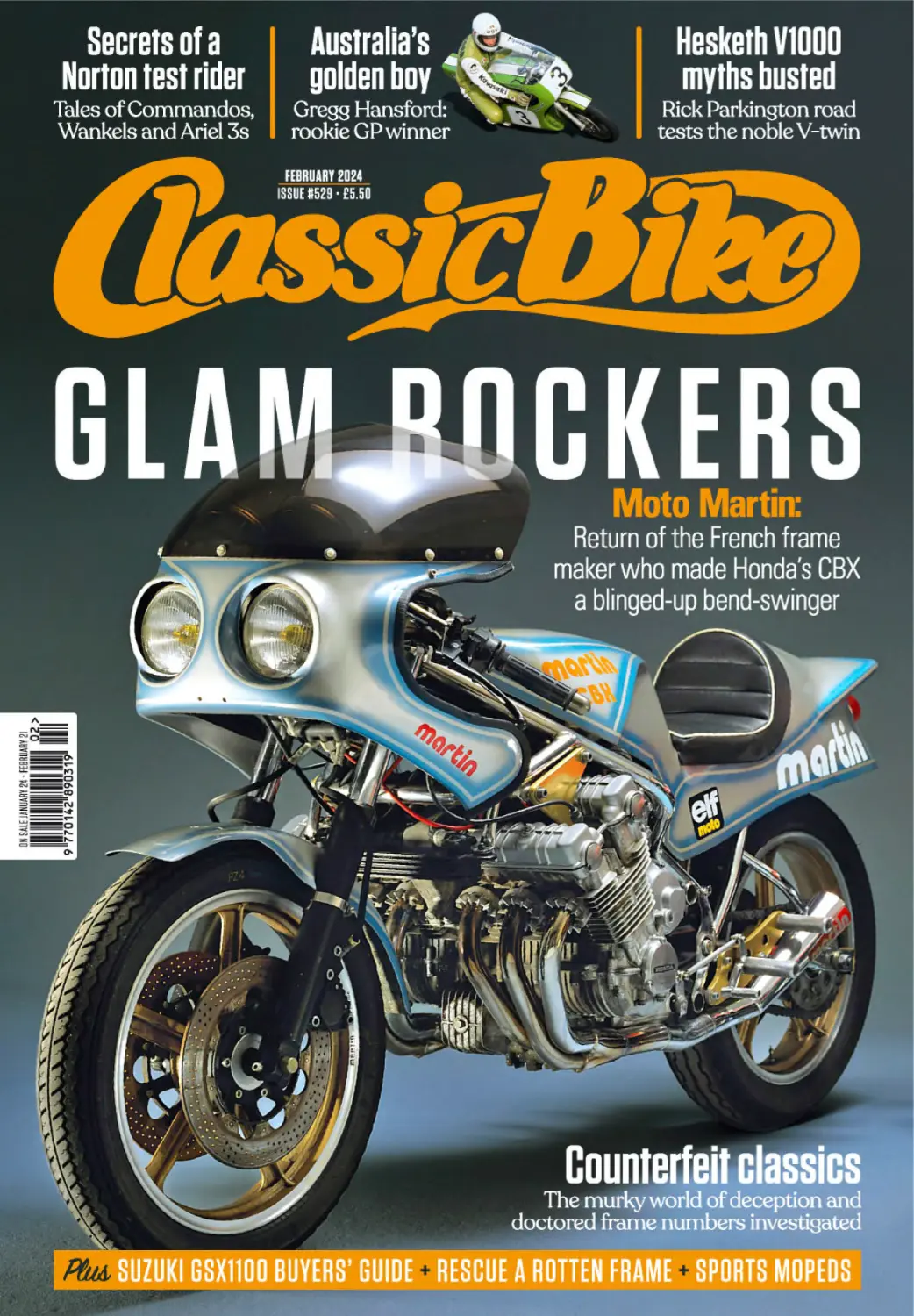
MOTO MARTIN
32
GREGG HANSFORD
40
RICK RIDES... HESKETH V1000
46
54
60
4
IMPERIAL & METRIC FIXES
Troubleshooting problem bikes from
all over the world with Rick and Al
PROJECT BIKE
Rick gets back onto the bodged
frame of a 1914 750cc Bradbury
OUR CLASSICS
Hugo’s New Year’s resolution to fix
his grandad’s old Mobylette moped
Garelli Tiger Cross vs Fantic
Caballero and other tempting bikes
Inspirational Australian star who
burned bright but too briefly in GPs
91
BUYER’S GUIDE: SUZUKI GSX1100
96
AUCTIONS
AT LUNCH WITH... BOB ROWLEY
Rib-tickling tales from the road
tester who made it to Norton’s board
TOTALLY TUNED INTO ARIEL
Callum Ives’ infatuation with the
marque led to him building an HT3
COUNTERFEIT CLASSICS
We investigate the phenomenon of
faking-up classics for ill-gotten gain
SUBSCRI BE
TO C L A S S I C B I K E
See page 66 for
best current offer
BUYING AND SELLING
The French frame-maker’s ’70s
legacy – and return to form
How does this noble steed stand up
as a modern-day classic choice?
BONHAMS
Issue # 5 2 9
How to get the best example of
Suzuki’s big beast that you can
All the latest prices and previews
of bikes to come up for sale soon
The Way We Were
105 INTREPID GRANDPARENTS
A sidecar-racing granny, a Harley
with attitude and a Douglas double.
A L L E N M I L LYA R D
40
14
25
Allen Millyard’s showing his
self-build Honda Six replica,
with this crank in it
Georges Martin
is back on the
frame gang
MOTO REVUE CLASSIC
Surprises in store for Rick
as he rides a Hesketh V1000
GREG MOSS
32
Aussie Gregg Hansford was good enough to
win GPs as a rookie – and beat King Kenny
February 2024
CLASSIC NEWS
WHAT’S ON
YOUR LETTERS
SHOW US YOURS
WORDS: ALAN SEELEY
PHOTOGRAPHY: STUART COLLINS
WINTER CLASSIC SHOW
JANUARY 6-7
Newark Winter Classic Show
With the new year just a few days old, the first major classic show of 2024
was a feast for the eyes and ears of enthusiasts of every era
6
Autojumble trade rs Mike Kemp and Brian
Wood s ready to trans act busin ess with you
Martin Robin son’s 1951 125cc
Lamb retta D Race r. The pre-p roduc tion
scoo ter has every racin g acces sory
7
Garry Wells,
1982 Honda CBX1000C
The Honda CBX Enthusiasts stand certainly
had an impressive array of imposing metal.
Particularly eye-catching was Garry Wells’
slightly modified 1982 Honda CBX1000C.
While some bike owners might buy a scale
model to match their motorcycle, Garry did
things the other way around, the paint for
his CBX being inspired by one of his
models. “You won’t find it on any Honda
colour chart,” says Garry. “It’s actually a
Vauxhall Mokka gold done by Pro Kustom.”
It’s a superb job, alright. The deviations
from standard didn’t end there.
“I made the DIY exhaust header
pipes and matched them to
Delkevic end-cans. The
wheels are CB1100,” he
adds. Garry undertook the
overhaul and rebuild of the
engine himself – no small
undertaking on the 1047cc
six-cylinder mill. He also had
the half-dozen carbs to attend to.
Not only for show, Garry plans to
rack up the miles on the road in 2024.
Simon Freeman, 1964 Francis-Barnett Cruiser 89
Norfolk man Simon Freeman was pleased to discover this 1964 FrancisBarnett Cruiser 89 police bike two years ago, for sale on eBay in Lancashire.
It had served local to him in Norwich in the 1960s. When the bike’s active
service ended, the 249cc Villers 4T twin two-stroke engined machine had
been partially civilianised with a dual seat and standard tank. However
Simon, chairman of the Francis-Barnett Owners Club, decided to convert
it back to full police spec. “I sourced the correct Cossor police radio set from
a friend and modified the standard tank to accommodate it. I made a
three-quarter seat and RK Leighton recovered it. The Craven panniers are of
the original type. I also rebuilt the engine with the help of Villiers Services.
That was all done during the winter of 2022/23. Now the bike is back on
the road and used regularly. Last year, I took it on a tour
of Scotland with other Francis-Barnett owners.”
Roy Collins, 1960 Maserati Rospo 50cc
Now here’s a bike you don’t often see. Indeed, we aren’t sure if we’ve ever
seen one before. ‘Rospo’ is Italian for ‘toad’ – and that extensive front
mudguard does give the Maserati some of the attitude of a crouching
amphibian. Safe to say that owner Roy Collins is something of a Maserati fan
and he had more than one of the exquisite Italians on show at Newark. Just
as we were ogling the details of his tiddler racer, a show official delivered a
sign declaring that it had been awarded ‘Continental 1st’. Deservedly so.
“About three years ago, I went to the Bill Cotton Museum with the intention of
buying another MV,” says Roy. “Then I saw the Rospo there and had to have
it. I can’t take much credit for its restoration, because it was mostly done.
Most of what I had to do was sort out details like rebuilding the shocks.”
8
WINTER CLASSIC SHOW
Karen & Richard Dyson, Triumph T150V & T100SS
Proving that an autojumble is still worth a visit – even in these days of
eBay and online sales – are Richard and Karen Dyson. They had travelled
from Wakefield to Newark and were happy tor unearth a couple of bargains
for Richard’s Triumphs. Karen was doing a sterling job of helping Richard
carry his bounty. “I’m just the packhorse really,” says Karen. “But it’s a day
out and the sun is shining.”
Richard explained what he’d bought and why: “The petrol tank is for my
1973 Trident T150V. The one that’s on the bike still has its original paint and
it’s too good to refinish. So I will repaint this one and fit it to my triple for road
use. It cost me £140. The forks are for a T100SS and cost me £200. I recently
acquired one of the 500cc twins as a basket-case project and the forks were
missing. So it’s been a good day for me.”
Joy Lyon, 1975 Triumph Trident T150V
Being below average height doesn’t mean you can’t enjoy classics. Joy Lyon
is 4ft 11in tall with a 24in inside leg, ruling out a good many motorcycles.
So with husband Jim, she set about creating a lowered Trident, the seat of
which is now four inches lower than stock. “This is my first triple – I had
Harleys before,” says Joy. “Wheels are 17in front and 16in rear and shocks are
shortened Hagons, but most of the height was lost by modifying the subframe
to lower it onto the rear sidecar lug. The subframe is also two inches shorter
and P&P Seating made a smaller seat to suit. The engine has been modified to
take a T160 electric start. That meant a bigger battery under the seat, so the
coils had to be moved. They’re under the fuel tank now, which is from a T120C.
A GPS speedo gets around the issue of a speedo drive for the smaller wheel.”
The Scootering magazine hall was
crammed with serried ranks of scoots,
from classic to custom and performance
WINTER CLASSIC SHOW
What’s next?
February 24-25
Bristol Classic Bike Show
April 20-21
Stafford Classic Bike show
classicbikeshows.co.uk
Peter Knight, 1953 Sunbeam Cossack Special & Dave Wilson, 1951 Sunbeam ‘Reliabeam’ Special
Peter Knight’s 1953 Sunbeam Cossack Special
(left) charts an alternative historical course:
“At the outbreak of World War II, the Germans
gave the Russians the design details of the BMW
R71. By the end of the conflict, the Russians were
building side-valve Boxers under the Ural, Dneiper
and Cossack names. BSA obtained the plans as
war reparations and used the frame design for the
Sunbeam S7. Using the Boxer engine at that time
would have been politically insensitive so my
special recreates what might have been. In 2022
I put a Cossack K750 engine in a basket-case S8.
Mating the Sunbeam gearbox to the Cossack
engine was the tricky bit.”
Dave Wilson’s Reliant-engined special has
been through three owners and it has been in his
possession for a quarter of a century. “I ended up
scrapping much of it and starting again,” he
explains. “It shows what might have been if BSA
had pursued the idea of a four-cylinder Sunbeam
in the 1950s – a few owners have built similar
specials over the years. The frame is four inches
longer than stock to accommodate the 850cc
Reliant engine, and the gearbox is standard
Sunbeam with the clutch modified to join the two
together. I recently fitted an Austin 1100 radiator
to sort the cooling.”
Dave Matravers, 1962 Yoshimura Honda CB77
One from the formative years of the mighty Yoshimura tuning concern.
We failed to catch up with owner Dave on the British Historic Racing Club
stand, but do have the following information. The 305cc twin was built by
Pops Yoshimura himself and raced in Japan before being exported to the US
to promote the brand. Only two are known to exist outside Japan, the other
being in Washington DC. The CB77 features many Honda works parts
including the alloy fairing, tank and seat, as well as the 16,000rpm rev
counter. The frame was braced by Yoshimura, who also modified it for
racing. Sand-cast 29mm race carburettors feed the engine, which features
race cams with roller lifters, a balanced crank, new old stock 1962
crankcases, and a five-speed works gearbox. A Motoplat electronic ignition
supplies the sparks. The brakes are straight out of the Honda race division,
being a four-leading-shoe front and twin-leading-shoe rear. Specialist
restorer Pete Rhodes spent three years recommissioning the bike.
John McLean, 1989 Suzuki RGV250
Owned by the founder of motorcycle road and race workshop McLean
Racing in Corby, this Suzuki RGV250 had been standing outdoors for 18 years
before John bought it in early 2021.
“It quickly became apparent that this would be a big restoration job,”
says John. “I planned to do an OEM resto, then decided to build a bit more of
a special. Over a two-year period, I bought parts as they became available.
By June 2023 there were enough parts to start the project. All work was
done in-house – apart from the paint, which was done by Jim Cross.
“Instead of just doing another Pepsi or Lucky Strike paint job, the livery is
based on my first games console, the 1989 Sega Megadrive. The build was
finished just days before the show.”
10
WORDS JIM MOORE
Proper Superbikes back at
Jim Moore explains how new CRMC eligibility rules will see machines like these racing around Donington again
When they were
kings: World
Superbikes, May
1994 at Donington
Park. The CRMC’s
new Post Classic
Superbike series
will see these bikes
doing battle again
THE SIGHTS AND sounds of WSB’s
glory years will resonate around the
UK’s race tracks again this summer,
when the Classic Racing Motorcycle
Club’s new eligibility rules allow fourcylinder 750cc and twin-cylinder
1000cc superbikes, produced before
January 1, 1995, to compete in the
series for the first time.
That means machines such as Honda
RC30s and RC45s, Kawasaki
ZXR750RRs, Yamaha YZF750SPs,
and Ducati 916s fighting it out in
a new Post Classic Superbike
Championship. It’s set to be a mouthwatering prospect, especially when the
series arrives at Donington Park,
Leicestershire, at the end of July – the
scene of many epic WSB battles during
the ’90s, and the place in 1992 where
future four-time champion Carl Fogarty
took his very first win on a privately
entered Ducati 888.
Welcoming these 140bhp superbikes
into its ranks is a bold step for the
CRMC. Up to now, the club’s eligibility
stretched only as far as pre-’87 bikes
– with early Honda VFR750Fs,
Kawasaki GPX750s, Yamaha FZ750s
and Suzuki GSX-R750s competing
under basic Superstock rules – while
popularity for earlier pre-’73 machinery
still generates strong grids.
“It’s an exciting move for us,” CRMC
Chairman and Post Classic Eligibility
Officer Andy Pike told CB. “Many of
us of a certain age look back at the
1990s as WSB’s golden age, a time
when Superbike racing was more
popular than 500 Grand Prix in certain
countries – particularly the UK. Having
Fogarty in Superbikes helped, obviously,
but so did the bikes. They were based
on production machines that we could
buy at our local dealers and ride to the
tracks, so there was a direct connection
for the fans.”
The CRMC’s revised rules don’t
stop at welcoming a new-look superbike
class for 2024. Supersport machines
from the same period will also be
allowed to compete in newly-formed
400 and 600cc championships. Cue a
tsunami of eligibility forms to the club
Where to see CRMC
Post Classic Superbikes
Pembrey, South Wales, April 6-7
Darley Moor, Derbyshire, May 4-5
Croft, North Yorkshire, June 1-2
Cadwell Park, Lincolnshire, June 29-30
Donington Park, Leics, July 27-28
Oulton Park, Cheshire, Aug 24-26
Anglesey, N Wales, Sept 28-29
Carl Fogarty
Ducati 916
Terry Rymer
Kawasaki ZXR75ORR
Scott Russell
Kawasaki ZXR75ORR
12
Giancarlo Falappa
Ducati 916
CLASSIC WORLD
Donington
from VFR400, ZXR400, FZR400/600,
CBR600, GSX600 and Ducati 750SS
owners eager to take part...
“Progress is vital for the CRMC,”
Andy Pike continues. “These bikes are
now 30-plus years old, so the timing
feels right to welcome them into our
series. But we don’t want it to become
chequebook racing, that’s not what
the CRMC’s about. We don’t allow
tyre warmers or slicks, just treaded
and rain rubber, so riders don’t throw
thousands of pounds’ worth of tyres
at their bikes over a weekend. We’ve
shown our format works, with some
competitors putting in quick times in
Superstock and earlier Superbike classes
without all that. There are plenty of
people out there who can make these
bikes reliable, fast and competitive.
“We’re also hoping that the new
rules will encourage owners of RCs,
Ducatis and period Superbikes who
are not yet in a position to race but
want to ride them, to start parading.
Parading often leads to racing – and
that can only strengthen the class.”
As well as new Superbike and
Supersport championships for 2024,
riders of these now eligible machines
will also be able to enter stand-alone
ACU-backed National level Post Classic
Superbike races at each event. “These
will be open to everything from 250
two-strokes and 400 Supersport
machines, right up to the pre-’95
Superbikes, with prize money on offer
for the top finishers,” confirmed Pike.
• For more information on how to
enter the new series, or details of the
CRMC championship for spectators,
go to crmc.co.uk
Whats’s new
New Bullet fired
Booming Indian bike maker Royal Enfield have
launched a new version of their famous Bullet
model. The new 350 uses the latest sohc digitallymanaged engine, but retains trad looks and 80mpg
economy. It costs £4629 (pinstripes are extra).
Sunbeam Club’s Brooklands bash
The Sunbeam Club (for all pre-1940 machines)
celebrates its centenary with a special event at
Brooklands on March 17. They also want 300
veteran bike riders at their Pioneer Run event on
October 6. Start planning now. sunbeam-mcc.co.uk
Mat’s new book
Classic Bike contributor Mat
Oxley has published a new
book. Racing Hitler is the story
of Eric Fernihough’s quest for he
motorcycle land speed record in
the 1930s. The 128-page, 155 x
215mm hardback costs £24.
matoxley.bigcartel.com
Tour the Lake District
The Westmorland Motor Club’s 2024 three-day tour
of the Lake District, based from Coniston Copper
Mines, is on April 15-17. Speedway legends Barry
Briggs and Eric Boocock are guests. CB took part
last year and had fun. The club’s first classic
scramble is on April 21. premington2@gmail.com
Frank Clarke 1931-2023
Fabrizio Pirovano
Ducati 916
Aaron Slight
Honda RVF750 RC45
Vintage Sprinter and early ‘50s
Ton-up boy Frank Clarke died on
the January 10, aged 92. Ever
cheerful and full of tall tales,
Frank was very popular with the
crowd at Brighton Speed Trial
and Brooklands on his 500cc
Norton JAP – where he was
usually the oldest competitor. Still
racing into his mid-eighties, his
story featured in CB in August 2013.
NEXT MONTH IN
Rick Rides...
A mighty Series A Vincent V-twin
The Saxon Triumph story
Alan Cathcart on a radical racer with
Hinckley three-cylinder power
Harris project is back on the bench
Well, that’s what Alan’s promised
Whatever happened to...
Magazine project bikes revisited
On sale February 21, 2024
13
THIS MONTH... in 2024
Secrets of the six
Allen Millyard’s big reveal at the MCN London Motorcycle Show
will be well worth seeing – a stunning Honda RC174 six recreation
The MCN London Motorcycle Show, to be
held at ExCel on February 16-18, always
makes a great day out. And this year, there’s
something special for fans of classic bikes
– and jaw-dropping engineering. Serial specialbuilder Allen Millyard will be at the show,
unravelling the amazing story of the six-cylinder
Honda RC174 replica he built in 2017.
Having built this amazing machine in his
shed at home, Allen says: “I always loved the
look and sound of Honda’s racing sixes – but
who could ever afford one? The original is
unique – and though George Beale’s replicas
are superb, they’re also out of most people’s
reach. But I went to a classic event at Castle
Combe circuit and got chatting to Guy Martin
about the bikes. He said: ‘Why not build one?’
All the way home, I was thinking about how
I could do it.”
At the Henry Cole ‘Ready to Ride Workshop’
stage, you can find out just how Allen made
his Honda six dream a reality. From hacksawing through two Yamaha FZR250RR
crankcases, barrels and cylinder heads,
machining and assembling a 120° roller-bearing
six-cylinder crankshaft from scratch, fabricating
a six-pipe exhaust system to hand-forming
the aluminium fairing, Allen will reveal all.
“Where possible, I like to use old-school
techniques and equipment to build a bike,”
he says. “You really don’t need tens of thousands
of pounds’ worth of tools and equipment to
build a special machine. I used a Japanese
model-maker’s guide book as a reference for
the build, scaling up a side-on photograph of
the original RC174 six to get all the critical
dimensions spot-on, for example. And the
only job I had to outsource was bending the
T45 tubing for the frame. I fabricated the
frame at home, but the T45 proved too hard
to heat and bend at home, so I cut it all and
specified the radius for each of the bends.”
Allen has run the machine at a handful of
classic bike events including the Prescott Hill
Climb and at the Sammy Miller Museum,
but this is your chance to hear what former
RC174 works rider Jim Redman told Allen
was a sound just like the original, as the team
fire up the bike on each day of the show. Be
warned: it’s loud. Very loud. And magnificent.
If all that isn’t enough, Allen, Henry and
Guy Willison will also be attempting to bring
a Weslake Triumph racer that’s been laid-up
since the ’80s back to life live on stage over
the weekend. And the trio will be sharing
their combined workshop wisdom with visitors
as they go along.
Elsewhere at the show, you can check out
the custom and classic bikes on display at the
Custom and Classic Cafe while enjoying a
brew and a snack, or check out the deals on
riding kit and accessories in the retail zone.
It’s shaping up to be a great weekend and a
visit will certainly get you in the mood for
the coming riding season. Get your tickets at
mcnmotorcycleshow.com
16-18
FEB
More dates
for February
Jan 30-Feb 4 Rétromobile Paris
One of Europe’s biggest classic car
events has always hosted bikes,
but this year has a dedicated Bike
Zone, with modern-bike displays,
an Ace Cafe and classic bikes for
sale. retromobile.com
3 Rufforth Autojumble Rufforth
Park, Rufforth, N Yorks YP23 3QH
The north’s biggest regular
autojumble offers great value to
buyers and sellers. Admission just
£2 and pitches from only £17. Doors
open to the public at 8am.
rufforthautojumble.com
8 Newark Autojumble Newark,
Nottinghamshire NG24 2NY
One of the biggest classic bike and
car jumbles in the Midlands area,
always attracts a good showing of
autojumblers, bikes and bits. Opens
at 10am for general admission (£7),
or 8am with a £10 ‘earlybird’ ticket.
newarkautojumble.co.uk
10/11 Classic Dirt Bike Show
Telford International Centre,
Shropshire TF3 4GH
A must-do event for anyone
interested in classic off road sport.
The outside autojumble opens at
9am and the halls at 10am.
classicdirtbikeshow.co.uk
11 Bideford Classic Motorcycle
Show Bideford Pannier Market,
Devon, EX39 2DR
Entering a bike (20-years-old or
over) in this new event costs £5 (in
advance only) and it’s only a quid
for visitors to get in. Trade and
autojumble stands and a trophy
plus £100 cash for best bike in show.
bidefordbikeshow.org
24/25 Bristol Classic Motorcycle
Show Royal Bath and West
Showground, Somerset, BA4 6QN
The first big show of the season is
always worth a visit. Hundreds of
classic bikes on display, plus club
displays, a huge autojumble, plenty
of trade stands and a classic bike
auction staged by Dore & Rees.
bristolclassicbikeshow.com
25 Huddersfield Autojumble, Old
Market Building, Huddersfield,
West Yorkshire. HD1 1RG
All-indoor jumble opens at 9am.
phoenixfairs.jimdofree.com
Allen Millyard and his
amazing shed-built
six will be at the show
W O R D S : G E Z K A N E P H O T O G R A P H Y : A L L E N M I L LYA R D
14
Suzuki stroker marathon man
FURTHER TO YOUR plea for contact from the Suzuki
Owners Club members who rode three-cylinder two-strokes
around the coast of mainland Britain to win the 1974
Maudes Trophy (page 64, January issue), I write to say my
brother Roy Bedson and I participated in that event. I am
71 now and was 22 at the time, but it feels like yesterday!
We were both members of the Manchester branch of the
SOC. The club was only formed about a year before this
by a vicar in Manchester called Tony Lloyd who ran a youth
club in a church hall in the ’60s that
morphed into a bike club. Other bike
clubs started using the premises on
different nights, and when Tony
bought a Suzuki GT750, he formed
a club to take up a spare night. Very
quickly a London branch was formed
and others followed.
Tony then thought up the whole
Maudes Trophy idea, as he had seen
BMW win it the year before by riding
some of their twins round and round
the Isle of Man TT circuit. He sold
the idea to Suzuki GB as a publicity
stunt to launch the second generation
of two-stroke triples – 380, 550 and
750cc. He set up an office at the
premises of Sports Motorcycles Ltd
in Manchester (later to become the
Mike Hailwood comeback TT-win
people) and meticulously planned the
bid. Riders were SOC volunteers from
Manchester and London, with some Suzuki GB employees
and some others from the motorcycle trade. Suzuki GB
bought a Range Rover to stay with the bikes for back-up
and rented three Bedford Bedouin camper vans to ferry the
teams of riders around the country to the various checkpoints.
Everybody gathered the night before the start at Suzuki
GB’s HQ in Croydon and the following morning the whole
convoy set off for Beamish Motorcycles in Brighton for the
start. The first team rode off west along the coast while
the two others were driven off in
different directions to their appointed
change-over points (which were all
Suzuki dealerships).
It was a crazy couple of weeks. It
was November, so the weather was
horrendous – and the motorway
network wasn’t as good as it is now.
A couple of riders fell off, but no
damage was done to the bikes and
they cruised around for two weeks
quite comfortably. There were all
kinds of japes and adventurers along
the way, but far too many to list here
– it was actually quite sad to finish
at Beamish Motors on December 5.
At first, the ACU wouldn’t accept
it as a winning bid for the trophy
– ‘not sufficient merit’, they said. But
after an appeal, we were declared
winners before Christmas.
John Bedson
JOHN BEDSON
Above: The Suzuki
Maudes Trophy
Team outside Suzuki
GB’s HQ in Croydon.
John is the tall guy
with long black hair
and black trousers
standing right
behind the front
wheel of the GT750.
Are you in this
photograph too?
Left: How Suzuki
celebrated the
achievement in
the press in 1974
SEND YOUR
LETTERS TO
letters@
classicbike.co.uk
17
YOUR LETTERS
CLASSIC BIKE IS MADE BY...
Editor Hugo Wilson,
hugo.wilson@classicbike.co.uk
Art Director Austin Smith,
austin.smith@classicbike.co.uk
Production Editor Mark Holmes,
mark.holmes@classicbike.co.uk
Technical Editor Rick Parkington,
workshop@classicbike.co.uk
Editorial Assistant Alison Silcox,
alison.silcox@classicbike.co.uk
Group Art Director, Motorcycling Steve
Herbert, steve.herbert@bauermedia.co.uk
Cover image Richard Adams
ADVERTISING
HERMAN TOLLENAAR
Group Commercial Director
Gareth Ashman 01733 468118
Commercial Manager
Sarah Dodd 01733 366311
Account Manager
Rebecca Jackson 01733 395071 rebecca.jackson@b auermedia.co.uk
Senior Telesales Executive
Sarah Frisby 01733 979425
sarah.frisby@bauermedia.co.uk
Senior Sales Executive
Annie Mulcrone 01733 979445
annie.mulcrone@bauermedia.co.uk
Telesales Exec Sarah Frisby 01733 366406
SUITS
Publisher Rachael Beesley
Group editor Andy Calton
MD Automotive Group Niall Clarkson
Chief Financial Officer Bauer Magazine Media
Lisa Hayden
CEO of Bauer Publishing UK Chris Duncan
COMPLAINTS
H Bauer Publishing is a member of the
Independent Press Standards Organisation
(www.ipso.co.uk) and endeavours to respond
to and resolve your concerns quickly. Our
Editorial Complaints Policy (including full details
of how to contact us about editorial complaints
and IPSO’s contact details) can be found at
www.bauermediacomplaints.co.uk
BORING BUT IMPORTANT
H Bauer Publishing is a company registered
in England and Wales with company
number: LP003328, registered address:
The Lantern, 75 Hampstead Road,
London NW1 2PL. VAT number 918 5617 01
No part of the magazine may be reproduced in any form in
whole or in part, without the prior permission of H Bauer
Publishing. All material published remains the copyright of H
Bauer Publishing and we reserve the right to copy or edit any
material submitted to the magazine without further consent.
The submission of material (manuscripts or images etc) to H
Bauer Publishing, whether unsolicited or requested, is taken
as permission to publish that material in the magazine, on the
associated website, any apps or social media pages affiliated
to the magazine, and any editions of the magazine published
by our licensees elsewhere in the world.
By submitting any material to us you are confirming that
the material is your own original work or that you have permission
from the copyright owner to use the material and to authorise
Bauer to use it as described in this paragraph. You also promise
that you have permission from anyone featured or referred to
in the submitted material to it being used by H Bauer Publishing.
If H Bauer Publishing receives a claim from a copyright owner
or a person featured in any material you have sent us, we will
inform that person that you have granted us permission to use
the relevant material and you will be responsible for paying
any amounts due to the copyright owner or featured person
and/or for reimbursing H Bauer Publishing for any losses it has
suffered as a result. Please note, we accept no responsibility
for unsolicited material which is lost or damaged in the post
and we do not promise that we will be able to return any
material. Finally, whilst we try to ensure accuracy of your material
when we publish it, we cannot promise to do so. We do not
accept any responsibility for any loss or damage, however
caused, resulting from use of the material.
US INFO
• Classic Bike, ISSN 0142-890X (USPS 706770)
is published monthly by H Bauer Publishing Ltd,
The Lantern, 75 Hampstead Road, London
NW1 2PL, United Kingdom.
• The US annual subscription price is $89.51.
Airfreight and mailing in the USA by agent named
World Container Inc, 150-15, 183rd Street, Jamaica,
NY 11413, USA.
• Periodicals postage paid at Brooklyn, NY 11256.
• US Postmaster: Send address changes to Classic
Bike, World Container Inc, 150-15, 183rd Street,
Jamaica, NY 11413, USA.
• Subscription records are maintained at Bauer
Media, Subscriptions, CDS Global, Tower House,
Sovereign Park, Lathkill Street, Market Harborough,
Leicester LE16 9EF, United Kingdom.
• Air Business Ltd is acting as our mailing agent.
How Dave Hill managed to ride his special Sei in silver platform boots, we really can’t imagine...
Slade by a Sei
Nice article about the Benelli Sei
(CB January 2024). While on
holiday in Australia in 2018, we
visited the motorcycle and antique
museum in Peterborough. They have
a special Benelli Sei on display (see
photo above). The paintwork has a
real ’70s vibe, which shouldn’t be a
surprise, as it was done for
Dave Hill, the guitarist of Slade!
Herman Tollenaar
The RD they come
I can quite imagine how “the jump
in performance” from an RD250 to
an RD400 opened David
Shuttleworth’s eyes back in the day
(page 88, CB January). Imagine how
my doors of perception were flung
wide open when, in the summer of
’76, I passed my test on a Fizzy
modified and re-registered as a
motorcycle (GMX 96N) days after
my 17th birthday, then took delivery
of a new RD400C. It had the the
very flash alloys, and was the first of
several 400s (and later LCs) for me.
Before my Fizzy, I had a D1 Bantam
field bike, so I’m from that
generation that is cool with both
left- and right-foot shifts. I’ve lost
count of the bikes I’ve had between
then and now, but that 400 will
forever be seared in my memory
– when I sit on one today,
immediately I’m 17 again!
Mike Diboll, West Sussex
SUBSCRIPTION QUERIES
To contact us about subscription orders, renewals,
missing issues or any other subscription queries,
please email: bauer@subscription.co.uk or call our
UK number on 01858 438884 for overseas call
+44 1858 438884. To manage your account online
visit www.greatmagazines.co.uk/solo
BACK ISSUES
Turbo Visor tales
Regarding Mick Green’s letter on the Turbo
Visor in the January issue. I had one of these for
a short while. Mine was not a great success – noisy as
hell at anything over 30mph. It also had a pronounced
gyroscopic effect when spinning, so it was difficult to
do anything except keep your head facing forward
whilst riding. Did cause a few comments down the
bike club, though (mostly unprintable).
1
Chris Lawrence
I also bought a Turbo Visor – a seemingly
useful gadget at the time. Yes, the whirring
plastic shield did spin off rain – but at anything over
30mph the spinner set up a massive vibration in the
helmet and the noise in your ears was like being
inside a washing machine. Luckily, my bikes at the
time didn’t do 80mph. In fact, at 80mph neither my
neck muscles nor my eardrums would have been up
to it. Good principle, just not practical.
2
Andrew Edwards
Mike Green, you were not alone. I too had a
Turbo Visor, putting it to good use on miserable
wet rides on my Matchless G2 back in the day. Had
it not looked so geeky, it may well have taken off
– much as yours did!
3
Peter Skinner
In the ’60s, one of my
mates, Dickie Finch
(sadly no longer with us),
would often ride with an
untipped Woodbine,
happily smoking away.
Then he bought one of
the first Turbo Visors.
The first time he used it,
he lit up his Woodbine as
usual and set off on his
trusty Twenty-One. You can
imagine the outcome – it was
hilarious. I can still picture it
today and it still makes me laugh
out loud.
4
Andrew Holtom
Back Issues. To order back issues in the UK,
call 01858 438884. Overseas: +44 1858 438884
Syndication: syndication@bauermedia.co.uk
JASON CRITCHELL
18
Send your letters to: letters@classicbike.co.uk
Auctioneers & Valuers
1918 Indian Powerplus £30,000-35,000
Part of a Collection of Motorcycles already consigned for the March auction
Classic & Vintage
Motorcycle Auction
Wednesday 27th March
At the prestigious Haynes Motor Museum
Contact George Beale 07808 159149 and the Team at
Charterhouse or email images to
bikes@charterhouse-auction.com
for a free auction valuation
Nationwide Collection Service Available
The Long Street Salerooms Sherborne DT9 3BS
01935 812277 ï www.charterhouse-auction.com
Show us yours
We love to see your acquisitions, regular rides and projects – keep ’em coming to the address on the right
Moto Guzzi Eldorado
This is my 1973 Moto Guzzi Eldorado. I found her
in a barn in 2010, where she had been in storage,
covered with pigeon droppings and mouse dung.
After a quick clean-up and a riding season, just
low beam. The motor has never been apart and
runs like the proverbial sewing machine! Over the
years, I’ve owned three Triumphs, a Norton and
two /5 Beemers – all great machines, but this is
by far the best machine I have ever owned!
Al Zinn, Ohio, USA
Restored
ALZINN
Al found his Eldorado in a barn,
covered with animal droppings.
Now it’s drop-dead gorgeous
to check it out for any running issues, we pulled
off the metalware and painted everything. The
only mods were European Norton Commando
’bars, a 1973 Yamaha light/horn/turn signal switch
to replace the unreliable Italian CEV ones, and a
Greg Bender digital relay kit for starter and high/
Suzuki RL250
Project
CHRIS W??????????
Certainly, a love/hate relationship at
times, but at others, a welcome
distraction from the rigours of day-to-day
life! Here’s my 1981 Suzuki RL250
Beamish, which steadfastly refused to
run properly – thank you, Mr Previous
Owner! – before undergoing an engine
strip and rebuild. Thankfully, we have an
excellent owners’ club, combined with
good parts availability (the TS250
association helps), making ownership of
these bikes rewarding and immersive.
Chris W, Newport
RL 250 Beamish’s poor
running led to an engine
strip and rebuild
20
SEND YOUR PHOTOS TO: LET TERS@CLASSICBIKE.CO.UK
SEND YOUR PHOTOS TO
Above: John turned
a loosely boltedup bunch of bits
(inset) into this
purposeful G80CS
lookalike
Restored
Matchless G3
I bought this 1954 Matchless G3 in 2020
as a lockdown project,as I had enjoyed an
identical bike 50 years previously, when
I was 19 years old. It was definitely a
‘heart rather than head’ purchase, as the
seller described it as ‘basically a
collection of parts loosely bolted together’
– and he wasn’t wrong .
I decided to make it a rolling restoration
so I could get the enjoyment of riding it
rather than get bogged down spending
hours trying to achieve a show pony. The
vision was to build a G80CS lookalike with
the emphasis on weight saving, removing
as many unnecessary bits as possible.
The bike came with a 500 top end, so
after a rebore a high-comp piston was
fitted, along with a 32mm Concentric.
I used a G2 inlet rocker to give more lift
and timed the inlet cam to the 350 setting
– this makes for a decent amount of grunt
for B-road fun. The left-hand oil tank is a
Geraint looked before he
leapt into buying this Corgi,
a development of the WWII
paratroopers’ Welbike
modified CB750 item, as the AMC
competition tanks are like hen’s teeth and
priced to match. The project proved to be
the usual rollercoaster of highs and lows
– but I was spurred on by AMOC
members, who provided invaluable
technical support via the forum and in
person, including hand drawn diagrams
and parts donated FOC. Three years on,
I’m pleased with the result – it’s pretty
close to how I visualised it.
John Saunders
Corgi Brockhouse
For something different, here is my 1951
Brockhouse Corgi MK2 . After looking for
some time, I finally purchased one in 2019
from a chap whose father bought it for
him many years ago when he was a
young lad to have fun on. All that fun did
however leave the little thing in a sorry
state . I did a total rebuild which for such
a small bike did present some challenges
as spares are extremely scarce .With a
single gear and top speed of about 30
mph with no suspension, tiny wheels and
small sprung seat the ride certainly is
different to say the least but hugely
enjoyable and makes me smile every time
I ride it along with any passers by that
see you . Even though the utilitarian Corgi
wasn’t made for that many years there is
a small but enthusiastic following of
these little bikes today.
Geraint Miles, Tebury
GERAINT MILES
Restored
JOHN SAUNDERS
letters@classicbike.co.uk
SEND YOUR PHOTOS TO: LET TERS@CLASSICBIKE.CO.UK
21
2024 Date for
Bike4Life to be
announced soon
For the latest
updates visit:
bike4lifefest.com
LEDBURY
01531 631122
www.hjpugh.com
HAZLE MEADOWS AUCTION CENTRE, LEDBURY, HR8 2LP
16th and 17th February 2024
2 DAY SALE OF OVER 200 VINTAGE AND
CLASSIC MOTORYCLES, PROJECTS AND
BRITISH MOTORCYCLE SPARES
Also to include the Robert Turner collection which includes a large quantity of NOS Norton Commando spares and Norton motorcycles
ACCEPTING ENTRIES NOW
Transport and storage can be arranged for whole collections. No storage fees.
Our auctions are - Live and Online - Over 85% sale success rate, International buyers – Nationwide collection
service available. And a stunning new auction centre that can hold up to 300 motorcycles.
Call us on 01531 631122 or Email h.biss@hjpugh.com www.hjpugh.com
NEW Free Catalogue subscription and email sale notification service.
If you have a single item or whole collection to sell, please contact us.
FREE ON SITE PRE SALE ADVICE AVAILABLE. SINGLE ITEMS AND WHOLE COLLECTIONS UNDERTAKEN.
ALL ENQUIRES TREATED IN CONFIDENCE. www.hjpugh.com
Moto Martin epitomised the golden era of European special frame
makers, creating café racers that were very much of their time –
although the man behind them is now recreating them once more…
Caldwell Smythe of Cobra
Road & Racing Ltd, London,
perfectly co-ordinated with
a Moto Martin Suzuki Viper
Words ALAN CATHCART | Photography BAUER AUTOMOTIVE & MOTO REVUE CLASSIC
25
hen Moto Martin burst on the
scene as the new creator of café
racer cool, it tapped into the vibe
of the early ’70s perfectly. The
nascent era of glam rock had
already spawned the likes of David
Bowie and T Rex, along with other
outrageous and lurid characters
– and the motorcycle world was
undergoing a similarly seismic change. Just as pop was
going through a major image revamp while embracing ever
more excessive amplification power, the bike world was
also trying to deal with the monster bhp churned out by
the new generation of Japanese four-cylinder superbikes.
Starting a business producing café racers and frame kits in
1972 couldn’t have been more timely.
Having swapped his Velocette Thruxton for a Honda
CB750 in 1969, Frenchman Georges Martin was familiar
with the high-performance Japanese four-cylinder
phenomenon – but reckoned his bike’s handling left a lot
to be desired. That was a pattern which repeated itself as
more superbikes emerged from the far east – and
Martin seized the chance to address the issue.
His company ended up building a total of
5800 complete hand-crafted Moto Martin
café racers and frame kits between 1972-86,
nearly all of which were designed around
four-cylinder Japanese engines.
Born in Nantes, in the Vendée region of
western France, Georges Martin had moved
to Paris to study at engineering school, then
found work there as a draughtsman for an
elevator company. A dedicated biker, he realised
that handling was a common complaint amongst
CB750 owners – so Georges gave up his job and
moved into a small workshop near the Bastille, where he
worked on building a new chassis for the Honda engine by
day and slept there by night.
His twin-shock design in 25CD4S chrome-moly steel,
offered with racing-style full fairing bodywork, was closely
based on the recently announced Egli-Honda spine frame
W
Georges Martin with an example of his
original style of frame, closely based on the
Egli-Honda spine design, with central tubular
backbone acting as an engine oil tank
26
Left: Open-cradle
spaceframe design
with cantilever
monoshock rear end
introduced in 1974
went on to become
the trademark
Moto Martin chassis
design. This used the central tubular backbone as an oil
tank for the dry-sump Honda motor – and when he displayed
it in February 1972 at France’s annual Salon de Compétition,
offering replicas of his so-called Bol d’Or design at a much
lower price than the costly Swiss frame kit, Martin was
inundated with orders.
Delivering improved handling, plus a weight saving of
around 40kg, the venture’s commercial success
intensified. A move to a bigger workshop was
the obvious next step, so in 1973 Georges
Martin established a Moto Martin factory
in the French seaside town of Les Sablesd'Olonne, near Nantes, where he also opened
a Kawasaki dealership. The 900cc Z1 had
just been launched, with even more engine
performance than the Honda, but even
worse handling problems. So the Moto
Martin chassis range was expanded with kits
for this engine, too, as well as the H2R twostroke triple and Suzuki’s GT750.
The more substantial architecture of the wet-sump
Kawasaki Z1 motor meant it wasn’t suited to his Honda
spine-frame format, so in 1974 Martin introduced a new
open-cradle spaceframe design with cantilever monoshock
rear end, also in chrome-moly steel. This became the trademark
Moto Martin chassis layout for the next decade, housing
initially only the Kawasaki Z900 and later Z1000 motors,
Above: Moto Martin
made frame and body
kits for many of the
Japanese four-cylinder
machines including
the Suzuki GSX1100
Left: More substantial
architecture of the
wet-sump Kawasaki Z1
motor meant it wasn’t
suited to Martin’s
Honda spine-frame
form, hence his move
to space frames
27
but in time adapted to accommodate a wide variety of other
engines. Fitted with Martin’s own design of forks and cast
aluminium wheels manufactured for him by Betor and JPX
respectively, this maze of relatively small-diameter thin-wall
tubing was invariably nickel-plated. The distinctive café
racer body kit that often accompanied it, complete with a
spoiler in the seat unit, became a Moto Martin trademark.
These kit bikes were very much in the spirit of racers with
lights, as Georges Martin himself explained in an interview
published in 1979.
“Our customers are looking for a certain kind of technical
design which isn’t necessarily the most effective format, but
is certainly the most original, and striking,” he said. “Moto
Martin doesn’t claim to construct the best bikes in the
world. So the open spaceframe design we make for Kawasakis
and Suzukis is better than the originals, but is less stiff a
structure than our Bol d’Or chassis for the Honda, which
uses the engine as a full load-bearing structure – but our
customers prefer our spaceframe design to this one, because
they think it looks better.
‘DISTINCTIVE CAFÉ RACER
BODY KITS WITH SPOILERS
BECAME A TRADEMARK’
“This means we must always pay careful attention to the
technical solutions we employ in our designs, taking care
to evaluate each component on the basis of three criteria.
One: It must give the impression of coming from the racetrack,
since that’s what our customers want. Two: It must be simple
to manufacture, because that in turn guarantees reliability.
And three: You must always keep the price to the customer
in the back of your mind, because whatever we produce
must be affordable.
“I know myself what it means to be a biker, and to have
to count your pennies to go riding. If you don’t pay attention
to costs, you’ll lose the customer – the dream we’re selling
must be within people’s reach.” So Moto Martins were
always favourably priced, especially compared to Bimota,
which had a comparable range.
28
Above:It’s tha man
Caldwell Smythe again
(right) outside The
Cobra road & Racing
shop in London
This is the CBX pictured on our
cover this month. In 1983 a
shorter-wheelbase version of
the space frame was offered,
with a 50mm shorter wheelbase
and sharper handling, thanks to
a steeper head angle and
tighter steering geometry
The ultimate Moto Martin
The most audacious of the
French frame maker’s kits was
designed to house the mighty
six-cylinder engine from Honda’s
CBX1000. In the early 1980s
Moto Martin chassis were
imported into the UK by Cobra
Road and Racing of Kentish Town
in North London (see far left) ,
who put together a
‘demonstrator’ that was tested
by Motorcycle News and Bike
magazine that year.
In MCN’s September 3 issue,
the Martin-framed bike – with a
standard engine, but minus
airbox and with a barely baffled
six-into-two exhaust system –
clocked 142.9mph, with a
standing quarter-mile time of
11.8sec. By contrast, Bike had
tested the standard Honda at
135.13 and 11.93sec. Neither
magazine published weights for
the Martin, but MCN reckoned
that ‘it weighs nearly 100lb less
than the standard Honda’; that’s
a useful saving, but it means that
the French special still busts the
scales at around 500lb (226kg).
On the same page of MCN as
the test, Honda dealer Rye’s of
Fulham were offering new Honda
sixes at £1999, while Cobra
wanted £4200 for the Moto
Martin version. Alternatively,
they’d sell you a compete
chassis kit for £1900, or you could
give them your donor bike and
they’d do the conversion for
£2200. At the time, the average
weekly wage for men over 21
was just over £100, so there can’t
have been many takers.
Bike tested the same machine,
now maybe getting a little tired,
in their February 1981 issue,
concluding: ‘The Martin CBX
looks like some kind of re-entry
capsule when it’s standing still,
and like a predatory robot when
its rolling. Its owner will enjoy
performance, handling and
status, along with the undivided
attention of bike freaks and the
Old Bill.’
One of the images in the
Classic Bike archive reveals the
test bike’s registration number,
but the DVLA website says that it
was last taxed in September
1983. So what happened to it?
SPECIFICATIONS
Moto Martin CBX1000 (std Honda CBX in brackets)
Engine
1047cc dohc, 24-valve air-cooled six cylinder
Power output
105bhp
Weight
490lb/222kg est (572lb/259kg)
Wheelbase
57in/1447mm (62in/1574mm)
Top speed
142.9mph (135.13mph)
Standing ¼ mile 11.8sec (11.93sec)
Right: The chromemoly steel space frame
wraps neatly around
the Honda six engine
Left: The CBX with
Uniflex rear suspension
and progressive-rate
link was later available
29
Martin’s Euro rivals
Egli, Switzerland
Fritz Egli won the 1968 Swiss hillclimb
championship using a Vincent twin housed in a
home-made frame. His design featured a
large-diameter top tube to provide rigidity, which
became an Egli trademark. Chassis for Japanese
fours quickly followed, and were used by the
French Godier/Genoud Kawasaki team to win the
FIM Endurance Championship in 1972. Egli sold the
business in 2015, though remained involved. Sadly,
the owners ceased trading in 2023 and have put
the business into liquidation.
Egli Honda CBX Turbo
Segale, Italy
Motorcycle dealership based at Vigevano, near
Milan that made chassis in the 1980s and ’90s.
Their usual format used aluminium sideplates to
mount the rear of the engine and swingarm pivot,
mated to a lightweight tubular upper member and
headstock. Later they also featured magnesium
single-sided swingarms. Using four-cylinder Honda
engines, they won Italy’s F1 and endurance
championships, but customer bikes also featured
Kawasaki and Suzuki engines. Limited models with
Honda Dominator engines were also produced.
Nico Bakker, Netherlands
Made monoshock frames for TZ250 and TZ350
Yamahas in the 1970s, before developing chassis
for Suzuki RG500s and Japanese fours, and
developing the hub-steered QCS design. Bakker
are still in the frame-making business, making
chassis for everything from Kreidler 50cc racers to
classic endurance machines and modern specials.
bakkerframes.com
30
That philosophy worked just fine – by 1979, Moto Martin
production had continued to expand, and in autumn that
year, the company moved into a new 1000 square-metre
factory in Les Sables d’Olonne. By 1983, a workforce of
35 was producing more than 600 complete bikes and frame
kits per year. Frames were now being built to house the
Kawasaki Z1000J, Honda CB900FZ, Suzuki GS1000 and
Yamaha XS1100 motors (the latter after conversion to
chain final drive). The Honda version of the chassis now
featured a twin-loop format, rather than the open cradle
of the other designs.
“Our Martin frame designs derived from both marketing
and race-related considerations,” explains Martin. “The
spine frame is very easy to build, and it’s rigid and light,
but the cylinder head is difficult to access. The open-cradle
space frame is good-looking but heavy, and easily damaged
in case of a crash. The twin-loop frame was firstly designed
for the racetrack, just as other frame manufacturers did at
this time, because it turned out to be the best design in terms
of handling stability and engine accessibility.”
In 1980, the first examples of Moto Martin’s CBX Six
were delivered – the most iconic of all the company’s
products. Uniflex rear suspension with a progressive-rate
link was now available, and the use of Brembo Serie d’Oro
brakes, Marvic wheels and Marzocchi forks became
standardised, with the rear monoshock invariably a Frenchmade de Carbon. In 1983 a shorter-wheelbase version of
the space frame was offered, with a 50mm shorter 1450mm
wheelbase and sharper handling thanks to a steeper 25º
head angle, plus tighter steering geometry via a reduced
105mm of trail – Moto Martin had its own triple clamps
cast to achieve this.
With production of his existing designs peaking, Georges
Martin explored building frames for Laverda twins and
triples, as well as a Triumph triple design closely derived
Above: Moto Martin
Suzuki GSX1100
Nava Replica being
tested by Roland
Brown for Bike in
January 1983
Below: 1986
Moto Martin with
aluminium beam
frame. Engines
specified for
the bike were
Honda 1100F, Suzuki
GSX1100, Suzuki
GSX-R750/1100,
Yamaha FJ1100 and
Kawasai GPz1100
‘OUR MARTIN FRAME
DESIGNS DERIVED FROM
BOTH MARKETING AND RACERELATED CONSIDERATIONS’
Left: More than
three decades after
his firm stopped
making bikes,
Georges Martin is
back up to his old
tube-bending tricks
from the Rob North chassis. Moto Martin frames were
also variously built to house a Ducati 860cc V-twin, a Benelli
Sei and even a BMW K100 engine.
The appearance at the end of 1983 of the Honda VF1000,
complete with square-section frame tubing, followed a year
later by the Suzuki GSX-R750 with its aluminium chassis,
signalled that the Japanese manufacturers had finally learnt
how to build a light, good-handling chassis – and in massproduced volume. It sent sales of Martin products plummeting,
and in 1986 the company switched to four wheels, creating
French-made copies of the Lotus Seven, and later the AC
Cobra and Ford GT40.
Now, 35 years on, in his retirement years, Georges Martin
has returned to the motorcycle world by establishing GMP/
Georges Martin Production (martin-caferacer.com) to provide
spare parts for all Moto Martin models, as well as a range
of retro accessories. He’s also created the Moto Martin Club
(motomartin.com) for owners of the bikes he had a hand in
making personally. He’s even picked up the welding torch
again, in order to make a handful of new examples of his
traditional designs for Classic Endurance racing, powered
by the RSC1000 Honda and Kawasaki Z1000 motors. Who
said Moto Martin was a thing of the past!
31
Australia’s
Golden Boy
Gregg Hansford was a rising star in ’70s
GP racing, taking 10 wins in two seasons.
His sheer ability and Sheene-like charm
inspired a whole generation of super-fast
motorcycle racers from Down Under
PAUL BOLAND
Words DON COX
32
33
GREGG HANSFORD
t the age of 25, Gregg Hansford
was on the cusp of taking his
fourth Australian Unlimited
Championship in five years.
Speculation was rife in the
second half of 1977 that he
would move up to the world
championships the following
year. He had impressed so much
on flying visits to the USA and
Europe that Chris Carter, the editor of top-flight bike racing
annual Motocourse, rated him number five in the world in
the 1977-78 edition – before he’d even started a GP.
Looking at his results, that’s no surprise. In September
1977 he won both races at the Canadian World Formula
750 round, was on the podium twice in the USA round at
Laguna Seca, and out-foxed Gary Nixon to win the US 250
championship round at the same venue. Aussie fans figured
he was a world champ in waiting. But it wasn’t to be.
Hansford on a Yamaha
at round five of the 1973
Australian Grand Prix at
Lakeside in Queensland.
Racing TZ250s and
350s provided by
Annand and Thompson,
he won four events and
broke a class lap record
An Australian childhood in the dirt
As a kid, Hansford spent his time racing off-road – both
dirt-track and motocross – and was prone to skiving off
school and heading for the beach or dirt tracks. Eventually
the Yamaha distributor in Queensland spotted the young
Hansford’s talent and hired him – both as a racer and a
mechanic to prepare his race bikes. Gregg went on to win
his first national championship in 1974, aged 21.
The editor of Australia’s leading motorcycle newspaper,
Jeff Collerton, reckoned the press needed to build up
personalities to promote the sport – and Hansford was
tailor-made for the role. Sponsors loved him. He was different:
laid-back yet super-determined; broad shouldered yet
34
Below: Dicing through
the streets of Wanganui
in New Zealand with
Suzuki’s Pat Hennen in
1975 in the ’75/’76
Marlboro Series. Run
over the Christmas/New
Year period, Hennen
won the seires overall
BRIER THOMAS
JEFF COLLERTON
‘He took seven GP wins in his first year. No Australian
before or since has won a GP in their rookie season’
Hansford attends to a tandem-twin Kawasaki KR250 in his awning during April 1978
35
GREGG HANSFORD
P LISTER
Left: At Daytona in 1980,
where he competed in
the 250cc race as well
as on a superbike
A move to the other side of the world
Gregg’s GP career started perfectly, with a victory in his
first race. At Spain’s 250 GP in 1978 he beat Kenny Roberts,
after both riders missed a day’s official practice – they spent
it arguing with officials who didn’t want to let them race
due to a perceived lack of experience! Hansford then had
stunning rides in the Brands Hatch F750 title round on a
KR750. In the first race he crashed on lap two, restarted last
and battled back to come fourth, just 20 seconds behind
winner Kenny Roberts. One reporter described Hansford’s
bike as ‘virtually obsolete’ and its rider as ‘the new Hailwood’.
Gregg then rattled off a Grand Prix 250/350cc double at
Nogaro in France – the first of three Hansford doubles that
year. In total, he took seven GP victories in a rookie season
as well as an F750 championship race win at Assen. But no
championship – he was second to fellow Kawasaki rider
Kork Ballington in 250GPs, and third in the 350s. No
Australian before or since has won a GP in their rookie
season. Ballington later admitted that he had to ride at a
level he previously did not know existed to beat Hansford.
Suzuki GB took note, dispatching Martyn Ogborne to
Brisbane in the off-season in a bid to sign Hansford to race
500s; Suzuki was trying to replace the injured Pat Hennen.
36
Right: Here in action at
Mallory Park, Hansford
stuck with Kawasaki
despite being offered
the chance of a move to
Suzuki as replacement
for Pat Hennen in 500s
KJB
BAUER AUTOMOTIVE
with a high-pitched voice; down to earth yet coming from
a wealthy family (his father Harry owned stores in Brisbane,
though sadly died when Gregg was 13).
In 1974, the new Yamaha TZ750 arrived and Hansford
did battle with fellow 21-year-old Warren Willing in the
Australian Unlimited Grand Prix at the country’s premier
circuit, Bathurst. The race went down to the last corner,
where Willing pipped Hansford. Australian race fans were
spellbound by the duo’s scrapping for the next three years.
Their friendly rivalry took on a new dimension when
Hansford went to Team Kawasaki Australia in 1975 and
then went head-to-head with Pat Hennen in the New Zealand
International Series and the Australia TT. Hansford won
races, but Hennen took the series. Still, it was clear that a
talent of Hansford’s magnitude should be racing in GPs.
What they said
From those who knew and raced against him
Jeremy Burgess
‘He should have won a
world title and would
have been dynamite
on a Yamaha 500
if he’d had one’
The multi-title winning crew chief says: “I rode in
the same races as Gregg, but cannot say I raced
him! He beat me in the South Australian 500 title
when he was on a 350 and I was on my RG500.
A lovely guy and a demon braker.”
David Cullen
A former motocrosser and GP crew chief, Cullen
says: “As a motocross rider, Gregg was the only guy
in Queensland who could win on an SC500
[Yamaha’s notoriously dreadful attempt at a 500cc
motocrosser]. Gregg once told me about how he
treated corners with Armco fences around the
outside; he said ‘you don’t try as hard’. I said ‘yeah,
but you’re a second a lap faster than the others!’”
Tony Hatton
Tony raced Gregg for the national 250 title in 1974
and was part of Hansford’s crew in 1981. He has no
doubt as to his talent: “Gregg was always really
fast. Fearless too. He was terrifyingly fast down the
hill and through the fast right-hander onto the front
straight at Lakeside [his home circuit]. He should
have won a world title and would have been
dynamite on a Yamaha 500 if he’d had one.”
Rick Perry
Team-mate to Gregg at Team Kawasaki Australia,
Rick says: “He was like family to me. I owed my
Kawasaki ride to Gregg, who suggested to Neville
Doyle [Kawasaki team boss] I was given a test on
Gregg’s air-cooled H2R 750. What I didn’t know at
the time was Neville did not have time to prepare
the bike for the test, so Gregg flew down from
Brisbane to do it. It says a lot about Gregg that he
never told me that – he was a very generous person
with no airs or graces, and a very loyal friend.”
Right: Walking back to
the pits at the 1978 Boss
Trophy Race, with
Kawasaki team mate
Rick Perry and team
manager Neville Doyle
Left: Making his first
Superbike appearance
at Daytona in 1980 on a
Kawasaki KZ1000 MkII,
where he was Eddie
Lawson’s team-mate.
Hansford clocked
161mph without a fairing.
He also partnered
Lawson in the Suzuka
8-Hour that year, where
they came second
BILL MEYER
37
‘The KR500 chassis gave Hansford nightmares for years
afterwards – it was too long and didn’t steer fast enough’
38
GREGG HANSFORD
JOHN DENTON
Right: Riding the
monocoque-chassis
KR500 in 1981
Left: The Japanese
engineers who
developed the
works KR500 came
over to Australia to
improve it for Gregg.
Left to right:
Messrs Hiramatsu,
Nishigaki and cheif
engineer Inoue
C YOUNG
Hansford, however, remained loyal to Kawasaki. The result?
The same championship positions as ’78, but with just three
GP wins and one F750 championship race victory. For
Gregg, the highlight was winning the Dutch 350 TT before
200,000 fans. The biggest buzz of his career, he reckoned.
By season’s end Gregg was done with 250/350 racing
and GPs in general due to the appalling safety record, poor
pay and chaotic organization. He was pinning his hopes
on the World Series movement championed by Kenny
Roberts, and Kawasaki building a 500 for it. Many of the
issues he complained of were not rectified until the 1990s
and the influence of the late Mike Trimby (see Classic Bike,
October 2023). Yamaha wanted him as a 500 GP rider if
the World Series happened, and Roberts was onboard – but
of course, the World Series never happened.
The Kawasaki KR500 was not ready until the last GP
of 1980 at the Nürburgring, so Hansford spent the year
smashing lap records in domestic events and doing
endurance races – he partnered Eddie Lawson
to second place in the Suzuka Eight-Hour.
fastest sections and crashed, breaking his tibia. He missed
five GPs. Then, two races back from injury, his motorcycle
career was ended by a freak accident at Spa-Francorchamps
– he arrived at a corner with no front brakes (his crew had
changed the front wheel and hadn’t pumped through the
brake fluid properly) and crashed into an official’s car that
was parked in the run-off road. Gregg broke his femur and
had serious problems with a blood clot that took five years
and many operations to correct.
After that he switched to car racing, winning the 1993
Bathurst 1000. In 1995, he got a full-time drive after seven
years of part-time efforts, joining the 2-Litre Super Touring
Class. In his very first competitive drive in a front-wheel
drive car, Gregg’s Ford Mondeo span sideways at Phillip
Island’s Turn One and he crashed into a tyre wall on the
inside of the turn. His car was struck by another vehicle
and Gregg died at the scene. He was just 42.
Hansford’s 10 victories place him fourth highest
on the overall Australian GP win table, behind
Mick Doohan, Casey Stoner and Wayne
Modest to the last
Gardner. He is the third most successful
So much promise...
Kevin Schwantz qualified fastest
rider never to win a world championship,
for the inaugural Australian world
Kawasaki launched its full 500cc
after Ralf Waldmann and Randy
championship 500GP in 1989, then high-sided
effort in 1981, with Hansford and
Mamola, and is still talked about
on the first lap of the race at MG Corner.
Ballington riding monocoquein Aussie racing circles today.
Schwantz would later tell the story of being offered
chassis machines. Gregg would
“Gregg was an inspiration to
a lift back to the medical centre by a bloke who said:
later confess the chassis gave him
many, many riders,” says Peter
“I know exactly how you feel”. The Texan thought:
nightmares for years afterwards
Doyle, who worked on Gregg’s
“How the f*** would you know how I feel?” He had no
– it was too long, didn’t steer fast
bikes and is now the CEO of
idea who Gregg Hansford was. Perhaps that said
enough and he was uncomfortable
Motorcycling Australia. “That
something about Gregg: outside of Wayne Gardner,
with the 16in front wheel.
hasn’t diminished at all. He was
who was in the race, he was then Australia’s
His season was interrupted
the epitome of the guy they wanted
most successful GP rider. But rather than
almost immediately. He qualified
to be – a rock star in the 1970s,
doing expert commentary, he was out on
fastest for the Imola 200, but lost
the way Barry Sheene was in England.
the circuit driving the medical car.
control on a damp patch on one of the
He’s still regarded as a hero.”
39
Hailed as a Great British V-twin, the Hesketh
failed to achieve success at the time – but
four decades after its aristocratic birth,
does it make a good classic for today?
40
Rick has ridden plenty of Brit
V-twins in his time, but the
Hesketh proved different to
any he’d experienced before
41
Words RICK PARKINGTON | Photography GREG MOSS
S
weeping through this cracking bend at just
under 70mph, I feel surprisingly confident;
what seemed like a big, heavy bike when
I set off is now completely in its element.
Handling is stable and pleasantly neutral
and the engine is really getting into its
stride. It’s comfortable, too – and about the only thing that’s
niggling me is the thought that, if I hadn’t seen the name
on the tank, I’d struggle to guess what it said.
Why? Well, despite the implication that the Hesketh
followed the spiritual tyre tracks of Vincent and Brough
Superior, I’m feeling little similarity with any traditional
British V-twin from the saddle – this is a distinctly revvy
motor. But on top of that, where are all those problems
I read about at the time? Admittedly, the weight surprised
me, but the designers clearly took care to minimise its effect.
I didn’t notice it on the move and, while it takes the hip
thrust of an amorous Clydesdale to get off the stand, the
balance is such that putting it back up again is child’s play.
To understand this, I need to go back to 1980. Triumph
are bleeding out, at the mercy of an uncaring government
– although, realistically, their old twin is only for the faithful.
Norton are still refining their rotary engine, but we’ve been
hearing that for so long it’s becoming like the Loch Ness
Monster – something that many believe in but nobody ever
actually sees. Buyers are fed up with rehashed old designs
and going-nowhere prototypes that will ‘save the industry’.
The Japanese industry is in the ascendant, European makers
are doing OK... but the UK? We’ve had it – unless a Knight
in Shining Armour comes galloping over the hill...
Well, how about a Peer of the Realm instead?
The image of Lord Alexander Hesketh in his mansion,
clinking glasses with Formula One buddy James Hunt, was
hard to connect with the oily denim British bike scene I was
getting into at sixteen. But from what I read in the papers,
42
it seemed Hesketh’s wealth and successful background in
racing, engineering and R&D qualified him to create a
genuinely modern performance bike.
But following a high-profile launch, several problems arose
– downmarket issues like the difficult gear selection, oil leaks
and mechanical noise – rapidly turning hope to scorn. My
own enthusiasm ebbed soon after discovering that His Lordship
didn’t even ride a bike! Huh, only a non-rider would try to
fob us off with a ‘luxury’ model powered by a blood’n’guts
Weslake grasstrack engine! The only Hesketh I ever spotted
went by making an awful clanking noise. Oh well, we gave
the Eton Rifles a chance and they messed up, move on...
OK, that’s a teenager talking – but I don’t think my
sentiments were unusual for the time. People felt cheated
– British history is peppered with Lords failing us. But 40
years later I’m finally discovering how wrong I was.
For a start, although the first engines were built by Weslake,
they bore no relation to their own competition pushrod
V-twin. Hesketh insisted on going all the way to offer realistic
competition to Japanese technology of the time. If that
sounds a bold step, they were in fact trusting what they
knew – by reworking two cylinders from the Cosworth DFV
engine used in their Formula One cars, they created the first
ever dohc four-valve British production bike engine. It was
a smart move – an engine’s top-end tune is what makes it
go, and the development there was already done. The bottom
end just makes sure it keeps going, and that’s more
straightforward – Hesketh went for over-engineering here,
emphasising that the engine would stand further tuning.
Secondly, the gearbox works absolutely fine. Tricky
selection and other faults were rectified as part of the ‘EN10’
upgrade package, largely developed from the persistence
of development engineer Mick Broom and applied to earlier
bikes to iron out initial problems – albeit too late to revive
company fortunes. You can tell the ’box is turning some
SPECIFICATION
ENGINE/TRANSMISSION Type Eight-valve dohc 90° V-twin Dimensions 95mm x 70mm Capacity 992cc
Output 82bhp at 6000 rpm Compression ratio 9.5:1 Carburation 3 x 32mm Dell’Orto Clutch Wet multiplate,
driven by helical gears Gearbox Five-speed CHASSIS Frame Tubular, using engine as stressed member
Front suspension Marzocchi telescopic forks Rear suspension Marzocchi twin shocks Brakes Front 11in Brembo
twin disc; rear 11in Brembo single disc Wheels ‘Astralite’ pressed aluminum Tyres Front 130/90 x 17; rear 100/90 x 19
DIMENSIONS Wheelbase 59.5in (1511mm) Weight 551lb (250kg) PERFORMANCE Top speed 130mph
43
Above: Although
it’s a weighty beast,
you don’t really
feel the bulk when
it’s on the move
Far right: Good
detail finish and
high-quality
components add
to the Hesketh’s
attraction
44
chunky cogs, but it works and if you’re contemplating
extensive tuning, it pays to think ahead. The hydraulic
clutch was unusual at the time too; it’s fairly heavy, but
was unfazed by stop/start work and smooth in pick-up.
That engine’s certainly a looker; the smooth, polished
alloy cases tip a nod to past British motors while still managing
to look fresh – and I think it’s fair to say that applies to the
bike as a whole. I’m not into 1980s styling – and looks are
always subjective – but speaking as objectively as I can,
I think the Hesketh has stood the test of 40 years very well.
That’s no easy achievement, especially for a small company.
While large manufacturers have a ‘house style’ offering
guidance, small, new enterprises historically seem to employ
shock tactics, hitting all the current style buttons to get
their products noticed – spaghetti junction frame designs,
enormous tanks, sculpted seat tails, radical use of colour
or decals – with the result that they age worse than ‘Baby
Jane’. Maybe it took aristocratic guidance to dodge
contemporary fashion-fails, but the result is a timeless,
leather-on-willow, traditional/modern style that I think
most people would find difficult to date.
While acknowledging stylist John Mockett’s hand, I think
good detail finish and high-quality components helped too.
Marzocchi were the suspension of choice then, and Brembo
brakes were ahead of the game – thanks to Japan’s corrosionprone ‘sliding’ calipers. Personally, I prefer the black frame
on the test bike to the optional nickel plate – but surely
there’s no debate that Astralite wheels still look great,
probably because their only concession to appearance was
subtly highlighting their constructional rivets. The whole
bike strikes me that way – attractive by genes not surgery;
put bluntly it still looks ‘classy’. Owner Arthur Farrow
agrees: “The whole bike is beautifully engineered, there’s
certainly no ‘grungy bits’ like you find on any other British
bike of the 1970s.”
That’s another thing to take into account – owner loyalty.
The people who own Heskeths really seem to love them –
and if you pick up a feeling that they’re keen to set the record
straight, well why not? I’ve gone from seeing Hesketh as a
posh dilettante’s uninformed attempt to make a motorcycle
to recognising it as a worthy venture – one that came very
close to producing a British motorcycle for the future without
leaning on the past, and I think it deserved better fortune
than it endured.
Do I like it? No... but that’s not criticism. The 1980s just
didn’t generate my type of bike. With the power starting
around 4000 and a 7000 redline, the band is more Bonneville
than Vincent and not what I want from a V-twin. More
than anything, the Hesketh reminded me of a Yamaha TR1,
which, as its Oriental contemporary, makes perfect sense.
Hesketh’s small six-inch diameter flywheels and well oversquare cylinder dimensions suited the time. ‘Born again
HESKETH V1000
Dark days at Daventry
1977
‘IT IS UNDENIABLY A CLASSIC,
BUT WITH A MUCH MORE
MODERN FEEL THAN ANY
OTHER BRITISH BIKE I KNOW’
Finished with Formula One,
Lord Hesketh considers
moving into motorcycle production.
Weslake Engineering are engaged in
September, but recognising the need
for a fresh start, designers are drawn
from UK motor (rather than former
motorcycle) industry sources.
view of a possible merger. By August
Hesketh are in receivership; interest
from Cagiva dissolves in September
and company assets are auctioned.
As ‘Hesleydon Ltd’, Hesketh buy back
some assets and return to Easton
Neston, planning a fully faired
Vampire model (above).
1980
Four prototype twins are
built and a suitably lavish
April press launch features Mike
Hailwood. The press are largely
optimistic, but financial backers prove
harder to convince, leading Hesketh to
launch on the stock market as a Public
Limited Company in September.
1984
With only around 50 bikes
sold, staff are laid off. By
arrangement with Lord Hesketh, Mick
Broom forms ‘Broom Development
Engineering’ and continues to handle
supply and service of owners’ needs,
including orders for new machines. In
1991 he conceives a custom Vortan
model (below).
1981
Relocation to a factory at
Daventry hinders further
development, but just days before the
August Earls Court Show, MCN carries
a road test. Comment is made of
mechanical noise and a difficult
gearchange. The next issue of MCN
notes that production has been halted
for transmission ‘design changes’.
1982
bikers’ were but a twinkle in a dealer’s eye and people
interested in ‘retro’ rode old bikes, not new. With most riders
used to Japanese engine characteristics, it would be the kiss
of death to market a new British V-twin by talking about
‘stump-pulling torque’ – and remember, the company envisaged
developing faster models, maybe even racing.
Hesketh’s intended market wasn’t Bonnie owners, it was
the guy with a big Japanese four who was thinking about
going for a BMW. That market still exists today, and I reckon
a Hesketh could appeal to someone wanting to move from
a modern retro to an unusual British classic without taking
too much of a leap. It is undeniably a classic, but with a
much more modern feel than any other British bike I know.
Rider expectation sort of answers my final question too.
Rounding a tight bend in too high a gear – at least, for the
Hesketh – I suddenly heard that nasty clanking again! It’s
not the ‘rattly engine’ noise, I’d call it chain slap; more
experienced testers refer to it as ‘gearbox chatter’. Whatever,
it comes from letting the engine labour in a high gear – the
Hesketh just doesn’t have the flywheel for it. After that,
I kept the revs up. Old vehicles have made me a lazy shifter
– I stall modern cars for the same reason - and I bet that
rider was guilty of the same thing as he filtered through
town all those years ago. Just goes to show that you shouldn’t
always believe what you hear...
heskethownersclub.org.uk
By February, machines are
reaching their owners –
but problems are not far behind.
Development Engineer Mick Broom’s
EN10 modification package is applied
to any affected machines, but even so
by June, unable to recoup an alleged
£590,000 outlay on gearbox redesign,
company shares are suspended in
2005
Lord Hesketh leaves
Easton Neston, causing
Mick Broom to move his operation to
Turweston. A break-in thwarts plans
to produce a batch of updated V1200
Vulcan models – only one is built.
2014
Enthusiast Paul Sleeman
takes over the Hesketh name
and creates new models, initially using
V-twin engines from S&S and recently
a Euro 5-compliant 450cc single.
45
Bob tests the Norton rotary
racer’s beefed-up gearbox
for 1988 at Mallory Park
REX WINTON
46
‘Wrecker Rowley’ was a hugely experienced industry
road tester in the 1970s and ’80s. He explains how
he managed to end up on the board at Norton
Words MICK DUCKWORTH | Photography BOB ROWLEY ARCHIVE & MICK DUCKWORTH
REX WINTON
T
wenty-six years in the British motorcycle
industry saw Bob Rowley progress from
degreasing BSA crankcases to being a
director at Norton. For much of that time
he was riding, on the road and at the
MIRA industry facility, testing and
developing bikes before they reached
showrooms. Bob, a relentless throttle-twister famed for his
wheelies and stoppies, was called ‘Wrecker Rowley’ by some,
a name he considers unfair.
“That came about when I was testing the Commando,”
he says. “I broke three crankshafts in my first week at Norton.
Managers got angry if we gave them a problem that could
hold up production, but it was my job to find weaknesses.
Maybe it didn’t occur to them that customers could have the
same things happen.”
Bob started as a teenage Velocette rider at BSA’s Birmingham
plant in 1967, lured by better wages than he’d been on at a
precision instrument company where he was the UK’s youngest
MoD-approved calibrator of military submarine depth gauges.
“I worked on the engine assembly track with Bob Heath
[later a top 1970s road racer – Ed] washing crankcase halves
with hot trichloroethylene [a toxic, volatile fluid now banned]
in a degreasing tank. After being blown dry and racked to
cool, they were heated again on hotplates to fit the main
bearings. I asked our foreman Jack Lunn why the mains
weren’t put in while they were hot the first time. He said:
‘Try it,’ and that’s what we did.
“Jack came to me one day and said: ‘You ride bikes in all
weathers, don’t you?’ He said that Sepp Ellis, who was in
charge of testing at Umberslade Hall [BSA/Triumph’s new
R&D centre at a stately home], was looking for riders and
I should go for an interview.
“I got the job, but didn’t get off to a good start. On my
first day, we were getting ready to be shown round MIRA
by Dave Bean [later a senior Yamaha Europe tester]. When
I put my foot on the footrest of a 500cc Triumph to fasten
up my waxed-cotton trousers, it fell off its sidestand. I’d
dropped a bike before I’d even ridden one! Dave Bean said
the stand design was poor – and if it happened to me, an
47
BONHAMS
INTERVIEW | BOB ROWLEY
One of the pre-production Triumph TR5T prototypes after 3500 punishing test miles in Wales
Watching his Ps and Qs, Bob is questioned by HRH Prince Michael of Kent at Shenstone
Phillipe le Roux sent Bob to Harley-Davidson, where a rotary was being evaluated – and he was told on the way to the airport, that a takeover of Norton was in the air.
Arriving at the Milwaukee factory, he was shocked to see a pool of fluid underneath the rotary. “Turned out it was a joke – they said: ‘Well it’s a British bike, isn’t it?’”
48
owner would be bound to do the same one day.”
Bob has many tales from MIRA, often
involving close calls. “One long-time BSA
man, Cyril Halliburn, insisted it was safe for
him to smoke while filling our fuel tanks –
until a bike went up in flames. He was terrified
of getting sacked, but we covered for him.”
And then there were the pranks... “BSA’s
safety expert Dr Bothwell did American
government contract work that involved crashing
Harley-Davidsons. He had test dummies costing
about £10,000 each sitting outside his lab, which
my mate Dave Vaughan used to rearrange into rude
postures. One day, Dave Bean, my mentor and tormentor,
asked if I’d crash into a car at MIRA for a huge payment.
I showed interest and they took me to see a test where a bike
with a dummy on board was propelled into a car.
“The dummy’s head came right off and I was horrified
until Dave said: ‘You prat!’ or something similar. He thought
it was hilarious that I’d fallen for that one. I’d even told my
wife Kathleen that we’d be getting hundreds of pounds.”
But some of the incidents were of Bob’s own making. On
one occasion, he was evaluating the 175cc Bantam Bushman’s
off-road capability at Umberslade Hall and hadn’t realised
that the lake was deeper than usual. “I found myself sitting
up to my waist in water when Lionel Jofeh (BSA’s CEO)
drove by. He just said: ‘Good morning Bob,’ and I heard
nothing more about it.”
Another time, the lake froze, and Bob decided to ride an
Ariel 3 tricycle onto the ice to chase a speed-skating employee.
Staff gathered to watch the fun as Bob pursued the skater.
“Then I realised they were breaking the ice round the edge
to leave me stranded. All I could do was go full-tilt back
Top and inset:
Norton’s circa 1972
P86 twin testbed
with Cosworth V8
derived cylinder
heads. Bob found
MIRA performance
disappointing, even
after freeing a
trapped throttle
cable. This
experiment led to the
much tidier 750cc
Norton Cosworth
racing engine.
towards the bank. I did nearly make it!” As an
aside, Bob reveals that a van was allocated to
recover the hopeless 50cc shopping trikes, as
they broke down so frequently on the road.
In between the japes, Bob was involved
in plenty of serious testing. For example,
the P39 oil-bearing frame had to be proved
ready for BSA and Triumph’s 1971 650s
range revamp, and Bob recalls repeated cracks
resulting in oil leaks until welding at the
swingarm mount was revised.
The forks for 1971 were also rigorously tested
to destruction on MIRA’s pavé. “We broke stanchions,
about an inch below the bottom yoke, every day and
came to a halt riding on one fork leg. I asked how the older
forks had performed in comparison and no one knew – we
were testing without a yardstick. So, five unsold BSA twins
were subjected to the same pavé tests and the old forks broke
in a fraction of the time. My colleague Dave Rawlins was
hospitalised when a steering head snapped off.”
Bob and fellow tester Neil Coombes spent three weeks
putting 3500 miles on a pair of prototypes for the 1973
500cc Triumph Adventurer (designated the Trophy Trail
in the US) on mixed terrain in Wales. “One day, I noticed
a change in engine vibration – the bike suddenly felt smoother
and when I was washing it down in a river, I noticed broken
engine mounts. I hoped that would get me a nice rest, but
they fixed it overnight.”
Despite wrecking several bikes, Bob’s most serious injury
at work was concussion. “I was having a nap on a plank
placed at the back of a van when it drove off,” he laughs.
One of thousands made redundant as BSA’s financial
crisis deepened in 1971, Bob left on a Friday and started
49
INTERVIEW | BOB ROWLEY
Bob recalls a 1000-mile WOT (wide-open throttle) test on this
radically-styled 1982 rotary prototype. “I was averaging 136mph on
the MIRA banked circuit, which we shared with a Jaguar tester in
a V12 prototype going as fast as he could – and we kept out of each
other’s way. At one point, an idiot with passengers in a Mini was
playing around on the circuit and I had a frightening near-miss
when I shot past him. I had to pull in for a bit to settle my nerves.”
at Norton Villiers in Wolverhampton on the Monday. Set
up by Dennis Poore, NV had launched the 750cc Commando
in 1968 – and despite healthy sales, NV knew improvements
were needed to keep pace with market rivals. Bob’s work
included electric starting and disc brake experiments as
well as implementing a capacity boost to 830cc.
“Dennis Poore was told in a meeting that the first electricstart system we tried was working well. I said no, there was
a problem: if the engine kicked back, the starter chain could
break and smash through the timing cover. Poore agreed
to look at it, and I had the bike standing ready when he and
his managers emerged at the end of the day. He started it
on the button three or four times with no problem and
someone said: ‘OK, let’s go and eat’. But I’d heard a noise
that meant the engine would probably kick back next time.
I pressed the button and the chain came right out through
the timing cover.’ A better starter system would be introduced
on the 1975 Commando 850 Mk3.
Bob recalls cylinder barrel breakages plaguing early
experiments with bigger engines; hence the introduction of
the through-bolt system with extra metal at the barrel base.
“When Avon introduced Roadrunner tyres, Norton wanted
to switch from Dunlops, probably because they could get a
better deal. But Dave Rawlins and I wouldn’t approve the
Roadrunners; the front end felt as though it would break
loose when you were riding gently, especially in the wet, and
we noticed treads were scalloping and deforming.
“Avon said no one else had complained – but on their
test track at Melksham, we repeatedly rode over a glass
plate with a high-speed camera underneath, and that showed
a problem. Avon altered the outer tread blocks on the
shoulders to make them better supported.”
After the 1973 merger to create Norton Villiers Triumph
under the control of Dennis Poore, Bob was a tester for its
Birmingham R&D arm, Norton Triumph International. He
recalls 10,000 breakage-free miles on the Commando 850
Left: Bob with
Norton designer
Tony Denniss
(holding bike)
following a test
session with Girling
belt-driven ABS
brakes. ‘The Girling
guys on the right
look glum because
I locked the wheels
under heavy braking.’
Right: Setting off
from the Shenstone
factory to test a
Norton Commander
rotary destined
for the RAC fleet
50
Mk3 to be launched for 1975, months before NVT’s fall into
receivership spelled the end for the Isolastic twin.
Poore set up Norton Motors at Shenstone in Staffordshire
to develop rotary-engined motorcycles favoured for the future.
Bob was taken on as a freelance paid-by-the-mile test rider
in 1977, before joining the company both as a tester alongside
industry veteran Fred Swift and as a production inspector.
When motorsport enthusiast Prince Michael of Kent paid
an official visit to Norton, security forces were on high alert
due to Provisional IRA bombings in England. “I prepared a
bike for him to ride,” Bob recalls. “On the morning of the
visit, the Prince’s security officer interrogated me, asking
who rode the bike last, where it had been kept and who
locked the factory up the night before. I told him it was me,
but he rang our security alarm company to check everything
for the previous 24 hours. It was serious stuff.
“He then asked me to take the bike out and start it. I was
getting very nervous – and it didn’t help to see Fred Swift
lurking behind a pillar with his fingers in his ears as my
hand went to the button. I had met the Prince before at
MIRA and chatted with him, despite being told not to by
his equerry,” Bob smiles.
Norton’s new owner from 1987 was Philippe Le Roux,
who promoted Bob – eventually to director status – and
endorsed the racing campaign instigated and driven by
51
The prototype Norton rotary racer developed by Brian Crighton, now in the National Motorcycle Museum. Bob took it to 170mph, but wild handling earned it the Waltzing Walter nickname
Right: Playful tears
from Bob and race
mechanic Dave
Evans after being
told ‘the old gal’,
the 1989 British F1
Championshipwinning RCW rotary,
was to be sold off
Below: Bob with
a Commando 850.
He was tasked with
implementing the
capacity boost
to 830cc
52
boffin Brian Crighton. “I went to MIRA with Brian and
Dave Evans for the prototype racer’s first try-out and recorded
170mph on the banked outer circuit, but the wobbles were
so bad they were leaving black tyre marks. Whenever I relaxed
my grip on the ’bars, it got quite vicious – we called it Waltzing
Walter. Spondon beam frames were the answer.
“In the first year of racing, gearboxes were breaking,” he
adds. “We were putting 130bhp through basically an old
Triumph five-speeder designed for 54bhp. Whatever we did,
the mainshaft was going to fail. I told Le Roux we needed
a beefed-up ’box costing about £10,000 and he gave the goahead. I got together with Doug Hele (ex-Norton and Triumph
engineer working at Shenstone) to design a stronger ’box.”
Bob’s diary for January 1988 notes a ‘gear meeting’ on
the fourth, visiting a gear-cutter’s home workshop at 7.30pm
on the sixth and the deadline for delivery (with a 25% bonus
for meeting it) being midnight on the 15th.
“We realised how much we needed that ’box when Trevor
Nation joined the team for 1988; we knew the
existing ’box couldn’t survive the loadings he
would be putting though it. Some extra gears
were required for the 1988 TT and needed
final grinding – but when I took them
to the grinder on a Friday afternoon, I
had to track him down in the local pub.
“He was too inebriated to drive, so
I took him back to his workshop, where
he did the grinding and I did the
measuring,” Bob laughs. “I
eventually got them and John
Williams, one of our testers,
chased after the lorries going to
Heysham on the Saturday. He
overtook them on his bike and handed
the gears over at a service area.”
With John Player-sponsored
water-cooled RCW588 machines
from 1989 and several top riders
on board, the 588cc-rated
rotaries were a sensation on
British circuits. But behind the
scenes, there were personality
clashes; Brian Crighton was not being left alone to do what
he did best. Towards the end of a storming 1989 season,
team principal Nick Collis departed suddenly and Bob was
made team boss until Barry Symmons took over for the
1990 season. Still engaged with development, Bob was
involved in the next gearbox evolution – a six-speeder based
on the Yamaha’s FZR type (with a weak spot fixed) and
was involved in devising a slipper clutch with technician
Chris Mehew.
“Someone in a rival team turned a blind eye as we crept
into their awning to inspect a clutch,” Bob admits. He was
unhappy with David McDonald, put in as chief executive
by Midland Bank in 1991, and when Norton was sold to
Canadian entity Wildrose Ventures two years later, Bob fell
out with the newcomers on their first day at Shenstone.
“They looked at the prototype rotary F2, then a clay
mock-up, and told me to have it in production in three months.
When I said I couldn’t, they said in that case they’d need
someone else. So I left.”
Bob declined work with BMW in Germany and became
co-director with his cousin in a garage door business. He
designed the internationally-patented RollSafe protection
shutter for offshore oil rigs. Retired since 2019, Bob keeps
in touch with old industry friends, entertaining them with
the multitude of tales his remarkable memory provides.
Tackling old ISDT trials in the Welsh
hills after meeting a tight deadline
(see full story of the build on page 56)
54
Callum, already well versed in motorcycles, on his father Ian’s Ariel HS 500 in 1972. He managed to buy the bike back in 2022
T O TA L LY T U N E D I N T O
Callum Ives’ love for Ariel’s off-road singles was inspired in
early childhood – and has led him to building his own HT3
Words CALLUM IVES | Photogrpahy CALLUM IVES & CHIPPY WOOD
M
y first words were “mammy” and “daddy”
– no surprises there. However, the next
additions were more unusual: “magneto”,
“carburettor”, “timing cover” and “exhaust
pipe”. This thrilled my dad, who, when home
on leave from his job as an RNLI Staff Coxswain, would
take me into his workshop and school me in the lore of
motorcycles, aged 18 months. I learned to use metal polish
long before I mastered toothpaste.
This was early 1969 and my dad only gave garage space
to four-stroke pre-unit British bikes, usually 500cc singles
with the occasional 650cc twin for distance work. In pride
of place were his competition off-road bikes, which at that
time were exclusively AJS/Matchless and Ariels. Dad and
his bike mate Ron Gray had already been competing off
road for 20 years and they both owned 1956 Ariel HT trials
models – still my favourite bikes to this day.
Ron and his mate Arthur Brown bought their HT5s new
in 1956 – quite a feat, as they were hard to get because
production only got into full swing in late 1955 and Ariel
allocated the HT5s to either top trials riders or influential
dealers. Fortunately, Arthur’s dad had a motorcycle shop
in South Shields with an Ariel franchise and both lads were
good clubman trials riders, so two shiny HT5s turned up
in Fowler Street, South Shields in February 1956.
Amazing spring frame
Ron’s bike was the 40th HT5. It was hand-built in the
competition department under the exacting control of the
HT5 creators, the brilliant development engineer Clive
Bennett and competition and service manager Ernie Smith
at the Ariel factory in Selly Oak, Birmingham. Clive and
Ernie did an amazing job of developing a spring frame to
replace the rigid one in the 1954/5 HT model. The new
55
frame was no heavier despite the addition of a swingarm
and twin rear ‘suspension bottles’, as Ron refers to shocks.
The simple but effective frame design was so good that
even newly-minted replica frames follow essentially the
same layout some 68 years later. The hand-built nature of
the HT partially explains the difficulty in trying to buy
them new at the time, but an additional demand placed on
HT production was the need for British factories in the
1950s to export models to help the flagging British economy
after WWII. Curiously, my mate Yushiro in Japan is currently
restoring HT5 #35 which was produced alongside Ron’s
bike in February 1956 but sent to Johnson Motors of Los
Angeles instead of South Shields – a truly global model!
‘Dad’s HT5 was in the style
of Sammy Miller’s GOV 132:
Norton forks, Ariel Leader
aluminium hubs and brakes’
56
Full Miller spec
Back to 1969 and Ron had recently bought back his original
HT5 after selling it to fund a van. It still remained in factory
spec, bar the addition of a larger rear sprocket to drop the
gearing. My dad then bought a 1956 HT5 so that he and
Ron could start entering trials together. My dad’s HT5 was
in the style of Sammy Miller’s GOV 132: Norton forks,
Ariel Leader aluminium hubs and brakes, neat tucked-in
subframe struts direct onto the swingarm mount box, oilin-frame and high-level exhaust. It was as competitive as
an HT5 could be in the late 1960s.
Left: 1955 Ariel sales catolog showing
the HS Scrambles and HT Trials models
resonating from the gloriously upswept Burgess silencer.
Then, in 2011, Ron decided – much to my delight – to sell
it to me. A deal was struck and after a full recommission
it proved as wonderful to ride as it sounded. Since then I’ve
been fortunate enough to build a 1959 HT5, as well as
finding my dad’s old 1956 Ariel HS for sale on ebay in 2022.
Enter the HT3
I’d never paid much attention to the HT5’s smaller capacity
sibling, the 350cc HT3. Ron had one ‘for spares’; the consensus
amongst Ariel trials riders I’ve spoken to is that they were
somewhat underpowered. At 285lb, the HT3 is only five
pounds lighter than the HT5 yet has a peak power of 18bhp
(7bhp down on the HT5), so this made sense. But I was
intrigued why AJS, Matchless and Royal Enfield all got
They needed every mod possible, because by then the era
better trials results from their 350 models.
of Bultaco, Montesa and Ossa, along with other lightweight
All contemporary replica pre-65 HT Ariels use the HT3two-strokes, was well established. Even Sammy Miller had
type 85mm short-stroke crank, albeit with an 86mm Yamaha
switched from Ariel to Bultaco in 1964, which was already
XT piston to bring them back up to 500cc. Ariel trials guru
five years after BSA pulled the plug on Ariel (and HT)
John Bartram of Engtec told me the advantage of the short
production in spring of 1959.
stroke is that they stop quickly in trials sections and spin
up again with similar rapidity.
Buying the HT5
The standard long stroke HT5 doesn’t slow down instantly
Ron’s son Alastair and I would accompany
but will leap forward with gusto when
our dads on our pedal tricycles to cheer
the throttle is snapped open. I discovered
them on at local trials. Although the Ariels
this at a pre-65 trial when I lost my grip
didn’t make it easy for them, good
on the throttle dropping down a bank
performances were put in – and most
into a hollow, only to regain my grip on
importantly, fun was had.
a wide throttle opening. We flew up the
I recall one trial at Bollihope in County
other side, through the air and landed in
Durham in late 1971 like it was yesterday,
a heap by my wife. A few seconds later,
because my dad shot out of a tricky section
the following rider on a Royal Enfield
into a dense patch of stinging nettles,
replicated the move, landing three feet to
losing the brand new automatic diver’s
my right, so honour was (vaguely) restored.
watch that he’d just bought the day before
The latest twist in the tale of my life
in the process. I often wonder whether a
with Ariels came about by chance. Having
sourced an HT3 engine for a mate who
delighted farmer or hiker ever stumbled
then changed his plans, I was left with
across it years later.
My dad eventually sold his HT5, but
the handsome motor sitting on the bench
Ron kept his – and I would insist, whenever
and my HT spares collection on the shelves
visiting, that Ron started it up so I could
winking at me. Hmmm, what to do...?
1956 HT3 engine waits on Callum’s bench
relish the baritone thump-thump-thump
Turn over for Callum’s HT3 build
Above:The HT5
owned by Callum’s
dad in 1971
Left: Ian Ives in 1979
doing the Beamish
Trophy Trial on
another of his
Ariels: a 1939 VH500
Right: Welsh trip in
June 2023 proved
the HT3was very
pleasant to ride
57
ARIEL HTs
BUILDING THE HT3
THE TALE OF HOW my HT3 came to be built involved a
voyage of discovery into its history followed by a flurry of
activity to get it finished in time for a special ride, but started
with a realisation. By late November 2022, I reckoned I had
most of what I needed to seriously look at reviving the longdormant machine: engine, engine plates, an HT Burman
GB47 trials gearbox, primary transmission, wheels, brakes,
forks, Lucas Wader magneto, controls, sump bashplate and
other sundries. I was missing the exhaust and main frame
components, so shifted into ‘research and parts search’ mode.
I placed ‘wanted’ ads in the VMCC and Ariel Owners
Club magazines and got two replies – the second from a
great guy in Godalming called Jeff. He sorted me
out a frame and a Surrey registration, fuel tank
and exhaust in good order. Excellent progress,
although I had just moved house and my
workshop was still largely in boxes, so
I kept chasing parts.
My friend Pete in the VMCC library
provided some excellent information
from the Ariel archive, as did AOMCC
Membership Secretary and owner of
Draganfly Motorcycles Roger Gwynn.
I discovered that not only was the HT3
part of the pilot batch of ten HT3 models
built in late 1956, it was the very first one
built – and was dispatched to motorcycle
dealers Comerfords of Thames Ditton, Surrey
on December 17, 1956, with the optional lighting kit.
Our research shows that between December 1956 and
early 1959 there were a total of 75 HT3 models built and
dispatched from the Ariel works.
Fast forward to June 2023 and Classic Bike editor Hugo
invites me to bring an Ariel for a day riding old ISDT trails
in the Welsh Hills (CB August 2023). Sounds wonderful,
but there’s just one problem... I’ve stripped my HT5 for an
engine change after an event at the end of May. There’s only
one solution – I’ll have to get cracking on the HT3. I have
only two weeks to get the job done!
I set to it, with the priority being to paint the maroon-
58
coloured frame and other cycle parts black with my favoured
Tekaloid coach enamel, which has a minimum drying time
of three days. Meanwhile, I strip the petrol tank and spray
it in Halfords Toolbox Red, applying decals and fuel-proof
lacquer. Luckily, June is super hot, so the tank paint is rapidly
baked in the sunshine between coats.
I then turn my attention to the engine and transmission.
Luckily, the GB47 gearbox, clutch, magneto and primary
drive are all fully serviced and ready to go. Only the engine
(built five decades ago) and the one-inch Amal Monobloc
carb are untested, although I’d replaced all the carburettor
internal parts with new items from Burlen.
The HT5 high-level exhaust pipe that came with
the frame is adapted to the HT3 exhaust port
and mated to an NOS small Burgess silencer
(Armours are currently making me a new
HT3 high-level pipe).
I’d sourced a modified Triumph Vokes
air filter on eBay which looked spot on
for an HT, and it turns out to be so after
fitting with a section of Tiger Cub SS
air hose. An NOS Vokes air filter element
is also found on eBay and fitted.
Now the assembly begins in earnest.
I spend hours in the workshop, and after
a couple of tweaks to the engine plate with
a needle file the build flows seamlessly.
Oil and fuel are added and after flooding the
carb it fires up third kick, running beautifully and
ticking over from cold. The Burgess silencer makes a wonderful
resonant note. In all the excitement, I get the gear sequence
mixed up and I set off for the first test ride in top. But such
is the motor’s flexibility it doesn’t stall. Once my brain is in
gear I enjoy a trouble-free seven mile trip – no leaks or rattles.
Next morning, I set off from Cornwall with the HT on a
trailer for the gathering in Wales. The HT3 is a very pleasant
bike to ride – it lacks the stump-pulling torque of the HT5
but seems just as capable off-road. On the road it’ll cruise
happily at 60mph and the day goes faultlessly bar a slight leak
from the 50-year-old pushrod oil seals. Not bad going.
Below: We think
he’s pleased with it
Left: 50-year-old
pushrod seals
started to leak in
Wales. New ones
have been fitted
since then
Far left: Frame and
exhaust pipe were
sourced from
‘wanted’ ads in
club magazines
‘Only the engine (built five decades ago) and the
one-inch Amal Monobloc carb were untested...’
59
This Vincent Black Shadow was built entirely from
newly-manufactured parts supplied by the Vincent Owners
Club Spares Company in 2007 – and was sold as described
above. But other vendors are more unscrupulous, building
and selling fake classics that masquerade as genuine,
original models which provide a more lucrative return
60
A QUESTION OF INTEGRIT Y
Bogus classics, mocked up
to look like more expensive
models, can fool unsuspecting
buyers into paying fraudently
inflated prices. We look
into the phoney war
Words JOHN NAISH
61
incent only ever built 35 of its
legendary Black Lightnings during
its post-war heyday. Now at least
45 ‘genuine’ Black Lightnings
survive. The same multiplication
problem afflicts many other
sought-after superstar classics
such as round-case Ducatis,
Brough-Superiors – and even some
comparatively humble Beezas and Triumphs. How so?
Welcome to the dark and mysterious world of classic
motorcycle fakes – a horror-story caper worthy of Vincent
Price as much as Vincent prices. Now that our beloved
old bikes have leapt stratospherically in status from
junkyard-dodgers to big-ticket investors’ collectibles,
money-chasing fraudsters are cashing in on well-heeled
buyers’ greed and naivety.
But that’s not the only story. Over past decades many
classic owners have, for myriad other reasons, felt compelled
to boost, reinvent, revise or disguise their bikes’ humble
identities. The world of old motorbikes is now a maze of
imposters, pretenders, shams, dopplegangers... and honest
replicas. So, as the ancient Romans used to say when tyrekicking secondhand chariots, caveat emptor (ipsum), or
buyer beware (very).
After all, there are fortunes to be made and lost. Five years
ago at the Las Vegas Bonhams sale, an unrestored 1951 Black
Lightning broke Vincent sales records at a hammer price of
£730,000. The 998cc V-twin’s rock-solid history included
taking the Australian Land Speed crown in 1953 at an average
of 141.5mph. Simon Dinsdale, registrar of the Vincent Owners
Club (VOC), says he knows where to find all the 45 ‘surviving’
Vincent Black Lightning superbikes. He should also know
which ones are bogus. But he’s not saying publicly. Where
high-priced collectors’ classics are concerned, anxious owners
sit ready to call in lawyers if anyone so much as whispers
‘fake’ near their prized investment.
Dinsdale will know the truth, because the VOC has
securely kept the priceless original factory build records for
more than half a century. “This is why we are accredited
by the DVLA to authenticate Vincents. We also have 10,000
photos of bikes and numbers, so we can check what the
right fonts look like for individual machines’ number stamps.”
Vincents normally have four crucial numbers: the engine
number, the headstock (upper front member) number, the
rear frame member number and the crankcase mating
number. The first three can be copied from an old logbook,
photographs or legitimate bikes, but the last – the crankcase
mating number – is generally a secret known only to the
owner’s club. “We’re cagey about them. They were used in
the factory to keep track of crankcases that had been machined
together, so that they were matched in the final assembly.
Only we have the records of these,” says Dinsdale.
Even then, genuine numbers alone can mean nothing.
“I saw a Black Shadow on sale at an American auction that
I could tell was obviously a clone,” he says. “It was stamped
with all the authentic numbers. Problem was that the original
genuine Black Shadow is still sitting here in the UK. I’ve
heard cases where buyers have found out that their bike is
fake, gone back to the seller and had a quiet word. The bike
has been taken back... and then subsequently turned up for
sale overseas. We advise potential buyers firstly this, in all
cases: don’t believe what the seller is saying.” Dinsdale adds:
“We’ve seen the same person’s name associated with a few
problem bikes. As a club, we are not rich and can’t afford
to go through a court trial for defamation. But if someone
enquires about numbers and we see an issue, we will advise
that we can’t identify it as a genuine bike.”
The big fakery problems with Vincents started in the
1980s, when values began to spiral. Rapides disappeared,
Black Shadows magically appeared. “A Rapide will fetch
£35,000, but if you paint the cases black and stamp the
62
Fakers can go to great lengths
to con buyers, researching
component numbers and the
correct fonts to stamp engines
and frames with false identities
engine number as a Black Shadow, it’s worth a third more,”
says Dinsdale. Before that, when Vincents sold as cheap as
tatty Triumph twins, the Stevenage flyers still suffered
identity crises. “If you had a front-end collision and bent
the Girdraulic forks, it would take days to remove and
replace them. But alternatively you could find a whole
replacement front-end chassis at a breakers and use that,”
Dinsdale explains. “The problem is that the front end has
got the frame number on it. The owner only realises this
years later and gets the number stamps out to fix it.” Is that
fraud? Not according to the Vincent Owners Club, which
terms such changes ‘historical’ alterations. The official rules
say different, however.
If a hapless buyer tries to re-register such a bike with the
DVLA because it has been off the road for decades and
fallen off the records, or has been re-imported from overseas,
the VOC can’t authenticate it for the DVLA. “We have to
refuse. Owners blame us for it,” says Dinsdale. “But we
have to follow DVLA rules.”
Secrets about numbers are also key to Mike Leatherdale’s
authentication work at the Brough Superior Club. Again,
real ones are worth faking. Four years ago, for example,
H&H Classics sold a genuine 1930 Brough Superior SS100
in basket-case condition for £425,500. Leatherdale, the
club’s registrar, warns how three Brough Superiors recently
on the market seem not to be what they claim. One bike
bears a cloned frame number, he says; another has a frame
A QUESTION OF INTEGRIT Y
‘I SAW A BLACK SHADOW ON SALE AT AN AMERICAN AUCTION
THAT I COULD TELL WAS OBVIOUSLY A CLONE – EVEN THOUGH
IT WAS STAMPED WITH ALL THE AUTHENTIC NUMBERS’
number that “makes no sense at all to us” and another
“is actually completely new, made up to look old”.
The Brough club holds the original data for most of the
models in the form of two-and-a-half thousand works
records cards. “These tell us a lot. Such data often ensures
that the fakers give the game away without realising it,”
explains Leatherdale. “In one example, a fraudster stamped
a bike with an engine number that matched an old logbook.
They didn’t realise that there was a clerical error on the old
logbook, so the conman used that instead of the real engine
number that we have on the factory card.”
While Leatherdale will check precise specification for
genuine buyers, he also has to be very wary of being used
by fraudsters to help get their fakes copybook-correct. “It
is comparatively easy to build a fake Brough, because the
manufacturing methods originally used were not advanced.
The fraudulent copies we see are often very good. However,
if someone experienced, such as me, sees them in the metal
there are little things that give the game away. And not so
little things too – on one Brough the chap had stamped the
frame number in the wrong place.”
He adds: “No one minds if someone says they’ve built a
replica. But a replica will fetch at best only half the price
of the real thing. Most people will walk away from a replica.
To imply that it’s real is plain fraud. If an SS100 suddenly
turns up that the club’s not heard of before in its 60-year
history, then naturally our suspicions are aroused.”
Widespread fakery in the field of Italian bikes has even
inspired an expert writer to develop a new sideline as an
authentication guru. Ian Falloon is the prolific author of
numerous well-regarded books on the Ducati, Laverda
and Moto Guzzi marques. But in recent years he has
turned motorcycle detective, checking out big-ticket
classic Italian bikes for rightfully cautious buyers,
particularly the ‘holy grail’ 1974 round-case Ducati
750SS, of which only 401 were originally manufactured.
“I’ve probably found about 20 fake bikes while examining
examples for pre-purchase inspection,” Falloon says. “If
it’s fake, I will refuse to provide any kind of authentication
report. I won’t get involved with a fake after that, so I don’t
know what becomes of them.”
Real SSs fetch top money. Last year, a 1974 Ducati 750SS
in proper spec fetched £172,500 at the 2022 Autumn
Stafford Show auction. It was fully restored in the late 1990s
and hadn’t been ridden in the ensuing 20 years. A rash of
fake round-case Ducati 750SSs first began to appear in the
late 1980s, when original special parts were still available
on the Italian market. Unscrupulous buyers, mostly from
Northern Europe, hoovered them up to convert plain-Jane
750GTs into 750SSs.
The fact that they use so many standard components makes
these bikes hard for the untrained eye to spot, says Falloon:
“After all, Ducati 750 Super Sports are just really heavily
modified 750GTs. On top of that, as 750SS values have risen
exponentially, so has the number of bad actors producing
fake motorcycles. Re-stamped engine cases, fake Verlicchi
green frames and forged documents are a few of the ways
that counterfeiters take advantage of prospective owners.”
Some of these frauds are relatively easy to uncover, because
some of the fakers restamped the engines and frames with
an incorrect font – they didn’t realise the stamp is unique
for 1974. But some fraudsters do proper research. “One
conman travelled to the US and copied numbers from
original 750SSs held in remote collections all over the
country. This was long before the internet.”
One of these examples, which Falloon
had previously spotted, turned up at
auction about a decade ago. “The
new buyer of the fake was totally
unaware – and still seems to
Ducati only made 401 1974
750SS models– but some
examples coming to
market are 750GTs doing
an impersonation act
63
be. Some owners are less than delighted to be told that, while
their bike is real, crucial parts are not. “Most of the issues
I spot when checking bikes are not around fakes as much
as authenticity. People don’t like being told they are missing
genuine wheel rims [£10,000 each] or genuine carbs [£5000
each], plus lots of other details.” Falloon adds: “Fake MV
Agustas aren’t as problematic, but there was a small industry
converting 600s into 750s and also re-stamping un-stamped
crankcases. The Italians have also been doing it for years
with sought-after Moto Guzzi models and Laverda SFCs.”
Back in Britain, counterfeiters have been busy with bikes
from our somewhat humbler marques – BSA and Triumph.
“BSA Gold Stars and early Bonnies are easy to fake as they
are so closely related to other Beezas and Thunderbirds,”
warns Simon Dinsdale, although factory records can be
checked via the Vintage MCC, which holds them.
In 2014, police got involved in the case of a 1962 BSA
650 Rocket Gold Star that seemed to exist in two different
places at the same time. The owner of one of the doppelganger
Rocket Goldies told police that he had the real bike and
that the other was a fake. Unfortunately for the complainant,
police investigators determined that his Beezer was the
bike with the cloned frame number. This left the owner
of the real Rocket Goldie free to put it up for auction in
East Yorkshire last year with the declaration that: ‘This
frame was declared the correct one’.
How bothered should we be about the originality or
authenticity of our beloved classics, though? CB’s own Rick
Parkington isn’t that flustered. “If you’re paying a premium
for something allegedly ‘special’, you need to research it
carefully. But if it’s just a motorbike to enjoy owning and
riding – at market value – what does it matter? In terms of
road bike registration numbers, although today the number
relates only to the frame, before the 1970s it could be ‘any
major part of the vehicle’. So where engines and frames
were separated and built into other bikes, it was possible
for two bikes to have the same registration.
“Then there’s the accidental ‘fakes’ – I once heard of a
bloke who went view a one-owner BSA Gold Star. He was
shocked to find the frame was from a humble B31 and
cried ‘FAKE!’ But the owner said: ‘I crashed it soon after
I bought it and fitted the frame I could get at the time – it’s
the same apart from the number and we just didn’t worry
about that then!’
The Vincent Owners Club’s Simon Dinsdale sides with
Rick. “There’s a growing market of people who want
investments, not riding machines, for whom the correct
numbers are absolutely vital. But three of my bikes aren’t
correct matching numbers,” he says. “I own my Vincents
to ride, not to sit in the garage as investments.”
A GENUINE FAKE
Rick Parkington faced the problem of
how to retain authenticity when he
rebuilt his ex-Chris Tait Martinsyde
Special. After being almost destroyed
by fire, the bike had been restored
closer to standard. The big problem
was that the damaged ‘Special’ rear
frame and some other parts had gone
to someone else – who was also
planning to build ‘the Tait racer’.
“This is where problems arise,”
says Rick, “Where a bike has been
partly destroyed, it’s accepted that
parts will need to be remade – but
not if they still exist in other hands.
If both parties build a bike from what
they have, whose is the real one?
Stalemates have occurred where
neither party will sell their half – but
luckily, in my case, having the
numbered front frame and logbook
was a trump card and the other
person accepted a good offer for
the rest. It was important to re-use
any original parts that could be
repaired – and to keep anything
beyond saving. The DVLA values the
chassis foremost, and the Tait racer
now has its original chassis fitted
with a race-spec motor, built later
by Chris Tait. It was well worth the
effort getting it as right as possible.’
‘WE ADVISE POTENTIAL BUYERS FIRSTLY
THIS, IN ALL CASES – DON’T BELIEVE
WHAT THE SELLER IS SAYING’
Gold Stars are easy to fake
because they’re so closely
related to other BSA models
64
GREG MOSS
A QUESTION OF INTEGRIT Y
WHEEL BUILDING UK
MOTORCYCLE WHEEL BUILDING SPECIALIST
• Wheel Building
• Spoke Sets
• Aluminium/Chrome/
Stainless rims
• Vapour Blasting
• Metal Polishing
• Powder Coating
MIKE 07455 244 480
mike@wheelbuildinguk.co.uk
www.wheelbuildinguk.co.uk
MOTOR-CYCLE SEAT
RENOVATING SERVICE
Suppliers of new seats for most
British classic bikes
Loose covers & foams supplied.
Please phone for details and price list
R. K. LEIGHTON
Unit 81, Empire Industrial Park, Brickyard Road, Aldridge WS9 8UY.
Tel: 01922 277550.
Email: info@rk-leighton.co.uk www.rk-leighton.co.uk
Enjoy a year of
From cold January nights in the
workshop, all the way through to
spring rides and summertime events,
the Classic Bike year is packed with
great stories and fantastic bikes
Simply scan the
code from your
Smart phone
Visit greatmagazines.co.uk/classicbike or
66
CB SUBSCRIPTION OFFERS
NEXT
MONTH
Rick Rides... The amazing
Series A Vincent Rapide.
Plus a Saxon Triumph,
the sidecar racing
Hanks family & more
A subscription to Classic Bike gives you access to great
tales from motorcycling’s heroic past, brilliant reader
restorations and rebuilds, buying advice and workshop
tips to help you make great buys and keep your bike
running sweetly.
Choose from a Digital, Print or Digital + Print subscription to read
all the content in Classic Bike magazine. With a Print subscription,
you’ll get 12 issues per year delivered to your door with free UK
delivery (overseas postage applies). With a Digital subscription you
can read the magazine on your desktop or digital device plus benefit
from extra rewards, discounts and prizes in the Classic Bike
magazine app. With a Print + Digital subscription, you’ll get both.
Hugo Wilson, Editor
On sale February 21
Digital subscription
First month for 99p!
then £4.50 per month
INCLUDES
✓ Digital access via members-only app and website
✓ Past editions archive
✓ Members-only rewards, discounts and prizes
✓ Monthly editor e-newsletter
✓ Selected audio articles on the Classic Bike app
Print subscription
£54.99 per year
INCLUDES
✓ 12 print editions with free UK
delivery to your door
Digital + Print subscription
£54.99 per year
INCLUDES
✓ 12 print editions with free UK delivery to your door
✓ Digital access via members-only app and website
✓ Past editions archive
✓ Members-only rewards, discounts and prizes
✓ Monthly editor e-newsletter
✓ Selected audio articles on the Classic Bike app
call 01858 438884
Terms & Conditions: *99p trial refers to the first month on a digital subscription, this will
automatically renew at £4.50 per month. Offer ends March 19, 2024. Offers are for UK
customers only and cannot be used in conjunction with any other offer. Costs from
landlines for 01 numbers per minute are (approximately) 2p to 10p. Cost from mobiles
per minute (approximately) 10p to 40p but vary depending on the geographical location.
You may get free calls to some numbers as part of your call package — please check
with your phone provider. Order lines open 8am-9.30pm (Mon-Fri), 8am-4pm (Sat). Calls
may be monitored or recorded for training purposes. For general terms and conditions
please visit: www.greatmagazines.co.uk/offer-terms-and-conditions
GREG MOSS
67
Paintless Dent Removal
BEFORE
AFTER
tel: 07958 472564 sales@bumpstop.co.uk
Andy
Est.
1972
Tier nan
1931 AJS S6 350cc nice big port����������������������������������������������������������� £6,350
1936 AJS 16 350cc very tidy ������������������������������������������������������������������£7,500
1930 AJS R2 1000cc untouched V-twin����������������������������������������������� £21,500
1935 AJW Red Fox 500cc rare and beautiful��������������������������������������� £13,500
1955 ARIEL NH 350cc presentable in maroon ��������������������������������������� £3,000
1954 ARIEL Y13 Special 750cc unique! ����������������������������������������������� £20,000
1951/53 BSA BANTAM D1 125cc choice of 2����������������������������£3,000/£3,350
1926 BSA ROUND TANK 250cc mellow bike ������������������������������������������ £6,350
1932 BSA Blue Star Junior 250cc Andy’s favourite! ������������������������������ £9,650
1939 BSA B21 DELUXE 250cc pretty bike���������������������������������������������� £4,650
1953 BSA B31 350cc presentable teleplunger �������������������������������������� £3,250
1967 BSA B40 350cc tidy military machine ������������������������������������������ £4,000
1930 BSA SLOPER 500cc OHV nice outfit �������������������������������������������� £10,000
1930 BSA SLOPER 500cc bottom end rebuilt ���������������������������������������� £8,250
1956 BSA M33 500cc nice pretty bike, high mileage ���������������������������� £4,400
1961 BSA M21 600cc AA outfit nicely equipped�������������������������������������£7,500
1954 BSA A10 650cc Gold Flash nicely refurbished plunger����������������� £5,850
1964 BSA LIGHTNING ROCKET 650cc lovely untouched machine���������� £6,000
1933 BSA G33-13 986cc V-twin World Tour�������������������������REDUCED £15,350
1959 EXCELSIOR R10 ROADMASTER 197cc lovely in red ���������������������� £2,250
1946 FRANCIS BARNETT 98cc handsome power bike����������������������������£1,950
1956 FRANCIS BARNETT FALCON 197cc lovely chrome tank ���������������� £2,000
1954 INDIAN BRAVE 250cc nice patina�������������������������������������������������� £4,000
1956 JAMES K12 COLONEL 225cc nice useable machine����������������������£1,850
1932 JAMES B2 V-twin 500cc exceptional and rare���������������������������� £16,000
SERVICES
• Paintless Dent Removal
• Ready To Paint
Dent Removal
• Chrome Dent Removal
• Alloy Dent Removal
• Alloy Tank Polishing
• Rust Removal
(inside and outside of tank)
• Nickel Plating
(inside and outside of tank)
Email: andy@mpdr.co.uk
www.motorcycledentremoval.co.uk
• Zinc Phosphate Etch
(inside of tank)
• Echo Paint Strip
• Blast Etch
(outside and inside of tank)
• Acid Etch prime
(outside of tank)
• Welding
• Silver Soldering
• Leak Testing
07968 360225
ARMY SURPLUS STOCK
1930 LEVIS A2 350cc eligible for Banbury run ���������������������������������������£7,650
1957 MATCHLESS G80 500cc good value���������������������������������������������� £3,000
1961 NORTON JUBILEE 250cc Deluxe pretty in green/white ����������������� £3,000
1954 NORTON INTER 350cc Special very attractive ���������������������������� £12,000
1962 NORTON NAVIGATOR 350cc engineers bike ���������������������������������� £3,250
1939 NORTON ES2 500cc nice sporty bike �������������������������������������������� £8,000
1954 NORTON ES2 500cc nice mellow bike ������������������������������������������ £4,650
1960 PANTHER 50 325cc sporty twin ���������������������������������������������������� £4,650
1949 ROYAL ENFIELD G 350cc attractive telerigid ��������������������������������� £3,650
1951 ROYAL ENFIELD G2 Bullet 350cc early swinging arm ������������������� £3,650
1954 ROYAL ENFIELD J2 500cc clean late rigid������������������������������������� £5,500
1929 SCOTT SPORTS SQUIRREL 596cc late two speeder ����������������������£7,250
1950 SCOTT SQUIRREL 600cc fine example �������������������������������������������£7,500
1930’s STANLEY ARGSON 147cc invalid carriage ���������������������������������� £2,850
1926 SUNBEAM 5 3½HP 500cc lovely vintage bike �����������������������������£11,250
1947 SUNBEAM S7 500cc number 306 Off the line!������������������������������ £8,500
1934 TRIUMPH 2/1 250cc smart bike ���������������������������������������������������� £6,000
1951 TRIUMPH 3T 350cc charming twin ����������������������������������������������� £6,850
1926 TRIUMPH P 500cc attractive vintage ���������������������������������������������£7,650
1959 TRIUMPH 5TA 500cc lovely in maroon ������������������������������������������ £5,500
1940 VELOCETE MOV 250cc lovely patina! �������������������������������������������� £6,250
1937 VELOCETTE MAC 350cc restoration project ���������������������������������� £2,500
1958 VELOCETTE VIPER 350cc good oily rag ����������������������������������������� £4,000
1960 VELOCETTE VENOM 500cc better than oily rag ������������������������������£5,250
1950 VINCENT COMET 500cc sporty specification��������������������������������£15,750
Unused Deville Multifuel Heaters
Diesel/Kerosene 0.42/1.5 Litres per hour
C/W Stainless Flue & 25 Litre Fuel Tank
Output 11/16kw
Ideal for workshops, garages, log cabins etc.
Unit dimensions L100 x W60 x H150cm
5” Flue stands 4m high
Manufactured in France by Deville
Price £350 plus VAT
UK Delivery £80 plus VAT excludes some UK postcodes
Order 2 units and get free delivery on 2nd heater.
Original price to military £1200
See website for current list/videos. Email: andybuysbikes@hotmail.com
www.andybuysbikes.com
GOOD PRICES PAID
Old Railway Station, Station Road, Framlingham, Woodbridge, Suffolk IP13 9EE.
TEL: (01728) 724321. MOB: 07802 896114
Tel 01302 770485 email sales@ljacksonandco.com
Vintage Honda parts specialistsince 1986
Where would these bikes be without our parts service?
David Silver Honda Museum
with over 200 models from 1950’s - 1990’s.
ORDER ONLINE, OR CALL:
01728 833020
www.davidsilverspares.co.uk
sales@davidsilverspares.co.uk
Welcome to the sharp end of Classic Bike. Your hosts are spannering supremos
Rick Parkington and Alan Seeley, along with market guru Gez Kane
Classic
Classic
Workshop
76
Market
91
70 Imperial Fixes
Rick diagnoses your Brit bike issues
74 Metric Fixes
87 Buying & Selling
Garelli Tiger Cross vs Fantic Caballero
88 Deep Pockets & Loose Change
Al Seeley dives into decimalised bikes
Temptations, from Dakar rep to Bantam racer
76 Project 1914 750cc Bradbury
91 Buyer’s guide: Suzuki GSX1100
Bodged-up veteran frame gets a seeing-to
82 Our Classics
Hugo resolves to fix his grandad’s Mobylette
Get the most of the big beast from the east
96 Auctions
Previews of upcoming sales and the latest prices
Get in touch at: workshop@classicbike.co.uk
69
SEND YOUR PROBLEMS TO
classicbike.workshop@bauermedia.co.uk
Tales from the classic world
Driven to distraction
Rick’s actions – and inactions – lead to a puzzling period with his Rex Acme
LAST MONTH I mentioned that the lack of power from
my Blackburne ‘Scarlet Runner’ (Rick Rides...) was due to
valve timing after the crank pinion slipped its (unkeyed)
taper. This month, I went to fire up the 1923 Rex Acme and
this time it was the other side; reverse shock from a backfire
loosened the big outside flywheel, leaving it spinning uselessly
on its crank taper. The wheel’s taper is worn and has been
bodged with shim stock; it needs sorting but has held until
now. As I re-tightened the nut, I made a mental note to check
and nip it up occasionally – and maybe use an air rattle gun
to get it really tight. Care is needed, as air power can twist
a shaft in its flywheel, although Blackburne forged their
shafts and crank webs in one piece, so it’s less risky. As it
happened, I couldn’t find the right socket anyway.
Trying to start it a few days later, it wouldn’t go – and
looking down, the valves weren’t moving. Dammit, obviously
like the Runner, the crank pinion must be slipping. With the
timing cover off, I turned the flywheel and yep – the crank
pinion stopped moving when it met valve-spring resistance.
Strange that the pinion bolt was still tight – so tight
Above: Failure to
start left Rick
scratching his head
at his 1923 machine
WHO IS RICK?
Rick Parkington
has been riding
and fixing classic
bikes for decades.
He lives and
fettles in a fully
tooled up shed in
his back garden.
‘THE FLYWHEEL STARTED
TO SLIP... HAD THE TAPER
REALLY HAD IT NOW?’
ILL
70
US
TRA
TION:
IAIN@1000W
ORD
S.F
I
in fact that reaching over the tank to hold the flywheel
against the engine turning, it started to slip – had the taper
really had it now? But no, I’d forgotten to fully tighten it.
Having removed the bolt there was another surprise,
though – it took a puller to remove the pinion that was
supposed to be loose – and worse still, unlike the Runner, it
has a locating key that was undamaged. What? How could
the pinion slip…? Oh, don’t say the shaft’s come loose in the
crankweb? But how can it – it’s a one piece forging? Ah,
unless the shaft wore out sometime and was replaced with
a pressed in one. There was only one way to find out...
But before tearing it all apart to check this unlikely chance,
I screwed a hex bolt into the end of the crank and, having
secured the flywheel on the other side, applied heavy spanner
force – including shock loading from a hide mallet. But the
shaft didn’t budge. Something didn’t seem right...
Remember I said I had to tighten the flywheel nut
earlier? Fool that I am, I’d gone off looking
for that socket and got distracted, leaving
the flywheel tight enough to turn the motor
but not against resistance. It was the crank
that stopped moving, not just the valves!
There’s two morals here. One: Finish
the job – I thought I’d tightened the nut
before wandering off in search of a socket,
but I hadn’t. Second: Try not to assume that just
because you had a similar problem yesterday, the
cause will be the same today. At least I figured it out
before pulling it all apart!
WORDS & PHOTOGRAPHY: RICK PARKINGTON
inches
ROBERT RICHMOND
Imperial
Fixes
Problems
with old
Rick cogitates
on iron?
your
Rick can
help
imperial
problems
ROYAL ENFIELD RE125
Save the seals
Floating an opinion
Robert Richmond bought his 1971 BSA A65 OIF as
a complete bike but a non-runner. The engine
turned over and, once going, ran rough and
smoked, mostly from the left exhaust.
Honing the cylinder removed some small
marks and he fitted new rings – but although
the bottom end seemed good, Robert measured
12 thou crank end-float instead of the factory 3.
He asks: “What’s the effect of this and do I need
to strip the engine and correct it?”
The easy answer to Robert’s question would
be ‘stick to the factory tolerances’, but as he
says, what’s the problem with slight extra float?
Certainly when excessive it can cause
damaging side thrust on the piston and conrod as
well as bumping side to side and stressing the
main bearings, but I can’t see that happening with
12 thou so I rang workshop manager Jeff at SRM
Engineering for a second opinion. SRM are fussy
about correct tolerances in their rebuilds, but Jeff
agreed that 12 thou was unlikely to be a problem
– it’s nowhere near enough to cut off the oil hole
in the bush main-bearing that feeds the big ends
– but he did advise checking the crank for up and
down play that would indicate main bearing wear.
Good point, assuming it was correct when
assembled, something has worn. A65 crank
shims are flimsy thin washers, what if one’s
broken up? A strip is probably advisable – but will
inevitably reveal other stuff to address while
you’re there. Instead of just riding it, the bike can
end up in bits indefinitely – so I don’t blame
Robert if he chooses to leave it alone!
What I would suggest though, is a regular
look in the crankcase sump plate. If you find a
mangled crank shim, that will answer one
question – but I’d be looking for signs of
chrome-like shiny flakes in the gauze filter which
would suggest imminent big-end failure and
require a full stripdown.
BSA BANTAM
Ignition coil checkover
After all the ignition problems Doug Orchard’s
been having with his BSA Bantam project, he’s
accumulated a few ignition coils. He asks if
there’s any way to check them over.
There are two ways I’d try. First, if you have a
multimeter, set it to ohms (the upside-down
horseshoe symbol) Connect one lead to the HT
socket and the other to either of the low-tension
terminals and you should get around 4000-5000
ohms (4-5 K-ohm); it’s not too precise – 3000 or
6000 is OK, but open circuit (no reading) probably
means the coil is burnt out/ wire broken, zero
means short circuit and a very high resistance
such as 9000 may mean trouble. Connecting
across the two low-tension terminals (marked +
and - or CB and SW) you should get an almost
zero resistance reading.
Alternatively, you can test it with a battery.
Sit the coil on the vice with a short length of plug
lead fitted and fix the bare end of the lead so it’s
about ¼in away from the metal of the vice. Now
connect one battery lead to one of the coil’s
low-tension terminals and the other battery lead
to the vice. Finally, put a wire on the remaining
coil terminal and flash it onto the vice; every time
you earth the wire and pull it away, you should
get a strong blue spark. If that works, do it again
with the coil warm – leave it on a radiator for an
hour or so and try again, if the spark is still just as
strong, the coil’s probably OK.
IAN ARMI TAGE
BSA A65
All looks good in Robert’s A65
motor – but could trouble
be lurking deeper within?
Ian Armitage’s long-term restoration
project is a 1948 Royal Enfield RE 125.
The new rear wheel bearings are sealed,
unlike the originals. He asks: ‘Should I
remove the seals so they can be
re-greased on servicing, perhaps leaving
the outer seals in place, or leave them
completely sealed? The bike will not get
a lot of continuous or high-speed use!’
Personally, I’d leave the seals on the
New sealed wheel bearings can cope
without regular greasing or felt seals
bearings. The old way, where grease was
pumped into the centre of the hub and
kept in the bearings by felt seals, really
dates back to the vintage era, before drum
brakes. It was hit-and-miss at keeping
grease out of the brake drums – especially
since you can’t see what’s happening
from outside. As well as refreshing the
old grease, the hub grease nipple also
expelled any water, but bearing seals
will keep water out as well as grease in.
The hub nipple was probably there more
because owners expected them than their
being useful. You could remove the inner
seals – but the assembly grease will last
years and enthusiastic pumping with a
grease gun could hydraulically burst the
others out, so maybe best left alone!
Got a problem that
requires Rick’s expertise?
Send your query to him at
workshop@classicbike.co.uk
71
WORDS & PHOTOGRAPHY: RICK PARKINGTON
WORKSHOP
SEND YOUR PROBLEMS TO
classicbike.workshop@bauermedia.co.uk
At the workbench
Rick Parkington
This month, Rick has been advised by a reader
on the subject of how to flip his lid, has come
across a previously unknown tool for
rod-straightening, and got himself an ideal
mudguard for £50 from a trusted specialist
Tip
Freeing an Amal float bowl lid
Rick Bailey asked my advice on
unscrewing a stuck Amal float bowl lid.
Both bits are aluminium, so heat is no help;
the best advice I could give was to be
prepared to sacrifice the top to save the
harder-to-replace bowl – they’re more
expensive and come in a various angles,
while the caps are less specific. But Rick
managed it by holding the bowl and
tapping gently on the cap’s locking screw,
which being off-centre gave a bit of
purchase. He says gradual gentle tapping
shocked the cap free with no damage.
Tool
Conrod straightener
“What do you think this conrod is off?”
asked my mate. “No idea,” I replied.
“But what’s this it’s attached to?”
“Ah,” he said. “It’s a conrod straightener!”
Hooks on the tool frame grip the I-section
of the rod, and tightening the knurled
screw brings up an arm that applies
pressure between them, like a thumb
breaking a match supported on two
fingers. Surprisingly, setting rods straight
wasn’t that unusual in the days of steel
rods being fitted to relatively slow-revving
singles, but it’s probably not recommended
for more recent high-revving engines!
Specialist
Renovation Spares
Thanks this month to Simon and Linda at
Renovation Spares, who are seen at most
major jumbles surrounded by mudguards.
I needed a specific 19in alloy rear with a
wide, flat profile and found exactly what
I needed on the stall for £50. Simon rolls the
guards himself and, having initially begun
making universal types, has started getting
ever more involved in making copies of
original types of pattern. So if you’re stuck
for an original ‘guard and, if possible, can
borrow one to copy, Simon may be able
to reproduce it for you. Give him a call
on 07375 697350.
72
BSA M20
Offsetting the problem
Roy Fenton is rebuilding the back wheel for his ex
WD BSA M20 and asks whether there is any
offset needed between hub and rim
I don’t know about the M20 for certain, but all
the BSA wheels I have built have had no offset;
it’s actually quite unusual to have any on British
wheels. The rim is usually dead central between
the spoke flanges – and where there is a grease
nipple in the hub, that is generally the centre
point. So if you build the wheel with the grease
nipple lined up with the middle of the rim, it will be
correct. The reason it’s important to use the
centre, not the edge, of the rim is to avoid any
problem from differing rim widths.
Also, if you have the correct spokes and lace it
to the correct pattern (from photos, etc) after
finger-tightening the spokes, you’ll find the wheel
is pretty close anyway. From there, put it in the
frame with the rear sprocket and gearbox
sprockets lined up, and adjust the tension left and
right until the rim’s dead in line with the front and
you’re there.
Confusion arises because, while to a
wheelbuilder ‘offset’ means the relationship of
the rim to the spoke flanges, most of us measure
from across the sprocket down to the edge of the
rim on one side and across the hub face to the rim
on the other, calling the difference between the
two ‘offset’ – which is isn’t. I remember building
my first wheel and confidently asking a
wheelbuilder friend: ‘What should the offset be?,’
assuming that he had a massive book with the
offsets of all the different wheels ever made.
He soon put me right!
NUMBER PLATES
Plate pointers
One of Richard Bean’s neighbours in Wigan
brought round a small ‘pedestrian slicer’ front
number plate he found in his shed, bearing the
umber NEK 943K. Richard asks: ‘Is there any
website you can point me to which can tell me
what motorcycle it originally identified?’
Well, EK is a Wigan prefix and my first port of
call is the vehicle enquiry page on the DVLA
website (gov.uk/get-vehicle-information-fromdvla). It’s a useful resource giving basic vehicle
particulars, but NEK 943K is not there, suggesting
it has either been scrapped or has lost its original
number and possibly re-registered. It’s worth
enquiring at Leigh Wigan Record Office, Town
Hall, Leigh, WN7 2DY who are – or were –
keepers of the archive registration records,
although there’s likely to be a fee for looking.
Curiously, checking the Glass’s Guide Index of
Registration Marks 1968-77 I find that while the
MEK... K series ran from October ’71 to February
’72, there is no sign of NEK or OEK that you’d
expect to follow – instead, Wigan had MJP... K
from February to April ’72. Assuming it’s not a
false plate from a crime-scene getaway moped,
it is possible the book is wrong – but it’s usually
reliable, so the mystery will persist unless
Richard contacts the archive...
AJS & Matchless Owners Club
MONTHLY MAGAZINE
TECHNICAL HELPLINE
PARTS SERVICE
DVLA APPROVED DATING
CLUB FORUM
RALLIES AND RUNS
www.jampot.com
Unit 3, Robinson Way,
Kettering, Northants
NN16 8PT
Telephone
01536 511532
Boyer
Bransden
Ignitions
Electrifying Performance
01622 730939
www.boyerbransden.com
cm
PETER STOKES
Metric
Fixes
SUZUKI GSX-R750
Can’t handle it
Q
European and Japanese
classic bikes sorted
with Alan Seeley
Just took my 1997 Suzuki GSX-R750 SRAD
for its first test run of after years of neglect.
I’ve rebuilt the notorious Tokico six-piston front
calipers as well as the carbs, which are running
sweeter than they ever have in my ownership.
The only problem is that the handling feels odd,
and the bike doesn’t seem to want to turn left.
I definitely need new tyres, as they keep going
flat and I don’t think they ’re helping with the
steering problem. Any recommendations?
Peter Stokes, Facebook
A
Definitely replace your old tyres. You have to
go some to buy a bad tyre these days, and
anything from a name brand sold for sportstouring would be just fine – better than even the
best sports tyres when your GSX-R was new.
Or treat yourself and your Suzuki to a pair of
Metzeler Sportec M9RR – loads of grip, a great
road and trackday tyre and you’ll likely get a
good 5000 miles out of the rear. Make sure
your tyre guy fits new valves and gives the
seating area of the wheels a good clean to
help keep the air in. You might also want to
clean and regrease your chassis bearings,
particularly the steering head in case
these are contributing to handling woes.
SUZUKI GSX-R1000
Sensory overload
Q
I’ve lusted after a 2001 Suzuki
GSX-R1000 since they were launched
– and last summer, I finally realised my
dream. However, it has occasionally turned
into a nightmare, with the bike stalling at
inopportune moments. I also nearly
dropped it at a roundabout in the autumn.
The bike has done less than 20,000
miles and has been well looked after.
I wonder if there is a fuel-injection issue
or perhaps some electrical gremlin.
However, it is odd that it only tends to
happen around idle.
Steve Culver, email
A
You are in the ballpark when you
suggest that there might be a fuel
injection or electrical problem, because
these early GSX-R1000s are prone to
failing throttle position sensors (TPSs).
Essentially, the TPS is a simple
potentiometer (variable resistor).
The resistance value of the unit is apt to
wander as it ages – this leads to the ECU
receiving false information as to the actual
position of the throttle. Fortunately, it is
easy to replace, being located next to the
fuel injector for number four cylinder.
74
DUCATI 748
Alternating issues?
Q
My Ducati 748SP was suffering charging
issues, so I changed the regulator/rectifier.
However, this has not improved the situation and
the battery still won’t take a charge from the
bike’s electrical system. The battery is recent
and good. Should I suspect the alternator itself?
Dave Reid, email
A
You need to break out the multimeter to
establish what’s going on. First, check the
fuse for the charging system. If that tests good,
look at the alternator itself. These Ducatis have a
rather basic two-wire alternator. Disconnect the
alternator wires and connect the meter across
them. With the multimeter on AC volts, the output
should be 30-35 volts at 1500rpm, going up to
around 140V at 6000rpm. Anything significantly
less than this points to the alternator being at
fault. If the readings are decent, check and clean
the alternator connectors and reconnect them.
Also, put the multimeter on its resistance range
to check cabling continuity in the changing
system. We would also suggest connecting the
positive and negative wires from the reg/rec
directly to the battery. Check the battery
connections and earth are clean and tight. Then,
with the multimeter set to DC volts, you should
see 14V or so across the battery at 5000rpm.
WORDS: ALAN SEELEY PHOTOGRAPHY: ALAN SEELEY & BAUER AUTOMOTIVE
SEND YOUR METRIC PROBLEMS TO
workshop@classicbike.co.uk
At the workbench
Alan Seeley
HONDA CBR250RR
This month, Alan has been sparking
off about plugs, as well as extolling
the virtues of local old-school
engineers and a device that makes
wire stripping a less risky task
Shelling out
Q
Honda dealers no longer have stock of the
big-end shells I need for my 1991 CBR250RR
MC22. The part number is 13228-KAZ-003 and
the colour code is yellow. Aftermarket ones don’t
fit. Could you recommend a bearing maker?
I made the rookie mistake of pulling the motor
apart before getting the parts in. I have already
tried a lot of places local to me in Brisbane and
around Australia.
Karl Draco, email
Tip
Spark plug reading
Price: Free
Where? You know where...
Time was when a good old-fashioned plug
chop gave a reasonable reading of fuel/air
mixture plus any oiling issues. Sadly, with
modern unleaded fuels, those days are gone
and the colour chart in your old Haynes
manual is no longer relevant – at least when it
comes to rich or lean running. Sure, you can
feel the pinking of lean running and smell an
over-rich exhaust, but these days the only
way to accurately check on your air/fuel ratio
is to get the bike on a dyno for a proper test of
what is going on.
A
It is a bad day indeed when the internet
cannot find the spares we need anywhere in
the world. Our best suggestion would be don’t
get too hung up on shells of the same colour
code. Get hold of any shells for the MC22, then
have the crank ground or metal-sprayed and
ground as necessary to match them. The old
shells themselves cannot be metal sprayed
because they are of the thin-wall type. Just how
bad are the old ones? Is there any chance they
could be reused?
Tool
Automatic wire strippers
YAMAHA SRX 400
All boxed in
Q
I am currently recommissioning a Yamaha
SRX400. I want to remove the airbox, but
can’t for the life of me see why it won’t come out.
It’s almost like the frame has been made around
it. All of the fasteners came undone – eventually
– and the airbox is loose in the frame, but it simply
seems too big to remove. Will I have to drop the
engine to get it out? Seems a little extreme.
Don Rennie, email
Price: From around £12
Where? tool shops and online
What a revelation these automatic wire
strippers were after years of slicing
fingertips using Stanley and scalpel blades
when working on electrics. These came
from the late lamented Maplin. The
automatic wire strippers are one of those
tools which are rarely called upon, but are
totally invaluable when they are required.
The simple pleasure of using the right tool
for a job is one that never diminishes. Equip
yourself with a quality crimping tool at the
same time as investing in wire strippers
Specialist
T&L Engineering
I feel blessed indeed to have a firm like T&L
Engineering within a 20-minute drive. They
totally get older motorcycle engines and what
is required when engineering works are
needed. Skimming, grinding, boring,
white-metalling, crank balancing and
unleaded conversions are all in the T&L
repertoire, as well as full engine rebuilds.
Last time I used them was to grind the crank
for my Ducati 900SS. Turnaround was
impressively rapid, and the bill did not cause a
coronary. Make the most of your old school
engineers and keep them in business.
vintage-engine.net
A
There is more than one recent classic where
airbox removal is a challenge to test the
skills of even a seasoned mechanic. Suffice to
say, it does appear that Yamaha slotted the airbox
into the frame before fitting the engine to the
SRX400. You might stand a better chance if you
remove the right-side cover and the starter
motor. Failing that, you will have to drop the
engine. It’s a small consolation, but the SRX600
airbox is even bigger and is part of the rear
mudguard too. What were they thinking? Well,
they certainly weren’t thinking about someone
restoring these bikes 30 years on...
T&L ENGINEERING
75
See how Rick started to solve
this frame puzzle on page 78. The
magneto gets rebuilt on page 80
A quick recap on what happened previously
1
The paint’s thick and glossy, but strange
marks like this at either end of the top and
bottom frame tubes made me suspicious...
76
2
Under the paint, the bodgery was clear –
tubes had been badly cut and brazed
back together. It all had to come apart.
3
That’s why it’s best not to get things painted
without a dry build first. Never mind, wasted
paint is the least of the problem
PROJECT
1914 750cc
BRADBURY
Rick volunteered to complete
this stalled restoration... but
it soon became clear it
was no easy job.
Looking for a connection
With Al’s Harris Magnum on hold, Rick returns with a project that’s been on the back
burner for a while – restoring a vintage machine with some fundamental frame issues
WO R D S & P H OTO G R A P H Y: R I C K PA R KI N GTO N
Right: The fact that
the tank didn’t fit
in the frame sent
alarm bells ringing
during Rick’s initial
attempt to complete
this unfinished
project (see CB
April 2022)
line up. Suspicious marks at either end of the tank support
tube justified scouring off the glossy paint – and I discovered
the answer beneath.
Somebody has made a mess of replacing the frame top
tube and then bent the seat tube to try and correct it, so
now nothing lines up properly. Suddenly, finishing off the
job turned into starting from scratch.
While we humans all age much the same, bikes can be
over a century old, unrestored and in full working order or
they can simply have rusted back into the soil. There’s
usually something you can do, however far gone – but it’s
much harder if someone has made a hash of it already.
People say that ‘all the old skills have gone now’, but
bikes have taught me that a lot of that old work was dreadful.
I’ll bet what happened here was that someone heard Bill
BONHAMS
I
must admit, I did feel a bit like a madman,
taking an angle grinder cutting disc to the
immaculately glossy frame of the rare vintage
V-twin I’d been trusted to restore. Maybe a
surgeon feels the same applying his blade to
unblemished skin, but in either case where nastiness hides
beneath the surface, there’s only one way to deal with it.
The 1914 750cc Bradbury twin belongs to the family of
the late Bill Crosby, proprietor of Reg Allen Motorcycles
and the London Motorcycle Museum. Nobody knew why
Bill had stalled part-way through restoration – but having
offered to complete the job, I soon I found out.
A scratch on the restored tank could be enough to send
someone stomping back indoors – but in this case it was a
symptom of the problem, not the cause. The tank simply
wouldn’t fit between the top and bottom frame tubes.
I wondered if the tank had been remade or repaired – being
thin steel, soldered together, repairs can cause distortion
and the filler used to restore the shape can leave the tank
bigger than before. But this was a bigger problem than even
that – the engine wouldn’t fit either, no way would the bolts
This is what a properly built 1914 750cc Bradbury should look like
say that he needed a frame tube replacing and said: ‘My
mate’s a welder, he’ll sort that for you!’
Because the tubes socket into lugs between fixed points,
you can’t just replace one – you have to cut and replace both
tubes that connect the lugs. But that’s an engineering job;
the welder had just cut the tubes and spliced them together
with slugs – so badly that I suspect the front end would have
separated on the road. Just as well it didn’t all fit together
– clearly chopper builders weren’t the only ones guilty of
dodgy frame work in the 1970s.
The way these frames were made was simple. Tubes were
pushed into the lugs, holes drilled and pins knocked in to
keep everything in place. The lugs were previously fluxed
and primed with flakes of brazing medium (‘spelter’) so that
the brass was already deep within the joint and just needed
to be taken to the brazing hearth. There, instead of chasing
round with a torch, the entire area was roasted, allowing
the spelter to melt and flow uniformly. After cooling, the
frame was trued-up (‘set’) to remove distortion. You can’t
reverse this process simply by melting the braze and removing
the tubes – partly because of the pins and partly because,
without a hearth at least, you cannot melt all round the joint
at once. Instead, you have to cut the tubes outside the lug
and then bore the rest out on a milling machine. This job is
too big for my equipment and I’m not an expert, but luckily
I have friends who are, so I phoned one of them and took
the frame round to use his facilities (see over the page).
This is only half the job. I’ve got the new tube, but next
month I need to go back and bend it to shape, position and
fit the tank brackets, drill and pin before brazing it all back
together. It’s a challenge, but I’ve got the back-up of experienced
help and I’m looking forward to it – wish me luck!
77
PROJECT 1914 Bradbury
With the tube cut through, you can see it’s
been sleeved. What I can’t see is any
braze... but I cut the tube a fair way back
from the lug, so it’s worth trying a bit closer.
1
Drill holes are used to feed braze deep
into the joint, but the heat’s been so
inadequate the braze just plugged the hole
and stopped; the sleeve’s little more than a push fit!
2
3
4
5
6
Not good. Lower tube has been sleeved
with solid bar! To machine out the lug I
need to locate the cutter in the original
tube bore; must be somewhere under this mess...
The brazing ended a bit short of the lug, so
by cutting all the way round, through the
original tube, it should be possible simply
to pull the other end of the bar from inside the lug.
7
With the original frame tubes exposed in
both lugs, we turn up plugs that fit snugly
inside the old tube bores. These will enable
me to line up the frame in the milling machine.
8
While drilling out this locating pin hole. ,
the bit broke and jammed in the hole – it
had to come out to preserve the milling
cutter. Mistakes like this make a hard job harder.
78
9
Not having a machine for this job,
I’m working at my friend Simon’s
workshop. His ‘Abene’ mill can be
set to horizontal mode, cutter facing you,
so the frame’s easily accommodated.
That leaves most of the tension force to a
brazed butt-joint between the outer tube
and head lug; I wouldn’t want to ride this.
What about the lower tank-support tube...?
Never use the word ‘simply’ about bikes!
15 minutes of Stillson wrenching, hammer
and chiselling finally got it out – evidently
some of the braze had managed to get in this time!
10
11
12
13
14
15
With the plug in the mill chuck, you
adjust frame position until the plug
slides in and out of the tube when you
move the table on its ‘Y axis’ (back and forward).
With both tubes machined out of the
front frame lugs, next we cut the
tubes off the rear half of the frame.
I was hoping this end would be easier... fat chance!
With frame clamped and the machine
table locked so it can only move in its Y
axis, the plug is replaced by an end mill
of the same size as the tube’s outside diameter.
The sleeve inside the top tube was
smaller, it had brazed around one
side but not the other and was offcentre – hard to set up accurately in the mill.
A ‘boring job’? Yes, but fun to do!
Bottom tube done; top one is a larger
diameter, so I need to make another
plug and set the machine up again for that one.
At least the bottom tube didn’t have a
solid bar up this end. It was a bigger
tube, split and closed-up to make a
sort-of fit, not giving a properly positive centre.
16
The value of the Abene milling
machine’s horizontal head is that
the frame can overhang right
into the room, instead of the machine frame
getting in the way and baulking positioning.
17
The dodgy sleeving made centring
difficult. I had to be careful, checking
the cutter was taking about same off
each side; traces of braze all round is a good sign.
18
The final job was to straighten the seat
tube that had been bent in an attempt
to line up the bolts. Luckily, like Simon’s
mill, my press can accommodate awkward shapes!
Turn over for magneto rebuild
79
PROJECT 1914 Bradbury
How to... Magneto rebuild
Time to slot in a bit of electrical work while the structural stuff on the Bradbury contines
19
20
21
22
23
24
With the frame now ready for
rebuild, I moved onto the magneto.
A quality German Bosch ZEV, it still
just about sparks after 100 years – but for
reliability’s sake it’s worth rebuilding.
Rewound armature from The
Magneto Guys has vacuumimpregnated resin coating and a
modern condenser – although Bosch’s original
‘mica’ condensers are often still OK.
This Bakelite housing hasn’t fared
so well and has broken away.
It’s where the ignition kill wire
connects, so it’s worth making sure it’s not prone
to earthing out in damp weather.
Another common problem with old
magnetos is a leaky slip ring. Also
originally made in Bakelite, any
damage or cracks – even just decay of the
material – can lead to shorting. So new is best.
I have some nylon rod which is very
easy to machine on the lathe, so it
wasn’t a problem to make up a new
housing – it only earths the points, so it doesn’t
have to insulate HT current.
A thin coat of sealant keeps water
out; use high melting point grease,
sparingly, on bearings. And don’t
make the same mistake a friend of mine once did
and use copper grease!
NEXT
MONTH
25
After assembly and setting the gap
to 0.012in, make sure you wipe
between the points with a piece
of clean card – just tarnish or a dab of assembly
grease can prevent a spark at first.
80
26
The power of these old ‘horseshoe’
magnets fades with age, leading
to a weaker spark. Magneto
specialists usually have a re-magnetiser like
this one I use to restore its strength.
Well, at least that’s the
magneto back in one
piece and working
order. Next month I’ll
be off to Simon’s again
to see if I can do the
same with the frame.
See you then!
HYDRAULIC CLUTCH
CONVERSION KITS
TRIDENT & ROCKET 3
ANTI-DRAIN VALVES
BELT DRIVE KITS
TRIDENT STARTER
MOTORS
TRIPLE SUMP PLATES
WITH MAGNETIC
DRAIN PLUG
7 PLATE
CLUTCH
CONVERSIONS
TRI-SPARK IGNITION
SYSTEMS
TRIPLE TOP END
REBUILD KITS
LIFTING HANDLES
T120/T150/T160
SEATS - TOP QUALITY
FAST DELIVERY, NO MINIMUM ORDER!
Next day dispatch worldwide
Visit: www.triumph-spares.co.uk
LP Williams, Unit 3 South Barn,
Low West End, Claughton, Lancaster, LA2 9JX
E: sales@triumph-spares.co.uk
01524 770956
Car or van, work or play, take a five-minute pitstop
Compare insurance with
T&Cs apply. See website for details. Authorised and regulated by the Financial
Conduct Authority. Mustard.co.uk is a trading name of the H Bauer Publishing
Limited Partnership which for general insurance distribution is an Appointed
Representative of Vast Visibility Limited, 8 Princes Parade, Liverpool, L3 1DL,
which is authorised and regulated by the Financial Conduct Authority under Firm
Reference Number 566973. You can check these details on the FCA Register.
PHOTOGRAPHY: ADAM SHORROCK & HUGO WILSON
The bikes ridden and fettled
by the Classic Bike team
Fixing Grandpa’s moped
After a lifetime of abuse, Hugo’s inherited Mobylette has finally
broken down. Reviving the poor thing was a New Year’s resolution
CB’s editor is a Matchless, Morini and
Mobylette owner who doesn’t have a
garage, only an ill-equipped basement
workshop. Vaguely looking for a nice
Honda VFR750 if you’d like to tempt him.
Is a tatty old 1960s French moped worthy of inclusion in
Classic Bike? Moot point maybe – but judging by the
climbing values of gutless old commuter bikes, lots of people
understand the appeal of lightweight comedy machines of
any era. Especially if you get a gang of similarly-mounted
mates together for idiotic excursions.
My 1964 Mobylette has been involved in three of the
National Autocycle and Cyclemotor Club’s excellent Coast
to Coast runs, has lapped the TT course and climbed (with
extreme pedal assistance) up Wensleydale to the Tan Hill
Inn, all in the company of other imbeciles on equally asthmatic
devices. Mile for mile, I’ve had more fun on this than any
other motorcycle. It’s also handy for local errands.
82
The last outing was in 2022 for a tour of Rutland, during
which the Moby finally protested about years of abuse by
refusing to run at low rpm when hot and declining the
invitation to restart until it’d cooled off. Maybe a problem
with the condenser or ignition coil?
During a final vigorous restart attempt, the pedal chain
wheel collapsed. I’d love to tell you this was caused by the
meaty power of my muscular thighs, but we all know it’s
actually metal fatigue caused by extreme neglect. This
ignominious failure provoked plenty of abuse from fellow
Rutland Tour riders (mounted on Honda Express, Honda
Spacy, Honda Motocompo, Honda P50, Puch Maxi and
Cardinelli Cheeky Boy respectively). The French Tickler
has been consigned to a damp lock-up ever since, but my
New Year’s resolution was to get it running again.
Hoping that the hot running issue was a condenser (cheap)
rather than a coil (expensive, though these things are
comparative) I ordered new parts from Classic Moped
Spares on eBay. Removing the engine to replace the condenser
isn’t necessary, but I did it anyway. There are just two bolts,
Bottom left: New
chain wheel, and
collapsed original.
Right: Indoors, on a
Workmate looking
for a puncture.
Above: Moby engine
removal is simple.
Just two bolts, a
belt a wire and
carburettor clamp.
the carburettor, a wire and a drive belt to
remove. Then, off with the flywheel to fit
the new condenser.
The Moby’s previous owner (my grandad)
taught me a trick to lock the engine when
undoing the flywheel nut; remove the spark
plug, rotate the engine back from top dead
centre by half a stroke, and carefully lower
some sash cord (or similar) through the plug
hole into the cylinder (leaving one end outside,
obviously). Then turn the flywheel slowly until
the piston bumps up against all the rope stuffed into
the cylinder and stops, so you can undo the left-threaded
flywheel nut. Rotate the engine the other way and retighten
the nut to replace, then pull the cord out of the cylinder.
I suspect that this may be bad practice. You certainly
need to be careful not to allow the cord to drift down the
various cylinder ports (and if you were to do it on a fourstroke, then make sure the valves are closed), but as a bodge
it works a treat.
Fettling the Moby is mainly a pleasure. The fasteners and
components are good quality, but it’s awkward working on
something that has no stand, which needs to be pedalled to
check for a spark and which, once started,
needs the back wheel held off the ground
to rev the engine while stationary.
There’s emotion involved too;
this was my grandad’s bike. It was
the first motorcycle I ever rode and
on which I learnt the rudiments of
mechanics. Its condition took a dive
a couple of years ago after a winter
run on salty roads, and nagging guilt
over its decrepid condition – when does
patina become rot? – suggests that I should
give it more love and a lick of paint.
Somehow that never happens.
Within an hour the engine is
back in place, the dazzlingly
shiny new pedal crank
Revving the engine when
stationary needs the back
wheel off the ground
and chainwheel fitted and some two-stroke mixture from
the lawnmower is splashed into the tank.
Then I realise that the rear tyre is flat – but my bicycle
pump produces no increase in pressure. With the ’ped
secured onto a Workmate, I remove the back wheel and
pull out the inner tube to find the puncture. I needn’t have
bothered – the fault is in the valve.
After changing the valve core, inflating the tyre and
refitting the wheel, a lung-busting pedalling session gradually
coaxes the feeble 49cc two-stroke into life. I think it had
forgotten what to do, but once reminded is soon
pop-pop-popping along and the aroma of twostroke smoke was wafts across the countryside
in a 25mph breeze. Happy days.
It really needs a longer ride to make sure
that it will restart when properly hot, but
I’ll save that treat for a social event on a
sunny day. Now the Moby is back
together and running, I need to focus
on fixing my BSA Bantam. It’ll seem
fast after this.
83
SPEEDO REPAIRS
D H DAY
CHRONOMETRIC & BRITISH
MOTORCYCLE INSTRUMENT
SPECIALIST
❊ 1st Class Workmanship ❊
❊ Competitive Prices ❊
❊ 12 months guarantee ❊
£98
Tel: 01252 547394
Mobile: 07824 884434
http://www.speedorepairs.co.uk
Email: a.pople@yahoo.com
Speedo Repairs
BSA A10 B31 and Goldstar
Stainless Parts
•
•
•
•
Nationwide and fully insured
20 years experience, competitive rates
Secure storage available
Satellite navigation systems fitting thus
ensuring a speedy delivery any time
• Vans are fully equipped to hold securely
Also for Scooters – Quads – Pushbikes – ATVʼs
Sidecars – Mobility Scooters, etc. Call for details
Call ACCELERATION
07774 964386 or 01244 532443
www.accelerationcads.co.uk
Also Range of Parts for Cafe Racers
Alloy Rearsets, Stainless Clip-ons
Tel 01379 586728
www.barleycorn.co.uk
REWINDS & REPAIRS
MAGNETOS DYNAMOS ARMATURES
Armoto Ltd
Not just
E3L’s
M01 &
K2F’s
Tel: 01246 826667
Unit 26, M1 Commerce Park,
Markham Lane, Chesterfield
Derbs, S44 5HS
armoto.co.uk
email: sales@armoto.co.uk
3 year warranties on fully reconditioned units In house winding facilities
Tel: 01793 812323
Fax: 01793 845323
dhday31@hotmail.com
ALDRANS, CHURCH HILL,
WROUGHTON, SWINDON. SN4 9JR
9 Laurel Close, Farnborough, Hampshire, GU14 0PT
MOTORCYCLE COLLECTION
& DELIVERY SERVICE
Mechanical & Electrical
Engineering Magnetos, dynos,
exhausts etc. Fully equipped
machine shop.
DYNAMOS
DYNAMOS
DYNAMOS
DYNAMOS
Lucas and Miller
01782 856839
www.dynamosdynamos.com
CARBURETTOR
SPECIALISTS
. Full carburettor rebuilds undertaken
. Vapour Blasting
• Ultrasonic Cleaning
• Aluminium/Stainless Steel Tig Welding
Tel: 01744 883451
www.crcrestorations.co.uk
RAINFORD IND ESTATE, ST HELENS WA118LY
Call 01622 790705
Keep It In Line With
M
aidstone
otoliner
structural crash repair specialists
www.motoliner.com
FRAME STRAIGHTENING
Checking and repairs, forks, yokes and cast wheel repairs.
We have 30 years experience in road or race, vintage/classic and modern bikes.
Unit 11, Yew Tree lndustrial Estate, Mill Hall, Aylesford Kent ME20 7ET
STAINLESS STEEL
FROM
Kits for Norton Commando’s
42 YEARS OF EXPANDING AND HONING MY RANGE FOR MOTORCYCLES
Stainless Steel Bolts, Nuts, Allen Screws, Hose Clips, Exhaust Clamps, Nipples, Bar, etc.
Cycle, BSF, BSW, BSP, UNF, UNC Metric and Metric Fine.
D. Middleton, Unit 5, Lady Ann Mills, Batley, W. Yorks, England WF17 0PS
Tel: 01924 470807 (24-hour). Fax: 01924 470764
Email: sales@stainlessmiddleton.co.uk
www.stainlessmiddleton.co.uk
japanese quality
no fuss
caliper
REPAIR
kits
www.wemoto.com 01273 597072
The Expert Powder Coaters
We treat your parts like they were our own!
• Powder Coating • Cerakote Ceramic Coating • Sand & Bead Blasting
• Tyres Supplied & Fitted • Strip & Rebuild Service
Standard 7 Day Service • Fully Insured Collection & Delivery
Tel: 01274 562474 enquiries@triple-s.co.ck www.triple-s.co.uk
BRADWARE IND. PARK, HARRIS ST, BINGLEY, WEST YORKSHIRE. BD16 1AE
Pooks Motor Books
Books Brochures Mags Manuals
Bought and Sold
Shop at: Fowke St, Rothley, Leics
TEL: 0116 237 6222 / 0116 237 6661 / 07808 576837
pooks.motorbooks@virgin.net
www.pooksmotorbookshop.co.uk
Motor Cycles and Parts shipped Worldwide.
Motor Cycle Storage in our secure warehouse.
Contact Oakbridge on 01799 513366 for free advice and quotations
neal@oakbridgelogistics.co.uk
www.oakbridgelogistics.co.uk
84
MERSEYSIDE
ELITE ENGINEERING & POWDER COATINGS
Show winning finishes • Quick turnaround • Grit & bead blasting
2 pack finishing • Alloy & stainless welding • Vintage & classic specialists
THE BOX WORKS, UNIT 6, H EYSHAM ROAD,
AINTREE, MERSEYSIDE L30 6UR Tel: 0151 524 2838
Email: eepc@hotmail.co.uk
Triumph Tiger Cub Specialists
Greystone Enterprises Est 1987
See our website
for autojumbles
we attend
1000’s of new and used spares for Triumph Terriers, Tiger Cubs
(Road, Sports & Trials models) Bantam and Super Cubs. 1953-1969
10% Discount for The Triumph Terrier & Tiger Cub Owners Association and TOMCC.
Open 8am -4pm for collections. After hours, weekends by appointment only
Tel: 01227 262799
Worldwide mail order
Mobile: 07483 306025
mail@triumphtigercubspares.co.uk
www.triumphtigercubspares.co.uk
CHROME RESTORATION SPECIALISTS
Triple Plating to the Highest Standard
• Exhausts Chromed
• Petrol Tanks Repaired & Chromed
• Bright Nickel Plating
• Dull Nickel Plating
• Re-Silvering
VINTAGE - CLASSIC - CUSTOM BIKES
• Hard Chroming & Grinding
• Dull Chroming of Carburettor Bodies
• Sateen Chroming Kick Starts
• Bright Zinc Plating
• Cadmium look Electroplated Nuts/Bolts
• Black & Colour Zinc Plating
• Polished Ally’ Engine Cases
• Mirror Polishing Stainless Steel Exhausts
• Vapour/Bead Blasting Ally’ Engine Cases
• Ultra Sonic Carburettor Cleaning
All Work is fully Guaranteed • Mail Order Service including Europe & USA After Care Products & Instructions • Free & Friendly Advice
01303 257187 Email:www.chromerestorationspecialist.co.uk
info@chromerestorationspecialist.co.uk
COME & SEE US AT WORK - Central Engineering Design Ltd
Unit 5-6 North Close Business Park, Shorncliffe, Folkestone, Kent CT20 3UH
Monday-Friday 8.00-5.30
WHEELHOUSE TYRES
info@wheelhousetyres.co.uk
www.wheelhousetyres.co.uk
THE NAME IN BRAKES THAT YOU KNOW & TRUST
• Professional Service Est 1980
• Brake & Clutch relining
specialists
• Classic, Vintage, Specials & Obsolete
• Bonded, Riveted, Machined
• Wide choice of asbestos free lining compounds
• To suit all applications, Road use,
Trails & Racing
• 24 Hour mail order service
Custom Brakes & Hydraulics Ltd
Unit 2, Holbrook Rise, Holbrook Ind Estate, Sheffield S20 3FG
Tel: 01142 767971
www.custombrakes.co.uk
AS
SEEN
ON TV
SPEEDO’S
ALL MOTORCYCLES
Chronometrics repaired,
restored, recalibrated
Fast efficient service
at reasonable prices
12 months guarantee
WANTED
•
•
•
•
Ian Bartram, Enfield, Mill Lane,
Barnby, Beccles, Suffolk NR34 7PZ
Any make or model considered
With or without MOT
Immediate Payment
Nationwide collection
Call ACCELERATION
07774 964386 or 01244 532443
Phone: 01502 476612
PAUL GOFF
Classic Electrical Specialist
Worldwide delivery
VAPOUR BLASTING
LEDS & QUARTZ HALOGEN BULBS
BASED IN WATFORD, HERTFORDSHIRE
Daytime riding lights from £4.00
POSTAL SERVICE AVAILABLE
A REG ONE 200W REGULATOR/RECTIFIER
Cylinder Heads • Cam Covers • Manifolds • Engine Blocks • Sumps
Cylinder Barrels • Crankcases • Fork Yokes • Carburettors • Brake Calipers, etc.
+44 (0) 7444 079470
info@m1-refinishing.co.uk
For alternator bikes £39.95
V REG DYNAMO REGULATOR £49.95
Se a messag
e
www.m1-refinishing.co.uk -Wnd
e’re also onmarque_one_refinishing
WhatsApp
01494 868218
www.norbsa02.freeuk.com
49 Chequers Lane, Prestwood, Bucks. HP16 9DR
Quality Chrome Ltd
SPECIAL OFFER - FRAME and SWINGARM
SPECIALISING IN NICKEL, COPPER, CHROME, GOLD PLATING,
FULL METAL POLISHING SERVICE, ELECTRO-PLATING OF STEEL,
COPPER, BRASS AND MOST ALLOYS
HIGH GLOSS BLACK from £140+VAT
Parts collected from your door on next day delivery anywhere in the UK.
Phone today for friendly advice.
ALLWORK IS CARRIED OUT BY OURSELVES IN OUR FULLY EQUIPPED PLATING PLANT.
MICROBLAST POWDER COATING
QUALITY CHROME LTD, UNIT 1 & 2 MALTON STREET, WITHAM, HULLHU9 1BA
TELEPHONE & FAX (DAY) 01482 589838
Email: sales@qualitychrome.co.uk Website: www.qualitychrome.co.uk
15 mins from Junction 15 M25 & 5 mins from Junction 6 M4
microblastservices@yahoo.co.uk www.microblastservices.co.uk
All work guaranteed to British Standards
any size shot blasted and polyester powder coated, followed by hot coat
(other colours available)
Old Yard Workshop, Arthur Road, Windsor SL4 1SE
Tel: 01753 620145
Goldburn Finishers Limited
• West Mercia Radiators are proud to be one of the UK’s fastest growing experts in the repair and re-coreing of
practically all and any type of motorbike radiators
• We can have it fixed and back to you as good as new within 7-10 days
• Our prices are shockingly competitive, and are far cheaper than buying a new one from a dealer, or even
second hand
West Mercia Radiators 83 Holyhead Road, Wednesbury, West Midlands WS10 7PA
www.westmerciaradiators.co.uk
Become the best
you can be
Book a Bespoke Advanced
Training day with
www.JewellBikeTraining.co.uk
Use code RIDE20 at checkout get 20% off
Contact us to discuss your personalised training needs
UNIT 1 AND 2,
BROXHEAD INDUSTRIAL ESTATE,
LINFORD, BORDON, HANTS, GU35 0JX, UK
Tel: 01420-477696
email: info@goldburnfinishers.co.uk
www.goldburnfinishers.co.uk
Monty’s Classic Motorcycles Ltd
Quality Spares for Triumph Meriden Twins
NEXT DAY UK MAIL ORDER SERVICE AND FAST
OVERSEAS SHIPPING
We have a vast amount of spares in stock
Genuine Triumph twin spares 1950-1983
www.montysclassicmotorcyclesshop.co.uk
Tel: 01822 617010
The Cross House, School Road, Metherell, Cornwall PL17 8FB
Devon Bike Tank Restorers
All tanks repaired and ethanol-resistant
liners applied.
BIKES FOR SALE
Suzuki RM125T 1980 very good condition ..............................................................................................£3250
Suzuki RGV250 VJ21 very good condition £000’s spent on it ....................................................£5500
Honda CB750A Automatic Imported From USA now UK registered Ride or restore.. £3500
www.biketankrepair.co.uk
01332 331716 | rob@racinglines.co.uk | www.racinglines.co.uk
tankrestorers@gmail.com 01409 254750/07585 606433
MOT & Tyre fitting ride in ride out service available.
For servicing please call to make an appointment
DAVE COOPER
TRAILERS
Ultrasonic Carburettor Cleaners
from £134.99
(CB), Unit 7, Pettings Court Farm, Hodsoll St, Wrotham, Kent, TN15 7LH
Tel/Fax: 01732-820082 Mobile: 078607 02112
CLIP-ON ADJUSTABLE
BIKE RACKS: £83.50 INC P&P
JUNIOR RACKS 50cc-80cc
SENIOR RACKS 100cc-600cc
Fits any vehicle with British Standard Towbar
and you can still tow with the rack in use.
Made from 4mm British Steel tubing.
Finished in protective enamel, light boards,
tie down straps and double racks also
available.
el: 01706tel:
950112
bestultrasonic.co.uk
01706 950112
TRAILERS
SINGLE BIKE – £419
TREBLE BIKE – £579
DOUBLE BIKE – £539
SIDECAR – £485
(All prices inc VAT). Delivery service available. Spare Wheel £28.50 extra
Trailers come complete with independent suspension,
clip-on loading ramp, tie down loops, wheel support
clamps, security locking facility, removable light board
and six enamel colours. “New” wall mounting brackets
– to hang trailer on your garage wall £15.00 pair.
Email: info@davecooper.co.uk
Prices include light board and ramp.
www.davecooper.co.uk
85
AUCTIONS
BUYING
SELLING
ANALYSIS
HORNET MOTORCYCLES
Compiled by Gez Kane
Fantic Caballero
Garelli Tiger Cross
Garelli Tiger Cross vs Fantic Caballero
More affordable than a Yamaha FS1-E – and faster. What’s not to like about these little 50cc fliers?
What’s the attraction?
For a whole generation of riders in the early
to mid-’70s, the sports moped provided a first
taste of freedom on the road. Legislation
passed in the UK in December 1971 had
robbed 16-year-olds of their right to a
provisional motorcycle licence, prompting
the industry to respond with a crop of socalled sports mopeds that – while they had
pedals that worked after a fashion – were
really thinly-disguised 50cc sports bikes.
Cream of the crop in terms of performance
were the Garelli Tiger Cross (and roadsterstyle Rekord) and Fantic’s Caballero. They’re
also probably the best looking. That’s not a
bad start. Riding either bike today is just as
much fun as it was back in 1972 when they
were unveiled to an eager teenage audience.
They look like ‘proper’ bikes and, as long as
you keep the engines screaming, both are
good for a grin-provoking 55mph. For best
results, ride with mates – slipstreaming, latebraking and generally gooning about.
Which is the obvious choice?
The Garelli Tiger Cross was probably the
best-selling Italian sports moped in the UK,
making it easier to find one and source parts
for it than the Fantic. It’s also one of the quickest
sports mopeds, with a close-to-60mph top
speed. Garelli’s own four-speed engine may
be a little agricultural in comparison to its
Japanese competitors, but it boasts a serious
12:1 compression ratio, is fairly radically
ported and breathes through a 20mm carb
to squeeze maximum power out of its 49cc.
You will have to wring its neck to get the
best out of it – but then, that’s part of the fun
on a sports ’ped. Stopping, with puny 90mm
drum brakes, is not so much fun. But the
Tiger Cross frame is a relatively sturdy tubular
construction, so just keep it pinned, ignore
the pogoing action of the undamped forks
and hold on. You will smile.
And the alternative?
The Fantic Caballero certainly looks the part.
First imported in 1974, it uses a bought-in
Minarelli engine, initially produced in both
7.2bhp and 9bhp versions and with either
four or six-speed gearbox. There’s a surprising
amount of midrange urge from the slightly
long-stroke engine – though it relies on premix lubrication rather than the automatic
oiling of contemporary Japanse two-stroke
mopeds – and both the clutch and gearbox
work well. The rolling chassis too, is a step
up from the Garelli’s and looks similar to
Fantic’s competitive 125cc enduro machines,
with Marzocchi forks as standard.
The Caballero is a great-looking little bike
– and right up there in the moped performance
stakes too, with a top end between 55 and
60mph. And, if you can get your hands on
one of the ultra-rare, special order only, 12bhp
RC versions of the Caballero, you’ll have the
fastest ’ped on the street, without question.
What’s the price difference?
Not a lot. Neither model comes up for sale
that often, which probably helps keep prices
up. Even a tatty project will make £2000 and
a mint example of either will probably be
around the £5000-6000 mark. Perversely,
given the price differential and extra
performance and pose factor of the Italian
machines when they were new, top Yamaha
FS1-Es regularly sell for £7000-8000, making
the Fantic and Garelli look like decent value.
Buy now?
If you’re seriously after one, buy it when you
see it. Prices are unlikely to go up or down
much in the short to medium term anyway,
but the scarcity of decent (or any) examples
on the market means you’ll have to get in fast
or face a long wait for another to come along.
Which is the CB choice?
We think Fantic’s Caballero just nicks the
verdict – especially if you can get your hands
on one of the six-speed, 12bhp RC versions.
It looks like a real enduro bike and would
probably handle a bit of greenlaning if you
fancied it. A decent chassis, proven engine –
what more do you want?
87
BUYING & SELLING
DEEP POCKETS 1991 HPN BMW R100 GS Gaston
One of the driving forces behind the popularity of
adventure bikes has to be the Paris-Dakar Rally,
which captured the motorcycling public’s
imagination instantly at its launch in 1978/79.
By the early ’80s, the motorcycle class was
dominated by big BMW flat twins. It was an era
that captivated a young Steve Hague, then
already competing in motocross and enduros in
the UK. ”It just seemed so glamorous,” he recalls.
“I got to ride – and finish – the 1999 and 2004
Dakars on a KTM, but when I saw Gaston
Rahier’s 1985 Dakar-winning BMW at the Art of
the Motorcycle exhibition at the Guggenheim in
New York in 1998, I was blown away.”
Rahier’s bike was built by German BMW
specialists HPN, who were contracted by the
BMW factory to develop machines for the event in
1981. Alfred Halbfeld, Klaus Pepperl and Michael
Neher were the men behind HPN and their bike
carried Gaston Rahier to victory in its first Dakar.
HPN BMWs would win again in 1983, 1984 and
– with Rahier on board – again in 1985. It proved
the high spot for BMW’s flat twins in the Dakar.
But for Steve Hague, the HPN BMW had
become an object of desire. “I had to have one,”
he recalls. “It was built in 2020 by a former HPN
engineer, who’d retired to Spain. The engine is a
1991 980cc unit that has been totally rebuilt with a
factory HPN cam. It’s an amazing engine and pulls
from around 800rpm. The frame is from HPN,
there’s a longer swingarm, Marzocchi forks and
twinshock rear suspension and a genuine period
Acerbis tank. It’s as close to Rahier’s bike as it
was possible to make it.”
Recommissioned by UK BMW specialist,
Noel Fletcher of Fourways Motorcycles and UK
registered, it’s reluctantly for sale through Solo
Motorcycles, to fund the burgeoning enduro
career of Steve’s 16-year-old son, Hudson.
solo-motorcycles.com
FOR SALE
£25,000
S O L O M O T O R C Y C L E S LT D
LOOSE CHANGE
£1000
1970 BSA B175 Bantam
Offered for restoration and without any
registration documents, this Bantam nonetheless
looks a good buy. BSA Owners Club dating
certificate and looks largely complete and original.
07595 106939
88
Four bikes we found for sale at under a grand
£795
1962 Honda C95 project
A classic ’60s Honda project with some potential.
The original silencers are missing and there are
no documents, but the engine turns over. Plenty
of C95 parts seem to be still available too.
LMT Motorcycles 01536 216420
£795
1975A US-market
Kawasaki
KZ400 project
machine, but has a NOVA
certificate for UK registration. Engine doesn’t
turn over and there are a few parts missing, but it
looks to be in reasonable cosmetic order.
07885 318285
Rahier replica
Buy this and you’ll be
furthering the enduro
career of a 16-year-old
DEALER
EXPERT
ANTHONY GODIN
G O D I N S P O R T I N G C A R S A N D M O TO R C YC L E S
‘The V-twin is pretty much
the perfect motorcycle’
T
he move into our new
premises has gone
smoothly and seems to
have worked well. I carry a
little less stock than I used
to, but it hasn’t affected the way I do
business. And because we operate by
appointment now, it’s given me the bonus
of a little more time for other things – like
riding bikes, for example.
Someone recently pointed out to me that
I always seem to have a lot of V-twins in
stock – and it’s true, they account for
nearly half the bikes I have at the moment.
The V-twin thing has been something of an
obsession since I got into bikes. I started
work as a salesman for Surrey HarleyDavidson back in 1990. I went on technical
training course at Harley’s training school
in Germany and really immersed myself in
it all. I realised that, for me, the V-twin is
pretty much the perfect motorcycle.
I love the symmetry of a V-twin, the
sound they make and the fact that, with
the exception of some Ducatis, they’re
generally fairly easy to work on. That’s
why, when a customer wanted to
part-exchange his Brough Superior SS80
for a ’Glide and the manager at the time
didn’t really want to take it in, I bought it
from him. I owned a Harley at the time and
sold it to fund the Brough – I could ride
shop demonstrators any time, after all.
My mates thought I was mad, but I owned
that old SS80 for years and put a lot of
miles on it. It was a bit scruffy and leaked
oil, but it oozed character and I loved it.
I worked on it, rode it and got deeper and
deeper into Brough Superiors.
Then I went and sold it to buy a black
and gold Ducati 900SS. I still regret that
– selling the Brough, not buying the Ducati,
that is. I loved the Ducati too, and rode it
flat-out everywhere. I even bought a KTM
990 Adventure, another V-twin. I’ve just
sold it after owning it for 10 years, which
must be a record for a bike dealer. Then
I had my Matchless Model X and I’ve
enjoyed owning and riding that too. There’s
just something about V-twins. Luckily, I’ve
still got a few in stock that I can ride.
And a bit more riding time is what I’m
looking forward to this year. I’ve already
pencilled in a Brough club rally in
Oxfordshire in May and I’d like to do the
Malle Alpine Rally in September.
And I bet I’ll mostly be riding a vee.
anthonygodin.co.uk
V-T W IN T EMP TATIONS AT ANTHON Y ’S
1961
BSA Bantam racer project
Bought on a whim. Did run, but owner has lost
interest. Disc brakes front and rear and has a V5,
should you wish to return it to the road. There’s
still time to fettle it for the coming season...
07703 648444
Anthony’s own bike that has
been recently restored and
used successfully on a
number of classic rallies and
runs in 2023. Matching
numbers, with original
numbers and ready to enjoy.
1950 type
Egli-Vincent Rapide
£49,995
John Wyatt frame, rebuilt
engine with two front
cylinder heads so both carbs
can be mounted same side,
12V electrics, disc brakes,
Hinckley Triumph forks.
1977 Ducati 900SS
£32,995
GODIN SPORTING CARS AND MOTORCYCLES
£975
1936 Matchless
Model X £39,995
UK registered and supplied
by Steve Wynne’s Sports
Motorcycles from new.
Thought to have been
restored some time ago;
well maintained and has
original Conti silencers
89
£4
9.
£5
4.
95
95
SUSPENSION
WHEEL BUILDING
• From Vintage Twin Shock to
Modern Day Mono Shocks
• Built to Your Requirements
(Rider Weights, Usage, Seat Height Etc)
• From Spoked Wheel Restorations
to Supermoto Conversions
• We Offer Supply of Spokes,
Nipples & Rims
FORK SPRINGS
MADE IN THE UK
3
RexÕs Speed Shop
Robertsbridge - England
Tel: 01580 880 768
UK Distributor for XT500 & SR500 X-Start
XT500 Ignition Kits
SALE - AGM BATTERIES
Stators
Mosfet Regulators
Voltage Regulator - Suzuki GSX, GSF, Bandit
Yamaha FJ1100 + Triumph models!
Special Price £44.95
www-rexs-speedshop.com
AUCTIONS
BUYERS’ GUIDE
PRICES
GSX1100E is heavy and
powerful – but a doddle to
live with if you buy well
Twin-shock and
Full-Floater models
Mint £7000-8000
Good £4000-4500
Project
£1000-1500
1979-1988 | 1074cc | 99bhp | 243kg | 137mph
You want big? You got it
Why the last of Suzuki’s mighty air-cooled fours deserve a closer look
WORDS: GEZ KANE PHOTOGRAPHY: JASON CRITCHELL AND SUZUKI
IF BIGGER REALLY is better, Suzuki’s aircooled GSX1100s have got to be worth a
look, because air-cooled, four-cylinder
superbikes don’t come much bigger. With a
wheelbase of 60in and almost a quarter of a
ton of polished alloy, bright chrome plate and
painted steel, the GSX is certainly a bike with
presence. But is it better than its contemporaries?
Like any judgement on the relative merits
of classic machines, that’s a matter of opinion.
But Suzuki’s big GSX can certainly make a
case for itself. And at the heart of that case
is one of the finest air-cooled four-cylinder
engines of its era – or any era, come to that.
The 16-valve lump, which benefits from
Suzuki’s Twin-Swirl Combustion Chamber
(TSCC), is a masterpiece. If the GS1000 before
it was good, the GSX1100 serves up even
more performance in one of the most durable,
reliable and tuneable packages ever.
In standard tune, the big four – in either
its original 1045cc or 1984-on 1135cc forms
– provides all the performance most of us will
ever need. A top end of about 140mph and
60 lb-ft at 6500rpm should satisfy all but the
most speed-crazed. And, perhaps more
significant to most of us, is how unstressed
the ride feels at more temperate speeds. At
80mph, the engine is spinning at a leisurely
4800rpm in top gear. The ton comes up at
about 5500rpm. That means most engines
will have had a pretty easy life.
The lazy power of the engine makes for an
easy life for the rider too. From 3000rpm,
top-gear acceleration is a simple matter of twist
and go – there’s no need to drop down through
the excellent gearbox to make short, efficient
work of an overtake. And, as long as the
carburettors are set up well, the throttle response
is clean and direct.
For such a big brute of a bike, the GSX1100
handles pretty well. The stiff-feeling frame
and the big, box-section swinging arm pivoting
on needle roller bearings combine to harness
the power of the engine. While the relatively
long wheelbase and conservative steering head
angle provide a comfortable, stable ride, the
GSX does call for a little muscle to change
direction anything like swiftly.
It’s worth pointing out that the GSX1100’s
size and weight won’t suit everyone. Shorter
riders may be slightly intimidated by the width
of the seat at the front if they need to get a
foot down in a hurry, for example. And the
hefty 535lb dry weight makes demands of
the single-piston front brake calipers that
they’re only just up to answering.
Overall, though, the GSX1100 is one of
the most overlooked and underrated classics
of its era – but that may be changing.
91
BUYERS’ GUIDE
What to look for
Full-Floater or
twin-shock?
With the most significant
change to the GSX1100E
being the adoption of
Full-Floater – Suzuki’s take
on the single-shock, linkage rear
suspension concept – in 1984, it’s
perhaps the biggest decision to make if
you fancy one of these big bruisers.
Former workshop consultant to our
sister title Practical Sportsbikes, Gary
Hurd is a GSX1100 addict and seems the
obvious person to ask. He’s owned a
GSX since 1983 and has raced, tuned,
restored and generally ragged countless
of them since then.
ALAN SEELEY
THE BIG QUESTION...
ENGINE
One of the most robust and durable
air-cooled four-cylinder engines ever built.
If it runs quietly and smoothly, it’ll probably
be good for many more miles. Cranks seem
to last for ever, but pistons and rings are
expensive. Starter clutches can play up, so
test for easy starting. Listen for a rattle
from the clutch too. The shock absorber
springs in the clutch basket can break
up and cause a lot of damage.
Fully Floating ES: better than a twin-shock?
“I’d like to say either,” Gary smiles.
“I’ve got both. But, if I had to keep just
one, it would be an early twin-shock.
I got into them by watching Pip Higham
campaigning the first GSX1100 to come
into the country on the drag strips in
1979. The twin-shock rear end is an
easier set-up for an owner to maintain
and, if you’re into modifying bikes, as
I am, I think they are easier to put your
own stamp on.
“But any GSX1100 makes a good buy.
Most parts to keep them on the road are
available, and everything on the bike is
repairable. A Suzuki GSX1100 will take
any amount of stick and just keep going.”
CARBURETTORS
BRAKES
Look out for signs of wear on the discs – they’ve
got a lot of weight to haul up. New-old-stock
originals are hard to find now, but there are lots
of top-quality aftermarket discs that will give this
powerful machine reassuring stopping power.
92
ELECTRICS
One of the weaknesses of 1970s and ’80s
Suzukis, but fairly easily sorted. New looms
are available at reasonable money, as are
replacement regulators/rectifiers. The big-block
connector behind the battery is particularly
prone to corrosion. Check the charging system.
Check that the engine picks up cleanly –
especially under load – and idles evenly. The
carbs can be difficult to get on and off if the inlet
rubbers have gone hard. And, while
diaphragms, jets and other internals are still
available, slides and bodies may be worn on
high-mileage machines. Decent used carbs do
appear on eBay from time to time and there are
aftermarket replacements available (at a price),
but you may need to modify the airbox to accept
different carburettor-to-airbox rubbers.
BAUER AUTOMOTIVE AND SUZUKI
SPECIFICATIONS 1980 Suzuki GSX1100E
ENGINE / TRANSMISSION
Type
Air-cooled dohc four
Bore and stroke 74 x 66mm
Capacity
1074cc
Output
99bhp at 8700rpm (claimed)
Compression ratio 9.5:1
Carburation
4 x 34mm Mikunis
Clutch
Wet, multi-plate
Gearbox
Five-speed
CHASSIS
Frame
Tubular, double cradle type
Front suspension Telescopic forks
Rear suspension Twin shocks
Brakes
Front: 2 x 11in (275mm) discs.
Rear: 11in (275mm) disc
Wheels
Five-spoke, cast alloy
Tyres
3.50 V19 front, 4.50 V17 rear
DIMENSIONS
Wheelbase
60in (1525mm)
Weight
535lb (243kg) dry
PERFORMANCE
Top speed
137.6mph (Bike magazine road test)
Check panel monitors lights, battery and side stand
RESOURCES
Robinsons Foundry
Long-established Kent dealer with
extensive stock of NOS Suzuki parts.
suzukiparts.co.uk
Crooks Suzuki
One of the oldest established Suzuki
dealers in the UK, with tons of NOS parts.
01229 822120
CMS
Netherlands-based supplier of NOS parts.
cmsnl.com
EXHAUST SYSTEM
Examine any original exhaust system carefully for
rot. Listen for any rattling from inside the silencers
– they corrode from the inside out. Original
systems are no longer available, but there’s a good
choice of aftermarket four-into-one exhausts that
will get you back on the road.
UPGRADES
Plenty of GSX1100s have been tuned and/or
modified over the years. If you want a bike in
catalogue specification, you’ll want to ask the
seller if any internal modifications have been
carried out. Make sure the engine and frame
numbers are correct for the model, and check
for original carburettors and airbox too.
Suzuki Performance Spares
Performance parts for many Suzuki
models, including the GSX1100E.
suzukiperformancespares.co.uk
Grumpy 1260 Suzuki Spares
Everything from in-house tuning set-ups
to performance parts. The place to go
for GSX fans.
grumpysuzuki1260spares on eBay
93
BUYERS’ GUIDE
TIMELINE
Revealed: GSX1100E at Earls Court in 1979
1979
The all-new, 16-valve, 1074cc
GSX1100E debuts in the autumn,
replacing the celebrated GS1000 at
the top of the Suzuki range.
1980
First full production year for
the new model.
First-model twin-shockers are the most
sought-after. Buyers may have to settle
for an aftermarket exhaust these days
1981 The GSX1100E continues largely
unchanged.
1982 Katana-inspired restyle and
anti-dive, centre-axle forks for the
new GSX1100EZ model. Power output
increases to 108bhp.
1983 GSX1000ED gets restyled cast
wheels and a black-finished engine.
Last year of the twin-shock model.
GSX1100EF: Full-Floater and full fairing
1984
GSX1100EE. New frame with
Full-Floater, single-shock rear
suspension. Engine now 1135cc, with
power up to a claimed 124bhp. A 16in
front wheel is fitted. ES (with bikini
fairing) and EF (full fairing) models
offered alongside the naked E.
Which to buy, what to pay
LEAVING ASIDE Katanas – which have
strayed into £10,000-plus territory – there
are three basic versions of the GSX1100.
There are the original 1074cc ‘square’ models
from 1980-81, the Katana-influenced 19821983 machines and the various 1135cc FullFloater variants, produced between 1984
and 1987. All have, arguably, been undervalued
for some years; but prices have recently started
to rise as more people remember just what
a fine all-round classic a big GSX can be.
The first models with twin-shock suspension
are the most sought-after incarnations of the
GSX1100. The slightly slabby styling was
disliked by many when the first bikes appeared,
but it seems to have aged well.
Relatively few appear on the market, but
ready-to-ride bikes in good condition do
occasionally surface at around the £4500 mark
– although you may have to settle for a machine
with an aftermarket exhaust.
1985
No significant changes for the
GSX1100EF, ESF and EFF.
1986 GSX1100EG, GSF and GFF. No
major changes.
1987
The fully faired model is
dropped.
1988 GSX1100E series is dropped
from the range.
94
Sharper-dressed EZ model displayed a hint of Katana
For 1982, the GSX enjoyed a cosmetic
makeover. The EZ model included elements
of Katana styling, moving the 1100 firmly
into the brave new world of the 1980s. The
new bike featured anti-dive forks and a little
more power – up from 99bhp to 108bhp.
The revamp looked a little muted alongside
the radical Katana models, but prices for 1982
and 1983 twin-shock bikes are only slightly
lower than those of 1980-81 examples. Expect
to pay about £4000 for a decent example.
The biggest change to the GSX1100 came
in 1984 with the adoption of Suzuki’s new,
single-shock, linkage rear suspension – FullFloater. There were some tweaks to the engine
of the new EE model too, with a boost in
engine capacity to 1135cc and power to 124bhp
(a 25 per cent hike compared to the launch
model). It was given a 16-inch front wheel – the
height of fashion at the time. While this makes
the steering a little quicker, it can also make
the handling feel a little vague; and many feel
the bike lost a little in terms of style. Also in
1984, two new variants joined the range: the
ES, which had a bikini-type fairing; and the
EF with a full-on touring fairing.
At either end of the condition spectrum,
prices seem to be about the same, regardless
of model – but they’ve fairly shot up over the
past couple of years. Mint machines – whether
twin-shock or Full-Floater – are going for
more than £7000. Project bikes are closer to
£1500 for anything salvageable, rather than
the few hundred quid they were fetching just
a few short years ago.
Jacksons of Knebworth
AJS 350SV 1925 MODEL E5, Excellent condition, ideal
for Banbury. Ready to go for only.............................£7495
ARIEL ARROW recon engine Nice condition ..........£3750
ARIEL NH350 1957 Excellent condition .................£4995
BSA A7 SHOOTING STAR 1960 Immaculate ..........SOLD
BSA C15 250 1964 Superb condition .....................£3995
BSA A65 1965 Tidy original bike ready to ride.......£4850
BSA A10 1960 ..........................................................£5495
BSA BANTAM D7 1961 Very nice example in red .£2495
DOUGLAS EW350 SV 1927 Very nice condition. Fine
Banbury machine ......................................................£7595
EXCELSIOR AUTOBYKE 1939 98CC, early autocycle in
nice original condition...............................................£2395
MATCHLESS G9 1955 500CC TWIN Excellent condition
....................................................................................£6350
NORMAN B3 197CC 1957.......................................£3250
NORTON DOMINATOR 88 1959 very nice condition
....................................................................................£6495
NORVIN 1960 500CC VINCENT COMET / WIDELINE
FRAME, Magnificent .............................................£19,995
ROYAL ENFIELD 1927 225cc two stroke Superb
condition ...................................................................£7850
ROYAL ENFIELD 350 BULLET 2007 Nice Indian built
bike, only....................................................................£2395
Vehicle
Wiring
Products
We supply a
comprehensive range of
wiring products for repair,
modification or complete
rewire to your classic bike
ROYAL ENFIELD 350 OHV twin port, model COL, 1930
Excellent condition ....................................................£6995
ROYAL ENFIELD 1994 500CC BOBBER HARD TAIL,
535cc big bore kit, close ratio gearbox etc, lots of money
spent ..........................................................................£3750
SCOTT 1929 Very tidy and well sorted bike, all work
done by Eddie Shermer inc engine & gearbox overhaul
.................................................CALL FOR MORE DETAILS
SCOTT FLYING SQUIRREL 600 1949 ....................£7995
TRIUMPH T100 1965 Original genuine bike, matching
no’s ............................................................................£5995
TRIUMPH THUNDERBIRD 1961 BATHTUB lovely
original bike ...............................................................£6950
VELOCETTE GTP 1937 Rare bike in good order ....£6995
VELOCETTE MAC 1956 .......................................... £6995
VELOCETTE VENOM 1967 Touring tank/mudguards
fitted from new...........................................................SOLD
WINTER PROJECTS
FRANCIS BARNET CRUISER 1930’S choice of four,
1933 to 39, from basket case project to complete bike
needing recommissioning .................CALL FOR DETAILS
POWERPAK CYCLEMOTOR ON PERIOD BICYCLE, good
working order ............................................................. £995
MOBILITY SCOOTER fitted with 125 pit bike engine, needs
finishing, great Christmas present, will do 50-60 mph
............................................................ CALL FOR DETAILS
All classic bikes wanted
good/bad or ugly!
Restored or original,
incomplete/unfinished
projects, what have you?
UK Collection & Delivery
service available
All bikes can be bought “sold as seen” in their present condition at a
reduced price, just give us a call and make us an offer!
NEW WEBSITE COMING SOON
Find us on Facebook - Jacksons classic bikes
124 London Road, Knebworth, Herts SG3 6EY
01438 812928 harvey@jacksons-garage.co.uk
CA FRE
TA E
LO
GU
E
Visit our website, phone or email for a
free catalogue
www.vehicleproducts.co.uk
Tel: 0115 9305454 Email: sales@vehicleproducts.co.uk
Vehicle Wiring Products, 9 Buxton Court, Manners Ind.Est.,
Ilkeston, Derbyshire DE7 8EF
AUCTION
AUCTIONSPreview
Old favourites, new twists
Early consignments for Iconic Auctioneers’ first sale of the year reflect the varied, ever-changing face of
the classic bike world. Gez Kane highlights eight standout buys that have got our bidding arms twitching
ESTIMATE
ESTIMATE
ESTIMATE
£60,000-70,000
£3000-4000
£2000-3000
1939 Brough Superior combination
1939 Velocette MOV
1980 Kawasaki KE175
GOT TO GO
ESTIMATE
ESTIMATE
Wherever there’s an auction, there’s a Brough.
Or so it seems, anyway. But this outfit does look
rather special. Described as being one of the
most complete and original Brough Superior
SS80 combinations ever to be offered at auction,
the sidecar is the original Brough-made Alpine
Grand Sport Cruiser – with fuel-bearing main
frame spine – that was supplied with the bike.
The history of this matching-numbers outfit
is known from new. It’s all documented in the fat
history file that includes the factory build sheet,
the original order form (including details of the
Monarch forks, sprung rear hub and Amal touring
handlebars, which are all still fitted), together
with numerous receipts and some spares.
No reserve
1958 Norton Model 50
It’s being offered with no reserve, so this lovely,
handsome machine will definitely be going to a
new home after the sale. The epitome of the
traditional British single, this 50 is from the last
year of production before the model got a
featherbed frame.
UK-registered from new (with its original and
transferable registration) and in the same
ownership for the past 45 years, it has been
restored by the vendor over a period of 15 years,
so it’s no surprise that it looks to be in reasonably
tidy cosmetic condition. Although said to be in
running order, the bike hasn’t been in use for a
while and so will probably need some light
re-commissioning before taking to the road again.
96
This thoroughly delightful pre-war lightweight
carries a very realistic estimate and would make
a great introduction to the joys of pre-war
motorcycle ownership.
Essentially a sleeved down 350cc MAC, this
UK-registered 250cc MOV is in the relatively
rare, touring specification. The single-cylinder
four-stroke is an older restoration that has
undergone re-commissioning (including a recent
thorough clean of the tank and new fuel lines). It
is presented in good running order and features
its original touring mudguards and six-volt
electrics. It has matching engine and frame
numbers, and is accompanied by various
receipts, handbooks and old photographs.
£4000-5000
1976 Honda CB750 K6
If you’re looking for one of Honda’s seminal
four-cylinder 750s to actually ride – rather than to
supplement your pension – this 1976-vintage K6
offers virtually all the style of the original (and
now very expensive) sandcast or K0 models at a
fraction of the price.
This example is an American-market model
that was imported to the UK in 2018 and is now
registered on a V5C. Looking mostly original and
unrestored, it’s fair to describe it as being in good
rather than mint condition – precisely what you
want from a classic bike that you intend to use
regularly. This is another one that’ll need a bit of
a look-over before you press it into service
because it has been unused for some time.
Lightweight Japanese trail bikes are always
popular, so there’s bound to be a good deal of
interest in this Kawasaki, all the more so given
that it’s one of the rarer models.
The two-stroke KE features rotary-valve
induction – unusual in a trail bike of this vintage –
electronic ignition, a plated bore and a boxsection swinging arm. It’s all pretty high-spec for
the time. This example, a genuine UK model, has
been carefully restored to a good standard and
looks remarkably original. Even the exhaust, so
often replaced in period, is present and correct,
as is the original toolkit.
It’ll probably need light recommissioning
before use, but looks like a tempting proposition.
£12,000-14,000
1959 Colleda 250TT
Colleda (which translates as ‘this is the one’ in
Japanese) was the forerunner of Suzuki; the
company made motorcycles between 1954 and
1964, after which it became Suzuki.
This fascinating, ultra-rare Colleda is arguably
the predecessor of Suzuki’s twin-cylinder 250cc
two-stroke range that would go on to include the
T20 and GT250. One of about 12 250TT models
believed to survive – and the only one known
outside of Japan – it has been in a private
collection for some time.
Although it’ll need recommissioning, the bike
is largely complete and original. It’s an amazing
find that still has its irreplaceable original
indicator and rear light lenses.
PHOTOGRAPHY: ICONIC AUCTIONEERS
AUCTION
EXPERT
PREVIEW
Iconic Auctioneers
The 2024 Shuttleworth
Spring Motorcycle Sale,
April 7
MARK BRYAN
I CO N I C AU C T I O N E E R S
ESTIMATE
£4000-5000
1950 Douglas 350 Trials
A flat-twin Douglas may not seem like the ideal
machine for trials at first glance, but the factory
did list a Competition model in the 1940s and
early ’50s – and this is a rare survivor.
This bike, which was restored in the 1990s, is
one of only a handful of factory triallers thought
to remain intact and is well known to the owners’
club. The vendor bought it from respected classic
dealer Verall’s and it is UK-registered on a V5C.
Having been in a private collection for some
time, it will need thoroughly checking over before
returning to the road – or, indeed, classic
competition. What an unusual mount it would
make for some of the less-taxing pre-65 trials on
the calendar. The Talmag, maybe…?
ESTIMATE
£5000-6000
‘Ducati seems to be the hot
marque at the moment’
W
hat a year it’s been. As we
enter our first full year
trading as Iconic
Auctioneers, it’s interesting
to take a look back at how
2023 turned out for us.
Changing our name from Silverstone
Auctions to Iconic Auctioneers was a big
step forward, but it seems to have gone
seamlessly. I think most people understand
that we wanted to forge our own identity. In
fact, 2023 was our best year yet and it
ended on a real high note – our sale at the
Classic Motor Show proved to be our
best-ever sale, with more than £1 million
worth of bikes sold.
To build on that success, we need to
recruit; we need another me to keep the
momentum going. We’re looking for a
sales-orientated person with a passion for
classic bikes to join the team. It’s a vocation,
not a job but, if you think you’ve got what it
takes, I’d love to hear from you. Contact me
through our website.
While Iconic Auctioneers are growing,
we’ve had to take on board the fact that
different bikes are starting to have their
time in the sun. It’s no secret that prices for
traditional British and European classics of
the 1950s and ’60s have fallen somewhat.
But I still feel there are more British classics
coming on to the market. They seem to be
selling to new buyers too – not existing
British bike fans. That’s got to be a positive
in the long term.
However, I see real growth in the modern
collectable market – and Ducati seem to be
the hot marque at the moment. We’ve seen
a big rise in demand for 1980s/’90s Ducatis,
especially limited-edition models. And I
think early-2000s bikes may be the next big
thing. Prices are still reasonable, but I’ve a
feeling they won’t stay that way for long.
Get in now, is my advice.
And, just as the classic bike scene is
changing, so too is the classic bike auction
world. I think we’ve shed the slightly
daunting, traditional image of auctioneers;
more people now appreciate what the
auction route to selling a bike provides.
I can see more people choosing to sell that
way. Speed of sale is one factor. About 75
to 80% of all the bikes we consign sell on
the day of the sale. We can sort out
transport and storage, and handle all the
tricky payment issues in a safe and secure
manner. It really is a lot less hassle selling
your bike at auction! iconicauctioneers.com
THREE BIK ES THAT TICK A L L THE RIGHT BOX ES AS F U T URE CL ASSICS
1954 Triumph 5T Speed Twin
Triumph’s 500cc Speed Twin is the machine that
spearheaded the company’s rapid bounce-back
after the Second World War. The rigid-framed
model with telescopic forks is one of the most
handsome machines of the early postwar era.
It’s a delight to ride too, with less intrusive
vibration than the 650 version. This example was
restored some time ago and has been unused for
several years, so it’s being offered as a light
restoration project. The engine turns over with
good compression and it looks to be in superb
– and very original – condition.
l For more details on all of these eight bikes, take
a look at iconicauctioneers.com.
2001 MV Agusta F4
Estimate £10,000-12,000
One owner from new and
with just 2551 miles on the
clock, this late production
machine was registered by
the vendor in Luxembourg.
It’ll need UK registration
and payment of VAT.
1998 Yamaha YZ400F
Estimate £7000-9000
Hard to believe the bike that
launched the four-stroke
revolution in motocross is a
quarter of a century old.
This original first-year oneowner bike is believed to
have raced just three times.
2004 Ducati 749R
Estimate £10,000-14,000
A rare homologation (for
World Supersport) special
in top condition, UKregistered from new and
with a genuine 12,319 miles.
Surely one of the most
beautiful Ducatis of its era.
97
AUCTION
AUCTIONSReviews
Sold Five from November and December auctions
SOLD FOR
£5800
1977 Suzuki GT500
HJ Pugh, November 24/25
Pugh’s always seem to attract some interesting
machines to their classic bike sales, usually
including everything from projects to immaculate
restorations. This smart Suzuki two-stroke twin
finds itself somewhere inbetween.
GT500s attract a lukewarm reception
sometimes – a shame, given their practicality and
rugged reliability – but this bike is a notable
exception. Described as original and unrestored,
it certainly looks that, with all original tinware
and exhaust system. The odometer shows 5242
miles and, judging by the bike’s appearance, that
may well be genuine. Certainly, the selling price
would suggest I’m not the only one to think so.
hjpugh.com
SOLD FOR
£5100
1985 Moto Guzzi V50
Mathewsons online, November 15/16
Now, here’s something unusual – a military V50.
It saw service with the Dutch army and was
recommissioned by Mathewsons’ Bangers and
Cash restoration team (from the Yesterday TV
series of the same name).
The team concentrated on getting the Guzzi
into mechanically sound condition, leaving the
authentic mid-’80s patina intact. Accordingly, the
bike has had a full service including new brake
pads, filters, silencers and rear shocks. After
getting it back into roadworthy condition, the
team rode the bike in the Netherlands while
researching its history. It’ll feature in an episode
of Bangers and Cash later this year.
mathewsons.co.uk
SOLD FOR
£4772
1980 Yamaha RD350LC
Brightwells online sale, December 2-6
Prices of 350LCs have gone through the roof
lately, so this looks like a good buy, even though
it’s not a matching-numbers machine – this one is
more a bike for the rider rather than the collector.
This Elsie looks to be a fairly original example
of a first-year model – it even still has its original
exhaust system, which is a huge plus.
In good, rather than immaculate condition and
with a (correct 4LO) replacement engine fitted at
some time, it shows 19,456 miles on the odometer
and has 11 recoded keepers including the vendor,
who has owned it since 2017. Even if the engine is
ready for a refresh or even a rebuild, the new
owner shouldn’t be out of pocket.
brightwells.com
Forthcoming
auction dates
SOLD FOR
SOLD FOR
£5290
£19,550
1988 Gilera Saturno Bialbero
Bonhams online, December 1-11
Bonhams have ventured into the world of timed
online sales between their major live auctions
– and their December sale would suggest that
these online offerings have a bright future.
This lovely Gilera 500 single was gifted to the
vendor – who was then the importer for smaller
Gilera models – by the factory from new, to
assess its suitability for the UK market.
Having last been ridden by the vendor on a
trade plate in 1989, the Bialbero (which translates
from the Italian as ‘two camshafts’) has been
stored without fuel, oil and air filter ever since, so
the recorded 1256km is almost certainly genuine.
This handsome machine will need careful
recommissioning and UK registration, but it
would be hard to find a more original example.
We’d say the buyer did well to land it at this price.
bonhams.com
98
1990 Norton F1
Bonhams online, December 1-11
Surely the best-looking of Norton’s legendary
rotary-engined roadsters – and undoubtedly
the most sought after.
This example, which has had just two owners
from new, was stored for 10 years between 1994
and 2004 (when the vendor bought it) and has
covered a mere 14,587 miles in its near-quartercentury. The bike went back to the Norton
factory in 2009 for a full engine rebuild and also
benefits from a twin-radiator conversion.
Described as being in generally good
condition, the 145mph F1 was last run in
September 2023 – when it also passed its MoT.
The bike is accompanied by a history file that
includes receipts for all the work that has been
carried out, an original owners’ manual and
various other bills for parts.
bonhams.com
February 14
Brightwells online classic car
and motorcycle sale
brightwells.com
February 16/17
HJ Pugh sale, Hazle Meadows Auction
Centre, Ledbury, Herefordshire
hjpugh.com
February 24
Richard Edmonds sale, Showell Business
Park, Chippenham, Wiltshire
richardedmondsauctions.com
February 24
Dore and Rees sale, Bristol Classic
Motorcycle Show, Royal Bath and West
Showground, Shepton Mallet, Somerset
doreandrees.com
March 7
Charterhouse classic car and motorcycle
sale, The Haynes International Motor
Museum, Sparkford, Somerset
charterhouse-bikes.com
READER ADVERTS
Place your ad online at
SELL YOUR
BIKE FOR FREE
Britain’s biggest and best selling magazine for oily-fingered bike addicts
BUYING OR SELLING A
MODERN BIKE?
You can advertise a bike in
Motorcycle News,
in print and online from just £13.99
mcnbikesforsale.com Your advert will appear in the next available issue
classiccarsforsale.co.uk
/classic-motorcycles
and click on the ‘place a free ad’ button or…
Send your advert details to: cbreaderads@bauermedia.co.uk
Please include your surname and the type of advert in the subject line.
Include make, model, year, price, phone number and area, and up to 25 words of text.
Please include your name and address, which will not be published or used for other
purposes. Include your photo as an attachment, named accordingly, preferably as a
jpeg. Your advertisement will automatically be placed in the next two available issues
of Classic Bike – please state if only one issue is required. Due to high demand,
we can only accept a maximum of three adverts per customer per issue.
For more information, please contact us on 01733 979478.
For Trade adverts, please contact us on 01733 979425.
TRIUMPH T140 BONNEVILLE
Complete range of
T140 Bonneville spares
by worldwide mail order
DIY Electric Start Kit now available
for home/workshop installation
Shropshir
MOTORCYCLING ICONS FROM BYGONE TIMES
C assic Motorcyc
www.triumphbonn vi
info@triumphbonn vi
.com
.com
s
All kinds of classic motorcycles
View our current stock at:
www.ClassicSuperBikes.co.uk
email: csb@classicsuperbikes.co.uk
Mobile: 07809 894777
SHROPSHIRE
CLASSICS
••••••••••••••••••••••••••
TALK TO THE PEOPLE THAT
UNDERSTAND MOTORBIKES
Genuine AMAL carburettors
Mk 1 Premier /AL 20-32mm
Mk 2 Concentric
Monobloc 375, 376 & 389
276 & 289 Pre Monoblocs
GP & TT carburettors including Float bowls and spares
EXCLUSIVE T5 Top-Rings
Ask about our unique range of Brass Oversize Throttle Valves
Tufnel Spacers: 20, 22, 24, 26, 28 30, and 32mm
1/8, ¼, ½, ¾ Thicknesses - 50mm and 65mm Fixing Centre
FULL STOCK OF AMAL SPARES
ALL CARBURETTORS JETTED AND SET TO YOUR SPECIFICATIONS FREE
Contact us on Tel: 01342 716120 / 07908 682787
email: info@surreycycles.com website: www.surreycycles.com
25 Squires Close, Crawley Down, West Sussex RH10 4JH
Are you looking to sell your Classic Bike?
If the answer is yes go to our website
www.webuyclassicbikes.co.uk
And get a Free no obligation evaluation of your bike.
If you are looking for a specific bike to purchase you can use
are bike finder service.
Go to https://wesellclassicbikes.co.uk/bike-finder
and we can start the Search.
WANTED! WANTED!
Will & Tom’s family business specialising in
Classic 70’s Super Bikes, especially Z1 900
Kawasakis. Established 1981.
BUYING or SELLING see our website
WWW.CLASSICBIKES.CO.UK
or give us a call
CLASSIC BIKES & CARS WANTED! Commission Sales Considered
Around 30 bikes in stock.
Z1-Z900 SPECIALISTS for 40 years.
Stock is constantly changing with usually around 5
bikes available between£6000 and£25000+ and fully
rebuilt to order.
KAWASAKI
73 Z1 900,candy Yellow
£29995 SOLD
73 Z1 900,candy Orange
£28995
73 Z1 900,candy Yellow
£27995
74 Z1A 900,candy yellow
£19K Approx
75 Z1B 900,candy blue
£POA
76 Z900 diamond green
£15995 SOLD
76 Z900 diamond green
£13995
76 KH500 Red
£9995
78 Z1000A2 Red,
£8995
78 Z1000A2 Green
£9995
77 Z650B2 Red
£6995 SOLD
78 Z650C2 Blue
£4995
80 Z650F1 Blue,
£POA
84 GPz900R A1 Red UK Bike
£ POA SOLD
HONDA
71 CB500/4 K0 Brown
£10995 SOLD
73 CB750K3 Brown
£8K Approx
BRIDGESTONE
67 SR175 Scrambler / Factory Racer
£5995ono
YAMAHA
77 XS750 Silver/Blue
£2795
76 FS1E DX Yellow
£POA SOLD
SUZUKI
72 GT750J Pink
£ POA
76 GT750L Red superb
£15995
76 AP50 Red
£ POA SOLD
BSA
36 500 Empire Star
£9995 ono
JAMES
57 Captain 197cc Red
£2495 ono
NORTON
60 Dominator 99 600 Green/grey
£6995
JAGUARs & Other Classic Cars in stock include;
XK120, 140 & 150, E Type, Range Rover, See our
website or phone.
SIMILAR BIKES & CARS WANTED!
COMMISSION SALES CONSIDERED
DELIVERY SERVICE AVAILABLE GLOBALLY
D.R.CLASSIC MOTORCYCLES LTD
TEL 01283 536379 / 07889 292536 | email: richard@drclassic.co.uk
R
i
Wanted Classic
Motorcycles
Classic Bikes Ltd.
Nr. Market Drayton
SHROPSHIRE
Tel. 01630 657156
MACHINES / COLLECTIONS WANTED
ANY YEAR - ANY CONDITION - FROM BASKET CASES TO CONCOURS!
WILL COLLECT! OUTRIGHT CASH PAYMENT!
CONTACT: RICHARD GAUNT
C a
BUYING or SELLING? Our website is up dated daily with photos, videos and
details of all our stock, Links and Information. We are only “a click” away!
Visit us and See all our bikes at: www.classicbikes.co.uk
www.classicbikes.co.uk
VINTAGE & CLASSIC MOTORCYCLES
BOUGHT & SOLD!
(20minutes M6 J14 & J15)
OPEN BY APPOINTMENT ONLY PLEASE
Please PHONE or email for
DIRECTIONS & APPOINTMENT
Tel. 01630 657156
email will@classicbikes.co.uk
WIN A BIKE!
Get a bike insurance quote with MCN Compare and be in with the chance
to WIN a Suzuki GSX-8S, MCN’s Naked Bike of the Year.
All makes, any condition from concours
to projects from single bikes to collections.
Nationwide collection. Motorcycles sold on your behalf.
Call Robert or visit website for more information.
Tel: 0161 748 0865 (Manchester) | Mobile: 07779 999025
E-mail: rajonesclassicmotorcycles@gmail.com
Web: rajones-classicmotorcycles.co.uk
Aprilia 6.5 Stark low miles V good £4,500
Bimota DB1 Special ���������������������£29,950
Bimota DB1, Stunning������������������£27,000
Ducati 916SPS 1998, As new, a
collectors dream with just 600 miles from
new! �������������������������������������������������£29,950
MV Agusta 500/3�������������������������������������£POA
Ducati 750GT 1974, full professional
restoration ���������������������������������������£29,950
Ducati 750SS 1975, fully restored by us,
one of just 249 built, stunning�������£79,950
Ducati 900GTS 1979, one of the very last
built, loads just spent���������������������£13,950
Ducati 900 Sport, lovely GT conversion
Ducati 900SS 1979, V low miles, great ������������������������������������������������������������ £14,950
history����������������������������������������������£29,950
Ducati 900SS 1980 for restoration
���������������������������������������������������������� £14,950
Laverda 1000 3C, 1975 1 owner last 40
years in excellent condition ���������� £11,995
Laverda 1000 3CE 1975 lovely ���£15,500
Magni 750 MV, full conversion, excellent
condition lots of history ����������������� £87,950
Moto Guzzi 850 Eldorado, excellent same
Maxton TZ 350, much history & excellent owner 34 years ����������������������������������������£8,950
����������������������������������������������������������£16,950
Moto Guzzi California vintage 2006,
excellent throughout������������������������£8,500
Moto Guzzi California, V good ���� £7,950
Visit:
mcncompare.com
Moto Guzzi 850GT, good ��������������£5,950
Moto Guzzi 500GTS lovely ���������£15,900
Moto Guzzi 750S, V good �����������£12,950
SCAN QR
TO GET
A QUOTE
Terms and conditions apply - see website.
Moto Guzzi 850T, lovely ����������������£8,950
Ducati 900SS 1978 fully restored������£29,950
Unit 8c, Stowmarket Business Park, Ernest Nunn Road, Stowmarket, Suffolk IP14 2ED
Tel: 01449 612900
Web: www.madeinitalymotorcycles.com Email: info@madeinitalymotorcycles.com
Tuesday-Saturday 8.30am-5.00pm. Please call first if travelling any distance
Italian Bikes always wanted any condition. Try Us.
WANTED
BIKES WANTED
A BSA bantam wanted in any
condition also any other small
British bike Tiger Cub/Villiers good
price paid. Tel: 07983 301756 UK
BSA BANTAM
BSA Bantam 1949 to 1972, I am
looking to buy one. Consider any
bike, in any condition. Please call
Colin. Tel: 01513 742466 UK
BIKES WANTED
A classic Jap bike wanted, Honda
CB, Kawasaki, KH, Yamaha RD,
Fs1e, Suzuki G or, any other
pre-1982 2 or 4 strokes, in any
condition (tatty wreck etc.)
Good price paid, can collect.
Tel: 07432 566835 UK
CLASSIC MOTORCYCLE
A classic motorcycle wanted
for my recently retired father.
consider anything in any
condition British or Japanese,
good price paid. we can collect.
Tel: 01514 470147 UK
TRIUMPH T120 BONNEVILLE R
1968, 3000 miles since full
professional rebuild, immaculately
maintained and matching
numbers, please call, GBP 9250
Lancashire, tel: 07494 441092
BIKE WANTED
A Honda Suzuki Yamaha 2 stroke
wanted any condition. Also, a
small British bike up to 500cc
again, in any condition good
price paid.
Call Ken. Tel: 07398 052043 UK
BIKE FOR SALE
BIG BORE PISTON
Kawasaki Z1A Barrel and 70mm
big bore pistons, one broken ring,
no broken fins, bore and pistons
in good condition, ring for details.
£350 + P&P. Tel: 07552 146295
East Sussex
- When we had hair and no cares -
California dreamin’
Oh boy, 1975! Here I am on my ’69
Sportster, maybe six months after
getting out of the US Navy. I kept the
Harley for 13 years, and it went
through several ‘style’ changes (the
one in the photo is a ‘Fresno chopper’
with lower z-style handle bars). For a
couple of years, it was my only mode
of transportation! We lived in Florida
for the bulk of this time, and that is a
nice riding climate, but when we
moved back to my wife’s home state
of Washington, the bike was sold. I
struggled to ride it in the rain – no
front fender, no front brake, tons of
torque, all bad for damp roads. Do I
miss it? Honestly, not so much – but I
like the romance of having owned it.
Scott Johnson
SCOTT JOHNSON
You want attitude? Scott, his
bike and the battered print
itself are loaded with it
Show us your photos
Got photos and tales from back
in the day of you and your bike?
Share them with CB readers by
sending decent-quality
scanned images by email to
this address: classic.bike
@bauermedia.co.uk
BOB DEVERELL
Doubling up on Douglas
Bob with his
Dragonfly and his
mate’s MkV (above)
and on his AJS (left)
Your article on the Douglas MkV (CB October 2023)
reminded me of my first bike. My teenage dream
bike was a Dragonfly, but I had just started an
apprenticeship and, with my 16th birthday coming
up, found a low-mileage 1953 MkV for £105 at a
dealer’s in Kilburn, North London. After confirming
with the salesman (tongue in cheek) that my
parents knew that I was there, the deal was done.
I had looked at the logbook and the bike was
registered December ’53 – I had bought a 54 model
for a very low price. When the bike arrived home, I
hid it in the shed before breaking the news to my
parents that evening – but that was no problem.
I then had three weeks of riding it around the
garden to familiarise myself with it, before taking it
up the road on my 16th birthday. Dressed in T-shirt,
jeans and zip-up carpet slippers, I attracted the
attention of a police motorcyclist who clearly
thought this young ruffian had nicked a motorcycle.
He eventually let me ride home, where I produced
all the necessary documents.
Nine months later, I part-exchanged the Duggie
for a virtually new 1955 AJS 20 twin. I covered
13,000 miles on it, then Douglas Motorcycles went
bust leaving a residue of bikes to be sold off, so
I part-exchanged the AJS for a good deal on a
Dragonfly. I was 17 years old and my dream had
been realised. A few months earlier, my friend had
purchased a 1954 Douglas MkV – the picture
above here shows us on a trip to Manchester,
visiting his cousin. The Dragonfly outperformed
the MkV in every respect, but we loved them both.
Bob Deverell, Parkham, Devon
105
JIM TRIPP
- When we had hair and no cares -
My intrepid grandparents
One of my earliest childhood memories is playing with a
silver trophy and a small box of medals dating from the
mid to late 1920s. The trophy (Brighton and Hove MC
Brighton to Beer Trial, 1927) and the medals had all been
won by a Miss Margaret Sorby on a BSA 770.
My maternal grandparents, Frank and Margaret West
(nee Sorby), or Gopy and Nannog as we affectionately
referred to them, were truly wonderful people.
Gopy was raised in Dover, his father the superintendent
of the port, and Nannog from a village in Gloucestershire,
the daughter of a vicar. Both were to eventually become
intrepid motorcyclists, meeting through
their love of bikes and competing in reliability
trials during the 1920s.
I remember Gopy recounting to me that
he had once entered the London to Edinburgh
on a Matchless and was subsequently given
the bike by the dealer or factory that had
lent it to him. I also recall him telling a story
of being in the north-east on another trip
and hitching a lift back to the south coast
with his bike aboard HMS Hood, on which
his elder brother was serving at the time.
In the time before they were married, they
began to compete together on the BSA 770.
The unusual part, given the era, was that
Nannog rode the bike whilst Gopy was in
the chair. She was, as he would always admit
himself, the better rider of the two.
One of my most precious belongings is a photo of them
riding in the Victory Cup Trial in Birmingham, taken in
1929 (above), and amongst the small collection I once played
with as a child is a medal for that event too.
Sadly, she passed away in the early 1980s, and while
grieving I think Gopy felt an anger of sorts; when my mum
visited their house, she found him by a bonfire with so many
precious photos having already been destroyed.
One of the few photos saved was this shot of him aboard
one of his bikes (below), but unfortunately I cannot work
out what it is. I love that on his bike there is a soft toy mouse;
I remember having a large felt mouse and a
Mr Toad that he knitted me when I was
about four years old (another unusual hobby
for a retired bank manager).
Now, over 40 years on from when I began
riding bikes myself, I would love to be able
to look through those pictures. I would give
anything to sit with them again and hear
about their riding days.
JIM TRIPP
106
Jim Tripp
Hi Jim, your grandad’s bike could be a
Matchless – but there’s not much to go on.
I’d say it’s 1927-30, but I’ve been unable to
find any other pics of a Matchless of this era
to satisfactorily confirm it. If anything more
crops up, I’ll be sure to get back to you.
Rick Parkington
Above: Jim’s gran
causing a stir at the
Victory Cup Trial in
1929, with grandad
braced in the chair
Left: Grandfather
Frank looking natty
with self-knitted
mouse mascot
Tunbridge Wells, Kent 07769 970559
Viewing by appointment only
1933 Brough Superior 680
£114,995
1937 Brough Superior SS80
£74,995
1950 Egli-Type Vincent Rapide
£49,995
1937 Matchless Model X
£39,995
1951 Vincent Comet
£18,495
1977 Ducati 900SS
£32,995
1975 Ducati 750 Sport
£37,995
1973 Harley-Davidson Sportster
£6,995
2002 Harley-Davidson 883R
£5,500
1956 Triumph Speed Twin
£7,495
1973 Triumph T140V Bonneville
£7,495
1967 Triumph T120 Bonneville
£9,495
1965 Triumph T120 Bonneville
£8,995
'P⇔GNF+PVGTEGRVQT
£3,595
'P⇔GNF+PVGTEGRVQT
£11,495
1967 Norton P11
£12,995
Consignment
Sales
Undertaken
2001 Kawasaki W650/RGS Rep.
£7,995
1961 Velocette Venom
£11,495
1968 BSA A65 Firebird
£7,995
We urgently
need your bike!
Anthony Godin ñ Tel. 07769 970559 Email. ant@anthonygodin.co.uk
www.anthonygodin.co.uk