/


Текст
British Bike Guide
Part one of your
guide to every
British classic
DECEMBER 2023
BUY SELL RIDE RESTORE
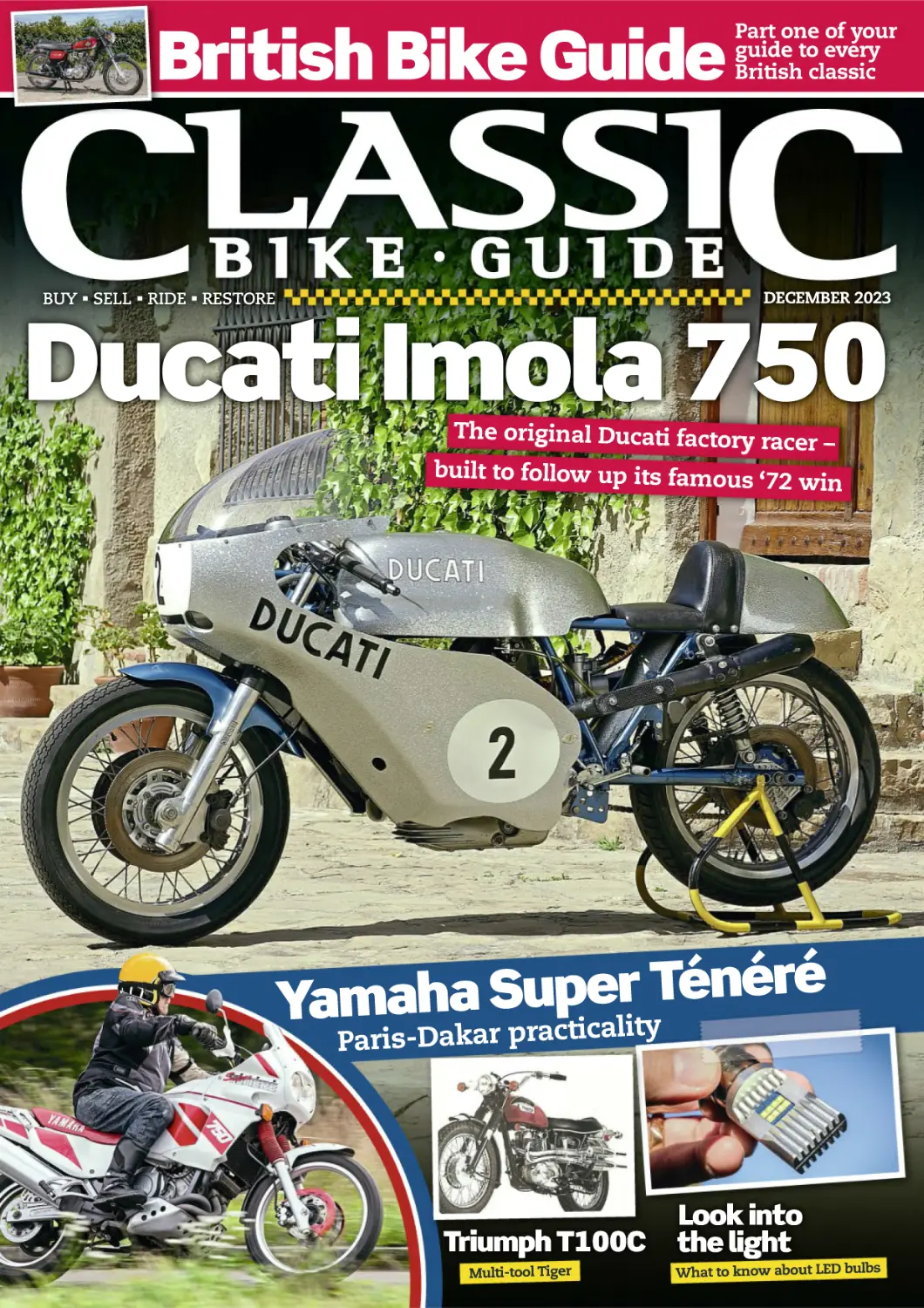
Ducati Imola 750
The origiin
na
all Ducati factory racer
built to follow up its famous ‘72
–
win
é
r
é
n
é
T
r
e
p
u
S
a
h
Yama akar practicality
Paris-D
Triumph T100C
Multi-tool Tiger
Look
k into
i t
the light
li ht
What to know about LED bulbs
12
30
32
52
56
66
70
96
96
T pre-order your next issue
To
of Classic Bike Guide, head to
o
classicmagazines.co.uk/pre-order-cbg
c
Alternatively, scan the QR code on this page and order your next copy today.
We will send it directly to you! Save time by not having to nip to the shop!
CLASSIC BIKE GUIDE || DECEMBER 2023
3
Contents
#040
008 From the archive
We had to visit Mr Paul Smart at Imola,
in 1972, with his famous victory.
012
Your guide to:
040 Aermacchi
HarleyDavidson 350 Sprint
From Italian and American parents,
the 350 Sprint is a lovable machine.
Ducati Imola 750
The follow-up Ducati in 1973 was a
full factory racer. Alan rides it for us.
021 Next month
048 Letters
Have your say, tell us a
story, and win a prize.
078 Reader adverts
Hundreds of bikes for sale, so check
out your latest garage dweller.
bike mechanics
090 Old
directory
Those kind folk who work on
old bikes. Tell us of more...
What’s on
The anatomy of:
092 Velocette
MAC
052
Spreading light on LED
bulbs
094 A reader’s tale
026 Where we’ve been
056
When will I be famous:
Yamaha Tenere
030 Products
062 Rival adventure bikes
032
066
A Nimbus! A cracking B32! The
second part of the British Bike Guide!
022
Subscribe!
Feature-packed, topping up your
fill of old bikes... and
delivered to your door
024 News
What’s been going on in this
old world.
Stafford Show, Haynes Museum,
and the NMM LIVE Open Weekend.
What’s been getting us hot
under the collar this month.
4
Frank recalls:
Triumph T100C
We never saw many in the UK,
but they’ve started coming
back over from the US.
DECEMBER 2023 || CLASSIC BIKE GUIDE
050
There are still things to do
and places to go, so put down
that remote control.
We look at LED bulbs – are they
any good for older bikes? Oh, yes.
We look at the XTZ750, born
of the Paris-Dakar.
What about an Africa Twin, R80G/S
or Enfield Bullet instead?
British Classic Bike
Guide
Your essential guide. This month we
head from AMC through to BSA.
A peek at a bike and what the owner
has done to make it right for them.
One man’s mission to conquer
his project Triumph Tiger 100.
096 Back to basics: Starting
Everyone’s watching you, so the more
you know about starting, the better
098 Wish upon a star
Oli gets his Starfire
head sorted!
hints and tips
102 Hutch’s
from the workshop
Hutch looks at hibernation and how
to find a great bike come spring.
106 Franks famous last words
Frank is strangely surprised that he
isn’t alone when everything you want
disappears.
Welcome
‘Leave that heating alone – just put another jumper on’
G
reetings, oh wonderful people.
Firstly, those of us here at CBG hope
you’ve all been able to stay dry and
warm as the various weather fronts have
battered certain parts. We’ve been lucky
here, even though the road floods and
the missing slates mean heading up into
the loft to change towels! It is funny in a
pitiful kind-of-way, seeing the psychology
of the drivers going through a flood: turn
around, petrified of anything different,
have some naughty fun by speeding
through, or the most worrying, don’t
change anything and carry on as normal –
including some electric cars! Your mood
changes when you realise we share the
roads with these people; never assume…
This month started off with the
Stafford Show and it was great to see it so
busy, with many stands putting in a lot of
effort. Special mention goes to the VJMC,
which had a ghostly workshop complete
with smoke machine! I also spent a whole
£15 on some period red racing boots for
my period BMW – I love them, though
apparently I’m alone on that one.
Just two weeks later was the National
Motorcycle Museum’s open weekend, and
James Robinson from our sister title, The
Classic Motorcycle, Maria and I manned a
small stand to give some magazines away
and have a good old mardle. Thank you to
the many who came to say hello – and it
was great to see Henry Cole and friends
packing out the huge main hall; it was
standing room only. Does make you feel
good about the future of old bikes – and
the power of TV. Oh, and a belated happy
Halloween from Effie and Maria!
There have been a few nice rides this
month, including a damp one up on the
R100RT to the Lincolnshire Wolds and
Skegness to ride a new Harley-Davidson
Sportster for Motorcycle Sport and Leisure
magazine. A good bike, but so many
buttons that I couldn’t find the indicators
– pass me an old one, please. I also took
the B31 out for a run after it’s been under
a tarpaulin for a couple of months under
the apple tree. Started second kick and felt
wonderful. Then braked for the bottom
of the road and nearly went over the
handlebars! I guess some surface rust had
formed inside, creating some gritty, grippy
powder to help the linings, as it faded after
the next few – careful – uses. But wow!
Haven’t touched Maria’s Tribsa primary
chain this month, nor my RS; only toiling
in the workshop has been trying to
finish the stubborn family Morris Minor
brakes, which has turned into ‘just a little
welding’, then a flurry of other repairs.
And it still looks like an old shed. And it’s
really cold in there on the floor…
Stay dry, keep warm and enjoy.
Matt Hull
editor@classicbikeguide.com
CLASSIC BIKE GUIDE || DECEMBER 2023
5
From our archive
■ The phone call,
the immortal
circuit and a new
boy on the block
The story of Paul Smart taking Ducati’s
first headline victory at the Imola 200
in 1972 is a corker. Maggie, Paul’s wife,
takes a phone call from a fledgling
Ducati, asking if Paul would be able
to race its new 750 V-twin for £500 in
Italy, and while he is on his way back
from racing ‘an evil-handling’ Kawasaki
at Atlanta, USA, on his behalf, she says
‘yes’.
Smart’s career is taking off, with TT
podiums, a Hutchinson 100 victory, and
a place in the Transatlantic team, all in
the last year. And now he’s on a flight to
Italy, to race a bike from a little-known
manufacturer he’s never seen, let alone
ridden, that others have turned down,
and a racetrack he’s not ridden.
The rest is well-documented. The
factory expected a lot. Used to twostrokes or triples, the V-twin felt slow
and Paul thought the bike looked
long – and it was on road tyres. But,
approaching the pits, Smart could see
the team was ecstatic – he was about
to lay into them about all the issues
with it. Paul had beaten Ago’s lap
record... and he hadn’t even tried.
Race day saw every inch of the Imola
circuit packed with fans, creating a
tremendous atmosphere. Paul and his
teammate, Bruno Spaggiari, ran the
majority of the race in 1-2 formation,
with Smart eventually taking the win,
handsome prize money, and the winning
bike – provided he raced it at home in
certain events, too.
The team were celebrated as heroes,
gladiators. Just 25 miles from Ducati’s
hometown of Bologna, the bikes and
riders were paraded in a converted,
glass-sided bus. It was the push Ducati
had needed to become a worlddominating manufacturer, the win Paul
needed to cement his superstar status
as a top-flight racer, and the historical
win the old Imola circuit needed to keep
it fresh.
8
DECEMBER 2023 || CLASSIC BIKE GUIDE
CLASSIC BIKE GUIDE || DECEMBER 2023
9
Parts Sp
pecialists
While there are a number of companies that
seem to specialise in every aspect of our
two wheeled world, we have to remember
that there are also a large number of
companies that specialise in some very
specific areas. Not only are these companies
likely to have an expansive knowledge of
their chosen subject, they’re also far more
likely to stock the seemingly rare and
unobtainable parts that can’t be found at
the more generic dealers and suppliers
The logic is clear – if you want a haircut, you
don’t go to the supermarket. So, if you want
a certain part for your classic motorcycle,
then you approach the companies that deal
in parts and expertise in those very models.
And look what we have here – a number of
specialists whose focus is on certain makes
and models of classic motorcycle, just the job!
The tricky
second album
After Ducati won at Imola in 1972 on a
production bike, a factory racer was made
for 1973. Alan Cathcart rides the F750
Words by Sir Alan Cathcart
Photography by Kyoichi Nakamura
(static) and Emilio Jimenez (action)
12
DECEMBER 2023 || CLASSIC BIKE GUIDE
D
ucati has won 15 World Superbike titles
since the series began in 1988. But until
an Italian spring day in 1972, the Bologna
factory, then owned by the Italian
government, had precisely zero big-bike
credentials. Ducati was instead known mainly for
producing small-capacity, four-stroke singles, some
with the quirky addition of desmodromic valve
gear such as Mercedes-Benz had used in winning
the 1954/55 Formula 1 world titles. But the late Paul
Smart’s Imola 200 race victory on April 23, 1972,
with Ducati teammate Bruno Spaggiari a close
second, changed all that. By winning the first bigbucks 200-miler held outside the USA for the new
generation of cubed-up bikes embraced by Formula
750, Smartie not only put Ducati on the map, but he
also kick-started the development process, leading
to today’s Panigale V4R reigning World Superbike
champion.
For although Ducati’s air-cooled 750 Imola racers
all had a two-valve desmodue cylinder head design
with bevel-driven SOHC, they were still in every way
the forerunners of the later liquid-cooled, eightvalve, twin-cam Superbikes. The new 200-mile race
at Imola for 1972 was the race-winning debut of what
would become Ducati’s trademark engine format:
the 90-degree desmo V-twin. And for its debut race,
unlike almost all its competitors in Formula 750 – the
class imported from the USA which decreed that
each race engine must be homologated for use on a
production road bike – Ducati lifted the curtain on
today’s Superbikes by equipping the Smart/Spaggiari
racers with a street chassis, too. A deliberate decision
it almost certainly wasn’t, but the racebike had
the same heavy steel frame with Seeley-derived
swingarm as fitted to its new 750cc V-twin road bikes,
complete with lugs for the centrestand, rather than
building a faster-steering, lightweight race chassis
like the BSA/Triumph triples’ Rob North frame, or
the pannier-tank John Player Norton’s lowline design.
Smart’s 1972 Imola victory, unexpected to all but
Ducati itself, was achieved on a bike not so
different from the 401 examples of the streetlegal Imola Replica released to customers in
1974, the legendary 750SS that I and many
others rode on the streets and raced at
weekends back in the mid-1970s. It was a
true production racer, and Ducati’s Imola
win proved that racing really does improve
the breed.
But, in attempting to repeat his
company’s Imola 200 victory in 1973,
Ducati’s direttore tecnico, Fabio Taglioni,
constructed the firm’s first ever outright
V-twin factory racer, which, unlike the
previous year’s bike, didn’t have the 750SS
street frame housing a tuned-up version
of that later bike’s engine. What it did have,
though, was a special short-stroke motor
with uprated 60-degree heads (referring to
the included valve angle, as opposed to the 72
degrees of the production bikes), allowing a higher
11.2:1 compression ratio versus the 10:1 of Smart’s
bike. This format, reasoned Taglioni, would allow
the Ducati to rev harder in pursuit of more power
to deal with the increasingly dominant F750 twostrokes – an identical strategy to that later followed
by the company in creating the ultra-short-stroke
CLASSIC BIKE GUIDE || DECEMBER 2023
13
Superquadro motor in 2012 for the Panigale Superbike.
The new-for-‘73 engine had a shorter-stroke engine,
measuring 86x64.5mm, compared to the 80x74.4mm
dimensions of the ‘72 Imola-winner and all customer
750 Dukes of the era, and was fitted with Mondial
flat-top pistons sourced from Ducati’s 450 single,
mounted on special 20mm shorter conrods carried
on a standard, pressed-up roller-bearing crankshaft,
but minus the flywheel and alternator to save on
reciprocating weight – the points ignition was now
total loss, with a cast magnesium outer cover.
While production diecast crankcases were
used, special sandcast cylinder heads and shorter
cylinders were fitted complete with shorter bevelgear driveshafts and housings, resulting in a more
compact L-twin engine that was 25mm shorter and
the same amount lower than the Smart bike’s motor.
The new 60-degree heads benefited from the 6mm
wider bore by carrying 2mm larger 42mm inlet/38mm
exhaust valves, one of each per cylinder, of course,
with special rockers, albeit with slightly lower 12mm
lift camshafts (against 13mm before) owing to lack of
space.
Fitted with an all-new close-ratio race gearbox
with drilled pinions to save more grams, as well as
higher-ratio straight-cut primary gears, this allnew engine had a dry clutch as on all Ducati’s race
motors – Smart’s bike had used a production-derived
transmission, complete with oil-bath clutch.
14
DECEMBER 2023 || CLASSIC BIKE GUIDE
Taglioni had a lot to go
on, replacing the many
road-going, production
racer parts with race
parts that only needed
to complete 201 miles
Although Taglioni began work on the new bike
immediately after the previous year’s crushing Imola
1-2 victory, and even had the drawings completed
one month later by the end of May 1972, he ran
into constant hurdles in developing it, not least of
which was a change in management at the top of
Ducati. Since 1967, Ducati had formed part of the
Italian government’s EFIM state-owned conglomerate
responsible for the day-to-day operations of the
company, plus 114 others within Italy. However, it
had the good fortune to have Fredmano Spairani
appointed as its CEO in 1969, a professional manager
with an open mind as well as considerable flair, who
listened, learnt, and acted wisely on what he was
told. Ducati progettista Taglioni and his colleagues
had managed to convince Spairani of the values of
a product-led strategy, based on the large-capacity
750cc four-strokes that BSA-Triumph and Honda had
just launched, and underpinned by a factory race
programme. That’s how the family of 750cc V-twin
Ducatis debuted in 1971 came about.
Unfortunately for Ducati, Spairani’s success in
replacing the red ink on the balance sheet with black
meant that in 1973 he was appointed to try to pull
off the same trick on Gruppo Agusta’s ailing aviation
and motorcycle business, which, in the wake of its
patriarch Count Domenico Agusta’s death in January
1971, had also fallen under EFIM control. Cristiano
de Eccher, his elderly successor placed in charge of
SPECIFICATION: DUCATI 750 IMOLA
Engine: Air-cooled SOHC desmodromic 90-degree V-twin four-stroke, with two valves per cylinder and bevel gear camshaft drive Dimensions: 86 x 64.5 mm Capacity:
749 cc Output: 89 bhp at 10,000rpm (at rear wheel) Compression ratio: 11.2:1 Carburation: 2 x 40mm Dell’Orto PHM Ignition: Coil ignition with total-loss 12v battery
Gearbox: Close-ratio 5-speed with straight-cut gear primary drive Clutch: Multiplate dry Chassis: Chrome-moly tubular steel open cradle spaceframe with engine as
semi-stressed member Suspension: Front: 40mm Marzocchi leading-axle telescopic forks Rear: Tubular steel swingarm with 2 x Ceriani shocks Head angle: 29 degrees
Wheelbase: 1420-1480 mm (1450mm as tested) Weight: 148kg with oil, no fuel Brakes: Front: 2 x 278mm Brembo cast-iron discs with two-piston AP-Lockheed calipers
Rear: 1 x 230mm Brembo cast-iron disc with two-piston AP-Lockheed caliper Wheels/tyres: Front: 3.25 x 18 Dunlop KR124 on
WM3/2.15in Borrani alloy-rim wire wheel Rear: 3.75/5.00 x 18 Dunlop KR124 on WM3/2.15in Borrani alloy-rim wire wheel Top
speed: 174mph (Imola 1973) Year of construction: 1973 Owner: Joaquín Folch, Barcelona, Spain
Ducati, disliked racing, and was only concerned with
numbers, not product. Though Spairani had given the
go-ahead for creation of the new bike, on his arrival
de Eccher originally cancelled Ducati’s continued
presence in racing, only reluctantly relenting to
allow development of the F750 bike to continue on
the condition it would only be raced at Imola, and in
endurance racing. But a series of strikes at the Ducati
factory held things back further, so it was a mere two
weeks before the April 1973 Imola race that Spaggiari
first tested the new F750 bike at Modena, reporting
handling problems duly resolved by replacing the
leading-axle 40mm Marzocchi fork with a centreaxle one, while still retaining heaps of trail via very
flat triple-clamps, with notably reduced offset. In
this guise, Spaggiari broke Ago’s outright Modena lap
record set on an MV 500GP triple, just as Smart had
done one year earlier on his first ride on a V-twin
Ducati. Taglioni had taken advantage of the lighter
and more compact new engine (which delivered
89bhp at the rear wheel at 10,000rpm versus the
84bhp at 8800rpm from Smart’s ‘72 bike) and was safe
to 10,600rpm, resulting in a useful over-rev capability –
to produce an all-new frame to wrap it in.
Built by local chassis specialist Daspa in chromemoly steel tubing, this was still a similar open-cradle
design to the Smart bike which used the engine as
a semi-stressed member, but this time incorporated
eccentric chain adjustment at the swingarm pivot,
Alan is amazed by
the lighter frame
and more square
engine, even if the
gearing and geometry
wasn’t right for the
circuit he tested on
while offering a choice of three separate rear axle
locations. This meant the wheelbase (and thus the
weight distribution – always an issue with an L-twin
Ducati) could be varied in 30mm increments over
a 60mm range, between 1420mm and 1480mm.
Alongside the 40mm Marzocchi forks, twin Ceriani
rear dampers and 278mm front Brembo cast iron
brake discs were fitted, and unlike the previous
year, both exhausts were of the high-rise variety to
resolve the constant problems with ground clearance
on right-handers of the previous one-up/one-down
format. While notably more agile and nimble-steering,
the new bike also accelerated and stopped better
thanks to its much reduced 148kg weight with oil, no
fuel – a massive 16kg lighter than Smart’s 1972 racewinner.
A total of three bikes were built for the Imola race –
one per rider, a sign of Ducati management’s changed
priorities versus the previous year, when 10 machines
in all were constructed to give each of the four Ducati
team riders a spare bike, with two extra just in case.
The final one of the three for ‘73 was completed the
day before practice began and was assigned to rising
British star (and former John Player Norton rider) Mick
Grant, with team leader Spaggiari joined by another
Bruno, versatile Swiss GP rider Bruno Kneubűhler.
Unlike the previous year, the race was now split into
two separate 100-mile legs, a step which favoured
the smaller, lighter 350cc Yamaha two-strokes, and it
CLASSIC BIKE GUIDE || DECEMBER 2023
15
was on one of these that Jarno Saarinen followed up
his victory one month earlier in the Daytona 200 by
winning both races at Imola, thus preventing Ducati
doing the Imola 200 double in front of more than
100,000 people; even without Ago on the grid this time
around, the crowd was much larger than a year earlierr.
But Spaggiari was second in the first race on the
new Ducati and third in race two, giving him second
place overall on combined times for the second
year in succession. This showed that, even against a
two-stroke GP racer masquerading as an F750 bike,
the new short-stroke Ducati V-twin was still highly
competitive, leading home the rest of the 40-bike
field stacked with riders of the quality of Rayborn,
Carruthers, Villa, Dähne, Lansivuori, Findlay, Williams
and so on. In race one though, teammate Kneubűhler
had been running second behind Saarinen’s
flying Yamaha, and had just set the fastest lap at
102.618mph when he collided with a slower rider
while lapping him, hurting his wrist too badly to start
race two. Grant lunched his clutch on the start line
of the first race, recovering to finish seventh in the
second.
Taglioni hadn’t stood still. He had also been
developing an 860cc engine using the longer stroke
of the ’72 Imola bike and the bigger bore of its
‘73 successor, and two months later this made a
dominant debut by winning the 1973 Montjuich 24
Horas endurance race, after leading the gruelling
Barcelona marathon from start to finish in the hands
of Benjamin Grau and Salvador Canellas. This engine
duly provided the basis of the 900SS streetbike, but
meantime Ducati had sold Spaggiari’s ’73 short-stroke
F750 bike to its Canadian importer, leaving Bruno to
enter Kneubűhler’s old machine bearing chassis no.3
and engine no. DM-03 for the 1974 Imola 200, in which
he finished eighth in the first race, but retired from
the second. He had better luck in the Intercontinental
Trophy support race, finishing third on the Ducati
behind Phil Read’s 500GP MV four and Roberto
Gallina’s Yamaha TZ350.
For 1975, the now retired Spaggiari sponsored
rising star Franco Uncini on the same bike (the future
500GP World champion had won the 1974 Italian
production title for Ducati on a 750 Sport), the young
rider earning promising results aboard it in the Italian
National F750 series. But it was Ducati returnee Paul
Smart who rode the bike at Taglioni’s request in the
1975 Imola 200, retiring with engine problems while
lying eighth in what would prove to be his last ever
race. Uncini finished 21st on the other ‘73 short-stroke
bike, indicating that the Japanese two-stroke takeover
of Formula 750 meant the Ducati V-twins were now
completely uncompetitive at international level.
But not in Spain, though, where the Franco
government’s insistence on protecting local
manufacturers like Bultaco, Montesa, Ossa and Derbi
by banning the importation of Japanese motorcycles
– including the two-stroke GP racers produced by
Japan Inc – meant that European makes still ruled
the racetracks. Spanish Ducati importer Ricardo
Fargas brought the ex-Kneubűhler, ex-Spaggiari 1973
short-stroke Ducati – still with its original engine
and frame numbers – to Spain for his rider José María
Mallol to race in what remained of the 1975 F750
Spanish Championship. But local GP star (and Ducati
endurance racer!) Benjamin Grau had already won
the 1974 title riding a pannier-tank John Player Norton
and had the measure of the Ducati in 1975 aboard a
’74 spaceframe JPN, winning the title again – though
16
DECEMBER 2023 || CLASSIC BIKE GUIDE
There is no doubting
Taglioni’s genius, even
though the 1973 bikes
didn’t repeat Smart
and Spaggiari’s ‘72
success. But finances,
management, and the
fact that large bikes
for Ducati were still
new all created issues
Mallol did beat the Norton to win the round held on
the La Línea street circuit, in the shadow of Gibraltar.
However, in April 1976 he crashed the bike at the
Montserrat hill climb outside Barcelona, and both
man and machine were fortunate not to plunge over a
precipice on this mountainous course, destroying the
original centre-axle Marzocchi front fork. An earlier
1972 leading-axle type was fitted as a replacement.
But the Norton factory went broke in 1975 and its
Spanish importer stopped racing, leaving Min Grau to
transfer to riding the Fargas-entered Ducati in 1976.
In his hands, the short-stroke F750 Ducati prototype
finally had its moment in the sun, in winning that
year’s Spanish F750 title in his hands. Having done
so, the bike was consigned to the back of the Fargas
workshop, where in 1980 it was found and restored
by my personal mate, Joaquín Folch, owner of a
magnificent collection of historic racers located in
his villa outside Barcelona. This contains no less
than 23 works Ducati racers, many of which the
factory museum in Bologna doesn’t have, including
a pair of bevel-drive desmo V-twins, one a winner of
the gruelling Montjuich 24 Hour race, the other this
ultra-rare factory F750 Imola machine which Joaquín
duly finished restoring three years later – whereupon
he kindly asked me to shake it down for him at the
twisty Calafat seaside circuit south of Barcelona. Four
decades on, in celebrating the Ducati’s 50th birthday
this year, I still remember clearly what a big surprise
riding it turned out to be….
“As well as being fortunate enough to ride Paul Smart’s 1972 Imola
200 winner, I’d expected to have a good idea of what the ‘73 Imola
Ducati would be like to ride! I was 100% wrong! This motorcycle was
completely unlike any other V-twin desmodue Ducati I’ve ever ridden.”
Alan’s riding impressions
Having begun my own racing career 10 years earlier
on a 750SS, by the by the time I rode Joaquin’s bike
I’d had a decade of racing V-twin Ducatis under my
belt, as well as being fortunate enough to ride Paul
Smart’s 1972 Imola 200 winner, so I’d expected to
have a good idea of what the ‘73 Imola Ducati would
be like to ride! I was 100% wrong! This motorcycle
was completely unlike any other V-twin desmodue
Ducati I’ve ever ridden. The smooth, liquid-feeling
power available from almost any point in the rev band
that’s the trademark of any desmo V-twin racer, with
seemingly massive reserves of torque that you can
dial up just by cracking the throttle open in almost
any gear, isn’t there. Instead, the short-stroke ’73
Imola bike has to be ridden like a capricious, peaky
two-stroke of the era. It asks to be revved hard,
insisting that I work the five-speed, right-foot, racepattern gearchange overtime, and keep throwing
ratios at it to keep it spinning up high where the
power is. It even asks to be clutched hard exiting the
tight, second-gear Calafat hairpin at the end of the
main straight to coax it back in the powerband for
adequate drive down the next short straight. Hmm
– no wonder Kneubűhler, best known back then as
a 125/250GP rider with little experience of bigger
four-strokes, got on so well with it straight away! To
be honest I, um, hadn’t done my homework properly
before riding the ’73 Ducati, and didn’t realise that it
had the short-stroke engine – I’d just assumed it had
Alan started racing on
a 750SS production
bike and was amazed
at the difference
riding the factory
racer around Calafat,
a Spanish circuit
the same motor as the Smart ’72 race-winner, slotted
into an all-new race chassis. As if…
The reason for these unusual characteristics for a
desmo V-twin lies in the perceived threat to renewed
victory on their home circuit in the 1973 Imola 200 that
Fabio Taglioni expected, especially from the improved
reliability of the Japanese two-strokes – they’d always
been faster than the Ducatis, BMWs, Nortons and so on,
but now they were staying the course. So, Dr T decided
to go for more power on the ’73 Ducati by shortening
the stroke, raising the revs, and drastically narrowing
the powerband. But the result was that, instead of
being able to rev the engine out cleanly from low down,
as on a 750SS customer racer or even Paul Smart’s
’72 Imola-winner, you had to keep it turning at above
6000rpm, where the power came in. Below 5700 revs,
the engine wouldn’t run cleanly, and with a maximum
rev limit for the test session of 8500rpm on the newly
rebuilt motor, this made the Ducati quite hard to
ride on a circuit as tight as Calafat. The fast, swoopy
Imola track would have been okay, but the cramped
Catalan circuit was another matter – although its
raised compression and lighter crank, thanks to the
flywheel and alternator being removed, meant this
’73 bike accelerated out of slow turns much harder
than its longer-legged predecessor. That had felt more
muscular, but also more ponderous in picking up revs
– it didn’t explode out of a turn like this newer version,
but was much more rideable, more tractable than the
short-stroke version.
CLASSIC BIKE GUIDE || DECEMBER 2023
17
This wasn’t helped by the gear ratios of the newer
bike’s five-speed gearbox, because although the lower
three were reasonably close together, there was a
gap of more than 1500 revs between third and fourth
gear, and fourth and fifth. Again, this might have been
okay for a big track like Imola in its pre-chicane era,
but must have made the Ducati a real handful on the
tighter Spanish street circuits of the mid-1970s like
Jerez, Gandía, La Línea and Guadalajara. José María
Mallol would have had his hands full to cope with
the much more tractable John Player Nortons, whose
much faster handling, bred on cramped UK circuits,
would have also given Min Grau on the British bike a
considerable advantage over the Ducati in 1975. As, in
fact, turned out to be the case…
Ducatis have always been super-stable handlers,
bikes that go looking for fast, bumpy corners where
you know the opposition will be struggling – except
that, despite its shorter wheelbase, the ‘73 works
F750 racer set new standards for me for the slowness
of its steering and the extreme power understeer,
which sent it heading for the hedges when exiting a
corner with the power on. We Ducatisti liked to joke
back then about how you needed to send a telegram
to a desmo V-twin to get it to change direction once
committed to a turn, but I reckon this one was using
pigeon post! No wonder Paul Smart rode the Ducatis
so well, because you could really only get this one to
go round corners reasonably quickly by the expedient
of climbing all over it and hanging off the side, like he
did. Even a traditionalist like Bruno Spaggiari found
you had to do that: just look at a photo of him in the
‘72 Imola race and compare it with the same man
on a bike like this one in ‘73; by then he’d become
a spaghetti version of Paul Smart – and with good
reason.
This machine has
had an extraordinary
career, considering
the life expectancy
of most race bikes
On the ex-Kneubűhler Ducati, the only aspect I
could criticise of an otherwise impeccable, faithful
restoration by Ricardo Fargas and his men was that
the heat shields on the twin high-rise exhausts were
mounted too close to the pipe, so if I moved around
on the bike, I ended up burning my leg through the
boot leather. Ouch! Otherwise, once I got the engine
revving high, it had a fair turn of speed, and over
the Calafat bumps the suspension was well set up,
especially the Ceriani rear shocks. I reckoned the
heavier and more ponderous steering was due to
that ‘72 leading-axle fork, which kicked everything
out even further – presumably that’s why Spaggiari
ditched it after the shakedown tests at Modena. It
must not have been compatible with the later chassis,
else the factory would surely have used it; it certainly
increases the trail a huge amount, and I’m sure it
would have been a faster-steering bike with them
removed. But the ventilated Brembo/Lockheed brake
package, with the front 278mm cast iron discs drilled
circumferentially to improve cooling and resist fade
worked superbly well, thanks also to the benchmark
AP-Lockheed brake calipers of the era – though I don’t
think I ever rode a disc-braked Ducati that didn’t stop
brilliantly well, anyway!
Fabio Taglioni once told me that he regarded the
short-stroke ‘73 F750 Ducati as an experimental
model that allowed him to test his ideas of obtaining
higher revs, and thus more power, by shortening the
stroke and making the engine even more oversquare
than was customary back then. By the time his
ideas reached fruition in the 88 x 61.5mm 748cc
Pantah engine which appeared in 1977 and was
even more oversquare than this four years older
750 Imola prototype, he’d found a way of combining
those extra revs with Ducati’s trademark flat torque
curve and tractor-like pulling power from low down
– characteristics that my Calafat test proved were
entirely missing from the ‘73 Imola racer. Once again,
Taglioni’s ideas were developed in competition before
being put on the road, as with almost every Ducati
motorcycle ever made since then, and Joaquín Folch’s
1973 works short-stroke F750 racer is a testament to
that ideal. Racing truly does improve the breed, as
Ducati has successfully demonstrated for the past 67
years!
Next month
Restoration of a 1948
BSA B32 Competition
Also: Norton Atlas || British Bike Guide part two || Recommissioning a bike || Nimbus special
|| Ducati 350 || In the workshop || And hundreds of bikes for sale!
Who’s who ||
EDITOR || Matt Hull
editor@classicbikeguide.com
PUBLISHER || Tim Hartley
thartley@mortons.co.uk
SALES AND DISTRIBUTION MANAGER || Carl Smith
Full subscription rates (but see page 20 for offer):
PUBLISHING DIRECTOR || Dan Savage
(12 months 12 issues, inc post and packing) – UK
COMMERCIAL DIRECTOR || Nigel Hole
ART EDITOR || Kelvin Clements
SENIOR DESIGNER || Michael Baumber
DESIGNER || Charlotte Turnbull
PRODUCTION EDITOR || Lucy Wood
GROUP ADVERTISING MANAGER || Sue Keily
ADVERTISING ||
Mark Bainbridge 01507 529 413
MBainbridge@mortons.co.uk
ARCHIVE ENQUIRIES || Jane Skayman
01507 529423 jskayman@mortons.co.uk
SUBSCRIPTION ||
MARKETING MANAGER || Charlotte Park
EDITORIAL ADDRESS ||
Mortons Media Group, Media Centre, Morton Way,
Horncastle, Lincs LN9 6JR
WEBSITE ||
www.classicbikeguide.com
£61.20. Export rates are also available – see
page 20 for more details. UK subscriptions are
zero-rated for the purposes of Value Added Tax.
DISTRIBUTION ||
Seymour Distribution Ltd, 2 East Poultry
Avenue, London, EC1A 9PT.
PRINTED BY || Acorn Web Offset Ltd,
Normanton, West Yorkshire
GENERAL QUERIES AND BACK ISSUES ||
01507 529529 24hr answerphone
Email: help@classicmagazines.co.uk
Web: www.classicmagazines.co.uk
ADVERT DEADLINE || November 30, 2023
NEXT ISSUE || December 27, 2023
© Mortons Media Group Ltd. All rights reserved. No part of this publication may be reproduced or transmitted in any form or by any means, electronic
or mechanical, including photocopying, recording, or any information storage retrieval system without prior permission in writing from the publisher.
T pre-order your next issue
To
o
of Classic Bike Guide, head to
c
classicmagazines.co.uk/pre-order-cbg
Alternatively, scan the QR code on this page and order your next copy today.
We will send it directly to you! No need to nip out to the shops.
20
DECEMBER 2023 || CLASSIC BIKE GUIDE
r
u
o
y
e
k
Ma
e
t
t
e
b
n
e
ev
Looking for giiffts for
friends and family,
or just wanting to treat yoursself?
s
Well, search no more! A magazziine
is the perfect pressie for loved one
o es
(or even to yourself). Not only th
hatt,
subscribe to Classic Bike Guid
for 12 months and we’ll send you
ua
Meguiar’s cleaning kit, worth £9
99.
t
f
i
g
r
u
o
y
t
e
G
y
a
d
o
t
n
o
i
t
p
subscri
If you enjoyed this issue,
subscribe or renew for
12 MONTHS
from just £46
and claim your
FREE GIFT
Visit www.classicmagazines.co.uk/xmascbg
or call 01507 529529 and quote XMASCBG
Kit
worth
£99
TERMS & CONDITIONS: Rates are based on UK orders only –
for overseas please visit: www.classicmagazines.co.uk/cbg-overseas.
Subscriptions will start with the issue selected at the basket. Offer
closes 31/01/2024. Full year subscription gifts are available while
stocks last. Full terms and conditions can be found at
www.classicmagazines.co.uk/terms Any gifts are for UK orders only
and will not be mailed out until December 2023.
Try one of our
!
o
o
t
s
e
l
t
i
t
t
a
e
r
other g
f
Get 6 issues of one o
0
2
£
t
s
ju
r
o
f
s
g
a
m
e
s
e
th
The personalities, legendary
bikes and the racetrack
heroes who mattered then...
and still matter now.
Classic, twinshock or Evo, it’s
the place for you to dive into
the dirty side of biking.
Real bikes. Real riders.
Real rebuilds. Real rides.
RealClassic!
Celebrating the rich
history of motorcycles and
motorcycling, then and now.
The original and best mag
for choppers, bobbers and all
kinds of customs!
For news, innovative features,
tech talk and practical tests,
head to Fast Bikes.
Real-world tests of the latest
bikes and kit, places to go,
and features not to miss.
Running, riding and repairing
Japanese, European and US
classics from the ‘70s onward.
The best for classic and
modern scooters. For
enthusiasts, by enthusiasts.
The bible of the British-US car
scene. If it’s American and got
wheels, we’ve got it covered!
For those who like building
model boats, or just enjoy
soaking up this huge hobby.
UK’s biggest model flying mag
packed with reviews, features
and expert opinion.
From steam locomotives to
new developments in scale
engineering.
Britain’s best magazine for
those who love to grow their
own fruit and veg.
Enthusiast-led content, news,
in-depth expert features and
outstanding imagery.
News and features for the
modern traction and heritage
modern traction enthusiast.
Recalling Britain’s steam era
through photos, recollections
and historical features.
Simply Britain’s biggest and
best rail title – modern, steam
and everything in between.
The tools and techniques
used by model makers, light
engineers and restorers.
The best for news, features
and images covering the UK’s
rail preservation movement.
Visit www.classicmagazines.co.uk/xmas23dps Or call 01507 529529 and quote xmas23dps
TERMS & CONDITIONS: Rates are based on UK orders only – for overseas please visit: www.classicmagazines.co.uk
Subscriptions will start with the issue selected at the basket. Offer closes 31/01/2024.
Classic news
A NEW SPORTY GUZZI V7
Moto Guzzi has launched a restyled
version of its V7 Stone with an even more
retro look than previously. The new-old
interpretation has been dubbed the V7
Stone Corsa.
With a new nose fairing and a singleseater style saddle, the Corsa has a faint
air of the original Guzzi 850 sport tourer,
the Le Mans.
Moto Guzzi says the bike has been
inspired by the Moto Guzzi Fast Endurance
competition, a single-brand trophy held in
Italy that gives riders the chance to race
on the track on tuned V7 twins.
The new V7 Stone Corsa has two-tone
livery, with a retro metallic grey colour
scheme livened up by an aggressive red
stripe that runs vertically along the top
fairing, then continuing along the lower
part of the fuel tank and on the side
panels. The humped seat looks like a
single-seater but is in fact designed to
carry a passenger, while there is a hard
cover for the rear portion of the saddle,
colour-coded to match the body which is
available as an accessory, making it a true
single-seater.
The equipment package also includes
bar end rear view mirrors, as well as the
billet black anodised fuel cap. In line with
the minimalist look, front fork has no
gaiters, and a plate on the handlebar riser
identifies it as a special edition. While it
could do with a nice, noisy set of Mistral
silencers and a fire-engine red colour
scheme, clip-ons, and knee-crippling rear
sets, the Stone Corsa does have a sporty
edge that harks back to 1970s glam.
It costs £9050.
The standard Stone and Classic V7s
have been given substantial price cuts in
the UK of £750, making the cheapest Stone
model now a very competitive £7450.
WIN A NEW TRIUMPH TSX 750 WITH THE NMM
Well done! Mrs Nicola Rolleston of Kent
was the lucky winner of the Norton
Commando 850 in the summer raffle
for the National Motorcycle Museum.
Mr Lawrence Fly won £1,500 of Sealey
tools and Mr David Heading won a
Sealey tool cabinet. Congratulations to
all three winners from us!
The museum has now announced its
winter raffle, with a stunning first prize.
A brand new/old stock 1983 Triumph
TSX 750, showing just 13 push miles,
never run or registered.
24
DECEMBER 2023 || CLASSIC BIKE GUIDE
One of the last twins to come from
Meriden, these are some of the original
Triumph company’s finest, with electric
start and stunning trim, as seen on
September’s Classic Bike Guide. With only
a handful ever built, finding an unused
example is of Holy Grail proportions.
There is a Sealey Tools/NMM voucher
for any Sealey tool products to the retail
value of £1500 to be purchased via The
National Motorcycle Museum shop as
second prize, and a Sealey Tools Patriot
Roll Cab Tool Cabinet with a value of
£719.95 for third. The winner gets choice
of one of five national flag designs.
The draw for the winter raffle at The
International Classic Motorcycle Show,
Stafford, in April.
Tickets cost £2 each and will be
distributed during November and
December via subscription copies of
this magazine and from the National
Motorcycle Museum’s website at www.
nationalmotorcyclemuseum.co.uk/bikeraffle/
CLASSICS AT KEMPTON
Henry Cole and Friends will be joining the throngs on Saturday, December 2
at the London Classic Off-Road & Racing Show at Kempton Park. The show
will be combined with a packed motorcycle autojumble, too.
The event will play host to some unique club stands and incredible
private entries, celebrating some of the finest competition motorcycles from
a bygone era. Prizes will be awarded during the day, including Best in Show.
The huge selection of jumble stalls and trade stands will offer bargains on
all sorts of motorcycle items and project bikes. Specialist and general trade
stands will bring along their tools and items, offering everything you could
possibly need for your project. The friendly atmosphere makes this show a
highlight in many social calendars within the motorcycle family.
And you’ll be covered for a cuppa and a bite to eat, as catering units will
be on site, so you can relax and socialise while browsing through the full
array of nuts, bolts and bikes... and everything in between. Boasting its
own train station, and close to the M25, Kempton Park is perfectly located
whether you’re travelling by bike, car, or rail, and it’s outside the ULEZ zone.
Gates open at 8am.
Stafford Classic Motorcycle Mechanics Show
Packed crowds came to the show, with
its 1970s-1990s theme.
A distinct difference between the
April and October Stafford Shows has
emerged; the traditional April show
highlights the older classics, with
perhaps a British weighting, while the
October event looks at more recent
bikes, which come from all over the
world! It adds colour, it adds new faces,
different clubs and traders, and a more
eclectic mix of visitors. Variety is, indeed,
the spice of life.
Henry Cole, Skid and Allen Millyard
were guests of honour, keeping visitors
amused with their tales. Unfortunately
for them, they have become such
celebrities that they didn’t get a chance to
have a look around the show, apparently!
I love seeing all the clubs. The Vintage
Japanese Motorcycle Club (VJMC) always
puts on a great show and this time round
was no exception, with several different
stands, intricately designed sets, and
even a smoke machine! The bikes looked
amazing, as did the many other clubs, and
even the enormous autojumble outside had
an appropriate feel to the bikes on show.
Thanks to all those who manned the stands.
The Bonhams auction led to an
interesting reality check. Many have been
grumbling about the prices of our bikes
getting lower. But the auction showed
that nice bikes are still worth the money,
rough ones will still be cheaper, and all
that’s no longer are the fairytale prices
some exotica have been changing hands
for. Overall, reality and common sense
seems the new norm.
No one could have controlled the
rain a few days before that made the
car parks boggy, but it largely stayed
away for the weekend, meaning the race
bike start-up still went ahead and the
jumbles were open for business. Our
uncle fell for a lovely Trident, and we all
went on the TT simulator, coming out
exhilarated but somewhat greener!
CLASSIC BIKE GUIDE || DECEMBER 2023
25
A 1949 BSA A7 motorcycle showcased in
the new Life on Two Wheels gallery
Haynes Museum
Words and photos by Oli
M
useums have evolved. It’s
not enough to just stick
stuff in glass cases or up
on plinths; curators must
explain just why what
you’re looking at is important and its
place in the world. This is what the new
Life on Two Wheels motorcycle gallery at
Haynes Motor Museum tries to do.
The story of British motorcycling is told
with penny-farthings, flat tankers, exotica
like an OK Supreme and a Brough Superior
outfit, a handful of more prosaic models
like a Francis-Barnett, a cutaway A10, a
display about rocker (and mod) culture,
the end of the line for the old British
industry, the impact of innovations from
Japan, and modern-day developments.
There are a bunch of the interactive
features that a modern museum needs,
including a physical explanation of why
a motorcycle doesn’t fall over when you
ride it, a video ride from the coast to the
museum, and many buttons to press and
things to listen to that are sure to intrigue
younger visitors.
Put together by the team at Haynes
with financial support from the British
Motorcycle Charitable Trust (BMCT), the
gallery is a splendid addition to motorcycle
culture, and a visit gives access to the rest
of the museum too, which is a joy. BMCT
membership will get you in at half price.
26
DECEMBER 2023 || CLASSIC BIKE GUIDE
The BMCT
Visitors can have a go at understanding
how a motorcycle balances
Haynes Museum curator Dr Luca Moore
said Life on Two Wheels marks a new
direction for the museum, being the first
of several special galleries being created.
She said: “It was very important for us
to make sure that visitors could see all
around the vehicles and be able to spend
the time to really appreciate them. We
took inspiration from museums around
the country, and most of the bikes on
display were already in the museum but
several were loaned by supporters. We
spent a lot of time working out what
would fit where and on the social history
aspect. We spoke to many motorcycle
enthusiasts, who said they really wanted
people to experience why they enjoyed
motorcycling so much.”
The museum is open every day except
December 24, 25/26 and January 1. Visit
www.haynesmuseum.org for details.
It was originally formed in 1979 as a fund
raising body to enable the establishment
of the National Motorcycle Museum.
The charity and the museum separated
in 1996 and the BMCT has since been
entirely independent, concentrating on
assisting other museums with projects
designed to improve the public’s
knowledge and understanding of Britain’s
motorcycle engineering heritage.
Developments the group has helped to
fund in recent years include The Motorcycle
Story gallery at the National Motor
Museum, Beaulieu, and the recreation
of a 1930s motorcycle shop at the Black
Country Living Museum in Dudley.
The group has also stepped in on several
occasions to acquire a rare or unusual
British motorcycle and preserve it for the
nation.
It costs £20 to join the BMCT, which
allows members substantial entry
concessions at 18 transport and local
interest museums, including Haynes, the
NMM, Sammy Miller’s, Beaulieu and others
throughout England, Wales, Scotland and
the Isle of Man, and free admission to the
Tank Museum in Bovington.
To join the British Motorcycle Charitable
Trust, visit www.bmct.org
National Motorcycle
Museum LIVE open weekend
eu
Words by Matt Photos by Matt
H
enry Cole and chums on stage, aided by
good weather and free entry into the
collection, crammed people in by their
thousands for the annual open weekend.
Car parking is £15, which all goes to
the museum, but bikes are free, leading to some
impressive sights outside. To witness the museum
jam-packed was a heart-warming sight – and shows
how our world is not getting any smaller!
On the huge stage, as well as the usual banter with
Henry, Skid, Fuzz Townsend and Allen about their
finds and fun while making the different TV shows – a
talk that saw the enormous conference hall standing
room only – there was also rotary genius Brian
Crighton, TT master John McGuiness, the FHO BSB
and TT race team, who are working hard to promote
females in racing, and the OMG British race team,
including BSB riders Kyle Ryde and Ryan Vickers.
Sealey tools, Watsonian sidecars, Triumph, Central
Wheel Components and many others had stands there,
including James Robinson from The Classic Motorcycle
and Maria and I representing CBG! It’s really our one
time of the year we get to converse with readers and
the kind words mean a lot, but visitors’ opinions on
what they’d like to see in this mag is really helpful too,
so thanks to all who came to say hello.
If you haven’t been before, or maybe it’s a few years
since your last visit, the museum is always worth the
time, and the open day has a lot more besides – pop it
down to do next year.
CLASSIC BIKE GUIDE || DECEMBER 2023
27
Stafford Show
By Oli
What you thought
If Stafford is about anything apart from the amazing motorcycles, it’s the people
and what they are there for. Everybody has a story about why they are keen
on classic bikes, so we asked a few visitors why they were there...
Ivan, from Hawbridge,, Gloucestershire,,
was at the show with his BSA Bantam
café racer on the Bantam Club stand. He
currently rides a Royal Enfield Bullet
500. What was Ivan’s favourite bike at
the show?
“There’s a stunning Yamaha YR5 in the
private entries. I haven’t bought anything
yet, but I’ve been looking. I do have too
much stuff already, though.”
It was his first Stafford, and he was
impressed: “If I could buy anything, it
would be a really lovely Yamaha YL100
twin I spotted earlier. I’ve been riding
bikes pretty much all my life; my parents
were both motorcyclists and my first bike
was a 150 Bantam I bought with a school
chum.”
28
DECEMBER 2023 || CLASSIC BIKE GUIDE
George Shuttleworth was born in
Wigan in 1904 and brought his TT
Racer to the show, where he picked up
best Grand Prix Display.
George was a hit with young and
old alike.
What’s the bike, George?
“It’s my Shuttleworth Snap. I built it
mesel’.”
Have you bought anything?
“I bought an ice cream.”
Will you be buying anything else?
“I might buy another ice cream.”
Well, there were no little sticks of
Blackpool rock. Turned out nice again,
George…
(Many thanks to George’s manager,
Graeme Hardy).
John and his son (and ‘hooligan’) Will
came down from Huddersfield. John
has a 1250GS BMW and a Ducati ST4.
“I’ve been spotting all the bikes I started
on when I was a teenager, like the
Suzuki AP50 and Honda CB175, and the
ones I wanted when I was kid. There’s
a lovely KH500 on the VJMC stand…”
John looked a little wistful at this point.
Have you bought anything?
“A Torx screwdriver set, several bags of
sweets, and two elephants.”
Are you looking for anything else?
“Probably some more sweets…”
Chris and Joel came across country from
Warrington. Chris has a BMW R1200RT
and a Honda Hornet: “I’ve been showing
Joel all the bikes I grew up on and picking
up some tools.” Joel spent his day trying
to decide which bike he would want to
ride on when he gets his licence and was
spoilt for choice.
Trevor, from Oswestry, Shropshire, has
a Triumph Sprint. And an XT500, BSA
Bantam, c15, M20, and A10, a Suzuki
GT500 and a Kawasaki Z1R “and about
20 more…” Trevor was there for the
autojumble stands, on the hunt for parts
for Yamaha DT and Suzuki TS parts: “I’ve
bought about two crates full so far and
I’m still looking – and will until it’s all
gone. I’ve been riding all my life. My old
man had bikes, and his old man too.”
Stephen, Tyron and Wade, from
Johannesburg, and Virginia from
Welshpool via Malta, were enjoying some
refreshments in front of the bandstand.
Stephen doesn’t have any bikes: “I’ve just
come for a bit of fun, and I’m taking it all
in. There are some lovely machines here.”
Have you bought anything?
“Guiness and a bacon roll,” said Stephen.
Tyron has a KTM 1290 and was very taken
with the bikes in the racing paddock,
including the Kenny Roberts replica RG500:
“I’ve bought chips and beer, that’s all.”
Virginia is a scooter rider and picked up a
Graham and Victoria
or ca
came
e up tthe
e M6
from Walsall.
What do you ride, Graham?
“A Suzuki GT750 Kettle.”
And Victoria?
“Pillion.”
The best stand for Graham was,
inevitably, the Kettle Club, while
Victoria was most taken by a Triumph
T140 Bonneville 750. “I’ve only got into
this since I met Graham,” she said, “but
I really like old British bikes.”
Graham bought himself a Kettle
baseball cap and was on the look-out
for some front indicators for his Kettle,
with British model shorter stems.
Victoria was after a bobble hat to keep
off the chilly autumn winds.
Their next job was to visit the
Yamaha FSIE club stand, as Graham
wanted to see if the club could help
him track down his first bike from
the registration number, a candy
purple Fizzy.
1961 copy of The Motor Cycle for her dad, as
it featured the Lambretta he owned in the
early 1960s on the cover.
Wade, meanwhile, is Tyron’s dad,
another KTM 1290 owner, who also rides
a Harley Softail. He was nostalgic about
all the Z900 and Z100s on display and
admired the work spent restoring a little
Kawasaki AR50. He picked up a beanie
hat, some rust treatment, oil, and a
numberplate. “I used to race a bit in the
1980s. And I supported Tyron. He’s a threetimes national off-road champion in South
Africa, sponsored by KTM.”
Robby Stone, from Little Eaton, was
in the Competition Hall showing off
his immaculate police-spec Velocette
LE. “I’ve got this, a 1938 Rudge, and few
others. I love all the smaller bikes I’ve
been looking at. The general quality of
the restorations has been incredible.
And there’s a Honda CBX 1000 I
would mind taking home. I haven’t
bought anything because I don’t
need anything.”
Asked what got him into bikes in the
first place, he said: “I bought a 350cc
ex-WD Ariel when I was 13, for £1 10
shillings.”
CLASSIC BIKE GUIDE || DECEMBER 2023
29
Products
Ring RPPL1000
jump starter
pack
£300
Ringautomotive.com
This is a great piece of kit. Quoted to be
able to jump up to 10-litre diesel engines,
and lighter than others thanks to the
battery inside being a lithium one, it has
been in use several times on bikes, cars,
and even a crane – don’t ask.
I’ve tried tiny jump packs before and
never had any success. But this one is
man enough to do what it says. It charges
via a USB cable within four hours and
quotes a 1000Amp starting capacity and
a 1500Amp peak current. And though the
lithium battery means it all weighs just
2kg, the only vehicle it wouldn’t work on
had a battery that had drained to 0.9v –
and even then it warned me of this with
a beep.
It has a light, a red light if you’re parked
on the side of the road, and there are USB
sockets to be able to charge your phone
and things as well. It feels made for a
professional, so I am guessing it’ll take
the odd knock, and the leads are good
and thick.
The only problem I see is that the
clamps need to be quite well shielded
with plastic and so may have an issue
getting to small motorcycle battery
terminals, especially as they are really
well tucked away on modern bikes. But
so far, I’ve been able to use it on all
bikes I’ve tried.
The cost, £300, is a lot of money
for something that will – hopefully – sit
on the shelf for months without being
used, but I’ve seen them discounted to
£180 online and I’d rather pay more for
a good one than have a cheap one that
lets you down. Call it an investment.
Venhill tacho and speedo cables in grey
Norton Atlas example
Tacho £18.73
Speedo £22.99
Venhill has added a new grey colour
option to the motorcycle speedo and
rev counter cable range – offering a
welcome alternative to black cables for
some British and Japanese bikes from
the 1970s. Recently expanded to cover
more makes and models, these speedo
and tacho cables are made in its UK
factory.
Each one features a right-hand wound
inner shafting for a durable but flexible
drive. The outer casing is made from
a special double wound conduit for
flexibility and strength. This is then
PVC-coated to protect against dirt,
grime, corrosion and damage.
30
DECEMBER 2023 || CLASSIC BIKE GUIDE
Venhill has also upgraded its range of
replacement speedo and tacho cables
with new brass drive ends. These are
manufactured to fit the square drive
ends of reconditioned speedometers
much more accurately. The added touch
to a restoration, especially for bikes
brought in from the USA, where the
heat has often made the originals brittle.
Two sizes of speedo drive are
produced: one for traditionall British
bikes (3mm across the flats) and one for
Japanese (2.5mm). Cables with different
size drives at either end can also be
made, allowing Japanese-sized clocks
to be fitted to older British bikes. All
of Venhill’s existing speedo and tacho
cables are now available in the new grey
shade. Visit www.venhill.co.uk and use
the part finder.
Roadskin Munro
armoured shirt
£160
roadskin.co.uk
This is an interesting, protective
riding shirt. It’s between a shirt
and a lightweight wax jacket, with
nice detailing on the outside, like
pleated shoulders. The lining is
Kevlar, so you should keep warm
on the warmer days, along with the
zip-up front with poppers, and yet,
for those many, many hot days we
have, there are zipped vents front
and back.
There are pockets inside and
out and the collar is a nice touch,
making it look more unusual.
To look after you further there is
CE level 2 armour in the shoulders,
elbows, and even the back protector
– most jackets don’t offer that, and
the whole jacket is rated AA. It
comes in sizes from medium to XXL.
Maria has a pair of leggings and
Butch has Roadskin jeans; they
swear by the quality, cut, comfort
and price, so I’m sure the Munro
jacket will have a similar quality.
Roadskin don’t sell through shops
to keep the prices lower, so see its
website for a fitting guide.
Axxis Cobra Carbon helmet
£399
Bickersltd.co.uk
A new helmet manufacturer has landed
in the UK, called Axxis. The Spanish
brand has only been around since 2020,
but looking at our example here, is worth
investigating. This is called the Cobra and
is packed full of features, the main being
that it’s made from carbon fibre. This
makes it incredibly light, reducing fatigue
on your neck and shoulders. It’s also
incredibly strong. There are sizes from XS
to XXL, and two shell sizes to make sure
the largest ones still fit well.
Most helmets follow a theme and the
Cobra is no different. Being a sporty
design, it has plenty of venting on the front,
the top and exhaust venting on the rear.
The nose guard helps prevent the visor
steaming up and there are visor posts for a
Pinlock anti-fog insert. For those wanting
to be racy, the visor has posts for tear-offs
on the outside, and in the box is a tinted
visor as well.
The visor mechanism holds the visor into
the helmet, trying to keep a snug fit. It is
also easy to remove and refit the visor. The
interior looks great and is all removable to
wash; though the snazzy colour does look
dirty quickly, so does need washing!
Also included is a visor for the rear of
the helmet, which looks sporty but doesn’t
do anything – my Arai has one and it’s
pointless, but hey, that’s fashion. Strap is
double-D ring, which you love or hate, and
at the front is a curtain under the chin to
keep you feeling warm.
Prices are keen, very keen, with an
entry-level model being about £99 and
this top-of-the-range one £399. And the
quality, while not in the top league, is
perfectly good, they feel very comfortable
and seem more than good enough for the
price. Some are tested to the old ECE
R22.05 standard, which are safe but
cannot be sold from December this year
as the new, improved ECE R22.06 level
becomes mandatory, so check the stickers
next year. If you’re looking for a reasonable,
high-spec helmet, Axxis seem on initial
impressions to be definitely worth a look.
Like us facebook.com/classicbikeguide
Visit classicbikeguide.com
Triumph T100C
Multi-tool! Triumph’s remarkably capable Tiger, trimmed for road and track
Words and photos by Frank Westworth and Rowena Hoseseason
T
here are genuinely few downsides to
borrowing bikes from proud – and indeed
trusting – owners, as you may have
guessed already. There’s the risk of falling
off the thing, but given a decent level of
riding competence and a familiarity with both the
bike in question and the roads, it’s fairly unlikely.
Over the last three decades of borrowing bikes – some
of them considerably expensive, I think I’ve only
dropped a couple. I dropped a BSA Gold Star in full
DBD34 Clubmans kit simply because my left trouser
leg got caught on the rearset footrest and my right
foot skidded on deep gravel. No damage. Even the
owner laughed as he helped lift the fallen Goldie.
A recurrent concern is that something expensively
mechanical might let go. This has happened a few
times and is one reason that I prefer to borrow bikes
from traders! Next month, Editor Matt willing, I’ll tell
you of just such a story…
Apart from mechanical mayhem, the biggest risk
to me, personally, is that if I genuinely love the riding
experience then I genuinely want to buy the bike. Not
a similar example, no – that exact one. You might be
surprised at how infrequently this happens, but it
does. And if the test victim in question is nicely worn
(should I write ‘patinated’?) and almost completely
original, then the urge becomes terrible to resist.
Assuming that the funds are available, which is
increasingly the case as I grow older and somehow
lust after rather fewer things than before.
Take the Triumph you can see somewhere
nearby, hopefully. It was never actually a
test bike, and there is, of course, a small
story attached.
CLASSIC BIKE GUIDE || DECEMBER 2023
33
When the Better Third and I first met, she was
entirely a modern bike motorcyclist. Think Kawasaki
ZZR1300 and you’ll not be far wrong. She was
considerably amused by my fascination – okay,
obsession – with ancient clunkers, manly ancient
British clunkers, and wondered more than once
whether I could recommend a model for her very
own use. Straight away I proffered the keys of my
T160 Trident – very well rebuilt by Noted Experts and
running excellently, if a little smokily. She took it for a
thrash. A verdict?
“It’s okay,” she said. “A bit like a CB750 running
on three…”
I felt that the point had been missed. So I
suggested a Tiger 100. Not one of the sporty variety (I
mean, after a ZZR?), but one of the notionally off-road
capable variety – a T100C. Although very popular
in the market for which they were intended, they
appeared to be very thin on the ground in the UK. A
few reimports, but I wanted an actual UK machine, a
bike where I had a chance to check its history.
An autojumble, somewhere. “Like that one,” I
suggested, pointing. Apathy is no reward at all,
although she agreed it would look nice alongside her
BMW R1100S, somehow. I was discouraged, because
the bike I’d spotted looked perfect to me.
Another jumble, some time later. “Oh look, there it
is again,” I offered, weakly. “Looks really great to me.”
A smile, a dangerous smile. “Why don’t you buy it,
then?” So I did.
34
DECEMBER 2023 || CLASSIC BIKE GUIDE
Above: Brochure
Below: One downside
of the awesome lefthand exhausts is that
the right-hand side
looks somewhat dull.
Not sure the relevance
of the harvest trailer...
It’s a 1971 example of the T100C line, offered only
for 1970/71 in its home market – although very similar
machines with very similar model designations were
listed for the USA in slightly different formats and
trims, depending on which parts of that wide country
they were offered. And this is, in my view, the one to
have. Look at what you get: basically, a single-carb
version of the current Daytona engine, complete with
the well-developed Daytona head; almost modern
electrics, 12-volt with real flashing indicators; a set of
the most glorious pipes fitted to any bike anywhere;
folding footrests; a super small headlight, so great for
posing; and an actual genuine twin leading-shoe front
‘R’ for ‘NOT YOUR BIKE, FRANK!’
Under the seat hides no horrors. All easy to get to, but make sure
the battery terminals don’t touch the metal seat base
brake – a 7-inch version of the truly effective 8-inch
variety fitted to the heavier twins. Like most longlived machines at the end of their development cycles,
this is a really good bike. Honest.
More? Okay. The T100C actually arrived in the
mid-1960s, initially just for the American market.
The T100C was an offshoot of the sporty side of the
unit construction 500 range, running a very similar
specification to the Daytona – minus one carb and
with different cams to give back the tractability the
Daytona sacrificed in its apparent need for speed. The
UK version of the T100C, which went on sale in 1967,
differed from the USA models by using a proper 12v
coil ignition system instead of the optimistic, batteryless energy transfer set up, which may indeed have
saved weight but certainly increased owner anxiety.
The T100R Daytona was considered to be
something of a Jekyll and Hyde, with the big bad
man lurking above 4500rpm. The T100C by contrast
is Mr Nice Guy (mostly); it certainly has a power step,
but there’s no lack of low-down grunt. The milder
exhaust cam shortens the overlap when both valves
are open simultaneously, thus making the C more
tractable at low revs and more rewarding to let rip
from the stop.
Overall, the Daytona offered just 3bhp more
at 200rpm higher, yet it weighed 15lb more than
the T100C. The two models didn’t necessarily run
different gearing (most specs quoted the same set up
for the five years they were produced in parallel), but
the Daytona did carry the extra carb, a bigger front
Gear indicator handy, if slightly
tricky to see when moving
brake, plus beefed-up rods and valve guides. The
upshot was that the Daytona would top the ton, while
the C called it a day at just under 95mph.
The slower bike proved to be more popular in the
land of the free for its sheer versatility; it could hack
to work and back all week, then win an enduro event
at the weekend. In fact, the T100C won the national
enduro championships in the States for seven years
running. Bet you didn’t know that.
The T100C was just obviously the right British
bike for the Better Third, she being accustomed to
Japanese machines of the mid-1980s and onward. The
last of the T100Cs comes from that glorious period in
the British industry when most of the snags had been
sorted and when the product worked pretty much as
it was intended; when the oil stayed mainly inside
the engine and there was enough of it to keep things
cool; when electrical systems could be relied upon
to provoke ignition instead of irritation; before the
old industry was forced into one-stretch-too-far to
compete with clean-sheet engineering from overseas,
and yet when the bikes themselves retained the
ineffable character which has become so sought after
among those of us who genuinely use our old bikes as
riding machines.
The American market shared that point of view,
back in the day. The T100C was so popular that in
1966 you could have a different version depending on
where you lived because the two importers created
their own variations. If you were in LA, then your
T100C would have light alloy mudguards, wide-ratio
“The T100C was an offshoot of the sporty side of the
unit construction 500 range, running a very similar
specification to the Daytona – minus one carb and with
different cams to give back the tractability which the
Daytona sacrificed in its apparent need for speed.”
CLASSIC BIKE GUIDE || DECEMBER 2023
35
gears, different fork damping and a black seat top
instead of the grey-topped saddle seen in New York.
For 1967, the American versions were condensed
into a one-size-fits-all model called the Sports Tiger,
equipped with Triumph’s revised frame with fullsize top tube, strengthened swinging arm and a new
seat. The twin exhaust pipes were now separate
and stacked to create the finishing flourish on what
Triumph described as ‘a competition bike that excels
on road or trail’ and which was ‘agile, with quick
power and steady performance’. For brochure blurb,
that’s an unusually accurate description.
The name didn’t last, however, because for 1968 it
became known as the Tiger Competition in the USA,
where the Triumph range was described as being ‘the
swingingest, scorchingest group of motorcycles ever
assembled under one roof’. Yeah, baby! Oh, and they
36
DECEMBER 2023 || CLASSIC BIKE GUIDE
Above: Original
pipes and cage
Right: Those export
handlebars are
a great width
Below: It’s a
compact motor
swapped from a Monobloc to a 26mm Concentric carb.
That sufficiently swinging for you, sir?
Not swinging enough: a year later, the name
changed – again – to the Trophy 500, which claimed
to contain ‘the best features of both a trail bike and a
road bike’. You could ‘charge it up a mountain or paw
it down the highway’. The T100C may have suffered
from something of an identity crisis, but its purpose
was pretty clear.
The end was in sight, however. BSA-Triumph was
cooking up something special at Umberslade Hall,
and the T100C was approaching the conclusion of its
charge – inevitably, just as it was refined to the point
of near-perfection. By 1970, the timing side bearing
had been swapped from plain to ball for longer
life, with the drive side using roller bearings. The
crankcase breathing followed the Daytona’s example
so the crankcase vented to the primary drive, with oil
blowing through the drive side main bearing, neatly
ensuring that the primary drive couldn’t run dry.
The gears were hardened and meshed more
smoothly than in earlier forms. The fork stanchions
were chromed to extend the life of the seals. An
O-ring was added to the carb mounting to somehow
prevent fuel frothing – and so on, throughout the
machine. The T100C benefited from a decade of steady
development and the technical advances of the 1960s.
You didn’t need to be a committed motorcyclist to
own and run one. You could just jump on it: turn on
the tap, kick it up and roar off into the urban jungle.
The British industry had been trying to build a bike for
everyman for decades – by 1970, they had just about
achieved that aim.
However, such development came with its usual
side effect. Although the end result was undoubtedly
a more refined package than the original, the T100C
had inevitably piled on the pork in the process. The
1970 T100C weighed some 20lb more than its early
1960s predecessor. Some of that weight was due to the
“The T100C benefited
from a decade of steady
development and the
technical advances of the
1960s. You didn’t need to be
a committed motorcyclist to
own and run one. You could just
jump on it: turn on the tap, kick it up
and roar off into the urban jungle.”
double silencer and heat shield. The literature tells
us that the additional silencer was supposedly there
to meet noise requirements while retaining exhaust
efficiency. I’m not sure if we entirely believe that;
some of us just like the looks of two long pipes…
The T100C’s crisp power delivery makes it
ludicrously rewarding on B-roads. You can give it full
bore in any gear, knowing that you’ll never damage
the tough motor and you can’t possibly over-cook
the corners. It’s one of those ‘steer it by the rear
wheel’ bikes, which needs hardly any pressure on
the 32in-wide handlebars to make the most of the
precise, stable steering. This is no skittish kitten, and
it handles the challenging surfaces of country lanes
with accomplishment. In 1970, the rear suspension
was considered ‘just about perfect’ for road riding,
if ‘somewhat spongy’ on hard-packed dirt. And I
couldn’t argue with that.
On tarmac, the braking is well-suited to the bike’s
performance. Contemporary tests suggest 33 feet
to stop from 30mph, but the seven-inch 2ls stopper
feels more effective than that. Even coming to a halt
is simple. You just kick down the propstand and
38
DECEMBER 2023 || CLASSIC BIKE GUIDE
1971 TRIUMPH T100C FACT PACK
Capacity: 490cc Type: OHV parallel twin Bore / stroke: 69mm x 65.5mm Compression: 9:1
Power: 38bhp at 7000rpm Carb: 26mm Amal Concentric Ignition: Battery/coil Electrics: 12v
alternator Clutch: Wet, multi-plate Transmission: Four-speed, chain Brakes: 7in drum Seat
height: 30in Clearance: 7.5in Weight: 340lb Fuel economy: 45mpg Top Speed: 95mph
Above and below:
All parts are easy to
get and none are too
expensive. Not as
quick as a 650, but
its lighter weight and
smaller size more than
make up for that with
sheer ease of use
slip from the saddle. There’s no difficulty in finding
neutral or uncertain stabs at a semi-hidden stand.
The modern motorcycle really had arrived by 1970:
everything since has been no more than incremental
improvement (discuss…!).
It’s always been easy to ignore the lighter Triumph
twins, and I entirely understand why. Probably my
own favourite of the glorious twins of the midlate 1960s is the TR6C, which is a sort-of grown-up
version of this T100C. It’s not, not really, although it
does pretty much the same jobs, just with a little bit
more of everything; size, weight and power. Think
low-40s bhp for the TR6C against mid-30s for the
T100C. Against that, the smaller machine is rather
more flingable – and flingable it certainly is. The Tiger
100 also supplies a decently roomy riding position,
somehow, even though it is physically smaller and
weighs in about 40lb lighter than its bigger brother.
All good things come to an end, however, and the
sporty soft-road Tiger was discontinued in the great
BSA/Triumph upheavals of the very early 1970s. It’s
hard to understand that, given how popular the
bikes were in the crucial export market across the
pond. And, of course, there was a brief reprise in the
TR5T Trophy Trail, which followed the last of the 500
Tigers; the machine which slotted the Tiger engine
into an oil-bearing frame as used in BSA and Triumph
singles. They are also superb machines, if rather more
compromised than the pure-bred Tigers, and every
time I’ve borrowed one I’ve sworn that I would find
one for myself. I’m still swearing but I still don’t have
one. Which is of course a shame. But not as great a
shame as the fact that we somehow sold the T100C,
resplendent in its Jacaranda Purple (!) colour scheme.
I have no idea why we did that. In fact, I still have a
brand-new replacement carb for a 1971 Tiger 100C,
and I really think that I should find another example
just to fit it. I’ll go on a Tiger hunt. I may be some
time…
CLASSIC BIKE GUIDE || DECEMBER 2023
39
Aermacchi
Harley-Davidson
350 Sprint
American style, Italian build quality – the Aermacchi chapter of
Harley-Davidson was an interesting one, laced with takeovers
and mistakes, but leaving with us some great bikes
Words by Oli Hulme Photos by James Archibald
I
n the 1960s, Harley-Davidson owned half of
Aermacchi, Italian maker of small and mediumsized bikes. And Harley wanted a scaled-down
Sportster to sell in the USA. This is what the
Italians delivered: the Aermacchi HarleyDavidson Sprint 350SS, a blend of late-1960s
American cool and Italian flair.
The look is pure Americana. The petrol tank apes
Harley’s Sportster and originally would have come
in striking shades – Radiant Blue, Midnight Black or
Candy Orange, the same as the big Harleys of the
day. There’s Harley-style matt black on the fittings
and a tiny Sportster headlight. Hardly a touch of
vibration from the 350cc single gets through the
official Harley ‘Coke bottle’ handlebar grips, and there
are H-D levers, switchgear and throttle. It is a single,
but has two silencers for visual balance, and would
originally have had polished cases and plentiful
Harley-Davidson branded footrests and other rubber
parts. But apart from that, the Aermacchi is European
at heart. There is a Dell’Orto 27mm carb sitting at
an angle to the cylinder head, running down into
the almost horizontal cylinder, with a tall air filter
sticking into a cavity in the bottom of the petrol tank.
The ignition switch is from a Fiat 600 and the electrics
are CEV and Bosch. The instruments are Veglia. There
is almost nothing to the frame. One large tube forms
a spine back from the steering head to just above the
swingarm pivot and the engine hangs off it, so it’s
easy to work on everything. The seat is mounted on
the mudguard, which forms the rear subframe. It has
a generator, a regulator, and a few wires, a QD back
wheel, a very good 2LS (twin-leading shoe) front brake,
and Aermacchi forks.
The Sprint’s engine is incredibly well-made. It
is wet sump with a gear primary drive and has a
long stroke with a hefty 9:1 compression, producing
25bhp at 7000rpm. A pushrod 350 single, it’s not full
of clever stuff like a Ducati, but the quality of the
engineering is top-notch. The mid-section of the
crankcase feels unburstable. It has a gear primary
drive, roller bearings all over the place, and a feel of
solidity that you won’t come across outside precision
machine tools.
CLASSIC BIKE GUIDE || DECEMBER 2023
41
The gearshift is on the right and is a one-up-threedown racing shift. The prop stand is also on the right
and is little more than a spike, which takes a bit of
getting used to. With the kick-start on the left, you
start it standing by the left-hand side, kicking it with
your right leg, and once it is running you just lean it
over to the right to rest on the prop stand. Starting it
is one of those ritual things.
Many owners complain that starting is a bind, even
more so when the bike is hot. There are different
recommended starting procedures, but one that
works 90% of the time is to turn on the fuel, turn off
the ignition, and open the choke on the Dell’Orto, kick
it twice, close the choke, turn on the ignition, and it
will fire second kick. The other 10% of the time, the
rider will thrash away at it for ages, give up, pull the
plug, clean off the fuel that’s fouled it, put it back in,
do the choke/ignition thing again, and then it goes
straight away and ticks over nicely. If it’s warm, it
should go in a couple of kicks, but if it is very hot, you
are best off stopping on a hill, just in case it needs
bumping.
It handles like a dream. You can do a lot with it,
from gentle pootling along all the way up to a little
light scratching, if you are so inclined. Once you are
on the open road, you just get it into third or fourth
and the asphalt rolls away beneath you. The high-ish
42
DECEMBER 2023 || CLASSIC BIKE GUIDE
That engine has seen
service in racers,
commuters, and here,
in a cruiser. A great unit
Apparently, a
comfy perch
Norwich USA,
not Norfolk
rubber-mounted ‘bars feel a tiny bit disconcerting
at low speeds, but once you are moving properly the
steering is light and effortless – which is as it should
be on a bike with an incredibly low centre of gravity
that only weighs just over 300lb. The dry clutch doesn’t
like being ridden, but as it is a pretty heavy pull; such
behaviour doesn’t suit the rider either. The gearchange
is smooth and disturbingly un-Italian. You can even
engage neutral at a standstill. Possibly, it is a little small
for runs of hundreds of miles on modern roads, though,
to be honest, I’ve toured on other bikes that are smaller.
It is not a great deal of fun in heavy traffic, but what
is? And my goodness, it’s a head-turner. A fabulous
motorcycle, which is fine-lined and curvy, faster than
a Brit 350, cooler than a Jap, and less troublesome than
other Italians. It seems a shame it was never offered to
British riders back in the day.
All the way from Varese, via New York State
In 1970, somebody walked into the Norwich Cycle
Center in Norwich, New York State, and ordered this
Aermacchi Sprint 350SS.
I know this because it still has the original dealer
sticker on it from Norwich Cycle Center. It has the
US tax sticker on the fork legs, showing it was last
registered there in 1982, and the service ticket inside
the toolbox.
“If it’s warm, it should go in a
couple of kicks, but if it is very
hot, you are best off stopping on a
hill, just in case it needs bumping.”
It arrived in the UK in the spring of 2022, passed
through three sets of hands, was registered by the
DVLA, given new tyres, and then got to Mark Green, of
Green Eye Motorcycles, who took it in part exchange
for the lovely black 1979 Harley Sportster that graced
the cover of this magazine in January.
Mark was going to keep it, but you can’t keep every
motorcycle, and he advertised it for sale in April. I
had to have it. It just looked so glorious. I sold my AJS
Model 16 and gave the BSA Bantam Club its D7 back. I
had space for it in my shed and the money to buy it.
While the three people whose hands it had been
through before me had managed to coax it into life,
and it had rolled a few yards under its own steam, it
needed a moderate amount of work to get it properly
useable again. This included work to the clutch, the
carburettor and the charging system, much of which
has been documented here in recent months, so
I won’t bore you again with tales of the difficulty
of finding parts and struggling with seized nuts...
suffice to say that by mid-June, it was rolling – and it
is an absolute delight. It was my regular ride all this
summer.
There are some lovely pieces of design. For
example: I had to take off the left-hand engine
cover to get to the generator and did what I would
normally do to get an engine cover off, starting
Call it patina, call
it character, this
Aermacchi tells you its
life story, undiluted
CLASSIC BIKE GUIDE || DECEMBER 2023
43
by removing the kick-start. Then I found you could
get the whole thing off by undoing five 6mm Allen
screws and pulling the cover off, kick-start and
kick-start mechanism still in place. No fiddling away
under covers, getting fingers trapped while trying
to locate springs and cables and catches. Just undo
it, pull it off, and when you are done, bolt it back on.
So long as you don’t have to delve into the centre of
the crankcase, which requires a multitude of special
tools and pullers, it is a breeze to work on. I decided
to check the valve clearances, which are two thou. I
just popped off the ‘ashtray’ cover, and there are the
rockers, with the adjuster nuts nice and easy to get at.
The Harley seat is like a hammock, comfortable
and forgiving. I don’t know why an Aermacchi with
a set of bargain basement, 53-year-old oil-damped
shocks should be so much more comfortable than my
2012 Moto Guzzi, but it is. It’s rapid, rather than fast.
Apparently, it would happily top 90mph when new,
which I don’t doubt for a minute. However, I tend to
treat it gently; then it always feels as if it has got a lot
more to give.
Whoever bought the bike back in 1970 ordered it
with the pick of that year’s Harley accessory catalogue.
There is the seat off a Sportster and a short sissy bar
too, which I am told is now worth a king’s ransom
to US collectors. There are a pair of Harley panniers,
which are so useful I can’t believe that I’ve lived this
long without them. They are mounted on a sturdy
frame and are QD, as well. Just take off the lid, flip
up two levers, pull outwards and upwards, and the
whole plot pops off.
It came with a pair of curious brackets on top of
the fork tops which, according to parts lists, were
originally the indicator mounts for a 1963 Servicar
trike, but on a 350SS were pressed into service as the
mounting points for spotlights, now sadly missing.
I expect I can find spotlights, and it could do with
something to light the way as the tiny 6v sealed beam
headlight merely glows rather than illuminates. It
does appear that it might have had a screen, too, but I
doubt there’s one of those out there.
What’s wrong with it? Well, you can’t get spares
easily, and there’s a hole in the right-hand downpipe.
The rear light lens has faded so much that the light
at the rear is white and you can’t get replacement
lenses, so I’ve swapped the bulb for one of Mr Goff’s
(norbsa02.freeuk.com) red LED offerings. The rear
sprocket is knackered. Fellow CBG writer Steve Cooper
has warned me they have a tendency to lose the lids
off the panniers, but I have a plan to deal with that. I
can’t find a replacement rev counter cable and in any
case, I have no idea if the drive works.
It’s unconscionable that the fabulous, weathered
patina it should be touched. It is perfect. But it’s a
great motorcycle. Solid, reliable, fine-handling, and to
borrow a phrase from the writer Douglas Adams, it is
“so cool you could keep a side of beef in it for a week.”
“The Harley seat is like a hammock, comfortable and
forgiving. I don’t know why an Aermacchi with a set of bargain
basement, 53-year-old oil-damped shocks should be so
much more comfortable than my 2012 Moto Guzzi.”
44
DECEMBER 2023 || CLASSIC BIKE GUIDE
I’ve called it Frank, after Mr Sinatra, another
effortlessly cool, slightly undersized Italian-American
from New York... 1970 was a very good year.
A bit of history – Harley’s Italian job
In the late 1950s, with bike sales booming in the
USA, the last-remaining domestic big player, HarleyDavidson, decided it needed small capacity bikes
to sell alongside its mighty V-twins, and Willie G
Davidson travelled to Europe to find them. Rejecting
a British tie-in as UK factories were already firmly
established in the USA, Wille G looked first at
German partnerships, and then went to Italy where
he first considered buying stakes in Ducati, Parilla,
Benelli and Gilera. All of these were rejected as they
either had US importers already or were making
bikes under licence for other companies, including
Wards Riverside, the motorcycle division of the huge
retail giant Montgomery Ward, which was badging
Motobecane, Benelli, Bianchi and Lambretta machines,
and rival retail behemoth Sears, which sold Puch,
Vespa and Gilera bikes as Sears Allstate.
After rejecting Moto Guzzi, feeling that the bikes
it made were too old-fashioned, in 1960 he decided
that Harley-Davidson should pay just under $250,000
for a half-share in the Aermacchi company, based in
Varese, northern Italy, which wanted to concentrate
on its aviation division. The Americans didn’t go
at this at half-throttle and spent a lot more money
developing the range for the US and for the European
market. There was never an official Aermacchi UK
importer into the UK, but Aermacchis were imported
into the UK on a small scale by Bill Webster, and later
by racer Syd Lawton of Southampton, who sponsored
an Aermacchi racer to second place in the Junior TT
in 1970.
SPECIFICATION: 1970 350 SPRINT SS
ENGINE: 350cc air-cooled OHV single-cylinder COMPRESSION RATIO: 9:1
POWER: 25bhp @ 7000rpm GEARBOX: Four-speed FINAL DRIVE: Chain FRAME: Steel-tubed spine
SUSPENSION: Aermacchi telescopic forks, twin shocks at rear
BRAKES: 7in twin leading shoe drum front and single leading shoe rear TYRES: 3.25x19 front
3.50x18 rear SEAT HEIGHT: 30in WHEELBASE: 54in GROUND CLEARANCE: 7in
DRY WEIGHT: 323lb/146kg FUEL CAPACITY: 2.1 gallons/9.84 litres TOP SPEED: 90mph
Parts can be an issue;
luckily, the rarities
are mostly there and
the mechanicals are
alright thanks to the
worldwide web
The first products of the partnership included
Italian street racers for the Varese operation’s
home market and some softer-styled cruisers and
lightweights for the Americas.
Aermacchi bikes had Harley-Davidson branding
added to their tanks but came with very different
options for the US market, where Harley-Davidson
wanted its bikes slightly more restrained. It was a
touring version of the 250cc model that the firm went
for first, marketed as the Ala Bianco in Europe and
rebadged as the Wisconsin across the Atlantic. Slowly,
some Aermacchis got more US styling. By 1966 the
Aermacchi name had vanished from the US market
bikes, while the European models were still badged as
Aermacchi Harley-Davidson.
The Wisconsin proved popular in street scrambler
trim too, badged as the Sprint H, and they were
joined and then replaced in the US by a new 350,
which used the now disparagingly described ‘ashtray’
finned rocker box. This was sold in 350GTS or 350
Sprint touring versions – the GTS had touring bars
and a large, high, tank, while the Sprint had a more
American-styled tank and high ‘bars, fashioned after
the big Harley tourers.
Then, in 1972, AMF (American Machine and
Foundry) bought Harley-Davidson and immediately
acquired the other half of Aermacchi too.
The 350 four-stroke and a range of smaller
two-stroke singles continued in development. The
CLASSIC BIKE GUIDE || DECEMBER 2023
45
Italian brand name was dropped globally, and all the
Varese offerings were now badged as AMF HarleyDavidsons.
The 350 got a fifth gear and then lost the ‘ashtray’
rocker box, regaining the lumpy and more attractive
original, and this came as the 30bhp, 100mph 350TV
in 1971. A larger 30mm Dell‘Orto carb was fitted and
with a dry weight of only 135kg, clip-ons and race
tuning, the TV was Aermacchi’s fastest road-going
single. The TV was sold until mid-1972.
Meanwhile, there was a new version of the Sprint
SS with the fifth gear, and the gearshift was moved
to the left to comply with US law. There was new
cradle type frame too, new alternator-powered 12-volt
electrics, and a troublesome electric start, all added
in an attempt to make it compete with more modern
offerings. But by this point, the end of the road was
approaching for the flat single. The incredibly sturdy
engine was horribly expensive to make, and the new,
cheaper two-strokes were more market-friendly.
AMF concentrated on developing the range
of two-strokes, which now ranged from 90cc to
350cc. AMF launched them officially in the UK, if a
little half-heartedly. While Harley’s big twins were
given shiny new premises, the two-strokes were
stacked alongside AMF’s other products, including
bowling alley machinery and pinball machines, in a
warehouse on the outskirts of London.
As the cost savings were made, the build quality
of the Harley two-strokes slipped. In the UK, they
suffered in our weather conditions.
46
DECEMBER 2023 || CLASSIC BIKE GUIDE
OWNERS’ CLUBS
Harley-Davidson Riders
Club Great Britain
www.harley-davidsonhangout.com
Aermacchi Motorclub
https://aermacchi.nl/
(Italian website)
Aermacchi Motorcycles
Historical Registry
Association of Italy
www.aermacchimoto.
com
SPECIALISTS
J W Boon (Netherlands)
www.jwboon.com
Sonny’s Motorcycle
Repair (USA)
sonnysmotorcyclerepair.
com
Oli’s found a keeper.
Just hope his panniers
stay attached...
The four-stroke single was officially dropped
in 1975, but AMF persevered with the two-strokes,
marketing them aggressively alongside its big twins.
During the late 1970s, with the US economy in
recession and Japanese bikes ruling the roost in the
lightweight market, AMF shut the Italian operation
in 1978, pulling the plug while the factory was on a
summer shutdown.
The firm sold the factory and the rights to its bikes
to Cagiva, a move that helped Cagiva become a major
player.
A single updated four-stroke, using an old 350
four-stroke engine Cagiva found in the factory, was
produced, but sadly it never went into production.
AMF eventually sold Harley-Davidson in 1982 to
new US owners.
Email || editor@classicbikeguide.com Write to || Classic Bike Guide, PO Box 99, Horncastle, Lincolnshire LN9 6LZ
This month’s Star Letter wins
Anything
to say?
The writer of this month’s Star Letter wins a pair of WEISE OUTLAST®
Sirius 2.0 Gloves worth £129.99. When the elements blow full
force and Mother Nature turns on the taps, the Outlast® Sirius 2.0
Gloves are your all-day companion... waterproof, with a temperature
regulating thermal lining. Find out more at thekeycollection.co.uk
Louie Ball
STAR
LETTER
You may not know why this young lady was
‘panic-buying’ oil (CBG, Nov 2023) but I do, as
in my neck of the woods she was destined to
be well-known. This is Louie Ball: her father was a
Scott agent in Birmingham, hence the oil, and it is
on record that she regularly took him to the Scott
works in the sidecar (120 miles each way) to collect
new machines. She became a works rider for first
Scott, then James. In 1926 she married fellow rider
George McLean (who went on to run the biggest
motorcycle emporium in my home town of Dundee,
hence why I recognised the picture). In 1927 she was
part of the Silver Vase winning team with Marjorie
Cottle and Edyth Foley. Sadly, Louie McLean died
giving birth in 1932.
Arthur Merchant
Thanks, Arthur, for the background to the photo. So
often we find these fascinating pictures back in time,
but can only surmise what was actually happening.
To have some background is great – Matt
Meeting at the museum
My head’s in a mess
Just a quick line to say
how much we enjoyed
our chat and to see
the ‘Rough Inferior’.
Gordon and Geoff,
the mad Sheffield
bikers
As a regular subscriber to
CBG and member of a few
motorcycle clubs, I just
wanted to say the article
in the November issue by
Oli Hulme – ‘Oli’s head is in
a mess’ – was superb and
one of the best I have read.
The explanations and
photographs made it
very understandable and
although to some it may
seem a bit basic, like how
to remove the nuts from
the Amal carb studs, this
suited me and was not
over my head like some articles
are. Please pass on my email to
Oli and I look forward to reading
more of them.
Julian
Great to see
everyone over
the weekend and
have time to chat!
For those who
couldn’t be there, we
brought Neville’s JAP-engined
Ariel as an antidote to all those
immaculate standard bikes.
This 1100cc, side-valve V-twin
from a rotorvator runs through
a Berman gearbox and sits in a
stretched Red Hunter frame with
48
girder forks. I rode it back to
his yesterday, the long way, as
it has the torque to just lug you
around, the power to get up to
everyday speed, and the comfort
to mean there’s no rush to get
off. Possibly my favourite bike to
ride, ever – Matt
DECEMBER 2023 || CLASSIC BIKE GUIDE
Many thanks, Julian. Aiming for
features that please everyone is
tricky, but basic, Oli and I can do!
Good luck with whatever you’re
working on – Matt
Trackdays on a Harley? Jenks asks...
After reading your article about trackday riding
and also the XR1200 article (CBG Sept and Oct
2023), I have decided to put the two together. My
plan is to buy an XR1200 and trackday it. Two
problems: first, the cost of the bike, and the
second is that Pembrey Circuit, Wales, says that
the XR1200 would be too loud.
I have been informed that the VIN plate on
the XR1200 gives its noise level. Would it be
possible for you to look at your VIN plate and let
me know what it says? I don’t have access to an
XR1200 locally.
Jenks
A great question and a good idea! The VIN
sticker says 93db at 3500rpm, with a standard
system, which will be marginal. And quietening
that would be tricky.
However, without knowing you or your
experience, please just see this as friendly
advice, but the XR would be a tricky one to
manage around track and sportsbikes all
around you. Those who raced the XRs were
heroes! It is extremely heavy and the suspension
needs improving for fast work, especially the
front end. The gearing is not adjustable, so you
would be revving the bike hard on the faster
Pembrey ‘straights’! And take plenty of jerry cans!
If you are a novice, I would suggest going with
something less niche and more forgiving.
However, Harris may have some info on the
race bike set-ups, and K-Tech is always helpful
with suspension.
If Pembrey runs roadbike-only trackdays, then
it could be brilliant. Just remember that the sticky
track-type tyres will not be used to the weight of
a Harley, so advice is to be sought there.
It is fun, as we said, and is great to ride, but the
racing was great – when you’re next to 39 other
XRs – however, on a trackday with sportsbikes
all around you, it would be a challenge and could
leave you frustrated. Just like a Rob North Trident,
or something similar. But that’s not put people off
in the past.
A ‘90s CBR600F, while bland, can be had
and prepped for £2000, be easier to ride, less
heartache if things go skyward, and better for
perfecting skills and confidence.
Apologies for being the voice of reason; I just
want you to enjoy it – Matt
...and Jenks replies
Thanks for the time taken to reply. You and five
other people have given me the same advice. I
have very little track experience – read none. I
have been a Harley man all my life, bought my first
when I was 22, and race a hardtail in a straight line
with straightliners on Pendine. I have now moved
to west Wales and have been to watch the racing
at Pembrey, so thought it might be time to learn to
corner (I am 56).
Phil Bevan Trackdays gave advice on what sort
of bike but, to be honest, they are all too new for
me... I am a pushrod boy at heart. The CBR600 has
been brought up more than once. Only problem
is that I am 6ft 4in tall and in my race leathers
knocking on the door of 18 stone, so I feel that the
bike is a little small when I am on it. What do you
think of a Kawasaki ZXR 750 L3?
CBRs were so popular that there are so many
spares and accessories, you can make a CBR fit
anyone and any job. They are truly a classic, that’s
why there’s still one in our dining room – Matt
CLASSIC BIKE GUIDE || DECEMBER 2023
49
What’s on
Fancy a day out?
We hope you have darned your sea-boot socks, washed your thermals,
dubbined your boots and wired in your heated grips (those with
transverse twins, just use your cylinder heads). The next few months
are all about club meets, Christmas toy runs and the odd jumble.
November
26 Mud Pluggers Day: Ace Café, Ace Corner, North
Circular Road, Stonebridge, London NW10 7UD.
london.acecafe.com
26 Huddersfield Auto/Retro Jumble: Old Market
Building, Brook Street, HD1 1RY. Visit www.
phoenixfairs.jimdo.com
December
1 Cornering Clinic: A two-and-a-half hour advanced
motorcycling workshop aimed at reducing
motorcycle accidents. At Tyne and Wear Fire and
Rescue Barmston Mere Training Centre, Nissan
Way, Sunderland, from 1.45pm to 4.30pm. Book
at www.eventbrite.co.uk/e/cornering-clinictickets-734591782797
1 100 and Counting: An Evening with McGuinness
and Whitham. A look back at 100 TT starts with
John McGuinness and James Whitham. Cheltenham
Town Hall Imperial Square, Cheltenham. Tickets £27£82. Visit cheltenhamtownhall.org.uk/whats-on/
list/
2 The London Classic Off-Road and Racing Show
and Autojumble: For this special December event,
Kempton Park will welcome some beautiful
machines from the classic off-road and racing
worlds, covering from scrambles to road racing and
all points in between. Alongside the show, there
will be a huge selection of jumble stalls and trade
stands offering bargains on all sorts of motorcycle
items and project bikes. Kempton Park, Middlesex,
TW16 5AQ (outside the ULEZ zone). Visit www.
kemptonparkautojumble.co.uk (see news).
2 Rufforth Autojumble: The autojumble takes
place every first Saturday of the month all year
round at Rufforth Park, Yorks, YO23 3QH. Visit www.
rufforthautojumble.com
2 Santas on a Bike: Ride to Charlton Farm. Run
starts at 10.30am, Winterbourne Academy,
High Street, Winterbourne, Bristol. Visit www.
santasonabike.org.uk/bristol/
2 Santas on a Bike: Ride to Little Harbour, St
Austell. Gather from 11am, run starts at 12.15pm,
Lee Mill Industrial Estate, Plymouth. Visit www.
santasonabike.org.uk/plymouth/
3 December 2023 Bike Day: Ace Café Club Xmas
Meet, 9am at Ace Café, Stonebridge, NW10 7UD.
Visit london.acecafe.com
5 Highland Classic Motorcycle Club Meeting:
8-10pm at Chieftain Hotel, 2 Millburn Road,
Inverness.
10 ‘Normous Newark Autojumble: At Newark
Showground, NG24 2NY, opens 10am. Admission £7.
9 Santas on a Bike: Ride to Little Bridge House
Hospice. Gather from 8am, run starts at 9.15am,
Asda, Taunton. www.santasonabike.org.uk/devon/
9 Christmas Toy Run 2023: Organised by Mary Rose
Academy Support Rides. Gather at noon, Mary Rose
Academy, Gisors Road, Southsea, Portsmouth.
10 Santas on a Bike: Ride to Acorns Children’s
Hospice. Gather from 10.30am, Cornmill yard,
Evesham WR11 2LL. www.santasonabike.org.uk/
midlands/
10 Banbury classic car and bike meet: 10am-1pm
at Banbury Cricket Club, Banbury.
16 The Great North Jumble: Starts 7am at North
Yorks Events Centre, Scorton DL10 6EJ. Phone
07909 904705.
17 Christmas Chinwag: Organised by biker dating
and motorcycle social group Biker Match. Pre-book
with Squires for Sunday roast/Christmas dinner.
Squires Café Bar, Newthorpe, Leeds, 11.30-4.30pm.
26 Lakeland Motor Museum Classic Drive &
Ride-In Day: Join hundreds of classic motorcycle
and car owners as they converge on the edge
of the Lake District. On-site cafe, chairman’s
trophy for best in show, and discounted museum
entry for participants. All welcome, 10am2pm, Lakeland Motor Museum, Backbarrow,
near Ulverston, Cumbria LA12 8TA. Visit www.
lakelandmotormuseum.co.uk
29 Langport Bike Night Christmas Bike Meet:
Wood burners will be lit in the bars. Breakfast will
be available. From 10.30am-1pm at Bere Cider Farm,
Woodpecker Lodge, Bere, Aller, Langport TA10 0QX.
31 The Mike Kemp Classic Trial: Scheduled to
be held at Hungry Hill, Borley Road, Aldershot,
10am-4pm (venue TBC). The Mike Kemp Award will
be presented to the best performance on the red
route on a Villiers-engined machine. Please check
with club website thamesmcc.org before travelling.
January
1 Ride-In to the Sammy Miller Museum: A day out
in Hampshire to celebrate the New Year. Park in
the courtyard from 10am until 1pm (or use the car
park if you want to leave earlier). All welcome, no
booking needed. Museum open 10am to 3pm, with
discounted admission for everyone who has ridden
in. At Bashley Cross Roads, New Milton, BH25 5SZ.
See sammymiller.co.uk
6-7 Classic Bike Guide Winter Classic Show: The
first big show of the year and it’s ours! Check next
month’s edition for a special ticket deal for mag
subscribers. Newark Showground, NG24 2NY. Visit
www.newarkclassicbikeshow.com
Would you like your event, bike night or gathering to appear in these listings? Let
us know at least six weeks in advance by emailing editor@classicbikeguide.com
50
DECEMBER 2023 || CLASSIC BIKE GUIDE
CLASSIC BIKE GUIDE || DECEMBER 2023
51
LED there be light!
g
Are LED bulbs a good idea for our classics? We look
into the light and see if it’s worth it for you
Words and photos by Matt With massive thanks to Paul Goff (norbsa02.
freeuk.com) and Paul Lambert (classicbulbs.co.uk) for their help and
expertise. What they don’t know isn’t worth worrying about
W
hen we began riding, there was no
light. There was also little to hit, nor
be hit by. Some bright spark had
created Carbide acetylene gas lamps,
mainly for the mining industry, so
these were duly attached to our motorcycles and
bicycles. They were bright, but needed regular
cleaning and filling.
Shortly after, electricity became the thing to have,
and engines were fitted with dynamos and batteries
so incandescent bulbs could be used. These were
more efficient and reliable, if not a lot more output
than a good gas light.
Focusing the light was the solution. A quality
reflector behind had been used since the gas light, but
the frosted lens in front diffused the beam. Gradually,
focused lenses were used, helping the light go where
it was needed.
This was helped further with tungsten as the
filament: brighter still, longer lasting, and it only got
brighter as dynamos and batteries improved. Most of
us grew up with these.
52
DECEMBER 2023 || CLASSIC BIKE GUIDE
Halogen bulbs came next and were a huge step, the
filament in halogen gas. They last ages, are cheap to
replace, and with better-designed lenses, keep up with
the ever-increasing speed of our bikes – and still do.
Xenon became the thing to have from the 1990s and
was another step, giving an intense white/ blue light,
but it took a few seconds to reach full power, so could
only be used on dipped-beam at first and only on cars;
it came with a large, heavy control box, so was rarely
used on bikes. It’s also expensive.
And there we are at present. Reflectors have got
better, giving a more precise beam, halogen bulbs
have become more powerful, and headlights are
largely clear, with the focus coming from the reflector.
And now there’s aftermarket LED bulbs.
Top: LED fullbeam std.
Above: British prefocus LED headlight.
LED lights
Light Emitting Diodes are not new; they’ve been
around for years, in such places as car daytime
running and rear lights, watches, microwaves and
Christmas lights. When power is applied, photons of
light radiate from tiny semiconductors. It creates very
little heat, so more energy is used making light and
less is wasted.
The natural colour from an LED is white, like a
modern car headlight. Some old bike riders don’t like
the change from the yellowish hue of older tungsten
lights, so you can now get coloured ones that mimic
tungsten. Rear and indicator LED bulbs are best when
red or amber respectively, as they are brighter through
the lens and also help with faded lenses.
They are expensive – what’s the point?
Good question. Six-volt lights have always been
terrible, but are even worse now modern vehicles
have such powerful lights. Some cars have automatic
dipping headlights and some poorly-lit motorcycles
are not powerful enough for the car sensor to see
them as a vehicle, so they don’t dip the beam – this
becomes downright dangerous for us.
If you wanted better light in the past, you had to
convert your six-volt bike to 12-volt. Not a massive
job, but a new battery and other parts, including bulbs.
Standard 12-volt systems can be better; it depends on
your lens, how well it is adjusted and how good your
wiring and earths in your electrics are. LED bulbs work
just as well on six as they do on 12-volt, so long as you
have the corresponding bulbs.
You can often get replacement halogen headlight
bulbs which increase the brightness, but also increase
the current draw on the bike's electrical system.
The law. As we understand it.
At the moment.
There has been much confusion
about the legality of LED bulbs.
This comes from bulbs having to
be ‘E’ marked to show they are
of a certain quality and conform
to the law. Which they cannot,
because they are LED. Even the
Ministry changed their mind about
this, but just for motorcycles and
not old cars, hence the confusion.
Indicators and rear lights are fine to
change bulbs to LED so no worries:
get red ones for brakes and orange/
amber ones for indicators.
Headlights. For motorcycles
more than 40 years old that are
registered as Historic, you do not
need an MoT, so yes, LED headlight
bulbs are legal. All highway use
laws still need to be obeyed though,
like the beam not dazzling other
road users and being of a suitable
colour – white, off-white, white
with blue tinge (like HID Xenon) or
yellowish. For bikes that are not
registered as Historic, that are less
than 40-years old, the law was
changed in 2021 to allow LED bulbs
to be used. It was all down to that ‘E’
mark and the ability to easily have
a very bright headlamp adjusted
badly, blinding oncoming traffic.
This is why Xenon-equipped vehicles
have to use automatically-adjusting
headlights. So, in theory, if your new
LED bulb doesn’t work with your
existing headlight lens, creating a
bad beam, you may have issues.
For interest, cars registered
before April 1, 1986, can also
use LED headlight bulbs. After
1986, they cannot have LED bulbs
fitted to convert from tungsten or
halogen, as the LED bulbs are not ‘E’
marked – i.e., tested for conformity.
Having said all of that, an MoT
tester is not allowed to pull apart
your headlights to check what
bulbs you have fitted. And they are
human, have common sense, and
most are good people.
So, providing your headlights are
set up correctly and don’t look to
irritate other drivers, you would be
unlucky to have an issue. Unless
the Ministry man is there on a
spot check, in which case you’re
doomed. Or change them over after
a fresh MoT. I was told. By a man
down the pub.
CLASSIC BIKE GUIDE || DECEMBER 2023
53
Are there any problems with LED bulbs?
One problem in the past has been the
evolution of a good design. Bike specialist
Paul Goff, a man who helped instigate
halogen bulbs being made to fit old bikes
in the 1990s, laughs at the original LED
bulbs: “They were bright around the
outside with a black hole in the middle –
lit up the sky well!” It’s all a question of
physically fitting everything in. There has
to be a heatsink to keep it all cool, which
can be large. Then the LEDs themselves
need to be as close to where the original
filament would have been, to work
with the lens. As the car market is so
much bigger than the bike one, this has
determined the design, so many bulbs
haven’t fitted bike headlamps in the past.
Now, there is a good design for the prefocused headlamps (British bikes) and
the later H4 bulbs, for bikes around the
1970s onwards – though some of these
are still larger; Paul has a plug made at
right angles, so it all fits in the casing.
Inconsistency of quality was an issue.
Don’t be a wise guy to save a couple
of quid and buy a load of junk from
the internet; stick with known, classic
specialist suppliers – people who have
tried the market, found out what’s crap
and what isn’t, and only sell the good
ones. Remember, the classic motorcycle
(and car) world is small and it is easy
to lose a good reputation, so for a few
quid it is not worth it for them. Also, the
manufacturers are getting better.
You must make sure you order the
correct voltage and the correct polarity
for your bike. Six or 12-volt, positive
or negative earth... it all matters when
getting an LED to work properly. Many
classic cars have issues because new
owners don’t realise that a previous
owner has flashed the dynamo to create
a negative earth system so they could fit
a radio. And some bikes may have been
converted to 12-volt from six. Though
strangely, some design of LEDs will fit
a large range of voltages and either
polarity. Once again, a bike specialist will
be able to advise you.
Some indicators can have issues with
the tell-tale bulb in the clocks. They
may also need resistors fitted, or they
will work but flash too quickly. Go to the
specialists as they will almost certainly
have come across this problem before.
This tell-tale bulb issue has been
known to affect main beam, too. You can
avoid this by removing your tell-tale bulb
if there is a problem.
This doesnt help matters – sort it out
An H4 headlight bulb with external heatsink
An H4 LED headlight bulb
If you have a six-volt dynamo, and a healthy one
at that, then it is only providing full power roughly
above 30mph. Once you have a headlight on dipped
beam and a rear light on, that’s more or less it – any
brake light, indicators or other draw is coming from
the battery, leading eventually to a problem. And if
in town or at slower speeds, that problem becomes
worse – and more quickly. A reconditioned or
preferably a higher performance dynamo or alternator
can help, or gearing up the drive to the dynamo, and
checking and improving your wiring loom will too,
but reducing the amount of work it has to do seems
the easiest way. With LED bulbs, you are drawing a
fraction of the power needed by filament bulbs. A
60W-equivilent LED headlight bulb will use about 75%
less power draw than its halogen rival. Rear/brake
bulbs draw almost nothing, meaning you are giving
your classic wiring and charging system a much
easier time, you can be seen more clearly, and you can
see ahead more easily. Even if your dynamo decides
to pack up, because LED bulbs use less current, they
will go on working down to as low as nine volts on a
12-volt system, which, remember, should be working
at just above 14 volts. LED bulbs cost more than
halogen bulbs. But a quality one is sturdier and will last
practically forever, so no, it won’t ‘pay for itself’, but it
will make more sense over time and, of course, you are
much safer.
How expensive are they?
There are many different
types for many different
bikes. But, as an example,
a British pre-focus LED
headlight bulb, for most
British bikes through to the
1970s, with British Lucas
headlamps, would be about
£30.
54
A later H4, with the three
prongs, as fitted to bikes
from the 1970s onwards,
costs about £35-£40.
Rear/brake bulbs are
in the region of £12-£15;
again, look at the options as
some also have clear LEDs
for numberplates.
DECEMBER 2023 || CLASSIC BIKE GUIDE
Above: LED lighting
has enabled some
daring designs
Don’t forget halogen
Yes, LED bulbs are a great idea –
and an ancient dynamo kicking
out 60W max, when new, will be
much better off with the lighter
workload. But don’t discount
the uprated halogen bulbs.
If you have a decent
alternator (most 650 British
bikes had the same Lucas
alternator), a 120W unit has
plenty of power to use a 6055W halogen bulb, is almost as
bright, and costs about £9.
See Paul Goff at many classic
bike shows or at norbsa02.
freeuk.com
Also try the folk at Classic
Auto Bulbs: classicbulbs.co.uk
CLASSIC BIKE GUIDE || DECEMBER 2023
55
Yamaha XTZ750
Ténéré
56
DECEMBER 2023 || CLASSIC BIKE GUIDE
Yamaha created a parallel twin adventure
bike decades before the current trend
Words by Steve Cooper Photos by Matt
I
f you follow the modern bike scene, you won’t
have escaped the veritable deluge of large
capacity, parallel twins that are now the new
must-have. Of course, most CBG readers know
this is old news, as many of us are already
suitably besotted by the set-up. Similarly, it won’t
have escaped many people’s attention that the
Japanese historically made a decent enough job of
the genre either; even if their takes on the concept
have been slightly less than orthodox on occasion.
So, perhaps it won’t come a huge surprise that the
subject matter herewith is yet another variation
on the existing theme – the only thing is, it’s
rather special!
At the time
If you’ve monitored Yamaha over the years, you’ll be
aware that the firm is something of a maverick within
the bike world. It does things in a singularly unique
way: some results blow up in its face, while others
totally rearrange the motorcycle world. This is the
firm that in 1975 reinvented the big four-stroke single,
the XT500, and then won the first-ever Paris-Dakar
rally with it – which did rather help sales somewhat!
Having then taken the concept out to its logical
conclusion via the XT660, Yamaha created a big, ballsy
parallel twin with five-valve heads and liquid cooling
in 1989 – the Yamaha XTZ750 Super Tenere. What
could go wrong? Well, arguably nothing whatsoever,
given that Yamaha importer Mitsui Machinery Ltd
sold its allocated new model launch 270 units to its
dealer network without even breaking a sweat in the
first year.
Yamaha had totally blindsided its opposition of
the time. The most obvious competitor was Honda’s
XRV650 (it only grew to 750 in its second year), aka
the Africa twin, but if you didn’t ‘get’ Hondas, then,
arguably, the big V-twin wasn’t for you. The other
obvious competitor was BMW’s GS, which had
launched in 1980, but for many, the sticky-outy stuff
and remnants of the foisty image still didn’t make
sense for bike supposedly dirt trail-friendly.
If some were initially sceptical about dropping a
modern-day take on Triumph/Norton/BSA/AMC twins
in an off-road-focused frame, they didn’t need to be.
Infinitely less demanding to ride than any Brit-built
desert sled, the Super Tenere, as it was branded, soon
charmed the enduro pants off the cynics. It was
comfortable, reliable, and instantly accessible. In fact,
it was genuinely a doddle to ride and asked nothing
more of its rider than any Japanese machine of the
period. And it just so happened to be rather capable of
taking on the rough while being a genuinely capable
long-distance machine. Oh, and the fact that, in
competition form, it had again won in various desert
rallies at the highest levels simply added to the bike’s
kudos and appeal.
What do you get now?
Quite simply, one of the sweetest and cheapest, most
capable, go-anywhere Japanese classics there is. We’ll
make no bones about it whatsoever – the XTZ750
is an absolute bargain that the pundits and market
seem to have overlooked. The self-styled gurus will
say: “You simply have to go for an Africa Twin, darling,
CLASSIC BIKE GUIDE || DECEMBER 2023
57
or a Beemer” – and then dismiss the Yamaha with a
flick of the hand. But why? Both are more expensive
and arguably absolutely no better for what most of
us want an older bike for. And although this feature
is most emphatically not about money, value and
costs, get this: £2000 buys you a tidy rider and £3500
would probably get you something bordering on mint!
Yes indeed, the XTZ750 is most emphatically the
Cinderella of the class.
The bike
The heart of the bike is a deliciously capable, liquidcooled, parallel twin four-stroke motor producing
69bhp and 50lb.ft of torque. Key to the engine’s
performance is Yamaha’s unique five-valve head
that sits atop a pair of heavily-inclined cylinders.
Both these exact features were showcased back in
September 1984 on the FZ750 four. Using a period
quote made at the bike’s launch: “Five valves were
employed to maximise the engine’s potential. The
intake area was expanded by using a large number
of intake valves, lightweight valves were adopted,
and a high compression ratio was achieved by using
a compact combustion chamber. With three intake
valves and two exhaust valves, Yamaha created the
ideal combustion chamber design: compact and
nearly spherical, valves arranged at a sharp angle, and
plenty of room around the spark plugs. The convex
shape of the combustion chamber provided robust
output and torque, while at the same time offering
excellent fuel economy. Output and torque were
better across a wide range of engine speeds compared
with conventional four-valve engines, with overall
power 10% higher and fuel efficiency 5% better.”
Okay, that sounds like a particularly good plan,
then! The Super Tenrere’s carburettors are downdraft
units and said to be better at cylinder filling. The
adaption of the heavily angled block lowered the
height of the motor, making it more compact, and
it also got the weight lower. A consequence of their
orientation and the lower height of the motor was the
use of a larger-than-normal air box at the time, which
aided volumetric efficiency. These facets were applied
to pretty much every performance Yamaha of the
time, including the XTZ750.
The transmission is neatly tucked almost ‘up and
under’ the rear crankcase, thereby shortening the
length of the power unit. Keeping everything smooth
and essentially vibration-free are a pair contrarotating balancer shafts. The motor is atypical for
something Oriental, in that it’s a dry sump unit with
58
DECEMBER 2023 || CLASSIC BIKE GUIDE
the oil tank underneath the RHS side/seat panel.
In recognition of the bike’s off-road capabilities,
the front wheel is a 21-inch unit combined with a
17-inch rear, which helps keep the seat to a sensible
level. Although the rider’s perch is quoted as being
34 inches high, this here test pilot with his 31-inch
legs had no issue getting his feet down on the tarmac.
Where the BMW perch is undisputedly wide, and
the Honda carries its mass higher up, the Yamaha is
remarkably narrow and accessible. Yet, just like the
BMW and the Honda machines, the XTZ is also longdistance comfortable, along with being remarkably
potent and even relatively fuel efficient. A period road
test tells of the bike running at 90mph for some 140
miles before hitting reserve. And this was one of the
bike’s fortes long before the current press started
swooning over how versatile big twins are!
Why would I want one now –
and who do they suit?
These bikes are just so easy to ride – at speed, around
town, over long distances or even off-road – with a
modicum of common sense, obviously. Looking at
my riding notes a month or so later, I’m struck by
how many references flag up ease of use, accessibility,
getting both feet down on the road and so on. There’s
also enough get up and go for most fans of classic
two-wheelers, with a top-end potential that would
easily see you in court – period tests show a 120mph
capability.
Launched into a world of infeasibly fast superbikes,
the Super Tenere was, and remains, a supremely
viable alternative 750. Someone likened it to a twowheel Range Rover but with significantly enhanced
reliability, which is no
bad thing! In a world where
many (most?) big bikes are getting
ever more anodyne, over-specified and,
arguably, too fast, the big twin is a breath of fresh air.
It’s packed with genuine character and could never
be labelled as a UJM. If you want a Japanese classic
with dependability, unique looks and a decent riding
position, then the XTZ750 really should be on your list.
It’s doubtful that there is a genuinely typical Super
Tenere owner nowadays; most owners seem to come
into XTZ tenancy more by luck than design. That said,
once they become enmeshed in the world of the big
parallel twin classic, they tend to stay.
There really is something special about the model,
CLASSIC BIKE GUIDE || DECEMBER 2023
59
both in its riding qualities and its looks. Running from
1989 to 1996, the later models tend to be styled a little
‘safely’, but underneath is essentially the same bike.
It’s the earlier models that have more of the off-road
desert racer, Paris-Dakar hard nut look to them. Our
test bike falls into this format with its rather rare red/
white livery. If you want to be seen, go for the launch
model in red and white with the yellow flashes. That
or the Saunauto blue version are quite possibly the
ones with the greatest aesthetic appeal.
Unless you’re extremely short of leg, riding a Super
Tenere is never going to be an issue. The vestigial
screen, small fairing and sculptured tank offer a
surprising amount of wind protection, and the seat
is significantly better than many modern bikes
of similar persuasion. If you are wanting big bore,
parallel twin fun allied to reliability and style, then an
XTZ750 would be hard to beat.
Faults and foibles 250-300
Speaking to dealers who sold and serviced the bikes
when they were new, there was very little that had to
be fixed from a warranty perspective. Build quality
wasn’t the best, which is why many pundits still
favour the Honda Africa Twin today. Chassis parts
didn’t have the best quality or depth of paint on, and
some of the fasteners went shabby in short order. It
is worth noting that the rear lowers of the tank are
prone to rusting out, but other than that, nothing
significant seems to crop up with regularity.
Long-term ownership feedback
Sometimes carb needles and emulsion jets require
replacement.
Regulator/rectifier units have been known to give
up.
Poor starting can be due to incorrect clearances of
the intake valves.
Genuinely seriously heavy use off-road can lead to
cracks developing around the engine mounts and
the rear subframe.
Stale fuel will gum the carbs up, and being FZ/FZR
Genesis-derived units, they are subtly different in
build due to the mounting angle.
Gearbox output sprocket oil seal can leak if
subjected to lots of dirt and rubbish.
Owner’s viewpoint: Ken Cherry
I bought the bike in 2018 from a friend who wasn’t
using it regularly. He showed me a single grainy photo
of it on his phone and I knew I had to have it! We
agreed a price there and then, and she was mine. I’d
always liked the styling of them when they first came
out in the late 1980s, so I was chuffed to finally own
one.
It had 14,000 miles on the clock at that time. It
needed some TLC before I felt comfortable using
it on the road as it wasn’t running very well at the
lower rev range, so I had the carbs rebuilt, all the
fluids changed, and had new tyres, brake pads and
battery fitted. The previous owner had changed the
handlebars from the original black to the gold ones
that are on it currently.
I had to replace the black plastic tool box cover on
the luggage rack a couple of years ago as it flew off
somewhere in the Bedfordshire countryside on a ride
out, never to be seen again. The replacement was £110
(plus VAT) and the little plastic trip reset button on the
dashboard that had vibrated undone and disappeared
at roughly the same time was £12 (plus VAT)!
I do use it all through the winter on the occasional
dry, sunny day, so I fitted some R&G heated grips,
which are essential on chillier days. The standard
screen looks small but is actually quite effective
at keeping the wind blast off your chest and gives
you a nice, clean airflow without the buffeting –
handy, as its very capable of cruising at and above
motorway speeds.
The engine is a peach; lots of low-down torque
using full advantage of that five-valve head, and
it revs smoothly right up to the redline. I find the
gearbox nice and slick, although sometimes I do
feel that the brakes aren’t quite up to the task if you
need to stop quickly (I ride modern sportsbikes when
not out on the XTZ). Also on the handling side, the
21-inch front wheel can take some getting used to
in the twisties if you’re more familiar with 17-inch
front wheels.
All in all, a very enjoyable riding experience – if
you reset your mind and remind yourself you’re not
on the latest high-end motorcycle with all the latest
riding aids and ride accordingly, on a nice day, there’s
nothing like it.
POINTS OF
CONTACT
CLUBS
yamahaclub.com
en.yamaha-club.eu/
model/yamahaxtz-750-178
PARTS
SUPPLIERS
cmsnl.com/yamahaxtz750_model35821
yambits.co.uk/parts_for_
yamaha_xtz750.html
wemoto.com/bikes/
yamaha/xtz_750_super_
tenere/91
Your local Yamaha dealer
has more stock than you
may think.
KNOWLEDGE
BASE
tenere.co.uk/forum/
advrider.com
adventurebikerider.com
facebook.com/
groups/51782357696/
facebook.com/
groups/60498239312/
CLASSIC BIKE GUIDE || DECEMBER 2023
61
Don’t fancy a Ténéré?
How about one of these?
Just three of many possibilities to match the Yamaha XTZ750, we look at alternatives...
Words by Oli Photos by Matt
BMW R80 G/S
Forty-three years ago, BMW took a gamble
in struggling times. And it struck lucky.
The quirky bike released would become
the grandaddy of one third of all the
motorcycles sold in the UK in 2023 – the
Adventure Bike.
The BMW R80 G/S wasn’t called that at
the time; the term had not been invented.
The pundits didn’t know what to call it,
and most thought that an 800cc shaftdriven bike designed for trips on and
off-road was a bit too much, and might
have been better left in the hands of ISDT
experts. Was it a street/trail bike? An on/
off-roader? Dual purpose? Even BMW
didn’t have a name for it and apologised to
62
DECEMBER 2023 || CLASSIC BIKE GUIDE
the press that there wasn’t a buzzword to
hang on the new machine. The Americans
briefly flirted with calling it an ‘Explorer
bike’.
Until the R80 G/S arrived, dual purpose
bikes were a compromise – okay, on the
dirt, okay on the road, but not really great
at either, unless you knew what you were
doing. The BMW, on the other hand, was
less of a compromise. Bigger and heavier
than its puny 500cc single rivals, it was not
primarily designed as a dirt bike. It was
there to tackle dirt roads and trails when it
needed to, rather than serious off-roading.
Jumping and sliding the R80 G/S were
out. Even compared to its closest rival,
Yamaha’s XT500, the GS was gargantuan.
To make the G/S, BMW raided its parts
cupboard and used modified R100 forks, a
beefed-up and modified R65 frame, and a
new rear subframe just to hold the seat. It
introduced the ‘Monolever’ single-sided
swingarm, using an oversize Boge single
shock, and updated the rear hub. It saved a
lot of weight, and you could take the back
wheel off quicker, too.
BMW made the seat shorter and a
startling shade of red, and made the
exhaust a lighter 2-1 with a high-level
silencer, made the instruments simpler,
and went heavy on the lightweight plastic
with mudguards and side panels and,
in the process, cut the overall weight
of the bike by a fifth compared to the
R80/7. There were folding foot pegs and
electronic ignition, with a new 19.5-litre
petrol tank atop.
The engine had lighter barrels and
better oilways, and work on the lighter
flywheel (basically just a clutch and saved
four kilos) improved BMW’s notoriously
clunky gearshift, made it rev harder,
and reduced torque reaction – and the
result was so good that BMW put the
lighter clutch into all of its road bikes the
following year. It got Metzeler to make
the first high-performance road trail tyres,
which were rated more than 105mph;
conveniently, the R80 G/S top speed.
Inevitably, there were niggles with the first
models, mostly with the comfort of the
seat, which wasn’t as good as it looked,
and the stand, which was hard to use – a
traditional BMW trait.
But suddenly, there was a bike you
could ride on the Autobahn or the
Russian Steppes, from the Pacific Coast
Highway to Chilean back roads, or across
African deserts and the veldt, and, most
importantly, you could buy it off the shelf
and purchase bits to stick on it. And BMW
put its money where its bike was, winning
the Paris-Dakar rally in 1981 on a G/S, and
again from 1983 to 1985.
Enduro bike it wasn’t. It was something
else, ready to take you somewhere else.
And its offspring are everywhere.
An early ‘80s R80 G/S will cost you
from £6500, though watch out for fakes
made from the road-going R80 ST, while a
concours example will cost £20,000-plus.
Honda Africa Twin XRV650
and XRV750
Honda broke BMW’s original early 1980s
run in the Paris-Dakar with a win on an
XR550 in 1982, but was firmly put in its
place by the Germans for the following
three years, so Honda Racing Corporation
(HRC) came up with an all-new mount in
1986: the NXR750 water-cooled V-twin, a
motorcycle designed to do just one job –
win the 1986 Paris-Dakar. Which it did.
While completing its own hat-trick of
wins in the desert, Honda had its eyes on
the commercial potential of the big offroaders and launched the appropriately
named Africa Twin XRV, which came at
first with a 650cc engine. Plastered with
racing colours that just happened to be
both the HRC scheme and that of the
French flag, Honda did not experience the
trouble BMW had when choosing a name
for its new style of motorcycle. On the side
panels were the words ‘Adventure Sports’ –
and this stuck across the board. From here
on, any bike with an off-road and touring
potential was an adventure bike.
After being launched in the spring of
1988, the first 650cc Africa Twin only lasted
a year in the showrooms and never arrived
in the UK officially, possibly because the
Paris-Dakar wasn’t seen as a big thing in
the UK and riding across deserts wasn’t
something in British motorcyclists’
consciousness. But it was one of those
occasions when a manufacturer hadn’t
just dressed up an existing model in
competition clothing: the Africa Twin was
dripping with top-spec components. There
was the narrow-angle V-twin 650 from
the Transalp, Revere and Hawk GT/ Bros,
giving about 50bhp, two radiators, a mesh
cover over twin headlights, an exhaust
made of stainless steel. An enormous
25-litre tank was created in case anybody
else wanted to cross the Sahara – a tank
so large it needed a pump to get the petrol
up to the level of the carburettors. There
were big bash plates and, unusually for an
off-roader, lots of plastic fairing.
The 750cc version that followed in 1990
wasn’t built to the same specifications as
the 650 and lost much of the top-quality
goodies, but the bike was larger, the lines
were a little cleaner, and the 750 was less
uncompromising – and it was introduced
to the UK officially. The extra 100cc gave it
another 5bhp, but the lack of competition
goodies put the weight up by 20 or more
kilos. There were fewer, or at least smaller,
plastic covers.
Sadly, they then dropped the striking
tricolour red, white and blue colour
scheme for something darker and milder
for the later 750s and, more practically,
lowered the seat a bit, and production
continued until 2003. At the same time,
Honda was selling the milder, more
practical and considerably cheaper
Transalp.
The Africa Twin 750 was a better road
bike than an off-roader and made an
excellent tourer, with decent weather
protection, though the plastics, already a
bit vulnerable from low-speed drops, have
become quite brittle by now and might
be subject to a bit of bodgery to repair
CLASSIC BIKE GUIDE || DECEMBER 2023
63
them. The seat is high, and the right-hand
exhaust might foul luggage that’s not
specifically designed for the twin, though
there is a handy rack.
Mechanically, the bike is a Honda so
there’s built-in reliability, though there
were some issues with the gearbox output
shaft wearing out that saw sprockets
welded on.
Today the 650s are rare, and plastics,
clocks and so on are especially so. An 750
Africa Twin can be found from £3000 for
a runner and still makes an excellent allrounder. In recent years, Honda has had
another go, but the latest Africa Twin is
much more of a monster and completely
different to the 650 and 750 originals.
Royal Enfield Bullet
You don’t need an adventure bike to have
an adventure, of course.
Ted Simon rode round the world, twice
on Triumph twins and wrote books about
it. Che Guevara toured 5000 miles of South
America on a 1939 Norton single and
wrote a book about it. Nathan Millward
rode from Australia to the UK on a surplus
postal service step-thru Honda CT110 and
wrote a book about it. In 1982, Elspeth
Beard set off to circumnavigate the globe
on a 1974 BMW R60/6 and wrote a book
about it. If there’s a book contract, there’s
a way.
While you can ride pretty much
anything on an adventure, one machine
has been the steed of choice for many –
the Royal Enfield Bullet.
Gordon May rides Royal Enfields, not
just Bullets, old and new on incredible
journeys across continents. In 2008,
Gordon rode his 1953 500cc Bullet from
his home near Manchester in the UK to
the Royal Enfield factory in Chennai, India,
a distance of 8400 miles, and wrote a book,
Overland To India, about it.
Jacqui Furneaux travelled to India and
bought a new 500 Enfield Bullet (Jacqui
drops the Royal when talking about her
Bullet). She spent the next seven years
– apart from a period when she was
recuperating from a broken leg – riding
her Bullet home to the UK the long way,
surviving on £300 a month, travelling
through Nepal, Pakistan, Timor, Ecuador
and North America... and wrote a book
about it.
And another notable Royal Enfield
owner rode his Bullet on big trips.
Siddhartha Lal, managing director of
Royal Enfield owner Eicher Motors Ltd,
rode a 500 Bullet solo across Europe in
1994. He didn’t write a book about it, but
he did take over a motorcycle company.
They have been proven since 1955
and before to be able to withstand riding
and maintenance in all reaches of India.
They can be fixed by most competent
mechanics and their minimalist,
simplistic nature suits an adventure,
where riding modes are not really an
issue. And why not? If you’re not in a
hurry, any simple classic motorcycle can
take you on an adventure, and a Bullet is
an excellent – and cheap – choice.
But any bike can be an adventure bike.
Strap your bags to the back and set off...
the horizon beckons. And just possibly, a
book.
“If you’re not in a hurry, any simple classic motorcycle can take you on an
adventure, and a Bullet is an excellent – and cheap – choice. But any bike
can be an adventure bike. Strap your bags to the back and set off...”
64
DECEMBER 2023 || CLASSIC BIKE GUIDE
British Bike Guide 2023
W
e’ve tried to
cover the British
industry’s
output from
1945 to the
mid-1990s. It’s not definitive,
and it’s not a story of the
British bike industry, and it’s
not a buying guide. It’s just
here as a brief insight into the
many models made in the
UK that may be of interest to
our readers. We’ve grouped
together models based on
whether they used the same
platforms and selected a small
number of bikes for special
treatment. Whether prices
are rising or falling is always
up for debate; auction prices
are slightly down, but to more
realistic levels, and private
sales seem fairly static right
now as sellers are reluctant to
part with machines they have
invested time and money in.
Every buyer wants the best
price and every seller the most
money. As usual there are a
few bargains to be had, and
a few premium prices, with
plenty in between, and exotica
like Vincents and Broughs are
hit harder than good reliable
mid-priced classics.
Classic biking is still in a
robust state. Whether you have
66
been riding British classics
for years or are just joining
the fold, there is something
for everyone. And it’s cheaper
than golf. Buying a classic bike
is easy, getting the right bike
for you is more of a challenge.
But if the classic bug has firmly
bitten, there are a few things
to consider before you decide
which bike to go for.
Welcome to our world
If you are planning to cover
decent miles, a classic can
do that – it is what they
were designed for. If you like
attention, you’ll be surprised
how much more interest you’ll
get if you ride Velocette Valiant
or a James Captain than you
might on a spotless ‘68 T120
Bonneville. If you’re after a
project to fill time and provide
solace in the workshop, then
you need to look at spares
availability, and if you are
wise, buy a project that’s as
complete as possible. Research
trim and cycle parts availability
as those are the bits that are
hardest to find. Popular models
will usually have a supply of
modern replacements, but
these can be of variable quality.
Talking to people is key.
Visit an established dealer
DECEMBER 2023 || CLASSIC BIKE GUIDE
rather than relying on internet
pictures. Scour CBG’s small
ads and make some phone
calls. Go to a show, big or
small, and chat to owners’
clubs. The Panther Club is very
different to the Gold Star club,
but you will find the same
levels of enthusiasm. If you
pick a marque rather than a
bike, join the relevant owners’
club before you spend your
money. This way, you can meet
owners, check out their bikes
and learn about the reality
of life with your dream bike –
and maybe even find the one
you want. Good classics often
change hands within clubs
for much below the apparent
market price. A few pounds on
a membership fee could save
hundreds, even thousands in
the long run.
Follow bikes online, in
auctions and from dealers, and
visit autojumbles, which often
throw up tempting unfinished
projects. You must ask yourself
why they are unfinished, and
choose wisely. For example,
look at a bike that seems okay
apart from some cracked tyres,
tarnished mudguards and
iffy spokes and you need to
budget at least £200 per wheel
and another £300 for decent
mudguards, depending on
whether you can find new/
old stock or if you’re happy
with pattern parts. Paintwork
is getting more and more
expensive. Most quality paint
shops will have a threemonth waiting list, minimum.
Whatever you think your
restoration will cost, double it.
At least.
Prices
Prices are whatever people
think their bike is worth, or
what they feel they can get for
it. The prices in this publication
are purely there as a rough
guide, taken from our own
classified adverts, auction
prices and industry experts,
but they’re just a guide. There’s
no easy way around this: you
just need to do your homework.
The lowest price in this guide
is what you might pay for a
running, well-worn example,
the upper end what you might
find on a dealer list or a very
fine restoration, or an originalspec bike in great condition.
We hope this guide inspires
you and remember, should you
have any questions, contact
us at editor@classicbikeguide.
com. Enjoy. The Classic Bike
Guide team.
Aberdale/Bown
A Welsh manufacturer which
built an autocycle and a small
roadster from 1950 to 1954 with
Villers 98cc and 122cc engines.
Last seen on a Sachs-built 47cc
moped until 1957.
AJS & Matchless
While people who own
Matchless and AJS models are
passionate about their particular
brand, the post-war machines
are essentially the same, apart
from small changes in badging
and trim. Some will claim that
AJS bikes were made at the end
of the week and Matchless at
the beginning, or in the morning
and afternoon respectively and
vice versa.
The 350 and 500cc pre-unit singles:
AJS Model 16 (Matchless G3)
348cc (69 x 93mm until 1963, then 72
x 85.5mm) ohv, single-cylinder, 400lb,
80mpg, 75mph, 1945-66
498cc (82.5 x 93mm until 1963, then
86 x 85.5mm) ohv, single-cylinder,
400lb, 55mpg, 80mph, 1945-66
Soundly engineered and finished
trad Brit single. AMC singles are
immensely strong, engineered to
cover countless miles with little
maintenance and no complaint.
These strong and mostly reliable
British singles started as the
wartime Matchless WD G3L and
used telescopic forks with a marked
resemblance to BMW items. They
got swinging arm suspension as
the end of the 1940s approached,
using their own suspension units
followed by their famous Jampot
shock absorbers, avoiding the
‘plunger’ rear suspension used by
others. Unlike many other British
manufacturers, the AMC models
used separate magneto and
dynamo. On Matchless models
until the early 1950s, the magneto
was above the dynamo behind the
cylinder, while AJS models had the
magneto at the front. Later models
had the magneto in the AJS location.
The right-hand casings are things
of beauty.
By the late 1950s, the type had
been given alternator lighting and
half-decent brakes in a good frame.
Rigids fetch the highest prices but
spares for the later ones are easier
to find. AJS and Matchless singles
are very easy to live with, but they
are called ‘Heavyweight’ for a
reason. The major issues will be
limited to non-AMC parts, such as
electrical components. Early 1960s
bikes got a new duplex frame.
The 350s are the most common
in Model 16 and G3 branding.
The AJS Model 18 (Matchless
G80) is the 500 version with a bit
more of everything, especially
torque. They are great riders’
machines: classic in every way.
They have different pistons,
flywheels, barrels and heads.
The 500 won’t break any speed
records, but it is a pleasant tourer,
with good handling and comfort
allied to a loping 60mph cruising
speed.
Both well-supported these days
and make great riding classics.
Prices:
350: Low £2000; high £4000
500: Low £2500; high £7000
The AMC lightweights:
Model 14/G2 (250) and
Model 8/G5 (350)
248cc (70 x 65mm) ohv, singlecylinder, 340Ib, 75mph, 85mpg,
1958-66
348cc (72 x 82.5mm) ohv, singlecylinder, 350lb, 80mph, 70mpg,
1960-62
The 250cc learner laws introduced in
1960 meant many British
manufacturers had a new market to
fill, so AMC came up with a new
‘lightweight’ range to fill it, though
competing with its own pre-unit
singles. It used a frame and
suspension based on those from
James two-strokes, similar, cheaper
cycle parts and designed a new
250cc four-stroke engine to fit. The
engine appeared to be a unit, but the
gearbox was a cylindrical separate
unit attached to the crankcases by a
pair of steel straps and you moved it
to maintain primary chain tension.
These bikes were not a
commercial success. They have
their faults, not least build quality,
but many find them attractive,
especially those looking for a lighter,
smaller machine. The best bet for a
250 is the late CSR (café racer)
versions. There were also 350s,
which are almost the same bikes
with bigger engines and far sturdier
Teledraulic forks from the
heavyweight singles.
The 350s only lasted a few years
as they were effectively competing
with AMC’s own heavyweight 350
singles without being better
motorcycles. Slightly lighter and,
being rarer, they give you more to
talk about; still some of the cheapest
four-stroke brits you can buy.
Prices:
250cc: Low £1500; high £3000
350cc: Low £2000; high £4000
CLASSIC BIKE GUIDE || DECEMBER 2023
67
The AMC twins
AMC made a slew of twins
from 500-750cc that are
often forgotten but are also
rather handsome.
Model 20 (Matchless G9)/ Model 30 (Matchless G11)/31/G12
498cc (66 x 72.8mm} ohv, twincylinder, 410lb, 90mph, 60mpg,
1948-61
593cc (72 x 72.8mm) ohv, twincylinder, 410lb, 90mph, 60mpg,
1956-58
646cc (72x79.3mm) ohv twincylinder, 415lb, 108mph (CSR),
50mpg, 1958-66
Model 33 (Matchless G15)
745cc (73 x 89mm) ohv, twin-cylinder,
420lb, 110mph, 45mpg, 1964-68
One of the more curious things
about British motorcycles is that the
more beautiful they are, the rarer
they are, and the M33 and
confusingly badged G15 is a case in
point. Following the sales failure of
the G15/45, AMC took the engine
from the Norton Atlas 750 twin, the
AJS/Matchless gearbox, primary
drive, and slotted them into the AJS/
Matchless chassis to create a
stunning 750 twin. The result is a
terrific motorcycle, more rewarding
to ride than the sum of its parts. The
legendary Atlas shakes are much
reduced in the hybrids, perhaps
because the heavier AMC frame
absorbed more energy than the
welded Norton offering. The 750
hybrids came in three forms, a Mk2
UK-style roadster, a CS street
scrambler and a CSR café racer.
Confusingly, the CS and CSR can
be similar, especially US-spec
models. The AJS versions are very
rare and therefore expensive. The
final hybrids used the same engine
squeezed into the cycle parts of the
Matchless G85CS scrambler,
replacing that machine’s ohv alloy
500 single to produce the P11,
P11A and Ranger 750, often
badged as Nortons. These
machines are addictive, rare, highly
sought-after and highly priced. The
other issue is that they are so highly
desirable that buyers can be
stunned by the lines and not realise
they’ve been chucked together from
parts. Proper research and checking
is essential – and don’t be dazzled
by metalflake.
Prices: Low £6000; high £15,000
AMC’s twin engines have separate
barrels and cylinder heads. The
engine had a three-bearing
crankshaft with roller bearings at
each end, and a plain one in the
middle reducing the flexing of the
crankshaft. Gear-driven camshafts
in 1956, and this
design survived into the late 1970s,
handling the power of the 850
Norton.
By the end of the line, the twins
were very good motorcycles indeed,
with alternator electrics and an
excellent duplex frame. As the
1950s progressed, there was a hunt
for performance and cubes, so AMC
stretched the 500 twin, over-boring
it a little to take it out to 600cc and
become the Model 30/G11. This
then became the 650cc 31/G12 by
increasing the stroke and adding a
fin to the barrel. There were some
issues with cranks snapping until a
redesign solved this. Both the least
common of the AMC twins, and
considered by many as the best
model in the series, the sports
version is very unusual, handsome,
and will cost an easy £1000 more
than an equivalent standard
roadster, and the very rare CSR
version may fetch even more.
Prices: Low £3500; high £7500
Matchless G15/45
749cc ohv twin-cylinder, 430lb,
105mph, 50mpg, 1962/63
An almost last gasp AMC superbike,
the G15/45 was notable in not
having an AJS version and was an
attempt to satisfy the growing
demand from the US for more
power. To increase capacity, AMC
increased the stroke again.
Americans hammered them
through deserts, then complained
when they blew up, so the engine
got a reputation for fragility which
was probably undeserved. They are
extremely good-looking desert
scramblers.
Prices:
Low £7500; high £11,000
68
were at the front and rear of the
cylinders, pushing rods up to the
valves. Two oil pumps were bolted
into the crankcase in an effort to
ensure good lubrication in this dry
sump engine. Producing 29bhp,
these were twins for the everyman.
The engine is a clean design, with
no external oil plumbing, apart from
the pipes from the tank to spoil the
lines and leak lubricant. At first, the
twins all had frames of the same
design as the heavyweight single,
while rear suspension using AMC’s
own Jampot design subsequently
replaced by Girling units. They had
an AMC gearbox, replaced by a
Burman gearbox in 1951, which
was changed to one of AMC’s own
DECEMBER 2023 || CLASSIC BIKE GUIDE
Matchless G80
499cc ohc single-cylinder, 390lb,
95mph, 55mpg, 1987-90
The once-famous marque was
offered a new lease of life from a
new home in Newton Abbot,
Devon, being made by LF Harris,
which was looking for a model to
replace its T140 Bonnevilles,
which were going out of
production.
The G80 was offered with a
Rotax-engined 500cc single,
either with or without a second
front brake disc.
The frame, designed by
Triumph engineer Brian Jones,
is oil-bearing, light and neat.
Lots of the bits are generic
items off Italian models. They
can be challenging to start on
the kick-start-only models and
finish was an issue on early
bikes.
Price:
Low £2100; high £5500
CLASSIC BIKE GUIDE || DECEMBER 2023
69
British need-to-know!
You may find these terms useful
For the uninitiated, the world of the British classic motorcycles contains many terms;
some obvious, some arcane, and lots get misunderstood. In order to make life easier,
here is a basic guide to some of the things you might have read about or overheard.
Pre-unit and unit construction
A pre-unit motorcycle is one in
which the engine and gearbox are
separate ‘units’, connected by a
primary chain. They tend to be
earlier bikes, whereas a unit
construction engine is one made
with the crankcase and gearbox in a
single casting, yet the gearbox is a
separate item within that casting,
still driven by a primary chain.
Pre-unit motorcycles had largely
died out by 1969, though a few
manufacturers such as Velocette
and Norton persevered.
Primary drive
This is the method by which the
engine sends the drive to the
gearbox, via a chain and the clutch.
The chain usually runs in a
chaincase with an oil bath and can
be adjusted for tension, in the case
of pre-unit models by moving the
gearbox, or by an integral adjuster
on unit models. Primary drive cases
are notorious for leaking oil. Many
bikes can be fitted with a belt drive
that runs dry instead.
70
Sidevalves and overhead valves
In a sidevalve (SV) engine, the
valves are mounted next to the
cylinder in the block, operating from
a camshaft below, into a flat cylinder
head with a combustion chamber.
Simple and extremely hard-wearing,
SV engines run quite hot, are not
very fast or economical, but will go
on for hundreds of thousands of
miles with minimal maintenance.
Overhead valve (OHV) engines have
the valves mounted in the cylinder
head, operated by pushrods
operating through tubes on the
outside of the cylinder, or cast within
the barrels. Overhead camshaft
engines, common today, were
mostly only fitted to racing
machines.
Dry sump
Dry sump engines have their
lubricant kept in a separate oil tank.
This can be a simple tank, or oil in
frame, in which the oil is contained
in the frame tubes, or in the case of
Royal Enfield machines and the
AMC lightweights, in compartments
DECEMBER 2023 || CLASSIC BIKE GUIDE
in the crankcases. British
motorcycles are usually dry sump,
though there are few exceptions,
most notably the last Royal Enfield
Interceptor MKII, which was a wet
sump design.
Wet sumping
Can happen in a dry sump engine
when oil leaks down from the oil
tank through the oil pump, or a
valve in the feed from the oil tank to
the sump, filling the sump. Not
terrible but harder to kick over the
engine, and will smoke after starting,
so best to drain the sump and refill
the tank if left for some time.
Sludge trap
Used on many British motorcycles,
the sludge trap is a tube inside the
flywheel and acts as a centrifugal oil
filter which prevents dirt, sludge,
and unwanted debris from entering,
working its way into the crankshaft,
journals and conrod bearings. If it
gets blocked, it can have
devastating consequences; it should
be cleaned out/replaced when an
engine is being dismantled.
Magneto
A magneto provides ignition spark
and is driven from the crankshaft.
Inside are copper windings, and
when the magnet spins within, it
creates a spark. Largely obsolete by
the early 1960s, but a magneto
does not require a battery to operate.
Alternator
An alternator provides alternating
current (AC), which is variable and
on British bikes needs a rectifier
and a Zener diode (or modern
equivalents) to control it.
Rigid frame
As suggested by the name, the rigid
frame has no suspension at the rear,
comfort being provided by sprung
seats. The rigid frame had almost
died out by mid-1950s.
Dynamo/Generator
Essentially an older-style alternator,
but provides DC (direct current) and
isn’t as efficient. An electric motor
working in reverse, when connected
to the engine by gears, chains or
belts, this provides power for the
lights and charging battery.
Magdyno
As the name suggests, this is a
device that combines a magneto
and a dynamo into a single unit.
Advance/retard units
This changes the ignition timing.
Usually, two spring-loaded bob
weights that move the points cam
forward and backward, depending
on the speed of the engine, to
automatically adjust the ignition
timing. Earlier bikes have an
advance/retard lever on the
handlebars to the magneto.
Regulator
An electro-mechanical or electronic
switch between the dynamo and the
battery. When the dynamo is giving
less volts than the battery, the
regulator stops it drawing any
current. When the voltage is too
high, it operates a switch that diverts
some of the output,
through resistance.
Zener diode
A Zener diode is an electrical
component used on a bike with an
alternator/rectifier. It is usually
located in a finned heat sink in a
place that gets decent air flow, as it
gets hot. Unwanted voltage from the
alternator/rectifiers runs to the Zener
diode, which acts as a safety valve
by dissipating it as heat.
Rectifier
A rectifier converts AC from an
alternator into DC, which is the
power a bike needs to function and
to charge the battery.
Positive earth
Most British motorcycles have
positive earth. The positive battery
wire goes straight to an earth on the
frame, similar to cars of the time.
Tickler
A button on the carburettor float
bowl that floods the fuel inlet with
petrol to help starting. Don’t need to
keep tapping it like Morse code.
Plunger frame
A way of providing rear suspension
to the rigid frame design without
wing arm by fitting two suspension
units, one on each side of the rear
wheel.
Sprung hub
A Triumph innovation designed to
provide suspension without needing
to replace the rigid frame. A
spring-loaded hub that allows the
wheel to move up and down.
Famously hard to service, legends
abound of sprung hubs exploding
while being repaired on
workbenches, scattering parts to the
four winds.
Chronometric speedometers
More modern speedometers use a
magnet to move the needle. Earlier
bikes used chronometric
speedometers, using a system of
gears, levers and springs, similar to
a clock mechanism. Incredibly
complex.
CLASSIC BIKE GUIDE || DECEMBER 2023
71
AJW
AJW built its 500cc Grey
Fox with a twin-cylinder JAP
sidevalve from 1948, as well as
a speedway bike, the Speed Fox
with a JAP single, and also a
number of small capacity bikes
with JAP two-stroke engines,
but stopped production in
1964. They re-emerged in the
late 1970s with a crude sports
moped, called the Kestrel, which
did not sell well.
Ambassador
Ariel
Premium branding was an
important part of British motor
vehicle production into the 1970s. It
was a good way of attracting buyers
who wanted a little more quality and
a little less flash.
Ariel was the premium brand
for parent company BSA, which
bought Ariel in 1951, getting the
services of Edward Turner in the
bargain. Bikes were made at the
Ariel factory in Selly Oak, and
paintwork was carried out in a
disused cinema opposite the factory.
The Ariels were smartly made and
of high quality. Between 1945 and
1965, sporty two-stroke twins, a
range of tough singles, a sidevalve
sidecar hauler, a pair of twins, and
a legendary four were built. And a
terrible three-wheeled moped.
Ariel used Burman gearboxes
and a prewar dry clutch rather
than raiding the BSA parts bin.
The mighty Square Four was a
superbike before the term was
coined. In 1958, Ariel shocked
its regular buyers by dropping
almost all of its range and replacing
it with a radical two-stroke twin
Ambassador was founded
by Kaye Don, a one-time
Brooklands tester and racer. It
began making bikes with Villiers
engines in 1947, continuing with
a series of lightweights, of which
the Supreme, with a Villiers
224cc engine, was particularly
handsome and well-made.
It was joined by the Popular,
Envoy and Statesman, and the
rather smart Super S with a
Villiers 2T engine. Ambassador
kept making bikes right up until
1962, when Kaye Don retired
and the company was sold
to DMW.
Colt
197cc ohv single-cylinder, 270lb, 65mph,
80mpg, 1954-60
Something of an oddity, this was a smartlooking utility single loosely based on BSA’s
pre-unit C11. Although 250cc was a more
popular capacity both for commuters and
learner riders, the 197cc Colt was cheaper to
tax and insure. Those looking for
performance weren’t going to be looking at
an Ariel, in any case.
The BSA origins mean that spares
availability is good for the engines; modelspecific parts might be trickier.
Price: Low £1500; high £2500
Leader and Arrow
Although British manufacturing
had a reputation for turning
out the same kind of bikes
in different formats, the Ariel
two-stroke twins showed that
the designers were not afraid to
innovate, if they were left alone
by the bean counters.
247cc two-stroke twin-cylinder,
330Ib, 70mph, 55mpg, 1958-65
The Leader had bodywork covering
the engine, a pressed steel frame, a
full fairing, and seat made of
plywood. It was offered with a huge
range of accessories, too.
A truly original design rather than
a rehash of an old model, the
Leader made a great small tourer
and runabout. The fairing was
excellently effective, the castings
splendid, the steering revolutionary,
and the only real downside was the
poor braking.
Not one to rest on its laurels,
Ariel stripped down the Leader and
it was found to be popular with
72
with full enclosure, then following
this with a stripped-down sports
version, popular with a generation
of teenagers who found themselves
suddenly stuck on a 250 until they
lost their L-plates. Mechanical
spares availability is good, thanks
in no small part to the owners’ club
and specialist Draganfly.
Bodywork is harder to find and
will involve many happy hours
rummaging through autojumble
boxes. Prices are reasonable,
although the Square Four attracts
a premium.
learner riders as a way of going fast
with L-plates. The Arrow was
smooth and fast by British
standards of the time, though it was
smoky and under-braked. It was
also built as the Sports or ‘Golden’
Arrow with a 20bhp engine capable
of 80mph that rivalled the
performance of the emerging
Japanese 250s and bigger British
middleweights. It could be raced,
too – and there was a tax-saving
Arrow 200.
DECEMBER 2023 || CLASSIC BIKE GUIDE
Owners have come up with all
kinds of techniques to keep Arrows
flying, including using Suzuki
pistons. Buyers should check that
the pressed-steel beam frame is not
rotten, especially around the
suspension pick-up points.
Comfortable and clean, the
Arrow could have been developed
into a real off-the-shelf street racer,
had the bosses been brave enough.
Prices: Low £2200; high £3500
Ariel Singles
NH
347cc ohv single-cylinder, 365lb,
75mph, 70mpg, 1945-58
VH
497cc ohv single-cylinder, 375Ib,
85mph, 55mpg, 1945-58
VB
598cc sidevalve single-cylinder,
370Ib, 60mph, 55mpg, 1945-58
Ariels were a cut above on the quality
front. Ariel made a range of
handsome singles, the NH 350s and
the VH 500s, that were simple and
straightforward machines with much
going for them. Some bikes had
Ariel’s unusual Anstey-link plunger
suspension, which has its own
challenges to set up. Usually finished
in Ariel’s signature maroon finish, an
Ariel single is a reliable and comfy
steed; whether rigid, plunger models
or swinging arm machines, they all
have their virtues, not least their
ability to stay mostly oil-tight.
Although the road bikes have a
reputation for being staid, the
competition alloy barrelled HS
(scrambles) and HT (trials), as ridden
by Sammy Miller, are very highly
sought-after and highly priced. A few
have ended up in road trim.
Remember though, as Roger
Gwynne says, ‘not all Ariels are Red
Hunters.’ Ariel used the same
running gear for the 600cc VB, one
of the last of the sidevalve sloggers.
The sidevalve set-up means great
reliability, massive charm and
almost no performance, so they
offer an alternative experience to
more common singles. If you have a
choice, go for the rigid, which
boasts considerable character. Do
not expect great acceleration or
excitement, but they are fun for
blatting about. Ariel’s singles are still
under-rated and affordable than
many others, despite their
excellence on the road.
Prices: Low £2800; high £6000
Ariel Twins
Ariel made two twins, but where
most manufacturers would have
simply produced two bikes with
the same engine in different
capacities, Ariel made one of
its own and one with a modified
BSA engine.
KH (Fieldmaster)
498cc ohv twin-cylinder, 390lb,
90mph, 65mpg, 1948-58
FH (Huntmaster)
648cc ohv twin-cylinder, 400lb,
100mph, 55mpg, 1954-58
The 500cc KH was a sweet touring
twin with a Val Page-designed motor
unique to the model, utilising two
chain-driven cams and a one-piece
crankshaft, fitted in standard Ariel
single cycle parts. Despite being as
fast as rivals from BSA or Triumph,
the KH came without a sporting
pedigree, so did not capture the
public imagination.
The low production numbers
mean engine spares can be hard to
find, and the bikes are quite a rare
sight these days. The engine is
unique in having the pushrods at
the outside corners of the block.
The 1953-only all-alloy KHA is the
rarest and will cost more. Available
with rigid, Anstey link plunger or
swinging arm frames.
The engine of the 650
Huntmaster was based on the
established BSA A10 engine and
retained the BSA twin’s iron cylinder
head to its end. The A10 basics
make it the more usable Ariel twin
because most of the engine
components are swappable. It can
be upgraded using modernised and
sporting BSA A10 components.
A Huntmaster is entirely capable
of long-distance, two-up travel.
However, like other Ariels, the tin bits
are scarce, although the rise of
replica parts has eased this
somewhat. At the end of the
production, Ariel made a firebreathing sports version, the Cyclone,
of which 200 were made for the US
market with higher compression
pistons. Buddy Holly bought one.
Prices: KH: Low £4500; high £7500
FH: Low £3000; high £6500
Square Four
997cc ohv square four, 480lb,
100mph, 45mpg (Mk.1 and Mk.2)
1949-1959
The famous British four is one of
those special machines that attracts
a premium. Born out of a prewar
design for a 500cc ohc motor,
followed by a 1000cc ohv. The
Square Four emerged from the war
with telescopic forks and Anstey
plunger rear. Despite having a one
litre engine, it was not a highperformance mount. It was
incredibly smooth, if a little noisy,
and great with a sidecar attached.
Early models were prone to
overheating if travelling in traffic,
and the solo handling can be a little
challenging at speed – not least
because the rear end can struggle
with the weight and performance
and can be hard to set up.
The brakes can also have
difficulty coping with arresting the
speed, more so if two-up or hauling
a sidecar. A highly desirable and
functional bike with a unique cachet.
Prices:
Low £10,000; high £16,000
Bond
Later famous for the Bond
Bug, Bond made a curious
monocoque-framed motorcycle
with a Villiers engine and almost
fully enclosed wheels for a few
years in the early 1950s, as well
as a range of nicely designed
scooters at the end of the
decade, with electric starts and
US-style tail fins.
CLASSIC BIKE GUIDE || DECEMBER 2023
73
BSA
Once upon a time, BSA claimed
that ‘one in four is a BSA’ – and
it was no idle boast. In the
1950s, 5000 workers turned out
BSA motorcycles at the Small
Heath factory in Birmingham,
while another 23,000 made
guns, bicycles, London cabs
and Daimlers. The BSA range
of motorcycles was massive
and exported all over the world.
With vast numbers made, there
are plenty of BSAs to choose
from; not quite as expensive
as Triumphs and Nortons. Just
one two-stroke was made, the
Bantam, and a wide range of
pre-unit and unit singles and
twins and, finally, a complex
triple. Although BSA models
were as fast as their rivals and
handled well, they didn’t catch
the imagination of US buyers
like BSA-owned Triumph did,
and with this market being so
important, this was frustrating for
the senior management. Even
so, the late 1950s and 1960s
were great years for BSA. Then,
partly down to some strange
design and marketing ideas,
and partly due to the impact
of mass-market big bikes from
Japan, everything went horribly
wrong. Within three years, BSA
had made its last bikes at Small
Heath. The 1950s pre-unit twins
are an excellent buy, as are the
350 and 500 singles. Gearboxes
are good, as are clutches. The
1960s bikes were smarter but
had flaws: the engines on
the 500 and 650 twins didn’t
stand up to constant throttleagainst-the-stop use. The unit
singles, devised from the 200cc
Triumph Tiger Cub and ultimately
expanded to a meaty 500
single, had idiosyncrasies. The
triple was a Triumph 500 twin
with an extra cylinder grafted
on and couldn’t compete with
Japanese offerings, except
on the track. Things became
chaotic at the end, with multiple
thread forms and fastener types
used. The later unit singles
use BSF, Whitworth and British
Cycle nuts and bolts, while the
frame and cycle parts use a
mixture of those with added
UNC/UNF items and require a
wide range of spanners. There
are many parts specialists and
upgraded engineering parts to
try. Running any 1960s BSA can
be frustrating but never boring.
The Bantam
D1/D3/D5/D7/D10/D14
123cc/150cc/175cc 4.5bhp-12.6bhp
1948-1971
The bike that started the motorcycle
journeys of a million people, owning
a Bantam is as good a way as any of
getting into classic British
motorcycling. Realistically cheap,
with a massive supply of spares and
a hugely friendly owners’ club,
Bantam ownership will have you
grinning from ear to ear. D1 and D3
models have period charm, while a
late D14/4 will keep up with town
traffic. The earlier a bike is, the
more a seller wants for it, though
the rare 175 Bushman models
attract higher prices, if original;
watch out for Bushman fakes. Be
prepared to grin while riding.
Prices:
Low £500; high £3000
250cc pre-unit singles
C10 (45-57), C11 (45-55),
C12 (56-58)
249cc single-cylinder, 320lb, 5565mph, 75mpg
This range of worthy and plodding
postwar utility bikes do not have
much to recommend them in the
area of stopping, going, and
handling around corners. A little
dull, the C10 sidevalve dullest of all,
they provided ride-to-work reliability
for many thousands of people who
could afford better than a bicycle.
Some spares are hard to find now,
and BSA built these bikes to a price
affordable by working-class heroes
of their day. They had nothing in
common with the C15 that replaced
them.
The BSA 250s were the kind of
bike that got left in the shed at the
end of their lives as even the rag
and bone man didn’t want them. An
increasing number of these bikes
are emerging from the shadows and
make for pleasant, if unexciting,
steeds.
Prices: Low £1200; high £2750
C25/B25
249cc ohv single-cylinder, 330Ib,
80mph, 60mpg 1966-70
The C15 was replaced by the C25
and B25 singles, which sacrificed
reliability for a bit more go. They had
better suspension, lighting, and
braking, and they can be charming
and quick-steering, as the later
frames were excellent. First called
the Barracuda with a fibreglass
petrol tank, they became the B25
Starfire in 1968. This is more
reliable and less vibratory following
a mild detuning with a steel tank.
Also sold as the Fleetstar for fleet
users and in Triumph badging as
the TR25W Trophy. The last models
had 12-volt electrics, good brakes
and front ends.
Prices:
Low £2000; high £3500
The unit singles
C15 Star/C25/B25/B40/B44/B50
C15
249cc ohv single-cylinder, 320lb,
70mph, 70mpg 1959-67
BSA took the Triumph Tiger Cub
and redesigned it as the C15 250,
with neat but restrained styling and
unit construction. As a 250 that was
cheap and readily available, they
were thrashed unmercifully by
learners but mostly survived. Some
suffered bottom end and ignition
troubles but most just chugged on
and on. The basic design was
rugged enough, as evidenced by
the massive power boosts the
engine got later on. Large numbers
were sold. The sports version was
the SS80, which was quicker and
consequently less reliable. C15T
and C15S will cost more. Before
paying a lot more for a T or an S,
make sure they are genuine.
B40
343cc ohv single-cylinder, 305lb,
75mph, 80mpg 1960-65
The B40 was the first expanded
version of the C15, with more torque
and a cast-in pushrod tunnel to
distinguish it from the 250, along
with slightly more restrained styling.
Never wildly popular, they are sound
and usually reliable if treated kindly.
The sports SS90 version is now very
rare. Ex-WD bikes have good
off-road type frames, an unusual set
of gear ratios, and better oil filters.
Their price is at a premium.
Prices:
Low £2000; high £3500
74
CLASSIC BIKE GUIDE
Christmas Gifts
The BSA pre-unit singles
249cc ohv single-cylinder, 320lb,
80mph, 55mpg 1971/72
The last unit singles were the B25SS
and B50 models, which came with
a new oil-bearing chassis and smart
street scrambler clothes for BSA’s
final rescue attempt. Naming the
250 the Gold Star outraged BSA
classicists and rebadged as the
Triumph Trailblazer/Blazer. As with
all 250s, these suffered from learner
neglect, so buy carefully and
change the engine’s oil frequently.
Prices:
Low £2500; high £4000
B44
441cc ohv single-cylinder, 320lb,
85mph, 50mpg 1966-1970
These BSA singles were a solid
and reliable, if rather restrained,
offering and sold by the boatload. There are many about as
350s, and rather fewer as 500s.
B31
348cc ohv single-cylinder, 365lb,
75mph, 80mpg 1945-59
B33
499cc ohv single-cylinder, 420Ib,
80mph, 70mpg 1947-59
The B31 is the quintessential,
traditional, British OHV single. They
seem to go on for years and run up
very high mileages with very little
maintenance. While they can be
leaky and rattly, an early one with a
solid or plunger frame will have
greater agility and charm. They are
faster and sweeter than later,
heavier examples with swingarms.
The 350cc engine also shared the
same frame design as bigger
machines so can feel leisurely as a
result. The B33 was a
larger-bored B31 with
heavier flywheel and larger
carb, but the same stroke,
with more torque and longer
legs than the 150cc
suggests. Possibly the
classic 1950s workhorse,
this one will run and run. They had
plunger suspension from 1949, and
then that excellent BSA swinging
arm frame arrived in 1955. Further
upgrades gave them an alternator
and coil ignition in 1958.
The last models, with coil ignition
and alternator electrics, are
worthwhile buys for anyone who
wants to ride regularly. Good spares
In 1966, the B40 was dropped and
a 441cc version of the engine was
fitted to a new chassis to become
the B44 Victor, Shooting Star and
Victor Special, which was a real
stump-pulling bruiser. Not much
faster than the B25, the B44 had
useable power and torque to spare.
If you can start one, they are a
practical and engaging motorcycle.
availability. There is an M33 version,
which is a B33 engine in a sidevalve
M21 frame. Like the B31, the B33
is a solid bet for beginner or
experienced who wants to ride, not
polish.
Prices:
B31: Low £2000; high £4500
B33: Low £2500; high £5500
The M20 and M21
sidevalve singles
Prices:
M20
Low £3000; high £5000
496cc sidevalve single-cylinder,
425Ib, 60mph, 55mpg 1937-55
M21
596cc sidevalve single-cylinder,
425Ib, 65mph, 55mpg 1937-63
Special singles
B50SS
B32, B34, DBD32,
DBD34 Gold Star
499cc ohv single-cylinder, 340Ib,
85mph, 60mpg 1971/72
348cc ohv single-cylinder, 360lb,
85mph, 65mpg 1949-57
The B50 that replaced the Victor
models is a monster of a machine,
with a red-blooded, rare steak-eating
beast of a motor in a great, tough
frame. It won 24-hour endurance
races and held the 500cc production
lap record at the TT. It came with the
horrible Fleetstar tank in the UK too,
and the last bike to roll off the
production line at Small Heath was a
Triumph-badged TR5MX motocrosser.
499cc ohv single-cylinder, 410Ib,
110mph, 55mpg 1950-62
Prices:
Low £3500; high £6000
76
These are truly legendary
motorcycles. The B32 and B34 were
alloy-barrelled competition models of
the B31 and B33 with high level
exhausts, while the DB(D)32 and
DB(D)34 were the roadsters and
off-road competition bikes. Fun on
the open road, but antisocial and
awkward in traffic. Hugely
overpriced thanks to a mythical
reputation. Rewarding to own and to
DECEMBER 2023 || CLASSIC BIKE GUIDE
learn to ride properly, though you
might require regular trips to the
osteopath if you are using a café
racered, clip-on equipped version.
Spares and club support are
excellent.
There are many fakes and
replicas out there, so buy from
someone you trust, and always with
a warranty. Specialist services and
updated, uprated components are
readily available. Off-road versions
more rideable, the toughest to live
with being the machines with racing,
RRT2 gearboxes.
For once, the legend is a real one.
The M20 and M21 sidevalves were
once ubiquitous, antiquated
sidevalve sloggers kept in
production by WD contracts and
sidecar hauliers such as the AA,
which was looking for toughness
rather than speed and
sophistication. They don’t go terribly
fast and aren’t that good at stopping
either, but are very rugged riders,
simply oozing character. Offered
with a plunger frame in 1951, the
M21 was made until 1963, with
similar performance but greater
thirst for both petrol and oil.
Prices:
Low £2500; high £6,000
Military models: £5000-plus
Low £9500; high £20,000
Prices:
The pre-unit twins
COMMANDER
BSA’s pre-unit twins offer smooth
power, great handling and good
reliability.
A7
497cc ohv twin-cylinder, 420lb,
90mph, 55mpg 1946-61
A10
646cc ohv twin-cylinder, 440lb,
105mph, 55mpg 1951-63
BSA’s A7 500 twin has smooth power
and typically fine handling. Early
models had a different engine and
may be more sought after by
collectors, but post-1950 bikes with
A10-based engines are better for
spares. This under-stressed engine
has great reliability and charm.
Recommended to anyone who
enjoys motorcycling off motorways.
Starting out as a rigid, it gained a
redesigned engine and a plunger
frame, and was later redesigned
again to fit into the swinging arm
frame. Iron-engined rigids are
especially fine. The A7SS Shooting
Star is the sporty one, with similar
go and a higher price. The A7 is
surprisingly affordable for such a
pleasant motorcycle.
The 650 A10 came in three basic
versions: the Golden Flash, the Road
Rocket, and the Super Rocket. Many
plunger Flashes spent their working
lives hauling sidecars, so watch out
for straightness and clamp marks.
The A10 engine in BSA’s swinging
arm frame is arguably one of the best
British offerings. It’s robust and easy
to ride a long way, lacking Triumph’s
fragility. An A10 is a fine motorcycle.
SRM main bearing and uprated oil
pump conversion are plusses when
looking to buy. The Rocket Gold Star
was a true 1960s superbike, a
super-sports version with Gold Star
cycle parts and tuned engine. These
can fetch £20,000-plus but are
highly fakeable, so be careful. It’s
said that only 1584 RGS were made
and fewer than 2,500 are left. There
are few giveaways to look out for.
Prices (both models):
Low £2500; high £6500
RGS: Low £9500; high £23,000
The unit twins
The unit twins
A50
A65
654cc ohv twin-cylinder, 425Ib, 100120mph, 55mpg 1962-73
The A50 has some of the style of the
650s but with less go and fewer
vibes, and the reduced capacity
makes it less stressed. The rare
sporting versions are highly
entertaining. Bargains can
sometimes be found, and they
make good working bikes. The A65
has an unfounded reputation as a
buzzy vibrator and a leaker of oil,
which means they can often make
affordable buys for riders. The
CORGI
A road-legal version of the
military Welbike, a folding
machine designed for use
by paratroopers. With a 98cc
Excelsior engine, the Corgi
was made by Brockhouse
of Southport and provided a
reasonable form of transport
for commuting when fitted with
lights, a kick-start and a gearbox.
It was launched in 1946 and
stayed in production until 1954.
Now highly sought-after.
COTTON
The A50 and A65 were BSA’s
unit construction replacements
for the A7/A10. One to
consider if you fancy 1960s
chic and are not that worried
about performance.
499cc ohv twin-cylinder, 420Ib,
90mph, 60mpg 1962-69
A strange, beam-framed
machine with a Villiers engine
inside a large chromed steel
cage was shown off at the
Earls Court show in 1952 and
vanished without trace shortly
afterwards
single-carb twins are probably the
best of the bunch. Later bikes have
12-volt alternator electrics and
seriously simple maintenance make
them entirely practical riding
machines, while many have been
reimported from export markets,
adding to both variety and appeal.
Export styling is rather more
adventurous than UK home market,
too.
The engines shouldn’t leak,
much, and they shouldn’t rattle if
they’ve been put together properly.
Spares are plentiful, if of unusually
variable quality. The Thunderbolt is
the tourer, the Lightning the
sportster, the Spitfire the super
sports and the Hornet and Firebird
A75R Rocket 3
740cc ohv triple-cylinder, 520lb,
125mph, 35mpg 1968-72
The Rocket 3 was quite a sensation
when launched, with its punchy
acceleration, unconventional styling,
high top speed and excellent
steering. Now the bikes are in great
the scramblers. Post-1971 bikes
have the same oil-bearing frames as
the Triumph twins and provide fine
steering with useful modern additions
such as indicators. Very late (1972)
bikes are very good indeed and hard
to fault as practical bikes. They even
stopped leaking after the 1971
redesign. Problems tend to be
electrical and easily fixed. Specialist
engineering sorts suspect bottom end
oiling, as in all BSA twins.
Prices:
Low £2500; high £6000
demand and can be expensive to
run, although parts supply is good
from several expert and specialist
suppliers. Rewarding to own and
ride, early models are not quite as
pretty as later bikes, while the late
US market bikes are the most stylish
and the most expensive. They share
an excellent owners’ club with
Cotton started making bikes
in 1920, stopped for the war,
and returned to motorcycle
manufacture in Gloucester
in 1954 with another Villierspowered mount, the Vulcan,
which was expanded with a
British Anzani 242cc and then
a 322cc engine to become the
road-going Cotanza. A range
of Villiers-engined machines
were made which were highly
competitive on and off-road, and
featured leading link forks, as
well as a 249cc model for the
road called the Herald, and
some rather lovely 250cc sports
roadsters, too.
Cotton kept making bikes until
Villiers stopped making engines
in the late 1960s, but returned in
the mid-1970s with trials bikes
using Italian engines and in
1976 debuted the Cotton racer
with a tandem Rotax engine in a
monoshock frame. Cotton went
out of business in 1980 and its
racing machines were acquired
by Armstrong.
Triumph Tridents. A reputation for
complexity has kept prices
affordable for a UK roadster model,
though a good one will be pricier
than the Trident equivalent.
Prices:
Low £4500; high £15,000
(late US version)
CLASSIC BIKE GUIDE || DECEMBER 2023
77
Upload your free advert today – www.classicbikeguide.com
CLASSIC BIKE GUIDE IS THE BEST PLACE TO ADVERTISE YOUR BIKES AND SPARES
All private adverts are FREE!
Upload your advert at www.classicbikeguide.com
Post the coupon below
We cannot accept Reader Adverts over the phone
Please debit my:
It is our policy at Classic Bike
Guide not to accept private adverts
from traders. If, whilst looking for
a bike in Classic Bike Guide, you
experience a trader advertising as
a private seller, please call us on
01507 529529 and we will take
appropriate action.
’Normous Newark Autojumble
OLD BIKE MART
383
❏ Visa ❏ Mastercard ❏ Switch
’
Card number:
___________________________________________
Advertisements can be accepted
on this form, photocopy or internet.
Security code (from signature strip):
___________________________________________
If you are a trader, give our
advertising department a
call on 01507 524004 for our
latest display ad rates.
Switch issue number:
___________________________________________
Start date:
Expiry date:
___________________
_____________________
Signature:
___________________________________________
or make cheques payable to:
Mortons Motorcycle Media
To include your bike in Old Bike Mart
tick the box on the form below.
There is no other medium so
effective as Classic Bike Guide
Trading Post – so why not take
advantage of them right now?
Simply complete the form below
and send it as soon as possible
to: Classic Bike Guide Trading Post,
PO Box 99, Horncastle, Lincolnshire
LN9 6LZ.
Terms and conditions for private advertisers
1. The advert provided by the customer must be
legal, decent, honest and truthful and comply
with the code of the Advertising Standards
Authority (www.asa.org.uk). Mortons Media
Group may amend the advertisement to
comply with these requirements.
2. Mortons Media Group is not able to verify
the truthfulness of any statements made by a
customer in the advert copy. Accordingly, the
customer will be responsible for any losses,
expenses or other costs incurred by Mortons
Media Group which are caused by an untrue
statement made deliberately.
3. Mortons Media Group reserves the right
to edit an advert to fit the allotted space and
can only accept one advert per coupon.
4. Whilst every effort is made to include your
free advert correctly, we are unable to take
telephone calls should an error occur.
5. Please enclose a stamped addressed
envelope if you would like your photograph
to be returned.
6. The publisher reserves the right to place
this advert free of charge in other Mortons
Media related publications.
DATA: Protection of your personal data
is important to us. Personal data will be
stored securely and will only be used for the
purpose of processing the advertisement.
Data will be stored for a period of 6 months
and then destroyed.
Classic Bike Guide Reader Adverts
Make
Model
Year
Choose a section
For Publishing
■ Bikes for sale ■ Miscellaneous
Price
■ Wanted
■ OBM cheque enclosed
■ Spares
■ Photo enclosed
Name: ...............................................................................................................
Address:........................................................................................................
.....................................................................................................................................
.....................................................................................................................................
Area/County:..................................................................................................
Telephone:........................................................................................................
Email: .....................................................................................................................
County
Tel
Email
Signature: .......................................................................................................
I confirm that I am not a dealer
Date: ........................................................................................................................
OFFICE USE ONLY MONTH
CODE
Dealer directory
CLASSIC BIKE GUIDE || DECEMBER 2023
79
Reader adverts
classicbikeguide.com
||
Fill in the coupon on page 78
cb
g’
sp
ic
k
Book your advert online now
ARIEL VH500, Red Hunter, 1955, matching
numbers, with current V5, recent engine
and magdyno rebuild, plus new carburettor,
exhaust and silencer, £4995.Tel. 07990 639439.
AJS 350cc, starts easily, runs well,
reliable, not a concours winner but
looks very presentable at any local
shows, historic registered so t&t
exempt Tel. 07832 786136
AJS Model 16, 1961, 347cc, 23,373
miles, certificate of authenticity from
AJS & Matchless Owners Club and
copy of original published road test
for this exact bike, vgc, £4200 Tel.
07872 630398
APRILIA RSV, 2001, R Mille 1000
factory bike, rides well with no
issues, full service history, MoT, new
battery fitted, £3500 ono Tel. 07747
780795 Wales
ARIEL 350NH, 1959, last of the Red
Hunters, in good preserved
condition and well equipped, £3450
Tel. Richard 01366 728030 West
Norfolk
ARIEL Huntmaster, 1958, concours
condition, polished alloy, excellent
chrome, Buff logbook, V5C, free
delivery arranged, £6450 Tel. 01723
372219 North Yorkshire
BENELLI Letizia, 1951, 100cc,
sprung, good condition, low mileage,
only one in country, quite rare,
£3950 Tel. 07775 564321
BIANCHI MT61, 1961, 318cc, vgc
and very original, rare post war
Italian military, owned many years,
V5C, £3500 Tel. 07798 866071
Middx Email. peterpaulmoore@
hotmail.co.uk
BMW R80, 1980 with leading link
forks, with combo Squire sidecar,
colour black, free tax, good
condition, £4900 Tel. Jim 07710
853658 Croydon
BMW K75RT, 1995, 33,000
documented miles, electric screen
heated grips, good service history,
full luggage, new tyres, £3999 Tel.
07773 693042 Hampshire
BMW R850R, 1999, stunning
condition, as new, owned 17 years,
all original, not restored, 33,000
miles, kept in heated garage Tel.
John 07986 959530 Lancashire
BMW R1200ST, ESA model, 2006,
27,000 miles, many extras inc
Remus silencer, raised bars,
lowered footrests, higher screen,
vgc, MoT, £4250 ono Tel. 07709
106307; 01254 888250 Lancashire
BSA B25T Victor 250, matching
frame and engine numbers and
verified by BSA Owner’s Club,
Trispark electronic ignition, 1300
miles, £3900 Tel. 07796 764554
BSA A7, 1954, first of the swinging
arm models, excellent unmolested
condition with good paintwork and
chrome, new rims and tyres, £5250
Tel. 01865 762859
BSA A65, Thunderbolt, 1970,
restored some years ago and still in
beautiful condition, starts easily and
runs and rides great, £5150 ono Tel.
07817 257889 Leics
BSA C15, 1967, good condition,
recent rebuild and paint refresh, 12
volt electronic ignition, new battery,
new wheels and tyres, tls front brake,
runs well, on Sorn, £2250 Tel. 01530
610377 Leics
BSA Shooting Star, 1958, metallic
green, 500c twin, alloy rims, Avon
tyres, topbox, panniers, very
genuine bike, running well, V5C, free
delivery arranged, £5950 Tel. 01723
372219 North Yorkshire
80 DECEMBER 2023 || CLASSIC BIKE GUIDE
Dealer directory
CLASSIC BIKE GUIDE || DECEMBER 2023
81
Reader adverts
Book your advert online now
classicbikeguide.com
||
Fill in the coupon on page 78
BSA Rocket Gold Star Rep, 1953,
chrome guards, Goldie tank,
silencer, Siamese exhaust, twin
clocks, new rear tyre, V5C, free
delivery arranged, £6950 Tel. 01723
372219
BSA Golden Flash, 1958, not a
concours winner but a nice reliable
bike to use all year, £4750 Tel.
07832 786136
BSA Rocket 3, 1971, 750cc,
imported from Tennessee, new
carburettors, original condition quite
tidy, £10,000 Tel. 07876 235080
Hampshire Email. neil.alexander30@
googlemail.com
DERBI Mulhacen, 2010, 650cc,
single Yamaha engine, low miles
5840 from new, mint bike, 10
months MoT, very reliable, good
starter, £2350 Tel. 07443 642408
West Yorkshire
DMW P200, 1955, barn stored,
since 1985, good working order,
£1950 Tel. 07541 829937 Somerset
DOUGLAS T35, 1947, starts runs
well, everything works, very good
condition, original reg, lots of history,
V5, on Sorn, £4650 Tel. 07544
785882 Lancashire
FRANCIS-BARNETT
Cruiser,
250cc, twin 4T engine, TLS front
brake, 12V electric ignition, new
tyres, new V5, needs fettling hence
the price, £1250 Tel. 07884 491803
Rugby
GREEVES Scottish, 1959, 250cc,
road reg, good original condition,
£2650 Tel. 01529 413579
HONDA CB500X, 2021, 2891 miles,
Oxford heated grips, crash bars,
hand protectors, Hepco Becker
panniers, 2 keys, manual, vgc, too
heavy for me, £4900 Tel. 09396
654725
HONDA Monkey bike, 2020, 125cc,
706 miles, as new with recent MoT
and service, £2999 Tel. 07767
404980 East Midlands
HONDA PC50, 1971, two owners
from new, runs well, ride or restore,
£1075
Tel.
01652
633134
Lincolnshire
HONDA ST1100 Pan European 1 x
Anniversary Model T-reg 1 x P-reg for
spares or repair, £500 each or £800
for pair, consider swap for 2-stroke
on/off road Jap bikes, Bantams Tel.
07474 128407 Somerset
HONDA CBF1000, red, fabulous
condition, 7700 miles, MoT loads of
extras, £3400 Tel. 07926 151289
Retford
INDIAN SCOUT Bobber, 2017,
1133cc petrol, 2369 miles, new MoT
with new battery, lovely condition,
£10,000 ono Tel. 07747 780795
Wales
KAWASAKI GPZ500S custom, lots
of work done to this one-off,
Chopper pipes, seat and frame mod,
braided hoses, belly pan, sounds
amazing, £1000 Tel. 07969 148204
KAWASAKI W650, 2002, 22,556
miles, MoT March 2024, standard
apart from some heat wrap on the
exhausts, £3000 Tel. 07771 897287
KAWASAKI GPZ900, 1990, A7,
43,000 miles, MoT September 2024,
well maintained, receipts for all work,
£1650
Tel.
07740
775758
Birmingham
KAWASAKI 550GT G9, red, 2001,
beautiful original condition, engine
turbine smooth, only 14,000 miles,
original
owners
books
and
paperwork, £2100 Tel. 07526
000910 Tyne & Wear
KAWASAKI Z250A, W reg, 8000
miles genuine, matching numbers,
MoT and tax exempt, runs and
drives fine, text first, £2500 ono Tel.
Steve 07966 479333
LAVERDA SFC1000, original and
unmolested, stunning condition,
ready to ride or show, new battery just
fitted & fired up immediately, carbs
professionally refurbished, £12,500
Tel. 07768 802168 Co Durham
82 DECEMBER 2023 || CLASSIC BIKE GUIDE
Dealer directory
CLASSIC BIKE GUIDE || DECEMBER 2023
83
Reader adverts
classicbikeguide.com
||
Fill in the coupon on page 78
cb
g’
sp
ic
k
Book your advert online now
TRIUMPH T100C, 500cc, 1971, good condition,
recent rewire in 2018, s/s rims and spokes, twin
high exhaust, low mileage for year, £3000 ono.
Tel. Richard 01473 328105.
MOTO GUZZI V50 Monza, 1982,
historic vehicle, V5, £3750 Tel.
07736 151169 Norwich
MOTO GUZZI 750 Breva 2005,
11,500 miles, MoT Sept 2024, just
serviced, fitted with MG screen, Givi
rack and top box, Oxford heated
grips, £2800 Tel. 07779 722241
Durham
NORTON Atlas 750cc, 1966, in
outstanding rebuilt condition, only
1008 running in miles, more
information or photos just ask,
£7950 Tel. 07933 915382 Email.
fthomas810@btinternet.com
NORTON Dominator 99, 1961,
restored 2016 placed in private
collection, large history folder,
genuine bike, V5C, free delivery,
£7250 Tel. 01723 372219 North
Yorkshire
TRITON full rebuild, 7000 miles, 12V
electronic
ignition,
slimline
featherbed, short road holders, alloy
tank, new carbs, belt drive, 5 speed
box, £8950 ono Tel. 07814 091378
TRITON 1973 8V Rickman/Nourish
wideline, Manx front end and
swingarm, new Amal concentrics,
Newby belt, BTH mag, new s/s
exhausts with Goldie Tapers,
£10,000 Tel. 01252 835257 Surrey
TRIUMPH
Bonneville
T120R,
matching numbers, older restoration
in very good condition, dry use only,
kept in heated garage, run frequently,
regular oil changes, £8750 Tel.
07817 560845
TRIUMPH Tiger 90, 1966, electronic
ignition, new battery, lovely
condition, first time starter, £4250
Tel. 01328 823686 Norfolk
TRIUMPH
Bonneville
Royal
Wedding, 750cc, No. 46 of only 125,
USA style bikes built, starts, rides
and stops fine, has the original Bing
carbs, £7950 ono Tel. 07429 460600
SE Northumberland
TRIUMPH T140D, Bonneville, 1979,
rebuild project, matching serial
numbers, 24,000 mainly of all
original parts, £3000 Tel. Linda
07464 485716 Cheltenham
TRIUMPH Trident T160, (1st reg
1977), stainless steel rims & exhaust
system, recent tank refurb & respray
by Vale Paints, MoT to May 2024,
£8500 Tel. Mick 07789 006565 Email.
mick.brackenlodge@gmail.com
TRIUMPH Bonneville America,
2016, 865cc, single seater Wessex
sidecar, 12,200 miles, towbar,
screen,
panniers,
spotlights,
stunning condition, £9950 Tel.
07561 612496 Ceredigion
TRIUMPH TR6, 1958, matching
numbers, original reg no, Dunlop
rims, owned 35 years, easy starter,
all the right TR6 bits, rev counter,
£11,000 Tel. 02920 733956 Cardiff
TRIUMPH TR5, 1956, pre-unit, mint
condition 100% correct, matching
numbers, all stainless fastenings,
quiet motor, rev counter, £11,000
Tel. 02920 733956 Cardiff
TRIUMPH TRW, 1957, superb
restored condition, dating cert,
lovely lightweight useable bike, V5C,
£6995 Tel. 07798 866071 Middx
Email. dthomas409@hotmail.com
TRIUMPH Thunderbird,
1965,
matching numbers, twin leading
shoe f/brake, electronic ignition, 12V
electrics, 7 plate clutch, indicators,
lined tank, vgc, £7250 Tel. 01462
338953
84 DECEMBER 2023 || CLASSIC BIKE GUIDE
Dealer directory
CLASSIC BIKE GUIDE || DECEMBER 2023
85
Reader adverts
Book your advert online now
classicbikeguide.com
||
Fill in the coupon on page 78
TRIUMPH Tiger 100, 500cc, 1960,
bike has been dry stored, polished
and full service it now looks stunning,
starts first kick, runs and sounds
superb, £4000 Tel. 07768 555142
Somerset
VELOCETTE LE, 1950 complete,
unmolested, original for restoration,
V5C, matching numbers, original
registration, 149cc, hand start, new
battery, engine turns over, £1275
Tel. 01297 489576 Dorset
VINCENT Rapide, 1954, matching
number machine as verified by the
VOC, 12V electronic ignition, centre
stand, contact for details, £45,000
Tel. 07776 197044 Hampshire
YAMAHA R6, 2000, MoT May 2024,
full service excellent condition,
33,000 miles, new battery, ignition
switch, fuel pump, rectifier, tyres
good, £2250 Tel. 07522 983224
Essex
YAMAHA XS650 Special, 1980, US
import, 7009 genuine miles,
registered historic vehicle t&t
exempt, fantastic well cared for
example, ring for details, £4750 Tel.
07860 644519 Coventry
YAMAHA Dragstar Classic XVS650,
one owner, full service history, 5026
genuine miles, runs and rides well,
new MoT, £3000 ono Tel. 07747
780795 Wales
YAMAHA XJ600 Diversion, 2001,
twin front discs, Nexxus 4-1 exhaust
system, heated grips, rack, MoT
July 2024, good reliable commuter,
£750 ono Tel. 07789 006565 South
Yorkshire
YAMAHA R6, 2000, full service, very
good condition, 33,000 miles, new
battery, ignition switch, fuel pump,
rectifier, tyres good, £2150 Tel.
07522 983244
For Sale
SUZUKI GT250, 1976, blue, 4900
miles, lovely paint and chrome work
in fantastic condition, spot on, £4800
ono. Tel. 07976 718002. TRIUMPH
T120, TR6 etc new dual seat to fit
1969/1973 ish models, brand new still
wrapped which was bought for my bike
but never used, new and unmarked,
can send photos, £100 ono. Tel. 01865
762859.
TRIUMPH Bonneville T120R, 1964,
matching engine and frame, good paint
work, new tyres and exhaust system,
£7500. Tel. 07976 718002.
URAL Planet, 1974, 650cc, had it
running and the engine sounds good,
but the bike needs work, logbook in my
name, comes with new and s/h spares,
£1100. Tel. 07976 787254. Leics.
NORTON Commando, selection of
small nos parts mainly, round front
disc pads, electricals and stainless
Norvil head steady, all the Commando
special tools, £150. Tel. 07521 030995.
Bedfordshire.
NVT 125 Rambler side panels, £50 or
offers Tel. 01539 741341. Cumbria.
AJS 16, 1963, excellent condition, new
tyres, indicators, new rectifier regulator,
all good chrome, top box, £2000. Tel.
02083 045132. Kent.
BSA 1956, Road Rocket, total rebuild in
20116-18, beautiful machine, absolutely
mint, has been dry stored and has
never been used since the rebuild with
the exception of its annual service,
collection from the Coventry area,
£7000. Tel. 07917 700401.
HONDA VTX 1300S, 2003, 14,000
miles, recent full service, fitted with a
custom saddle & nice pipes, vgc, runs
perfectly, no faults, chrome work is
excellent. Tel. 07770 685662. Email.
taz26@me.com
HONDA 400 Four Super Sport, 1977
ride or restore project, call for more
information, £3250 ono. Tel. Simon
07821 795368.
HONDA CB500 KO, 1971, just rebuild
everything new, one of the best, you
won’t be disappointed stunning,
books and receipts, £6900. Tel. 01443
226706. South Wales.
KAWASAKI KLR250, 1996, N Reg,
single cylinder, water cooled, 4
stroke, MoT until June 2024, currently
on Sorn, 20,860 miles, good runner,
kick start only, seat height 880mm
approx, comes with spare front and
rear wheels, good tyres, currently
located in Cardigan, delivery can be
arranged, charge may be applied
for delivery depending on location,
viewing recommended £1800. Tel.
Dai 07929 081301. West Wales.
KAWASAKI W800, 2012, MoT July
2024, new tyres, good brakes, low
mileage 17,000 approx, new chain
and sprockets, good starter, very good
condition, £2950 ono. Tel. 07934
291765. North Yorkshire.
SUZUKI GT250, 1976, good little bike
looks good, original condition, engine is
running but needs to be used now as
been stood a while, £2750. Tel. 07771
525698. Wales.
TRITON 650cc, 1959, been stood
4 years, needs fettling, £6000. BSA
Bantam 1969, B175, standard trim,
original reg, matching number, black,
£2000. Tel. 07376 522907. Notts.
Parts For Sale
DUCATI GTS, 1980 seat 900cc, £225,
headlight brackets, chrome, £125 or
exchange Harley 45 or Triumph 6T,
1961 Thunderbird parts or Watsonian
Monza sidecar screen, why? Tel. 07863
262603; 02085 341761. London.
DUCATI alternator stator (two wire)
model unknown, £15. Commando
rocker covers x 3, £20. 22T gearbox
sprocket, £12. L/H f/rest assy c/w
brake lever for paint or chrome, £25.
Tel. 01772 783774. Lancs.
HARLEY-DAVIDSON sidecar body,
1928 upwards, original seats, arm rests,
sidecar cover, spare wheel carrier,
mudguards, no chassis, £3500 firm
exchange outfit combo on road ring
for photo cash either way. Tel. 07863
262603; 02085 341761. London.
HARLEY-DAVIDSON 1940, forks in
army green, need some restoration and
some bolts and nuts and tool box, £950
firm and front stand, may exchange for
sidecar for 6T Triumph Thunderbird,
1961. Tel. 07863 262603; 02085
341761. London.
HONDA F6C, panniers with bracketry
to fit good condition, £250. Tel. 07976
787254. Leics.
NORTON Commando 750cc, cylinder
head 32mm ports (bare) welded fin,
good threads, £90. MK III E/S interstate
seat sound base (needs cover)?, £45.
Yamaha XSR700 exhaust system as
new, £75. Tel. 01772 783774. Lancs.
86 DECEMBER 2023 || CLASSIC BIKE GUIDE
Wanted
BRITISH bike project wanted to keep
me busy, open to offers, any make,
model, size or condition, anything from
box of bits to a tatty runner, have cash
and trailer and will travel. Tel. 07984
950257. Derbyshire.
CLASSIC BIKE wanted for my retired
father, any make, model or condition,
good price paid, can collect. Tel. Gareth
07799 529325.
CLASSIC BIKE wanted British or
Japanese for my collection, consider
any bike any condition, also sidecars
scooters, good price paid, buyer can
collect. Tel. 07398 052043. .
CLASSIC BIKE Honda, Suzuki,
Yamaha, Kawasaki, wanted pre 1983,
2 or 4 stroke in any condision for
restoration, genuine VJMC member,
good price paid, also BSA Norton, Ariel,
Norton, Triumph, Velo Vincent etc. Tel.
07432 566835. Cheshire.
HONDA CD175 A4/A5 or CL175, for
heated garage, original but some patina
acceptable, must be unmolested, view/
purchase South of England only please.
Tel. 07836 319909. Hants.
KAWASAKI W800, 2011, wanted a pair
of leading link front forks to fit above
Kawasaki. Tel. 07895 985396. Essex.
WATSONIAN Monza sidecar screen,
new or old stock or good used one why?
Monza 1960 parts also front badge for
front of body and lots of sidecar spares
and fitting for sale or exchange for parts
wanted, I may have that sidecar fitting
you are looking for. Tel. 07863 262603;
02085 341761. London.
YAMAHA restoration project wanted
from 1970s/1980s for my retirement,
any model or size in any condition, but
XS650, SR500 or TR1 great, have cash
and trailer and will travel. Tel. 07984
950257. Derbyshire.
Miscellaneous
BOOKS and magazines, 1960s, Ace
Cafe Then/Now, ‘59 Club magazines
x 17, MCN TT 60 years Speed, GP +
Scramble, Castrol Achievements x
3, Souvenirs Brands, Mallory x 3, BP
Book M/C racing, tatty but ok, plus
some more related memorabilia, £30.
Tel. 01603 947366.
BP OIL Military Jeep trailer, 1940s with
cover has same size tyres as landrover,
£2500 or exchange, motorbike classic
why? ring for photo. Tel. 07863 262603;
02085 341761. Lonon.
COLLECTION
of
Motorcycle
Programmes from 1962-2023, £500.
Tel. 01354 680478. Cambridgeshire.
DUCKMANS Forecourt 2-stroke oil
dispenser, very good condition, £250
or offers. W.E. Wassell calendar, 1982,
featuring BSA motorcycles, 1918-1971,
£20. Race Programmes TT MGP etc,
please ring for list Tel. 01539 741341.
Cumbria.
FRANK THOMAS mens jacket,
size: XXL, almost unused so totally
unmarked, zip-out thermal liner and is
multi-pocketed, arms have flexible hard
padding, £25, courier £7. Tel. Richard
01366 728030.
LEATHER JACKET vintage black, vgc,
waxed regularly, looked after, size 42,
zips & press studs good, padded back,
elbow lumber, looking for £50 ono. Tel.
07840 364013. Bucks.
MORRIS OILS Versimax HD3 20W50
oil, bought as part of a bulk buy for my
Ariel Square 4 on recommendation from
Morris Oils, I no longer have the bike,
so surplus to requirements. Unopened
new, 2 x 5L cans at £15 each (usually
cost over £35 each) based in Rishton,
Lancashire. Tel. 07973 768170. Email.
kgriggs@ntlworld.com.
MOTORBIKE transport crate for sale
2.1 metres long, 1 metre high and 800
wide, £75 ono. Tel. 07877 983315.
VHS VIDEOS 95 motorcycle related,
good condition, collection only Croydon
area. Tel. John 02086 512102.
VW CAMPER VAN T25, 1981, air
cooled, t&t exempt, history, good
runner, exchange old V-twin combo on
road, owned 10 years, 1981, why? Tel.
07863 262603; 02085 341761. London.
Services
ACCESSORIES
To advertise in Classic Bike Guide
Mark on 01507 529413
mbainbridge@mortons.co.uk
CHROMING
ELECTRICAL
BRAKES
ELECTRICAL
CHROMING
DELIVERY
ENAMELING AND POWDER COATING
ENAMELING AND POWDER COATING
www.classicbikeguide.com
88
DECEMBER 2023 || CLASSIC BIKE GUIDE
MAGNETOS
Services guide
ENGINEERING
STAINLESS STEEL
PAINTWORK
TRANSFERS
RESTORATION
SHOCK ABSORBERS
TYRES
SPEEDOMETER REPAIRS
SPARES
SPEEDOMETER REPAIRS
CLASSIC BIKE GUIDE || DECEMBER 2023
89
CBG Workshop
directory
This is our first attempt at a directory of mechanics and engineers who are happy to work on your
older bikes, bikes with points and carburettors, to help you keep on the road...
A
huge thanks to all those
who sent in suggestions for
this, the first running of what
will hopefully grow into a
larger classic bike service
directory. Almost all people listed were
sent in by their customers, not by the
mechanics themselves – testimony, I think,
to how highly regarded they are. More
than a few were recommended by more
than one individual, showing they are
doing something right.
90
DECEMBER 2023 || CLASSIC BIKE GUIDE
All we’ve asked is to tell others about
people who are handy to know of when
restoring, maintaining or fixing older
bikes, which we clarify as being happy
to work on bikes with points ignition
and carburettors. As you can see, there
are some welders, engineers and other
useful services too, which makes this even
more useful.
While we have many entries from
Scotland, there are still gaping holes in our
UK map! It only takes an email to let us
know of someone you know of and trust,
so please help us to keep this growing.
From acorns hopefully come oak trees,
and we can grow this to help those new to
riding old bikes.
None of these talented folk have paid
to be in this directory. They may not even
be full-time businesses, so be respectful of
the times you ring, and time expectations.
Some may not want to work on certain
types of bike, or may not fit tyres, or have
to farm out engineering services, so
UK
chat first. Also, this is a word-of-mouth
directory, so being listed is not a guarantee
of workmanship, nor is it an endorsement
from Classic Bike Guide.
As we get more recommendations, so
we will put them in a more organised list,
based on location.
Who helps you when you need
assistance? Who do you trust? Who do
you know is happy to sort the timing on
your Sunbeam, fit some head races to
your Suzuki, or restore that old Laverda
you’ll never get around to? Let us know at
editor@classicbikeguide.com
Oak Lea Performance: Pilling, Lancashire. Tel:
07930 306009. Geoff repairs, services and
restores, and custom-made exhaust systems
are a speciality.
Kustom Choppers Ltd: Hingham, Norfolk. Tel:
01953 529150 / email: Info@kustomchoppers.
co.uk. Daniel works on all older bikes, from
servicing and restoration to custom work.
Howard Evans: Barton-upon-Humber, North
Lincolnshire. Tel: 07788 501168. Repair,
restoration of classic Japanese bikes, and
vapour blasting and carburettor restoration.
Max Smeed Restorations: south Manchester.
Tel: 07307 877781 / email: max@maxrestorations.co.uk. Max is a mechanical
engineer and MoT tester, covering all types of
jobs on all bikes.
Matt’s Machine Shop: Abercynon, South
Wales. Tel: 01443 742791. Works on all kinds
of bikes, specialises in imperial British and
American, and has a dyno.
Wilsons Motorcycles: Kirton, Lincolnshire.
Tel: 01205 724314 / email: sales@
wilsonsmotorcycles.co.uk. Just outside
Boston, Wilsons can work on any motorcycle
and have run very successful race teams.
Motorcycle Service Centre: 541 Harrow Road,
London W10 4RH. Tel: 0208 9606434. Robbie
looks after a huge array of classics in the
West London area.
HTE motorcycles: Near Swaffham, Norfolk.
Tel: 01328 700711. Hutch specialises in
classics and British bikes repairs, projects,
wheel building and engines.
RJ Motorcycles: Coalville, North
Leicestershire. Tel: 01530 833297 / email:
info@rjmotorcycles.co.uk. Always ready
to help, and will sell one O ring if that’s all
you need.
SRS Engineering: Sutton. Tel: 0208 6425685 /
email: srsengineeringsutton.com. Mike can do
rebores, machining, head skimming... anything
old-school motor engineering
Specialist Welding Service: Banstead.
Tel: 07957 557935 / specialistwelding
service.co.uk. Andy is a time-served welder
capable of the most intricate work on fins,
heads and cases.
Red Dragon Refinishing: Rhostyllen, Cheshire
(near Wrexham). Tel: 01978 448983 / email:
wayne@rdwales.com. Blasting, plating
powdercoating and painting are just part of
what Red Dragon can do.
SCOTLAND
Wells Forest Classics: Near Peterhead,
Aberdeenshire. Tel: 07766 727924 / email:
scottymcb3@gmail.com. Scotty McBride
specialises in Royal Enfield and Moto Guzzi,
but is happy to look at all makes.
Angus Classic Bikes: Forfar, Angus. Tel: 01307
463838 / www.angusclassicbikes.co.uk.
Happy to work on any type of bike, fit tyres,
MoT, clean carbs and vapour blast.
Bob Grant Motorcycles: Pitscottie, Fife. Tel:
01334 829415. Service and repairs, parts,
suspension, dyno tuning, vapour blasting
and restoration.
Barrie Brown Wheel Building: Windygates,
Fife. Tel: 01333 352102 or 07711 916722.
Complete wheel building, blasting, and
restoration service available for any make.
Engine Resource Dundee: Tel: 01382 223686
/ engineresource.co.uk. Nearly 50 years of
engine remanufacture and auto engineering.
Sandy Bloy Motorcycles: Perth. Tel: 07772
249309 / sandybloymotorcycles.com.
Stephen and Cameron offer sales, repairs,
parts and total classic restoration services.
Dynotech Ecosse: Hillington, Glasgow. Tel:
07779 159065 / dynotechecosse.com.
Modern bikes and classics are welcome for
routine to total restoration and dyno tuning.
Steelworx Motorcycles: Wishaw, Lanarkshire.
Tel: 07710 753912. Steelworx are known
for custom builds, but is just as happy doing
general repairs and servicing.
CLASSIC BIKE GUIDE || DECEMBER 2023
91
CBG Workshop
1946
946 Velocette
V
tt MAC
M
Words and photos by Tim Gent
Petrol tank (and cap)
Original, but with modern taps.
Seat
Toolbox
Original, with a modern stainless knob.
And if you’re wondering about the
Danish flag, this MAC was delivered to
the Excelsior-Henderson dealership
in Copenhagen in April 1946. The bike
remained in Denmark until May 2020.
Carb
A Wassell (supplier of classic parts since 1946, but
now only supply the trade) replica of unknown
date. Originally, a Lycett seat was fitted.
Amal Monobloc, from a 1953
Matchless G3LS. Should be
a 276 Pre-monobloc.
Rear wheel
Probably original, but
fitted with a 1947 or
later speedo drive.
Oil tank (and cap)
Original,but fitted with a
modern non-return valve.
Exhaust system
Modern Arrmours replacement.
92
Frame
Original, although a relatively rare version with a cast
iron engine cradle, or ‘skate’, designed by Phil Irving
for military MAF usage and therefore of probable 1942
manufacture (no fresh orders were placed after that
date). Using up old stock in ‘46, or a customer order?
DECEMBER 2023 || CLASSIC BIKE GUIDE
Gearbox
A prefix-9 type as used in 1946, but this one, with a
rounded cover, dates from 1952. There are also numerous
recent internal changes. Only the main elements of the
clutch are still original. Kick-start and gear levers both
probably original. Primary cases and chainguards also 1946.
T
Speedo
Late ‘50s, 120mph Smiths Chronometric,
originally fitted to a BSA Gold Star. Should be
an 85mph version, driven off the front wheel.
Bars, and all
hand controls
Modern.
Headlight (and stays)
he original registration
document for this regularly
used 350cc single gives a
1946 date, as do the despatch
records from York Road, the
now demolished Velocette works in
Birmingham. But what actually goes
into making up the bike? After all, at
first glance, this MAC looks pretty
standard. Owner and archaeologist Tim
Gent takes a closer look.
Modern replicas.
Mudguard
1950s Velocette (lightly adjusted). The
top stay is the same date, the bottom
modern (to be replaced).
Mudguard, stays, rear
stand and possibly
the numberplate
All original, although the rear
light is a modern replica.
Engine
Original, although given the bike’s date,
a likely War Department order surplus
item dating from the early 1940s. The
barrel, however, is a round-based type
of pre-1938 date (I believe). The piston
is a modern replacement, and there
are plenty of signs that the bottom
end has been opened up in the past.
The Lucas magneto may be original.
Dynamo not fitted
Forks and front wheel
The year 1941, from two different RAF Velocette MAFs. The forks are Webbs and probably
identical, or near-identical to those originally fitted. The brake plate is older, though – pre-1938
in date. A brand-new/old stock spindle has fresh bearings. Brake shoes were meant for a BSA
C15/B40. The stainless fork damper adjustment nut (just visible) is interesting, as it had to be
ordered from Australia, home to the only identified manufacturer.
CLASSIC BIKE GUIDE || DECEMBER 2023
93
Homemade spray
booth before...
An example of a beautiful Tiger in the wild
A reader’s tale – so far
Magazines have much to be blamed for; starting winter projects may be one
Words and photography by Walter Duroe
A
fter owning MANY bikes in
the last 50 years or so, mostly
Japanese, plus four Hinkley
triumphs and two Ducatis, I
decided I needed to restore
a bike this winter, inspired by the many
features I read. Bearing in mind (or
despite) my knowledge of the above bikes,
I bought a 1969 Triumph Tiger 100 from an
auction. Of course I did (idiot). My friends
were quick to point out that this made
no sense, but this concern was, naturally,
brushed aside.
No surprise, but on initial investigation,
the Tiger is a heap and a non-runner;
possibly has been for decades. So, the
first job was to acquire what we used to
call some ‘bed spanners’, which I did at
Stanford Hall VMCC Founders Day, also
doubling my knowledge of old Tigers to
just above nil, with many thanks to the
guy on the Northants Triumph owners
stand for his patience with a novice. The
tsunami of parts have started to arrive.
So-called mates came over, took a
look at the pile of parts and then the bike,
and asked: “What will it be worth when
Frame taking shape
in black top coat
94
Happy with the frame
DECEMBER 2023 || CLASSIC BIKE GUIDE
it’s finished?” “Millions,” I answered, “if I
leave it to a tortoise in my will.” So far, the
most amusing incident for onlookers (I
no longer call them friends) is trying to
kick-start it while in gear. This will be a
long slog, but in the words of Sir Winston
Churchill, I will never surrender. Oh, I have
had it running today!
Months later…
Several months have passed, so an update
is needed. The restoration is going in the
usual fashion: one step forward, then 50
swear words and two steps back! Must
run faster. Here is what I have learned
so far...
■ Steel quality and thickness is superb,
so old, original parts can easily be restored.
Japanese bikes, take note.
■ Never keep receipts for work or parts;
you’ll only upset yourself.
■ Stay away from ‘specialists’.
■ Chroming is dearer than gold.
■ Still don’t keep receipts.
■ Most of the bike was designed by a
genius who left the company and was
replaced by a lunatic.
Everything can be fixed
...and after using
spray cans
■ Parts availability is amazing. To
preserve sanity, I have replaced all
the different bolt types and used UNF
throughout; purists will be horrified but
it’s not theirs.
■ I have painted everything myself
using rattle cans so far.
■ I have a strict budget. It’s in the bin.
Aiming to finish by Easter, just not sure
which one. Will keep you updated.
A special seal holder and
tightening tool I made
This is what Triumph
thought a Tiger
should look like
CBG Workshop
Back to basics
How to start a
motorcycle
Old bikes have individual ways in how they like being started. But
if you understand the basics, it can make it a lot easier
Words by Oli
S
tarting a motorcycle is
obvious, isn’t it? No. Getting
used to your motorcycle
is essential, as they are all
different beasts depending on
whether they rolled out of Bracebridge
Street, England or Bologna, Italy, but the
principles of their engine operation are
essentially the same. Here, then, is a quick
troubleshooting guide to things you might
experience when approaching a bike,
particularly for the first time, from cold.
Let’s start with the obvious...
96
DECEMBER 2023 || CLASSIC BIKE GUIDE
■ Is there petrol in the tank? Take off the
cap and have a look. Rock the bike around
a bit and see if it sloshes about. Does it
smell bad? If in doubt, drain it and refill
with fresh petrol. Modern ethanol-rich
fuel can start to go off in just a couple of
months.
■ Have you turned the fuel on? Many is
the time I’ve got a bike running, had it roll
for a few seconds, and then cough to a
stop because we haven’t turned the fuel
on. Often, it can be hard to persuade a bike
to start again if it has run dry.
■ Should you be on reserve? Remember
that many older bikes have two fuel taps:
a reserve arrangement on one side of
the tank, and regular fuel supply on the
other. And, like a hotel shower, neither are
labelled. If you are on a single and have
a tap on each side, that’s likely to be the
case. On a British twin, if there is a pipe
connecting the two carbs, then again it is
likely that one side is a reserve.
■ Has your bike got an anti-wetsumping valve between the oil tank and
the engine? Make sure oil can flow or the
consequences don’t bear thinking about.
Some also have an electrical cut-off, so
it will not spark unless the valve is open.
Check to make sure your clutch plates
are not stuck or sticking. If they are, then
getting mobile might be tricky. Pull in the
clutch and kick the bike over once with
the ignition off to make sure they are free.
On a British bike, you will soon see if the
plates are stuck as there will be noticeable
resistance to your boot.
■ Magnetos: Does your bike have a
magneto with manual advance retard
lever? Now is the time to engage it.
Different bikes and magnetos have
different ways to do this engagement.
Bikes may have ‘tight’ or ‘slack’ cable
operation. The simple answer is to ask the
owner/seller/an expert which it should be.
There are no hard and fast rules, though
tight wire while starting and slack wire
when running is considered more sensible.
The direction of operation can be affected
by the direction the magneto rotor spins
and whether the adjustment operates on
the points or the points cam.
■ The choke: The simplest choke was
fitted to small British two-strokes and was
a metal plate in the over the air filter that
you almost completely closed.
With Amal carbs fitted with chokes, the
choke is simply a sliding lump of metal
connected to a cable that obstructs the
carb venturi (the circular part that runs
into the cylinder head), restricting airflow.
There should be a lever on the ‘bars or on
the carb body. If it is up against its stop
with a slack cable, the choke is on.
On Italian and Japanese bikes, rather
than using a device to block the venturi,
there is a starting device that involves
flipping a lever or pulling a plunger that
allows fuel to flow through a port in
the engine side of the venturi when the
engine is kicked over or an electric starter
operated. The engine sucks air in and
this causes extra fuel to be sucked from
the carb float bowl, through the port, and
straight into the inlet. Constant Vacuum
(CV) type carbs have similar devices.
Amal carbs, up to and including the Mk1
Concentric, as fitted to most British bikes
prior to 1978, are also fitted with a tickler.
This is a small spring-loaded button on the
side of the carb. It is nothing more than a
plunger that pushes the float in the carb
down, allowing fuel to flow through from
the tank and get into the carb inlet. When
fuel starts to dribble from the area around
the tickler, enough fuel has been put into
the inlet.
There is some discussion about
whether you should push up and down
on the button or simply hold it. Both
methods work. I have two machines with
Amal carbs without chokes solely using
the tickler and neither has a problem
with starting.
■ Kicking it over: Turn on the ignition.
Though, not necessarily. Some bikes work
better by having a couple of kicks with the
ignition off to get the fuel flowing a little.
On an old single, you will probably have
a decompressor lever on the handlebar,
which slightly opens the exhaust valve and
makes it easier to turn over and get to Top
Dead Centre (TDC) – the point at which
the piston is at the top of the stroke. This
is found by judging when compression is
at its highest point and going very slightly
past. Bring the kick-start to the top, place
your foot firmly on the end and give it a
good, firm heave downwards.
Do not blip the throttle or roll it at all
while kicking. You want the fuel that’s
already been pumped in to do the work,
and opening the throttle initially will let
in too much air and will probably cause it
to die. If it fires, you can quickly but gently
blip the throttle. If it doesn’t, repeat the
starting procedure a few times and see if it
will at least cough.
Twins, even 360-degree twins, don’t
tend to need decompressors. With a twin,
you just feel where the top of the stroke is
and give it a good heave. They tend to be
easier to start than singles because of the
way they fire.
On Japanese bikes with vacuumoperated fuel taps, pay attention to the
suction coming from the engine. If the
vacuum pipe leaks air, it can lead to
fuel starvation.
■ It won’t start? You need three things
to get an engine to run: fuel, spark,
and compression.
Pull the spark plug. Is it wet with petrol?
You may have flooded your engine, or
maybe you have no spark. Put the plug
back in the cap and wipe/blow it clean,
then make sure that the outer body of
the plug is earthed against the engine.
Wear a glove or you’ll get a shock. This
is especially important on bikes with
electronic ignition as an unearthed plug
can damage a trigger device. Now kick it
over or spin it on the button. Is there a
spark? If there is no spark, or a weak one,
you need to check your ignition system –
but before you do that, try a fresh plug. It
doesn’t have to be a new one, just clean
and dry. If you do not have a spare, then
sometimes cleaning it and heating the
electrode end of plug with a blowtorch will
help initial combustion.
If the spark is weak, particularly
on Japanese bikes, check your battery
is charged.
If the plug is dry, and there is a spark,
chances are you have problem with the
fuel supply. It’s tempting to try Easy-Start
or something similar at this point, but this
works best with an engine that is spinning,
and it is hard to apply while manipulating
a kick-start. An alternative is to keep on
hand a can of cigarette lighter petrol and
squirt it into the carb inlet before trying
to start it again. If then it coughs or starts
briefly, then dies, your problem is likely
with your carb or choke operation. Are all
the carb rubbers air-tight?
If you don’t have compression, you
have bigger problems than you originally
thought.
■ The gravity solution: And one final
thought. If the bike has been troublesome,
but you have got it running and you take
it out for a ride, make sure you only come
to a halt on a hill during a test ride. At
least then if it still misbehaves, you can
always try popping it into second gear and
bumping it downhill…
CLASSIC BIKE GUIDE || DECEMBER 2023
97
CBG Workshop
Cleaning the head gasket
Soaking up the cylinder oil
Oli’s Starfire cylinder head and pushrod woes
Wish upon a star
After BSA, luck, and the world working against Oli’s Starfire to work again, he finds success!
B
Words photos and justified celebration by Oli
ack in the garage, it was time
to look again at the B25 and
attempt to stop the unholy
racket it made. At first, I used
the three pushrods that nice
Mr Westworth sent me, which may have
been Starfire pushrods, but may have
been B25SS or TR25 oil-in-frame pushrods;
they are similar, but things still were not
right. Indeed, they were even more wrong.
The engine appeared to have lost all
its compression.
Although the pushrods were the
correct length according to the Rupert
Ratio bible, B25 model pushrods are not
interchangeable. They did, however, look
identical to the old ones, apart from,
obviously, the damage the bottom of the
old inlet pushrod.
Anyway, I ordered a pair of new
pushrods from Ripe Engineering, which
had some NOS pushrods and some
reproduction items.
While waiting, I took a look at the
copper head gasket and decided it
couldn’t do any harm to anneal it again.
Annealing returns the copper to its
original molecular structure, or, to put it
more simply, it makes it soft again. I had
attempted to anneal it previously, but
unfortunately my cheap and nasty butane/
propane blowtorch couldn’t get it to the
right temperature to gain the requisite
‘cherry red’ hue. This time I remembered I
did have an old camping gas stove lurking
around, so by combining the flames
from that with the blowtorch, it was
possible to get the gasket up to annealing
temperature.
Should you quench copper? Some
people say yes, some say no, and some say
that the really important thing is getting
Finally, two new pushrods!
Rods, nuts and caps needed
98
DECEMBER 2023 || CLASSIC BIKE GUIDE
your kitchen engineering equipment
out of the way before the beloved gets
home from work and finds blowtorches
and pliers all over the worksurfaces and
becomes cross or – which is more likely
– sarcastic. I quenched it and put all the
evidence away. The gasket was much
softer, so that seemed all good.
Back then to the garage. The lack of
compression was worrying me, so I filled
the open cylinder and the inside of the
combustion chamber with oil and left
them for 48 hours to see if anything leaked
through. Nothing did. I suspect a thinner
oil or other liquid might have been a better
choice, but you work with what you’ve got.
Pop the cylinder head back on. That’s
all good. Torque it down again, using the
‘torque wrench on one side, spanner on
the other’ technique, well-known to those
working on BSA unit singles. If you have
Hidden nuts are a pain
The two new pushrods in situ
Now replacing the rocker box while
keeping everything in place
Rocker box now in place
Next to set the inlet clearance
Getting everything in the right place
Head steady refitted; now everything is torqued up
the correct special tools, or can make
one, this is obviously preferable, but to be
honest, this is a 53-year-old BSA single, not
a 2023 GPz928SXRRTV, and I’m going to be
bimbling along country lanes, not riding
it round at full throttle, so in my opinion,
it doesn’t matter if tolerances are a little
looser. You may have your own opinions.
Now, to get the rocker cover back on.
With the rockers on a B25 located on
eccentric spindles (of which more in a
moment), you need to have the engine at
top dead centre (TDC) on the compression
stroke before bolting the cover down, or
setting clearances later will be an issue.
You can do this by using the timing
markings on the alternator, but as this is
on the left and adjustment is on the right,
I preferred to use a TDC finding tool (get
one of these, they’re so massively handy
and better than shoving a screwdriver
down the plug hole) and find TDC on the
compression stroke.
How to find the compression stroke,
rather than exhaust? Just pop the two
pushrods into their respective end caps
and rotate the crankshaft with the kickstart or with a spanner on the alternator
side until the probe on the TDC tool is all
the way up and both the pushrods are at
the same lower height. Now put the rocker
box back on.
You have to lower it carefully and then,
making sure that the two pushrods are in
their bottom caps and that the fractionally
longer inlet pushrod is in the outer cap
and the exhaust in the inner, fiddle around
through the inspection hole and get the
end of the rocker in the pushrod caps; this
requires a hand with seven fingers to do
easily.
With the rockers in place, slide the
cover down, making sure that the gasket is
sitting on the two dowel pins that locate it.
This is extra fun if you have one dowel pin
“I’m going to be bimbling along country lanes, not riding it round at full throttle, so in my
opinion it doesn’t matter if tolerances are a little looser. You may have your own opinions.”
It’s all back together, nearly...
Why four spark plugs for a single?
Almost at the finish
CLASSIC BIKE GUIDE || DECEMBER 2023
99
CBG Workshop
Getting everything in the right place takes time
TDC tool in place – note the spindle nuts
Using oil earlier to check for valve leakage
on the rocker cover and the other on the
cylinder head. Now tighten up the nine
rocker cover nuts.
Now to adjust the valve clearances. For
reasons best known to itself, BSA fitted the
B25 with a fiddly arrangement procedure
that it did not use on the B44, which had
a more conventional system. On the B25,
the rockers sit on two eccentric spindles.
To adjust the valve clearances, you have
to slacken the two locking nuts on the
left-hand side of the cover to loosen the
spindles, then rotate the two spindles
so the large slot on one side faces the
inspection port (unless you have an earlier
bike, in which case the slot needs to be on
the other side). Then, with an 8-thou feeler
gauge, you rotate the inlet port spindle
using a flat-bladed screwdriver until you
reach the correct clearance and tighten up
the lock nut. Then repeat the procedure on
the exhaust port spindle, using a 10-thou
feeler gauge.
Simplicity itself? Not really, as leaving
aside the fact that a 10-thou valve
clearance is insanely large (my T140 and
my Aermacchi have 2-thou clearances)
and results in the engine rattling like
a racing dumper truck, tightening up
the lock nut will almost always result
in the spindle moving a little one way
or the other, so the gap is thrown out of
adjustment. You need to be able to hold
the spindle with a screwdriver in the
slot on the right while reaching round to
the other side of the head to tighten the
locknut. If you have one arm six inches
longer than the other, this will help.
There is another procedure that
involves setting the tappet clearance
by feel, which is included in detail in
Mr Ratio’s book. It is hard to explain, but
it does, apparently, make the engine
much quieter and involves setting the
valve clearances when the valves are just
closing and just opening. I have tried to do
this several times without success.
During previous work, what has
happened next is that I have then rotated
the engine with the kick-start and checked
the clearances again, and each time the
inlet tappet clearance has slipped out,
sometimes by large margins. This time,
the clearances have been checked several
times and they have remained the same,
indicating that it is possible that the
damage to the pushrod was throwing the
settings out.
All that being done, it was time to get
the carb back on, fit a new air filter, refit
the head steady and the exhaust, pop in
a nice new Brisk sparkplug, free off the
clutch, turn on the fuel, tickle the Amal,
turn on the ignition, and give it a kick
and – good lord, it started. It still makes
the top end noise common to the B25,
which I expected, and I will try Mr Ratio’s
technique to make it quieter, but the
bottom-end rattle from around the area
of the cam pinion, the thing that caused
me to rip it apart in the first place, has
vanished.
It is still running massively rich, and
some proper tuning is in order as there is
obviously something that needs dealing
with in that department. I must decide
whether it is worth persevering with a
53-year-old carb if new ones are available,
and a couple of new tyres are in order. But
for now, all is – or at least seems to be –
well. Now. About that Morini…
Annealing the copper head gasket
And checking for barrel leakage
100
DECEMBER 2023 || CLASSIC BIKE GUIDE
CLASSIC BIKE GUIDE || DECEMBER 2023
101
CBG Workshop
Goodnight lightweight,
see you in the springtime
Hutch goes through his routine for tucking his touring Triumph away for the winter months
Words and photos by Hutch and Chelley
I
like to keep a bike or two on the
road all year round and ride through
winter as the weather allows, but I use
different ‘winter’ bikes – and definitely
don’t ride as far during the colder,
wetter months.
With the ‘mellow mistfulness’ coming
to an abrupt end with storm Bobo-fet (sic)
here in East Anglia, my thoughts turned to
a couple of bikes that want riding and are
perfect for the less clement weather. But
102
DECEMBER 2023 || CLASSIC BIKE GUIDE
first, I wanted to winterise and park up the
summer bikes, or two.
My ‘modern’ (it’s almost 20 years old)
Triumph America has taken us all over the
UK this spring and summer, including a
couple of trips to Europe, but I can’t see
it getting much more use until next year,
so let’s see how best to tuck it up for the
colder months so it should be ready to
‘spring’ back into action. Everyone who
parks a bike up during the inclement
weather has their own way of doing things.
This varies from absolutely nothing to
stripping the whole bike down for cleaning
and inspection! No method is wrong
or right, but this is my mine, and it has
worked for me, giving untroubled starting
and running when the weather improves
(I am assuming the bike is running well at
the time of parking up).
I am not the world’s most enthusiastic
polisher, much preferring an occasional
Above: Oiling the bores
Below: Greasing
pivot points
Left: Bath time
wipe down with an oily (WD40 covered)
rag and letting the dirt stick to the residual
film. The first job is to wash the bike
to remove all the applied light oil and
grime stuck to it; we use a Wash & Wax
augmented with a degreaser agitated with
old toothbrushes. Next, with a rag we go
round the whole bike again, usually on the
bike bench as it saves bending down and
wriggling around on your knees, and clean
all the bits we missed the first time.
While I am not overly fussed about
bikes being immaculate, I do have a hatred
of oxide, Fe (rust) in particular, so this is
my time to rub down, clean up, and touch
in with paint any bits that need attention.
The cleaning and painting gives a
good opportunity for a detailed visual
inspection and identifying any small
issues that need sorting out – and now is
the time to do these jobs, not spring, when
I want to be out riding the bike again.
CLASSIC BIKE GUIDE || DECEMBER 2023
103
CBG Workshop
Disconnecting and charging the battery
Popping the spark plugs out
104
DECEMBER 2023 || CLASSIC BIKE GUIDE
All the pivot points are oiled (old sump
oil) and once it’s run off a bit, the oil is
locked in by spraying with a spray grease.
The chain is also given a darn good clean
and then lubricating. The brake pads are
checked for wear and so on.
Once I’m happy that the bike is clean,
lubed, and doesn’t need any jobs doing, I
drain the petrol tank completely, followed
– most importantly – by the carbs. I know
all the arguments about topping the tank
and petrol stabilisers, etc., but this is
what works for me, doesn’t cost, and I can
use the fuel in another bike, safe in the
knowledge that when I run the bike up
next, it’s starting on fresh petrol.
With the carbs empty, I pull the spark
plugs and put a couple of squirts of fresh
oil down the bores (remember, this is a
carbed bike so no exhaust sensors to upset
next time it runs) and turn the starter
motor over so the engine turns a few
times with the plugs still out. The idea of
this is to coat the barrels a little and also
pump engine oil around the top end onto
cold components, where it will hopefully
leave a film; obviously if hot, the oil would
run away quicker.
The plugs and caps are refitted, just
leaving the battery to be removed
(disconnecting the earth first), which I
then charge up and put on an elevated
shelf, where it may just remain a little
warmer. If I remember, I might charge it a
couple of times through the cold weather.
The bike is then given a thorough spray
dousing of WD40. Other protective sprays
are available: some cost different amounts,
some don’t spray very well... you pays your
money and so on.
This then just leaves us to find a nice
corner to park the bike and throw an old
sheet over it to protect it from ‘shed dust’
until it’s wanted again, in – hopefully – the
not-too-distant future.
I also pop a bit of carpet under
the tyres to help spread the weight
slightly, preventing misshapen tyres in
the springtime.
As I have said, this is not a definitive
method, just a process that has worked
well for me for many years.
There is one caveat, though. When the
bike is brought out again, don’t forget to
wash the discs off with brake cleaner...
don’t ask me how I know!
CLASSIC BIKE GUIDE || DECEMBER 2023
105
Who d
think tho they
ey are?
Frank W
estwort
h is the
RealClas
editor of
sic maga
zine, the
series o
latest in
f publica
a long
tions tha
when he
t began
was bulli
in 1982
ed into p
the prev
ro
ducing T
iously ex
he Jamp
cellent m
ot,
& Match
agazine
less OC.
of the A
H
e was als
JS
of Class
o foundin
ic Bike G
g editor
uide and
columnis
has retu
t as a pe
rned as
nance. O
a
has a my
r someth
sterious
ing. He
obsessio
obscure
n
w
ith riding
and elde
rly moto
which he
rcycles,
does ve
ry slowly
…
Frank’s Famous Last Words
Lost in space. Or lost in time. Or simply lost. How do important things
simply and suddenly vanish? Frank is bewildered (again)…
I
rarely lose things in the house, but
outside, in what I occasionally and
humorously refer to as the workshop?
Things are different there. I know where
everything is but can still fail to find it. I
would claim to be a chap of relentless
good humour, but a half-hour wasted
online ordering parts that I’ve not
only ordered before but can remember
receiving, using, and then storing carefully
away does produce a certain irritation.
This attack of the irritables almost forced
me to listen to BBC News for an update
on current affairs, just to help me get my
irritation at lost parts into some form of
proportion – but I changed my mind just
in time.
Anyway! I possess a mostly modern
Triumph for those rides during which I
want to cart a vast amount of baggage
around the country and also want to ride
decently quickly. It’s a 2018 Tiger 800, and
apart from being built for someone with
more leg length and less arthritis than I,
it is a really great bike. But winter draws
on, as winter so often does, and it’s time
to park the Tiger under some big, heavy
and possibly waterproof covers to keep the
sea mists at bay. But first (Top Tip Alert), I
like to leave the (big, expensive) battery
on a trickle charger for 24 hours before
disconnecting it.
For this I use a device called an
Optimate, and to my Optimate I need to
attach a little lead to allow the charger
to connect to the socket provided by
prescient chaps at Triumph for this very
purpose.
Immediately after I acquired the Tiger,
I also acquired that little lead. It wasn’t
expensive, it arrived in short order, and
it both fitted and worked – just like that.
How refreshing. I reflected upon the parts
needed for my 2010 Royal Enfield and how
well some of them almost fit and almost
work, and counted at least a few blessings.
In The Shed, I have proper places for
some sorts of things. There’s a big tub
of bits for the Norton Commando, for
example, including all the original parts
I’ve removed (because they’re broken
or just don’t work anymore) and the
duplicate new spares I’ve bought to
replace them. I have a great and not
entirely enviable record for discovering
that although parts may appear in the
Mk3 Commando parts lists, they might not
actually be the same parts as I’ve found
on the actual bike, which is probably 95%
original and 100% unrestored.
Likewise, there is the battery charger
box. For reasons too mysterious to even
attempt to explain, I possess maybe
a dozen battery chargers, and many
adaptors and converters and plugs and
other examples of electric arcana that
defy description and purpose, so far as I
can see. I replaced the Optimate: Triumph
converter lead in that box the last time I
used it. You will be unsurprised to learn
that it is there no longer. Less than an
hour ago – as I’m typing this – I emptied
the entire contents of the box onto the cat,
which gave us both a moment’s hysteria,
as he’d been sneaking up so he could
murder me for supper, or something, and
his stealth manoeuvres were so effective
that he’d got very close and was invisible.
Cats are clever, as you may know.
Neither the cat nor I could find the
little lead, although to be fair, the cat
wasn’t really looking. It’s also not on the
shelf next to the Triumph itself. Nor is it
anywhere else. It’s also not in my boxes of
BSA stuff, AMC stuff, general stuff or even
the big boxes of mysterious stuff – stuff
which I’ve been accumulating since 1978
and which I’ve always known would come
in useful one day but have now entirely
forgotten what they are and what they’re
for. And even if I do know what they are,
why do I have an NOS steering locking bar
for a pre-1956 AMC roadster and an NOS
foot pedal for the kick-start lever on a
Burman B52 gearbox?
I tried everything to locate the missing
lead. I pretended to refit the front fuel
tank mountings to the Commando, which
is entertaining in its own way but didn’t
allow me to stumble across the missing
lead. I connected a different kind of little
lead to the Woodsman, so that could
benefit from a little battery boosting
occasionally. But, distracting though
displacement activity may be, I had
wasted more than an hour failing to find
the lead. So, I went online and ordered one.
Another one. Just like the other one. It will
arrive in three days. And when the charger
has done what chargers do, I shall store
the little lead in the big box of electrical
bits and will discover that the lost lead
is already there, because that’s where I
always put them. Except…
“I emptied the entire contents of the box onto the cat, which gave us both a moment’s
hysteria, as he’d been sneaking up so he could murder me for supper, or something, and
his stealth manoeuvres were so effective that he’d got very close and was invisible.”
106
DECEMBER 2023 || CLASSIC BIKE GUIDE