/



Текст
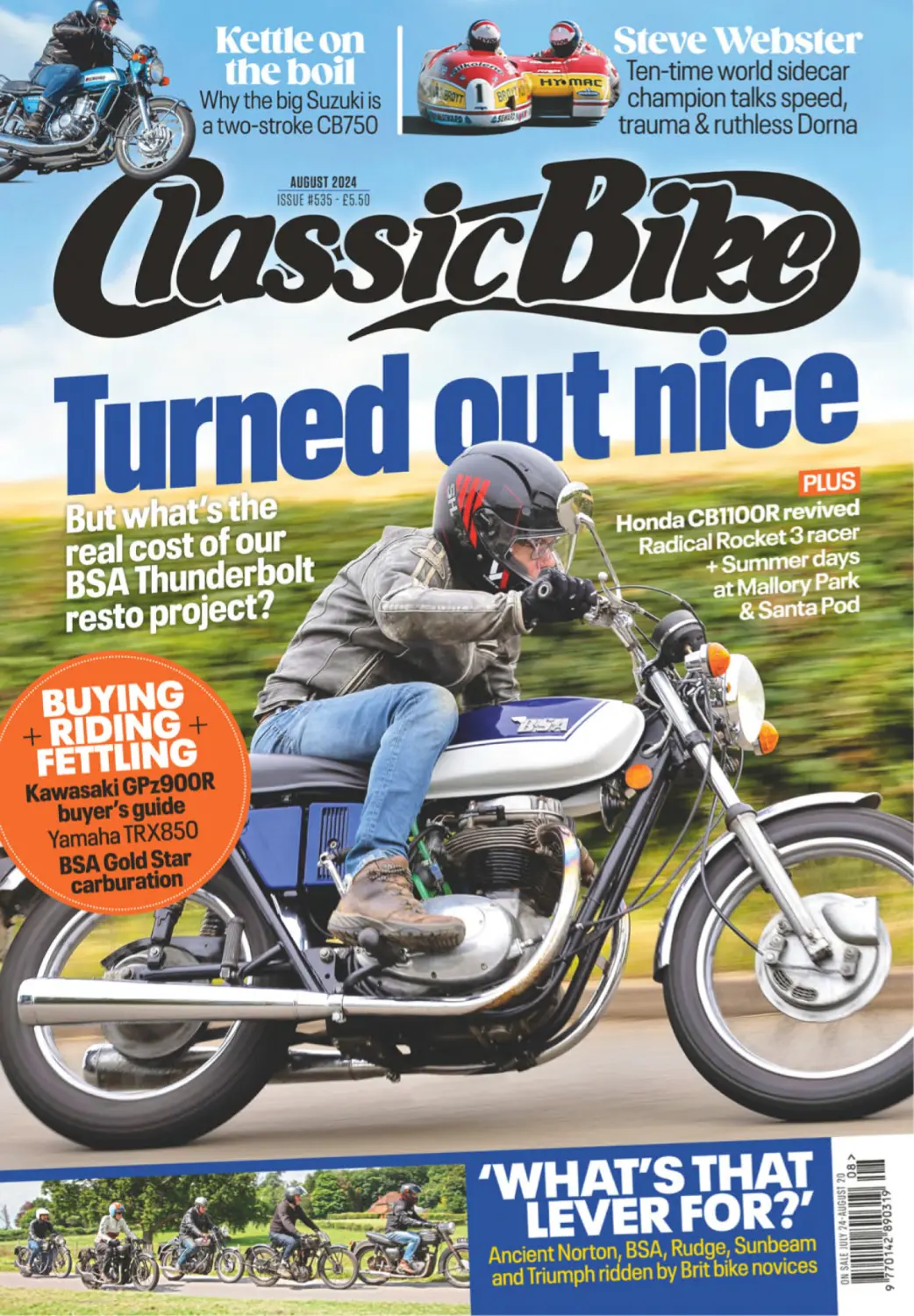
Welcome
AU G U S T 2 02 4
Classic Bike magazine is made
from home these days. Or
homes, I should say – our core
team live in five different
counties and communicate
via computer screens. Gathering together is
a rarity, so our works outing to Kent, to ride
old bikes and receive guidance and tuition
from Uncle Rick, was as much about having
a laugh and a chat as it was about experiencing
the joy of vintage motorcycles.
That’s how it worked out too. We had a
fantastic day out. It was a riot of stalled
engines, sprained ankles, overshot braking
points and piss-taking.
For all the challenging weirdness in riding
old bikes – advance/retard levers, carburettors
that need tickling, hand gearchanges, brakes
that don’t work and bouncy saddles – they
are still just motorcycles. CB’s designer Austin
Smith, who lusts after Kawasaki ZX7-Rs,
was grinning all day – and high-mileage
modern rider John Westlake is now checking
prices for pre-World War II Rudges.
At CB we’re blessed to have Rick on hand
to provide old bike expertise and tuition,
but everyone should experience a ride on
something vintage. The VMCC, The
Sunbeam Club and National Motorcycle
Museum have schemes that can help realise
an ambition. Our story is on page 24.
The CB team get their heads
around vintage bikes in an
all-too-rare sociable moment
CONTRIBUTORS
IN THIS ISSUE
I S S U E # 53 5
And we need to get out more. The
socialising that happens when you are messing
about with old bikes is really important.
The week before our jaunt to Kent,
contributing editor John Westlake and I had
been out on mopeds (combined value 3/- 6d)
with mates and had a great laugh too.
Evidence on page 88.
I’m also looking forward to having a ride
out with Rupert Paul on his BSA Thunderbolt,
now it’s up and running and apparently
sorted. Personally, I don’t keep tabs on
restoration costs, but Rupe has – and the
results are slightly alarming.
Despite the cost, the amount of time it’s
taken, the toll on his emotional wellbeing,
the moans about suspension quality on his
50-year-old bike and the fact that his ‘friends’
are taking the piss, Rupert is apparently
delighted with the bike. Story on page 78.
Last weekend I was at Mallory Park for
the Bike Bonanza, where I ran into some
great people and heard more good stories
(the best of which came from former 250
racer Nigel Bosworth – we’ll try and get
him to tell it in CB in a future issue).
Is there anything finer than messing about
on classic bikes with a bunch of mates?
Enjoy the issue.
PAGE
24
Mark Holmes
Our Moto Guzzi-owning production ed’s
usual job is fixing Hugo’s punctuation, but
he was the ideal person to write a novice’s
view on riding hand-change bikes.
PAGE
48
Mick Duckworth
The most meticulous journalist in the
classic world still finds untold stories
– like this one about Martin Russell’s
radical BSA Rocket 3 racer.
Hugo Wilson, Editor
24
PAGE
78
Rupert Paul
Former Performance Bikes editor who
now earns a living rewiring old bikes...
and who now owns an (almost) fully
functioning BSA Thunderbolt.
Get in touch at:
letters@classicbike.co.uk
GARY MARGERUM
Next month in Classic Bike
Rick Rides a Gilera Nuovo Saturno • Steve Tonkin’s Metisse Gold Star on the Isle of Man
Norton ES2 racer from New Zealand • 75th anniversary Laverda celebrations
Suzuki GSX1100 engine build • September issue on sale 21 August
3
Issue # 5 35
Contents
Classic World
DRAGSTALGIA
We head to Santa Pod’s nostagic
celebration of old drag bikes
10
MALLORY BIKE BONANZA
14
THIS MONTH...
17
LETTERS
20
A feast of diverse classics for all
tastes at the ‘friendly circuit’
All the top events for August, with a
focus on Kent’s Heritage Sprint
Arthur Browning appreciated, along
with some bright electrical sparks
60
MONIKER MADNESS
Some bike names are plain bizarre;
we delve into the origins of daftness
HONDA CB1100R REVIVED
Bought sight unseen and rougher
than expected, but transformed
Classic Workshop
72
IMPERIAL & METRIC FIXES
78
PROJECT BIKE:
BSA THUNDERBOLT 650
CB experts Rick and Al advise
on your motorcycle maladies
Rupert finally gets his BSA running
right – so was it really worth it?
SHOW US YOURS
CHIPPY WOOD
6
56
Readers’ rides – including a
Kawasaki GPz900R at the TT
Features & tests
24
32
A VINTAGE DAY OUT
The CB team take a trip to Kent to
get to grips with hand-change bikes
RICK RIDES... SUZUKI GT750
Project Thunderbolt: problems sorted, tank repainted
Rick gets on the Kettle to see if the
750 two-stroke is his cup of tea
86
40
AT LUNCH WITH...
48
RUSTLER BSA ROCKET III
Steve Webster, world sidecar
champion ten times over, tells all
TRIUMPH
Mick Duckworth unearths the story
of this unique racer, now revived
OUR CLASSICS
Triple header: Yamaha TRX850,
Mobylette moped and BSA Goldie
Classic Market
93
BUYING AND SELLING
97
BUYER’S GUIDE
KAWASAKI GPz900R
Laverda RGS vs BMW K100RS,
plus standout bikes for sale
What to look for on the first
liquid-cooled 16v four from Japan
102 AUCTIONS
All the latest prices and tasty
machines heading for the block
The Way We Were
114 CROSS-CHANNEL CHAOS
There are plenty more beastly bike names, see page 56
Breaks for French freedom and
other nostalgic two-wheeled tales
SUBSCRIBE THIS
SUMMER AND TRY
3 ISSUES FOR £5
Turn to page 68 for more information
4
BAUER AUTOMOTIVE
60
48
40
CHIPPY WOOD
Commitment was the name
of the game when bringing
this blind-bought Honda
CB1100R back up to scratch
JASON CRITCHELL
Keep your ear to the ground? Steve
Webster’s passengers had to drag other
parts of their anatomy through the dirt
on the way to him winning 10 world titles
Monoshock parallelogram rear
suspension of the Rustler BSA
triple marks it out as unique
5
Dragstalgia July 5-7
It’s that time of year when the events intensify, and July kicked off with
Dragstalgia, Mallory Bike Bonanza and Laverda’s 75th Anniversary Rally
all happening at the same time. We’ve done our best to squeeze them in...
Captions KEITH LEE & HUGO WILSON | Photography KEITH LEE & GREG MOSS
HOGSLAYER
Owner: National Motorcycle Museum Engine: Twin-engined Norton 1656cc
The highlight of this year’s annual nostalgia drag festival at Santa Pod was the appearance of
the legendary Hogslayer twin-engined Norton – the most successful drag bike in the world during
the 1970s. In a tribute to late rider/owner TC Christenson, and the bike’s designer and innovator
John Gregory, the National Motorcycle Museum enthusiastically allowed Neil Baskerville and his
father Ray, along with Chris Illman, to take on the resurrection of what had been a static exhibit for
well over 20 years. It was a massive leap into the unknown, but with advice from John and others,
the plan came to fruition. The bike delighted all those who came to Dragstalgia by making three
passes at a track on which it won some 50 years ago. Ian King and Graham Sykes both enjoyed
a chance to ride this major machine in the sport’s history. Many more well-known figures helped
in the push to get the task successfully achieved – and produce that glorious sound once more.
6
7
Dragstalgia July 5-7
SHOTGUN
Owner: Dave Clee Engine: Triumph 865cc
Graham Sykes (pictured on the left below) rides anything and everything
– from a moped to his amazing steam rocket bike. At Dragstalgia he rode
Shotgun to the win in the NSA Shootout against Ray Law in the final run-off,
clocking a 10.5s/136mph. Alongside Graham is the bike’s current keeper,
Colin Fallows, who has restored a few historic drag bikes in his time. He’s
ridden Shotgun in the past, but at Dragstalgia preferred to run the ex-Mick
Butler double-Norton Super Cyclops – normally a reliable machine, but
unfortunately part of the inlet manifold split, which was a shame. Shotgun
used to be raced by owner Dave Clee after he returned to the sport following
a long break. It’s usually maintained by John Hobbs, but at this year’s
Dragstalgia he was kept rather busy helping out the team bringing the
twin-engined Hogslayer back to life (see page 6).
THE GRENADE
Owner/Rider: Paul Rees Engine: Triumph 750cc
It was a pleasure to see Paul Rees make the long trip up from Cornwall, on
what was a special occasion for him and sister Laura; it was to be his first
time riding this bike at Dragstalgia. His father Simon was an accomplished
engineer, and a bike lover throughout his life. Sadly he passed away early last
year, and this event was always Simon’s favourite meeting to race the
supercharged Triumph. Simon spent many years restoring the machine –
originally raced by John O’Brien in the mid-’70s – and enjoyed many seasons
sprinting it. The plated fuel tank is a distinctive feature of the quickest of the
three sprinters he used to run at various straight-line events. Last raced
before the Covid pandemic, it was great to see the bike back again.
Pictured above, from left to right: Hayden Watson, Laura Rees,
Shaun Leconte, Paul Rees and Craig Arnold
SINGLE FORCED
Owner/Rider: Jan Honee Engine: Jawa 500cc
Jan Honee, helped by ace fuel bike engineer Marius van der Zijden, runs the noisiest and most explosive machine at Dragstalgia; Single Forced, which made its
annual ferry trip over from Holland for its only outing of the year. Although the bike only boasts a capacity of 500cc from a much reworked Jawa single cylinder
motor, the huge amount of nitro forced through the supercharger turns it into a little monster. Almost 40psi is produced by the heavy blower, and 98%
nitro – combined with aggressive ignition timing – gives it an awesome sound. Back in 1996, Jan stunned spectators in Florida, clocking 8.19s for the standing
quarter. Then, after a 19-year lay-off, Dragstalgia tempted him to take the wraps off the bike in 2015. This year saw a revised fuel pump and
clutch fitted, with increased spark, producing more power than its intrepid rider had ever experienced. With the weather
reducing track time, the opportunity to retune this little monster was limited – so it was a wild ride!
‘The huge amount of
nitro forced through
the supercharger
turns this 500cc bike
into a little monster’
8
Captions & photography KEITH LEE
SPS OLD SCHOOL Owner: Nick Pepper Engine: Suzuki 1260cc
Unlike the other bikes featured, which ran in the NSA Shootout event, Nick Pepper’s competed in the Old School Stockers eliminator. The GS1000 dates back to
the end of the ’70s, when Pip Higham raced it in Street Bike. It then went to Steve Tong and became a Pro Stock runner. Nick was a friend of his, and a competitor
himself, over 40 years ago. When Steve died, Nick obtained the bike at auction, restored it, then ran it at Dragstalgia for a number of years – although he didn’t
entirely enjoy its handling characteristics. Eventually he sold the rolling chassis to fellow racer Rod Spry – although it didn’t take long before Nick bought it
back. This time he invited another rider from his era, Steve Howe, to ride it at Dragstalgia and it seemed Nick enjoyed having someone else riding for him. In the
shot above, Steve is shown launching hard against the rapid H2 Kawasaki of Dean Stevens.
CONQUEST 2
Owner/Rider: Gary Norman Engine: Twin-engined Norton 1700cc
The original Dennis Norman double-Triumph was on show in the historic
marquee. Meanwhile, the later double-Norton was very much still running
in the hands of son Gary, who was very pleased with the way the bike now
sounds and pulls so much stronger this year. The electronic ignition was
stripped out and replaced by a pair of Lucas comp mags. Neil Baskerville has
put in a lot of machine work on the bike, which is not dissimilar to Hogslayer
in layout and runs the same Hilborn injection system. The transmission has a
Baskerville and Miller clutch, and is the original three-speed unit they
produced. During Dragstalgia, it was announced that Neil’s father Ray, along
with Pete Miller, were jointly to be the latest inductees into the British Drag
Racing Hall of Fame, in recognition of their work in this field.
LITTLE CONQUER
Owners: Martin Ginger and Matt Owens Engine: Triumph 350cc
This 350 Triumph turned up for its Dragstalgia debut this year. The bike was
picked up by Martin and Matt when it came up for auction less than nine
months ago. Matt is the designated rider (he’s sitting on the bike alongside
Martin, above). The engine is a 3TA unit motor, but with the gearbox sensibly
cut off and replaced by a more robust AMC box and clutch. The frontmounted Shorrock blower is fed via an SU carb. The distinctive tank/cover
was identified as having previously resided on Rod Pallant’s original
twin-engined Kawasaki. The machine’s name is a nod to the well-known
Conquest bikes of the Norman family, for whom the pair have been crewing
at previous events. Unfortunately, there was no opportunity to run the bike
prior to appearing at Santa Pod, and it suffered from stage fright, despite
much coaxing to get it to run on this first outing.
9
Photography GREG MOSS
Mallory Bike Bonanza July 6-7
A summer weekend #2
The line-up of road and race bikes on track at the Mallory Bike Bonanza was as varied as ever
GEOFF BOUCHARD, 1978 Gillette G3
This sweet little two-stroke special is a regular at Mallory for this event, and
the previous Festival of 1000 Bikes, as Geoff lives nearby. The bike has also
featured in Classic Bike before, though it’s evolved in the subsequent years
and is now faster than ever, clocking 81.5mph on the startline straight. “I got
some oversize barrels,” says Geoff. “So the capacity is up to 195cc. I’ve also
made my own cylinder heads and fitted different carburettors.” Originally
conceived and built in 1978, using three Mobylette moped cylinders and a
Gilera sports moped chassis, the bike has now had 46 years of development.
Geoff made the crankshaft and crankcases himself – “I’ve got a lathe and a
mill at home” – and the gearbox is from a Yamaha TZR125.
BARRY LOOSE, 2000 Honda VTR1000
Honda’s easy-going 1000cc V-twin VTR, produced between 1997 and 2004,
lives in the shadow of the far more focused and desireable SP-1 and SP-2
models, but that makes them a really attractive buy. “I really fancied an SP1,”
explains owner Barry. “But I couldn’t afford one; this was different and
I really liked the look of it.” Barry doesn’t know the history of this bike, but the
previous owner had built it as a replica of the Moriwaki-prepared race bikes
that appeared at the Suzuka 8-Hour endurance race in 1999. It’s got
FireBlade forks, a digital dash, aftermarket pipes and rearsets. Barry was
delighted with it, despite having just toppled off it at the Mallory hairpin
during a track session (note fairing scuffs and bent brake lever).
10
Yamaha TZ750s
The mighty Yamaha TZ750 celebrates its 50th
anniversary in 2024 and Mallory hosted a gathering
of around 30 of the four-cylinder strokers that
revolutionised racing in the 1970s. As well as the static
display there were two parades on Sunday. The event
was organised by TZ enthusiasts Terry Kendrew, Dave
Skinner, Keith Alderman and Leon Legero; 1977 F750
World Champion Steve Baker was also present,
doing demo laps on Sunday. Steve won the 1976
Race of the Year at Mallory on a TZ750, and
last raced there at the 1979
Transatlantic Trophy on a Sid
Griffiths TZ750.
11
Mallory Bike Bonanza July 6-7
JOHN MILLER, 1995 Gilera Nuovo Saturno 500
“My wife bought it for me for my birthday,” explains John on the subject of
how he came to own this sporty Gilera single. “I saw them when they first
came out and I wanted one, but of course I couldn’t afford it. I like Italian
bikes and things that are a bit different, so it’s been one of my dream bikes
ever since. I found this one for sale 3½ years ago and my wife knew that
I wanted to buy it. Before I could ring the seller, she’d called him and bought
it without telling me. She swore him to secrecy, so when I rang him he said
it was sold, but “If the sale falls through, you can have it.’ Then she got it
delivered, so it turned up out of the blue – I couldn’t believe it. It’s everything
I expected it to be. We’ve got great roads at home (John lives at Elgin in
Scotland) and it’s just brilliant on them. The top speed is maybe 110mph,
but that’s plenty.” Want to know more about these bikes? Rick P will
be doing a road test on the Nuovo Saturno in the next issue of CB...
JEFF ELLIOT,
1981 Suzuki DRZ750
Jeff is a serial special builder who made the
monocoque-framed Triumph trail bike we featured
in the March 2023 issue of CB. So how did this café
racer come about? “Someone had an engine and a pair of
wheels they’d been trying to put it in a Featherbed frame and I’d
got a Seeley Commando petrol tank. At the time I didn’t have an
English Wheel so I couldn’t make my own fuel tank, but I could make
a frame, so I made the frame to fit the tank.” (Jeff says this like it’s the
simplest thing in the world.) The engine is from Suzuki’s DR-Z 750 trail
bike. It’s a four-valve single, but with one exhaust port and two inlet
ports. “It should have two carburettors, but I made an inlet manifold
for a single Mikuni flat-slide carb.” The engine’s oil-cooled and has
twin spark plugs and two balancer shafts to smooth vibes. Forks
are R6, hubs are Spondon, front caliper is ISR. The bike took a
couple of years to build and has been completed for a while,
so what’s he cooking up now? “I’ve got a V-twin Weslake
with a Quaife box that I’m making into a Metissestyle road bike, and I’m also working on a trail
bike with a Yamaha R1 engine... just
don’t ask me why.”
12
Left: Jeff loves building
unusual projects – he’s
currently cooking up an
R1-powered trail bike...
ROGER JAMES, 1959 Ariel Arrow, 1961 Ariel Arrow Super Sports & 1967 Bedford Debonair camper
Ariel’s 250cc two-stroke twins are often overlooked, but Roger James is a long-time fan. “In 1968, as soon as I was 16, I bought an Arrow.
Next year I was based in Plymouth with the Navy, so I bought a Leader to get home on – and I’ve still got it.” He’s also acquired a few more...
“The gold bike is a bit special. It was built by the factory for production endurance races. Peter Inchley and Robin Good were second in class on it
in the 1961 Barcelona 24 hours. A friend found it 20 years ago. He went to buy it, but walked away because it was in such a state – but he
remembered the registration number, so he realised what it was and went back and made an offer. I bought it from him in 2009 and I’ve been
parading it since then. I ride them on the road, but I like coming to events like this to fly the flag for Ariel two-strokes. The weak spot now is the
crankshaft. They’re old, so worn bearing journals are a problem. Refurbishing them can be expensive. Hepolite pistons are scarce now, so
most people are using Suzuki X7 pistons. The ’59 bike has a Pazon electronic ignition, but the Super Sport has the six-volt coil and points.”
A summer
weekend #3
Meanwhile, in northern Italy, the same
weekend: Laverda’s 75th Anniversary Rally
ANDREW POWELL, 1977 Yamaha RD400D
“When I was a teenager, a friend had a 125 Yamaha when I had a Honda
CD175, so I always wanted a Yamaha two-stroke twin,” explains Andrew.
“Ten years ago, I bought an RD400F project bike and had started to buy up
bits to restore it when our house got flooded and we ended up having to
move, so I had to sell it. We’ve been to this event a few times, so when this
came up for sale last year my wife said: ‘Buy it and take it to Mallory’. So
here we are. It’s beautiful. A joy to ride and Paula reckons it really comfy on
the pillion... well, as long as the front wheel isn’t three feet in the air! The
previous owner had restored it and it has been very competently done; I’ve
hardly done anything to it except touch up the paint on the wheels, though
I might get the silencers rechromed. I’ve found someone that can do it for
sensible money.” So it’s a keeper then? “I think so, I tend to keep my bikes a
long time. I’ve still got the 1975 Kawasaki Z1B I bought new when I was 19.“
Moto Laverda’s home town of Breganze was overwhelmed with
people and bikes for the 75th anniversary of the marque’s first
motorcycle. All models were present, including three of the
amazing V6 race bikes (pictured above). Unfortunately, we don’t
have the space to cover it in this issue, but we’ll have a full report
in next month’s Classic Bike – on sale August 21.
13
THIS MONTH... in 2024
A straight line to fun
The Heritage Sprint at Betteshanger Park is one of those events which you turn up to for
a look, then next year you’re back – on the strip. That’s what happened to Maria Coombes...
I’VE BEEN INTO old bikes since
I was a young girl, heading off
to bike shows on the back of my
dad’s Harley. And I’ve owned
my 1955 BSA Bantam since
I was 19. I love the classic scene,
but I can honestly say that the
Heritage Sprint at Betteshanger
Park near Deal is the best event
I’ve been to. And it just keeps on
getting better.
This year’s sprint will be the
third to be held at Betteshanger
– and the third I’ve attended. In past years,
I’ve manned – or should that be womanned?
– the BSA Owners’ Club stand and been pressed
into flag girl duty. This year, I’ll be out on the
-mile strip for the first time on my 2003
Royal Enfield Bullet bobber, as well as helping
out on the Kent branch of the BSA Bantam
Club stand (I’m the Kent rep).
There are 12 race classes, including classic
The action on the strip may be the
main attraction, but there’s plenty
more happening at the sprint
14
pre-65 and pre-85 bikes of course,
but there’s also a class for modified
modern bikes and ladies on any
bike (as long as it’s under 100bhp,
the power limit for the event).
There’s room for all sorts, though
sadly race entries are full for this
year. But why not come down
and enjoy the atmosphere and
have a great weekend anyway
– there’s plenty more going on
away from the strip.
Up in the top field, there’s a
large marquee packed with show bikes. The
organisers have still got room for a few more,
so if you’ve got an interesting bike, contact
them at info@heritagesprint.co.uk and you
could get free entry to the sprint and free
camping. There’s night security laid on, so
all the bikes are safe. There are loads of trade
and club stands too – and autojumble pitches
offering everything from parts to clothing.
Last year a couple of local dealers were offering
test rides, and there’s just so much to get round
– you won’t know where to look next.
The action on the strip will draw you back,
though. Seeing what classic bikes are capable
of is amazing and the action is pretty well
non-stop throughout both days. Even during
the lunch break for the track officials, there
are special demo runs and parades for clubs.
And despite the professionalism of the event’s
organisation, the fact that it’s not part of a
race series means there’s a wonderful, relaxed
vibe about it. The riders are a great bunch.
If you can, make a weekend of it. Tickets
are £19.50 for a weekend, £11.50 for a day
(under 16s free). Camping is in the paddock
(£5 per night) and it’s great to wake up to the
sound of engines firing up! There’s live music
on Saturday night, a lively bar, plenty of great
food, plus showers and proper toilets for
campers and visitors. A great party – with
classic bikes. Perfect. heritagesprint.co.uk
More dates for August
3 Huggy’s Auto Shindig and Swapmeet,
Huggy’s Speed Shop, Mallory Park Circuit,
Leicestershire.
huggysspeedshop.co.uk
3-4 Aberdare Park Road Races,
Aberdare Park, Mid Glamorgan.
Classics and modern bikes combine at the
historic parkland circuit.
aberdarepark.co.uk
3-4 Classic Bike Festival Ireland,
Bishopscourt Racing Circuit, Downpatrick,
County Down, Northern Ireland.
You’ve missed the boat for a riding entry,
but this looks a great event to get to anyway.
Star guest riders include Giacomo Agostini,
James Whitham, Bruce Ansty and Jeremy
McWilliams on track, plus over 280 classic
bikes, club displays and live music.
classicbikefestireland.com
August 10-11
HERITAGE
SPRINT
Betteshanger Park
4 Triumph Owners Meet,
Sammy Miller Motorcycle Museum,
Bashley, New Milton, Hampshire.
Triumphs old and new take centre stage
at Sammy’s musuem for the day.
sammymiller.co.uk
Deal, Kent
4 Laverda 75th Anniversary Celebrations,
The New Inn, Willersey, Broadway,
Worcestershire.
A huge celebration, with 300 Laverdas
expected to attend. Entry is free, but you
need to register in advance to get into the
Laverda park. Contact coxeng@gmx.com
iloc.co.uk
10-11 British Historic Racing,
Anglesey Circuit, Anglesey.
A beautiful setting for the penultimate
round of the BHR’s 2024 championship.
britishhistoricracing.co.uk
KEVIN BENNETT PHOTOGRAPHY
10-11 DTRA Nationals
Amman Valley Trotting Club,
Ammanford, Carmarthenshire.
Fast racing guaranteed on the longest track
on the DTRA calendar – the closest you’ll
get to a US ½-mile oval in the UK.
dirttrackriders.co.uk
10-11 Bikers’ Festival,
Circuit Spa Francorchamps, Belgium.
Formerly known as the Bikers’ Classic, this
is now a true festival for classic bike fans.
The popular track sessions remain a big
draw, along with a host of star guests.
There’s a vintage enduro, classic trial and a
non-stop party atmosphere.
bikersfestival.be
August 11 Summer Auto Jumble,
Sammy Miller Motorcycle Museum.
Bring, buy... or just browse.
sammymiller.co.uk
11 Newark Autojumble, Newark
Showground, Nottinghamshire.
newarkautojumble.co.uk
17-18 Hill Climb, Olivers Mount,
Scarborough, North Yorkshire.
Classic track action on the UK’s only
mainland real roads circuit. Different
course layouts for Saturday and Sunday
should keep things interesting.
oliversmount.com
18 All things Italian,
Sammy Miller Motorcycle Museum.
Another summer weekend, another event
at Sammy’s; this one’s all about Italian iron.
sammymiller.co.uk
18-26 Isle of Man Festival of Motorcycling,
Isle of Man.
Over a week of action on the Island, with
the Manx GP (including the classic races),
the Vintage Motor Cycle Club rally (21-27),
and the Festival of Jurby (25).
iomttraces.com or manxgrandprix.co.uk
21-23 Belgian Classic Trophy,
Gedinne, Belgium.
Get up close to the action at the real roads
Gedinne circuit; road racing as it used to be.
crmb.be
22-26 Vets Motocross des Nations,
Foxhill Moto Parc, Liddington,
Swindon, Wiltshire.
A must for ’90s and noughties motocross
fans. Kurt Nicholl and Rob Herring are just
two of the star riders, with a packed
programme of racing on Saturday/Sunday.
vmxdnfoxhill.com
23 Classic Trackday, Oulton Park Circuit,
Cheshire.
Make a long weekend of it and give your
own classic a thorough workout on the
track ahead of the classic racing on
Saturday and bank holiday Monday.
classicbiketrackdays.com
24-26 CRMC road racing, Oulton Park,
Cheshire.
The battle for the CRMC Championship
gets serious at the scenic Cheshire circuit,
with just one round left after the two-day
(Friday and Monday) programme here.
crmc.co.uk
31 Squires Café Autojumble,
Sherburn in Elmet, West Yorkshire.
squires-cafe.co.uk
August 31-September 1: Manx
International Classic Trials, Isle of Man
A cracking two-day trial with classes for
both pre-65 and twinshock machines.
manxtrialsclub.com
15
Arthur’s the best all round
outstanding top-line achievements in such a multitude of
competitive disciplines?
One area of Arthur’s career not covered was his ability to
use a two-valve speedway-modified Jawa in many, many forms
of our sport, including an award for starting and finishing
the Mountain circuit at the Manx Classic Grand Prix with
his Jawa. Sorry to hear about his race exclusion, but it didn’t
stop him starting up and showing his passion on Peel Promenade
at this year’s TT races. Arthur, please keep it classic – and
thanks for being interviewed by Classic Bike!
Mose Hutchison, Penicuik, Midlothian
B A U E R A U T O M O T I V E , D AV E C O L L I S T E R & A R T H U R B R O W N I N G A R C H I V E
I am a very long-time enthusiast with a major interest and
involvement in all forms and branches of our very competitive
classic competition scene – both two and three-wheeled. I’m
writing to express how impressed I was with John Westlake’s
recent interview (in the June issue) with one of my long-time
very much unsung hero – the one and only Arthur Browning.
I have seen in print (on several occasions) that American
superstar Kenny Roberts was the world’s greatest all-round
motorcycle competitor. Certainly, he was fantastic on both
dirt and tarmac – but can anybody on the planet truly come
close to our Arthur’s fantastic list of very successful and
World championship trials and motocross,
professional speedway, multiple ISDT gold
medals… was there nothing Big Arthur
couldn’t do? In a word: No
A gentleman’s word
SEND YOUR
LETTERS TO
letters@
classicbike.co.uk
I have been buying this magazine for
over 15 years and after reading the
article in the July issue about Harry
Metcalfe and his Cagiva 900ie, I felt
I had to contact you and tell you how
angered I was. In the article Harry
openly says how he contacted the seller
about the bike to find out that a deal
had already taken place. Not happy
with this, he rang back and threw more
money at it. This is where the magazine
has fallen down. I was under the
impression that the magazine was read
and written by people with morals,
but here we are reading about people
who have no regard for ‘giving someone
their word’. The deal was done, a price
agreed. It might be that I am old school,
but I always thought that there was
honour within the bike-loving group
that we are all part of. Let’s hope that
this is a one off – because if it is not,
then the world of classic bikes will
become like politics, where what is
said has no worth or meaning.
Gideon Jenkins, Wales
Wire in the blood #1
Regarding the rewiring of the project
BSA Thunderbolt in the June issue.
I helped a Triumph mechanic rewire
a bike and was impressed how simple
17
YOUR LETTERS
CLASSIC BIKE IS MADE BY...
Editor Hugo Wilson,
hugo.wilson@classicbike.co.uk
Art Director Austin Smith,
austin.smith@classicbike.co.uk
Production editor Mark Holmes,
mark.holmes@classicbike.co.uk
Technical editor Rick Parkington,
workshop@classicbike.co.uk
Editorial assistant Alison Silcox,
alison.silcox@classicbike.co.uk
Group Art Director, Motorcycling Steve
Herbert, steve.herbert@bauermedia.co.uk
Cover image Chippy Wood
ADVERTISING
Group Commercial Director
Gareth Ashman 01733 468118
Commercial Manager
Sarah Dodd 01733 366311
Account Manager
Rebecca Jackson 01733 395071 rebecca.jackson@b auermedia.co.uk
Senior Telesales Executive
Sarah Frisby 01733 979425
sarah.frisby@bauermedia.co.uk
Senior Sales Executive
Annie Mulcrone 01733 979445
annie.mulcrone@bauermedia.co.uk
Telesales Exec Sarah Frisby 01733 366406
Publisher Rachael Beesley
Group editor Andy Calton
MD Automotive Group Niall Clarkson
Chief Financial Officer Bauer Magazine Media
Lisa Hayden
Co-CEOs of Bauer UK Helen Morris, Steve
Prentice
COMPLAINTS
H Bauer Publishing is a member of the
Independent Press Standards Organisation
(www.ipso.co.uk) and endeavours to respond
to and resolve your concerns quickly. Our
Editorial Complaints Policy (including full details
of how to contact us about editorial complaints
and IPSO’s contact details) can be found at
BORING BUT IMPORTANT
H Bauer Publishing is a company registered
in England and Wales with company
number: LP003328, registered address:
The Lantern, 75 Hampstead Road,
London NW1 2PL. VAT number 918 5617 01
No part of the magazine may be reproduced in any form in
whole or in part, without the prior permission of H Bauer
Publishing. All material published remains the copyright of H
Bauer Publishing and we reserve the right to copy or edit any
material submitted to the magazine without further consent.
The submission of material (manuscripts or images etc) to H
Bauer Publishing, whether unsolicited or requested, is taken
as permission to publish that material in the magazine, on the
associated website, any apps or social media pages affiliated
to the magazine, and any editions of the magazine published
by our licensees elsewhere in the world.
By submitting any material to us you are confirming that
the material is your own original work or that you have permission
from the copyright owner to use the material and to authorise
Bauer to use it as described in this paragraph. You also promise
that you have permission from anyone featured or referred to
in the submitted material to it being used by H Bauer Publishing.
If H Bauer Publishing receives a claim from a copyright owner
or a person featured in any material you have sent us, we will
inform that person that you have granted us permission to use
the relevant material and you will be responsible for paying
any amounts due to the copyright owner or featured person
and/or for reimbursing H Bauer Publishing for any losses it has
suffered as a result. Please note, we accept no responsibility
for unsolicited material which is lost or damaged in the post
and we do not promise that we will be able to return any
material. Finally, whilst we try to ensure accuracy of your material
when we publish it, we cannot promise to do so. We do not
accept any responsibility for any loss or damage, however
caused, resulting from use of the material.
US INFO
• Classic Bike, ISSN 0142-890X (USPS 706770)
is published monthly by H Bauer Publishing Ltd,
The Lantern, 75 Hampstead Road, London
NW1 2PL, United Kingdom.
• The US annual subscription price is $89.51.
Airfreight and mailing in the USA by agent named
World Container Inc, 150-15, 183rd Street, Jamaica,
NY 11413, USA.
• Periodicals postage paid at Brooklyn, NY 11256.
• US Postmaster: Send address changes to Classic
Bike, World Container Inc, 150-15, 183rd Street,
Jamaica, NY 11413, USA.
• Subscription records are maintained at Bauer
Media, Subscriptions, CDS Global, Tower House,
Sovereign Park, Lathkill Street, Market Harborough,
Leicester LE16 9EF, United Kingdom.
• Air Business Ltd is acting as our mailing agent.
SUBSCRIPTION QUERIES
To contact us about subscription orders, renewals,
missing issues or any other subscription queries,
please email: bauer@subscription.co.uk or call our
UK number on 01858 438884 for overseas call
+44 1858 438884. To manage your account online
visit www.greatmagazines.co.uk/solo
BACK ISSUES
Back Issues. To order back issues in the UK,
call 01858 438884. Overseas: +44 1858 438884
Syndication: syndication@bauermedia.co.uk
18
Battery with negative earth
he made it. So I could remember, I
made a diagram (above) of the basic
wiring loom. I used it on my Tiger
T100s with no problem. I believe it
would be applicable to most classic
bikes. Simply use the coil as the ‘start’,
with two circuits – one to the rear and
the other to the centre/front. It can be
modified for positive earth and batteryless set-ups. I am not very good at
electrical work, but found this easy.
Above: John
Horton’s basic
wiring diagram
John Horton
Thanks John, your diagram is a classic
single-fuse layout with an electronic
ignition. It’s simple because all the
earths are through the chassis. I prefer
not to do that, for the same reason
Soichiro Honda chose not to from the
1960s onwards. The design of the
loom is important, but the quality of
the connections, and the wisdom of
how the wire bundles are routed is
critical too. Though, on the subject of
wiring diagrams…between leaving
me and ending up in the magazine,
something strange happened to bits
of the diagram for my BSA A65,
published in CB June. Such is life, but
anyone who would like the correct
OIF BSA (or indeed Triumph) wiring
diagram (with an earth circuit) can
find it at: tinyurl.com/2p897a94.
Rupert Paul
Stephen Dodd
Yes, soldered joints are less resistant
to vibration than crimps, but I used
solder on the tail-light refurb to keep
the whole thing neat and out of the
weather. As Bruce Lee observed, it’s
good to have lots of options and choose
the best one for the situation.
Rupert Paul
Satisfied customer
The July issue was another excellent
magazine. ‘Lighting up the racetrack’
and ‘Lucky Man’ were ace, while ‘Rick
Rides’ featured really great shots by
your photographer. Then there was
‘The Marlboro Men’ – these personal
interviews by John Westlake are perhaps
the best part of CB, with so many
personal insights. Love the layout and
artwork too.
Wire in the blood #2
I am mailing with reference to an
observation seen in your magazine to
link two wires together with a soldering
iron via laying over the wires. Given
it requires a very steady hand to perform
this task, an easier option is to perform
a ‘mechanical’ joint by simply tinning
the two twisted wires first, then creating
an eye with both ends with tweezers/
pliers. These then interlink and can be
lightly crushed to secure a close-fitting
loop prior to soldering/sleeving. Given
the susceptibility to vibration if the
wire link does fracture, it will still hold
sufficiently within its sleeve, preferably
adhesive heatshrink. Any soldered joint
is going to be at the mercy of corrosion
and vibration. A preferable solution is
to use ferrules to crimp both wire ends
together where possible, eliminating
the need to solder, by performing a
purely mechanical joint. It’s also worth
splashing out on quality ‘tinned’ wire
if performing any rewiring, as this is
less susceptible to corrosion than bare
copper wire.
Steve Hearn
Rumours of my death…
SEND YOUR
LETTERS TO
letters@
classicbike.co.uk
To err is human. A few years ago Les
Archer, the scrambles and motocross
champion, was surprised to read his
own obituary in Classic Bike. It was
his father, Les Archer Senior, who had
passed away...
David Roberts
JOHN HORTON
SUITS
YOUR CLASSICS
Show us yours
We love to see your acquisitions – so keep ’em coming to the address above
KEITH DUNLOP
This bike is based on a 1978 Yamaha SR500
with an XT500 tank fitted.I bought it as a taxed
and tested runner with the idea of using it as
the base to build something to run at Race the
Waves. I like the look of the 1960s BSA/
Triumph scramblers, but buying a useable
example was out of my price range. I saw this
on eBay at well inside my budget and saw the
potential to build a BSA Scrambler tribute bike.
It needed very little, really – a basic tidy-up,
some paint, a speedo and an ignition switch to
make it more practical. I did the paint job, tidied
the electrics, mounted the number boards and
made the mudguard mounts more solid (the
rear still needs some attention – it’s next on
the list). Since finishing the build, I’ve done
about 900 shakedown miles on it – but missed
the entry deadline for Race the Waves! Next
year, hopefully... All in, including purchase price,
tyres, paint and parts, the whole build came in
at about £2500 – well within budget. A record
of the build can be found on my YouTube
channel – Barnsley Biker Video Diary.
Mark Gallagher
Mark achieved his
’60s BSA scrambler
look on a £2.5k budget
– much cheaper than
the real thing
MARK GALLAGHER
Yamaha SR500
Norton Commando
I have just finished resurrecting this 1971
Norton Commando privateer race bike
from California, making many upgrades
while retaining as many of the custom
race bits that I could salvage. The
starting point was a trashed and long
unused bike that I secured in a BSA/
Norton trade. It had triple discs, Ceriani
GP38 forks, a quick-change chain ring,
20
SEND YOUR PHOTOS TO: LET TERS@CLASSICBIKE.CO.UK
Borrani rims and almost no bodywork,
with a butchered frame and the engine
locked in as a stressed member. I decided
to bring it back to life as a hot road bike
with custom bodywork and an airplanestyle instrument panel, as my dad flew
fighters out of RAF Leiston in Suffolk
during World War II.
I built a warmed-up engine using 10:1
slipper pistons on MAP long rods, with a
Megacycle cam, a ported head manifold
matched to new Amal 932s with Combat
jets, and an easy-access side-mounted
oil filter. Because I’m not so young any
more, I also fitted an Alton electric
starter kit and Ikon adjustable dampers. I
could have used a Quaife five-speed
gearbox, but they are like hen’s teeth
here in the States. The bike goes very
well and looks good just sitting there!
Keith Dunlop, USA
CHRIS ALLEN
Keith’s bike went from
trashed ex-racer (inset)
to shiny road beast
SEND YOUR PHOTOS TO
letters@classicbike.co.uk
Kawasaki GPz900R
Last summer I went to see the Kawasaki
GPZ900R that won a TT in 1984 ridden by
Geoff Johnson, which was on show in
Mike Grainger’s dealership in Plymouth.
Mike told me he was taking the bike to the
Isle of Man for practice week. I was
surprised that it wasn’t being given a
parade lap, but Mike said it had been given
one on the 30th anniversary of the win. I’d
been to the TT a couple of times on a 1989
Kawasaki GPZ900R that a retired mate,
Andy ‘Drew’ Whittle, had restored after it
had been stood for ten years (see Your
Classics, CB December 2022).
After seeing the TT-winning bike,
I wanted to go on the 1984 bike that
I owned, as it seemed fitting to go for its
40th birthday on the 40th anniversary of
that TT win. The only problem was that
the bike had developed major problems
last year and was a non-runner. The
starter-motor chain had snapped,
which is hard to get to; it
was also leaking oil from
somewhere onto my
left boot and had low
compression on one
notorious problem on GPzs, with most
having an override switch to turn the fan
on in traffic, but this was beyond that.
We could have sourced a secondhand
radiator in the UK, but to properly solve
the problem we had a new one imported
from the Czech Republic. Fortunately, this
arrived in time and worked well. So I was
able to make it to the TT on a 40-year-old
bike on the 40th anniversary of Geoff’s
win – and see Micheal Dunlop set a new
record for TT wins. The next step is to
see if the original engine is repairable...
Dr Chris Allen, Buckingham
of the cylinders. To get it to the TT on
time, Andy convinced me that the
quickest option would be to replace the
engine. So we ordered one from Sean
Jones of The GPZ900R shop [see
GPz900R Buyer’s Guide in this issue]
and Andy met Sean at a services on
the M6 to collect the engine.
The new engine was installed in time
for a test ride to the BSB meeting at
Oulton Park. The engine ran well, but
unfortunately the bike overheated – a
Just dragged
home a sorry old wreck,
finished a gleaming
restoration or had the
best ride of your life?
Email your stories and
pictures to letters@
classicbike.co.uk
21
OLD BRITS ROAD TEST
24
What happens when bikes up to nearly
a century old are thrust into the hands
of riders who are barely familiar with
a right-foot gearlever – let alone a
hand-change? We took a ride through
the Kent countryside to find out…
Words MARK HOLMES
Photography GARY MARGERUM
25
OLD BRITS ROAD TEST
On a farm lane on a sunny summer’s
day, any pre-ride fears quickly
dissolved into laughter
hese old things are just about
chuffing round a parade ring in
fancy dress, aren’t they?” I venture
with a grin, looking down at Rick’s
1928 Sunbeam Model 9. But he’s
not taking the bait. He knows my
reference to his habit of dressing
in period attire to demonstrate his more elderly motorcycles
at off-road gatherings is a thinly-veiled attempt to wind him
up. In fact, Classic Bike’s vintage motorcycle evangelist has
expressly forbidden me from calling them ‘old chuffers’. He
should’ve known it would have the opposite effect. Whether
that description is pertinent or not remains to be seen...
We’re about to find out – and the means for doing so
couldn’t be more enjoyable. A bunch of us has descended
on Mr Parkington’s Kent retreat (a selection of bike-stuffed
garages and sheds loosely attached to a house) to raid his
collection, commandeer five of his motorcycles and cart
them off to a place of safety where we can muck about on
them. Apart from the fact that it seemed like a fun thing to
do, there is a vaguely relevant point to all this, because three
of our party have little or no experience of riding old chuffers
– sorry, very old motorcycles. We wanted to see if we could
penetrate their veil of seemingly alien and complex control
systems, get to grips with them and wring out a bit of
entertainment in the process.
For the purposes of this experiment, we’ve plucked the
Sunbeam, along with a 1936 Rudge Ulster, a 1935 Norton
International, a 1956 BSA DBD34 Gold Star and a
1959Triumph Thunderbird from their semi-slumber in
Rick’s retirement home for old bikes. Our motley crew’s
range of experience starts with CB design man Austin
Smith, who is a seasoned rider but has never thrown a leg
over a classic bike in his life. Then there’s modern bike
habitué and CB contributor John Westlake, who rode a
Speed Twin on a VMCC run years ago and “nearly died
three times” due to brake/gearchange confusion, as well as
once having a brief go on Hugo’s old Matchless off-road.
My personal experience on really old stuff is limited to
a few hours chugging round Rutland on a Brough SS80,
although I did have a brief ride on Rick’s Norton Inter
26
1935 Norton International 500cc
This was the first bike Austin rode on the day: “It’s the one I was most excited
to ride,” he said. ‘Its TT racing heritage really appeals to me [Austin’s dad used
to race at the TT as a sidecar passenger]. I love the racy riding position, but it’s a
big, heavy lump to turn around.” John was a big fan too: “The International was
really lovely. There’s plenty of torque, plenty of power – I just wanted to keep
going – though the hand-change bikes offer a more visceral experience.”
Neither of them seemed to be unduly bothered by the Norton’s wobbly sprung
seat that had me in stitches during my ride on the Isle of Man.
Mid-thirties technology
means the Norton has
right foot shift
‘We wanted to see if we
could penetrate their veil
of seemingly alien and
complex control systems’
Rick’s Guide to vintage riding
Riding these bikes isn’t
difficult, really; the difficulty
is stepping out of the button
start/left-foot change/
one-finger braking habits
imprinted by modern machines.
I’d say the main issue we had was
starting; there are several steps that
soon roll into one for an owner, but it’s a
lot to remember – and missing just one of
them will mean failure for a novice.
Kicking properly is essential – it’s not a
‘stamp’, you use your body weight to push
right through the whole swing. And these
bikes won’t sit there at 1000rpm until
you’re ready to go. They get bored and
stall if you don’t give them an occasional
throttle blip; I noticed that if anyone’s
attention was distracted by watching
someone else struggling to start, they’d
let their bike stall.
These bikes come from a slower-paced
world; the brakes will stop you, but don’t
rely on them to fix your mistakes at the
last second. You need to keep well back
from other road users and think faster
Ignition
advance/retard
Clutch
Conventional clutch
lever position with cable
running to lift mechanism
on gearbox
Manual advance/retard;
pull back to retard for
starting and low speeds
than they do. That slower place helps
with hand change though; a broad spread
of power means you rarely need to
change down from top. Slightly retarding
the ignition lever will allow the engine to
crest a hill smoothly without dropping a
gear. Don’t be lazy, just recognise that
these bikes have big flywheels keeping
them rolling. Pull the valve lifter on the
Sunbeam and it will ‘faff-faff-faff’ over for
several seconds before coming to rest.
Old bikes are like horses – you can’t
just press a button and go, you need to
learn their ways and work with them.
Bikes now are so much more... capable
– but ‘efficiency’ and ‘fun’ rarely meet.
Instead, we have stellar acceleration and
top speeds. My question is whether the
toll on tyres, chains and fuel is worth it,
when you can get the same buzz on an
older bike without even having to break
the speed limit?
Perfection is great in household white
goods, but I want more from motorcycles,
warts and all. I think that’s why so many
people choose classics, of whatever era;
it just depends how far back you dare go.
Steering damper
Friction-type, mainly for racing
or sidecar use, but not needed
on modern roads
Throttle
Originally fitted with a twin
lever for throttle and choke,
this bike has a normal twistgrip
Tank caps
Divided internally for
fuel and oil; the left cap
is for petrol, the right
is the oil tank
Valve lifter lever
Releases compression
for ease of kickstarting
or to stop engine
Oil Pump
Adjustable drip feed with
viewing window is backed by a
hand pump for high-speed use
Hand gear change
Right-side hand gearchange
lever gives three speeds – first
is down, the rest up
27
OLD BRITS ROAD TEST
Right: Gold Star
really needs a
ton-up boy to get
the most out of it
over 10 years ago on the Isle of Man, when
the bouncy-castle effect of its sprung seat
on a bumpy road had me in a fit of
uncontrollable giggles. There will be
no foot-based gearchanging for me
today, though, as I’ve broken my
right big toe, so will be limited to
the two hand-change bikes (the
Rudge and Sunbeam). Acting in
the role of responsible adults, we
have CB Editor Hugo Wilson, a
man who has plonked his rear end
on many a vintage bike (although
he’s never ridden a Rudge) and, of
course, the owner of these machines
(and many more) Mr Rick Parkington, to
whom these motorcycles are more like his
own offspring than mere machines.
Let the comedy riding begin…
After a quick briefing by Rick on the bikes’ controls, the
three of us with least experience of vintage bikes – myself,
Austin and John – are let loose on a quiet farmer’s lane,
where we can do ourselves and other road users the least
damage. Suffice to say, the phrase ‘advance and retard’
takes on a whole new meaning – but pretty soon, we’re all
chugging up and down faster and faster, with ever-widening
grins cracking our faces (well, I think Austin was grinning,
‘Once Austin’s rolling, he
seems to be enjoying it –
but, like me, he has serious
doubts about venturing
onto the road and into
busy modern-day traffic’
28
but he was wearing a full-face lid, so hard to tell...)
It’s fair to say that the lever that advances and
retards the ignition is the mystical control
that defied our true understanding – but
once you get the hang of retarding it for
kickstarting, then advancing it a bit
more for motoring around, the bikes
seem to rattle along quite merrily.
John’s clearly having a great time
– he ends up having a blat on all five
bikes. Myself and Austin, however,
are struggling a bit more. I’m fine on
the Sunbeam – it’s not too hard to
kickstart, ticks over happily, is very light
and with a hugely torquey engine and only
three gears to worry about, it’s a pretty friendly
old thing to ride. The Rudge is another matter;
it keeps stalling on me and I never get the hang of
kickstarting it. Rick did a good briefing – he instructs us
to ease the kickstart round till you feel compression, pull
in the decompressor and move the kickstarter through an
extra five degrees, then wind it back, release the decompressor
and kick. But even when I do that, all I get is frustration
rather than combustion – and as we’re lucky enough to
be enjoying the first hot and sunny day of summer, I start
to pour with sweat trying to get the thing lit.
Like me, Austin is having to repeatedly rely on the
intervention of Rick’s seasoned technique and beefy boot
to bring to life the bikes he’s trying. Once he’s rolling, he
seems to be enjoying it – but, like me, he has serious doubts
about venturing onto the road and into busy modern-day
traffic. At this point, that sounds like it’ll end up in a guaranteed
trip to A&E. But we’re determined to keep trying...
Austin starts to get comfortable with the Thunderbird
– the bike here that’s the most like a modern machine in
1959 Triumph Thunderbird 650cc
In this company, the T-bird was a bit of a “comfy pair of slippers”
in Hugo’s words, although he’s had Triumph 650s before and
loved them. “It felt a bit civilised to me”, opined John. “The other
bikes are so unusual that you can’t help smiling the whole time.
The Triumph was fairly easy to start and more like a modern bike;
it wasn’t so involving.” Its style was a big attraction for Austin:
“The Thunderbird looks amazing, but it didn’t float my boat as
much as the others – and the front brake is non-existent, it
terrified me on the road [Rick admits it needs relining]. I was
a bit deflated after riding it.”
1928 Sunbeam Model 9 500cc
The Thunderbird scored big on style,
although it couldn’t match the challenge
and involvement of the older machines
Like all of Rick’s bikes, the Sunbeam has a lovely patina and is a
shamelessly oily machine – especially the exposed pushrods
which (as on the Rudge) exert an irresistible fascination as they
oscillate away. Upgraded with a later recirculating oil system,
the valve gear is still lubricated by grease which smokes like a
half-lit barbecue when hot. I can vouch that it’s the best bike here
to ride with a broken right big toe, as the brake pedal is operated
by the left foot. The hand gearchange lever on the right side of the
tank allows the selection of three speeds, described by Sunbeam
as: ‘starting, town and country’. It has massively torquey motor
and it sounds great – when ticking over, the combustion strokes
are as languid as a barge engine’s, building up to a tommy-gun
staccato as you raise the revs. A light and friendly bike to ride.
With initial nerves
dispelled, Austin (left,
on the Thunderbird) and
Mark (on the Sunbeam)
get into motoring
around the glorious
Kentish countryside
29
OLD BRITS ROAD TEST
1956 BSA DBD34 Gold Star 500cc
Rick was very happy with the way the Goldie was running – his long battle to get
it on song has been well documented in his pages at the back of the magazine.
Renowned as an uncompromising machine with an Amal GP carb that has no
interest in ticking over or slow-speed running, it was behaving itself during our
day out. But the Goldie’s clearly in a different league to the other bikes here, as
John highlighted: “Whereas the Norton/Rudge/Sunbeam felt comfortable at 30,
40, 50mph, the Goldie was clearly designed just for going much faster – we were
barely scratching the surface of its capabilities.” The one up/three down
gearshift pattern can catch people out, too.
John got right into
the swing of it, even
getting some grins
out of the Goldie
1936 Rudge Ulster 500cc
This bike originally had a foot gearchange on the left-hand side – but Rick has
taken that off, so the gears are changed via a four-speed hand change mounted
on the right side of the tank (first down, the rest up). The trick semi-radial
four-valve head came in for some impressed examination by Hugo, who broke
his Rudge duck on this bike on our day out. “I was really impressed by it,” he
enthused. “The handling was absolutely fantastic – intuitive and really stable,
with none of the twitchiness you often get with this type of bike. It was perky
too – a fantastic thing. I could do with one of them!” Austin and John also
praised the Ulster’s handling and get-up-and-go. The only downside was that
it was the bike that seemed most inclined to stall on the day.
terms of controls (albeit with the gearchange on the right).
I abandon the recalcitrant Rudge and focus on the friendly
Sunbeam, getting to the point where I no longer have to
look down at the hand-shift gate when changing gears, and
focusing on getting the feel of slow-speed control as well as
more rapid tempos. With this further practice under our
belt, we reckon we’re ready to hit the road...
Suddenly, before we get the chance to get nervous about
it again, all five of us are accelerating into a gap in the busy
B-road traffic. The combined noise of all five bikes is
sufficiently intoxicating to embolden us and we’re away –
the roads are 40mph limit, but the buzz of throbbing along
in our own motorbike gang and riding such unfamiliar
machinery make the run to the pub a right laugh.
After a quick shandy, we head off back to Rick’s, via a
‘Those of us who have never ridden these
types of bikes before are unanimous – to call
them ‘old chuffers’ is an unwarranted insult’
30
A well-earned pitstop after toiling
away on ancient kickstarts all day.
The cold shandy went down a treat
fine display of slapstick motorcycling. Hugo (on the
Thunderbird, whose brake linings leave something to be
desired) runs into the back of Rick (on the Gold Star) after
the latter forgets to turn his fuel tap on and the carb runs
dry. Then, encountering an unexpected T-junction, Austin
stalls the Rudge and can’t restart it. It’s a busy, tricky junction
to get out of, so Rick pulls over to restart the Rudge while
the rest of us motor on to a rendezvous further down the
road. There’s a free and frank exchange of views between
Rick and an impatient van driver at one point, and Austin
gets a panic attack and forgets how to come to a halt at
another junction – but it’s a quiet one with no crossing
traffic, and we all get back to Rick’s in one piece.
Fears have been conquered, and those of us who have
never ridden these types of bikes before are unanimous – to
call them ‘old chuffers’ is an unwarranted insult. John
probably describes the whole experience best: “I thought the
controls on these bikes would be so ridiculously complicated
that I wouldn’t enjoy riding them. But actually, they’re just
motorcycles.” It’s really that simple – they’re members of
that distinguished breed, one of the most intrinsically thrilling
machines ever invented by man, and getting over your
preconceptions is the key to unlocking the fun within.
31
flattering,
at
th
’t
en
ar
es
am
kn
ic
n
s
It
an think
but will our air-cooled m tle’
‘Ket
the ‘Water Buffalo’ and
d?
monikers are undeserve
TOG RAP HY GAR Y MAR GER UM
WOR DS RICK PAR KING TON PHO
32
Image Caption
33
SUZUKI GT 750J
T
he starter button produces a burst of
muted staccato, like a muzzled Uzi
machine gun – and with a clunk that
recalls putting a C90 cassette into its
player, we’re in first gear and away.
This isn’t the first time I’ve ridden a
GT750 Suzuki – but it’s the one that
I ended up enjoying the most. On a
nostalgic level, I was given a die-cast model of a GT750
(complete with spring forks and back end) on my tenth
birthday, so you could easily imagine that by riding Lloyd
Benton’s lustrous Candy Jackal Blue J model on a rare sunny
day in early summer, I’m living a childhood dream. Just
imagine my little rosy cheeks and shining eyes as I pictured
myself, one day, riding a real one...
Sorry, that’s some other kid. I never really engaged with
that toy Suzuki. I wasn’t into the flashy modern look even
then – and worse still, it just felt too chunky to be wheelied
convincingly across the carpet. No, there’s no rose tint here,
I’m just enjoying an old bike on modern roads – and much
more than I expected. I’m sinking alarmingly comfortably
into the ’70s vibe, even though I’m no lover of heavy bikes,
safari suits or kipper ties. The GT750 is a far cry from the
streaking strokers that made Suzuki famous in the ’60s; this
is ‘the water buffalo’, remember – and with no disrespect to
that noble beast, that’s hardly a compliment. So I find myself
wondering just what Suzuki were up to in the 1970s.
Think about it. From the AP50 up, Suzuki seemed to place
themselves between Honda’s responsible four-strokes and
the rowdy Yamahas; even the triples were Beatles vs Stones
alongside the Kawasakis – how could a company destined
to bring us the RG500 make... a ‘water buffalo’? Well, having
now been able to spend a bit of time with a GT750, I think
I get it. You see, while a touring two-stroke triple may seem
‘Forget about the
Kawasaki triples; if you
view a GT750 as a twostroke CB750, it makes
much more sense’
an odd idea today, that’s hindsight. We may view Japan’s
defeat of the British industry like two armies meeting on a
battlefield, but the Japanese companies were not allies – they
were rivals as much as Triumph or Norton. When Honda
stole the superbike show, Suzuki needed to fight back and
their two-stroke background demanded a different approach.
Forget about Kawasaki triples; if you view a GT750 as a
two-stroke CB750, it makes much more sense.
And it’s a good effort too. Water cooling aided reliability
and got rid of the rinky-dink rattles that plague alloy-finned
two-strokes. Don’t expect arm-wrenching thrills, but the
power delivery is strong and smooth – provided you keep
above 2500rpm, there’s not much below. But alongside that,
the Suzuki is really comfortable thanks to well-placed footrests,
a generously proportioned saddle and wide handlebars. Now
all of this I could probably have guessed, but what surprised
me most of all was that the GT750 isn’t anything like as
ungainly to ride as I expected. I felt very confident swinging
it through bends – in fact, when I saw some sports bike riders
approaching as I negotiated a roundabout, I couldn’t resist
cranking it over to make as good a showing as possible. It
did well enough to hold them off, too – water buffalo indeed!
The cornering made up for it all. I wasn’t hanging off the
seat, of course – that’s not the deal when someone is kind
34
Well-positioned clocks are
the sensible counterpoint to
the candy-man ’70s styling
GT750: GOING
WITH THE FLOW
1971 GT 750 J
The first model, originally Japan-only, but
released worldwide – including the UK in
1972. The most recognisable feature is the
four-leading-shoe front brake.
1973 GT750 K
The front brake is changed to twin disc
and the radiator shields are chromed
rather than painted.
1974 GT750 L
CV carbs are the big change, along with
chrome headlight and brackets. The fork
gaiters are gone, as is the cooling fan
(available as an extra) and a leak-prone
exhaust balance coupling is deleted.
1975 GT750 M
Power is increased to 70bhp and the
silencers lose their distinctive black
end cones. Other changes result in
slightly improved ground clearance.
1976 GT 750 A
Increased fuel tank size with a lockable
flap over the fillers. This would become
the best seller of the UK GT750 models.
1977 GT750 B
The final year model has several detail
styling changes – principally no front
mudguard stays, black headlight shell
and side panels.
After grazing the centrestand,
Rick realised there’s plenty
of low-slung shiny stull that
you can easily ground out
SUZUKI GT 750J
Chunky rear light and optional rear carrier grace the rear
Black exhaust can end-cones were fitted to pre-1975 models
enough to lend you their bike, but I was impressed with how
secure the Suzuki felt and I suspect the Bridgestone Battlax
tyres have much to do with it. In the ’70s, the one area British
bikes still held a winning card was handling; Japanese frames,
rear shocks and especially tyres left so much to be desired
that many owners changed to Avon or Dunlop at the first
service. That elevated the more notorious bikes from downright
dangerous to adequate, but it seems the rubber of the last
few years has turned those ‘widowmakers’ completely
around. Whether that’s the technology – tyres
now are generations ahead of those TT100s
and Roadrunners which were designed for
less fractious British bikes – or just the fact
that the riders of these bikes are a bit more,
ah, mature in their riding, I don’t know.
After all, the funny thing about classics is
that while the bikes may not have changed,
the riders have. In the 1970s most motorcyclists
were young men, looking for transport and
excitement in equal measure. Classics largely
sell to a different market; in 1972 the GT was
probably aimed at, what, 20-25 year olds? But that’s
not the primary market today, is it?
Owner Lloyd Benton (inset, right) agrees: “I’ve raced a bit
and had sports bikes – but, to be honest, if I walk into a
modern showroom now I just don’t see anything I want to
buy. I always liked the GT750, but couldn’t have afforded
one when they were new. I’d never ridden a big two-stroke
before either, so I sold my modern bike and went looking
for one – particularly the first ‘J’ model. They didn’t reach
the UK until 1972; this ’71 bike is a US import, which
probably explains why most of it – apart from the paint – is
still original, even down to the factory-option rear carrier.
“It had already been rebuilt and didn’t need much done,
just bits – a carb clean and set up, sorting an exhaust leak
and a bit of detail work. Then I joined The Kettle Club and
took it to one of their events,” he grins. “I was really
disappointed to overhear a couple of guys muttering about
incorrect bits – but being keen to get it right, I introduced
myself and asked them to tell me more... Well, it
turned out to be a wind up! They knew the bike,
knew it was mine and thought they’d pull my
leg – they said it was one of the best they knew
of and I was a lucky man!
“I think I am lucky to have it – riding the
GT always makes me feel good – and there’s
a lot to be said for a bike that feels like it’s
doing 80mph when it’s only doing 60!”
Well, that’s my kind of thinking – and
one thing that really stands out about the GT
is that it’s very clearly ‘a classic bike’. I’ve spoken
before about the grey area between old and classic;
if a bike is just an older version of something you can
still buy new, how ‘classic’ can it really be? For my money,
a classic is something that represents past times – history
rather than yesterday’s news – and the Suzuki ranks highly
there. For a start, the looks are pure ’70s. There’s something
about Japanese bikes of that era – like teen fashion, it’s a mix
of arrogance and awkwardness, trying to pack in as many
style cues as possible: candy paint, glittering chrome, too
many silencers, flashy badges... but all topped off with
‘sensible shoes’ in the form of well-positioned clocks and
Smaller Suzuki triples If you don’t fancy the big 750...
GT380
The GT380 was introduced
early in 1972, extending
Suzuki’s triple theme to the
lower end of the full-licence
market. Sharing the GT250’s
square 54mm cylinder
dimensions, actual capacity
was 371cc. Three separate
cylinder barrels were crowned
by a common head
incorporating Suzuki’s ‘Ram
Air’ system which funnelled air
to the cylinder head in an effort
to prevent pre-ignition. A
single disc brake replaced the
original model’s twin-leading-
36
GT550
shoe drum front brake before
the end of the year. Like the
750, the GT380 was intended
as an all-rounder more than a
racer, with a claimed 38bhp at
7500rpm that gave around
95mph on the road. While
popular in its day, the 380 was
discontinued in 1979.
The GT550 was intended to
offer greater touring capacity
than the 380 without going as
far as the 750, a position
shared with the company’s
T500 twin. Producing 50bhp
at 6500rpm, the very slightly
under-square 61 x 62mm
543cc engine followed the
general design of the GT380,
with Ram Air cooling – but
differed in having an electric
start. It originally shared the
GT750’s four-leading-shoe
brake, but this was soon
changed to a single disc– and
although the left fork leg had
provision for a second disc,
none was ever fitted by the
factory. 25% heavier than the
380, the GT550 suffered from
indifferent handling and poor
fuel consumption. It was
discontinued in 1977, replaced
by the GS550 four-stroke.
Motor runs cool; you need a
choke restart surprisingly
soon after parking it up
‘I was impressed with how secure
the Suzuki felt; I suspect the
modern Bridgestone tyres
have much to do with it’
37
SPECIFICATION I 1971 SUZUKI GT750J
ENGINE/TRANSMISSION Type Liquid-cooled inline triple two-stroke Dimensions: 70 x 64mm Capacity: 738cc
Power: 67bhp at 6500rpm Compression ratio 6.7:1 Carburation 3 x Mikuni 32mm Clutch Wet multiplate Gearbox Five-speed
CHASSIS Frame Tubular steel twin downtube cradle Front suspension Suzuki telescopic forks Rear suspension Twin shocks, swingarm
Brakes Front: 200mm four-leading-shoe drum (double-sided tls). Rear: 190mm single-leading-shoe drum Wheels Spoked
Tyres Front; 3.25 x 19. Rear: 400 x 18 DIMENSIONS Wheelbase 1469mm (57.8in) Weight 226kg (498lb) PERFORMANCE Top speed 110mph
Above: If you want
a classic that’s
comfy, useable and
turns heads as it
passes, this Suzuki
fits the bill nicely
Right: Owner Lloyd
Benton has the
bike’s original
owner’s manual
and is a fully
paid-up member of
thekettleclub.com
38
a comfortable riding position and controls. When you ride
the GT, you know people are looking at it as you pass –
whether that’s your thing or not, it’s no bad thing to make
a statement in an increasingly bland world.
Of course, there are a few niggles. The indicator button
shares about a square inch of the left handlebar with the
dipswitch and horn push, meaning that I sent out some very
mixed messages to other road users! I should have used hand
signals, but roadcraft has become so lousy
in recent years I feel if people see indicators
and they’re not flashing, they won’t bother
to look at what my hands are doing – but
I’m not sure hitting them with full beam
or a blast of the horn is any better! Needless
to say, Lloyd is used to it and doesn’t have
any problem. There’s also a bit of a jump
between first and second that made it too
easy to fall into that hole below 2500rpm
at low speeds; that meant it needed more
revs than I wanted to use in traffic. Lloyd did say he’s noticed
a slight flat-spot low down since putting the bike on the road
for summer and plans to look into it. Possibly related to that,
I also found it didn’t take long for the engine to cool enough
to need choke to restart – and could be a bit reluctant if you
used too much or too little. Interestingly, Lloyd said in original
testing it was found impossible to reach a temperature that
activated the factory-fitted electric fan, and it was only fitted
on later models as an optional extra, so this is a cool-running
motor. It spins fast and freely enough on the starter to sort
itself out – and even if it doesn’t, there’s a back-up kickstart.
The brakes worked well, bearing in mind that I always
fully expect to squeeze a brake lever rather than stroke it,
but the front felt a bit wooden for a drum. It’s the fourleading-shoe type, popular with classic racers, and I’ve heard
they can be spongy but that’ll be down to set-up – you’ve got
two shoes to synchronise each side and
then two cables to balance. This one was
clearly set up spot-on, but with my human
fickleness I’d have liked just a leetle bit
more sponge. The final thing is more of a
back-handed compliment; I treat other
people’s bikes with respect, but I still
grounded the centrestand on one corner;
there’s an awful lot of shinery not far off
the ground on a GT750 and with those
modern tyres fitted you’d have to watch
you didn’t start wearing it away.
But I’m being picky now; the pleasant surprises far outweighed
these objections, which in the case of the switchgear and
starting are all just a part of getting used to a strange machine.
Overall, I can well see why the GT has the following it does
and would say it makes a really good choice if you’re looking
for something that stands out as a classic while still being
very useable on today’s roads.
40
Steve and passenger Tony Hewitt on
their way to winning the 1989 Assen GP
with the Silkolene Krauser. They would
go on to win their third consecutive
world chapmpionship that year
Steve Webster
The most successful sidecar racer of all time explains how
he won 10 world championships, took 31 consecutive poles
and watched most 500cc GPs from the roof of his truck…
Interview JOHN WESTLAKE | Photography STEVE WEBSTER ARCHIVE, JOHN WESTLAKE & BAUER AUTOMOTIVE
41
INTERVIEW | STEVE WEBSTER
I
n early 2004, Steve Webster spotted a
curious anomaly with the sidecar race
dates – none of that year’s British
championship, European championship,
and world championship rounds clashed.
It meant that, technically, someone could
compete in every one of them. So he did
just that – winning all three titles and cementing his place
as the most successful sidecar racer of all time.
It was an astonishing feat, and neatly summed up Steve’s
combination of talents. Not only was he blisteringly fast
– he scored his 31st consecutive world championship pole
that season – and daringly ambitious, but his calm, analytical
approach away from the track was a huge advantage, in
this case allowing him to work out the logistics of competing
in three championships simultaneously.
Explaining himself in the surroundings of his local in
Easingwold, North Yorkshire, Steve attempts to play down
the achievement. “We could only do it because the world
championship back then was over one weekend [it was
called the Superside World Cup and consisted of three races
in one day],” he says. “And the European championship
was actually the main one.”
But that was still a logistical nightmare, surely? “Well,
yes. One weekend we’d be in Italy, the next at Brands, then
in Germany, then back to Thruxton, then Hungary, then
Snetterton... luckily, it all fell into place, so we could go to
them all. One key thing was we had a bus as a transporter
and we put the bike underneath [where the bag storage
normally is], so we didn’t have any trouble with customs –
they didn’t know it was there. We didn’t get held up anywhere.
But the whole attempt was silly really.”
In fact, the effort took so much out of him physically and
mentally that it effectively ended his career, but we’ll come
to that later. Meanwhile, Steve is making his way through a
giant fish and chip dinner and explaining how he arrived at
a stage in life where the only challenge left was winning
everything, everywhere, all at once.
“My dad raced grasstrack, so I grew up in sidecar paddocks,”
he says. “But I used to love going to Scarborough and
watching Sheeney and Mick Grant – I had a Garelli Tiger
moped, then a CB175. I didn’t have the money to race solos,
so me and my older brother Kevin pooled our resources
and bought a sidecar. My dad never encouraged me to race,
but once we decided we were going to do it, he was very
supportive and got involved. He was obviously just waiting
for us to make the decision.”
The wrong decision, as it turned out, in terms of the racing
machinery that they chose to buy... “We got a Fiddaman
Suzuki, which couldn’t go fast or stop – we ran into the back
of a few people. We took turns driving and passengering,
but I didn’t miss as many gears as Kev, so I became the driver.”
Above: A young
Steve looking not
entirely content
about being in the
chair. His brother
Kevin is driving,
though when they
raced for real later
on, the roles
were reversed
Left: With Paul
Seward (centre,
glasses) on board
as sponsor, Steve
and Tony Hewitt
(’tache, in the chair)
could afford the kit
to match their talent
– in this case a
Windle Yamaha
outfit that they
used to win the 1983
Marlboro Clubmans
Championship
42
‘You need to know that your passenger will
always be in the right place, so when you go flying
into a corner and brake really late, he’ll be there’
And so began Steve Webster’s inexorable rise to the top.
“Eventually we got a John Derbyshire outfit. It was quite
good, but we put a Suzuki Kettle engine in because it was
£600, while a TZ750 was £2500 – if you could find one. So
we were underpowered. But we club raced for a couple of
years, getting the hang of it, and then one day we were chasing
Steve Abbott and Shaun Smith [the British champions]. It
was at Carnaby and I thought: ‘If he can go through the
chicane that fast, so can we’. But we couldn’t.”
This was Steve’s first experience of what must surely be
the biggest drawback of driving sidecars over riding solos
– you’re at least partly responsible for another life. “Kev fell
out and broke his leg quite badly,” says Steve, pausing.
“I did feel guilty about it. I’ve had a few proper low moments
like that in my career. Graham Rose fell out at Brands Hatch
and lost his life. When something like that happens, you go
through everything, wondering if you did anything wrong.
But if someone makes a mistake in the back, you can’t do
anything about it as a driver. All you can do is do your best.
That’s where a lot of people struggle with sidecar racing –
they don’t understand the teamwork.
“You need to know that your passenger will always be in
the right place, so when you go flying into a corner and brake
really late, he’ll be there. You need to believe in him as much
as he believes in you. A good passenger who knows how you
ride can make all the difference – I could have one from
another team and I wouldn’t be able to go fast because he’ll
be used to a different bike set-up and riding style.”
Steve only had four passengers during his 22-year Grand
Prix career: Tony Hewitt, Gavin Simmons, David James and
Paul Woodhead: “Yeah, I didn’t have many passengers
compared to some lads. I like to think I looked after them
alright – I’d split my prize money with them 50/50, which
was unusual, and when my passengers stopped it was generally
because of problems with work.”
Steve guesses from my bemused expression that I’d naively
assumed all world championship racers in the modern era
would be full time. “No, unfortunately not. Tony Hewitt,
for example, had a good job at British Rail, which was
difficult because of all the days off he needed. At the end of
every season I became unemployed and used the time trying
to get sponsorship for the next season. When Gavin wanted
to go full-time, I asked him if he was happy to do that
Above: Steve’s
rebuilding the
Cagiva GP bike that
Virginio Ferrari rode
in 1981. Originally
it had a modified
Yamaha TZ500
engine, but Steve’s
using a standard TZ
Below: Ex-world
champ Jock Taylor
died racing in 1982,
and Steve was
offered a ride in his
outfit. This is with
Tony Hewitt in 1983
at Oulton Park
43
too, and he did. It was a risk for him, though in the end he
took a sabatical for a year. A lot of lads kept their jobs.”
It was Tony who filled in for Steve’s brother Kevin after
the Carnaby crash. “Unfortunately, it took Kev such a long
time to get fit that by the time he was capable of passengering
again we’d progressed and started doing well at a national
level. Staying with Tony was clearly the way to go. It was
tough on Kev, but he was fine with it. Also, there’s something
about having your brother on the sidecar and really sending
it on. I found it difficult – it’s a big thing.”
By 1983 Steve and Tony were doing GPs, so suddenly they
were in a paddock alongside the likes of Wayne Gardner,
Kenny Roberts and Freddie Spencer. Steve’s eyes light up at
the memory. “Those were great days. We used to get to all
the GPs early and park up in the paddock near the edge of
the track. Then we could get chairs on top of the truck and
watch all the racing – the 50s, 80s, 125s, 250s and the start
of the 500s. As long as your sidecar was all sorted out, you
could watch qualifying, jump on the sidecar [to do your
45-minute qualifying session], come back, do the work you
had to do on the bike, then get back on the truck and watch
some more. It was fantastic.
“And a lot of the solo riders used to come and see us in
the paddock – Kevin Schwantz and Randy Mamola were
good for that. It was all so relaxed. I could take sponsors
through the works garages and introduce them to Kevin or
whoever and have a chat. It was lovely, helping people meet
their absolute heroes. That was one of the big advantages of
being in GPs, because it helped us get sponsorship and carry
on racing. We had it good.”
Hanging in the air is the fact that it didn’t stay good for
the sidecars, which were eventually kicked out of the GP
paddock. But let’s concentrate on the glory years for now.
I ask Steve about 1987. “The best year of my career,” he says.
“By then we knew most of the tracks and had had our first
GP win in 1986 at Spa, so we knew we were in with a shout
for the title. I remember chasing Rolf Biland [seven-time
world champion] and until then he’d been on another level,
but I realised he was only human.
“On his day he was unbeatable and he’d have won more
world championships if he hadn’t messed about with things
like power steering. You don’t need that, but he wanted it.
He had a big team and I think other people were making
suggestions like trying water injection. If he was doing it all
himself like me, he’d probably have said ‘no’, because he
wouldn’t have had time. But because of his set-up he could
try stuff. We’d test something and if it didn’t work we’d ditch
it. Rolf used to persevere and consequently lose races. I was
glad he was doing it, but it cost him results. He was ever so
good, though. Racing him and watching what he did with
Steve at work on the LCR-Krauser in June 1992. By then, GP sidecars shared more technology
with racing cars than bikes – note the monocoque chassis and carbon brakes
STEVE
WEBSTER
Three wheeled genius
44
GR ASS T R A CK ING DA D
BRO T HERS IN AC T ION
CL UBM A NS CH A MP S
Steve’s dad Mick was a grasstrack
sidecar British champion, so Steve
and his brother Kevin (riding,
above) had a three-wheeled youth.
Mick was Steve’s mechanic
throughout his career, only ever
missing six Grands Prix.
Steve and his brother Kevin (in
the chair) progressed quickly up
through the sidecar ranks, despite
not having the cash to afford
competitve kit. Here they’re racing
their Derbyshire Suzuki GT750
outfit at Elvington in 1981.
While Kevin recovered from a
broken leg caused by a crash in the
Derbyshire Suzuki, Steve got a new
passenger – Tony Hewitt. The pair
did well, winning the Marlboro
Clubmans title in 1983 – celebrating
with Steve’s stepmum, above.
Steve and Gavin Simmons pushing hard
in in the Silkolene LCR-Krauser in 1992.
They’d won another world title in 1991, but
would lose the next three to Rolf Biland
INTERVIEW | STEVE WEBSTER
the bike was amazing. I was in awe of him, and learned a
lot. He dragged me along at the start.”
One of the advantages Steve had over continental racers
like Biland, Alain Michel and Egbert Streuer was that the
British championship season started a month before the GPs,
so they were always well prepared. “In ’87 we got good
results in the first three races – and from there on, the others
were playing catch-up and we didn’t have to win every race.
I found that hard.”
Because he has the look and demeanour of a cheery
geography teacher and intersperses racing tales with chats
about his grandkids, it’s easy to forget how maniacally
competitive Steve used to be. And in 1987 that attribute
almost cost him the title. “In Sweden I should have sat
behind Rolf [Biland] – that would have won us the
championship. But I thought I could win the race, tried to
go past, and he attempted to run us off the track on the last
lap. I was close to messing up badly there.” He didn’t, though
– Biland won the race, Steve won the world title.
‘Those were great days.
We could get chairs
on top of the truck and
watch all the racing’
Steve and Tony Hewitt on the top step at the German GP in 1987. Egbert Streuer and
Bernard Schneiders were second (left) and Alain Michel and Jean-Marc Fresc third
Despite the joy and relief, that first title was tinged with
sadness, because Steve could see the clouds on the horizon.
“After I won, Mike Trimby [the late boss of GP teams’
organisation IRTA] said to me: ‘Steve, enjoy it, you’re not
going to be here forever,’ so even in the 1980s we knew what
was coming. There was nothing we could do about it.
“I became rider representative [the voice of sidecar racers
to the GP organisers, the FIM] for a while and I could tell
what was happening. We weren’t a consideration for them.
For example, they were talking about changing the points
system, so I rang the other [sidecar] racers up to get their
opinion before presenting the findings to the FIM. But I got
there, and it had already been decided when they all had a
coffee before the meeting. No one was listening. They were
wasting my time.”
Steve is an unabashed optimist – a prerequisite for a
sidecar racer, you suspect – but the FIM’s attitude clearly
rankled. “The lads were putting in the same amount of
effort and spending more money than the solos, and yet
they always raced last. There’s nothing worse than sitting
C A S H INP U T
A NO T HER ER A
BIL A ND RE T IRES
S T IL L GOING S T RONG
Local tractor dealer Paul Seward
spotted Steve’s talent and gave him
the money for a TZ750 engine.
Seward then helped Steve to his
first world title, and went on to find
the even bigger sponsors needed
to stay at the level. Top bloke.
By 1996 Steve hadn’t won a world
title for five years, with Rolf Biland
winning three and Darren Dixon
taking the last two. But with new
passenger David James (above),
Steve went on to win the world
championship in 1997, ’98 and ’99.
This shot is from the retirement
party of multiple world champ Rolf
Biland (left, front) in 1999. Steve is
in the sidecar, Rolf Steinhausen
(another multiple world champ) is
on the bike, with ex-world champ
Egbert Streuer to his right.
Steve is adamant that his racing
success would not have been
possible without his wife Karen.
This shot was taken after Steve
arrived home from a GP to discover
he was moving house – all arranged
while he concentrated on racing...
45
INTERVIEW | STEVE WEBSTER
Steve now restores racing
sidecars for a living – in the
world’s tidiest workshop.
On the left is the outfit he
won his last world title on
‘I would have loved to have done another TT, but that’s
about the only regret I have – I had such a good time’
Below: The outfit
that nearly killed
him... Steve (#22)
did his only TT in
1983 using a long
Windle outfit which
was totally unsuited
to the TT course.
Steve crashed
at Barregarrow
46
on the grid watching people going home. It’s so disheartening.
I remember Jerez once, sitting on the grid watching the place
empty. You see the ‘One Minute’ board go up and you
think: ‘They’ll be all gone by the time we start’. That hurt.”
Inevitably, it was down to money. In the 1980s race
organisers had to have a minimum of three classes in Europe
and two classes in the rest of the world, and would pay the
prize fund for each. But in 1992 the entire set-up got sold
to Two Wheel Promotions, who then sold it to Dorna. And
Dorna didn’t want the sidecars, so wouldn’t pay prize money.
“We weren’t in the contract at all,” says Steve, managing
to look miffed and baffled simultaneously. “It was almost
like the FIM forgot about us.”
One of the accusations levelled at the sidecars was that
they didn’t fit the glossy corporate image the GP bosses
wanted to portray. “I used to try and help our cause without
sounding like a prat – asking other teams to do little things
to improve our image, like cleaning their truck so we didn’t
look out of place. But it was difficult because teams were up
against it and I started to make myself unpopular – they used
to say that it was alright for me, I was a world champion.
That’s when I realised I should just enjoy it while it lasted.”
And enjoy it he did, winning the world title four more
times before the axe fell. Luckily, a deal came through that
would take sidecars to World Superbikes – but the organisers
there didn’t want two-strokes, so Steve had to change from
a lightweight 500cc based on a TZ500 to an almighty watercooled Suzuki GSX-R1100. “It was very different,’ says Steve,
smiling. “We bored the motor out to 1200cc and it had
180bhp – it was a rocketship, but the head gasket kept going.
It was a big thing too. Going round the corners it just wanted
to lift the chair up. We should have just left it standard and
rode it hard – in the end we went to a GSX-R1000 with
154bhp and went two seconds a lap quicker.”
With the lighter Suzuki motor more to his liking, Steve
took four more world titles, the last coming in 2004 when
he won those British and European titles too. “I think I burnt
myself out that year. We were maintaining the bike ourselves
and it took a toll – I was mentally and physically knackered.
Also, I’d started getting a problem where my legs would go
numb by the end of a race, and I didn’t feel right braking
and changing gear. And I had a family. In the end, I realised
it was getting out of hand – I’d been so focused for so long
and there was too great a cost to the other areas of my life.”
So, after 181 GPs, 62 wins, 82 pole positions, and 10 world
championships Steve called it a day in 2005, aged 45.
We’re both struggling to move due to the vast quantity
of batter and chips consumed, but Steve has to get back
home to work on a restoration of one of his championshipwinning outfits, so we lever ourselves up. “I wouldn’t
change any of it,” he says as we stagger out, presumably
referring to his career rather than lunch. “I would have
loved to have done another TT [Steve’s only attempt in
1983 was on a dangerously unsuitable machine and ended
in Nobles Hospital], but that’s about the only regret. I had
such a good time. Thinking about it now, I’d do exactly
the same thing all over again.”
Auctioneers & Valuers
1921 Sunbeam Twin
Part of a Collection of Motorcycles already consigned for the June auction
Classic & Vintage
Motorcycle Auction
Thursday 6th June
At the prestigious Haynes Motor Museum
Contact George Beale 07808 159149 and the Team at Charterhouse
or email images to bikes@charterhouse-auction.com
for a free auction valuation
Nationwide Collection Service Available
The Long Street Salerooms, Sherborne, Dorset DT9 3BS
01935 812277 • www.charterhouse-auction.com
The Rustler BSA was like no other British
racing triple before or since. It took on the
TT with a home-brewed chassis – and now
it’s been taken back to running condition
48
The Rustler BSA with its creator
Martin Russell on board in the
Formula 1 race, 1979 Isle of Man TT
49
Words MICK DUCKWORTH | Photography CHIPPY WOOD & ISLAND PHOTOGRAPHICS
T
he Rustler BSA is a machine whose
construction is as intriguing as the
man behind it. This is a unique ’70s
British triple with a monoshock
parallelogram rear suspension system,
created to race at the Isle of Man TT
by a man who was “not interested
in the ordinary,” in the words of his
widow. And after a six-year lay-up, it has been returned to
running condition with her blessing.
Martin Russell was a former BSA factory technician
whose speciality was fault rectification, although his time
at BSA’s Small Heath factory ended abruptly in August
1973. A keen endurance racer, on his return from a 24-hour
race at Spa in Belgium, he handed works manager Alistair
Cave the Princess Paola Manufacturer’s Trophy won by
BSA, after he and co-rider Pete Bates (on Pete’s ex-works
Rocket 3) were amongst three well-placed BSAs. That cut
no ice, though – he was a day late back at work (he blamed
the après-race champagne) and was was sacked on the spot.
But a man with Martin’s talents wasn’t out of work long
50
in those days – and he continued to race in his spare time.
At his first TT in 1974, racing his Production 750cc BSA
Rocket 3, he realised how bumpy the Mountain Course
was – and noticed that the final-drive chains of the fastest
machines were virtually dragging on the ground by the end
of a race. As a man fascinated by problem solving, he
pondered the TT Course issues and began making countless
sketches for his ultimate racing chassis in early 1975. They
were to be the genesis of the Rustler BSA.
To address chain wear, he chose to replace conventional
swingarm twin-shock rear suspension with a monoshock
parallelogram system that would maintain constant chain
tension over bumps. It would have the added benefit of
pushing the rear wheel down onto the road during
acceleration, while avoiding ‘squat’ where the suspension
is fully compressed.
MV Agusta’s earliest shaft-drive racing 500cc fours of
1950 had also used parallelogram rear suspension in
conjunction with torsion bars. In the mid-1970s the system
was tried out in endurance racing by the Dholda Honda
equipe, as well as on the Mead & Thompkinson Laverda
RUSTLER BSA
‘HE REPLACED
CONVENTIONAL
TWIN-SHOCK REAR
SUSPENSION WITH
A MONOSHOCK
PARALLELOGRAM
SYSTEM’
Right: Martin
was a seasoned
endurance and TT
racer when this shot
was taken at the
1976 Production TT
Below: Stripdown
of the bike shows
Martin’s selfdesigned and built
chassis in all
its complexity
MARTIN RUSSEL ARCHIVES
51
Top left to bottom: The
smaller of the two Monza
filler caps on the tank is to
let air out for speedy and
splash-free pit stops; twin air
intakes for the oil-cooling
radiator which is vertically
mounted in front of the
steering head; Martin was a
great admirer of Peter
Williams’ approach to racing,
using his ground-breaking
mag wheels on the bike
Left: Martin’s widow Kate,
flanked by the guys who got
the Rustler BSAup and
running again – John Young
(left) and Pete Bates
52
nicknamed ‘Nessie’. The US Kawasaki team had also briefly
experimented with a parallelogram swingarm.
A complex solution created in a lock-up
Working in a lock-up garage without power and using a
self-built frame jig, Martin welded up a frame in T45
aircraft-quality tube and machined alloy. Invaluable help
with the project came from his father Ron, a skilled machinist.
The substantial power unit is used as a stressed member.
Triangulated tubes from each side of the steering stem
converge to meet above the cylinder head, where there are
very short near-vertical junction tubes, connected by a
cross-tube and to which are welded straight tubes running
back and down to the pivot axis for the parallel arrangement’s
upper swingarm. Curved tubes bolted to the junction tubes,
with an alloy head-steady plate sandwiched at the joint,
sweep down and around the cylinder head to meet the lower
ends of twin downtubes. A through-bolt here also holds
front engine plates, each fixed to the crankcase at four points
for maximum strength.
Chunky alloy members fixed to the rear and underside
of the power unit provide upper and lower pivot mounts
for the parallel swingarms, and plates attached to them
support the footrests and their gearchange and brake linkages.
The rear brake’s master cylinder bolts to the left-side member.
The lower parallel arm, a triangular fabrication of tube and
sheet, carries the lower anchor point for the single shock
absorber, based on a modified Jaguar gas-filled item. Designed
by Martin in consultation with a mate at Girling’s Birmingham
base, where the unit was clandestinely assembled, it was
re-valved with a shortened stroke. Angled to provide risingrate geometry, it is fixed at its upper end to a strut behind
the engine. The parallel swingarms connect, via pivoting
joints, to triangular link pieces that support the rear wheel
spindle and carry chain adjusters. The oil tank and seat are
supported on a subframe of smaller-diameter tubing, bolted
to the frame tubes and the alloy side plates.
The 18in five-spoke wheels are magnesium items once
marketed by racer and engineer Peter Williams, who pioneered
the cast type in racing. The choice was a no-brainer for
Martin, who admired Williams’ approach to the technicalities
of racing. The castings were machined to accept bearings
and a sprocket carrier made for the rear wheel, with rubber
damping incorporated to ease transmission loads.
Above: Modified
Jaguar gas-filled
shock absorber is
a custom design
assembled
clandestinely at
Girling’s factory in
Birmingham, where
one of Martin’s
mates worked
53
54
The three 10in (250mm) brake discs are standard items
with their centres cut out and mounted on machined centres,
used with Lockheed calipers. One of the stock Triumph
front fork sliders is reversed to enable fitment of the second
disc, and Martin fabricated the necessary wide-centre yokes.
Rejecting the standard damping, which he thought too
much influenced by BSA’s motocross experience, he made
his own internals incorporating compression blow-off.
Having built the chassis around the ex-factory Rocket 3
engine he’d raced in Europe with Pete Bates, Martin assembled
his ideal racing triple engine. The crankcase has serial
number 7153, denoting a Triumph T160 provenance from
the latter end of Small Heath production, and contains a
lightened standard crankshaft perfected by experiments in
his Production engine. Shortened 71mm Triumph Bonneville
pistons in a barrel with larger bores than the 750cc triple’s
67mm boosts capacity from 750cc to 830cc. The carefullyported cylinder head has six additional holding-down Allen
bolts – two in each spark plug recess – to ensure firm seating
on the head gasket and barrel. Some lightening work was
done on the primary drive to the five-speed gearbox.
The frame was taken to metal-shaping wizard Don
Woodward, who crafted fuel and oil tanks in aluminium
to fit. The smaller of the two Monza filler caps on the tank
is to let air out for speedy, splash-free pit stops. Martin
made the moulded seat unit so that the padded area can
hinge up for access to the oil tank’s filler. The fairing with
a detachable underbelly is from a mould taken from an
aluminium design by Woodward seen on ‘Super Sam’, the
900cc NVT factory triple raced at Silverstone by Dave
Croxford in 1975; it was lent to Martin by former Triumph
race team manager Les Williams. There are twin air intakes
for the oil-cooling radiator which is vertically mounted in
front of the steering head, with hoses from the rear of the
cooler taking warm air to apertures in the fairing sides.
A trio of Amal 932 Concentric Mk1 carburettors are
bored out to 33mm with intake bellmouths epoxy-glued in
place. Throttle operation is by the standard three-arm
gantry system, but with flat tops on the bodies (as seen on
factory racing triples) to minimise the assembly’s height.
Twistgrip action is remarkably light. A three-into one exhaust
system was fabricated by Martin, who made a silenced
version to replace the megaphone when rules demanded.
After testing, the bike was ready for the Isle of Man in
ISLAND PHOTOGRAPHICS
Above: After a
six-year lay-up, the
bike is ready to roll
on track once more
RUSTLER BSA
Right: The trio
of Amal 932
Concentric Mk1
carburettors are
bored out to 33mm
Below: In 1979 the
Rustler BSA was the
first British bike
home in the F1 race.
Martin, seen here at
Ballaugh Bridge on
his way to finishing
15th, was pleased to
find his chassis
worked well on the
Mountain Course
1977 and eligible for the inaugural TT Formula 1 race for
machines with production-based engines of up to 1000cc.
Martin was pleased to find that his ideas worked on the
Mountain Course, the bike handling well without heavy
chain wear – but he lost precious time during the rain-lashed
Formula 1 race, having to call in at the public conveniences
in Parliament Square. He finished 28th, but helped secure
the Club Team prize for the Midlands Motor Cycle Racing
Club. An electrical problem forced retirement in the 1978
event, famous for the Hailwood comeback win, but in the
following year Martin gained a respectable 15th place
(Formula One TT), on the first British machine to finish
against a field with more modern engines, factory-backed
in several cases. He coped with a failing clutch from the
first lap and collected a dead sparrow on a fork leg.
Ironically, the sealed O-ring final-drive chains that arrived
in the late ’70s took away the problem Martin’s parallelogram
project aimed to solve. But he had proved for his own
satisfaction that his chassis ideas worked in keeping an
obsolete engine competitive on the world’s toughest circuit.
In 1980, Martin packed in competitive racing to set up
Rustler BSA in former BSA and NVT buildings at Kitts
Green, Birmingham, where he restored several famous
historic racing bikes and sidecar outfits. He was a thinker
who wouldn’t be hurried and a perfectionist, as John Young
recalls: “The first time I took a bike to him for restoration,
before it was even off the trailer he was finding fault with
the way I’d tied it down.”
As for the the Rustler BSA, Martin later gave the bike a
few runs at Trident & Rocket 3 OC Beezumph Rally track
days. He died in 2023 aged 77, following a short illness,
being survived by his widow Kate, who kindly made Martin’s
notes on the project available to CB for this feature. Selfconfessed “triples anorak” John Young and Martin’s old
friend and endurance co-rider Pete Bates were the men who
got the ‘Parallelogram’ running again in tribute to Martin
and his skills. After being laid up since its last outing on a
parade lap at the 2018 Classic TT, the Rustler BSA has now
been fired up again ready for future track events.
55
RIDICULOUS BIKE NAMES
Anglian, Silver Pigeon, Road Toad… manufacturers
had some curious ideas about attractive bike names.
Mark Graham investigates
O
dd how, despite the enormous scope
provided by both planet Earth and
the universe in which it spins,
motorcycle manufacturers tend to
tag their wares in a tediously
conservative fashion. It is the notable
exceptions we shall celebrate here.
Spool back to 1885 for a promising
start, and the reveal of the Daimler Reitwagen (Riding
Cart). Nothing like it had ever been seen before, so
Riding Cart must have been as freaky as Flying
Saucer to people used to walking, mostly while
carrying heavy loads en route to the local feudal
distribution centre (see Led Zep IV album
cover for illustration).
Next up was Hildebrand & Wolfmüller’s...
Hildebrand & Wolfmüller. What a missed
opportunity. It should have been GT Riding
Cart RR SP at the very least. However, the
turn of that century’s convention was a deadly
dull time. Mere maker surnames were deemed
sufficient to attract business: Monet-Goyon,
Harley-Davidson, Laurin & Klement, much like
shirtmakers and tailors.
The 1907 Harley-Davidson Silent Gray Fellow shifted
possibilities. Quietness was a virtue of the time, grey or
perhaps even more adventurously sepia, were the
predominant tones. And the idea of an expensive,
desperately unreliable mechanical device in the age
of the relatively dependable horse, as some sort of
friend, was pure marketing genius.
Mastiff and a Yamaha Bulldog. All consigned to the dogs’
home after failing to find enough loving long-term owners.
Ducati’s heartstring-tuggingly-monikered Cucciolo (Puppy)
cycle-motor was a moderate post-war success, but cleverly
the Bologna manufacturer did not try to prosecute a business
plan on a Pets Win Prizes basis – although Darmah was a
childrens’ book cat of lore, and Pantah, well... all better
than the subsequent Scramblah.
Remaining in the realm of the animal kingdom, the
Fuji Rabbit scooter, rival to the Mitsubishi Silver Pigeon
(much more later, on avian-tagged machines) deserves
a mention, as does the Montesa Impala and Scott
Squirrel. Rodents receive scant recognition in
this market, the Squirrel being joined only by
the Hodaka Super Rat.
Learn from Hodaka
Animals
The horse never quite gave up its role as a totem of
the new mechanical era. Certainly, there were attempts
to involve the rest of the animal kingdom, yet Ariel’s
reliance on the nag via its art deco corporate logo and model
names Hunter and Huntmaster suggested equine and other
four-legged friends (mostly cats and dogs) might win sales.
Uneatable prey in the form of AJW’s Fox and Vixen
machines of the 1930s shone dimly for a while, the Exeter
firm even offering rebadged Italian-made dog-family
lightweights, the Pointer and Collie into the early 1970s.
Dunkley unveiled a Whippet (as had AJW, to similar market
disaster), Brockhouse built a Corgi in 1945, Triumph a
Terrier, BSA a Beagle, and Douglas a Greyhound. The mutt
theme persisted well into the 21st Century with an MZ
56
Above: US dirt bike
makers Hodaka
were the kings
of kooky bike names
US West Coast dirt bike makers Hodaka (19641978) deserve a chapter of their own for leftfield
model names: Wombat, Combat Wombat, Road
Toad… one of the very few amphibian handles
attached to a motorcycle, the other being Kaiman,
as in 1969 Cimatti Kaiman Sport (a Kaiman being
an amphibious, carnivorous resident of South America).
Of interest here is the split between predatory and nonpredatory. If a toad eats insects, it surely preys on them,
but they’re not meat products, so is a non-carnivorous
predator of less value in the showroom than a fulltime flesh-eating nightmare?
Yes. Triumph proved beyond reasonable doubt
that Tiger was a prime tag with which to sell huge
numbers of motorcycles. No matter that in certain
circumstances the beast consumed humans. Brush
aside its propensity for devouring its own young, a
tiger was athletic, colourful, writ large in poetry and
song. Surefire sales resulted in a close and enduring
association with Panthera tigris. Entry-level cuddly Tiger
Cubs won buyers too.
The cat family could not be exploited to its fullest extent
owing to limitations in the taxonomic classification system.
Biologically there exist a finite number of cats: Lion existed
briefly in Michigan, USA from 1910 to 1912 as a car
manufacturer (caught fire, was underinsured and went
under). Panther made less than feline sidecar tugs in
Cleckheaton, Yorkshire from 1904-1968. Leopard, Lynx,
Tabby Cat and Mountain Lion never quite made the grade;
Cheetah produced trials irons from 1969-1969.
Equine Ariels, puppy dog Ducatis,
foxy AJWs and Triumph Tigers all
had names that fawned on fauna
Above Right: Moto
Guzzi tried to give
the world a wake-up
call with the
Galletto (cockerel)
Right: Not the only
insect to get its
name on a bike tank;
the ant and flea also
made appearances
on a Moto Rumi and
Enfield respectively
Birds
Both high-flying and ground-dwelling feathered friends
form a huge part of the motorcycle sales nomenclature.
Let’s begin with the nuts stuff: Dayton Albatross. The oftreferred-to Rolls-Royce of scooters was a 224cc Villiers‘powered’ step-thru – heavy, deeply unpleasant to behold
even by the horribly reduced standards of the time, and
laughably expensive at £230 when a pretty, sprightly Vespa
GS was £145.
Who, in even their unright mind, would ever call a notquite-market-ready scooter an Albatross? On the plus side,
it’s a big bird with a huge wingspan capable of enduring
extended periods over both sea and land with nothing but
its haunting legend to sustain it.
Continuing with further unhinged stuff: Francis-Barnett
Plover/Fulmar. The Plover wades, the Fulmar is more a
polite seagull that signals its intentions with a gentle
warning swoop before appearing at Eastbourne
Magistrates’ Court on charges of Aggravated Theft Of
Chips. How could either of these coastal avian model
names possibly assist sales? “Yeah, I got the Plover,
what about you?” “Went for the Fulmar.” Honestly.
Selection of a more impressive bird for a model name
was surely a better option. To wit: Raptors. The 1930
Matchless Silver Hawk promised much. A 596cc 26º
V4 seemed a certain bet as a premium sports-tourer, a
Silver Hawk being only one notch down the pecking order
than a Golden Eagle, but Matchless dispatched it in 1935
after poor sales.
Moto Guzzi’s Falcone was more successful. A substantial
20,000 units were sold between 1950 and 1967, and the
58
The UK’s favourite
motorcycling
poultry – the
BSA Bantam
robust 500cc horizontal single proved an effective tool for
police preying on poor, defenceless road users.
To their credit, Guzzi were not afraid to go for more
enchanting bird names to hang on their products. If you
fancied a well put-together lightweight of either 175cc or
235cc capacity, it would have been hard to walk past a
Lodola (Lark) in 1956, and indeed up until 1966. That’s a
decent run. And how could anyone fail to be charmed by
73 cubic centimetres of Cardellino (Goldfinch), a delicatelooking yet robust ultra-lightweight two-stroke that lasted
from 1954-1962.
There was certainly some sales traction with feathered
friends. Suzuki’s Hayabusa (Peregrine Falcon) and Honda’s
Blackbird remain fixed in the motorcycling consciousness,
despite the CBR1100XX having its name borrowed from
some sort of American snooping aeroplane.
While flight remains the theme, Honda’s Gold Wing,
despite being a mere dismembered part of avian anatomy,
enjoys huge success. For a machine to achieve such
renown (ie, referred to simply as a Gold Wing, without
need for a manufacturer mention) is some achievement.
Only Fizzie, LC, R1, C90, Fireblade, 916, Jota, Goldie,
Bantam, Bonnie and Commando are in that same
ballpark. That’s a top ten (alright, top 12) from thousands
of frantically deliberate attempts at achieving corporate
nirvana – vaunted, and hugely rewarding, generic status.
Insects
Back down to earth with insects for a moment. Many of
these take to the air too, but the Moto Rumi Formichino
(ant) and Montesa King Scorpion (OK, it’s an arachnid,
Above: Both BSA
and Enfield were
down-to-earth firms
that reached for the
stars in name only
Left: Suzuki’s
Katana was named
after the Japanese
sword with curved,
single-edged blade
sometimes used in
the Harakiri ritual.
Isn’t that lovely?
although scorpions and insects are both arthropods) represent
prime picks from the earth-bound exoskeletal branch of
animilia. Aside from Volkswagen and their Beetle, other
transport producers have enthusiastically delved into insectoid
ground-dwellers, although less effectively in overall global
sales terms. Royal Enfield grasped the insect baton early
with their 1939 Flying Flea. This, of course, was nothing
of the sort. A flea is a wingless insect. Just because it was
thrown from an aeroplane to act as military transport does
not alter its position in binomial nomenclature.
Above right:
Excelesior’s
attempt to appeal
to owners who
couldn’t run to
actually living
in TT-land
General violence
The violence theme remained worryingly prevalent.
Never mind Enfield’s Bullet, Interceptor and general
‘Made Like A Gun’ schtick, everyone was at it.
Ducati’s Silver Shotgun, Bultaco’s Metralla (shrapnel)
and Ossa’s Stiletto (nasty little knife) were all more
likely to destroy a hapless owner with wounding
repair bills than lay waste to any road or track
Fish
BSA were among the very few to see the market advantages
of naming a machine after a fish. The short-lived (one year
only) 1967 250cc BSA Barracuda swam alone in its brackish
lagoon, though was later joined by the Aprilia Blue Marlin
concept bike and Yamaha Beluga scooter.
Speedy locations
The cosmos
Regardless, Enfield were onto something. Why not plunder
any number of random names and see if anything sticks?
Let’s mine the space thing. Meteor, Constellation... yeah,
why not? History of the Middle Ages? Crusader, sure. What
about an Ensign and Clipper from Great Britain’s rich
maritime catalogue? Give them a go.
The Continental GT proved a name too far. Hardly likely
to make it from a south coast dealership to a cross-channel
ferry, it was the least capable and most desperate Gran
Turismo fraudster to ever see tarmac.
opposition. And then there’s the insane race version of the
Münch Mammoth – the Daytona Bomb.
Below: Cheesy and
grin-inducing, the
Cotton Double
Gloucester takes
the biscuit
Predictably, speed venues of lore were successful: Le Mans,
Bonneville, Daytona, Ulster, etc. Less celebrated were the
less celebrated racetracks, salt flats and speed bowls on the
map. Silverstone and Oulton were specific Greeves models,
while the firm also opted for broader catchment areas with
their Essex, Anglian and Scottish models. And who could
possibly forget Cossack Urals? Moving forward...
And the winner is…
It would be plain wrong not to sign off with a celebration
of what is undoubtedly the most apt, adventurous, and
memorable model name of all, even though precious
few are aware of it – the 1959 250cc Cotton Double
Gloucester. Excepting the codename for Kawasaki’s
1973 Z900 (New York Steak), it remains the
only production motorcycle named after a
foodstuff – and a dairy product at that. Cotton
were based in Gloucester, the prized local produce
was a strong cheese... a no-brainer. “Righto, let’s
sign that off and go back to the pub.”
59
n’s CBR1100R
so
k
ac
J
y
d
n
A
,
d
lin
b
t
Bough
than expected
er
gh
u
ro
e
b
to
t
u
o
ed
turn
sformed it
an
tr
d
an
in
g
u
d
e
h
t
u
b
–
beast
into this battle-scarred
60
61
Words JIM MOORE | Photography JASON CRITCHELL
N
ever buy sold unseen. That’s a golden
rule when it comes to used bike
purchasing, especially classics. Advert
descriptions can be wildly misleading
and the chance of paying over the
odds for something that’s considerably
more dog-eared in the metal than in
pictures is all too real.
But sometimes there’s little option other than to cross
your fingers, wince and press the ‘buy it now’ button. Certain
bikes are worth taking that nail-biting punt on, because
the chance of finding another at tempting money may never
come. That’s exactly where self-confessed Honda CB1100R
fanatic Andy Jackson found himself in
2017, when faced with what appeared
to be a steal of an 1100RB – the original
1981 model – up for auction at an
irresistible price.
“It was a South African bike, so I
knew it’d be pretty much rot free,” Andy
explains. “Apart from a four-into-one
exhaust it looked remarkably original,
albeit with evidence of minor crash
damage to the fairing. I couldn’t get to
see it, as at the time I worked away on
rigs in the North Sea, so I had to make
a snap decision whether to buy it or not.
“RBs don’t come up for sale very often
– only 1050 were built, and I was drawn
to its originality. When I found it online
I was sitting in an airport waiting for a
helicopter to take me off-shore, so I had
to decide there and then. But Caveat
Emptor – buyer beware – is the phrase, as I discovered when
I eventually got the thing home three weeks later.”
Andy’s initial check-over of the bike convinced him that
he’d probably paid too much. Like so many bikes bought
blind, it wasn’t as good in the metal as he had hoped. A
broken footrest hanger, knackered rear disc, corroded and
bunged up brakes, leaking suspension front and rear, missing
seat lock, worn out chain and sprockets, and evidence of
hammer damage to the engine’s cooling fins – inflicted by
a previous owner’s attempt to remove the barrels – laid bare
the Honda’s shortcomings.
“I could live with most of its faults,” says Andy of the
bike’s post-purchase condition. “But the barrel damage was
disappointing, because it suggested that someone less-thancareful had been in the engine – not what you want on a
rare homologation special like this. Starting it up confirmed
my fears. It sounded dog rough, so I knew it’d need a
complete engine strip at the very least – and possibly a fair
few quid spending on new parts.
“I’d paid too much, that was clear, leaving me three
choices: 1) Move the bike on quickly and try to recoup some
of my losses. 2) Do a complete nut-and-bolt restoration.
Or 3) Get her up and running, looking the best she can,
but with all the patina and scars from an obviously hardridden history. Seeing as I’ve already got two other CB1100Rs
– a track RB and a tidy RC that I’ve owned for 30 years –
plus loads of spares, option number three seemed best.”
Andy’s hunch was that the previous South African owners
had probably left it standing around for
years, then decided to get it up and
running again, but had quickly realised
it could be a money pit, so simply moved
it on. Or it had been bodged some time
previously, leaving them with the same
need to get shot of it. Either way, it was
now Andy’s issue.
“You can tell if someone’s been inside
an 1100R engine because the barrels
come off easily,” says Andy of his
purchase. “Normally they’re a pig to
get off following decades in situ – and
that’s how they’d got damaged by whoever
had tried to remove them. It’d been hastily
thrown back together too – there was
gasket sealant everywhere...”
Once inside the motor, the prognosis
got worse. A chunk of metal was missing
from the bottom of cylinder number
three’s liner and all four bores were worn. Luckily Andy
had another set of barrels in his spares cache, which he was
able to hone to match the original pistons and rings. While
he was in there, Andy treated the motor to new primary
and cam chains, along with an aftermarket cam chain guide
that eradicates the chattering harmonics often produced by
the OE set-up. Fresh primary drive and clutch rubbers
replaced the hard and brittle originals.
“There was a load of debris in the bottom of the sump,
mainly bits off the old tensioner. One of the big ends had
spun in its shell too, and that’s where most of the horrible
noises were coming from. Fortunately, it hadn’t damaged
the crank, so I was able to get away with just new shells. It
sounds like a lot of hassle, but when I bought it I wanted
something I could work on; so, apart from paying too
Andy’s essential tools
1950s foot pump
JIS screwdrivers
Cam line-up rods
“I know I could get an electric pump, and
it’d be probably be more efficient, but I
just love this old thing. It was my dad’s.
I’ve had it restored by a guy at Vintage
Footpumps – he refurbed the brass body
and even made new leather washers for
the inside. Sometimes original is best.”
“I’ve had these for about six or seven
years now. Bought them off the internet
for £30-£40, I think, and they’ve been a
brilliant investment. No more chewed
screw heads, and I can get any screw out
without damaging it, no matter how tight.
No one should work on Japanese bikes
without a set of JIS screwdrivers.”
“I knocked these steel rods up for a
specific purpose – to line up the two
holes on the cam gears when putting the
top end back together. Dead simple, but
they make a big difference to accuracy;
it’s easy to be a tooth out without
knowing it – and that’s your engine
lunched. I’ve had them about 10 years.”
62
Owner Andy has a thing for CB1100Rs. Here he is with his
bought-blind and restored RB (right) and the RC he’s had for 30
years. The RB’s old damaged barrels are shown inset on the far left
‘The barrel damage suggested someone less than careful
had been in the engine. There was a load of debris in the
bottom of the sump, mainly bits off the old tensioner...’
63
‘They were the first Japanese
homologation race bikes. They
really captured my imagination
because they were so special’
It’s a bike built for racing,
but the fairing makes it
a practical tourer
64
much for it in the first place, I was OK with it all.
“I also modified the oil pick-up [a recognised modification]
by creating an extra hole to increase the volume of oil
circulating. Honda Blackbird ignition coils give a much
stronger spark, so I fitted them too, cleaned and rebuilt the
carbs, replaced the noisy race four-into-one with a standard
four-into-two I had in stock, and went right through the
chassis and brakes to bring her back to life.”
The suspension was in a poor state at both ends. Blown
fork seals were allowing oil to weep past, while the FVQ
shocks – “known as Fade Very Quickly in 1100R circles,”
says Andy with a grin – had also lost most of their damping
fluid. Serendipitously, Andy’s track 1100 was out of use at
the time, awaiting an engine refresh that he’s now almost
completed, so it donated its Maxton-fettled forks and shocks
to get the RB back on the road.
Plan three worked well for a year or so; Andy likes to use
his 1100Rs for trips abroad, weekend rides and trackdays,
so they’re rarely left idle, which allowed him time to enjoy
his unorthodox purchase. Then the RB threw a curveball...
“It started using oil, then smoking quite badly, so
I carried out a leak-down test, but nothing obvious appeared
to be amiss. Stripping the top end revealed a slight mark
on one of the barrels which, I reckoned, had been just
enough to let oil past and up into the combustion chamber.
The mark was beyond honing, so I decided to fit a 1123cc
big-bore kit. FW Developments did a fabulous job with
the rebore and the pistons are Predator, a Japanese firm
– they were only £300.”
Andy’s passion for CB1100Rs is deep rooted. Aged 17 he
witnessed Ron Haslam (right) and Wayne Gardner blitz the
MCN Streetbike Series on these race-ready Hondas. “They
Andy (right, behind his CB1100RC)
discusses the relative merits of the
different variants with CB ’s Jim Moore
(left, behind the restored CB1100RB)
The CB1100R
Honda’s original production racer
were the first Japanese homologation race bikes. Back then,
’81-’82, they really captured my imagination because they
were so special. At the time there was no way I could afford
to own one, but 10 years later in ’92 I was finally in a position
to get one – that was my RC, which I’ve still got. Then, later
on, I bought the RB track bike, which is great fun. If you’re
prepared to ride it hard, you can surprise a lot of people.”
Period posters of CB-R-mounted Haslam adorn Andy’s
garage walls. The track bike’s almost-rebuilt motor stands
proud on the work bench next to the RB’s old damaged
barrels. Another shed is loaded with spare exhausts, some
useable, some in need of repair. “Mint systems are rarer
than hen’s teeth,” Andy tells me. “Same with bodywork
and engine parts – well, just about everything, so I’ve been
buying stuff I might need and squirrelling it away.”
Given Andy’s fascination with these rare air-cooled fours,
I ponder why he hasn’t got an ’83 RD model to complete the
set. “They don’t interest me as much,” he says to my surprise.
“The 1100R was outlawed from racing at the end of ’82, so
the RD wasn’t a homologation model like the RB and RC.
In my eyes it doesn’t command the same air of exotica.”
Today is all about the RB, however – the most handsome
and evocative of all the 1100Rs, in my humble opinion.
With its exposed air-cooled engine, racy single-seat rear
end, and simple white/red colours, the RB looks more ‘up
for it’ than the fully-faired RC/RDs.
After warming the engine through on the drive until all
four cylinders fall into a steady idle, we head out into the
glorious Cheshire countryside to get a feel for what this
43-year-old superbike is all about. Andy brings the RC
along for the ride and so I can get a direct comparison
between the two bikes.
Below: Ron Haslam,
see here on a
CB1100R in the 1981
MCN-Shell Super Oil
Streetbike series,
helped to inspire
Andy’s passion
for the model
In the late ’70s and early ’80s, production racing was huge.
For competitors it meant affordable racing – way cheaper
than running in GP-based classes or TT-F1. For
manufacturers it represented the very essence of ‘win on
Sunday, sell on Monday’ marketing. Bikes like Suzuki’s
GSX1100, Kawasaki’s GPz1100, Honda’s CB900F and
Laverda’s mighty Jota dominated proddie grids.
Australia’s Castrol 6-Hour was production racing’s
biggest prize – an epic endurance event for off-theshowroom-floor machines. Honda knew this so, spurred on
by a failure to win the event since 1972, the marque used
the rules to its advantage and built a bike specifically for
that race – the CB1100R.
Developed from the CB900F – but with a strengthened
frame, adjustable suspension, a bored-out breathed-upon
engine and a massive 26-litre aluminium fuel tank – the
1100R was Honda’s original production racer.
The effort bore fruit. Wayne Gardner and Andrew
Johnson won the 1980 Castrol 6-Hour aboard an 1100R in
sodden conditions. Event organisers banned the CB-R from
competing in 1981, claiming the bike’s single-seat unit
excluded it from the rules – despite the fact that they’d
allowed Ducati’s 900SS to compete unchallenged in
previous years. The bike’s dominance of MCN’s Streetbike
Series in the UK, in the hands of Gardner and Ron Haslam,
tempered Honda’s disappointment.
In 1982 Honda rocked up to the 6-Hour with the twin seat
RD model, taking all three podium spots. Organisers again
reacted negatively towards Honda’s out-of-the-box racer,
lowering capacity to 1000cc for the following year, bringing
the CB1100R’s racing exploits to an abrupt end.
In all, there are three 1100R models (four if you include
the very earliest unfaired bikes that were shipped to
Australia for the 6-Hour) – the 1981 RB, ’82 RC, and finally
the ’83 RD. RC and RD models are fully faired, feature
boomerang Comstar wheels (18in front), dual seats, 37mm
forks, and – on the RD – a box-section swingarm.
Originality is key. Carbs are specific to these models,
marked VB53-A on RBs, VB53-C on RC/RDs. Fuel tanks are
also a giveaway of the genuine bike. RB model fuel cap
arrows point at 11 o’clock rather than 12, and the welding
seams around the rear mounting point are rough and ready.
Prices for 1100Rs vary between £10-£15k, depending on
condition and originality.
BAUER AUTOMOTIVE
SPECIFICATION I 1981 HONDA CB1100RB
ENGINE/TRANSMISSION Type Air-cooled dohc 16v inline four Dimensions 70 x 69mm Capacity 1062cc Output 120bhp at 9000rpm
Compression ratio 10:1 Carburation 4 x 33mm VB33A Keihin Clutch Wet multiplate Gearbox Five-speed CHASSIS Frame Tubular steel cradle
Front suspension 37mm air-assisted forks Rear suspension Twin shocks, adjustable preload, rebound and compression damping
Brakes Front: 2 x 296mm discs, two-pot calipers. Rear: 1 x 296mm disc, two-pot caliper Wheels Aluminium reverse Comstar Tyres Front:
100/90 V19. Rear: 130/80 V18 DIMENSIONS Wheelbase 1490mm (59in) Weight 235kg (520lb) PERFORMANCE Top speed 142mph
Above: Handling is
surprisingly good
for a big Japanese
bike of the era,
assisted by the
Maxton suspension
fitted to this one
Right: Rough-andready welding
around the rear
mounting point of
the 26-litre tank
is a sure sign of
CB1100RB originality
66
There are similarities to the more common CB900F – the
frame’s a beefed-up version of the 900’s, so dimensionally
they’re from the same mould. But the 1100’s riding position
is more purposeful, with low(ish) clip-ons bars, a modestly
padded seat and slightly higher pegs. The hulking endurancespec 26-litre (5.7 gallon) aluminium tank is a lesson in
brutal beauty. Workmanlike welding around the rear mounting
point highlights the bike’s intended purpose. Both Andy
and I approve of its rather unpolished nature.
“I like the ruggedness of the RB,” says Andy. “It was
built for racing and that shines through. It’s slightly less
refined than the RC, even agricultural in places – the polish
of, say, the CB900F or CBX1000 wasn’t required. I do like
the stance of the RC, though. It’s a more complete look.”
There’s a vibe to the delivery around 4000rpm,
which can irritate when you’re cruising in that
rev range, but above that things smoothen
out as the motor gets into its stride. By
6000rpm it’s really starting to punch,
eager to haul road and step into the next
available gear. Andy’s only covered
250 miles since fitting the big-bore, so
I’m reluctant to spin the thing up to
its 9500rpm redline, but the potential
for a top-end rush is there.
Only when I step off the RB and onto
the RC do Andy’s comments about the
earlier bike’s lack of refinement make sense. In isolation
the RB is just as happy trundling through town without
fuss as it is letting its hair down on empty country roads.
Fuelling is smooth, throttle response strong, and performance
eye-opening. The RC is all that plus a dollop of cream that
bridges the gap between rough-and-ready racer to polished
production bike. My legs are better accommodated on the
RC too; on the RB my knees are butted right up to ends of
the swooping half-fairing. In corners this doesn’t matter,
however. The CB-R encourages a contemporary knee-out
riding style – it loves to turn, and once committed to a bend
the chassis dives to the apex and back upright again with
a grace rarely exhibited by big Japanese tackle of this vintage.
I can see why Andy enjoys taking his unfaired RB on track,
and why Gardner and Haslam cleaned up so
convincingly. Obviously, the Maxton suspension
plays its part. But the CB-R was definitely
made for turning.
Seven years on from buying the RB,
Andy’s clearly delighted with his decision
to ‘press the button’. It’s long since grown
into its purchase price – and then some
– and it delivers a level of joy to its
owner that makes all the aggro little
more than a mere inconvenience. Proof
that sometimes it’s worth taking a gamble
on something you haven’t seen.
tel: 07958 472564 sales@bumpstop.co.uk
Andy
Est.
1972
Tier nan
1936 AJS 36/12 250cc interesting lightweight.......................................£5,250
1930 AJS R2 1000cc untouched V-twin.................................................£17,650
1935 AJW Red Fox 500cc rare and beautiful....................................... £13,500
1955 ARIEL COLT 200cc lightweight ...................................................... £2,500
1940 ARIEL WNG 350cc full miltiary trim................................................£7,250
1952 ARIEL NH 350cc twin port ...............................................................£4,650
1956 ARIEL KH Fieldmaster 500cc lovely ................................................£4,750
1954 ARIEL Y13 Special 750cc unique! .............................................. £16,000
1950 BOWN 98cc Roadster home to roost ............................................ £2,000
1965 BSA BANTAM D7 175cc nice in blue ...............................................£1,650
1925/26 BSA ROUND TANK 250cc CHOICE OF 2 .......................£4,000/£6,350
1934 BSA Blue Star 250cc very original almost untouched .................. £6,250
1939 BSA B21 Deluxe 250cc from Andy’s personal collection .............. £5,000
1950/53 BSA C11 250cc CHOICE OF 3 ......................................£3,000/£3,250
1925 BSA L25 Deluxe 350cc OHV lovely sporty ..................................... £6,650
1930 BSA SLOPER 350cc good and authentic ....................................... £6,500
1952/55 BSA B31 350cc CHOICE OF 3........................£3,500/£3,750/£3,850
1935 BSA E15 500cc OHV lovely V-twin ................................................£26,500
1953 BSA M21/M33 500cc telerigid OHV .............................................. £4,500
1954 BSA A10 650cc Gold Flash handsome in beige ............................ £5,850
1950 BSA AUSTIN 7 Special 750cc Air cooled unique! .......................... £9,000
1937 BSA G14 1000cc lovely V-twin......................................................£19,000
1965 DMW Deemster 250cc rare police bike! ....................................... £3,000
1959 EXCELSIOR R10 Roadmaster 197cc lovely in red ......................... £2,250
1946 FRANCIS BARNETT 98cc handsome power bike............................£1,950
1956 FRANCIS BARNETT FALCON 197cc lovely chrome tank ................ £2,000
1964 JAMES CAPTAIN 250cc bright in two tone blue ............................ £2,000
1932 JAMES B2 V-twin 500cc exceptional and rare............................ £16,000
1949 MATCHLESS G3L 350cc in full army trim...................................... £4,250
1954 NORTON INTER 350cc Special very attractive ............................ £10,000
1960 NORTON 50 350cc honest bike ..................................................... £3,850
1962 NORTON NAVIGATOR 350cc quality bike .........................................£3,250
1954 NORTON ES2 500cc nice mellow bike .......................................... £4,650
1960 PANTHER 50 325cc sporty twin .................................................... £4,650
1951 ROYAL ENFIELD G2 Bullet 350cc early swinging arm ................... £3,650
1951/54 ROYAL ENFIELD J2 500cc CHOICE OF 2 ......................£5,000/£5,500
1963 ROYAL ENFIELD CONSTELLATION 700cc presentable .....................£4,000
1953 SUNBEAM S7 DELUXE 500cc lovely in mint green........................ £8,000
1960/65 TRIUMPH TIGER CUB 200cc CHOICE OF 2 ...................£3,250/£2,000
1937 TRIUMPH T70 250cc long term ownership ....................................£4,750
1951 TRIUMPH 3T 350cc charming twin ............................................... £6,850
1968 TRIUMPH T90 350cc believed ex Dorset police bike..................... £4,000
1964 TRIUMPH 3TA 350cc lovely in gold ................................................£3,750
1959/60 TRIUMPH 5TA 500cc CHOICE OF 2 .............................................£4,650
1960 TRIUMPH T100A 500cc Good practical bike....................................£4,350
1955 VELOCETTE LE 200c one family from new .................................... £2,500
1937 VELOCETTE MAC 350cc low cost project ...................................... £2,500
1953/54 VELOCETTE MAC 350cc CHOICE OF 2 ...................................... £4,250
1950 VINCENT COMET 500cc lovely oily rag interesting history.......... £12,500
See website for current list/videos. Email: andybuysbikes@hotmail.com
www.andybuysbikes.com
GOOD PRICES PAID
Old Railway Station, Station Road, Framlingham, Woodbridge, Suffolk IP13 9EE.
TEL: (01728) 724321. MOB: 07802 896114
Classic bike insurance
inspired by you.
0330 162 4033
footmanjames.co.uk
*All cover is subject to insurer’s terms and conditions, which are available upon request.
Footman James is a trading name of Advisory Insurance Brokers Limited. Registered in
England No. 4043759. Registered Address: 2 Minster Court, Mincing Lane, London, EC3R 7PD.
Authorised and regulated by the Financial Conduct Authority.
Telephone calls may be monitored or recorded. REG003545
Ride into summer
GET
3 ISSUES
F OR £5
Terms & Conditions: Terms & Conditions:*Saving applies to initial trial term. The minimum term is 12 months. Offer closes at 23:59 on 31st August 2024. Subscriptions will start
with the next available issue. Offers cannot be used in conjunction with any other offer. Trial offers are only available on recurring payment and will auto-renew to a price of
£27.50 every 6 months after the initial trial period, based on the print subscription option. If you wish to cancel before the end of your trial period, please notify customer services
at least 10 days before the end of your trial. Should the next payment have already been taken by the time you cancel, please contact us as soon as possible to arrange a refund.
Any subsequent payments are non-refundable, and any cancellations will be from the next payment date. Order line open 0800hrs – 2100hrs (Mon-Fri). 1000hrs – 1600hrs (Sat).
Calls may be monitored or recorded for training purposes. Call costs from mobiles vary according to the calling plan chosen. Typically, they are included in free call packages.
However, if you call an 01/02 number outside of any inclusive minutes, they can cost between 3p and 65p per minute. Calls from landlines to 01 numbers are typically charged
up to 16p per minute. Many providers charge a 23p call set-up fee (or ‘connection charge’), but this can vary. Please refer to ofcom.org.uk for updated pricing. Costs for calls
from overseas vary depending on the location. For general terms and conditions please visit: www.greatmagazines.co.uk/offer-terms-and-conditions
68
with Classic Bike
Great reasons why you should Subscribe...
● Save 70% on shop prices* and get free UK delivery
● Receive bonus content and an exclusive monthly e-newsletter
● Your perfect guide for fixing and enhancing the bikes resting in
your garage, with practical workshop tips to help keep your bike
running sweetly
● Insightful buying advice every month to help you make great buys
● Great tales from motorcycling’s heroic past as well as reader
restorations and rebuilds
● Digital access through our dedicated Classic Bike app where
you’ll find all past issues and exciting rewards
Simply scan the
code with your Smart
phone camera
GREG MOSS
Choose a subscription that suits you best... ORDER NOW
Visit: greatmagazines.co.uk/classicbike
Or call: 01858 438884
69
THE NATIONAL MOTORCYCLE MUSEUM
WHERE LEGENDS LIVE ON
• The largest collection of British
motorcycles in the world.
• Five huge display halls.
• Over 850 bikes on display
at any one time.
• 171 different British marques.
• Restaurant & café.
• Open every day of the year
(except 24/25/26 December).
• Free parking.
Coventry Road, Bickenhill,
Solihull, West Midlands B92 0EJ
Telephone: 01675 443311
Online: www.thenmm.co.uk
Email: shop@thenmm.co.uk
/The-National-Motorcycle-Museum
@TheNMMUK
youtube.com/TheNMMUK
Welcome to the sharp end of Classic Bike. Your hosts are spannering supremos
Rick Parkington and Alan Seeley, along with market guru Gez Kane
Classic
Classic
Workshop
Market
78
97
72 Imperial Fixes
93 Buying & Selling
Rick Parkington’s Brit bike remedies
Laverda RGS vs BMW K100RS
76 Metric Fixes
94 Deep Pockets & Loose Change
Al Seeley sorts your Japanese and continentals
A Triumph Hurricane and a shower of cheapies
78 Project BSA Thunderbolt Part 4
97 Buyer’s guide: Kawasaki GPz900R
The concluding instalment (probably)
Japan’s first liquid-cooled 16v four analysed
86 Our Classics
102 Auctions
Bob’s new TRX, Hugo’s Mobylette, Rick’s Goldie
Standout sales and interest-piquing previews
Get in touch at: workshop@classicbike.co.uk
71
WORKSHOP
ALLAN MARKS
Just the job for the
Beamish Trial 2025?
Here’s hoping...
Tales from the classic world
Buying well in a falling market
Don’t assume everything cheap is a bargain at the moment (though this Velo special may have been)
ALLAN MARKS SENT photos of the 1936 Velocette 250
based special (above) he picked up for an £800 bid at the
auction of bikes from the collection of the late Henry Body.
Allan asks if I can identify what’s what, adding: “The
engine’s been moved sideways, so the exhaust has been
crushed to clear the downtube! And I think it may be seized;
what should I put in the cylinder to free it?”
Diesel down the plug hole will usually free a stuck piston
– it’s both searching and oily – but if it’s corroded rather
than just gummed up, I’d lift the head in case the rings have
rusted into the bore, leaving a step that could snag and
break them later.
So what have we got? The tank is BSA Bantam and the
original girder forks and wheels have been replaced with
1940s Triumph, while the gearbox is Norton from the same
era. Velocette’s narrow crankcase enabled them to run the
final drive outboard of the clutch – that’s unusual for British
bikes – so the engine has been shifted over to suit the Norton
gearbox’s chain-line.
It’s certainly a cheap entry to pre-war biking and
reflects falling prices – but there’s something else to
say about that. Falling prices sounds good for buyers...
and bad for sellers – but is it? Cheaper prices draw
buyers who may have previously hesitated. Think
of those ‘unrepeatable offer’ adverts – £1000 sofas
slashed to £399.99? Having sold to all the £1000
customers, you bait the line for the £400 market
– you’re probably still making £100 on every sofa.
WHO IS RICK?
Rick Parkington
has been riding
and fixing classic
bikes for decades.
He lives and
fettles in a fully
tooled up shed in
his back garden.
ILL
72
US
TRA
TION:
IAIN@1000W
ORD
S.F
I
Markets fluctuate – those who’ve seen it before know
better than to sell their top bikes just now, but what about
less desirable machines? Hybrids with rare bits missing can
be hard to sell – forget restoration, the difficulty of just
finding the right forks, tank, transmission and wheels would
deter most buyers. In a boom market, pricing low can make
buyers wary: ‘At that price, it must be dodgy...’ A falling
market dilutes that suspicion, making people think it’s
cheap because prices generally are depressed.
That, my friends, is a breeze on a still ocean, and it
blows in a new market – first-time buyers looking for a
bargain. But while the average private advertiser in MCN
is just a guy trying to minimise his losses on a depreciating
asset, sellers in the old bike world are often speculators
who have built their collections by shrewd buying and
selling, so it pays to be aware of that – essentially, be
aware that the seller probably knows more
about what he’s selling than he tells you.
Don’t make assumptions, ask – and never
assume you’ve stumbled on a bargain
that everyone else has missed. There
are lots of information sources, from
owners’ clubs to the internet. Use them
to do your research before rushing in.
However, I’m pleased to say that Allan is very
happy with this auction purchase. The Velo’s piston
is now moving freely and it’s got a good spark, so
here’s hoping he’ll soon be riding it!
WORDS & PHOTOGRAPHY: RICK PARKINGTON
inches
SEND YOUR IMPERIAL PROBLEMS TO
workshop@classicbike.co.uk
Imperial
Fixes
Bob’s two sons on
his CB750 F1 way
back in 1986
Problems with old iron?
Rick can help
HONDA CB750F1
Honda caliper seals only came separately if you
wanted a cylinder piston seal, you had to buy the
whole kit which, even in the ‘80s, wasn’t far off
£30, so maybe £70 today isn’t that bad. Certainly
I don’t recall Honda selling the piston as a
separate part and I think this is a fake disguised in
counterfeit wrapping. I was told that back in the
‘60s Honda got so worried about such bootleg
parts, they put a little code sign on their labels.
By the time I started, genuine parts were so costly
SVEN HEIMBERGER
Bob Lawson saw the opening image on my Fixes
page (June issue) and, assuming I’d got a load of
used Honda 750 bits, asked if I’d got a ‘rear brake
check valve’ for his CB750 F1. Bob bought the
bike, already a café racer, when it was just three
years old and now, after 37 years off the road,
he’s restoring it – still a café racer, still yellow –
but he needs this valve. As he says: “It’s such a
small item, but needed!”
Sorry, Bob, that was an archive photo, so
I can’t help with the valve. Also, I wasn’t sure
exactly what Bob meant; it turns out to be the
reed valve riveted to the end of the master
cylinder piston, with fingers like daisy petals. Bob
bought a supposedly genuine Honda replacement
piston, but it had no valve. He now suspects it’s
a pattern part in Honda-lookalike packaging.
“Seems like times haven’t changed in the murky
motorcycle trade!” he adds. His only other option
is a complete cylinder repair kit for £70.
Thinking back to my bike shop days, although
BOB L AWSON
A familiar pattern
that pattern spares were popular enough to sell in
their own packaging. What’s changed? Well,
I imagine the interest in new old stock parts –
especially for Japanese classics – has made it
worth faking the labels again, with demand
creating the wrong kind of supply.
Annoyingly, some people will no doubt buy the
Honda kit just for the seals, without using the
new piston. But it would be a long shot to find
one, so I think Bob will have to buy the kit.
1927 BSA L27
Advanced confusion
SUNBEAM MODEL 9
Shining light on a ’beam
Sven Heimberger is one of those poor souls
whose work involves looking after the exotic
classic bikes at the NSU museum in Neckarsulm,
Germany (demomu.de). Well, we all have our
cross to bear...
The museum has many machines other than
NSUs, and Sven tells me that they have just
opened an exhibition titled ‘Made in England’, for
which he’s preparing a vintage Sunbeam Model 9
donated to the collection in 1970. But Sven’s
puzzled about what he’s found. “It’s supposed to
be 1928, but I am not sure. It has a total loss
Pilgrim oil pump – will that work on this engine?
I thought the oil circulated back to the tank on this
model?” he asks.
I’d agree it’s a 1928 Model 9 and, yes, total loss
oiling is correct but using Sunbeam’s own pump,
not a Pilgrim. However, the tank fitted is from the
Museum Sunbeam
reveals practical
modifications, made
over a long life
TT Model 90, which is a different shape and lacks
an oil compartment, so – like a Model 90 – the
museum bike now has a separate oil tank fitted.
The orignal 1928 Model 9 pump worked on
suction, drawing oil up into a sight glass regulator
on the tank, where you could monitor and adjust
the rate of drips. Because there was only suction
with the engine running, you didn’t need a risky
oil tap to prevent the engine flooding when
parked, as was the case with gravity systems like
the Pilgrim. Losing the sightfeed with the original
tank has forced the change to gravity feed.
Seems a lot of faff just to fit a racy tank, but I’d
guess it was done because of an internal leak in
the original tank, allowing petrol to dilute the oil.
They are almost impossible to re-solder – I know,
because I had the same problem on my Sunbeam,
which also now has a separate oil tank. But in my
case I also changed to a later recirculating oil
bottom end, making it simpler.
Mat Swallow emailed about the 1927 350
BSA he’s recently bought. The plug keeps
fouling and he’s not sure if the oil pump’s
set too high or the mixture is too rich. Nor
is he sure which way the ignition lever
goes for advance: “It should advance
when you pull the lever, but that makes the
engine sound duller. Any ideas?”
Mat’s carb is a two-lever Amac. On
later carbs, opening the throttle lifts the
slide and fuel needle together to provide
the correct mixture. The choke restricts
air in without affecting the needle, giving a
richer mix. But the Amac has no needle.
Instead it has an air slide which alters the
‘suck’ on the jet, meaning you have two
levers to operate together. It takes time to
learn and I think the richness will be Mat
not getting it right yet; I doubt it’s oil,
unless it’s smoking like a power station.
Most ignition levers were pull-toadvance until the late ’50s when it was
recognised that with pull to retard, a
broken cable will instead default to full
advance. The points on these BSAs rotate
anti-clockwise. To advance the spark, the
cam has to rotate the opposite way to the
points, so the cable will enter from the
left. Mat’s is from the right, so he’s correct
– the mag has been changed and pulling
the lever now retards the ignition.
73
WORDS & PHOTOGRAPHY: RICK PARKINGTON
WORKSHOP
SEND YOUR IMPERIAL PROBLEMS TO
workshop@classicbike.co.uk
At the workbench
Rick Parkington
This month, Rick has had his T-bird’s front
shoes relined, discovered that his trusty
oil can isn’t broken after all, and bonded
with self-amalgamating tape...
Tip
Oil can valve
As you might suspect, I prefer old tools to
new in my workshop. Recently, however,
I nearly chucked this seasoned oil can out.
Despite having filled it with oil, no matter
how vigorously I pushed the plunger
nothing came out. And being soldered
together, I couldn’t look inside to see why.
Luckily I didn’t throw it out, because when
I tipped it up to empty the oil back out I
realised that the button is a tap, not a pump.
If you tilt the can, nothing will come out until
you press the button, release it and the flow
stops; worth knowing if ever you find one.
Tool
Self-amalgamation
Ben Seaman’s query about finding a rubber
insulator boot for his Ducati Monster’s
ignition box (June’s Metric Fixes) prompted
Rick Gardner from Australia to remind me
that widely available ‘self-amalgamating
tape’ can be used for a variety of purposes,
including a fix for Ben’s aforementioned
Ducati. This rubbery tape is stretchy and
bonds to itself over time, making it very
useful for sealing as well as insulating, even
to the extent that I once used it to make a
roadside repair that fixed a split rubber inlet
stub on a friend’s BMW. So, while not a tool
as such, a roll of this is worth keeping in the
workshop or under your bike’s seat.
TRIUMPH TIGER T110
Back end bushing
My mate John Wills, who is building his Triumph
T110 from a basket case, called for advice on
replacing the swingarm bushes. “I’ve ordered
new ones,” he said. “But any idea how I can press
them in?” John’s 31 and really keen on old bikes,
so I like to help if I can. I’ve got a press, and
reamer if needed, so I told him to pop over. But
first, I advised him to also buy a new spindle.
It seems reasonable to assume the hardened
spindle will be fine, with the soft bushes taking all
the wear, but that’s a mistake you only make once.
In fact, the spindle often looks worse than the
bushes because: a) being steel, it corrodes with
road filth to which the bronze is immune, and
b) any grit that gets in can embed in the soft
bronze, turning it into sandpaper.
A stepped drift, turned up on the lathe, helped
remove the old bushes and prevented burring the
new ones as we pressed them in. You could use a
vice, but my bench press is more controlled.
After that, we used a piloted reamer to ensure
the new spindle was a nice sliding fit without
shake. The reamer pilot locates in one bush while
reaming the other, keeping them in line. We could
have got away without reaming – but never fit the
spindle if it’s too tight, thinking it’ll free off... it
might, or the bushes may start turning in the fork,
creating a much bigger problem.
Final word of advice – make sure the grease
nipples are clear, and positioned so you can
access them. Regular greasing doesn’t only
lubricate the bushes, preventing wear, it also
pushes out the moisture that rusts the spindle.
Specialist
Classic Brake Services
Ian Campbell at Classic Brake Services is
relining my Thunderbird’s front shoes for
£70. I’ve seen new ones online for £20, but
having once had a lining unstick, locking the
wheel, and another pattern shoe break in
half, I pay the extra to reline original shoes
– plus Ian bonds and rivets the linings. He
uses bike-specified material and machines
them to the drum measurement you supply
– old type calipers (see pic) are the easiest
way. It’s worth the extra. For trials and
motocross, he now does water and oil-proof
Supastop linings. Call him on 07811 356619
or go to Facebook classic-brake-services
74
A piloted reamer may be needed when
fitting new swingarm bushes
Got a problem that
requires Rick’s expertise?
Send your query to him at
workshop@classicbike.co.uk
Paintless Dent Removal
SERVICES
• Paintless Dent Removal
• Ready To Paint
Dent Removal
• Chrome Dent Removal
• Alloy Dent Removal
• Alloy Tank Polishing
• Rust Removal
(inside and outside of tank)
• Nickel Plating
(inside and outside of tank)
BEFORE
AFTER
Email: andy@mpdr.co.uk
www.motorcycledentremoval.co.uk
• Zinc Phosphate Etch
(inside of tank)
• Echo Paint Strip
• Blast Etch
(outside and inside of tank)
• Acid Etch prime
(outside of tank)
• Welding
• Silver Soldering
• Leak Testing
07968 360225
Boyer
Bransden
Ignitions
Electrifying Performance
01622 730939
www.boyerbransden.com
Vintage Honda parts specialistsince 1986
Where would these bikes be without our parts service?
David Silver Honda Museum
with over 200 models from 1950’s - 1990’s.
ORDER ONLINE, OR CALL:
01728 833020
www.davidsilverspares.co.uk
sales@davidsilverspares.co.uk
cm
Metric
Fixes
European and Japanese
classic bikes sorted
with Alan Seeley
SUZUKI DR-Z400
Seize the initiative
Q
I ’m just getting around to investigating the
reasons for the mechanical woes of my 2001
Suzuki DR-Z400, which went wrong on the way
home from work towards the end of last winter.
I’d only travelled a short distance when it lost
power. I stopped, then it took an age to restart.
Compression was down and I had to keep the
revs up to get home. It then refused to restart.
I’ve stripped the top end – the piston has
smeared the barrel on the inlet side and the rings
are welded to the piston. I’m going to replace the
barrel and piston but want to understand what
happened to avoid it happening again.
Neil Lutterworth, email
NEIL LUTTERWORTH
A
The damaging effects of a cold seizure.
Always allow the engine to warm
thoroughly before getting throttle happy
YAMAHA THUNDERACE
Paint it black?
Q
I am about to fit a set of original
downpipes to my Yamaha YZF1000
Thunderace. They look mint and even
have a working EXUP valve. My originals
sound like they have pin holes in them;
still, not bad for an old bike showing 39k...
Is it worth spray painting them to
preserve the life of the pipes before fitting
them? I have heard stories of BBQ paint
and the like helping lengthen exhaust life.
To be fair, I don’t ever take the bike out
in the wet, but was looking to extend the
life of the pipes for as long as possible, as
well as keep them looking new.
Wayne Jackson
A
Like most people, I have enjoyed only
limited success with BBQ paint. It
never seems to stay on for long. Either
keep on top of the original finish – fairly
easy to do, as your Thunderace is a
fair-weather ride – or shell out to have
them Cerakoted. Keep on top of EXUP
valve and cable maintenance, and use
plenty of copper grease on the valve
mounting-plate screws.
76
YAMAHA RD350LC
Masterclass in braking
Q
My 1981 Yamaha RD350LC has wooden front
brakes – no lever travel or progressive feel
whatsoever. This issue hasn’t not stopped me
enjoying it for years, but it’s time I sorted it.
I’ve done the obvious bits, like checking the
fluid level isn’t too high. Someone suggested that
I switch to a master cylinder from a 250LC.
I want to keep it looking original, so won’t be
fitting blue spots or master cylinders from other
makes. I know this is limiting.
Trevor Sharpe, Facebook
A
The 250 LC master cylinder suggestion you
have received is definitely the way to go. It
will satisfy your desire to keep things looking
Your DR-Z has suffered a cold seizure.
Most common on two-strokes, it can
happen to liquid-cooled four-strokes as well.
The problem occurred because you left work
without first warming the engine properly. Once
on the go, the thermostat has opened as the
engine warms, allowing the cold coolant from the
radiators to come into play. This has caused the
barrel to contract around the piston, causing it to
smear itself up the barrel.
The lesson is to always warm the bike
thoroughly before setting off, so that the
thermostat has opened and all of the coolant is
up to temp. The DR-Z doesn’t have a temp gauge
as standard. So get an aftermarket one from the
likes of TrailTech and plumb it in so you can see
the temperature rise, drop and rise again once
the thermostat is opened. Then, and only then,
can you thrash away to your heart’s content.
original and will also go a long way to improving
the feel of the brakes.
The standard master cylinder for the twin-disc
350 has a ⅝in bore, whereas the single-disc 250
has a ½in bore unit. The 350’s larger-bore master
cylinder flows more fluid for the same lever travel
than the 250’s smaller one. This results in the
wooden feel you describe, with the braking
transitioning from nothing to maximum with the
shortest pull of the lever.
The smaller-bore master cylinder will offer a
far more progressive feel to the brakes, making
for easier modulation. This will allow for more
confident braking, as the system will be less ‘all
or nothing’ and you will probably find that braking
distances are less as a result.
250LC master cylinder will cure wooden 350LC brakes
WORDS: ALAN SEELEY PHOTOGRAPHY: ALAN SEELEY & BAUER AUTOMOTIVE
SEND YOUR METRIC PROBLEMS TO
workshop@classicbike.co.uk
YAMAHA YZF-R1
Is it good to go again?
Q
At the workbench
Alan Seeley
I have a year 2000 Yamaha R1 which has
stood in my heated workshop for about six
years. It’s been properly covered and kept dry.
I drained the engine oil and coolant, but did put a
small amount of engine oil mixed with a drop of
diesel down the bores before storing it. I’d
appreciate any start-up tips and checks for it,
now that I intend to put it back on the road.
Athough it’s been stood on paddock stands
front and rear, and the tyres are almost new, I will
change those before use. I also have Putoline
Syntex 10/40 oil, dated May 2013 (never opened)
and Rockoil coolant (unopened, dated about the
same). Would these products have a useable
shelf life? Any advice would be appreciated.
Regards Ken Sutton.
This month, Alan has been showing
his magnetic side, making his own
gaskets, and keeping frames on
the straight and narrow...
Tip
Stay organised with magnetic trays
Price: Not much
Where? Hardware stores, Lidl, online
I like to keep a couple of magnetic trays on the
workbench. Not just for small components,
but also to hold tools. By getting into the habit
of putting tools into a tray rather than just
laying them down anywhere, they’re less
likely to take on an instant cloak of invisibility.
Exercise particular discipline when it comes
to things like the 10mm socket and 6mm Allen
key, the first of which is known for its
self-camouflaging skills. I have at least half
a dozen magnetic trays of various sizes and
none cost more than about a fiver.
A
I would say that with fresh oil and filter, the
engine should be good to go. Your unopened
oil and coolant will be just fine. Rotate the rear
wheel a few times with the engine in gear if you
can. This will push some oil around the engine.
Take a look at the air filter to make sure you
haven’t had any rodents nesting in there.
The only issue I anticipate might be caused by
the fuel left in the carbs. It can cause mayhem to
jets, float needles, chokes and so on as it
evaporates. You’ll soon know if there’s a problem
necessitating carb overhaul. At least being
downdraught they’re easy to get to. If they do
require work, avoid cheap internet rebuild kits.
Go OE or at least use something like the Tourmax
brand, which I know are used in Yamaha
workshops where OE is no longer available or as
a less costly but quality option.
SUZUKI SV650
Make the idle work
Q
My 2000 Suzuki SV650 has been standing
for a couple of months, but it fired up
without too much reluctance once I’d refreshed
the fuel and charged the battery. However, when
I try to take it off the choke, it will only run on one
cylinder at idle. Yet it can be persuaded to run –
although roughly – on two when I open the
throttle. What should I look at first, before
embarking on the fool’s errand of replacing
anything and everything?
Marcus Hampton, email
A
This sounds like a
classic case of a
blocked pilot jet on the
offending cylinder. It has
probably healed its fuel
orifice with gummy varnish
during the lay-up. The carbed
SVs have very small pilots, hence
they’re all the more prone to do that. Whip it out
and clean it properly. If you must poke around in
the orifice, use nothing sharper than some fine
nylon fishing line or a plastic brush bristle.
Tool
Sealey AK709 gasket punch set
Price: £40
Where? Online
I increasingly find myself struggling to find
quality gaskets. Time was when gasket
making was an essential skill of home
mechanics. My father always made his
own, head gaskets aside.
The Sealey AK709 set comes with
attachments of various sizes to punch out
screw holes. A spring-loaded centre punch
in the handle allows the cutter to be
squared up before you commit. It was most
recently used to make the Viton gasket for
the fuel cap on my Harris Magnum 2.
Specialist
Maidstone Motoliner
Maidstone Motoliner is a firm you might hope
not to call on too often – but when you do,
you’ll be glad they’re there. For almost 50
years the Kent company’s been straightening
frames, not just accident damaged, but also to
correct manufacturing tolerances for racers.
Established in 1975 by Ray Palmer, father
of current main man Tommy, Maidstone
Motoliner puts right not only frames but also
yokes, forks and dinked and buckled wheels.
The firm has the expertise to sort out the
apparently hopeless, so don’t be too quick to
write off damaged wheels or chassis parts.
motoliner.com
77
PROJECT BSA Thunderbolt
Left: Someone had
hacksawed off one
brake arm spring
anchor hole, making
this short (and
hard to obtain)
arm necessary
Right: Snotty Amal
carb off eBay was
transformed into
something decent,
with proper fuel
lines and clips.
Filters are intended
to be temporary
‘THESE MACHINES ARE SO PROFOUNDLY SIMPLE.
HOW, YOU MIGHT ASK, CAN THEY CONFOUND A MAN?’
80
Rupert Paul
1971 BSA Thunderbolt
A life in bike journalism, with a career
change sideline in making wiring looms,
has given Rupert Paul a sophisticated
motorcycling palate. Which makes his
choice of project all the stranger...
I HAD PLANNED to sign off last month in
the ecstasy of completion. To find myself basking
in the smugness of a job well done. To be, in short,
gurgling with delight.
What actually happened had everything to do with
the misery of defeat. Which is, if you take your 1970s
British motorcycles in the correct spirit, hilarious. As well
as idiotic. I mean, these machines are so profoundly simple.
How, you might ask, can they confound a man who makes
a living fixing other people’s motorcycles?
OK. See if you can do better.
Space constraints last month prevented me from giving
you the full picture of my BSA’s rapid descent into noncompliance. So here goes.
The first 100-mile ride was perfect. Apart from a hiccup
or two towards the end.
(Have you guessed it yet?)
Next I changed the fuel tank because it was leaking, and
my friend Rupe Farnsworth, who’d built the motor, replaced
the gearbox cam plate because I couldn’t get third. Which
led to replacing the newly chewed-up stator, alongside the
regulator rectifier. The hiccups got worse.
(Is that enough clues for you?)
Nothing seemed to be making a difference. In fact, the
bike was now misfiring within a mile of starting. And it
was a right pain to start too. Which is why I left it in England,
and instead took a previously-arranged trip to Spain on a
2024 BMW I had managed to blag.
Back home a couple of weeks later, I felt clear-headed
and optimistic about the BSA. Surely I would see the obvious
cause, and be on my way. And whaddya know – the air
slide lever had worked loose. The bike had been increasingly
sliding back onto choke!
Adjusted. No improvement.
Rupe F somehow felt that sorting this out was his
responsibilty. He pulled the carb to bits, cleaned it out (it
was already clean), and tried again. Same problem. But he
did remark that this was the carb the bike had arrived from
the US with. It wasn’t the correct body (930 vs 928), slide
cutaway (2½ vs 3½) or main jet (210 vs 230). But then
again, the bike had been fine with it.
OK, I reasoned. Let’s go 100% standard. I’ll find another
carb. £100 on eBay. Right body, right slide, wrong jets.
I ordered the right ones. Cleaned, set up, tested. New spray
tube. Rupe even made new cables to make carb removal
easier. Same problem.
“It’s strange,” he reported. “It’s OK on the stand in
neutral, but as soon as I take it up the road and put it under
load it misfires.”
(Come on, surely you’ve figured it out now!)
We decided the Pazon unit and pick-ups were probably
OK. Plugs and HT leads were fine. That left the coils. Their
tested resistance was good (2.1 ohms). Maybe one of them
was breaking down as it got hot? I borrowed some new
coils and swapped them over. And suddenly, there it was.
81
PROJECT BSA Thunderbolt
This gash in the rubber of a coil
connector (right) was caused by the
steel from a seat hinge repair (below
right) pressing into the connector on
the right HT lead. Rupert sorted it by
the application of an angle grinder
A great gash in the rubber of a coil connector. The
seat hinge had been repaired back in the mists of
time, with a thick block of steel. And the edge of the
steel was pressing into the connector on the right HT
lead – but only when a rider was sitting on the seat.
And the longer the bike had been running, the more the
sharp edge of the steel had dug in, shorting out the spark.
I remember reading about the old ‘seat pressing on the
electrics’ in one of Rick’s articles years ago. But it clearly
hadn’t sunk in.
We duly attacked the old hinge repair with an angle
grinder and, to quote Alan Seeley, had no further trouble
from that quarter.
While all this was going on, last month’s all-white tank
was at Tom’s paint shop. Paul and Azza at the Splined Hub
had repaired the leaks and painted it white; but Tom, who
had done the original blue-and-white scheme, was the best
man to add the finishing touch. (He had the blue paint!)
It was ready on time, and looked as lovely as it had before.
Suddenly, I was confronted with a newly-built British
motorcycle that wasn’t constantly threatening to go on
strike. Jangling with paranoia, I ventured to town and back.
OK. I did it again. Quite nice. I tried a 40-mile trip to the
pub and back with a few mates. It was a glorious, perfect
evening. The bike responded wholeheartedly. Not only did
it surge lustily up to 65mph (still running in, you understand),
it started first kick every time.
I can’t heap the same praise on the forks. They are a truly
hopeless design – easily the bike’s weakest point, and not
improved by pattern stanchions, cheap seals, and several
decades of wear. I mentioned all this in the first instalment,
and reader Dominic Kramer emailed to say I could buy a
Maxton cartridge kit. But if you can’t take out the slider
wear with new bushes, what’s the point? The static friction
is dismal. For some bump frequencies, the forks sort of
absorb a bit. For others, the shocks get straight through.
To add insult to injury, the damn things have leaked more
oil than the motor. (That’s not hard; Rupe F’s engine rebuild
has proved to be excellent.) I’ll rebuild them with the best
seals I can find (made in the UK, apparently), new springs
(ditto), and lightly cross-hatch the stanchions with 600
paper in the lathe. I wish I could smooth the inside of the
stanchions too, where the damper rod piston seals (with
an O-ring, incredibly). But I am not that ingenious.
It’s hard to see what realistic improvement is possible
unless I change the actual fork legs for another 35mm
design, such as a Suzuki GS550’s. I did exactly this on my
Enfield Meteor special. But it’s a bit more involved with the
A65. I’d also have to change the yokes, switchgear, front
wheel, front brake, clock mounts and headlamp bracket.
At which point I might as well buy a GS550.
Which I don’t want to do, because I find this ancient,
useless, comically crap motorbike to be absolutely charming
and, in many ways, beautiful. And because it feels so fragile,
every moment where it doesn’t actually collapse is a bonus.
So what’s it actually like to ride?
It’s like accessing a world which is no longer available.
The raw, unrefined motor sounds great, and pulls from low
down in an eager, free-revving way that modern bikes just
don’t bother with. It’s even got a little top-end rush – as
long as you aren’t expecting much. Most of all, it vibrates
like a road drill. A hundred miles on an A65 takes more
82
‘I REMEMBER READING ABOUT
THE OLD “SEAT PRESSING ON
THE ELECTRICS” IN ONE OF
RICK P’S ARTICLES YEARS AGO’
How to train
a resto BSA
to behave
We’ll assume you’ve recovered
emotionally and financially from the
engine rebuild process. We’ll also
assume you are going to run the thing
in properly, varying the load and rpm
as often as possible, and gradually
extending the periods of high load
until at 1000 miles you’re run in.
Check oil return to the
tank, check charging,
MILES set up carb, check for oil
leaks. In fact, check for oil leaks for
the foreseeable future.
0
Get the engine really hot
(perhaps from strobing the
MILES ignition timing). Let it go
stone cold. Whip off the rocker cover,
slightly loosen all the head nuts, then
re-torque them. You’ll need a 15mm
crow’s foot spanner. Reset the
tappets and reassemble.
10
Change engine oil and
clean strainer mesh
MILES (a major ball ache),
check primary and gearbox oil, reset
tickover. Recheck engine oil level.
250
Change the gearbox oil.
Rebuild the forks with
MILES the best quality seals you
can find. This isn’t on the factory
schedule, but it might as well be.
500
750
MILES
Left: The second
blue-and-white
paint scheme
after the tank was
repaired for leaks
Right: The Balance
pipe clamps are
nasty, but you can’t
buy new ones.
Making some is
on Ruperts list of
things to do this
winter (maybe...)
Remember what you did at
250 miles? Do it again. And
change the primary oil.
We are now in the more
optional stage, but I’m
MILES going to check/reset the
tappets, clean the carb, measure the
oil pressure, and do a compression/
leakdown test – more out of curiosity
than any pressing need.
1000
Identify the bits you want
to improve, and get your
wallet out again. (I’m
thinking new wheel rims, some
replating of fasteners, a digital tacho,
some NOS fork sliders, a new
kickstart pawl and gear, and a 28mm
Mikuni. As if I can afford all that.)
Drain the tank and Amal. Dry with
thinners and an airline. Keep them in
the house over winter.
AUTUMN
83
PROJECT BSA Thunderbolt
OLIVER
AZZA
ROSIE
BEN
LOUIS
(The Splined Hub boss)
Provision of premises,
materials, tools and
skilled people
(Fabrication shop)
Tank and frame repairs,
frame paint
(Apprentice)
Tank prep
(Resto technician)
Advice on colour choice
(Trim bench)
No material contribution.
Will sulk if not mentioned
Left: Classic BSA – tacho cable burns on the exhaust downpipe
Below: Rupe has found a longer grip – he just hasn’t fitted it yet
Far right: It translates as ‘Do not resuscitate’. Alex at the Splined
Hub was convinced Rupert and/or the bike would expire in Spain.
He loves this petty malevolence so much, It’s staying on the bike
84
The crew at The Splined
Hub, where Rupert rents a
corner They have all
helped make this bike, as
have the missing guys:
Paul, Alex and Paul
ANDREW
(Service chief)
Advice, troubleshooting,
mechanical help
out of you than 300 miles on, say, a new Kawasaki Z650.
Part of the attrition comes from the crudity of the controls.
The brakes are reasonably powerful, but quite tricky to
manage accurately. Gearchanges can only be done slowly.
The riding position – on my bike, at least – puts your hands
slightly wide and low. I hope to fix this soon, perhaps with
CB550 Honda bars. The clutch is medium heavy, but has
a lovely smooth action. I attribute that to Draganfly’s
machined-from-solid clutch basket and aluminium plates.
Even in a photo session (which is a sterner test of a clutch
than anything normal people do), it worked perfectly.
The handling is truly antique – in a good way. Modern
bikes stop, turn and go. You can brake them deep into
bends, flick them on their side, corner hard, and fire out
the other side. My BSA can’t do any of that. It doesn’t
have the grip, precision, chassis stiffness, suspension
refinement, mass centralisation or bump absorption.
Instead, it just rolls though curves, steering
neutrally as it goes. I love it.
And anyway, that’s only half the fun.
• Blue paint (Tom at NVBR) £150
Because this bike is also nice to own: to
• Tank repaint (Splined Hub mate’s rates) £235
polish, to adjust and to gaze at. It smells
• New carb parts £25
cool. It starts conversations with friends
• Used 928 carb £72
and strangers alike. Having it in the
• New fuel line, clips and filters £21
garage means you aren’t taking yourself
• Handlebar rubber bushes £14.49
too seriously. Although paradoxically,
• Dowty washers for fuel taps £3.74
even if I don’t ride it for months, in my
• Sidepanel transfers £15
head I am still the guy who conquered
Total: £536.23
a BSA (eventually).
Plus previous costs: £6883.35
There are limits, of course. It’s slow. It
FINAL TOTAL
needs frequent maintenance. You have to
kick it. I’d hate to ride it in the rain (because it
doesn’t have the grip, precision, etc). And it would
be hopeless as daily transport. But those aren’t the
reasons we like old bikes. We like them because they are
silly as well as serious; because they spread joy and friendship;
and because they capture something about the past which,
just occasionally, feels like being 17 again. I’m keeping it.
COSTS
THIS MONTH
£7419.58
Thanks
• Paint: Nene valley Body Repairs nenevalleybodyrepairs.co.uk
• Moral, emotional and practical support: thesplinedhub.co.uk
• Engine and carb rebuild: Rupe Farnsworth (07950 234497)
• Dunlop K70 tyres: Dave Plummer at dunlop.eu
• Advice, parts and laughs: Jim Hodges
• Suspension advice: Gareth Evans
• Invisible TIG footrest repair: Simon Martin
• Jeers, derision and eventual appreciation: The Oundle Shit Bike Club
85
The bikes ridden and fettled
by the Classic Bike team
Look what I bought
Yamaha’s TRX850 was a Japanese take on the Ducati 900SS, with
a 270° crankshaft in a parallel twin giving a V-twin engine note.
Bob Dixon has just got hold of this one for a bargain price
Bob Dixon,
1995 Yamaha TRX850
The projects lurking in Bob’s
garage range from Laverdas
to trail bikes. The TRX is
required when he needs to
get anywhere in a hurry.
Thirteen years ago Hugo asked me to
write a feature for CB about crankshafts,
– surely you remember it? – and whilst
researching the pros and cons of various
crank configurations, the concept of
270° parallel-twins piqued my curiosity.
As a result I ended up buying a Yamaha
TDM900, which runs a 270 crank.
Earlier this year I decided to finally
part with the TDM, but what could
replace it? The TDM’s easy-going
character and muscular power delivery
Right & below: A fitting plate for
Bob’s latest purchase; R1
blue-spot calipers are
a popular and proven
modification for
extra braking bite
86
is partly down to the 270° crank and
it would be a tough act to follow. The
answer came after reading an excellent
feature by Gez Kane on the Yamaha
TRX850 in last September’s CB. I’d
forgotten all about the trellis-framed
TRX and Gez’s article convinced me
it was the bike I needed. It shares its
270° DNA with the TDM, but is totally
different in character and appearance.
If you’re not familiar with 270°
cranks in parallel-twin engines, allow
me to explain their virtues, which are
considerable. Parallel twins have a
tendency to vibrate; in 180° form
(pistons one up, one down) they
create a ‘rocking couple’ and
in 360° configuration (pistons
rising and falling together)
they have high levels of
primary and secondary
imbalance. In short, they vibrate. The
idea of re-phasing the crank to interrupt
these vibratory tendencies has been
around for decades, but it wasn’t until
Yamaha began to get serious with their
Dakar racers that the idea literally
started to gain some traction. Yamaha
engineers found the 270 crank suited
their works Ténéré very well – the
uneven power pulses enabled more
grip on loose surfaces and the reduction
in vibration also helped to reduce
mechanical fatigue.
Gez’s article mentioned you could
pick up a TRX850 for the price of a
Matchless single. This one, which
I found advertised on eBay for £1300,
was more like the price of a Bantam
so I couldn’t resist it. The vendor, a
lovely fella called Pat, had rebuilt the
engine a few years ago after the bike
became hard to start, presumably due
to the valve problems which are know
to affect early bikes. Pat’s done a sterling
job with the motor – it’s mechanically
quiet and runs like a clock. He even
threw in a big box of useful spares
including a set of forks.
The bike’s paintwork is tired and it
could do with a front tyre, but apart
PHOTOGRAPHY: BOB DIXON
Yamaha TRX850
‘You can pick up a TRX850 for the price of a Matchless
single. At £1300 mine was more like Bantam money’
THREE Things...
from that it’s ready to rock. It’s a ’95
model – the first year of the TRX’s
five-year run – and was originally red
with a white frame, a cheeky marketing
tactic to position it squarely alongside
Ducati’s 900SS. In ’95 the TRX was
only available in Japan and early bikes
featured Brembo calipers. It’s possible
mine had Brembos but we’ll never know
because at some point it’s been fitted
with R1 items, a common and effective
upgrade. It arrived in the UK in 2000
and the 36,000 miles showing on the
analogue clocks appear to be genuine.
Compared to my old TDM, the TRX
is a more visceral riding experience.
The high ’pegs and low(ish) ’bars
promote a pure sports riding position
and the best way to ride it is to drape
yourself around the tank, pin the
throttle and savour the satisfying
thrust on tap from 3000rpm.
The Welsh borders where
I live are notable for fast,
twisty A and B-roads and
the TRX excels in this
environment. My local
test route is the B4385
to Bishop’s Castle and
the A488 to Clun and
Craven Arms, a 22-mile
up hill and down dale
How rare is your bike?
Delighted Bob
has found the
perfect bike for
his favourite roads
mix of third and fourth-gear bends
connected by short straights – perfect
for a big, grunty twin. Since buying
it, I keep coming up with increasingly
implausible reasons to pick up pocketsized items of shopping from Craven
Arms. I’m sure the missus knows what’s
afoot, but she hasn’t said anything yet.
The TRX draws comment when
parked – and it’s surprising how many
people know what it is, considering
it’s a bike that lots of riders fancied
owning, but few actually bought.
So, future plans? It could do with a
cosmetic makeover. I don’t like carrying
pillions, so the seat is being replaced
by a solo race unit. To me, the TRX
has a ’90s endurance racer vibe, so
I quite fancy a twin-headlight fairing
offered by French TRX specialists
poly26.com. New bodywork
will give me the excuse to
paint it too. The TRX’s
Achilles heel was its budget
suspension, so I might just
treat it to some uprated
forks and a decent shock.
We’ll just have to see
how the budget goes. In
the meantime, I’ve just
got to pop out for a box
of paper clips...
Website
If you’ve ever wondered how
many survivors of your particular
model of bike are still on the road
in the UK, take a gander at the
highly addictive howmanyleft.
co.uk website. Looking into
records for the TRX, the site
reveals the highest number of
licensed TRXs on UK roads was in
2000, when 312 were taxed
(untaxed vehicles weren’t
recorded back then) and last year
there were 375 TRXs taxed or on
SORN. This suggests TRXs have
an unusually high survival rate.
Product
Davida vacuum gauges
Particularly useful for big twins.
Any variation in carb balance can
make them lumpy, especially at
low revs. I used these Davida units
years ago on my Laverda race bike
and I’m looking forward to using
them on the TRX. You can still buy
twin Davida gauges (£74.99 from
M&P) but there are plenty of
alternatives for less brass.
Specialist
P&P Motorcycle Bodyworks
I purchased a single seat unit for
the TRX from Dorchester-based
P&P, who produce all sorts of GRP
bodywork for race and road bikes.
Their products are produced to
order, but the turnaround is very
quick and the prices reasonable.
My seat unit arrived swiftly and
I’m delighted with the quality and
overall finish. Unfortunately P&P
don’t produce the front fairing I’m
looking for, otherwise I’d have had
no hesitation buying from them.
pandpbodyworks.co.uk
87
Rattling around Rutland
In which five idiots attempt to circumnavigate England’s
smallest county on mopeds. Only some of them made it...
Hugo (left) and Paul Lang
waiting for the flag to drop at
the start, poised to unleash
their fearsome machines
Hugo Wilson, 1965 Mobylette
CB’s editor is a Morini (x2),
Matchless, BSA Bantam and
Mobylette owner who doesn’t
have a garage and has just
lost a chunk of bike storage
space. Time to get rid of a bike or two?
Because we had entered the slowest
bikes in the event, Rutland Rattle
organiser Paul ‘Frosty the Slowman’
Frost flagged my friend Paul Lang and
myself away first. Langy was riding
his 1972 Carnielli Motograziella
‘Cheeky Boy’ folding moped, I was on
my semi-derelict 1965 Mobylette.
Even combined, the power output
of these two machines amounts to less
than a kitchen food blender. Getting
round the Rattle’s 73-mile route would
make this a long day, but we were
optimistic that we’d be back before
nightfall. Thank goodness for long
88
summer evenings and a 10am start.
Lining up behind us were 40-odd
other ‘competitors’ on an interesting
mix of bikes, though most had probably
done more preparation than we had.
Frosty had planned this event for under250cc machines made before 1975 to
entertain his fellow Moto Giro
enthusiasts, so there were eight MV
Agusta lightweights, a beautiful pair
of Moto Guzzi Airone 250s, a rare
Left to right: Mark
Lumsden, Benjy,
Hugo, John and
Langy at the start
(better bikes in
the line behind)
1971 125cc Ducati trail bike and a
couple of Lambrettas present, along
with an assortment of Japanese and
British lightweights.
But there were other ill-prepared
idiots on mopeds too. They were CB
contributing editor John Westlake on
his Puch Maxi, and our friends Benjy
Straw and Mark Lumsden. Benjy was
riding his Moto Morini Dollaro, a
two-stroke step-thru made by the Italian
firm more famous for their 3½ V-twin,
and Mark was on a Honda ST50, later
admitting that it had a 70cc engine.
CB reader Mark Kremin joined our
gang too, though his 1974 Beta MX5
had the look of being properly sorted,
and it had five gears.
Our lead over the rest of the field
was short lived. The Cheeky Boy
spluttered to a halt just yards into the
ride and then emptied the contents of
its petrol tank onto the road while
Langy fumbled with the fuel tap. “Stuck
PHOTOGRAPHY: JOHN WESTLAKE, PAUL LANG, HUGO WILSON
Mobylette
Left: Cheeky Boy
receives remedial
work. Right: Morini,
Honda and Beta
on a Rutland lane
THREE Things...
Product
Beeline II £179.99
These simple Beeline devices,
which pair with an app on your
phone, allow you to use satnav
without having an ugly phone (or
an even uglier phone mount) spoil
the look of your bike. They’re only
50mm in diameter, and the discreet
size makes them a bit tricky for old
eyes, but I managed without
float” agreed the company of
mopedeers that soon assembled
and gleefully set to work while the
rest of the field drifted past, bemused
that a bike could fail within a
carburettor’s throw of the start.
Fortunately someone knew what
they were doing. “Hmm...” said Benjy
with the semi-dismantled carburettor
in his hand. “I suspect that the float
has expanded. Maybe it’s the ethanol
in the petrol.” Rectification involved
reshaping the foam using a sharp knife
in a similar way that one might whittle
a stick. “I’ve been working on bikes
for 40 years,” observed Benjy, while
shaving slivers off the float. “But I’ve
never done this before.”
After the handicraft demonstration,
the fuel leak had ceased, so we set off
again – but only made it another few
hundred yards before the Cheeky Boy
stopped again. No leak this time, but
it wouldn’t run on an open throttle.
“Blocked jet, perhaps some of the
whittling has got in there?” someone
suggested. “Or maybe there’s no petrol
left,” observed another. “You go on,”
urged Langy, possibly already hatching
a plan to save face. So we did, though
having lost so much time it seemed
prudent to start cutting the course.
Without the Cheeky Boy, progress
speeded up and we settled into a routine.
Thanks to local knowledge and my
nifty Beeline navigation device (see
right) I was the only one who appeared
to know where we were going, so
although Mark L on the Honda and
John on the Puch zipped ahead, they
had to wait at junctions to confirm the
route. Mark K on the Beta took up the
rear, in the certain knowledge that his
bike was much faster than ours.
Waiting at a level crossing in the
village of Ashwell, John’s phone rang.
It was Langy: “Where are you? I’m
coming to meet you.” Surely he hadn’t
fixed the Cheeky Boy? No, he’d merely
gone home to pick up another folding
moped, meeting us in a pub carpark
with his 1982 Honda Motocompo
Above: The Cheeky
Boy’s swollen float,
post-whittling
Below: Motocompo
has a neat party
trick – doubling-up
as a pub table
(these devices were sold as an
optional extra, to fit into the boot
of the Honda City car).
Benjy and I had to resort to vigorous
pedal assistance to climb the hills
between Oakham and Rutland. The
Morini protested at this exertion by
making strange noises and then
stopping. A combination of pedal power
and pushing got it to Uppingham, where
Benjy threw in the towel and called
for his recovery vehicle (it later turned
out that friction material in the
centrifugal clutch had disintegrated
and was lodged against the clutch cover).
The rest of us carried on, cruising
serenely down into the Welland valley
and under the famous Harringworth
viaduct, before pausing at the excellent
Railway Inn at Ketton for refreshments.
“Are you the moped blokes?” enquired
landlord Jamie Betts. “Paul Frost said
if you hadn’t got here before closing
time, we were to mount a search party.”
Sometime later we arrived at the
finish. What an excellent day out.
recourse to varifocals. The
standard mounting is a simple clip.
For the Rutland Rattle I used a GPX
route file downloaded to my phone,
but you can also use them as a
conventional satnav. Beeline.co.uk
Specialist
Classic Moped Spares
Last time out, in 2022, my Moby
was cutting out when hot... and
then the pedal sprocket collapsed.
Classic Moped Spares supplied a
shiny new sprocket and crank
(£34.99) and condenser (£4.99)
from stock. They hold the
Mobylette and Raleigh spares
stock (and much else for mopeds)
from long established dealer
Aplins of Bristol. Worth trying
for other brands too.
classicmopedpsares.com
Event
The Rutland Rattle
This was the first event that Paul
Frost has ever organised. He made
a great job of it and seems keen to
repeat the experience on June
15th next year, maintaining the
250cc upper capacity limit and
1975 age restriction, although the
route might change. Get in touch
with him for details in early 2025
(frostytheslowman@gmail.com).
I won’t be out on the Moby again
this year, but am planning to run
the Bantam at the Beamish Trophy
Trial on September 8. Entries are
full, but you can always come
along and spectate.
vmccsouthdurham.co.uk
89
The start of a
new Golden era
Rick falls in lust with his Goldie again after an unexpected fix to
its GP carb makes easy starting a reality rather than a dream
PHOTOGRAPHY: GA RY MARGERUM & RICK PARKINGTO N
Previously a pig to
start, Rick’s Goldie
now fires into life
first or second kick
90
Rick Parkington
1956 BSA DBD34 Goldstar
Rick’s extensive array of
sheds contain lots of ancient
bikes, heaps of spares and
some large machine tools.
With a lifetime of old bike
experience and expertise, if he hasn’t got
we he needs, he’ll make it himself.
My teen-dream bikes were Norvins
and BSA Gold Stars. While a Norvin
lay somewhere beyond Cloud Nine, at
least Goldies felt nearer home – my
uncle had owned one back in the ’60s
and, better still, he gave me some leftover
bits, which included an enormous
GP carburettor.
I was still at school, but my Goldie
project had started. In 1990, I did a
deal for a genuine 1956 frame plus bits
and by 1995 my Goldie was on the
road. Since then, I’ve had my share of
problems. It didn’t help that I built the
bike alone, partly because I didn’t know
any other owners to ask for advice. But
also, by then I’d already heard so much
conflicting information from experts
(some of which I knew was wrong)
that I listened – but based my
decisions on my own experience.
One thing that most experts
agreed upon was that my big
BSA DBD34 Goldstar
‘It started second kick!
A fluke, surely? But no,
it seems to be fixed’
GP was for display only: ‘Useless on
the road, it won’t start or run at low
speeds, you need a Concentric or a
Mikuni,’ they said. Except the GP is
what BSA fitted at the factory; it is to
a Goldie what Nelson is to his column,
matching the alloy motor perfectly in
a way that others cannot. Besides, I like
my bikes to look of their time and don’t
like modern bits spoiling the illusion.
So I poured countless hours into
Above: After 39
years, Rick at last
has a sweet running
Goldie and an Amal
GP that works
tuning my GP until I was happy(ish).
It ran rich through the midrange no
matter what I did and, while it generally
started first or second kick, sometimes
it wouldn’t start at all. Were the experts
right after all? Not according to those
who’d owned Goldies when new – they
didn’t recall trouble starting. Yes, the
GP is a race carb – but races aren’t
won on bikes that won’t start.
It was maddeningly unpredictable,
though. Sometimes it would fire up
readily in the garage, then once outside
it wouldn’t start at all – kick or bump.
Tuning was tricky too – it’s so noisy
you need to go somewhere you won’t
attract attention, but then an adjustment
could leave you stranded miles from
anywhere. For my sanity’s sake, I fitted
a Concentric – less power, but easier
starting – that proved the GP was the
problem. Had my uncle not used it for
good reason?
Then one day it ran richer than ever;
my fault, I’d had the pilot screw out
and hadn’t wound it back in far enough
– but hang on... I thought the pilot
only affected tickover?
This was new evidence. On a GP1
the pilot screw regulates fuel, not air
(it’s really an adjustable pilot jet) and
it turned out that the steel screw had
stretched the drilling in the aluminium
body to match its taper, admitting too
much fuel and affecting the overall
mix. My solution was to drill out the
carb and fit a brass insert (a job that
I featured in CB August 2022). But the
weather changed and after attempts
to start it in a cramped garage proved
unsuccessful, I went away to lick my
wounds for yet another year.
This summer I tried again, although
I didn’t hold much hope – but it started
second kick! A fluke, surely? But no,
it seems to be fixed. Marshalling our
‘works day out’ (see page 24) this month
involved as much stop and start as a
pizza delivery bike – but it fired first
or second kick every time and, crucially,
if I fluffed it, third or fourth. I’m starting
to believe I’ve fixed it!
I’m 60; my Gold Star journey started
at 16. Although I’ve been unlucky in
some ways – you couldn’t buy new GP
carbs until relatively recently – it would
have been much easier if I’d made the
effort to find other owners; just a loan
of a good carb could have revealed my
problem sooner. That’s where owners’
clubs come in – but hey, it’s all sorted
now. I’m still not too old to enjoy it
and there’s some comfort to having
stuck to my guns and won. It also
reinforces my view that if something
doesn’t work properly, don’t assume
‘they’re all like that’ – something’s
worn, you just need to find it.
Above: Examination of the pilot hole on the GP1 revealed
it wasn’t the taper needle at fault – it was the hole
itself, so Rick made a new jet to cure it (bottom)
91
MOTORCYCLE
ENGINEERING
SERVICES
CLASSIC BIKE REPAIR,
RESTORATION
& CUSTOM BUILDING
:HFDQRHUHYHU\WKLQJIURPSROLVKLQJWRFRPSOHWH
UHVWRUDWLRQRUMXVWDVLPSOHUHFRPPLVVLRQ
MOTOR-CYCLE SEAT
RENOVATING SERVICE
6SHFLDOLVWLQFODVVLF+RQGDV
5R\DO(Q HOGVSUH
)ODW7UDFNHUVDQG'HVHUW5DFHUV%XLOW
+DSS\WRORRNDWDOOELNHVSUH
Suppliers of new seats for most
British classic bikes
Loose covers & foams supplied.
Please phone for details and price list
Call us on: 07391 312261
Bridlington, East Yorkshire
www.motorcycleengineeringservices.co.uk
R. K. LEIGHTON
Unit 81, Empire Industrial Park, Brickyard Road, Aldridge WS9 8UY.
Tel: 01922 277550.
Email: info@rk-leighton.co.uk www.rk-leighton.co.uk
LEDBURY
01531 631122
www.hjpugh.com
HAZLE MEADOWS AUCTION CENTRE, LEDBURY, HR8 2LP
Friday 6th and Saturday 7th September 2024
2 DAY SALE OF OVER 200 VINTAGE AND
CLASSIC MOTORYCLES, PROJECTS AND
BRITISH MOTORCYCLE SPARES.
ACCEPTING ENTRIES NOW
Transport and storage can be arranged for whole collections. No storage fees.
Our auctions are - Live and Online - Over 85% sale success rate, International buyers – Nationwide collection
service available. And a stunning new auction centre that can hold up to 300 motorcycles.
Call us on 01531 631122 or Email h.biss@hjpugh.com www.hjpugh.com
1(:)UHH&DWDORJXHVXEVFULSWLRQDQGHPDLOVDOHQRWLÀFDWLRQVHUYLFH
,I\RXKDYHDVLQJOHLWHPRUZKROHFROOHFWLRQWRVHOOSOHDVHFRQWDFWXV
)5((216,7(35(6$/($'9,&($9$,/$%/(6,1*/(,7(06$1':+2/(&2//(&7,21681'(57$.(1
$//(148,5(675($7(',1&21),'(1&(ZZZKMSXJKFRP
PIC CRDIT
AUCTIONS
BUYING
SELLING
ANALYSIS
Compiled by Gez Kane
BMW K100RS
Project £1500
Mint £5000
Laverda RGS
Project £4000
Mint £10,000
Laverda RGS vs BMW K100RS
It’s a case of practical Italian panache versus German durability in distinctive clothing. Which wins?
What’s the attraction?
Both of these bikes have slipped past the
consciousness of classic bike fans for longer
than they deserve. Laverda specialist and racer
Roger Winterburn reckons the RGS is probably
the best bike Laverda ever made, while the
innovative K100 series BMW has a lot going
for it too – not least in terms of value for
money. Both are competent, fast sports tourers,
with 130mph performance, efficient fairings
and all-day rider comfort.
The quick comparison
Years
Price new
Engine
Power
Top speed
Laverda RGS
1982-1985
£3999 (1982)
981cc
83bhp @ 8000rpm
135mph
BMW K100RS
1983-1991
£4495 (1984)
987cc
90 bhp @8000rpm
136mph
and improves handling a touch – and prices
aren’t any higher than for eight-valvers.
What’s the price difference?
one of the first bikes with a detachable pillion
seat cover. Best of all, it’s got soul.
Considerable. An RGS in top condition might
cost £8000-10,000, depending on mileage
and history – and prices still seem to be rising.
Corsa models are super rare and will cost a
little more. A BMW K100RS in similar
condition could be yours for less than half
the price – around £4000-5000 for a minter,
and prices seem to have plateaued.
And the alternative?
Buy now?
The K100RS can make a great value everyday
classic. The styling of BMW’s ‘Flying Brick’
may be a matter of taste, but there’s no arguing
about its performance, reliability and durability
– well looked-after examples can happily hit
the 150,000-mile zone. Prototypes completed
more than 500,000km of testing.
The maintenance-friendly engine offers
easy access for valve clearance checks and is
a lively enough performer. The RS engine on
earlier (pre-’89) eight-valve models is actually
in the same tune as the standard K100 model,
relying on higher gearing to provide a slightly
higher top speed. The 1989-on 16-valve version
of the RS has the same 100bhp engine used
in the K1 sports model; a lighter crank means
the engine spins up a little quicker, while
thicker frame tubing stiffens up the chassis
Both bikes seem to be in relatively short supply.
The RGS was produced in limited numbers
for a comparatively short time and the K100RS
because it spent years as ‘just another cheap
old bike’ with many being ridden into the
ground. K-series BMWs have also become
the target of new wave special builders looking
for a donor machine, so if you spot a good
one at the right price, go for it.
Which is the obvious choice?
For most classic fans, the Laverda. The RGS
offers Italian without tears in a classic package
– but you need to keep on top of maintenance.
The electrics and switchgear are way ahead
of some earlier Italian offerings and build
quality matches its Japanese rivals. Performance
too, is equal to the best of its contemporary
rivals – there’s useable urge from 2000rpm,
which gets stronger and stronger as you build
revs towards maximum power at 8000rpm.
At 252kg (556lb) ready to roll, it can feel
a bit of a bus in town, but the faster you go,
the more sense the RGS makes – at speed the
smooth and sweet sounding 120° engine comes
into its own. Get it on a fast road with sweeping
bends and prepare to be impressed by the
super-stable handling.
There are some nice detail touches on the
bike too. The footrest are adjustable and it’s
Which is the CB choice?
Despite the massive price differential, somehow
the extra cost of owning possibly the best
bike ever to roll out of Breganze seems worth
it – especially when you factor in the soul of
the Italian triple, even with its more civilised
120° crank and rubber mounted engine. This
time, the heart rules the head.
93
BUYING & SELLING
DEEP POCKETS 1973 Triumph X75 Hurricane
The Hurricane remains probably the best looking
‘custom’ bike from any factory. Craig Vetter’s
stunning concept bike – branded as a BSA and
using a Rocket 3 engine - appeared on the cover
of American magazine Cycle World in September
1970 and the response was overwhelmingly
positive. By the time the factory started building
the bike in 1972, BSA production was about to
end and the Rocket 3-based design seemed like a
good way to use up existing stocks of Rocket 3
parts. Rebadged as a Triumph, the X75
nonetheless retained the inclined cylinders of
the BSA triple. A limited run intended to be 1200
bikes was sold mainly on the US market before
production ended in 1973, when the X75 proved
unable to comply with new US noise regs.
The Hurricane’s design remains
remarkably fresh today. The triple-pipe
exhaust system on the right side of the bike
still looks amazing, while the combination
of slightly elongated forks and sleek
glassfibre bodywork - combined with a
vibrant Aztec Red and Reflective Yellow colour
scheme remains a striking combination.
It’s believed that just 1154 bikes were built,
with a mere 40 being sold in the UK. So
demand inevitably outstrips supply, meaning
prices remain buoyant despite the recent
downturn in values of many British classics.
This machine, for sale by noted Dutch
classic dealer Yesterdays in Nederweert, looks
like it might well be worth the short trip across
the channel and registering it in the UK, as
Yesterdays’ Thijs Lempens explains. “It’s been in
a large museum collection in Northern France for
some years and was restored to a very good
standard there a few years ago. It remains in
excellent condition, runs as it should and is ready
to be enjoyed.” And stared at admiringly...
yesterdays.nl
This X75 is on sale in Holland
after spending some time in
a French museum collection
Y E S T E R D AY S
LOOSE CHANGE
£595
Four bikes we found for sale at under a grand
£995
£795
1989 Honda CBR1000F
1982 Suzuki GS650G Katana
1958 Hercules K100
Starts and runs, but will need a good going over
before use. Rear brake seized, front needs
overhaul, new tyres needed and damage to body
panels. A good project for the price, though.
tradebikesdirect.co.uk
While it is cosmetically scruffy, this bike looks
largely complete and has been running on
a battery pack. Stored for many years, it has
an aftermarket seat and exhaust.
connectmotorcycles.co.uk
Original 97cc engine has been replaced by a
150cc Sachs unit, but apart from that it looks
pretty original. There’s no paperwork with it, so
both sleuthing and spannering will be required.
oxfordclassicmotorcycles.co.uk
94
DEALER
EXPERT
FOR SALE
£26,500
MARC EARL
EARL CLASSICS
‘Buy a bike that you’ve
fallen in love with’
T
hey may not be one of life’s
essentials, but a classic bike
can bring a huge amount of
pleasure. So how do you
decide which one’s for you?
My personal passion is for Japanese bikes
– and based on my own experience, I’m
happy to share a few suggestions.
If money were no object, Honda’s RC30
would definitely be on my list. One of the
only bikes of its era that will still outperform most riders, it looks gorgeous and
has sensational handling and power delivery.
A Kawasaki Z1 – any model from Z1 to
Z1-B – would do it for me too.A groundbreaking bike, properly quick and reliable,
with a commanding road presence, they
also enjoy good spares back up and some
of the best colour schemes ever.
But top of the heap would be a Honda
CBX1000. Super-smooth and comfortable,
the weight seems to melt away once you’re
on the move – and there’s that jet-like
sound. It’s a fabulous all-round motorcycle.
For under £10,000, a Yamaha RD350LC
would be on my radar. Exciting to ride, fast,
light and easy to start and handle, they’re
one of the iconic bikes of their generation.
Standard bikes are pretty reliable and
they’re relatively cheap to run too.
If you need something bigger, a Suzuki
GSX1100 Katana or a GS1000 would tempt
me too. Both are fast, reliable, handle well
and will go all day. They have super-strong
and reliable engines too. Choose your style.
There are some great bikes that won’t
break the bank too. For under £5000, you
could still pick up a Kawasaki Z650 with
(most of) the style and speed of a Z1. For
under £3000, I think Suzuki’s GS550 is one of
the most under-appreciated, undervalued
Japanese classics. Or how about going the
trail bike route with something like a Honda
XL250? The later twin-port S models still
turn up for under £3000. They offer punchy
performance, are cheap to run they’re a lot
of fun – on or off the tarmac.
Whatever your budget, ask yourself a
few questions before buying. First: what do
you really want to do with your classic? Do
you want to ride with a pillion to the south of
France, or enjoy a frantic 50-mile blast with
a few mates on similar machines? Most
importantly though, buy something you’ve
fallen in love with, that makes you smile
when you walk into the shed. The best value
classics are the ones you keep for ages.
earlclassics.com
IS ONE OF THESE THE BIK E OF YOUR DRE AMS?
1976 Motobecane Mobylette
Inspired by Hugo’s exploits on his Mobylette?
This could be ideal for next year’s ‘Rattle.’
Splendidly original, with ‘Leatherette’ panniers,
and everything works as it should. Amazing.
07564 870313
1979 Honda
CBX1000Z £25,000
One of Marc’s own
personal bikes, a stunning
UK machine with full Dream
Machine repaint, fully
serviced and just 10,460
miles. Supplied with original
exhaust and paddock stand.
A UK-supplied bike restored
by CBX guru the late John
Wyatt some time ago, with
bills for over £10,000. Kept
in storage since, the bike
was fully recommissioned
two years ago.
1989 Honda
CBX750F2 Bol d’Or
£3900
A much more affordable
CBX, a Dutch market 750
that was imported to the UK
in 2018. Fully serviced and
fitted with a replacement
YSS rear shock.
EARL CLASSICS
£795
1989 Honda VFR750R
RC30 £36,000
95
AJS & Matchless Owners Club
•
•
•
•
•
•
Spares Scheme
Machine Dating
Monthly Magazine
Club Rallies
Technical Support
Exclusive Club bike
insurance scheme
• Parts Manuals on line
• Our Spares Scheme
is now open to non
members.
• Club members receive
10% discount
Unit 3, Robinson Way, Kettering, Northants NN16 8PT • Join today and save
• Annual subscription £30
Telephone: 01536 511532
www.jampot.com
Rex’s Speed Shop
Robertsbridge - England
Tel: 01580 880 768
UK Distributor for XT500 & SR500 X-Start
Specialist LED Bulbs for
Motorcycles
XT500 Ignition Kits
£45.00 inc VAT
Voltage Regulator - Suzuki GSX, GSF, Bandit
Yamaha FJ1100 + Triumph models!
www-rexs-speedshop.com
BUYERS GUIDE
PRICES
Mint £8000-10,000
Good £5000-6000
Project £1500-2500
The GPz900R was Japan’s
first liquid-cooled 16-valve
four-stroke superbike
1984-2003 | 908cc | 115bhp | 228kg | 153mph
Kawasaki's quantum leap
The GPz900R is a milestone machine that's still affordable.
Perhaps now's the time to see what all the fuss is about...
WORDS: GEZ KANE PHOTOGRAPHY: BAUER AUTOMOTIVE & KAWASAKI
SOME BIKES ARE more than just another
new model – they represent a genuine shift
in development. Like Kawasaki’s GPz900R.
The first liquid-cooled 16-valve four to come
out of Japan, it moved superbike development
on to the next phase and became an instant
classic, setting a template for the next
generation of supersports bikes and sports
tourers that has lasted to this day. And even
today, 40 years after its launch, the GPz900R
remains a genuine performance machine.
A well kept example will most definitely
have retained its licence to thrill. The first
fully road-legal production machine to exceed
150mph (Vincent’s Black Lightning was
marketed as a racing machine), it’s still
impressively fast. And the combination of
that sheer speed and the fine handling that
saw the GPz claim first, second and fifth in
the 1984 Production TT ensures it still feels
mighty impressive deep into the 21st century.
The bike remains genuinely accomplished,
with enough performance to satisfy the needs
of both the speed addict and the long-distance
devotee. The term ‘sports tourer’ could have
been invented for the long-legged TT-winner,
although the revvy short-stroke engine does
need to be kept on the boil to get the best
from it. There’s useable power from around
5000rpm and a real kick from 8000, but with
a sweet-shifting six-speed gearbox (a feature
the GPz enjoyed years ahead of its Japanese
competitors) and a super smooth engine with
vibes tamed by a crankshaft counter-balancer,
that’s no real hardship. And, despite churning
out 115bhp in 1984, the engine has proved
supremely reliable aside from a few niggles
with the camshafts on early examples.
But the GPz900R is about more than just
a great engine – it’s also a great, groundbreaking overall package. Just 11 years before
the launch of the GPz, Kawasaki’s Z1 was
the ultimate superbike, but the GPz is an
altogether more advanced machine. Slimmer,
lighter (by 11kg), more powerful and
considerably faster than the old air-cooled
Zeds, the GPz handles and stops significantly
better too. While we can all argue the toss
about what constitutes a classic motorcycle,
on just about any metric you choose, the
GPz900R makes the cut with ease.
Owning and riding one today is not only
rewarding, but also relatively practical. Most
parts to keep one on the road (with the exception
of original silencers and body panels) are still
available in either NOS or pattern form and
the sheer volume of GPz900Rs sold means
that there are plenty of good used parts around
too. Not that you should need too many.
Specialist Sean Jones of the GPz900R Shop
has one example still running happily with
102,000 miles on the clock and plenty more
have covered in excess of 70,000 miles.
97
BUYERS GUIDE
THE BIG QUESTION...
What to look for
Is overheating a
really big issue?
Talk about GPz900Rs and it’s almost
certain that someone will mention
overheating. So what’s the story?
We asked GPz900R specialist and
long-time owner Sean Jones...
EXHAUST SYSTEM
REAR SUSPENSION
If you're after a completely original machine,
you'll need to check the condition of the factory
silencers carefully. Genuine replacements –
especially the black chrome units fitted to the
A1-A6 models – are rare and expensive.
Check for condition and smooth operation.
There are no greasing points on the suspension
linkage and it's advisable to strip and grease
the linkages periodically. Many owners don't.
The rear shock mounting bolt on pre-’82 models
could fail and was increased in diameter
midway through A2 production.
“Hot running in traffic is one of the
few niggles with the GPz900R, but it’s
something that you can easily live with,“
he says. “Kawasaki did acknowledge
the problem to an extent, supplying
resistors under warranty to lower the
reading on the temperature gauge. But,
of course, that doesn’t address the real
problem. The easiest way to sort it – as
many owners have – is to fit a manual
on/off switch for the fan. When the
temperature gauge starts to rise, you
flick the fan on, rather than wait for it to
be triggered by the temperature sender
unit. That will sort the problem for most
UK owners, bearing in mind our climate.
“If you really want to go belt and
braces, you can get an aftermarket
40mm dual-core radiator on eBay for
around £85. You’ll have to adapt a few
mountings, but that will stop the
overheating. The real problem is that
the stock rad is just a little too small.”
98
COOLING SYSTEM
STARTER CLUTCH
One of the GPz900R’s few niggles. Check
that the fan cuts in when the engine gets up
to temperature. Many bikes will have had an
override switch fitted to turn on the fan manually
if the temperature starts to get into the danger
zone in heavy stop/start traffic.
Check the starter motor operates without
hesitation and spins the engine over easily.
If it doesn't, suspect the starter clutch. It’s a
straightforward enough job to repair it, although
it is time consuming as it involves removing
the engine and splitting the crankcases.
SPECIFICATION 1984 Kawasaki GPz900R
ENGINE / TRANSMISSION
Type
Liquid-cooled dohc four
Bore and stroke 72.5 x 55mm
Capacity
908cc
Output
115bhp at 9500rpm (claimed)
Compression ratio 11:1
Carburation
4 x 34mm Keihins
Clutch
Wet, multiplate
Gearbox
Six-speed
CHASSIS
Frame
Tubular, spine type
Front suspension 38mm telescopic forks
Rear suspension Kawasaki Uni-Trak
Brakes
Front: 2 x 280mm (11in) discs front.
Rear: 270mm (10.6in) disc
Wheels
Spoked, cast alloy
Tyres
Front: 120/80 16. Rear: 130/80 18
DIMENSIONS
Wheelbase
1495mm (58in)
Weight
228kg (502lb) dry
PERFORMANCE
Top speed
153mph (Which Bike)
ENGINE
Usually both reliable and durable, with
some bikes covering 70,000-80,000
miles without any major issues.
A GPz engine should be pretty much
free of mechanical noise. Some early
bikes suffered from pitting to the cam
lobes caused by inadequate lubrication,
but most had the cams replaced under
warranty. Later A2 and subsequent models
have improved lubrication to the cams. The
original camchain tensioner isn’t the best, but
a ZZR1100 tensioner will fit and is much better.
The GPz900R is
generally robust,
with few faults. This
is a 1984 A1 model
Engine kicks hard from 8000rpm, with 150mph possible
RESOURCES
Cradley Kawasaki
Long-established Kawasaki dealer still
stocking some original GPz900R parts.
kawasakioriginal parts.com
CMS
Dutch parts specialist listing numerous
NOS parts for the GPz.
cmsnl.com
The GPz900R Shop
UK-based online supplier
(skycaptain_789 on eBay) of new
pattern and used parts for the GPz900R.
07740 026852
FORKS
Pre-A8 models feature anti-dive forks.
Opinions are divided as to their merits –
many owners have removed and blanked
off the anti-dive provision. Service kits for
the anti-dive units are available from the
GPz900R Shop in the UK (see resources).
2KB Motorcycles
The West Midlands-based outfit
has plenty of experience with GPzs
(and many other ’80s and ’90s machines)
and comes recommended by a number
of owners club members.
2kbmotorcycles.co.uk
99
With a 19-year production
lifespan, there are a fair
few GPzs to choose from
TIMELINE
1984
A1 model. After being shown at
the December Paris show, the
GPz900R enters production with a
liquid-cooled 16-valve dohc engine,
Uni-Trak rear suspension and
anti-dive forks.
1985
A2 model. The rear shock
mounting bolt increases in diameter
from 10mm to 12mm on later A2s.
1986:
A3 model. Twin throttle cables
are fitted.
1987-1989 A4 to A6 model.
No major changes.
1990 A7 model. Anti-dive forks
replaced with 41mm conventional
units. Larger 300mm brake discs and
four-piston calipers are fitted. A 17in
front wheel replaces the earlier 16in
wheel. Longer, more restrictive
silencers and a revised airbox cut
power to 108bhp.
1991 A8 model. Carbs now have alloy
Which to buy, what to pay…
A GOOD EXAMPLE of any of the GPz900R
variants can make a great bike. And, with
production spanning 19 years, there are usually
a few on the market at any one time. Just a
few years ago, you could pick up an excellent
example for £2000-3000, but now that will
only get you a scruffy ‘rolling resto’ machine
as nostalgia for what is a milestone model
has been piqued for buyers of a certain age.
As with most bikes, the first-year models
are most in demand and command the highest
prices. A mint A1 could cost you as much as
£10,000, while one in good condition will
probably be at least £5000. But the penultimate
UK model – the A7 – is increasing in popularity
too, with prices rising accordingly. Sean Jones,
a long-time and serial owner of GPz900Rs
and the proprietor of the GPz900R Shop,
understands why. “They’re actually better
bikes to ride,” he says. “The 17in front wheel
gives you a much better choice of front tyre
and the 41mm forks are an improvement, as
(rather than black) finish. One-piece
handlebars.
1994 A8 model continues for the last
year in the UK.
1995 The GPz900R continues in
production, with uprated brake
calipers, for the Japanese market
only. A few A10 models are imported
into the UK in 1996 and sold as A8
models. After that, the GPz remains
largely unchanged until production
ends with the A16 version in 2003
The A7 model was the first one with a 17in front wheel
100
are the four-piston front brake calipers. You
could probably buy a really good one for
around £7500.”
That’s a decent saving over the A1 model,
but A3-A6 versions are probably the most
affordable options if you’re not too bothered
about strict originality and collectability. You
should be able to find a decent machine in
good mechanical order for between £4000
to £5000 – and still enjoy the GPz900R
experience to the full.
Parts availability remains pretty good, for
the moment at least. The GPz Zone, formerly
the go-to place for NOS parts, closed down
last year and their parts stock hasn’t returned
to the open market (as yet anyway), though
Sean Jones of The GPz900R Shop has picked
up much of the slack, with Cradley Kawasaki
and CMS in the Netherlands able to supply
a surprising amount of NOS parts too.
Original A1-A6 silencers are on the
endangered species list, though Sean reckons
an aftermarket Marving system is not too far
off looks-wise – especially if you get it
refinished with fresh black chrome before
using it. Fuel tanks are prone to rust too, and
a good used one can set you back £400.
Going down the project bike route can
save a lot of the initial outlay, with prices for
tatty runners starting from as little as £1500.
But the cost of getting it into decent order
soon mounts up. Sean Jones has seen NOS
silencers for pre-A7 models sell for £900, and
a decent paint job might set you back £10001200. So overall, at the moment, buying a
bike that’s in good condition with all the
difficult-to-find parts present and correct
looks to be a better option.
SUSPENSION
WHEEL BUILDING
• From Vintage Twin Shock to
Modern Day Mono Shocks
• Built to Your Requirements
(Rider Weights, Usage, Seat Height Etc)
• From Spoked Wheel Restorations
to Supermoto Conversions
P( ć72
O
Nipples & Rims
FORK SPRINGS
MADE IN THE UK
Jacksons of Knebworth
ARIEL ARROW recon engine Nice condition ..........................£3750
ARIEL NH350 1957 Excellent condition .................................£4995
BROCKHOUSE CORGI REBUILT ENGINE, Good condition...............
.............................................................................CALL FOR DETAILS
BSA A65 1965 Tidy original bike ready to ride.......................£4850
BSA A10 1960 ..........................................................................£5495
BSA BANTAM D7 1961 Very nice example in red .................£2495
DOUGLAS EW350 SV 1927 Very nice condition. Fine Banbury
machine .....................................................................................£7595
DUCATI CUCCIOLO CYCLE MOTORS, Choice of two, both running
and riding ...........................................................CALL FOR DETAILS
FRANCIS BARNET CRUISER 1930’S choice of four, 1933
to 39, from basket case project to complete bike needing
recommissioning................................................CALL FOR DETAILS
MOBYLETTE MOPED Good condition, goes very well......................
.............................................................................CALL FOR DETAILS
NORMAN B3 197CC 1957.......................................................£3250
NORTON DOMINATOR 88 1959 very nice condition .............£6495
1259,1
b&&9,1&(17&20(7:,'(/,1()5$0(,
Magnificent.............................................................................£19,995
POWERPAK CYCLE MOTOR ON PERIOD GENTS CYCLE, Restored
and immaculate..................................................CALL FOR DETAILS
POWERPAK CYCLEMOTOR ON PERIOD BICYCLE, good working
order............................................................................................ £995
ROYAL ENFIELD 1927 225cc two stroke Superb condition £7850
ROYAL ENFIELD 350 BULLET 2007 Nice Indian built bike, only
....................................................................................................£2395
ROYAL ENFIELD 350 OHV twin port, model COL, 1930 Excellent
condition ....................................................................................£6995
ROYAL ENFIELD 1994 500CC BOBBER HARD TAIL, 535cc big
bore kit, close ratio gearbox etc, lots of money spent ............£3750
SCOTT FLYING SQUIRREL 600 1949.....................................£7995
TRIUMPH T100 1965 Original genuine bike, matching no’s £5995
TRIUMPH T100SS 1962 500CC older restoration but still looking
very smart, lots of money spent, needs light recommissioning,
selling for customer.........................................................CALL FOR £
TRIUMPH THUNDERBIRD 1961 BATHTUB lovely original bike
....................................................................................................£6950
VELOCETTE GTP 1937 Abandoned project call for details....£6995
VELOCETTE MAC 1956 .......................................................... £6995
WHIZZER LIGHTWEIGHT “AUTOCYCLE”, 150CC SIDEVALVE,
later copy of the classic American cruiser style bikes .......................
.............................................................................CALL FOR DETAILS
CAR
+80%(5
Jeff’s own car.......CALL HIM FOR DETAILS
UK Collection
& Delivery
service
available
BIG REDUCTIONS ON ALL BIKES,
GIVE US A CALL AND MAKE AN OFFER!
Find us on Facebook - Jacksons classic bikes
124 London Road, Knebworth, Herts SG3 6EY
01438 812928 harvey@jacksons-garage.co.uk
HYDRAULIC CLUTCH
CONVERSION KITS
TRIDENT & ROCKET 3
ANTI-DRAIN VALVES
BELT DRIVE KITS
TRIDENT STARTER
MOTORS
TRIPLE SUMP PLATES
WITH MAGNETIC
DRAIN PLUG
7 PLATE
CLUTCH
CONVERSIONS
TRI-SPARK IGNITION
SYSTEMS
TRIPLE TOP END
REBUILD KITS
LIFTING HANDLES
T120/T150/T160
SEATS - TOP QUALITY
ARROW STEEL CONRODS (SET) £699.00
Next day dispatch worldwide
Visit: www.triumph-spares.co.uk
LP Williams, Unit 3 South Barn,
Low West End, Claughton, Lancaster, LA2 9JX
E: sales@triumph-spares.co.uk
01524 770956
AUCTION Reviews
A brighter summer for some
These eight bikes from sales in May and June will have chased away the clouds for their new owners.
Gez Kane takes a close look at these standout buys we wish we’d had the money to take a bid on...
SOLD FOR
SOLD FOR
SOLD FOR
£5500
£12,000
£1800
1958 ex-Cyril Smith Norton Manx
racing sidecar outfit
1972 Yamaha LS-2
Former Triumph race shop foreman and race
team manager Les Williams built just 21 of these
twin-cylinder specials between 1987-92, after
being badgered to build them by customer Trevor
Gleadall. Trevor later bought Les’s business and
continued to offer parts to convert standard
Triumph twins to Buccaneer spec until 1997.
Built around a donor bike, with a rebuilt engine
and bespoke body kit, brakes and other parts,
each one is unique. This one was commissioned
by ex-racer and Laverda specialist Roger
Winterburn and is based on a T140. Offered in
good condition, it’s number 15 of the 21 built.
charterhouse-bikes.com
Charterhouse sale, June 6
This unique outfit was built for 1952 world
champion Cyril Smith, who raced it through the
1958 season, finishing fifth in the championship.
The next year, he scored a pair of fourth places at
the Dutch and Belgian GPs on it. Built by
legendary frame builder Ken Sprayson at
Reynolds, it originally had a rigid rear end, but
was converted to a swingarm in 1959. Owned by
US collector Don Ludewig since 1979, it was
offered with alloy bodywork (fitted by Don), with
the original panels and rigid rear end as part of
the lot, and a rebuilt, running engine.
charterhouse-bikes.com
A rare machine on these shores, Yamaha’s 97cc
LS-2 was never officially imported to the UK.
Targeted at the US and European mainland
markets, the peppy 10.5bhp twin was only
produced for one year in any case, making it even
more of a rarity. Brought in from the States in
2021and UK registered on a V5C, the bike has
been sympathetically restored and looks very
original, with just 12,144 miles recorded on the
odometer. Running well prior to it being stored for
some time, it will require recommissioning –
though, given its excellent cosmetic condition, it’s
hard to see that throwing up too many problems.
charterhouse-bikes.com
SOLD FOR
SOLD FOR
SOLD FOR
1981 Triumph Buccaneer
Charterhouse sale, June 6
£12,000
£3000
Charterhouse sale, June 6
£17,480
1970 Cheney Triumph 500
T100C ISDT machine
1977 Honda CB460F special
1969 Honda CB750
HJ Pugh sale, June 1
Manor Park sale, May 25
HJ Pugh sale, June 1
I reckon the new owner will be delighted with
this. It’s what the CB project CB400F from a few
years back could have been, with a bit more cash
thrown at it. The engine has been fully rebuilt by
Honda specialist Phil Denton with a 460cc
Yoshimura bore kit and performance cam. The
exhaust is a genuine Yoshi item too, and the tank
is an alloy works Honda replica from Unity Equipe.
There’s a pair of custom-built Falcon shocks,
electronic ignition, uprated ignition coils and a
brand new Honda wiring loom too. Dry stored for
a while, it will need recommissioning – but that’s
a small price to pay. Gorgeous.
hjpugh.com
This early production ‘sandcast’ model was
originally supplied to America, making its way to
the UK in May 1988. In 1997, it was bought by
leading Honda marque specialist John Wyatt of
Rising Sun Restorations, who undertook an
exacting restoration, keeping it in his collection
and photographing some of the restoration for
his book, Original Honda CB750 the Restorers
Guide. In 2002, he sold it to a friend of the vendor,
who acquired it in 2010, who changed it from
Candy Blue Green to Ruby Red in 2014 and had it
recommissioned and regularly maintained by John
up until June 2021. An outstanding ‘sandcast.’
manorparkclassics.com
Not only a beautiful looking bike, but one with a
story. It’s one of a batch of 12 built by legendary
frame-builder Eric Cheney and Triumph dealer/
works rider Ken Heanes, for the British Trophy
team to contest the 1970 ISDT in El Escorial,
Spain. Alongside the seven bikes (including one
spare) supplied to the team, a further five were
built, all with consecutive frame numbers. This
one – which has been in a private collection for
the past 20 years – may not be one of the team
bikes, but is presented in full ISDT trim and would
make a cracking mount for long-distance trials.
hjpugh.com
102
PHOTOGRAPHY: CHARTERHOUSE, HJ PUGH & MANOR PARK CLASSICS
REVIEWS
AUCTION
EXPERT
Charterhouse Haynes Motor
Museum Sale June 6
charterhouse-bikes.com
HJ Pugh sale June 1
hjpugh.com
Manor Park Classics May 29
manorparkclassics.com
GREG ARNOLD
M ECU M AU C T I O N S
SOLD FOR
£820
1992 Kawasaki ZXR400
Charterhouse sale, June 6
One of the crop of Japanese 400 sports bikes that
emerged in the late ’80s (it was launched in 1988),
the ZXR ran until 2003, with only relatively minor
updates, offering fine handling, light weight and
decent performance. Is it a classic? of course it is
and it looks like a good buy for the new owner
too. Offered without reserve, described as
running OK and certainly looking in very good
condition overall, the recorded 24,100 miles is
probably genuine. Owned by the vendor for the
past four years and in original condition, the bike
should only need a check over before getting
back on the road.
charterhouse-bikes.com
SOLD FOR
£8625
‘Our Las Vegas sale has
a huge social scene’
T
he collector bike market in
the USA remains strong. At
our Indy auction last month,
we sold a 2008 Ducati
Desmosedici RR for $73,700,
a 1916 Henderson Four at $181,000 and a
1966 BMW R69S at $22,000. There were
some bargains for bidders too – a very nice
1966 Triumph Bonneville TT was well
bought at $4950, as was an original 1956
Moto Guzzi Airone at $2200. Now we’re
looking forward to our Monterey, California
auction, held during Car Week, concurrent
with the Pebble Beach Concours – we
expect around 75 high end motorcycles.
I’m sometimes asked if there is room in
the calendar for another big sale like Las
Vegas, maybe in summer. But there are too
many other competing events and it’s riding
weather for the entire northern hemisphere.
We also know, from long experience, that
our auctions do best when they stand alone,
rather than being tied to another event.
In Las Vegas there’s a huge social scene
around the auction – it’s where the world
meets to buy and sell antique motorcycles.
Many friends and acquaintances who don’t
see each other the rest of the year, meet
there annually. Many of them are neither
buying nor selling, just spectating and
talking about old motorcycles at the largest
and most varied bike show in the world.
As a vintage bike fan, I’m constantly
surrounded by temptation. Out of the 1800
or so bikes crossing the block so far this
year, there have been so many great buys
that I could easily have bid on; you can see
them on our website. Our database is easily
searchable by year, make, model, auction
date and location, etc. Simply join ‘My
Mecum’ at the top of the web page (there’s
no cost) and you’ll be able to see the sale
price as well. It’s a valuable research tool
and the data goes back more than a decade.
Market trends change over time. British
bike prices remain somewhat soft at the
moment, but the very best still sell well.
Sports bikes from the ’80s, ’90s and 2000s
have been increasing in value for a while
now. Small-capacity bikes less so, except
the nostalgia sales of period Honda mini
bikes every American owned when they
were a kid. Pre-1970 or so big American
bikes continue to go up too.
Overall, it’s a very positive picture. We
love our old bikes here. as you do in the UK
– interest in them shows no sign of abating.
www.mecum.com
THREE BIK ES ON THE MOV E TO MECUM’S MONT ERE Y SA L E
1990 Kawasaki KR1-S
Manor Park sale, May 25
Late ’80s and early ’90s race-rep 250s are
enjoying a real lift in popularity and it was no
surprise to see this lovely example of Kawasaki’s
second-generation contender attract strong
bidding. The KR1-S marked a significant
improvement over the first KR1 models in terms
of reliability and seems less common than it main
rivals, Suzuki’s RGV250 and Yamaha’s TZR250.
This 7104-mile unrestored example looked to be
in superb condition. Having undergone extensive
recommissioning work in 2021, the bike was
described as running sweetly and came with a
folder of receipts for the work undertaken.
manorparkclassics.com
1978 Bimota KB1
1971 Ossa Stiletto
1983 Honda CB1100R-C
Estimate £31,467-39,334
With the Bimota name’s
return to racing imminent,
perhaps it’s time to invest in
an original. This is an early
example of Bimota’s
high-spec chassis kits for
Kawasaki Z900 engines.
Estimate £27,533-31,467
A machine from former
World 500cc Motocross
Champion Brad Lackey’s
collection. This recentlycompleted resto has to be
one of the most beautiful
motocrossers of the ’70s.
Estimate £27,533-35,400
A very original and
low-mileage example of
Honda’s sought-after,
road-legal racer.
Unrestored and with a mere
1662km recorded on the
odometer, this is a rare find.
MECUM AUCTIONS INC
103
PHOTOGRAPHY: MECUM AUCTIONS INC & BONHAMS
AUCTION Previews
Biddable Five under the hammer from Bonhams & Mecum
ESTIMATE
ESTIMATE
£19,667-23,600
No estimate
1932 Harley-Davidson VL
1982 Kawasaki KZ1000-R1 ELR
Mecum Monterey sale, August 15-17
Mecum Monterey sale, August 15-17
Mecum Monterey sale, August 15-17
Bultaco Astros are cobby little out-and-out flat
track racers with no front brake, aren’t they?
Well, not necessarily – as this beautifully
restored 1973 Model 106 demonstrates. For 1971
and 1972 (this seems to be a 1972 model that was
probably first sold in 1973), Astros were based
closely on Bultaco’s Pursang motocrosser, with
components either added or subtracted in order
to adapt them for dirt-oval racing. This
immaculate example – restored by former world
motocross champion Brad Lackey – sports a
front brake and a rear brake pedal on the left
side. Brad’s attention to detail on this ground-up
rebuild even extends to using the correct
Bultaco-embossed fasteners.
mecum.com
A wonderful slice of pre-war American
motorcycling history, this side-vale V-twin was
purchased as a street bike by renowned stunt
rider and racer Jimmy ‘Daredevil’ Washburn,
who performed at countless state fairs,
carnivals and speedways across America in the
’30s and ’40s. Stripped of its road equipment, it
became his main stunt bike and remained in the
Washburn family until it was bought by the
vendor last year. Complete with all the
modifications for Jimmy’s stunts – including a
fork-mounted tubular guard to protect the rider
when crashing through flaming timber walls –
the bike had been restored at some point before
the vendor acquired it.
mecum.com
Don’t confuse this über-rare superbike rep as just
another Z1000R. It’s one of the original (and
genuine) Eddie Lawson Replicas built to cash in
on the Californian’s success in the prestigious
AMA Superbike series in 1981 and 1982. In
Europe, we only got the slightly watered-down
Z1000-R2 version, but the original US market R1
model sported a Kerker four-into-one exhaust,
stepped seat, revised steering head angle,
Lawson replica handlebars and Showa copies
of the Works Performance rear shocks used on
Eddie’s racer. This one has been fully restored
to original condition after spending 20 years in
storage and looks superb.
Just like Eddie’s (almost).
mecum.com
1973 Bultaco Astro 325cc
£31,467-39,334
Auction dates
August 10/11 Mathewsons Bangers and
Cash Live sale, Scampston Hall, Malton,
North Yorkshire
mathewsons.co.uk
ESTIMATE
ESTIMATE
£80,000-100,000
£240,000-280,000
Bonhams October Stafford Sale,
October 12/13
Bonhams October Stafford Sale,
October 12/13
Better known by most for its razors (and
ceremonial swords), the Wilkinson Sword
Company also produced high-quality
motorcycles in the early part of the 20th century.
By 1910, Wilkinson had progressed from simple
singles to four-cylinder designs and, in 1912,
introduced the Touring Motorcycle (TMC) with
an 848cc engine (in both air and water-cooled
form), three-speed gearbox and sprung frame
and forks. This rare survivor (only four watercooled and three air-cooled models are thought
to remain on the road) was bought by the vendor
in 1983. Painstakingly rebuilt, the vendor has
used this wonderful machine on many vintage
events both in the UK and Continental Europe.
bonhams.com
This is the oldest surviving complete Vincent
Rapide and one of only around 77 Series A
Rapides that were ever built in the first place.
It’s the second ever Rapide – the first one is
believed to have been broken up post-World War II
after being used for testing. This one was
displayed – minus engine internals, such was the
rush to get it there – on the Vincent stand at the
Olympia Motorcycle Show in 1936. Subsequently
completed at the factory, the bike was first
registered in December 1936. It passed through
a number of hands after that and remained in
use until being laid up in 1967. Bought in poor
condition by the vendor in 1999, a full restoration
was finally completed in 2017.
bonhams.com
1913 Wilkinson TMC
104
August 15-17 Mecum Monterey sale,
Hyatt Regency Hotel and Spa, Del Monte
Golf Course, Monterey, California
mecum.com
1936 Vincent Series A Rapide
August 17: Cheffins Harrogate Vintage
sale, The Great Yorkshire Showground,
Harrogate, North Yorkshire
cheffins.co.uk
August 24 Iconic Auctioneers sale at
the Silverstone Festival, The Wing,
Silverstone Circuit, Northamptonshire
iconicauctioneers.com
August 24/25 Anglia Car Auctions
Classic sale
angliacarauctions.co.uk
September 14 Manor Park sale, Ikon
House, Manor Park, Runcorn, Cheshire
manorparkclassics.com
www.tracytools.com
Vehicle
Wiring
Products
We supply a
comprehensive range of
wiring products for repair,
modification or complete
rewire to your classic bike
THREADING SPECIALIST
•Taps and Dies
•Special Threads
•Centre Drills
•Clearance Bargains
•Diestocks
•Drill sets (HSS)
boxed
•Drills
•Drills set (loose) HS
•Endmills
•Lathe Tooling
•Reamers
•Slot Drills
•Tailstock Die Holder
•Tap Wrenches
•Thread Chasers
Tel: 01803 328 603
Email: info@tracytools.com
www.tracytools.com
Tracy Tools Ltd
Tap & Die Specialist, Engineer Tool Supplies
CA FRE
TA E
LO
GU
E
Visit our website, phone or email for a
free catalogue
www.vehicleproducts.co.uk
Tel: 0115 9305454 Email: sales@vehicleproducts.co.uk
Vehicle Wiring Products, 9 Buxton Court, Manners Ind.Est.,
Ilkeston, Derbyshire DE7 8EF
Vintage Honda parts specialistsince 1986
Where would these bikes be without our parts service?
David Silver Honda Museum
with over 200 models from 1950’s - 1990’s.
ORDER ONLINE, OR CALL:
01728 833020
www.davidsilverspares.co.uk
sales@davidsilverspares.co.uk
MOTORCYCLE COLLECTION
& DELIVERY SERVICE
•
•
•
•
Nationwide and fully insured
20 years experience, competitive rates
Secure storage available
Satellite navigation systems fitting thus
ensuring a speedy delivery any time
• Vans are fully equipped to hold securely
Also for Scooters – Quads – Pushbikes – ATVʼs
Sidecars – Mobility Scooters, etc. Call for details
Call ACCELERATION
07774 964386 or 01244 532443
www.accelerationcads.co.uk
D H DAY
Mechanical & Electrical
Engineering Magnetos, dynos,
exhausts etc. Fully equipped
machine shop.
£98
Tel: 01793 812323
Fax: 01793 845323
dhday31@hotmail.com
DYNAMOS
DYNAMOS
DYNAMOS
DYNAMOS
Lucas and Miller
01782 856839
PAUL GOFF
Classic Electrical Specialist
Worldwide delivery
LEDS & QUARTZ HALOGEN BULBS
Daytime riding lights from £4.00
A REG ONE 200W REGULATOR/RECTIFIER
For alternator bikes £39.95
V REG DYNAMO REGULATOR £49.95
01494 868218
www.norbsa02.freeuk.com
www.dynamosdynamos.com
ALDRANS, CHURCH HILL,
WROUGHTON, SWINDON. SN4 9JR
49 Chequers Lane, Prestwood, Bucks. HP16 9DR
REWINDS & REPAIRS
MAGNETOS DYNAMOS ARMATURES
Armoto Ltd
Not just
E3L’s
M01 &
K2F’s
Tel: 01246 826667
Unit 26, M1 Commerce Park,
Markham Lane, Chesterfield
Derbs, S44 5HS
armoto.co.uk
email: sales@armoto.co.uk
West Mercia Radiators 83 Holyhead Road, Wednesbury, West Midlands WS10 7PA
3 year warranties on fully reconditioned units In house winding facilities
www.westmerciaradiators.co.uk
CHROME RESTORATION SPECIALISTS
Triple Plating to the Highest Standard
• Exhausts Chromed
• Petrol Tanks Repaired & Chromed
• Bright Nickel Plating
• Dull Nickel Plating
• Re-Silvering
VINTAGE - CLASSIC - CUSTOM BIKES
• Hard Chroming & Grinding
• Dull Chroming of Carburettor Bodies
• Sateen Chroming Kick Starts
• Bright Zinc Plating
• Cadmium look Electroplated Nuts/Bolts
• West Mercia Radiators are proud to be one of the UK’s fastest growing experts in the repair and re-coreing of
practically all and any type of motorbike radiators
• We can have it fixed and back to you as good as new within 7-10 days
• Our prices are shockingly competitive, and are far cheaper than buying a new one from a dealer, or even
second hand
• Black & Colour Zinc Plating
• Polished Ally’ Engine Cases
• Mirror Polishing Stainless Steel Exhausts
• Vapour/Bead Blasting Ally’ Engine Cases
• Ultra Sonic Carburettor Cleaning
WHEELHOUSE TYRES
Unit 5-6 North Close Business Park, Shorncliffe, Folkestone, Kent CT20 3UH
info@wheelhousetyres.co.uk
www.wheelhousetyres.co.uk
SPECIAL OFFER - FRAME and SWINGARM
STAINLESS STEEL
All Work is fully Guaranteed • Mail Order Service including Europe & USA After Care Products & Instructions • Free & Friendly Advice
01303 257187 Email:www.chromerestorationspecialist.co.uk
info@chromerestorationspecialist.co.uk
COME & SEE US AT WORK - Central Engineering Design Ltd
any size shot blasted and polyester powder coated, followed by hot coat
FROM
HIGH GLOSS BLACK from £140+VAT
Kits for Norton Commando’s
(other colours available)
42 YEARS OF EXPANDING AND HONING MY RANGE FOR MOTORCYCLES
MICROBLAST POWDER COATING
15 mins from Junction 15 M25 & 5 mins from Junction 6 M4
microblastservices@yahoo.co.uk www.microblastservices.co.uk
Stainless Steel Bolts, Nuts, Allen Screws, Hose Clips, Exhaust Clamps, Nipples, Bar, etc.
Cycle, BSF, BSW, BSP, UNF, UNC Metric and Metric Fine.
D. Middleton, Unit 5, Lady Ann Mills, Batley, W. Yorks, England WF17 0PS
Tel: 01924 470807 (24-hour). Fax: 01924 470764
Email: sales@stainlessmiddleton.co.uk
Tel: 01753 620145
www.stainlessmiddleton.co.uk
Old Yard Workshop, Arthur Road, Windsor SL4 1SE
Quality Chrome Ltd
Pooks Motor Books
SPECIALISING IN NICKEL, COPPER, CHROME, GOLD PLATING,
FULL METAL POLISHING SERVICE, ELECTRO-PLATING OF STEEL,
COPPER, BRASS AND MOST ALLOYS
Books Brochures Mags Manuals
Parts collected from your door on next day delivery anywhere in the UK.
Phone today for friendly advice.
ALLWORK IS CARRIED OUT BY OURSELVES IN OUR FULLY EQUIPPED PLATING PLANT.
QUALITY CHROME LTD, UNIT 1 & 2 MALTON STREET, WITHAM, HULLHU9 1BA
TELEPHONE & FAX (DAY) 01482 589838
Email: sales@qualitychrome.co.uk Website: www.qualitychrome.co.uk
All work guaranteed to British Standards
Bought and Sold
Shop at: Fowke St, Rothley, Leics
TEL: 0116 237 6222 / 0116 237 6661 / 07808 576837
pooks.motorbooks@virgin.net
www.pooksmotorbookshop.co.uk
DAVE COOPER
Devon Bike Tank Restorers
All tanks repaired and ethanol-resistant
liners applied.
TRAILERS
www.biketankrepair.co.uk
tankrestorers@gmail.com 01409 254750/07585 606433
(CB), Unit 7, Pettings Court Farm, Hodsoll St, Wrotham, Kent, TN15 7LH
Tel/Fax: 01732-820082 Mobile: 078607 02112
CLIP-ON ADJUSTABLE
BIKE RACKS: £83.50 INC P&P
THE NAME IN BRAKES THAT YOU KNOW & TRUST
• Professional Service Est 1980
• Brake & Clutch relining
specialists
• Classic, Vintage, Specials & Obsolete
• Bonded, Riveted, Machined
• Wide choice of asbestos free lining compounds
• To suit all applications, Road use,
Trails & Racing
• 24 Hour mail order service
Custom Brakes & Hydraulics Ltd
Unit 2, Holbrook Rise, Holbrook Ind Estate, Sheffield S20 3FG
Tel: 01142 767971
www.custombrakes.co.uk
106
AS
SEEN
ON TV
JUNIOR RACKS 50cc-80cc
SENIOR RACKS 100cc-600cc
Fits any vehicle with British Standard Towbar
and you can still tow with the rack in use.
Made from 4mm British Steel tubing.
Finished in protective enamel, light boards,
tie down straps and double racks also
available.
TRAILERS
SINGLE BIKE – £419
TREBLE BIKE – £579
DOUBLE BIKE – £539
SIDECAR – £485
(All prices inc VAT). Delivery service available. Spare Wheel £28.50 extra
Trailers come complete with independent suspension,
clip-on loading ramp, tie down loops, wheel support
clamps, security locking facility, removable light board
and six enamel colours. “New” wall mounting brackets
– to hang trailer on your garage wall £15.00 pair.
Email: info@davecooper.co.uk
Prices include light board and ramp.
www.davecooper.co.uk
ALL MOTORCYCLES
BSA A10 B31 and Goldstar
Stainless Parts
•
•
•
•
Also Range of Parts for Cafe Racers
Alloy Rearsets, Stainless Clip-ons
WANTED
Any make or model considered
With or without MOT
Immediate Payment
Nationwide collection
CUMBRIA Woolpack Inn
Professional Ultrasonic Cleaners
Call ACCELERATION
07774 964386 or 01244 532443
Tel 01379 586728
www.barleycorn.co.uk
Goldburn Finishers Limited
UNIT 1 AND 2,
BROXHEAD INDUSTRIAL ESTATE,
LINFORD, BORDON, HANTS, GU35 0JX, UK
Tel: 01420-477696
email: info@goldburnfinishers.co.uk
www.goldburnfinishers.co.uk
At the foot of Hardknott Pass...
...one of England’s most exciting roads.
B&B x Camping x Pub x WiFi x Cafe x
Car park x Wood Burning Pizza Oven x Real Ale
OPEN ALL DAY xBIKERS WELCOME
www.woolpack.co.uk office@greendoor.me
Tel: 01946 723230
SPEEDO REPAIRS
CHRONOMETRIC & BRITISH
MOTORCYCLE INSTRUMENT
SPECIALIST
M 1st Class Workmanship M
M Competitive Prices M
M 12 months guarantee M
Tel: 01252 547394
Mobile: 07824 884434
http://www.speedorepairs.co.uk
Email: a.pople@yahoo.com
Speedo Repairs
9 Laurel Close, Farnborough, Hampshire, GU14 0PT
01332 331716 | rob@racinglines.co.uk | www.racinglines.co.uk
MOT & Tyre fitting ride in ride out service available.
For servicing please call to make an appointment
Monty’s Classic Motorcycles Ltd
Quality Spares for Triumph Meriden Twins
NEXT DAY UK MAIL ORDER SERVICE AND FAST
OVERSEAS SHIPPING
M
aidstone
otoliner
structural crash repair specialists
www.motoliner.com
FRAME STRAIGHTENING
Checking and repairs, forks, yokes and cast wheel repairs.
We have 30 years experience in road or race, vintage/classic and modern bikes.
Unit 11, Yew Tree lndustrial Estate, Mill Hall, Aylesford Kent ME20 7ET
Triumph Tiger Cub Specialists
Greystone Enterprises Est 1987
See our website
for autojumbles
we attend
1000’s of new and used spares for Triumph Terriers, Tiger Cubs
(Road, Sports & Trials models) Bantam and Super Cubs. 1953-1969
We have a vast amount of spares in stock
Genuine Triumph twin spares 1950-1983
www.montysclassicmotorcyclesshop.co.uk
Tel: 01822 617010
bestultrasonic.co.uk
tel: 01706 950112
Call 01622 790705
Keep It In Line With
BIKES FOR SALE
Suzuki RM125T 1980 very good condition ..............................................................................................£3250
Suzuki RGV250 VJ21 very good condition £000’s spent on it ....................................................£5500
Honda CB750A Automatic Imported From USA now UK registered Ride or restore.. £3500
from £134.99
10% Discount for The Triumph Terrier & Tiger Cub Owners Association and TOMCC.
Open 8am -4pm for collections. After hours, weekends by appointment only
Tel: 01227 262799
Worldwide mail order
Mobile: 07483 306025
mail@triumphtigercubspares.co.uk
The Cross House, School Road, Metherell, Cornwall PL17 8FB
www.triumphtigercubspares.co.uk
MERSEYSIDE
Motor Cycles and Parts shipped Worldwide.
ELITE ENGINEERING & POWDER COATINGS
6KRZZLQQLQJÀQLVKHV4XLFNWXUQDURXQG*ULW EHDGEODVWLQJ
SDFNÀQLVKLQJ$OOR\ VWDLQOHVVZHOGLQJ9LQWDJH FODVVLFVSHFLDOLVWV
THE BOX WORKS, UNIT 6, H EYSHAM ROAD,
AINTREE, MERSEYSIDE L30 6UR Tel: 0151 524 2838
Email: eepc@hotmail.co.uk
Motor Cycle Storage in our secure warehouse.
Contact Oakbridge on 01799 513366 for free advice and quotations
neal@oakbridgelogistics.co.uk
www.oakbridgelogistics.co.uk
The Churchill Arms
BIKERS BRUNCH EVERY SUNDAY FROM 10AM
BIKE NIGHT EVERY TUESDAY FROM 5PM
• Home cooked food • Beer garden • Free bike parking
• 20 minutes from Salisbury
The Churchill Arms, Daggons Road, Alderholt SP6 3AA
Telephone 01425 652147
www.churchillpub.co.uk
TALK TO THE PEOPLE THAT
UNDERSTAND MOTORBIKES
Genuine AMAL carburettors
Mk 1 Premier /AL 20-32mm
Mk 2 Concentric
Monobloc 375, 376 & 389
276 & 289 Pre Monoblocs
GP & TT carburettors including Float bowls and spares
EXCLUSIVE T5 Top-Rings
Ask about our unique range of Brass Oversize Throttle Valves
SUSPENSION
MADE-TO-MEASURE
• Shocks & Fork • Road • Sidecars
Conversions
• Race • Classics
For help, advice or more information
Tufnel Spacers: 20, 22, 24, 26, 28 30, and 32mm
¹⁄8, ¼, ½, ¾ Thicknesses - 50mm and 65mm Fixing Centre
FULL STOCK OF AMAL SPARES
ALL CARBURETTORS JETTED AND SET TO YOUR SPECIFICATIONS FREE
Contact us on Tel: 01342 716120 / 07908 682787
email: info@surreycycles.com website: www.surreycycles.com
25 Squires Close, Crawley Down, West Sussex RH10 4JH
Tel: 01928 740531
Laurel Bank, Kingswood, Frodsham, Cheshire WA6 6HX
info@maxtonsuspension.co.uk Web: www.maxtonsuspension.co.uk
107
Looking for your
dream bike?
Will & Tom’s family business specialising in
Classic 70’s Super Bikes, especially Z1 900
Kawasakis. Established 1981.
BUYING or SELLING see our website
WWW.CLASSICBIKES.CO.UK
or give us a call
CLASSIC BIKES & CARS WANTED! Commission Sales Considered
Around 30 bikes in stock.
Z1-Z900 SPECIALISTS for 40 years.
Stock is constantly changing with usually
around 5 bikes available between £6000 and
£25000+ and fully rebuilt to order.
KAWASAKI
72 H2 750, Blue, restored
£POA SOLD
73 Z1 900,candy Orange
£28995 SOLD
73 Z1 900, candy Yellow
£22995 SOLD
75 Z1A 900, candy Orange, UK bike £19995
75 Z1B 900, candy Blue, UK bike
£18995
75 Z1B 900, candy Blue
£14995
76 Z900 Diamond Green
£13995 ono
76 Z900 Diamond Green, UK bike
£POA
77 KH250B2 Red
£6995 ono
78 Z1000A1 Blue
£9995
78 Z1000A2 Red
£8995
78 Z650B2 Green,
£5995
HONDA
62 C110 50cc “Super Sports” 3541 miles £2995 SOLD
75 CB550K1 Orange
£6995
79 CBX1000Z Silver, UK bike
£15995
YAMAHA
75 XS650B Black superb
£6995
SUZUKI
76 GT750L Red, superb
£14995
BRIDGESTONE
67 SR175 Scrambler / Factory Racer £4995 ono
MOTO GUZZI
81 V35 Imola Red 6500 miles
£3995 SOLD
NORTON
60 Dominator 99 600 Green/grey
£6995 ono
CLASSIC CARS
92 Range Rover 4.0
£2495
72 Jaguar XJ6 S1
£POA
85 Jaguar XJ12 S3
£POA
SPARES – please phone for info.
SIMILAR BIKES & CARS WANTED!
COMMISSION SALES CONSIDERED
DELIVERY SERVICE AVAILABLE GLOBALLY
O
Thousands of quality bikes for sale
Expert insight, reviews & ratings
Theft checked for your reassurance
O
O
BUYING or SELLING? Our website is up dated daily with photos, videos and
details of all our stock, Links and Information. We are only “a click” away!
Visit us and See all our bikes at: www.classicbikes.co.uk
Classic Bikes Ltd.
Nr. Market Drayton
SHROPSHIRE
(20minutes M6 J14 & J15)
Tel. 01630 657156
www.classicbikes.co.uk
OPEN BY APPOINTMENT ONLY PLEASE
Please PHONE or email for
DIRECTIONS & APPOINTMENT
Tel. 01630 657156
email will@classicbikes.co.uk
<RX̸OOQGHYHU\WKLQJ\RXQHHGLQRQHSODFH
Browse bikes at:
www.mcnbikesforsale.com
READER ADVERTS
Place your ad online at
SELL YOUR
BIKE FOR FREE
Britain’s biggest and best selling magazine for oily-fingered bike addicts
classiccarsforsale.co.uk
/classic-motorcycles
and click on the ‘place a free ad’ button or…
Send your advert details to: cbreaderads@bauermedia.co.uk
Please include your surname and the type of advert in the subject line.
Include make, model, year, price, phone number and area, and up to 25 words of text.
Please include your name and address, which will not be published or used for other
purposes. Include your photo as an attachment, named accordingly, preferably as a
jpeg. Your advertisement will automatically be placed in the next two available issues
of Classic Bike – please state if only one issue is required. Due to high demand,
we can only accept a maximum of three adverts per customer per issue.
For more information, please contact us on 01733 979478.
For Trade adverts, please contact us on 01733 979425.
WANTED! WANTED!
VINTAGE & CLASSIC
MOTORCYCLES BOUGHT & SOLD!
MOTORCYCLING ICONS FROM BYGONE TIMES
MACHINES / COLLECTIONS WANTED
ANY YEAR - ANY CONDITION - FROM BASKET CASES TO CONCOURS!
WILL COLLECT! OUTRIGHT CASH PAYMENT!
CONTACT: RICHARD GAUNT
D.R.CLASSIC MOTORCYCLES LTD
TEL 01283 536379 / 07889 292536 | email: richard@drclassic.co.uk
R A Jones
Classic Motor cycles
Wanted Classic
Motorcycles
All makes, any condition from concours
to projects from single bikes to collections.
Nationwide collection. Motorcycles sold on your behalf.
Call Robert or visit website for more information.
Tel: 0161 748 0865 (Manchester) | Mobile: 07779 999025
E-mail: rajonesclassicmotorcycles@gmail.com
Web: rajones-classicmotorcycles.co.uk
All kinds of classic motorcycles
View our current stock at:
www.ClassicSuperBikes.co.uk
email: csb@classicsuperbikes.co.uk
Mobile: 07809 894777
Looking for your
dream bike?
O
Thousands of quality bikes for sale
Expert insight, reviews & ratings
Theft checked for your reassurance
O
O
=SYƅPPƼRHIZIV]XLMRK]SYRIIHMRSRITPEGI
Browse bikes at:
www.mcnbikesforsale.com
WIN AN
MT-09!
Win Yamaha’s best MT-09, EVER!
Get an insurance quote with MCN Compare and
be in with the chance to WIN a Yamaha MT-09!*
Visit:
mcncompare.com
*Terms and conditions apply - see website.
SCAN QR TO
GET A QUOTE
7!.4%$
#,!33)#")+%
!CLASSICBIKEWANTEDFORMY
RETIREDFATHERTOTINKERWITH
"ANTAM#UB # (ONDA
# ORANYSMALLVILLIERSETC
ANYTHINGUPTOACCINANY
CONDITION GOODPRICEPAID
4EL
#,!33)#")+%
!*3 "3! 4RIUMPH.ORTON6INCENT
OROTHERBIG"RITISH"IKEWANTED
INANYCONDITIONEVENRUSTYETC
ALSOCONSIDER*APBIKEGOODPRICE
PAIDCALL4EL5+
"2/5'(350%2)/2
PARTS0LEASECALL
4EL5+
#,!33)#")+%
!"RITISHOR*APANESECLASSIC
MOTORCYCLEWANTEDTOKEEPME
BUSYDURINGRETIREMENT CONSIDER
ANYTHINGINANYCONDITIONTOP
PRICEPAIDCANCOLLECTPLEASECALL
4EL5+
3)$%#!2/2-/4/2#9#,%
#/-").!4)/.7!.4%$
0REFERRIDEAWAYCONDITIONBUT
WILLCONSIDERONENEEDINGWORK
4EL3TAFFORDSHIRE
6%,/#%44%30!2%37!.4%$
!NYTHINGCONSIDEREDFOR
ONGOINGPROJECT ANYQUANTITY
WILLCONSIDERCOMPLETEBIKE
FORRESTORATION WILLTRAVEL4EL
3TAFFORDSHIRE
"3!3).',%!.$42)5-0(
02%5.)4
&ORMYONGOINGPROJECTS
ANYTHINGCONSIDEREDANY
QUANTITYWILLCONSIDERCOMPLETE
ROUGHBIKEFORRESTORATION
4EL3TAFFORDSHIRE
!(/.$! 35:5+)
9!-!(! 342/+%
!NYCONDITIONALSOASMALL
"RITISHBIKEUPTOCC INANY
CONDITIONGOODPRICEPAIDCALL
+EN4EL5+
#,!33)#")+%
!*3 "3! 4RIUMPH.ORTON6INCENT
OROTHERBIG"RITISHBIKEWANTED
INANYCONDITIONEVENRUSTYETC
ALSOCONSIDER*APBIKEGOODPRICE
PAIDCALL4EL
#,!33)#")+%
6INCENT"LACK3HADOWWANTEDBY
ENTHUSIASTINANYCONDITION
4EL5+
!54/*5-",%
&/23!,%
6!2)/53
9$3FRONTBRAKEANDFORKS
""#WORKSHOPMANUAL
SERVICESHEETS NOTCOPIES!
PRECAF²
RACER ALUMINIUMTANKANDSEAT
UNIT LARGESHANDLEBAR
FAIRINGSCREEN4EL
5+
(!2,%9$!6)$3/.
3)$%#!2"/$9
UPWARDS BIGTWINSEATS
SCREEN LEAFSPRINGS SPAREWHEEL
CARRIER MUDGUARDSIDECARCOVER
NOCHASSIS &IRMORIGINALEXCHANGE
OUTÆTx4EL
5+
&,9).'*!#+%4
,EATHERSHEEPSKIN"ROWNÇYING
JACKET VERYHEAVYLARGETOEX
LARGEASNEW xQUICKSALEBUY
FORWINTERCOSTOVERxTOBUY
SAMEAS)RVIN
4EL%AST,ONDON
6/,+37!'%.#!-0%2
6OLKSWAGENCAMPERAIR
COOLED -OTTAXEXEMPTHISTORY
GOODRUNNEREXCHANGE OLD
6EE4WINCOMBOONROAD4EL
OR
,ONDON
42)5-0(7)4(3)$%#!2
4RIUMPH4"ATHTUB4HUNDERBIRD
WITH$OUBLEADULT7ATSONIAN
"USMARSIDECAR VBATTERYIN
SIDECAR BOOTWITHDOORSIDECAR
VERYNICECONDITIONTAXAND-O4
EXEMPT(ASYEAR-O4TO
VERYRARETOCOMEACROSS x
-AYPARTEX#OMBOORCLASSIC
MOTORBIKEORMAYSELLSIDECAR
BODY SIDECARVERYNICECONDITION
4ELOR
%AST,ONDON
6!2)/53
$UCATI'43CCSEATx
HEADLIGHTBRACKETSCHROMEx
(ARLEY$AVIDSONSIDECARBODY
UPWARDS ORIGINALSEATS
COVER EXCHANGEOUTÆTONROAD
4ELOR
,ONDON
6!2)/53
6INCENTBOOKS -0(MAGS
BADGES DVDS-"!OWNER
SPARESMANUALXx"ILL,OMAS
SIGNED#LASSIC"IKESHOWGUIDES
x4EL5+
6!2)/53
-6HATRALLY)TALYRAREx -INI
#HAMP NEWBOXEDx BADGES
BIKES RACES xEACH,EATHER
JACKETWITHTASSELSMEDIUM HARDLY
WORNx ENGINEERSTOOLSCALLFOR
LIST4EL5+
6!2)/53
4RIUMPHFRAMEx
4RIUMPHPETROLTANKx
REFURBISHED-K4RIUMPHSPRUNG
HUB&ITTEDTOA STAINLESS
RIMSPOKESANDTYREx PLEASE
CONTACT*IM4EL5+
-!.5!,3
.OURISHWORKSHOPMANUALFOR
ALL ANDENGINES
INCLUDINGPARTSLISTS)NCLUDES
INSTRUCTIONSFORVALVECONVERSION
FORUNITCONSTRUCTION
4RIUMPH0HOTOCOPYOFORIGINAL
x POSTAGEx4EL
5+
-!'!:).%3
4HE#LASSIC-OTORCYCLE
MAGAZINESFROM
#LASSIC2ACERMAGAZINESFROM
#LASSIC"IKE
MAGAZINESFROMn
4EL7ILTSHIRE
).$)!.3#/5430%#)!,
02/*%#4 )NCLUDINGFRAME
MOTORREPROANDORIGINALPARTS
RELATEDBOOKSNEWSLETTERSDVDjS
MEMORABILIA JACKETCLOTHINGxK
ORREASONABLEOFFER
4EL5+
PETER DUNSMORE
- When we had hair and no cares Peter and Donna on the
Triumph Saint that scared
school bullies witless
Off-road Man
Here I am on the Isle of Man in 1971, seeing if my Yamaha RD350 would double up
as a trials bike. Seconds after this photo was taken, the front suspension bottomed
out and the ‘pedestrian slicer’ numberplate shattered the headlamp glass. Served
me right for being such a prat, but I guess you live and learn. The RD350 was a bit of
a disappointment after my previous Yamaha, a YR3 – same capacity, but more
rev-hungry, and styled of course for the American market. However, watching
Agostini win the Senior more than compensated for my embarrassment. The other
photo shows me two years later, back on the Island at the summit of Snaefell – can
you still ride up there? – with a bike much more suited to the terrain, my Honda
XL250. I had great fun on that bike, riding trails in the Lake District, Wales, and
Yorkshire. As well as being extremely competent off-road, it would also cope well
with the long road journeys to those areas from my home in London. Fifty years
later, and having retired to mid-Wales, I finally got the bike of my dreams – a
Yamaha FJR1300. I wouldn’t want to take that off-road, though!
Ian Robinson
Love always Triumphs
This photograph was taken in August 1980. I was a
young policeman working shifts in South London
and my bike was a Triumph Saint I’d bought at an
auction in Tooting. I had known Donna, my girlfriend
at the time, for a few years – she was a good pillion.
Still at school in the Lower Sixth, she was a quiet,
shy girl – an easy target for the school bullies.
I picked Donna up from school on the bike as a
surprise one Friday afternoon. There were a couple
of mopeds and a Fizzy there, all being revved to
death by their cool owners. I waited quietly outside
the school gates and I could see Donna walking
out, being ignored by all around. First kick and the
engine fired up. I threw her helmet to her and she
jumped on the back, as the jaws on the faces of her
tormentors dropped before we roared off!
The photograph was taken at Walcott in Norfolk,
where Donna was on holiday with her parents; they
had kindly asked me along for the week. It was also
the place where we decided to get married. This
September will be our 40th wedding anniversary.
Sadly, the bike was sold to a work colleague and
the money put towards the deposit on a house.
MLA 378L is currently on SORN – does anybody
knows of its whereabouts?
Peter Dunsmore, Norfolk
Ian’s off-road experiment on
the Isle of Man proved his
RD350 wasn’t entirely
suited to the terrain
IAN ROBINSON
113
SIMON REFFELL
Cross-Channel chaos
Simon Reffell and his mate battled extreme weather and woes on two ’70s French tours
THESE PICS ARE of my friend Jem and I on our way to
France in (I think) 1973 – I’m the one on the right with
brown hair (now grey). My bike was a BSA 441 Shooting
Star and it was like riding a road drill! Jem did not dare tell
his parents he was going on a motorbike. We went down
the west coast, expecting sunny weather – instead France
had some of its worst floods for 80 years! I tried to teach
Jem how to ride my bike – but it was somewhat overloaded
and he fell over, causing the footrest to crack the gear casing.
We were strapped for cash, so after one garage had filled
the gearbox with expensive gear oil we used cooking oil
instead – it seemed to work ! We decided to come home
early and came up to London at night on the M3, but when
I went to change gear at the end of the motorway the gearlever
had fallen off! It was a memorable trip, especially as we had
all the wrong clothing for wet-weather motorcycling.
On our second trip to France, we were looking for a drier
experience, so decided to stay with a friend in the South.
For this trip I had a Honda 500 Four – it was a much
smoother ride and we had no camping equipment to carry.
We decided to catch the overnight train from Paris to Avignon,
arriving early in the morning to a beautiful sunrise – this
was the exceptional summer of 1976. The only problem
was, the station master would not release the bike, despite
showing him every bit of paperwork we had, including a
green card. But he responded to cash – francs did the trick!
After a while, we saw a café at the side of the road and
stopped for breakfast – just pulled up to watch the sun rise,
what freedom! When we got to my friends flat in Nice, it
turned out to be a one-room studio with everything in the
one room – kitchen, toilet and shower ! But my friend,
Anitra, was moving into a larger studio that week. I helped
move her furniture on the bike, at one point riding through
Nice with an armchair strapped to the bike. We enjoyed
Nice, Antibes and Monaco and rode part of the Grand Prix
circuit, then up into the hills above the town – amazing
roads, but it was so hot my passenger got sunstroke!
After a couple of weeks, we retraced our tracks to Paris
– but when we arrived there was no sign of the bike. We
had to train it home, with the bike eventually turning up
at a customs warehouse in London. We were hoping for
cooler weather, but London was unbearably hot in that
summer of ’76. The photograph below shows Jem sitting
on the Honda, I think in Antibes – oh to be young again!
Simon Reffell
After a drenching on the first trip, the
boys baked on the second one
Show us your photos
Got a photo from back in the day of you showing off your bike? Tell us the story behind it... who you are with, when and
where it was taken, and – most importantly – what are your memories of the bike(s) pictured? Share it with CB readers by
sending a decent-quality scanned image by email to the address: classic.bike@bauermedia.co.uk
114
MPC LOCATION
MPC CHESHIRE FACILITY
Close to all major transport routes…
With our own 30,000 sq ft premises,
we are able to offer a truly customer
focussed experience, with no rush to
deliver or collect your vehicle.
• Including Manchester Airport
• Runcorn Train Stations
• M56 / M6 / M62 Networks
• Postcode WA7 1TA
Vehicles purchased at auction
receive one week free storage.
24 / 7 SECURITY & FIRE PROTECTION
ENTRIES NOW INVITED
Saturday 14th September Auction
‘Motoring TV Presenter’ Paul Cowland
‘Auctioneer’ Julian Royse
The North West’s Only Fixed Venue Auction for Motorcycles
3 Stage
Sale Process*
Sell 3 Lots for
the Cost of 2*
SOLD IN OUR MAY AUCTION £4,658
Reduced Commission
on Lots £50,000+*
SOLD IN OUR MAY AUCTION £17,480
1990 KAWASAKI KR-1S
1998 DUCATI 916 SPS
1999 HONDA GL1500SE GOLD WING
SOLD IN OUR MAY AUCTION £8,625
SOLD IN OUR MAY AUCTION £17,250
SOLD IN OUR MAY AUCTION £4,255
1968 TRIUMPH T100R DAYTONA
1969 HONDA CB750 ‘SANDCAST’
T 0161 697 5223 | E info@manorparkclassics.com | W manorparkclassics.com/auctions | *T&C’s apply.