/


Теги: history european history cultural history geography magazine national geographic
ISBN: 0027-9358
Год: 2023


Текст
                    03.2023

R ET U R N I N G T R EA S U R E S T O W H E R E T H EY CA M E F RO M I S N ’ T C LO S I N G M U S E U M S.
I T ’ S O P E N I N G N EW D O O R S.

FURTHER

MARCH 2023

C O N T E N T S

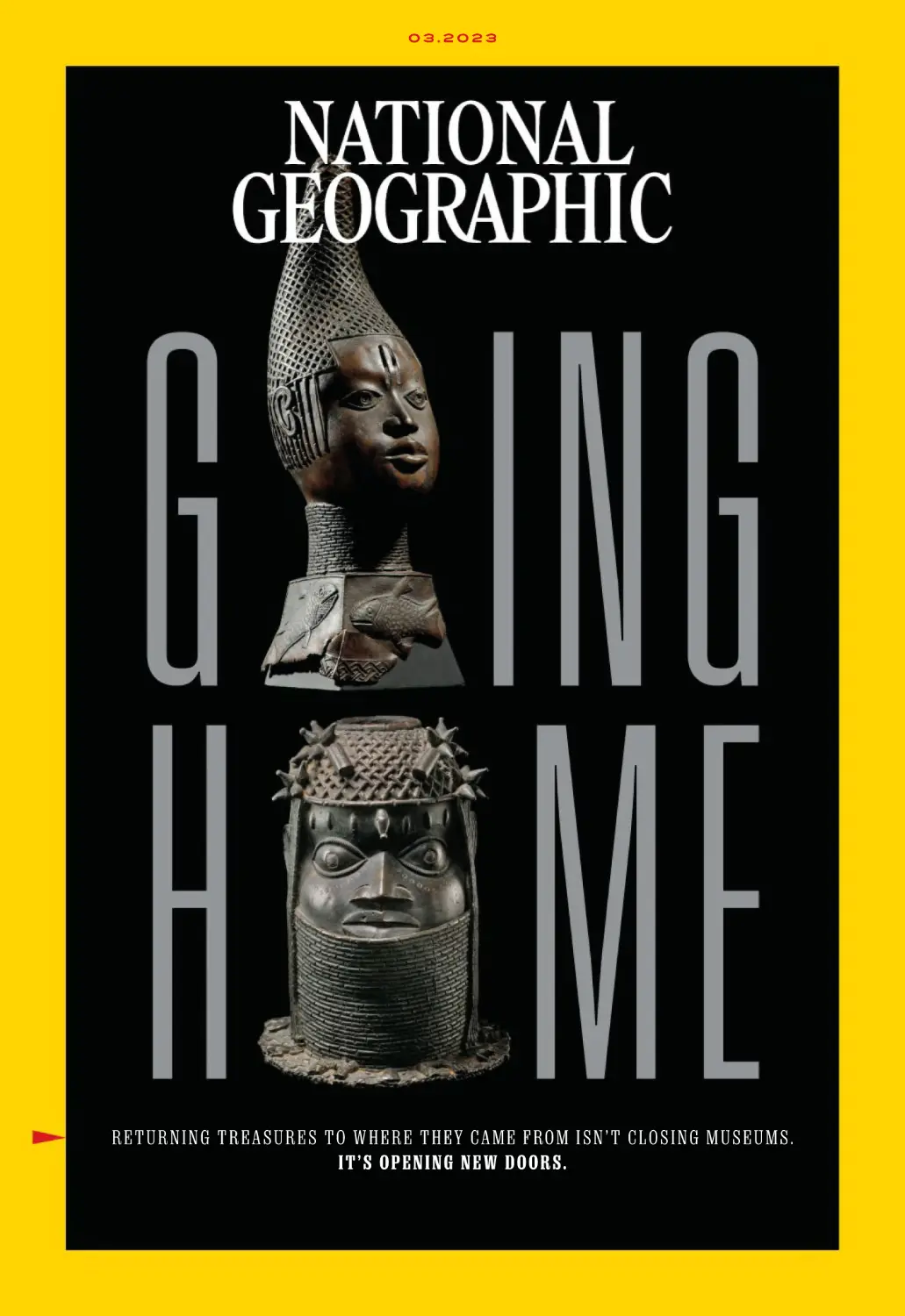
On the Cover
Bronze heads in Berlin
are among thousands of
objects worldwide looted
by British soldiers during
an 1897 sacking of Benin
City, in modern-day Nigeria.
Museums in Germany and
elsewhere have signed
over or pledged to return
many of the artifacts.
JUERGEN LIEPE (TOP), JENS ZIEHE.
BPK BILDAGENTUR/ETHNOLOGISCHES
MUSEUM, STAATLICHE MUSEEN,
BERLIN/ART RESOURCE, NY (BOTH)

P R O O F

E X P L O R E

THE BIG IDEA

Saturn: What Put
the Rings on It?
Space scientists are
still debating one of
our solar system’s great
unsolved mysteries.
BY N A D I A D R A K E

INNOVATOR

David Moinina
Sengeh

24
DECODER

He harnessed high tech
to help fix the problem
of painful prosthetics.
BY H I C K S W O GA N

Night Partners
Bats are key pollinators
of agave plants, but
tequila and mescal production risks breaking
up the relationship.
BY D I A N A M A RQ U E S

THROUGH THE LENS

Rediscovering
the Joy

A Crystalline Domain
They’re useful, yes,
but beautiful? With a
photomicrography
technique, common
compounds such as
vitamin C (above) form
dazzling images.
P H OTO G R A P H S BY
P E T E R W O I T S C H I KO W S K I

Grief drove a photojournalist to India,
where light and color
returned to her work.
BY S A R A H Y LTO N
ALSO

ALSO

The Rainbow Connection
Shell-Slinging Octopuses

Timing for Transplants
How to Reuse Your Water

PHOTO: ALL CANADA PHOTOS/ALAMY STOCK (BAT)

M A R C H

|

CONTENTS

F E AT U R E S

Troubled Treasures

Life Goes On

Spider Sense

Museums work to
return cultural objects
to their original homes.

Lebanon struggles to
emerge from a severe
economic collapse.

B Y A N D R E W C U R RY

BY RANIA ABOUZEID

Though they often
get a bad rap, arachnids are surprisingly
diverse and beautiful.

P H OTO G RA P H S BY
R I C H A R D B A R N E S . . . . . . P.

P H OTO G RA P H S BY

34

BY JASON BITTEL

R E N A E F F E N D I . . . . . . . . . . . . P.

86

P H OTO G RA P H S BY
J AV I E R A Z N A R . . . . . . . . . . . P.

Out of Step

Return to Wild Waters

Perfectly suited for
winter, mountain hares
may fare less well as
temperatures warm.

On Wisconsin’s Apostle
Islands, lake-sculpted
landscapes draw
intrepid adventurers.

B Y C A L F LY N

BY STEPHANIE PEARSON

P H OTO G RA P H S BY

P H OTO G RA P H S BY

A N DY PA R K I N S O N
. . . . . . . . . . . . . . . . . . . . . . . . . . . . . . . . . . . . . . . P.

D AV I D G U T T E N F E L D E R

72

.....................................

P. 110

126

A Syrian refugee
sells roses on a Beirut
beach. Two million
refugees from neighboring Syria currently
reside in Lebanon, which
has suffered economic
crises since 2019.

A B OV E :

M A R C H

|

FROM THE EDITOR

B Y N AT H A N LU M P

museums have played
major roles in our lives. When I was a
kid, our family visits to places such as
the Milwaukee Public Museum and
Chicago’s Field Museum of Natural History were my favorite outings. I’ve been
fortunate to visit some of the world’s
great museums on my travels and to live
near institutions with rich collections
(my preferred way to end a workweek
in New York was a Friday evening stop
at the Metropolitan Museum of Art).
There’s something about seeing art
and artifacts with our own eyes that
helps us understand history and culture in a palpable way. And of course
great curators can draw connections
among objects that let us perceive the
world in a whole new light.
Many museums, however, have items
that were acquired using methods now
considered illegal or unethical: looted
after battles, taken from Indigenous
FOR MANY OF US,

PHOTOGRAPH BY RICHARD BARNES

peoples, obtained under threat of force.
This month’s cover story, “Troubled
Treasures,” examines the debate about
who should possess such objects and
looks at the growing pressure for at least
some to be repatriated to the people and
places from which they came.
The question isn’t a new one: Greece
has sought the return of the so-called
Elgin Marbles from the British Museum
for almost 200 years. What’s changing
is the answer, as many museums and
governments adjust their approach
to holdings. In the process they’re
redefining who “owns” culture, as
well as the role of the museum. It’s
a thought-provoking topic, and one
where past wrongs may be addressed
for the good of all.
I hope you enjoy the issue.

These statues were among
26 art pieces that France
repatriated in fall 2021 to
the West African nation
of Benin. It was known as
the kingdom of Dahomey
in the late 1800s when the
French looted treasures
from royal palaces there.
Five years ago French president Emmanuel Macron
promised a “return of
African heritage” from his
nation’s museums to the
items’ countries of origin.

P R O O F
N AT I O N A L G E O G R A P H I C
VO L . 2 4 3 N O. 3

A CRYSTALLINE
DOMAIN

6

N AT I O N A L G E O G R A P H I C

On a glass slide illuminated
by polarized light, tiny
crystals of vanillin (artificial
vanilla essence) paint a
psychedelic picture.

LO O K I N G
AT T H E
E A RT H
F RO M
E V E RY
POSSIBLE
ANGLE

PHOTOGRAPHS BY
PETER WOITSCHIKOWSKI

A camera-equipped microscope
and plenty of patience help to
expose a dazzling side of some
common chemicals.

MARCH 2023

7

P R O O F

Melted and then cooled,
sulfur forms a canyon
of microcrystals. Peter
Woitschikowski can spend
weeks searching his slides
for the perfect image.

8

N AT I O N A L G E O G R A P H I C

Woitschikowski works
only when he’s relaxed.
“When you’re stressed,”
he says, “you cannot
see pictures,” such as
this one of ascorbic
acid, or vitamin C.

MARCH 2023

9

P R O O F

Salicylic acid and lactic
acid, compounds used in
skin care products, collide
to create an otherworldly
image in gold and indigo.

10

N AT I O N A L G E O G R A P H I C

MARCH 2023

11

P R O O F

THE BACKSTORY
F RO M O R D I N A RY S U B S TA N C E S , A P H OTO G R A P H E R C R E AT E S
A R E A L M O F E X T R A O R D I N A R Y E N C H A N T M E N T.

in these images? A
palm-frond jungle? Bright bird feathers?
Taking the Rorschach test that is Peter
Woitschikowski’s photomicrography,
viewers often compare the shapes with
the natural world. But he asks them to
embrace the abstract instead—to see
something entirely new. “The hope is
to turn the fantasy on,” he says.
In the 1980s, Woitschikowski, who
lives in Germany, bought a microscope after seeing a magazine spread
of microcrystal photography. He
wanted to reveal this wondrous world
that’s invisible to the unaided eye. The
W H AT D O YO U S E E

shapes are formed on glass lab plates by
heating chemicals, such as acetaminophen (above), or mixing them with
water or alcohol. As the substances cool
or dry, crystals appear. When illuminated by polarized light, some seem
to leap into a ballet of form and color.
The process is so delicate that even
slight vibrations can ruin it. That’s why
Woitschikowski uses a remote shutter
trigger and works late at night when
vehicle traffic outside his studio has
subsided. “It’s a great experiment,” he
says. “You don’t know what you’ll see
when you begin.” — N I N A S T R O C H L I C

To capture the microcrystals, Woitschikowski mounts his camera to a
microscope and snaps the shutter with a click of the computer mouse.

IN THIS SECTION

E X P L O R E

Shell-Slinging Octopuses
Climate Change Rainbows
Bats and Agaves
Household Water Reuse

I L L U M I N AT I N G T H E M Y S T E R I E S — A N D W O N D E R S — A L L A R O U N D U S E V E R Y D AY
N AT I O N A L G E O G R A P H I C

VO L . 2 4 3 N O. 3

Saturn: What Put

the Rings on It?
S C I E N T I S T S H AV E L O N G D E B AT E D T H E A G E , O R I G I N , A N D A N G L E O F
T H E B L I N G O N O U R S O L A R S Y S T E M ’ S M O S T D I S T I N C T I V E P L A N E T.

BY NADIA DRAKE

W I T H O U T I T S R I N G S , S AT U R N LO O K S R E A L LY B O R I N G .

Super blah. Erase those bangles—as blogger Jason
Kottke did (left) from a NASA photo—and the planet
is the blandest sphere in our solar system. Sure, a
hexagonal vortex and some cool cyclones appear
at the planet’s poles—but its vanilla face lacks the
pizzazz of Jupiter’s watercolored bands, the spicy
blue of Neptune, the suffocating murk of Venus.
Even rusty Mars looks more interesting.
Thankfully, at some point in the past 4.5 billion
years, the cosmos gave Earth’s neighborhood an
upgrade: It put a big, bright, icy ring system around
Saturn. But scientists don’t agree on when Saturn’s
rings formed—or how the bangles even came to be.
And that’s been true for decades. In a twist, it turns
out that the genesis of one of the solar system’s iconic
features is still an unsolved mystery.
“The planet was formed at a certain point during
the formation of the solar system, and we don’t know
PHOTO ILLUSTRATION (RINGS REMOVED); ORIGINAL CASSINI IMAGE BY NASA/
JPL/CALTECH/SPACE SCIENCE INSTITUTE/CORNELL

MARCH 2023

15

E X P L O R E

|

THE BIG IDEA

F O R T H E M O S T PA RT,
S C I E N T I S T S H AV E A G O O D G R I P
ON THE PROVENANCE OF
OUR SOLAR SYSTEM’S MOST
SPECTACULAR SIGHTS.
BUT SATURN’S RINGS …

if the rings formed at the same time or if they were
formed much later,” says Cornell University astrophysicist Maryame El Moutamid. “And the reason
why it’s so interesting is not only to know that but to
understand the Saturn system—we have a planet, a
ring system, and a moon system, and we think there
is a connection between the rings and the moons.”
That enigma is uniquely fascinating. For the most
part, scientists have a good grip on the provenance of
our solar system’s most spectacular sights: a chasm
carved into Mars that would dwarf the Grand Canyon, Jupiter’s churning Great Red Spot, the moon’s
enormous southern basin. But Saturn’s rings …
“Saturn’s rings are unique,” says Jeff Cuzzi of
NASA’s Ames Research Center. “They’re the only
big, massive rings, and they’re very, very bright,
which is unusual. So this has been a puzzle.”
Scientists who think about this question tend to
cluster into two camps. The first group suggests that
Saturn’s rings are primordial—that they formed along
with the planet more than four billion years ago—and
that Saturn has never been a boring, blah world.
The other group suspects the rings are much
younger, formed within the past several hundred
million years. Under that theory, the rings are so
young that if the dinosaurs had had a space program,
they’d have seen a ringless Saturn through their
telescopes (and maybe avoided obliteration by a
wayward asteroid).
great arguments, but they
also have weaknesses,” El Moutamid says.
Though separated in time by billions of years, both
origin stories have one thing in common: violence.
Making the rings required the cataclysmic destruction of an icy object—a comet, perhaps, or a moon.
Somehow that object wandered too close to Saturn,
and the planet’s gravity tore it into countless icy
shards. A small fraction of those shards are bigger
than houses; others are infinitesimally small. Most
are made of bright, pristine water ice, but one band
in the rings is a bit darker. Over time, those busted-up
remnants organized themselves into the ring system
we see today, which stretches some 170,000 miles
across but is only about 30 feet thick.
The “old-rings” crew says that the cataclysm
occurred in Saturn’s early days. (It is scientifically
likelier for a wayward object to enter a planet’s gravitational maw during the solar system’s youth.) One

“B O T H S C E N A R I O S H AV E

16

N AT I O N A L G E O G R A P H I C

Across a human
lifetime, the night
sky may not seem
to change much.
Planets move in predictable orbits,
constellations rise and fall on schedule, time’s passage can be marked
by the shifting lunar face. This is
comforting because it means that,
adrift on a verdant island in an
infinite cosmic sea, small creatures
like us have achieved some degree
of celestial knowing. We have deciphered the harmonies of planetary
motion; we can calculate, with precision, the appearance of something
as magical as a blackened midday
sun; and we know, to some degree,
how everything came to be (except
ourselves). In a bottomless universe,
we cling to what we know.
“Your mind just wants things to
be stable and permanent,” says
NASA’s Jeff Cuzzi. “Celestial things
are supposed to not be changing
in front of our eyes. But that’s one
thing [the Cassini probe] showed us
when we were there at Saturn … We
know stuff’s popping out there on
all timescales. It’s a perspective shift
that would be good for us.” — N D

Depictions of Saturn have
come a long way since the
earliest drawings (below,
from top): what Galileo saw
in 1610, then in 1616 with
a better telescope; and a
rendering by astronomer
Giovanni Cassini, published
in 1676. Voyager I took the
first photo of Saturn in 1980
(bottom). When the Cassini
spacecraft took a 2013 image
(left) from above Saturn’s
pole, its rings didn’t intersect the planet. That made
them easy to edit out, for
the ringless view on page 15.

IMAGES: WORLD HISTORY ARCHIVE/ALAMY STOCK PHOTO (GALILEO DRAWINGS); ARCHIVIO/ALAMY STOCK PHOTO
(CASSINI DRAWING); REGENTS, UC SANTA CRUZ (1980 PHOTO); NASA/JPL/CALTECH/SSI/CORNELL (2013 PHOTO)

MARCH 2023

17

E X P L O R E

|

THE BIG IDEA

version of that story proposes that the giant planets
were not born where we see them today; rather, they
migrated to their current locations and triggered a
cascade of instability among smaller objects that
ended up being flung all over the place like celestial
Ping-Pong balls.
During the chaos of the solar system’s infancy, it
wouldn’t be tough for an icy body to end up putting a
ring around Saturn. The old-rings theory also predicts
that some of Saturn’s moons formed from busted-up
ring stuff that spread far enough from the planet to
form clumps on its own. And therefore, some of the
moons that today hover near the rings’ margins are
made of the same material.
“Honestly, and without trying to be too neutral, I
think the old age makes more sense to me than the
young age,” El Moutamid says. “That’s my belief up
to now, but I am happy to be convinced otherwise.”
The trouble is, the icy rings are too pearly white
to be billions of years old—or at least that’s an argument the “young-rings” camp focuses on. Called
the pollution argument, the problem hinges on the
rate at which dark dust in the outer solar system
collides with and dims rings’ resplendence. Put
simply, some four billion years of drab cosmic rain
should leave Saturn’s rings looking as dingy and
unimpressive as Jupiter’s—unless the rings are massive, or they’re young. In 2017, using NASA’s Cassini
spacecraft, scientists measured the mass of Saturn’s
rings and found there’s not enough material to absorb
a solar system’s age of dust and still look so pristine.
Cassini also gathered data about how much dust
ends up in the Saturn system, and that result also
supports the idea that the rings are young.
Yet it’s highly unlikely that an object large enough
to shatter into rings could have come within reach of
Saturn—except in the chaos of the early solar system.

Francisco de Goya depicted in a bloody masterpiece—
Saturn, in fact, devoured one of its children.
Theory number one, proposed in 2016, suggests that
roughly a hundred million years ago, the Saturn system slid into a position where the sun’s gravity jostled
its inner moons onto colliding orbits that eventually
fastened a ring of debris around the planet. That idea
also explains the seemingly young surfaces of several
Saturnian moons, since the ring-forming event would
have destroyed some and caused them to re-form.
Theory number two, from late 2022, largely blames
the rings on Saturn’s megamoon Titan, which is slowly
tiptoeing away from its home world. A couple hundred
million years ago, Titan’s slow-motion exodus put it
in resonance with—that is, exerted a gravitational
influence on—a hypothetical moon that scientists call
Chrysalis. As a result, Chrysalis got chucked toward
Saturn and ripped into a ring. (This theory would also
explain the curious angle at which Saturn is tilted, as
a gravitational interaction with the orbit of Neptune.)
Needless to say, some don’t buy either of those scenarios. But in Cuzzi’s view, “Debate is good for science.
It’s not a bad thing that not everyone is convinced.”
Young Saturnian rings challenge our comfortable
notions of cosmic permanence, even as stars explode
and meteors streak through our sky. That one of the
solar system’s most familiar sights—magnificent
ringed Saturn—may not have always looked this way is
startling, just as when the star Betelgeuse dramatically
dimmed and changed the celestial outline of the constellation Orion. As Cuzzi says, objects we know and
love in our nighttime sky aren’t supposed to do that.
Yet to me, young Saturnian rings also suggest
that life on Earth got lucky. Serendipitously, evolution produced us—a species capable of crafting
telescopes—in an age that intersects with Saturn’s
magnificent cosmic spectacle. j

shredding an interloping
object, Saturn destroyed one of its own moons? Two
recent theories suggest that—just as Spanish painter

Science journalist and longtime National Geographic contributor
Nadia Drake specializes in covering astronomy, astrophysics, and
planetary science. She serves on a NASA panel that’s studying
unidentified anomalous phenomena, formerly known as UFOs.

W H AT I F, I N S T E A D O F

The varied rings were assigned a letter in the order of their discovery, while gaps and
divisions between them are named for astronomers. Tiny “shepherd” moons like Pan,
Atlas, Prometheus, and Pandora orbiting within the bright rings maintain the breaks.

disk of
rings

M AIN R I NGS OF SAT URN
D

C

B

A F

G

E
186,411 miles wide (very diffuse)

4,473

SATURN
DETAILED BELOW

Mimas

Enceladus

Tethys

Dione

Rhea

Average distance between Earth and the moon
238,855 miles
RING WIDTHS

C

B

A

F

10,865 miles wide

15,903

9,147

488

7,926 miles

Equatorial diameter of Earth

MATTHEW W. CHWASTYK, NGM STAFF
SOURCES: NASA; JPL/CALTECH; SSI

Cassini
Division

Roche
Div.

E X P L O R E

|

BREAKTHROUGHS

Rainbow rich, climate poor

D I S PAT C H E S
FROM THE FRONT LINES
OF SCIENCE
A N D I N N OVAT I O N

Some cultures consider rainbows
omens of danger. A new study
says climate change may cause
more rain—and possibly rainbows. As major weather patterns
morph because of warming, the
prismatic displays may increase,
especially near the planet’s
poles. — A L E J A N D R A B O R U N D A

MEDICAL SCIENCE

More organ
transplants
may be on
the way

ANIMAL BEHAVIOR

IT PROPELS SEASHELLS
O C T O P U S E S A R M T H E M S E LV E S I N T H E I R F I R S T
R E P O R T E D ‘ T H R O W I N G ’ B E H AV I O R .

For its novel way of maintaining boundaries, consider Octopus
tetricus, also known as the gloomy octopus and the common
Sydney octopus. If another creature gets too close, it may respond
by throwing things, according to a study published recently in
the journal PLOS One. The cephalopods, native to seas off New
Zealand and eastern Australia, were caught on camera throwing
shells, silt, and algae, which sometimes hit animals that came
too near their dens. The recipients included various fish, other
gloomy octopuses—and even the underwater cameras. This
is the first time a throwing behavior has been reported among
octopuses. Though scientists aren’t certain of the motivation, it
may have something to do with “the octopus equivalent of personal space,” says the study’s lead author, Peter Godfrey-Smith,
a professor at the University of Sydney. To execute their throws,
gloomy octopuses scoop up debris with their arms and propel
it with powerful jets from their siphons, tubular structures that
pump water from their bodies. The technique can shoot materials
up to several body lengths away. —A N N I E R OT H

Over 6,000 people
a year die in the
U.S. waiting for an
organ transplant.
But a new research
finding from Yale—
that tissue death
can be stopped
and maybe even
reversed—could
dramatically
enlarge the donor
pool. Researchers
infused pig cadavers with a blue
solution of amino
acids, vitamins, and
other compounds
(below) to restore
function to organs
hours after cardiac
arrest. Next: transplanting rescued
organs into pigs to
assess function.
—CONNIE CHANG

PHOTOS (FROM TOP): DEANNE FITZMAURICE; PETER GODFREY-SMITH, DAVID SCHEEL, STEPHANIE
CHANCELLOR, STEFAN LINQUIST, AND MATTHEW LAWRENCE; MAX AGUILERA-HELLWEG

Talk to a therapist from the
comfort of your own home.

200,000,000

25,000

3,000,000

therapy interactions
facilitated

therapists on the
platform

clients helped

Get started with ƐƏѷo@ ouCuv|lom|_-|
betterhelp.com/global

Can we bring a species
back from the brink?

Reintroduction programs
restore species to lands from
which they have disappeared.
For some animals, it’s their last
hope for survival.
Main picture: The Arabian leopard (Panthera
pardus nimr) is smaller and paler than its African
cousins. It once dominated the Arabian Peninsula,
but today it is critically endangered: fewer than
200 remain in the wild. Credit: Aline Coquelle
Left: Ancient artists carved images of the
Arabian leopard into the rocks around AlUla.
They are a haunting reminder of the importance
of this majestic animal and its enduring
connection to Arabia’s landscape.
Credit: Royal Commission of AlUla

PAID CONTENT FOR ROYAL COMMISSION FOR ALULA

Thousands of years ago, an artist

and even rivers flowed differently.

painstakingly carved the silhouette

The problem contributing to the

of a big cat into a rockface near

park’s imbalance was the eradication

AlUla, Saudi Arabia. The feline

of wolves decades earlier. Effectively

form, with its flat facial profile,

hunted out of the park by the 1930s,

long tail, and lithe figure, is clearly

wolves no longer posed a threat,

an Arabian leopard. The majestic

and elk flourished and overgrazed

animal was once a common predator

the park’s saplings so that new trees

in the region, and the ancient artist

struggled to grow.

captured the creature at its most
animated—poised to pounce on

With fewer trees, beaver numbers

some unseen prey. The artist is long

dropped, causing the course and

gone, and fears are growing that the

even the water temperature of

Arabian leopard may soon be gone

Yellowstone’s rivers to change. The

too—none have been observed in

careful reintroduction of wolves to

AlUla for over a decade. Every year,

recovery sites in Yellowstone has

hundreds of species become extinct

seen beaver and tree populations

with even more creeping toward that

restored to balance.

fate being classified as vulnerable,
endangered, or, like the Arabian
leopard, critically endangered.
Around the world, conservationists
are working to save some of the
most threatened species through
reintroduction programs that restore
animals to places from which they
have disappeared—efforts that
could bring species like the Arabian
leopard back from the brink.
Restoring lost species to their
natural habitats is more than
a gesture, it can be vital to
maintaining the biodiversity that
underpins a healthy ecosystem: Take
away even one species and the ripple
effects can be extensive. Before the

The first step is to establish the need

reintroduction of wolves into the

for reintroduction by monitoring

park in 1995, stands of willow and

a species’ numbers and range, and

aspen trees in Yellowstone National

understanding the rate, causes, and

Park in the U.S. were in decline,

impacts of its decline. Even using

beaver populations were shrinking,

technology such as drones and

This is paid content. This content does not necessarily reflect the views
of National Geographic or its editorial staff.

PAID CONTENT FOR ROYAL COMMISSION FOR ALULA

breeding pairs are carefully selected based on
their genetics to avoid inbreeding. Even the
temperament of an animal may be taken into
account. Still, the mating game can be a slow
and frustrating process.
In addition to breeding genetically appropriate
animals, the recovery site itself needs to be
ready to receive them. Although the species
may have historically thrived in a particular
location, its suitability isn’t always a given.
The species’ decline is likely linked to ongoing
environmental factors, including climate
change, invasive species, and diminishing
food supply, as well as human factors such as
Above: The Arabian leopard (Panthera pardus nimr)
is smaller and paler than its African cousins. It once
dominated the Arabian Peninsula, but today it is critically
endangered: fewer than 200 remain in the wild.
Credit: Aline Coquelle

pollution, land development, or persecution.

camera traps, precise numbers are still hard

Beyond this, the recovery site may need to

to obtain. However, any species classified as

be adapted. Temporary fencing can help to

“critically endangered” on the IUCN Red List

maintain control, reducing risks from invasive

are at “extremely high risk of extinction” and

species and minimizing human impact while

likely to need human intervention to survive.

the reintroduction becomes established. The

This often starts with detailed scientific

area may also benefit from re-wilding, boosting

studies of the animal, its behaviors, and even

other native plants and animals to create a

its genetics to determine what’s needed for a

habitat that best meets the species’ essential

successful reintroduction.

needs, including shade, shelter, and food.

Solving these underlying problems is
fundamental to a reintroduction’s success, but
takes research, time, and effort.

The goal is to minimize human intervention
Reintroductions usually demand a sizeable

and build a self-sustaining colony as part of a

and healthy animal stock, presenting

healthy ecosystem. Whether this succeeds or

conservationists with the conundrum that

fails, ongoing monitoring of a reintroduced

species scarcity or sickness is usually the

population provides crucial lessons for future

catalyst for action. Sometimes animals from

programs, increasing their chance of success.

other wild populations can be translocated,
but great care must be taken not to harm those

This could be good news for the Arabian

source populations. Often new stock needs to be

leopard. With less than 200 left in the wild and

propagated using captive breeding programs,

no documented sightings of a leopard in Saudi

and these are much more scientific than

Arabia since 2014, a crucial reintroduction

just putting males and females together and

program has been commissioned to bring

letting nature take its course. Genetic diversity

the big cat back from the brink. It began with

is essential to a successful captive breeding

efforts to establish their numbers in Saudi

program—and a species’ survival—so detailed

Arabia, but while camera traps captured images

records of each animal’s ancestry are kept, and

of thousands of animals at 13 sites over two

years, not a single leopard was observed. It’s a

of potential competitors, such as wolves.

disappointment that has reinforced fears for the

Analyses of these crucial factors will determine

species, and resulted in an even greater sense of

each site’s final suitability and dictate any

urgency to this big cat’s conservation.

modifications, from restoring native vegetation
to reinforcing prey numbers of gazelle and ibex

The plan is constantly evolving, following

to ensure they can sustain the reintroduction.

the science as data is meticulously gathered.
It currently centers on reintroducing at least

From a sandy, rock-strewn floor, an Arabian

five captive-bred leopards to three priority

leopard cub launches itself onto the branch

sites by 2030, including Harrat Uwayrid and

of a tree. She slips, recovers, and gets back up

Harrat AlZabin.

again—it’s all part of learning to be a leopard.
This is Amal and great things are expected of
her; even her name means “hope.” Born in the
captive breeding program at Taif, she is now

These near-neighboring
locations provide the extensive
mountain terrain Arabian
leopards need—rock ledges and
caves for hunting and shelter.

one of 19 Arabian leopards cared for in captivity
that are the vital link to the future of the species.
They will continue to breed, growing in numbers
until finally cubs can be released into the wild
where they will roam, watched over by specially
trained rangers tasked with anti-poaching
efforts, scientific monitoring, and community
education efforts. It’s a truly ambitious project—
and one with high hopes. For now, the poised

These habitats are being scientifically

figure of Amal forms a fragile but breathtaking

scrutinized to establish the extent of vegetation,

link to the past as the legacy of the Arabian

the numbers of potential prey, and the activities

leopard echoes through the ages.

Above: The birth of an Arabian leopard cub, especially a female, brings fresh hope for the survival of the species. With care
and time, it’s possible that their offspring may one day be released to live in the wild in AlUla. Credit: Royal commission of AlUla

E X P L O R E

INNOVATOR

DAVID MOININA
SENGEH

BY HICKS WOGAN

This Sierra Leonean
harnessed high tech to
solve a painful problem.
Growing up in Sierra Leone during the
country’s civil war (1991-2002), David
Moinina Sengeh often encountered
civilians whose arms or legs had been
severed by rebel fighters. Yet many of
the wounded didn’t wear the prosthetic
limbs that aid programs had given
them. Later, as a Ph.D. student at the
Massachusetts Institute of Technology,
Sengeh set out to understand why.
The National Geographic Explorer
learned that prosthetics often fit poorly,
causing blisters, pressure sores, and
pain. So he began working with U.S.
military veterans, survivors of the
Boston Marathon bombing, and other
amputees to develop a system that uses
3D printing to make a prosthetic socket
modeled from MRI scans and other
data of a patient’s residual limb. The
process is quick and cheap—and it
creates a more comfortable fit. “It’s
so soft,” Sengeh recalls one veteran
saying of his personalized socket, “it’s
like walking on pillows.”
Today Sengeh serves as Sierra
Leone’s minister of basic and senior
secondary education and its first chief
innovation officer. Although other
researchers now carry his prosthetics
work forward, he continues to advocate
for his fellow citizens, with the aim of
boosting their prospects and those
of their nation. j
The National Geographic Society is
committed to recognizing the work of
Explorers such as David Moinina Sengeh.
Learn more at natgeo.com/impact.

PHOTO GRAPH BY JAI LENNARD

ÌÌÌÌÌ

Y

ou need a new watch…the one you are wearing w
when Nixon was in office, but extravagantly-priced
that add zeros just because of a high falootin’ name are
to your logic. Why shell out big money so some
company can sponsor another yacht race? It’s tim
an end to such madness It’s absolutely possible to

was made
d watches
e an insult
e foreign
me to put
have the

Only $29!

E X P L O R E

|

DECODER

A DARK
ATTRACTION
BY DIANA MARQUES

For at least 9,000 years agaves
have been an integral part of
Mesoamerican culture, identity,
and tradition, supporting rural
communities and healthy
ecosystems. In Mexico today,
intensive farming to fuel
a booming tequila and
mescal market is risking
the plants’ viability
and disrupting the
primal connection
with their nocturnal
pollinators:
bats.

, now only $29
to bring you more real value, you can take your own stand
against overpriced watches with the Urban Blue.
Your satisfaction is 100% guaranteed. Wear the
Urban Blue for 30 days. If you’re not convinced that you
achieved excellence for less, send it back for a refund of
h
h
b
l
f
f
ll

†

$29

Save $170

A lesser longnosed bat takes
flight after feeding on an agave,
carrying pollen
dusted on its head
to the next plant.

24

PHOTO: BRUCE D. TAUBERT

E X P L O R E

|

DECODER

Night partners
Agave flowers on stalks up to 50 feet tall lure bats
with nectar and release pollen at night, when the flying mammals are active. After producing seed-bearing
fruits, the agave is drained of energy and dies. Intensive harvesting for spirits before the plants flower
raises their risk of disease and deprives bats of food.

Agave plant
(maguey)

Inflorescence

SHOWN
ACTUAL
SIZE

1. Pollen
transfer

2. Fruits from
cross-pollinated
flowers

Frag

3. Germination of

Their
bats t
the e
trend
bats,
degra

wind-dispersed
seeds

Stalk (quiote)
It’s used as
construction
material and for
livestock feed.

Genes from
two plants

Leaves (pencas)
arranged in rosettes
Succulent, edible,
and fibrous, leaves
are turned into
brushes, ropes, and
also feed for animals.

Anther
with pollen

Pressure to produce

Tongue

Good for business, bad for bats
A natural but nonflowering alternative to seed
propagation is clonal propagation, a method
exploited by farmers to speed production and
maximize the concentration of sugars for distilling.

1. Offset

3. Separation

Plant core (piña)
The sugary center
is used for spirits
and sweeteners.

2. Roots

Genes from
one plant

MAP: MATTHEW W. CHWASTYK, NGM STAFF. SOURCES: KRISTEN LEAR, BAT CONSERVATION INTERNATIONAL; LUIS E. EGUIARTE, ROBERTO TREJO, AND RODRIGO
MEDELLÍN, NATIONAL AUTONOMOUS UNIVERSITY OF MEXICO; NATHAN MUCHHALA, UNIVERSITY OF MISSOURI–ST. LOUIS; CONABIO; TEQUILA REGULATORY COUNCIL

Hairlike
papillae
trap nectar
Nectaries

Of the species that have been
agave flowers have six to 60 ti
nectar than other night-pollina
plants. The bats’ elongated mu
help them nose deep into the t
flowers to reach their reward.

An ambrosial alliance

Mexican long-tongued bat
Choeronycteris mexicana
Colony 10-15 individuals

U N I T E D

S T A T E S

lower

higher

200 mi
200 km

M

ex

Le

ic
lo
ng

-n

os

D
R

E

ig

n

IE

TA

OR

EN

ratio

ti

RE

ra

ID

mig

tm

C

bat

A

ba

C

ed

AD
A M

M

ed

IA

O

on

an

RR

RA

os

RN

-n

MEXICO

SIE

ER

FO

ng

LI

lo

SI

er

CA

ss

JA

Mexican long-nosed bat
Leptonycteris nivalis
Colony > 1,000 individuals

Agave-feeding bats
Probability of occurrence

There are more than 200 agave
species, thriving in higher elevations;
75 percent of them are found in Mexico. Their ranges overlap with those of
the bats, suggesting they co-evolved
and depend on each other.

BA

Lesser long-nosed bat
Leptonycteris yerbabuenae
Colony > 10,000 individuals

Sonoran
Desert

Range of
agave species

L

N
A

T

Mexico
City

L

Yucatan
Peninsula

Richest
agave region
(> 20 species)

Isthmus of
BELIZE
Tehuantepec GUATEMALA
ile balance

HONDURAS

r massive colonies make lesser long-nosed
the easiest to study; they were taken off
endangered species list in 2018. Population
ds aren’t known for all agave nectar–feeding
but some are declining because of habitat
adation and roost disturbance.

CENTRAL

i

ng

pups

hi

A J J

Bi

AMERICA

NICARAGUA

ng

M

Migrating
south
Ra

si

M
A
M

EL SALVADOR

grating
Mi orth
n

D J F

N
O
S

g

nd fema
les a
les
Ma
G
e
s
tat
in
ing
at

rt

Fe m a l e s

Nectar corridor
Every spring, pregnant bats migrate
north along cactus- and agave-rich
areas when the plants bloom. In the
fall, the females and their young return
to central and southern Mexico as soon
as agaves start blooming again.

studied,
mes more
ated
uzzles
tubular

Demand drives production

Efforts to conserve

In 2022 two billion tons of plants were harvested
to make more than 140 million gallons of tequila,
double the 2010 output. Two-thirds of it was for
export, primarily to the United States.

State governments and tequila-certifying
programs, such as Bat Friendly, encourage producers to allow 2 to 5 percent of their agaves
to bloom. Many ejidos, parcels farmed by local
communities, are sustainably restoring agaves.

Blue agave
plantation
Agave tequilana

5 feet

1,000-2,000 agaves,
up to 2,000 gallons
of tequila per acre

MIGRATION OF THE MEXICAN LONG-TONGUED BAT IS NOT WELL STUDIED AND NOT REPRESENTED ON THE MAP.

E X P L O R E

RINSE AND REPEAT

The water used by your
household can then do
double duty on a lawn
or garden. Welcome to
gray water recycling.

BY DA N I E L STO N E

Water’s not black and
white: There’s a gray zone.
What goes down the drain
after showers, toothbrushing, or laundry is called gray
water (in contrast to black
water, which goes down the
toilet). You wouldn’t drink
it—but your plants can.
California-based Greywater
Action runs workshops on
reusing rainwater and drain
water. Not all locations allow
it, but in those that do, it’s
relatively simple to set up.
Here are some basics.

The easy solution
Projects that reuse gray
water range from the professional (right) to the DIY:
a laundry-to-landscape system that can be made over
a weekend with a few hundred dollars in parts. Install
a diverter valve on the discharge hose of your washing
machine; after a cycle, guide
used water out through a
PVC pipe to plantings.

A yard to match
Use a gray water project
to rethink your landscape,
suggests Greywater Action
co-founder Laura Allen.
Start with reducing typically thirsty lawns; then add
climate-appropriate trees,
bushes, and ground cover.

Storage and use
Gray water smells if it’s
not used promptly; Allen
advises flushing storage
tanks daily. Use biodegradable detergents low in salt
and boron, which can harm
flora if they build up in soil.

Work the laws
If your city or state regulations ban the use of gray
water, ask to have them
reviewed; diverting gray
water can help conventional
septic systems last longer
and reduce peak flow into
sewers. Also, it isn’t “gray”
until it goes down a drain—
so catch water that falls as
the shower warms in a fivegallon bucket, then use it in
your toilet tank or garden.

Newly installed
by contractors at
Greywater Action,
this system channels gray water
into irrigation.

PHOTO: STUART PALLEY

E X P L O R E

|

THROUGH THE LENS

Rediscovering
the Joy
B Y S A R A H Y LTO N

the first decade of my career.
I photographed stories about devastating topics:
sexual violence, migration, religious conflict, war.
On the cover of my notebook in 2019, I wrote a quote
from the Bhagavad Gita: “The soul is neither born,
and nor does it die.” It was intended to remind me
to play more and take myself less seriously.
Sometimes I’d get the rare assignment where
I could breathe—for example, photographing an
article on teas for an airline magazine. I was in the
Darjeeling area of north India, at the foothills of
the Himalaya, a region known for producing the
“Champagne of teas.” I took the job hoping to make
playful, almost cinematic images, but at the end of
the day, I found I’d made nothing of the sort. Packing
up my camera, I felt like a failure.
On the drive back to the hotel, I noticed heavy
steam rising from a building up ahead. Arriving at
the scene, I opened the car door—and realized I was
at the Ghum station for the Darjeeling Himalayan
Railway, better known as the Toy Train, a tourist
attraction traditionally pulled by steam locomotive.
Then, out of nowhere, a figure ran toward me. I
picked up my camera and quickly made three frames.
One was out of focus. One was poorly composed. But
one worked; it’s the photo you see here.
When I submitted my images to the editor for the
tea article, this one wasn’t chosen to be published,
but I knew it meant something to me. I had been
looking for serendipity in my own life. This photograph symbolized exactly that.
I was 27 when I first traveled to India after the
sudden passing of my father. Unable to comprehend
the meaning of death within a Western framework,
I yearned to grieve somewhere that saw the cycle of
G R I E F RA N T H RO U G H

FROM THE SUFFERING HER
CAMERA CAPTURED TO THE
U N E X P E C T E D D E AT H O F H E R
FAT H E R , G R I E F C L O U D E D
HER LIFE. BUT AS TIME
PA S S E D, T H E L I G H T A N D
T H E C O L O R S R E T U R N E D.

30

N AT I O N A L G E O G R A P H I C

life with less finality. Over many months, with my
best friend, I traversed India with no phone, with
limited internet, and with healing as my compass.
I sobbed on the steps of sacred temples, practiced
yoga and meditation at an ashram near where the
Beatles’ White Album was born, had a spiritual ceremony with an intoxicated Tibetan shaman, fell in
love, and had my heart broken. I climbed mountains, swam in the sea, and unraveled entirely. India
became my home, and for a while I continued to
make images that reflected my own grief. After all,
isn’t each image a self-portrait?
But as I learned to navigate some of the world’s
most populous cities, I began to see life with more
color, light, magic. I permitted myself to walk

aimlessly, with no goal but to observe, and each
moment became a dance—serendipity waiting to
be revealed.
I landed in Mumbai more than 12 years ago, and
recently I left it for good. I feel sad that I’ll no longer
be able to visit the tea stall down the street from my
home or weave through traffic to reach my favorite
south Indian restaurant, or simply hear the rice
cooker every morning from the apartment above me.
But if India and this journey taught me anything,
it’s that what comes next will bring its own magic.
New colors, more light, waiting to be revealed. j
Photographer and National Geographic Explorer Sara Hylton
won a 2018 National Magazine Award for her work on missing
and murdered Indigenous women in her native Canada.

MARCH 2023

31

P ROT E C T YO U R L E GAC Y
P R E S E RV E O U R P L A N E T
When you leave a gift to the National Geographic Society in your will or trust, or
by beneficiary designation, you can help protect the wonder of our world.
Need a will? We believe all people deserve access to estate planning tools. That’s
why we are offering this free resource to our supporters. Get started today!
natgeo.org/givingdocs

P H OTO G R A P H BY J O H N S TA N M E Y E R

EXPLORE YOUR LEGACY

N AT I O N A L G E O G R A P H I C

MARCH 2023
Heritage Repatriation. . P. 34
Mountain Hares . . . . . . . . . . . P. 72
Lebanon’s Turmoil . . . . . . P. 86
Apostle Islands . . . . . . . . . . P. 110

F EAT U R E S

Spectacular Spiders . . . P. 126

72
IN THE
SCOTTISH
HIGHLANDS
THE MOUNTAIN
HARE’S PALE
WINTER COAT
HELPS PROTECT
IT FROM PRED ATORS. BUT
AS THE PLANET
WA R M S , T H I S
BLESSING
MAY ALS O BE
A CURSE.

PHOTO: ANDY PARKINSON

v

BY ANDREW CURRY
34

PHOTOGRAPHS BY RICHARD BARNES

RETURNING STOLEN LOOT ISN’T CLOSING MUSEUMS. IT’S OPENING NEW DOORS.

Sultan Nabil Njoya of
Cameroon’s Bamum
people sits on a throne
commissioned by
his great-grandfather
(pictured behind).
It’s a replica of one
obtained by German
colonial authorities
in 1908 under circumstances that are now
contested. Known as
the Mandu Yenu, the
original is on display in
a Berlin museum.
PREVIOUS PHOTO

Around 1900, colonial
officials and traders—
like the Austrian merchant sitting next to
Bamum ruler Ibrahim
Njoya—scoured the
world for art and
ceremonial objects
to bring back to
museums in Europe.
HELENE OLDENBURG,
BASEL MISSION ARCHIVES

borne by winds
from the far-off Sahara coats everything in
Foumban, a town of about 100,000 in Cameroon.
In a month the spring rains will start, but for now
every day feels the same—hazy sun, dry heat,
and on the main road through town, a cacophony of honking horns and buzzing motorcycles.
For a few decades this part of Africa was a
colony of Germany, whose brief but brutal rule
lasted from 1884 until 1916. Like other colonial
powers, Germany established ethnological collections to conserve, study, and display cultural
artifacts from its new colonies. Though collecting is an impulse with deep roots in human
history, museums as we know them are mostly
a 19th-century invention, designed to share the
I N F E B R U A RY, F I N E R E D D U S T

38

N AT I O N A L G E O G R A P H I C

A new museum in
Foumban, Cameroon,
is modeled on the
emblem of the Bamum
kingdom: a doubleheaded snake topped
by a spider. Sacred
objects can be borrowed for use in
traditional ceremonies
and then returned.

Mandu Yenu throne
Elaborately beaded and decorated with
valuable cowrie shells, the Mandu Yenu throne
was a symbol of authority in the Bamum
kingdom before Germany claimed part of
modern-day Cameroon as a colony in 1884.
And while the Bamum ruler at the time was
a German ally, receiving military assistance
and trade goods from German authorities,
his descendants say he was pressured to
give his throne to the German emperor as a
birthday present in 1908. After more than
a century, they want it back. “The throne is
not just an object,” Njoya’s great-grandson
Nabil says. “It is an object through which the
king connects with his ancestors.”

fruits of European exploration and conquest.
Colonialism turned collecting into something
of a mania. Just as colonial powers didn’t send
explorers to map new corners of the globe for
pure love of knowledge, objects didn’t simply fall
into museums. Anthropologists, missionaries,
merchants, and military officers worked with
museums to bring wonders and wealth back to
Europe. Curators even sent wish lists along with
armed colonial expeditions.
In 1907, German officials gave a message
to Sultan Ibrahim Njoya, ruler of Cameroon’s
Bamum people. Perhaps, they suggested, a
gift to Kaiser Wilhelm II for his upcoming 50th
birthday would be a welcome gesture—specifically a precise replica of Njoya’s remarkable,

elaborately beaded throne. An inheritance from
the king’s father, the throne was known as the
Mandu Yenu, after the pair of protective figures
that adorned its back.
Njoya had turned down many German offers
to buy or trade for the throne, but in this case he
agreed. If he wrote down why, those records are
lost. Maybe it was a gesture of gratitude to thank
colonial officials for sending troops to help him
fight and defeat his neighbors. Or maybe Njoya
was worried what would happen to his kingdom
if he refused. One thing is certain: He asked his
carvers and beadworkers to make a copy of the
Mandu Yenu. But when it became clear that
the copy wouldn’t be ready in time for Wilhelm’s
birthday, Njoya was persuaded to hand over the
TROUBLED TREASURES

39

original instead. It has been in the collection of
Berlin’s Ethnological Museum ever since.
Njoya’s great-grandson, Nabil Njoya, became
ruler of the Bamum in 2021, following the death
of his father. When I meet him in front of the
royal palace in Foumban, the 28-year-old king
pulls out his mobile phone and shows me photos
of a college kid in a New Jersey Nets hat—selfies
he took during the five years he attended college
in Queens, New York.
In modern Cameroon, Nabil’s kingship is a
traditional title with limited legal authority,
but it carries respect and symbolic power. And
according to Bamum custom, the power of each
king is passed via the thrones they build for their
successors. As long as the Mandu Yenu remains
in Berlin, “there’s a break in the chain.”
Seated on the throne his father had built
for him, Nabil says he doesn’t blame Germans for
things their ancestors did more than a century
ago. He just wants his great-grandfather’s throne
back. “None of us here were present at that
time—none of us,” he says in a French accent
with a bit of Queens thrown in. “But I think that
we are obliged to solve the problem.”
To house the Mandu Yenu throne and
other Bamum artifacts, Nabil’s father built an
eye-catching museum on the palace grounds.
Shaped like a double-headed snake, it’s topped
with a realistic, hairy-legged spider—traditional
symbols of power, vigilance, and hard work.
Nabil hopes bringing the Mandu Yenu home
will be part of his legacy. “I have a picture in my
mind,” he says. “I see me and that throne. I see
a lot of Bamum people all around me. And I’m
seeing, standing next to me, the director of the
Berlin museum shaking hands with me, and
both of us saying, ‘We did it! We did it—not for
us, but for our children.’ ”

in Germany
have heard of the Mandu Yenu
throne. Even fewer could locate
Foumban on a map. But while
objects from other places—
Benin, Egypt, Greece, Nigeria—have dominated
headlines in recent years, the finely beaded
wooden throne captures the messy, confusing,
uncertain, and ultimately hopeful future of an
unprecedented global moment.
Over the past few decades, a new generation of
museum curators and directors—often prodded

N

40

OT M A N Y P E O P L E

N AT I O N A L G E O G R A P H I C

by activists and political leaders—have been digging deeper into how objects in their museums
came to be there. Increasingly, they’re going a
step further. In a process known as repatriation
or restitution, they are pulling art, ritual objects,
and human remains out of display cases and
storage rooms and giving them back to the communities where they originated.
Last year alone, Germany transferred ownership of hundreds of objects to Nigeria’s national
museum commission, France handed 26 artifacts
back to Benin, and the Metropolitan Museum of
Art in New York cut a deal to transfer ownership
of dozens of sculptures to Greece.
“Around 1900 you had competition between
European nations to have the biggest ethnological collections,” says Bénédicte Savoy, a professor
of art history at the Technical University of Berlin.
“Now I think we have a competition to be the first
to give the things back.”
Many curators hope the shift will be the beginning of a new era of cooperation between museums and the communities and countries their
collections originally came from. Critics, meanwhile, worry that the returns may spark a chain
reaction that will dismantle “universal” museums whose international collections offer unique
insights into how the world is interconnected.

represent
a revolution in how museums
view their collections, perhaps
it’s appropriate that the spark was
struck in France, where so many
revolutions have begun. In November 2017,
French president Emmanuel Macron traveled
to Ouagadougou, the capital of Burkina Faso, a
former French colony in West Africa. In front of
an auditorium filled with students, he acknowledged the “crimes” of France’s colonial period.
Then the speech took an unexpected turn.
“I cannot accept that a large share of several
African countries’ cultural heritage be kept in
France,” Macron told the audience. “There are
historical explanations for it, but there is no
valid, lasting, and unconditional justification.”
Within five years, he said, “I want the conditions
to exist for temporary or permanent returns of
African heritage to Africa.”
Watching the speech at her gallery in Benin,
another former French colony, Marie-Cécile
Zinsou, who runs a foundation focused on

I

F T H E PA S T F I V E Y E A R S

parthenon sculptures
Perched on a hill high above Athens, the
Parthenon was the ancient city’s most important
temple, decorated with marble statues and a
sculpted frieze depicting a festival in honor of the
goddess Athena and featuring heroes and gods
in procession. Greece was under Ottoman control
in the early 1800s when British ambassador and
Earl of Elgin Thomas Bruce was granted permission
to remove “some pieces of stone with old
inscriptions, and figures.” Lord Elgin took about
half the surviving sculptures and much of the
frieze and shipped them to London. Greece has
long demanded their return, arguing that Elgin’s
deal with an occupying power was illegitimate.
The Elgin Marbles,
as they came to be
known, were purchased by the British
Parliament and given
to the growing British
Museum, where visitors first flocked to see
the artifacts in 1817.
They came to symbolize the stalemate over
repatriation claims. But
recently the museum
has called for a new
“Parthenon Partnership” and stated its
willingness to talk with
the Greek government
about “how to take
that forward.”
“TEMPORARY ELGIN ROOM IN 1819,”
BY ARCHIBALD ARCHER, THE
TRUSTEES OF THE BRITISH MUSEUM

TROUBLED TREASURES

41

Opened in 2009 within
sight of the Parthenon,
the hypermodern
Acropolis Museum
answered British claims
that Greece lacked
a museum fit for the
famed Elgin Marbles.
Statue fragments in this
gallery await the return
of missing pieces held
by the British Museum.

contemporary African art, was stunned. “No
one knew it was coming,” she says. “It was like
a thunderstorm.” Just a year before, a request
from the president of Benin for objects taken
by French soldiers in the 1890s had been dismissed outright. “France had always said no,”
adds Zinsou.
Soon afterward, Macron asked Savoy and
Senegalese scholar Felwine Sarr to prepare a
report on France’s colonial collections. In an
89-page document published by France’s culture ministry, the two researchers called for
France to return objects taken by its military
during the colonial era, along with pieces taken
by the armies of other countries and held in
French museums. They also pushed for the
44

N AT I O N A L G E O G R A P H I C

return of artifacts acquired on “scientific” expeditions sent to Africa in the early part of the
20th century to collect items, often at gunpoint,
for French museums.
From Ghana to Greece, former colonies had
been asking for their artifacts to be returned,
some for half a century or more. Finally, governments, museums, and the media were starting
to listen.
On a sweltering Monday in July, I went to
meet the man whose museum is perhaps most
affected by Macron’s promise. The Quai Branly
Museum, a short walk from the Eiffel Tower in
Paris, houses France’s largest ethnological collection. Dating back 500 years, to the time of
cabinets of curiosities, the collection includes

A group of artists and
researchers is creating
exact replicas of Parthenon sculptures to
encourage the British
Museum to return the
originals to Greece.
Here, Federico Agostinelli monitors work
on a horse head at a
facility in Carrara, Italy.

From Ghana to Greece,
former colonies had
been asking for their
artifacts for half a
century or more. Finally,
governments, museums,
and the media were
starting to listen.

everything from Polynesian wood carvings to
decorated human skulls from the highlands of
Papua New Guinea. In charge of it all is Emmanuel Kasarhérou. His appointment in 2020 was a
strong signal that things in the museum world
were shifting. A native of New Caledonia, an
archipelago in the Pacific Ocean 10,500 miles
from Paris, he’s a member of the Kanak people
and one of the few Indigenous museum directors
in all of France.
In 2021 Kasarhérou presided over the return of
artworks taken by French soldiers in 1892 after
the sack of Dahomey, a West African kingdom in
what is now the country of Benin. The items—
including two thrones, the doors of the palace,
and other symbols of royal power—had been a

centerpiece of the Quai Branly’s collections since
its opening in 2006.
Not long after Macron’s speech, Benin’s president, Patrice Talon, requested the objects again.
French legislators passed a narrow law authorizing the return of those specific items in 2020. In
February 2022, the objects were unveiled at the
presidential palace in Cotonou. “The patrimony
of Benin has returned,” Talon told a crowd of
reporters at the opening.
For hours, Benin’s elite mingled among the
returned artifacts and an exhibit of work by contemporary Beninese artists. The high-ceilinged
halls were crowded with foreign ambassadors,
barefoot vodou priestesses, and army officers
in black-and-gold dress (Continued on page 56)
TROUBLED TREASURES

45

Oxford University’s
encyclopedic Pitt Rivers Museum houses
more than half a million
items from around the
world. It has returned
the remains of Australian Aboriginals,
among others, and is
discussing repatriation
with groups in Africa,
Asia, and elsewhere.
“That’s when the relationship really begins,”
says director Laura
Van Broekhoven.

In 1912 German excavators discovered the
limestone and plaster
bust of Queen Nefertiti
among the ruins of
an ancient sculptor’s
studio in Amarna,
Egypt. Carved around
1340 B.C., the almondeyed beauty left
archaeologists awestruck. “Description
is useless,” wrote
one in a diary entry.
“Must be seen.” The
archaeologists took
the bust to Germany,
where it has remained
ever since, despite
repeated demands for
its return to Egypt.
BPK BILDAGENTUR/VORDERASIATISCHES MUSEUM, STAATLICHE
MUSEEN, BERLIN/ART RESOURCE, NY

bust of nefertiti
Displayed in a bulletproof case in Berlin’s Neues Museum,
Nefertiti’s regal bust is both an icon of ancient Egypt and one of
the German capital’s most famous museum pieces, drawing
hundreds of thousands of visitors a year. It was first displayed in
Berlin in 1924. During World War II it was hidden in a cellar, then
a bunker, then a salt mine, where it was found by the Allied forces’
“monuments men.” Some claim the bust was taken unethically,
arguing that the expedition leader misrepresented the find’s
value. Germany insists it acquired Nefertiti legally and says scans
show the sculpture is too delicate to travel back to Cairo.
48

Hawaii
(U.S.)

COLONIAL
COLLECTING

Landmark legislation
Native American activism in the
1970s led to U.S. laws requiring
the repatriation of human
remains and sacred items to
tribes. The tribal claims process,
however, is slow and complex.

R

ET

CA NA DA

H

North
Pole
IS.

Isl

and

E

M

A
I C

ffi

n

Baj
aC
ali
for
ni

A

Y

S.

T

AB

O

R

K

C

M

LIZ

O

N

a

H

T

R

c h i Pe n.

(U.S.)

E
EEN
QU

During the age of empires and colonization, when a few,
mostly European, nations held dominion over much
of the world, the cultural property of conquered peoples
was often considered legitimate spoils of war. Colonizers
amassed huge numbers of artifacts, many of which
ended up in Europe’s great encyclopedic museums. But
as more and more nations gained independence, they
began demanding the return of cultural treasures. Those
demands are now being heard—and, in some cases, heeded.

C huk
Alaska

U N I T E D

Ba

N

A

N

D

R

E

E

S T A T E S

L

Florida
GUAT.

HOND.

T

DOM. REP.

British Empire and dominions

ECUADOR

VENEZUELA

E
SPAIN

PORTUGAL

Italy
Japan
Ottoman Empire
Portugal

PERU

Spain

TRI-OPTIMAL PROJECTION

(FR.)

I

A

C

A

O
G

U

T

H

C A
R I
E
B R A
A M

N A
T I
E N

GUINEA

BURKINA
FASO
BENIN

SIERRA LEONE

Z

I

L

LIBERIA

CÔTE
D'IVOIRE

Falkland Islands (Islas Malvinas)

NIGER
Benin
City

GHANA TOGO
EQ. GUINEA
SAO TOME
AND PRINCIPE

Carving up a continent
URUGUAY

(U.K.)

NIGER

PARAGUAY

MATTHEW W. CHWASTYK,
ALBERTO LUCAS LÓPEZ, AND
PATRICIA HEALY, NGM STAFF
SOURCES: THE CENTURY ATLAS OF THE WORLD
(1914 EDITION); HUMBOLDT FORUM; LOUVRE
MUSEUM; QUAI BRANLY MUSEUM;
METROPOLITAN MUSEUM OF ART; BRITISH
MUSEUM; SMITHSONIAN INSTITUTION

GUINEA-BISSAU

BOLIVIA

H

R

A

MALI
SENEGAL

THE GAMBIA

L

S

MAURITANIA

CABO
VERDE

E

Russia

Independent or
unclaimed territory

French Guiana

Museums and universities
around the world hold sizable
collections of pre-Columbian
Indigenous American artifacts,
acquired through conquests
or archaeological expeditions.

United States

ALGERIA

(MOR.)

E

Indigenous heritage

ITALY

MOROCCO

Western Sahara

SURINAME

D

Germany

GUYANA

N

France

Canary Is.

S

Netherlands

UAUST.

TUNISIA

China
Denmark

PO

Azores

(U.S.)

D I E S

COLOMBIA

Puerto Rico

I N

PANAMA

Belgium

FRANCE
Louvre Museum,
Quai Branly Museum

S

Galápagos
Islands

Austria-Hungary

L

GER.

British Museum

E

HAITI

DEN.
NETH.
BELG.

IRE.

W

1914: MAJOR POWERS
with their spheres of influence

JAM.

Ethnological
Museum

Great Britain
UNITED
KINGDOM

THE
BAHAMAS

CUBA

NIC.
C.R.

ICELAND

Metropolitan
Museum
of Art

BELIZE

EL SAL.

PRESENT-DAY country boundaries
and names shown in white

NORWAY

L
FIN

Appa
l a c h i a n M t s.
Smithsonian
Institution

Modern colonialism began in the 15th century and
peaked in 1914, when Europeans ruled a majority of the
world’s countries. Decolonization began after World War I
and accelerated following World War II. Many presentday boundaries were set during the colonial era.

SWEDEN

G

MEXICO

THE WORLD PARTITIONED

During the so-called Scramble for
Africa from 1884 to 1914, European
powers colonized most of the
continent and made off with much
of its cultural patrimony.

C

(AN

Kamc

Pe n.

hatka

Sakhalin

J A

P

A
N

Museum boom

Honoring ancestors

Since World War II, museums
highlighting Asian art and
culture have opened by the
thousands as Western powers
relinquished control in Asia.

Indigenous groups, such as the Maori
of New Zealand and Native Hawaiians,
have for decades pressed museums and
universities to repatriate the remains
of their ancestors, as well as art and
spiritual objects—with mixed success.

A

I

S
E

S

N. KOREA

N
O

I
R

B

C

S. KOREA

I

SOLOMON IS.

M

E

A

R

I

I

PHILIPPINES

MONGOLIA

A

Mindanao

Luzon

N

ew

Gui

E

S

I

A

PAPUA
NEW GUINEA
New Caledonia

A

I A

N

Hainan

(FR.)

I

S S

FIJI

A

nea

C H I N A
R U

L

U
AT
NU
VA

TAIWAN

S

A

Bismarck
Arch.
E
M

Ur

E

A

N

SI

Bo rn eo

SING.

UZB.

AZER.
GEO.
ARM.

Java

SRI
LANKA

IRAN

TÜRKIYE

R
NEW ZEALAND

South I.

A

ROM.
HUNG.

Sumatra

North I.

A

I

INDIA

A

S

AFG.

I

L

U

TURKM.
UKRAINE

PAKISTAN

BELARUS

R

TIMORLESTE

T

s

P

CAMB.

O

A
A L AL
H I M NEP

TAJ.

THAI.
MY
AN
(
BU M
BA
RM AR
NGL
A)
.

N

Y

Y

in

E

A

ta

KYRG.

LA

BHUTAN

KAZAKHSTAN

O

OL.

BRUNEI

MA

un

LAND

EST.
LATV.
LITH.

Sulawesi

LAOS

o

D

al

M

S

VIETNAM

(TURKEY)
SYR.

IRAQ

GREECE

Y

LEB.
ISRAEL

MALTA

JORDAN

Tasmania

U.A.E.

KUWAIT

OMAN

BAHRAIN

Captured culture

QATAR

For thousands of years the
Middle East was ruled by many
empires—Roman, Byzantine,
Mongol, Ottoman, British—each
plundering objects, making their
provenances difficult to trace.

SAUDI
ARABIA
EGYPT
LIBYA

YEMEN
ERITREA

SUDAN

A

DJIB.

CHAD

F

R

R
C

.
EN

SEYCHELLES

NGO

CO

RWANDA
BURUNDI

A

GABON

UGANDA

DEM. REP.
OF THE
CONGO

MAURITIUS
COMOROS

TANZANIA

Réunion

(FR.)

MALAWI

Cabinda

157

DISPLAYS GO DIGITAL

KENYA

I

M

CA

Number of
objects in
collection

S. SUDAN

EP.
.R
AF

C

ER
OO

N

RIA

SOMALIA

ETHIOPIA

MADAGASCAR

million

Some of the world’s largest museums were founded as
universal collections, aimed at safeguarding and showcasing
ethnographic and natural treasures—but far from their
origins. Only a fraction of these holdings are on display
today, but searchable collections are being created online.

4.4

8M
0.5 M

0.5 M

1.1 M

NGOLA)

ZAMBIA

4.5 M
ZIMB.

MOZAMBIQUE
107,000

490,000

1.1 M

490,000

ETHNOLOGICAL
MUSEUM
1822

LOUVRE
MUSEUM
1793

QUAI BRANLY
MUSEUM
2006

METROPOLITAN
MUSEUM OF ART
1870

BRITISH
MUSEUM
1753

Berlin

Paris

Paris

New York

London

BOTSWANA
NAMIBIA

ESWATINI
LESOTHO

SOUTH
AFRICA

SMITHSONIAN
INSTITUTION
Founded in 1846

Washington, D.C.

1.5 M

ANGOLA

million
exhibited
online

The Rhode Island School
of Design acquired this
bronze sculpture of
an oba, or ruler, of the
Edo people in 1939.
Pressure from area
students and faculty
prompted the school’s
museum to return
it to Nigeria last year.

benin bronzes
In 1897 British soldiers—in retaliation for the
ambush of an earlier British expedition—sacked
Benin City, in modern-day Nigeria, making off
with a “regular harvest of loot,” one official later
enthused. Spoils included carved ivory tusks and
cast-brass plaques misnamed “Benin Bronzes.”
Auctioned off or presented as gifts by triumphant
troops, more than 5,000 objects ended up in
museums and private collections around the world.
Over the past two years, museums in Germany,
the U.K., the U.S., and elsewhere have returned or
pledged to return the looted artifacts to Nigeria.
ROBERT ALLMAN, THE TRUSTEES OF THE BRITISH MUSEUM

AB OVE

The oba of Benin,
Ovonramwen, was
sent into exile after his
defeat. The British justified their “punitive
expedition” in part by
citing grisly evidence
that Benin’s rulers
had sacrificed many
slaves, perhaps as war

offerings. “As
we neared the city,”
wrote one, “sacrificed
human beings were
lying in the path and
bush—even in the
king’s compound the
sight and stench
of them was awful.”
JONATHAN A. GREEN, THE
TRUSTEES OF THE BRITISH MUSEUM

uniforms. Dahomey royalty in red-coral necklaces walked slowly past ancestral treasures in
glass cases.
As night fell, the dignitaries trickled out and
the staff wandered in. Security guards and chefs
in tall hats reverently posed for selfies with the
historic objects. When I finally slipped out a side
door into the warm, humid night, they were
still there. Over the next four months, nearly
200,000 people visited the exhibitions, sometimes waiting in line for hours for a chance to
see the returned artifacts. The great majority of
visitors were from Benin—a rebuke to the idea
that Africans aren’t interested in their own history or in museums.
Savoy, too, was in Cotonou for the ceremony,
her eyes twinkling as she surveyed the crowded
galleries. Macron’s 2017 promise was on track,
and museums were playing a new role—as
places to talk about the future, not just capture
the past. “Before all these restitutions began, you
had a lot of people saying, If you give one thing
back, our museums will be empty,” she says. “I
don’t think that’s going to happen.”

see it that
way. The British Museum in
London has become a global
symbol for its refusal to return
objects. In the past, museum
officials have argued that the world needs
universal or encyclopedic museums that cut
across the artificial divides of modern borders
and bring together art and artifacts from different cultures, time periods, and places. It’s an
idea that originated in the Enlightenment, the
flourishing of science and philosophy that swept
Europe in the 17th and 18th centuries. “Where
else on our planet can we bring together under
one roof the fruits of two million years of human
endeavor?” the head of the museum’s board of
trustees, George Osborne, said in a speech last
year. “We want this to be the museum of our
common humanity.”
It’s easy to warm to the idea, if you’re lucky
enough to be in London with an afternoon to
spend at the British Museum. A few months
before Osborne’s speech, I strolled through the
museum’s vast main hall and past the Rosetta
stone. Carved in 196 B.C., the famed stela was
discovered near Alexandria, Egypt, by Napoleon’s troops in 1799 and brought to London in

N

56

OT ALL MUSEUMS

N AT I O N A L G E O G R A P H I C

Each object’s
biography
is a collision of
cultures and
influences,
a minicourse in
world history.
1802 after the British defeated the French. Just
beyond it are Assyrian reliefs sculpted almost
3,000 years ago, then a Roman copy of a Greek
statue of Aphrodite purchased by the British
king from an Italian duke in the 1620s. Each
object’s biography is a collision of cultures and
influences, a minicourse in world history.
A few steps farther is a gallery with marble
reliefs marching the length of the cathedral-like
space. These exquisite sculptures, carved 2,500
years ago, once adorned the Parthenon in Athens. Six million people visit the British Museum
each year, and it’s a safe bet most of them have
at least heard of demands that the marbles go
back to Greece—a debate that has raged on and
off since the sculptures were brought to London
more than 200 years ago. In December, rumors
that Osborne was in secret talks with Greece over
the stones made headlines, even as museum officials stayed silent.
Hoping to better understand the museum’s
position on the Parthenon marbles and other
controversial artifacts, I pull out my phone and
download a digital tour titled “Collecting and
Empire Trail.” It’s a letdown. The tour points me
to a Chinese soup plate, a betel nut cutter from
Sri Lanka, and other objects acquired during the
glory days of the British Empire. But the subjects of recent heated claims—including the
Rosetta stone, the Parthenon sculptures, the
Benin Bronzes, and the “Hoa Hakananai‘a,” a
towering stone moai spirited away from Easter

Estimated to be about
400 years old, a Benin
Bronze at the MARKK
museum in Hamburg,
Germany, depicts
a warrior pulling an
enemy from his horse.
Many of the bronzes
record significant
events in Benin history.

Bronze casters in Benin
City, Nigeria, belong
to a hereditary guild
dating back centuries.
They once worked for
the royal palace. Today
Etinosa Aigbe and
other guild artisans craft
sculptures for sale—
like the life-size representation of a Portuguese soldier (at center).

Island by British sailors in 1868—are conspicuously absent.
Before visiting London last summer, I tried
for months to get the museum to agree to an
on-the-record interview, to no avail. As museums elsewhere have grappled with the restitution question, the British Museum seems to have
gone into hiding.
Even the museum’s longtime defenders
seem flummoxed. After wandering the museum’s sprawling galleries, I meet author Tiffany
Jenkins for tea. In 2016 Jenkins wrote a defense
of the British Museum entitled Keeping Their
Marbles, arguing that modern museums should
focus on telling the stories of ancient objects and
the people who made them, and steer clear of
political posturing.
To my surprise, Jenkins admits that in the
years since her book was published, the debate
has shifted dramatically—and left the British
Museum behind. Museum staff, she points out,
rarely make the case for encyclopedic museums
anymore. Instead, they’ve retreated to technicalities, like agreements signed in the 1800s with
the Ottoman Empire, which then controlled
Athens, to remove marbles from the Acropolis.
Or the fact that many objects were taken from
Africa and Asia before Britain signed a treaty
that banned looting, making their acquisition
legal, if not ethical. Or a 1963 act of Parliament
that prevents the museum from removing items
from its collection, cited by the British prime
minister in December in an effort to quash
rumors that the secret talks between Osborne
and Greek officials over the Parthenon marbles
signaled an imminent return. “Just pointing to
the paperwork isn’t an answer,” Jenkins says. “If
that’s their argument, they’ll lose.”

a middle
ground. Hermann Parzinger is
president of the Prussian Cultural Heritage Foundation, or
SPK, an umbrella organization
that oversees more than a dozen Berlin museums. They include two museums in the controversial Humboldt Forum, a new complex in
the middle of town. Its Ethnological Museum
houses hundreds of thousands of artifacts, most
of which were accumulated during Germany’s
colonial heyday in the late 19th century.
For decades, Parzinger and his predecessors

P

60

ERHAPS THERE’S

N AT I O N A L G E O G R A P H I C

‘Maybe it’s the
end of the
19th-century
museum and the
beginning of
something else.’
Bénédicte Savoy,
Technical University of Berlin

made headlines for pushing back against repatriation requests from Egypt, Turkey, and former German colonies in Africa. But in a sign of
how quickly the debate has shifted, the SPK has
moved to return numerous objects since 2018,
including a goddess figurine to Cameroon, ritual
and cultural objects to Namibia, the remains of
Maori people to New Zealand, and the remains
and funerary items of Indigenous Hawaiians and
Alaska Natives to the United States.
Last year, the SPK was part of a blockbuster
return of Benin Bronzes to Nigeria. (The
“bronzes” include items of ivory, wood, and brass,
but the name took.) In 1897, a heavily armed British expedition invaded the Edo empire, overthrew its hereditary king, or oba, and plundered
his palace in Benin City, the heart of the Kingdom
of Benin. Grainy photographs of the aftermath
show British soldiers, their faces and uniforms
smudged and dirty, grinning amid stacks of ivory
and metal statuary. Officers captioned some of
the photos “LOOT.” Curators from German ethnological museums bought hundreds of bronzes
at auctions staged to cover the costs of the raid.
Today more than 5,000 objects taken in the
1897 raid are held in museums around the world
rather than at the National Museum in Benin
City. “What the British took was a treasure trove
of objects that had been in the palace for centuries,” says Theophilus Umogbai, the museum’s
former director. “They created a vacuum in our
history, a gap in our library.”

The Benin raid’s well-documented circumstances, along with decades of persistent pressure from Edo royalty and Nigerian officials,
made the bronzes a prominent test case for
repatriation. The combination of a strong moral
argument and public and political pressure
seems to be shifting the debate.
“We do not want looted objects in our collections,” Parzinger tells me firmly. Even a handful
of museums in the United Kingdom have moved
to return pieces, and donations from the U.K.,
Germany, and elsewhere are helping fund a new
museum in Benin City designed by Ghanaian
British architect David Adjaye.
In July, German government representatives
issued a bilateral declaration that legal ownership of Benin Bronzes in museums across the
country—more than 1,000 objects, including 500
from the SPK—should be transferred to Nigeria.
At a signing ceremony, Nigeria’s culture minister
called it “the largest known repatriation of artifacts anywhere in the world.”
The moment was powerfully symbolic—and,
Parzinger says, a win-win. Many of the objects
will stay in Germany on long-term loan for
the next 10 years, and others will remain until
Nigeria builds new museums with German help.
After that, Nigerian officials will lend artifacts to
Germany on a rotating basis.
“I want to show the art of Benin in my
museum,” Parzinger says. “But whether these
objects are loans or property of my museum is
in the end not that important.”
In August the SPK became the first German
institution to officially sign over its bronzes.
So what hope is there for more complex cases,
such as the world-famous bust of the ancient
Egyptian queen Nefertiti? The exquisite sculpture was excavated by German researchers in
1912 and sent to Berlin, where it has remained
ever since. German officials argue that it was
legally acquired at the time and that repatriation
requests haven’t come through proper channels.
Parzinger says each request must be evaluated
on its own merits, with input from local communities and national governments and research
into the circumstances of individual acquisitions. “There’s been museum bashing and harsh
dialogue that painted a picture that everything
is stolen and illegal, but one has to look at the
gray zones,” Parzinger says. “A museum is not
a space where you just go in and take what you
want off the shelves.”

What about Ibrahim Njoya’s throne? I ask. No
Bamum ruler has ever made a formal request for
the throne’s return, nor has the government of
Cameroon. But what if they did?
Parzinger frowns. Njoya, he points out,
benefited from his alliance with German colonizers. The Bamum king grew rich from trade
with German merchants and defeated local
rivals with the help of German weapons and
military assistance. Seen from Parzinger’s perspective, the idea that the throne was a gift to
thank Germany for its help isn’t so far-fetched.
“When you see how well they played together,
to see Njoya now completely as a victim? That,
for me, is a little bit difficult,” he says. He pauses,
considering. “I’m sure solutions can be found.
Before the throne left Bamum, they produced a
copy. Maybe there can be an exchange?”
To call all this a huge shift is an understatement. Just 20 years ago, Parzinger’s predecessor dismissed the idea of even lending some of
the museum’s Benin collection to Nigeria. Today
museum curators are meeting their counterparts
in former colonies for eye-to-eye discussions,
sometimes for the first time. “Maybe it’s the
end of the 19th-century museum,” Savoy says,
sounding entirely unbothered by the prospect,
“and the beginning of something else.”

that might
look like, I head to Suitland,
Maryland, a Washington, D.C.,
suburb where the Smithsonian
Institution keeps most of its
157 million artifacts in a multi-acre storage and
research complex. The collection includes millions of items gathered from Native American
tribes over the past 200 years. The National
Museum of Natural History (NMNH) support
center consists of five pods, each the size of a
football field and three stories tall. In one section, airtight cabinets house objects from hundreds of U.S. tribes.
The Smithsonian has long welcomed scholars
who come to use its collections for research, but
over the past 30 years the NMNH support center
has created spaces for other visitors. Nowadays
tribal representatives regularly come to the facility to see items made by their ancestors and to
work with curators. A conference room doubles
as a ceremonial space, complete with a cabinet
stocked with dried sage and tobacco for tribe

F

O R A S E N S E O F W H AT

TROUBLED TREASURES

61

zuni ahayu:da
To the people of the Zuni Pueblo in New Mexico,
wooden statues called ahayu:da represent supernatural twin brothers and protectors. During
the 19th and 20th centuries, many were stolen
and sold to collectors and museums. Zuni leaders
in the 1970s began pressing for their return,
making an ethical case that became a model for
successful repatriation claims. Secret shrines house
ahayu:da on Dowa Yalanne, or Old Mountain
(below), a plateau overlooking the Zuni Pueblo.

members to burn in purification ceremonies
before or after handling sacred objects.
Thirty years ago such scenes would have been
hard to imagine. For centuries archaeologists,
ethnographers, and museum curators enthusiastically collected Native American artifacts and
human remains. Burials were excavated without
the consent of descendants.
“When these items were acquired, collectors weren’t thinking of Indigenous peoples as
human beings,” says Jacquetta Swift, the repatriation manager for the National Museum of the
American Indian. “People were resources, and
human remains were to be preserved alongside
pots,” adds Swift, who’s from the Comanche and
Fort Sill Apache tribes.
62

N AT I O N A L G E O G R A P H I C

In the 1970s and ’80s, Native American activists successfully lobbied for laws that would
require museums to hand over the bones of
their ancestors, along with sacred objects. Many
museums pushed back, hard. The concerns
raised back then sound familiar to anyone following the debate in Europe today.
Anthropologists and archaeologists worried
that relinquishing collections of human remains
would be an irrecoverable loss to science, making it impossible to study the country’s prehistoric past. Others charged that tribes would be
unable to properly care for artifacts or would
damage them in traditional ceremonies. And
others suggested tribes would use the law to
empty out museums for profit.

Ahayu:da placed at
outdoor shrines, such as
this one in a photo published in 1904, gradually break down as part
of their spiritual role.
JOHN WESLEY POWELL, ALAMY
STOCK PHOTO

“There was a considerable amount of hostility between museums and communities,” says
Kevin Gover, the Smithsonian’s undersecretary
for museums and culture and a citizen of the
Pawnee Nation of Oklahoma. “There was a lot of
resistance to the idea of repatriation in general.”
In 1989 Congress passed the National Museum
of the American Indian Act, followed in 1990
by the Native American Graves Protection and
Repatriation Act, known as NAGPRA. The laws
made the Smithsonian and other U.S. museums
responsible for developing a collaborative repatriation process with tribes, recognizing rights
that previously didn’t exist.
The National Museum of Natural History set
up a repatriation office in 1991. Since then it

has returned more than 224,000 items to 200
different tribes, along with the remains of 6,492
people. The process has been repeated at smaller
museums around the nation.
While thousands of objects have been
returned, some have stayed. Eric Hollinger, the
tribal liaison in NMNH’s repatriation office,
stops halfway down one of 46 rows of cabinets
and swings open a door, releasing the pungent
smell of wood and old leather. Inside there are
blankets, beaded cradle covers, and buffalo
calf robes—offerings left for a Cheyenne child
who died in 1868. Not long after, U.S. Army soldiers tracking the tribe found their abandoned
encampment and the burial. They boxed up the
offerings and the child’s body and sent everything
TROUBLED TREASURES

63

Zuni elder Octavius
Seowtewa visits
Tularosa Cave, a sacred
site on the tribe’s traditional land in New
Mexico. The Zuni were
key players in Native
efforts to reclaim tribal
artifacts, including
backing national
repatriation legislation, which became
law in 1990.

to the Army Medical Museum. The Smithsonian
eventually acquired the collection, but at some
point the child’s remains were lost.
In 1996 representatives of the Cheyenne and
Arapaho Tribes of Oklahoma worked out an
agreement to allow the objects to remain at the
NMNH “for research and education to be conducted by scholars and the Cheyenne people.”
Photographing or displaying them requires written permission from the tribe. It’s an example of
shared stewardship that gives both sides responsibilities for an object’s future.
“Although these items were not repatriated,
the tribe agreed to share their care, and they
never left the museum,” Hollinger says. “People
think it’s about removing the objects, but really
repatriation is about transfer of control.”
Some cabinets have ventilation holes because
tribes see the objects inside as living spirits that
need to breathe. In others, objects are oriented in
a certain direction in keeping with tribal beliefs.
The museum still regularly gets return inquiries. Before agreeing, researchers talk to tribal
representatives and comb through journals
and diaries to discover all they can about how
the object was acquired. Whether or not tribes
ultimately make a claim, both sides usually find
out something new about the object along the
way. The consequences of NAGPRA were not
dire, Gover says. “We learned a lot about those
cultures we didn’t know.”
That’s not to say the U.S. experience has been
entirely successful. The bones of more than
100,000 individuals still languish in boxes and
locked storerooms across the country, often
because tribes haven’t been able to prove a
direct relationship based on records provided
by museums—or because curators have dragged
their feet. “We need to do better,” Gover says.
“This needs to be a priority for museums that
hold Native American remains.”
While ethnographic museums were once static
storehouses, today’s museums are increasingly
trying to create exhibits with the participation of
communities, asking them how they want to be
represented and what objects are significant to
them. Using laser scanners, Hollinger and a team
of specialists worked with the Tlingit people of
Alaska to create 3D replicas of a damaged ceremonial sculpin hat. One replica was kept for the
museum to exhibit alongside the original, while
the other was consecrated by the Tlingit as a living
ceremonial object for the community to use.
66

N AT I O N A L G E O G R A P H I C

‘People think
it’s about removing
the objects, but
really repatriation
is about transfer
of control.’
Eric Hollinger,
National Museum of Natural History

The National Museum of the American
Indian encourages curators to add contemporary pieces made by Native artists to its collections. In its exhibits on the National Mall
in downtown Washington, D.C., the museum
displays 19th-century buffalo robes, wampum
belts, and Lakota eagle-feather headdresses.
But it also displays a hard hat painted by a
Mohawk construction worker, as well as Christian Louboutin stiletto heels covered in traditional glass beadwork by Jamie Okuma, a
Native artist from California.
“The ethnographic museum of the past
is making its way to the exit,” Gover says. “It
tried to freeze these cultures in time, and no
culture stops. We want to make the point that
these communities are here; they’re present
and alive and vibrant.”

clearer
for me than in Benin City,
Nigeria, in an outdoor studio
littered with broken clay molds
and gleaming brass sculptures. Under the shade of a corrugated metal
roof, unfinished plaques await polishing with
an angle grinder. The smell of honey mingles
with the tang of smoke and sweat as beeswax
models soften in the 95-degree heat.
Presiding over it all is Phil Omodamwen, a
sixth-generation bronze caster. His forefathers

N

OW H E R E I S T H AT S H I F T

Tall wooden posts
called vigango, like
these two with curator
Brooke Morgan at the
Illinois State Museum,
are carved by Kenya’s
Mijikenda people to
embody the spirits of
headmen. The museum
returned 37 vigango
to Kenya last year, and
the Denver Museum
of Nature and Science
returned 30 in 2019.
Many were stolen, so
“museums don’t have
the right to own them,”
says Denver curator
Stephen Nash.

were part of a guild that created bronze plaques
and sculptures for the Edo oba. As a pair of assistants stoke a white-hot bonfire, Omodamwen
explains that the techniques he uses today build
on those used for the past 500 years. He recycles
scrap metal to cast elaborate bronze and brass
sculptures. Repurposed refrigerator and air conditioner compressors serve as crucibles for the
bubbling, green-gold, molten metal.
When I visited last February, the rumored
return of bronzes from Germany dominated the
talk on Igun Street, where bronze casters sell their
work. Many hoped repatriation represented a
future for an ancient tradition. In the shade of a
thick-trunked palm tree, Omodamwen tells me he
may be the last bronze caster in his family. One
68

N AT I O N A L G E O G R A P H I C

of his sons is an accountant, the other a cybersecurity consultant. “I don’t think they will continue after me,” Omodamwen says, with a mix of
pride and sadness. “I’m worried that in the next
20 years, bronze art will go into extinction.”
In a derelict office building not far from Igun
Street, I catch a glimpse of a different future as
28-year-old Kelly Omodamwen—Phil’s cousin—
tells me he grew up watching his father and
uncles cast bronze. He’s a hereditary member
of the bronze casters’ guild too. But even though
Kelly grew up learning traditional casting, his latest work is something new. After watching the
men in his family melt down plumbing fixtures
and cymbals, Kelly started scouring local garages
for used spark plugs. During the pandemic he

Vigango are still
coveted by art collectors. Once returned
to Mijikenda communities, they must be
guarded from thieves.
In Chalani, a village
in eastern Kenya,
Festus Thinga built
an iron cage to
protect the statues
of his ancestors.

‘Not everyone has
access to the
British Museum.
For people like me,
it will change
what’s possible.’
Kelly Omodamwen,
Nigerian bronze caster

began shaping life-size sculptures using a welding torch. “The essence is upcycling—using the
same objects for a different purpose,” he says.
Kelly’s work has been displayed in New York,
London, and Lagos. But he’s never left Nigeria,
never had the opportunity to see the ancient
bronzes up close. For him, their return represents
an inspiration to create art that mixes old and new.
“We only see them online, on Google. Not everyone has access to the British Museum,” he says.
“For people like me, it will change what’s possible.”
A few months later, at a gallery tour of the
Humboldt Forum in Berlin, I’m surprised to see
a familiar face sitting one row in front of me. It’s
Phil Omodamwen. The Ethnological Museum,
he tells me, acquired one of his latest works for

its collection. He proudly points out the gleaming plaque hanging on a wall behind a display
of historic bronze heads taken in the 1897 raid.
Just days before, he says, his long-held dream
came true. Curators invited him to handle
bronzes he had only seen in dog-eared catalogs.
He was able to see the backs of plaques and chat
with the museum’s restorer about his technique
and how it compared with that of his forefathers.
“When I saw those works, I was so happy,” he
says, sighing. “Now I have a message of hope to
take back to our people.” j
Longtime contributor Andrew Curry enjoys a view
of the Humboldt Forum from his Berlin apartment.
Richard Barnes has been photographing in and
around museum collections for many years.
TROUBLED TREASURES

69

After France’s Quai
Branly Museum repatriated pieces to Benin
last year, they were
put on display in Cotonou. “Objects are a
wonderful excuse to
create human connections,” says Quai Branly
director Emmanuel
Kasarhérou. “When
they go back, they create new relationships.”

M O U N TA I N H A R E S T H R I V E I N C O L D W E AT H E R .
A W A R M I N G W O R L D M AY C H A N G E T H A T.

B Y C A L F LY N

P H OTO G R A P H S B Y ANDY PARKINSON

73

Three adult mountain
hares wait out a snowstorm on an upland
ice field. Hares seek
naturally occurring
shelter wherever they
can; here, the ridge
offers protection from
the wind. They also rest
in small hollows in the
ground or vegetation.
PREVIOUS PHOTO

A hare blends into
a snowbank in Scotland’s Monadhliath
Mountains. The United
Kingdom’s only native
lagomorph trades its
mouse brown summer
coat for a pale winter
pelage each year.

scoured by ice and rock over millions of years.
Mountains lift their rounded backs. Bowl-shaped
hollows known as corries nestle within curving
ridgelines. The land has two faces.
In late summer the terrain is shrouded in
heather, threaded with the royal purple of its tiny
blooms, along with delicate leaves of creeping willow and bog myrtle, soft beads of blaeberries, and
red-glowing lingonberries. But within a few short
weeks these same uplands might be swathed in
snow: drifts banked high, gales whipping through
the wind-carved ice at a hundred miles an hour.
This is the domain of the mountain hare. These
little mammals are also found in tundra, alpine, and
boreal regions across Eurasia. An estimated 99 percent of mountain hares in the United Kingdom live
in Scotland, their heartland the rugged Grampian
Mountains of the northeast.
76

N AT I O N A L G E O G R A P H I C

A mountain hare
grooms itself. The
timing of an individual’s
molt will vary, but generally Scottish hares
living at higher altitudes will turn white
or gray earlier in the
winter than those in
low-lying areas. They’ll
also revert to their
darker coats later in the
spring. However, scientists have found no
evidence that mountain hares are adapting
to shorter periods of
snow cover.

A female (beneath)
rebuffs a male’s
amorous advances as
part of the species’
vigorous courtship
ritual. Females will test
males’ determination
and endurance,
boxing them away
before leading them
on a long chase
through the heather.
This spirited episode
ended in copulation.

HARDIEST OF HARES
Concentrated in Scotland’s Highlands
and Southern Uplands, mountain hares
have evolved to live in cold climates.
In other parts of their range, outside Scotland, the resilient mammals can be found
at elevations of more than 12,100 feet.

N. AMER.
Full range of the
mountain hare

ASIA

SCOTLAND
EUROPE
AFRIC

A

A T L A N T I C
O C E A N

Orkney Is.

No rth

B

hwe

Nort

R

I

D

E

S

Lewis

st H
igh
lan

ds

S e a

H I GH LAND S

E

Cairngorm Mts.

Monadhliath
Mts.

4,413 ft

H

Inverness

G

pi
ram

t s.
an M

Mull

SCOTLAND
Edinburgh

s

Glasgow

So

u

e
th

rn

l
Up

an

d

U NIT E D
KI NGDO M

ENGLAND
40 mi
40 km

Predicted abundance of
the mountain hare
Lepus timidus
low

high

KATIE ARMSTRONG AND SOREN WALLJASPER, NGM STAFF
SOURCES: DARIO MASSIMINO AND OTHERS, BIOLOGICAL
CONSERVATION, 2018; IUCN

Last winter I hiked in the Cairngorm Mountains. Staggering through deep snow, I set off
a clatter of wings as a ptarmigan, a bird with
downy bloomers, materialized, grunting at being
disturbed from its bed. Sensing my footsteps on
the high ground, white-coated hares flushed into
the corrie below—fleet of foot, tumbling over
the sides like the very first crumbs of an avalanche—before turning and gliding effortlessly
up and over the ridge.
The mountain hares will seek out shelter
within nests—“forms”—in dense vegetation or
in shallow depressions—“scrapes”—on the hillside, where they wait out snowstorms: hunched
low inside their fur coats, black-tipped ears flattened to their necks. They might rest for days at
a time, breaking only every hour or so to stretch
or perhaps to briefly graze on hardy heather
before returning to their refuge.
This behavior is one of many adaptations that
allow this animal—the only hare or rabbit species native to the U.K.—to eke out an existence
in such harsh conditions. Perhaps most striking
80

N AT I O N A L G E O G R A P H I C

is its seasonal change, when the smooth summer coat of mousy brown gives way to a thicker,
better-insulated pelt of brilliant white or dove
gray. Each year a combination of waning sunlight and falling temperatures triggers the hares’
winter molting process—the dense, pale new
growth spreading upward from their feet, along
their thighs and across their shoulders, mottling
their bodies.
These creatures have evolved to fit their surroundings. But as climate change ushers in varying weather, mountain hares are increasingly
out of step with the place they call home.

WHEN CAMOUFLAGE BACKFIRES

among a group of just 21
bird and mammal species with turncoat capabilities, almost all of which live in cold, snowy
regions, says Marketa Zimova, assistant professor of biology at Appalachian State University in
M O U N TA I N H A R E S A R E

North Carolina. In Scotland the only other species that change color in this way are the stoat,
also known as the short-tailed weasel—a slender,
skilled hunter—and the ptarmigan.
For mountain hares, this luxuriant winter coat
also offers valuable camouflage, keeping them
safer from predators such as red foxes, stoats,
and golden eagles that soar overhead. But in
conditions as changeable as these, it may be a
curse as well as a blessing.
In the Scottish hills it’s not unusual for temperatures to rise and fall dramatically on a daily
basis. On the mildest days, when the peatland is
black, sodden, and marbled with ice, the hares
find themselves limelighted: gleaming figures
against a stage of dark heather.
This has always been a danger, but recent
research led by Zimova found that Scottish
mountain hares have been out of sync with
local conditions as climate change has brought
a steep decline in days of snow cover—the first
autumn snow blanketing the ground, on average, four days later in the 2010s than it did in

Mating Moves
A series of photographs captures the
moments leading to
a rare tender display
as a courting pair of
mountain hares touch
noses. Females usually outweigh males.
Larger females tend to
produce more young
(known as leverets) in
several litters over the
course of a year.

OUT OF STEP

81

A mountain hare
and its tiny carnivore
predator, the shorttailed weasel, or stoat,
stand out against the
dark moorland in their
white coats. In this
instance, the hare
was lucky: The stoat
did not notice its prey
was close at hand.

the 1960s. Average temperatures in the region
have risen by more than 0.1 degree Celsius per
decade, leading to longer periods without snow
cover. In all, the records reveal the hares spend
an additional 35 days a year mismatched with
the landscape.
The consequences of this discrepancy are not
entirely clear, says Scott Newey, a population
biologist who studies mountain hares at Scotland’s Game & Wildlife Conservation Trust. They
are a “very challenging” species to monitor, he
says. For instance, mountain hares experience
population cycles, in which a scientist might
find only a few hares in a square kilometer one
year and more than a hundred in that same area
several years later, or vice versa. These cycles,
possibly linked to food availability and the prevalence of certain parasites, vary so much that
untangling the impact of factors such as climate
change can be extremely difficult.
However, analyses of snowshoe hare populations in North America offer some insight into
possible long-term trends. It’s known “exactly
how costly” such camouflage mismatch is for
that species, says Zimova: The probability that
a snowshoe hare will be hunted and killed by a
predator in any given week increases by between
7 and 14 percent when the hare is wearing its
white winter coat on a snowless background. “It’s
something that doesn’t sound like a lot,” she says,
but when you extrapolate it across the entire year,
“it can have really profound consequences.”
As with so many of the issues facing wildlife on
this warming planet, the challenge seems to be:
Adapt or die. And for the mountain hares of Scotland, there’s no evidence they’re adapting at all.

IN THE CROSSHAIRS

it may well be that the increased
risk of predation by foxes, birds of prey, and
stoats has been far less worrisome, at least until
recently, than the impact of humans.
For many decades, landowners had managed large swaths of mountain regions for
the recreational shooting of wild red grouse.
Controlled burning renders the hills a mosaic
of different conditions—some patches blackened and scorched, some budding with fresh
new shoots, some swaddled in thick vegetation—a mix of ecosystems that likely benefits
O D D LY E N O U G H ,

84

N AT I O N A L G E O G R A P H I C

the hares as much as the game birds.
Mountain hares have long been killed purely
for sport, but around the turn of the century
some private estate managers began targeting
the hares in large numbers on the basis that it
would prevent the spread of a tick-borne disease
to the grouse—something that scientists have
disputed. (More than 33,500 hares were killed
in total over the 2016-17 season.) The debate
around hare culls, which were always controversial, took on a new tenor when a 2018 analysis by Adam Watson, an independent ecologist
and mountaineer, argued that mountain hare
populations on grouse-hunting grounds in the

A hare rolls around,
likely to dust icy shards
off its fur after getting
covered by windblown
snow in the Monadhliath Mountains.

hilly northeast had dwindled to less than one
percent of the levels seen in the mid-1950s. The
Scottish mountain hare population is estimated
at 135,000, although scientists stress the uncertainty baked into any such calculations; the
true figure might fall anywhere between 81,000
and 526,000.
Fearing the animal’s decline, the Scottish Parliament banned unlicensed killing of mountain
hares in March 2021. It’s still too early to know
the impact of this rule, says Newey, who’s been
working for 20 years to identify the best way of
monitoring numbers of this enigmatic animal.
That’s not surprising, considering a hiker

might easily pass right by one, concealed in
the heather. During a summer hike a few years
ago, I witnessed a lithe hare jumping from the
thicket, lifting onto its haunches before loping
off with long, deliberate strides: a tawny silhouette against a tawny landscape. The hare paused,
then dissolved away once more, merging into
the brush a short distance away. One minute it
was there; the next, gone again. It was as if it had
never been there at all. j
Cal Flyn, from the Highlands, wrote Islands of Abandonment: Nature Rebounding in the Post-Human
Landscape. Andy Parkinson has been photographing mountain hares in Scotland for over 20 years.
OUT OF STEP

85

Economic collapse.
A catastrophic
explosion.
Failed politics.
A refugee crisis.
Lebanon’s seemingly
insurmountable
challenges are
testing its people’s
indomitable spirit.

LIFE
GOES ON
BY RANIA ABOUZEID
PHOTOGRAPHS BY
RENA EFFENDI

A group of women
explores a fort known
as the Sea Castle, built
in the 13th century
by the Crusaders, on
the coastline of Sidon,
Lebanon’s third largest
city. This area has
been inhabited since
the early Bronze Age
and was an important Phoenician port.
Archaeological sites
are found all along the
ancient land’s shore.

87

The Bay of Jounie
is a highlight of the
sweeping vista from
Our Lady of Lebanon
in Harissa, a Christian
pilgrimage site in the
hills about a half hour’s
drive north of Beirut.

88

N AT I O N A L G E O G R A P H I C

T H E JA N UA RY B R E E Z E WA S A S S H A R P A S M Y G R I E F.

A muted winter sun shimmered off the snowdraped mountains cradling my mother’s hometown in northern Lebanon as the cemetery gates
creaked open, and I placed my mum’s portrait
with her ancestors. She was home, at least symbolically. She had passed away unexpectedly
in November on a random Thursday morning in
Australia, where she had lived for many years.
My mother’s end was bookmarked at her
beginning, in a motherland she never truly left.
There are parts of this country we carry with us,
even if, like me, we were not born here. We carry
them in our names, in our food, in our stories,
and in our family bonds that transcend time,
distance, and generations, drawing us back.
There is a song by Fairouz, our beloved
national icon and one of the most celebrated
Arab singers of all time, that was part of the
soundtrack of my childhood in New Zealand

LIFE GOES ON

89

90

N AT I O N A L G E O G R A P H I C

LEFT

AB OVE

Demonstrators take
a break in March
2021 from protesting
Lebanon’s economic
collapse. Behind them,
burning tires block a
highway leading to the
impoverished northern city of Tripoli. The
World Bank has called
the nation’s crisis one
of the world’s worst
since the mid-1850s.

Hamze Eskandar’s sisters display his portrait
and wear medallions
with his image. Eskandar, a soldier, was killed
in the 2020 Beirut port
explosion. “Hamze was
my mother’s greatest
happiness,” his oldest
sister, Salam (center),
says. “His death broke
her. She died two
months after him.”

LIFE GOES ON

91

and Australia during Lebanon’s civil war, which
wracked the country from 1975 to 1990. I understood the power of the words that would bring
my parents to tears before I knew their meaning.
In “Nassam Alayna al Hawa,” Fairouz implores
the breeze to carry her home before she grows
so old in a foreign place that her homeland can
no longer recognize her.
My mother hadn’t changed since her last
trip to Lebanon in the summer of 2019, but the
motherland was almost unrecognizable now.
It was a broken place. Bleak, depressed, desperate, its much celebrated indomitable spirit
wounded by an economic collapse so ruinous
that the World Bank called it one of the world’s
worst since the 1850s.
The Lebanon of bountiful, leisurely Sunday
lunches and gridlocked summer traffic as people escaped the heat of Beirut for the cool green
mountains or the Mediterranean Sea had become
a Lebanon of rising child malnutrition and food
insecurity. Fuel, when it could be found, was
now prohibitively expensive for many, making
it hard to go to work or school, let alone weekend
getaways. A way of life had faded, sapped of the
vitality that some two decades ago drew me back
as a journalist to the land of my heritage.
I “returned” to live in a country that I knew
largely from my mother’s and father’s rosecolored recollections, but also from my
childhood trips to a Lebanon tearing itself
apart. My parents are from different parts of
Lebanon and left together just before the civil
war between Christians and Muslims. The Lebanon they carried with them was the Lebanon
of Fairouz: part real, part imagined. It lived in
the diva’s serenades about Lebanese nationalism and pan-Arabism, in songs about a gentler,
simpler village life, about love, loss and exile,
and the return of the diaspora.
My parents would take their young family to
war-torn Lebanon for months-long vacations as
often as they could, such was the insanity of the
yearning to return. My memories of those visits
are a jumble of sensations: The softness of my
maternal grandmother’s enveloping embrace.
Stomachaches from long afternoons in my
grandfather’s orchards with my cousins, sampling too many of the fruits from his grapevines
and his pomegranate, citrus, and fig trees. The
heat wave dissipated by a car bomb. The suffocating fear of approaching militia checkpoints. The
tracer bullets that arced red and elegant across
92

N AT I O N A L G E O G R A P H I C

the night sky (they were fireworks, my uncles
told me). The realization that my grandparents’
three-story home was the third incarnation.
The first two had been bombed and destroyed
in the war, and that was why my mother didn’t
have any photos of her childhood to show me.
My parents returned to Lebanon in the mid’90s after the war ended, but they couldn’t adjust
to the new postwar state. It wasn’t Fairouz’s
Lebanon (if it had ever existed), their idealism
colliding with the reality of a country where
warlords took seats in parliament and granted
themselves immunity for war crimes. Those
leaders or their sons or designated political heirs
have called the shots since the end of the war
on everything from ministerial appointments
to senior judicial nominations in the name of a
consensual democracy that distributes power
according to religious affiliation. This was supposed to foster coexistence, but it has worsened
the fragmentation of society by reinforcing a
sectarian, rather than national, identity. And
so, after a few years in Beirut, my parents, nonsectarian and apolitical, went back to Australia.
The Lebanon that I first made my home was
booming, although politically and militarily
dominated by Syria, its much larger neighbor,
until 2005. Beirut was in a rebuilding frenzy,
its restaurants crowded, its legendary nightlife extravagant. It was once again the Middle
East’s playground, its intellectual and literary
pressure valve. (But for locals, the redlines were
clear: Don’t criticize senior religious or sectarian
political leaders or Lebanon’s Syrian overlords,
to name a few.) The country had its problems,
but its people radiated an infectious, intoxicating joie de vivre, where less was never seen as
more and more was never enough.
There were bursts of violent instability: a string
of assassinations, a crushing war with neighboring Israel, shootouts in the streets over a political
dispute. It was unpredictable, like living near a
volcano, but there was dynamism in that volatility. It was infuriating and vibrantly chaotic,
a place where rules like traffic lights were often
considered suggestions and sweet-talking or
bribing a civil servant was common currency.
An untamed, unhealthy freedom flourished in
that bedlam. Despite the country’s many flaws,
I couldn’t help falling in love with it anyway. It
was hard not to, its magnetism rooted in the vivaciousness of a people who determinedly clung to
hope in a place that routinely broke their hearts.

Today many Lebanese pine for what they
recall as those good old days, but the truth is
that for many, they weren’t really good. Selective
memory and nostalgia are soothing balms in a
country where yesterday is usually better than
today and tomorrow can elicit as much dread
as it does hope. The fact is, the rot was always
just below the glittery surface of a society that in
some quarters boasted it could party under the
bombs. Those roads taken to escape the summer
heat were often crumbling, stretches of the Mediterranean were polluted, and too many Lebanese
were living hand to mouth. The kleptocrats who
bankrupted the state haven’t provided citizens
with 24-hour electricity for decades, forcing us
to rely on expensive neighborhood generators if
we can afford them or go without electricity
if we can’t. Most Lebanese have to buy water
from private companies, because in this land of
abundant natural springs and rivers, mismanagement has left their taps dry. Life in Lebanon has
long meant paying two bills for the same basic
amenity, a feature normalized by a people who
are perhaps too good at adapting to hardship.
Imtamsahna is a colloquialism Lebanese often
use to explain how they are surviving: It means
they’ve developed skin as thick as a crocodile’s.

The country
had its
problems,
but its people
radiated an
infectious,
intoxicating
joie de vivre,
where less was
never seen
as more and
more was
never enough.

EBANON IS AN ANCIENT

land wedged between
Israel, Syria, and the
Mediterranean, a patchwork of 18 officially recognized sects riven by
its many isms—sectarianism, classism, factionalism, nepotism,
racism. Its population is said to be more than
six million, though nobody knows for sure;
there hasn’t been a census since 1932, to skirt the
thorny issue of sectarian demographics. Lebanon also hosts more than two million Syrian and
Palestinian refugees, one of the highest number
of refugees per capita in the world.
To me, more than anything, Lebanon is a
country of thwarted potential and underutilized
riches, including an educated trilingual population, majestic archaeological ruins, fertile plains
that the Roman army used as its breadbasket,
exquisite cuisine to rival any other, and natural

The National
Geographic Society,
committed to illuminating and protecting the
wonder of our world,
has funded Explorer
Rena Effendi’s social
documentary photography since 2021.
ILLUSTRATION BY JOE MCKENDRY

LIFE GOES ON

93

94

AB OVE

RIGHT

Fatme Ghandour, 16,
and her family risked
crossing the sea in
August 2020 to reach
Cyprus, about a hundred miles away.
They were promptly
deported. “I have no
future,” she says. “I was
very happy when we left
on the boat, and when
we returned, our worries
returned with us.”

Grain silos at the Port
of Beirut absorbed the
impact of the blast,
shielding the western
half of the capital from
widespread damage.
The Lebanese hope,
but don’t expect, an
investigation will bring
those responsible to
justice. Many want an
independent international probe.

N AT I O N A L G E O G R A P H I C

LIFE GOES ON

95

A NATION ON EDGE

Tartus

Ad Duraykish

After decades of mismanagement and corruption,
Lebanon fell into a severe economic crisis in
2019. Banks closed, locking people out of their
savings, which then quickly lost value. Facing
rising violence, decaying infrastructure, and
unreliable public services, many have fled their
homeland even as refugees have flooded in.

S Y R I A

Qattinah
Reservoir

Tallkalakh
K a bir

Qbaiyat

Violence affecting civilians

21-30

The number of riots and attacks by armed
groups, including Hezbollah and the
Islamic State, rose in the three years after
the economy collapsed in October 2019
compared with the three years before.

Tikrit

El Mina
Tripoli

A
on si
tes
)

Over 30

Halba

r
(O

El Hermel

11-20

Y

10,131 ft

Amioun

Bcharre

Batroun

I

E

5 km

N

5 mi

S

Chekka

1-10 increase in attacks (by district)

Laboue

A

R
N
N

TI
-L
E

B

A
A

E

O
N

C

B

Mediterranean

Rayak

AN

K

N

I
Baabda

O

Baalbek

Zahle

Beirut

A

our
Dam

S

Y

R

I

L

E

I

B

Sea

Aouali

N

Sidon

L. Qaraaoun
Jezzine

Damascus

Rachaiya el Foukhar
ni
ba
as
H

E

Sarafand

O

Litani

alley
Hula V

H

Tyre

Tibnine

Jordan

P

Naqoura
Rmaysh

R

h
yk
a
)
S h mon
h r
a s He
t

Ja
(M b a l
ou
n

Nabatiye et Tahta

I S

N

A

O

M

A

Jounie

A

V

U

Ibrahim

Lita
ni

On August 4, 2020, a stockpile
of ammonium nitrate in a port
warehouse exploded with a
force equivalent to two million
pounds of dynamite, devastating a swath of a city already
grappling with rising violence.

Qartaba

N

Jbail
(Byblos)

Beirut blast

L

T

L

A

LEBANON

A E L

Boundary
claimed
by Syria

GOLAN
HEIGHTS

Refugee haven
Syria’s civil war has driven some
two million people into Lebanon since 2011, joining more
than 200,000 long-displaced
Palestinians. Lebanon has one
of the highest numbers of refugees per capita in the world.
Syrian refugee concentration
300-399
1-199

400 or more
200-299

One
square
mile

Palestinian camp
MATTHEW W. CHWASTYK, NGM STAFF; KELSEY NOWAKOWSKI
SOURCES: ARMED CONFLICT LOCATION & EVENT DATA PROJECT; UN HIGH
COMMISSION ON REFUGEES; UN ECONOMIC AND SOCIAL COMMISSION
FOR WESTERN ASIA; WORLD BANK; © OPENSTREETMAP; MERIT DEM

A

G

E

TÜRKIYE
(TURKEY)

TURKM.

Cyprus
SYRIA
LEBANON

S

JORDAN

A

AFG.

IRAN

KUWAIT

A

EGYPT

BAHRAIN
QATAR
U.A.E.

a

ea
dS

SUDAN

SAUDI
ARABIA

OMAN

500 km

ia

n

500 mi

Se

Re

Homs

I

IRAQ

ISRAEL

YEMEN

Ar

A F R I C A

ab

FALLING FORTUNES

Lebanon’s crisis is one of the world’s worst
since the mid-19th century. With a government
in paralysis, the economy and financial sector
have steadily deteriorated.

Output craters
Lebanon’s production of goods and services has
fallen by 67 percent. A contraction that brutal,
usually triggered only by armed conflict, causes
a colossal loss of wealth among the population.
U.S. Dollars
8,000

$8,004
Gross
domestic
product
per capita

6,000
4,000

$2,670

2,000
2015

2017

2019

2021

Currency weakens
Confidence has waned in the Lebanese pound.
Excessive debt racked up by the government
has driven intensifying inflation, leading to skyrocketing costs for basics such as food and fuel.
150%
Annual %
120
90

Rate of
inflation
by year

60

62%

30

4%

0
2015

2017

2019

2021

Deprivation rises
Reduced access to health care, education,
housing, electricity, and other measures of
well-being means more and more Lebanese are
living in deeply impoverished circumstances.

Poverty rate
12.8 U.S. DOLLARS
PER DAY IN 2011 PPP*

44%
2019

76%
2021

* PURCHASING POWER PARITY (PPP) IS A METRIC USED TO
EQUALIZE THE PURCHASING POWER OF CURRENCIES.

beauty framed by the Mediterranean that, like
a loyal companion, extends the length of the
country along spectacularly verdant mountains.
There is a heaviness, an exhaustion, a humiliation to what passes for everyday life in Lebanon
these days. The Lebanese have endured two
catastrophes in recent years that were so profound that they cleaved the country into a before
and after. Ironically, the time leading up to the
first disaster, the economic collapse, had been
a moment of great hope for genuine change.
In October 2019 tens of thousands of people
across the country took to the streets to protest
the incompetence and corruption of a political
class that rules in its own interest.
The people called their movement a revolution.
The government resigned. The banks closed, and
when they reopened, they’d locked depositors
out of their accounts, severely restricting withdrawals for all but the politically connected elite.
The currency, the Lebanese pound, nosedived.
(It has lost more than 90 percent of its value and
is still falling.) Like most people with money in
a Lebanese bank, I lost my life savings. Salaries
have melted in value. More than 80 percent of
the population is mired in a cruel, sudden poverty. Crippling shortages of everything from flour
to medications have ensued in a country that
imports most of what it consumes. The leaderless
revolution fizzled after the state responded with
force, and financial precariousness—exacerbated
by triple-digit hyperinflation—left people preoccupied with securing the basics.
The streets of a capital that never slept are now
dark in the absence of state electricity, which
might come for an hour or so a day. Private generators can’t keep up. In my neighborhood in
Beirut, the generators run intermittently for 13
hours a day. People hurry to get ready before
the power cuts for an hour at 8 a.m. and rush to
be home before midnight to avoid navigating
stairwells in the dark. Some supermarkets no
longer price goods on the shelves because they
can’t keep up with currency fluctuations and
hyperinflation. Unemployment is soaring, petty
crime is rising, and hundreds of thousands of
people are fleeing, or trying to.
And then there was the blast at the Port of
Beirut on August 4, 2020, one of the largest nonnuclear explosions in history. It killed at least 218
people, injured thousands, and damaged more
than 85,000 properties in and around the capital,
including my apartment. It happened because
LIFE GOES ON

97

Lebanon offers
so few basic
amenities to
its citizens that it
could serve
as a setting for
the television
series Survivor.
It is so broken
that towns
and villages
must fend for
themselves,
becoming
something like
mini-republics.

Abdel Rahman Zakaria
(center) relaxes with
his family in Tikrit, in
northern Lebanon, a
few days after he was
released from jail. The
activist, known for his
exploits to aid people
in need, was detained
after he helped a
friend hold up a bank
to retrieve her own
savings. “I am doing
what I can, what I
consider a duty, for my
village, my family,
my people,” he says. “I
still have hope. It won’t
be extinguished.”

thousands of tons of ammonium nitrate were
recklessly stored for years in a port warehouse
within walking distance of residential neighborhoods. A handful of senior political, judicial,
military, and security officials knew about the
dangerous material but did nothing to remove it.
There was no state recovery operation or
organized emergency response, so citizens
from across the country flocked to Beirut, armed
with shovels and brooms. Volunteers and local
NGOs set up stalls offering free food and water.
One man on my street distributed water bottles
from the trunk of his car. A couple went house
to house donating detergents, apologizing that
they couldn’t afford to offer more than that.
I met a mother, Juliana Abou Nader, as she
pushed a stroller past the rubble of what had
been stores. She invited me to her parents’
apartment. She’d moved in with them about a
year earlier with her four children and husband,
after she’d lost her job as an accountant. The tiny
apartment was also home to her two adult sisters. Today her husband’s monthly salary (he’s
an electrician at the public utility) isn’t enough
to buy dinner at an average restaurant.
“Crisis after crisis, where will it end?” Abou
Nader asked me. “It’s so hard to see the bakery
where you get your bread, the old man who used
to sit in front of his store, the supermarket my
kids walk to, our pharmacist who is our friend, to
see their homes destroyed.” Her parents’ home
had also sustained damage. She fretted about
the psychological impact of the blast on her children, how she was going to raise them in a state
that didn’t protect its people, and what kind of a
future they could aspire to when educated professionals couldn’t find work or get paid a living
wage. “We love our country. The hardest thing
for me to think about is leaving the country, but
now I’m thinking about it,” Abou Nader said. “If
I could leave, I’d leave.”
“Every time I close my eyes, I remember
that moment,” Abou Nader’s younger sister,
Giovanna Helou, told me. What moment? I
asked. “The sound. Being thrown across the
room. Dust. We couldn’t see each other. In seconds, everything changed.” She continued: “I
protested in the revolution. They humiliated us.
They beat us up. On the day of the explosion,
before it happened, my dad and I were at the
electric utility trying to see why we hadn’t had
power for two weeks. Is that a way to live?”
The family’s apartment was walking distance
100

N AT I O N A L G E O G R A P H I C

from mine. My place, like all of those around
me, was extensively damaged. My sister, who
was helping me, went down to the main street
to see if somebody might help us with clearing
the heavier debris and all of the shattered glass.
She asked for a volunteer. Twenty-three young
people followed her into my home.
I have witnessed that community spirit and
the individual determination not to break or succumb to hardships so many times. I reported
in southern Lebanon in 2006 under ferocious
Israeli bombardment. The landscape was dominated by the gray rubble of destroyed homes
and infrastructure. Few people were braving the
air strike–cratered roads, where anything that
moved was a potential target. One day, out of
nowhere, a new-model white Mercedes convertible festooned with white ribbons and a JUST
MARRIED sign drove past me, a typically stubborn gesture, a reminder that life goes on. The
alternative is simply not Lebanese.

EBANON OFFERS SO

few basic amenities
to its citizens that it
could serve as a setting for the television
series Survivor. It is
so broken that, like
Beirut’s many neighborhoods, towns and
villages must fend for themselves, becoming
something like mini-republics. Beirut’s tribulations are widely known, but I wanted to see how
one of the most neglected parts of the country
was faring, so I went to Akkar, an impoverished
rural governorate in northern Lebanon. There
I met people like Abdel Rahman Zakaria, who
have stepped up to help run their towns.
For a month before Zakaria was arrested for
his role in a bank raid, he and his friends spent
their days collecting trash in their hometown
of Tikrit after the municipal council, which is
responsible for such services, resigned. It was
Zakaria who negotiated the fee to dispose of the
refuse. (The dump’s operators gave him a discount when they realized it was a citizen effort.)
And it was Zakaria who went around his town
of about 11,000 people, collecting donations to
cover the $700 monthly fee.

The 30-year-old man isn’t a bank thief; he’s
more of a modern-day Robin Hood. On September 14, 2022, Zakaria, who is unemployed,
and a friend from Tikrit borrowed money for
gas to drive to Beirut. There they accompanied
another friend, Sali Hafiz, as she stormed her
own bank and, wielding her nephew’s toy pistol, demanded and received about $13,000 of
her own money. Hafiz needed it to pay for her
younger sister’s cancer treatment. She eluded
capture (although she later turned herself in),
but Zakaria and his friend were detained. Nine
days later, the men were home. “I would do it
again,” Zakaria told me the day after his release,
saying he’s always ready to help anyone. “I’ll go
to them immediately, whoever they might be.”
This is what Lebanon has become: a place
where more than a dozen people have held up
banks to withdraw their own savings and citizens
must organize basic public services. I’ve often
heard Lebanese, especially those in the diaspora,
criticize what they consider the apathy of those
in the motherland. Why aren’t they protesting?
How can they put up with such indignities?
Zakaria tried protesting. He became a prominent
activist. The metal pellets are still in his body.
“Nobody listened. Nothing changed,” he said.
And besides, now he’s too busy helping people.
His exploits, which he documents on social
media, are renowned. There was the time
when, during a fuel shortage, he and his friends
blocked tankers from smuggling fuel into Syria,
redirecting them to his hometown, where he
distributed it for free. Or when he barged into a
power station to ask why Joumeh wasn’t receiving any state electricity. After seeing that the line
to Joumeh was turned off, he told me, “I flicked
the switch myself to light our area.” There were
also the many occasions when he’d gathered
friends and rushed to a hospital after getting
word that it refused to admit a patient without
a hefty deposit. “All of a sudden the hospitals say
they’ve waived their fees, that the person will
be fully treated for free,” Zakaria said, “because
they fear me blowing up the issue and making
it a big deal on social media.”
But there’s only so much one man and his
friends can do. The trash in Tikrit was piling up
again. “I’m tired, it’s exhausting, and there’s no
funding,” Zakaria said. He didn’t want to ask
for more donations from the town’s residents,
who were already struggling. He had appealed
to Akkar’s governor, who brushed him off, telling

TURBULENT
TIMES
Lebanon was created under French
control after World War I, following centuries of Ottoman rule.
Independent since 1943, it struggles with internal sectarian strife.
A power-sharing deal between
Christians and Muslims has led to a
government that barely functions.

1956

Rise of the banking sector

The Lebanese Parliament enacts
a secrecy law that makes the country a
force in global banking. Financial institutions fuel Lebanese prosperity.

1975

Civil war erupts

Sectarian fighting ignites, severing Beirut into Christian and Muslim
sections. Syria enters the next year
under the pretext of mitigating the war.

1982

Israel invades

Border fighting leads to an
invasion by Israel. After three years,
Israel withdraws to south of the Litani
River. Hezbollah emerges in resistance.

1990

Civil war ends

The nearly 15-year conflict ends
a year after members of parliament sign
the Taif Agreement, a power-sharing
accord between Christians and Muslims.

1992-97

Development and debt

Lebanon sees a building
boom, with large-scale projects around
Beirut, but soon becomes heavily
indebted to international investors.

2005

Syrian troops withdraw

Former prime minister Rafiq
Hariri is assassinated, sparking antiSyrian rallies. Syria pulls out its forces;
the militant group Hezbollah joins the
Lebanese government.

2015

State services falter

Authorities close the main landfill near Beirut, prompting protests
as garbage fills the streets—a visible
display of government breakdown.

2019-

Deepening disorder

Banks block access to cash,
currency devaluation accelerates, and
the Beirut port explosion leads to
rioting and government resignations.

CHLOE KATTAR, DARWIN COLLEGE,
UNIVERSITY OF CAMBRIDGE

So many
Lebanese
are now
grappling
with the same
question:
Should they
stay, or should
they go?
Since 2019,
requests for
passports
have increased
tenfold.

Lebanese relax in seawater pools at a beach
resort in Chekka on the
northern coast in September 2019. A month
later, the nation’s economy crumbled, leaving
most of the population
in poverty. Lebanon’s
fall was rapid, painful,
and steep—and there’s
no recovery in sight.

104

N AT I O N A L G E O G R A P H I C

LEFT

AB OVE

The Temple of Bacchus
stands in the sprawling
Roman ruins at Baalbek
in Lebanon’s Bekaa Valley. Baalbek is a World
Heritage site. The
country is rich in ruins
documenting the many
civilizations that have
claimed it, including
the Persians, Byzantines, Umayyads, as
well as the Crusaders.

In Batroun, modern
restaurants and clubs
exist alongside ancient
ruins and historic
churches. The northern
Lebanese city, a major
tourist destination, is
known for its vibrant
nightlife and its firstcentury B.C. seawall,
erected as a bulwark
against raging waters
and invaders.

LIFE GOES ON

105

him to “pull the thorn out of your own hand,”
according to Zakaria. But he was adamant that
he would not surrender to despair. “I’m not
married and don’t have a job. What do I have to
lose?” he said. “My wife is the village, my children are the village, everything I have is the village, and I will sacrifice everything for it.”
In the adjacent town of Beit Mellat and farther uphill in Memnaa, conditions are better
only because, unlike Tikrit, both have a sizable diaspora they’ve turned to for help. It’s
traditional for Lebanese who migrate to assist
family who remain, but since 2019, Lebanese
outside the country have organized a slew of
initiatives to help pay for medical treatments,
food, and other assistance to family, friends,
and strangers, sometimes by crowdsourcing
on social media.
In Memnaa I visited Hanna Ibrahim, the
66-year-old village mukhtar (a position roughly
equivalent to a mayor) at his home. Three of his
four children live abroad, including his eldest
son, Charbel. The 43-year-old entrepreneur was
born in a bomb shelter in Beirut and left Lebanon
in 2001 for Sydney to join family that had settled there earlier. In 2019 Charbel started Steps of
Hope, an Australian NGO that operates throughout Lebanon via partnerships, bankrolling soup
kitchens, food distribution, medications, and
small solar kits to help students do homework
after dark. Its first big project was to repair 580
homes after the Beirut blast with about a million
dollars the charity quickly raised. Charbel and
around 20 of the 400 or so Lebanese Australians
who trace their heritage to Memnaa also donate
about $100,000 a year to their village.
“If it wasn’t for our children abroad,” Joseph
Youssef, the head of Memnaa’s municipal council, told me, “our village would have suffered a lot
and been humiliated.” The Australians helped
buy a diesel generator to keep the lights on, and
they pay for the fuel. They raised money for a
pump to ensure homes have water. And they
provide monthly stipends for the 24 families
that don’t have relatives abroad. The aid is handled by the council, because, as Charbel says,
“we don’t want to impugn people’s dignity by
directly knocking on doors and saying, ‘This is a
hundred dollars from Australia.’ We want to help
everyone without hurting their pride.”
Beit Mellat relies on an even older diaspora:
Mexicans of Lebanese heritage, whose ancestors
first left in the 1800s. Those early immigrants
106

N AT I O N A L G E O G R A P H I C

helped a later wave of relatives who fled during
the Lebanese civil war. “We have 7,000 people
in the diaspora, and the majority are in Mexico,”
Chahine Chahine, the head of the municipal
council, told me. There are so many in Mexico
from Beit Mellat that there is a town near
Mexico City called Beit Mellat.
In 2021 the diaspora helped raise more than
$150,000 to install solar panels on the homes
of every one of the 96 families that live yearround in Lebanon’s Beit Mellat. Chahine said
he received donations from some people who
no longer even had family in Lebanon. “They’ve
never been here, they don’t speak Arabic, they
don’t know Beit Mellat,” he told me. “But they
know that their ancestors are buried here, and
they want to help the village.”
On a warm day, I had coffee with Toufic Geaitani on the balcony of his palatial villa in Beit
Mellat. The 79-year-old fabric merchant left
Lebanon in 1968 and is one of the many Lebanese Mexicans who help the town. He spends
several months a year in Lebanon. His view
looks out on a beautifully terraced orchard
with fruit and olive trees. A single pine soars
above the other vegetation. “It was planted by
my late grandmother in 1880 or 1890,” Geaitani
told me. I asked him a question that I have difficulty answering for myself: Why was he still
connected to Lebanon? What compelled him
to return?
“This secret pull,” he said. “It either needs a
psychologist, or I don’t know what, to explain it!”
He paused for a long time. “Our blood draws us
back here,” he said. “Despite all the things that I
see that are wrong here, all the things that don’t
work, I can’t help it. I can’t help but return.”

T I S D I F F I C U LT TO LOV E

a country in turmoil
that excels at exporting its children. Lebanon has long been
a place people leave:
to flee war, political
instability, poverty,
and famine; to pursue
knowledge and learning; to reunite with family
in the diaspora; and simply to forge a better life.
Members of my family first left in the late 1800s.

So many Lebanese are now grappling with
the same question: Should they stay, or should
they go? Since 2019, requests for passports have
increased tenfold, creating a backlog that means
waiting well over a year for an initial appointment just to submit the paperwork. Those who
can’t wait, or can’t afford passports, are turning
to a sea that since antiquity has held the promise
of new lands and new lives. Dozens have died on
treacherous crossings to Europe.
Many parents I know have left with their families. One of my friends who is staying is fond
of repeating a common phrase: “The country is
not a hotel to check out of.” Perhaps. But unlike
the Lebanese state, hotels provide basic services. Most days I vacillate between exasperated
love and simmering rage. I mourn the pain that
the economic crash has caused and the unaccountability of a selfish political class that won’t
help its people.
I am a daughter of the diaspora, and I am part
of the motherland. As my mother did throughout her life, I navigate between two worlds. Like
many Lebanese, I leave the country for extended
periods, but I cannot ever forsake it.
When I entered my blast-ravaged apartment
in August 2020, the memory of my late grandmother walked in with me. I remembered her
telling me how she couldn’t even retrieve a fork
from the wreckage of her home, and I considered myself lucky. In a kitchen drawer, I still
had cutlery. I repaired my apartment, vowing
that I wasn’t fixing it only to abandon it. That
would feel like a betrayal, a surrender. When a
place is home, it takes a lot to sever the bonds
of custom and affection, although I know that I
am privileged. Unlike so many, courtesy of my
Australian passport and dollars in my pocket, I
have a guaranteed exit and the choice to take it.
In the explosion, every pane of glass in my
apartment was shattered, except an antique
trifora window that I had customized into an
installation and mounted on a wall. In cursive Arabic calligraphy, the artwork spells out
a desire, one that my parents held before me:
Fairouz’s lyrics scroll across the three arched
windows in bold black script, conveying the
hope that should I find myself elsewhere, the
breeze will carry me home. j

Most days
I vacillate
between
exasperated
love and
simmering
rage. I mourn the
pain that the
economic crash
has caused
and the
unaccountability
of a selfish
political class
that won’t help
its people.

Rania Abouzeid is a journalist who lives in Beirut
and has written two books on the war in Syria.
Based in Istanbul, Rena Effendi has spent four
years chronicling developments in Lebanon.
LIFE GOES ON

107

I navigate
between
two worlds.
Like many
Lebanese,
I leave the
country for
extended
periods, but
I cannot ever
forsake it.

Since the days of antiquity, the coast of Jbail,
also known as Byblos,
has served as an
embarkation point for
voyages to new lands.
Byblos was a significant
Phoenician trading
port, a city kingdom
where the first alphabet is said to have originated. It’s one of the
oldest continuously
inhabited cities.

BY STEPHANIE PEARSON
P H O T O G R A P H S B Y D AV I D G U T T E N F E L D E R

R ET U R N TO

110

W I L D WAT E R S
On Lake Superior’s Apostle
Islands National Lakeshore,
nature has the power to create,
destroy—and regenerate.

Photographer David
Guttenfelder’s kayak
noses into the often
rough waters of Lake
Superior from a sea
cave in Apostle Islands
National Lakeshore,
in Wisconsin. With
some 225,000 visitors
annually, the park is
a sublime yet dangerous playground for
kayakers, sailors,
and powerboaters
to explore.

112

N AT I O N A L G E O G R A P H I C

A boardwalk leads to
the lighthouse on Sand
Island. Each of the
21 islands that make
up Apostle Islands
National Lakeshore
is unique, but most
have at least one
developed campsite
and many have established hiking trails.

On a lake that’s
notoriously harsh
to humans, the
Apostle Islands are a
relatively sheltered
place. But that doesn’t
mean they’re safe.

“This is no place for amateurs,” says Dave
Cooper. He’s piloting the Ardea, a 25-foot aluminum landing craft typically built for the
Pacific Ocean, through Lake Superior’s choppy
waters on the way back from Devils Island,
14 miles offshore. Today the wind is blowing from
the northeast at 20 to 25 knots and the waves
are five feet high. Cooper, the Apostle Islands
National Lakeshore’s cultural resource manager,
is running the troughs and surfing the crests.
“It’s like riding a horse,” he says. “I’m just
trying to make it a smooth ride.”

Park ranger Fred
Schlichting wears a
period uniform and
assumes the role of Lee
Ellsworth Benton, head
lighthouse keeper
on Raspberry Island
between 1914 and 1924.
The lighthouse is one
of six on the Apostle
Islands listed in the
National Register of
Historic Places.

Over the course of three decades working as
an archaeologist on Lake Superior, Cooper has
participated in dozens of harrowing search and
rescue missions. The Apostles are “a chain of
islands that attracts people to paddle long distances,” says Cooper. “In theory it offers more
protection, but it also offers enticement to get
people in over their heads.”
Other threats loom. With climate change, the
lake is warming at an alarming rate of at least
one degree Fahrenheit every decade. Storms are
becoming increasingly fierce, battering infrastructure such as docks, causing shoreline erosion, and increasing the amount of sediment in
the lake, which can lead to algal blooms.
But the Apostles have their devotees,
such as Tom Irvine, executive director of the
National Parks of Lake Superior Foundation.
His great-grandfather and great-great-grandfather worked together as lighthouse keepers
on Outer Island.
“The Apostles get in you and hold you,” says
Irvine. “That’s what it’s done for my family. It’s
part of our collective soul.”
In the summer of 2020, Irvine introduced
National Geographic Explorer and photographer
David Guttenfelder to the islands. Guttenfelder,
an experienced kayaker, decided to test the
waters on an ambitious 18-day trip, during which
he planned to paddle to as many of the archipelago’s 22 islands as possible. “The lake has such
incredible power,” he says. “I got hooked.”
And so in August 2021, I joined Guttenfelder
for a segment of his kayaking journey and
explored other islands on my own. Along the
way I met with conservationists, scientists, and
community members, many of whom have lived
and worked here for decades. Their backgrounds
were diverse, but everyone shared the same deep
veneration for the Apostles.
surrounded
by this,” says Neil Howk, a retired interpretive
ranger who has worked in the park for 35 years.
We’re in an old-growth forest on Outer Island
where the towering hemlock, white pine, yellow
birch, and cedar are so thick that sun streaming through the sparse understory appears like
shafts of light in a cathedral.
A few hundred yards away, the waves of Lake
Superior are crashing against the shore. The
forest dampens the roar, and we’re enveloped
in near silence.
“ I T ’S E A SY T O B E R EV E R E N T I A L

The National
Geographic Society
is committed to illuminating and protecting
the wonders of our
world. It has funded
Explorer David Guttenfelder’s storytelling
about the human condition since 2014.
ILLUSTRATION BY JOE MCKENDRY

R E T U R N TO W I L D WAT E R S

115

Earlier that afternoon our group had landed
our kayaks at the northern tip of 7,999-acre
Outer, which sits 28 miles into Lake Superior
and is one of the least visited of the Apostles.
Despite its remoteness, Outer was heavily
logged starting around 1883. Between 1942 and
1963, lumberjacks flew in via light aircraft to cut
yellow birch and sugar maple to manufacture
baby cribs. When they were finished, the logging
camp was left to rot.
The towering trees surrounding us right now,
however, were spared. “This is probably the
same as it looked 400 years ago,” says Howk.
the 1964 Wilderness Act, is “an area where the earth and its
W I L D E R N E S S , A S D E F I N E D BY

116

N AT I O N A L G E O G R A P H I C

community of life are untrammeled by man.”
The reality in the Apostles, though, is that
humans have nurtured, utilized, and domesticated these islands for centuries. The result is a
postmodern wilderness, one of the rare places
that, with time and proper management, have
reclaimed much of their original splendor.
But if we view the Apostles only as a now
pristine wilderness in which to recreate, we
miss pondering how the Ojibwe thrived in this
rugged terrain for centuries; how European settlers tried, oftentimes unsuccessfully, to tame
it, and later, how they extracted resources that
built great cities.
The layers of human history here started
with nomadic hunter-gatherers who followed

A table is set at Manitou Island Fish Camp
as it would have been
in the 1930s when
Hjalmer “Governor”
Olson and his brother
Ted purchased it from
an old logging company to use as a base
for winter fishing.
Now managed by the
National Park Service,
the cabin contains
items belonging to
Hjalmer, including the
knife on the table
and a pair of darned
socks on the floor.

After the heaviest
logging ceased,
around 1930, a
surprising thing
happened. When left
alone by humans, the
isolated forests started
to regenerate.

caribou around the Lake Superior Basin 11,000
years ago. The earliest archaeological evidence
of seasonal camps within the Apostle Islands
is 5,000 years old. More than 400 years ago,
following a prophecy, the Ojibwe moved west
from the St. Lawrence River Valley and settled
on Mooningwanekaaning-minis, or “Home of
the yellow-breasted woodpecker,” which is now
Madeline Island.
“Madeline Island is our homeland,” says
Christopher D. Boyd, chairman of the Red Cliff
Band of Lake Superior Chippewa (the anglicized
word for Ojibwe), whose 14,541-acre reservation
sits adjacent to the park’s mainland shoreline.
“That’s the hub of our nation, but all of the
islands are our home.”
The largest island in the archipelago, 15,359acre Madeline is the only Apostle not included in
the national lakeshore. In the late 1600s, French
fur traders established a trading post on Madeline, which grew to become an important commercial hub on Lake Superior.
It’s also where the Ojibwe leader Kechewaishke
(Chief Buffalo) was born around 1759. In 1852,
when he was in his 90s, he set off in a birchbark
canoe for Washington, D.C., where he met with
President Millard Fillmore to protest the removal
of the Ojibwe to reservations farther west by the
U.S. government. At that time, the journey was
deemed a “success”: Fillmore allowed the Ojibwe
to remain on Lake Superior.
In 1855, a wave of European immigrants began
arriving in the Apostles when the Soo Locks
opened the Great Lakes to shipping and westward
expansion. To guide the ships through the treacherous Superior waters, the U.S. Lighthouse Service built nine lighthouses in the Apostles region
over the course of six decades. All had intricate
Fresnel lenses; the only one still in its tower is on
display at the Devils Island lighthouse.
By the late 19th century, the fertile waters
surrounding the islands had become one of the
largest commercial-fishery sources for lake herring and whitefish on the western end of Lake
Superior, while the islands’ interiors were being
slashed by timber companies, quarried for Lake
Superior sandstone, and farmed.
With the arrival of railways, northwestern Wisconsin had also become a popular tourist destination. In the 1920s, President Calvin Coolidge
set up his summer White House on the Brule
River near the Apostles.
Despite their appeal as a haven from the big
R E T U R N TO W I L D WAT E R S

117

L

Crags and crevices
The harsh winds and waves of Lake
Superior—the largest freshwater
lake in the world by surface area—
carved the Apostle Islands from
sandstone. Some have lofty caves
held up by delicate arches.

Sand Island
Light

Sevona

Lighthouse
Bay

YORK I.
Sand I.
sea caves

SAND
ISLAND

East Bay

West
Bay

Shaw Point
START

Sand Point

nd

RED CLIFF RES.

a
se

Mawikwe
Bay

es
cav
Ra
sp

Mainl
a

Eagle I.
Shoals

Little
Sand
Bay

Sand
Bay

EAGLE I.

Apostle Islands
National Lakeshore

rry
be

W

nd

B AYF I EL D

Sa

Meyers
Beach

P ENI N SU L A

SCULPTED
BY SUPERIOR

Wisconsin’s Apostle Islands and
the chilly waters that surround
them are a mix of protected parks,
Indigenous lands, tourist areas,
and shipping lanes. In August 2021,
photographer David Guttenfelder
set out on an 18-day expedition to
capture the unique landscapes and
cultures thriving in these southern
reaches of Lake Superior.

Shipwreck

Pikes C
ree
k

O nion

x
S i ou

Photographer’s
route

Marina

Photographer’s camp

Washburn

Apostle Islands National
Lakeshore boundary
Indian reservation
2 mi
2 km

Ashland
Breakwater
Lighthouse
I-1
3

SOREN WALLJASPER, NGM STAFF
SOURCES: NATIONAL PARK SERVICE; WISCONSIN
DEPARTMENT OF NATURAL RESOURCES; NOAA;
GUYAUSHK JAMES E. PETE

W

N AT I O N A L G E O G R A P H I C

E

3
I-1

118

K

iwit
Sisk

cities, the Apostles did not meet the exacting
standards of the National Park Service.
In 1930, landscape architect Harlan Kelsey
arrived to evaluate the archipelago for potential
protection. During his visit, fires raged on some
islands, and he predicted the whole area would
soon become “a smoldering, desolate waste.” His
report declared that “the hand of man has mercilessly and in a measure irrevocably destroyed
[the islands’] virgin beauty.”
After the heaviest logging ceased, around
1930, a surprising thing happened. When left
alone by humans, the isolated forests started to
regenerate. It would take three more decades
of regrowth and tireless advocacy by Wisconsin
senator Gaylord Nelson to convince Congress
that these islands were worthy of protection. In
1970, President Richard Nixon finally signed the
legislation that declared the Apostle Islands a
national lakeshore.
Today the archipelago is a thriving habitat
for more than 800 plant species, including
bird’s-eye primrose, elegant groundsel, and the
forest-loving coralroot orchid. Many of the
islands’ forests have a soft, lush understory of
Canada yew, a green shrub with tubular red
cones nicknamed “deer candy” that has all but
disappeared on the adjacent mainland.
The islands’ deer population has been kept in
close check by the National Park Service, and the
resulting abundance of Canada yew contributes
to an ideal habitat for the American marten, a
state-endangered mammal that had all but disappeared from the islands before making a slow
recovery; it’s now found on 11 islands. Given
their complex biogeography, the islands also
support a diverse population of other predators,
such as black bear, bobcat, coyote, and gray wolf.
Avian life thrives as well. The islands are
home to around 140 species of breeding birds
and 200 species of migratory birds. In the summer of 2021, the gravelly sandspits of Long and
Outer Islands were nesting sites for five of the
74 known nesting pairs of the vulnerable but
growing Great Lakes population of piping plover. They’re an important bioindicator of Great
Lakes sandscapes, not to mention an important
part of the region’s natural heritage.
The national lakeshore islands even serve
as a refuge for a finite group of humans. There
are five remaining estates, two on Sand Island
and three on Rocky Island, whose families
have negotiated lifetime use and occupancy

A

Pretoria

Devils
Island
Light
Devils I. sea caves

S

P

E

R

I

O

R

Devils I.
Shoal

Three days waiting out
rough weather

Outer
Island
Light
Lullabye
logging camp

NORTH
TWIN I.

DEVILS
ISLAND

OUTER

P

O

ROCKY
ISLAND

S

ISLAND
SOUTH TWIN I.

T

L

CAT
ISLAND

E

BE AR I.

I

IRONWOOD I.

OTTER I.

Raspberry I.
Lighthouse
Lightning
storm leads
to diversion

U
TO

S

A

Historic
fishing
camp

Frog
Bay

Frog Bay
Tribal N.P.

Quarry
Point

Red Cliff
Point

RED

St

ne

an

IC

G
HI

AN

I.

n
Michigan
Island Light
BAD RIVER RES.

OO
SW

l

N

h

a

h

L

n

I

(M

D

y
Ferr

A

N

iin

Amnicon Pt.

D

A
L is)
S -min

e

C

n

oo E
n

t
or

GULL I.

.

BAS

N

Bayfield

e

oa
amb t Poi

D

I

Ch

We s t

END

Gull
Island Light

Presque Isle Point

t

RES.

Julian Bay

HERMIT I.

l

CLIFF

Quarry
Bay

D

S

M

Pt.
ry

pb
Ras er

N
TO
K
OC
ST

AND
ISL

P
Is res
le q u e
Ba
y

OAK
ISLAND

N

Stockton I.
sea caves
Balancing Rock

M

Marina
Shoal

Sand Point

L

I.

AN

I

RASPBERRY I.

Red
Cliff

Austad
Bay

gw

I ng
i
E kaan

Ancient isles
Madeline Island, the largest of the Apostle
Islands, was exposed by the last retreating
ice age glacier some 15,000 years ago. The
islands have been inhabited for thousands
of years. Madeline plays an important part
in the Ojibwe migration story, and remains a
spiritual and cultural hub for the tribe today.

Big Bay Town Park

e
an

Bi g Bay

Big Bay
State Park

Big Bay
Point

M
Ch

La Pointe

ebo

mnic
on Bay

Lake
Superior

Grants Pt.

South Channel

NORTH
AMERICA

O N TA R I O

La Pointe Light

Great
Lakes

LONG

Thunder Bay

I.

Chequamegon
Point Light

MINNESOTA

Duluth

Chequamegon

MAP
AREA
WISCONSIN

Bay

Bad R.

B A D

R I V E R

R E S E R V A T I O N

La

ke Superior
CA
NA
U.S DA
.

MICHIGAN

The surface of Lake Superior—the headwaters of the
Great Lakes—lies an average 600 feet above sea
level, and vital shipping routes connect the lake to
the ocean. Waves on the lake can reach 30 feet.

WIS
C
MIC ONSIN
H IG
AN

A

U

Outer I.
Shoal

Sand Island’s shoreline is pocked with sea
caves carved by ice,
wind, and the waves of
Lake Superior. The lake
has “higher water
quality, lower watershed stress, and [lower]
shoreline development stress than the
other Great Lakes,”
says Brenda Lafrancois,
an ecologist for the
National Park Service.
120

N AT I O N A L G E O G R A P H I C

R E T U R N TO W I L D WAT E R S

121

agreements with the National Park Service.
Their fishing shacks, cabins, compounds, and
docks are owned by the Park Service, but each
family works hard to maintain them in accordance with the rules of historic preservation. In
exchange, they have exclusive use until the last
person named on the agreement dies.
Phebe Jensch, one of the last remaining
Islanders, as they’re called, describes her
family’s connection to Sand Island this way: “It’s
our church, our home, and our spiritual center.”
a tribal elder from the
Red Cliff Band of Lake Superior Chippewa, whose
Ojibwe name is Guyaushk, or Seagull, invited
us to join a group of nine 13- to 18-year-old boys
IN JUNE 2021, JIM PETE,

122

N AT I O N A L G E O G R A P H I C

from Red Cliff on their five-day camping trip to
2,949-acre Sand Island.
Four miles from the mainland, Sand is one of
the closest and most popular islands to visit, with
its 1881 lighthouse and sea caves. Between the
1890s and 1944, a vibrant community of Norwegian fishermen, farmers, and their families lived
here, the national lakeshore’s only year-round
residents. On the island’s south end is the still
inhabited settlement of Shaw Point.
When we arrive at the campsite, nestled in
a grove of hardwoods above a sandy beach on the
island’s eastern shoreline, we find the campers
engrossed in a game of capture the flag, a can of
mosquito repellent standing in for the flag. Scott
Babineau, a tribal leader and the camp director,

Jim Pete, a tribal
elder also known
by his Ojibwe name
Guyaushk, teaches
a group of teen boys
from the Red Cliff
Band of Lake Superior
Chippewa during a
camping trip to Sand
Island. Guyaushk wears
ceremonial attire that
includes a bear claw
necklace and a beaded
stole, as he shares
the seven traditional
Ojibwe teachings on
wisdom, love, respect,
courage, honesty,
humility, and truth.

The Apostle Islands
are at the center
of the Ojibwe migration
story, the spot from
which the tribe first
grew and has spread
its branches in
every direction.

is frying fish with three other staff members
while corn on the cob cooks in the embers of
the fire.
The Ojibwe campers are here, Babineau
explains, to discern “a life’s purpose.” With
traditional activities such as wigwam and fire
building, fishing, and plant identification, as
well as discussing challenging topics like intergenerational trauma, the goal is to help the kids
“start thinking ahead,” says Babineau. “I want
to help the kids understand that their actions
have consequences.”
The Apostle Islands are at the center of the
Ojibwe migration story, the spot from which
“the Ojibwe tribe first grew, and, like a tree, has
spread its branches in every direction,” according to the writings of famed 19th-century Ojibwe
scholar William Warren. Despite the islands’
importance, however, many of the kids had
never had the opportunity to set foot on any of
them until this trip.
“I’d say 90 percent of our tribal members have
never been to the islands,” Chairman Boyd later
told me. “It’s a haven for tourists, but you have
to have access to a boat, and that isn’t easy to
get ahold of.”
He adds that the band hasn’t always felt welcomed by the National Park Service. But things
are changing. In June 2021, for the first time in
the park’s history, a ceremony was held during
which the Red Cliff Band’s flag was hoisted at
the Little Sand Bay Visitor Center.
After dinner around the campfire, Babineau
announces that the trip must end prematurely
the next morning because the winds are forecast
to pick up the next afternoon, making it too dangerous for the long paddle back to the mainland.
The teens groan in response. When I ask them
what their favorite part of the experience has
been, I get a volley of answers, from “surfing
waves” and “swimming” to “being free from
video games and electricity.”
Camper Cody Engels says, “It’s a better version of school, and the food is really good.”
Then he adds, “Plus I learned how to survive out
in nature.”
“This is wisdom gathered from the elders,”
Guyaushk tells me. “It’s important that we talk
about how we are supposed to be.” j
Stephanie Pearson is the author of the National
Geographic book 100 Great American Parks.
Photojournalist David Guttenfelder focuses on
conservation, culture, and geopolitical conflict.
R E T U R N TO W I L D WAT E R S

123

The sun sets over York
and Sand Islands, seen
from the grounds of
Raspberry Island lighthouse. “I’m so grateful
for the Apostle Islands,”
says Guttenfelder, who
is based in Minnesota.
“Knowing that most
people don’t have
such easy access to
nature, I don’t take
it for granted.”
124

N AT I O N A L G E O G R A P H I C

R E T U R N TO W I L D WAT E R S

125

SPIDER
SENSE
BY JASON BITTEL
PHOTOGRAPHS BY
JAV I E R A Z N A R

Perched on a banana
flower, this bromeliad
spider (Cupiennius sp.)
in La Maná, Ecuador,
waits patiently for an
unlucky pollinator to
drop by. These arachnids are often confused with wandering
spiders (Phoneutria
spp.), which have some
of the most potent
venom on Earth.

I N T I M AT E P O RT R A I T S O F S P I D E R S S H O W H O W U N I Q U E ,
BEAUTIFUL, AND EVEN CHARMING THEY ARE.

127

There are
more than 50,000 known species, including
diving bell spiders that live mostly underwater, arctic wolf spiders that can thrive north of
the Arctic Circle, and giant spiny trapdoor spiders that can
reach the ripe old age of 43. But many people never give
arachnids a chance.
“When people think about spiders, they think of something
creepy,” says Javier Aznar, a Madrid-based biologist and photographer who has built up an impressive kaleidoscope of
spider images, particularly from the rainforests of Ecuador,
where he lived for three years. “But when you look closer, you
will see an amazing world.”
Take the bold jumping spider (Phidippus audax), the charismatic arachnid staring you down from the opposite page.
Aznar says these spiders, which can be found throughout
North America, seemed “friendly,” and were not fearful of
him. (Only about a dozen spider species are known to be
harmful to people.) A few jumping spider species also have
excellent color vision, so when they turn that puppy-dog gaze
your way, they’re actually seeing you.
Then there are the fascinating ant-mimicking crab spiders
in the genus Aphantochilus, native to South America. Their
broad, horned faces are strikingly similar to those of the ants
they prey on, allowing them to sneak up on their meals without being noticed. As masters of disguise, the predators can
be difficult to find, let alone photograph. In fact, Aznar has
only seen them in Ecuador three or four times.
Navigating such quirks of spider biology makes his work
both challenging and fun, says Aznar, who often spends long
nights in the jungle trying to catch spiders in action.
Photographing ogre-faced spiders in Ecuador, for
instance, took him several years. Rather than weaving traditional webs, these big-eyed, long-legged arachnids create
square nets of silk that they hold with their legs and swat at
passing insects. However, the animals are skittish and will
tuck their snares away and hide if suddenly approached.
To capture the behavior in all its glory, the photographer
had to become a sit-and-wait predator himself, spending
long periods silent and unmoving. Then, one night as an
ogre-faced spider readied its attack, with a click and a flash,
Aznar finally got his shot. j
P I D E R S A R E R E M A R K A B LY D I V E R S E :

Jason Bittel is a science journalist and National Geographic
Explorer. He is currently writing a book for National Geographic
about North American wildlife.

A bold jumping spider
(Phidippus audax)
rests atop a finger in
Dallas, Texas. These
spiders have iridescent
colorations on their
jaws and an inquisitive
nature. They don’t spin
webs but rather seize
prey by ambush.

RIGHT

A rarely seen crab
spider (Onocolus sp.)
blends into the foliage
in the Jama-Coaque
Ecological Reserve
in Ecuador.
FA R R I G H T

Suspended by a thread
of silk, a thorned heart
orb weaver spider
(Micrathena clypeata)
builds her egg case in
the Amazon rainforest
near Tena, Ecuador.

Ecuador has a wide array of spider species. Left to right, from top: spiny-backed orb weaver
spider (Gasteracantha cancriformis), jumping spider (Psecas viridipurpureus), jumping spider
(Freya decorata), turtle ant–mimicking spider (Aphantochilus rogersi), orb weaver spider
(Micrathena sp.), jumping spider (Breda lubomirskii), jumping spider (Sidusa sp.), spiny-backed
orb weaver spider (Gasteracantha cancriformis).

You’re looking at the
last thing a turtle ant
(Cephalotes atratus)
ever sees—the face of
a turtle ant–mimicking
spider (Aphantochilus
rogersi). These impersonators can move
undetected among
the insects and pick
them off.

INSTAGRAM

MICHAEL YAMASHITA

FROM OUR PHOTOGRAPHERS
WHO

A United States–based
Asia specialist who’s also
a volunteer firefighter
WHERE

East Java, Indonesia
WHAT

Canon EOS with a
70-200mm lens and
Kodachrome film

Sulfur has conspicuous qualities: a rotten-egg
odor, a bright yellow color. Less known perhaps are
its many uses—for cosmetics, explosives, batteries,
fertilizers—and how it’s obtained. While on assignment in Indonesia, Yamashita visited the Ijen volcano,
where molten sulfur seeps from pipes embedded
in the vents and then hardens. Amid the fumes,
workers sort sulfur blocks and carry backbreaking
loads up the sides of the crater. “This has to be one
of the world’s toughest jobs,” he says.

National Geographic is the most popular brand on Instagram, with more than 328 million followers.
This page showcases images from our accounts: @natgeo, @natgeotravel, @natgeointhefield,
@natgeoadventure, @natgeoyourshot.

Subscriptions For subscriptions or changes of address, contact Customer Service at ngmservice.com
or call 1-800-647-5463. Outside the U.S. or Canada
call +1-515-237-3674.

Contributions to the National Geographic Society are tax deductible under Section 501(c)(3) of the U.S. tax code.
| Copyright © 2023 National Geographic Partners, LLC | All rights reserved. National Geographic and Yellow
Border: Registered Trademarks Marcas Registradas. National Geographic assumes no responsibility for
unsolicited materials. Printed in U.S.A. | For corrections and clarifications, go to natgeo.com/corrections.

®

NATIONAL GEOGRAPHIC (ISSN 0027-9358) PUBLISHED MONTHLY BY NATIONAL GEOGRAPHIC PARTNERS, LLC, 1145 17TH ST. NW, WASHINGTON, DC 20036. $49 PER YEAR FOR U.S. DELIVERY, $56.00
TO CANADA, $69.00 TO INTERNATIONAL ADDRESSES. SINGLE ISSUE: $8.00 U.S. DELIVERY, $10.00 CANADA, $15.00 INTERNATIONAL. (ALL PRICES IN U.S. FUNDS; INCLUDES SHIPPING AND HANDLING.)
PERIODICALS POSTAGE PAID AT WASHINGTON, DC, AND ADDITIONAL MAILING OFFICES. POSTMASTER: SEND ADDRESS CHANGES TO NATIONAL GEOGRAPHIC, PO BOX 37545, BOONE, IA 50037. IN
CANADA, AGREEMENT NUMBER 1000010298, RETURN UNDELIVERABLE ADDRESSES TO NATIONAL GEOGRAPHIC, PO BOX 819 STN MAIN, MARKHAM, ONTARIO L3P 9Z9. UNITED KINGDOM NEWSSTAND
PRICE £6.99. REPR. EN FRANCE: EMD FRANCE SA, BP 1029, 59011 LILLE CEDEX; TEL. 320.300.302; CPPAP 0725U89037; DIRECTEUR PUBLICATION: D. TASSINARI. DIR. RESP. ITALY: RAPP IMD SRL, VIA G. DA
VELATE 11, 20162 MILANO; AUT. TRIB. MI 258 26/5/84 POSTE ITALIANE SPA; SPED. ABB. POST. DL 353/2003 (CONV L.27/02/2004 N.46) ART 1 C. 1 DCB MILANO STAMPA. QUAD, MARTINSBURG, WV 25401.
SUBSCRIBERS: IF THE POSTAL SERVICE ALERTS US THAT YOUR MAGAZINE IS UNDELIVERABLE, WE HAVE NO FURTHER OBLIGATION UNLESS WE RECEIVE A CORRECTED ADDRESS WITHIN TWO YEARS.

136

N AT I O N A L G E O G R A P H I C

CRUISE INTO
T I M E L E S S C U LT U R E S
J O I N U S O N A N AT I O N A L G E O G R A P H I C R I V E R C R U I S E

Explore Europe’s fabled rivers in the company of National Geographic Experts. Step aboard
a luxurious, world-class ship, and soak in the character of each region as centuries of history
come alive around every bend. Whether you’re enjoying a meal specially prepared by the
famed Chaîne des Rôtisseurs, or taking in an Austrian folklore performance, each River Cruise
provides unforgettable encounters with Europe’s vibrant cultures.

N ATG E O E X P E D I T I O N S .C O M

|

1 - 8 8 8 -3 51 -3 274

Feed them
without holding
your breath.

©2023 Mars or Affiliates.

I

A DV E N T U R E R S WA N T E D

Travel with celebrated
chef Gordon Ramsay
to remarkable food
destinations around
the world.
INSIDE:
OBehind-the-scenes
OSixty authentic

stories

recipes

OTips and tricks from top chefs
OAnd

more!

P R E O R D E R N OW W H E R E V E R B O O K S A R E S O L D
NatGeoBooks

@NatGeoBooks

© 2023 National Geographic Partners, LLC