/





Текст
                    02.2022

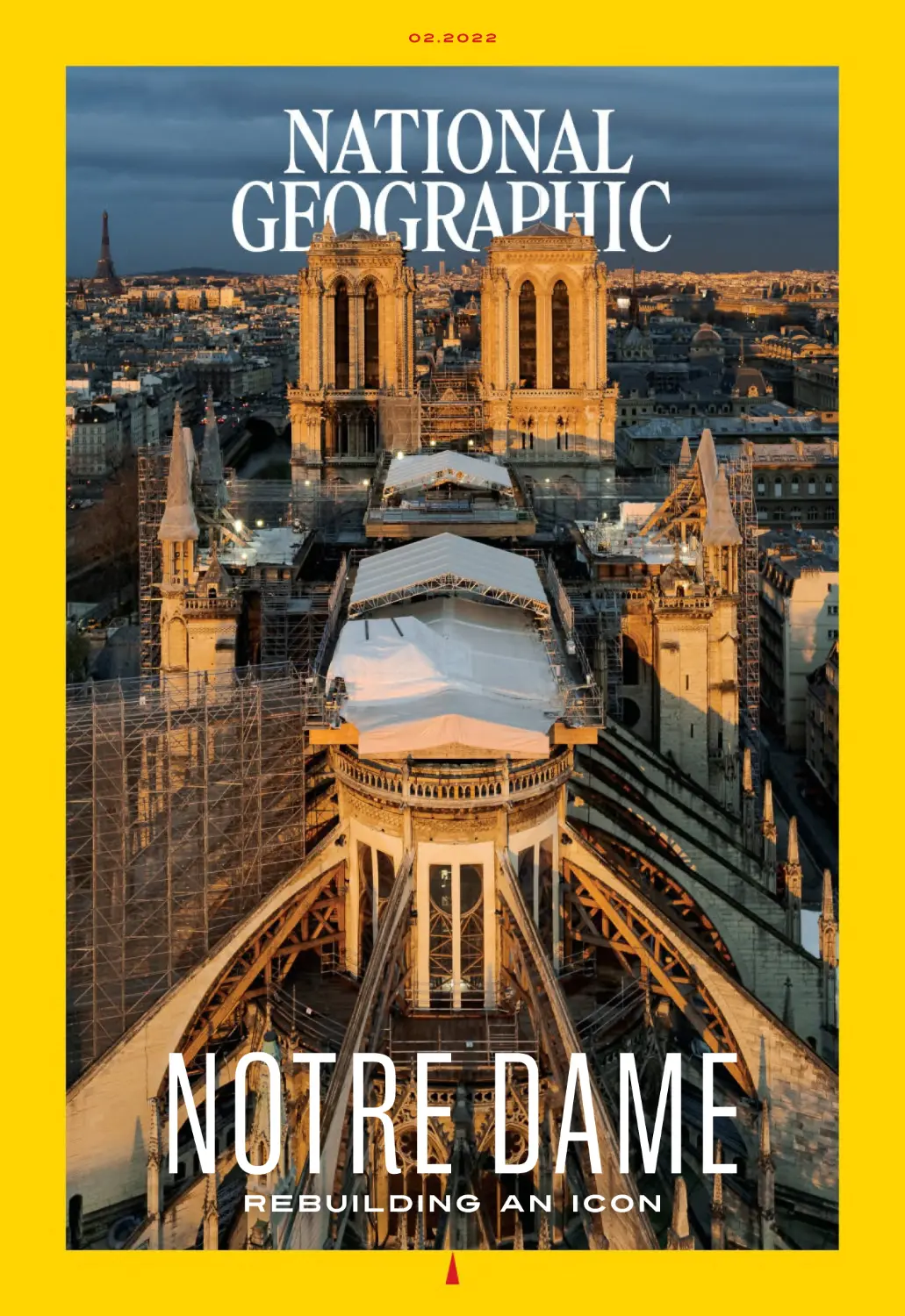
NOTRE DAME
REBUILDING AN ICON

T R AV E L B E YO N D YO U R
WILDEST DREAMS

Step back out into the world with National Geographic and rediscover your passion for
exploration. By land or by sea, by classic train or jet, by river cruise or on a private trip,
there are many ways to travel the world with us. Knowledgeable National Geographic
Experts or guides enrich every trip. And when you travel with us, you make a difference,
supporting the work of today’s scientists and explorers.

To learn more about all our trips and to request a FREE catalog
N ATG E O E X P E D I T I O N S .C O M / W I L D L I F E

|

1 - 8 8 8 -3 51 -3 274

FURTHER

F E B R UA RY 2 0 2 2

C O N T E N T S

On the Cover
During preparation for
a faithful restoration of
Notre Dame Cathedral in
Paris, white canopies protect gaping wounds left by
the devastating 2019 fire.
TOMAS VAN HOUTRYVE

P R O O F

17
E X P L O R E

THE BIG IDEA

On the Trail
of Julius Caesar

8

We might imagine
meeting the Roman
emperor face-to-face—
but how do we know
what he actually
looked like?
BY M A RY B E A R D

24
ADVENTURE

BREAKTHROUGHS

Scat Scan Discovery
Scientists could identify beetle fossils as a
new species because
they were preserved
so well in 230-millionyear-old … feces.
BY H I C K S WO GA N

Water Garden
The Mekong River is
home to rafts of water
lilies—and, increasingly,
plastic pollution. The
National Geographic
Society is helping fund
research on the issue.
BY R AC H E L N G ; P H OTO G R A P H BY K H Á N H P H A N

A Family’s Valor
With the timeless
look of tintypes to
bind the past and
present, a photographer pays tribute to
the armed forces
members in his family.
P H OTO G R A P H S BY
R A S H O D TAY LO R

THROUGH THE LENS

The Conflict Zone

ALSO

A Shrew’s Brain
Mulch From Coffee?

Ugandan villagers’
clashes with chimps
raise tricky questions
about conservation
and coexistence.
STO RY A N D P H OTO G R A P H S
BY RO N A N D O N OVA N

F E B R U A R Y

|

F E AT U R E S

CONTENTS

Notre Dame
After the Fire
The cathedral was still
smoldering in April
2019 as French leaders
vowed to rebuild it—
by 2024. As restoration
proceeds, unrivaled
access allowed National
Geographic to witness
the efforts.

The Adapters

Crops and Climate

Cichlids in Lake
Tanganyika could be
poster fish for diversity,
exhibiting many sizes,
colors, and behaviors.

The toll that climate
change takes on food
crops deserves a microscopically close look.

B Y N ATA S H A D A LY

RO B E RT DA S H

P H OTO G RA P H S BY

. . . . . . . . . . . . . . . . . . . . . . . . . . . . . . . . . . . . . P.

. . . . . . . . . . . . . . . . . . . . . . . . . . . . . . . . . . . . . . . P.

72

A Climb for History

P H OTO G RA P H S BY

An all-Nepali team prevails on the world’s second highest mountain.

A RT BY F E R N A N D O G .

B A P T I S TA
. . . . . . . . . . . . . . . . . . . . . . . . . . . . . . . . . . . . . . . P.

BY FREDDIE WILKINSON

36

102

A N G E L F I TO R

BY RO B E RT KU N Z I G
T O M A S VA N H O U T R Y V E

T E X T A N D I M AG E S B Y

......................................

P. 80

Sudan’s Reckoning
A new generation discovers a proud past and
faces an unsure future.
BY KRISTIN ROMEY
P H OTO G RA P H S BY
NICHOLE SOBECKI
.....................................

P. 110

ATEM Mini Pro model shown.

Introducing ATEM Mini Pro
The compact television studio that lets you
create presentation videos and live streams!
Blackmagic Design is a leader in video for the television
industry, and now you can create your own streaming videos
with ATEM Mini. Simply connect HDMI cameras, computers
or even microphones. Then push the buttons on the panel
to switch video sources just like a professional broadcaster!
You can even add titles, picture in picture overlays and mix
audio! Then live stream to Zoom, Skype or YouTube!

Live Stream Training and Conferences

Create Training and Educational Videos

Monitor all Video Inputs!

ATEM Mini’s includes everything you need. All the buttons are
positioned on the front panel so it’s very easy to learn. There are 4
HDMI video inputs for connecting cameras and computers, plus a
USB output that looks like a webcam so you can connect to Zoom
or Skype. ATEM Software Control for Mac and PC is also included,
which allows access to more advanced “broadcast” features!

With so many cameras, computers and effects, things can get busy
fast! The ATEM Mini Pro model features a “multiview” that lets you
see all cameras, titles and program, plus streaming and recording
status all on a single TV or monitor. There are even tally indicators to
show when a camera is on air! Only ATEM Mini is a true professional
television studio in a small compact design!

The ATEM Mini Pro model has a built in hardware streaming engine
for live streaming via its ethernet connection. This means you can
live stream to YouTube, Facebook and Teams in much better quality
and with perfectly smooth motion. You can even connect a hard
disk or flash storage to the USB connection and record your stream
for upload later!

Use Professional Video Effects
ATEM Mini is really a professional broadcast switcher used by
television stations. This means it has professional effects such as a
DVE for picture in picture effects commonly used for commentating
over a computer slide show. There are titles for presenter names,
wipe effects for transitioning between sources and a green screen
keyer for replacing backgrounds with graphics.

ATEM Mini..........$295
ATEM Mini Pro..........$49
ATEM Mini Pro ISO.........

Learn more at www.blackmagicdesign.com

F E B R U A R Y

|

FROM THE EDITOR

HISTORIC
MONUMENTS

Deciding What
to Preserve—and How
BY SUSAN GOLDBERG

site s are a
nonrenewable resource. When they
disappear, they’re gone forever, a loss
akin to the extinction of species.
Today architectural and archaeological heritage sites are being destroyed or
imperiled at an alarming rate. They’re
threatened by rising seas (Venice),
pollution (the Taj Mahal), overtourism
(Angkor Wat), encroaching development (the Pyramids at Giza), conflict
(Syria’s ancient city of Palmyra) …
And by accidents.
In this issue, we explore the herculean efforts to rebuild the roof and spire
of Notre Dame Cathedral, part of the
Banks of the Seine UNESCO World Heritage site in Paris. Before it was wracked
by fire in spring 2019, the landmark
drew some 12 million visitors a year.
We’ll take you behind the scenes of the
rebuilding, through the work of photographer Tomas van Houtryve, writer
Robert Kunzig, and artist Fernando
Baptista. You’ll see debris cleared, chapels restored, statuary saved.
You’ll also confront thorny questions about cultural heritage sites. As
Kunzig writes, “What part of the past
is worth preserving and transmitting
to posterity? What duty do we owe
the creations of our ancestors, what
strength and stability do we draw
from their presence—and when, on
the contrary, do they become a lead
weight, preventing us from projecting
ourselves into the future?”
Humankind has answered that
query differently in different places.
In Dresden, Germany, the Frauenkirche was an 18th-century baroque
church whose bell-shaped dome was
a landmark. In February 1945, one of
the most destructive Allied bombing
attacks of World War II killed an estimated 25,000 people and reduced the
C U LT U R A L H E R I TA G E

city to rubble. As Dresden, then in East
Germany, slowly rebuilt after the war,
the Frauenkirche remained in ruins.
But after German reunification, the
church was reconstructed using many
of its original stones, as a statement of
peace and harmony.
Berlin’s Kaiser Wilhelm Memorial
Church, better known as the Gedächtniskirche, also fell to bombing but met
a different fate. Its spire has been left a
ruin on purpose, to be what Germans
call a mahnmal—a “warning monument” against war and destruction.
Like the Frauenkirche, Notre Dame
is being rebuilt as close as possible to
how it was before, including using the
original, toxic metal—lead—for the
roof. That choice was controversial,
as future choices are bound to be in
the debate about how to restore and
maintain historic buildings.
We at National Geographic don’t
claim to have the “right” answers on
preservation; there may not even be
right answers. What we will do is continue to monitor the care of cultural
heritage sites, as a matter of significance
to humanity’s past, present, and future.
Thank you for reading National
Geographic. j

Since its principal construction from 1163 to 1350,
Notre Dame Cathedral
repeatedly has been damaged and repaired, including desecration during
the French Revolution and
major restoration in the
mid-1800s. On April 15, 2019,
the landmark’s roof caught
fire (above). After 15 hours
ablaze, the cathedral’s spire
had collapsed, most of its
roof was destroyed, and its
upper walls were severely
damaged. Work on the
site began quickly; even
the COVID-19 pandemic
caused only a two-month
delay. Architects have said
the project is on track to be
completed in 2024.

PHOTO: THIERRY MALLET, AP/SHUTTERSTOCK

I feel

t
h
g
i
e
w
ut
o
b
a
h
t
ru
t
e
h
t
y
b
I just learned that losing 5%-15% of
my weight can improve some weightrelated conditions, like osteoarthritis
and sleep apnea. Now I’m even
more determined to take control
of my health. Understanding
why my body regains weight
can help me choose a weightmanagement plan with my
health care provider.

Get the truth today—
so you can make a plan
for tomorrow

Learn more at
TruthAboutWeight.com

Truth About Weight® and Novo Nordisk are
registered trademarks of Novo Nordisk A/S.
©2021 Novo Nordisk Printed in the U.S.A.
US20OB00266 January 2021

EDITOR IN CHIEF

Susan Goldberg

Debra Adams Simmons

Alexandra Moreo
Amr Alfiky, Bunni Elian

SPECIAL PROJECTS MANAGER
PHOTOGRAPHY RESIDENTS

EXECUTIVE EDITOR/HISTORY & CULTURE

CARTOGRAPHY

MANAGING EDITOR/MAGAZINES

David Brindley

DIRECTOR/VISUALS & IMMERSIVE EXPERIENCES

Whitney Johnson
SENIOR EXECUTIVE EDITOR/NEWS & FEATURES

Indira Lakshmanan
MANAGING EDITOR/DIGITAL Alissa Swango
MANAGING EDITOR/INTEGRATED STORYTELLING

DIRECTOR

Martin Gamache

SENIOR MANAGER/CARTOGRAPHIC DATABASES

Ted Sickley
GIS MANAGER Yanli Gong
SENIOR EDITORS Riley D. Champine,

Matthew W. Chwastyk, Christine Fellenz

Michael Tribble

EDITOR Rosemary P. Wardley
SENIOR MAP EDITOR Scott Zillmer

NEWS/FEATURES

RESEARCH EDITOR

EXECUTIVE EDITOR/LONG FORM David Lindsey
EXECUTIVE EDITOR/SHORT FORM Patricia Edmonds

INFOGRAPHICS

DEPUTY MANAGING EDITOR/SHORT FORM Brooke Sabin
EDITORS AT LARGE Peter Gwin, John Hoeffel
CONTRIBUTING WRITERS Yudhijit Bhattacharjee,

Heather Greenwood Davis, Nadia Drake,
Robert Draper, Cynthia Gorney
EXECUTIVE ASSISTANT

Gretchen Ortega
Nia Cheney

EDITORIAL PROJECT MANAGER

ANIMALS
EXECUTIVE EDITOR Rachael Bale
ASSISTANT MANAGING EDITOR Christine
SENIOR EDITOR Oliver Payne
SENIOR WRITER/EDITOR Douglas
WRITER/EDITOR Natasha Daly
WILDLIFE WATCH REPORTERS

Dell’Amore

SENIOR ARTISTS

DIRECTOR Kennedy Elliott
SENIOR EDITORS Brian T. Jacobs,
EDITOR Oscar Santamariña
SENIOR EDITOR/SHORT FORM

Main

Dina Fine Maron,

Ryan Morris

Eve Conant

DESIGN

Robert Kunzig
SENIOR EDITOR Lori Cuthbert
SENIOR WRITER/EDITOR Laura Parker
SENIOR WRITER Craig Welch
WRITERS Alejandra Borunda, Sarah Gibbens
HISTORY & CULTURE
DEPUTY MANAGING EDITOR Nancy San Martín
SENIOR EDITOR Glenn Oeland
SENIOR ARCHAEOLOGY WRITER/EDITOR Kristin Romey
SENIOR WRITER/EDITOR Rachel Hartigan
WRITER Nina Strochlic

Tucker C. Toole

TRAVEL
EXECUTIVE EDITOR

George W. Stone
ASSISTANT MANAGING EDITOR Amy Alipio
SENIOR EDITORS Jennifer Barger, Anne Kim-Dannibale
EDITOR Allie Yang
ASSOCIATE EDITOR Starlight Williams

IMMERSIVE STORYTELLING
DEPUTY DIRECTOR Kaitlyn Mullin
SENIOR MANAGER Jennifer Murphy
SENIOR EDITOR Dan Steinmetz
SENIOR PRODUCERS Cosima Amelang,

Zach

PRODUCERS/EDITORS Rebekah Barlas, Tiffany
D’Emidio, Shweta Gulati, Veda Shastri
ASSOCIATE PRODUCER Milaena Hamilton
PODCASTS
EXECUTIVE PRODUCER

Davar Ardalan

SENIOR PRODUCER Carla Wills
SENIOR EDITOR Eli Chen
HOSTS Amy Briggs, Peter Gwin
PRODUCERS Brian Gutierrez, Jacob

Amy Kolczak

SENIOR COPY EDITOR Cindy Leitner
COPY EDITORS Caroline Braun, Jennifer

Vilaga

RESEARCH
DIRECTOR Alice S. Jones
RESEARCHERS Elizabeth S.

Atalay, Taryn L. Salinas,
Heidi Schultz, Brad Scriber

PHOTOGRAPHY
DEPUTY DIRECTOR Sadie Quarrier
EDITOR AT LARGE Kurt Mutchler
ANIMALS
ASSISTANT MANAGING EDITOR Alexa Keefe
PHOTO EDITOR Kaya Berne
ASSOCIATE PHOTO EDITOR Vi Nguyen
ENVIRONMENT
ASSISTANT MANAGING EDITOR Anne Farrar
PHOTO EDITOR Dominique Hildebrand
HISTORY & CULTURE
ASSISTANT MANAGING EDITOR James Wellford
SENIOR PHOTO EDITOR David M. Barreda
PHOTO EDITORS Mallory Benedict, Jennifer Samuel
SCIENCE
SENIOR PHOTO EDITOR Todd James
PHOTO EDITOR Samantha Clark

Pinter,

PHOTO EDITOR/SHORT FORM Julie Hau
SENIOR PHOTOGRAPHY SPECIALIST Elena

SOCIAL MEDIA & AUDIENCE
DEVELOPMENT
VICE PRESIDENT Chris Thorman
DIRECTOR/INSTAGRAM Josh Raab
SENIOR MANAGER/AUDIO Sarah Polger
MANAGERS Becky Davis, Sarah Gardner,

Michael L. Ulica
CHIEF DIVERSITY, EQUITY, AND INCLUSION OFFICER

Shannon P. Bartlett
CHIEF
CHIEF
CHIEF
CHIEF
CHIEF
CHIEF
CHIEF

COMMUNICATIONS OFFICER Crystal Brown
HUMAN RESOURCES OFFICER Mara Dell
SCIENCE AND INNOVATION OFFICER Ian Miller
EXPLORER ENGAGEMENT OFFICER Alex Moen
ADVANCEMENT OFFICER Kara Ramirez Mullins
EDUCATION OFFICER Vicki Phillips
LEGAL OFFICER Sumeet Seam

CHIEF TECHNOLOGY & INFORMATION OFFICER

Jason Southern
CHIEF OF STAFF Kim Waldron
CHIEF STORYTELLING OFFICER Kaitlin Yarnall
CHIEF FINANCIAL OFFICER Rob Young

CHAIRMAN Jean M. Case
VICE CHAIRMAN Katherine

Bradley
Brendan P. Bechtel, Afsaneh Beschloss,
Ángel Cabrera, Elizabeth Comstock,
Joseph M. DeSimone, Alexandra Grosvenor
Eller, Kevin J. Maroni, Strive Masiyiwa, Mark C.
Moore, George Muñoz, Nancy E. Pfund, Lyndon
Rive, Frederick J. Ryan, Jr., Rajiv Shah, Ellen R.
Stofan, Jill Tiefenthaler, Anthony A. Williams

EXPLORER IN RESIDENCE

Enric Sala

NEWSLETTERS
EXECUTIVE EDITOR David Beard
SENIOR PHOTO EDITOR Jen Tse
WRITER/EDITOR Monica Williams
ASSOCIATE PHOTO EDITOR Heather

MULTIPLATFORM PUBLISHING
DIRECTOR

EXPLORERS AT LARGE

Robert Ballard, Lee R. Berger, James Cameron,
Sylvia Earle, J. Michael Fay, Beverly Joubert,
Dereck Joubert, Louise Leakey, Meave Leakey,
Thomas Lovejoy, Rodrigo Medellín

NATIONAL GEOGRAPHIC PARTNERS
Kim

Janey Adams

MANAGER Francis Rivera
SENIOR WRITER/EDITOR Amy

McKeever
PRODUCERS Emily Martin, Kimberly Pecoraro
ASSOCIATE PRODUCER Sylvia Mphofe

Bill Reicherts
PRODUCTION MANAGER Mike Lappin
IMAGING MANAGER John Chow
Sheveiko

PRESIDENT AND CHIEF OPERATING OFFICER

Lena Shareef
PRODUCER Nathan Strauss
ASSOCIATE PRODUCER Delaney Gordon
SPECIALIST Danny Kerry
COORDINATOR Sid Dawson
SENIOR PRODUCER

DIRECTOR/ADMIN

PHOTO COORDINATORS Ian Morton, Maya Valentine
STAFF PHOTOGRAPHERS Becky Hale, Mark Thiessen
PHOTO ENGINEER Tom O’Brien
ENGINEERING COORDINATOR Keegan Barber

SENIOR MANAGEMENT

Vanina Harel

PRODUCTION SERVICES

Maura Friedman

Dr. Jill Tiefenthaler

BOARD OF TRUSTEES

Ilana Strauss

COPY DESK
DEPUTY MANAGING EDITOR

Tim Parks,
Hannah Tak, Hilary VanWright
PRODUCTION LEADS Sandi Owatverot,
Nicole Thompson
CONTRIBUTING DESIGNER T.J. Tucker
DESIGN RESIDENT Nina Wescott

Baumgartner

SCIENCE
EXECUTIVE EDITOR Victoria Jaggard
SENIOR EDITORS Jay Bennett, Bijal P. Trivedi
WRITERS Michael Greshko, Maya Wei-Haas

NATIONAL GEOGRAPHIC SOCIETY
The National Geographic Society is a
global nonprofit organization that uses
the power of science, exploration, education, and storytelling to illuminate and
protect the wonder of our world. Since
1888, National Geographic has pushed
the boundaries of exploration, investing
in bold people and transformative ideas,
providing more than 15,000 grants for work
across all seven continents.
CHIEF EXECUTIVE OFFICER

DIRECTOR Marianne Seregi
SENIOR EDITORS Elaine Bradley,

ENVIRONMENT
EXECUTIVE EDITOR

TRAVEL
PHOTO EDITOR

John Tomanio
Fernando G. Baptista, Alberto
Lucas López
SENIOR EDITORS Manuel Canales, Monica Serrano,
Jason Treat
ASSOCIATE MANAGER/PRODUCTION Diana Marques
ASSOCIATE EDITORS Katie Armstrong, Taylor
Maggiacomo, Christina Shintani, Soren Walljasper
DIRECTOR

INTERACTIVE STORYTELLING

Rachel Fobar

HISTORY RESIDENT

Patricia Healy

INTERNATIONAL EDITIONS
SENIOR EDITOR/DESIGN Darren Smith
TRANSLATION MANAGER Beata Nas
INTERNATIONAL EDITOR Leigh Mitnick

SENIOR MANAGEMENT
VICE PRESIDENT, HUMAN RESOURCES Luca Citterio
EDITORIAL DIRECTOR Susan Goldberg
VICE PRESIDENT, INTEGRATED COMMUNICATIONS &
BRAND MANAGEMENT Jill Lesser
GENERAL MANAGER, NG MEDIA David

E. Miller

DEPUTY CHIEF COUNSEL Evelyn T. Miller
PRESIDENT, GLOBAL TELEVISION NETWORKS

Courteney Monroe
HEAD OF TRAVEL AND TOUR OPERATIONS

Nancy Schumacher
CHIEF FINANCIAL OFFICER

Akilesh Sridharan

BOARD OF DIRECTORS

Jean M. Case, Rebecca Campbell, Josh D’Amaro,
Kareem Daniel, Nancy Lee, Kevin J. Maroni,
Peter Rice, Frederick J. Ryan, Jr., Jill Tiefenthaler,
Michael L. Ulica

LEAVE A LEGACY OF LOVE
You can leave the world better than you
found it. When you leave a gift to the
National Geographic Society in your will
or trust, or by beneficiary designation,
you can protect critical animal species for
generations to come.
We believe all people deserve access to
estate planning tools. That’s why we are
making this free to our supporters.
Claim your account today at:
www.givingdocs.com/national-geographic/

C O P Y R I G H T 2 0 2 2 N AT I O N A L G E O G R A P H I C S O C I E T Y / M I C H A E L N I C H O L S / N AT I O N A L G E O G R A P H I C C R E AT I V E

CREATE A LEGACY OF YOUR OWN
Yes! Please send me information on leaving a gift to the
National Geographic Society.

Mail to:

National Geographic Society
Office of Planned Giving
1145 17th Street, N.W.
Washington, D.C. 20036-4688

Contact:

legacy@ngs.org
(800) 226-4438
natgeo.org/give/future-gifts

The National Geographic Society has already been
included in my estate plans.
I would like to speak to someone about making a gift.
Please call me.

NAME
ADDRESS

PHONE

EMAIL

The National Geographic Society is a 501(c)(3) non-profit organization. Our federal tax ID number is 53-0193519

22PGAD02

Photographer Rashod
Taylor’s cousin Valerie
Lewis—at right, with
her parents, Ernest and
Modester—is one of
Taylor’s relatives who’ve
served in the U.S. military
dating to World War II.

8

N AT I O N A L G E O G R A P H I C

P R O O F
N AT I O N A L G E O G R A P H I C
VO L . 2 41 N O. 2

A FAMILY’S
VALOR

LO O K I N G
AT T H E
E A RT H
F RO M
E V E RY
POSSIBLE
ANGLE

PHOTOGRAPHS BY
R A S H O D TAY L O R

Evocative tintype images create
a visual link between present and
past in a tribute to one family’s
history in the U.S. armed forces.

F E B RUA RY 2 0 2 2

9

P R O O F

Ernest Lewis (top left) saw two daughters deploy with the Army: Valerie (bottom left) to Afghanistan and Iraq, Vanessa Lewis
Williams (top right) to Iraq and Qatar. Here his daughter Melissa’s children, Ania and Eric Jr. (bottom right), wear military
caps belonging to their father, Eric Kelsey, a Navy combat veteran.

10

N AT I O N A L G E O G R A P H I C

Vanessa is now maintenance supervisor in the 848th Engineer Company (Sapper), a Georgia Army National Guard unit
located in Douglasville. She says it’s “true about being a female in the military facing discrimination and favoritism for your
sex and color,” but she’s proud to be a servicewoman.

F E B RUA RY 2 0 2 2

11

P R O O F

Taylor’s great-uncle
Lecky Taylor served in
the Army during World
War II and is buried at
the Marietta National
Cemetery in Georgia.

12

N AT I O N A L G E O G R A P H I C

F E B RUA RY 2 0 2 2

13

P R O O F

THE BACKSTORY
A P H O T O G R A P H E R T R A I N S H I S L E N S O N F A M I LY T O I L L U S T R AT E
T H E C O M P L E X H I S TO RY O F B L AC K M I L I TA RY S E RV I C E .

My America project
highlighting Black people’s experiences,
photographer Rashod Taylor focused
on a subject that had influenced his life:
Black military service. Though Taylor
himself never joined the armed forces,
members of his family did. And he listened intently to their stories.
“I really found this new appreciation for what kind of sacrifices they’ve
made,” Taylor says. “Not only in the
military in general but just being Black
in the military and still having to go
through those extra layers of life living as a person of color in the United
States.” Although Black Americans
have fought for their country since
A S PA R T O F H I S

the 1770s, many of them dealt—and
still deal—with unequal treatment.
Taylor’s relatives have benefited from
opportunities that the military offers.
At the same time, they’ve faced hostility and discrimination while on active
duty and as citizens.
Taylor chose tintype photography,
using metal plates in a process that
was popular from the mid-1800s to
the early 1900s, as a way to bridge the
gap between former and current service members. Despite being decades
apart, their similar experiences unite
them. The images reflect a complicated legacy, one of disparity, pride,
and endurance. —T U C K E R C . TO O L E

Valerie (top) feels a special bond with her great-uncle Lecky. Both were Army medics.

IN THIS SECTION

E X P L O R E

Scat Scan Discovery
Water Lily Harvest
Mentoring Fossil Hunters
Chimp-Human Conflict

I L L U M I N AT I N G T H E M Y S T E R I E S — A N D W O N D E R S — A L L A R O U N D U S E V E R Y D AY
N AT I O N A L G E O G R A P H I C

VO L . 2 41 N O. 2

On the Trail of
Julius Caesar
W E ’ D L OV E T O M E E T T H I S M O ST FAM O U S ROM A N FAC E - T O -FAC E ,
B U T H O W D O W E K N O W W H AT H E A C T U A L LY L O O K E D L I K E ?

I

B Y M A RY B E A R D

one French archaeologist got
lucky. He was diving in the murky waters of the Rhône
River at Arles, in the south of France, in search of
ancient remains on the riverbed. He emerged holding
a finely carved, life-size marble head. As he lifted it
up out of the water, in one of those classic discovery
moments, the director of the team shouted, “Putain,
mais c’est César—Damn, it’s Caesar.”
It was, in other words, a portrait of arguably the
most famous Roman who ever lived: Julius Caesar,
conqueror of Gaul, charismatic dictator, populist
autocrat, and, finally, victim of assassination on
the ides of March, 44 B.C. (an event immortalized
by William Shakespeare, among many other writers
and painters). He is one of the people from antiquity
who—alongside Cleopatra, perhaps—later generations have most wanted to meet face-to-face.
Tracking down the likeness of the real Caesar has
proved an irresistible sport.
IN SEPTEMBER 2007

F E B RUA RY 2 0 2 2

17

E X P L O R E

|

THE BIG IDEA

In the 15 years since it was pulled from the water,
this head from the Rhône1 (see next page) has
achieved celebrity status. It has been the subject of
special art exhibitions and television programs, and
it even ended up on a French postage stamp.
Currently, it stands proudly as the star of an Arles
museum, captured in countless selfies by admiring
visitors. One possible backstory is that it was put
up to honor Caesar during his lifetime by the loyal
citizens of Arles, but it was chucked into the river
after his assassination when the changed political
climate made it seem too hot a property. As soon as
Caesar was yesterday’s man, no one wanted a statue
of him. It was only some two millennia later that
it was dramatically rescued from its watery grave.
So far, so good. But the big question is: How on
earth do we know it is Julius Caesar? There’s no
name attached to the head. So, why do we think it
is him? There are nearly 80 ancient heads found all
over Europe and the United States that have been
claimed to be a true portrait of Caesar. How do we
decide which are and which are not? Ancient writers
note that, as a mark of his power, Caesar flooded the
Roman world with his image. But can we recognize
his head out of the estimated hundreds of thousands
of other Roman portraits that still survive, lined up
on our museum shelves?
This problem has kept archaeologists busy for
centuries and is made all the trickier because none
of the potential candidates carry a name. (As a rule
of thumb, if a marble portrait is neatly inscribed
with the name Julius Caesar, it’s a fake.) The only
firm evidence that survives for what Caesar looked
like is a series of silver coins2 minted just before his
assassination. These show a characterful, gaunt
face, with a wrinkled neck and a prominent Adam’s
apple and a laurel wreath crown. According to his
biographer, writing a century and a half after his
death, Caesar would position the laurels artfully to
conceal the bald patch of which he was ashamed.
The problem for archaeologists has been to try to
match up the three-dimensional busts with the tiny
images on the coins.
The array of may-be-Caesar portraits in the round
is much more varied than you might expect. One is
a particularly luscious “Green Caesar,”3 originally
from Egypt and now—after passing through the
hands of the Prussian royal family—on display in
Berlin. It is made out of polished green stone and so
impressive that some overoptimistic historians and
archaeologists have imagined that it might have been
commissioned by Cleopatra herself, who had briefly
been Caesar’s lover. (Equally likely, as more sober
scholars have suggested, it was a portrait of some
Egyptian bigwig who was aping the style of Caesar.)
Another is a full-length portrait statue, which
was the favorite of the Italian Fascist leader Benito
Mussolini, who saw Julius Caesar as his ideological
ancestor. He liked the statue so much that he had
full-scale replicas made and displayed in prominent
18

N AT I O N A L G E O G R A P H I C

Will the real
Julius Caesar
please stand up?
There is only one ancient physical
description of Julius Caesar, by
his original biographer Suetonius,
writing 163 years after Caesar’s
death. “He was particularly fastidious over his body image,” writes
Suetonius, adding that Caesar
used to pluck his body hair. And
he considered his baldness a
terrible disfigurement, finding
it exposed him to the gibes of
abusers. So, he used to brush
forward his thinning hair from the
crown of his head in order to conceal his bald patch—an intriguing
early use of the comb-over.

T O M A K E T H I S P O R T R A I T, artist David Samuel
Stern photographed a bust of Caesar, circa
1512, at New York’s Metropolitan Museum
of Art. Three photos were converted to red,
green, and blue tonal ranges, printed on
translucent vellum, cut into strips, woven
by hand, and then backlit to create this final
image. “Our collective mental picture of
Caesar is almost certainly not what he really
looked like,” Stern says.

locations around Italy. He moved the original into
the council chamber of the city of Rome—where
it remains, presiding over discussions of planning
regulations and traffic control. But no serious historian now thinks it a statue of Caesar, certainly not
sculpted from life.
There is even another that was dragged up from
a riverbed, this time from the Hudson in New York,
in 1925. How it got there is anyone’s guess—presumably “lost overboard” while traveling by boat, rather
than being the clinching piece of evidence that the
Romans really did reach America. But for a while it
was hailed as America’s own Julius Caesar. Not for
long. It ended up in a Swedish museum, demoted to
“unknown Roman.”

WOVEN PORTRAIT: DAVID SAMUEL STERN. PHOTOGRAPHED AT THE METROPOLITAN MUSEUM OF ART, NEW YORK

19

E X P L O R E

|

THE BIG IDEA

But two pieces in particular have been the stars
of the Caesar show, and through much of the 19th
and 20th centuries they held sway as the real face of
Julius Caesar. The first,4 bought in 1818 from a British
collector who had picked it up in Italy, is in the British
Museum. It entered as an unknown Roman, but by
the 1840s it was confidently identified as Julius Caesar himself and given pride of place in the museum
display—thanks to its wrinkly neck, Adam’s apple,
and hollowed cheeks that seemed a close match for
the silver coins.
For decades this face decorated the cover of almost
every book on Caesar, and it was lauded in rapturous
prose by Caesar’s modern fans. “This bust represents,”
wrote one, “the strongest personality that has ever
lived ... In the profile it is impossible to detect a flaw.”
John Buchan—scholar, diplomat, and author of The
Thirty-Nine Steps—judged it “the noblest presentment
of the human countenance known to me.”
This bust was an early modern celebrity, but its
authenticity was eventually toppled. After decades of
increasing doubts, in the early 1960s it was officially
declared a fake; there were traces of abrasion and
artificial staining designed to make it look centuries
older than it really was. It certainly was meant to be
Julius Caesar, copying the head on those coins (no
unknown Roman here), but it was made in the late
18th century. It has been relegated to a traveling
exhibit on ancient Rome and occasionally emerges
in exhibitions of notorious fakes.
There was, however, another head of Caesar waiting in the wings to take its place in the limelight. It
had been excavated near Rome by Lucien Bonaparte,
Napoleon’s younger brother, who was a keen archaeologist. But when he hit hard times, it was sold and
taken to its new owner’s estate outside Turin, where
it remained anonymously (“unknown old man”) for a
hundred years. In the 1930s an Italian archaeologist,
perhaps playing to Mussolini’s enthusiasm for the

dictator, firmly identified it as a portrait of Julius
Caesar, taken from life. So accurate was it, he claimed,
that the strange shape of the head, which you might
easily put down to an incompetent sculptor, was in
fact the reflection of congenital deformations of
Caesar’s skull (clinocephaly and plagiocephaly, to
use the technical terms). Never mind that there was
something circular here (there is no evidence for
Caesar’s skull conditions apart from this sculpture);
the Bonaparte portrait has not only prompted the
same kind of purple prose as the British Museum
head, it has given us the illusion that we are doing
more than looking the man in the eye—we are taking
his medical notes.
But this head too is falling. That is not so much
because it is thought to be a fake, or not to be Caesar
at all, but because beyond all the hype it is in fact a
rather rough-and-ready piece. Our best guess now is
that it might be a later Roman copy of some contemporary head of Caesar, but certainly not a product of
careful observation (and the odd shape of the skull
is probably just that, an odd shape).
Enter, just in time, the head from the Rhône. The
city of Arles had political connections with Caesar (he
settled some of his veteran troops there). The neck
of the sculpture has the required wrinkles, and the
Adam’s apple is prominent enough (though it hardly
has the gaunt aspect of the coins). It will be the face
of Caesar for a few decades and will decorate any
number of glossy book jackets. Indeed, it may be
him. But my guess is that sooner or later, doubts will
grow, and a quite different head will be rediscovered
to take its place.
The true image of Julius Caesar is always just outside our grasp. Each generation finds a new Caesar
for themselves. j
Mary Beard is Professor of Classics at the University of Cambridge.
She is the author of many books about ancient Rome, including
the best-selling SPQR. Her most recent book is Twelve Caesars.

FACE OF AN EMPEROR?
Rhône Caesar

Silver Coin Caesar

'Green Caesar'

British Museum Caesar

Rescued from the Rhône
River, this celebrated bust
(it’s appeared on a French
postage stamp) resides at
an Arles museum.

Before Caesar’s death in
44 B.C., a series of silver
coins was minted, the only
firm surviving evidence of
what he looked like.

Some archaeologists speculated that this green stone
head, originally from Egypt,
was commissioned by
Cleopatra, Caesar’s lover.

Once given pride of place
at the museum, this likeness
was declared a fake in the
1960s and is now relegated
to a traveling exhibit.

1

2

3

4

PHOTOS (FROM LEFT): BORIS HORVAT, AFP/GETTY IMAGES; ASHMOLEAN MUSEUM/HERITAGE
IMAGES/GETTY IMAGES; DEAGOSTINI, GETTY IMAGES; THE TRUSTEES OF THE BRITISH MUSEUM

MINNESOTA

R iv er

IOWA

pi

SMOOTH SAILING

WISCONSIN

si p

ILLINOIS

MISSOURI

TENNESSEE
Riv
er

ARKANSAS
Missis
sip
pi

ABOARD THE BRAND NEW AMERICAN MELODY
From the French Quarter to the hometown of Mark Twain,
experience the best of this legendary river. On a 5 to
22-day journey, explore Civil War history and travel
to the epicenter of American music as you cruise in
perfect comfort aboard our brand new modern riverboat.
Small Ship Cruising Done Perfectly®

Miss
is

The Mighty Mississippi

MISSISSIPPI

Greenville
LOUISIANA

Vicksburg
Natchez
St. Francisville

Baton Rouge
Houmas House
Oak
Alley

Call
1-800-894-8649
to request a
FREE
Cruise Guide
Travel in Comfort on the Brand New American Melody

AmericanCruiseLines.com

E X P L O R E

|

BREAKTHROUGHS

The saving of the shrew

D I S PAT C H E S
FROM THE FRONT LINES
OF SCIENCE
A N D I N N OVAT I O N

Unlike seasonal hibernators, the Etruscan
shrew—one of Earth’s smallest mammals—
must eat heartily year-round to stay
alive. But the insectivore may have a
different way to conserve energy
in winter: It shrinks a section of
its brain by more than 25 percent. The lost cells regrow by
summertime. — H I C K S W O G A N

REFORESTATION

New forests
benefit from
coffee’s jolt

PALEONTOLOGY

SCAT SCAN DISCOVERY
FOUND IN TRIASSIC FECES: A NEW BEETLE SPECIES

come in exquisite containers—gilded
sarcophagi, carved chests—and others, in less appealing packages.
The newfound beetle Triamyxa coprolithica is among the latter. A
team of scientists reported discovering the species in a coprolite,
aka fossilized feces. The team used synchrotron microtomography,
a powerful x-ray technique, to scan an ancient dropping that the
scientists had unearthed in Poland. Inside the 230-million-year-old
scat, nickel size in diameter, were partial and whole specimens of
the tiny beetle (above). Study lead author Martin Qvarnström says
that to see 3D scans of the bugs, “it’s like they’re becoming alive in
front of you.” With even some of the delicate legs and antennae
intact, the remains were preserved well enough to identify the beetles as a previously unknown, now extinct species—the first time an
insect species has been described from a coprolite. The researchers
theorized that the dung came from Silesaurus opolensis—a dinosaur relative up to eight feet long—and hope their discovery will
encourage more stool sampling by paleontologists. — H W
S O M E V E RY O L D O B J E C T S

PHOTOS: MARTIN QVARNSTRÖM (BEETLES); JOEL SARTORE, NATIONAL GEOGRAPHIC PHOTO ARK (SHREW);
EDWIN REMSBERG, VW PICS/UIG VIA GETTY IMAGES (TREES)

Just like us, forests
move a bit faster
when there’s coffee on hand. An
experiment in a
Costa Rican rainforest covered
deforested land
with pulp that’s a
by-product of the
coffeemaking process, to see how
it affected forest
regrowth. After
two years, the
pulp-covered
forest plots were
doing much better
than untreated
ones—giving coffee
producers a new,
sustainable alternative to dumping
their waste.
—SARAH GIBBENS

U

The Stauer
Magnificat II is
powered by your
own movement

$99

*

SAVE $300!

®

®

E X P L O R E

|

ADVENTURE

The Mekong Delta brims with life in southwestern Vietnam.
BEHIND THE SCENE
Before entering the South
China Sea, the Mekong
River fans out into a network of waterways. During
flood season (June to
November), women steer
long-tail boats to harvest water lilies. Wading
into waist-deep water,
they rinse and bundle the
plants for sale at markets
and to restaurants. These
women learned boating
from their mothers and
grandmothers, says Khánh
Phan, who captured the
image by drone. She likens
the circle of lilies to one
big blossom on which “the
women are like bees.”

T H E L I F E A Q UAT I C
Water lilies are among
more than 20,000 species
of plants that grow in
the Mekong. The world’s
second most biodiverse
river, after the Amazon,
supports animals such as
the endangered Irrawaddy
dolphin, the hairy-nosed
otter, and the giant freshwater stingray. Human life
bustles along the river in
floating markets, villages
perched on stilts, and
delta floodplains where
farmers harvest more than
half of Vietnam’s rice.

WATER
GARDEN
24

N AT I O N A L G E O G R A P H I C

R I V E R WAT C H
The Mekong has long
sustained locals and
attracted travelers. But
its natural and cultural
wonders are threatened
by environmental stresses
such as discarded plastic.
With funding from the
National Geographic
Society, researchers at
England’s University of
Hull are studying how this
pollution ends up in the
river; the United Nations
Environment Programme
has plans to evaluate
the effects of plastic on
migratory species.

BY THE NUMBERS

6

COUNTRIES THROUGH WHICH
T H E M E KO N G R I V E R F LOWS

24.7
MILLION METRIC TONS OF RICE
G R O W N P E R Y E A R I N T H E D E LTA

2,700
A P P R OX I M AT E L E N G T H , I N M I L E S ,
O F T H E M E KO N G R I V E R

ASIA

Mekong
River
VIETNAM

Mekong
River Delta

BY RACHEL NG

NGM MAPS

PHOTOGRAPH BY KHÁNH PHAN

F E B RUA RY 2 0 2 2

25

IF YOU HAVE DIABETES—
YOUR EYES NEED ATTENTION
If you have diabetes, excess blood sugar can damage the
blood vessels inside your eyes—a condition known as diabetic
retinopathy. Even if your vision seems fine and you don’t notice
it happening, there still may be damage that could lead to vision
loss. Fortunately, an eye doctor may be able to help your eyes
and protect against vision loss.

Just say to yourself, “Now Eye See.”

Make eye care a priority and talk to an eye care professional today.
Learn more at NOWEYESEE.com.

© 2021, Regeneron Pharmaceuticals, Inc. All Rights Reserved.
NOW EYE SEE is a trademark owned by Regeneron Pharmaceuticals, Inc.
August 2021 OPH.21.07.0014

E X P L O R E

|

PLANET POSSIBLE

This month, appreciate
your loved ones—and the
environment—with gestures
designed for lasting impact.

BY CHRISTINA NUNEZ

P L A N E T

For more stories about how
to help the planet, go to
natgeo.com/planet.

Say It With Seeds
Instead of traditional
greeting cards, get
plantable ones that will
transform your Valentine’s Day message into
blooms of garden color.

Choose the Flowers
Without the Foam
Before you grab that
bouquet, take a peek at
the base: Many arrangements are packed with
floral foam, a crumbly
plastic that often ends
up in waterways. Avoid it
when possible—and never
wash it down the sink.

Let Love Take Root
Most of the cut flowers
sold in the United States
are imported, meaning
they’ve probably flown
more miles than you have
lately. A locally grown
plant is an eco-friendly and
longer-lasting alternative.

Sweet and Sustainable
Farming the cacao beans
used in chocolaty treats can
have a bitter side: razed
forests and mistreated,
underpaid labor. To confirm
that the cacao meets environmental, social, and
sustainability standards,
look for the seal of thirdparty certifiers such as
the Rainforest Alliance.

Sow Joy, Skip Plastic
Don’t buy seedlings and
the disposable plastic
containers that come
with them. Start plants at
home. The Old Farmer’s
Almanac has a handy calendar that tells you when:
almanac.com/gardening/
planting-calendar.

PHOTO: REBECCA HALE, NGM STAFF

E X P L O R E

INNOVATOR

BY HICKS WOGAN

ISAIAH NENGO
PHOTOGRAPH BY MARK THIESSEN

In his native Kenya, he
recruits students to help
unearth human history.
Nairobi-born Isaiah Nengo was in high
school when he found his life’s work,
on a trip to the National Museums of
Kenya. A lecture that day by renowned
paleoanthropologist Richard Leakey
captivated Nengo. After college he volunteered there, and Leakey helped him
get into a Ph.D. program at Harvard
University.
Nengo began fieldwork in the
mid-1980s in western Kenya, where
the first fossil he excavated was the
pelvis of a 17-million-year-old ape. “I
didn’t know at the time just how lucky
I was,” he says, laughing. In 2014 he
led an expedition in Kenya’s Turkana
Basin that discovered the most complete fossil skull of an ape ever found, a
13-million-year-old ancestor of today’s
apes and humans. The team gave the
skull’s owner the nickname Alesi, from
the Turkana word for “ancestor.”
Nengo teaches at New York’s Stony
Brook University and Kenya’s Turkana
University College. He also runs a master’s program in human evolutionary
biology that was launched at Turkana
University in 2017. Aiming to build local
expertise and research capacity, the
program has admitted eight students
so far, all Kenyans, six of them women.
Nengo would like to add students from
neighboring countries in future years.
“Training Africans from East Africa
is not charity,” he says. “It’s actually
essential to the science.” j
The National Geographic Society has
funded the work of paleoanthropologist Isaiah Nengo since 2018. Learn more
about its support of Explorers researching
history and culture at natgeo.com/impact.

E X P L O R E

|

THROUGH THE LENS

The
Conflict
Zone
WHEN HUMANS AND CHIMPS
CLASH IN A UGANDAN
VILLAGE, A PHOTOGRAPHER
S E E S F E A R , G R I E F —A N D
U LT I M AT E LY A C C E P TA N C E .

STORY AND PHOTOGRAPHS
B Y RO N A N D O N OVA N

through the window of an
abandoned home in a village in western Uganda. As I
watched, one wild chimpanzee entered the yard, then
another. Though they stared hard at the windows,
I knew they couldn’t see me behind the mirrored
glass—and I was glad.
During past fieldwork, I’d been around scores of
wild chimpanzees and shadowed them at close range.
Yet until this photo assignment in 2017, I had never
tried to hide from chimps. I had never even imagined
writing such a sentence.
That was before I met the Semata family and saw
firsthand how depleted land and forest, and scarce
food and crops, can unleash competition between
primates, those inside houses and those outside.
I TO O K T H I S P H OTO G R A P H

remember, I’ve felt at home
in the natural world. After college I worked for eight
years as a field biologist, studying spotted owls in
F O R A S LO N G A S I C A N

30

N AT I O N A L G E O G R A P H I C

Yosemite National Park, marine mammals off the
coast of Africa, and wild chimpanzees in Uganda’s
Kibale National Park. Primatologist Richard Wrangham’s long-term research project there sought to
understand wild chimpanzee behaviors, and possible
human and environmental impacts.
For most of 2011, I followed chimps that had been
habituated to human presence, gathering data
throughout the day. They were trusting animals after
decades of neutral encounters with their observers.
Having never been fed or directly hurt by a person,
they were indifferent to me.
But as Wrangham’s Kibale research confirmed,
behavior—human and chimpanzee—will change
as circumstances demand. Like us, chimps adapt to
exploit new food sources if existing ones disappear.
Also like us, chimps are omnivores that defend their
home territory from other groups of their species.
Chimps understand aggression: Throw a rock at a

Wild chimpanzees
whose natural
habitat has shrunk
approach a home
in Kyamajaka.

habituated chimp, the chimp will often throw one
back. Unless you are larger or outnumber them,
chimps that have been chased may chase you. And
provided the opportunity, chimps will hunt for meat.
in western Uganda as
a field biologist, I returned as a wildlife and conservation photographer. My assignment for National
Geographic, with writer David Quammen, was to tell
the story of human-chimpanzee conflict.
Though the village of Kyamajaka isn’t far from the
Kibale research project, the chimps around Kyamajaka are habituated to humans in a different way.
They are wary of the people they encounter on a daily
S I X Y E A R S A F T E R I ’ D WO R K E D

The National Geographic Society, committed to illuminating and protecting the wonder of our world, has funded
Explorer Ronan Donovan’s work since 2014. A Montana-based
wildlife photographer, Donovan is also a filmmaker, an artist,
and a mountaineer.

basis. These chimps are in competition with their
human neighbors. The native forests that supported
the chimps have been cleared for farming, so they
now feed primarily on human-grown crops. They go
on evening food raids near homes before returning
to the sliver of forest where perhaps 20 mature trees
are their refuge from the human world.
The forays don’t stop there. The house where I took
this picture belonged to the Semata family—farmer
Omuhereza, his wife, Ntegeka, and their four young
children. To live there was to feel constantly at risk
of attack by chimps, Ntegeka told me. She described
how the animals would show up in their front yard
and peer into their windows, scaring the family.
The unthinkable occurred on July 20, 2014. As
Ntegeka worked in the garden, she kept the children with her. But in an instant when her back was
turned, a large chimp grabbed her toddler son,
Mujuni, and ran. Villagers who gave chase found
F E B RUA RY 2 0 2 2

31

E X P L O R E

|

THROUGH THE LENS

the two-year-old’s eviscerated body stashed under a on two legs grabbed a fistful of vegetation and shook
nearby bush. He died en route to a regional hospital. it while striding toward the house. As he picked
Months became years, and the chimp raids contin- up speed, he reached the house at a run, dropped
ued. Finally, the Sematas broke. Though the house the branches, leaped into the air, and pounded the
was their prized possession, in August 2017 they side of the house with his heels in quick succession.
abandoned it. I visited shortly after they moved into Bah-boom! The entire house shook.
temporary lodgings—cramped, no garden, but also
The group’s biggest male, the one I presumed to
no aggressive wild apes.
be the alpha, stood and swung his arms, warming up
The Sematas’ losses embodied the worst of the for his show of prowess. He broke into a run, picked
human-chimp conflict that National Geographic up a softball-size rock along the way, and hurled it.
sent Quammen and me to document. My images Skipping once off the ground, the rock slammed
would help tell that story. But I also hoped they might thunderously into the house. My heart raced as I
honor the human tragedies and spur change, such as photographed this behavior. I knew the chimps
moving the chimps, to end this conflict.
were only shadowboxing their reflections,
Omuhereza and Ntegeka gave me their
but it did feel like an attack. Eventually, as
UGANDA
empty home’s key and permission to take
the daylight faded, the chimps returned
photos there. To get in, I had to push my
to their tiny forest and I was able to leave
Kyamajaka
shoulder against the door, which hadn’t
the house.
Kampala
been opened in months. Several winI was eager to share the images with my
Lake
Victoria
dowpanes were broken—by the chimps,
National Geographic colleagues, and those
Ntegeka had said. As I stood in the dark
officials who preach peaceful coexistence,
and dusty room, I thought of Mujuni’s
but I worried about showing the images to
grisly fate and wondered whether his parents had the Sematas, for fear of stirring up their grief and pain.
relived it every time they’d seen chimp faces at
On my last visit with them, in November 2017,
the windows.
Ntegeka asked if I had photos of the chimps. RelucOfficials of local governments and international tantly I presented the image below, on my phone. She
NGOs have urged the farmers here to learn to live began to laugh—and laugh—finally pausing to say,
alongside chimpanzees—but do they know what “My God, they look like humans.” I pulled up more
that’s like? I wanted to capture some sense of how the photos. “I know all of them, aside from the babies.
Sematas felt inside their home during chimp visits. Look at that baby; it’s light-skinned,” she said, chuckling. Then the family proudly showed me their new
I WA L K E D F RO M O N E window to the next, waiting for
plot of land and the large pile of bricks that would
chimps to arrive. I saw a single chimp sitting quietly become their new home. They were rebuilding. And
at the edge of the yard. Soon more came, also quietly. with Ntegeka’s laughter, I felt they had moved on in
Then the mood changed. A teenage male standing more ways than one. j

Gathering outside the family’s abandoned house, the chimpanzees see their reflections in the windows as a challenge.

NGM MAPS

N AT I O N A L G E O G R A P H I C

F E B R UA RY 2 0 2 2
Notre Dame Revival . . . . P. 36
Extraordinary Fish . . . . . . . P. 72
K2 Winter Climb . . . . . . . . . P. 80
Plants in Detail . . . . . . . . . . . P. 102

F EAT U R E S

102
IMAGE: ROBERT DASH

Sudan’s Future . . . . . . . . . . . P. 110

HOW CAN CROP S WITHSTAND
THE PERILS OF CLIMATE CHANGE?
MICROGRAPHS, LIKE THIS ONE
O F A C O R N TA S S E L F L O R E T,
INVITE US TO LOOK CLOSER
FOR SOLUTIONS.

Notre Dame

The jagged wound torn
in Notre Dame’s heart
by the April 2019 fire
that destroyed its spire
and roof is seen from
above. The cathedral’s

towering spire fell
through the stone
vaulting, crushed a
modern altar, and left
a hole fringed by
charred roof timbers.

After the Fire

The iconic Paris cathedral’s restoration will
honor its medieval roots—and the once vilified
architect who saved the church in the 1800s.
BY ROBERT KUNZIG
PHOTOGRAPHS BY TOMAS VAN HOUTRYVE
GRAPHICS BY FERNANDO G. BAPTISTA
37

First came
the rescue.
Now, the
restoration.
It took more than two
years after the fire just
to remove the burnt
timbers and other
debris and to shore
up the vaults and
buttresses against a
catastrophic collapse.
Now scaffolding fills
the cathedral, and the
restoration is finally
beginning. The first
step: cleaning all
surfaces of dust and
toxic residue from
the lead roof, which
melted in the fire.

Inside, most
of what’s holy
or beautiful
is unscathed.
Burning roof timbers,
large blocks of limestone, and 800-plus
tons of oak and lead
from the spire all
crashed into Notre
Dame. And yet no art
of historical significance was damaged
and very little of the
stained glass. “It was a
miracle,” says conservator Marie-Hélène
Didier. Side chapels
like this one—Our Lady
of Seven Sorrows—will
get a cleaning and restoration, which most
needed before the fire.

From outside,
the sorrows
of Our Lady
are glaring.
Scaffolding and a giant
crane now mock the
cathedral’s aspiration
to loftiness; a metal
wall topped with razor

wire surrounds the
site. But the church has
recovered from trauma
before. In 1831, from
this vantage point
across the Seine,
Eugène Viollet-le-Duc
watched a mob attack
it. Later he directed
the first restoration of
Notre Dame, preserving the landmark the
world knows today.

The fire in 1831
spared the
Cathedral of Notre
Dame itself. The
rioters scrambled
up the roof and
toppled a giant
iron cross;
they shattered stained glass, took axes to a statue
of Jesus, smashed one of the Virgin Mary. But
they were really after the archbishop of Paris,
who wasn’t there—and so they sacked his palace, which stood south of the church, facing the
Seine River. Then they set fire to it. The palace
is gone now. A 250-foot-tall construction crane
stands on that spot.
There’s a drawing of the scene that night,
February 14, 1831, viewed from the Quai de
Montebello, across the Seine. It was made by
Eugène-Emmanuel Viollet-le-Duc—the man
who, 13 years later, would undertake a 20-year
restoration of the cathedral. Viollet-le-Duc was
only 17 when he witnessed the mob attack. In his
hasty pencil sketch, agitated stick figures swarm
44

N AT I O N A L G E O G R A P H I C

Charles Barbero of
Carpenters Without
Borders puts a finishing
touch on a replica of
one of Notre Dame’s
roof trusses. The
volunteer group built
the truss in a week
using only medieval
tools, hewing each
beam from a single oak
log. The oak framework destroyed in the
fire is to be restored as
it was—with an assist
from sawmills.

the palace, hurling furniture and other valuables
out the windows and into the river. Behind all
that stands Notre Dame, then six centuries old.
In 1980, also at age 17, Philippe Villeneuve
saw an exhibit about Viollet-le-Duc at the Grand
Palais. He knew he wanted to be an architect—
he was already building an elaborate model of
Notre Dame—but he didn’t know you could specialize in historic buildings. Today he’s one of
35 “chief architects of historic monuments” in
France, a profession most famously embodied
by Viollet-le-Duc. Villeneuve has directed restoration work at Notre Dame since 2013, and with
terrible urgency since the spring of 2019, when
a fire ripped the top off the cathedral. The building has been stabilized at last; reconstruction

is about to begin. In more ways than one, Villeneuve owes his current mission, the fight of his
professional life, to his ingenious predecessor,
Viollet-le-Duc.
“He invented the restoration of historic monuments,” Villeneuve said. “That didn’t happen
before. Before, people repaired them, and they
repaired them in the style of their day.” Or they
didn’t repair them, and tore them down.
In 19th-century France, a government first
established institutions to grapple systematically with a question that concerns us all: What
part of the past is worth preserving and transmitting to posterity? What duty do we owe the
creations of our ancestors, what strength and
stability do we draw from their presence—and
N OT R E DA M E A F T E R T H E F I R E

45

Some damage
done by the
fire was
insidious.
Wearing respirators to
shield themselves from
lead dust, rope technicians prepare to use
plaster to secure loose

stones in the vaults
along the central hole
left by the spire. The
fire, which got as hot
as 1400°F, ate into the
tops of some vaults
and into the two-footthick limestone walls
above them, peeling
off inches of stone and
creating internal fissures. Some stones will
need to be replaced.

Notre Dame always had
gargoyle rainspouts,
but its purely decorative grotesques sprang
from the 19th-century
imagination of Violletle-Duc. He added 54
to the upper gallery
encircling the towers
on the west facade.

when, on the contrary, do they become a lead
weight, preventing us from projecting ourselves into the future, from creating a world of
our own? The question is one each of us faces
in microcosm, in our work and in our life. Each
of us has a service des monuments historiques in
our head, struggling to decide what to hold on
to and what to toss, which change to resist and
which to embrace. It’s just we’re often not very
conscious of it. And we’re often not conscious
of our stake in the preservation decisions made
by governments—of how old buildings touch us.
Until they are threatened.
In its day, Notre Dame was revolutionary. It
was built in the late 12th and 13th centuries, as
France was becoming a nation, and Paris, its
capital, the largest city in Europe. Notre Dame
was the first grand masterpiece of a new French
architecture—one in which pointed arches and
flying buttresses allowed the walls to be soaring and thin, the windows to be enormous, and
48

N AT I O N A L G E O G R A P H I C

the light to flood in. Jealous Italians named it
“Gothic,” by which they meant “barbarian,” but
the French style conquered Europe. In the tall
light, people felt the presence of God.
By the early 19th century, though, Notre Dame
was in trouble. Decades of attack and neglect,
beginning even before the Revolution of 1789,
had left it dangerously dilapidated. Victor Hugo
was so incensed, he set an entire novel around
the cathedral, folding a polemic on abuse of history into a potboiler about a repressed priest, a
hunchbacked bell ringer, and the girl they both
desired. Notre-Dame de Paris was published in
1831, the month after the archbishop’s palace was
burned down. All over France, ancient church
buildings seized during the revolution were
being plundered for the stones. Hugo helped
start a movement that said, Enough. Viollet-leDuc was swept up in it.
He saved Notre Dame. He rebuilt buttresses
and stained glass, replaced statues demolished
by revolutionaries, and added more: The cathedral’s beloved grotesques are his. And when he
built a new wooden spire, 50 feet taller than the
medieval original, he added larger-than-life copper statues of the Twelve Apostles in steps up
its base. Eleven looked outward, watching over
the city; the 12th was St. Thomas, the Apostle
who doubted. Viollet-le-Duc gave Thomas his
own face and had him gaze up at the spire, his
masterwork. He was a nonbeliever who saved
the queen of French cathedrals.
Now that church, a house of worship for more
than 800 years, is being saved again. It’s being
saved after a half century in which the practice
of Catholicism in France has collapsed, while the
number of tourists has exploded. In Villeneuve’s
office behind the cathedral, in the second story
of a stack of modular containers, the desk faces a
print of Viollet-le-Duc’s 1843 drawing of the west
front of Notre Dame. A trickle of congealed lead
from the roof, melted by the 2019 fire, is wedged
into a corner of the frame. Since the night of
the fire, it has been Villeneuve’s intention to
rebuild the church exactly as Viollet-le-Duc left
it, including the lead roof and the “forest” of
massive oak timbers that supported it.
“We are restoring the restorer,” he said.
A little before seven on the evening of April 15,
2019, as Villeneuve was racing from his home on
the Atlantic coast to catch the last high-speed
train for Paris, I was in a taxi crossing the Seine.
The traffic was crawling. My wife looked out the

OISE AISNE

Paris

12th-century Paris

City extent
today

Paris

Seine
R.

Bercé
Forest

2 mi
2 km

Se
in
e

FRANCE

Île de la Cité

City extent
Limestone
quarry

Sourcing the stones and wood
Île de la Cité was an important center of city life when construction began on Notre Dame in the 12th century. Back then, stone
came from quarries that now lie beneath modern Paris. For
today’s renovation, limestone of similar geologic composition
is being quarried in Oise and Aisne, while centuries-old trees
are being felled in the Bercé Forest and elsewhere in France.

window. “Is Notre Dame burning?” she asked.
The patch of flickering orange on the roof made
no sense. I’m sure they’ll put it out soon, I muttered. Moments later we saw the flames shoot
up the wooden spire and engulf it.

E

V E RYO N E I N F R A N C E R E M E M B E R S

where they were when Notre Dame
burned that April night—in that
way, though no one died, it’s like
9/11. Bernard Hermann, a retired
photographer, was in his garret on the Place du
Petit Pont, facing the cathedral. A book of his,
called Paris, km 00—on French maps, distances
are measured from a zero point in front of Notre
Dame—consists of photographs taken from his
windows. “The drama of Notre Dame was for
me the end of the world,” Hermann said. “I was
thunderstruck. I closed the curtains.”
Jean-Michel Leniaud, a historian of architecture, was at a reception at the Palace of Versailles.
He rushed back to Paris and watched the drama.
“People were crying. People were praying. People
were kneeling in the street,” he said.
Six miles to the west, Faycal Aït Saïd, who now
operates the crane that towers over the wounded
cathedral, was finishing his shift on an even
taller crane, building a new office tower. Alone
in the sky at 425 feet, he saw the giant plume of
smoke on the horizon, beginning to drift west.
By the time Marie-Hélène Didier, the culture
ministry conservator responsible for Notre
ROSEMARY WARDLEY, NGM STAFF. SOURCE: INSPECTION GÉNÉRALE DES CARRIÈRES

Dame, got through the firefighters’ perimeter,
most of the precious artifacts had already been
extracted and placed in the yard. “It looked like
a big flea market,” she said. Late that night, she
escorted some of the treasures in a city van to
a vault at the Hôtel de Ville. The linen tunic of
St. Louis, the 13th-century king and crusader,
was on Didier’s lap. Next to her, her boss held
the Crown of Thorns.
President Emmanuel Macron was at the Élysée
Palace, where he had just recorded a televised
national address for that evening responding
to the “yellow vests”—the protest movement
against his government. He canceled the speech
and rushed to the cathedral. Notre Dame is “our
history, our literature, our imagination … the epicenter of our life,” he said, speaking into the TV
cameras. “This cathedral, we will rebuild it, all
of us together.”
Dorothée Chaoui-Derieux, a conservator who
oversees archaeological digs in Paris, read the
news on Twitter as she made dinner for her three
children. She’d never taken them to Notre Dame,
she realized. It didn’t occur to her that she’d be
spending nearly every day for the next two years
in the empty cathedral, sifting through debris—
what she calls vestiges—that Notre Dame itself
would become an archaeological site.
As the church was still burning, TV networks
offered talking heads. “Stupidly, I stayed in front
of the TV, even though I live in Paris and should
have gone to see it,” said Philippe Gourmain,
a forestry expert. With rising fury, he heard
N OT R E DA M E A F T E R T H E F I R E

49

From the
ashes of the
old, a new
spire will rise.
By 2024, if all goes
according to plan, a
drone in this position
would be hovering just
above the tip of Notre

Dame’s new spire—a
faithful reproduction
in oak and lead of the
one built by Violletle-Duc, which was
destroyed in the fire.
The new spire will be
erected piece by piece
through the hole in the
stone vaulting left by
the old one. Meanwhile, white canopies
block the rain.

Gargoyle
19th century

NOTRE DAME IN
THE 14TH CENTURY
The cathedral was
commissioned in
1163 by a landowning
clergy with power
over much of Paris.
By the 1300s, the city
had become France’s
royal, judicial, and
intellectual center.

21ST-CENTURY LOSS
Bells, encased in
two towers, heralded activities
throughout the day.

Fire broke out under the roof o
cathedral on April 15, 2019, and
for 15 hours. The roof and spire
lost, but firefighters saved the
ing and precious relics.

Fearsome and whimsical, grotesques, or
chimeras, are 19thcentury additions.

The medieval spire, dismantled in the 1700s,
was replaced with a
taller one in the 1800s.

The 28 colossal statues of biblical kings
were beheaded in
the French Revolution and replaced in
the 19th century.

ROSE
WINDOW

CHOIR

AISLE
TRANSEPT
NAVE

AISLE

Chapels between
the 16-foot-deep
buttresses were
added after 1225.

A Divine Ambition

1840s to ’60s, MAJOR RESTORATION

Notre Dame Cathedral has endured for more than eight centuries. Built
to reflect the church’s spiritual reach, its audacious, towering walls and
buttresses remain as much a marvel today as they were in the Middle Ages.

In 1831, The Hunchback of Notre Dame revive
interest in the site. Renovations (in green) by
architects Eugène-Emmanuel Viollet-le-Duc
and his early partner, Jean-Baptiste Lassus,
reflect their interpretations of medieval style

of the
burned
were
build-

ed
y

e.

GOTHIC GRANDEUR,
12TH CENTURY

Seine
Royal
Palace

Sainte-Chapelle

Île SaintLouis

Île de la Cité

Point of view
shown below

Notre Dame
de Paris

Master masons design
the cathedral, drawing on
their expertise with stone
and wood. It’s built on
what’s considered to be
sacred land of former
sanctuaries.

1,000 ft

N

250 m

MEDIEVAL ISLE
The Seine flows around a small
island that once held a prison, a royal
residence, and several churches.

TRANSEPT

TREADWHEEL
CRANE

COMPRESSION
FORCES

FLYING
BUTTRESS

Variations in construction methods
suggest that the
north and south walls
are made by different
teams of builders.
FLIER
Buttresses flank the
building to stabilize the tall walls;
they transfer forces
outward and down,
toward the ground.
BUTTRESS

ARCHBISHOP’S
PALACE

Intricately cut and
painted windows
depict seasonal and
spiritual duties.

TEMPORARY
WALL
The foundation
contains stones
repurposed from
fourth-to-12thcentury churches
on the site.

200 YEARS OF CONSTRUCTION
1163-1182

1182-1220

1225-1350

Construction
begins with
the curved
choir walls.

Services are
held in the choir
as the transept
is being built.

The nave,
bell towers,
and spire are
finished.

FERNANDO G. BAPTISTA, TAYLOR MAGGIACOMO, ROSEMARY WARDLEY, EVE CONANT, AND PATRICIA HEALY, NGM STAFF; MATTHEW TWOMBLY

Stone
vault

Vaults are supported
by temporary wooden
braces, individually measured to fit each space.

Reinforcing the vault

Stone
arch

Medieval

Scaffolding

Platform

Wooden
brace

19th century

PREPARING THE BEAMS
Medieval timbers in the nave and
choir will be replaced with beams cut
from individual, green oak logs and
finished with hand axes. Beams for the
19th-century transept and spire will be
cut at sawmills from dried logs.

Green patina due
to weathering

Restored color

APOSTLES

Copper statues were
taken down just
days before the fire
to restore the badly
degraded metal.

A wooden spire
that rises some
300 feet from the
ground will be built
in multiple phases,
starting with a
cross-bracing base.

ICONIC SPIRE
The old spire crashed
through the ceiling
vault. The new one
will re-create Violletle-Duc’s 19th-century,
sculpturally detailed
model.

Preservationists, architects, and other experts
spent nearly two years after the April 2019 fire
investigating the best methods to save the
cathedral. Modern machinery will assist, but
traditional methods, materials, and hand finishes will ensure the result closely matches its
previous state. Work will begin with the spire,
then move to the roof and vaults, with the goal
of completing the restoration by 2024.

A Faithful
Restoration

Phase

The 66-pound
copper rooster
was found crumpled on a side
roof; a new one
will replace it
at the top of
the spire.

Viollet-le-Duc had
his face sculpted
onto the Apostle
Thomas, the patron
saint of architects.

Teams of carpenters in France and
the U.S. devised
full-scale truss
models referencing
medieval framing
techniques.

ROOF RE-CREATION
Architects plan to rebuild
the complex medieval
“forest” of oak roof supports, which consisted of
robust primary trusses
backed up by simpler
secondary ones.
Lead is
shaped
over iron
forms.

Collapsed
area

3

2

Roof
origin

4

Medieval
19th century

PRIMARY
TRUSSES

SECONDARY
TRUSSES

1/8 in

Panel
thickness

LEAD
ROOF

TRADITIONAL ROOFING
Lead will be used once
again to cover the roof,
spire, and sculpted
ornamentation. It’s
long-lasting and
easily molded.

New scaffolding provides
support and creates platforms for skilled craftspeople
to reach each level. A second,
temporary roof will shield
the reconstruction.

2

1

BATTEN
BOARDS

Temporary
roof

reconstruction

1 Sequence of the

Fire

New stones will be cut
to replace those lost or
structurally unsound.

3

AISLE

Core
sample

THE SOUND OF HISTORY
The “voice” that reverberated
from the grand organ was silenced
after lead dust settled within the
instrument. An effort to carefully
clean its 8,000 pipes is under way.

Models, 3D printed, test
the probable position of
each stone in an arch.

Cameras

Stones are cataloged
and scanned as threedimensional images.

More than 80 percent
of the fallen stones
were recovered. They’ll
be repaired, or new
stones cut to original
specifications.

2

1

1292°F

Restoring the arches

482°
932°

Cracks

Undamaged stone

Level of
thermal stress

CLUES IN STONE
Heat damaged 30 percent
of the top area of the
walls (orange lines). When
limestone is heated, it
changes color, revealing
different levels of damage.

NAVE

EVANGELISTS

AISLE

32 ft

TRANSEPT

Hard, dense
stones were
used for arches,
the skeleton of
the building.

Thin, light
stones were
used as webbing between
the arches.

CROSSING

Saint-Ferdinand
chapel mural

After

Before

CHOIR

A layer of gypsum
plaster laid as a fire
stop in the 1800s
slowed the 2019 fire.

SOURCES: LINDSAY S. COOK, BALL
STATE U.; MAXIME L’HÉRITIER,
PARIS 8 U.; STEPHEN MURRAY,
COLUMBIA U.; TONYA M. OHNSTAD,
LORENZO DE ALMEIDA, CATHOLIC
U. OF AMERICA; ROXANE ROUSSEL;
DANY SANDRON ET AL., NOTRE
DAME CATHEDRAL, 2020; PHILIPPE
VILLENEUVE, MINISTÈRE DE LA
CULTURE; LABORATOIRE DE
RECHERCHE DES MONUMENTS
HISTORIQUES: THIERRY ZIMMER;
AURÉLIA AZÉMA, DELPHINE
SYVILAY (METAL); WITOLD NOWIK,
MARIE PARANT (PAINTING);
CLAUDINE LOISEL, BARBARA
TRICHEREAU (STAINED GLASS);
LISE CADOT-LEROUX, JEAN-DIDIER
MERTZ (STONE); EMMANUEL
MAURIN (WOOD)
3D MODEL: CHANTIER SCIENTIFIQUE
NOTRE-DAME DE PARIS; CNRS;
FRENCH MINISTRY OF CULTURE;
GEA; LIFE 3D; MAP; THE LATE
ANDREW TALLON, VASSAR
COLLEGE
MURAL PHOTO: JOSEPH ANDALORO

FRAGILE ART
Lead residue will be
dusted off of Notre
Dame’s 130 stainedglass windows, barely
damaged during the
fire. The uppermost
25 windows were
removed to prevent
accidental breakage.

Experts drill small holes
into cracked stones,
insert pins, and fill them
with specialized grout
as reinforcement.

REVIVING MURALS
Preservationists tested myriad
solvents in the lab. They found a gel
that could be applied to vacuumed
murals to rid them of lead and
pollution without damaging them.

AISLE

Grout

Holes

Fixing the stone

Crack

AFTER THE
2019 FIRE
Experts evaluate
and secure the
structure. Lasers
scan for damage.
Even the smallest
pieces of material
are analyzed.

Rope technicians rappel
from a temporary platform,
removing damaged material.

TEMPORARY
ROOF

Hazmat crews clear
toxic lead from surfaces, dismantle
warped scaffolding, and catalog
fragments.

Custom-crafted
wooden braces
support stone
buttresses and
prevent them
from pushing
walls inward.

Workers remotely
control robots to
collect charred
fragments from
the ground.
SAFETY
NET

DAMAGED
MATERIAL

All surfaces are
vacuumed. A latex
mask is applied and
delicately peeled
off, removing lead.

ROBOT

FIVE-YEAR RESTORATION
2019-2020

2021-2024

2024

Scaffolding is
taken down by
hand to prevent
collapse.

Timber framing for roof
and spire is
installed.

Major work,
including roof
and vaults, is to
be complete.

pundits opine that the timber framework in
Notre Dame’s attic would never be rebuilt—that
France lacked the oak trees and the savoir faire.
Gourmain manages forests all over the country.
By 11 p.m. he was on the phone with a friend at
the National Forest Office, hatching a plan to
collect the needed wood through donations.
Around that time, Villeneuve reached the
parvis, the square in front of the cathedral; he’d
been on the train and off-line when Viollet-leDuc’s spire collapsed. The next day, climbing the
north tower to inspect the damage, he spotted
the copper rooster that had perched on top of the
spire. Sailing free, it had landed on a side roof. A
photo in Le Parisien showed the beaming architect clutching the crumpled bird to his chest.
“When I arrived on the parvis, I was dead.
Now I’m in a coma,” he told me. “In rebuilding
the cathedral, I’m rebuilding myself. I’ll be better when it’s finished.” In September, with the
reconstruction soon to begin, Villeneuve had a
drawing of the spire tattooed onto his left arm,
from the elbow to the wrist.

N T H E S U M M E R O F 1 9 9 8 , a Columbia
University art historian named Stephen Murray took me into the attic
at Notre Dame. It was gloomy even in
bright daytime. As we walked through
the lattice of roughly hewn oak beams, the
curved tops of the church’s soaring limestone
vaults spread like gray elephant backs beneath
our feet. Dust pooled in the hollows. From below,
inside the church, I’d never imagined this backstage world—the world of the cathedral builders.
At the crossing of the transept and nave, I looked
up into the intricate wood skeleton of the spire.
Last summer I stood once again at the same
location. But this time I was on scaffolding,
looking down into the giant hole the spire made
when it crashed through the stone vaults. The
top of it punched a second hole in the nave; a
third formed at the north end of the transept.
As the fire raged through the forest, triangular
trusses of oak, 32 feet high, toppled like dominoes onto the vaults, and debris fell through
the holes. At the crossing, charred wood and
stone were piled around four feet high on the
cathedral floor.
Within days of the fire, even as Macron was
promising that Notre Dame would reopen in
time for the Paris Summer Olympics in 2024,

I

60

N AT I O N A L G E O G R A P H I C

Chaoui-Der
that the de
It was lega
would have
dozens of t
Research L
sent the bu
director Th
Because
ger of colla
controlled
respirators
through th
anything th
or be of hist
pieces of w
detailed co
“All that
before,” Zi
was in our
increased k
period in w
It took tw
and remov
Gaulle Air
25,000 squ
The bits of w
chunks of s
been saved
It was gruel
exhilaratin
expect to ex
While th
cleared, th
against cav
found that
weighing o
walls were
mere 56-m
them. From
carpenters
of the vau
wood brace
technicians
a time, the o
about to ren
A sagging, t
further dam
COVID s
in spring 2
already shu
workplace
precaution

rieux and her colleagues had decided
bris couldn’t simply be carted away.
lly protected heritage material that
e to be sorted by professionals. Soon
them descended on the church. The
Laboratory for Historical Monuments
ulk of its 34-member staff, deputy
hierry Zimmer told me.
the damaged vaults were still in danapsing, the scientists used remoterobots to collect the debris. Wearing
to keep out the lead dust, they sorted
e material in a side aisle, picking out
hat might inform the reconstruction
torical interest. Tree rings in the larger
wood, for example, offer clues to the
onstruction sequence of the church.
stuff we’d never gotten our hands on
mmer said. “Now, unfortunately, it
hands.” A small silver lining will be
knowledge of the cathedral and the
which it was built.
wo years to get all the debris sorted
ved to a warehouse near Charles de
rport. The stuff sprawls there over
uare feet, on 20-foot-high shelving.
wood too small to be studied, the tiny
tone, the dust and ash—even that has
, for now, in hundreds of storage bags.
ling work, Chaoui-Derieux said—but
ng, a “human adventure” she doesn’t
xperience again.
he floor of Notre Dame was being
e walls and vaults had to be secured
ving in. An engineering study had
t without the lead roof and timbers
on them and tying them together, the
frighteningly vulnerable to wind; a
ile-an-hour gust could have toppled
m 2019 through the summer of 2021,
shored up flying buttresses and some
lts, nestling custom-fit, multi-ton
es under each one. Meanwhile, rope
s were dismantling, one steel tube at
old scaffolding—Villeneuve had been
novate the spire when the fire struck.
tangled mess, it threatened to fall and
mage the church.
shut the site down for two months
2020. The pervasive lead dust had
ut it down for six weeks in 2019, after
inspectors decided that initial safety
ns were inadequate. Since then, a line

of showers in the container that serves as a locker
room has divided the site into dirty and clean
domains. Workers repeatedly negotiate that
border every day, stripping naked and changing into protective clothing to go to work, then
doing the reverse—and showering and washing
their hair—each time they leave, even for lunch.
Visitors follow the same procedure. Disposable
underwear and jumpsuits are provided.
Even Emmanuel Macron has submitted to
this. I have that on good authority—that of the
five-star general whom the president called out
of retirement the day after the fire, asking him to
manage the cathedral’s reconstruction.

had come
up through the infantry. He’d been
chief military adviser to one president and chairman of the joint
chiefs to another. Macron entrusted
him with Notre Dame for two reasons, Georgelin
said: The general is a devout Catholic, one who
knows his psalms in Latin—he recited one for
me—and he has the political savvy and authority to get the cathedral reopened by 2024. That
will require navigating French bureaucracy.
Georgelin presides over an établissement public,
a public entity set up specifically to restore Notre
Dame, using 840 million euros in donations,
including 30 million from donors in the U.S.
Restoration projects normally are managed
by the culture ministry. Some people from
that milieu consider the general’s involvement
peculiar and the 2024 deadline unrealistic. Is
it? I asked Georgelin. He cheerfully batted away
the question.
“I see, monsieur, you have been contaminated
by those who believe the president of the republic should not be interfering in the reconstruction
of Notre Dame,” he boomed. “You have been contaminated by the party of slowness.” Georgelin
is a good-humored alpha type, a man who, as
he talks over you in a parade-ground voice and
hazes you with satirical formalities, does it all
with a self-aware grin.
The damage to the church, Georgelin said,
is severe but contained. I’d been struck by that
myself—by how untouched much of it seemed,
when you looked past the scaffolding that now
fills most of it. Marie-Hélène Didier was surprised too when she walked through on the day
after the fire, running her finger over the walls

J

EAN-LOUIS GEORGELIN

Photographer Tomas
van Houtryve captured the 19th-century
grotesques, or chimeras, with 19th-century
equipment: under a
dark cloak, on glass
plates, with a wooden
camera he picked up in
a Paris antique shop.

to check for soot. “Nothing was destroyed!”
she exclaimed, meaning none of the treasures
or valuable artworks. The modern altar at the
crossing was crushed, but the iconic Virgin of
Paris, a 14th-century stone statue, still stood a
few feet away, dusty but unharmed, with rubble at her feet. At the monuments lab, Claudine
Loisel, the stained-glass specialist, told me that
just a few pieces of glass on three small panels
had been knocked out by the tip of the spire.
The rest were fine.
In all, the church lost its spire, its roof and
rafters, and a few of its stone vaults. That’s
plenty—but not too much to be fixed by 2024,
Georgelin said.
Unlike most people I spoke to, he sometimes
attended Mass at Notre Dame before the fire.
On that dreadful evening, the general was at
home in Paris, watching on TV and crying, “like
everyone.” He heard people saying they wouldn’t
live to see Notre Dame restored. That’s why the
N OT R E DA M E A F T E R T H E F I R E

61

The Twelve
Apostles got
out of Paris
just in time.
Four days before the
fire, statues of the
Apostles fortunately
were removed from
the spire and shipped
to Socra, a restoration
company in Périgueux.
The copper cladding
was as thin as cigarette
paper in some spots,
says metal specialist
Olivier Baumgartner
(working here on St.
Matthew). He and his
colleagues avoided
making the cladding
too smooth: “It must
exude authenticity.”

No other
construction
site is quite
like this one.
People working on the
restoration will tell
you: It’s the project
of a lifetime. The
pandemic slowed
things down, and
lead-safety procedures
are aggravating. But
sometimes “there were
just five or six of us in
the cathedral,” says
archaeologist Dorothée Chaoui-Derieux.
“That will never
happen to us again.”
For the next three
years Notre Dame will
be buzzing with
workers, and then
worshippers and
tourists will return.

president’s promise to the nation was necessary,
Georgelin said—and as for the five-year deadline, if Macron hadn’t set it, architects and other
arty types would have stretched the work to 15.
The general turned his eyes to the ceiling and
emitted a tuneless whistle, to illustrate what
head-in-the-clouds time-wasting looks like.

of
historic monuments … I have
already explained to him multiple times, and I will tell him
again … that he should shut his
trap.” That was Georgelin speaking about
Philippe Villeneuve to a committee of the French
National Assembly in November 2019.
The two men were probably doomed to clash.
Georgelin is used to not taking guff as he gets
things done. As a chief architect, Villeneuve is
used to a lot of latitude. Georgelin wears suits
and double-breasted blazers that conceal, one
assumes, no tattoos. Villeneuve is an intellectual in jeans, rumpled jacket, and granny glasses.
He’s an emotive man who personalizes the crisis
and wears his heart on his sleeve, almost literally. He has good reason to feel the situation at
Notre Dame intensely.
It’s not his first brush with such a disaster. “My
career has been marked by fire,” he told me. On
the day of his promotion to chief architect of historic monuments, in 1998, Villeneuve learned
that a medieval church in his department, the
Charente-Maritime, had been set ablaze by lightning. It became his first commission. On the day
fire found Notre Dame, he’d been working at his
other main project, the 15th-century town hall
of La Rochelle—which also had been devastated
earlier by fire, also as Villeneuve was restoring
it. That happened in 2013, shortly before he got
picked for Notre Dame.
No evidence has emerged connecting either
fire to the restoration work. The Paris police
have not released results of their investigation at
Notre Dame; an electrical short circuit is a prime
suspect. But Villeneuve still feels the burden of
having to redeem the tragedy.
“He has risen to the occasion,” said Jacques
Moulin, the chief architect who’s restoring the
nearby Basilica of Saint-Denis. “He has been able
to transcend himself. That’s a rare ability.” But
it put him at cross-purposes with the president.
After the fire, Macron publicly encouraged

A

66

S FOR THE CHIEF ARCHITECT

N AT I O N A L G E O G R A P H I C

something architecturally new at Notre Dame—
a “contemporary gesture,” he called it. “We should
have confidence in the builders of today,” he said,
“and we should have confidence in ourselves.”
Builders responded gleefully: Suggestions for
glass roofs and crystal spires and spires of light
poured in from all over the world. One architectural studio proposed a greenhouse on the roof.
Another suggested replacing the roof with an
open-air swimming pool.
Villeneuve wanted desperately to nip all this
in the bud. He would not participate in building
a modern spire, he said. That’s when Georgelin
tried, a little clumsily, to shut him up. But the
wacky proposals helped make Villeneuve’s case;
everyone could agree the cathedral shouldn’t
become an aboveground pool. By the summer
of 2020 the general, the president, and the
national heritage commission had all approved
Villeneuve’s plan. Notre Dame is to be rebuilt as
it was, in its “last known state”—the state it was
left in by Viollet-le-Duc.
It was a triumph of orthodoxy: Rebuilding
to the last known state is what French restorers generally do. The Venice Charter, created in
1964 at an international conference of specialists, codifies that approach, in which the goal
of historical restoration is not the most beautiful building but the most “authentic” one—the
one that preserves all its layers of history. The
impulse sounds academic, but it’s also emotional. Rebuilding identically, especially after a
disaster, is “a powerful symbolic act; it’s a cathartic act,” said Leniaud, the historian. “It’s the only
way to grieve. It’s very important to grieve.”
The irony is that Viollet-le-Duc, who had
watched Notre Dame be attacked, showed no
such restraint (especially after the death of his
partner, Jean-Baptiste Lassus, left him alone in
charge). His goal was not to rebuild Notre Dame
exactly as it was but to build the ideal cathedral.
He completely redid some walls around the
crossing because he didn’t like the way they’d
been altered in the 13th century. He demolished
the 18th-century sacristy and replaced it with a
neo-Gothic one. He honored Gothic architects
by trying to become one—and with the spire,
the consensus is, he outdid himself. With some
other liberties he took, not so much.
For a century after his death, Viollet-le-Duc
was vilified by the monuments establishment
he himself had helped establish. “When I was
a kid at architecture school, a restoration by

Viollet-le-Duc meant a total mess,” Moulin said.
At Notre Dame, Viollet-le-Duc painted decorative murals in all 24 side chapels; in the 1970s,
the 12 chapels of the nave were scraped back to
bare stone. But by then, the rehabilitation of the
great man’s reputation was just about to begin—
and the exhibition that 17-year-old Villeneuve
saw in 1980 was a turning point. “All at once we
went from a diabolical Viollet-le-Duc to a Violletle-Duc who is practically a saint,” Moulin said.
Today most French restorers wouldn’t think
of undoing anything Viollet-le-Duc did. Moulin
thinks that’s a shame. He believes in preserving
history too—but trying to fix a building once and
for all in its “last known state,” he said, amounts
to declaring that history has ended for that
building: “It’s the definition of death.” And it
may not be what’s best for preservation. If the
roof of your cathedral has just burned off, Moulin argued, it doesn’t make sense to rebuild the
rafters out of wood.
That argument was heard—and dismissed—at
Notre Dame. The forest and the spire will indeed
be built of wood, though with more fireproofing
and with fire-suppressing misters. The details
are still being worked out.

through
the oak timbers got so hot—almost
certainly more than 1,400 degrees
Fahrenheit—that it ate into the adjacent limestone walls and into the
tops of some vaults. Two stone specialists at the
monuments lab, geologist Lise Cadot-Leroux and
conservation scientist Jean-Didier Mertz, trained
as rope technicians so they could inspect the
damage. Mertz showed me some foot-long cores
they extracted from the two-foot-thick stones.
The surface of some stones turned to powder, and
fissures formed inside, causing as much as four
inches to peel off. But most of the blocks appear
to have remained thick enough to do their job,
Mertz said. He and his colleagues developed a
technique for sealing the fissures by injecting a
lime slurry. For the stones that need replacing,
scientists are searching for good matches north
of Paris; the city has grown over the medieval
quarries, which were then on its outskirts.
Most of the 507 tons of lead in the roof and
spire simply melted and rained into the church,
but the heat was intense enough to launch
lead particles into the smoke. The danger

I

Like Viollet-le-Duc’s
spire, taller and more
ornate than the
medieval original, his
addition of the chimeras
reflected his ambition:
not just to restore Notre
Dame as it had been
but to create the ideal
Gothic cathedral.

N 2 0 19, T H E F I R E R AG I N G

from inhaling lead that night, unless you were
standing right by the fire, was “negligible,”
said Jérôme Langrand, a doctor and toxicologist who directs the Paris poison center at the
Lariboisière–Fernand-Widal hospital. The real
danger with lead is that it will be ingested accidentally over time, especially by children, via
contaminated dirt in parks or playgrounds or
dust that settles inside homes. Alexander van
Geen, a Columbia University scientist who
walked around Paris spooning dirt samples into
paper bags, estimated that about a ton of lead
had fallen within a kilometer of the church.
But there’s no evidence it caused significant
poisoning, Langrand said. He and his colleagues analyzed blood from 1,200 children in
the affected area. They found concentrations
above the “level of concern” in a little over
one percent—about the same as in the French
population at large (and much less than in the
U.S.). In every case, moreover, an investigation
N OT R E DA M E A F T E R T H E F I R E

67

A monument
from another
time is braced
for a new day.
In the aftermath of
the fire, some wanted
Notre Dame to be
reborn with a new
look, a contemporary
one that would put the
stamp of our age—and
of the fire itself—on
the cathedral. Others,
those closest to the
monument, just
wanted it made whole
again. The fire “was an
accident,” conservator
Marie-Hélène Didier
says. “You forget. You
try to forget.”

In the 19th century,
these neo-Gothic
beasts watched over
a city in upheaval,
as wide boulevards
were being punched
through medieval
neighborhoods. Beasts
and boulevards now
are symbols of Paris.

revealed that the children routinely were
exposed to other sources of lead. Many Paris
balconies, for example, have lead floors.
Still, no amount of lead in the blood is considered safe, and lead roofs pollute the environment whenever they’re worked or rained on. In
February 2021, a science advisory board to the
health ministry, of which Langrand was a member, recommended that France ban lead in new
roofs and that alternatives to its use in historical
restoration be found. The Paris city council by
then had voted to demand that Notre Dame not
be reroofed in lead.
None of this has diminished Villeneuve’s
determination. To be endangered by a lead roof
on Notre Dame, both he and Georgelin insisted,
children would have to climb onto it and lick it.
“Lead is an absolutely essential element in
the construction,” Villeneuve argued. Sure, the
Cathedral of Chartres has a copper roof—but
copper turns green, and Paris roofs are gray.
Most are zinc, but only lead could reproduce the
70

N AT I O N A L G E O G R A P H I C

spire and the sculpted ornamentation of Notre
Dame’s roof. Lead already covers the Panthéon,
the Invalides, and other monuments, Villeneuve
said; why should the cathedral be the only victim of “the madness of these lead fundamentalists”? Rainwater running off the new roof will be
captured and filtered.
Villeneuve also plans to rebuild the timber
framework exactly as it was. It had two distinct
parts. When Viollet-le-Duc rebuilt the spire, he
replaced the framework of the transept, and not
in a medieval way—the beams were cut at industrial sawmills. Villeneuve will do the same. Last
winter, Gourmain coordinated the donation of
1,200 oaks from all around France. The largest,
oldest ones had been planted just before the
French Revolution by royal foresters who were
safeguarding the navy’s supply of ship masts.
Those trees will serve as the base of the spire.
The attic timbers of the nave and choir were
different: They were mostly original, from the
13th century. In September 2020, a group called
Carpenters Without Borders reconstructed one
of the triangular trusses in front of the cathedral,
to demonstrate the feasibility of rebuilding the
framework the medieval way. François Calame,
an ethnologist and carpenter who founded the
group, took me to see that truss where it’s now on
display, outside a medieval fortress in Normandy
called Château de Crèvecoeur. It consists of a
dozen beams—each hand-hewn from a single
oak, no more than a foot across.
Medieval carpenters worked their wood green,
and so did Carpenters Without Borders. They
followed the grain, keeping the heart at the center. That gave some of the beams a gentle curve,
but it made them stronger. The trusses at Notre
Dame stood for more than 800 years before their
luck ran out.
Calame pulled from the trunk of his car the
tool of choice: a doloire, a broadax with a head
flared like a trumpet. He took a few skillful
whacks at a log, then let me have a go. The ax,
he warned, was sharp enough to inflict serious
injury if aimed poorly, which seemed a distinct
possibility. My first blows glanced off the log
with an alarming clang, but then I landed a few.
Thin wedges of fresh wood flew into the air.
In Calame’s view, historical restoration should
be about restoring lost skills as well as damaged
buildings—and not just for the benefit of carpenters. The reason Notre Dame’s “forest” left such
an impression on people who saw it, he thinks, is

that a message was passing across the centuries
from the master artisans who made it.
“The framework was 800 years old. It’s gone.
But I think that if we rework it the way it was
worked, in the same manner and with the same
materials, the message can be transmitted,”
Calame said. “You’ll be able to feel it.”
Villeneuve was impressed by the demonstration by Carpenters Without Borders. To save
time, he said, sawmills will trim the logs for the
nave and choir, but the beams will be finished by
hand with doloires. Construction of the spire will
come first, however. Viollet-le-Duc had to break
a hole in the vaults so he could build his spire
from the inside. Villeneuve has a head start: The
hole is already there.

the bishop
of Paris who commissioned
Notre Dame in 1163, was the
son of peasants. While the spire
strained toward heaven, Sully’s
aspirations were worldly as well: He was showing
off his power to his rivals, as well as the king. The
tower on the archbishop’s palace looked like a
castle battlement. The cathedral’s west facade
was even more massive.
“In the medieval city, it was completely dominant, crushing,” said Bernard Fonquernie, who
as chief architect restored the facade in the
1990s, removing decades of car exhaust and
pigeon poop. I was living in France then and
remember that rebirth—how the walls glowed
when the scaffolding came down.
Construction of the cathedral was financed
mostly by donations from ordinary people, said
art historian Dany Sandron of the Sorbonne.
Their experience of the church was not that
of Catholic Mass-goers today. Milling about in
the chairless nave, they couldn’t see and could
barely hear the services held by the resident canons, eight times a day, behind a wall in the choir.
In the side chapels, chaplains whispered some
120 Masses a day, but those too weren’t really for
the living; they were for the affluent dead, who
had endowed Masses in perpetuity in hopes of
boosting their souls out of purgatory.
Nevertheless, ordinary people flocked to
Notre Dame. They sometimes slept on the floor
before an altar, dreaming of miraculous cures
for painful diseases. Catholic faith was vital to
most French people then. It isn’t now.

M

A U R I C E D E S U L LY,

“Notre Dame is not a museum,” Patrick Chauvet, the cathedral’s rector, insisted. Before the
fire, some 3,000 people came to Mass on Sundays—but 10 to 12 million tourists visited each
year. Many had scant knowledge of Christianity.
“How can they be touched by the grace of this
place?” Chauvet asked. “How can the beauty of
this place perhaps at least interrogate them on
the meaning of their lives?”
The plan, he said, is to re-curate the visit.
When the church reopens, visitors will be ushered in a new loop past redesigned side chapels.
Proceeding from north to south—from darkness
to light—they’ll encounter first the Old Testament, then the New, so as to “enter progressively
into the mystery of God,” Chauvet said.
Will that succeed? Thanks to the huge restoration budget, the cathedral should at least
be looking sharp. Work that ordinarily would
have stretched over decades is planned for the
next three years. The entire inside of the church,
including all the chapels and paintings and most
of the stained glass, will be cleaned—a sparkling
rebirth. If, as Georgelin thinks, “the beauty of
Gothic architecture is one of the best proofs of
the existence of God,” then God will have risen to
fight another day in France. The fire won’t have
been for nothing.
That April evening, my wife and I were with
old friends on their first trip to Paris. After
dinner on the Right Bank, we decided to walk
back to where we were staying on the Left.
The banks of the Seine were lined with people
watching Notre Dame burn. Crossing the Île
Saint-Louis, we stepped over a hose the firefighters were laying to pump water from the
river. On the Pont de la Tournelle, we stopped
near an impromptu choir, softly singing hymns
to Our Lady. I’ve admired that view, along the
Seine toward the apse of Notre Dame, dozens
of times. I can’t imagine what it would be like
for it to be gone forever.
“It was beautiful—one must stress the beauty
of the fire,” said Leniaud. “It was magnificent.
But once it’s beautiful, afterward it’s ugly.
There’s only the ruin. At first, there’s only blackness, darkness, death.” Until it comes back to life
again, as it must. j
Paris-based photographer Tomas van Houtryve
used his 19th-century camera to explore the
hidden history of the American West in his
book Lines and Lineage. Environment editor
Robert Kunzig lived in France for 12 years.
N OT R E DA M E A F T E R T H E F I R E

71

BY

NATA S H A
D A LY
PHOTOGRAPHS
BY

ANGEL
FITOR
The unique
diversity
of cichlids
in Africa’s
oldest lake
could help
unlock the
secrets of
evolution.
72

THE

ADAPTERS

Emperor cichlids,
believed to mate only
once, watch over their
thousands of offspring,
called fry. Adults can
grow to almost three
feet, making them
the largest of the
nearly 250 cichlid
species endemic to
Lake Tanganyika.
PREVIOUS PHOTO

Baby Haplotaxodon
microlepis scramble
for safety in their
mother’s mouth. Like
many cichlid species,
they’re mouth brooders: Both parents carry
babies orally and let
them out to feed,
recalling them at the
first hint of danger,
until the young strike
out on their own or
become too big to fit.

N

is ordinary. In Lake Tanganyika alone,
at the divide between Central and
East Africa, roughly 250 species
evolved from a single ancestor
over 9.7 million years.
Some are the size of a preschooler; others, no longer than a pinkie
finger. Some spend their lives searching for and defending
the perfect shell or building elaborate sand stages on which to
attract a mate. Others thrive in harems. Many are doting parents to their young fish—though sometimes they eat their own
eggs. In a clear example of explosive diversification, cichlids
(SICK-lids) have adapted to fit almost every niche in the lake.
The majority of cichlids there are found nowhere else, and
they offer scientists clues to unlocking the secrets of evolution. It’s an urgent endeavor: Animals are going extinct before
we’ve learned how they came to exist.
The fish face myriad threats: Urban development degrades
their water; gill net fishing depletes populations. The most
beautiful are coveted for the aquarium trade; many die
in transport.
Cichlid expert Walter Salzburger, at the University of Basel in
Switzerland, hopes that growing scientific interest in the fish
will spur conservation efforts. “Protecting cichlids,” he says,
“means protecting the entire ecosystem of this ancient lake.” j
N OT H I N G A B O U T C I C H L I D S

A F R I C A

Lake
Tanganyika

NGM MAPS

Shell wars
A female Neolamprologus brevis emerges
from her home—a
deserted snail shell—
while her mate stands
guard. “What rules
their behavior is territorialism,” says Angel
Fitor, who has been
photographing cichlids
in Lake Tanganyika
for 20 years. To
attract a mate, male
cichlids first must have
an empty shell—a
limited commodity—
for the couple to live
in. Defending the shell

from other males then
becomes a full-time
job. Below, males fight
over a shell via mouthto-mouth combat.
Fighting cichlids will
lock jaws until one tires
and gives up. Cichlids
are constantly on alert;
photographing them
means spending hours
immobile in the water.
“I’ve spent entire
weeks just waiting in
front of a shell for a fish
to show up,” Fitor says.
“It borders on insanity,
I know!”

THE ADAPTERS

77

For featherfin cichlids
(Cyathopharynx foae),
all the world’s a stage.
This male has carried
55 pounds of sand,
mouthful by mouthful,
to construct a 26-inchwide, circular bower.
By morning, when he’ll
shimmer in the sun,
he’ll dance vigorously
across his stage,
hoping to attract a
mate. Dozens more
will do the same for
passing females that
judge the dances and
the bowers—where
couples will mate.

Rising more than two
miles from the base of
its glacier to its summit, Pakistan’s K2 is
known as the Savage
Mountain. For every
four climbers who
make it to the top and
back, another dies
trying. No one had
summited it in winter.
Says Nirmal “Nims”
Purja, “We were trying to show the world
that the impossible
was possible.”
SANDRO GROMEN-HAYES

D R I V E N BY N AT I O N A L P R I D E ,
A N A L L - N E PA L I T E A M D I D W H AT M A N Y T H O U G H T
WA S I M P O S S I B L E : S U M M I T T H E WO R L D ’S
S E C O N D H I G H E S T M O U N TA I N I N W I N T E R .
BY FREDDIE WILKINSON

A
CLIMB
FOR
HISTORY
81

82

N AT I O N A L G E O G R A P H I C

With a historic winter
summit of K2 in his
sights, Nims wills his
oxygen-starved body
upward. He and nine
fellow Nepalis endured
unpredictable winds,
subzero temperatures,
and numerous deadly
hazards to climb the
infamous peak at a
time when conditions
were at their harshest.
It was a feat many
had thought couldn’t
be achieved. Nims
increased the difficulty
by climbing without
bottled oxygen.
MINGMA DAVID SHERPA

A C L I M B F O R H I STO RY

83

SWALLOWED
BY
THE
EMPTY
BLACK
NIGHT,
Mingma Gyalje Sherpa tried to focus the shaky
orb of his headlamp on his next few steps, but
the cold overwhelmed his thoughts. Clad in
a bulky down suit, with another down jacket
underneath, plus two layers of long underwear
and breathing bottled oxygen, he should have
been OK. But in all the peaks he’d summited,
all the blizzards and frigid gales he’d weathered,
he’d never felt temperatures quite like this—a
piercing, otherworldly cold.
He could sense his body shutting down. His
left side bore the brunt of a stout wind, with
each gust sending icy tendrils slicing through
everything he wore. But his right foot was especially worrisome. It had tingled, then burned,
and finally ebbed into numbness, a precursor to
84

N AT I O N A L G E O G R A P H I C

Porters assemble K2
Base Camp on the
Godwin Austen Glacier,
in the heart of the
Karakoram Range.
The site serves as a
logistical hub and rest
station between forays
up the mountain, but
brutal conditions often
make life there miserable.
SANDRO GROMEN-HAYES

serious frostbite. That, he knew, was a sign his
body was prioritizing blood flow to warm vital
organs, sacrificing the extremities to preserve
the core. And this was all happening before he’d
even crossed into the so-called Death Zone—the
region above 8,000 meters (26,247 feet)—where
the lack of oxygen can cause climbers to hallucinate, retain fluid in their lungs, and lose their
instinct for self-preservation.
Mingma G.—as he’s known—keyed his radio,
his mind momentarily made up to turn around.
“Dawa Tenjin? Dawa Tenjin?” he called, but only
the whining wind answered. He could make out
the dim lights of several teammates trudging in
a broken line up the low-angle snow above him.
Everyone must be too focused on the tasks at

hand, or just too deep in their own suffering, to
answer, he thought.
Even in the milder summer months, K2, the
second highest peak on Earth at 28,251 feet, is
among the world’s deadliest mountains. Though
it’s more than two football fields shorter than
Mount Everest, getting to its summit requires a
much higher degree of climbing skill and almost
no margin for mistakes. American climber George
Bell, after failing to summit in 1953, declared, “It’s
a savage mountain that tries to kill you.” The nickname has stuck, in part because for roughly every
four climbers who make it to the top and back
down, another one dies in the attempt.
But now, almost four weeks after the winter
solstice, when the Northern Hemisphere tilts
A C L I M B F O R H I STO RY

85

farthest away from the life-giving warmth of the
sun, the conditions on the mountain are some of
the harshest on the planet. The windchill temperature on its upper reaches can drop to minus
80 degrees Fahrenheit—roughly the same as the
average temperature on Mars.
And yet, this was a moment Mingma G. had
been dreaming about. Even as he laboriously
kicked his numb right foot into a patch of ice
in a desperate attempt to stave off frostbite, he
knew some of his teammates were fixing sections of rope to the mountain using an array of
ice screws, pitons, and snow pickets, building a
secure trail to follow toward the summit.
For most experienced mountaineers, the
thought of climbing K2 in winter was lunacy. Six
serious expeditions had attempted the feat, but
none had come close to the top. There seemed
to be too many challenges to overcome: unpredictable hurricane-force gusts that could blow
a string of roped climbers off in an instant; falling rock and ice that roared down like artillery;
lung-starving, mind-muddling thin air; and the
deep, unforgiving cold. Even the most resolute
and experienced teams had withered under the
brutal conditions, the pressures and dangers
often causing them to implode with personal
conflicts and leadership issues.
In the final months of 2020, some 60 climbers
arrived at the foot of K2 on the remote Godwin
Austen Glacier in Pakistan’s part of the Karakoram Range, all seeking the last remaining
prize in high-altitude mountaineering—and arguably the toughest of them all. But for Mingma G.
and his nine teammates, all Nepalis, the expedition offered more than just personal glory. It
was a chance for them to prove that Nepal—a
nation defined by some of the world’s biggest
mountains—could achieve what many thought
was impossible.
Now, as Mingma G. surveyed his situation, the
path to K2’s elusive summit seemed tantalizingly
within reach. But at what cost? He knew firsthand
how a severe injury could forever alter his life. His
father, also a mountain guide, had lost all but two
of his fingers to frostbite when he’d removed his
gloves to tie a foreign client’s bootlaces on Everest. What if one of his teammates lost a limb or
was killed? Would the summit be worth it? For
Mingma G. and the members of the expedition,
even with a clear understanding of the risks and
the deadly cold seeping into their bones, the
answer was unanimous.
86

N AT I O N A L G E O G R A P H I C

B

of groundbreaking mountaineering achievement
seemed like an anachronism. Midway through the past century, all
of the world’s highest summits—
the 14 mountains that top 8,000
meters—had been climbed. First
came Nepal’s Annapurna I in 1950, then Everest and Pakistan’s Nanga Parbat in 1953; the rest
fell in succession until Tibet’s Xixabangma was
claimed in 1964.
It was a fevered run of nationalistic efforts,
and though all the mountains were in Asia,
European teams claimed the majority of these
prizes. And while virtually every expedition of
this era relied on local ethnic groups, including
the Sherpas, Tibetans, and Baltis who transported gear to the Base Camps and carried loads
up the mountain, the true contributions of these
indispensable partners rarely were acknowledged in the history books.
With these landmark first ascents accomplished, Polish mountaineer Andrzej Zawada
came up with a new challenge. All the eightthousanders had been climbed in summer,
during the most favorable conditions. More
difficult, he reasoned, would be to climb them
in winter, their harshest season. Zawada led an
expedition that put two climbers on the summit
of Everest in the winter of 1980 and set Poland on
a historic string of winter firsts. One by one, the
eight-thousanders fell, but Pakistan’s peaks stubbornly resisted winter mountaineers well into
the 21st century. Located eight degrees of latitude
north of the Nepali peaks, the Karakoram Range
is notably colder and windier in winter. It took 31
attempts before Nanga Parbat finally was climbed
in 2016, leaving only K2.
Although overshadowed by Everest in the
popular media, K2 is considered a far greater
challenge by serious mountaineers, partly
because of its extreme remoteness. When the
British survey team recorded the first elevations
in the Karakoram in 1856, they replaced their
survey designations with local names. K1, for
example, was known by the local name Masherbrum. But since K2 isn’t visible from the closest
village, Askole, a week’s trek from the peak’s
base, it hadn’t been named.
After four days’ hiking over rough terrain, K2
comes into view from the south, its iconic pyramidal form rising like an arrowhead pointed at
the heavens. Climbers quickly note its steepness,
Y 2 0 2 0 T H E N OT I O N

MANY NEPALI
MOUNTAINEERS
HAD BEEN PART
OF GROUNDBREAKING
CLIMBS, BUT NO
ALL-NEPALI TEAM
HAD CLAIMED
A HISTORIC
FIRST ASCENT
ON ITS OWN.
especially near the top, which means that any
mistake is magnified to near-fatal consequences.
Trip over your crampons or clip into an unsecured
line by mistake, and it’s unlikely you’ll stop falling
before hitting the glacier thousands of feet below.
Because the margin for error is even further
reduced in winter, success, or really survival,
comes down to logistics—planning for the worst
conditions and nightmarish scenarios. Colossal
peaks, such as Everest and K2, are rarely climbed
in a single linear push. Rather, teams generally
move up and down the mountain, acclimatizing
to higher altitudes while setting up a network
of fixed ropes and camps stocked with critical
gear, such as oxygen bottles, tents, and ropes. In
recent years, the notion of a faster, lighter style
of alpinism has prevailed, but K2 in winter calls
for an old-school group effort: Individuals must
haul several heavy loads over dangerous terrain.
It demands old-fashioned teamwork.

M

five feet nine
inches, tall for a Sherpa. He’s 33,
broad-shouldered, and often wears
his hair in a thick mop extending
past his collar that is vaguely reminiscent of a 1970s rocker. He tends
to look people in the eye when he
speaks and has a way of cutting directly to the
point that seems to add weight to his words.
He grew up in Rolwaling, a narrow valley west
of Everest. It’s far from the bustling Khumbu
Valley, yet Rolwaling has produced some of
the most renowned Sherpa mountain guides.
Mingma G. grew up listening to his father and
uncles, all of whom worked as guides, tell tales
of Mount Everest around the kitchen stove on
cold winter nights. The stories they told weren’t
so much about the foreign mountaineers who
flooded Nepal each spring as they were about
homegrown heroes such as Pasang Lhamu
Sherpa, who in 1993 became the first Nepali
woman to summit Everest and died on her way
down, and his first cousin Lopsang Jangbu
Sherpa, who assisted climbers during the 1996
disaster made famous by the book Into Thin Air
and then tragically died four months later.
In 2006, when Mingma G. was 19, his uncle
took him on his first expedition to Mansalu. The
next year, Mingma G. summited Everest while
working for a French outfitter, and by 2011, he
was organizing and leading his own expeditions.
Those were difficult years. From 2001 to 2008,
Nepal was gripped by a violent Maoist insurrection, and many international mountaineers
stayed away. Competition to guide the few who
dared to come to Nepal was intense.
In the winter season of 2019-2020, Mingma G.
cobbled together his own attempt to claim the
first winter summit of K2 with three paying clients. Life at Base Camp—which at 16,272 feet
sits nearly 1,800 feet higher than Mount Whitney, the highest point in the continental United
States—was itself a severe trial. “If we washed
our clothes, then it takes more than a week to
get it dry unless we dry them on gas heater or
stove,” he wrote to mountaineering journalist
Alan Arnette.
After arriving at Base Camp, Mingma G.
caught an upper respiratory infection and had to
withdraw from the expedition. But it wasn’t long
before he began thinking about trying again.
And then COVID-19 struck. Tens of thousands
of guides, porters, and cooks were out of work
I N G M A G . S TA N D S

A C L I M B F O R H I STO RY

87

A SUMMIT IN THE
DEADLIEST SEASON

Savage
K2’s sum
stream
tempe
80°F an
a hund
typical
at the t

Skilbrum

24,147 ft
7,360 m

Summa Ri

Pakistan’s 28,251-foot behemoth, K2, is the world’s second
highest mountain, behind only Mount Everest. But K2 requires
far more technical skill to climb. Of the world’s 14 peaks higher
than 8,000 meters (26,247 feet), it was the only one never to
have been summited in winter. In December 2020, some 60
climbers from around the world gathered at Base Camp on
the Godwin Austen Glacier to try it. Two Nepali teams, led by
Nirmal “Nims” Purja and Mingma Gyalje “Mingma G.” Sherpa,
joined forces for the push up K2’s southeast face and Abruzzi
Spur—rendered here from satellite imagery by the German
Aerospace Center. On January 16, 2021, the 10 Nepali climbers
claimed K2’s first winter summit, the first all-Nepali record on
one of the top 14 peaks.

23,957 ft
7,302 m

Angel
22,497 ft
6,857 m

Nera
20,978 ft
6,394 m

Negrotto
Pass

2018
Cesen
because

Mingma Gyalje Sherpa

Waiting for a window
Other teams have attempted winter summits but lacked the few
days of clear weather required to
reach the top and come down.
Some were never able to get
above Base Camp.

Base Camp
Reached by Nepali
team Dec. 18, 2020
16,274 ft
4,960 m

C

Nirmal “Nims” Purja

The summit of K2
sits 11,191 ft (3,411 m)
above Advanced
Base Camp.

Empire State
Building

en
es

u
ro

te

K2

28,251 ft
8,611 m

e peak
mmit juts into the jet
. In winter, windchill
ratures can reach minus
nd winds can gust up to
red miles an hour. Snow
ly is scoured off the face
top of the mountain.

Nepali team reaches summit
Jan. 16, 2021
Succeeding as a team
Previous winter attempts, including Denis Urubko’s 2018 solo
summit push, failed. Having 10
climbers to haul supplies and take
turns leading the way allowed the
Nepali team to summit as a group.

Bottleneck

Traverse

l

e

i

c

k

Polish international
expedition high point
(hidden) via North
Ridge route, 2003

S

E
G

I

7,650 m

D
Russia, Kazakhstan, and Kyrgyzstan, 2019

R

7,634 m

Camp IV
Jan. 15

Poland (Urubko solo attempt), 2018

Pulpit

24,934 ft
7,600 m

7,600 m

T

S

S

P

U

R

D O
M

E

A forced detour
The Nepali team stayed on the
standard Abruzzi Spur route until
they reached an impassable crevasse. They had to backtrack,
turning the climb from Camp III
to Camp IV—usually three hours—
into an eight-hour trek.

Forced
detour

E

W

Poland expedition
high point, 1988

Russia, 2012

H

7,200 m

S

T

T
A

U

E

O

Spain, 2019
7,200 m

23,622 ft
7,200 m

N O R
T H
E A
S T
R

U

T

H

S

7,300 m

Camp III
Jan. 14, 2021

S

O

U

T

H

-

S

O

I D

Nims’s second Camp II
Jan. 13, 2021
23,130 ft
7,050 m

Mingma G.’s second Camp II
Dec. 29, 2020
22,638 ft
6,900 m

8 Polish team attempts
route, turning around
e of dangerous rockfall

Mingma G.’s first Camp II
Dec. 28
House’s Chimney

22,178 ft
6,760 m

Nims’s first Camp II
(wiped out by storm)
Dec. 29
21,654 ft
6,600 m

Camp I
First reached
Dec. 21
20,013 ft
6,100 m

Abruzzi Spur
route

Danger from above
Climbers on the Abruzzi Spur
must contend with extremely
steep inclines, as well as falling
rocks and ice, which are responsible for many serious injuries and
deaths on the mountain.
SCALE VARIES IN THIS PERSPECTIVE.
THE DISTANCE FROM BASE CAMP TO ADVANCED BASE CAMP IS 2.7 MILES.
SOREN WALLJASPER, NGM STAFF
MOUNTAIN TERRAIN RENDERING: GERMAN AEROSPACE CENTER (DLR)/DFD-WIS
PHOTOS: MARK FISHER

Advanced Base Camp, Dec. 21
17,060 ft
5,200 m

SOURCES: MINGMA GYALJE SHERPA, AMERICAN ALPINE JOURNAL, 2021;
KRZYSZTOF WIELICKI; BERNADETTE MCDONALD; JAN KIELKOWSKI,
K2 AND NORTHERN BALTORO MUSTAGH; STEVEN SWENSON

G

E

THE CHALLENGE OF WINTER

After climbers summited all 14 of the world’s 8,000-meter peaks, they turned
to the next challenge: ascending them in winter, when winds and temperatures are at their worst and favorable weather windows are less predictable.
Beginning in the 1980s, Polish climbers pioneered this pursuit, claiming 10
8,000-meter winter firsts. Before 2021, six expeditions had attempted K2 in
winter. The most successful barely got within half a mile of the top.

29,000 ft

Mt. Everest

1953

1980

Summit

Mt. Everest was first
summited in 1953.

Mt. Everest was first
summited in the
winter in 1980 by
a Polish team.

28,500 ft

2019

Russia, Kazakhstan, and Kyrgyzstan
2019

Polish international

Russia

Poland

2003

2012

2018

elevation

1988

8,600 m

1955

1986

Kanchenjunga

28,000 ft

Failed winter attempts on K2

Nepal, 2021

Lhotse

1956

Nepali team completes
last winter summit

1988

Makalu

1955

Reign of the Poles
In 1980 Krzysztof Wielicki and a team of Poles
summited the first “eight-thousander” in winter—
Everest. Wielicki later described his approach: “One
does not combat a mountain; one struggles against
adversities ... snow, hurricane winds, and exhaustion.”

27,500 ft

In 2016, after 31 attempts,
Nanga Parbat became the 13th
of the eight-thousanders to
be summited in winter.

1985
1985

1960

1956

Manaslu

1984

Annapurna I

1987

1958

2016

Gasherbrum I

2012

Broad Peak

1957
1956
1964

2013
2011

Death Zone

2005

Xixabangma

Gasherbrum II

8,200 m

Nanga Parbat

1953
1950

8,400 m

First winter ascent claimed
by non-Polish team

Dhaulagiri I

Cho Oyu

1954

2009

First winter ascent
claimed by Polish team

27,000 ft

26,500 ft

8,800 m

Spain

Poland

K2

1954

9,000 m

8,000 m

Year of ascent

Northern exposure
Situated in the Karakoram Range, K2
is the northernmost eight-thousander
and bears the brunt of storms sweeping
down from Siberia. Its higher latitude
means less barometric pressure and
less oxygen, making a climb more
difficult and dangerous.

Broad Peak

K2

26,414 ft
8,051 m

28,251 ft
8,611 m

Gasherbrum II
26,358 ft
8,034 m

Askole

Gasherbrum I
26,509 ft
8,080 m

Nanga Parbat
26,657 ft
8,125 m

H

Islamabad

I
M
ASIA
MAP
AREA

Dhaulagiri I Annapurna I

Mt. Everest

Kanchenjunga

26,795 ft 26,545 ft
8,167 m 8,091 m

29,032 ft
8,849 m

28,169 ft
8,586 m

A

Manaslu Xixabangma
26,781 ft
8,163 m

L
I

N

D

I

New Delhi

A

A
N

E

P

Y
A

L

26,335 ft
8,027 m

Lhotse
27,940 ft
8,516 m

A

Kathmandu

Cho Oyu

Makalu

26,864 ft
8,188 m

27,838 ft
8,485 m

across the Himalaya. Within weeks of returning from K2, Mingma G.’s entire year of guided
climbs evaporated, leaving him with no income
and a small business to support. He tried to talk
a few friends into another attempt on K2, but
nobody wanted to spend the $10,000 for a permit
just to reach Base Camp, plus tens of thousands
more to mount a no-frills effort.
Mingma G. considered dropping the idea, but
something gnawed at him. Tenzing Norgay, a
Sherpa, was one of the first two people to stand on
top of Everest, and though he was a national hero
with his photo proudly displayed in countless
Nepali homes, he had shared the achievement
with Edmund Hillary of New Zealand. Nepali
climbers had been part of other groundbreaking
climbs, but none had ever claimed a truly historic
first ascent all on his or her own.
“When I went through Wikipedia, there was
no Nepalese flag on the winter 8,000-meter list,”
Mingma G. says. “I realized if we lose K2, we’re
going to lose all the 8,000-meter peaks.”
He knew he’d have to spend the money, even
if it meant mortgaging the piece of land he’d
bought in Kathmandu, which represented most
of his savings. He was able to recruit two brothers, Kilu Pemba and Dawa Tenjin Sherpa, both
older than he, with wives, teenage children, and
decades of high-altitude experience.
But their families had reservations. “It was
very difficult for me to convince the wives of Kilu
Pemba and Dawa Tenjin,” recalls Mingma G.,
who is unmarried. “They said, ‘If our husbands
die, then we’re going to come stay in your home
and you need to feed us.’ That made me a little
crazy … and very worried.”
There was another problem. After years of
back-to-back expeditions and the demands of
running his own business, Mingma G. faced a
startling realization for a Sherpa: He was out of
shape. As he waited in Kathmandu for the pandemic to subside, a family member began coaxing
him out for hikes and bike rides. “I lost many kilos
and started feeling strong again,” he says.
Mingma G. wasn’t the only Sherpa with K2 in
his sights. A trio of brothers—Mingma, Tashi
Lakpa, and Chhang Dawa Sherpa, the principal
owners of Seven Summits Treks—realized that
Pakistan was one of the few mountaineering destinations still open in the high mountains of Asia.
By charging fees below those of Western outfitters, Seven Summits Treks had established
itself as one of the most successful Sherpa-owned
SOREN WALLJASPER, NGM STAFF. TERRAIN: ERIC KNIGHT
SOURCES: AMERICAN ALPINE CLUB LIBRARY; BERNADETTE MCDONALD; NASA

expedition
one of the
season. Th
disastrous
mits poste
any clients
expedition
climbers fr
and the Un

O

first major
full day of
to reach Ca
attempt on
a shortage
Mingma
matizing a
another Ne
special for
Nirmal “Ni
met before
introductio
hands once
not necessa
That was
of a record
climb all 14
The media
from relativ
In truth,
bit of rivalr
ers in their
in one of th
But they h
was reserve
and funny
his social m
first on K2
Neverthe
down and
Even thoug
the mounta
tized, they
two teams c
the camp ju
covered tha

n companies and routinely fielded
e largest groups on Everest each
hat March, contemplating its own
year of cancellations, Seven Sumd inquiries on social media to see if
s might be interested in a winter K2
n. It quickly booked one in full, with
rom Russia, Spain, Ireland, Turkey,
nited Kingdom.

the first calendar day of winter, Mingma G. and his
two teammates started up K2. Several days later, they were camped at
22,600 feet, below a section known
as the Black P yramid—a nearvertical mass of crumbling rock, the
technical challenge. It would take a
precise climbing with heavy packs
amp III, the launchpad for a serious
the summit. But they had a problem:
of rope.
G. knew that several teams were accliat the camps below them, including
epali team led by a flamboyant former
rces soldier turned climber named
ims” Purja. Mingma G. and Nims had
e, briefly. “We didn’t have any formal
ons,” Mingma G. says. “We just shook
e, and I said, ‘I’m Mingma G.’ … It was
ary for him to introduce himself.”
s in 2019, when Nims was in the midst
d-setting six-month, six-day blitz to
4 of the world’s 8,000-meter peaks.
a had taken notice, and Nims went
vely unknown to social media darling.
the two men couldn’t help but feel a
ry. Both were extremely capable leadr physical primes, who were experts
he world’s most dangerous pursuits.
ad very different styles: Mingma G.
ed and no-nonsense; Nims was brash
and, true to form, had announced to
media followers his objective to be the
in winter.
eless, Mingma G. figured he’d radio
ask Nims if he had rope to spare.
gh Nims’s team had just arrived on
ain and the men weren’t yet acclimay volunteered to carry some up. The
chatted over tea the next morning at
ust below the Black Pyramid and disat neither had brought foreign clients.
N D E C E M B E R 2 1 , 2 0 2 0,

AS GELJE TOLD
JOKES AND
DEEJAYED THE
NEW YEAR’S EVE
PARTY, AN IDEA
STARTED TO
PERCOLATE BETWEEN
THE NEPALI
TEAMS: WHY NOT
JOIN FORCES?
They all wanted K2 for themselves.
The next day, everyone descended all the
way down to Base Camp to recover. A gray sky
seemed to filter all the color from the glacier, and
a persistent wind raked streams of ice crystals
among the flapping tents. It was December 31,
and with a bad forecast in the offing, it was time
to get some rest—if that was possible in such an
inhospitable place.
That evening, Nims dropped by Mingma G.’s
mess tent to invite the rival team to a New Year’s
celebration. At first, Mingma G. wasn’t in the
mood to go, but Nims sent two teammates to
persuade him to join the festivities.
Stripped of his high-altitude gear, Nims cuts
a youthful figure, his smooth cheeks and thin
wisps of facial hair belying his 37 years. The former soldier prides himself on being prepared.
“That’s one thing you learn in the army, mate,”
he says, his speech peppered with the slang of an

English pub. “Everything has a backup plan. My
backup plans have backup plans, man.” When
Mingma G.’s team arrived at the party, Nims
promptly uncorked a bottle of whiskey.
“When we finished that one, we started feeling
a little dizzy,” Mingma G. recalls. “Then Nims
opened another one, and then another one, and
then another one.” Soon everyone was dancing
and discussing the weather and the plan.
Nims is not an ethnic Sherpa but a Magar—an
indigenous ethnic group from the middle hills
of Nepal. He grew up in Chitwan, a low-altitude
district, more famous for elephants and tigers
than snowy mountains. At 18 he enlisted in the
Gurkhas, a British military regiment of Nepali
soldiers that exists as a vestige of the British
Empire. Along with becoming a mountain
guide, joining the Gurkhas is one of the best
professional opportunities available to ambitious Nepali men: Gurkhas receive pay on par
with British soldiers and have the right to gain
British citizenship.
After six years in the Gurkhas, Nims joined the
Special Boat Service, a unit akin to the U.S. Navy
SEALs. “We’ll just say I have been deployed in
sensitive areas, that’s it,” he said in a 2019 interview. But he discusses his military experiences,
including a firefight in which he was shot in the
face, in more detail in his recent book.
“In the special forces, the things you are
doing … you feel invincible,” Nims muses. “But
then when I went to the mountain, it was very
clear that nature has bigger things to say.” In
2019 he resigned from the military to become a
professional mountaineer and pursue his dream
project: climbing all 14 of the eight-thousanders
in seven months. The idea had been bandied
about before, but nobody seriously had undertaken the challenge.
Dubbing his effort Project Possible, Nims
recruited a crack crew of Nepali guides to help
prepare routes and climb with him, much like
a Tour de France team deploys riders to pace
their leader. After summiting one mountain,
he headed straight to the next, sometimes via
helicopter, which allowed him to maintain his
acclimatization to higher altitudes. And he made
ready use of bottled oxygen and in some places
relied on ropes fixed by other teams, which purists argued cheapened the achievement.
Now, more than a year later, his K2 team
included a core veteran of that group, Mingma
David Sherpa, a sprightly 31-year-old guide who
A C L I M B F O R H I STO RY

93

94

N AT I O N A L G E O G R A P H I C

At dawn, members of
the Nepali team leave
Base Camp for the final
three-day ascent. Dangerous weather kept
the climbers hunkered
down at Base Camp
for weeks, but a forecast of milder weather
gave them hope for
making history.
SANDRO GROMEN-HAYES

A C L I M B F O R H I STO RY

95

Hurricane-force winds
blew away tents and
supplies that climbers had painstakingly
hauled up to Camp II,
a crucial rest stop en
route to the summit.
The climbers were
safe, but losing the
camp was a blow. “I
am devastated,” Nims
posted on Instagram
from Base Camp. “Now
I have to reassess and
replan everything.”
ELIA SAIKALY

serves as Nims’s chief deputy. The old man of
the new team was Pem Chhiri Sherpa, a 42-yearold Rolwaling Sherpa with 20 years of Everest
experience. Nims also recruited Dawa Temba
Sherpa and Mingma Tenzi Sherpa, both highly
experienced mountaineers. The last team member was the youngest: Gelje Sherpa, a 28-yearold guide with an infectious sense of humor.
As Gelje told jokes and deejayed the New
Year’s Eve party, an idea started to percolate
between the two teams: Why not join forces? As
Pem recalls, the benefits were obvious: “It sped
up the work, and we started working together. It
became easier because we all were Nepalese.”
Sherpas who work in mountaineering have
a reputation for generally being easygoing,
96

N AT I O N A L G E O G R A P H I C

displaying a Buddhist sense of detachment
toward life’s trials, but the profession takes a
heavy toll. In addition to the physical pain—
faces burned by frostnip, arthritic joints, and
chronic back problems—they’d all lost friends
and relatives to mountaineering. The past seven
years had been particularly cruel. An avalanche
in 2014 killed 16 of the most experienced Sherpas
on Everest and brought the climbing season to a
halt, and in 2015 an earthquake killed 19 people
at Everest Base Camp and about 9,000 across
the entire country. Now the pandemic had cost
them another year’s work. They also knew the
bitterness that comes with a thankless job. “Few
foreign clients acknowledge our help, describing
us merely as nameless high-altitude porters or

history,” Nims would explain later. “It was a
no-brainer to team up.”
Mingma G. woke up on New Year’s Day with
a foggy hangover. Despite the subzero temperatures, he had fallen asleep in his tent without
crawling into his sleeping bag. Soon he heard
Nims’s voice on the radio, inviting him back to
his camp for tea. They had more plans to discuss.

S

pretending that we don’t exist,” Mingma G. says.
“It’s like they think we don’t read their articles.”
And then there were the growing tensions, as
Nepali outfitters wanted more of the lucrative
guiding business that for years was dominated
by foreign companies. “We are the local people,
and we know more than the foreign guide services do,” Mingma G. says. He acknowledges
that there is fierce competition among Nepali
outfitters, but “90 percent of foreign climbers,
they only trust foreign companies.”
Claiming the first K2 winter summit would
serve notice that Nepalis were taking their
rightful place not just as participants but
also as leaders in the mountaineering world.
“We wanted to have one for ourselves, for

that a mountain must allow a team of climbers
to reach its summit and return
unharmed. It’s the reason every
Himalayan expedition performs a
Puja ceremony: to ask the mountain
deities for permission to climb and
for safe passage. But during the first two weeks
of 2021, it was abundantly clear that K2 was not
ready to welcome any humans near its apex.
Hundred-mile-an-hour winds scoured the
mountain for days and plunged temperatures
well below zero at Base Camp, forcing everyone
to hunker down in their tents.
When the winds let up slightly, Nims’s team
made a quick foray up to Camp II to check on
their gear. “It was a wreckage sight,” Nims wrote
on Instagram. Gear they’d left for the summit
push—sleeping bags, battery-heated insoles for
their boots, spare mittens, and goggles—had
all blown away.
But weather reports predicted the winds
would calm beginning on January 14. Back at
Base Camp, more gear was quickly rounded up,
and another Nepali, Sona Sherpa from Seven
Summits Treks, joined the group to help bring
it up. Meanwhile, Nims and Mingma G. reassessed their schedule for reaching the summit.
Rather than spend a frigid night at Camp IV, the
traditional high camp pitched at roughly 25,000
feet for a summit bid, the Nepalis planned to
reach the top in a single day from Camp III. If
everything went well—a huge if—they could
summit on the 15th.
Later, some climbers at Base Camp would
accuse the Nepalis of hiding their plans to maintain an all-Nepali summit team, an accusation
Mingma G. doesn’t shy away from. “When there
is a football World Cup, do you ever want your
country to lose?” he explained in an interview
with ExplorersWeb. “No, never. And the team
and the coach always keep the strategy secret to
make those wishes possible. We were the same
on K2 this time.”
H E R P A S L I K E T O S AY

A C L I M B F O R H I STO RY

97

98

N AT I O N A L G E O G R A P H I C

Finally clear of the
Bottleneck, the
last major obstacle,
members of the team
begin heading up
the summit ridge for
their final push. Just
below the top, the
10 Nepalis would link
arms and hike up the
crowning slope to complete the landmark
climb together.
MINGMA DAVID SHERPA

A C L I M B F O R H I STO RY

99

By the evening of the 13th, as the Nepalis
reached around 23,000 feet, the secret was
out and several parties started up the mountain after them. The next morning, while those
teams rested at Camp II in a biting wind, the
Nepalis pushed upward to just below Camp III.
“The weather played a big game,” Mingma G.
says. “Below Camp III, there was big wind, and
above Camp III, there was no wind at all.”
On the 15th, Mingma G. and three others set
out to fix ropes above Camp III, toward a section
known as the Shoulder, but as they navigated
their way up the seemingly endless snow slopes,
a maze of crevasses—human-swallowing cracks
in the glaciated terrain—blocked their way. Just
short of reaching the traditional spot for Camp IV,
they encountered a huge crevasse, forcing them
to backtrack for hours to find a way around it.
It was the type of exhausting, morale-breaking
setback that often drives mountaineers to abandon an expedition, but Mingma G. and the others
pushed on. After finding a section of hardpack—a
snowbridge—across the crevasse field, they fixed
lines all the way to the Shoulder.
They returned to Camp III and joined the rest
of the team for a few hours of fitful rest. “It was
a different kind of cold,” Gelje remembers. “It
made you very thirsty. It was hard to digest the
food you ate.”
Sometime after midnight on the 16th, the
team began to gear up to leave Camp III. For the
first time on the mountain, each man donned
an oxygen mask for the summit push, all except
one. Nims had decided to answer his critics by
climbing the Savage Mountain in winter without oxygen, a landmark achievement on top of
a landmark achievement—if he could pull it off.
“I wasn’t fully acclimatized. I had frostnip on
three fingers,” Nims says. “If you don’t really
know your ability, your capacity, you could ruin
it for everyone.”
In small groups, the mountaineers began
following the route up the lines Mingma G.
had laboriously fixed to the Shoulder. His hardfought effort paid off. What took eight hours the
previous day now took only three in the dark, but
a vicious wind had kicked up.
Feeling alone and sensing the onset of frostbite, Mingma G. was on the verge of calling off
his summit attempt. But when no one answered
his radio call, he resorted to his last option:
kicking his feet into the ice to keep them warm.
“Amazingly, it worked,” he says.
100

N AT I O N A L G E O G R A P H I C

After reaching K2’s
summit in winter, the
first all-Nepali team to
claim an 8,000-meter
climbing record celebrates at Base Camp.
“We did it for Nepal,”
Nims says. The climbers whose names
will be etched into
the mountaineering
record books are
(top row, from left)
Pem Chhiri Sherpa,
Mingma David Sherpa,
Gelje Sherpa, Dawa
Temba Sherpa, (middle
row, from left) Dawa
Tenjin Sherpa, Nirmal
“Nims” Purja, Mingma
Gyalje Sherpa, Sona
Sherpa, Kilu Pemba
Sherpa, and (front)
Mingma Tenzi Sherpa.
SANDRO GROMEN-HAYES

At last, the first rays of dawn hit most of the
mountaineers on the Shoulder, warming their
bodies. The wind dropped, and despite the still
arctic temperatures, it was a perfect day. Above
loomed the final crux of the route, the Bottleneck—a frozen couloir beneath an overhanging
wall of ice known as a serac. Beyond the couloir,
the climbers would face easy slopes leading to
the summit, but if a portion of the serac collapsed while one of them was in the Bottleneck,
it likely would be fatal to anyone below it. As if
to remind the climbers of the danger, ominous
refrigerator-size ice blocks lay scattered in a field
beneath the couloir.
Mingma Tenzi and Dawa Tenjin led the team
through the treacherous passage, fixing lines

behind for the others to follow. As they worked
their way up, small rocks clattered down the
couloir, occasionally striking someone’s helmet.
There was little to do but carry on.
As the group neared the summit, neither
Mingma G. nor Nims was in front. That job
had fallen to Mingma Tenzi, a 36-year-old ropefixing specialist with a cheerful smile and a gold
tooth. He led the team for the last few hours
and could have reached the top ahead of the
others, but he stopped just below the summit.
One by one, the mountaineers steadily moved
up to join him. Nims labored heavily in the frozen
empty air, taking two or three breaths for every
step. As the sun twinkled on the gentle crest of
snow draped over the second highest point on the

planet, the climbers coalesced into a single group.
Reaching the summit together had been Nims’s
idea, and when all 10 had gathered, they linked
arms and began trudging upward. Slowly, they
found their voices, and as if in a dream, the words
of the Nepali national anthem came to them:
Woven from hundreds of flowers ...
A shawl of unending natural wealth ...
A land of knowledge and peace, the plains,
hills, and mountains tall ...
Unscathed, this beloved land of ours,
O motherland Nepal. j
Author and mountain guide Freddie Wilkinson
wrote about the National Geographic and Rolex
Perpetual Planet Everest Expedition for the
July 2020 issue.
A C L I M B F O R H I STO RY

101

TEXT AND IMAGES BY ROBERT DASH

Seen under a microscope, the seeds, leaves,
and flowers of food plants invite reflection on ways to help
agriculture respond to climate threats.

GROWING
A GREENER
FEAST
S U N F LOW E R
F LO R E T
700x

m a g n i f i c at i o n

Spiky pollen grains
cover one of the many
small flowers that
make up a sunflower’s
head. Sunflowers
can be resistant to
drought, increased
heat, soil salinity, and

102

disease. Geneticists are
studying the plant’s
large genome to learn
how it thrives in stressful environments. Seed
collectors are preserving wild varieties as a
hedge against future
climate stress. Farmers
may also sow sunflowers as part of a mix
of cover crops, which
are planted between
main harvests to protect soil quality, guard

against erosion, conserve water, and reduce
pesticide use.
These images were
made with a scanning
electron microscope,
which uses electrons
instead of light to capture
fine detail. The results
appear in black and
white. Robert Dash is an
educator and photographer based near Seattle.

C A R ROT
LEAF
300x

m a g n i f i c at i o n

Excessive heat causes
stress to carrots that
ultimately makes the
roots bitter and woody.
As temperatures and
ozone levels rise, carrots

will also lose nutritional
value. Researchers are
crossbreeding carrots
with wild varieties to
increase the plants’
resilience to drought.

B LU E B E R RY
SEED
300x

m a g n i f i c at i o n

Blueberries are increasingly threatened by
unpredictable frosts
and drought, though
researchers think the
problems can be miti-

gated. Crops are also at
risk from the spottedwing drosophila, a fruit
fly native to Asia that
harms young berries and
prefers warmer weather.

HOP
LEAF
240x

m a g n i f i c at i o n

Hops are crucial for
brewing beer. But in
Washington State’s
Yakima Valley, one
of the world’s largest
hop-growing regions,
reduced snowpack
and shrinking Cascade
Range glaciers generate less water for hop
farms. Some beermakers are looking to
hardier wild varieties
from the Southwest,
and some breweries are experimenting
with Florida hops.

KALE
ANTHER
240x

m a g n i f i c at i o n

The anther is the
pollen-bearing part of
a kale flower. Demand
for kale surged after it
was branded a superfood in the 2010s, but
crops grown on a large
scale, including kale,
can have dire environmental effects. More
food producers are
embracing methods
described as regenerative agriculture—such
as reducing tilling and
planting cover crops—
that combat erosion
and return more
carbon to the soil.

106

OLIVE
BUD
80x

m a g n i f i c at i o n

The flower buds of the
arbequina olive tree

grow luscious olives.
These perennial trees
are capable of longterm carbon sequestration; the International
Olive Council says they
absorb 10 kilograms
of carbon dioxide
per liter of olive oil

produced. Spanish
growers are also planting cover crops to
help surrounding soil
capture carbon. But in
recent years, an invasive bacterial disease
has taken a toll on
Mediterranean groves.

HEMP
LEAF
170x

m a g n i f i c at i o n

Industrial hemp is an
incredibly versatile
crop. Hemp seeds are
a rich source of protein
and fiber. Insulation
made from hemp is
touted as a zero-carbon
building material
because it locks in CO2
captured by the plant.
Researchers are exploring other possible
climate-friendly
uses, from fuel to
bioplastics.

108

L AV E N D E R
BUD
300x

m a g n i f i c at i o n

Protective branching
hairs that hold aromatic
oil glands cover a lavender bud. Lavender
is widely used to flavor
foods and add scents
to cosmetics. Perennial
plants, such as lavender, hazelnut, and
Kernza grain, live for
many years; farming
perennials can help
build the soil, feed pollinators, and reduce the
need for yearly tilling.

YOUNG SU DANESE ARE DRAWING INSPIRATION FROM

110

T H E PA S T W H I L E D E M A N D I N G A B E T T E R F U T U R E .

SUDAN’S
RECKONING
BY KRISTIN ROMEY

PHOTOGRAPHS BY
NICHOLE SOBECKI

PREVIOUS PHOTO

At the base of Jabal
Barkal, a sacred
mountain and World
Heritage site, workers
dig to uncover one
of Africa’s great civilizations. Variously
known as Kush or
Nubia, the kingdom
was long depicted as
a mere appendage of
neighboring Egypt.

Ahmed Ibrahim Alkhair
(at far left), wrapped
in the first flag of independent Sudan, and
Awab Osman Aliabdo,
with the current flag,
take in the view from
Jabal Barkal. Sudan’s
2019 revolution ousted
its Islamist dictator
and stirred hopes for
democratic rule. But
after a military coup
last fall, the nation
now teeters between
the possibility of
peace and the threat
of more violence.

Schoolchildren visit
the pyramid tombs
of Kushite kings
and queens at the
ancient capital of
Meroë. Under the
dictatorship of Omar al
Bashir, Sudan’s school
curriculum ignored
or suppressed the
country’s non-Muslim
heritage and its roots
in sub-Saharan Africa.

ON A MONDAY
MORNING IN
LATE OCTOBER
OF LAST YEAR,
SUDAN’S LATEST
REVOLUTION
WAS CRUMBLING.

The National
Geographic Society,
committed to illuminating and protecting the
wonder of our world,
supports Explorer and
photographer Nichole
Sobecki’s work in Africa.
ILLUSTRATION BY JOE MCKENDRY

It had been just two and a half years since the
30-year Islamist dictatorship of Omar al Bashir
fell in April 2019. The nation’s military-civilian
Sovereign Council was steering away from the
legacy of the accused war criminal and three dark
decades of repression, genocide, international
sanctions, and the secession of South Sudan.
But around noon on October 25, 2021, just
weeks ahead of a planned transition to civilian
control, the future of the African nation took
another turn. The chair of the Sovereign Council,
Lt. Gen. Abdel Fattah al Burhan, dissolved the
government and put the civilian prime minister
under house arrest. The general called it a state
of emergency, but the Sudanese people recognized it as a coup and turned out by the hundreds of thousands to protest in the country’s
capital, Khartoum, and beyond.
As befits a 21st-century regime change, it all
played out in real time on social media, and I
watched raptly from my laptop half a world
away. I had been following Sudan since before

Fans of Sudanese
hip-hop artists attend
a music festival in
Khartoum after the
revolution loosened
Islamist restrictions
on pop culture and
dress, including modern hairstyles now
worn by many young
people in Sudan.

the coup and the revolution, covering the work
of National Geographic Society grantees who
were excavating archaeological sites in the country’s north. My first reporting trip was during the
final paranoid months of Bashir’s rule, a time
marked by food and gas shortages, restricted
internet access, and multiplying military checkpoints. Our expedition team had quietly mapped
out an escape route to the Egyptian border in
case Sudan plunged into chaos.
When the Bashir government toppled in the
spring of 2019, the images unspooling across
Twitter and Facebook were remarkable: A sea
of young men and women gathered in peaceful
defiance of the regime, demanding a different
world for their generation. One scene stood

out, repeated endlessly in a series of cell phone
photos and video clips: A young woman dressed
in traditional white Sudanese dress stood atop
a car, her finger pointing to the dimming sky,
chanting with the crowd: “My grandfather is
Taharqa, my grandmother is a kandaka!”
I was stunned. This wasn’t a chant supporting a political group or social movement. The
protesters were declaring that they were the
descendants of the ancient Kushite king Taharqa
and the Kushite queens and queen mothers
known collectively as kandakas. These royal
ancestors led a great empire that reigned from
northern Sudan and once stretched from what
is now Khartoum to the shores of the Mediterranean Sea.
SUDAN’S RECKONING

117

di
Me

nea
rra

te

Alexandria

n Sea

River
Nileelta
D
LOWER
Cairo
EGYPT

SINA

I

Memphis

TERN
WES
RT
DESE

SHAPING THE FUTURE

Arab nationalism and Islamism
have molded much of Sudan’s
political present, particularly
in the country’s arid north.
But many Sudanese are
turning to three millennia
of cultural history to build
a new identity— one that
balances ancient African heritage with recent centuries
of Arab influence.

EA

Ni
le

Kushite capital of Egypt,
7th century B.C.

ST

ER

UPPER
EGYPT

N

D

ES

Under Kushite rule
(ca 750–656 B.C.)

E

R
R

Area of Egyptian
dominance
(ca 1550–770 B.C.)

T
P
Y
E G

Aswan
ASWAN
HIGH DAM Boundary

Lake
Nasser

LOWER
NUBIA

Abu Simbel

A

Wadi Halfa

H
A
Dongola

ANCIENT RICHES

RNUBIANSERT
D E

Archaeological sites
3000 B.C. to A.D. 1400
Before 3000 B.C.

Jabal Barkal

Kushite
Heartland
Napata

D

Omdurman

ile
Wad Medani

H

N

il e

Rabak

L

A
NUB
M T S.

Nyala

S
Boundary claimed
by South Sudan
R AL
CENTICAN
AFRUBLIC
REP

te

E

A

hi

The Nubian kings of the Kushite
Empire, once a vassal of Egypt,
gradually conquered their foreign ruler beginning in 750 B.C.,
reviving Egypt’s art and architecture and prevailing in Egypt
for nearly a century. Major
trading centers in the Kushite
heartland in the Nile Valley
linked African, Mediterranean,
and Near Eastern cultures.

W

A

Blu
e

Khartoum

POWERFUL PAST

The six cataracts along
the Nile are granite outcroppings that obstructed
traffic on the river in
antiquity. Some have been
submerged behind dams.

MARR
M T S.

Major
Kushite
city

N

A

El Fasher
FUR
DAR

Atbara
Atbara
Ed
Damer
Meroë

N

Cataract

UPPER
NUBIA
Nuri
Karima

Early Kushite capital and
religious center at the base of
Jabal Barkal, late 7th century B.C.

U

S

Area of
Egyptian
dominance

El Kurru

Sudan is home to more
pyramids than Egypt. Evidence of settlements, burials,
and temples flanks the length
of the Nile; some sites hold
more than one monument.

claimed
by Sudan

Ni
le

Y A
L I B

A D
C H

d

Thebes

Major Egyptian
and Kushite
religious center

A
S

e

T

ABY

EI

D
H SU
T
U
SO

AN

SCALE VARIES IN THIS PERSPECTIVE. DISTANCE FROM
KHARTOUM TO CAIRO IS APPROXIMATELY 1,000 MILES.
CHRISTINE FELLENZ, MATTHEW W. CHWASTYK, AND PATRICIA HEALY, NGM STAFF
SOURCES: ANCIENT NUBIA: AFRICAN KINGDOMS ON THE NILE, MARJORIE FISHER (EDITOR) AND THOMAS JAMES
(MAPS); MICHAEL IZADY, ATLAS OF THE ISLAMIC WORLD AND VICINITY; PETER LACOVARA, ANCIENT EGYPTIAN
HERITAGE AND ARCHAEOLOGY FUND; GEOFF EMBERLING, UNIVERSITY OF MICHIGAN; DEREK WELSBY

N

BETWEEN

EUROPE

A

S A H A R A

S

TWO WORLDS

IA

SUDAN
Arab
League
member
states

A F R I C A

Sudan is one of 10 African
nations that are members
of the Arab League.

S
e

Sudan has long been shaped by outside
powers that have prized its rich resources
and strategic location at the intersection of
the Middle East and sub-Saharan Africa. Since
gaining independence from Britain and Egypt
in 1956, the country has faced two brutal
civil wars and the secession of South Sudan.

15501069 B.C.

Egypt rules
Nubia, known to
ancient Egyptians
as Kush.

18961898

Britain and Egypt
conquer Sudan
and jointly
govern until 1955.

750656 B.C.

Kushite kings
rule Egypt as
pharaohs of the
25th dynasty.

19551972

First civil war
in the south

1956

Sudan gains independence from
Egypt and Britain.

1964

Non-Muslim
Africans in south
Sudan revolt
against Muslim
government
in the north.

19832005

Second civil war
in south Sudan

1989

Omar al Bashir
takes power in
a military coup.

2003

Armed groups in
the western Darfur region revolt,
claiming neglect
from Khartoum.

2008

International Criminal Court issues
an arrest warrant
for Bashir for war
crimes in Darfur.

2011

South Sudan
becomes an independent nation.

2019

Pro-democracy
revolution

2021

Top generals seize
power, derailing
the transition to
democracy and
sparking massive
protests.

a

Port Sudan

A.D. 350

Kingdom of Kush
collapses.

543

Emissaries of
Roman emperor
Justinian introduce Christianity,
giving rise to
a succession of
Christian Nubian
kingdoms.

REA
T
I
ER
Kassala

640

Arab conquest
of Egypt; arrival
of Islam

652

Nubian-Christian
forces repel
Arab invaders
and negotiate a
truce, known as
the Baqt, which
endures 600 years.

1504

Last Christian
Nubian kingdom
falls; Muslim sultans rule Sudan.

1822

Mohammed Ali
conquers Sudan
and rules on
behalf of the
Ottoman Empire.

A DIVERSE MIX
Arabic spread into the region with
the rise of Islam in the seventh
century, but Sudan is still home to
more than 500 ethnic groups and
over 400 languages. Most ethnic
Nubians are concentrated in small
pockets and primarily speak Arabic;
there are efforts to revive the
Nubian language. The nomadic Beja
speak their ancient language, Beja.
GRAND
ETHIOPIAN
RENAISSANCE
DAM

Arabs

EGYPT

IOPI

A
Nubians

Be

ETH

j

a

Others

S U DA N
Arabs

1881

Mahdi Mohammed Ahmed
leads revolt and
establishes the
first Sudanese
nationalist government, a strict
Islamic state.

The empire of Kush—known also as Nubia—
was indeed once spectacular, but it was now
mostly relegated to footnotes in books on
ancient Egyptian history. Even within Sudan,
few students growing up under the Bashir
regime learned much of distant Kush. So why
was the legacy of an ancient kingdom, little
known even among archaeologists, much less
the average Sudanese, suddenly a rallying cry
in the streets of Khartoum?
When I returned to Sudan in January 2020 to
explore these questions, the postrevolutionary
capital felt energized. In Khartoum, where just
a year earlier women could be publicly flogged
for wearing pants, young Sudanese were dancing
at music festivals and packing cafés. The city’s
thoroughfares and underpasses were emblazoned with portraits of modern martyrs—some
of the estimated 250 protesters killed during
and since the revolution—as well as murals of
ancient Kushite kings and gods.
Sudan’s unique location at the intersection
of Africa and the Middle East, and at the confluence of three major tributaries of the Nile,
made it an ideal locus for powerful ancient
kingdoms—as well as a territory coveted by
more recent empires. In the modern era it fell
under Ottoman-Egyptian rule followed by
British-Egyptian domination until 1956, when
the Republic of the Sudan gained its independence. Today its diverse citizenry includes more
than 500 ethnic groups speaking over 400 languages and skews incredibly young: Roughly 40
percent of the population is under 15.
Sudan is Africa’s third largest country; it’s
also the world’s third largest Arab nation. (Its

KUSH’S HISTORY WAS
ERASED BY ANCIENT
EGYPTIANS, OVERLOOKED
BY EUROPEAN
EXPLORERS, AND
IGNORED BY MOST
WESTERN SCHOLARS.

name comes from the Arabic bilād al-sūdān,
or “land of the Black peoples.”) Since Sudan
achieved independence, it has been ruled by an
Arabic-speaking political elite.
Before the 2019 revolution, an Islamist government and membership in the Arab League made
it advantageous for Bashir’s regime to present
Kush not as a uniquely African phenomenon but
as a legacy of its powerful modern ally, Egypt,
and, by extension, a chapter in the history book
of the Near East. Kushite sites such as Jabal
Barkal and El Kurru were marketed as quick,
exotic trips for Western tourists visiting the ruins
of Abu Simbel, just over the border in Egypt.

O

center of the
Kushite kingdom, Jabal Barkal is an
enormous 30-story sandstone mesa
that erupts from the Sahara and
looms over the west bank of the Nile
near Karima, about 200 miles north
of Khartoum. Some 2,700 years
ago, King Taharqa inscribed his name atop this
sacred mountain, covering it in gold as a glittering, triumphant rejoinder against his enemies.
Today only traces of Taharqa’s inscription are
visible to climbers. At the base of the mountain
are the ruins of the Great Temple of Amun, originally built by Egyptians who colonized Kush in
the 16th century B.C. Over the five centuries that
Egypt controlled Kush, the Amun temple was
rebuilt and refurbished by a who’s who of New
Kingdom pharaohs: Akhenaten, Tutankhamun,
Ramses the Great. Assimilation was the order
of the day, and during that time Kushite elites
trained in Egyptian schools and temples.
The remains of the Amun temple that visitors
see today, however, come from a time after the
collapse of the New Kingdom and the retreat
of Egyptian power in Kush. By the eighth century B.C., Jabal Barkal had become the center of
Napata, the Kushite capital from which a series
of local rulers consolidated power and turned
the tables on their former colonizers.
Piye, father of Taharqa, ascended the Kushite
throne in 750 B.C. He gathered his troops and
marched north into a weakened Egypt, seizing
temples and conquering towns until he commanded all of Upper and Lower Egypt. With a
territory that stretched from what is now Khartoum to the Mediterranean, Kush was for a short
time the largest empire to control the region.
For a little more than a century, its kings Piye,
NCE THE SPIRITUAL

Shabaka, Shabataka, Taharqa, and T
became Egypt’s 25th dynasty, often
as the Black pharaohs.
Following his victory over Egypt, Piy
to Jabal Barkal to expand the Amun
a scale never seen before, decorati
scenes of the Kushite conquest of its fo
nizers. Today the story of that conque
with depictions of Kushite chariotee
down Egyptian troops—lies buried so
under the sand. What few scenes su
millennia were excavated and docum
archaeologists in the 1980s. Deeme
ile for regular exposure to the elem
were mostly reburied—a fitting metap
important ancient kingdom that has
cloaked in obscurity.
Why have so few people heard of
starters, the earliest historical accou
Kushites come from the Egyptians,
to erase the humiliating conquest
annals and presented Kush as just on
troublesome groups that disrupted the
That narrative was left unquestio
first European archaeologists to arriv
in the 19th century. Poking around
Kushite temples and pyramids, the
the grand ruins to be mere imitation
tian monuments.
That view of the African kingdom
forced by the racism of most Western
“The native negroid race had never
either its trade or any industry worth
tion, and owed their cultural position t
tian immigrants and to the imported
civilization,” remarked George Reisner
University archaeologist who underto
liest scientific excavations of the royal
temples of Kush in the early 20th cen
To Sudanese archaeologist Sami Ela
ner was as sloppy in method as he was
in interpretation. In 2014, Elamin and
archaeologists sifted a large mound of
dirt from Reisner’s dig site at the ba
Barkal. “We found a lot of objects,” El
“We even found small statues of gods
Elamin grew up in a village a few m
the nearby site of El Kurru, where
other Kushite kings and kandakas w
When Elamin was a young boy, his g
would take him to El Kurru and expla
ruins were “the tombs of our grandfa
sight inspired Elamin to study arch

Tantamani
referred to

ye returned
n temple to
ing it with
ormer coloest—replete
ers running
ome 15 feet
urvived the
mented by
ed too fragments, they
phor for an
s long been

Kush? For
unts of the
, who tried
from their
ne of many
eir borders.
ned by the
ve in Sudan
crumbling
y declared
ns of Egyp-

m was reinn scholars.
developed
hy of mento the Egypd Egyptian
r, a Harvard
ook the earl tombs and
ntury.
amin, Reiss misguided
d a team of
f excavated
ase of Jabal
lamin says.
s.”
miles from
e Piye and
ere buried.
randfather
ain that the
athers.” The
haeology in

Khartoum and earn a graduate degree in Europe.
He returned to Sudan and has been excavating
at Jabal Barkal and elsewhere for several years.
Now Elamin and a team of Sudanese and
American archaeologists are searching for the
homes and workshops of ancient Kushites who
supported this spiritual capital for millennia.
Jabal Barkal has long been a popular destination for Sudanese who come during holidays to
climb the mesa and picnic in the broad swaths
of shade it casts across the desert. In the past,
Elamin says, visitors paid little attention to the
sprawl of ruins surrounding the magnificent
rock outcropping. But that’s changing.
Elamin notes that he’s seen more locals visiting Jabal Barkal and wandering its ruins. “Now
they ask a lot of questions about the antiquities
and the history and the civilization,” he says.
Elamin and his colleagues are eager to engage
with their fellow citizens and present this distant chapter of history to a generation hungry
to learn. It’s an opportunity and responsibility
as Sudanese archaeologists, he says, to bring
citizens together by showing them the efforts
of even distant generations.

B

U I L T S H O R T L Y before the country gained independence in 1956
and inaugurated 15 years later, the
Sudan National Museum is a cavernous, poorly lit space with no
climate control to protect artifacts
from the relentless heat and dust
of Khartoum. Most of the objects are housed
in old-fashioned wood-and-glass display cases
alongside yellowing, typewritten labels.
But the museum is chock-full of treasures. A
larger-than-life granite statue of Taharqa from
Jabal Barkal, broad-shouldered and expressionless, commands the museum’s entrance, and
massive statues of the Kushite rulers flank its
ground-floor gallery.
Tucked around the corner from Taharqa is
one of the country’s most heralded artifacts:
a glowering bronze head of Caesar Augustus.
It’s believed to have been the war trophy of a
one-eyed Kushite queen named Amanirenas,
who battled the Romans in Egypt around 25 B.C.
The museum label neglects to note, however,
that the storied artifact is a copy. The original
was whisked off by colonial forces shortly after
its discovery in 1910 and now resides in the
British Museum.

SUDAN’S RECKONING

121

UNEARTHING
THE KUSHITE
WORLD
The pyramids of Kush command much attention, but
archaeologists rely on smaller discoveries—from
figurines to ostrich-shell beads—to reveal the history
and legacy of this long-overlooked African kingdom.

2

11
10

3

4

5

14

6

15
9

7

8

1. (Overleaf) Shabtis—
statuettes crafted to
perform menial tasks in
the afterlife—from burial
of Kushite king Nastasen,
ca 315 B.C.

2. Amputated leg
bones of adult male,
7th-4th centuries B.C.
3. Inscribed ceramic jar,
6th-4th centuries B.C.

4. Iron arrowheads,
7th-4th centuries B.C.

6. Ceramic bowl,
6th-4th centuries B.C.

5. Christian inscription
in Greek, 10th-13th
centuries A.D.

7. Arrowhead,
6th-4th centuries B.C.

8. Spindles for
manufacturing textiles,
6th-4th centuries B.C.

10. Quartzite statue of
Egyptian pharaoh Amenhotep II, 15th century B.C.

12. Archers’
rings, 6th-4
centuries B.

9. Gold leaf from tomb of
King Nastasen, ca 215 B.C.

11. Storage jar, 7th century B.C.-4th century A.D.

13. Necklac
6th-4th cen

18

12

17

13
19

20

21

23

22

16

’ thumb
4th
.C.

14. Burial finds, including
beads and animal teeth,
7th-4th centuries B.C.

16. Beads from Kushite
burial, 4th century
B.C.-4th century A.D.

e,
nturies B.C.

15. Ceramic plate,
6th-4th centuries B.C.

17. Ceramic jar,
6th-4th centuries B.C.

18. Ostrich-shell beads,
2nd-7th century A.D.
19. Prehistoric
stone hand axes,
9000-3000 B.C.

20. Decorated drinking
cup, 4th century B.C.-4th
century A.D.
21. Skull from Kushite burial,
4th century B.C.-4th century A.D.

22. Fine redware bowl,
ca 1st-4th centuries A.D.
23. Bronze alloy falcon from
tomb of King Nastasen,
ca 315 B.C.

SUDAN’S RECKONING

125

RIGHT

Badeaa Osman Mustafa
and her granddaughter,
Menna Abdulhamid,
visit the remains of
an Egyptian temple
at the Sudan National
Museum, in Khartoum.
Around 40 percent
of Sudan’s population
is under 15, and many
young people are
rediscovering their
history as scholars try
to wrest the legacy of
Kush from the shadow
of ancient Egypt.
BELOW

Adherents of Sufism,
a mystical dimension
of Islam, perform the
dhikr, a ritual that can
involve drumming and
dance, at the tomb of
Sheikh Hamed al Nil,
in Omdurman. Sudan
is home to one of the
world’s largest Sufi
communities. Its leaders wield powerful
influence, and some
Sufi orders supported
the popular uprising
that toppled Bashir.

126

N AT I O N A L G E O G R A P H I C

know their history, they can protect it.”
Then I pose a delicate question: How do ethnic
groups living in areas of Sudan that never were
part of the Kushite Empire—tribes from the
Nuba mountains or Darfur, for example—react
when asked to rally around an ancient history
they don’t feel is theirs? Bashir’s regime was
notorious for exploiting ethnic and religious
differences to prevent the richly diverse country from uniting against the Arabized political
elite in Khartoum. Jahin furrows his brow and
pauses. “This is a good point. We need a lot of
work, really.”
Like many young Sudanese, Jahin rejects the
idea that “Arab” is a Sudanese identity. “If someone says, ‘My roots come from Saudi Arabia,’ or
something like that, I don’t believe it,” he says
firmly. “I believe that our roots are the same or
close together … In general, we are Sudanese.
That’s enough.”

T

Outside the museum I meet Nazar Jahin, a
tour guide and member of Artina (“Our Art”),
a student group organized during the 2019 protests to support Sudan’s struggling cultural institutions. “The last government, really, they don’t
care about history,” Jahin tells me. Much of that
disinterest was the result of the former government’s hard-line interpretation of Islam. “We had
a minister of tourism who said that statues were
forbidden,” Jahin recalls, shaking his head.
But there are bright spots on the horizon, he
says. The Italian Embassy and UNESCO pledged
funds in 2018 to refurbish the museum (a project now delayed by the pandemic), and since
the revolution more Sudanese are visiting the
museum and sites like Jabal Barkal and the
ancient capital of Meroë.
“This is most important,” Jahin says. “Sudanese have to know their history first. If they

H E I M A G E O F T H E R E VO L U T I O N A RY

kandaka, white-robed among the
protesters, raising her finger in the
sky as she invokes Kushite kings
and queens, has been memorialized
in street art across Khartoum and
around the globe. But when I meet
Alaa Salah during my second trip to Sudan in
early 2020, she’s unrecognizable in a burgundy
headscarf and dark clothes, sitting across from
me at a crowded open-air café on the bank of the
Blue Nile in the fading evening light.
At 23, Salah became a face of the Sudanese revolution, a role that would propel her from engineering student to international figure invited
to speak before the UN Security Council on the
role of women in the new Sudan. Through an
interpreter, Salah tells me that growing up she
was taught little in school about the history of
ancient Kush and that she had to discover it on
her own. It was only a few years earlier that she
traveled to see the fabled pyramids at Meroë. She
was astonished by what she saw: “We have a lot
of pyramids, even more than Egypt!”
When the protesters on the streets of Khartoum began the chant “My grandfather is
Taharqa, my grandmother is a kandaka,” Salah
explains, they were expressing their pride in the
defiance and bravery of the ancient kings and
queens. It made them feel as if they too belonged
to this ancient civilization of strong and courageous leaders, particularly for the women who
SUDAN’S RECKONING

127

The south flank of Jabal
Barkal looms above an
Islamic cemetery. Arab
Muslim elites have long
monopolized power in
Sudan, but marginalized groups hope that
a new generation of
Sudanese will forge a
more inclusive future.

RIGHT

A Sudanese family
from Karima tours the
nearby tombs of El
Kurru, where some of
the earliest Kushite
leaders were buried in
the eighth century B.C.
BELOW

Boxing trainer Aya
Khalid playfully spars
with her seven-yearold daughter, Taliya
Hashim, at their home
in Khartoum. Sudanese
women played a pivotal
role in the 2019 revolution, but many fear
their presence will be
minimized in future
governments, whether
civilian or military.

130

N AT I O N A L G E O G R A P H I C

O

played a pivotal role in the protests. “Whenever
people see a young woman in the street fighting for Sudan, going into the streets for Sudan,
that means she’s brave, she’s very defiant,” she
explains. “She’s strong and a warrior, just like
the kandakas.”
In the nearly three years since the fall of Bashir,
however, the role of women has been increasingly
shunted aside. That was Salah’s main concern as
we spoke, to ensure that Sudan’s modern kandakas are safe and would have proper representation in any transitional government. Since our
interview, the coup—which, with the threat of
a return to a repressive regime, feels more like a
counterrevolution—has made the situation for
Sudanese women even more perilous.

in Khartoum,
I cross the White Nile to the city
of Omdurman, where the tomb of
19th-century Sufi sheikh Hamed al
Nil lies in a cemetery bounded by
busy streets. Some 70 percent of
Sudanese consider themselves followers of Sufism, a mystical expression of Islam.
The country’s Sufi orders often play an influential role in internal politics, and the Sufis who
marched from Omdurman to army headquarters
to join the 2019 protests helped oust the regime.
Each Friday at sundown, hundreds of followers of the Qadiriyya order gather at the cemetery
to perform the dhikr, a ritual that often involves
chanting and dance. As men in green and red
robes slowly slap their tambours in rhythm, the
crowd looks on and sways. The drumming picks
up pace, and the dancing and chanting begin. La
ilaha illa Allah. “There is no God but God,” the
crowd repeats, as clouds of frankincense and
dust rise in the air. The dhikr ends with a kinetic,
exultant release, and people disperse, some following the call to prayer to the mosque, others
wending their way through the cemetery.
Several graves are fresh and decorated in the
colors of the Sudanese flag. These belong to
some of the protesters killed during the revolution, students who announced in the streets that
they too were kings and kandakas, inheritors of
the complex legacy of a land where some of the
earliest empires intersected.
Watching students pay their respects at one of
the graves, I was struck by how fragile the new
Sudan felt, like a precious ancient vessel being
carefully excavated from the earth. Now the
coup has injected even more uncertainty into
a nation and generation hungry for democracy
and stability.
Most of the grand palaces and temples of
Kush disappeared long ago, looted for parts
and swallowed by sand. But many monuments
to the dead remain: the pyramids of kings and
kandakas standing sentinel in the desert, the
tombs of sheikhs, and the tombstones of student protesters crowding urban cemeteries.
These monuments persist as regimes collapse
and rebuild, telling anyone willing to listen: We
fought for this. We were once here too. j
N M Y L A S T F R I D AY

Kristin Romey is the archaeology editor for
National Geographic. Photographer Nichole
Sobecki covered cheetah trafficking for the
September 2021 issue.
SUDAN’S RECKONING

131

From the peak of Jabal
Barkal, young Sudanese
survey the capital of
Kushite ancestors as
they chart an uncertain future. Can Sudan’s
ancient history become
a unifying force in a
land often divided
along racial and ethnic
lines? Change is in the
air, but no one knows if
it is real and enduring.

KARINE AIGNER

INSTAGRAM

FROM OUR PHOTOGRAPHERS
WHO

A Washington, D.C.–based
photographer focused on
animals and their relationships to humans
WHERE

Ranthambore National Park
in northern India
WHAT

A Canon EOS-1D X with a
100-400mm lens

“Would you want to be that tiger?” asks Aigner. While
in India in 2018, she witnessed a scene that plays
out in national parks around the world: wildlife tour
guides, sometimes driven by big tips, jockeying to
get their clients the best views. This results in racing
safari trucks that startle—and occasionally harm—
tigers and other species. People who don’t adhere to
tourism rules contribute to the problem. But so do
those—herself included, says Aigner—who pursue
wild animal photography.

National Geographic is the most popular brand on Instagram, with more than 258 million followers.
This page showcases images from our accounts: @natgeo, @natgeotravel, @natgeointhefield,
@natgeoadventure, @natgeoyourshot.

Subscriptions For subscriptions or changes of address, contact Customer Service at ngmservice.com
or call 1-800-647-5463. Outside the U.S. or Canada
call +1-515-237-3674.

Contributions to the National Geographic Society are tax deductible under Section 501(c)(3) of the U.S. tax code.
| Copyright © 2022 National Geographic Partners, LLC | All rights reserved. National Geographic and Yellow
Border: Registered Trademarks Marcas Registradas. National Geographic assumes no responsibility for
unsolicited materials. Printed in U.S.A. | For corrections and clarifications, go to natgeo.com/corrections.

®

NATIONAL GEOGRAPHIC (ISSN 0027-9358) PUBLISHED MONTHLY BY NATIONAL GEOGRAPHIC PARTNERS, LLC, 1145 17TH ST. NW, WASHINGTON, DC 20036. $39 PER YEAR FOR U.S. DELIVERY, $50.00
TO CANADA, $69.00 TO INTERNATIONAL ADDRESSES. SINGLE ISSUE: $8.00 U.S. DELIVERY, $10.00 CANADA, $15.00 INTERNATIONAL. (ALL PRICES IN U.S. FUNDS; INCLUDES SHIPPING AND HANDLING.)
PERIODICALS POSTAGE PAID AT WASHINGTON, DC, AND ADDITIONAL MAILING OFFICES. POSTMASTER: SEND ADDRESS CHANGES TO NATIONAL GEOGRAPHIC, PO BOX 37545, BOONE, IA 50037. IN
CANADA, AGREEMENT NUMBER 1000010298, RETURN UNDELIVERABLE ADDRESSES TO NATIONAL GEOGRAPHIC, PO BOX 819 STN MAIN, MARKHAM, ONTARIO L3P 9Z9. UNITED KINGDOM NEWSSTAND
PRICE £6.99. REPR. EN FRANCE: EMD FRANCE SA, BP 1029, 59011 LILLE CEDEX; TEL. 320.300.302; CPPAP 0725U89037; DIRECTEUR PUBLICATION: D. TASSINARI. DIR. RESP. ITALY: RAPP IMD SRL, VIA G. DA
VELATE 11, 20162 MILANO; AUT. TRIB. MI 258 26/5/84 POSTE ITALIANE SPA; SPED. ABB. POST. DL 353/2003 (CONV L.27/02/2004 N.46) ART 1 C. 1 DCB MILANO STAMPA. QUAD, MARTINSBURG, WV 25401.
SUBSCRIBERS: IF THE POSTAL SERVICE ALERTS US THAT YOUR MAGAZINE IS UNDELIVERABLE, WE HAVE NO FURTHER OBLIGATION UNLESS WE RECEIVE A CORRECTED ADDRESS WITHIN TWO YEARS.

134

N AT I O N A L G E O G R A P H I C