/






Текст
                    VOLUME 246

AUGUST 2024

NUMBER 02

The Wonder
of Bats

A River’s
Rebirth

Understanding
Seashells

The Science
of Inflammation

A look at these
evolutionary marvels
and their superpowers

The historic cleanup
of the Seine, just in
time for the Olympics

How mathematics
explains their
incredible intricacy

The good and
the bad of a natural
bodily response

P. 1 6

P. 5 8

P. 8 8

P. 1 0 6

NATIONAL GEOGRAPHIC

FROM the EDITOR
N AT H A N LU M P

and I lived
in Seattle, we noticed something
peculiar on our house’s deck overlooking Puget Sound. In one spot,
there was a continual accumulation of what looked to my eye to
be mouse poop. But it was both
on the deck’s floorboards and on
the exterior wall of the house. We
couldn’t figure it out.
When a pest control company
came to investigate, they knew
instantly what it was: bats. The
design of our house—its steeply
pitched roofline with deep overhangs —had created a perfect
place for them to roost. It was
a favorite launchpad for bats to
conduct their nighttime forays
to hunt insects.
MARK THIESSEN

WHEN MY HUSBAND

AUGUST

We didn’t try to deter them.
Bats occupy an important place
in our ecosystems, and watching
them fly out into our little valley every evening soon became
one of my favorite activities. In
many ways, bats are an evolutionary marvel, and what we are
continuing to learn about them
is the subject of a fascinating feature this month.
We also have a look at the
renaissance of France’s iconic
river, the Seine, just in time for
the Olympics; the science of
inflammation; and more.
I hope you enjoy the issue.

PAGE.2

2024

DON’ T FOLLOW A HERD.
WITNESS ONE.

There are plenty of ways to watch wildlife in Tanzania, but there’s only one way to do it like a
real explorer. So reject the herd mentality of typical travel, and venture into the wild alongside
National Geographic Experts. Their unique experience and insights will not just help you see,
but truly understand these most magnificent of creatures.

N ATG E O E X P E D I T I O N S .C O M

|

1 - 8 8 8 -3 51 -3 274

VOLUME 246

NATIONAL GEOGRAPHIC

NUMBER 02

CONTENTS
6 IN FOCUS | 14 CONTRIBUTORS

16

86

100

B AT S : A L OV E S T O RY

TA K I N G O U T
THE TOXIN

A NEW KIND
OF FELINE

Gold miners in the
Peruvian Amazon often
use mercury in the
extraction process. A
geologist and National
Geographic Explorer is
working to establish
mercury-free gold as a
hot commodity.

After years of scientific uncertainty, a third
species of tiger cat has
been confirmed. This
clouded variety, small
and spotted, roams
the mountain ranges
of Latin America.

In Western culture, the
night fliers are often
associated with darkness and evil. But they
should be appreciated,
admired, and, yes,
loved for their many
amazing attributes.
50

102

HISTORY ON
HORSEBACK

A photographer
documents teams of
riders who saddle
up for a rodeo event
in the U.S. that honors
women of the
Mexican Revolution.

88

MORE SECRETS

THE SHAPING

TO SHARE

OF A SHELL

The ancient city of
Pompeii is an endless
source of dazzling
discoveries, even
in areas that
archaeologists have
already excavated.

Coils, twists, spines,
knobs, and ridges—the
exquisite shapes of
seashells fascinate us.
Science is revealing
the physical forces that
create them, and
unusual images expose
their inner beauty.

58
THE SEINE’S
RENAISSANCE

106
T H E I N F L A M M AT I O N
AGE

It’s the most celebrated
and inspirational river
in France. Now an
ambitious $1.5 billion
cleanup project aims
to make the waterway
swimmable once again.

Are heat, pain, and
swelling always bad
things? Inflammation is
necessary for survival.
Researchers are finding
new ways to harness it.

1 3 4 N E W F R O M N AT I O N A L G E O G R A P H I C

O N T H E C OV E R
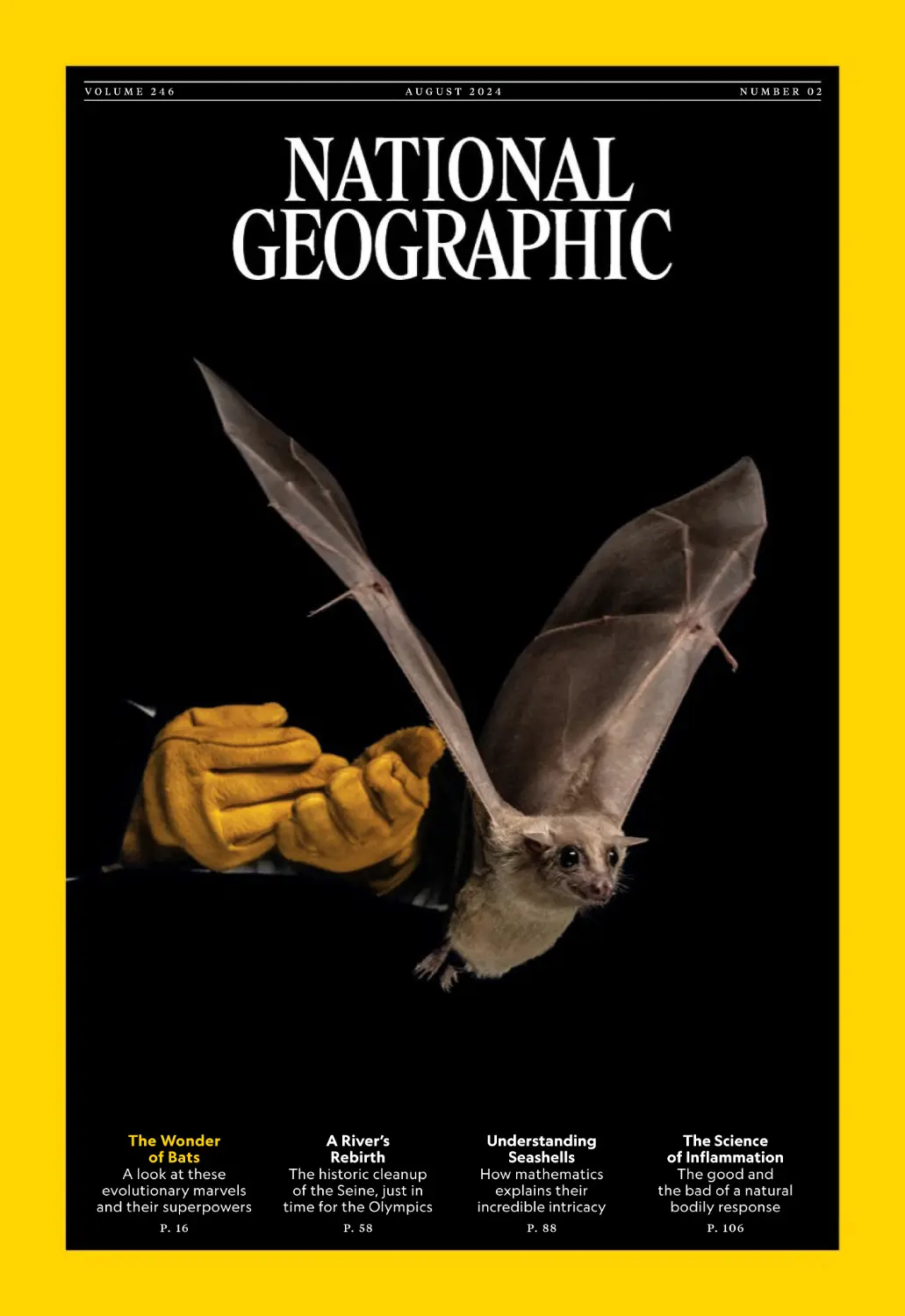
S U B S C R I B E R E D I T I O N Brown University professor Sharon Swartz releases
an Egyptian fruit bat into a wind tunnel to study the mechanics that allow it to fly.
Photograph by NICHOLE S OBECKI
N E W S S T A N D E D I T I O N A reflection of the Eiffel Tower appears in the early
morning waters of the Seine, which is undergoing a decade-long rehabilitation.
Photograph by T O M A S VA N H O U T R Y V E

AUGUST

PAGE.4

2024

TO HELP MANAGE
BLOOD SUGAR RESPONSE*

LOVE THE

TASTE

OR YOUR MONEY BACK†

Glucerna® products are
guaranteed delicious,
or your money back!†

SCAN FOR UP TO
IN SAVINGS
AND
BENEFITS‡

80

$

or visit glucerna.com/PTP80
Use as part of a diabetes management plan.
* Helps minimize the blood sugar spike from consuming Glucerna compared
to high-glycemic carbohydrates.
† Great Taste Guarantee! If you don’t agree, just mail in the UPC from your Glucerna packaging,
original receipt, and your name/address within 30 days for a refund. REFUND NOT TO
EXCEED NORMAL RETAIL PRICE. US PURCHASES ONLY. LIMIT ONE REFUND PER
HOUSEHOLD. Additional restrictions apply. Visit glucerna.com or call 1-800-986-8501
for complete details. Void where prohibited.
‡ Offers may vary. Valuation based on maximum collective savings of offers throughout
duration of program.
©2024 Abbott 202417548/April 2024 LITHO IN USA

IN FOCUS
JUST IN FROM OUR PHOTOGRAPHERS

ENVIRONMENT

“I was grateful for the opportunity and luck
to enjoy such A UNIQUE MOMENT and
to be in this fantastic place under a starry sky
without light pollution.”
M A R C I O E S T E V E S C A B R A L , Photographer

In this panoramic image stitched from nine exposures, the Milky Way
hovers above a field of Paepalanthus wildflowers in Brazil’s Cerrado region.

AUGUST

PAGE.6

2024

IN FOCUS

ANIMALS

“After a week of checking out multiple sea fans for
the best examples of pygmy seahorses and
coral polyps, I shot this photo at 6 a.m. That’s when
everything FINALLY CAME TOGETHER.”
B Y R O N C O N R O Y , Photographer

Only about half an inch high, a pygmy seahorse—male and pregnant—
gazes out from a maze of coral polyps in Indonesia’s Lembeh Strait.

AUGUST

2024

Elevate the moment
with Zuke’s Dog Treats.

Shop Now.

Tender treats.
Real protein.
Crafted in the USA.

SCIENCE

“This image is a celebration of the often
OVERLOOKED BEAUTY in the simplest things
around us. Who knew sugar syrup could look like
an abstract painting in a museum of modern art?”
D I E G O G A R C Í A , Photographer

Captured with a camera-mounted microscope under polarized light and magnified 25 times, crystallized sugar syrup looks nothing like the pancake topping.

AUGUST

IN FOCUS

C U LT U R E

“Branding at Forty Mile Colony is
ABSOLUTE ORGANIZED CHAOS.
Men and women weave around
each other—as well as the
horses, cattle, ropes, and
red-hot brands—in harmony
to get the work done.”
T I M S M I T H , Photographer

Members of Hutterite religious colonies work together in Montana to place
identity marks on calves. Hutterite livelihood relies heavily on agriculture.

2024

CONTRIBUTORS

C

N AT I O N A L G E O G R A P H I C E X P L O R E R S

A

This photographer-artist c
English botanist Ann

Nichole Sobecki, p . 1 6
An Explorer since 2021, the Nairobibased photographer specializes in
humanity’s connection to the natural world.
She documented cheetah trafficking
through Somaliland for our August 2021
issue and Sudan’s ancient past and
uncertain future for the January 2022
magazine. This month her feature
spotlights the mysterious world of bats.

Tomas van Houtryve, p . 5 8
His work spans photography, filmmaking, and art
installations. Based in Paris,
he’s focused recently on the
Seine, for this issue, and the
rebuilding of Notre Dame,
the subject of his 2022
cover story. He became an
Explorer this year.

X- R

Mary Winston Nicklin,

James Gorman,

p.58

p.16

p.88

“The Seine’s stories are
infinite,” says the FrancoAmerican journalist, who
lives in Paris and traveled
the length of the river to
research this month’s story
on the vast cleanup of the
famed waterway.

A former science reporter
for the New York Times,
he has written numerous
stories about bat flight and
bat life. He now competes
with big brown bats
for use of his front porch
in upstate New York.

Making his home in Portland, Oregon, Jabr is the
author of Becoming Earth:
How Our Planet Came to
Life. The feature on shell
formation is his second for
the magazine, after a
2022 story on soil ecology.

AUGUST

PAGE.14

Ferris Jabr,

2024

ANNA ATKINS, NEW YORK PUBLIC LIBRARY (TOP); HUGH TURVEY

CLOCKWISE FROM TOP LEFT: MARK THIESSEN, NGM STAFF; MARCO CASINO; RYAN G.; KATE HOOPER GORMAN; MARY WINSTON NICKLIN

These contributors have received funding from the National Geographic Society,
which is committed to illuminating and protecting the wonder of our world.

A cyanotype from Atkins’s
work on British algae
(top) inspired the shell
images made by Turvey
(above). His previous work
for National Geographic
includes specialized imaging of elephant skulls,
iPhones, and pythons.

AUGUST

Tur
the
thin
to “
of t
sho
ligh
sto
of s
Lon
bin
do
the
x-ra
inte
cya

CONTRIBUTORS

DIFFERENT LIGHT

combines the pioneering work of 19th-century
na Atkins with modern x-ray technology.

Hugh
rvey is obsessed with
e inner workings of
ngs. The aim of his art:
“peel back the layers”
the physical world and
ow it in “a different
ht.” For this month’s
ry on the science
shells (page 88), the
ndon resident comned two techniques to
just that. To see inside
e shells, he layered
ay film, which exposes
erior densities, with
anotypes. The latter

R AY A RT I S T

PAGE.15

is a camera-free technique of placing objects
on salt-treated paper
that turns blue when
exposed to UV light and
water (aka blueprinting).
Avoiding inverted images
was a challenge. Turvey
found himself ditching
the digital world for the
darkroom and playing
with chemicals, which he
hadn’t done in years.
It was quite slow going,
he says, but the “oldschool, analog process
was just a joy.”

2024

DAZZLING IN
FLIGHT,
MYSTERIOUSLY
RESISTANT TO
DISEASE, VITAL
TO ECOSYSTEMS
AROUND THE
GLOBE—BATS
ARE A SCIENTIFIC
WONDER.

WORDS BY JAMES GORMAN
PHOTOGRAPHS BY NICHOLE SOBECKI

How do bats fly? Scientists at Brown
University in Rhode Island are releasing the
winged mammals, such as this Egyptian
fruit bat, into a laboratory wind tunnel to
study flight mechanics.

19

Doctoral student Brooke Quinn, at right,
and her adviser, Sharon Swartz, work with
a Seba’s short-tailed bat in the lab tunnel at
Brown. Bats have tiny sensory wing hairs that
help them “feel” their way through the sky.

Not everyone
falls in love
with bats,
but those who
do fall hard.
Sharon Swartz studied gibbons. But she was intrigued by the fine
skeletal structure of bat wings and by the evolutionary trade-offs necessary for mammals
to take flight. So she took a detour from her
primate research and traveled to Australia
to study the large bats known as flying foxes.
She recalled one evening when she visited
a suburban golf course where roosting bats
filled the trees. First one, then a few more,
then hundreds of the creatures lifted off as
the sun set until, she said, there was “a river of
bats in the sky.” The next night Swartz, now a
professor of biology and engineering at Brown
University, and her colleague trapped bats in
nets, and she held one for the first time. It was
a flying fox with a wingspan of several feet.
“My heart was racing. It felt like I had never
seen anything so beautiful.”
The more common reaction is probably
an involuntary shudder. Bats have long been
A S A YO U N G S C I E N T I S T,

National Geographic Explorer Paul Webala,
a wildlife biologist at Maasai Mara University,
and Erick Keter, a University of Eldoret biology
student, catch bats at the Three Sisters Cave
complex in southeast Kenya to record
their vocalizations and collect genetic data.

22

associated with darkness and evil in Western
culture, and unsettlingly hard to place in
folk taxonomy—not birds but airborne, not
rodents but small and furry. And, for some
species, disturbing in close-up. The poet Theodore Roethke wrote, “something is amiss or
out of place / When mice with wings can wear
a human face.”
Some people just find them creepy. Others worry about the diseases they may carry,
including those similar to the virus that

caused the COVID-19 pandemic. To be fair,
dogs with rabies kill vastly more humans than
bats do, and the flu virus passes through ducks
and pigs, but none of these animals elicits the
same dread. The writer D.H. Lawrence lapsed
into a kind of know-nothing distaste when
contemplating bats “hanging upside down
like rows of disgusting old rags.” One might
have hoped that the author of the scandalous
Lady Chatterley’s Lover would be more openminded, but no. “In China the bat is symbol

24

Webala captures a striped leaf-nosed bat
as part of a project to build an acoustic
library of Kenyan bats. Eventually, researchers
may be able to identify and differentiate
bat species using their calls.

human benefit. Others are simply captivated
by their breathtaking diversity and evolutionary history. They would like you to know,
queasy poets notwithstanding, that bats are
so much more than flying mice.

evolution’s great
success stories. Their ancestors were
small mammals that scurried on all
fours and probably lived on an insect
diet, as many bats do now. How those
ancestors came to fly is an unsolved mystery.
The oldest known bat fossils—from the Green
River geological formation in Wyoming,
dating to more than 50 million years ago—
already show the transformed forearm and
fingers that form the scaffolding for the thin,
muscular membrane of the bat’s wing. Thus
the Latin name for the order of bats, Chiroptera, meaning “hand wing.”
Once bats had taken flight, they filled
every ecological niche available to winged
creatures and spread around the globe. Onefifth of all mammal species are bats. Only
the order of rodents has more members. Bats
eat everything: insects, fruit, nectar, blood,
and fish. They range in size from the bumblebee bat, weighing in at less than an ounce,
to the biggest flying fox, a fruit bat with a
nearly six-foot wingspan and weighing up
to three pounds. Some species are solitary,
but many are social. They live in vast colonies and in small groups, roost in trees and
caves and attics and behind house shutters.
They are an integral part of just about every
ecosystem. They consume mosquitoes and
agricultural pests, and pollinate plants like
bananas, mangoes, avocados, and durians,

B

for happiness,” he wrote. “Not for me!”
For true bat appreciation, even evangelism,
biologists like Swartz and her colleagues have
no competition. Many have the zeal of converts who at some point turned from other
mammals to find a wonderland of scientific
mysteries, like bats’ impossibly acrobatic
flight, their remarkable longevity, or their
enviable resistance to most cancers. Scientists
worldwide are probing these secrets. Some
hope to turn insights into these animals to

25

AT S A R E O N E O F

On many nights, some five to 10 million
straw-colored fruit bats leave their fig-tree
roosts in Zambia’s Kasanka National
Park. They fly more than 30 miles in search
of fruit. Kasanka is a stopover as they
undertake one of the largest mammal
migrations in the world.

the notoriously odorous and economically
important Asian fruit. Not to mention the
prized agaves of the Sonoran Desert. In
short: No bats, no tequila.
And they fly like no other creature, which
is what first drew Swartz to that Australian
golf course more than 30 years ago. At the
time, she was studying the mechanics of
movement in primates, looking at how skeletons evolved to balance the need for strength
with the disadvantages of heavier bones. “It
seemed obvious that weight is a problem for
flying animals in a way that it isn’t for anybody else,” she said. “The structure of these
limbs magnetized me in a way that no primate limb ever had.”
Because bat wings are made of skin
stretched on light bones with many joints,
they interact with the air in ways that are
not possible for less flexible bird and insect
wings. Bird wings have three joints, roughly

corresponding with the human shoulder,
elbow, and wrist. “Bats have almost as many
joints in the wing as we have in a human
hand,” Swartz said, “and they also have these
crazy muscles that are embedded in the skin.”
Bat wings are covered with countless tiny
hairs that sense shifts in airflow. They are in
constant conversation with the air, changing shape, creating lift, responding with idiosyncratic invention to each puff and gust: In
tests that Swartz and her team ran to present
a challenge to normal flight patterns, they
found that when they injected a saline solution into bats’ abdomens to mimic the weight
of a big meal, each animal responded in a
different way. Dimitri Skandalis, who studies this extraordinary individual variation
at Johns Hopkins University, compared the
complexity of bat wing movement to human
facial expressions. All smiles are recognizable
as smiles, but no two are exactly the same.

A WORLD OF BATS

Number of bat
species reported

More than 1,400 bat species live in nearly every biome on Earth,
where some 530 plant species rely on them for pollination.
Facing habitat loss and a warming climate, over 200 bat species
are now considered threatened.

0

120

NORTH
EUROPE

AMERICA

A

S

I

A

UNITED STATES
TROPIC OF CANCER

VENEZUELA
Venezuela’s
mountains are
home to the
world’s greatest
concentration
of bat species.

A F R I C A

Congo
Basin

Amazon
Basin
ZAMBIA

Kasanka
N.P.

UGANDA
KENYA
Three Sisters
Cave complex

EQUATOR

TROPIC OF CAPRICORN

SOUTH
AMERICA

28

AU ST RALI A

MAP: CHRISTINE FELLENZ, NGM STAFF. SOURCES: CLINTON JENKINS, BIODIVERSITYMAPPING.ORG; IUCN; BAT CONSERVATION INTERNATIONAL

Could this intricate, intuitive movement
be replicated in a machine? Bat flight is
“dancing in the air,” said Alireza Ramezani,
an assistant professor of engineering at
Northeastern University. “For me, creating
a drone that looked like that was exciting.”
Inspired by Swartz’s experiments, he took
on the challenge of creating bat robots. With
the flexibility of hands and the stretchiness
of skin, bat wings can cope with rapid and
complex shifts in airflow, particularly those
that exist inside confined spaces.
“There’s so many challenges from an engineering design standpoint. How can you
have all these components inside a system,
a drone that weighs a hundred grams?” One
of the keys to understanding and replicating
bat flight, Ramezani said, is that bats do not
consciously make every split-second decision. The soft tissue of bat wings deforms and
reshapes in response to air pressure without
needing direction from the brain’s air traffic
control center—an example of what engineers
call passive dynamics. As bats move their
major wing joints, the membrane of the wing
transfers that movement to the smaller joints,
and the stretchiness of the wing responds
to the flow of air against it. “In bats,” said
Ramezani, “you have the locomotion characteristics of jellyfish and the locomotion
characteristics of birds.”
Although the beauty and complexity of bat
flight first caught his attention, Ramezani
said, the potential usefulness of a bat drone
helped drive the project forward. Building on
Swartz’s findings, he and his team created a
soft-bodied robot that can navigate in environments where quadcopter drones, now
ubiquitous in peace and war, can’t. In the
United States alone, he said, there are more
than a million miles of sewer lines that are
difficult or dangerous for humans to inspect
and monitor. And there are caves to explore,
for mining and paleontological or archaeological research. What better place to send a
bat robot than a small, dark cave, in search of
ancient bones or artifacts?

of her colleagues, came to bats “completely,
utterly, and totally by chance.” Teeling is a co-founder of Bat1K, a project
to sequence the genomes of all 1,400
or so species of bats, and one of the founding advisers of Paratus Sciences, a start-up
devoted to mining bat biology for ways to
fight human diseases. “We believe,” its website states, “that bats hold the key to a safer
and healthier world.”
After initially working with foxes and deer,
Teeling wanted to do a Ph.D. on mate choice in
domestic cats and was trying without success
to persuade various labs to take on her project.
But, she said, there was a fully funded position
in Belfast, Ireland, using genetic comparisons
of living bat species to trace the evolution of
echolocation. She applied, got the spot, and
“literally, within six weeks, I got hooked.” She
quickly became fascinated by the weird biology of bats. Live small, die young is the general
rule for mammals. But bats the size of mice
can survive for decades. “They live for a ridiculously long time,” for their size, she said. They
rarely get cancers. “They can carry all these
viruses without getting sick.” Teeling, now a
professor at University College Dublin, had
to know why.
The answer she has become more and more
convinced of over the years is one that at first
blush seems hard to comprehend: They fly.
Her hypothesis is that flight led bats to evolve
unusual immune systems, which in turn led
to longevity, even resistance to cancer.
Bats need to burn a lot of fuel to catch bugs
on the wing, to dive and pitch and roll like a
scarf in the wind. One study estimated the
metabolic rates of flying bats to be three to
five times those of similar size land mammals. Cellular engines called mitochondria
have to work overtime to produce energy
for flight. As a side effect, they also produce
chemicals called free radicals that are known
to harm DNA. “We should see this high level
of damage” to DNA in bats, Teeling said. But
in experiments, that is not what she and her

E

29

MMA TEELING, LIKE MANY

BAT
SUPERPOWERS
Over the course of 50 million years bats
evolved from tree gliders to the only
mammals that fly. The key to their success
is a host of unique adaptations that have
allowed them to thrive in an environment
few animals exploit: the night sky.

S M A L L E ST BAT
Kitti’s hog-nosed bat
(or bumblebee bat)
Craseonycteris thonglongyai
Weight: .07-.11 ounce
Wingspan: about 5 inches

MAMMALIAN FLIGH

Since the age of dinosaurs, bat wings
developed to fit myriad environment
wings are good for hovering in forest
wings, such as those of Brazilian free-t
bats, enable these mammals to fly at
of up to 99 miles an hour.

I L LU S T R AT I O N S BY D E N I S E N E S T O R

EXTREME
LONGEVITY

TURBOCHARGED
METABOLISM

Although they’re some of the smallest
mammals, bats can live up to 10 times longer
than expected for their body size. They also
almost never get cancer. An ability to shut
down their metabolism when at rest is one
factor that may boost longevity.

Different bat species have different appetites, ranging from insects, fruit, and blood
to small animals, including other bats. Pallas’s
long-tongued bat has the fastest metabolism
recorded in any mammal, burning through
more than half its fat stores every day.

High

Brandt’s myotis
Myotis brandtii
Weight: .18–.25 oz
Wingspan: 8–9 in

Brazilian free-tailed bat
Tadarida brasiliensis
Weight: .28–.53 oz
Wingspan: 12 in

Pallas’s long-tongued bat
Glossophaga soricina
Weight: .25–.42 oz
Wingspan: 9 in

Sensory
across th
ical trait
insects—
respond
change

ECHOLOCATION
Longevity
(lifespan
relative
to size)
Bats

Pallas’s long-tongued
bats have papillae that
engorge with blood,
making their tongues like
water-bottle brushes to
pull nectar from flowers.

Other
mammals

Small

Body mass

Large

Big brown bat
Eptesicus fuscus
Weight: .39–.81 oz
Wingspan: 13–16 in

flow
od
Blo

Low

Data comparing bat longevity
are sparse, but the Brandt’s
bat holds the record for the
longest lived, at 41 years.

Papilla

GRAPHIC: JASON TREAT AND EVE CONANT, NGM STAFF. BRANDON SHYPKOWSKI
SOURCES: DEEANN REEDER, BUCKNELL UNIVERSITY; SHARON SWARTZ, BROWN
UNIVERSITY; NANCY SIMMONS, AMERICAN MUSEUM OF NATURAL HISTORY;
EMMA TEELING, UNIVERSITY COLLEGE DUBLIN

N E C TA R

By sending out ultrasonic sounds and
gulating the resulting echoes, many b
their surroundings. These calls can be
that some bats can temporarily immo
their ear bones to keep from going de
brown bats modulate their calls to hel
navigate cluttered acoustic environme

L A RG E ST BAT
Golden-capped fruit bat
Acerodon jubatus
Weight: 2-3 pounds
Wingspan: 5-6 feet

HT

s have
ts. Short
ts; long
tailed
speeds

y hairs that extend
he wings—a physt shared only with
—allow bats to
d to the slightest
in airflow.

trianbats map
so loud
bilize
eaf. Big
lp them
ents.

Bat wings are supported by the
same bones humans have in their
arms and hands. If a human
had the same proportions
as this giant bat, however, the middle finger would be about
seven feet long.

Thumb

Finger

Egyptian rousette
(or Egyptian fruit bat)
Rousettus aegyptiacus
Weight: 3–6 oz
Wingspan: 2 ft

DISEASE
RESISTANCE
Many bats live in extremely dense populations, perhaps one reason they display
immunity against a host of viruses. In
many cases, they can tolerate infections
without ever showing symptoms. The
Egyptian rousette is a known carrier for
the Marburg virus, a relative of Ebola.

AN
ACROBATIC
AERIAL
ATTACK
Split-second photos
reveal a quick bat snack.
PHOTOGRAPHS

WITH PERMISSION OF ROM (ROYAL ONTARIO MUSEUM), TORONTO, CANADA

BY MARK THIESSEN

The oldest fossilized skeleton of a bat—the
minuscule 25-gram Icaronycteris gunnelli
gunnelli—
shows bats had already evolved the ability
to fly 52 million years ago.

When the first known bats
appeared during the Eocene
epoch, they probably had
evolved echolocation to
hunt insects in the air. Modern descendants such as this
Townsend’s big-eared bat
have reached the apotheosis of aerial predation. The
Townsend’s echolocation
calls are quieter than other
bats’ and their flight more
acrobatic.
This series of photos
shows one Townsend’s hunt,
captured by staff photographer Mark Thiessen in a
field tent in Arizona.
In just half a second,
the bat locates a moth (1),
reaches to grab it with a
wing (2), and transfers it from
the wing to its tail pouch (3).
Afterward, the bat will lower
its head to retrieve the
moth for a mid-flight meal.
Aaron Corcoran, a University
of Colorado, Colorado
Springs researcher and
National Geographic Explorer
who studies the interaction
between bats and their prey,
said he had never seen a
comparable photographic
sequence. “You simply
can’t see what’s going on
with the naked eye.”

2

1

3

35

damaging overreaction. That could also have
evolved as a result of flight.
The connection is far from proven, and
there are plenty of skeptics, Swartz among
them. “I’d be more confident in that line
of reasoning if we saw enhancements of
immune function and longevity in other
animals that have elevated metabolism, like
birds or migratory mammals,” said Swartz.
Teeling said that, actually, many birds do live
longer than might be expected given their
size. She noted that in one survey of many

36

MARK THIESSEN

colleagues have found. In fact, they discovered that as the bats they studied aged, their
ability to repair their DNA increased.
Another side effect of energy production in
flight is that the mitochondria break down,
and the results can look to the immune system like foreign invaders. So flight could
produce a surging immune response—and
inflammation. Bats would need to control
that. Studies have shown that they not only
respond to viruses that infect them, but they
also tamp down that response, avoiding a

Researchers in Arizona take bat-wing temperatures before and after flight. One mystery
is how bats’ ability to regulate body temperature can vary widely, even moment to moment,
depending on environmental conditions.

tolerate
certain deadly viruses, a number of researchers are searching
for genetic insights. Several
immunity-related bat genes have
been identified, and some have been experimentally transferred to other species, where
they provide the same benefits. For instance,
lab mice engineered with a bat gene showed
resistance to bat influenza. Beyond bat flu,
researchers wonder if there is an immunological advantage that all bats have, that works
with viruses in general, or if disease resistance depends on the species and its history
of exposure to specific viruses. Some species
are reservoir hosts, meaning viruses live
within the animal without causing disease.
Presumably, a reservoir host would have a
different reaction than a related species that
is not usually exposed to the virus.
Ebola is a classic example. It is devastating
to humans and some other mammals, and
most scientists suspect that bats are the natural reservoir. Some bat species show evidence
of exposure when their blood is sampled, while
others do not. In Uganda, a team of U.S. and
Ugandan scientists is using detailed tests of
gene activity to find out precisely how different bats respond to Ebola (or, more specifically,
to a noninfectious fragment of Ebola virus).
“Bats are extraordinary and amazing,” said
Bucknell University’s DeeAnn Reeder, the
team leader. “I want to understand how the
heck they do all the things that they do, and
their immune system is a piece of that. They’re
exceptionally good at managing those pathogens to avoid illness themselves.” She and
her Bucknell colleague Ken Field and Imran
Ejotre at Muni University are trapping and

W

species, the single best predictor of long life
was the ability to fly. She recognized, however, that this kind of correlation is far from
proof and that more investigation is needed—
the Bat1K project’s genome sequencing, for
instance. By comparing the genomes of many
bat species, scientists can see what they have
in common, pinpoint which genes are active
in DNA repair and immune activity, and
calculate when those abilities might have
evolved. If they came with flight, that would
be a strong indication that the two are linked.

37

H AT E V E R L E D B AT S T O

PROBING
HOW
BATS
BEAT
EBOLA

immunizing bats with Ebola proteins in hopes
of seeing exactly how the immune systems of
different species cope with a viruslike threat.
One species that Reeder and her colleagues
are studying is the little epauletted fruit bat.
Researchers have found signs of exposure to
Ebola viruses in this species and its relatives,
suggesting that they may have coevolved with
these viruses. That could mean they have a
greater ability to tolerate infection. Another
species, the green house bat, shows no indication of living with Ebola. Researchers sample
the blood and tissue of immunized bats, as well
as control groups, to see which genes are active,
and how active, after a first injection and a
booster shot.
For the bats that seemed to have coevolved
with some pathogens, Field said, “these
viruses do not kill these bats. They don’t even
make them sick.” Comparison with other bat
species could pinpoint the immune strategies
of resistant bats. Then the question with an
enormous payoff is whether human biology
could be manipulated to act in the same way.
For instance, during the COVID pandemic, one
of the things doctors noted in ill patients was a
cytokine storm, a burst of proteins that caused
such severe inflammation that patients died.
What if scientists could find a way to mimic
the immune systems of bats with a drug?

From the wild
to the lab, scientists
have developed
a process for testing
disease resistance.

1

Epauletted fruit bats
hang in cheesecloth
bags after being trapped
near the village of Kanabu
in northwestern Uganda.
These bats seem to be
able to survive Ebola virus
infections, which can kill
other mammals. Scientists
want to find out how.

who study and love
them, bats are not only scientific treasures but also living beings that are at
once so like us—with their hand wings,
warm blood, and live birth—and yet
irresistibly alien. Inevitably, students of bats
become protectors of bats.
Tigga Kingston at Texas Tech University,
who studies Southeast Asian bats and is deeply
involved in bat conservation research, said
that despite the great evolutionary successes
of bats, they have many vulnerabilities. For
instance, though they may seem like flying
mice, rodents breed early and often, having
multiple litters a year. Bats start reproducing

F

B A G G I N G A B AT

OR THE SCIENTISTS

2

PREPPING FOR
TRANSPORT

DeeAnn Reeder of
Bucknell University works
with her team to bag
and label the bats. The
bats spend a few nights in
a screen tent flight cage
before they are transferred to enclosures at
Muni University in Arua,
a two-hour drive away.

38

1

2

3

REST AND
R EC OV E RY

Before leaving the field
camp, the research team
transfers the bats to large
tents where they are free
to fly. As part of the protocol, says Reeder, “we give
them a little mango juice.”

40

41

4

5

Researchers are
working to identify
how bat pathogens
might spill over into
human populations to
spread disease. Key
to curtailing the threat
is preserving bat habitats and helping communities value bats as
essential parts of the
ecosystem. “You can’t
afford to do only science,” says Imran Ejotre
of Muni University.

4

later than rodents, in their second or even third
year, and have one offspring a year on average.
Naturally, not all of those survive. “As a consequence,” Kingston said, “anything that disturbs their populations is difficult for them to
recover from.” More than 200 species around
the world are listed as threatened.
Bats are subject to all the problems of habitat loss and human encroachment that plague
other species, along with some peculiar to
them. White-nose disease has killed vast numbers of North American bats. Overharvesting
of agave plants threatens nectar-feeding bats.
And there is climate change. Some of the most
at risk from a warming planet are large fruit
bats, like those in Australia. They don’t roost
in caves but in the open, and extreme heat can
kill them. “When it hits around 42° to 44°C [108°
to 111°F], depending on the species, they just
die of heatstroke,” Kingston said. Mass die-offs
have pushed some species that were doing well
only 10 or 15 years ago to endangered status.
For defenders of bats, the first priority is to
have good information on the populations
themselves. Paul Webala, wildlife biologist
at Maasai Mara University and a National
Geographic Explorer, is building an acoustic library of the calls of Kenyan bats that he
said could be a game changer in knowing the
status, movements, and locations of different species. Bat Conservation International
supports multiple efforts to monitor threatened species, but it is also working on projects
of immediate benefit, such as reducing bat
deaths from wind turbines.
In the U.S. hundreds of thousands of
bats die each year from wind turbines, said
Rodrigo Medellín, a senior professor at the
National Autonomous University of Mexico’s
Institute of Ecology. A National Geographic
Explorer at Large, Medellín co-chairs the Bat
Specialist Group, part of the International
Union for Conservation of Nature’s Species
Survival Commission, with Kingston. Over
60 percent of those deaths could be avoided,
he said, if the industry would agree to start
up the turbines at a wind speed of five or six

TESTING
IMMUNE
RESPONSE

Members of the Muni
University research
team inject bats with
noninfectious pieces
of Ebola virus. The
process is similar to
vaccination. The team
is experimenting with
three bat species, each
with distinct histories
of exposure to Ebola,
to observe differences
in immune response.

5

TA K I N G
TISSUE
SAMPLES

For each bat in the
study, Reeder and
Adiga Kasim, a project
technician, take more
than 20 blood and tissue
samples, along with
other measurements.
The many tests may
reveal which genes allow
some bats to tolerate
deadly viruses, perhaps
eventually aiding human
medicine. The team
is also trying to understand which bats are
reservoir hosts for Ebola.

43

An Egyptian fruit bat flies in
the Aeromechanics and Evolutionary
Morphology Lab at Brown. Bats
can control the three-dimensional
shape of their wings, compensating
for air turbulence mid-flight within
a fraction of a second.

A bat-inspired robot called the Flapperoo
is built to probe flight mechanics at Brown.
Scientists can change the wings’ flapping
speed or skin stiffness to see how each
variable alters flight—a level of experimental
precision impossible with live animals.

Doctoral student Bibek Gupta demonstrates
the Aerobat, a robot in development at Northeastern University in Boston. It is intended to
maneuver in city sewers, caves, and other confined spaces where drones struggle to navigate.

MARK THIESSEN

meters a second instead of three meters a
second, resulting in a “tiny loss of efficiency.”
Protecting roosts is also a top priority for
Medellín. He recently lobbied to divert the
path of the Maya Train, a $20 billion tourism
project in the Yucatán, away from the famed
Volcán de los Murciélagos. The “bats volcano”
is the most populous roost from central Mexico to southern Argentina. About three million bats emerge from it each night to feed
on insects.
It is just not fair, said Medellín, that such
useful animals should have such a bad reputation. “We really owe it to bats to treat them
right. And what do they ask?” he said. “Just
leave them alone. That’s all.” In terms of convincing the public of the value of bats, scientists often mention their role in pollinating
wild plants and crops and in eating insects,
natural pest control worth billions of dollars
a year in the U.S. But what about bats as bats,
pure and simple? Kingston, who switched her
focus from rodents to bats as an undergrad,
is wary of placing too much emphasis on the
practical value of wildlife. “What if there’s a
species that we can’t pinpoint exactly what
it’s doing for the ecosystem?” she asked. Are
we going to leave it off the list?
It is not a hypothetical question. So much
about bats remains unknown. As much as
we are learning about them, they are in some
ways still undiscovered. And their mystery
is as compelling as their usefulness. After 30
years, Swartz said, she still is moved when
she steps into a space with the creatures and
feels “the rustle of those wings and that breath
of air as the animal is going by.” One reason:
“There are more unanswered questions than
things that I understand.” j

48

PROOF

AUGUST

PAGE.50

NATIONAL GEOGRAPHIC

HISTORY on

HORSEBACK
A photographer documents the female
equestrians who saddle up
and keep a Mexican tradition alive.
Photographs by
CONSTANCE JAEGGI

and powerful—and
also kind of dangerous,” says photographer Constance Jaeggi, describing
escaramuza charra, an all-female Mexican rodeo event popular in communities across North America. Riders
known as escaramuzas sit sidesaddle
in colorful dresses inspired by fighters
of the Mexican Revolution. In teams of
eight, they perform veritable ballets on
horseback—frequently at a gallop.
Growing up in Switzerland, Jaeggi
adored horses and learned to ride at
age 14. Nearly two decades later while
living on a Texas ranch, she competed
in equestrian contests and became fascinated with escaramuzas, seeing them
as kindred cowgirls. After traveling the
United States to interview and photograph them, she began to see how the
sport offers Mexican American
women a sense of connection to their
heritage. —A S H L E Y H A R R E L L
“IT'S ELEGANT

Constance Jaeggi photographed
riders for Escaramuza Charra Azteca
from Manor, Texas, and other teams
at practices and competitions.

PAGE.51

2024

PROOF

AUGUST

PAGE.52

NATIONAL GEOGRAPHIC

(Clockwise from above)

Interest in Mexican rodeo
often runs in families. Laura
Escobedo of Brownsville,
Texas, learned about the
sport from her parents.
Miranda Vargas’s portrait
is displayed at the National
Cowgirl Museum and Hall
of Fame in Fort Worth,
Texas, along with some of
Jaeggi’s other works.
When competing, members
of Escaramuza Charra Villa de
Guadalupe, of Brownsville,
wear sombreros, ruffled
dresses, and rebozos, knotted
shawls worn around the waist.

PAGE.53

2024

NATIONAL GEOGRAPHIC

At a morning practice
in Manor, Escaramuza
Charra Azteca riders
kick up dust, a move
mimicking revolutionary
battle tactics.

Rosary beads, religious
cards, and cameos, such
as these belonging
to an escaramuza from
Manhattan, Illinois, often
adorn uniforms.

PAGE.55

2024

PROOF

Part of Escaramuza
Quetzalli from Des Moines,
Iowa, Isabelle Marquez, 19,
and cousins Candy Murillo
Guzman, 15, and Wendy
Murillo Camarena, 23,
pose after a competition
in Katy, Texas.

AUGUST

PAGE.56

NATIONAL GEOGRAPHIC

PAGE.57

2024

The
A C L E A N U P O F O LY M P I C P RO P O RT I O N S I S

Seine’s
P L AY I N G O U T O N F R A N C E ’ S M O ST C E L E B R AT E D R I V E R

Renaissance

Words by M A R Y W I N S T O N N I C K L I N
Photographs by T O M A S V A N H O U T R Y V E

59

The Seine twists
its way along a
verdant landscape
near EsclavollesLurey in northeastern France.
Previous photo

River water passes
through an aeration
tank at the SIAAP
Seine Aval plant, an
instrumental player
in making the Seine
more swimmable.
PHOTOGRAPHED AT USINE
SEINE AVAL DU SIAAP

Thousands of athletes competed in
the 2023 Garmin
Paris Triathlon,
which included a
swim in the Bassin
de la Villette, an
artificial lake that
links two canals in
the capital’s 19th
arrondissement.

of the Pont des Arts in Paris.
Below, the Nesquik-colored currents of the Seine, swollen from
recent rain, sluice past the Louvre Museum. A crowd of spectators gathers and gawks. And then he jumps.
Thomas is one of the elite Paris firefighters stationed at the
La Monnaie Rescue Center, a floating fire station in central
Paris. (Official policy requires the omission of last names for
security.) He bobs in the river for a matter of seconds before
fellow firefighters fish him out of the 37-degree water and into
a waiting rescue boat. Training exercises complete, the pilot
speeds back to their base—a converted 1927 cargo boat that’s
kitted out with a gym, an aquarium, and an outdoor shower
with the prettiest views in Paris. Under the boat lurks a giant,
six-foot silure catfish they’ve nicknamed Roger.
Unique in France, the Paris Fire Brigade is a French Army
unit thanks to an imperial decree by Napoleon in 1811. The
“fluvial” force—as opposed to “terrestrial”—must undergo a
rigorous training and selection process. They put out barge
fires, rescue people from drowning, and on a fateful day in
April 2019, helped extinguish the devastating Notre Dame
inferno by pumping water directly from the Seine.
For years, these firefighters have been among the solitary
few authorized to swim in the Seine in Paris. What was once a
portal to pleasure—Parisians sunbathing and splashing in the
river, modeling bikinis in the Seine-fed Deligny pool—has been
banned for more than a century because of river traffic and pollution. But that’s set to change. After an ambitious $1.5 billion

64

WILLIAM DANIELS

A M A N C L I M B S OV E R T H E R A I L

Riverboats offer
a front-row seat
to the sights along
the Seine, its
UNESCO-listed
banks lined with
monuments. Tourism is just one
industry fueled by
the waterway.

clean-up project, the river will play a leading role in the 2024 Summer Olympic and
Paralympic Games. The Seine will serve as
the stage for the Olympic opening ceremony
and, if all goes to plan, as a venue for three
swimming events.
“Our objective is an Olympic legacy that you
and me or whoever happens to be in Paris can
swim in the Seine,” says Pierre Rabadan, the
deputy mayor in charge of sport, the Olympic
and Paralympic Games, and the Seine.
In length, the Seine is dwarfed by the Nile,
Amazon, Danube, even the Loire. Yet this
483-mile river captures the global imagination, its meandering map a metaphor for
France itself. “Over the past twenty centu-

to France are hazy, but I still remember
the shimmering reflections of Paris’s illuminated monuments. Later, I would get
engaged on a bridge, push my daughters’
strollers on the quays, and celebrate milestone birthdays on the water. The Seine has
always served as solace for sorrow, a willing
accomplice to joy.
Since long before contemporary campaigns to grant personhood rights to rivers
as a means of legal environmental protection,
the French have personified the Seine. For
author Victor Hugo, the waterway was both
muse and murderer, after the drowning of
his daughter Léopoldine in a boat accident.
The Seine posed for plein air artists and

The Seine has long been a conduit of civilization and

ries, many decisive moments in the history
of France have taken place on the banks of
the Seine,” wrote historian Jean Favier in
Paris: Two Thousand Years of History.
On the way to its sea outlet between Honfleur and Le Havre, the Seine’s sinuous course
offers a story at every bend: the Roman conquest of Gaul, Viking invasions, the fall of
Richard the Lionheart’s formidable Château Gaillard, Joan of Arc’s ashes scattered
in its currents, revolution, and the rise of
the republic. Even after Napoleon’s death in
exile, he eventually returned as requested
in his will a final time to Paris via the Seine—
what in life he had called “Main Street.”
The Seine has long been a conduit of civilization and national identity, inspiring
centuries of French culture, from medieval folklore to Impressionist art. It also
plays an outsize role in the lives of its citizens. Memories of my first childhood trip

murmured melodies to minstrels and musicians. And this aqueous character, for much
of human history, was venerated as sacred.
Especially at the source.
Despite its setting in bucolic Burgundy, the
river source is owned by the city of Paris. In
this strikingly green milieu, springs trickle
together into a stream. A small stone footbridge stands as the Seine’s first crossing.
The ancient Celts brought offerings here to
the healing river goddess Sequana, followed
by Gallo-Roman pilgrims, whose sanctuary
was discovered in the 19th century and excavated by archaeologists. “It’s famous for its
wooden ex-votos, or sculptures offered to
the Seine,” says Sylvie Robin, head curator
for archaeology at the Carnavalet Museum
in Paris. “Either to ask for a wish or express
thanks for a wish that had been granted.”
Indeed, the source-to-sea archaeological
record—Neolithic wood canoes, first-century

66

fish traps, good-luck talismans thrown into
the river by Crusader knights—reveals the river’s central role in France’s story. It also shows
how the Seine contains multitudes: from the
sublime to a sewer.

it was inaugurated; Rouen’s Pont GustaveFlaubert in 2008, then the highest vertical-lift
bridge in Europe, allowing its deck to be raised
180 feet for the passage of ships.
The Seine’s bridges were a favorite subject
of the Impressionist painters, who, fascinated by la vie moderne, often fused industry
and nature in their work. Breaking with the
allegorical focus of classical art, these
avant-gardists painted everyday life. Claude
Monet’s 1872 “Impression, Sunrise,” the very
painting that launched the Impressionist art
movement, portrays a salmon-smudged sky
above the port smokestacks of Le Havre.
As glorious an invention as portable tubes
of paint, the train allowed artists to escape

human waste,
animal parts tossed by medieval
butchers: The Seine served as a
dumping ground for centuries. As
its water grew polluted, the river
was also tamed as a commercial artery. Human
engineering transformed the waterway—
its banks lined with factories, its currents
manipulated into locks and quay-lined channels, its depth assured by dredging, its islands

L

AU N D RY S U D S ,

national identity, inspiring centuries of French culture.

eradicated as obstacles to river transport.
Today the Seine’s course appears chiseled,
winding through a watershed home to nearly
30 percent of France’s population.
Bridges were an early engineering feat.
Around the fourth century A.D., the Romans
succeeded in driving wood piles to create
a bridge to what’s now the Île de la Cité, a
decisive moment in the construction of
Paris-precursor Lutetia. Even more strategic for the Romans would be the river hub
of Rotomagus, now known as Rouen. Later,
the Vikings made it their capital, giving their
name “Northmen” to Normandy. Centuries
before the Pont Neuf in Paris, Empress Matilda
ordered the building of a stone bridge in the
mid-12th century. The age of the automobile
prompted increasingly fine bridge construction: the Pont de Tancarville in 1959, the first to
cross the estuary; the 1995 Pont de Normandie,
the world’s longest cable-stayed bridge when

to the countryside along the Seine to paint.
In 1837, the first passenger train out of Paris
brought revelers to Chatou, an island that’s
also known as Île des Impressionnistes. It
quickly became a magnet for Sunday bons
vivants to dance, drink, and mess about
in boats—immortalized by Pierre-Auguste
Renoir in his 1880-81 masterpiece “Luncheon
of the Boating Party.” (The river’s reality was
less rosy. In the 19th century, factory and
human wastewater was often discharged
directly into the Seine. A revolutionary new
Paris sewer system, developed during city
planner Baron Haussmann’s seismic urban
renewal project, was an engineering triumph
for Paris, yet toxic for the Seine’s health.)
Monet was also obsessed with the Rouen
cathedral, graced by the tallest spire in France,
which he painted 30 times. Rouen’s medieval city center mostly escaped World War II
bombing, but the river quays that served as a

67

BRIDGEMAN IMAGES

The Seine was an endless source of inspiration for Impressionist
painters such as Claude Monet, whose 1879 work “Seine at
Vétheuil” is housed in Rouen’s Fine Arts Museum.

68

Starting as a trickle
on the Langres
Plateau near Dijon,
the Seine swells as
it flows 483 miles,
passing through
Paris before ultimately meeting the
sea between Honfleur and Le Havre.

ann
Ch e)
h
is
nch
gl
Ma
n
E (La

el

Som
A port for the centuries
me
Rouen, the farthest inland that
oceangoing vessels can travel,
has been a shipping hub since
the age of the Romans. Proximity
to agricultural fields makes it a
key port for farmers.

Paris: city of abundance
Rome’s Lutetia Parisiorum
developed into the capital city in the middle of
the Seine’s drainage network, part of one of western
Europe’s most fertile regions.

Cap d'Antifer

Chauny
Caudebec-en-Caux

Le Havre

Rouen

Beauvais
e
Ept

Marais
Vernier

Honfleur

Poses Dam
BOUCLES DE LA
SEINE NORMANDE

Château
Gaillard

Se
in
e

The Seine and the sea
As the health of the river
improves, a nature reserve
at the estuary, in an area
surrounded by industry,
is welcoming seals and
350 species of birds.

N O R M A N D Y

Évreux

Land cover
Cropland

S

E

Château-Thierry
Conflans-Sainte-Honorine
Seine Aval plant
Meaux

Saint-Denis

Gennevilliers

PARIS

Chatou
Versailles

Haute Vallée
de Chevreuse

e

Crépy-en-Valois

Beaumont-sur-Oise

Giverny Vexin Français
Pontoise

E

ur

Nogent-sur-Marne

Coulommiers

ÎLE DE FRANCE

I

Yerres

Évry

N

E

R

I

V

E

Nangis

Perche

Forest

Chartres

Built-up area

Étampes

Fontainebleau

10 mi

Neuville-aux-Bois

Shaped by
the Seine

Yo
Sens

Courtenay

Montargis

Orléans
g
Loin

U.K.

Seine
R.

Loir e

r

e

SPAIN

MAP: ROSEMARY P. WARDLEY, NGM STAFF. SOURCES: ESA CCI LAND COVER TIME-SERIES V2.0.7;
OPENSTREETMAP; INSTITUT NATIONAL DE L’INFORMATION GÉOGRAPHIQUE ET FORESTIÈRE

SWITZ.

Rhô ne

FRANCE
on
n

GER.

Rhine

Seine R. Basin

e
ir

PARIS

Bay of
Biscay

Lo

BELG.

Ga

Neither the longest nor strongest
of France’s five major rivers, the
winding Seine has had a profound
impact on the country’s history
and culture. Stretching from the
hills of Burgundy to the English
Channel, its watershed is home to
nearly 30 percent of the French
population. A stage for brutal battles and an evocative setting for
some of the world’s most famed
artists, the Seine is now inspiring a
new generation to follow its path
to a cleaner, greener future.

Montereau

Once a royal
château, now a
UNESCO World
Heritage site

Pithiviers
e
onn
s
s
E

O R L É A N A I S

e
Sein
e
nn

Regional natural park

R

Provins

Gâtinais Français

Seine River Basin

10 km

Soissons

Oise-Pays
de France

Avre
Dreux

Moulins-la-Marche

Compiègne

Creil

Méru

MantesMonet painted his
famous water lilies at la-Jolie
his home in Giverny.
Iton

Saint-Justen-Chaussée

Ois
e

Estuaire de la Seine

Noyon

Forges-les-Eaux

IT.

150 mi
150 km

Auxerre
Saint-Sauveuren-Puisaye

e
Ois

Feeding into the Seine
The easily navigable Seine
is joined by 45 tributaries
along its 483-mile length,
the largest of which are the
Aube, Marne, Oise, and
powerful Yonne.
BE
L
FR
A

Hirson

The source of
the Oise lies just
across the border,
in Belgium.

G

IU
M

N

Sissonne

CE

Laon

Rethel

A
R

e
sn
Ai

G

O

Su
ipp
e

N

N

re
Ai

Reims

H

SainteMenehould

e
sn
Ai

C

Suippes

M
ar
ne

Épernay

Châlons-en-Champagne

A

M

P A G

B

A

S

Vitry-le-François

I

Au

Sa
ulx
Saint-Dizier

N

Forêt
d'Orient

Troyes

Lac
d’Orient

e
Marn

Lac du DerChantecoq

be

Romillysur-Seine

N E

Or
na
in

Agriculture, including
this sparkling wine, takes
up 60% of basin land.

EsclavollesLurey

T
use
E S
Me
R
O
F

E

Ve
sle

Montagne
de Reims

Chaumont

Se
ine
Châtillon-sur-Seine

Ar

n
ço
an
m

Tonnerre

AT

in

Source-Seine

Avallon
Cure

A

N

R
O

U

D

T

S

ne

N

Dijon

M

Montsauche
Yo
n

O

B U R G U N D Y

V

Morva n

M

DE

GR

Langres
ES

PL

Se

re

E

Aisy

AU

N
LA

Haut-Folin
2,956 ft
901 m

to turn
for the Seine’s water
quality in 1991, when the
European Union passed
legislation addressing a
main source of water pollution: urban
wastewater. The Greater Paris Sanitation Authority took significant strides
to modernize sanitation networks,
including major infrastructure investments at the Seine Aval treatment
plant responsible for three-quarters
of the area’s wastewater. Later, in 2015,
the city launched its plan baignade, or
swimming plan, with concrete measures to clean the Seine and Marne, a
tributary, and make the Seine swimmable by the 2024 Olympics—a
centerpiece of its successful bid to
host the games. The plan would connect more than 23,000 residences, as
well as houseboats, to the municipal
sewer systems, which previously had
dumped untreated wastewater into

T

Bar-sur-Aube

Bar-sur-Seine

playground for the populace weren’t
so lucky. Postwar reconstruction prioritized the essential port, rebuilding
all the destroyed bridges. Roads further severed the connection between
the Rouennais and their river. “We
erected a barrier between the city
and the Seine,” says Quentin Bicheux,
a Rouen native who works for the
tourism office.
Yet today there’s a movement in
the other direction. A years-long
revitalization project has given new
life to the quays, with industrial
heritage repurposed as cultural
venues. A polluted peninsula once
used to store coal has been reborn
as a park planted with trees chosen
for their natural cleaning properties.
“In about 50 years, the roots of the
trees will have purified the earth,”
says Bicheux.

Owning the source
Bubbling to the surface from
small springs in Burgundy’s
low hills, the headwaters of
the Seine were bought by the
city of Paris in 1864.

HE TIDE BEGAN

In the waters
beneath the Pont de
Bir-Hakeim, canoes
and other peoplepowered boats are
usually forbidden,
but restrictions lift
during La TraverSeine, an event that
attracted some 650
watercraft last year.

MARY EVANS/BRANDSTAETTER IMAGES

“Bathers at Asnières,” an 1884 artwork by neo-Impressionist
Georges Seurat, captures the Seine’s multiple functions, from a
leisure-lover’s aquatic playground to an industrial powerhouse.

turbines are manufactured in Le Havre’s
port near the Seine Estuary Nature Reserve,
which is an important stopover for vulnerable
migrating birds like the aquatic warbler.
“We now have a population of seals that frequent the Seine estuary that we did not see
15 years ago,” says Martin Blanpain, director
of the Maison de l’Estuaire. Edged by dikes
built to aid navigation, and surrounded by
industry, this nature reserve is one of the
most surprising in France. Its reedbeds welcome some 350 species of birds. “We’re in a
territory that has been heavily modified by

the rivers. “The Olympics acted as an accelerator,” says Rabadan, the deputy mayor
for sport. “Without the games, [the project]
would probably have taken 10 more years.”

T

HE EFFECTS OF THE CLEANUP

are felt downstream in some of
France’s most urbanized watershed areas. Factories face forests
at Normandy’s Boucles de la
Seine Regional Natural Park; recreational
parks flank Gennevilliers, one of France’s
largest inland river ports; gigantic wind

74

Between the Pont Alexandre III and Pont des Invalides, athletes
stream into the Seine during the Women’s 2023 World
Triathlon Olympic Games test event.

man but which nevertheless harbors a very
interesting biodiversity and natural heritage,”
says Blanpain.
Under moody skies, a boardwalk snakes
across the wetlands. High grasses stretch
toward the river in undulating waves. On the
horizon, the Pont de Normandie has a celestial grace, seeming to hang by filaments over
the Seine’s mudflats.
It was under this bridge that a daring
athlete-adventurer swam the last miles of a
49-day odyssey that ended on July 24, 2021.
Arthur Germain, who also happens to be the

son of Paris Mayor Anne Hidalgo, swam the
entire length of the Seine. The administrative
hurdles alone were a trial—permission to swim
was required by each township along the way.
Trailing a kayak filled with camping supplies,
Germain traversed a tapestry of sometimes
incongruous landscapes, from luxuriant vegetation to a nuclear power plant.
A big part of the experience, and preparation, was “understanding how the river lives,
because the river is alive,” says Germain. Some
40 miles from the Seine’s source at a spring
called La Douix, the river’s temperature

75

Notre Dame Cathedral reigns over the
city from its perch
on the Île de la Cité.
The Seine’s water
helped extinguish
the 2019 fire and has
been aiding in the
restoration, including
the rebuilt spire, by
transporting building materials.

plummeted about 10 degrees—a shock to the
system. Sometimes when a tributary flowed
into the Seine, he could see the river’s color
change. And after the last lock, Germain had
to adapt his swimming schedule based on the
tides. “Simply put, I had to respect nature.
The river is stronger than me.”
Germain took water samples roughly every
three miles along the way, connecting in real
time to a Paris lab. Only four readings passed
the threshold for dangerous levels of E. coli
and intestinal enterococci bacteria.
“There are a lot of people in Paris who
don’t know that the Seine is in good health
right now. I’m not saying it’s clean, but
it’s healthy for aquatic life,” says Sandrine

example of the increasing numbers of nesting bird species lured back to the Seine.
near Paris’s Austerlitz train station is a
stormwater cistern that holds
the equivalent of 20 Olympicsize swimming pools. Métro
passengers witnessed the colossal construction project for three and a half years
as their trains passed over it. Soon to be
covered by green space, the concrete tank
is supported by columns that reach 260 feet
into the ground. The Bassin d’Austerlitz is
a cornerstone of the plan to keep the Seine
safe for swimming.

H

I D D E N U N D E RG RO U N D

Like so much else, the Seine’s future is imperiled by climate

Armirail, director of the Maison de la Pêche
et de la Nature, an environmental education
center. “We look at water quality in terms of
what’s living in it. The more species you have,
the healthier the environment.” When she
was a child growing up outside Paris, only
four fish species, all pollution resistant, could
survive. In fact, by the 1970s the Seine downstream of Paris was nearly biologically dead.
Today there are 36 different fish species.
“This means that water quality has improved
quite significantly,” Armirail says.
The maison’s aquariums show off many
of the species that inhabit the Seine today,
including the emblematic brochet (pike)—
a predator with 700 teeth that Armirail
calls the “shark of the river.” At the water’s
edge, the maison is restoring the flooded
prairies the fish needs as spawning habitat. Outside the building under the quay
nests a pair of Eurasian kingfishers, just one

Paris’s sanitation system is largely a legacy
of 19th-century engineer Eugène Belgrand.
Both rainwater and wastewater are channeled
into a vast underground labyrinth of sewers
and carried gravitationally to treatment plants
outside Paris. But in times of heavy downpours, sewer valves were opened into the Seine
to prevent an overflow into the streets.
Tanks like this one will help avoid that scenario. Developed by a team of 40 engineers,
the Bassin d’Austerlitz is a technical marvel.
Paris is an extremely well organized city,
whose bowels are crisscrossed by layers of old
quarries, Métro tunnels, sewers, gas pipes,
and electricity cables. Within this densely
urban milieu, a tunnel was bored underground and piped under the Seine, allowing a
flow of stormwater. Eventually, the water held
by the bassin releases slowly into the sewers,
then funnels to water treatment plants, before
returning to the river.

78

There is still work to be done. Officials
were forced to cancel some of the swimming
test events last August after rain spiked
pollution levels—and a particularly severe
storm could still disrupt Olympic events.
But already last summer, scientific readings
showed the Seine swimmable an average of
seven days out of 10, and three additional collectors and stormwater tanks have opened
since then. The ultimate result—as with the
pedestrianized Parisian quays that used to be
highways—is returning the river to the people.
Like so much else, the Seine’s future is
imperiled by climate change, a lurking threat
greater than the fictional shark stalking
swimmers in the Netflix movie Under Paris—

with climate change. Extreme weather
events caused by global warming are already
happening, with storms unleashing more
intense downpours.
Rising water could wipe out riverside villages and treasured wetlands like the Marais
Vernier, home to one of France’s largest
concentrations of carbon-sequestering peat
bogs. What’s more, sea-level rise is affecting
the Seine’s tidal flows.
“At high tide, the water reaches the Poses
Dam, which is upstream of Rouen, and then
it goes down. At the moment, we’re finding
that the salt is rising higher and higher,”
says Laurence Dervaux, director of the
Boucles de la Seine park in Normandy. Not

change, a lurking threat that overflow tanks can’t resolve.

and one that overflow tanks can’t resolve.
Flooding has always been a Parisian problem,
evoked by the city’s Latin motto (Fluctuat
nec mergitur, “tossed by the waves but does
not sink”).
Imagine Paris underwater: The Seine cascades over the quays, water sloshes into Métro
tunnels, Parisians paddle boats through the
streets. And such a deluge is not fiction.
The great flood of January 1910 is captured
on vintage postcards and etched in stone
with water markers on bridges and buildings.
But a perfect storm of conditions—torrential
rain, flooded tributaries, and early winter
snowmelt—triggered that event.
“Today we could have worse,” says filmmaker Mathieu Schwartz. His documentary
Quand la Seine Débordera (When the Seine
Overflows) investigates how events like January 1910, a so-called hundred-year flood,
are predicted to happen more frequently

only could this damage the factories that
pump Seine water for cooling, but it also
has consequences for the flora and fauna
in the park’s diverse ecosystems: marshes,
forests, and the chalk cliffs now in danger
of crumbling.
on the
Seine offers one response: the
rise of river freight transport as
a means of cutting carbon emissions. Inside the wheelhouse
of his 328-foot cargo ship, the air redolent
with tobacco, Captain Sébastien Neyt pilots
40 containers of dry goods for the Franprix
grocery store chain. Entering a lock, he springs
between the deck and the quay with the alacrity of a river eel. Neyt is a fourth-generation
batelier, or professional boatman, from
Conflans-Sainte-Honorine, the capital of
French inland waterways.

A

79

N AGE-OLD PRACTICE

ARCHIVES CHARMET/BRIDGEMAN IMAGES

Few figures have inspired popular culture like Joan of Arc, depicted in a 16th-century portrait.
The French patron saint led troops to victory against the English. She was later tried for
heresy and burned at the stake in Rouen in 1431. Her ashes were scattered in the Seine.

80

Unveiled in 2015,
this statue by sculptor Eric de Laclos
depicts Sequana,
the ancient goddess
of the Seine. The river’s Burgundy headwaters were also
the site of a GalloRoman sanctuary
where offerings
were made.

Neyt’s vocation is more than a job. It is a
centuries-old way of life, explains curator
Laurent Roblin of the Inland Water Transport and Navigable Waterways Museum, a
resplendent mansion on a bluff overlooking
the confluence of the Seine and the Oise.
One of the museum’s highlights is a wall of
jars containing examples of all the goods a
waterman transported in his lifetime: wine,
mustard seeds, even asbestos.
“Since time immemorial, we’ve used rivers,” says Roblin. In antiquity, the nautes, a
powerful guild of boatmen, held a monopoly

on Seine commerce in Gallo-Roman Lutetia.
A carved pillar they offered to Emperor Tiberius in the first century A.D. is prized today
as a symbol of Paris. Rivercraft constantly
evolved—from canoes to towed barges,
from steamboats to cargo ships. Over time,
highways spread across the country, and
then the continent, and trucks became a
quicker, cheaper way to move goods. But
increasingly, fluvial transport offers an
eco-conscious alternative.
“We avoid traffic jams, congestion, and
accidents on the roads,” says Antony Deniau,

82

Normandy’s Boucles
de la Seine Regional
Natural Park is rich
with what director
Laurence Dervaux
calls “exceptional
heritage.” Industry and nature meet
there as horses
graze in a flooded
pasture near the
Pont de Brotonne, a
bridge inaugurated
in 1977 to alleviate
traffic pressure on
the ferries.

whirlpools and eddies. The unmistakable
silhouette of Notre Dame stands tall on an
island in the middle of it all.
Neyt’s vessel speeds toward the Pont Neuf.
With the touch of a button, he lowers the
wheelhouse to duck beneath the bridge’s
400-year-old stone arches. The decorative
mascarons, grotesque sculpted faces, seem
to grimace. Voices crackle over the radio with
increasing frequency—the river is a busy avenue for a parade of dinner cruises.
Soon this “Main Street” will welcome the
pageantry of the Olympic opening ceremony, and starting in 2025, debut three
designated swimming spots for Parisians
to cool off—especially during summer heat
waves, yet another result of climate change.
Teens will loaf at the water’s edge. Athletes
will race in lap lanes. Kids will jump with
abandon. Together they will follow in the
rippling wake of the swimmers who competed in the first Paris Olympics, in 1900. And
long before that, a tradition of 17th-century
hedonists with a thing for skinny-dipping.
And earlier still, even before a great city
stood at this bend in the river, countless
generations who lived their lives along, and
with, and in the Seine’s waters. j

director of transport for Franprix. “And the
environmental balance sheet is favorable,
with 20 percent less carbon emissions.” This
translates to 3,615 fewer trucks on the road
and 21,820 gallons of fuel saved each year.
“It’s more expensive than truck transport,
but it’s an eco-responsible choice we make.”
Aided by the current, Neyt powers his
barge downstream past the Marne’s junction
with the Seine. All of a sudden the lights of
Paris appear in the darkness. Waves pound
against the boat as the river funnels between
the quays, the city’s 37 bridges spawning

83

After a serpentine
journey through
France, the Seine
reaches the English
Channel. Flanked
by dikes to facilitate river navigation, the estuary
now regularly shelters diverse wildlife,
from gray seals to
migratory birds.

IN THE FIELD

TAKING OU T
the

TOXIN
With high tech and hard-earned
data, a geologist aims to make
gold mining in the Peruvian Amazon
a mercury-free enterprise.
Words by
HICKS WOGAN

Photograph by
THOMAS PESCHAK

a realm of contrasts, and
Jennifer Angel-Amaya says she can hear
them all around her. For more than two
years, the Colombian geologist and National
Geographic Explorer has been doing fieldwork in the Peruvian part of the rainforest,
and she’s noticed the sounds of gold miners
getting closer and louder, as if competing
with the calls of birds and monkeys.
Angel-Amaya focuses on Madre de Dios,
the region of Peru most affected by illegal
gold mining. As part of the National Geographic and Rolex Perpetual Planet Amazon
T H E A M A ZO N I S

AUGUST

Expedition—a series of research projects
spanning the Amazon Basin—she studies
the impacts of gold mining on waterways.
She’s monitoring three sites: one where
gold mining is sanctioned and conducted
with heavy machinery, a second where illegal mining is extensive, and a third that’s
protected from mining and serves as the
control in her experiment. For each, she
collects soil, water, sediment, and plankton
to determine the chemistry of the samples
and the concentration of mercury. While the
toxic metal is naturally occurring and gold

PAGE.86

NATIONAL GEOGRAPHIC

Jennifer Angel-Amaya holds
a sediment core sample
from a former gold mining
site in Madre de Dios, Peru.

GUYANA
VENEZUELA

SURINAME
FRENCH GUIANA (FR.)

COLOMBIA

A m zon
a

ECUADOR

A M A Z O N AQ U AT I C
ECOSYSTEM

PERU

NGM MAPS

mining is not the sole source, Angel-Amaya
expects that mercury levels will be higher
downstream of the two mining sites—and
potentially throughout the Amazon watershed. The mining in this region is artisanal
and small-scale, and often uses liquid mercury to extract gold from alluvial sand.
When the mercury-gold amalgam is heated,
the toxin evaporates but stays in the environment. The process is fast and relatively
cheap, and it remains legal in Peru despite
mercury’s harmful effects on human health.
Angel-Amaya would like to see mercuryfree gold become a certified commodity, in
the same way that conflict-free diamonds
have found a market. So she’s testing a new
application for a handheld laser gun that
would verify that a piece of gold was rendered without mercury. If the technology
succeeds, it could help ensure that customers receive a better-sourced product—and
incentivize artisanal miners to pursue certification and a premium price.
The challenges in Angel-Amaya’s fieldwork are many. In addition to the science,
there are long, hot days; mosquitoes; snakes;
and questions from miners who are suspicious of her motives. And yet she loves being
there. Someday her work may inform restoration efforts at polluted sites. “It’s not
going to be back as it was before,” AngelAmaya says, “but maybe it could become
something else.” At the abandoned mining
ponds, nature’s resilience amazes her. Not
long ago, she spotted a caiman, and she’s
seen tapir and jaguar prints at the water’s
edge. It’s enough to give her hope. j

SOUTH
AMERICA

B R A Z I L
Madre de Dios
study area
B O L IV I A

400 mi
400 km

Rolex is partnering with the National
Geographic Society on science-based
expeditions to explore, study, and document change in the planet’s unique regions.
Learn more about our Amazon expedition
in an immersive digital experience at
natgeo.com in September, a special magazine issue in October, and a documentary
premiering October 10 on National Geographic and streaming on Disney+ and Hulu.

PAGE.87

2024

THE
SHAPING
OF A
SHELL

88

Math, physics, and
evolution join forces to form
some of our planet’s most
fascinating natural structures.
Words by F E R R I S J A B R
Photographs by H U G H T U R V E Y

Chicoreus miyokoae (above) | See page 15 for details
on x-ray and cyanotype processes in this story.

logarithmic whorl of
a nautilus. The milky iridescence of an abalone. The spiked turret of a queen conch.
Precision, elegance, strength. The seashell is
a consonance of form and function that both
rivals and guides human creativity. From
Botticelli’s “Birth of Venus” to Frank Lloyd
Wright’s design for the Guggenheim Museum
in New York, shells have inspired artists and
architects throughout history. Our admiration
for seashells even predates writing. Archaeologists in Israel recently unearthed the
remains of a clamshell necklace made about
120,000 years ago.
As enduring as our fascination with seashells are the mysteries they hold. How did
such complex and beautiful structures come
into existence? Evolution by natural selection
can help explain why shells became widespread among mollusks, but it cannot fully
YO U C A N S E E I T I N T H E

FORCES
BEHIND
THE
FORMS
A shell of a mollusk is
formed as the mantle
secretes compounding
layers of calcium carbonate
and proteins. Shell shape
is determined by physical
processes, from the
simple to the complex.

DIL ATING AND COILING
The nautilus’s shell is an example of the most fundamental
processes of growth. As with
all mollusks, the shell coils,
typically clockwise, around its
middle, expanding outward.

90

T WISTING
The shell of this giant African
land snail dilates and coils
much like the nautilus’s does.
But it is also shaped by a
third force, twisting around
its central axis of rotation.

GRAPHIC: JASON TREAT AND BEN SCOTT, NGM STAFF
SOURCE: DEREK MOULTON, UNIVERSITY OF OXFORD

elucidate how an individual creature builds
a skeleton as exquisite as, say, the exceptionally spiny shell of a Venus comb murex. To
truly understand the seashell, we must peer
beneath its biology to the underlying math
and physics. In recent years, scientists undertaking such work have developed a considerably more sophisticated understanding of
the physical forces that guide shell formation. Innovative studies by Derek Moulton,
a professor of applied mathematics at the
University of Oxford, and his colleagues have
revealed that much of the astonishing variety
of seashells can be explained by a few simple
mathematical principles.
Every mollusk’s body is surrounded by a
mantle, a cloaklike organ that secretes calcium carbonate and mixes it with a scaffolding of protein to form a shell one layer at a
time. As a mollusk expands its shell, it adds
new material to only one area: the opening,
or aperture. Envision this as a circle. If, with
each new layer, a mollusk deposits a ring of
material the same size as the aperture, its
shell will lengthen into a cylinder. If, instead,
the mollusk increases the circumference of
each new ring, its shell will become a cone. By
depositing more material on one side of the
opening than the other, a mollusk can curve
a cylindrical shell into a doughnut. Imagine
gluing a stack of lopsided rings, one atop
another—each thicker on its left side than

its right. Instead of forming a neat cylindrical tower as uniform rings would, they’d arc
to one side—like the wedges in a stone archway—and eventually make a loop. By rotating
the points where the mantle secretes more or
less material, a mollusk can twist such a loop
into a spiraling tube.
While these straightforward mathematical
rules account for many of the fundamental
forms of seashells, a more convoluted set of
interactions generates their most ostentatious
features. Spines, knobs, and other ornaments
arise from a mismatch between the growth
rates of the soft-bodied mollusk’s mantle and
its rigid shell. This mismatch creates bulges
that are exaggerated with each new layer.
The mantle’s relative growth rate and stiffness determine the length, thickness, and
curvature of these projections. Such embellishments may initially form because of a combination of chance mutations and inescapable
outcomes of the mechanical forces involved in
shell growth. If they prove advantageous to a
creature’s survival and reproduction, however,
they may be perpetuated by natural selection,
eventually becoming a prevalent trait.
Although we primarily prize shells for their
aesthetic attributes, the animals they house
value them for a more pragmatic reason: protection. About 540 million years ago, during
a burst of evolutionary innovation known as
the Cambrian explosion, predatory animals

COMPRES SION
If a mantle and hardened
shell mismatch, the resulting
force can cause ridges. Mantle properties and degree
of mismatch determine the
number of ridges.

became much more numerous and proficient.
Soft-bodied, slow-moving organisms found
themselves in constant jeopardy. Around
this time, marine mollusks evolved simple
but robust shells to protect their vulnerable
exposed tissues. In response, crustaceans, fish,
and other predators developed more sophisticated weaponry and hunting techniques.
Eventually, the coevolution of predator
and prey contributed to a dramatic increase
in the diversity of mollusk shells. Some
evolved particularly large and thick shells
that only the strongest or craftiest animals
could crack. Narrow openings, sometimes
reinforced with doors called opercula, made
it more difficult for predators to reach their
prey. Tall spires allowed some mollusks to
retreat even further from danger. Spikes,
spines, and knobs thwarted pincers and jaws,
as did smooth and slippery surfaces.
Seashells, then, are not purely constructs
of either biology or physics, nor can they be
adequately described by either mathematical modeling or Darwinian theory alone. The
exacting, sculptural beauty of shells that we
find so enchanting emerges from a confluence
of geometry, mechanics, ecology, evolution,
and luck. Every shell you’ve ever scooped out
of the sand or marveled at in a museum is a
palimpsest layered with secrets that science is
still untangling—a physical manifestation of
our planet’s complexity and splendor. j

GROW TH SPURT
A sudden burst of mantle
secretion can amplify a
pattern of ridges, creating
spines. The faster the
growth spurt, the taller
and pointier the spines.

91

ANTISYMMETRY
The processes that create
ridges and spines can also
lead to antisymmetric forms,
such as those of the fluted
giant clam, perfectly
opposite and interlocking.

NAUTILUS
MACROMPHALUS
REGION F OUND
Southwest
Pacific Ocean
COMMON NAME
Bellybutton
nautilus

TONNA GALEA
REGION F OUND
North Atlantic
Ocean
COMMON NAME
Giant tun

93

94

LISSACHATINA
FULICA
REGION F OUND
East Africa
COMMON NAME
Giant African
land snail

95

MUREX PECTEN
REGION F OUND
Indian Ocean
COMMON NAME
Venus comb
murex

96

CHICOREUS
RAMO SUS
REGION FOUND
Indo-Pacific
waters
COMMON NAME
Branched
murex

97

TRIDACNA
S QUAMO SA
REGION FOUND
Indo-Pacific waters
COMMON NAME
Fluted giant clam

Shells courtesy
S I M O N TAY L O R ,
BRITISH SHELL
COLLECTORS’
CLUB

Technical collaborator
NADIA RADJABI,
MIDDLESEX
UNIVERSITY

98

99

PHOTO ARK

A NEW KIND
of

FELINE
Scientists have confirmed a third
species of tiger cat
that lives in Latin America.
Photograph by
JOEL SARTORE

lions, tigers, and
other big cats of the world. But tiger cats,
small solitary felines that range from Costa
Rica to Argentina, have long been shrouded
in mystery. Researchers recently discovered
the clouded tiger cat, using a combination
of genetics, museum skins, and thou sands of camera trap photos that set it apart
from the two other known tiger cat species:
savanna and Atlantic forest. All three spotted predators are now in danger as a result
of habitat loss and disease spillover from
domestic animals. “They’ve lost more than
50 percent of their original area,” says Tadeu
de Oliveira, a wildlife conservationist at
Brazil’s State University of Maranhão.
He founded the Tiger Cats Conservation
Initiative, which works with local people to
vaccinate their pets. “The red alert has been
turned on,” he says. — J A S O N B I T T E L
E V E RYO N E K N OW S T H E

The National Geographic Society funds Explorer
Joel Sartore’s Photo Ark project, which aims to
document every species living in the world’s zoos,
aquariums, and wildlife sanctuaries.

AUGUST

PAGE.100

SENSITIVE WHISKERS
These long hairs help
the predator navigate
dense vegetation in its
mountain home.

H A Z Y S P OT S
The clouded tiger cat
gets its name from
its cloudy rosettes and
cloud forest habitat.

SCIENTIFIC NAME
Leopardus pardinoides
TYPE
Mammal
DIET
Carnivore
F LU F F Y TA I L
Thick and long, the
tiger cat’s tail looks similar to that of another
diminutive cat of the
Americas, the margay.

AVERAGE LIFE SPAN
Less than 10 years in the wild
SIZE
5 pounds; 2.5 feet long
(including 1-foot tail)

TIGER CAT RANGES
PANAMA

VENEZUELA

GUYANA
SURINAME
FRENCH GUIANA (FR.)

COSTA
RICA

Savanna

COLOMBIA

Clouded

PERU

B R A Z I L

N

Leopardus
pardinoides

A

ECUADOR

Leopardus
tigrinus

D

SOUTH
AMERICA

E

BOLIVIA

S
CHILE

PARAGUAY

Atlantic forest

400 mi
400 km

ARGENTINA

Leopardus
guttulus

MAP: MATTHEW W. CHWASTYK, NGM STAFF
SOURCE: TADEU GOMES DE OLIVEIRA, STATE UNIVERSITY OF MARANHÃO (UEMA)
PHOTOGRAPHED AT TOUCAN RESCUE RANCH, SAN JOSECITO, HEREDIA, COSTA RICA

DISCOVERY

AUGUST

PAGE.102

NATIONAL GEOGRAPHIC

More

SECRET S
TO SHARE
Archaeological projects in Pompeii have moved
from excavation to preservation. But there's still much
we can learn from already unearthed finds.
Words by C H R I S T I N A S T E R B E N Z

excavations in the ancient Roman city
of Pompeii have uncovered a 2,000-year-old laundromat,
a bedroom used by slaves, and a fresco depicting an early
iteration of pizza (minus the tomatoes—those wouldn’t
come to Europe for at least another 10 centuries).
None of those discoveries, however, stemmed from new
digs into the roughly 20-foot layer of ash that encased the
city after Mount Vesuvius’s eruption in A.D. 79. For decades,
the Italian government had a moratorium on any additional
excavations in Pompeii. That means most of the finds are
by-products of efforts to preserve and restore what’s already
been unearthed, according to Steven Ellis, a professor of
Roman archaeology at the University of Cincinnati who
worked on excavating Pompeii’s Porta Stabia neighborhood.
“When they dug [the city] out, they created a kind of cliff
edge of that volcanic debris,” Ellis says, adding that landslides and cave-ins have occurred along previously excavated
areas, causing international outcry. “So they’re restoring
those and shoring those up, and to do that, they’ve had to
excavate a bit of the edge.”
Pompeii, of course, still has more secrets to reveal. Estimates vary, but anywhere between 15 and 25 percent of the
city remains covered. For many archaeologists, though,
the question isn’t so much what they have left to find but if

COURTESY MINISTRY OF CULTURE, ARCHAEOLOGICAL PARK OF POMPEII

IN RECENT YEARS,

This recently discovered fresco in Pompeii’s House
of Leda and the Swan depicts mythological
siblings Phrixus and Helle escaping on a golden ram.

PAGE.103

2024

DISCOVERY

digging should continue at all. Or at least
when and how would it make the most
sense to keep exploring, given serious concerns over how the historic site has aged.
“We have enough of [excavated] Pompeii
for the general public. We have enough of
Pompeii for the scholarly community to
learn from,” Ellis says. “What we really need
to be doing is keeping it as well-preserved
for the future as we possibly can.”
EXPLORING WITH TECHNOLOGY

Zoning didn’t exist in the ancient Roman
city, and most of the businesses and retail
areas were clustered around the large
streets, many of which have already been
explored, according to Eric Poehler, a professor of classics at the University of Massachusetts Amherst who has also worked
in Pompeii. Eastward, however, population density and land use decreased, and

AUGUST

swaths of land there, especially the southeastern portion of the city, remain relatively untouched. Rather than backyards
with large gardens featuring topiary, statues, and columns, as seen in more populated and wealthy areas of the city, Poehler
suspects eastern Pompeii may resemble
farmland. “We should expect something
more like big backyards that might even
be planted with agriculture for profit rather
than just for leisure,” he says.
But Poehler also notes that archaeologists have overlooked a lot of information
in previously excavated areas, including
pedestrian artifacts, paintings, and graffiti. Going back over those places with
improved technology could yield just as
exciting discoveries as new excavations
without putting the city—and future generations’ ability to see it—at risk, Ellis adds.
In the past, for example, broken or incomplete frescoes or pottery were sometimes

PAGE.104

COURTESY MINISTRY OF CULTURE, ARCHAEOLOGICAL PARK OF POMPEII, PAOLO METELLI

While parts of Pompeii were excavated long ago, archaeologists estimate
that up to a quarter of the ancient city awaits exploration.

NGM MAPS

ITA LY

A

SI

thrown away. Now AI robots are helping
archaeologists piece them back together,
and lidar (a type of laser scanning) can
record spaces in three dimensions. “We’d
have photographs, but we’d never have
enough,” says Ellis. “Now we have these
3D models where we basically can return
to almost any time of our excavation and
see that space.”
Poehler, who helped create the Pompeii
Bibliography and Mapping Project, also
points to technologies that allow people
to better visualize the city. He’s currently
working on the Pompeii Artistic Landscape
Project, which will enable internet users to
search for any of 87,075 terms painted on
a Pompeian wall—from a “protopizza” to a
cupid. These new projects are “giving us
a chance to revisit, now, 200 years’ worth
of excavation history,” Ellis says.
Some of the excavated city, however, has
already been lost. In 2014, for example,
heavy rain caused three collapses in just
three days: a tomb, an arch in the Temple of
Venus, and the wall of a workshop. In 2010,
the House of the Gladiators fell, likely as a
result of problematic restoration work in
the 1940s and ’50s. The destruction of the
gladiator school, one of the most celebrated
structures in Pompeii, prompted UNESCO
to threaten to take the city off its coveted
World Heritage list. (Years later, the group
decided to keep Pompeii’s status after significant restoration steps.)
Excavations that may have contributed
to those issues weren’t necessarily done
improperly. Processes and technology just
evolve as time passes, which contributes
to the idea that archaeologists may want to
decelerate their efforts a bit. “There’s an
opportunity cost to digging a lot today,
because tomorrow we might have better
skills, tools, information, technologies, and
just physical abilities,” Poehler says. “And if
we do it today, we rob ourselves of the opportunity in the future.”

EUROPE

ITALY

AFRICA

A

Corsica

(FR.)

Rome
Vesuvius
Naples 4,203 ft

Sardinia Pompeii
Tyrrhenian
Sea

Sicily

‘WONDERMENT AND SURPRISE’

Italy has launched several initiatives to
preserve and restore what’s already been
unearthed in the city. The Great Pompeii Project, a joint effort with the European Union between 2012 and 2019, spent
105 million euros ($113 million) to secure
embankments and restore walls, among
other goals. How to attract tourists with new
discoveries while also protecting the existing remains of the city, however, continues
to be a point of friction in Italian politics.
Discoveries made during the Great
Pompeii restoration project, however,
proved just as attention-grabbing as
previous finds. Work to improve the stability of Region V (Pompeii has nine regions)
in 2018 revealed frescoes, including one
featuring a pair of dolphins found near
the House of the Silver Wedding, a majestic example of how the aristocracy lived.
Later that year, archaeologists uncovered
what they dubbed the Enchanted Garden,
a lavishly decorated part of a house set
aside as a shrine. It depicted a man with a
dog’s head, potentially a nod to the Egyptian god Anubis.
“One of the things that we can look
forward to every time that we think about
excavating Pompeii or just peering below its
ground level is wonderment and surprise,”
Poehler says. “We will find absolutely gorgeous pieces and glimpses of the past.” j

PAGE.105

2024

W o r d s b y E M I LY S O H N
Illustrations by BRIAN CRONIN

"

E
H
T

"

W E K N OW M O R E T H A N E V E R A B O U T I N F L A M M AT I O N ’ S C AU S E S A N D

106

TREATMENTS. BUT EXPERTS SAY OUR BODIES NEED IT—JUST NOT TOO MUCH.

107

Inflammation can
flare up nearly anywhere in the body.
To illustrate that, this
image was created
using a heat pack and
a thermal camera.

"
INTRODUCTION

GILES PRICE

"

Inflammation gets a bad rap. Consider
the various anti-inflammatory diets, supplements, medications, and lifestyle tips
aimed at providing some degree of relief
from uncomfortable symptoms like redness, pain, heat, or swelling from an injury
or infection.
“People definitely associate [inflammation] with something that’s negative,” says
Wolfgang Marx, a senior research fellow
and expert in nutritional psychiatry at
Deakin University in Melbourne, Australia.
But the truth is far more complicated—
and potentially beneficial. After centuries of debate and research, scientists
now know that inflammation is as much
a hero as it is an enemy. Ideally, the
physiological process conquers infections, prevents cancer from taking hold,
allows injuries to heal, turns vaccines
into long-lasting disease protection,

109

and more. In fact, we could not survive without the many roles that inflammation plays
in the daily functioning of our bodies.
“Every facet of human health impinges
on inflammation,” says Bali Pulendran, an
immunologist at Stanford University. “Without the appropriate type and level of inflammation, the immune system would not be
capable of launching effective immunity
against pathogens.”
As with many biological reactions, though,
the danger lies in how much. When inflammation persists at chronically elevated levels
after an initial infection or injury has passed,
it can shift functions, leading to long-term
illnesses such as heart disease, cancer, type 2
diabetes, depression, and Alzheimer’s. Many
of these conditions become more common
with aging, which is also linked to rising

levels of inflammation. The immune system is capable of attacking the body’s own
tissues, resulting in autoimmune conditions
such as rheumatoid arthritis, multiple sclerosis, and Crohn’s disease. Some researchers
are also exploring whether there’s a connection between excessive inflammation and
long COVID.
Over the past two decades, such major
yet often contradictory health impacts
have galvanized scientists to dig deeper
into understanding this process. When
geriatrician and epidemiologist Luigi Ferrucci started looking into the links between
inflammation and aging in 1999, there were
five or six known molecules, called markers
or mediators, that were used as measures
of inflammation in the body. Today there
are thousands.

"
A BRIEF HISTORY OF

INFLAMMATION
The condition has
been under investigation
for thousands of years. The
better we understand it,
the more we see just how
much there is to learn.
In the beginning, there
was swelling, pain, heat,
and redness. These cardinal
signs of inflammation were
described by Aulus Cornelius
Celsus, a Roman encyclopedist, more than 2,000 years
ago. Eventually, a fifth major

sign emerged: loss of function.
Today the reaction Celsus
described is called the acute
inflammatory response, and it
is known to involve hundreds
of molecules and pathways
that lead to healing when
things go right and to infection or disease when they
don’t. Scientists working in
increments and leaps over
centuries pieced together a
detailed story of what inflammation is and how it works

110

on the level of cells, proteins,
and other molecules.
It all started in earnest
with the microscope, which
gave scientists their first window into this response at
a molecular level, says Klaus
Ley, an immunologist at the
Medical College of Georgia at Augusta University. In
1839 German scientists first
described seeing leukocytes, or white blood cells,
respond to an injury in experiments with frogs. In 1882 Russian scientist Ilya Mechnikov
described the way leukocytes
consumed bacteria and dead
cells, a discovery that earned
him a Nobel Prize in 1908.
Scientists now know there
are many types of leukocytes,
but the key observation at

“Now we can measure 10,000 proteins in
a drop of blood, and so we start understanding that there are many subsets of inflammation, and those are driven by different
inflammatory mediators,” says Ferrucci, who
is scientific director of the National Institute
on Aging. “By studying how they are organized and connected, we understand more
about the inflammatory response than we
did before.”
This deepened knowledge suggests that
“inflammation,” as a single word, is relatively
meaningless, because it has so many expressions. Rheumatologists, immunologists,
orthopedic surgeons, vaccinologists: For each
type of specialist, the word describes a distinct but often overlapping set of molecules,
molecular interactions, symptoms, and outcomes. “The word ‘inflammation’ is a word of

the time was that these
cells migrated out of blood
vessels into tissues, where
they did the work of cleaning up messes. “Their understanding was essentially, OK,
there are these components
of blood, the white blood
cells, that do the repair,” Ley
says, “and we can see them
in this state of what we consider inflammation.”
Incremental advances
came over the next few
decades. In 1927, for one,
Welsh cardiovascular specialist Sir Thomas Lewis discovered that chemicals called
histamines played an important role in the response of
blood vessels during bodily
harm. It took nearly 60
more years until this basic

convenience. It’s something that we all bandy
about haphazardly, but it clouds clarity, and
it clouds thinking,” Pulendran says.
As researchers learn more about the inflammatory process, they are getting better at
tinkering with it to harness the good that it
can do. On the horizon are new medications
and more refined diet and lifestyle recommendations to address the many forms of
inflammation and help prevent and treat
more diseases. Figuring out how to make
these innovations accessible and affordable
to everyone is an urgent task.
The emerging consensus among scientists
is that inflammation isn’t inherently bad or
good; we need just the right amount of it
depending on the situation. It is not something we want to eliminate. It is something
we want to learn how to control.

understanding exploded into
something infinitely more
intricate: the discovery of
the first cytokine, an inflammatory marker called interleukin-1. There are now about
200 known cytokines—small
proteins released by cells
that tell the immune system
to do its job. Some are better
understood than others.
As research has progressed, so too have treatment strategies, moving
on from the dried myrtle
the ancient Chinese used
for rheumatic pain and the
opium poppies used by
the Greeks. One modern
breakthrough came with
the discovery in 1928 of
penicillin, which could kill
the bacteria that caused

111

life-threatening inflammation. And the cytokine revolution has provided yet
another window into which
treatments actually work.
Today there are numerous anti-inflammatory
medications, but in some
cases it may not make
sense to use them, says
Karim Khan, a sports medicine specialist at the University of British Columbia.
“I’ve got hip arthritis,
and I’m not taking antiinflammatory drugs,” Khan
says. “I don’t want to damage and block the other
processes I want.”
After nearly two millennia,
we know that sometimes
getting in the way of inflammation can be a bad idea.

112

"

"

01

Beating
the Heat
COLD DUNKS, PLASMA
INJECTIONS, AND SAUNAS
ARE POPULAR WAYS
TO BATTLE INFLAMMATION.
BUT DO THEY WORK?

113

for some very specific aches
and pains. As we get older, our odds of developing a
musculoskeletal injury increase, and our body heals
more slowly. By the age of 55, an estimated 80 percent
of people suffer from osteoarthritis (the degeneration
of cartilage around the joints), leading to more stiffness and soreness. Inflammation is a major driver of
these types of pain, according to some studies. But
preventing or controlling the discomfort is tricky, in
part because inflammation is an essential process that
our bodies need to repair damage.
Here’s how it works: When someone strains or tears
a ligament or tendon, the injury triggers the release
of inflammatory molecules and cytokines, starting
a sequence of events known as acute inflammation.
Immediately blood vessels dilate to allow more fluid to
flow into the injured area. Swelling and clotting ensue
MOST OF US ARE DESTINED

114

while more inflammatory cells arrive
to clear out the damage and mobilize
other cells to rebuild tissue.
The idea of tinkering with inflammation is tantalizing because, in
some ways, you could augment this
process. For those less excited about
full-body refrigeration, the most
direct way to do that right now is
with a simple shot.
This increasingly popular medical
approach, called platelet-rich plasma
(PRP), is aimed at treating more
chronic types of pain from tendinitis,
arthritis, and other problems. Injections of PRP are made from a person’s
own blood, which is first spun rapidly
to filter out red blood cells and isolate
platelets, essential for clotting and full
of anti-inflammatory growth factors.
PRP shots can contain various concentrations of white blood cells and
other ingredients that dial inflammation up or down as needed, says
Dean Wang, an orthopedic surgeon
and chief of the sports medicine division at the University of California,
Irvine. For his arthritis patients, he
uses an anti-inflammatory PRP. For
people with chronic tendon injuries such as tennis elbow, he makes
pro-inflammatory formulations.
Evaluating the effectiveness of
PRP remains a work in progress, in
part because it’s being used in many
ways. In a 2021 analysis of existing
research, Wang and colleagues
reviewed 132 studies on the use of
PRP for 28 conditions in eight specialties, including musculoskeletal
issues, cosmetic uses, and neurology. Overall, 61 percent of the studies supported the use of PRP, though
only a third detailed their formulas.
Different studies varied in how they
measured outcomes, making them
hard to compare.

SCOTT CAMAZINE, SCIENCE SOURCE

A

teenager in Ireland,
Joseph Costello often followed
hard Gaelic football sessions with
ice baths. By the time he was a
graduate student, he had found
a more extreme method to chill
the sore muscles and joints that
come with exercise-induced inflammation: standing
in a chamber cooled to minus 110°C (-166°F) for a few
minutes at a time.
The experience was equal parts excruciating and
invigorating, says Costello, now an exercise and environmental physiologist at the University of Portsmouth in the United Kingdom. “It was literally out
of this world,” he says. “The coldest temperature
ever recorded on Earth was about 20 degrees Celsius
warmer than this.”
Ice plunges and cold showers are trendier than
ever as strategies for battling inflammation, but they
are not the only ways people are trying to hack their
health. The options range from a set of specialized
injections that require assistance from a health-care
provider to heat-exposure sessions that essentially
fight fire with fire.
But do any of these techniques accelerate healing?
Evidence is both promising and murky, with some
studies showing benefits, some showing no effects,
and others showing that inflammation-control tactics
can backfire.
S A N AT H L E T I C

A color-enhanced x-ray
shows a knee replacement for degenerative joint disease in a
79-year-old woman.
Inflammation may contribute to joint pain,
especially in older people, but this bodily
response is also part of
the healing process.

A mast cell, a type of
immune cell, can be
activated by allergens,
infection, or injury,
causing inflammation.
In this colorized transmission electron micrograph, the orange oval
is the cell’s nucleus.
CNRI, SCIENCE PHOTO LIBRARY

“The practice of it is far outpacing the science,” Wang says. “But
our science is good enough to show
that there’s some promise with these
treatments.”
to endure
extremes, the sort of cold exposure
that Costello embraced has become
a leading contender, attracting devotees who rave about its ability to ward
off pain, anxiety, depression, and
more. But scientists are still working
on making that direct connection.
While many studies show that
cold helps with pain—probably by
lowering skin temperature, which
reduces how fast nerves can deliver
pain messages—Costello says that
trying to assess the effects of cold
exposure on both acute and chronic
inflammation has been a challenge.
For instance, scientists in Japan and
Germany have found that infusing
cold saline can reduce inflammation in rats, but the effects of animal
studies are not directly comparable
to humans. In one 2013 study of 20
men who ran downhill at a 10 percent grade for 40 minutes, a team of
New Hampshire-based researchers
tracked a slight reduction in inflammatory molecules among the 10
participants who sat in a 4°C (40°F)
ice bath for 20 minutes afterward.
Still, those results aren’t statistically
FOR PEOPLE WILLING

significant, and the ice bath made no difference in
muscle soreness.
Researchers have also learned that cold therapy may
counteract the muscle gains that come with exercise,
possibly by interfering with the inflammatory process.
In some cases, cold interventions might even increase
inflammation, Costello says.
“There’s more evidence coming out on an annual
basis,” he says. “But there are still only a handful of
research studies that are supporting the effectiveness of
cold therapy for reducing the inflammatory response.”
recent finding is
that heat therapy could be another way to address
inflammation and improve health. Regular sauna users
have a lower risk of cardiovascular disease, according
to research on more than 1,600 men in Finland. And
physician-supervised procedures using tools such as
targeted lasers, ultrasounds, fluid infusions, or heat
chambers to raise body temperature have shown promise for treating depression and cancer.
In a 2021 review of research on repeated sauna and
hot tub use, University of Oregon environmental physiologist Chris Minson and colleagues found evidence
that heat can suppress pro-inflammatory pathways
and enhance anti-inflammatory ones in both animals
and people.
Minson recently put a sauna in his backyard. Most
days, he spends about half an hour in it, punctuated by
a cold shower. His research has convinced him that by
adhering to a new regimen against inflammation, he’s
making a healthy choice. All evidence aside, he can
feel it. “When I take care of my body by doing these
kinds of things, I sleep better,” he says. “I’m happier.
I feel healthier.” To Minson, that feels like a pain-free
step in the right direction.
PERHAPS THE MOST SURPRISING

BY THE AGE OF 55, AN ESTIMATED
80 PERCENT OF PEOPLE SUFFER FROM
OSTEOARTHRITIS, LEADING
TO MORE STIFFNESS AND SORENESS.
118

"
INFLAMMATION TO THE

HOW THE
B O DY F I G H T S
INFECTION

1

RESCUE

When bacteria or a virus invade
your body, the immune
system reacts with both immediate
and long-term protections.
The body’s first line of defense:
a phalanx of white blood cells.

White
blood
cell

O
BL

First responders
Trillions of white
blood cells circulating
in the bloodstream
are mustered to the
infected area in 15 to
20 minutes.

O
D
V

E

Illustration by

S
S
D

IL

A

T
N

The heat of battle
Macrophages (meaning
“big eaters” in Greek)
strategically stationed
throughout the body
seek out, engulf, and
devour the bacterial
invaders.

MAT THEW T WOMBLY

IO

3

Macrophage

L

2

E

Bacteria

Cytokines

Calling in the reserves
Macrophages also release proteins
called cytokines, which dilate blood
vessels. A flood of other white
blood cells, including short-lived
neutrophils, can now exit the
bloodstream and join the fight.
Neutrophil
I N N AT E I M M U N E R E S P O N S E ( Immediate)
A DA P T I V E I M M U N E R E S P O N S E ( Long term)
Dendritic
cell

4
5

Sharing reconnaissance
As the battle subsides,
data-collecting dendritic cells
relay information about the
pathogen’s proteins to nearby
lymph nodes.

T and B
cells

Long-term defenses
Formed in bone marrow, T and B
cells now residing in the lymph
nodes use this protein information to help B cells create antibodies that will protect against
future attacks.

Lymph
node

GRAPHIC: NGM STAFF. SOURCE: ANN SHEEHY, COLLEGE OF THE HOLY CROSS

119

"

"

02

Slowing the
March of Time
AS WE GET OLDER,
MORE INFLAMMATION DRIVES
ACHES AND PAINS.
BUT EXPERTS SAY IT DOESN’T
HAVE TO, AND SOLUTIONS
ARE ON THE WAY.

120

121

Inflamed blood vessels,
blocked by blood clots,
in the lung of a COVID19 patient appear yellow in this 3D image.

I

to everyone. With age
come achy joints and a rising risk
for cancer, heart disease, dementia, arthritis, and other illnesses.
Those changes follow an uptick in
inflammatory molecules over the
course of a lifetime so common it
has a scientific name: inflammaging.
Now researchers are racing to unravel how the
inflammatory process changes over our lifespan, what
instigates the shift, and how it might be possible to
interfere with it.
As people age, increasing amounts of pro-inflammatory cytokines and other inflammation-related
molecules circulate in the blood. When the shift occurs
depends on the person, says Ron DePinho, a cancer biology and aging researcher at the University of Texas MD
Anderson Cancer Center in Houston. But 50 is generally
when inflammation starts to increase, with a dramatic
shift after 60.
The uptick tracks closely with disease trends. Starting
at 65, the number of people with Alzheimer’s doubles
every five years. In the United States, 80 percent of
adults over 65 also have at least one chronic condition.
By 85, a third of people may have Alzheimer’s, while a
third of men and a quarter of women have had cancer.
T HAPPENS

anti-inflammatory medications and healthy habits like exercise can slow some
aspects of the inflammaging process, says DePinho.
But to find more targeted solutions, researchers are
working to understand the problem better.
A dozen biological changes corresponding with age
have been identified so far. All those hallmarks of aging
are associated with inflammation, says Ferrucci of the
National Institute on Aging. As people age, their immune
cells lose their protective functions and stop fighting
off invaders, turning into what scientists call senescent
cells. Other kinds of cells can also become senescent in
response to stress. They cease replicating, stop working,
and start secreting powerful inflammatory molecules
that cause yet more cells to become senescent.
Meanwhile, DNA damage inside cells accumulates
over time, especially at the tips of chromosomes in
protective regions called telomeres, which are long
stretches of bunched-up DNA. Each time a cell
divides, its telomeres become shorter until they reach

ESRF, HUMAN ORGAN ATLAS

ON THE MOST BASIC LEVEL ,

123

a critical length that is perceived by
the cell as DNA damage or instability, which may spark deterioration.
As telomeres become damaged,
they initiate a signaling process
through proteins that turn certain
genes on and off. Some of those
genes support the function of mitochondria (the cell components that
produce energy). As a result of the
gene disruption, mitochondria
become defective and leak their DNA
into cells, causing inflammation.
Scientists used to consider telomere shortening, mitochondrial
damage, inflammation, and other
processes separate theories of aging
that could contribute to diseases like
cancer, DePinho says. Now it is clear
that all these changes are connected
and that inflammation acts as a
co-conspirator in the aging process.
As chronic inflammation sets in, it
becomes harder for the immune system to perform routine tasks such as
detecting and eliminating cancer cells
and pathogens, which could make diseases more likely. But this burgeoning
understanding of inflammaging as a
relentless circuit of steps that all exacerbate inflammation is revealing new
ways to break the cycle.
interventions that target inflammation
remains a challenge because they
need to be specific enough to avoid
causing more harm than good, Ferrucci says. Trying to tackle chronic
inflammation with general antiinflammatory drugs, for example,
could make us more susceptible to
disease by impairing the inflammation we need to stay healthy.
“When you have an infection, if
you don’t have inflammation, you’re
going to die,” Ferrucci says. “Shutting
D E V E LO P I N G A N T I AG I N G

This colorized x-ray
shows the hands of
a patient with rheumatoid arthritis,
which causes chronic
inflammation and
bone erosion (orangish patches) near the
finger joints.
ZEPHYR, SCIENCE SOURCE

"
CAN YOU EAT TO COMBAT

INFLAMMATION?
The global obesity epidemic
has been fueled by a diet that’s high in
calories, fat, and sugar, all of which can lead
to weight gain and have an inflammatory
effect on the immune system. But plenty
of cultures eat for longevity instead.
In 2021 researchers from the University of
Valencia and the German Institute of Human
Nutrition compared several well-known
healthy diets—the Nordic, Mediterranean,
Washoku, and Jiangnan—to find the most
common foods associated with antiinflammatory effects.
This sample menu includes recommendations from the study, emphasizing unprocessed foods, nuts, fruits, and vegetables
for a more filling, healthier meal plan.

•
B R E A K FA ST
Start with two slices of whole wheat bread
with mashed avocado and a fresh fruit salad.
Sip on some soy milk.

•
S N AC K
Grab a handful of almonds, and pour a glass
of pomegranate juice.

•
LU N C H
Mix a green salad with carrots,
olives, cucumbers, shallots, sweet potatoes,
white beans, tomatoes, and chicken.
Add olive oil and a squeeze of lemon.

•
S N AC K
Blend together kale, avocado, pineapple,
blueberries, and banana to make a smoothie.

captiontk quas
denduci pidemoluptas simo lest,
DINNER
vellorunt
eos
Grill
salmon with olive oil, eggplant, artichoke,
eaque am
andmag
rosemary. Serve with brown rice or lentils.

•

This is a magnified
cross section of a
blueberry, which
has antioxidant and
anti-inflammatory
properties that may
help brain function.

COMPOSITE OF 210 IMAGES BY NATHAN MYHRVOLD, MODERNIST CUISINE

down inflammation with a bomb
like a corticosteroid or some monoclonal antibodies works. It’s also
quite dangerous.”
One of the most promising
new strategies for dealing with
inflammaging is attacking senescent cells. In mice, a low-dose
combination of two substances,
dasatinib (a drug) and quercetin
(a plant pigment), appears to be
particularly effective at getting rid
of deadbeat cells in the intestines.
Clinical trials are now under way
to see if these so-called senolytics
work in people.
Scientists are hopeful that
they’ll soon understand which
interventions will help most.
“Tissues retain a remarkable
capacity to renew themselves
if you remove the underlying
instigators of the aging process,”
DePinho says.
For now, exercise really is one
of the best medicines, enhancing DNA repair and improving
mitochondrial function. Studies
show it can reduce the risk of serious disease. As little as 15 minutes a day can make a difference,
DePinho says.
Dietary choices too can improve
inflammaging, according to a raft
of international studies that support eating a Mediterranean-style
diet with an emphasis on whole
grains, fresh produce, nuts, and
fish. Consuming a wide variety of
vegetables may also support the
gut microbiome.
When Ferrucci shops, he buys
10 kinds of vegetables. “That is
something that has been suggested in the literature,” he says.
“And I think that’s a simple way of
following that advice.”

"

"

03

Linking
Depression
and
Inflammation
INFLAMMATION IN THE
BODY CAN AFFECT THE BRAIN
AND ALTER MOOD,
FINDINGS THAT COULD LEAD
TO NEW SOLUTIONS
FOR HARD-TO-TREAT ISSUES.

128

129

The brain’s limbic system (directly below)
includes the hippocampus and amygdala.
Inflammation there
can impair memory
and affect behavior.

K.H. FUNG, SCIENCE SOURCE

S

a chronic illness
can obviously alter your mental
health. Not surprisingly, depression affects over 40 percent of
cancer and rheumatoid arthritis
patients, and nearly 30 percent of
those with diabetes, according to
the Centers for Disease Control and Prevention. But
there is another factor that these and other severe diseases have in common: inflammation.
Scientists now believe that in many cases, inflammation may exacerbate mental health conditions.
Their work is leading to new medications and
insights for treatment. “All along the pathway of
that clinical course of depression, inflammation
seems to play at least some sort of role,” says Marx
of Deakin University.
For a long time, researchers considered depression
to be a simple story of neurotransmitters gone wrong,
Marx says. Serotonin and dopamine are two particularly important neurotransmitters, messenger molecules in the brain that help regulate mood, motivation,
and emotion. When those molecules got out of whack,
the thinking went, mental health problems followed.
In the past few decades, however, multiple lines of
evidence have converged to suggest that while neurotransmitters matter, the immune system is linked
to mental health, and inflammation can alter mood.
As knowledge of the number of molecules involved in
the inflammatory process has exploded, so too have
studies linking a variety of inflammatory cytokines with
major depressive disorder, as well as bipolar disorder
and schizophrenia.
Some of the strongest evidence that inflammation
can wreak havoc in the brain comes from research on a
drug called interferon alpha. An inflammatory cytokine
secreted by infected cells, interferon alpha works as a
powerful antiviral. Synthetic versions are used to treat
hepatitis C, malignant melanomas, and other conditions. But side effects include psychosis and depression:
A quarter of people who take interferon alpha for hepatitis C develop major depression.
There could be several ways inflammation might
damage mental health. Among them, Marx says,
chronic inflammation may impair the production of
serotonin and other neurotransmitters, inhibit the
creation of new brain cells, or damage brain cells’
U F F E R I N G F RO M

131

ability to form new connections.
The hippocampus, responsible for
memory, emotional regulation, and
mood, seems to take the biggest hit.
specific molecules involved in inflammation are
under study, as are ways they might
alter brain processes. For example,
certain kinds of T cells and cytokines cross the blood-brain barrier
and affect microglia, the central nervous system’s resident immune cells.
Normally, microglia repair damage
and eliminate injured cells, but when
stimulated by excessive inflammation, they appear to damage neurons
instead, essentially eating up parts
required for neuronal functioning,
says Eléonore Beurel, a biochemist at
the University of Miami Miller School
of Medicine. “We are still trying to put
the puzzle together,” she says.
To understand how inflammationrelated depression develops, some
researchers are looking to key risk
factors in the earliest stages of life. Scientists have known for decades that
trauma in childhood raises the risk
for adult depression, the treatmentresistant type in particular. Inflammation could explain the association and
might help mitigate it, says Andrea
Danese, a child and adolescent psychiatrist at King’s College London.
Danese has found that kids under
10 who experience abuse and neglect
show elevated levels of several inflammatory molecules by the time
they are in their early 30s, putting
them at heightened risk for cardiovascular disease, type 2 diabetes, and
other physical health conditions.
“Individuals who have a history
of childhood maltreatment tend to
have more chronic and more persistent types of depression, and they
ON A GRANULAR LEVEL ,

"

HAPPY
BRAIN?
Science is increasingly finding a relationship
between gut health and
mental health. In 2017 U.S.
researchers discovered
that a healthy gut microbiome is extremely important for people suffering
from depression and anxiety. Diet is just one component that influences the
microbiome, but because
our digestive process takes
about a day, changing the
foods we eat can affect
our brain and mental health
within 24 hours.
One increasingly popular
way of eating—the Mediterranean diet—may cut the
risk of depression by a third.
This approach focuses on
plants, moderate amounts
of animal protein, and less
saturated fat. It also incorporates fiber, which keeps
gut microbiomes in balance.
Nutritionists recommend
eating about 30 grams of
fiber a day. Here are some
of the top fiber-filled foods.

FIBER
S O U RC E

G RA M S O F
FIBER PER CUP

Legumes

12-18 g

Beans

12-15 g

Berries
Whole grains

8g

also tend to respond more poorly to conventional
treatment,” he says. “Inflammation may be one of the
biological reasons for why this happens.”
more about inflammation’s
role in mental health, they hope to find more ways to
combat depression. The opportunity appears most
promising for the estimated 30 percent of people who
don’t respond to standard treatments like antidepressants. This group, studies show, tends to have the
most inflammation.
Many mood stabilizers and other mental health drugs
already have anti-inflammatory effects. And a wide variety of anti-inflammatory medications also appear to ease
depression, according to a 2019 analysis by Chinese scientists of existing research, which included 26 studies
that involved more than 1,600 people. Compared with
people who took a placebo, the analysis found, those who
took anti-inflammatory medications or supplements—
including NSAIDs, statins, omega-3 fatty acids, and
antibiotics—reported reduced depressive symptoms,
especially when they combined the anti-inflammatories
with antidepressants.
Working with a doctor to try multiple interventions at once is important, Marx says, because mental
health issues are complex. Your risk for depression
may be tied to genetics, environmental factors, and
life experience—and your mood is also influenced
by many processes. Traditional medications aren’t
always necessary either; solutions that have worked
to curb other kinds of inflammation may have an
impact here too.
Mediterranean-style eating in particular has
been linked to a reduction in depression symptoms,
Marx and his colleagues found in a 2020 review of
related research. That may be because the diet’s key
ingredients—produce, legumes, fish rich in omega3, raw nuts, and whole grains—all have anti-inflammatory properties.
Evidence also supports sufficient sleep, time outside, and meditation as ways to lower inflammation
and, in turn, boost mood.
This holistic approach shows promise. “By exercising, by engaging with nature, by eating healthily, we
can actually make a pretty substantial difference,”
Marx says. “Not only in physical outcomes but also
our mental health.” j
A S S C I E N T I S T S D I S C OV E R

5-7 g

132

MARTIN OEGGERLI

HAPPY GUT,

A colorized, microscopic
close-up depicts gut
microbes, the health of
which is shaped by our
dietary choices. Antiinflammatory foods are
key to overall wellness.

NEW from NATIONAL GEO GRAPHIC

In the Bahamas, a
camera team films
the tight turns of a
hammerhead shark
in search of prey.

TELEVISION

National Geographic’s 12th
annual SharkFest, which features surprising
shark behavior around the world, some of it
quite close to people. In Baby Sharks in the City,
biologists reveal a nursery of Atlantic great
whites just off the coast of New York and deploy
a camera tag to show the life of a pup. In Shark
Beach With Anthony Mackie, the Marvel star
DIVE INTO

investigates the increase in shark sightings near
his hometown of New Orleans, which may be
related to environmental issues across the
greater Gulf of Mexico. These shows—as well
as Attack of the Red Sea Sharks, Man vs. Shark
With Ross Edgley (pictured above), Sharks Gone
Viral, Supersized Sharks, and Shark Attack
360—are streaming now on Disney+.

The July/August
issue of National
Geographic History
shares a potential
new answer to an
age-old mystery:
What happened to
the two young princes
who were famously

imprisoned in the
Tower of London
by their uncle, King
Richard III, never to be
seen again? Philippa
Langley, who led the
successful effort to
find Richard III’s buried remains, argues

Customer Service For subscriptions or changes
of address, visit ngmservice.com or call 1-800647-5463. Outside the U.S. or Canada, call
+1-515-237-3674.

that the notorious
king may not have
been responsible for
their murders after
all. To learn more, find
the issue at Barnes &
Noble or subscribe
at nghistory.com/
subscribe.

Contributions to the National Geographic Society are tax deductible under Section 501(c)(3) of the U.S. tax code.
| Copyright © 2024 National Geographic Partners, LLC | All rights reserved. National Geographic and Yellow
Border: Registered Trademarks ® Marcas Registradas. National Geographic assumes no responsibility for
unsolicited materials. Printed in U.S.A. | For corrections and clarifications, go to natgeo.com/corrections.

NATIONAL GEOGRAPHIC (ISSN 0027-9358) PUBLISHED MONTHLY BY NATIONAL GEOGRAPHIC PARTNERS, LLC, 1145 17TH ST. NW, WASHINGTON, DC 20036. $54.00 PER YEAR FOR
U.S. DELIVERY, $64.00 TO CANADA, $69.00 TO INTERNATIONAL ADDRESSES. SINGLE ISSUE: $8.00 U.S. DELIVERY, $10.00 CANADA, $15.00 INTERNATIONAL. (ALL PRICES IN U.S. FUNDS;
INCLUDES SHIPPING AND HANDLING.) PERIODICALS POSTAGE PAID AT WASHINGTON, DC, AND ADDITIONAL MAILING OFFICES. POSTMASTER: SEND ADDRESS CHANGES TO NATIONAL
GEOGRAPHIC, PO BOX 37545, BOONE, IA 50037. IN CANADA, AGREEMENT NUMBER 1000010298, RETURN UNDELIVERABLE ADDRESSES TO NATIONAL GEOGRAPHIC, PO BOX 819 STN MAIN,
MARKHAM, ONTARIO L3P 9Z9. EDITEUR RESP. POUR LA BELGIQUE: MARCO PROVASI-EMD BELGIUM SA, RUE DE GRAND BIGARD 14 - 1082 BRUXELLES - BERCHEM SAINTE AGATHE. REPR. EN
FRANCE: EMD FRANCE SA, BP 1029, 59011 LILLE CEDEX; TEL. 320.300.302; CPPAP 0725U89037; DIRECTEUR PUBLICATION: D. TASSINARI. DIR. RESP. ITALY: RAPP IMD SRL, VIA G. DA VELATE 11,
20162 MILANO; AUT. TRIB. MI 258 26/5/84 POSTE ITALIANE SPA; SPED. ABB. POST. DL 353/2003 (CONV L.27/02/2004 N.46) ART 1 C. 1 DCB MILANO STAMPA. QUAD, MARTINSBURG, WV 25401.
SUBSCRIBERS: IF THE POSTAL SERVICE ALERTS US THAT YOUR MAGAZINE IS UNDELIVERABLE, WE HAVE NO FURTHER OBLIGATION UNLESS WE RECEIVE A CORRECTED ADDRESS WITHIN TWO YEARS.

AUGUST

PAGE.134

2024

PHOTO: NATHALIE MILES, NATIONAL GEOGRAPHIC

MAGAZINE

THE FEEL-GOOD BOOK
OF THE SEASON

G R E AT
GIFT!

I AVA I L A B L E S E P T E M B E R 3 , 2 0 2 4 W H E R E V E R B O O K S A R E S O L D
NatGeoBooks

© 2024 National Geographic Partners, LLC