/


Текст
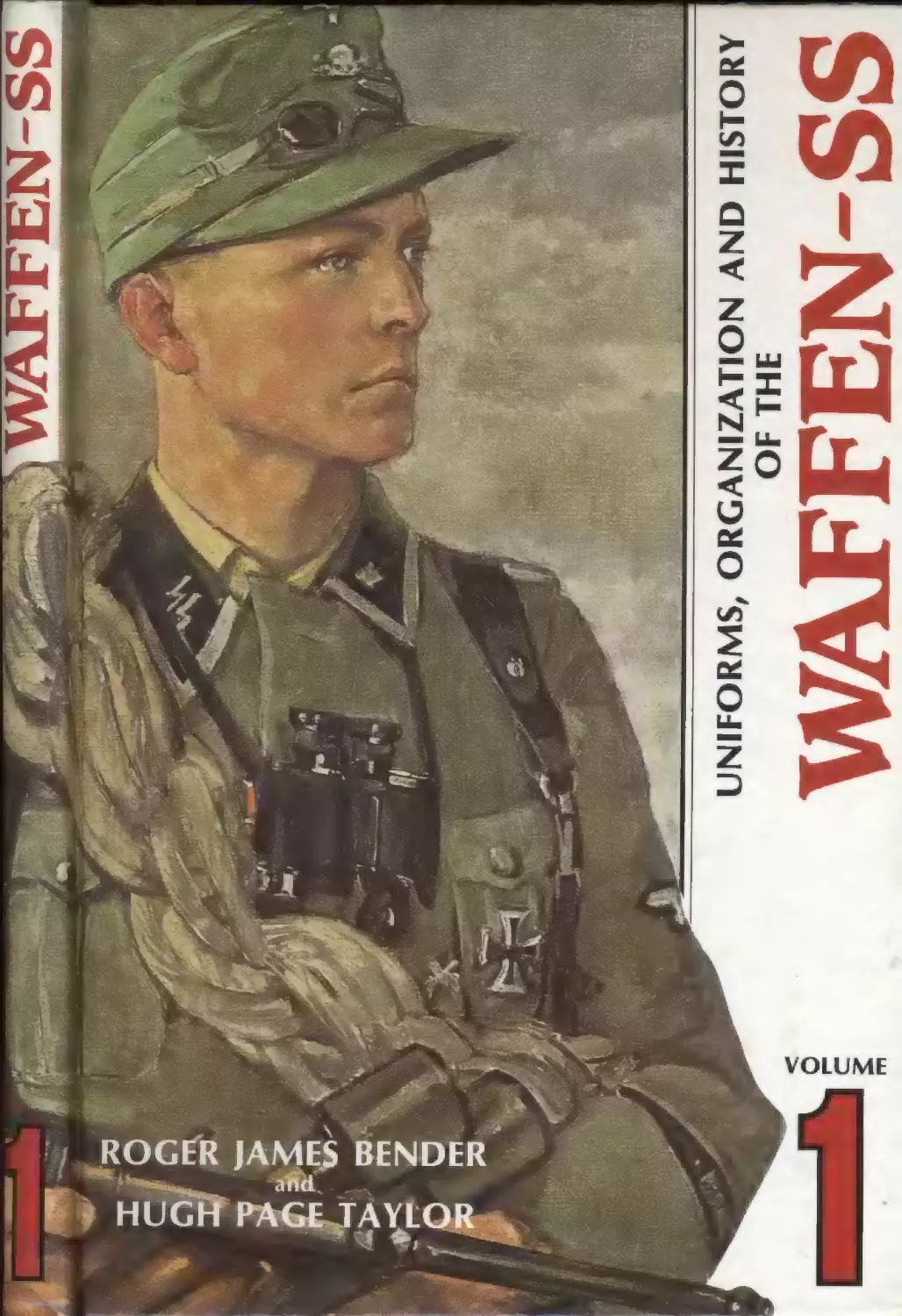
                    UNIFORMS, ORGANIZATION AND HISTORY
OF THE

WAFFEN-SS

Vol. 1

UNIFORMS. ORGANIZATION AND HISTORY
OF THE	. .

BY ROGER JAMES EENDER AND HUGH PAGE TAYLOR
ISBN NO. 0 912138 02-5

COPYRIGHT 1989 BY

ROGER |AMES BENDER
AND

HUGH PAGE TAYIOR

First Printing, December 1969

Second Printing, November 1971

Third Printing, April 1976

Fourth Printing, February 1978

Fifth Printing, October 1982

Sixth Printing, May 1986

PRINTED IN THE UNITED STATES OP AMERICA

DESIGNED AND ILLUSTRATED
BY
ROGER JAMES BENDFR

ALL RIGHTS RESERVED. THIS BOOK, OR PARTS THEREOF,
MAY NOf BE REPRODUCED IN ANY FORM WITHOUT PER
MISSION OF THE AUTHORS.

4—______________________________________z
Contents

Introduction.................................................... 4

Foreword by Otto Skorzeny......................................  7

Waffen-SS Headgear.............................................  9

Steel Helmets .............................................. 10

Service Caps...........................................   .	. 17

Field Service Caps ......................................... 20

Ml943 Cap................................................... 25

Mountain C ap............................................... 2 7

Camouilage Cap ............................................. 30

Panzer Caps. . ............................................. 31

SS-Police Caps.............................................. 33

Woman's Cap................................................. 33

SS Pith Helmet.............................................. 34

Fur Caps..................................................   34

Fez ........................................................ 35

Skull Cap .................................................. 35

Cossacks' Cap............................................... 35

Waffen-SS Uniforms, Insignia and Accoutrements................. 37

Field Uniform............................................... 38

Service Uniform............................................. 39

Walking-Out Dress.........................................   40

Undress Uniform for Officers................................ 41

White Summer Tunic.......................................... 42

Black Uniform for Armoured Vehicle Crews.................... 44

Field-Grey Uniform for Armoured Vehicle Crews............... 46

Fatigue Uniform........................................      47

Mountain Uniform...........................................  47

Tropical Uniform............................................ 49

Winter Uniform.............................................. 51

Cavalry Uniform.......................................    .	. 52

Shirt-Sleeve Order.......................................... 53

Sports Unitor ms............................................ 54

Camouflage Uniforms and Accessories......................... 56

Uniform Parts and Insignia.................................. 69

Tunics.................................................  69

Sleeve Eagles..........................................  70

Overcoats............................................... 76

SS Chevrons ...........................................  80

Waffen-SS Brassards .................................... 83

Belts and Buckles .....................................  84

Gorgets................................................. 88

Band Equipment and Insignia............................. 90

Waffen-SS Sleeve Diamonds...................................... 97

Trade and Specialty Badges.................................. 98

Former Service Badges.......................................101

Marksmanship Badges.........................................102

Fachiutirer/Fachunterfuhrer Badges..........................102

Waffen-SS Rank Insignia......................................  105

Waffen-SS Rank Insignia (revised late 1941)................ 114

Waffen-SS Rank Insignia (1942-1945).......................  121

SS-Fachfiihrer Rank Insignia................................128

Oflicer and NCO Candidate Rank Insignia.....................129

Waffenfarben of the Waffen-SS ..............................134

Shoulder Strap Letters and Numbers..........................138

Vehicle Markings and Registration Plates.......................141

Waffen-SS Registration Plates...............................142

Waffen-SS Pennants..........................................145

Tactical Symbols ...........................................150

Bibliography...................................................158
llntroimrtion

Nazi Germany forms a subject which has captured the
interest of millions. Countless books are currently
available covering most aspects of this complicated
and sinister era. Many of them are devoted to the
Waffen-SS, one of Nazi Germany's most powerful and
feared organizations, which contained a fully-equipped

army with volunteers from almost every country in the world.

Much bate propaganda has been written about the SS. but only recently
has a distinction been drawn between its political and military branches.
On the one side, those blindly against the SS in all its forms (especially
in East Germany and other Communist countries) refuse to appreciate a
difference between the two. On the other hand (especially amongst vet-
erans' associations in West Germany such as H. I. A. G. *), the million
or so members of the Waffen-SS go down in the pages of history as un-
tarnished heroes of what they believe to have been the fourth branch of
the German Armed Forces (Wehrmacht).

One of the most followed, yet least understood oi Third Reich subjects,
the Waffen-SS has enjoyed increasing popularity in recent years. Al-
though many excellent unit histories have appeared in the German lan-
guage (of special note is Dr. Klietmann's excellent ''Die Waffen-SS -
Eine Dukumentation"), these have been rather difficult to obtain, hard
to follow for non-German speaking readers, and have not dealt with the
subject oi uniforms and insignia. The ever-growing hobby of collect-
ing Waffen-SS relics and war souvenirs in Europe, and especially the
U. S. A., has in itself spawned a multitude of books, pamphlets and mag-
azines. Regrettably, the vast majority of these have not been up to a
high standard as they have relied on outdated and inaccurate war-time
intelligence manuals such as the TM-E series and JAN 1, or on unre-
liable information. The authors are confident that "Uniforms, Organ-
ization and History of the Waffen-SS" will mark the advent of profes-
sional thinking to the study of Waffen-SS uniforms and insignia.

"Uniforms, Organization and History of the Waffen-SS” represents years
of careful research carried on in all parts of the world, and is the first
book of its kind to be based on official contemporary German sources.

*H. I. A. G. is the old comrades'association of the Waffen-SS (HJLFS-
GEMEINSCHAFT AUX GEGENSEITIGKEIT EHEMALIGEN ANGEHORIGEN
DER WAFFEN-SS - BUNDESVERBAND DER SOLDATEN DER EHI
MAI.IGEN WAFFEN-SS e. V.).
The fortnightly "Verordnungsblatt der Waffen-SS" has been thoroughly
studied and continual reference will be found to it throughout the series,
photographs have been selected from the thousands available, both in
the U. S.A. and Europe, and special consideration has Deen given to se-
lect those which have not been reproduced before and are of high quality

This, the first oi lour volumes of "Uniforms, Organization and History
of the Waffen-SS", covers the basic subject oi Waffen-SS uniforms and
insignia without going into unit insignia variations. It covers such es-
sential subjects as basic uniform types, headgear, rank insignia, trade
insignia and Waffenfarben. which will form the framework for any ser-
ious study of this complicated and involved subject. The volumes that
follow will cover each and every unit of the Waften-SS in descending
order of size and importance. . . .from the 6. SS-Panzer-Armee. down
through the corps, the divisions, brigades, foreign legions, independent
units, training and replacement units schools, battle groups, and so on.
All special unit insignia will be as fully described and illustrated as pos-
sible, together with unit histories, organizational break-downs, and lists
of commanders. Each volume will form a complete work of reference
within itself and the series as a whole will be the most complete and de-
tailed source of information on the Wafien-SS ever produced.

SklniolDleiJBfwnts

Wi would like to thank personally the following for their kind and gener-
ous assistance in the production of this book Without their help it would
never have been possible in its present form. Individuals: Dennis Aley,
Murkus Anaja, Major John R. Angolia, Egon Alois Bartetzko, William M
Brooks Jr., Pmlip H. Buss. B.A. (Hons.), Brian L. Davis. Richard E.
Deeter, David Lee Delich Albert Denis. Colonel C.M. Dodkins, C.B.E.,
J O.. Retd. , Hartvig Fleege, Al Fleming, Art Grigg, David Littlejohn,
Di Andre Mathias, William R McClure Jr. , A.M, McLachlen, Andrew
Mollo, Richard L. Mundhenk, F. Ollenschlagcr. George Petersen's Kriegs-
bild Dienst, L. Roker. Daniel Rose, Jerry Sanders, Guenther G. Schoen,
Dave Singer, Dipl. Ing. Otto Skorzeny, John G. Slade. James G. Steuard.
Dan E. Stover, J. van Fleet. Drs. N.K. C.A. In't Veld, M. C. Veit and
Jerry Weiblen. Institutions: Imperial War Museum, London, Istituto
Luce, Rome, National Archives, Washington. New York Public. Library,
New York, Norsk Telegrambyraa A/S, Oslo, Rijksinstituut voor Oorlogs-
dueunientatie, Amsterdam, Tpjhusmuseet, Copenhagen, Universitets-
biblioteket, Oslo and Wiener Library, London,

Hugh Page Taylor and Roger James Bender
Ос &ropr of tips Series

In keeping with the title of this work, "Uniforms, Organization and His-
tory of the Waffen-SS", it is the authors' intention to describe the Waf-
fen-SS and nothing else. Readers will therefore find little or no cover-
age in this series of the uniforms, organization and history of the various
units that were brought together to form the Waffen-SS. Consequently,
the SS-Verliigungstruppen andSS-Totenkopfverbande will not be described
as such, only their successor formations such as divisions "Das Reich"
and "Totenkopf". Those interested in these units should consult volume
three in the present series "Uniforms of the SS" (Historical Research
Unit, London, England).

No exact date has been found for the introduction of the title "Waffen-
SS", but Reichsfuhrer-SS Himmler stated that it should be used in a
directive dated December 1st, 1939 (published March 8th. 1940). The
Chief of Staff of the SS-Fuhrerhauptamt, SS-Gruppenfuhrer Juttner,
ordered on April 22nd, 1941, that the terms ' SS-Verfugungstruppe"
and "SS-Totenkopfverbande” were obsolete and no longer to be used.
Thus, all that can be said is that the Waffen-SS came into being as
such at the beginning of World War И, and this is basically where this
series begins.
jfortujorb Ьр
©tto Skonnip

Former SS-Standartenfuhrer of the
Waffen-SS, commander of the SS-
Jagdverbande (special forces) and
February/March 1945 commander
of the Division Schwedt a. d. Oder,
and holder of the Oak- Leaves to the
Knight's Cross of the Iron Cross.

I am delighted to write the foreword ior this book by invitation of the au-
thors. The tremendous research work which the authors have put into
the oook is appreciated by me, not only in the name of the still living
members of the Waifen-SS, but also of our dead brothers I appreciate
this work even more so as it is done by anFnglish and an American his-
torian who show sincere interest in our old military units, universally
kr iwn as the Walfen-SS. I am confident that this unique book gives with
ali possible precision, a complete description of all uniforms and insig-
nia used by the Waifen-SS.

The authors have informed me that this book is the first in a series of
four on the Waffen-SS. In the next three volumes, I am sure that they
will write about the Waffen-SS and of the major battles in the Second
World War in which Waifen-SS Divisions and Corps took part. This se-
ries, once published, will form an important addition to the true history
of the Second W’orld War These books will clearly show that the W’alien-
s' iormed for the first time a European army, composed only of vol-
unteers and united by a European ideal which was possibly premature at
this time.

Madrid, Spain

October 1969
(Mlaffen-H Wwbgear
^trrl Jxlmcts

The Wafien-SS utilized the M1935 (Modell 35) steel helmet, which was
adopted by the Wehrmacht, to replace the larger, cruder and heavier
World War I helmet. The M1935 was supphed in five basic sizes and
weighed from 1.8 to 2.7 lbs. Its suspension consisted of an adjustable,
leather-padded, spring-aluminum band which was secured at the sides
and rear by three cotter keys. The M1943 which was introduced in
1943, was also adopted and worn by the Wafien-SS personnel. It was
similar in appearance to the M1935 except it dispensed with the inward
crimp around the rim thus easing and cheapening manufacture. Waffen-
SS helmets were finished in a matt field-grey and fitted with a black
leather chin-strap.

The Waffen-SS continued to use the two transfer (decal) shields which
the SS-VT had utilized pre-war. These shields were centred immedi-

NOTE vUTWARC CURVE Of M1943 HELMET Al LEFT AND
INWARD CRiMP OF M1935 HELMET AT RIGHT
ately below the ventilation holes on either side of the helmet. The left
shield was red with a white circle containing a black swastika. The
right shield was silver^ bearing the double runes of the SS. In early
1941, combat troops were restricted in the wearing of the red/'white/
bfack swastika shield for the sake of camouflage and concealment.
Although the SS runes were worn alone for some time, these were
also discontinued after November 1943.

Cloth camouflage helmet covers were widely used by the Waffen-SS and
can be distinguished from those of the Army and Luftwaffe by the dis-
tinctive SS camouflage pattern. These covers were reversible, having
either two styles of camouflage pattern (spring and autumn) or a mottled
paitern on one side and white on the other. They were fitted to the hel-
met by a fold in front and small metal hooKs at the back and either side.
It is probable that a special SS helmet cover was issued and worn by
members of the SS-Fallschirmjager-Bataillon.

The base colour of the right shield varied greatly. Besides the
varying degrees of discolouration of the basic silver, white and gold
coloured shields exist.	11
The basic matt field-grey helmet was often re-painted to fit the terrain
when helmet covers were not available. In these cases, the painting de-
pended entirely upon the whim of the individual or on the available paint.
The helmet shields were completely obliterated, partially covered over
or painted around and therefore left intact. Camouflage netting was also
worn on Waifen-SS helmets and decorated with leaves, branches, etc.

THE CLOTH CAMOUFLAGE COVER AT LEFT
WAS REVERSIBIE TO EITHER THE SPRING
OR AUTUMN PATTERN.

WHEN CAMOUFLAGE COVERS WERE
NOT AVAILABLE, HELMETS WERE
GENERALLY PAINTED TO FIT THE
TERRAIN
SS PARACHUTIST HELMETS

The SS parachutist (SS-Fallschirmjager) helmet was the standard Luft-
waffe issue, with or without the Luftwaffe eagle transfer (decal). It is

thought unlikely that the SS runes were ever worn on this helmet, as SS

arachulist units were created after regulations were issued ordering

the removal of these helmet trans-
icrs (VerordnungaLilvLit der Waffi-n
SS, 1st November 1943), A cloth
nelmet cover in SS camouflage pat-
tern was issued for wear with this
helmet.


THE SS-OBERSTURMFUHRER ABOVE IS

WEARING THE STANDART LUFTWAFFE
ISSUE PARACHUTIST HELMET.


SS POLICE HELMETS

Certain SS-Police units (e.g. the 4. SS-Polizei-Panzer-Grenadier-Divi-
sion and the Norwegian SS and Police companies) wore the helmet insig-
nia of the German Police on their field helmet. These consisted of a
silver police eagle on a black shield (left side) and the red/white/black
swastika shield (right side J.

14

NOTE SS SLEEVE EAGLES AND BUCKLES WORN BY THE SS-PQUCE MORTAR CREW
SS-POLICE TROOPS IN RUSSIA

POLICE EAGLE TRANSFER
(LEFT SIDE)

SWASTIKA TRANSFER
(RIGHT SIDE)
ITALIAN SS HELMETS

The Italian SS retained the Italian steel helmet throughout the war and
in no instance were they reported wearing German issue helmets. Hel-
met insignia was not generally worn except for some units which utiliz-
ed special Italian-manufactured transfers (decals) with black SS runes
on silver (left side). These shields varied from the German-manufact-
ured transfers (decals) in shape and size. Little care was taken in their
application as opposed to the precise positioning on German helmets.
Netting was the basic means of camouflage on the Italian SS helmet.

THESE ITALIAN SS PERSONNEL, FROM LEGIONE SS ITALIANA, WORF THE STANDARD
ITALIAN HELMET WITH NETTING FOR CAMOUFLAGE
Й>п1)1сс Caps

The service or uniform cap was a peaked cap with field-grey cover, black
cap-band and black leather peak (visor). The cap-band for officers was
a black velvet and a black wool for enlisted men. Officers and Standarten-

oberjunker (NCOs entitled to wear a dagger portepee) wore a double silver

cap cord fastened with matt silver
buttons. NCOs wore a black leather
strap fastened by two black buttons.
Waffenfarbe appeared above and be-
low the cap-band and around the crown
of the cap for officers and enlisted
men. Waffen-SS generals wore caps
with silver piping.

NOTE ARMY EAGLE
ON CAP OF SEPP”
DIETRICH IN CENTRE
OF PHOTO AT LEFT
AND POLITICAL EAGLE
W'lRN ON SS PEAKED
CAP BELOW

OFFICER’S SERVICE CAP

lie Waffen-SS eagle in matt silver metal was worn on the upper front
portion of the cap and a matt silver SS Totenkopf was worn in the front
centre of the cap-band. Non-SS eagles were sometimes worn, such as
cloth or metal Army eagles, NSDAP eagles, etc., probably through
lack of supplies.
Although against regulations, many Waffen-SS

(LEFT) OFFICER’S PEAKED CAPS
WITH CAP SPRING (a) AND
WITHOUT (b)

personnel of all ranks removed the rigid cap
spring in order to give their peaked cap a
jauntier shape.

The Italian-SS cap had the SS Totenkopf on
its cap-band and a special eagle insignia on
its crown. This Italian-made SS eagle car-
ried the Fascio of rhe Italian Social Republic
in its claws instead of the wreathed swastika.
Another exception to the standard SS proced-
ure was the cap-band insignia of the Dutch
"Landstorm'' units. Members of these units
substituted the ''Landstorm'' flaming grenade
emblem for the standard SS Totenkopf. It
should be noted, however, that the 34. SS-
Grenadier-Division ''Landstorm Nederland"
did not follow this practice and utilized the
SS Totenkopf.

(LEFT) ENLISTED MAN S CAP
WITH CAP SPRING (c) ANt
WITHOUT (d)
• -,n

RIGHT.

NOTE ITALIAN SS CAP INSIGNIA WORN BY
SS BRIGADEFUHRER MANNELLI. SECOND FROM

DUTCH "LANDSTORM'' ENLISTED
MAN'S CAP (ABOVE) AND OFFICER S
CAP (RIGHT)


jfiriti ^>erbite Cap

Waffen-SS field service or forage caps were issued in a number of pat-
terns, all or which appeared with variations in insignia. The non-visor-
ed cap came in two patterns, one styled after the Army cap and the other
based on the Luftwaffe's forage cap (Fliegermiitze). In 1943 a visored
cap, very similar to the mountain cap was introduced and known as the
M1943 (Modell 43).

Caps for enlisted men and NCOs were plain, whereas officers and Stan-
dartenoberjunker wore silver piping. Waffenfarbe did not always appear
on the non-visored caps. When it did, however, it took the form of an
inverted "V” on the front of the turn-up. The Totenkopf insignia was en-
2

closed by this inverted "V" in Waffenfarbe.

Officers and specialist NCOs were given the option to wear the forage
caps or the old style Army field cap which closely resembled the ser-
vice cap but with a soft leather visor and without cap cords.

1st MODEL (SS-VT)

This pre-war version was of a field-
grey wool-rayon. The turn-up was
scalloped downward in front which
left the eyes uncovered when worn
to protect the neck and ears. Offi-
cers wore a higher quality cap with
silver braid around the top of the
crown and along the edge of the scal-
lop. Waffenfarbe was sometimes
added in the form of an inverted ''V"
which enclosed the Totenkopf at the
front of the turn-up. This cap was
decorated with the Totenkopf and SS

eagle as in (a) and (b) below. Early in the war, an Army pattern service
cap was introduced, replacing the earlier 1st. model. Its insignia was
worn as in (c) below.

NOTE WAFFENFARBE INVERTED “V"

(a)	Totenkopf embossed on matt grey button on front of the turn-up and
the SS eagle on a black triangular backing on the left side of the turn-up.

(b)	Embroidered Totenkopf on front of turn-up with similarly manufac-
tured SS eagle on a black underlay (not a triangle) on the left side.

(c)	Embroidered eagle worn on front of cap above similar Totenkopf.

о

Verordnungsblatt der Waffen-SS, 1st September 1942, states
the 'inverted "V”' Waffenfarbe is no longer to be worn on the field

20 service cap.
THE EMBROIDERED EAGLE (LEFT) WAS ON A
BLACK TRIANGULAR BACKING AND POSITIONED
ON LEFT SIDE OF 1st MODEL TURN UP. THE MATT-
GREEN TOTENKOPF BUTTON WAS WORN ON FRONT
OF TURN UP.

A WAFFENFARBE INVERTED “V” SOMETIMES
ENCLOSED THE TOTENKOPF AS ON THE ARMY-
STYLE PANZER OFFICER'S FIELD SERVICE CAP AT
RIGHT.

THE 1st MODEL (SS-VT) FIELD SERVICE CAP DIFFERED FROM ITS CONTEMPORARY
ARMY COUNTERPART IN ONE BASIC STAGE OF CONSTRUCTION. THE FOLD ON THE
TOP OF THE ARMY CAP WAS CENTRED. WHEREAS THE FOLD OF THE EARLY SS
SERVICE CAP WAS POSITIONED TO THE RIGHT OF THE CENTRE.
OPTIONAL FIELD SERVICE CAP (OLD STYLE)

Officers and SS-Standartenoberjunker could wear an alternative field
service cap known as the Old Style Officers' Field Service Cap (01-
fizierfeldmiitze alterer Art). This cap was similar in appearance to
the Uniform Peaked Cap but with less elaborate insignia. The silver
cap cords were omitted and the vizor was in either soft leather or
cloth. It was required to be withdrawn from use on 1st. April 1942,
but was possibly retained after this date.

22

NOTF CLOTH VISOR ON 'JI D STYLE FIELD SERVICE CAP
SS STYLE FIELD SERVICE CAP

A new forage cap was introduced in mid-1940 for the Waffen-SS in the
style of the Luftwaffe's forage cap (Fliegermutze)^. Waffenfarbe was
sometimes worn as an inverted "V" which contained the Totenkopf. Of-
ficers and Standartenoberjunker wore a higher-quality cap with an alu-
minum thread piping around the turn-up. The officer's cap was decor-
ated with a white or silver thread eagle worn above a similar Totenkopf
on the front. The insignia for enlisted men and NCOs appeared in light
grey embroidery without a black underlay. White fur ear-covers were
available for this model.

3

Verordnungsolatt der Waffen-SS. 1st November 1940 The field
cap modelled after that of the Luftwaffe (Luftwaffenform) was officially
called "Feldmiitze n. A. " (i.e. new pattern) and was worn by this date,
he old-style cap (i.e. with scallop. Totenkopf button and eagle in tri-
angle on left side) was officially titled "Feldmiitze a. A." (i.e. old pat-
tern) and could be used until stocks exhausted.	23
SILVER BULLION CAP EAGLE
FOR OFFICERS

THIS STYLE EAGLE COULD BE IN
SILVER THREAD FOR OFFICERS AND
GREY THREAD FOR NCOS AND E.M.

TOTENKOPF AS WORN
ON FIELD SERVICE CAP.
ЛИ943

In 1943 a visored cap in wool-rayon was introduced for all troops and
known as the Einheitsmiitze.4 Its design was based on the mountain cap,
whose style had been derived from the visored Austrian cap of World
War I. The turn-up could be pulled down to protect the neck and ears
with the flaps buttoning across the chin. As in the mountain and Army
style caps, the turn-up was scalloped in front to permit vision when
pulled down. The turn-up was fastened in front by either one large or
two small buttons.

NOTE ALUMINUM PIPING AROUND CROWN OF OFFICERS
NEW STYLE CAP (ABOVE).

(SINGLE BUTTON)

(DOUBLE BUTTON)

he cap was plain and unpiped for enlisted men and NCOs.

It was piped

around the crown for officers.

he M1943 insignia consisted oi the SS eagle and ToteiiKopl in grey or
white embroidery. The eagle could be worn over the Totenkopf on the
front of the cap (a special cloth badge incorporating the two insignia

4

Verordnungsblatt der Waffen-SS, 1st October 1943. A new field
cap (Feldmiitze-i. e. M1943) was introduced to replace the former forage
cap for all practical purposes. The new cap was to be in the style and
manufacture as the mountain cap (Bergmutze). This cap was to be black
for Panzer units and field-grey for all other Waffen-SS units.
WAFFEN-SS UNITS. (NOTE DETAIL ON "BEVO” STYLE AT RIGHT)

was also worn - manufactured mainly by Bevo of Wuppertal). The
Totenkopf could also be worn on front while the eagle was on the left
side of the turn-up.

A pattern of the M1943 was produced in camouflage cloth and worn with
or without the eagle and Totenkopf insignia.

A white cloth cover was issued for winter use in snowbound areas.
fountain Cap

The Waffen-SS adopted a visored, field - grey cap in wool - rayon which
was identical to the Army version.5 Its side flaps could be let down to
protect the neck and ears. The front of the turn-up was scalloped to al-
low vision when worn down and was fastened by either one large button
or two small ones. These buttons were either in grey-green painted
metal with a fixing loop at the back or in plastic with four small thread
holes.

The mountain cap was decorated with a light-grey machine-embroider-
ed SS eagle and Totenkopf. They were sometimes worn on the front of
the cap above the turn-up buttons, although the eagle was often worn on
the left side of the turn-up. Officers wore a higher-quality cap with its
insignia in either aluminum thread or metal and an aluminum piping
around the top of the cap.

The distinctive insignia of the mountain cap, which differentiated it from
the M1943, was the Edelweiss. This Edelweiss insignia was introduced

SS STYLE EDELWEISS (CLOTH)

5

Verordnungsblatt der Waffen-SS. 1st October 1У43. Item 356. The
''ichiffchen'' (1. e. colloquial n-me for the forage cap) was to be replaced
b a visored Feldmiitze similai to the Bergmiitze. It was to be black for
Waffen-SS Panzer personnel a 1 field-grey for all others. This order
also stated that SS Gebirgstruppen are to wear the Edelweiss. It should
be noted that the Edelweiss insignia was introduced to distinguish mountain-
iers from other personnel.	27
NOTE POSITIONING 0Г SS SLEEVE EDELWEISS ON MAN AT EXTREME
LEFT AND SS CAP EDELWEISS ON MAN'S CAP IN CENTRE OF PHOTO.
THE MUFTI IS WEARING A WHITE TURBAN
45

POSITIONING OF THE BERGMUTZE EDELWEISS INSIGNIA.
and worn to distinguish the SS-Gebirgstruppen from the regular Waffen-
SS personnel. It was similar in design to the Army pattern and was worn
either in metal (in which case Army stocks were utilized) or in a SS pat-
tern oi silver-grey thread on black. It. was worn on the left side of the
turn-up (worn on right side by Norwegian SS-Ski-Jager-Btl.) with the
stalk at an angle oi 45 degrees and positioned approximately 2cm be-
hind the peak and .5cm from the lower edge of the cap.$ When the cap
eagle was worn on the left side of the turn-up, the Edelweiss was posi-
7
tioned below it.

A white, cloth camouflage cover was added to the mountain cap for winter
use.

Camouflage Cap

A simple visored cap in camouflage material was announced on 1st. June
1942 and worn with no insignia. By SS order dated 1st December 1942, I
the camouflage cap could be worn with SS insignia.

NO INSIGNIA WAS WORN ON CAMOUFLAGE CAP, ABOVE CENTRE. OFFICER AT RIGHT IS
HERMANN FEGELEIN COMMANDER OF ' FICRIAN GEYER’ DIVISION.

bVerordnungsblatt der Waffen-SS, 1st October 1943 Item 19.

^Verordnungsblatt der Waffen-SS, 1st September 1942, Item 306.
The wearing of the SS-Bergmiitze was restricted to the members of the
SS divisions "Nord’’ and "Prinz Eugen" and forbade its use by other SS
members. This same document, dated 1st October 1942. Item 338 lists
the Hochgebirgsschule and the Inspection der Gebirgstruppen of the SS-

30 FHA as eligible to wear the Bergmutze.
MAX WUNSCHE, REGIMENTAL COMMANDER IN “LAH,' WEARING CAMOUFLAGE CAP
WITH INSIGNIA

SS PANZER BERET

Дрлпэгг (Caps

Waffen-SS Panzer units originally
wore a black Panzer berel similar
to that oi the Army. It bore the SS
eagle (the size of which varied) over
the Totenkopf on the front and was
lilted with thick rubber padding for
use in armoured vehicles. It was
later considered unnecessary and
replaced by field caps. These caps
including the M1943, were in black
cloth and identical in style to those
worn by other branches of the Waf-
fen-SS.
MICHAEL WITTMANN, “LAH"
REGIMENTAL COMMANDER AND
HERO OF NORMANDY FRONT,
WEARING SINGLE-BUTTON
BLACK PANZER M1943 CAP.

NOTE ARMY EAGLE AND PANZER
SKULL ON FIELD SERVICE CAP
(ARMY-STYLE) AT LEFT.
//-polite (Caps

SS-Police units wore either rhe Waffen-SS caps previously described or

the standard German Police caps. Officers did,
however, receive grants which enabled them to
purchase SS insignia.

NOTE POLICE INSIGNIA WORN
BY SS-POLICE OFFICER AT RIGHT.

Women's (Cap

Members of the SS Female Auxiliaries wore a field-grey side cap with
no turn-up and the SS eagle insignia. Many female SS volunteers from
various countries (e. g. Norway and Denmark) followed their Legions
into combat as field nurses. They were issued a uniform with sleeve
eagle, in certain cases a unit insignia or national arm shield, and a
plain mountain-style cap. The Norwegian SS nurses wore a field-grey
mountain-style cap which was single-buttoned and carried no insignia.
lelmet

Although the Waffen-SS was never engaged in Africa, some members
were issued pith helmets bearing SS insignia.. . possibly for the Medi-
terranean area. The helmet was identical in manufacture to the Army
style used by the Afrikakorps with the exception
of the two embossed metal helmet plates (i.e. the
black runes on silver and the red/white/black
mobile swastika).

SS PITH HELMET

34

NOTE CIOTH SS EAGLE ON FUR CAP.

jFur Caps

Various patterns of fur caps have
been encountered and these bore
theWaffen-SS insignia in avariety
of manners. The caps were usual-
ly large and round with the SS eagle
over Totenkopf on the front which
could be in cloth or metal. Fur caps
were also decorated with a metal
Totenkopf only, on the front centre.
jft?

The fez was the most distinctive item of uniform for the 13. (Handschar)
and 23. (Kama) divisions and was worn by both Muslims and Germans alike
while serving in these divisions. The fez was in two colours.. .red which
as worn with the dress uniform and field-green which was worn with the
field-uniform. Cloth Waffen-SS cap insignia was worn on the front (i.e.
> hite or silver SS eagle above the Totenkopf, both on black).

"HANDSCHAR' DIVISIONAL COMMANDER
WEARING THE DRESS FEZ (RED).

THE MUFTI REVIEWING MEMBERS OF
THE "HANDSCHAR” DIVISION (NOTE
FIELD-GREEN FEZ WORN BY TROOPS).

g>feull Cap

Albanian SS troops wore a plain skull cap in a light coloured material.
This cap bore no insignia.

СоййагЬй’ Cap

Cossack troops who were integrated into the Waffen-SS and wore the SS
uniform (not XV. SS-Kos.-Kav.-Korps) frequently continued to wear
their own peaked caps.	35

2®affen-H Uniforms,
Sngignta anti
Accoutrements;
Jhcli) (Uniform

This uniform consisted of the following:

Steel helmet

Tunic (worn open or closed at the neck)

Long trousers (for NCOs and men only)

Breeches (for officers only)

Black marching boots (for NCOs and men only)

Black riding boots (for officers only)

Black belt

Field cap

Soft peaked cap (optional for NCOs and officers only)

Grey or brown shirt 1

Black tie (worn only if tunic is worn open at neck)

REICHSFUHRERSS HIMMLER REVIEWING SS TROOPS IN FIELD DRESS.

Verordnungsblatt der Waffen-SS, 15 September 1943. This official
document banned the brown shirt from being worn with any style uniform,
38 field, service, undress, etc. Only the field-grey shirt could be worn.
йтпше Uniform

This uniform consisted o£ the following:

Tunic (worn open or closed at the neck)

Long trousers (for NCOs and men only)

Breeches (for officers only)

Black marching boots (for NCOs and men only)

Black riding boots (for officers only)

Black belt (officers wore cross strap until withdrawn
by SS order dated 15th January 1941;

Field cap

Soft peaked cap (optional for NCOs and officers only)

Grey or brown shirt

Black tie (worn only if tunic is worn open at neck)

This uniform also served as the Walking-Out Dress (Ausgehanzug)

TWO YOUTHFUL BROTHERS—ONE IN THE KRIEGSMARINE (LEFT) AND
THE OTHER IN THE WAFFEN-SS (RIGHT). NOTE WAFFEN-SS SERVICE UNIFORM.
Walking-iEhit Srcss

When the service tunic was worn as Walking-Out Dress, the front and
real' belt supports were removed and replaced by clip-on buttons. Peak-
ed caps were worn as well as long trousers over lace-up shoes. Swords
2
could also be worn with this dress.

WOUNDED WAFFEN-SS MEN ON LEAVE AND WEARING WALKING-OUT DRESS.

2 Verordnungsblatt der Waffen-SS, 15th August 1942. From this
date, the sword was not to be worn with Walking-Out Dress and on duty
for the duration of the war. The sword, henceforth, was only to be

40 worn by officers and NCOs on colour guard or honour guard.
Unbregg Uniform for (Officers;

This uniform consisted of the following:

Peaked cap
Tunic
Long trousers
Black boots
Brown shirt
Black tie

THE TUNIC COLLAR WAS PRESSED OPEN
WHEN TUNIC WAS WORN WITH UNDRESS
uniform, (note Croat decoration above..
Wljite Summer Clinic

SS-OBERSTURMFUHRER GERHARD BREMER
WEARING A WHITE SUMMER TUNIC. AT THIS
TIME HE WAS COMMANDER OF THE
l.KRADSCHUTZENKOMPANIE OF THE
LIEBSTANDARTE SS "ADOLF HITLER.”
ENLISTED MEN FROM THE “LAH" EXAMINING THEIR NEWLY ISSUED WHITE
SUMMER TUNICS. NOTE THAT THE TUNICS ARE SHORT STYLE WITH >10 POCKETS.
©lark Uniform for
grtnoureb <£rttus

This uniform is basically the same as that worn by the German Army
with the exception of the SS insignia. It was originally intended for tank
and armoured crews but was later extended to crews of "Elephants",
tank-destroyer and assault-gun crews in Panzer and Panzer-Grenadier
divisions.3 It consisted of the following:

Black beret (worn initially and replaced by black field cap in 1941)
Black field cap (in 1943 the black M1943 field cap was introduced)
Soft peaked cap with field-grey top (for officers and NCOs only)

NOTE ALUMINUM CORD AROUND COLLAR
OF MAX WUNSCHE, “LAH" REGIMENTAL
COMMANDER, AND THAT KNIGHTS
CROSS HOLDERS DID NOT WEAR THE
BLACK TIE.

PANZER ENLISTED MAN'S
SERVICE TUNIC.

3 Verordnungsblatt der Waffen-SS, 15 August 1942. This order
states Sturmgeschtitzeinheiten (Assault Gun) personnel are to wear the
field-grey Panzer uniform. The same SS order, dated 1 December
1942 states that Panzerjager-Einheiten (self-propelled anti-tank units)
44 are to wear the field-grey Panzer uniform.
BLACK SS ARMOURED VEHICLE TUNIC (ARMY-STYLE)

Tunic

Grey or black shirt

Black tie (worn with Walking Out Dress)

Trousers (fitted with tapes at the ankle for binding to the leg)
Black belt

Black boots

This, uniform served as both Walking-Out Dress (Ausgehanzug) and Ser-
vice Uniform (Dienstanzug). Officers and NCOs often wore the peaked
CaP when the uniform was worn as Walking-Out Dress. The distinctive
wide collar on both the black and field-grey tunics was not trimmed in
NCO "Tresse” with the exception of NCOs in the "LAH".
Jfirlb (grep Uniform for
$3rtnourei> Ueljiflr СгеЬй

This uniform is identical in design to the black uniform for armoured

vehicle crews but is in field-grey.

Waffen-SS in Verordnungsblatt
der Waffen-SS dated 1st Sep-
tember 1941 and consisted of
the following:

Field cap

Soft peaked cap (for officers
and NCOs only)

Tunic

Grey shirt

Black tie

Trousers (fitted with tapes at
the ankle for binding to the
leg)

Black belt

Black boots

Note:

This uniform was known as
"Schutzanzug”.

"LAH” STURMGESCHUTZ COMPANY
COMMANDER WEARING THE FIELD-GREY

TUNIC (RIGHT).

It was announced as a uniform of the

NOTE NCO "TRESSE” ON COLLAR OF MAN SHAKING HANDS WITH
SS-OBERGRUPPENFUHRER DIETRICH.
jfatigue (Uniform

This fatigue uniform was of a light linen herringbone twill (Drillich)
which was dyed a rush green. It consisted of the following:

Field cap (field grey)

Tunic (no pockets or insignia)

Trousers

Black belt

Black boots

jUlountain (Uniform

SS mountain troops wore the basic field uniform altered as follows to
meet their needs.4 5

Mountain cap

White cover for mountain cap

Tunic (worn open or closed at the neck with Edelweiss on upper
right sleeve)

Overcoat (with Edelweiss on upper right sleeve)$

Long trousers (tucked into black climbing or ski boots)

Climbing or ski boots

4

Verordnungsblatt der Waffen-SS,
1st November 1944, Item 651. This
SS order lists all mountain units en-
titled to wear the Edelweiss on the
sleeve and cap.

(1) SS-Gebirgsdivisionen

(2) SS-Freiwilligen-Gebirgs-
divisionen

(3) Waffen-Gebirgsdivisionen
der SS

(4) Waffen-Gebirgs-(Karst-
jager) Division der SS

(5) Waffen-Gebirgs-Brigaden
der SS

(6) General Kommando-SS-
Gebirgs-Korps und Korps-
truppen

(7) General Kommando-Waffen
Gebirgs-Armee Korps und
Korpstruppen

(.8) Gebirgsjagerschule der Waffen-SS
(9) SS-FHA/In2/Abteilung Gebirgstruppen

EDELWEISS SLEEVE
INSIGNIA

This order also forbids the wearing of Army-style Edelweiss badges on
the sleeve and cap.

5

Verordnungsblatt der Waffen-SS, 1st October 1943, Item 19. This
document states that the SS Edelweiss arm insignia was to be worn 16cm
lrom the seam of the upper right sleeve of both tunics and great-coats.
A shirt-sleeve order existed for hot weather:

Shirt with sleeves rolled (shoulder straps or sleeve rank insignia
was worn, but apparently not the sleeve eagle)

Knickerbockers worn with long wool socks

Climbing or ski boots

THE TWO MOUNTAINEERS ABOVE WEAR THE SHIRT SLEEVE
ORDER. NOTE SS-UNTERSCHARFUHRER SLEEVE INSIGNIA
ON SEATED MAN.
THE SS MOUNTAIN GUIDE (BERGFUHRER-ABZEICHEN), IN CLOTH WAS
INTRODUCED IN OCTOBER 1944 AND WORN ON THE LEFT BREAST POCKET.

tropical (Uniform

Some Waffen-SS units serving in the Crimea and Mediterranean areas
Were issued a tropical uniform of golden-tan, cotton twill. This uni-
form was standard Army issue and consisted of tunic, trousers, cloth
and leather boots, web belt, etc. Regulation collar and shoulder in-
signia was generally worn on the unlined tunic with a black-backed,
rust-brown eagle on the upper left sleeve (this eagle was worn by all
ranks). Army-style pith helmets and tan M1943 Army caps, with the
addition of SS insignia, were worn with this tropical uniform.
TOintsr Uniform

Various garments were utilized by the Waffen-SS as camouflage in snow
and ice and for protection against the extreme cold. Some of these winter
issue varieties are listed below.

RABBIT-FUR VEST

Field grey fur-lined parka with
hood (worn with black belt)

White parka with hood
Rabbit-fur jacket and vest
Sleeveless & sleeved pile jacket
Overcoat with special lining
Sheepskin surcoat

Lined boots

FUR-LINED, WHITE PARKA
FIELD-GREY PARKAS, REVERSIBLE TO WHITE.

dCatoalrp Wnifortn

Cavalry units wore reinforced breeches and riding boots.

52

NOTE THE LEATHER REINFORCED BREECHES WORN BY SS MAN (ABOVE LEFT).
3’ljirt-
igtabe
(ЭгЬег

In extreme heat the
shirt-sleeve order
was permitted. The
shirt was worn open
at the neck, except
in the case of Knights
Cross holders, and
with the sleeve eagle
and shoulder straps as
the only insignia. Worn
with field or peaked
caps.
sports ШИоппй

Basic Sports Uniform:

Black shoes

I encing Uniform:

White uniform with silver SS runes
on black diamond-shaped badge
worn on upper left sleeve

White socks

Black shorts

Black vest with white SS runes on
centre of chest

Alternative Sports Uniform:
Black shoes

SS ЕМЫ.ЕМ FOR VEST

BASIC SPORTS UNIFORM

White socks

Black shorts

White vest with circular black &
white SS emblem on centre of
chest

Track Suit:

Two-piece suit all in black, cir-
cular black and white SS emblem
worn on left breast

54
SS BADGE FOR LEFT SLEEVE
OF FENCING UNIFORM

R 1NHARD HEYDRICH IN FENCING UNIFORM

GLRMAN WAFFEN-SS TROOPS EXERCISING IN NORWAY (NOTE BLACK TRACK SUITS).

55
(Camouflage ©informs & Slttessories

Various camouflage garments were issued and worn by the Waffen-SS
with their pattern and colour scheme being governed by the type of ter-
rain encountered. The spring colour scheme was predominantly green
and brown and was issued in a variety of patterns. This scheme was
also worn through the summer months. In the autumn colour scheme,
various shades of brown were dominant. Variations of this scheme were
utilized on the winter uniform which was also reversible to white. The
camouflage patterns illustrated in this section are but a few of the many
pattern variations which existed in both the spring and autumn colours.


(RIGHT) SS-STANDARTENFUHRER
DAISENHOFER IN THE VICINITY OF
CAEN DURING THE BATTLE OF
NORMANDY, 13 JULY 1944.

(NOTE HE AND HIS AIDE ARE
WEARING THE PATTERN DESIGN
BELOW, BUT IN SUMMER COLOURS)


NOTE OTHER VARIATIONS IN SS PATTERN DESIGN (ABOVE AND BELOW)
NOTE OTHER VARIATIONS IN SS PATTERN DESIGN (ABOVE ANO BELOW)
The illustrated colour schemes were used on camouflage uniforms and
garments of the Waffen-SS, some of which are listed below:

CAMOUFLAGE COVERALLS FOR TANK CREWS

The tank crew uniform was one-piece, non-reversible and bore no in-
signia. It was worn with a field cap and black boots and belt.

CAMOUFLAGE ASSAULT GUNNERS UNIFORM

The jacket was identical in style to that of the black and field-grey ver-
sions and bore no insignia. A field cap, black boots and bell were also
worn.	65
CAMOUFLAGE JACKET

This pull-over jacket was worn over the standard field tunic, and had
elastic at its wrists and waist. Later issue camouflage jackets had ver-
tical or slant, buttoned pockets.
CAMOUFLAGE UNIFORM

The uniform consisted of a tunic and trousers in camouflage pattern mat-
erial. The tunic was a four pocket model with no pleats or cuffs. Regu-
lations forbidding the use of insignia on this uniform were not generally
idhered to and resulted in a number of variations being worn. Some of
them are as follows:

(a)	No insignia (as required by regulations)

(b)	Shoulder straps only

(c)	Sleeve eagle and sleeve rank insignia

(d)	Full rank insignia

(AhOVE) THESE SS PRISONERS,
WEARING THE LIGHTWEIGHT
CAMOUFLAGE UNIFORM, WERE
CAPTURED IN THE SUBURBS
OF ARNHEIM. (RIGHT) NOTE MAN
IN CAMOUFLAGE TUNIC WITH
SHOULDER STRAPS AS ITS ONLY
•nsignia.

Imperial War Museum, London
Note: A special system of rank insignia was introduced in
February 1943 for wear on both sleeves of camou-
flage jackets, winter suits, etc. (see Waffen-SS
rank insignia section for full details).

CAMOUFLAGE SHELTER QUARTER

The shelter quarter was of a water-repellent, camouflage material in
the form of an isoceles triangle, 6'3" along the base and 8'3" along the

other two edges. Generally, the quarter was
reversible with a spring camouflage pattern
on one side and an autumn pattern on the
other. The quarter was also worn as a
poncho with the soldier's head thrust through
a slit and the top point of the triangle in the
front.. The two rear corners were brought
forward and buttoned together, forming
openings for the arms.

MAN IN FOREGROUND IS WEARING THE
CAMOUFLAGE SHELTER QUARTER.
CAMOUFLAGE FACE MASK

A camouflage face mask was introduced in April 1942 and worn by snip-
ers, machine-gunners, reconnaissance troops, etc. $

(Uniform |3<irts anb Snsigma

Mimics

The Waffen-SS utilized four basic tunic patterns during their short five
years of existance. The SSmodel, whichhad slant side pockets andwas
with or without sleeve cuffs, was the SS-VT carry-over tunic from peace-
time and was generally worn in the early years of the war. Officers wear-
ing this model usually had a dark green collar and NCOs and men had a
fie d-grey collar. Officers' buttons were silver and other ranks grey.

Th. increasing growth rate of the Waffen-SS necessitated the practice of
issuing Army tunics to SS personnel, who then added their own regulation
S3 insignia. Later, the Army style, which had either a dark green or
fieid-grey collar, was issued to replace the depleated stocks of the SS
Hiodel. It had four pleated pockets and was with or without sleeve cuffs.

Verordnungsblatt der Waffen-SS, 15th April 1942.	69
In the latter part of the war, a tunic style was introduced which reflect-
ed the conservative measures being forced on Germany by an increasing
shortage of material. It had four pockets with no pleats, no sleeve cuffs
and the collar material was the same as the tunic. This model, general-
ly called the M1944, was also produced in camouflage patterns.

The "Field Blouse 44" (Feldbluse 44) was issued in late 1944 and portray-
ed the most vigorous attempt to conserve material. It was ashort, waist-
length blouse with two large breast pockets and no sleeve cuffs. Where
an acute shortage of material existed, old style tunics were re-tailored.
This style was to be issued to all field units with the exception of Panzer
troops who already had a short-waisted tunic.

The SS sleeve eagle was worn on the upper left sleeve and existed in a
number of variations. The distribution of these variations was usually
based on the style being used by the individual uniform manufacturer,
the soldier’s personal preference or what was available at the time. It
was not uncommon to see an Army eagle on the sleeve of a SS tunic.
The distinctive SS eagle was produced in silver bullion, in flat silver
embroidery and aluminum-coloured thread (Bevo) and in grey wool
thread. A "Bevo" eagle in rust-brown thread was also produced for
wear on camouflage and tropical uniforms.

The following notes outline the practices generally adhered to by SS
personnel. However, it should be noted that individual whims some-
times overruled regulations, so producing a number of uncatalogued
variations.

Officers: Hand-embroidered, silver bul-
lion eagles were worn for dress
while "Bevo" eagles in flat silver
and aluminum-coloured thread
were worn in the field.

NCOs: "Bevo" eagles in aluminum-col-
oured thread were worn for dress
and in the field. Standartenober-
junker could, however, wear the
silver bullion eagles for dress.

Enlisted Men: Both the "Bevo" eagle in
aluminum-coloured thread and a
machine-embroidered eagle in
grey thread could be worn.

NOTE OFFICER’S ARMY SLEEVE EAGLE AT RIGHT.
PEACETIME SS MODEL TUNIC

SILVER BULLION DRESS EAGLE
FOR OFFICERS
FLAT SILVER EAGLE
FOR OFFICERS
М1944 TUNIC

ALUMINUM-COLOURED THREAD EAGLE
FOR OFFICERS AND NCOS
FIELD BLOUSE 1944 TUNIC

GREY THREAD EAGLE
FOR ENLISTED MEN
WAFFEN-SS FEMALE AUXILIARY TUNIC

WAFFEN-SS FEMALE AUXILIARY TUNIC

Female personnel who were trained in the Reichsschule SS atOberenheim/
Alsace, for three or four months, were incorporated into the Corps of the
SS-Helferinnen. Their tunic was field-grey and similar in style to that of
the Army's Female Signal Auxiliaries. The SS sleeve eagle was worn on
the upper left sleeve, a black oval patch with w’hite SS runes on the left
°reast, a "blitz" symbol and the cuff title "Reichsschule SS" on the lower
left sleeve.
©Ьегсоай

Officers and men in the Waffen-SS wore a long double-breasted, six but-

ton overcoat which was very similar to that of the German Army.

It was

narrow at the waist, flared at the bottom and had two side slash pockets.

The collars, which were usually of dark bluish-green imitation velvet,
tended to be of field-grey wool later in the war. Overcoats varied ac-
cording to rank, not only in quality but also as follows:

NCOs and Men: Field-grey with dark-green collar and two rows of
grey buttons down the front. Collar patches, shoulder straps,
sleeve eagle, rank insignia and unit cuffbands were worn.

Officers: Finer quality material with dark-green collar and grey
buttons. Shoulder straps, collar patches and sleeve eagle were
worn.

COLLAR PATCHES WERE
AUTHORIZED FOR WEAR
ON OVERCOATS AFTER
OCTOBER 1940. (NOTE

POLITICAL CAP EAGLE
ANO ARMY SLEEVE EAGLE'

1

(ABOVE LEFT) WAFFEN-SS
GENERALS' OVERCOATS
(RIGHT) REICHSFUHRER-SS
HIMMLER AND AIDE WEARING
LEATHER OVERCOATS.

Generals: Fine quality material with dark-green collar and light
grey lapel facings. Shoulder straps, collar patches and sleeve
eagle were worn.

Note: Officers and General officers could purchase fine-grain
leather overcoats for service use. Detachable shoulder straps
were the only insignia worn on this coat.

Collar patches were authorized for wear on the overcoat by October 1940.
This practice was discontinued, however, by an order dated June 1942,
which stated that collar patches were no longer to be worn on overcoats.
Holders of the Knights Cross of the Iron Cross and War Service Cross
were allowed to leave the top two buttons open to display the award.

7

‘Verordnungsblatt der Waffen-SS, 1 October 1940.

^Verordnungsblatt der Waffen-SS, 1 June 1942.

^Verordnungsblatt der Waffen-SS, 1 February 1941.

//-ОеЬгопй

The "Ehrenwinkel” (old campaigners' chevron) was worn by SS men who
had joined the ranks of either the SS, NSDAP or one of the Party affili-
ated organizations before 30th January 1933. It was also worn by former
members of the Wehrmacht and Police up to 25th July 1935. Members
of the Austrian SS, Nazi Party or one
of its pro-Nazi Austrian organizations
and those volunteering for the SS in
Austria, prior to 12th February 1935,
were entitled to wear the chevron on
their upper right arm. These stipu-
lations also applied to other National
Socialist organizations in areas such
as Eupen, Malmedy and Poland.

THE "FORMER MEMBERS"
CHEVRON WAS WORN ON THE
UPPER RIGHT SLEEVE. (NOTE
CUFFBAND INDICATING
ABTEILUNGSLEITER ON THE

STAFF OF THE RF-SS
(ALGEMEINE-SS))

NOTE POSITIONING OF "OLD CAMPAIGNERS” CHEVRONS ON THE UPPER RIGHT
SLEEVE OF SSSTANDARTENFUHRER FEGELEIN AND SS-GRUPPENFUHRER WOLFF.
(REICHSFUHRER SS HIMMLER IS IN RIGHT FOREGROUND)

"OLD CAMPAIGNERS” CHEVRON
The chevron for ex-members of the Wehrmacht and Police was intro-
duced on 25th July 1935 and worn on the upper right sleeve of the tunic
or overcoat. All SS members who had served in the Wehrmacht or
police, or in an additional Party organization simultaneously were en-
titled to wear this chevron with pip.

“FORMER MEMBERS” CHEVRON
The "Ehrenwinkel" was authorised for wear on field-grey uniforms in
August 1943. When this SS chevron was worn by mountain units of the
Waffen-SS, it was positioned below the Edelweiss sleeve badge, with
the base of the latter 2cms below the level of the top of the "V".10

POSITIONING OF ' EHRENWINKEL" WHEN
WORN WITH EDELWEISS SLEEVE BADGE.

82	IQyerordnungsblatt der Waffen-SS, 1st August 1943.
(Й.1 jf fr и-// iBrassartis

Two varieties of the Waffen-SS brassard exist, the "Waffen-SS” in black
on orange and the "Im Dienste der Waffen-SS" in black on white.11 These
armbands were worn on the left upper sleeve by non-German, civilian
personnel (drivers, wagon drivers, etc.) in service with the Waffen-SS.

“WAFFEN-SS” BRASSARD (BLACK ON ORANGE)

□m Dienst
der
Wten-tt

“IM DIENSTE DER WAFFEN-SS” BRASSARD (BLACK ON WHITE)

.	Verordnungsblatt der Waffen-SS, 15th June 1942. An armband

n pink, with "Dolmetscher” (Interpreter) in black letters, was authorized
lQr wear on the left upper sleeve by interpreters in the Waffen-SS.	83
JMtS anti ®uck(cs

NCOs and enlisted men wore an oblong, dull silver buckle with the SS
motto "Meine Ehre Heisst Treue!" and the SSeagle. Combat versions
of this buckle also exist in field-grey. Officers wore either a circu-
lar, dull silver buckle with the SS motto and eagle or a double-claw
buckle as used by Army officers. Black leather belts were worn with
all of the above buckles. Officers also wore the round buckle and a

SS-MANN IN FIELD-GREY SERVICE UNIFORM
FOR ARMOURED VEHICLE CREWS WITH
STANDARD E.M. BUCKLE.

brocade belt, with embroidered
SS runes and oakleaves, for dress
occasions.

Black leather cross straps were
worn initially but later forbidden
for wear by officers on the field-
12
grey uniform.
NCO AND ENLISTED MAN'S BUCKLE VARIATION (NOTE MOBILE SWASTIKA)

85
SS OFFICER S BUCKLE (VARIATION)

>>1 И »»1 »>♦ >11 ГМПШТПМ l»»HH »*»*<•'

STANDARD SS
OFFICER'S BUCKLE
AND BROCADE
.RFSS BELT

i	*. ***** _ -

'tHwmimimiwmitmiimH»*’


SS-BRIGADEFUHRER FEGELFIN WEARING THE OFFICER’S BUCKLE WITH BLACK
LEATHER BELT AND RUNNERS.
forgets

SS-FAHNENTRAGER (STANDARD BEARER'S) GORGET
SS-STREIFENDIENST (SS PATROL SERVICE) GORGET

NOTE ARMY PATTERN "FELDGENDARMERIE” (FIELD POLICE) GORGET WORN
BY GERMAN NCOs IN THE 13.WAFFEN GEBIRGS DIVISION-SS ‘ HANDSCHAR"

SS-FUNKSCHUTZ (SS PROTECTION FORCE
FOR RADIO INSTALLATIONS) GORGET
---------------------------------------------------------------------------->
ДтлпЬ (Equipment
& 3lnSignia

Waffen-SS bands were utilized
less and less as the war pro-
gressed with regular soldiers,
involved in combat duties, serv-
ing a dual purpose as band mem-
bers. Therefore, SS bandsmen
did not generally wear any special insignia except the detachable "swal-
lows' nest" (SS-Schwalbennester). The Waffen-SS retained the basic
band insignia and equipment as that of the Allgemeine-SS and the SS-
Verfiigungstruppe.

(ABOVE RIGHT) THE SS KETTLE DRUM BANNER WAS IN BLACK CLOTH AND TRIMMED IN
ALUMINUM BRAID. IT HAD SIX PANELS WHICH WERE DECORATED AS FOLLOWS: BLANK,
TOTENKOPF/EAGLE/TOTENKOPF/EAGLE/BLANK. THE TOTENKOPF AND EAGLE DECORATIONS
WERE ALSO IN ALUMINUM. NOTE EARLY SS EAGLE ON BANNER IN PHOTO AT RIGHT AND
BELOW.
KETTLEDRUMMER (KESSELPAUKER) FROM A CAVALRY REGIMENT OF THE
8.SS-KAVALLERIE-DIVISION "FLORIAN GEYER."
BANDSMEN (SS-MUSIKER)

Waffen-SS musicians wore the traditional "swallows' nest" (SS-Schalben-
nester) on both shoulders of the tunic. The "swallows' nest”, which was
in black cloth trimmed in aluminum braid, had a 3 cm long aluminum
fringe for bandsmen (SS-Musiker) and a 7 cm long aluminum fringe for
drum-majors (SS-Tambourmajor).
THE "LAH” BAND WORE NO SPECIAL MUSICIAN’S INSIGNIA
DURING THE GERMAN MARCH INTO PARIS, 1940.

SS LAND LEADERS WORE A GOLD MUSICIAN S
LYRE ON THEIR SHOULDER STRAPS.

SS DRUM HANGER

93
94

SS BUGLE BANNER (OBVERSE)

Waffen-SS bands were to consist of one band leader and 60 musicians;

oi’ one band leader and 47 musicians; or one band leader and 37 musi-

13

cians; or one band leader and 27 musicians.

(PHOTO AT RIGHT) NOTE THAT SS BUGLE BANNERS
DO NOT HAVE NARROW WHITE BORDER AS BANNER
ABOVE. THE TWO YOUTHFUL SS MEMBERS ARE FRO'
SS-MUSIK SCHULE BRAUNSCHWEIG

ISyerordnunssblatt der Waffen-SS, 1st April 1943.

I
SQUOIUVIQ

Я-шдеж
96
£rabe ant) ^penalty Radges

As is traditional in the German Army, the branch of service within the
Waffen-SS was indicated by the established system of "Waffenfarben”.
The individual's specific trade or specialty within his branch of service
was indicated by an embroidered insignia which was worn on the lower
left sleeve of both the tunic and great-coat.

The Waffen-SS trade badge was a combination of the Allgemeine-SS
and German Army insignia which retained its basic design and signifi-
cance. Early in the war, the Waffen-SS utilized circular trade badges
as that of the Army's. The badge was shortly redesigned on a black,
diamond-shaped backround with aluminum embroidered symbols for
the great-coat and a matt silver-grey embroidered symbol for wear on
the tunic.

(1)	Hufbeschlagpersonal (Farrier Personnel)

(2)	Fuhrer im Technischen Dienst (Technical Officers)

(3)	Nachrichtenpersonal (Signal Personnel)

(4)	Schirrmeister (Transport Sergeants)

(5)	Fuhrer und Unterfiihrer im Veterinardienst
(Veterinary Officers and NCOs)

(6)	Fuhrer im Sanitatsdienst und Zahnarztdienst
(Medical and Dentistry Officers)

(7)	Sanitatspersonal (Medical Personnel)

(8)	Musikzugfiihrer (Musician Officers)

(9)	Fuhrer im Gerichtsdienst (Officers in Legal Branch)

(10)	Fuhrer im Verwaltungsdienst (Administrative Officers)

(11)	Waffenunterfiihrer (Ordnance NCOs)

(12)	Sicherheitsdienst -SD (Security Service)

96

1st CLASS (60 KILLS)
— GOLD PIPING

2nd CLASS (40 KILLS)
— SILVER PIPING

3rd CLASS (20 KILLS)
— NO PIPING

(Worn on right lower
sleeve above other
trade badges)

SNIPERS' BADGE

ENGINEER ASSAULT BOAT COX =

Illustrated below are some of the round and oval Army-style (green)
specialty badges which were utilized by the Waffen-SS before the de-
sign of the black sleeve diamond. It should be noted that some of these
badges were worn long after the introduction of the sleeve diamond.

WAR ORDNANCE SERGEANT
(NOV. 1943-SEPT. 1944)
WAR ORDNANCE SERGEANT
CANDIDATE (INTRODUCED
IN SEPT. 1944)

WAR ORDNANCE SERGEANT
CANDIDATE (FROM NOV. 1943,
DISCONTINUED IN SEPT. 1944)

WAR ORDNANCE SERGEANT
(INTRODUCED IN SEPT. 1944)

1 Verordnungsblatt der Waffen-SS, 15th November 1943. The
Kriegs-Feuerwerker (War Ordnance Sergeant) wore a Gothic yellow
"F" on green sleeve badge, on the right sleeve of the jacket and over-
coat. When a strip of grey lace was mounted below the badge (see il-
lustration), it signified Kriegs-Feuerwerker-Anwarter (War Ordnance
Sergeant Candidate). It was only worn by NCOs. The same document
dated 15th September 1944, states that a Kriegs-Feuerwerker with 6
months training now wore a Gothic "F" badge with a silver piped bor-
der. A Kriegs-Feuerwerker-Anwarter with 2 months training wore
the Gothic "F" badge without piping. (It should be noted that many war-
time and post-war publications have incorrectly captioned this badge
as "Pyrotechnician)

2Verordnungsblatt der Waffen-SS, 1st October 1943. The badge
for a qualified Farrier (gepriifte Beschlagschmiede) in the Waffen-SS
was to be worn only by those who had passed the course at a "Heeres-
lehrschmiede" or at "Lehrschmiede der Waffen-SS" in Graz. This
badge was the Army pattern with a gold horseshoe on green and piped
in silver.
TECHNICAL NCO1

SIGNAL PERSONNEL

-------Jfonntr ^>evbicf JSabges----------->

(1)	Former membership in the Hitler Jugend

(2)	Former membership in the Ordnungspolizei

(3)	Former membership in the Sturm Abteilung (SA)

(4)	Former membership in the Auslands-Organisation der NSDAP

(5)	Former membership in the Kyffhauserbund

3

Verordnungsblatt der Waffen-SS, 1st November 1944. This doc-
ument states that a Technische Unterfiihrer (Technical NCO), who was
trained at ' Waffentechnischer Lehranstalt der Waffen-SS” or ' Heeres-
Waffenmeister-Schule”, could wear the cogged-wheel trade badge (Lauf-
bahnabzeichen) piped in silver. The badge was worn on the lower right
sleeve after graduating from the above schools.
iHarfesniansljip Batigcs

DESIGN UNKNOWN

(1) II. Schiessklasse

(2) I. Schiessklasse

(3) Scharfschiitzenklasse

(4) Meisterschiitzenklasse

4

jfacbfiibrer/Jfatljuntcvfiiijm-
tier Waffcn-//

(1)	SS-Hauptamt (Erganzung, Erfassung und Schulung)
SS-Head Office (Replacement, Procurement and Training)

(2)	R. - und S. -Hauptamt (Rassen- und Siedlungswesen)

Race and Settlement Head Office

(3)	Reichskommissariat fur die Festigung deutschen Volkstums, Stabs-
hauptamt (Gruppe Siedlung)

Settlement Group, Reichskommissariat for Strengthening German
Nationality - Staff Head Office

(4)	Reichskommissariat fur die Festigung deutschen Volkstums, Volks-
deutschenmittelstelle (Gruppe Volkstumsarbeit)

Nationality Work Group, Reichskommissariat for Strengthening
German Nationality - Staff Head Office

(5)	Gruppe Bauwesen mit SS-Wirtschafts- und Verwaltungs-Hauptamt
Building Affairs Group, SS Economic and Administrative Head Offic

(6)	Gruppe Wirtschaftsbetriebe im SS-Wirtschafts-und Verwaltungs-
Hauptamt

Economic Management Group, SS Economic and Administrative

102	Head Office
(7)	Gruppe Wirtschaftsbetriebe im SS-Wirtschafts- und Verwaltungs-
Hauptamt

Agricultural Administration Group, SS Economic and Administrative
Head Office

(8)	Gruppe Presse und Kriegswirtschaft im Personlichen Stab Reichs-
fiihrer-SS

Personal Staff of the RF-SS (Press and War Economy Group)

(9)	Gruppe SS- und Polizeiwesen im Reichssicherheits-Hauptamt
Reich Security Head Office (SS and Police Affairs Group)
Waffen -ff lAanti ^Insignia
The Allgemeine-SS system of indicating rank by pips, bars and oak-
leaves was altered only slightly by the SS-Verfiigungstruppe (SS-VT)
and later by the Waffen-SS. The right-hand collar insignia indicated
unit, while the left indicated the rank of the wearer (see opposite page).
The SS runes were eventually worn by all units of the Waffen-SS with
the exception of the SS-Police Division, the SS-Totenkopf Division and
non-German units. The Totenkopf (death's head) was worn by members
of the SS-Totenkopf Division, its Ersatz units (replacements), the In-
spectorate of the Concentration
Camps and Totenkopf independent
units (Insp. K. L. und Totenkopf-
Sturmbanne).

(LEFT) NOTE DISTINCTIVE RIGHT COLLAR
PATCH WORN BY SS-ROTTENFUHRER FROM
14.WAFFEN-GRENADIER DIVISION DER SS
(galizische Nr. 1)

NOTE GERMAN OFFICER
WITH BLACK COLLAR
PATCHES AT LEFT OF
PHOTO AND ITALIAN SS
OFFICER WITH RED
COLLAR PATCHES TO
HIS LEFT.
The practice of the right-hand collar insignia indicating unit, while the
left indicated rank was disregarded in three recorded instances. This
occurred when the unit insignia appeared on the left as well as the right
collar patch:

(a)	Totenkopf ("Totenkopf" Division and other units)

(b)	Odalrune ("Prinz Eugen" Division)

(c)	SS runes (reason unknown at time of writing)

THE GERMAN OFFICER (CENTRE) IS WEARING
SS RUNES ON BOTH COLLAR PATCHES.

All Waffen-SS collar patches were black with the exception of early
kalian units in the Waffen-SS. The Italian-SS initially wore red as the
Colour for their collar patches ; d other insignia. They were honour-
ed with the colour black, however, when the Italian SS Legion became
the 29th division of the Waffen-SS.
THE SILVER/BLACK TWISTED CORD AROUND THE COLLAR PATCHES (SS VT)
WAS DISCONTINUED EARLY IN THE WAR.
Early SS collar insignia for enlisted men and NCOs was initially piped
in silver/black twisted cord but this piping was discontinued probably
for reasons of economy. The collar patches of officers and some NCOs,
who were officer candidates, were trimmed in silver cord. SS Generals'
collar insignia were also trimmed in silver cord.

In early 1942 the basic shape oi the oak-leaves was altered The leaves
were now of a straighter style and the woven pips were in a slightly dif-
ferent position. The significance of the rank insignia was also effected
as indicated in the following chart.

Rank	To end of 1941	1942 - 1945
SS-Oberfuhrer  SS-Brigadefuhrer SS- Gruppenfuhrer SS-Obergruppenlunrer SS-Oberstgruppenliihrer	2 leaves  2 leaves, 1 pip  3 leaves  3 leaves. 1 pip	2 leaves  3 leaves  3 leaves. 1 pip  3 leaves, 2 pips  3 leaves, 3 pips

THE LATER DESIGN OF THE COllAR PATCH IAK-lEAVES IS EVIDENT IN THE ABOVE
PHOTO OF SS-OBERGRUPPENFUHRFR THEODOR EICKE.
Although the SS-VT and later the Waffen-SS retained the Allgemeine-SS
collar rank insignia system, the tendency for closer association with
members of the Wehrmacht's combat forces is evident in their shoulder
straps. Originally, Waffen-SS shoulder straps were identical with those
of the German Army and were worn on both shoulders? The only
variation was that the straps of SS enlisted men and NCOs had a black
underlay. Enlisted men's straps were piped in Waffenfarben and NCO's
straps were trimmed with a 9mm wide aluminum (later cotton) border.
Straight silver cords were utilized for the ranks of Untersturmfuhrer to
Hauptsturmfiihrer; entwined double silver cords for Sturmbannfuhrer to
Oberfiihrer; and entwined gold/silver/gold cords for Brigadefuhrer to
Oberstgruppeniuhrer. Reichsfuhrer-SS Heinrich Himmler wore his spe-
cial shoulder straps with 3 entwined silver cords on the black base with
the addition of a silver 3-leaf insignia. The system was later altered
for officers' ranks from Untersturmfuhrer to Oberfiihrer by the addition
of a black base under the Waffenfarben. The pips on shoulder straps
were the same as those of the Army in colour (i.e. gold for SS-Ober-
sturmfiihrer to SS-Oberfiihrer and silverfor SS-Gruppenfiihrer and above).
They were later changed to silver for all ranks.

In 1940 the Waffen-SS adopted the circular rank insignia of the Army's
Oberschiitze. This insignia consisted of a star which was positioned on
a black, circular backing and worn by the SS-Mann below his SS sleeve
eagle. The title of SS-Mann was altered to SS-Staffelmann and in 1941
changed to titles similar to those in the Army. . .. SS-Oberschiitze, SS-
Obergrenadier, SS-Oberkanonier, SS-Oberreiter, etc. The single chev-
ron sleeve insignia of the Army Gefreiter was also adopted and worn by
the SS-Sturmmann. The double chevron insignia of the Army Ober-
gefreiter was adopted and worn by the SS-Rottenfiihrer rank. The Army's
influence was also seen in the introduction of the silver lace around the
NCO collar. The SS-Stabsscharfiihrer (equivalent to Army's Hauptfeld-
webel and Hauptwachtmeister), a senior NCO serving in the capacity of
company Sergeant-Major, wore two 9mm wide silver strips above the
2
sleeve cuff.

1 Initially the Allgemeine-SS wore a single shoulder board on the
right shoulder, but during the war they wore cords on both shoulders

2 Verordnungsblatt der Waffen-SS, 15th November 1940. The Stabs-
scharfiihrer was equivalent to the British C. S. M., B. S. M. , S. S. M., e •
or the American First Sergeant. This appointment was held by men 01 a
specific rank in the British forces (i.e. W.O. 2) and in the American
forces whereas the Wehrmacht and Waffen-SS were more flexible. T. 'e.„r
holder was usually an Oberfeldwebel/Oberwachtmeister/Hauptschariuh
or a Stabsfeldwebel/Stabswachtmeister/Sturmscharfuhrer. If the Haup
feldwebel/Hauptwachtmeister appointment was held by a Feldwebel/Wacn
meister/Oberscharfiihrer or by the two lower NCO ranks, the holder wa»

110 regarded as a Hauptfeldwebeldienstteuer/Hauptwachtmeisterdienstteuer-
The introduction of combined titles of Waffen-SS generals and Army
generals in late 1940 was another step in the trend to assimilate the
SS with its Army comrades in arms.

SS-Brigadefiihrer und Generalmajor der Waffen-SS
SS-Gruppenfiihrer und Generalleutnant der Waffen-SS
SS-Obergruppenfiihrer und General der Waffen-SS

By order of Himmler, on 2nd April 1942, a new rank of SS-Oberst-
gruppenfiihrer und Generaloberst der Waffen-SS was created. Sepp
Dietrich, then the commander of the LSSAH, was promoted to this
new rank with its added designation of Panzer-Generaloberst der
Waffen-SS.

note the ss-obersturmbannfuhrer in the foreground wearing the sleeve
RANK INSIGNIA ON HIS CAMOUFLAGE JACKET.

A special system of rank insignia was introduced in February 1943 which
was worn on both sleeves of uniforms which had neither collar patches
nor shoulder straps (coveralls, winter suits, camouflaged combat jackets,
drill jackets, etc.). This system of bars, oak-leaves and pips was near-
ly identical to the insignia already in use by the German Army with the
exception of colour. The base colour for all the Waffen-SS insignia was
black. The distinctive ranks were in gold colour for generals and dark
green for all other ranks down to SS- Unterscharfiihrer.

Variations in the basic SS rank insignia are minor as all manufacturers
Were strictly controlled by the Reichszeugmeisterei der NSDAP (RZM).
WAFFEN-SS AND ARMY RANKS COMPARED

Г	GENERALE (GENERALS)	'  Generalfeldmarschall	Reichsfuhrer-SS  Generaloberst	SS-Oberstgruppenfiihrer und  Generaloberst der Waffen-SS  General dei’ Infanterie, usw.	SS-Obergruppenfiihrer und  General der Waffen-SS  Generalleutnant	SS-Gruppenfiihrer und  Generalleutnant der Waffen-SS  Generalmajor	SS-Brigadefiihrex- und  Generalmajor der Waffen-SS
STABSOFFIZIERE (FIELD OFFICERS)  Oberst	SS-Oberfiihrer, SS-Standartenfuhrer  Oberstleutnant	SS-Obersturmbannfiihrer  Major	SS-Sturmbannfiihrer
HAUPTLEUTE UND RITTMEISTER (CAPTAINS AND CAPTAINS OF CAVALRY)  Hauptmann, Rittmeister	SS-Hauptsturmfiihrer
LEUTNANTE (LIEUTENANTS)  Oberleutnant	SS-Obersturmfiihrer  Leutnant	SS-Untersturmfuhrer'
UNTEROFFIZIERE MIT	PORTEPEE (SENIOR NCOS)  Stabsfeldwebel, usw.	SS-Sturmscharfuhrer  Oberfahnriche, Oberfeldwebel,	SS-Standarten-Oberjunker,  usw.	Hauptscharfiihrer	|  Feldwebel, usw.	SS-Oberscharfiihrer
UNTEROFFIZIERE OHNE PORTEPEE (JUNIOR NCOs)  Fahnriche, Unterfeldwebel,	SS-Standartenjunker,  usw.	Schai'fuhrer  Unteroffizier, Oberjagei'	SS-Unterscharfiihrer
MANNSCHAFTEN (MEN)  Stabsgefreiter	SS-Stabsrottenfiihrer  Obergefreiter	SS-Rottenfiihrer  Gefreiter	SS-Sturmmann  Oberschiitze, usw.	SS-Oberschiitze, usw.  Schutze, usw.	SS-Schiitze, usw.  \					'
Waffen-SS rank designation for lower ocher ranks changed with their
type of unit. They are as follows:

SS-Panzer-Rgt. 			SS-Panzer schutze	 SS- Panzerober schutze
SS-Pz. -Gren. -Rgt.	SS-Paiizergrenadier-	SS-Pz. -Obergrenadier
SS-Gren.-Rgt.	SS-Grenadier	SS-Obergrenadier
SS-Geb.-Jager-Rgt. -	SS-Jager		•SS-Oberschiitze
SS-Reiter-Rgt.	SS-Reiter	SS-Oberreiter
SS-Art.-Rgt.- —	SS-Kanoniet	SS-Oberkanonier
SS-Geb.-Art.-Rgt.	—	SS-Kanonier	SS-Oberkanonier

SS-Panzer-Jager-Einh.	SS-Schutze	SS-Oberschutze
SS-Kradsch. -Einh.	SS-Schutze		SS-Oberschutze
SS-Panzer-Spah. -Einh.	SS-Panzer schiitze —	SS- Panzeroberschiitze
SS-Flak-Einh.	—	SS-Kanonier	—	SS-Oberkanonier
SS-Pionier-Einh.		SS- Pionier		SS-Oberpionier
SS-Nachr. -Einh.-		SS-Funker-	SS-Oberfunker
SS-Werfer-Emh. -	—	SS-Kanonier		SS-Oberkanonier
SS-Radiahr-Einh.		SS-Schiitze		SS-Oberschiitze
SS-Nachschub-Einh. (besp.) 	• SS- F ahrer		SS-Oberf ahrer
SS-Nachschub-Einh. (mot.) —	SS-Krafti ahrer	SS-Oberkraitfahrer
SS-Sanitats-Einh.		SS-Schutze			SS-Oberschutze
SS-Veterinar-Einh.		SS- Reiter		SS-Oberreiter
		SS-Oberschutze
SS-Feldgend.-Einh.		SS- Feldgendar m
SS-Karstwehr-Btl.		SS-J ager		SS-Oberschiitze
SS-Wohrgeologen-Btl.		SS-Schutze		SS-Oberschutze
SS-Kriegsberichter-Abt.		SS-Schutze		SS-Oberschiitze
SS-Jager-Btl. 502 		SS-Bewahrungsschiitze

Note:

1.	The rank designation of "SS" followed by the rank title was alter-
ed in two special instances:

(a)	Foreign legions serving within the Waffen-SS substituted
the word "Legion" (or abreviation "Leg. ") for the "SS"
and therefore used titles such as Leg. -Schutze, Leg. -
Sturmmann, etc.

(b)	Divisions designated "Waffen....... Division der SS"

(i. e. formations composed largely of "non-Germanic"
personnel - volunteers or conscripts) used i ank titles
such as Waffen-Oberftihrer der SS, Waffen-Standarten-
fuhrer der SS. etc.

Q

Verordnungsblatt dei Watten-sS, 1st November 1944

113


ОО
гчэ
о
SS-6RIGADEFUHRER
und
GENERALMAJOR DER WAFFEN-SS

M GRUPPENFUHRER
und

LLtU4»- *NT DER WAFFEN-SS
го

С-Л
1*0
CD
//-jfarfjtubrer &anfe Sufiignia

The SS-Fachfiihrer and SS-Fachunterfiihrer were generally men with
specialist qualifications from civil life who performed administrative,
legal, and technical services within the Waffen-SS. In certain cases,
former professional NCOs and officers were recruited. Therefore,
these specialists were equivalent to the Sonderfiihrer of the Wehrmacht.
There was one important difference between the SS-Fachfiihrer and the
Sonderfiihrer, however, those of the former and of officer rank went
through the Junkerschule (officer cadet school) and earned their rank.
Officers' training was not required of the Sonderfiihrer of the Wehr-
macht as they were taken into the Wehrmacht and given a rank appro-
priate to their skill, but above their reserve rank (if any).

They wore the same uniform as NCOs and officers of the Waffen-SS
with the exceptions of a distinctive red/grey Waffenfarbe on their
shoulder straps^ and special sleeve diamonds (see sleeve diamond
section). It is assumed, that since this group of professionals were
considered to be officials and not soldiers, they probably wore either
blank collar patches or a blank right collar patch and normal rank in-
signia on the left collar.

4

4 Verordnungsblatt der Waffen-SS, 1st December 1942. This
document states that the red/grey piping on the shoulder straps was
in a ratio of 2:6. It also states that an earlier form of this piping

128 was in a ratio of 3:3
(Officer a nt) J&W Onbibate
&ank Snsiignia

OFFICER CANDIDATES

An officer career was available to applicants possessing three qualifi-
cations; his character as a German, his performance as a National
Socialist and SS member, and his qualifications as a soldier and leader.

Untrained officer applicants (active) initially underwent four months of
basic training with a training unit. They started this training as a Fiihr-
erbewerber (active officer applicant), and at the courses’ completion,
received the title of SS-Junker (active officer candidate) and equivalent
rank of SS-Unterscharfiihrer. Officer candidates then attended six
month officer candidate courses (Kriegsjunkerlehrgange). 5 6 After pas-
sing an intermediate examination they became SS-Standartenjunker (in-
termediate officer candidate) with the equivalent rank of Scharfiihrer.
After completion of the six month course and the passing of final exami-
nations, the SS-Standartenjunker became a SS-Standartenoberjunker
(graduate cadet) with the equivalent rank of SS-Hauptscharfiihrer. The
graduate candidates were then returned to their units where, after a
minimum of two months, they were appointed SS-Untersturmfiihrer.

Active officer candidates who intended to "soldier on" were given reg-
ular commissions whereas others who did not plan on a military career
were given reserve commissions. These Reservefiihrerbewerber (re-
serve officer applicants) underwent a four month basic training, after
which time they became SS-Junker der Reserve. They then attended
reserve officer candidate courses (Reservejunkerlehrgange). After
passing an intermediate examination, they became SS-Standartenjunker
der Reserve. A reserve officer candidate who completed the Kriegs-
lehrgang(war course) was appointed SS-Oberscharfiihrer der Reserve
or SS-Hauptscharfiihrer der Reserve. A minimum of two months was
required before the officers’ rank of SS-Untersturmfiihrer der Reserve
was attained. It was possible to gain this rank through bravery.

5

Verordnungsblatt der Waffen-SS, 15th December 1941. SS-Fiihrer-
bewerber (candidates) at SS-Junkerschulen and Reservefiihreranwarter
did not wear any rank insignia on the "class room" (Hbrsaal) uniform and
field uniform. They only wore rank insignia on the Walking-Out dress.

6 Verordnungsblatt der Waffen-SS. 15th December 1941. Only Vet-
erinary and Medical officer candidates (reserve) could receive the rank
of SS-Hauptscharfiihrer der Reserve. The order also states the SS-Haupt-
scharfiihrer der Reserve could wear officers' silver cap cords, belt, etc.
(previously this rank could not).
130

ss-oberscharfUhrer der reserve

SS HAUPTSCHARFUHRER DER RESERVE
AFTER JULY 19437

И
=---------—

FUHRER-8EWERBER

SS-OBERSCHARFUHRER DER RESERVE

SS-HAUPTSCHARFUHRER DER RESERVE

Verordnungsblatt der W rfen-SS. 1st August 1943. The Fiihrer-
bewerber (FB) badge (two 9mm aluminum bars on shoulder straps) is to
be worn by Aktiv FB until they became SS-Standartenoberjunker and by
Reserve FB until they became SS-Untersturmfuhrer.	131
SS-STANDARTENOBERJUNKER

SS-STANDARTENOBERJUNKER
KJELL SKJEFSTAD

(NOTE COLLAR PATCHES PIPED IN
SILVER AND OFFICER S CAP CORDS)

NCO CANDIDATES

The training of potential noncommissioned officers for the Waffen-SS
was performed at the SS noncommissioned officer schools (SS-Unter-
ftihrer-Schulen) which trained both German and Germanic personnel.
These potential NCOs were trained on a company level with each com-
pany specializing in a different branch of service. When the course
was completed, the NCO applicant (SS-Unterfiihrer-Bewerber) was ap-
pointed NCO candidate (SS-Unterfiihrer-Anwarter).8 Only after dem-
onstrating his leadership abilities in the field was the individual pro-
moted to sergeant (SS-Unterscharfuhrer).

The only change in the potential NCO's uniform was the addition of a
9mm aluminum "Tresse" on E.M. shoulder straps for those signed up
for more than 12 years (active), and a 4mm wool Waffenfarbe cord on
E. M. shoulder straps for those signed up for less than 12 years ser-
vice (reserve). $ The collar patch insignia, at the time of application,
was retained until the promotion was approved.

8lt should be noted that the shoulder strap insignia for the SS-
Unterfiihrer-Anwarter and SS-Unterfiihrer-Bewerber did not change.

q

132	^verordnungsblatt der Waffen-SS, 15th December 1941.
гя

SSUNTERFUHRER-ANWARTER
(SIGNED FOR 12 YEARS SERVICE)

NOTE 9mm ALUMINUM TRESSE
ON SHOULDER STRAPS OF
SS-UNTERFUHRER-ANWARTER

SS-UNTERFUHRER-BEWERBER

(SIGNED FOR LESS THAN 12 YEARS SERVICE)
waffenfarben of tbr Waffen-//

The term "Waffenfarben” refers to the use of coloured piping onuniforms,
insignia, caps, etc., all of which distinguished the wearer's branch of
service. This practice of using colours began during the Boxer Uprising
in 1900 to indicate the Armeekorps to which an infantry regiment belong-
ed and to differentiate between cavalry regiments. Waffenfarben were con-
tinued in a more sophisticated manner by the German Army.

Initially, theWaffen-SS adopted the colour white as their overallWaffen-
farbe and did not conform with the Army’s multiple colour system, which
denoted the various Waffengattungen (branchesof service), until mid-1940.
The official source "Verordnungsblatt der Waffen-SS", 5th September
1940, states that an abundance of shoulder straps with the new Waffen-
farben (various colours) was available, so that even SS-Ersatz (replace-
ment) units could be issued with them?® The same source of 15th De-
cember 1940 refers to officers wearing "illegal" Waffenfarbe (i.e. white,
which was not being worn by all branches by this date)?! The various
Waffenfarben were utilized on the Waffen-SS uniform. . . .

(a) as shoulder strap piping for ranks up to SS-Hauptsturmfuhrer
(b) as shoulder strap underlay for SS-Sturmbannfiihrer to
SS-Oberstgruppenfiihrer

12

(c)	as piping to collar patches in rare cases

(d)	as piping to tunic collar in rare cases

(e)	as an inverted "V” on the front of the field cap

(f)	as piping on the peaked cap

(g)	as 4mm wool cord on shoulder straps (for Unterfiihrer Anwarter
signed up for less than 12 years)

(ABOVE) AS COMMANDER OF THE
8.SS-KAVALLERIE-DIVISION "FLORIAN
GEYER," SS-BRIGADEFUHRER
FEGELEIN WORE A FIELD SERVICE
CAP (OLD STYLE) PIPED IN GOLDEN
YELLOW. NOTE WAFFENFARBE ABOVE
AND BELOW CAP-BAND AND AROUND
the Crown, (righdthe practice
OF WEARING waffenfarben
AROUND COLLARS WAS DISCON-
TINUED AFTER AUGUST 1940.

Verordnungsblatt der Waffen-SS. 1st May 1940. Ersatz-Einheiten
(replacement units) of the Waffen-SS were to wear the Waffenfarben of
their appropriate field units.

^Verordnungsblatt der Waffen-SS, 15th December 1940. All offi-
cers of the Waffen-SS must have from 1st January 1941 the shoulder
cords with underlay in Waffenfarbe. Only up until 31st December 1940
was it allowed for officers, NCOs and men to wear the white pipings on
the peaked cap and long trousers when they were not infantry.

12Verordnungsblatt der Waffen-SS. 3rd August 1940. Waffenfarben
is no longer to be worn around collars and collar patches for Unterfiihrer
(NCOs) and Manner (men).
COMPOSITE LISTING OF WAFFEN-SS WAFFENFARBEN

White (Weiss)Infantry (Infanterie/Grenadiere)

 Corps & Divisional H.Q. Staff of the SS,
NCOs and men (Note: One source re-
stricts this to Generalkommandos der
SS-Pz. -Gren. -Divs. )13

Light Grey (Hellgrau)General officers and personal staff of
the RFSS (Fuhrer im Generalsrang und
Personlicher Stab des RFSS. 1941/2)

Black (Schwarz)Engineers, including Bau units (Pionier-
einheiten) also Engineer units serving
with other branches of the service-e.g.
Infanterie-Pioniere

Black & White (Schwarzweiss)U Tank Engineers (Panzer Pioniere)

Bright Red (Hochrot)Artillery and A. A. (Artillerie und Flak-
einheiten) also SS-Art.-Schulen I & И

Crimson (Karmesinrot)Veterinary Corps (Veterinardienste)
Bordeaux Red (Bordorot)Legal Service (Gerichtsdienste)

-"-	_______Specialist Service, Judge Advocate

General Dept. (J.A. G.D., Truppen-
sonderdienst)

-"-	Rocket Units (Werfer-Einheiten)

Orange Red (Orangerot)_____Replacement Services, Technical Of-

ficers K. , W. and N. , also Welfare Of-
ficers until 19 June 1942 (Erganzungs-
dienste, Technische Fiihrer Kraftfahr,
Waffen und Nachrichten, auch Fiirsorge-
fiihrer bis 19 June 1942)

-”-	SS Military Police (SS-Feldgendarmerle)

-"- (plus "L")_____Motor Transport Technical Instruction

Establishment (Kraftfahrtechnische
Lehranstalt)

Pink (Rosa)Tank and Anti-Tank personnel (Panzer-
einheiten)

Light Pink (Hellrosa)Motor Transport Service (Kraftfahr-
technische Dienst)

Light Salmon Pink__________- Military Geologists (Wehrgeologen-

(Hell-Lachsrosa)	Einheiten)

Dark Blue (Kornblumenblau)_Medical Troops (Sanitatsdienste)

Sky Blue (Lichtblau)_______Officers, NCOs and men of Administra-

tion Service ( Fuhrer, Unterfiihrer uno
Mannschaften der Verwaltungsdienste)

Light Blue (Hellblau)______Supply Troops; Supply, Administration

and Technical Services (Versorgungs-
truppen; Nachschub., Verwaltungs-
und Technische Dienste)

13

Officers wore Waffenfarbe of their original arm of service (i.e.
in the Waffen-SS).

136	^Biack and white twisted cord.
Light Green (Hellgriin)Rifle Regiments of the SS Police Divi-
sion, colour discontinued in 1941/2
(Schiitzen-Rgtr. der SS-Polizei-Divi-
sion)

Mountain Infantry (SS-Gebirgsjager und
Jager)

Dark Green (Dunkelgriin)____ Reserve Officers, colour discontinued

in 1941/2 (Fuhrer der Reserve)

-"-	 Officers for Special Employment (Fuh-

rer im Sonderdienst)

Blue/Dark Green ____________ NCOs for Special Employment (Unter-

(Blaulich-Dunkelgriin)	fuhrer im Sonderdienst) 15

Toxic Green (Giftgrun)______ SS Security Service, introduced in

1941/2 (Sicherheits-Dienst (SD))

Light Brown (Hellbraun)Concentration Camp Guards and Admin-
istration (Konzentrationslager)

Golden Yellow (Goldgelb)Cavalry (Reitereinheiten)

-"-	______Motorized Reconnaissance Units (Auf-

klarungs Abteilungen (Mot.))

Lemon Yellow (Zitrongelb)Armoured Signal Troops (SS-Pz. - Nach-
richteneinheiten)

Signal Troops (Nachrichteneinheiten)

____War Correspondents in propaganda com-
panies (Kriegsberichter (P. K.))

Red and Grey (Rotgrau)______Waffen-SS Specialists, introduced in

1941/2 (Fachfiihrer der Waffen-SS)

SHOULDER STRAP UNDERLAY WAS LIGHT GREY FOR GENERAL OFFICERS.
(NOTE ALUMINUM TRIM AROUND COLLAR)

Bluish/Dark Green shoulder straps:

Appointment Group "O" - 2 embroidered aluminum "slides"

Appointment Group "G" - 1 embroidered aluminum "slide"

(these slides were aluminum thread bars worn across the shoulder straps)

137
letters anti lumbers

The most frequently worn unit letters dated back to SS-VT prac-
tice, but Gothic usually gave way to Block lettering. These in-
cluded "LAH" for Leibstandarte SS "Adolf Hitler", "D” for Regi-
ment "Deutschland”, "G" for Regiment "Germania" and "DF"for
Regiment "Der Fiihrer”^6SS schools also mounted letters/numer-
als on the shoulder straps (e. g. SS Artillery Schools I and II wore
and ^respectively).

Waffen-SS medical personnel wore the classical medical symbol,
17

Askulapstab , in addition to their dark-blue Waffenfarbe.

Brigadefiihrer and above - white metal AEsculapius Staff
Untersturmfuhrer and above - gold metal AEsculapius Staff
Standarten Oberjunker - white metal AEsculapius Staff

It is assumed that the Veterinary Corps followed the established
system above with their serpent symbol and crimson Waffenfarbe.
SS bandleaders wore agold musicians lyre on their shoulder straps.

A SS-UNTERSCHARFUHRER FROM REGIMENT
"DEUTSCHLAND" (NOTE “0" ON SHOULDER
STRAPS)

^Bezeichnung der Feldtruppenteile der Waffen-SS, 22nd Oc-
tober 1943. This SS-FHA document states that the wearing of
shoulder strap numerals and letters is to be discontinued by order
of Reichsfiihrer-SS Himmler. Verordnungsblatt der Waffen-SS,
1st April 1944. further states that all letters and numerals are
forbidden on shoulder straps except "LAH” for the l.SS-Panzer-
Division "Adolf Hitler". Therefore, "D", ”G" and "DF" were
banned as of this date.

^AEsculapius Staff.
_______________________________________________________________
NOTE METAL

ON SHOULDER STRAPS OF SS-OBERSCHARFUHRER
FROM REGIMENT "GERMANIA."

SHOULDER STRAP LETTERS AND NUMERALS WERE EITHER IN METAL
OR EMBROIDERED (NOTE “LAH" ON SHOULDER STRAPS ABOVE).

In certain cases the Gothic letters of the Army were worn on the
shoulder straps together with specific Waffenfarben to denote spe-
cialisation. This practice was unofficial, however, and rarely
followed.
Vcljiclr fHarkiiujs anti
Megigtration ^lateg
OTaffen -// Registration plates

All wheeled and half-tracked vehicles which were utilized by the Waffen-
SS and other branches of the Wehrmacht were issued registration(license)
numbers and plates. This practice did not include armoured vehicles such
as tanks and assault guns, however, due to the fact that they were tactical
combat vehicles and not normally deployed on roads.

Waffen-SS license plates were prefixed with the black SS runes on a white
plate of stamped steel or aluminum. The plates were bordered in black
and bore black numbers. The construction of certain vehicles with curv-
ed surfaces or smooth armour plate sometimes necessitated the paint-
ing of license plates directly onto the vehicle's surface, thus eliminating
the metal plates.

A rubber stamp was stamped on the plates near the hyphen between the
SS runes and the numbers in the case of the front license plate (see illus-
tration below). The stamp was positioned to the right of the runes on the

H-60315

(LEFT) THE FRONT LICENSE PLATE
MEASURED 90mm IN HEIGHT AND
475mm IN LENGTH. (NOTE POSITIONING
ON VEHICLE BELOW)
40 020

/ "Н* \
21 893

REAR LICENSE PLATES MEASURED 200mm IN HEIGHT AND 320mm IN LENGTH. THE
VERSION AT ABOVE LEFT WAS THE EARLY STYLE AND WAS REPLACED LATER BY THE
RECTANGULAR PLATE. IT SHOULD BE NOTED THAT THE BACK PLATE FOR MOTOR-
CYCLES WAS ALSO AS ILLUSTRATED ABOVE.

back plates. This rubber stamp contained a specific unit's Field Post
Number which identified the unit for mail and for official purposes.^ As

a security measure, the license plate stamp could
be compared with the stamp on the driver's identi-
fication papers which would verify the authorized
usage of the vehicle.

FIELD POST
STAMP

MOTORCYCLE LICENSE PLATE (SEE LOCATION BELOW)

Most of the Waffen-SS unit and sub-unit Field Post Numbers are
covered in Dr. K.-G. Klietmann's Die Waffen-SS - eine Dokumentation
(Osnabruck: Verlag "Der Freiwillige” G. M. В. H. , 1965)
LICENSE PLATES WERE GENERALLY PAINTED ON VEHICLES WITH SMOOTH ARMOUR
PLATING (NOTE “LAH" DIVISIONAL INSIGNIA)

Шaffen -// ^entrants

Although many styles of SS car pennants exist, few of them can be re-
garded as Waffen-SS. . .the majority are strictly Allgemeine-SS. Illus-
trated below is the official pennant of Reichsftihrer-SS Himmler, who
was the supreme member of the Waffen-SS as well as the Allgemeine-SS.
Also illustrated is the pennant for the "Befehlshaber der Waffen-SS"
(commander of a Waffen-SS controlled territory).Waffen-SS field
units utilized the standard German Army car pennant system which
could denote a headquarters or a commanding officer. These Army-
style pennants sometimes carried symbols and numbers which identi-
fied a particular unit. Many "unofficial" pennants were also created
for use by special units such as SS-Kampfgruppen(SS Combat Groups).

REICHSFUHRER-SS PENNANT

2Verordnungsblatt der Waffen-SS, 15th June 1942. The "Befehls-
haber der Waffen-SS" pennant was in black and silver and measured
35cms long by 20cms high	,45
WAFFEN-SS TERRITORIAL COMMANDER
(BEFEHLSHABER JER WAFFEN SS)


DIVISION H Q
(DivlSIONSKOMMANDO)

BRIGADE H Q
(STAB KAVALLERIE BRIGADE)
FIELD INFORMATION SIGN FOR THE 40.SS-PANZEP GRENADIER PEGI
MENT IN THE 18.SS FREIWILl IGFN-PANZER-GRENADIER DIVISION

REGIMENT H.Q

(STAB GFBIRGSjAGER REGIMENT)

HEADQUARTERS PENNANT FOR THE SS-GEBIRGS JAGER REGIMENT
2 IN THE 7.SS FREIWILUGFN GEBIRGS-DIVlSION PRINZ EUGEN
PENNANT FOR THE III (ARMOURED) BATTALION OF THE 2.SS-PANZER GRENADIER-REGI-
MENT OF THE l.SS-PANZERDIVISION "LSSAH.” (NOTE BATTALION NUMBER IN ROMAN
... SEE NOTE 2 ON OPPOSITE PAGE.)

BATTALION H.Q. (WITHIN REG.)
(STAB PANZERABTEILUNG)
Notes:

1.	Pennants of brigade, regiment and battalion commanders and
H. Q. staffs varied in colour, according to their branch of ser-
vice (e.g. bright red = artillery, pink=tank and anti-tank units,
etc.).

2.	The battalion pennant, with a black horizontal bar on a Waffen-
farbe field, was for a battalion within a regiment and numbered
in Roman. The battalion pennant, with a black cross on Waf-
fenfarbe. was for independent battalions (i.e. outside the regi-
ment) and numbered in Arabic.

CAR PENNANT FOR "SS-K AMPFGRUPPE PETERSEN,” NAMED AFTER THE GROUP’S COM
MANDER SSSTANDARTENFUHRER HEINRICH PETERSEN. (7.SS-FREIWILLIGEN GEBIRGS-

DIVISION "PRINZ EUGEN”)
tactical Ibpinbolg

Tactical symbols characterized the branch of service and the size of a
unit. These symbols were carried on all vehicles, weapons, equipment,
information signs in the field, etc. They were also used as map signs
and for indicating command headquarters. The symbols were regulated
and updated by the Army and utilized throughout the Wehrmacht, includ-
ing the Waffen-SS.

All special or coloured symbols were forbidden with the exceptions of
medical and technical services. The regulation symbols and their cor-
responding letters and numbers were white. Vehicles which were tem-
porarily painted with lime for winter warfare required no symbols.

Note: These symbols should not be confused with troop recognition sym-
bols which designated a particular troop or unit.

THE ABOVE H.Q. PENNANTS COULD BE ADDED TO BASIC TACTICAL SYMBOLS TO CREATE
A UNIT H.Q. OR STAFF SYMBOL.

These identifying numbers and letters were positioned to the right of the

tactical symbol.

R = Regimental Staff (Regimentsstab)

I = I Battalion Staff (Stab I. Btl.)

II = Il Battalion Staff (Stab II. Btl.)

III = III Battalion Staff (Stab III. Btl.)

St = Independent Battalion Staff (Stab einer selbstandigen Abt.)
1-16 = Company, Battery or Squadron (Kp. , Bttr. , Schwdr.)

К
В
M
w

= Supply train assigned to a Battalion, etc. (Kolonnenbezeichnungj
= Bridge construction Column (Briickenkolonne)

= Mechanized Engineers (Pioniermaschinenzug)

= Workshop Company (Werkstattkompanie, Wl, W2)
INFANTRY

DIVISION (MOT)

INFANTRY

INFANTRY
(PARTIALLY MOT.)

INFANTRY REG. STAFF
(MOT)

ARMOURED PERSONNEL CARRIER
(SELF PROPELLED)

ARMOURED PERSONNEL CARRIER
(HALFTRACKED)

(BRIDGE CONSTRUCTION)

4th CAVALRY RECON.
SQUADRON (MOT)

ENGINEER
BATTALION (MOT)

CAVALRY
DIVISION

NOTE TACTICAL INSIGNIA OF THE III BATTALION STAFF OF THE SS-PANZER GRENADIER
REGIMENT 2 IN THE 1.SS-PANZER DIVISION “LSSAH."
NOTE THE COMPANY AND DIVISIONAL INSIGNIA FROM 3.SS-PANZER-
DIVISION “TOTENKOPF.”

ARTILLERY

BATT. H.Q

ARTILLERY

LIGHT
FIELD ARTILLERY

PANZER ARTILLERY
(SELF-PROPELLED)

О

FIELD ARTILLERY,
75 mm (MOT)
(8th BATTERY)

О

HEAVY FIELD ARTILLERY,
150 mm (MOT)
(10th BATTERY)
A HEAVY HOWITZER BATTERY ON THE MARCH IN JUNE 1944.

FLAK COMPANY
(SELF PROPELLED)

FLAK BATTALION (MOT)

FLAK BATTERY (MOT)
ASSAULT GUN
(ARTILLERY UNIT)

WAFFEN-SS ASSAULT GUNS ON THE MOVE IN ITALY, JANUARY 1944.
ROCKET UNIT

ROCKET UNIT (MOT)

ROCKET UNIT
(SELF-PROPELLED)

PANZER GRENADIER

PANZER GRENADIER

DIVISION

BRIGADE

PANZER RECONNAISSANCE
BATTALION
ASSAULT GUN
(ARMOURED CORPS)

ANTI TANK (MOT)
(EARLY)

ANTI-TANK

SIGNALS
(MOT)

ANTI TANK COMPANY
(MOT)
т

TECHNICAL SERVICES
(WORKSHOP COMP.)

No 1 —QUARTERMASTER (FOOO)

No. 2 —BAKERY

No. 3 —BUTCHER

MEDICAL BATTALION
(No. 3 IS FIELD HOSPITAL)

FIELD POLICE TROOP

Fp

FIELD POST OFFICE

WAR CORRESPONDENT
(KRIEGSBERICHTER)

THE KB WAS POSITIONED ON
THE LEFT FRONT FENDER OF
THE CORRESPONDENT’S
ASSIGNED VEHICLE.
SMbliograpljp

The following bibliography represents source material and suggested
further reading for this the first volume in the series "Uniforms, Or-
ganization and History of the Waffen-SS". Future volumes that will
deal with the various units of the Waffen-SS will be accompanied by
corresponding bibliographies.

♦ * *

Buchheim, H.: "ANATOMIE DES SS-STAATES", Walter-Verlag, 1965.

"DEUTSCHER JUNGE KOMM ZUR WAFFEN-SS".

"DEUTSCHER SOLDATEN KALENDER", Schild Verlag, Munchen-
Lochhausen.

Duprat, F.: "HISTOIRE DES SS", Les Sept Couleurs, Paris, 1968.

Eitzen, K.H.: "THE MILITARY EITZEN - DEUTSCH-ENGLISCHES/
ENGLISCH-DEUTSCHES MILITAR-WORTERBUCH", Verlag "Offene
Worte", Berlin, 1943.

"FACSIMILE QUERSCHNITT DURCH DAS SCHWARZE KORPS", Scherz
Verlag, 1968.

"FELDGRAU", Heereskundliche Arbeitsgemeinschaft "Feldgrau".

"DER FREIWILLIGE - KAMERADSCHAFTSBLATT DER HILFSGEMEIN-
SCHAFTEN DER SOLDATEN DER EHEMALIGEN WAFFEN-SS".

Gorlitz, W.: "DIE WAFFEN-SS", Berlin, 1960.

Hausser, P.: "SOLDATEN WIE ANDERE AUCH - DER WEG DER
WAFFEN-SS", Munin-Verlag, Osnabriick, 1966.

Hausser, P.: "WAFFEN-SS IM EINSATZ", Plesse Verlag, Gottingen,
1953.

"JOINT ARMY AND NAVY PUBLICATION - UNIFORMS AND INSIGNIA"
(J. A.N, No. 1), Assistant Chief of Staff, G-2, & Director of Naval
Intelligence.

Kanis, K.: ’WAFFEN-SS IM BILD", Plesse Verlag, Gottingen, 1957.

Klietmann, Dr. K.-G.: "DIE WAFFEN-SS - EINE DOKUMENTATION".
Verlag "Der Freiwillige”, Osnabriick, 1965.

Kratschmer, E.-G.: "DIE RITTERKREUZTRAGER DER WAFFEN-SS",
Plesse Verlag, Gottingen, 1957.

Mollo, A.: "UNIFORMS OF THE SS - VOLUME 1, 2nd Edition - All-
gemeine-SS 1923-1945", Historical Research Unit, London, 1969.

Neususs-Hunkel, E.: "DIE SS", Norddeutsche Verlagsanstalt O. Goedel,
Hannover und Frankfurt/M., 1956.

Reibert, W.: "PER DIENST-UNTERRICHT IM HEERE", E.S. Mittler &
Sohn, Berlin, 1942.

"PICTURE HISTORY OF THE WAFFEN-SS". McLachlen Associates, 1968.

Reichsfiihrer-SS, Der: "PICH RUFT DIE SS", 194?.

Reichsfiihrer-SS, Der: "LAUFBAHNBESTIMMUNGEN FUR FUHRER UNB-
UNTERFUHRER DER WAFFEN-SS FUR DIE DAUER DES KRIEG.ES1',
21. Juni, 1943.

Reichsfiihrer-SS, Der: "SS-LEITHEFT".

Reichsfuhrer-SS, Der: "DER SOLDATENFREUND - TASCHENJAHRBUC'K
FUR DIE WEHRMACHT MIT KALENDARIUM FUR 1943 - AUSGABE_£-
WAFFEN-SS", Sponholz, Hannover, 1942.
Reichsfiihrer-SS, Der: "UNIFORMEN DER WAFFEN-SS", Egon Jantke,
Verlag "Offene Worte”, 1940 (coloured charts of uniforms and insig-
nia, measuring 85 x 1171/2cms. , 5,000 printed, one titled "FELD-
GRAU").

Reichsfiihrer-SS, Der: "DIE WAFFEN-SS RUFT PICH, SCHUTZE AUCH
DU DEINE HEIMAT", SS-Hauptamt, Erganzungsamt der Waffen-SS,
Bremen, 194?.

Reichsorganisationsleiter der N. S. D. A. P.: "ORGANISATIONSBUCH DER
N. S, D. A. P, ", Franz Eher, Munchen, 1940-1943.

Rediess, Der Hohere SS- und Polizeifiihrer Nord. SS-Obergruppenfuhrer
und General der Polizei W.: "SS FUR EIN GROSSGERMANIEN", Oslo,
1942.

Reitlinger, G.: "THE SS-ALIBI OF A NATION 1922-1945", Heinemann,
1956.

"DAS SCHWARZE KORPS - ZEITUNG PER SCHUTZSTAFFELN DER
N, S, D. A. P, , ORGAN DER REICHSFUHRUNG SS", Franz Eher,
Munchen, 1935-1945.

Skorzeny, O.: "LEBE GEFAHRLICH", "Kriegsberichte der Waffen-SS”,
Ring Verlag, 1962.

Skorzeny, O. : 'WIR KAMPFTEN WIR VERLOREN", "Kriegsberichte
der Waffen-SS", Ring Verlag, 1962.

SS-Fiihrungshauptamt: "SS BEFEHLSBLATT", Berlin-Wilmersdorf,
1933-1945.

SS-Fiihrungshauptamt: "VERORDNUNGSBLATT DER WAFFEN-SS"
(V. Bl. d. W.-SS), Berlin-Wilmersdorf, 1941-1945.

SS-Hauptamt: "EEN LOOPBAAN VOOR U SS", 194?.

"LE SS I SOLDATI DELLA MORTE", Epoca, 1967.

"SS IM EINSATZ - EINE DOKUMENTATION UBER DIE VERBRECHEN
DER SS", Kongress Verlag, Berlin, 1957.

"THE SS IN BATTLE - A PHOTO ALBUM OF THE WAFFEN-SS IN COM-
BAT 1940-1945", McLachlen Associates, 1969.

Stein, G. H.: "THE WAFFEN-SS", Cornell University Press, New York,
1966.

Steiner, F.: "DIE ARMEE DER GEACHTETEN ", Plesse Verlag,
Gottingen, 1963.

Steiner, F.: "DIE FREIWILLIGEN - IDEE UND OPFERGANG", Plesse
Verlag, Gottingen, 1958.

"STELLENBESETZUNG DES SS-HAUPTAMTES", 1. Dez. 1944.

Supreme Headquarters Allied Expeditionary Force: "С. I. HANDBOOK -
GERMANY", Office of Assistant Chief of Staff, G-2, Counter-Intelli-
gence Sub-Division Evaluation and Dissemination Section, Revised,
April 1945.

Supreme Headquarters Allied Expeditionary Force: "IDENTITY DOCU-
MENTS IN GERMANY", Evaluation and Dissemination, E.D. S. , G2
Division (Counter Intelligence), August 1944.

Taylor, H.P.: "UNIFORMS OF THE SS - Volume 2 - Germanische-SS
1940-1945". Historical Research Unit, London, 1969.

"UNIFORMEN-MARKT"

Vagts, A.: "HITLER’S SECOND ARMY", Infantry Journal - Penguin
Special, 1943.	159
War Department: "GERMAN MILITARY SYMBOLS’’, 1 April 1944,
Washington.

War Department: "HANDBOOK ON GERMAN MILITARY FORCES".
War Department Technical Manual - TM 30-450, December 17,’
1941, Washington.

War Department: "HANDBOOK ON GERMAN MILITARY FORCES".
Military Intelligence Division, TM-E 30-451, 1 September 1943,
Washington.

War Department: "HANDBOOK ON GERMAN MILITARY FORCES",
War Department Technical Manual - TM-E 30-451, 15 March
1945, Washington.

War Department: "ORDER OF BATTLE OF THE GERMAN ARMY",
Military Intelligence Division, 1 March 1945, Washington.

War Department: "REPORT BOOK ON THE WAFFEN-SS”, Washing-
ton, 194?.	’ ----

War Office, The: "GERMAN ORDER OF BATTLE", Director of Mili-
tary Intelligence, MIRS, January 1944.

War Office, The: "VOCABULARY OF GERMAN MILITARY TERMS
AND ABBREVIATIONS", Revised to 1942, H.M.S.O. , General
Staff, London, April 1943.

"WIKING-RUF - MITTEILUNGSBLATT DER EUROPAISCHEN
SOLDATEN DER EHEM. WAFFEN-SS FUR VERMISTEN-
SUCH- UND HILFSDIENST".

Note: Several of the above works contain excellent bibliographies. Fur-
ther reference should be made to them for more detailed study.

Cover Illustration: George Petersen

ISBN No. 0-912138-02-5
Sppenbix

CORRECTIONS AND ADDITIONS TO VOLUME I

PAGE

4
t!

11

5

6

7

11

13

14
14/15

16

»t

17

19

21
»f

25

27

28

30

Line 5: For "Waffen-SS" read "SS”

” _7: "with volunteers from almost every country in the world"
is an overstatement.

" 19: In fact, few excellent unit histories have appeared in Ger-
man ... most of them have been "formation histories".

Lines 12, 14: Armies, corps, divisions and brigades are not, tech-
nically speaking, "units”.

Line 14: For "SS-Fuhrerhauptamt" read "SS-Fiihrungshauptamt".

For "Division Schwedt a.d. Oder” read "Gruppe Schwedt a. d.
Oder”.

Line 7: The order abolishing helmet markings is cited on page 13,
lines 6/7.

Illustration: Waffen-SS paratroopers possibly wore rank insignia
on their smocks as did those of the Luftwaffe.

Line 1: "Units” should read "elements”.

Both photographs show members of the Police Division, rather than
of the SS Police Regiments (who wore police eagles on the sleeve
and police rank insignia), which at this time was not part of the
Waffen-SS. Army style sleeve eagles were frequently worn.

Line 1: The Italian SS did not exist "throughout the war" as it was
only formed in 1944.

" _3: For "insignia was” read "insignia were".

Line 3: Delete brackets and contents after "Standartenoberjunker"
(St.O. Jk. wore the officers' sword knot and not the NCOs'
portepee).

" _6: For "NCOs wore" read "NCOs and men wore".

" _8: "Fascio" in English is "Fasces”.

It is possible that the "Landstorm" caps shown were of the second
(i. e. police rather than Waffen-SS) Landwacht.

Top box, Lines 3/4: For "matt-green" read "matt grey".

Illustration: The officer shown is SS-Obersturmbannfiihrer Joachim
(Jochen) Peiper - he wears the army style Panzer
jacket.

Photo at left: The officer shown is SS-Obersturmfuhrer Helmut
Scholz, battalion commander in the SS-Freiwilligen-
Grenadier-Regiment "De Ruyter”.

The Army Edelweiss was eventually forbidden.

Photo: The NCO at the left of the picture wears an army style
sleeve Edelweiss (see page 47 for SS pattern).

Note 7: For "Inspection” read "Inspektion".

31

Top photo SS-Obersturmbannfiihrer Max Wiinsche commanded
the 1st Battalion of the 1st SS Armoured Regiment of
the 1st SS Armoured Division "LSSAH'', and was there- I
fore not a regimental commander in that division. He
did, however, command the 12th SS Armoured Regi-
ment of the 12th SS Armoured Division "Hitlerjugend”. I
31	Bottom photo: Here an army style Panzer uniform is being worn.

32	Top photo: SS-Hauptsturmfiihrer Michael Wittmann was not a regi-
mental commander of "LAH". He won the Oak-Leaves
to the Knight's Cross of the Iron Cross on January30
1944, as "Zugfiihrer 13. (schwere) SS-Pz.-Rgt. 1 1.’
SS-Pz.-Div. "LSSAH”, and the Swords on June 22'
1944, as "Chef der 1. (schweren) SS-Pz.-Abt. 501’
I. SS-Pz. -Korps "LSSAH"".

MICHAEL WITTMANN. HERE AN SS-UNTER-
STURMFUHRER SHORTLY BEFORE RECEIVING
THE KNIGHT'S CROSS OF THE IRON CROSS ON
JANUARY 9, 1944, FOR OUTSTANDING
DESTRUCTION OF SOVIET ARMOUR.

Botton Photo: Caption to read "SS-Untersturmfuhrer Karl-Heinz
Worthmann wearing the army field service cap and
army style Panzer uniform. He was awarded the
Knight's Cross on March 31, 1943, as "Zugfiihrer in
der 6. SS-Pz.-Rgt. 2, SS-Pz.-Div. "Das Reich” (i.e.
the 6th company of the 2nd regiment).

33	Top photo: SS-Brigadefiihrer und Generalmajor der Polizei Hans
Cristian Schulze. Awarded the Knight's Cross on
September 11, 1941, as "Oberst und Kdr. des SS-
Polizeischiitzenrgt. 2, SS- Pol.-Div. "

34	Photo: The officer is possibly SS-Obersturmfiihrer Karl Klos-
kowski.

35	Fez: One report states that Bosnian fezes came not only in two
colours but also in two styles. Another states that the red
fez had a black tassel, while the field-grey had a green tas-
sel.

" Top photo: The officer shown is SS-Brigadefiihrer und General-
major der Waffen-SS Sauberzweig.

" Skull Cap: The Albanian skull cap was white.

42 Photo: Bremer won the Knight's Cross on October 10, 1941, and
the Oak-Leaves on November 25, 1944, the latter as "Kdr.
der SS-Pz.-Aufkl.-Abt. 12, 12. SS-Pz.-Div. "Hitler-
jugend". For "Liebstandarte” read "Leibstandarte”.

44 Right photo: Wiinsche was not a regimental commander in "LAH"
(see note on page 31 above).	1
44/45 At first the army issue black uniform was worn with SS insignia,
as illustrated on page 45. Later a special Walfen-SS pattern was
introduced as illustrated below, and as shown in both photographs
on page 44.
45 Illustration: Thio unitorm should have the silver collar piping.

46 Top photo: The officer shown is SS-Sturmbannfiihrer Karl Hett-

Jinger, who won the Knight's Cross of the Iron Cross
on December 20, 1943 as an SS-Hauptsturmfiihrer and
''Batteriechef der 3. SS-Sturnigeschiitzabieilung 1, 1.
Initially, the army issue field grey uniform was worn
with SS insignia, but later a special Waffen-SS pat-
tern was introduced, as in the case of the black uni-
form. A comparison of the two can be seen from the
illustrations on the previous page.

Members of assault gun crews were allowed to wear
this uniform in August 1942(1), while those of self-
propelled anti-tank units (Panzerjager-Einheiten
(SFL)) had to wait until almost the end of the year(2).
The trousers were called Feldhose, the tunic Feld-
jacke, and the whole uniform Sonderbekleidung.

46 Note: For "Schutzanzug" read "Feldanzug”.

Bottom photo: Jackets are Waffen-SS style. The NCO "Tresse”
was only worn by members of the "LAH”.

47 Note 5: Add: In some cases the army pattern sleeve Edelweiss
was worn (especially by the Walloon troops of the
Waffen-SS).

49	For "THE SS MOUNTAIN GUIDE” read "THE SS MOUNTAIN
GUIDE BADGE”. It was authorized, for the duration of the war,
in "Verordnungsblatt der Waffen-SS”, dated October 1, 1944.

50	The uniform illustrated is said to have been of Italian manufacture.

55

Variation of the fencing diamond.

60 Photo: For "SS-Standartenfuhrer Daisenhofer" read "SS-Ober-
fiihrer Dr. Eduard Deisenhofer". He received the Knight's
Cross of the Iron Cross on May 17, 1942, as a SS-Sturm-
bannfiihrer and "Kdr. einer Kampfgruppe bei der SS-Tot.-
Div." (i. e. commander of a battle group with the SS "To-
tenkopf" Division).

65 Reversible camouflage coveralls for tank crews are known to have
come with sleeve eagles stitched to both sides.

68 Note: The special system of rank insignia introduced in February
1943 was only worn on the left sleeve.

70 Sleeve eagles: SS Military Police and Police troops wore police
eagles on the sleeve at times (see respective sec-
tions in future volumes). Police troops did not be-
 long to the Waffen-SS until February 10, 1942.

*Verordnungsblatt der Waffen-SS, August 15, 1942

Verordnungsblatt der Waffen-SS, December 1, 1942

16u
71/74 The following uniforms are from the wall chart "Uniformen der
Waffen-SS - Feldgrau"(1940).
75	The "Reichsschule SS" cuff title was worn by "aktiv” personnel
only. Also, the "blitz" badge was worn only by signals person-
nel.

76	Overcoats - Line 4: Collars were of bluish dark-green cloth,
and not dark bluish-green imitation velvet
(in fact velvet and imitation velvet were
forbidden).

78	Top photo: The SS generals at the left of this photograph are
wearing their overcoats incorrectly buttoned (at first
four buttons had to be fastened, later it was reduced
to three).

Line 1: Generals' overcoats had bluish dark-green collars, not
dark green.

Collar patches were once more authorized for wear on Waffen-
SS overcoats by "Verordnungsblatt der Waffen-SS", February 1,
1943. They were still not to be worn, however, on leather, fur,
field, drivers' and other special coats.

79	The rank insignia on this overcoat should be for SS-Brigade-
fiihrer and above, never for an SS-Standartenfuhrer as shown.

80	Photo: In caption for "(Algemeine-SS)” read "(Allgemeine-SS)”.

82 Note 10: For "1st August 1943" read 15th December 1943”.

84	Line 2: For "Heisst" read "heisst".

85	Photo: Alter caption to read: "Note officer in centre wearing
army double-claw belt buckle and field service cap".

Bottom Illustration: Believed to have been a prototype only.

86	Belt buckle: Believed to have been a prototype only.

87	Top Photo: Hermann Fegelein rose to the rank of SS-Gruppen-
fiihrer and Generalleutnant der Waffen-SS and re-
ceived the Oak-Leaves to the Knight's Cross of the
Iron Cross on December 25, 1942, as an SS-Ober-
fiihrer and commander of a battle group.

88	Illustrating this gorget is somewhat academic as most Waffen-
SS units had no standards or colours and those that did, putthem
away during the war. The caption should read: "SS-Fahnentrager
(colour bearers’) gorget".

91	Photo: "Schematische Kriegsgliederungen'' indicate that the
"Florian Geyer" Division had a divisional music corps,
not (a) regimental one(s).

92	In addition to those "swallows' nests" shown, there was also:

dllllh

SPIELLEUTE

The Spielleute were the company buglers whose bugles were
purely for sounding signals. When grouped together, they play-
ed drums and fifes.
92 Lower illustration: For "SS-Tambourmajor" read "SS-Bataillons-
tambour".

93	The lyre was only worn unofficially on shoulder straps and dis-
appeared when the sleeve lozenge was introduced (see page 99).

93/117/124/128 All these shoulder straps should have 8 rows of silver
cord (formed by two double loops) - as drawn with 7
rows is impossible.


94/95 For "bugle" read "trumpet".

98	(3): This was probably for signals personnel of non-signals units

(as in the Army).

(6): This badge was authorized for dental officers in "Verord-
nungsblatt der Waffen-SS", May 15, 1941.

(11): For "Ordnance NCOs" read "Armourer NCO".

Right illustration: This badge was not only worn by engineer as-
sault boat coxswains, but also by motor driv-
ers on pontoon bridges and other motor boat
drivers.

100 Lines 2/3: The army pattern trade badges were worn by the Waf-
fen-SS after the introduction of the black sleeve loz-
enges.

NOTE ARMY STYLE SIGNALS SPECIALTY BADGE
WORN BY WALLOON VOLUNTEER

Illustrations: Letters and horse shoe were yellow. The War
Ordnance Sergeant illustrations should be foot-
noted (1) and the Farrier illustration footnoted (2).
100 Note 2: lor "(geprufte Beschlagschmiede)" read "(gepriiiter
Beschlagschmied)". The badge (last line of note) was
a yellow horse shoe on bluish dark-green.

101 Former Service Badges: (I): Is unconfirmed.

(2): 'Verordnungsblatt der Waffen-SS",
dated April 1, 1913, states that
this badge was worn by NCOs
(Unterfiihrer) in the Waffen-SS
who were returning to the police.

(4): Was for Waffen-SS officers sec-
onded to the A. O. of the NSDAP.

Note J: This note refers to the badge illustrated at top left, l or
"Techmsche Unterfiihrer" read "Technischer Unter-
fuhrer".

102

107

(4): This illustration of the Meister-
schiitzenklasse is unconfirmed.

The "double" collar patches were probably tor the Fiihrer/Unter-
fiihrer im Sonderdienst.

109/110/111/112/121/134 Throughout Volume I, the spelling "SS-
Oberstgruppenfiihrer" was used. While in fact being correct
from the date of the rank's introduction on April 2, 1942, it was
ordered to be hyphenated as "SS-Oberst-Gruppenfiihrer" in mid-
June of the same year. Therefore, "SS-Oberstgruppenfiihrer"
was only officially used lor a few months. The order was pub-
lished in "Verordnungsblatt der Waffen-SS", dated June 15, 1942,
and is believed to have been prompted by the confusion between
"SS-Oberstgruppenfiihrer" and "SS-Obergruppeniuhrer".

Ill Paragraph 1. Some Waffen-SS generals incorporated police ranks
in their titles.

Paragraph 3: The rank insignia system introduced in February
1943 for uniforms which had neither collar patches
164	nor shoulder straps was identical in every way to
that used by the Army (with the exception of the
rank SS-Oberfiihrer, of course, which had no
equivalent in the Army). Thus, it was worn only
on the left sleeve and generals' insignia were in
gold-yellowa and light green for all other ranks
down to SS- Unterscharfiihrer. Lowei ranks used
the same rank insignia (i.e. chevrons) as on the
field tunic.

112 Under "UNTEROFFIZIERE MIT PORTFPEE (SENIOR NCOs)”
add (Hauptfeldwebel)" to "Oberfahnriche, Oberfeldwebel"; arid
"(SS-Stabsscharfiihrer)” to the corresponding "SS-Standarten-
Oberjunker, SS-Hauptschartiihrer (not Hauptscharfuhrer)”. Al-
though Oberfahnriche/Standartenoberjunker were classified as
"Unteroffiziere mit Portepee”, they did not in fact wear the
NCOs' Portepee but the officers' swordknot (along with officers'
silver cap cords, etc. and without NCO"Tresse on the collar).

Under "UNTEROFFIZIERE OHNE PORTEPEE (JUNIOR NCOs)"
correct "Seharfuhrer" to read "SS-Scharfiihrer” and add "SS-
Junker" to "SS-Unterscharfuhrer".

Under "MANNSCHAFTEN (MEN)" delete "SS-Stabsrottenliihrer"
There was a pay grade equivalent to Stabsgefreiter, and this has
been found written as SS- Stabsrottenfiihrer (it is not believed to
have been used officially). The Stabsgefreiter was equivalent to
SS-Rotteniiihrer but in the 2nd pay grade, and no diflerence was
made to the rank insignia.

115/116/122/123 Tobe more precise, the entwined silver cords on
field officers' shoulder straps should be shown as being double,
thus:

116 The white underlay could also mean that this SS-Standarten-
fuhrer was in the infantry (see page 136).

For "SS-OBERSTURMFUHRER” read "SS-OBERSTURMBANN-
FUHRER”.

117 Pips on shoulder straps for SS-Obersturmfiihrer and SS-Haupt-
sturmfiihrer should be in gold (see page 110).

For "FUHRER DER VERWALTUNGSDIENSTE" read "FUHRER
DER VERWALTUNGSDIENSTE".

117/136 Delete the black and white twisted cord for Tank Engineers
(Panzerpioniere), as it is not believed to have been worn by
the Waffen-SS (see page 136).

118 The rank of SS-Sturmscharfiihrer (see page 125) was possibly in
use before 1941.

118/136 Some soui ces state that Rocket or Projector Units (Werfer-
Einheiten) used the bright red Waffenfarbe of Artillery and A. A. 165
119/120 For consistency, for "SS-GEB1RGSJAGER ' read "GEBIRGS-
JAGER”, and for "SS-FELDGENDARMERIE” read "FELD-
GENDARMERIE”.

120 It is believed that the only members of the SS-Feldgendarmerie
below NCO rank were drivers, etc.

" The lowest rank of all is not illustrated:

SS-ANTWARTER

For "VERWALTUNGS UND TECHNISCHE DIENSTE" read "VER-
WALTUNGS- UND TECHNISCHE DIENSTE”.

121 Collar patch pips for SS-Oberst-Gruppenfiihrer und Generaloberst
der Waffen-SS and SS-Obergruppenfiihrer und General dei- Waffen-
SS are incorrectly aligned, as illustrated below they should be
placed point-to-point:

121/122 Generals also wore a black base underlay to their shoulder
straps.

ICC
122/125 The SD sometimes wore police shoulder straps. They are not
believed to have worn uniforms requiring the sleeve rank in-
signia.

124 For "FUHRER IM SONDERDIENST" read 'TUHRER IM SONDER-
DIENST".

For "STAB DES RFSS" read "STAB DES RF-SS".

124/138 Medical personnel only wore the AE&culapius staff on shoulder
straps unoflicially, and this was discontinued when the lozenge
was adopted (see page 99).

125 The insignia for SS-Sturmscharfiihrer im Sonderdienst is not
correct as the Unterfiihrer im Sonderdienst belonged to either
Appointment Group "O" (Oberfeldwebel) or "G" (Gruppenfiihrer
i.e. junior NCO). (see note on page 137 in this appendix)

126 For "AUFKLARUNGS ABTEILUNG" read "AUFKLARUNGS-
ABTEILUNG".

127 For "KRAFTFAHRTECHNISCHE DIENST" read ' KRAFTFAHR-
TECHNISCHER DIENST & KRAFTFAHRTRUPPE”.

128 The "double" collar patches (see page 107) were probably for
the Fiihrer/Unterfiihrer im Sonderdienst.

129 It is not apparent from the text, but an SS-Oberscharfiihrer der
Reserve or an SS-Hauptschariiihrer der Reserve need not have
been a Reserve-Fuhrer-Anwarfer.... he could have been an or-
dinary NCO. It is believed, intact, that "(R. F. A. )" (or "(FB)")
should have been put alter the relevant ranks.

Note 6: According to "Verordnuia sldatt der Waffen-SS", dated
December 15, 1941, Reserve-Fiihrer-Anwarter im SS-
Sanitatsdienst und SS-Veterinardienst with the rank and
title oi SS-Hauptscharfiihrer wore the same uniform as
SS-Standarten-Oberjunker (i.e. collar patches piped in
silver, officers' cap cords and belt, plus ’Tresse" to
differentiate them from SS-Standarten-Oberjunker).

The special insignia worn at officer cadet schools will be de-
scribed in a later volume in this series.

131 In all illustrations, the FB badge (two 9mm aluminum bars on
shoulder straps) should be placed close to the base of the
shoulder straps, thus:
131

One source states that SS-Oberscharfiihrer and SS-Hauptschar-
fiihrer der Reserve after July 1943 mounted one and two pips
respectively on their shoulder straps, thus:

132

133

134

135

136

SS OSCHA d.R	SS HSCHA d.R.

The special insignia worn at NCO schools will be described in a
later volume in this series.

Pfioto: For "SS-UNTERFUHRER-ANWARTER" read "SS-UNTER-
FUHRER-ANWARTER".

Line 3: Denys Erlam, in his translation of Hettier's "Uniformen
der Deutschen Wehrmacht", stated that the use of dif-
ferent colours to indicate branch of service (i.e. Waffen-
farben) began during the Boxer Uprising of 1900. This
theory is now in doubt, and the statement that the use of
these colours was to indicate the army corps to which an
infantry regiment belonged is definitely incorrect as
German troops in China were not very numerous and the
question of army corps did not arise. It is believed that
the system of shoulder and cuff colours for army corps
was already in use before the Boxer Rebellion, and that
it was introduced some time after 1870.

Waffenfarbe was used as a piping to shoulder straps for NCOs and
men and an underlay for officers and generals. Thus:

(a)	Waffenfarbe was used as shoulder strap piping for ranks
up to SS-Sturm sc har fuhrer (not SS-Hauptscharfiihrer); and

(b)	it was used as shoulder strap underlay for SS-Untersturm-
fiihrer to SS-Oberst-Gruppenfiihrer (not for SS-Sturmbann-
fiihrer to SS-Oberstgruppenfuhrer (sic)).

Note 12: For "Waffenfarben" read "Waffenfarbe".

Lower photo: As the collar patches are not piped in Waffenfarbe
(as is the collar) the wearer must hold the lowest
rank: SS-Anwarter.

White: The source referred to in the note that white applied to
Generalkommandos der SS-Pz.-Gren.-Divs, is "Ver-
ordnungsblatt der Waffen-SS", dated September 1, 1943
(item 322). This in itself is confusing as SS-Pz.-Gren. -
Divs, had divisional staffs (Divisionsstabe) and obvious-
ly not staffs of army corps (Generalkommandos) I The
correct text should therefore read: "Armoured Corps
and Divisional H. Q. Staffs of the SS (NCOs and men), (Gene-
ralkommandos der SS-Panzerkorps und Divisions-Kom-
mandos (Unterfiihrer und Mannschaften)). Officers wore
the Waffenfarbe of the branch of service from which they
came.
136 Light Grey: For "RFSS" read "RF-SS".

Black: Text should read: "Engineers, including construction
units (Pionier- und Bau-Einheiten)".

Black and White: (as already covered concerning page 117) The
black and white twist piping was not worn as a
branch colour within the Waffen-SS as stated.
In fact, when engineer units of the Army wore
black shoulder straps, the black Waffenfarbe
was seperated from the shoulder strap by a
white piping. Twisted black and white cord
was worn in the Army by a type of volunteer
(possibly Kapitulaten- Anwar ter).

" Delete Note 14.

Bright Red: One source states that this was also worn by rocket
or projector units (Werfer-Einheiten).

Bordeaux Red: Delete "Specialist Service (Truppensonderdienst),
Judge Advocate General Dept (J. A. G. D. )" as
this is synonymous with "Legal Service (Gerichts-
dienste)".

Orange Red: Replace "K. , W. and N." by full English translation:
"motor transport, ordnance and signals".

O'1 August 1, 1944, all officers, NCOs and men

—°--------- in the Kraftfahrtechnischer Dienst (drivers not

included) from Sonderlaufbahn (K) became part
of the "Kraftfahrtruppe" branch of the service
and so wore the light pink Waffenfarbe instead
of the orange red. ("V. BL d. W. - SS", August 15,
1944).

Light Pink: Replace text by: "Motor Transport Service/Troops
(Kraftfahrtechnischer Dienst/Kraftfahrtruppe).

Light Blue: Also worn by personnel of the SS Field Post offices,
which were authorized in February 1943 ("V. Bl. d.
W. -SS", February 1, 1943).

137 Light Green: Mountain Infantry (SS-Gebirgsjager und SS-Jager)
are said to have worn "grass or ivy green" (Wiesen-
griin) Waffenfarbe after May 30, 1942.

For Blue, Dark Green read "Bluish dark green".

Officers and NCOs for Special Employment: Those readers
doubting the existence oi "Fuhrer und Unterfiihrer
im Sonderdienst" should consult RF-SS, SS-FHA,
IIb/(l) Az. 64 B16h Nr. 221/11. 1941 v. 6.11.41,
which lays down their special insignia.

Lemon Yellow: For "(Zitrongelb)" read "(Zitronengelb)".

Delete "Armoured Signal Troops (SS-Pz.-Nach-
richteneinheiten)" as these were only a part ol
the signal troops as a whole.

For "Red and Grey (Rotgrau)" read "Red-Grey (Rot-grau)".

Note 15: An Unterfiihrer im Sonderdienst could be appointed to
one of tw o grades ("G" or "O"), and a Fuhrer im Sonder-
dienst to one of three ("Z", ”K" or "B"), all depend-
ing on the individual's qualifications and the nature of
his job. It is believed that they wore special shoulder
insignia resembling their Wehrmacht counterparts.

The Sonderdienst appointment groups were as follows:
G = Gruppenfuhrer, i. e. in the Army sense ol a Sec-
tion Leader, as a junior NCO (not an SS-Gruppen-
ftihrer).

О Oberfeldwebel, i.e. senior NCO.

Z = Zugfuhrer (officer commanding a platoon).

К - Kompaniefiihrer (company commander).

В Bataillonsfiihrer (battalion commander).

138 As well as having unit letters woven into the shoulder straps,
slip-on letters were also used. Other school shoulder strap
letters will be dealt with in a future volume in this series.

The AEsculapius Staff for medical personnel, snake for veter-
inary personnel and lyre for musicians were never olficial but
were worn in certain cases before the introduction of the re-
spective sleeve lozenges (see page 99), which were official.
With the advent of the sleeve lozenges the unofficial shoulder
strap insignia disappeared.

142 Waffen-SS Registration Plates: The SS Police Divisions (4thand
35th) are believed to have used "POL” as the prefix to
their number plates at first, then "SS".

/ Pol \
50 908

REAR LICENSE PI ATE WITH POI" PREFIX

17i

It is not known whether Kraftfahrstaffel DRP (a part of the Waf-
fen-SS) used the "SS” or "DRP" prefix to its registration plates.

143 A German source states that tne rubber stamp on tne number
plate did not contain the unit's field post number, but was rather
a stamp of the issuing authority. (56509 is not, incidentally, re-
corded as a Waffen-SS field post number).

145/157 The valid point has been made that in view of the autnors1 in-
tention to describe the Waffen-SS and nothing else (see page 6)
much of this section is irrelevant as it consists of information
about the Army's practices which were copied by the Waffen-
SS. The reply is simply that the authors wish to make this
series as complete a coverage of the Waffen-SS as possible,
even if this means describing Army usage copied or adopted by
the Wafien-SS.

145/149 This section should be headed "Waffen-SS Flags and Pennants",
and the word "pennant" should be replaced by "flag" when not
describing a true pennant (which by definition has to be tri-
angular or swallow-tailed).

145 Lines 6 7: Replace "car pennant” by "command or staff flag".

145/149 The design of the flags used by Waffen-SS field units was the
same for both of its uses:

(a)	flown on vehicles carrying the commanding officer - to
show who and where he was;

(b)	to show the location of the H. Q.
Thus, the same flag could denote (following the sequence above):

(1)	Divisionskommandeur (divisional commander), and

(2)	Divisionsstab (divisional H.Q. )

146

147

149

Both captions would therefore be correct for illustrations of
such a Hag, but a tuller title would be ol the type: "Kommand-
eur und Stab (eines Inlanterieregiments)” (Commander and
H. Q. (of an infantry regiment)).

Button right: For "(STAB KAVALLERIE BRIGADE)” read
"(STAB KAVABLFRIE-BRIGADE)”.

Centre: For "(STAB GEBIRGSJAGER REGIMENT)” read "(STAB
GEBIRGSJAGER-REGIMENT)".

Pennant tor an engineer battalion
(Pionier-Bataillon) had a black
cross on a white field.

150/157 These signs were used onorder-of-battle charts ("Schematische
Kriegsgliederungen") and maps long before they appeared on
vehicles. Illustrated below are but a few of the virtually count-
less variations. It should be noted that Waffen-SS divisions in
operational areas, that were not under the command of the Army,
were not permitted to use divisional symbols on their vehicles,
only tactical symbols. ("V.Bl.d.W.-SS", February 1, 1943).

150 Line 6: The Wehrmacht did not include the Waffen-SS.

These symbols for regimental and battalion H. Q. s never appear-
ed on vehicles, and were blacked-in on charts, etc. On vehicles
they appeared thus:

REGIMENTAL HQ's

R	R

О О	ETC

BATTALION H O S

I	П
150

151

"К”: Replace "Supply train assigned to a Battalion, etc." by
"Supply train oi a Division".

"M": Not "Mechanized Engineers" but only a platoon within each
battalion which was equipped with the special equipment
required.

Top row (from left to right):

(1)	For "INFANTRY DIVISION (MOT)" read "DIV.KDO./
INF. -DIV. (MOT) - later PZ. -GREN. -DIV. "

(2)	To "INFANTRY" add "COMPANY".

(3)	To "INFANTRY" (PARTIALLY MOT)" add "COMPANY".

(4)	This probably does not indicate a staff as there is no flag.

Second row (from left to right):

(1)	Delete "(SELF PROPELLED)" as it is self-evident, and
add "COMPANY".

(2)	Add "COMPANY".

Third row (left to ri; ht):

(1)	Replace "ENGINEERS (BRIDGE CONSTRUCTION)" by
"ENGINEERS (BRIDGE COLUMN)". There was a platoon
in each battalion which saw to the motor transport of the
pontoon bridges on land.... the bridges themselves were
built by tne companies of the battalion.

(2)	Replace "ENGINEER BATTALION (MOT)" by "STAFF OF
ENGINEER BATTALION (MOT)". As such, it did not ap-
pear on vehicles... .when it did, it was shown thus:

152

(3) Replace "CAVALRY DIVISION” by "CAVALRY DIVISION
H.Q. "

The sign at top left captioned "ARTILLERY" BATTALION H.Q. "
was not tor use on vehicles and in any case should be for "STAB,
ARTILLERIE-ABTEILUNG". On vehicles it was shown thus:

All other signs on this page indicate batteries.

о

О

153

Left: Replace "FLAK BATTALION (MOT)" by
"STAFF OF A FLAK-ABT. (MOT)”. When used
on vehicles it was drawn thus:

Hst
153 Right: Keplace "FLAK COMPANY (SELF-PROPELLED)” by
"HALF-TRACKED FLA COMPANY".

NOTE: "Fla" referred to 2cm and 3.7cm guns which belonged to
the infantry; "Flak" were artillery guns of 7. 5cms or more.

154 This sign denotes a company or battery of assault guns.

155 For "PANZER GRENADIER DIVISION" read "PANZERGRENA-
DIERDIVISION".

” For "PANZER GRENADIER BRIGADE” read "PANZERGRENA-
D1ERBRIGADE".

Both signs denoted H.Q. or staff.

'' Third row (left to right):

(1) For "PANZER" read "PANZER COMPANY".

(2 & 3) Both signs denoted H.Q. or staff.

Bottom: This sign designated the staff of a reconnaissance bat-
talion, not necessarily Panzer. When used on vehicles
it was shown thus:

156 All these symbols indicate a unit (Kompanie or Zug) rather than
an actual gun or motor-cycle.

" Top left: For "ASSAULT GUN (ARMOURFD CORPS)" read "SELF-
PROPELLED ANTI-TANK (EQUIPPED WITH ASSAULT GUNS)".

157 Second row - left: During the war there were no medical battalions,
only companies, platoons or field hospitals.

"KB": This sign designated a vehicle attached to a war corre-
spondents' unit, which could have been a company ("P. K. ”), a
troop ("KB-Тгирр") or platoon ("KB-Zug").

159 SS-Fuhrungshauptamt: "VERORDNUNGSBLATT DER WAFFEN-
SS": For "1941 - 1945" read "1940 - 1945”.
Spptnbix

(CORRECTIONS AND ADDITIONS)

VOLUME 1

PAGE:

11. Lines 12/13: Another style of camouflage helmet cover was held In
place by elastic and had neither a fold in the front nor the metal
retaining hooks at the back and at either side.

14.	SS-Police helmets: The Polizei-Division originally wore the helmet
of the German Police as illustrated on page 15 of Volume 1. SS
helmets were also worn, however, with the insignia as shown on
page 11 of Volume 1.

66.	Camouflage Jacket: Later issues (1943/1944) of the camouflage
jacket were collar less and had a hood. A variation is report-
ed with zip fasteners throughout.

A knee-length, reversible camouflage smock was issued to SS
parachutists, which had two slant pockets. It was also being
worn by othei’ Waffen-SS troops in the autumn of 1944.

67.	Camouflage Uniform: As can be seen in the lower photograph, stan-
dard field-grey trousers were also worn with the camouflage
tunic. A reversible waist-length camouflage tunic is said to
have been issued in limited quantities during the summer of
1944. It was unlined and had two breast pockets.

83.	Waffen-SS Brassards: A variation to the "Jm Dienst/der/Waffen-
SS" brassard exists, i.e. "Jm Dienst der/Waffen-SS” in two
lines.

A white brassard with the black lettering "Streifendienst/der
Waffen-SS" was worn by Waffen-SS men on patrol service.
This being the case, it is entirely possible that the "SS-Strei-
fendienst" gorget, illustrated on page 89 of Volume 1, was not
worn with the Waffen-SS uniform.

89. Top Illustration: See under note on page 83 in this appendix.
Sppniinx

(CORRECTIONS AND ADDITIONS)

PAGE:	VOLUME 1

11.	Steel Helmets: The helmet insignia illustrated were worn from Sep-
tember 1935. In March 1940 (not early 1941 as stated) it was de-
cided to omit the swastika shield for camouflage reasons (Mollo,
Vol. 6, p. 15). On 1.11.1943, an order was published prohibit-
ing the wearing of the SS runes shield for the duration of the war
(Verordnungsblatt der Waffen-SS, 4. Jahrgang, Berlin 1.11.43,
Nr. 21, Z. 402) but this is known to have been ignored in many
cases.

13.	Illustration; Parachutists' smocks in SS camouflage drill material
had the SS eagle sewn onto the right breast (Mollo, op.cit., p. 62).

20/	21. Top Box: The button with embossed death's head worn on the field
service cap was at first in white metal, later painted field grey
(Mollo, op.cit., p. 10).

31.	Panzer Caps: The machine-embroidered death's head and SS eagle
worn on the Panzer beret were of a special design (see Mollo, op.
cit., p. 55). A field-grey beret also existed (an example is in the
collection of Dave Delich).

35.	Fez: In the "Handschar" Division, the field-grey fez was worn with
service dress, whereas the red version was for wear with parade
and walking-out dress. Officers of this Division were permitted
to wear the mountain cap for walking-out instead of the fez(l).

70.	Sleeve Eagles: Three other patterns are to be described: (Mollo, op.
cit., p. 75)

a.	light khaki eagle on black backing for tropical uniform (as il-
lustrated on p. 50 of Vol. 1);

b.	brown eagle on black backing for autumn camouflage uniforms;
c. bright green eagle on black backing for spring camouflage uni-
forms.

86. Belt Buckle: This version of officers' belt buckle is held by some to
have been a post-war invention, not even a prototype as suggest-
ed on p. 162 of Vol. 2. No concrete evidence has yet been found
to resolve this problem.

110. The lower ranks based on those of the Army (SS-Oberschiitze, etc.)
were introduced by Verordnungsblatt der Waffen-SS, 2. Jahrgang,
Berlin 15.7.1941, Nr. 14. The circular rank badge of the Army's
Oberschiitze and the other Army badges of rank for the lowest SS
ranks are now known to have been introduced earlier than 1940.
Photographically confirmed as having been worn in October 1938
(FM-Zeitschrift, Folge 11, Berlin 1.11.1938) and possibly intro-
duced in March 1938, when Army pattern shoulder straps were
introduced (Mollo, op.cit., pp.98/99).

''SS-FHA, Kdo. Amt der Waffen-SS, Org.Tgb.Nr. 589/43 g.Kdos.,
188 v. 30.4.43, Aufstellung der kroatischen SS-Freiwilligen-Division.
111. Lines 7/11: The new rank of SS-Oberstgruppenfiihrer was ordered
by Hitler, following which Himmler issued a directive to this ef-
fect from the FHQ dated 19 April 1942. To avoid possible confu-
sion with this rank and the existing "SS-Obergruppenfuhrer" ,
Himmler ordered that it be hyphenated thus: "SS-Oberst-Grup-
penfuhrer"(2)

113. The special rank designations listed were inuse by March 1943 (Ver-
ordnungsblatt der Waffen-SS, 4. Jahrgang, Berlin 1.3.1943, Nr.
5, Z. 94). All SS-Bewahrungs-Einheiten (not just SS-Jager-Btl.
502) had the special rank designations "SS-Bewahrungsschiitze"
& "SS-Bewahrungs-Oberschiitze" (Senderanhangzum Verordnungs-
blatt der Waffen-SS, 5. Jahrgang, Berlin 1.11.1944, Nr. 21, Z.
110).

136. Light Grey; Not used in late 1939 but by May 1940 worn by staff of
main offices & general officers. In June 1942, worn by general
officers and personal staff of the RF-SS. Finally, the latter adopt-
ed dark grey and light grey was worn only by general officers (Mol-
lo, op.cit., pp. 105/106).

136.	Bright Red: Rocket or Projector Units (Werfer-Einheiten) finally
wore the bright red Waffenfarbe of Artillery and A. A., not Bor-
deaux (Bordorot - claret).

136.	Orange Red: At first worn only by staff of recruiting offices (Er-
ganzungsstellen) and then for special services (Sonderdienste:
Verw.-, Gerichts.-Techn.-, u. Erganzungsdienst u.d. Ang.d.
Standortkommandanturen), who previously had retained the Waf-
fenfarbe of their former unit (Mollo, op.cit. , pp. 104 and 106).

137.	Light Green: In fact it was "grass or ivy green" (Wiesergriin), not
" light green" (He llgriin), that was worn finally by mountain troops
(Verordnungsblatt der Waffen-SS, 4. Jahrgang, Berlin 15.9.43,
Nr. 18, Z. 334).

137. Golden Yellow: At first for cavalry regiments of the SS-TV, by June
1942 it was worn by cavalry and reconnaissance units, schoolsand
replacement elements of the Waffen-SS.

137. Lemon Yellow: SS-Feldpost wore it until February 1943.. .thereaf-
ter they wore light blue (Verordnungsblatt der Waffen-SS, 4. Jahr-
gang, Berlin 1.2.1943, (Nr. 3, Z. 37).

137. add: Copper Brown (Kupferbraun).. . .listed in November 1939 and
May 1940 for reconnaissance battalion and replacement units of
the SS-VT and SS-TV. Not listed in June 1942, by which time
golden yellow had been adopted (Mollo, op.cit., p. 104).

2Verordnungsblatt der Waffen-SS, 3. Jahrgang, Berlinl5.6.1942,
Nr. 12, Z. 192. For a detailed study of this rank see article ”SS-Oberst-
Gruppenfuhrer und Generaloberst der Waffen-SS - Ein Beitrag zur Ge-
schichte der Rang- und Dienstgradabzeichender Waffen-SS" by Klietmann
in Feldgrau, January 1967, pp. 15-18.	169
^ppcnbix

CORRECTIONS AND ADDITIONS

Volume 1

PACE

10	Steel Helmets. Estonian Waffen-SS men are reported to have painted the
Estonian arm shield (presumably type “A” - see page 217 of this
book) on the side of their steel helmets while fighting at Narva in
1944 (J P Petersen).

80	SS Chevrons; The “old campaigners” chevron (at first called “Armwinkel
fur Mtegediente,” by 1943 “Ehrenwinkel fur alte Kampfer”) was
reserved in the case of Austrians for those who had volunteered for
the SS before 12 February 1938 (not 12.2.1933 as given by Mollo in
Uniforms of the SS. Vol 1, pg 54 - nor 12.2 1935 as given in this
series - see Organisationsbuch der NSDAP, 6 Auflage 1940 & 7
Auflage 1943).

81	SS Chevrons The ‘ former members” chevron was at first called
“Armwinkel fur ehera. Polizei- und Wehrmachts-Angehorige,” but
by 1943 it was referred to as an “Ehrenwinkel” (Organisationsbuch
der NSDAP).

98/99 Trade and Specialty Badges: These designs for Waffen-SS motor
transport drivers' badges were drawn up in 1942, but never in-
troduced (doubtless because of the Motor Vehicle Driver’s Badge of
Merit, introduced on 23.8.1942:. That at left (a) was to have been for
motorcycle drivers (SS-Kraftfahrabzeichen fur Kradfahrer der
W'affen-SS), that at right (b) for motor car and truck drivers and trac-
tor operators (SS-Kraftfahrabzeichen fur Pkw -, Lkw-Fahrer und
Fiihrer von Zugmaschinen der Waffen-SS) (See Der Versuch der Ein-
f iihr u n g ein es SS-Kraf tf ahra bzei chens und das
Kraftfahrbewahriingsabzeichen (19424945) by Wolfgang Vopersal, in
Der Freiwillige, 22 Jahrgang. Heft 11, November 1976, pp. 14-17).

107 There were two types of "paired SS runes” collar patches:

(a) where the left parch bore a mirror image of the SS runes on the
right (as worn below by whom Beadle Hartmann lop.cit., pg. 30) iden-
tify as a doctor of the "Prinz Eugen' Division at Mostar m 1943.)
(b) where the “SS runes” appeared on both left and right collar
patches (as worn inexplicably by SS-Oberfiihrer Herbert-Otto Gille in
October 1942 as C.O. of SS-Art Rgt 5 of the “Wiking” Division).

129/132 Officer Candidates: See the 2-part article Der Ftihrer-Nachwuchs
der Waffen-SS - Aufbau und Abzeichen by Jochen Nietsch in Der
Freiwillige. 20 Jahrgang, Heft 4. April 1974, pp. 17-19 & Heft 5. Mai
1974. pp 17-20

146 Car flag of the Inspector General of the Latvian SS Legion (Komman-
dostandarte des Generalinspekteurs der lettischen SS-Freiwilligen-
Legion). Shown in a photograph dated 20 8 1944 (see page 86 of this
book) of the car of Waffen-Gruppenfiihrer und Generalleutnant der 231
Waffen-SS Rudolfs Bangerskis. It is logical to assume (but so far un-
proven) that similar flags existed for the Inspector Generals of the
other national SS legions (such as for Johannes Soodla, Inspector
General of the Estonian SS Legion, which could also have incor-
porated the national colors).