/


Автор: Michulec Robert
Теги: military history waffen ss german soldiers the second world war
ISBN: 962-361-170-6
Год: 2010
Похожие

Текст
                    6534
6534
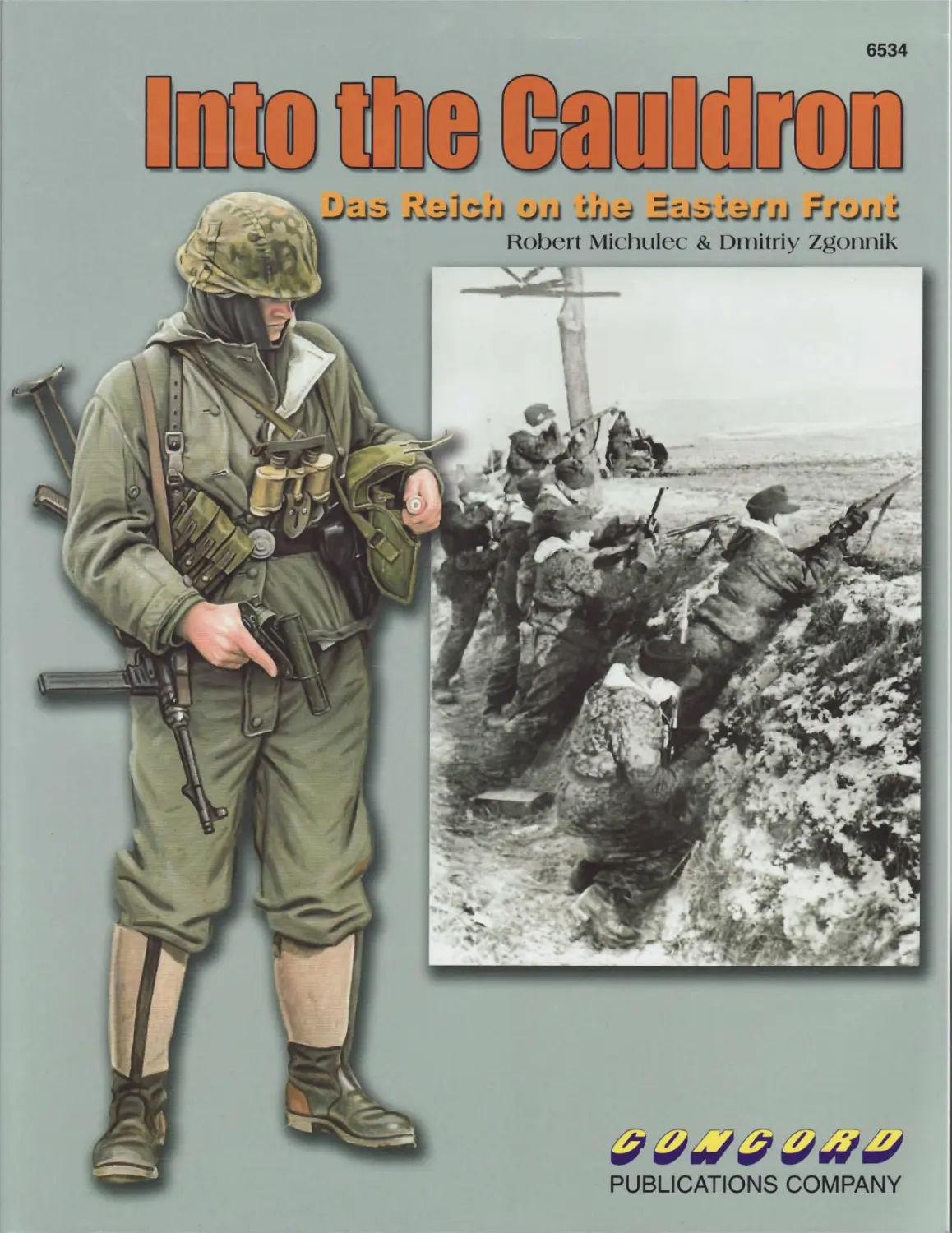
Into the Cauldron
Das Reich on the Eastern Front
Text by Robert Michulec
Color plates by Dmitriy zgonnik
Copyright ©2010
by CONCORD PUBLICATIONS CO.
10/F, Bl, 603-609 Castle Peak Road
Kong Nam Industrial Building
Tsuen Wan, New Territories
Hong Kong
www.concord-publications.com
All rights reserved. No part of
this publication may be reproduced,
stored in a retrieval system or
transmitted in any form or by any
means, electronic, mechanical,
photocopying or otherwise, without
the prior written permission of
Concord Publications Co.
We welcome authors who can help
expand our range of books. If you
would like to submit material,
please feel free to contact us.
We are always on the look-out for new,
unpublished photos for this series.
If you have photos or slides or
information you feel may be useful to
future volumes, please send them to us
for possible future publication.
Full photo credits will be given upon
publication.
ISBN 962-361-170-6
printed in Hong Kong
2
INTRODUCTION
After a long preparation, the “Das Reich” Division moved to the
German-Soviet border, and when German forces finally attacked the Soviet
Union on 22 June 1941. the division moved across the frontier to begin
operations. “Das Reich” was incorporated into 46.Panzer-Korps along with
lO.Panzer-Division and the famous “GroBdeutschland” Division. Almost
immediately it pushed through the central sector of the Eastern Front in
support of Heeresgruppe Mine. It was directed into the Bialystok area, where
the Germans almost straightaway encircled large groups of bewildered Red
Army forces.
Within a month the division reached the area around Yelnia, where leading
spearheads of Heeresgruppe Mitte had slowed. “Das Reich”, along with other
Korps units then fought a series of heavy battles around Yelnia where it
struggled to stem strong and determined Soviet forces. In spite of serious
ammunition shortages and hot daytime temperatures, the SS units were
successful and forced badly mauled Russian troops to finally abandon Yelnia.
However, it was not without serious loss in SS men and equipment, although
Soviet losses were much higher. It was estimated some 20,000 men had been
killed and captured, with 250 armored fighting vehicles and 100 guns
destroyed or captured, as well as about 30 aircraft shot down.
Following the battle at Yelnia, General Guderian pulled out “Das Reich” from
the area and replaced it with Wehrmacht units that would subsequently go on
to suffer just as heavy casualties as their formidable counterparts did. The
fighting around Yelnia had shocked even some of the most hardened SS
soldiers, and the extent of death and destruction that littered the countryside
was an ominous indication of the hard fighting they had ahead of them if they
were going to win the war in the East.
After “Das Reich” had been removed from the area around Yelnia, it spent a
few weeks in the rear recuperating. By the time it saw action again in
September, Heeresgruppe Mitte had pushed deep into Soviet territory north of
the Pripet Marshes, while Heeresgruppe Slid had driven into the Ukraine.
Between these two regions, at least five Soviet armies occupied an area that
had become a large salient extending some 93 miles. The western tip of this
salient was an area surrounding the city of Kiev. For Hitler and his generals,
the area around Kiev was the perfect opportunity to trap 50 or more enemy
divisions and smash them to pieces. To accomplish this grand strategy,
2.Armee and 2.Panzergruppen were to sweep in from the north and take
blocking positions east of the city. From the south. 17.Armee and
l.Panzergruppen were to perform a similar maneuver and link up with the
other two German formations, thus preventing the Soviets from escaping to
the east. Attached to 2.Panzergruppen was the “Das Reich” Division, which
served on the right wing of 24.Korps while it moved southwest and pushed
through the enemy lines.
With nothing but a string of victories behind them by the end of September
1941. Heeresgruppe Mitte was regrouped for the final assault on Moscow,
known as Operation Typhoon. At first the drive to Moscow for “Das Reich”
went well, but by early October the weather began to change as cold driving
rain fell on the troops. Within hours the Russian countryside had been turned
into a quagmire, with roads and fields becoming virtually impassable. All
roads leading to Moscow had become a boggy swamp. The weather
conditions were so bad that even the Panzer units could not support the SS
foot soldiers. To make matters worse, since “Typhoon” had begun,
Heeresgruppe Mitte had lost some 35,000 men excluding the sick and injured.
In spite of the terrible arctic conditions and high casualty rate, on 18
November 1941 the “Das Reich” Division continued pushing forward in a
two-pronged assault. Within a week the SS units had gallantly fought their
way to the River Istra and established a bridgehead. After crossing the river,
“Das Reich” attacked approaching enemy forces and put them to flight. What
followed was a bitter and bloody battle for the town of Istra and the
surrounding area. When the SS finally captured the town, a fully fledged
attack on Moscow began in earnest on 27 November. During this decisive
phase of Operation Typhoon, the “Das Reich” Division seized Yssokova and
soon reported it was closing in on the city. However, after a few days of
continuous heavy losses from combat and the cold weather, the SS units were
becoming steadily ground down in a battle of attrition. By the end of the
month, the “Der Fuhrer” Regiment had lost huge quantities of men and
equipment and the depleted 2.Bataillon assigned its survivors to other parts of
the regiment. “Deutschland” too had also suffered at the hands of strong
Soviet resistance, and its 3.Bataillon had to be broken up.
Despite repeated stubborn attacks by “Das Reich” and its Wehrmacht
counterparts, despair gripped the Heeresgruppe Mitte front as battered and
exhausted troops froze to death in front of the Russian capital. German
territorial gains that winter were limited to a 40-mile belt on the approaches
to Moscow.
The failure to capture Moscow had been a complete disaster for Heeresgruppe
Mitte. Its forces had changed out of all recognition from their victorious
summer operations. The “Das Reich” Division was just one of a number of
German divisions that had been badly mauled by the traumatic events. The
division had lost more than half of its initial strength and could not sustain
such high losses for much longer. By January 1942, Waffen-SS units had
suffered immeasurably at the hands of the Red Army and the bitter winter. In
total some 8,500 had been killed, with another 29,000 missing or wounded.
Yet, in spite of ongoing high casualty rates, the SS soldiers remained
enthusiastic as long as their division was able to perform its usual offensive
actions. But not even the elite units of the SS could defeat the overwhelming
might of the growing Red Army. Its renewed pressure on the German lines
throughout February was enough to cause “Das Reich” further losses in men
and equipment. Thus, it was reluctantly withdrawn from the front before it
was completely annihilated.
During late February 1942, “Das Reich” recuperated and was temporarily
renamed “Das Reich” Kampfgruppen. After receiving 3000 new men to
replenish its battalions, the “Der Fuhrer” Regiment became a Panzergrenadier
unit. By March, the new SS-Kampfgruppen was back in action taking up
positions along the River Volga. For two months “Das Reich” fought a series
of heavy battles and once again was seriously mauled by heavy Soviet
attacks. The “Deutschland” Regiment was almost annihilated by the fierce
unceasing fighting. Luckily for this SS regiment, and indeed the fortunes of
the entire Kampfgruppen, the Soviet counteroffensive abated to allow
German forces along the Eastern Front time to rest and lick their wounds.
Two months later, “Das Reich” returned to Germany to undergo
reorganization and receive yet another name. In November, it became known
as the SS Panzergrenadier-Division “Das Reich”. It also acquired a panzer
battalion containing three companies and Pz.Kpfw.III and IV tanks. In
addition to these changes, the “Der Fuhrer” Regiment now became fully
motorized. The Reconnaissance Battalion exchanged its motorcycles for
Schwimmwagen cars and became l.Bataillon of the newly established
“Langmarck” Regiment.
In November 1942, the “Das Reich” Division and several other formations
moved south and occupied Vichy France. At the end of the year, “Das Reich”
underwent further changes. It received a self-propelled gun battalion
containing three batteries, each possessing seven guns. In addition, the
“Langmarck” Regiment was disbanded. Some of its men were reassigned to
the Panzer-Bataillon, while l.Bataillon resumed its role as a separate
reconnaissance unit.
By December 1942, the division was reorganized as it prepared to return once
more to the Eastern Front to help repel strong Soviet forces in Heeresgruppe
Slid in the Ukraine.
“Das Reich” arrived in the southern sector of the Eastern Front in January
1943. Here it saw extensive fighting against the Soviet 3rd Guards Tank
Army. Near the city of Kharkov its forces maintained a bridgehead between
Volokomovka and Kupiansk on the River Oskol. Weeks later, what followed
was a bitter and bloody battle for the city of Kharkov along with I.SS.Panzer-
Korps. After the city was captured by the Red Army, “Das Reich” and other
premier SS units were assigned the task of its recapture. In early March, the
SS Panzer-Korps, along with “Das Reich”, attacked Kharkov in a savage
battle for possession. By 15 March, the Germans had destroyed the last
3
remnants of the Red Army garrison at a tractor factory just east of the city.
Without spending much time to savor their achievement. “Das Reich" moved
out of the smoldering city and underwent more reorganization and re-supply
in order to compensate for the high losses suffered during the Battle of
Kharkov.
In July 1943. German combat formations launched what proved to be its last
great offensive on the Eastern Front - against the Kursk salient. The offensive,
codenamed Operation Zitadelle, would smash Red Army formations and
leave the road to Moscow open. For this daring offensive, the German force
was distributed between the Northern and Southern groups consisting of a
total of 22 divisions, six of which were Panzer and five Panzergrenadier.
Responsibility for the main attack fell to 9.Armee in the north. There were
some 335.000 soldiers, 590 tanks and 424 assault guns. In the south, the
Germans fielded a much stronger force and concentrated 349,907 troops,
1269 tanks and 245 assault guns. Although it was a formidable assembly of
firepower with 102 Tiger tanks, it was in fact facing an even greater enemy
coupled with almost impregnable defensive belts. In front of the Soviet
defensive fortress stood the cream of all the German combat formations at
Kursk, the premier divisions of the Waffen-SS. In Heeresgruppe Slid these
elite soldiers were deployed for action, ready at a moment's notice to fight
their way through the formidable lines of barbed-wire entanglements,
minefields and antitank guns. Here. II.SS.Panzer-Korps. commanded by SS-
Obergruppenfuhrer Paul Hausser. formed part of 4. Panzer-Armee. The Korps
comprised the three premier Waffen-SS divisions, “LAH”. “Das Reich" and
“Totenkopr. The three divisions had a line strength of 390 of the latest tanks
and 104 assault guns between them, including 42 of the Army Group's Tigers.
At their starting positions, the three SS divisions covered a sector 12 miles
wide. “Totenkopf" occupied the left flank of the advance, “LAH" was in the
center and “Das Reich” held the right.
During the days that followed, the Red Army, despite continuing to incur
huge losses in both men and weaponry, deprived the SS of even tactical
superiority. Against these elite troops they constantly strengthened their
defenses through reinforcement, skillfully deploying mobile armor and
antitank reserves to compensate for their high losses. Within days the
Russians had managed to grind down many of the Wehrmacht units, including
those in the SS.Panzer-Korps. Through sheer weight of Soviet strength and
stubborn combat along an ever-extending front, the German mobile units
were finally forced to a standstill. On 15 July. “Das Reich” made contact with
7.Panzer-Division. However, the Russian offensive to the north of the salient
was now threatening the rear of 9.Armee, and it was forced to begin a planned
withdrawal westwards to avoid encirclement. Following its withdrawal,
almost all offensive action around Prokhorovka ceased and German forces in
the area went over to the defensive. Operation Zitadelle was a catastrophe for
German forces on the Eastern Front. Despite German efforts to batter their
way through, they had neither the strength nor the resources to do so. The
cream of the German Panzer force, so carefully concentrated prior to the
operation, was exhausted, and the Russians had undeniably gained the
initiative in the East. The campaign in Russia would now consist of a series
of German withdrawals with the Waffen-SS fanatically contesting every foot
of the way.
But even as Zitadelle was drawing to a bloody conclusion, II.SS.Panzer-
Korps was not there to see the end of the battle; the remnants of their
exhausted and battered units had already been hurriedly ordered to pull out of
the Kursk area to the relative calm and quiet of Kharkov to wait for new
orders. Before “LAH” departed for Italy, it turned over all its remaining
armored fighting vehicles to “Das Reich”. Both “Totenkopf” and “Das Reich”
were detached from “LAH” and redeployed to the Donetz Basin on 25 July
1943.
On the Eastern Front, the fighting had intensified. The Russians were
determined not to allow the Germans any respite and so launched a massive
attack, overrunning Feldmarschall von Manstein's positions on the River
Mius. Both “Totenkopf’ and “Das Reich” were rushed north to protect
Manstein's left flank. In the southern sector of the Eastern Front, troops
frantically withdrew as strong Russian forces smashed through the Mius
defenses and advanced at breakneck speed towards Stalino and Taganrog.
along the northern coast of the Sea of Azov. Although SS troops of “Das
Reich” and “Totenkopf' distinguished themselves with bravery, they could
only manage to stem the Red Army for short periods of time.
Throughout the ominous weeks that followed, the German frontlines were
pulled further westwards with “Das Reich” defending, attacking and
counterattacking as the situation demanded. A number of the battles fought in
this sector of the front were owing to the efforts of the SS. but it came at a
high price in blood.
During the winter of 1943-44, a feeling of despair and gloom gripped the
German frontlines. In the “Das Reich” area of operations, the division also
fought well and with distinction to prevent the Russians from marching across
the western Ukraine. However, the unrelenting fighting had proven to be more
than even “Das Reich” could endure. Consequently, by December 1943. it
was no longer capable of carrying out the tasks given to a full-strength
division, and orders were issued to create a Kampfgruppen from the units still
fit for action. On 17 December, the Panzer Kampfgruppen was constructed
out of Panzergrenadier-Regiment “Das Reich”. The Kampfgruppen consisted
of I.Bataillon “Deutschland” and 2.Bataillon “Der Fiihrer” Regiments. Two
companies constituted the Panzer-Bataillon “Das Reich”, and also on strength
were the reconnaissance battalion, artillery. Nebelwerfers. pioneers, a heavy
infantry-gun company and two self-propelled gun companies. The strength of
Kampfgruppe “Das Reich”, as it was now called, would remain on the Eastern
Front while the remaining elements returned to Germany for a refit.
In January 1944, “Das Reich” was rushed to what became known as the
Korsun Pocket where more than 30,000 Wehrmacht troops were trapped.
They were among the rearguard units, holding fast while the bulk of the
encircled troops made good their escape. “Das Reich” suffered heavy losses
as a result of their self-sacrifice, and out of 5000 soldiers sent to the area,
some 1121 of all ranks were killed in action. In spite of the huge losses in men
and equipment, some 33,000 German troops escaped with their lives. Another
major disaster had been averted in southern Russia. The distinguished
performances of the Waffen-SS had once again further increased its
reputation as the foremost fighting machine on the Eastern Front. Following
the breakout in the Korsun Pocket, the “Das Reich” Division, now totally
depleted with most of its armor lost in battle, was withdrawn from the front
and sent to France for rest and refitting. A Kampfgruppen from the “Das
Reich” Division under the command of SS-Oberfiihrer Heinz Lammerding
remained in southern Russia to continue German attempts to try and hold
back the Red Army.
In April 1944, a battered and badly depleted “Das Reich” was withdrawn
from the front and sent to the West for resting and refilling. Of the 2500
soldiers of the “Das Reich” Kampfgruppe, only around 800 soldiers reached
Toulouse in the southwest of France to rejoin the rest of their division.
In January 1945, “Das Reich” saw action once again on the Eastern Front, this
lime in Hungary. The division had just arrived straight from the Ardennes
offensive, but it was not the same mighty SS combat formation that had
fought previously in the East. “Das Reich” doggedly defended its ground, but
it was slowly engulfed by superior Soviet forces. By 2 April, the Russians had
reached Lake Neusiedler on the border between Hungary and Austria, and
two days later the last German defenders had been finally driven out of
Hungary. Of the Waffen-SS divisions that had fought in Hungary, the bulk of
them withdrew into Austria to defend Vienna. “LAH” and “Das Reich” were
put into the line to defend Vienna, before withdrawing into the city and
becoming involved in bitter fighting. However, by 13 April, the Red Army
marched into the city. By this period of the war, the bulk of the premier
Waffen-SS divisions were carrying out a fighting withdrawal through
Hungary and Austria. In May, scattered into separate battle groups, “Das
Reich” disbanded along with all the other Waffen-SS formations. Although
“Das Reich” had all but been destroyed, in the eyes of the SS soldiers that
marched into captivity, they had laid down their arms in the sound knowledge
that no military formation in history had achieved more. They had battled
across half of Russia, had shown their skill and endurance at Kursk and
Kharkov, and gone on to protect the withdrawal of the rest of the German
Army to the very gates of Berlin and beyond.
Prior to the invasion of Russia, an SS heavy weapons section is
seen during a training exercise armed with a 7.5cm le.lG 18 gun.
In order to help conceal the weapon in open terrain, the gun’s
splinter shield has been camouflaged with foliage. The men
exhibit an excellent display of infantrymen’s combat equipment.
A web battle pack carrier is attached to their Y-straps, as are the
mess kit and shelter quarter. Note that all the infantrymen have
the earlier type of camouflage straps around the M35 steel
helmet. These were eliminated in 1940, but troops were still
seen wearing them during the opening phase of Barbarossa.
One of the “Das Reich" motorized infantry Kompanies at
a funeral ceremony at a barracks in early 1941. An Opel
Blitz cargo truck can be seen behind the line of SS. The
tactical markings painted in yellow on the vehicle’s left
fender indicate it belongs to a motorized infantry
company.
5
Troops rest after motorcycle training at a barrack in 1941. All the motorcyclists are wearing SS camouflage smocks. As with the majority of motorcyclists, the
gasmask canister is being worn on the chest instead of the back. They wear standard-issue infantryman’s equipment and weapons, including the SS enlisted
man’s leather belt, and rifle ammunition pouches for the Karabiner 98k rifle. They wear SS field-gray service trousers tucked into long-shaft marching boots.
A group of SS motorcyclists during a training exercise in Germany prior to the Russian invasion. They wear the familiar motorcycle rubberized waterproof
coat called a Kradmantel. The tail of the coat could be gathered in around the wearer’s legs and buttoned in position to allow easier movement while on the
motorcycle. Note the tactical sign of the unit, or unit markings, with motorcycle troop number “21” painted on the motorcycle combination.
One of the last parades before leaving barracks for deployment on the
Polish-Soviet border in the spring of 1941. Their clean-cut appearance with
no field equipment is a familiar occurrence during parades of this nature.
A pause during maneuvers, probably in Germany in early 1941 prior to
transportation of the SS-Korps to Poland for the invasion of Russia. Here we
have an interesting photograph of a Zundapp K500 with sidecar in the
foreground. The motorcycle has the SS license plate “11144”.
A four-barreled 2cm FlaK38 anti-aircraft gun manned by an SS crew. This
lethal weapon had a very impressive rate of fire of 1800 rounds per minute,
and was effective against all kinds of targets up to 3000m away. It was a
valuable weapon for frontline units protecting troop and vehicle
concentrations against low-flying aircraft. The weapon was issued to Waffen-
SS flak units in 1941, when the first flak battalions of the SS divisions were
created, including those of “Das Reich”, in May 1941.
SS troops crossing the Russian frontier marked with a border stone. In the
early morning of 22 June 1941, Operation Barbarossa began with the “Das
Reich” Division’s Artillery Regiment - along with many other German
batteries arrayed along the demarcation line - opening fire, laying bare the
frontier and smashing through the thinly held border.
Troopers of a heavy weapons platoon equipped
with various infantry equipment and ammunition
enter one of the first Russian villages along the
border with Poland. The “Das Reich” Division
did not participate in the initial ground assault
across the River Bug, but spent most of the first
week of the invasion in the east directing traffic
along a line of advance established for
2.Panzergruppen.
7
Troops during a pause in the fighting. A Soviet Maxim heavy machinegun is seen here affixed to an anti-aircraft tripod captured by “Das Reich” close to a
truck that has received some camouflage. Note the weapon’s circular “net" gun sight, and the ammunition belts wrapped round the machine-gunners torso.
SS troopers clearing the battlefield of Soviet stragglers during the initial stages of Barbarossa. Both the soldiers are armed with Mauser Kar98k bolt-action
rifles with fixed bayonets. Note that they have full field equipment but no Y-straps. All the equipment has been attached to the standard SS infantryman’s
black leather belt.
8
A group of Soviet soldiers has surrendered and a wounded Russian can be
seen lying between them. A stationary SS Ziindapp motorcycle combination
is being used to help clear the local area of Russian POWs. Of interest is the
large tire on the front of the motorcycle, which has been fitted to give better
durability for driving across the poor Russian road system.
SS motorcycle combinations being used to collect a group of Soviet soldiers
during the summer of 1941. During the initial stages of the campaign, many
POWs were usually taken by reconnaissance troops, often by motorcyclist
units. Many Soviet troops, however, were not taken into captivity and were
simply murdered on the spot by the SS.
More POWs are taken into captivity, their fate unknown. All the Soviet troops
are fully equipped, and one soldier is carrying a spade generally used by
engineer troops. As the “Das Reich” Division moved across the Beresina and
Dnieper Rivers, capturing more Russian soldiers as it advanced, SS troops
were gradually confronted by scattered Soviet troops that harassed the
Germans by staging ambushes and then melting into the countryside.
A young SS rifleman
accompanies Soviet
prisoners, including a
wounded soldier, to the
rear area. The SS
soldier has no Y-straps
and only one set of
ammunition pouches for
his Kar98k rifle. A
binocular case is
attached to his main belt
with goggles, which may
indicate he belongs to a
motorcycle unit. For
close-quarters contact
with the enemy, the
infantryman has fixed
his bayonet to his rifle.
9
Two photographs taken in sequence showing “Das Reich"
infantrymen penetrating a river somewhere in Russia in
1941. An officer holding the rank of SS-Untersturmfuhrer can
be seen, probably the commander of the troop, whilst in the
other photo, infantrymen with field equipment can be seen
moving through the shallow water of the river.
“Das Reich” troops inside a forest with their trucks. The
vast distances in the Soviet Union took their toll on men
and machines alike, while supply problems even during
the early stages multiplied with every mile.
A propaganda photograph showing an SS PaK35/36 gunner
smiling for the camera during the early stages of the
campaign in the East. The PaK35/36 gun was the standard
weapon of SS division tank-destroying battalions in the
summer of 1941. The photograph illustrates an excellent
study of a Waffen-SS camouflage smock and helmet cover,
which has an unusual printed pattern and appears to be
between the “oak leaf” and “plane tree” patterns.
IO
A light MG34 machinegun team with their weapon positioned on a bipod beneath a railroad wagon. Note how the soldiers’ camouflage smocks have faded
in color due to continual exposure to the sun, dirt and washing.
A “Das Reich” ZOndapp K500 motorcycle combination at a workshop in the
autumn of 1941. The registration plate “SS 86017” is visible on the front
mudguard, and the company’s named is stamped on the frame of the
motorcycle.
A BMW motorcycle unit of “Das Reich” struggling to move its vehicle along a
typical Russian road. After a heavy downpour of rain, the roads in Russia
quickly turned into quagmires that made movement, especially for wheeled
vehicles, very difficult.
11
A “Das Reich” Krupp Protz light truck is being pushed by its crew along a
muddy road. During “Das Reich’s” advance, roads became increasingly
scarcer, and those that were used by the marching column were often in
terrible condition, which in turn exacerbated transportation problems.
A photograph taken probably during the drive on Moscow in the late autumn
of 1941. Here Waffen-SS troops, one wearing a camouflage smock and the
other a standard greatcoat, are digging a trench inside a forest.
Troops huddle around an open fire during a break in the arduous job of
digging a trench in freezing Russian temperatures. Digging trenches would
soon become a matter of life and death for the Waffen-SS and their
Wehrmacht counterparts. Digging was essential owing to massed Soviet
artillery and air attacks.
An MG34 light machine-gunner in late 1941. Several weeks after the start of
Barbarossa, the wet weather turned to snow and prevented the German war
machine from taking Moscow. This machine-gunner is still wearing the
standard greatcoat worn universally throughout the German Army during this
period. The Soviets, not surprisingly, were far better prepared for the cold
months of 1941 and 1942. As natives of the area, many were already
accustomed to the inhospitable climate and knew in advance how to dress
for it.
12
> •
in the Russian winter
a new type of winter
this time completely

The crew of a captured Soviet 47mm M1930 antitank gun being towed by an open
Kfz.4 heavy personnel carrier. The PaK crew is moving to the front and has taken a
rest break, called a Feuerpause (firebreak). This was the normal term used by the
Germans for a ceasefire, but it also signified a rest break.
An interesting view of an SS
PaK35/36 crew guarding the
entrance to a Russian village in
the winter of 1941-42 during a
heavy snowfall. None of the
soldiers has received proper
winter clothing and their gun still
retains its old gray camouflage
scheme.
A patrol
presents
uniform,
improvised in the division’s
workshops. The soldier nearest
to the camera is wearing a
sheepskin greatcoat made
during the winter of 1941-42.
The soldier has also improvised
a woolen toque around his head
under the standard SS field cap
or FeldmOtze. The troops
behind him all wear the standard
field-gray greatcoat. Their field
equipment is stored on Russian
sleds.
13
“Das Reich” troops
wearily make their way
across the snow using
sleds pulled by draught
animals. This method
was vital for
transporting supplies
needed for continuation
of the war in
Heeresgruppe Mitte.
Note the horse fodder
attached to the sides of
the sleds.
“Das Reich” radiomen in a forest with a Tornisterfunkgerat Ы (Torn. Fu. Ы
(S/E), or “pack radio”. These portable radio sets were widely used on the
Eastern Front and were carried by radiomen in two parts on specially
designed backpack frames.
“Das Reich” ZOndapp K500 motorbikes struggling along a winter road in
1942. Of special interest is the license plate on the mudguard, which is very
unusual. Like most others divisions, “Das Reich” also lost much of its mobility
equipment due to logistic problems and the harsh Russian weather.
A fine study of the very first German white camouflage winter uniform
supplied to SS troops in Russia, which was provided to the “Der Fuhrer”
Regiment in early 1942. The simple, light tunic in white camouflage material
was produced to cover upper parts of the soldier’s body during frontline
combat. It was worn over the whole uniform. Note the piece of white material
over his M35 steel helmet.
Troops remain under cover lying down in the snow on a
steep gradient as they prepare to attack. They are all
wearing the two-piece snowsuit consisting of a white
jacket and white trousers. With Red Army forces wearing
similar clothing, frontline German troops were issued
with colored arm bands for use on their winter clothing.
This enabled them to distinguish friend and foe. Note the
two radio operators that have set up their TornFud 2
radio set.
An antitank gunner with his
well-concealed 5cm PaK38.
Snow has been built over the
gun’s splinter shield, and white
sheeting has afforded additional
camouflage by being laid over
the barrel of the gun. Out in
large open spaces, troops
utilized whatever means they
could muster to conceal their
weapons and ultimately have
an edge over their opponents.
Antitank gunners in a dug-in
position with a 5cm PaK38.
Note the identification stripe,
which is probably in green, that
helps distinguish them on the
battlefield as friend or foe. They
are all wearing whitewashed
M35 steel helmets that offer no
kind of protection from the cold.
15
A photograph taken the moment an SS antitank crew fired their 7.5cm PaK97/38 antitank cannon against an enemy target. The PaK97/38 was a very rare
weapon in the SS units in which it served, but gunners did find the weapon very effective and it was widely liked. The troops are wearing camouflage smocks
printed in the “plane tree” pattern.
A medic troop’s command staff
car, as indicated by the tactical
sign painted on the left fender.
The vehicle is from “Das
Reich’s” motorized infantry
regiment, and it has halted in a
field.
16
A staff car from a “Das Reich” staff
unit in the early spring of 1942. The
vehicle has received an application of
brown-gray camouflage. Painted in
white on the rear of the vehicle is the
letter “G”, indicating it belongs to
Panzergruppe Guderian, which
operated in Heeresgruppe Mitte.
Two posed photographs taken in sequence showing a staff vehicle of the motorized infantry unit’s command. The letter “G” painted in white is clearly identified
on the rear of the vehicle. Next to it painted in yellow is “Das Reich’s” divisional sign of a Wolfsangel. The tactical marking of a motorized regiment is painted
in red.
A column of staff vehicles leaving a parking area
by a staff building somewhere in Russia. Note
the width markings painted in white on the
fenders of the vehicle. The car’s registration
plate is “SS 86072”.
17
A long column of SS staff cars in Heeresgruppe Mitte struggling along a
muddy road in Russia'during the early spring of 1942. Note the second car
from the left. This is a Chevrolet limousine that has been pressed into service
by the German Army. It has been repainted in dark gray and is covered with
mud. The car is equipped with an improvised Notek light installed on a guard
in front of the radiator. Behind the Chevrolet, a standard medium personnel
carrier follows.
A fully loaded heavy 6-ton MAN or Bussing truck stacked
with soldiers’ belongings has halted on a railroad platform in
preparation for transportation on a specially built railroad
flatcar.
SS troops loading their vehicles on railroad cars. One of the
quickest methods of transporting vehicles from one part of
the front to another was by rail. Both the SS and their
Wehrmacht counterparts used rail extensively throughout
Close-up of a Chevrolet limousine staff car with SS officers and NCOs.
the war in Russia.
18
Dinner is served from an Opel Blitz truck aboard a flatbed railway car. This
photograph was more than likely taken prior to disembarking to the frontline.
A well-decorated SS NCO on horseback after returning from the front in
Russia. Pinned to his left tunic are a wound badge and a decoration for
close-range combat. He is wearing parade gloves, and beneath his tunic he
is wearing a civilian sweater. The NCO cap is the later field type.
A 7.5cm PaK40 guarding a position on the outskirts of a Russian village. The
gun has crudely received an application of winter whitewash paint. The
gunner has improvised his dug-in position by trying to conceal the general
outline of the gun’s shape by placing chunks of snow over the lower front part
of the gun piece.
An SS defensive
position inside a snow-
covered village. A
7.5cm PaK40 gun crew
is seen waiting for
orders to fire. They all
wear winter reversible
uniforms with the gray
side out. Unusually, the
gun still retains its
summer camouflage
scheme and no attempt
at camouflaging the
weapon has been made
except for white
sheeting wrapped
around the barrel and
wheel. This piece is
quite exposed.

19
Panzergrenadiers being transported in a number of Sd.Kfz.251 halftracks across the vast steppe covered with snow and the bodies of dead Soviet soldiers.
The halftrack with a frame antenna is a command vehicle.
Two shots showing soldiers
from the SS-Panzergrenadier-
Division “Das Reich” entering
Kharkov in March 1943. Light
MG42 machine-gunners
advance into the city wearing
the famous SS parka jackets
that were issued to troops just
before they left France for
Russia in January 1943. For
these soldiers it was a savage
battle for possession of the city.
Constantly they encountered
stubborn resistance.
20
An SS soldier armed with an MP40 machine pistol escorts captured Russian troops from
a demolished building during bitter fighting inside the city of Kharkov in March 1943.
Although the Russians within Kharkov still had superiority in numbers and firepower,
within a few days of the battle they had become disorganized, demoralized and worn
down from continuous fighting.
A famous photo of SS-Panzergrenadier soldiers in Kharkov
fighting for the city. The Unterscharfiihrer is armed with an MP40
machine pistol and his uniform is typical of this period - his
formation battledress is composed of winter reversible trousers,
a field-gray parka fur jacket and felt boots. He is wearing a shirt
and sweater beneath his uniform. Next to the grenadier is a PaK
gunner wearing the parka white side out.
Crudely whitewashed Sd.Kfz.250/10 halftracks armed with 3.7cm PaK35/36 guns. These light armored vehicles are from a reconnaissance battalion of the
“LAH” Division, and are advancing along a rubble-strewn street in Kharkov following its successful capture. “Das Reich” fought for Kharkov alongside the
“LAH” and “Totenkopf” Divisions.
2 1
damaged.
At least a dozen Schwimmwagen vehicles from a reconnaissance
battalion of “LAH” in Kharkov. The vehicles still retain their standard gray
paint and have not received an application of winter whitewash
camouflage. On the rear, the vehicles carry a full set of markings
including a tactical sign for a motorized reconnaissance unit, and a
divisional emblem painted on the right.
Germans in fresh reversible winter uniforms are ready to be transported
on a heavy halftrack prime mover that has received a full application of
winter whitewash. All three soldiers are wearing woolen toques, typically
worn to protect the head from the freezing temperatures.
When properly
emplaced and fully
camouflaged, even a
weapon as large as an
8.8cm flak gun could be
difficult to spot. Here in
this photograph a
whitewashed 8.8cm
FlaK36/37 gun is
positioned by a building
during a lull in the
fighting. One of the
gun’s limber wheels
appears to be
22
ti
A group of soldiers in
winter uniforms on the
frontlines inside a
forest. They wear
reversible padded
winter suits typical of
SS combat troops
during this period of the
war. The colored
armbands being worn
by the troops can be
clearly seen.
Assault troops move
along a trench. They all
wear two-piece
reversible camouflage
suits, and carry
ammunition boxes for
their Kar98k rifles. The
soldiers’ colored
armbands can just be
seen on their left arms.
The colors of the bands
would be changed on a
daily basis, as would
the arm on which they
were worn.
23
Two photographs of a 2cm FlaK38 Flakvierling mounted on a Mercedes-Benz L3000 truck. Note the registration plate and white road markings that were
used until 1943. This particular flak gun was normally served by an eight-man crew. These quadruple weapons were much respected by low-level enemy
pilots and were devastating against light vehicles, as well as troops caught in the open. (MK photo)
Members of “Das Reich” during a break in a march stand
next to a 1.5-ton staff truck displaying the tactical sign of a
motorcycle battalion. The troops wear a collection of old- and
new-type uniforms consisting of field-gray overcoats and
standard Feldmutze. The officer is wearing a new-type parka
jacket and felt boots.
24
SS-Obersturmfiihrer, "Das Reich",
Eastern Front, Winter 1942-43
zgonnik
Following the first terrible winter of 1941-42 in. Russia, the
Wehrmacht and Waffen-SS received a more practical
winter uniform developed due to the inadequacies of
standard-issue winter clothing. It was in the autumn of 1942
that better winter clothing was provided for troops, this
consisting of the hooded jacket, trousers, mittens, hooded
toque and felt winter boots.
This SS-Obersturmfuhrer operating on the Eastern Front
during the winter of 1942-43 offers a typical
image of a Waffen-SS soldier during this cold
period of the war. He wears a reversible
winter suit with the gray side outermost. He has
his jacket open slightly, exposing part of the
reversible white side. He is also wearing a
toque to protect his neck, face and head
from the extremely cold conditions. His M42
steel helmet cover still retains a summer
camouflage scheme and no attempt has yet
been made to alter its appearance, probably
due to the fact there is no snow and the terrain still
shows traces of greenery.
As part of his winter gear he wears felt leather boots.
Under his padded uniform is the standard-issue wool
uniform.
As an SS-Obersturmfiihrer, he is armed with a 9mm MP40
machine pistol and carries the relevant issued equipment
for this purpose - MP38/40 magazine pouch. Attached to
his black leather infantryman's belt is a holster for an M42
flare pistol. Around his neck he wears a pair of 3x30
binoculars. In his right hand he holds an M42 flare pistol,
and with his left hand he is removing a cartridge from the
canvas case in order to fire it.
25
ZG-QNKlW
SS-Sturmann, "Das Reich",
Eastern Front, Spring/Summer 1943
This SS-Sturmann presents a typical image of the Waffen-SS
during the spring and summer of 1943, whilst
operating on the Eastern Front.
Like the distinctive helmet cover, the camouflage
smock was now common apparel for combat troops.
He wears an M42 camouflage smock. This M42 type of
smock differed from the early types in many ways, having
a higher elasticated waistband, sets of foliage loops on the
upper arms and body, and skirt pockets with buttoned
flaps. His trousers are field-gray and are tucked into his
4 . high-topped leather marching boots.
0
His personal equipment consists of the enlisted man's
leather belt. Ml939 leather infantry support straps, and a
canvas bag containing 7.62x25mm ammunition for his
captured Soviet PPSh-41 (Pistolet-Pulemyot Shpagina)
submachine gun.
26
SS-Oberscharfuhrer, "Das Reich",
Spring/Summer 1944
This Panzer commander belongs to an unidentified
armored unit in the "Das Reich" Division during operations
in the spring or summer of 1944. He is wearing a distinctive
two-piece Ml944 dot-pattern camouflage tunic with
matching trousers tucked into a pair of standard lace-up
ankle boots. Beneath his tunic he is wearing a dark gray
shirt and tie, which was common for officers during this
period of the war.
His Panzer enlisted man's/NCO's Ml943 black wool field
cap was issued to tank crews. This headgear was
standard after 1943, and became almost universal as
heavy casualties were replaced by men who
' received it as original issue. Over his Ml943 panzer
cap he is wearing an older pair of Dfh.b (Doppel-
ч Ferhohrer Model B) headphones. These have a
leather-covered sprung-metal headband,
adjustable earpieces for comfort, and large rubber
S ear-pads that served as both padding and to block
* out unwanted noise.
| Attached to his black leather infantryman's belt is
£ | his 9mm P38 hard-shell leather holster. Around his
neck he wears a pair of 3x30 binoculars.
J
27
SS-Untersturmfuhrer, "Das Reich",
Eastern Front, Summer 1944
By the summer of 1944, Waffen-SS troops began
demonstrating a diverse appearance in uniform. Various
types of SS uniforms were worn that gave a multitude of
looks to the individual soldier. This SS-Untersturmfuhrer
typifies one of the many diverse uniforms of the Waffen-SS,
notably "Das Reich", during the late period of the war.
ZGONHt
Over his field blouse he wears the M44 (dot-pattern)
camouflage drill jacket. The camouflage drill jacket
was manufactured as a replacement for the
camouflage smock late in the war. Normally this
M44 camouflage drill jacket came with a pair of
(dot-pattern) camouflage drill trousers. However,
this officer has not been issued with them and
instead he wears a standard pair of gray
officer service trousers tucked into a pair of
officer boots.
His headgear, an Ml938 field cap, indicates he
is an officer. It is manufactured in the original style
with a peak covered in cloth as the crown. His cap
has white piping and displays the national eagle
motif and death's head badge.
His woolen field-gray service uniform consists of the
M42 SS field blouse with an SS rune collar patch and
rank collar insignia.
He is armed with a 9mm MP40 machine pistol. His
personal equipment consists of the Ml939 leather
infantry support straps, SS enlisted man's belt, M35
report/map case, and a pair of 6x30 binoculars.
28
A well-dug-in 5cm PaK38. The PaK38 was the first antitank weapon to be produced as full-sized artillery. Although these antitank guns proved deadly during
the early part of the war, German gunners soon realized they required something more potent to counter the growing menace of Soviet armor.
In a well-concealed dugout, Waffen-SS radiomen can be seen with their Torn. Fu. B1 S/E radio in the winter of 1943. These widely used portable radios were
carried by a soldier on a specially designed backpack frame, and when connected to each other (upper and lower valves) via special cables, they could be
used on the march.
29
SS troops with their 8.8cm gun wait for orders to fire. The gun has been positioned in a parapet, which was quite common, especially in a defensive position
where the flak crew remained for some considerable time. (MK photo)
SS officers can be seen standing next to a Fieseler Fi156 Storch that
displays a German civilian registration number. A wounded passenger is
being secured in the aircraft’s fuselage on a stretcher.
A soldier in a relaxing atmosphere plays the accordion during a pause in the
fighting in the early spring of 1943. He is wearing the standard SS Feldgrau
blouse over a non-regulation German military blouse. Note the low-visibility
SS patches made of Feldgrau collar runes, which are different from normal-
issue white rank patches.
30
SS officers tuck into their rations during a break in their march. This photograph was probably taken in the early spring of 1943 when the “Das Reich” Division
underwent further reorganization and re-supply to adjust for the losses suffered during the fight for Kharkov.
Three photographs showing newly formed SS squads prior to operations in
the early summer of 1943. A number of troop leaders can be seen armed with
MP40 machine pistols. Just prior to Kursk, SS divisions covered a sector that
was twelve miles wide. “Das Reich" held the right flank, “Totenkopf" the left
flank, whilst “LAH” was in the center.
31
An SS officer trains new conscripts near the frontline prior to the Kursk
offensive. The SS man is more than likely explaining to young recruits the
dangerous effects of splinter fragments from trees. (MK photo)
The rarest type of SS
combat troops was the
pioneer detachments
that were given the task
of mine-clearing. Here
in this photograph, a
soldier is using a mine
detector to ensure the
area is clear of mines to
allow movement of
forces to their allocated
jump-off points for the
Kursk offensive. (MK
photo)
One of the rarest SS vehicles to be seen on the
Eastern front was the Tatra Model 57K. It was
produced in the Czech Protectorate primarily for
Waffen-SS and police units, and 6000 of these
vehicles rolled off the assembly lines for
operations on the Eastern Front. (MK photo)
32
Operation Zitadelle is unleashed and two photographs show an armored battle group (Kampfgruppe) of the Waffen-SS advancing across a field. A variety of
vehicles, including self-propelled guns and infantry carriers, light Sd.Kfz.250s and heavy Sd.Kfz.251s, sweeps across the vast open terrain. By the afternoon
of the first day of the attack, “Das Reich” had achieved all its objectives.
33
SS soldiers march
forward at Kursk with
ammunition and full
equipment. Although
the division made
considerable progress,
its troops could not
dislodge Soviet forces
occupying defenses
because	poor
conditions and
minefields prevented
SS tank and self-
propelled artillery units
from reaching the area
and providing coverage
for the grenadiers.
Here a battery of 15cm Nb41 weapons are fired in succession against Soviet
targets during Kursk. Because of the back-blast, these deadly weapons were
fired remotely by the crew using an electrical detonator attached to a cable
that ran to the piece.
Supported by Tiger tanks, SS soldiers push forward to accomplish their next objective. A troop leader can be seen raising his arm to spur his men quickly
forward. By 8 July, the focus of the battle had shifted to the southern sector of the front. “Das Reich” had fought courageously in spite of heavy losses.
34
Two photographs taken in sequence showing SS soldiers passing a knocked-out T-34/85 tank in a field. It is burning after receiving a direct hit from antitank
fire. An NCO running away from the exploding vehicle is armed with an MP40 machine pistol.
A StuG.III Ausf.G advances along a road during the Battle of Kursk, passing
a knocked-out T-34/76. Foliage has been applied over the vehicle in order to
try and conceal its distinctive shape from aerial detection. Note the additional
armor plating bolted to the front of the vehicle. The StuG belongs to the “Das
Reich” StuG-Abteilung, which was added to the division in 1943.
A gun crew with their heavily camouflaged 7.5cm PaK40 gun is dug in during bitter fighting against strong Soviet positions. A Pz.Kpfw.lll Ausf.J armed with
a 5cm L/42 gun passes a group of antitank gunners wearing the “oak leaf” and “palm tree” pattern camouflage smocks. One soldier on the left, however, is
wearing an early-style “palm” pattern camouflage smock.
35
More SS troops pass another knocked-out T-34 during the Battle of Kursk. Both men are armed with Kar98k bolt-action rifles and carry a complete
infantryman’s kit. Of interest is the soldier wearing new-issue camouflaged trousers printed in the “pea” pattern.
A 7.5cm РаК40 sited in a cornfield. The contrast between the
dark camouflaged gun and the SS camouflage smocks can be
clearly seen in this photograph, making the crew possible targets
for both enemy ground and aerial attacks.
' " ' w
rar *
Ж..	.	2 AjgXЖ
.wk; 1.. &
A file of troopers approaches enemy lines across a killing field with the
support of StuG and Pz.Kpfw.lll combat vehicles. “Das Reich” played an
important part in the Kursk struggles and won many successes, gaining
ground and destroying large numbers of enemy forces.
36
A StuG.III Ausf.G assault gun in a sunflower field passes a group of well-dug-in SS Panzergrenadiers. The assault gun has obviously been embroiled in some
heavy fighting as it has lost some of its armored side-skirts. The vehicle is finished in a dark sand color, and has a textbook camouflage scheme of green
and brown patches applied over the whole of its armor, including the barrel and side-skirts.
Soldiers from a “Das
Reich” StuG-Abteilung
unit watch as their
StuG.III Ausf.G assault
gun is towed out of the
mire by a heavy
Sd.Kfz.9 prime mover
and another StuG.III.
37
Supported by a Bison self-propelled gun, Waffen-SS
troops hold a position. Coming into service during 1943,
the Bison mounted a powerful 15cm S.IG33 infantry gun
on the well-proven chassis of the Pz.Kpfw.38(t). These
powerful vehicles were assigned to heavy infantry gun
companies of Panzergrenadier regiments.
SS assault troops prepare to go forward into action. At Kursk, due to the vast
open areas, soldiers were constantly exposed to hostile fire, and this
increased casualties drastically, especially among Waffen-SS units.
A line of infantrymen marches to a new position supported by StuGs and
Panzer somewhere in the Ukraine. The battle groups that supported the
armored advance had such a vast expanse of terrain to cover that they
constantly became over extended as a result.
38
An SS mortar crew
firing a round from a
5cm leGrW 36 mortar.
This light and highly
portable weapon
designed primarily for
infantry platoons, was
unable to contain the
overwhelming enemy
due to its inaccurate
firing.
A Waffen-SS soldier can be seen in an armored Sd.Kfz.250 reconnaissance
vehicle during a reconnaissance mission along the frontlines. Used by
reconnaissance battalions (Aufklarungs-Abteilung) of Panzer divisions, the
type performed well enough in countries with good road networks like those
in Western Europe. However, on the Eastern Front and in North Africa, this
class of vehicle was hampered by its relatively poor off-road performance.
The Sd.Kfz.250/9 was an Sd.Kfz.250 fitted with the same turret as the
Sd.Kfz.222.
An MG34 position in
hilly terrain, probably
somewhere in the
southern Ukraine. The
MG crew is wearing the
printed “palm tree”
camouflage smock. In
fluid tactical situations,
the MG34 in a light
machinegun role could
easily be pushed
forward and used either
in open ground, built-up
areas or forests.
39
A column of “Das Reich” vehicles, probably part of the divisional Panzerjager-Abteilung, travels across hilly terrain somewhere in the southern Ukraine. The
leading vehicle is an Sd.Kfz.10 towing a 7.5cm PaK40. The whole battalion was rearmed with 7.5cm guns during the summer of 1943, and one of the
companies used self-propelled guns on a tracked chassis.
SS troopers escorting Soviet
POWs to the rear during the
summer of 1943. Note the
soldier on the extreme right; he
is equipped with an M41
flamethrower, which was a very
effective weapon against targets
at close ranges.
An SS soldier armed with an
MP40 of the SS-Korps poses
for the camera after being
decorated with an
Eisernenkreuz during the
summer of 1943. Behind him is
a stationary Sd.Kfz.251. Note
the track links attached to the
vehicle’s front glacis in order to
increase its armored protection.
Painted in white on the side of
the vehicle is the name
“Bussard”. (MK photo)
40
к well-camouflaged observation post for the unit’s staff
during the summer of 1943. Troops can be seen cooking
food in front of a well-concealed radio vehicle covered
with straw. The soldiers are partly wearing the new SS
uniform that was introduced in mid-1943; it was
composed of a tunic and trousers made of drill material
and it was printed in a “pea” pattern. The new uniform
was produced to replace the standard field-gray uniform.
Two SS soldiers. The man on the left holds the rank of an SS-Sturmann, whilst the one on the
right is an Unterscharfuhrer. The soldier on the left wears the standard Feldgrau uniform with a
camouflaged M43 field cap. His comrade on the right wears the “palm tree” smock and
camouflaged M43 field cap. Both are armed with the Mauser Kar98k rifle.
Sacks of mail stamped “German Reich Post” and
containing personal letters and parcels from wives and
loved ones are delivered to the front from a vehicle. For
every soldier on the Eastern Front, receiving mail from
home was often a morale booster and a good incentive,
when so many men were missing home.
An SS mortar section in “plane tree” smocks marching through a forest. The crew is carrying the
very effective and highly mobile 8cm sGrW 34 mortar, which included the weapon base-plate,
barrel and mount.
Waffen-SS radiomen with their portable Torn. Fu. B1 S/E radio pack
in a dug-in position during the late summer or early autumn of 1943.
Note both the upper and lower valves of the radio, which are linked
via special cables.
A light MG42 crew in position is preparing to go into action. Both
soldiers wear the Zeltbahn printed in “oak leaf” camouflage over their
field-gray woolen shirts only.


42
The crew of a Nebelwerfer 42 (NbW42) is preparing to fire this deadly weapon against an enemy target. This weapon was introduced in July 1943 and was
issued to the Waffen-SS only in small numbers during this period of the war.
In the winter of 1943, SS staff vehicles still retaining their summer
camouflage schemes can be seen halted in the snow. On the left is a staff
bus built on a light Mercedes truck chassis, whilst the vehicle parked next to
it is an old Kfz.4 Horch heavy personnel carrier.
A group of SS soldiers wearing their distinctive parkas takes
cover in a ditch supported by a pair of Pz.Kpfw.IVs. “Das
Reich", along with other premier SS divisions, was embroiled
in heavy fighting across the whole of the Ukraine during the
autumn and winter of 1943-44.
43
Two SS soldiers pose
for the camera in a
trench somewhere on
the Eastern Front.
Throughout this period,
“Das Reich” and other
German formations did
what they could to hold
back the overwhelming
power of the Soviet
armed forces.
A group of SS soldiers in a ditch tuck into a much-deserved
meal. All of them wear the distinctive winter parka and toque
under their steel helmets. Note that the soldier in the background
is armed with an MG34 machinegun with two 50- or 75- round
drum magazines, which were very rare during this late period of
the war.
44
Another photograph
showing the same
soldiers eating their
rations. By early 1944,
“Das Reich” was
compelled to fight with
depleted regiments and
battalions and could no
longer function as a full-
sized division in the
Ukraine.
SS soldiers man-handle a 2cm FlaK38 into position in a muddy field during
intensive action in the Ukraine in early 1944. By this stage of the war, the
division had to be reformed into a smaller organization that would be known
in the field as Panzer Battle Group “Das Reich” (Panzer-Kampfgruppe “Das
Reich").
German armored vehicles of the SS-Kampfgruppe in a snow-covered field
following heavy action against an enemy target. All the armored vehicles
have received an application of winter whitewash paint. The Pz.Kpfw.IV in
the foreground has obviously been embroiled in some heavy enemy contact
and has lost part of its Schurzen as a result.
The crew of an Sd.Kfz.251 from an engineering battalion of the SS-
Kampfgruppe is attempting to tow a truck out of the quagmire in early 1944.
Note that the halftrack crew is transporting a dead or badly wounded
comrade on the engine deck. They have attached him to the vehicle using a
line.
45
46
A Pz.Kpfw.VI Tiger moving through the same forest as
the photo above During this period, the division only
had twelve Tigers remaining in the Kampfgruppe. Note
the “Kursk" tactical sign of the “Das Reich” Division still
painted on the front superstructure plate.
A column of Pz.Kpfw.IVs moving through a Ukrainian
forest. The leading Pz.Kpfw.IV is a brand new vehicle
complete with Zimmerit anti-magnetic mine paste and
intact SchOrzen. Note the vehicle following behind - the
frontal plate of the tank’s superstructure displays the
“Das Reich” tactical sign.
47
A Russian gun position captured by SS
troops in early 1944. German rounds
have hit this Soviet ZiS-3 gun at least
twice, destroying it and killing most of
the gun crew, one of whom can be seen
sprawled between the weapon’s spade
trails.
A 2cm FlaK38 gun in action against a field target in early 1944. The gun
is well sited on a hill in a specially prepared defensive position. All of the
flak crew, except the gun commander, is wearing winter reversible
clothing, gray side out.
SS riflemen and an MG section supporting a light 2cm FlaK38 anti-
aircraft gun are in action against an enemy target in hilly terrain
somewhere on the Eastern Front. The whole troop is wearing the same
reversible winter uniform autumn side out. The pattern appears to very
similar to that of the “plane tree” pattern of the 1940-42 period. All the
soldiers wear the M42 field cap and have no field equipment.
48
The strongest fire support in the Waffen-SS arsenal was the 21cm Morser, seen here in early 1944. This photograph is a fine view of the gun and its
projectiles. Note the size of the rammer needed to ram home the 150kg shell. These projectiles could be hurled some 20km into enemy lines with devastating
Another photograph of the same 21cm Morser, this time from a frontal angle with its gun barrel in an elevated position. Traces of white winter camouflage
paint are still visible over parts of the weapon.
49
An MG34 position somewhere on the
Ukrainian-Rumanian border area. For
the rest of the winter in 1944, the
Kampfgruppen saw more action as
Soviet forces continued to push the
Germans westward out of the Ukraine.
By January 1944, the unit had lost more
than 1000 of its 5000 troops.
“Das Reich” officers pose for the camera
standing next to a Schwimmwagen in a
maize field during the early spring of
1944 in Rumania. In March the unit had
fought its way through enemy forces out
of a pocket before reaching the relative
safety of 4.Panzerarmee at Buszacz.
SS infantry in full camouflage uniforms follow a StuG.IV
approaching enemy positions somewhere in Rumania.
50
A group of SS soldiers
pushes a light truck
along a sandy road
during the early spring
of 1944. The truck is
towing a light 7.5cm
I.IG18 infantry gun.
Even by this period of
the war, the Waffen-SS
were using this infantry
gun for close support,
and it was aggressively
positioned on the
battlefield in both
defensive and offensive
roles.
A column of “Das Reich” armored vehicles photographed during
late 1944. A platoon of very rare StuG.IV assault vehicles led by
a Pz.Kpfw.IV command tank with additional radio equipment has
halted on a road.
A familiar photograph taken during the
latter half of the war, showing German
troops cowering from intense Soviet
artillery fire. The constant hammering of
enemy ground and aerial fire was
demoralizing for the men that had to
endure it.
SS soldiers armed with Kar98k
bolt-action rifles enter a
sunflower field. The troops’
camouflage smocks blend well
with the local terrain and help
reduce the already growing
casualty list.
One of the quickest and most effective means of transportation was by rail.
Here vehicles of “Das Reich” have been loaded on specially designed flatbed
railway cars destined for the front. Note that the soldiers have applied foliage
between the vehicles in a drastic attempt to afford some kind of concealment
from aerial observation.
SS troops of the “Das Reich”
Division in late 1944. Two
Pz.Kpfw.IV tanks can be seen
supporting the defenses. Note
the soldier in the center armed
with a captured Soviet 7.62mm
SVT-40 automatic rifle, named
SIGew259(r) by the Germans.
52