/











Теги: weapons military affairs military equipment army german army
Год: 1943

Текст
FOREWORD
This handbook was prepared at the Military Intelligence
Training Center, Camp Ritchie, Maryland, and is designed
to provide a ready reference manual for intelligence person-
nel in combat operations. The need for such a manual was
so pressing that some errors and omissions are anticipated in
the current edition. Any suggestions as to additions, or
errors noted, should be reported directly to the Comman-
dant, Military Intelligence Training Center, for correction
in later editions.
513748°—13----1
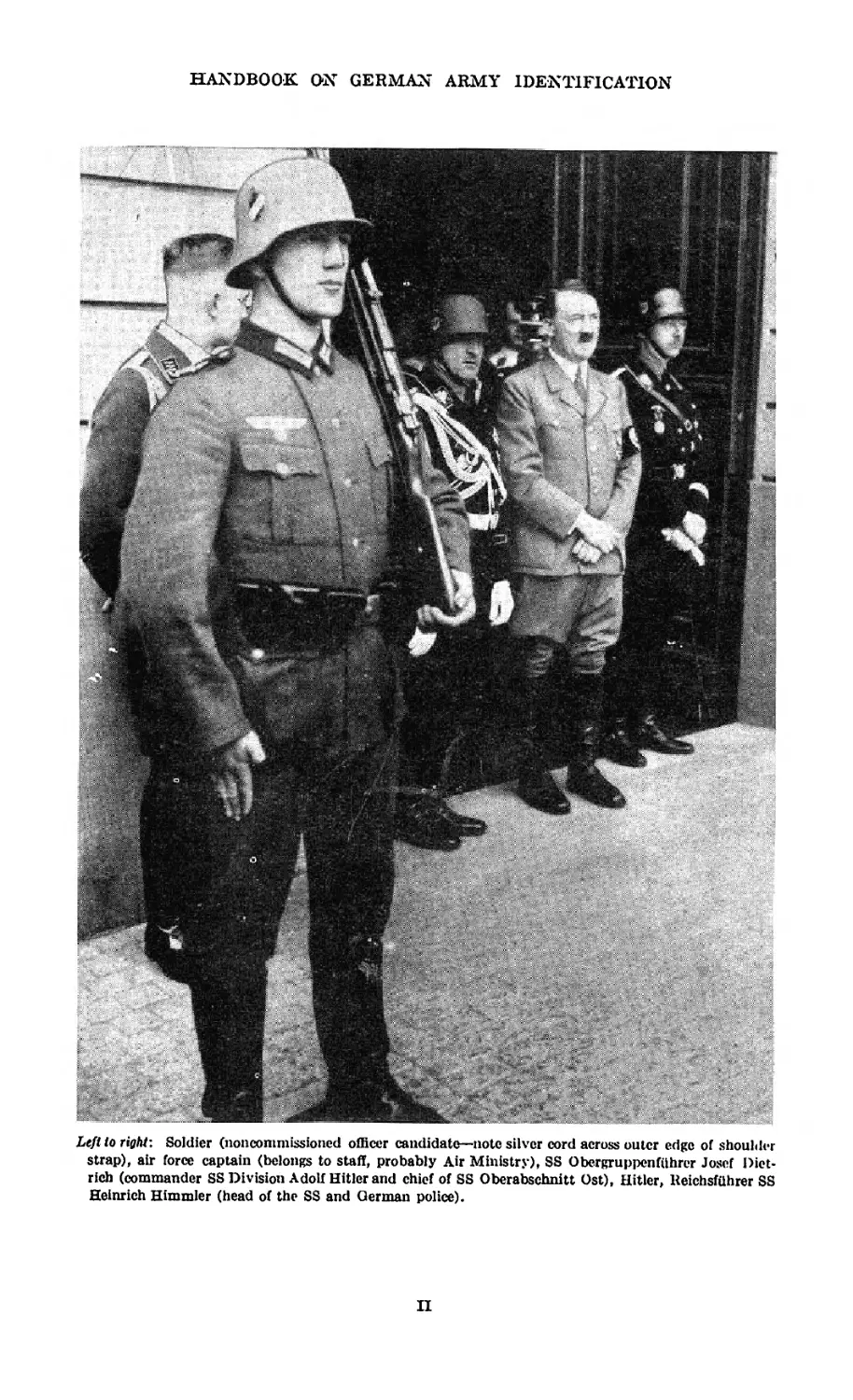
HANDBOOK ON GERMAN ARMY IDENTIFICATION
Left to right-. Soldier (noncommissioned officer candidate—note silver cord across outer edge of shoulder
strap), air force captain (belongs to staff, probably Air Ministry), SS Obergruppenfiihrer Josef Diet-
rich (commander SS Division Adolf Hitler and chief of SS Oberabschnitt Ost), Hitler, Reichsfuhrer SS
Heinrich Himmler (head of the SS and German police).
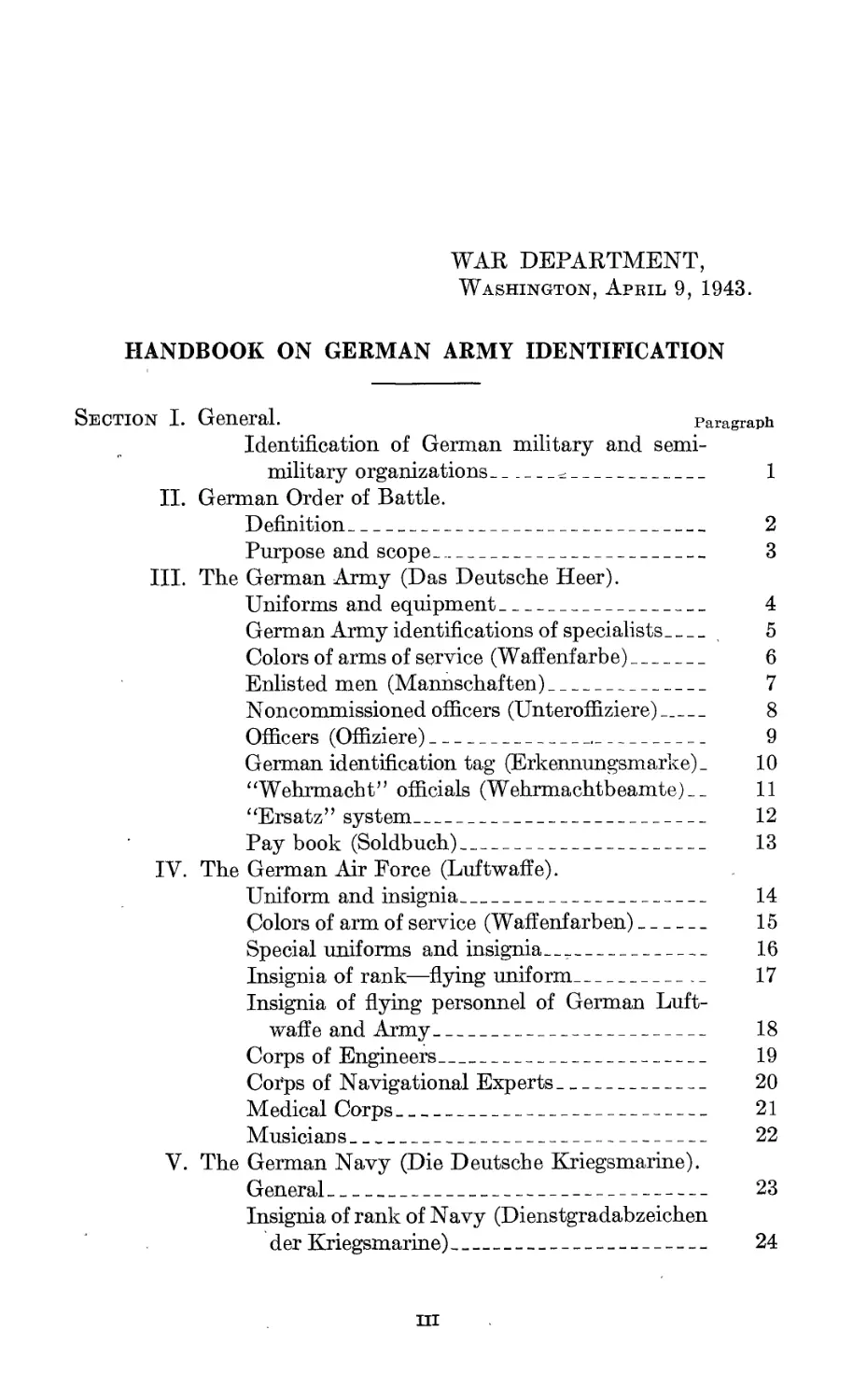
WAR DEPARTMENT,
Washington, April 9, 1943.
HANDBOOK ON GERMAN ARMY IDENTIFICATION
Section I. General.	Paragraph
Identification of German military and semi-
military organizations_______-___________ 1
II.	German Order of Battle.
Definition__________________________________ 2
Purpose and scope___________________________ 3
III.	The German Army (Das Deutsche Heer).
Uniforms and equipment__________________________ 4
German Army identifications of specialists__	5
Colors of arms of service (Waffenfarbe)_____	6
Enlisted men (Mannschaften)_____________________ 7
Noncommissioned officers (Unteroffiziere)___	8
Officers (Offiziere)____________________________ 9
German identification tag (Erkennungsmarke). 10
“Wehrmacht” officials (Wehrmachtbeamte)__ 11
“Ersatz” system________________________________ 12
Pay book (Soldbuch)____________________________ 13
IV.	The German Air Force (Luftwaffe).
Uniform and insignia___________________________ 14
Colors of arm of service (Waffenfarben)_____	15
Special uniforms and insignia__T_______________ 16
Insignia of rank—flying uniform______________ _	17
Insignia of flying personnel of German Luft-
waffe and Army__________________________ 18
Corps of Engineers_____________________________ 19
Corps of Navigational Experts__________________ 20
Medical Corps__________________________________ 21
Musicians___________________________________ 22
V.	The German Navy (Die Deutsche Kriegsmarine).
General_____________________________________ 23
Insignia of rank of Navy (Dienstgradabzeichen
der Kriegsmarine)_______________________ 24
in
HANDBOOK ON GERMAN ARMY IDENTIFICATION
Paragraph
Section VI. Police, semimilitary and political organizations
(Deutsche Polizei, Halbmilitarische und Poli-
tische Verbande).
German police (Deutsche Polizei)_________ 25
Semimilitary and political organizations_	26
Uniforms of armed SS (Waffen SS)_________	27
Insignia of rank of the National Labor Serv-
ice (Dienstgradabzeichen des Reichsar-
beitsdienstes R. A. D.)___________________ 28
National Socialist Organizations (National-
sozialistische Organisationen)____________ 29
Insignia of rank of SA, SS, and of the NSKK
(Dienstgradabzeichen der SA, SS, und der
NSKK)_____________________________________ 30
Insignia on uniform of the German police (Uni-
form-Abzeichen der Deutschen Polizei) __	31
Command post flags (Kommandoflaggen) _ _	32
Field insignia and flags of the National So-
cialist German Labor Party (Feldzeichen
und Fahnen der NSDAP)_____________________ 33
Insignia of rank of Hitler Youth (Dienst-
gradabzeichen der Hitlerjugend)___________ 34
Rank insignia of the political leaders (Dienst-
gradabzeichen der Politischen Leiter)____	35
Page
Appendix. Traffic	signs (Verkehrszeichen)___________________  67
IV
Pars.
1-3
HANDBOOK ON GERMAN ARMY IDENTIFICATION
Section I
GENERAL
Paragraph
Identification of German military and semimilitary organizations_ 1
1. Identification of German military and semimilitary
organizations.—a. It is second nature to make comparisons. This
tendency may well be used in associating German insignia of rank
with our own; however, the student will find that direct equivalents,
while existing in some instances, are not the rule. It is well to ap-
proach the subject with this fact in mind. The outline presented
is as nearly accurate and complete as available sources permit (up
to January 1, 1943).
b. The student must possess sufficient adaptability to make cor-
rections and adjustments if and when the need for them arises.
The German Army and German semimilitary organizations are very
flexible in their structure. Uniforms, equipment, and insignia are
often changed, for a multitude of reasons, without advance notice
to the enemy.
Section II
GERMAN ORDER OF BATTLE
Paragraph
Definition_________________________________________________ 2
Purpose and scope__________________________________________ 3
2. Definition.—a. By the term “Order of Battle,” is meant all
known information of the enemy army.
b. Order of Battle information is generally divided into two parts:
Order of Battle—Strength, and Order of Battle—Location.
(1) Order of Battle—Strength is a compilation of all of the units of
the enemy armies and of those organizations of the other services, such
as the Navy and Air Force, which operate with the army in the field.
(2) Order of Battle—Location gives the disposition of known enemy
army units and includes all information as to actual unit locations,
movements, and concentration areas, as well as changes in organiza-
tion, equipment, and armament.
3. Purpose and scope.—a. Publications of data with respect to
Order of Battle information regarding the German Army are gener-
ally based on the various German divisions. This is true because the
division is the unit in the German Army which ordinarily does not
change. In the case of a German infantry division, for example,
1
3& ' HANDBOOK ON GERMAN ARMY IDENTIFICATION
once it has been composed of certain infantry and artillery regiments,
those regiments ordinarily do not leave the division. This means that
when a single regiment of a known German division is identified, the
presence of the other previously identified units of that division can be
inferred with reasonable assurance of accuracy.
b.	It is this means of enemy unit identification which makes Order
of Battle information of such great practical value to intelligence offi-
cers. Publications based on collected Order of Battle data on the
German Army ordinarily show the composition of known German
divisions. They may be cross-indexed in such a way as to enable one
who has identified a particular German regiment to identify the division
of which it is a part and also the other units included in the same divi-
sion. Naturally, information of this kind is subject to constant sup-
plement, confirmation, and correction as individual units are iden-
tified. As a result, new editions of publications based on Order of
Battle information are issued frequently.
c.	In addition to identifying information such as that indicated
above, publications based on Order of Battle information may con-
tain data such as the following, which are of interest to intelligence
officers: engagements and campaigns in which enemy units have
taken part, their battle reputations, morale, and probable casualties;
enemy military symbols and abbreviations; methods of training and
mobilizing the enemy Army; lists of senior Army officers with their
commands; an outline of the high command and general bases of or-
ganization of the enemy Army; uniform identifications; and descrip-
tions of identification tags and pay books.
d.	Publications based on Order of Battle information contain data
which identify the home stations or areas in Germany from which the
soldiers in particular units originate. Germany is divided into terri-
torial administrative commands called Wehrkreise, which correspond
to our service commands. The mobilization of the German armed
forces was accomplished within the administrative framework of the
Wehrkreise. It is important for intelligence officers to know from
what part of Germany particular units come, because individuals in
those units as a whole act according to local patterns of behavior.
Section III
THE GERMAN ARMY (DAS DEUTSCHE HEER)
Paragraph
Uniforms and equipment_________________________________________ 4
German Army identifications of specialists_____________________ 5
Colors of arms of service (Waffenfarbe)________________________ 6
2
Par.
4
HANDBOOK ON GERMAN ARMY IDENTIFICATION
Paragraph
Enlisted men (Mannschaften)_______________________________________________ 7
Noncommissioned officers (Unteroffiziere)_________________________________ 8
Officers (Offiziere)______________________________________________________ 9
German identification tag (Erkennungsmarke)______________________________ 10
“Wehrmacht” officials (Wehrmachtbeamte)__________________________________ 11
“Ersatz” system__________________________________________________________ 12
Pay book (Soldbuch)______________________________________________________ 13
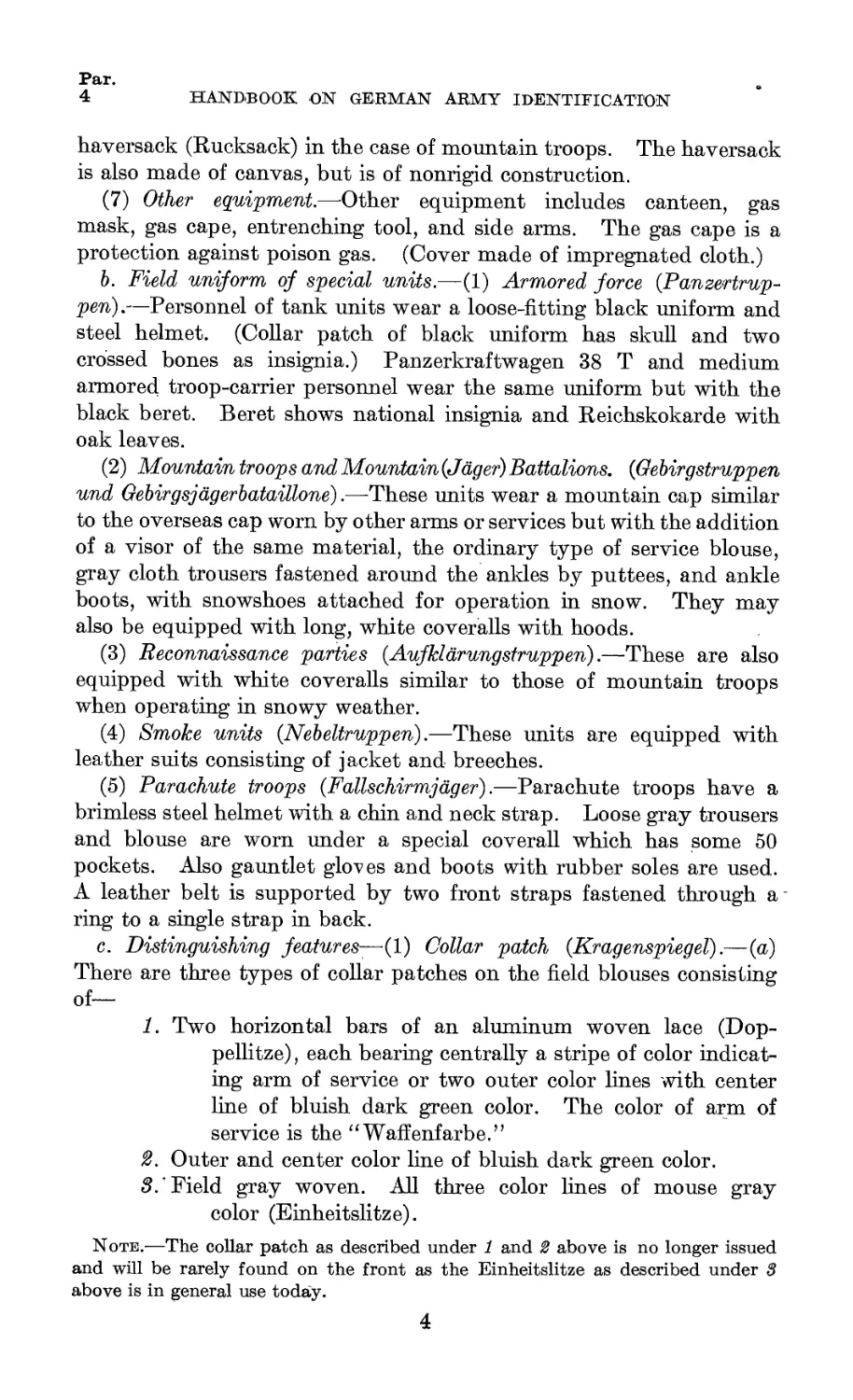
4. Uniforms and equipment.—a. Field uniform (Feldanzug)—
(1) Blouse (Feldbluse).—Officers and enlisted men wear the same
blouse, which is made of greenish-gray cloth with a collar of a darker
shade. The collar is normally worn fastened up tightly around the
neck, but under field conditions the blouse is sometimes worn open
around the neck, with the collar folded back. No uniform shirt is
worn under the blouse.
(2)	Trousers (Hoseri).—Dismounted officers wear trousers of gray
cloth which are tucked into half length black boots. The same
equipment is worn by the enlisted men. Mounted officers and enlisted
men wear gray trousers with leather facings, and riding boots.
(3)	Overcoat (Mantel).—The overcoat is double-breasted and made
of gray cloth. The same type of coat is worn by officers and enlisted
men.
(4)	Field cap (Feldmutze).—The field cap is made of greenish-gray
cloth, can be worn under helmet, and is worn by officers and enlisted
men of all troops except mountain units and some personnel of the
armored troops. The officer’s field cap is of better quality and has
silver piping along the top seam and top edge of the turn-up. Two
insignia are embroidered on the front of the field cap: the Reichsko-
karde, which is just above the lower edge of the cap, and the national
insignia, which is just below the upper edge.
(5)	Steel helmet (Stahlhelm).—The steel helmet is worn by officers
and men in the field. It is made of seamless sheet steel and is painted
inside and out with rust-resisting gray matt paint. Lugs are drilled
on either side of the helmet so that a face shield can be.worn. Painted
on the right side of the helmet is a shield with the national colors.
Painted on the left side of the helmet is a shield with the national
insignia (no national colors in some recent instances).
(6)	Pack (Tornister).—The pack carried by the foot soldier looks
almost square when in position on a soldier’s back. It is made of
heavy canvas with leather binding around the edges and is held in
position by leather straps. Blankets, shelter-half, and camouflage
sheet (if present) are rolled into a long roll which is buckled over the
top and sides of the pack. The pack (Tomister) is replaced by a
3
Par.
4
HANDBOOK ON GERMAN ARMY IDENTIFICATION
haversack (Rucksack) in the case of mountain troops. The haversack
is also made of canvas, but is of nonrigid construction.
(7)	Other equipment.—Other equipment includes canteen, gas
mask, gas cape, entrenching tool, and side arms. The gas cape is a
protection against poison gas. (Cover made of impregnated cloth.)
b.	Field uniform of special units.—(1) Armored force (Panz&rtrup-
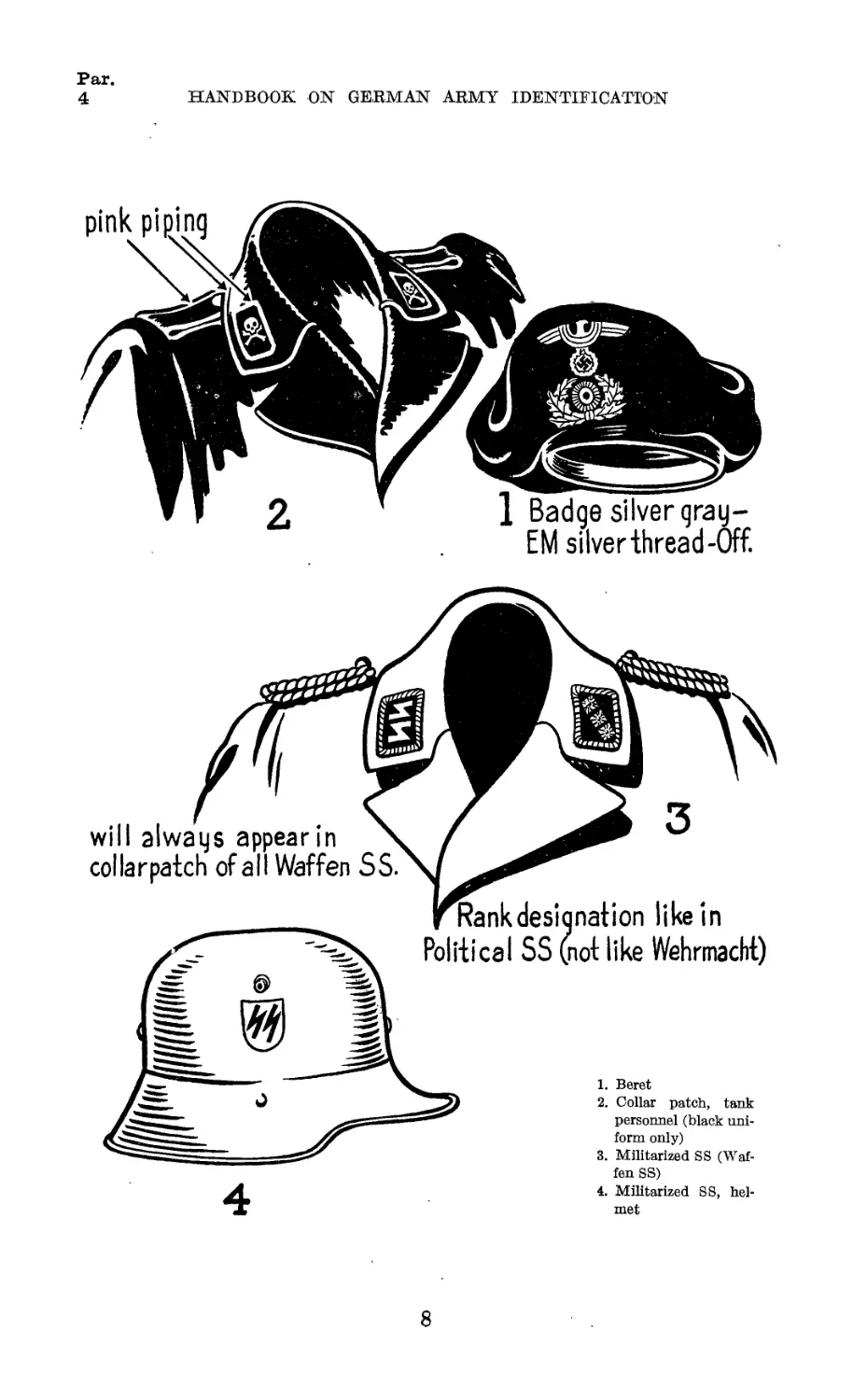
peri).—Personnel of tank units wear a loose-fitting black uniform and
steel helmet. (Collar patch of black uniform has skull and two
crossed bones as insignia.) Panzerkraftwagen 38 T and medium
armored troop-carrier personnel wear the same uniform but with the
black beret. Beret shows national insignia and Reichskokarde with
oak leaves.
(2)	Mountain troops and Mountain (Jager) Battalions. (Gebirgstruppen
und Gebirgsjdgerbataillone).—These units wear a mountain cap similar
to the overseas cap worn by other arms or services but with the addition
of a visor of the same material, the ordinary type of service blouse,
gray cloth trousers fastened around the ankles by puttees, and ankle
boots, with snowshoes attached for operation in snow. They may
also be equipped with long, white coveralls with hoods.
(3)	Reconnaissance parties (Aufkldrungstruppen).—These are also
equipped with white coveralls similar to those of mountain troops
when operating in snowy weather.
(4)	Smoke units (Nebeltruppen).—These units are equipped with
leather suits consisting of jacket and breeches.
(5)	Parachute troops (Fallschirmjag er).—Parachute troops have a
brimless steel helmet with a chin and neck strap. Loose gray trousers
and blouse are worn under a special coverall which has some 50
pockets. Also gauntlet gloves and boots with rubber soles are used.
A leather belt is supported by two front straps fastened through a
ring to a single strap in back.
c.	Distinguishing features—-(1) Collar patch (Kragenspiegel).—(a)
There are three types of collar patches on the field blouses consisting
of—
1.	Two horizontal bars of an aluminum woven lace (Dop-
pellitze), each bearing centrally a stripe of color indicat-
ing arm of service or two outer color lines with center
line of bluish dark green color. The color of arm of
service is the “ Waffenfarbe.”
2.	Outer and center color line of bluish dark green color.
3.	' Field gray woven. All three color lines of mouse gray
color (Einheitslitze).
Note.—The collar patch as described under 1 and 2 above is no longer issued
and will be rarely found on the front as the Einheitslitze as described under 3
above is in general use today.
4
HANDBOOK ON GERMAN ARMY IDENTIFICATION	4
(6) Collar patches of tank units are black with pink piping and
white skull and crossbones.
(2) Shoulder straps (Schulterklappen).—Straps are of the same color
as uniform. Piping denotes color of arm of service. Company
number (from private up to and including highest ranking noncom-
missioned officer) is shown on field gray button near the collar. The
regimental number is shown in the color of the arm of service (Waffen-
farbe) on enlisted men up to and including the Unterfeldwebel (staff
sergeant). The strap of all noncommissioned officers is also bordered
by a silver strip and certain noncommissioned officers have silver stars
and silver regimental numbers. For company officers it is flat, solid
silver laces or tape with golden regimental numbers, and gold stars
except for the second lieutenant (Leutnant). For field officers it is
heavy braided silver lace, golden regimental numbers, and gold stars
except for the major. For generals, the strap is two heavy gold strands
braided with one silver strand, and silver stars except for the General-
major, but showing no regimental number. There is no company
number on the buttons securing officers’ shoulder straps. The
buttons on the shoulder straps of all officers excepting'generals are
of silver and those of generals are of gold color.
d. Insignia (Abzeichen)—(1) National insignia (Hoheitsab zeichen).—
Spread eagle over a swastika (Hakenkreuz). It is found on the left
side of the steel helmet (but the wings are folded). On the field and
mountain cap, it is in silver thread on a gray background. On the
beret it is silver thread on black background. On the service blouse,
dull silver cloth above right breast pocket. (Generals in gold.)
(2) National Rosette (Reichskokarde).—Small circular insignia in
black, white, and red. Worn on all headgear below the national
insignia except on the steel helmet. It is flanked by oak leaves on all
visored caps except on the mountain cap and field cap.
(3) National colors (Nationabfarben).—Black, white, and red.
Note.—Since 1939 the undesirable display of regimental and company
numbers and numerical identification of other detachments was avoided, first
by temporary measures such as covering them up, and later by issuing plain
shoulder straps with piping.
513748°—43-
-2
5
4	HANDBOOK ON GERMAN ARMY IDENTIFICATION
(Hoheitsabzeichen der
Miitzen-Hoheitsabzeichen Luftwaffe (cap national
insignia of air force)
Miitzen-Hoheitsabzeichen,
Heer silbern, Kriegsmarine
golden (cap national insig-
nia, Army silver, Navy
gold)
Hoheitsabzeichen fur Rock u. Feldbluse
(national insignia for coat and field blouse of the
air force)
Hoheitsabzeichen fiir Rock u. Feldbluse,
Heer silbern, Kriegsmarine golden
(national insignia for coat and field blouse; Army
silver, Navy gold)
(steel helmet, air force)
Stahlhelm fiir Heer und Kriegsmarine
(steel helmet for Army and Navy)
6
Par.
4
HANDBOOK ON GERMAN ARMY IDENTIFICATION
Par.
4
HANDBOOK ON GERMAN ARMY IDENTIFICATION
8
Par.
4
HANDBOOK ON GERMAN ARMY IDENTIFICATION
FRONT VIEW
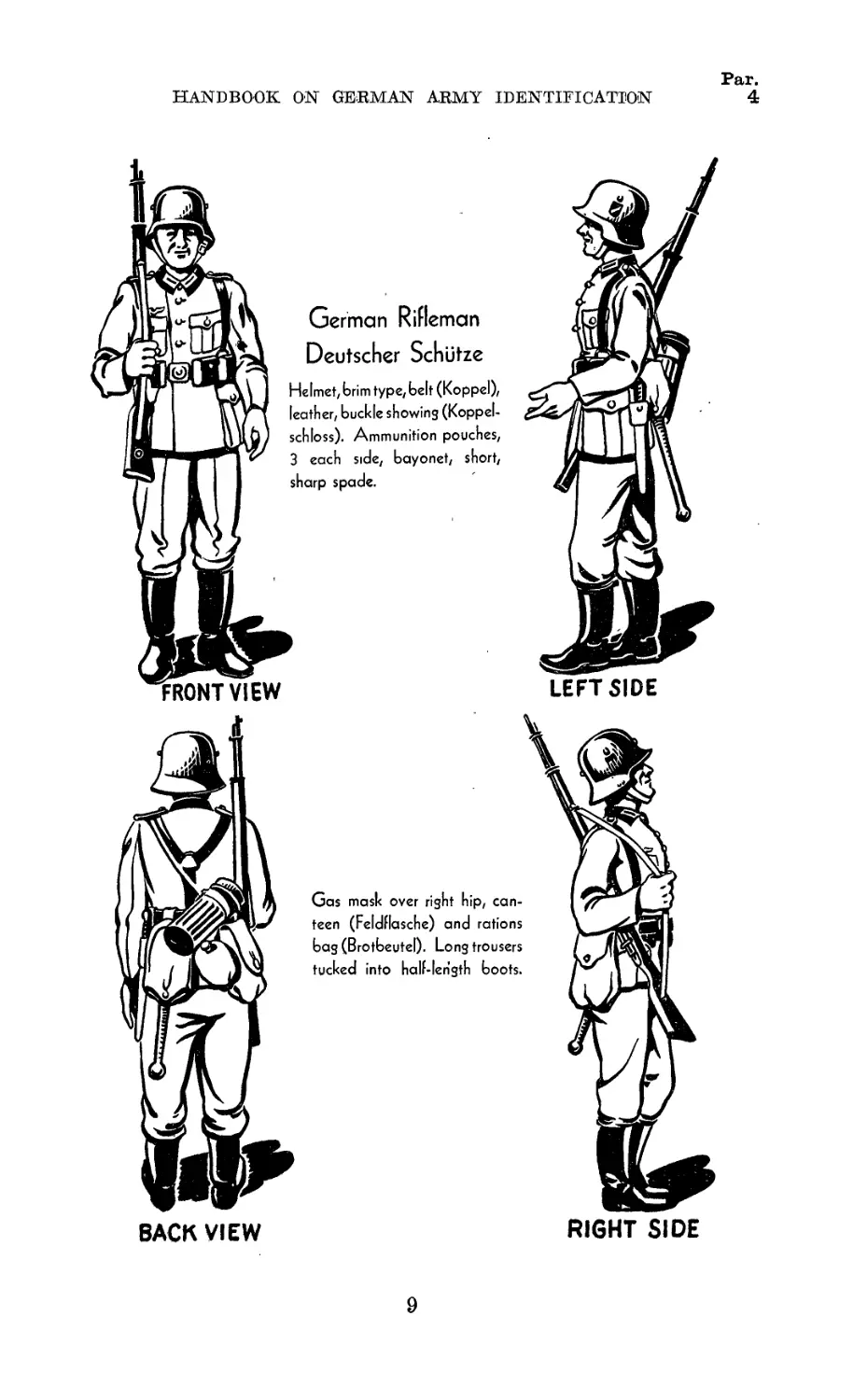
German Rifleman
Deutscher Schutze
Helmet, brim type, belt (Koppel),
leather, buckle showing (Koppel-
schloss). Ammunition pouches,
3 each side, bayonet, short,
sharp spade.
LEFTSIDE
Gas mask over right hip, can-
teen (Feldflasche) and rations
bag (Brotbeutel). Long trousers
tucked into half-length boots.
BACK VIEW
RIGHT SIDE
9
Par.
HANDBOOK ON GERMAN
ARMY IDENTIFICATION
4
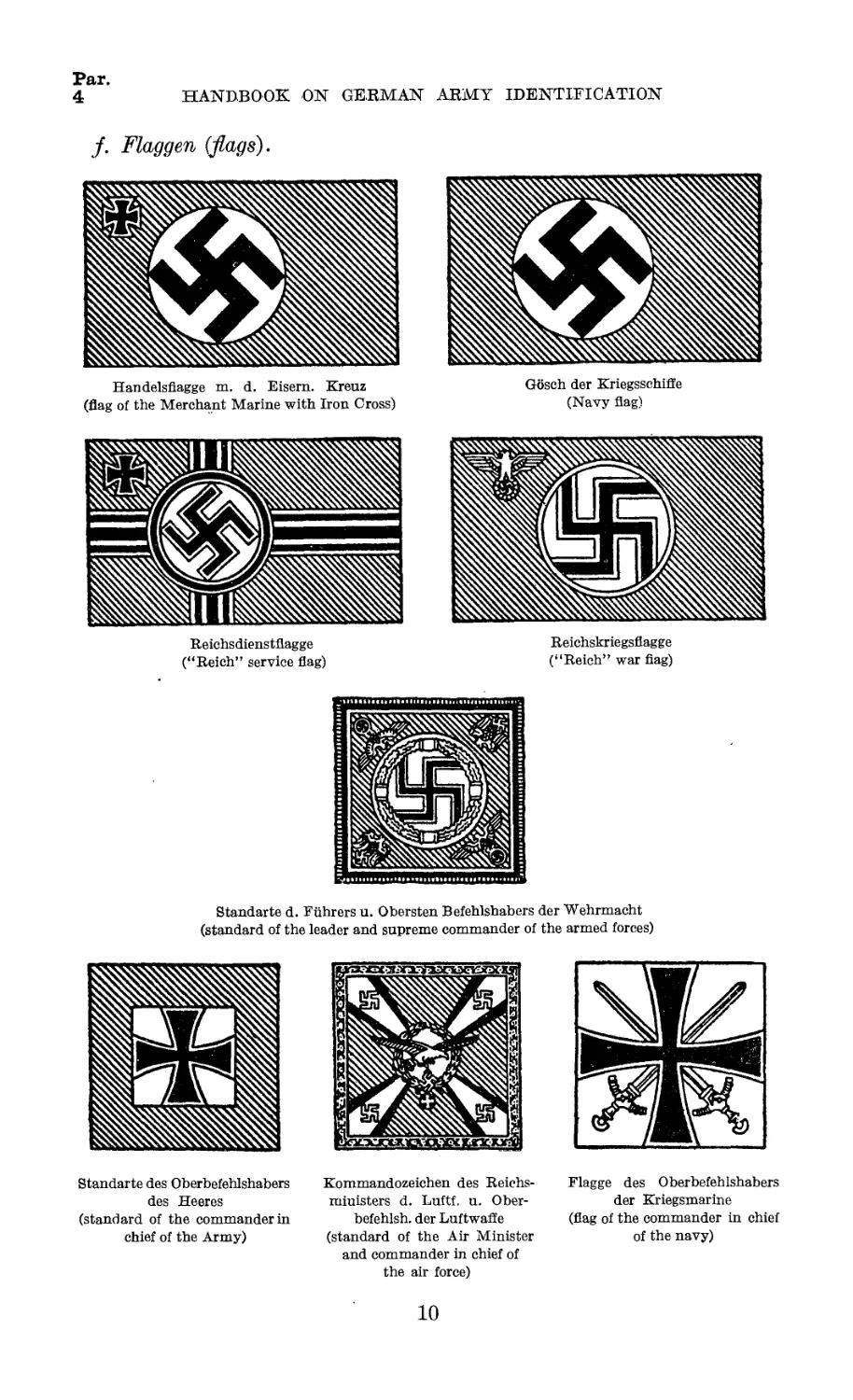
/. Flaggen (flags).
Handelsflagge m. d. Eisern. Kreuz
(flag of the Merchant Marine with Iron Cross)
Gosch der Kriegsschiffe
(Navy flag)
Reichsdienstflagge
(“Reich” service flag)
Reichskriegsflagge
(“Reich” war flag)
Standarte d. Fuhrers u. Obersten Befehlshabers der Wehrmacht
(standard of the leader and supreme commander of the armed forces)
Standarte des Oberbefehlshabers
des Heeres
(standard of the commander in
chief of the Army)
Kommandozeichen des Reichs-
miuisters d. Luftf. u. Ober-
befehlsh. der Luftwaffe
(standard of the Air Minister
and commander in chief of
the air force)
Flagge des Oberbefehlshabers
der Kriegsmarine
(flag of the commander in chief
of the navy)
10
Par.
4
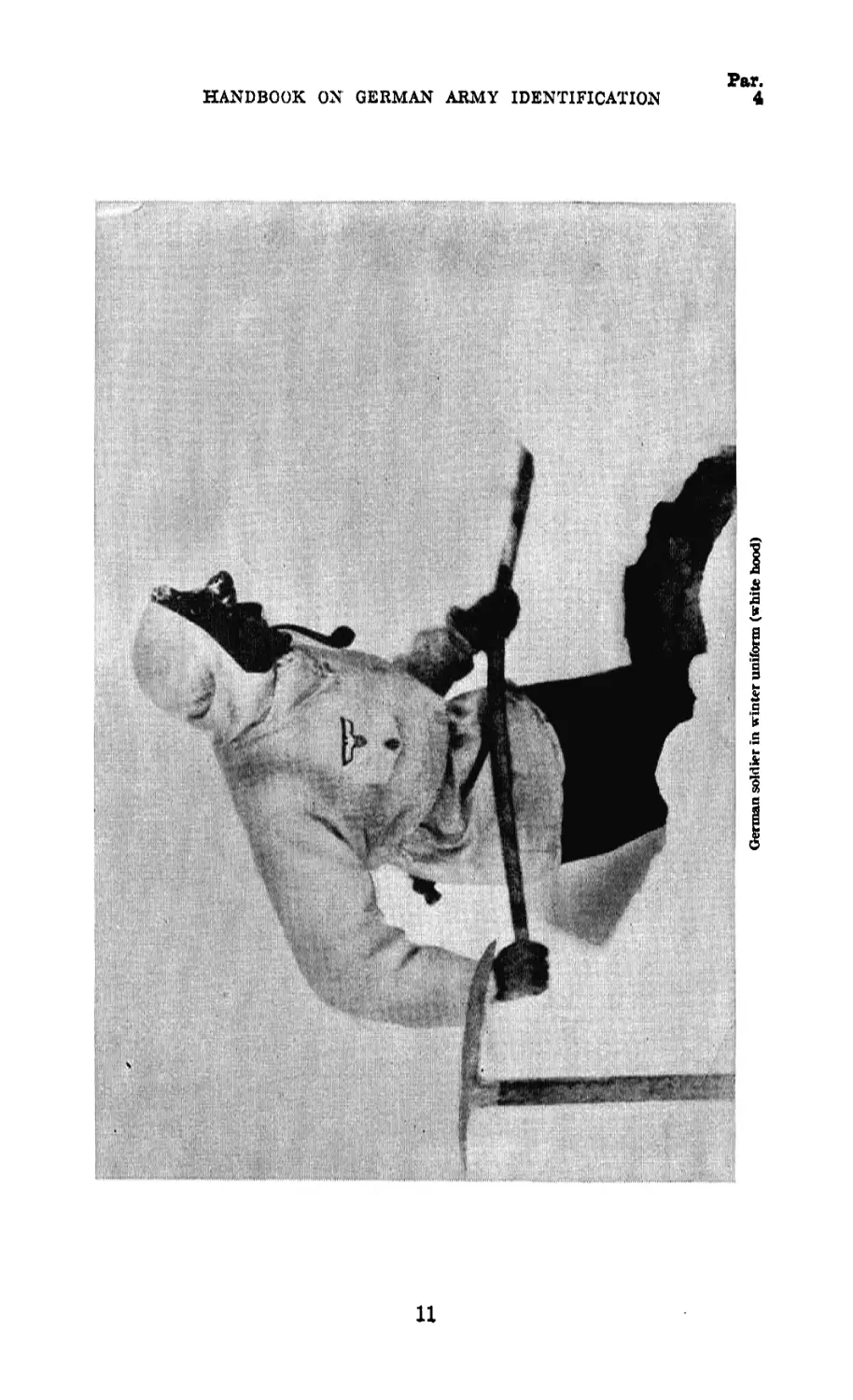
HANDBOOK ON GERMAN ARMY IDENTIFICATION
soldier in winter uniform (white hood)
11
Far.
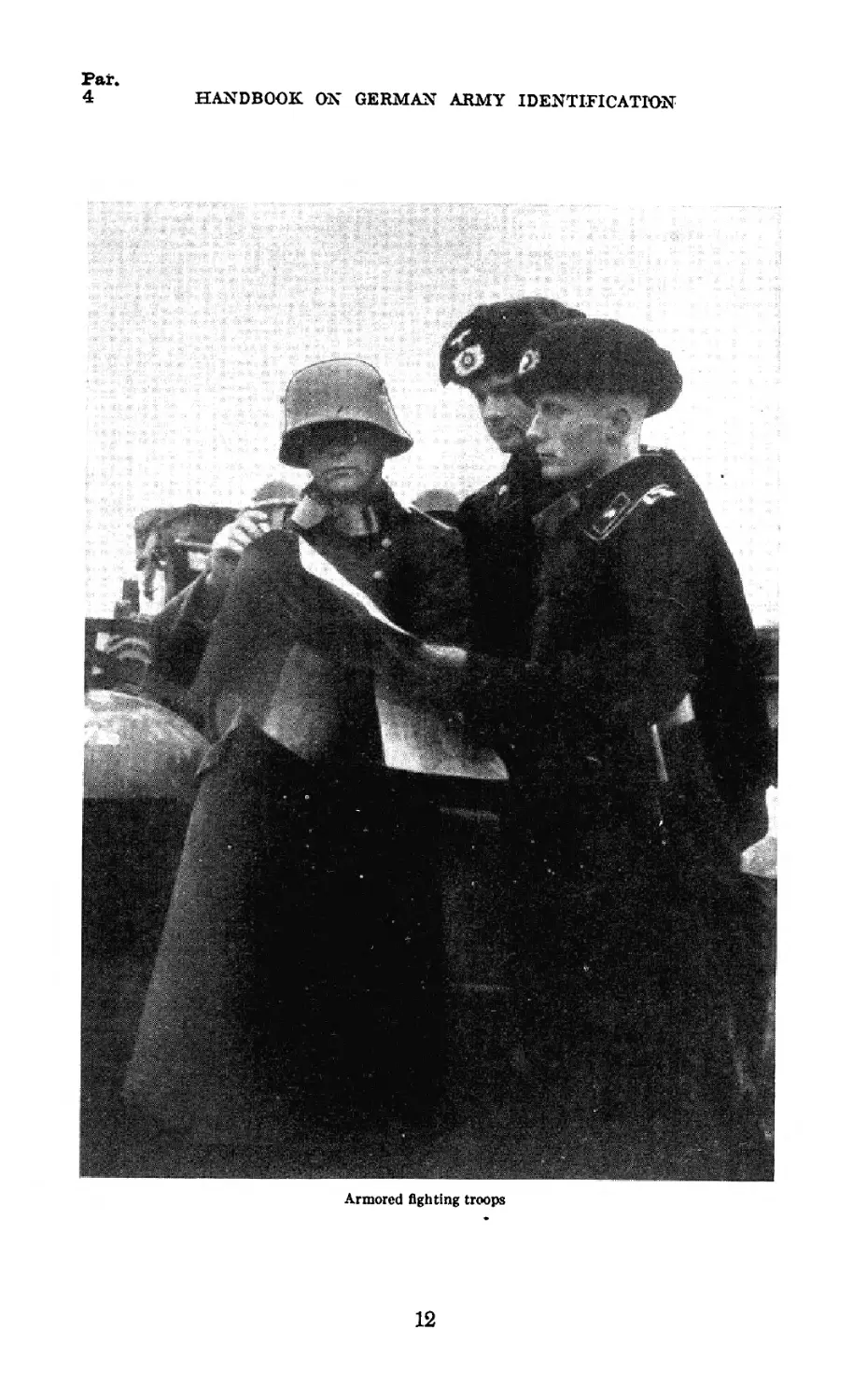
4
HANDBOOK ON GERMAN AJRMY IDENTIFICATION
Armored fighting troops
12
Par.
HANDBOOK ON GERMAN ARMY IDENTIFICATION	5
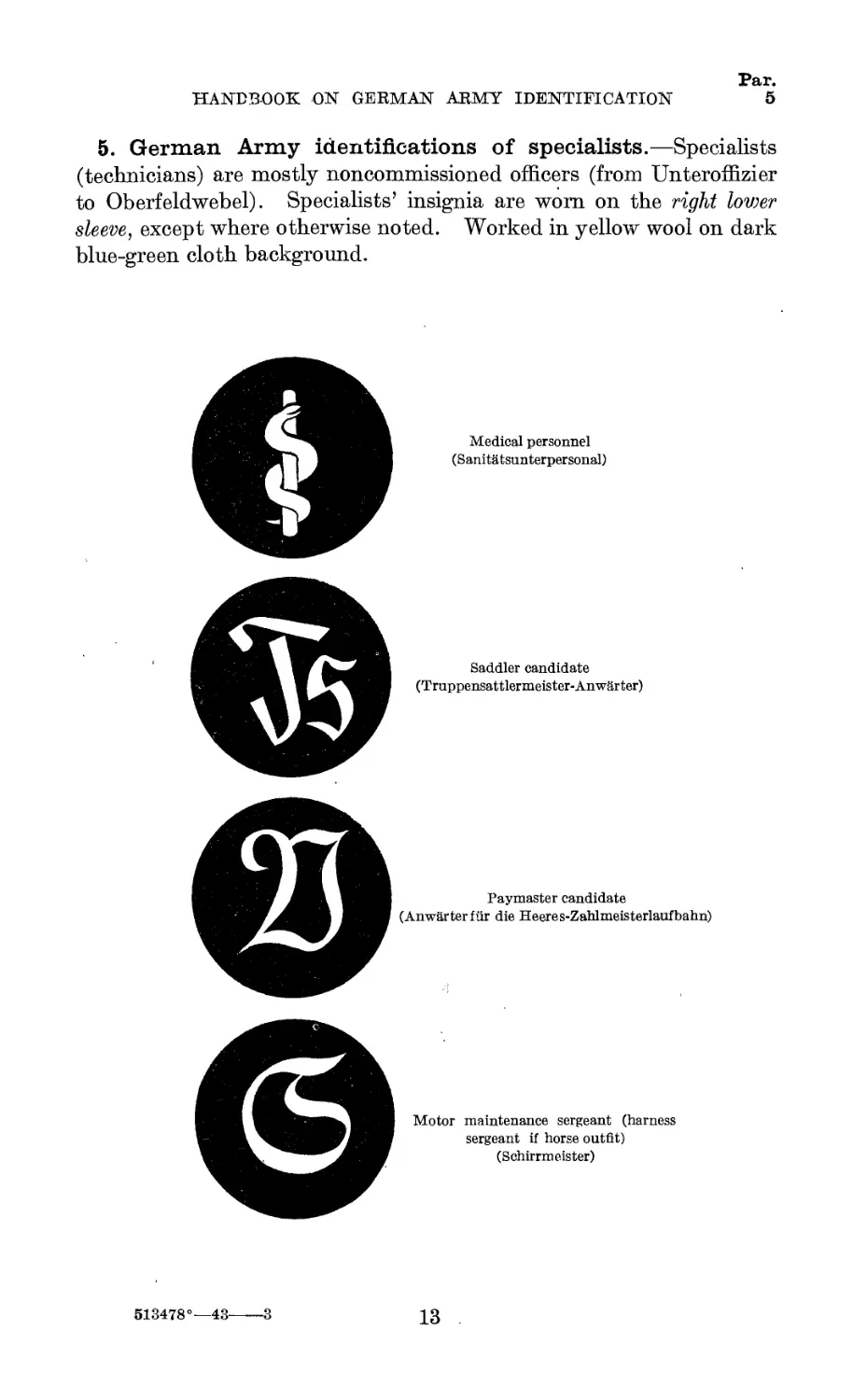
5.	German Army identifications of specialists.—Specialists
(technicians) are mostly noncommissioned officers (from Unteroffizier
to Oberfeldwebel). Specialists’ insignia are worn on the right lower
sleeve, except where otherwise noted. Worked in yellow wool on dark
blue-green cloth background.
Saddler candidate
(Truppensattlermeister-Anwarter)
Medical personnel
(Sanitatsunterpersonal)
Paymaster candidate
(Anwarterfiir die Heeres-Zahlmeisterlaufbahn)
Motor maintenance sergeant (harness
sergeant if horse outfit)
(Schirrmeister)
513478°— 43—3
13
Par.
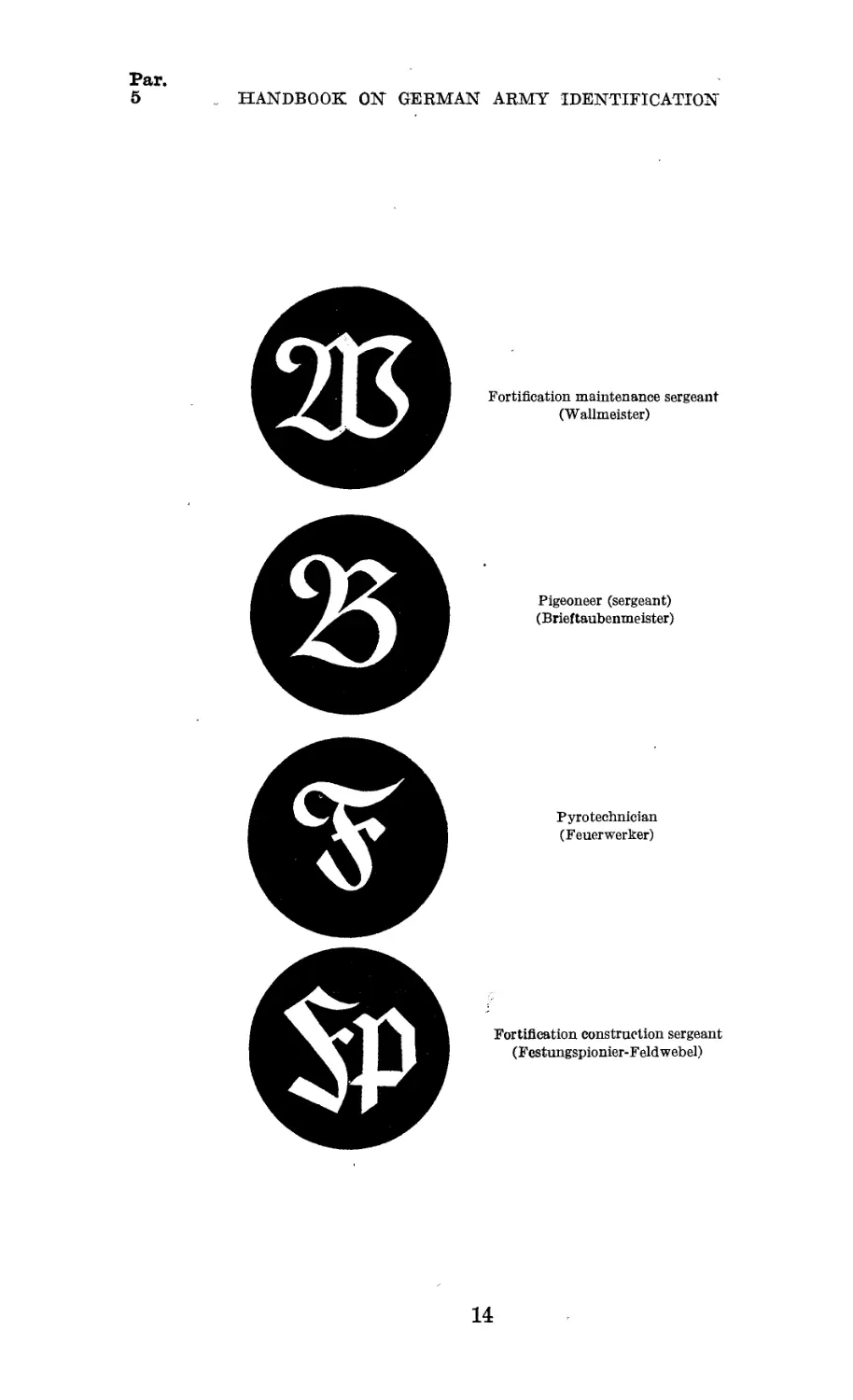
5	HANDBOOK ON GERMAN ARMY IDENTIFICATION
Fortification maintenance sergeant
(Wallmeister)
Pigeoneer (sergeant)
(Brieftaubenmeister)
Pyrotechnician
(Feuerwerker)
Fortification construction sergeant
(Festungspionier-Feldwebel)
14
Par.
HANDBOOK ON GERMAN ARMY IDENTIFICATION	5
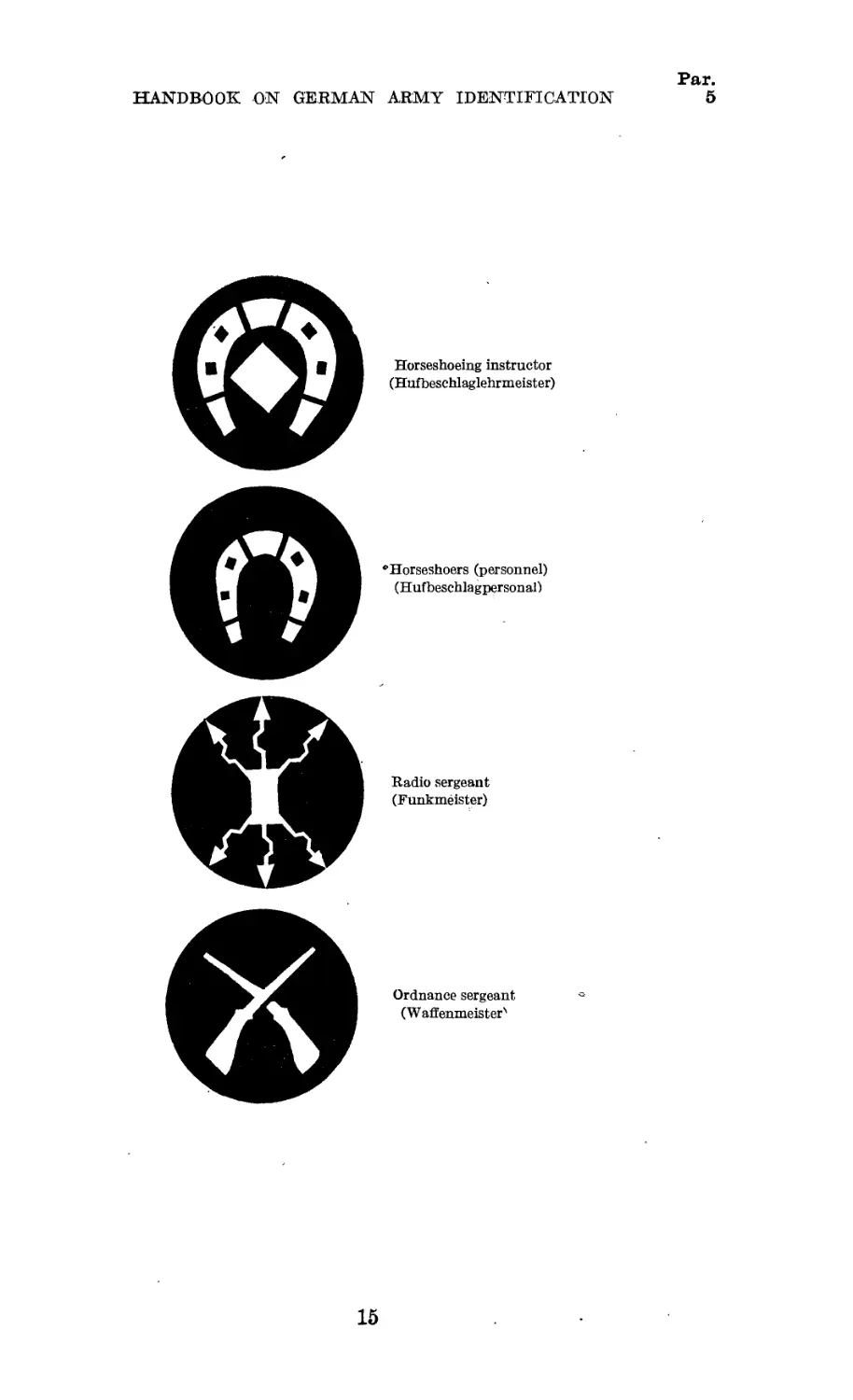
Horseshoeing instructor
(Hufbeschlaglehrmeister)
"Horseshoers (personnel)
(Hufbeschlagpersonal)
о
Radio sergeant
(Furikmeister)
Ordnance sergeant
(Waffenmeister'
15
Par.
5	HANDBOOK ON GERMAN ARMY IDENTIFICATION
Helmsman (Steuermann). This insignia is worn
on the left upper sleeve. (Anchor in silver em-
broidery)
Operator smoke troops (Bedienungspersonal Nebel-
abteilung). This insignia is worn on the left
lower arm. Worked in white rayon on dark green
background
©Communication personnel (other than Signal Corps)
(Nachrichtenpersonal). This insignia is worn on
the left upper sleeve. (Flash in “Waffenfarben”)
Army mountain guide (Heeresbergfiihrer). This
insignia is worn on the left breast
Gunlayer artillery (Richtkanonier). This insignia,
is worn on left lower arm
16
HANDBOOK ON GERMAN ARMY IDENTIFICATION	6
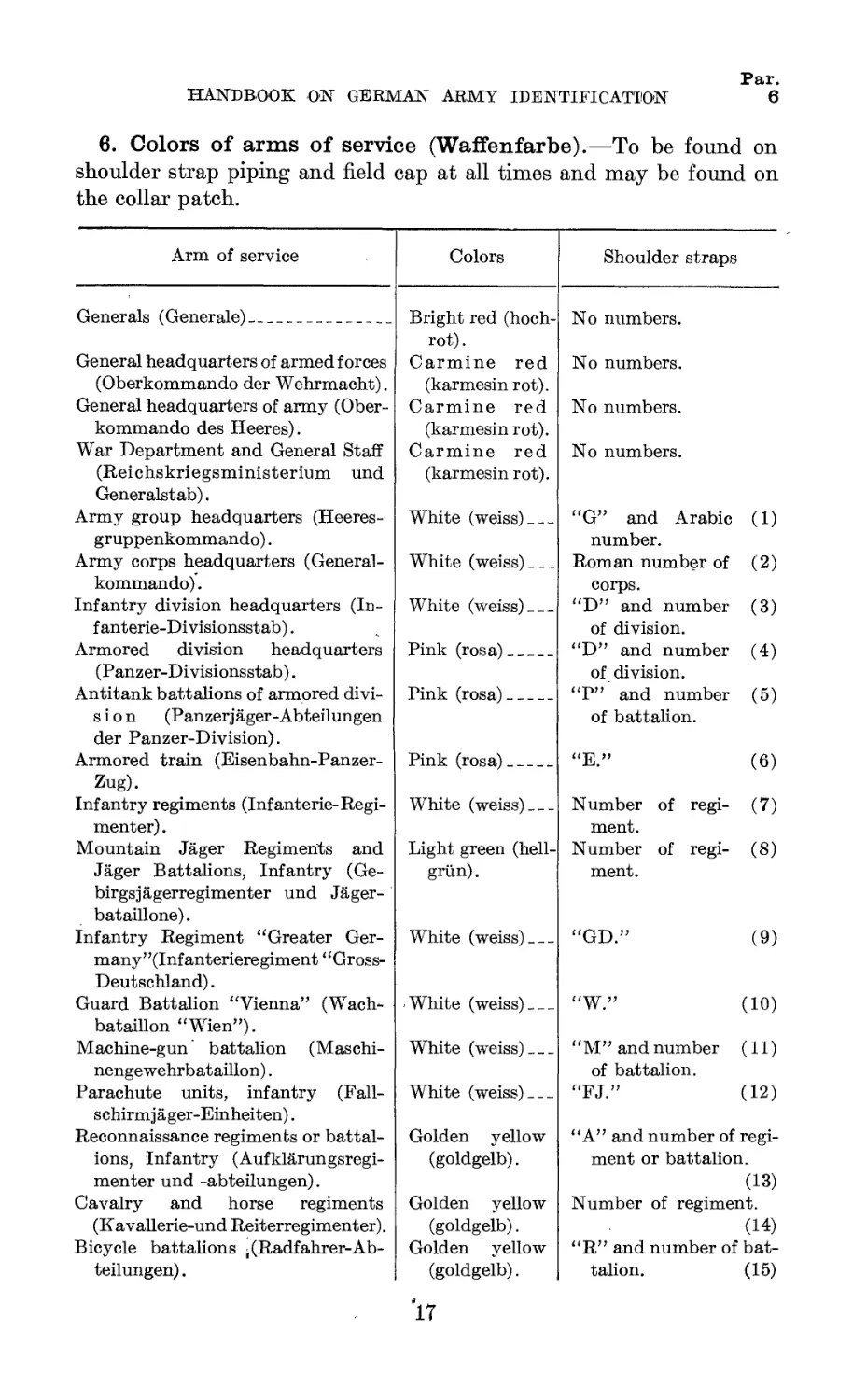
6.	Colors of arms of service (Waffenfarbe).—To be found on
shoulder strap piping and field cap at all times and may be found on
the collar patch.
Arm of service	Colors	Shoulder straps
Generals (Generale)		Bright red (hoch- rot).	No numbers.
General headquarters of armed forces (Oberkommando der Wehrmacht).	Carmine red (karmesin rot).	No numbers.
General headquarters of army (Ober- kommando des Heeres).	Carmine red (karmesin rot).	No numbers.
War Department and General Staff (Reichskriegsministerium und	Carmine red (karmesin rot).	No numbers.
Generalstab).
Army group headquarters (Heeres- gruppenkommando).	White (weiss)		“G” and Arabic (1) number.
Army corps headquarters (General- kommando).	White (weiss)		Roman number of (2) corps.
Infantry division headquarters (In- fanterie-Divisionsstab).	White (weiss)		“D” and number (3) of division.
Armored division headquarters (Panzer-Divisionsstab).	Pink (rosa)		“D” and number (4) of division.
Antitank battalions of armored divi- s i о n (Panzerjager-Abteilungen	Pink (rosa)		“P” and number (5) of battalion.
der Panzer-Division).
Armored train (Eisenbahn-Panzer-	Pink (rosa)		“E.”	(6)
Zug).
Infantry regiments (Infanterie-Regi- menter).	White (weiss)		Number of regi- (7) ment.
Mountain Jager Regiments and	Light green (hell-	Number of regi- (8)
Jager Battalions, Infantry (Ge-	griin).	ment.
birgsjagerregimenter und Jager- bataillone).
Infantry Regiment “Greater Ger-	White (weiss)		“GD.”	(9)
many’’(Infanterieregiment “Gross- Deutschland) .
Guard Battalion “Vienna” (Wach-	 White (weiss)		“W.”	(10)
bataillon “Wien”).
Machine-gun battalion (Maschi- nengewehrbataillon).	White (weiss)		“M” and number (11) of battalion.
Parachute units, infantry (Fall-	White (weiss)		“FJ.”	(12)
schirmjager-Einheiten).
Reconnaissance regiments or battal-	Golden yellow	“A” and number of regi-
ions, Infantry (Aufklarungsregi- menter und -abteilungen).	(goldgelb).	ment or battalion. (13)
Cavalry and horse regiments	Golden yellow	Number of regiment.
(Kavallerie-undReiterregimenter).	(goldgelb).	(14)
Bicycle battalions ,(Radfahrer-Ab-	Golden yellow	“R” and number of bat-
teilungen).	(goldgelb).	talion.	(15)
17
Par.
6
HANDBOOK ON GERMAN ARMY IDENTIFICATION
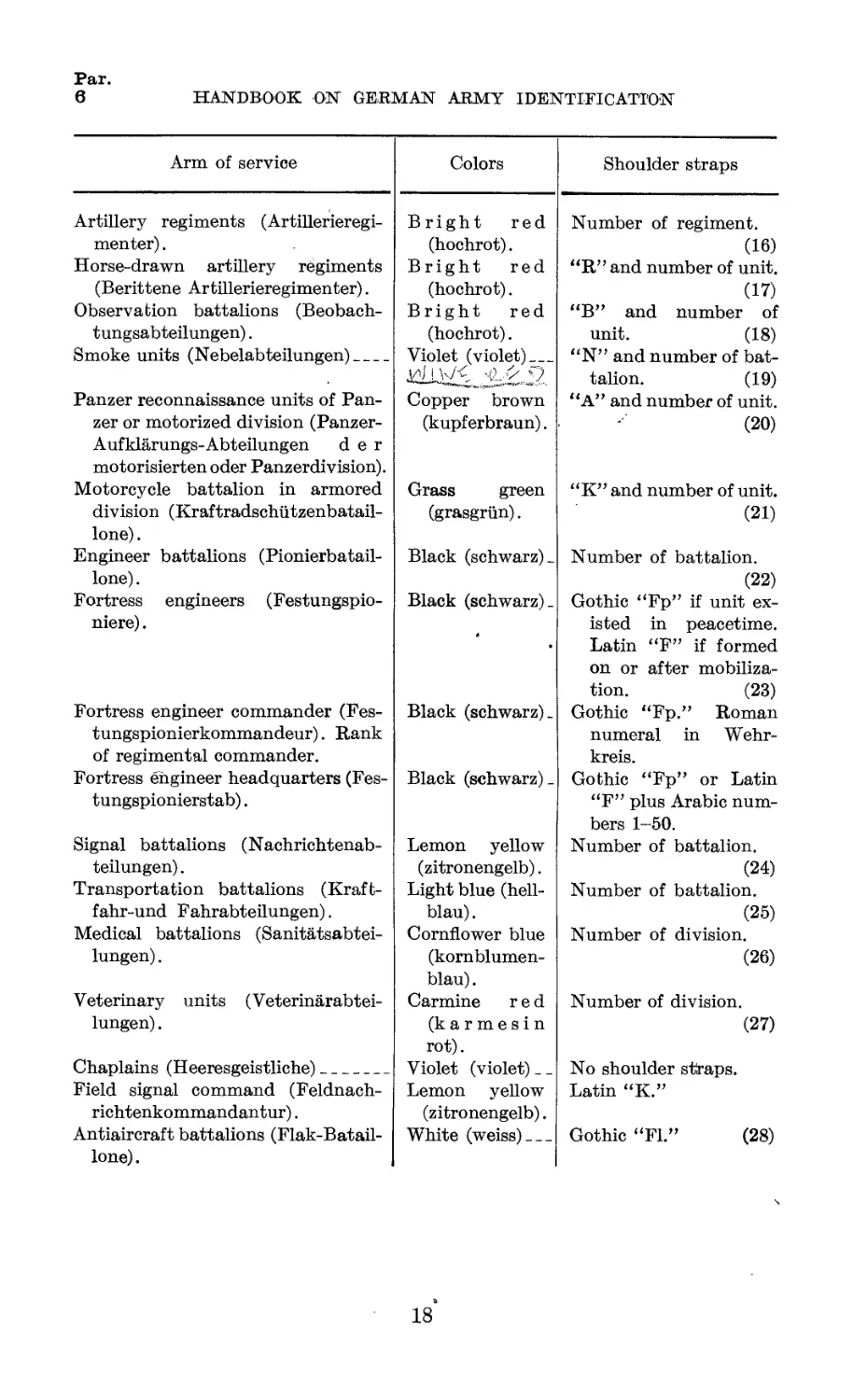
Arm of service	Colors	Shoulder straps
Artillery regiments (Artillerieregi-	Bright red	Number of regiment.
men ter).	(hochrot).	(16)
Horse-drawn artillery regiments	Bright red	“R” and number of unit.
(Berittene Artillerieregimenter).	(hochrot).	(17)
Observation battalions (Beobach-	Bright red	“B” and number of
tungsabteilungen).	(hochrot).	unit.	(18)
Smoke units (Nebelabteilungen)		Violet (violet)		“N” and number of bat-
	„Иiyx, чух?	talion.	(19)
Panzer reconnaissance units of Pan-	Copper brown	“A” and number of unit.
zer or motorized division (Panzer-	(kupferbraun).	(20)
Aufklarungs-Abteilungen d e r motorisierten oder Panzerdivision).
Motorcycle battalion in armored	Grass	green	“K” and number of unit.
division (Kraftradschiitzenbatail-	(grasgriin).	(21)
lone).
Engineer battalions (Pionierbatail- lone).	Black (schwarz) _	Number of battalion. (22)
Fortress engineers (Festungspio- niere).	Black (schwarz).	Gothic “Fp” if unit ex- isted in peacetime. Latin “F” if formed on or after mobiliza- tion.	(23)
Fortress engineer commander (Fes- tungspionierkommandeur). Rank of regimental commander.	Black (schwarz).	Gothic “Fp.” Roman numeral in Wehr- kreis.
Fortress engineer headquarters (Fes- tungspionierstab).	Black (schwarz).	Gothic “Fp” or Latin “F” plus Arabic num- bers 1-50.
Signal battalions (Nachrichtenab-	Lemon yellow	Number of battalion.
teilungen).	(zitronengelb).	(24)
Transportation battalions (Kraf t-	Light blue (hell-	Number of battalion.
fahr-und Fahrabteilungen).	blau).	(25)
Medical battalions (Sanitatsabtei-	Cornflower blue	Number of division.
lungen).	(kornblumen- blau).	(26)
Veterinary units (Veterinarabtei-	Carmine red	Number of division.
lungen).	(karmesin rot).	(27)
Chaplains (Heeresgeistliche)		Violet (violet) _ _	No shoulder straps.
Field signal command (Feldnach- richtenkommandantur).	Lemon yellow (zitronengelb).	Latin “K.”
Antiaircraft battalions (Flak-Batail-	White (weiss)		Gothic “Fl.”	(28)
lone).
18
Pars.
6-9
HANDBOOK ON GERMAN ARMY IDENTIFICATION
Arm of service	Colors	Shoulder straps
Military police (Feldgendarmerie) _ _	Orange (orange) _	No number. Nazi eagle ' and swastika sur- rounded by oak wreath on upper left arm; brown band with “Feldgendarmerie” in silver inscribed on lower left arm.
Local defense units (Landesschiitzen- Einheiten). Some local defense units (Einige Landesschutzen-Einheiten). Construction units (Bau-Einheiten) _	White (weiss)	 Light green (hell- grun). Light brown (hellbraun).	Latin “L” plus Arabic number of regiment or battalion.
Railway engineers (Eisenbahnpio- niere).	Black (schwarz) _	Latin “E” and Arabic numeral of unit.
Administration of ordnance stores —	Light blue (hell-	Latin “Fz.”	(29)
enlistedmen (Feldzeugkommando).	blau).	z
Officials (Beamte)		Dark	green (dunkelgriin).	(30)
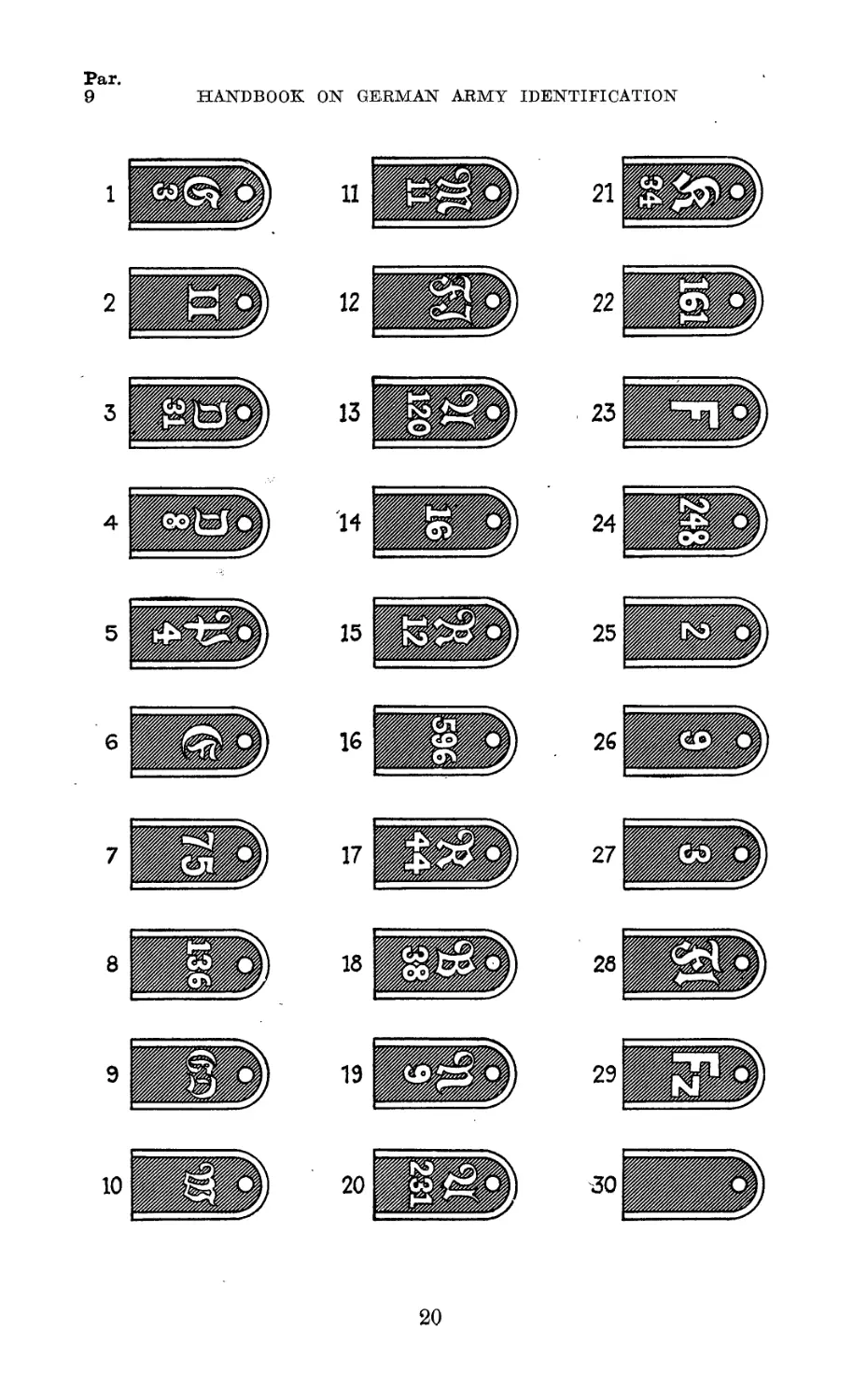
Note.—The numbers in parentheses on right-hand margin correspond to the numbers in the chart on
the following page.
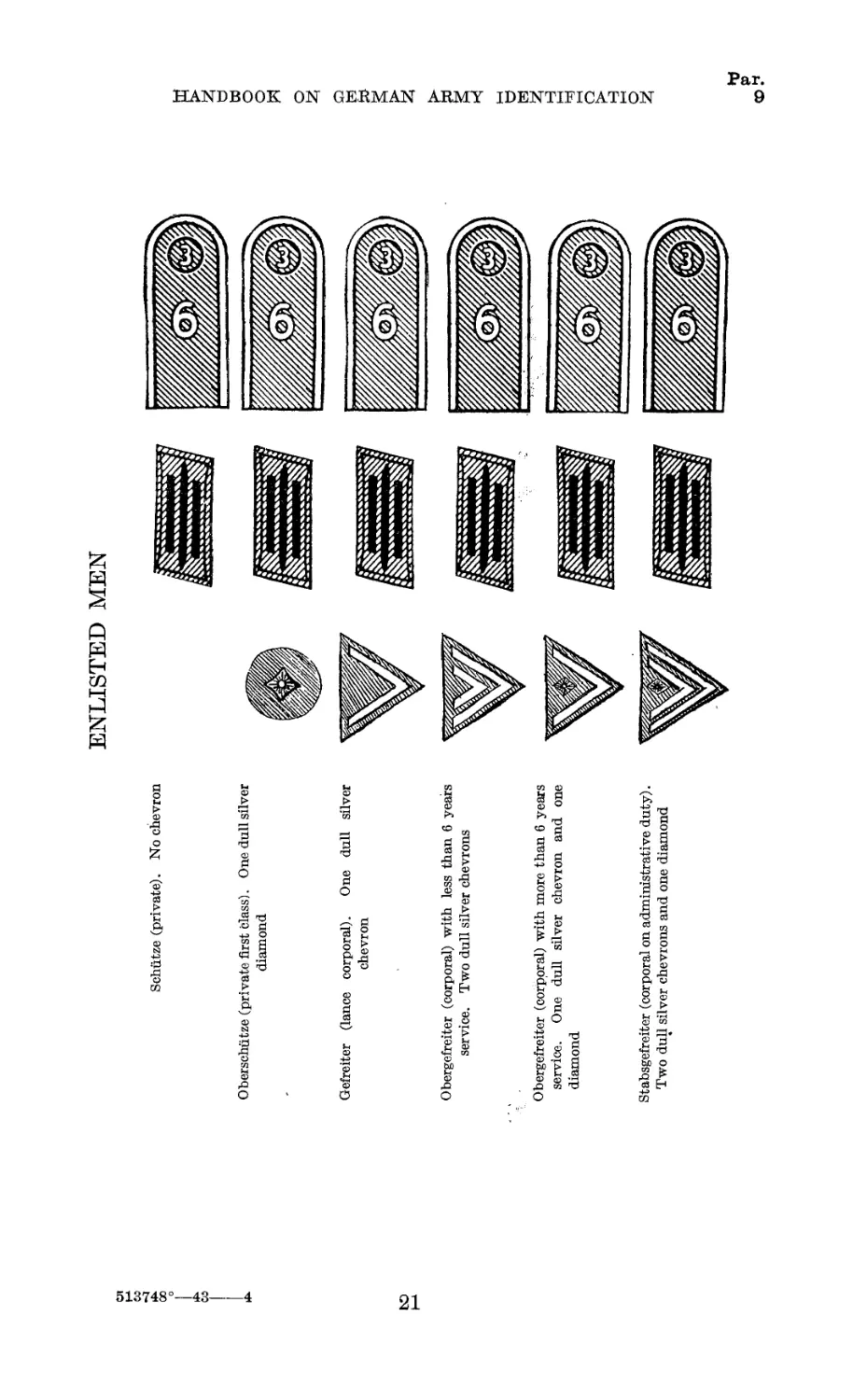
7.	Enlisted men (Mannschaften).—Shoulder strap is plain;
dark green on a foundation in the color of the arm of service. Their
regimental number is also in the color of the arm of service. Collar
patch is plain; latest type consists of three lines in mouse gray
(Einheitslitze). Insignia of rank is worn on left sleeve in dull silver
chevrons.
Note.—Corporals in the German Army are classed as enlisted men.
8.	Noncommissioned officers (TJnteroffiziere).—Noncommis-
sioned officers have a dull silver lacing all around the collar of the field
blouse. The dark green background of the shoulder strap is bordered
by a silver strip around which is a narrow braid in the distinctive
color of the wearer’s arm of service.
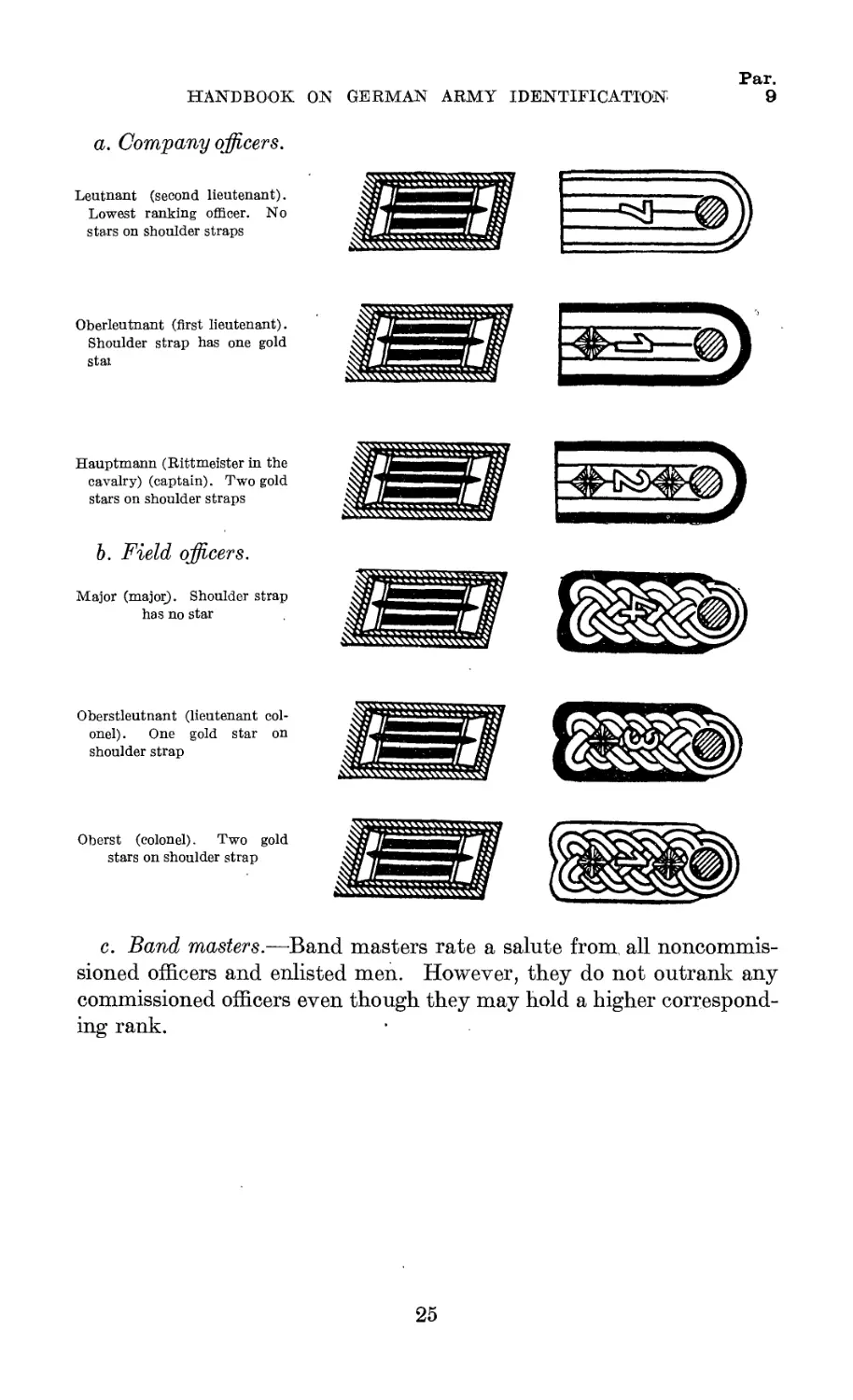
9.	Officers (Offiziere).—All officers have either the old style
officer’s collar patch (as illustrated) or the new standard collar patch
(Einheitslitze) which is worn by officers and enlisted men. The
shoulder strap of company officers (lieutenants and captains) consists
of four flat silver laces with piping in the color of the arm of service.
Field officers (Stabsoffiziere) wear shoulder straps with two heavy
silver laces twisted, with piping. The number of an officer’s battalion
or regiment is in gold metal. Company numbers do not appear.
19
Par.
9
HANDBOOK ON GERMAN ARMY IDENTIFICATION
20
ENLISTED MEN
513748'
to
HANDBOOK ON GERMAN ARMY IDENTIFICATION
9&Г* HANDBOOK ON GERMAN ARMY IDENTIFICATION
NONCOMMISSIONED OFFICERS
Unteroffizier (sergeant). Only
noncommissioned officer with
silver strip open on arm end.
Embroidered number of regi-
ment or battalion in color of
arm of service
Unterfeldwebel (cavalry:
unterwachtmeister). Number
of regiment or battalion in
color of arm of service
Fahnrich (officer aspirant junior
grade). Same as Unteifeld-
webel, only numbers of regi-
ment or battalion in silver.
This grade has lately been
abolished
Feldwebel (or Wachtmeister,
cavalry) (technical sergeant).
Shoulder straps same as above
with one dull silver star
Oberfeldwebel or Oberwacht-
meister (battalion sergeant
major, approximate American
equivalent). Same as Feld-
webel, but with two silver
stars
Hauptfeldwebel or Haupt-
wachtmeister (first sergeant).
Shoulder strap same as Ober-
feldwebel. Also has two sil-
ver stripes on both lower
sleeves
Oberfahnrich (officer aspirant
senior grade). Shoulder strap
same as Oberfeldwebel, but
he has officer’s collar patch.
This grade has lately been
abolished
Stabsfeldwebel or Stabswacht-
meister (regimental sergeant
major). Same shoulder straps
as Feldwebel, but with three
silver stars
22
Par.
9
HANDBOOK ON GERMAN ARMY IDENTIFICATION
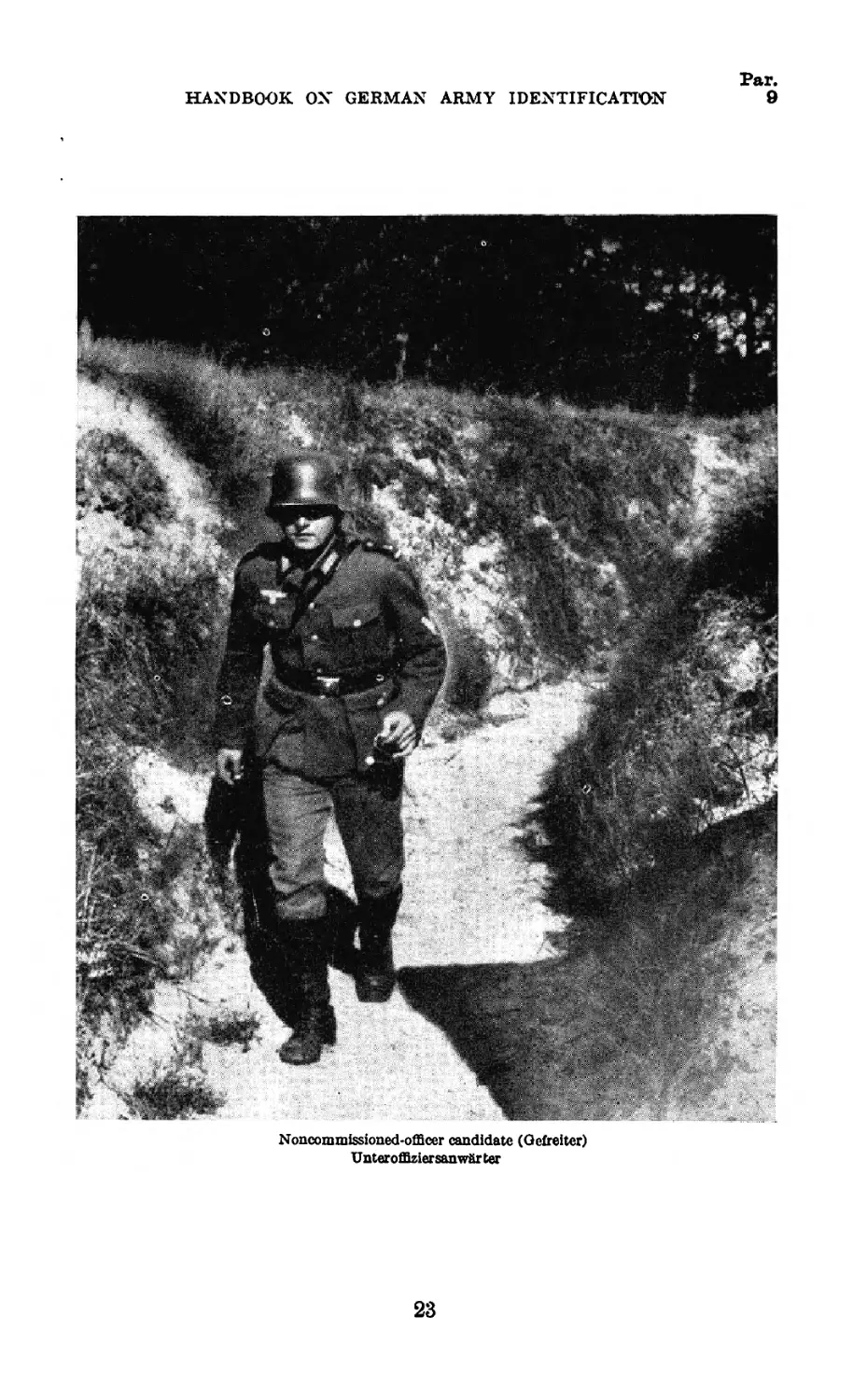
Noncommissioned-officer candidate (Gefreiter)
Unteroffiziersanwfirter
23
Par.
9
HANDBOOK ON GERMAN ARMY IDENTIFICATION
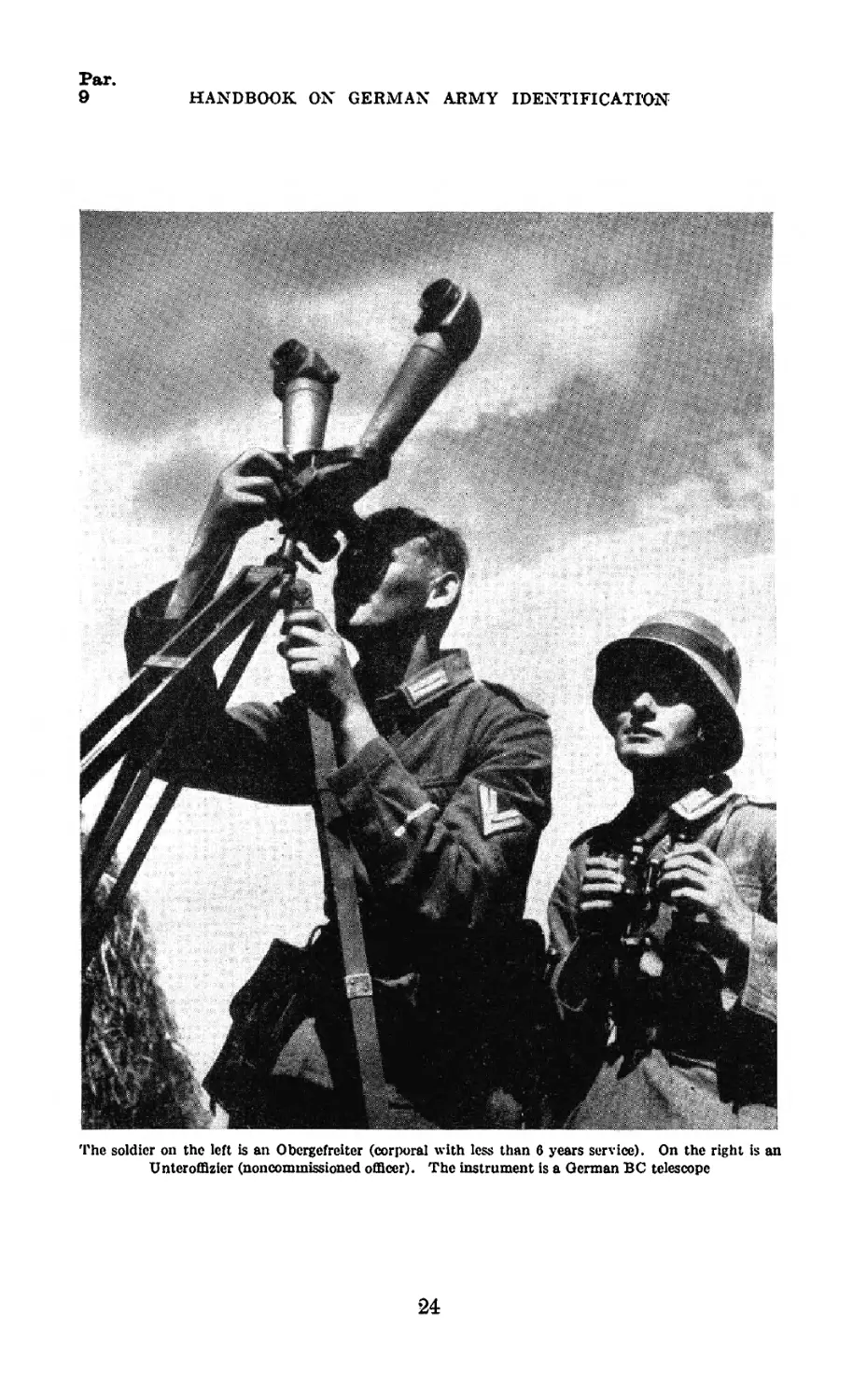
The soldier on the left is an Obergefreiter (corporal with less than 6 years service). On the right is an
Unteroffizier (noncommissioned officer). The instrument is a German BC telescope
24
Par.
HANDBOOK ON GERMAN ARMY IDENTIFICATION
9
a.	Company officers.
Leutnant (second lieutenant).
Lowest ranking officer. No
stars on shoulder straps
Oberleutnant (first lieutenant).
Shoulder strap has one gold
star
Hauptmann (Rittmeister in the
cavalry) (captain). Two gold
stars on shoulder straps
b.	Field officers.
Major (major)- Shoulder strap
has no star
Oberstleutnant (lieutenant col-
onel). One gold star on
shoulder strap
Oberst (colonel). Two gold
stars on shoulder strap
c.	Band masters.—-Band masters rate a salute from, all noncommis-
sioned officers and enlisted men. However, they do not outrank any
commissioned officers even though they may hold a higher correspond-
ing rank.
25
Par.
9
HANDBOOK ON GERMAN ARMY IDENTIFICATION
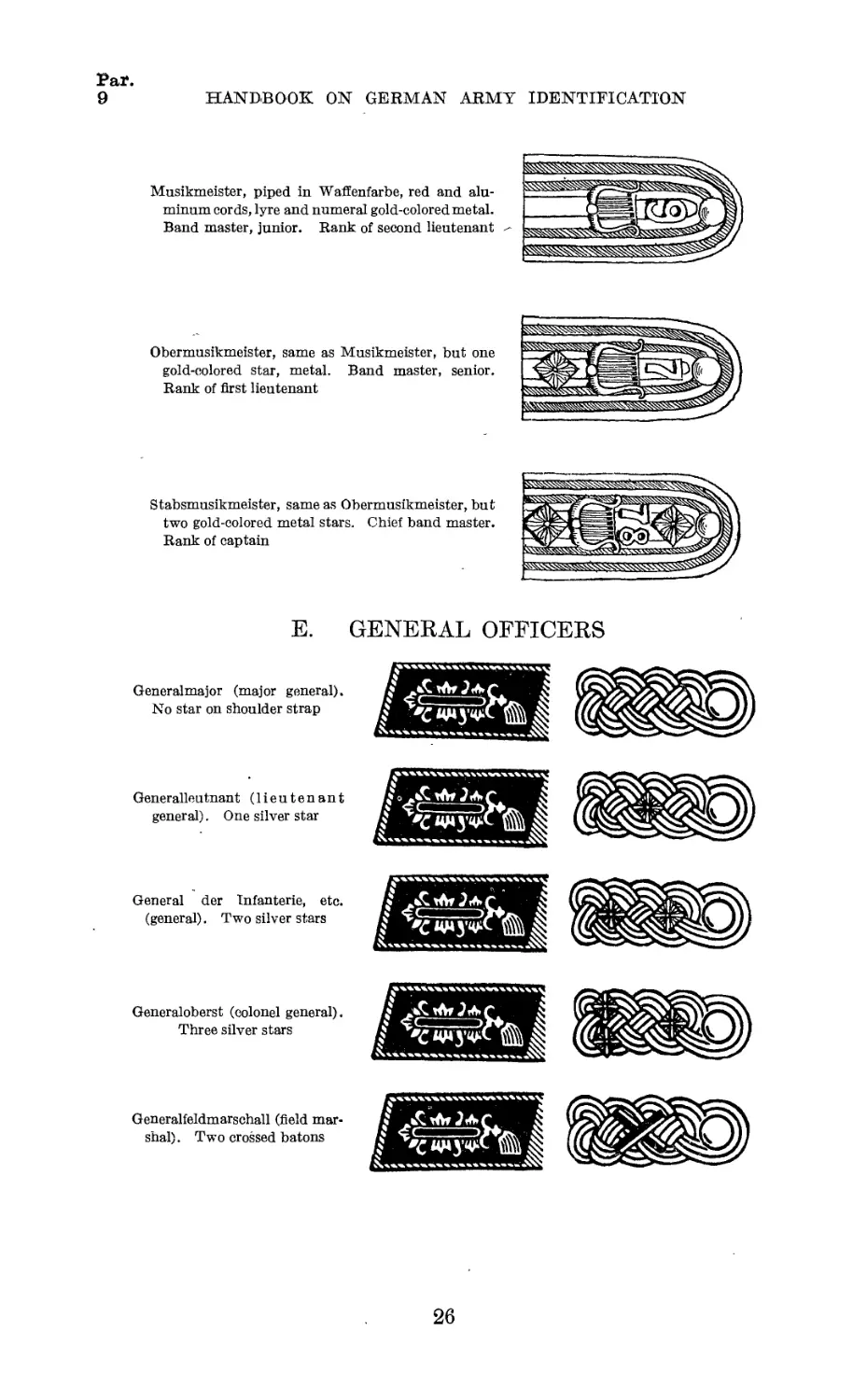
Musikmeister, piped in Waffenfarbe, red and alu-
minum cords, lyre and numeral gold-colored metal.
Band master, junior. Rank of second lieutenant
Obermusikmeister, same as Musikmeister, but one
gold-colored star, metal. Band master, senior.
Rank of first lieutenant
Stabsmusikmeister, same as Obermusikmeister, but
two gold-colored metal stars. Chief band master.
Rank of captain
E. GENERAL OFFICERS
26
Far.
9
HANDBOOK ON GERMAN ARMY IDENTIFICATION
Troops on maneuvers
27
Par.
9
HANDBOOK ON GERMAN ARMY IDENTIFICATION
Can you detect the ranks of these men?
28
Pars.
HANDBOOK ON GERMAN ARMY IDENTIFICATION 9-10
d.	Medical, Veterinary, and Reserve officers.—AU medical officers carry-
on their shoulder straps in addition a caduceus. All veterinary officers
carry only winding snake (caduceus without a stick). Reserve officers
have their shoulder straps on a second mouse gray underlay.
e.	Generals (Generale).—The collar patch consists of a gold leaf
on a red background. The shoulder strap is formed by the inter-
weaving of two heavy gold laces with one silver lace. Generals have
neither regimental nor company numbers, and also no piping on
their straps, but have red strips on the seams of their trousers.
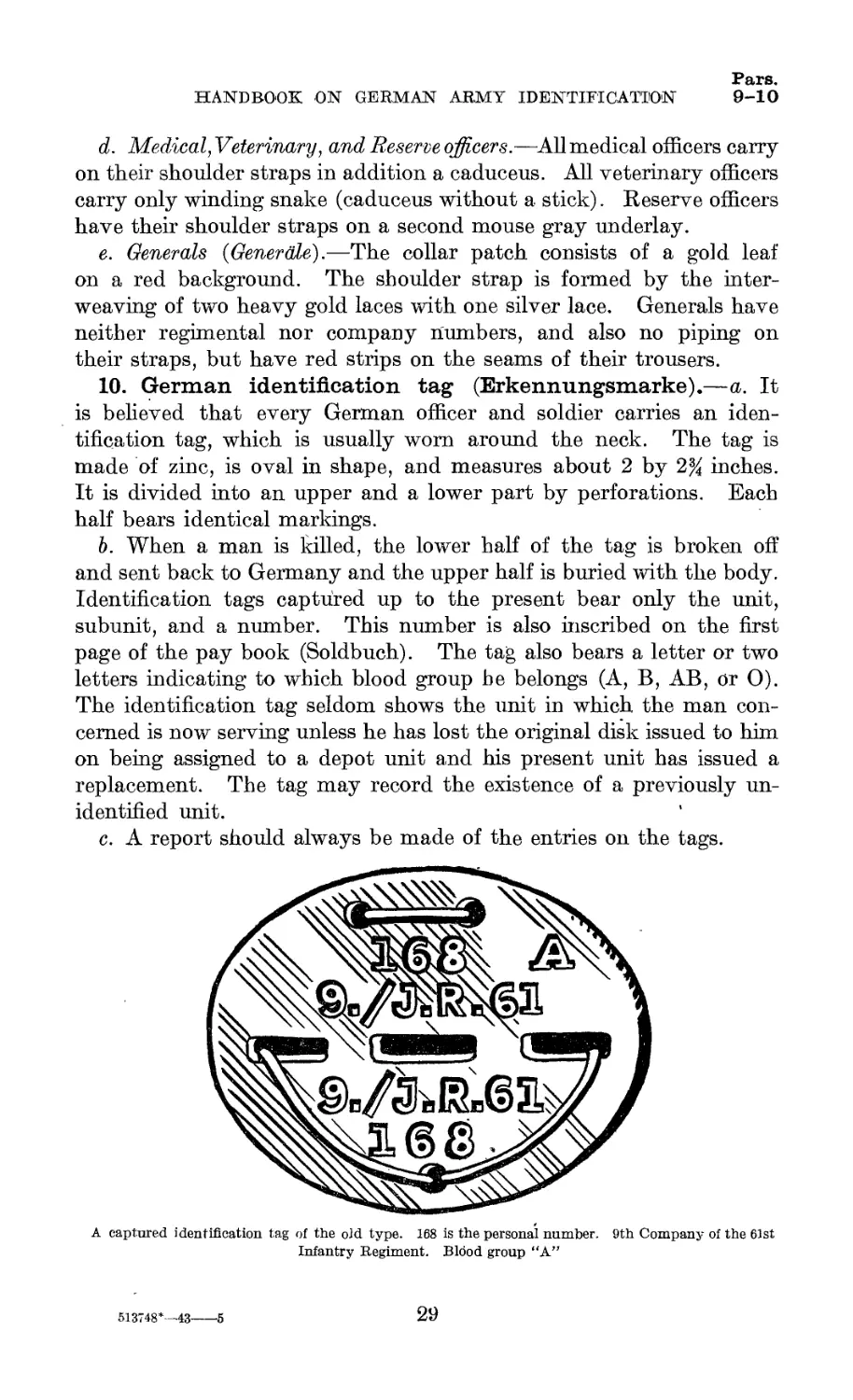
10. German identification tag (Erkennungsmarke).—a. It
is believed that every German officer and soldier carries an iden-
tification tag, which is usually worn around the neck. The tag is
made of zinc, is oval in shape, and measures about 2 by 2% inches.
It is divided into an upper and a lower part by perforations. Each
half bears identical markings.
b. When a man is killed, the lower half of the tag is broken off
and sent back to Germany and the upper half is buried with the body.
Identification tags captured up to the present bear only the unit,
subunit, and a number. This number is also inscribed on the first
page of the pay book (Soldbuch). The tag also bears a letter or two
letters indicating to which blood group be belongs (A, B, AB, or O).
The identification tag seldom shows the unit in which the man con-
cerned is now serving unless he has lost the original disk issued to him
on being assigned to a depot unit and his present unit has issued a
replacement. The tag may record the existence of a previously un-
identified unit.
c. A report should always be made of the entries on the tags.
A captured identification tag of the old type. 168 is the personal number. 9th Company of the 61st
Infantry Regiment. Blood group “A”
513748* -43----5
29
JpQ, J*
10 " HANDBOOK ON GERMAN ARMY IDENTIFICATION
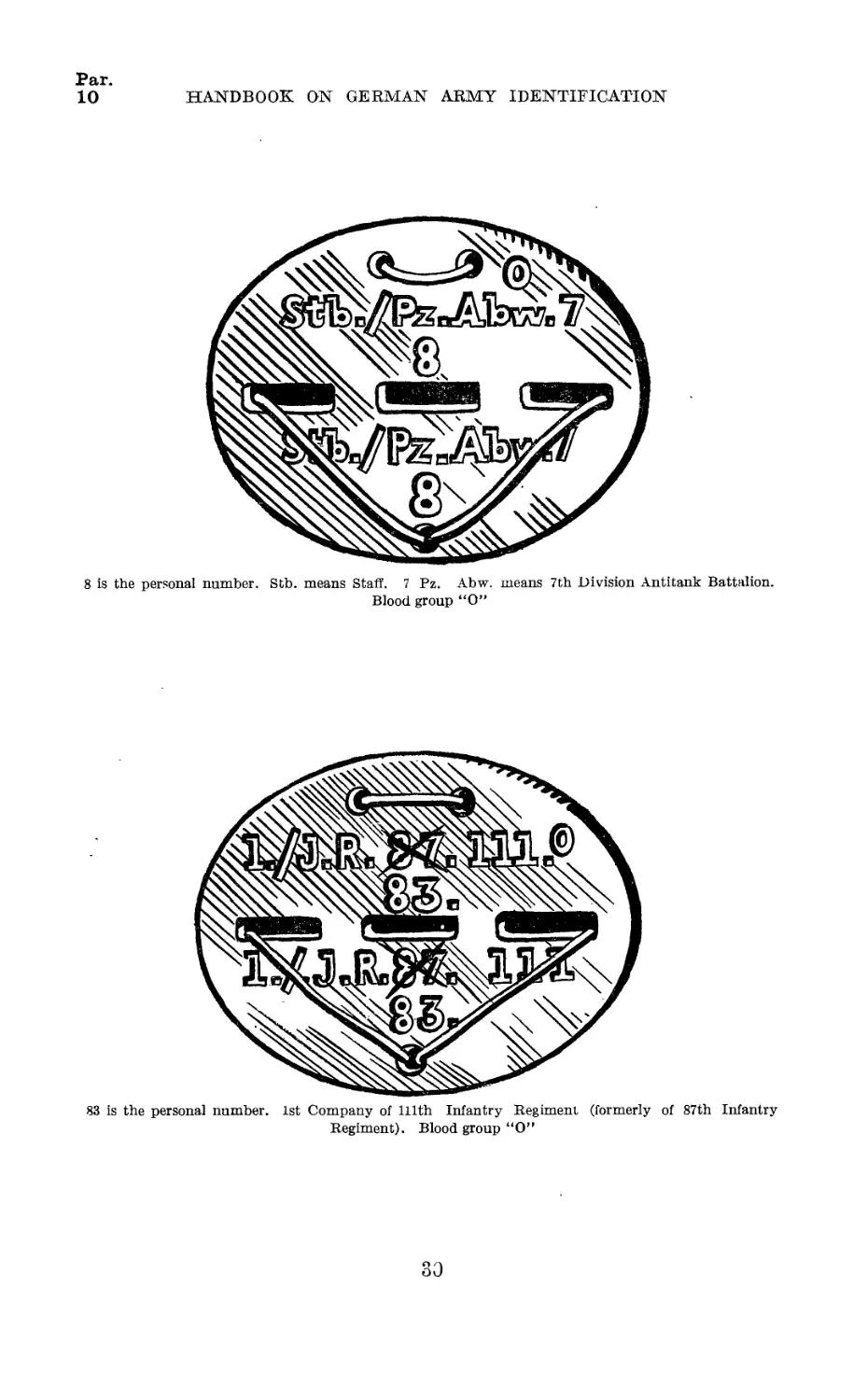
8 is the personal number. Stb. means Staff. 7 Pz. Abw. means 7th Division Antitank Battalion.
Blood group “O”
83 is the personal number. 1st Company of lllth Infantry Regiment (formerly of 87th Infantry
Regiment). Blood group “O”
30
HANDBOOK ON GERMAN ARMY IDENTIFICATION 11-12
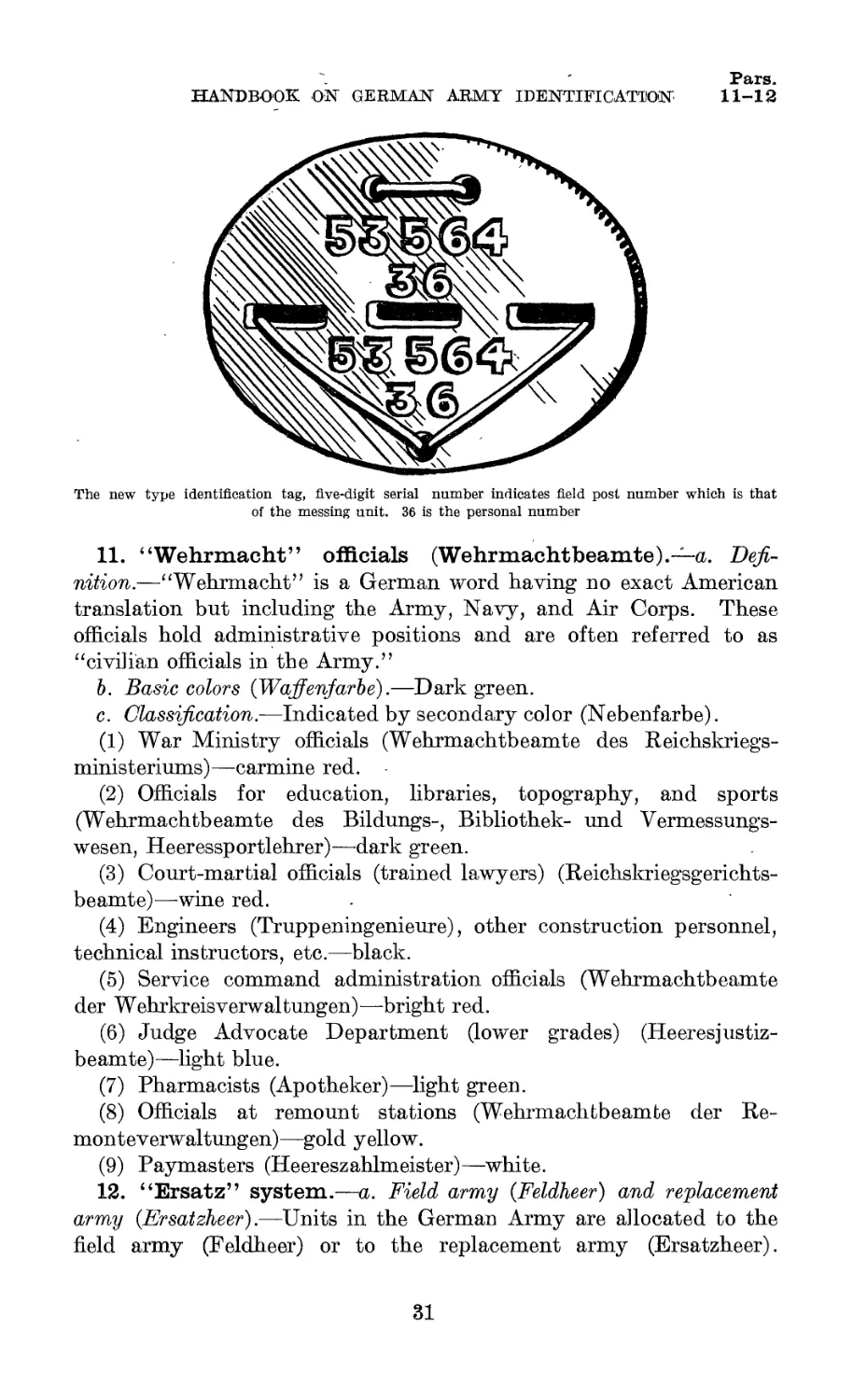
The new type identification tag, five-digit serial number indicates field post number which is that
of the messing unit. 36 is the personal number
11. “Wehrmacht” officials (Wehrmachtbeamte).—a. Defi-
nition.—“Wehrmacht” is a German word having no exact American
translation but including the Army, Navy, and Air Corps. These
officials hold administrative positions and are often referred to as
“civilian officials in the Army.”
b. Basic colors (Waffenfarbe).—Dark green.
c. Classification.—Indicated by secondary color (Nebenfarbe).
(1)	War Ministry officials (Wehrmachtbeamte des Reichskriegs-
ministeriums)—carmine red.
(2)	Officials for education, libraries, topography, and sports
(Wehrmachtbeamte des Bildungs-, Bibliothek- und Vermessungs-
wesen, Heeressportlehrer)—-dark green.
(3)	Court-martial officials (trained lawyers) (Reichskriegsgerichts-
beamte)—wine red.
(4)	Engineers (Truppeningenieure), other construction personnel,
technical instructors, etc.—black.
(5)	Service command administration officials (Wehrmachtbeamte
der Wehrkreisverwaltungen)—bright red.
(6)	Judge Advocate Department (lower grades) (Heeresjustiz-
beamte)—light blue.
(7)	Pharmacists (Apotheker)—light green.
(8)	Officials at remount stations (Wehrmachtbeamte der Re-
monteverwaltungen)—gold yellow.
(9)	Paymasters (Heereszahlmeister)—white.
12. “Ersatz” system.—a. Field army (Feldheer) and replacement
army (Ersatzheer).—Units in the German Army are allocated to the
field army (Feldheer) or to the replacement army (Ersatzheer).
31
Par.
12	HANDBOOK ON GERMAN ARMY IDENTIFICATION
The field army contains all units participating in operations or which
are specifically assigned to task forces. The replacement army has
charge of all units in training except those preparing for a specific task
force assignment, all those in rest areas, all those being refitted, and
generally all units not assigned to the field army. The replacement
army has charge of all mobilization, basic training, and initial unit
training. The replacement army turns over to the field army trained
and equipped combat units as well as trained replacements for exist-
ing combat organizations. Every unit in the field army has a replace-
ment unit in the replacement army. This replacement unit contains a
reserve of trained personnel to replace losses in the combat unit. In
some cases, replacement units are sent into the theater of war in order
to have personnel replacements more readily available.
b. Organization of Er sat zheer.—(1) Each infantry regiment has one
Ersatz battalion of the same number. The Ersatz battalion is perma-
nently stationed in the Wehrkreis (administrative corps area) of the
infantry regiment. The three Ersatz battalions of the three infantry
regiments of the infantry division are then grouped into one Ersatz
infantry regiment which will bear the number of the division. Included
in this Ersatz regiment are the Ersatz PAK company (14), the Ersatz
infantry gun company (13), and the Ersatz Nachrichten (signal)
company, all bearing the number of the division. In the same way,
each artillery regiment has an Ersatz artillery Abteilung (battalion)
which bears the same number (regiment). Other divisional units also
have Ersatz units which bear the number of the division. The engineer
battalion, Nachrichten-Abteilung (signal battalion), and the PAK-
Abteilung have an Ersatz company. There is a possibility that active
infantry regiments (as in the last war) have two Ersatz battalions
(yet unconfirmed), and it is further possible that each active unit, to
make all infantry divisions equal in value, will have the same number
of Ersatz units.
(2)	One infantry replacement training regiment may serve one or
two field army divisions. The three infantry regiments of a division
are usually served by two replacement training battalions. Similarly,
a replacement training unit is likely, in most cases, to provide per-
sonnel for two units of the field army instead of only one as in ac-
cordance with the original system. In general, it is intended that
replacement training units should be permanently affiliated with
specific field army units. For example, a proportion of the officers
of the replacement training unit will have seen service at the front
with the field army unit and convalescent soldiers are attached to a
convalescent company (Genesenden-Kompanie) of the replacement
32
HANDBOOK ON GERMAN ARMY IDENTIFICATION 12-13
training unit before returning to the field. In times of stress,
however, the system becomes less rigid.
(3)	It is not yet known definitely how the Ersatz units of GHQ,
corps, army, etc., troops are numbered and organized. It seems
probable that nondivisional units have Ersatz units bearing the same
numbers as the units themselves. This has, however, not been
definitely confirmed by the numbers of the Ersatz units so far identified.
It is, on the о the! hand, possible that GHQ, corps, army, etc., Ersatz
units are attached to divisional Ersatz units. Further evidence is
necessary before this point is definitely established.
(4)	From the foregoing it will be clear that the identification of the
number and location of Ersatz infantry battalions gives the number
and Wehrkreis of origin of the infantry regiment of the same number
and the identification of other Ersatz units the number and Wehr-
kreis of origin of the corresponding division. The identification of
Ersatz units is thus of the greatest importance. Information about
Ersatz units is derived, at the moment, principally from reports from
inside Germany. The examination of captured prisoners and docu-
ments is, however, of very great importance in this respect. The
soldier’s Soldbuch (pay book) is particularly valuable, as page 4
gives the Ersatz unit of the soldiers’ units.
(5)	In cases where the replacement training units are absent from
their home district, the recruits from that district report not at the
unit replacement training center, but at a central Wehrkreis-Ersatz-
Depot from which they are conducted in groups to their replacement
training commander.
(6)	Trained recruits arriving in small groups from the home com-
mand are sent to a Frontsammelstelle (front assembly point), which
distributes them to the units where they are required.
13.	Pay book (Soldbuch).—Although pay books are not to be
carried into battle, United Nations troops may capture them in the
course of offensive operations. The pay book (Soldbuch)—
a.	Serves the intelligence officer as a check on name, rank, and other
information the prisoner may have given at interrogation.
b.	Serves as a check on inscription and number of identification
disk carried by the prisoner.
c.	Gives a description of the prisoner (as to build, height, color of
hair, eyes, etc.).
d.	Shows the unit in which the holder is serving and, in addition,
the units of the field army (Feldheer) in which he has served pre-
viously, the depot unit (Ersatz unit) in which he was first trained,
33
13-15 HANDBOOK ON GERMAN ARMY IDENTIFICATION
and the depot units which supply replacements for various field army
units.
e.	Gives names and addresses of holder’s relatives.
f.	Gives a record of equipment issued.
g.	Gives dates of inoculations, details of eyesight, hospital record,
and dental treatment.
h.	Gives a complete record of all payments made by paymaster
and aids in identifying recent location of his unit or changes in the
official seals of the various paymasters.
i.	Gives a record of furloughs, including dates and places visited.
Section IV
THE GERMAN AIR FORCE (LUFTWAFFE)
Paragraph
Uniform and insignia__________ _______________________________________ 14
Colors of arm of service (Waffenfarben)_______________________________ 15
Special uniforms and insignia____________________________________________ 16
Insignia of rank—flying uniform_______________________________________ 17
Insignia of flying personnel of German Luftwaffe and Army________________ 18
Corps of Engineers______________________________________________________  19
Corps of Navigational Experts____________________________________________ 20
Medical Corps____________________________________________________________ 21
Musicians_______________________________________________________________  22
14.	Uniform and insignia.—a. Uniform.—Bluish green.
b.	Shoulder straps.—Same shape and same insignia of Army rank
and grade, but in the color of the air force uniform. It also has pip-
ing in the color of arm of service.
c.	Collar patches.—They are different from the Army in that the
background is in the color of the arm of service. Wings (a type of
rank insignia) are mounted on the collar patch.
d.	Steel helmet.—Same shape as the Army only the national insignia
is a flying eagle.
e.	National insignia.—A flying eagle is worn on the right breast of
the blouse. Enlisted men and noncommissioned officers wear gray
national insignia. Officers wear silver national insignia.
/. Cap insignia.—Consists of the rosette (Kokarde), flanked by oak
leaves on spread wings.
15.	Colors of arm of service (Waffenfarben).—a. Literally, in
the term ‘Waffenfarbe,” “Waffen,” short for “Waffengattung,”
means “arm of the service”; “farbe” means “color.” “Waffenfarben”
is the generic name for the colors given to the different arms or serv-
ices to distinguish them from each other. It is used as piping on
34
Par.
HANDBOOK ON GERMAN ARMY IDENTIFICATION	15
the collar patch, underlay of shoulder straps, etc. In the air force
the colors are apportioned as follows:
White (weiss)—Generals and members of the General Goering
Regiment.
Golden yellow (goldgelb)—Aviation units (Fliegerverbande).
Red (rot)—Antiaircraft artillery (Flakartillerie).
Carmine (karmesin)—General Staff officers (Generalstabsoffi-
ziere).
Pink (rosa)-—Engineer Corps (Pioniere).
Golden brown (goldbraun)—Air Signal Corps (Luftnachrich-
tendienst).
Light green (hellgrun)—Air Raid Warning Service (Luftmel-
dedienst).
Black (schwarz)—Air Ministry (Reichsluftministerium).
Dark blue (dunkelblau)—Medical (Sanitatsdienst).
Dark green (dunkelgriin)—Officials (Wehrmachtbeamte).
Additional colors are worn by the following:
Bright red (hochrot)—Noncommissioned officers and men of
the General Goering Regiment wear this color as an edging
to the collar patches.
Yellow (gelb)—Corps of navigational experts as a second
shoulder strap underlay (“Nebenfarbe”).
b. The ranks of the air force correspond, on the whole, to those of
the Army with the exception that the lowest grade is known as Flieger,
Kanonier, or Funker. There is no Oberschutze. The equivalents of
General-der Infanterie, etc., are General der Flieger and General der
Flakartillerie.
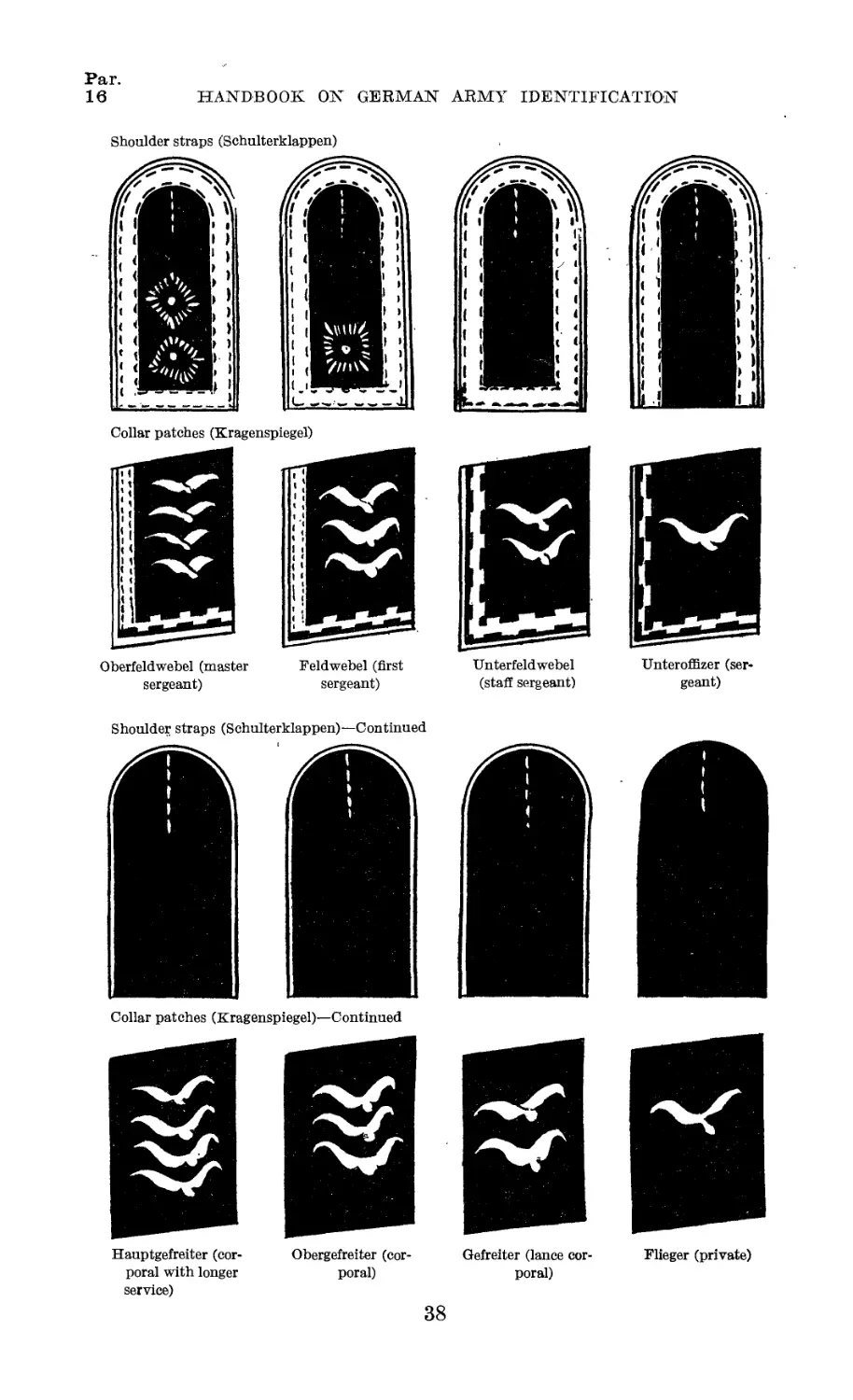
c. (1) Collar patches for enlisted men and noncommissioned officers.—
Color of the arm of service with silver wings. Silver lace on lower
front edge from Unteroffizier up.
(2)	Shoulder straps.—Blue-gray with piping colored according to
arm of service. Silver braid (like Army) from Unteroffizier up and
silver stars from Feldwebel up.
35
15—16 HANDBOOK ON GERMAN ARMY IDENTIFICATION
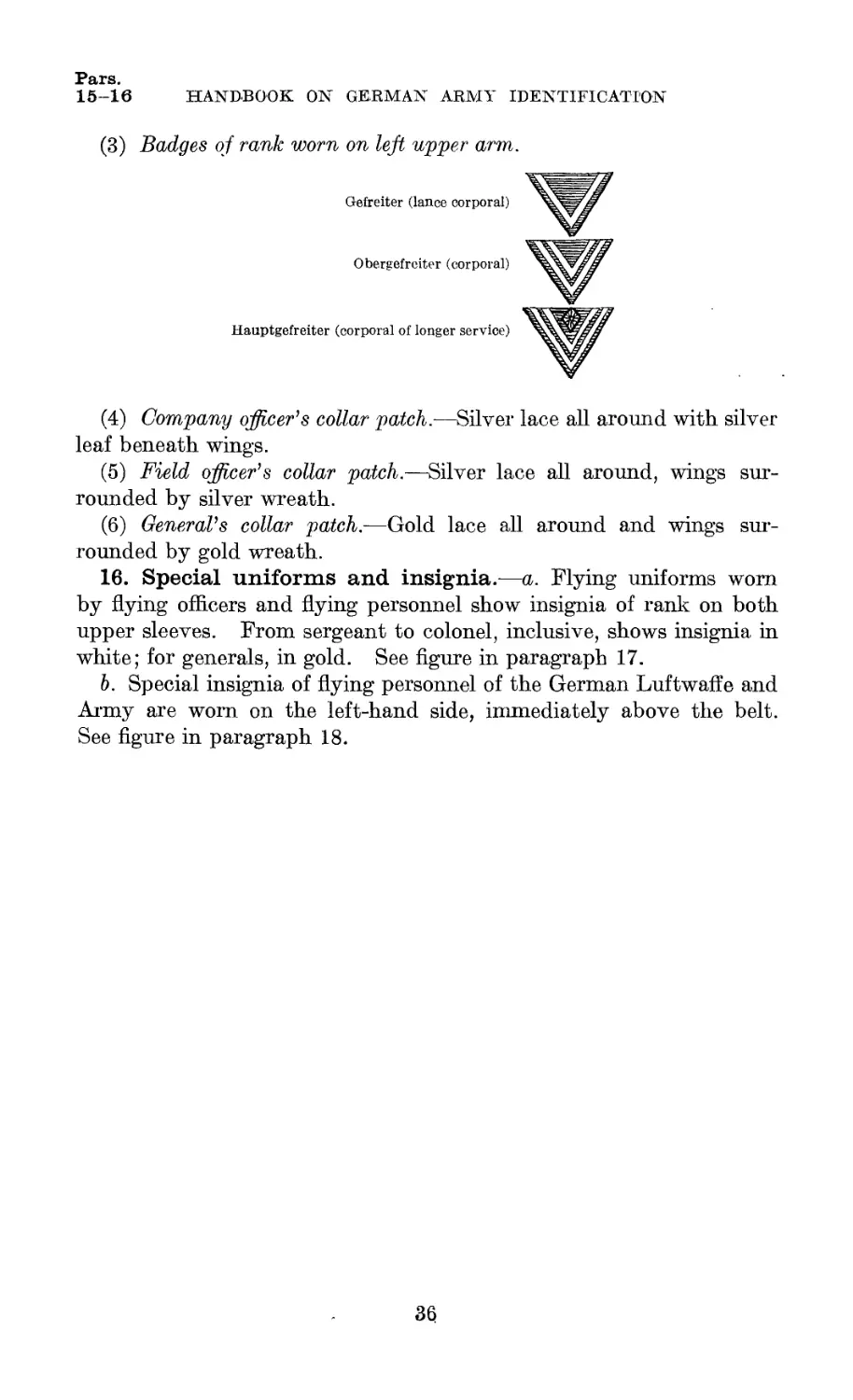
(3)	Badges of rank worn on left, upper arm.
Hauptgefreiter (corporal of longer service)
Gefreiter (lance corporal)
Obe.rgefrciter (corporal)
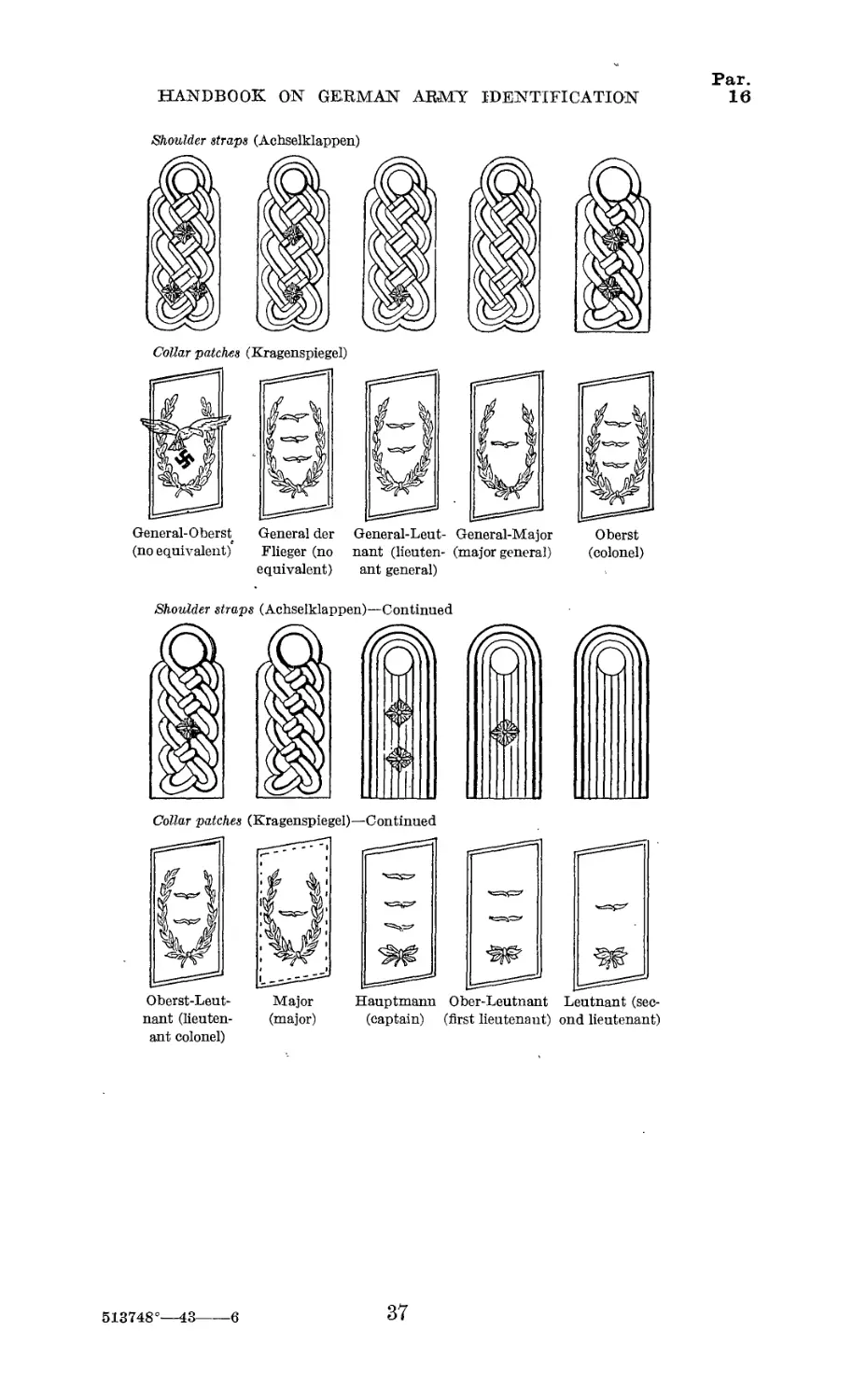
(4)	Company officer's collar patch.—Silver lace all around with silver
leaf beneath wings.
(5)	Field officer’s collar patch.—Silver lace all around, wings sur-
rounded by silver wreath.
(6)	General’s collar patch.—Gold lace all around and wings sur-
rounded by gold wreath.
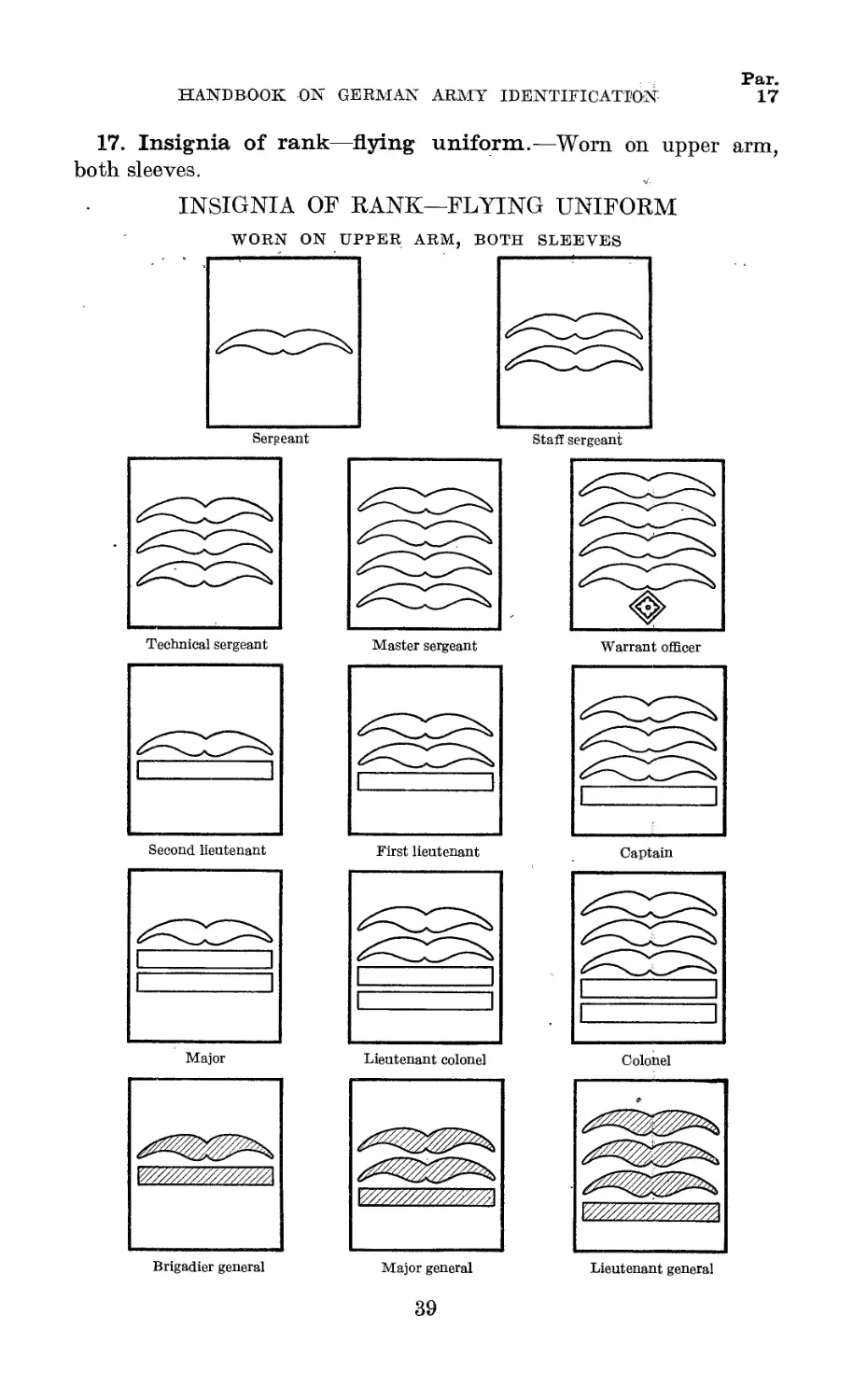
16. Special uniforms and insignia.—a. Flying uniforms worn
by flying officers and flying personnel show insignia of rank on both
upper sleeves. From sergeant to colonel, inclusive, shows insignia in
white; for generals, in gold. See figure in paragraph 17.
b. Special insignia of flying personnel of the German Luftwaffe and
Army are worn on the left-hand side, immediately above the belt.
See figure in paragraph 18.
36
Par.
16
HANDBOOK ON GERMAN ARMY IDENTIFICATION
/Shoulder straps (Achselklappen)
Shoulder straps (Achselklappen)—Continued
ant colonel)
513748°—43---6
37
Par.
HANDBOOK ON GERMAN
ARMY IDENTIFICATION
16
Shoulder straps (Schulterklappen)
Collar patches (Kragenspiegel)
Oberfeldwebel (master Feldwebel (first
sergeant)
sergeant)
Unterfeldwebel
(staff sergeant)
Unterofflzer (ser-
geant)
Shoulder straps (Schulterklappen)—Continued
Collar patches (Kragenspiegel)—Continued
Hauptgefreiter (cor-
poral with longer
service)
Obergefreiter (cor-
poral)
Gefreiter (lance cor- Flieger (private)
poral)
38
Par.
17
HANDBOOK ON GERMAN ARMY IDENTIFICATION
17. Insignia of rank—flying uniform.—Worn on upper
both sleeves.
arm,
INSIGNIA OF RANK—FLYING UNIFORM
WORN ON UPPER ARM, BOTH SLEEVES
Lieutenant colonel
Captain
Colonel
I	~1


Brigadier general
Major general
Lieutenant general
39
Pars.
18-21
HANDBOOK ON GERMAN ARMY IDENTIFICATION
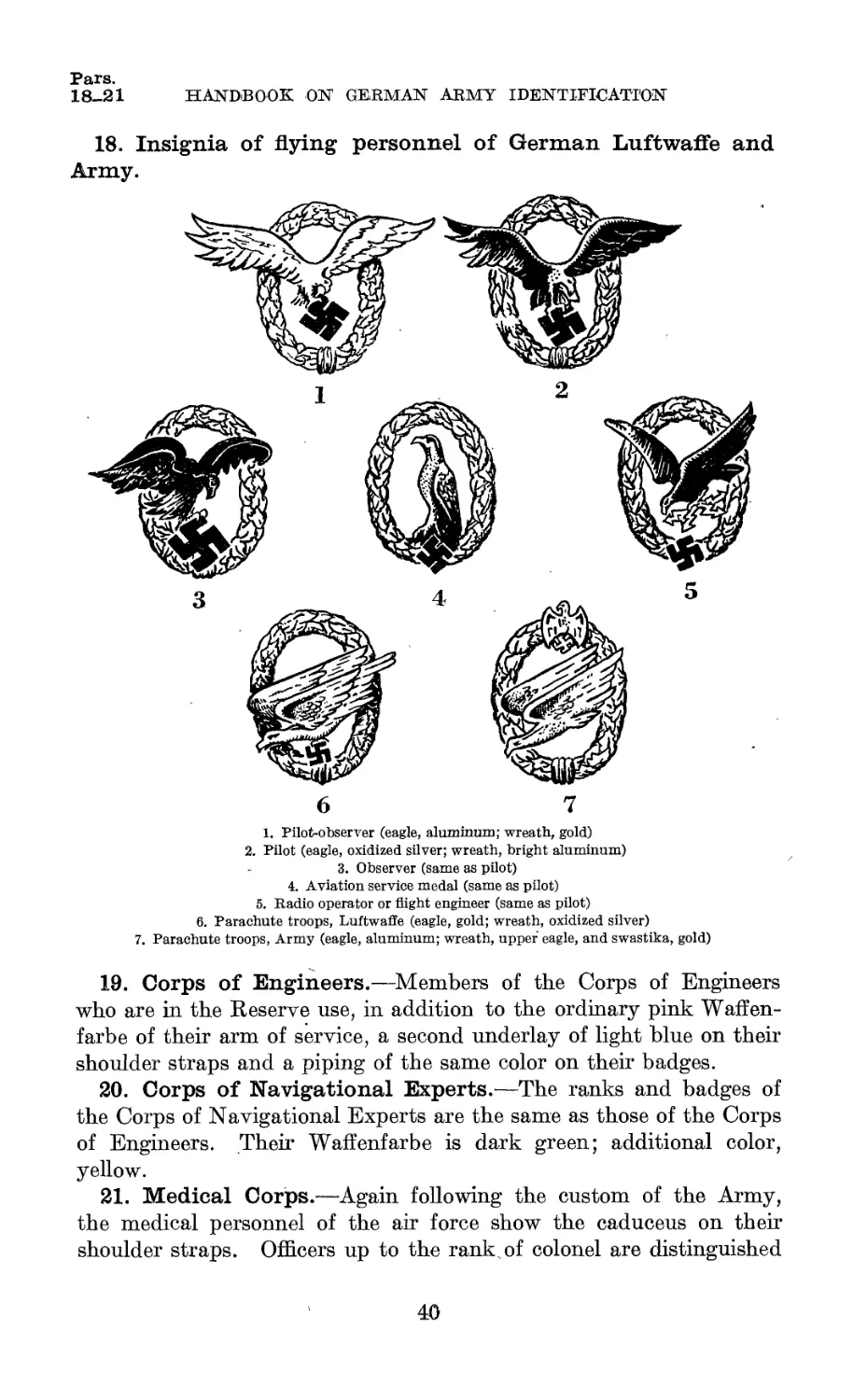
18. Insignia of flying personnel of German Luftwaffe and
Army.
1. Pilot-observer (eagle, aluminum; wreath, gold)
2. Pilot (eagle, oxidized silver; wreath, bright aluminum)
3. Observer (same as pilot)
4. Aviation service medal (same as pilot)
5. Radio operator or flight engineer (same as pilot)
6. Parachute troops, Luftwaffe (eagle, gold; wreath, oxidized silver)
7. Parachute troops, Army (eagle, aluminum; wreath, upper eagle, and swastika, gold)
19.	Corps of Engineers.—Members of the Corps of Engineers
who are in the Reserve use, in addition to the ordinary pink Waffen-
farbe of their arm of service, a second underlay of light blue on their
shoulder straps and a piping of the same color on their badges.
20.	Corps of Navigational Experts.—The ranks and badges of
the Corps of Navigational Experts are the same as those of the Corps
of Engineers. Their Waffenfarbe is dark green; additional color,
yellow.
21.	Medical Corps.—Again following the custom of the Army,
the medical personnel of the air force show the caduceus on their
shoulder straps. Officers up to the rank of colonel are distinguished
40
Pars.
21-22
HANDBOOK ON GERMAN ARMY IDENTIFICATION
by their Waffenfarbe of dark blue, with their badges in gilt. When
serving in the reserve, however, they change to orange.
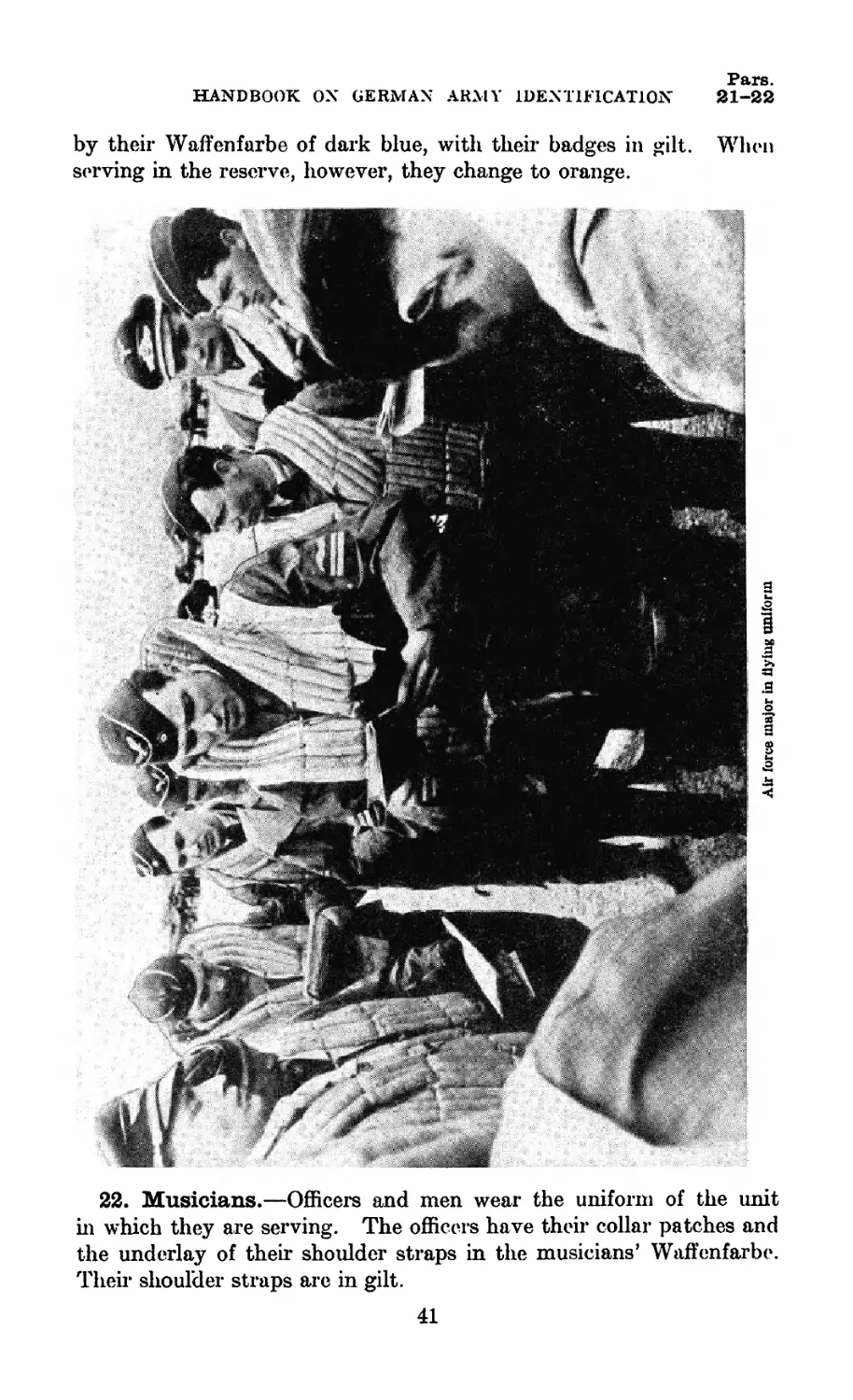
22.	Musicians.—Officers and men wear the uniform of the unit
in which they are serving. The officers have their collar patches and
the underlay of their shoulder straps in the musicians’ Waffenfarbe.
Their shoulder straps are in gilt.
41
Par.
22
HANDBOOK ON GERMAN ARMY IDENTIFICATION
GABARDINE
COAT----1
LEATHERx
BELT/
GAUNTLET
GLOVES
ZIPPER
LOOSE COLLAR
BADGE
CAMOUFLAGED
STEEL HELMET
BOOTS LACE
AT SIDES---
GREY CLOTH
PANTS ----
PISTOL
RUBBER SOLES
FRONT
CANTEEN *
GRENADE
POCKETS
WITH ZIPPER
OR POSSIBLY
BUTTONS
INOCULARS
GAS MASK
MS
SHELTER CAPE
TWO
HAVERSACKS
BACK
RIGHT SIDE LEFT SIDE
42
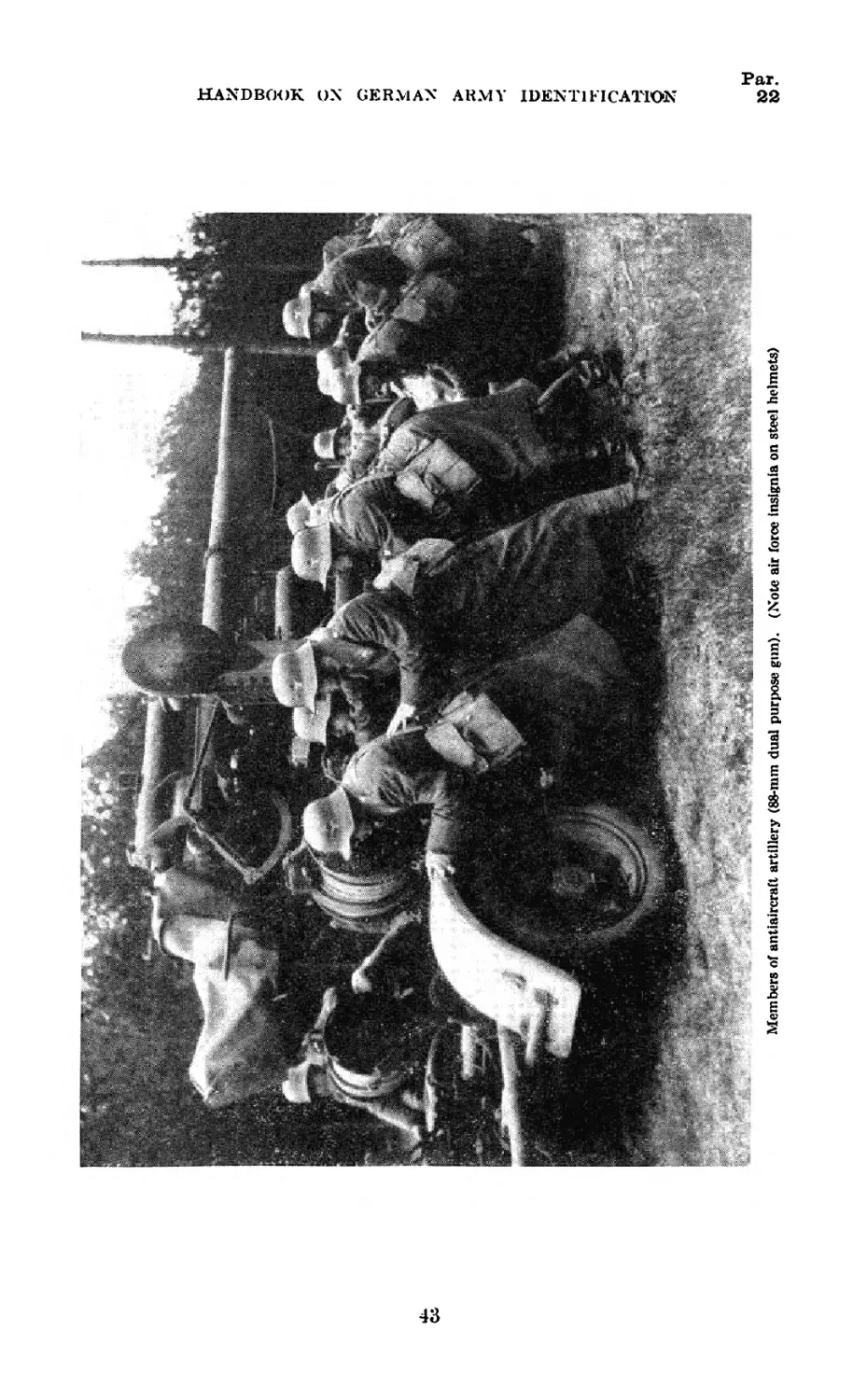
Members of antiaircraft artillery (88-mm dual purpose gun). (Note air force insignia on steel helmets)
HANDBOOK ON GERMAN ARMY IDENTIFICATION
4
№.w
Pars.
23-24 HANDBOOK ON GERMAN ARMY IDENTIFICATION
Section V
THE GERMAN NAVY (DIE DEUTSCHE KRIEGSMARINE)
Paragraph
General__________________________________________________________________ 23
Insignia of rank of Navy (Dienstgradabzeichen der Kriegsmarine)__________ 24
23.	General.—a. Basically the present German naval uniform,
both for commissioned and enlisted personnel, is very similar to that of
the former Imperial Navy.
b.	With the exception that in the lower grades the equivalent
German rank is one-half stripe above our corresponding insignia,
the insignia of rank on the sleeves is similar to that of the U. S. Navy.
Shoulder straps on the navy blue uniform are worn more prevalently
than in our service and follow the system of the German Army, except
that piping and braid are gilt. The full dress and other uniforms
resemble ours, but the white uniform has a roll collar. (See figures in
par. 24.) The national insignia (Hoheitsabzeichen) is worn above the
right breast pocket and is in gold.
c.	The German Navy headdress is similar to our own, with the ex-
ception that the chin strap for all ranks is in black leather. Officers
up to and including the rank of lieutenant commander have a gold rim
on the visor; higher grades wear gilt oak leaves as in the U. S. Navy.
The cap insignia is the black-white-red cockade, surrounded by gilt
oak leaves and surmounted by a gilded national emblem. Warrant
officers wear the same cap, but without any gilt on the visor. Since
the outbreak of the second World War, all ranks and ratings, from
flag officers on down, wear a blue "overseas” cap at sea. This cap is
similar to the German field service cap (with gilt insignia, but without
any piping).
d.	German naval personnel serving ashore in coastal batteries or as
troops in the field (not as landing parties) wear the Army field gray.
They are distinguished from the Army by having gold buttons and
insignia.
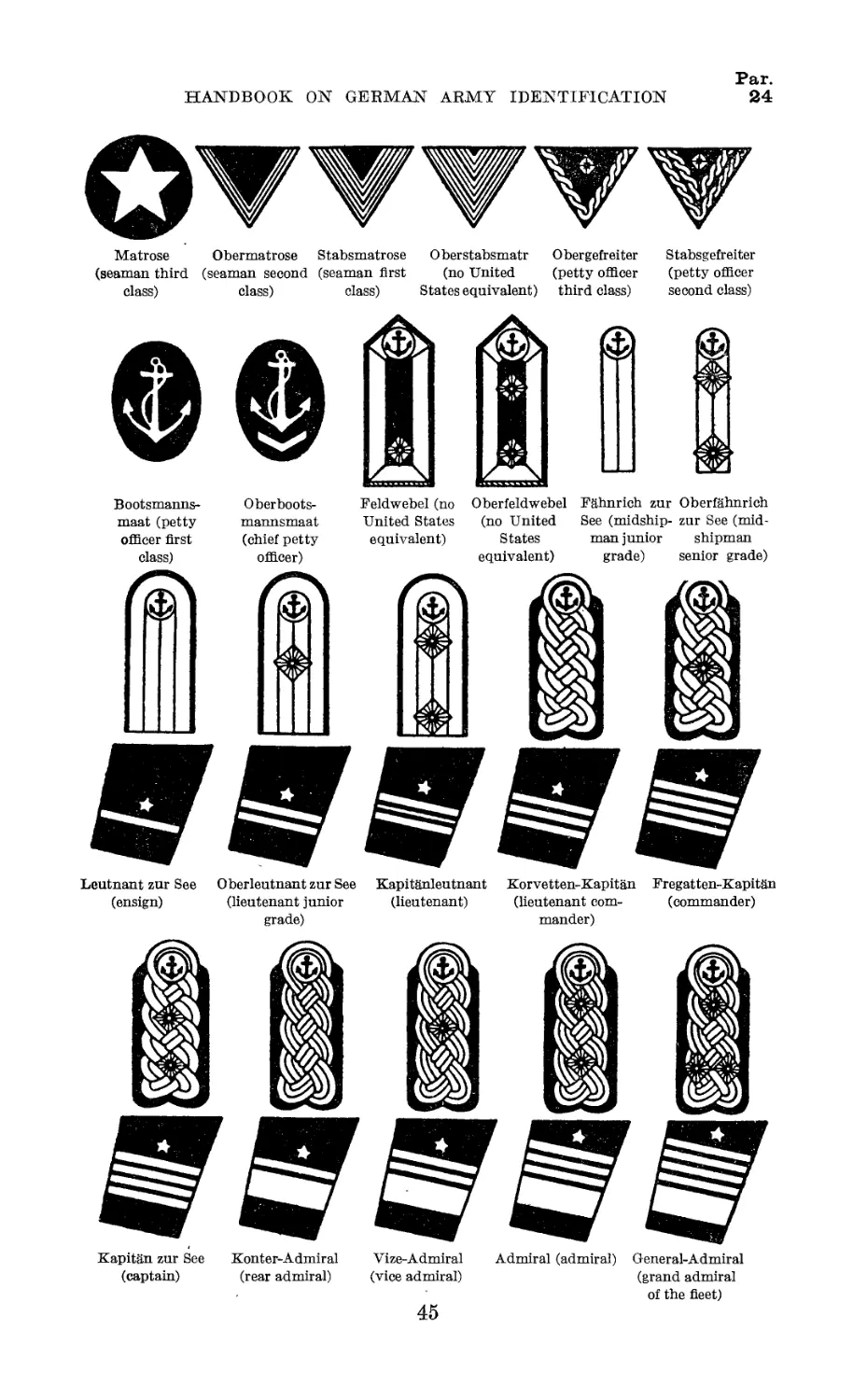
24.	Insignia of rank of Navy (Dienstgradabzeichen der
Kriegsmarine).
44
Par.
24
HANDBOOK ON GERMAN ARMY IDENTIFICATION
Matrose
(seaman third
class)
Obermatrose
(seaman second
class)
Stabsmatrose
(seaman first
class)
Oberstabsmatr
(no United
States equivalent)
Obergefreiter
(petty officer
third class)
Stabsgefreiter
(petty officer
second class)
® ©
Feldwebel (no
United States
equivalent)
Bootsmanns-	Oberboots-
maat (petty	mannsmaat
officer first	(chief petty
class)	officer)
Oberfeldwebel Fahnrich zur Oberfahnrich
(no United See (midship- zur See (mid-
States man junior shipman
equivalent) grade) senior grade)
Leutnant zur See
(ensign)
Oberleutnant zur See
(lieutenant junior
grade)
Kapitanleutnant
(lieutenant)
Korvetten-Kapitan
(lieutenant com-
mander)
Fregatten-KapitSn
(commander)
of the fleet)
45
Pars.
25-26 HANDBOOK ON GERMAN ARMY IDENTIFICATION
Section VI
POLICE, SEMIMILITARY AND POLITICAL ORGANIZA-
TIONS (DEUTSCHE POLIZEI, HALBMILITARISCHE UND
POLITISCHE VERBANDE)
Paragraph
German police (Deutsche Polizei)_______________________________________ 25
Semimilitary and political organizations_______________________________ 26
Uniforms of armed SS (Waffen SS)___________________________ _ . _______ 27
Insignia of rank of the National Labor Service (Dienstgradabzeichen des
Reichsarbeitsdienstes R. A. D.)______________________________________ 28
National Socialist Organizations (Nationalsozialistische Organisationen) _ _	29
Insignia of rank of SA, SS, and of the NSKK (Dienstgradabzeichen der
SA, SS, und der NSKK)_______________________________________ ________ 30
Insignia on uniform of the German police (Uniform-Abzeichen der Deut-
schen Polizei)_________________________________________ ________________ 31
Command post flags (Kommandofiaggen)___________________________________ 32
Field insignia and flags of the National Socialist German Labor Party
(Feldzeichen und Fahnen der NSDAP)__________________________ ________ 33
Insignia of rank of Hitler Youth (Dienstgradabzeichen der Hitlerjugend) _	34
Rank insignia of the political leaders (Dienstgradabzeichen der Politischen
Leiter)________ __________ __________ ______ . . ______________________ 35
25.	German police (Deutsche Polizei).—The German police is
divided into—
a.	Constabulary (Ordnungspolizei).—(1) City police (Schutzpolizei).
(2) Rural constabulary (Gendarmerie).
b.	Security police {Sicherheitspolizei).—(1) Secret state police (Ge-
heime Staatspolizei or Gestapo). . The secret state police have as their
special task the liquidation and prevention of all activity hostile to the
regime.
(2)	Criminal police (Kriminalpolizei).
26.	Semimilitary and political organizations.—a. SS (Schutz-
staffeln).—This is the corps d’elite of the National Socialist Party.
Originally formed as protective squads for political meetings and body-
guards for the leaders of the party, it has been considerably expanded
and is now widely employed, both for internal security duties in Ger-
many and German-occupied territories, and in permanent military
units. Hitler is the supreme head of the SS. Under him Himmler
is the executive chief of the organization with headquarters in Berlin.
(1)	The units of the SS fall into two distinct categories—
(a)	Ordinary SS (Allgemeine SS) consists of part time volunteers
employed for security purposes within Germany.
(6)	Militarized SS (Waffen SS) is a fully militarized and perma-
46
Par.
26
HANDBOOK ON GERMAN ARMY IDENTIFICATION
nently organized force, formed into divisions and a number of inde-
pendent brigades and regiments.* 1 2 3 4 5 6 7
(2)	Nondivisional SS units are normally employed for mopping-up
purposes along the line of communication. They may also be em-
ployed on occasions on the front line subordinated to the nearest
convenient army.
(3)	The uniform is field gray as in the Army, with variances
mentioned in paragraph 27.
b.	National Labor Service (Reichsarbeitsdienst) (JR. A. D.~).—(1) All
German men who are physically fit are normally required to perform
6 months’ service in the R. A. D. before beginning their military
service. They are organized into companies under a cadre of per-
manent officers and noncommissioned officers, and such companies
are available in considerable numbers for service on the line of com-
munication and in occupied countries, where they provide additional
manual labor for the Organisation Todt or the engineers.
(2)	The uniform is brownish gray blouse with dark collar and slacks.
On the left sleeve is the R. A. D. emblem (a spade head containing
the Arabic number of the company) and, beneath it, a red arm band
with a black swastika set in a white circle.
c.	Storm Trooper Detachments (Sturm-Abteilungeri) (S. A.).—The
S. A. is responsible for the premilitary and postmilitary training of
German manpower in cooperation with the heads of the fighting serv-
ices. The majority have been absorbed into the Army.
d.	National Socialist Mounted Corps (Nationalsozialistisches Rei-
terkorps') (N. S. R. K.).—Its function is to train young men to the
standard of cavalry recruits of 6 months’ service before they join the
Army. A man who wishes to join a mounted arm of the service now
has to be in possession of a certificate from this organization before
he is accepted.
e.	National Socialist Motor Corps {National Sozialistisches Kraft-
Jahrkorps}. (N. S. К. K.).—(1) The functions of this organization
are to assist the police in traffic control duties on the line of communi-
cation and to provide motor transport units (Brigaden) to supplement
the transport services of the armed forces.
(2) Within Germany, the N. S. К. K. also trains men in its motor
1 Waffen SS composed of Verftigungstruppen:
(1) Adolf Hitler’s special bodyguard (Leibstandarte Adolf Hitler).
(2) SS regiment “Germania” (Standarte “Germania”).
(3) SS regiment “Deutschland” (Standarte “Deutschland”).
(4) SS regiment “.Horst Wessel” (Standarte “Horst Wessel”).
(5) SS regiment “Planetta” (Standarte “Planetta”).
(6) SS regiment The Fuhrer (Standarte Der Fuhrer). Divisions:
(a) Viking.
(6) Reich.
(c) Prinz Eugen.
(7) Wachtregiment “Wien” (Guard regiment “Vienna”).
47
Pars.
26-27 HANDBOOK ON GERMAN ARMY IDENTIFICATION
schools and training units for service with the army’s mobile troops.
Its basic unit is the motor battalion (Motorstandarte), which carries
a number in the series 1-400.
(3) The uniform is brown shirt and black breeches. The national
emblem is mounted on a wheel enclosing a swastika, and is worn on
the cap or black crash helmet. White Arabic numerals preceded by
the letter “M” on the right-hand collar patch give the number of
the battalion.
/. National Socialist Flying Corps {National Sozialistisches . Flie-
gerkorps)i-—Its function is to organize the premilitary training of
personnel destined for the air force, in particular the members of the
flying section of the Hitler Youth. At the technical schools of the
N. S. F. K. courses are held which include theoretical and practical
instruction in.the construction of gliders, as well as in radiotelegraph,
radiotelephone, etc.
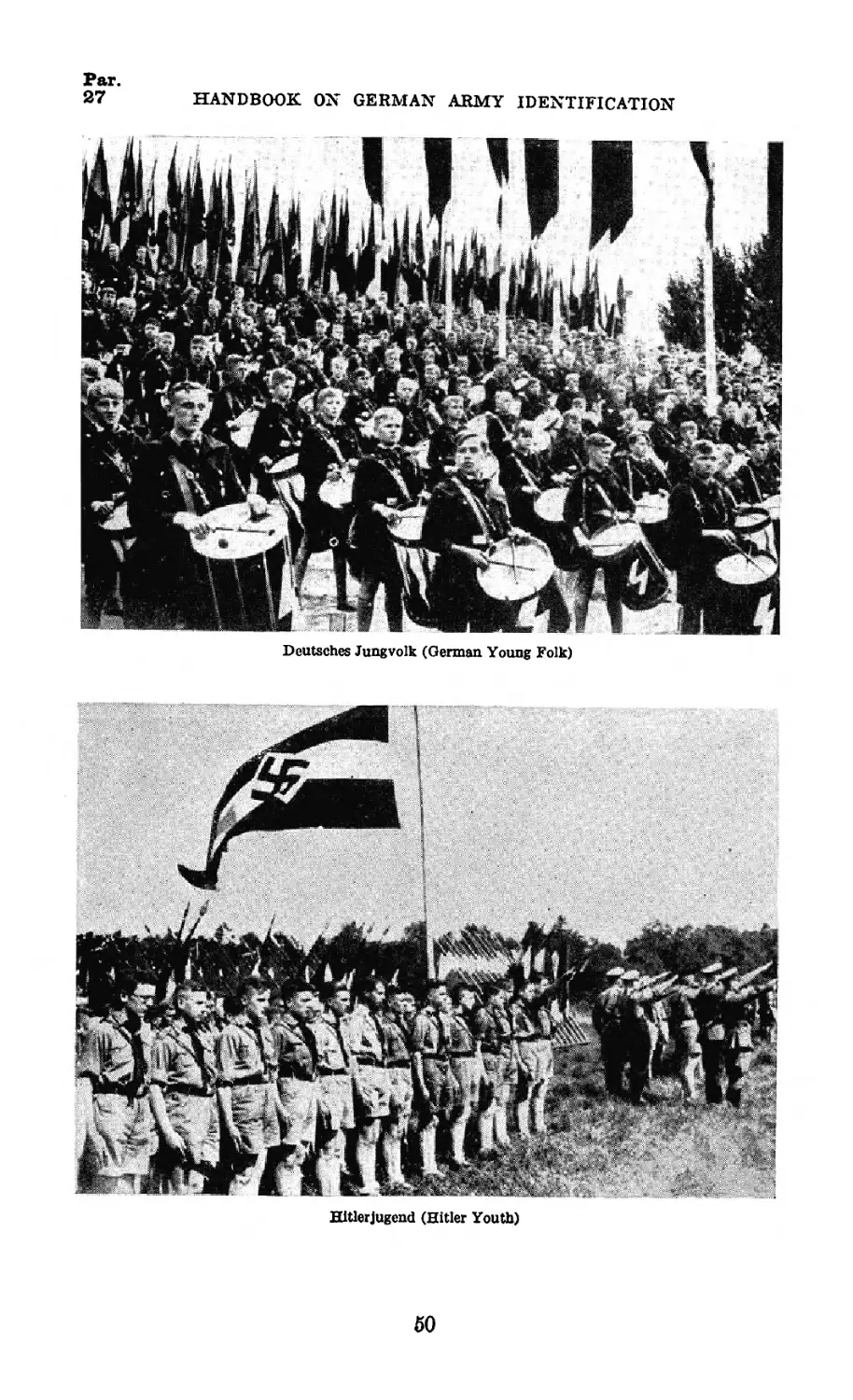
g. Hitler Youth and German Young Folk (Hitlerjug end und Deutsches
Jungvolk).—Compulsory for all boys except those whose blood is not
pure Aryan.
Note.—A soldier must have been a graduate member of one of the above
organizations (d, e, or/) in order to join panzer, air, or horse cavalry outfits.
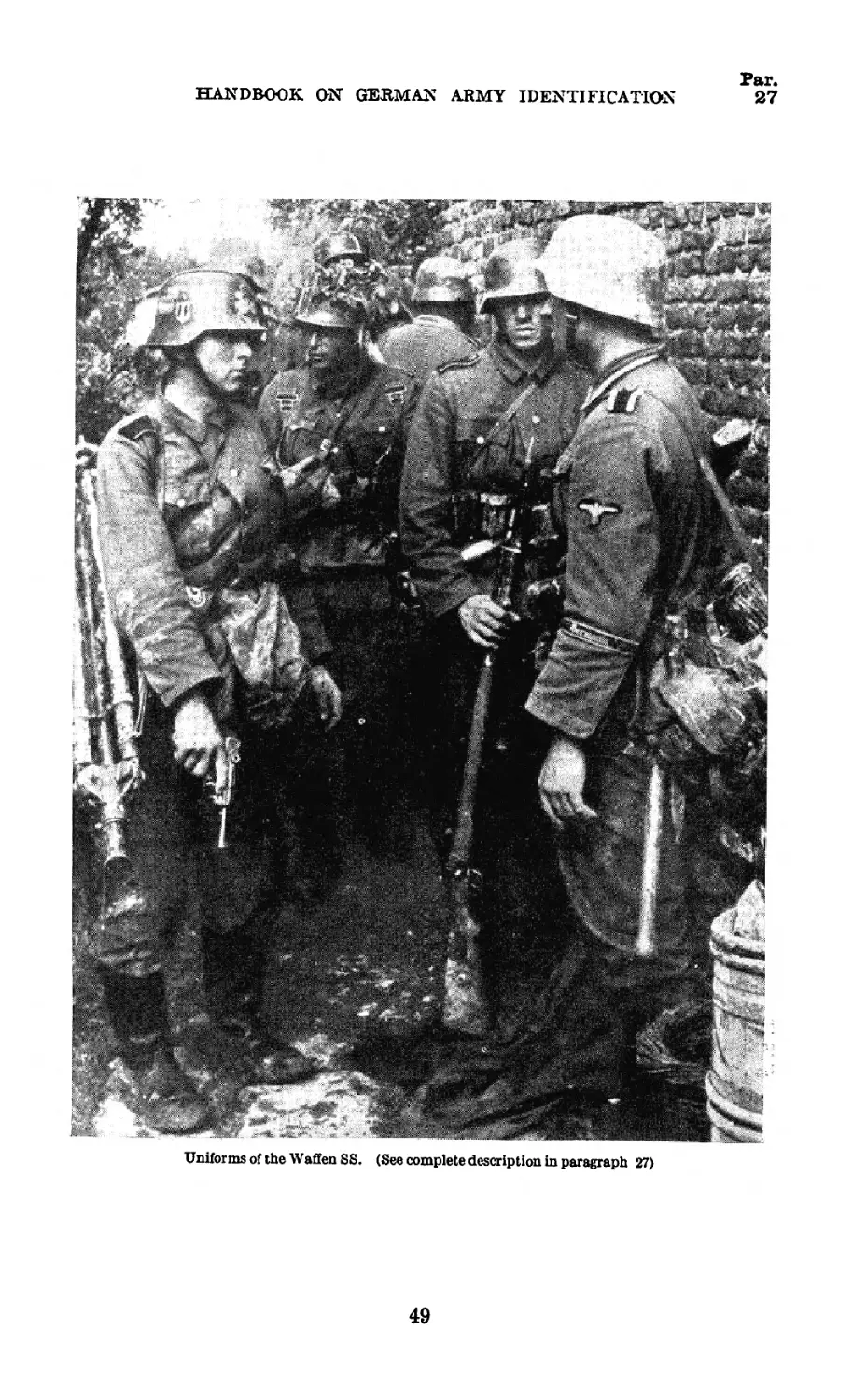
27.	Uniforms of armed SS (Waffen SS).—Waffen SS troops
wear the ordinary field gray uniforms of the German Army, with the
usual colored piping for the different arms and services. There are,
however, some points of difference. The most important of these
are—
a.	Steel helmet.—(1) Right side—black SS on white shield.
(2)	Left side—black swastika in white circle on red shield.
b.	Field blouse.—(1) The shoulder straps are always black.
(2)	The collar patches are always black. For commissioned ranks
they are edged with white cord.
(3)	The special SS rank badge is worn on the left collar patch.
A white SS or a skull and crossbones insignia is worn on the right
collar patch.
(4)	The national insignia is worn on the left upper arm and not on
the right breast.
(5)	About 8 inches from the bottom of the left cuff a narrow black
band edged in white is worn, bearing the name of the regiment
(Standarte) in white lettering. In the figure on page 49 the
“Germania” is shown.
(6)	A single chevron on the right upper arm denotes long service
(distinguish from single chevron on left arm indicating Sturmmann).
(7)	A single chevron with a star on right upper arm denotes previous
service in the police or armed forces.
48
Par.
27
HANDBOOK ON GERMAN ARMY IDENTIFICATION
Uniforms of the Waffen SS. (See complete description in paragraph 27)
49
Par.
27	HANDBOOK ON GERMAN ARMY IDENTIFICATION
Deutsches Jungvolk (German Young Folk)
Hitler jugend (Hitler Youth)
50
Par.
27
HANDBOOK ON GERMAN ARMY IDENTIFICATION
National Labor Service
51
Par.
28	HANDBOOK ON GERMAN ARMY IDENTIFICATION
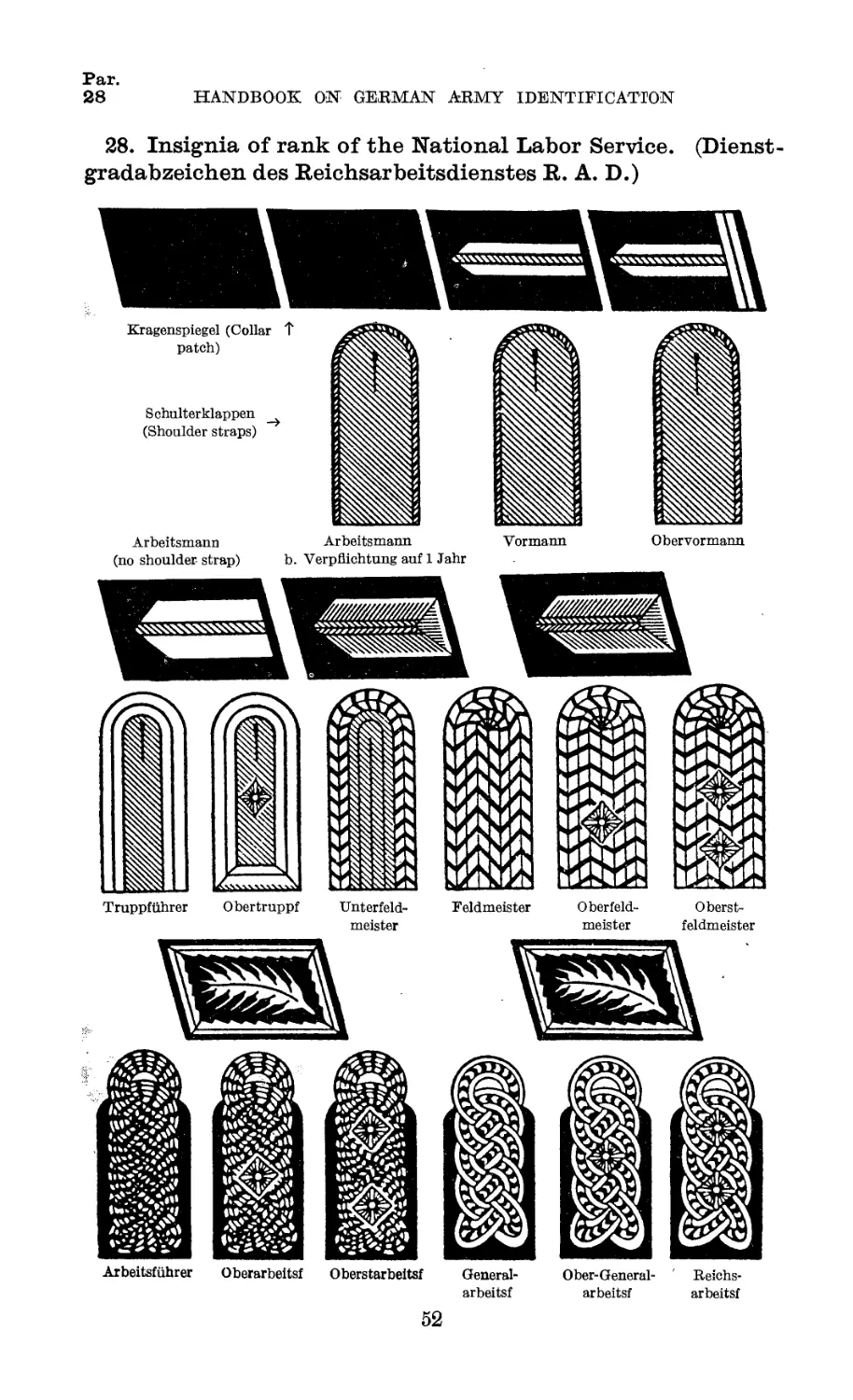
28.	Insignia of rank of the National Labor Service. (Dienst-
gradabzeichen des Reichsarbeitsdienstes R. A. D.)
Arbeitsfiihrer Oberarbeitsf Oberstarbeitsf
General-	Ober-General- ' Reichs-
arbeitsf	arbeitsf arbeitsf
52
Par.
29
HANDBOOK ON GERMAN ARMY IDENTIFICATION
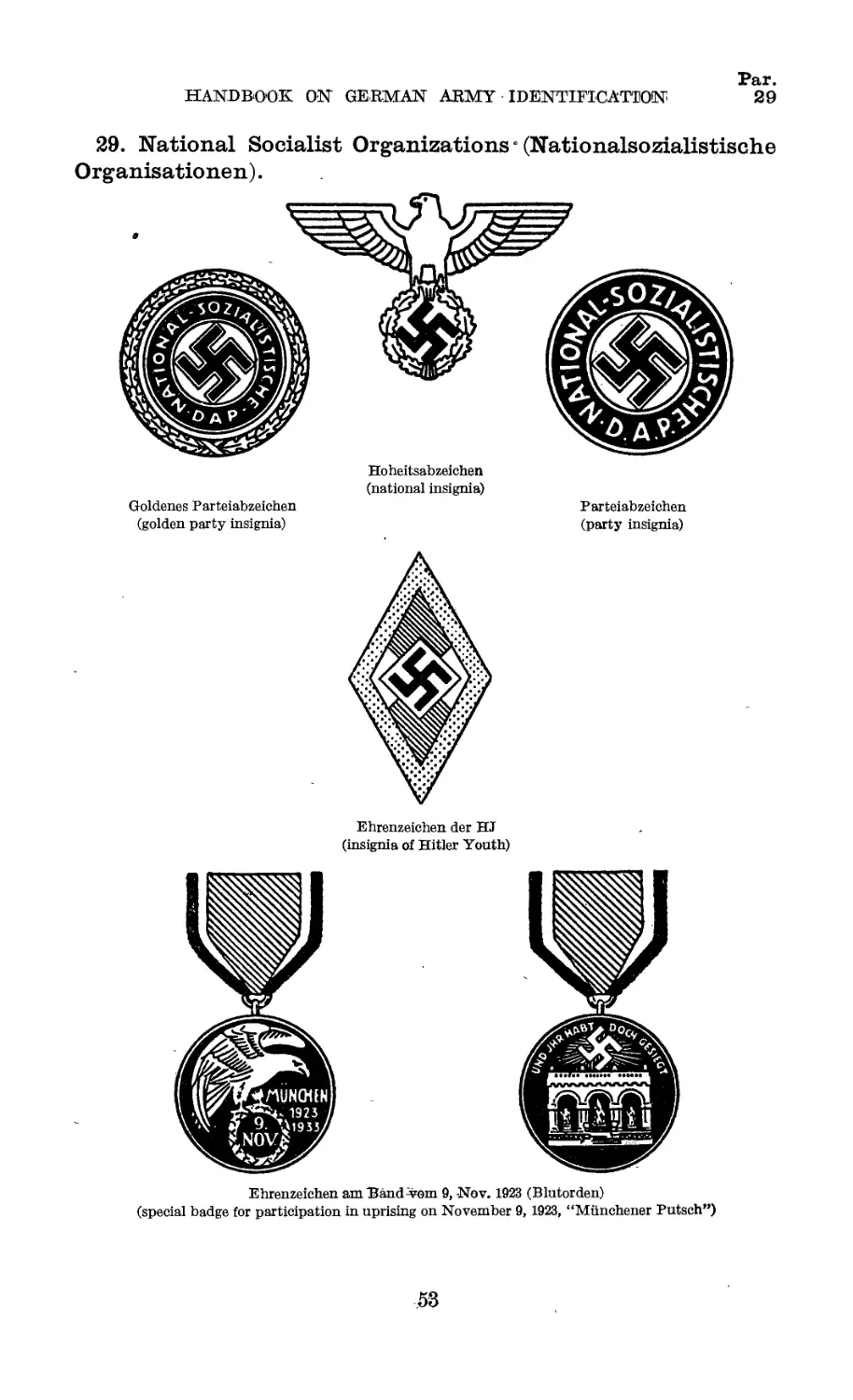
29.	National Socialist Organizationsc (Nationalsozialistische
Organisationen).
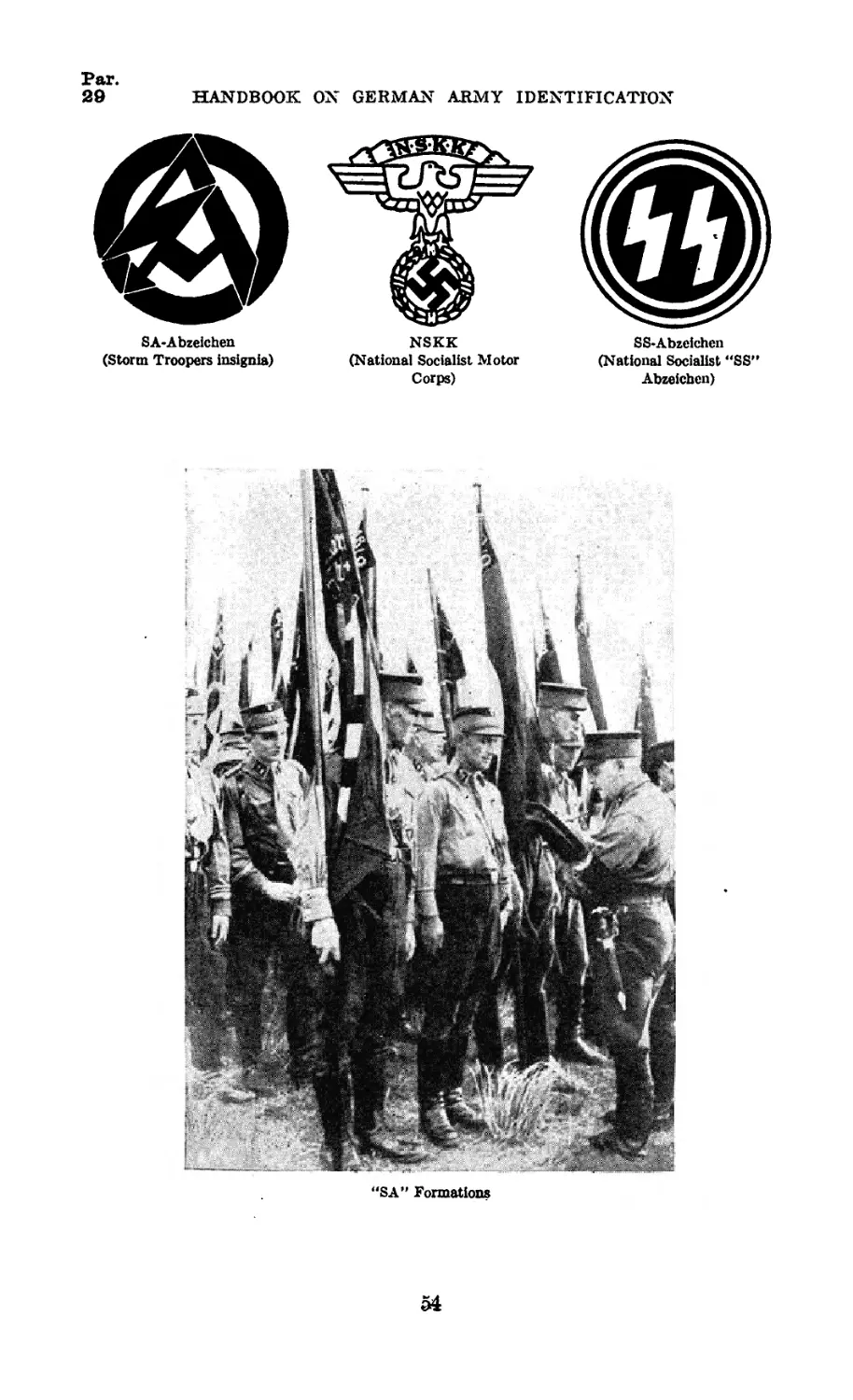
Hoheitsabzeichen
(national insignia)
Goldenes Parteiabzeichen
(golden party insignia)
Parteiabzeichen
(party insignia)
Ehrenzeichen amBand vom 9, -Nov. 1923 (Blutorden)
(special badge for participation in uprising on November 9,1923, “Miinchener Putsch”)
.53
Par.
29
HANDBOOK ON GERMAN ARMY IDENTIFICATION
"SA" Formations
54
Par.
29
HANDBOOK ON GERMAN ARMY IDENTIFICATION
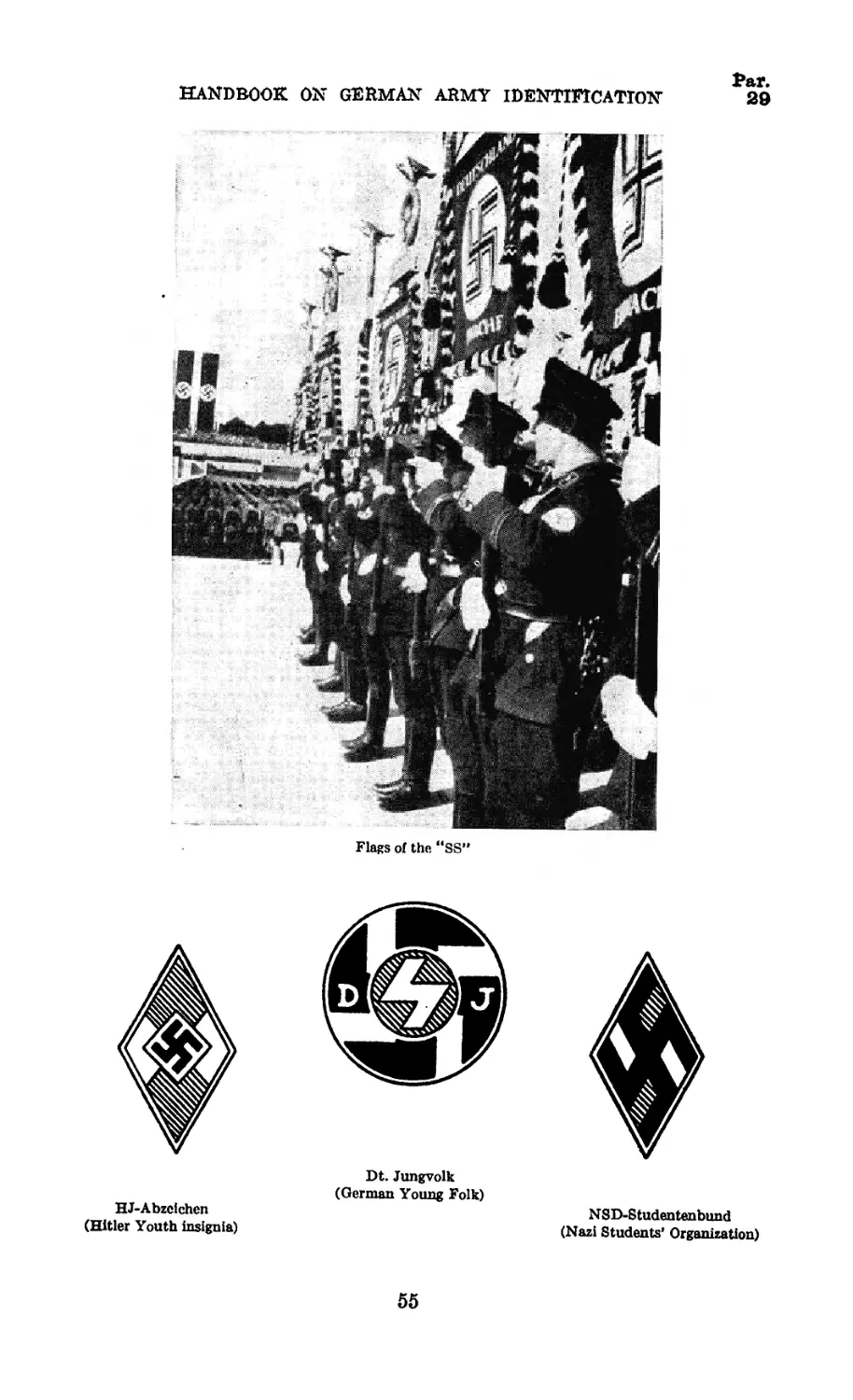
Flags of the. “SS”
HJ-Abzcichen
(Hitler Youth insignia)
Dt. Jungvolk
(German Young Folk)
NSD-Studentenbund
(Nazi Students’ Organization)
55
Par.
29	HANDBOOK ON GERMAN ARMY IDENTIFICATION
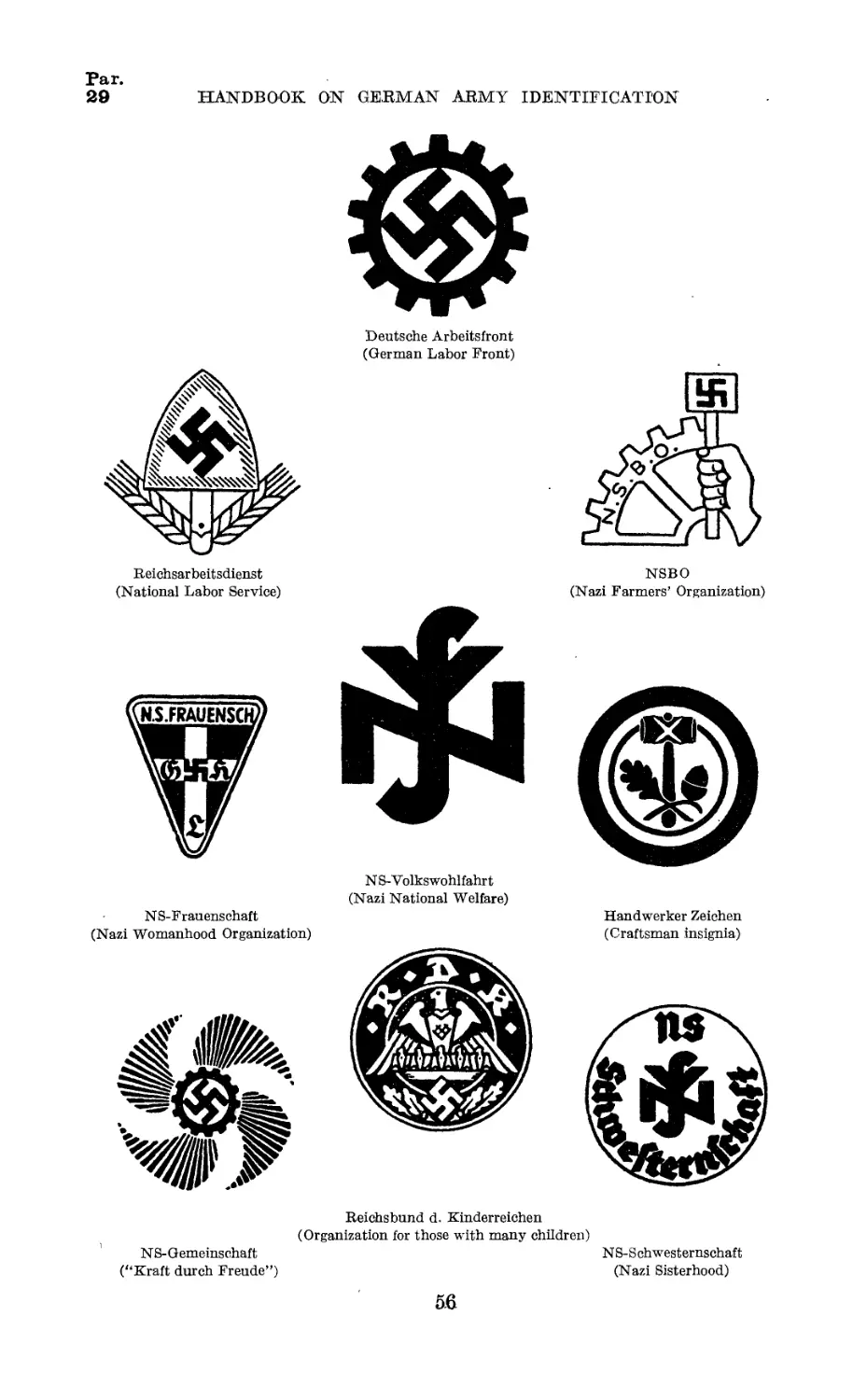
Deutsche Arbeitsfront
(German Labor Front)
Reichsarbeitsdienst
(National Labor Service)
NSBO
(Nazi Farmers’ Organization)
N S-Volkswohlfahrt
(Nazi National Welfare)
NS-Frauenschaft
(Nazi Womanhood Organization)
Handwerker Zeichen
(Craftsman insignia)
NS-Gemeinschaft
(“Kraft durch Freude”)
Reichsbund d. Kinderreichen
(Organization for those with many children)
NS-Schwesternschaft
(Nazi Sisterhood)
56
Par.
HANDBOOK ON GERMAN
ARMY IDENTIFICATION
29
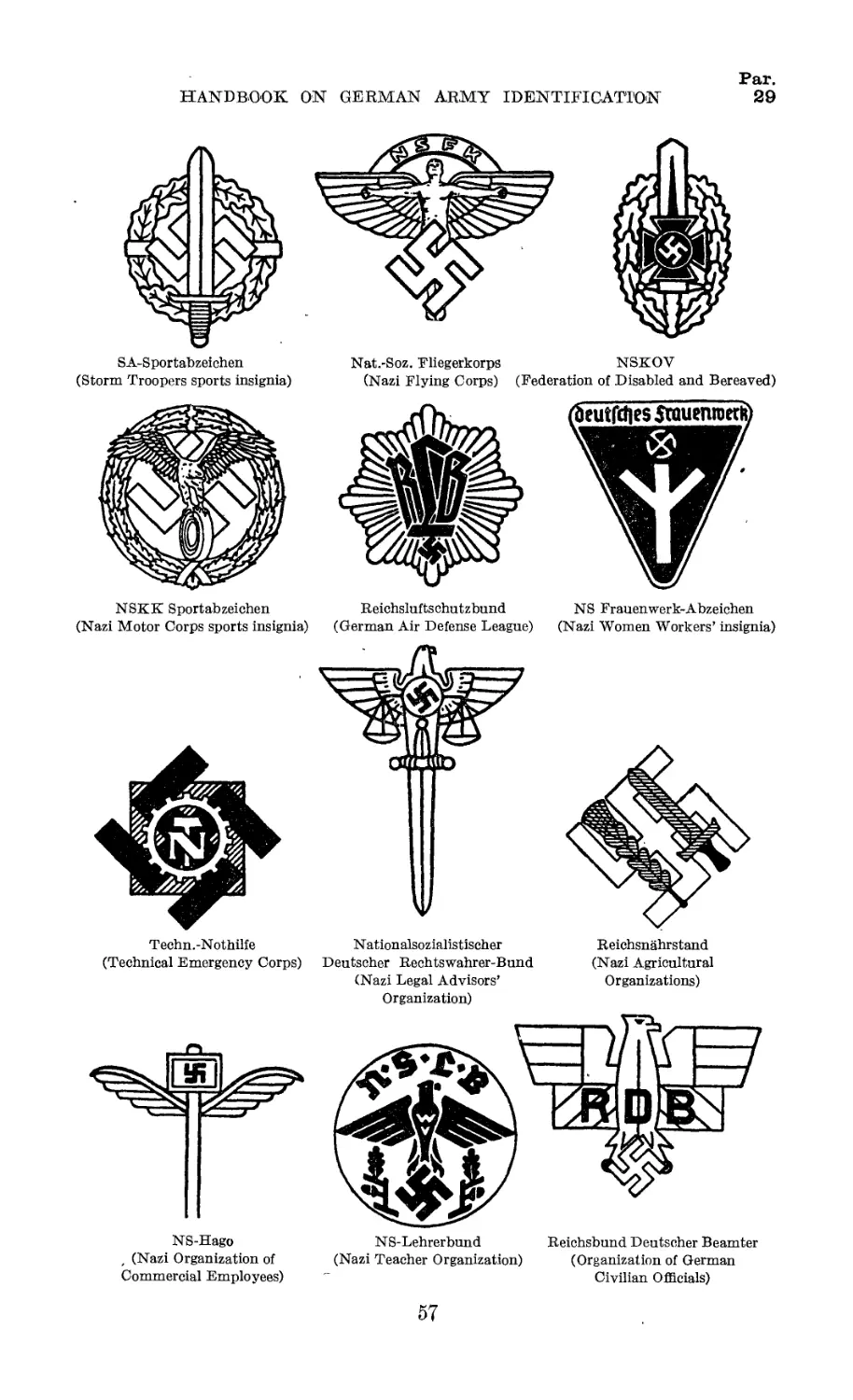
(Nazi Motor Corps sports insignia)
Reichsluftschutzbund
(German Air Defense League)
NS Frauenwerk-Abzeichen
(Nazi Women Workers’ insignia)
Nationalsozialistischer
Deutscher Rechtswahrer-Bund
(Nazi Legal Advisors’
Organization)
NS-Lehrerbund	Reichsbund Deutscher Beamter
(Nazi Teacher Organization) (Organization of German
Civilian Officials)
NS-Hago
(Nazi Organization of
Commercial Employees)
57
Par.
30
handbook on geeman army identification
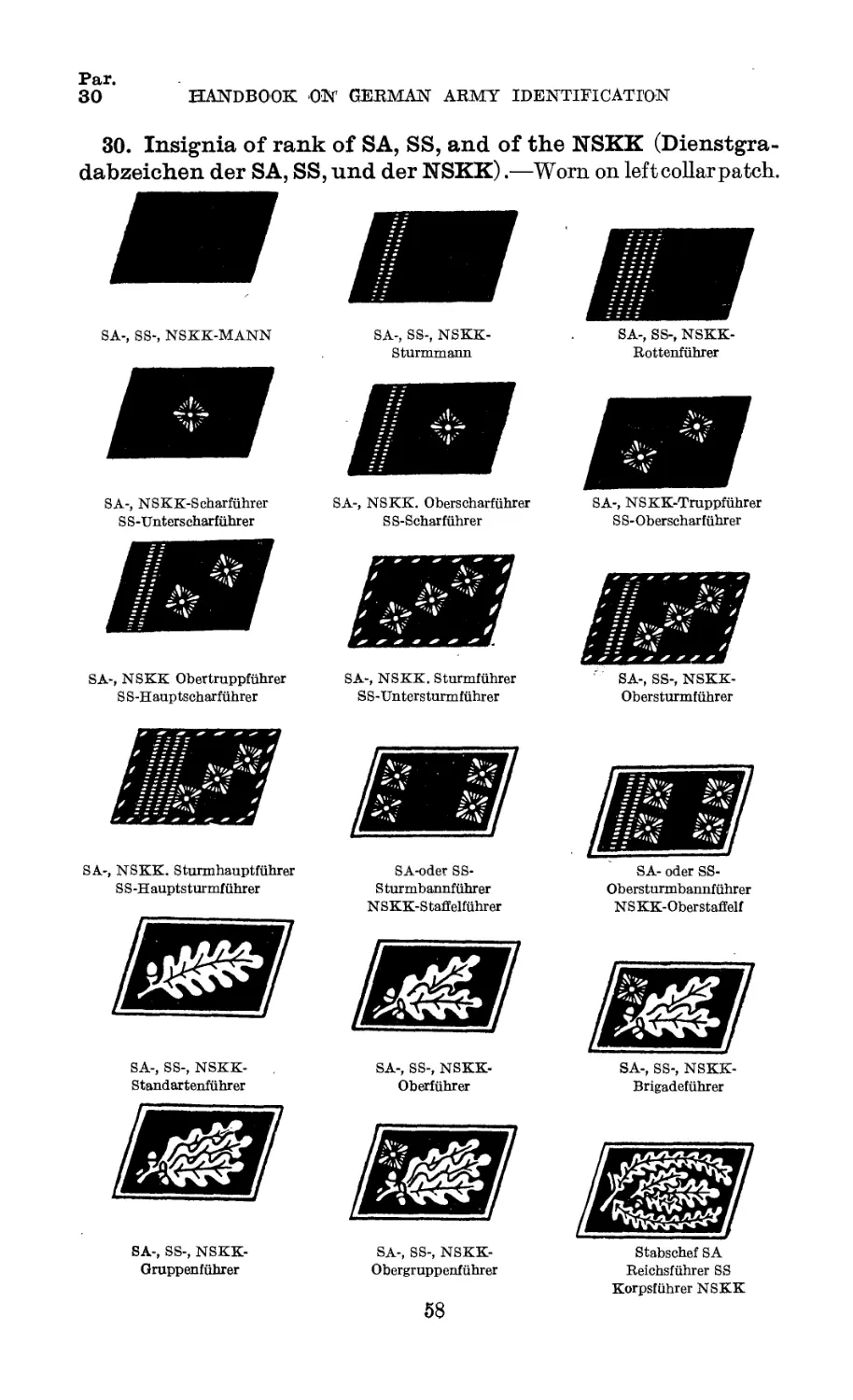
30.	Insignia of rank of SA, SS, and of the NSKK (Dienstgra-
dabzeichen der SA, SS, und der NSKK).—Worn on left collar patch.
SA-, SS-, NSKK-	. SA-, SS-, NSKK-
Sturmmann	Rottenfiihrer
SA-, SS-, NSKK-MANN
SA-, NSKK-Truppfiihrer
SS-Oberscharfiihrer
SA-, NSKK-Scharfiihrer
S S -Unters charfiihrer
SA-, NSKK. Oberscharfiihrer
SS-Scharfiihrer
SA-, SS-, NSKK-
Obersturmftihrer
SA-, NSKK Obertruppfiihrer
S S-Hauptscharfiihrer
SA-, NSKK. Sturmfiihrer
SS-Untersturmfiihrer
SA- oder SS-
Obersturmbannf(Hirer
NSKK-Oberstaffelf
SA-, NSKK. Sturmhauptfiihrer
S S -H aupts turmftihrer
SA-oder SS-
S turmbannfiihrer
NSKK-Staffelfiihrer
Brigadefiihrer
SA-, SS-, NSKK-
Standartenfiihrer
SA-, SS-, NSKK-
Oberfiihrer
Stabschef SA
Reichsfuhrer SS
Korpsfiihrer NSKK
SA-, SS-, NSKK-
Gruppenfuhrer
SA-, SS-, NSKK-
Obergruppenfiihrer
58
Far.
31
HANDBOOK ON GERMAN ARMY IDENTIFICATION
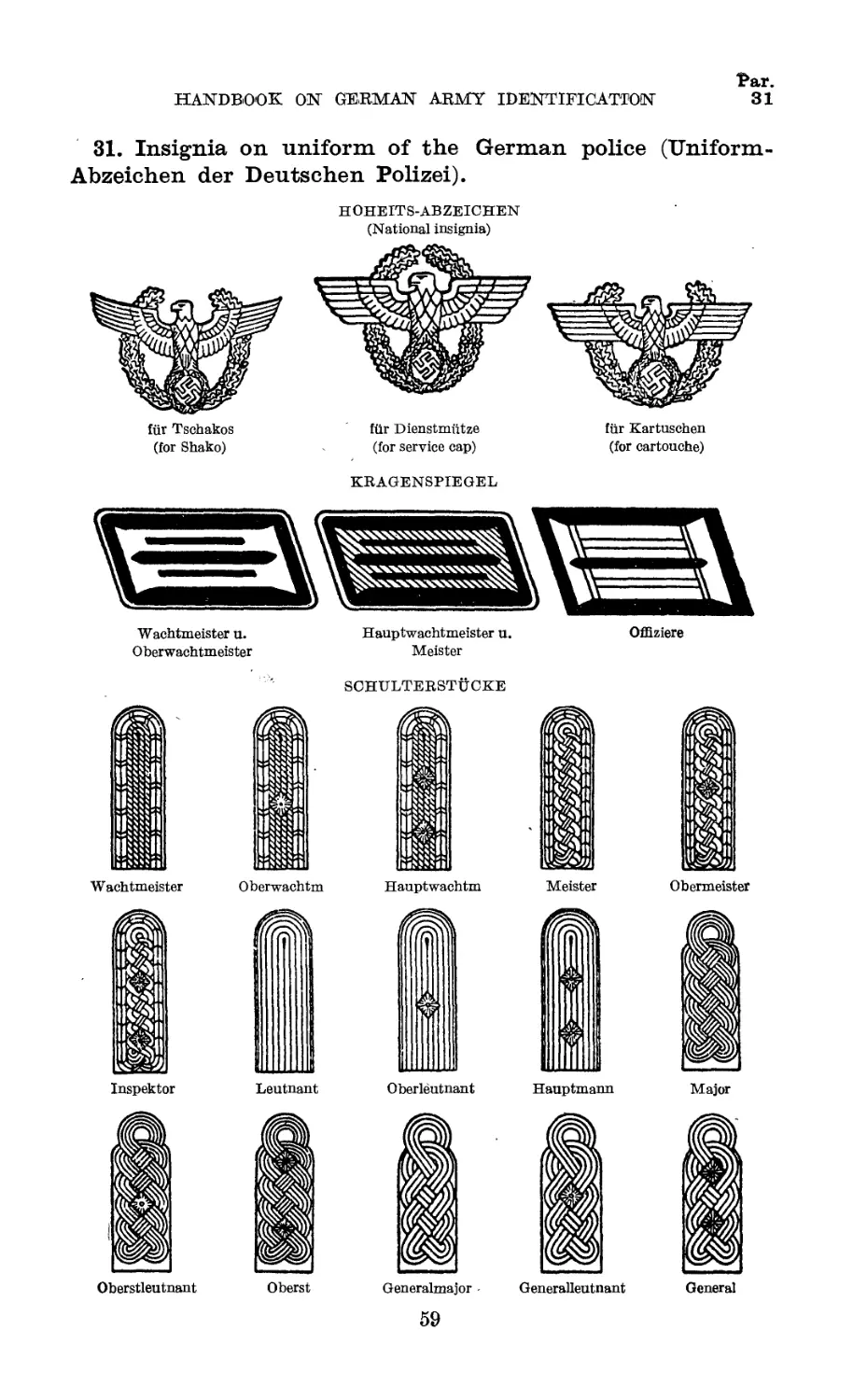
31.	Insignia on uniform of the German police (Uniform-
Abzeichen der Deutschen Polizei).
HOHEITS-ABZEICHEN
(National insignia)
fur Dienstmiitze
fur Kartuschen
fur Tschakos
(for Shako)
(for service cap)
(for cartouche)
KRAGENSPIEGEL
Wachtmeister u.	Hauptwachtmeister u.	Offiziere
Oberwachtmeister	Meister
SOHULTERSTUCKE
59
Par.
32
HANDBOOK ON GERMAN ARMY IDENTIFICATION
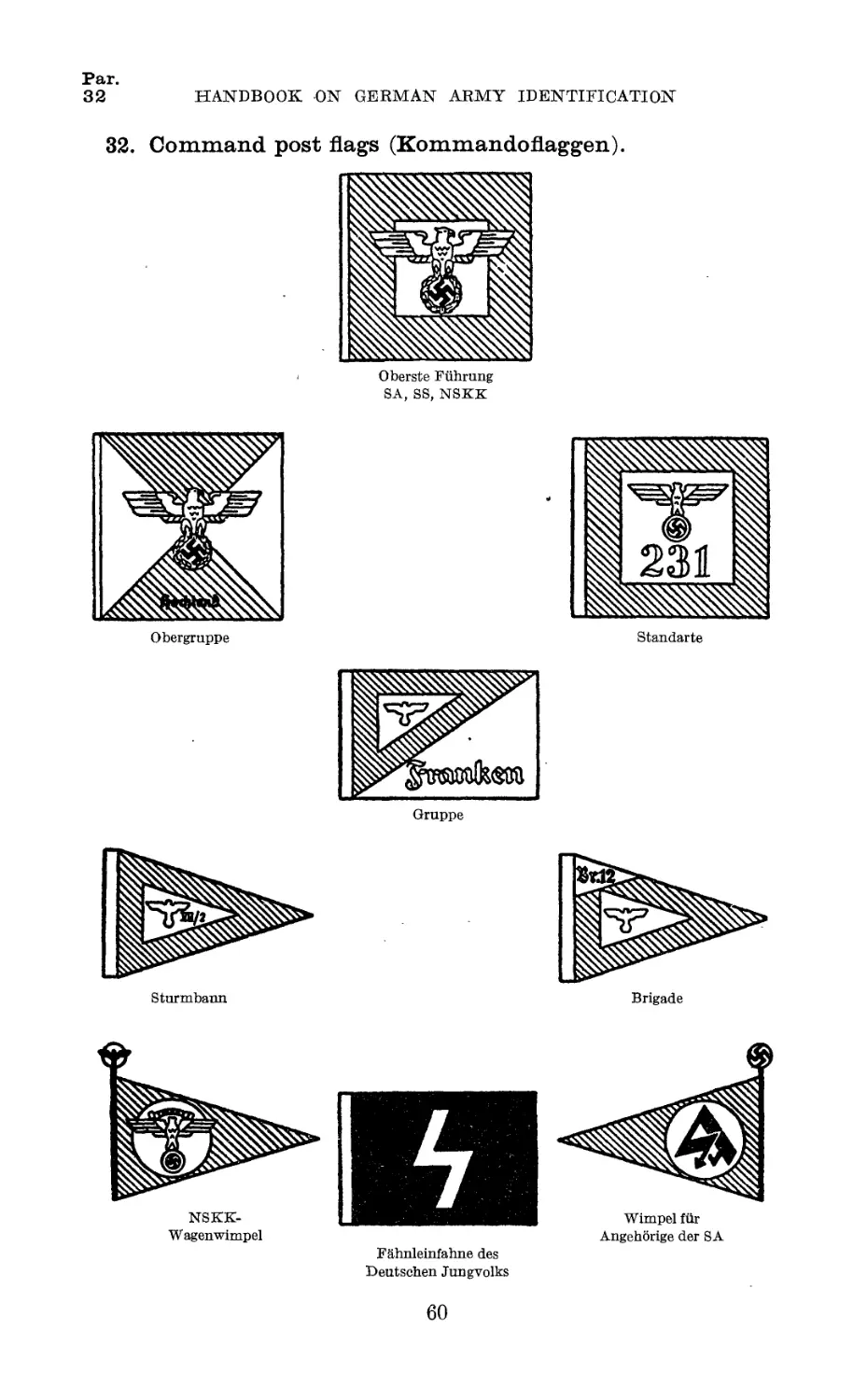
32.	Command post flags (Kommandoflaggen).
Obergruppe
NSKK-
Wagenwimpel
Gruppe
Brigade
60
Par.
33
HANDBOOK ON GERMAN ARMY IDENTIFICATION
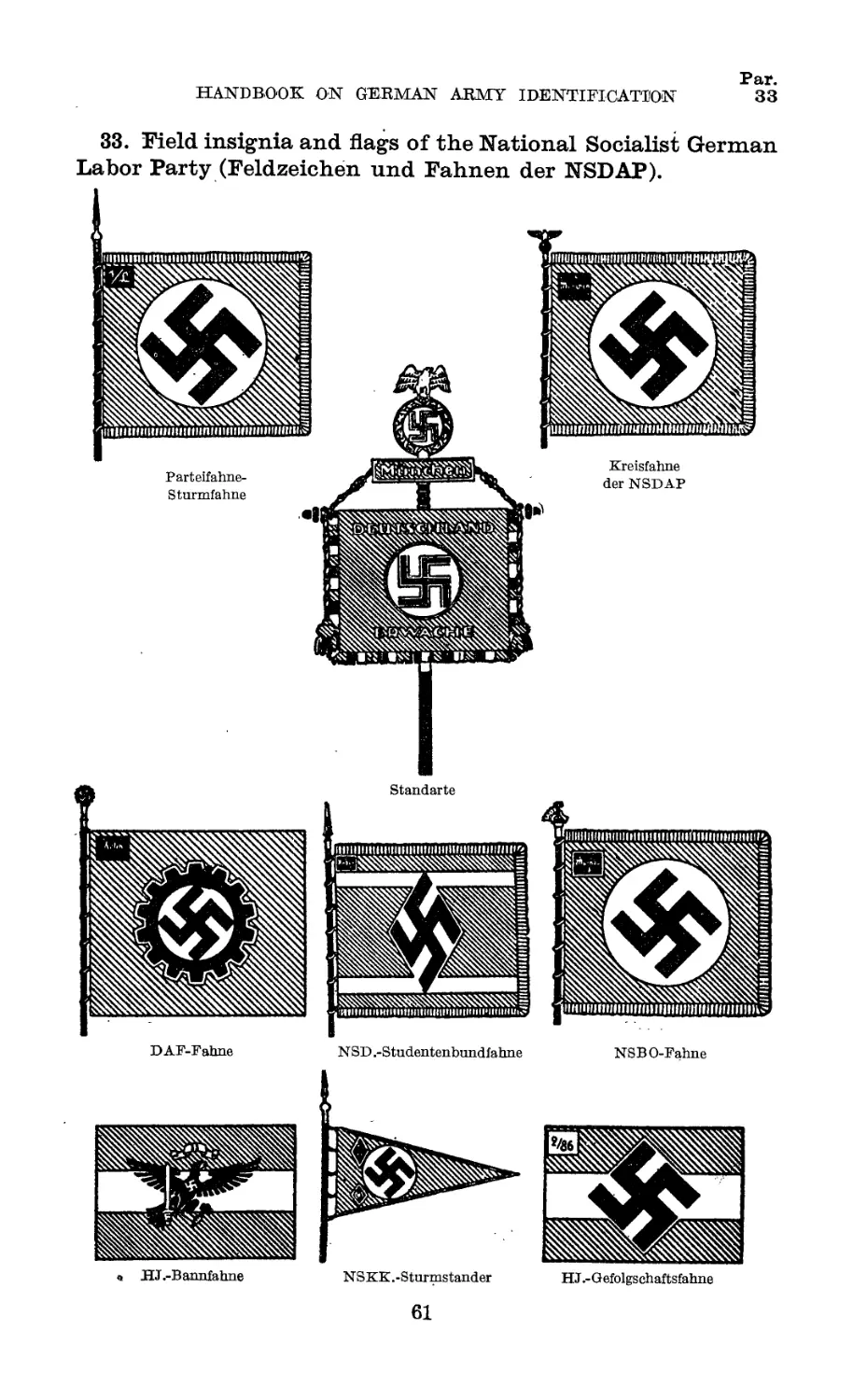
33. Field insignia and flags of the National Socialist German
Labor Party (Feldzeichen und Fahnen der NSDAP).
61
Par.
34	HANDBOOK ON GERMAN ARMY IDENTIFICATION
34.	Insignia of rank of Hitler Youth (Dienstgradabzeichen
der Hitlerjugend).—Shoulder straps are as follows:
Fiihrerschnur: rot-weiss
Scharfiihrer Oberscharfiihrer Gefolgschaftsfiihrer Obergefolg-	Hauptgefolg
schaftsfiihrer
schaftsfiihrer
Fuhrerschnur: griin	Fuhrerschnur: griin-weiss
Stammfiihrer Oberstammfiihrer Bannfiihrer Oberbannftihrer Hauptbannfiihrer
Fuhrerschnur: weiss
Fuhrerschnur: rot-schwarz
Fiihrerschnur: rot
Gebietsfiihrer dreibl. gold.
Eichenlaub Fuhrerschnur:
schwarz
Obergebietsfiihrer dreibl. gold.
Eichenlaub Fuhrerschnur:
schwarz-silber
Stabsfiihrer dreibl. gold.
Eichenlaub Fiihrerschnur:
schwarz-gold
62
Par.
35
HANDBOOK ON GERMAN ARMY IDENTIFICATION
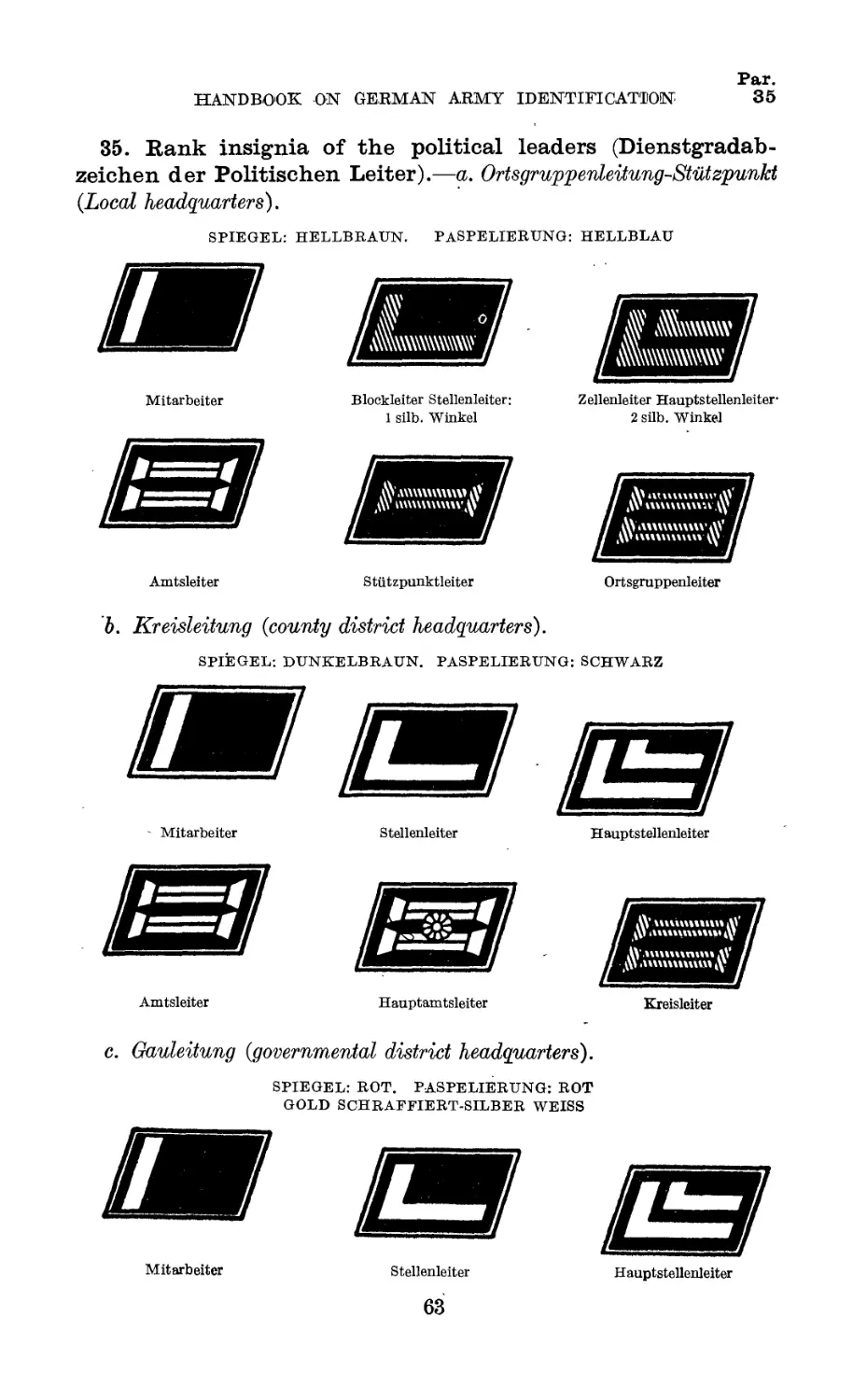
35.	Rank insignia of the political leaders (Dienstgradab-
zeichen der Politischen Leiter).—a. Ortsgruppenleitung-Stutzpunkt
{Local headquarters'}.
SPIEGEL: HELLBRAUN. PASPELIERUNG: HELLBLAU
Mitarbeiter
Blockleiter Stellenleiter:
1 silb. Winkel
Zellenleiter Hauptstellenleiter-
2 silb. Winkel
b.	Kreisleitung {county district headquarters}.
SPIEGEL: DUNKELBRAUN. PASPELIERUNG: SCHWARZ
- Mitarbeiter
Stellenleiter
Hauptstellenleiter
Amtsleiter
Hauptamtsleiter
Kreisleiter
c.	Gauleitung {governmental district headquarters}.
SPIEGEL: ROT. PASPELIERUNG: ROT
GOLD SCHRAFFIERT-SILBER WEISS
Mitarbeiter
Stellenleiter
H auptstellenleiter
63
Par.
35
HANDBOOK ON GERMAN ARMY IDENTIFICATION
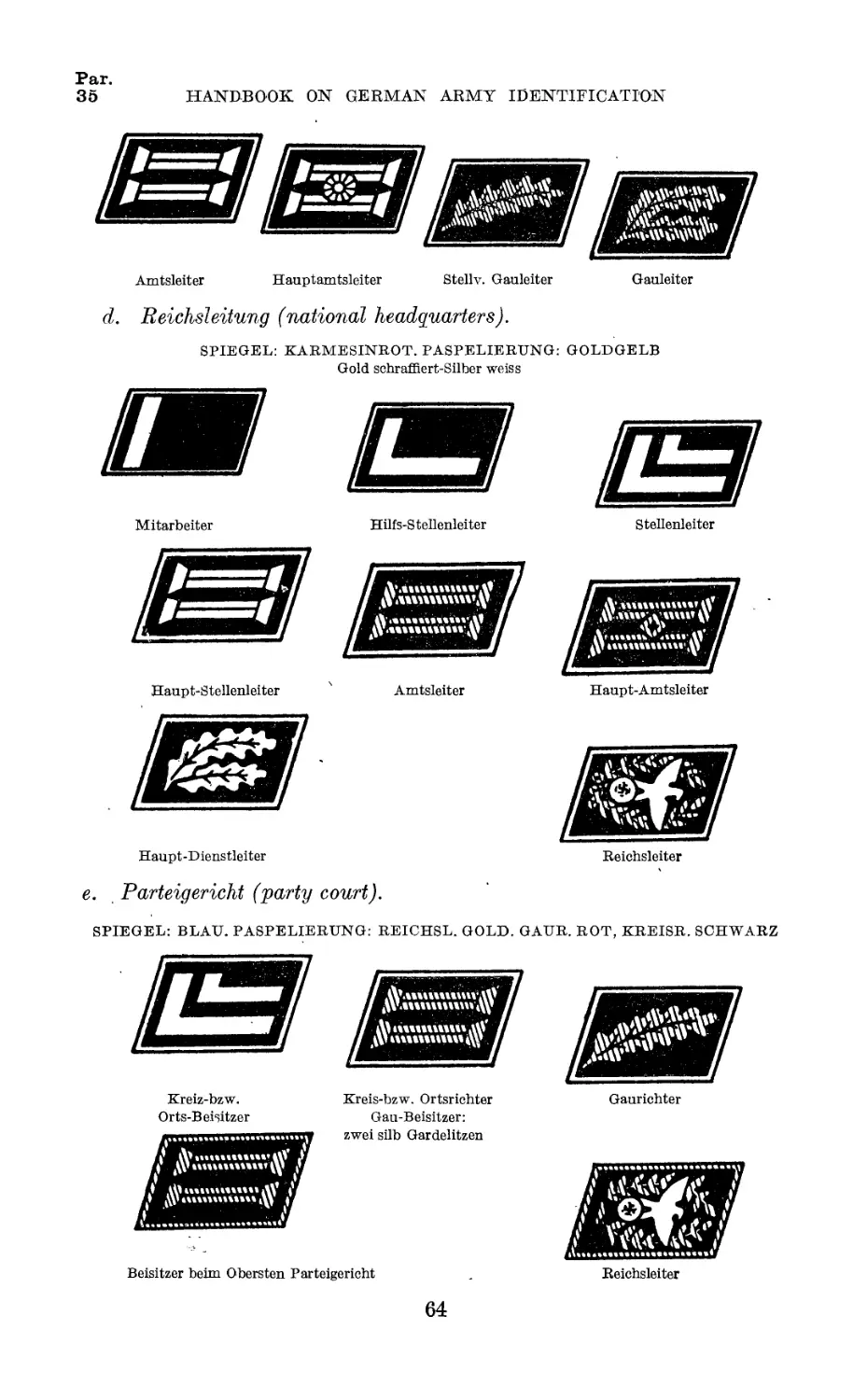
Amtsleiter	Hauptamtsleiter	Stellv. Gauleiter
Gauleiter
d.	Reichsleitung (national headquarters).
SPIEGEL: KARMESINROT. PASPELIERUNG: GOLDGELB
Gold schraffiert-Silber weiss
Stellenleiter
Hilfs-S tellenleiter
Haupt-Stellenleiter
Reichsleiter
Haupt-Dienstleiter
e.	Parteigericht (party court).
SPIEGEL: BLAU. PASPELIERUNG: REICHSL. GOLD. GAUR. ROT, KREISR. SCHWARZ
Gaurichter
Kreiz-bzw.
Orts-Beisitzer
Kreis-bzw. Ortsrichter
Gau-Beisitzer:
zwei silb Gardelitzen
Reichsleiter
Beisitzer beim Obersten Parteigericht
64
Par.
35
HANDBOOK ON GERMAN ARMY IDENTIFICATION
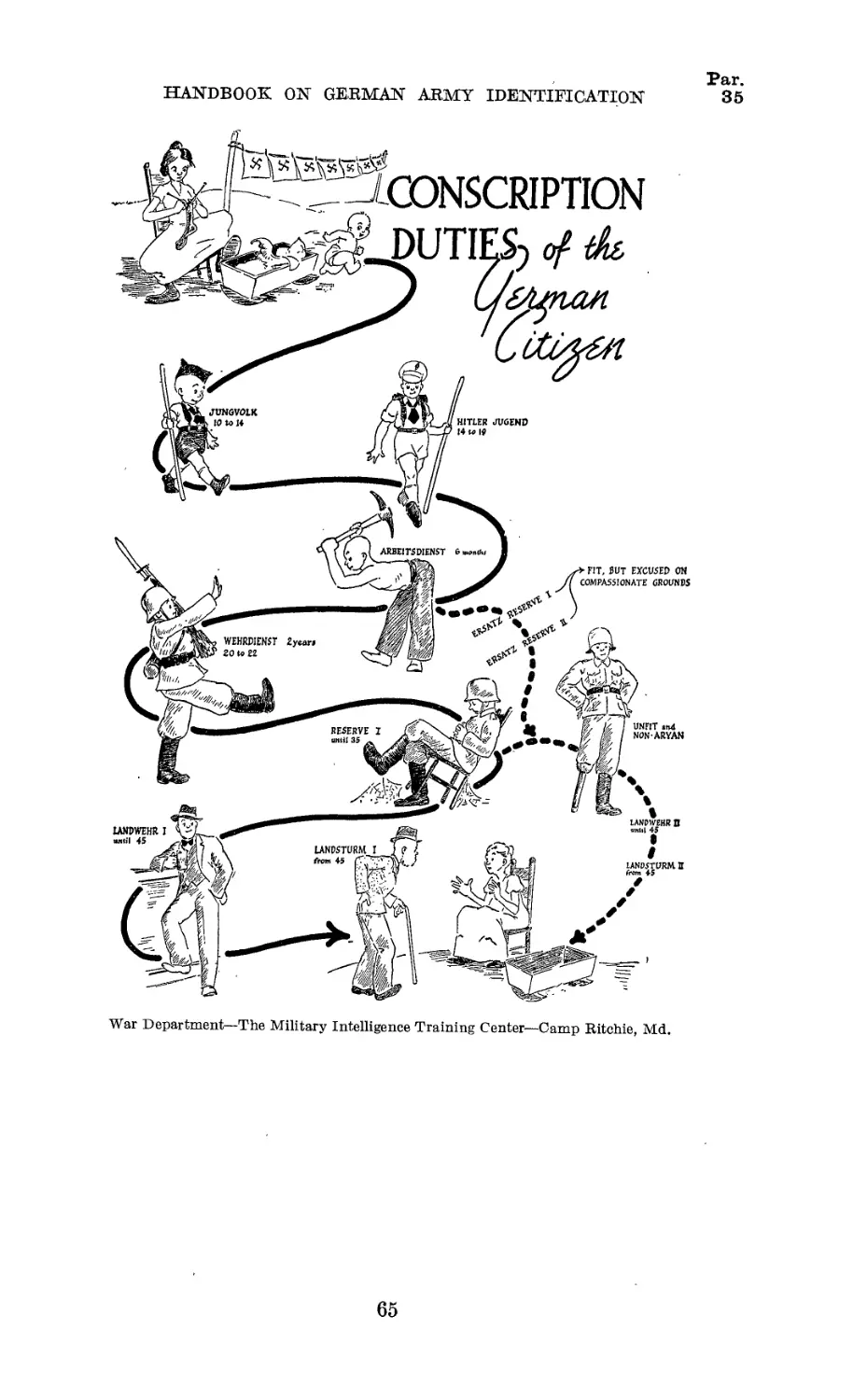
War Department—The Military Intelligence Training Center—Camp Ritchie, Md.
65

Appendix
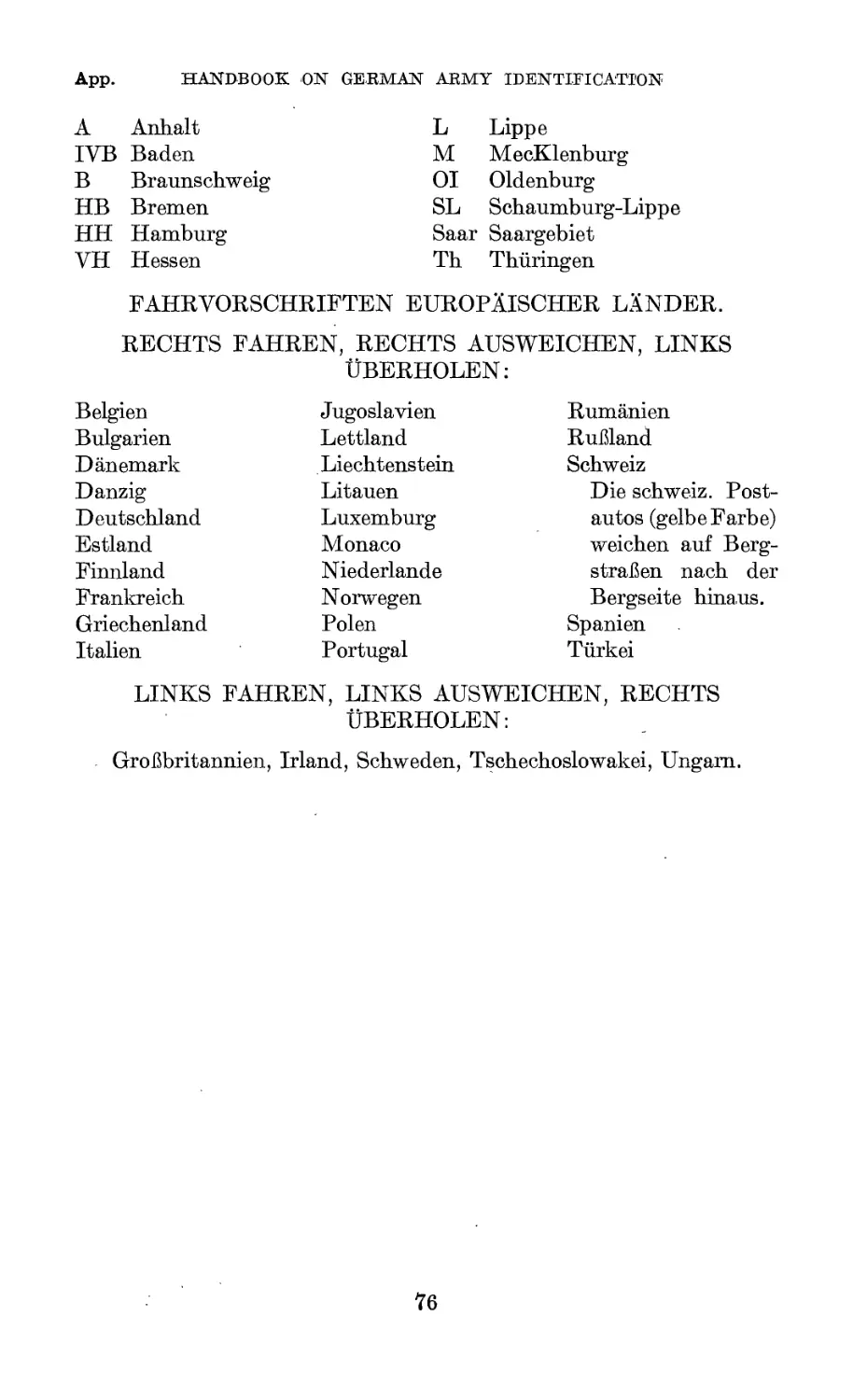
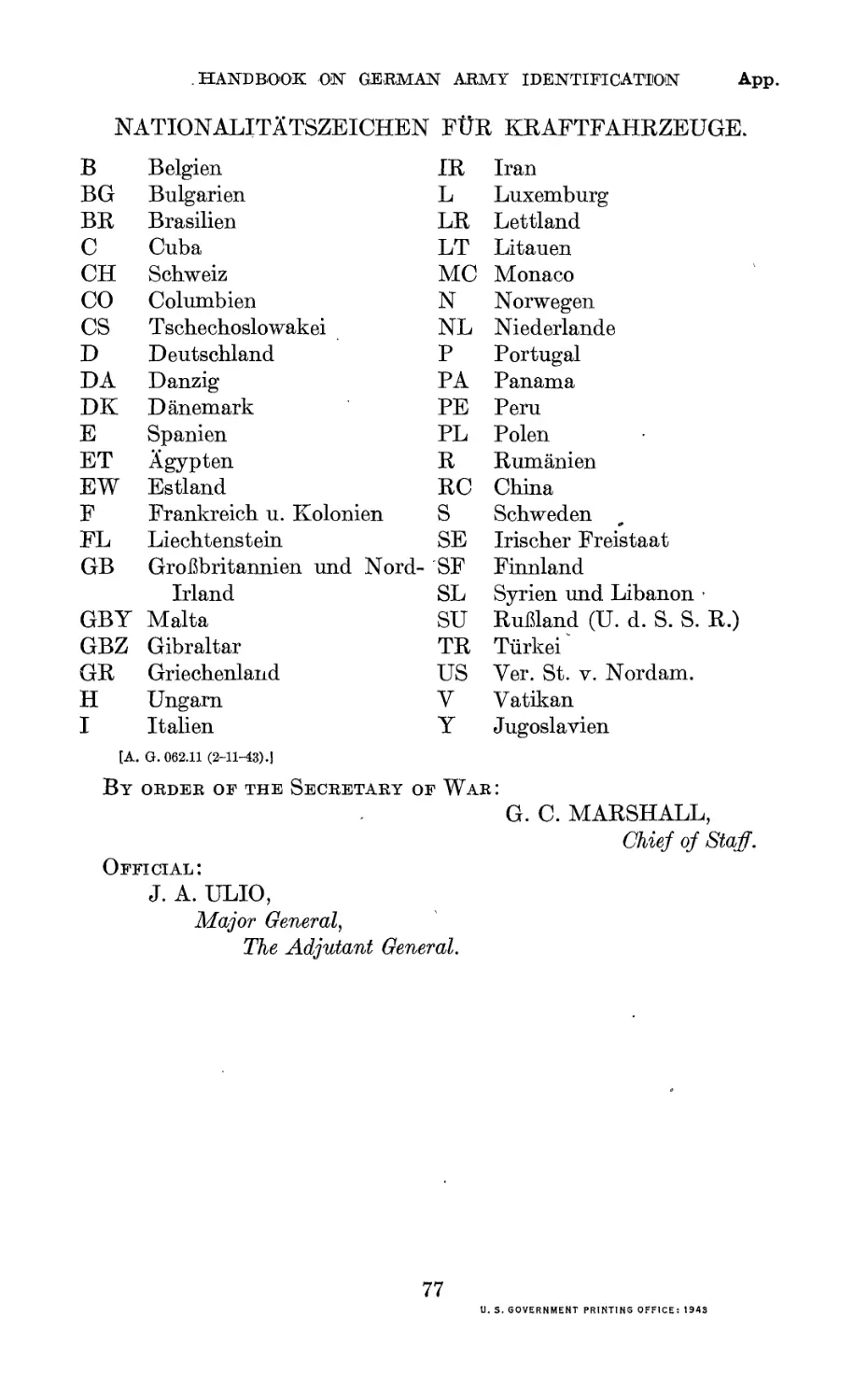
TRAFFIC SIGNS (VERKEHRSZEICHEN)
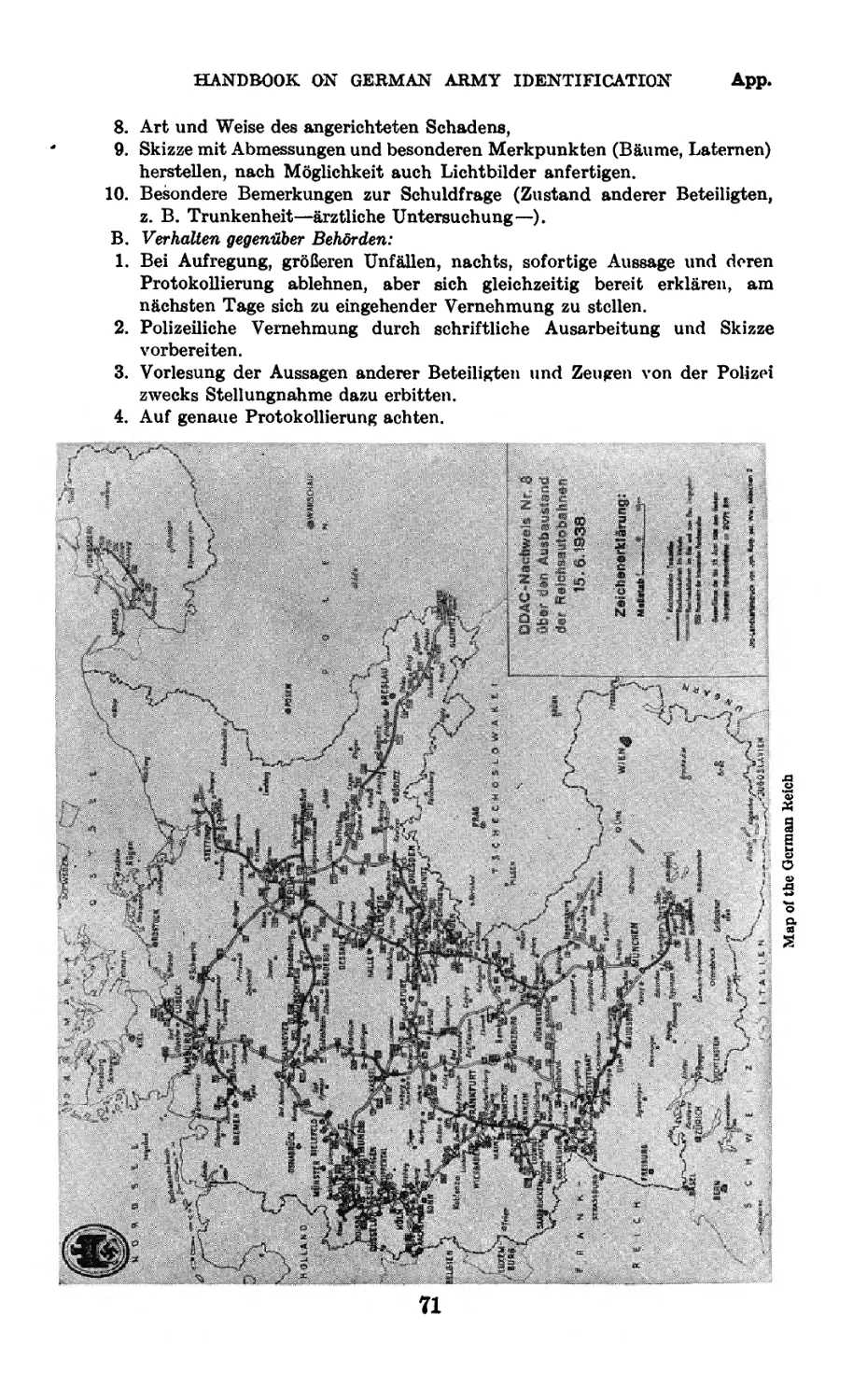
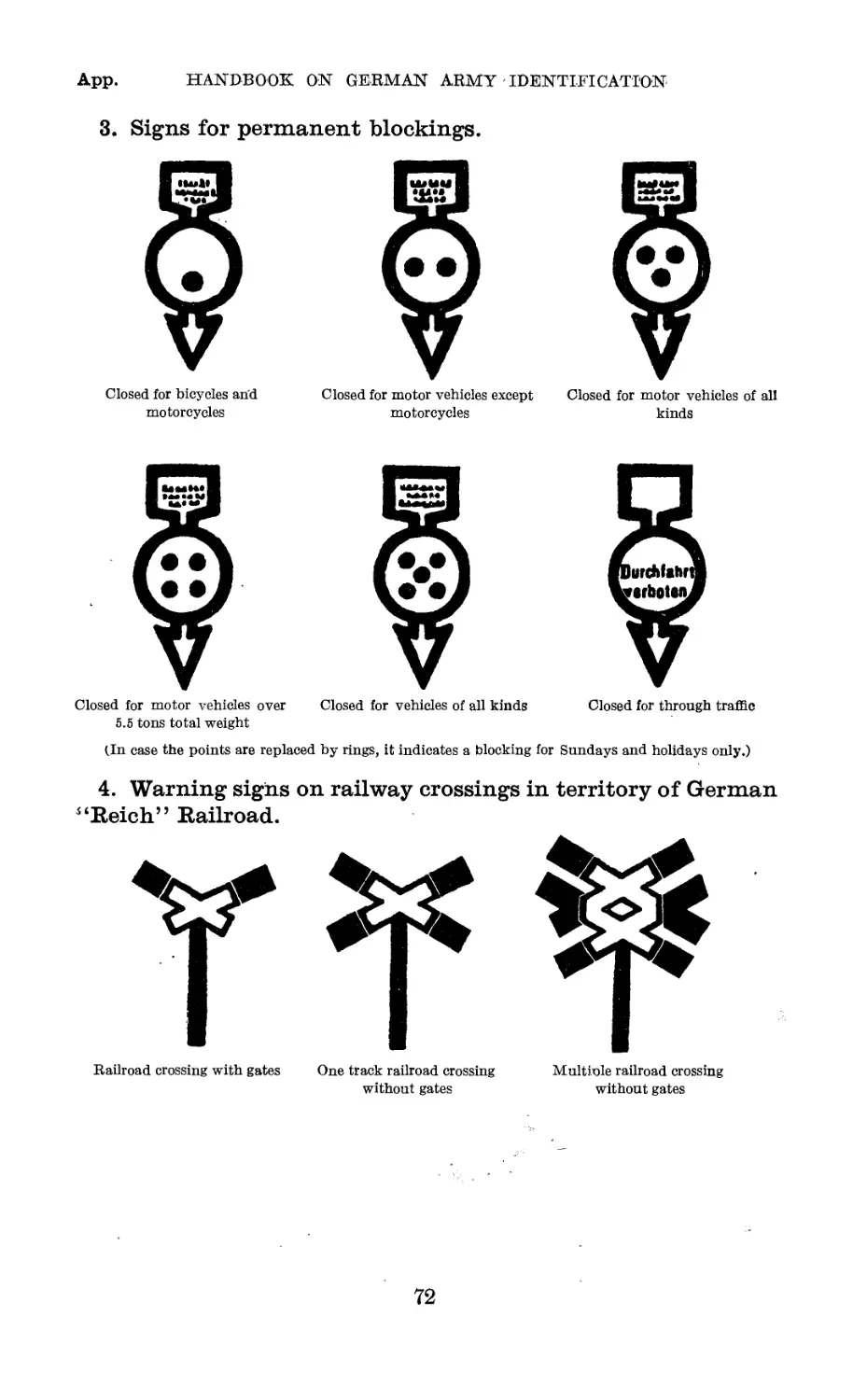
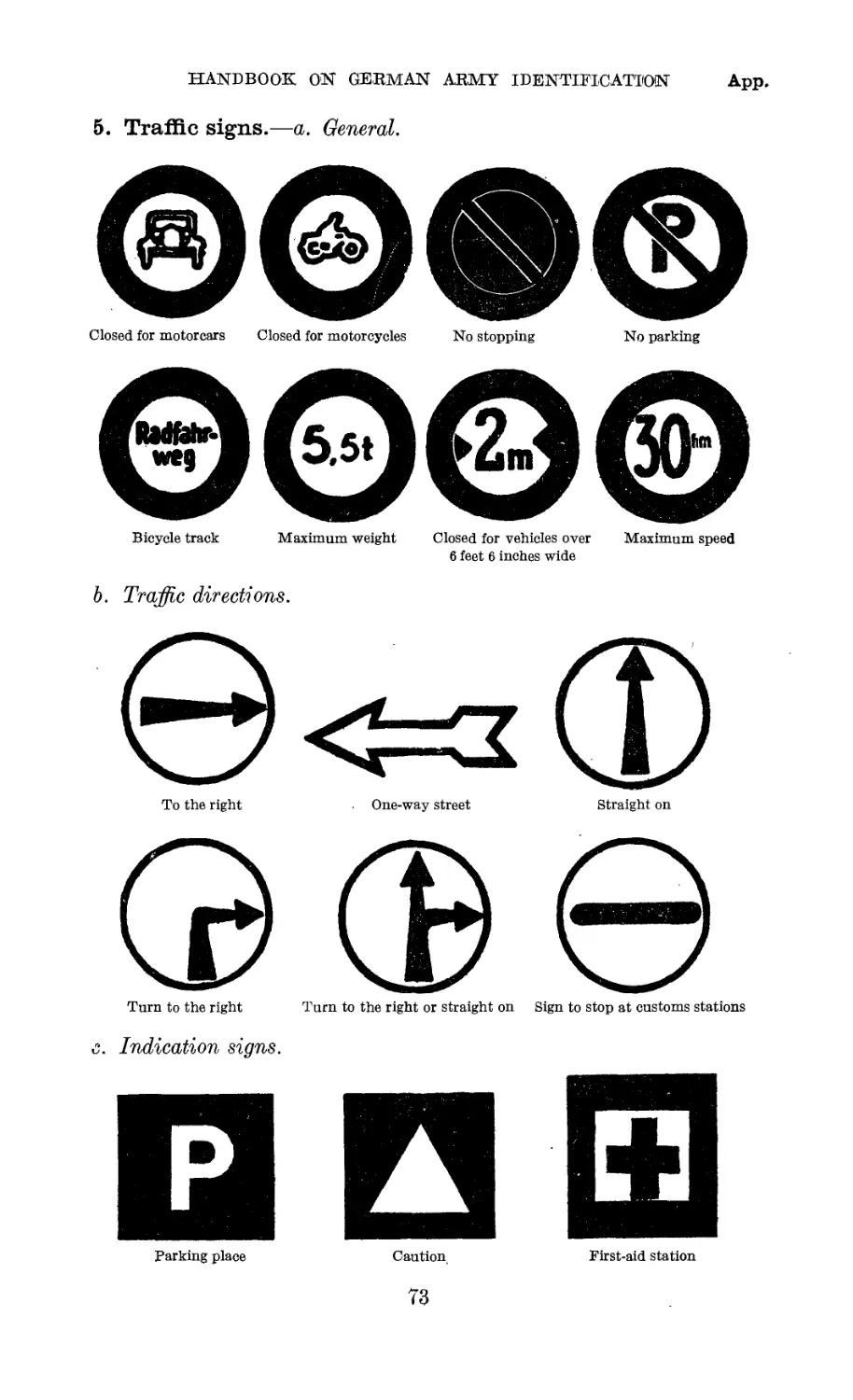
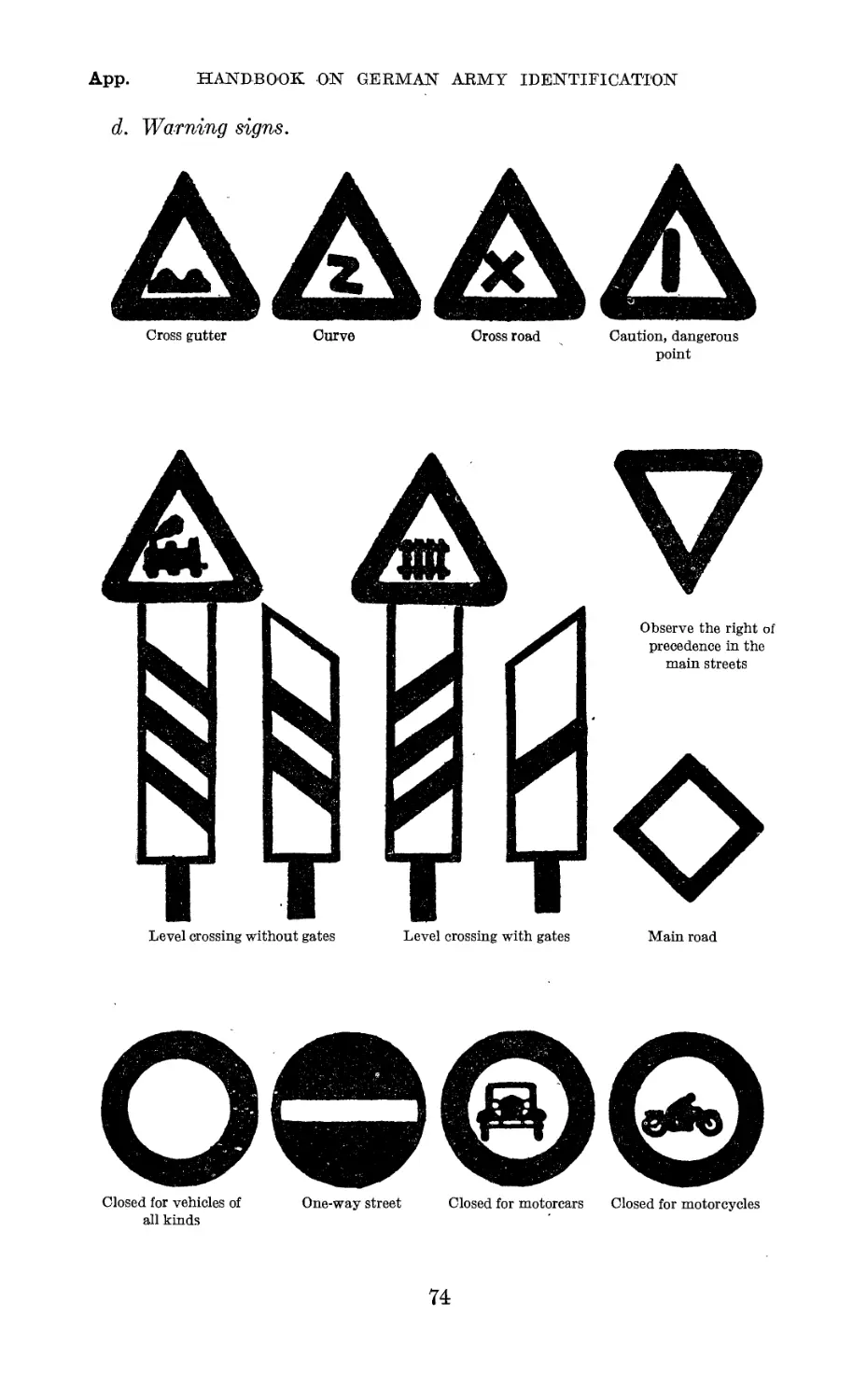
1.	General.—a. The following pages contain some of the principal
means employed by Germany for the regulation of road traffic.
Included are—
(1)	An excerpt from the present German traffic law which regulates
traffic' throughout the Reich.
(2)	Various German road and traffic signs.
(3)	A road map showing the principal German highways.
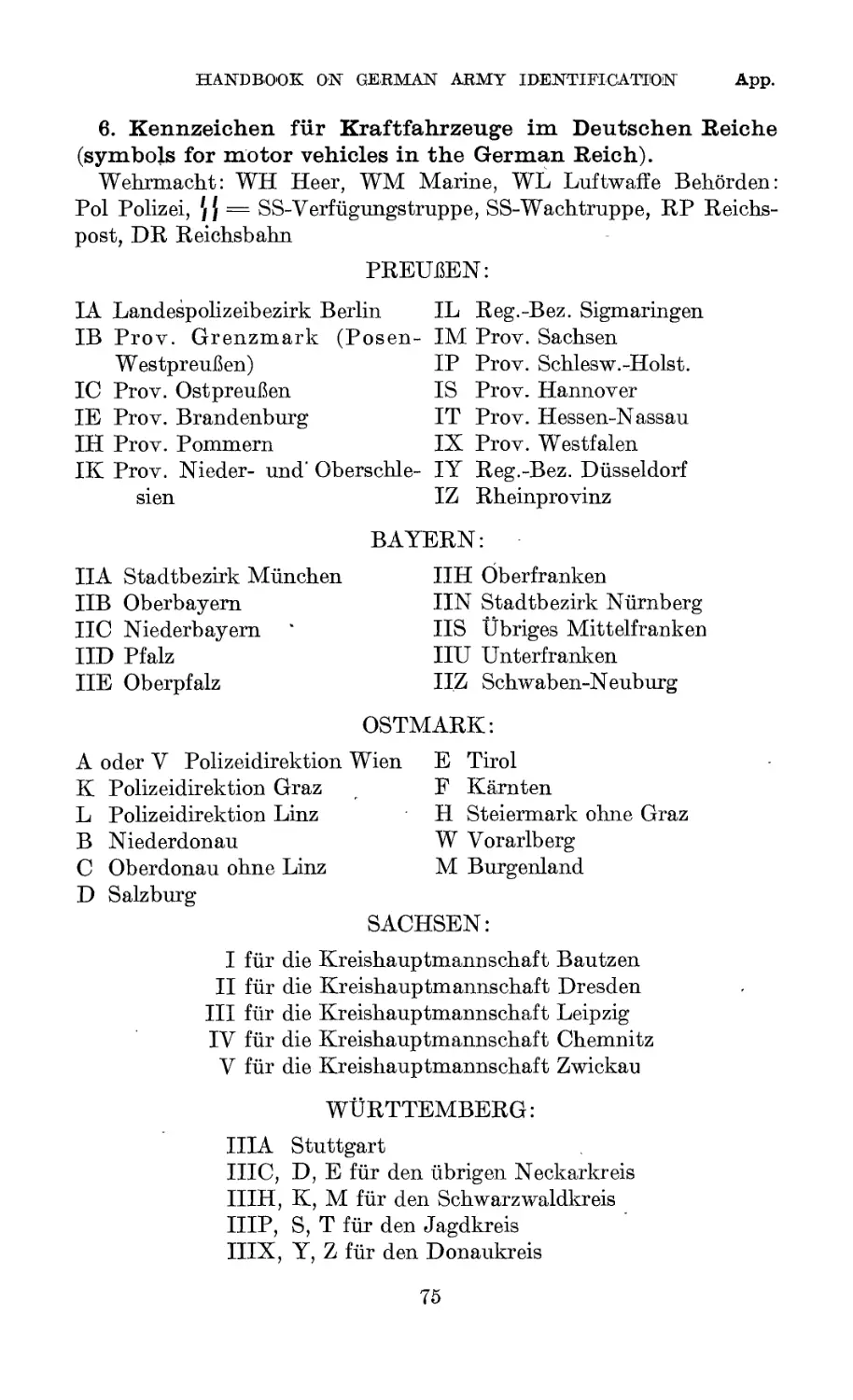
(4)	A list of symbols found on license tags of German automobiles.
Preceding individual registration numbers, these symbols designate
the district in which the vehicle has been registered.
b. The knowledge of these signs will be of great interest and value
whenever a district is entered which by occupation or otherwise has
previously been subjected to German administration.
2.	New German traffic law.
DAS NEUE VERKEHRSRECHT
Die ReichsstraBenverkehrsordnung enthalt die ausschliefiliche Regelung des
StraBenverkehrs, und wir geben nachstehend dieses neue StraBenverkehrsrecht
in Stichworten wieder:
I.	Rechtsgrundlagen:
ReichsstraBenverkehrsordnung vom 28. 5. 1934 mit Ausfiihrungsan-
weisung vom 29.9. 1934.
II.	Atjsser Kraft getreten:
Alle anderen wichtigen gesetzlichen Verkehrsvorschriften, insbesondere
Preuti. StraBenverkehrsordnung vom 20. 3. 1934-
III.	Strafen:
Geldstrafe bis zu 150,—RM oder Haft, auBerdem bei VerstoB gegen St.
G. B. die des St. G. B.
IV.	Verhalten des Kraftfahrers im Verkehr:
(§§ 25-30 des Gesetzes und Erlauterungen der Ausfiihrungsanweisung
dazu.)
A.	Statt bisheriger Einzelvorschriften jetzt allgemeiner Grundsatz:
Jeder Teilnehmer am offentlichen Verkehr hat sich so zu verhalten, daB er
1. keinen anderen schddigt oder
2.	mehr, als nach den Umstanden unvermeidbar, behindert oder beldstigt.
B.	Verkehrsregeln:
1.	Ausreichende Sicht im Fahrzeug fiir den Fahrer;
2.	Geschwindigkeit so, daB notigenfalls rechtzeitig angehalten werden kann;
3.	an Strati enbahnhaltestellen wahrend des Ein- und Aussteigens
a)	langsam,
b)	in angemessenem Abstand vorbeifahren,
c)	notigenfalls anhalten;
67
Арр. HANDBOOK ON GERMAN ARMY IDENTIFICATION
4.	Warnzeichen:
a)	wenn andere Verkehrsteilnehmer gefahrdet werden konnen;
b)	bei Absicht des Uberholens;
c)	nicht, wenn Tiere beunruhigt werden;
d)	Signale iiberhaupt verboten, wenn anderer Zweck als Warnung.
5.	Bin- und Ausfahrt nur so, daft Gefahrdung des StraBenverkehrs ausge-
schlossen 1st.
6.	Barken nicht zulassig
a)	an engen StraBenstellen und in scharfen StraBenkriimmungen;
b)	auf Geleisen;
c)	weniger als 10 m vor oder hinter Kreuzungen und Einmiindungen;
d)	weniger als 5 m vor oder hinter Haltestellen;
e)	an Verkehrsinseln;
f)	vor Ein- und Ausfahrten;
g)	auf der mittleren von 3 getrennten Fahrbahnen.
7.	Anfahren und Halten nur rechts.
Ausnahme: bei Einbahnstrafien auch links.
8.	Standiges Nebeneinanderfahren verboten;
9.	Scheinwerfer abblenden, wenn Sicherheit und Riicksicht es erfordert.
Ausnahme: keine Verpflichtung gegeniiber FuBgangern;
10.	Beim Verlassen des Kraftfahrzeuges:
a)	zur Vermeidung von Unfallen und Verkehrsstdrungen MaBnahmen
treffen;
b)	zur Verhinderung unbefugter Benutzung iiblicherweise hierfiir be-
stimmte Vorkehrungen in Wirksamkeit setzen.
11.	Ausweichen und Uberholen:
a)	rechts ausweichen, links uberholen;
b)	nicht vorgeschrieben, standig rechte Seite einzuhalten. Vorsorglich
rechte Seite einhalten, wenn Ausweichen oder Uberholen bevorstehen
kann;
c)	jeder nur fiir eine Verkehrsart bestimmte Weg und Sommerweg gelten
als selbstandige StraBe;
d)	bei unubersichtlichen Strecken aufierste rechte Seite der Fahrbahn
einhalten;
e)	ist bei Begegnungen Ausweichen - unmoglich, Pfiicht der Umkehr fiir
den, dem dies nach den Umstanden am ehesten zuzumuten.
MaBgebend hierfiir zunachst fahrtechnische Moglichkeit, ferner Verkehrs-
bedeutung.
Bevorrechtigte Fahrzeuge mit mehreren Insassen und regelmaBige Fahr-
zeuge im offentlichen Linienverkehr.
f)	Schienenfahrzeugen gegeniiber
links ausweichen, wenn aus Raummangel nicht rechts ausgewichen
werden kann;
wenn rechts iiberholen aus Raummangel nicht moglich, links iiber-
holen gestattet;
in EinbahnstraBen rechts oder links iiberholen;
g)	Verhalten des Eingeholten beim Uberholen:
Einhalten der auBersten rechten Seite,
erkennen geben, daB er zum Uberholenlassen bereit sei; hierzu geniigt
deutliches Einhalten der auSersten rechten Seite.
Uberholender ist nicht verpfiichtet, Zeichen des Eingeholten abzu-
warten.
68
HANDBOOK ON GERMAN ARMY IDENTIFICATION App.
12.	Vorfahrtrecht.
a)	Grundsatzlich bevorrechtigt, wer von recht? kommt.
b)	Kraftfahrzeuge und Schienenfahrzeuge untereinander gleichberechtigt,
aber bevorrechtigt vor anderen Verkehrsteilnehmern.
c)	Vorfahrtrecht fiir alle Verkehrsteilnehmer auf besonders gekenn-
zeichneten HauptverkehrsstraBen.
 Ausnahmen: andere Regelung durch amtliche Verkehrszeichen.
d)	Will jemand die Richtung eines anderen ihm auf derselben StraBe
begegnenden kreuzen, ist der andere bevorrechtigt.
e)	Vorfahrtrecht nicht, wenn sonst Bevorrechtigter an Kreuzung eintrifft,
wahrend langsam beweglicher Verkehrsteilnehmer sich dort befindet
und zur Gewahrung der Vorfahrt halten miiBte.
f)	Richtungsanderung oder Anhalten ist anderen Verkehrsteilnehmern
anzuzeigen.
Gilt auch fiir Radfahrer, aber nicht fiir FuBganger auf FuBwegen.
13.	Weisungen und Zeichen der Polizei
haben grundsatzlich Vor rang vor
allgemeinen Verkehrsregeln,
ortlichen Sonderregeln, die durch amtliche Verkehrszeichen angezeigt
sind.
Zeichen der Polizeibeamten:	: -
Winken in Verkehrsrichtung: „StraBe frei".
Hochheben eines Armes:
Fiir Verkehrsteilnehmer
in vorher gesperrter Richtung: „Achtung",
in vorher freier Richtung: ,,Anhalten",
in der Kreuzung: „Kreuzung frei“.
Seitliches Ausstrecken eines Armes oder beider Arme quer zur Ver-
kehrsrichtung: „Halten",
in der Verkehrsrichtung: „StraBe frei".
Farbzeichen:
Griin: „StraBe frei",
gelb: „Achtung" oder „Anhalten" oder „Kreuzung frei",
rot: „Halt".
Anmerkung: Einbiegen bei „StraBe frei" und „Kreuzung frei" zulassig.
Ausnahme: Nach links auf „StraBe frei" nur, wenn Verkehr nicht gestort
wird.
14.	Sonderrechte.
a)	Wehrmacht, Polizei, Feuerwehr, soweit in Erfiillung ihrer hoheitlichen
Aufgaben, von Einhaltung der Vorschriften befreit.
b)	Geschlossene Verbande der Wehrmacht, Polizei, NSDAP. und ihrer
Untergliederungen, Leichenziige, Prozessionen diirfen weder unter-
brochen noch sonst in ihrer Bewegung gehemmt werden.
c)	Wegerechtsfahrzeuge, d. h. Fahrzeuge, die zur Erfiillung offentlicher
oder dem Gemeinwohl dienenden Aufgaben freie Bahn brauchen, z. B.
Mannschaftswagen der Polizei, StraBenreinigungsmaschinen, ist Platz
zu machen.
V. Wichtigste Vorschriften fur andere Verkehrsteilnehmer.
A. Radfahrer.
1.	Ausrustung:
a)	ausreichende Bremse,
b)	helltonende Glocke,
69
Арр. HANDBOOK ON GERMAN ARMY IDENTIFICATION
c)	Riickstrahler,
d)	Lampen durfen nicht blenden,
e)	Lichtkegel der Lampe muS geneigt sein.
2.	Verhalten:
a)	Richtungsanderung oder Anhalten ist anderen Verkehr steilnehmern
anzuzeigen (§ 27, Abs. 3),
b)	Lenkstange nicht loslassen, FiiBe nicht von der Tretkurbel entfernen,
c)	Anhangen verboten,
d)	einzeln hintereinander fahren, wenn Verkehr sonst behindert werden
wiirde.
e)	Anbinden von Handwagen an Fahrrader verboten,
f)	Fiihren von Pferden und Vieh von fahrenden Fahrradern aus verboten,
g)	Pflicht zur Benutzung der Radfahrwege.
B.	Fuhrwerk.
1.	Ausriistung:
a)	leicht lenkbar, so gebaut und ausgeriistet, daB verkehrsiiblicher
Betrieb niemand schadigt oder mehr als unvermeidbar behindert oder
belastigt;
b)	Bremse,
c)	. Riickstrahler,
d)	Lampe darf nicht blenden.
2.	Verhalten:
a)	bespanntes Fuhrwerk darf nicht unbeaufsichtigt stehen,
b)	unbespanntes Fuhrwerk darf bei Dunkelheit oder starkem Nebel nur
stehen, wenn Deichsel hochgeschlagen, abgenommen oder an Spitze
beleuchtet ist.
C.	Personen.
a)	Wer infolge korperlicher oder geistiger Mangel sich nicht sicher be-
wegen kann, darf am Verkehr nur teilnehmen, wenn in geeigneter
Weise Vorsorge getroffen.ist, daB er andere nicht gefahrdet;
b)	Fahrbahnen und Radfahrwege auf kiirzestem Wege und ohne Aufent-
halt iiberschreiten.
An StraBenkreuzungen mit bezeichneten Ubergangen ausschlieBlich
diese benutzen.
StraBenbahnwagen und Omnibusse nur an den Haltestellen betreten
und verlassen.
-D. Tiere.
Miissen im Verkehr geeigneten Fuhrer haben, der ausreichend auf sie
einwirken kann.
Erweist sich jemand als ungeeignet zum Fiihren von Tieren, so hat Ver-
waltungsbehorde ihm deren Fiihren zu untersagen oder Bedingungen zu
stellen.
Verhalten bei ZusammenstoBen oder anderen VerkehrsunfXllen.
A.	An Ort und Stglle feststellen und aufschreiben:
1.	Genaue Zeit,
2.	Name, Anschrift, Fahrzeugnummer aller Beteiligten,
3.	Name, Anschrift, Fahrzeugnummer etwaiger Zeugen,
4.	Bremsspuren,
5.	Witterungsverhaltnisse, Sicht.(Regen, Nebel),
6.	Beschaffenheit der StraBe (Schlaglocher, Art der Pflasterung), Witte-
rungseinfliisse auf die StraBe (Rogen, Glatteis).
7.	Fahrgeschwindigkeit aller Beteiligten,
70
HANDBOOK ON GERMAN ARMY IDENTIFICATION App.
8.	Art und Weise des angerichteten Schadens,
9.	Skizze mit Abmessungen und besonderen Merkpunkten (Baume, Latemen)
herstellen, nach Moglichkeit auch Lichtbilder anfertigen.
10.	Besondere Bemerkungen zur Schuldfrage (Zustand anderer Beteiligten,
z. B. Trunkenheit—arztliche Untersuchung—).
B.	Verhalten дедепйЬег Behdrden:
1.	Bei Aufregung, grofieren Unfallen, nachts, sofortige Aussage und doren
Protokollierung ablehnen, aber sich gleichzeitig bereit erklaren, am
nachsten Tage sich zu eingehender Vernehmung zu stcllen.
2.	Polizeiliche Vernehmung durch schriftliche Ausarbeitung und Skizze
vorbereiten.
3.	Vorlesung der Aussagen anderer Beteiligten und Zeugen von der Polizei
zwecks Stellungnahme dazu erbitten.
4.	Auf genaue Protokollierung achten.
Map of the German Reich
71
Арр.
HANDBOOK ON GERMAN ARMY IDENTIFICATION
motorcycles
Closed for bicycles and
Closed for motor vehicles except
kinds
motorcycles
Closed for motor vehicles over
5.5 tons total weight
(In case the points are replaced by rings, it indicates a blocking for Sundays and holidays only.)
4. Warning signs on railway crossings in territory of German
1‘Reich” Railroad.
Railroad crossing with gates
One track railroad crossing Multiple railroad crossing
without gates	without gates
72
HANDBOOK ON GERMAN ARMY IDENTIFICATION App.
5. Traffic signs.—a. General.
Closed for motorcars Closed for motorcycles No stopping	No parking
Bicycle track Maximum weight Closed for vehicles over Maximum speed
6 feet 6 inches wide
b. Traffic directions.
To the right	One-way street	Straight on
Turn to the right Turn to the right or straight on Sign to stop at customs stations
c. Indication signs.
Parking place	Caution	First-aid station
73
Арр. HANDBOOK ON GERMAN ARMY IDENTIFICATION
d. Warning signs.
Cross gutter	Curve	Cross road	Caution, dangerous
point
Level crossing without gates
Level crossing with gates
Observe the right of
precedence in the
main streets
Closed for vehicles of One-way street Closed for motorcars Closed for motorcycles
all kinds
74
HANDBOOK ON GERMAN ARMY IDENTIFICATION
App.
6. Kennzeichen fiir Kraftfahrzeuge im Deutschen Reiche
(symbols for motor vehicles in the German Reich).
Wehrmacht: WH Heer, WM Marine, WL Luftwaffe Behorden:
Pol Polizei, || = SS-Verfiigungstruppe, SS-Wachtruppe, RP Reichs-
post, DR Reichsbahn
PREUBEN:
IA Landespolizeibezirk Berlin	IL Reg.-Bez. Sigmaringen
IB Prov. Grenzmark (Posen-	IM Prov. Sachsen
WestpreuBen)	IP Prov. Schlesw.-Holst.
IC Prov. OstpreuBen	IS Prov. Hannover
IE Prov. Brandenburg	IT Prov. Hessen-Nassau
IH Prov. Pommern	IX Prov. Westfalen
IK Prov. Nieder- und’ Oberschle-	IY Reg.-Bez. Dusseldorf
sien	IZ Rheinprovinz
BAYERN:
IIA Stadtbezirk Munchen	IIH Oberfranken
IIB Oberbayern	UN Stadtbezirk Nurnberg
IIC Niederbayern	IIS Ubriges Mittelfranken
IID Pfalz	HU Unterfranken
HE Oberpfalz	II.Z Schwaben-Neuburg
E Tirol
F Karnten
H Steiermark ohne Graz
W Vorarlberg
M Burgenland
OSTMARK:
A oder V Polizeidirektion Wien
К Polizeidirektion Graz
L Polizeidirektion Linz
В Niederdonau
C Oberdonau ohne Linz
D Salzburg
SACHSEN:
I fiir die Kreishauptmannschaft Bautzen
II fiir die Kreishauptmannschaft Dresden
HI fiir die Kreishauptmannschaft Leipzig
IV fiir die Kreishauptmannschaft Chemnitz
V fiir die Kreishauptmannschaft Zwickau
WURTTEMBERG:
IIIA Stuttgart
IHC, D, E fiir den iibrigen Neckarkreis
HIH, К, M fiir den Schwarzwaldkreis
HIP, S, T fiir den Jagdkreis
IIIX, Y, Z fiir den Donaukreis
75
Арр.
HANDBOOK ON GERMAN ARMY IDENTIFICATION
A	Anhalt	L	Lippe
IVB	Baden	M	MecKlenburg
В	Braunschweig	01	Oldenburg
HB	Bremen	SL	Schaumburg-Lippe
HH	Hamburg	Saar	Saargebiet
VH	Hessen	Th	Thuringen
FAHRVORSCHRIFTEN EUROPAISCHER LANDER.
RECHTS FAHREN, RECHTS AUSWEICHEN, LINKS
UBERHOLEN:
Belgien
Bulgarien
Danemark
Danzig
Deutschland
Estland
Finnland
Frankreich
Griechenland
Italien
Jugoslavien
Lettland
Liechtenstein
Litauen
Luxemburg
Monaco
Niederlande
Norwegen
Polen
Portugal
Rumanien
Rutland
Schweiz
Die schweiz. Post-
autos (gelbeFarbe)
weichen auf Berg-
straBen nach der
Bergseite hinaus.
Spanien
Turkei
LINKS FAHREN, LINKS AUSWEICHEN, RECHTS
UBERHOLEN:
Grofibritannien, Irland, Schweden, Tschechoslowakei, Ungam.
76
HANDBOOK ON GERMAN ARMY IDENTIFICATION App.
NATIONALITATSZEICHEN FUR KRAFTFAHRZEUGE.
В	Belgien	IR	Iran
BG	Bulgarien	L	Luxemburg
BR	Brasilien	LR	Lettland
C	Cuba	LT	Litauen
CH	Schweiz	MC	Monaco
CO	Columbien	N	Norwegen
cs	T schechoslo wakei	NL	Niederlande
D	Deutschland	P	Portugal
DA	Danzig	PA	Panama
DK	Danemark	PE	Peru
E	Spanien	PL	Polen
ET	Agypten	R	Rumanien
EW	Estland	RC	China
F	Frankreich u. Kolonien	S	Schweden
FL	Liechtenstein	SE	Irischer Freistaat
GB	GroBbritannien und Nord-	SF	Finnland
	Irland	SL	Syrien und Libanon 1
GBY	Malta	su	Rutland (U. d. S. S. R.)
GBZ	Gibraltar	TR	Tiirkei
GR	Griechenlaud	US	Ver. St. v. Nordam.
H	Ungarn	V	Vatikan
I	Italien	Y	Jugoslavien
[A. G. 062.11 (2-11-43).]
By ORDER OF THE SECRETARY OF WAR:
G. C. MARSHALL,
Chief of Staff.
Official:
J. A. ULIO,
Major General,
The Adjutant General.
U. S. GOVERNMENT PRINTING OFFICE: 1943
11