/
Теги: military affairs armed forces
Год: 1943

Текст
                    ТМ-Е 30-451
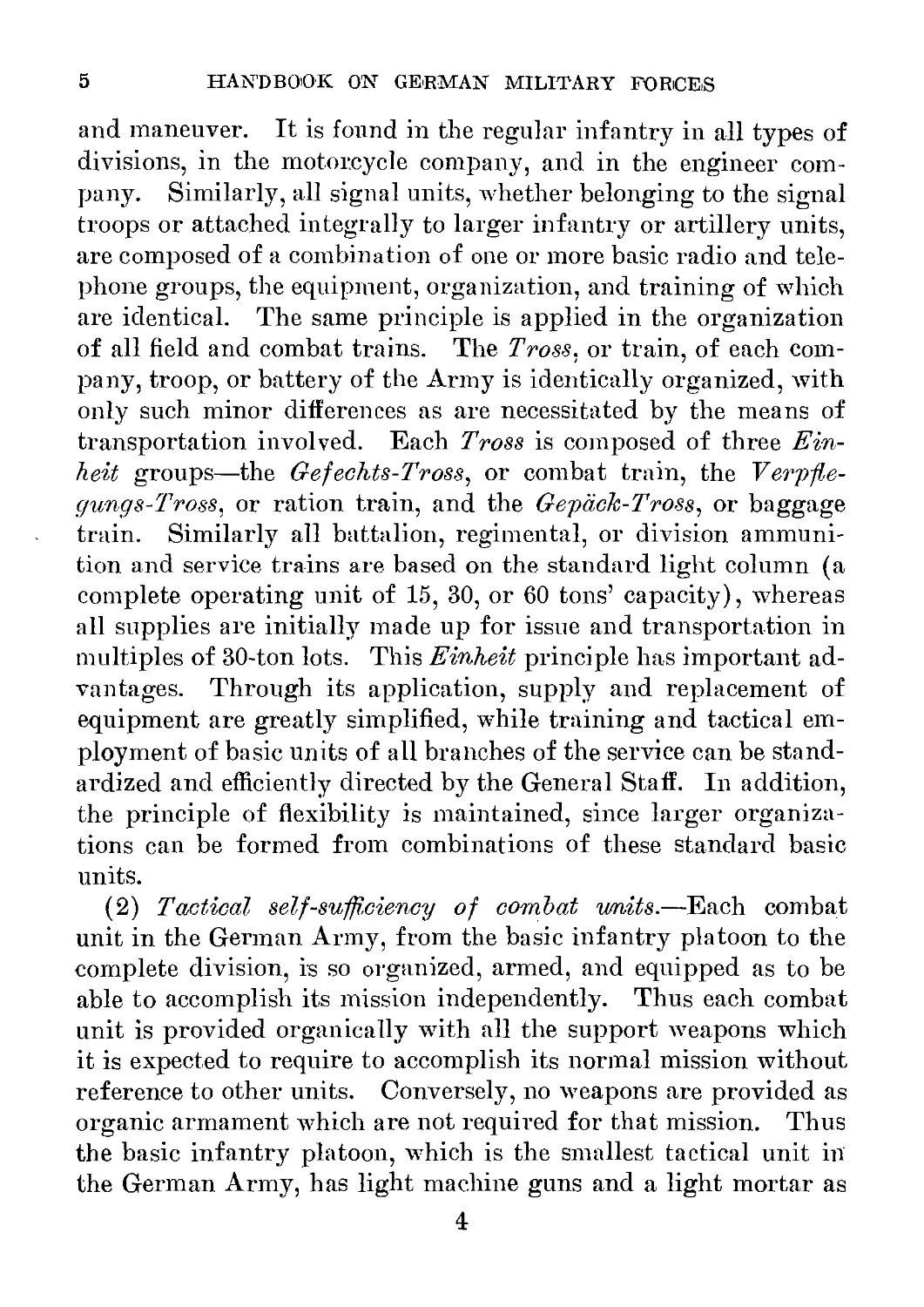
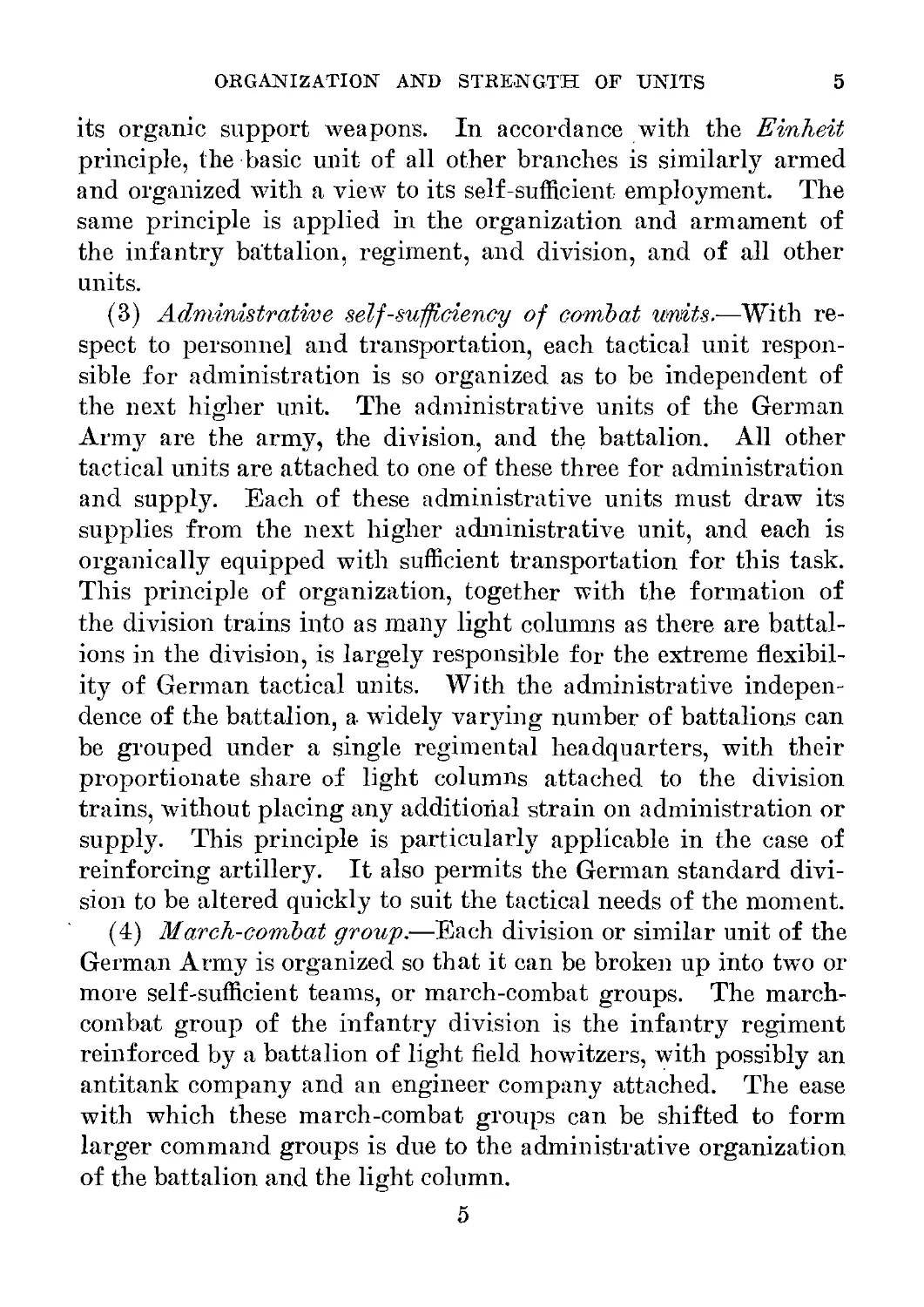
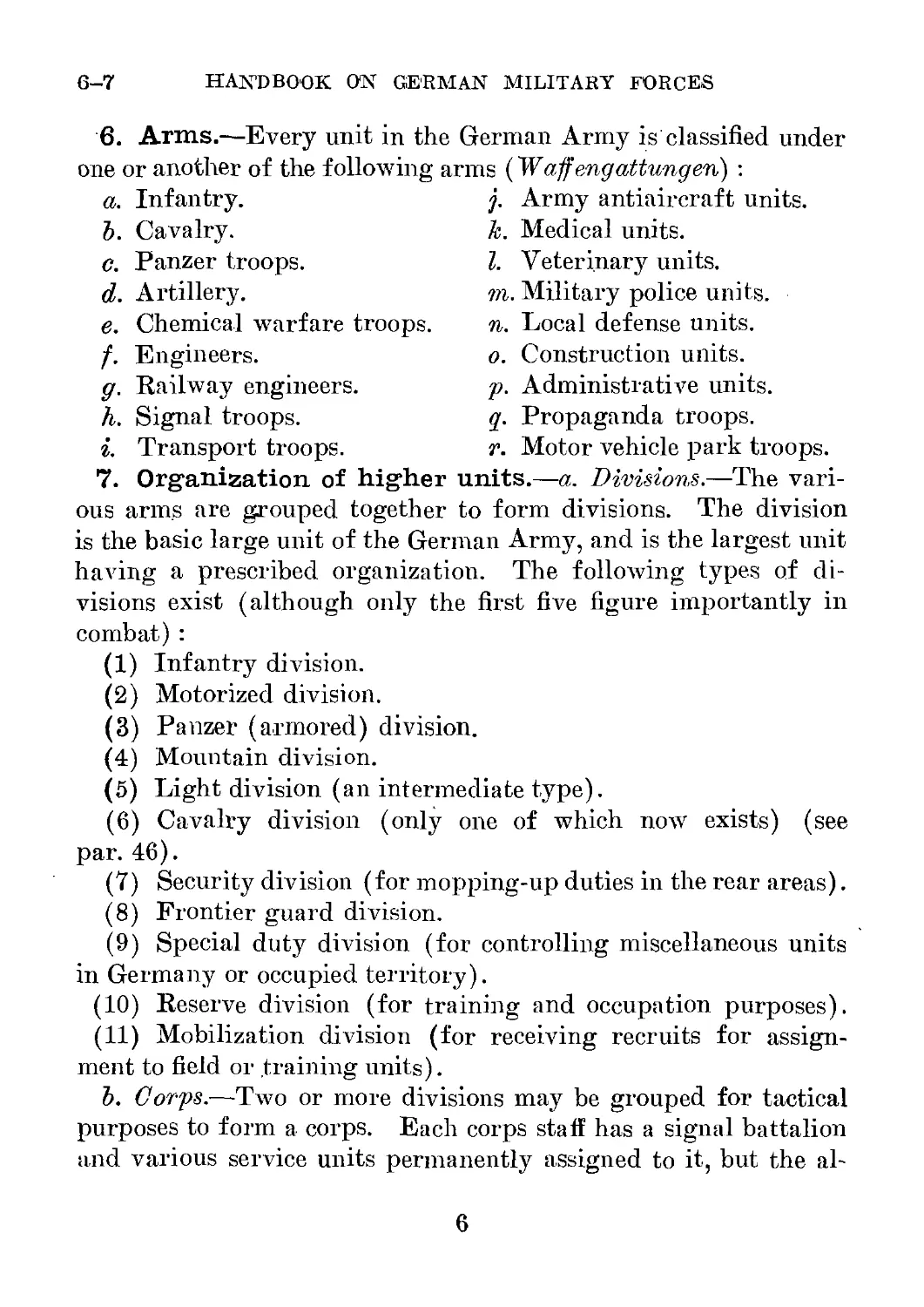
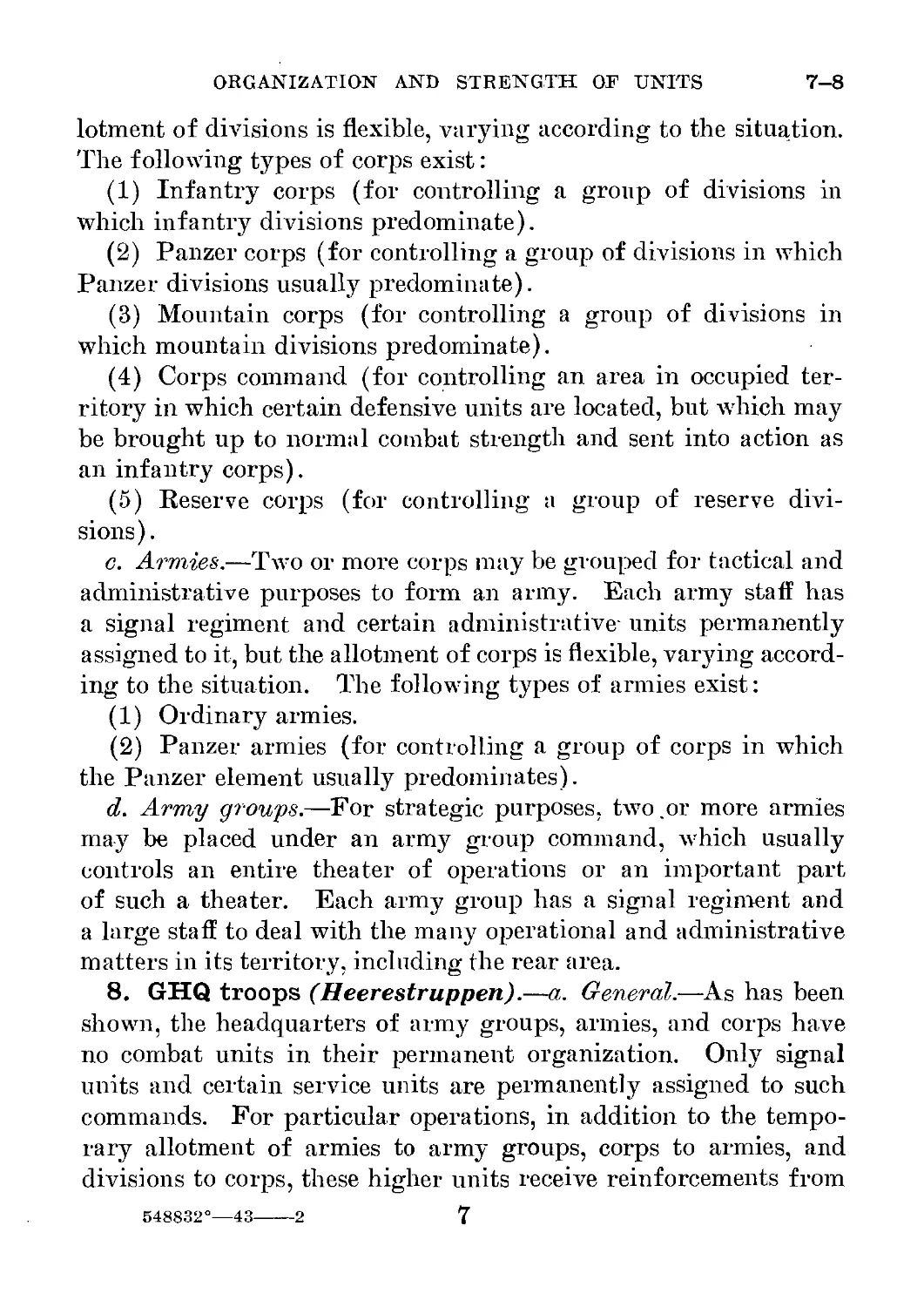
HANDBOOK
ON
GERMAN MILITARY FORCES
1 SEPTEMBER 1943
Dissemination of restricted matter.—The information contained in restricted
documents and the essential characteristics of restricted material may be given
to any person known to be in the service of the United States and to persons
of undoubted loyalty and discretion who are cooperating in Government work,
but will not be communicated to the public or to the press except by authorized
military public relations agencies. (See also par. 18b, AR 380-5, 28 Sep 1942.)
MILITARY INTELLIGENCE DIVISION
WAR DEPARTMENT
WAR DEPARTMENT,
Washington 25, D. С., 1 September 1943.
TM-E 30-451, Handbook on German Military Forces, is pub-
lished for the information and guidance of all concerned.
[Л. G. 300.7 (26 .Tul 43).]
By order of the Secretary of War :
G. C. MARSHALL,
Chief of Staff.
Official :
J. A. ULIO,
Major General,
The Adjutant General.
Distribution : X
(For explanation of symbols, see FM21-6.)
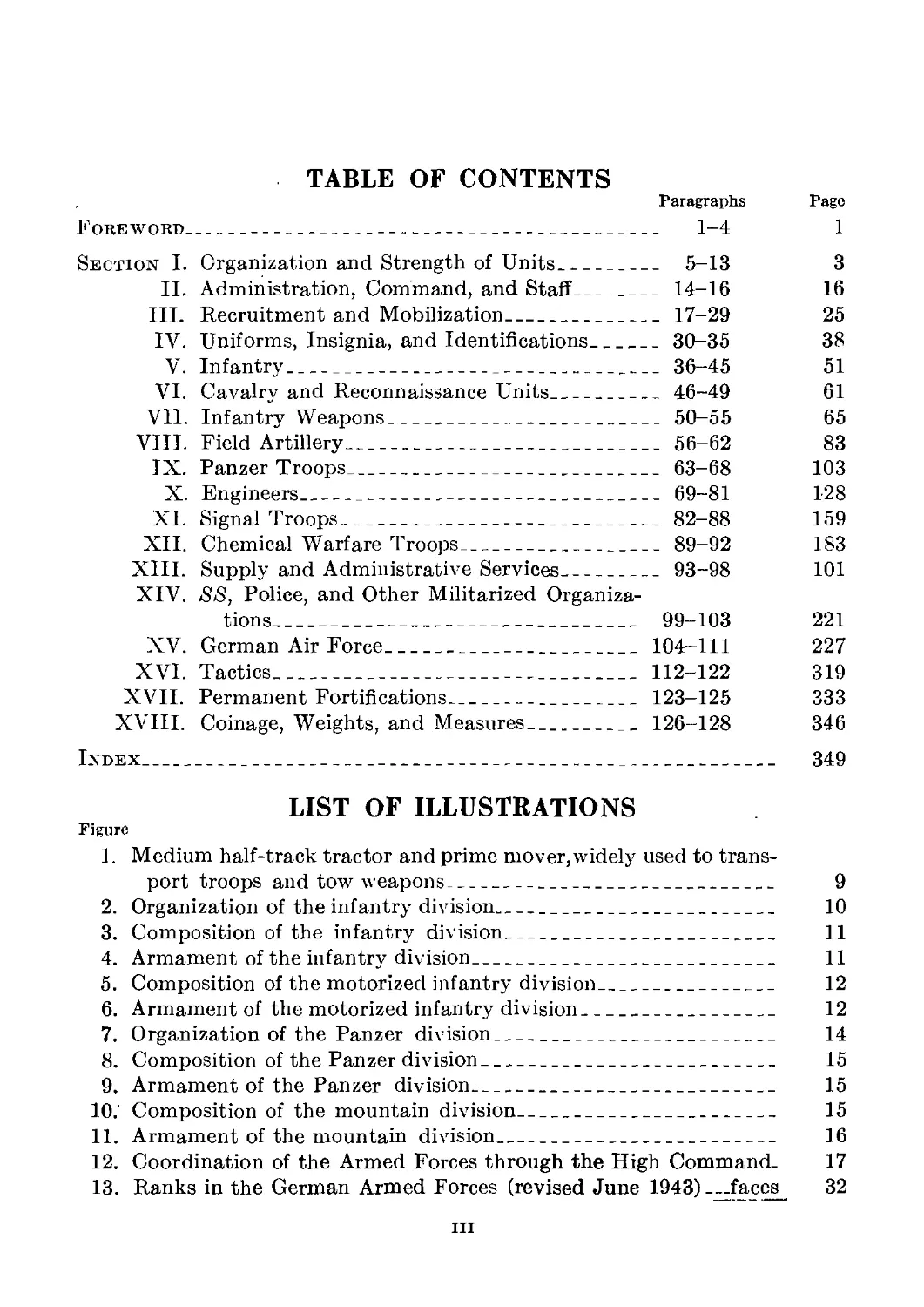
TABLE OF CONTENTS
Paragraphs
Foreword_________________________________________________ 1-4
Section I. Organization and Strength of Units_____________ 5-13
II.	Administration, Command, and Staff__________ 14-16
III.	Recruitment and Mobilization________________ 17-29
IV.	Uniforms, Insignia, and Identifications______30-35
V.	Infantry____________________________________ 36-45
VI.	Cavalry and Reconnaissance Units____________ 46-49
VII.	Infantry Weapons____________________________ 50-55
VIII.	Field Artillery_____________________________ 56-62
IX.	Panzer Troops_______________________________ 63-68
X.	Engineers___________________________________ 69-81
XI.	Signal Troops_______________________________ 82-88
XII.	Chemical Warfare Troops_____________________ 89-92
XIII.	Supply and Administrative Services__________ 93-98
XIV.	SS, Police, and Other Militarized Organiza-
tions_____________________________________________ 99-103
XV.	German Air Force__________________________ 104-111
XVI.	Tactics___________________________________ 112-122
XVII.	Permanent Fortifications__________________ 123-125
XVIII.	Coinage, Weights, and Measures____________ 126-128
Index________________________________________________________
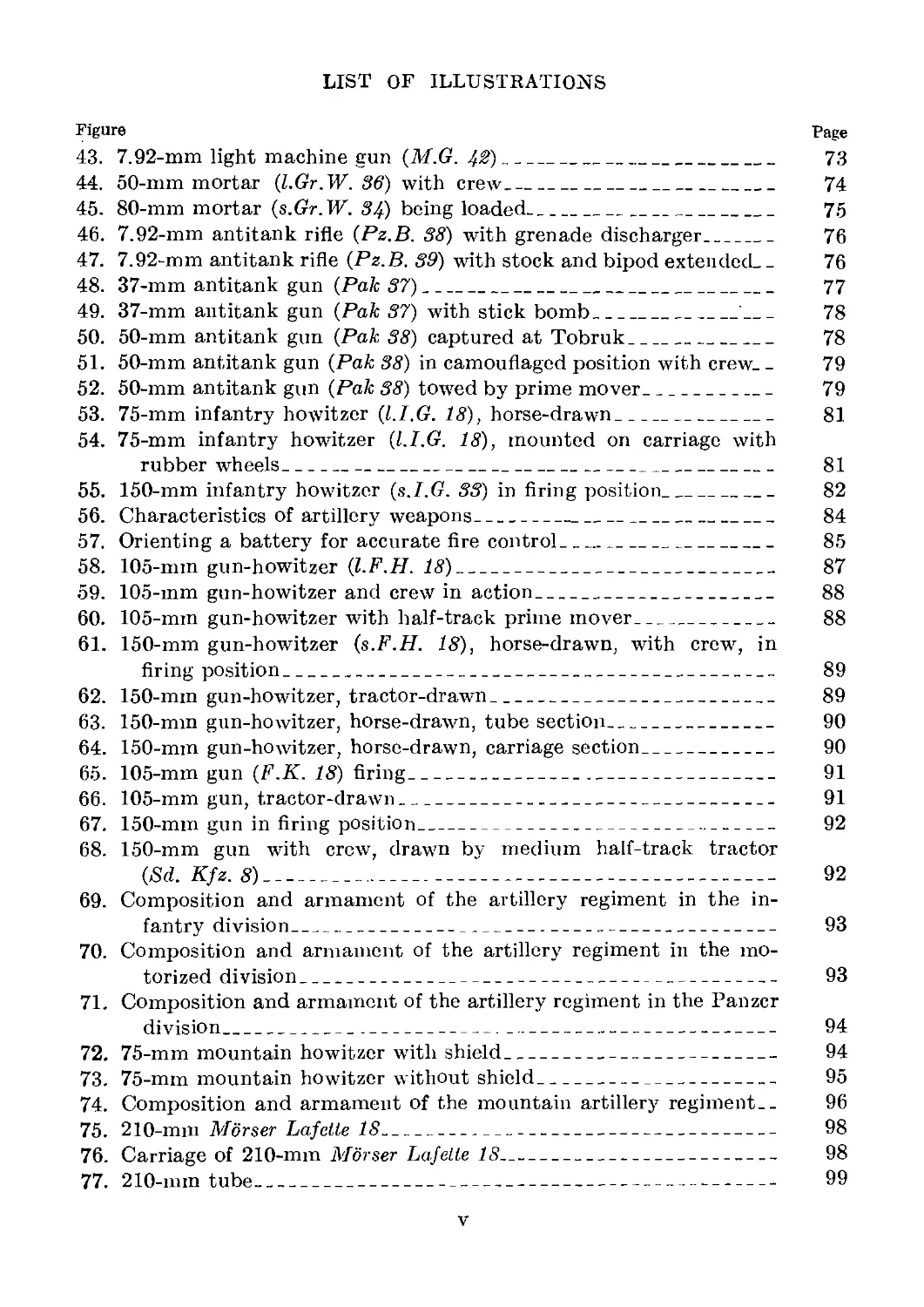
LIST OF ILLUSTRATIONS
Figure
1.	Medium half-track tractor and prime mover, widely used to trans-
port troops and tow weapons________________________________
2.	Organization of the infantry division___________________
3.	Composition of the infantry division____________________
4.	Armament of the infantry division_______________________
5.	Composition of the motorized infantry division__________
6.	Armament of the motorized infantry division_____________
7.	Organization of the Panzer division_____________________
8.	Composition of the Panzer division______________________
9.	Armament of the Panzer division.________________________
10.	Composition of the mountain division_____________________
11.	Armament of the mountain division________________________
12.	Coordination of the Armed Forces through the High Command.
13.	Ranks in the German Armed Forces (revised June 1943) ___facc®
Pago
1
3
16
25
38
51
61
65
83
103
128
159
183
101
221
227
319
333
346
349
9
10
11
11
12
12
14
15
15
15
16
17
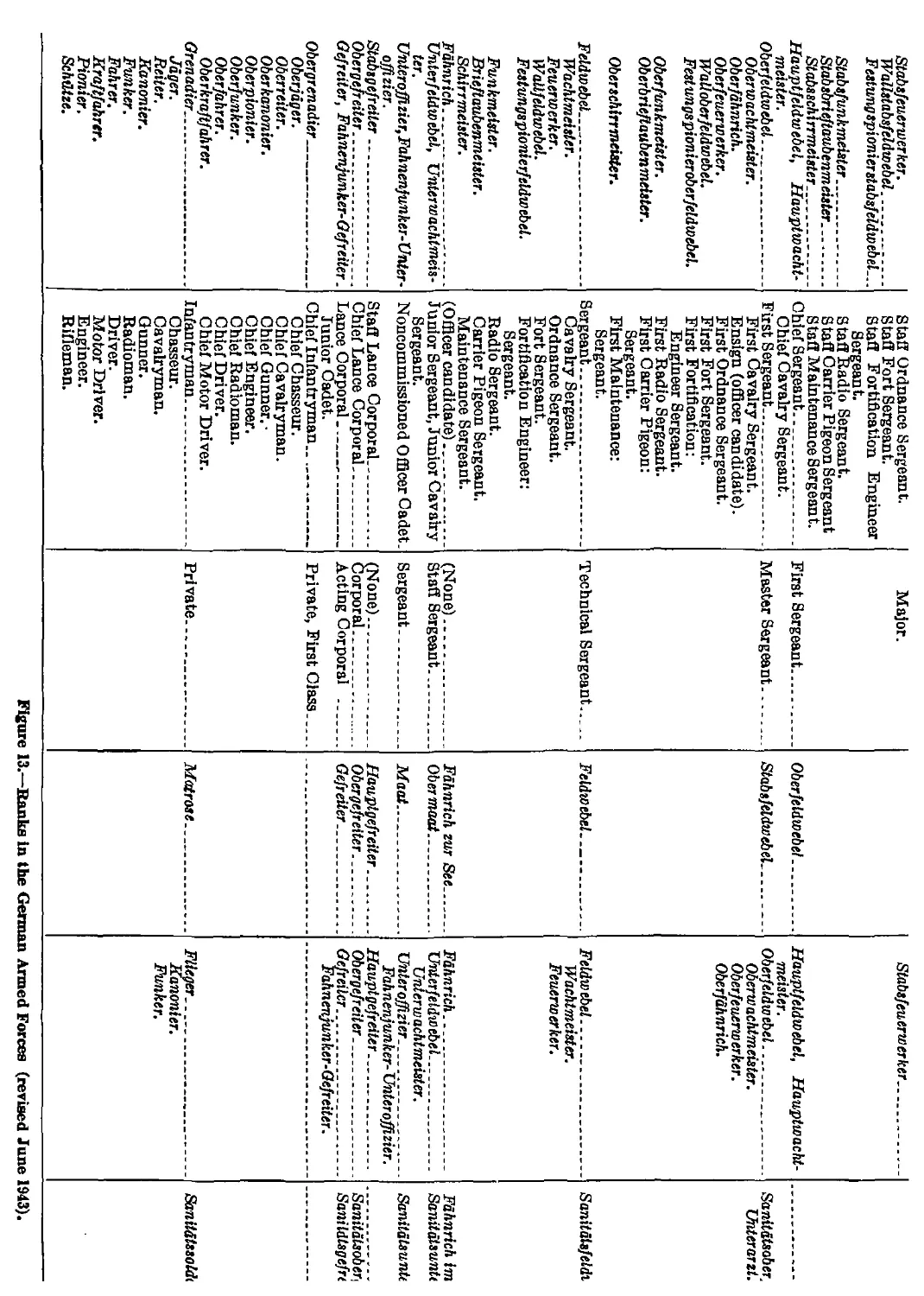
32
in
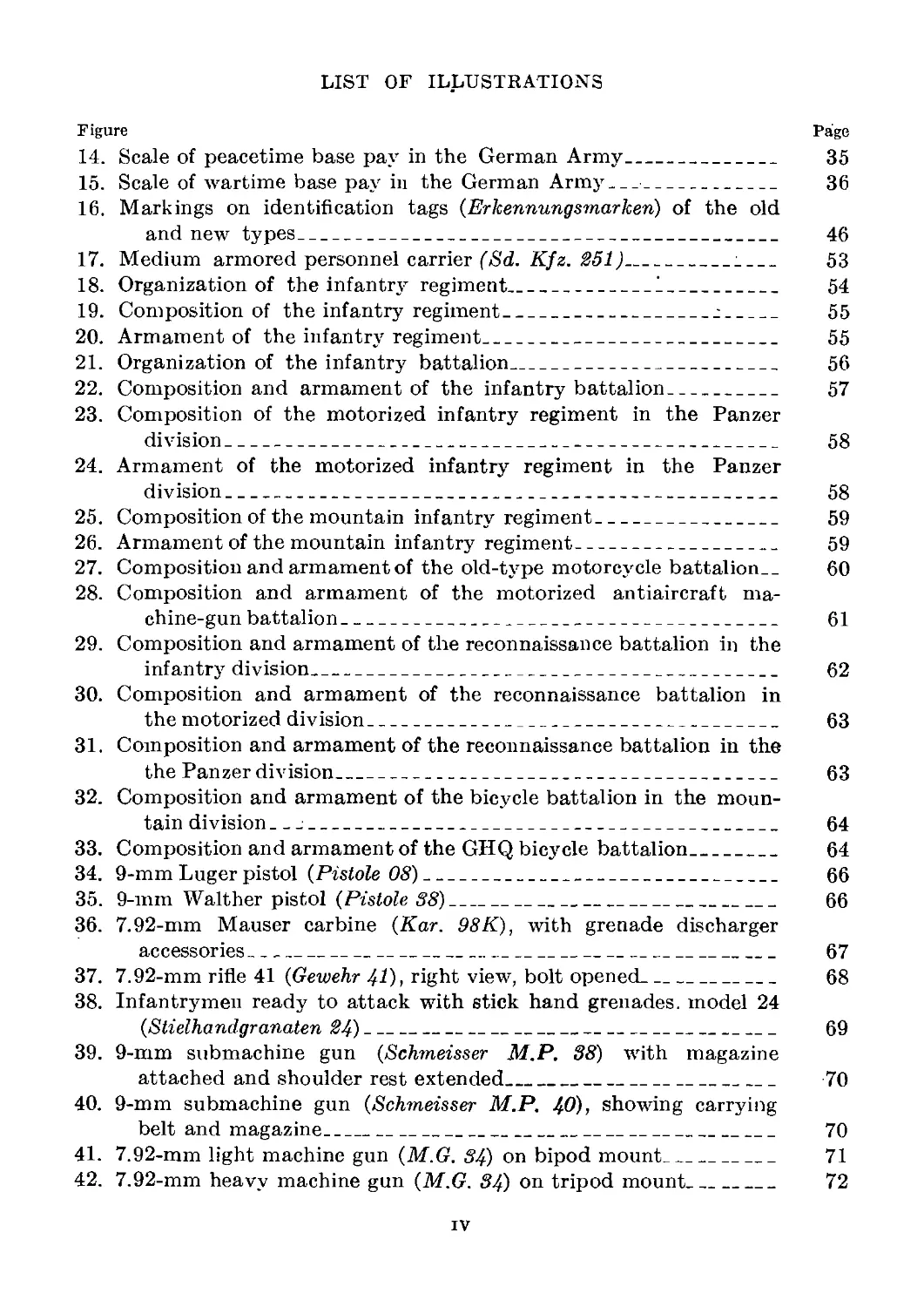
LIST OF ILLUSTRATIONS
Figure	Page
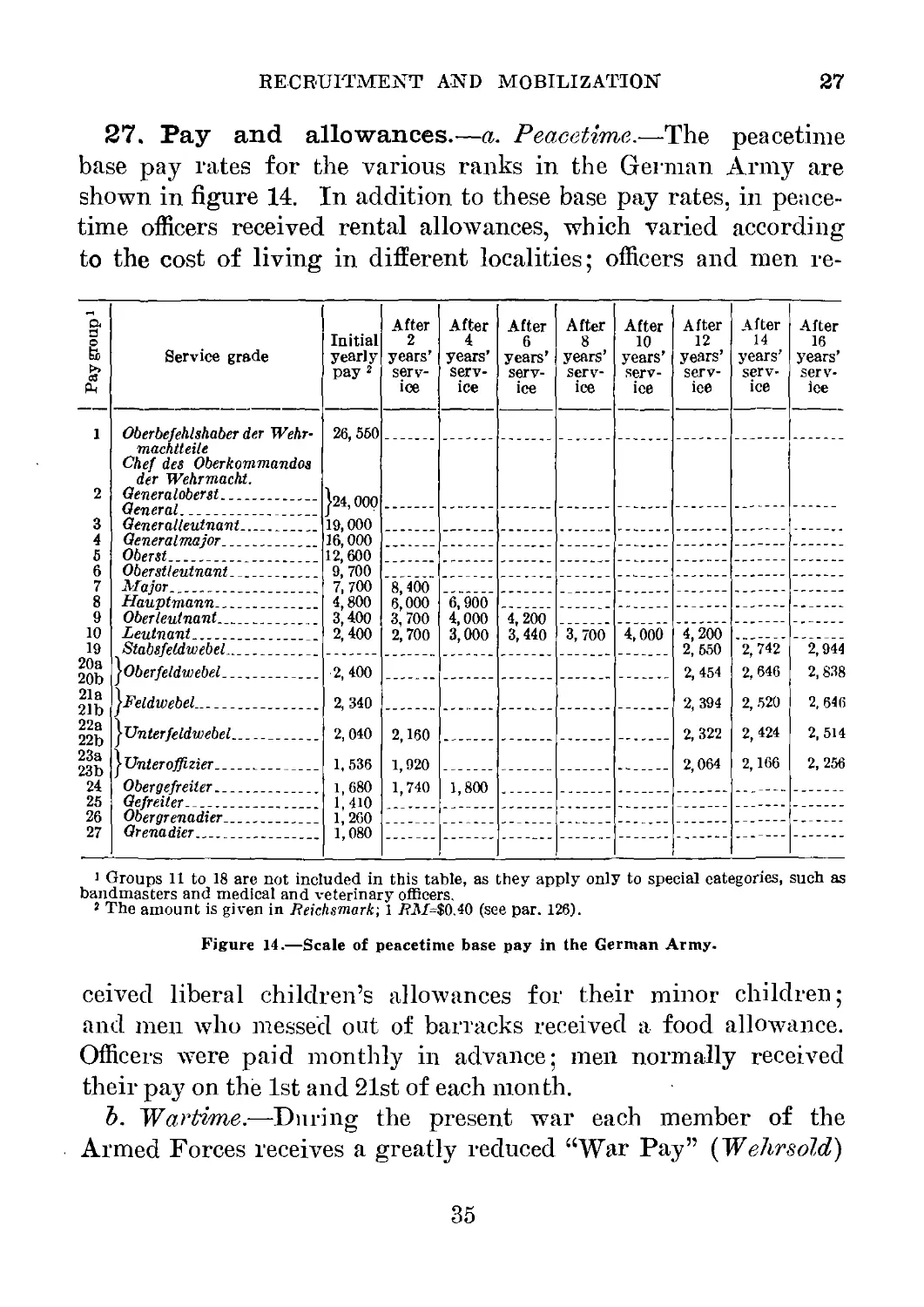
14.	Scale of peacetime base pay in the German Army_______________ 35
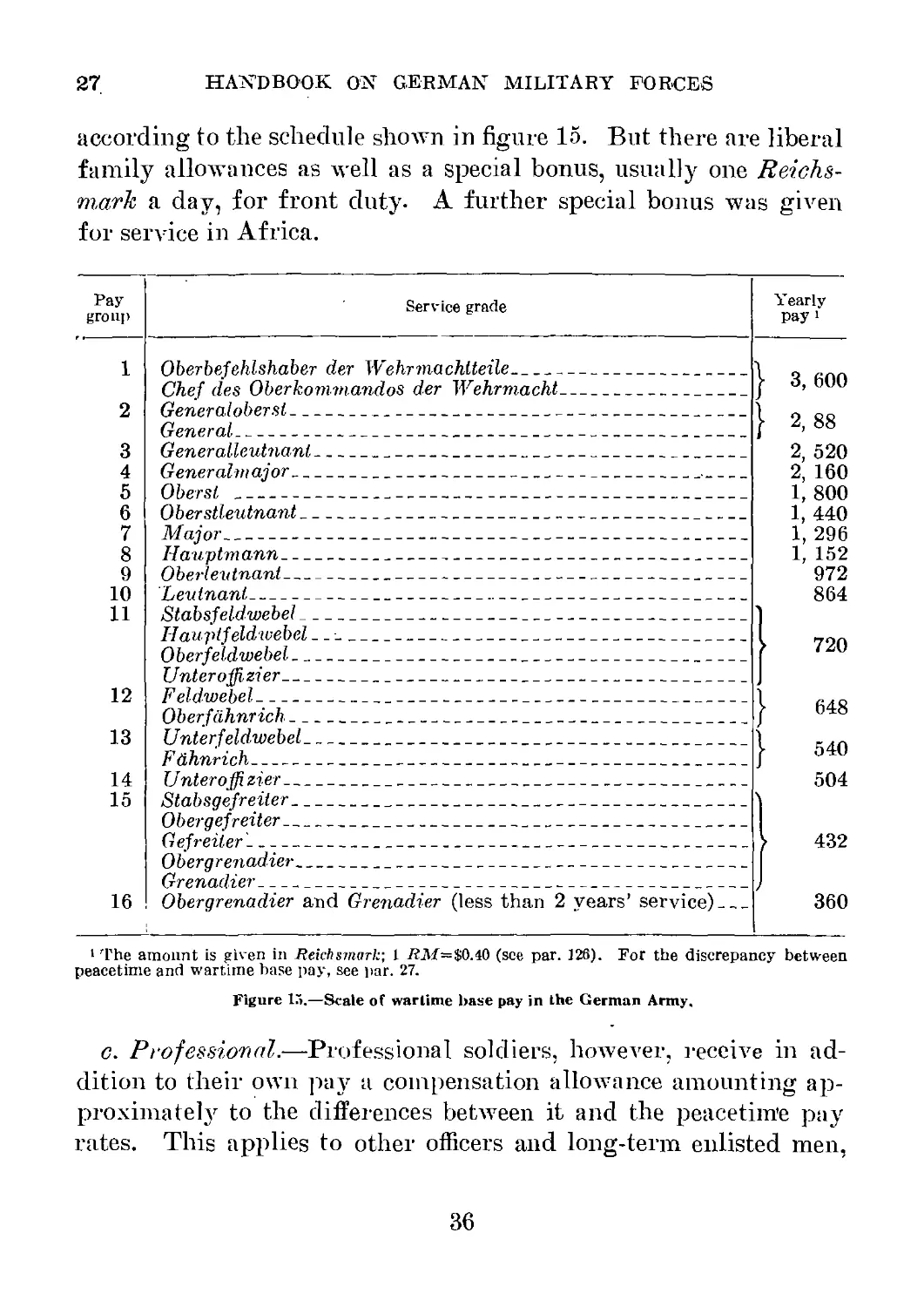
15.	Scale of wartime base pay in the German Army_________________ 36
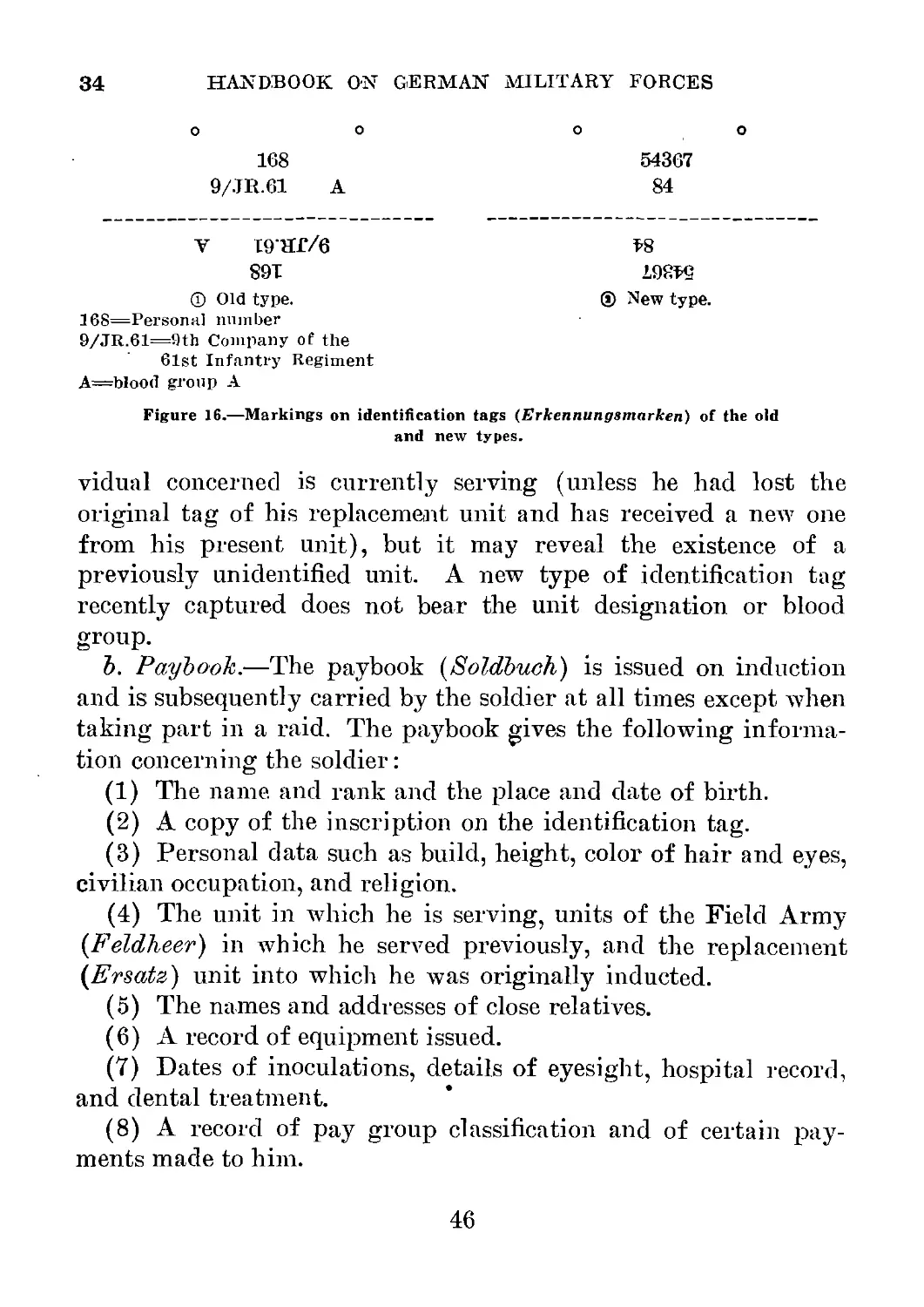
16.	Markings on identification tags (Erkennungsmarken) of the old
and new types____________________________________________________ 46
17.	Medium armored personnel carrier (Sd. Kfz.251)_______________ 53
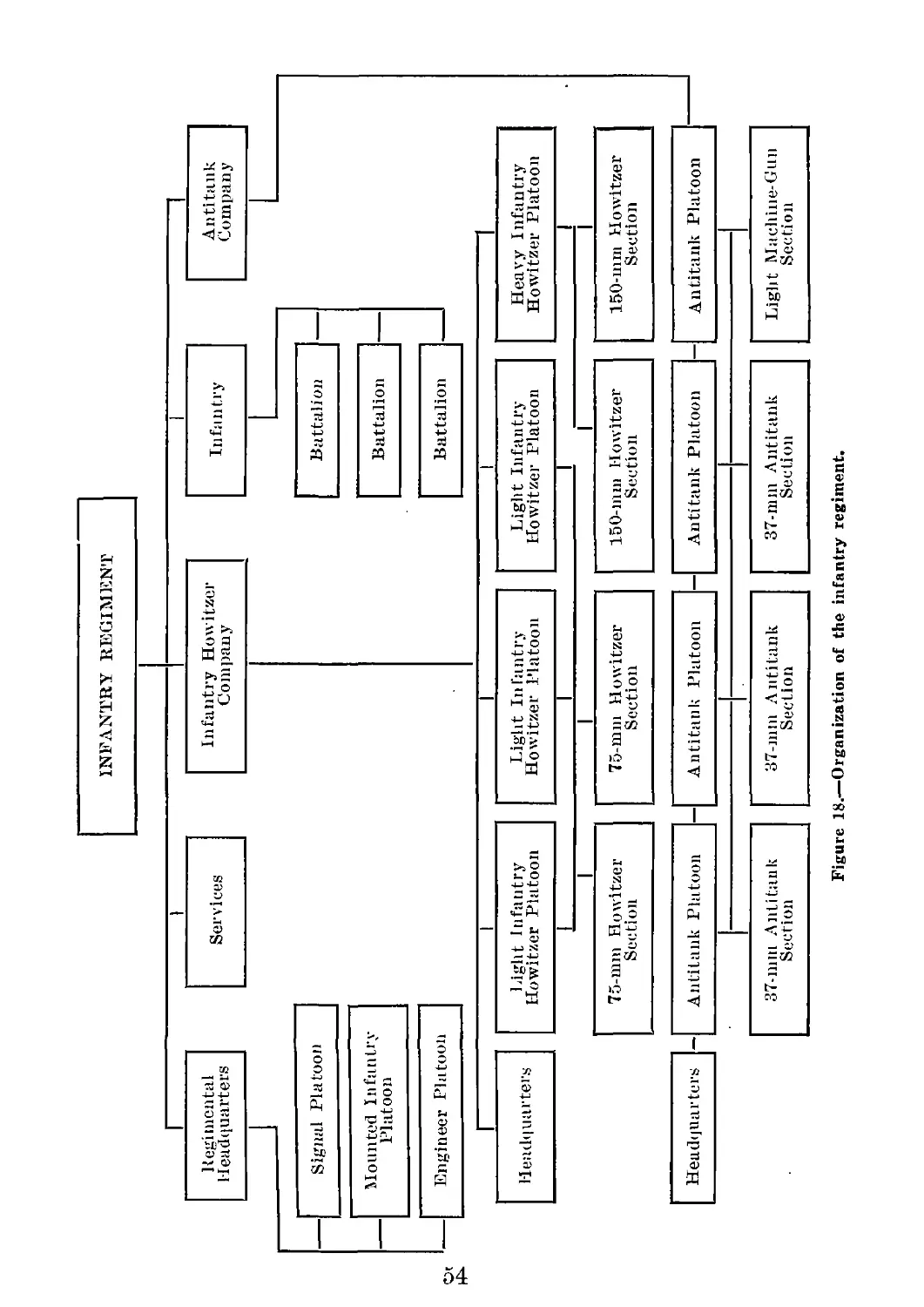
18.	Organization of the infantry regiment________________________ 54
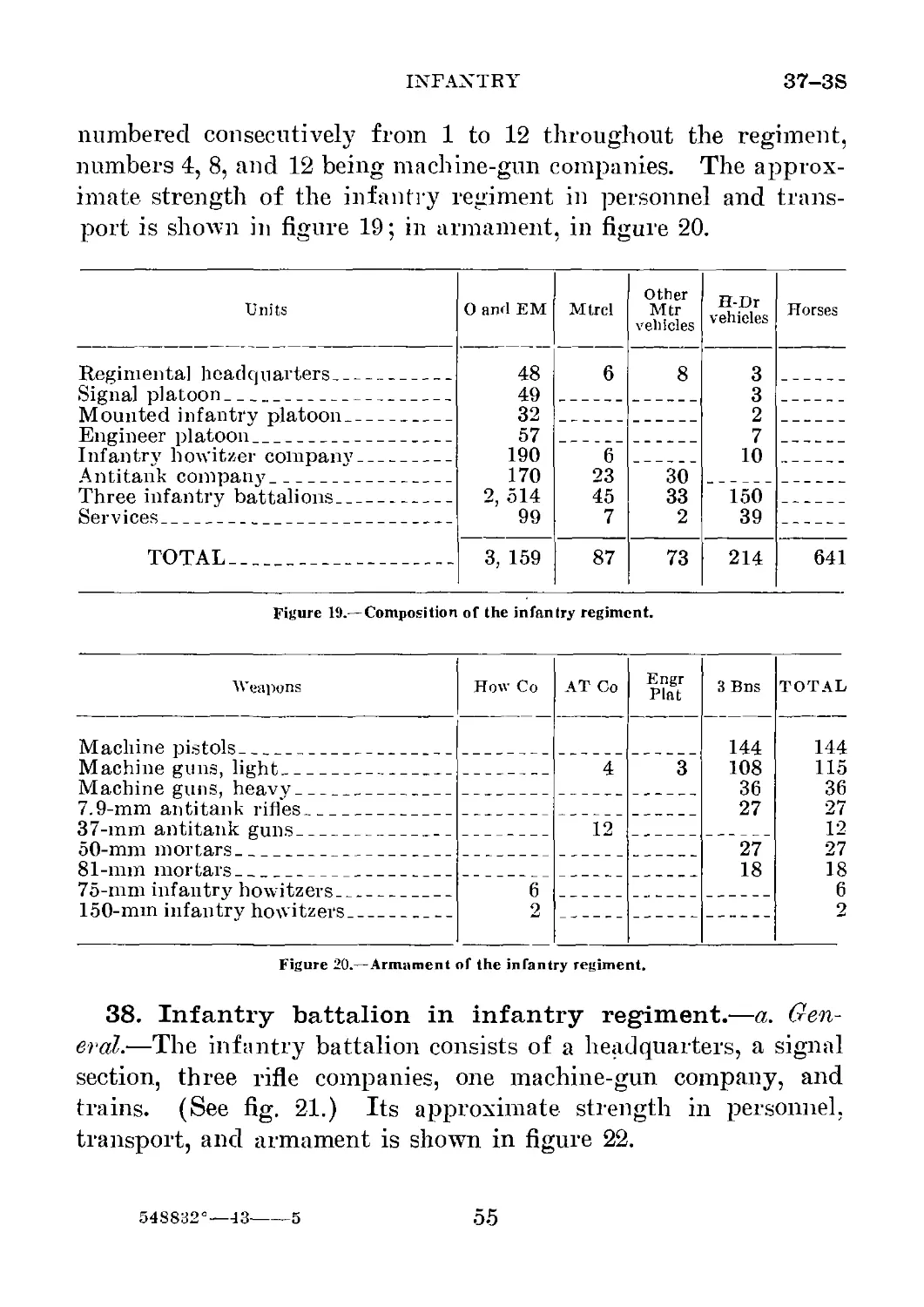
19.	Composition of the infantry regiment__________________.______ 55
20.	Armament of the infantry regiment___________________________ 55
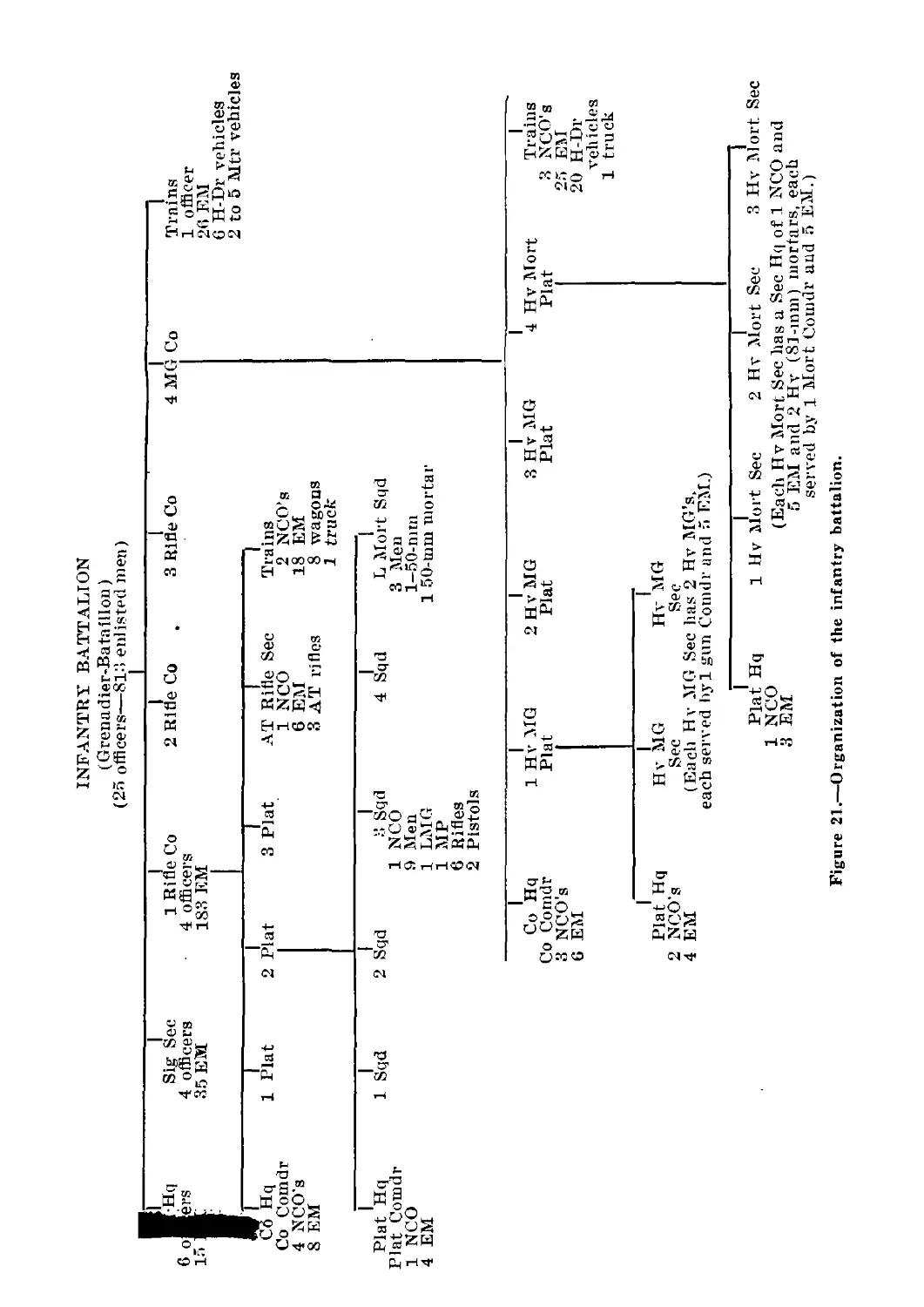
21.	Organization of the infantry battalion______________________ 56
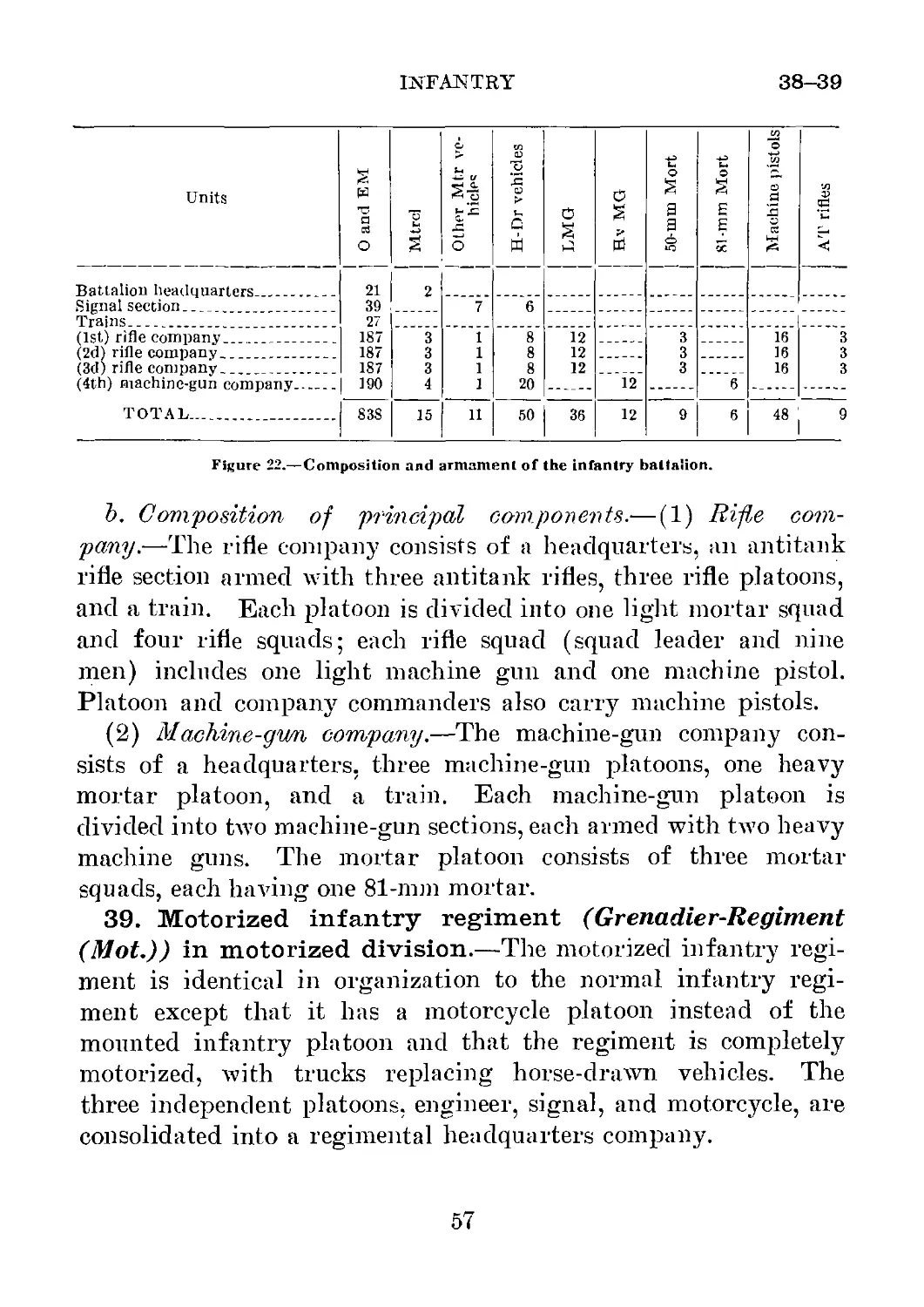
22.	Composition and armament of the infantry battalion__________ 57
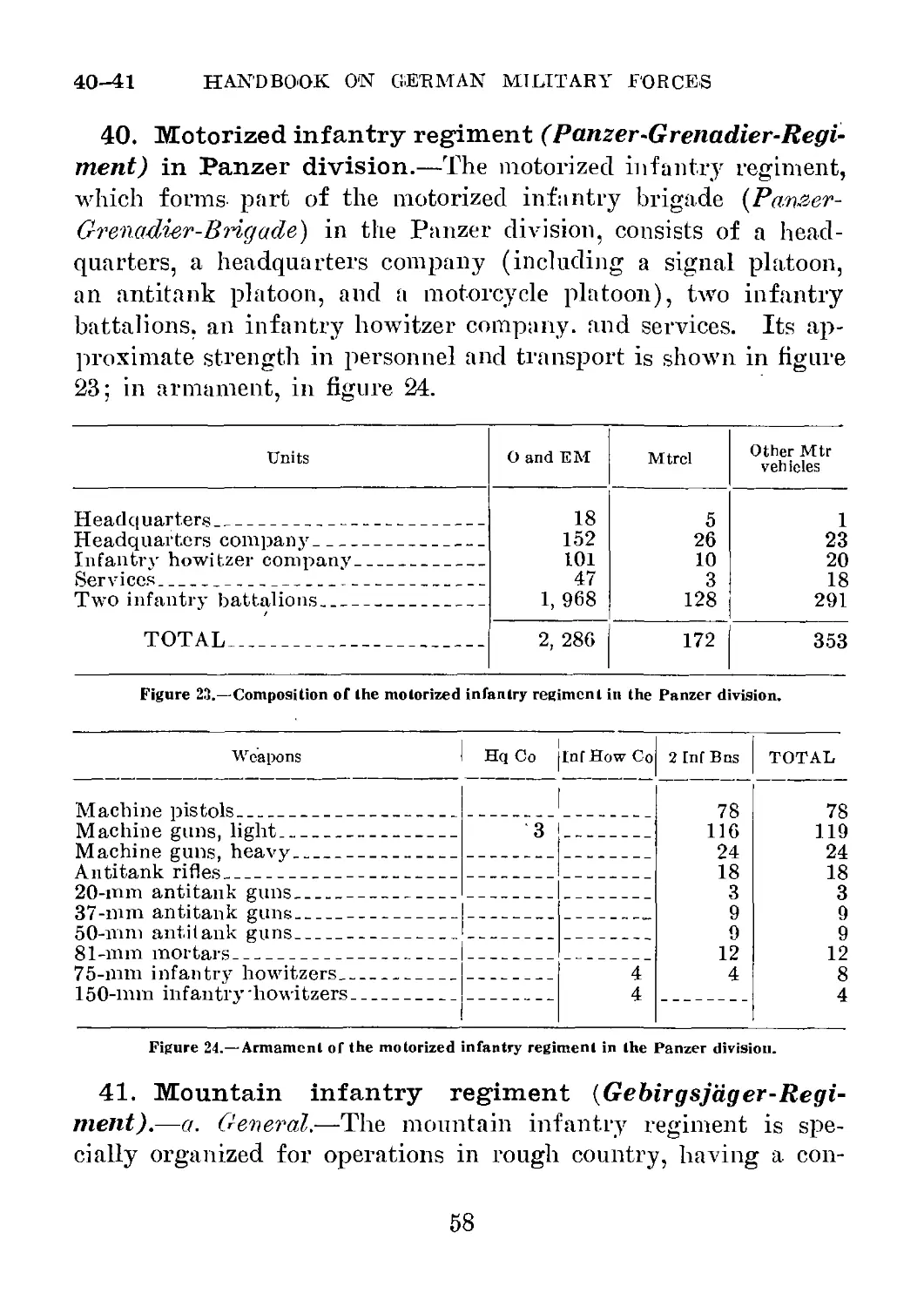
23.	Composition of the motorized infantry regiment in the Panzer
division____________________________________________________________ 58
24.	Armament of the motorized infantry regiment in the Panzer
division____________________________________________________________ 58
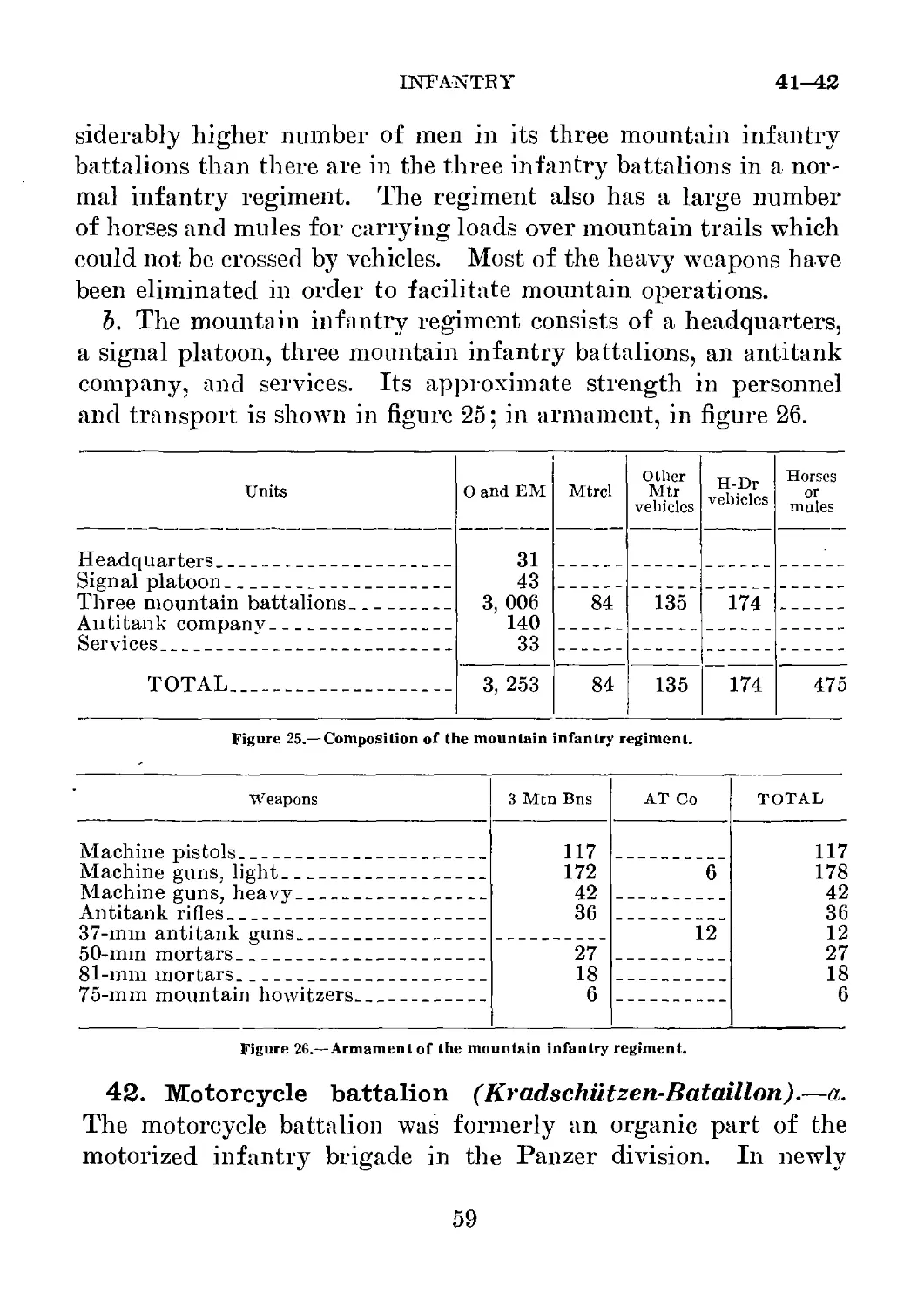
25.	Composition of the mountain infantry regiment__________________ 59
26.	Armament of the mountain infantry regiment_____________________ 59
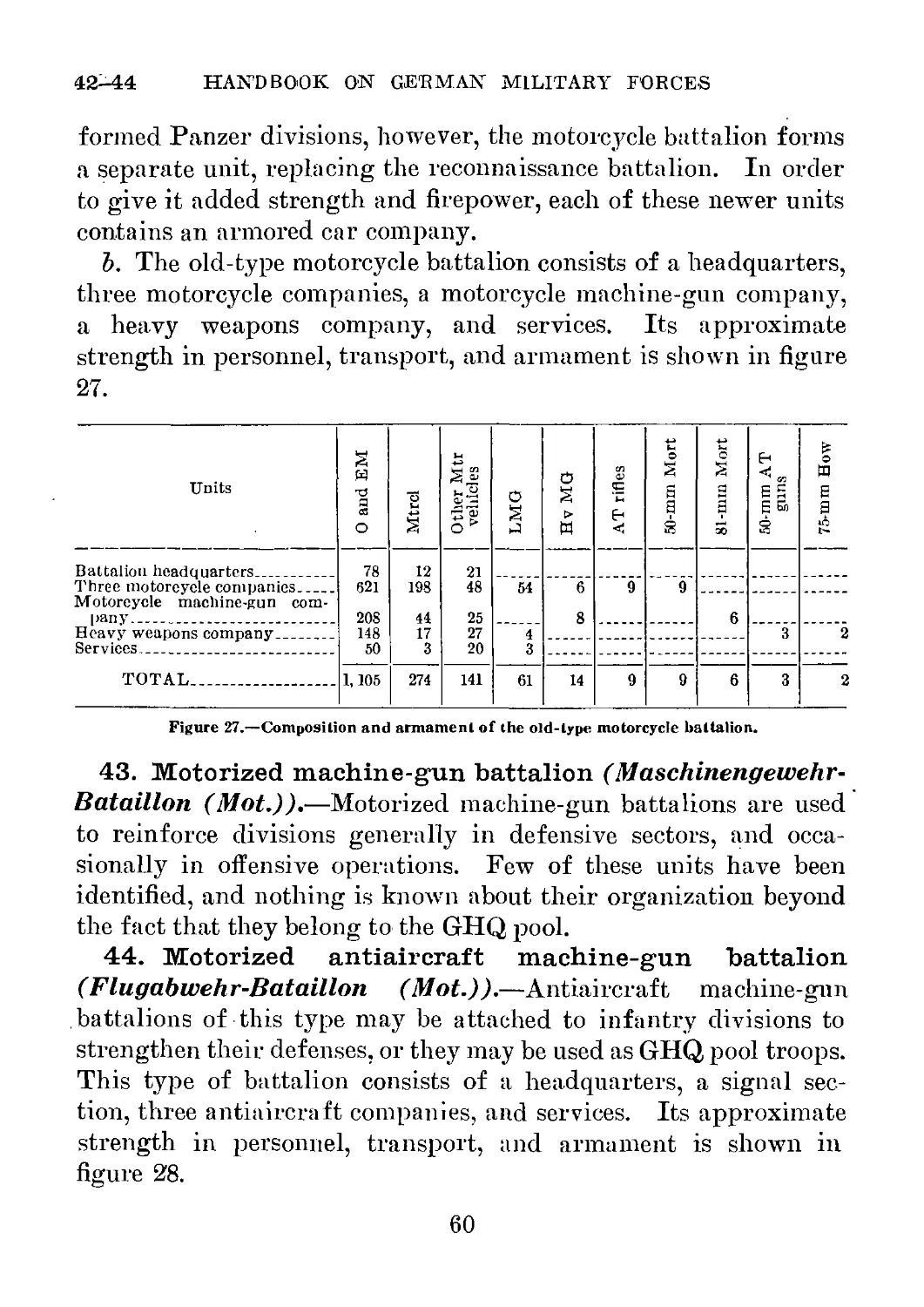
27.	Composition and armament of the old-type motorcycle battalion.. 60
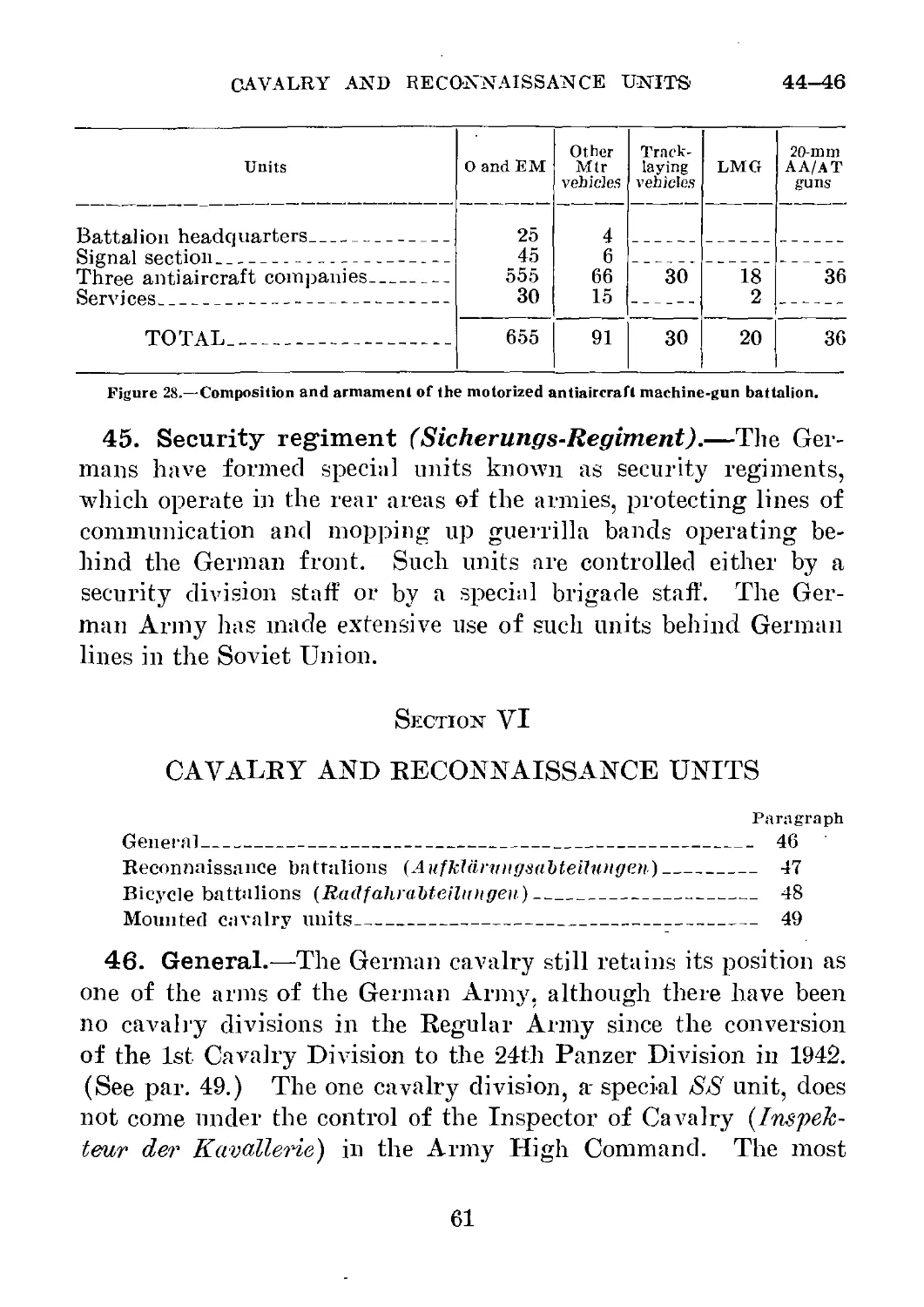
28.	Composition and armament of the motorized antiaircraft ma-
chine-gunbattalion_______________________________________________ 61
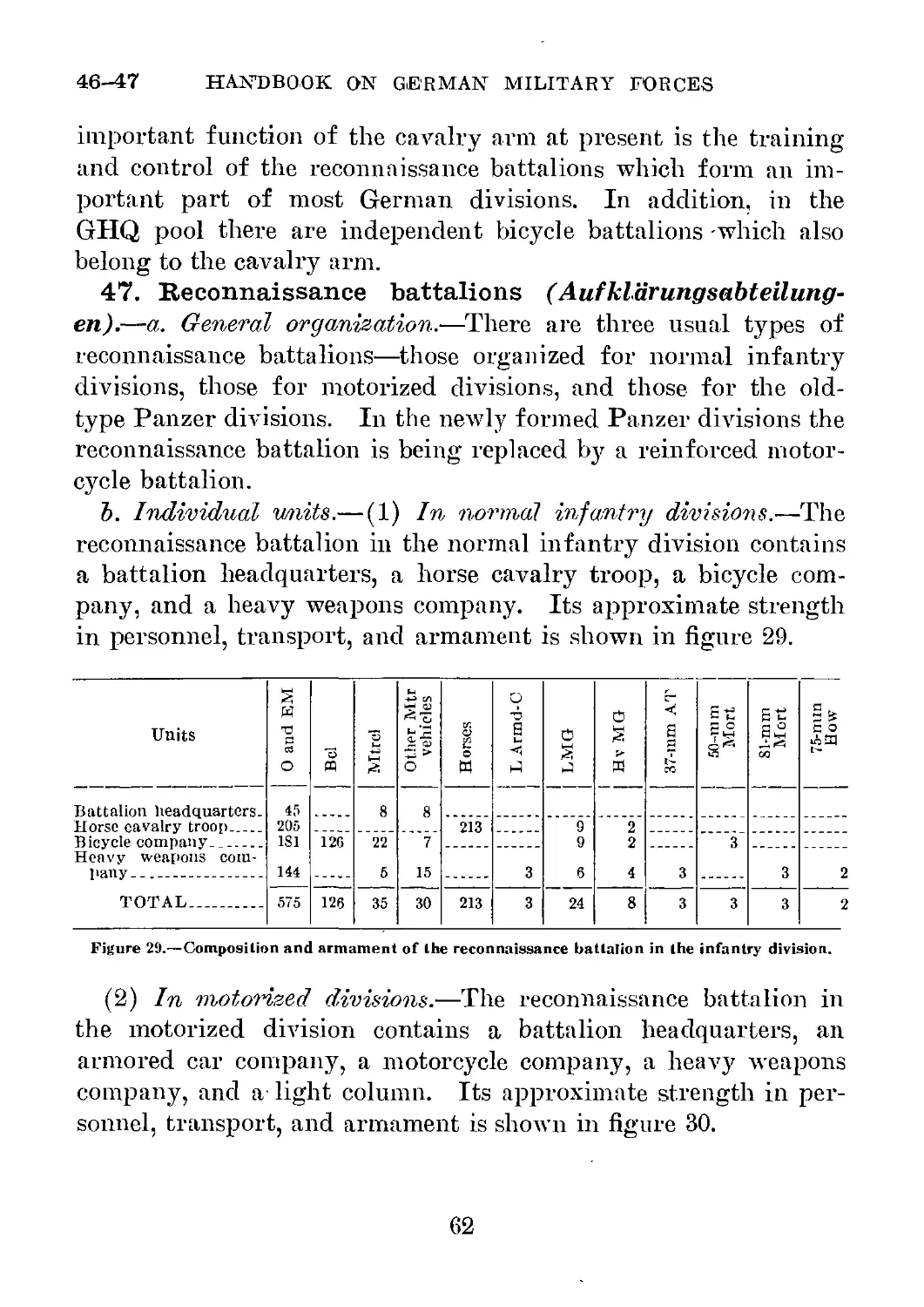
29.	Composition and armament of the reconnaissance battalion in the
infantry division________________________________________________ 62
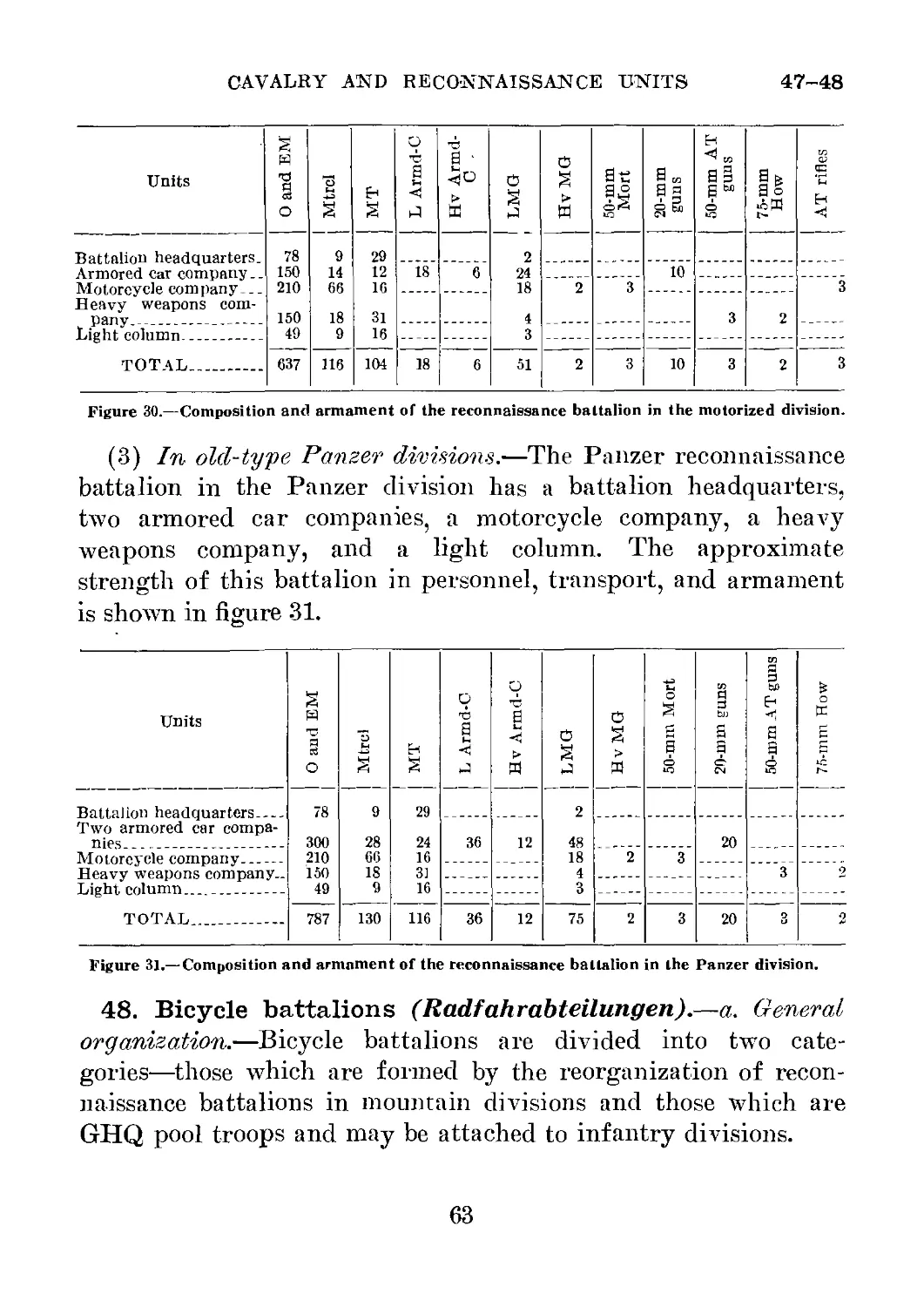
30.	Composition and armament of the reconnaissance battalion in
the motorized division___________________________________________ 63
31.	Composition and armament of the reconnaissance battalion in the
the Panzer division_________________________________________________ 63
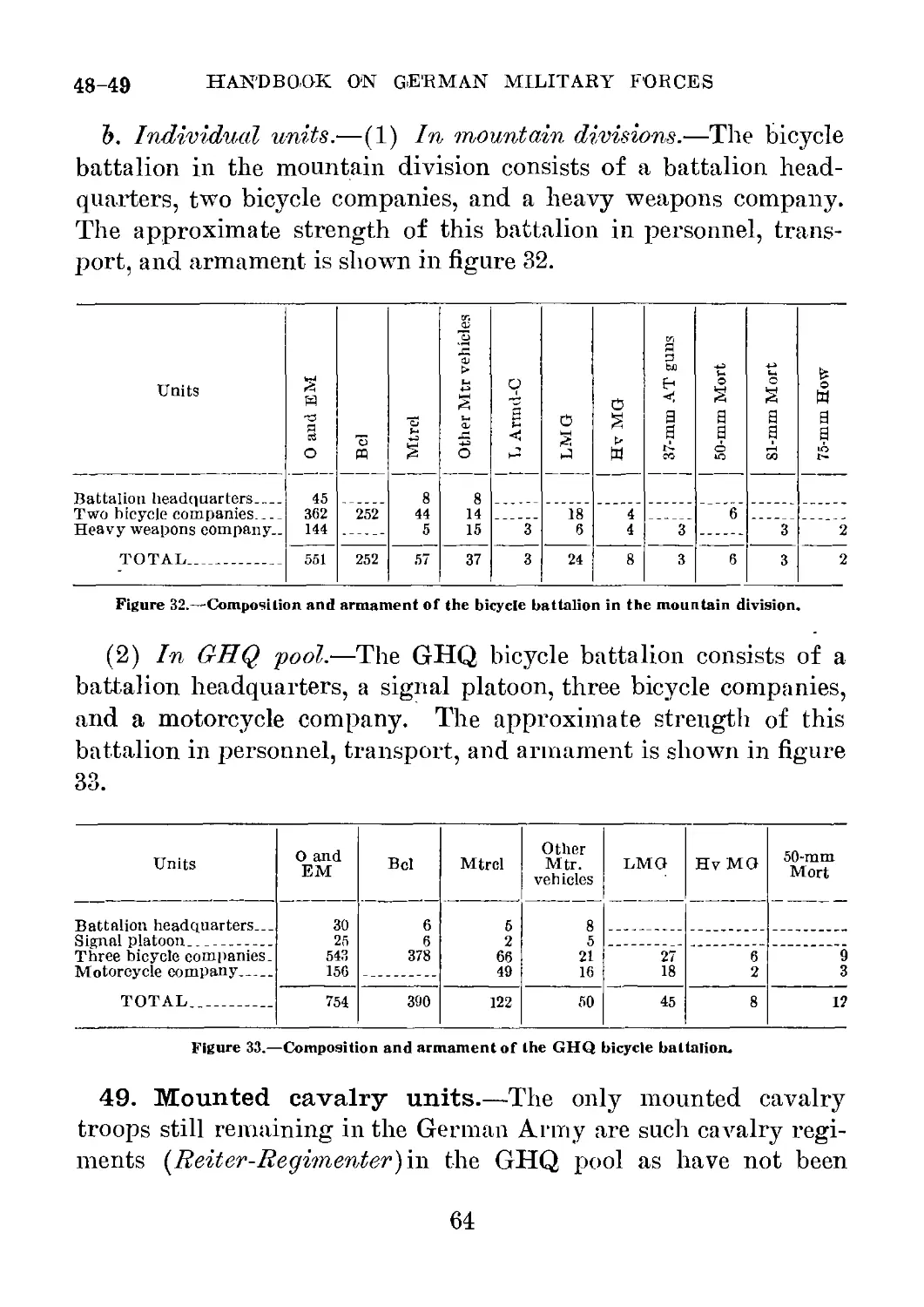
32.	Composition and armament of the bicycle battalion in the moun-
tain division________:______________________________________________ 64
33.	Composition and armament of the	GHQ	bicycle battalion_____ 64
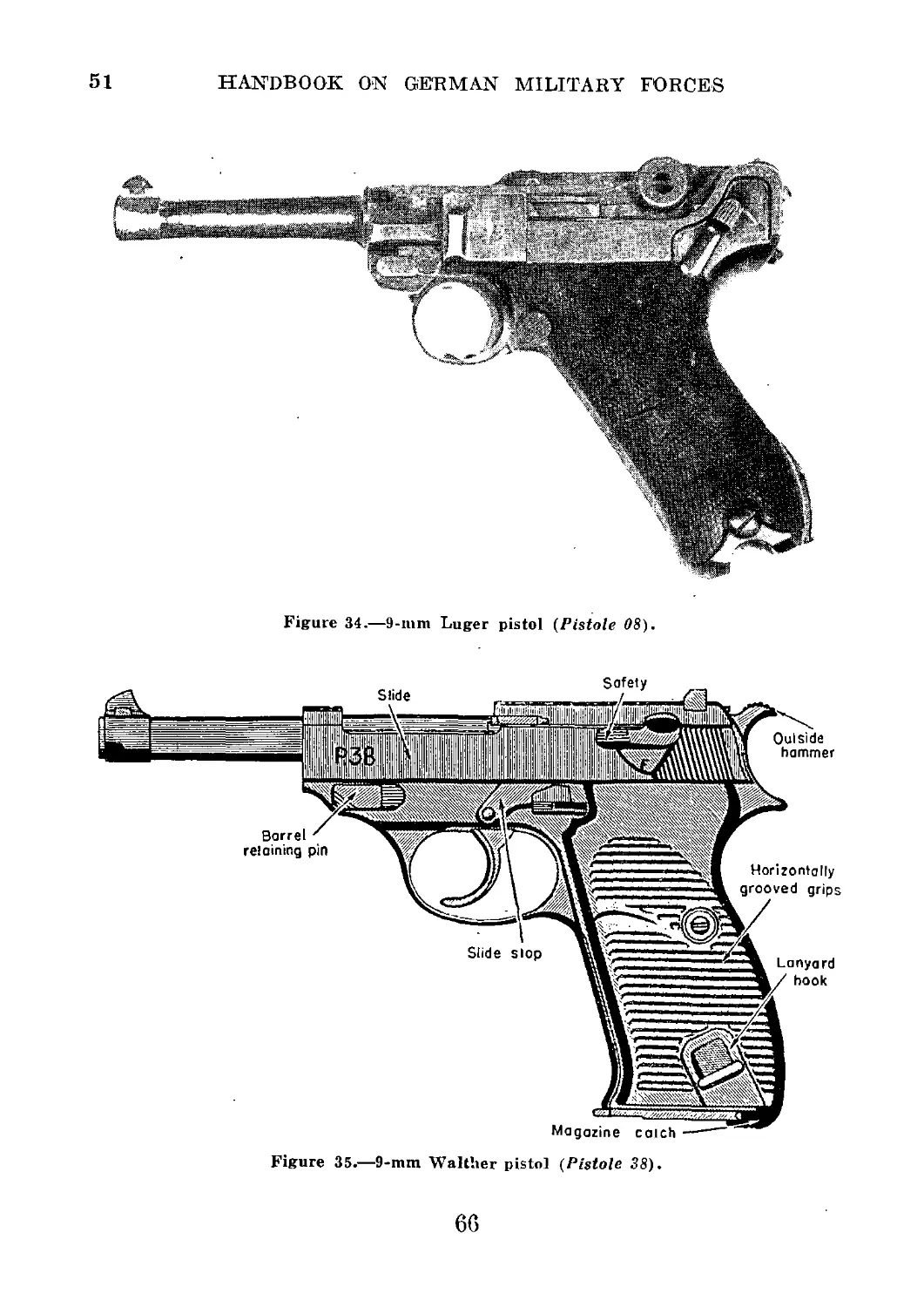
34.	9-mm Luger pistol (Pistole 08)_________________________________ 66
35.	9-mm Walther pistol (Pistole 38)________________________________ 66
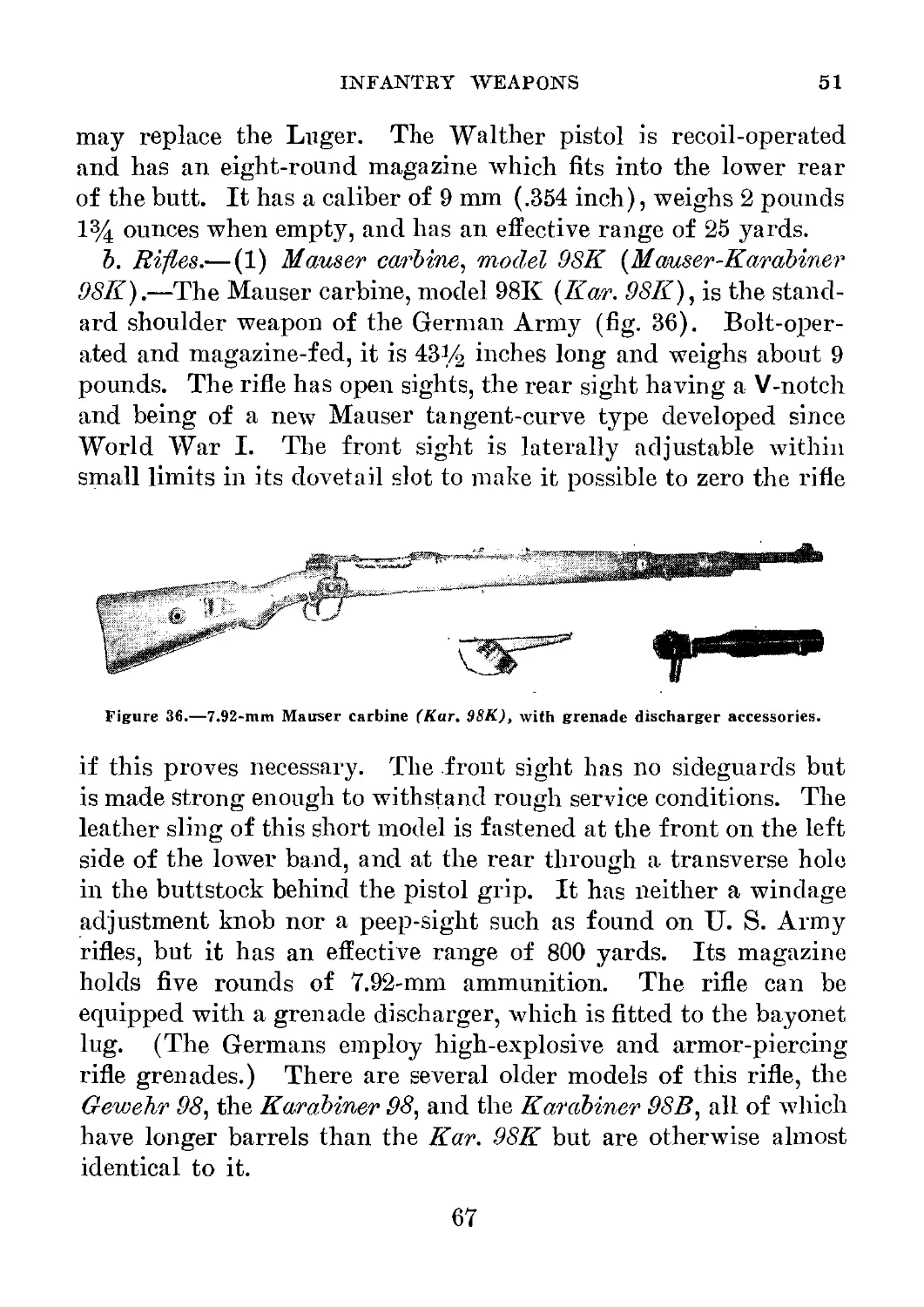
36.	7.92-mm Mauser carbine (Kar. 98K), with grenade discharger
accessories_________________________________________________________ 67
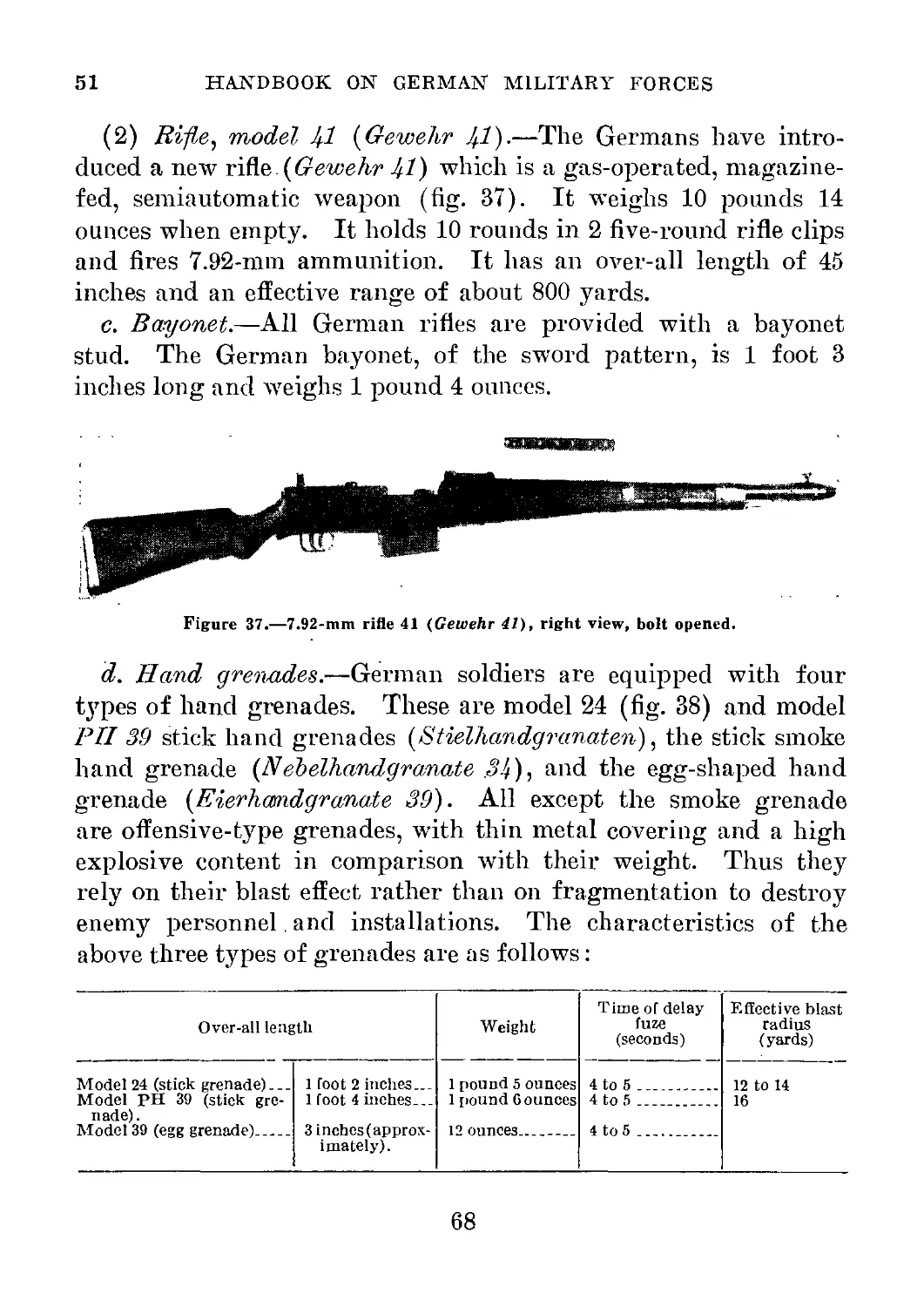
37.	7.92-mm rifle 41 (Gewehr 41), right	view,	bolt opened________ 68
38.	Infantrymen ready to attack with stick hand grenades, model 24
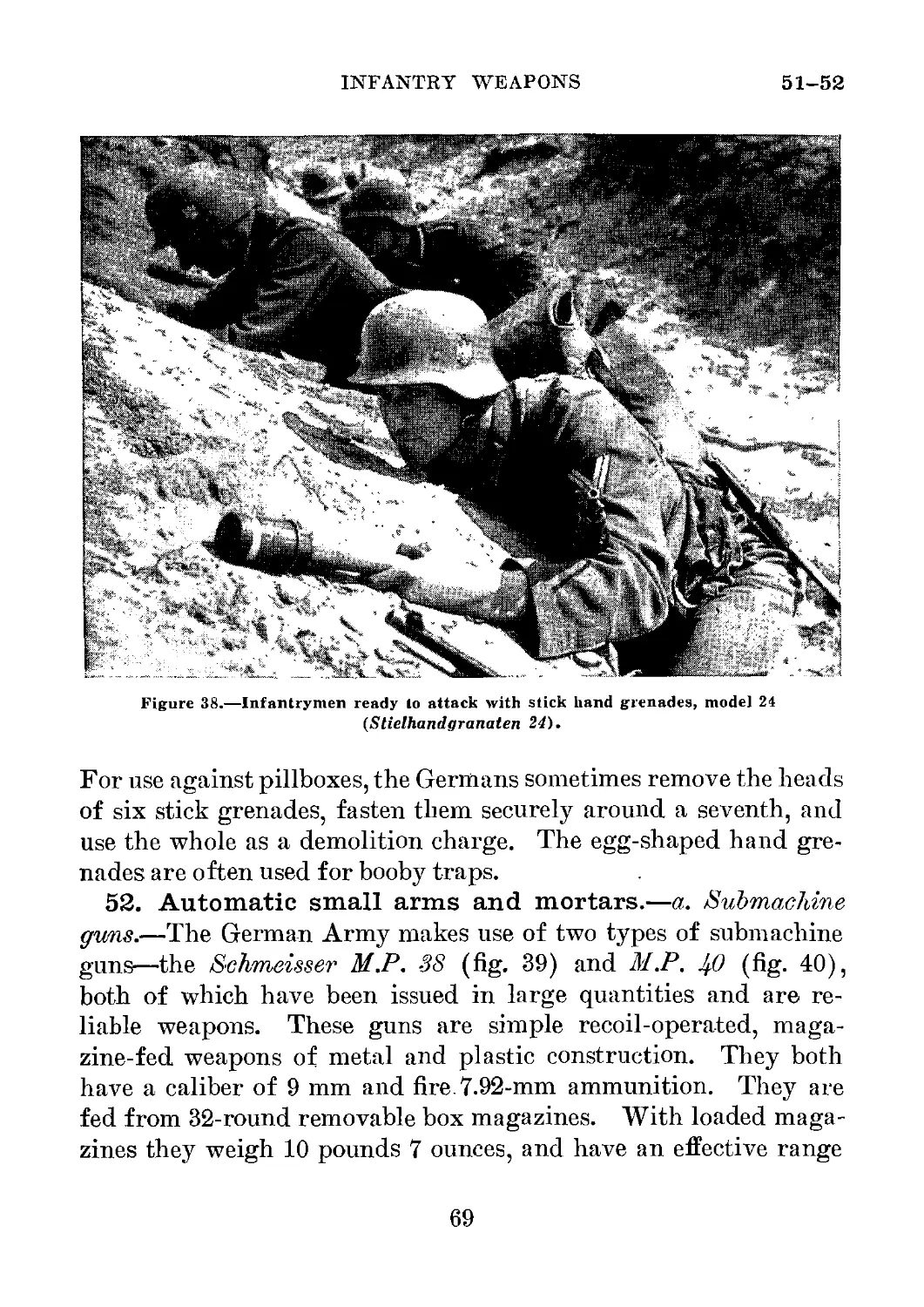
(Stielhandgranaten 24)___________________________________________ 69
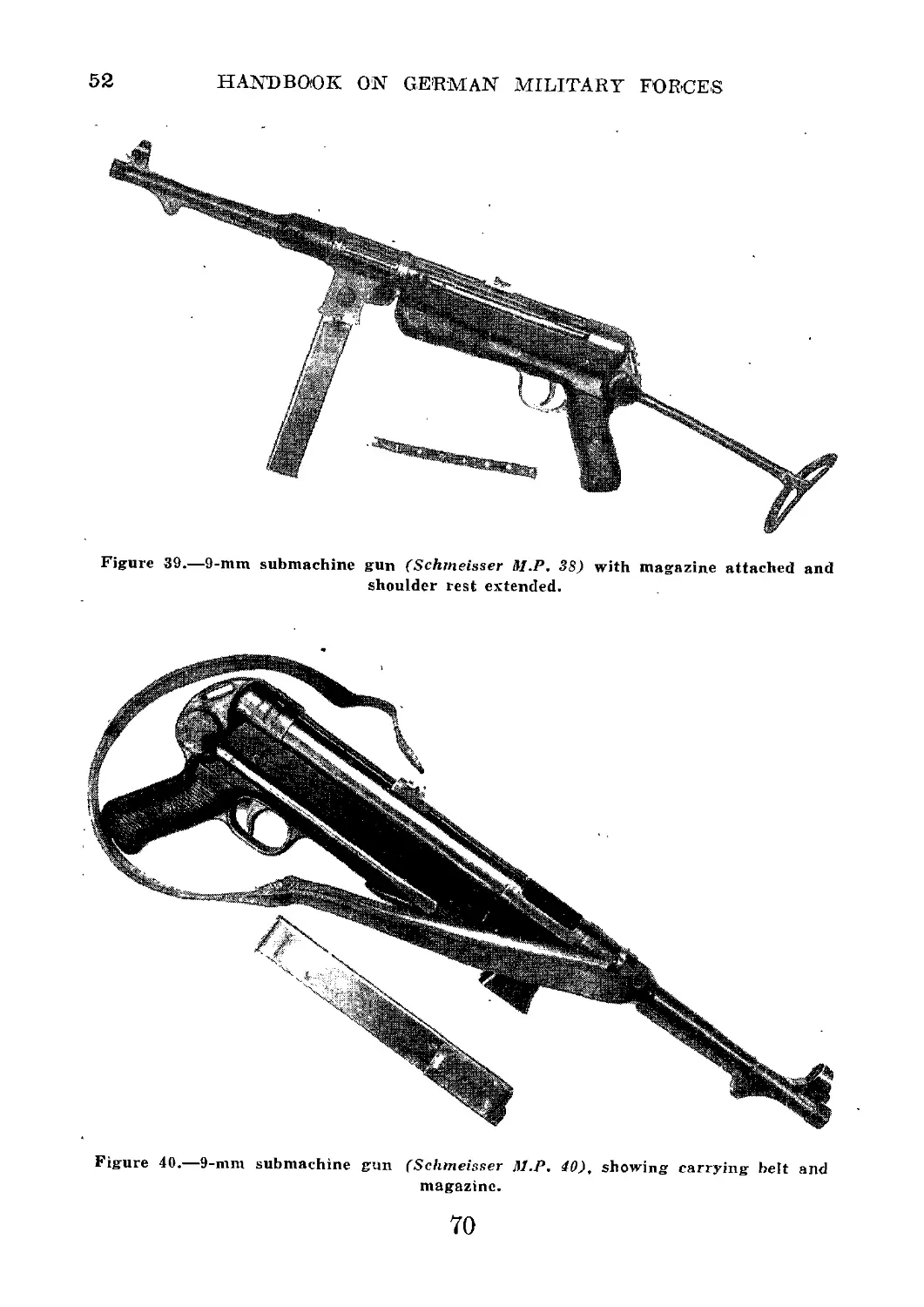
39.	9-mm submachine gun (Schmeisser M.P. 38) with magazine
attached and shoulder rest extended______________________________ 70
40.	9-mm submachine gun (Schmeisser M.P. 40), showing carrying
belt and magazine________________________________________________ 70
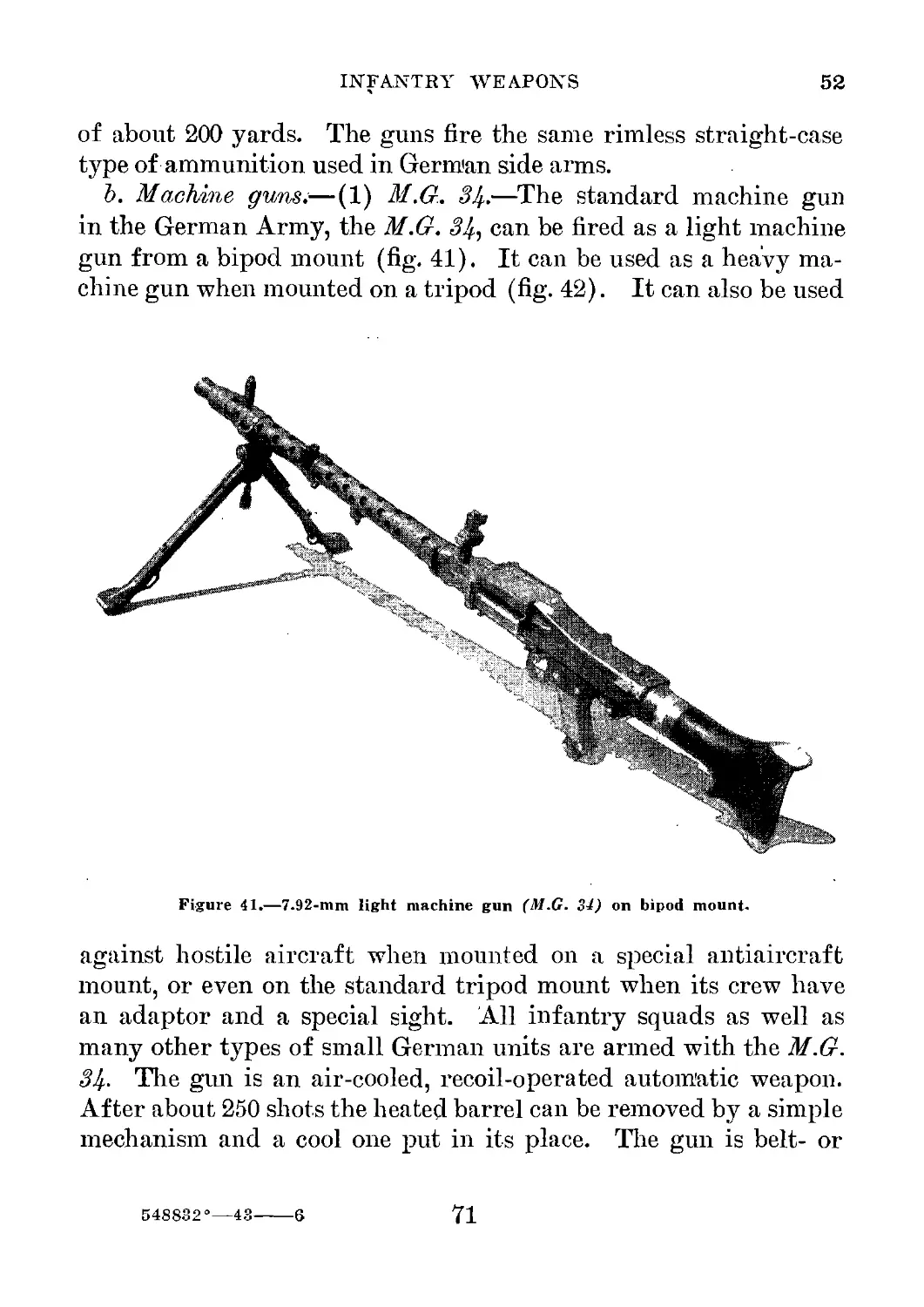
41.	7.92-mm light machine gun (M.G. 34) on bipod mount__________ 71
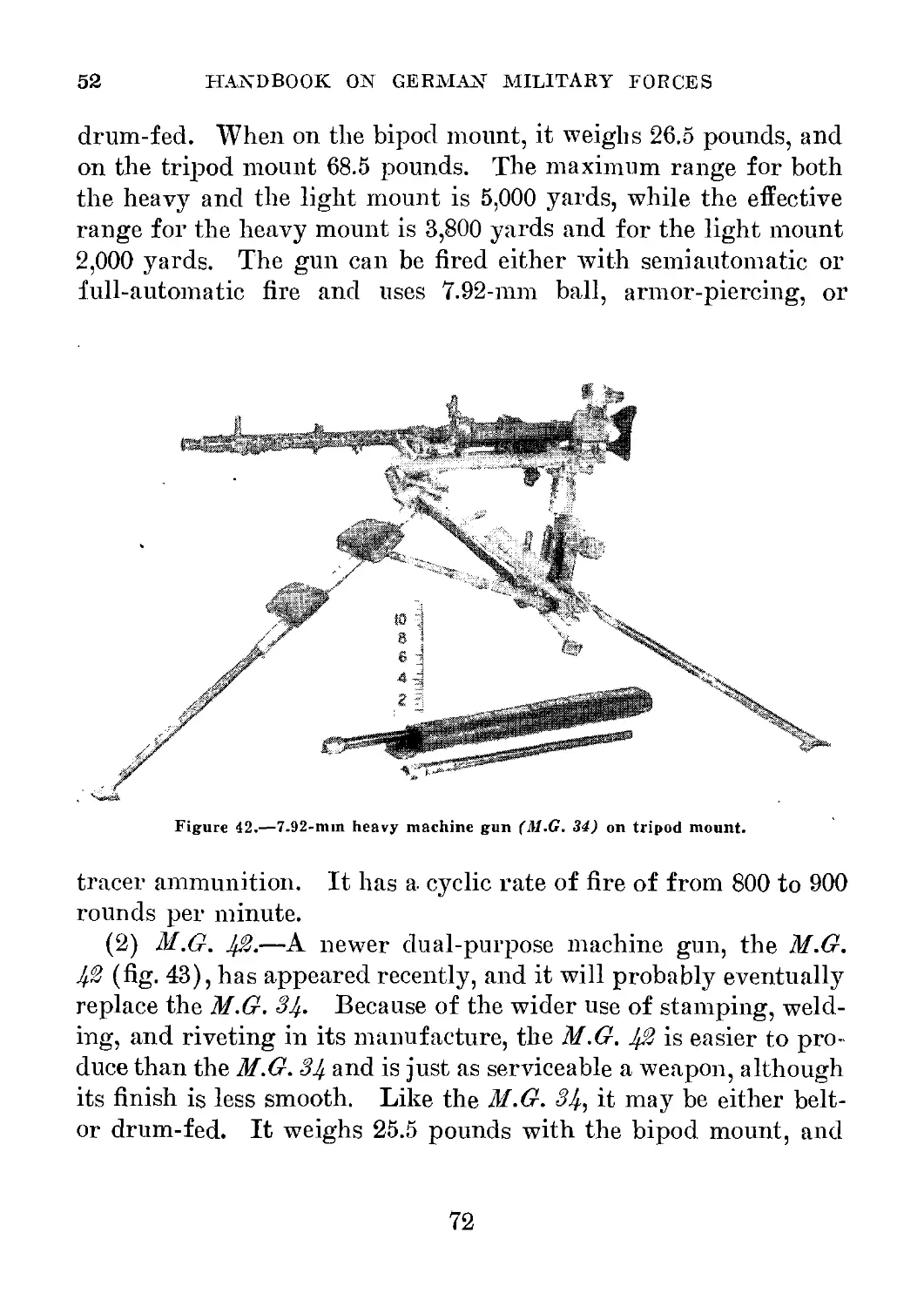
42.	7.92-mm heavy machine gun (M.G. 34) on tripod mount_________ 72
IV
LIST OF ILLUSTRATIONS
Figure	Page
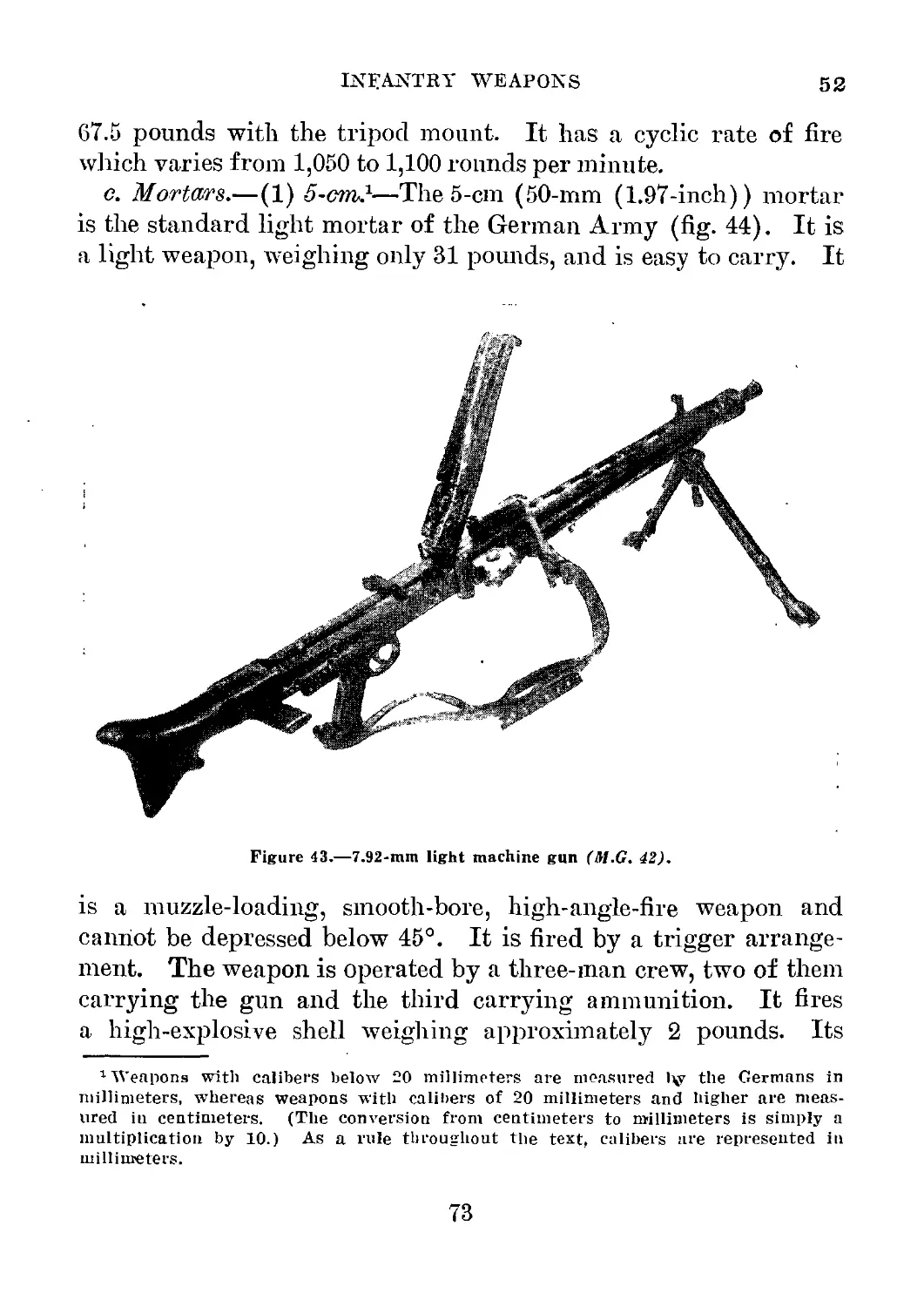
43.	7.92-mm light machine gun {M.G. 4%)_______________________________ 73
44.	50-mm mortar {l.Gr.W. 36) with crew_______________________________ 74
45.	80-mm mortar (s.G-r. W. 34) being loaded__________________________ 75
46.	7.92-mm antitank rifle {Pz.B. 38) with grenade	discharger_	76
47.	7.92-mm antitank rifle {Pz.B. 39) with stock	and	bipod extended. _	76
48.	37-mm antitank gun {Pak 37)_______________________________________ 77
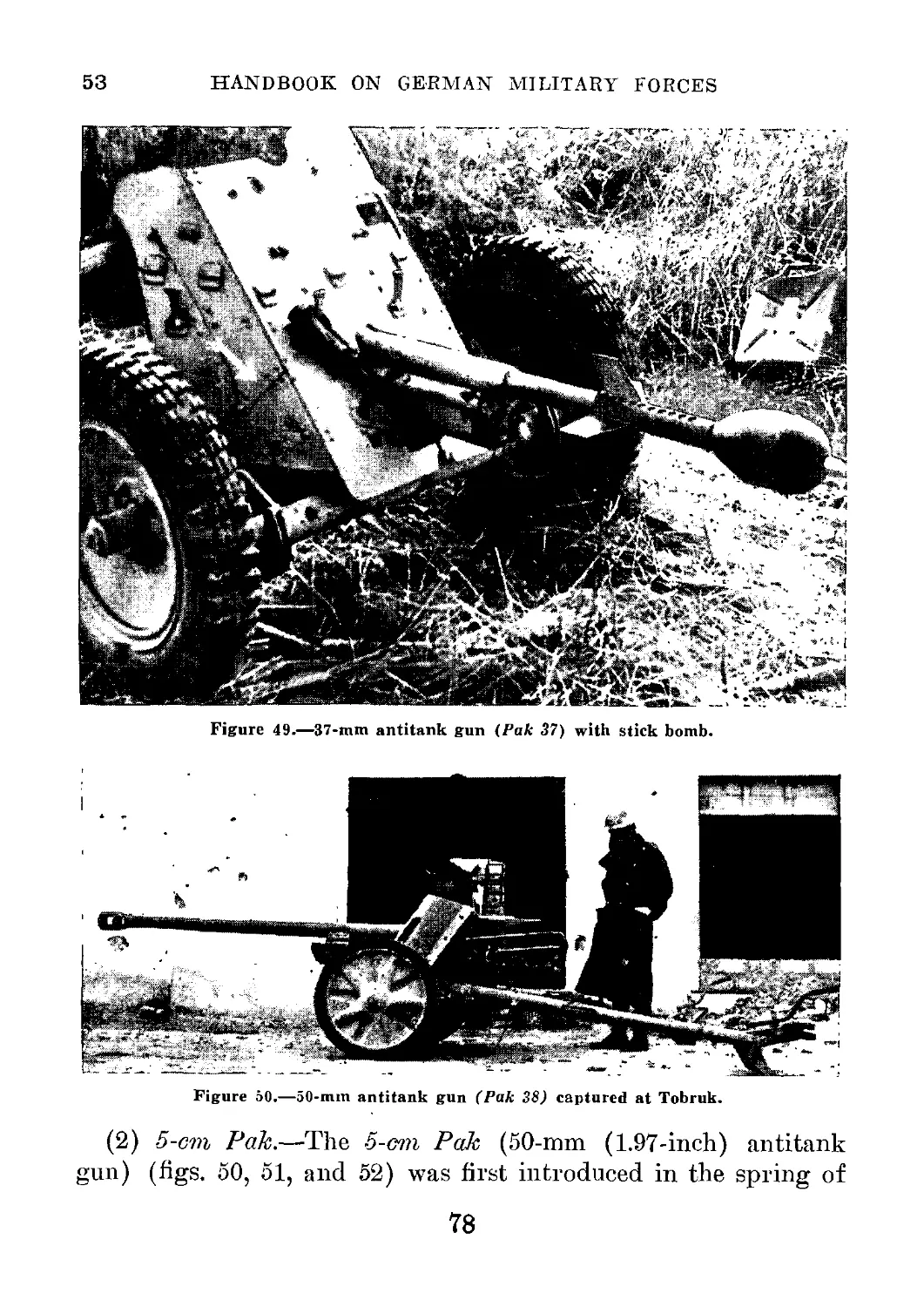
49.	37-mm antitank gun {Pak 37) with stick bomb_______________'____ 78
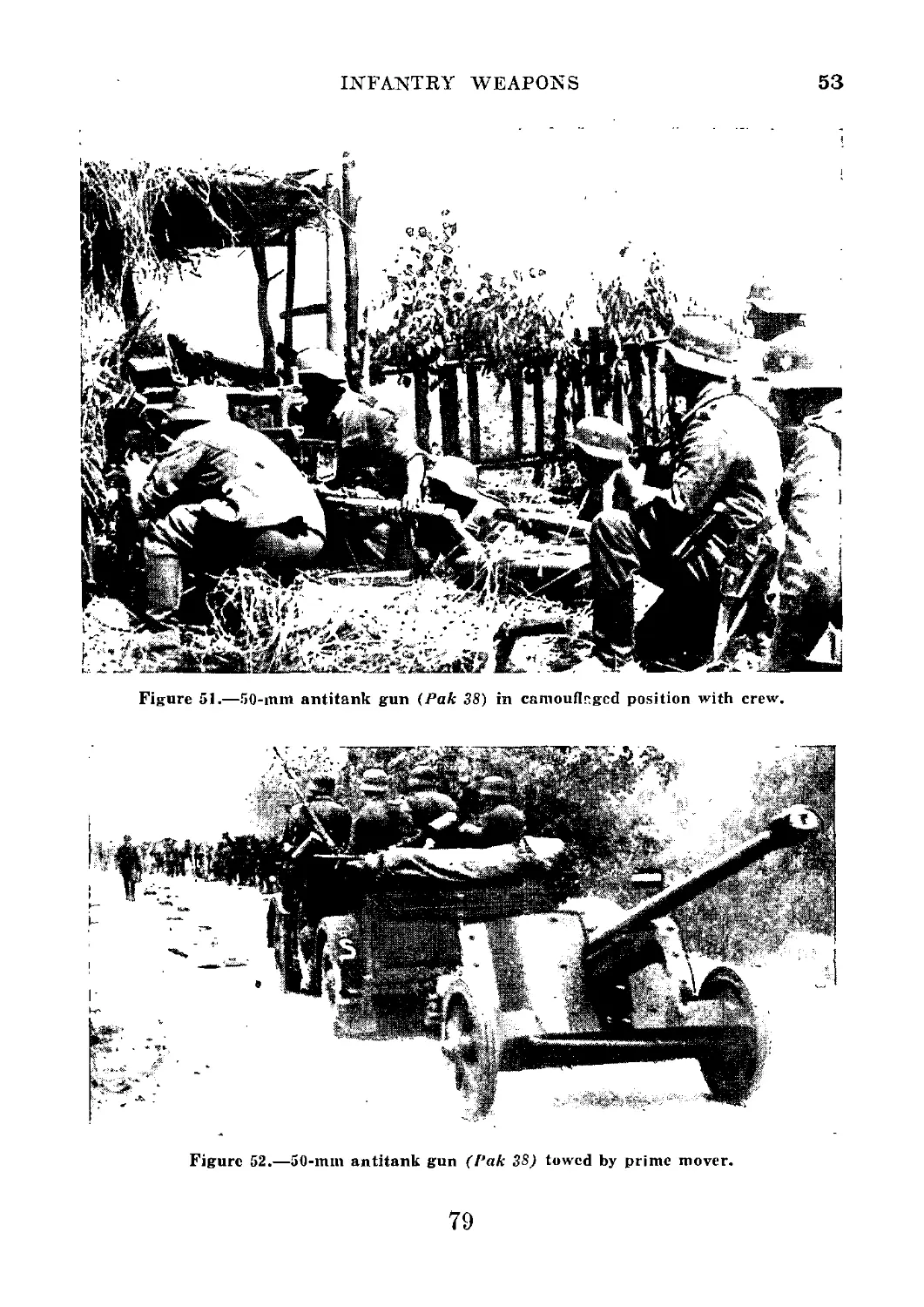
50.	50-mm	antitank gun {Pak 38) captured at Tobruk__________________ 78
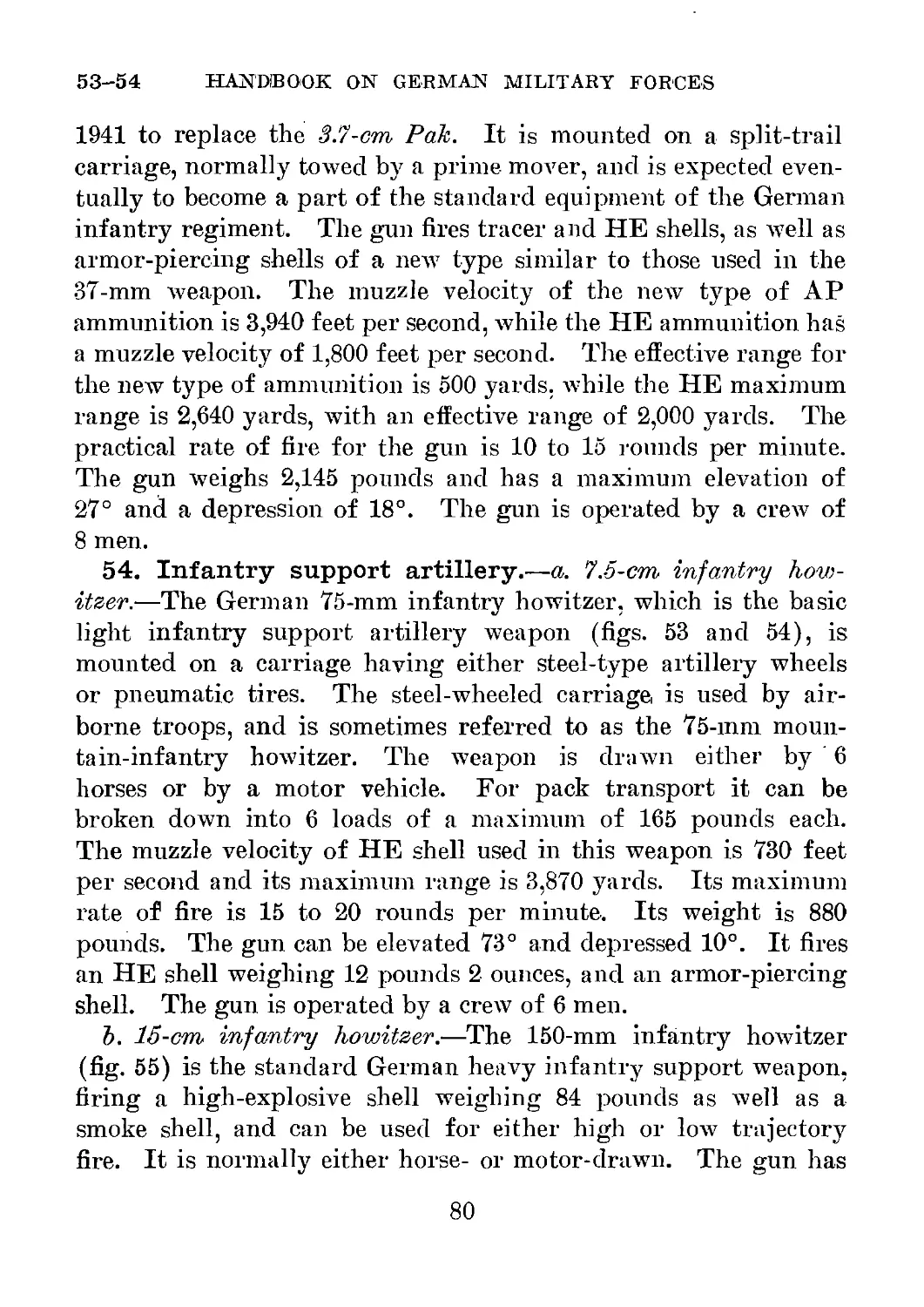
51.	50-mm	antitank gun {Pak 38) in camouflaged position with crew. _	79
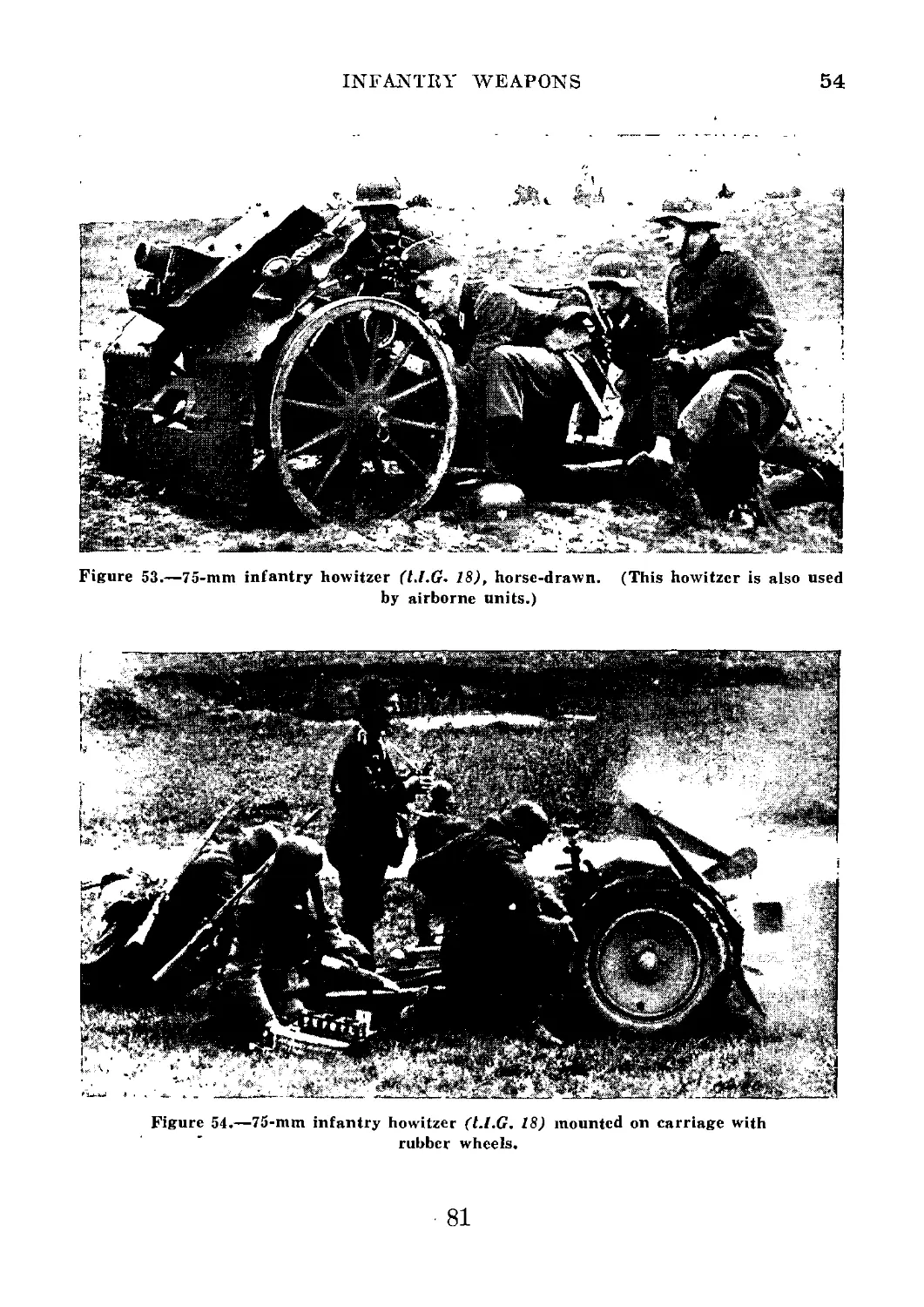
52.	50-mm	antitank gun {Pak 38) towed by prime mover________________ 79
53.	75-mm	infantry howitzer {I.I.G. 18), horse-drawn________________ 81
54.	75-mm infantry howitzer {l.I.G. 18), mounted on carriage with
rubber wheels________________________________________________________ 81
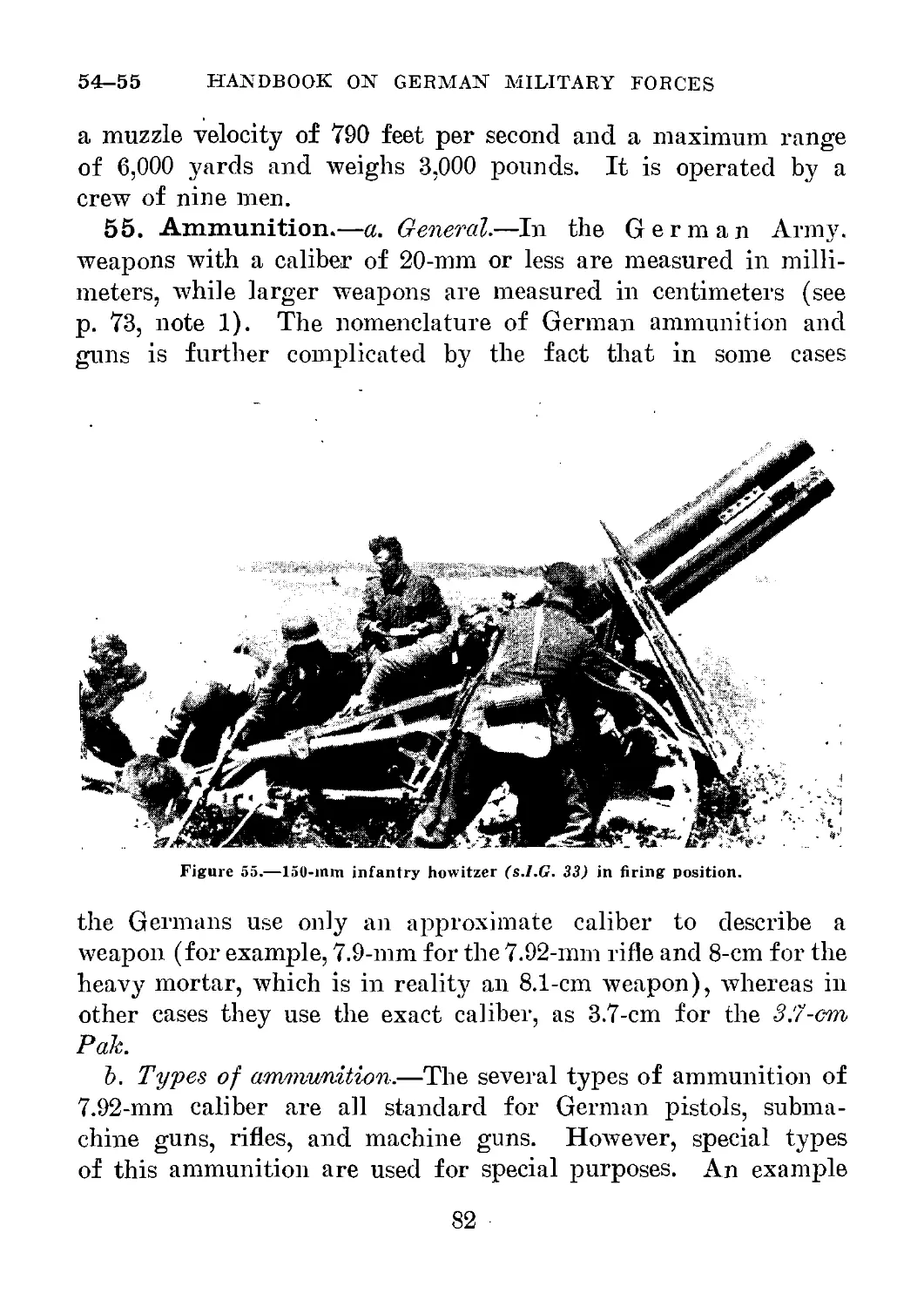
55.	150-mm infantry howitzer {s.I.G. S3) in firing	position____________ 82
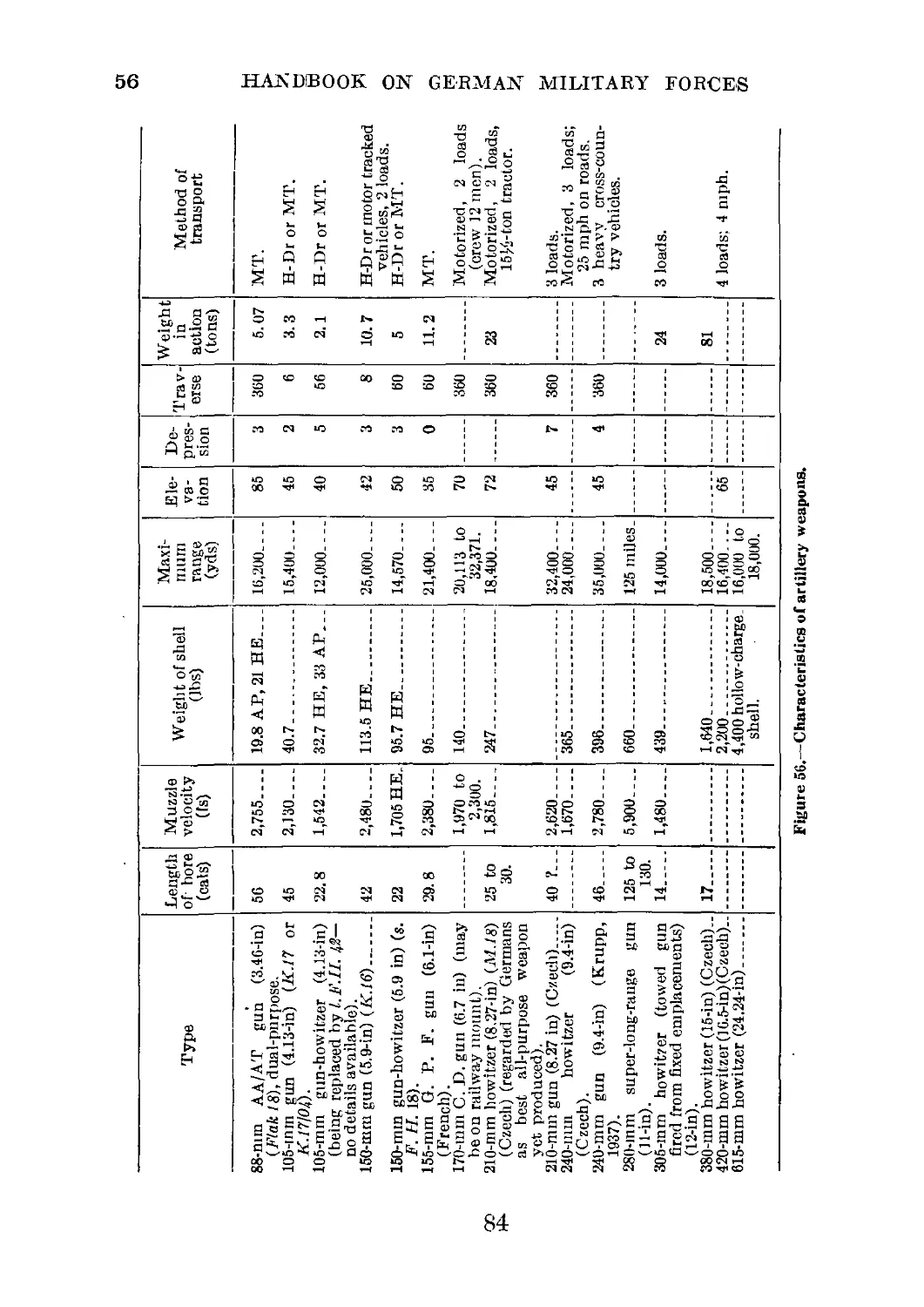
56.	Characteristics of artillery weapons_______________________________ 84
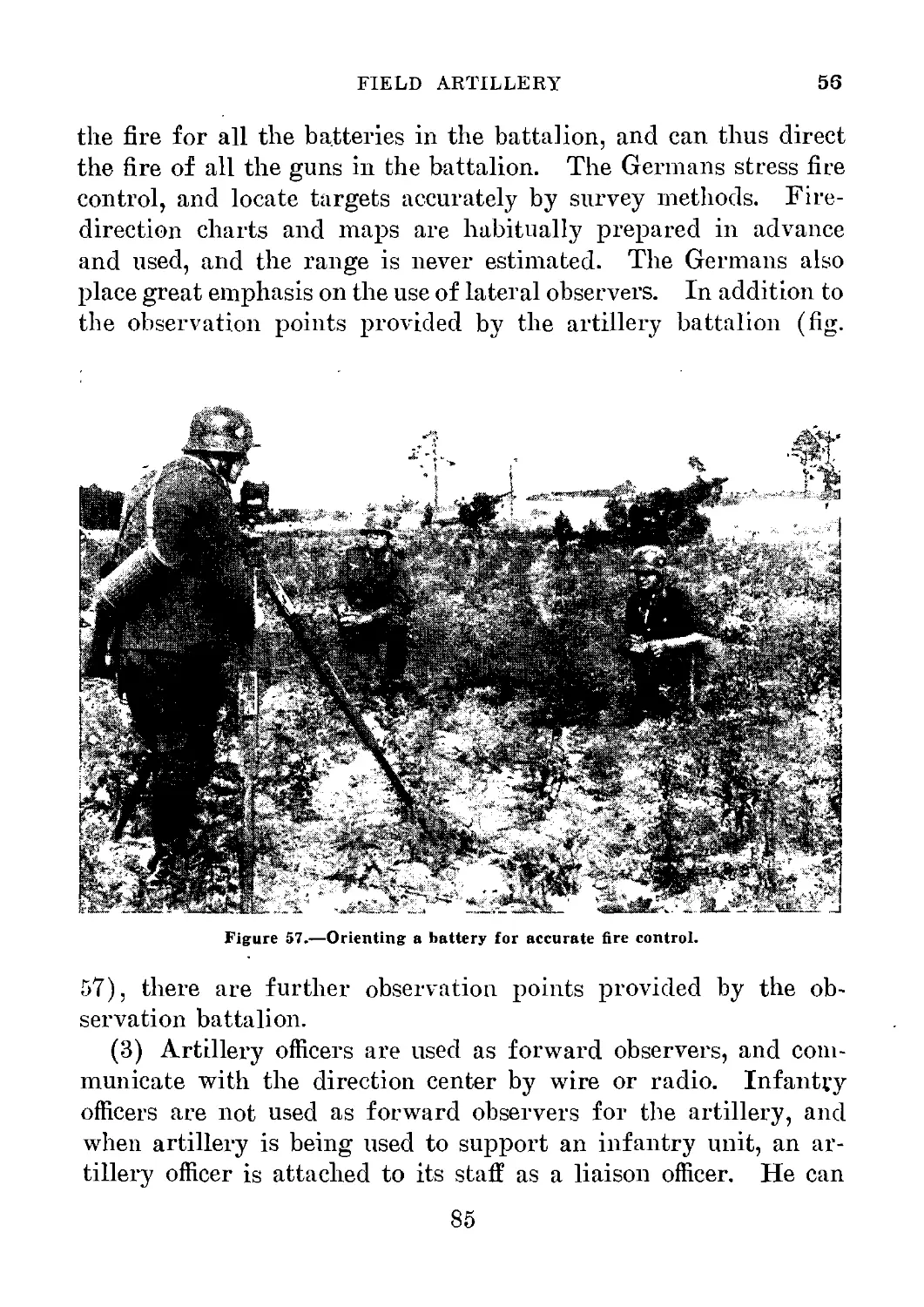
57.	Orienting a battery for accurate fire control______________________ 85
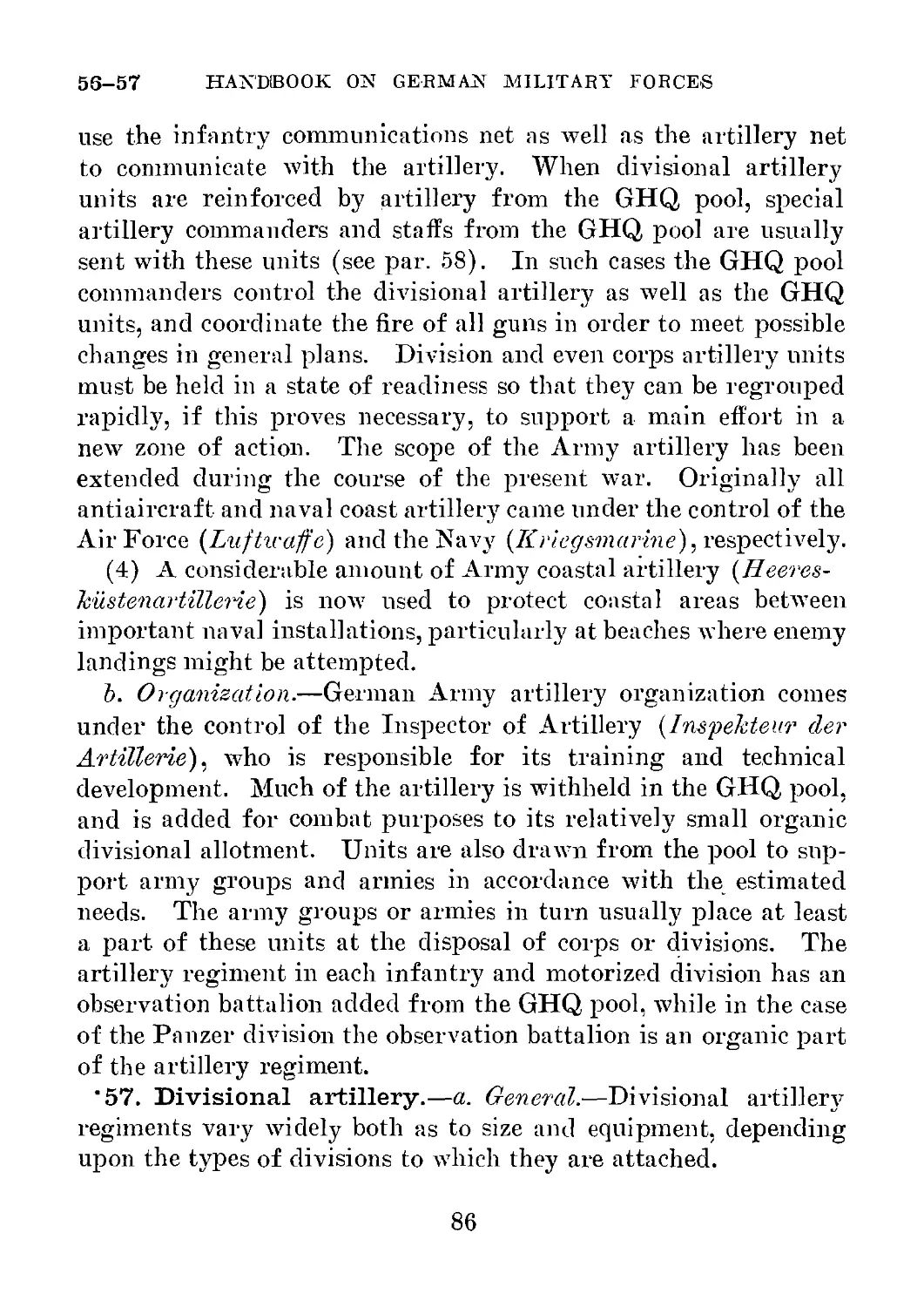
58.	105-mm gun-howitzer {]>.F.H. 18)___________________________________ 87
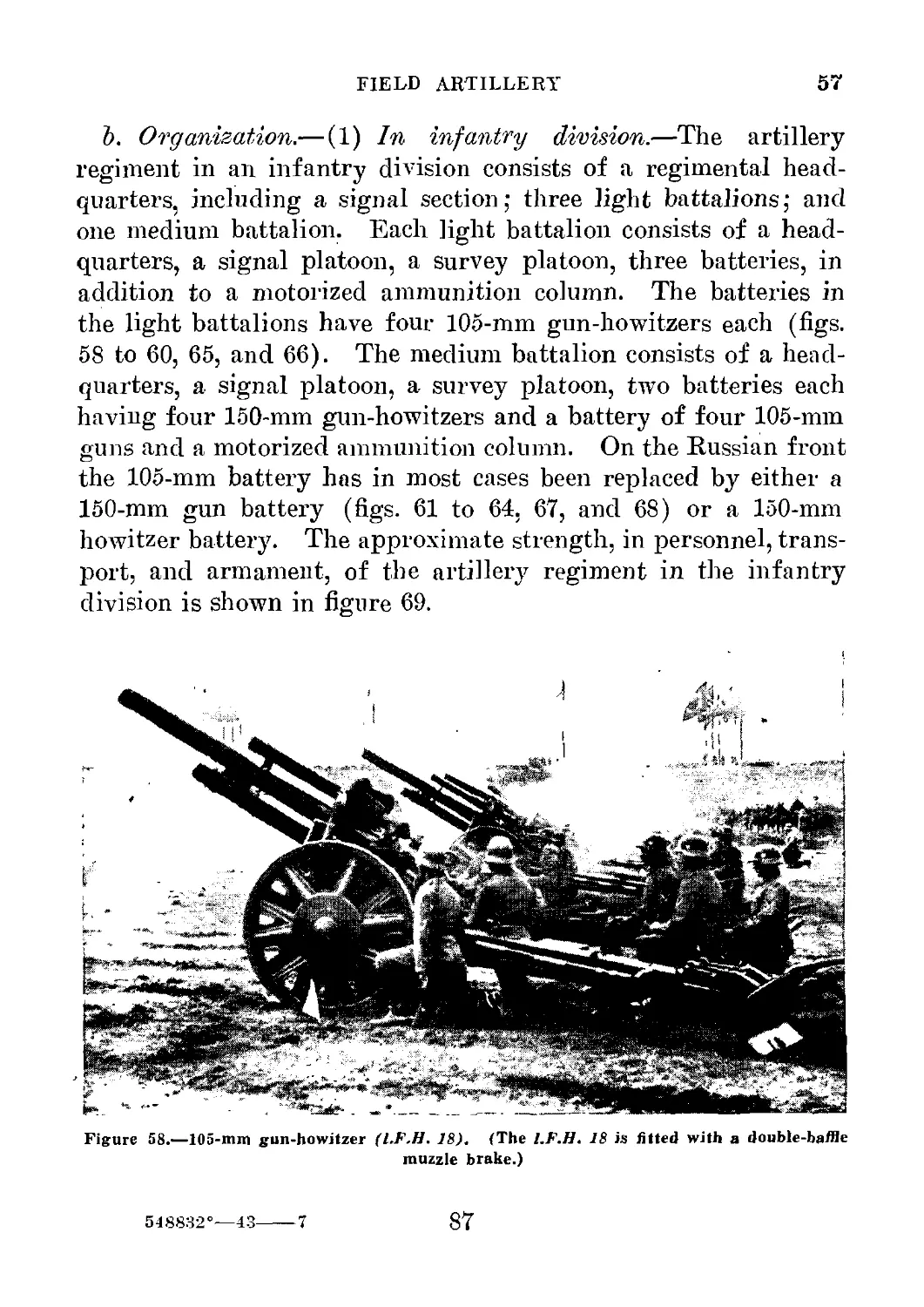
59.	105-mm gun-howitzer and crew in action_____________________________ 88
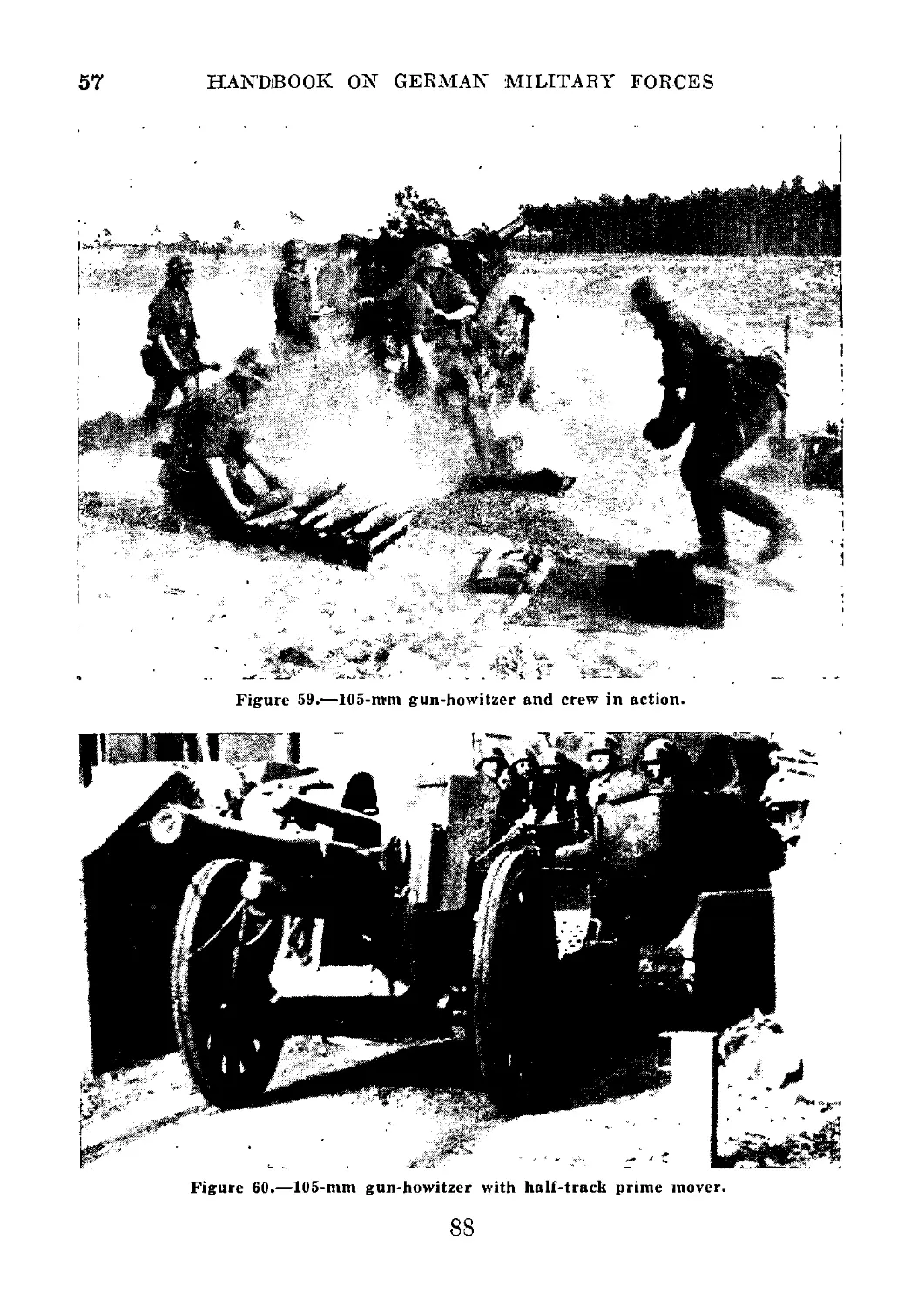
60.	105-mm gun-howitzer with half-track prime mover____________________ 88
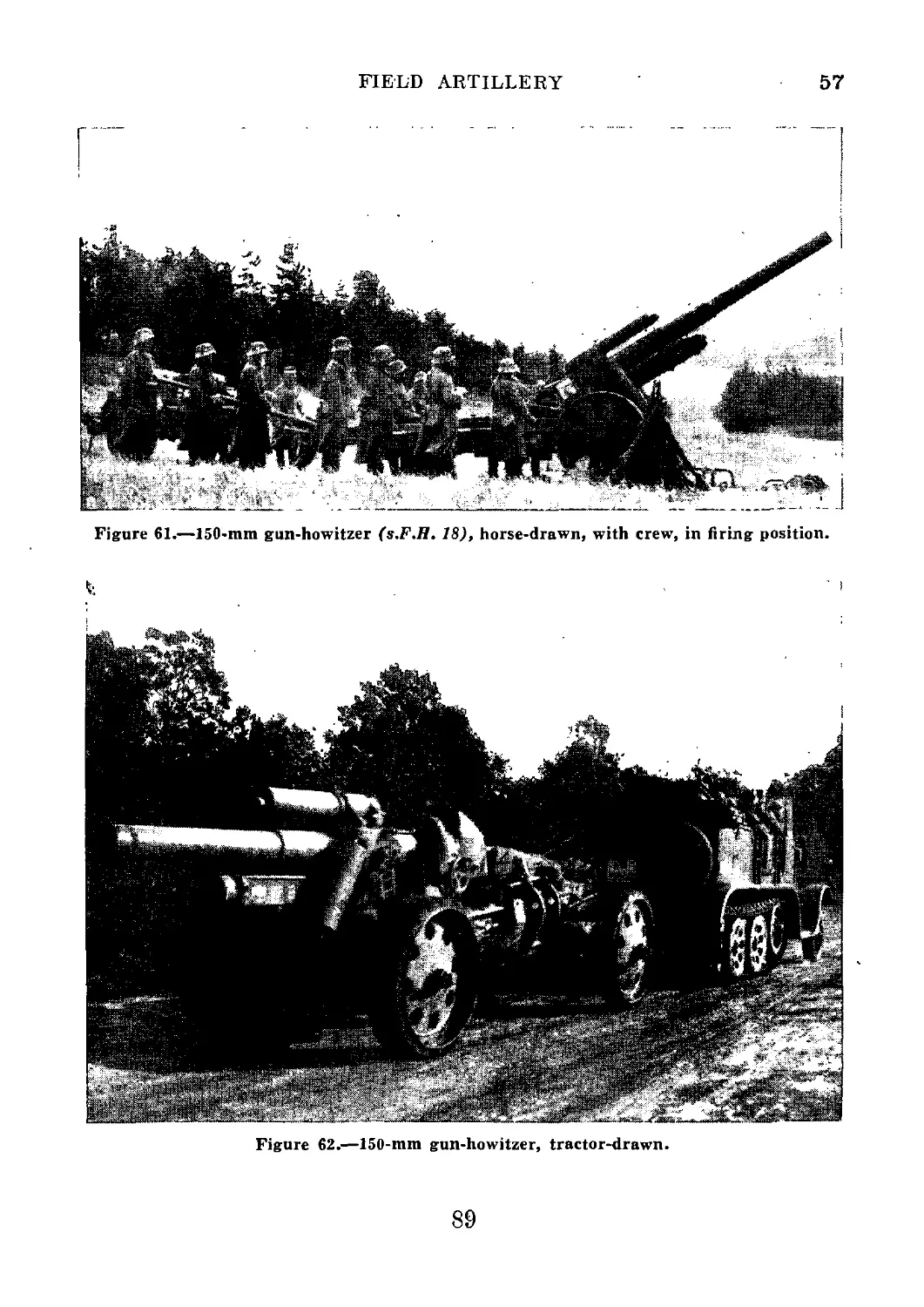
61.	150-mm gun-howitzer {s.F.H. 18), horse-drawn, with crew, in
firing position______________________________________________________ 89
62.	150-mm gun-howitzer, tractor-drawn________________________________ 89
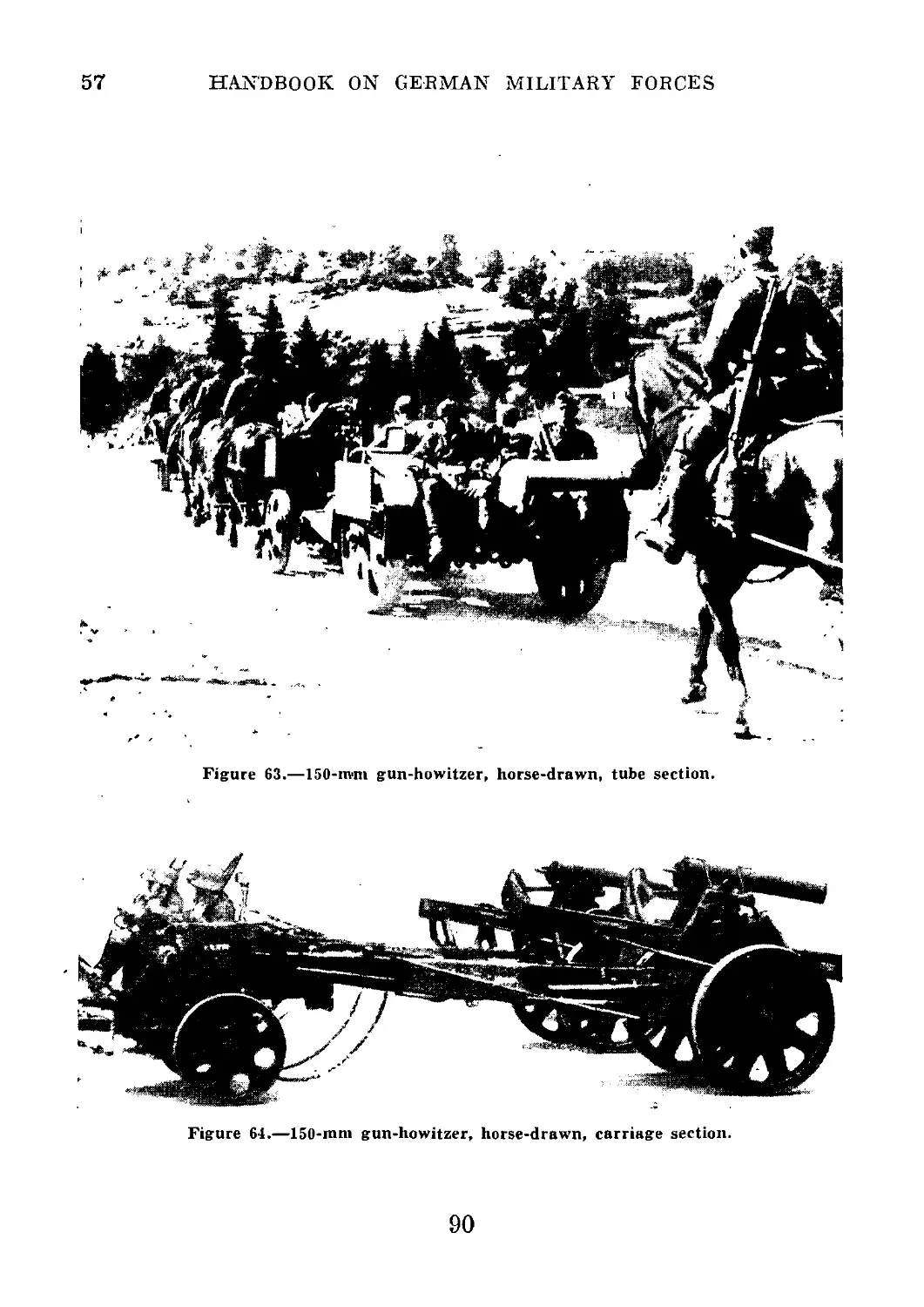
63.	150-mm gun-howitzer, horse-drawn,	tube section____________________ 90
64.	150-mm gun-howitzer, horse-drawn,	carriage	section______________ 90
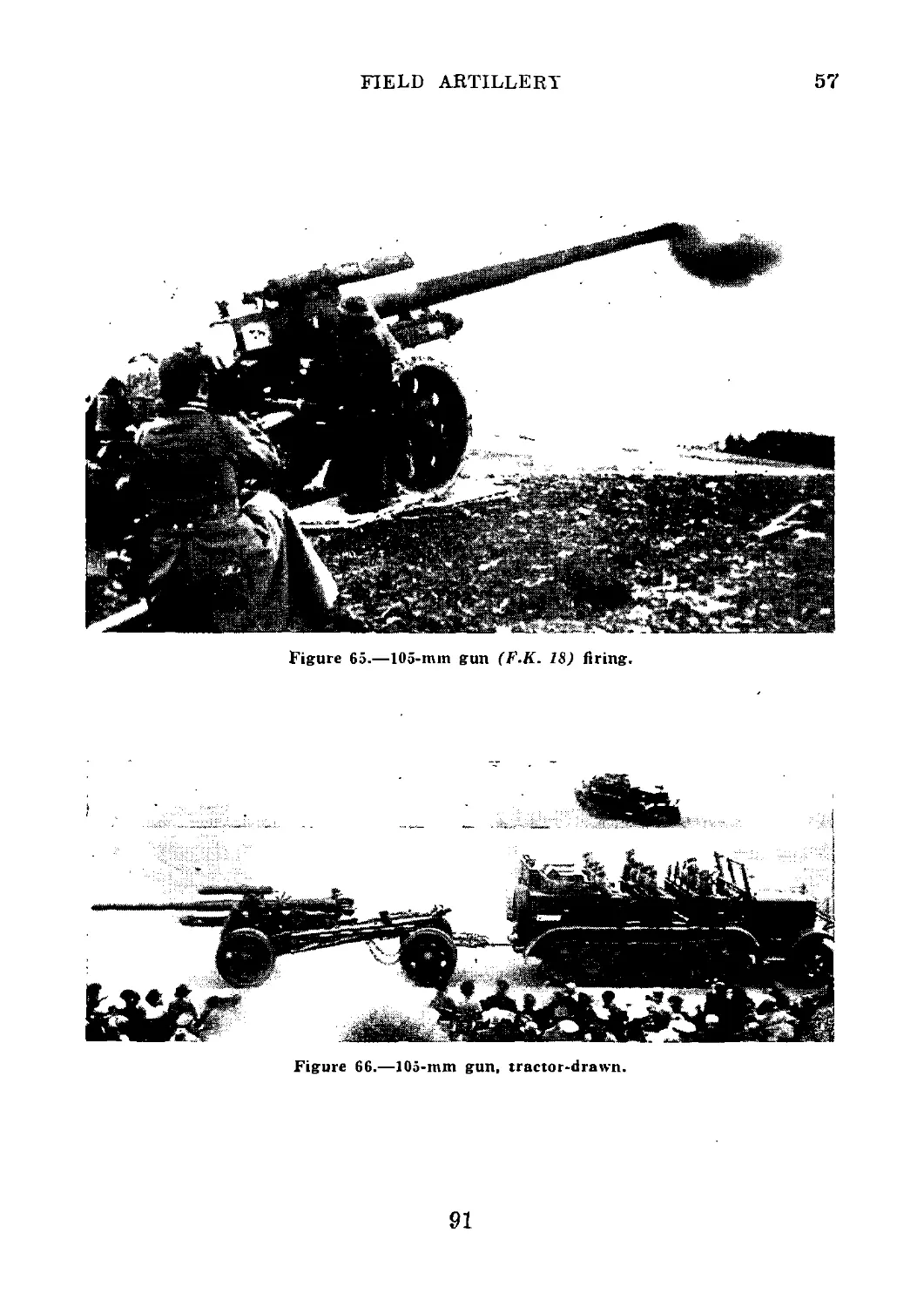
65.	105-mm gun {F.K. 18) firing____________________________________ 91
66.	105-mm gun, tractor-drawn_________________________________________ 91
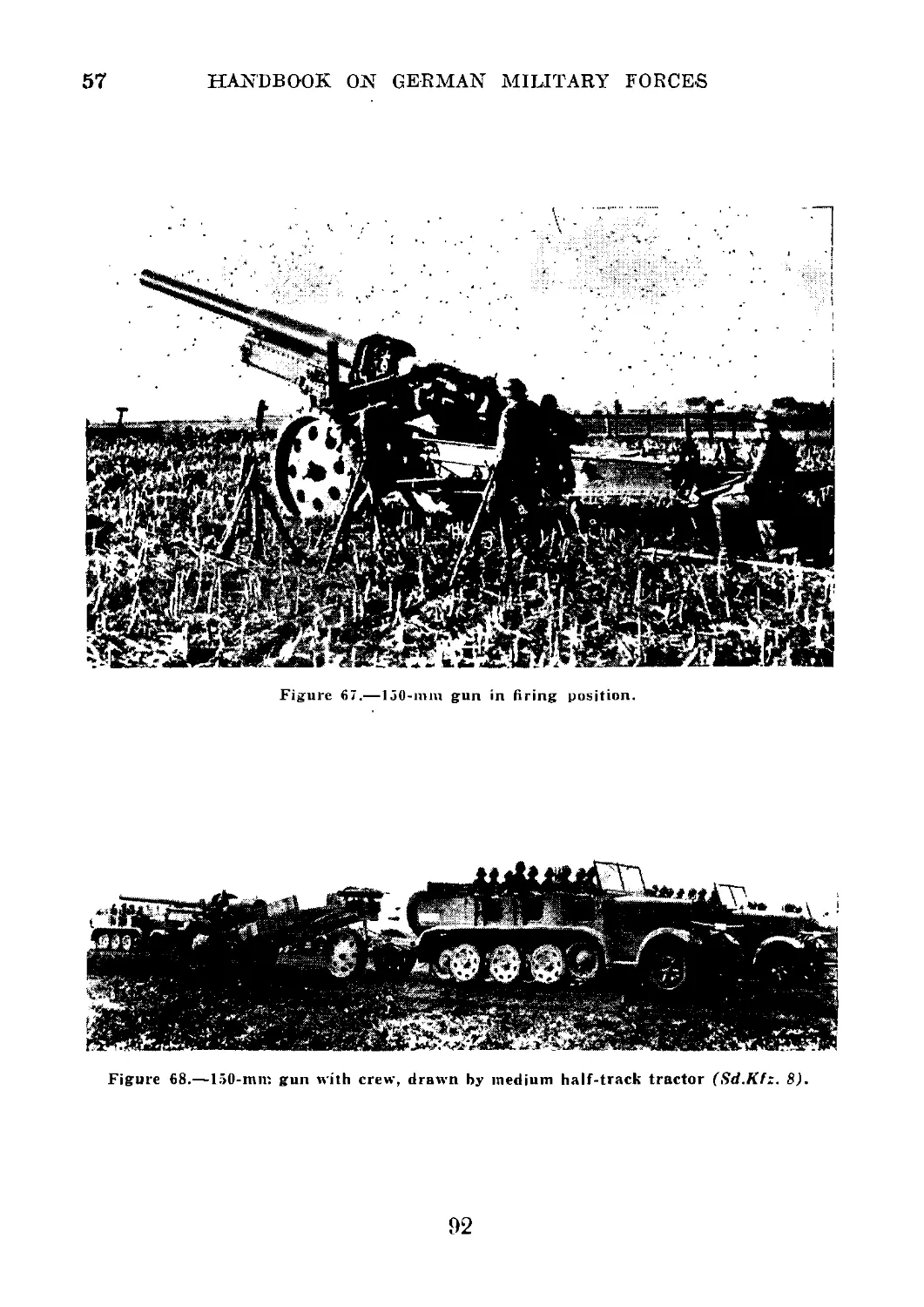
67.	150-mm gun in firing position_____________________________________ 92
68.	150-mm gun with crew, drawn by medium half-track tractor
{Sd. Kfz. 8)_______________________________________________________ 92
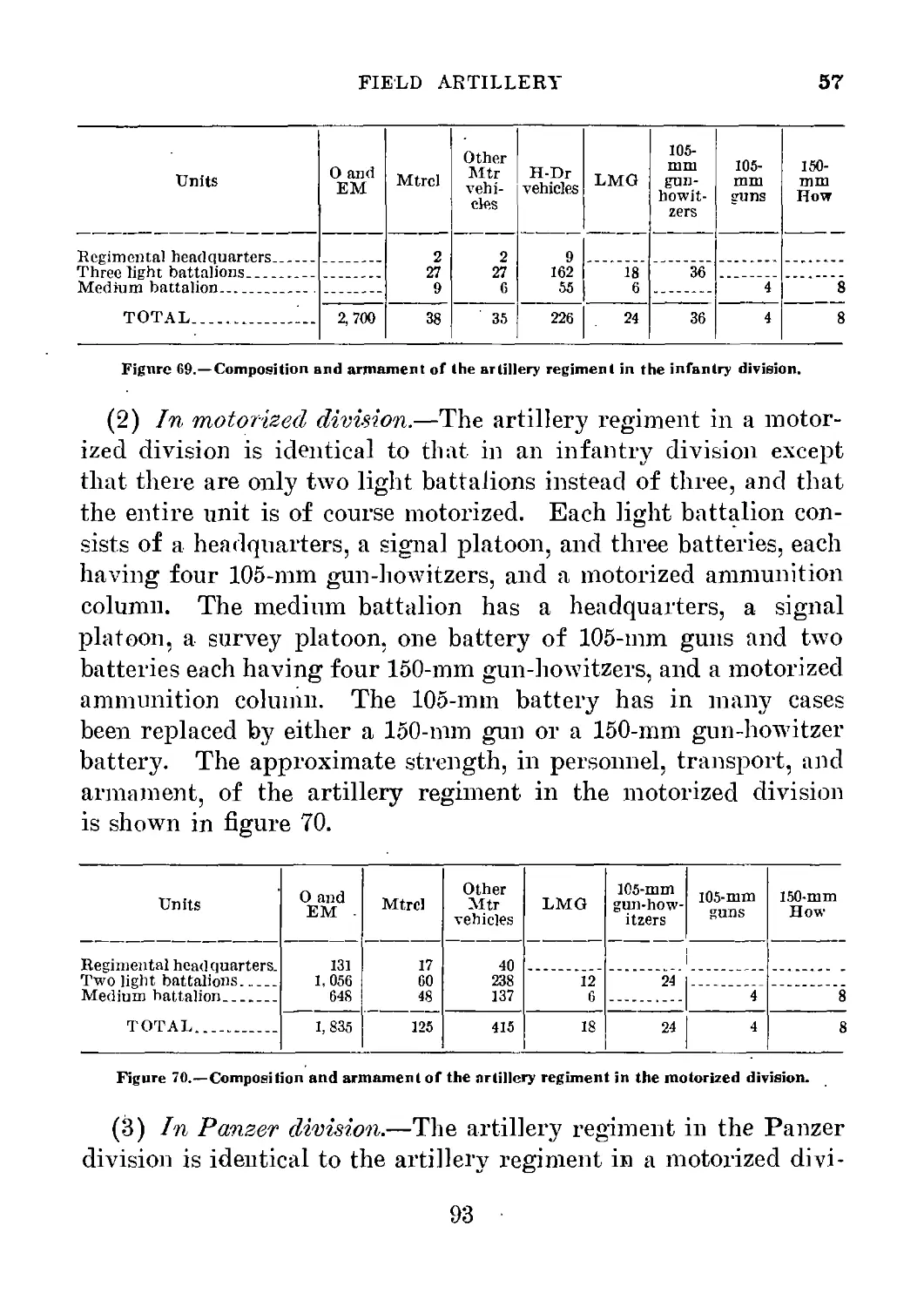
69.	Composition and armament of the artillery regiment in the in-
fantry division____________________________________________________ 93
70.	Composition and armament of the artillery regiment in the mo-
torized division___________________________________________________ 93
71.	Composition and armament of the artillery regiment in the Panzer
division___________________________________________________________ 94
72.	75-mm mountain howitzer with shield_______________________________ 94
73.	75-mm mountain howitzer without shield____________________________ 95
74.	Composition and armament of the mountain artillery regiment.- 96
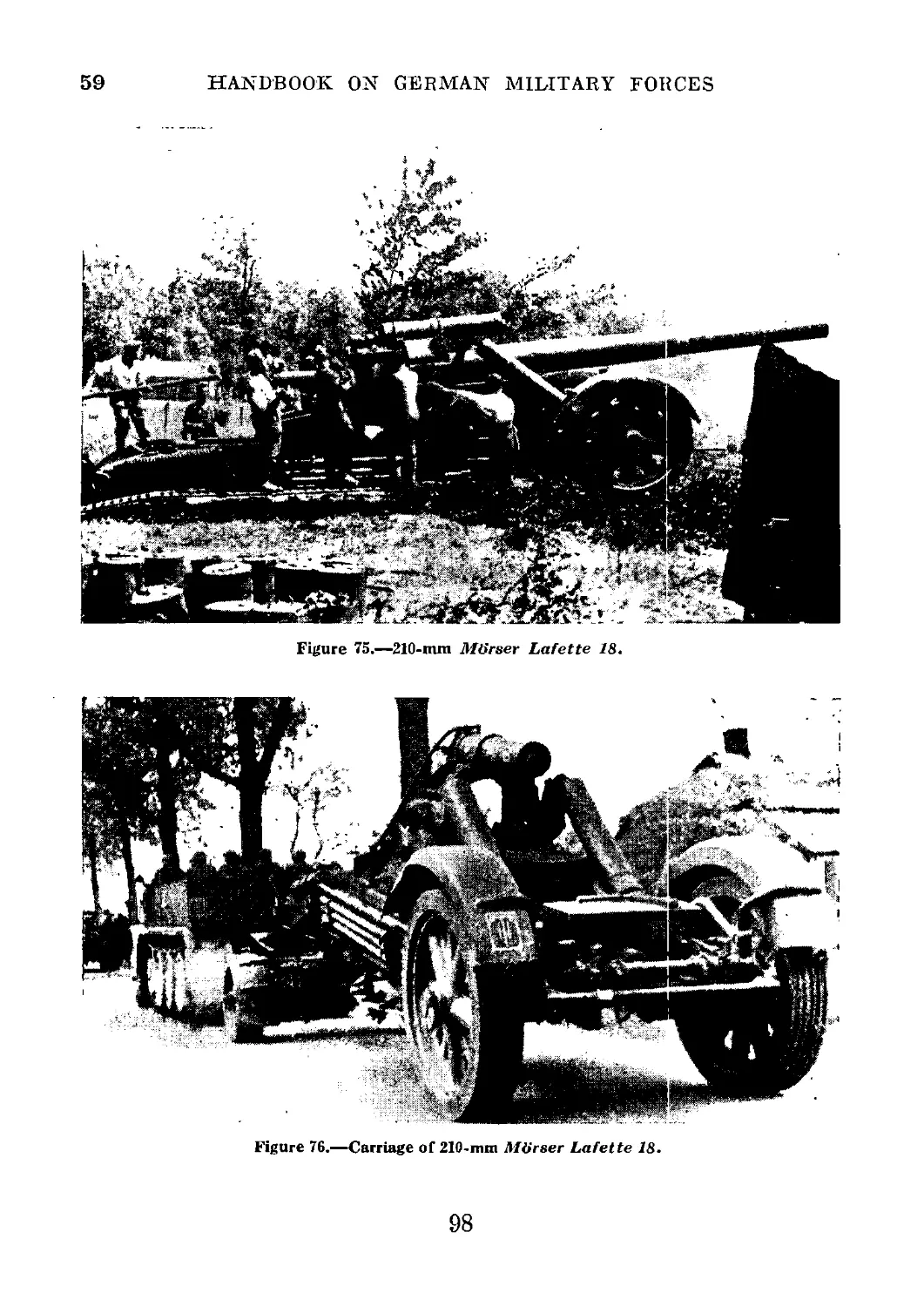
75.	210-mm Mdrser Lafette 18__________________________________________ 98
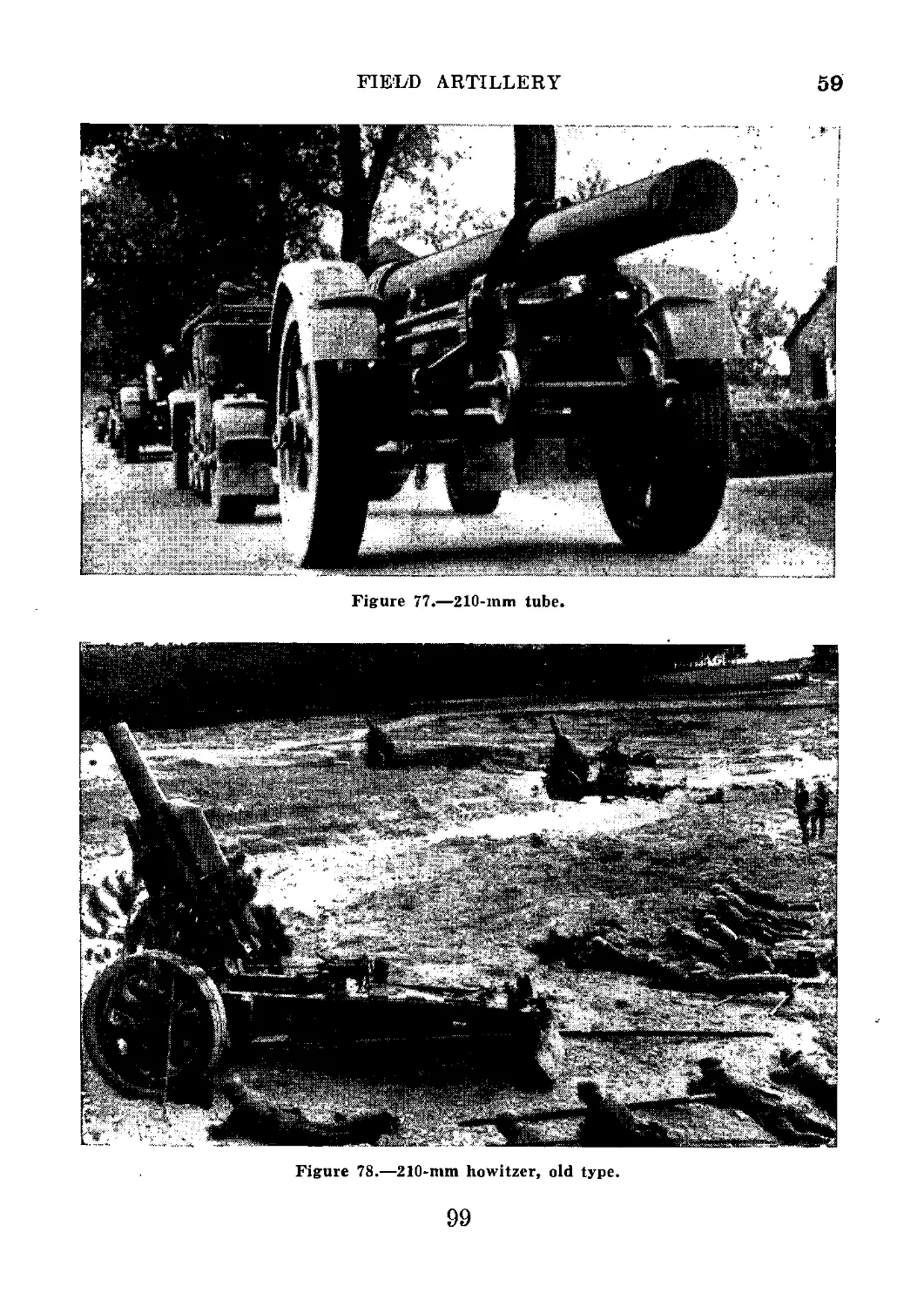
76.	Carriage of 210-mm Mdrser Lajelte 18------------------------------ 98
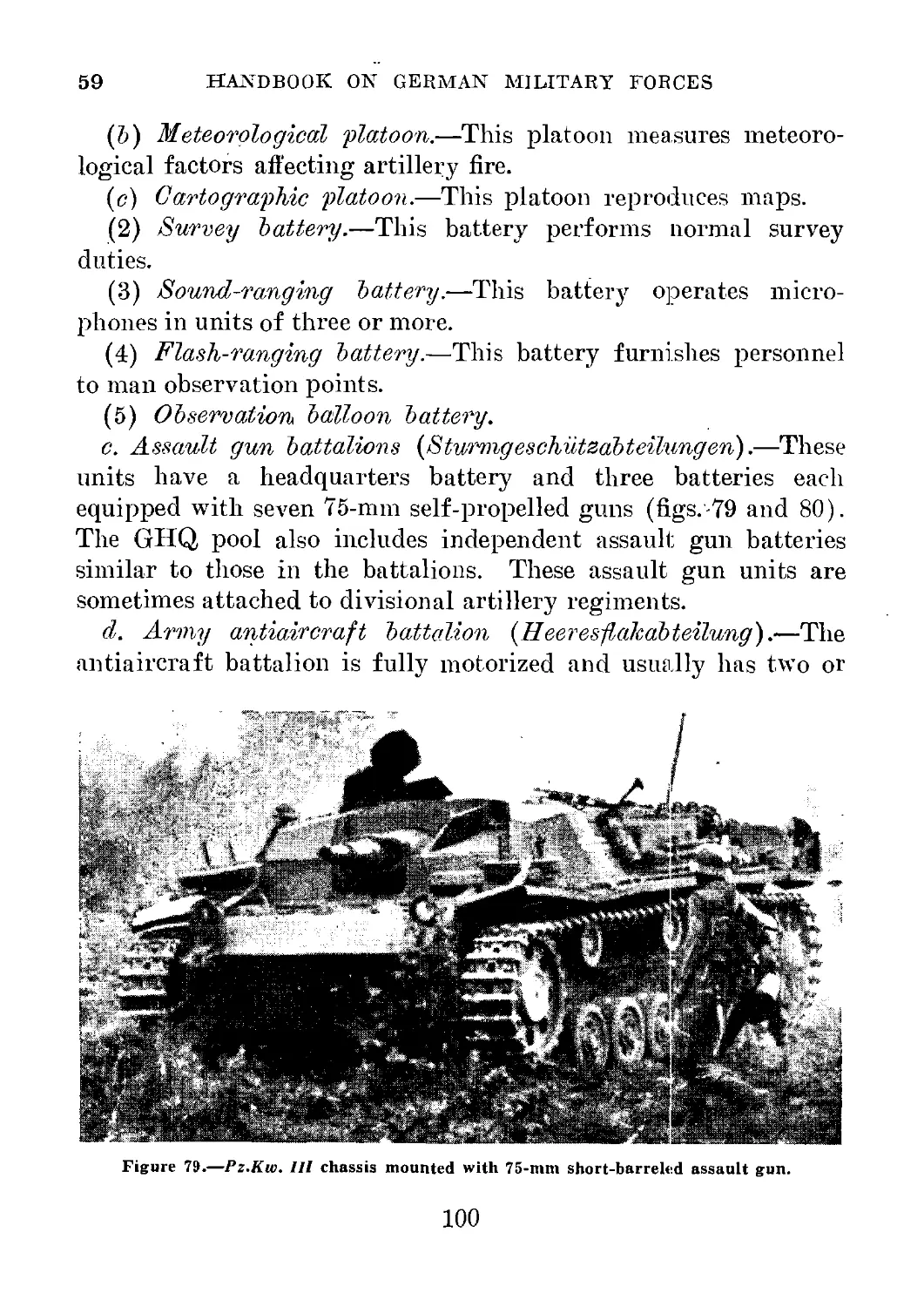
77.	210-mm tube_______________________________________________________ 99
v
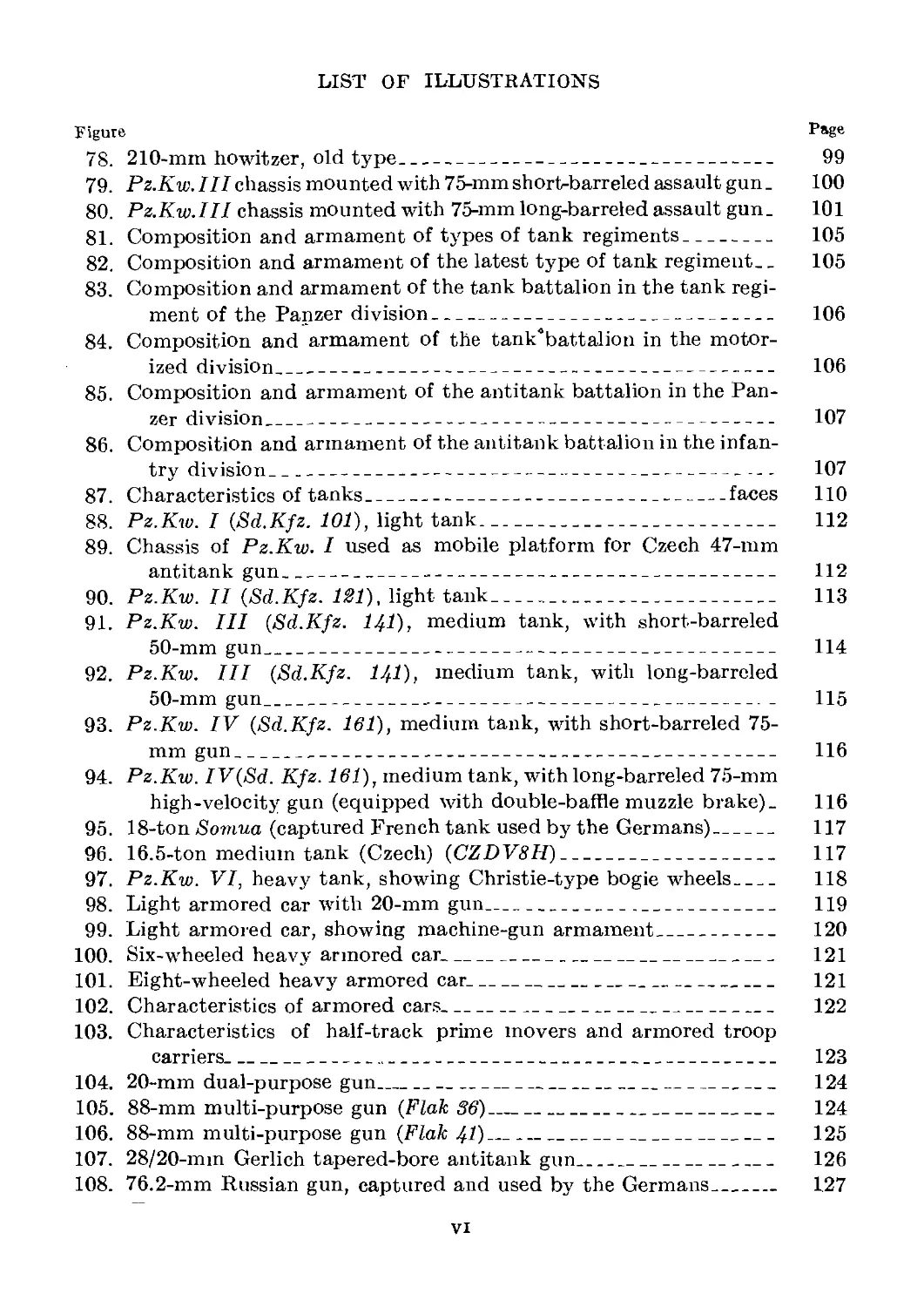
LIST OF ILLUSTRATIONS
Figure	Page
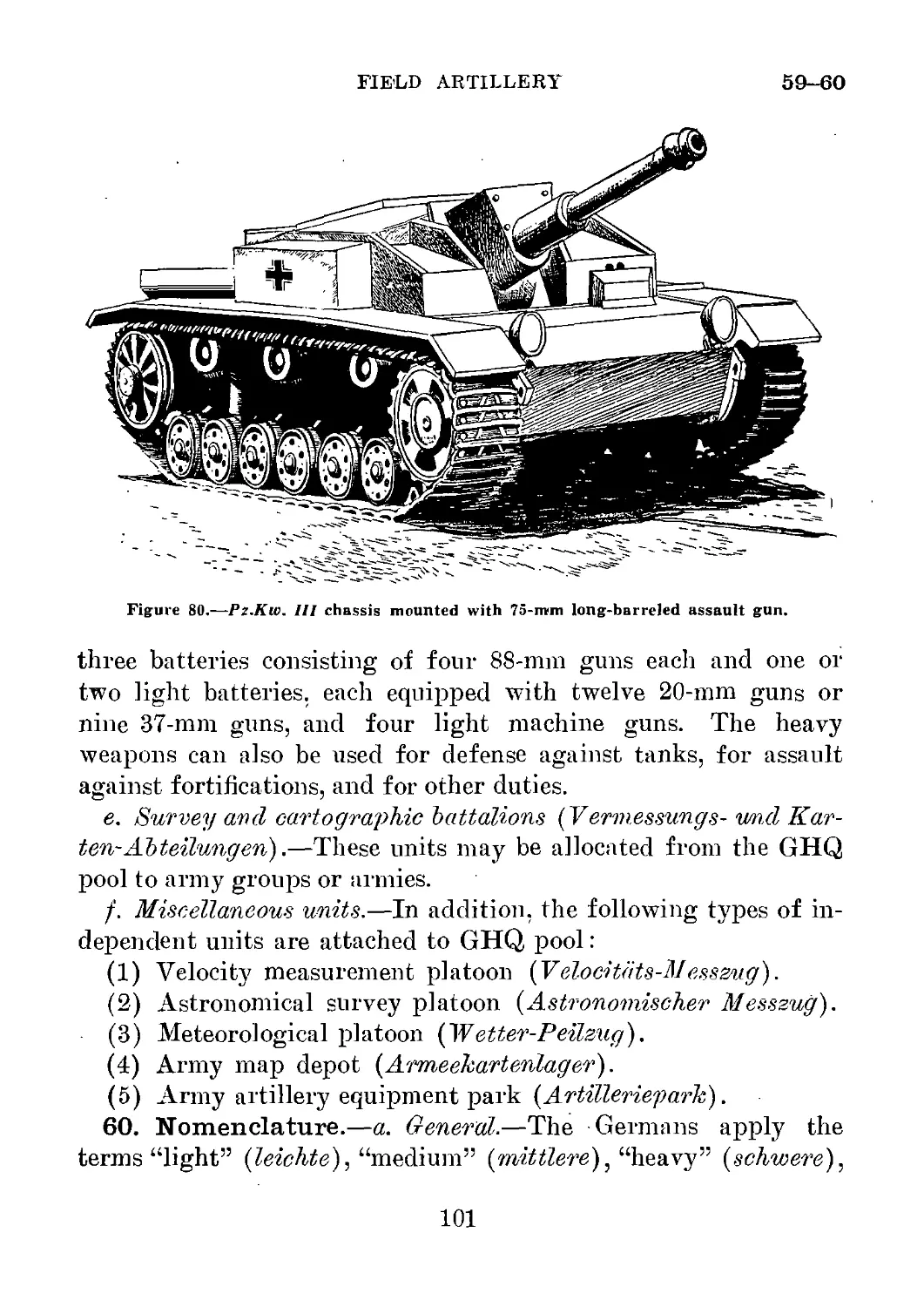
78.	210-mm howitzer, old type____________________________________ 99
79.	Pz.Kw.IIIchassis mounted with 75-mmshort-barreled assault gun. 100
80.	Pz.Kw.III chassis mounted with 75-mm long-barreled assault gun. 101
81.	Composition and armament of types of tank regiments__________ 105
82.	Composition and armament of the latest type of tank regiment. _	105
83.	Composition and armament of the tank battalion in the tank regi-
ment of the Panzer division--------------------------------------- 106
84.	Composition and armament of the tank”battalion in the motor-
ized division_____________________________________________________ 106
85.	Composition and armament of the antitank battalion in the Pan-
zer division_________________________________________________________ 107
86.	Composition and armament of the antitank battalion in the infan-
try division_________________________________________________________ 107
87.	Characteristics of tanks________________________________faces 110
88.	Pz.Kw. I (Sd.Kfz.	101),	light	tank_____________________________ 112
89.	Chassis of Pz.Kw. I used as mobile platform for Czech 47-mm
antitank gun_________________________________________________________ 112
90.	Pz.Kw. II (Sd.Kfz.	121),	light	tank____________________________ 113
91.	Pz.Kw. Ill (Sd.Kfz. Ц1), medium tank, with short-barreled
50-mm gun____________________________________________________________ 114
92.	Pz.Kw. Ill (Sd.Kfz. 1//.1), medium tank, with long-barreled
50-mm gun_________________________________________________________.	115
93.	Pz.Kw. IV (Sd.Kfz. 161), medium tank, with short-barreled 75-
mm gun____________________________________________________________ 116
94.	Pz.Kw. IV(Sd. Kfz. 161), medium tank, with long-barreled 75-mm
high-velocity gun (equipped with double-baffle muzzle brake). 116
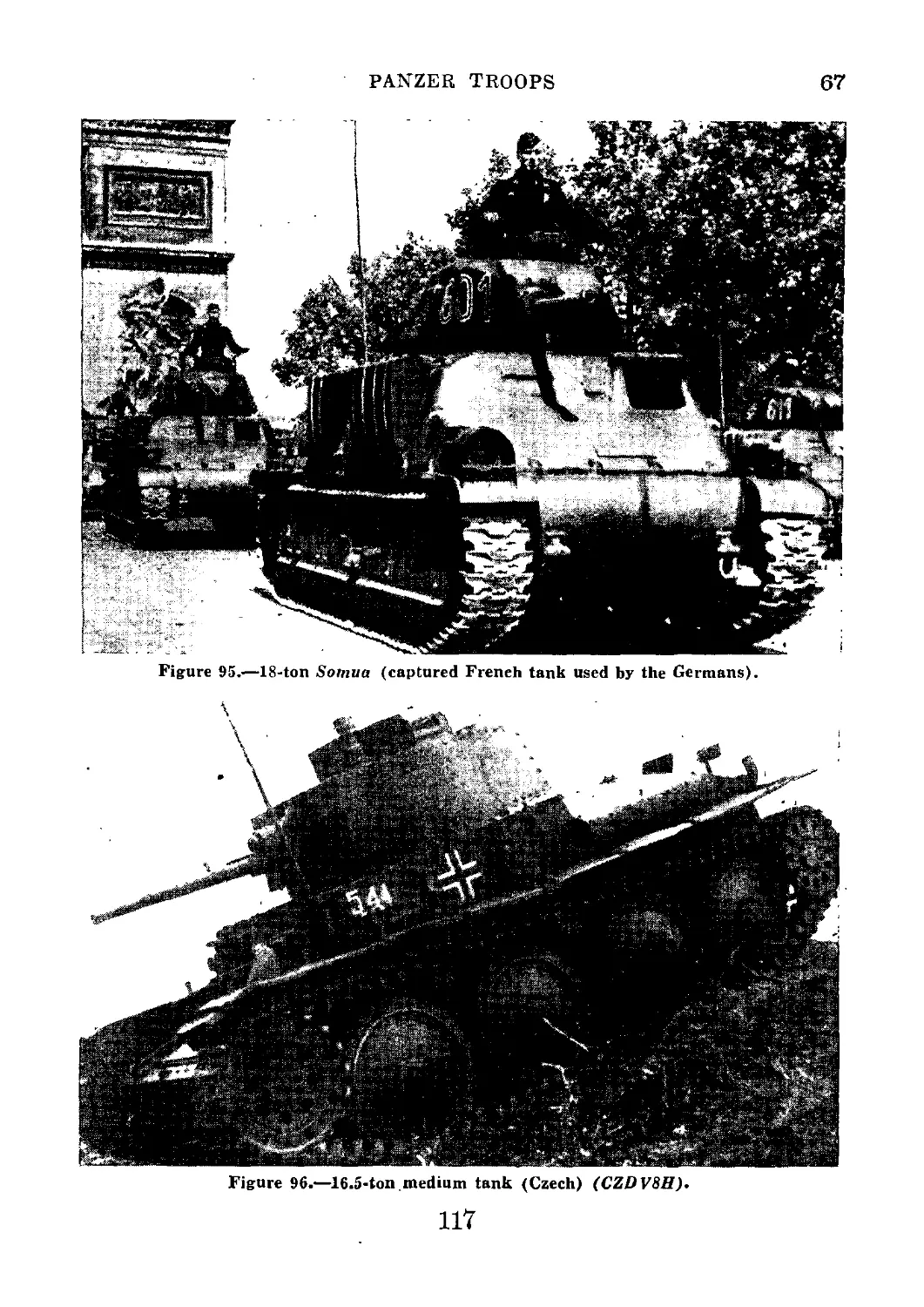
95.	18-ton Somua (captured French tank used by the Germans)______	117
96.	16.5-ton medium tank (Czech) (CZDV8H)________________________ 117
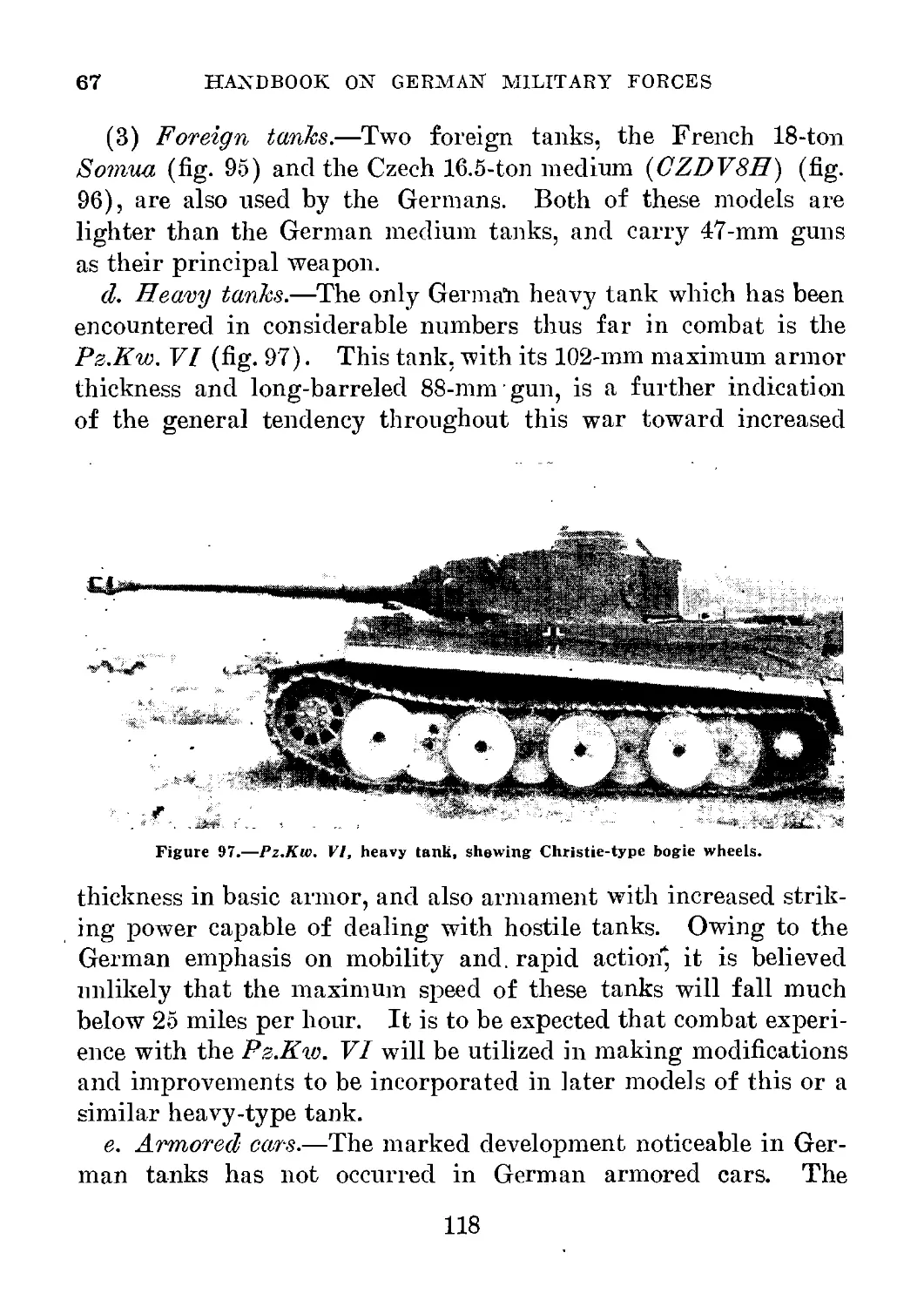
97.	Pz.Kw. VI, heavy tank, showing Christie-type bogie wheels____	118
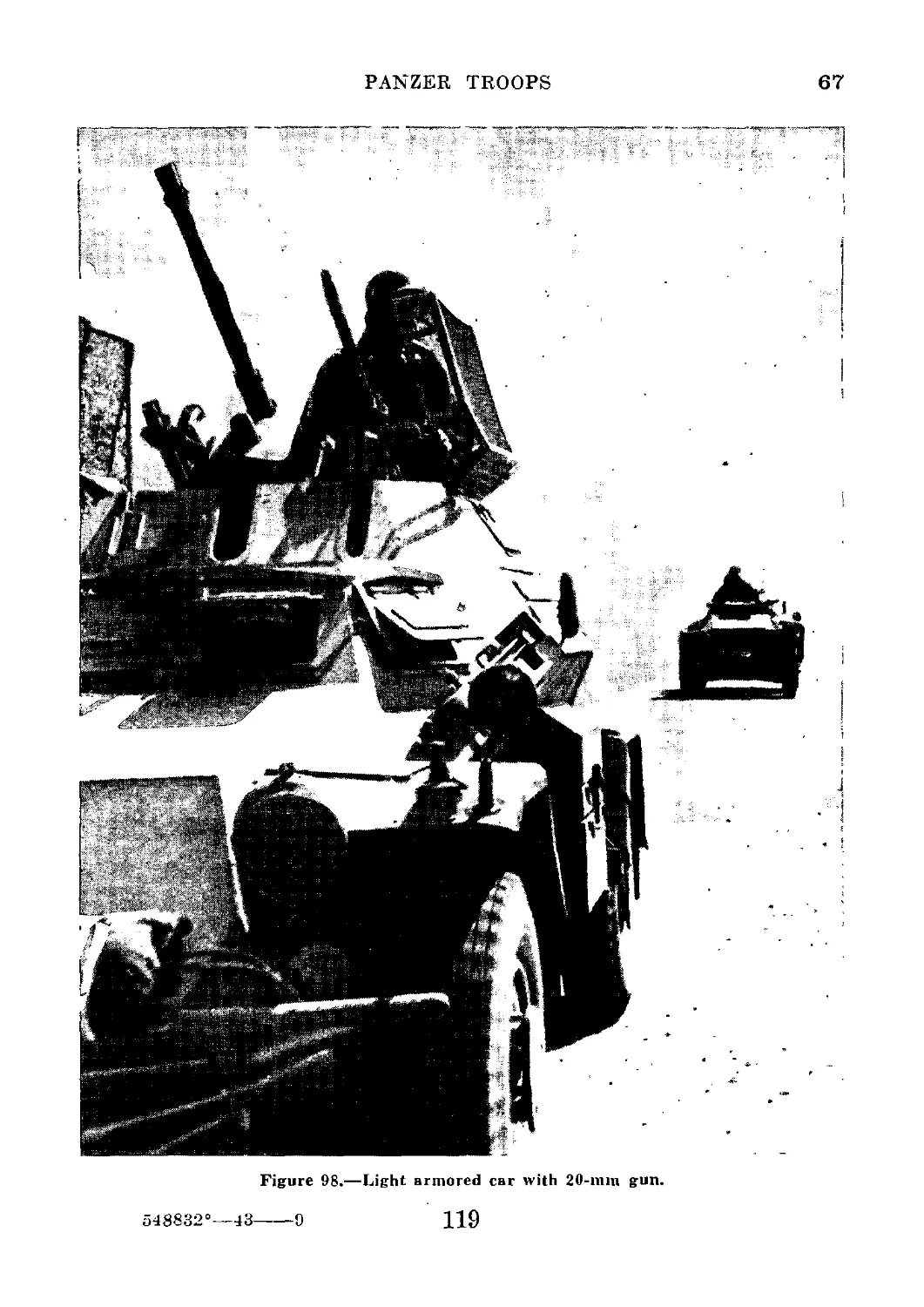
98.	Light armored car with 20-mm gun_____________________________ 119
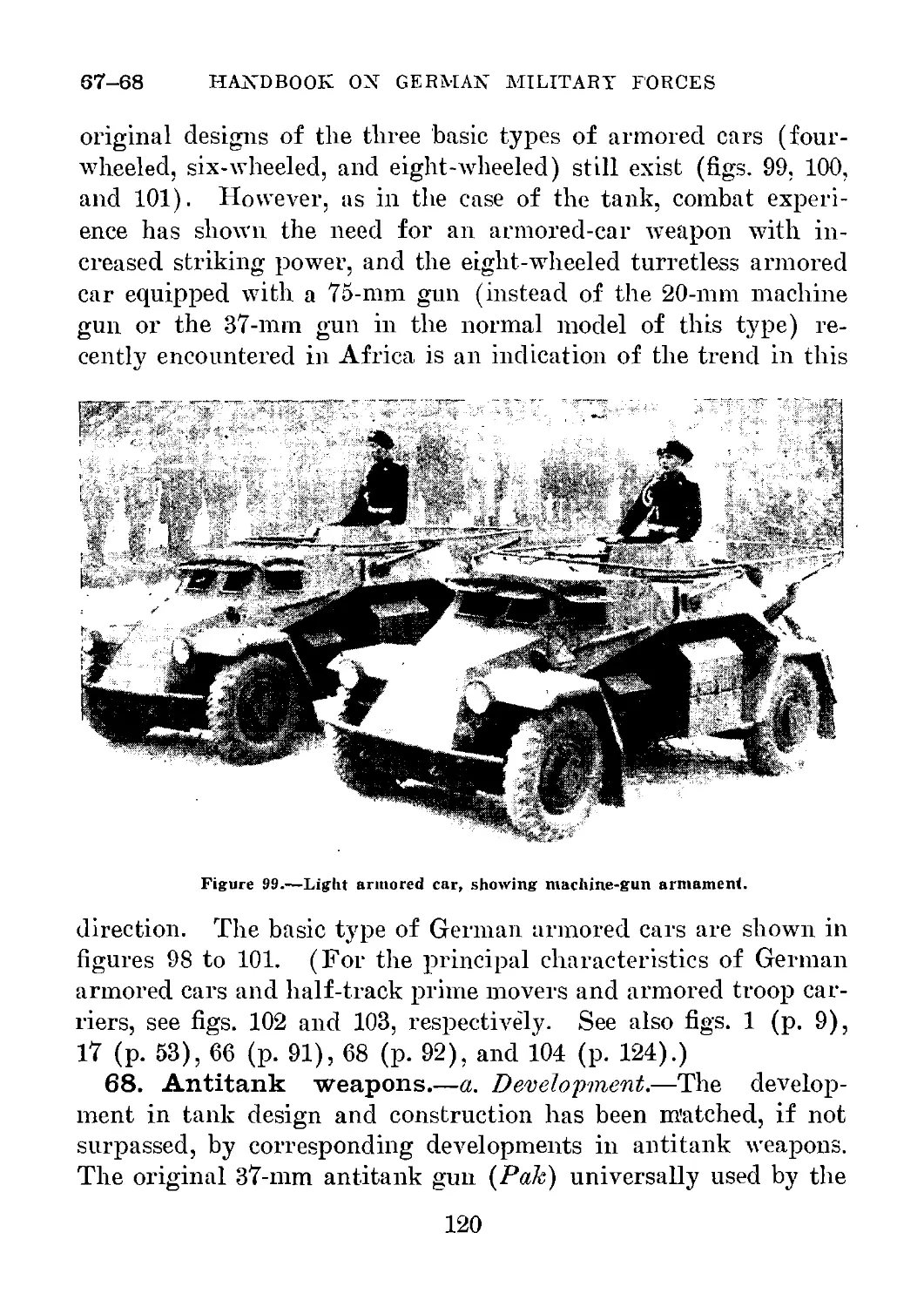
99.	Light armored car, showing machine-gun armament______________ 120
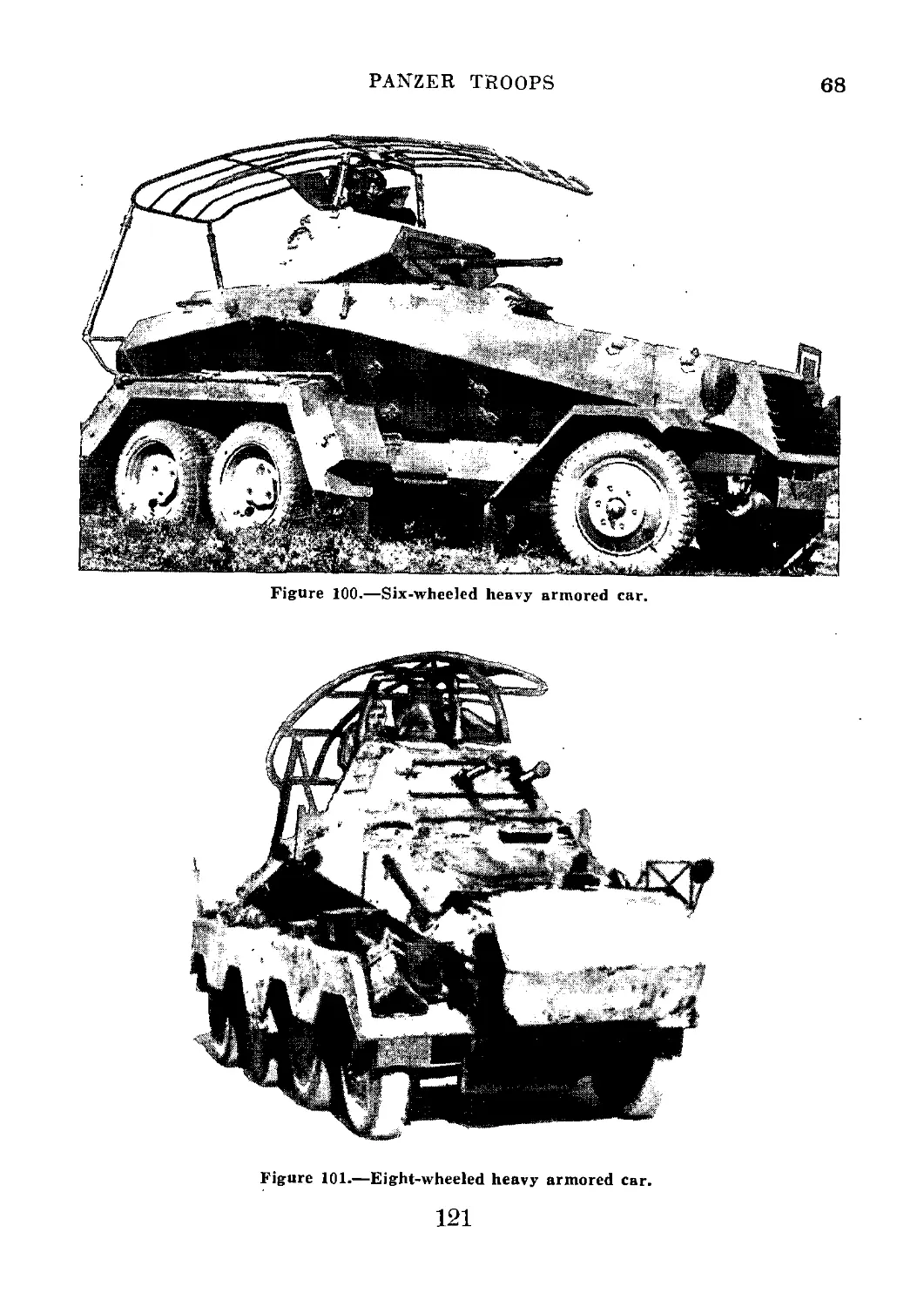
100.	Six-wheeled heavy armored car_______________________________ 121
101.	Eight-wheeled heavy armored car_____________________________ 121
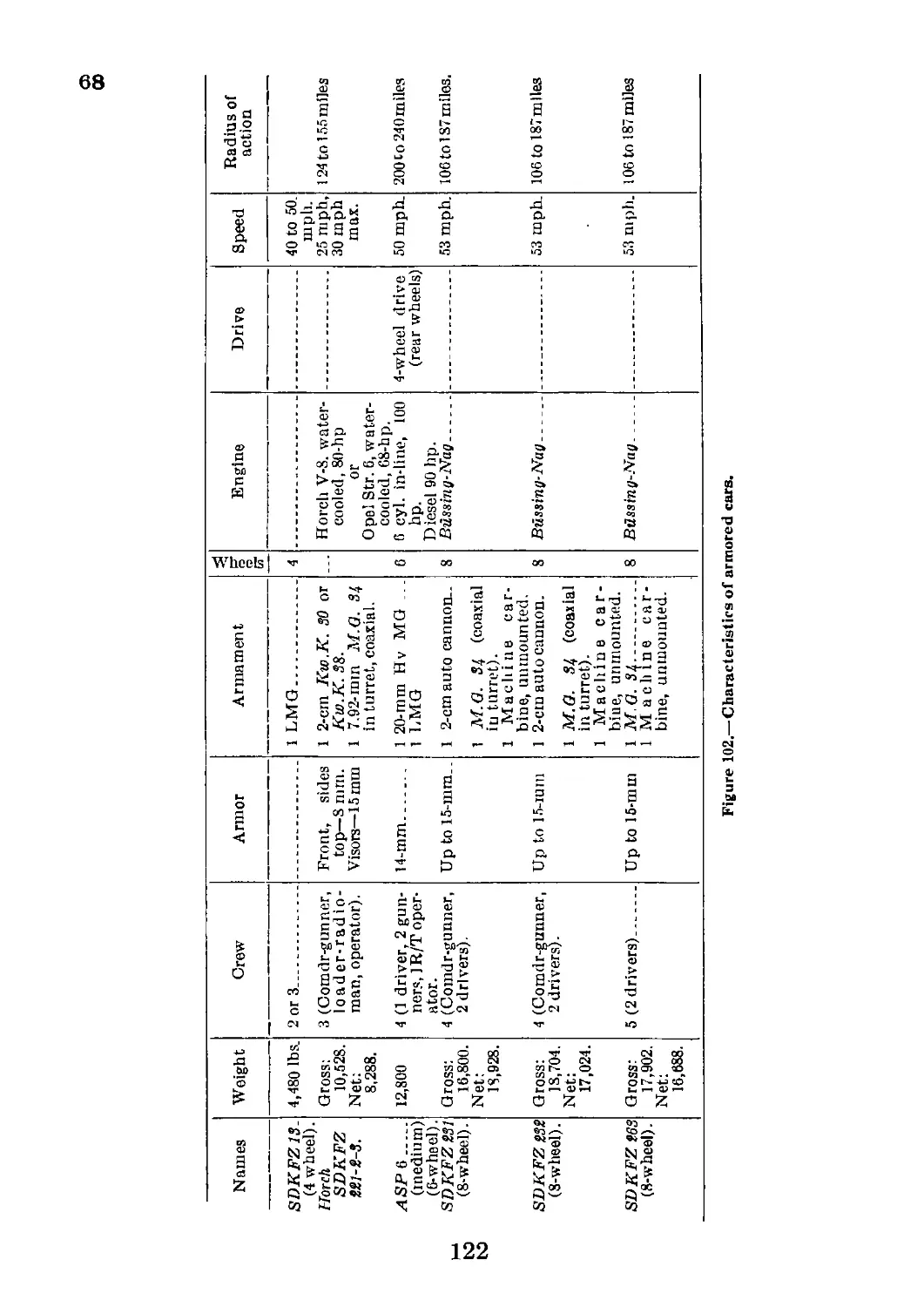
102.	Characteristics of armored cars_____________________________ 122
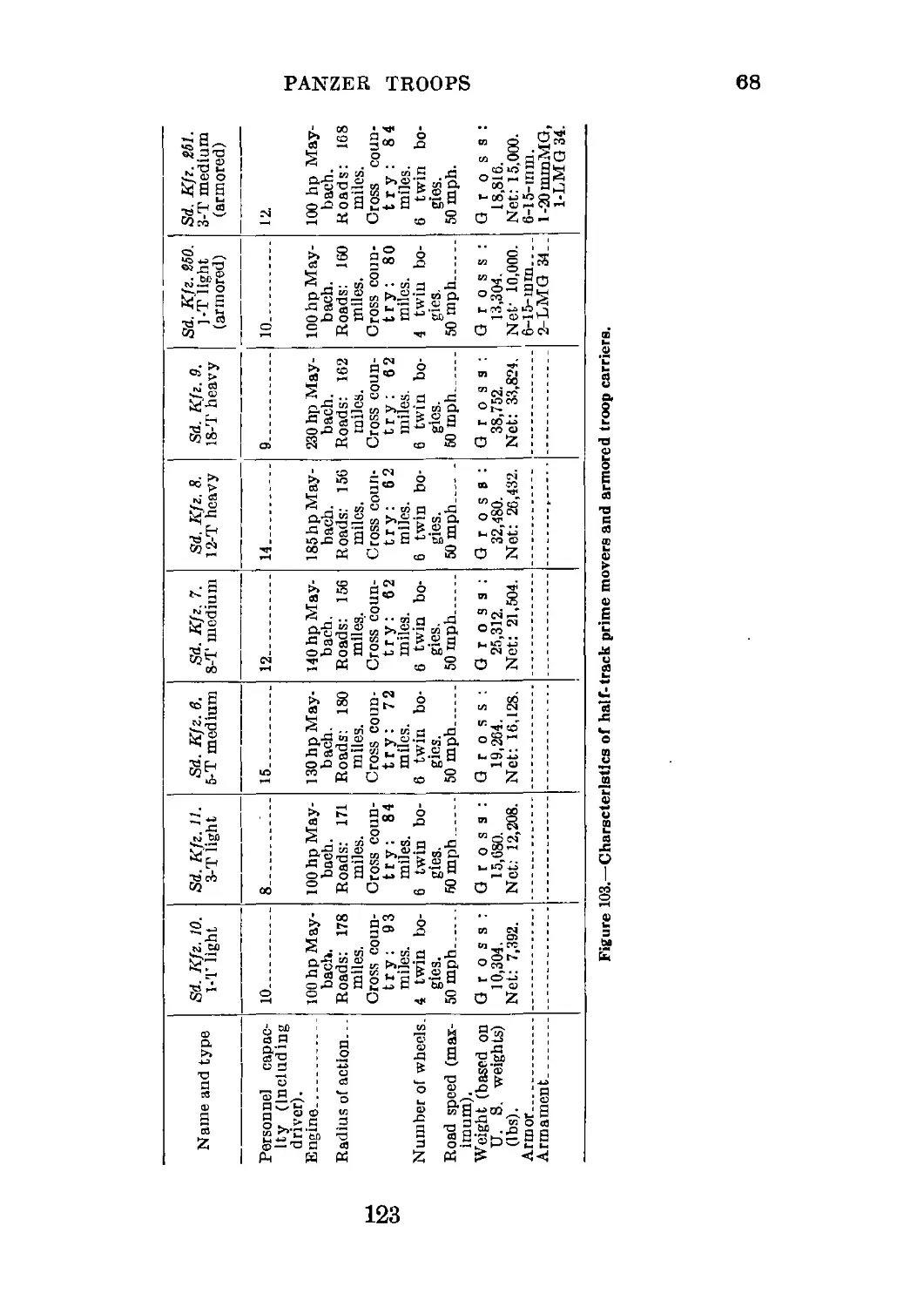
103.	Characteristics of half-track prime movers and armored troop
carriers_____________________________________________________________ 123
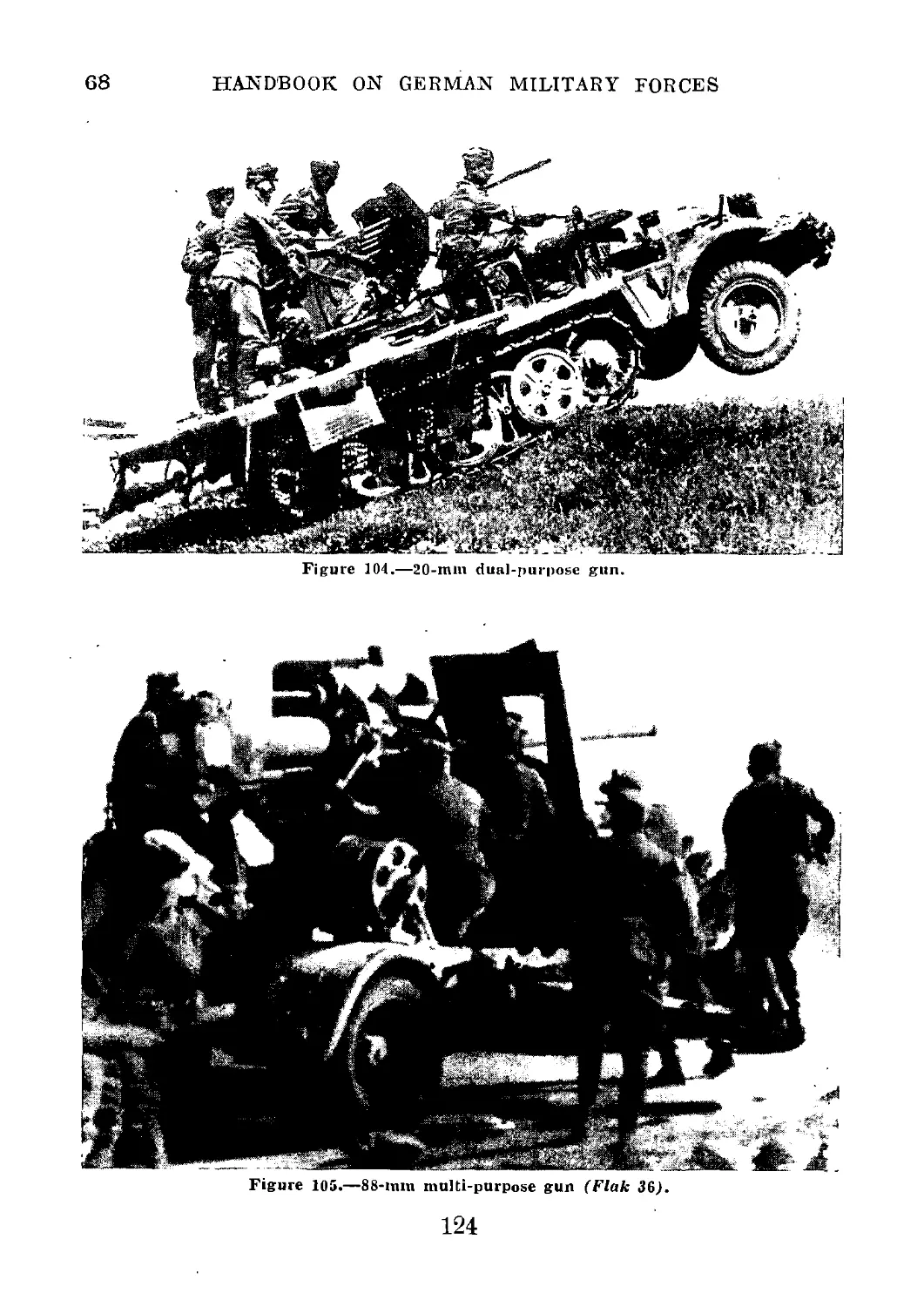
104.	20-mm dual-purpose gun________________________________________ 124
105.	88-mm multi-purpose gun (Flak 36)_____________________________ 124
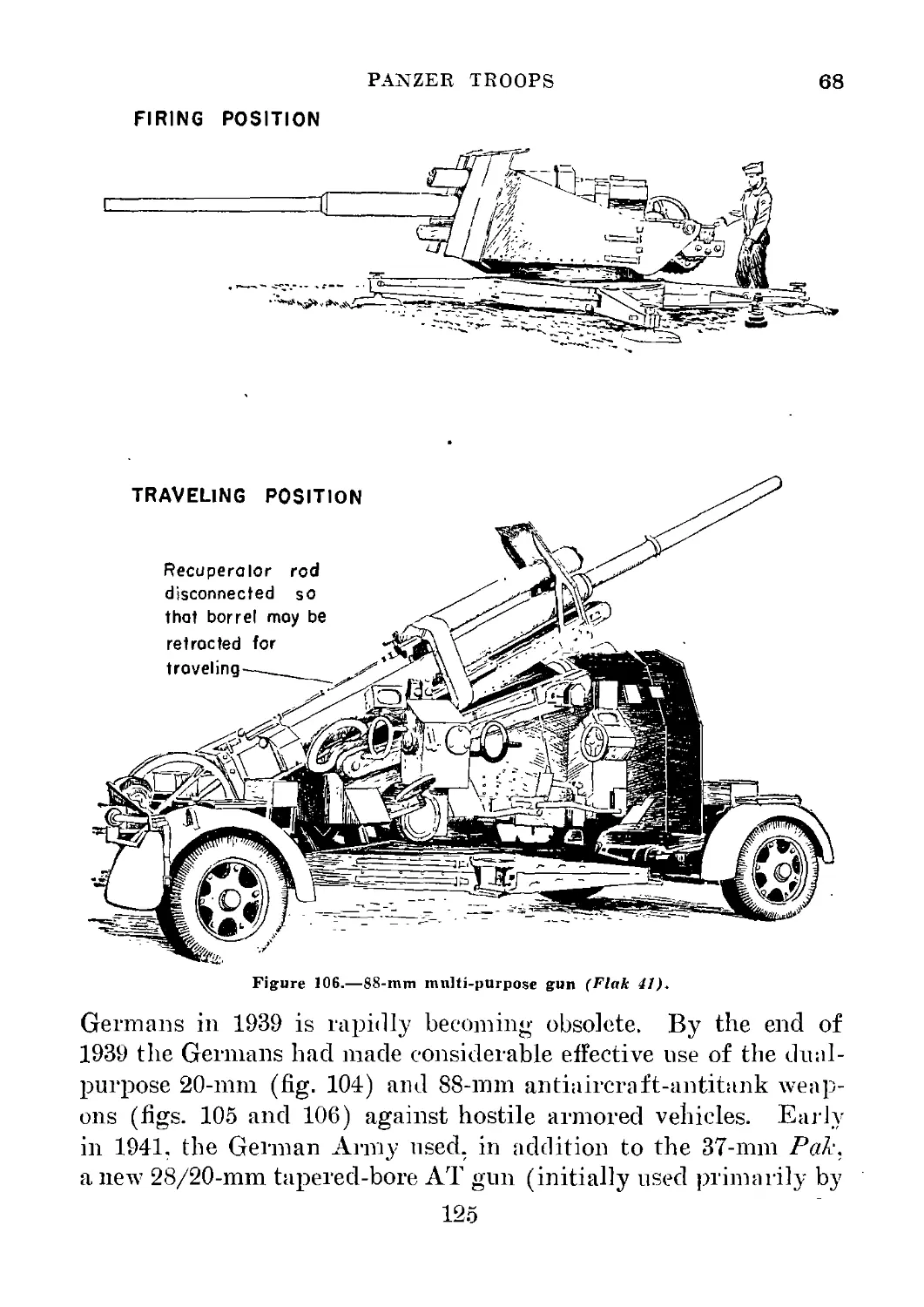
106.	88-mm multi-purpose gun (Flak fl)_____________________________ 125
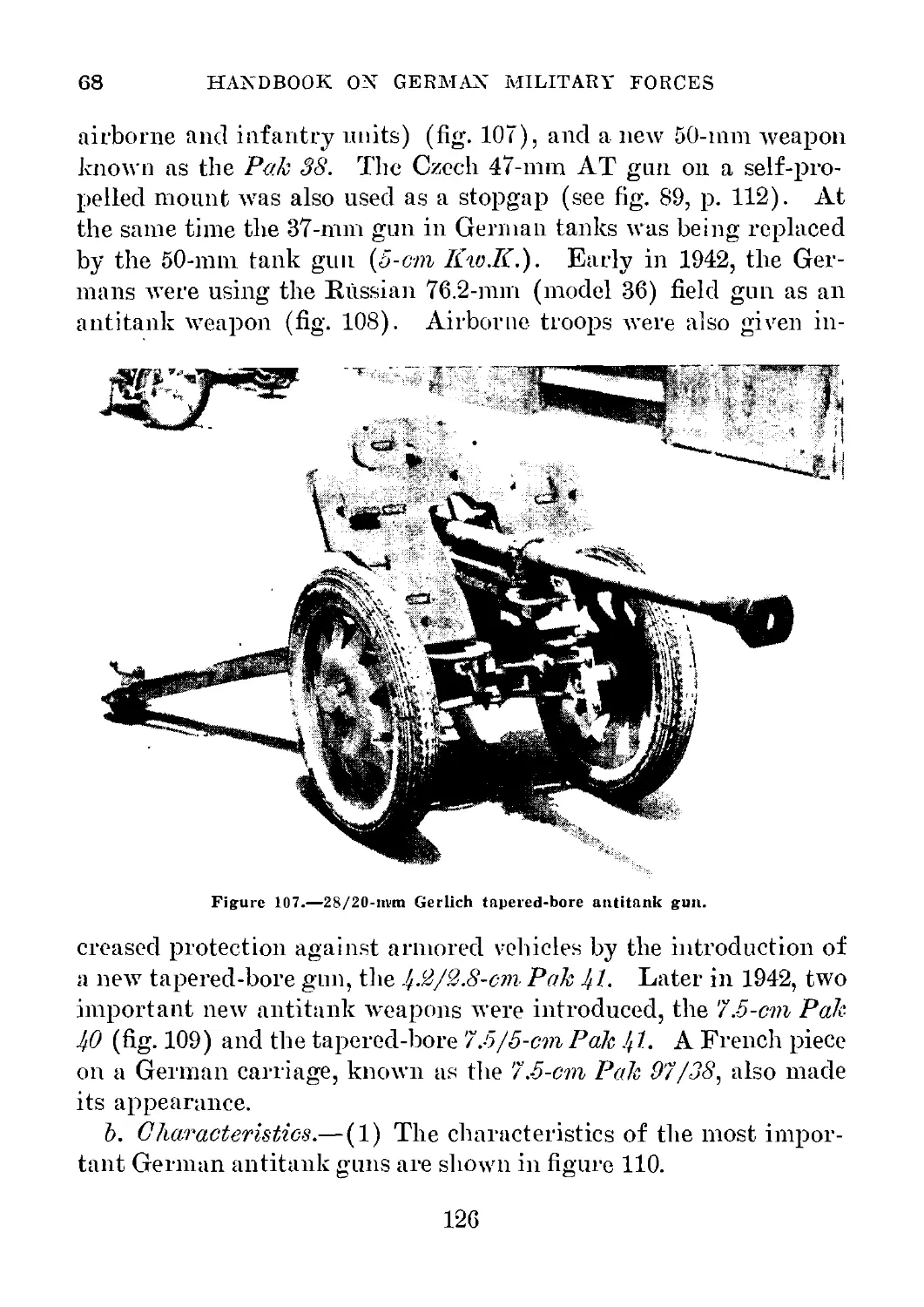
107.	28/20-min Gerlich tapered-bore antitank	gun___________________ 126
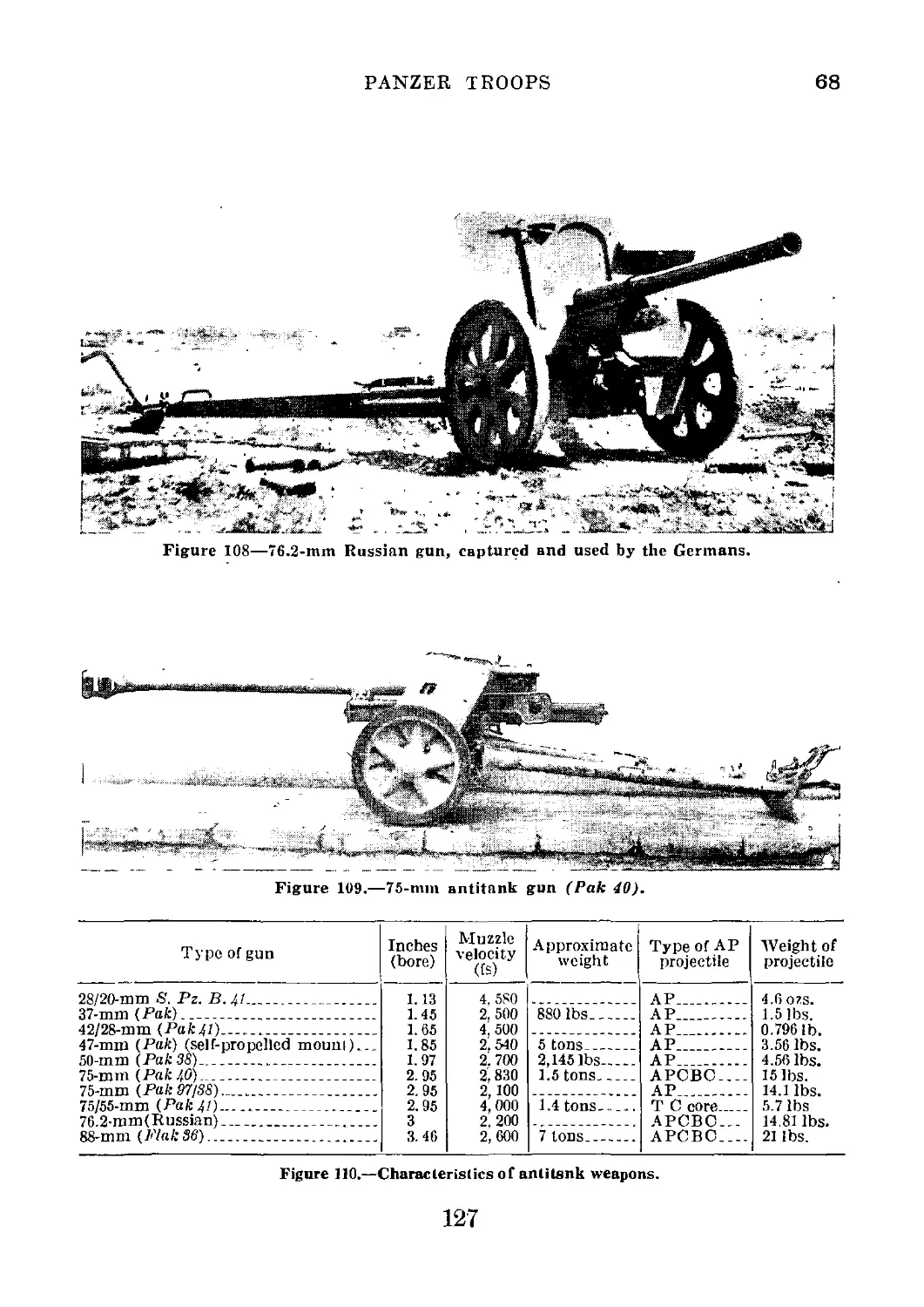
108.	76.2-mm Russian gun, captured and	used by the Germans_______	127
VI
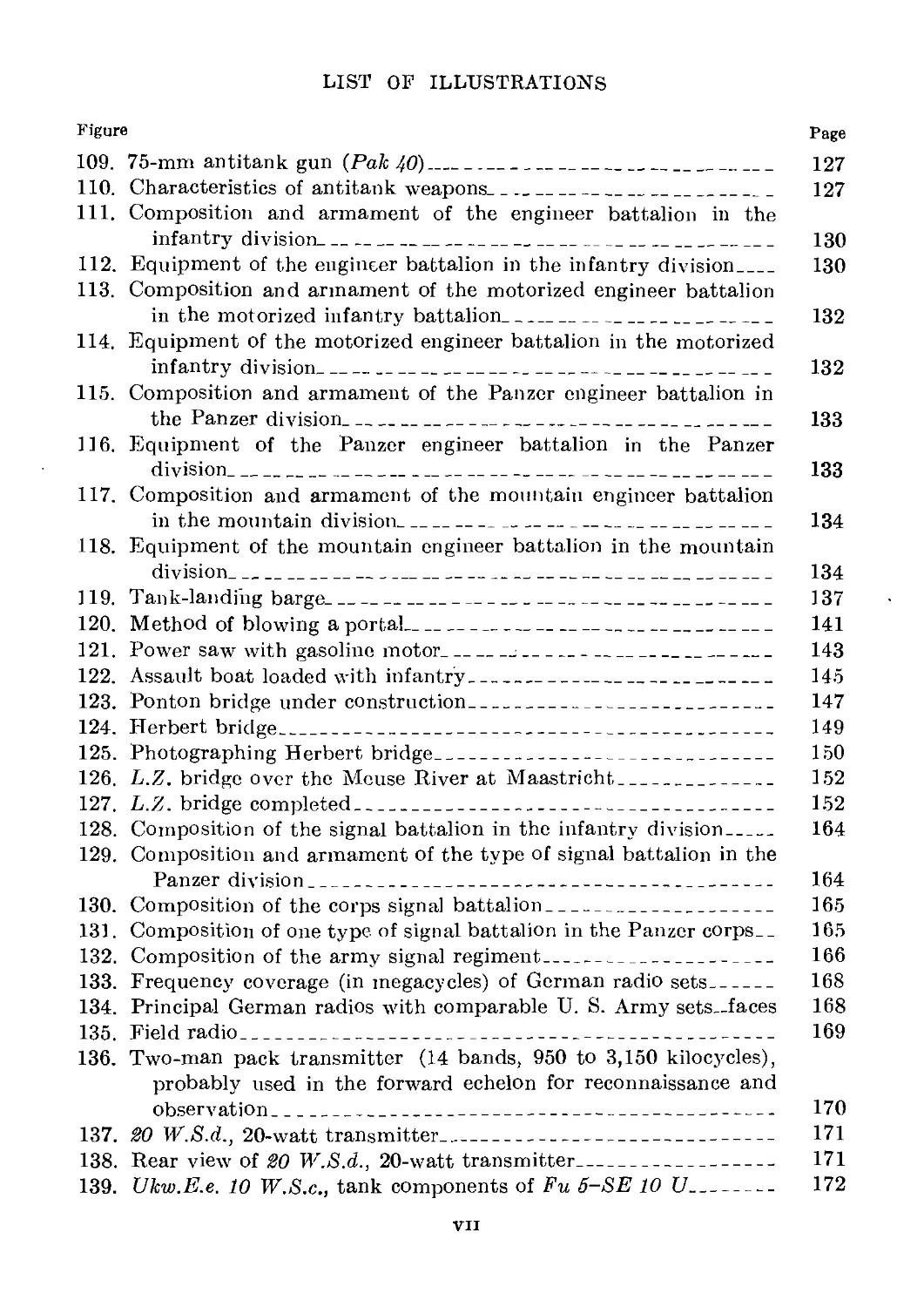
LIST OF ILLUSTRATIONS
Figure	Page
109.	75-mm antitank gun	(Pak 40)__________________________________ 127
110.	Characteristics of antitank	weapons__________________________ 127
111.	Composition and armament of the engineer battalion in the
infantry division_________________________________________________ 130
112.	Equipment of the engineer battalion in the infantry division_	130
113.	Composition and armament of the motorized engineer battalion
in the motorized infantry battalion_____________________________ 132
114.	Equipment of the motorized engineer battalion in the motorized
infantry division_______________________________________________ 132
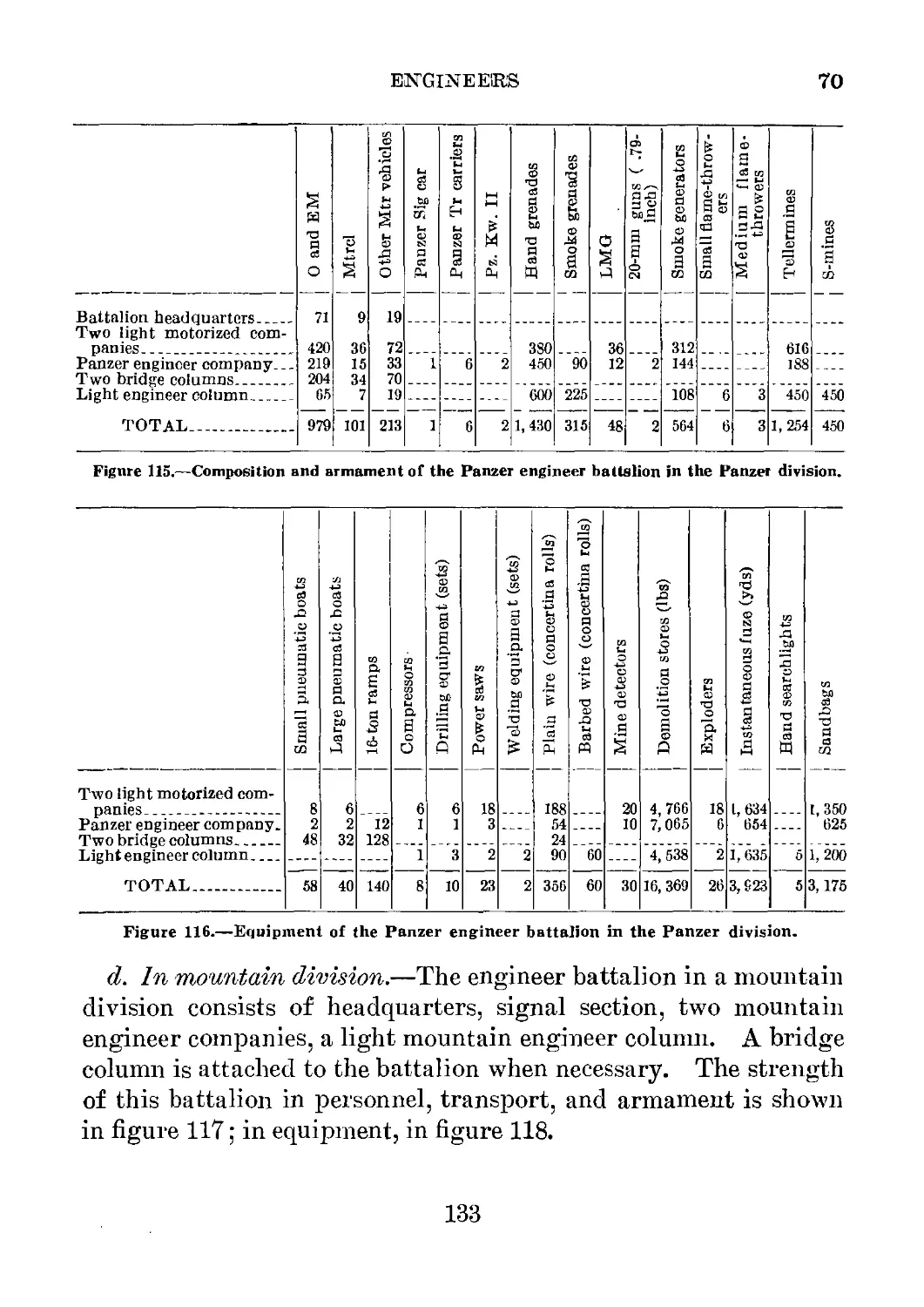
115.	Composition and armament of the Panzer engineer battalion in
the Panzer division_________________________________________ 133
116.	Equipment of the Panzer engineer battalion in the Panzer
division________________________________________________________ 133
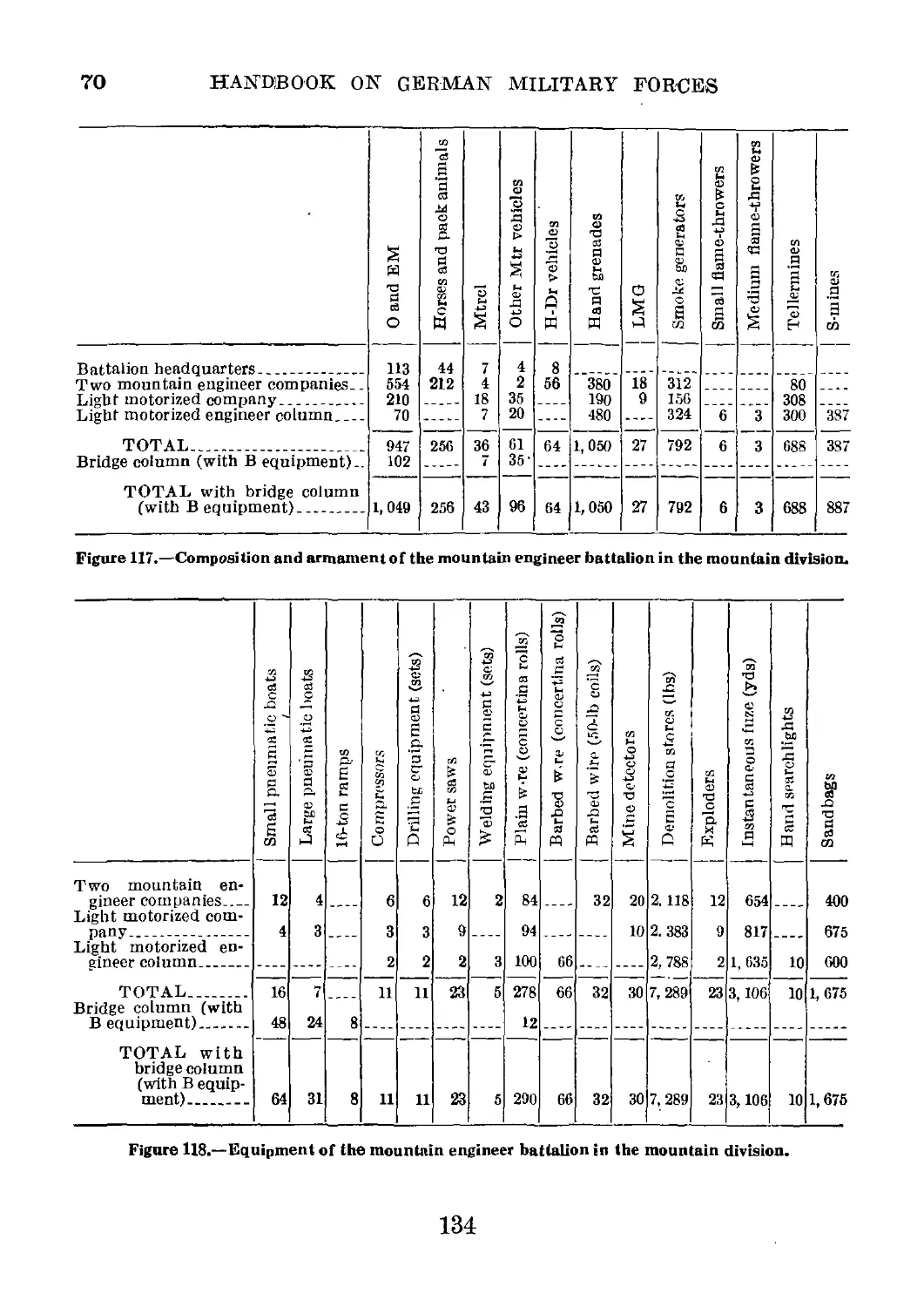
117.	Composition and armament of the mountain engineer battalion
in the mountain division________________________________________ 134
118.	Equipment of the mountain engineer battalion in the mountain
division________________________________________________________ 134
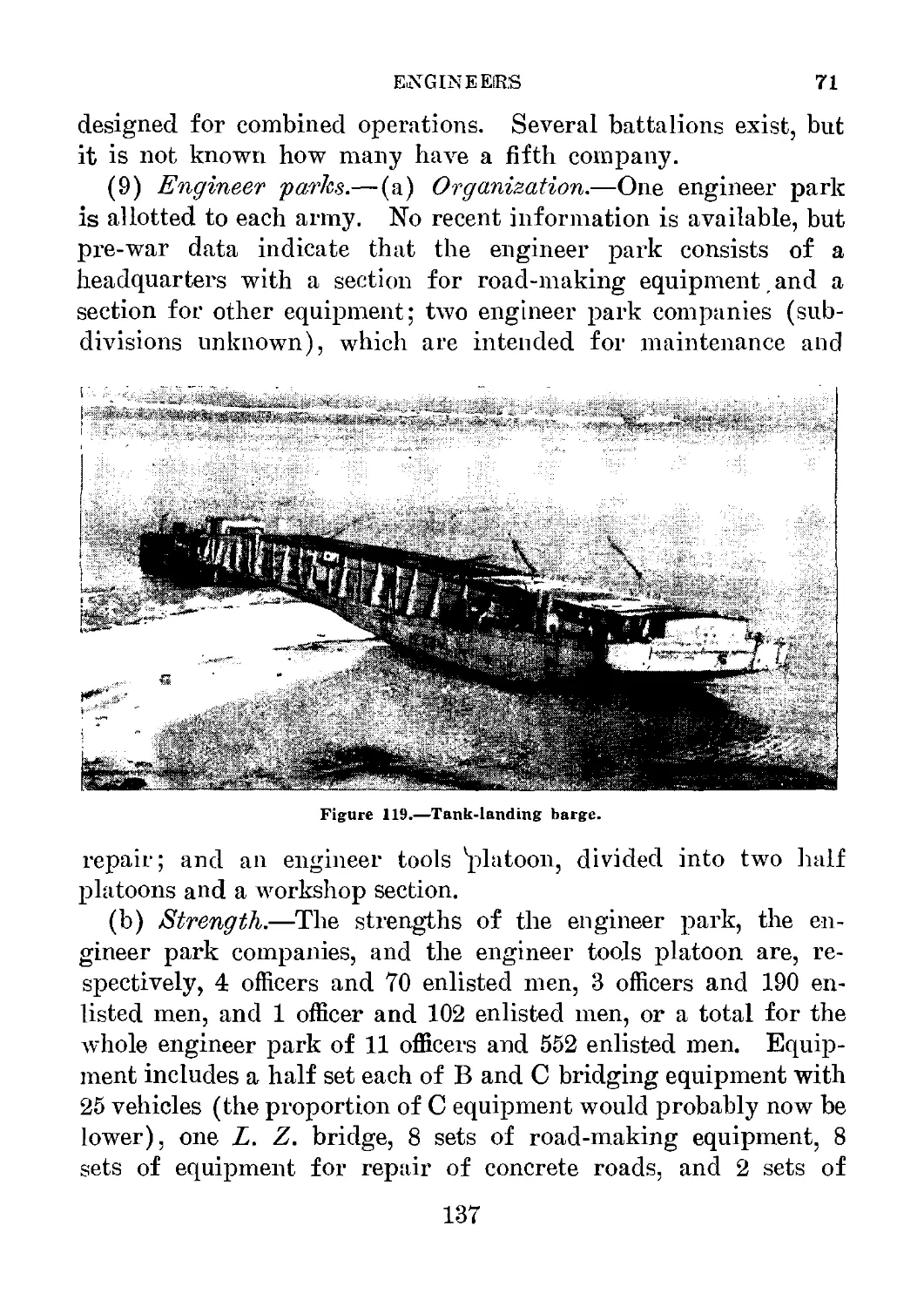
119.	Tank-landing barge____________________________________________ 137
120.	Method of blowing a portal____________________________________ 141
121.	Power saw with gasoline motor_________________________________ 143
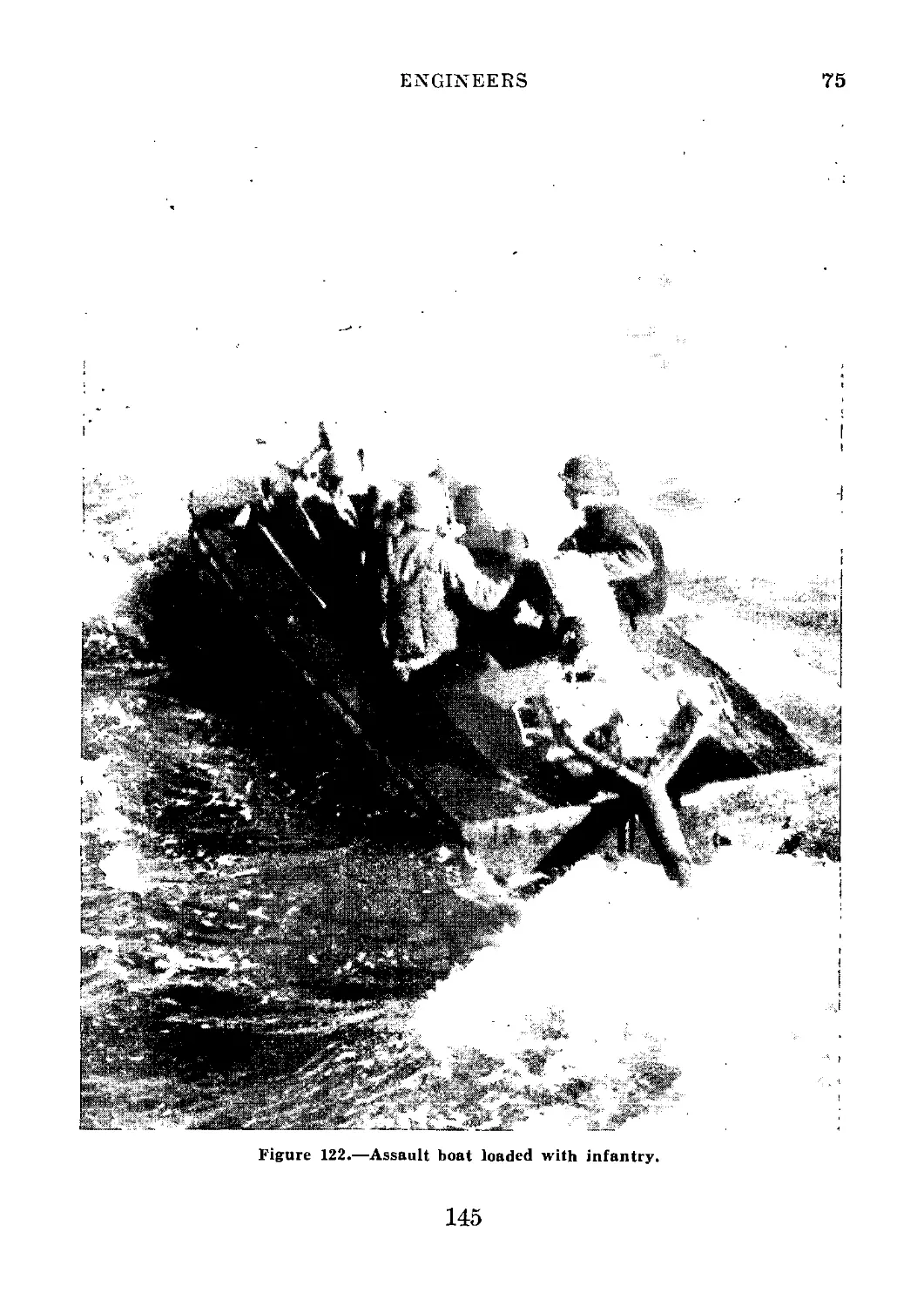
122.	Assault boat loaded with infantry_____________________________ 145
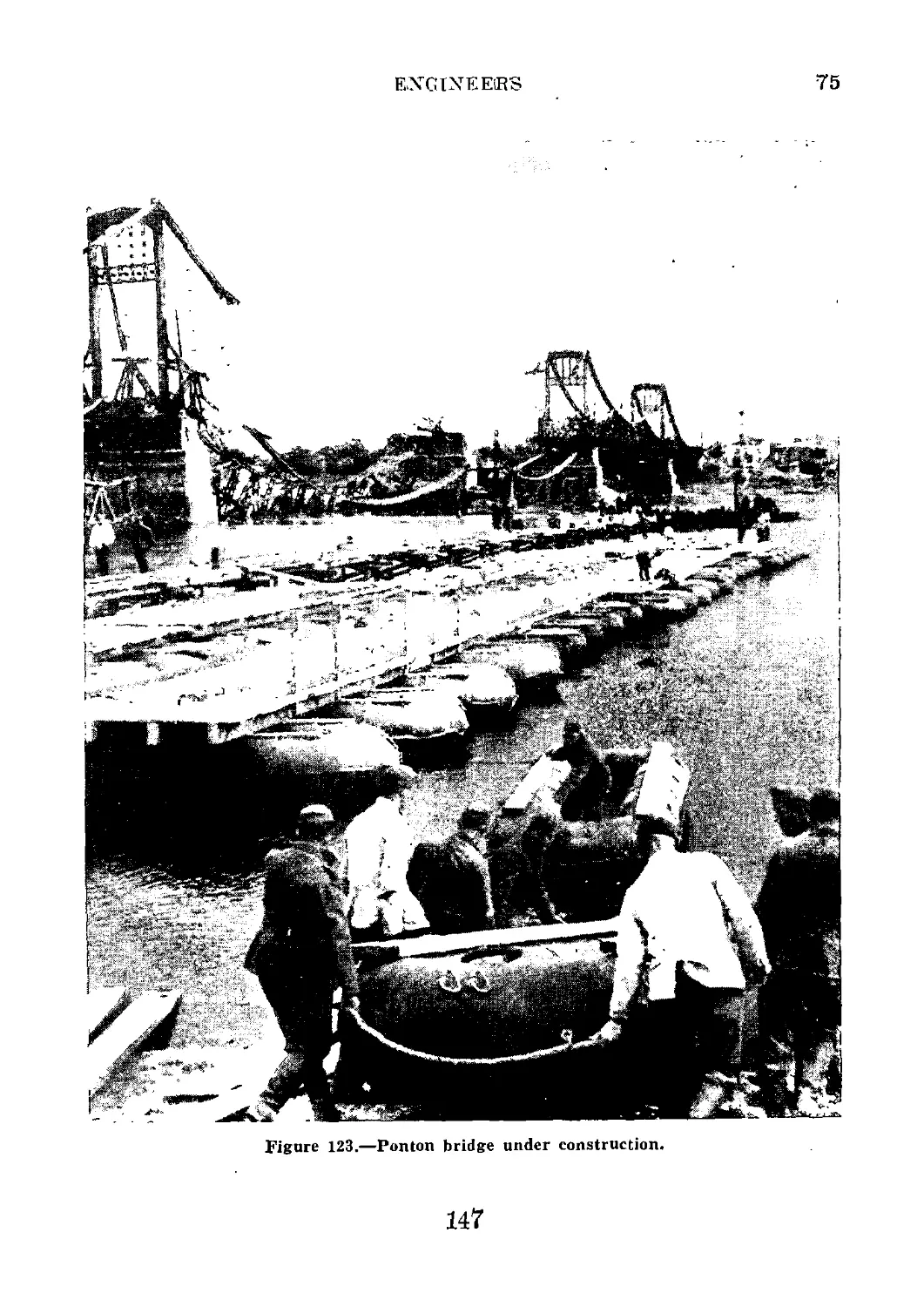
123.	Ponton bridge under construction______________________________ 147
124.	Herbert bridge________________________________________________ 149
125.	Photographing Herbert bridge__________________________________ 150
126.	L.Z. bridge over the Meuse River at Maastricht________________ 152
127.	L.Z. bridge completed_________________________________________ 152
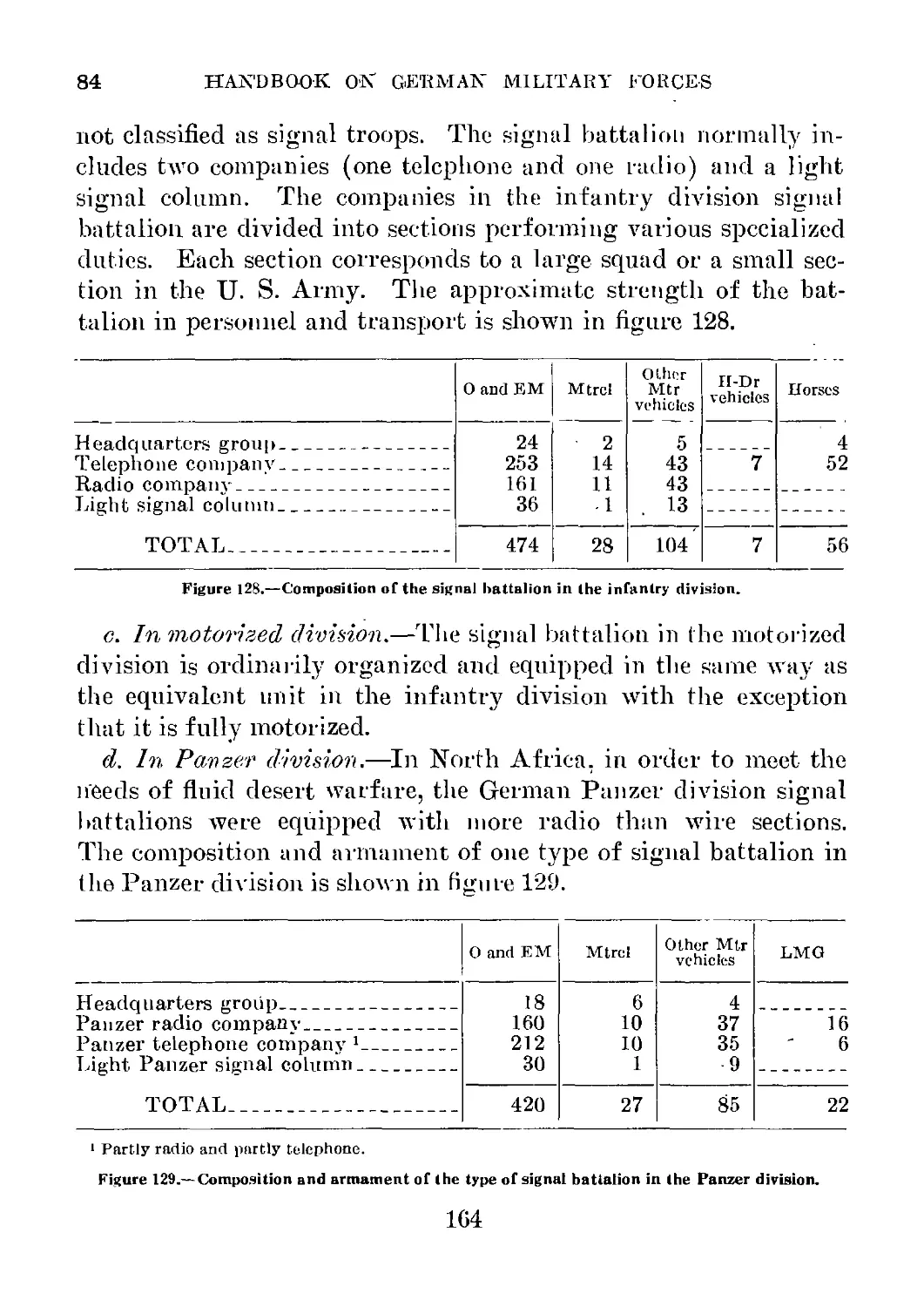
128.	Composition of the signal battalion in the infantry division__	164
129.	Composition and armament of the type of signal battalion in the
Panzer division_________________________________________________ 164
130.	Composition of the corps signal battalion____________________ 165
131.	Composition of one type of signal battalion in the Panzer corps._	165
132.	Composition of the army signal regiment______________________ 166
133.	Frequency coverage (in megacycles) of German radio sets______	168
134.	Principal German radios with comparable U. S. Army sets..faces	168
135.	Field radio__________________________________________________ 169
136.	Two-man pack transmitter (14 bands, 950 to 3,150 kilocycles),
probably used in the forward echelon for reconnaissance and
observation_____________________________________________________ 170
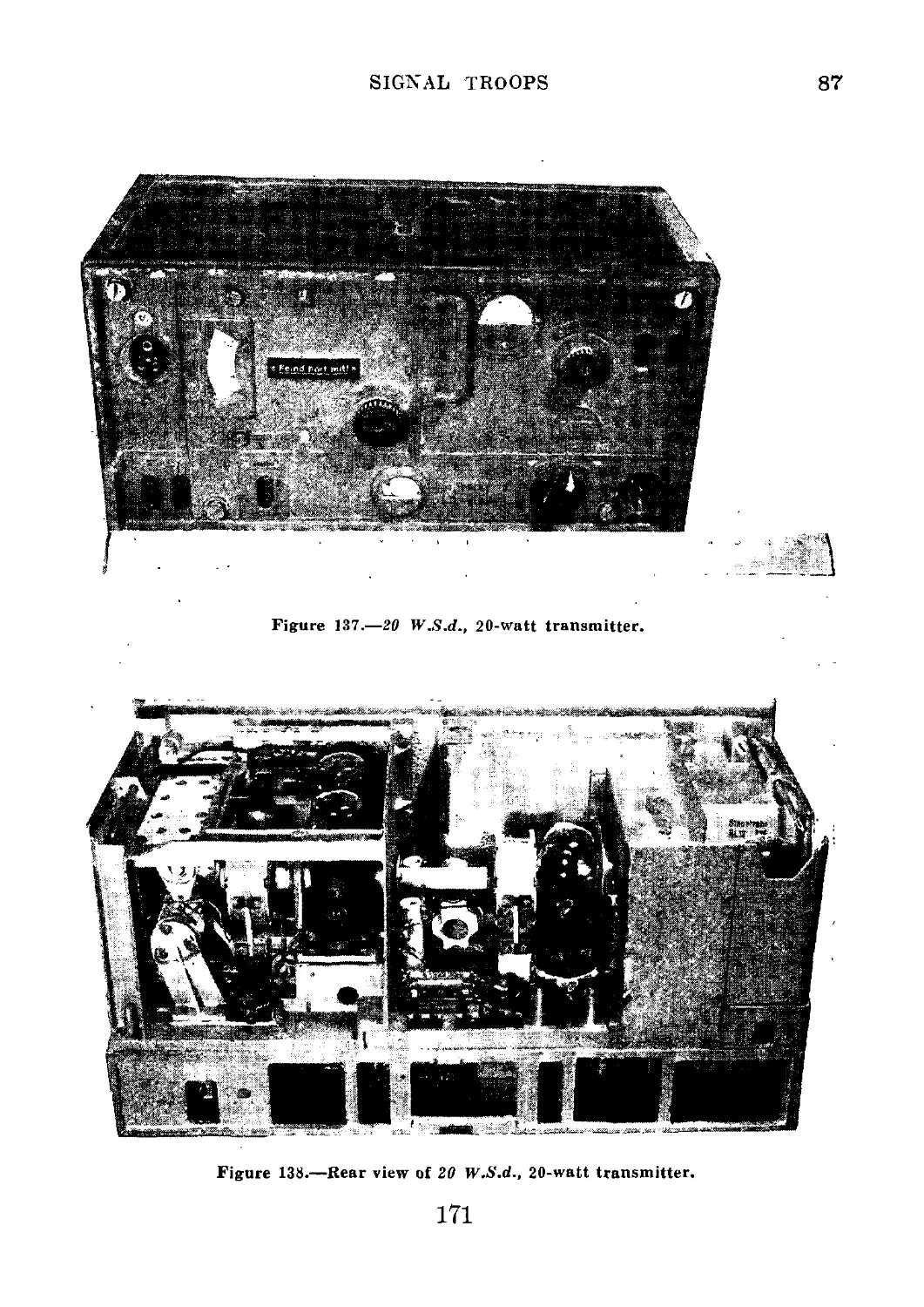
137.	20 IF.S.d., 20-watt transmitter______________________________ 171
138.	Rear view of 20 W.S.d., 20-watt transmitter__________________ 171
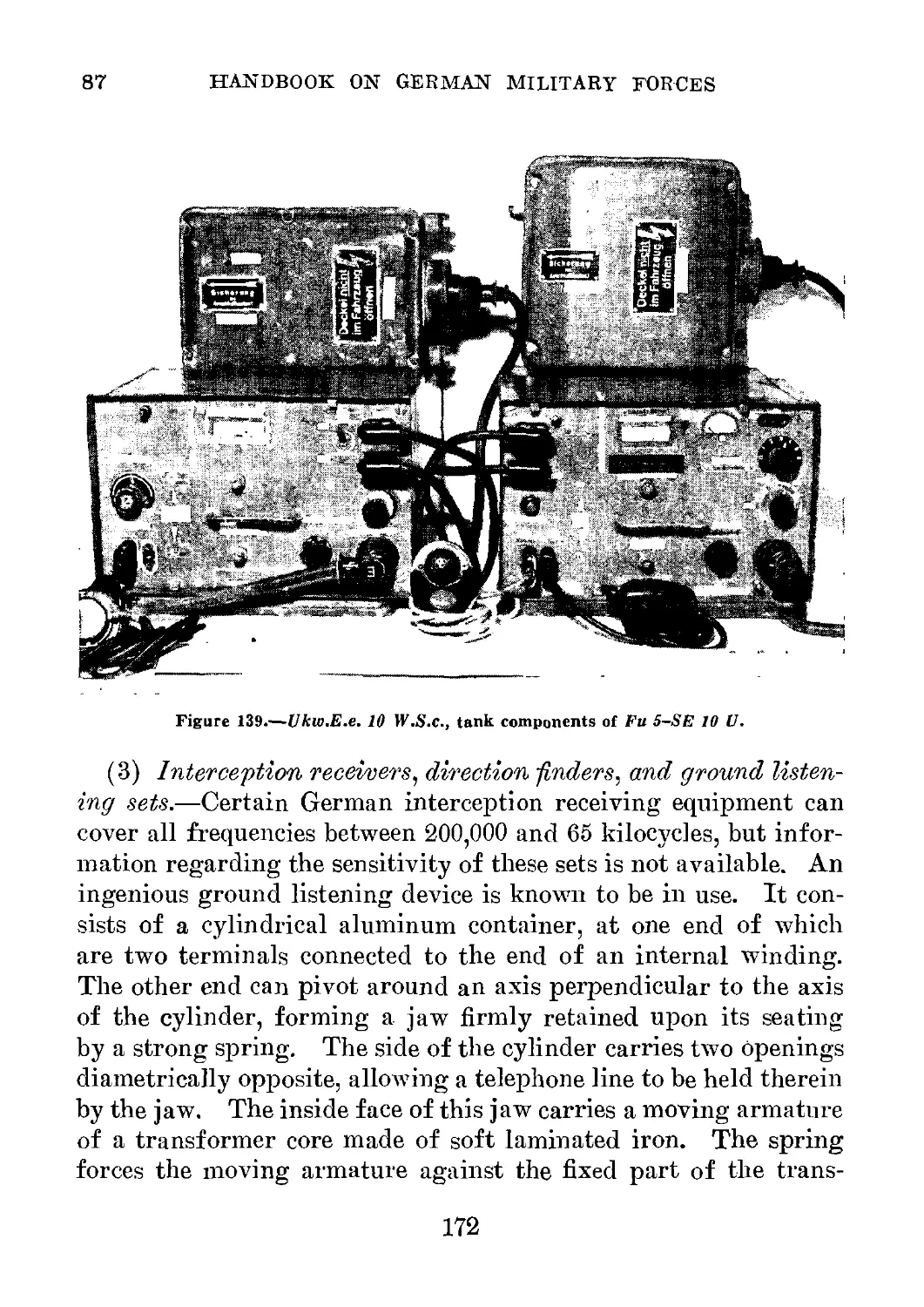
139.	Ukw.E.e. 10 W.S.c., tank components of Fu 5-SE 10 U__________	172
VII
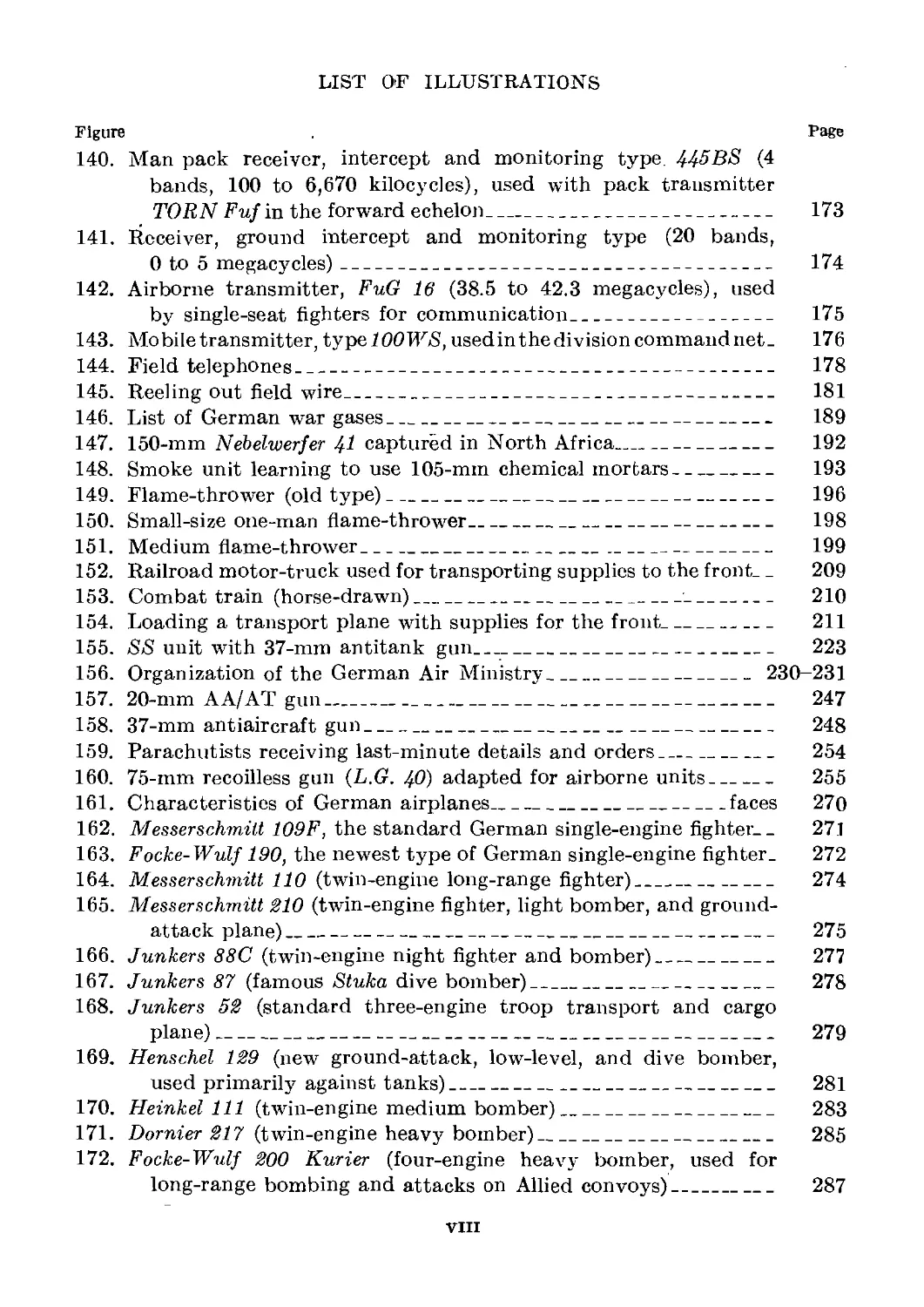
LIST OF ILLUSTRATIONS
Figure	Page
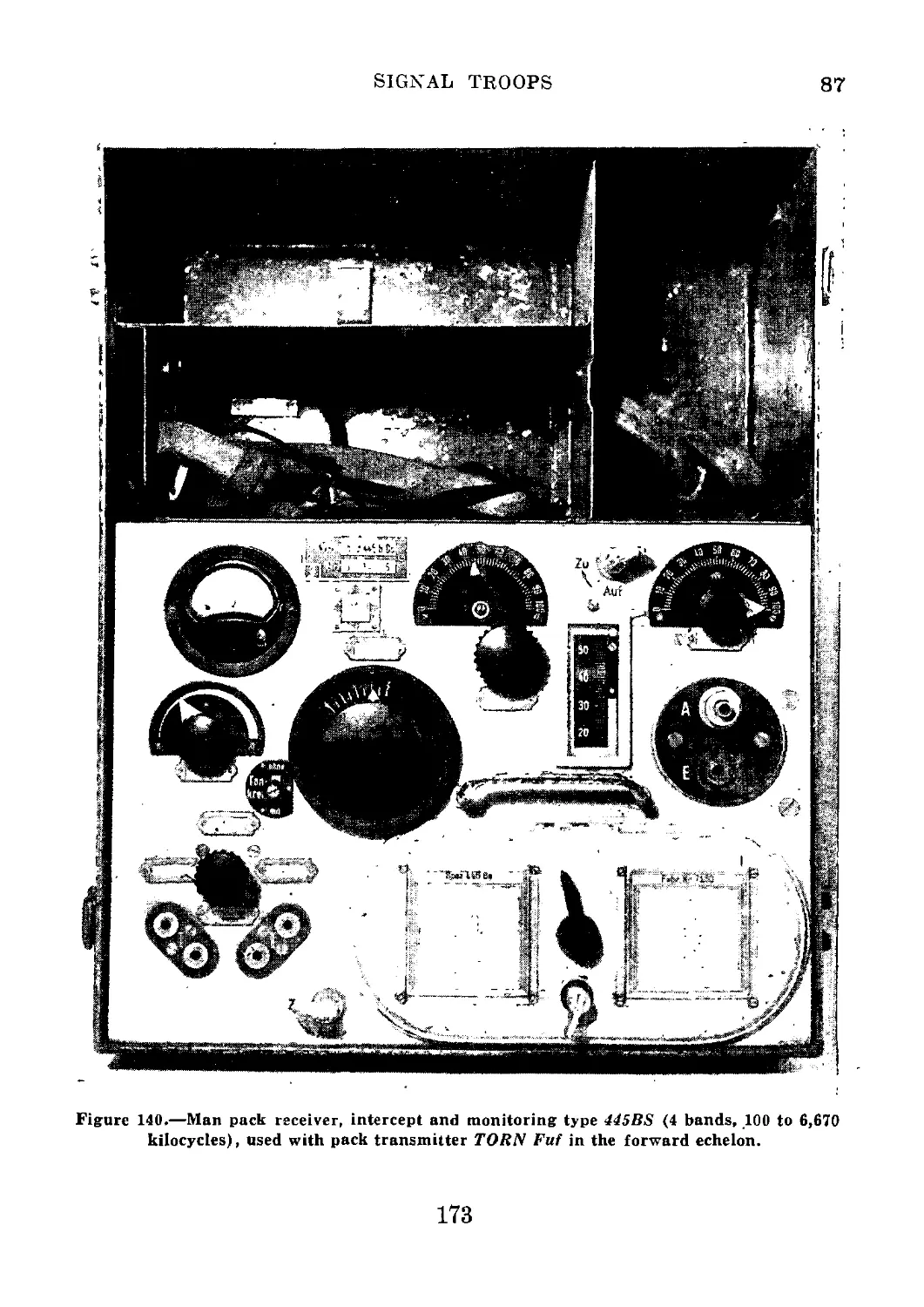
140.	Man pack receiver, intercept and monitoring type. 445BS (4
bands, 100 to 6,670 kilocycles), used with pack transmitter
TORN Fuf in the forward echelon______________________________ 173
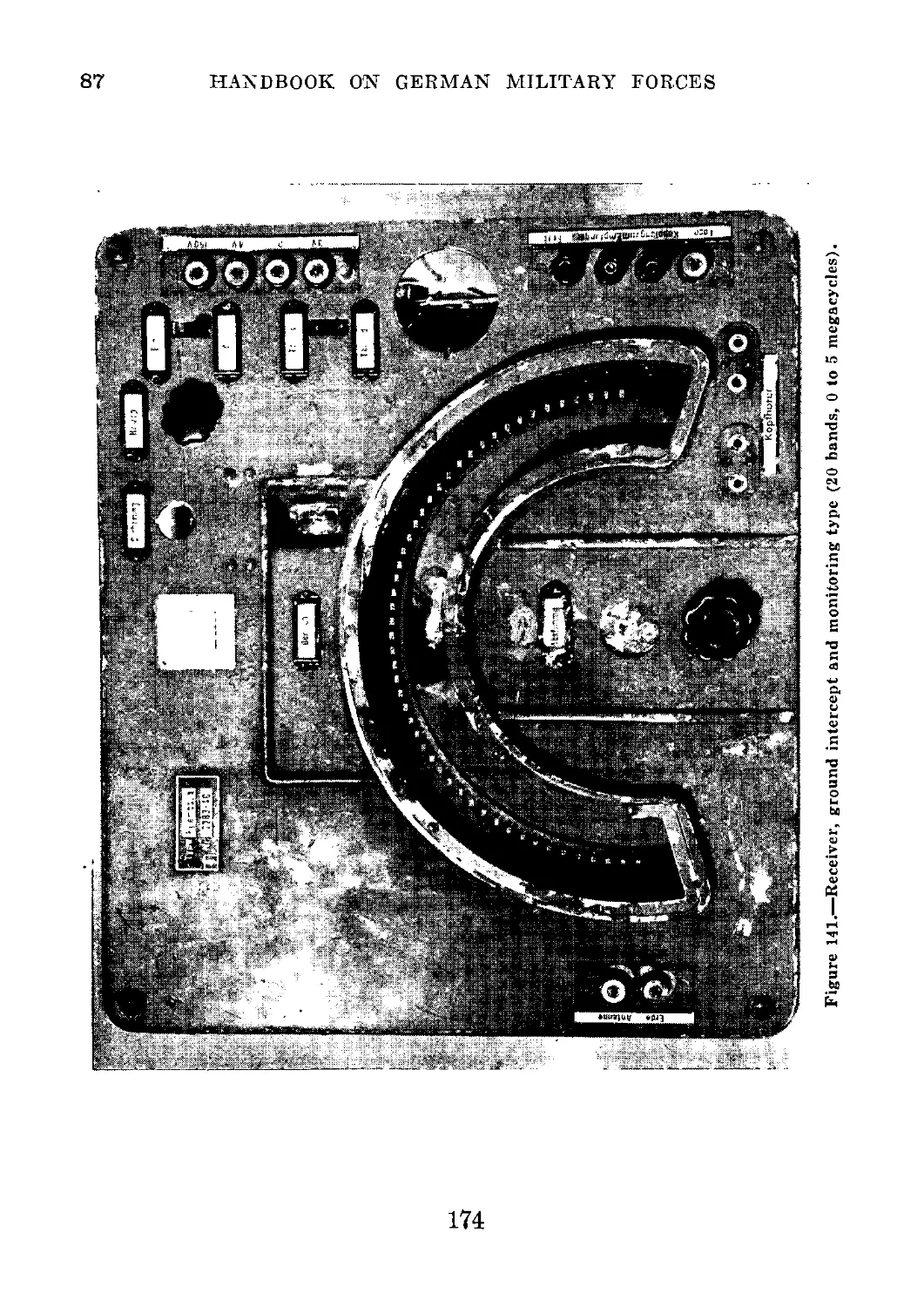
141.	Receiver, ground intercept and monitoring type (20 bands,
0 to 5 megacycles)__________________________________________________ 174
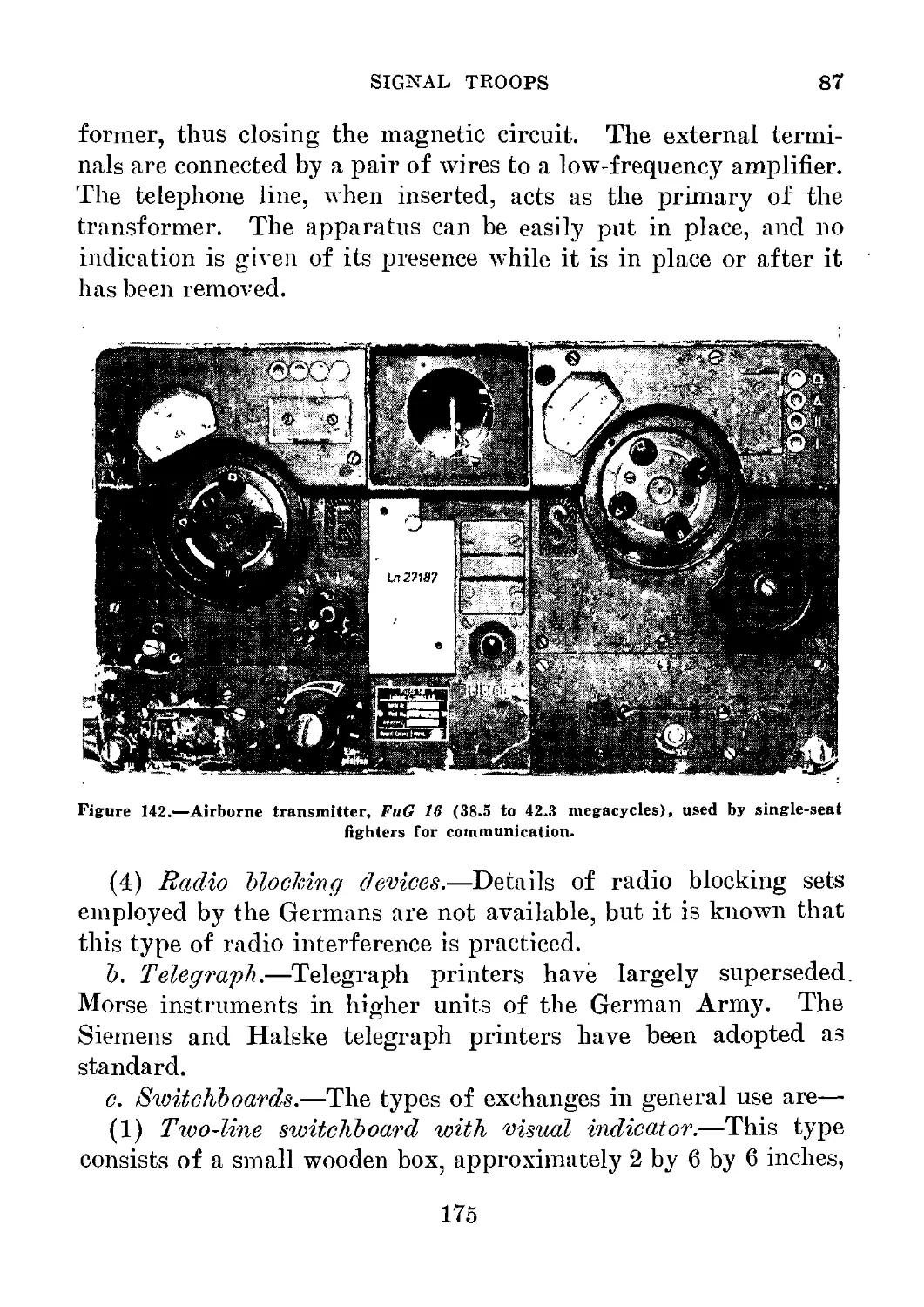
142.	Airborne transmitter, FuG 16 (38.5 to 42.3 megacycles), used
by single-seat fighters for communication___________________________ 175
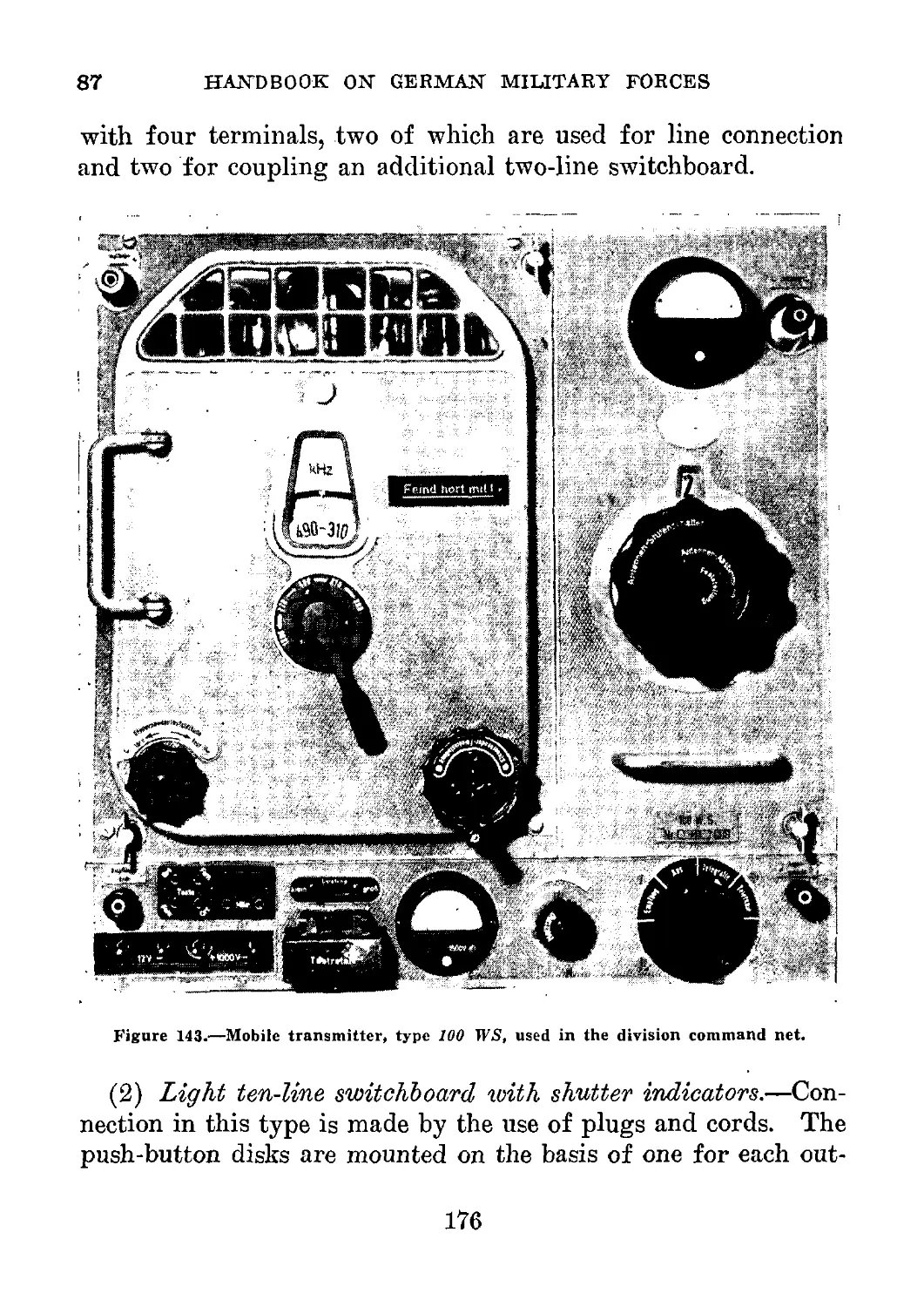
143.	Mo bile transmitter, typelOOTKS, usedinthe division commaudnet. 176
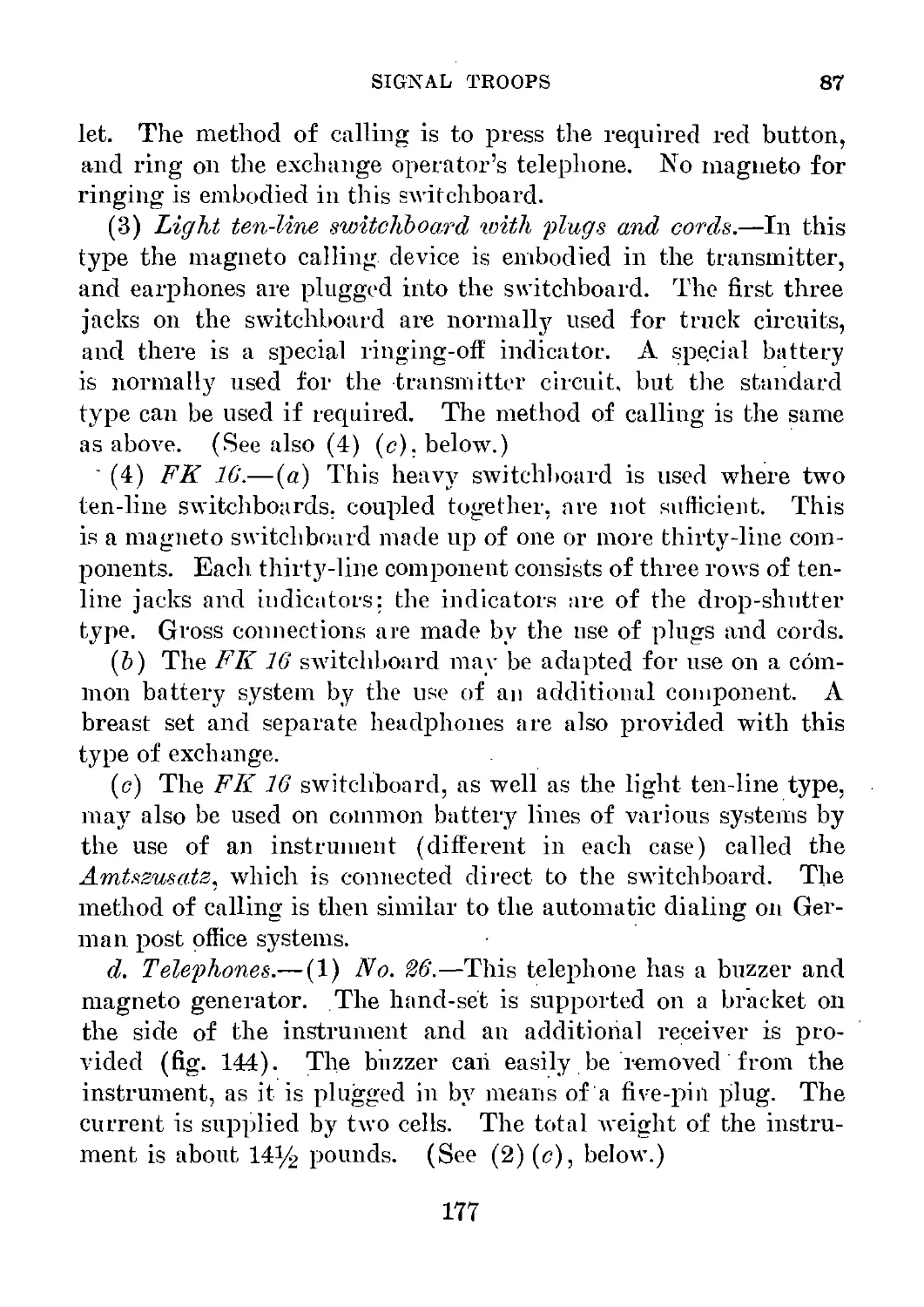
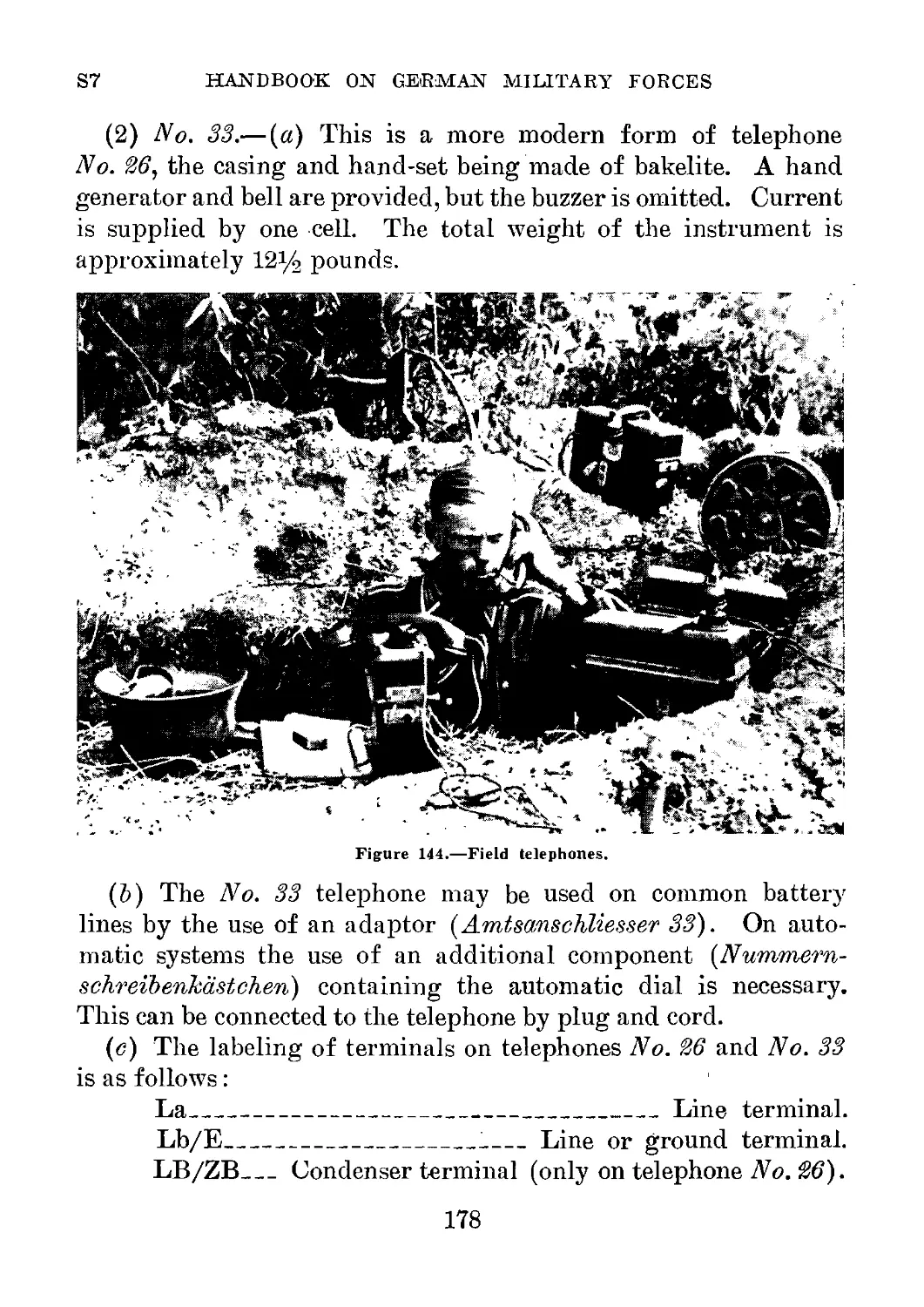
144.	Field telephones___________________________________________________ 178
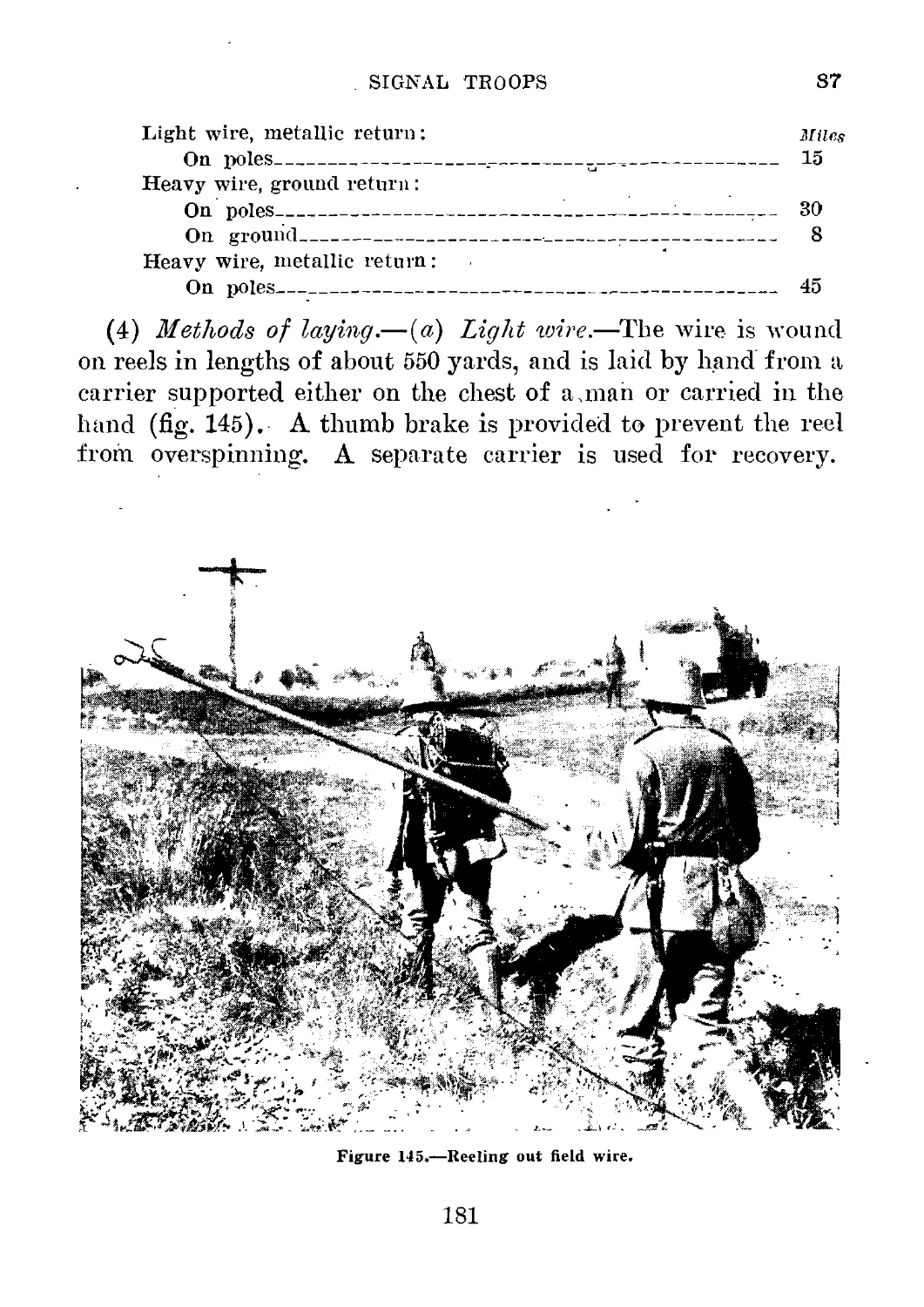
145.	Reeling out field wire_____________________________________________ 181
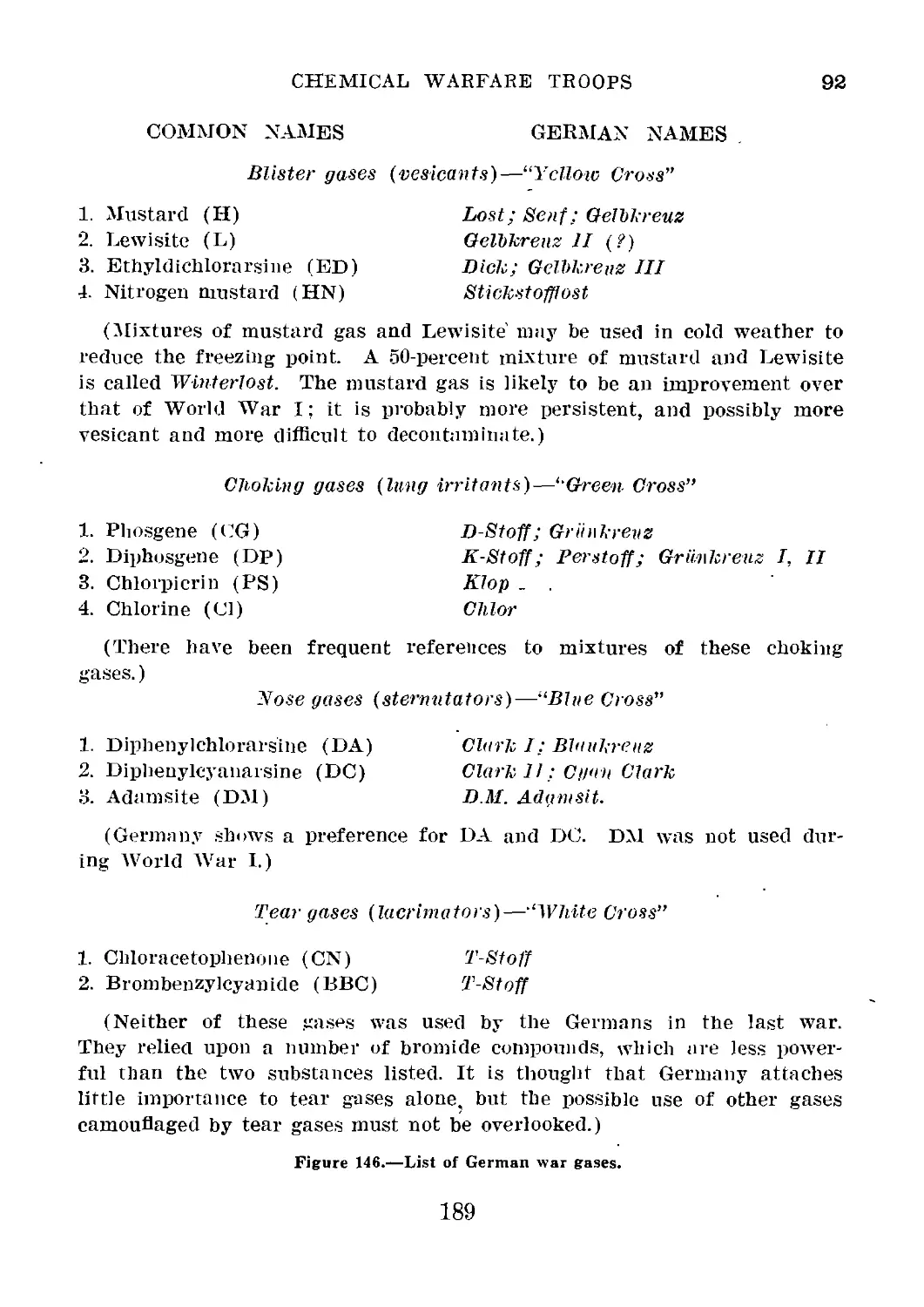
146.	List of German war gases___________________________________________ 189
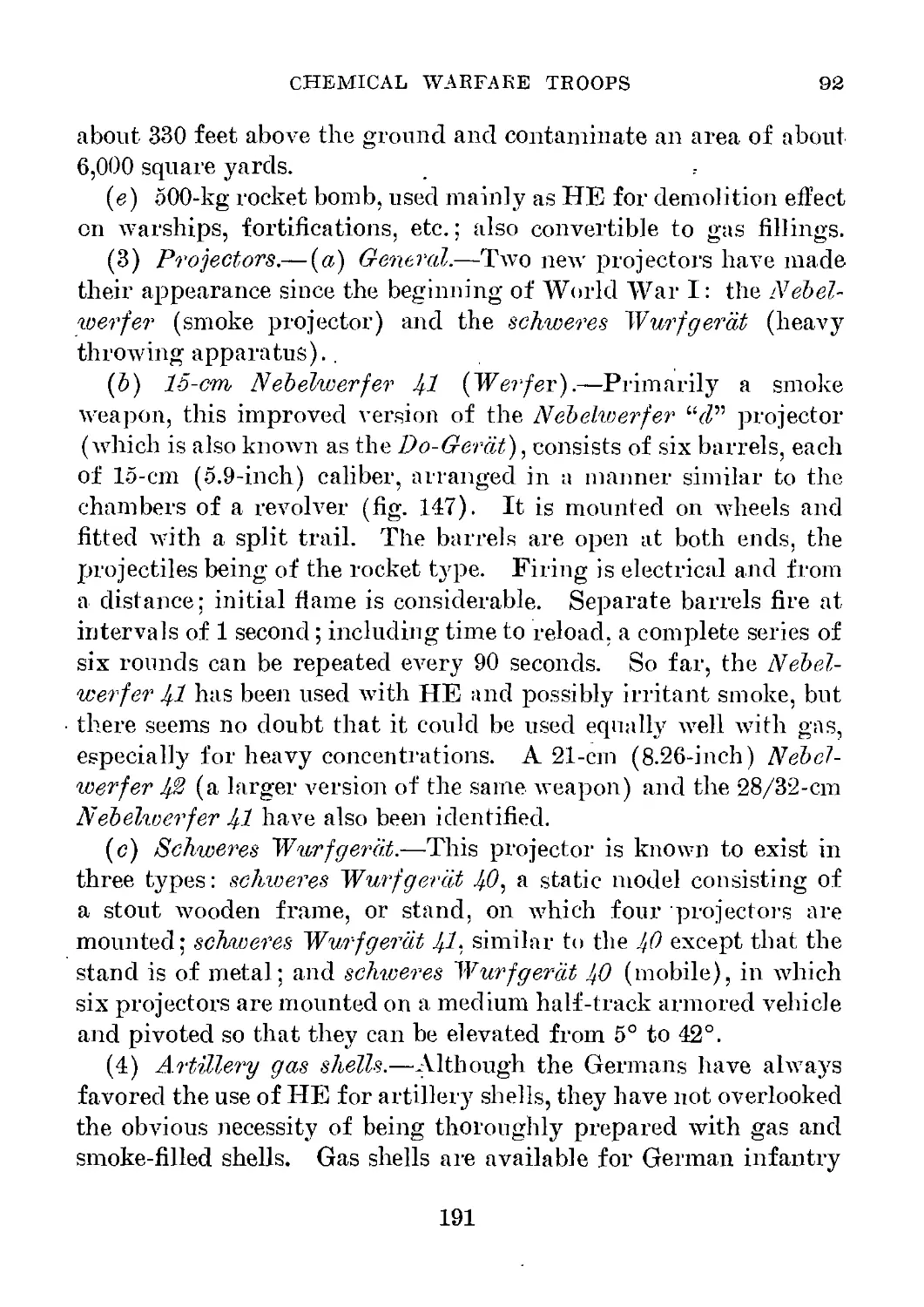
147.	150-mm Nebelwerfer 41 captured in North Africa_____________________ 192
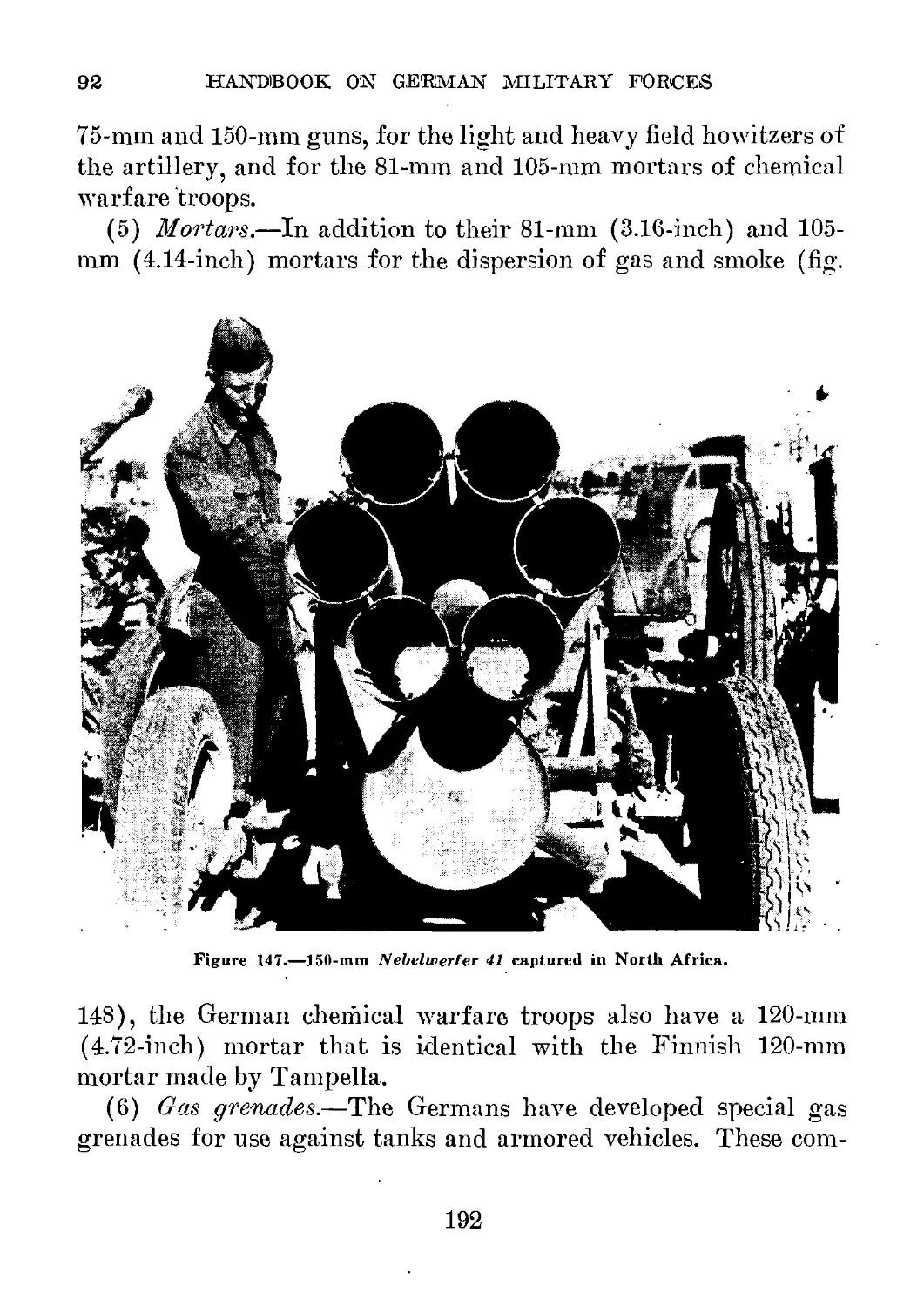
148.	Smoke unit learning to use 105-mm chemical mortars----------------- 193
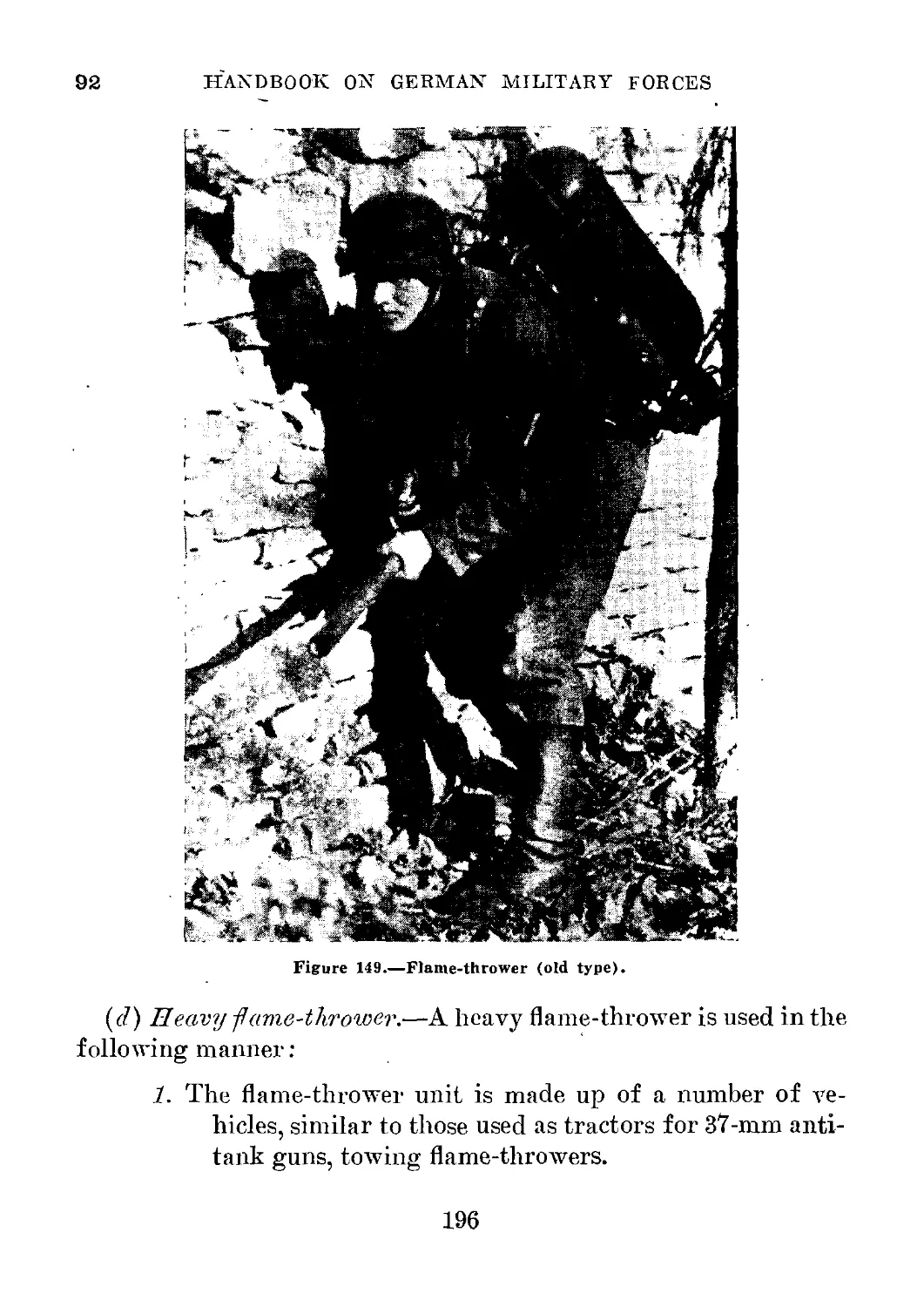
149.	Flame-thrower (old type)___________________________________________ 196
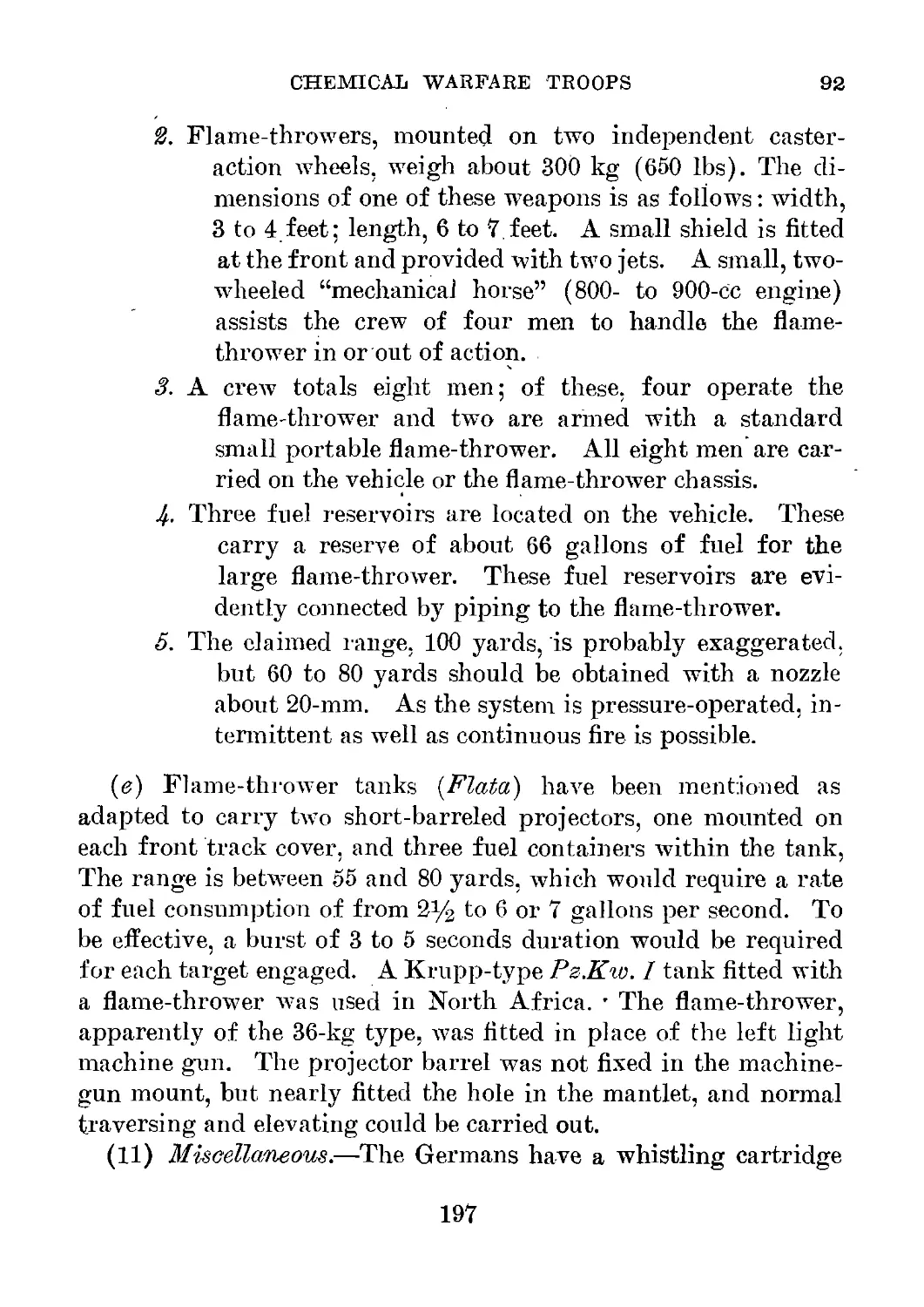
150.	Small-size one-man flame-thrower___________________________________ 198
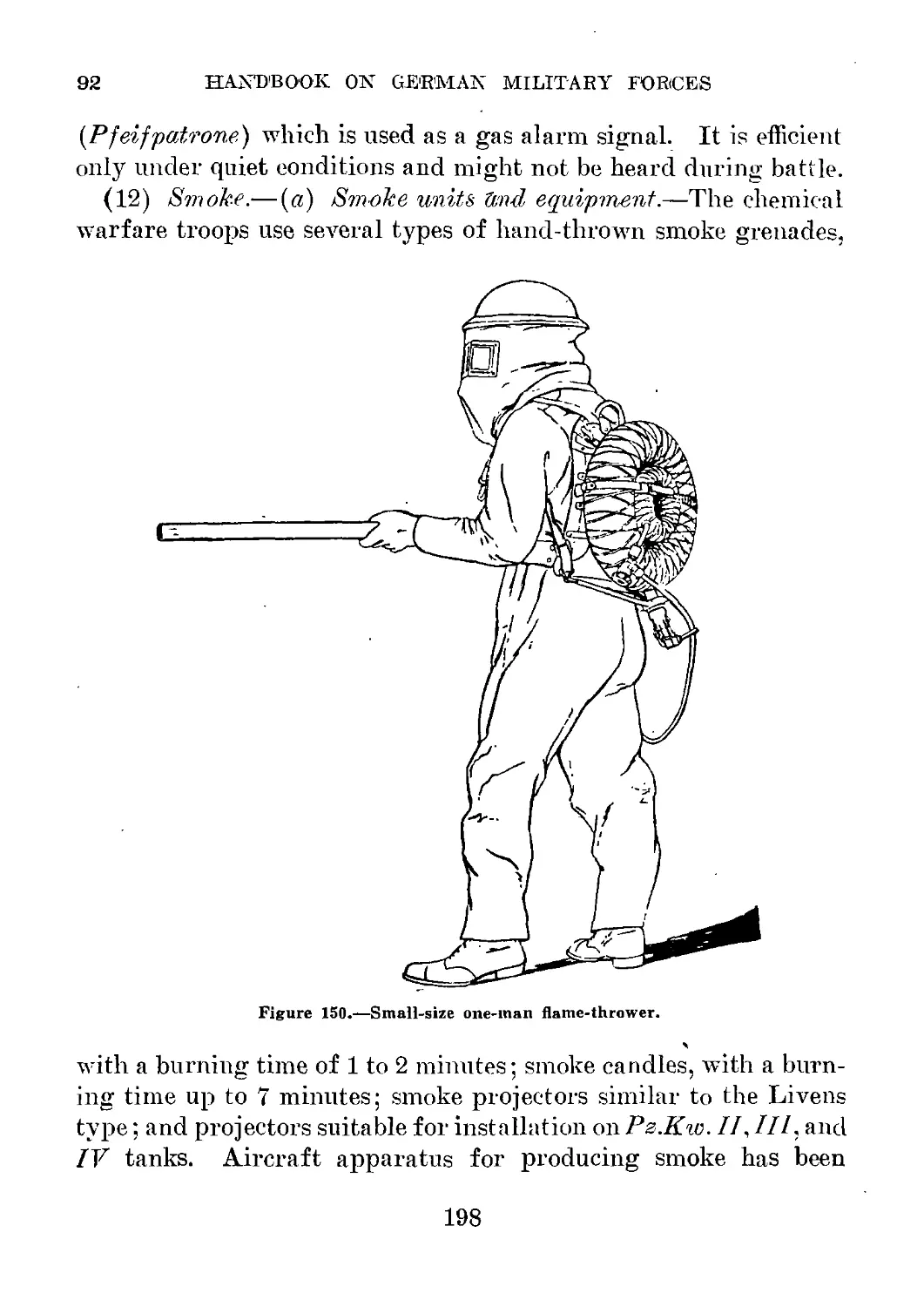
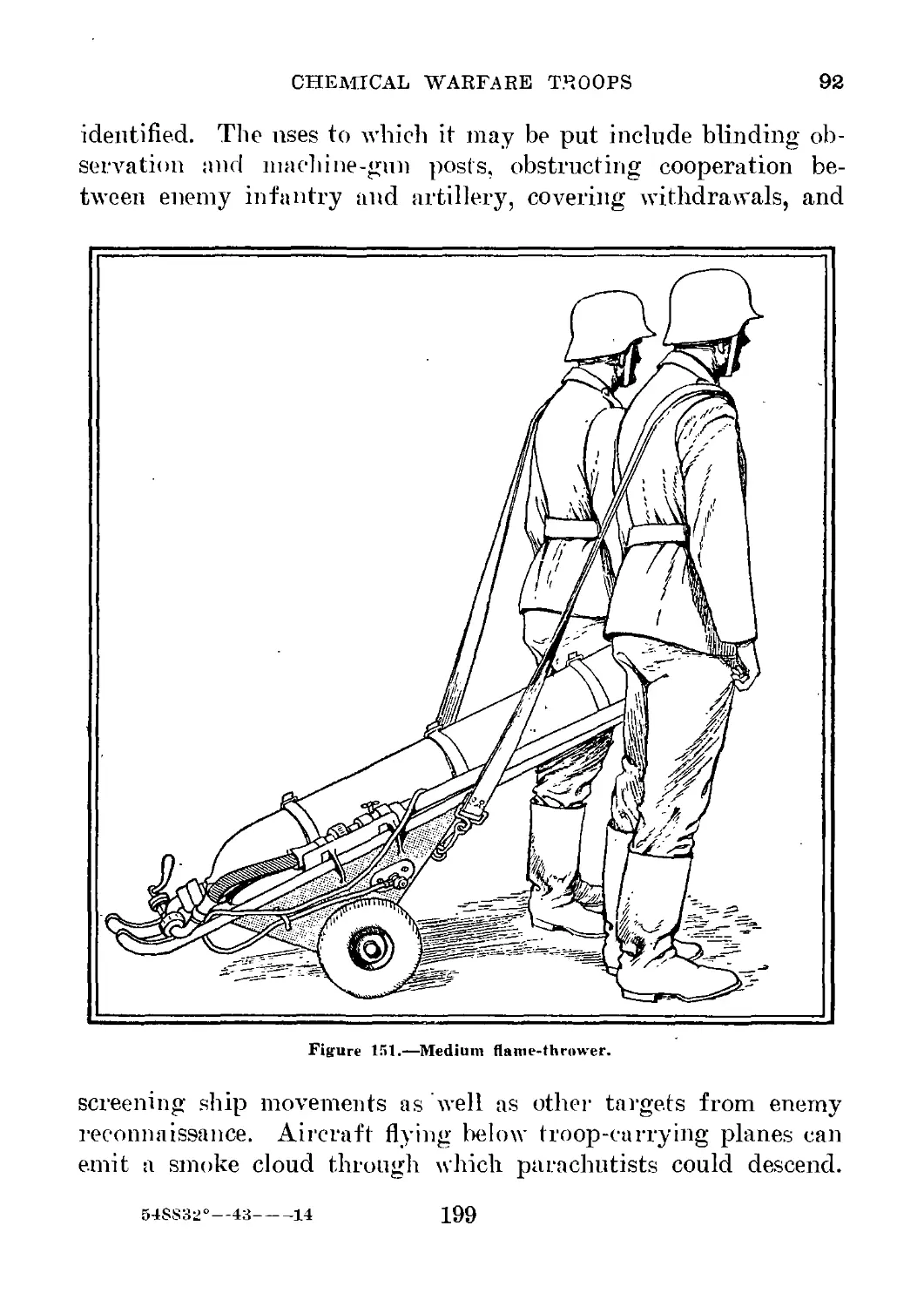
151.	Medium flame-thrower_______________________________________________ 199
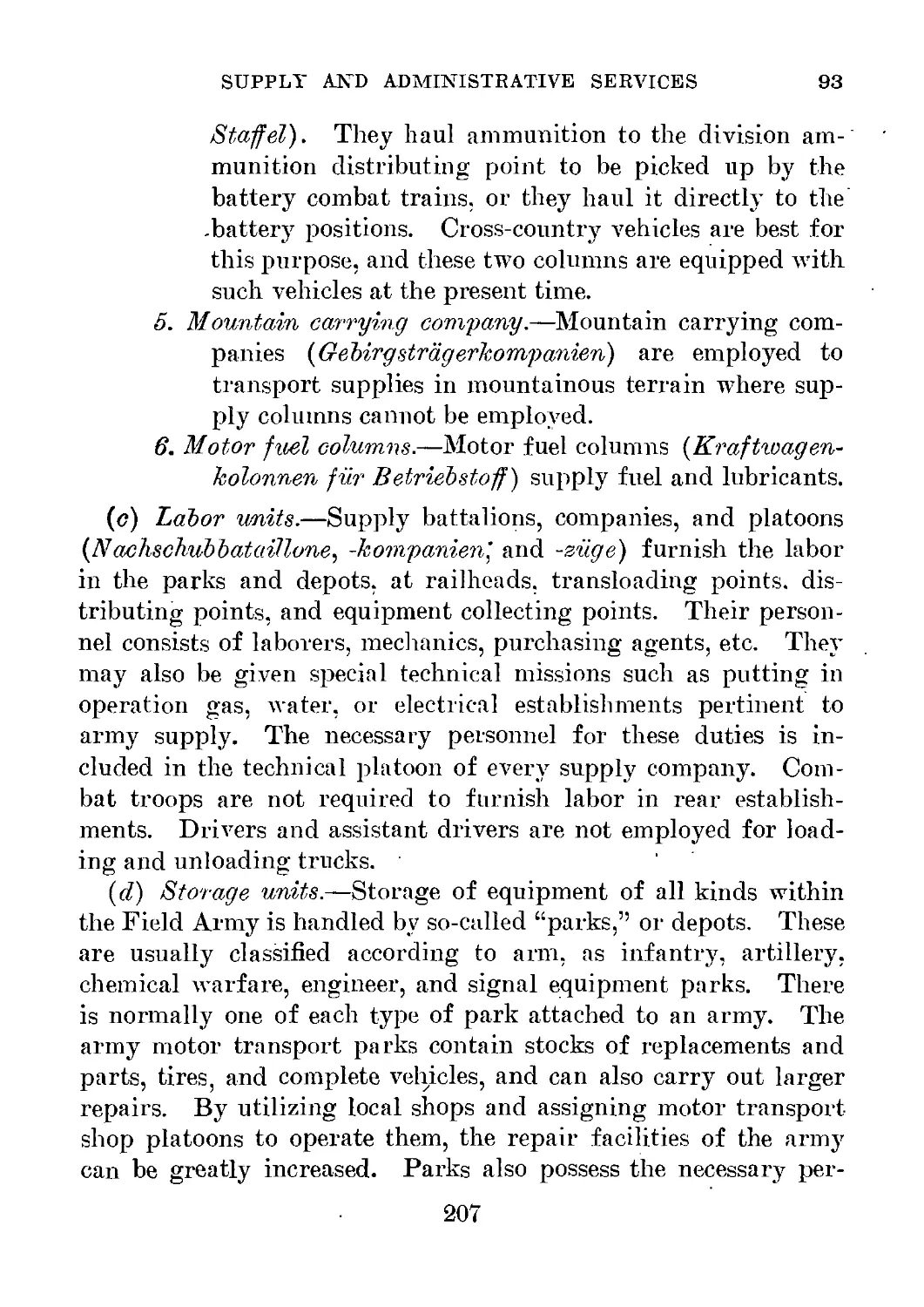
152.	Railroad motor-truck used for transporting supplies to the front. _	209
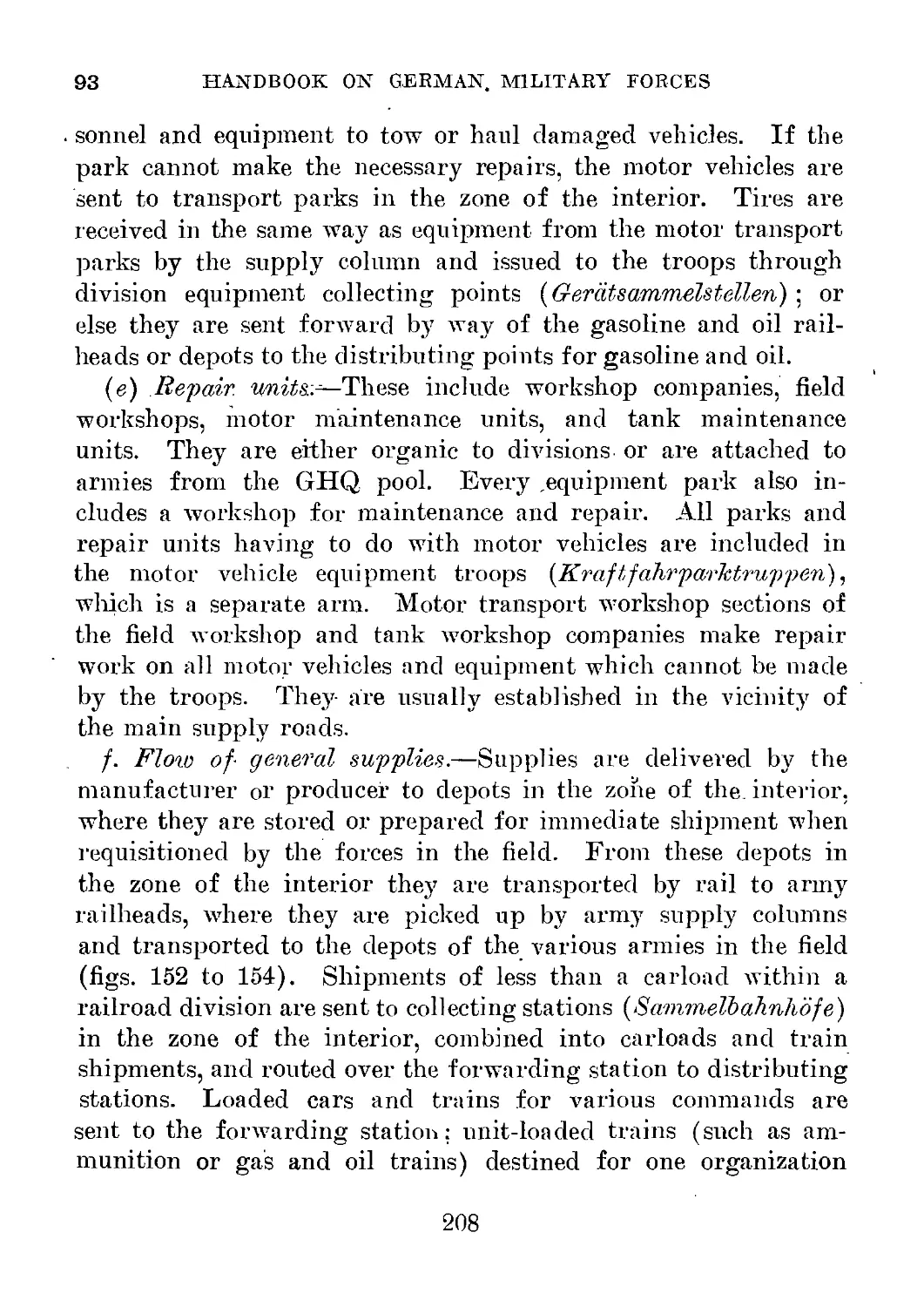
153.	Combat train (horse-drawn)________________________________________  210
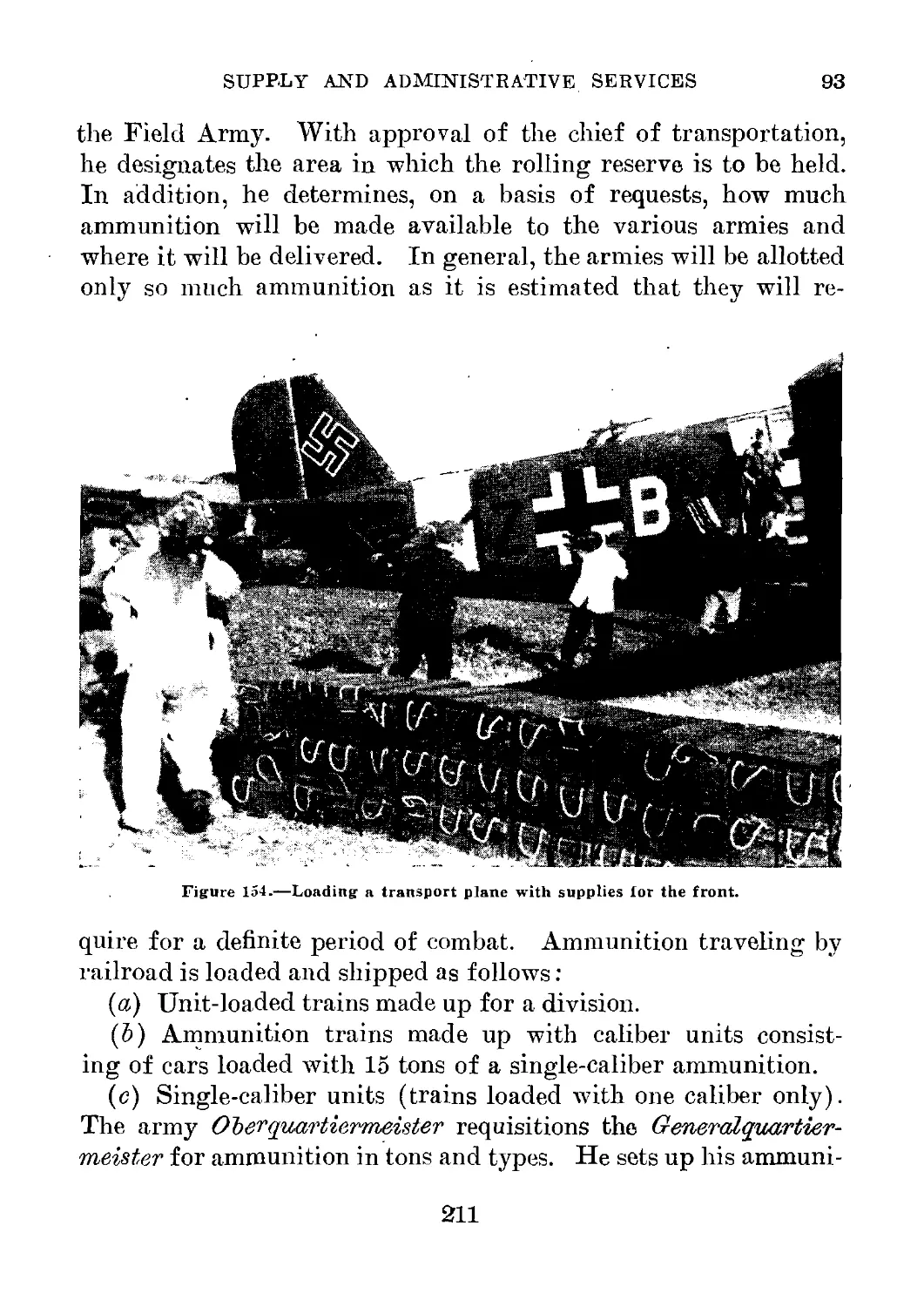
154.	Loading a transport plane with supplies for the front______________ 211
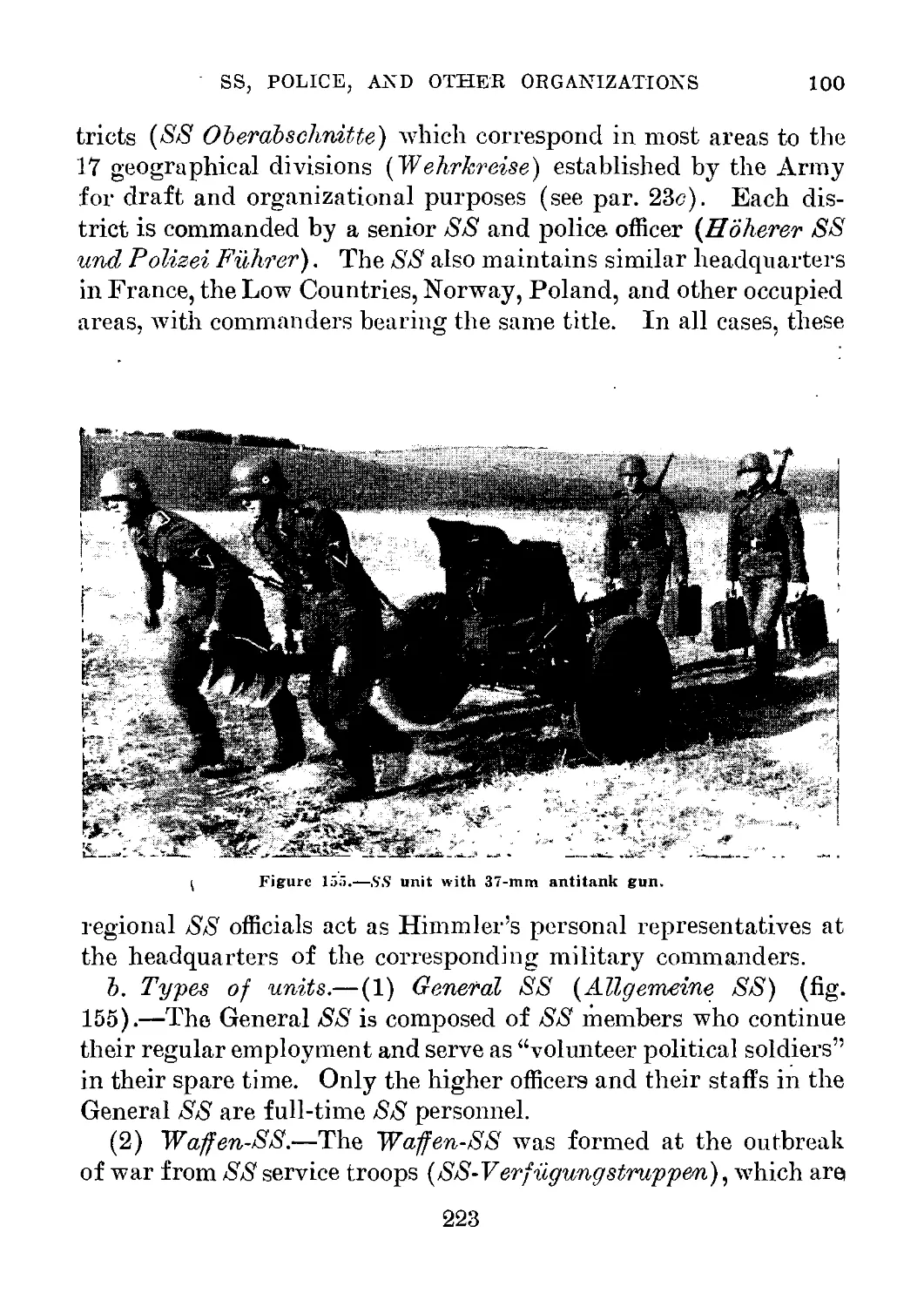
155.	&S unit with 37-mm antitank gun____________________________________ 223
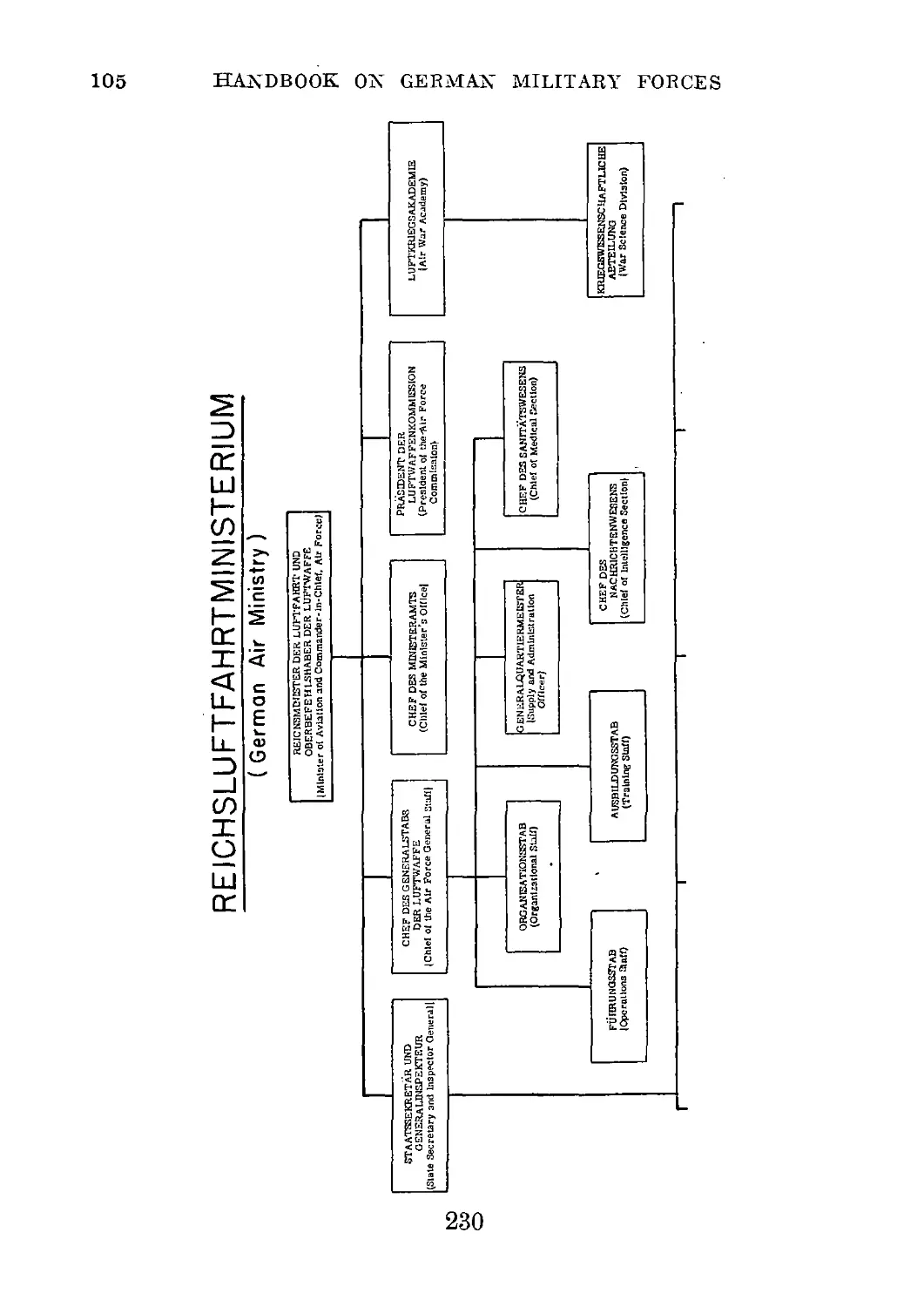
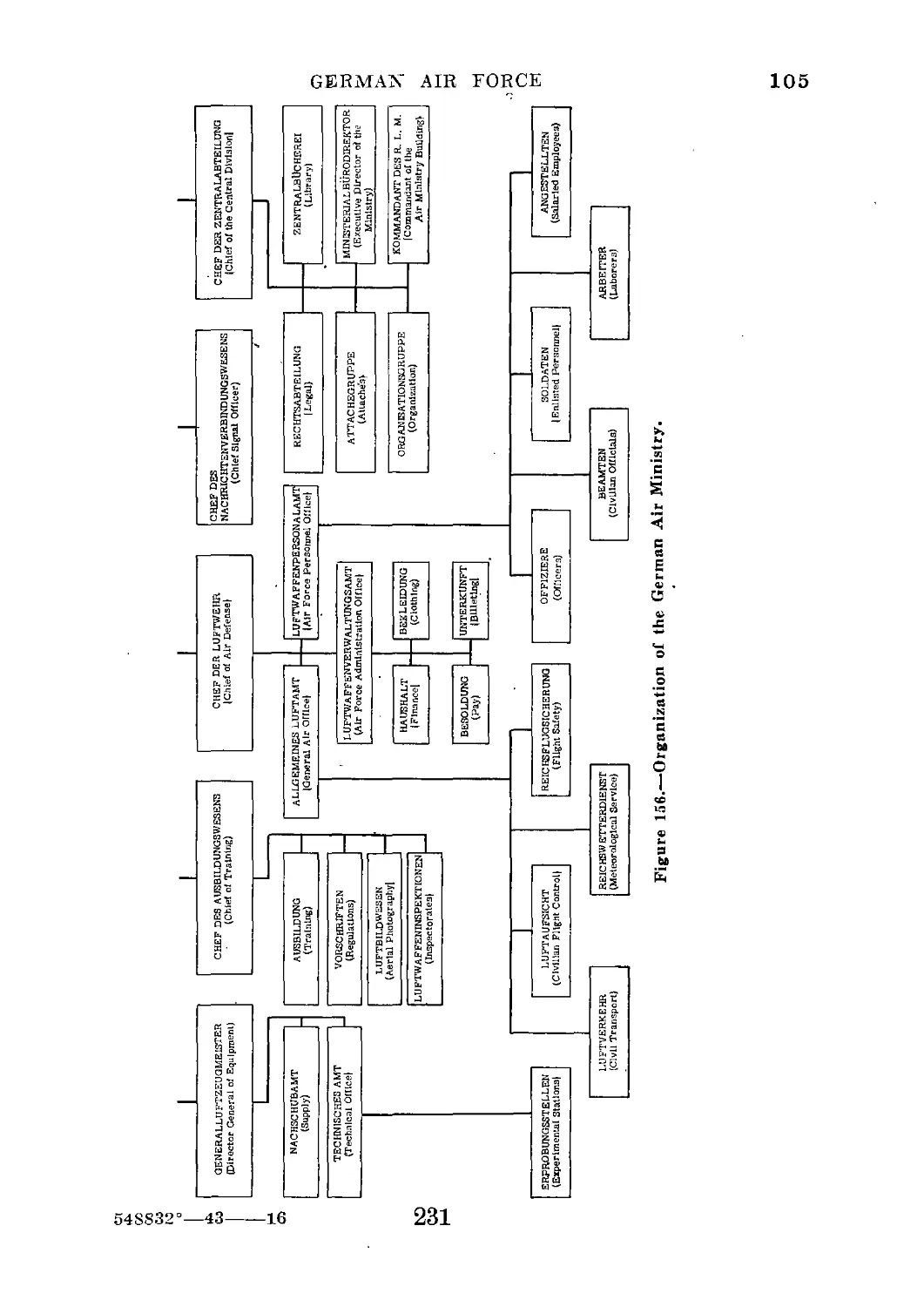
156.	Organization of the German Air Ministry________________________ 230-231
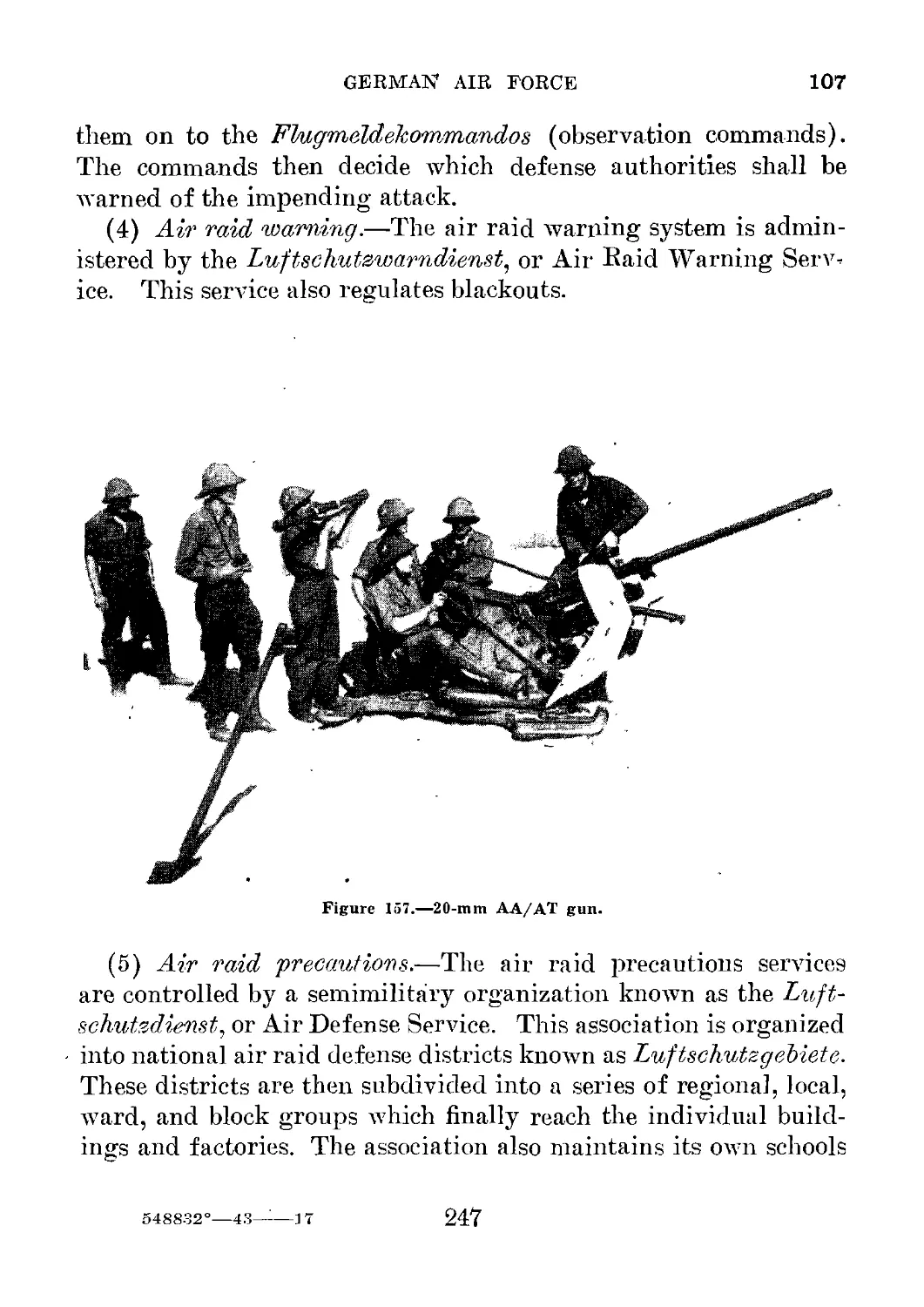
157.	20-mm AA/AT gun____________________________________________________ 247
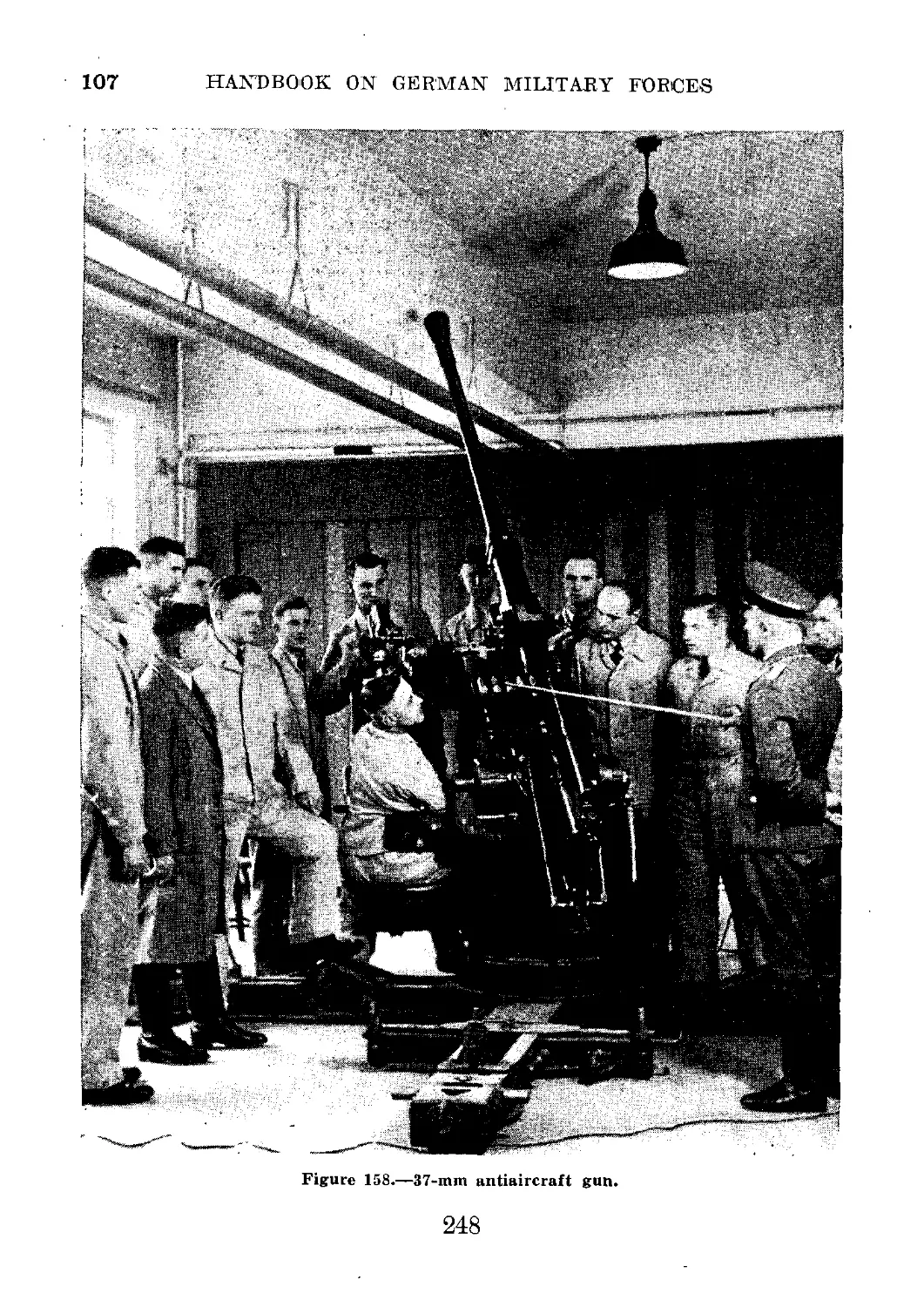
158.	37-mm antiaircraft gun_____________________________________________ 248
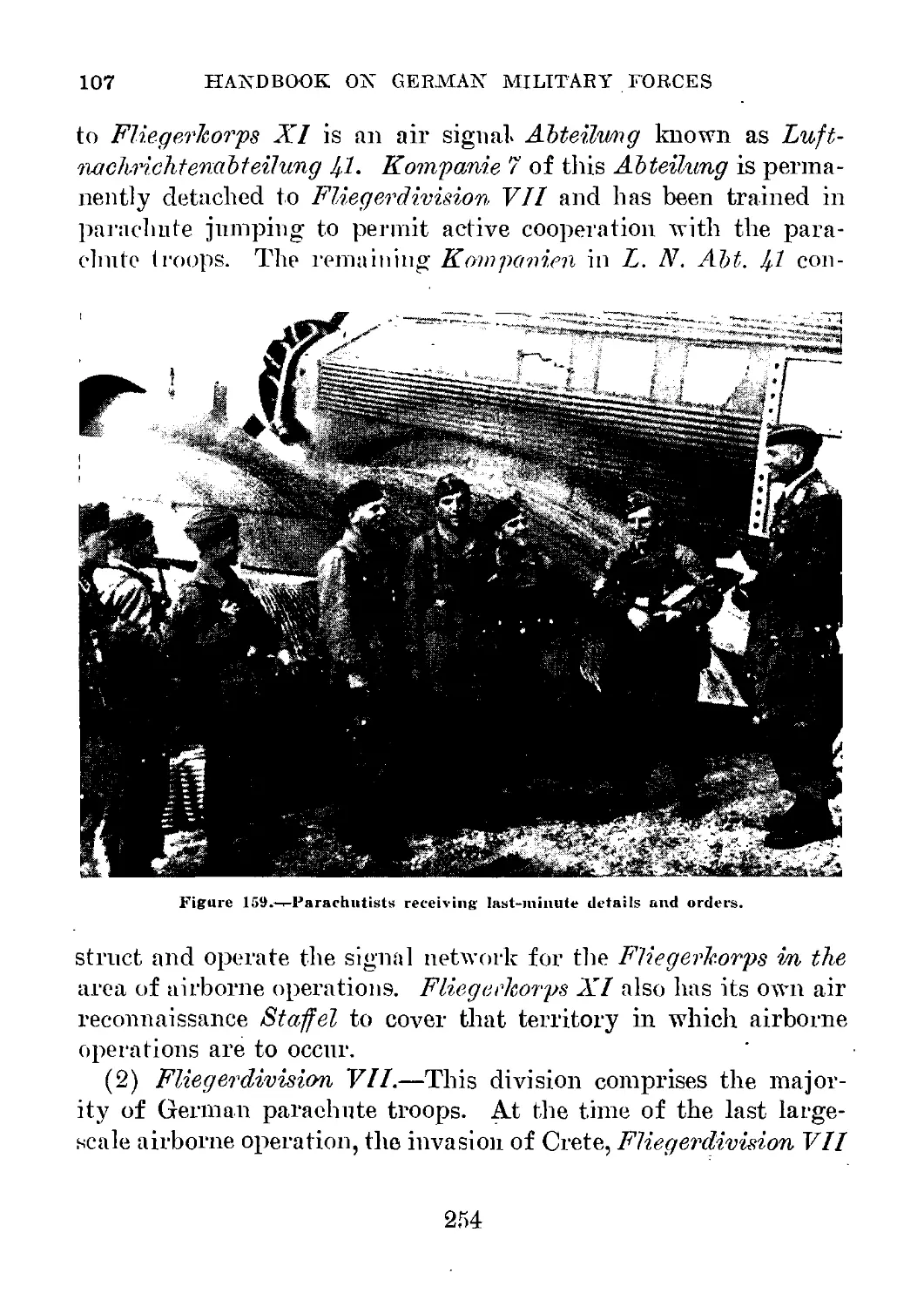
159.	Parachutists receiving last-minute details and orders______________ 254
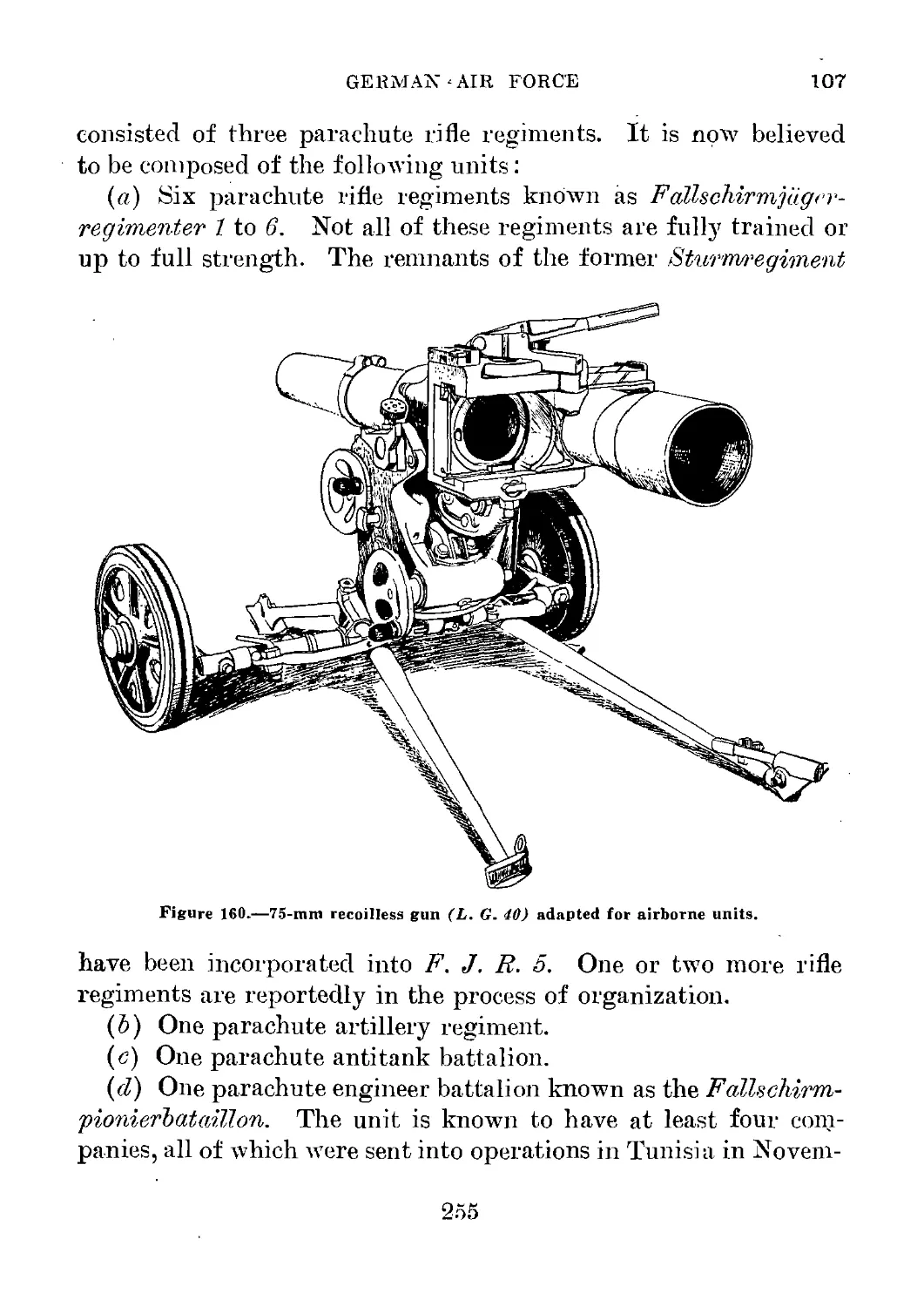
160.	75-mm recoilless gun (L.G. 7fl) adapted for airborne units____	255
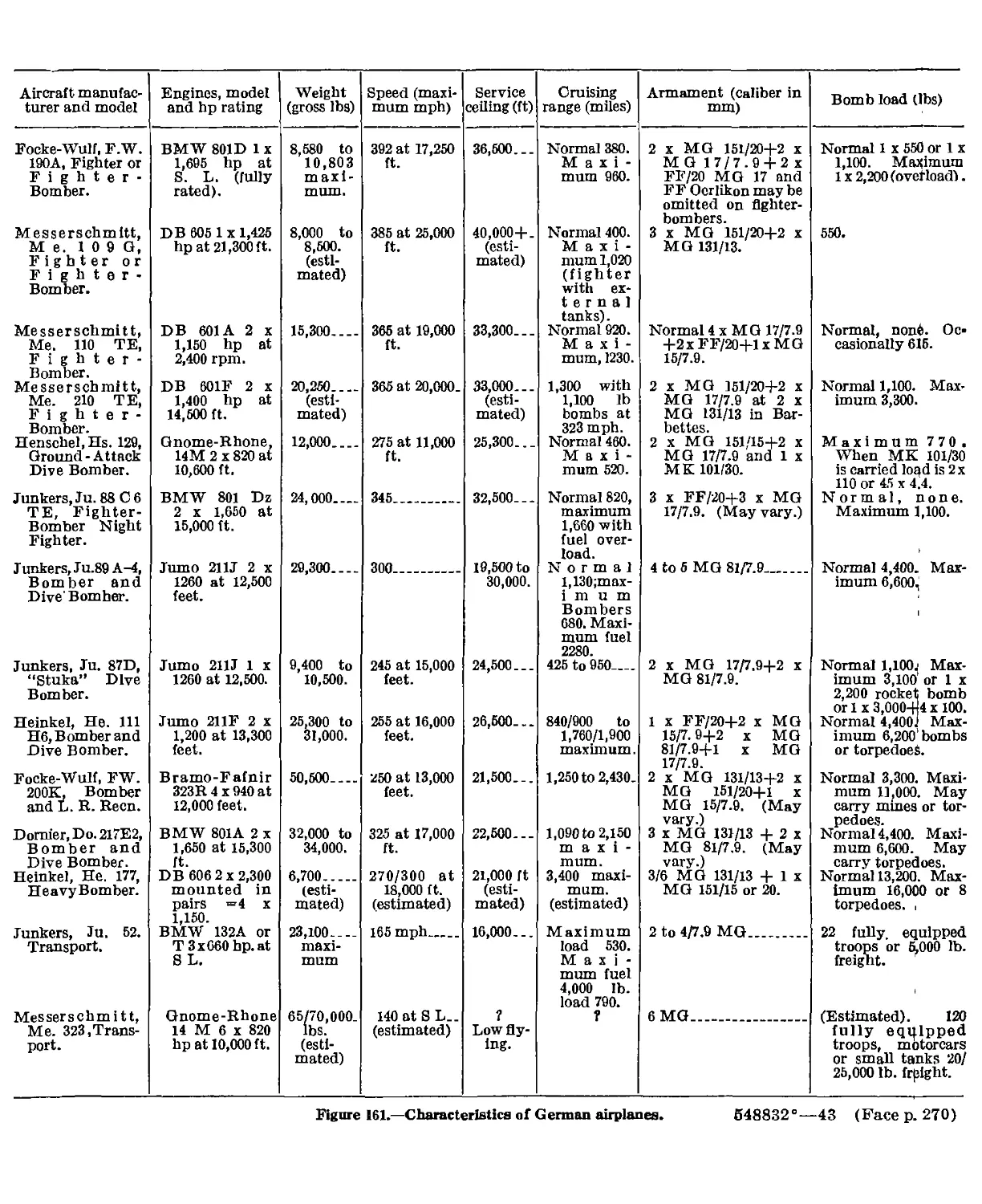
161.	Characteristics of German airplanes______________________faces 270
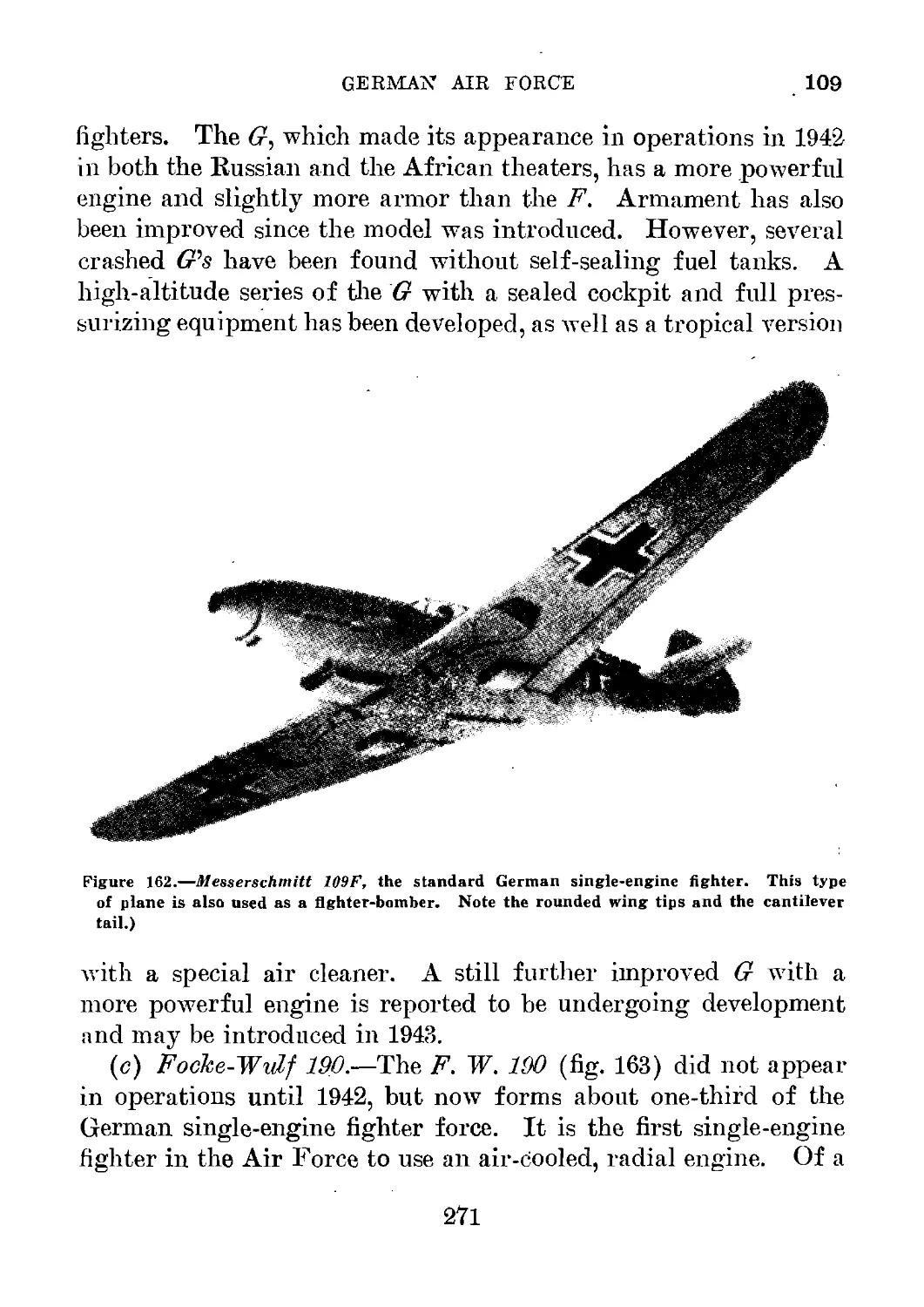
162.	Messerschmitt 109F, the standard German single-engine	fighter. _	271
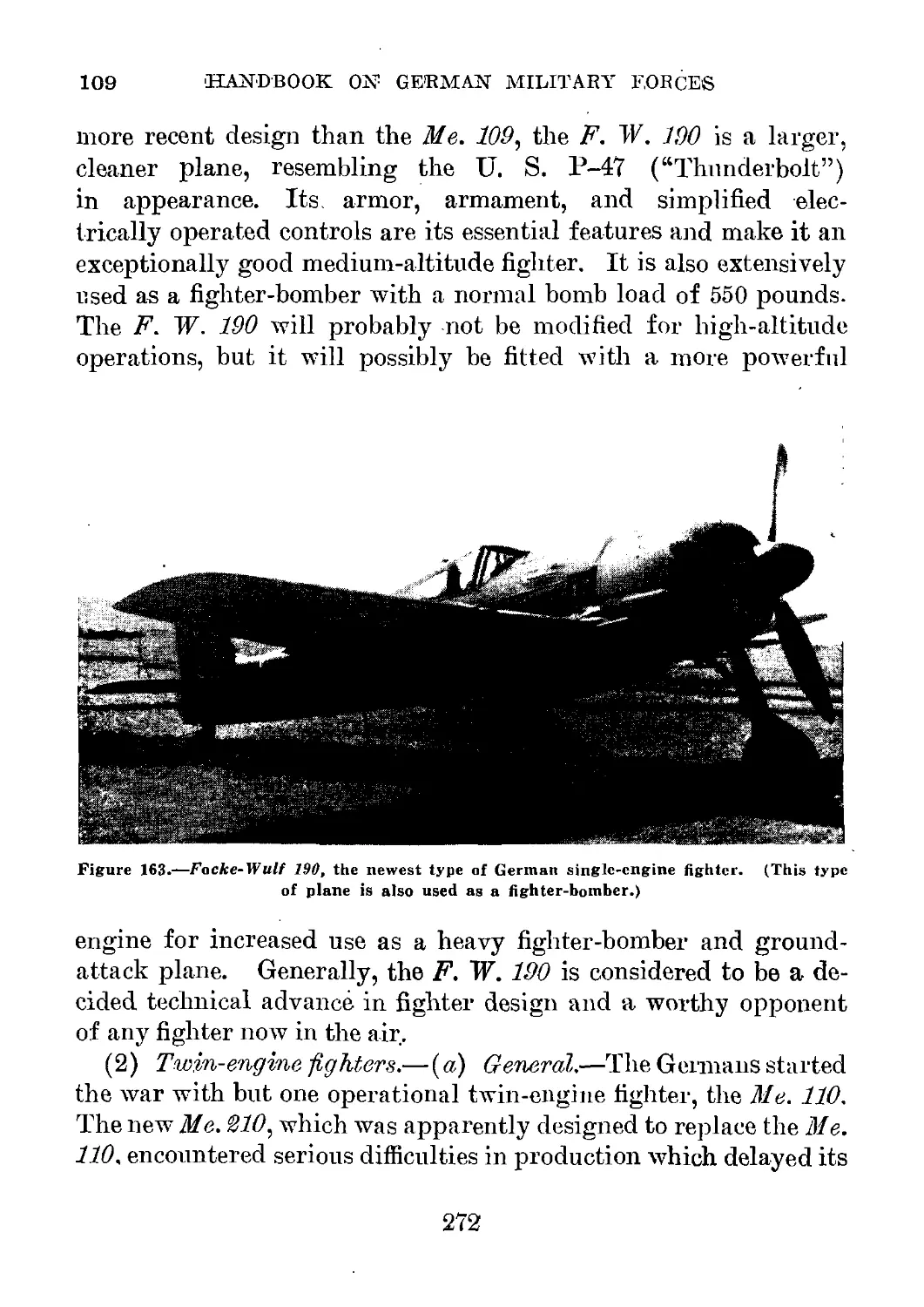
163.	Focke-Wulf 190, the newest type of German single-engine	fighter.	272
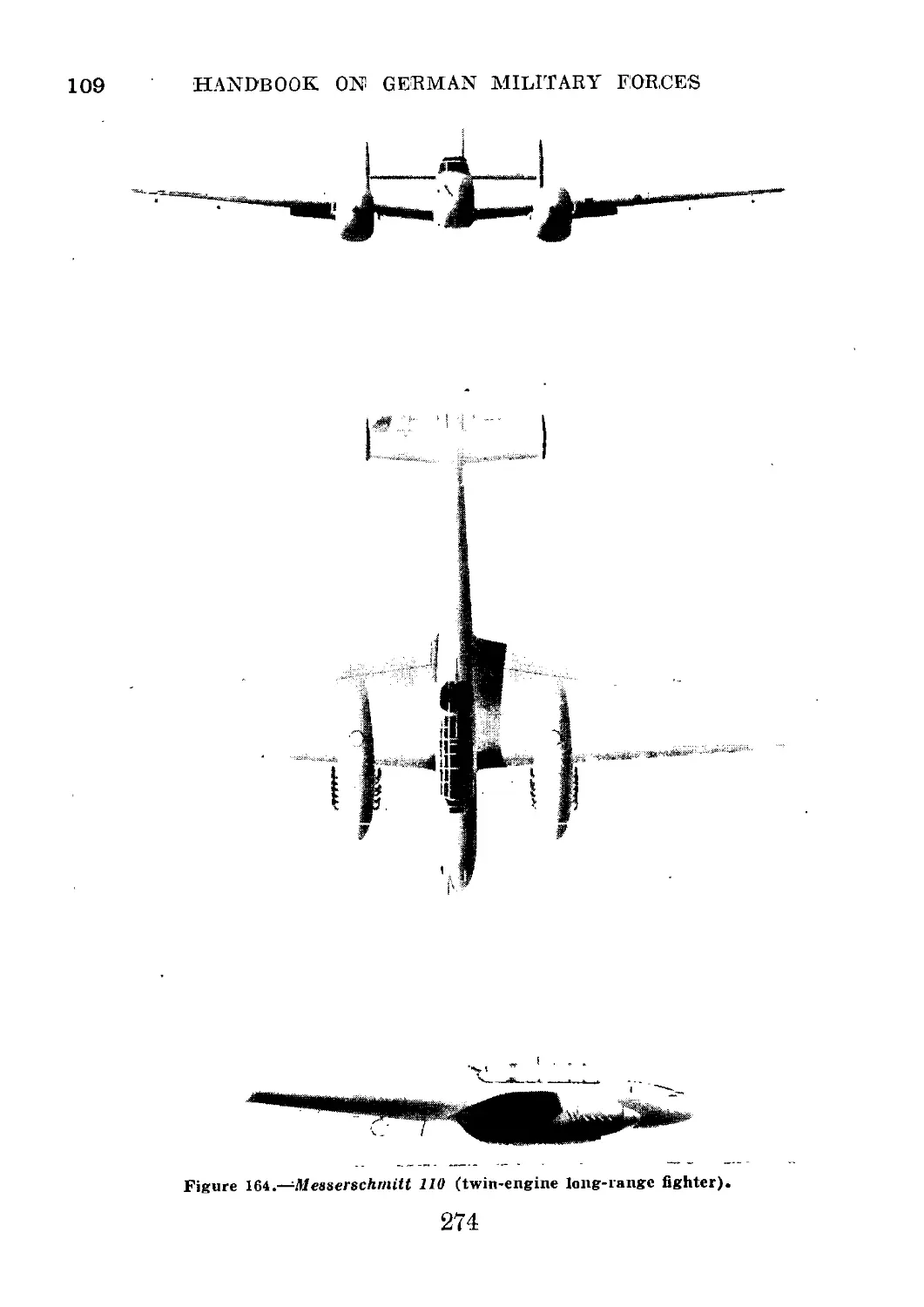
164.	Messerschmitt 110 (twin-engine long-range fighter)_________ 274
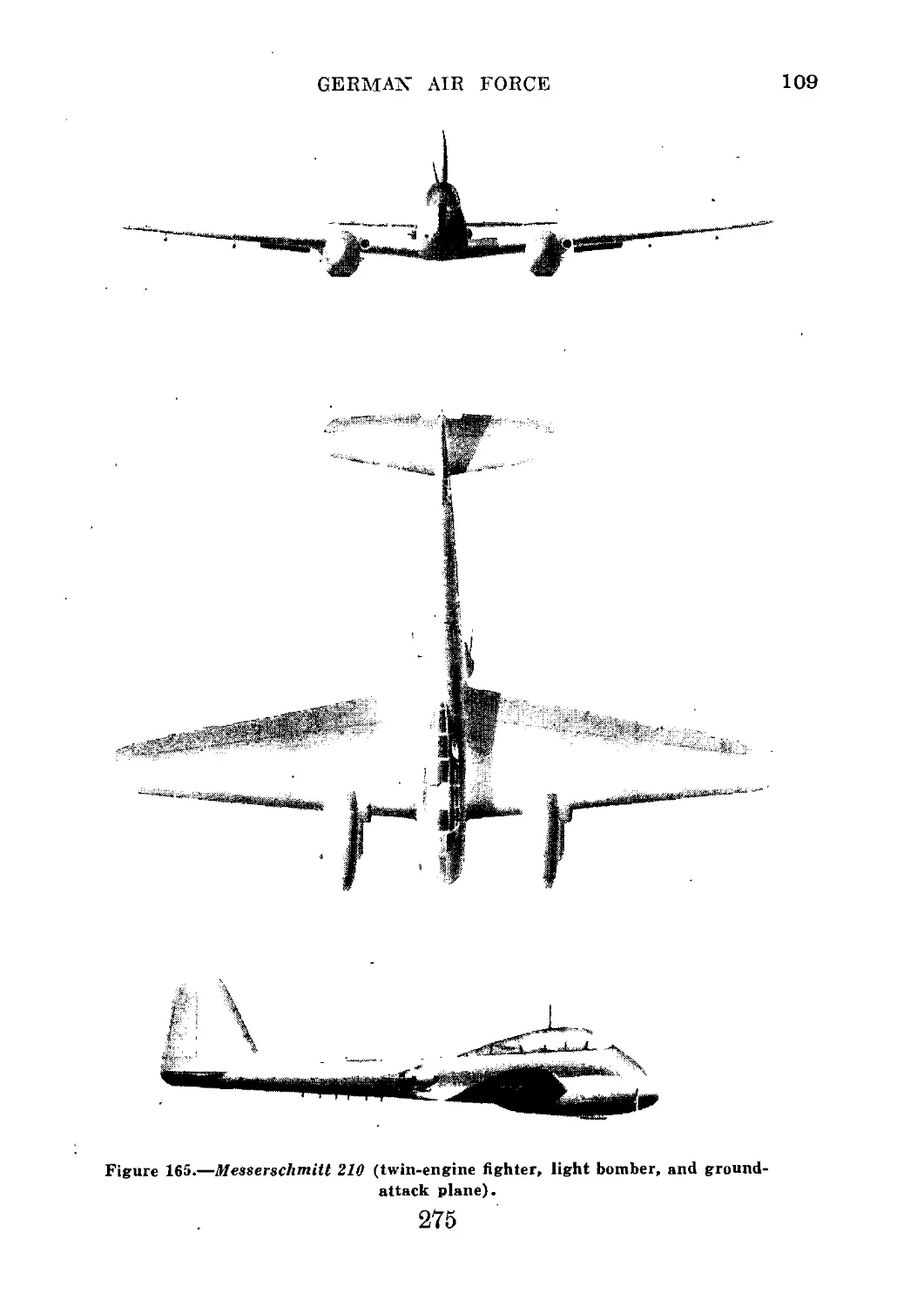
165.	Messerschmitt 210 (twin-engine fighter, light bomber, and ground-
attack plane)___________________________________________________ 275
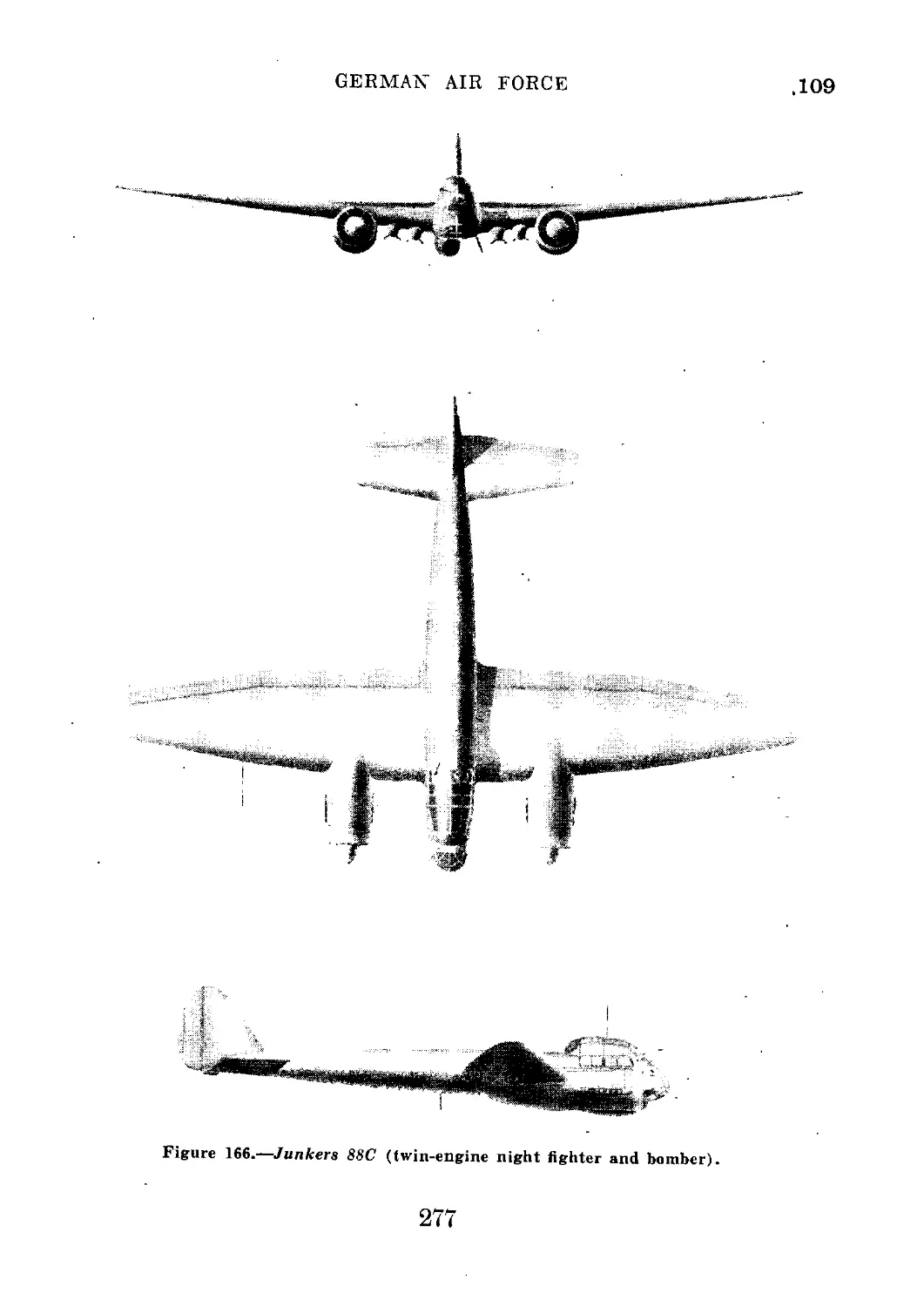
166.	Junkers 88C (twin-engine night fighter and bomber)_________ 277
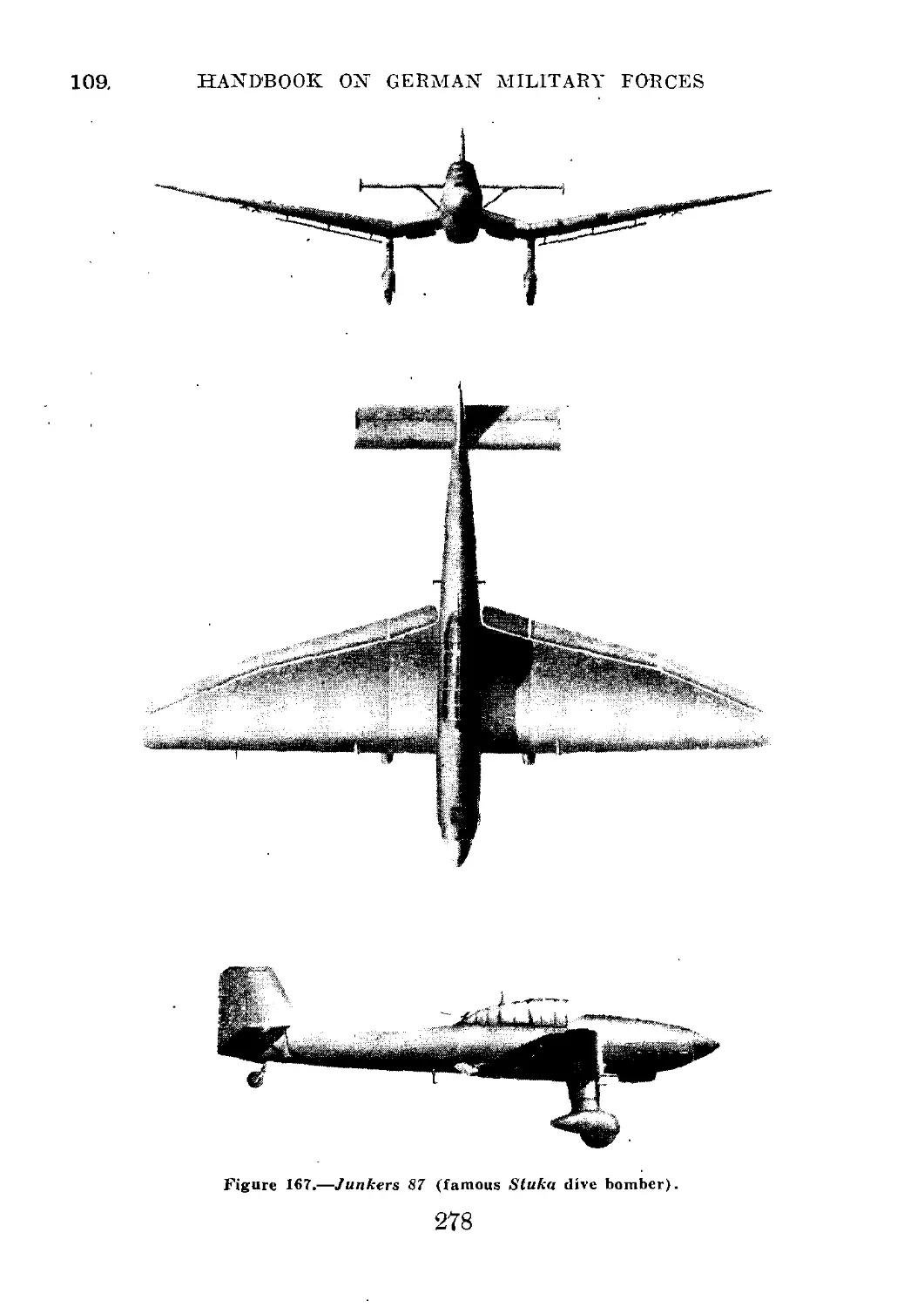
167.	Junkers 87 (famous Stuka dive bomber)______________________ 278
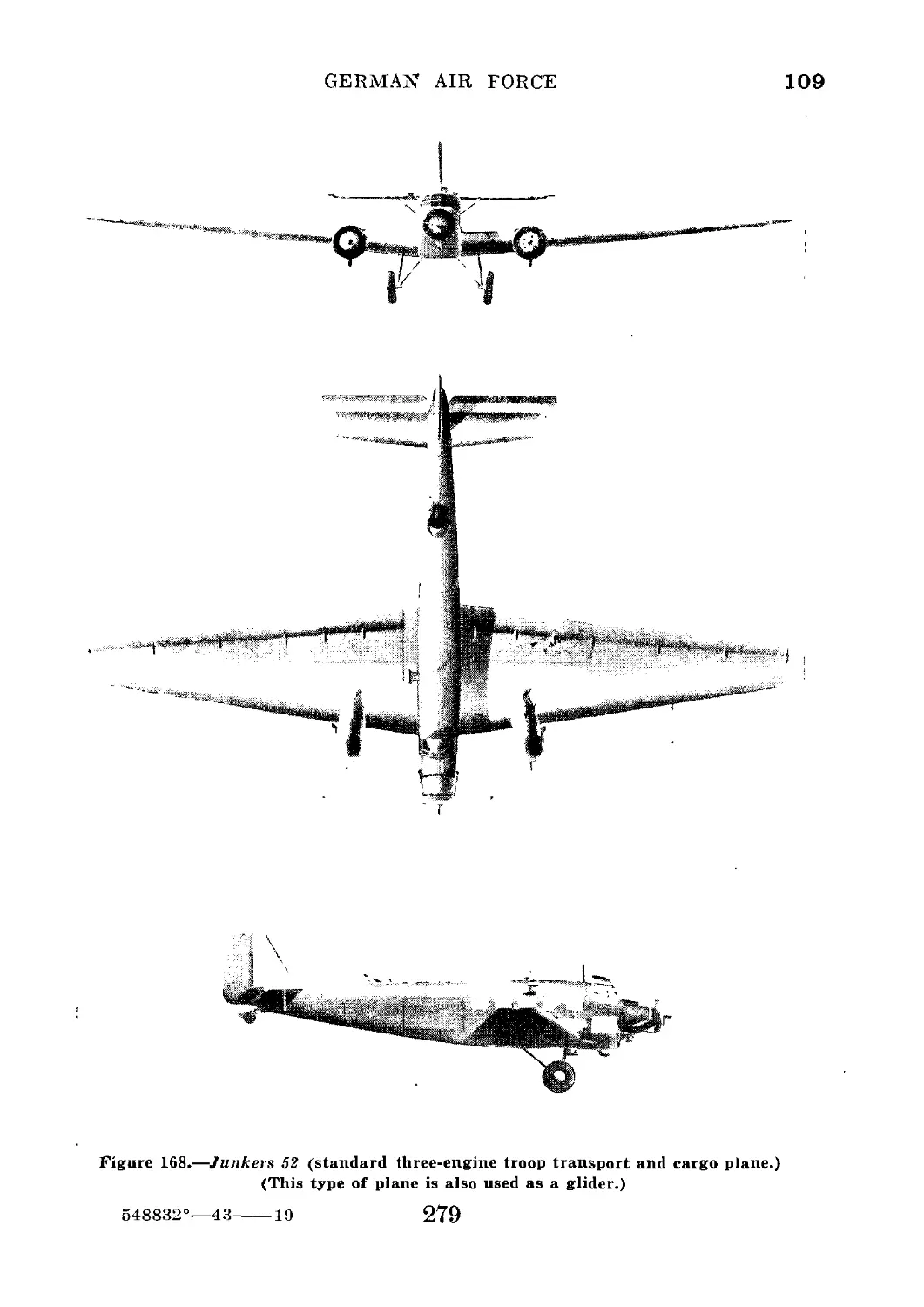
168.	Junkers 52 (standard three-engine troop transport and cargo
plane)________________________________________________________________ 279
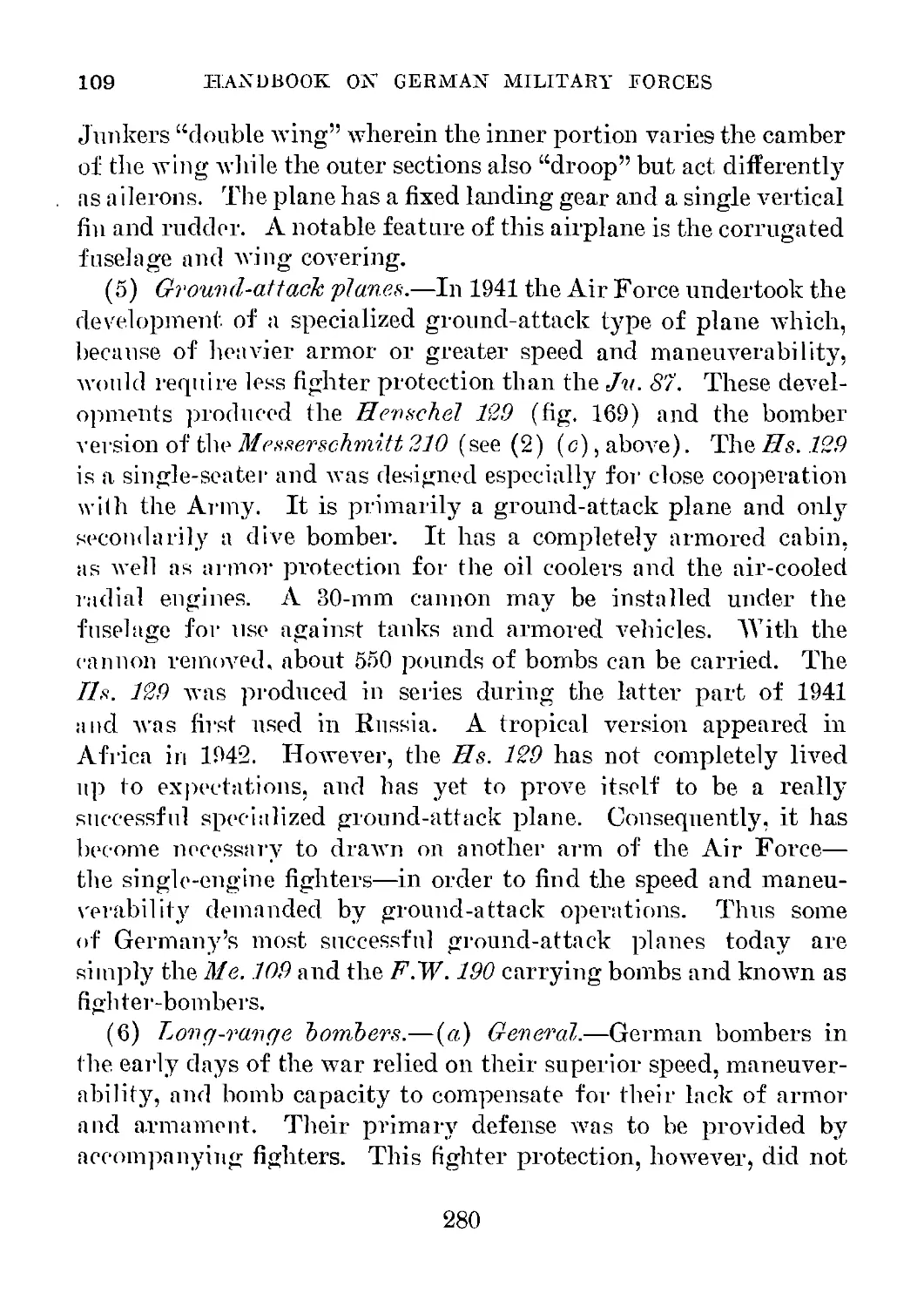
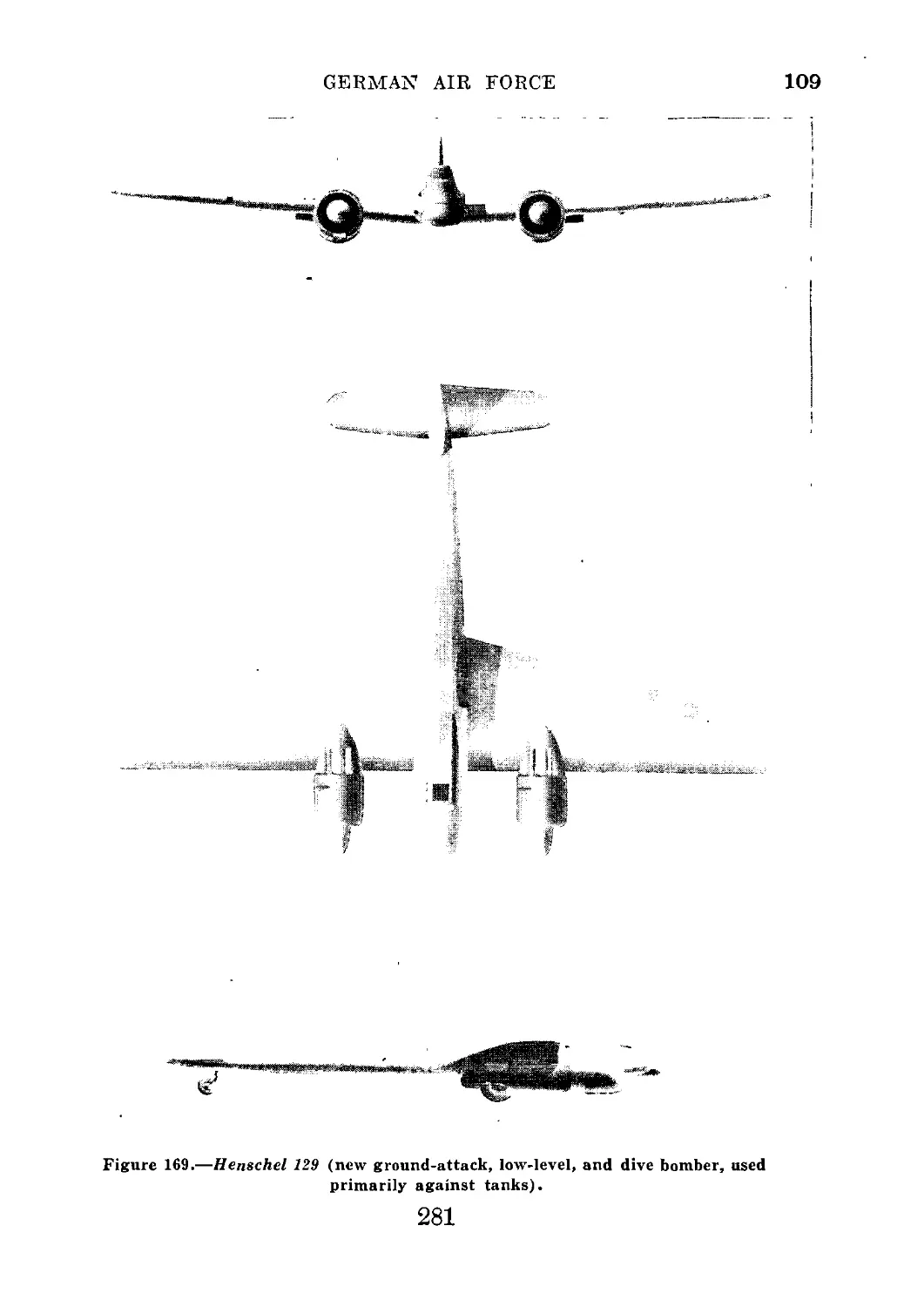
169.	Henschel 129 (new ground-attack, low-level, and dive bomber,
used primarily against tanks)_________________________________________ 281
170.	Heinkel 111	(twin-engine medium	bomber)___________________________ 283
171.	Dornier 217	(twin-engine heavy	bomber)____________________________ 285
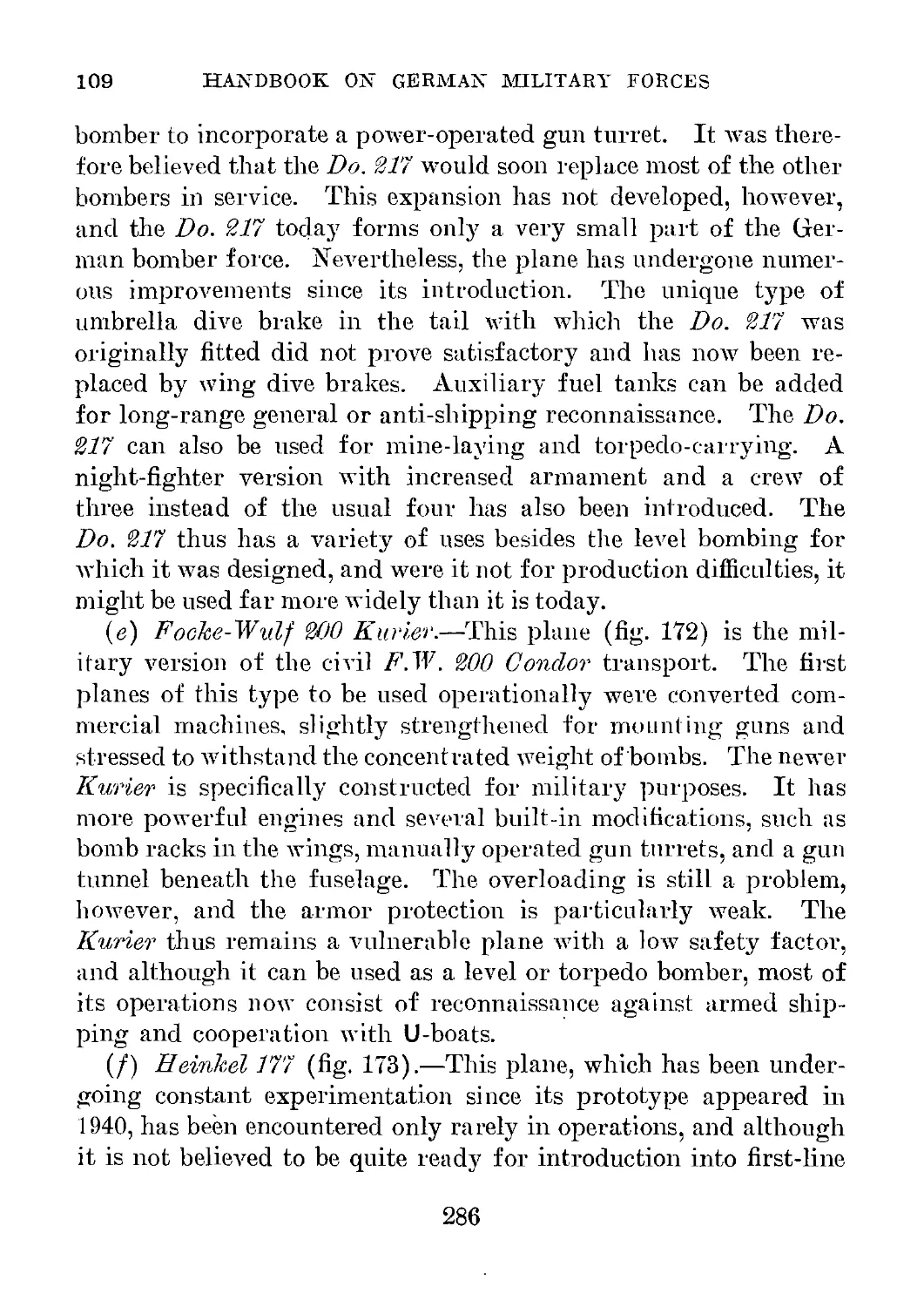
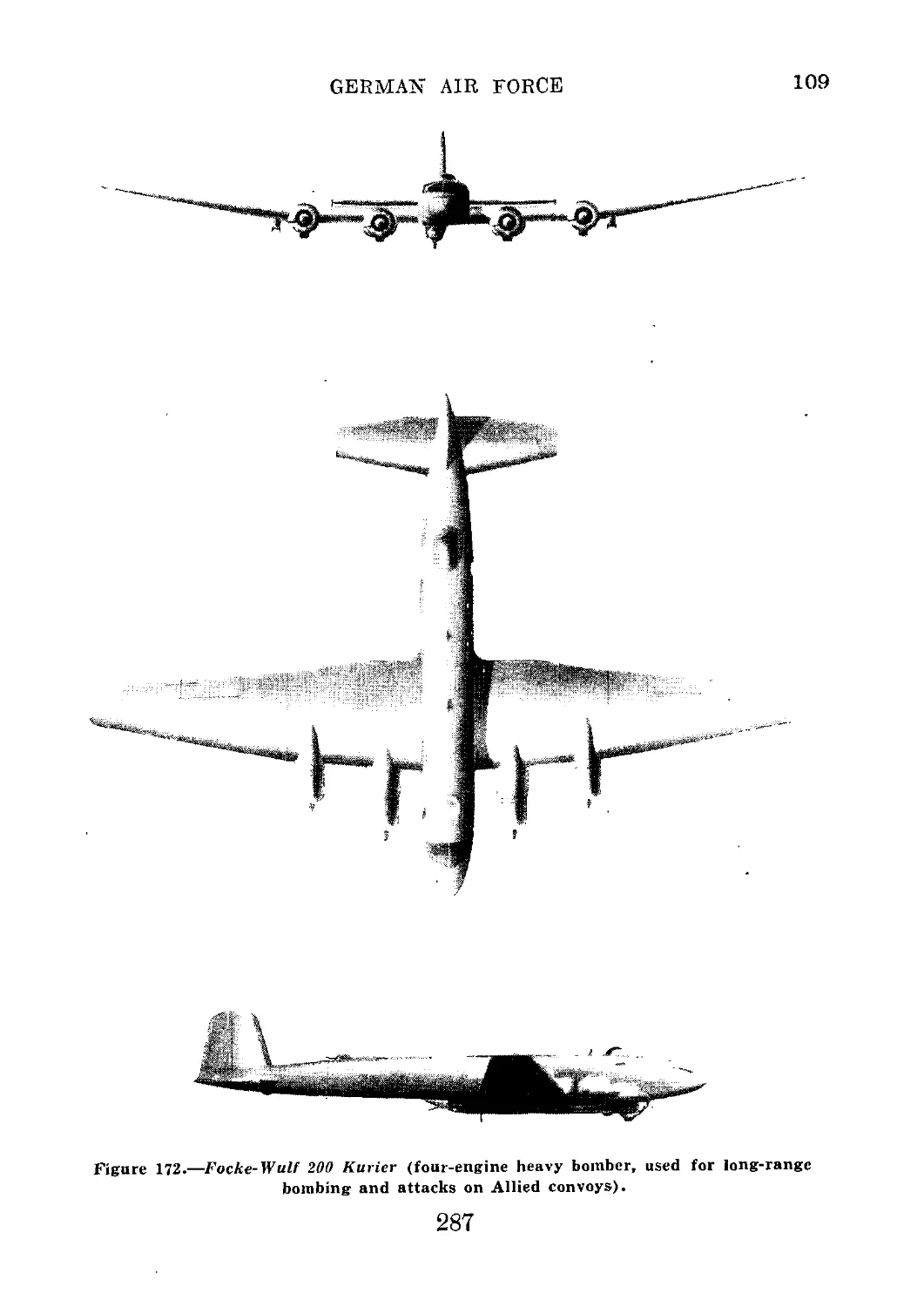
172.	Focke-Wulf 200 Kurier (four-engine heavy bomber, used for
long-range bombing and attacks on Allied convoys)____________ 287
VIII
LIST OF ILLUSTRATIONS
Figure	Page
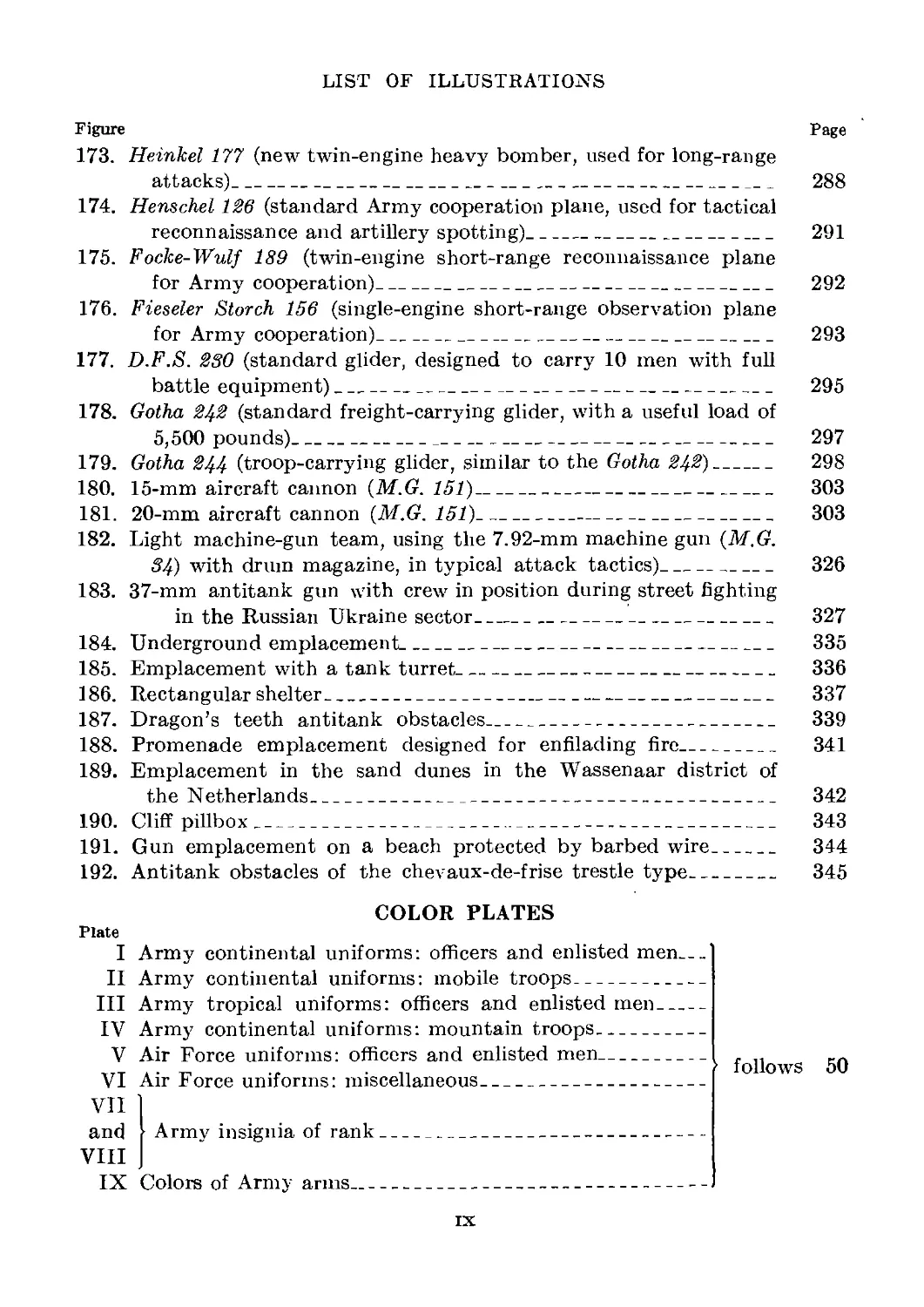
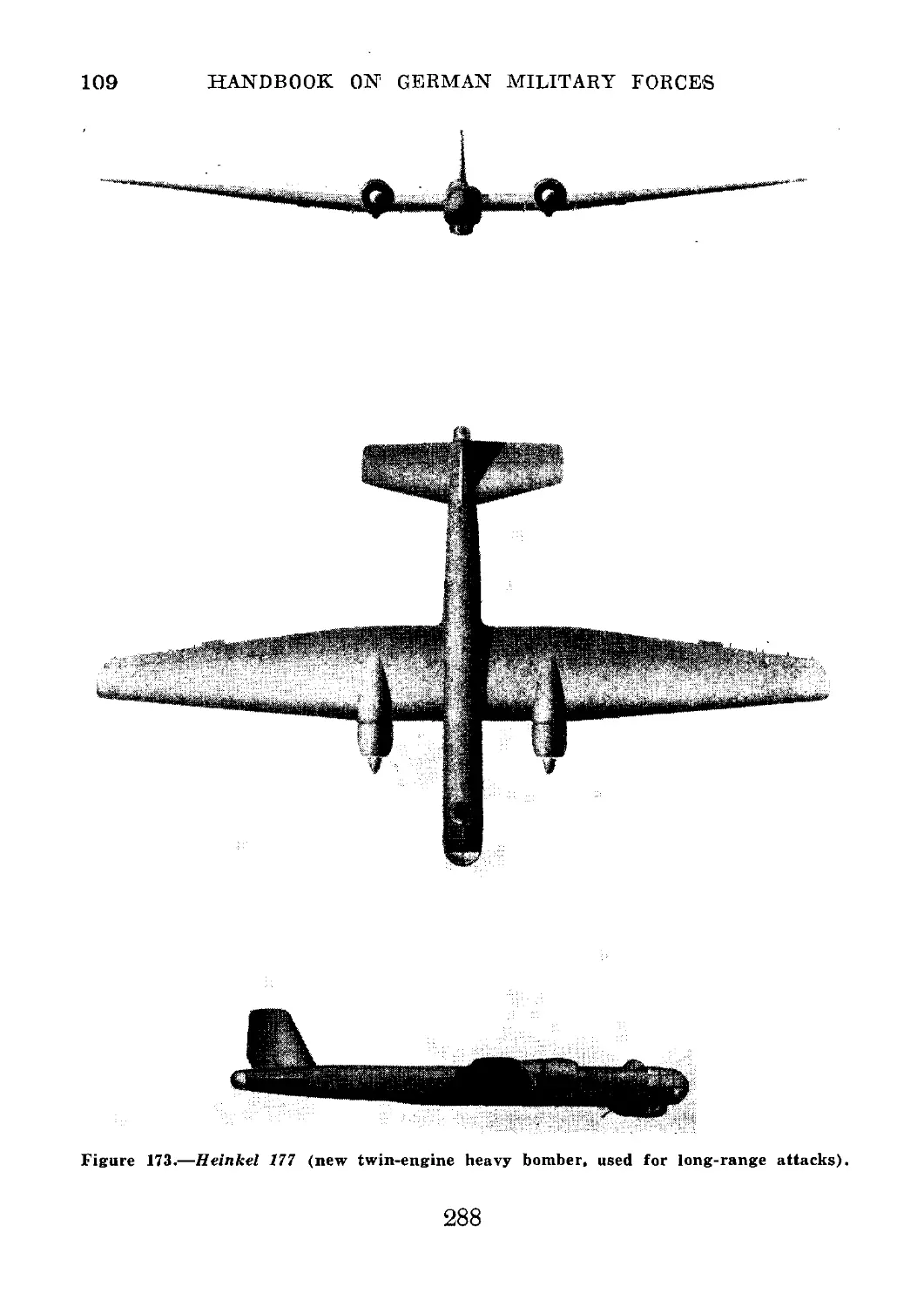
173.	Heinkel 177 (new twin-engine heavy bomber, used for long-range
attacks)__________________________________________________________ 288
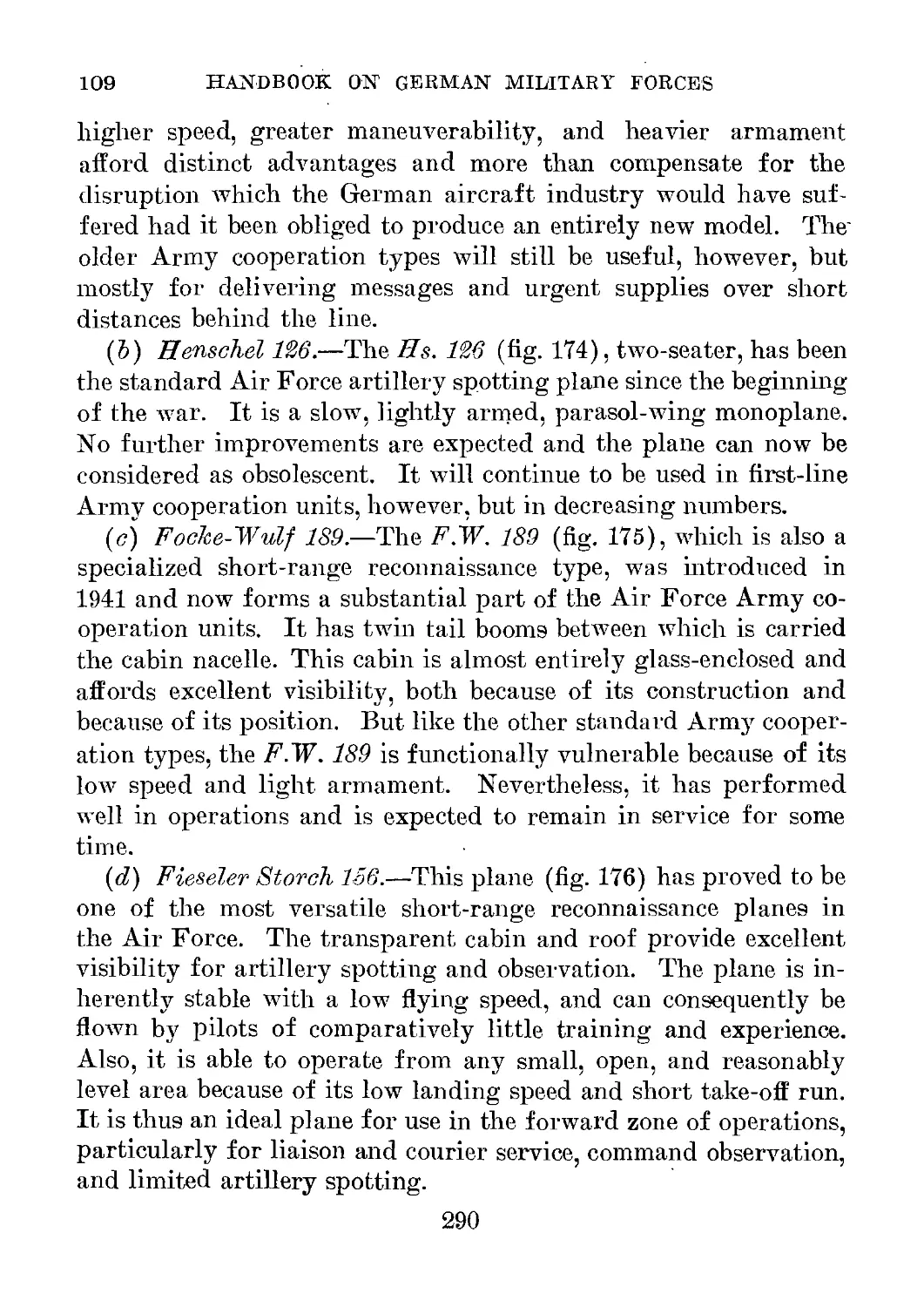
174.	Henschel 126 (standard Army cooperation plane, used for tactical
reconnaissance and artillery spotting)____________________________ 291
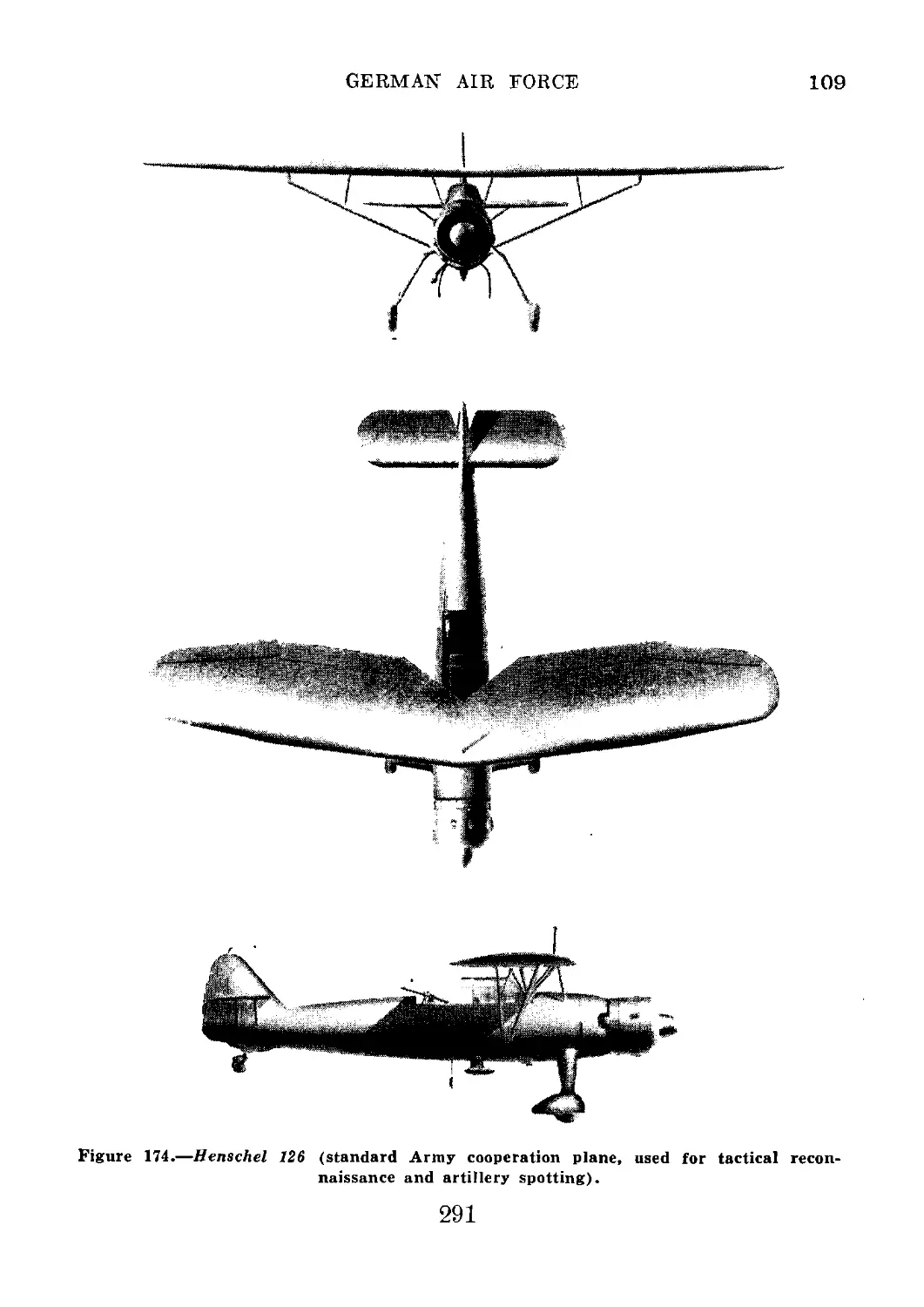
175.	Focke-Wulf 189 (twin-engine short-range reconnaissance plane
for Army cooperation)_____________________________________________ 292
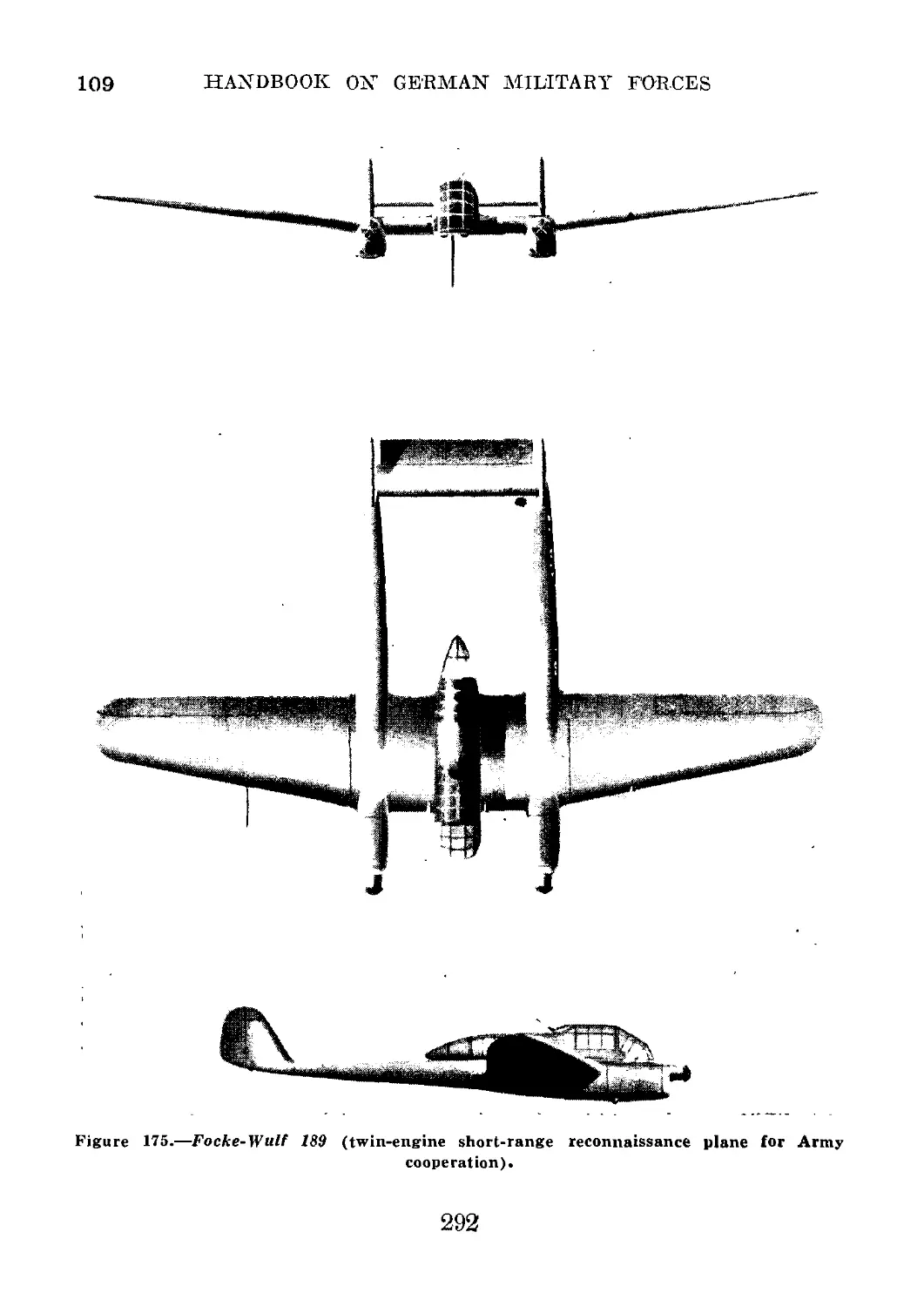
176.	Fieseler Storch 156 (single-engine short-range observation plane
for Army cooperation)_____________________________________________ 293
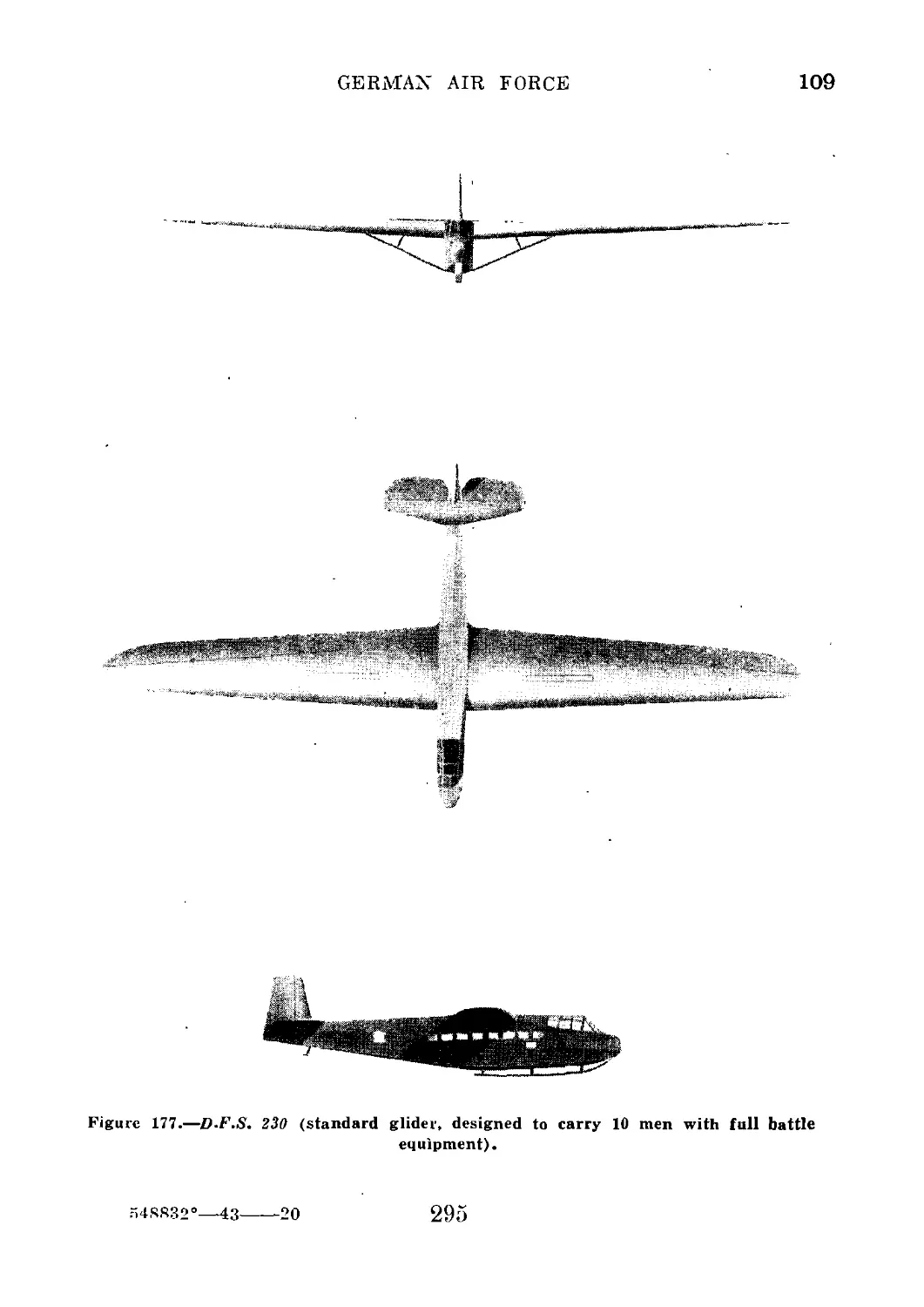
177.	D.F.S. 230 (standard glider, designed to carry 10 men with full
battle equipment)___________________________________________________ 295
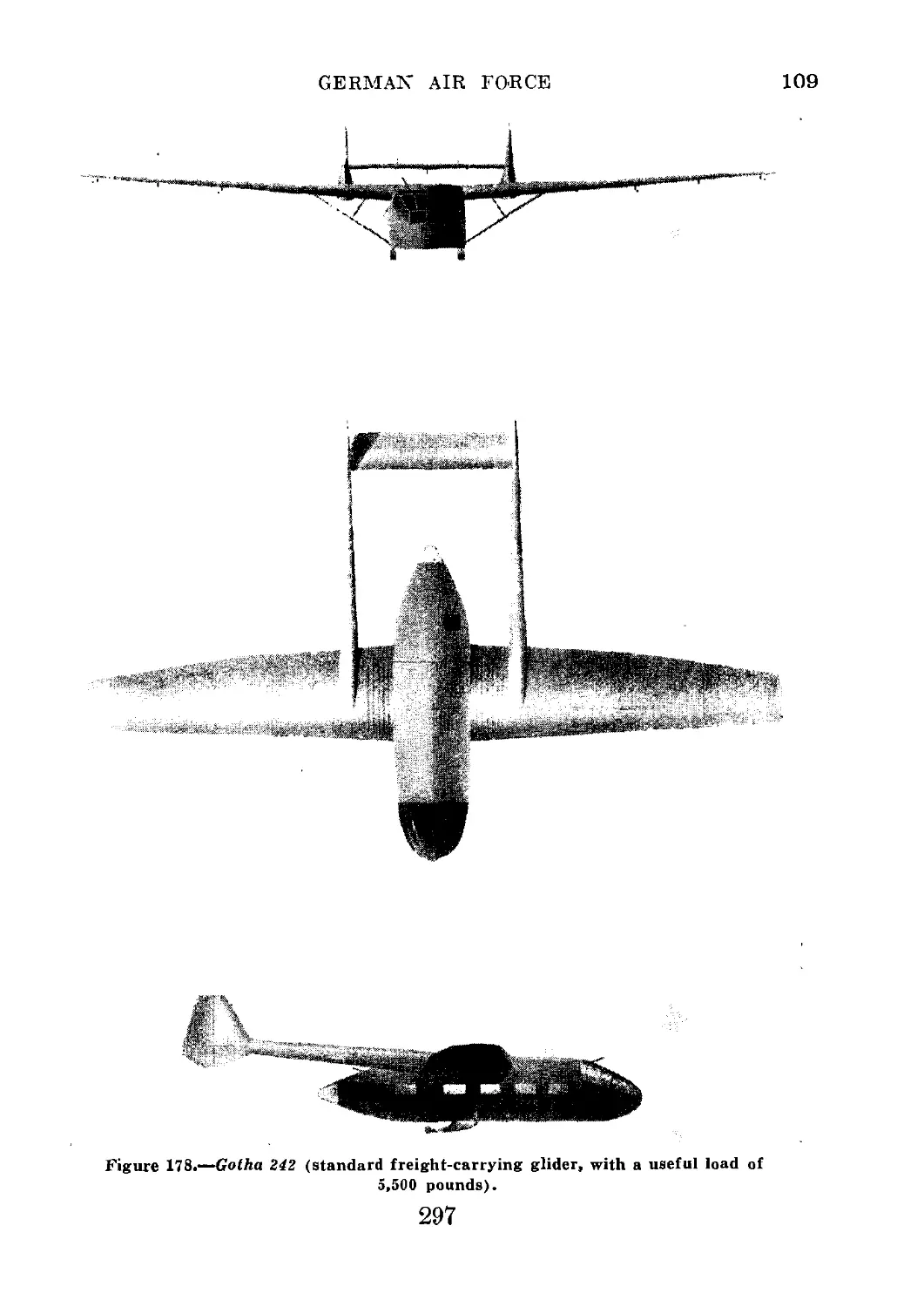
178.	Gotha 242 (standard freight-carrying glider, with a useful load of
5,500 pounds)________________________________________________ 297
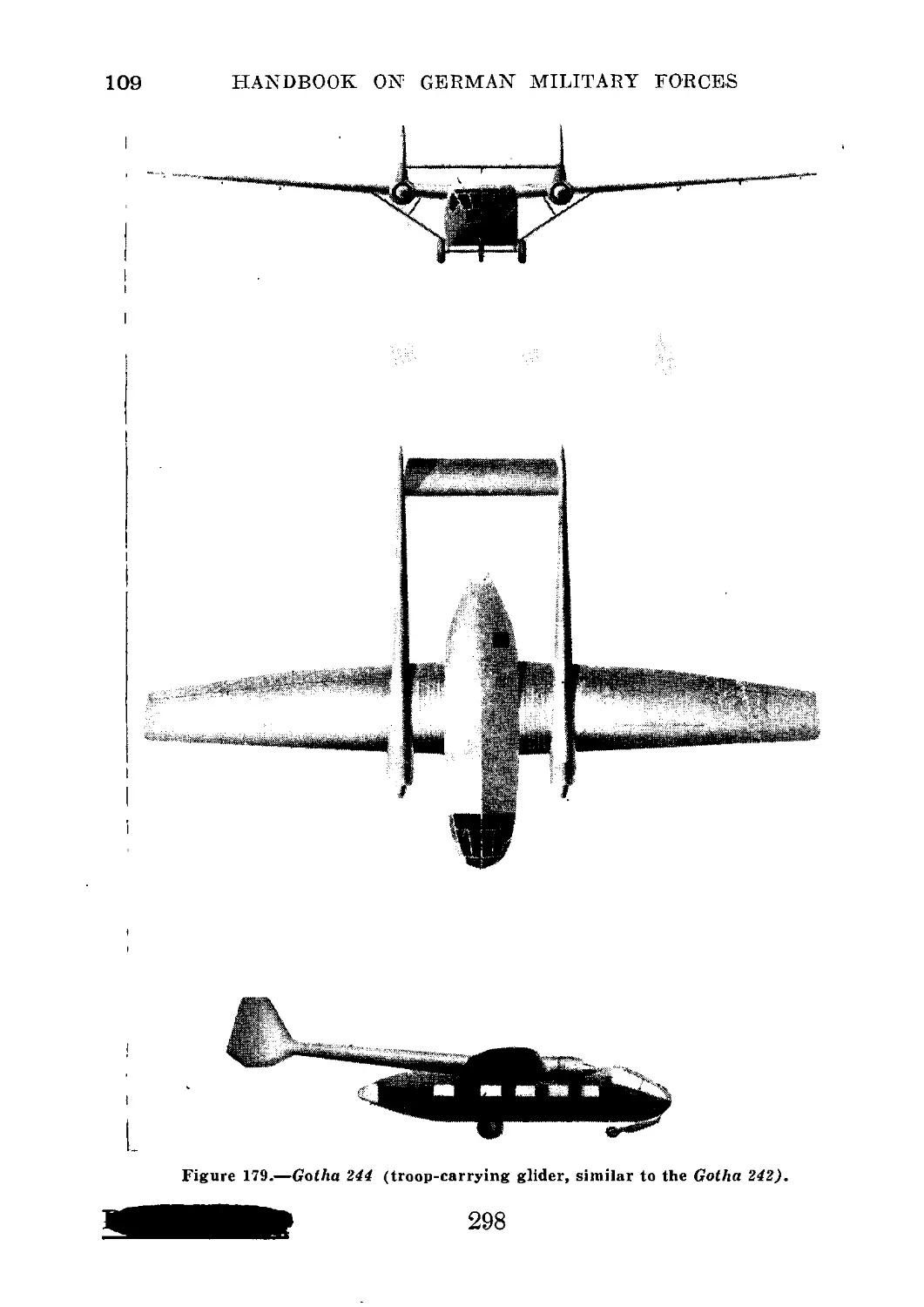
179.	Gotha 244 (troop-carrying glider, similar to the Gotha 242)_ 298
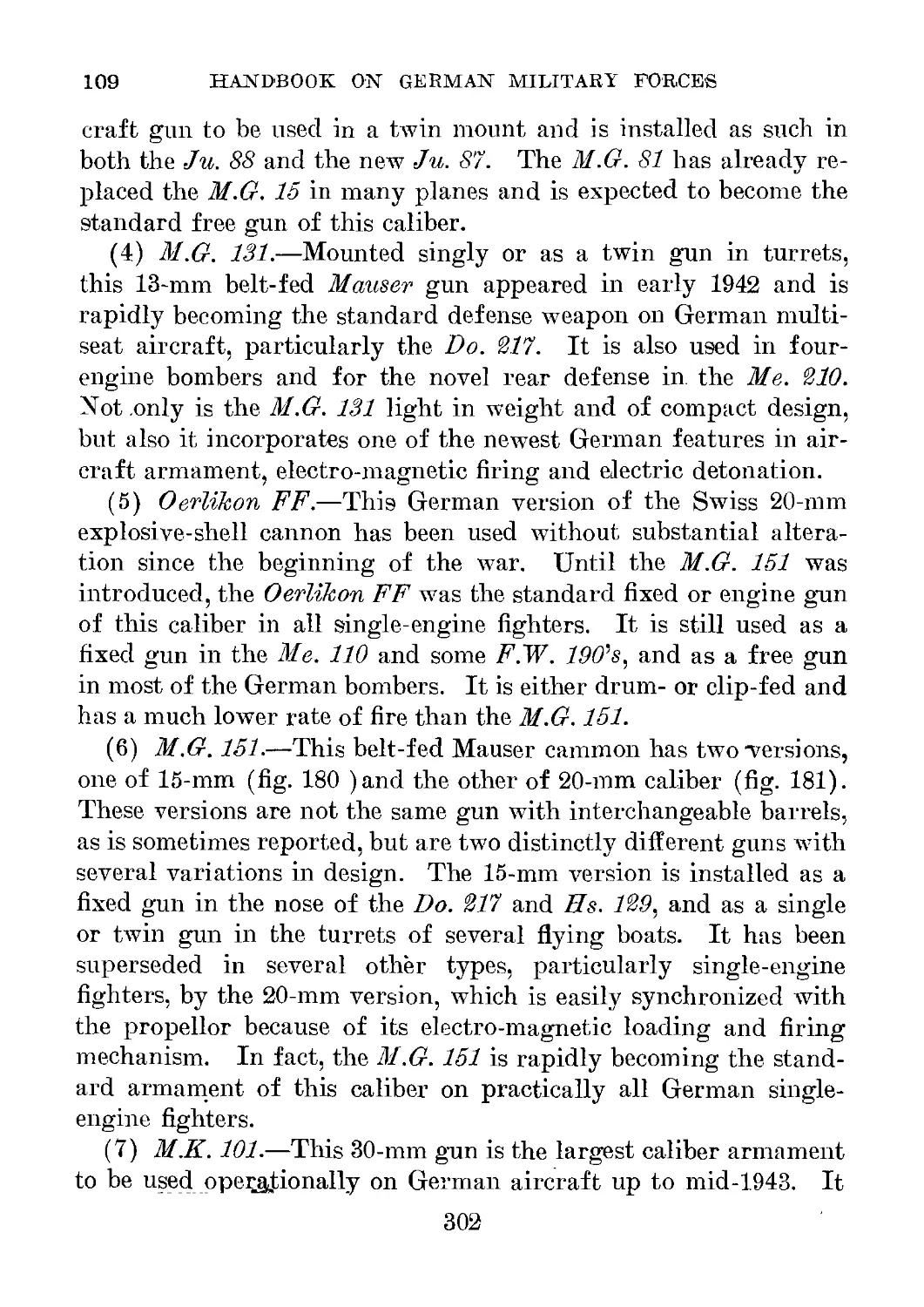
180.	15-mm aircraft cannon	(M.G.	151)_____________________________ 303
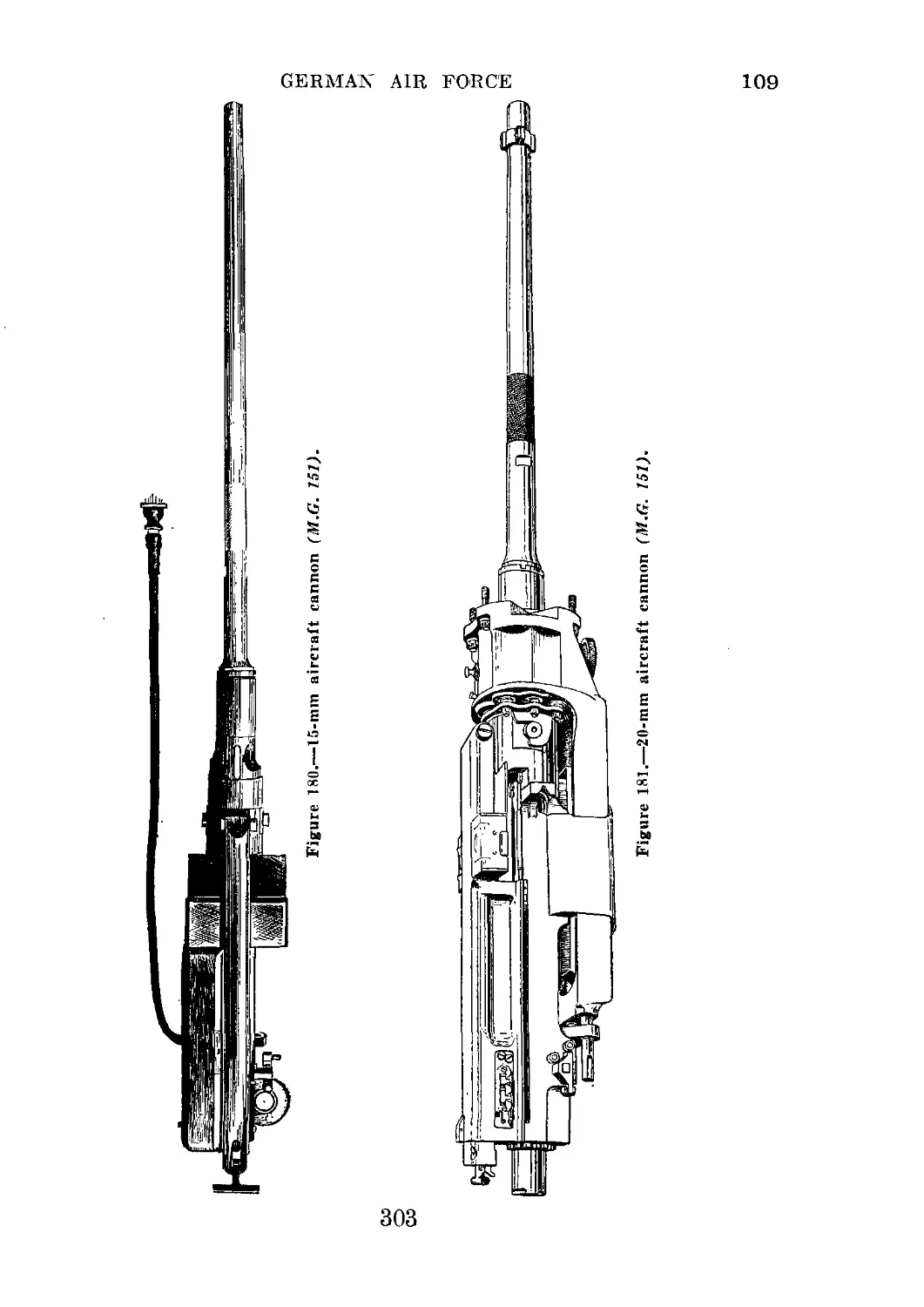
181.	20-mm aircraft cannon	(M.G.	151)_____________________________ 303
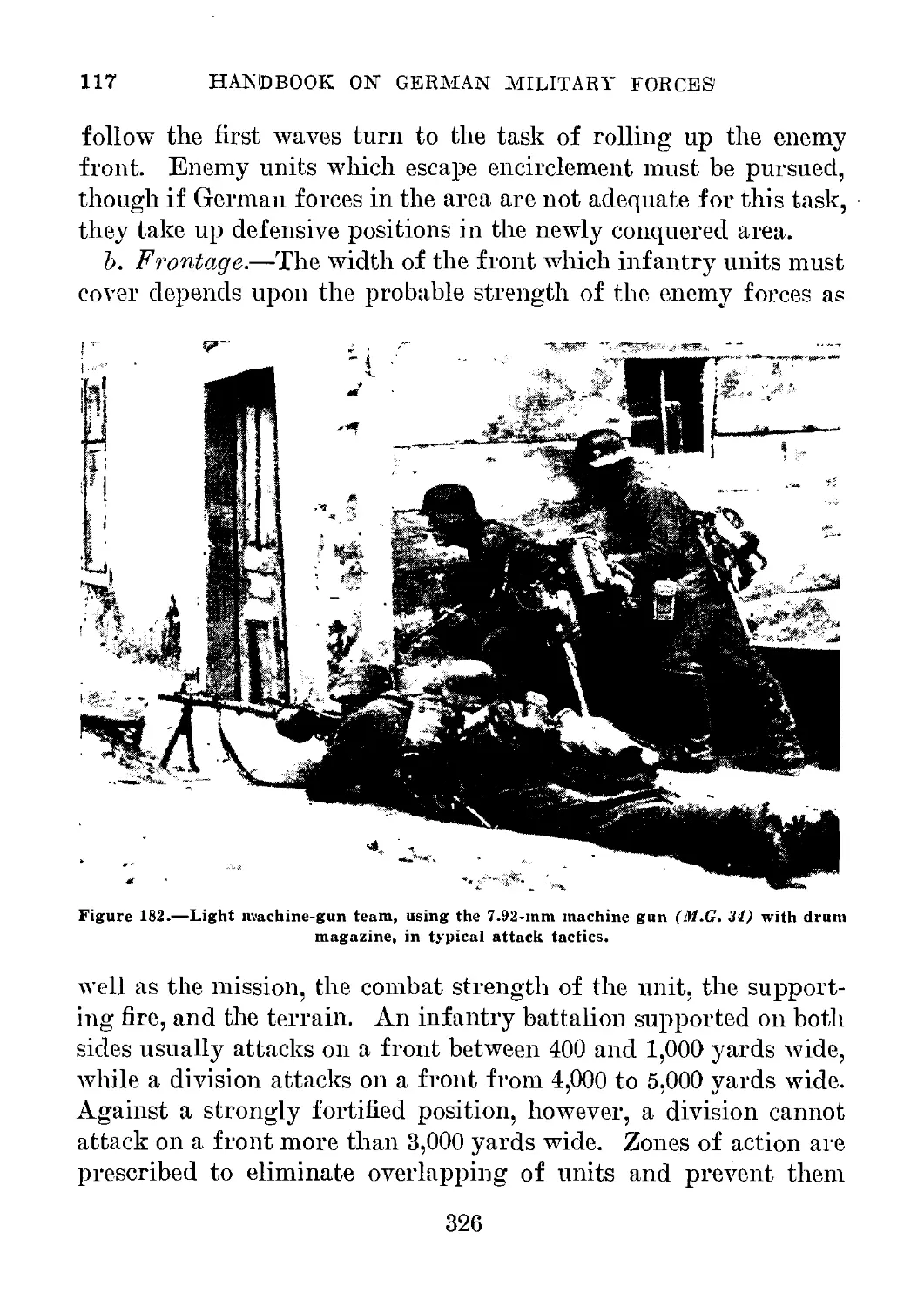
182.	Light machine-gun team, using the 7.92-mm machine gun (M.G.
34)	with drum magazine, in typical attack tactics)________ 326
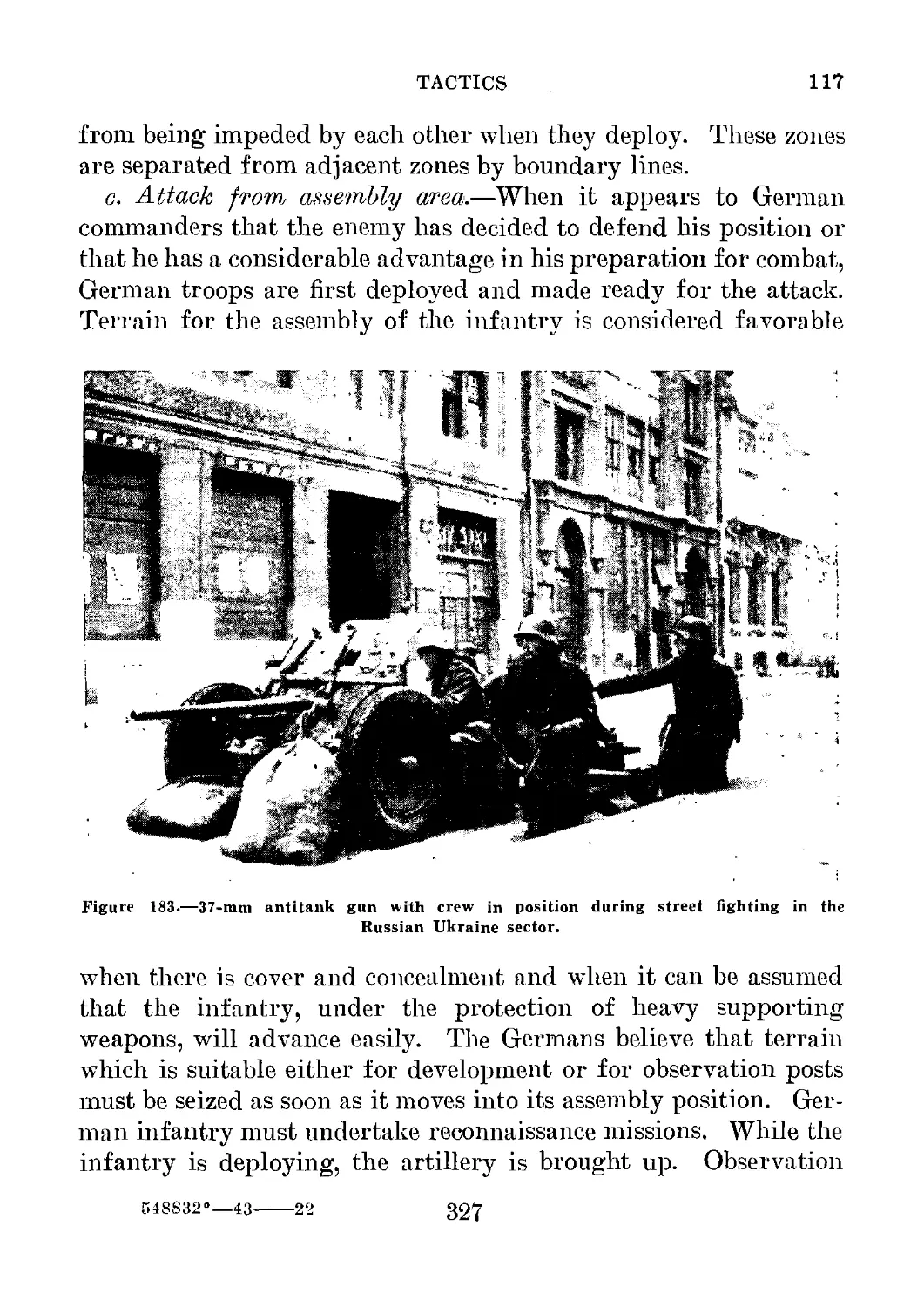
183.	37-mm antitank gun with crew in position during street fighting
in the Russian Ukraine sector_______________________________________ 327
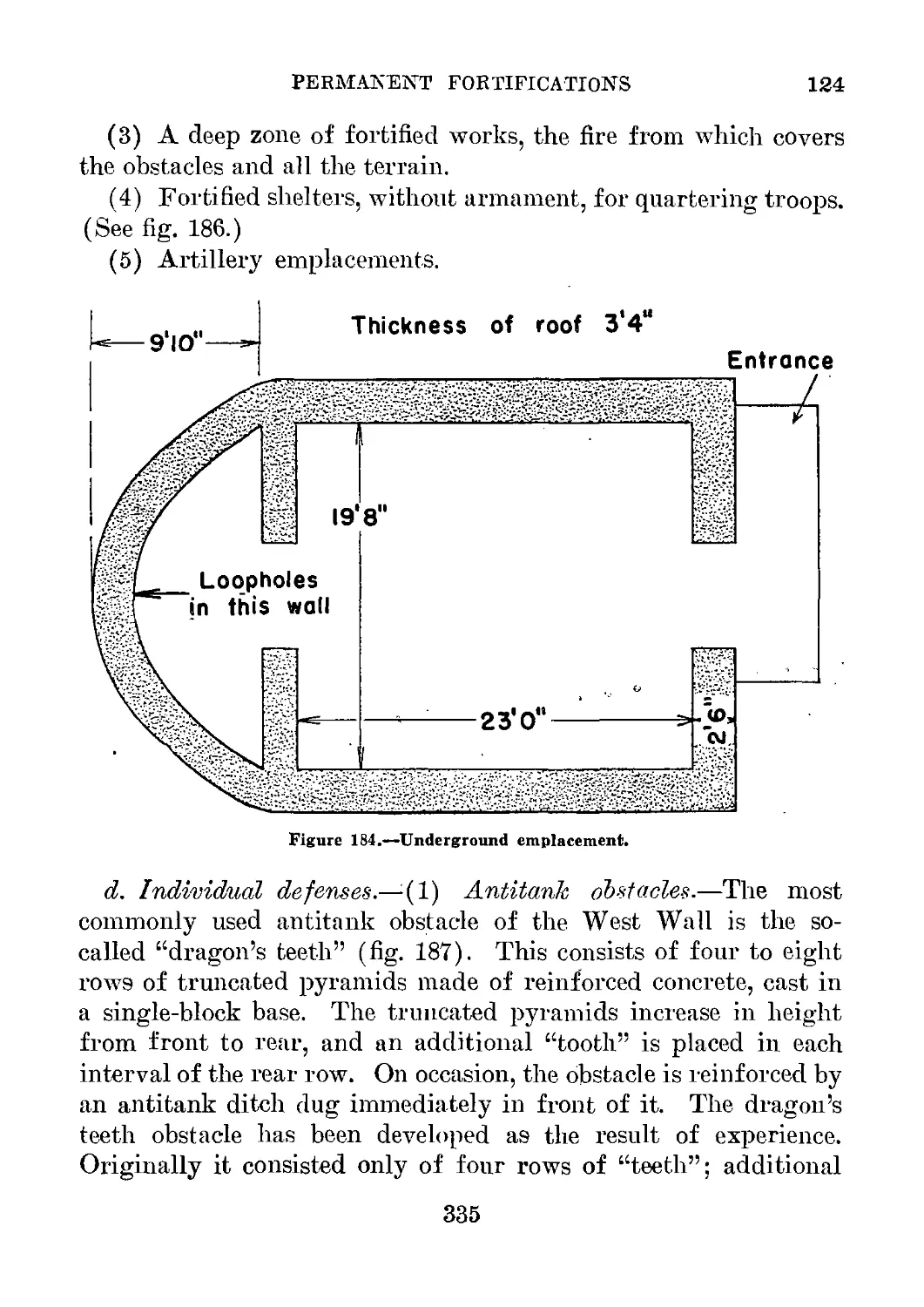
184.	Underground emplacement_______________________________________ 335
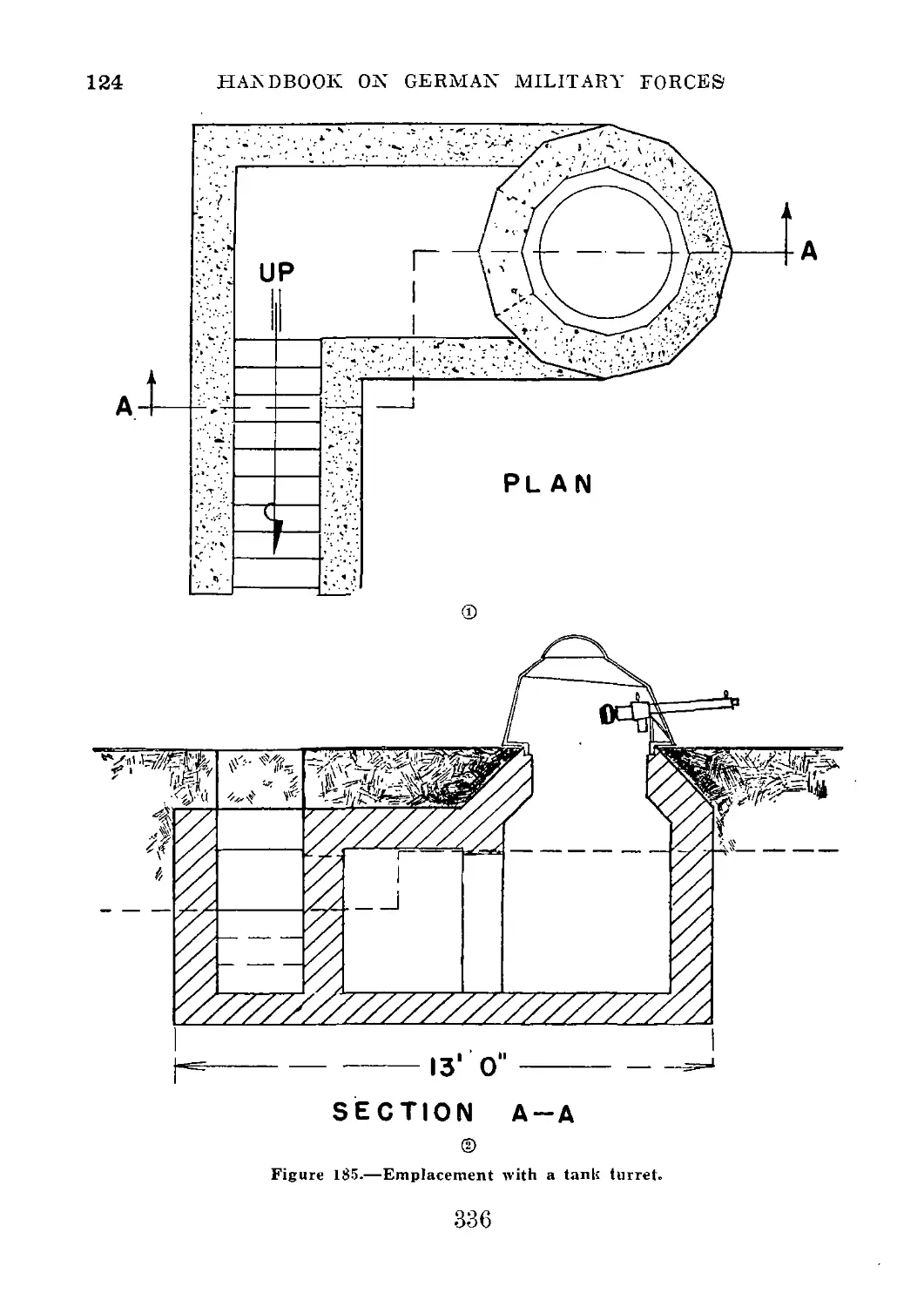
185.	Emplacement with a tank turret________________________________ 336
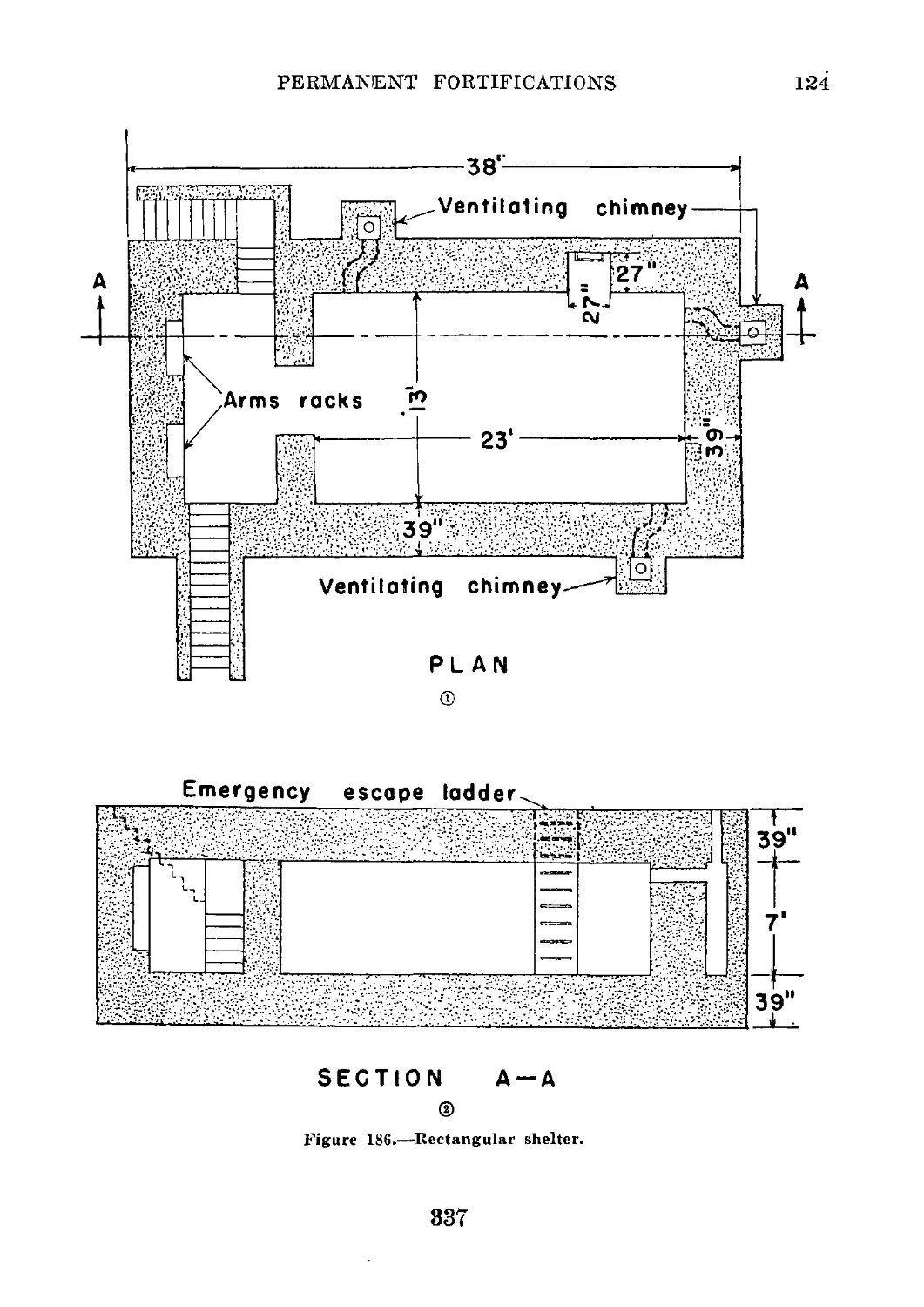
186.	Rectangular shelter___________________________________________ 337
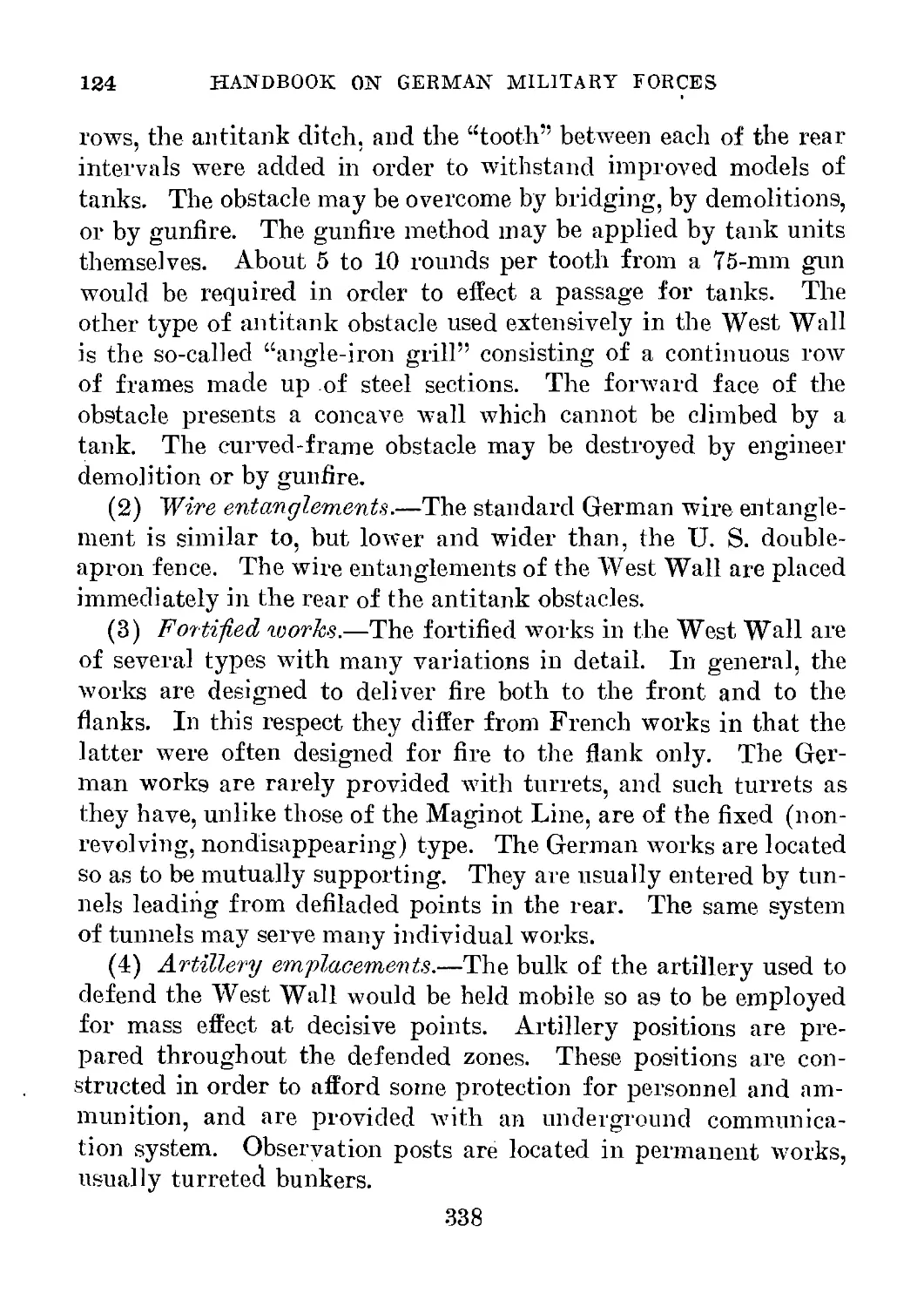
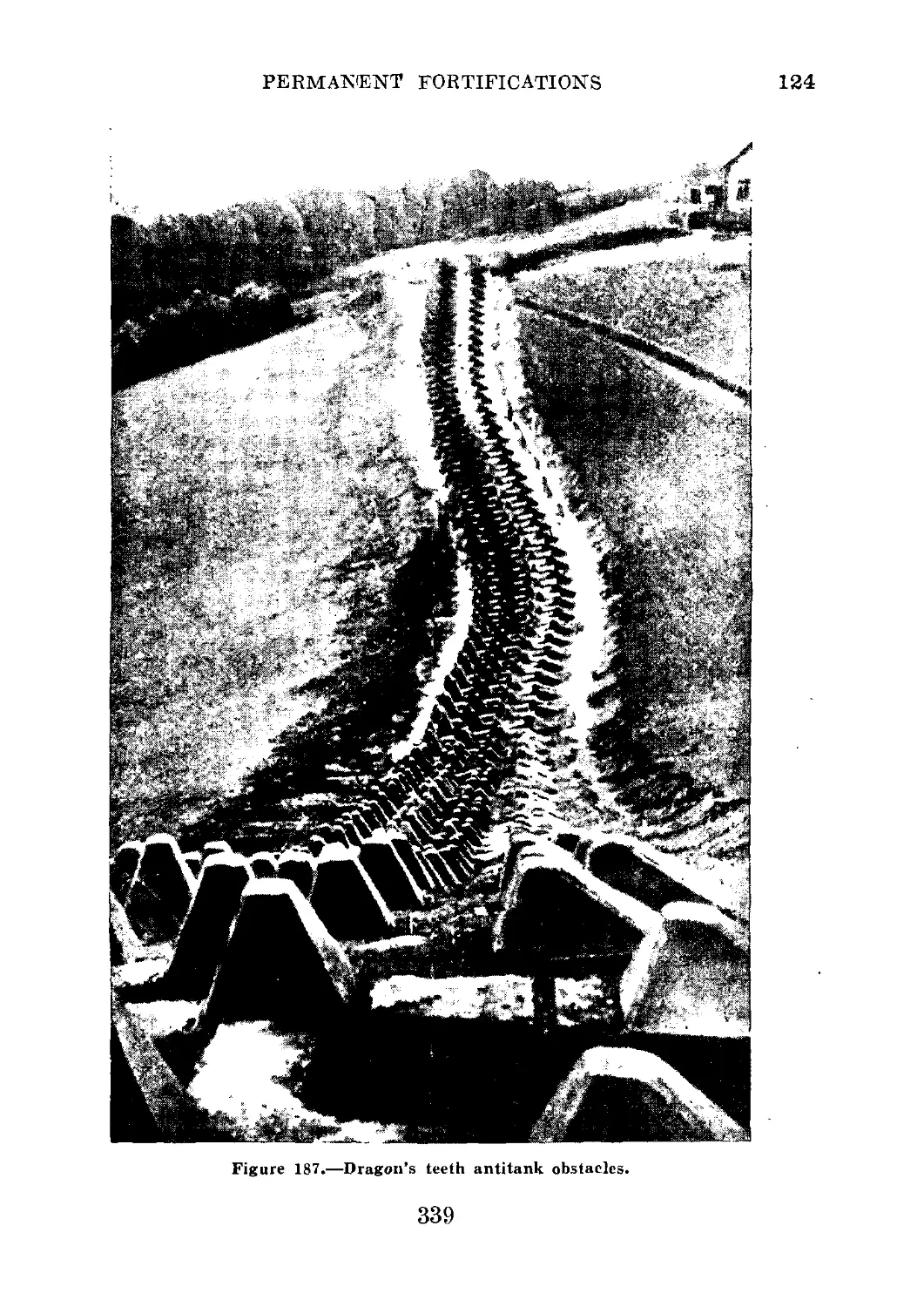
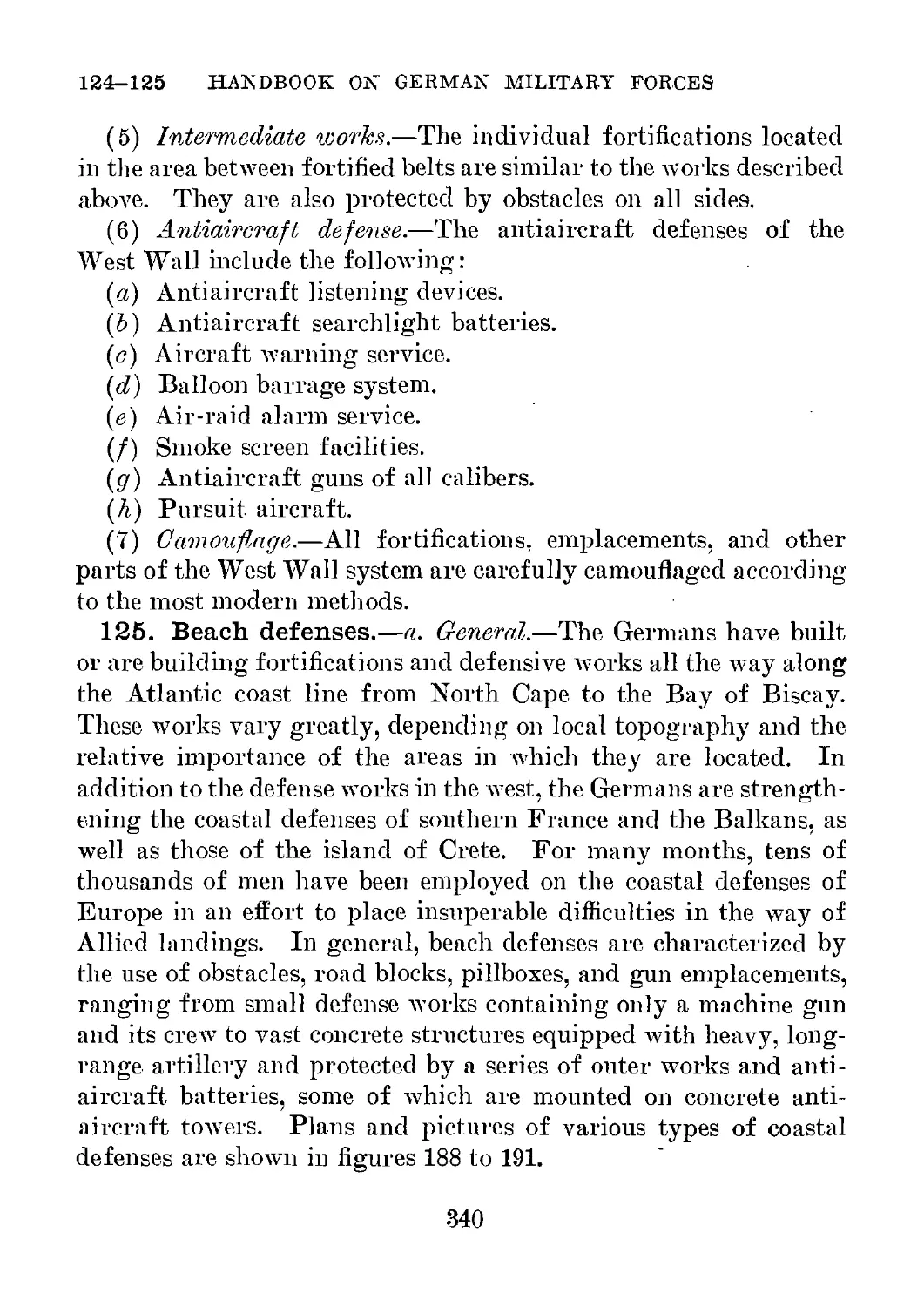
187.	Dragon’s teeth antitank obstacles_____________________________ 339
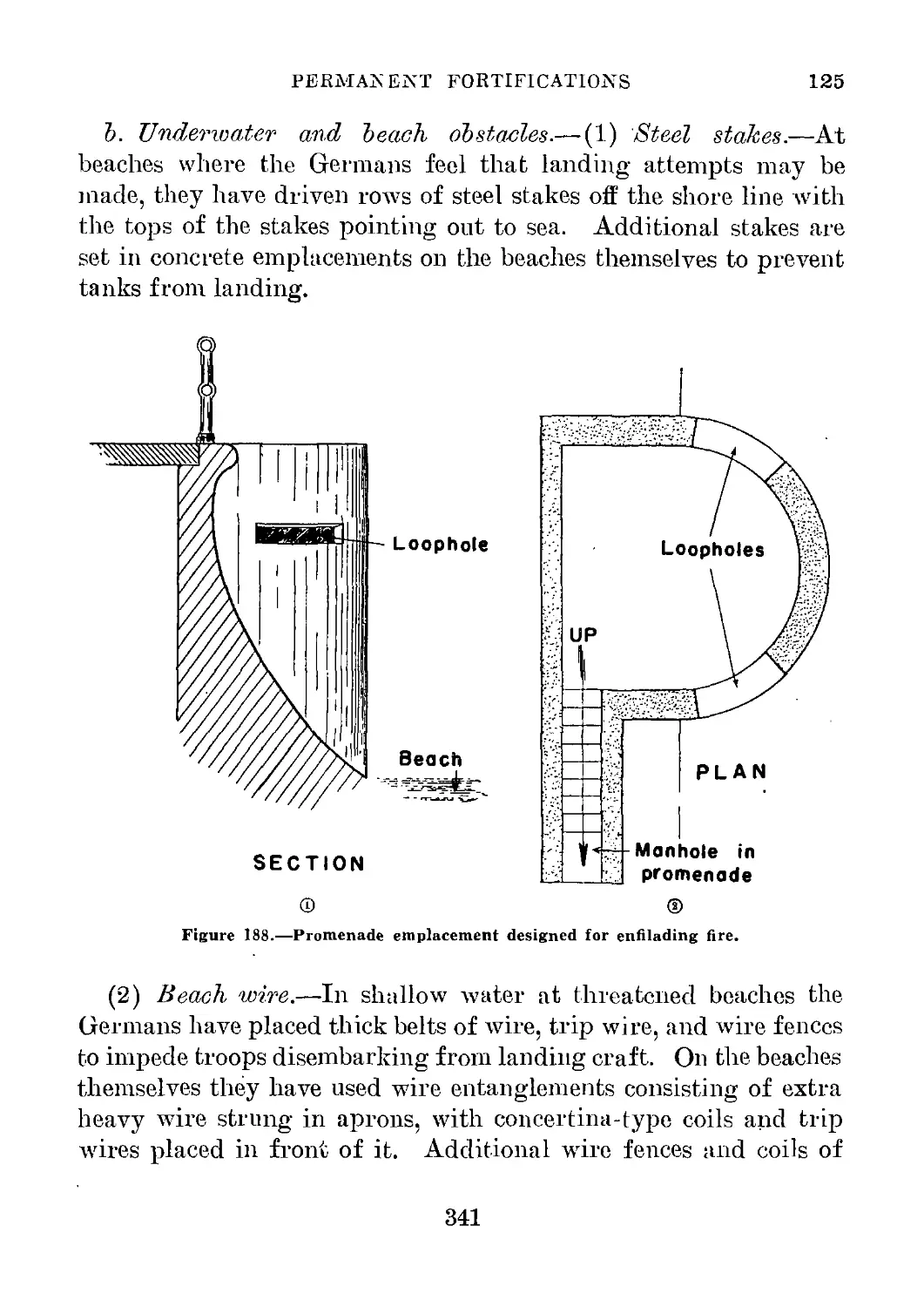
188.	Promenade emplacement designed	for	enfilading	fire_______ 341
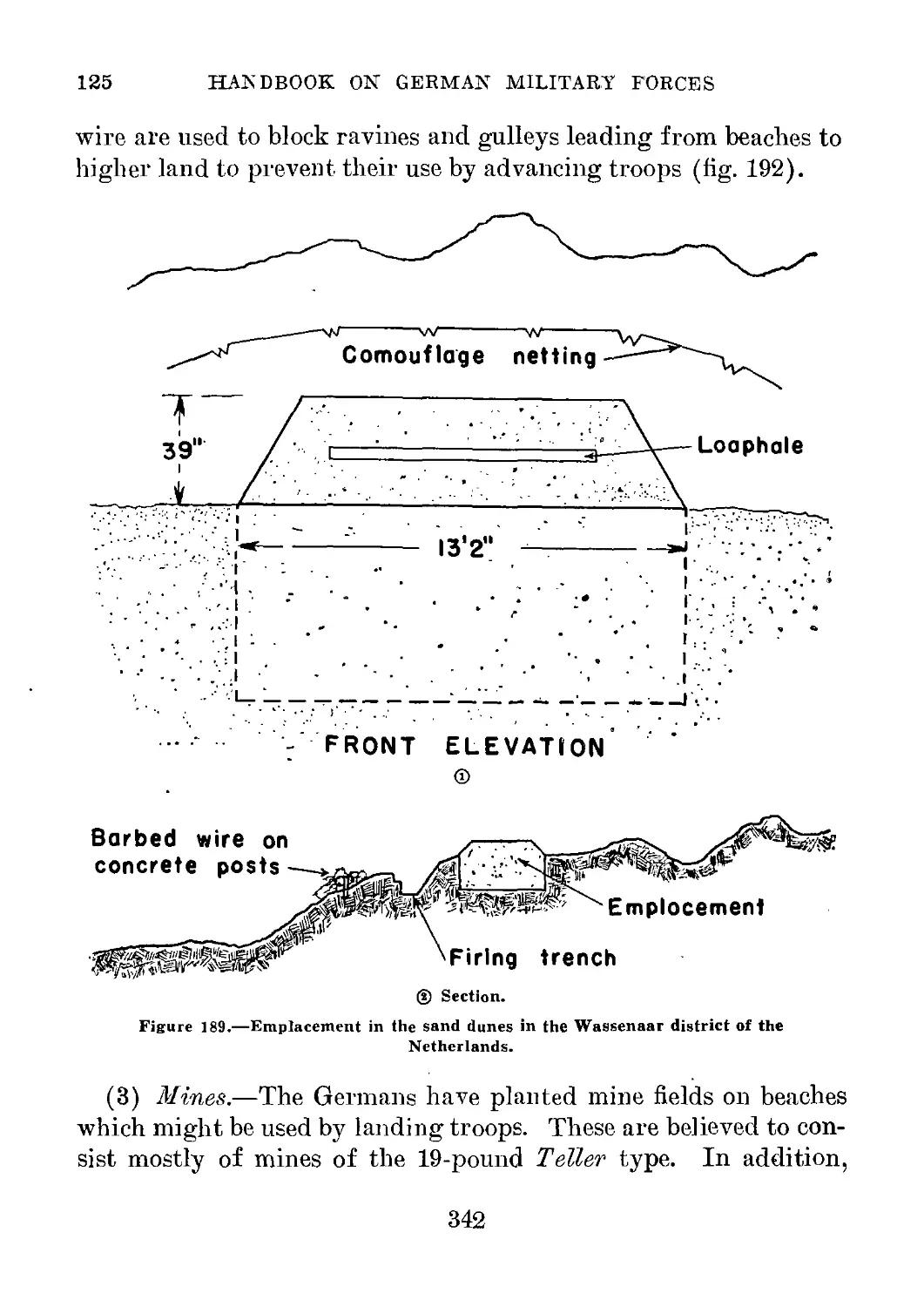
189.	Emplacement in the sand dunes in the Wassenaar district of
the Netherlands_____________________________________________________ 342
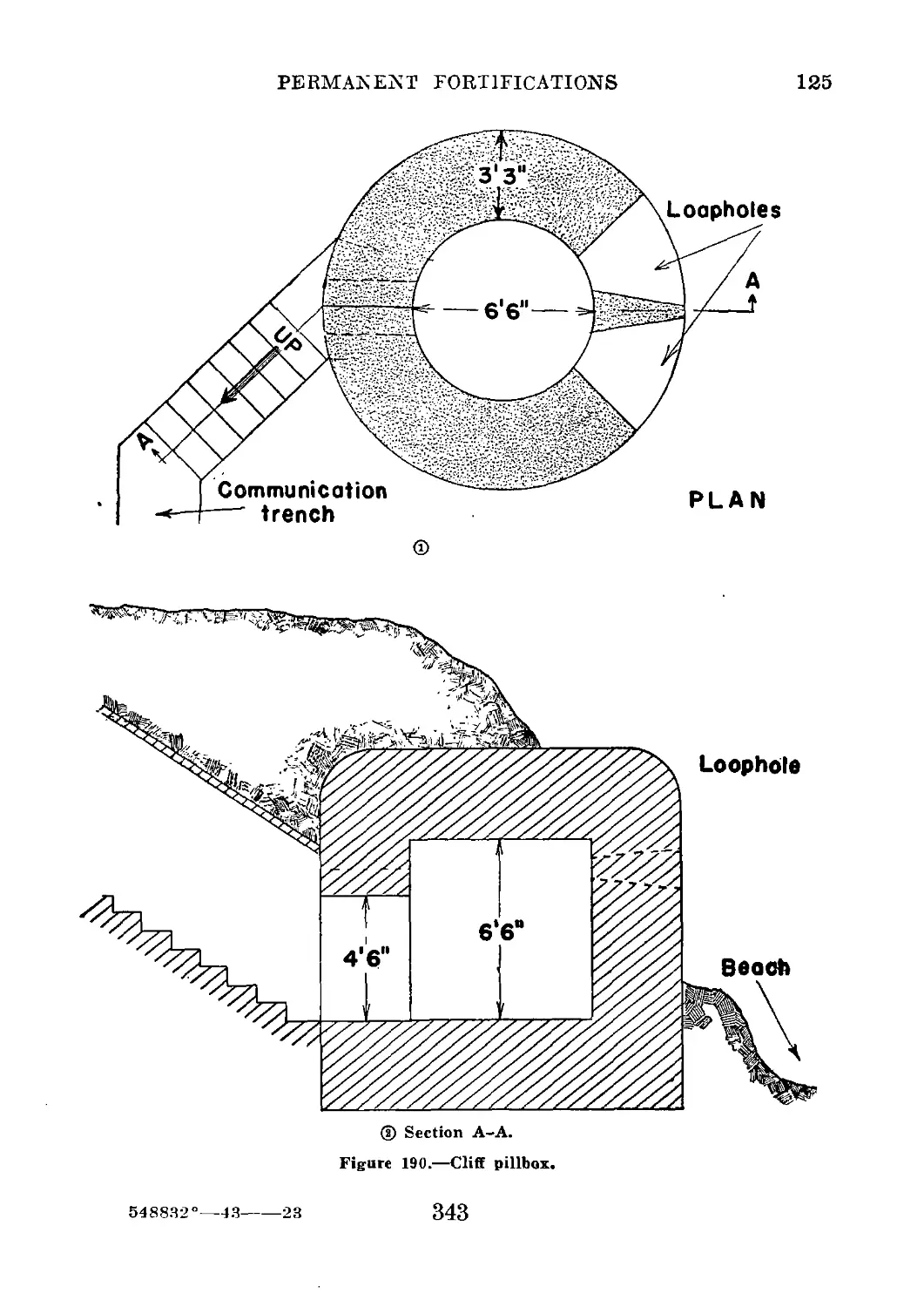
190.	Cliff pillbox_________________________________________________ 343
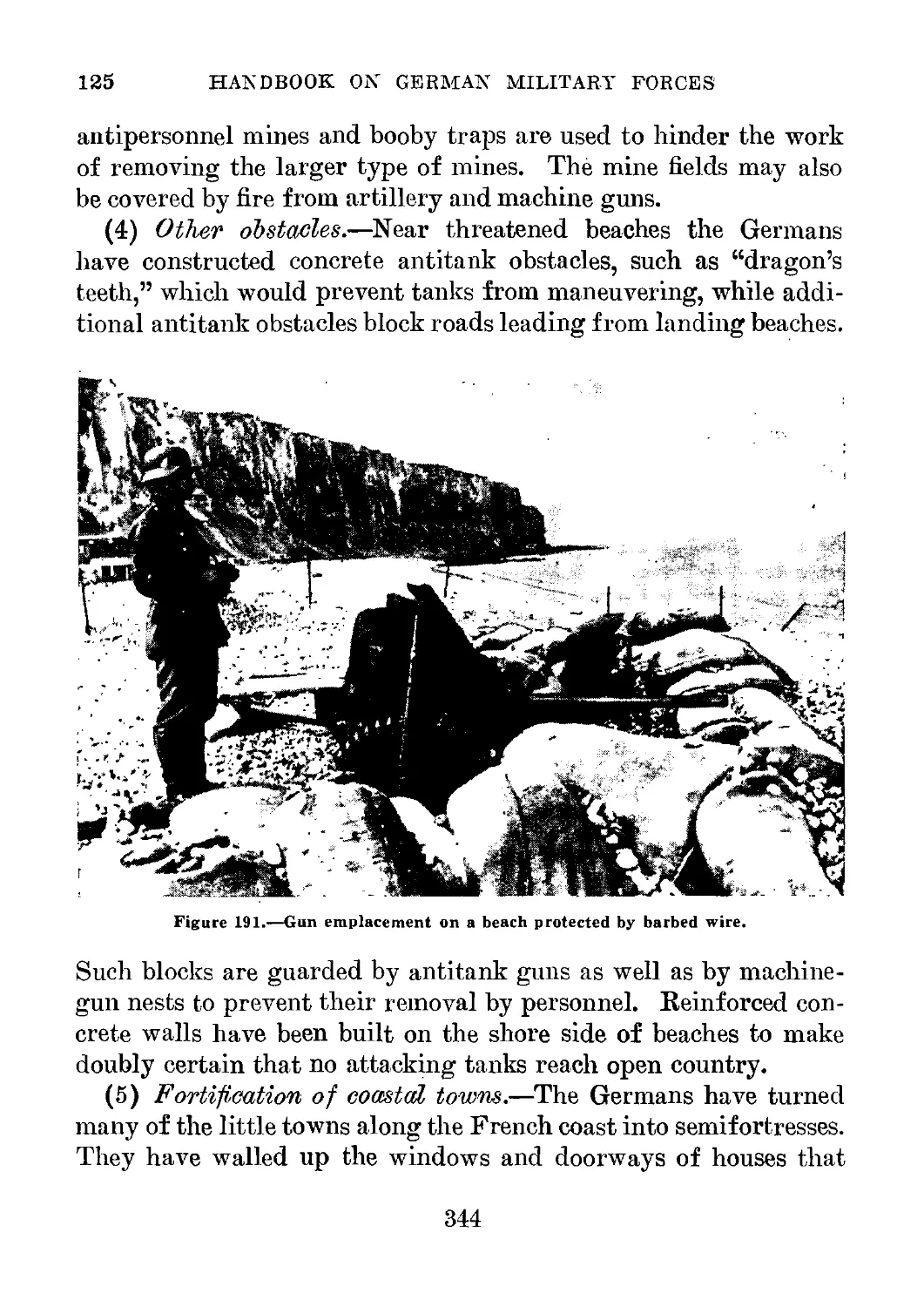
191.	Gun emplacement on a beach protected	by	barbed	wire______	344
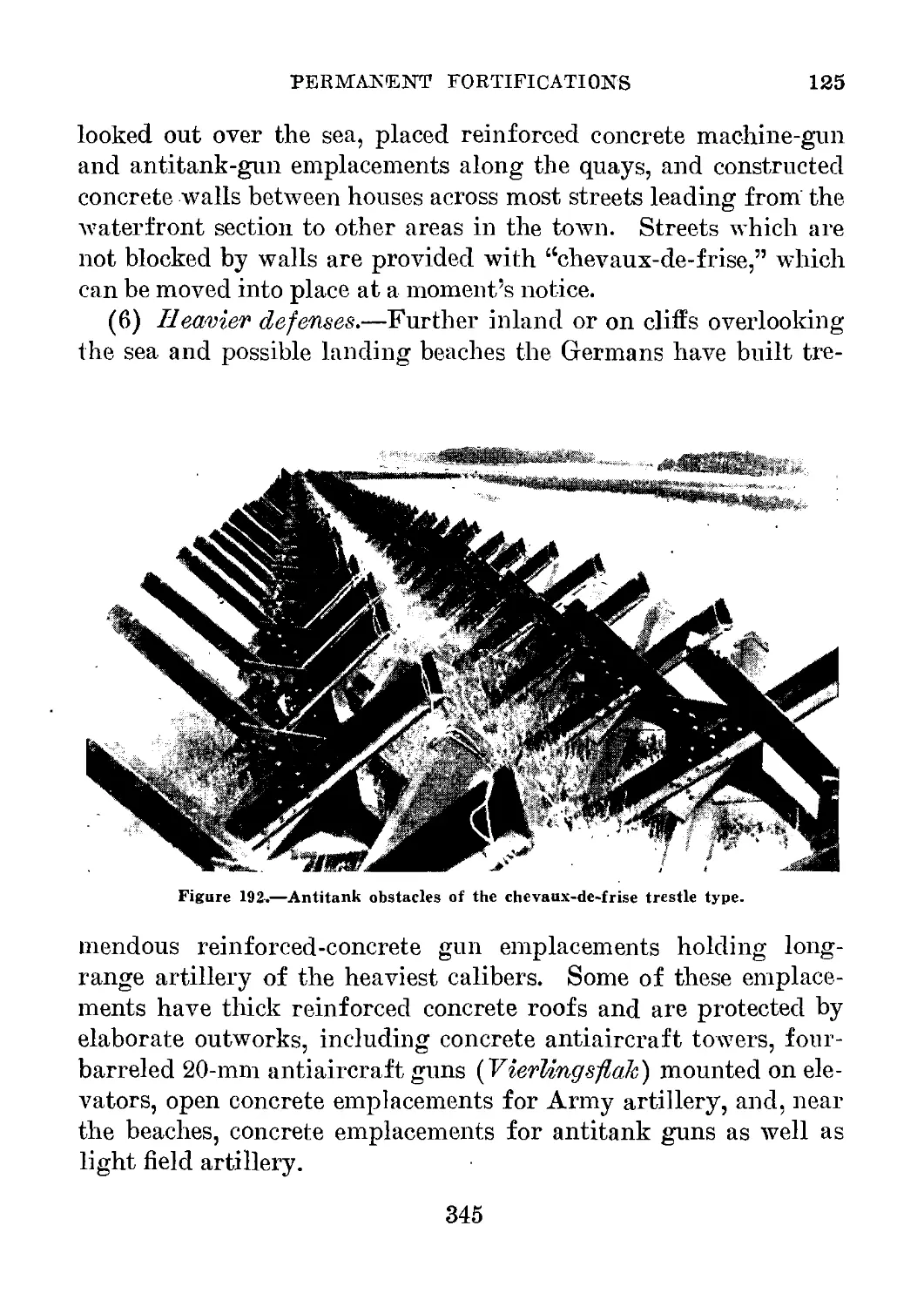
192.	Antitank obstacles of the chevaux-de-frise	trestle	type_______ 345
COLOR PLATES
Plate
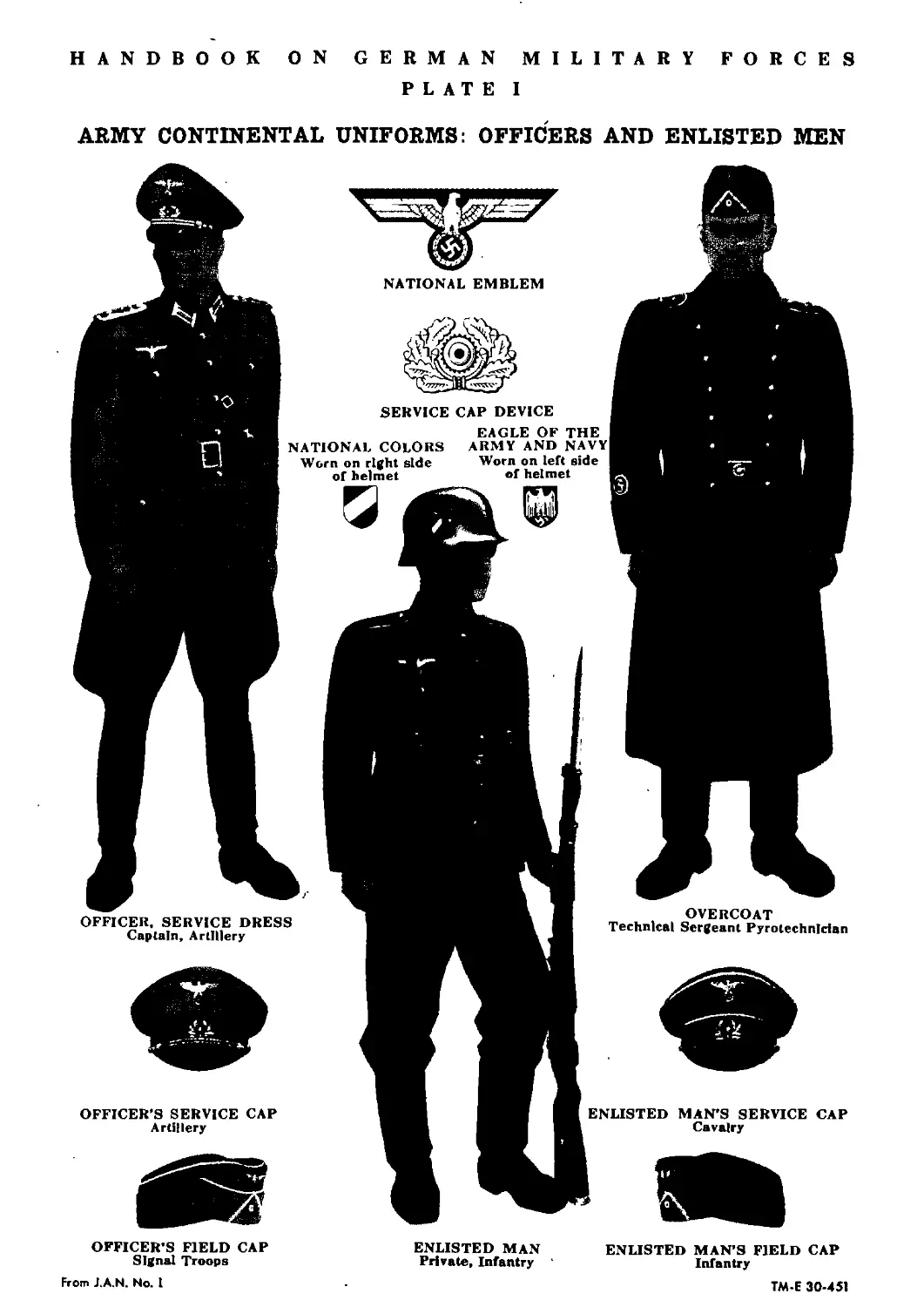
I Army continental uniforms: officers and enlisted men___
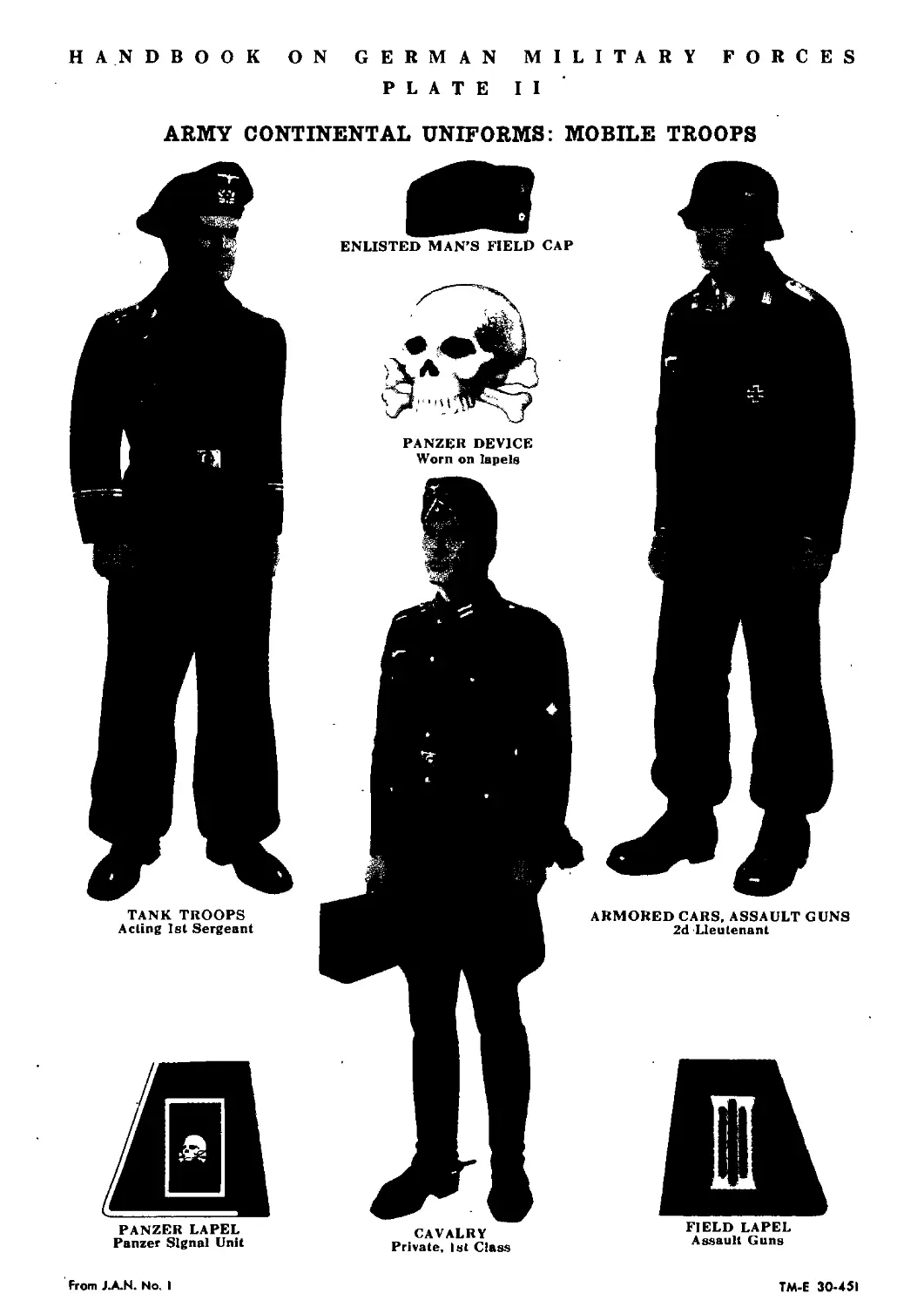
II Army continental uniforms: mobile troops_______________
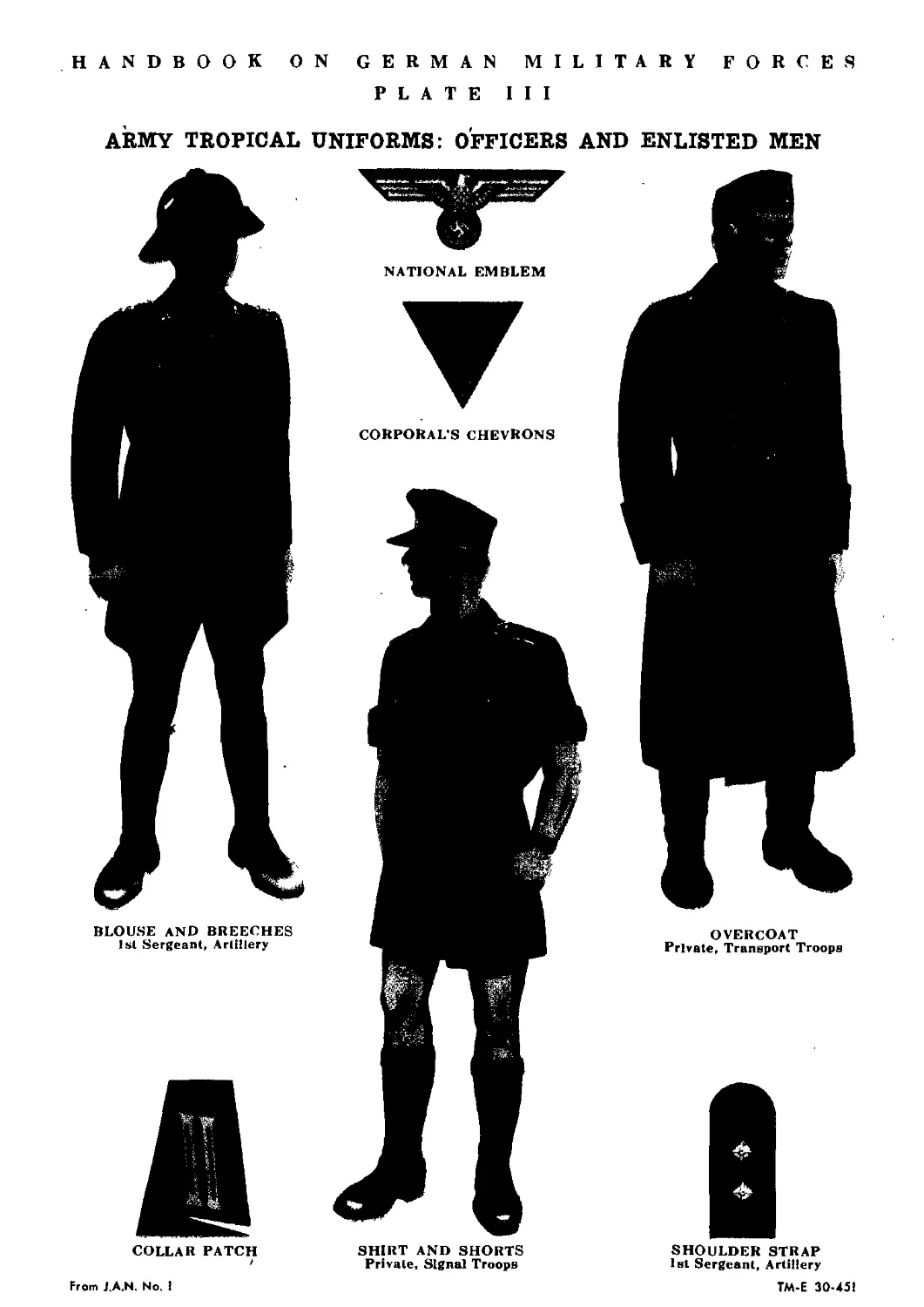
III Army tropical uniforms: officers and enlisted men______
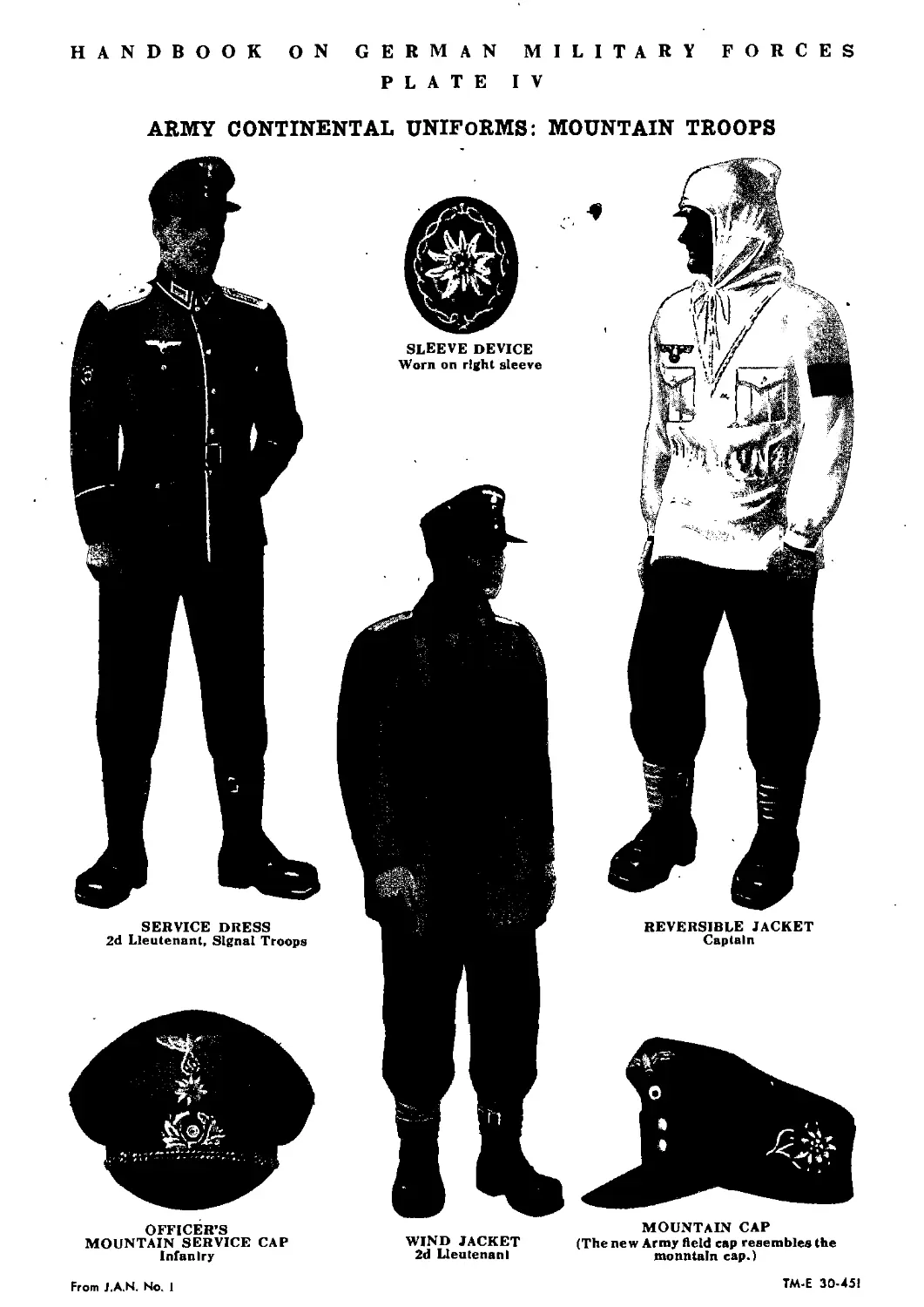
IV Army continental uniforms: mountain troops--------------
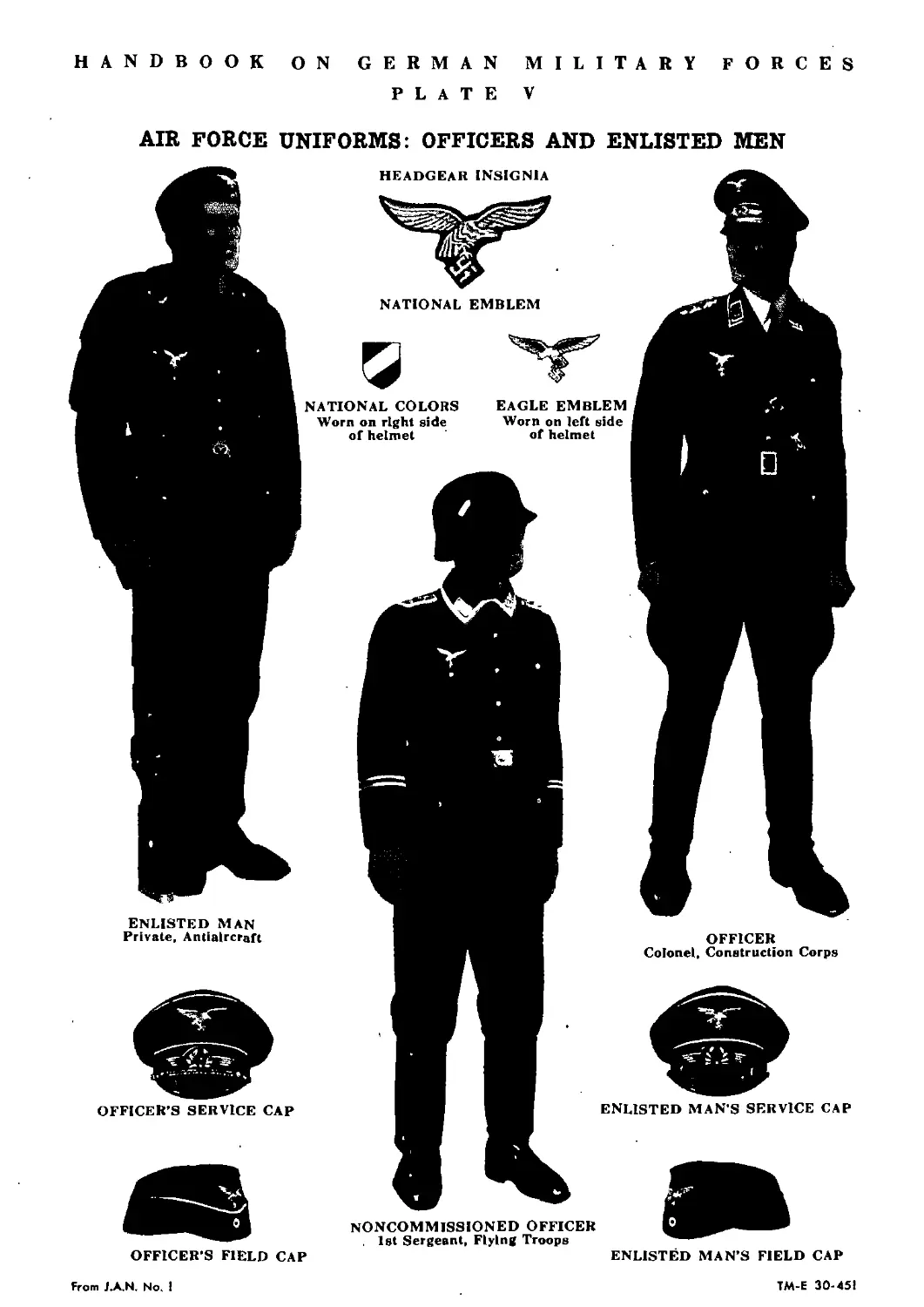
V Air Force uniforms: officers and enlisted men-----------
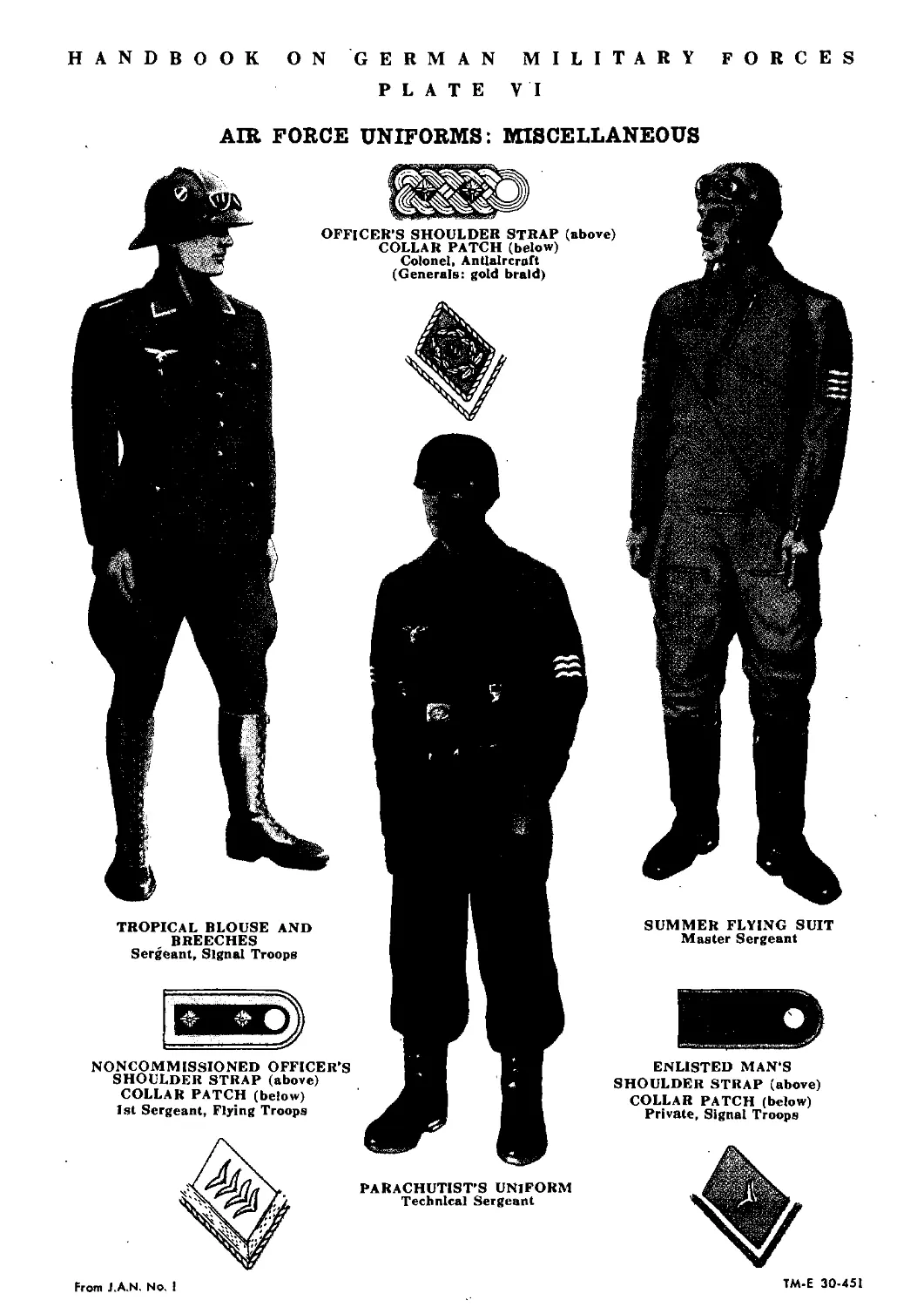
VI Air Force uniforms: miscellaneous________________________
follows
50
VII
and
VIII
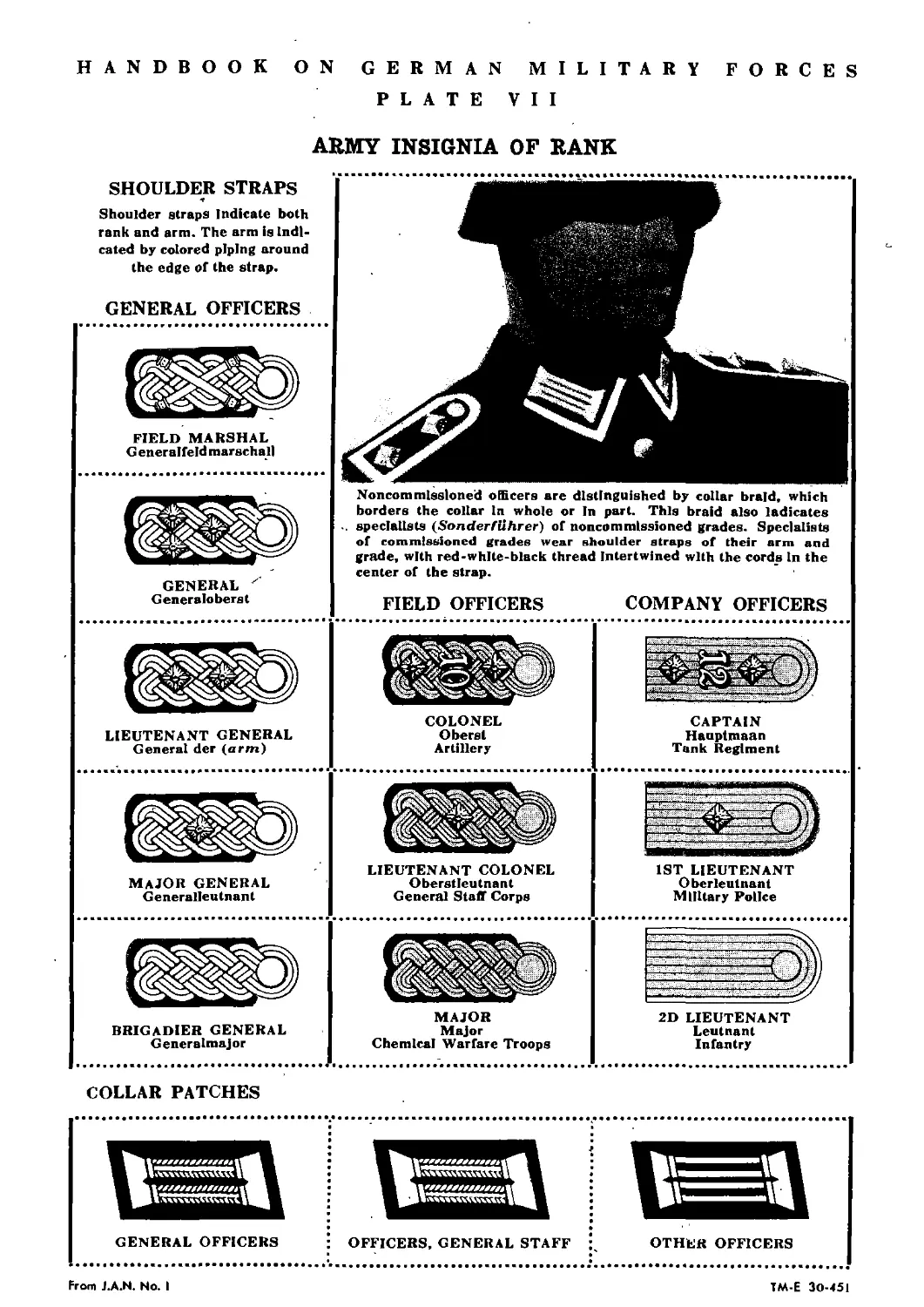
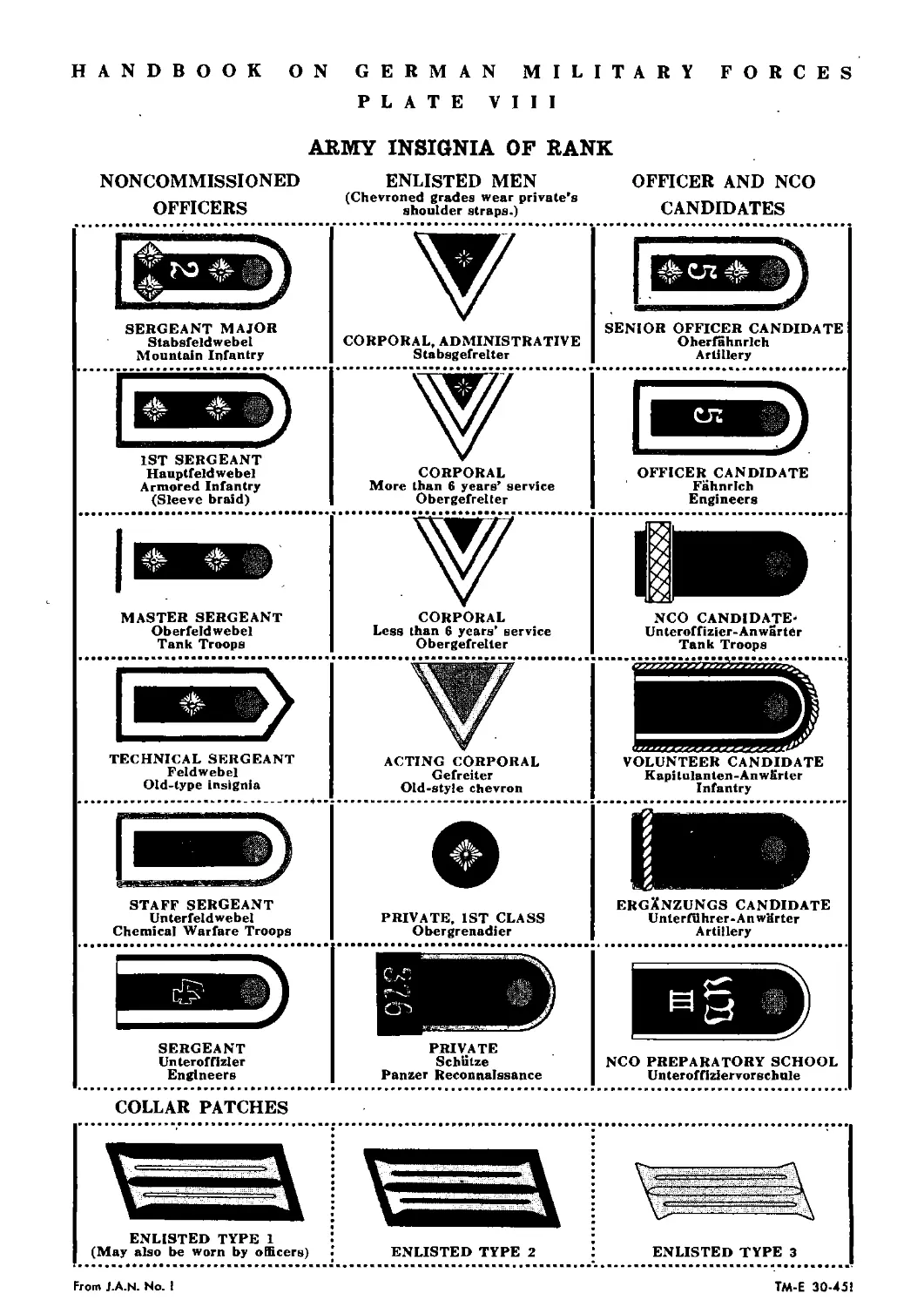
Army insignia of rank_____________________________________
IX Colors of Army arms_____________________________________
IX
FOREWORD
1.	Purpose.—The purpose of this handbook, which is a revi-
sion of TM 30-450 (17 December 1941), is to give both officers
and enlisted men of the U. S. Army a better understanding of
their principal enemy in Europe. In order to fight the Germans
successfully, it is vital for the U. S. soldier to know at least in
broad outline the manner in which the units of the German Armed
Forces are trained, equipped, and organized, as well as something
about the chain of command and the method of close cooperation
between the various branches.
2.	Scope.—a. Limitations.—No attempt has been made to give
complete details on any of the subjects discussed in the hand-
book. Further information on the individual arms or branches
of the German Army is available in the numerous special pub-
lications which have been published or are in the course of
preparation by the Military Intelligence Division. Moreover, this
handbook does not concern itself with individual units, locations,
campaigns, and commanders; these are dealt with in the Order of
Battle of the German Army.
b. Inclusion of Air Force.—The German Air Force is given con-
siderable attention, for although this handbook is intended pri-
marily for the use of U. S. ground forces, no handbook on the
German Army alone would give an adequate picture of the enemy
that the U. S. soldier will encounter. The basic principle of the
German military system is unity of command and close coop-
eration of all arms. It is imperative, therefore, that the Air
Force be considered with the Army as an integral part of a single
and closely-knit military organization.
3.	Language difficulties.—Where there is an English equiva-
lent for a German term or where the translation of German
1
3-4
HANDBOOK ON GERMAN MILITARY FORCES
words gives to the reader a clear picture of their meaning, both the
English and the German terms are often given. However, in the
case of German ranks that have no exact equivalent in the U. S.
Army, no translation is given, since it would actually be more
misleading than helpful.
4.	Revisions.—All errors or suggested changes and additions
to this handbook should be reported to the Dissemination Unit,
Military Intelligence Division, War Department, Washington 25,
D. C.
2
Section I
ORGANIZATION AND STRENGTH OF UNITS
Paragraph
General principles of organization______________________________ 5
Arms____________________________________________________________ 6
Organization of higher units____________________________________ 7
GHQ troops (Heerestruppen)______________________________________ 8
Infantry division (Infanterie-Division)_________________________ 9
Motorized infantry division (Infanterie-Division (Mot.))________ 10
Panzer division (Panzer-Division)_______________________________ 11
Mountain division (Gebirgs-Divislon)____________________________  12
Light division (Jager-Divislon)_________________________________ 13
5.	General principles of organization.—a. Flexibility.—
In no 2 years since 1933 lias the organization of the German in-
fantry division remained the same. At any given date, wide dif-
ferences have existed between supposedly similar types of or-
ganization, and it is clear that the organization of units in the
German Army is never static. The Germans believe that the
rapid progress of scientific research and development of weapons
makes it imperative that organizational practice remain flexible
if it is to be in a position to take prompt advantage of technical
innovations as well as of lessons learned in combat.
Ъ. Einheit principle.— (1) General.—The composition of Ger-
man units is based on the Einheit principle of organization. The
Einheit, or unit, principle of organization may be defined as fol-
lows: standard types of small units with standard organization,
training, and equipment are adopted as the basis on which all
larger organizations are built. Thus, for example, the basic in-
fantry combat unit is the standard platoon, consisting of four
light machine-gun teams (each supported by a rifle team) and a
light mortar team. This basic combat unit is the foundation of all
organizations the tactical employment of which is based on fire
3
5
HANDBOOK ON GERMAN military forces
and maneuver. It is found in the regular infantry in all types of
divisions, in the motorcycle company, and in the engineer com-
pany. Similarly, all signal units, whether belonging to the signal
troops or attached integrally to larger infantry or artillery units,
are composed of a combination of one or more basic radio and tele-
phone groups, the equipment, organization, and training of which
are identical. The same principle is applied in the organization
of all field and combat trains. The Tross. or train, of each com-
pany, troop, or battery of the Army is identically organized, with
only such minor differences as are necessitated by the means of
transportation involved. Each Tross is composed of three Ein-
heit groups—the Gefechts-Tross, or combat train, the Verpfle-
gungs-Tross. or ration train, and the Gepack-Tross^ or baggage
train. Similarly all battalion, regimental, or division ammuni-
tion and service trains are based on the standard light column (a
complete operating unit of 15, 30, or 60 tons’ capacity), whereas
all supplies are initially made up for issue and transportation in
multiples of 30-ton lots. This Einkeit principle has important ad-
vantages. Through its application, supply and replacement of
equipment are greatly simplified, while training and tactical em-
ployment of basic units of all branches of the service can be stand-
ardized and efficiently directed by the General Staff. In addition,
the principle of flexibility is maintained, since larger organiza-
tions can be formed from combinations of these standard basic
units.
(2)	Tactical self-sufficiency of combat waits.—Each combat
unit in the German Army, from the basic infantry platoon to the
complete division, is so organized, armed, and equipped as to be
able to accomplish its mission independently. Thus each combat
unit is provided organically with all the support weapons which
it is expected to require to accomplish its normal mission without
reference to other units. Conversely, no weapons are provided as
organic armament which are not required for that mission. Thus
the basic infantry platoon, which is the smallest tactical unit in
the German Army, has light machine guns and a light mortar as
4
ORGANIZATION AND STRENGTH OF UNITS	5
its organic support weapons. In accordance with the Einheit
principle, the basic unit of all other branches is similarly armed
and organized with a view to its self-sufficient employment. The
same principle is applied in the organization and armament of
the infantry battalion, regiment, and division, and of all other
units.
(3)	Administrative self-sufficiency of combat units.—With re-
spect to personnel and transportation, each tactical unit respon-
sible for administration is so organized as to be independent of
the next higher unit. The administrative units of the German
Army are the army, the division, and the battalion. All other
tactical units are attached to one of these three for administration
and supply. Each of these administrative units must draw its
supplies from the next higher administrative unit, and each is
organically equipped with sufficient transportation for this task.
This principle of organization, together with the formation of
the division trains into as many light columns as there are battal-
ions in the division, is largely responsible for the extreme flexibil-
ity of German tactical units. With the administrative indepen-
dence of the battalion, a widely varying number of battalions can
be grouped under a single regimental headquarters, with their
proportionate share of light columns attached to the division
trains, without placing any additional strain on administration or
supply. This principle is particularly applicable in the case of
reinforcing artillery. It also permits the German standard divi-
sion to be altered quickly to suit the tactical needs of the moment.
(4)	Л/arch-combat group.—Each division or similar unit of the
German Army is organized so that it can be broken up into two or
more self-sufficient teams, or march-combat groups. The march-
combat group of the infantry division is the infantry regiment
reinforced by a battalion of light field howitzers, with possibly an
antitank company and an engineer company attached. The ease
with which these march-combat groups can be shifted to form
larger command groups is due to the administrative organization
of the battalion and the light column.
5
6-7
HANDBOOK ON GERMAN MILITARY FORCES
6. Arms.—Every unit in the
one or another of the following a
a. Infantry.
b.	Cavalry.
c.	Panzer troops.
d.	Artillery.
e.	Chemical warfare troops.
f.	Engineers.
g.	Railway engineers.
h.	Signal troops.
i.	Transport troops.
7. Organization of higher
German Army is classified under
•ms (~Waffengattungen) :
j.	Army antiaircraft units.
k.	Medical units.
I.	Veterinary units.
m.	Military police units.
n. Local defense units.
o.	Construction units.
p.	Administrative units.
q.	Propaganda troops.
r.	Motor vehicle park troops,
units.—a. Divisions.—The vari-
ous arms are grouped together to form divisions. The division
is the basic large unit of the German Army, and is the largest unit
having a prescribed organization. The following types of di-
visions exist (although only the first five figure importantly in
combat) :
(1)	Infantry division.
(2)	Motorized division.
(3)	Panzer (armored) division.
(4)	Mountain division.
(5)	Light division (an intermediate type).
(6)	Cavalry division (only one of which now exists) (see
par. 46).
(7)	Security division (for mopping-up duties in the rear areas).
(8)	Frontier guard division.
(9)	Special duty division (for controlling miscellaneous units
in Germany or occupied territory).
(10)	Reserve division (for training and occupation purposes).
(11)	Mobilization division (for receiving recruits for assign-
ment to field or training units).
b.	Corps.—Two or more divisions may be grouped for tactical
purposes to form a corps. Each corps staff has a signal battalion
and various service units permanently assigned to it, but the al-
6
ORGANIZATION AND STRENGTH OF UNITS	7-8
lotment of divisions is flexible, varying according to the situation.
The following types of corps exist:
(1)	Infantry corps (for controlling a group of divisions in
which infantry divisions predominate).
(2)	Panzer corps (for controlling a group of divisions in which
Panzer divisions usually predominate).
(3)	Mountain corps (for controlling a group of divisions in
which mountain divisions predominate).
(4)	Corps command (for controlling an area in occupied ter-
ritory in which certain defensive units are located, but which may
be brought up to normal combat strength and sent into action as
an infantry corps).
(5)	Reserve corps (for controlling a group of reserve divi-
sions).
c.	Armies.—Two or more corps may be grouped for tactical and
administrative purposes to form an army. Each army staff has
a signal regiment and certain administrative- units permanently
assigned to it, but the allotment of corps is flexible, varying accord-
ing to the situation. The following types of armies exist:
(1)	Ordinary armies.
(2)	Panzer armies (for controlling a group of corps in which
the Panzer element usually predominates).
d.	Army groups.—For strategic purposes, two.or more armies
may be placed under an army group command, which usually
controls an entire theater of operations or an important part
of such a theater. Each army group has a signal regiment and
a large staff to deal with the many operational and administrative
matters in its territory, including the rear area.
8. GHQ troops (Heerestruppen).—a. General.—As has been
shown, the headquarters of army groups, armies, and corps have
no combat units in their permanent organization. Only signal
units and certain service units are permanently assigned to such
commands. For particular operations, in addition to the tempo-
rary allotment of armies to army groups, corps to armies, and
divisions to corps, these higher units receive reinforcements from
648832°—43-------2	7
8
HANDBOOK ON GERMAN MILITARY FORCES
the GHQ pool. This pool consists of all artillery, Panzer troops,
engineer units, signal units, chemical warfare battalions, and mis-
cellaneous units which are not assigned to divisions or are not
otherwise permanently allotted. In addition, units of the Ger-
man Air Force, including antiaircraft units and army cooperation
units as well as regular bomber and fighter formations, are al-
lotted to the higher commands of the Army according to need.
Ъ.	Typical allotment to an army.—The following is a typical
allotment of GHQ troops to an army as observed from a German
document published during the French campaign of 1940:
(1)	Artillery.
One artillery regimental headquarters.
Two heavy artillery battalions (240-mm guns).
One heavy artillery battalion (150-mm guns).
One observation balloon company.
One meteorological platoon.
(2)	Engineers.
One engineer regimental headquarters.
Two engineer battalions.
One commander of construction units and staff.
Four bridge-building battalions.
Four bridge columns (trains).
(3)	Other GHQ troops.
One survey (mapping) company.
One meteorological platoon.
(4)	Army headquarters troops.	. .
One infantry company.
One infantry antitank platoon.
One armored car company.
c.	Typical allotment to corps.—The following is a typical al-
lotment of GHQ troops to a corps as observed from the German
document mentioned in Z>, above:
(1) Artillery.
Two artillery commanders and staffs.
Two artillery regimental headquarters.
8
ORGANIZATION AND STRENGTH OF UNITS	8
(1)	A rtillery—Continued.
Two medium artillery battalions (105-mm guns).
Four medium artillery battalions (150-mm gun-howitzers).
Two heavy artillery battalions (210-mm howitzers).
Two heavy artillery batteries (210-mm howitzers).
One heavy artillery battalion (240-mm howitzers).
One heavy artillery battalion (300-mm howitzers).
Four heavy artillery batteries (300-mm howitzers).
Two artillery observation battalions.
(2)	Engineers.
Three bridge columns.
(3)	Other GIIQ troops.
One infantry battalion for special employment.
One heavy antitank battalion.
One antitank battalion.
One chemical warfare regimental headquarters.
One chemical warfare battalion.
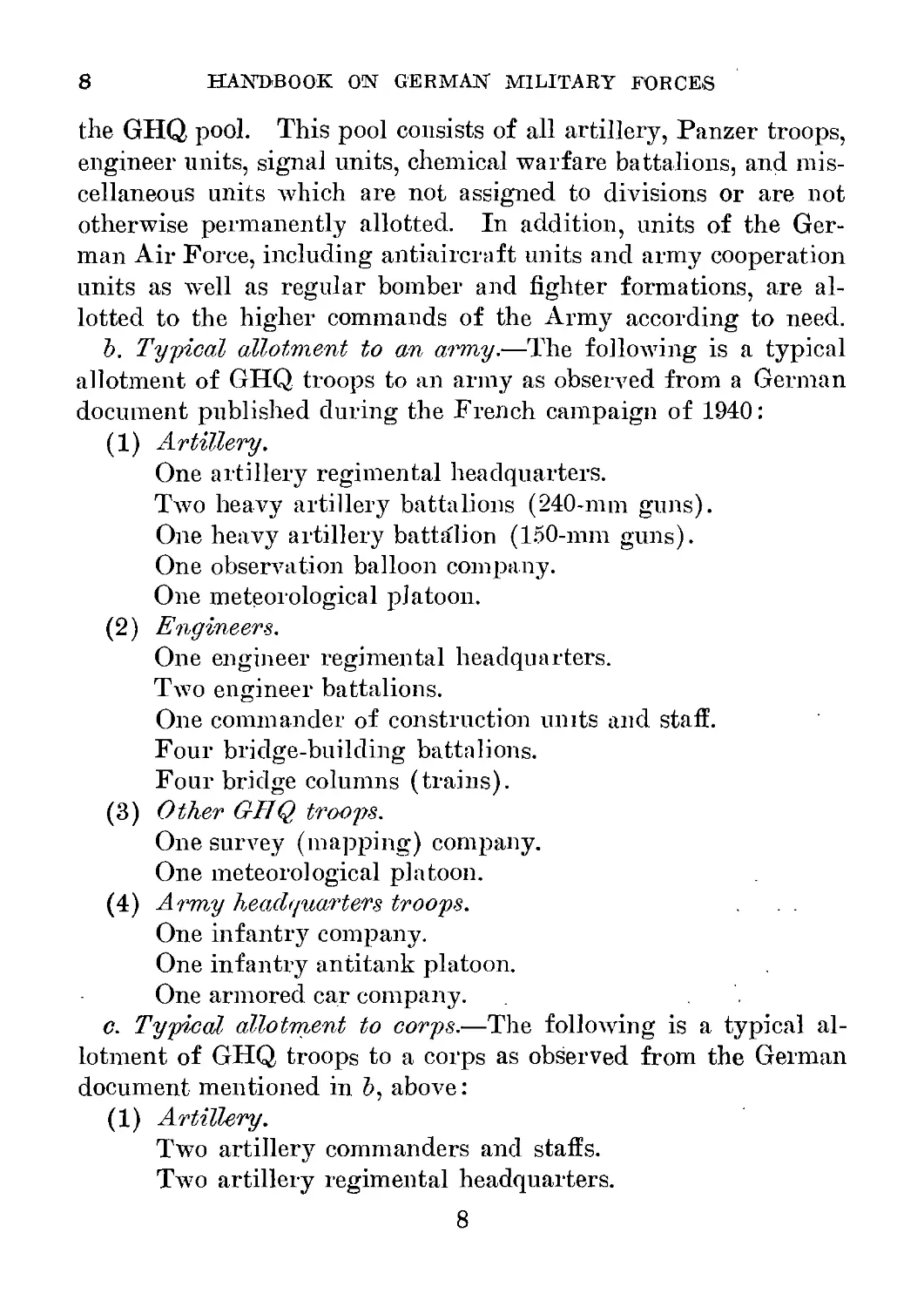
Figure 1.—Medium half-track tractor and prime mover, widely used to transport troops
and tow weapons.
9
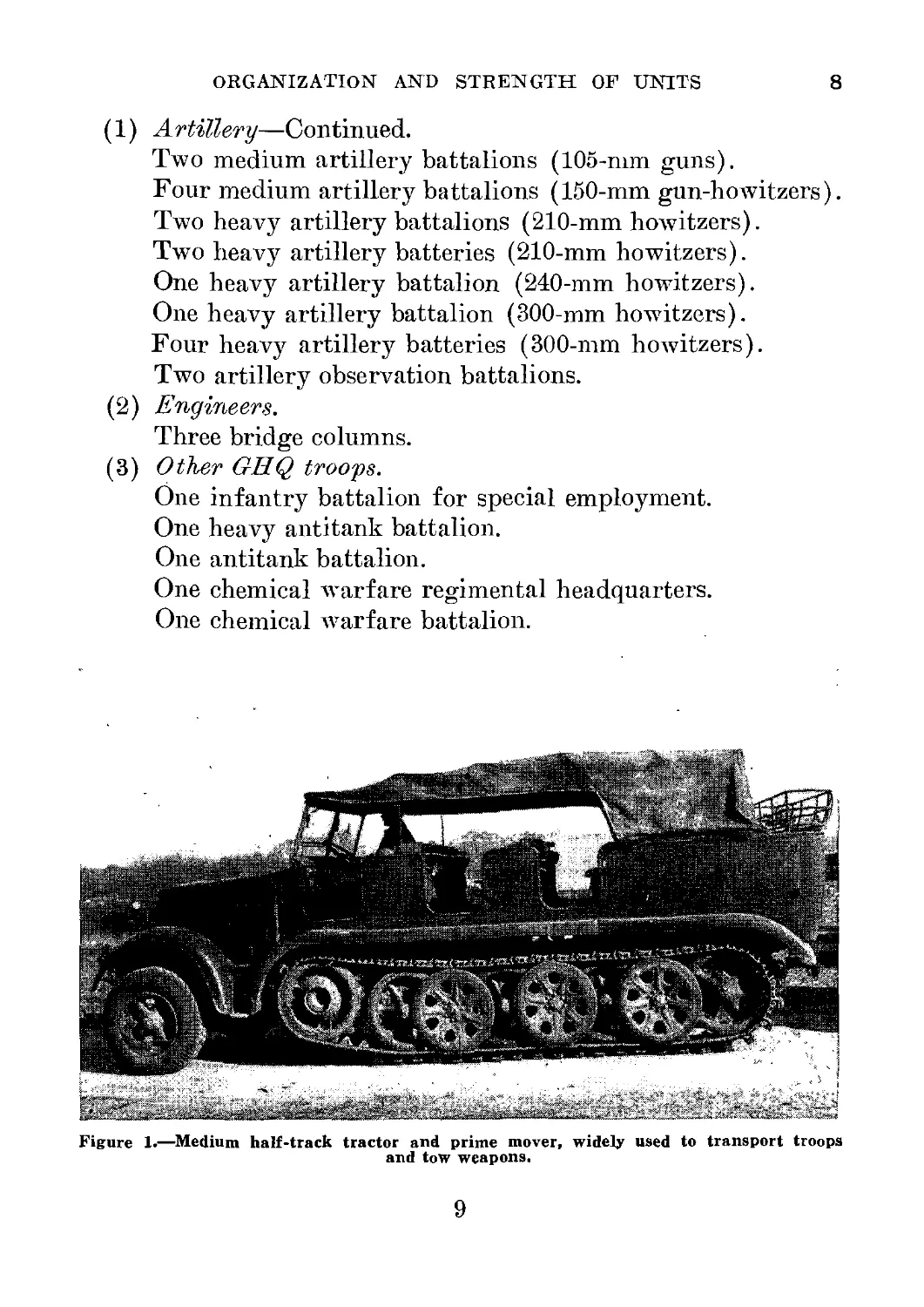
Figure 2.—Organization of the infantry division.
HANDBOOK ON GERMAN MILITARY FORCES
ORGANIZATION AND STRENGTH OF UNITS
9-10
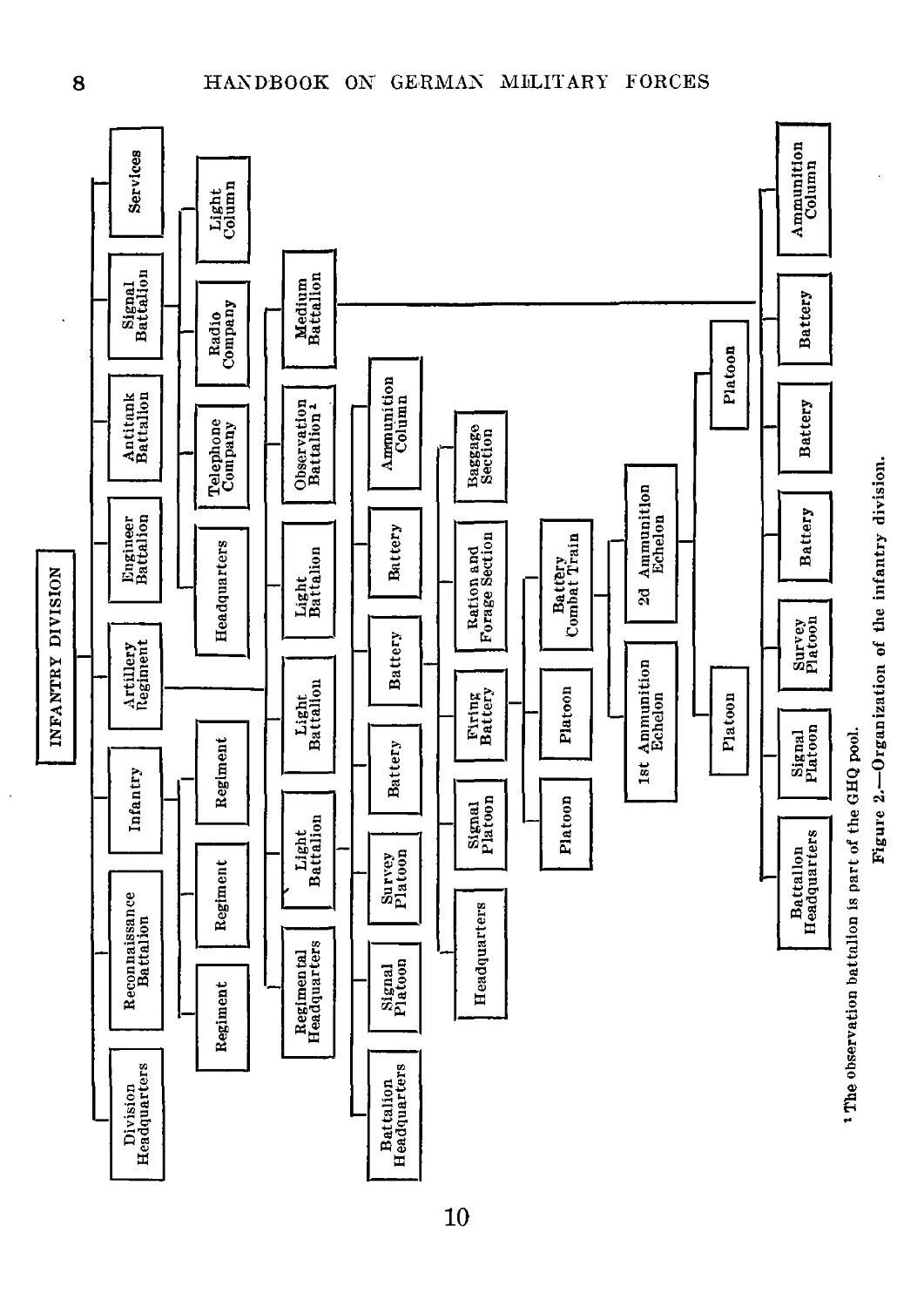
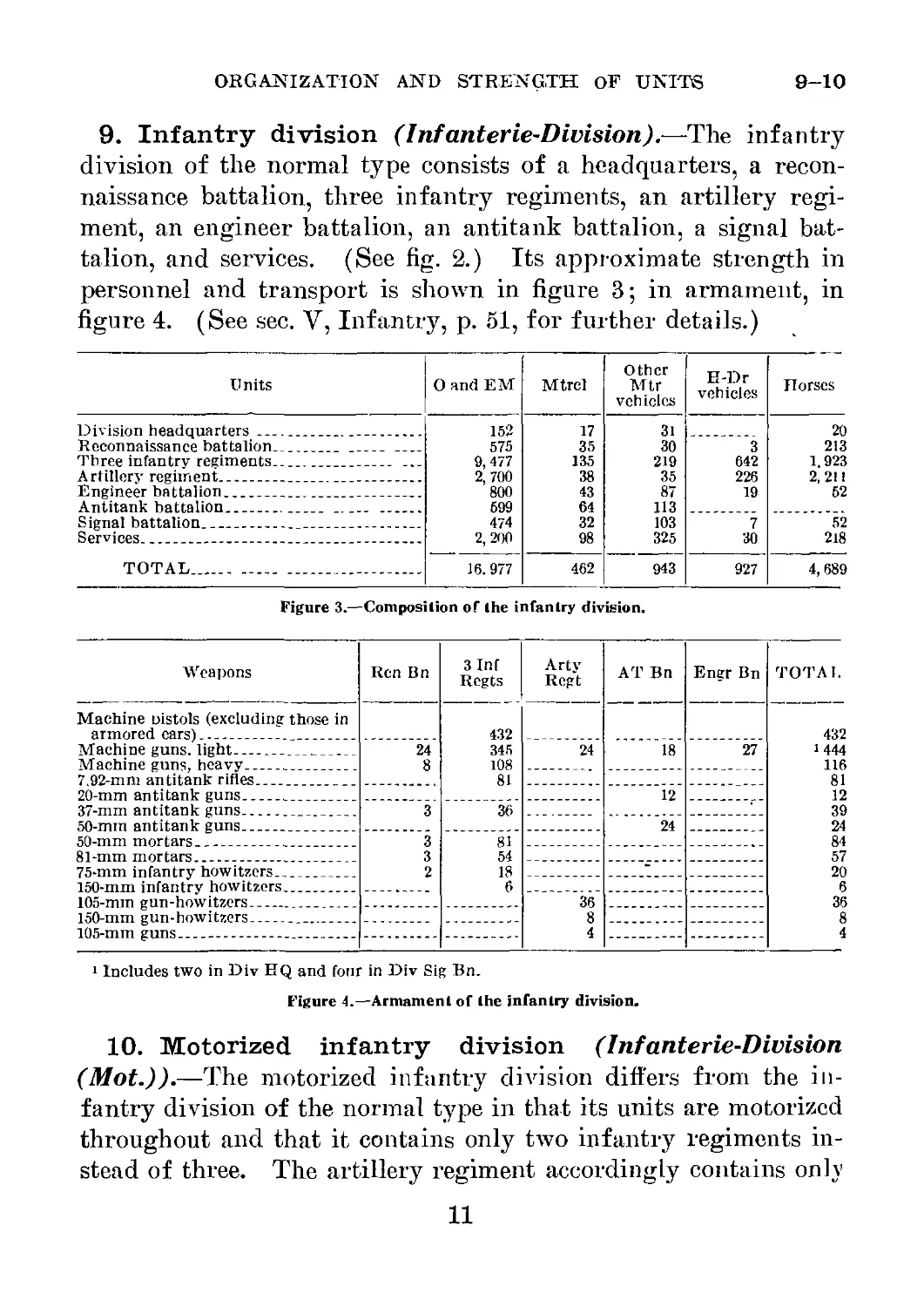
9. Infantry division (Infanterie-Division).—The infantry
division of the normal type consists of a headquarters, a recon-
naissance battalion, three infantry regiments, an artillery regi-
ment, an engineer battalion, an antitank battalion, a signal bat-
talion, and services. (See fig. 2.) Its approximate strength in
personnel and transport is shown in figure 3; in armament, in
figure 4. (See sec. V, Infantry, p. 51, for further details.)
Units	0 and EM	Mtrcl	Other Mtr vehicles	H-Dr vehicles	Horses
Division headquarters 			. 		...	152	17	31		20
Reconnaissance battalion.	575	35	30	3	213
Three infantrv regiments..	. ... ...	9,477	135	219	642	1.923
Artillery regiment		 ...			2, 700	38	35	226	2, 2! I
Engineer battalion		 	...	'800	43	87	19	52
Antitank battalion.. . ...	.. 			599	64	113
Signal battalion 	 .	... 			474	32	103	7	52
Services		2, 200	98	325	30	218
TOTAL	 			16. 977	462	943	927	4, 689
Figure 3.—Composition of the infantry division.
Weapons
Ren Bn
3 Inf
Regts
Arty
Regt
AT Bn Engr Bn
TOTAL
Machine pistols (excluding those in
armored cars)____________________
Machine guns, light______________
Machine guns, heavy______________
7.92-mm antitank rifles__________
20-mm antitank guns______________
37-mm antitank guns._____________
50-mm antitank guns______________
50-mm mortars____________________
81-mm mortars_____________________ 3
75-mm infantry howitzers__________ 2
150-mm infantry howitzers__________________
105-mm gun-howitzers_______________________
150-mm gun-howitzers______________________
105-mm guns________________________________
432
345
108
81
36
81
54
18
6
24
36
8
4
18	27
12 ___________.
24
432
1444
116
81
12
39
24
84
57
20
6
36
8
4
1 Includes two in Div HQ and four in Div Sig Bn.
Figure 4.—Armament of the infantry division.
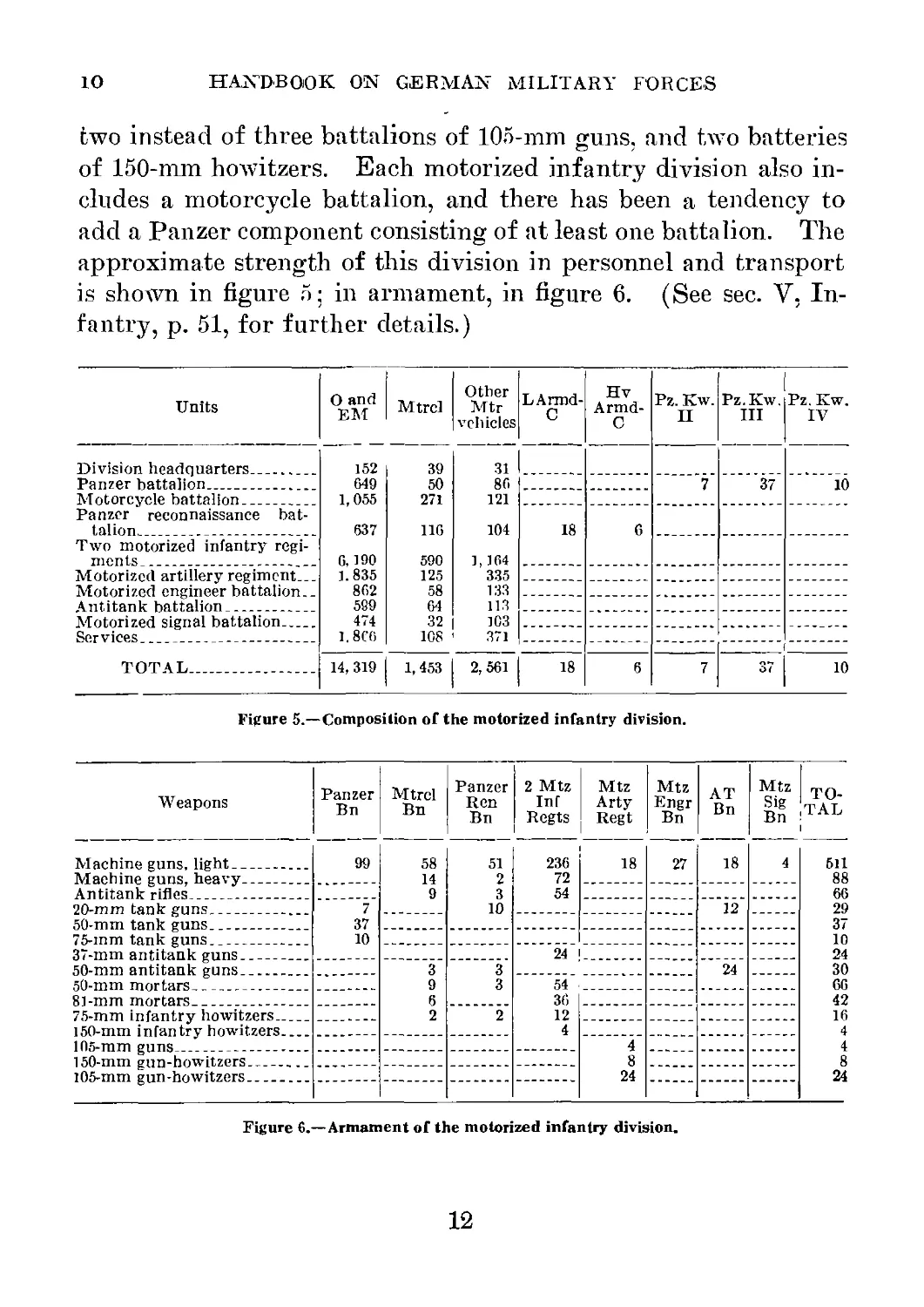
10. Motorized infantry division (Infanterie-Division
(Mot.)).— 1Tie motorized infantry division differs from the in-
fantry division of the normal type in that its units are motorized
throughout and that it contains only two infantry regiments in-
stead of three. The artillery regiment accordingly contains only
11
10
HANDBOOK ON GERMAN MILITARY FORCES
two instead of three battalions of 105-mm guns, and two batteries
of 150-mm howitzers. Each motorized infantry division also in-
cludes a motorcycle battalion, and there has been a tendency to
add a Panzer component consisting of at least one battalion. The
approximate strength of this division in personnel and transport
is shown in figure 5; in armament, in figure 6. (See sec. V, In-
fantry, p. 51, for further details.)
Units	О and EM	Mtrcl	Other Mtr vehicles	LArmd- C	Hv Armd- C	Pz. Kw. II	Pz.Kw. Ill	Pz. Kw. IV
Division headquarters. ... .	152 649 1,055 637 G, 190 1.835 862 599 474 1.8C6 14, 319	39 50 271 11G 590 125 58 64 32 108 1, 453	31 86 121 104 1, 164 335 133 113 103 371 2, 561
Panzer battalion.... 	 .						7	37	10
Motorcycle battalion.
Panzer reconnaissance bat- talion.	. 	 ..				18	6
Two motorized infantry regi- ments
Motorized artillery regiment... Motorized engineer battalion.. Antitank battalion


Motorized signal battalion	 Services .		 ....

TOTAL					18	6	7		10

Figure 5.—Composition of the motorized infantry division.
Weapons
Panzer
Bn
Machine guns, light		 Machine guns, heavy ....	99
Antitank rifles	... . ..
20-mm tank guns________________ 7
50-mrn tank guns______________ 37
75-mm tank guns_______________ 10
37-mm antitank guns_______________
50-mm antitank guns._.............
50-mm mortars_____________________
81-mm mortars_____________
75-mm infantry howitzers..
150-mm infantry howitzers.
105-mm guns_______________
150-mm gun-howitzers______
105-mm gun-howitzers______
Mtrcl
Bn
Panzer
Ren
Bn
2 Mtz
Inf
Regts
Mtz
Arty
Regt
Mtz
Engr
Bn
AT
Bn
Mtz
Sig
Bn
I TO-
,TAL
58 14 9	51 2 3 10	236 72 54	18	27	18	4	511 88
							66
					12		29
							37
							10
		24					24
3 9 6 2	3 3				24		30
		54					GG
		36 12 4					42
	2						16
							4
			4 8 24				4
							8
							24

Figure 6.—Armament of the motorized infantry division.
12
ORGANIZATION AND STRENGTH OF UNITS
11-13
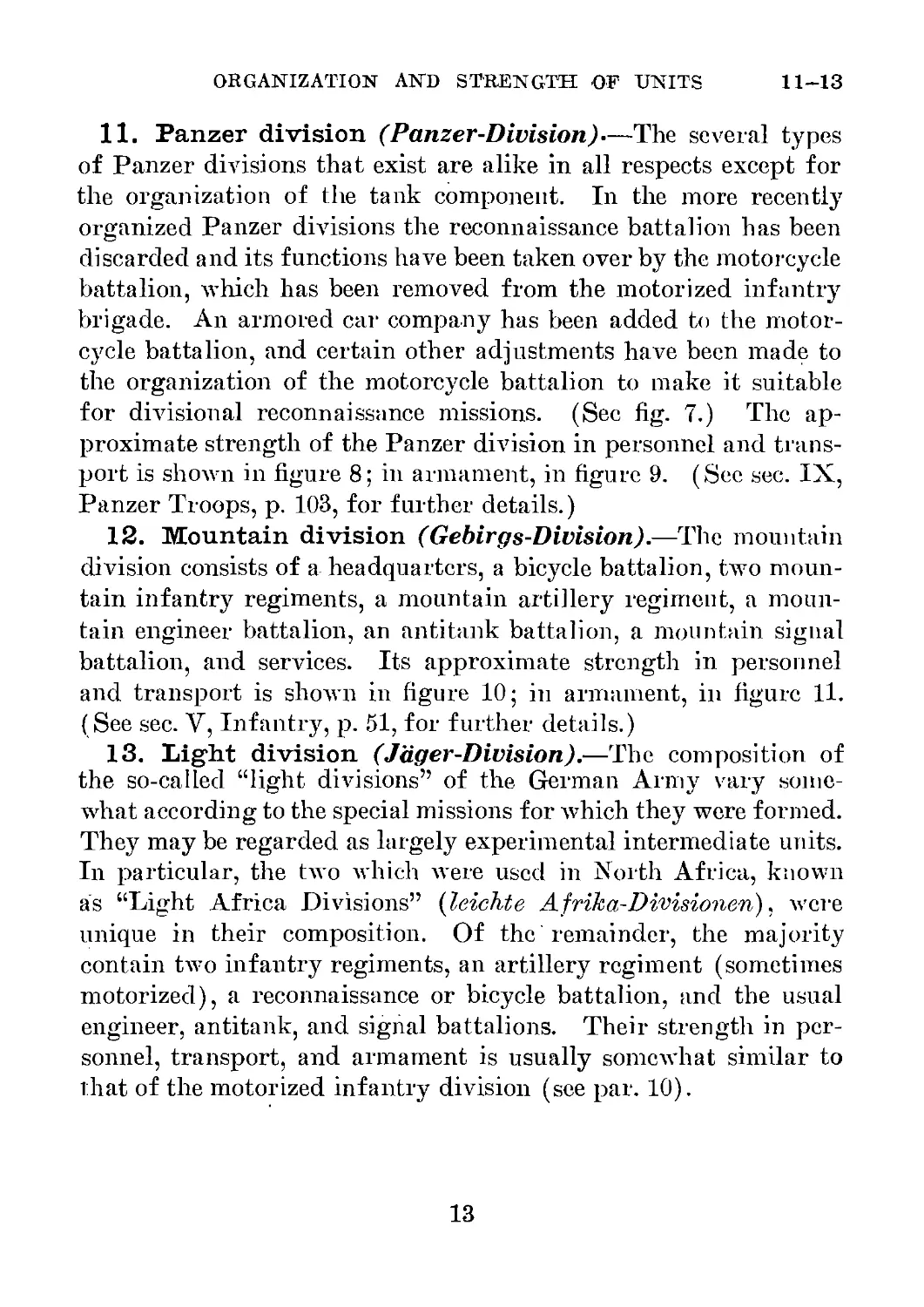
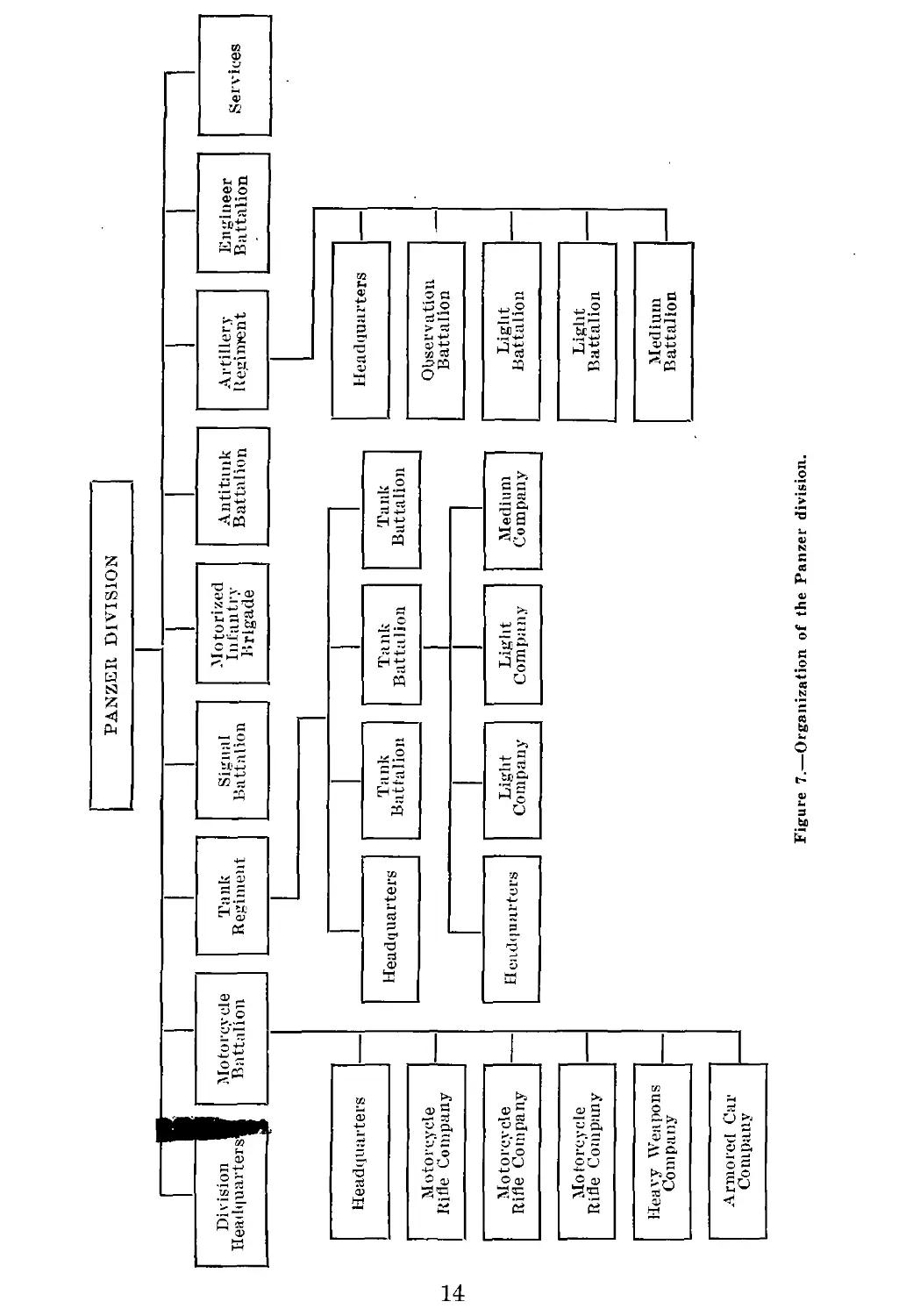
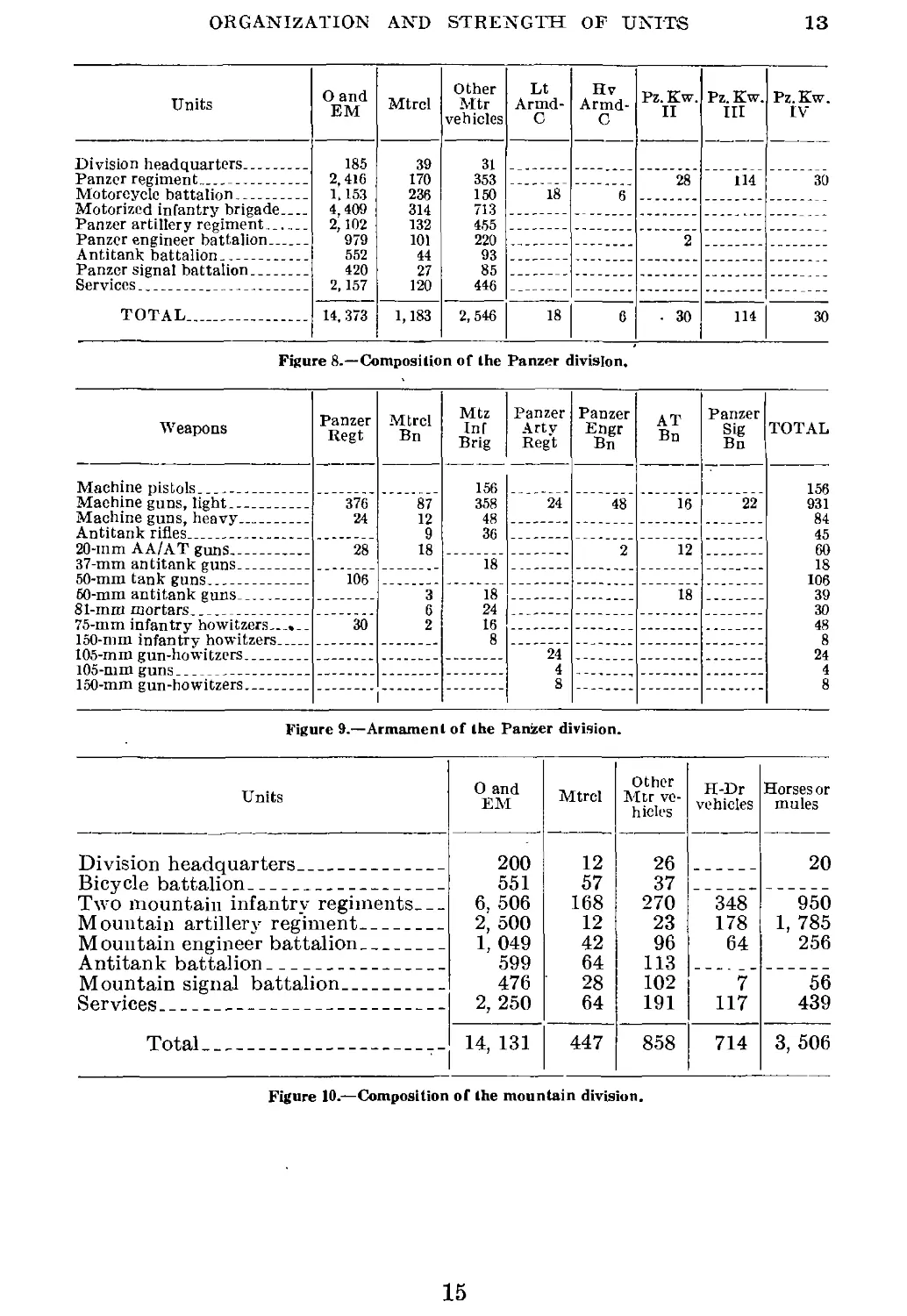
11. Panzer division (Panzer-Division)—The several types
of Panzer divisions that exist are alike in all respects except for
the organization of the tank component. In the more recently
organized Panzer divisions the reconnaissance battalion has been
discarded and its functions have been taken over by the motorcycle
battalion, which has been removed from the motorized infantry
brigade. An armored car company has been added to the motor-
cycle battalion, and certain other adjustments have been made to
the organization of the motorcycle battalion to make it suitable
for divisional reconnaissance missions. (Sec fig. 7.) The ap-
proximate strength of the Panzer division in personnel and trans-
port is shown in figure 8; in armament, in figure 9. (See sec. IX,
Panzer Troops, p. 103, for further details.)
13. Mountain division (Gebirgs-Division).—The mountain
division consists of a headquarters, a bicycle battalion, two moun-
tain infantry regiments, a mountain artillery regiment, a moun-
tain engineer battalion, an antitank battalion, a mountain signal
battalion, and services. Its approximate strength in personnel
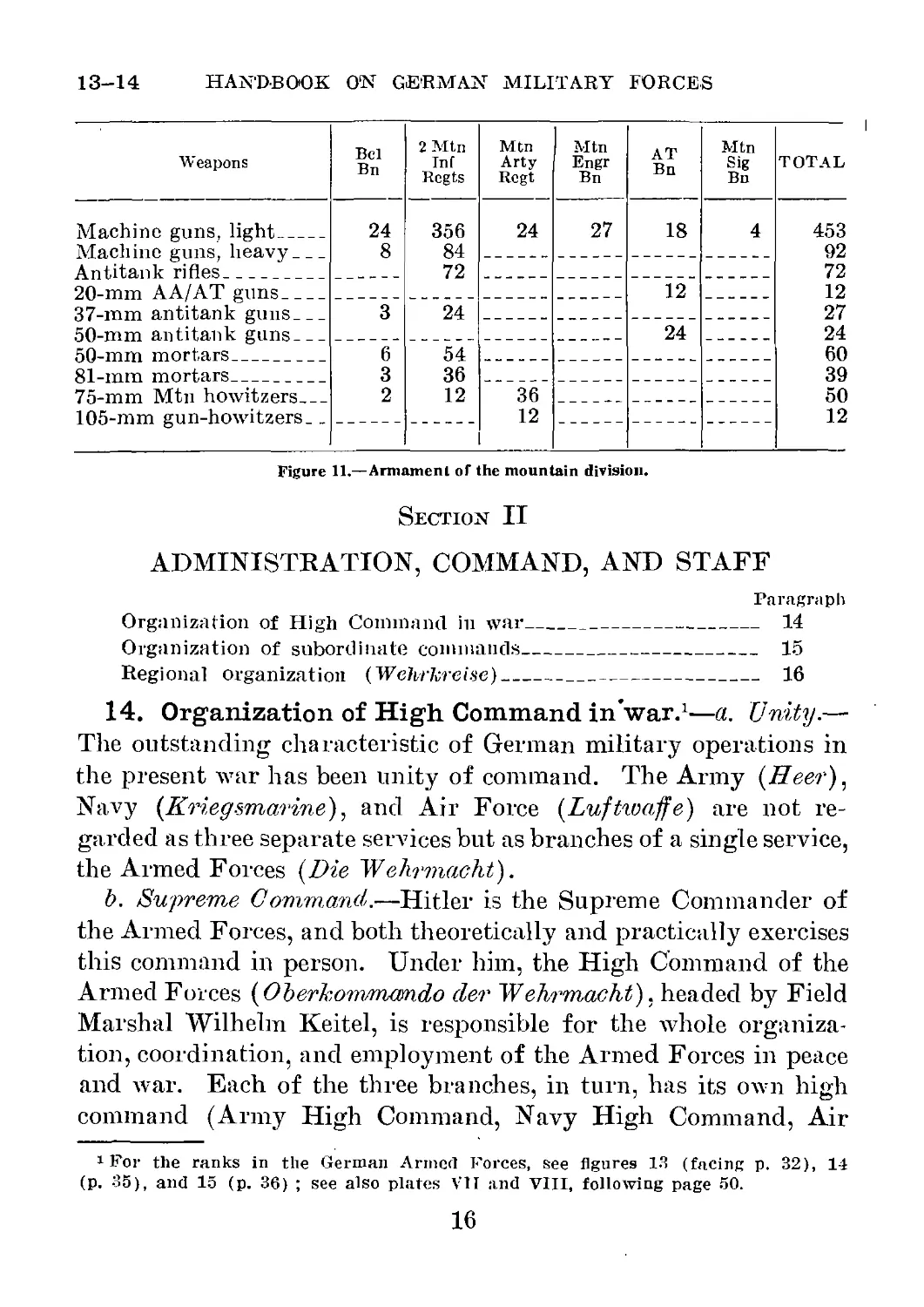
and transport is shown in figure 10; in armament, in figure 11.
(See sec. V, Infantry, p. 51, for further details.)
13. Light division (Jager-Division).—The composition of
the so-called “light divisions” of the German Army vary some-
what according to the special missions for which they were formed.
They may be regarded as largely experimental intermediate units.
In particular, the two which were used in North Africa, known
as “Light Africa Divisions” (leichte Afrika-Divisionen), were
unique in their composition. Of the remainder, the majority
contain two infantry regiments, an artillery regiment (sometimes
motorized), a reconnaissance or bicycle battalion, and the usual
engineer, antitank, and signal battalions. Their strength in per-
sonnel, transport, and armament is usually somewhat similar to
that of the motorized infantry division (see par. 10).
13
Figure 7.—Organization of the Panzer division.
ORGANIZATION AND STRENGTH OF UNITS
13
Units	О and EM	Mtrcl	Other Mtr vehicles	Lt Armd- C	Hv Armd- C	Pz. Kw. II	Pz. Kw. Ill	Pz.Kw. IV
Division headquarters	 Panzer regiment _ 		185 2,416 1.153 4,409 2,102 979 552 420 2,157 14, 373	39 170 236 314 132 101 44 27 120	31 353 150 713 455 220 93 85 446
						28	114	30
Motorcycle battalion					18	6
Motorized infantry brigade	 Panzer artillery regiment

Panzer engineer battalion							2
Antitank battalion
Panzer signal battalion	 Services. 	 ... ... . .

TOTAL
		1,183	2, 546	18	6	. 30	114	30

Figure 8.—Composition of the Panzer division.
Weapons	Panzer Regt	Mtrcl Bn	Mtz Inf Brig	Panzer Arty Regt	Panzer Engr Bn	AT Bn	Panzer Sig Bn	TOTAL
Machine pistols...,	 Machine guns, light		376	87	156 358	24	48	16	22	156 931
Machine guns, heavy		24	12	48					84
Antitank rifles					У	36					45
20-mm AA/AT guns		28	18			2	12			60
37-mm antitank guns				18					IS
50-mm tank guns		106							106
50-mm antitank guns			3	18			18		39
81-mrn mortars			6	24					30
75-mm infantry howitzers......	30	2	16					48
150-mm infantry howitzers				8					8
105-mm gun-howitzers					24				24
105-mm guns	 150-mm gun-howitzers		—			4 S		—		4 8
Figure 9.—Armament of the Panzer division.
Units	0 and EM	Mtrcl	Other Mtr ve- hicles	H-Dr vehicles	Horses or mules
Division headquarters 	 _	200	12	26		20
Bicycle battalion		_	551	57	37
Two mountain infantrv regiments		6, 506	168	270	348	950
Mountain artillery regiment- 		2, 500	12	23	178	1, 785
Mountain engineer battalion		1', 049	42	96	64	256
Antitank battalion		 _	599	64	113
Mountain signal battalion		476	28	102	7	56
Services		2, 250	64	191	117	439
Total			14, 131	447	858	714	3, 506
Figure 10.—Composition of the mountain division.
15
13-14
HANDBOOK on german military forces
Weapons	Bel Bn	2 Mtn Inf Regts	Mtn Arty Regt	Mtn Engr Bn	AT Bn	Mtn Sig Bn	TOTAL
Machine guns, light	 Machine guns, heavy	 Antitank rifles	24 8	356 84	24	27	18	4	453 92
		72					72
20-mm AA/AT guns					12		12
37-mm antitank guns	 50-mm antitank guns	3	24					27
					24		24
50-mm mortars	6	54					60
81-mm mortars	3	36					39
75-mm Mtn howitzers	2	12	36				50
105-mm gun-howitzers			12				12

Figure 11.—Armament of the mountain division.
Section II
ADMINISTRATION, COMMAND, AND STAFF
Paragraph
Organization of High Command in war___________________________ 14
Organization of subordinate commands__________________________ 15
Regional organization (Wehrkreise)____________________________ 16
14. Organization of High Command in’war.1—a. Unity.—
The outstanding characteristic of German military operations in
the present war has been unity of command. The Army {Heer),
Navy {Krieg smarine), and Air Force {Luftwaffe) are not re-
garded as three separate services but as branches of a single service,
the Armed Forces {Die 'Wehrmacht).
b.	Supreme Command.—Hitler is the Supreme Commander of
the Armed Forces, and both theoretically and practically exercises
this command in person. Under him, the High Command of the
Armed Forces {Oberhommamdo der 'Wehrmacht), headed by Field
Marshal Wilhelm Keitel, is responsible for the whole organiza-
tion, coordination, and employment of the Armed Forces in peace
and war. Each of the three branches, in turn, has its own high
command (Army High Command, Navy High Command, Air
1 For the ranks in the German Armed Forces, see figures 13 (facing p. 32), 14
(p. 35), and 15 (p. 36) ; see also plates VII and VIII, following page 50.
16
ADMINISTRATION, COMMAND, AND STAFF
14
Force High Command), which is responsible for carrying out in
its own sphere with its own General Staff the directives of the High
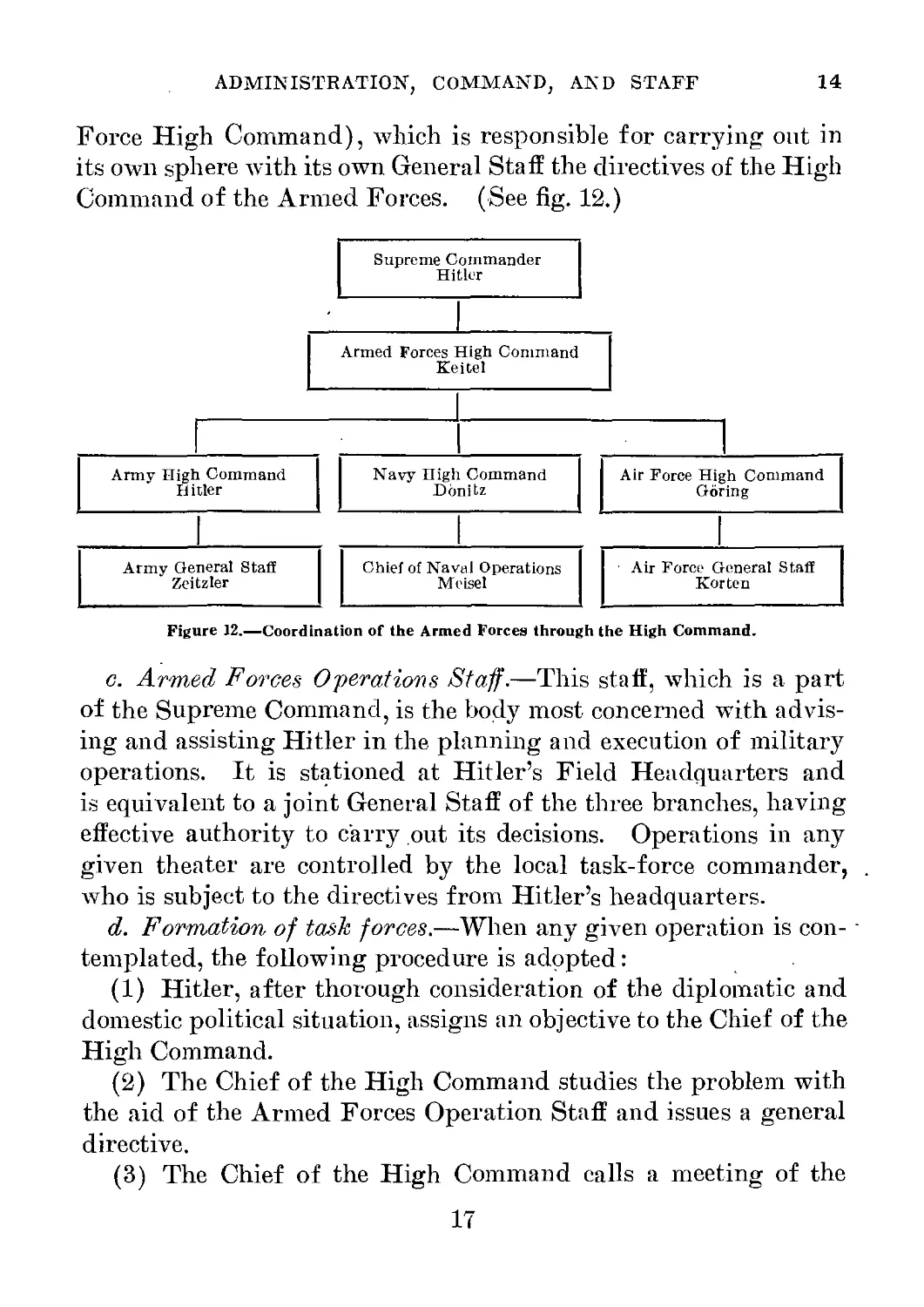
Command of the Armed Forces. (See fig. 12.)
Figure 12.—Coordination of the Armed Forces through the High Command.
c.	Armed Forces Operations Staff.—This staff, which is a part
of the Supreme Command, is the body most concerned with advis-
ing and assisting Hitler in the planning and execution of military
operations. It is stationed at Hitler’s Field Headquarters and
is equivalent to a joint General Staff of the three branches, having
effective authority to carry out its decisions. Operations in any
given theater are controlled by the local task-force commander,
who is subject to the directives from Hitler’s headquarters.
d.	Formation of task forces.—When any given operation is con-
templated, the following procedure is adopted:
(1)	Hitler, after thorough consideration of the diplomatic and
domestic political situation, assigns an objective to the Chief of the
High Command.
(2)	The Chief of the High Command studies the problem with
the aid of the Armed Forces Operation Staff and issues a general
directive.
(3)	The Chief of the High Command calls a meeting of the
17
14
HANDBOOK ON GERMAN MILITARY FORCES
Commanders-in-Chief of the Army, Navy, and Air Force, at
which the problem as a whole is discussed and a commander is
nominated for the operation in question.
(4)	After renewed consultation with the Chief of the High
Command, Hitler appoints the commander for the operation, who
may come from the Army, the Navy, or the Air Force.
(5)	When the commander is appointed, he becomes a direct
subordinate of the Chief of the High Command.
(6)	The Chief of the High Command issues an explicit direc-
tive to the commander.
(7)	The new commander selects his own staff, which may be
composed of members of the three services.
(8)	The staff prepares—
(«) A general plan of operation.
(Z>) A list of requirements.
(9)	The commander of the operation submits his plans and his
requirements to the Chief of the High Command for his approval.
Generally the commander gets all that he requests, even including
the specific units of his choice.
(10)	The selected units become a task force.
(11)	The commander of the operation prepares a training di-
rective for the task force. All units in it are specially trained for
a specified period. During this period, the commander’s staff pre-
pares detailed plans.
(12)	Hitler and the Chief of the High Command set a date
and time for the operation.
(13)	The commander of the operation confers with all subordi-
nate leaders and goes over the detailed plans of lower units prior
to the beginning of the operation.
(14)	The operation begins.
e.	High Command of the Army.—The High Command of
the Army (Oberkommando des Heeres) is headed by the Com-
mander-in-Chief of the Army (Oberbefehlshaber des Heeres).
He is the actual head of the Army without having the status of a
18
ADMINISTRATION, COMMAND, AND STAFF	14
cabinet member. He supervises the organization and training of
the Army in time of peace and is field commander in time of war.
This command includes both the exercise of field command and
the administrative duties at home. This function for the present
has been assumed by Hitler. The High Command of the Army
{Oberkommando des Heeres) is organized into eight main sec-
tions, as follows:
(1)	Adjutant's Office {Adjutantur).—The office acts as a cen-
tral clearing office for incoming and outgoing mail. It is in no
sense an equivalent of the U. S. Adjutant General’s Department.
(2)	Personnel Office {Personalamt).—This office has full ap-
pointive power, without recourse to higher authority, for all of-
ficers up to the grade of lieutenant colonel except for officers in
the General Staff Corps. Appointments of colonels and generals
are made by Hitler. General Staff Corps officers are appointed
and promoted by the Chief of the General Staff. Otherwise, all
matters regarding initial commissions, promotions, transfers, and
retirements of officers are handled by the Personnel Office ex-
clusively. Its power is very great, and it is shielded from inter-
ference. This office is the depository for all efficiency reports.
(3)	General Staff {Generalstab).—Under the Chief of Staff of
the Army there are five main departments, each under a Deputy
Chief of the General Staff {Oberquartiermeister I-V). Each de-
partment consists of from one to five sections {Abteilung en). The
organization is as follows:
Oberquartiermeister I.—Operations.
Abteilung 1.—Operations.
Abteilung 5.—Transport.
Abteilung 6.—Rear Echelons.
Abteilung 9.—Topography.
Abteilung 10.—Maneuvers and Operational Planning.
Oberquartiermeister II.—Training.
Abteilung —Training.
Abteilung 11.—Military Schools and Officers’ Training.
19
14	HANDBOOK ON GERMAN MILITARY FORCES
Oberguan'tiermeister III.—Organization.
Abteilung 0.—Organization.
Abteilung 8.—Technical Services.
Obe-rquartiermeister IV.—Intelligence.
Abteilung 3.—Eastern Section.
Abteilung 12.—Western Section.
Oberquartiermeister V.—Historical.
Abteilung 7.—Historical.
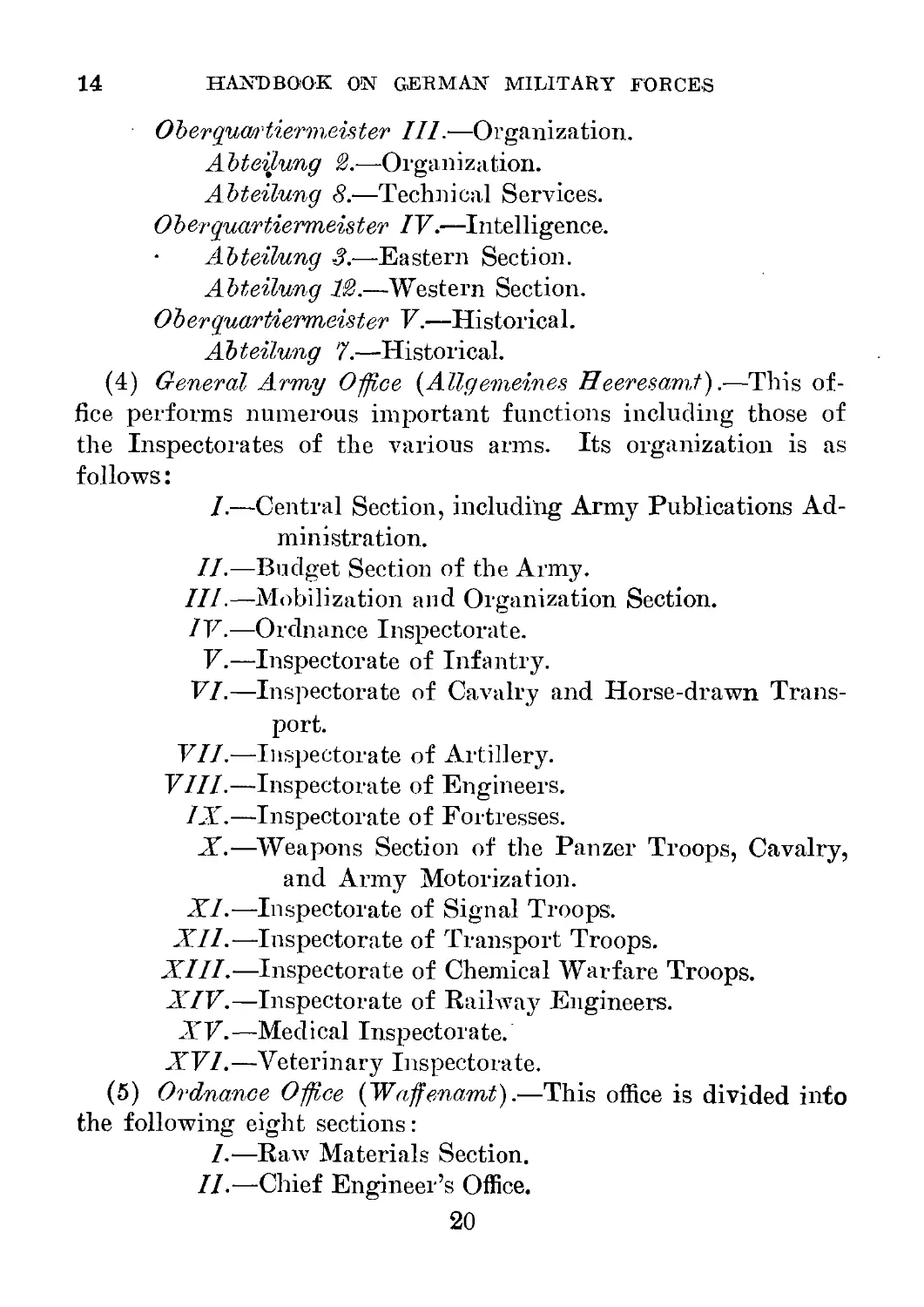
(4)	General Army Office (Allgemeines Heeresam.t).—This of-
fice performs numerous important functions including those of
the Inspectorates of the various arms. Its organization is as
follows:
/.—Central Section, including Army Publications Ad-
ministration.
II	.—Budget Section of the Army.
Ill	.—Mobilization and Organization Section.
IV	.—Ordnance Inspectorate.
V	.—Inspectorate of Infantry.
VI	.—Inspectorate of Cavalry and Horse-drawn Trans-
port.
VII	.—Inspectorate of Artillery.
VIII	.—Inspectorate of Engineers.
IX	.—Inspectorate of Fortresses.
X	.—Weapons Section of the Panzer Troops, Cavalry,
and Army Motorization.
XI	.—Inspectorate of Signal Troops.
XII	.—Inspectorate of Transport Troops.
XIII	.—Inspectorate of Chemical Warfare Troops.
XIV	.—Inspectorate of Railway Engineers.
XV	.—Medical Inspectorate.
XVI	.—Veterinary Inspectorate.
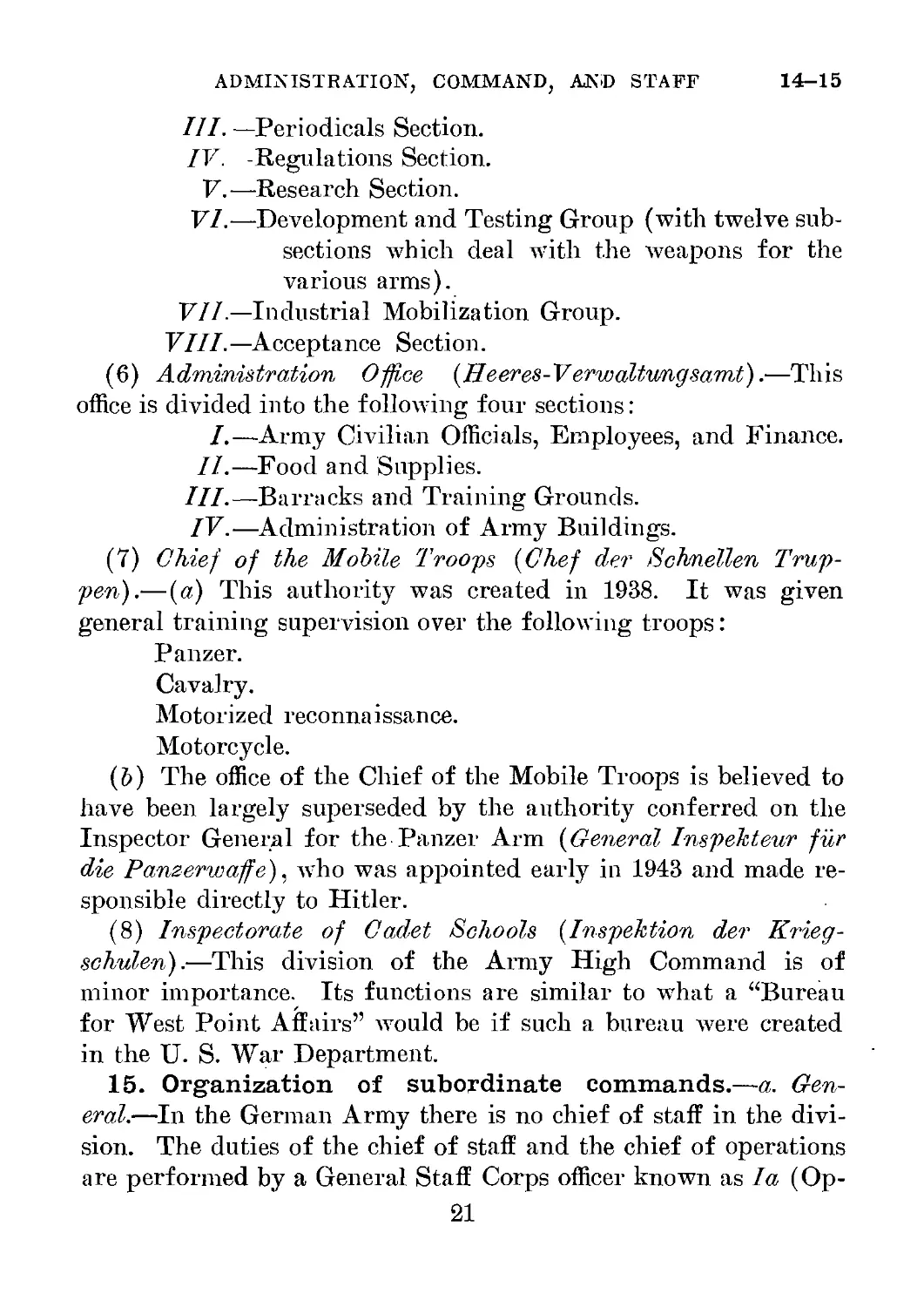
(5)	Ordnance Office (Waffenamt).—This office is divided info
the following eight sections:
I	.—Raw Materials Section.
II	.—Chief Engineer’s Office.
20
ADMINISTRATION, COMMAND, AND STAFF 14-15
III	. —Periodicals Section.
IV	. -Regulations Section.
V	.—Research Section.
VI	.—Development and Testing Group (with twelve sub-
sections which deal with the weapons for the
various arms).
VII	.—Industrial Mobilization Group.
VIII	.—Acceptance Section.
(6)	Administration Office (Heeres-Verwaltwngsamt).—This
office is divided into the following four sections:
I	.—Army Civilian Officials, Employees, and Finance.
II.—Food and Supplies.
III	.—Barracks and Training Grounds.
IV	.—Administration of Army Buildings.
(7)	Okie/' of the Mobile Troops (Chef der Sch/nellen Trap-
pen).— (a) This authority was created in 1938. It was given
general training supervision over the following troops:
Panzer.
Cavalry.
Motorized reconnaissance.
Motorcycle.
(&) The office of the Chief of the Mobile Troops is believed to
have been largely superseded by the authority conferred on the
Inspector General for the Panzer Arm (General Inspekteur fur
die Panzerwaffe), who was appointed early in 1943 and made re-
sponsible directly to Hitler.
(8)	Inspectorate of Cadet Schools (Inspection der Krieg-
schulen).—This division of the Army High Command is of
minor importance. Its functions are similar to what a “Bureau
for West Point Affairs” would be if such a bureau were created
in the U. S. War Department.
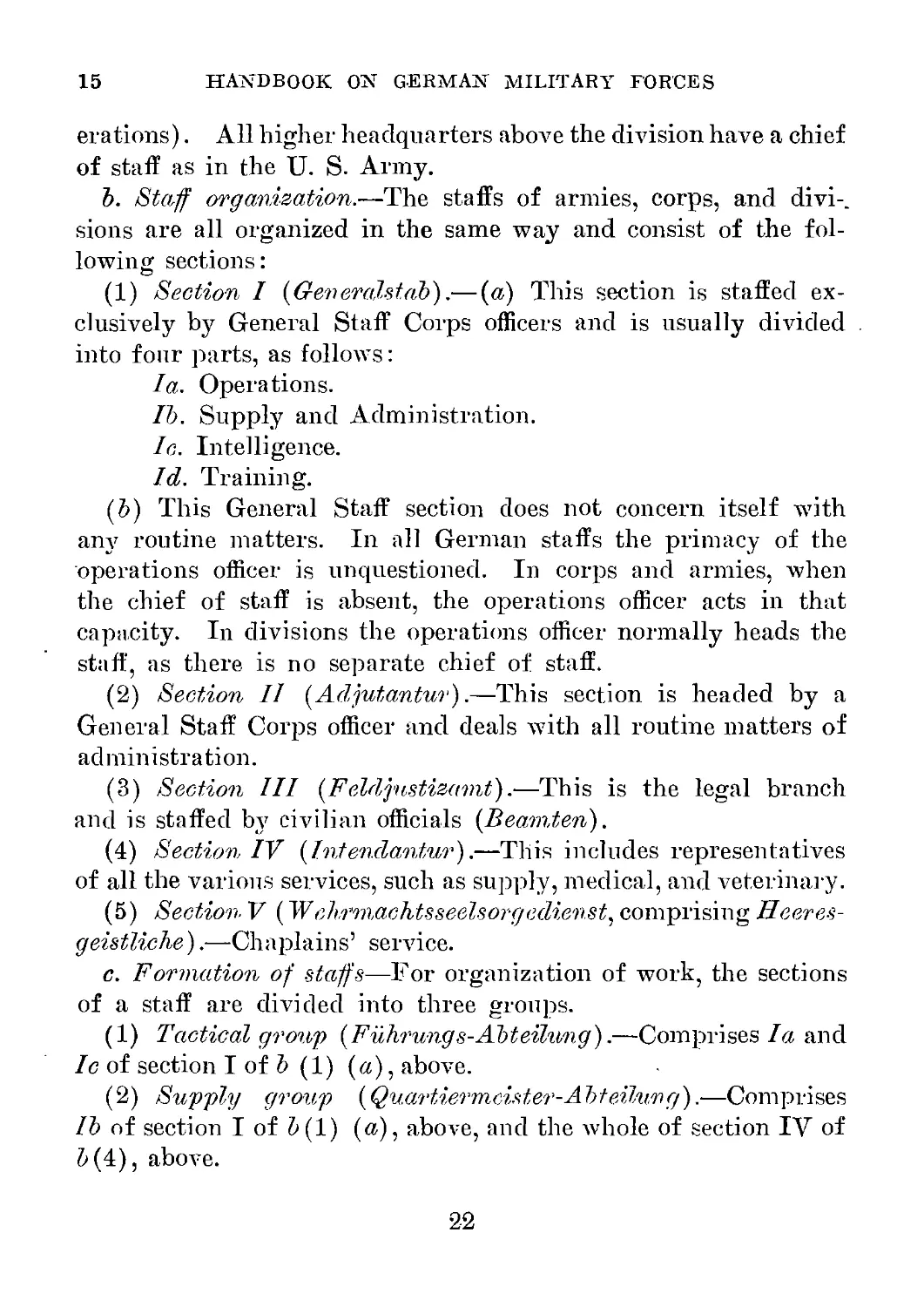
15. Organization of subordinate commands.—a. Gen-
eral.—In the German Army there is no chief of staff in the divi-
sion. The duties of the chief of staff and the chief of operations
are performed by a General Staff Corps officer known as la (Op-
21
15
HANDBOOK ON GERMAN MILITARY FORCES
erations). All higher headquarters above the division have a chief
of staff as in the U. S. Army.
Ъ. Staff organization.—The staffs of armies, corps, and divi-.
sions are all organized in the same way and consist of the fol-
lowing sections:
(1) Section I (Generahtab).— (a) This section is staffed ex-
clusively by General Staff Corps officers and is usually divided
into four parts, as follows:
la. Operations.
II). Supply and Administration.
Ic. Intelligence.
Id. Training.
(&)	This General Staff section does not concern itself with
any routine matters. In all German staffs the primacy of the
operations officer is unquestioned. In corps and armies, when
the chief of staff is absent, the operations officer acts in that
capacity. In divisions the operations officer normally heads the
staff, as there is no separate chief of staff.
(2)	Section II (Adjutantur).—This section is headed by a
General Staff Corps officer and deals with all routine matters of
administration.
(3)	Section III (Feldjustizamt).—This is the legal branch
and is staffed by civilian officials (Beamten).
(4)	Section IV (Iniendantur).—This includes representatives
of all the various services, such as supply, medical, and veterinary.
(5)	Section V (Wehrmachtsseelsorgedienst, comprising Heeres-
geistliche).—Chaplains’ service.
c.	Formation of staffs—For organization of work, the sections
of a staff are divided into three groups.
(1)	Tactical group (Fuhrungs-Abteilung).—Comprises la and
Ic of section I of b (1) (a), above.
(2)	Supply group (Quartiermcister-Abteilung).—Comprises
lb of section I of &(1) (a), above, and the whole of section IV of
&(4), above.
22
ADMINISTRATION, COMMAND, AND STAFF	15
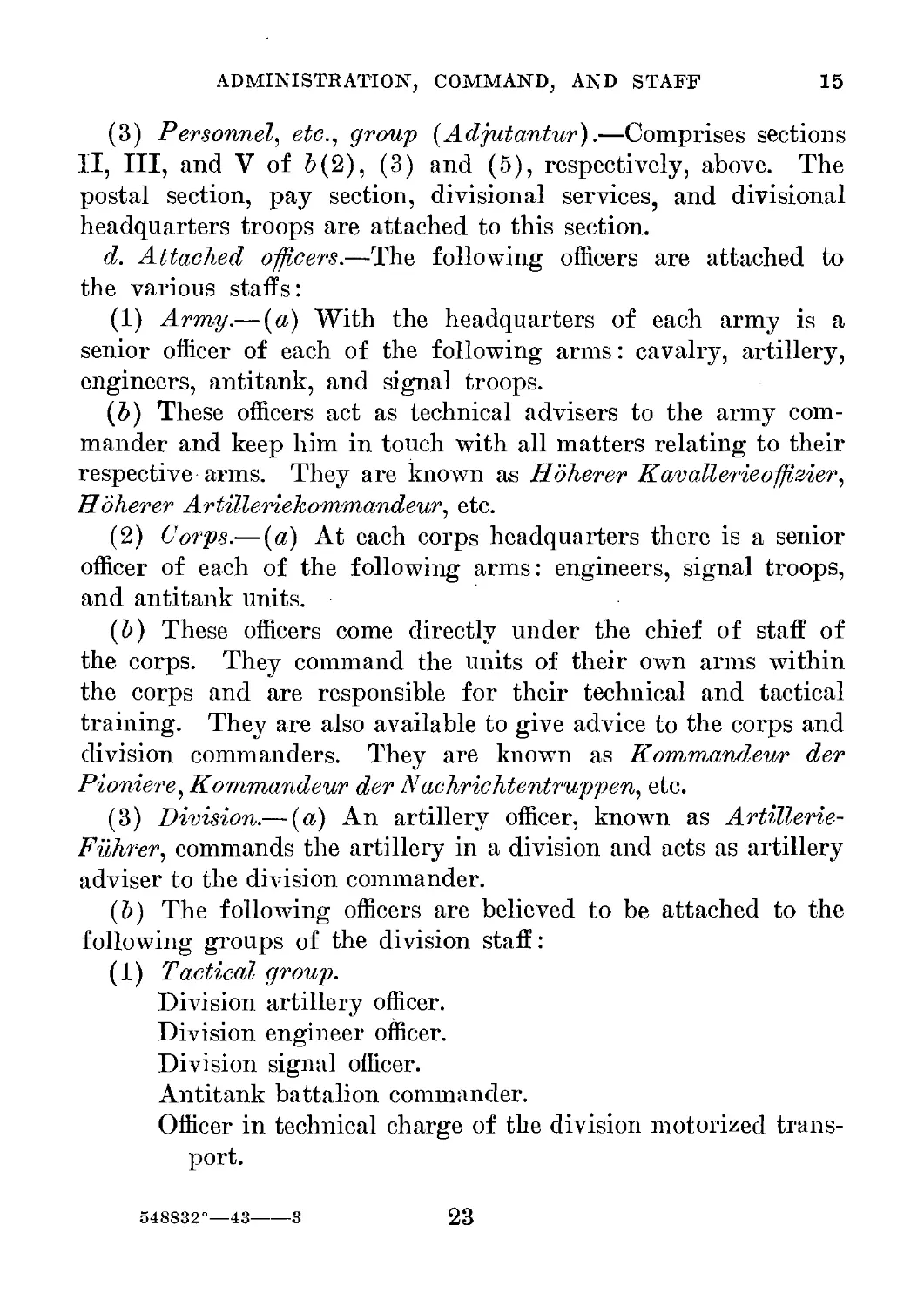
(3)	Personnel, etc., group (Adjutantur).—Comprises sections
II, III, and V of Z>(2), (3) and (5), respectively, above. The
postal section, pay section, divisional services, and divisional
headquarters troops are attached to this section.
d.	Attached officers.—The following officers are attached to
the various staffs:
(1)	Army.— (a) With the headquarters of each army is a
senior officer of each of the following arms: cavalry, artillery,
engineers, antitank, and signal troops.
(&) These officers act as technical advisers to the army com-
mander and keep him in touch with all matters relating to their
respective arms. They are known as Hoherer Kavallerieofftzier,
Hoherer Artilleriekommandeur, etc.
(2)	Corps.— (a) At each corps headquarters there is a senior
officer of each of the following arms: engineers, signal troops,
and antitank units.
(6) These officers come directly under the chief of staff of
the corps. They command the units of their own arms within
the corps and are responsible for their technical and tactical
training. They are also available to give advice to the corps and
division commanders. They are known as Kommandeur der
Pioniere, Kommandeur der N achrichtentruppen, etc.
(3)	Division.— (a) An artillery officer, known as Artillerie-
Fuhrer, commands the artillery in a division and acts as artillery
adviser to the division commander.
(6) The following officers are believed to be attached to the
following groups of the division staff:
(1) Tactical group.
Division artillery officer.
Division engineer officer.
Division signal officer.
Antitank battalion commander.
Officer in technical charge of the division motorized trans-
port.
548832°—43---3
23
15-16
HANDBOOK ON GERMAN MILITARY FORCES
(2) Supply group.
Commander of the light columns and the division train.
Division provost marshal.
Division postal service commander.
Engineer officer] ,.	.	„	, J, . ,.
Signal officer I' Quesflons °f supply materiel).
16. Regional organization (Wehrkreise).—a. General.—
Germany is divided into a number of military districts (fWehr-
kreise). Before the present war each of these was commanded
by a senior officer who also commanded the corps bearing the
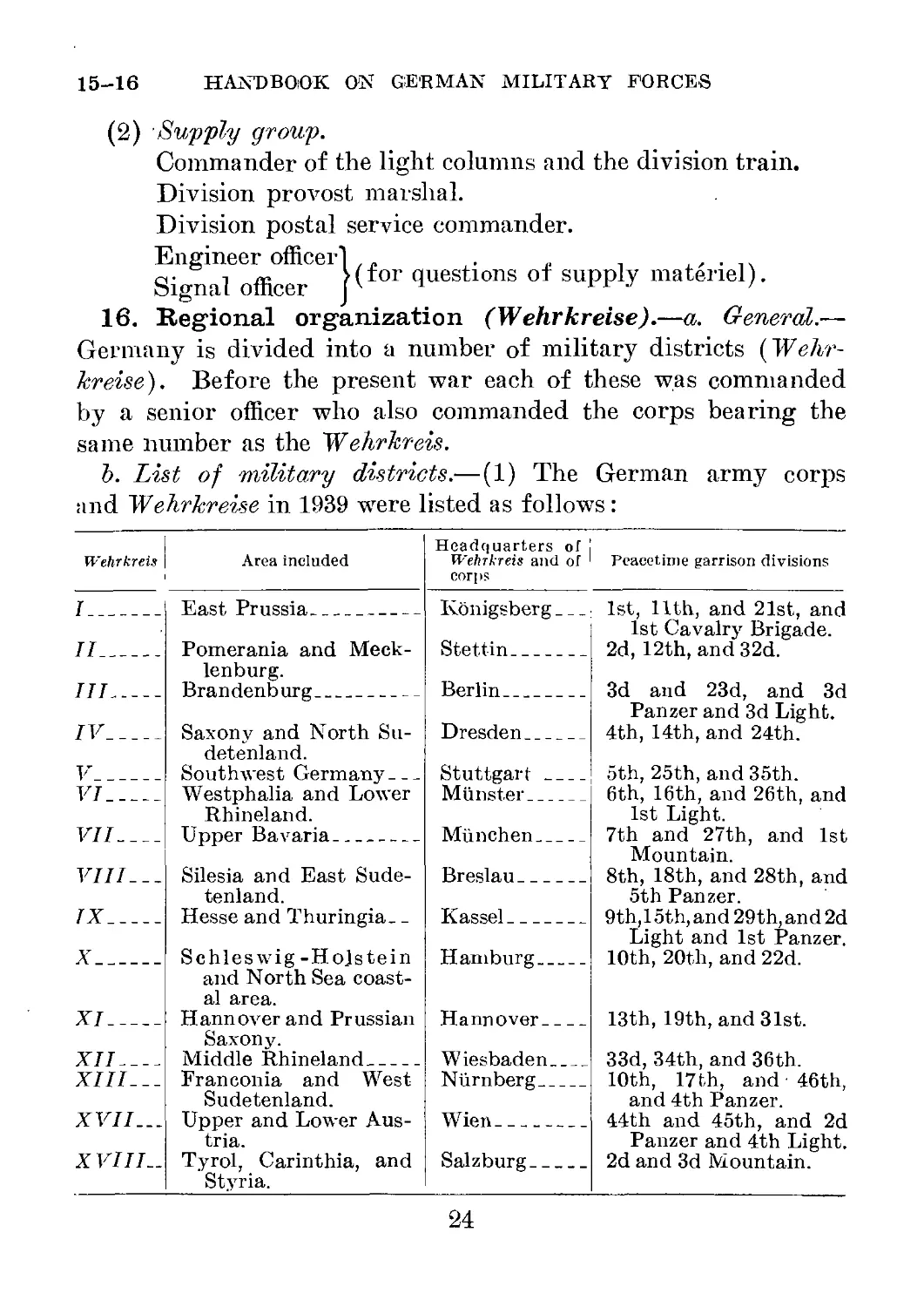
same number as the "Wehrkreis.
b. List of military districts.— (1) The German army corps
and ~W ehrkreise in 1939 were listed as follows:
Wehrkreis	Area included	Headquarters of Wehrkreis and of corps	Peacetime garrison divisions
I		East Prussia		Kbnigsberg		1st, 11th, and 21st, and 1st Cavalry Brigade.
II		Pomerania and Meck- lenburg.	Stettin		2d, 12th, and 32d.
III		Brandenburg		Berlin		3d and 23d, and 3d Panzer and 3d Light.
IV		Saxony and North Su- detenland.	Dresden		4th, 14th, and 24th.
V		Southwest Germany		Stuttgart 		5th, 25th, and 35th.
VI		Westphalia and Lower Rhineland.	Munster		6th, 16th, and 26th, and 1st Light.
VII		Upper Bavaria		Munchen		7th and 27th, and 1st Mountain.
VIII---	Silesia and East Sude- tenland.	Breslau		8th, 18th, and 28th, and 5th Panzer.
IX		Hesse and Thuringia. _	Kassel		9th, 15th, and 29th, and 2d Light and 1st Panzer.
X		Schleswig -Holstein and North Sea coast- al area.	Hamburg		10th, 20th, and 22d.
XI		Hannover and Prussian Saxonv.	Hannover		13th, 19th, and 31st.
XII		Middle Rhineland		Wiesbaden		33d, 34th, and 36th.
XIII---	Franconia and West Sudetenland.	Nurnberg		10th, 17 th, and 46th, and 4th Panzer.
XVII...	Upper and Lower Aus- tria.	Wien		44th and 45th, and 2d Panzer and 4th Light.
XVIII-	Tyrol, Carinthia, and Stvria.	Salzburg		2d and 3d Mountain.
24
ADMINISTRATION, COMMAND, AND STAFF 16-17
(2)	After the Polish campaign, WehrkreiseXX (Danzig) and
XXI (Posen) were formed in the conquered territory.'
(3)	Alsace has been incorporated into Wehrkreis F; Lorraine
and Luxemburg, into Wehrkreis XII; Eupen-Malmedy, into
Wehrkreis FZ; portions of northern Yugoslavia, into Wehrkreis
XVIII; and the Bialystok district, into Wehrkreis I.
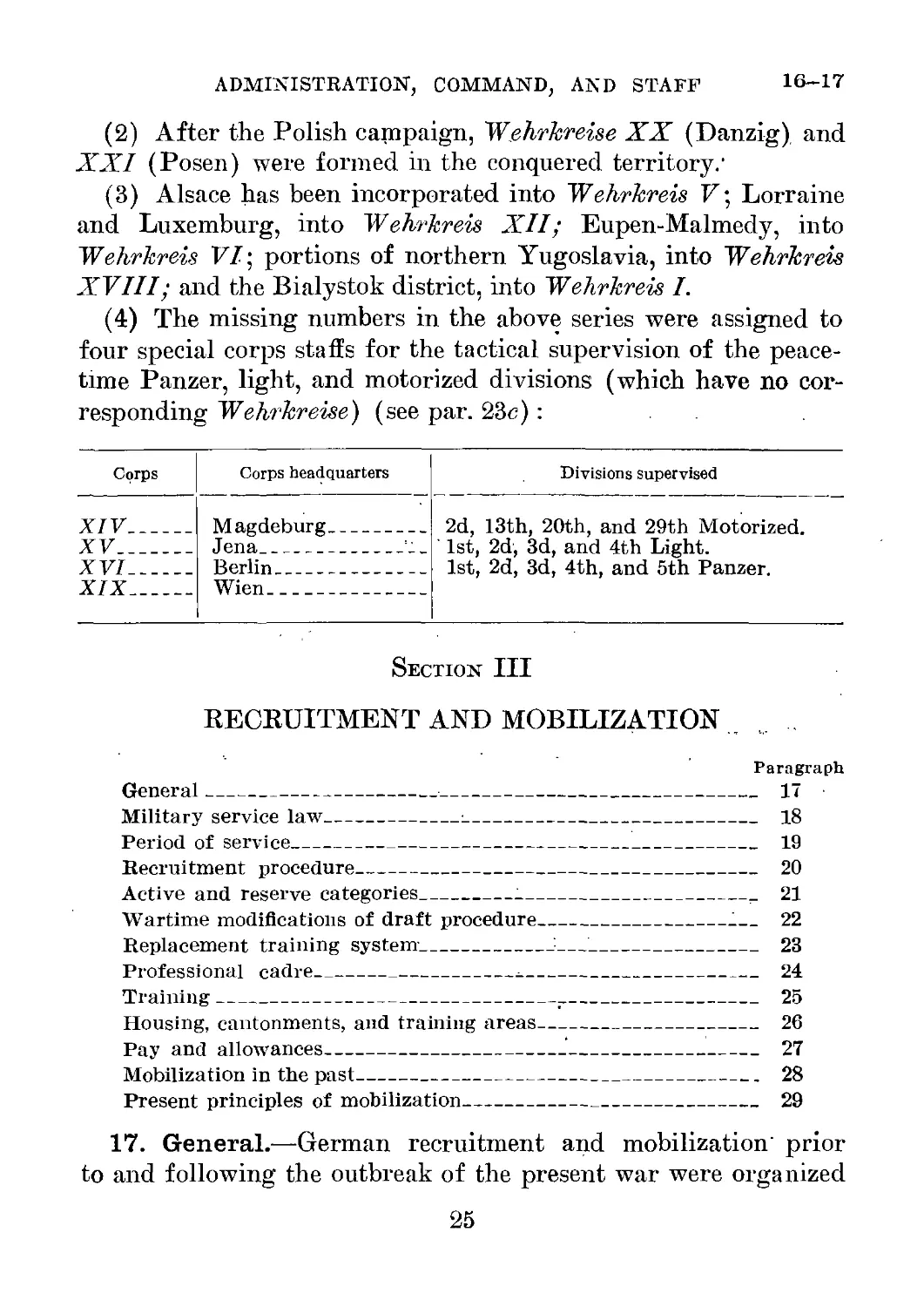
(4)	The missing numbers in the above series were assigned to
four special corps staffs for the tactical supervision of the peace-
time Panzer, light, and motorized divisions (which have no cor-
responding Wehrkreise) (see par. 23c):
Corps
Corps headquarters
Divisions supervised
XIV______ Magdeburg__________
XV_______ Jena_______________
XVI_______ Berlin_______________
XIX_______ Wien_________________
2d, 13th, 20th, and 29th Motorized.
1st, 2d, 3d, and 4th Light.
1st, 2d, 3d, 4th, and 5th Panzer.
Section III
RECRUITMENT AND MOBILIZATION
Paragraph
General___________________________________________________ 17
Military service law__________:___________________________ 18
Period of service_________________________________________ 19
Recruitment procedure_____________________________________ 20
Active and reserve categories_______:_______________________ 21
Wartime modifications of draft	procedure_________________  22
Replacement training system-____________:—________________ 23
Professional cadre__________________-_____________________ 24
Training________________________________________________   25
Housing, cantonments, and training areas------------------ 26
Pay and allowances---------------------------------------  27
Mobilization in the past__________________________________ 28
Present principles of mobilization------------------------ 29
17.	General.—German recruitment and mobilization' prior
to and following the outbreak of the present war were organized
25
17-19
HANDBOOK O'N GERMAN MILITARY FORCES
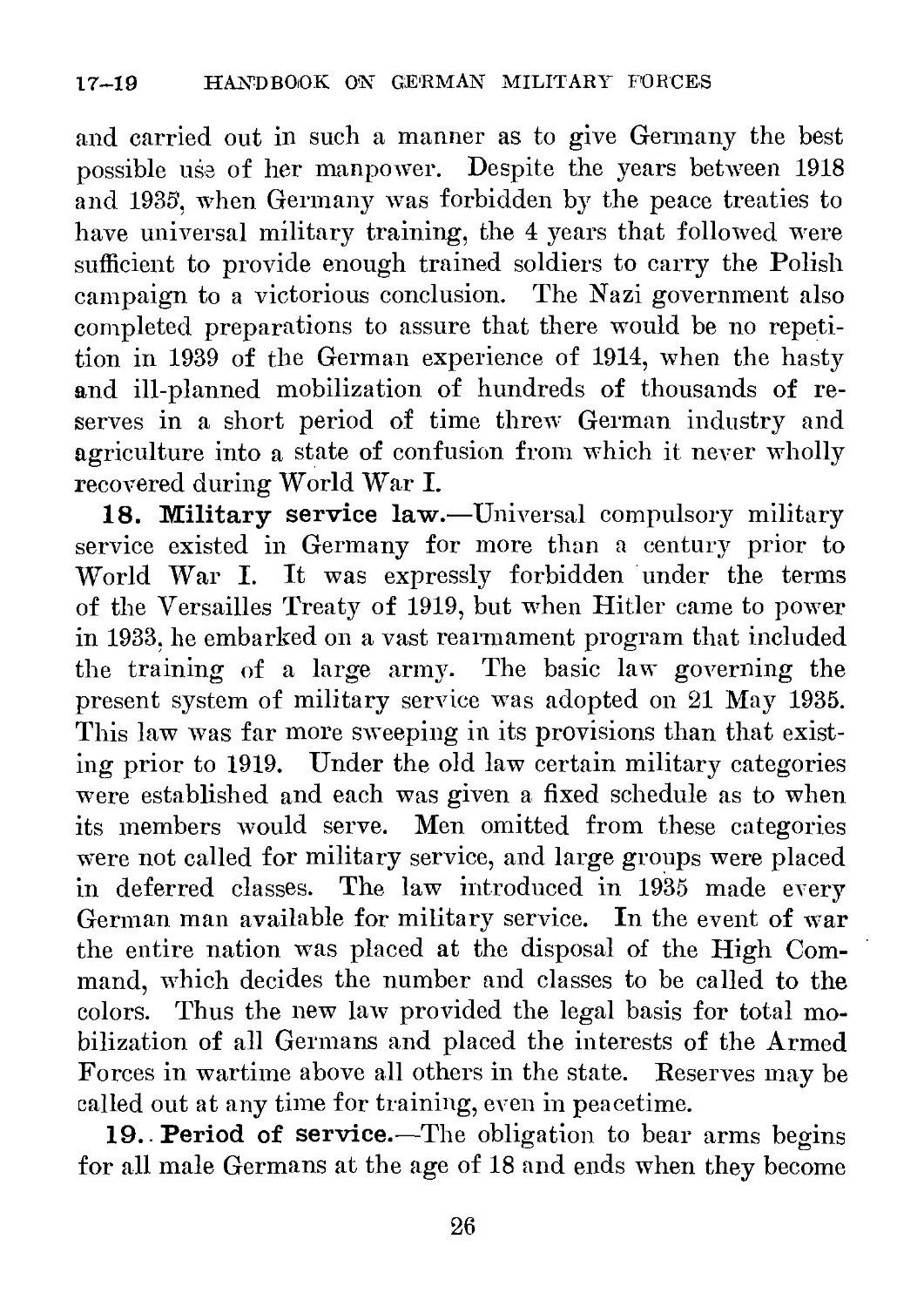
and carried out in such a manner as to give Germany the best
possible use of her manpower. Despite the years between 1918
and 1939, when Germany was forbidden by the peace treaties to
have universal military training, the 4 years that followed were
sufficient to provide enough trained soldiers to carry the Polish
campaign to a victorious conclusion. The Nazi government also
completed preparations to assure that there would be no repeti-
tion in 1939 of the German experience of 1914, when the hasty
and ill-planned mobilization of hundreds of thousands of re-
serves in a short period of time threw German industry and
agriculture into a state of confusion from which it never wholly
recovered during World War I.
18.	Military service law.—Universal compulsory military
service existed in Germany for more than a century prior to
World War I. It was expressly forbidden under the terms
of the Versailles Treaty of 1919, but when Hitler came to power
in 1933, he embarked on a vast rearmament program that included
the training of a large army. The basic law governing the
present system of military service was adopted on 21 May 1935.
This law was far more sweeping in its provisions than that exist-
ing prior to 1919. Under the old law certain military categories
were established and each was given a fixed schedule as to when
its members would serve. Men omitted from these categories
were not called for military service, and large groups were placed
in deferred classes. The law introduced in 1935 made every
German man available for military service. In the event of Avar
the entire nation was placed at the disposal of the High Com-
mand, which decides the number and classes to be called to the
colors. Thus the new law provided the legal basis for total mo-
bilization of all Germans and placed the interests of the Armed
Forces in wartime above all others in the state. Reserves may be
called out at any time for training, even in peacetime.
19.	. Period of service.—The obligation to bear arms begins
for all male Germans at the age of 18 and ends when they become
26
RECRUITMENT AND MOBILIZATION
19-21
45. This applies, however, only to peacetime service, as in war -
time the age limit may be extended by decree. When conscrip-
tion was reintroduced, the period of active service was fixed at
1 year, but in 1936 this was extended to 2 years. Before the war,
active military service usually began at the age of 20. The first
registration {Musterung'), however, took place when a young Ger-
man became 18. This was accompanied by a preliminary medical
examination, classification according to his physical fitness, and
provisional assignment to a branch of the service.
30. Recruitment procedure.—This first registration is car-
ried out in small local registration areas (Mustv^ningsbezirke) with
the cooperation of district police and other local civil authorities.
The next stage in the recruit’s career, the actual drafting (Aushe-
bung), consists of a second and more thorough physical examina-
tion, a definite assignment to an arm of the service, and a decision
regarding any request for deferment. Army officials handle re-
cruiting for the Navy and Air Force as well as for the Army itself.
If the recruit is fit (tauglich), he is sent home pending his call
to the colors (Einbenifung) and his induction (Einstellung).
Between first registration and induction the recruit ordinarily
performs his required labor service (Arbeit-sdienst).
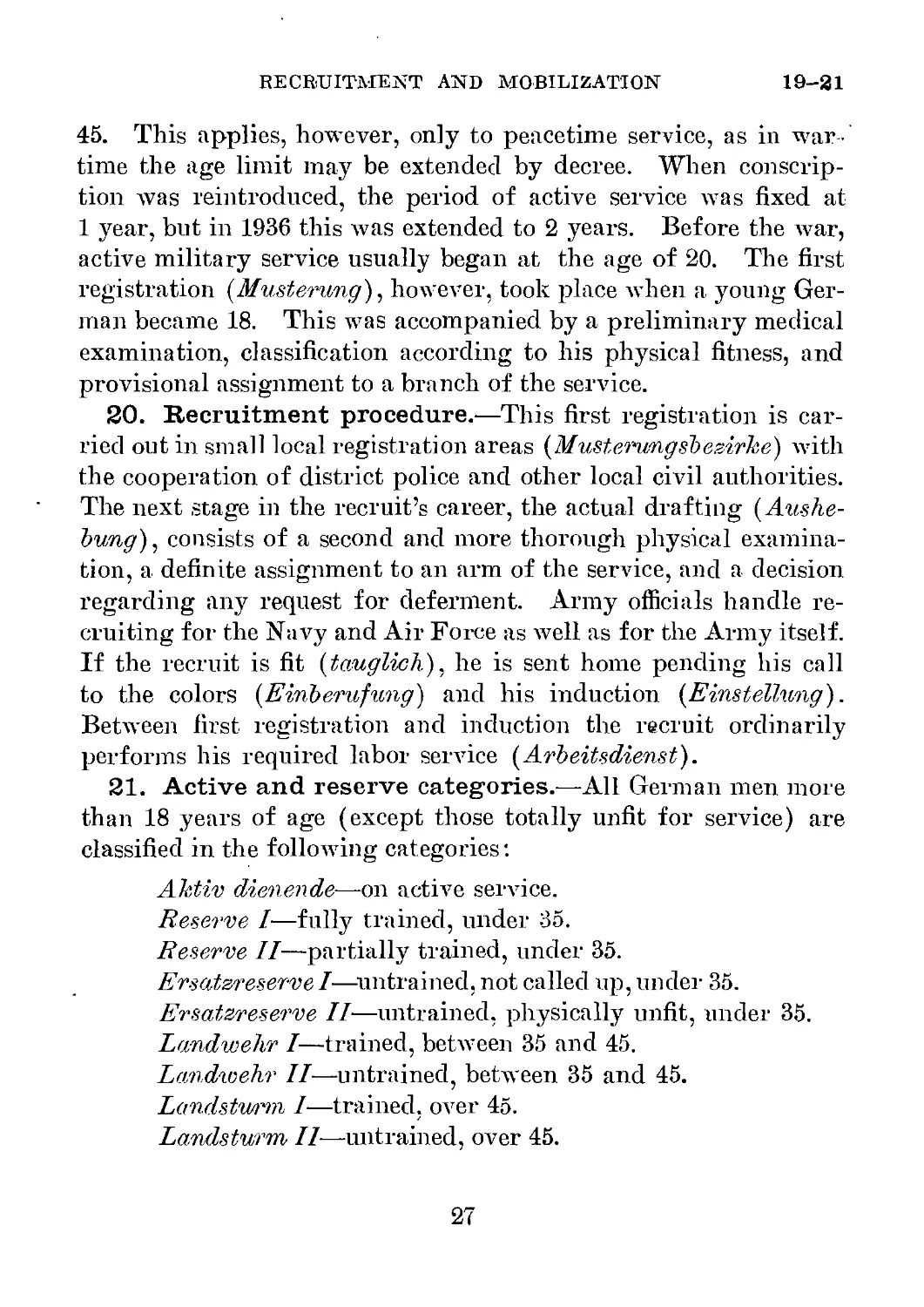
21. Active and reserve categories.—All German men more
than 18 years of age (except those totally unfit for service) are
classified in the following categories:
Aktiv dienende—on active service.
Reserve I—fully trained, under 35.
Reserve II—partially trained, under 35.
ErsatzreserveI—untrained, not called up, under 35.
Ersatzveserve II—untrained, physically unfit, under 35.
Landwehr I—trained, between 35 and 45.
Landwehr II—untrained, between 35 and 45.
Landsturm I—trained, over 45.
Landsturm II—untrained, over 45.
27
22-23
HANDBOOK ON GERMAN MILITARY FORCES
33. Wartime modifications of draft procedure.—Draft of
men for the German Armed Forces has been greatly accelerated
since the outbreak of the war, though in its broad outlines it has
remained the same. Musterung and Aushebung have now become
one process, while the induction age has been lowered from 20
to 18, and older classes have been called up. Members of the
Er sat zr eserve II and LcmcLwehr II are subject to call, and occupa-
tional and other deferments are strictly limited. Furthermore,
a continual “combing-out” process is carried on to take men of
military age from industry and agriculture and replace them with
foreign laborers, women, or men unfit for military service. In a
further effort to increase the number of men available for the
Armed Forces, volunteers at the age of 17 are accepted for the
Army as well as for special arms, while even younger men are
being drafted for the auxiliary services.
83. Replacement training system.—a. Recruiting serv-
ice.—In order to simplify the task of each German field army
commander in wartime, the German Army is divided into the
Field Army {Felclheer) and the Replacement Training Army
(Ersatzheer). When the war broke out, the field armies moved
out to take part in the various campaigns, leaving behind them
the Ersatzheer to take care of all such details as drafting of per-
sonnel and their training for service in the field either as replace-
ments or as new units. The deputy commander in each military
district (Wehrkreis) took command when the regular commander
moved out into the field. With the assistance of reserve officers
from the district he carried out the recruiting and training plans
formulated by the General Army Office (Allgemeines Heeresamt)
in Berlin.
Ъ. Local control.—Each military district is divided into re-
cruiting areas (Wehrersatzbezirke), and these, in turn, are di-
vided into recruiting sub-areas (Wehrbezirke). Although most
of the military districts contain two or three recruiting areas,
some districts in populous areas contain four, while others in
28
RECRUITMENT AND MOBILIZATION
23
thinly populated areas contain only one. The military headquar-
ters of a ehrersatzbezirk is known as a 'Wehrersatzinspektion,
that of a ~W ehrbezirk as a ~Wehrbezirkskommando, and that of a
W ehrmeldebezirk (reporting area) as a Wehrmeldeamt. There
is no military officer on permanent duty in the local registration
district (Musterungsbezirk), the smallest of the local replacement
training service areas, and local police authorities represent the
military.
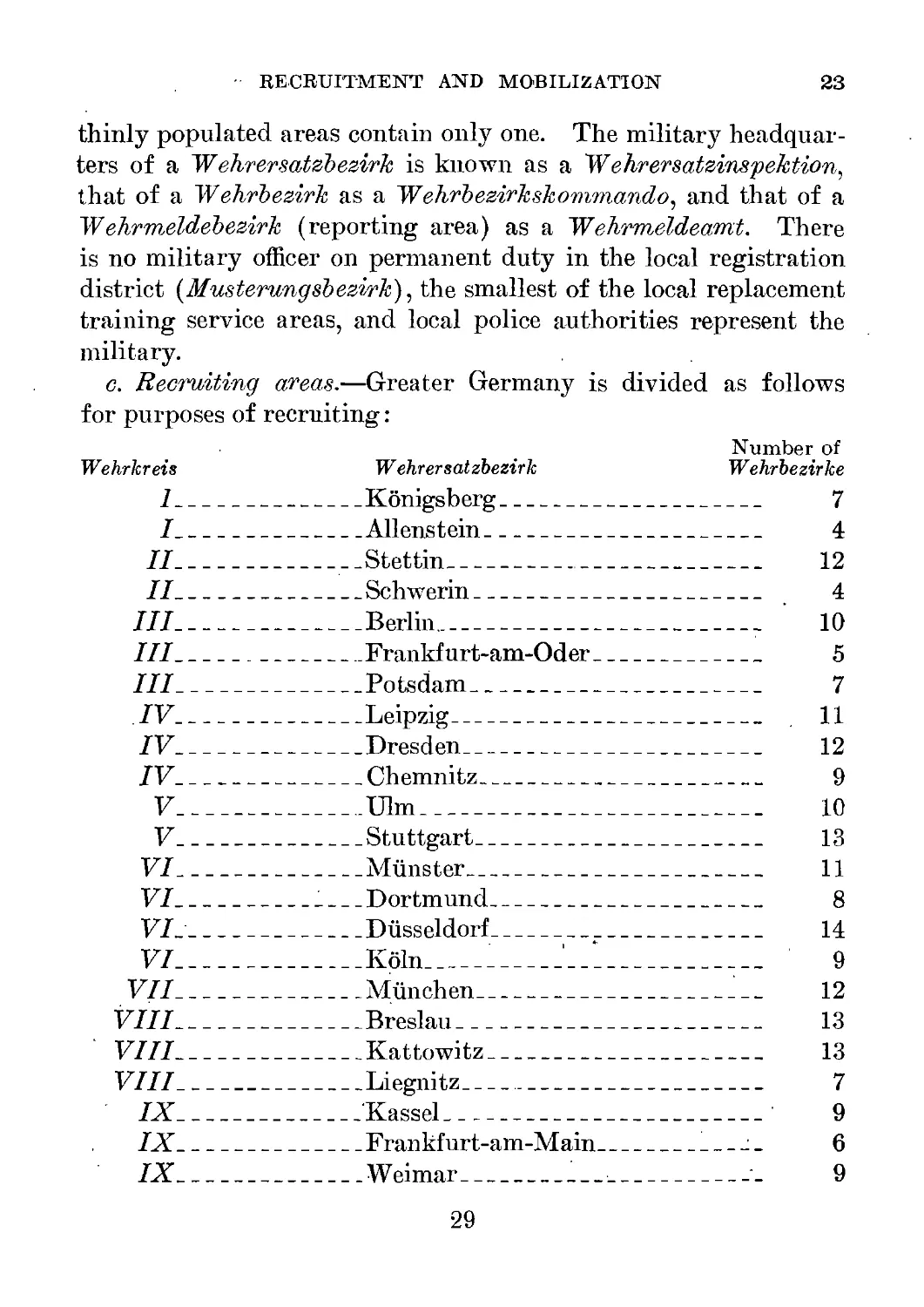
c. Recruiting areas.—Greater Germany is divided as follows
for purposes of recruiting:
	Number of
Wehrkreis	Wehrersatzbezirk	Wehrbezir ke
1			Konigsberg			 7
I			Allenstein			 4
II			Stettin			 12
II			Schwerin			 4
III			Berlin			 10
III			Frankf urt-am-Oder			 5
III			Potsdam			 7
IV			Leipzig			 11
IV			Dresden			 12
IV			Chemnitz			 9
V			Dim			 10
V			Stuttgart			 13
VI			Munster			 11
VI			_	Dortmund			 8
VI.			Dusseldorf			 14
VI			Koln			 9
VII			Munchen			 12
VIII			Breslau			 13
VIII			Kattowitz			 13
VIII			Liegnitz			 7
IX			Kassel			 9
IX			Frankfurt-am-Main		_______	6
IX			Weimar			9
29
23-24
HANDBOOK ON GERMAN MILITARY FORCES
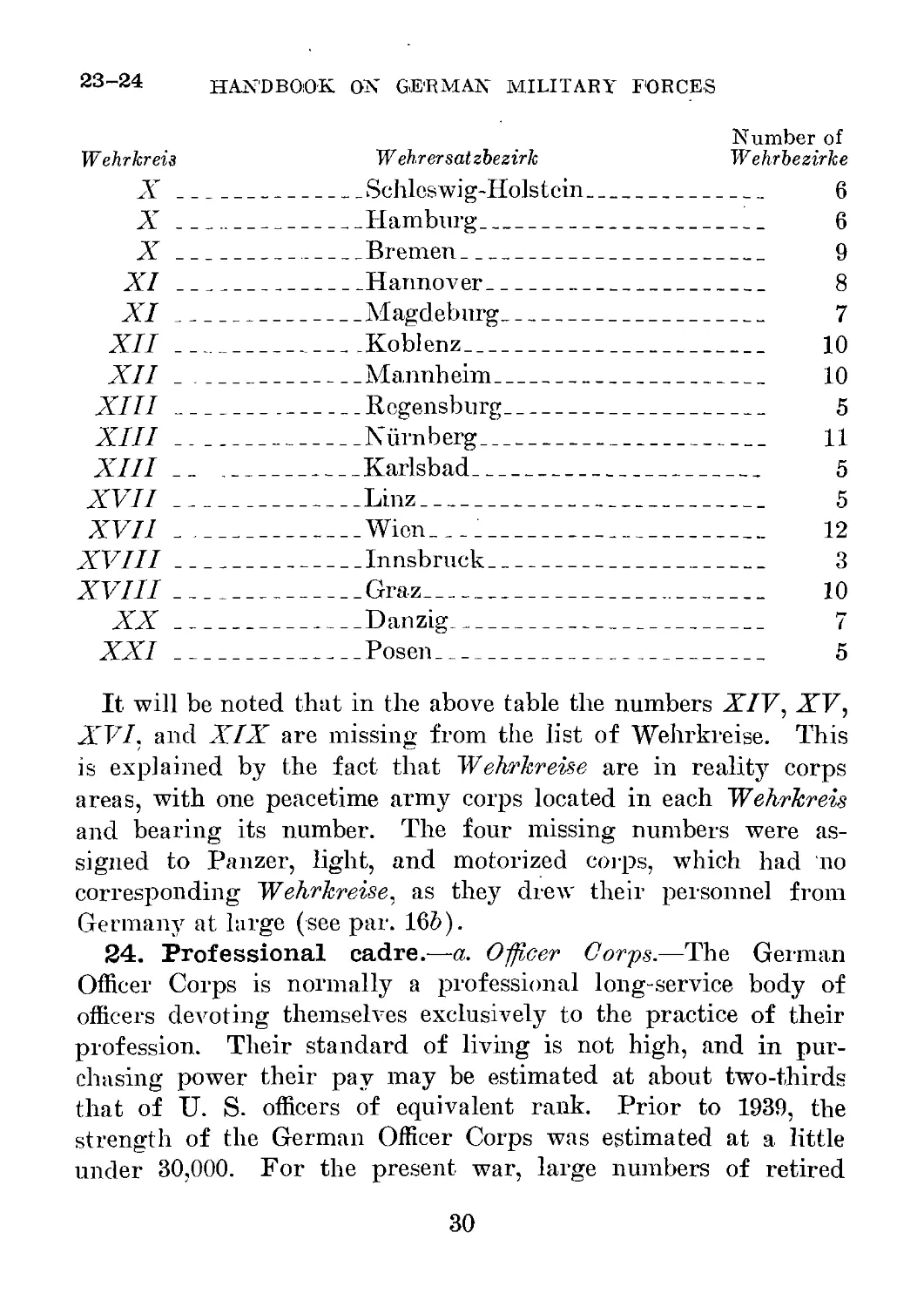
Wehrkreis
Wehrersatzbezirk
Number of
Wehrbezirke
X_______________Schleswig-Holstein______________ 6
X_______________Hamburg_________________________ 6
X_______________Bremen__________________________ 9
XI_______________Hannover________________________ 8
XI_______________Magdeburg_______________________ 7
XII ______________Koblenz________________________ 10
XII _ ____________Mannheim_______________________ 10
XIII________________Regensburg______________________ 5
XIII________________Nurnberg_______________________ 11
XIII __ ____________Karlsbad________________________ 5
XVII_______________Linz___________________________ 5
XVII_______________Wien...!______________________ 12
XVIII______________Innsbruck______________________ 3
XVIII______________Graz__________________________ 10
XX_______________Danzig________________________  7
XXI______________Posen__________________________ 5
It will be noted that in the above table the numbers XIV, XV,
XVI, and XIX are missing from the list of Wehrkreise. This
is explained by the fact that Wehrkreise are in reality corps
areas, with one peacetime army corps located in each Wehrkreis
and bearing its number. The four missing numbers were as-
signed to Panzer, light, and motorized corps, which had no
corresponding Wehrkreise, as they drew their personnel from
Germany at large (see par. 16Z>).
34. Professional cadre.—a. Officer Corps.—The German
Officer Corps is normally a professional long-service body of
officers devoting themselves exclusively to the practice of their
profession. Their standard of living is not high, and in pur-
chasing power their pay may be estimated at about two-thirds
that of U. S. officers of equivalent rank. Prior to 1939, the
strength of the German Officer Corps was estimated at a little
under 30,000. For the present war, large numbers of retired
30
RECRUITMENT AND MOBILIZATION
24
officers have been recalled to duty, and in addition there is a
very considerable body of young reserve officers who have been
obtained from the ranks after service at the front and the com-
pletion of a 5-month training course.
Ъ. Noncommissioned Officer Corps.— (1) Time of service.—The
German Noncommissioned Officer Corps is composed largely of
professional long-service volunteers. For the majority, the term
German noncommissioned Officer Corps is composed largely of
special administrative and technical ability, serve beyond the
normal 12-year term, sometimes even up to 25 years. Prior to
1939, the Noncommissioned Officers Corps is believed to have
approximated one-tenth of the total Army strength, or between
70,000 and 90,000 men. During the war, of course, it has been
greatly expanded, and a special 4^-year term of service has
been introduced.
(2) Recruitment.—The German Noncommissioned Officer Corps
is built up by two methods, as follows:
(«) The bulk of noncommissioned officers are obtained within
the units. Young recruits who desire to adopt the career of a
noncommissioned officer apply to their company commander at
any time during their tour of duty with the colors. The decision,
however, as to whether the candidate will be accepted as a non-
commissioned officer in his unit is not made until toward the close
of the applicant’s service, when the company commander has had
a thorough opportunity to observe his character, intelligence, and
ability to perform the duties of a noncommissioned officer. He
must also have attained the rank of Gefreiter (acting corporal)
during his normal service. The appointment to the grade of
Unterofftzier is made by the regimental commander on the recom-
mendation of the company commander.
(Z>) The second pathway to the career of a noncommissioned
officer is through the noncommissioned officer schools. There
are five of these schools in the German Army, each ranging in
strength between 200 and 300. The course in these schools lasts 2
31
24-25
HANDBOOK ON GERMAN MILITARY FORCES
years. Volunteers are accepted between the ages of 18 and 20.
The course, in general, is a practical one, although a few theoreti-
cal subjects are taught. Upon graduation, the successful students
are appointed Vntero-ffiziere and assigned to regiments. These
schools give the Army High Command the opportunity to equalize
the quality of the noncommissioned officer in regiments. Many
German regiments recruit from rural areas which do not furnish
an adequate supply of noncommissioned officer material. To such
regiments the High Command assigns young graduates of the
noncommissioned officer schools.2
25. Training.—a. Premilitary training.—Before being called
up for military service, all young men serve for some months
in the Reich Labor Service. As a result, when German recruits
join their organizations, they are hardened physically, and are
accustomed to living in groups under military discipline. Im-
portant preliminary training in specialized branches is given in
the naval and air sections of the Hitler Youth Organization
(Marine. Hitler-Jugend and Flieger Hitler-Jugend), in the glider
schools, and in competitions held by the National Socialist Avia-
tion Corps (2Vationalsozialistiches Fliegerkorps, or NSFK).
b. Normal military training.— (1) Winter.—In peacetime the
annual class of recruits joined the colors on or about 1 November.
From 1 November until 1 March the emphasis in all training was
placed on the development of the individual. Commencing in
February, however, platoon and company tactical problems were
given. During March the divisional inspections were held with
respect to companies. In the last half of March and the first half
of April, battalions and even regiments conducted tactical exer-
cises of a nature which seldom called for the presence of other
arms. During the winter season the staffs of higher units, begin-
ning with the division, conducted a series of map problems, one-
2 The German noncommissioned officer grades are not equivalent to those of the
U. S. Army. The German Gefreiter is not a noncommissioned officer in the German
definition of that term (see fig. 13).
32
Stabsfeuerwerker.
Wallstabsfeldwebel........_......
Festungspionierstabsfeldwebel...
Stabsfunkmeister_________________
Stabsbrieftaubenmeister..........
Stabsschirrmeister_______________
Hauptfeldwebel, Hauptwacht-
meister.
Oberfeldwebel____________________
Oberwachtmeister.
Oberfahnrich.
Oberfeuerwerker.
WaUoberfeldwebel.
Festungspionieroberfeldwebel.
Oberfunkmeister.
Oberbrieftaubenmeister.
Oberschirrmeister.
Feldwebel.........................
Wachtmeister.
Feuerwerker.
Wattfeldwebel.
Festungspionierfeldwebel.
Funkmeister.
Brieftaubenmeister.
Schiff meister.
Fahnrich_________________________
Unterfeldwebel, Unterwachtmeis-
ter.
UnteroffizieffFahnenjunker-UnteT'
ojfizier.
StabsgefreHer____________________
Obergefreiter____________________
Gefreiter, Fahnenjunker-Gefreiter.
Obergrenadier_____________„______
Oberjdger.
Oberreiter.
Oberkanonier.
Oberpionier.
Oberfunker.
Oberfahrer.
Oberkraftfahrer.
Grenadier________________________
Jager.
Reiter.
Kanonier.
Funker.
Fahrer.
Kraftfahrcr.
Pionier.
ScMLtze.
Staff Ordnance Sergeant.
Staff Fort Sergeant.
Staff Fortification Engineer
Sergeant.
Staff Radio Sergeant.
Staff Carrier Pigeon Sergeant
Staff Maintenance Sergeant.
Chief Sergeant_________________
Chief Cavalry Sergeant.
First Sergeant_________________
First Cavalry Sergeant.
Ensign (officer candidate).
First Ordnance Sergeant.
First Fort Sergeant.
First Fortification:
Engineer Sergeant.
First Radio Sergeant.
First Carrier Pigeon:
Sergeant.
First Maintenance:
Sergeant.
Sergeant.......................
Cavalry Sergeant.
Ordnance Sergeant.
Fort Sergeant.
Fortification Engineer:
Sergeant.
Radio Sergeant.
Carrier Pigeon Sergeant.
Maintenance Sergeant.
(Officer candidate)______________
Junior Sergeant, Junior Cavalry
Sergeant.
Noncommissioned Officer Cadet.
Staff Lance Corporal___________
Chief Lance Corporal___________
Lance Corporal______,__________
Junior Cadet.
Chief Infantryman..............
Chief Chasseur.
Chief Cavalryman.
Chief Gunner. •
Chief Engineer.
Chief Radioman.
Chief Driver.
Chief Motor Driver.
Infantryman....................
Chasseur.
Cavalryman.
Gunner.
Radioman.
Driver.
Motor Driver.
Engineer.
Rifleman.
Major. First Sergeant		 Master Sergeant		Oberfeldwebel	 Stabsfeldwebel		Stabsfeuerwerker.		 Hauptfeldwebel, Hauptwacht- meister. Oberfeldwebel
			Sanitdtsobet Vnterarit.
		Oberwachtmeister. Oberfeuerwerker. Oberfdhnrich.
Technical Sergeant		Feldwebel	....	Feldwebel				 Wachtmeister. Feuerwerker.	Sanitdlsfeldx
(None)		 Staft Sergeant	 Sergeant	 (None)	 Corporal		 Acting Corporal 	 Private, First Class		Fahnrich гиг See	 Obermaai	 Maat	 Hauptgefreiter..	 Obergefreiter..	..  Gefreiter			Fahnrich	 Unierfeldwebel	 Unter wachtmeister. Unterojfizier	 Fahnenjunker- UnterofflzieT. Hauptgefreiter	 Obergefreiter	 Gefreiter		 Fahnenjunker-Gefreiter.	Fahnrich im Sanit&lsuntt Sanitatsunte Sanitatsober Sanildtsgefrt
Private		Matrose				Flieger			 Kanonier. Funker.	Sanitdtssoldt
Figure 13.—Banks in the German Armed Forces (revised June 1943),
RECRUITMENT AND MOBILIZATION
25
and two-sided map maneuvers, tactical rides, and terrain exercises.
Sometimes signal units participated in these exercises. Never-
theless, it is doubtful if one could speak of “combined training”
in the peacetime program until 1 April.
(2) Summer.—Between 1 April and 1 August, annually, every
German unit spent 3 weeks in one or another of the barrack camps
located on the maneuver grounds. These camps are large and
generally hold three regiments simultaneously. At all times it
was the intention to place infantry and artillery together in these
camps. During this field-training period the infantry and ar-
tillery were trained as a team. Here the tactics of the German
march-combat group (the regiment of infantry and the battalion
of field artillery) were developed.
(3) Maneuvers.—Large-scale maneuvers took place during
September and October. These maneuvers were intended pri-
marily to train the combined staffs, arms, and services. Usually
they were of a divisional nature. At least in two Wehrkreise,
however, and sometimes in three, corps maneuvers were held an-
nually. Army maneuvers (involving from five to eight divisions)
were held once every 2 years. Staffs and troops were present in
full strength at all maneuvers. The supply services, however,
were represented only partially, if at all, as the German Army
felt that their presence did not repay in training value the expense
entailed.
c.	Short-term training.—Owing to the restrictions imposed by
the Versailles Treaty, there was a period of 15 years during which
Germany did not have universal service. The classes from 1919
through 1934 did not receive military training. Following 1935,
Germany made strenuous efforts to train this great reservoir of
military manpower by calling classes for 8-week periods of inten-
sive training. Some groups appear to have undergone several of
these periods.
d.	Wartime training.—The same principles as outlined above
still apply to wartime training, except that the schedule has been
33
25-26
HANDBOOK ON GERMAN MILITARY FORCES
speeded up and is not so closely tied to the calendar. By the end
of 1942, virtually all the combined training was shifted to occu-
pied countries, especially to France, so that the troops in training
might perform the additional duties of occupation forces and be
available for defense against invasion.
e.	Air Force, training.—Each soldier of the Air Force, upon
being inducted into service, goes to an Ersatz (training) battal-
ion, of which there is at least one in each 'Wehrkreis. Here he
is given his basic training as a soldier and in addition certain
preliminary mechanical training in Air Force specialties. During
this period there are selected from the recruits those specially
qualified for pilot training. From the Ersatz battalion the re-
cruit is sent directly to his unit or in certain cases to large
mechanics’ training schools.
26. Housing, cantonments, and training areas.—a. Bar-
racks.—Beginning in 1935, Germany engaged in a vast program
of military construction to house her expanding Army. By the
summer of 1940, the German Army was thoroughly equipped
with modern barracks to accommodate at least 50 divisions. In
living and messing arrangements, these barracks are approxi-
mately equal to the newest and best of the U. S. Army, and in
certain educational and workshop facilities are reported to be in
advance of present U. S. standards.
Ъ. Training areas.—The German Army now has at least 32
general training grounds (in Germany) which vary in size. Some
contain areas of as much as 200 square miles; others are much
smaller. Troop units are normally sent in succession to one or
another of these troop training grounds for a 3-week field exer-
cise and target training period. Each training ground possesses
contonment barracks for from 2 to 3 regiments. All grounds
have target ranges for small-arms firing, and about two-thirds
possess artillery ranges. In addition, there are numerous spe-
cial training grounds for the specialized arms, and there are
several ordnance proving grounds.
34
RECRUITMENT AND MOBILIZATION
27
37. Pay and allowances.—a. Peacetime.—The peacetime
base pay rates for the various ranks in the German Army are
shown in figure 14. In addition to these base pay rates, in peace-
time officers received rental allowances, which varied according
to the cost of living in different localities; officers and men re-
। Pay group1 1	Service grade	Initial yearly pay 1 2	After 2 years’ serv- ice	After 4 years’ serv- ice	After 6 years’ serv- ice	After 8 years’ serv- ice	After 10 years’ serv- ice	After 12 years’ serv- ice	After 14 years’ serv- ice	After 16 years’ serv- ice
1	Oberbefehlshaber der Wehr- machtteile Chef des Oberkommandos der Wehrmacht. Generaloberst	 General	 Generalleutnant... .	26, 550 J 24,000 19,000
2
3
4	Generalmajor	16,000 12, 600 9,700 7, 700
5	Oberst . _
6	Oberstleutnant
7	Major.	 ..		8,400 6,000 3, 700 2,700
8	Hauptmann		4,800 3,400 2,400		6,900 4,000 3,000
9	Oberleutnant				4,200 3,440
10 19	Leutnant	 Stabsfeldwebel	 _					3,700	4,000	4,200 2, 550	2, 742 2, 646	2,944
20a 20b 21a 21b 22a 22b 23a 23b 24	\Oberfeldwebel	 .	2, 400						2, 454		2, 838
	J J [Feldwebel	 		2, 340						2, 394 2, 322	2, 520	2, 646
	J VUnterfeldwebel	 ....	2, 040	2,160 1,920 1,740						2, 424 2,166	2, 514
	J	J ^Unteroffizier	1,536 1,680 1,410 1,260 1,080						2,064		2, 256
	Obergefreiter.			1,800
25	Gefreiter. ..
26	Obergrenadier
27	Grenadier

1 Groups 11 to 18 are not included in this table, as they apply only to special categories, such as
bandmasters and medical and veterinary officers.
2 The amount is given in Reichsmark; 1 RM-$G.4O (see par. 126).
Figure 14.—Scale of peacetime base pay in the German Army.
ceived liberal children’s allowances for their minor children;
and men who messed out of barracks received a food allowance.
Officers were paid monthly in advance; men normally received
their pay on the 1st and 21st of each month.
b. Wartime.—During the present war each member of the
Armed Forces receives a greatly reduced “War Pay” (W ehrsold)
35
27
HANDBOOK ON GERMAN MILITARY FORCES
according to the schedule shown in figure 15. But there are liberal
family allowances as well as a special bonus, usually one Reichs-
mark a day, for front duty- A further special bonus was given
for service in Africa.
Pay group	Service grade	Yearly pay i
1	Oberbe/e/tls/iaber der Wehrmachtteile		I 3, 600
	Chef des Oberkommandos der Wehrmacht
2	Generalobersl		} 2, 88
	General
3	Generalleutna.nl		2, 520
4	Generalmajor			.		2, 160
5	Oberst 		1, 800
6	Oberstleutnant		1, 440
7	Major			1, 296
8	Hauptmann		1, 152
9	Oberleutnant		972
10	Leutnanl		864
11	Stabsfeldwebel
	II aupif eldwebel 			>	720
	Oberfeldwebel
	Unteroffizier
12	Feldwebel		J. 648
	Oberfahnrich
13	Unterfeldwebel		}	540
	Fdhnrich
14	Unteroffizier		504
15	Stabsgefreiter
	Obergefreiter		>	432
	Gefreiter
	Oberg renadier
16	Grenadier			360
	Obergrenadier and Grenadier (less than 2 years’ service)
1 The amount is given in .Reichsmark; 1 7?M=$0.40 (see par. 126). For the discrepancy between
peacetime and wartime base pay, see par. 27.
Figure 15.—Scale of wartime base pay in the German Army.
c. Professional.—Professional soldiers, however, receive in ad-
dition to their own pay a compensation allowance amounting ap-
proximately to the differences between it and the peacetime pay
rates. This applies to other officers and long-term enlisted men,
36
RECRUITMENT AND MOBILIZATION
27-29
but not to ordinary wartime conscripts. Reserve officers may ob-
tain a similar compensation allowance on application.
38. Mobilization in the past.—a. At the outbreak of war in
1914 the entire strength of the German nation was mobilized in a
single week, a procedure which interrupted gravely the economic
life of the nation. The effects of this 100-percent mobilization of
trained man power were never afterward fully overcome. It was
a very rigid procedure, and there was apparently no method of
varying its extent or speed. In the course of 1 week, the active
Army was brought to full strength and some 35 reserve divisions
as well as a large number of fortress, Lmd'tijehr, Ersatz, and
Landsturm units were created. In all, the active Army of 800,000
men was expanded to 3,900,000 in about 10 days’ time.
Ъ. As a result, not only was the Army cumbersome to handle,
being composed of elements with wide divergences in training,
efficiency, and equipment, but the whole life of Germany was dis-
rupted to an almost disastrous extent. Agriculture was crippled,
many branches of commerce and industry were temporarily para-
lyzed, and government administration was seriously hampered.
29. Present principles of mobilization.—a. These mistakes
made in the last war were the subject of careful study and criti-
cism by the German General Staff for many years thereafter, and
a determined effort was made to prevent their recurrence. For
the present war, German manpower has been mobilized gradually
and selectively ever since the beginning of 1938, and the process
is still continuing. Men are summoned to the colors individually
by mail, not in annual classes by public proclamation. Only the
number actually needed at any given phase of the war are called
up, and great care is taken not to disrupt any one industry or in-
dividual factory, shop, office, or farm by an excessive or precip-
itous withdrawal of its manpower to the Armed Forces. This
system, incidentally, has the advantage of secrecy. Furthermore,
no units are formed entirely of new recruits, but all units contain
more or less similar proportions of men with different degrees of
37
29-30
HANDBOOK ON GERMAN MILITARY FORCES
training and belonging to the different age groups. This insures
a high degree of uniformity of quality of all German combat
units. Soldiers entering the German Army are assigned to either
fighting or supply units according to their ages.
Ъ. Early in 1943 the German Army announced that men in the
fighting arms (infantry, Panzer, artillery, engineer, chemical
warfare, and signal troop units) must be 37 or younger, whereas
men in command headquarters and in higher units, supply troops,
and men in engineer units employed in rear areas must be 38 or
older. Fighting troops in tropical service must be 33 or younger,
while supply troops serving in the tropics must be 34 or older.
Only men 42 or older, or unable through physical disability to be
on active duty, were allowed to remain in the zone of the interior,
although an exception was made in the case of training person-
nel in training units.
Section IV
UNIFORMS, INSIGNIA, AND IDENTIFICATIONS1
Pai'ngraph
Army uniforms___________________________________________ 30
Army insignia___________________________________________  31
Air Force uniforms and insignia_________________________ 32
Uniforms and insignia of militarized and auxiliary organiza-
tions ----------------------------------------------  33
Means of identification--------------------------------- 34
Decorations and awards---------------------------------- 35
30. Army uniforms (plates I to IV).—a. General.—The
present type of uniform in the German Field Army has been
evolved from that worn during World War I, the chief require-
ments being that it should be light, comfortable, weather-
proof, and inconspicuous. The uniforms for officers and for
enlisted men are basically the same in almost all particulars.
1 Color plates of uniforms and insignia follow page 50.
38
UNIFORMS, INSIGNIA, AND IDENTIFICATIONS	30
Officers are distinguished from enlisted men only by insignia of
rank and other comparatively minor markings and variations
in their dress.
b.	Normal field uniform (plates I and II).—The following par-
ticulars apply to the uniforms of the great majority of German
soldiers in the field:
(1)	Field blouse.—The field blouse (Feldbluse) is made of
greenish-gray cloth, with a collar usually of a much darker shade
of green. The collar may be folded back to make an open neck.
No uniform shirt is worn under the blouse.
(2)	Trousers.—The trousers {Ilosen) are of greenish-gray or
gray cloth. Riding breeches for mounted officers and enlisted men
are of the same color but with leather facings, and are worn with
black riding boots.
(3)	Overcoat.—The overcoat (Mantel) is double-breasted and is
made of greenish-gray cloth.
(4)	Field cap.—The field cap (Feldmutze), which is similar to
the U. S. Army garrison cap, is made of greenish-gray cloth. It
is worn by officers and enlisted men of all arms, except mountain
troops and personnel of certain armored units (see c, below). The
officer’s field cap is of a better quality than the enlisted man’s and
has aluminum-colored piping along the top scam and top edge of
the turnup. The field cap is so designed that it may be worn
under the steel helmet. (A new field cap {Einheitsmiitze) in the
style of the mountain cap has recently been adopted.)
(5)	Steel helmet.—The steel helmet {Stahlhelm) is made of
seamless sheet steel, and is painted both inside and outside with
rust-resistant, dull field-gray paint. Officers and enlisted men
wear the same helmet.
(6)	Pack.—The pack {Tornister) is a heavy square-shaped
canvas bag with leather binding. A blanket, a camouflage cover,
(which sometimes serves as a raincoat), and also at times the
overcoat, are rolled and strapped around the pack. For mountain
troops, the pack is replaced by a rucksack, a form of which, orig-
548832°—43---4
39
30
HANDBOOK ON GERMAN military forces
inally adopted by the Afrika-Korps. is coming to be used exten-
sively throughout the Army.
(7)	Other equipment.—Other equipment carried by the indi-
vidual includes leather cartridge pouches, a shelter-half with ropes,
a canteen and mess kit, a haversack, a gas mask, a gas cape (an
impregnated cloth cover for protection against gas), entrenching
tools, and side arms. Officers wear brown belts (sometimes with
the strap of the Sam Browne type), and enlisted men black belts.
c.	Field uniform of special units (plates II to IV).— (1) Gen-
eral.—Various units of the German Army with specialized func-
tions wear adaptations of the normal field uniform or entirely
different uniforms designed to facilitate the execution of their
duties.
(2)	Panzer troops (plate II).—Tank crews wear black uniforms
with loose-fitting trousers and black field caps. Armored-car
personnel wear a rush-green or grayish-green uniform of similar
cut. On the black uniform the collar patch has the skull and
crossbones insignia.
(3)	Mountain troops (plate IV).—These troops wear a moun-
tain cap (Gebirgsmutze} similar to the field cap worn by other
troops, but with the addition of a visor of the same material; the
ordinary type of field blouse; and greenish-gray or gray cloth
trousers, fastened around the ankles by puttees, and high shoes.
The olive-green double-breasted wind jacket is a distinctive acces-
sory of the mountain uniform. For use in snow and in special
types of terrain, mountain troops may also be equipped with snow-
shoes and various kinds of coveralls.
(4)	Chemical warfare troops.-—In addition to their normal
uniforms, these troops are equipped with dark leather suits con-
sisting of jackets and trousers, and a mask with goggles.
d.	Special duty uniforms.—For unusual conditions of climate
or terrain, special uniforms may be issued to any unit.
(1)	Winter uniforms.—Lined two-piece suits with felt boots
and face masks are issued for extreme cold. White coveralls with
40
UNIFORMS, INSIGNIA, AND IDENTIFICATIONS 30-31
hoods may be issued wherever snow makes camouflage necessary.
(2) Tropical uniforms (plate III).—Khaki and olive-colored
uniforms with web equipment and linen-topped boots are fre-
quently employed in hot and arid regions. (The tropical uniform
has recently been adopted as the official summer uniform, and has
been extensively used not only in Africa, but also in Italy, the
Balkans, and the Crimea.)
31. Army insignia (plates I to IV, and VII to IX).2—a.
Unit insignia.—No unit insignia are worn by German troops in
the field in wartime.
b.	National devices.—(1) General.—The regimental insignia of
the type worn by the U. S. Army are replaced in the German Army
by the national emblem, the national colors, and the national
rosette.
(2)	National emblem (plates I to IV, and IX.)—The national
emblem (Hoheitsabzeichen)., which consists of a gray, white, or
silver-colored formalized eagle with widespread wings holding a
swastika in its claws, is worn during service in the field as follows:
(a) On the peak of the field cap and mountain cap.
. (Z>) On all blouses, above the right breast pocket.
A silver eagle with folded wings is worn on the left side of the
steel and tropical helmets, on a black shield.
(3)	National colors (plate I).—The national colors—red,
white, and black—are worn in the form of a shield on the right
side of the steel helmet.
(4)	National rosette (plates I to IV, and IX).—The national
rosette (Reichskokarde} is a small circular insigne in red, white,
and black sewed on below the national emblem on the field and
mountain caps. On visored service caps it is made of metal and
flanked by oak leaves (see plate I).
c.	Distinguishing color of arm (plate IX).— (1) General.—
Each soldier wears the distinguishing color of his arm (fWaffen-
farbe). The most characteristic location of this color is on the
2 For the ranks in the German Armed Forces, see also figures 13, 14. and 15.
41
31
handbook on german military forces
piping around the edge of the shoulder strap, but it may also
appear elsewhere.
(2)	Principal colors.—'The following are the principal dis-
tinguishing colors:
Infantry—white (weiss).
Mountain infantry—light green (hellgnm).
Tank troops—pink (rosa).
Motorcycle troops—grass green (wiesengriin) (probably
now pink).
Cavalry and cyclists—golden yellow {goldgelV).
Motorized and Panzer reconnaissance—copper brown (kup-
ferbrav/n) (now pink).
Artillery—bright red (hochrot').
Engineers—black (schtoarz).
Signal troops—lemon yellow {zitronengelb').
Chemical warfare troops—bordeaux (bordeauxrot).
Transport and supply troops—light blue (hellblau).
Medical troops—dark blue {konMwnenblau).
Veterinary troops—crimson (karmesinrot).
Propaganda troops—light gray (leichtgrau).
General Staff Corps—crimson (karmesinrot).
d.	Insignia of rank (plates VII and VIII).— (1) Shoulder
straps.—The insignia of rank are normally worn on the shoulder
straps. It will be noted from the illustrations that the shoulder
straps fall into five main groups according to the amount of cord
or braid on the strap.
(2) Collar patches.—As an additional distinction, general of-
ficers wear a red collar patch with a stylized gold oak leaf. All
lower ranks now wear a collar patch with a double band, with
slight variation. Noncommissioned officers have an additional
silver band around two sides of the collar patch.
(3) Sleeves.—With special types of uniforms which do not have
shoulder straps or collar patches, such as snow suits, wind breakers,
42
UNIFORMS, INSIGNIA, AND IDENTIFICATIONS 31-32
protective suits for tank crews, canvas jackets, and work clothes, all
ranks may wear a special sleeve insignia introduced in September
1942. These consist of woven oak leaves and bars, in gold for
generals and light green for other ranks. These insignia are
worn on the upper left sleeve.
32.	Air Force uniforms and insignia (plates V and VI).—
a. General.—The basic uniforms of the German Air Force are
blue-gray. Both the roll-collar type of blouse and the fly-front
flight blouse (Fllegerbluse) are commonly worn. The field cap
{Fliegermutze.') is more rakish than the field cap of the Army.
Ъ.	National devices.—The national emblem (called Iloheits-
zeichen in the Air Force) is a “flying eagle” with a swastika in
its claws. The national rosette is like that of the Army but with
formalized spreading wings on each side of the oak leaves. These
insignia, as well as the national colors, are worn in the same manner
as in the Army. In addition, flying personnel wear a special
badge on the left breast depicting an eagle with a swastika, the
whole enclosed in a wreath.
c.	Distinguishing colors.—The distinguishing color of arms
in the Air Force is not only displayed in the piping of the shoul-
der patches as in the Army, but also forms the background on the
collar patches. The following are the principal colors:
Generals—white (weiss).
Flying troops—golden yellow (goldgelb).
Antiaircraft artillery—bright, red (hochrot).
Signal troops—golden brown (доЫЪгаып).
d.	Insignia of rank.—The shoulder straps worn by the Air
Force bear the same insignia of rank as those in the Army.
On the collar patches, however, are worn from one to four
pairs of wings to distinguish ranks in the various groups, and
those of officers contain either oak leaves or oak wreaths. Non-
commissioned officers usually have in addition a band of silver
braid around the lower edge of the collar.
43
32-33
HANDBOOK ON GERMAN MILITARY FORCES
e.	Parachute troops (plate VI).—Parachute troops wear special
loose-fitting blue-gray trousers and the flight blouse. For jump-
ing, a knee-length coverall is worn over this uniform. Men who
have made a minimum of six jumps wear a special badge depicting
a silver diving eagle with a swastika in its claws, the whole en-
closed in a gold-colored wreath.
33.	Uniforms and insignia of militarized and auxiliary-
organizations.—a. Waffen-SS.—TheWaffen-SS (see par. 100&
(2)) . wears a uniform identical to the Army field uniform. Its
members can be distinguished from Army troops by the posi-
tion of the national emblem, which is worn on the left sleeve
instead of on the right breast, and the national colors on the
steel helmet are replaced by the NN device. A further distinction
is the special insignia of rank, which differ from those of the
Regular Army and are worn on the collar patches. Also, oak
leaves denote the higher ranks, while diamond-shaped devices, or
pips, indicate the lower ranks of officers.
Ъ.	Storm Troopers (NA).—The regular uniform of the SA
(see par. 103e) is the brown shirt and trousers, with a brown
blouse and visored cap. Members wear a broad red arm band
with a black swastika in a white circle. The band is worn on
the upper left arm.
c.	National Socialist Motor Corps (NSKK).—The NSKK (see
par. 103c) wears a uniform consisting of a brown shirt and black
breeches, and members may also wear brown blouses and brown
coveralls. The national emblem is mounted on a wheel enclosing
a swastika, and is worn on the cap or black crash helmet. Nor-
mally white Arabic numerals preceded by the letter “M” (indi-
cating Mot.) on the right collar patch give the number of the
unit. Insignia of rank are like those of the NN and SA, and are
worn on the left collar patch, while additional insignia, of rank
are worn on the right shoulder. The NSKK wears the same
arm band as the NA-
44
UNIFORMS, INSIGNIA, AND IDENTIFICATIONS
33-34
d.	Reich Labor Service.—Members of the Reich Labor Service
(Reichsarbeitsdienst), which is frequently designated by the
abbreviation RAD (see par 103Z>), wear a uniform consisting of
a brown shirt and a brown-gray blouse with a dark collar, a
visored cap, and slacks or breeches. They also wear the Party
arm band like the xSM and NSKK. The insignia includes a white
spade on a black background worn just above the arm band.
e.	Technical Emergency Corps.—The field uniform of the Tech-
nical Emergency Corps (Technische Nothilfe), which is fre-
quently designated by the abbreviation Teno (see par. 103(Z), is
similar to that of the Army. There are two arm bands on the
lower left sleeve, one bearing the words Technische Nothilfe in
win to, and the other the words Deutsche ^Wehrmacht in black.
The national emblem is worn on the upper left sleeve, superim-
posed on a black triangle. The Teno emblem, a cogwheel, is worn
on the collar patches.
f.	National Socialist Aviation Corps.—Members of the National-
sozialistischcs Fliegerkorps. or NSFK (see par. 103/), wear a
brown shirt and dark blue-gray blouse and breeches or slacks.
They also wear either visored, caps or berets. Their insignia
are very similar to those of the AA.
34.	Means of identification.—The two primary means of
identification usually to be found on every German soldier are as
follows:
a. Identification tag (fig. 16).—The identification tag (Erken-
nungsmarke) is issued on mobilization and is worn at all times
by all personnel. The tag is of zinc and is oval-shaped, meas-
uring about 2 by 3y2 inches. It is divided into halves by a
perforated line. Each half bears identical markings. When
a man is killed, the lower half of the tag is broken off and sent
to Germany and the upper half is buried with the body. Most
identification tags which have been captured give a unit, a sub-
ordinate unit, a letter identifying the blood group, and a number.
The identification tag seldom shows the unit in which the indi-
45
34
HANDBOOK ON GERMAN MILITARY FORCES
о	о
168
9/.TR.61 A
0 0
54367
84
V Х9ЯГ/6	F8
891	198X9
© Old type.	® New type.
368=Personal number
9/JR.61=9th Company of the
61st Infantry Regiment
A=:bloO(l group A
Figure 16.—Markings on identification tags (Erkennungsmarken) of the old
and new types.
vidual concerned is currently serving (unless he had lost the
original tag of his replacement unit and has received a new one
from his present unit), but it may reveal the existence of a
previously unidentified unit. A new type of identification tag
recently captured does not bear the unit designation or blood
group.
b. Paybook.—The paybook (Soldbuch) is issued on induction
and is subsequently carried by the soldier at all times except when
taking part in a raid. The paybook gives the following informa-
tion concerning the soldier:
(1)	The name and rank and the place and date of birth.
(2)	A copy of the inscription on the identification tag.
(3)	Personal data such as build, height, color of hair and eyes,
civilian occupation, and religion.
(4)	The unit in which he is serving, units of the Field Army
{Feldheer) in which he served previously, and the replacement
{Ersatz) unit into which he was originally inducted.
(5)	The names and addresses of close relatives.
(6)	A record of equipment issued.
(7)	Dates of inoculations, details of eyesight, hospital record,
and dental treatment.
(8)	A record of pay group classification and of certain pay-
ments made to him.
46
UNIFORMS. INSIG'NIA. AND IDENTIFICATIONS 34-35
(9)	A record of furloughs, including dates and places visited.
(10) A list of decorations received.
35. Decorations and awards.—a. Iron Cross.—The Iron
Cross award (Eisernes Kreuz) is for conspicuous bravery in face
of the enemy or for outstanding services in leadership. The four
classes of the Iron Cross rank in the following order:
Grand Cross of the Iron Cross (Grosskreuz des Eisernen
Kreuzes).
Knight’s Cross of the Iron Cross (Ritterkreuz des Eisernen
Kreuzes).
Iron Cross, 1st Class (Eisernes Kreuz, 1 Klasse).
Iron Cross, 2d Class (Eisernes Kreuz, 2 Klasse).
Higher classes of the Iron Cross are awarded only to those already
holding the lower class. The present Iron Cross, 1st and 2d
Classes, differs from that of the last war in that the swastika and
the year “1939” replace the initial “W” (Wehrmacht) and the
crown. The lion Cross, 1st Class, is usually worn on the blouse
pocket of the left breast, and the Knight’s Cross of the Iron
Cross is suspended about the neck (see plate II). The bar to the
Knight’s Cross of the Iron Cross consists of three silver oak leaves
on the medal ribbon. In addition, the oak leaves with swords, and
the oak leaves with swords and diamonds, are awarded in very ex-
ceptional cases. The Grand Cross, which is approximately double
the size of the Iron cross, 1st and 2d Classes, has been conferred
only on Reichsmarschall Goring. Men who gained the Iron Cross
in the World War I may be awarded a silver bar which bears the
national eagle and swastika, and the date of the new award.
Ъ.	War Merit Cross.—The War Merit Cross (Kreigsverdienst-
kreuz) is awarded as a recognition of merit to persons not eligible
for award of the Iron Cross. It has the following grades:
Knight’s Cross of the War Merit Cross (Ritterkreuz des
Krieg sverdienstkreuzes).
War Merit Cross, 1st Class (Kriegsverdienstkreuz, 1
Klasse).
47
35
HANDBOOK ON GERMAN MILITARY FORCES
War Merit Cross, 2d. Class (Kriegsverdienstkreuz^ 2
Klasse).
These awards may be made with or without swords. Swords are
awarded for especially meritorious service in the zone of enemy
action or for exceptional services in furthering the war effort.
The cross is awarded without swords for meritorious services in
which enemy action played no part. The War Merit Cross has a
swastika in the center, embossed on a plain surface, and is edged
with oak leaves. The 2d Class is in bronze. The 1st Class and the
Knight’s Cross are in silver. A bronze War Merit Medal with the
legend Fur Kriegsverdienst may also be awarded (usually to
civilians).
c.	German Cross.—The German Cross {Deutsches Kreuz) f
which was created in September 1941, consists of a dark-gray
silver-edged eight-pointed star, about 2i/2 inches in diameter.
In the center is a black, silver-edged swastika on a dull silver
background surrounded by a gold or silver laurel wreath with
the year “1941” at the bottom. The German Cross is worn on
the right breast without ribbons. The German Cross in silver is
awarded for repeated outstanding service in the military conduct
of the war. It is awarded in gold for a repeated display of extraor-
dinary valor or for repeated outstanding service in tactics.
d.	Infantry Assault, Badge.—The Infantry Assault Badge {In-
fanterie-Sturmabzeichen), in bronze, consists of a rifle with fixed
bayonet encircled by a wreath of oak leaves, the whole surmounted
by the German eagle and swastika. It is worn on the left breast
pocket of the blouse immediately beneath the Iron Cross or any
other decoration. It may be given to soldiers who have taken
part in at least three attacks on the enemy position on 3 different
days and have overcome the enemy in hand-to-hand combat.
e.	Tank badge.—The Tank Badge {Pamzerkampfwagen-Ab-
zeichen), in bronze, is made up of a wreath of oak leaves surround-
ing a tank, the whole surmounted by the German eagle and swas-
tika. It is worn on the left breast pocket of the blouse iimne-
48
UNIFORMS, INSIGNIA, AND IDENTIFICATIONS
35
diately beneath the Iron Cross or any other decoration. It may
be given to soldiers of the Panzer troops who have engaged in at
least three attacks on the enemy on 3 different days.
f.	Assault Badge, for Other Anns.—This award (Sturmabzeich en
anderer Waff eng at tungen), in silver, depicts a stick grenade
crossed with a bayonet and surmounted by the German eagle and
swastika, the whole surrounded by a wreath of oak leaves. It is
worn on the left breast. It is given to officers, noncommissioned
officers, and privates of other arms which cooperate closely with
the infantry or tanks, or to individual members of other arms
who fulfill the conditions under which the infantry assault badge
is awarded to infantrymen.
g.	Wound Badge.—This award {Verwundeten-Abzeichen) is
similar to the w7ound badge of the World War I, and consists of
two crossed bayonets beneath a steel helmet bearing the swastika,
the whole surrounded by a wreath of oak leaves. It is given in
three classes, all of which are worn on the left breast pocket of
the blouse, as follows:
1st Class, in gold, for those wounded more than four times.
2d Class, in silver, for those wounded three or four times.
3d Class, in black, for those wounded once or twice.
h.	Special decoration to soldiers for destruction of enemy
tanks.—This decoration (Panzer-Nahkampfdbzeichen). a narrow
aluminum ribbon with black edging on which is affixed a miniature
tank, is awarded to individuals for the destruction or incapacita-
tion of an enemy tank by use of the antitank rifle, rifle, grenade,
or explosives.
i.	Campaign decorations.— (1) General.—In addition to the
principal decorations and awards mentioned above, certain other
emblems are worn by individuals who have taken part in offensive
operations.
(2	) Narvik Shield.—The Narvik Shield {Narvikschild) deco-
ration is in the form of a shield showing the Edelweiss (of moun-
tain regiments), an anchor surmounted by the German eagle hold-
49
35	HANDBOOK ON GERMAN MILITARY FORCES
ing in its claws a wreath which surrounds a swastika. This deco-
ration is awarded in silver for the Army and Air Force and in
gold for the Navy, and is worn on the upper left sleeve of the uni-
form. All members of the Armed Forces who participated in the
Narvik action are eligible.
(3	) East Medal.—The East Medal {Ostmedaille} was awarded
to those members of the Armed Forces who served on the eastern
front from November 1941 to April 1942. In lieu of the medal,
soldiers may wear a dark red ribbon with white-black-white
stripes.
(4	) Sleeve Band for Crete.—An order of the Oberkommando
der Wehrmacht on 16 October 1942 announced the award of the
Sleeve Band for Crete (Armelband Kreta) to all members of the
Armed Forces who participated honorably in the invasion of
Crete. The decoration, consisting of a white arm band with
gold borders and the inscription Kreta., is worn on the lower left
sleeve of the uniform blouse.
(5	) Crimea Shield.—The Crimea Shield (Krim-Schild) dec-
oration is awarded to members of the Army, Navy, or Air
Force who, in the period from 21 September 1941 to 4 July 1942,
fulfilled one of the following conditions on the Crimean Penin-
sula: engaged in a major attack; were wounded; or remained
on the peninsula for an uninterrupted period of 3 months. The
shield is made up of a bas-relief of the Crimean Peninsula with
the inscription Krim	surmounted by the German eagle
holding in its claws a wreath surrounding a swastika.
(6	) Khaim Shield.—The Kholm Shield (Cholmschlld) was
awarded to those members of the Armed Forces who participated
honorably in the defense of Kholm, south of Lake Ilmen in
the Soviet Union, from mid-January to mid-April 1942 under
the leadership of Generalmafor Scherer. The decoration is worn
on the upper left sleeve of the uniform blouse and shows the
German eagle surmounting an Iron, Cross below which is the
inscription Cholm-191$.
50
HANDBOOK ON GERMAN MILITARY FORCES
PLATE I
ARMY CONTINENTAL UNIFORMS: OFFICERS AND ENLISTED MEN
HANDBOOK ON GERMAN MILITARY FORCES
PLATE II
ARMY CONTINENTAL UNIFORMS: MOBILE TROOPS
TANK TROOPS
Acting 1st Sergeant
PANZER LAPEL
Panzer Signal Unit
From JJk.N. No. I
TM-E 30-451
HANDBOOK ON GERMAN MILITARY FORCES
PLATE III
ARMY TROPICAL UNIFORMS: OFFICERS AND ENLISTED MEN
BLOUSE AND BREECHES
1st Sergeant, Artillery
COLLAR PATCH
OVERCOAT
Private, Transport Troops
SHOULDER STRAP
1st Sergeant, Artillery
From J.A.N. No. I
TM-E 30-451
ILITARY FORCES
HANDBOOK ON GERMAN M
PLATE IV
ARMY CONTINENTAL UNIFORMS: MOUNTAIN TROOPS
OFFICER’S	MOUNTAIN CAP
MOUNTAIN SERVICE CAP	WIND JACKET (The new Army field cap resembles the
Infanlry	2d Lieutenanl	monntaln cap.)
From J.A.N. No. 1
TM-E 30-45!
HANDBOOK ON GERMAN MILITARY FORCES
PLATE V
AIR FORCE UNIFORMS: OFFICERS AND ENLISTED MEN
From J.A.N. No. !
TM-E 30-45!
HANDBOOK ON
GERMAN MILITARY FORCES
PLATE VI
AIR FORCE UNIFORMS: MISCELLANEOUS
From J.A.N. No. !
TM-E 30-451
HANDBOOK ON GERMAN MILITARY FORCES
PLATE VII
ARMY INSIGNIA OF RANK
SHOULDER STRAPS
Shoulder straps Indicate both
rank and arm. The arm is Indi-
cated by colored piping around
the edge of the strap.
GENERAL OFFICERS
FIELD MARSHAL
G eneralfeld marschall
GENERAL x
Generaloberst
Noncommissioned officers are distinguished by collar braid, which
borders the collar In whole or In part. This braid also ladicates
specialists (Sonderftihrer) of noncommissioned grades. Specialists
of commissioned grades wear shoulder straps of their arm and
grade, with red-white-black thread Intertwined with the cords In the
center of the strap.
FIELD OFFICERS
COMPANY OFFICERS
LIEUTENANT GENERAL
General der (arm)
COLONEL
Oberst
Artillery
CAPTAIN
Hauptmaan
Tank Regiment
major general
Generalleutnant
BRIGADIER GENERAL
Generalmajor
LIEUTENANT COLONEL
Oberstleutnant
General Staff Corps
MAJOR
Major
Chemical Warfare Troops
2D LIEUTENANT
Leutnant
Infantry
COLLAR PATCHES
From J.A.N. No. I
TM-E 30-451
HANDBOOK ON GERMAN MILITARY FORCES
P L A T E V I I I
ARMY INSIGNIA OF RANK
NONCOMMISSIONED	ENLISTED MEN	OFFICER AND NCO
___(Chevroned grades wear private's	„ .	____
OFFICERS	shoulder straps.)	CANDIDATES
SERGEANT MAJOR
Stabsfeldwebel
Mountain Infantry
CORPORAL, ADMINISTRATIVE
Stabsgefrelter
SENIOR OFFICER CANDIDATE
Oherfahnrlch
Artillery
1ST SERGEANT
Hauptfeldwebel
Armored Infantry
(Sleeve braid)
CORPORAL
More than 6 years’ service
Obergefrelter
OFFICER CANDIDATE
Fahnrlch
Engineers
MASTER SERGEANT
Oberfeldwebel
Tank Troops
CORPORAL
Less than 6 years’ service
Obergefrelter
NCO CANDIDATE*
Unteroffizier-Anwarter
Tank Troops
TECHNICAL SERGEANT
Feldwebel
Old-type insignia
ACTING CORPORAL
Gefreiter
Old-style chevron
VOLUNTEER CANDIDATE
Kapilulanten-AnwKrter
Infantry
STAFF SERGEANT
Unterfeldwebel
Chemical Warfare Troops
PRIVATE, 1ST CLASS
Obergrenadier
ergXnzungs candidate
Unterfilhrer-Anwfrter
Artillery
SERGEANT
Unteroffizler
Engineers
PRIVATE
Schiitze
Panzer Reconnaissance
COLLAR PATCHES
From J.A.N. No. I
TM-E 30-451
HANDBOOK ON GERMAN MILITARY FORCES
PLATE IX
COLORS OF ARMY ARMS
Colored pipings to indicate the arm appear on the shoulder
strap, on the service cap, on the field cap, sometimes on
the collar patch, and on that style of officer’s field blouse
which carries piping on the
cuffs, on the collar, and on
the edge of the blouse fiy.
motorcyclists and to other
The application of colors to
reconnaissance and mobile
units remains uncertain, owing to organizational changes.
^^^B GENERAL OFFICERS Generate Bright Red	CAVALRY, CYCLISTS Kavallerie, Radfahrer Golden Yellow			CHAPLAINS Heeresgelstllche Violet
^^^B ARTILLERY Arllllerle Bright Red	SIGNAL TROOPS Nachrlchtentruppen Lemon Yellow			^^^B	MEDICAL PERSONNEL SanitSts-Korps Dark Bine
GENERAL STAFF CORPS Generalstab Crimson	MOUNTAIN III	INFANTRY Gebirgsjager Light Green			a-SjflWB	TRANSPORT, РЖ|И1. SUPPLY TROOPS Fahrtrnppen, *	Nachschubtrnppen Light Blue
^^^B VETERINARY ^^^^B PERSONNEL VcterinSr-Korps Crimson	^^^B ARMORED INFANTRY Panzergrenadlere Grass Green			engineers Plonlere Black
TANK TROOPS Panzertmppen Pink	№ MOTORCYCLE TROOPS Kradschutzen (Probably Now Pink) Grass Green			^^^B CONSTRUCTION TROOPS Rautrnppen Light Brown
ЯВВВВ MILITARY POLICE МЩ| Feldgendarmerle Orange-Red	^^^B CIVILIAN OFFICIALS Beamten Dark Green			ШНЦ	MOTORIZED, PANZER RECONNAISSANCE ВВВ	(Now Pink) Copper Brown
swwwww	ENGINEERING [H	OFFICERS flMBHp Ingenleur-Ofllzlere *	(Disbanding) Orange-Red		White	INFANTRY Infanterle	МИНК	SPECIALIST 1ИВВ	OFFICERS 	Sonderfuhrer Gray Blue
МмДВ OFFICERS, RECRUIT- ING AGENCIES jjBHO?	(Now White) Orange-Red	^^^B CHEMICAL WAR- FARE TROOPS ' Nebeltruppen Bordeaux				Light Gra	PROPAGANDA TROOPS Propagandatruppen
From J.A.N. No. 1
TM-E 30-45!
UNIFORMS, INSIGNIA, AND IDENTIFICATIONS	35
j. Miscellaneous.— (1) General.—Among other military medals
likely to be found are the Memorial Medal, the Sudeten Medal,
and the Memel Medal. All three medals are in bronze—the face
shows two nude warriors bearing the German flag, with the
national emblem as their stepping-stone.
(2)	Memorial Medal.—The Memorial Medal (Erinnerungs-
Medaille") marks the annexation (Anschluss) of Austria. The
ribbon is dark red with black and white edging. The reverse
side of the medal bears the inscription Ein Voik. Ein Reich, Ein
Fuhrer and the date />' Marz 1938.
(3)	Sudeten Medal.—The Sudeten Medal commemorates the
cession of the Sudetenland to Germany. The reverse side of the
medal bears the inscription Ein Volk, Ein Reich, Ein Fuhrer with
the date 1 Oktober 1939. The ribbon is black-red-black.
(4)	Memel Medal.—The Memel Medal marks the return of
the Memelland to Germany. The reverse side of the medal bears
the inscription Medaille zur Erinnenmg an die Heimkehr des
Memellandes and the date 22 Marz 1939. The ribbon is green-
white-red.
Section V
INFANTRY
Paragraph
Introduction------------------------------------------------- 36
Infantry regiment (Grenadier-Regbnent)_______________________ 37
Infantry battalion in infantry regiment______________________ 38
Motorized infantry regiment (Grenadier-Regiment (Mot.)) in
motorized division------------------------------------------ 39
Motorized infantry regiment (Panzer-Grenadier-Regiment) in
Panzer division--------------------------------------------- 40
Mountain infantry regiment (Gebirgsjiiger-Regiment)__________ 41
Motorcycle battalion (Kradschiitzen-Bataillon)_______________ 42
Motorized machine-gun battalion (Maschinengewehr-Bata.il-
ion (Mot.))_________________________________________________ 43
Motorized antiaircraft machine-gun battalion (Flugabicehr-
Bataiiion (Mot.))__________________________________________ 44
Security regiment (Sicherungs-Regiment)______________________ 45
51
36
handbook on german military forces
36. Introduction.—a. General.—Despite the important role
which has been played by specialized branches of the German
Army, the infantry has been and remains today the foundation
for German offensive and defensive operations. Panzer divisions
have penetrated enemy lines and operated as spearheads far
behind them, but final decisions have been forced by aggressive,
quick-marching, ground-holding infantry units provided with
great firepower. The German Army has recognized the funda-
mental importance of the infantry by selecting particularly
capable officer material for this branch, and by providing weapons
to meet almost any situation that may confront an infantry unit
from the squad up to the regiment. Each infantry unit is fur-
nished with whatever it needs to meet the problems which will
arise when it closes with the enemy. Heavy infantry weapons
are provided in the infantry howitzer company with its three
platoons of 75-mm (light) infantry howitzers and its one platoon
of 150-mm (heavy) infantry howitzers. In this way, artillery
does not have to be. taken from main artillery objectives and the
infantry has its own artillery close-fire support. Similarly, the
infantry regiment has its own organic combat engineer, recon-
naissance, antitank, and signal units, and its own supply column,
making it almost as well-balanced and self-contained as a division.
Ъ. Organization.—The Inspectorate of Infantry in the Army
High Command is responsible, with few exceptions, for the organ-
ization, training, and equipment of the infantry throughout the
Army. Exceptions are . the motorized infantry regiments in
Panzer divisions (Panzer-Gr&nadier-Regimenter) and motorcycle
battalions, which together with Panzer and reconnaissance units
are coordinated under the Inspector of Mobile Troops (Inspek-
tewr der schnellen Truppen). The following principal types of
subordinate infantry units exist:
(1)	Infantry regiments ^Grenadier-Regimenter')^ in light di-
visions called J dger-Regvmenter.
52
INFANTRY
36-37
(2)	Motorized infantry regiments {Grenadier-Regimenter
{Mot.)), in Panzer divisions called Panzer-Gren(idler-Regi-
menter.
(3)	Mountain infantry regiments {Gebirgsjdger-Regimenter).
(4)	Motorcycle battalions (Kradschutzen-BataiTlone).
(5)	Motorized machine-gun battalions {Maschinengewehr-Ba-
Figure 17.—Medium armored personnel carrier (Sd.Kfz. 251).
taillone {Mot.)), a few in number, usually belonging to the GHQ
pool.
(6)	Motorized antiaircraft machine-gun battalions {Flug-
abwehr-B ataillone {Mot.)).
(7)	Security regiments {Sichenmgs-Regimenter).
37. Infantry regiment (Grenadier-Regiment).—The Ger-
man infantry regiment is a powerful, flexible unit controlling its
own communications and supply. The infantry regiment is also
provided with combat engineers, antitank defense, and close-
support artillery in addition to its three battalions of infantry.
(See fig. 18). The companies of the infantry battalions are
53
Figure 18.—Organization of the infantry regiment.
INFANTRY
37-3S
numbered consecutively from 1 to 12 throughout the regiment,
numbers 4, 8, and 12 being machine-gun companies. The approx-
imate strength of the infantry regiment in personnel and trans-
port is shown in figure 19; in armament, in figure 20.
Units	0 and EM	Mtrcl	Other Mtr vehicles	H-Dr vehicles	Horses
Regimental headquarters		48	6	8	3
Signal platoon _	_ _	49			3
Mounted infantry platoon	32			2
Engineer platoon			57			7
Infantrv howitzer company		190	6		10
Antitank company			170	23	30
Three infantry battalions	2, 514	45	33	150
Services		99	7	2	39	—
TOTAL		3, 159	87	73	214	641
Figure 19.— Composition of the infantry regiment.
Weapons	How Co	AT Co	Engr Plat	3 Bds	TOTAL
Machine pistols _ .	_ ..				144	144
Machine guns, light.	...		4	3	108	115
Machine guns, heavy				36	36
7.9-mm antitank rifles-_				27	27
37-mm antitank guns		12			12
50-mm mortars. _				27	27
81-min mortars .	.				18	18
75-mm infantry howitzers	 150-mm infantry howitzers	_ _	6				6
	2				2

Figure 20.—Armament of the infantry regiment.
38. Infantry battalion in infantry regiment.—a. Gen-
eral.—The infantry battalion consists of a headquarters, a signal
section, three rifle companies, one machine-gun company, and
trains. (See fig. 21.) Its approximate strength in personnel,
transport, and armament is shown in figure 22.
548832”—-13----5
55
INFANTRY BATTALION
(25
Sig Sec
4 officers
35 EM
I
1 Rifle Co
4 officers
183 EM
(Grenadier-Bataillon)
officers-—813 enlisted men)
I	I
2 Rifle Co .	3 Rifle Co
I
4 MG Co
Co Comdr
4 NCO's
8 EM
I
1 Plat
I	I
2 Plat 3 Plat
-------1-------
AT Rifle Sec
1 NCO
6 EM
3 AT rifles
I
Trains
2 NCO's
18 EM
8 wagons
1 truck
I
Trains
1 officer
26 EM
6 H-Dr vehicles
2 to 5 Mtr vehicles
Plat Hq	1 Sqd
Flat Comdr
1 NCO
4 EM
2 Sqd	3 Sqd
1 NCO
9 Men
1 LMG
1 MP
6 Rifles
2 Pistols
4 Sqd L Mort Sqd
3 Men
1—50-mm
1 50-mm mortar
I
Co Hq
Co Comdr
3 NCO’s
6 EM
1 Hv MG
Plat
I	I
2 Hv MG	3 Hv MG
Plat	Plat
I
4 Hv Mort
Plat
I
Trains
3 NCO’s
25 EM
20 H-Dr
vehicles
1 truck
I
Plat Hq
2 NCO’s
4 EM
Hv MG	Hv MG
Sec	Sec
(Each Hv MG Sec has 2 Hv MG’s,
each served hyl gun Comdr and Г» EM.)
Plat Hq
1 NCO
3 EM
1 Hv Mort Sec 2 Hv Mort Sec 3 Hv Mort Sec
(Each Hv Mort Sec has a Sec Hq of 1 NCO and
5 EM and 2 Hv (81-mm) mortars, each
served by 1 Mort Comdr aud 5 EM.)
Figure 21.—Organization of the infantry battalion.
INFANTRY
38-39
Units
Battalion headquarters__
Signal section__________
Trains__________________
(1st) rifle company_____
(2d) rifle company______
(3d) rifle company______
(4th) machine-gun company.
TOTAL..............
Figure 22.—Composition and armament of the infantry battalion.
Ъ. Composition of principal components.— (1) Rifle com-
pany.—The rifle company consists of a headquarters, an antitank
rifle section armed with three antitank rifles, three rifle platoons,
and a train. Each platoon is divided into one light mortar squad
and four rifle squads; each rifle squad (squad leader and nine
men) includes one light machine gun and one machine pistol.
Platoon and company commanders also carry machine pistols.
(2) Machine-gwn, company.—The machine-gun company con-
sists of a headquarters, three machine-gun platoons, one heavy
mortar platoon, and a train. Each machine-gun platoon is
divided into two machine-gun sections, each armed with two heavy
machine guns. The mortar platoon consists of three mortar
squads, each having one 81-mm mortar.
39.	Motorized infantry regiment (Grenadier-Regiment
(Mot.)) in motorized division.—The motorized infantry regi-
ment is identical in organization to the normal infantry regi-
ment except that it has a motorcycle platoon instead of the
mounted infantry platoon and that the regiment is completely
motorized, with trucks replacing horse-drawn vehicles. The
three independent platoons, engineer, signal, and motorcycle, are
consolidated into a regimental headquarters company.
57
40-41
HANDBOOK ON GERMAN MILITARY FORCES
40.	Motorized infantry regiment (Panzer-Grenadier-Regi-
ment) in Panzer division.—The motorized infantry regiment,
which forms part of the motorized infantry brigade (Panzer-
Grenadier-Brigade) in the Panzer division, consists of a head-
quarters, a headquarters company (including a signal platoon,
an antitank platoon, and a motorcycle platoon), two infantry
battalions, an infantry howitzer company, and services. Its ap-
proximate strength in personnel and transport is shown in figure
23; in armament, in figure 24.
Units	0 and EM	Mtrcl	Other Mtr veh icles
Headquarters			18	5	1
Headquarters company __				152	26	23

Infantry howitzer company	__	_ _	101	10	20
Services __	_ - 	_ _			47	3	18
Two infantry battalions _ 		1, 968	128	291

TOTAL		2, 286	172	353

Figure 23.—Composition of the motorized infantry regiment in the Panzer division.
Weapons	Hq Co	Inf How Co	2 [nf Bns	TOTAL
Machine pistols	_ _						78	78
Machine guns, light _ 		3		116	119
Machine guns, heavy						24	24
Antitank rifles-	-		-			18	18
20-mm antitank guns	 					3	3
37-mni antitank guns--					9	9
50-mni antitank guns		 _ _			9	9
81-mm mortars _					12	12
75-mm infan try howitzers			4	4	8
150-mm infantry "howitzers			4		4
Figure 24.— Armament of the motorized infantry regiment in the Panzer division.
41.	Mountain infantry regiment {Gebirgsj'dger-Regi-
ment).—a. General.—The mountain infantry regiment is spe-
cially organized for operations in rough country, having a con-
58
INFANTRY
41-42
siderably higher number of men in its three mountain infantry
battalions than there are in the three infantry battalions in a nor-
mal infantry regiment. The regiment also has a large number
of horses and mules for carrying loads over mountain trails which
could not be crossed by vehicles. Most of the heavy weapons have
been eliminated in order to facilitate mountain operations.
Ъ. The mountain infantry regiment consists of a headquarters,
a signal platoon, three mountain infantry battalions, an antitank
company, and services. Its approximate strength in personnel
and transport is shown in figure 25; in armament, in figure 26.
Units	0 and EM	Mtrcl	Other Mtr vehicles	H-Dr vehicles	Horses or mules
Headquarters _	-	_			31 43 3, 006 140 33
Signal platoon
Three mountain battalions	 Antitank company	 Services . _	. 		__ _ _		84	135	174	—

TOTAL
	3, 253	84	135	174	475
Figure 25.— Composition of the mountain infantry regiment.
Weapons	3 Mtn Bns	AT Co	TOTAL
Machine pistols.	_			117		117
Machine guns, light			...	172	6	178
Machine guns, heavy 	 		42		42
Antitank rifles._			36		36
37-inm antitank guns		12	12
50-mm mortars			27		27
81-mm mortars.			 _	18		18
75-mm mountain howitzers		6	—	6
Figure 26.— Armament of the mountain infantry regiment.
43. Motorcycle battalion (Kradschiitzen-Bataillon).—a.
The motorcycle battalion was formerly an organic part of the
motorized infantry brigade in the Panzer division. In newly
59
42-44
HANDBOOK ON GERMAN MILITARY FORCES
formed Panzer divisions, however, the motorcycle battalion forms
a separate unit, replacing the reconnaissance battalion. In order
to give it added strength and firepower, each of these newer units
contains an armored car company.
b. The old-type motorcycle battalion consists of a headquarters,
three motorcycle companies, a motorcycle machine-gun company,
a heavy weapons company, and services. Its approximate
strength in personnel, transport, and armament is shown in figure
27.
Units
Battalion headquarters_________
Three motorcycle companies_____
Motorcycle machine-gun com-
pany__________________________
Heavy weapons company__________
Services_______________________
12
198
44
17
3
*
©
№
E
a
78
621
208
148
50
TOTAL...........1,105
274
Figure 27.—Composition and armament of the old-type motorcycle battalion.
43.	Motorized machine-gain battalion (Maschinengewehr-
Bataillon (Mot.)).—Motorized machine-gun battalions are used
to reinforce divisions generally in defensive sectors, and occa-
sionally in offensive operations. Few of these units have been
identified, and nothing is knoivn about their organization beyond
the fact that they belong to the GHQ pool.
44.	Motorized antiaircraft machine-gun battalion
(Flugabwehr-Bataillon (Mot.)).—Antiaircraft machine-gun
battalions of this type may be attached to infantry divisions to
strengthen their defenses, or they may be used as GHQ pool troops.
This type of battalion consists of a headquarters, a signal sec-
tion, three antiaircraft companies, and services. Its approximate
strength in personnel, transport, and armament is shown in
figure 28.
60
CAVALRY AND RECONNAISSANCE UNITS
44-46
Units	0 and EM	Other Mtr vehicles	Track- laying vehicles	LMG	20-mni aa/at guns
Battalion headquarters	 Signal section		 Three antiaircraft companies		 Services		25 45 555 30	4 6 66 15	30	18 2	36
TOTAL		655	91	30	20	36
Figure 28.—Composition and armament of the motorized antiaircraft machine-gun battalion.
45.	Security regiment CSicherungs-Regiment).—The Ger-
mans have formed special units known as security regiments,
which operate in the rear areas of the armies, protecting lines of
communication and mopping up guerrilla bands operating be-
hind the German front. Such units are controlled either by a
security division staff or by a special brigade staff. The Ger-
man Army has made extensive use of such units behind German
lines in the Soviet Union.
Section VI
CAVALRY AND RECONNAISSANCE UNITS
Paragraph
General_________________________________________________________ 46
Reconnaissance battalions	(Aufklarii/iffeabteilungen)___________ 47
Bicycle battalions (Radfahrabteiliiiigeu)----------------------- 48
Mounted cavalry units___________________________________________ 49
46.	General.—The German cavalry still retains its position as
one of the arms of the German Army, although there have been
no cavalry divisions in the Regular Army since the conversion
of the 1st Cavalry Division to the 24th Panzer Division in 1942.
(See par. 49.) The one cavalry division, a- special 88 unit, does
not come under the control of the Inspector of Cavalry (Inspek-
teur der Kavallerie) in the Army High Command. The most
61
46-47
HANDBOOK ON GERMAN MILITARY FORCES
important function of the cavalry arm at present is the training
and control of the reconnaissance battalions which form an im-
portant part of most German divisions. In addition, in the
GHQ pool there are independent bicycle battalions -which also
belong to the cavalry arm.
47.	Reconnaissance battalions (Aufklarungsabteilung-
en).—a. General organization.—There are three usual types of
reconnaissance battalions—those organized for normal infantry
divisions, those for motorized divisions, and those for the old-
type Panzer divisions. In the newly formed Panzer divisions the
reconnaissance battalion is being replaced by a reinforced motor-
cycle battalion.
Ъ. Individual units.— (1) In normal infantry divisions.—The
reconnaissance battalion in the normal infantry division contains
a battalion headquarters, a horse cavalry troop, a bicycle com-
pany, and a heavy weapons company. Its approximate strength
Figure 29.—Composition and armament of the reconnaissance battalion in the infantry division.
(2) In motorized divisions.—The reconnaissance battalion in
the motorized division contains a battalion headquarters, an
armored car company, a motorcycle company, a heavy weapons
company, and a light column. Its approximate strength in per-
sonnel, transport, and armament is shown in figure 30.
62
CAVALRY AND RECONNAISSANCE UNITS
47-48
%
Units
Battalion headquarters.
Armored Car company..
Motorcycle company____
Heavy weapons com-
pany------------------
Light column__________
TOTAL.......
637 116
78
150
210
150
49
Figure 30.—Composition and armament of the reconnaissance battalion in the motorized division.
(3) In old-type Panzer divisions.—The Panzer reconnaissance
battalion in the Panzer division has a battalion headquarters,
two armored car companies, a motorcycle company, a heavy
weapons company, and a light column. The approximate
strength of this battalion in personnel, transport, and armament
is shown in figure 31.
Units
Battalion headquarters...-
Two armored car compa-
nies_____________________
Motorcycle company_______
Heavy weapons company..
Light column_____________
TOTAL_______ 787	130
Figure 31.— Composition and armament of the reconnaissance battalion in the Panzer division.
48. Bicycle battalions (Radfahrabteilungen).—a. General
organization.—Bicycle battalions are divided into two cate-
gories—those which are formed by the reorganization of recon-
naissance battalions in mountain divisions and those which are
GHQ pool troops and may be attached to infantry divisions.
63
48-49 HANDBOOK ON GE'RMAN MILITARY FORCES
b. Individual units.—(1) In mountain divisions.—The bicycle
battalion in the mountain division consists of a battalion head-
quarters, two bicycle companies, and a heavy weapons company.
The approximate strength of this battalion in personnel, trans-
port, and armament is shown in figure 32.
Figure 32.—Composition and armament of the bicycle battalion in the mountain division.
(2) In GHQ pool.—The GHQ bicycle battalion consists of a
battalion headquarters, a signal platoon, three bicycle companies,
and a motorcycle company. The approximate strength of this
battalion in personnel, transport, and armament is shown in figure
33.
Units	0 and EM	Bel	Mtrcl	Other Mtr. vehicles	LMG	Hv MG	50-mm Mort
Battalion headquarters..	30	6	5	8
Signal platoon . 		25	6	2	5
Three bicycle companies.	543	378	66	21	27	6	9
Motorcycle company		15G	—	49	16	18	2	3
TOTAL„		754	390	122	50	45	8	12
Figure 33.—Composition and armament of the GHQ bicycle battalion.
49.	Mounted cavalry units.—The only mounted cavalry
troops still remaining in the German Army are such cavalry regi-
ments {Reiter-Regimenter\m the GHQ pool as have not been
64
INFANTRY WEAPONS
49-51
mechanized, and the horse cavalry troops, one of which is found
in the reconnaissance battalion of each normal infantry division.
The remaining cavalry regiments belong to training commands.
It should be noted that the mounted platoon attached to the
headquarters of each normal infantry regiment is not classified
as cavalry but as infantry.
Section VII
INFANTRY WEAPONS
Paragraph
General___________________________________________________  50
Small arms and hand grenades_______________________________ 51
Automatic small arms and mortars___________________________ 52
Antitank weapons___________________________________________ 53
Infantry support artillery_________________________________ 54
Ammunition------------------------------------------------  55
50.	General.—The weapons used by the German infantry, from
side arms, hand grenades, rifles, machine guns, and mortars to the
heavier infantry support guns, give the German soldier the great-
est possible firepower not only against enemy infantry, but also
against hostile armored forces. Although the German infantry-
man’s weapons provide him with the means to defend himself,
they are designed and allotted primarily for attack rather than
for defense.
51.	Small arms and hand grenades.—a. Pistols.—(1)
Luger.—The Luger pistol (Pistole 08) is the most common Ger-
man side arm (fig. 34). It is semiautomatic and recoil-operated,
and has a caliber of 9 mm (.354 inch). It has an eight-round
magazine which fits into the bottom of the butt. When empty, the
gun weighs 1 pound 14-ounces. It fires a 9-mm rimless, straight-
case cartridge and has an effective range of 25 yards.
(2)	alt her.—The Germans have recently introduced the
Walther pistol (Pistole 38), and eventually this weapon (fig. 35)
65
51
HANDBOOK ON GERMAN MILITARY FORCES
Figure 34.—9-mm Luger pistol (Pistole 08).
Figure 35.—9-mm Walther pistol (Pistole 38).
66
INFANTRY WEAPONS
51
may replace the Luger. The Walther pistol is recoil-operated
and has an eight-round magazine which fits into the lower rear
of the butt. It has a caliber of 9 mm (.354 inch), weighs 2 pounds
1% ounces when empty, and has an effective range of 25 yards.
b.	Rifles.— (1) Mauser carbine, model 9SK (Mauser-Karabiner
98K).—The Mauser carbine, model 98K (Kar. 98K), is the stand-
ard shoulder weapon of the German Army (fig. 36). Bolt-oper-
ated and magazine-fed, it is 43V2 inches long and weighs about 9
pounds. The rifle has open sights, the rear sight having a V-notch
and being of a new Mauser tangent-curve type developed since
World War I. The front sight is laterally adjustable within
small limits in its dovetail slot to make it possible to zero the rifle
Figure 36.—7.92-mm Mauser carbine (Kar. 98K), with grenade discharger accessories.
if this proves necessary. The front sight has no sideguards but
is made strong enough to withstand rough service conditions. The
leather sling of this short model is fastened at the front on the left
side of the lower band, and at the rear through a transverse hole
in the buttstock behind the pistol grip. It has neither a windage
adjustment knob nor a peep-sight such as found on U. S. Army
rifles, but it has an effective range of 800 yards. Its magazine
holds five rounds of 7.92-mm ammunition. The rifle can be
equipped with a grenade discharger, which is fitted to the bayonet
lug. (The Germans employ high-explosive and armor-piercing
rifle grenades.) There are several older models of this rifle, the
Ga w e h r 98, the Karabiner 98, and the Karabiner 98B, all of which
have longer barrels than the Kar. 98K but are otherwise almost
identical to it.
67
51
HANDBOOK ON GERMAN MILITARY FORCES
(2) Rifle, model 41 (Gevielvr 41)-—The Germans have intro-
duced a new rifle.(G-ewehr 41} which is a gas-operated, magazine-
fed, semiautomatic weapon (fig. 37). It weighs 10 pounds 14
ounces when empty. It holds 10 rounds in 2 five-round rifle clips
and fires 7.92-mm ammunition. It has an over-all length of 45
inches and an effective range of about 800 yards.
c.	Bayonet.—All German rifles are provided with a bayonet
stud. The German bayonet, of the sword pattern, is 1 foot 3
inches long and weighs 1 pound 4 ounces.
Figure 37.—7.92-mm rifle 41 (Gewehr 41), right view, bolt opened.
d.	Hand grenades.—German soldiers are equipped with four
types of hand grenades. These are model 24 (fig. 38) and model
PII 39 stick hand grenades (Stielhandgranaten), the stick smoke
hand grenade (Nebelhandgranate .34), and the egg-shaped hand
grenade (Eierhandgranate 39). All except the smoke grenade
are offensive-type grenades, with thin metal covering and a high
explosive content in comparison with their weight. Thus they
rely on their blast effect rather than on fragmentation to destroy
enemy personnel. and installations. The characteristics of the
above three types of grenades are as follows:
Over-all length		Weight	Time of delay fuze (seconds)	Effective blast radius (yards)
Model 24 (stick grenade).__ Model PH 39 (stick gre- nade). Model 39 (egg grenade)		1 foot 2 inches... 1 foot 4 inches... 3 inches(approx- imately).	1 pound 5 ounces 1 [found G ounces 12 ounces		4 to 5	 4 to 5	 4 to 5		12 to 14 16
68
INFANTRY WEAPONS
51-52
Figure 38.—Infantrymen ready to attack with stick hand grenades, model 24
(Stielhandgranaten 24).
For use against pillboxes, the Germans sometimes remove the heads
of six stick grenades, fasten them securely around a seventh, and
use the whole as a demolition charge. The egg-shaped hand gre-
nades are often used for booby traps.
52. Automatic small arms and mortars.—a. Submachine
gums.—The German Army makes use of two types of submachine
guns—the Schmeisser M.P. 38 (fig. 39) and M.P. Ifl (fig. 40),
both of which have been issued in large quantities and are re-
liable weapons. These guns are simple recoil-operated, maga-
zine-fed weapons of metal and plastic construction. They both
have a caliber of 9 mm and fire 7.92-mm ammunition. They are
fed from 32-round removable box magazines. With loaded maga-
zines they weigh 10 pounds 7 ounces, and have an effective range
69
52
HANDBOOK ON GERMAN MILITARY FORCES
Figure 39.—9-mm submachine gun (Schmeisser M.P. 38) with magazine attached and
shoulder rest extended.
Figure 40.—9-mm submachine gun (Schmeisser M.P. 40), showing carrying belt and
magazine.
70
INFANTRY WEAPONS
52
of about 200 yards. The guns fire the same rimless straight-case
type of ammunition used in German side arms.
Ъ. Machine guns.— (1) M.G. 3^.—The standard machine gun
in the German Army, the M.G. 3!^ can be fired as a light machine
gun from a bipod mount (fig. 41). It can be used as a heavy ma-
chine gun when mounted on a tripod (fig. 42). It can also be used
Figure 41.—7.92-mm light machine gun (M.G. 34) on bipod mount.
against hostile aircraft when mounted on a special antiaircraft
mount, or even on the standard tripod mount when its crew have
an adaptor and a special sight. All infantry squads as well as
many other types of small German units are armed with the M.G.
3Jt. The gun is an air-cooled, recoil-operated automatic weapon.
After about 250 shots the heated barrel can be removed by a simple
mechanism and a cool one put in its place. The gun is belt- or
548832°—43----6
71
52
HANDBOOK ON GERMAN MILITARY FORCES
drum-fed. When on the bipod mount, it weighs 26.5 pounds, and
on the tripod mount 68.5 pounds. The maximum range for both
the heavy and the light mount is 5,000 yards, while the effective
range for the heavy mount is 3,800 yards and for the light mount
2,000 yards. The gun can be fired either with semiautomatic or
full-automatic fire and uses 7.92-mm ball, armor-piercing, or
Figure 42.—7.92-mm heavy machine gun (M.G. 34) on tripod mount.
tracer ammunition. It has a cyclic rate of fire of from 800 to 900
rounds per minute.
(2) M.G. ]$•—A newer dual-purpose machine gun, the M.G.
4% (fig. 43), has appeared recently, and it will probably eventually
replace the M.G. 34. Because of the wider use of stamping, weld-
ing, and riveting in its manufacture, the M.G. 4% is easier to pro-
duce than the M.G. 34 and is just as serviceable a weapon, although
its finish is less smooth. Like the M.G. 34, it may be either belt-
or drum-fed. It weighs 25.5 pounds with the bipod mount, and
72
INFANTRY WEAPONS
52
67.5 pounds with the tripod mount. It has a cyclic rate of fire
which varies from 1,050 to 1,100 rounds per minute.
c. Mortals.—(1) 5-cm,^—The 5-cm (50-mm (1.97-inch)) mortar
is the standard light mortar of the German Army (fig. 44). It is
a light weapon, weighing only 31 pounds, and is easy to carry. It
Figure 43.—7.92-mm light machine gun (M.G. 42).
is a muzzle-loading, smooth-bore, high-angle-fire weapon and
cannot be depressed below 45°. It is fired by a trigger arrange-
ment. The weapon is operated by a three-man crew, two of them
carrying the gun and the third carrying ammunition. It fires
a high-explosive shell weighing approximately 2 pounds. Its
1	Weapons with calibers below 20 millimeters are measured l\v the Germans in
millimeters, whereas weapons with calibers of 20 millimeters and higher are meas-
ured in centimeters. (The conversion from centimeters to millimeters is simply a
multiplication by 10.) As a rule throughout the text, calibers are represented in
millimeters.
73
52
HANDBOOK ON GERMAN MILITARY FORCES
range varies from a minimum of 55 yards to a maximum of about
570 yards. Although a trained crew can fire about six rounds in 8
seconds, they cannot maintain this rate for any length of time.
(	2) 8-cm.—In addition to their light mortar, the Germans have
Figure 44.—50-mm mortar (t.Gr.W. 36) with crew.
a heavy 8-cm (80-mm) mortar (fig. 45), a muzzle-loading, smooth-
bore, high-angle-fire weapon similar to the U. S. Army 81-min
mortar. The shell is fired by contact with a firing pin situated on
the inside of 'the breech at the lower end of the barrel. This
weapon weighs 125 pounds, and can be carried either by three men
or transported on a horse-drawn cart. Its effective range varies
74
INFANTRY WEAPONS
52-53
from a minimum of 437 yards to a maximum of 1,312 yards. The
high-explosive shell weighs 7% pounds. The maximum rate of
fire obtainable by a trained crew is 6 rounds in 9 seconds, but the
usual rate is from 15 to 20 rounds per minute.
Figure 45.—80-mm mortar fs.Gr.W. 34) being loaded.
53. Antitank weapons.—a. Antitank rifles.—Two antitank
rifles (Panzerbiichse 38 and 39) (figs. 46 and 47) are used by the
Germany Army. These are single-shot weapons firing 7.92-mm
(.312-inch) ammunition with a caliber .50 case. They have an
effective range varying from 250 to 300 yards. In many cases
these rifles are now being modified and converted into antitank
grenade throwers.
75
53
HANDBOOK ON GERMAN MILITARY FORCES
Figure 46.—7.92-mm antitank rifle (Pz.B. 38) with grenade discharger.
76
INFANTRY WEAPONS
53
Ъ. Antitank guns.— (1) 3.7-cm Pak.2—Although the 3.7-cm
Pak (37-mm (1.45-inch) antitank gun) has been partially re-
placed by the 5-cm Pak as the principal German antitank weapon,
the 3.7-cm Pak is still widely used (fig. 48). The gun is part
of the organic equipment of the German infantry regiment. It
has recently been provided with a new type of armor-piercing am-
munition which gives it a good penetration effect up to 400 yards.
The gun weighs about 880 pounds, and is normally towed on its
Figure 48.—37-mm antitank gun (Pak 37),
own wheels by a prime mover or carried in a truck. The muzzle
velocity of the new type of armor-piercing ammunition is 3,450
feet per second. The effective range of the gun is 600 yards, its
rate of fire is 8 to 10 rounds per minute, and it has a maximum ele-
vation of 25° and a depression of 8°. It is operated by a crew of 6
men. A stick bomb 5.7 inches in diameter and 11 inches long with
a rod that fits into the bore is used at short ranges (fig. 49).
3 Pak is the German abbreviation for Panzerabwehrkanone, which means “antitank
gun.**
77
53
HANDBOOK ON GERMAN MILITARY FORCES
Figure 49.—37-mm antitank gun (Pak 37) with stick bomb.
Figure 50.—50-mm antitank gun (Pak 38) captured at Tobruk.
(2) 5-cm Pak.—The 5-cm Pak (50-mm (1.97-inch) antitank
gun) (figs. 50, 51, and 52) was first introduced in the spring of
78
INFANTRY WEAPONS
53
Figure 51.—50-mm antitank gun (Pak 38) in camouflaged position with crew.
Figure 52.—50-mm antitank gun (Pak 38) towed by prime mover.
79
53-54
HANDBOOK ON GERMAN MILITARY FORCES
1941 to replace the 3.7-cm Pak. It is mounted on a split-trail
carriage, normally towed by a prime mover, and is expected even-
tually to become a part of the standard equipment of the German
infantry regiment. The gun fires tracer and HE shells, as well as
armor-piercing shells of a new type similar to those used in the
37-mm weapon. The muzzle velocity of the new type of AP
ammunition is 3,940 feet per second, while the HE ammunition has
a muzzle velocity of 1,800 feet per second. The effective range for
the new type of ammunition is 500 yards, while the HE maximum
range is 2,640 yards, with an effective range of 2,000 yards. The
practical rate of fire for the gun is 10 to 15 rounds per minute.
The gun weighs 2,145 pounds and has a maximum elevation of
27° and a depression of 18°. The gun is operated by a crew of
8 men.
54.	Infantry support artillery.—a. 7.5-cm infantry how-
itzer.—The German 75-mm infantry howitzer, which is the basic
light infantry support artillery weapon (figs. 53 and 54), is
mounted on a carriage having either steel-type artillery wheels
or pneumatic tires. The steel-wheeled carriage is used by air-
borne troops, and is sometimes referred to as the 75-mm moun-
tain-infantry howitzer. The weapon is drawn either by 6
horses or by a motor vehicle. For pack transport it can be
broken down into 6 loads of a maximum of 165 pounds each.
The muzzle velocity of HE shell used in this weapon is 730 feet
per second and its maximum range is 3,870 yards. Its maximum
rate of fire is 15 to 20 rounds per minute. Its weight is 880
pounds. The gun can be elevated 73° and depressed 10°. It fires
an HE shell weighing 12 pounds 2 ounces, and an armor-piercing
shell. The gun is operated by a crew of 6 men.
b. 15-cm infantry howitzer.—The 150-mm infantry howitzer
(fig. 55) is the standard German heavy infantry support weapon,
firing a high-explosive shell weighing 84 pounds as well as a
smoke shell, and can be used for either high or low trajectory
fire. It is normally either horse- or motor-drawn. The gun has
80
INFANTRY WEAPONS
54
Figure 53.—75-mm infantry howitzer (t.l.G» 18), horse-drawn. (This howitzer is also used
by airborne units.)
Figure 54.—75-mm infantry howitzer (t.l.G. 18) mounted on carriage with
rubber wheels.
81
54-55 HANDBOOK ON GERMAN MILITARY FORCES
a muzzle velocity of 790 feet per second and a maximum range
of 6,000 yards and weighs 3,000 pounds. It is operated by a
crew of nine men.
55.	Ammunition.—a. General.—In the German Army,
weapons with a caliber of 20-mm or less are measured in milli-
meters, while larger weapons are measured in centimeters (see
p. 73, note 1). The nomenclature of German ammunition and
guns is further complicated by the fact that in some cases
Figure 55.—150-inm infantry howitzer (s.I.G. 33) in firing position.
the Germans use only an approximate caliber to describe a
weapon (for example, 7.9-mm for the 7.92-mm rifle and 8-cm for the
heavy mortar, which is in reality an 8.1-cm weapon), whereas in
other cases they use the exact caliber, as 3.7-cm for the 3.7-cm
Pak.
b. Types of ammunition.—The several types of ammunition of
7.92-mm caliber are all standard for German pistols, subma-
chine guns, rifles, and machine guns. However, special types
of this ammunition are used for special purposes. An example
82
FIELD ARTILLERY
55-56
of this is the regular armor-piercing ammunition for German
antitank rifles. This ammunition has a large case similar to that
of the U. S. caliber .50 cartridge, but the projectile remains 7.92'
mm. There are two types of light mortar shells, smoke and
high-explosive, whereas the heavy mortars have an additional
type, a smoke shell with a delayed action. Both the 37- and the
50-mm antitank guns are used primarily against armored vehicles,
but they are also provided with high-explosive shells for use
against personnel. (See par. 62 for types of ammunition cur-
rently used in German antitank weapons.) The 75-mm and 150-
mm infantry howitzers (par. 54) fire high-explosive, armor-pierc-
ing, and smoke shells.
Section VIII
FIELD ARTILLERY
ГпгпсгярЬ
Introduction----------------------------------------------- 56
Divisional artillery_______________________________________ 57
Artillery commanders and staffs____________________________ 58
GHQ artillery units---------------------------------------- 59
Nomenclature________________________________________________ 60	.
Methods of fire-------------------------------------------- 61
Ammunition------------------------------------------------- 62'	.
56.	Introduction.—a. General.—(1) The tabulation in figure
56 gives the characteristics of the principal German artillery
weapons.
(2)	The fundamental principle governing the German use of
artillery is the concentration of overwhelming firepower at vital
points to assure the advance of ground forces toward the main
objective. To make such use of firepower possible, the control
of artillery in each echelon is concentrated in the hands of a
single field artillery commander. The fire of the guns is regu-
lated from a fire direction center, which is organized on a bat-
talion basis, receives data from observation points, can compute
83
	Type	Length of- bore (cats)	Muzzle velocity (fs)	Weight of shell (lbs)	Maxi- mum range (yds)	Ele- va- tion	De- pres- sion	Trav- erse	Weight in action (tons)	Method of transport
	88-nnn AA/AT gun (3.46-in) (Flak 18), dual-purpose. 105-inm gun (4.13-in) (K.17 or K. 1710 It). 105-mm gun-howitzer (4.13-in) (being replaced by l.F.II. $— no details available). 150-mm gun (5.9-in) (КЛ8)		56 45	2,755.___ 2,130		19.8 AP, 21 HE____ 40.7		16,200.... 15,400....	85 45	3 2	360 6	5.07 3.3	MT. H-Dr or MT.
		22.8 42	1,542	 2,480	 1,705 HE.	32.7 HE, 33 AP.__ 113.5 HE		12,000	 25,000	 14,570.... 21,400	 20,113 to 32,371. 18,400 ..	40 42	5 3	56 8	2.1 10.7	H-Dr or MT. H-D г or motor tracked
	150-mm gun-howitzer (5.9 in) (s. F. H. 18). 155-mm G. P. F. guu (6.1-in) (French). 170-mm C. D. gun (6.7 iu) (may be on railway mount). 210-mm howitzer (8.27-in) (.M.18) (Czech) (regarded by Germans as best all-purpose weapon yet produced). 210-mm gun (8.27 in) (Czech)	22		95.7 HE_				50	3	60	5	vehicles, 2 loads. H-Dr or MT.
		29.8	2,380	 1,970 to 2,300. 1,815	 2,620		95	 			85	o	60	11.2	MT.
				140				70		360		Motorized, 2 loads (crew 12 men). Motorized, 2 loads, 15^-ton tractor. 3 loads.
00		25 to		247			72		360	23
		30. 40			32,400---. 24,000 ..	45	7	360
	240-nim howitzer (9.4-in) (Czech). 240-mm gun (9.4-in) (Krupp, 1937). 280-m m super-long-rauge gun (11-in). 305-mm howitzer (towed gun fired from fixed emplacements) (12-in). 380-mm howitzer (15-in) (Czech).. 420-mm howitzer(JG.5-in)(Czech)		1,670		365								Motorized, 3 loads; 25 mph on roads. 3 heavv cross-coun-
		46	2,780	 5,900._._ 1,480....	396	 		35,000		45	4	360
		125 to		660-.								try vehicles.
		130. 14 ...		439			14,000 ...				24	3 loads.
		17 ...		1,640			18,500				81
				2,200		-	16,400.... 16,000 to 18,000.	65				4 loads; 4 mph.
	615-mm howitzer (24.24-in)			4,400 hollow-charge- shell.

Figure 56.—Characteristics of artillery weapons.
от
О)
HANDBOOK ON GERMAN MILITARY FORCES
FIELD ARTILLERY
56
the fire for all the batteries in the battalion, and can thus direct
the fire of all the guns in the battalion. The Germans stress fire
control, and locate targets accurately by survey methods. Fire-
direction charts and maps are habitually prepared in advance
and used, and the range is never estimated. The Germans also
place great emphasis on the use of lateral observers. In addition to
the observation points provided by the artillery battalion (fig.
Figure 57.—Orienting a battery for accurate fire control.
57), there are further observation points provided by the ob-
servation battalion.
(3)	Artillery officers are used as forward observers, and com-
municate with the direction center by wire or radio. Infantry
officers are not used as forward observers for the artillery, and
when artillery is being used to support an infantry unit, an ar-
tillery officer is attached to its staff as a liaison officer. He can
85
56-57
HANDBOOK ON GERMAN MILITARY FORCES
use the infantry communications net as well as the artillery net
to communicate with the artillery. When divisional artillery
units are reinforced by artillery from the GHQ pool, special
artillery commanders and staffs from the GHQ pool are usually
sent with these units (see par. 58). In such cases the GHQ pool
commanders control the divisional artillery as well as the GHQ
units, and coordinate the fire of all guns in order to meet possible
changes in general plans. Division and even corps artillery units
must be held in a state of readiness so that they can be regrouped
rapidly, if this proves necessary, to support a main effort in a
new zone of action. The scope of the Army artillery has been
extended during the course of the present war. Originally all
antiaircraft and naval coast artillery came under the control of the
Air Force (Luftwaffe) and the Navy (Kriegsmarine), respectively.
(4)	A considerable amount of Army coastal artillery (Heeres-
'kustenartillene) is now used to protect coastal areas between
important naval installations, particularly at beaches where enemy
landings might be attempted.
Ъ. Organization.—German Army artillery organization comes
under the control of the Inspector of Artillery (Inspeleteur der
Artillerie), who is responsible for its training and technical
development. Much of the artillery is withheld in the GHQ pool,
and is added for combat purposes to its relatively small organic
divisional allotment. Units are also drawn from the pool to sup-
port- army groups and armies in accordance with the estimated
needs. The army groups or armies in turn usually place at least
a part of these units at the disposal of corps or divisions. The
artillery regiment in each infantry and motorized division has an
observation battalion added from the GHQ pool, while in the case
of the Panzer division the observation battalion is an organic part
of the artillery regiment.
"57. Divisional artillery.—a. General.—Divisional artillery
regiments vary widely both as to size and equipment, depending
upon the types of divisions to which they are attached.
86
FIELD ARTILLERY
57
Ъ. Organization.— (1) In infantry division.—The artillery
regiment in an infantry division consists of a regimental head-
quarters, including a signal section; three light battalions; and
one medium battalion. Each light battalion consists of a head-
quarters, a signal platoon, a survey platoon, three batteries, in
addition to a motorized ammunition column. The batteries in
the light battalions have four 105-mm gun-howitzers each (figs.
58 to 60, 65, and 66). The medium battalion consists of a head-
quarters, a signal platoon, a survey platoon, two batteries each
having four 150-mm gun-howitzers and a battery of four 105-mm
guns and a motorized ammunition column. On the Russian front
the 105-mm battery has in most cases been replaced by either a
150-mm gun battery (figs. 61 to 64, 67, and 68) or a 150-mm
howitzer battery. The approximate strength, in personnel, trans-
port, and armament, of the artillery regiment in the infantry
division is shown in figure 69.
Figure 58.—105-mm gun-howitzer (l.F.H. 18). (The l.F.H. 18 is fitted with a double-baffle
muzzle brake.)
548832°—43---7
87
57
HANDBOOK ON GERMAN MILITARY FORCES
Figure 60.—105-mm gun-howitzer with half-track prime mover.
8S
FIELD ARTILLERY
57
Figure 61.—150.mm gun-howitzer (s.F.H. IS), horse-drawn, with crew, in firing position.

Figure 62.—150-mm gun-howitzer, tractor-drawn.
89
57
HANDBOOK ON GERMAN MILITARY FORCES
Figure 63.—150-гп'Ш gun-howitzer, horse-drawn, tube section.
Figure 64.—150-mm gun-howitzer, horse-drawn, carriage section.
90
FIELD ARTILLERY
57
Figure 65.—105-mm gun (F.K. 13) firing.
Figure 66.—105-mm gun. tractor-drawn.
91
57
HANDBOOK ON GERMAN MILITARY FORCES
Figure 67.—150-mm gun in firing position.
Figure 68.—150-mm gun with crew, drawn by medium half-track tractor (Sd.Kfz. 8).
92
FIELD ARTILLERY
57
Units	0 and EM	Mtrcl	Other Mtr vehi- cles	H-Dr vehicles	LMG	105- mm gun- howit- zers	105- mm guns	150- mm How
Regimental headquarters 				2	2	9
Three light battalions		27	27	162	18	36
Medium battalion				9	6	55	6		4	8
TOTAL	i..	2,700	38	35	226	24	36	4	8
Figure 69.—Composition and armament of the artillery regiment in the infantry division.
(2)	In motorized division.—The artillery regiment in a motor-
ized division is identical to that in an infantry division except
that there are only two light battalions instead of three, and that
the entire unit is of course motorized. Each light battalion con-
sists of a headquarters, a signal platoon, and three batteries, each
having four 105-mm gun-howitzers, and a motorized ammunition
column. The medium battalion has a headquarters, a signal
platoon, a survey platoon, one battery of 105-mm guns and two
batteries each having four 150-mm gun-howitzers, and a motorized
ammunition column. The 105-mm battery has in many cases
been replaced by either a 150-mm gun or a 150-mm gun-howitzer
battery. The approximate strength, in personnel, transport, and
armament, of the artillery regiment in the motorized division
is shown in figure 70.
Units	0 and EM •	Mtrcl	Other Mtr vehicles	LMG	105-mm gun-how- itzers	105-mm guns	150-mm How
Regimental headquarters	131	17	40
Two light battalions..	1. 056	60	238	12	24
Medium battalion		648	48	137	6		4	8
TOTAL		1, 835	125	415	18	24	4	8
Figure 70.—Composition and armament of the artillery regiment in the motorized division.
(3)	In Panzer division.—The artillery regiment in the Panzer
division is identical to the artillery regiment in a motorized divi-
93
57
HANDBOOK ON GERMAN MILITARY FORCES
sion, except that Panzer artillery regiments include an observa-
tion battalion. The approximate strength, in personnel, trans-
port, and armament, of the artillery regiment in the Panzer
division is shown in figure 71.
Units	0 and EM	Mtrcl	Other Mtr vehicles	LMG	105-mm gun-how- itzers	105-mm guns	150-mm gun-how- itzers
Regimental headquarters. Observation battalion	 Two light battalions	 Medium battalion		131 267 1,056 648	17 7 60 48	40 40 238 137
				2 12 6
					24
						4	8
TOTAL
	2,102	132	455	20	24	4	8

Figure 71.—Composition and armament of the artillery regiment in the Panzer division.
(4)	In nvountain division.—~The artillery regiment in a moun-
tain division consists of a headquarters, a signal section, two or
three light battalions, and a medium battalion. Each light bat-
talion has a headquarters and three batteries of 75-mm mountain
howitzers (figs. 72 and 73), while the medium battalion has three
Figure 72.—75-mm mountain howitzer with shield.
94
FIELD ARTILLERY
57
Figure 73.—75-mm mountain howitzer without shield.
95
57-58 HANDBOOK ON GERMAN MILITARY FORCES
batteries of 105-mm howitzers. The approximate strength, in
personnel, transport, and armament, of the mountain artillery
regiment is shown in figure 74.
Units	0 and EM	Mtrcl	Other Mtr vehicles	H-Dr vehcles	Horses	LMG	75-mm Mtn How
Regimental headquarters
Three light battalions						18 6	36
Medium battalion
TOTAL
	2, 500	12	23	178	1,785	24	36
105-mm
gun-
how-
itzers
12
12
Figure 74.—Composition and armament of the mountain artillery regiment.
58. Artillery commanders and staffs.—a. Commanders.—
The commander of the divisional 'artillery {Artilleriefillirer, or
Arfu) commands the divisional artillery when it is not reinforced
from the GHQ pool, but when GHQ artillery units are attached
to the division, the Arfu is usually placed under the command of
an artillery commander (Artillerie Kom/mandeur, or Arko.) whose
staff is supplemented in action by the larger staff of the divisional
artillery regiment. An Arko may also be assigned to command
an allotment of artillery to a corps, and in this case a GHQ, artil-
lery regimental staff and an artillery observation unit are nor-
mally included in the allotment. The artillery commanders are
assigned as follows:
(1)	GHQ artillery general (Oberkommando des Heeres—Gen-
eral der Artillerie).—This artillery general is the principal staff
adviser on artillery employment at GHQ; he advises on the allot-
ment of GHQ pool units to army groups and armies.
(2)	Artillery general (Stabsoffizier der Artillerie.) —This ar-
tillery general is the adviser to the commander on artillery mat-
ters at army group and army headquarters arid “advises on the
suballotment of GHQ artillery units to lower units. In a coastal
area he is called General der Kustenartillerie.
(3)	Senior artillery officer (Holierer Artilleriekommandeur,
or Hoh Arko).—The senior artillery officer is assigned with a
96
FIELD ARTILLERY
58-59
staff within army groups and armies for command over GHQ
artillery units operating in an area larger than that of a single
army corps.
(4)	Artillery commander (АгЪо).—The artillery commander
may command the artillery within a corps.
b. Staffs.—The staffs are as follows:
(1)	Artillery regimental staffs.—These are special staffs formed
on or after mobilization and staffs of peacetime division artillery
medium regiments, which before the mobilization in 1939 were
broken up and the battalions of which were used to form the me-
dium battalions in the GHQ pooh The former are chiefly inde-
pendent staffs. All GHQ artillery regimental staffs except coast
defense staffs are fully motorized.
(2)	Battalion staffs.—These are independent staffs controlling
independent medium, heavy, and super-heavy batteries (motor-
ized or railway) or coast defense batteries.
59. GHQ artillery units.—a. Battalions and batteries.—
These units may be light, medium, heavy, or super-heavy, and
may be horse-drawn, motorized, tractor-drawn, self-propelled,
railway, or fixed. Motorized medium battalions formerly belong-
ing to peacetime medium regiments consist of three batteries of
four guns each. Heavy or super-heavy batteries may have only
two guns or even one (see figs. 75 to 78).
b.	Artillery observation battalions {Beobachtungsabteilun-
geri).—These battalions provide and coordinate the reconnais-
sance and observation for artillery in combat, particularly for
counterbattery fire, and plot the location of enemy artillery (and
sometimes enemy heavy infantry weapons) by flash or sound-
ranging. Usually these battalions are part of the GHQ pool,
but a Panzer artillery observation battery is normally organically
assigned to the divisional artillery regiment of a Panzer divi-
sion. The organization of the observation battalion is as fol-
lows :
(1)	Headquarters battery.— (u) Signal platoon.—This platoon
connects headquarters and plotting centers.
97
59
HANDBOOK ON GERMAN MILITARY FORCES
Figure 75,—210-mm Mtirser Lafette 18.
Figure 76.—Carriage of 210-mm Miirser Lafette 18.
98
FIELD ARTILLERY
59
Figure 77.—210-mm tube.
Figure 78.—210-mm howitzer, old type.
99
59
HANDBOOK ON GERMAN MILITARY FORCES
(ft) Meteorological platoon.—This platoon measures meteoro-
logical factors affecting artillery fire.
(c) Cartographic platoon.—This platoon reproduces maps.
(2)	Survey battery.—This battery performs normal survey
duties.
(3)	Sound-ranging battery.—This battery operates micro-
phones in units of three or more.
(4)	Flash-ranging battery.—This battery furnishes personnel
to man observation points.
(5)	Observation balloon battery.
c.	Assault gun battalions (Stur-mgeschutzabteilungen).—These
units have a headquarters battery and three batteries each
equipped with seven 75-mm self-propelled guns (figs.-79 and 80).
The GHQ pool also includes independent assault gun batteries
similar to those in the battalions. These assault gun units are
sometimes attached to divisional artillery regiments.
d.	Army antiaircraft battalion (Heeresflakabteilung).—The
antiaircraft battalion is fully motorized and usually has two or
Figure 79.—Pz.Kw. Ill chassis mounted with 75-mm short-barreled assault gun.
100
FIELD ARTILLERY
59-60
Figure 80.—Pz.Kw. Ill chassis mounted with 75-mm long-barreled assault gun.
three batteries consisting of four 88-mm guns each and one or
two light batteries, each equipped with twelve 20-mm guns or
nine 37-mm guns, and four light machine guns. The heavy
weapons can also be used for defense against tanks, for assault
against fortifications, and for other duties.
e.	Survey and cartographic battalions (Vermessungs- wn.d Kar-
ten-Abteilungen).—These units may be allocated from the GHQ
pool to army groups or armies.
/. Miscellaneous units.—In addition, the following types of in-
dependent units are attached to GHQ pool:
(1)	Velocity measurement platoon (Velocitiits-M esszug).
(2)	Astronomical survey platoon (Astronomischer Messzug).
(3)	Meteorological platoon (Wetter-Peilzug}.
(4)	Army map depot (Armeekartenlager\
(5)	Army artillery equipment park (Artilleriepark').
60.	Nomenclature.—a. General.—The Germans apply the
terms “light” (leichte). “medium” (тгШееге'}. “heavy” (schwere).
101
60-62
HANDBOOK OX GERMAN MILITARY FORCES
and “super-heavy” (schwerste) to their artillery weapons (see
fig. 56, p. 84).
61.	Methods of fire.—German artillery makes extensive use
of ricochet fire. In this type of fire the Germans set their shell
fuzes so that the shells will strike the ground, and ricochet into
the air and burst. They also employ time-fuze fire, which they
try to regulate so that their shells will burst about 40 to 50 feet
above the ground.
62.	Ammunition.—a. Types.—Although high-explosive am-
munition is the standard for all types of German artillery
weapons, the Germans also make use of armor-piercing, in-
cendiary, and smoke shells, and it is known that they have gas
shells available for chemical warfare. The allotment of smoke
shells to field artillery units is about 10 to 15 percent of the total
ammunition, and smoke has proved extremely effective in con-
cealing troop movements and lowering casualties. The Germans
also make use of a hollow-charge-type shell against both armored
vehicles and concrete field emplacements. German artillery does
not employ shrapnel.
b. Supply.— (1) In higher units.—The normal chain of am-
munition supply is from the railhead oi’ the army ammunition
park to the division ammunition distribution point by trucks of
the divisional supply trains, thence usually in horse-drawn ve-
hicles of the battalion ammunition columns to battalion or battery
positions. If the distance from the railhead is too great for this
method, ammunition sections from the army supply columns are
interposed and work from the railhead to a point approximately
halfway between it and the ammunition supply columns. Corps
have no ammunition columns working with divisions, the corps
columns all being required to maintain the artillery allotted to
corps. The total number of rounds carried in the divisional trains
and the battery ammunition sections is 468 shells for each light
artillery piece and 250 for each medium piece.
(2) In the battery.—Each battery has 8 caissons, each car-
102
PANZER TROOPS
62-63
rying 48 rounds, organized into the 1st and 2d ammunition sec-
tions of 4 caissons each. Together they form a small and flex-
ible battery ammunition train under the command of an officer.
There is never more than 1 section present directly at the gun
position. It may be disposed with 2 caissons on each flank, or
the ammunition may be unloaded and 1 or both sections sent away
for refilling according to the situation.
Section IX
PANZER TROOPS
Paragraph
Introduction-------------------------------------------- 63
Organic tank units______________________________________ 64
GHQ tank units__________________________________________ 65
Tank maintenance________________________________________ 66
Armored combat vehicles--------------------------:______ 67
Antitank weapons---------------------------------------- 68
63. Introduction.—«. General.—German Panzer divisions
with their great mobility and heavy firepower have formed the
spearhead for most of the German attacks from the 1939 cam-
paign in Poland to the campaigns of 1941 and 1942 on the eastern
front. The experience of these battles has led to modifications
in both the composition and the equipment of Panzer units, as
well as in their tactical employment, but they still form the heart
of the German Army’s offensive power.
Ъ. Development.— (1) The first German Panzer divisions con-
sisted of a tank brigade, a motorized infantry regiment, and cer-
tain auxiliary units. The strength of the motorized infantry in
these divisions was increased in 1939 and 1940 to two regiments.
Thus, during the campaign in the west, at least some of the
Panzer divisions included a tank brigade and a motorized in-
fantry brigade, or a total of four tank battalions and four in-
fantry battalions. During the first year of the campaign on the
eastern front, Panzer divisions were used which had only one
548832“—43---8
103
63-64 HANDBOOK ON GERMAN MILITARY FORCES
tank regiment composed of three battalions, and this is now the
usual organization. However, some of the battalions have four
companies (one medium and three light), and others have only
three companies (one medium and two light).
(2) By early 1943, it is believed that the Germans had 27
Panzer divisions. At least 5 AA divisions and the Grossdeutsch-
land, Division have been provided with tank regiments; thus
they also are equivalent to Panzer divisions. In addition, tank
battalions have been attached to a number of the motorized
divisions. Each division of all categories is also allotted an
antitank battalion {Panzerjdgerabteilung). The Panzer divi-
sions designed for operation in Africa were organized in general
similarly to the European Panzer divisions. However, in the
African theater, more than in other areas, details of the organiza-
tion varied in accordance with the type and amount of material
available, the terrain, the nature of the hostile defense, and the
mission.
c. Control.—The training and equipping of Panzer units, with
the possible exception of the S8 units, are controlled by the In-
spector General for the Panzer Arm, Generaloberst Guderian.
In addition to the tank units and antitank battalions which are
organic parts of divisions, there are a number of independent
Panzer units belonging to the GHQ pool. These include—
(1)	Independent tank battalions.
(2)	Heavy tank battalions.
(3)	Independent flame-thrower tank battalions (Flanvmenwer-
fer-Panzerabteilungeri).
(4)	Heavy antitank battalions (schwere Panzerjdgerabtei-
lungeri).
(5)	Armored trains (Eisenbahn-Panzerziige').
64. Organic tank units.—a. Tank regiment in Panzer divi-
sion.—(1) Types.—It is believed that there are at least three
types of tank regiments which may be encountered in Panzer
104
PANZER TROOPS
64
divisions. Their basic strength in personnel, transport, and arma-
ment is shown in figure 81. One consists of two battalions of
three companies each; another, of two battalions of four com-
panies each; and the third, of three battalions of three companies
each.
>

c
hr.
Units
C
cc
О
E
E
Ф
Two battalions of three com-
panics..,	 		1,700	120	255	21
Two battalions of four companies.	2, 011	134	284	21
Three battalions of three com- panies		2,416	170	353	28
263	21	71	28
331	21	105	28
400	28	106	30
Figure SI.—Composition and armament of types of tank regiments.
(2) Latest type.—The latest type of organic tank regiment,
which is believed likely to become standard, consists of a head-
quarters (including a signal platoon, a light tank platoon, and a
repair platoon), three battalions, a supply column, and a work-
shop company. Its approximate strength in personnel, trans-
port, and armament is shown in figure 82.
Units
Regimental headquarters (in-
cluding signal platoon, light
tank platoon, and repair pla-
toon)_________________________
Three battalion headquarters__
Three battalion headquarters
companies_____________________
Three battalions______________
Supply column_________________
Workshop company..............
128
63
666
1,251
56
252
10
9
78
63
4
6
Total
Figure 82.—Composition and armament of the latest type of tank regiment.
105
64
HANDBOOK ON GEBMAN MILITARY FORCES
b.	Tank battalion in tank regiment of Panzer division.—This
battalion consists of a battalion headquarters (including a signal
platoon, a light tank platoon, a motorcycle reconnaissance pla-
toon, antiaircraft platoon, and a repair platoon), two light com-
panies, and a medium company. Its approximate strength in
personnel, transport, and armament is shown in figure 83.
Units
Battalion headquarters________
Battalion headquarters company
(including signal platoon, light
tank platoon, motorcycle re-
connaissance platoon, antiair-
craft platoon, and repair pla-
toon)_________________________
Two light companies___________
Medium company________________
Total____________________
21
222
288
129
660
Figure 83.—Composition and armament of the lank battalion in the tank regiment of the
Panzer division.
c.	Tank battalion in motorized division.—This battalion con-
sists of a headquarters, two light companies, and a medium com-
pany. Its approximate strength in personnel, transport, and
armament is shown in figure 84.
Figure 84.—Composition and armament of the tsnk battslion in the motorized division.
106
PANZER TROOPS
-64
d.	Antitank battalion in Panzer division.—This battalion con-
sists of a headquarters, and three companies, two being armed
with 50-mm antitank guns and one with 20-mm dual-purpose
guns. Its strength in personnel, transport, and armament is
shown in figure 85.
Units	0 and EM	Mtrcl	Other Mtr vehicles	MO	20-nnn AT guns	50-mrn AT guns
Battalion headquarters	 Two companies (with nine 50-mm AT guns-each)		76 138	5 11	23 26	6		18
One company (with 20-mm AA/AT guns on self-pro- pelled mounts)		200	17	18	4	12
Total		552	44	93	10	12	18
Figure 85.—Composition and armament of the antitank battalion in the Panzer division.
e.	Antitank battalion in infantry division.—This battalion con-
sists of a headquarters, three antitank companies, and an antiair-
craft company. Its strength in personnel, transport, and arma-
ment is shown in figure 86.
Units	0 and EM	Mtrcl	Other Mtr vehicles	MO	20-mm AT guns	50-mm AT guns
Battalion headquarters		57	6	15
Three antitank companies		342	41	80	14			24
Antiaircraft company		200	17	18	4	12	—
Total		599	64	113	18	12	24
Figure 86,—Composition and armament of the antitank battalion in the infantry division.
/. Antitank battalion in motorized or mowitain division.—The
composition and armament of the antitank battalion in the motor-
ized or mountain division is similar to that of the same unit in the
infantry division.
107
65—66	• HANDBOOK ON GERMAN MILITARY FORCES
65. GHQ tank units.—a. Normal-type and flame-thrower
GHQ tank battalions.—A number of independent tank battalions
exist. These include both normal-type tanks and flame-thrower
tanks (see par. 92 b (19) (e), p. 197). No details are known
about their composition.
b. Heavy tank battalion.—The heavy tank battalion, equipped
with Pz.Kw. VI tanks, was encountered for the first time in Tu-
nisia early in 1943. This battalion consisted of a headquarters
company and 2 combat companies. Each combat, company was
reportedly equipped with 9 Pz.Kw. VI tanks, and the headquar-
ters company had 2 such tanks, making a total of 20 heavy tanks
in the battalion. There are unconfirmed reports indicating that
the battalion was at times provided with 23 Pz.Kw. Ill tanks
armed with the short-barreled 75-mm tank guns. It is believed
that these battalions are now a definite part of the German Army,
belonging to the GHQ pool, and that their organization, like that
of other tank units, is flexible.
c. Heavy antitank battalion.—It is believed that the heavy
antitank battalions are organized in the same manner as the regu-
lar divisional antitank units, except that their antitank companies
are equipped with 75-mm antitank guns instead of 50-mm.
66. Tank maintenance.—a. General.—Efficiency in the
maintenance of motor vehicles, particularly in repair and recov-
ery of armored vehicles, has been a noteworthy feature of German
Panzer divisions to date. The motor maintenance units must cope
with excessive wear and tear on heavy equipment, in addition
to conditions imposed by combat. For the maintenance of ve-
hicles, each Panzer division is normally provided with three work-
shop companies, and each tank regiment also has a workshop com-
pany. In addition, each tank battalion and regimental head-
quarters- and each tank company have a maintenance section.
Moreover, all tank personnel are trained mechanics and can carry
out minor repairs. Workshop companies are believed to be com-
pletely independent in that they do not require the assistance of
stationary installations for the performance of their tasks. Each
108
PANZER TROOPS
66
workshop company produces its own power and light, and can
charge batteries, carry out welding operations, vulcanize tires, and
perform other similar tasks. Among other equipment it has a
crane; a forge; milling, cutting, boring, and tool-grinding ma-
chines; and tool sets for locksmiths, tinsmiths, carpenters, and
painters. The workshop company, in general, handles heavy re-
pair jobs requiring up to 12 hours. Jobs requiring a longer period
of time are sent back to rear repair bases.
b. Organization of maintenance.— (1) The workshop com-
panies in Panzer divisions and tank regiments are believed to
be similarly organized and equipped. The divisional companies
reinforce the regimental companies as needed. Each workshop
company is organized in general as follows:
Company headquarters.
Two or three workshop platoons.
Recovery platoon.
Armory.
Signal communications workshop.
Company transportation section.
(2) The maintenance section in a tank regimental or battalion
headquarters consists of the following:
One noncommissioned officer (tank mechanic), section
leader.
Three privates, tank mechanics.
Two privates, tank mechanics and radio electricians (one
also being a chauffeur).
One private, chauffeur.
Total personnel: one noncommissioned and six men.
Total transportation: two trucks and one motorcycle.
(3) The maintenance section in a tank company consists of the
following:
One noncommissioned officer (tank mechanic), section
leader.
109
66
HANDBOOK ON GERMAN MILITARY FORCES
Two noncommissioned officers, tank mechanics.
Eight privates, tank mechanics.
Two privates, tank mechanics and radio electricians.
Four chauffeurs.
Total personnel: three noncommissioned officers and four-
teen men.
Total transportation: four trucks and two motorcycles.
c. Employment of maintenance organizations.—In general, the
repair tasks which are undertaken by the maintenance units are
allotted as follows:
Maintenance sections—jobs requiring up to 4 working hours.
Workshop units—jobs requiring up to 12 working hours.
On the march, maintenance sections move with their respective
combat units. However, some may be attached to the combat
trains if necessary. If a vehicle breaks down on the march, the
maintenance section leader decides whether repairs can be com-
pleted by his section. In accordance with his decision, repair is
started immediately or the vehicle is turned over to the workshop
company. In combat, maintenance sections operate under the
orders of the tank battalion commander. They are commanded by
the battalion technical officer, and they usually follow along behind
the assaulting tanks as closely as hostile fire and the terrain permit.
If a disabled tank cannot be repaired on the spot, it is made towable
and its position is reported to the recovery platoon of the workshop
company. The recovery platoon usually operates aggressively
under the direct orders of the workshop company commander.
Normally, recovery vehicles accompany or are just in rear of
the assaulting tanks. Drivers of these recovery vehicles cruise
across the width of the regimental or divisional front searching for
disabled tanks. Instances have been noted frequently where
disabled German tanks have been repaired or towed to the rear
while under fire; A tank commander acts on his own responsi-
110
nament	Ammunition	Engine	Road speed	Radius	Spanning ability
mmand veh O-mm Hv	cle.	6-cyl May- bach air- cooled.	25 mph.	125 miles....	4 ft 11 in
one LMG. /MG, two e-tbrowers nted on 1 track 1. '-mm gun.	1,800 rdg. of SAA, 35 gals of oil. 90 rounds for 47-mm gun, 3,000 for Hv MG’s.		34 mph_. 27 mph- 28 mph__ 25 mph	155 miles..	4 ft 11 in
		245 hp V8	 320 hp V121		77 miles.	7 ft 6 in
Iv MG co- ymounted, Iv MG to f driver. i-mm gun, /MG coax- mounted, LMG In Hinm gun, /MG coax- mounted, LMG on mount to of driver. 7-mm, one				100 miles....	5 ft 7 in.
		water-cooled 320 hp V121			9 ft.
		water-cooled 190 hp water- cooled. 680 hp 		29 mph— 22 mph-	140 miles....	7 ft 10 in
i-mm, two				75 to 85 miles	Unknown
3, one MG it of driver, 9 mounted ally, three e grenade argerg.
Vertical obstacle	Fording > ability	Climbing ability	Suspension system
1 ft llln		2 ft 6 in		45°....			5 wheels; older type has 4 small bogies, 3 connected by girder.
1 ft 11 in		2 ft в in..		45°			large bogles, 4 return rollers.
3 ft 3 in		3 ft Sin	 1 1	41°			9 bogie wheels, 1 independent; 4 pairs of bogies each with semi-elliptic leaf springing connected by outside bearer girder.
2 ft		2 ft 11 In (ap- proximately). 1 1	—	(a) Latest type with 6 small rubber bogies, independently sprung, (b) 5 small bogie wheels, (c) 8 small bo- gies in 4 pairs with leaf springing, but all have 3 return rollers.
2 ft 3 Ln.		3[ft 6 In	 1	—	8 small bogie wheels, 4 pairs with leaf springing.
2 ft 11 in	 Unknown		3 ft 3 in	 Unknown	 	!		40°	 Unknown...	9 small bogies protected by armor plating with 2 return rollers. 8 axles, 24 Christie-type wheels on each side.
PANZER TROOPS
66-67
bility if he orders the driver of a recovery vehicle to tow his tank
toward the rear. Even if it is later proved that the damage to
the tank could have been repaired by a maintenance section, towing
to the rear is still permissible if there is danger that the tank may
be captured or destroyed by hostile fire. The recovered tanks are
towed to an assembly point just behind the battlefield, where they
are placed under the best available cover. The remaining towing
vehicles then take the tanks back to the workshop on low trailers
if the terrain permits.
67. Armored combat vehicles.—a. General.—Since the be-
ginning of the Polish campaign in 1939. the Germans have
increased the striking power of their tanks and armored cars.
The earlier light tank types have been discarded, and the Germans
now concentrate on various models of their Pz.Kw. Ill and Pz.Kw.
IV tanks, and they have recently introduced the heavy Pz.Kw. VI.
A Pz.Kw. V tank has also been reported, but no confirmed details
on it are yet available. (For the principal characteristics of
German tanks, see fig. 87.)
b.	Light tanks.—The following German light tanks have been
encountered in combat:
(1)	Pz.Kw. I (Sd.Кfz. 101).—Tanks of this type were found
in the Panzer’ divisions early in 1939 but have become obsolete
and are no longer used as combat tanks (fig. 88). However, the
chassis of this type of tank is used as a mobile platform for the
Czech 47-mm antitank gun (fig. 89), and the 150-mm heavy in-
fantry howitzer has also been encountered on this chassis as a
self-propelled mount.
(2)	Pz.Kw. II (Sd.Kfz. 121).—Owing to its thin armor and in-
effective armament, this tank is becoming obsolescent as an
armored combat vehicle, but it is still used in the Panzer division,
principally as a reconnaissance, liaison, and command vehicle
(fig. 90). Like the Pz.Kw. I., the Pz.Kw. II chassis is used as a
mobile platform for self-propelled weapons such as the 75-mm
111
67
HANDBOOK ON GERMAN. MILITARY FORCES
Figure 88.—Pz.Kw. I (Sd.Kfz. 101), light tank.
Figure 89,—Chassis of Pz.Kw. 1 used as mobile platform for Czech 47-mm antitank gun.
112
PANZER TROOPS
67
antitank gun (7.5-cm Pak 40), the Russian 76.2-mm antitank gun
(7.62-cm Pak 36 (r)), and the 150-mm heavy infantry howitzer.
It is also used as a flame-thrower tank (Pz.Kw. IIF).
c.	Medium tanks.—The following German medium tanks have
been encountered in combat:
(1)	Pz.Kw. HI (Sd.Kfz. Ц1).—The basic design of this tank
apparently has proved satisfactory. At least 10 different models
have been developed, and it remains the principal combat tank
Figure 90.—Pz. Kw. // (Sd. Kfz. 121). light tank.
in the Panzer division. In some models, additional armor has
been improvised by bolting on extra plates. One model with in-
creased basic armor has been devised. The different models pre-
sent the same general appearance, but they can be distinguished
from each other by changes in such external features as gun man-
tlets, driver’s vision devices, track sprockets, and the size of the
principal weapon. The four earlier models of this tank were
armed with a 37-mm gun and two machine guns in the turret and
113
67
HANDBOOK ON GERMAN MILITARY FORCES
one machine gun in the front part of the hull. In the next three
models, the 37-mm gun was replaced by the short-barreled 50-mm
electrically-fired tank gun, and one machine gun (instead of two)
was mounted in the turret (fig. 91). The machine gun in the
forward part of the hull was retained. In later models, the basic
armor was strengthened in some cases by bolting on additional
plates at critical points and in others by increasing the thick-
Figure 91.—Pz.Kw. Ill (Sd.Kfz. 141), medium tank, with short-barreled 50-tnm gun.
iless of the basic armor to 50 mm on the front and rear. In the
late models the original 50-mm tank gun has been replaced by a
long-barreled 50-mm gun with a higher muzzle velocity (fig. 92),
and in other late models a short-barreled 75-mm gun, similar to
that used in the Pz.Kw. IV tank, constitutes the principal arma-
ment.
(2)	Pz.Kw. IV (Sd.Kfz. 161).—This tank has likewise been
114
PANZER TROOPS
67
developed step by step, although not quite to the same extent as
the Pz.Kw. III. At least seven models of the Pz.Kw. IV exist.
They are all similar in general appearance, but they can be dis-
tinguished from each other by changes in such external features
as gun mantlets, minor changes in the turret, and the size of the
principal weapon. The first six models of this tank all mounted
the short-barreled 75-mm gun (7.5-cm Kw.K.) and one light ma-
chine gun in the turret (fig. 93). Another machine gun was
mounted in the forward part of the hull at the right of the driver.
Figure 92.—Pz.Kw III (Sd.Kfz. 141), medium tank, with long-barreled 50-mm gun.
During the development of the first four models, changes were
made in the turret-gun mantlet, but it was not until the fifth
model that thfc nose-plate armor was increased from 30 mm to 50
mm. The fifth model is also distinguished by changes in the tur-
ret roof, cupola, front drive sprocket, and driver’s vision device.
The seventh model was the first to be armed with the long-bar-
reled 75-mm gun (7.5-cm Kw.K. Jfl), the muzzle of which pro-
jects well beyond the forward end of the hull and is fitted with
a muzzle brake (fig. 94).
115
67
HANDBOOK ON GERMAN MILITARY FORCES
Figure 93.—Pz.Kw, IV (Sd.Kfz, 161), medium tank, with short-barreled 75-mm gun.
Figure 94.—Pz.Kw. IV (Sd.Kfz. 161), medium tank, with long-barreled 75-mm high-velocity
gun (equipped with double-baffle muzzle brake).
116
PANZER TROOPS
67
Figure 95.—18-ton Sotnua (captured French tank used by the Germans).
Figure 96.—16.5-ton medium tank (Czech) (CZDV8H)*
117
67
HANDBOOK ON GERMAN MILITARY FORCES
(3)	Foreign tanks.—Two foreign tanks, the French 18-ton
Somua (fig. 95) and the Czech 16.5-ton medium (CZDV8H) (fig.
96), are also used by the Germans. Both of these models are
lighter than the German medium tanks, and carry 47-mm guns
as their principal weapon.
d.	Heavy tanks.—The only GermaTi heavy tank which has been
encountered in considerable numbers thus far in combat is the
Pz.Kw. VI (fig. 97). This tank, with its 102-mm maximum armor
thickness and long-barreled 88-mm gun, is a further indication
of the general tendency throughout this war toward increased
Figure 97.—Pz.Kw. VI, heavy tank, shewing Christie-type bogie wheels.
thickness in basic armor, and also armament with increased strik-
ing power capable of dealing with hostile tanks. Owing to the
German emphasis on mobility and. rapid action* it is believed
unlikely that the maximum speed of these tanks will fall much
below 25 miles per hour. It is to be expected that combat experi-
ence with the Pz.Kw. VI will be utilized in making modifications
and improvements to be incorporated in later models of this or a
similar heavy-type tank.
e.	Armored cars.—The marked development noticeable in Ger-
man tanks has not occurred in German armored cars. The
118
PANZER TROOPS
67
Figure 98.—Light armored car with 20-niin gun.
548832°—43----0
119
67-68
HANDBOOK ON GERMAN MILITARY FORCES
original designs of the three basic types of armored cars (four-
wheeled, six-wheeled, and eight-wheeled) still exist (figs. 99, 100,
and 101). However, as in the case of the tank, combat experi-
ence has shown the need for an armored-car weapon with in-
creased striking power, and the eight-wheeled turretless armored
car equipped with a 75-mm gun (instead of the 20-mm machine
gun or the 37-mm gun in the normal model of this type) re-
cently encountered in Africa is an indication of the trend in this
Figure 99.—Light armored car» showing machine-gun armament.
direction. The basic type of German armored cars are shown in
figures 98 to 101. (For the principal characteristics of German
armored cars and half-track prime movers and armored troop car-
riers, see figs. 102 and 103, respectively. See also figs. 1 (p. 9),
17 (p. 53), 66 (p. 91), 68 (p. 92), and 104 (p. 124).)
68. Antitank weapons.—a. Development.—The develop-
ment in tank design and construction has been matched, if not
surpassed, by corresponding developments in antitank weapons.
The original 37-mm antitank gun (Pak) universally used by the
120
PANZER TROOPS
68
Figure 100.—Six-wheeled heavy armored car.
Figure 101.—Eight-wheeled heavy armored car.
121
122
Names	Weight	Crew	Armor	Armament		| Wheels1	Engine	Drive	Speed	Radius of action
SDKFZ 13- (4 wheel). Horch SDKFZ 281-8-3. ASP 6	 (medium) (6-wheel). SDKFZ 231 (8-wheel). SDKFZ 232 (8-wheel). SDKFZ 263 (8-wheel).	4,480 lbs.	2 or 3		1	LMG		4			40 to 50.
		3 (Comdr-gunner, loader-radio- man, operator). 4 (1 driver, 2 gun- ners, 1R/T oper- ator. 4 (Comdr-gunner, 2 drivers). 4 (Comdr-gunner, 2 drivers). 5 (2 drivers!	Front, sides top—S mm. Visors—15mm 14-mm	 Up to 15-nim.. Up to 15-ium Up to 15-mm	1	2-crn Kw.K. 30 or		Horch V-8. water-		mph. 25 mph, 30 mph max. 50 mph. 53 mph. 53 mph. 53 mph.	124 to 155 miles
	10,528. Net: 8,288. 12,800 Gross: 16,800. Net: 18,928. Gross: ]8,704. Net: 17,024. Gross: 17,902. Net: 16,688.			1 1 1 1	Kw.K. 38. 7.92-mm M.G. 34 in turret, coaxial. 20-mm Hv MG ... LMG 2-cm auto cannon	6 s	cooled, 80-hp or Opel Str. 6, water- cooled, 68-hp. 6 cyl. in-line, 100 bp- Diesel 90 hp. Bussing-Naq		4-wheel drive (rear wheels)		200^o 240miles 106 to187miles.
				1 1 1	M.G. 34 (coaxial in turret). Machine car- bine, unmounted. 2-cm auto cannon	s	Вйззгпд-Nag				106 tol87mlles
				1 1 1	M.G. 34 (coaxial in turret). Machin e car- bine, unmounted. M.G З4	8	BUssmg-Nag. . ..			106 to 187 miles
				1	Machine с a r - bine, unmounted.
Figure 102.—Characteristics of armored cars.
Name and type	Sd. Kfz. 10. 1-T light	Sd. Kfz. 11. 3-T light	Sd. Kfz. 6. 5-T medium	Sd. Kfz. 7. 8-T medium	Sd. Kfz. 8. 12-T heavy	Sd. Kfz. 9. 18-T heavy	Sd. Kfz. $50. 1-T light (armored)	Sd. Kfz. $51. 3-T medium (armored)
Personnel capac- ity (Including driver). Engine	 Radius of action... K> (W Number of wheels. Road speed (max- imum). Weight (based on U. S. weights) (lbs). Armor	10	 100 hp May- bach. Roads: 178 miles. Gross coun- try: 93 miles. 4 twin bo- gies. 50 mph.	 Gross: 10,304. Net: 7,392.	8		 100 hp May- bach. Roads: 171 miles. Cross coun- t г у : 84 miles. 6 twin bo- gies. 50 mph	 Gross: 15,680. Not: 12,208.	15	 130hp May- bach. Roads: 180 miles. Cross coun- try: 72 miles. 6 twin bo- gies. 50 mph	 Gross: 19,264. Net: 16,128.	12	 140 hp May- bach. Roads: 156 miles. Cross coun- try: 62 miles. 6 twin bo- gies. 50 mph	 Gross: 25,312. Net: 21,504.	14	 185hp May- bach. Roads: 156 miles. Cross coun- try: 62 miles. 6 twin bo- gies. 50 mph.— - Gross: 32,480. Net: 26,432.	9	 230 hp May- bach. Roads: 162 miles. Cross coun- try: 62 miles. 6 twin bo- gies. 50 mph	 Gross: 38,752. Net: 33,824.	10	 100 hp May- bach. Roads: 160 miles. Cross coun- try: 80 miles. 4 twin bo- gies. 50 mph	 Gross: 13,304. Net- 10,000. 6-15-mm	 2-LMG 34-.	12. 100 hp May- bach. Roads: 168 miles. Cross coun- t г у : 8 4 miles. 6 twin bo- gies. 50 mph. Gross: 18,816. Net: 15.000. 6-15-mm. 1-20 mmMG, 1-LMG 34.
Armament

Figure 103.—Characteristics of half-track prime movers and armored troop carriers.
PANZER TROOPS
68
HANDBOOK ON GERMAN MILITARY FORCES
Figure 104.—20-mm dual-purpose gun.
124
PANZER TROOPS
68
FIRING POSITION
Figure 106.—88-mm multi-purpose gun (Flak 41).
Germans in 1939 is rapidly becoming obsolete. By the end of
1939 the Germans had made considerable effective use of the dual-
purpose 20-mm (fig. 104) and 88-mm antiaircraft-antitank weap-
ons (figs. 105 and 106) against hostile armored vehicles. Early
in 1941. the German Army used, in addition to the 37-mm Pak.
a new 28/20-mm tapered-bore AT gun (initially used primarily by
125
68
HANDBOOK ON GERMAN MILITARY FORCES
airborne and infantry units) (fig. 107), and a new 50-mm weapon
known as the Pak 38. The Czech 47-mm AT gun on a self-pro-
pelled mount was also used as a stopgap (see fig. 89, p. 112). At
the same time the 37-mm gun in German tanks was being replaced
by the 50-mm tank gun (5-cmKw£.). Early in 1942, the Ger-
mans were using the Russian 76.2-imn (model 36) field gun as an
antitank weapon (fig. 108). Airborne troops were also given in-
Figure 107.—28/20-uvm Gerlich tapered-bore antitank gun.
creased protection against armored vehicles by the introduction of
a new tapered-bore gun, the J/.2J2.8-cm Pak /1. Later in 1942, two
important new antitank weapons were introduced, the 7.5-cm Pak
40 (fig. 109) and the tapered-bore 7.5/5-cm Pak Jt1. A French piece
on a German carriage, known as the 7.5-cm Рак 37/38. also made
its appearance.
Ъ. Characteristics.— (1) The characteristics of the most impor-
tant German antitank guns are shown in figure 110.
126
PANZER TROOPS
68
Figure 108—76.2-mm Russian gun,
captured and used by the Germans.
Typo of gun	Inches (bore)	Muzzle velocity (fs)	Approximate weight	Type of AP projectile	Weight of projectile
28/20-mm S. Pz. B. 		1.13	4, 580	880 lbs		AP		4.6 ozs.
37-mm (Pak)		1.45	2, 500		AP		1.5 lbs.
42/28-mm (Pakjl)		1. 65	4, 500	5 tons		AP			0.796 lb.
47-mm (Рак) (self-propelled mouni)...	1.85	2, 540		AP		3.56 lbs.
50-mm (Рак 38)		1.97	2. 700	2,145 lbs		AP			4.56 lbs.
75-mm (Рак 40)		2. 95	2,830	1.5 tons		APCBC		15 lbs.
75-mm (Pak 97/88)		2. 95	2,100	1.4 tons		AP		14.1 lbs.
75/55-mm (Рак 41)			2. 95	4, 000 2, 200		T C core		5.7 lbs
76.2-mm(Russian)		3		7 tons		APCBC--.	14.81 lbs.
88-mm (Plal:36)				3.46	2, 600		APCBC		21 lbs.
Figure 110.—Characteristics of antitank weapons.
127
68-69
HANDBOOK ON GERMAN MILITARY FORCES
(2) The ammunition for antitank weapons has developed as
indicated below:
11)39
AP shell
HE shell
191,1
AP shell
APOBO shell (1.25 per-
cent HE)
AP 40 shot
HE shell
191,2
APC shell
APOBO shell (0.31 per-
cent HE)
AP 40 shot
HE hollow-charge shell
HE shell
c. Trend.—It appears likely that development in German anti-
tank weapons in the immediate future will be concentrated on the
75-mm models. However, an improved 88-mm weapon on a suit-
able field mount and with a muzzle velocity higher than the 2,600
foot-seconds ascribed to the gun in the Ps.Kw. VI tank, is to be
expected.
Section X
ENGINEERS
Paragraph
Introduction____________________________________________      69
Battalions--------------- - . —______________________________ TO
GHQ units__________________________________________________   71
Construction troops (Bautruppen)----------------------------- 72
Demolition equipment_________________________________________ 73
Electrical and mechanical equipment__________________________ 74
Floating equipment------------------------------------------  75
Fixed bridges________________________________________________ 76
Portable tank bridges_______________________________________  77
Mines________________________________________________________ 78
Antitank obstacles___________________________________________ 79
Special equipment for use in assault_________________________ 80
Vehicles----------------------------------------------------- 81
69. Introduction.—a. General.—In the German Army, engi-
neer combat troops (Pioniere') are charged with bridging, ferry-
ing, demolitions, the construction of obstacles, and the laying and
removal of mine fields. German engineers pride themselves on be-
128
ENGINE EIBS
69-70
ing fighting troops and are frequently employed to defend the
zones of obstacles which they have created. Selected engineers,
known as storm-troop engineers (Stos-stnippspioniere), are train-
ed for infantry raiding parties, or as assault troops to take part
in attacks on fortified positions. In addition to these units, there
are specialized engineer troops known as fortress engineers (Fes-
tungspioniere) and railway engineers (Eisenbahnpioniere). Less
technical duties are assigned to construction troops (Bautruppen).
Aside from the regular engineer or construction units, there are
pioneer platoons consisting of troops of the various arms which
have had some training as engineers. One such platoon usually
forms a part of the headquarters of infantry, motorized, Panzer,
and mountain regiments; however, some of these regiments have
as many as four pioneer platoons, while others have none. The
platoons are specially trained for close combat, use of smoke and
explosives, and assault operations against fixed defenses and enemy
strongpoints.
Ъ. Organization.—The General of Engineers and Fortresses on
the Army General Staff acts as staff adviser on all questions of
policy affecting engineer and construction troops, and serves also
as Inspector of Fortresses. The responsibility for the training
and equipment of engineer units is divided between the Inspector-
ate for Engineers, the Inspectorate for Fortress Engineers and
Construction Troops (which is under the supervision of the Inspec-
tor of Fortresses), the Inspectorate for Railway Engineers, and
the Inspectorate for Technical Troops.
70. Battalions.—a. In infantry division.— (1) Composi-
tion.—Each infantry division includes an engineer battalion, con-
sisting of a headquarters, a signal section, two partially motorized
companies, a heavy motorized company, a bridge column, and a
light motorized engineer column. The strength of this battalion
in personnel, transport, and armament is shown in figure 111; in
equipment, in figure 112.
129
70
HANDBOOK ON GERMAN MILITARY FORCES
К
a
a
О
Battalion headquarters.............
Two partly motorized companies______
Heavy motorized company.------------
Brigade column (with В equipment)..
Light engineer column.............
382
207
102
68
324	6	3 600 621
TOTAL.
800
27 792	6	3 976 621
Figure 111.—Composition and armament of the engineer battalion in the infantry division.
Two partly motorized
companies______________ 12
Heavy motorized com-
pany____________________ 4
Bridge column (with В
equipment)............. 48
Light engineer column________
TOTAL_______ 64 35	8
4 12
3 9
2 "'2
9 23
4 84
.. 76
- 12
3 100
7 272
Figure 112.— Equipment of the engineer battalion in the infantry division.
(2) Composition of principal components.—(a) Partially mo-
torized company.—The partially motorized company consists of
a headquarters, company transport, and three platoons, each hav-
ing three sections. It is armed with rifles, supplemented by nine
light machine guns, and carries power tools, a few Tellermines,
demolition stores, and several large and small pneumatic boats.
130
ENGINEERS
70
In this unit the equipment is carried in motor vehicles; appar-
ently, the men customarily march on foot.
(Ъ) Heavy motorized company.—The heavy motorized company
is organized and equipped in somewhat the same way as the par-
tially motorized company, except that this company is transported
in trucks, has a repair section and a signal section, and carries
more equipment and supplies.
(c) Bridge column.—The bridge column is a fully motorized
unit normally consisting of three platoons, two of which are
equipped with ponton bridge material and the third with supple-
mentary equipment such as motor boats, outboard motors, pneu-
matic boats, and similar equipment. Where there is a tank
bridge-laying platoon, this is the third platoon and the supple-
mentary equipment platoon becomes the fourth platoon. Bridge
columns transport and maintain the bridge equipment, but the
erection of the bridges, constructed from this equipment, is the
duty of the engineer companies described above. Bridge columns
are normally equipped with В ponton and trestle equipment (see
par. 75c).
(<Z) Light engineer column.—This column, a fully motorized
unit, which carries the battalion reserve of tools, explosives, am-
munition, wire, and supplementary equipment, combines the func-
tions of the tools park and the reserve store park, both of which
were formerly employed.
b.	In motorized division.—Each motorized infantry division
contains a motorized engineer battalion, which is organized in the
same way as the equivalent unit in an infantry division, except
that it has a repair detachment not found in the engineer battalion
of the infantry division and also has heavy motorized companies
instead of the partially motorized companies. The strength of
this battalion in personnel, transport, and armament is shown in
figure 113; in equipment, in figure 114.
131
70
HANDBOOK ON GERMAN MILITARY FORCES
	0 and EM	Mtrcl	Other Mtr vehicles	Hand gre- nades	LMG	Smoke gen- erators	Small flame- throwers	Large flame- throwers	Tellermines	S-mines
Battalion headquarters	 Three heavy motorized com- panies.	71	9	19
	621	36	63	570	27	468			888
Bridge column (with В equip- ment)			102	7	35
Light engineer columns.		68	7	16	480	—	324	6	3	600	621
TOTAL		862	59	133	1,050	27	792	6	3	1,488	621
Figure 113.—Composition and armament of the motorized engineer battalion in the
motorized infantry battalion.
Three heavy motorized
companies_______________
Bridge column (with В
equipment)______________
Light engineer column___
12	9
48 24
Compressors	[ Drilling equ ipment (sets)		Power saws	Welding equip- ment (sets)	1	Plain wire (con- certina rolls)	| Barbed wire (con- certina rolls)	Mine detectors	। Demolition stores 1	(lbs)	Exploders	; Instantaneous fuze (yds)	Hand searchlights	Sandbags
9	9	27	—	22S	—	30	6, 273	27	1, 962	—	1,800
2	2	2	3	12 100	66			2, 7S8	2	1,635	10	600
11	11	29	3	340	66	30	9, 061	29	3, 597	10	2,400
Figure 114.—Equipment of the motorized engineer battalion in the motorized infantry division.
c.	In Panzer division.—Each Panzer division contains a Panzer
engineer battalion. It consists of a headquarters, two light mo-
torized companies, a Panzer engineer company, a bridge column,
and a light engineer column. Its strength in personnel, transport,
and armament is shown in figure 115; in equipment, in figure 116.
132
ENGINE ERS
70
	। 0 and EM	। Mtrcl	J	Other Mtr vehicles	Panzer Sig car	Panzer Tr carriers	Pz. Kw. II	Hand grenades	. Smoke grenades	LMG	20-mm guns ( .79- 	inch)	Smoke generators	Small flame-throw- 	ers	Medium flame- 	throwers	Tellermines	S-mines	|
Battalion headquarters	 Two light motorized com- panies		. _	. . _	71	9	19
	420	36	72				380		36		312			616
Panzer engineer company... Two bridge columns	219 204	15 34	33 70	1	6	2	450	90	12	2	144	—	—	188	—
Light engineer column	 TOTAL		65	7	19				600	225			108	6	3	450	450
	979	101	213	1	6	2	1,430	315	48	2	564	6	3	1,254	450

Figure 115.—Composition and armament of the Panzer engineer battalion in the Panzer division.
	Small pneumatic boats	Large pneumatic boats	16-ton ramps	Compressors-	Drilling equipment (sets)	। Power saws	Welding equipment (sets)	Plain wire (concertina rolls)	Barbed wire (concertina rolls)	Mine detectors	I Demolition stores (lbs) 1			Exploders	Instantaneous fuze (yds)	Hand searchlights	। Sandbags	|
Two light motorized com-
panics		8	6			6	6	18		188			20	4, 766	18	1,634		I, 350
Panzer engineer company.	2	2	12	I	1	3			54			10	7,065	6	654			625
Two bridge columns			48	32	128					24			4, 538	—	1,635
Light engineer column....	.				1	3	2	2	90	bO	—		2		5	1, 200
TOTAL		58	40	140	8	10	23	2	356	60	30	16, 369	26	3,923	5	3,176
Figure 116.—Equipment of the Panzer engineer battalion in the Panzer division.
d.	In mountain division.—The engineer battalion in a mountain
division consists of headquarters, signal section, two mountain
engineer companies, a light mountain engineer column. A bridge
column is attached to the battalion when necessary. The strength
of this battalion in personnel, transport, and armament is shown
in figure 117; in equipment, in figure 118.
133
70
HANDBOOK ON GERMAN MILITARY FORCES
	| 0 and EM	1	Horses and pack animals	Mtrcl	| Other Mtr vehicles	j H-Dr vehicles	j	1 Hand grenades	| LMG	Smoke generators	Small flame-throwers	Medium flame-throwers	Tellermines	tfi a> d a cd
Battalion headquarters	- .	113	44	7	4	8
Two mountain engineer companies.. Light motorized company		212	4	2	56	380	18	312			80
	210		18	35		190	9	156			308
Light motorized engineer column		70	—	7	20		480		324	6	3	300	387
TOTAL		947	256	36	61	64	1,050	27	792	6	3	688	387
Bridge column (with В equipment)..	102			35-

TOTAL with bridge column (with В equipment) 	 .	1,049	256	43	96	64	1,050	27	792	6	3	688	887

Figure 117.—Composition and armament of the mountain engineer battalion in the mountain division.
6 12
3	9
2	2
Two mountain en-
gineer companies___
Light motorized com-
pany_______________
Light motorized en-
gineer column______
TOTAL_________
Bridge column (with
В equipment)......
TOTAL with
bridge column
(with В equip-
ment)_________
2 84
94
3 100
5 278
11 23	5 290 66 32 30 7,289
12 654
9 817
2 1, 635
23 3,106
— 400
675
10 600
10 1, 675
23 3, 106 10 1,676
Figure 118.—Equipment of the mountain engineer battalion in the mountain division.
134
EN’GINEElRS
71
71. GHQ units.—a. General.—There are no regular engineer
units assigned organically, aside from those battalions which form
a part of every German combat division. All additional engineer
units belong to the GHQ pool. These units are divided into com-
bat engineers (Pioniere), fortress engineers (J? estung sjrioniere),
and railway engineers (Eisenbahnpioniere).
b. Combat engineers.—(1) Engineer battalions.—As far as is
known, the GHQ battalions are organized on the same lines as the
divisional engineer battalions and consist of a headquarters with
a signal section, three heavy motorized companies, a bridge column,
and a light engineer column containing tools and supplies. The
strength of the battalion is approximately the same as that of the
engineer battalion in a motorized division.
(2)	Bridging colum/ns.—These are mostly light bridge columns
as in the infantry or motorized division, although there are col-
umns with other equipment. Carrying units for heavier bridges
are usually referred to as units of the equipment concerned, such
as Einheit leichtes zerlegbares Briickengerat (light sectionalized
bridge unit), Einheit Herbertgerat (Herbert bridge unit), etc.
These units are sometimes under control of a special battalion staff
known as Stab Transportabteilung fur schweres Briickengerdt
(transport staff for heavy bridging).
(3)	Bridge-building battalions (Briickenbaubataillone).—
Bridging columns are carrying units only, and the bridges are
erected either by the personnel of divisional engineer battalions
or by special bridge-building battalions. These consist of a head-
quarters, 4 companies, an engineer tools platoon, and an engineer
park company. The strength of the company is about 250 and the
total battalion strength is about 1,250.
(4)	Assault-boat companies and detachments {Sturmbootkom-
panien und Sturmbootkommandos').—The assault-boat company
consists of a headquarters with a signal section and three platoons
of three sections each. The strength is 194, and the unit is armed
with 4 light machine guns and 3 antitank rifles. An unspecified
548832°—43---10
135
71	HANDBOOK ON GERMAN MILITARY FORCES
quantity of Tellermines and demolition stores is carried, as well
as 36 assault boats. In recent practice, assault-boat detachments
of varying sizes have been formed for service where required.
One type has 3 platoons with a total of 81 assault-boats.
(5)	Assault engineering companies (Sturmpionierkompanien).—
These companies contain 2 platoons of engineers, trained in as-
sault operations (principally against fortifications), and a third
assault-boat platoon with 27 assault boats. The strength of a
company is about 200.
(6)	Engineer landing companies (Pionier-Landungskom-
panieri).—These companies have a strength of about 200. Twelve
landing boats are carried with 1 machine gun each, and an un-
known number of assault boats equipped with outboard motors.
(7)	Technical battalions.—These are industrial specialist units
belonging to the engineers and are organized in battalions of three
companies, not necessarily of the same kind. They are primarily
concerned in the initial exploitation of occupied countries, the re-
construction of damaged installations, and similar tasks, which
usually require them to work close to front lines. Industrial spec-
ialist units which have been reported include a staff (Kom/mandeur
technischer Trupperi). equivalent to a regimental staff; technical
battalions composed of companies with varying specialties; tech-
nical battalions for mineral oil; electricity companies (technische
Kompanien E); gas and water companies (technische Kompanien
GW) ; and mining companies (technische Kompanien ВТ). The
strength of these units is not known. The companies usually have
three light machine guns each, and are probably trained as com-
bat units.
(8)	Ferry construction battalions.—Seagoing ferries are pri-
marily the concern of the Navy, but lately they have been used
by Army units (fig. 119). Certain construction battalions are
specially trained in the assembly of such ferries and may also
man them. When crews are to be furnished, a fifth company
may be added to the battalion for this purpose. This company
is a combat unit with nine light machine guns, and is evidently
136
ENGINEERS
71
designed for combined operations. Several battalions exist, but
it is not known how many have a fifth company.
(9)	Engineer parks.— (a) Organization.—One engineer park
is allotted to each army. No recent information is available, but
pre-war data indicate that the engineer park consists of a
headquarters with a section for road-making equipment and a
section for other equipment; two engineer park companies (sub-
divisions unknown), which are intended for maintenance and
Figure 119.—Tank-landing barge.
repair; and an engineer tools 'platoon, divided into two half
platoons and a workshop section.
(b) Strength.—The strengths of the engineer park, the en-
gineer park companies, and the engineer tools platoon are, re-
spectively, 4 officers and 70 enlisted men, 3 officers and 190 en-
listed men, and 1 officer and 102 enlisted men, or a total for the
whole engineer park of 11 officers and 552 enlisted men. Equip-
ment includes a half set each of В and C bridging equipment with
25 vehicles (the proportion of C equipment would probably now be
lower), one L. Z. bridge, 8 sets of road-making equipment, 8
sets of equipment for repair of concrete roads, and 2 sets of
137
71	HANDBOOK ON GERMAN MILITARY FORCES
equipment for repair of macadam roads. Details of the road
equipment are not available, but it is believed that the total of such
equipment is sufficient to employ about 3 road construction
battalions.
c. Railway engineers.— (1) General.—Railway engineers be-
long to the engineer arm and are to be regarded as fighting
troops in the same sense as other engineer units. Certain classes
of the original personnel were drawn from the German state
railways, but present replacements are almost entirely from rail-
way engineer depot units of the Army. They are mainly em-
ployed on railway construction and maintenance in the forward
aieas, though some units are certainly concerned in railway oper-
ation as well. A large part of their duties consists of the con-
struction of heavy bridges, and they may be found erecting such
bridges as the L. Z. bridges (see figs. 126 and 127, p. 152) for roads
as well as railways. These units should be distinguished from
units of the railway troops (Eisenbahntrupperi), which are con-
cerned with the maintenance and operation of railways in rear
areas and are not engineer units.
(2) Individual units.— (a) Regiments.—Railway engineer
regiments have two battalions of four companies each, which
may be partly or wholly motorized. There is no indication of
their strength.
(b) Biddge-bwlding battalions.—The railway engineers in-
clude both railway bridge-building battalions and railway con-
struction battalions. The bridge-building battalions are believed
to contain four companies, a railway engineer tools platoon, and
a railway park company. The construction battalions probably
have four companies also, but no details are available.
(c) Specialist companies.—In addition to the above units,
there are independent railway construction companies; railway
pier-building companies {Eisenbahn-Pfeilerbaukompanien) ; rail-
way telephone companies; railway signal companies (Eisenbahn-
stellwerkkompanien); railway water-point companies (Eisen-
bahnwasserstationskompanien); light railway companies (Feld-
138
ENGINEERS
71-72
bahnkompanieri); railway operating companies (Eisenbahn-
betriebskompanien); cableway detachments and sections (Seil-
bahnkommamlostruppen); and underwater welding sections
^Eisenbahnunterwasserschneidetruppen). The functions of these
companies are indicated by their titles, but it is not evident in all
cases whether they are concerned with construction, maintenance,
or operation. No details are available regarding theii’
organization.
(<Z) Railway engineer parks and workshop companies.—These
are part of the rear echelon of the railway engineers, and there
is no information as to their organization. They are controlled
by a special railway engineer staff (Eisenbahnpionierstab z. b. F,)
in Berlin.
d. Fortress engineers.—Fortress engineers are primarily con-
cerned with the layout, construction, upkeep of fortresses, and
the preparation of obstacles and demolitions in fortress areas.
They are specialists and. except in theaters where their technical
skill is required, are not likely to be encountered in the field. The
general outline of the fortress engineer organization is as follows:
each military district (Wehrkreis) has a fortress engineer head-
quarters (Fest'ungs-Pionier-Kommandeur) • under’ this are staffs
equivalent to regimental staffs (/'estungs-Pionierstabe), each of
which normally controls two sector groups (Festungs-Pionier-
dbschnittsgruppen). There are also fortress construction bat-
talions, fortress engineer parks, fortress engineer supply staffs,
and other units or staffs. Certain specialist units of fortress
engineers connected with water supply were employed in Africa.
These units included light and heavy water supply companies
(Wasserversorgungskompanien), water distillation companies
(Wasserdesfiliationkompanien), and water purification columns
(Fidterkolonnen). Military geological stations (JNehrgeologen-
stellen) belonging to the fortress engineers also have been
encountered.
78. Construction troops (Bautruppen).—a. General.—Al-
though construction troop units do not come under the Inspec-
139
72-73
HANDBOOK ON GERMAN MILITARY FORCES
torate of Engineers, but under the separate Inspectorate of
Construction Troops, they perform many tasks which are per-
formed by engineers in the U. S. Army, leaving the combat
engineers (Pioniere) free for operations in the forward areas.
b. Organization.—The following types of construction units
are known: construction battalions (Baubataillone) • road-con-
struction battalions (pSti'assenbaubataillone) • light road-construc-
tion battalions {leichtc Strassenbaubataillone) : and light bicycle
road-construction battalions (J.eichte Radefahr-Strassenbaubatail-
lone). The construction battalion contains a headquarters, 4
companies, and a supply train. The supply train may or may
not be motorized; the companies are not. The road-construction
battalion consists of a headquarters, 4 road-construction com-
panies, and a partly motorized equipment section. The com-
panies contain a headquarters, with a signal section and 3
platoons, a motorized equipment column, and horse-drawn trans-
port. The light road-construction battalion has a headquarters
and 4 light road-construction companies, but has no equipment
section. The companies are considerably smaller than those in
the road-construction battalion and have no signal section. The
light bicycle road-construction battalion is similar to the light
road-construction battalion but contains 4 light bicycle-equipped
road-construction companies. These units have been employed
for the removal of obstacles in the path of Panzer divisions, and
for road-building, wiring, mining of shelters in rock, and similar
tasks. They are known to have assisted the front-line engineer
units in bridge construction. The strength of the construction
company is about 400; that of the battalion, about 1,900. The
strength of the company in the highway construction battalion
is about 360; the battalion strength is about 1,500. The strength
of the company in the light road-construction company and light
bicycle road-construction battalion is about 180, with the total
battalion strength about 750.
73. Demolition equipment.—a. Fixplosives.—The standard
German explosive is TNT, which is normally supplied in blocks
140
E.KGINE ER'S
73
weighing 100grains (3y2 ounces), 200 grams (7 ounces), 1 kg (2%
pounds), and 3 kg (6% pounds) (fig. 120). The two smaller
sizes are wrapped in wax paper and the larger sizes are in zinc
containers. All sizes are provided with one or more threaded
Figure 120.—Method of blowing a portal.
holes for taking a detonator; no intermediate primer is necessary.
b. Fuzes and igniters.—The German safety fuze is similar in
appearance to that of the U. S. Army, and burns at a rate of ap-
proximately 2 feet per minute; the instantaneous fuze has a green
141
73-74
HANDBOOK ON GERMAN MILITARY FORCES
covering and is handled in the normal manner. The standard
German igniter used for initiation of the safety fuze is the Ziincl-
schnuranzunder 29 (ZDSGHN ANZ 29), which functions by with-
drawal of a coiled wire through a match composition pellet. A
later type, ZDSGELN ANZ 39, exists, but no details concerning it
are known.
c. Exploders.—Several types of exploders for electrical firing
of demolitions are in use. The latest pattern (Gluhzundapparat
40) is a low-tension exploder which will fire through an external
resistance of 255 ohms.
74. Electrical and mechanical equipment.—a. Compres-
sors and power tools.—There are two sizes of compressors carried
by German engineers, the small (kleiner Drucklufterzeuger 34)
and large (grosser Drucklufterzeuger 34). No details are avail-
able on the former; the latter is mounted on a trailer, has an over-
all weight of approximately 1.900 pounds, and a capacity of 106
cubic feet of air per minute, delivered at a pressure of 88 pounds
per square inch. Pneumatic tools driven by these compressors
include drills, hammers, pile drivers, and probably small pumps.
Power saws issued to engineer companies are normally gasoline-
driven (fig. 121), but there are reports that electrically driven saws
also have been used.
b.	Field generating sets.—A large number of field generating
sets, both alternating and direct current, ranging from 0.8 to 35
kilowatts, are in use in the German Army. No details are
available.
c.	Field searchlight projectors.—Small searchlights, 12 inches
in diameter, are carried in engineer units as shown in figures 112,
114, 116, and 118 (pp. 130, 132, 133, and 134, respectively). The
larger searchlights used for antiaircraft defense are manned by
personnel in antiaircraft units of the air force and not by engi-
neer personnel.
d.	Mine detectors.—The Germans use two methods for detecting
buried mines: probing and electro-magnetic. The probing tech-
142
ENGINEER'S
74
nique is similar to U. S. methods; a special tubular steel
rod is usually employed for this purpose. The electro-magnetic
method of mine detection depends on the change in inductance of
an oscillating circuit when placed near a conducting body. In
practice, the circuit is embodied in a search coil mounted on the
end of a rod of convenient length and moved over the surface of
Figure 121.—Power saw with gasoline motor.
the ground to be investigated. Mines are detected by the change
of inductance, which is evidenced by variations in the note sounded
in a pair of headphones worn by the operator. Several types of
electro-magnetic detectors with different circuits are in use in
the German Army, and are commonly named after the town in
which they were originally produced: that is, Berlin, Koln,
Frankfurt, or Aachen.
143
75
HANDBOOK ON GERMAN MILITARY FORCES
75. Floating equipment.—«. Assault boats (Sturmboote).—
These are light wooden, keelless boats, which will carry seven
men in addition to the crew of two (fig. 122). They are used
in the initial stages of an assault-crossing and are powered by a
12-horsepower, 4-cylinder outboard motor, which drives a pro-
peller through a 13-foot shaft contained in a tubular housing.
Four men are required to carry the motor and eight to carry the
boat. Boats can be nested in groups of three on special trailers
for transport. The maximum speed of the boat when loaded is
probably between 15 and 20 miles per hour.
b. Pneumatic boats.— (1) These boats are used in the second
stage of an assault crossing. They are made of rubberized fabric in
the form of an elongated ring, bulkheaded off into several air
chambers so that the boat cannot easily be sunk. They can be used
for ferrying, or for rafting and bridging, when they are fitted
with various types of light wooden superstructures. The boats
are made in two sizes, the larger of which can be inflated by hand
bellows in about 15 minutes.
(a) Small size.—The smaller boat, which is 10 feet long and 4
feet wide, will carry one passenger in addition to the crew of two.
It has an available buoyancy of about 600 pounds, weighs 110
pounds, and rolls up into a cylinder 5 feet long and 2 feet in di-
ameter. It is not commonly used for rafting, but can be fitted with
either a duckboard type of wooden structure to form a light in-
fantry assault bridge, or with a double-track superstructure to
form a bridge capable of supporting motorcycles.
(&) Large size.—The larger boat, which is 18 feet long and 6
feet wide, will carry one rifle or machine-gun section, in addition to
the crew of seven. It has an available buoyancy of about 2% tons,
weighs 330 pounds, and rolls up into a cylinder 7 feet long and 3
feet in diameter. Boats can be joined together to form 2- and 4-ton
rafts, and the rafts can be coupled together to form bridges, the
exact rating of which is not known.
с.	В ponton and trestle equipment (Bmickengerdt B).—This
equipment was introduced into the German Army about 1934, and
144
ENGINEERS
75
Figure 122.—Assault boat loaded with infantry.
145
75
HANDBOOK ON GERMAN MILITARY FORGES
is the standard bridge carried by engineer battalions in motorized
infantry divisions and in most infantry divisions, where it is re-
placing the obsolescent C equipment (see <Z, below). It is of nor-
mal design, consisting of balks, chesses, and guardrails, supported
on undecked steel pontons, which can be used singly or joined to-
gether stern-to-stern to form ponton piers (fig. 123). The ponton
measures 24 feet 7 inches by 5 feet 9 inches, and weighs 1,654
pounds. In addition to a crew of 4, it has a carrying capacity of 15
men with field equipment, or 10,000 pounds, with 9 inches free-
board. The balks are steel I-beams, 7 inches by 3 inches by 21 feet,
weighing 315 pounds; the chesses are 10 inches by 2 inches by 12
feet by 7 inches, weighing 55 pounds. Trestles are of steel and
weigh about 1,100 pounds. With this equipment, bridges and rafts
of 4-. 9-, and 18-ton ratings can be built. In practice, the 18-ton
bridge can be considerably over-loaded, probably up to 26 or 27
tons. The 4-ton bridge is constructed by using 1 ponton per bay,
centered under the ends of the balks and requires special ponton
transoms and saddles to support the balks. The 9-ton bridge may
be built in the same manner as the 4-ton bridge by replacing each
single ponton with 2 pontons joined longitudinally. These 2
bridges cannot be divided completely into rafts; they are therefore
conveniently formed by bridging out rather than by the use of
rafts. An alternative method of building the 9-ton bridge is to
form rafts with 2 pontons per raft. Since, with this method, the
junction of the balks falls between pontons, special ponton transoms
and saddles are not required. The 18-ton bridge also is built by
the latter method, with each ponton replaced by 2 pontons joined
longitudinally. The superstructure of these bridges is progres-
sively strengthened by the addition of balks, and in the case of the
18-ton bridge, by doubling the chesses and guardrails. For assist-
ing bridging operations, motorboats are provided. These are
powered with a 100-horsepower, six-cylinder, water-cooled gaso-
line engine, and each has a capacity of 6 men. They are capable
of moving a treble 18-ton raft at 6 miles per hour.
146
ENGINEERS
75
147
75
HANDBOOK ON GERMAN MILITARY FORCES
d.	G ponton and trestle equipment (Brilckengerat C).—This
appears to be an earlier type than the В equipment which is now
replacing it (see c, above). Pontons are similar in design to the В
type, but are of wooden construction and are smaller, measuring 12
feet long and 5 feet wide, and weighing about 300 pounds. The
pontons are open and splayed and can be nested for transport.
The superstructure consists of balks and chesses joined together to
form complete units of roadway, measuring approximately 23
feet by 2 feet. Four types of bridge can be built: an assault bridge
of single strips of superstructure supported on single pontons; a
1-ton bridge consisting of a five-strip-wide superstructure sup-
ported on double ponton piers; a 4-ton bridge similar to the 1-ton,
but with twice the number of piers; and a 5.3-ton bridge in which
each floating bay is supported on three piers. The latter bridge
is especially designed to take the 5.3-ton six-wheeled armored
car.
e.	D ponton and trestle equipment (Brilckengerat D).—This
equipment is used by motorized pioneer platoons and will take
loads up to 9 tons. It is of the ponton, trestle, and girder type.
No details are available, but the girder appears to be about 30
feet in length, and to be composed of a center box section with
two triangular end sections.
f.	К ponton am.d trestle equipment (Bruckengerat K).—This
is the standard bridge carried by engineers in the Panzer division.
The pontons are of a three-section type and the superstructure
is similar to the U. S. small box-girder bridge. Bridges of two,
three, and four girders can be built, the full girder length of 64
feet being normally used. The track load-carrying capacity and
corresponding spans are probably equal to, or greater than, the
following:
4-girder, 48-foot span_______________________________________25 tons.
4-girder, 64-foot	span______________________________________21	tons.
2-girder, 32-foot	span______________________________________21	tons.
2-girder, 64-foot	span_____________________________________ 10	tons.
148
EXGIXEEIRS
75
g.	8ponton and trestle equipment (.Briickengerat 8).—This pon-
ton bridge is used only for heavy traffic across wide rivers, and its
construction must be regarded as a major engineering operation.
The pontons are sectional, and the roadway, which is 16 feet 6
inches in width, will accommodate two lines of traffic. Wheeled
vehicles up to 24 tons and tracked vehicles up to 30 tons can be
Figure 124.—Herbert bridge.
accommodated for single-line traffic; the maximum load is reduced
to 16 tons if two-way traffic is allowed.
Л. Herbert bridge.—This heavy ponton bridge, with a built-up
girder superstructure, originally formed part' of the equip-
ment of the Czechoslovakian Army. (See figs. 124 and 125.)
It will take 20-ton tracked vehicles over a maximum unsupported
span of 82 feet, and with closer spacing of pontons it could prob-
149
75
HANDBOOK ON GERMAN MILITARY FORCES
Figure 125.—Photographing Herbert bridge.
150
ENGINEERS
75-76
ably support a 35-ton tank. It can be used only on the largest
rivers, and the construction and launching require too much time
for consideration in assault operations. The Herbert equipment,
therefore, may be classified as a semipermanent bridge, and its
use is probably confined to rear areas. The pontons are of steel
or light alloy, gunwale-loaded, and are used to a minimum free-
board of 12 inches: the bow is provided with a raised bulwark to
assist in the rough water experienced on large rivers. The pon-
ton sections are decked and provided with hatches, and it is pos-
sible for the maintenance crew to rest and sleep inside. The
weight of a ponton is approximately 10 tons, and displacement with
the freeboard mentioned is nearly 60 tons. The main girders car-
rying the roadway are composed of sections in the form of pyra-
mids, 6 feet 6 inches high, with bases 8 feet 3 inches long by 4 feet
6 inches wide. Transoms are hung in special stirrups from the
apex of each pyramid, and the transoms in turn carry the balk.
A standard bay is 82^ feet long, that is, of 10 pyramid sections,
pin-connected. The equipment also includes trestle piers of
shore bays at river crossings or shallow7, dry gaps, -while the steel
trestles, built of standard parts, can be constructed to a height
of over 60 feet above foundation level and still carry the full load
for which the bridge is designed.
76. Fixed bridges.—a. L. Z. bridge..—The L. Z. (light sec-
tionalized) bridge is normally erected on main lines of communi-
cation. It is a through-type sectional truss bridge which can be
used for spans up to about 148 feet; it has a track width of 12
feet 2 inches, and w7ill carry w’heeled vehicles up to 18 tons or
tracked vehicles up to 30 tons (figs. 126 and 127). By a special
method of construction, the bridge can be used for light railway
traffic over a number of gaps, and as an improvisation it can be
built on floating supports. The main trusses consist of rectangu-
lar panels. 8 feet & inches in length, w’hich are bolted together and
resemble the trusses used in the British Bailey bridge. One rail-
way engineer company can assemble and launch a 148-foot bridge
in 12 to 15 hours.
548832°—43---11	151
76
HANDBOOK ON GERMAN MILITARY FORCES
Figure 126.—L. Z. bridge over the Meuse River at Maastricht.
Figure 127.—L. Z. bridge completed. (Note the launching nose.)
152
ENGINEERS
76-78
Ъ. Railway bridges.—Four types of railway bridges are known:
the Roth ~Wagner, Krupp, Kohn, and Ungarn. None of these is
believed to be a recent development, the Roth ~Wagner having
been used since World War I. All are believed to be of the unit
construction type, built from standard parts which can be used
in spans and piers.
c. Improvised bridges.—In the German Army, great emphasis
is laid on the construction of improvised bridges, and all engi-
neer companies carry a small supply of timber for this purpose.
These bridges vary from light timber footbridges of various
types to semipermanent bridges with a capacity of more than
20 tons.
77. Portable tank bridges.—The only known bridge of this
type is the Unger, a double-track bridge 22 feet long, of timber
construction, mounted on wheels, and said to be capable of carry-
ing loads up to 22 tons.
78. Mines.—a. Antitank mines.— (1) Tellermine.—This is
the standard German antitank mine. It is 12.6 inches in diameter
and 3.2 inches high, with a convex top and a flat bottom; a car-
rying handle is provided on one side. The total weight of the
mine is 19 pounds, of which 11 pounds is TNT. The ignition
assembly is located in the center of the ]id and is operated by a
direct pressure of from 175 pounds at the edge to 420 pounds
at the center. The mine is provided with sockets on the side
and base for insertion of additional detonators and igniters;
these can be used for connection by means of instantaneous fuzes
to other mines, or for detonating the mine by means of trip
wires, etc., when it is moved. The mines are normally buried
from 2 to 4 inches below the ground surface. When used as
hasty obstacles, they may be connected by means of pressure
bars to form a continuous obstacle which will detonate under
pressure applied to any part of it.
(2)	L. P. Z. antitank mine.—This is a circular mine, 10.25
inches in diameter, 2.25 inches in height, weighing 9 pounds,
153
78
HANDBOOK ON GERMAN MILITARY FORCES
and containing 5 pounds of explosive. It is pressure-operated
and lias five igniters, equally spaced around a central flash cham-
ber. Specimens were captured from German paratroops in Crete,
but nothing further has been heard of the L. P. Z. mine. It
is assumed that it may have been either an abandoned experi-
mental type or an especially light mine designed to be carried
by airborne troops.
(3)	G. V. P. 1 antitank- mine.—This is a Hungarian mine
which was used by the Germans in North Africa in September
1942. It is of the same general design as the Tellermine, but is
smaller, having a diameter of 10 inches and a height of 3 inches.
The mine weighs 8 pounds, has an explosive filling of 3.5 pounds,
and may be regulated to detonate under pressures varying from
TO pounds to 700 pounds: consequently, it can be used in either
an antitank or an antipersonnel role.
(4)	German time-delay гаИгоау mine.—This mine, of special de-
sign- and construction, is for use by parties of specialists raiding
lines of communication: it is reserved for special operations
and is not a general issue to the field. The mine is contained in
a light wooden box measuring 9 by 9 by 4% inches, and contains
81/9 pounds of TNT. It is usually placed under a railway tie
and set for a time-delay of from 1 to 21 days, after which it will
detonate when the pressure head is depressed.
b. Antipersonnel traps and mines.—These can be divided into
two main types:
(1)	Elementary booby traps.—These consist of one or more
small blocks of explosive and a push or pull igniter, actuated by
the usual trip devices (doors, cupboards, light switches, etc.).
Push or pull igniters also may be attached to antitank mines
as antififting devices.
(2)	Shrapnel mine (S-mine).—This mine is cylindrical in
shape, about 4 inches in diameter and 5 inches in height; it
154
ENGINEERS
78—79
weighs about 9 pounds, contains 1 pound of explosive and 350
%-inch-diameter steel balls, which are packed around the ex-
plosive. The mine may be operated by direct pressure on the push
igniter in the head, or by a pull on one or more trip wires attached
to pull igniters. It is of the bounding type: that is to say, it is pro-
jected into the air by a secondary charge before the mine proper
explodes and scatters the steel balls. Dummy S-mines are freely
used and require careful examination, as they may have booby
traps attached.
79.	Antitank obstacles.—a. Antitank mines.—These are
used as follows:
(1)	In mine -fields.—Mine fields are sited in accordance with
principles similar to those adopted in the U. S. Army, the mines
being spaced at regular intervals. The number of rows is not
fixed, but the whole mine field is designed to give a density of
at least one mine to every 14 inches of front. Frequent use is
made of mine fields consisting of mixed antipersonnel and anti-
tank mines, with the object of impeding the rapid neutralization
of the mine field by engineer troops.
(2)	As road and passage blocks.—These may consist of a num-
ber of mines disposed at intervals as in the case of a mine field.
Isolated mines may also be used, a board being placed across the
top of the mine to increase the contact area.
(3)	In conjunction with other obstacles.—Antitank and anti-
personnel mines are frequently concealed in all types of road
blocks and arranged to operate either under pressure or by the
pull of a wire when a portion of the obstacle is removed.
(4)	As suspended mines.—Various devices are used whereby
a vehicle running into a wire stretched between trees across a
road may cause a mine to explode either underneath the tank or
vehicle, or when released from above or pulled from the side.
b. Wire obstacles.—Wire rolls disposed in depth across the road
are occasionally used. The spacing between rolls decreases from
the front to the rear of the obstacle. Antitank and antipersonnel
155
79-80
HANDBOOK ON GERMAN MILITARY FORCES
mines, concealed within the obstacles, are used to increase their
effectiveness.
c. Other antitank obstacles.— (1) Dragon's teeth.—These are
composed of from four to eight rows of reinforced concrete blocks
of varying heights up to 6 feet. The blocks are broader at the
base than at the top, and are cast in rows from front to rear with
substantial reinforced connecting sills or foundations. Dragon’s
teeth are designed to stop a tank through bellying. Continuous
rows of these obstacles are constructed in front of prepared posi-
tions, usually with the addition, on the enemy side, of a ditch 10
feet wide and a bank. (See par. 124/Z (1), p. 335, and fig. 187,
p. 339.)
(2) Felled trees.—Trees are felled along forest roads and tied
together to form obstacles, which are further strengthened by
concealed antipersonnel mines.
(3) Rails and steel sections.—These obstacles are employed to
form barriers and road blocks. They are usually of varying
heights and are spaced at intervals of about 4 feet. Barriers are
also formed of special angle-iron frameworks, 6 feet 6 inches high,
designed to stop a tank by providing an unscalable slope.
80.	Special equipment for use in assault.—a. Flame-
throwers.—The Germans have three types of portable flame-
throwers, two of which resemble those developed in the last war.
(1	) Light-weight Kleif.—This is operated by a team of two
men and throws burning oil or creosote a distance of about 25
yards. Short jets of flame are normally used, but in one con-
tinuous jet the duration is about 10 to 12 seconds. The container
is carried by one man, who also directs the flame. (See par. 92ft
(10) (&), p. 194.)
(2	) New type.—A new type of pack flame-thrower is charac-
terized by the shape of the fuel and hydrogen containers, which
are in the form of concentric rings carried on the back of the
operator. The maximum range of this flame-thrower is 25 yards,
but the duration of continuous discharge is reduced to 7 or 8
156
ENGINEERS
80
seconds. However, the new type has the advantage of weighing
47 pounds compared with 80 pounds for the Kleif. (See par. 92ft
(10) (ft), p. 194.) .
(3	) Medium-weight Grof.—This is usually operated by three
men, the first carrying the fuel and the second the compressed
nitrogen cylinder, while the third operates the valves and directs
the flame. Additional men may be included in the party to carry
added supplies of fuel and nitrogen. The flame is thrown 25 to
30 yards, and in one continuous jet will last about 25 seconds.
b.	Bangalore torpedoes {gest.reckte Lad.ungen.')—These are
used for blowing gaps in barbed-wire entanglements. The
standard type consists of 7-foot lengths of steel tubing filled with
explosive and connected by bayonet joints. It is fired by a length
of instantaneous fuze running the whole length of the torpedo.
Torpedoes can also be improvised by securing grenades oi* stand-
ard blocks of TNT to boards or poles.
c.	Pole charges (gebaTlte Ladwngeri).—These charges, used for
attacking pillboxes and fortified positions, consist of a number
of standard explosive slabs fixed to the end of a pole. After
being placed, the charge is fired either by a short length of safety
fuze or electrically by an exploder operated by a second man.
d.	Grenade charge.—This consists of six stick-grenade heads,
tied around the head of a seventh that still has its stick. The
charge is used against pillboxes and for attacking the tracks and
turrets of tanks.
e.	Hollow demolition charges (Hohlladungen).—These are coni-
cal HE charges, designed to perforate cupolas and armor-plating in
permanent fortifications. They are supplied in three sizes, weigh-
ing, respectively, 12.5 kg (27.5 pounds), 13.5 kg (29.7 pounds), and
50 kg (110 pounds). All are provided with a hemispherical
hollow space in the side nearest the target in order to concentrate
the force of the explosive on a small surface area. The 13.5-kg
charge is fitted with three folding, extensible legs for positioning
the charge with relation to the target.
157
80-81
HANDBOOK ON GERMAN MILITARY FORCES
f.	Hollow ring charges {Hohlringladungen).—Hollow ring
charges, weighing 1.2 kg (2.6 pounds) and 3.2 (7 pounds), consist
of pressed TNT in thin annular containers, on the inner side of
which is a small hollow space of semicircular cross section. The
smaller charge is intended for use in destroying antitank and
machine barrels; the larger is intended for use against field guns.
g.	Mine-exploding nets (Knallennetze}.—These аге made of
instantaneous fuze and are used for clearing passages through
mine fields by detonating the mines. Each net is made up in units
33 feet long and 8 feet wide, with a square 6-inch mesh, and is
initiated by a length of safety fuze and a detonator, which can be
fixed to any part of the net. Two nets can be rolled up and carried
by one man, and are considered sufficient for clearing a passage
through most mine fields.
81.	Vehicles.—a. 3-ton truck.—This is the normal type of
heavy six-wheeled truck made by Henschel. Both the sides and
the ends are let down when tools are carried. A long wooden cup-
board, L-shaped in section, is placed along each side of the truck.
The men sit on these cupboards, facing inward. When the sides
of the truck are let down, the shelves of the cupboards are exposed.
b.	Half-track tractor.—This is the normal type of Krauss-Maffei
tractor and draws the trailers described in c and d below.
c.	Bridge column trailers.—These trailers are large vehicles
with four double wheels to carry the bridge column’s complement
of 9- and 18-ton equipment. There are four types of trailers, each
having the same type of chassis but varying arrangements of pins,
grooves, and similar parts to fit the different loads.
d.	Trailer for motorboat.—This vehicle has a single axle and
two double wheels. It includes telescopic launching ways, so that
the motorboat can slide off directly into the water.
158
SIGNAL TROOPS
82
Section XI
SIGNAL TROOPS
Paragraph
General____________________________________________________ 82
Organization_______________________________________________ 83
Composition and allotment of units_________________________ 84
Additional communication methods--------------------------- 85
Armament of signal personnel_______________________________ 86
Signal equipment___________________________________________ 87
Transportation for signal equipment________________________ 88
82.	General.—a. Introduction.—The German Army attaches
the greatest importance to the maintenance of communications
among all units of the Armed Forces, and German signal troops
are thoroughly trained and equipped to keep vital communication
networks in operation. Although signal troops are assigned many
varied duties, including the development of new communications
equipment, their main task is the establishment and maintenance
of communications within the immediate combat zone. In order
to reduce the difficulties of supply to a minimum, the Germans
have developed simple and practical signa] equipment, and, where
possible, have concentrated on a few standard types. Thus, for
example, many parts in German radio sets, particularly the tubes,
are used by two or more arms, facilitating the building up of
reserves of spare parts and making it easier to supply signal units
in the field.
Ъ.	Communications within division-—Within the German di-
vision, the division signal battalion establishes lines to the infan-
try regiments and between the artillery commander and the
artillery units operating under his command, in addition to estab-
lishing lateral communications to adjoining divisions. When there
is a question as to which lines should be built first, artillery con-
nections have priority.
c.	Responsibility.—The higher unit is responsible for establish-
ing and maintaining communications with the next lower unit.
159
82
HANDBOOK ON GERMAN MILITARY FORCES
Wire communications with neighboring units are always estab-
lished from left to right, that is, by the unit on the left in each
case. This rule does not, however, relieve commanders of the
responsibility of maintaining contact with units on their left. The
establishment and maintenance of communications between artil-
lery and infantry units is considered of the highest importance.
If an artillery unit is under the command of an infantry unit,
the latter is responsible for establishing communications. How-
ever, if the artillery is supporting the infantry unit but not under
its command, the artillery unit is responsible for the communica-
tions net. If the artillery unit is unable for some special reason
to establish the connection, the infantry unit must undertake the
task. Communications with heavy infantry weapon units, such
as mortar and infantry howitzers, are the responsibility of the
infantry commander concerned.
d.	Advance.—In an advance, the division signal battalion con-
structs and maintains trunk lines along the route over which di-
vision headquarters is moving. In friendly territory, existing
communications are utilized to the utmost. In enemy territory
where such facilities are not available, heavy field wire is strung
on poles.
e.	Contact- with enemy.—Once the enemy is encountered, wire
communications with the corps, which were originally established
by the corps signal troops, must be maintained at all costs and
must be supplemented by radio telegraphy and any other means
available.
f.	Defense.—In a defensive position, a communications net is
established which will meet any situation that may arise. Its ex-
tent depends upon the time available to construct it and the period
for which the position is to be held. Intercommunications be-
tween divisions and. other elements are established as described in
b. above. Several means of communication are always made
available between important defensive positions. Wire com-
munication is usually by buried cable. Special communication
160
SIGNAL TROOPS
82-83
nets for infantry, artillery, antiaircraft defenses, ground-air com-
munication, Panzer divisions, and similar units are provided.
Alarms for gas and air attack are installed, and technical means
of intercepting hostile messages are expanded.
g.	Recommendations.—The German commander normally is-
sues orders for the employment of his signal units after he has
received the recommendations of his signal officer. It is essential,
therefore, that the signal officer be given as complete a picture as
possible of the general situation, the mission of the troops, etc.
h.	Use of radio.—Radio communications are used to duplicate
telephone communications and to communicate with highly mo-
bile troops on the move. The Germans employ radically different
methods of maintaining radio secrecy in fighting a Avar of po-
sition from those which they use in open warfare. In both cases
the strictest Secrecy is maintained at all headquarters, from di-
visions upward. The number of messages is reduced to a mini-
mum and those dispatched are always coded. In stabilized war-
fare this procedure is followed at all headquarters, whereas in
open warfare radio communication is freed from restraint in all
units up to and including the regiment. It is the German belief
that the advantage of possessing a quick means of communication
for smaller units, and from rear to front, far outweighs the dis-
advantage of having the enemy listen in on radio messages.
Hence, with battalions and regiments engaged in open warfare,
German radio messages are seldom coded. It is believed that the
division commander decides when code restrictions are to be in
force and when small units are free to send messages in the clear.
83. Organization.—a. Signal command.—The Inspector of
Signal Troops (Inspekteur der Nachrichtentruppen) supervises
the training and technical development of Army signal troops.
The same officer also holds the post of Inspector of Armed Forces
Communications (Inspekteur der ’Wehrmachtrerbindungen), and
in this capacity directs that section of the joint staff of the Armed
Forces responsible for interservice communications and other simi-
161
83	HANDBOOK ON GERMAN MILITARY FORCES
lar details of organization and administration. A Signal Troops
Commander {Kommandewr der Nachrichtentruppen) in each,
military district (W ehrkreis) is responsible for both training and
communications within his district. At Army GHQ there is also
a Chief of Signal Communications {Chef des N achrichtenwesens),
who is a senior officer of the General Staff and is responsible
for all signal matters in the field. Similarly there are senior
signal officers attached to army group, army, and army corps
headquarters.
Ъ. Basic units.—Signal units in the German Army may be di-
vided into two groups: organic units, permanently assigned to
divisions or larger units, and units belonging to the GHQ pool.
(1)	The organic units are as follows:
(a)	Army group signal regiment {Heeresnachnchtenregiment').
one assigned to each army group.	•
(b)	Army signal regiment (Armeenachrichtenregiment'), one
assigned to each army.
(c)	Corps signal battalion {Korpsnachrichtenabteilung}, one
assigned to each corps.
(d)	Signal battalion {Nachrichtenabteilung'), one assigned to
each division. (In some recently formed divisions the organic
signal unit is a company instead of a battalion.)
(2)	The GHQ units are as follows:
(a)	Signal regiment (Л7achrichtenregiment) and the signal
battalion (Aachrichtendbteklung') , which may be assigned to
armies or corps to supplement their organic signal units.
(6)	Armed Forces GHQ signal regiment {Fiihrungsvachricht-
enregiment), which is under the direct control of the High Com-
mand of the German Armed Forces. It provides and maintains
signal communications between Hitler’s headquarters and army
group and army headquarters, as well as between the three
branches of the Armed Forces.
(c)	Army GHQ signal regiment {Heeresnachrichtenregim^-nt'),
which is under the control of the Army High Command and pro-
162
SIGNAL TROOPS
83-84
vides and maintains communications of lesser importance than
those handled by the armed forces GHQ signal regiment.
(<Q Independent signal companies, which include the follow-
ing:
1.	Telephone construction company (F emsprechbavkom-
panie ).
2.	Telephone operating platoon (Fernsprechbetriebszug).
3. Teletype company (F’emschreibkompanie).
4-	Interception company (Horchkompanie).
5.	Signal reconnaissance company (Tachrichtenaufkid-
rung skom panie).
6.	Radio supervision company (Funkvbervwcliwigskom-
panie).
7.	Fortress signal command {F estung snachnchtenkom-
mandantur) and fortress signal command station (Fes-
tu/ngsnachrichtenkommandanturstelle'), which are at-
tached to the staffs of fortress engineer units.
(e) Female signal operations battalion (2Vachrichtenlielferin-
neneinsatzabteilung), which consists of women communications
operators who work in communications networks, not only in Ger-
many and the occupied countries but also in the communications
areas in the immediate rear of the fighting armies.
84. Composition and allotment of units.—a. Flexibility.—
In all the following descriptions of signal units it should be re-
membered that the composition and equipment of all such units
vary widely according to the mission and circumstances. Thus
the data given here must be regarded only as indicating the Ger-
man method of organizing signal units and not as laying down a
set pattern for all such units.
b.	Infantry division.—One signal battalion is assigned to each
German infantry division and is charged with the construction
and maintenance of the division communications net. The work
of the battalion is extended and supplemented by personnel with
signal training who belong to various subordinate units but are
163
84
HANDBOOK ON GERMAN MILITARY FORCES
not classified as signal troops. The signal battalion normally in-
cludes two companies (one telephone and one radio) and a light
signal column. The companies in the infantry division signal
battalion are divided into sections performing various specialized
duties. Each section corresponds to a large squad or a small sec-
tion in the U. S. Army. The approximate strength of the bat-
talion in personnel and transport is shown in figure 128.
Headquarters group______________
Telephone company_______________
Radio company___________________
Light signal column_____________
TOTAL_____________________
0 and EM	Mtrcl	Other Mtr vehicles	И-Dr vehicles	Horses
24	2	5		4
253	14	43	7	52
161	11	43	—
36	 1	1.3	—
474	28	104	7	56
Figure 128.—Composition of the signal battalion in the infantry division.
c.	In motorized division.—The signal battalion in the motorized
division is ordinarily organized and equipped in the same way as
the equivalent unit in the infantry division with the exception
that it is fully motorized.
d.	In Panzer division.—In North Africa, in order to meet the
needs of fluid desert warfare, the German Panzer division signal
battalions were equipped with more radio than wire sections.
The composition and armament of one type of signal battalion in
the Panzer division is shown in figure 129.
	0 and EM	Mtrcl	Other Mtr vehicles	LMG
Headquarters group__	__ _  	18	6	4
Panzer radio company. _ 		160	10	37	16
Panzer telephone company 1 _ 		212	10	35	6
Light Panzer signal column	__	30	1	9

TOTAL. 		420	27	85	22

1 Partly radio and partly telephone.
Figure 129,— Composition and armament of the type of signal battalion in the Panzer division.
164
SIGNAL TROOPS
84
e.	In mountain division.—The signal battalion in the mountain
division is believed to be similar to that of the regular infantry
division.
f.	In corps.—Corps signal battalions are responsible for com-
munications from the corps headquarters to the divisions operating
under its command and to corps troops. They may also provide
divisions with additional communication facilities when the type
of operation or the nature of the terrain so requires. The com-
position of corps signal battalion is shown in figure 130.
-	0 and EM	Mtrcl	Other Mtr vehicles
Headquarters corps signal battalion	 Three telephone companies _	- -	22 525	2 33	5 132
Telephone operating section _	52	2	14
Radio company	__	~ __ 		138	9	37
Light signal company..	_	__ _	44	1	19

TOTAL _ 	 _ .. __ _ _ -	781	47	207

Figure 130.—Composition of the corps signal battalion.
g.	In Panzer corps.—This signal unit differs both in equipment
and in personnel from the signal battalion in the conventional
type of corps. In particular, it is usually considerably smaller,
having fewer telephone units, in view of the relative mobility of the
Panzer units. The composition of one type of signal battalion in
the Panzer corps is shown in figure 131.
	0 and EM	Mtrcl	Other Mtr vehicles
Headquarters, Panzer corps signal bat- talion		22	2	5
Panzer telephone company		132	11	31
Panzer radio company		161	13	41
Light Panzer signal column		30	1	10
TOTAL		345	27	87
Figure 131.—Composition of one type of signal battalion in the Panzer corps.
165
84-85
HANDBOOK ON GERMAN MILITARY FORCES
Л. In army.—Troops of a signal regiment in an army are respon-
sible for communications to corps within the army as well as to
specially assigned army troops. They also provide additional
communications for subordinate organizations when required.
Army signal regiments are wholly motorized. The composition
of such units is shown in figure 132.
	0 and EM	Mtrcl	Other Mtr vehicles
Headquarters, signal regiment.-		28	2	4

Headquarters, 1st battalion. _			24	2

Telephone operating company 		195	12	35

Radio company		 			162	11	38

Light signal column	 			36	1	15

Total, 1st battalion 		417	26	93

Headquarters, 2d battalion		24	2	5
Telephone operating company		146	11	37
Telephone company		186	11	52
Two telephone construction companies..	456	22	140
Light signal column.		50	1	30

Total, 2d battalion		862	47	264
Total, 3d battalion (like the 2d)._.	862	47	264
TOTAL, regiment 		2, 169	122	625

Figure 132.—Composition of the army signal regiment.
85.	Additional communication methods.—a. Messengers.—
Messengers are provided in signal units, but only on a limited
scale, and they are used only in emergencies.
b.	Dogs.—Messenger dogs are still employed with regimental
and battalion signal sections, but they are not now included in the
higher signal unit organizations.
c.	Carrier pigeons.—Carrier pigeons are still employed by signal
units and carried in mobile pigeon lofts holding from 100 to 200
pigeons. However, the carrier pigeon is being gradually replaced
by other methods of communication.
166
SIGNAL TROOPS
86-87
86.	Armament of signal personnel.—Signal personnel are
armed with rifles and bayonets or with revolvers, as well as with
light machine guns. There is no indication that any signal units
have heavy machine guns or other heavier-type weapons. It is
to be expected, however, that signal personnel will be equipped
with tripods for their machine guns and accompanied by heavily
armed troops to act as guards when the need for protecting signal
installation is apparent.
87.	Signal equipment.—a. Radio.— (1) General.—German
signal troops possess numerous specially designed radio trans-
mitters, receivers, and other radio sets, varying in size from the
heavy radios transported by truck or command car to the medium
sets carried in armored vehicles and the light portable sets carried
by man pack for both ground troops and airborne units. The fre-
quencies of most of the ground communication sets are shown in
figure 133.
(2)	Types of radios.—The Germans use various types of radios,
depending on the conditions under which they will have to operate
and the performance which is required. For example, in most
vehicles of the Panzer division there is a radio set; the commanding
general of a Panzer division or brigade communicates by radio
with his immediate subordinates and with the air force operating
with his headquarters, while in the lower echelons every com-
manding officer issues his orders, reports to higher officers, and
receives his instructions by radio. For the operations on Crete,
German airborne attack troops were equipped with several types of
radios, but two types were most extensively used : the pack b.l and
the pack d.%. Both of these sets, being very light, are well suited
for use by airborne units.
Figure 134 shows the principal German radios used from the
forward echelons to the larger communication centers in the rear
of the front lines, and the comparable sets used by the Signal
Corps of the U. S. Army. In addition, figures 135 to 143 illustrate
the principal types of German radios.
548832°—43---12
167
Figure 133.—Frequency coverage (in megacycles) of German radio sets.
HANDBOOK ON GERMAN MILITARY FORCES
GERMAN RADI
Translation of apparatus nomenclature	Transmitters and tubes	Power in an- tenna (watts)	Wave band		Antenna	Woi
			Meters	Ее
Heavy radio set a. Heavy radio set b. Medium radio set a. Medium b	 Medium ar- mored b. Fu. II SE 100. 100 WS*. Medium c	 Fu. 12 SE 120 U. Light a	 Light b	— Light mountain b. Fu. 9SE 5	 5 WS/24b-104? Light c...-	 Light armored с.. Light mountain c. Fu. 7 SE 20 U... 20 WSd.* Light d	 Light armored d- Fu. 8 SE 30. Fu.10 SE 30 (ТЕ) 30 W/246-120.* Pack a	 SE a 2/24b-202.' Pack a. 2,	 Pack b. 1.	 Tom Fu. b. 1.*	1-5 kw transmitter	 Two RE .084K. Seven RS .282. Two RS .329. Three RGN .2004. 1 kw transmitter	 Two RF .084K. Seven RS .282. Two RS .329. Three RGN .2004. ЮО-watt transmitter__ Two RS .237. One RS .241. 120-watt transmitter. _ 5-watt transmitter with two RS .241. 20-watt transmitter with five RL12T 15. 30-watt transmitter with five RS .241 or 30-watt trans- mitter a. Pack transmitter a. with— Three RE .084 K. Two RE .134. One H 406D or One RES .094. Pack transmitter a. 2 with— Two RE .084K. Two RES ,164. One H 406D or One RES .094. Pack transmitter b. 1 with— Seven RV2P 800. One RL 2 P3.	1,500	 1,000	 80	- 100-w’att can be switched to provide Ио output. 120		 5__._		 20-—	—	- 30	 30	 2._._	 1	 0.65		500- 3,000 45-275 100-268 250- 1,500 5.5-7.1 96-316 6. 3-7.1 180-316 100-268 45-100 45-100 60-100	100- 600 1,090- 6,700 1,120- 3,000 200- 1,200 42,100- 54,000 950-3,150 42,100- 47,800 950-1,670 1,120- 3,000 3,000- 6,670 3,000- 6,670 3,000- 5,000	80-foot mast with 6-or 12-spoke umbrella. 80-foot masts with single-wire antenna, 83 feet long for me- dium waves or 33 feet long for short waves. 33-foot mast with 4- spoko umbrella, 20- foot sectional mast with 3-spoke um- brella; roof masts according to type of truck in which car- ried. 70-foot mast with ver- tical stub aerial on top. 21-foot sectional mast with high antenna 1/1 or 2/2; 5-foot mast antenna with low antenna 1/1, two 7-foot ground an- tennas; roof an- tenna (Kfz. 17). 16-foot mast with 5- foot stub aerial on top and four coun- terpoises. 21-foot sectional mast with high aerial 3/3. 5-foot mast with low aerial 3/3; roof an- tennas on trucks. Low dipole antenna; ground antenna. Single-wire antenna with 8 rods; single- wire antenna with 3 rods. 7H-foot mast single- wire antenna with 8 rods; single-wire antenna with 3 rods; vehicle aerial, Kfz. 2 or 15.	Loc k< 'Sf sr К pi TO As 1 CW al tt si' CW m Ic pi m vi CW ai ir hf hi ii pi to CW ai ICtt ai IC\ ai ICX L V( ICV L VC ICA L V
GERMAN КА:
Translation of apparatus nomenclature	Transmitters and tubes	Power in an- tenna (watts)	Wave band		Antenna
			Meters	Kc
Fn i5 ЯЕ dm			0.53-57	526, ЗЮ- 566. 000 27. 5-29. 8
Radio telephone “ F i 1 d f un к Fu Sprechera.” Radio set for	Pack transmitter—	6		10.1-11		Short wave or rc
	6 RV 12 P 2000. 1 RL 12 P 10. 20-watt transmitter	20			11-12	25,000- 27,200 27,200- 31,200	1,000 ohms best.
sound-ranging position. Transmitter tor use in tanks.	with five RL12 T15. 20-watt transmitter....	20		fl. 6-11		7-foot rod with cou
					terpoise.
AKS 25	....	25-watt transmitter.,..	25		25-100	3,006- 12,000	33-foot antenna on о
					33-foot mast; cou terpoise four 33-fo wires.
	8-watt transmitter		8 switch pro- vided to re- duce power by И.	100-300	1,006- 3,000

	Ultra high frequency transmitter with two Acorn D. S. 202/2. Two R. L.	40-60 m. w ...	.59-. 66	454,000- 508,000	Saw-tooth anteni
					(double diamo’ with reflecto highly directiona
Not sender	Orystal controlled 2		600	600	250 feet stainless stt wire on balloon, kite.
(Floatable Rescue set).	R L. (Osc. & Mod.).
GERM
Type	Wave range		Tubes
	Meters	Kc
Pack receiver a (445 Bs)* 		 ..	45-3,000 43-3,000	100-6, 670 100-6,670	Four RE 074 N. .. .	One St
Pack receiver b				Four RV 2 P 800		10. One 90 One st< One 90 verte

Long wave receiver a		197-4,000	75-1, 525 .5-25 me	Eight EV 2 P 800	One st.<
FaHEu* Intercept and monitor-				One 90
Ing. IVforUriTT) TOftVA rohainnr h		КОЛ о ппл	Qi- ТЗЧТ Ki 15 Л ПЛЛ
SIGNAL TROOPS
87
Figure 135—Field radio.
169
87
HANDBOOK ON GERMAN
MILITARY FORCES
Figure 136.—Two-man pack transmitter (14 bands, 950 to 3,150 kilocycles), probably used in
the forward echelon for reconnaissance and observation.
170
SIGNAL TROOPS
87
Figure 137.—20 W.S.d., 20-watt transmitter.
Figure 138.—Bear view of 20 W.S.d., 20-watt transmitter.
171
87
HANDBOOK ON GERMAN MILITARY FORCES
Figure 139.—Ukw.E.e. 10 W.S.C., tank components of Fu 5-SE 10 V.
(3)	Interception receivers, direction finders, and ground listen-
ing sets.—Certain German interception receiving equipment can
cover all frequencies between 200,000 and 65 kilocycles, but infor-
mation regarding the sensitivity of these sets is not available. An
ingenious ground listening device is known to be in use. It con-
sists of a cylindrical aluminum container, at one end of which
are two terminals connected to the end of an internal winding.
The other end can pivot around an axis perpendicular to the axis
of the cylinder, forming a jaw firmly retained upon its seating
by a strong spring. The side of the cylinder carries two openings
diametrically opposite, allowing a telephone line to be held therein
by the jaw. The inside face of this jaw carries a moving armature
of a transformer core made of soft laminated iron. The spring
forces the moving armature against the fixed part of the trans-
172
SIGNAL TROOPS
87
Figure 140.—Man pack receiver, intercept and monitoring type 445BS (4 bands, ,100 to 6,670
kilocycles), used with pack transmitter TORN Fuf in the forward echelon.
173
Figure 141. Receiver, ground intercept and monitoring type (20 bands, 0 to 5 megacycles).
00
-3
HANDBOOK ON GERMAN MILITARY FORCES
SIGNAL TROOPS
87
former, thus closing the magnetic circuit. The external termi-
nals are connected by a pair of wires to a low-frequency amplifier.
The telephone line, when inserted, acts as the primary of the
transformer. The apparatus can be easily put in place, and no
indication is given of its presence while it is in place or after it
has been removed.
Figure 142.—Airborne transmitter, FuG 16 (38.5 to 42.3 megacycles), used by single-seat
fighters for communication.
(4)	Radio blocking devices.—Details of radio blocking sets
employed by the Germans are not available, but it is known that
this type of radio interference is practiced.
b.	Telegraph.—Telegraph printers have largely superseded.
Morse instruments in higher units of the German Army. The
Siemens and Halske telegraph printers have been adopted as
standard.
c.	Switchboards.—The types of exchanges in general use are—
(1)	Two-line switchboard with visual indicator.—This type
consists of a small wooden box, approximately 2 by 6 by 6 inches,
175
87
HANDBOOK ON GERMAN MILITARY FORCES
with four terminals, two of which are used for line connection
and two for coupling an additional two-line switchboard.
Figure 143.—Mobile transmitter, type 100 TVS, used in the division command net.
(2)	Light ten-line switchboard with shutter indicators.—Con-
nection in this type is made by the use of plugs and cords. The
push-button disks are mounted on the basis of one for each out-
176
SIGNAL TROOPS
87
let. The method of calling is to press the required red button,
and ring on the exchange operator’s telephone. No magneto for
ringing is embodied in this switchboard.
(3)	Light ten-line switchboard with plugs and cords.—In this
type the magneto calling device is embodied in the transmitter,
and earphones are plugged into the switchboard. The first three
jacks on the switchboard are normally used for truck circuits,
and there is a special ringing-off indicator. A special battery
is normally used for the transmitter circuit, but the standard
type can be used if required. The method of calling is the same
as above. (See also (4) (c), below.)
’ (4) FK 16.— (a) This heavy switchboard is used where two
ten-line switchboards, coupled together, are not sufficient. This
is a magneto switchboard made up of one or more thirty-line com-
ponents. Each thirty-line component consists of three rows of ten-
line jacks and indicators: the indicators are of the drop-shutter
type. Gross connections are made by the use of plugs and cords.
(b)	The FK 16 switchboard may be adapted for use on a com-
mon battery system by the use of an additional component. A
breast set and separate headphones are also provided with this
type of exchange.
(c)	The FK 16 switchboard, as well as the light ten-line type,
may also be used on common battery lines of various systems by
the use of an instrument (different in each case) called the
Amtszusatz. which is connected direct to the switchboard. The
method of calling is then similar to the automatic dialing on Ger-
man post office systems.
d.	Telephones.— (1) No. 26.—This telephone has a buzzer and
magneto generator. The hand-set is supported on a bracket on
the side of the instrument and an additional receiver is pro-
vided (fig. 144). The buzzer caii easily be removed from the
instrument, as it is plugged in by means of a five-pin plug. The
current is supplied by two cells. The total weight of the instru-
ment is about 14)/2 pounds. (See (2) (c), below.)
177
S7
HANDBOOK ON GERMAN MILITARY FORCES
(2) No. 33.— («) This is a more modern form of telephone
No. 26, the casing and hand-set being made of bakelite. A hand
generator and bell are provided, but the buzzer is omitted. Current
is supplied by one cell. The total weight of the instrument is
approximately 12y2 pounds.
Figure 144.—Field telephones.
(6) The No. 33 telephone may be used on common battery
lines by the use of an adaptor (Amtsanschliesser 33). On auto-
matic systems the use of an additional component (Nummern-
schreibenkdstchen) containing the automatic dial is necessary.
This can be connected to the telephone by plug and cord.
(c) The labeling of terminals on telephones No. 26 and No. 33
is as follows:
La________________________________________Line terminal.
Lb/E_______________________;___Line or ground terminal.
LB/ZB______Condenser terminal (only on telephone No. 26).
178
SIGNAL TROOPS
87
(3) Table telephone OB 05.—This is a post-office pattern in-
strument for use indoors. A peculiarity of this instrument is
the presence of magneto handles on each end of the case.
e. Cipher equipment.—The “enigma” cipher machine is part
of the equipment of radio telegraph stations in signal units.
/. Visual equipment.— (1) Signaling lamps.—Two types of
lamps are used. The medium lamp has a range of 3 miles by
day and 10 miles by night. It can be attached to a tripod, or to
a tree or pole, by a knife blade which protrudes from the bottom
of the lamp. Power supply is either by battery (two 4.5 bat-
teries connected in series) or by hand generator. An optical in-
dicator consisting of five small metal tongues is incorporated in
the generator box; their oscillations' show whether the generator
is being turned at the correct speed to produce the requisite cur-
rent and voltage. The lamp also has a shutter attachment which
can be varied to six different apertures, according to the intensity
of light required. The small lamp is similar and has a range of
2 miles by day and 3^4 miles by night.
(2) Infrared-ray telephone.—This instrument has been intro-
duced for use in forward areas for communication between in-
fantry regimental headquarters and battalions. It is not used,
so far as is known, in signal units.
(3) Disk signaling equipment.—Two disks, colored red and
white, approximately 4 inches in diameter and mounted on
handles, are used for signaling in regimental, battalion, and com-
pany signal sections, in accordance with a prescribed code.
g.	Visual equipment for air cooperation.—Ground-to-air visual
communications are accomplished by flags, colored smoke signals,
and panels. During operations in Crete, swastika flags were used
to denote German troops. White or yellow ground panels of
cloth indicated front lines, while headquarters positions were
shown by panels in the form of a cross, and spots where supplies
were to be dropped were shown by two X’s, side by side. Direc-
tion of resistance was indicated by inverted V’s with the point in
179
87
HANDBOOK ON GERMAN MILITARY FORCES
the direction of the resistance. Various other panel designs were
similarly employed to convey prearranged messages. Green
smoke signals were used to attract the attention of aircraft where
supplies were needed; red smoke signals are also believed to be
used by the Germans to indicate enemy-defended positions.
h.	Light signals.-,— (1) Very signal pistol cartridges.—These
are of four or more different colors. They burn for 6 seconds to a
height of approximately 250 feet, and can be seen from a radius
of about 1 mile.
(2)	Signal grenades.—These can be fired to a height of 750
feet. They burn for 8 seconds and can be seen from a radius of
V/2 t° 3 miles by day and 10 miles by night.
(3)	Flares for communication with aircraft.—These burn for
45 seconds.
i.	Message-throwers and projectors.—These- are no longer in
use.
j.	Line construction.—(1) Open wire.—The building of open
wire lines with light conductors is not considered satisfactory, and
the light wire is gradually being replaced by a heavy quad wire.
When used, however, the wire is of 2-mm bronze or 3-mm iron,
and is built on light posts. The rate of construction of two pairs
is 41/2 miles per day by a section and 10 miles per day by a
company.
(2)	Types of field wire.—The three main types of field wire
in general use are as follows: light insulated wire for use in for-
ward areas (a single conductor) ; heavy wire similar to U. S. field
wire W-110-B; and heavy quad cable, for which the U. S. Army
has no equivalent at present.
(3)	Transmission limits.—The distance for which speech trans-
mission is considered good under favorable circumstances, with
lioht and heavy field wire, is as follows:
Light wire, ground return :	Mile».
On poles________________________________-_______________ 8
On ground.---------------------------------------------- 2y2
180
SIGNAL TROOPS
87
Light wire, metallic return :	Miles
On poles---------------------.---------_—,---------------- 15
Heavy wire, ground return :
On poles------------------------------------------------— 30
On ground________________________________.________________	8
Heavy wire, metallic return:
On poles__________________________________________________ 45
(4)	Methods of laying.— (a) Light wire.—The wire is wound
on reels in lengths of about 550 yards, and is laid by hand from a
carrier supported either on the chest of a,man or carried in the
hand (fig. 145). A thumb brake is provided to prevent the reel
from overspinning. A separate carrier is used for recovery.
Figure 145.—Reeling out field wire.
181
87-88
HANDBOCK ON GERMAN MILITARY FORCES
Collapsible back harness is also provided for the laying of light
wire. This consists of a knapsack containing three reels of wire,
each of 550-yard lengths, a crookstick, axles for reeling out and
in, and various accessories.
(b) Heavy field wire.—Heavy field wire is wound on reels, each
containing about 1,100 yards of wire. The reel is placed on an
axle supported by an iron frame, which can be strapped to the body
of a man or laid on the floor of a vehicle. To recover the wire, the
reel is revolved by means of a chain attached to a separate reeling-
in shaft. As the reeling-in shaft is rotated, a guide, through
which the wire is passed, traverses backward and forward, so that
the wire can be wound evenly on the reel.
(c) Heavy quad cable.—Heavy quad cable is wound on reels.
Connection is made by a plug and socket about 2 inches in diameter.
A loading coil can be inserted into the connector. Normal sim-
plexing is carried out on this wire.
88.	Transportation for signal equipment.—a. Horse trans-
port.—Heavy field wire is carried either on a light-telephone lim-
bered wagon or on a single limber. The light-telephone Umbered
wagon is drawn by two, four, or six horses. The rear half-limber
contains the wire and line-construction accessories, 5 miles of heavy
wire, and 2%. miles of light wire, while the front half-limber con-
tains telephones, switchboards, men’s kits, and two collapsible
knapsack-pattern, wnre-laying apparatuses. For laying, three
reels of heavy wire are mounted on separate axles in the rear half-
limber and the wire is drawn off by hand. The poles are carried
in iron brackets below the rear half-limber. The infantry signal
limber is similar to the light-telephone limbered wagon, but carries
equipment for four wire teams and 2 miles of heavy field wire. A
collapsible trailer (normally carried on the front half-limber when
not in use) can be attached to the rear half-limber for laying the
heavy field wire.
b. Motor transport.—The rapid motorization of signal units has
led to the introduction of many types of trucks. In addition to
182
CHEMICAL WARFARE TROOPS
88-90
the usual types, there are 14 types of special trucks for use by
signal units. Five of these are for use in telephone and telegraph
operating subsections and 9 in radio subsections, In the majority
of cases these special types consist of a standard chassis with a
special body.
Section XII
CHEMICAL WARFARE TROOPS
Paragraph
General______________________________________________________ 89
Organization	and administration------------------------------ 90
Defense______________________________________________________ 91
Offensive warfare____________________________________________ 92
89.	General.—'The German military organization is thor-
oughly prepared for chemical warfare. Germany’s chemical in-
dustry is highly developed, equipment and stocks of war gases in
storage and production are ample, and adequate well-trained per-
sonnel are available. Offensively or defensively, the German Army
is in a position to wage chemical warfare at any time. Unusual
activity in research and manufacture has taken place in German
chemical plants since the beginning of the present Avar. From
time to time movements of war gases from one area to another
have been reported. Conquered countries have been forced to
produce additional supplies of chemical agents and antigas equip-
ment for use by the German Army. Military depots are believed
to be amply stocked with gas shells of all calibers. Construction
of antigas shelters in German cities, issue of gas masks to civilians,
and a constant examination and replacement of gas-mask con-
tainers have been regularly carried out.
90.	Organization and administration.—a. General.—Ger-
man chemical warfare troops (Aebeltruppen) have been organized
for some years. In 1937 they were removed from the control of
the Inspectorate of Artillery and placed under the Inspectorate
of Chemical Warfare Troops and Gas Defense (Inspection fur
Nebeltruppen und Gasabwehr). A troop-training ground near
54SS32°—43----13
183
90
HANDBOOK ON GERMAN MILITARY FORCES
Munster was reserved for their special training. Formerly re-
stricted to smoke and decontamination operations, chemical war-
fare troops now function as regular chemical troops, carefully
trained in all aspects of chemical warfare, and are equipped to
use gas as well as smoke. In addition to 105-mm (4.14-inch)
mortars, they are provided with chemical grenades and mines;
some are equipped with rocket-type weapons, and others with de-
contaminating and contaminating devices.
b. Units.— (1) Regiments.— (a) Chemical (smoke) regiment
(Werferregiment)—The chemical (smoke) regiment was formerly
known as Nebclwerferregiment^ but is now designated as Werfe.r-
regiment. This regiment is composed of a regimental headquar-
ters, a signal section, and 3 battalions {W erferdbte,Hungen),
equipped with 105-mm (4.14-inch) mortars and other weapons.
Each battalion consists of a headquarters, signal and meteorologi-
cal sections, and 3 companies of 2 platoons each. Reports in-
dicate that the total armament of the regiment is 72 mortars. At
least 10 such regiments (including 2 experimental regiments)
have so far been identified, and 13 independent battalions (in-
cluding 3 decontamination battalions) are also known. The
battalions are trained to shoot gas as well as smoke from their
mortars, no adjustment being necessary; thus they could be util-
ized for chemical warfare at any time.
(b) Heavy chemical (smoke) regiment (schweres Werferregi-
ment).—Since the introduction of the sextuple, 150-mm rocket
mortar, known as the. Neb el'll'erf er ,)1. now Wcrfe.r //I. the organiza-
tion of at least one heavy chemical (smoke) regiment (sch'iceres
Werferregiment) has been reported. This regiment is said to be
organized like the normal chemical (smoke) regiment, except that
its total armament consists of 54 six-barreled mortars.
(2) Other units.— (a) General.—The chemical (smoke) bat-
talion (Werferabteilung) and the decontamination battalion
(Entgiftungsabteilung) exist as independent units in the GHQ
pool. In addition, it is believed that the road decontamination
184
CHEMICAL WARFARE TROOPS
90-91
battalion (iStrassen-Entgiftungsabteilung') and motorized decon-
tamination companies also exist as independent units.
(b) Decontamination battalion.—This unit consists of a head-
quarters, signal and meteorological sections, and three companies,
with nine trucks, each carrying 1.2 tons of bleaching powder.
Each company consists of two platoons, each equipped with six
medium half-track trucks fitted with hoppers to scatter the bleach-
ing powder. Although the primary function of the decontamina-
tion battalion is to clear passages through contaminated areas, it is
said to be trained and provided with equipment for contaminating
purposes, and thus would be available instantly for offensive chemi-
cal warfare. In this role, the unit would be known as Vergiftmgs-
abteihmg (contamination battalion).
(<?) Road decontamination battalion.—Little is known relative
to the organization and duties of this unit.
(<Z) Motorized decontamination companies.—These are com-
posed of medical troops attached to the GHQ pool and would be
sent wherever high gas casualties had occurred. No details are
available concerning the organization of these troops, but they
arc said to be able to decontaminate and reclothe 150 men per
hour.
(c) Attached units.—Horse-decontamination sections are re-
ported to be attached to each veterinary company and army
veterinary hospital. These are motorized and can be sent wher-
ever needed. Their capacity is said to be 10 to 20 horses per hour.
91. Defense.—a. Organization and training.—The German
Army is on a sound and efficient basis so far as gas defense
training is concerned. Army gas defense schools are located in
Berlin, Celle, Breloh, and elsewdiere; other schools, including one
at Anklam, in Pomerania, are also used for training instructors
for the Army. Each battalion, or equivalent unit, throughout the
Army has an antigas officer assisted by a noncommissioned officer,
and each company has an antigas noncommissioned officer. They
are charged with instructing their units in proper gas protective
185
91
HANDBOOK ON GERMAN MILITARY FORCES
measures and with periodical inspection of all gas protective
equipment. Six men in each company, or equivalent unit, are
trained as gas sentries (Gavspurer) and are issued such equipment
as gas detectors and alarms. In addition, decontamination or gas
protective detachments exist in all higher units.
Ъ. Equipment.— (1) Gas mask?.—The German Army has had
a series of gas masks, the most recent being a model with a rubber-
type facepiece (Gm. 38) suitable for mass production. The new-
est canisters for use with gas masks are of the FE If] model.
Spare gelatin-coated antidimming disks are carried in a com-
partment on the inside of the lid of the cylindrical metal con-
tainer, and special spectacle frames with flat-tape sidepieces and
ahtidimming compound for the lenses are provided. A limited
number of carbon monoxide masks and oxygen masks are avail-
able for land forces, and some pioneer troops have been issued
leather helmets having under the front brims a rolled-up piece
of rubber, with eyepieces and a flat filter to cover the nose, and
mouth.
(2) Protective clothing.— (a) General.—Antigas clothing in-
cludes raincoats, overcoats, coats, short breeches, dungarees, shirts,
trousers, socks, boots, and gloves.
(&) Eight clothing.—Light antigas clothing consists of an over-
all-type one-piece suit with short legs and open back, knee boots,
gloves, and hood; it has a hardened-gelatin inner layer, and when
new will resist mustard gas as long as 3 hours.
(c)	. Heavy clothing.—Heavy protective clothing consists of a
jacket with hood attached, a pair of trousers, and a pair of gloves,
all of mercerized cotton fabric, proofed with a substance known
as Oppanol, a synthetic material similar to rubber and highly-
resistant to both mustard gas and lewisite.
(d)	Parachute clothing.—It has been reported that some para-
chute troops have carried suits of protective clothing consisting
of an oilskin jacket, shorts tying above the knees, and long boots,
the uppers of which were also of oilskin.
186
CHEMICAL WARFARE TROOPS
91-
(e)	Protective capes.—The Gastilt, a gas protective cape, was
introduced into the German Army in 1939, replacing previous
types of antigas capes. It consists of a rectangular sheet of rub-
berized fabric, approximately 6% feet by 4 feet, treated with
Oppanol, which is folded and carried in a canvas pouch. It
weighs about 2 pounds.
(3)	Antigas paper.—An aid in crossing contaminated ground
is a roll of impregnated paper (Gaslaufer), 55 yards long by 48
inches wide. It is estimated that. 1 to 200 men (in file) can cross
it before it becomes unusable.
(4)	Mobile laundries.—Mobile decontamination plants for the
decontamination of clothing and equipment may take the form
of motor trucks mounting a water-tube boiler for the rapid gen-
eration of steam, as well as a steam chamber and a drying
chamber.
(5)	Decontaminating material.—Bleaching powder is the usual
substance for ordinary decontamination work. Troops are issued
a pocket flask of decontaminating agent CWaffenentgiftwngsmit-
tel) for small arms and other equipment. In addition, a decon-
taminating set, which is packed in a cylindrical container with
lid, is issued for use on machine guns and larger weapons.
(6)	Decontamination vehicles.— (a) Light decontamination
car (leichter Entglftungskraftwageri).—This is a 5-ton, open,
half-track, cross-country vehicle having a three-man crew.
(d) Medium, decontamination car (mitflerer Entgiftungskraft-
wageri).—This is a 7%-ton vehicle similar to the light model,
operated by a three-man crew, and carrying about 1,700 pounds
of decontaminating agents.
(c)	Car for decontamination of personnel (-Mannschaftsent-
giftungskraftwagen).—This is a 10-ton, six-wheeled vehicle oper-
ated by a two-man crew. It can decontaminate 150 men per
hour.
(d) Car for decontamination of clothing (-Bekleidungsentgift-
ungskraftwagen).—This is a 10-ton, six-wheeled vehicle.
187
91-92
HANDBOOK ON GERMAN MILITARY FORCES
(7)	Gas protective ointment.—Each German soldier is equipped
with four small bakelite boxes containing tablets of Losantin,
a high quality, stabilized bleaching powder, which is mixed with
water or saliva and applied to the affected parts of the skin.
(8)	Protection of horses.—The Germans have a horse gas mask
of the damp type (model 41). Also, goggles are furnished to
protect the eyes, as well as hoof covers, in three sizes, to protect
the lower part of the legs. Mobile horse decontamination sec-
tions exist and are attached to each veterinary company and to
each army horse hospital.
(9)	Gas detectors.—Gas sentries (Gaxspiirer) are provided
with a gas detector set and gas detection powders, consisting of
a metal container with five pairs of indicator phials, or test
tubes (each containing a different reagent), and a suction pump
for drawing air through the tubes. The set weighs about 16
pounds.
(10)	Gas detection car {Gasspiirkraftwagen).—This vehicle is
believed to be in use by the Germans. It has a crew of seven
men, weighs about 5 tons, and is an open, half-track, cross-coun-
try vehicle, intended to carry one or two detection sections and
equipment.
(11)	Collective protection.—Gas protective curtains are prob-
ably available in the German Army, and the artillery makes a
practice of gasproofing its gun positions. Gasproofing of tanks
and armored vehicles has also been mentioned. Many of the
fixed fortifications in Germany are reported to be equipped with
filtered ventilation.
92. Offensive warfare.—a. Agents.—The gases which Ger-
many might use offensively are listed in figure 146. Generally
speaking, they have retained their World War I classification,
though it is believed that “crosses” have been superseded by the
terms “rings” or “bands” fbr purposes of nomenclature. The
Germans favor the combination of gases. Thus a vesicant toxic
smoke is a combination of blue-band and yellow-band gases, and
188
CHEMICAL WARFARE TROOPS
92
COMMON NAMES
GERMAN NAMES.
Blister gases (vesicants)—“Ycllo-w Cross”
1.	Mustard (H)
2.	Lewisite (L)
3.	Ethyldichlorarsine (ED)
4.	Nitrogen mustard (HN)
Lost; Senf: Gelbkreuz
Gelbkreuz JI (?)
Dick; Gelbkreuz III
Stickstofflost
(Mixtures of mustard gas and Lewisite' may be used in cold weather to
reduce the freezing point. A 50-percent mixture of mustard and Lewisite
is called Winterlost. The mustard gas is likely to be an improvement over
that of World War I; it is probably more persistent, and possibly more
vesicant and more difficult to decontaminate.)
Choking gases (lung irritants)—‘‘Green Cross”
1.	Phosgene (CG)
2.	Diphosgene (DP)
3.	Chlorpicrin (PS)
4.	Chlorine (Cl)
D-Stoff; Griinkrenz
K-Stoff; Perstoff; Grimlcreuz I, II
Klop . .
Chlor
(There have been frequent references to mixtures of these choking
gases.)
Hose gases (stermitators)—“Blue Cross"
1.	Diphenylchlorarsine (DA)	Clark I; Blaukreuz
2.	Diphenylcyanarsine (DC)	Clark II; Срчи Clark
3.	Adamsite (DM)	DM. Adgnisit.
(Germany shows a preference for DA and DC. DM was not used dur-
ing World War I.)
Tear gases (lacrimators)—“White Cross”
1. Chloracetophenone (CN)	T-Stoff
2. Brombenzylcyanide (BBC)	T-Stoff
(Neither of these gases was used by the Germans in the last war.
They relied upon a number of bromide compounds, which are less power-
ful than the two substances listed. It is thought that Germany attaches
little importance to tear gases alone, but the possible use of other gases
camouflaged by tear gases must not be overlooked.)
Figure 146.—List of German war gases.
189
92
HANDBOOK ON GERMAN MILITARY FORCES
the nature of the chemical filling would he indicated by two bands
of the corresponding colors. Green and yellow bands would indi-
cate a choking gas with vesicant properties. A double yellow
band would indicate a vesicant gas of enhanced persistence.
b. Offensive weapons and equipment.— (1) Aerial spray.—
Since the Germans regard low-altitude spraying (below 1,000
feet) as an effective weapon against personnel and for ground
contamination, pure mustard would probably be used for such
attacks. For higher altitudes, where temperatures are lower.
Lewisite (with its lower freezing point) might be mixed with the
mustard. The Germans have carried out considerable experi-
mentation with aerial spray. Two types of gravity-operated spray
apparatus (Chema Fima L. 9 and L. 190). suitable for either
smoke or gas, were produced by a Czech firm and are now avail-
able to the Germans; their capacities are 23.8 and 50.2 gallons,
respectively. There is an apparatus called the N ebelgerat V. 200.
suitable for both smoke and gas, of 25 to 44 gallons capacity and
weighing about 500 to 550 pounds. Still another apparatus,
the Nebelgerat S. 300, designed primarily for producing smoke
curtains, can also be used for cloud emission. A minimum alti-
tude of 90 to 100 feet is necessary, and the length of the cloud
wall is reported to be about 10 miles. When filled with its capa-
city of 60 gallons of liquid, this apparatus has a total weight
estimated at 1,400 pounds.
(2)	Chemical aerial bombs.—The following types of German
chemical aerial bombs exist:
(a)	1-kg gas bomb with thin-walled container and small burst-
ing charge, described as a break-up bomb.
(b)	10-kg fragmentation bomb with high-explosive and toxic
smoke effect (blue cross and arsenical gas fillings).
(c)	50-kg mustard gas bomb with highly sensitive impact fuze:
small burster for ground contamination or larger burster for anti-
personnel effect.
(d)	250-kg mustard gas bomb with time fuze, to function at
190
CHEMICAL WARFARE TROOPS
92
about 330 feet above the ground and contaminate an area of about
6,000 square yards.
(e)	500-kg rocket bomb, used mainly as HE for demolition effect
on warships, fortifications, etc.; also convertible to gas fillings.
(3)	Projectors.— (a) General.—Two new projectors have made
their appearance since the beginning of World War I: the Л7ebel-
werfer (smoke projector) and the schweres INurfgerat (heavy
throwing apparatus)..
(5) 1-5-cm Aebelwerfer 41 (fWevfer).—Primarily a smoke
weapon, this improved version of the Nebelwerfer ud" projector
(which is also known as the Do-Gerat'), consists of six barrels, each
of 15-cm (5.9-inch) caliber, arranged in a manner similar to the
chambers of a revolver (fig. 147). It is mounted on wheels and
fitted with a split trail. The barrels are open at both ends, the
projectiles being of the rocket type. Firing is electrical and from
a distance; initial flame is considerable. Separate barrels fire at
intervals of 1 second; including time to reload, a complete series of
six rounds can be repeated every 90 seconds. So far, the Nebel-
werfer 41 has been used with HE and possibly irritant smoke, but
there seems no doubt that it could be used equally well with gas,
especially for heavy concentrations. A 21-cm (8.26-inch) Nebel-
werfer 1$ (a larger version of the same weapon) and the 28/32-cm
Nebelwerfer 41 have also been identified.
(c) Schweres ~Wurfgerat.—This projector is known to exist in
three types: schweres ~Wurfgerat 40, a static model consisting of
a stout wooden frame, or stand, on which four projectors are
mounted; sch/weres ~Wurfgerat 41-, similar to the 40 except that the
stand is of metal; and schweres 'Wurfgerat 40 (mobile), in which
six projectors are mounted on a medium half-track armored vehicle
and pivoted so that they can be elevated from 5° to 42°.
(4)	Artillery gas shells.—Although the Germans have always
favored the use of HE for artillery shells, they have not overlooked
the obvious necessity of being thoroughly prepared with gas and
smoke-filled shells. Gas shells are available for German infantry
191
92
HANDBOOK ON GERMAN MILITARY FORCES
75-mm and 150-mm guns, for the light and heavy field howitzers of
the artillery, and for the 81-mm and 105-mm mortars of chemical
warfare troops.
(5)	Mortars.—In addition to their 81-mm (3.16-inch) and 105-
mm (4.14-inch) mortars for the dispersion of gas and smoke (fig.
Figure 147.—150-mm Nebelwerfer 41 captured in North Africa.
148), the German chemical warfare troops also have a 120-mm
(4.72-inch) mortar that is identical with the Finnish 120-mm
mortar made by Tampella.
(6)	Gas grenades.—The Germans have developed special gas
grenades for use against tanks and armored vehicles. These com-
192
Figure 148.—Smoke unit learning to use 105-mm chemical mortars.
CHEMICAL WARFARE TROOPS
92
HANDBOOK ON GERMAN MILITARY FORCES
prise 2- and 4-inch glass globes filled with hydrogen cyanide, which
may have an incendiary action as well as a gas effect.
(7)	Gas mines.—The German Army has gas mines for defensive
purposes, designed to harass landing parties on tidal beaches and
to delay armored vehicles and troops. The mines can be laid at the
sides of roads, under bridges, in woods, or in other favorable
locations, and may be actuated by a time mechanism.
(8)	Bulk contamination.—Tanks, armored cars, and trucks are
generally equipped with apparatus for spraying gas and smoke,
and chemical trucks are included in the equipment for the special
gas companies. As has already been pointed out, the primary
function of the decontamination battalion is to clear passages
through contaminated areas, for which purpose it is equipped with
special spraying apparatus. But the same equipment is equally
well adapted to produce contaminations, so that the so-called de-
contamination units may be readily used for offensive action (see
par. 90 Ъ (2) (b), p. 185).
(9)	Toxic generators.—Generators made by a private firm in
Germany containing DA, DC, and diphenylarsenic acid have been
found to be very effective, though their storage properties are
not good. The French had a large number of arsenical smoke
generators which are now presumed to be in German hands. They
are large in size, contain DM. and function for about 8 minutes.
They are intended to be used in groups of four, arranged to func-
tion one after the other and to give a total period of emission of
about 30 minutes.
(10)	Flame-throwers.—(a) General.—Two types of portable
flame-throwers (Flammeovwerfer) are part of the equipment of the
German Army. - (See also par. 80a, p. 156.)
(6)	Light-weight Kleif.—The lightweight portable type has
been changed from the old type to give added advantages (figs.
149 and 150), as may be seen from the following table:
194
CHEMICAL WARFARE TROOPS
92
	Old type	New type
Range (maximum)	 Duration of continuous discharge. Over-all weight; charged. Over-all weight, empty. _ Weight of projector and hose. Weight of pack	 Fuel capacity	25 yards	 10 to 12 seconds	 79.2 pounds	 57.6 pounds	 12.6 pounds	 45.2 pounds	 2.6 gallons.- - . _	25 yards. 7 to 8 seconds. 47 pounds. 32.2 pounds. 12.6 pounds. 19.6 pounds. 1.5 gallons. 440 pounds per square inch. 0.08 cubic feet.
Fuel pressure	 Nitrogen capacity		370 pounds per square inch. 0.18 cubic feet
Hydrogen capacity		0.035 pound per inch		0.300 pound per square inch.
Hydrogen pressure		0.300 pound per inch		0.300 pound per square inch.
(c)	Medium-weight Grof.—The medium flame-thrower com-
prises mobile light equipment for two operators, which is carried
on .a two-wheeled undercarriage with tow straps (fig. 151). Its
fuel capacity is 7.8 gallons of oil 'in a 10%-gallon steel con-
tainer, with a 2%-gallon charge of compressed gas (nitrogen) at
a charging pressure of 440 pounds per square inch. It produces
a jet of flames 25 to 30 yards in length, lasting for about 25 seconds.
By interruption of the jet, 2 to 50 single blasts of flame can be
produced of correspondingly shorter duration. The approximate
weight of equipment is as follows:
Pounds
Undercarriage____________________________________i______________ 73
lO^-gallon steel bottle (empty)_________________________________ 61
(4-gallon steel bottle__________________________________________ 4
Rapid closing valve with rising pipe____________________________ 6
Jet pipe with self-closing valve-------------------------------- 6
Jet pipe with oxygen hose--------------------------------------- 6
156
Oil fill________________________________________________________________ 65
Total weight with oil___________________________________________________221
195
92
HANDBOOK ON GERMAN MILITARY FORCES
Figure 149.—Flame-thrower (old type).
(d)	Heavy fame-thrower.—A heavy flame-thrower is used in the
following mannei’:
1.	The flame-thrower unit is made up of a number of ve-
hicles, similar to those used as tractors for 37-mm anti-
tank guns, towing flame-throwers.
196
CHEMICAL WARFARE TROOPS
92
2.	Flame-throwers, mounted on two independent caster-
action wheels, weigh about 300 kg (650 lbs). The di-
mensions of one of these weapons is as follows: width,
3 to 4 feet; length, 6 to 7 feet. A small shield is fitted
at the front and provided with two jets. A small, two-
wheeled “mechanical horse” (800- to 900-cc engine)
assists the crew of four men to handle the flame-
thrower in or out of action.
3.	A crew totals eight men; of these, four operate the
flame-thrower and two are armed with a standard
small portable flame-thrower. All eight men are car-
ried on the vehicle or the flame-thrower chassis.
4.	Three fuel reservoirs are located on the vehicle. These
carry a reserve of about 66 gallons of fuel for the
large flame-thrower. These fuel reservoirs are evi-
dently connected by piping to the flame-thrower.
5.	The claimed range, 100 yards, is probably exaggerated,
but 60 to 80 yards should be obtained with a nozzle
about 20-mm. As the system is pressure-operated, in-
termittent as well as continuous fire is possible.
(e)	Flame-thrower tanks (Flata) have been mentioned as
adapted to carry two short-barreled projectors, one mounted on
each front track cover, and three fuel containers within the tank,
The range is between 55 and 80 yards, which would require a rate
of fuel consumption of from 2% to 6 or 7 gallons per second. To
be effective, a burst of 3 to 5 seconds duration would be required
for each target engaged. A Krupp-type Pz.Kw. I tank fitted with
a flame-thrower was used in North Africa. • The flame-thrower,
apparently of the 36-kg type, was fitted in place of the left light
machine gam. The projector barrel was not fixed in the machine-
gun mount, but nearly fitted the hole in the mantlet, and normal
traversing and elevating could be carried out.
(11)	Miscellaneous.—The Germans have a whistling cartridge
197
92
HANDBOOK ON GEEMAN MILITARY FORCES
(Pfeifpatrone) which is used as a gas alarm signal. It is efficient
only under quiet conditions and might not be heard during battle.
(12)	Smoke.— (a) Smoke units tmd equipment.—The chemical
warfare troops use several types of hand-thrown smoke grenades,
with a burning time of 1 to 2 minutes; smoke candles, with a burn-
ing time up to 7 minutes; smoke projectors similar to the Livens
type; and projectors suitable for installation onPz.Kw. 1ЦШ. and
IV tanks. Aircraft apparatus for producing smoke has been
198
CHEMICAL WARFARE TROOPS
92
identified. The nses to which it may be put include blinding ob-
servation and machine-gun posts, obstructing cooperation be-
tween enemy infantry and artillery, covering withdrawals, and
Figure 151.—Medium flame-thrower.
screening ship movements as well as other targets from enemy
reconnaissance. Aircraft flying below troop-carrying planes can
emit a smoke cloud through which parachutists could descend.
548832°—43---14
199
92	HANDBOOK ON GERMAN MILITARY FORCES
There are also colored smokes, known as Abwurfrauchzeichen, for
signaling from ground forces to friendly planes.
(d) Rear area smoke screens.—Smoke has also been employed
extensively by the Germans outside the combat zone. There are
several instances where it has been used to screen rear areas, im-
portant industrial cities, bridges, shipyards, and similar aerial
targets.
(13)	Incendiaries.— (a) General.—The Germans have de-
veloped and used incendiary bombs, utilizing magnesium for the
lighter weight bombs and steel for the heavier ones.
(Z>) 1-kg explosive-nose bomb.—This combination antiperson-
nel and incendiary bomb is based on the 1-kg (2.2-pound) incendi-
ary bomb. The explosive charge has been removed from the tail
and a steel extension, containing a much more powerful charge (at
first thought to be TNT but later believed to be a picric acid deriv-
ative) and a fuze, has been added to the nose. This change was
believed due to the perfection of measures for combatting the
regular oil, thermite, or magnesium incendiaries.
(c) дО-kg high-explosive incendiary.—Another type of bomb re-
cently developed contains a canister of small incendiary units
scattered by a large high-explosive charge. As the bomb bursts, it
throws out about 60 metal containers with a thermite-type filling
and six preignited firepots of the magnesium-electron type. Im-
mediately thereafter the TNT detonates. The weight of this in-
cendiary bomb (110 pounds) insures penetration, and the explosive
charge (16 pounds of TNT) produces a definite demolition effect,
wrecking such objects as partitions, doors, ceilings, and flooring.
(<Z) 50-kg phosphorus and oil bomb.—This bomb, with a filling
containing 10 percent rubber and 4 percent phosphorus in an oil
base, has been used with questionable success as an incendiary
agent, phosphorus burns occasionally being inflicted on personnel.
200
SUPPLY AND ADMINISTRATIVE SERVICES
93
Section XIII
SUPPLY AND ADMINISTRATIVE SERVICES
Paragraph
Supply-------------------------------------------------------- 93
Administrative Service________________________________________ 94
iledical Service_________________________;-------------------- 95
Veterinary Service__________________________________________   96
Field Postal Service___________________________________________ 97	.
Military Police__________________________________________      98
93. Supply.—a. General.—The highly organized supply serv-
ices of the Germtiti Army have made tt substantial contribution
to the operations in which German turns have scored successes,
not only in western Europe but also in the deserts of North Africa
and the vast reaches of the Soviet Union. In the Russian theater,
in particular, the efficiency of the rear services lias been of tre-
mendous importance in making possible sustained operations on
a huge scale. Not .only have the supply services successfully over-
come great distances, lack of adequate communications, and rigor-
ous climates, but also on many occasions they have continued
to function despite harassing attacks by bands of organized Soviet
partisans who make the areas behind the lines almost as danger-
ous as the actual combat zone.
Ъ. Staff Control.—In the zone of the interior all supply services
tire under the control of the commander of the zone of the in-
terior (Ghe.f der Heeresriistvng and Befehlsliaber des Ersatz-
lieeres), who organizes the procurement of all Army supplies
and their storage in suitably placed depots. To each army in the
field, he assigns the following: depots from which it can draw di-
rectly, a commissary supply section for its rations, and its base
area. The commanders of the armies, corps, and divisions con-
duct supply within their commands in accordance with directives
laid down by the Army High Command. For this purpose, they
have special General Staff officers as well as officers of the various
201
93
HANDBOOK ON GERMAN MILITARY FORCES
services at their disposal. The supply of GHQ units in the field
is provided for by the commands to which they are attached,
such as armies or army groups, or by the Army High Command,
if they are retained in the GHQ pool. The staff officers concerned
with supply in the Field Army and their duties are as follows:
(1)	At Field Army headquarters, the Generalquartiermeister.—
This officer is directly responsible to the Chief of Staff and
is kept constantly informed of the supply situation of the vari-
ous armies. He regulates passes and permits, the employment
as well as the evacuation of prisoners, and the use of communica-
tions in the zone of operations. Large stocks of material, includ-
ing captured material, are under his control.
(2)	At army group headquarters, the second General Staff
officer (lb).—Army group headquarters, as an operational com-
mand, is not in the normal chain of supply, and the army lb
intervenes only when a critical situation requires action. Such
intervention may be necessary in connection with large troop
movements; the apportioning of ammunition, gas defense ma-
terial, or gasoline and oil, before or during combat; and the re-
location of army boundaries. Units attached to army group
headquarters are supplied through the army headquarters in the
area in which they are located.
(3)	At army headquarters, the Oberquartiermeister (lb).—This
officer operates in accordance with directives issued by GHQ. He
keeps the corresponding staff officers of the subordinate units in-
formed as to the situation of the rear services within the army and
advises the army commander on these matters. He deals directly,
with the Generalquartiermeister or the commander of the zone
of the interior. He may hold the supplies of the army mobile on
railroads, barges, and motor supply columns, or he may establish
depots and parks for ammunition, rations, and other supplies.
He makes arrangements for the collection and evacuation of wea-
pons, ammunition, and other equipment left on the field of battle.
He also reports to the Generalquartiermeister all equipment and
202
SUPPLY AND ADMINISTRATIVE SERVICES
93
supply installations which are in excess of the immediate needs of
the army. He advises the chief of the civil administration as to
the military requirements to be considered in the administration
and exploitation of the army area. He allots zones of communi-
cations to the corps and divisions, attaches to them the necessary
rear services, and directs the construction and repair of roads, and
controls the military police in the army area.
(4)	At corps headquarters, the Quartiermeister (lb).—Corps
headquarters handles the supply of organic corps troops, but it
is not normally a supply echelon for its divisions. The Quartier-
meister keeps contact with both the army and the division staff
supply officers. He makes requisitions on army headquarters,
based on reports and requests received, and, if necessary, estab-
lishes priorities within the corps. He prescribes the supply roads
for the divisions in case they are not laid down in detail by the
army. Supply reserves and depots are assigned to the corps only
under exceptional circumstances. The corps, however, can be
assigned special supply missions: for example, exploitation of
areas for commissary supplies.
(5)	At division headquarters, the second General Staff officer
(lb).—This officer makes his requisitions to the corps supply of-
ficer (Quartiermeister) on the basis of requisitions and reports of
supplies on hand from the troop units. He controls the divisional
rear services of supply and provides a systematic supply of re-
serves of all kinds for the troops. These must be kept mobile on
the division transportation.
c.	Supply troop commanders.—Each higher echelon staff, from
the headquarters of the division up to that of the Field Army, in-
cludes a supply officer who commands the organic or attached
supply troops. He acts under the orders of the staff officers
described above. These supply troop commanders are as
follows:
(1)	General of Supply Troops (General der Nachschubtrup-
pen) on the Field Army staff.
203
93	HANDBOOK ON GERMAN MILITARY FORCES
(2)	Senior Commander of Supply Troops (Hoherer Kommand-
eur der N achschubtruppen) for each army group.
(3)	Commander of Army Supply Troops {Kommand'eur der
Armee-N achschubtruppen) for each army.
(4)	Commander of Corps Supply Troops (Kommandeur der
Korpsnachschubtruppen) for each corps.
(5)	Commander of Division Supply Troops (Ko-mmandeur
der Divisionnachschubtruppen) for each division.
d.	Transportation officers.— (1) General.—The employment
of railroads, canals, and automobile roads for supply is regu-
lated by the chief of transportation through subordinate trans-
portation officers attached to each army headquarters. These
officers, who have full executive power to act in the name of the
chief of transportation, control transport headquarters (Trans-
portkorrvmandanturen) and forwarding stations eiterleitwngs-
stellen).
(2)	Duties.—The transportation officer attached to each army
headquarters is the adviser to the army commander on questions
concerning the transportation service. He handles all questions
concerning the military use of the railroads and waters for the
army, and supervises their accomplishment by the transportation
service, in accordance with the directive of the chief of trans-
portation. He keeps the army Oberquartiermeister informed
as to the probable time of arrival of supply trains or larger
shipments at the army depots, or at army railheads or stations.
If a “call system” (priority system) has been inaugurated, the
army transportation officer orders the movement of supply trains
from the zone of interior, or forwarding stations, on the basis
of the priority list furnished by the Oberquartiermeister. He
also orders the spotting of the necessary cars and trains for evacu-
ation.
e.	Supply service units.— (1) General.—The units of the serv-
ices of supply (Aachschubdienste) belong to the rear services of the
various higher echelons. They are responsible for the transport
204
SUPPLY AND ADMINISTRATIVE SERVICES
93
to the front of ammunition, weapons, rations, fuel, and combat
supplies of all kinds; for the evacuation to the rear of empty car-
tridge and shell cases, captured weapons, and similar material that
might impede the free action of troops; and for the repair of
weapons and military supplies. Within a division, supply is nor-
mally conducted by the organic supply units of the division, which
do not properly belong to the rear supply services.
(2) Supply columns and their capacities.—There are four types
of supply columns in the German Army, as follows :
- (a) Motorized columns (Kraftwagenkolonneri).—Motorized
columns must, in general, be employed on good roads. They can
cover up to 125 miles per day. They are organized into large and
small motor transport columns with a capacity of 60 tons and
30 tons, respectively. Motor transport columns are designated in
reference to their employment as GHQ, army, corps, or divison
motor truck columns.
(fi) Animal-drawn columns- (Fahrkolonnen).—Animal-drawn
columns have a capacity of 30 tons, and mountain animal-drawn
columns 15 tons. In general, they are equipped with one-team
wagons; however, in cavalry units two-team wagons are used. In
an emergency, when horses are difficult to obtain, oxen may be
used-, but only for the movement of heavy loads. Ox-drawn trans-
portation, because of its slower rate of movement, cannot march
with horse-drawn trains. According to German training instruc-
tions, well-cared-for and trained animals can cover 12 to 15 miles
per day, and under favorable conditions up to 20 miles, with a
day of rest following.
(c) Pack trains {Tragtierleolonnen).—Pack trains, generally
consisting of mules or horses, are usually employed in mountain-
ous terrain. A pack train can carry up to 5 tons, but its capacity
and speed are dependent on the trails and grades. It can also
be employed in other terrain devoid of roads for the supply of
combat troops. In level country, pack trains usually march more
slowly than foot troops.
205
93
HANDBOOK ON GERMAN MILITARY FORCES
(<Z) Mountain earner units (Gebirgstrdgereinheiten)..—Moun-
tain carrier battalions and companies use manpower and are em-
ployed in terrain where not even pack animals can be used effec-
tively.
(3) Types of supply units and their duties.— (a)—General.—
The various types of units in the supply services may be classified
according to their function as transport, labor, storage, and repair
units.
(b) Transport units.
1.	GHQ, truck columns.—GHQ truck columns (Heeresnach-
schubkolonnen) are large truck columns composing a
GHQ transportation reserve for army supply. They
are attached as needed to armies, corps, and divisions.
2.	Army truck columns.—Army truck columns (Armee-
nachschubkolonnen} are large truck columns which
serve to maintain rolling reserves of ammunition, ra-
tions, etc., and assist in stocking parks and depots.
They may also be employed in special situations to
assist in the supply of corps and divisions.
3.	Corps truck columns.—Corps truck columns (Korps-
nachschubkolonnen) are small truck columns em-
ployed to augment the truck columns of divisions as-
signed to the main effort; when necessary, they are
used to supply the corps troops.
4-	Division truck columns.—Division truck columns
(small), wagon columns, and pack trains (Divisions-
nachschubkolonnen) carry a portion of the initial
supply of ammunition for their division. They also
haul supplies from the division railhead and the sup-
ply establishments of the army (depots, transloading
points) to distributing points. When combat is im-
minent, two division truck columns loaded with artil-
lery ammunition are assigned to the artillery com-
mander as an artillery ammunition train (Artillerie-
206
SUPPLY AND ADMINISTRATIVE SERVICES
93
Staff el). They haul ammunition to the division am-
munition distributing point to be picked up by the
battery combat trains, or they haul it directly to the
.battery positions. Cross-country vehicles are best for
this purpose, and these two columns are equipped with
such vehicles at the present time.
5.	Mountain carrying company.—Mountain carrying com-
panies (Gebirgstragerkompanien) are employed to
transport supplies in mountainous terrain where sup-
ply columns cannot be employed.
6.	Motor fuel columns.—Motor fuel columns (Kraftwagen-
kolonnen fitr Betriebstoff) supply fuel and lubricants.
(<?) Labor units.—Supply battalions, companies, and platoons
(Nachschubbataillone, -kompanien', and -ziige) furnish the labor
in the parks and depots, at railheads, transloading points, dis-
tributing points, and equipment collecting points. Their person-
nel consists of laborers, mechanics, purchasing agents, etc. They
may also be given special technical missions such as putting in
operation gas, water, or electrical establishments pertinent to
army supply. The necessary personnel for these duties is in-
cluded in the technical platoon of every supply company. Com-
bat troops are not required to furnish labor in rear establish-
ments. Drivers and assistant drivers are not employed for load-
ing and unloading trucks.
(d) Storage units.—Storage of equipment of all kinds within
the Field Army is handled by so-called “parks,” or depots. These
are usually classified according to arm, as infantry, artillery,
chemical warfare, engineer, and signal equipment parks. There
is normally one of each type of park attached to an army. The
army motor transport parks contain stocks of replacements and
parts, tires, and complete vehicles, and can also carry out larger
repairs. By utilizing local shops and assigning motor transport
shop platoons to operate them, the repair facilities of the army
can be greatly increased. Parks also possess the necessary per-
207
93	HANDBOOK ON GERMAN. MILITARY FORCES
sonnel and equipment to tow or haul damaged vehicles. If the
park cannot make the necessary repairs, the motor vehicles are
sent to transport parks in the zone of the interior. Tires are
received in the same way as equipment from the motor transport
parks by the supply column and issued to the troops through
division equipment collecting points (Geratsammelstellen) ; or
else they are sent forward by way of the gasoline and oil rail-
heads or depots to the distributing points for gasoline and oil.
(e) Repair, units.:^—These include workshop companies, field
workshops, motor maintenance units, and tank maintenance
units. They are either organic to divisions or are attached to
armies from the GHQ pool. Every .equipment park also in-
cludes a workshop for maintenance and repair. All parks and
repair units having to do with motor vehicles are included in
the motor vehicle equipment troops (Kraft fahrparktruppen),
which is a separate arm. Motor transport workshop sections of
the field workshop and tank workshop companies make repair
work on all motor vehicles and equipment which cannot be made
by the troops. They- are usually established in the vicinity of
the main supply roads.
f. Flow of general supplies.—Supplies are delivered by the
manufacturer or producer to depots in the zone of the. interior,
where they are stored or prepared for immediate shipment when
requisitioned by the forces in the field. From these depots in
the zone of the interior they are transported by rail to army
railheads, where they are picked up by army supply columns
and transported to the depots of the various armies in the field
(figs. 152 to 154). Shipments of less than a carload within a
railroad division are sent to collecting stations (Sammelbahnhofe')
in the zone of the interior, combined into carloads and train
shipments, and routed over the forwarding station to distributing
stations. Loaded cars and trains for various commands are
sent to the forwarding station: unit-loaded trains (such as am-
munition or gas and oil trains) destined for one organization
208
SUPPLY AND ADMINISTRATIVE SERVICES
93
are shipped directly to their destinations without being handled
by the forwarding station. The division supply columns re-
ceive supplies at the army depots and carry them to the division
distribution point, where they are picked up by individual unit
supply trains, such as the light infantry column, the light en-
gineer column, etc., and carried forward to the combat units.
While this is the usual flow of supply, it may vary widely in
Figure 152.—Railroad motor-truck used for transporting supplies to the front.
different situations, depending upon the type of communications
available and the needs of the situation.
g. Ammunition, supply.— (1) Control and -flow.—The Com-
mander of the Field Army (Oberbefehlshaber des Heeres)
makes all decisions of broad policy concerning ammunition sup-
ply. The Generalquartiermeister advises the commander of the
zone of,the interior as to the quantities of ammunition that are
to be held on call in depots or loaded as a rolling reserve for
209
93
HANDBOOK ON GERMAN MILITARY FORCES
Figure 153.—Combat train (horse-drawn).
210
supply and ADMINISTRATIVE SERVICES	93
the Field Army. With approval of the chief of transportation,
he designates the area in which the rolling reserve is to be held.
In addition, he determines, on a basis of requests, how much
ammunition will be made available to the various armies and
where it will be delivered. In general, the armies will be allotted
only so much ammunition as it is estimated that they will re-
Figure 154.—Loading a transport plane with supplies for the front.
quire for a definite period of combat. Ammunition traveling by
railroad is loaded and shipped as follows:
(a)	Unit-loaded trains made up for a division.
(b)	Ammunition trains made up with caliber units consist-
ing of cars loaded with 15 tons of a single-caliber ammunition.
(c)	Single-caliber units (trains loaded with one caliber only).
The army Oberquartiermeister requisitions the Generdlquartier-
meister for ammunition in tons and types. He sets up his ammuni-
211
93
HANDBOOK ON GERMAN MILITARY FORCES
tion reserve in such a manner that a portion will be on trains in
the army base, or on supply columns, and a portion in depots.
Ammunition is issued from trains to trucks only when trains are
unit-loaded. The Corps Quartiermeister requisitions the army
Ob er quartiermeister for ammunition in tons on the basis of reports
of “ammunition on hand” from the divisions and attached units.
The allotted ammunition is issued to the division truck columns
in accordance with the corps directive. In exceptional cases
ammunition can be received by unit trains. The division lb
replenishes the ammunition of the troops on the basis of reports
indicating the number of rounds on hand. One or more well-
camouflaged distributing points are established from the reserves
carried on the division truck columns. Distributing points are
located out of effective range of the mass of the hostile artillery
and if possible on terrain protected from tank attack. Ammuni-
tion distributing points are established in accordance with the class
(artillery ammunition and other ammunition (small arms)).
Depots for the divisions and corps are not usually established. The
troops draw ammunition from distributing points with their
columns and single combat vehicles at the time ordered by the
division. Artillery ammunition is drawn by the artillery from
distributing points by columns 7 and 8 from the division trains that
are always attached to the artillery regiment when combat is
imminent. Ammunition not used, empty shell cases, packing
cases, and faulty ammunition must be returned by the troops. The
rapid return of this material to the ammunition depots and from
there to the zone of communications is considered as important
as ammunition supply. Ammunition depots and distributing
points are established and administered by the ammunition admin-
istrative personnel on order of the various headquarters concerned.
In the army, this personnel is on the staff of the supply battalions;
in the division, it is on the staff of the division train commander,
and consists of the necessary officers and ordnance personnel.
(2) Anwmnitiononhand.— (a) General.—Each unit has a pre-
212
SUPPLY AND ADMINISTRATIVE SERVICES
93
scribed amount of ammunition (corresponding to the “day of fire”
as used in the U. S. Army), which serves as the basis for comput-
ing the ammunition issue. This allowance is based on the number
of weapons of each caliber called for in the table of organization of
the unit. Each weapon, in turn, has a munitions quota which has
nothing to do with the allowable consumption or possible replace-
ment. Two ammunition quotas for all weapons of the division
are carried within the division, while a third quota is held by tlie
army on army supply columns or trains. Thus each army has
three quotas, or “days of fire,” for all weapons of the army.
(b) Amounts.—The most recent figures available for the quota
for each weapon are as follows:
Rounds	Items
90 For each rifle and carbine of infantry, cavalry,
machine-gun. and mortar units.
45 For each rifle of pioneers.
20 For each rifle and carbine of artillery, signal, motor
transport, and transport units.
2, 500 For each light machine gun of the infantry com-
pany, motorcycle company, squadron, armored
car, and airplane.
1,000 For each light machine gun of artillery, pioneer,
motor transport, and transport troops.
4, 500 For each heavy machine gun of the infantry and the
light tank battalion.
120 For each light mortar.
30 For each medium mortar.
180 For each field gun of the infantry battery.
200 For each light field howitzer.
300 For each antiaircraft gun (75- and 88-mm).
1, 500	For	each	antiaircraft gun	(37-mm).
125	For	each	heavy field howitzer.
125	For	each	105-mm gun.
75	For	each	150-mm gun.
213
93
HANDBOOK ON GERMAN MILITARY FORCES
(c) Method of distribution in a division.—The ammunition
quotas within the division are carried as follows:
Infantry regiment (rifle ammunition):	rounds
Carried on men and combat wagons____________ 486,140
Carried on light infantry column (regi-
mental) __________________________________ 81,133
Artillery regiment (rifle ammunition) :
Carried on men and combat wagons_________'__ 55, 500
Carried on light artillery columns (each bat-
talion, 2,811 rounds)_____________________ 8, 433
Artillery regiment (105-mm field howitzer ammu-
nition) :
Carried with guns and caissons within regi-
ment---------------------------------------- 4,320
Carried on light artillery columns (each bat-
talion, 1.386 rounds)_______________________ 4,158
h. Ration supply system.— (1) General.—Normally, four eche-
lons are concerned with the supply of rations in the German Field
Army: zone of the interior, army, division, and troop units. Ra-
tion depots (Ersatzverpfagimgsmagazine') are established in the
zone of the interior and supplied from farms, packing houses,
mills, dairies, commercial food farms, and slaughter farms. The
army ration establishments {Armeeverpfegungslager) are located
in the army rear areas. These usually consist of two different
classes, the forward and the rear. The forward army ration es-
tablishments supply divisions at the front, while those in the rear
supply reserve units and individual detachments not under divi-
sions, and form a more permanent organization on which to base
future military operations. Ration supply within the division is
handled through a distributing point (Verpf.egwngslagerausgabe-
stelle). Rations are received daily at this point, and distribution
to the division units is similar to that at the U. S. Army division
railheads.
214
SUPPLY AND ADMINISTRATIVE SERVICES
93
(2) Rations on hand.—Each man carries 1 day’s rations, and 1
day’s rations are carried in the unit field kitchen, 2 days’ rations in
the unit supply transport, and 1 day’s rations in the divisional
supply columns.
(3) Amount of rations.—The following table gives a day’s
rations for one soldier an'd for a division, as of June 1941.
(a) Daily rations for one man.
Grams
Bread _________________________________________ 750
Cold food for evening meal_____________________ 120
Salt___________________________________________  15
Meat___________________________________________ 200
Drink_____________________________________2__	25
Peas_________:_______________________________	180
Sugar________________________________________ 40
Cigars___________________________________________ 2
Cigarettes-:_____________________________________ 2
(5) Total rations for division.
Tons
Bread___________________________________________  12
Meat______________________________________________ 2.	88
Peas______________________________________________ 2.	88
Wurst_____________________________________________ 1.	92
Butter____________________________________________ 0.	80
Salt______________________________________________ 0.	24
Sugar______________________:_____________________ 0. 64
Coffee____________________________________________ 0.	24
Cigars and cigarettes____________________________ 64, 000
i. Supply of fuel and tires.— (1) General.—The commander of
the zone of the interior accumulates the supply requirements of
gasoline and oil and tires in accordance with the directive from
548832°—43---15
215
93
HANDBOOK ON GERMAN MILITARY FORCES
the Generalquartierm,eister, who determines, with approval of the
chief of transportation, what amounts shall be set up as a rolling
reserve for GHQ and what amounts shall be delivered to or
placed at the disposal of the armies. He handles the requisitions
from the armies for gasoline and oil, tires, tanks, and parts. He
controls the entire motor transport supply for GHQ troops. He
issues, when necessary, orders limiting the use of motor transport.
The army, corps, and division lb's handle the requisitions of all
units under their control. Specialists from the transport service
recommend the employment of establishments and services for
motor transport supply as well as regulations covering the use
of local (seized or requisitioned) motor equipment, gasoline and
oil, tires, and suitable shops.
(2)	Supply of gasoline and oil.—In reference to administra-
tion, GHQ gasoline and oil depots are under the control of the
commander of.the zone of the interior. The replenishing of their
stocks is regulated by him in accordance with the instructions
from the Generalquartiermeister. Gasoline and oil are delivered
from the depots to the field forces in tank car trains. Gasoline
and oil are delivered by rail (trains) in tank cars, barrels, or unit
containers to the army base and placed at the disposal of the army
Oberquartiermeister. On instruction from the army lb. unit-
loaded trains, consisting of tank cars and cars loaded with barrels,
may be made up in order to establish one or more railway filling
stations. Trains loaded with unit containers are sent to railheads
and there unloaded. The unit containers are placed in gasoline
and oil depots.
(3)	Gasoline and oil railheads.—Gasoline and oil railheads
(Eisenbahntankstellen) for the corps and divisions are located at
railway stations near rail terminals, and, if possible, are separated
from railroads. They are operated by personnel and equipment
from the motor transport parks.
(4)	Gasoline and oil depots.—Gasoline and oil depots are es-
tablished by the motor transport parks, generally in advance of
216
SUPPLY AND ADMINISTRATIVE SERVICES 93-94
the railway end points. Gasoline and oil depots and gasoline and
oil railway filling stations (railheads) refill the gasoline and oil
columns of the armies, corps, and divisions. In case of neces-
sity, tires may also be issued through the motor transport parks.
(5)	Gasoline and oil columns.—Gasoline and oil columns have a
capacity of 50 cubic meters (large columns) or 25 cubic meters
(small columns). They bridge the distance between gasoline and
oil railheads, or gasoline and oil depots and the gasoline and oil
distributing points, at which the gasoline and oil trucks of motor-
ized units receive supplies. Single trucks from the gasoline and
oil columns are located as filling stations for the motor vehicles.
(6)	Spare parts.—Tanks and tank parts and tires are requested
by the armies from the Generadquartiermeister, who in turn for
wards the request to the commander of the zone of interior, while
requisitions for all other motor vehicles and motor equipment of
all kinds are sent direct to the commander of the zone of interior
by the army Oberquartiermeister.
94. Administrative Service.—a. General.—The Admin-
istrative Service of the German Army (Heeresverwaltungswesen)
controls finance, billeting, rations, clothing and individual equip-
ment, office equipment, and similar supplies. It is supervised by
the Army Administration Office {Heeresrerivdltungsamt'), which
is one of the branches of the Army High Command. This office
is headed by a general, but his assistants, as well as the staff offi-
cers for administration in the lower echelons, are civilian offi-
cials (Beamten).
Ъ. Zone of interior.—In each German military district there is an
Intendant in charge of the ehrkreis administration who is re-
sponsible to the Commander-in-Chief of the Replacement Training
Army. His duties include supervision of the administration of
replacement and other units in the ~W ehrkreis, as well as control of
the replacement installations of the various administrative serv-
ices, such as buildings and training grounds, finance offices, ra-
tion and clothing depots, remount offices, forestry offices, and con-
217
94-95
HANDBOOK ON GERMAN MILITARY FORCES
valescent hospitals. Subordinate units of the Replacement
Training Army have administrative officials similar to those de-
scribed in <?, below, for the Field Army.
c. Field Army.—All administrative matters for the armies in
the field are controlled by the Generalquartiermeister at army
headquarters. In lower echelons the staff officer for administra-
tion is known as the IVa and is actually a civilian official. The
army group, corps, and regiments, however, do not normally
figure in the chain of administration, sb that the army, the divi-
sion, and the battalion are the usual administrative echelons.
The IVa section of each battalion or equivalent unit, known as
the Zahlmeisterei (paymaster establishment), is responsible for
administrative details pertaining to finance, ration, clothing, in-
dividual equipment, and billeting. The civilian official in charge
of this section controls and supervises the administrative work of
the following noncommissioned officers in each company: the first
sergeant (Hauptfeld/webeT), the accountant (Rechnungsfiihrer),
and the mess sergeant (V erpflegungsunteroffizier).
95. Medical Service.—a. General.-—The Medical Service of
the German Army (Sanitatsdienst) is under the direction of the
Army Medical Inspector {Heeres-Saritatsinspekteur')^ who has
his headquarters at the Army High Command in Berlin, and who
is a general officer (Generaloberstabsarzt). He is responsible for
the training and employment of all medical officers, noncommis-
sioned officers, and soldiers. He directs the operation of the
medical service both in the field and in the zone of the interior.
He has charge of the handling and distribution of wounded among
the hospitals in the zone of the interior, as well as of all nursing
personnel connected with these and other army medical centers.
b. Organization in Field Army.—The senior medical officers
on, the staffs of army groups, armies, corps, and divisions are
special staff officers (7FZ>) and are in charge of the employment
of the medical personnel attached to their various units. They
are also responsible for health measures among the civil popula-
218
SUPPLY AND ADMINISTRATIVE SERVICES
95-96
tion and the prisoners of war in their theater of operations. Each
division has a medical battalion (Sanitatsabteilwng) consisting
of one or two medical companies, a field hospital detachment, and
two or three ambulance platoons. There are also various medical
and hospital units, as well as medical equipment parks, attached
to armies or under the control of GHQ.
c. Transportation of wounded.—From field assembly points in
the combat area, wounded soldiers are taken to their battalion
aid stations. Here medical personnel attend to them and provide
for their further transport to the rear. The ambulances are kept
as near as possible to the battalion aid station to facilitate rapid
transport of the wounded. From the aid station the wounded
are taken to the field hospital for further treatment, although
these stations are equipped to perform all emergency operations.
From the field hospital, men who were lightly wounded may
return to their units. The more severely wounded are cared for
in the field hospital or sent to rear-area hospitals. Hospital trains
take those needing lengthy treatment to convalescent hospitals
in the zone of the interior. In addition to hospital trains, the
Germans have also made use of hospital ships and sometimes even
large numbers of transport planes to bring wounded to the rear
areas from Norway, North Africa, and parts of the eastern front.
96.	Veterinary Service.—a. General.—Despite the tremen-
dous strides which the German Army has made since World
War I in the development of motor transport, and the vast num-
bers of motor trucks and vehicles which have been added, the num-
ber of horses in the German Army has not decreased since the
period 1914-18. The great majority of German divisions still rely
principally on horse-drawn transport; a normal infantry divi-
sion, for example, has more than 4,000 horses. The German Army
therefore needs an efficient and well-equipped Veterinary Service,
which not only must care for the health of the horses but also must
maintain a vast supply of horses for replacements.
b. Organization.—The Veterinary Service of the German Army
219
96-97
HANDBOOK ON GERMAN MILITARY FORCES
(Veterindrdienst) is headed by the Inspector of the Veterinary
Service (Vet&rinannspekteur) in the Army High Command, with
the rank of general {GeneraLoberstabsveterindr'). Army group,
army, corps, and division veterinary officers (/Kc) are in charge
of the veterinary services in the commands to which they are as-
signed. In each division there is a veterinary company charged
with caring for sick animals, as well as with performing black-
smith work. Attached to armies or under the control of GHQ are
veterinary hospitals, horse parks, veterinary equipment parks, re-
mount depots, and motorized columns for the transport of horses.
97.	Field Postal Service.—a. General.—During the present
war the German Field Postal Service has been very effective in de-
livering large amounts of mail to all battle fronts, from Norway
to North Africa and from the Don steppes to the Pyrenees. The
Service handles an average of 15,000.000 pieces of mail daily.
Every unit, down to and including the regiment, and every sepa-
rate unit and staff in the German Armed Forces in the field has a
field post number which, for security reasons, is always used on
mail instead of the unit or staff designation. For men in the re-
placement army (Ersatzheer), on the other hand, the full ad-
dress, with unit designation and location, is used. Letters, post
cards, and packages up to half a pound are delivered free from
civilians to soldiers as well as from soldiers to civilians. Each
army in the field has an army field post office (Armeefeldpostamt)
and army postal stations (Armeebriefstelleri) for the collection
and delivery of mail from and to the units subordinate to it.
b. Mode of operation.—The following example illustrates the
operation of the field postal service. When a letter is sent from
Germany to the eastern front, it goes first to a field post assembly
point near the place of mailing, and thence by train to a larger
assembly point in eastern Germany. Here it is transloaded into a
field post train which carries it to a rear area station for transfer to
the appropriate army by a “front field post train.” From the army
transloading point it is sent to a railhead in the operations area
220
SS, POLICE, AND OTHER ORGANIZATIONS 97-99
and then by truck to the proper field postal station, where the mail
is sorted out and divided by field post numbers. The transporta-
tion personnel of the various fighting units then picks it up and
carried it forward for distribution among the troops. Early in
1942 the field post added plane service to the eastern front.
98.	Military Police.—a. General.—The Military Police
{Feldgendarmerle') in the zone of operations perform all police
functions, such as direction of traffic, security service, and field
discipline. In addition, the Military Police establish and guard
prisoners of war at collecting points and camps in the zone of op-
erations. The Military Police also check the passes of German sol-
diers and arrest those absent without leave.
Ъ. Organization—АЛ higher headquarters, including adminis-
trative headquarters (Feldkommandmturen) in occupied coun-
tries, have Military Police detachments (Feldgendarrmerietrwpperi)
at their disposal. Each army headquarters is provided with po-
lice guard battalions (Feldgendarmerieabteilungen), and when
necessary other police units can be attached to the various head-
quarters from the GHQ pool. In all their missions the regular
Military Police work in close cooperation with the Field Security
Police (Gelieime Feldpolizei), which are under control of the NN
(see sec. XIV).
Section XIV
SS, POLICE. AND OTHER MILITARIZED
ORGANIZATIONS
Paragraph
General_______________________________________________________ 99
Elite Guard, or SS____________________________________________100
Police_____:__________________________________________________ 101
Militarized police___________________________________________ 102
Organizations used as Army auxiliaries------------------------103
99. General.—The German police force is a semimilitary
organization, trained in the use of such light infantry weapons as
carbines, machine pistols, machine guns, hand grenades, and, in
221
99-100
HANDBOOK ON GERMAN MILITARY FORCES
some instances, armored cars. Unlike police organizations in the
United States, the German police have always played an impor-
tant part in the political life of the country because the party in
power has used it to prevent meetings and demonstrations of oppo-
sition groups. During the troubled times following the German
defeat in 1918, the German police were a stabilizing influence, pre-
venting large-scale civil disorders and political violence. After
Hitler came to power in 1933, the National Socialist Party (Na-
tional socialistic he Deutsche Arbeiterpartei) immediately began to
coordinate all local police organizations into a highly centralized
instrument to strengthen the hold of the party upon the nation and
to prevent the rise of any opposition. Large numbers of trusted
Party members were given key positions in the police force, and
later Heinrich Himmler, Reich leader of the Elite Guard of the
Party (Schutzstaffeln, or SS), assumed command of all German
police forces in 1936, with the title “Chief of the German Police”
(Chef der Deutschen Polizei).
To speed the process of coordination, Himmler replaced local
police chiefs with trusted SS officials, or placed SS officials over
the pre-Nazi police authorities. As a result, the German po-
lice lost their separate identity and became a part of the Nazi
party machinery, while the SS, with its substantial and ever in-
creasing independent military forces (Waffen-SS), became the
most important organization for the maintenance of the Nazi party
in power. The NN and regular police are estimated to have a total
strength of almost 1,000,000, but with the addition of a number of
other special organizations that have either police or semimilitary
functions this figure is brought up to about 2,300,000.
100. Elite Guard, or NN.—a. General organization.—The
headquarters of the NN is located in Berlin, where Himmler main-
tains what is tantamount to a complete ministry, with branches
and departments comparable to the main branches of the three
armed services for recruiting, training, equipment, and adminis-
tration. The NN administration has divided Germany into 19 dis-
222
SS, POLICE, AND OTHER ORGANIZATIONS	100
tricts (SS Oberabschnitte) which correspond in most areas to the
17 geographical divisions (W ehrkreise) established by the Army
for draft and organizational purposes (see par. 23c). Each dis-
trict is commanded by a senior xS'/S' and police officer (Hoherer 88
und Polizei Fuhrer). The >8r/S' also maintains similar headquarters
in France, the Low Countries, Norway, Poland, and other occupied
areas, with commanders bearing the same title. In all cases, these
Figure 155.—SS unit with 37-mm antitank gun.
regional NN officials act as Himmler’s personal representatives at
the headquarters of the corresponding military commanders.
b. Types of units.— (1) General 88 (Allgemeine 88) (fig.
155).—The General NN is composed of NN members who continue
their regular employment and serve as “volunteer political soldiers”
in their spare time. Only the higher officers and their staffs in the
General NN are full-time NN personnel.
(2) Waffen-SS.—The Waffen-SS was formed at the outbreak
of war from NN service troops (NN- Verf ugung Struppen), which are
223
loo
HANDBOOK ON GERMAN MILITARY FORCES
under the direct command of Hitler. Also, SS Death’s Head for-
mations (Totenkopfverbdnde') were organized, primarily to guard
concentration camps. The Waffen-SS is organized into NA divi-
sions which serve in the field like any other combat division. Thus
far, the following 14 SS divisions have been identified:
(a) Panzer divisions:
Leibstandarte, “Adolf Hitler A
Das Reich.
Totenkopf.
W iking.
Hohenstaufen.
No. 10.
Nederland (being formed).
(Z>) Mountain divisions:
Prinz Eugen.
Nord.
Bosnien.
(c) Infantry divisions:
Polizei (composed of police regiments).
Bettland (being formed).
Galizien (being formed).
(cZ) Calvary:
K-avallerie (the only cavalry division in the German armed
forces) (see par. 46).
These divisions have equipment corresponding to similar types
of divisions in the Regular Army, and operate in the field un-
der Army command, but are usually given more or less independ-
ent missions. Most of the А/S' divisions have been heavily engaged
and have suffered considerable casualties. The growth of the
Waffen-SS has been so great that it is sometimes regarded as a
fourth arm of the services on an equal footing with the Army, the
Navy, and the Air Force. Other Waffen-SS divisions are believed
to be forming.
(3) Special duty troops.—In addition to the combat units of the
224
SS, POLICE, AND OTHER ORGANIZATIONS 100-103
Leibstandarte “Adolf Hitler” and the Totenkopf troops at the
front, there are other considerable units of both organizations
stationed in Germany, performing the duties for which their units
were originally intended.
(4) &S Security Service {SS-Sicherheitsdienst.)—The /S'iS' Secu-
rity Service is a political intelligence organization, collaborating
closely with the Security Police {Sicherheitspolizei) and the Secret
State Police {Geheime Staatspolizei, or Gestapo') in combatting
domestic and foreign enemies of the Nazi regime.
101.	Police.—a. The police proper are divided into the fol-
lowing categories:
(1)	Regular Police {Ordnungspolizei):
(a) City Police {Schutzpolizei).
(Z>) Rural Police {Gendarmerie).
(2)	Security Police {Sicherheitspolizei) :
{a) State Police {Staatspolizei).
{b) Criminal Investigation Police {Knminalpolizei).
(3)	Other regular police organizations such as the fire protec-
tion police, the river police, and the Technical Emergency Corps
(see par. 103d, p. 226).
b.	All police come under the control of Himmler in his capacity
as chief of the German police.
102.	Militarized police.—The militarized police are particu-
larly important from a military point of view because they are a
military force, living in barracks like regular troops_ and often
employed in occupied territory, thereby freeing regular Army
units from policing duties. The militarized police are formed
into police battalions, either partially or fully motorized. These
battalions each consist of about 550 men formed into a headquar-
ters unit and four companies, equipped with rifles, machine guns,
antitank guns, and armored cars.
103.	Organisations used as Army auxiliaries.—a. Todt
Organization {Organization Todt).—The Todt Organization
formed by the late Dr. Todt in 1938 was first charged with building
the German system of defenses in the west known as the West
225
103	HANTTBOOK OX GERMAN1- MILITARY FORCES
Wall. Its work now consists in helping Army engineer units in
road building, road repairs, bridge construction, and improvement
of communications behind the lines of the Army. In addition,
the ^organization is charged with building airfields, permanent
fortifications, preparing defensive positions, clearing harbors of
wreckage, and improving communications in rear areas. The
Todt Organization is organized into battalions, which have a nu-
cleus of German specialists and large numbers of foreign workers.
The organization has been under the direction of Dr. Speer since
the death of Dr. Todt in February 1942, and has absorbed the
similar organization known as the Baustab Speer.
b.	Reich Labor Service (Reichsarbeitsdienst).—Every German
man who is physically fit must serve for a period of 6 months
in the RAD before beginning his military career. 'The labor
service is organized in companies with a permanent cadr.e of com-
missioned and noncommissioned officers. Labor service units are
made available to work on lines of communication and in occupied
countries, and in many cases they work with either the Todt Or-
ganization or the Army engineers. The strength of the labor serv-
ice is estimated at something less than 500,000.
c.	National Socialist Motor Corps (Nationalsozialistisches
Kraft fahrkorps, or NSKK).—Since the outbreak of war at least
four motor transport brigades have been assigned to provide
motor transport to supplement the transport services of the
armed forces. These brigades also provide transport for the
Todt Organization in addition to their function of assisting the
police in traffic control duties on the line of communications;
These brigades are known as Heer, Luftwaffe, Speer, and Todt.
The NSKK maintains motor schools and training units to pre-
pare men for service with the Army’s motorized troops. The
entire NSKK organization has an estimated strength of 250,000.
d.	Technical Emergency Corps (Technische Nothilfe, or
Teno).—This organization is used in occupied territory or in the
actual combat zone for demolition work, removal of unexploded
shells and mines, restoration of public utilities, and the recon-
226
GERMAN AIR FORCE
103-104
struction, maintenance, and guarding of installations of all kinds.
Although it is listed as an auxiliary police force and its main
work lies in combat areas, it also plays an important role in the
German passive air defense within the borders of the Reich. It
has an estimated strength of 150,000.
e.	Storm Troops (Sturmabteilungen, or <S'zL).—The Storm
Troops are now used for many purposes on the home front, in-
cluding the conduct of premilitary training. Although they are
organized in a manner similar to the SS, the SA have not been
called upon to send actual combat units into the field. • Their
ranks have been greatly depleted by individual enlistment in the
Army.
/. National-Socialist Aviation Corps (Aationalsozialistisches
Fliegerkorps).—The most important functions of the Aviation
Corps in the war thus far have been to train personnel for the
Air Force and to develop the use of gliders.
g. Hitler Youth (Hitlerjag end, or HJ).—The Hitler Youth
comprises all German youth from the age of 14 to approximately
18. While they are members of the organization, the boys receive
considerable premilitary training and indoctrination.
Section XV
GERMAN AIR FORCE
Paragraph
General_________________________________________________ 104
Air Force High Command__________________________________ 105
Chain of command_______________________________________  106
Air Force arms and services_____________________________ 107
Army and Navy cooperation_______________________________ 108
Equipment_______________________________________________ 109
Training________________________________________________ 110
Tactics_________________________________________________ 111
104. General.—The German Air Force (Luftwaffe) is one
of the three branches of the German Armed Forces and is organ-
ized and administered independently of either the Army or the
227
104-105
HANDBOOK ON GERMAN MILITARY FORCES
Navy. Its three main branches are the flying troops, antiaircraft
artillery, and air signal troops, and it also includes parachute and
airborne troops, air engineers, air medical corps, and air police, and,
more recently, a number of-special divisions formed of Air Force
personnel for service as regular fighting troops. It is organized on
a territorial rather than a functional basis, with separate opera-
tional and administrative commands. This division of responsi-
bilities has made for a high degree of mobility among the flying'
units and has thus been responsible for much of the success of the
German Air Force.
105. Air Force High Command (see fig. 156).—a. Com-
mander -in-Chief.—Reichsmarschall Goring serves in the dual
capacity of Minister of Aviation (Reichsminister der Luftfahrt)
and Commander-in-Chief of the Air Force (Oberbefehlshaber der
Luftwaffe). As Commander-in-Chief he is charged with the ad-
ministration and operations of the Air Force. As Minister of
Aviation he is a member of the Cabinet and is responsible for the
coordination and supervision of civil aviation. Since Goring has
many other duties in the German government, however, the su-
preme command is usually exercised by- the State Secretary in the
Ministry of Aviation and Inspector General of the Air Force,
GenerodfeldmarschaXl Milch, as Deputy Commander-in-Chief.
b.	Air Ministry (Reichsluftfahrtministerium, or R. L. M.).—At
the Air Ministry—the highest administrative and operational au-
thority of the Air Force—are found the departments which con-
trol all Air Force activity. These departments fall into two
groups: those of the General Staff and those concerned with ad-
ministration and supply.
c.	General Staff.—The Air Force General Staff (Generalstab
der Luftwaffe) is divided into six sections:
(1)	Operational Staff (Fuhrwngstab), which is concerned with
operational orders and plans, and includes navigation, technical,
and meteorological sections. There is also an operational intelli-
gence section.
228
GERMAN AIR FORCE
105
(2)	Organizational Staff (Organisationsstab), which is con-
cerned with such matters as the formation of new units and terri-
torial delimitations.
(3)	Training Staff ( Ausb'Mv/ngsstab'). which is concerned with
training and the development of tactics.
(4)	Supply and Administrative Section under the Generakquar-
tiermeister., which is concerned with the supply and administra-
tion of operational Air Force units.
(5)	Intelligence Section under the Chief of Intelligence {Chef
des Nachrichtenwesens'), which is concerned with nonoperational
and long-range intelligence.
(6)	Medical Section under the chief medical staff officer (Chef
des Sanitdtswesens').
d.	Rear echelon.—The remaining departments of the Air
Ministry and Air Force High Command are concerned with static
or long-range administrative, supply, and replacement matters
similar to those handled by the rear echelon of the Army High
Command. These departments are centralized in Berlin under
the control of Generalfeldmarschall Milch and have regional
branches in the various Luftgaue. They are organized under five
main divisions as follows:
(1)	Administrative matters, under the Chef der Luftwehr, who
controls the following three bureaus:
(«) General Air Office (ATlgemeines Luftamt). for civil avia-
tion, with sections for air traffic, air supervision, meteorological
service, and flight security.
(b) Air Force Administration Office (Luftwaffenverwdltimgs-
amt), with sections for finance, rations, clothing, and billeting.
(c) Air Force Personnel Office (Luftwaffenpersonalamt), with
sections for officers, civilian officials, enlisted personnel, salaried
employees, and wage earners.
(2)	Supply and procurement matters, under the Generalluft-
zeugmeister, who is in charge of the following bureaus:
229
о
REICHSLUFTFAHRTMINISTERIUM
( German Air Ministry )
HANDBOOK ON GERMAN MILITARY FORCES
Figure 156.—Organization of the German Air Ministry.
105-106 HANDBOOK ON GERMAN MILITARY FORCES
(a) Technical Office {Technischesamt), with sections for re-
search, procurement, and testing.
(d) Supply Office {Nachs chubamt), with sections for aircraft
and aircraft equipment, bombs and ammunition, and other Air
Force material.
(3)	Training and related matter, under the Chief of Train-
ing {Chef des Ausbildwngswesens), who controls the following
sections:
{a) Training.Section {Ausbildungs-Abteilung), controlling all
training except that of staff officers in the Air War Academy.
{b) Regulations Section {Vorschrlften-Abteilung), for issuing
and amending Air Force regulations.
(c) Aerial Photography {Luftbildwesen).
{d) The 16 Air Force Inspectorates {Luftwaffeninspektionen),
for the specialized training and development of the various types
of flying and ground personnel.
(4)	Signal Communications Section, under the Chief Signal
Officer {Chef des Nachrichtenverbindungswesen).
(5)	Ministerial matters, tinder the Chief of the Central Divi-
sion {Chef der Zentral-Abteilung), who controls the legal depart-
ment, the air attache unit, the Air Force library, and the sections
for conducting the affairs of the Air Ministry itself.
106. Chain of command.—a. General.—The role of the Air
Force in the conduct of the war, and to a certain extent in par-
ticular operations, is determined by the High Command of the
Armed Forces {Oberkommando der Wehrmacht). The chain
of command is from the Supreme Commander (Hitler), through
the OKW to the Commander-in-Chief of the Air Force (Goring).
The latter directs the actual employment of the Air Force
through the Air Ministry and through his subordinate com-
manders of air combat units. However, when Air Force units
are used in conjunction with Army or Navy units, all the forces
involved come under a single operational control, in accordance
with the German doctrine of unity of command. In such cir-
232
GERMAN AIR FORCE
106
cumstances, a commanding officer is chosen from whichever of
the three branches predominates in the operation, and he be-
comes directly responsible to the OKW.
b.	Luftflotte.—All Air Force units are organized into five
tactical and territorial air commands known as Luftflotten. Each
Luftflotte is assigned a particular command area, although this
assignment is not necessarily permanent, for an entire Luft-
flotte may at any time be moved from one area to another at the
direction of the Air Ministry. Within its area, however, each
Luftflotte not only controls all operations of the flying units,
but also supervises the activities of all ground service units.
Thus, in addition to a large operations department, each Luft-
flotte has it own adjutant, legal, administration, signal, and sup-
ply departments. All commands and formations subordinate to
the Luft fl,otte are either essentially operational (Fliegerkorps,
Gesch/uiader, Gruppen, and Staffeln) or administrative (Luft-
gauefl Thus the administrative and operational commands meet
at the Luftflotte headquarters, where- their respective activities
are coordinated.
c.	Fliegerkorps.—Operational units within the Luftflotte com-
mand area are organized into subordinate operational commands
known as Fliegerkorps. Through these Fliegerkorps the Luft-
flotten execute the operational directives received from the Air
Ministry. Each Fliegerkorps is a composite, mobile command
with its own geographical area of control and operations. A
Luftflotte may command one to three Fliegerkorps, depending
upon the size of the command area and the nature of operations.
A Fliegerkorps may be detached at any time for operations in
another Luftflotte area. The make-up of a Fliegerkorps is very
elastic, both as to number and type of aircraft, but will normally
consist of three to five bomber Geschwader, one to four fighter
Geschwader, in addition to a varying number of short- and long-
range reconnaissance Gruppen. The most important department
of the Fliegerkorps command is that of operations. Although the
233
106
HANDBOOK ON GERMAN MILITARY FORCES
Fliegerkorps also has adjutant, legal, administration, signal, and
supply departments, it depends almost entirely upon the Luftgaue
for administrative and supply services. The Fliegerkorps are
numbered nonconsecutively in Roman numerals.
d.	Fliegerdivision.—All but two of the several Fliegerdivis-
ionen which existed prior to the war have now been replaced by
Fllegerkorps. The two Divisionen which continue to exist are the
following:
(1)	Fliegerdivision VII.—This division, a part of Fliegerkorps
XI, is composed of Air Force parachute troops (see par. 107c,
p. 253).
(2)	Lehrdivision.—This division is unnumbered and is known
simply , as the Lehrdivision. Its primary function is to test the
latest types of aircraft, antiaircraft defenses, and air signals
equipment from a tactical and operational point of view. Lehr
units are incorporated directly into the combat commands and
function as a part of the command’s operational strength. Lehr
personnel are supposed to have had previous combat experience.
This system, by giving the Lehr units an operational status, en-
ables them to experiment in actual combat operations rather than
under simulated conditions. The Lehrdivision is organized into
a variety of formations and commands. There are two Lehr-
geschwader composed of - bomber, fighter, and reconnaissance
Lehrgruppen. There are also two Lehrregimenter, one concerned
with antiaircraft defenses and the other with signal develop-
ments. Lehr units are not to be confused with experimental
units whose duties are of a technical nature, such as the testing
of prototype aircraft.
e.	Geschwader.— (1) General.—The Geschwader is the largest
taobile, homogeneous formation in the Air Force, and is used for
long-range bombers, dive bombers, ground attack units, and both
single- and twin-engine fighters. It normally consists of about 100
aircraft organized into three Gruppen. Recently a fourth and, in a
few instances, a fifth Gruppe have been added to several single-
234
GERMAN AIR FORCE
106
engine-fighter Geschwader.'- Apparently the original intention
was to have each Geschwader operate as a unit by stationing all
three Gruppem, at adjacent airdromes. This plan became imprac-
ticable, however, with the constant expansion of the front line;
and although all Gruppen are now usually found on the same battle
front, it is exceptional for all three of them to operate from
neighboring fields. In fact, it is not uncommon at present for
the Air Force to withdraw one or two Gruppen for rest or re-
equipment and subsequently return them to operations in another
theater.
(2)	Command.—A Geschwader is generally commanded by an
Oberst, or Oberstleutnant known as the Geschwaderkommodore.
He has a small staff of officers for the adjutant, operations, or-
ganization, technical, signal, navigation, meteorological, and in-
telligence branches. Some staffs also have a photographic of-
ficer. The staff has its own headquarters flight (Stabs-Schwarm)
of three to six aircraft of the same type as those which make up
the Geschwader. This Geschwader staff is always maintained,
even when the subordinate Gruppen are separated for operations
on different fronts.
(3)	Types.—There are several types of Geschwader, known
according to aircraft complement as follows:
German title
Kampf geschwader
Sturzkampf geschwader
Schnellkampf geschwader
Schlachtgeschwader
J agdgeschwader
Zerstdrergeschwader
Nachtjagdgesclvwader
Lehrgeschwader
Aircraft type
Bomber
Dive bomber
Ground attack
and antitank
Single-engine fighter
Twin-engine fighter.
Night fighter
Tactical experimental
Abbreviation
K. G.
St. K. G.
1 S. K. G.
J S.G.
J. G.
Z. G.
N. J. G.
L. G.
Each Geschwader is designated by its abbreviation followed by an
Arabic numeral: for example, K. G. 77, N. J. G. 26, Z. G. Ill, etc.
The numerals are not in consecutive order.
1 These fourth and fifth Gruppen are not to be confused with the Erganzungsgrup-
pen, which are devoted to operational training as discussed in paragraph 110, p. 304.
235
106
HANDBOOK ON GERMAN MILITARY FORCES
(4)	Equipment.—Although all Gruppen in a Geschwader spe-
cialize in similar air tactics and are equipped with the same type
of plane, the make and model may differ among the Gruppen.
This variation is most prevalent in fighter Geschwader, but also
occurs in a few of the bomber Geschwader. Thus a Kampf-
geschwader may have one Gruppe equipped with the Do. 217 and
the other two Gruppen with the Heinkel 111, Junkers 88, or
the Focke-~Wulf 200. Or the entire Geschwader may be equipped
with the same make of plane, such as the Messerschmitt 109, but
one Gruppe may have the newer model Me. 109G while the
other Gruppen have the earlier Me. 109F.
f.	Gruppe.— (1) General.—The Gruppe is the basic combat unit
of the Air Force for both administrative and operational purposes.
It is a mobile homogeneous unit which is largely self-contained and
which may be detached from its parent Geschwader for opera-
tions in any command area. In fact, directives for the movement
of flying units are almost always issued in terms of Gruppen.
Usually the entire Gruppe is based at the same airdrome.
(2)	Command.—The Gruppe is normally commanded by a
Major or Hauptmann known as the Gruppenkommandeur. He
has a small staff consisting of the adjutant, operations officer, tech-
nical officer, and medical officer. Apparently there is no special
intelligence officer, since prisoners are sent direct to interrogation
centers. Each Gruppe also has its own air signals platoon (Lujt-
nachrichtenzug) known as a Technical Ground Station (see par.
1075) and a staff flight (Stabs-Kette) of three aircraft of the same
type as make up the Gruppe.
(3)	'Equipment.—The Gruppen normally have 27 aircraft each,
with another 9 to 10 in reserve for many Gruppen. These planes
are organized into 3 Staff eln. Gruppen attached to a Geschwader
are numbered in Roman numerals in consecutive order. Thus
I/K.G.77, II /K.G.77, and, III/K.G.77 are the first, second, and
third Gruppen, respectively, of long-range bomber Geschwader 77.
236
GERMAN AIR FORCE
106
g.	Staffel.— (1) General.—The Staff el is the smallest Air Force
operational unit, and is generally commanded by a Hauptmann or
Leutnant known as the Staffelkapitan. One officer serves as adju-
tant; the signal, technical, and navigation branches are supervised
by the flying personnel in their spare time.
(2)	Equipment.—A Staffel consists of nine aircraft. Three
additional planes are usually held in immediate reserve. For
tactical purposes it may be subdivided into Schwarme of five
planes, into Ketten of three planes, or into Rotten of two planes.
Each Staffel will usually have its own mobile repair shop to do
minor repairs in the dispersal areas; other motor vehicles must be
drawn from the organization of the parent Gruppe.
(3)	Numbering.—All Staffeln in the Gcsclvwader are numbered
consecutively in Arabic numerals. Thus, in each Gesclwoader, the
first, second, and third Staffeln constitute Gruppe Z; the fourth,
fifth, and sixth Staffeln, Gruppe ZZ; and the seventh, eighth, and
ninth Staffeln, Gruppe III. Where a fourth or fifth Gruppe exist,
the Staffeln will be numbered 10, 11, and 12, or 13, 14, and 15,
respectively. In unit designations the Gruppe numeral is omitted
whenever the Staffel number is indicated. Thus the fourth Staffel
of K.G.TI is known as f/K.G.77. and no other reference to its
position in Gruppe II of K.G.77 is necessary.
h.	Semiautonomous units.— (1) General.—Reconnaissance and
Army cooperation aircraft operate and are organized as semiauton-
omous units, usually as Staffeln. Anywhere from two to nine of
these Staffeln may be loosely organized into a Gruppe for admin-
istrative purposes, but there is no Gruppe headquarters or staff
flight. These semiautonomous units fall into three general cate-
gories, all of which are numbered nonconsecutively in Arabic
numerals of two or three digits.
(2)	Long-range reconnaissance aircraft are organized into
Femauf'kidrungsgruppen, which are known as (F) units (see
par. 1085 (2), p. 267). Thus 3(F}123 is the third Staffel of Fern-
aufkldrungsgruppe 123.
237
106
HANDBOOK ON GERMAN MILITARY FORCES
(3)	Short-range reconnaissance and Army cooperation aircraft
are organized into Aahauf kidrung sgruppen, which are known as
(H) units (formerly called Tleeresaufkldru/ngsgruppen) (see par.
108& (1), p. 266). The seventh Staff el of Nahauf kidrung sg ruppe
JI is therefore 7(11)11.
(4)	Coastal reconnaissance and naval cooperation aircraft are
organized into Kiistenfliegergruppen. These units are abbrevi-
ated K.F. Gr. Thus %/K.F. Gr. 906 is the second Staff el of К listen
Fliegergruppe 906.
i. Special commands.— (1) Jagdfuhrer.—Separate fighter com-
mands known as Jagdfiihrer, or more commonly as Jafu, have
been established in each Luftflotte since the outbreak of Avar.
The Jafu is directly responsible to the Luftflotte commander and
has an overriding authority over all fighter units in the L,uft-
flotte, including the Jdger-ЪотЪвг (fighter-bomber), or Jabo,
units. At first Jafii was primarily concerned with matters of
policy and controlled operations only on specific occasions.
However, the two Jafii in command .on the western front and
the one recently in command in Tunisia directed all defensive
fighter and Jabo operations in that area, and it is believed that
the Jafii in other Luftflotten now exercise similar control over
fighter units under their command.
(2) Flieg er fuhrer.— (a) Highly specialized operations on cer-
tain fronts have been put under the control of special commanders
known as Fliegerfiihrer. These Fliegerfiihrer control operations
in a particular area only and are directly responsible to the Luft-
flotte commander in whose area they operate. The Flieger-
fiihrer commands discussed in (Z>), (c), and (d), below, illustrate
the type of operations which a Fliegerfiihrer is likely to control.
(b) The four Fliegerfiihrer in Luftflotte V, although prima-
rily concerned with antishipping activities and weather recon-
naissance, controlled all types of combat aircraft in their area of
operations for example, bombers, fighters, and reconnaissance
units. They are known as Fliegerfuhrer Nord-Ost, Flieger-
238
GERMAN' AIR FORCE
106
fuhrer Nord-N orwegen. Fliegerfiihrer Lofoten, and Fliegerfiihrer
N ordAVest.
(c) The commander of Luftflotte III is known as the Flieger-
filhrer West and controls all Air Force units in France and the
Lowlands. Subordinated to him is the Fuhrer der Luft and the
Fliegerfiihrer Atlantik, who control all long-range bombers and
bomber reconnaissance units engaged in mine-laying, weather
reporting, and armed shipping reconnaissance off the coast of
France and the Lowlands.
(<Z) Air Force units in North Africa were under the command
of a Fliegerfiihrer Afrika and, after the opening of hostilities
in Northwest Africa, a Fliegerfiihrer Tunisien (also known as
Fliegerfiihrer Afrika-~West). The latter was apparently ap-
pointed primarily to control torpedo operations against shipping.
When forces under the Fliegerfiihrer Afrika became available
for operations in the Tunisian theater, it is believed that the
two commands were combined.
y. Luftgau.— (1) General.—The Luftgaue are the actual admin-
istrative and supply organizations of the Luftwaffe. They are sta-
tionary or immobile commands whose authority is limited to
certain well defined and permanently fixed geographical areas. A
Luftgau commander is usually a General der Flieger or General der
Flakartillerie and is theoretically responsible to the Luftflotte
commander within whose command area the Luftgau lies. In
actual practice, however, the Luftgau commanders received most
of their instructions direct from the Air Ministry and the
Luftflottenchefs interfere little with Luftgau administration.
(2)	Location.—Of the 16 Luftgaue thus far identified, about
bne-third are located in occupied territory and function as off-
shoots of pre-war Luftgaue established in Germany proper.
These “forward” Luftgaue still depend on their parent Luftgaue
for certain services and are not believed to have undertaken train-
ing or recruiting. The Luftgaue permanently established in
Germany are numbered nonconsecutively by Boman numerals;
239
106	HANDBOOK ON GERMAN MILITARY FORCES
those in occupied countries are generally designated, by their
location : for example, Luftgau Norwegen.
(3)	Functions.—Each Luftgau is responsible for the following
services within its command area:
(a)	Administration, supply, and maintenance of all flying
units.
(Ъ)	Active and passive defense against air attack.
(c)	Operations of signals units.
(<Z) All training other than that of auxiliary units.
(e) Recruitment, mobilization, and training of reserve
personnel.
(4.) Sections.—Each Luftgau has its own operations, adjutant,
legal, administration, signal, and supply sections. It also has a
department for prohibited and restricted flying areas which has
no known counterpart in the Luftftotte or Fliegerkorps headquar-
ters. All training within the Luftgau area is directed by a Higher
Commander of Training. This officer is usually a Gen^rabrruigor
and is subordinate only to the Luftgau commander. All other
Luftgau services are maintained through subordinate section com-
mands which are designated by Arabic numerals preceding the
Luftgau unit designation. Thus Jt/VIII is the fourth section
command in Luftgau VIII.
(5) Airdrome commands.—The main channels through which
the flying units draw on the services of the Luftgaue are the air-
drome commands. Each Luftgau area is divided into about five
airdrome regional commands {Flughafenbereichkommandan-
tureri). The regional commands are in turn subdivided into five
or more operational airdrome commands {Einsatshafenkomman-
danturen). The regional command is essentially administrative
and is not necessarily located at an airfield. The operational air-
drome command, however, exists only to serve the flying units at
their stations and is thus always found at an airdrome. The man-
ner in which the Luftgau has decentralized its authority through
these commands is as follows:
240
GERMAN* AIR FORCE
106
(a)	The airdrome regional commands are charged with the
Luftgaws responsibility for supply and maintenance of supplies
and equipment within their respective areas; defense of aircraft,
equipment, and motor transport against air attack; airdrome
development; and air movements. These duties are discharged
by specialized units which the Luftgau allots to the regional com-
mand and which the regional command then redistributes among
the operational commands. For example, the Field Works
Office (Feldbauamt) at the regional command handles airdrome
maintenance through its subsidiary Works Superintendent’s Offices
which are stationed at the airdromes. Similarly, the air signals
company at each regional command is divided into platoons
which are stationed at the operational commands. A senior tech-
nical officer supervises aircraft maintenance in the region through
his subordinate technical officers at the operational commands.
The airdrome regional command is thus largely self-contained
and calls on the Luftgau for assistance only when the units already
assigned prove inadequate.
(Ъ)	The airdrome regional command also acts as the inter-
mediary between the Luftgau headquarters and the operational
airdrome command. All orders, requests, reports, etc., traveling
between the two must pass through the regional command staff.
This staff numbers from 50 to 150 officers and enlisted men and is
headed by a commandant who usually holds the rank of General-
major.
(c)	The airdrome regional command’s primary practical task
is that of transporting supplies and equipment from the depots to
its subordinate operational commands. For this purpose it is
generally assigned a supply company (Aachschubkompanie) com-
posed of a supply column staff {Nachschubkolonnenstab), some
four transport columns {Transportkolonren^ and two or three
fuel columns {Flugbetriebsstoffkolonnen).
(d)	The operational airdrome command is primarily con-
cerned with supplying the physical needs of the flying units. Its
administrative duties are limited to procuring supplies and equip-
241
106
HANDBOOK ON GERMAN MILITARY FORCES
ment for the flying units from the Luftgau. The commander of
the operational airdrome command normally holds the rank of
Hauptmann, Major, or Oberstleut/nant. His adjutant handles
personnel matters. The personnel complement of an 'operational
command numbers about 350 officers and enlisted men, and the
motor transport allotment is between 50 and 100 vehicles.
(e)	Airdrome maintenance at each operational command is
handled by a Works Superintendent’s Office {Bauleitung) which
is subordinate to the Field Works Office at the regional com-
mand. The Bauleitung has charge of most of the construction
done at the airdrome (buildings, dispersal areas, defense works,
camouflage, etc.), as well as the laying of runways, extension of
landing grounds, and installation of lighting systems. Reports
on serviceability and bomb damage are radioed through the
regional command to the Luftgau and thence to the Air Ministry
for broadcast over the Air Force Safety Service network. The
Bauleitung personnel is composed of civil servants and technical
staffs. Any other specialized construction units which may be
attached to the airdromes to repair bomb damage or enlarge
facilities are also directed by the Bauleitung.
(/) The operational airdrome command is also responsible
for defense against air attack, for which it has both heavy and
light Flak units. These guns and other aerial defense units are
commanded by the airdrome commander only when there is no
flying unit stationed at the field. Otherwise, defense is controlled
by the commander of that flying unit which is occupying the
airdrome.
(</) The telephone, teleprinter, and radio at each operational
airdrome command are operated by an air signals platoon
(Fliegerhorst-Luftnaahrichtenzug) (see par. 1076) and com-
manded by a signals officer who is subordinate to the senior
signals officer at the airdrome regional command. The signal
platoon also transmits the meteorological and airdrome service-
ability reports and operates the Air Movements Control. This
242
GERMAN AIR FORCE
106-107
control directs only nonoperational flying. Signal communica-
tions with aircraft in operations are controlled by the tactical
ground station attached to the flying unit.
(71) Aircraft maintenance at the operational airdrome com-
mand—except for servicing and minor repairs which are per-
formed by the ground staff of the flying unit—is the responsibility
of a technical officer. This officer not only handles overhauls and
major repairs, but also is responsible for maintenance, of motor
vehicles; for bomb, fuel, and other supply stores; and for equip-
ment stores and the armory. He is subordinate to the senior
technical officer at the airdrome regional command.
(7) The requests by the operational airdrome command for
equipment and spare parts reach the regional command through
the technical officer. Requisitions for bombs, fuel, and ammunition
are made by the supply section. The operational command also
has an administrative section which handles clothing, food, pay,
billeting, and other accommodations; a record office; a photo-
graphic section; a medical section; and a welfare section.
(5) Luftgaustgibe z. b. V.—During campaigns the L/uftgaue
provide the advancing air formations with supplies and services
through a system of subordinate commands known as Luftgau-
stiibe zur besoiulerer Verwenchmg (Luftgau staffs for special
duty.) or, simply, Luftgaustabe z. b. V. units. These units
may be designated by an Arabic numeral (Luftgaustab z. b. V.
3) or by their location (Luftgaustab Kiev}. They are sent into
the forward battle areas by their controlling Luftgau and are
normally responsible for all services in an area occupied by a
Fliegerkorps. After conditions have become relatively sta-
bilized—for example, when operational airdrome commands
have been- established and supply stations and fuel and am-
munition field depots have been set up—the Luftgaustab z. b. V.
unit is withdrawn and the parent. Luftgau assumes direct com-
mand.
107. Air Force arms and services.—a. Antiaircraft de-
243
107
HANDBOOK ON GERMAN MILITARY FORCES
fenses.—Active defense against air attack in Germany, occupied
territory, and the various theaters of war, is the responsibility
of the German Air Force. With few exceptions, all aerial de-
fense services are manned by Air Force personnel.
(1) The aerial defense system is a threefold organization as
follows:
(a) Aerial defense with the armies.—Units defending the
armies in forward areas are known as mobile units. These units,
which are assigned to and operate as a part of the Army and Air
Force task forces, are charged with the protection of military
establishments and of Army and Air Force units engaged in
active operations. Mobile units which function with an army
group are organized into a Flakkorps with several Flakregimen-
ter and Flakabteilungen under its command. A FlakabteiVumg
may also be allotted to an army or army corps. Flak units are
usually controlled by an Air Force officer who is stationed at the
army commander’s headquarters. All Flak guns with the armies
are dual-purpose, carry AP as well as HE ammunition, and
provide direct support of the ground forces in antitank fire,
assault of fortifications, counterbattery fire, as well as in purely
antiaircraft defense.
(Z>) Aerial defense of Germany and occupied territory.—
All units providing the general air defense of Germany and
occupied countries are known as zone of interior units and are
attached to the various Luftgaue. Each Luftgau, controls the
permanent antiaircraft artillery, balloon barrage units, search-
lights, certain fighter units, the Observer Corps (Flugmelde-
dienst), and the Air Defense Service (pLuftschutzdienst) within its
own territory. Antiaircraft guns, balloons, and searchlights are
organized into Flakgruppen, which are in turn divided into
Flakuntergruppen. These Flakgruppen are controlled by a
Hohere Flakkommandeur who is directly subordinate to the
Luftgau commander. The Observer Corps and warning system
are the responsobility of a Luftgau air signal officer. Fighter
244
GERMAN AIR FORCE
107
aircraft for air defense are lent to the Luftgau from the Luft-
flotte within whose command the Luftgau lies.
(c) Aerial defense of vital areas.—In certain areas of vital mili-
tary or industrial importance there are special aerial defense
commands known as Luftverteidigiangsgebiete. Under this single
command are concentrated all the aerial defense services in the
area. Command areas of this type are known to exist for Berlin,
Hannover, Hamburg, Saxony, and the Ruhr area (with head-
quarters at Diisseldorf).
(2) Flak.—Antiaircraft artillery, searchlights, and balloons are
together known as Flak (JFlAegeralnvehrkanonen—flyer defense
cannon). Except for some coastal guns manned by the Navy,
and motorized Army antiaircraft artillery units known as Fla,
all Flak units are manned by Air Force personnel. Flak organi-
zation is flexible, and the makeup of the various Flak units, espe-
cially the larger ones, is determined by the mission and by the
number and importance of objectives to be defended. A Flak unit
assigned to a Panzer army will thus be smaller, more flexible, and
more mobile than the unit assigned to defend a rear objective such
as the Ruhr area.
(a)	The largest Flak unit is the Korjis and usually consists of
two or more Flakbrig aden. All Flakkorps are designated by Ro-
man numerals.
(6)	The Flakbrigade, or, as it is sometimes known, the Flak-
division, normally consists of two or more Flakregimenter phis air,
signal, and supply units. The brigade is also designated by a
Roman numeral.
(c)	While the organization of Flak corps and brigades varies
with circumstances, that of the Flakregim^vt is fairly standard-
ized. It usually consists of a staff and four Abtellungen (battal-
ions). The first two, Abteihmgen I and II, are gun units; Abtei-
lung III is a searchlight unit; and the fourth, or Ersatzabteilung,
is a depot training unit which is usually static at its home station.
The regiments are designated by Arabic numerals. The Abteilwrig-
245
107 HANDBOOK ON GERMAN MILITARY FORCES
en are designated both by their Roman numeral and by the number
of the regiment to which they are subordinate: for example, III/31
signifies the third, or searchlight, Abteilung of Flakregiment 31.
However, the staffs of active Flakregimenter do not necessarily
operate with their own numbered Abteilungen; and there are also
several regimental staffs which have no similarly numbered su-
bordinate Abteilungen, but which in operations may command
three or more active or reserve Abteilungen.
(<7) The Flakabteilung is the basic antiaircraft defense tactical
unit. The active Abteilungen I and II and the Erzsatzabteilung
each contain three heavy and two light Flakbatterien (batteries).
Abteilung III has three searchlight Batterien. Both the active
and the reserve light Flakabteilungen have three searchlight
Batterien.
(e) Flakbatterien are numbered consecutively in Arabic nu-
merals throughout the active Abteilungen. Thus Batterien 1 to 5
belong to Abteilung I; Batterien 6 to 10, to Abteilung II; and
Batterein 11, 12, and 13, to Abteilung III. A heavy Fla.k-
batterie usually consists of four heavy (88-mm) guns, with
one predictor and two light (20-mm) guns (fig. 157). In the field,
the two light guns are truck-mounted and act as antiaircraft de-
fense for the heavy guns. Occasionally a heavy Batterie with six
88-mm guns is encountered. A light Batterie has either twelve
20-mm guns or nine 37-mm guns (fig. 158) and is also believed to
have up to sixteen 60-cm searchlights. A searchlight Batterie con-
sists of nine 150-cm lights plus an equal number of sound locators.
(/) The Flakzug (platoon) is the smallest operational Flak
unit. It usually consists of two heavy or three light guns. All
Zilge are denoted by Roman numerals.
(3)	Observer Corps.—The Observer Corps (or Air Raid Report-
ing Service) is known as the Flugoneldedienst. It is made up of
air sentries known as Flugwachen who are posted at strategic
points throughout Germany and occupied territory. The Flug-
•wachen are grouped into air-observation centers, or Flugwachkom-
mandos. These centers coordinate the various reports and pass
246
GERMAN AIR FORCE
107
them on to the FlMgmeUekommandos (observation commands).
The commands then decide which defense authorities shall be
warned of the impending attack.
(4)	Air raid warning.—The air raid warning system is admin-
istered by the Luftschutzwarndienst^ or Air Eaid Warning Serv,
ice. This service also regulates blackouts.
Figure 157.—20-mm AA/AT gun.
(5)	Air raid precautions.—The air raid precautions services
are controlled by a semimilitary organization known as the Luft-
schutzdienst, or Air Defense Service. This association is organized
into national air raid defense districts known as Lujtschutzgebiete.
These districts are then subdivided into a series of regional, local,
ward, and block groups which finally reach the individual build-
ings and factories. The association also maintains its own schools
548832°—43——] 7
247
HACTBOOK ON GERMAN
248
GERMAN AIR FORCE
107
known as Lujtschutzschulen. These schools are located throughout
Germany and train all air raid precautions instructors and leaders.
b. Air Signal Service.— (1) Function.—The transmission of all
orders and communications necessary for the functioning of the
Air Force is the responsibility of its own air signal units. These
units are also responsible for the establishment and supervision of
navigational aids to aircraft, operation of the aircraft intercept
system, manning of the Observer Corps and radio direction finders,
and control of the air traffic and air safety services. It is thus diffi-
cult to conceive of any flying unit going into operations without
the immediate support of air signal units. In fact, so vital is the
role of signal units in Air Force operations that this service has
had a greater proportionate wartime expansion than any other
arm of the Air Force, and now has an estimated strength of some
200,000 officers and enlisted men.
(2) Organization.— (a) Small units.—The basic operational
unit in the Air Force air signal organization is the Truppe, with a
strength of 10 to 20 men. Each Truppe specializes in one particu-
lar signal activity: for example, telephone, teletype, cable laying,
construction, etc. Anywhere from five to ten Truppen of the same
type or function are organized into a Zug, or platoon. The Ziige
have а-strength of 80 to 100 men each and are grouped into Kom-
panien, usually three to six Ziige to each Kompanie. The Kom-
panie is generally commanded by a Hauptmann and has a strength
of some 200 to 300 men. All Ziige in a Kompanie specialize in the
same particular branch of signal activity, with the result that each
Kompanies is a self-contained specialist unit and may operate
as an individual unit with the minor administrative or operational
commands.
(&) Abteilungen and Regimenter.—The majority of the signal
Kompa/nien are organized into the various signal Abteilwngen and
Regimenter which are attached to the major operational and ad-
ministrative commands. Three to four Kompani.en usually make
up an Abteilung, although some Abteilungen have been identified
with as many as 20 Kompanien. The Abteilung is commanded by
249
107	. HANDBOOK ON GERMAN MILITARY FORCES
a Major and has a staff of 40 to 50 officers and enlisted men; the
strength, apart from the staff, depends upon the number and size of
the subordinate companies. Of the three to five Abteilungen which
normally form a Regiment, one is reserved for recruiting and train-
ing. The remaining Abteilungen may consist entirely of com-
panies specializing in a particular signal function, or may include
a variety of companies concerned with many signal activities. The
composition of a Regiment is thus highly variable and is largely
determined by the needs of the command to which it is attached.
A Regiment is usually commanded by an Oberstleutnant. and may
have a strength of anywhere from 1,500 to 9,000 officers and en-
listed men.
(3) The air signal units are allotted to and function with the
various operational and administrative commands.as follows:
(a) The Oberkommando der Luftwaffe is allotted two or more
signal regiments. The first, Luftnachrlchtenregiment 10. whose
main task is the organization of all Air Force communications, con-
sists of a variety of specialist companies. The one or two addi-
tional Ob. d. L. regiments are smaller and specialize in telephone
and telegraph line construction.
(&) Each Luftflotte is allotted three or more signal regiments
known as Luftnachrichtenregimenter which are commanded by a
chief signal officer known as the Holiere Nachrichten fuhrer, or
Hohere Nafu. The primary concern of these regiments is the
organization of all communications within the Luftflotte com-
mand area. They are also responsible, although to a lesser degree,
for defense and movement of aircraft within the area.
1. The first signal regiment in each Luftflotte is divided into
Abteilungen which are assigned to aircraft reporting, air safety
service, and interception of enemy signals, plus one Abteilung
devoted to training. Also attached to the regiment is a Staff el of
signal aircraft. This regiment carries the same number as the
Luftflotte with which it functions. Thus L. N. Regt. 5 is the chief
signal regiment for Luftflotte V.
250
GERMAN AIR FORCE
107
The one or two smaller signal regiments in each Luftflotte
are concerned only with construction of telephone and telegraph
lines. They keep the same terminal number as the Luftflotte, but
add 10 for the first additional regiment and 20 for the second.
Thus L. N. Regt. 15 and L. N. Regt. 25 are the first and second
additional regiments, respectively, in Luftflotte V. '
(c) Each Fliegerkorps is allotted one signal regiment, also
known as a Luftnachrichtenregiment. This regiment supervises
signal activities within the Fliegerkorps area and is consequently
somewhat smaller than the chief Luftflotte regiment. It is com-
manded by a senior signal officer known as the Nafii, who is sub-
ordinate to the Hohere N'afu at Luftflotte headquarters. The
Fliegerkorps regiment consists of many different specialist com-
panies concerned with telephone and telegraph construction, serv-
icing, aircraft safety, aircraft reporting, and wireless telegraphy.
It also has a liaison company which supplies the signal personnel
for the Flivosl _ The Fliegerkorps regiment also has its own
Staff el of signal aircraft. The unit designation for a Luft-
nachrichtenregiment attached to a Fliegerkorps is achieved by
adding 30 to the Fliegerkorps number. Thus L. N. Regt. 3f be-
longs to Fliegerkorps IV, and L. N. Regt. Ifli to Fliegerkorps XII.
(d) Each Gesch/wader is allotted one signal company known
as a Luftnachrlchtenkompanie, which is responsible for maintain-
ing all tactical communications with aircraft during operations.
Each Kampanie is broken down into three platoons, or Zuge, one
Zug for each Gruppe. These Zuge have some 80 men each and are
known as tactical ground stations. ’ They are an integral part of
each Gruppe and must move with them from airdrome to air-
drome. Consequently, most of these Zuge are motorized to permit
their rapid and easy transfer to forward areas and occupied terri-
tory. The Geschwader Kompanie is commanded by a Nachrichten
Offisier, or N. O., who is subordinate to the Nafii at Fliegerkorps
1 FZrpo.s* are specialist Air Force liaison officers who act as the intermediary between
the Army and Air Force for Army cooperation, close support, and tactical reconnais-
sance (see par. 10S).
251
107
HANDBOOK ON GERMAN MILITARY FORCES
headquarters. The Kompanie takes the same name of the
Geschwader to which it belongs: for example, L. N.- Kompanie
St. K. G. 5.
(e) Each Luftgau is allotted one signal regiment known as the
Luftga.unachrichtenregiment. The Abteilungen which constitute
this regiment, except for the one devoted to training, are made up
of companies which specialize in aircraft reporting and whose
personnel man the Observer Corps stations throughout Germany
and occupied territory. Luftgau signal units are commanded by
a Nafu, who is subordinate to the Hohere Nafu of the Luftflotte
commanding the area within which the Luftgau lies. The Luft-
gaunachrichtenregimenter take the same number or name as the
Luftgau with which they operate. Thus L. G. N. Regt. 8 belongs
to Luftgau VIII, and L. G. N. Regt. Norwegen to Luftgau,
Norwegen.
(/) Each airdrome regional command is allotted one signal
company. This Kompanie is composed of several /Лде which are
distributed to the various operational airdrome commands with-
in the region. Each airdrome thus has its own signal unit to man
the airdrome signal station (Luftnachriclitenstel.le). This sta-
tion controls nonoperational flying only; the control of aircraft on
combat operations is the responsibility of the tactical ground
stations attached to the Gruppen. The airdrome regional com-
mand signal Kompanie has the same number or name as the
command and is administered by a senior signal officer, or Nafii,
who is subordinate to the Iloliere Nafu at Luftflotte headquarters.
The operational airdrome command platoons carry the same
name as the operational commands to which they are attached.
They are commanded by a Nachricliten Offizier, or N. О., who is
subordinate to the Nafu at the controlling regional command.
(<?) Each Flakkorps or Flakdivision is allotted one Luftnach-
richtenabteilung whose main concern is aircraft, reporting and sig-
nal servicing. Each Abteilung is commanded by a Nafu who is
subordinate to a Hohere Nafu at Luftflotte headquarters. Ab-
252
GERMAN" AIR FORCE
107
teilungen attached to the Flakkorps take the name of the Korps
with the addition of 100. Abteilungen attached to the Flakdi-
visionen add 120 to the division number. Thus L. N. Abt. 10%
operates with Flakkorps II, and L. N. Abt. 135 with Flakdivision
15.
(4) There is one experimental air signal regiment known as a
Lehrregiment which is part of the Lehrdivision. This regiment is
interested mainly in research into new types of signal equipment
and their employment.
(5) Aircraft especially equipped for signal activities have been
organized into signal Staff el/п which are allotted to the various
Luftflotte and Fliegerkorps Luftnachrichtenregimenter. The air-
craft are usually Ju. 5%'s and can operate from ground to ground
or ground to air. These Staffeln have proved particularly useful
as advance flying or ground stations in forward areas where the
signal platoons have not yet arrived or established themselves.
c. Airborne forces.—German airborne forces consist of para-
chute troops (fig. 159) and air-landing infantry. Parachute
troops are all Air Force personnel and are organized into a
command known as Flieg er division VII. They may be trans-
ported in gliders or dropped from transport planes. Air-land-
ing infantry are regular infantry units drawn from the Army for
particular operations only, usually for a large-scale operation
such as the invasion of Crete. They are actually landed on the
ground in transport planes, air transport being merely an alterna-
tive to other means of transport. Air-landing Army troops are
not trained in parachute jumping. Special equipment has been
designed for airborne forces (see fig. 160).
(1) Fliegerkorps XI.—For purposes of airborne operations,
all parachute and air-landing troops are under the command of
Fliegerkorps XI headed by General der Flieger Student. This
command, which is quite unlike the other Air Force Fliegerkorps,
directs all phases of airborne operations, including the organiza-
tion of the „necessary transport aircraft. It is also charged with
the training and administration of parachute troops. Attached
253
107
HANDBOOK ON GERMAN MILITARY FORCES
to Fliegerkorps XI is an air signal Abteilung known as Luft-
nachrichtenabteilung Iff. Kompanie 7 of this Abteilung is perma-
nently detached to Fliegerdivision VII and has been trained in
parachute jumping to permit active cooperation with the para-
chute troops. The remaining Kmnpanien in L. N. Abt. Iff con-
Figure 159.-H-Parachutists receiving last-minute detail? and orders.
struct and operate the signal network for the Fliegerkorps in the
area of airborne operations. Fliegerkorps XI also has its own air
reconnaissance Stoffel to cover that territory in which airborne
operations are to occur.
(2) Fliegerdivision VII.—This division comprises the major-
ity of German parachute troops. A.t the time of the last large-
scale airborne operation, the invasion of Crete, Fliegerdivision VII
254
GERMAN‘AIR FORCE
107
consisted of three parachute rifle regiments. It is now believed
to be composed of the following units:
(u) Six parachute rifle regiments known as FdLlschirmjagev-
regimenter 1 to 6. Not all of these regiments are fully trained or
up to full strength. The remnants of the former Sturmregiment
Figure 160.—75-mm recoilless gun (L. G. 40) adapted for airborne units.
have been incorporated into F. J. R. 5. One or two more rifle
regiments are reportedly in the process of organization.
(b) One parachute artillery regiment.
(c) One parachute antitank battalion.
(<Z) One parachute engineer battalion known as the Fallschirm-
pionierbataillon. The unit is known to have at least four com-
panies, all of which were sent into operations in Tunisia in Novem-
255
107
HANDBOOK ON GERMAN MILITARY FORCES
ber 1942. It is entirely possible that additional Pionier-Kom-
panien are undergoing training in Germany at the present time.
(e) A mixed parachute experimental battalion known as the
Lehrbataillon. This unit is composed of eight companies, of which
Kompanien 7 and 9 are assault troops known as Sturmkompanien.
(/) A parachute rifle depot regiment known as the Fallscliirm-
jdgerergdnzvmgsregiment. From this regiment are drawn the
recruits for the operational rifle regiments.
(<?) Divisional supply and medical units.
Thus the number of parachute troops has almost doubled since
the invasion of Crete. Despite this expansion, however, there has
been no major airborne operation since May 1941. In fact, since
the Cretan campaign the parachute troops have been extensively
employed as infantry shock troops with Army units.
(3)	Sturmregiment.—Also attached to Fliegerkorps XI during
the Crete campaign was the glider-borne assault regiment known
as the Sturmregiment. This regiment suffered high losses during
the invasion of Crete and is no longer believed to exist as a sep-
arate organization, the assault units having since been incor-
porated directly into the parachute rifle regiments.
(4)	Air-landing infantry.—A special Army division, the 22d
Air-Landing Division, is believed to be earmarked for airborne
operations. However, infantry units drawn from the Army for
airborne operations have not been encountered in operations since
the Cretan campaign. The air-landing division used at that time
differed from a normal infantry division in the following respects:
(a) The strength was 40 to 60 percent of a normal infantry
division.
(5)	The percentage of supporting weapons was smaller.
(c) The heaviest artillery was a 75-mm mountain gun.
(<Z) The supply services were much reduced.
(e) There were no transport vehicles.
(/) The proportion of officers and noncommissioned officers was
higher.
256
GERMAN AIR FORCE
107
d. Air Force 'fighting units.—Since the outbreak of the war with
the Soviet Union, the formation of Air Force fighting divisions
(Luftwaffe-Feld-Divisionen) has been undertaken by the German
Army, and a number of these divisions have already made their
appearance on various fighting fronts from the Mediterranean to
the Soviet Union. These divisions were at first small improvised
units, apparently having only 3,000 to 5,000 men. More recently,
however, a number of these units (an estimated 22) have been
formed, with Air Force construction battalions, antiaircraft bat-
talions, and similar nonflying units providing the bulk of their
personnel. Some of the divisions may have as many as 12,000
men. Little is known of their organization, but it is believed to
vary widely among individual divisions.
e. Air transport.—German transport aircraft and gliders are
controlled by a General Staff department at the Air Ministry.
This department, headed by a Kommodor und Lufttransport-
fuhrer, allocates as well as administers all transport units in the
Air Force. The majority of the transport planes consist of the
Ju. 52. This type, though old, has proved so satisfactory that it
has been retained and no newer type specifically designed for trans-
port has been produced in large numbers. There is also evidence
that the He. Ill, which is now obsolescent as a combat type, is
being adapted as a freight carrier. This adaption is consistent
with the German policy of continuing to produce standard types
with modifications rather than changing over to new models. The
planes most frequently used for passenger-carrying and liaison
work are the Fieseler Storch (Hi. 156), the Me. 108, and the
F. W. 158. These transport and communications aircraft, which
total well over 1,000 planes, are organized for the following
services:
(1) For operational units.—The Air Force maintains several
minor air transport units which are more or less permanently
allocated to various commands. These units are not intended to
perform any particularly heavy or large-scale transport work, such
257
107 HANDBOOK ON GERMAN MILITARY^FORCES
as airborne operations or long-term supply. They are rather used
for the numerous odd jobs of communications, liaison, and pas-
senger-carrying within the Luftflotte area, or between the Luft-
flotte and Air Force headquarters in Germany. These units are
distributed among the commands as follows:
(a) The staff of each Luftflotte and Fliegerkorps is allotted
several Ju. 6^s to be used for transport within Germany proper
as well as in forward areas.
(&) Each Fliegerkorps is allotted a transport Staffel of 10 to 15
Ju. 6£’s in addition to a Kurier-Staffel (communications) of
lighter planes. The Fliegerkorps may then temporarily reallot
part or all of the Ju. b^s to the subordinate Geschwod er and
Gruppen whenever the transport of personnel, equipment, and/or
supplies becomes particularly urgent.
(<?) Each operational Gruppe is allotted several lighter types of
communication aircraft. Formerly, each Gruppe. had at least one
Ju. 5% for transport purposes. Now, however, it is believed that
the Gruppen must rely on Ju. 5%'s temporarily lent to them by the
Fliegerkorps headquarters.
(<Z) Each Aufkllirungsgruppe (reconnaissance group) has a
Kurier-Staffel within the Fliegerkorps organization which is
primarily intended for liaison with army commanders. These air-
craft are at the disposal of Army personnel as well as the Air Force
reconnaissance officers.
(e) Allotted to each\FZwo is a Verbindungs-Staffel (liaison) of
communication aircraft which is used for contact work between
Army headquarters and those Air Force units which are providing
close or direct support for the Army (see par. 108).
(/) The main air signal regiments of each Luftflotte and Flie-
gerkorps have their own Staffeln of transport aircraft. Some of
these planes are equipped as flying signal stations, but many are
used simply for transporting equipment and personnel.
(g) The higher commands, including the Oberkommando der
Wehrmaeht, the Oberkommando des Heeres, the Oberkommando
258
GERMAN AIR FORCE
107
der Marine, and the Oberkommando der Luftwaffe, each have their
own Kurier-Staffel to carry mail and personnel. These aircraft
operate on a fixed schedule over all of Germany and occupied terri-
tory. Individual aircraft may also be detailed on special tasks.
(2) For civil airlines.—A small number of transports, primarily
Ju. b&s, are still used on those civil air routes which the Deutsche
Lufthansa A. G. operated before the Avar and continues to maintain
under military supervision. These civil transports retain their
pre-war D-AGTF markings. The Ju. 90"'s which were formerly
used on these routes are now being used in operational areas.
(3) For K. G. z. b. V. units.— (a) General.—The Kampfge-
schwader zur besonderer Verwendung (for special duty), known
more simply as K. G. z. b. V. units, include over two-thirds of the
German transport aircraft and are actually the mainstay of the Air
Force transport organization. These aircraft are subordinate to
and receive their directives from the Luftflotten and Geschwader.
They may be allotted by the Air Ministry to the Luftflotten on a
fairly permanent basis (for example, to a Luftflotte headquarters)
or for a specific operation only (for example, an airborne opera-
tion). If only one or two units are allotted to a Luftflotte, the chief
quartermaster department of the Luftflotte will handle adminis-
tration, personnel, and aircraft serviceability. If several units are
operating under the Luftflotte, however, the Air Ministry will
usually detail an air transport officer to the Luftflotte. This officer,
who normally holds the rank of Oberst, is generally assisted by a
staff which may include a technical officer, a personnel officer or
adjutant, and an operations officer, in addition to a transport officer
who apportions the loads.
(b) The organization of the K. G. z. Ъ. V. units is extremely
fluid, and although the original intention apparently was to set
up the units in Geschwader, the actual strength of most z. b. V.
units rarely exceeds that of a Gruppe. These Gruppen normally
number 53 aircraft organized into four Staffeln of 12 aircraft each
phis a Gruppenstab of five planes.
259
107
HANDBOOK ON GERMAN MILITARY FORCES
(c) For purposes of transporting parachute troops and air-
landing infantry in airborne operations, transport aircraft are
organized into z. b. V. Geschwader. Each such Geschwader con-
sists of about 200 aircraft organized into 4 Gruppen of 4 Staff eln
each. Each Staffel has 12 aircraft organized into 4 Ketten of 3
aircraft each. The organization of the Kampf geschwader thus
closely parallels that of the parachute troops which they transport.
A Ju. 52 can carry 10 to 12 fully equipped parachutists. Thus
one section of parachutists is carried by one aircraft; a platoon of
36 men is carried by a z. b. V. Kette; a company of 120 to 144 men
is carried by a z. Ъ. V. Staffel-, and an entire parachute battalion is
carried by a z. b. V. Gruppe. Whenever possible, the men are
moved by units, that is, а z. Ъ. V. Kette carrying a parachute
platoon.
(4)	Lv.ftl.andegeschwader.—When the glider-borne Sturm-
regiment was established, a new air transport unit of Ju.
known as the Lujtla/ndegeschwader was organized. This Ge-
schwader is organized on lines identical to the z. b. V. Geschwader,
except that each Ju. 52 tows one glider instead of transporting
parachute troops. The average glider capacity in the Cretan cam-
paign was 10 men, and an assault platoon was carried in 3 gliders
towed by a Lujtlandekette of 3 aircraft. An assault company of
120 men was transported in 12 gliders towed by a Luftland estaff el
of 12 aircraft. A St/urmabteilung of 480 men was towed in 48
gliders by a LuftlMndegruppe of 48 aircraft. A Luftlandege-
schwader of 192 aircraft was thus able to tow the entire Sturmregi-
ment. Whether or not this Lvfftlandegeschwader has been dis-
solved along with the dissolution of the Sturmregiment has not
been clearly determined.
(5)	Specially equipped transports.—A number of Ju. 52's have
been designed for highly specialized transport services. For
example, many Ju. S&s, a number of which are attached to Air
Force medical units, are fitted as ambulance planes with a capacity
of 12 stretcher patients and 5 sitting patients. Meat and
260
GERMAN AIR FORCE
107
other perishable rations can be transported to tropical areas in
Ju. №s fitted with refrigerators. Some Ju. 5&s have been
equipped with skis for transporting men and supplies into areas
made inaccessible by snow.
(6)	Gliders.—The Germans are also using towed gliders for air
transport. Combining a high load capacity with comparatively
small fuel consumption for the towing aircraft, or of the glider
itself in the powered version, these gliders have proved increasingly
useful as the deployment of the Air Force has spread to all fronts.
Towed gliders were first used in the lowlands in 1940. The D. F. S.
330 and the Gotha carried troops and supplies from Italy and
Sicily to Africa from mid-1941 until the conclusion of the Tunisian
campaign. In the fall of 1942, the Me. 333 powered glider caused
wide comment in its operations between Sicily and Tunisia. At
the same time it was revealed that each dive-bomber Staff el operat-
ing from Tunisia had its own D. F. S. 330 to carry supplies from
Sicily to Africa. The Go. 333 has also helped to relieve the critical
supply situation on the Russian front. Thus both the powered
and the unpowered gliders may be expected to assume an
increasing importance in the German air transport services during
the coming months.
/. Sea Rescue Service.— (1) The Air Force Sea Rescue Service
(Seenotdienst) was first established to take care of airmen shot
down over the North Sea area and the English Channel. Its serv-
ices have now been extended to the Mediterranean, the Black Sea,
and the Baltic. The rescue aircraft are seaplanes and were orig-
inally painted white with the red cross. Since late 1941, however,
they have appeared in the usual German camouflage and are now
believed to be used for reconnaisance convoy escort and transport,
as well as rescue work. Rescues are normally perfoimed by the
service’s own aircraft, but where the hazards of water landing are
too great, the actual rescue is made by surface craft. These craft
may be attached to the service or may be simply lent to it for
a particular rescue.
261
107
HANDBOOK ON GERMAN MILITARY FORCES
(2) Seenotdienst units are organized into 3 sea rescue com-
mands (Seenotflugkommandos'), each of which is headed by a
Seenotdienstfuhrer with the rank of Oberst. The areas covered
by the commands are the North (Norway and Baltic), the West
(France, Belgium, and Holland), and the South (Mediterranean
and Black Sea). Subordinate to these commands are some 10
regional commands, known as Bereichkommandos. which control
the various Staffeln and detachments. There are now about 8
Staffeln organized into 3 Gruppen^ plus a special Stoffel for the
Black Sea area. The strength of a Staffel varies from 5 to 14 air-
craft. In addition, there are 20 detachments of 2 to 4 aircraft each
for areas of limited need. Also, single rescue planes are often
attached to combat units which are operating over water.
(3) All Seenotdienst units are operationally subordinate to the
Luftflotte within whose area they serve. The administration of
the service, however, is controlled at the Air Ministry by the
Inspector of the Seenotdienst. This Inspectorate not only investi-
gates the serviceability of the planes, but also allocates all equip-
ment, appoints personnel, plans sites, and experiments with rescue
methods. It also controls the air signal centers (Seenotzentrale)
at the Staffel headquarters. These signal units watch for distress
signals and maintain communications between local headquarters
and the subsidiary wireless telegraph and sea rescue stations.
g. Meteorological, services.—The Air Force Meteorological Serv-
ice (Flugwetterdienst} is controlled by a Chief Meteorological
Officer at the Air Ministry under the General Office for Air Com-
munications (Verwaltwngsamt). The chief responsibility of the
Fljugwetterdienst is to provide all flying units with dependable
weather forecasts, since no Air Force aircraft may start on any
flight, operational Or nonoperational, without a written weather
forecast. This office also reports all foreign weather broadcasts to
each Luftflotte^ and prepares all long-term forecasts for strategical
planning. The Chief Meteorological Officer has charge of all
administration, personnel, and installations of the service. He
262
GERMAN AIR FORCE
107
is further responsible for the scientific development of the service,
including the establishment of new bases. Reports and forecasts
of the Flugwetterdienst are also made available to the Army and
Navy during wartime, when the latter are often deprived of their
normal sources of information. The two main sources of Air
Force meteorological information are weather stations and weather
aircraft.
(1) Weather stations.— (a) At each airfield there is a relatively
small Welters telle (weather station) which reports on conditions
in its immediate vicinity. These reports are collected at regular
intervals (usually hourly) by a Wetterberatungszentral (weather
reporting center) which then coordinates the reports of all the
Wetterstellen within its area and prepares maps for the flying
units. A center usually serves an area covered by a Fliegerkorps
and is frequently motorized. Some centers carry a Luftgau unit
designation such as W. Z. B./XIII. The chain of command from
the airfield to Air Ministry is completed through meteorological
officers stationed at Luftgau, Fliegerkorps, and Luftflotte head-
quarters.
(&) In the forward areas where the standard Air Force services
have not been set up, weather conditions are reported by motor-
ized W etterstellen. These stations are usually found at advance
airdromes serving short-range flying units. There are also special
meteorological stations attached to several Geschwader.
(2) Weather aircraft.— (a) Attached to each Luftflotte is a
Wetterkiindigungstaffel (weather reconnaissance squadron), com-
monly known as a Westa unit. These units normally have 9 to
12 aircraft equipped with automatic recording instruments.
The crews include a meteorological officer and a specially trained
wireless operator. In the early stages of the war the Westa units
worked very closely with the Luftflotte with which they were
identified. With the wide deployment of Air Force units, how-
ever, and the establishment of forward Luftflotte headquarters,
the Westa units have become less closely associated with their Luft-
548832°—43--IS	263
107-108 HANDBOOK ON GERMAN MILITARY FORCES
fl,otte headquarters. It is now common for a West a to report
directly to the Air Ministry, which then distributes the informa-
tion to the Luftflotten concerned.
(b) Combat aircraft are often detailed to report on weather
conditions encountered during their operations. The outstanding
example of this type of reporting is that of the long-range bomber
units operating from Bordeaux and Norway. Weather reconnais-
sance performed by these units has become almost as important
as their antishipping reconnaissance.
108. Army and Navy cooperation.—a. Army cooperation.—
Air Force cooperation with the Army is divided into two distinct
types—direct or close support and indirect support. This division
is so fundamental that it forms the basis for the organization and
employment of all German Army cooperation units. Both types of
support are provided by the ordinary bomber, fighter, and ground-
attack units attached to the Fliegerkorps. These same units are
used for strategic, missions when not actively engaged in support-
ing the Army.
(1) Close support.— (a) Close support is usually confined to the
actual battle front. It includes bombing and strafing enemy
ground forces, tanks, artillery, antitank positions, forward chimps,
batteries, antiaircraft defenses, and field defense works. It also
attempts to prevent enemy aerial reconnaissance and army cooper-
ation. Dive bombers, fighter-bombers, and ground-attack planes
are used as highly mobile artillery in direct support of advancing
ground forces. Fighters are used to escort bombers and to prevent
enemy attacks on German ground forces. Long-range bombers are
used for direct support when the situation requires that all offen-
sive units of a Fliegerkorps' be concentrated on the enemy’s
forward area.
(Z>) The manner in which the Air Force units directly support
the Army is highly elastic and depends largely upon the nature
of operations. However, the general relationship of units to the
Fliegerkorps^ and the liaison arrangements between the Army and
264
GERMAN AIR FORCE
108
Air Forces, are fairly uniform. A Fliegerkorps is alloted a geo-
graphical area within which it supports the Army for a specific-
operation or operational period. The Army and Fliegerkorps
commanders together draw up the general plans for close support,
but the Fliegerkorps retains control over all flying units. All units
required for close support are then grouped into a composite com-
mand known as a Nahkampfgruppe (close-support group). Each
Gruppe is under the tactical control of an Air Force commander
known as the Nahkampffuhrer. This officer is directly subordinate
to the Fliegerkorps commander and is responsible for the execu-
tion of the general plans for close support. Tactical details are
worked out with the Army commander and submitted to the
Fliegerkorps commander for a daily check.
(c) The organization of the Nahkampf gruppen is extremely
flexible. A close-support group may consist of anywhere from one
to three dive-bomber Gruppen, one to four fighter Gruppen, and
two to three Staff eln of heavily armored ground-attack planes. A
short-range tactical reconnaissance Staff el is sometimes included to
take care of vital reconnaissance. The Gruppe also has special air
signal units for liaison between the Air Force and the Army and
among the flying units themselves. On rare occasions a long-range
bomber Gruppe or Staff el may be added, although the diversion of
long-range units for direct support is generally brief.
(<Z) It must also be remembered that the Nahkampfgruppen
are not permanent fixtures in the Fliegerkorps organization. They
exist only where direct support of the Army is required of the
Fliegerkorps, and an entire Nahkampfgruppe or part thereof may
be moved from one Fliegerkorps to another. Normally, however,
there is one Nahkampfgruppe in each Fliegerkorps, and a second
has been allotted when the situation required it. Each Gruppe
generally supports an army or a Panzer army, or both. Gruppen
are frequently designated by the names of their commanders.
(2) Indirect support.—Air Force indirect support involves at-
tacks on targets beyond the battle area such as rear maintenance
265
108	HANDBOOK ON GERMAN MILITARY FORCES
and supply depots; road, rail, and sea communications leading to
the battle area; and enemy airfields. Indirect support missions
are generally undertaken by long-range bombers. Sometimes units
which are normally engaged in direct support are diverted to at-
tack airfields and lines of communication, but such diversion is
rarely protracted and is employed only to meet critical situations.
Long-range bomber units are not believed to be specially reserved
for indirect support in the manner in which certain short-range
units are confined to direct support, and there is no known’organi-
zation for indirect support within the Fliegerkorps, which is
analagous to the Nahkampfgruppen organization for close support.
b. Tactical reconnaissance.—Both short- and long-range tactical
reconnaissance and artillery spotting for the Army and Air Force
are the responsibility of special Air Force Aufklilrungs (reconnais-
sance) units. These units are within the normal Luftflotte-Flie-
gerkorps organization and are represented at the Air Ministry
by a General der Luftwaffe beim OKH und General der Aufkla-
rungsflieger (Air Force General at the High Command of the
Army and General of Air Reconnaissance). The units themselves
are organized into short- and long-range reconnaissance Gruppen
as follows:
(1)	Short-range reconnaissance.— (a) Short-range reconnais-
sance and artillery spotting units are organized into (LT) Staffeln
of 9 to 12 aircraft each. These Staffeln are then organized fdr
operations into NahaufkUirwngsgruppen (close-reconnaissance
groups) under the command of an Air Force officer known as the
Gruppenfiihrer der Flieger, abbreviated Grufl, (commander of
reconnaissance units). Normally one Nahaufklarungsgruppe is
attached to each Fliegerkorps and supports an army or Panzer
army. An (H) Staffel is then allotted to each army corps or
Panzer corps. Occasionally one Nahaufklarungsgruppe is allo-
cated to two armies.
(Z>) An (H) Staff'd is normally responsible for reconnoitering
the area occupied by the army corps with which it is cooperating.
266
GERMAN AIR FORCE
108'
Reconnaissance by an (LI) unit will include reporting on enemy
troops, guns, tanks, field defenses, and motor transport. It also
involves watching the activities of enemy air forces, as well as the
position of its ground forces and its antiaircraft defenses. (27)
units must also be on the lookout for any vulnerable point in the
enemy’s flank. If operations are near a coastal area, (27) Staffeln
may even be sent out to reconnoiter shipping, both in ports and
off the coast. Reconnaissance with tanks requires a special tech-
nique, and those (27) units which have been specially trained for
Panzer operations are used almost exclusively for this purpose.
Artillery spotting and reconnaissance over areas of limited activity
is generally undertaken by the Hs. 126. the B.V. Ц1, and the A. JJ’.
189. Well-defended and active areas are now reconnoitered by
single- and twin-engine fighters, most of which are obsolescent as
combat fighters and have been modified for reconnaissance.
(2)	Long-Tange reconnal^ance.— (a) Long-range tactical re-
connaissance units are organized into (F) Staffeln of 9 to 12
aircraft each. Two or more (A) Staffeln are organized into a
Fernaufklarungsgnippe (long-range reconnaissance group) under
the command of a Gruppenf iihrer der Flieger, or Graft. (A)
units are operationally subordinate to the Luftflotte instead of the
Fliegerkorps^ and the Grafts is directly under the Luftflotte com-
mander. Usually one Fernaufklarungsgruppe is assigned to each
Luftflotte and.reconnoiters for that army group which the Luft-
ftotte is supporting. The Staffeln cooperate with the various
armies. This arrangement has probably been adopted because the
Luftflotten. rather than the Fliegerkorps, have liaison with army
groups to whom the results of long-range reconnaissance are most
useful.
(b) An (F) Staffeln is usually responsible for an area 150 miles
or more over the front line and up to 300 miles in breadth. Long-
range tactical reconnaissance involves reporting on movements on
railroads and roads; field defenses and battery positions: enemy
airfield and general air activity; the conditions of bridges and
2G7
108	HANDBOOK ON GERMAN MILITARY FORCES
roads; and weather conditions. When operations are near the sea
coast, one or more Staffeln may be reserved for shipping recon-
naissance. Types of airplanes used for long-range reconnaissance
are the He. Ill, the Do. 17, the Ju. 88, and the Me. 110.
(3)	At the present time both (Zf) and {F) Staffeln, because of
their equipment, are capable of reconnoitering much the same
areas, and there are increasing instances of some (Z7) Staffeln
being reclassified as short-range (Zf) units. This tendency was
particularly evident in Africa, where both (Zf) and (Z7) Staffeln
were organized into an Aufkldr-ungsgmppe Afrika under the
command of a Filhrer der Aufklarer. This assimilation has en-
abled bomber reconnaissance planes to collaborate with the tactical
reconnaissance units, and permits a certain interchangeability of
units to overcome shortages or to meet extended requirements.
c. Liaison.— (1) Flivos.—Liaison between the Army and Air
Force for both Army cooperation (direct and indirect support)
and short- and long-range tactical reconnaissance is provided by
specially trained Air Force liaison officers known as Flivos
{Fliegerverbindungsoffl.ziere). Although the primary task of the
Flivo is to forward to Air Force headquarters the Army’s requests
for aerial support, he must also keep the Air Force informed of
the front line of the army unit which is receiving air support, the
safety bombing line, message dropping points, and the situa-
tion at army headquarters. He functions with the army units as
follows:
(a)	The Luftflotte appoints a Flivo to each army group and to
each army or Panzer army. This Flivo transmits the army’s re-
quests for long-range reconnaissance and indirect support to the
Luftflotte commander. Orders for long-range reconnaissance are
then passed on to and executed by the Fernauf kidrung sgruppe.
(b)	Each Fliegerkorps also appoints a Flivo to each army corps
and Panzer corps and, occasionally, to a division. This Flivo for-
wards the army’s requests for close-support and short-range recon-
naissance to the Fliegerkorps commander. The commander then
268
GERMAN AIR FORCE
108-109
orders the Nahkampfgruppe or the Nahaufklarungsgruppe,
respectively, to provide the support or reconnaissance requested.
(2) Communications and liaison aircraft.— (a) Each Fern-
and N ahaufklarungsgruppe has its own Kurier-Staffel (communi-
cations) of short-range aircraft to be used by Army and Air Force
Staff officers and for delivering photographs, reports, etc. One
aircraft of this Staffel is normally reserved for the special use of
the army commander, both for traveling behind the lines and for
any forward reconnaissance which he may make personally.
(d) Attached to the Nahkampfgruppen are Verbindung s-
Staffeln (liaison) for the use of the Flivo, the Nahkampff iihrer.
the flying units, and the army commands to which support is being
given. One plane of the Verbindungs-Staffel, usually a Fieseler
Storch, is reserved for the Flivo.
d. Navy cooperation.—The Air Force meets all naval and coastal
air requirements, including all coastal and carrier-borne aircraft,
through the Luftflotte operating in that area. Navy requirements
are met in a manner similar to Army requests, that is, by alloting
the required aircraft for general naval support and for particular
naval operations from regular Air Force combat units.
109. Equipment.—a. Aircraft.—German aircraft (fig. 161)
were apparently designed for a short Avar where the sheer
weight of numbers would count. For this reason, the Air Force
standardized the plane types to permit quantity production. As
the war was prolonged, however, improvements became necessary.
To prevent these changes from interfering seriously with produc-
tion schedules, and particularly to avoid change-overs to entirely
new types, almost all the improvements consisted of moderniza-
tions and adaptations of existing types rather than the creation of
completely new models. The most favored improvement was the
installation of more powerful engines. If this did achieve the
desired end, the plane’s structure was changed. One of the out-
standing weaknesses of early German planes—their lack of de-
fensive armament and protective armor—has received increased
269
109
HANDBOOK ON GERMAN MILITARY FORCES
attention and in many cases has been adequately remedied. Never-
theless, after an aircraft has undergone a certain number of im-
provements, it must be entirely redesigned or else superseded by
an altogether new type. Since the Air Force is still reluctant
to introduce new types (only four new types have appeared since
mid-1941), German aircraft in almost every theater of combat
are now suffering from a qualitative inferiority which seems likely
to increase rather than decrease.
(1) Single-engine fighters.— (a) General.—The German single-
engine fighter force is made up of only two plane types—the
Messerschmitt, 109 and the Focke-'WtHf 190. Both types are pro-
duced in several versions and series, but the basic design of each has
remained unchanged. Improvements have been achieved mainly
by the installation of more highly powered engines. The principal
developments in these fighters have been the introduction of special
high-altitude versions and the conversion of both types into fighter-
bombers. German fighters evidently will be even more definitely
divided. Medium-altitude planes will probably tend toward high
speeds and heavier armament, while the high-altitude machines
will most likely have reduced armor and armament and be designed
for maximum performance at about 30,000 feet and above. An
all-around improvement in German single-engine fighters is to be
expected, for this plane type has been the subject of an expanded
research program and is at the top of the Air Force’s future
building list.
(b) Messerschmitt 109.—This plane has been the standard sin-
gle-engine fighter since the beginning of the Avar. The older ver-
sion, the Me. 109E, has been largely superseded as a first-line
combat plane by the newer F (fig. 162) and G series. However, a
certain proportion of the combat strength is still equipped with the
E. mainly for advanced operational training and photographic
reconnaissance. The F series is being used both as fighters and
fighter-bombers, but in decreasing numbers. The newest series, the
Me. 109G. now comprises the majority of German single-engine
270
Aircraft manufac- turer and model	Engines, model and hp rating	Weight (gross lbs)	Speed (maxi- mum mph)	Service ceiling (ft)	Cruising range (mfles)	Armament (caliber in mm)	Bomb load (lbs)
Focke-Wulf, F.W.	BMW 801D 1 x	8,580 to	392 at 17,250	36,500.-.	Normal 380.	2 X MG 151/20+2 X	Normal 1 x 550 or 1 x
190A, Fighter or Fighter- Bomber.	1,695 hp at S. L. (fully rated).	10,803 maxi- mum.	ft.		Maxi- mum 960.	MG 17/7.9 + 2 x FF/20 MG 17 and FF Ocrlikon may be omitted on fighter- bombers.	1,100. Maximum 1 x 2,200 (overload}.
Messerschmitt,	DB 605 1 x 1,425 hp at 21,300 ft.	8,000 to	385 at 25,000	40,000+.	Normal 400.	3 x MG 151/20+2 x	550.
Me. 1 0 9 G, Fighter or Fighter- Bomber.		8,500. (esti- mated)	ft.	(esti- mated)	Maxi- mum 1,020 (fighter with ex- t e r n a 1 tanks).	MG 131/13.
Messerschmitt, Me. ИО ТЕ, Fighter- Bomber.	DB 601A 2 x 1,150 hp at 2,400 rpm.	15,300___-	365 at 19,000 ft.	33,300---	Normal 920. Maxi- mum, 1230.	Normal 4 x MG 17/7.9 +2x FF/20+1 x MG 15/7.9.	Normal, попё. Oc- casionally 615.
Messerschmitt,	DB 601F 2 x	20,250-..-	365 at 20,000.	33,000.-.	1,300 with	2 x MG 151/20+2 x	Normal 1,100. Max-
Me. 210 ТЕ, Fighter- Bomber.	1,400 hp at 14,500 ft.	(esti- mated)		(esti- mated)	1,100 lb bombs at 323 mph.	MG 17/7.9 at 2 x MG 131/13 in Bar- bettes.	imum 3,300.
Henschel, Hs. 129, Ground-Attack Dive Bomber.	Gnome-Rhone, 14M 2 x 820 at 10,600 ft.	12,000_...	275 at 11,000 ft.	25,300.,_	Normal 460. M a x i - mum 520.	2 x MG 151/15+2 x MG 17/7.9 and 1 x MK 101/30.	Maximum 770. When MK 101/30 is carried loqd is 2x 110 or 45 x 4.4.
Junkers, Ju. 88 C 6 ТЕ, Fighter- Bomber Night Fighter.	BMW 801 Dz 2 x 1,650 at 15,000 ft.	24,000..	345		32,500---	Normal 820, maximum 1,660 with fuel over- load.	3 x FF/20+3 x MG 17/7.9. (May vary.)	Normal, none. Maximum 1,100.
Junkers, Ju.89 A-4, Bomber and Dive Bomber.	Jumo 211J 2 x 1260 at 12,500 feet.	29,300.-..	300		19,500 to 30,000.	Normal l,130;max- i m u m Bombers 680. Maxi- mum fuel 2280.	4 to 5 MG 81/7.9-		Normal 4,400. Max- imum 6,600,
Junkers, Ju. 87D, “Stuka” Dive Bomber.	Jumo 211J 1 x 1260 at 12,500.	9,400 to 10,500.	245 at 15,000 feet.	24,500.-.	425 to 950—.	2 x MG 17/7.9+2 x MG 81/7.9.	Normal 1,100; Max- imum 3,100' or 1 x 2,200 rocket bomb or 1 x 3,000+4 x 100.
Heinkel, He. Ill	Jumo 211F 2 x	25,300 to	255 at 16,000	26,500--.	840/900 to	1 x FF/20+2 x MG	Normal 4,400J Max-
H6, Bomber and Dive Bomber.	1,200 at 13,300 feet.	31,000.	feet.		1,760/1,900 maximum.	15/7.9+2 x	MG 81/7.9+1	x	MG 17/7.9.	imum 6,200'bombs or torpedoes.
Focke-Wulf, FW. 200K, Bomber and L. R. Recn.	Bramo-Fafnir 323R 4 x 940 at 12,000 feet.	50,500---.	250 at 13,000 feet.	21,500.	1,250 to 2,430-	2 x MG 131/13+2 x MG 151/20+1 x MG 15/7.9. (May vary.)	Normal 3,300. Maxi- mum H,000. May carry mines or tor- pedoes.
Dornier, Do. 217E2,	BMW 801A 2 x	32,000 to	325 at 17,000	22,500.--	1,090 to 2,150	3 x MG 131/13 + 2 x	Normal 4,400. Maxi-
Bomber and Dive Bomber.	1,650 at 15,300 ft.	34,000.	ft.		maxi- mum.	MG 81/7.9. (May vary.)	mum 6,600. May carry torpedoes.
Heinkel, He. 177, HeavyBomber.	DB 606 2x2,300	6,700		270/300 at	21,000 ft	3,400 maxi-	3/6 MG 131/13 + 1 x	Normal 13,200. Max-
	mounted in pairs =4 x 1,150.	(esti- mated)	18,000 ft. (estimated)	(esti- mated)	mum. (estimated)	MG 151/15 or 20.	imum 16,000 or 8 torpedoes.
Junkers, Ju. 52. Transport.	BMW 132A or T 3x660 hp.at 8L.	23,100.... maxi- mum	165 mph		16,000.	Maximum load 530. Maxi- mum fuel 4,000 lb. load 790.	2 to 4/7.9 MG....		22 fully, equipped troops or А000 lb. freight.
Messerschmitt, Me. 323,Trans- port.	Gnome-Rhone 14 M 6 x 820 hp at 10,000 ft.	65/70,000. lbs. (esti- mated)	140 at8L__ (estimated)	? Low fly- ing.	?	6 MG		(Estimated). 12C fully equipped troops, motorcars or small tanks 20/ 25,000 lb. frplght.
Figure 161.—Characteristics of German airplanes.
648832°—43 (Face p. 270)
GERMAN AIR FORCE
109
fighters. The G. which made its appearance in operations in 1942
in both the Russian and the African theaters, has a more powerful
engine and slightly more armor than the F. Armament has also
been improved since the model was introduced. However, several
crashed G's have been found without self-sealing fuel tanks. A
high-altitude series of the G with a sealed cockpit and full pres-
surizing equipment has been developed, as well as a tropical version
Figure 162.—Messerschmitt 109F, the standard German single-engine fighter. This type
of plane is also used as a fighter-bomber. Note the rounded wing tips and the cantilever
tail.)
with a special air cleaner. A still further improved G with a
more powerful engine is reported to be undergoing development
and may be introduced in 1943.
(c) Focke-WiHf 190.—The F. W. 190 (fig. 163) did not appear
in operations until 1942, but now forms about one-third of the
German single-engine fighter force. It is the first single-engine
fighter in the Air Force to use an air-cooled, radial engine. Of a
271
109 HANDBOOK ON GERMAN MILITARY FORCES
more recent design than the Me. 109, the F. W. 190 is a larger,
cleaner plane, resembling the U. S. P-47 (“Thunderbolt”)
in appearance. Its. armor, armament, and simplified elec-
trically operated controls are its essential features and make it an
exceptionally good medium-altitude fighter. It is also extensively
used as a fighter-bomber with a normal bomb load of 550 pounds.
The F. W. 190 will probably not be modified for high-altitude
operations, but it will possibly be fitted with a more powerful
Figure 163.—Facke-XVulf 190, the newest type of German single-engine fighter. (This type
of plane is also used as a fighter-bomber.)
engine for increased use as a heavy fighter-bomber and ground-
attack plane. Generally, the F. W. 190 is considered to be a de-
cided technical advance in fighter design and a worthy opponent
of any fighter now in the air.
(2) Twin-engine fighters.— (a) General.—The Germans started
the war with but one operational twin-engine fighter, the Me. 110.
The new Me. 210, which was apparently designed to replace the Me.
110. encountered serious difficulties in production which delayed its
272
GERMAN AIR FORCE
109
introduction for almost a year. Thus, except for a brief appear-
ance on the Russian Front in the latter part of 1941, the Me. 210
did not become operational until late 1942, and then only in small
numbers. Meanwhile, the Air Force adapted two of its long-range
bombers as twin-engine fighters, the Ju. 88 and the Do. 217. The
fighter version of the eZu. 88, the C, appeared in 1941, and this type
has since been used in increasing numbers and now constitutes
almost half of the German twin-engine fighter force. The Do. 217
fighter is used primarily for night fighting, but has not achieved
the success of the Ju. 88. All of these twin-engine fighters will
continue to specialize as long-range and night fighters. Further
developments may be an increased service ceiling for some types
and the introduction of a special version with a sealed cabin for
high-altitude intruder work.
(&.) Messerschmitt 110.—The Me. 110 (fig. 164), a small, fast,
long-range fighter, carrying a crew of two, was designed primarily
as a ground-controlled defensive night fighter and long-range day
fighter. It can be easily converted for bombing and is consequently
being used in increasing numbers as a light bomber and ground-
attack plane. In this latter role it carries a crew of three and is
capable of considerable overloads. It-is highly maneuverable.
Armor protection is provided for the Crew only. The latest version,
the Me. HOF, became operational in mid-1942.
(c) Messerschmitt 210.—The Me. 210 (fig. 165) is an entirely
new design and bears little resemblance to the Me. 110. Although
designed as a long-range and night fighter, it has become better
known as a speedy light bomber, dive bomber, and ground-attack
plane. It is also used for reconnaissance. The armor, which pro-
tects both the crew of two and the liquid-cooled engines, is very
extensive. Unlike most fighters, it is fitted with dive brakes. Its
unique feature is the armament: on each side of the fuselage is a
blister carrying two 13-mm rearward firing guns which are re-
motely controlled by the radio operator. Thus the Me. 210 incor-
porates the first known attempt at power-controlled armament in
a German fighter.
273
109
HANDBOOK ON GERMAN MILITARY FORGES
Figure 164.—Messerschmitt 110 (twin-engine long-range fighter).
274
GERMAN AIR FORCE
109
Figure 165.—Messerschmitt 210 (twin-engine fighter» light bomber, and ground-
attack plane).
275
109
HANDBOOK ON GERMAN MILITARY FORCES
(d) Junkers 8SC.—The Ju. 88C (fig. 166) is encountered mostly
as a night fighter and intruder. It is similar to the bomber version
(see (6) (c), below) except for the transparent nose, the absence of
dive brakes, and the modified armor and armament. Also, it carries
a crew of three instead of four. Pending the introduction of a
new version with more powerful engines and pending the wider
use of the Me. 210. the Ju. 88C is expected to become increasingly
prominent in night fighting.
' (3) Dive bombers.—The Jumkers 87 (Stuka) dive bomber
(fig. 167) became famous in the early days of the war and is still
the standard Air Force dive bomber. Its active and close support
of the Army has insured the success of many German ground op-
erations. Except for a slight increase in armor and armament,
minor modifications to the airframe, strengthening of the under-
carriage for heavier bomb loads, installation of a new engine, and
introduction of a tropical version, the Ju. 87D in current use is
little different from the В and R series which appeared in 1939 and
1940. The angle of dive and the well-known Stuka “screaming”
device which seemed so formidable in 1939 no longer compensate
for the relative lack of speed, armor, and armament which today
makes the Ju. 87 a vulnerable aircraft. This drawback, plus the
growing strength of the Allied fighter force, now makes it neces-
sary that the Ju. 87 be provided with a sizeable fighter protec-
tion to insure its success in large-scale operations. Considering
the manifold demands made upon the German fighter force to-
day, it is not hard to understand why the Stuka has become too
costly and is being replaced by newer types (Hs. 129} or by twin-
engine fighters and bombers modified for dive-bombing (Me. 210
and Ju. 88).
(4)	Transport planes.—Although a pre-war model, the Junkers
52 (fig. 168) is the standard freight- and troop-carrying transport
of the Air Force. It is also used extensively for carrying and drop-
ping parachute troops and has seen service as a glider tug. The
Ju. 52 is a three-engine, low-wing monoplane using the regular
276
GERMAN AIR FORCE
.109
Figure 166. Junkers 88C (twin-engine night fighter and bomber).
277
109,
HANDBOOK ON GERMAN MILITARY FORCES
278
GERMAN AIR FORCE
109
Figure 168.—Junkers 52 (standard three-engine troop transport and cargo plane.)
(This type of plane is also used as a glider.)
548832”—43-----19	279
109
HANDBOOK ON GERMAN MILITARY FORCES
Junkers “double wing” wherein the inner portion varies the camber
of the wing while the outer sections also “droop” but act differently
as ailerons. The plane has a fixed landing gear and a single vertical
fin and rudder. A notable feature of this airplane is the corrugated
fuselage and wing covering.
(5)	Ground-attack planes.—In 1941 the Air Force undertook the
development of a specialized ground-attack type of plane which,
because of heavier armor or greater speed and maneuverability,
would require less fighter protection than the Jit. 87. These devel-
opments produced the Henschel 129 (fig. 169) and the bomber
version of the Me,s,serschmitt 210 (see (2) (c), above). The Hs. 129
is a single-seater and was designed especially for close cooperation
with the Army. It is primarily a ground-attack plane and only
secondarily a dive bomber. It has a completely armored cabin,
as well as armor protection for the oil coolers and the air-cooled
radial engines. A 30-mm cannon may be installed under the
fuselage for use against tanks and armored vehicles. With the
cannon removed, about 550 pounds of bombs can be carried. The
Hs. 129 was produced in series during the latter part of 1941
and was first used in Russia. A tropical version appeared in
Africa in 1942. However, the Hs. 129 has not completely lived
up to expectations, and has yet to prove itself to be a really
successful specialized ground-attack plane. Consequently, it has
become necessary to drawn on another arm of the Air Force—
the single-engine fighters—in order to find the speed and maneu-
verability demanded by ground-attack operations. Thus some
of Germany’s most successful ground-attack planes today are
simply the Me. 109 and the F.~W. 190 carrying bombs and known as
fighter-bombers.
(6)	Long-range bombers.— (a) General.—German bombers in
the early days of the war relied on their superior speed, maneuver-
ability, and bomb capacity to compensate for their lack of armor
and armament. Their primary defense was to be provided by
accompanying fighters. This fighter protection, however, did not
280
GERMAN AIR FORCE
109
«ИИ1»,
ig1
Figure 169.—Henschel 129 (new ground-attack, low-level, and dive bomber, used
primarily against tanks).
281
109
HANDBOOK ON GERMAN MILITARY FORCES
prove entirely adequate, and the Air Force soon found it necessary
to increase the armor and armament of their bombers at the
expense of load and speed. This increased protection is largely of
the makeshift, variety, and not until the Do. 217 appeared in mid-
1941 was there any power-operated armament on a German bomber.
Meanwhile, the He. Ill and the Ju. 88 have suffered all the disad-
vantages of manually operated free guns. The present tendency in
German bombers is toward greater loads, longer range, increased
armor protection, limited adoption of powered armament, higher
wing loadings, maximum speed at medium altitudes, and versatil-
ity. This last feature—versatility—has made German bombers
readily adaptable for specialized duties such as dive-bombing,
mine-laying, reconnaissance, ground attack, and even night fight-
ing. Consequently, the German aircraft industry has been inquired
to produce only three main bomber types—the He. Ill, the Ju. 88
(with which the Air Force started the war), and the Do. 217 (de-
signed to replace the Do. 17Z. which was operational in the early
days of the war and is now obsolescent). Two other long-range
bombers should be mentioned, both of which are four-engine types.
One is the /'’.IF. 200K, which forms only a small part of the German
bomber strength. The other is the He. 177, which is just now
coming into service after several years of experimentation.
(Z>) Heinkel 111.—The twin-engine He. Ill (fig. 170) was one
of the first modern long-range bombers in the Air Force. It nor-
mally operates with a crew of five, although it has been known to
carry7 six. It has been continually modified since its introduction
and was undergoing further developments as late as 1942. Most
of the improvements have been in armor and armament, although
high overloads have, also been obtained and assisted take-off is used
operationally. However, the He. Ill is now considered to have
reached its load limits, and further improvements or refitting with
a new engine would involve so many structural modifications that
they7 are not likely' to occur. Until early 1942, the He. Ill was
used almost entirely as a night bomber. Since then it has been used
282
GERMAN AIR FORCE
109
Figure 170.—Heinkel 111 (twin-engine medium bomber).
283
109
HANDBOOK ON GERMAN MILITARY FORCES
for armed shipping reconnaissance, usually with an aerial torpedo
under each wing, and mine-laying as well as bombing. It has also
been used as a transport, both in the Russian and Mediterranean
theaters, and as a tow plane for gliders. The He. Ill is now prac-
tically obsolescent for first-line operations, and although it still
constitutes a large part of the Air Force long-range bomber force,
it is expected gradually to disappear from service as it is replaced
by more modern types.
(c)	Junkers 88.—The Ju. 88 is probably the most versatile plane
in the Air Force and is certainly the mainstay of the bomber force.
Originally designed and introduced in 1939 as a level bomber, the
Ju. 88 has been successfully modified for all types of bombing,
torpedo-carrying, reconnaissance, night fighting, assisted take-off,
etc. The original Ju. 88 A-l was developed into the A—5 level
bomber which was used extensively from 1940 through 1941. This
series was further developed into the A-4 level and dive bomber
which is today the principal German bomber. Other series of the
Ju. 88 are the A-6 dive bomber; the A-ll tropical version; the
A-13 ground-attack plane; the А-Ц. torpedo bomber; the D-l
reconnaissance bomber of which the D-3 is the tropical version;
and the C-5 and C-6 night fighters. The bomber version of the
Ju. 88 normally carries a crew of four. Armament was increased
during 1942 and it is now reported that the Ju. 88 is to be refitted
with a more powerful radial engine. There is also the possibility
that the Ju. 88 may be superseded by a quite different and far more
advanced model. Pending these developments, however, the Ju. 88
will undoubtedly continue to be the most widely used bomber in
the Air Force for many months to come.
(<7) Dornier 217.—The Do. 217 (fig. 171) is the most modern
German bomber in current operations. Actually it is a scaled-up
and improved version of the now obsolescent Do. 17Z. When the
Do. 217 was introduced in mid-1941, its speed and performance were
both superior to that of the He. Ill and Ju. 88 and its bomb load
was at least their equal; it was also the first German operational
284
GERMAN AIR FORCE
109

Figure 171.—Dornier 217 (twin-engine heavy bomber). (This was the first German
' operational bomber with a power-operated gun turret.)
285
109
HANDBOOK ON GERMAN MILITARY FORCES
bomber to incorporate a power-operated gun turret. It was there-
fore believed that the Do. 217 would soon replace most of the other
bombers in service. This expansion has not developed, however,
and the Do. 217 today forms only a very small part of the Ger-
man bomber force. Nevertheless, the plane has undergone numer-
ous improvements since its introduction. The unique type of
umbrella dive brake in the tail with which the Do. 217 was
originally fitted did not prove satisfactory and has now been re-
placed by wing dive brakes. Auxiliary fuel tanks can be added
for long-range general or anti-shipping reconnaissance. The Do.
217 can also be used for mine-laying and torpedo-carrying. A
night-fighter version with increased armament and a crew of
three instead of the usual four has also been introduced. The
Do. 217 thus has a variety of uses besides the level bombing for
which it was designed, and were it not for production difficulties, it
might be used far more widely than it is today.
(e) Focke-Wulf 200 Kurier.—This plane (fig. 172) is the mil-
itary version of the civil F.W. 200 Condor transport. The first
planes of this type to be used operationally were converted com-
mercial machines, slightly strengthened for mounting guns and
stressed to withstand the concentrated weight of bombs. The newer
Kurier is specifically constructed for military purposes. It has
more powerful engines and several built-in modifications, such as
bomb racks in the wings, manually operated gun turrets, and a gun
tunnel beneath the fuselage. The overloading is still a problem,
however, and the armor protection is particularly weak. The
Kurier thus remains a vulnerable plane with a low safety factor,
and although it can be used as a level or torpedo bomber, most of
its operations now consist of reconnaissance against armed ship-
ping and cooperation with U-boats.
(/) Heinkel 177 (fig. 173).—This plane, which has been under-
going constant experimentation since its prototype appeared in
1940, has been encountered only rarely in operations, and although
it is not believed to be quite ready for introduction into first-line
286
GERMAK AIR FORCE
109
Figure 172.—Focke-Wulf 200 Kurier (four-engine heavy bomber, used for long-range
bombing and attacks on Allied convoys).
287
109
HANDBOOK ON GERMAN MILITARY FORCES
Figure 173.—Heinkel 177
(new twin-engine heavy bomber, used for long-range attacks).
288
GERMAN AIR FORCE
109
service, the Air Force has been so persistent in its development that
He. 177 cannot be lightly dismissed. It was apparently designed
for long-range antiblockade use, but may be used for medium-range
bombing and dive bombing as well. A high-altitude version may
also appear. The most interesting feature of the plane is the
mounting in each wing of two engines geared to the same propellor
shaft. This feature creates the appearance of a twin-engine plane,
although the He. 177 is actually classified as a four-engine bomber.
Increased use of armor and armament are also evident, with indi-
cations that the guns are of a heavier caliber than heretofore
encountered in German bombers. Despite the difficulties which
have been connected with the He. 177, it is believed to have been
in series production in 1942 and is expected to appear in service
in the near future.
(7) Army cooperation.— (a) General.—The standard Army
cooperation types of planes, of which the Hs. 126 is the best exam-
ple, are small, slow, and lightly armed planes which not only are
vulnerable to antiaircraft artillery and small-arms ground fire, but
are no match for the modern fighter. This vulnerability has
imposed definite restrictions on their employment, particularly in
any well defended area, and there is today little future for a plane
such as the Hs. 126 for short-range reconnaissance. It has thus been
necessary for the Air Force to develop a fast, maneuverable, well-
armed plane which can undertake short-range reconnaissance with-
out fighter protection. But instead of developing an altogether
new type of Army cooperation plane, the Germans have found it
more expedient to convert their obsolescent fighters for this pur-
pose. This conversion usually amounts to replacing some of the
armament with cameras. The Me. 109E, the Me. 109F. the Me. 110
and the F.W. 190 have appeared in this role on all fronts and are
now the standard equipment for many Army cooperation units.
As a reconnaissance plane, the converted fighter is handicapped by
its high landing speed. Also, the fact that many are single-seaters
means that the pilot must also act as observer. However, their
289
109	HANDBOOK ON GERMAN MILITARY FORCES
higher speed, greater maneuverability, and heavier armament
afford distinct advantages and more than compensate for the
disruption which the German aircraft industry would have suf-
fered had it been obliged to produce an entirely new model. The'
older Army cooperation types will still be useful, however, but
mostly for delivering messages and urgent supplies over short
distances behind the line.
(&) Henschel 126.—The Hs. 126 (fig. 174), two-seater, has been
the standard Air Force artillery spotting plane since the beginning
of the Avar. It is a slow, lightly armed, parasol-wing monoplane.
No further improvements are expected and the plane can now be
considered as obsolescent. It will continue to be used in first-line
Army cooperation units, however, but in decreasing numbers.
(cj Focke-'Wulf 189.—The F.W. 189 (fig. 175), which is also a
specialized short-range reconnaissance type, was introduced in
1941 and now forms a substantial part of the Air Force Army co-
operation units. It has twin tail booms between which is carried
the cabin nacelle. This cabin is almost entirely glass-enclosed and
affords excellent visibility, both because of its construction and
because of its position. But like the other standard Army cooper-
ation types, the F.W. 189 is functionally vulnerable because of its
low speed and light armament. Nevertheless, it has performed
well in operations and is expected to remain in service for some
time.
(<Z) Fieseler Storch 156.—This plane (fig. 176) has proved to be
one of the most versatile short-range reconnaissance planes in
the Air Force. The transparent cabin and roof provide excellent
visibility for artillery spotting and observation. The plane is in-
herently stable with a low flying speed, and can consequently be
down by pilots of comparatively little training and experience.
Also, it is able to operate from any small, open, and reasonably
level area because of its low landing speed and short take-off run.
It is thus an ideal plane for use in the forward zone of operations,
particularly for liaison and courier service, command observation,
and limited artillery spotting.
290
GERMAN AIR FORCE
109
Figure 174.—Henschel 126 (standard Army cooperation plane, used for tactical recon-
naissance and artillery spotting).
291
109
HANDBOOK ON GERMAN MILITARY FORCES
Figure 175.—Focke~Wulf 189 (twin-engine short-range reconnaissance plane for Army
cooperation).
292
GERMAN AIR FORCE
109
Figure 176.—Fieseler Storch 156 (single-engine short-range observation plane for Army
cooperation).
293
109
HAXDBOOK OX GERMAN MILITARY FORCES
(8) Coastal.—The equipment of Air Force coastal units is lim-
ited almost entirely to two types. One is the Arado J96, which is
the standard catapult plane used aboard German ships and which
may be equipped with single or twin floats. It is normally em-
ployed as a. fighter, but is also widely used for reconnaissance and
occasionally used for light bombing. The other coastal type is the
Blohm-V oss 138 flying boat. This plane, armed with bombs or
torpedoes, was designed primarily for long-range coastal recon-
naissance, but has also been used for freight transport and sub-
marine supply. The B.V. 138 is probably the most important
coastal plane in the Air Force today.
Ъ. Gliders.— (1) General.—The Germans have greatly increased
the efficiency of their transport organization by the use of towed
gliders. Unlike the conventional soaring plane, tow gliders re-
semble a sturdily built monoplane without the motor or conven-
tional landing gear. Wheels are usually used for take-off: then
they either are retracted into the fuselage or are jettisoned
after the craft is airborne, in which case the glider lands on a
spring-loaded central skid. Tow gliders are also equipped with
landing flaps, dive brakes, and both navigation and landing lights.
The advantages of these gliders are numerous. They arc relatively
eas}r and cheap to produce, and the use of a tug allows a greatly
increased load. Furthermore, gliders can use a small landing
ground and are excellent for operations in forward areas. Of the
three types of gliders now in service, only one, the D.F.8. 230, has
been used with Fliegerkorps XI for air-landing operations.
(2) D.F.8. 230.—This glider (fig. 177), which is the product of
the Deutsche Forsehungsanstalt fur Segelfiug. was for a long time
the standard troop-carrying glider of the Air Force and was used
for air-landing operations in the capture of Fort Eben Emael in
Belgium and used also in Crete. Its normal load is 10 men (in-
cluding the pilot) with full battle equipment. Up to three of these
gliders can be towed at one time by one Ju. 52, although only one
has been towed at a time in actual operations. The D.F.S. 230 can
also be towed by the Hs. 126, the Ju. 87, and other smaller aircraft,
294
GERMAN AIR FORCE
109
Figure 177.—D-F.S. 230 (standard glider, designed to carry 10 men with full battle
equipment).
54Rfi32e—43----20
295
109	HANDBOOK ON GERMAN MILITARY FORCES
and it is with such tugs that it has been encountered most recently
transporting personnel, equipment, and supplies in Russia and
the Mediterranean.
(2) Gotha 21$ and —This twin-boom glider (figs. 178 and
179) with its useful load of 5,500 pounds became the standard
freight-carrying glider of the Air Force during the spring of 1941.
It can alternately carry 23 men (including a crew of 2) or a 3-ton
tank, and the rear part of the fuselage is hinged at the top to permit
the loading of bulky materials. Armament consists of 2 machine
guns. Armor protection is provided for the pilot. The Go. 21$
can be towed by a Ju. 62 or a He. Ill and has been used regularly
in both the Russian and Mediterranean theaters.
(3) Messerschmitt 323.—This plane is the powered version of
the large tow glider which was identified on the Merseburg airfield
in mid-1941 and known for some time as the Merseburg glider.
It is now known as the Gigant. or Me. 321. Apparently this tow
version which required 2 large от 3 small aircraft as tugs either
proved uneconomical or involved too many technical difficulties.
The 6-engine powered version known as the Me. 323 was then
developed and introduced in late 1942 in the Mediterranean theater.
The Me. 323 can carry over 100 troops in its 2-deck fuselage; or
motor vehicles or small tanks can be loaded through the large
curved doors in the nose. Armament includes 6 machine guns.
The fixed undercarriage consists of 10 wheels arranged in 2 rows
of 5 each in tandem. The Me. 323 should prove one of the most
useful transports now available to the Air Force.
c. Engines.—The trend in German aeronautical engine develop-
ment has been toward an increase in power at rated altitudes.
The recent development of twin-row radial engines suggests that
the Air Force is seriously interested in air-cooled engines and that
an increasing proportion of German aircraft will be powered by
such units. It is expected that the use of direct fuel injection will
continue and that designers will not revert to the carburetor system
formerly used. The three main German aero engines are the
296
GERMAN' AIR FORCE
109
Figure 173,—“Gotha 242 (standard freight-carrying glider, with a useful load of
5,500 pounds).
297
109
HANDBOOK ON GERMAN MILITARY FORCES
Figure 179.—Gotha 244 (troop-carrying glider, similar to the Gotha 242),
298
GERMAN AIR FORCE
109
Daimler-Benz (D. B.), the Bayerische Motoren Werke (В. M. W.),
and the Junkers (Jtimo). Engines used in Air Force combat
planes in mid-1943 were the following:
(1)	Argus JflO.—This 12-cylinder, air-cooled, inverted V engine
with its single-speed supercharger is rated at 450 horsepower tor
take-off. It was designed for light communications aircraft and
trainers, but is now also used in some Army cooperation types
(F.~W. 189) and ground-attack planes (Hs. 129).
(2)	F.M.W. 132.—Older and comparatively slow transports,
seaplanes, and some Army cooperation types are now the only oper-
ational planes which use this 9-cylinder, air-cooled, radial engine.
The older version of the F.M. Ж 132 is fitted with a carburetor,
but the newer models have direct fuel injection. There are thus
several different rated altitudes for the engine. The maximum
power rating is 800 horsepower at about 10,000 feet.
(3)	B.HIW. 801.—This 14-cylinder, twin-row, air-cooled, ra-
dial engine is comparatively new to the Air Force and is the first
engine of its type to be produced in series. The models in service
have a single-stage, two-speed supercharger and direct fuel in-
jection. A novel feature is the engine-driven cooling fan mounted
immediately behind the propeller. This fan is used primarily to
cool the engine during taxying and take-off. The B.M.W. 801
has several subtypes designed to use fuels of different octane
rating. It is now installed in the FAV. 190 and Do. 217. and is
also expected to replace the engines currently used in other types,
such as the Ju. 88. The power output has been raised from the
original 1,480 horsepower to about 1.600 horsepower or more.
(4)	D.B. 601.—Since the beginning of the war the D.B. 601 in
its several versions has powered most of the German single- and
twin-engine fighters (except the F.W. 190). The original D.B.
601 A and В series which were used in 1940 are now obsolescent
and have been superseded by the newer N, E. and F series. All are
12-cylinder, inverted V, liquid-cooled types with direct fuel injec-
tion. The majority are fitted with an automatically controlled, hy-
299
109
HANDBOOK ON GERMAN MILITARY FORCES
draulic-coupled supercharger. Each new series has further in-
creased the power output, either by increasing the compression
ratio as in the N series, or by improving the induction system
and introducing cylinder scavenging as in the E series. The F
series is believed to have an improved reduction gear ratio. The
maximum emergency rating obtained from the E and F series has
been in the neighborhood of 1,400 horsepower at about 14,000 feet.
Further development of the engine is expected to increase the
power output as well as the rated altitude.
(5)	D.B. 605.—This engine, which appears to be an improved
version of the D.B. 601E, is one of the newest Air Force engines
to come into service. It is a 12-cylinder, inverted V, liquid-cooled
unit with a somewhat larger bore than the D.B. 601E. The D.B.
605 has been identified only on the Me. 109G to date, but is expected
to appear before long in the Me. 110 and Me. 210 twin-engine
fighters.
(6)	D.B. 606.—This 24-cylinder, inverted V, liquid-cooled en-
gine is composed of two D.B. 601 units driving a single reduction
gear. The engines are coupled by a clutch which enables the
pilot to cut out one of the 12-cylinder units in case of damage to
one unit or to conserve fuel. Thus far, this engine has been iden-
tified on only one plane type, the He. 177. It is believed to pro-
duce a maximum of 2,600 horsepower at around 15,000 feet.
(7)	Jumo 207.—This Junkers Diesel engine is a development of
the earlier Jumo 205, which was the first successful opposed-piston
engine to be flown. The Jumo 207 is a two-stroke, opposed-piston,
liquid-cooled engine with compression ignition. It uses an en-
gine-driven blower for scavenging, and an exhaust-driven, turbo-
supercharger for take-off and high-altitude operations. The Jumo
207 is installed in the high-altitude Ju. 86P bomber and recon-
naissance planes.
(8)	Jumo 211.—Since 1939 this engine has been the most widely
used type for bombers and is fitted in both the He. Ill and the Ju.
88. . As with the D.B. 601, the basic design of the Jumo 211 is
300
GERMAN AIR FORCE
109
well known and has changed very little during the course of the
Avar. It is a 12-cylinder, inverted V. liquid-cooled unit. The most
notable improvements have been the fitting of induction air cool-
ers and a new supercharger. The В and D series were used in 1940
and are now obsolescent. The G and H series are similar to the
earlier models except for a modified fuel pump. The newest series
are the F and J. The F has a higher compression ratio and de-
velops almost 1,100 horsepower at about 13,000 feet. The J has the
new induction air cooler and develops almost 200 horsepower more
than the F at approximately the same altitude.
d. Armament.—The Germans started the war with relatively few
types of aircraft armament, in order to standardize manufacture
and achieve large-scale production. As the war progressed, how-
ever, improvements became imperative, and, beginning with 1942,
noticeable changes have appeared. The main trends have been
toward a more rapid rate of fire, greater muzzle velocity, and
larger calibers. Other innovations have been electro-magnetic
cocking and firing, and electric detonation. Armament used in
German operational aircraft in mid-1943 consisted of the fol-
lowing :
(1)	M.G. 15.—Since the beginning of the war this 7.9-mm
drum-fed gun has been the standard Air Force rifle-caliber free
gun for all types of aircraft except single-engine fighters. It has
undergone no material alteration during its service and is now
being largely superseded by the newer M.G. 81.
(2)	M.G. 17.—This fixed-gun version of the M.G. 15 is of 7.9-mm
bore, but is belt-fed. The M.G. 17 also has been in use since the
beginning of the Avar and is still the standard rifle-caliber fixed
gun on all single- and tAvin-engine fighters, on the fighter versions
of twin-engine bombers, on dive bombers, on ground-attack planes,
and on the He. 111.
(3)	M.G. 81.—This 7.9-mm belt-fed gun is the newest Air Force
rifle-caliber free gun. It is of very compact construction and
light weight, and has a very rapid rate of fire. It is the first air-
301
109	HANDBOOK ON GERMAN MILITARY FORCES
craft gun to be used in a twin mount and is installed as such in
both the Ju. 88 and the new Ju. 87. The M.G. 81 has already re-
placed the M.G. 15 in many planes and is expected to become the
standard free gun of this caliber.
(4)	M.G. 131.—Mounted singly or as a twin gun in turrets,
this 13-mm belt-fed Mauser gun appeared in early 1942 and is
rapidly becoming the standard defense weapon on German multi-
seat aircraft, particularly the Do. 317. It is also used in four-
engine bombers and for the novel rear defense in the Me. 310.
Not only is the M.G. 131 light in weight and of compact design,
but also it incorporates one of the newest German features in air-
craft armament, electro-magnetic firing and electric detonation.
(5)	Oerlikon FF.—This German version of the Swiss 20-mm
explosive-shell cannon has been used without substantial altera-
tion since the beginning of the war. Until the M.G. 151 was
introduced, the Oerlikon FF was the standard fixed or engine gun
of this caliber in all single-engine fighters. It is still used as a
fixed gun in the Me. 110 and some FJW. 190's, and as a free gun
in most of the German bombers. It is either drum- or clip-fed and
has a much lower rate of fire than the M.G. 151.
(6)	M.G. 151.—This belt-fed Mauser cammon has two "versions,
one of 15-mm (fig. 180 )and the other of 20-mm caliber (fig. 181).
These versions are not the same gun with interchangeable barrels,
as is sometimes reported, but are two distinctly different guns with
several variations in design. The 15-mm version is installed as a
fixed gun in the nose of the Do. 317 and Hs. 139, and as a single
or twin gun in the turrets of several flying boats. It has been
superseded in several other types, particularly single-engine
fighters, by the 20-mm version, which is easily synchronized with
the propellor because of its electro-magnetic loading and firing
mechanism. In fact, the M.G. 151 is rapidly becoming the stand-
ard armament of this caliber on practically all German single-
engine fighters.
(7)	M.K. 101.—This 30-mm gun is the largest caliber armament
to be used operationally on German aircraft up to mid-1943. It
302
IT

Figure 180.—15-min aircraft cannon (M.G. 151).
Figure 181.—20-mm aircraft cannon (M.G. 151).
GERMAN AIR FORCE	109
109-110 HANDBOOK ON GERMAN MILITARY FORCES
appeared in late 1942 on the Hs. 129 ground-attack plane as an
alternative to the bomb load and was intended primarily for anti-
tank use. It may also be used on the Me. 110 and a Do. 217 sub-
series, and may possibly appear as an antishipping gun on the
He. 177.
e. Armor.—The armor protection in German planes varies in
thickness from 4 to 13 mm. The total weight per plane may be less
than 100 pounds for some Army cooperation types to over 1,000
pounds for a ground-attack plane. The present tendency is to
increase the total weight of armor per plane with particular
emphasis on providing protection for accessories as well as for the
crew. Armor protection for the engines was almost nonexistent in
German planes in the early days of the war. In 1942, however, a
policy was adopted of protecting the engines of fighters against
attack from ahead and the engines on bombers against attack from
astern. More recently coolant and oil radiators have also received
armor protection. Crews, as a rule, are amply protected. The
pilot usually has a plate on his seat and another fitted to his back
and curved over the top of his head. Gunners, bombardiers, and
observers are normally protected by plates on the sides and floor of
the plane.
110. Training.—a. General.—Air Force training is the re-
sponsibility of the Air Ministry Training Inspectorate headed by
General der Flleg er Kuhl. Representatives of an executive body
known as the Higher Training Command (Hohres Ausbildungs-
kommando} control training activities in each Luftflotte. Each
Luftgau is then responsible for the administration of training
within its area. At the individual flying schools all training, both
theoretical and practical, is under the control of a Lehrgangsleiter^
who is also responsible for the maintenance of training planes.
Ъ. Recruit training.—All men who join the Air Force go directly
to a Fl.A.R. (Fllegerausbildum.gsregiment') where they receive
their initial training as soldiers and their preliminary mechanical
training in aviation. This recruit course was shortened from 12
304
GERMAN AIR FORCE
110
to 5 months prior to the war. and was further shortened to 2
months shortly after war was declared. In 1942, however, the
course was lengthened again to 3 or 4 months to permit more
actual battle training instead of the former simple infantry drill.
c. Pilot training.— (1) General.—All pilot candidates are sent
from the Fl.A.R. to a pool known as the Fluganvwdrterkompanie.
where they await their assignment to a flying school. Although
this pool provides a certain amount of physical training, military
drill, and aviation background, it primary purpose is to regulate
the flow of personnel to the elementary flying schools. Thus the
length of the course actually depends upon the rate at which the
flying schools can absorb new students. The average time spent at
the Fluganwiirterkompanie thus far has been about 2 months.
(2)	The actual Air Force flight training begins at the elemen-
tary flying schools known as Flugzeugfuhrerschulen AJB. or
F.Z.S.A./B, where students receive the so-called A/В training.
A training consists of dual and some solo flying and lasts about 3
months. В training is divided into the Bl and B2 courses. Train-
ing in the Bl school is on the more advanced types of single-engine
ships. At the B'.l course students receive their advanced training
in navigation and are introduced to twin-engine types. At some
time during the A/В course pilots take a KI (Kunstflug) course in
elementary aerobatics. The total flying time at A/В schools aver-
ages 100 to 200 hours and takes about 6 to 9 months. Prospective
fighter pilots normally recei ve more flying time than bomber candi-
dates. Upon completion of the А/В course the pilots receive their
Air Force pilot certificates and are ready to start their specialized
training on the particular aircraft types to which they are assigned.
(3)	Pilots who have been selected to fly bombers, twin-engine
fighters, and bomber reconnaissance planes go from the A/В school
to an advanced training school known as the Flugzeugfuhrerschute
C. or F.Z.S.C. This school specializes in multiple-engine
types and provides a course which is commonly known as the C
training. This course lasts from 2 to 6 months and includes 50
305
110	HANDBOOK ON GERMAN MILITARY FORCES
to 70 hours of flying- Pilots begin on the Ju. 52 and obsolescent
combat types and gradually advance to the operational types on
which they are to specialize. Bomber candidates work up to the
Ju. 88 and He. 111. All pilots at the C school also receive some
training in instrument flying, learn to use the direction-finder
apparatus, and are given their first few hours on the Link trainer.
(4)	Bomber pilots then proceed from the C school to a blind
flying school known as the Bl/ndflugschule. The course here lasts
from 4 to 6 weeks and includes 10 hours on the Link trainer plus
some 35 to 60 hours of flying. This course is also given to wireless
telegraph operators who are to fly.
(5)	Bomber pilots, upon completion of their blind flying course,
usually go to an advanced bomber school known as the Gross-
kamp-ffliegerscliule, where they meet the other members of their
crews. These crews are usually kept together for their training
and are eventually stationed with the same operational unit. The
3 months spent at this school are devoted to crew training and
include 40 to 60 hours of flying. Upon completion of the course
the pilot with his crew is posted to an Етдап^ипд^дтрре. The
total bomber pilot training thus amounts to 12 to 22 months with
some 240 to 300 hours of flying.
(6)	Single-engine fighter pilots go directly from the A/B
school to a fighter specialist school known as a Jagdfliegerscliule,
or J.F.S. The course here lasts 3 to 4 months and includes
an average of 50 flying hours on types leading up to the Me. 109.
Gunnery and formation flying receive special attention. Upon
completion of the J.F.S.. pilots go to a fighter operational train-
ing pool. When the Jagdfliegerschulen are too full to take on new
students, pilots are sent from the A/В school to an intermediate
school known as the Jagdfliegervorschule to await an opening.
This intermediate course is primarily designed to care for the
overflow of pilots destined for the./.TAS'., but it does sometimes
offer a maximum of some 15 hours of flying. Thus, by the time the
single-engine fighter pilot has completed the J.F.S. training, he
306
GERMAN AIR FORCE
110
has had 9 to 13 months of training with 180 to 250 hours of flying.
(7)	Twin-engine fighter pilots are sent from the C school to a
specialized twin-engine fighter school known as the Zerstdrer-
schule. The training here lasts 2 to 3 months and concentrates on
gunnery and target flights. Here also the pilot meets his wireless
telegraph operator with whom he does most of his training. If
the Zerstorerschulen are full, the pilots and their operators are sent
to a J agdfliegervorschule until there is an opening. After com-
pleting the Zerstdrer training, each crew (pilot and wireless oper-
ator) is sent to a Blindflugscliule for the 4-week blind flying course
and is then posted to a twin-engine fighter operational training
pool.
(8)	Dive-bomber pilots proceed from the A/В schools to the
Sturzkampjfliegerschule, which is a specialized dive-bomber school.
Diving practice is started almost immediately at some schools, but
is not permitted in others until the student has had 100 or more
hours of formation flying and aerobatics. Most of the training is
devoted to accuracy of bombing in the dive approach, but also in-
cludes some navigation and theory. The course usually lasts 4
months, after which the pilot and his operator are posted to the
Erganzungsgruppe of some operational unit.
(9)	Long-range reconnaissance pilots are sent from the A/B
school to the C course and thence to the Blindflugschule for 4 to 6
weeks of blind flight training. From here they go to a specialized
reconnaissance school known as the Fernaufklarerschule which is
their equivalent of the specialized advanced bomber or fighter
schools. Upon completion of the Fernaufklarerschule the students
are posted to an Ergdnzungs-Fernctufkldrungsgruppe.
(10)	Army cooperation and short-range reconnaissance pilots
are not believed to receive any specialized training after completing
the A/В course.
c.	Observer training.—Observer candidates are sent from the
Fl.A.R. depot to a specialized observer school known as an
Aufkldrungschule, or A.K.S.. for a 9- to 12-month specialist
307
110
HANDBOOK ON GERMAN MILITARY FORGES
course. Training includes navigation, map making and reading,
photography, bombing, gunnery, and tactics. Students thus learn
a little of the work of each member of the crew, including some
actual flying, in order that they may replace a wounded crew mate.
After completing this course the observer is sent to a Gross-
kampffliegerschule, where he meets the remainder of his crew for
crew training.
d.	'Wireless operator training.—Prospective wireless telegraph
operators proceed directly from the Fl. A. R. to a Luftnachrichten-
schule for 9 months of specialist training in ground wireless receiv-
ing and transmitting. The student is supposed here to attain a
speed of 100 letters a minute, become familiar with the use of in-
struments, and learn some elementary navigation. Those operators
who are to become members of an aircrew are then sent to another
school for actual flight practice and training in navigation, map
reading, and radio direction finding. The operator is then ready
for his crew training and a gunnery course at the Gross-
kampffliegerschule.
e.	Air gunner training.—Air gunner candidates are sent from
the Fl.A.R. to a Fliegerschutzenschule^ which is a specialist school
in air gunnery. This 5-month course includes ground firing prac-
tice with small arms and machine guns, elementary navigation,
camera gun practice on a trainer plane, air-to-air firing practice
with machine guns, and elementary instruction in aircraft engines.
The air gunner is then transferred to a Grosskampffliegerschule as
a member of a crew. Air gunners are also recruited from the
wastage of the A/В schools and from ground personnel.
/. Flight engineer training.—Flight mechanics go from the
Fl. A. A. to a technical school known as a Fliegertechnischeschule.
Here they receive some theoretical training on the gasoline engine
and elementary aerodynamics, followed by practical work on
engines. The students are sometimes sent to a nearby airplane fac-
tory for this practical training. After completing this course the
prospective flight engineer goes to a Grosskamp-f/Uegerschule for
308
GER MAK AIR FORCE
110
his crew training, a gunnery course, and possibly some elementary
wireless telegraphy instruction.
g.	Grew training.—As has been mentioned above, the various
members of the bomber crews meet at the specialist bomber school
{Grosskampffliegerschule) for their crew training. Personnel is
divided into several companies, each of which is subdivided into
crews consisting of a pilot, an observer, a wireless operator, and a
flight engineer. Training here amounts to 40 to 60 hours on first-
line types and usually lasts 3 months. In several recent instances
the functions of the Grosskamffliegerschulen have been taken over
by the Erg linzungsgruppen.
h.	Operational training schools.—Upon completion of the course
at the bomber, fighter, or reconnaissance specialist school, personnel
are usually sent to an operational training school to await posting
to an operational unit. These schools are a part of the Air Force
training system and are not attached to a particular operational
unit. A pilot’s training at the school is merely a continuance of
his instruction on his special aircraft type and may last anywhere
from a few days to several weeks, depending upon the require-
ments of the operational units. The schools thus amount to a pool
of personnel receiving further instruction as they await assignment
to a combat unit. In 1940, when there was superfluity of pilots,
many of the schools were replaced by the Erganzwigsgruppen
(see г, below). More recently, however, as the supply of flying
personnel has dwindled, some of the specialist schools have not
been turning out enough trained pilots to keep the Erganzwags-
gruppen full. There has therefore been a reversion to the op-
erational training school system for certain types, particularly
single-engine fighters, and pilots are posted direct from the school
to the operational unit without any intermediate training in an
Erganzungsgruppe.
i.	Erganzwngsgruppe {Reserve Training Unit).—In the early
part of 1940. when pilot output was exceeding pilot losses by a
wide margin, the operational training school system could not en-
309
110-111 HANDBOOK ON GERMAN MILITARY FORCES
tirely accommodate the large numbers of personnel awaiting assign-
ment to a combat unit. Each Geschwader was therefore ordered to
form its own operational training unit to be known as an
Erg cinz/u/ng staff el from which replacements for the Geschwader
could be drawn. This Staff el was to be in the rear of the
Geschwader and provide the pilots and crews with training under
conditions that were as identical as possible to actual combat con-
ditions. The Staff el was also to offer instruction in the particular
tactics in which the Geschwader specialized. The amount of time
to be spent in the Staffel would depend on the replacement require-
ments of the operational Gruppen. As the supply of pilots con-
tinued to increase, the Staffel soon expanded to the size of a
Gruppe and became known as an Ergfdnzwagsgruppe (or Gruppe
IV of the Geschwader'). Each Ergdnz/ungsgruppe consisted of
two to three Staffeln. Each Staffel is supposed to have nine crews
undergoing training and three experienced instructor crews known
as Lehrbesatzungen. These instructor crews are members of the
regular combat personnel of the Geschwader and are only tempo-
rarily assigned to instructing as a relief from the strain of combat
duty. As mentioned in the foregoing paragraphs, these Ergdn-
zungsgruppen soon replaced many of the operational training
schools and, except for the single-engine fighter pilots, still do.
Furthermore, in long-range bomber training, which has become
somewhat disorganized because of a fuel shortage for training
purposes and the withdrawal of bombers for transport use, the
functions of the Grosskampffliegerschulen have also been taken
over by some of the Erganzungsgruppen.
111. Tactics.—a. General.—The German air war doctrine is
predicated on close cooperation with the Army and Navy in order
to expedite and increase the effectiveness of combined land-sea-air
operations. Thus, to quote the Supreme General Staff, “The Air
Force, as an independent arm, is not called upon to conduct an
independent war apart from the Army and Navy. * * * rp]|(>
Air Force, Army, and Navy form a single unit within the frame-
310
german air FORCE	111
work of the conduct of total war.” Air Force tactics have been
evolved with this doctrine in mind.
b. Level bombing. Although the Air Force has probably cre-
ated the greater sensation through its dive bombing, it has not
failed to realize the many possibilities of level bombing, that is, the
release of bombs while the plane is in level flight. Air Force tac-
tics for level bombing have undergone considerable change during
the course of the war, and in mid-1943 consisted mainly of the
following:
(1) In formation.—The usual tactics employed for level bomb-
ing in formation is to send up a Staffel of 9 aircraft flying in a
large V composed of 3 Ketten. The 3 aircraft of each Kette are
also in V formation. Sometimes the Staff el numbers 12 planes, in
which case the fourth Kette flies behind and in line with the leading
Kette and thereby creates a diamond-shaped formation. When
operations involve an entire Gruppe of 27 to 36 planes, the 3 Staf-
feln usually fly in a V with some 200 to 300 yards between each
Staffel. Although the close formation is usually preferred for the
Gruppe, each Staffel will occasionally form a V of 9 planes and
the Gruppe formation then takes the shape of 3 large stepped-up
V’s. In formation level bombing, the rank and file of the forma-
tion do not aim individually, but release their bombs at a signal
from the leader of the formation. Planes generally approach at
10,000 to 13,000 feet and take continuous evasive action by changing
course and altitude. If the attack is being made at night, 2 or 3
planes are sent ahead to drop flares on the target. This type
of formation attack is usually undertaken only by long-range
bombers and is now almost entirely confined to night operations,
particularly over Britain.
(2) Singly.— (a) The isolated “hit-and-run,” or “pirate,” attack
is assuming increasing importance in German level-bombing tac-
tics. In these attacks the planes approach the target individually,
and the time, altitude, and direction of approach are left to the dis-
cretion of the pilot. Most of the attacks are made from a low level.
548832°—43---21
311
Ill	HANDBOOK ON GERMAN MILITARY FORCES
The lone raiders are usually sent out in a steady stream against
widely scattered targets, with rarely more than three planes being
dispatched against the same objective. Both long-range bombers
and single-engine fighters carrying bombs are used for isolated
raids, but with somewhat different tactics.
(?>) Long-range bombers, when sent on individual raids, usually
operate in daylight and are sent against a specific target. These
targets are selected well in advance of the raid and are generally
isolated and lightly defended. The favorite targets have been
railways, airfields, and factories. Experienced crews are used,
and the routes are carefully worked out to avoid, as far as possible,
any hills or other natural or artificial obstructions. Approach is
generally made under cloud cover, and the pilot waits until the
target is reached Before dropping to a low level and releasing
the bombs. By thus coming out of the clouds only long enough
to make a short run to the target, the planes are less likely to be
engaged by antiaircraft artillery. Single long-range bombers are
also being used against shipping. Tactics for antishipping attacks
are to fly at a low level, using cloud cover, if possible, or along the
coast with land as a protective background until the target is
reached. The beam approach is preferred for attacks against
unescorted ships, while attacks against a convoy are usually along
the length of the ship or from the quarter.
(c) Single-engine fighters acting as bombers have been respon-
sible for most of the “pirate” attacks during recent months. These
raids usually occur during daylight and are almost always con-
ducted at extremely low altitudes. In small attacks the fighters
operate in pairs. The rear plane acts as cover and no other escort
is provided. When larger formations, or five to eight planes, are
used, however, fighter protection is necessary. This escort nor-
mally flies at 3,000 to 4,000 feet to draw off ground fire and fighter
opposition, while the fighter-bombers continue at ground level.
These tactics have been best defined in operations over Britain.
Here the planes cross the Channel at sea level to avoid radio inter-
312
GERMAN AIR FORCE	111
ception, and continue at low altitudes to the target. After releas-
ing their bombs, they strafe any object which may appear. The
favorite primary targets for these raiders have been railways,
power stations, gas works, and service installations. Frequently,
however, the pilots are not dispatched to any specific objective,
but are merely instructed to bomb and strafe anything which might
terrorize the people. Night attacks of fighter-bombers by moon-
light were introduced over Britain in the spring of 1943. In these
raids visual navigation was used, and the planes operated in pairs,
making their approach and bomb-release at 20,000 feet or higher.
(<?) Dive bombing.— (1) The Air Force is not believed to have
a sufficiently accurate bombsight to permit extensive high-altitude
level precision bombing, and has therefore used dive bombing (that
is, the release of bombs while the plane is in a dive or steep glide)
against those targets where accuracy is of primary importance.
Dive bombing has been particularly valuable from a tactical point
of view when used in the close support of ground troops to strike
the first heavy blows at troop columns, lines of communications,
road crossings, bridges, bunkers, tanks, forts, etc. Almost as im-
portant tactically has been its employment against enemy air-
dromes (especially buildings and hangars), shipping, ports and
harbors, and small industrial or concentrated targets.
(2)	Dive-bombing raids are generally concentrated on a single
objective, with methods of attack varying with the type and acces-
sibility of the target. Targets are usually located within 100 miles
of the base airport, and since the dive bomber rarely operates
beyond the range of its fighter protection, the maximum distance
flown per sortie seldom exceeds 200 to 250 miles. Each pilot is
generally assigned an individual target.
(3)	The basic unit of the dive attack is the Kette of 3 planes
in V formation, or 4 planes flying in 2 pairs (Rotten). The latter
formation provides greater protection against enemy fighters and
is usually employed in small raids where fighter protection is
lacking. The basic units may then be formed into larger Gruppe
313
Ill
HANDBOOK ON GERMAN MILITARY FORCES
formations of 30 to 40 planes with 10 or more single-engine fighter
escorts 1,000 to 2,000 feet above. The bombers usually approach
from the sun at 14,000 to 17,000 feet and descend when near the
target to 6,000 feet. Upon reaching the target they “peel off”
from the formation one by one, line up the targets in their sights,
and make the actual attack individually.
(4)	In dive-bombing attacks against shipping the approach is
made at between 5,000 and 15,000 feet, but usually at about 8,000
feet. The plants generally dive in flights of three “in line ahead”
and attack alternate ships up or down a column of the convoy.
Succeeding waves of bombers then concentrate on the column
farther ahead or astern.
(5)	The two planes used most frequently as dive bombers are
the Ju. 87, which was designed as a dive bomber, and the Ju. SS,
which can be easily modified for dive bombing. The Ju. 87 dives
at 70 to 80 degrees, and the Ju. 88 at 50 to 60 degrees.
d. Torpedo bombing.—At the beginning of the war, Air Force
coastal units were organized and equipped for antishipping tor-
pedo operations, but these operations were subordinated to coastal
reconnaissance and became increasingly limited during 1940. In
1941, however, the Air Force began equipping landplanes for
torpedo carrying and started an expansion in the German aerial
torpedo force and the torpedo pilot training program. At this
time aerial torpedo attacks were delivered by single planes. Since
then the Air Force torpedo tactics have received increased atten-
tion and development and have taken the following form:
(1)	The tactical feature on which the Air Force now places the
greatest emphasis in torpedo bombing is the mass attack in forma-
tion, especially on convoys and escorted capital ships, on the
theory that if enough torpedoes are released at one time, some are
bound to strike home. A Fuldungshalter plane, which is sent out
20 to 30 minutes ahead of the main striking force, locates the
convoy and then guides the bombers to the target by means of the
direction-finder apparatus. The preferred time for torpedo at-
314
GERMAN AIR FORCE
111
tacks is bright moonlight, or dawn, or dusk. The formation
used is very similar to that employed by low-level bombers, that
is, a small, tight V of about 30 planes.
(2)	The formations generally approach the targets at sea
level and rise to about 150 feet for the actual release. Usually
the planes fly on a parallel or reciprocal course to the ships, at a
range of a mile or more, until they have a favorable bearing on
the bow or beam. They then turn in to make the final approach.
Most attacks are delivered in a steady level approach from the
beam or broad on the bow. The average height of torpedo release
is between 40 to 150 feet, depending upon the type of torpedo.
The average range for the actual release is about 900 yards.
(3)	Aerial torpedo attacks are also being used in conjunction
with level and dive bombing. These attacks are carefully synchro-
nized and the torpedo attack follows the bombing by a matter of
minutes. The low-leve] or dive bombing is intended to confuse
and distract the defenses. The torpedo planes then come in head-
on at sea level, usually from the same direction as the bombers, to
deliver the attack.
e. Fighters.— (1) General.—Almost all Air Force fighter tactics
are based on the Rotte formation, that is, two planes flying one
behind the other and slightly offside. This formation allows the
leader to concentrate on the attack while the second plane acts as
cover and protects the rear. Two Rotten, may be combined to form
a fighter Schwarm of four planes. Larger formations are then
composed of a series of Rotten, and although each Rotte always
stays intact, the over-all formation is not a rigid one. Thus when
aerial combat develops, the mass formation can quickly break up
into Rotten with each pair operating as a unit.
(2)	As a rule, German fighters enter combat only when the
advantage is with the Germans—either in numbers, altitude, or
direction of attack. Their characteristic tactics are to “shadow”
their targets from above and at a distance and then dive down on
them when conditions are favorable. The preferred attack is from
315
Ill
HANDBOOK ON GERMAN MILITARY FORCES
the sun. The fast rate of climb and high service ceiling of German
fighters have made this method of attack very effective, and, conse-
quently, German fighters rarely attack from the same altitude as
their opposition. The favored maneuver in a mass attack is to send
the main body of fighters over the enemy and leave a Schwarm,
or Staffel, to attack from above and behind. After diving on the
opposition this section climbs back to rejoin the main formation.
Another maneuver frequently encountered is the use of decoy tac-
tics to lure opposing planes out of formation. The decoy is usually
a Rotte flying beneath and at right angles to the line of flight of
the enemy. When the enemy turns to attack, he is in turn
attacked from behind by the main German force which was flying
above.
(3)	German fighters employed as bomber escort may fly either
as a direct escort or as a “distant” protection. The direct escort
is made up of four groups of fighters which fly, respectively, on
both sides of the bombers, above them, and behind and below.
This distribution permits the escort group which is between the
bombers and the attackers to turn and engage the opposition while
one of the other escort groups moves over and takes the place of
the first group. The usual ratio for the direct escort is two or
three fighters per bomber. “Distant” escorts fly ahead and fre-
quently out of sight of the bomber formation in order to divert any
attackers before they can reach the bombers in force. The fighter
escort for dive bombers, as at Malta, usually splits into two groups.
One group remains at a high altitude as a protective cover and
the other dives with the bombers. This maneuver provides pro-
tection for the bombers during the pull-out from the dive, which
is the moment of greatest vulnerability for a dive bomber.
(4)	In single-engine-fighter attacks on ground forces (as dis-
tinct from Jdbo attacks) the planes usually fly at extremely low
altitudes until the target is sighted. They then climb to around
1,500 feet and make a dive attack along the troop or transport
columns. Tanks are attacked in shallow dives, preferably from
316
GERMAN AIR FORCE
111
the rear. Twin-engine fighters, however, generally approach at
about 1,000 feet in a wide V formation and break into an irregular
circle outside the perimeter of the target. The actual attack is then
made at low altitudes by individual planes or by small groups of
two or three planes which break away from the others, machine-
gun the targets, and then return to the formation.
/. Airborne troops.—German parachute and air-landing troops
were used as early as May 1940 in the Flanders Campaign. Para-
chutists were used again in April 1941 on the Isthmus of Corinth.
But the German combined attack on Crete in May 1941 was the
first airborne invasion and capture of strongly defended enemy ter-
ritory across a body of water. It also defined the German tactics
for airborne combat along the following lines:
(1)	Airborne attacks are preceded by short, intensive low-level
bombing, dive bombing, and machine-gunning of enemy antiair-
craft guns, airdrome defenses, and troop positions. This action
ceases in the areas which have been selected for the descent of air-
borne troops as soon as the troops arrive, but continues in those
areas surrounding the objective which are still held by enemy
forces.
(2)	Glider-borne shock troops are the first to be landed. These
troops disrupt communications and silence batteries and antiair-
craft positions in preparation for the landing of parachutists.
In Crete the gliders preceded the parachutists by 15 minutes.
Shock troops normally operate in companies. They are able to go
into action almost immediately, since they carry their arms with
them in their gliders and do not become dispersed in landing.
(3)	Parachute troops are next dropped to capture an airdrome or
landing ground in preparation for the air-landing troops. Para-
chutists are dropped in depth around the area selected for attack
instead of on the site itself. The transport planes fly in Ketten of
three aircraft each in tight V formation. Troops are released from
300 to 500 feet altitude. Descents are usually made at several
points from 1 to 20 miles apart. The time for descent averages 10
317
Ill	HANDBOOK ON GERMAN MILITARY FORCES
seconds. The troops then need another 10 to 15 minutes to collect
equipment and assemble themselves before they are ready for
action. Companies promptly contact their battalions and regi-
ments and then operate as a normal infantry unit. In Crete the
parachute troops were dropped at a density of one battalion per
square mile during the first day of attack.
(4)	Air-landing troops are finally landed in their transport
planes at a spot as near as possible to their final objective.
Although they are usually landed on a captured airdrome, air-
landing troops may be expected to descend on any reasonably flat
area within 3 miles of the objective. The infantry and engineers
are usually landed first, and the heavier units with the antitank and
antiaircraft artillery follow. The first move of air-landing troops
is to contact and reinforce the parachute and shock troops. The
command of all operations is usually assumed by the commanders
of the air-landing Army units, and the entire airborne force sets
out to block the approach of enemy reserves, block defenses from
the rear, seize and clear a harboring area for their own armored
formation, and dra w off reserves.
(5)	The Germans have also dropped parachutists and landed
glider-borne troops in conjunction with land operations. Any
number from a platoon to a battalion of parachute troops may be
landed behind enemy lines to disrupt communications and'to seize
key points such as railroads, roadheads, bridges, power stations,
ammunition dumps, etc. They also do a good deal of sabotage.
Parachutists employed on these missions are generally expected
to hold their positions for a few hours only—or a day at the
most—before they are relieved by their advancing ground forces.
This technique has been demonstrated in Russia, where parachut-
ists have been dropped from 5 to 15 miles in advance of oncoming
tanks to entrench themselves in a village or hilltop and prepare
the way for the armored units. In using glider-borne troops, one
to three D.F.S. 230 gliders are sometimes sent over enemy lines
and landed in isolated spots. The troops leave the gliders as soon
318
TACTICS
111-112
as possible, and, after conducting their sabotage (generally, de-
struction of bridges or railheads), try to work their way back to
their own lines.
Section XVI
TACTICS
,	Paragraph
Doctrine-------------------------------------------------- 112
Reconnaissance____________________________________________113
Marches--------------------------------------------------- 114
Meeting engagement---------------------------------------  115
Preparations for	attack___________________________________116
Attack___________________________________________________  117
Pursuit___________________________________________________ 118
Defense--------------------------------------------------- 119
Delaying actions-----------------------------------------  120
Breaking off combat_______________________________________121
Withdrawal________________________________________________ 122
112. Doctrine.—d. General.—German tactical doctrine. is
based on a well-trained Officer Corps, a thoroughly disciplined
enlisted personnel, and years of aggressive philosophy. The Ger-
man always sees the solution of his tactical problem in attack.
When the situation is not clear, he usually attacks, for he believes
that hostile weaknesses are disclosed in such actions, upon which
the commander may capitalize and which he may then exploit.
Ъ.	Fortifications.—Although their main tactical policy is cen-
tered on their century-old doctrine of the offensive, Germany’s
military leaders are fully aware of the powers of modern defense
by virtue of automatic firepower, long-range artillery, and steel
and concrete fortifications. In their construction of the vast sys-
tem of defense along the northwestern coast of Europe and in
Norway, as well as by their earlier construction of the West Wall,
they have fully exploited the advantages of defense.
c.	Responsibility.—German tactical doctrine stresses the respon-
sibility and the initiative of subordinates. The German Army is
no machine where “military thinking” is confined to GHQ and
319
112-113 HANDBOOK ON GERMAN MILITARY FORCES
where every move of a battalion or platoon is regulated by written
orders of superiors. Recent German military history is full of
examples where subordinate (Commanders have seized opportuni-
ties to exploit situations on their own responsibility. It is recog-
nized that there are dangers in permitting subordinates so much
independence, but these dangers are accepted as a price worth pay-
ing in order to obtain an offensive spirit in the Army. The Ger-
mans believe that the offensive alone can bring about decisive
success; the old-time myth of the machine-like woodenness of the
German Army is one that soldiers of the United Nations cannot
afford to hold. An aggressive, daring leadership which carefully
weighs the situation and executes a bold decision has played and
will play the dominant role in German warfare. When the lead-
ership was excellent, Germany triumphed; when it was only
mediocre, Germany was decisively beaten.
d.	Principles of tactics.—The following paragraphs contain the
basic principles on which all German tactics are based. Their
application may be slightly modified to suit varying situations,
such as night fighting, fighting in wooded areas, river crossings,
or similar operations, as well as to fit the various arms, such as
infantry, artillery, Panzer units, or engineers.
113.	Reconnaissance.—a. Types.—The terms which the Ger-
mans use to indicate the different types of reconnaissance are
slightly different from those which are employed in the U. S.
Army, but the principles involved are identical. The Germans
classify reconnaissance as operational, tactical, and combat. In
carrying out reconnaissance missions, German air and ground units
pay special attention to terrain, noting carefully the road net, the
number of roads and their condition, roadblocks, mines and demo-
litions, and similar features which will round out the reconnais-
sance picture.
(1)	Operational.—Operational reconnaissance penetrates over
a large area in great depth and provides the basis for strategic
planning and action. This type of reconnaissance is intended to
320
TACTICS
113
determine where the enemy forces are located. It is carried out by
Air Force reconnaissance squadrons and by motorized recon-
naissance battalions. Photographic and direct observation is main-
tained over march and transport movements of large forces on
roads, railroads, and waterways; over the assembly and transfer of
large bodies of troops; and over the construction and improvement
of fortifications, positions, and other military installations and
repairs on military buildings and the traffic network.
(2)	Tactical.—Tactical reconnaissance is carried out in the nar-
row area behind the operational reconnaissance. The direction
and mission of the tactical reconnaissance is often dependent upon
the results of the operational reconnaissance. Air Force recon-
naissance squadrons and motorized battalions are also used for
tactical reconnaissance. Their mission is to discover from which
direction the enemy is approaching and where contact with the
enemy will be established, as well as to determine the organization,
disposition, strength, and flanks of the enemy deployment. This
information provides the basis for the commitment of troops. In
tactical reconnaissance, photographic and direct observation is
maintained over assemblies and march movements of the enemy be-
fore contact is established, as well as over the main concentration
(Schwerpunkt) and deployment of enemy forces. Similar obser-
vation is maintained on enemy preparations and the activities of
enemy air-force units. Reconnaissance of advance terrain by
ground units is coordinated with these tasks. Divisional recon-
naissance battalions seldom operate more than 1 day’s march (18
miles) in front of the division. The reconnaissance is carried out
by means of small reconnaissance detachments or patrols (JSpiih-
truppen). These reconnaissance detachments of the motorized
units are not allowed to operate more than 1 hour’s distance (20
miles) away from their units.
(3)	Combat reconnaissance.—All troops participating directly
in battle carry out combat reconnaissance through patrols, artillery
observation posts, observation battalions, and air reconnaissance
321
113-114 HANDBOOK ON GERMAN MILITARY FORCES
squadrons. The information obtained on the organization and
strength of the enemy provides the basis for the conduct of the
battle. This reconnaissance is supplemented by interrogation of
prisoners, reports of agents, signal reconnaissance (interception of
enemy radio messages and bearings from enemy transmitters), and
captured maps and documents.
b. Units.—There are five specialized types of reconnaissance
units in the German Army: the reconnaissance battalion of the
infantry division; the reconnaissance battalion of the motorized
division; the reconnaissance battalion of the Panzer division; the
reconnaissance battalion of the mountain division; and the mounted
platoon of the infantry regiment. (Detailed organization and
composition of these units will be found in secs. V, Infantry, p. 51;
VI, Cavalry and Reconnaissance Units, p. 61; and IX, Panzer
Troops, p. 103.) In addition to the above, Air Force Reconnais-
sance units are attached in war to all larger German units to con-
duct reconnaissance missions.
114.	Marches.—a. General.—Where possible, marches are
preceded by a careful reconnaissance of the routes to be followed.
The march is undertaken on one road or on several roads simulta-
neously, depending upon the road net and the tactical situation.
Motorized units, with the exception of those employed on recon-
naissance or security missions, are organized into one or more
motorized detachments and follow the march column, advancing
by bounds, or else move as a motorized march column along a
separate road.
b.	Security.—March columns are divided into the advance
guard and the main body, in order to protect them against attack.
Although the size and composition of the advance guard is deter-
mined by the commander on the basis of the tactical situation, it
usually consists of from one-third to one-sixth of the infantry of
the marching force, with additional units attached from the engi-
neer, antitank, and artillery components of the column. A column
may also have flank guards and a rear guard.
322
TACTICS
114
c.	Missions.—It is the mission of the advance guard to overcome
enemy resistance speedily, to clear the road for the main body, and
at times to render possible the entrance of the main body into
combat. Flank guards are organized when scouting patrols are
not sufficient; they are formed in a manner similar to the advance
guard. A rear guard protects withdrawals, retiring by bounds
and thus insuring a systematic disengagement of the main body
from the enemy. As a rule, the rear guard in a withdrawal is
stronger than the advance guard in a forward movement because
it cannot rely upon the support of the main body.
d.	Defense against air attack.—In the event of an air attack
from great heights, the column continues to march. Only when
the column is attacked by low-flying aircraft, do the, troops take
cover and organize a defense. Night marches are interrupted
only when flares are dropped. Air-defense safety intervals are
maintained between the platoons of marching troops and between
the vehicles of motorized troops in areas where they might be
threatened by air attack.
e.	March preparations.—The equipment of motorized and horse-
drawn troops is made ready for movement 2 hours before the
start of the march. Rest periods of about 2 hours are provided
for food, adjustment of harnesses and saddles, and feeding and
watering of horses so as to conserve their effectiveness.
/. Contact during march.—Runners, or in exceptional cases
officers, maintain contact between sections of the march column.
The division signal battalion advances along the road, installs
the main trunk line, and marks the call stations by flags. Construc-
tion of the line is kept abreast of the advance party.
g. Road distances.—The following road space is necessary for
each of the several German units:
Yards
Rifle company____________________________________ 130
Machine-gun company______________________________ 290
Infantry battalion------------------------------- 760
323
114-116 HANDBOOK ON GERMAN MILITARY FORCES
Yards
Infantry regiment__________________________________2, 815
Infantry howitzer company___________________________ 435
Bicycle company_____________________________________ 290
Battery____________________________________________	325
Light artillery .battalion_________________________1,085
115. Meeting engagement.—The Germans believe that the
obscurity and vagueness of the given situation will usually require
decisions and actions which must take into account all factors of
uncertainty. The meeting engagement may take any of several
courses, depending upon the tactical situation which develops upon
first contact. German tacticians state that the first contact of the
most advanced sections with the enemy has a strong influence on
the development and progress of the battle. When both adver-
saries attack immediately from march columns, the decisive factors
are the initiative of the junior officers and the calmness and
efficiency of the troops. In the meeting engagement the advantage
lies with the side which succeeds first in making effective prepa-
rations for the attack and thereby deprives the enemy of his freedom
of action. The senior commander must quickly coordinate the
various independent actions undertaken by his junior officers, while
the advance guard secures for him freedom of action and the
opportunity for a speedy deployment of his artillery and infantry.
Once the advance guard has completed this mission, it merges with
the main body. If the commander decides not to wait until he has
deployed his main forces, but to attack directly from march
columns, his order to attack will dissolve the march disposition of
the main body. Troops employed from the rear must immediately
reconnoiter the situation in the sector immediately to their front
and their flanks to prevent surprise by the enemy.
116. Preparation for attack.—a. The order.—The Ger-
man order for an attack generally contains the objectives of the
attack, the disposition of the infantry, the zones of action and
boundaries, the dispositions and support missions of the artillery,
324
TACTICS
116-117
the reserves and their locations, and the time of attack. The order
is not drawn up in accordance with any stereotyped form, but
usually assumes the following pattern:
(1)	Position of the enemy.
(2)	Own objectives, adjacent units, and the time of attack.
(3)	Instructions for rear services (medical service and ammu-
nition replacement).
(4)	Location of the command post.
Ъ. Neutralization of enemy artillery.—Before the beginning of
the attack, the previously reconnoitered enemy artillery should be
neutralized or destroyed by German artillery. Immediately be-
fore the advance of the infantry, the artillery fire is shifted to the
enemy infantry lines. In the course of this action, newly dis-
covered batteries are fired upon.
c. Deployment of troops.—The movement of troops into action
consists of two phases: the first, where they are deployed tacti-
cally, with the platoons remaining together organized in depth;
and the second, the development of the attack, in which they are
formed into lines of skirmishers.
117. Attack.—a. General.—German infantry works itself
forward close to the enemy, avoiding open terrain with a careful
coordination of fire and movement (figs. 182 and 183) and with
support from artillery fire and heavy infantry weapons. When
the infantry reaches a point close to the enemy lines, the fire of
the supporting weapons is lifted to more distant targets. Fire is
concentrated on points of resistance the location of which has been
established in advance, in order to destroy them. The break-
through may be executed uniformly on a wide front, or at single
penetration points. The attack finally culminates in the penetra-
tion of enemy lines. Since a rolling barrage closely follows the
penetration of the infantry, advanced firing positions are estab-
lished or at least reconnoitered before the attack. The attack is
carried through as a penetration until enemy artillery positions are
reached. Once these have been overrun, the German reserves that
325
117	HANDBOOK ON GERMAN MILITARY FORCES
follow the first waves turn to the task of rolling up the enemy
front. Enemy units which escape encirclement must be pursued,
though if German forces in the area are not adequate for this task,
they take up defensive positions in the newly conquered area.
b.	Frontage.—The width of the front which infantry units must
cover depends upon the probable strength of the enemy forces as
Figure 182.—Light machine-gun team, using the 7.92-mm machine gun (M.G. 34) with drum
magazine, in typical attack tactics.
well as the mission, the combat strength of the unit, the support-
ing fire, and the terrain. An infantry battalion supported on both
sides usually attacks on a front between 400 and 1,000 yards wide,
while a division attacks on a front from 4,000 to 5,000 yards wide.
Against a strongly fortified position, however, a division cannot
attack on a front more than 3,000 yards wide. Zones of action are
prescribed to eliminate overlapping of units and prevent them
326
TACTICS
117
from being impeded by each other when they deploy. These zones
are separated from adjacent zones by boundary lines.
c.	Attack from, assembly area.—When it appears to German
commanders that the enemy has decided to defend his position or
that he has a considerable advantage in his preparation for combat,
German troops are first deployed and made ready for the attack.
Terrain for the assembly of the infantry is considered favorable
Figure
183.—37-mm
antitank
gun with crew in position
during street fighting in the
Russian Ukraine sector.
when there is cover and concealment and when it can be assumed
that the infantry, under the protection of heavy supporting
weapons, will advance easily. The Germans believe that terrain
which is suitable either for development or for observation posts
must be seized as soon as it moves into its assembly position. Ger-
man infantry must undertake reconnaissance missions. While the
infantry is deploying, the artillery is brought up. Observation
548832°—43--22	327
117
HANDBOOK ON GERMAN MILITARY FORCES
posts and firing positions are chosen with the idea of possible future
concentration of fire against decisive targets. The infantry must
communicate all details of the attack to the artillery so that the
artillery may be prepared to give the advancing units full support.
The initial assembly must be accomplished in such a manner that
the various missions which arise during the attack will be fulfilled
from the first positions occupied.
d.	Attack on position.— (1) In attacking an enemy position
frontally, the Germans believe the execution of the assault should
depend upon how the attacker can employ his forces and supplies
in regard to time and space. Thus if his resources are insufficient
for a penetration, the objective must be limited. The requirement
for such an attack will depend upon the nature and strength of
the enemy defenses. In order to make sure that the main weight
of the attack is directed against those points of the enemy lines
where possession will be a determining factor in the battle, the
Germans stress the necessity for careful and complete recon-
naissance before the action begins. The mass of attacking in-
fantry'must remain outside the range of enemy artillery.
(2) Strong forces of infantry are concentrated against the most
important points in the enemy’s lines. The Germans believe that
points of penetration should not be too narrow, in order that their
troops may not be exposed to too concentrated a fire by enemy
forces. The stronger the enemy is, the more the action must be
divided into several successive attacks with limited objectives.
Since enemy artillery is already in place and ready to fire, the
initial assembly of German artillery is undertaken with the
greatest care.
(3) The German commander’s plan of attack provides the basis
for the detailed use of the support weapons. The firing charts
for both the artillery weapons and the infantry support weapons
must be coordinated, and one of the most important features is the
consideration of all known obstacles blocking the attack. Such
obstacles, as well as any new obstacle, revealing themselves during
328
TACTICS
117
the course of the attack must be overcome. German tactical
doctrine emphasizes that in the course of attacks against positions,
artillery and infantry will almost always alternate. Germans use
combat engineers during assaults for the destruction of obstacles,
including the removal of mines. The closest contact is maintained
with the retreating enemy, and combat engineers and artillery
are brought forward at once to exploit any successes which may be
achieved.
e. Development of attack.—According to German training reg-
ulations, once the attack has been undertaken, either from a
meeting engagement or out of an assembly area, it may assume one
of the five following forms:
(1)	Frontal attack.—The frontal attack is directed against an
enemy front line and is the most frequent form of attack. It
usually leads to hard fighting and almost always requires con-
siderable superiority.
(2)	Penetration.—A successfully conducted frontal attack pro-
duces a penetration. Through rupture of the enemy front after a
complete break-through, it may lead to great success.
(3)	Enveloping attack.—An enveloping attack is directed
against the wings and flanks of the enemy. The deeper the attack
against the flanks or the rear of the enemy is carried, the greater
are the possibilities of destroying him. The envelopment of both
wings requires considerable superiority.
(4)	Flanking attack.—The flanking attack develops either
from the direction of the approach march or through a turning
movement. The enemy must be surprised and deceived. Under
unusual circumstances, an attack from the rear may result from
the approach march or the turning movement. Such an attack,
if launched as a surprise and with strong forces, may be even
more effective than the flanking attack.
(5)	Limited objective attack.—The attack with a limited ob-
jective strives to bring about a success of limited extent in a
particular area. Its execution is not different from that of other
forms of attack.
329
118-119 HANDBOOK ON GERMAN MILITARY FORCES'
118. Pursuit.—a. General.—German tactical doctrine stresses
the necessity for boldness, ruthlessness, and frequently complete
independence of action, even by junior officers, in carrying out
pursuit missions. In order to win complete success, German com-
manders are taught to start pursuit immediately, even if their
troops are exhausted. In pursuit, particular attention is paid to
reconnaissance so that the commander may be informed at all
times of the situation at the most advanced lines. Special em-
phasis is placed upon keeping the commander informed as to the
commitment of supporting artillery and air units. Fast-moving
troops, preferably motorized units, are used in pursuit wherever
possible.
b. Missions of units in pursuit.—The infantry scatters the
enemy, outflanks strongpoints, and leaves their final destruction
to units following in the rear. Part of the artillery pounds all
avenues of escape, while other guns are advanced to a point
where they can effectively shell enemy rear areas. Combat engi-
neers who are not used to block roads which the enemy is using
to escape are employed to repair damaged roads and speed the
arrival of fresh troops, ammunition, materiel, and rations. The
signal battalion extends the trunk lines up to the area im-
mediately behind the most advanced front lines in order that
the commander may conduct operations according to plan. Cross-
ing of boundary lines between units should not halt the pursuit;
it can be halted only on the express orders of the task force
commander.
119. Defense.—a. Main position.—The Germans call the area
in which troops defend themselves the position (Stellung'),
while the section of the front in width is called the sector
(Abschnitt). The main part of the position is known as the main
zone of resistance (Hauptkampffeld), which is limited toward the
front by the most important part of the defensive position, namely,
the main line of resistance (Hauptkanvpflinie, or HKIA). German
troops have orders to hold this line until they are overrun and
330
TACTICS
119-120
destroyed or until they receive specific orders to retreat. The
defense of the main zone of resistance is secured by the organiza-
tion in depth of all committed troops so that the enemy will not
be able to overcome their firepower by concentrating his own on
massed targets. Although the sectors vary in width, the Ger-
mans believe that the width of the sector occupied by troops in
defense should be about twice the width which the same troops
would occupy if they were attacking.
Ъ. Forward defensive positions.—The Germans organize the
forward part of the positions into two sections: the combat outposts
(Qefechtsvorposten) immediately in front of the HKL. and the
forward position (Jorgeschobene Stellwng) beyond it. The area
in front of this last position is known as the forward area
(Vorfeld).
c. Organization of positions.—The HKL is strongly fortified
with trenches, barbed-wire entanglements, and obstacles distrib-
uted in depth. The most advanced installations of the main zone
of resistance must be well in advance of the observation posts of
the heavy infantry weapons, and of the artillery, and must be situ-
ated in such a manner that they surprise'the attacking enemy.
German advance positions are planned to prevent the seizure by
the enemy of important terrain features and at the same time to
provide good observation points for artillery. They are intended
to deceive the enemy as to the location of the HKL. In order to
make the enemy deploy his forces prematurely, German advance
positions are equipped with heavy machine guns, armor-piercing
weapons, and light field guns. Such outposts must hold up the
enemy long enough to give the troops manning the HKL time to
prepare for action. In order to confuse the enemy as to the dis-
position and strength of the artillery in defensive positions, use is
made of dummy batteries, slight fire activity, and mobile batteries.
Particular stress is laid upon keeping the artillery mobile.
120.	Delaying actions.—a. General.—The Germans make ex-
tensive use of the delaying action (hinhaltender ~Widerstand).
331
120-122 HANDBOOK ON GERMAN MILITARY FORCES
They organize their defensive positions in great depth whenever
possible and fall back slowly from forward positions, making the
enemy pay the highest possible price for each individual nest of
resistance which they overrun, so that if they finally reach positions
which the Germans have previously prepared or which are natu-
rally strong, they are so weakened that they may not be able to
storm them. Such defense is strengthened by strongpoints on the
flanks of the successive defensive lines, equipped with light artillery
or heavy machine guns and known as AufnahmesteUungen (rally-
ing points).
Ъ. Counter-attacks.—The Germans believe in continual counter-
attacks to slow down the progress of advancing enemy forces, and
these are usually delivered against the flanks of hostile troops.
121.	Breaking off combat.—In engagements where the Ger-
mans break off combat in order to withdraw, they make great use
of delaying positions in order to facilitate the movement of the
main body of their forces, particularly if the latter are involved in
heavy fighting. The Germans often engage in brief actions in
order to cover such withdrawals, thereby winning the freedom of
action which they regard as vital for such an operation. They also
often withdraw during the night so that their movements can be
covered by darkness.
122.	Withdrawal.—a. General.—German commanders with-
draw only when they feel that every possible chance of success has
been exploited, or when the cost of holding a certain area is out of
all proportion to the possible advantages. In order to facilitate
withdrawals, the Germans enforce absolute march discipline on the
retiring columns. They also use their mobile troops, particularly
antitank units, to keep the enemy from pressing them too hard.
Traffic on roads is controlled by specially detailed traffic officers,
while radio traffic is reduced to a minimum in order to hinder the
enemy from intercepting orders which would give him a clue as to
troop movements.
b. Disengagement.—After the infantry has been disengaged on
332
PERMANENT FORTIFICATIONS
122-123
a wide front, it takes advantage of the road net and the protection
of artillery fire to retire. The heavy batteries are withdrawn first,
while the light batteries are the last to go. The rear guard covers
the disengagement of the main body, feigning the occupation of
former positions. Once this mission has been fulfilled, the rear
guard withdraws to the delaying positions.
Section XVII
PERMANENT FORTIFICATIONS
Paragraph
Basic principles______________________________________________ 123
West Wall______________________________________________________124
Beach defenses________________________________________________ 125
123.	Basic principles.—a. General.—An integral element in
Germany’s concept of warfare is the provision of strong permanent
fortifications. The German doctrine, however, has always empha-
sized that these fortifications are in fact offensive rather than
defensive in character, since they make it possible to concentrate
a relatively large proportion of the field forces for action at any
given point.
Ъ. Organization of terrain.—The fundamental principle upon
which German permanent fortifications are designed is organiza-
tion of the terrain in great depth. This includes extensive use of
obstacles, covering the terrain by fire from fortified works, employ-
ment of additional artillery fire from open emplacements, and
provision for antiaircraft defense. A comparison with the French
Maginot Line shows that the German permanent fortifications are
organized in much greater depth and generally use a larger number
of smaller works. In any German system of fortifications the
obstacles are unusually formidable and much of the fire is delivered
from fortified works. Carefully planned counterattacks by bat-
talions, regiments, or larger units from concealed, shellproof
shelters are considered an important element of the defense.
333
124
HANDBOOK ON GERMAN MILITARY FORCES
124.	West Wall.—a. General.—The classic example of
the German system of permanent fortifications is the West Wall.
However, fortifications similar to those of the West Wall have on
occasion been constructed on a smaller scale in other localities, as,
for example, along the former German-Polish border. Construc-
tion of the West Wall itself was begun in 1938 and was almost
completed within a period of 1 year. This rapid construction was
made possible both by a concentration of all the construction
resources of Germany and by the fact that the Wall itself consists
of relatively small individual works.
b.	Defensive belts.—The West Wall protects Germany’s western
frontier from about the point where the Rhine River flows into
Holland to the Swiss frontier. The total depth of the fortified
area varies from 8 to 15 miles. The “air defense zone,” in which
are located the antiaircraft defenses, includes the first and second
fortified belts and extends to the rear an additional 10 to 30 miles.
Considered from front to rear, the Wall consists in general of the
following defensive belts:
(1)	An area of field fortifications, including trenches, barbed-
wire entanglements, machine-gun emplacements, observation posts,
and artillery emplacements. (See figs. 184 and 185.)
(2)	A fortified belt from 2,000 to 4,000 yards deep, consisting
of fortified works and artillery emplacements. In general, this
belt of fortified works is from 5 to 8 miles to the rear of the field
fortifications.
(3)	Another fortified belt similar to, but in general not so
strong as, the forward belt. There is a gap of from 8 to 10 miles
between the two belts, with isolated fortified works located at
critical points.
c.	Typical section of fortified belt.—A section of one of the
fortified belts of the West Wall involves the following series of
fortifications:
(1)	A continuous band of antitank obstacles.
(2)	One or more continuous bands of wire entanglements.
334
PERMANENT FORTIFICATIONS
124
(3)	A deep zone of fortified works, the fire from which covers
the obstacles and all the terrain.
(4)	Fortified shelters, without armament, for quartering troops.
(See fig. 186.)
(5)	Artillery emplacements.
d.	Individual defenses.— (1) Antitank obstacles.—The most
commonly used antitank obstacle of the West Wall is the so-
called “dragon’s teeth” (fig. 187). This consists of four to eight
rows of truncated pyramids made of reinforced concrete, cast in
a single-block base. The truncated pyramids increase in height
from front to rear, and an additional “tooth” is placed in each
interval of the rear row. On occasion, the obstacle is reinforced by
an antitank ditch dug immediately in front of it. The dragon’s
teeth obstacle has been developed as the result of experience.
Originally it consisted only of four rows of “teeth”; additional
335
124
HANDBOOK ON GERMAN MILITARY FORCES
SECTION A —A
©
Figure 185.—Emplacement with a tank turret.
336
PERMANENT FORTIFICATIONS
124
Figure 186.—Rectangular shelter.
337
124
HANDBOOK ON GERMAN MILITARY FORCES
rows, the antitank ditch, and the “tooth” between each of the rear
intervals were added in order to withstand improved models of
tanks. The obstacle may be overcome by bridging, by demolitions,
or by gunfire. The gunfire method may be applied by tank units
themselves. About 5 to 10 rounds per tooth from a 75-mm gun
would be required in order to effect a passage for tanks. The
other type of antitank obstacle used extensively in the West Wall
is the so-called “angle-iron grill” consisting of a continuous row
of frames made up of steel sections. The forward face of the
obstacle presents a concave wall which cannot be climbed by a
tank. The curved-frame obstacle may be destroyed by engineer
demolition or by gunfire.
(2)	Wire entanglements.—The standard German wire entangle-
ment is similar to, but lower and wider than, the U. S. double-
apron fence. The wire entanglements of the West Wall are placed
immediately in the rear of the antitank obstacles.
(3)	Fortified works.—The fortified works in the West Wall are
of several types with many variations in detail. In general, the
works are designed to deliver fire both to the front and to the
flanks. In this respect they differ from French works in that the
latter were often designed for fire to the flank only. The Ger-
man works are rarely provided with turrets, and such turrets as
they have, unlike those of the Maginot Line, are of the fixed (non-
revolving, nondisappearing) type. The German works are located
so as to be mutually supporting. They are usually entered by tun-
nels leading from defiladed points in the rear. The same system
of tunnels may serve many individual works.
(4)	Artillery emplacements.—The bulk of the artillery used to
defend the West Wall would be held mobile so as to be employed
for mass effect at decisive points. Artillery positions are pre-
pared throughout the defended zones. These positions are con-
structed in order to afford some protection for personnel and am-
munition, and are provided with an underground communica-
tion system. Observation posts are located in permanent works,
usually turreted bunkers.
338
PERMANENT FORTIFICATIONS
124
Figure 187.—Dragon's teeth antitank obstacles.
339
124-125 HANDBOOK OX GERMAN MILITARY FORCES
(5)	Intermediate works.—The individual fortifications located
in the area between fortified belts are similar to the works described
above. They are also protected by obstacles on all sides.
(6)	Antiaircraft defense.—The antiaircraft defenses of the
West Wall include the following:
(a) Antiaircraft listening devices.
(A) Antiaircraft searchlight batteries.
(<?) Aircraft warning service.
(d) Balloon barrage system.
(e) Air-raid alarm service.
(/) Smoke screen facilities.
(</) Antiaircraft guns of all calibers.
(A) Pursuit aircraft.
(7) Camouflage.—All fortifications, emplacements, and other
parts of the West Wall system are carefully camouflaged according
to the most modern methods.
125. Beach defenses.—a. General.—The Germans have built
or are building fortifications and defensive works all the way along
the Atlantic coast line from North Cape to the Bay of Biscay.
These works vary greatly, depending on local topography and the
relative importance of the areas in which they are located. In
addition to the defense works in the west, the Germans are strength-
ening the coastal defenses of southern France and the Balkans, as
well as those of the island of Crete. For many months, tens of
thousands of men have been employed on the coastal defenses of
Europe in an effort to place insuperable difficulties in the way of
Allied landings. In general, beach defenses are characterized by
the use of obstacles, road blocks, pillboxes, and gun emplacements,
ranging from small defense works containing only a machine gun
and its crew to vast concrete structures equipped with heavy, long-
range artillery and protected by a series of outer works and anti-
aircraft batteries, some of which are mounted on concrete anti-
aircraft towers. Plans and pictures of various types of coastal
defenses are shown in figures 188 to 191.
340
PERMANENT FORTIFICATIONS
125
b. Underwater and beach obstacles.— (1) Steel stakes.—At
beaches where the Germans feel that landing attempts may be
made, they have driven rows of steel stakes off the shore line with
the tops of the stakes pointing out to sea. Additional stakes are
set in concrete emplacements on the beaches themselves to prevent
tanks from landing.
SECTION
©
Figure 188.—Promenade emplacement designed for enfilading lire.
(2)	Beach wire.—In shallow water at threatened beaches the
Germans have placed thick belts of wire, trip wire, and wire fences
to impede troops disembarking from landing craft. On the beaches
themselves they have used wire entanglements consisting of extra
heavy wire strung in aprons, with concertina-type coils and trip
wires placed in front of it. Additional wire fences and coils of
341
125
HANDBOOK ON GERMAN MILITARY FORCES
wire are used to block ravines and gulleys leading from beaches to
higher land to prevent their use by advancing troops (fig. 192).
® Section.
Figure 189.—Emplacement in the sand dunes in the Wassenaar district of the
Netherlands.
(3)	Mines.—The Germans have planted mine fields on beaches
which might be used by landing troops. These are believed to con-
sist mostly of mines of the 19-pound Teller type. In addition,
342
PERMANENT FORTIFICATIONS
125
® Section A-A.
Figure 190.—Cliff pillbox.
548832°—43---23
343
125
HANDBOOK ON GERMAN MILITARY FORCES
antipersonnel mines and booby traps are used to hinder the work
of removing the larger type of mines. The mine fields may also
be covered by fire from artillery and machine guns.
(4)	Other obstacles.—Near threatened beaches the Germans
have constructed concrete antitank obstacles, such as “dragon’s
teeth,” which would prevent tanks from maneuvering, while addi-
tional antitank obstacles block roads leading from landing beaches.
Figure 191.—Gun emplacement on a beach protected by barbed wire.
Such blocks are guarded by antitank guns as well as by machine-
gun nests to prevent their removal by personnel. Reinforced con-
crete walls have been built on the shore side of beaches to make
doubly certain that no attacking tanks reach open country.
(5)	Fortification of coastal towns.—The Germans have turned
many of the little towns along the French coast into semifortresses.
They have walled up the windows and doorways of houses that
344
PERMANENT FORTIFICATIONS
125
looked out over the sea, placed reinforced concrete machine-gun
and antitank-gun emplacements along the quays, and constructed
concrete walls between houses across most streets leading from the
waterfront section to other areas in the town. Streets which are
not blocked by walls are provided with “chevaux-de-frise,” which
can be moved into place at a moment’s notice.
(6)	Heavier defenses.—Further inland or on cliffs overlooking
the sea and possible landing beaches the Germans have built tre-
Figure 192.—Antitank obstacles of the chevaux-de-frise trestle type.
mendous reinforced-concrete gun emplacements holding long-
range artillery of the heaviest calibers. Some of these emplace-
ments have thick reinforced concrete roofs and are protected by
elaborate outworks, including concrete antiaircraft towers, four-
barreled 20-mm antiaircraft guns (Vierldngsflak'} mounted on ele-
vators, open concrete emplacements for Army artillery, and, near
the beaches, concrete emplacements for antitank guns as well as
light field artillery.
345
126
HANDBOOK ON GERMAN MILITARY FORCES
Section XVIII
COINAGE, WEIGHTS, AND MEASURES
Paragraph
Currency________________________________________________126
Weights_________________________________________________127
Measures_______________________________________________ 128
126. Currency.—a. General.—There have been changes in the
composition of German currency during the war. These changes
have been caused by the scarcity of certain metals; by the demand
for certain denominations owing to the increased number of small
income earners; by the changes in trading practices; and by the
rationing system, which tends to increase the frequency of pur-
chases and to reduce the amount of each individual purchase.
The net effect of these changes is the complete disappearance of
the 2 Pfennig coin and the 500 Reichsmark note, and the replace-
ment of 1 RM coins by notes. It is interesting to note that, con-
trary to the policy pursued under German pressure in many satel-
lite countries, the circulation of silver coins has, as yet, not been
interfered with.
b. Table of equivalents.—The Reichsmark, which is equivalent
to 40 cents in U. S. currency, is the standard unit of money in
Germany.
German	U. S. equivalent
Copper and zinc coins:
1	Pfennig____________________________ 0. 4 cent.
2	Pfennige___________________________ 0. 8 cent.
5 Pfennige____________________________  2 cents.
10	Pfennige____________________________  4	cents.
50	Pfennige_____________________________ 20	cents.
Nickel and silver coins:
1	Reichsmark__________________________ 40	cents.
2	Reichsmark__________________________ 80	cents.
5	Reichsmark_________________________ $2.	00.
Paper currency:
10 Reichsmark__________________________ $4. 00.
346
COINAGE, WEIGHTS, AND MEASURES
127-128
127. Weights.—a. Solids.
German Gramm	 Milligramm	 Zentigramm	 Dezigramm	 Dekagranim	 Hektogramm	 Kilogramm	 Zentner	 Doppelzentner	 Tonne	 Ъ. Liquids. Liter	 Zentiliter	 Deziliter	 Dekaliter	 Hektoliter	 128. Measures.—a. Linear. Kilometer	:	 Meter	 Millimeter	 Zentimeter	 Dezimeter	 Ъ. Square. Quadratmeter	 Quadratzentimeter	 Ar	 Hektar	 c. Cubic. Kubikmeter	 Kubikzentimeter		TJ. .S'. equivalent __ 15.43 grains troy. __ 0.01543 grain. 0.15432 grain. 1.543 grains. 6-43 pennyweight. 3.527 ounces avoirdupois. 2.204 pounds avoirdupois. 110.2 pounds avoirdupois. 220.4 pounds avoirdupois. __ 0.9842 ton (2,000 pounds). 	 1.759 pints. 0.017 pint. 0.17 pint. 2.200 gallons. 22.00 gallons. 3,280.8 feet. __ 3.2808 feet. __ 0.039370 inch. 0.393701 inch. 3.9370 inches. 		 1.1960 square yards. 	 0.15500 square inch. 119.60 square yards. 2.4711 acres. 1.3079 cubic yards. 0.06100 cubic inch.
347
128
HANDBOOK ON GERMAN MILITARY FORCES
d. Calibers of guns.1
German	V. 8. equivalent
1 mm--------------------------------------------- .0393 inch.
7.92 inm_________________________________________.311	inch.
10 nun___________________________________________.393	inch.
13.2 nun_________________________________________.518	inch.
2 cm_____________________________________________.79 inch.
3.7 cm___________________________________________1.45	inches.
4.7 cm-------------------------------------------1.85	inches.
7.5 cm___________________________________________2.95	inches.
7.7 cm___________________________________________3.03	inches.
8.1 cm___________________________________________3.16	inches.
8.8 cm___________________________________________3.46	inches.
10.5 cm__________________________________________4.14	inches.
15 cm--------------------------------------------5.91	inches.
17 cm____________________________________________6.69	inches.
21 cm______________________________________:_____8.26 inches.
28	cm__________________________________________11.02	inches.
35	cm__________________________________________13.78	inches.
38	cm__________________________________________14.96	inches.
42	cm------------------------------------------16.53	inches.
1 See p. 73, note 1, and par. 55.
348
INDEX
Paragraph Page
Active service__________________________________________ 21	27
Adjutant’s Office_______________________________________ 14	19
Administration, command, and staff:
Organization of High Command in War______________________ 14	16
Organization of subordinate commands_____________________ 15	21
Regional organization____________________________________ 16	24
Administration Office___.____________________________________ 14	21
Administration Service_______________________________________ 94	217
Aerial bombs_________________________________________________ 92	190
Aerial defense system______________________________________ 107	244
Aerial spray_________________________________________________ 92	190
Agents, chemical____________________________________________ 92	18S
Airborne forces____________________________________________ 107	253
Airborne troops_____________________________________________ 111	317
Aircraft:
Arado 196, standard catapult plane______________________ 109	294
Blohm-Voss 188, flying boat_____________________________ 109	294
D.F.S. 230, glider_____________________________________ 109	294
Dornier 217, long-range bomber__________________________ 109	284
Fieseler Storch 156, short-range reconnaissance plane. 109	290
Focke-Wulf 189, short-range reconnaissance plane____	109	290
Focke-WulJ 190, single-engine fighter___________________ 109	271
Focke-Wulf 200 Kurier, long-range bomber________________ 109	286
Gotha 242, glider_______________________________________ 109	296
Gotha 244, glider_______________________________________ 109	296
Heinkel 111, twin-engine medium bomber__________________ 109	282
Heinkel 177, long-range bomber__________________________ 109	286
Henschel 126, Army cooperation plane____________________ 109	290
Henschel 129, ground-attack plane_______________________ 109	280
Junkers 52, transport plane_____________________________ 109	276
Junkers 87 (Sluka), dive bomber_________________________ 109	276
Junkers SS, long-range bomber___________________________ 109	284
Junkers 88C, twin-engine fighter------------------------ 109	276
349
INDEX
Aircraft—Continued.	Paragraph
Messerschmitt 109,	single-engine fighter_____________ 109
Messerschmitt 110,	twin-engine fighter_______________ 109
Messerschmitt 210,	twin-engine fighter_______________ 109
Messerschmitt 323,	glider-transport__________________ 109
Aircraft armament:
M.G. 16, standard rifle-caliber free gun______________ 109
M.G. 17, standard rifle-caliber fixed gun_____________ 109
M.G. 81, newest rifle-caliber free gun________________ 109
M.G. 131, standard defense weapon_____________________ 109
M.G. 151, Mauser cannon_______________________________ 109
M.K. 101, 30-mm gun___________________________________ 109
Oerlikon FF, standard fixed gun_______________________ 109
Air defense_______________________________________________ 107
Air Force:
Aircraft______________________________________________ 109
Arms and services_____________________________________ 107
Army and Navy cooperation_____________________________ 108
Chain of command______________________________________ 106
Equipment_____________________________________________ 109
Fighting units________________________________________ 107
General Staff_________________________________________ 105
High Command__________________________________________ 105
Organization__________________________________________ 104
Parachute and airborne troops_________________________ 107
Rear echelon__________________________________________ 105
Reconnaissance units__________________________________ 113
Supply________________________________________________ 105
Tactics_______________________________________________ 111
Training______________________________________________ 110
Uniforms and insignia_________________________________ 32
Air gunner training______________________________________  110
Air Ministry______________________________________________ 105
Air raid precautions______________________________________ 107
Air Signal Service---------------------------------------- 107
Air transport_____________________________________________ 107
Ammunition supply_______________________________ 55, 62, 68, 92
Antiaircraft defenses________________________________ 107, 124
Antigas equipment--------------------------------------- 91
Antipersonnel traps and mines___________________________ 78
Page
270
273
273
296
301
'301
301
302
302
302
302
244
269
243
264
• 232
269
257
228
228
227
253
229
322
229
310
304
43
308
228
247
249
257
82, 102,
128, 200
243, 340
186
154
350
ЖБЕХ
Antitank:	Paragraph	Page
Battalions_________________________________________ 64	104
Mines______________________________________________ 78, 79	153, 155
Obstacles__________________________________________ 79, 124	155, 335
Units__________________________________________________ 64	104
Weapons____________________________________________ 53, 68	75, 120
Arado 196, standard catapult plane________________________ 109	294
Argus 4Ю, 12-cylinder airplane engine_____________________ 109	299
Armament:
Artillery regiments (divisional)_______________________ 57	86
Bicycle battalions______________________________________ 48	63
Engineer battalions------------------------------------ 70	129
Infantry battalion_____________________________________ 38	55
Infantry division______________________________________  9	11
Infantry regiment_____________________________________  37	53
Light division_________________________________________ 13	13
Motorcycle battalion___________________________________ 42	59
Motorized antiaircraft machine-gun battalion_______	44	60
Motorized infantry division____________________________ 10	11
Motorized infantry regiment (Mot.')____*___________ 39	57
Motorized infantry regiment (Panzer-Grenadier)_____	40	58
Mountain division______________________________________ 12	13
Mountain infantry regiment_____________________________ 41	58
Panzer division________________________________________ 11	13
Reconnaissance battalions______________________________ 47	62
Signal battalions______________________________________ 84	163
Tank units_________________________________________ 64	104
Armament of signal personnel_______________________________ 86	167
Armed Forces_______________________________________________ 14	16
Armed Forces GHQ signal regiment___________________________ 83	162
Armed Forces High Command__________________________________ 14	16
Armed Forces Operations Staff______________________________ 14	17
Armies______________________________________________________ 7	7
Armored cars_______________________________________________ 67	118
Armored combat vehicles____________________________________ 67	111
ArriTored division. (See Panzer troops.)
Arms and services (Air Force)_____________________________ 107	243
Arms and services (Army)____________________________________ 6	6
Army;
Attached officers______________________________________ 15	23
GHQ allotment___________________________________________ 8	7
351
INDEX
Army—Continued.	Paragraph Page
Insignia----------------------------------------------  31	41
Pay and allowances_____________________________________ 27	35
Recruitment and mobilization_______________________ 20, 29	27, 37
Types of armies_________________________________________ 7	7
Uniforms______________________________________________  30	38
Army and Navy cooperation (Air Force)_____________________ 108	264
Army antiaircraft battalion (GHQ)__________________________ 59	100
Army auxiliaries__________________________________________ 103	225
Army corps and Wehrkreise______________________________ 7, 16	6, 24
Army General Staff_________________________________________ 14	19
Army GHQ signal regiment___________________________________ 83	162
Army group (Heeresgruppe)___________________________________ 7	7
Anny High Command__________________________________________ 14	18
Artillery. (See Field Artillery.)
Artillery commanders_______________________________________ 58	96
Artillery emplacements------------------------------------ 124	338
Artillery regiments________________________________________ 57	86
Artillery gas shells_______________________________________ 92	191
Artillery staff______________•_________________________ 58	96
Assault Badge______________________________________________ 35	49
Assault boats______________________________________________ 75	144
Assault detachments._______________________________________ 71	135
Attached officers__________________________L___________ 15	23
Attacks, kinds of_________________________________________ 117	325
Automatic small arms_______________________________________ 52	69
Auxiliary organizations________________________________ 33, 103	44, 225
Bangalore torpedoes________________________________________ 80	157
Battalions:
Antitank_______________________________________________ 64	107
Bicycle________________________________________________ 48	63
Chemical warfare_______________________________________ 90	184
Engineer_______________________________________________ 70	129
GHQ______________________________________________ 59,65,71	97,108,
135
Infantry_______________________________________________ 38	'55
Motorcycle_____________________________________________ 42	59
Motorized antiaircraft machine-gun_____________________ 44	60
Motorized machine-gun__________________________________ 43	60
Reconnaissance_________________________________________ 47	62
Signal_________________________________________________ 84	163
Tank___________________________________________________ 64	104
352
INDEX
Paragraph	Page
Bayonets_________________________________________________ 51	68
Beach defenses__________________________________________ 125	340
Bicycle battalions_______________________________________ 48	63
Blister gases____________________________________________ 92	189
Blohm-Voss 138, flying boat----------------------------- 109	294
B.M. W. 801, 14-cylinder airplane engine________________ 109	300
Boats____________________________________________________ 75	144
Bomber crew training____________________________________ 110	305
Bombing_________________________________________________ 111	311
Bombs, aerial____________________________________________ 92	190
Bombs, incendiary________________________________________ 92	.	200
Breaking off combat (tactics)___________________________ 121	332
Bridge-building battalions_______________________________ 71	135
Bridge column trailers___________________________________ 81	158
Bridges______________________________________________ 75,76,	144, 151,
77	153
Bridging columns______________________________________ 70, 71	131, 135
В ponton and trestle equipment___________________________ 75	144
Calibers of guns________________________________________ 128	348
Camouflage______________________________________________ 124	340
Campaign decorations_____________________________________ 35	49
Cantonments______________________________________________ 26	34
Carbine__________________________________________________ 51	67
Cartographic battalions__________________________________ 59	100
Cavalry and reconnaissance units:
Bicycle battalions___________________________________ 48	63
Mounted cavalry units________________________________ 49	64
Reconnaissance battalion_____________________________ 47	62
Chain of command________________________________________ 106	232
Chemical aerial bombs____________________________________ 92	190
Chemical (smoke) regiments_______________________________ 90	184
Chemical warfare troops:
Battalions___________________________________________ 90	185
Defense______________________________________________ 91	185
Equipment_________________________________________ 91, 92	186, 190
Offensive warfare____________________________________ 92	188
Organization and administration______________________ 90	183
Regiments____________________________________________ 90	184
Uniform___________________________________________    30	40
Weapons______________________________________________ 92	190
Chief of Signal Communications___________________________ 83	161
353
INDEX
Paragraph Page
Chief of the Mobile Troops________________________________ 14	21
Choking gases_____________________________________________ 92	189
Cipher equipment__________________________________________ 87	179
Classification (active	and	reserve)_______________________ 21	27
Coast defense_________________________________________ 109, 125	294, 340
Coinage, weights, and measures:
Currency_____________________________________________ 126	346
Measures_____________________________________________ 128	347
Weights______________________________________________ 127	347
Colors________________________________________________ 31, 32	41, 43
Combat engineers (GHQ)____________________________________ 71	135
Combat reconnaissance_____________________________________ 113	321
Combat vehicles___________________________________________ 67	111
Commander-in-Chief of the Air Force_______________________ 105	228
Communications. (See Signal troops.)
Composition and Strength. (See Armament, Personnel,
Transport.)
Compressors__________________________________________ 74	142
Construction troops__________________________________ 72	139
Corps________________________________________________ 7, 8,	6, 8,
15, 84	23, 165
Counterattack___________________________________________ 120	332
C ponton and trestle equipment___________________________ 75	148
Crew training (Air Force)_______________________________ 110	309
Crimea Shield____________________________________________ 35	50
Criminal Investigation Police___________________________ 101	225
Currency________________________________________________ 126	346
С. V. P. 1 antitank mine (Hungarian)--------------------- 78	154
Czech CZDV8H tank________________________________________ 67	118
D.B. 606, 12-cylinder airplane engine___________________ 109	300
D.B. 606, 24-cylinder airplane engine___________________ 109	300
Decontaminating material_________________________________ 91	187
Decontamination battalion________________________________ 90	185
Decontamination vehicles_________________________________ 91	187
Decorations and awards___________________________________ 35	47
Defensive belts (fortifications)________________________ 124	334
Delaying actions (tactics)______________________________ 120	331
Demolition equipment_____________________________________ 73	140
Deployment of troops______________________________-—	116	325
Detectors, gas___________________________________________ 91	188
D.F.S. 230, glider_____________________________________ J-09	294
354
INDEX
Paragraph Page
Direction finders__________________________________________ 87	172
Distinguishing colors__________________________________ 31, 32	41, 43
Dive bombers______________________________________________ 109	276
Dive bombing______________________________________________ 111	313
Divisional artillery_______________________________________ 57	86
Divisions:
Cavalry___________________________________________ 7, 49	6, 64
Frontier guard____________________________________ 7	6
Infantry__________________________________________ 7, 9	6, 11
Light______________________________________________ 7,	13	6,	13
Mobilization______________________________________ 7	6
Motorized__________________________________________ 7,	10	6,	11
Mountain___________________________________________ 7,	12	6,	13
Panzer_____________________________________________ 7,	11	6,	13
Reserve________________________________________________ 7	6
Security_______________________________________________ 7	6
Special duty___________________________________________ 7	6
Do-Gerat___________________________________________________ 92	191
Dogs_______________________________________________________ 85	166
Donitz, Karl_______________________________________________ 14	17
Dornier 217, long-range bomber____________________________ 109	284
D ponton and trestle equipment_____________________________ 75	148
Draft procedure____________________________________________ 22	28
Dragon’s teeth_____________________________________________ 79	156
Dual-purpose machine gun___________________________________ 52	72
East Medal_________________________________________________ 35	50
80-mm mortar_______________________________________________ 52	74
Einheit principle___________________________________________ 5	3
Electrical and mechanical equipment________________________ 74	142
Elementary booby traps_____________________________________ 78	154
Elite Guard.____1_________________________________________ 100	222
Engineers:
Antitank obstacles____________________________________ 79	155
Battalions____________________________________________ 70	129
Construction troops___________________________________ 72	139
Demolition equipment__________________________________ 73	140
Electrical and mechanical equipment___________________ 74	142
Fixed bridges_________________________________________ 76	151
Floating equipment____________________________________ 75	144
GHQ units_____________________________________________ 71	135
Mines_________________________________________________ 78	153
355
INDEX
Engineers—Continued.	Paragraph	Page
Organization___________________________________________ 69	128
Portable tank bridges__________________________________ 77	153
Special equipment for use in assault___________________ 80	156
Vehicles_______________________________________________ 81	158
Engineer landing companies_________________________________ 71	136
Engineer parks_____________________________________________ 71	.137
Engineer specialist companies______________________________ 71	138
Engines___________________________________________________ 109	296
Enveloping attack (tactics)_______________________________ 117	329
Equipment:
Air Force_____________________________________________ 109	269
Chemical warfare___________________________________ 91, 92	186, 190
Demolition_____________________________________________ 73	140
Electrical and mechanical______________________________ 74	142
Engineer________________________________________ 73, 74, 75	140.
142, 144
Floating_______________________________________________ 75	144
Personal_______________________________________________ 30	39
Signal troops__________________________________________ 87	167
Exploders__________________________________________________ 73	142
Explosives-^_______________________________________________ 73	140
Felled trees______________________________________________  79	156
Female signal operations	battalion_________________________ 83	163
Ferry construction battalions______________________________ 71	136
Field artillery:
Ammunition_____________________________________________ 62	102
Commanders and staffs__________________________________ 58	96
Divisional_____________________________________________ 57	86
GHQ units______________________________________________ 59	97
Methods of fire________________________________________ 61	102
Nomenclature___________________________________________ 60	101
Organization___________________________________________ 56	83
Field blouse_______________________________________________ 30	39
Field cap__________________________________________________ 30	39
Field generating sets______________________________________ 74	142
Field Postal Service_______________________________________ 97	220
Field searchlight projectors_______________________________ 74	142
l ield uniform_____________________________________________ 30	38
Fieseler Storch 156, short-range reconnaissance plane__	109	*	290
356
INDEX
Paragraph Page
50-mm antitank gun,	Pak 38_________________________________ 53	78
50-mm mortar_______________________________________________  52	73
Fighter tactics____________________________________________ 111	315
Fighting units (Air Force)_________________________________ 107	257
Firepower. (See Armament.)
Flame-throwers__________________________________________ 80, 92	156, 194
Flame-thrower GHQ tank battalion____________________________ 65	108
Flanking attack____________________________________________ 117	329
Fliegerdivision (Air Force)________________________________ 106	234
Fliegerfiihrer_____________________________________________ 106	238
Fliegerkorps_______________________________________________ 106	233
Flight engineer training____________1___________________ 110	308
Floating equipment__________________________________________ 75	144
F.M. W. 133, 9-cyUnder airplane engine_____________________ 109	299
Focke-Wulf 189, short-range reconnaissance plane________	109	290
Focke-Wulf 190, single-engine fighter______________________ 109	271
Focke-Wulf 300 Kurier, long-range bomber________________ 109'	286
Food rations________________________________________________ 93	215
Foreign tanks_______________________________________________ 67	118
Formation of staffs_________________________________________ 15	22
Fortified works____________________________________________ 124	338
Fortress engineers (GHQ)____________________________________ 71	139
Frontages______________________________________________ 117,119	325,330
Frontal attack_____________________________________________ 117	329
Fuel supply_________________________________________________ 93	216
Fuzes_______________________________________________________ 73	141
Gas_________________________________________________________ 92	188
Gas defense training________________________________________ 91	185
Gas detectors_______________________________________________ 91	188
Gas grenades________________________________________________ 92	192
Gas masks___________________________________________________ 91	186
Gas mines___________________________________________________ 92	194
Gas protective ointment_____________________________________ 91	188
Gastilt_____________________________________________________ 91	187
Gendarmerie________________________________________________ 101	225
General Army Office_________________________________________ 14	20
General principles of organization___________________________ 5	3
General SS_________________________________________________ 100	222
General Staff___________________________________________14, 105	19, 228
German Cross________________________________________________ 35	48
357
INDEX
Paragraph	Page
78	154
51	68
8	8
59	97
48-	63
90	184
8	8
71	135
8	7
63	103
83	161
65	108
109	294
14	17
109	296
109	296
80	157
51, 92	68, 192
40	58
80	157
109	280
87	172
106	236
57	91
81	158
51	68
65	108
60	101
90	184
52	71
65	108
67	118
109	282
109	286
30	39
109	290
109	280
75	149
14, 105	16, 228
7	6
German time-delay railway mine_________________________
Gewehr 41, 7.92-mm rifle 41____________________________
GHQ troops:
Army allotment____________________________________
Artillery units________________________________
Bicycle battalion_________________________________
Chemical warfare units____________________________
Corps allotment___________________________________
Engineer units____________________________________
Organization______________________________________
Panzer units______________________________________
Signal units_____________________’________________
Tank units________________________________________
Gliders________________________________________________
Goring, Hermann________________________________________
Gotha 242, glider______________________________________
Gotha 244, glider______________________________________
Grenade charge_________________________________________
Grenades_______________________________________________
Grenadier, motorized infantry (Panzer)_________________
Grof, medium-weight flame-thrower______________________
Ground-attack planes___________________________________
Ground listening sets__________________________________
Gruppe_________________________________________________
Guns, artillery________________________________________
Half-track tractor (engineer)__________________________
Hand grenades__________________________________________
Heavy antitank battalion (GHQ)_________________________
Heavy artillery________________________________________
Heavy chemical (smoke) regiment________________________
Heavy machine gun______________________________________
Heavy tank battalion (GHQ)_____________________________
Heavy tanks____________________________________________
Heinkel 111, twin-engine medium bomber_________________
Heinkel 177, long-range bomber_________________________
Helmet______________________________________J__________
Henschel 126, Army cooperation plane___________________
Henschel 129, ground-attack plane______________________
Herbert bridge_________________________________________
High Command_____________________________________‘_____
Higher units, organization of__________________________
358
INDEX
Paragraph Page
Himmler, Heinrich______________________________________ 99	222
Hitler, Adolf___________________•______________________ 14	17
Hitler Youth___________________________________________ . 103	227
Hollow demolition charges__________________________________ 80	157
Hollow ring charges________________________________________ 80	158
Horse protection___________________________________________ 91	188
Housing____________________________________________________ 26	34
Howitzers__________________________________________________ 54	80
Identification, moans of___________________________________ 34	45
Identification tag_______________________________________   34	45
Igniters___________________________________________________ 73	141
Improvised bridges_________________________________________ 76	153
Incendiaries_______________________________________________ 92	200
Independent chemical warfare battalions____________________ 90	184
Independent signal companies_______________________________ 83	162
Infantry:
Ammunition_____________________________________________ 55	82
Infantry battalion_____________________________________ 38	55
Infantry division_______________________________________ 9	11
Infantry regiment______________________________________ 37	53
Motorcycle battalion____;______________________________ 42	59
Motorized antiaircraft machine-gun battalion_______	44	60
Motorized infantry regiment (Mot.)_____________________ 39	57
Motorized infantry regiment (Panzer-Grenadier)_____	40	58
Motorized machine-gun battalion________________________ 43	60
Mountain infantry regiment_____________________________ 41	58
Organization___________________________________________ 36	52
Security regiment______________________________________ 45	61
Weapons________________________________________________ 50	65
Infantry ammunition________________________________________ 55	82
Infantry Assault Badge_____________________________________ 35	48
Infantry battalions________________________________________ 38	55
Infantry division:
Antitank battalion_____________________________________ 64	107
Armament________________________________________________ 9	11
Artillery regiment_____________________________________ 57	87
Engineer battalion_____________________________________ 70	129
Infantry regiment______________________________________ 37	53
Organization____________________________________________ 9	11
Personnel_______________________________________________ 9	11
Reconnaissance battalion_______________________________ 47	62
548832°—4Я----24	3 59
INDEX
Infantry division—Continued.	Paragraph	Page
Signal battalion_________________________________________ 84	163
Transport____________________________’-------------- 9	11
Infantry divisional reconnaissance___________________________ 47	62
Infantry regiment____________________________________________ 37	53
Infantry support artillery___________________________________ 54	80
Infantry weapons:
Ammunition___________________________-______________ 55	82
Antitank weapons_________________________________________ 53	75
Automatic small arms and mortars_________________________ 52	69
Infantry support artillery_______________________________ 5A	80
Small arms and hand grenades_____________________________ 51	65
Insignia:
Air Force________________________________________________ 32	43
Army_____________________________________________________ 31	41
Militarized and auxiliary organizations__________________ 33	44
National Socialist Aviation Corps________________________ 33	45
National Socialist Motor Corps___________________________ 33	44
Rank________________________________________________ 31, 32	42, 43
Reich Labor Service______________________________________ 33	45
Storm Troopers___________________________________________ 33	44
Technical Emergency Corps________________________________ 33	45
Unit_____________________________________________________ 31	41
Waffen-SS________________________________________________ 33	44
Inspectorate of Cadet Schools________________________________ 14	21
Inspector of Signal Troops___________________________________ 83	161
Interception receivers_______________________________________ 87	172
Iron Cross___________________________________________________ 35	47
Jumo 207, airplane engine__________________________________ 109	300
Jumo Sil, airplane engine__________________________________ 109	300
Junkers 62, transport plane________________________________ 109	276
Junkers 87 (“Stuka”), dive bomber__________________________ 109	276
Junkers 88, long-range bomber______________________________ 109	284
Junkers 88C, twin-engine fighter___J_______________________ 109	276
Keitel, Wilhelm_____________________________________________ 14	17
Kholm Shield________________________________________________ 35	50
Kleif, light-weight flame-thrower____________________________ 80	156
Korten, Gunther_____._______________________________________ 14	17
К ponton and trestle equipment_______________________________ 75	148
Labor service___________________________________________33, 103	45, 226
Landwehr units__________________________________________ 21, 28	27, 37
360
INDEX
Paragraph Page
Level bombing____________________________________________ 111	311
Light division____________________________________________ 13	13
Light machine gun_________________________________________ 52	71
Light signals_____________________________________________ 87	180
Light support weapons_____________________________________ 52	69
Light tanks_______________________________________________ 67	111
Light-weight Kleif, flame-thrower___•----------------- 80, 92	156, 194
Line construction__________________________________________ 87	180
Long-range air reconnaissance____________________________ 108	267
Long-range bombers_______________________________________ 109	280
L.P.Z. antitank mine_______________________________________ 78	153
Luftflotte_______________________________________________ 106	233
Luftgau__________________________________________________ 106	239
Luger pistol_______________________________________________ 51	65
L.Z. bridge-________________2_________________________ 76	151
Machine guns:
M.G. 34, 7.92-mm_____________________________________ 52	71
M.G. 42, 7.92-mm dual-purpose________________________ 52	72
Maintenance of tanks______________________________________ 66	108
Maneuvers_________________________________________________ 25	33
March-combat groups________________________________________ 5	5
Marches (tactics)________________________________________ 114	322
Mauser carbine, model 98 К________________________________ 51	67
Means of identification___________________________________ 34	45
Measures_________________________________________________ 128	347
Mechanical equipment______________________________________ 74	142
Medals____________________________________________________ 35	47
Medical Service___________________________________________ 95	218
Medium artillery__________________________________________ 60	101
Medium tanks______________________________________________ 67	113
Medium-weight Grof, flame-thrower_________________________ 80	157
Meeting engagement (tactics)----------------------------- 115	324
Meisel, Wilhelm___________________________________________ 14	17
Memel Medal_______________________________________________ 35	51
Memorial Medal-------------------------------------------  35	51
Message throwers and projectors___________________________ 87	180
Messengers________________________________________________ 85	166
Messerschmitt 109, single-engine fighter----------------- 109	270
Messerschmitt 110, twin-engine fighter___________________ 109	273
Messerschmitt 210, twin-engine fighter___________________ 109	273
361
INDEX
Paragraph Page
Messerschmitt 323, glider-transport_________________________ 109	296
Meteorological services------------------------------------- 107	262
Methods of fire______________________________________________ 61	102
M.G. 15, standard Air Force rifle-caliber free gun__________ 109	301
M.G. 17, standard Air Force rifle-caliber fixed gun_____	109	301
M.G. 84, 7.92-mm machine gun_________ _______________________ 52	71
M.G. 48, 7.92-mm dual-purpose machine gun-------------------- 52	72
M.G. 81, newest Air Force rifle-caliber free gun____________ 109	301
M.G. 131, standard Air Force defense weapon----------------- 109	302
M.G. 151, 15-mm aircraft cannon_____________________________ 109	302
Militarized and auxiliary organizations_________________ 33, 103	44, 225
Militarized police__________________________________________ 102	225
Military districts.------------.--------------------------- 16	24
Military Police______________________________________________ 98	221
Military service law_________________________________________ 18	26
Mine detectors----------------------------------------------- 74	142
Mine exploding nets------------------------------------------ 80	158
Mines_______________________________________________ 78, 79, 125 153, 155,
342
Minister of Aviation________________________________________ 105	228
M.K. 101, 30-mm aircraft gun________________________________ 109	302
Mobile laundries______________________________________________ 91	187
Mobilization____________________________________________ 28, 29	37
Model 98K, Mauser carbine____________________________________ 51	67
Mortars______________________________________________________ 52	73
Motorboats--------------------------------------------------- 81	158
Motorcycle battalion_________________________________________ 42	59
Motorized antiaircraft machine-gun battalion----------------- 44	60
Motorized antitank battalion_________________________________ 64	107
Motorized artillery regiment_________________________________ 57	93
Motorized decontamination companies__________________________ 90	185
Motorized engineer battalion_________________________________ 70	131
Motorized infantry division:
Antitank battalion______________________________________ 64	107
Armament strength_______________________________________ 10	11
Artillery regiment______________________________________ 57	93
Engineer battalion______________________________________ 70	131
Infantry regiment_______________________________________ 39	57
Motorcycle battalion____________________________________ 10	11
Organization____________________________________________ 10	11
362
INDEX
Motorized infantry division—Continued.	Paragraph Page
Panzer battalion________________________________________ 64	106
Panzer reconnaissance battalion_________________________ 47	63
Personnel strength______________________________________ 10	11
Signal battalion________________________________________ 84	164
Transport strength______________________________________ 10	11
Motorized infantry regiment (Mot.)__________________________ 39	57
Motorized infantry regiment (Panzer-Grenadier)______________ 40	58
Motorized machine-gun battalion_____________________________ 43	60
Motorized reconnaissance battalion__________________________ 47	62
Motor transport. (See Transport.)
Mountain antitank battalion_________________________________ 64	107.
Mountain artillery regiment_________________________________ 57	94
Mountain bicycle battalion__________________________________ 48	64
Mountain division:
Antitank battalion______________________________________ 64	107
Armament strength_______________________________________ 12	13
Artillery regiment______________________________________ 57	94
Bicycle battalion______________________j----------- 48	64
Engineer battalion______________________________________ 70	133
Infantry regiment_______________________________________ 41	58
Organization____________________________________________ 12	13
Personnel strength______________________________________ 12	13
Signal battalion________________________________________ 84	165
Transport strength______________________________________ 12	13
Uniform___________________________2________________ 30	40
Mountain engineer battalion_________________________________ 70	133
Mountain infantry regiment__________________________________ 41	58
Mountain signal battalion__________________________________ 84	165
Mounted cavalry units_______________________________________ 49	64
Narvik Shield_______________________________________________ 35	49
National colors_____________________________________________ 31	41
National devices____________________________________________ 31	41
National rosette____________________________________________ 31	41
National Socialist Aviation Corps______________________ 33, 103 .^45, 227
National Socialist Motor Corps_________________________ 33, 103	44, 226
Navy High Command__________________________________________ 14	16
Nebelwerfer (smoke weapon)__________________________________ 92	191
Neutralization of enemy artillery_________________________ 116	325
9-tnm submachine gun, Schmeisser M.P. 38____________________ 52	69
9-mm submachine gun, Schmeisser M.P. 40_____________________ 52	69
363
INDEX
Paragraph Page
Nitrogen mustards__________________________________________ 92	189
Nomenclature of German artillery___________________________ 60	101
Noncommissioned Officer Corps______________________________ 24	31
Normal military training___________________________________ 25	32
Normal type GHQ tank battalion_____________________________ 65	108
Nose gases_________________________________________________ 92	189
Observer Corps___________________________________________ 107	246
Observer training________________________________________ 110	307
Obstacles, antitank___________________________________79, 124	155, 335
Officer Corps______________________________________________ 24	30
105-mm gun_________________________________________________ 57	93
105-mm gun-howitzer________________________________________ 57	87
150-mm gun_________________________________________________ 57	92
150-mm gun-howitzer_______________________________________ 57	89
150-mm infantry howitzer__________________________________ 54	80
Operational reconnaisance________________________________ 113	320
Operational training school______________________________ 110	309
Order for attack_____________.________________________ 116	324
Ordnance__________________________________________________ 14	20
Organic tank units________________________________________ 64	104
Organization:
Air Force____________________________________________ 104	227
Cavalry and reconnaissance units__________________ 46, 47	61, 62
Chemical warfare troops_______________________________ 90	183
Engineer troops_______________________________________ 69	128
Field artillery_______________________________________ 56	86
GHQ troops_____________________________________________ 8	7
High Command__________________________________________ 14	16
Higher units___________________________________________ 7	6
Infantry division_________________________________ 9, 36	11, 52
Light division________________________________________ 13	13
Motorized infantry division___________________________ 10	11
Mountain division_____________________________________ 12	13
Panzer division_______________________________________ 11	13
Principles_____________________________________________ 5	3
Signal troops_________________________________________ 83	161
Subordinate commands__________________________________ 15	21
Tank units____________________________________________ 64	104
Pack flame-thrower________________________________________ 80	156
Pak 37, 37-mm antitank gun________________________________ 53	77
Pak 38, 50-mm antitank gun________________________________ 53	78
364
INDEX
Panzer division:	Paragraph Page
Antitank battalion__________________________________ 64	107
Armament strength________j__________________________ 11	13
Artillery regiment_______,__________________________ 57	93
Engineer battalion______________________________________ 70	132
Motorcycle battalion____________________________________ 42	59
Motorized infantry brigade______________________________ 40	58
Organization____________________________________________ 11	13
Personnel strength______________________________________ 11	13
Reconnaissance battalion________________________________ 47	62
Signal battalion________________________________________ 84	163
Tank battalion__________________________________________ 64	106
Tank regiment___________________________________________ 64	104
Transport strength______________________________________ 11	13
Panzer-Grenadier regiment. (See Motorized infantry
regiment (Panzer-Grenadier).)
Panzer troops:
Antitank weapons________________________________________ 68	120
Armored combat vehicles_________________________________ 67	111
GHQ tank units______________________________________ 65	108
Organic tank units______________________________________ 64	104
Tank maintenance________________________________________ 66	108
Uniform_________________________________________________ 30	40
Parachute troops____________________________________ 30, 32, 107 40, 44, 253
Pay________________________________________________________  27	35
Paybook_____________________________________________________ 34	46
Permanent fortifications:
Basic principles_______________________________________ 123	333
Beach defenses______________________________________ 125	340
West Wall...___________________________________________ 124	334
Personnel strength:
Artillery regiments_____________________________________ 57	86
Bicycle battalions______________________________________ 48	63
Engineer battalions_____________________________________ 70	129
- Infantry battalion______________________________________ 38	55
Infantry division________________________________________ 9	11
Infantry regiment_______________________________________ 37	55
Light division__________________________________________ 13	13
Motorcycle battalion____________________________________ 42	60
Motorized antiaircraft machine gun battalion________	44	60
Motorized infantry division_____________________________ 10	11
Motorized infantry regiment (Mot.)______________________ 39	57
365
INDEX
Personnel strength—Continued.	Paragraph Page
Motorized infantry regiment (Panzer-Grenadier')------	40	58
Mountain division_______________________________________ 12	13
Mountain infantry regiment______________________________ 41	58
Panzer division_________________________________________ 11	13
Reconnaissance battalions_______________________________ 47	62
Signal battalions_______________________________________ 84	168
Tank units______________________________________________ 64	104
Pilot training_____________________________________________ 110	305
Pistole 08 (Luger)__________________________________________ 51	65
Pistole 38 (Walther)---------------------------------------- 51	65
Pistols____________________________________________________  51	65
Pneumatic boats_____________________________________________ 75	144
Pole charge_________________________________________________ 80	157
Police. (See SS, police, and other militarized organiza-
tions.)
Pontons____________________________________________________  75	144
Portable tank bridges_______________________________________ 77	153
Power tools_________________________________________________ 74	142
Premilitary training______________________________________   25	32
Preparation for attack___________________________________   116	324
Principles of organization___________________________________ 5	3
Professional cadre__________________________________________ 24	30
Projectors___;______________________________________________ 92	191
Protection of horses________________________________________ 91	188
Protective clothing_________________________________________ 91	188
Pursuit (tactics)__________________________________________ 118	330
Pz.B. 38, 7.92-mm antitank rifle____________________________ 53	75
Pz.B. 39, 7.92-mm antitank rifle____________________________ 53	75
Pz.Kw. I (Sd. Kfz. 101), light tank__________________ 67	111
Pz.Kw. II (Sd. Kfz. 131), light tank_________________ 67	111
Pz.Kw. Ill (Sd. Kfz. Ц1), medium tank________________ 67	113
Pz.Kw. IV (Sd. Kfz. 161), medium tank________________ 67	114
Pz.Kw. V, heavy tank_________________________________ 67	111
Pz.Kw. VI, heavy tank________________________________ 67	118
Radio____________________________________________ 82, 87	161, 167
Railway bridges__________________________________________ 76	153
Railway engineer parks___________________________________ 71	139
Railway engineer units___________________________________ 71	138
Railway mines____________________________________________ 78	154
Ranks_______________________________________ 14, 24, 31 16, 30, 42
366
INDEX
Paragraph Page
Ration supply system_______________________________________ 93	214
Rear echelon______________________________________________ 105	229
Reconnaissance________________________________________ 108, 113	266, 320
Reconnaissance battalions__________________________________ 47	62
Reconnaissance units______________________________________ 113	322.
Recruitment and mobilization:
Active and reserve categories__________________________ 21	27
Housing, cantonments, and training areas_______________ 26	34
Military service law___________________________________ 18	26
Mobilization in the past_______________________________ 28	37
Pay and allowances_____________________________________ 27	35
Period of service______________________________________ 19	26
Present principles of mobilization_____________________ 29	37
Professional cadre_____________________________________ 24	30
Recruitment procedure__________________________________ 20	27
Replacement training system____________________________ 23	28
Training_______________________________________________ 25	32
Wartime modifications of draft procedure_______________ 22	28
Regiments:
Artillery_____________________________________________  57	86
Chemical warfare_______________________________________ 90	183
Infantry_______________________________________________ 37	53
Motorized infantry {Mot.)______________________________ 39	57
Motorized infantry (Panzer-Grenadier)__________________ 40	58
Mountain infantry______________________________________ 41	58
Security_______________________________________________ 45	61
Signal_________________________________________________ 83	161
Tank___________________________________________________ 64	104
Regional organization______________________________________ 16	24
Regular police____________________________________________ 101	225
Reich Labor Service___________________________________ 33, 103	45, 226
Replacement training system________________________________ 23	28
Reserve Training Unit_____________________________________ 110	309
Reserve units, mobilization________________________________ 21	27
Ricochet fire______________________________________________ 61	102
Rifles_____________________________________________________ 51	67
Road decontamination battalion_____________________________ 90	185
Rural Police______________________________________________ 101	225
Schmeisser M.P. 38, 9-mm submachine gun____________________ 52	69
Schmeisser M.P. 9-mm submachine gun___________________ 52	69
Sea Rescue Service________________________________________ 107	261
367
INDEX
Paragraph Page
Security Police___________________________________________ 101	225
Security regiment__________________________________________ 45	61
Self-propelled guns------------------------------------ 59, 67	100, 111
S ponton and trestle equipment_____________________________ 75	149
Services. (See Supply and administrative services.)
7.92-mm antitank rifle, Pz.B. 38___________________________ 53	75
7.92-mm antitank rifle, Pz.B. 39___________________________ 53	75
7.92-mm dual-purpose machine gun, M.G. 4%__________________ 52	72
7.92-mm machine gun, M.G. 34_______________________________ 52	71
7.92-mm Mauser carbine_____________________________________ 51	67
7.92-mm rifle 41 (Gewehr 41)_______________________________ 51	68
75-mm infantry howitzer____________________________________ 54	80
75-mm mountain howitzer_____________________________________ 57	94
75-mm self-propelled gun____________________________________ 59	100
Short-range air reconnaissance____________________________ 108	266
Shrapnel mines______________________________________________ 78	154
Signal battalions__________________________________________ 84	163
Signal troops:
Additional communication methods________________________ 85	166
Armament of signal personnel____________________________ 86	167
Composition and allotment of units_____________________ 84	163
Equipment_______________________________________________ 87	167
Organization___________________________________________ 83	161
Transportation__________________________________________ 88	182
Weapons_______________________________________________  86	167
Single-engine fighters____________________________________ 109	270
Sleeve Band for Crete_______________________________________ 35	50
Small arms__________________________________________________ 51	65
Smoke mortars____________________________________________   92	192
Smoke screens^____________________________________________  92	200
Smoke units________________________________________________ 92	198
Somua tank (French)________________________________________ 67	118
Special duty uniforms_____________________________________  30	40
Special equipment for use in assault_______________________   80	156
S<S, police, and other militarized organizations:
Elite Guard___________________________________________ 100	222
Militarized police__________________________________   102	225
Organizations used as Army auxiliaries________________ 103	225
Police________________________________________________ 101	225
<S<8 Security Service_____________________________________ 100	225
Staff control of supply_____________________________________ 93	201
368
INDEX
Paragraph Page
Staffel (Air Force unit)__________________________________ 106	237
Staff organization_________________________________________ 15	22
State Police______________________________________________ 101	225
Steel helmet_______________________________________________ 30	39
Storm troopers__________________________________________33, 103	44, 227
Strength. (See Armament, Personnel, Transport.)
Submachine guns:
Schmeisser M.P. 38, 9-mm______________________________ 52	69
Schmeisser M.P. 40, 9-mm___________a_______________ 52	69
Subordinate commands_______________________________________ 15	21
Sudeten Medal______________________________________________ 35	51
Supply and administrative services:
Administrative Service________________________________ 94	217
Field Postal Service__________________________________ 97	220
Medical Service_______________________________________ 95	218
Military Police_______________________________________ 98	221
Supply.___________:________________________________ 93	201
Veterinary Service____________________________________ 96	219
Supply columns_____________________________________________ 93	205
Supply of ammunition_______________________________________ 93	209
Supply of fuel and tires___________________________________ 93	215
Supply of rations__________________________________________ 93	214
Supply labor units_________________________________________ 93	207
Supply repair units________________________________________ 93	208
Supply services___________________________________________  93	204
Supply service units_______________________________________ 93	204
Supply staff control_______________________________________ 93	201
Supply storage units______________________________________  93	207
Supply transportation officers_____________________________ 93	204
Supply transport units_____________________________________ 93	206
Supply troop commander_____________________________________ 93	203
Survey and cartographic	battalions_________________________ 59	101
Switchboards______________________________________________  87	175
Tactical reconnaissance___________________________________ 113	320
Tactics:
Air Force____________________________________________ 111	310
Attack_____________________________________________   117	325
Breaking off combat__________________________________ 121	332
Defense______________________________________________ 119	330
Delaying actions_____________________________________ 120	331
Doctrine_____________________________________________ 112	319
369
INDEX
Tactics—Continued.
Marches_____________________
Meeting engagement----
Preparation for attack...
Pursuit________________
Reconnaissance________
Withdrawal____________
Tank Badge_________________
Tank battalions__________...
Tank maintenance___________
Tank regiment______________
Tanks:
Foreign________________
Heavy__________________
Light__________________
Medium_________________
Tank units_________________
Task force_________________
Technical battalions_______
Technical Emergency Corps.
Telegraph__________________
Telephone__________________
Tellermine_________________
37-mm antitank gun, Pak 37.
Time-delay railway mine____
Tires______________________
Todt Organization__________
Torpedo bombing____________
Tractors___________________
Trailers___________________
Training___________________
Training areas_____________
Training recruits__________
Transportation officers____
Transportation, signal_____
Transport planes___________
Transport:
Artillery regiments____
Bicycle battalions_____
Engineer battalions____
Infantry battalion_____
Paragraph	Page
114	322
115	324
116	'324
118	330
113	320
122	332
35	48
._ 64, 65	106, 108
66	108
64	104
67	118
67	118
67	111
67	113
64	104
14	17
71	136
103	226
87	175
87	177
78	153
53	77
78	154
93	215
103	225
111	314
81	158
81	158
25,90,110 32,183,304
26	34
25	32
... 93, 14	204, 19
88	182
109	276
57	86
48	63
70	129
38	55
370
INDEX
Transport—Continued.	Paragraph
Infantry division______________________________________ 9
Infantry regiment_____________________________________ 37
Light division________________________________________ 13
Motorcycle battalion__________________________________ 42
 Motorized antiaircraft machine-gun	battalion-------	44
Motorized infantry division___________________________ 10
Motorized infantry regiment	(Mot.)___________________ 39
Motorized infantry regiment	(Panzer-Grenadier)____	40
Mountain division_____________________________________ 12
Panzer division_______________________________________ 11
Reconnaissance battalions_____________________________ 47
Signal battalions_____________________________________ 84
Tank units___________________________________________ C>4
Traps and mines (antipersonnel)____________________________ 78
Trestle equipment__________________________________________ 75
Tross (train)_______________________________________________ 5
Trucks_____________________________________________________ 81
Twin-engine fighters______________________________________ 109
Unger bridge_______________________________________________ 77
Uniforms, insignia, and identifications:
Army uniforms_________________________________________ 30
Army insignia_________________________________________ 31
Air Force uniforms	and	insignia____________________ 32
Decorations and awards________________________________ 35
Means of identification_______________________________ 34
Uniforms and insignia of militarized and auxiliary
organizations_________________________________________ 33
Vehicles:
Armored combat vehicles_______________________________ 67
Decontaminating vehicles______________________________ 91
Gas detection car_____________________________________ 91
Light telephone limbered wagon________________________ 88
Signal limber (horse transport)_______________________ 88
Tanks_________________________________________________ 67
Tractors______________________________________________ 81
Trailers______________________________________________ 81
Trucks________________________________________________ 81
Veterinary Service_________________________________________ 96
Visual equipment__________________________________________  87
Waffen-SS_________________________________________________ 100
Page
11
53
13
59
60
11
57
58
13
13
62
108
104
154
144
3
158
272
153
38
41
43
47
45
44
111
187
188
182
182
118
158
158
158
219
179
223
371
INDEX
Paragraph Page
Walther pistol____________________________________________ 51	65
War Merit Cross___________________________________________ 35	47
War-time training of recruits_____________________________ 25	33
Weapons: (/See also Armament.)
Air Force____________________________________________ 109	269
Antitank__________________________________________ 53, 68	75, 120
Artillery_________________________________________ 57, 60	86, 101
Automatic small arms__________________________________ 52	69
Bayonet_______________________________________________ 51	68
Chemical warfare______________________________________ 92	190
Engineer______________________________________________ 80	156
Hand grenades_________________________________________ 51	68
Infantry support artillery____________________________ 54	80
Machine guns_________________________________________  52	71
Mortars_______________________________________________ 52	73
Pistols_______________________________________________ 51	65
Projectors____________________________________________ 92	191
Rifles________________________________________________ 51	67
Signal troops_________________________________________ 86	167
Small arms____________________________________________ 51	65
Submachine guns_______________________________________ 52	69
Werfer, 15-cm, 41 (smoke weapon)______________________ 92	191
Wehrkreise________________________________________________ 16	24
Weights__________________________________________________ 127	347
West Wall__________________________________________ 112, 124	319, 334
Wire entanglements_________________________________—	124	338
Wireless operation training______________________________ 110	308
Withdrawal (tactics)_____________________________________ 122	332
Wound Badge_______________________________________________ 35	49
Zeitzler, Kurt____________________________________________ 14	17
О
372