/


Текст
                    OCR
HeT CTp. 6, 18, 84, 118
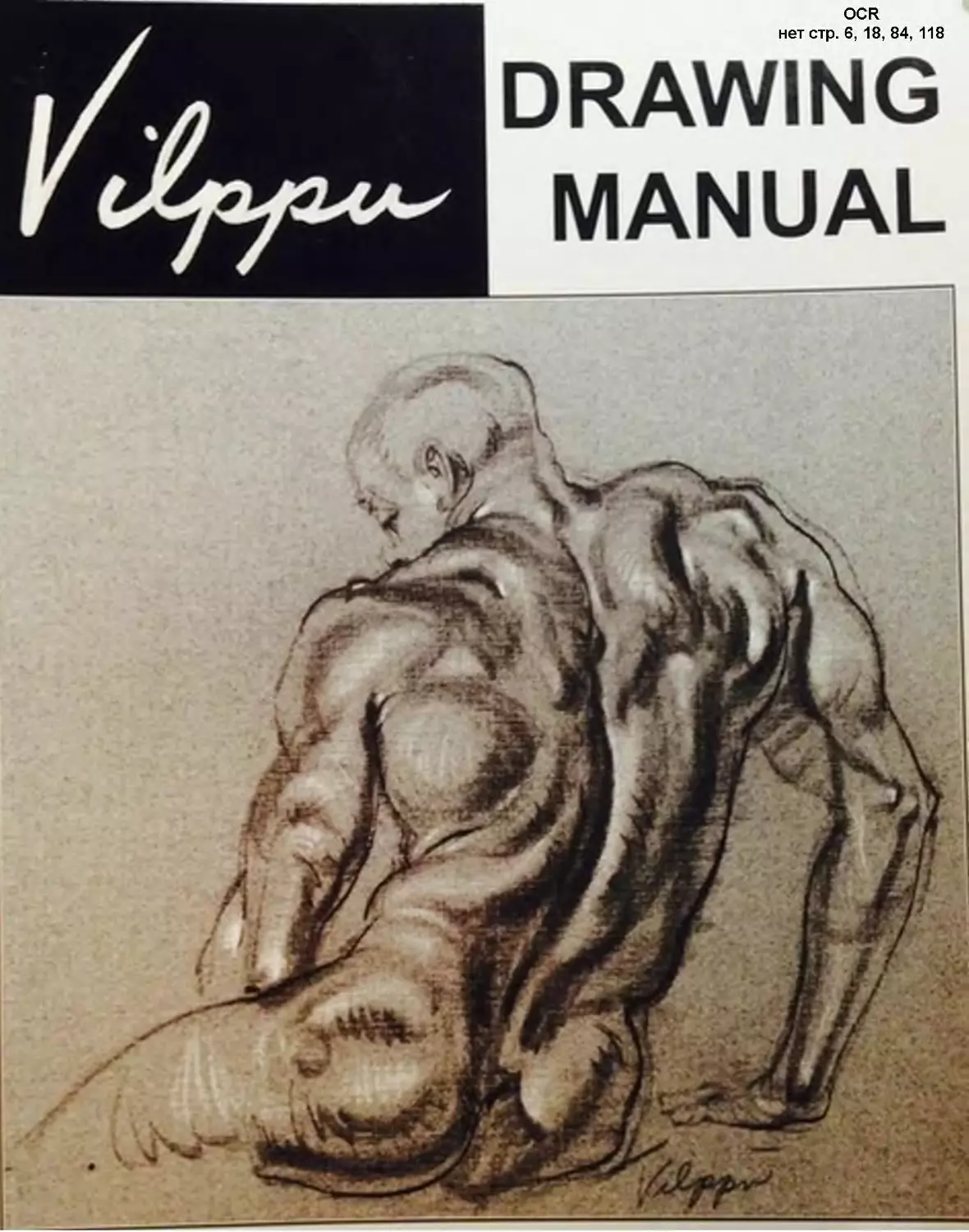
DRAWING
MANUAL

The VILPPU
DRAWING MANUAL
BASIC FIGURE
DRAWING
introduction
It seems that there are at least
two opposite points of view
toward art, if not more. But
before I go any farther, let me say
that I don’t think one is right and
the other is wrong. They are
different and for the artist they
each have their use and value.
Simply put, the two points of view
are, on the one side, “Art is the
imitation of nature,” and on the
other, “Art is based on a
concept of the ideal”.
“Art is the imitation
of nature or Art is
based on a concept
of the ideal.”
In the 1500's Raphael stated,
“There are two principles of ideal
art: the choice of the most beauti¬
ful and perfect proportions of
models, and a purely abstract idea
which has no reference to reality.”
In May of 1664, Gian Pietro
Bellori, the classicist, delivered a
talk at the Academy of San Luca in
Rome where he affirmed that the
choice of natural beauties, which
was keenly made by the artist, is
superior to nature itself. Raphael,
“the great master of those who
know,” is cited together with
Bramante, Perugino, Giulio
Romano, and Michelangelo for
their efforts to bring architecture
back to “the elegant forms of
ancient buildings.” At the same
time there were complaints about
the artists who were “abandoning
the study of nature and had spoiled
art with a style leaning more on
practice and pure invention than on
imitation of nature.” This is the
same argument that went on at the
beginning of the twentieth century
when the modernists art move¬
ments rejected the work of the
salons in favor of the basic abstract
elements of art.
In general, art education is still
split along these two basic lines of
thought. On the one hand, we
have the prevailing approach to
learning drawing by using long
poses where the student learns to
copy the model. Today we call
this the illustrative or academic
approach. On the other hand, we
have a purely conceptual ap¬
proach where the concept is the
overriding element in the drawing.
Now what has this to do with
teaching drawing for animation?
A lot! I feel that drawing, as it is
practiced in the animation industry
today, most approximates classi¬
cal drawing in the tradition of
Raphael, DaVinci, Pontormo, and
other great draftsman of the past.
The drawings of the past were
used primarily in planned stages
tow'ard the creation of paintings,
sculptures, and murals. As such,
they were practical pragmatic
steps in representing ideas. The
classical approach of constructing
1

The Vilppu DRAWING MANUAL BASIC FIGURE DRAWING
forms in an effort to create the ideal
perfect form, along with the desire
for clarity, transition, and ease of
understanding, are the same re¬
quirements of good animation
drawing. The main difference is in
the ideal of the form created.
“Drawing from
imagination towards
a conceptualized
ideal is the norm in
animation/’
Drawing from the imagination
towards a conceptualized ideal (the
model sheet) is the norm in anima¬
tion. The drawing that we do from
the model is research that helps us
to better understand the human
form and its movements. Unlike
the illustrator, learning to copy the
model has very little value for us.
Rarely do we work from the model
except in training situations. One of
the primary requisites in order to
create is the ability to draw from
our imagination. Understanding
and being able to create believable
attitudes and movements, i.e.
bringing our characters to life with
our acting, is the basis of our art. A
child, learning to speak, starts by
mimicking the sounds that he hears
and slowly develops the relation¬
ship of sounds and meanings that
we call speaking. This is unlike
most training in drawing given today
that teaches to mimic nature without
an understanding of the elements of
visual communication. Of course,
there are those individuals who
through an innate talent have
developed this ability of communi¬
cation in the same way that there
are accomplished musicians who do
not read music.
Alexander Marshack was commis¬
sioned by NASA in 1963 to write a
book in collaboration with Dr.
Robert Jastrow “to explain how
man reached that point in science
and civilization to make it possible
to plan a manned landing on the
moon”. The research led to his
book “The Roots of Civilization.”
Marshack draws the conclusion
that one of the basic elements that
distinguishes man from most other
animals is his ability to think in
sequence. He uses the analogy of
sending a man to the moon; in his
discussion he talks about how
impossible the task of sending a
man to the moon is when consid¬
ered as a whole, but taken as a
series of small steps or problems, it
becomes possible. As each step is
broken down into even smaller
steps, the impossible becomes
possible. The main element is the
building of one step upon the
previous in a time factored manner.
The pace of learning of any given
subject, after the initial rapid
advancement, seems to move
upward in ever shortening steps,
2

The Vilppu DRAWING MANUAL BASIC FIGURE DRAWING
while the time between those steps
seems to stretch out longer and
longer until we begin to wonder if
there is any movement at all.
Everyone talks about being on a
plateau, or hitting a new level, or
experiencing the learning curve (a
classical example), without actually
understanding that each level of
development is, in effect, a level of
complexity that must be absorbed
before one advances to the next
level. Tiying to skip levels of
development only slows you down
and creates frustrations that jeopar¬
dize the achievement of your goals.
Yet to accomplish anything complex
there are three basic elements
that are required. First, you need
a plan or approach; second, you
need the knowledge to put the
plan into effect; and third, you
must have the spirit to carry it
through to completion.
“Each step being
broken down into
even smaller steps,
the impossible be¬
comes possible.”
The basis of my teaching is the
development of an approach that
allows you to acquire knowledge
and visual skills in a systematic way,
building upon your understanding
and abilities in logical simple steps.
I have made a real effort al trying to
keep each step as simple, clear,
and logical as possible. In fact,
many of the steps in my basic
approach seem so simple and
basic that quite often the student
tends to ignore developing these
fundamental skills, feeling that he
has advanced beyond them. My
experience has shown me that the
majority of students’ problems in
drawing are with the basic ele¬
ments, or tools of our trade. If
you think of all the possible visual
elements that you must learn as
keys on a piano, the more keys
you have, the wider range of
possibilities you can enjoy. Of
course, you can make music with
just a few keys, but that should be
based on choice not limitations.
Since the basic approach that I
use in teaching is one where we
analyze the model, and not copy
it, the approach itself helps us
acquire the knowledge needed
about our subject. I use the word
subject, not model, because the
basic elements of this procedural
approach apply to drawing
anything, be it a tree, interior, or
figure. You cannot really draw
something unless you know what
it looks like. The more knowl¬
edge you have of whatever it is
that you are drawing, the better
off you will be.
An extremely important element of
knowledge is that we must
develop our ability to use our
emotions. Probably our most
important skill is to be able to
3

The Vilppu DRAWING MANUAL BASIC FIGURE DRAWING
communicate our feelings through
our drawings and to draw upon
our own emotional experiences at
will. One of my favorite sayings is
that you have to be emotional
about your intellect and intel¬
lectual about your emotions.
A particular difficulty I have in
teaching such a systematic ap¬
proach to drawing is that the end
result can to easily be a mechani¬
cal and boring formula. I continu¬
ally have to keep reminding the
student that there are no rules.
What I am teaching are visual
tools and strategies for approach¬
ing the figure, a means for helping
students to understand what they
are looking at. In the end, it is up
to each individual to bring to his
drawing that spark of life.
You will find me stating over and
over again, “there are no rules,
just tools.99 Visual tools are
fundamental concepts used not
only to aide us in drawing but in
seeing. These, in some cases,
consist of procedures and, in
other cases, elements such as the
box and sphere. A large part of
this course is in fact the develop¬
ment of these tools.
I will end this introduction with my
favorite quote by an artist which
exemplifies the pursuit of excel¬
lence in drawing that we can only
hope to achieve.
4

The Vilppu DRAWING MANUAL BASIC FIGURE DRAWING
"From the age of six I had a mania for drawing the shapes of things. When I was fifty' I had published
a universe of designs. But all I have done before the age of seventy is not worth bothering with. At
seventy five I have learned something of the pattern of nature, of animals, of plants, of trees, birds, fish
and insects. When I am eighty you will see real progress. At ninety I shall have cut my way deeply into
the mystery' of life itself. At a hundred I shall be a marvelous artist. At a hundred and ten everything 1
create, a dot, a line, will jump to life as never before. To all of you who are going to live as long as I do,
I promise to keep my word. I am writing this in my old age. I used to call myself Hokosai, but today I
sign my self "The Old Man Mad About Drawing.” f The Drawings of Hokusai,” Introduction by Stephen
Longstreet, Borden Publishing Co.)
5

The VILPPU
DRAWING MANUAL
BASIC FIGURE 4
DRAWING I
Gesture
The action of the figure is
usually expressed as
“gesture”. It means the
movement and attitude of the
figure. It is body language and all
of those subtle differences that
characterize individuals, be they
human or animal. In this regard,
when I refer to the model, I mean
not only a model posing for short
poses of thirty seconds to three
minutes, but also people who are
not posing, and are in real life
situations. We use essentially the
same learning procedure in what
is referred to as the “quick
sketch.” It will be assumed that
for the sake of learning, at this
point, they are the same.
The primary difference between
this lesson and a regular class in
quick sketch is that we are only
applying the beginning steps of the
learning process for this particular
technique. Later in this course, the
gesture is combined with other
visual learning tools to develop
drawings of longer duration with
different ends in mind. The quick
sketch uses some of these tools,
but its purpose is quite diferent.
When I say model, I mean not only
the model in the class but also
those that you are drawing outside
of class as “quick sketches.” Other
terms used for what we call gesture
are “attitude” and “body language.”
Gesture is the single most important
element in the drawing. No matter
how well a drawing is rendered,
without that feeling of individuality
that we
“Gesture is the
single most impor¬
tant element in the
drawing.”
experience in looking at real life,
the drawing is nothing more than
an academic exercise. Long
before we can actually see a
person’s face, we can recognize
him by all those elements that
make up that individual, such as
his general bearing, proportions
of his body, how he dresses, how
he walks, and holds his head.
I am going to present this material
in a series of steps stopping to
explain and clarify points as I go.
In reality, of course, it is never
quite that neat or simple. Many of
the steps are actually done
simultaneously. The total is a
summation of the action in simple
terms and is essentially what this
7

The Vilppu DRAWING MANUAL BASIC FIGURE DRAWING
lesson is about. The illustrations
are examples of this total which is
what you should, in a sense, see
before you start the drawing.
“You are not only
learning to draw
but to see.”
Practice looking at your subject
and then drawing it from
memory. When doing gesture
l sketches, you do not usually have
। the luxury of models holding still
while you draw. Practice this skill
1 continually wherever you happen
। to be-on the bus, watching
television, or in the shopping mall.
In looking at the action, or
gesture, it is important to try to
grasp the total before you put a
I line down. Practice looking al
your subject and then drawing
it from memory. This exercise
I is particularly useful when you
। don’t have your sketchbook with
you (which shouldn't happen), or
I are in situations where it is
i awkward for one reason or
another to be drawing. When
drawing in your head, go through
the same steps and use the same
imaginary lines you would if you
were drawing on paper. You
draw with your mind, not your
hand. Then when you can, redo
the drawing on paper. With
practice you will be amazed at
what you can do, but it takes
practice.
The basic procedure.
You should do each drawing using
the same series of steps until it
becomes second nature to you in a
similar sense as how driving a car
becomes almost automatic. Start
the drawing with simple lines that
take in the total action of the
figure, without worrying about the
shape. A simple sequence of steps
is indicated in the following ex¬
amples. Remember, there are no
rules, just tools!
Step One.
Start with a simple oval for the head,
imagining a central axis so that the
oval clearly represents the tilt and
lean of your subject. Use a simple
“dot” on the top to indicate when the
head is tilting toward you, and
possibly an ellipse for the eyes to
help show more clearly the action of
the head.
8

The Vilppu DRAWING MANUAL BASIC FIGURE DRAWING
“Gesture is the
single most impor¬
tant element in the
drawing.”
Step Two.
Draw a line from the head, repre¬
senting the neck. This line is not
necessarily any actual contour or
line that you see on the model but
a general feeling of the attitude of
the model. Continue this line,
representing the neck, pulling from
the head, into the upper body
down to the hips. You should be
more concerned with the how the
lines show the action of the model,
rather than any actual line that you
see on the model. Look at the
examples on this page to see the
variety of ways that this can be
accomplished. These are not the
traditional stick figures that you see
in many basic books on drawing.
They are lines that show the flow
of the movement and relationship
of the parts in a simple way.
Step Three.
Continue in the same way, drawing
the legs. Notice that all of the lines
do not have to be connected.
Remember, ‘There are no rules,
just tools.” It is important to
remember the simple fact that what
the viewer sees are the lines you
put down on the paper. The lines
have to convey the sense of action
in your subject by themselves. To
9

The Vilppu DRAWING MANUAL BASIC FIGURE DRAWING
give a sense of movement and
continuity, you must draw each line
in such a way as to have one line
lead you into the next.
Step Four.
Now add the arms and hands in the
same manner that we drew the
legs. Again, they do not necessarily
have to be attached but must
indicate the movement and general
placement.
In practice, these steps should take
you a maximum of thirty seconds
with ten to fifteen seconds being the
average.
You should practice these simple
steps as often as you can. In a
regular day class I will have the
students doing this lesson for six
hours.
Continue this simple first step in
feeling the form, then go a step
further and start pushing outward
with your lines. “Feel” how forms
contract and stretch, pinch and
expand. Look at the sample
drawings.
0

The Vilppu DRAWING MANUAL BASIC FIGURE DRAWING
The hardest part of this lesson if
to overcome the desire to copy
the model. Remember, we
"never copy the model but
analyze it. ”
11

The Vilppu DRAWING MANUAL BASIC FIGURE DRAWING
In these illustrations I have
drawn arrows around the figures
to try and indicate the directions
। I observed to the pinches and
stretches of the form I felt.
I
! Try to feel as if you were in the
’ pose, or take the pose yourself.
Try to feel where forms stretch or
। bulge, which leg has the weight on
i it, and, in general, become more
aware of the action.
12
Imagine an accordian. As one side compresses,
the other side stretches.

The Vilppu DRAWING MANUAL BASIC FIGURE DRAWING
It is important to note that, even though I have presented this material as a
definite formula, the end result is not a drawing that appears mechanical.
By focusing on the action, the viewer will see action.
13

The Vilppu DRAWING MANUAL BASIC FIGURE DRAWING
14

The Vilppu DRAWING MANUAL BASIC FIGURE DRAWING
15

The Vilppu DRAWING MANUAL BASIC FIGURE DRAWING
16

The Vilppu DRAWING MANUAL BASIC FIGURE DRAWING
17

The vilppu	BASIC FIGURE Q
DRAWING MANUAL	DRAWING
Spherical forms
Now that you’ve
“mapped out” the
action of the pose, the
next step in the process is to
define your figure in 3-D space.
Learning to see your subject in
terms of simple shapes and
forms along with values is one
of the basic elements in learning
to draw. I refer to this ability to
see and use basic forms as
visual tools. These visual tools, like
any tool, help you to accomplish
certain tasks. Without the right
tools, doing anything becomes
much more difficult. This course is
them. However, the design of a
course does not guarantee that you
will learn those skills automatically.
You have to put in the time and effort
to do the learning. To do anything
successfully you must apply three
basic elements: first, you must have a
plan of attack or approach; second,
you need the knowledge to put that
plan into affect, and third, you must
have the tenacity to carry it through
to completion.
“First, you must
have a plan of attack
or approach;
second,you need the
knowledge to put
that plan into affect;
and third, you must
have the tenacity to
carry it through to
completion.”
designed, step by step, to give you
those tools and basic skills in using
19

The Vilppu DRAWING MANUAL BASIC FIGURE DRAWING
These first lessons are the most
critical and are the most
deceptively simple in appear¬
ance. Through experience, 1
have found them to be the most
difficult for the student be¬
cause of this apparent simplic¬
ity. Everything depends on your
putting the time and effort into
these initial lessons. Lesson
one was a good example of
what seems to be simple but is
something that in reality is
only truly mastered after a
lifetime of effort.
Start by drawing a series of
spheres on your paper; first,
singularly, and then, in pairs,
overlapping and changing in
size in relation to each other
(See Illustration No. 1).
Combining two spheres as one
complete form but still having,
clearly, two parts gives the form a
sense of life (See Illustration No.
2). Have your form walk, bend
over, be curious, meet other forms
like it, and create relationships. In
short, bring it to life. Through all
this, you must maintain the sense of
volume.
What is a sense of volume? The
use of the term “volume” in draw¬
ing generally means three dimen¬
sional. Having a "sense of volume"
in a drawing is to give it this three
dimensional quality. There are
many different ways of creating this
three dimensionality that we
experience as volume in a drawing.
Illustration No. 1
20
Illustration No. 2

The Vilppu DRAWING MANUAL BASIC FIGURE DRAWING
Illustration No. 3
Illustrations No. 1 & 3 demon¬
strate overlapping, the most basic
way to create a sense of form
existing in space. Illustration No. 2
also uses overlapping but in this
case the forms are connected and
the overlapping does not com¬
pletely separate the parts. In
Illustration No. 4 "A," "B," and
“C" you can see how important it
becomes to carefully decide which
lines overlap. In Illustration 4 -
"A," the forms go away from us, in
'’B," they come forward, and in
"C," they create a twist.
Still, just making forms overlap in
itself will not ensure that the
drawing will exhibit this sense
of form.
The most elemental skill is the
ability to sense these basic
volumes on the flat paper as if
they were actually existing,
being created by you as you
move your pencil over and
around their surfaces and
through the magic space of the
paper. Some people have a
natural affinity for doing this
and others have to work hard
and long to achieve it.
Drawing should be an everyday
part of what you do. Look at other
artists of the past and see where
you can find applications of these
lessons. The drawings on this page
21
Illustration No. 4
Illustration No. 5

The Vilppu DRAWING MANUAL BASIC FIGURE DRAWING
and the following are examples of
ways that you can use spherical
forms. The important thing is that
you practice drawing them. Don’t
feel pressured into feeling that you
have to do fancy detailed draw¬
ings. Being loose and feeling the
roundness is the important thing at
this stage of your development.
Create characters out of your
imagination, draw familiar things
around you, applying the various
lessons to what you draw. Copy¬
ing or drawing from other artists is
an accepted traditional approach
to learning in conjunction with
drawing from observation and
creating from your imagination.
Each lesson will build upon the
previous one, so spend the time
on each one and don't rush to the
next until you feel comfortable
with the current one. Don't hesi¬
tate to go back to the previous
lesson; each individual is different
and there is no set length of time
that it should take to acquire the
material in these lessons. Most
importantly, have fun with your
drawing!.
22

The Vilppu DRAWING MANUAL BASIC FIGURE DRAWING
23

The Vilppu DRAWING MANUAL BASIC FIGURE DRAWING
24

The Vilppu DRAWING MANUAL BASIC FIGURE DRAWING
Pay attention to how the forms
overlap. Draw through the
forms as if they were made of
glass so that you can sec how
they connect.
25

The Vilppu DRAWING MANUAL BASIC FIGURE DRAWING
26

The Vilppu DRAWING MANUAL BASIC FIGURE DRAWING
27

The Vilppu DRAWING MANUAL BASIC FIGURE DRAWING
28

The Vilppu DRAWING MANUAL BASIC FIGURE DRAWING
29

The Vilppu DRAWING MANUAL BASIC FIGURE DRAWING
30

The Vilppu DRAWING MANUAL BASIC FIGURE DRAWING
31

The Vilppu DRAWING MANUAL BASIC FIGURE DRAWING
32

The vilppu	BASIC FIGURE Q
DRAWING MANUAL	DRAWING O
Box Forms
The box is like the sphe/e
in Lesson 2. It is uncritical
form that you musUeam
how to draw if you are serftms-
about developing your drawing
skills. The ability to dra^/he-box
is a necessaiy basic skill, tfyou -.
don't have a complete mastery of
this, it will hinder your develop¬
ment as an artist. Spend as much
time as it takes to become profi¬
cient at drawing them at any
angle or in any combination.
PART ONE:
Start by drawing a series of boxes
freehand, i.e. not using a straight
edge. Think of the box tumbling
through space (see Illustration No.
1). Approach it as if you were
animating it so that each drawing is
a progression from the last. Be
careful that you maintain the feeling
that the comers are at right angles
and that you have a sense of
foreshortening as the sides
recede back in perspective. If you
have no knowledge of
foreshortening or perspective.
Illustration No. 1
33

The Vilppu DRAWING MANUAL BASIC FIGURE DRAWING
or are having a difficult time with this
Illustration No. 2
PART TWO:
Illustration No. 3
you should acquire a good book on
perspective and take some time to
study it. This is a skill that is abso¬
lutely necessary in your development
as an artist.
Now let’s take this box we have been
drawing and round off the sides so
that it looks like a bar of soap (see
Illustration No. 2). Start by tumbling
it through space as we did in part
one. After you feel comfortable I
want you to see if you can give it life
and a personality the same way we
did in Lesson 1 (see Illustration No.
3). Have it bend, twist, walk, meet
other boxes. Think of fat boxes, thin
boxes; in short, become master of the
box.
If it helps, set up some boxes. You
could suspend some from the
ceiling by string or wire. It would
even help to make a box mannikin
to draw from, using blocks of
wood and wire (see Illustration No.
4).
It is easy to relate houses, cars,
and other inherently boxlike
forms to our simple box. Look
carefully at the other examples on
these pages to see how the box
was used to help draw them.
Sometimes we use the box as a
starting point when drawing
difficult angles. Remember, there
are no rules, just tools. The sphere
and box are tools that help you to
understand complex forms and
enable you to successfully depict
them in three dimensional space.
34

The Vilppu DRAWING MANUAL BASIC FIGURE DRAWING
Illustration No. 4
35

The Vilppu DRAWING MANUAL BASIC FIGURE DRAWING
36

The Vilppu DRAWING MANUAL BASIC FIGURE DRAWING
37

The Vilppu DRAWING MANUAL BASIC FIGURE DRAWING
38

The Vilppu DRAWING MANUAL BASIC FIGURE DRAWING
39

The Vilppu DRAWING MANUAL BASIC FIGURE DRAWING
Remember, the boxed form is a tool to help you see more clearly,
an aid in organizing what you see in a way that becomes ever useful,
clarifying spacial relationships and the interaction of the various
parts. The drawing becomes much clearer not only to you but to the
viewer as well.
40

The Vilppu DRAWING MANUAL BASIC FIGURE DRAWING
41

The Vilppu DRAWING MANUAL BASIC FIGURE DRAWING
42
Notice how the underlying logic of the box form has
influenced and has helped to clarify and strengthen the
action of the figures.

The Vilppu DRAWING MANUAL BASIC FIGURE DRAWING
43
The drawing to the left, even as a quick sketch, clearly
shows the use of the comers of the form as shown in
the progressive analysis of the drawings above.

The Vilppu DRAWING MANUAL BASIC FIGURE DRAWING
44

The Vilppu DRAWING MANUAL BASIC FIGURE DRAWING
45

The Vilppu DRAWING MANUAL BASIC FIGURE DRAWING
46

The VILPPU	BASIC FIGURE A
DRAWING MANUAL DRAWING **
Combining Spheres and Boxes
In lesson 2 & 3 we devel¬
oped our skills at handling
spheres and boxes, manipu¬
lating them, and giving them
personalities. In this lesson, we
combine them and at the same
time introduce two new ele¬
ments.
PART ONE:
Start by placing a sphere over a
box; they should be roughly
equal in size (see Illustration
No. 1). The next step is very
important. Draw Illustration
No. 1-A again, but this time do it
as if it were covered by some
form of material. Feel the form
underneath. Feel where it leaves
the surface of the sphere and
stretches over to the edges of
Illustration No. 1
the box (B). Now make the material
be a little tight or elastic so that it
comes in at the waist (C).
It is important to be able to feel the
form underneath in order to draw it.
Try to imagine that your pencil is on
the surface of the object rather than
on the paper.
A
c
47
B

The Vilppu DRAWING MANUAL BASIC FIGURE DRAWING
Now let us start to work with
these new forms in the same way
we did in lessons 2 & 3, bending,
twisting and giving them personal¬
ity (Illustration No. 2).
Notice the pinch and stretch as the forms
bend and twist. Don’t forget the use of
overlapping forms in creating the feeling
of volume.
Again, this is one of those exercises that
you should spend a lot of time on; the
simplicity of its look is deceptive.
48
Illustration No.2

The Vilppu DRAWING MANUAL BASIC FIGURE DRAWING
Part Two:
Now let us introduce some
variety into what we are doing
and at the same time open up
the possibilities. In Part One,
the sphere and box were
roughly the same size. Start
introducing proportion into
the drawing in a controlled
manner. Proportion is the
relationship of various ele¬
ments in a drawing which include
size, tone, textures, quantities
and differences that give expres¬
sion or character to the work.
Proportion can be the size of the
head to the body or just simply a
large form to a small form.
Artists have spent their whole
careers trying to find ideal
proportions in their work. We
will look more deeply into
proportion in a later lesson, but
for now I want you to have fun
trying different possibilities with
our simple form. Be as creative
as you can be. Remember,
there are no rules, just tools.
49

The Vilppu DRAWING MANUAL BASIC FIGURE DRAWING
You should be starting to feel a certain amount of flexibility and confi¬
dence in drawing without a model by now. In the next lesson, we will
expand more on that before we start discussing drawing from the model.
50
Try stretching the distance
between the forms.

The Vilppu DRAWING MANUAL BASIC FIGURE DRAWING
51

The Vilppu DRAWING MANUAL BASIC FIGURE DRAWING
52

The Vilppu DRAWING MANUAL BASIC FIGURE DRAWING
53

The Vilppu DRAWING MANUAL BASIC FIGURE DRAWING
54

The Vilppu DRAWING MANUAL BASIC FIGURE DRAWING
55

The Vilppu DRAWING MANUAL BASIC FIGURE DRAWING
56

The Vilppu DRAWING MANUAL BASIC FIGURE DRAWING
57

The Vilppu DRAWING MANUAL BASIC FIGURE DRAWING
58

The vilppu	BASIC FIGURE E
DRAWING MANUAL	DRAWING
Ellipses and Cylinders
In the first four lessons we
have been basically dealing
with the torso of either
human, animal or cartoon
Let’s first develop some basic skills
for drawing ellipses. To start with,
you need to rely on drawing more
with a total arm movement than
Illustration No. 1
characters without actually
calling them that. In this lesson
we want to expand on that
direction by adding appendages
to these basic forms. The
primary skill required to do this
is being able to draw cylinders.
A cylinder is essentially two
ellipses connected by straight
lines and, of course, an ellipse is a
circle in perspective (Illustration
No. 1).
with your fingers. Practice drawing
ellipses that begin with a straight
line and come to a full circle
(Illustration No. 2). Visualize a
cross section of a hose, or a simple
computer wire frame of a cylindri¬
cal form. Albrecht Durer (1471-
1528) in his Dresdon sketchbook
shows many variations on an
analytical constructive approach to
drawing the figure. (“Albrecht
Durer the Human Figure,” Dover
Publications, Inc., New York.)
“A cylinder is essen¬
tially two ellipses
connected by straight
lines.”
59
Illustration No. 2

The Vilppu DRAWING MANUAL BASIC FIGURE DRAWING
Now try some drawings where
you make these tubes cross each
other and interwine (Illustration
No. 3).
Illustration No. 3
Illustration No. 4
In drawing a cylinder, the two most
important elements are the angle or
axis of the cylinder, and the begin¬
ning and end of the cylinder.
Illustration No. 4 shows a basic
procedure for approaching the
drawing of a cylinder. First, draw a
line indicating the centerline. Then,
draw the ellipses defining the ends
of the cylinder.
Do a series of drawings, adding
cylindrical forms to the ones that we
have created in the previous lessons
(Illustration No. 5).
Keep the ellipses at right angles to
the central axis.
Illustration No. 5
60

The Vilppu DRAWING MANUAL BASIC FIGURE DRAWING
Have fun with the drawings.
Even though learning to draw
takes a lot of effort, it should
be something you look forward
to doing.
Remember that these are tools to
help you see and not rules. At
this point in your development
you want to be very clear and
obvious about what you are
doing. As you develop, these
tools will become transparent. By
transparent, I mean that you will
use them to influence the forms
that you draw' so that they
become an underlying visual
logic, but not necessarily as
obvious as we need to make
them in the learning process. No
one is really in interested in
seeing cylinders, ellipses, boxes,
etc. What we want to see is
what you have to say about your
subject. Do not confuse the
method with the messag^
Illustration No. 4
“Do not confuse the method
with the message.”

The Vilppu DRAWING MANUAL BASIC FIGURE DRAWING
In some of the following draw¬
ings you can clearly see the use
of the cylinder as a means of
construction. In others, it was
used as a means of understand¬
ing a complex form and influ¬
enced the way in which the form
was used. Again, there are no
rules, just tools!
62

The Vilppu DRAWING MANUAL BASIC FIGURE DRAWING
63

The Vilppu DRAWING MANUAL BASIC FIGURE DRAWING
64

The Vilppu DRAWING MANUAL BASIC FIGURE DRAWING
65

The Vilppu DRAWING MANUAL BASIC FIGURE DRAWING
66

The Vilppu DRAWING MANUAL BASIC FIGURE DRAWING
67

The Vilppu DRAWING MANUAL BASIC FIGURE DRAWING
68

The Vilppu DRAWING MANUAL BASIC FIGURE DRAWING
69

The Vilppu DRAWING MANUAL BASIC FIGURE DRAWING
70

The Vilppu DRAWING MANUAL BASIC FIGURE DRAWING
71

The Vilppu DRAWING MANUAL BASIC FIGURE DRAWING
72

The Vilppu DRAWING MANUAL BASIC FIGURE DRAWING
73

The Vilppu DRAWING MANUAL BASIC FIGURE DRAWING
74

The vilppu	BASIC FIGURE O
DRAWING MANUAL	DRAWING O
A Basic Procedure
In the first four lessons we
have gone through the basic
elements, or tools, that we
use to create form. All of the
work we have done so far has
been on the presumption that
we were doing a procedural
drawing where one element was
built on top of the previous
rather than a direct type of
drawing where each line essen¬
tially was the finished line.
“Drawing is essen¬
tially a logical and
practical process.”
As I have already mentioned, the
basic structure of this approach
is going from the general to the
specific. In drawing terms,
general means the “total.” In
drawing the figure, this means the
action or attitude or, in another
words, the gesture. Artists
In this lesson I will outline a basic
procedure showing how all of the
elements that we have discussed
so far fit in. The essence of this
approach is that we go from the
general to the specific
“The essence of this
approach is that we
go from the general
to the specific.”
and that you essentially concentrate
on one thing at a time. What we are
talking about is a general plan, not
a set of rules, but a plan that has to
be responsive to the situation or
needs of the drawing. As I men¬
tioned in the introduction, there are
three elements necessary to ac¬
complish anything. First, you must
have an approach or plan of attack.
Second, you must have the knowl¬
edge to accomplish the task, and
third, you must have the spirit to
carry it through to completion.
throughout history have done
gesture drawing in many ways, this
being determined by their person¬
alties and the prevailing styles for
any given time. Yet they all have
essentially done so in a similarly
logical manner. Drawing is essen¬
tially a logical and practical pro¬
cess.
What is important at this point is
that you concentrate on communi¬
cating the action in its totality and
not get sidetracked into copying
75

The Vilppu DRAWING MANUAL BASIC FIGURE DRAWING
details or becoming preoccupied
with specific contours unless they
somehow assist in communicating
the overall gesture.
A fundamental truth that seems to
get forgotten is that the lines that
you draw are what the viewer
looks at. This may seem obvious
and simplistic but is true. What is
important, at this point, is that you
concentrate on communicating the
action in its totality and not get
sidetracked into copying details or
becoming preoccupied with
specific contours unless they
somehow assist in communicating
the overall gesture. This was the
point of Lesson No. 1. Illustra¬
tion No. 1 gives you more ex¬
amples.
“At the beginning
of the drawing the
primary concern is
the total action.”
76
Illustration No. 1

The Vilppu DRAWING MANUAL BASIC FIGURE DRAWING
71

The Vilppu DRAWING MANUAL BASIC FIGURE DRAWING
In Illustration No. 21 have tried to
show how the kinds of lines you
use and the forms that you empha¬
size affect the feeling that your
drawing communicates. Look at
the differences between drawings
A, B and C . Each drawing has a
difference in the feeling it commu¬
nicates. In “A,” the lines, in
general, go with the direction of
the forms, one line flowing into the
next. The general feeling is one of
rhythm and grace. In drawing
“B,” we have a much sharper
feeling and, in a way, “jerkier”, if
you can think of a drawing as
having movement. The sharpness
of the comers give it a bit more
“bite,” as we say, and perhaps this
harshness is easier to understand.
In “C,” where the concentration is
on the contours, the actual gesture
becomes secondary to the flat
shape created. “A” and “B,”
though different in feeling, still
convey the sense of the movement
(since the movement or gesture
was the subject), while in “C,” the
subject was the contour and not
the flow of the forms (the gesture,
in this case, if captured, is a
secondary consideration to the
shape). This is not to say that
shape is not important. In fact, it
is very important. But at the
beginning of the drawing, the
primary concern is the total action.
Examples “A” & “B” of Illustra¬
tion No. 1 are exaggerations of
two very common basic ap¬
proaches to starting a drawing.
“A” is exemplified by drawings of
Illustration No. 2
Daumier and “B” by the preliminary
pen sketches of Peter Paul Rubens.
These are the two extremes; you
will find many artists who combine
elements of both. Again, remem¬
ber, there are no rules.
“Remember, there
are no rules.”
Illustration No. 3 gives more
examples of the approach shown in
example B.
78
ABC

The Vilppu DRAWING MANUAL BASIC FIGURE DRAWING
79
Illustration No. 3

The Vilppu DRAWING MANUAL BASIC FIGURE DRAWING
Illustration No. 4 shows the
second step in the process,
clarifying the basic volumes, or
masses, as we say. This can be
carried to the extreme of cylinders
and boxes, as we did in the first
four lessons, or can be incorpo¬
rated into the drawing in a less
obvious way, as they are in
Illustration No. 4. The study of
boxes, cylinders, and spheres is
the means and tools that help you
understand in a simplified way
what it is you are looking at.
Again, there is every extreme in¬
between.
Illustration No. 4
80

The Vilppu DRAWING MANUAL BASIC FIGURE DRAWING
Illustration No. 5, as well as
many examples in previous
lessons, give you a little bit of the
feeling for the variety that this
step can take.
Illustration No. 5
81

The Vilppu DRAWING MANUAL BASIC FIGURE DRAWING
In general practice, the artist will
often do a drawing in several
layers. This layering is done in
several ways. I n the Fi fteenth
Century, it was common practice to
do all of the preliminary drawing we
have been discussing in a medium
that could easily be erased, such as
a soft charcoal, chalk, or graphite.
Afterwards, going over the drawing
with ink or wash. At this point, the
preliminary drawing would be
erased and further development of
the drawing would be continued.
Today we use light tables, tracing
paper, and opaque projectors to do
the same thing, still using the same
materials and methods of the past.
Remember, we are discussing a
procedural approach to drawing,
not direct drawing. Although all
drawing is, in a way, direct, the
point is that the sequence allows
you to concentrate on one element
at a time and go from the general to
the specific. This is a general
method, or approach, to help you
organize your efforts. It is not a
rule, but a tool.
Illustration No.6 on this page and
the following ones of this chapter
illustrate this procedural approach.
Illustration No. 6
82

The Vilppu DRAWING MANUAL BASIC FIGURE DRAWING
83

85

The Vilppu DRAWING MANUAL BASIC FIGURE DRAWING
86

The VILPPU	BASIC FIGURE 7
DRAWING MANUAL DRAWING '
Using Anatomy: Part one
knowing anatomy would not make
me draw better. What I needed
was a method of understanding
anatomical facts so that I could use
these landmarks as tools of com¬
munication and expression without
violating basic anatomical reality
and thereby detracting from the
drawing what it was trying to
communicate.
It is a truism that you cannot
draw something unless you
know what it looks like. It is
also true that just because you
know something very well, it does
not mean that you can draw it. I
have taught many medical person¬
nel, including doctors, nurses, and
various specialists with much more
understanding of anatomy than
myself. In fact, it took a while for
me to realize that just
“You cannot draw
something unless
you know what it
looks like.”
Let us first start with some basic
landmarks and simple facts
about the figure. One of the
most basic and useful facts about
the figure is its symmetry. The
symmetry of the figure is an obvi¬
ous tool that is too often over¬
looked. In Illustration No. 1,
drawings "A” and ”B” give us the
87

The Vilppu DRAWING MANUAL BASIC FIGURE DRAWING
basic landmarks that we need to
understand and use. From the
front wre have the line created by
the pit of the neck, sternum, naval,
and pubic arch, giving us a center
line. In the back, we have the
spine itself as a center line. The
ends of the shoulders are basic
landmarks from both front and
back. Moving down the front, we
have the comers of the rib cage at
the bottom of the thoracic arch,
and the comers of the pelvis at the
end of the iliac crest. Going down
the back, we have the lines of the
scapulas, and the ends of the iliac
crest where it meets the sacrum.
Now let us see how we use these
basic landmarks. Thinking of the
center of the form is the key to
using symmetry. In most cases,
(with the exception of the shoul¬
ders which have considerable
independent movement but which
generally conform to the basic
concept), the landmarks are at
right angles to the central axis of
the form. When the central axis of
the form changes, the landmarks
move with it and, generally,
exaggerate the change. Study
Illustration No.2 of the torso and
notice how the landmarks move
with the change of the form.
Notice the compression and
stretching that takes place when
the fixed landmarks move with the
changing central axis.
While achieving a clear under¬
standing of the action by
amplification of the shift in the
Illustration No. 1
88
Illustration No. 2
A
B

The Vilppu DRAWING MANUAL BASIC FIGURE DRAWING
central axis, we bring into play
fundamental dynamics of reality as
well as basic design elements. By
simply shifting the weight to one
leg we automatically create a curve
in the torso, as we generally shift
the rest of the torso to compensate.
This shifting doesn’t stop there, but
extends to the neck and head,
going up, which tends to move in
the opposite direction again. In this
simple shifting, you have the basic
elements of a classical rhythmic
arrangement of forms combined
with the twist that was the hallmark
of renaissance aesthetics. Look at
Illustration No. 3 and take the pose
yourself. Try standing with your
weight equally balanced and then
slowly shift your weight from one
side to the other and see what
happens. If you try to maintain a
basic vertical position rather than
leaning to one side or the other, you
will look like Illustration No. 3.
Notice how one side of the body
is stretching and the other side is
compressing.
89
Illustration No. 3

The Vilppu DRAWING MANUAL BASIC FIGURE DRAWING
90
The accordion in Illustration No. 4
is a diagram of this action. The
basic design element involved here
is the fundamental concept of
opposites, the most basic of design
principles. The use of opposites is
a tool that not only creates visual
interest, but each helps to clarify
the other. The Italians called this
pose "Contra Posto."
Illustration No. 4

The Vilppu DRAWING MANUAL BASIC FIGURE DRAWING
The limbs have their own land¬
marks that we look for and use as
tools to help us understand and
describe an action. As in the
torso, symmetry plays a key role
and, of course, is defined by the
central axis of the form. The most
useful clarifying elements are the
ends of the bones at the various
joints.
First, let us look at the elbow.
The uniqueness of the joint of the
elbow creates a very practical
means of showing the direction of
the form. Illustration No. 5 shows
you how this joint is formed. The
end of the ulna along with the
epicondyle of the humerus create
three clear points that you can use
in your drawing. When the arm is
straight, these points create a
straight line. When you bend your
arm, the tip of the ulna drops. This
triangle then becomes the end of
the cylinder of the forearm. The
axis created by the line betw een
the condyles defines the orientation
of the cylinder in space.
91
epicondyle
olecranon process
humerus
Illustration No. 5
ulna
radius

The Vilppu DRAWING MANUAL BASIC FIGURE DRAWING
Since the radius has the ability to
twist independently of the ulna, the
wrist is often best described as a
squared shape due to the flatness
of the radius on top. Again, this is
an observation that becomes an
excellent tool.
92

The Vilppu DRAWING MANUAL BASIC FIGURE DRAWING
The shoulder is a little different in
that we do not really see the
humerus clearly. Here we must
use the way in which the deltoid
attaches in a semicircle to the
scapula and clavicle. The
acromion process at the end of
the spine of the scapula becomes
the point that we use in drawing the
line across the shoulders. The line
created by the spine of the scapula
is also very useful as is the lower
comer. Study Illustration No. 6.
93
Illustration No. 6

The Vilppu DRAWING MANUAL BASIC FIGURE DRAWING
94

The Vilppu DRAWING MANUAL BASIC FIGURE DRAWING
The knee is used very much in the
same way as the elbow in that wc
concentrate primarily on the epi¬
condyle of the femur and condyles of
the tibia. It becomes quiet useful to
sec this joint rather squarishly to help
show the direction of the leg. The
patella functions in much the same
way as the end of the ulna does in
the elbow in helping to give direction
to the leg. Study Illustration No. 7.
95
Illustration No. 7

The Vilppu DRAWING MANUAL BASIC FIGURE DRAWING
96

The Vilppu DRAWING MANUAL BASIC FIGURE DRAWING
The way the fibula and tibia fit into
the foot in a front view gives a clear
indication of which way the foot is
going. Study Illustration No. 8.
You will notice that in these illustra¬
tions I have included diagrams that
show the flow of the lines created
by the basic forms. These
"rhythms" have a corresponding use
to the basic structural landmarks in
helping us see the total action more
clearly. You should look at these
landmarks as ways of helping you
see what you're looking at and not
as rules. The point is to develop a
strong systematic approach that
frees you creatively.
Illustration No. 8
In Part Two (Lesson No. 8), we
will discuss further some of the
major anatomical masses.
97

The Vilppu DRAWING MANUAL BASIC FIGURE DRAWING
98

The VILPPU	BASIC FIGURE
DRAWING MANUAL DRAWING
8
Using Anatomy: Part Two
In the last lesson, we concen¬
trated on the specific land
marks of anatomy we use with
the symmetry of the figure to help
us see and draw the action of the
figure. The next step in using
anatomy is learning to see the large
anatomical masses. In the first four
lessons we laid much of the
groundwork by concentrating on
simple forms as a means of analyz¬
ing the figure as a total. This lesson
is a continuation of that procedure,
breaking those larger units into
smaller units, while at the same time
adding a new level of believability to
our drawings. Of course, we are
also adding to the complexity of our
drawing. It is important to remem¬
ber that these new forms that we
add should not distract from the
99

The Vilppu DRAWING MANUAL BASIC FIGURE DRAWING
Illustration No. 1
readability of the action. Any
additions of detail should help to
clarify the action and add to our
understanding of the subject.
"Remember, do not
copy, but analyze
the model."
First, we need to look at some
basic ways that forms connect.
Illustration No. 1 gives you
some of the basic situations in
which forms interact. The primary
ingredient in achieving any suc¬
cess at this hinges upon your
ability to analyze form. There are
two main elements of this analysis.
The first is to be able to see the
total, which has been the primary
concern of these lessons up to
now. The second is to develop
the ability to sec the surface of the
form. This will be a primary
ingredient of the next few lessons.
Illustration No. 1-A shows a
simple raised area of a form . It is
100

The Vilppu DRAWING MANUAL BASIC FIGURE DRAWING
important that you develop your skill in analyzing this
simple kind of form. One way to start doing this is to
take some kind of striped material and drape it over an
object or just crumple it up. Now take your pencil and
follow a line going up and down and around, following
the line until you reach the lend. Do this for each stripe
until you have a clear picture of the surface of the form.
This is no different than a computer generated wire
frame drawing of an object. See Illustration No. 2A.
Illustration 2B may look different but the way the
lines go over and around the form are actually very
similar to 2A. The main difference is that the lines are
not as mechanical in feeling or application.
Many art school exercises that have become art
forms in themselves are based upon dealing with this
basic problem. To achieve success at this you must
visualize your pencil as actually being on the form that
you are drawing, reacting to every nuance of change
in direction that the surface of the form takes.
101
Illustration No. 2A
Illustration No. 2B

The Vilppu DRAWING MANUAL BASIC FIGURE DRAWING
When I was in school, 1 had an
instructor suggest that you should
pretend that you were an ant
crawling over the surface. At the
time I thought how ridiculous this
was. What I wanted to do was
draw like Michelangelo, not like an
ant walking across an arm. The
imagery may have seemed ridicu¬
lous but the attitude and skills
developed by the exercise were
not. In fact, looking at the great
masters, including Michelangelo,
you will notice the incredible level
of skill they had in being able to
describe form, be it a building or
an arm.
Now let us look at some of the
basic elements that are repre¬
sented in the examples of
Illustration No. 1. When you are
drawing form you are primarily
involved in showing the change in
direction of a form. That is why it
is so important that you understand
and can clearly describe the
surface of the form you are
drawing. In Illustration No. 1-A,
the way in which the small form
overlaps the larger form gives a
strong sense of relief or 3D.
Look at Illustration No. 3 and
compare the different ways the
drawings were done. Notice how
the overlapping and feeling of
going behind aid in giving a
sense of volume to the form.
102

The Vilppu DRAWING MANUAL BASIC FIGURE DRAWING
103
Conversely, notice that by not
overlapping or by creating tan¬
gents the form tends to flatten out.
Illustration No. 3
A simple way to help you remember this
concept of overlapping is to think of a
“T” as one of the basic elements.
A tangent is when you have elements that
come together in such a way as to make it
unclear which form is in front.
Even though this figure has some overlapping forms in
comparison to the upper figure, it is quiet flat.

The Vilppu DRAWING MANUAL BASIC FIGURE DRAWING
Study the drawing below and the details to see how overlapping
helped to give a sense of volume. Then compare it with the same
drawing at the bottom of the page without many of these same tools
that help to create a sense of volume.
104

The Vilppu DRAWING MANUAL BASIC FIGURE DRAWING
Let us start going through some of
the basic anatomical masses we
deal with in the figure. Keep
referring to Illustration No. 4 as
you read this explanation. Of
course, the basic form of the
upper torso is the oval of the rib
cage (A). This is the foundation
that we build on. The neck is a
simple cylinder (B) and the head
another oval (C). In Part One
(Lesson No. 7), the clavicle and
scapulas were some of the land¬
marks that we discussed in our
initial stages of the drawing.
Back
Illustration No. 4
105
A
B
D
C

The Vilppu DRAWING MANUAL BASIC FIGURE DRAWING
as a yoke that slips over the neck
and rests on the rib cage (Illustra¬
tion No. 5). Next, from the
front, look at the pectorals
muscles (Illustration No. 6). They
attach to the rib cage and to the
clavicles at the top, the sternum in
the center, and pull over to the
arms from the rib cage. Do not
lose sight of the round mass of
the rib cage.
Now visualize these two elements
Illustration No. 5
Illustration No. 6
106

The Vilppu DRAWING MANUAL BASIC FIGURE DRAWING
From the back, notice how the
scapula floats on top of the rib
cage (Illustration No. 7).
The muscles of the scapula,
(infraspinatus, teres minor, and
teres major), build on top of the
basic scapula form. We, at this
point, also have the latissimus
dorsi muscle which lies over the
bottom of the scapula, pulls up
into the arm at the top, and goes
down to the pelvis at the bottom.
These forms pull into the cylinder
of the arm. The top of the
cylinder is the deltoid we dis¬
cussed in the previous lesson.
Notice how the pectoralis major,
the teres, and the latissimus dorsi
give a strong sense of 3D by their
overlapping. As the pectoralis
and teres muscles fit into the arm,
you should be seeing them as
parts of simple cylinders. You
should not miss any opportunity in
using lines that go across or
around the form to describe
volume. It is also important, at
this point, to look at the trapezius
muscle. First, the trapezius helps
us see the end of the neck as it fits
into the skull. As the muscle
comes down to the shoulders, it
comes around to the clavicles and
attaches around the arc of the
clavicles and scapula meeting the
end of the deltoid and continuing
down the spine of the scapula.
The critical area in drawing this
muscle is the transition across the
shoulder to the neck. Don’t think
just anatomy, but try to use your
understanding of the anatomy to
create form.
107
Illustration No. 7
teres minor
deltoid
infraspinatus
latissimus dorsi

The Vilppu DRAWING MANUAL BASIC FIGURE DRAWING
Moving down the back, we have
the two large muscles that go
along the sides of the backbone
(sacrospinalis), coming from the
sacrum up along the back bone
fitting into the ribs.
Again, notice how the basic
volume of the rib cage is still the
dominant element that these forms
fit into.
108
sacrospinalis

The Vilppu DRAWING MANUAL BASIC FIGURE DRAWING
109

The Vilppu DRAWING MANUAL BASIC FIGURE DRAWING
The buttocks muscles, the gluteus
maximus and medius, attach to
the sacrum and the illiac below
the crest, and insert at the hip
bone (the trochanter of femur).
Depending on the model, these
forms lend themselves to simple
spherical forms or boxes. The
main point is to look for the
inside corners of the form and
pay particular attention as to
how they connect to the leg.
110
iliac crest
gluteus muscles
sacrum
trochanter of femur

The Vilppu DRAWING MANUAL BASIC FIGURE DRAWING
in

The Vilppu DRAWING MANUAL BASIC FIGURE DRAWING
112

The Vilppu DRAWING MANUAL BASIC FIGURE DRAWING
As we start around towards the
front again, the external ob-
iliac crest
external oblique
liquc, or flank pad as it is called, is
the dominant form. The bottom
margin is the iliac crest of the
pelvis. The top fits into the ribs
interconnecting with the muscles
coming from under the scapula.
At this point, concentrate primarily
on the basic shape and how it
works with both the pelvis and rib
cage. This is the form that we
most often see, stretching and
compressing or bulging out. It is
important to see howr the rib cage
fits into it.
external oblique
113

The Vilppu DRAWING MANUAL BASIC FIGURE DRAWING
From the front, the primary muscle
that we work with is the rectus
abdominis which is attached at the
top of the rib cage, and at the
bottom, to the pubic arch. The
main elements are the clear
boundaries on the sides and down
the center. The tranverse line
created by the interrupting tendons
are what give the characteristic
shape of the well-developed
stomach muscles. The planes
created by similar lines on the
sides, those that separate the
rectus abdominis from the external
oblique, are important elements in
understanding the major forms of
the front of the torso.
114
rectus abdominis

The Vilppu DRAWING MANUAL BASIC FIGURE DRAWING
115

The Vilppu DRAWING MANUAL BASIC FIGURE DRAWING
116
In looking at the connection of the
legs to the torso, it is important
that you remember that the large
muscle in the front, the rectus
femoris, does not attach to the iliac
crest but goes between the tensor
and the sartorius muscles. The
“A” shape created by the tensor
and sartorius arc part of the comer
of the box shape used in seeing the
pelvis. The rectus femoris, along
with the vastus lateralis and vastus
medialis, are the main elements of
the cylinder of the leg from the
front. In the back of the leg, the
biceps femoris along with the
semimembranosus and semitendi¬
nosus are the main elements of the
cylinder. Notice how the adduc¬
tors pull from the pubic arch area
and complete fill in the triangle
from the pubic arch to the knee.
, sartorius
tensor
rectus femoris
adductors

The Vilppu DRAWING MANUAL BASIC FIGURE DRAWING
117

The Vilppu DRAWING MANUAL BASIC FIGURE DRAWING
In the back of the knee, the
gastrocnemius (the calf muscle)
goes inside the tendons of the
biceps femoris, semimembrano¬
sus, and semitendinosus to create
the characteristic squarish shape
of this connection. In the front, the
comers of the knee are created
by the patella in front with the
quadriceps tendon and, to the
sides, the epicondyles of the
femur.
The angle across the calves is high
on the outside and low on the
inside. However, at the ankle, the
outside is low and the inside is
high. __
119

The Vilppu DRAWING MANUAL BASIC FIGURE DRAWING
120

The Vilppu DRAWING MANUAL BASIC FIGURE DRAWING
121

The Vilppu DRAWING MANUAL BASIC FIGURE DRAWING
122

The Vilppu DRAWING MANUAL BASIC FIGURE DRAWING
The arc created by the tibia and
fibula is a primary line showing
the connection of the leg to the
foot in front. In the back, the
achilles tendon attaching to the
calcaneus (the heelbone) is the
characteristic look. Try to view
the foot as simply as possible in
the beginning, focusing on simple
volumes.
123

The Vilppu DRAWING MANUAL BASIC FIGURE DRAWING
In looking at the arms, try to see
the overall simple masses of the
forms as you study the anatomy.
It is very easy to get so involved
with anatomical detail that you
lose sight of the whole.
“It is very easy to
get so involved
with anatomical
detail that you
loose sight of the
whole.”
In drawing the wrist, remember
as we discussed in the last
chapter, that the radius rotates
and the ulna is stationary. The
wrist is more simply seen as a
box form.
124

The Vilppu DRAWING MANUAL BASIC FIGURE DRAWING
In teaching the drawing of the hand
I have found that if you first start
by developing your skill at drawing
the simple forms of the animators
hand and then slowly introduce the
real anatomical hand it is easier to
control the complexity and de¬
velop a method to draw and
understand the forms.
125

The Vilppu DRAWING MANUAL BASIC FIGURE DRAWING
126

The vilppu	BASIC FIGURE
DRAWING MANUAL	DRAWING
9
Combining 2D and 3D Observations
The reality of drawing is
that we draw on a two
dimensional piece of
paper; the drawing is not a three
dimensional object. Up to this
point, our efforts have been almost
exclusively concerned with creat¬
ing that three dimensional illusion
on a two dimensional surface. We
used a series of tools and proce¬
dures that didn’t necessarily rely
on the model, but on an analytical
and constructive approach to
drawing the figure. In drawing
from the model, i.e. reality rather
than from imagination or an ideal,
we must develop a set of visual
tools to help us make that transla¬
tion from the real three dimensional
world (3D) to the flat two dimen¬
sional world (2D) of the paper. In
many ways, this is much simpler
than what we have been doing. In
general, the fundamentals of the
approach based on direct observa¬
tion of the model are the same as
the widely used academic method
of copying, one of the methods
taught in the studios of the artists of
the Renaissance. In this lesson we
will use this method to assist us in
placing the forms that we have
learned about in the earlier chap¬
ters. (Much of what we are now
discussing has been introduced, in
part, in earlier chapters.) The
drawback of this approach is that
you need the model to do the
drawing. In practical application,
the camera has come into use as a
substitute for having a model pose
for hours while the artist does his
or her drawing.
127

The Vilppu DRAWING MANUAL BASIC FIGURE DRAWING
Before the invention of the camera,
both Leonardo Da Vinci (1452 -
1519) and Albrecht Durer (1471 -
1528) and many other artists of
that period invented drawing
machines to accomplish the same
thing. Let us look at Da Vinci’s and
Durer’s machines as a basis for
understanding the approach.
Both artists created essentially
the same machine with slight
variations. The basic elements
were a frame with wires
stretched over it dividing it into
equal units, or a piece of glass with
lines drawn on it sitting upright on
a table and a piece of paper having
the same equal divisions on it as
the screen. The artist would look
through the screen from a fixed
viewpoint, either a peep 1 ole or
some form of brace, to keep the
head from moving. The artist
would then copy what he saw in
each square onto the corresponding
square on the paper. The great
anatomist, Bernard Siegfried
Albinus (1697-1770), in 1727
started his great work on human
anatomy which was to take him 20
years. The following quote is from
“Albinus On Anatomy”, by Robert
Beverly Hale and Terence Coyle
published by Dover Books 1988
(reprinted by permission)'.
“Albinus overcame the problem
of obtaining correct proportions
between the parts of the body in
the drawings of his artist by
using grids or nets made of cords
and divided into squares. These
were placed at selected intervals
between the artist and the
skeleton. One grid was placed
almost in contact with the
skeleton by which the artist
could draw from a distance of up
to forty feet for the drawing of
detail, a second grid with the
squares greatly reduced in size,
was placed four feet in front of
the first grid. The artist would
look through the grid and place
himself so that the cords of the
two grids lined up with one
another on his view of the
skeleton, and could check his
accuracy by means of these lines
and their intersections. ”
128

The Vilppu DRAWING MANUAL BASIC FIGURE DRAWING
This is essentially identical to an
artist today taking a photograph,
squaring it off, and transferring it
to a canvas. The usefulness of
the approach is in its mechanical
nature. We incorporate basic
elements of this approach any
time we draw from nature. In the
previous lessons I have been
incorporating the use of many of
the basics, without making spe¬
cific mention of the procedure as
a whole.
The basic elements of the grid are
vertical and horizontal lines, plus
angles and measurements. These
are the tools of this approach.
Spheres, circles, box /squares,
along with arcs are additional aids
in seeing the placement of forms.
A key element in academy training
is the length of the pose. Since a
prime requisite for doing this kind
of drawing is very careful obser¬
vation, the poses were, by neces¬
sity, very long. The student
normally would start his or her
training by first learning to draw
from plaster casts, as is still done
in many parts of the world. A
pose, using the model, could last
for a day, several days, or a
week. An hour pose was consid¬
ered a quick one, used for learn¬
ing how to start a drawing.
In this lesson, as in the previous
lessons, the drawing is primarily
done in line. In a true academic
approach, the use of tone would
be a major part of the drawing.
Each step being a gradual build-up
of values with careful consideration
of the direction of the light falling
upon the forms. In the following
three lessons we will be discussing
tone, but in a more constructional
and analytical approach. In this
lesson I am using the academic
approach as a way of carefully
translating the three dimensional
forms of the model, as we have
developed them, to the two
dimensional surface of the paper as
accurately as I can.
“As in earlier lessons, the
most important point is to
get the total.”
129

The Vilppu DRAWING MANUAL BASIC FIGURE DRAWING
Turn your paper to fit the drawings proportions.
Illustration No. B
We start first by establishing
where we want to place the
figure on the paper. To do this,
we must establish the limits of
the model and where these are
to be placed on the paper. In
‘illustration A,” you will notice
that the seated figure has a
horizontal axis and the standing
figure, “Illustration B,” has a
longer vertical axis. This is not
always quite so obvious, so it
is important that you carefully
measure to see which lines are
longer and place the figures on
your paper accordingly. Notice
that I have used a series of
straight lines to “block in” the
rough placement of the figure.
Straight lines are essentially
easier to see and make judg¬
ments with compared to
irregular lines. You “block in”
the figure by “eye-balling” it, in
other words, by making simple
unassisted visual judgments
prior to actually measuring. As
you develop your visual skills,
the simple act of making a
mental notation is usually
sufficient. Now we have
reached the point where we
start to more accurately place
the various elements of the
drawing.
130
Illustration A

The Vilppu DRAWING MANUAL BASIC FIGURE DRAWING
Very carefully using the head as a
basic measuring unit, find the
center of the drawing both verti¬
cally and horizontally on both the
model and the paper. At the end
of this chapter is a simple explana¬
tion of how to measure if you are
not familiar with this procedure. It
is essential that you be very careful
in doing this because everything you
do from this point on could poten¬
tially reflect further errors. It is a
good idea to take a separate piece
of paper or a ruler to help make
sure that, in fact, you have actually
marked the center on your paper.
From this point on, the process is
essentially one of creating a grid by
breaking each section down,
measuring, and progressively
making smaller units. It is impor¬
tant that you pay as much attention
to the width of the forms as you
do to the length.
131

The Vilppu DRAWING MANUAL BASIC FIGURE DRAWING
132
Make diagonal lines and
extended them to see what
other forms they hit. This is the
same as checking your vertical
and horizontal alignments and
adds another means of check¬
ing your placement.
The use of the arc works in the
same way as the diagonal line
and, again, is another tool in the
placement of the forms.

The Vilppu DRAWING MANUAL BASIC FIGURE DRAWING
Below, you will see a visual
summary showing the basic tools
of the approach we have dis¬
cussed so far.
The accuracy of your drawing will
depend on how careful you are.
This approach has very little to do
with talent, relying primarily on
careful observation and patience.
Once you have all of the major
elements in place you can start
to break the larger units into
smaller units. The limitation of
this approach is only in how
small a unit you are willing to
“The accuracy of your drawing will depend on how careful
you are.”
133

The Vilppu DRAWING MANUAL BASIC FIGURE DRAWING
create. I have seen artists who
work this way carry it down to the
finest highlight in the eye. This
approach is, primarily, one of
surveying and putting everything in
its proper place.
The value in this form of exer¬
cise is developing the ability to
reduce your subject to two
dimensional observations.
Let’s look at some elements
related to this approach. Since
you are reducing the subject of
your observation to 2D elements,
the openings between forms and
the space around the forms
become equally important.
These are called negative
shapes. You could, in effect,
draw your subject by drawing
the space around it, i.e. the
boundary between the positive
and negative space. The 2D
contour of either the positive or
negative space gives us the same
information. Some basic art
school exercises to develop this
skill in observation include
cutting out the shapes with a pair
of scissors the way children do
with a silhouette drawing in
grade school, copying photo¬
graphs upside down, drawing
with our left hand to make you
look more carefully, and drawing a
specific contour without looking at
the paper. The point of all of these
is to teach you to see 2D relation¬
ships while looking at a 3D object.
It is extremely important that you
134

The Vilppu DRAWING MANUAL BASIC FIGURE DRAWING
develop a high degree of skill in
doing this. It is this 2D shape or
silhouette in your drawing that is
needed for a clear reading of the
action. The shape is also the
area that most clearly reflects the
basic design of your drawing.
The shape of the form is equally
as important as the volume.
135

The Vilppu DRAWING MANUAL BASIC FIGURE DRAWING
136

The Vilppu DRAWING MANUAL BASIC FIGURE DRAWING
137

The Vilppu DRAWING MANUAL BASIC FIGURE DRAWING
Measuring and
Proportions
In measuring, unlike most draw¬
ing tools we have discussed,
there are some basic rules. First,
measuring is not difficult but you
must be consistent and careful or
it will work against you. The
standard unit of measurement is
normally the size of the head,
although it could be any
convenient unit that you wish
to use. The width of the head
is another popular basic unit of
measurement used by many
artists. We are not talking
about inches or centimeters
but relative sizes. Let us use
the head size as an example.
To find the center of the figure, or
any other point on the figure,
hold your arm straight out. You
must keep your arm straight.
Any variation in distance be¬
tween your hand and eye will
give you a false size relationship.
Study the illustration below. The
top of your pencil should be at the
top of the head, the tip of your
thumb at the bottom of the head.
You can now move your arm
down, turn it sideways, diagonally,
placing it visually anywhere you
wish on the figure to establish any
point or size relationship in com¬
parison to the size of the head, i.e.
the navel three heads down, or the
shoulders one head apart in this
particular pose.
Proportions have been an integral
part of the artist’s education for
thousands of years: the study of
human proportion has taken two
distinct directions: the real or
normal proportions and the ideal
proportions of man. Real propor¬
tions are, of course, average
proportions and should be taken
as such. As individuals, we all
exhibit slight variations on this
norm, but, in general, we all do fall
fairly close to the average. This
average is a good starting point
for the student to work from. The
proportions that I have presented
here are a seven and three quar¬
ters head high male figure and a
seven and a half head high female
figure. These are in line with the
seven and a half heads of Richter,
the famous French anatomist, and
the idealized eight heads of
Michelangelo, the famous Italian
Renaissance artist. Many artists
have used greater extremes in
both directions. These extremes,
or ideals of proportion, are used
for expressive purposes. The
three head high figures in anima¬
tion and cartoons creates
children’s cuteness. Some of the
138

The Vilppu DRAWING MANUAL BASIC FIGURE DRAWING
Mannerist artists of the past,
contemporary fashion figures, and
super heroes of the comics create
ten high figures.
First, get a sense of the real so that
you do not make accidental
proportional statements that
contradict your intentions. Then
use proportions to make your
statement.
hand
=
face
hand
=
clavicle
hand
=
front of face to back or base of skull
hand
=
scapula
hand
=
sternum without point
head
=
distance between pelvis at front
head
=
triangle where clavicles cross rib cage
2 heads
=	top of head to nipples
2 heads
=	pit of neck to tip of pelvis
2 heads
=	width at outside of shoulders
2 heads
=	trochanter to joint of knee
3 heads
=	top of head to navel
4 heads
=	top of head to pubic arch
4 heads
=	end of trochanter to bottom of feet
139
Useful comparative proportions

The Vilppu DRAWING MANUAL BASIC FIGURE DRAWING
140

The vilppu	BASIC FIGURE
DRAWING MANUAL	DRAWING
10
Indirect Lighting and Modeling Tone
t | The first half of this
manual has been
-L primarily concerned
with creating form using line,
emphasizing the need to visualize
the whole form and to draw'
across the surface of the form to
show its volume. In learning to
see spheres, boxes, and cylin¬
ders, we focused on seeing the
comers of forms and used these
basic visual tools to help us sec
the orientation of the forms in
space and to draw them. In
reality, we see things primarily in
tone, not line. I have used tone
in many of my examples to
define the forms without explain¬
ing the usage. In this chapter,
and the next two, we will discuss
three distinct methods of using
tone. The three approaches,
which are indirect lighting, direct
lighting, and atmospheric per¬
spective are distinct but generally
used in various degrees to¬
gether. For the purpose of
teaching, I am focusing on each
one as a separate and distinct
approach. As you will see, they
can be used as separate methods
though they are generally used
together.
141

The Vilppu DRAWING MANUAL BASIC FIGURE DRAWING
Illustration A
Illustration B
Illustration C
The clarity of an edge of a form is
defined by what is behind it. The
greater the contrast the clearer
the contour. A solid black object
against a white background can
appear quite flat without a light
source defining the interior
comers and the parts that come
forward (see Illustration A). To
create a strong sense of volume it
is necessaiy to emphasize these
internal comers that come for¬
ward and subordinate those that
recede back in space.
Illustration B, C, and D demon¬
strate the fundamental ele¬
ments of the indirect lighting
approach. The part that is
facing you is the lightest and
the form becomes darker as it
turns away from you. N atice
that I said, "turns away from
you." The important point here is
the angle of the form in relation¬
ship to you. In Illustration C, the
outside contour has also been
softened to make it recede even
more.
“What faces you is
in light; what turns
away from you is in
tone.”
What faces you is in light; what
turns away from you is in tone.
Another way of thinking about
this is to imagine yourself as the
source of light.
142
Illustration D

The Vilppu DRAWING MANUAL BASIC FIGURE DRAWING
Illustration A gives an example of
this basic principle. Remember, it
is the angle that a particular
surface plane faces that determines
its value (degree of light and dark),
not how far away from you it is.
This use of tone, or value, is
usually referred to as a “model¬
ing tone.” We model the form
using the tone to define itself in
space in the same way a sculptor
does. Since our main concern is to
describe form, you must look at
the basic procedure as a tool
rather than a rule. We use the tone
to push the sides back on a form.
Let us modify the basic concept
now to read: "What faces you,
relatively, is in light; what turns
away from you is in tone." The
word "relatively" is very impor¬
tant. Study Illustration B. This
is actually an optical illusion.
The forms can be seen going in
or coming out. The parts of the
forms that are in light do not
actually face you, but, relative to
the forms that are turned more
away, they do. Notice that there
is no difference between those
forms that are close to you and
those farther away. Of course, in
reality, there is, but for the moment
concern yourself only with the
angle that the plane of the form is
facing.
Illustration A
Illustration B
143

The Vilppu DRAWING MANUAL BASIC FIGURE DRAWING
Before we go any further, you
need to develop some basic skills
in working with values. One of
the most fundamental skills that
you must develop as an artist is to
be able to recognize and put down
values with control. The illustra¬
tion gives you examples of a few
basic exercises that you should
do. As a working artist, with over
forty years of experience, I still
feel it necessary, at times, to do
variations on these exercises
today.
It is important that you develop
the skill in being able to put
down a flat and even value. We
are interested in seeing the
value, not the technique.
“We are interested
in seeing the value,
not the technique.”
Every irregularity or change in
tone communicates a change in
the form. Do not draw dark
lines between values. A line
between values will distort the
relationship of one value to
another and make it difficult to
see their relationships. Each
degree, or step, of contrast
between values should be equal
in contrast. Do not underesti¬
mate the difficulty or impor¬
tance of this exercise. It could
take hours to do it right.
144

The Vilppu DRAWING MANUAL BASIC FIGURE DRAWING
flat light
side light
Practice drawing simple forms from
imagination. Redraw some of the
forms created in Chapters two and
three, using tone, but no line.
Remember, we are using a specific
approach to modeling form. We
are not copying the patterns of light
and dark that we see on the model.
We are analyzing the forms of the
model but are not necessarily using
the tones that we see on the model.
As I have said repeatedly, “don’t
copy the model; analyze.”
“Don’t copy the
model; analyze.”
After you have become comfort¬
able using the modeling tone, as we
have discussed so far, you can start
adding some variables that will give
your drawings a more natural look.
The first of these variations is to
consistently make the tone stronger
on one side or the other. Look at
the spheres at left to see the
difference. The far left is the way
we have been doing it; the other is
an example of emphasizing one
side to give a feeling of a light
source other than from directly
ahead. A light source from directly
in front is sometimes referred to as
"flat lighting." In general, you will
find that favoring one side or the
other will give a stronger feeling of
relief. In essence, you are shifting
the light source to one side.
145

The Vilppu DRAWING MANUAL BASIC FIGURE DRAWING
146

The Vilppu DRAWING MANUAL BASIC FIGURE DRAWING
Look at this drawing and try to see it as a series of simple
spheres with the tones pushed to the outside receding edge.
We started this lesson drawing
with no distinction in the distance
of a form from you, concentrating
on the angles of the various
planes to establish the tone. In the
beginning of this chapter, I men¬
tioned that we will be discussing
three distinct approaches, “indi¬
rect lighting, direct lighting, and
atmospheric perspective,” and
that, in practice, we usually use all
three methods together to various
degrees. In that context, we are
now going to use some of the
basic elements of atmospheric
perspective in conjunction with
the modeling tone. In Chapter
twelve we will bring in many
more elements of atmospheric
perspective than we have discussed
in this chapter. The basic concept
of atmospheric perspective is that
the farther something is away from
you, the more atmosphere there is
between you and the form. The
closer something is to you, the
sharper it will be, the more detail it
will have, and the greater the
contrast will be; the darks are
darker and the lights are lighter. As
the forms recede back, the lights
and darks become closer in value
and you lose contrast and detail.
See the illustration on the right. A
foggy or smoggy day gives you a
perfect example of this concept.
147

The Vilppu DRAWING MANUAL BASIC FIGURE DRAWING
The forms do not have to have
great distance between them. A
simple overlap can become an
excuse for using this concept. In
the oriental landscapes, as in well
as in the cubists paintings, this
approach has been used as a
basic method of showing space
and separating forms. Here you
see several examples of this.
Look at the details on the right
taken from the drawing on the
next page and notice how this
simple idea helped to separate
forms and give a sense of depth
to the drawing.
148

The Vilppu DRAWING MANUAL BASIC FIGURE DRAWING
149

The Vilppu DRAWING MANUAL BASIC FIGURE DRAWING
-M-
150

The Vilppu DRAWING MANUAL BASIC FIGURE DRAWING
Notice the way this idea is used in
these simple forms. In a continu¬
ously receding flat form, the
leading edge should be darker.
This idea is carried over into
drawing boxes and cylinders. On
this page and following pages are
various examples of the basic
ideas we have been discussing.
Study them to see how they have
been modified and used.
In the next lesson, we will be
discussing direct light. To use
direct lighting, you must first have
a good understanding of indirect
lighting. Practice creating forms
from imagination and rendering
them until you have a thorough
grasp of the elements discussed.
151

The Vilppu DRAWING MANUAL BASIC FIGURE DRAWING
152

The VILPPU	BASIC FIGURE d <4
DRAWING MANUAL DRAWING
Direct Lighting
In the last chapter, we
discussed indirect lighting,
the modeling tone, and
started on atmospheric perspec¬
tive, which we will be dealing with
more in Chapter 12. Direct
lighting is what we normally see
when we have a strong single light
source. Sunlight on a clear day is
an example. The basic elements
of direct lighting are highlights,
halftone, core, reflected light, and
cast shadow (see Illustration
No. 1). The luminosity of a
drawing is affected by how the
reflected light is surrounded by
the core and the cast shadow. In
thinking of the reflected light, each
surface that the light reflects from
is, in essence, a light source. Tn
practice, it is generally a good
idea to use only one reflected light
and one direct light. It is impor¬
tant to always keep a clear
distinction between the direct light
and the reflected light.
The core tone, which is created
by the area between the direct
Illustration No. 1
reflected light
cast shadow
Try to visualize the forms as
simple cylinders and spheres.
153
highlight
half tone
core

The Vilppu DRAWING MANUAL BASIC FIGURE DRAWING
light and reflected light that does
not get any light, is a potent tool in
describing how forms fit into one
another. The core functions as a
broad tonal line that helps delin¬
eate the form’s surface with its
changes in sharpness (describing
the suddenness of change in the
surface.)
The core helps to emphasize the
comers of the form. As you
move the light sources, you will
see how this core describes the
form in conjunction with the
reflected light.
The cast shadow works hand-in-
hand with the core. The primary
difference is that the cast
shadow has a sharp edge and the
core has a softer edge since the
core is created by the turning of
the form, while the cast shadow
is created by forms blocking
light from other forms. The cast
shadow changes in relationship
to how far it is from the object
that is casting it. It is sharper
and darker closest to the object
and is softer and less intense as
।
it moves away from the object.
It also functions as a line that
describes the contour of the
form.
154
core
reflected light
cast shadow

The Vilppu DRAWING MANUAL BASIC FIGURE DRAWING
Illustration No. 4
Be careful that you don’t give the core a sharp edge unless the form
has a sharp edge. Conversely, keep the cast shadow sharp next to the
form that is casting it, slowly softening it as it moves away from the
source. Look at cast shadows as opportunities for making lines going
over the form, describing the surface.
155
cast shadow
highlight
core
reflected light
cast shadow

The Vilppu DRAWING MANUAL BASIC FIGURE DRAWING
156

The Vilppu DRAWING MANUAL BASIC FIGURE DRAWING
157

The Vilppu DRAWING MANUAL BASIC FIGURE DRAWING
In the drawing to the left, the core
and the edge of the cast shadow
on the face have become the main
elements of the drawing. The
shadow side is completely left out,
with the exception of minimal
descriptive line. In the drawing
below, notice how the core clearly
defines the comer of the form
without being a straight line.
“Notice how the core clearly defines
the corner of the form without being a
straight line.”
The highlight should vary like the core, being broad when the
form is broad and sharp when the form is sharp. The accent
of the highlight can be used to show the pressure of a bone
pushing to the surface, and the sharpness of a crease. It also
becomes a useful tool in showing the bottom of a fold where
the form changes direction.
158

The Vilppu DRAWING MANUAL BASIC FIGURE DRAWING
The lines, in general, correspond to the surface
describing the form. Notice the variation in the
thickness of the core.
159

The Vilppu DRAWING MANUAL BASIC FIGURE DRAWING
160

The Vilppu DRAWING MANUAL BASIC FIGURE DRAWING
161
The simple basics of boxes and
spheres is the foundation for
developing clear tonal draw¬
ings. If you do not understand
the three dimensional qualities
of the form, you cannot success¬
fully render the form in tone.

The Vilppu DRAWING MANUAL BASIC FIGURE DRAWING
162

The Vilppu DRAWING MANUAL BASIC FIGURE DRAWING
163

The Vilppu DRAWING MANUAL BASIC FIGURE DRAWING
*
164

The VILPPU
DRAWING MANUAL
BASIC FIGURE d O
DRAWING
Atmospheric Perspective
Atmospheric perspective is
normally discussed in
conjunction with land¬
scape painting since its true effect
is primarily seen in nature in
conjunction with great distances in
space. The figurative artist has
taken this sense of atmosphere
and developed it as a strong tool of
expression by abstracting the main
elements and learning to use them
while describing form.
In the last two chapters, I have
already indicated some of the
main elements involved in
atmospheric perspective. First,
the graying and loss of detail as
objects recede in space due to
more atmosphere coming between
the viewer and the object. Second,
the use of this phenomenon in a
formulaic manner by artists to
separate forms. In this chapter,
using the idea of atmosphere will
be expanded upon to include its
165

The Vilppu DRAWING MANUAL BASIC FIGURE DRAWING
use as a basic element of design in
the drawing to enhance the action
of the figure and to clarify the three
dimensionality of the form.
In Illustration No. I, notice how the
tone expanded upon the basic
rhythm of the figure. Compare
diagram A and B in the illustration.
I refer to this usage of tone as
amplifying the action. The tone in
“B” emphasizes the action and
makes it feel stronger. The use of
“atmosphere” in this illustration
would generally be referred to as
“just tone”. The main point here is
that the atmosphere around the
figure is being manipulated as a
compositional element to enhance
the action. In “C” you will notice
that the “core” part of the dark and
light pattern is also an element in
making the action stronger.
example. Illustration No. 2 is a
close-up of the hip area. Now you
will see that the tone from the
background actually moves over
the hip and in combination with the
accent and fading of the line
separates the forms of the hip
from the waist.
Illustration No. 3 illustrates the
same point and is also an example
of using alternating tones of light
and dark to give depth and
separate forms.
Illustration No. 3
Illustration No. 2
166
Let’s look a little closer at our
Illustration No. 1
A
B
C

The Vilppu DRAWING MANUAL BASIC FIGURE DRAWING
Illustration No. 4
Illustration No. 4 (above) is a more
standard use of atmospheric per¬
spective. The shadow areas have
been combined by bringing the
values closer together and simplifying
detail. Notice how the core and cast
shadow have been used to show the
roundness of the forms and to
contrast the sharp accents with the
subtleties of the shadows and
reflected light, thus giving a luminosity
to the whole. Illustration No. 5
shows how the overall tone is
wrapped around the form, giving the
feeling of form emerging from a fog.
167
Illustration No. 5

The Vilppu DRAWING MANUAL BASIC FIGURE DRAWING
Illustration No. 6
168

The Vilppu DRAWING MANUAL BASIC FIGURE DRAWING
Illustration No. 6 is an example of
strong usage of tone as atmo¬
sphere. The tone is not realistic
but gives a strong feeling of form.
Remember that we do not copy
the models but use them for
information. This drawing, though
Illustration No. 7
drawn from a model, is primarily
conceptual in the use of tone, relying
on concepts of rendering and
analysis that we have been discuss¬
ing. Illustration No. 7 has an even
stronger sense of atmosphere than
No. 6. Notice how you feel the tone
coming between the shoulder and
the hip, making them both come
forward while pushing the waist
in. The same is true for the head
and shoulders.
169

The Vilppu DRAWING MANUAL BASIC FIGURE DRAWING
This next series of examples,
done with various materials, uses
the ideas discussed so far. Study
them and see if you can discover
which concepts were being used.
170

The Vilppu DRAWING MANUAL BASIC FIGURE DRAWING
171

The Vilppu DRAWING MANUAL BASIC FIGURE DRAWING
172

The Vilppu DRAWING MANUAL BASIC FIGURE DRAWING
173

The Vilppu DRAWING MANUAL BASIC FIGURE DRAWING
174

The Vilppu DRAWING MANUAL BASIC FIGURE DRAWING
175

The Vilppu DRAWING MANUAL BASIC FIGURE DRAWING
176