/


Текст
                    $4.95
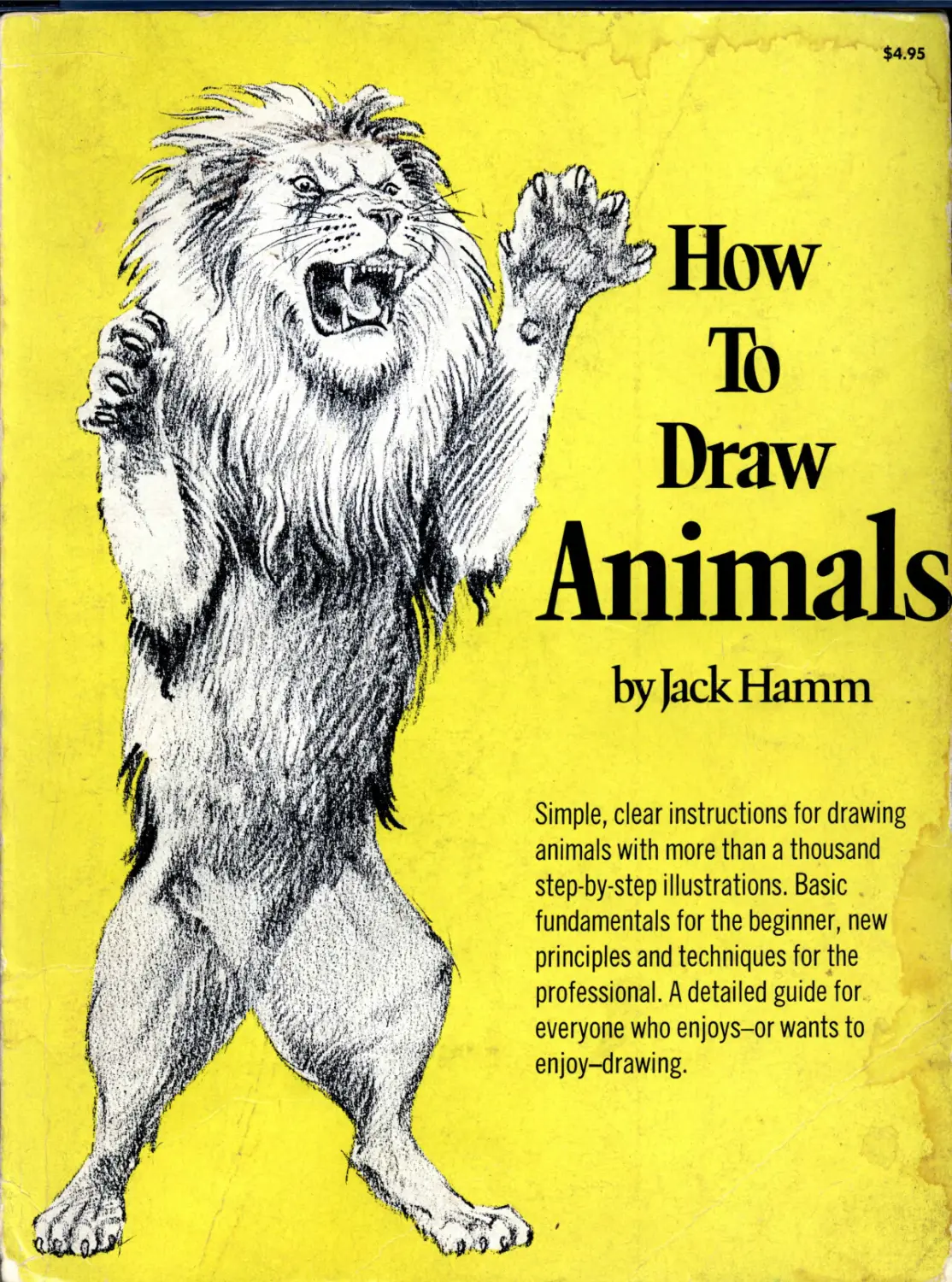
by Jack Hamm
. .
7
How
Draw
Animals
Simple, clear instructions for drawing
animals with more than a thousand
step-by-step illustrations. Basic
fundamentals for the beginner, new
principles and techniques for the
professional. A detailed guide for
everyone who enjoys-or wants to
enjoy-drawing.

How
To
Draw
Animals
COPYRIGHT © 1969 BY Jack Hamm
ALL RIGHTS RESERVED. THIS BOOK OR PARTS THEREOF
MAY NOT BE REPRODUCED IN ANY FORM
WITHOUT PERMISSION OF THE
PUBLISHER
Published Simultaneously in Canada
Library of Congress Catalog Card No.: 68-12740
ISBN: 0-448-01908-6 (Trade Edition)
ISBN: 0-448-03499-9 (Library Edition)
1977 Printing
Dedicated to
Lon Montgomery Hamm
PRINTED IN THE UNITED STATES OF AMERICA
Preface
The purpose of this book is stated in the
title. The “how” of anything envolves a
process. It’s not enough to place finished,
real-life pictures of animals in front of one-
self or a student wishing to learn how to
draw animals. This has some value, but it’s
limited. Even trips to a zoo or animal farm,
though highly recommended, can leave a
student perplexed unless he goes all out in
repeated and extended research efforts.
Whereas such effort is not to be denounced
—it is indeed praiseworthy—it is not good
art economy to ignore rules and principles
which will make the whole pursuit easier.
There are certain things which all animals
have in common. It is wise to understand
these early in the game; then the game will
be pleasurable and very likely successful.
There is a renewal of interest in animals
in our world today. “Animals, it appears,
hold as much fascination for viewers of
television as anything to be found on the
tube,” begins a nation-wide press release
in explaining why animal shows have such
a high rating. Many TV script writers will
often make room for an animal on regular
shows just for “human interest.” One of
the first questions the planning department
of an interview show will put to an invited
guest in the animal business is, “Can you
bring an actual subject with you?” Necks
stretch and eyes turn as the living creature,
whatever it is, makes his entrance.
All major cities, and even many small
towns, have some kind of zoo. There is an
awareness that animals need to be seen by
our children as a part of their educational
enlightenment and development. There is
a “zoo baby boom” as a result of new and
improved methods of breeding animals
which attempt heretofore met with failure.
Curators in over 300 big zoos in 70 differ-
ent countries are happily busy ’round-the-
clock taking care of their “new offspring.”
There is no question that the all-out-effort
to save our once-nearly-extinct animals is
beginning to pay off. Big city telephone
directories, for the first time, are featuring
the local zoo in full color on their covers.
Because more attention is being fo-
cused on animals all over the world, there
are scores of new art assignments being
handed out to tie in with this awakened
interest. Candy and gum cards, cereal
boxes as well as other types of containers,
greeting cards, gifts and toys are featuring
pictures and designs of life-like animals.
Automobile manufacturers are naming
their latest models after the swifter and
more powerful animals. Advertising cam-
paigns are underway to associate the prod-
uct with these engaging animal names.
Public schools and colleges are including
animal study as part of their art program.
Today there is an increasing need to know
how to draw animals.
It should be stated that this entire book
has been composed with the artist and art
student in mind and not for the zoologist
or student of natural history. No attempt
is made at exact grouping as to orders or
species. There are scores of good books
which deal with the scientific and historical
aspect of the subject. For the really dedi-
cated animal artist, these books may be
profitably consulted. The writer is aware
that the term “animal” should better be
“mammal,” but, again, lay-artists are more
likely to use the former term.
Along the way in the book’s prepara-
tion there has been great temptation to
mention interesting animal habits and
practices. Such would take valuable space
needed for the appointed purpose. The
artist is first of all concerned with the
creature’s appearance and how to more
efficiently draw it. Before specific animals
are dealt with, however, several pages of
guide lines, methods and related-part com-
parisons are presented. These are very
important for the animal artist if he would
broaden his understanding of the matter.
Wherever possible the simplest termi-
nology is used to describe the animal part,
but often times, for the sake of accuracy,
the scientific name has been included so
there can be no mistake about it. This in
no way interferes with the step-at-a-time
diagrams which may be followed by even
the youngest student. It is impossible to
become an accomplished animal artist
without a degree of familiarity with the
bone and muscle make-up. One has to put
something besides “stuffing” in the ani-
mals, or he will end up with a stuffed
animal. It is a thousand times better to
build on the creature’s structural endow-
ments.
Another temptation in this book has
been to translate the actual animal into a
private interpretation. It would be false
and unfair to the student to offer some
nonrepresentational concept. One can best
veer from the norm if he knows what the
norm is; so every effort has been made to
draw the animal as he actually appears.
For the most part the locales of the
animals have been omitted to further save
space. Ordinarily this is not a requirement
for the artist. Should they be needed, they
may be found easily in the dictionary or
encyclopedia.
There are more than 12,000 animals
(mammals) in our world. No book con-
tains them all. All the well-known wild
and domesticated animal families are rep-
resented on these pages. An index further
facilitates finding particular representa-
tives. Our chief concern in the progression
is how to draw animals.
Jack Hamm
Contents
Introduction to Animal Drawing
The Greyhound—In Seven Follow-
Through Steps..................... 1
Simplifying the Animal................ 2
The Three Body Basics................. 3
The ABC’s of Animal Structure ....	4
Applying the ABC’s.................... 5
Important Fundamentals of Animal Feet 6
The Simplified Skeleton............... 7
Location of the Front “Knee” Joint ...	8
Comparing Front Legs.................. 9
Comparing Back Legs.................. 10
Comparing Animal Muscles............. 11
Bone and Muscle Structure—Greyhound 12
Surface Anatomy—Greyhound; Front
and Back Structural Views........ 13
Facts about Feet and Claws........... 14
Comparing Foot Bones and Likenesses
in Animal Heads.................. 15
The Animal Nose...................... 16
The Animal Eye and the Animal Ear . . 17
Discusing Fast Action................ 18
More General Facts on the “Run” ... 19
The Cat Family
Basics in Cat Structure.............. 20
How Little Cats Resemble Big Cats ... 21
Using the House Cat as a Model .... 22
Helps in Drawing the Lion............ 23
A Simple Approach to Cats............ 24
Tips on Drawing Cats................. 25
Notes on Lion Drawing................ 26
How a Lion Walks—Front............... 27
Lion Head—Seven Easy Steps.......... 28
The Lion’s Mane and Hair Growth ... 29
Lion—Back View....................... 30
How a Lion Walks—Side................ 31
Big Cat Facial Features.............. 32
The Lion’s Poise and Gracefulness ... 33
Tiger Head—Eight Easy Steps and
Facial Design Differences........ 34
Differences between a Tiger and Lion
Head............................. 35
The Tiger’s Appearance and the Seated
Tiger............................ 36
The Proper Way to Stripe a Tiger—Side,
Back and Top..................... 37
The Tiger Face; Leopard—Tiger
Compared......................... 38
The Tiger in Action and the Leopard
Sitting Upright.................. 39
The Snarl, Growl and Roar............ 40
Inside the Big Cat’s Mouths.......... 41
A Comparison of Cat Heads............ 42
Lion and Tiger Profiles and the
Foreshortened Head................ 43
Cat Body Shapes and Markings........ 44
Shapes and Markings (continued) ... 45
The Bear Family
Building on Simple Underdrawing ... 46
The Bear’s Body Simplified........... 47
The Major Bears Side-By-Side........ 48
Bear Heads—In Several Easy Steps ... 49
Bear and Man Compared................ 50
Bear Characteristics Simplified..... 51
Bear Comparisons—Standing on Hind
Legs.............................. 52
Bear Facts for the Artist and the
Growling Bear..................... 53
How a Bear Walks..................... 54
The Horse Family
The Horse, a Creature of Beauty .... 55
Taking Horse-Head Points One-By-One 56
Points (continued)................... 57
Guides in Good Horse Drawing........ 58
Helps on Surface Anatomy—the
Influence of Hairtracts........... 59
Bone and Muscle Structure of the Horse 60
Surface Anatomy of the Horse and Parts
of the Horse Named................ 61
Easy Follow-Through Steps in Drawing
the Horse and “Foot Notes”........ 62
Considering the Front View Horse ... 63
How a Horse Walks, Trots and Canters 64
The Horse in Action.................. 65
How a Horse Runs..................... 66
Right and Wrong Ways of Drawing the
Running Horse..................... 67
Helpful Facts about a Running Horse . . 68
The Jumping Horse.................... 69
The Horse—Rear View and some Show-
Through Bones and Muscles........ 70
Unusual Horse Positions.............. 71
Additional Tips он Horses and Breed
Heads Compared.................... 72
The Zebra’s Shape and Markings and
the Quagga........................ 73
The Elephant
Beginning Elephant Drawing............ 74
Elephant Head—In Seven Easy Steps . . 75
Simple Elephant Lines, the Indian and
CONTENTS
African Compared and Tusks	....	76
Elephant Ears..................... 77
Elephant Feet and Legs............ 78
Leg Comparison.................... 79
Elephant Trunk, Nose and	Mouth	...	80
Inside the Mouth, More Trunk Tips, the
Elephant Eye and How an Elephant
Holds His Head..................... 81
The Elephant—Rear	View............. 82
Elephant Antics....................... 83
The Elephant Lying Down and Standing
Up............................... 84
How the Elephant Walks................ 85
The Dog Family
Wolf, Coyote and Fox Head—Step-at-A-
Time............................. 86
Wolf Construction and Hairtracts .... 87
Head and Body Comparisons............. 88
Drawing Dogs.......................... 89
Dogs and Relations.................... 90
Dog-Like Animals...................... 91
The Camel
The Bactrian Camel.................... 92
The Arabian or Dromedary Camel ... 93
The Giraffe
The Giraffe Head and the Giraffe
Running.......................... 94
Notes on the Giraffe and the Okapi ... 95
The Hippopotamus
How to Draw the Hippopotamus .... 96
Building on the Simplified Form .... 97
The Rhinoceros
How to Draw the Rhinoceros............ 96
Building on the Simplified Form .... 97
The Deer Family
The Deer—In Three Freehand Steps and
Important Deer Parts................. 98
Deer Head Construction and Walking
Positions of the Pronghorn Antelope 99
Sheep, Goats, Antelopes, Llamas, Etc. . 100
The Buffalo
ABC Construction of the Buffalo and the
Buffalo Head.........................101
The Cow
Drawing the Cow......................102
Simple Way to Draw a Steer and the
Bones and Muscles of a Cow .... 103
Miscellaneous‘Split-Hoofed’Animals . . 104
The Pig
Simple Underdrawing for the Pig and
Wild Hogs.........................105
The Monkey and Ape Family
The Monkey Simplified................106
Primate Heads in Easy Sequence .... 107
The Side-View Monkey Head and the
Apes in Profile...................108
Different Kinds of Chimpanzes and the
Apes’ Head Front View.............109
Monkey Sketching.....................110
Side-View Walking Monkeys............Ill
Apes’ Eyes and some Chimp Studies . . 112
Notes on the Gorilla.................113
The Kangaroo
Drawing the Kangaroo and the Wallaby 114
The Rabbit
Drawing the Rabbit...................114
Odd and Unusual Animals
Various Sketches and Drawings.......115
Miscellaneous Small Animals
Similarities and Differences in Small
Animals...........................116
Small Animals (continued)............117
Animal Interpretation and Abstraction
Many and Varied Ways of Using Animal
Information ......................118
Interpretations (continued)..........119
Index of Animals.....................120
0 THE GREYHOUND - IN SEVEN FOLLOW-THROUGH STEPS
In fig. 1 are a few simple lines suggesting an animal. A child might do
something like this before he learns to write his own name. Two legs,
back, neck, head and tail. Using this as a starter, let's begin to make
a change here and there which will turn these stiff lines into a sleek
greyhound dog. At the same time we'll learn some valuable facts about
animal anatomy.
No animal has a straight backbone. When the head is held in a normal
position, the spine (A) curves down from the head to the tail in the man-
ner shown.
Next to consider is the ribcage area (B), the bulkiest part of the animal.
A portion of it extends beyond the front legs which bear more weight
than do the rear legs (the neck and head being suspended in front is one
reason for this). The ribcage takes up half or more of the body proper
in nearly all animals.
In fig. 4 the attaching bones C and D (simplified here) for the legs are
added. In the side view both the pelvic bone (C) and the shoulder-blade
or scapula (D) slant down and out from the central part of the body.
Whereas C runs through the hips, the two shoulder-blades occur on
either side of the ribcage.
In nearly all animals, the forelegs are shorter overall than the back
legs; they conform more to the straight line of fig. 1. They are more
of the supporting pillars since they are closer to center than the rear
legs. The bigger the central part of the beast (like the bison), the
shorter the front legs. I and J are directly beneath each other. E (the
femur) and H (the humerus) slant in from the outward slant of C and D
(brought over from fig. 4). This is important to remember in animals.
Notice the relationship of the back leg EFG to the straight line of fig. 1.
This is the animal’s "push-off" leg, more like a spring.
In fig. 6 the far legs have been added. In fig. 7
the main sections of the greyhound are roughly
indicated in pencil. These represent the key
parts which have a strong tendency to "show"
in all animals. They are not difficult to learn
as one might imagine. Get so you "see" ani-
mals in terms of these vital sections. Your
understanding of their structure will be helped
immeasurably.
1
SIMPLIFYING THE ANIMAL
Here is another very elemental approach to drawing animals. No particular animal is now in mind.
Above are the parts we will use. The oval (fig. 1) represents the body without head and legs. Tobe
sure, the oval needs to be modified later, yet there are some animals with lots of fur which appear
to have oval-like bodies. Two "threes" are in fig. 2, one drawn backwards. These, for the time
being, will be the simplified muscles of the hips and shoulders in our diagram. The parallel lines
of fig. 3 will be the front and back of the legs closest to us. A deer would have thinner legs and a
polar bear's would look thicker. Another oval (fig. 4) will represent the ribcage and will be drawn
in the forward part of the body. The reversed "nine" of fig. 5 will serve as the neck and head, and
a couple of sideways "U's" will be the feet.
Now, assemble these extremely simple parts. Begin with the oval (A), insert the "threes" as
shown. Sometimes in a real animal the tops of the threes will jut out over the backline. Add the
front and back legs as in fig. C. Lastly, insert the ribcage; draw the neck, head and feet fig. D).
Look for the body parts (mentioned at the top of the page) in
these simplified animals. After having sketched the А, В, C.
D creature, seek to merge the hips and shoulders with the
legs beneath them.
2
THE THREE BODY BASICS
That which is illustrated
on this page is especially
significant. At first
glance it appears as if
most of the sketches are
monotonously similar.
One can hardly tell what
some of these torsos are,
for they have been strip-
ped of identifying charac-
teristics such as heads,
necks, legs, feet, tails
and fur markings.
There are certain body
basics in the animal king-
dom which are remarkably
alike. An awareness of
this fact can prove both
helpful and bothersome.
It can be helpful in that,
once learned, a student
has something on which
to build. That’s what v;e
are after here. Bother-
some, in that related ani-
mals can be so annoyingly
similar. However, little
interesting details, dis-
cussed as we move along,
can make up the necessary
differences in closely re-
lated animals. Knowledge
of the foregoing can be
pleasantly exciting.
First, observe the areas
to which we have previously
referred: forequarters, mid-
section and hindquarters.
Whenever the student
sees an animal of any
kind, whether in photo,
movies or real life, he
should deliberately con-
centrate on these tan-
dem parts, watching
them closely as the
subject moves about.
Fig. 1 is a jaguar without his telltale markings — could be any number of the big cats. Fig. 2 is the
giraffe. No long neck or legs or giveaway coat pattern — just notice the body contour, especially
the forequarters. Fig. 3, the cow, is easier; but there they appear, three unmistakable sections.
Fig. 4 is a squirrel (enlarged); fig. 5 is a wild boar; fig. 6 is a Patas monkey; fig. 7 is a jackal.
Everyone will recognize the Indian rhinoceros in fig. 8. Observe how his heavy hide is prominently
folded to accomodate these three important body basics.
3
Without legs, neck and head the bodies of
nearly 100% of all animals are twice as
long as they are high. So, to learn a few
more introductory facts concerning their
general shape, sketch a rectangle about
one by two in proportion.
Add two more smaller and thinner
rectangles both back and front. They
represent the tibia and humerus parts of
the legs and, again, should be somewhat
parallel (the reason for their being drawn to-
gether here). Notice the bottom left corner of rectan-
gle 1 cuts through the top of rectangle 2 about midway,
"g" will be the bottom protrusion of the knee, and "h"
will be the animal's elbow.
10
The number 3 rectangles
are next and are narrower.
They represent the meta-
tarsus and radius segments
(though we are chiefly concerned with
the natural ''1-2-3’s* in our progres-
sion). The back 3 angles in; the front
3 is straight up
and down.
Add the last vertical 4 of the front leg
(the metacarpus), the foot blocks 5,
the pelvic bone area 6, a suggestion of
a tail 7, the neck 8, head 9, muzzle 10
and ear 11. Rectangles 8 & 9 are in line
with the front 1. After doing F it is well
to practice these "ABC’s" a number of times.
THE A В C's
OF ANIMAL
STRUCTURE
Add two smaller rectangles (as we begin the sec-
tional divisions mentioned on the previous pages):
the larger one overlapping the rear and bottom,
the smaller one extending over the top and front.
These should be set at an angle and parallel to
each other, "a-b” will be the back slant of the
hips, "c" will be the kneecap (a little below the
big rectangle), "d-e" will be the top of the shoul-
der blade and "f" point of the shoulder.
Over these straight
lines sketch curves
in the manner shown
at left. In order to
get an idea of ground-
work principles, we
have drawn a com-
posite of several
animals, no special
one.
4
After one has acquired a working familiarity
with the formal placement of these body parts
(opposite page), it is time to experiment with
them. Of course, we cannot expect to draw
every animal over the same identical scaf-
folding. Nor can we dissect a given rectangle
at a certain place each time we change ani-
mals. For one thing, the main trunk rectan-
gle "A" will often be tilted (see horse fig. 1 &
dog fig. 2). The two No. 1 rectangles in fig.В
(page 4) will not always be parallel, but in
most drawings the tendency
for them to line up that way
will be apparent. Look for
that ”1-2-3 follow-through”dia-
gramed in D across the page.
There’s a swing to it. The stance
of an animal such as the dog in
fig. 2 may alter the hindquarters
considerably.
A repeat of the shoul
der rectangles (a&b
in fig. 3) may help if
the body at that point
is turned to show ’thick-
ness.’ Seldom will a
neck be finished off with
straight, parallel lines;
but roughing in a start-
ing rectangle should call
attention to the peculiar-
ity of the particular sub-
ject. Don't expect these
ABC’s to work magic until you have either acquainted your-
self with the animal in question or have him standing in front
of you, in real life or in authentic copy. These exercises
are for sideview subjects and not for semi-front views.
Many calls come in for sideviews, however, and it should be
the first learned by the student. The torsos of the deer and
the cow lend themselves admirably to a box treatment. Ani-
mals which ’foldup’ habitually, like the squirrel in fig. 4 may
become involved if
they are drawn too
small. Nevertheless,
with dimension in
mind, the feel of one
part being in front of
the other can be
assured by this
method of practice.
It is suggested that this
procedure be done sketchily
and not with hard, non-erasable
lines.

5
The chief reason for this drawing so
early in the book is stated at the
bottom of the page. But to take
advantage of this space, note /
how the heavy head of the z ft
bison is supported by / / J
muscles (dotted	/ / / \
//HPORTANT FUNDAMENTALS
OF ANIMAL FEET

OUe
lines) from the tall spines of the vetebral col-
umn. When the animal grazes, the spines fan
out allowing his head to lower. Most animals
have an extended neck and, to a lesser degree,
this same interesting mechanism. The front
legs support twice the weight of those in the
back. So, bone on bone they are vertical,
short and stocky. The span between shoulder
and elbow is buried in the body’s side and
tightly secured by giant tricep muscles. Dot-
ted lines on the legs represent muscles designed to hold bone structure rigid while the big beast is in a standing position.
THE MAIN PURPOSE OF THIS DRAWING: Because it is important for the student to realize that nearly all animals walk
on their ’fingers’ and ’toes’ rather than their ’hands’ and ’feet,’ the above outsized drawing is presented. This clo-
ven-hoofed European Bison really walks on his two center fingers and his two center toes. What may be thought of
as his front knees are really his arm ’wrists’ and the entire bottom ’half’ of his visable back legs corresponds to our
feet. As our hands are shorter than our feet, so all animal’s ’wrist’ joints are nearer the ground than their ’heeland
ankle’ joints. Knowledge of this helps tremendously in drawing the legs of all digitigrade (walking on the toes) mam-
mals. Most of the animals with which the artist is concerned are in this category. This fact is well worth retaining.
THE SIMPLIFIED SKELETON
It is not necessary for the student to learn mi-
nute details of the entire skeletal system. Nor
can he bypass the subject altogether and still
hope to draw animals. Somewhere in between
there is knowledge enough to do a good job.
The more one examines and compares skele-
tons and the muscle structures about them, the
more the light breaks through.
The simplified skeleton at left has the barest
essentials. It is a generalized sketch of no
particular animal. An expanded list of bone
names is given in the greyhound on page 12. The student should learn at least the minimum num-
ber of names given above. Concerning the'parentheses': above your own elbow and knee, you have
one bone; below your own elbow and knee, you have two bones.
Similarly, animals have one bone above and many have two be-
low. But others have these two bones fused into one or nearly
one. In figs. 2 & 3 they are unfused; in 4 & 5 they are partially
fused. On this page are four reference skeletons, including:
an animal which walks on the whole sole of his feet, the bear
(fig.2); an animal which walks on four toes, the wolf (fig. 3);
the largest land animal, the elephant (fig. 4); and the tallest
animal, the giraffe (fig. 5). There are four sets of 'show'
bones in the torso that are positive requirements:
the shoulder blade or scapula, the hip bone or
pelvis, the rib cage, and the back bone or ver-
tebrae. In comparing these skeletons (and the
one on the opposite page) take note that: the
scapula or shoulder blade is more or less tri-
angular in shape, the front leg or arm bone
(humerus) is attached to the lower part of the
scapula, the pelvic bone goes around and
through to the other side and has two decid-
ed humps corresponding to your own hip bones,
the back leg bone (femur) is attached to the pel-
vic bone about 1/3 distance from the back of
the pelvic bone.
Wolf
Elephant

LOCATION OF THE FRONT "KNEE" JOINT
The big arrow (at the right) is directed at an animal’s elbow or point of the olecranon bone (corres-
ponding to your own elbow -- feel it, then straighten your arm out the next set of joints down
your arm is your wrist. Also, the
next set of joints down an animal's
front leg is his wrist -- it really
is not a "knee" as it is sometimes
called). Are there some general
directives which will help a stu-
dent in locating this prominent set
of joints or wrist? Yes, and here
they are. First, keep in mind
that in this chart the distance be-
tween these black lines at the top
and bottom of the page represents
the distance between the elbow of
a given animal and the bottom of
that portion of the front foot or
'hand' which rests on the ground,
As always, the artist is in-
terested in the way his sub-
jects appear to the eye.
Positions 1,2, 3& 4 are
somewhat overlapping, and
one occasionally will find
an animal in one of these
categories whose
joint-set is slight-
ly higher or lower;
for example, a
good horse is
supposed to
have a relative-
ly short cannon,
the single (meta-
carpus) bone be-
tween the oval'2'
and ground, but
never will this
joint be as low
as position '4'.
2
Horse
Mule
Wild Ass
Zebra
THIS LISTING INCLUDES
THE MORE COMMON
ANIMALS AND IS NOT
EXHAUSTIVE. SOME
FAMILIES ARE BROKEN
DOWN. THE MORE
OBVIOUS ONES ARE NOT.
HORSE
Antelope
Caribou
Deer
Elk
Gazelle
Goat (low 1)
Hartebeest
Kudu
Moose
3
Buffalo
Camel
Cow
Giraffe
(high3)
Gnu
Llama
Sheep
Yak
4
Boar
Hippopot-
amus
Pig
Rhinoceros
Tapir
5
Cat
Cheetah
Civit
Coyote
Dog
Elephant
Fox
Hyena
J ackal
Jaguar
Leopard
Lion
Lynx
Mongoose
Ocelot
Puma
Tiger
Wolf
/ШОИ<4У'
Aardvark
Armadillo
Ape
Badger
Bear
Beaver
Chimpanzee Marmoset
Chinchilla
Chipmunk
Gibbon
Gopher
Gorilla
Guinea Pig
Hamster
Hedgehog
Kangaroo
(suspended
arm)
6
(cont'd)
Koala
Lemur
Mink
Monkey
Mole
Mouse
Opossum
Orangutan
Otter
Panda
Polecat
Porcupine
Rabbit
6
(cont'd)
Raccon
Rat
Shrew
Skunk
Squirrel
Wallaby
Weasel
Wolverine
Wombat
The sample leg in the center of this page is that of a horse with elbow and hoof. Across the bottom
of these two pages are various animal feet. It would be impossible to have a sample leg whose height
and width would comply to all animals. However, every leg has a 'mid-way' point (center dotted line-
8
1 CAMEL 2 GAZELLE

POINT OF
SHOULDER
' Si
TRUE
В ELBOW
(Уюшоея
/Л/-Я2МР
7W£S&
BO//£S
rtSSSD

TRUE c
WRIST \
Mt-TAOAwws D'il'i1 &
PM/.A/vd^s ^-,7 li! £
Above are the front legs of several different kinds of animals.
They are not drawn proportionately but are reduced or enlarged
to better fit the space and illustrate the point. As "DE", the
'true' knee of the back leg, is below the body (or stomach line) on
page 10,"B" or the 'true' elbow of the front leg is usually just
above the body (or chest line). One exception is the elephant
which also has looser skin appearing to bag down somewhat at the
elbow. Some dogs vary in this regard. These observations ap-
ply to animals in a standing position, which so often needs to be
drawn. When an animal extends his front legs for action, the
elbow then drops below the chest line. So, remember the two
knee bumps ("DE" on page 10) are below and the one elbow bump
("B") is usually above the contour line of the body proper. Fora
good illustration of this turn to the horse section.
At the left is a general bone plan for the animals' front legs.
Only one muscle, the triceps, is indicated here as it comes off
the elbow bone. The reason for this is its show prominence in
nearly all animals. As it cups on the side of the upper leg it in-
variably catches some shadow--not always, but more often than
not. If a particular animal has lots of overhanging hair such as
the bison (4) or skunk (5) above, the triceps may be blocked
from view. Still, many good animal artists will let this under-
structure be evidenced

CLAWS OR HOOF
(FINGER NAILS)
even when hair is in abundance.
i I • i	i
At right are
notes on the
'true wrist'
joints of the
horse family,
the deer fam-
ily, the dog
XJUWMi |Ш,
DOG
GIRAFFE
DEER
HORSE
parallel to heavy black lines, p. 8). The six approximate positions (ovals, p. 8) for the front leg joint
('knee' or 'wrist') are to be considered as being on the particular animal's leg in relation to the mid-
way point. The bear's, squirrel’s and monkey's foot above includes the joint (listed in column 6, p. 8).
9
A
СОШ M
COMPAR/NG BACK LEGS
Although different animals have different bone struc-
tures, the similarities are so pronounced that it is
beneficial to compare them. The ' show bones' of
these hindquarters are marked "A" through "I". The
eneral bone plan is diagramed below.
The placement
of points ABC
is more uni-
form than the
location of DE
which corres-
ponds to our
knee. When
watch for the
1
LION
2 POCKET GOPHER
7M2CMi///&e
ri/вся
/sc////
an animal walks,
DE prominence. On most animals
DE appears just below the body
line — on dogs it is lower than
cats. Compare the knee DE on 4
and 5 with rest of the animals.
Rear quarters
on this page re-
duced or enlarg-
ed for this
comparison.
9 POLAR BEAR
TRUE
KNEE
м	гие "
мя/la/ооггмэ}/s
f//7V 7//C 7/B/A-
АММИ//7Н SMVMe
70/s //вие-г.ен'ме
m^/a/amscs(Aa/zeS) еые/
\ ANKLE
\ BONE
GIRAFFE
> В
TRUE
HEEL
AF 7UBSJ?
Ш \ca/ca//s/
\rsjps&s ,Ш
\ M
/HST47SJes//s\\iA
 1'Шг
TW/U/IMSSsX /Л/ ,
TOES OR HOOF
GREYHOUND
The bear (9) and monkey
(5) walk more on the total
foot FGHI. In the animals
which sit often, all of FGHI
’ sits' on the ground (exam-
ples 1,2,4&6). Only "I"
hits the ground in animals
which stand most of the
8 ELEPHANT
10
COMPARING ANIMAL MUSCLES
The muscle arrangement in the animal kingdom is much the same. For the artist he need not know
all the technical names. After the three body basics are learned (page 3), it is well to go beneath the
surface for a closer look. Though all external muscles may express themselves under given cir-
cumstances, the beginner should familiarize himself with a few ’give-away’ places that are likely
to show on most all short-haired animals. As a starter look at the four places in each animal
(marked with a black line) in the second column. Where one muscle comes against another there is
often a noticeable indention. Even with the long-haired animals, extra power may be portrayed
in a drawing by permitting bold under-structure to influence the lay of the hair.
11
3AK/AAA
слеги46*
&№>#'<•
BONE STRUCTURE
GREYHOUND
T//^AC/e ГАЗТГВЯАГ
AA/^ffAjP l/'APjeXE&eAF
oaw/oaa- к&етгвялв
SCAPA/AA
е*АЫ0г/»£Ы/с ecwr
/ТА/В^З С0ХАВ)
-73/Л7Г 0Г SCA3a/AA.
/&(//£ BO/AT
ACA^M/aV ОГ SA1A3A/AA
7*0CAbW7A-ye MAJae
7А/ЗГГ /sew/s
TOFAO ОТ 7/ASM£7?А/A-
(^&ГВГА^£ГЛ( М4Л/А)
3/es
3AAJ/A/S
t/A/VA
773/А----
3/ВА/АА
ЛЛ'Х'АГ &Ж
as&fabomf
(ruttz
taxsa/s

SI^ta саазах[ IL
ЛАГГАТАМХ
Г//АААЛЫ5 £

On page 11 we saw the marked similarity in muscle formation as it occurs in various animals. Al-
though it is not necessary to be able to identify by name all the bones and muscles, it is advanta-
geous to refer to them repeatedly. Wherever there is a "show" place on the surface, find out what
makes it that way beneath. This will simplify surface drawing, the part that cannot be escaped.
MUSCLE STRUCTURE —GREYHOUND

\\

аегАтог ягас/сзсгс
SCAP//AA
асзом/оа/ оз зоаяа/аА-
/ААЕА0 О Г 7/А/ААГДА/.А-
On these two
pages the bones
and bone loca-
tions are
horizontally
tagged; the mus-
cles and muscle
locations are
diagonally tagged.
UndottecTlines lead
in to bones; dotted
lines lead in to
muscles.
0A£A?£A/V0A7
амс&саг—
^ГАГГААЛ)
ГГОСУААЛ'ЛГ^ AAAJaje
\'fL^
/7ГГА 30/73


12
SOAP/Z/А
33/33 03 ЗСАЗА/АА
ACPOM/O//
AifWZJ OF //t/MJE#//* -
SURFACE ANATOMY — GREYHOUND
, ^DllJi
6^
'____tttsr <2^ 7^7. WCSON^
V )-, ^i.-%7^-Ж •’
&/ <5 % *
:
 •*'	-,s"'b
CAP__
(ААГЗААА)
f
Л ?rQ
7*ОС7/А//Г3& AAAJ03
MF3A &O//AF
AA/A/A3
BACK
7^“f
М/ЛА&
/Л//А
CA3PO1{
FRONT
С*£*Г OF PFA 7/CSOP3
/'гоз&е C/v/aa)
The exterior of the greyhound beautifully illustrates bone and muscle "happenings." Compare fig. 3
with figs. 1 & 2. Refer back to these pages when studying other animals throughout this book. When a
change of contour is detected or a highlight or shadow appears on the surface, TRACK DOWN the
reason with the help of the greyhound!
01
c^i^
P/3//AA
7/3/A
P//A/AA/63$
ААЗГА-/
PA/A/AT/OSS
SCAPO/A
SP///3 03
SCAP/ЛА
АСЮАЛ/М
£ASW/S
\ S73P33/A
AAAM/3A?///AA
---S7PP///
PP/A/C
3033
( теааУАз/зг
AAAAO3
7C/33P
S/CP//F
FFAAOP
' 6й^

и/я/sr 3CM/£S\
ж

езжгаз 773/А
s^"’


Observe that the scapulas (or shoulder blades) in fig. 4 are not attached by a bone-link to the sternum.
There is no collar-bone in most animals. The scapulas lie more or less flat to the sides of the shoul-
ders, and they define themselves well in surface anatomy (see figs. 1,2 & 3). The next time you pet a
dog or cat feel the scapulas, humerus heads (front points of the shoulders), sternum bone, pelvic
bone crests and femur attachments. Note the radiating muscles from the sternum in fig. 5 — these
are especially prominent under the skin of the horse.
13
FACTS ABOUT FEET AND CLAWS
Cheetah.(If)
Lion (If)
Wolf (If)
Puma
Lion’s paw(rf)
Rear paw
Relative length of bear claws:
Cat’s Retractile Claw
Grizzly
KSTTSACrj UAW
leg fore-\
shortened’
~Lion(rf — \
claws extended)
Polar Bear
(right front) '*i
Great Dane
Dog (left
front)
^“Grizzly
Bear (rf—
arm in act
of making strike)
Brown Black
Bull Dog
(If-leg &
foot fore-
shortened)
& (И)=left
; front
,, (rf)=right
front
any bear’s (fig. 5)
tiaily covered with hair. His nonretractile
claws are black.
i. All bears’ claws are
longer in front than in
back (see fig. 10). Claws
of Black bear are shortest,
i. Cat claws are thin, knife-
like; dog and bear claws \\
are thicker (see 6,14 & 15). v
к. Claws are one major
difference in bears (fig. 13). .jdvl
Brown
Bear
Wolf or Dog (rf— "'"
stretched as in run)
Observe: a. Appearance of ’wrist’ in all
drawings (marked x).
b. Tops of toes, between wrist and claws
""(often appears like 'shelf').
_c. Claws 1,2 & 3 cannot be retracted — nor
can bear's — only cat's (exception: Cheetah),
_d. Claws in 4 fully retracted, leaving only
trace, sometimes just dark indention in fur,
e. When extended, claws in cats have tend-
ency to slant in (see fig. 6).
_f. Note leathery toe pads are close under
claws (see end view of foot, fig. 7 — also
see fig. 10).	' \	'8
arm
sus-
pended)
Bear’s*
paw (rf) Rear paw
-*—	4—
7-£WOOWLS WU 6WSWEAW.S
ЛАК/
•4 g. Grizzly's claws
A are longer than any
(A) bear’s (see 11) even
l&’ though he may be half
Г size of Brown bear 8.
f _h. Polar bear's foot
spreads, is wider than
His foot soles are par-

14
FMeeoent
Terms for manner of walking:
SOtE OF FOO7\ Mdl*
^<x>r j
Unguligrade=walking on hoofs.
COMPARING FOOT BONES
gO/=roor\ MIK
Plantigrade=walking on the whole sole
~ of the foot.
Digitigrade-walking on the toes (or tiptoe).'
MAN	BEAR
1-----Plantigrade-------1
DOG DEER HORSE
1---Digitigrade-------*
Animals which walk with:
One useable digit (third fin-
ger or middle toe) are
horses, zebras, etc.
Two useable digits (even-
toed ungulates) are
cattle, deer, sheep,
pigs, giraffes, etc.
Three useable digits (odd-toed
ungulates — excluding
one-toed) are tapirs,
rhinoceroses.
Four useable digits are
hippopotamuses.
Five (or four) useable digits
are most monkeys, many
carnivores (flesh-eating
mammals), rodents, etc.
Consider the foregoing with
the information on page 8.
In conjunction with foot and leg notes on previous pages, and in order to further the understanding
concerning the manner of animal locomotion, the drawings above are presented. Thus far there
has been a purposeful interplay between the parts and the whole in approaching the subject of ani-
mal construction. Progressively, we have seen that much of the true foot of most animals is up in
the air, off the ground. Now, think of your own heel bone. Take another running look at "F" through
all the le"gs on page 10. Feel the achilles tendon coming up and off the back of your own heel, es-
pecially the hollow just inside. This hollow appears on most all animals where heavy fur does not
cover it up. The "x's" indicate where it is in the drawings above. The black-lined loop showed it
in the back legs of the second column of animals on page 11.
з
зом?
l/OS
iZ/O '
POCKET
directly below the eyes.
\	v
4 ELEPHANT
6 SQUIRREL
5 DEER
LIKENESSES IN ANIMAL HEADS
Even many widely-varied animals/"'
have certain facial features
common
Wi /SIMPLIFIED
J SKULL PLAN
Always observe:
1.	The expanse of the
frontal bone between
the eyes.
2.	The width of the nasal
bone below the eyes.
3.	The protective brow
bone above the eyes.
4.	The lid-pockets
I GIRAFFE
2 HIPPOPOTAMUS
3 HORSE
15
THE ANIMAL NOSE
As we proceed in our study, we discover more and more that in the animal
world there are certain things which many have in common. It is well to
learn these things first, then seek out the Individual differences. So that
the resemblances may be appreciated, however, it is needful to itemize
what we’re talking about. At this stage the student should not spend hours
drawing individual noses or eyes or ears. But when a sameness is reveal-
ed, tuck it away in your memory. Let it come to your aid as your pencil
crosses the spot where the particular feature must appear.
At left notice the black "comma" taken from the bottom of
the human nose. This simple comma may be modified, but
it is to be found in nearly all animal noses. Notice how the
commas are laid on their sides with the tails pointed up
and back toward the eyes. Trace this observation in the
French Poodle’s nose (2) and throughout the rest of the
noses on this page. The tail of this comma is more of a
slit-opening in animals (see arrows,figs. 11 & 12) than in
our own nose. These slits will flare during heavy breath-
ing after a run or when creature is angry (also see p. 72,
figs. Bl & B2).The minimal comma is the pig 7; the maxi-
mal, the moose 5. The septum between the nostrils is of-
ten grooved, or at least indented. This "valley" usually
starts on the upper lip. The nose pad takes on fine hair
at its extremities, then graduates into full hair on the face.
A secretion keeps the nose pad moist in many animals caus-
ing highlights to appear. Dog’s and bear's noses are some-
what flat on the front with more of an 'edge' at the top. Com-
pare the cat's nose 14 with the tiger's and lion's, p. 32. The
camel 15 can close his nose to keep out dust; the sea lion
16 can close his to keep out water.	..
a
FRENCH POODLE
6 RACCOON
7 PIG
8 ORANGUTAN
3 cow
HORSE
MOOSE
HIPPOPOTAMUS
9 KODIAK BEAR

WALLAROO
HOUSE CAT
CAMEL
и ZA...	i2\ Л
POLAR BEAR COLLIE DOG
16
SEA LION
In drawing the side view animal nose, think of the human nose turned up (a&b). Notice
this in the bear (c). The 'puff' of the cat-like cheek may cut along the nose and a mere
line may suffice (d). The nose tip may be darkened (e) or grayed (f). Consult pages 42
and 43. From the right side the figure "6" may be imagined in the nose (h&i). Reverse
the "6" for the left side. Remember the difference in the nose pads and upper lips of
the deer (17) and antelope (18).
18
ANTELOPE

HORSE
HORSE
COW
THE ANIMAL EAR
cow
CAMEL
DEER
RHINO
RABBIT
GIRAFFE
HIPPO
ears see page 77
LION
BEAR
HOUSE CAT
CAMELS
Horse's ear in act of turning. Note that the base
looks wider as the ear reverses itself.
6 PIG	10 BEAVER
DOBERMAN
(DOG)
Most all animal ears come out of a cylindrically-shaped cartilage. This
cylinder at the ear’s base is partially revealed in some animals before
the ear opens into its bell shape (see 1,2,3, 5,6 & 12). This cylinder is
concealed in the cat, dog and bear families as well as in the camel and
some other animals (see 7,8, 9,10& 11). The ear’s rim does not come
together at the bottom in this latter group. As a rule animal ears are
highly mobile. Only one ear of the pair may turn to pick up a sound.
Smaller desert animal's ears are larger proportionately so the extra sur-
face can assist in the radiation of body heat. The walrus has inside ears
which do not show. Dogs have the greatest variety of ears. For elephant
1 9 GERMAN SHEPHERD
12 V A
JACK RABBIT
Lion's ear in act of turning. It starts out very round
but as it turns it takes on a pointed look. So it is
with all the big cats. In anger the ears are often
laid back
GIBBON
Я/M SHAOED
№ Р0СХЕГ
BEAR
THE ANIMAL EYE
One thing of which we can be sure, all eyeballs are orb-shaped.
Also, if the pupil is not concealed by shadow, it will be smaller
г in bright light, larger in dim light. So then, for the time being,
the setting for this orb becomes our number one problem.
In nearly all animal eyes, the inside corner is lower than /
the outside. The bottom lid’s thickness is wet and catches у /
light. Directly beneath this is the lid pocket which usually / '*
is to be shaded (see diagram and examples at left). 1. The J j
horse has the largest eye of any land animal. 2.Most cows JR.
have heavily-lined lids. 3. The camel has a protrudingbrow, M
a longer ’oriental’ eye. 4. The bear’s eye is small and pas-
sive, has same expression for all moods. 5. Dog’s
eyes differ greatly, have many expressions. 6. Pigs’
eyes are small with heavy lashes. 7. Deer’s eyes
are large and soulful. 8. Monkeys» eyes are bright
and expressive, lids heavily lined. 9 & 10. Rabbits,
beavers, rodents and gnawing animals have beady /
eyes with pupil and iris blended as far as the artist i
is concerned. For’foreshortened’ eyes see p. 15.
DISCUSSING FAST ACTION
2 PUMA
3 WEASEL
4 RABBIT
5 WOLF
run; although, having taken off on both back feet simultaneously, the better
chance is, the animal will light on one or the other of this front feet and not on
both of them at the same time. At the peak of this brief suspension, he may have
the two legs in each pair more-or-less parallel. Fig. 1 at the top is the basic
pattern for this position. (Notice the horse is NOT pictured here — see pp. 68 & 69)
• '	Collectively we	^4*.
'	should look at a
,	>	representative group
of animals in fast motion
, i	before we take up individual
4 "x4,	animals. Elsewhere in this book are more
>******ьх	drawings dealing with locomotion problems
Action is demanded in many of the artist's
'	assignments. It helps to know some of the thing
\	which should and should not be done. If an animal
goes into a ’spread suspension’ (examples this page); that
is, if his legs are at times fully extended and at the same
time are not in contact with the ground, this becomes a
good position to record for high speed. When he gathers his feet
under him as tightly as is natural, and is at the same time sus-
pended in mid-air (examples next page); this, too, is a good posi-
tion portraying high speed. To be sure, other positions are assum
ed in the run. If more than two animals of the same kind are to be
pictured, then intermediate stages may be shown for the sake of
variety — and accuracy, since it is very unlikely several animals
would be in an identical pose. These intermediate stages do not
look as fast, however, even though in real life they may be.
Most wild animals are drawn going over rough terrain at
л which time more leaping is done than when traveling
on a smooth surface. Practically all animals are
V. able to leap — the elephant cannot. The hippo-
*• C potamus and rhinoceros are not likely to leap,
v. for they simply crush most of what is
VjX in the way. Despite their great bulk,
1 they can run amazingly fast on occa
4	sion. The positions on this page
may be considered phases in th<
18
On this page are some of the fastest animals alive (with the exception
of the puma 7 and bear 8 which are capable of limited bursts of speed).
However, the main purpose of this discussion is the 'gathering' of the
feet in mid-air prior to ground contact for another push-off. In the run
the greyhound (lb) is one of the most rhythmic. To have the four legs in
the lb position, which the greyhound may momentarily assume in running,
is foreign to most all animals. The horse never gets into this position
when running or fast galloping, nor does he ever go into the complete
spread suspension shown on the opposite page (check pp. 66 & 67). He does
gather his feet, but not in the manner of lb — see fig. 4. With all ani-
mals, the front legs are more likely to be one slightly behind the other
when the back legs are drawn under the body in a parallel manner (see V
figs. 2,3& 7) — and they are more convincing that way.
The rabbit's and fox’s legs may go into a full parallel "X" cross (figs.
5& 6), but the bear is too bulky. Only in desperation will his legs
assume anything like the fig. 8 alignment. For the most part, when
a deer (or other animal which habitually leaps in his run) is to be
drawn, it is wise to have two legs extended and two folded (figs.
9a & c)or all gathered (9b). To put a shadow on the ground indicat- J x
ing space under the animal is not a bad idea. It should be pointed ~
out that, when the legs are gathered as illustrated on this page, the
back feet are always on the outside and the front feet are on the inside.
Further, the bottoms of the back feet are fairly parallel to the ground;
whereas the front feet are in a 'flipped' position with soles turned up.-^Sg
19
BASICS IN CAT STRUCTURE
The cat family has bodies which are longer than high.
They are very uniform in their basic structural make-
up from little house cats to giant tigers. Cats are cats
whether large or small, in the jungle or in the living
room of your home — as far as general shape and body
movements are concerned. This is not true of the dog
family which takes on a variety of odd shapes. Even
the longer-legged cheetah and the more box-like lynx
vary little from the standard cat design.
The big maned lion and the brightly colored tiger are
different only in their 'dressing. ’ If both are skinned
and laid side-by-side, only an expert can tell them
apart. So, learn ' standard' cat make-up, and then
adapt it whenever the need arises.
There is something to be learned in beginning with the
square, fig. 1, then extending the outline on either side
as in fig. 2. The point of the shoulder, 2-a, in most an-
imals, not just the cat, is in line with a middle division,
a-g, drawn through the body. It protrudes from the top
half of the original square and, in the case of the cat,
this point may be considered directly above the front
toes when the animal is standing erect with feet together.
This 'knob' (a) is the end of the humerus bone, fig. 4.
In fig. 2 the elbow (b) is above the chest line, and when
the tapering waist is brought up as in fig. 5, the knee (h)
is below the CD line of fig. 1. Directly above the knee
(h) the top of the hips (e) or pelvis is located. Then there
is a slant in all animals where the pelvic bone tilts down-
ward (see fig. 4). The front of the foreleg is in line with
A-E of fig. 1, but the other perpendicular B-F cuts
through the back leg. Both c & i of the front and back
legs may be drawn on the original square of fig. 1.
It is true that a cat isn't always going to stop his legs in
the same position. Nor will all four appendages be static
like a table's legs. However, for now, it is well to
grasp the simplicity of this stance. Notice the feet in
relation with the square of fig. 1. It is quite natural for
many animals to hold their heads so that k-1 of fig. 3 is
more or less parallel with the shoulder line о-a of fig. 3.
Fig. 5 is a lioness, and fig. 6 is a male lion. Fig. 7 is a
tiger drawn upon the same cat frame of fig. 5.
20
If you have a pet cat running
around your house, you have with-
in drawing distance a miniature
lion or leopard or any other of
the great cats. The similarity
is amazingly striking, especially
if the cat is short-haired. At the
far left is a medium-sized Sia-
mese cat blown up to lion-like
proportions, or a lion sitting a-
longside reduced to cat-like
proportions — as you wish. Ac-
tually, the cat was drawn first,
then the lion was drawn on the
cat's frame. This particular
cat, like many pampered pets,
is a little on the fat side; so it
would be best to narrow the body
width slightly for a sleek looking lion. But for the pur-
pose of proving the point, Leo the lion has been made as
fat. The head and tail are the chief differences, yet, in
kind, they too possess decidedly cat characteristics.
At left is the same cat in another sitting posture. This
time the creature is drawn smaller and more to scale.
By enlarging the animal exactly, changing the head to
some extent, and adding spots we have a leopard. We
might have built a jaguar, tiger, or puma on the frame
just as readily. It is good practice to very lightly sketch
your cat, then let him be the foundation for a powerful
beast of the jungle.
Below, the lioness' head and cat’s head are equated for
study. Notice the difference in ear shape. The large
cats have rounder ears. Both animals' ears if turned
to the side would appear more pointed. By contrast the
small cat’s eyes are huge. Small cats (bobcats on down)
have contractile eyes capable of becoming mere slits in
bright light or big and round in poor light. All big cats
have circular eyes; the pupils being reduced to spots not
slits in stronger light. All big cats and most small cats
have the distinctive dark coloration trailing out of the in-
side eye corners onto the nose.
The house cat's nostrils are
more petite, and the 'roof of
the nose is considerably short-
er and more narrow. The muz-
zle across the whiskers is not
as bulbous. The chin is smal-
ler. In all, the facial features
are closer together and daintier
save for the big eyes. The lion
head is more rectangular. The
house cat may snarl, but only
the larger cats seem to furrow
their brows when displeased.
21
USING THE HOUSE CAT
AS A MODEL
Here is a lioness at right con-
structed on an enlarged cat's /
frame. The house cat at left jk
is changed but little in provid-',
ing the basic outline. Though
quite agile, the lion is not as
graceful as the other impor-
tant members of the cat family,
Lions posses a ponderous
frame, so therefore it is well
to widen the cat’s legs some in
the enlargement process (not the tail,which needs a tuft however)
Square up the head, and give the eyes some authority. The feet
need to be made thick and "ploppy. ” Be sure to observe the du-
plication in the bone and muscle structure. At right are simple
profiles of a cat and a lioness. A major difference is the jutting
chin of the lion, which really is mostly fur, but gives the air of
proud dignity nonetheless. Most cats have a little more concav-
ity just under the brow, and their shorter nose is tiny.
Above is the puma (also called couger, panther and mountain lion). He is drawn over the ’expand-
ed’ house cat at the left. The head is not as bold as the lion and is smaller. The body is more
supple. The tail has no tuft and is held lower than a house cat. The big cats are more likely to
drag their tails when walking. In excitement or anger they may flail their tails or twitch them when
mildly aroused.
22
HELPS IN DRAWING THE LION
:-k
In the drawing at the right notice that the
big body bones in the forequarters and
hindquarters make parentheses ”( ). ”
This is true of all the vertebrates (ani-
mals having backbones) whose upper arms
are 'attached' to the body.
At left is a lion’s skeleton
fitted into a male lion's out-
line. Check out all the evi-
dences of this bone work in
the lioness directly above.
At the left observe some similarities in dis-
tances: "a" is equal to "b," "A" is equal to
"B" and 1,2, 3,4, 5 & 6 are equal. Compare
this diagram with the skeleton below.
At the right is the completed female lion. Ziy1* *
She appears quite chunky when contrasted °
with her sleeker relatives in the rest of
the big cat family. Some lions get very
pot-bellied because of less exercise.
23
A SIMPLE APPROACH TO CATS
-
£ЖГ?!!' ;

Before starting to sketch
any animal, in your mind’s
eye quickly run around an
overall confinement line
above the base; i. e., the
area upon which the subject
rests. See what overhangs
the foundation assuming this
weight.
Sketch very lightly the sec-
tional parts as they relate
one to the other. Think of
these parts within the whole.
Don't get 'hung up' on detail.
Erase freely if a replace-
ment line is needed. Lightly-
drawn lines in the beginning
make improvement possible.
Always be on the lookout for
planes. Think of your sub-
ject as being solid even
though it is a soft, furry cat.
In this instance, especially
notice the overhang of bone,
flesh and fur at the shoulders.

At this stage of the game, fig. 3 is more important than the com-
pleted sketch at the right. Too many beginning students want to
hurry with the "paint job" before the house is adequately put to-
gether. Rove around over your work checking one part against
another. What about your proportions? Do they look right? Most
papers you can see through. Reverse it, hold it to the light. Mis
taken proportions are often revealed this way. Make the neces
sary adjustments.

A 500 lb. tiger does exactly
the same thing, except his
'bug' may be a more sizeable
prize.
Cats are a symphony in gracefulness. Their movements
are a joy to watch. From a compact ball they can be in a
full-stretch leap in an instant. Whenever they walk by, espe-
cially observe the up-and-down motion
of the shoulder blades. When the body
weight is shifted to the front right
leg, that right scapula rises under
the fur. Likewise on the left. In
climbing up or down these shoul-
der 'humps' respond (see draw-
ing on the right). Note the ears
as they twist toward the sound.
Watch cats in a crouch as
24
TIPS ON DRAWING CATS
SZ/^S 0/ZA/0S&
MAY Z/K^ 77Z/S
4Д. Л14Х A40&JE
-'fAZZAFZ —
-< sz/^z/rz

e^s •
•'‘.ZYfeY
>1 p
gflOVt*	\\
7^/5 ------
/#,S0AtE CA7S
1	/Л' X/rT&VS)
Y/S/&Z& C/W s'
z/si/zaz-y z/o мм?
7МДЛ/ Z>/S74/VC£
a c£
\ \x
[ \vc’A МГГАЛМУШ*
/\	^/лсгля^
A saiazz 7jeMM$uiAx
\	MFv&e Js
W/O£- А Г
\
«r/x5^2F Af^l/rz/
^AIAZZ-


f/x
^flA
*t>C'
>zz,r
^\iu^.
;<>
^"^a^ou
There are many short-haired, dark-banded
tabby cats in existence. They have much in
common with the highly marked, larger fe-
lines. Next time you see one give special
attention to : the forehead, cheek, back,
Above is a long-haired, blue persion
kitten done in pencil. At right is a
luxuriant silver tabby done in an in-
formal pen line.
Become inventive in your
cat sketching. Keep the
essential forms in mind.
Fig. 7 is on a ribbed paper
Fig. 8 is on a linen paper.
thigh and leg markings. After studying the
tiger’s resplendent coat, you can tell the
two are close relatives.
25
NOTES ON LION DRAWING
Few animals are more
loosely skinned than
the felines. The skin
on the larger and heav-
ier beasts seems to be
attached rubber-like to
the perfectly coordin-
ated muscle structure
beneath. This loose
covering enables the
unusually-flexible spine
extreme curvature in
every direction. The multiple lines of fig. 1 express this adaptably-pliable characteristic.
are
but
The "black panther" is really
an odd variation of the leopard.
Fig. 4 is a ’stylized’ concept, a
brush and ink drawing with a
white stipple.
Pumas or mountain lions have
the smallest heads, in propor-
tion to their gangling bodies, o:
any of the great cats. Especial
is this true as they turn away
from the observer (perspective
being involved). Their hair is
short-cropped, yellowish brow
to gray in color with whitish
under-parts. Their tails
thick, the ends widening,
no tuft.
The puma has a long stride. Though he may
look thick from the side, from the front he is
no wider than his whiskers. All cats are
rather surprisingly thin from the front; thus
they slip the more easily through narrow
places (see diagrams following dealing with
the front view walk).
26
HOW A LION WALKS— FRONT
The ‘cat walk' from the front is
illustrated here in eight sequen-
ces. In fig. 1 the left foot is on
its way forward for a step. As
soon as it comes off the ground
it angles inward at the 'wrist.1
There are several reasons for
this: the sheathed claws and ra-
ther tender toes are protected,
being kept under the body. Also,
the cat may tread a more nar-
row path in underbrush. The
house cat walks this way too,
but the tiny feet are difficult to
notice. Since the left foot now
has no weight upon it, the shoul-
der on that side drops. The
shoulder blade on the right goes
up over the weight-bearing leg.
The left foot will barely miss
, touching the right foot as it
passes. In fig. 3 the outside of
) the left foot is making touch con-
tact with the ground (still at an
angle). In fig. 4 the left foot be-
l gins to assume part of the body's
weight, and the shoulder tops
( begin to level. In fig. 5 the weight
of the cat's forequarters is even-
ly distributed momentarily; the
shoulders are straight across.
The toes are slanted out slightly.
Bears go through the same mo-
tions except their front toes are
slanted in slightly when their fore-
feet come to rest on the ground.
In fig. 6 the right foot
lifts, placing weight up-
on other leg (notice the
shoulder line). In fig. 7
it starts forward angling
in as the left foot did in
fig. 1. In fig. 8 it is ready
to be softly 'plopped' on C
the ground. The big male
lion in fig. 9 is in the same
position. Fig. A at left shows
the bone influence and fig. В
the muscle influence (black
lines) resulting in a promi-
nent surface line on front of
leg (see arrow fig. C). It goes
from inside of 'wrist' to leg's
'root' in nearly all animals.
WATCH FOR IT! RECORD IT!
27
LION HEAD —SEVEN EASY STEPS
1. Draw a horizontal, two crossing verticals and an X beneath, leaving
an enclosure slightly deeper than wide.
2. Then draw two small eye circles below horizontal and outside of ver-
ticals. Place parentheses-like markings ( ) on either side of X directly
below circles. Add curved chin line.
3. Draw large circle crossing center of X, with circle’s center even with bottom of eyes. Add
looping ears extending out from circle almost as far as chin line.
4. Sketch mane’s outline behind ears and on either side of cheeks. Let hair cup in and converge
informally below chin.
5. Draw eyelid lines coming off of original horizontal line. Let them curve in and cross to inside
of verticals. Continue these lines down sides of nose making them swell slightly as they approach
the X. Top of nose pad goes above X's center; while mouth line sweeps out below X. Place furrow
lines above eyes and indicate loose hair strands in front of ears.
6. Add pupil spots, bottom eyelids, forehead furrows, nostrils, whiskers and additional mane
strands about the face.
7. Shade in face and mane over linear outline of fig. 6.
The most intelligent and best looking lion heads
have a fairly wide face. Lions are individuals and
their countenances can vary just like people's. Lion
trainers in circuses would choose lion A over lion В
pictured at the right.
THE
LION'S MANE
AND HAIR
GROWTH
(Sidenote on fig. 2's
paw: in an arm
sweep, lion may
expand paw jigK
twice size by
flexing toes.
Ulna and
radius, :.z
forearm / Жж®
bones,	/ 7/ii
are
paral- &Jp
lei so М5Ж W-
ГТ
looks f
wider)» , . Й i
The grandeur and dignity of the male lion may be attributed
chiefly to his magnificant mane. This decorative neck and
tx shoulder mantle doesn't develop fully until the animal's
third year. Some lions have manes of coarse hair; others
' have fine, fluffy hair. Lions in captivity usually have
к full аг manes. Lions in the wilds sometimes have
wStae» less abundant manes. Perhaps this is due to
______________________frequent passage through brambled
ая____________________thickets. Yet, no doubt
heredity is a factor.
J	•'	In the same lit-
Mfe	A	, ter, brothers
-	maned.
I	Light sandy-
colored lions
may have less mane; darker hued lions more. Some manes
are the same color as the body; others nearly all black
and others two-toned, the lighter tone by the face. The
& lion at the left has a multi-toned mane, black toward
outer edges. Some manes cover the ears entirely. The
pattern of the hair tract is illustrated in fig. 3. A young
male or sparsely-maned lion will reveal a 'cowlick'
?	z or whorl of hair at the upper shoulder
. --г-	blade (see x). The hair grows out and
л W* ' around this vortex. Long, handsome
|k	manes rise and fall over the shoulder
’y-~~ however. Examine points A to I in dia-
gram 3. Note rise of hair at forehead A, the sideburns
В and the chin fluff C. Hair under the neck between В & D
may be very heavy. In some lions only fringes of hair appear at
the elbow G and flank H. Some lions are mostly neck-maned and
are clean of hair at the
shoulder (x), yet be-
hind, from E to G, there Z
may be an outcropping / B /	' E
. \\
Some lions are de-
void of tufts at the
flank H (fig. 3), and
others have an un-
derlying fringe of
hair traveling from
under the armpit a-
long the belly sides
clear to the flank
(observe figs. 1 & 4).
For some reason
menagerie lions
are redder in '
color; where-
as many wild
lions are a pale yel-
low, even a silvery grey,
You will express a regal
kingly air in your lion when you
draw him with a luxuriant mane,
29
(See fig. 6, p.13)
LION
BACK
VIEW
From many angles the trapizoid-like pelvis is dis
cernible in all the cat family. Whereas there is
not the rise and fall in these bone prominences as
evidenced in the shoulder region (of non-maned
lions and all other cats), this boney area cannot
c be avoided by the artist.

BACK PARTS
One does not pause for long in front of the
big cat cages without having these spirited
exhibitors model every side most effectively,
Using the greyhound (pp. 12 & 13) as refer-
ence, check out various parts for com pari- |
son. A blunt pencil (fig. 5) or a felt pen (fig. I
6) make good instruments for experimenta-
tion.
30
HOW A LION WALKS—SIDE
The members of the cat family pro-
gress by the walk, the trot and the
gallop (for footfalls which may apply,
see pp. 70 & 71). Any of these may be
interspersed with the 'leap' depend-
ing on distractions and terrain --at
least, it is obvious, the hind limbs
often act in unison when cats are in a
hurry(fig.7, p.19). We hear of ani-
mals "pacing," that is, two legs on
the same side moving forward togeth-
er. No animal does this 100% of the
time. Take the walk of the lioness as
an example. Since fig. 13 is like fig. 1,
this means our subject has taken one
stride to that point. Several of the
phases have been omitted intentionally,
particularly when the near front leg
is covering up the other front leg;
this phase is never wanted by the art-
ist (phase omissions between figs. 5
& 6, 12& 13).
It will be noted that whenever the an-
imal has three feet on the ground a
dotted base is used. Single blacklines
indicate only two feet on the ground.
A salient fact demonstrated here, and
one which every artist should know,
is this: whenever an animal has two
feet off the ground, and they are the
ones tucked under the body, the sup-
porting feet are on the same side (see
figs. 4& 5, 11 & 12). Additionally,
when an animal has two feet off the
ground, and they are the ones far-
thest forward and backward, the sup-
porting feet are on opposite sides of
the body (figs. 6& 7).
Attention is called to the shoulder
blades. The one above the weight-
bearing leg pushes up, and the one
above the lifted front leg drops. When
the weight is equally divided, the shoul-
der blades are level (see also p. 27).
At the right is a walking figure of a lion.
Arrows a & b represent the outer reaches
of the feet. Arrows c & d show the inner
reaches of the feet. The several leg posi-
tions suggested can be found in the sequence
1 through 14 on this page. It is rather sur-
prising how far forward the 'upper arm' is
thrown -- marked e. See also fig. 5 on the
opposite page. All cats seem to walk ef-
fortlessly. Doubtless one reason is that
they are noiseless in the process. The fe-
lines surpass all other animals in grace-
fulness of movement.
BIG CAT FACIAL FEATURES
LION’S EYE OPEN
AND CLOSED
The impressive eye of the lion is
tucked away under a stately brow.
His very
look seems
to express
little doubt that he is undisputed king of all
he surveys. If one manages to be before
an actual subject, examine the eye care-
fully, then notice all the lines which
surround it. A lion has several furrow
lines radiating into the brow which give
him a look of authority. At left are ran-
dom notes comparing the lion's, tiger’s
and leopard's eye. There are two approach-
es to drawing these cat eyes: one is to make
a circle then cut off the top with the brow
line followed by the corner lines; the other
is to draw the brow line and the inside cor-


Below are the tiger's and lion’s noses side-by-side.
The difference in the width of the septum (dotted
line) is more pronounced in some cats than others.
The contrast in the follicle streaks of the whiskers
is to be remembered.
7 TIGER
ner line, then fit in the circle. In either
event, cats seldom have a lazy-looking
lid above the eye such as we draw on some
human beings.
 i ' '
.. I
8
LION


At right is a sketch calling attention to the slick
black of the lips. In some big cats it is flesh-
colored or mottled (see notes under fig. 3, above
right).
Ofc
<

THE LION'S POISE AND GRACEFULNESS
The proud, independent regality of the lioness is something to
behold. The big-boned cats, such as this one, extend their front
legs when the chest is lowered to the ground. The smaller the
cat, the more likely he is to retract the front legs so only the
paws show under the chest. The flatness assumed
by the stomach and hind parts should be noted.
Even big cats when lying down with the side
of the head on the ground look surprisingly
flat all through the body. This applies
to all the dog family too, as well as
jnany other animals.


The springing cat (fig. 2) goes into quite a
stretch. The tail, used in balancing, often
times looks poker-straight. When these
lithe creatures spot a quarry, they can walk
though nearly flat on the ground (fig. 3). In
this drawing the body is light-lined. Observe
the a-b-c of the front shoulder-leg fold.
These parts look something like a full rubber
hose being squelched. Here the back right
leg is flattened, and the back left leg is
partially up propelling the body forward.
Fig. 4 is a top view of a lioness
with muscles tightened and
in the act of a racing
charge.
33
TIGER HEAD —EIGHT EASY STEPS
Lightly sketch
a circle. Divide
it as shown.
Then mark off each
half of the horizontal
line in thirds. Do the
same with the bottom
half of the vertical.
Add another 1/3 mark
under circle.
Spot in
the eyes
and nos-
trils.
Draw in eye corners. Drop
parallel lines to nose for
muzzle’s top. Position ears
halfway in two top arcs
(either facing forward, as
on left, or facing outward,
as on right). Draw chin.
Sketch in bulbous
muzzle in line with
outside of eyes.
Extend each half
slightly below circle.
Add shaggy ruff behind
cheeks. Indicate streaks
from which whiskers will
come. These streaks
are darker in tiger than
lion.
With very light lines
decide on pattern for
facial stripes. Spot
in pupils. Add whisk-
ers.
Darken stripes and
shade muzzle.
Many tiger ’’personalities" may be built on this scheme as at left and below.
This is a straight-on view of a tiger head. If the head is to be tilted downward,
then the eyes would be placed below the starting horizontal line (fig. 3) and the
nose would likewise be lower. The bottom of the muzzle (or upper lip) would
be considerably below circle in fig. 5. Concerning the ears, most mammals
can turn them independently if a sound occurs to one side or the other (as
drawn 4 through 7), but in a drawing, as a rule, they look better uniformly
placed as in the other sketches on these two pages.
FACIAL DESIGN DIFFERENCES
Examine and compare the faces of the
tigers 8& 9, also 10 to 14 at the right.
Notice the differences in the facial pat-
terns. First, look at markings above
eyes, then on cheeks. Tigers 12,13 &
14 have shaggier ruffs back of cheeks.
Check out the eyes and ears. Notice
bits of shading on mouths and noses.
There is no doubt that the tiger is one
of the most beautifully marked crea-
tures on the face of the earth.
34

that
The above is not meant as steps in drawing.
If we back upfrom_D, we have isolated in_A
a portion of the face's ground color which
is shaped like a ”W.” This area (a rusty
orange color) usually appears darker. The roof of the nose is
same color, but since it faces up it often catches more light; likewise
OCU11C euxvi, muv	_________________________________________the top of the head. It's sur-
prising how many "W's" are discernable in good pictures of tigers. Some are darker than others.

DIFFERENCES BETWEEN
A TIGER AND LION HEAD

Not all tigers have a more narrow nose
roof than lions, but most do (see above).
Where the lion's nose swells (fig. 1), the tiger’s nose remains fairly straight. But, interestingly
enough, the reverse may be true of the muzzle on either side of the nose: where the tiger's muzzle
swells (fig.2), the lion's is more narrow. The lion’s mane makes him look more massive. The
collar ruff back of the tiger’s cheeks is a rudimentary mane. Many of the tawny-yellow cats have
a light crescent beneath the eye beside the dark 'tear drop’ which trails onto the nose.
35
THE TIGER'S APPEARANCE
be a
Tigers stand high on the list when it
comes to the number of animals with j
which an artist needs to be familiar. /
It seems there are more divergences
of opinion on the tiger, his size, his
strength, his markings than perhaps
any other of the big cats. Some author-
ities have him growing to be 13' long
and 700 lbs. heavy. A 10’ tiger (count-
ing tail) is a mighty big one. Many nat-
uralists say the heaviest tigers exceed
the largest lions in weight. The fact is,
even a 500 lb. tiger is a giant.
It may be helpful for the artist to
know that tigers in northern regions of
Asia (northern China, Siberia, Korea)
are larger with thicker fur. Grown tigers
in southern regions (Sumatra, Java, Bali)
are smaller, around 250 lbs., with short-
er coats. Southern tigers in warmer cli-
mates are more brilliant in color as a
rule. Midway geographically, Indian ti-
gers vary in size; the Bengal can
monster. Where the temper-
ature changes, a big cat in
winter may have an inch or so
longer fur than he'll have in
summer. A younger tiger will
be richer colored than one in
old age who has lost much of
his sheen. What was once a
sparkling rust-orange in a ti-
ger will, in his later years,
appear faded. Also what used
to be white will be grayish. It
is true, on some of the all a-
round darker southern tigers,
that which is normally white
may appear buff.
When making a sketch of a tiger, like any other subject, one must decide on the density of stroke,
whether the work be in pencil or some other medium. Above in fig. 2 is a tiger with a heavier
stripe treatment in the center section. This could have been used throughout. Whether the pencil
is lightly or heavily used, the stripes should look like fur rather than metal or stone. Develop
underdrawing lightly in either case however.
At right each of the seated tigers has a different kind
of stripe. Sometimes it's a mystery to know what to
do with stripes on that back leg when it’s folded up.
At the loop of the knee, tuck the belly stripe in,
then stagger the next stripe on the leg. Observe
the chest. Some tigers have a stripe down the
chest's center (fig. A). Others do not (figs. В
& C). Some have dark-striped collars like
fig. C. Notice the front legs. They are plain
in A, sparingly ringed in В and in C there
are a few slashes, confined mostly to the
inside of the legs. Also note facial designs.
THE SEATED TIGER
36
THE PROPER WAY TO STRIPE A TIGER
As simple as one might think placing tiger’s stripes
would be, some particular observations may be of help.
The number, shape and thickness of the stripes vary
on individual animals. On most tigers the general direc-
tion taken by the stripes on the sides conforms with the
slant of the ribs beneath (see figs. 1, 3,4 & 5). Yet a
loose-skinned, heavily-furred type may have lanky flanks
and belly sag which tend to stretch out these curves
(see fig. 2) — this does incline toward a 'flat' look, es-
pecially from a straight side view.
Fig. 1 has a thick "boomerang" stripe angling under
the stomach. On the spine are split stripes tapering off
between the side markings. No animal ever has contin-
uous stripes going around the body. They are always
broken somewhere; a few may be mere dashes. The
thick side stripes of fig. 3 are like a bow (of a bow and
arrow). Both 1 & 2 have the lower shoulders more or
less devoid of stripes. If there is a plain area, that's
where it will be, and many big tigers have it. Some huge
tigers have little more than pin stripes (fig. 5). Fig. 4's
widest stripes are a little like twisted teardrops.
Some few tigers have altogether plain front legs
such as 4 & 5. Most have elongated dashes of black on
the inside or outside however. There are always partial
rings on the back legs. In order for the verti-
cal hip stripes to "get into" the flow of these
MtvvvM rings, there has to be a change of direction
on the thiSh- Sometimes this is accomplished
by a triangle (fig. 1 or 3); other times by sev-
eral flimsy triangles (fig. 2). The change at
this juncture may be jagged (fig. 4) or
crooked like lightning in the case of a thinly
rg R И striped cat (fig. 5). Tiger tails may be irreg-
мИ M	ularly ringed with the heavier rings often
M i	coming at the end. Notice the neck stripes
(_Ъ	and ear backs. The stripes on one side of the
D	body will never be repeated exactly on the oth-
er side. No two tigers have the same design.
BACK AND TOP
There are times when
one has to draw a tiger
partially or altogether
from the rear (see fig.
D). The stripes 'oval' informally a-
round the tail's root and slant in to-
ward the inside top of the legs. These
rings continue down the tail. Each leg
will be marked differently. If the view is somewhat from above,
the spine line will tend to show. There is a perceptive demarca-
tion there. See three ways of treating this in figs. E, F&G. Fig. E
has the dorsal line as if there were a fold in the paper. In F it ap-
pears like there was a 'puli' frontwards of the skin itself on this
ridge. In G there is a spasmodic alteration in the stripes down this
center line. Observe closely the stripes on the neck as they relate
to those on the forehead.
37
There are al-
ways cross-
ways branch
markings on
crown. They
may break or
go completely
across. Usual-
ly they join an
up-and-down
stem in center
THE TIGER FACE

Directly above /
and between /
eyes the fur / \
has short, /	.
dark mark-/
ings tilted up
toward center.
Top of long-^
nose is
plainest
part of face.
Pinkish	*
nose-pad i
usually
has dark
rim outlinez6n
top, but not /
always.
Slight swell in '.
septum of nose
is wider than J
that of lion.
LEOPARD COMPARED
Not as much shag on
face as tiger. No ruff
behind cheeks.
Greenish eyes.
May have very dark
whisker streaks.—
Mouth angles downward —
from center more sharp-
ly than in tiger or lion.
Velvet feel to jowls x
and chin. Fur a pow-
der-puff texture.
Yellow coat,''white un-
derparts, black spots.
Spots come clear to toes. <
~—>
--Backside of ear is black except for white
"flash" which may vary in size. When open
ear faces forward, black edging may show.
There is always rather large ’’sunspot”
? %Kzxof white above eye upon which scores of
little designs may occur. These are
|\ ^'somewhat of a trademark for individual
tiger.
Outside corner of eye usually trails into
\ a stripe marking.
— Below eye there is always a curved mar
gin of white under which a dark colora-
-tion always appears.
“-Inside corner of eye always slants down
jSSksX д ward merging into darker fur which
- 4’ ЧД- blends into muzzle.
-Cheek markings may vary greatly in
pattern according to individual tiger.
-White upper lip has whisker roots set
in four noticeably dark streaks nearly
tA’vV «Л parallel (lion has lighter or no streaks).
3л % * /4-
White ruff on neck is more likely to
appear on northern varieties of tigers
in colder climates or on old males. It
corresponds to mane on lion.
Though there are fewer
,, size and shape differ-
ences in leopards
than in tigers
those which are
found in high,
dry areas
’ Js are bigger
than those
which
inhabit low,
IgaM; ?	X damp places.
The former
' t WF are PaJ-61’ *n c°l°r than the latter which
_*	? are darker overall with larger spots. Most
leopards have more total yellow than black.
Some few of them are born entirely black.
38
THE TIGER
IN ACTION
IB
In the
sketch of
a big cat
going into a
spring, remem-
ber the principle
of perspective. The
forward part of the
tiger's body is larger
than the rest propor-
tionately. Circle upon
circle is smaller as we
travel through the figure from
front to back. Notice the wrists
of the forearms and the unsheath-
ed claws. Check out the facial
contortion with the
factors on p. 40.


5 :4a
THE LEOPARD
SITTING
UPRIGHT
The
haunches of
any animal sit-
ting upright ap-
pear smaller
than one might
imagine. Actual- il
ly, they're but a
1/4 distance
/Й—4 from head- | BS
/	I i	4 top to floor?
ВГ	7 ’	I	iFjfl
/2в
л*
In the
graceful
leopard at
the right
observe
the three
body sec-
tions first
men-
tioned on
pages 2 & 3 of this book.
39
THE SNARL, GROWL AND ROAR
Often an artist is called upon to draw the big cats in a ferocious mood. The five roaring cats are:
lion, tiger, leopard, jajuar and snow leopard (according to anatomical classification — though no
one has heard the snow leopard roar). Even though other cats don’t roar, they express them-
selves with a variety of chilling sounds. THE MUSCLE REACTION ABOVE APPLIES TO ANY CAT
(even your pet tabby), but we’ll use the lioness since her face is plain, not botched with spots and
relatively free from long hair. Actually, her maned husband is a lot noisier. The contorted face
of an animal doesn’t mean it is sounding off at all, but usually it becomes vocal when really dis-
turbed.
1	The first part to react is ”C”, the muzzle, which is pulled toward the eye as indicated infig. 2.
Notice how much more narrow "A” is in fig. 5 than in fig. 1. This contraction permits teeth to show.
2	The line above ”C” denotes a section in our sequence. Actually, there is no line in evidence
here until fig. 4. The lips are often ajar in a big cat, and this black rim prompts a shadow through
the facial fur. A good point to remember. One doesn’t need to draw lips in the profile, just shadow
3	Muzzle is still rising prior to affecting skin above it. Bottom teeth show first
4	Mouth opens wider, but this isn’t what casues contortion on upper face. Most of this can occur
with mouth closed. Muzzle pushes skin into noticeable folds, and formerly smooth nose bridge”B’
starts to wrinkle.
5 "A” narrows to the limit. ”C” rises to its limit. The follicle rows on ”C” are twisted toward
eye -- this causes whiskers to point up and out. Longitudinal furrows may show on nose. Crossway
furrows show in front of and below eye. Brow tightens. All of ”B” is subject to change. Lines be-
hind ”C” appear, but ”C” itself is not wrinkled. Ears probably lay backwith this intense expression
Sketch at rf
right is
full one-
sided snarl 'Ч-
front view.
Mouth
doesn’t
have to be
lifted that
much; a
snarl can
be barely
perceptable.
Here nose
tilts but
wrinkles are
only in general
eye area. High
muzzle points
whiskers upward. Observe straight across
Both above front view heads are foreshortened a
little so we can look down on nose. Notice pullback
and spread of muzzle in tiger (6) and lion (7). The
oblique wrinkles slant in and down from eyes into
”U” wrinkle on top of nose. The action here is
symmetrical, though it doesn’t have to be (Seefig.
8). No doubt the lion (7) is displeased, even though
his mouth is closed.
'A
set of bottom lip. Normally nose’s center
crease would be perpendicular to bottom lip,
but snarl pulls it to one side.

40
Expression of leopard at left is not in-
tense. He is simply 'serving notice.'
Base rows of whiskers are lifted some
nevertheless. Seldom are there more
than a dozen whisker strands to show.
On a small drawing a half dozen may
be enough. Here eyes are not 'flashing*
since pupils are not fully exposed. Nose
___	is moderately wrinkled.
INSIDE THE BIG CATS' MOUTHS
Young lion at right has
longer upper incisor
teeth. Most incisors
in cats are shorter. The
canine teeth are always
long. Lower canine teeth
are closer together and
fit between (and in front
of) upper canines when
mouth is closed. Notice
tongues and dark lip rims
in these four drawings.


Lion above has transverse wrinkles at
top of nose. Cat’s faces are more flexi-g'"
ble than any other carnivore's. Lion at |
right is yawning. The muzzle is relaxed, i
Base rows of whiskers are slanted down,
not up. Nose is smooth. Upper canine
teeth barely show. Lower lip is not taut.

41
8 GOLDEN CAT
9 LYNX
3
CLOUDED
LEOPARD CAT
5 LEOPARD
(See note top opposite page)
1.	The Jaguar's head is
slightly larger than leo-
pard of same size. Body's
unique rosettes not to be
found on face. Facial spot-
ting similar to leopard's.
2.	Cheetah's head more
rounded and small in pro-
portion to body. Unusual
cheek stripe falls from in-
side eye to mouth. Spots
dribble from outside eye.
3.	Clouded Leopard's head
is more elongated. Has
pronounced jagged stripes
on side of face. Few spots
on forehead. Has longest
fangs of any cat in propor-
tion to size.

4.	Ocelot's cheek markings
more parallel. May have
two vertical streaks com-
ing down forehead. Few ran
dom spots by stripes.
5.	Leopard's face heavily
spotted. Markings more
evenly spaced than in other
cats. Hexagonal-shaped
rosettes usually take up im-
mediately behind head. May
have necklaces of spots on
throat.
12 SERVAL
13 BOBCAT
7 SNOW LEOPARD 14 EYRA
6.	Margay is small relative
of Ocelot. Rarely are they
same size. Head is rounder.
Markings are more sharply
defined than in most cats.
Spots are not linked as much
as on Ocelots.
7.	Snow Leopard or Ounce
has rather short muzzle com-
pared with entire head. Face
is furrier and usually more
sparsely spotted than Leo-
pard' s. Ears are black-trim-
med with white spot behind.
Animal has light ruff around
cheeks and throat.
2 CHEETAH
10 PAMPAS CAT
4 OCELOT
8.	Golden Cat’s head is com-
paratively small. Has an
elaborately patterned face in
contrast with rather plain
body coat. This is only cat
so different in head and body.
Large eyes are surrounded
by white, black and gray
stripes. Body is golden color.
9.	Lynx has exceptionally
wide face ruffs with tips al-
most meeting below chin.
When animal hisses, ruffs
fan still more. Ears are
tipped with long tufts. Cheek
ruffs usually have dark bar
markings.
10.	PampasCat's close-crop-
ped head looks small on shag-
gy body. Faint reddish-brown
stripes laid over silvery-gray
face give features delicate
appearance. Back of ears are
darker brown.
11.	Different Leopard Cats
have great variation in coat
markings. Their spots are
quite elongated. On their
forehead four definite longi-
tudinal stripes often appear.
They have petite muzzles
and small chins.

12.	Serval's head is very
small at end of long, thin neck.
Muzzle tapers to thick nose
pad. Ears stand up close to-
gether and are outlandishly
big. Face is not as spotted as
rest of body.
6 MARGAY
13.	Bobcat head is similar to
у Lynx except ear tufts are
* shorter. Has flared ruff on
jowls, but not as pronounced
as Lynx. Whiskers extend
from black follicle stripes.
14.	Eyra, sometimes called
Otter Cat or Jaguarundi.
Least cat-like of all true cats.
Looks somewhat like an over-
sized weasel. Eye is circular
and not capable of contracting
to slits like most small mem-
bers of the cat family.
42
(The cats’ heads on the opposite page are not drawn to scale. They have been reduced or enlarged
so that characteristics and markings might be better compared. For example; the head of the Jag-
uar is larger and the head of the Serval is smaller than each appears here. One factor which the
artist should take into consideration is that the average cat in direct profile is more likely to have
a forehead contour like this:/^T with the ’hump’ coming above and in front of the eye. If, however,
that same cat turns his head ever so slightly — yet, still to be regarded as profile — then the far
brow may influence the nose bridge like this:^/^T Check figures 1. Jaguar and 7. Snow Leopard.
All cats of a particular species do not have precisely the same shaped head any more than humans,
yet there are general characteristics and markings which may be found. It is this which we are after.
Among these points of interest, one thing in particular the student might notice on these heads is
the shading or coloration which comes out of the inside corner of the eye onto the face; also, the
fact that some kind of marking often is attached to the outside corner.)
л
/ X ®
c.e.vr.&e
s/ese
xcvr A/ose'
LION AND TIGER PROFILES
For all intents and purposes, the artist may
draw his tiger and lion head on the same out-
line (see lioness and tiger below). The lion
may have a little more chin whisker than
the tiger. The big male lion’s brow and
nose roof may be exactly the same as his
mate, except at times it is a little ’lump-
ier’ (see example at right). His features
may be drawn bolder and coarser.
/AW
MUZZ AI
FORESHORTENED raevz*
HEAD
Think of the cat head in
two sections: A & В -—*
Always sketch A first, then
follow with B. Indicate center
division of forehead, and always
show center crease connecting nose and mouth.
Figs. 4& 5, the lioness and 6&7, the leopard.

M0tsr>/
wr^w^M-
7&e cj&easj?

?йг? •.&


CAT BODY SHAPES AND MARKINGS
O'
Wt.40-50 lbs. L. 61/2’ H.21
3. Clouded Leopard. Huge irregular cloud
patches blended toward edges. Designs out
lined in dark gray and olive brown. Body
background color grayish to yellow with
white below. Thickly furred tail is irregu-
larly ringed and unusually long.
Weight Л*
125-250 lbs.
Length with ).*/
tail 8’-9’
4. Ocelot Slender, well-proportioned
body about twice size of house cat.
Highly ornamental coats. Tandem mark-
ings often like chains. Smoky pearl to
grayish yellow with black overlaid. Like
many of the cats, nose is pink, upper
cheeks, chin and undersides nearly white.
Wt. 160-190 lbs
L. 5’-8’
H.20"-28"
Wt. 100 lbs.
L. 7’
H. 30”
2. Cheetah is fastest animal on four legs (to 70 mph). Ex-
tremely long limbs, gangly body. Rather small head. Blunt
claws partly retractile, more like dog’s. Sometimes single
black spots are more openly spaced than this drawing. Tail
banded toward end. Sandy color behind spots.
«Й 5. Leopard. Exceedingly fast in movements;
3 Perhaps more so than any mammal. Immense
ly strong. Most treacherous of all predatory
creatures. Thickly dotted with black spots.
Some markings larger on some leopards.
Spots may vary from solids to rosettes
(no centers like jaguar). Basal
color is tawny yellow
above and whitish
below. One of lit- j
ter many come	&
out black all	#г'
over (some-
times called
’black panther'), /7 *
yet in certain
reflective light
spots can still be seen,
Jaguar is largest American cat.
Stockily built, short legs, heavy chest,
Large rosette markings with one or
•	several interior spots. Some animals
]	have more tightly arranged rosettes.
•’И	Skin adheres rather closely compared
Height at	to tigers and lions. Black spots over-
shoulders 30" laid on yellowish white or rich tan.
Wt. 25-35 lbs'??
L. 3'	>
H. 16-18"
44

Wt. 15-35 lbs
6. The Margay has slender body, extra long tail. Body spots no certain
shape. Vertical marks on shoulder. Neck and back have dark brownish
stripes. Coat may be bright cream yellow or reddish to grayish color.
14. Eyra. Built long and low. Often
grows twice size of house cat. Has way
of arching back in slink-like movement.
Coat is devoid of markings. May be
brownish red or solid gray. Has white
throat. Consult cat head notes on p. 42.
L. 2- 31/2
H.20-24”
reddish brown growing
lighter toward underparts. /
Sometimes dark streaks
and spots intermingle coat.
Sure way to tell Bobcat from
Lynx is to compare the tails.
11. Leopard Cat. Size of domestic
cat. Spotted body. Ringed tail.
Pale tawny color to white beneath.
13. Bobcat. Slightly smaller
than Lynx. Fur fairly long
and thick. Short ringed
tail with white tip. A t
The coat is
10. Pampas Cat. About
size of house cat. Small “ J /
head. Thick tail. Furry
legs with pronounced brown
bar markings. Silver gray color.
Faint reddish brown stripes in coat.
Wt. 20-25 lbs
L.3’
H. 17"
12. Serval. Medium-sized cat.
Frame rather long and gaunt. J
Short tail. Yellowish gray. Л
Black spots.	У
Wt. 40-50 lbs
L.7’
H. 24”
Wt. 5-10 lbs,
L. 2’
H. 10"
7. Snow Leopard. Most gentle of large cats. Long soft fur. Rather large
diffused rosette-shaped spots; central area may be somewhat darker than
outside ground color. Pale whitish gray
body tinged with yellow. White under-
parts. Drags heavily furred tail behind,
Wt. 45 lb,
L-4’ 2
н.21"/й
iV 9* Lynx« Sma^ head. Compact
body. Long legs. Large feet.
M’“'к V* i'—Short stubby tail always
black on end. Color
smoky gray mixed
•**> * t~	with cream. Faint
'	mottling marks
on body-Ear
.	й	tufts may be
# VI ЛеД '1 Wft 2" long.
8. Golden Cat.
Not especially
fierce, but none of
cats on these pages
can be really ’tamed.
Has striking combina-
tion of facial design
with unmarked body.
Color smooth gold-
en brown with white
underparts. There
is a gray variety
of same cat. ;f ЙЯ
45
BUILDING ON SIMPLE UNDERDRAWING
1. From the circle, oval
and arcs we proceed to -
3. Here more definition
is added, but it is still
kept simple. We have
felt out divisional shapes
in the limbs, and have
suggested facial features.
2. A smaller oval set in
front of the head for the
bear's muzzle, then ovals
for the feet and a horse-
shoe shape for the chest
and interior arms.
Whenever the student looks at an animal, he should think in terms of
some kind of foundational lines. On this page are rounded beginnings.
On the opposite page are angular beginnings. The foundational lines
which seem to best run through the figure should be experimentally
tried in practice. Bears can assume funnier positions than perhaps
any other animal. Here's one of them.
5. Now that we are certain
of our preliminary work, it
is safe to strengthen our
sketch with darker lines. A
diagonal overlay has been
used throughout — this is
recommended as one good
method for practice sketch-
4. Next, values are added
to show dimension. Light
has been conceived as com.
ing from overhead right;
hence, shadows are to the
left. It never hurts to out-
line a shadow in practice.
46
THE BEAR'S BODY SIMPLIFIED
B. The heavy neck seems to
run through the head onto the
squared-off snout. The top of
the circle forms the brow, the
bottom the jaw. Lower than
halfway indicate the midsection
and add the front part of the
feet.
D. Though a bear's
fur coat is quite
thick, don't lose the
feeling of the rock-X
like form beneath.
Hair tufts under the
chin and behind the
legs help break up
the straight lines.
A. Three trapizoid shapes,
the center one slightly larger
than the outer ones, make a
good side view beginning for
a bear. Standing on all fours,
this powerful beast always
looks impossible to upset —
and few there are who would
At left are various sketches of a black bear
Each of these was built up with light under-
drawing. Consider the ABC sequence in the
right column.
C. Round out the harsh	,
angles, but retain the pillar-
like strength through the limbs.
The ears come off the back of
the circle. The eye is just be-
low the neck and nose line.
E. The muzzle of
the black bear is
much lighter than
the rest of the face
His hip region is
pronounced. His '
shoulders are evi-
dent, but never
humped. The fur
is coarse. The far
legs may be dark-
ened as in shadow.
THE MAJOR BEARS SIDE-BY-SIDE
7//М/7 Z/0W70
/И0//7Ы0 ///0Z/77
Z7///7/7Z/40
///0Z/Z077S
7400Z7
74070
0fVHW /A/ai/77Z41/>/7
smz та stiff
M>tiz/Mfav -«=»?’ л
/svozvss/ ««r*^®S2S^
^я*^. ' _^r:'0007/77707 7
07 S//0Z/Z077S
MM Z/ZT^QSgSQ
07777/7/00/7/77
77^07770070 7
777/0^0707/07077770
ZZ?6Zti70f
*77/10
/М0Л7(7

\ЯГ7Д?Я/Я
zv/jz. шмр/гмш
я/ае/
0ZZ70
74M/SZW607'
<m/zzzfb
Z7Z’Z’£f’/U7S'07000/'
HW/77 7/7Г0//04/7/'
//77/77/77/77	Z000770Z4///a7/X’aV7'
007/7/2/70//	777770/00077707
0Zff/7Z№0
ZW7/Z7 J
S00Z00,0///Z770
< /H0ZZZ7
770//Z0
M/ZZZ/
7//е7777£//7/40/7
0Z4W/4//0 70077/0/
ezzsj zmzzt?
7/04/ 6777ZZ//
^7^7077/0/7/0077770/ti/70
00/77/07777077/72/
ШСХДЕМ	6ЯтГ££№
1706/04 70SSt	7.6707%7Г
07/G07O7S000ZZ)Z/‘/Z7/)S77 0707/0. 3703%77
^/6//77(X) 7067SZ73.	/77 770 70 £70 Z03
£ 6 70S77
0777/0370677
/77 0770/AM/77
/. 6 7077177
7777SA 0700777
/77 Z/770 7700Z77
Compare muscle structure of bear in fig. 3 below with that of
other animals on pages 11 & 12. Despite the fact that the inter
ior make-up is to be covered, much of the 'muscle mould'
still shows through.
Brown
bears the ,. i>v
world over	x
are quite
related (fig. 2).	4'fvs\<«*
Wherever there is
a sectional division,
it may be revealed in a
short space by contrasting
darks and lights (see arrow
1, dark; arrow 2, light).
The 'wintry' values
on a polar bear
are usually
kept in a	f A
light key	I -7
(fig. 4). Ш
POLAR BEAR
EUROPEAN BROWN BEAR
48
BEAR HEADS —IN SEVERAL EASY STEPS
BLACK BEAR
GRIZZLY BEAR
Above is a sketch of a black bear in eight
steps. The distance between the eyes in fig.
3 is the same as the distance on the outside
of the eyes {1/i the head's width). This pret-
ty well holds true in all the bears. Observe
that in all these heads the oval shape for the
muzzle starts at a little above center and
goes below the overall head shape. The head
shapes for the grizzly and kodiak bear are
broader; that for the polar and malayan
bear is more heart-shaped. Notice that the
nose lines inside the muzzle start in the
kl
KODIAK BEAR
vicinity of the eye and slant inward toward
the nostrils. The hair tracts shoot
away from the forehead's center
and revolve around the eyes. The
kodiak has something of a 'hog-like'
nose coming off a broader muzzle.
The polar bear has the thinnest
muzzle, and his ears set lower on
the sides of his head. Attention is
called to principles of the eye and
nose brought out on pages 16 & 17.
Concerning the mouths of these
bears see how the lip lines fall
away from center. Remember to
keep under-drawing light and sub-
ject to change.
MALAYAN BEAR
BEAR AND MAN
COMPARED
It is interesting to
compare the bear with
man. Inasmuch as the
bear is a plantigrade
animal (see p. 15),
some benefits derive
from it.
The notations about these sketches point out similarities as well as differences. Keep in mind that
the shoulder blades of the man are on his back; whereas the shoulder blades of all quadrupeds are
on the sides of their shoulders. Hence, from the front the man would be broader through the shoul
ders. Yet, the bear's muscle attachments resulting from this arrangement give great strikingpowe
Next to the great apes, the bear can get into more man-like positions than any other animal. Nor-
mally his movements are slower and more lumbering than man except at a time when the element
of surprise enters in, A large bear will possess the strength of ten men.
At the zoo watch the bears
roll and tumble, especially
at play. Usually they are
quite cooperative in turning
many poses for the artist's
study. In the wilds the mo-
ther bear cavorts with her
cubs in a delightful way. In
our national parks it is wise
to keep distance between
oneself and Mrs. Bear if
she has cubs anywhere near-
by.
50
After deciding upon the cen-
tral bulk of the bear’s body
(a modified oval shape),
draw the neck & head, legs
& feet. These forms are es-
sentially quite plain and sim-
ple. Keep in mind the bear
is a thick and burly creature.
Of all large, land animals
the bear can be the "round-
est," especially when in full
coat. Interesting nicks and
subtle angles in the contour
BEAR CHARACTERISTICS SIMPLIFIED
1 BLACK BEAR
2.
A
5GRIZZLY BEAR
2.
3.
4.
3.
4.
POLAR
BEAR
5
2 BLACK BEAR
BROWN
BEAR
General
characteristics:
1. Distance from belly-line to ground is short.
Leg lines taper coming down to feet (not so much
in polar bear).
In rear view tail is only few inches long, fig. 2.
On any of these bears, hair clusters often occur
and may appear at following points: A. At elbows,
2a, 5a; B. Above and behind heel of front foot, lb,
3b, 5b; C. Above and in front of back foot, 3c, 5c;
D. At throat or base of neck, 4d.
shadow line often reaches from shoulder blade to el-
bow, le,2e,3e, 4e, 5e.
A shadow or 'valley' line may appear in thick fur be-
tween midsection and hindquarters, If, 2f, 3f, 4f, 5f.
7. A slight flattening may occur above thigh in semi-front
view, 3g, 4g, 5g.
Individual characteristics:
1.
More pointed snout on black bear;
blockier snout on brown and grizzly;
arched snout on polar bear.
Longer neck on polar bear.
Hump at shoulders on brown and grizzly bears.
A little more overall height at shoulders in brown and
grizzly bears; a little more height over rear quar-
ters in black and polar bears.
Wider feet in polar bear.
5.
51

BEAR COMPARISONS
(see comments next page)


KODIAK BEAR
si ад
-3, Ж'/
_______________________
f f*****JT"
POLAR BEAR
GRIZZLY BEAR
All the bear family may stand for a short time on
their hind legs. On the next page see a description
of these bears. Refer also to chart on page 48.
BLACK BEAR
HIMALAYAN BEAR
SLOTH BEAR
MALAYAN BEAR
BEAR FACTS FOR THE ARTIST
The most
stream-
lined is the
polar bear;

л/я&ееи/
тме.
that's one
reason why
he cuts
THE GROWLING BEAR
Bears are extremely variable. Within a single species or
even within the members of the same family, there may be
differences in skull formation and facial characteristics. Ex-
perience shows that when a big brown (or Kodiak) bear and a
grizzly of the same size are walking side-by-side, it is often
difficult to tell them apart. A brown does grow bigger, and at
close range the several variations noted on p. 48 will show up.
The polar bear's looks are unmistakable, however, but he
may rival the big brown in weight and size. The following
notations corresponding to the numbers across the page may
help:
f| KODIAK (or big brown) — may stand over 9' tall; has
huge keg-like head; is largest, living, land carnivore;
has less color variation than grizzly or black bear, but still
may be tan, cinnamon, blue or jet black.
A POLAR (or ice bear) — surprisingly tall when standing;
v shoulders appear low-set under long neck; body quite
narrow from front; a better swimmer (though all bears swim);
has large "snow-shoe" feet; has keener vision than other
bears; white (more often yellowish white) fur is well oiled to
shed water; he kills by biting, not with a slashing forefoot. \
GRIZZLY — perhaps most ferocious; face usually has
definite 'scooped-out' look; fur may be in ringed waves
around parts of neck and body; shoulder hump sometimes
partially maned; colored various shades of brown: yellowish,
grayish, blackish with grizzled or silver tipped hairs.
Л BLACK bear — may be deceptively friendly; coat hair
47 generally more even in length than above-mentioned bears;
behind his tan-colored nose he may be black, brown, cinnamon,
blue, yellow, white, rust or even silver (cubs may vary in
same litter).
Л HIMALAYAN (Tibetan or moon bear) — has flared ruffs
v of long, coarse, black hair about neck with whitish cres-
cent across chest; upper lip may be white; rather large ears;
has small, black claws.
Л SLOTH (or 'honey bear’) — has long, nearly naked snout
v and highly extendable bottom lip; long, coarse, black hair
is most unkempt in appearance; muzzle is yellowish; has
whitish blaze on chest; big feet have enormous white claws.
Л MAYLAYAN (sun bear or 'bruang') — small, bandy-leg-
ged bear; very short, sleek, black hair with odd yellow-
ish mark on chest; light gray-tan colored muzzle; small ears.
the water
so well.
Like a dog, an angry bear's nose
tip will rise and pull back (more so
than any member of the cat fami-
ly). An angry cat's cheek will
contort below eye (moreso than
dog or bear) — see figs. В, C & D
below; page 40 for big cat anger.
European brown
bear on ribbed
paper.

HOW A BEAR WALKS
This black bear at the left is
walking rather slowly, which
is the normal gait of content-
ed bears — it's kind of a wad-
dling shuffle. In the process
three feet are usually on the
ground. However, as in most
other animals, when the two
inmost feet are off the ground
(A& В of fig. 1), the two sup-
porting feet are always on the
same side of the body; if the
frontmost and backmost feet
are off the ground (C & D of
fig. 7), the two supporting feet
are always on opposite sides
of the body. If the bear leads
off with his right front foot
(fig. 2), brings it forward (fig.
3), sets it down (fig. 4); then
the opposite back foot (fig. 4)
is lifted, brought forward and
placed down (fig. 5). In the
meantime, the left front foot
(fig. 5) begins the same follow-
through. Sometimes an ob-
struction will cause a foot to
be lifted higher, E of fig. 8,
than F of fig. 4.
One of the easiest animals to section off
is the bear. The shaded areas in this
case are on this side to distinguish them
from those on the far side. Start with the
simple oval. It helps to divide your draw-
ings in this manner.
Sometimes a bear will rise partially on his
hind legs, then settle back on all fours (fig. 9).
54
THE HORSE,
A CREATURE
OF BEAUTY
Few men have looked
into the large soulful
eyes of a horse with-
out wondering what
this stately animal
was thinking about.
Though, in his labors,
man has put the horse
to use more than any
other creature, he
still remains worlds
apart from the horse's
'mental' functionings.
The mystery seems
compounded by the
head's massive size
and its steel-like
armor plate. These
unusual physical
characteristics con-
tain perhaps more
beautiful lines than
any other living ani- I
mal.
i j.1)
A horse's head is
often the first to be
attempted by the
amateur artist.
What are the basics?
The following pages
simplify the problem.

55
TAKING HORSE-HEAD POINTS ONE-BY-ONE
As a rule the first line to be set down in drawing a horse's head is that
running off the forehead (1). Nearly always this line is slanted at 45° pro-
vided the horse is standing normally. Having drawn line 1, draw line 2.
The heavier the horse (draft variety), the more parallel and farther apart
lines 1 and 2 will be. Line 3 may be less than 1/2 of line 4 in a light rid-
ing horse or more than \fL of line 4 in a heavy draft horse. (Sketch lightly)
Next, sketch a little triangle in front of the above line 3. Line 6 of
that triangle extends to join line 7 to make the chin. Notice that, as un-
derdrawing, short line 7 may be parallel with line 5. About midway along
' the remainder of the original line 2, draw arc 8. This is to be the bottom
of the prominent cheek bone of the lower jaw. This curve drops below
straight line 2 about as far as does the little chin triangle.
Fig. 3,	all the distances represented by black lines here are very much the same. It is not neces-
sary to mathematically measure these each time. Just being aware of them helps the eye in making
a quick judgment.
Fig. 4,	the front tip of the nose above the lips is approximately halfway between a and b.
Fig. 5,	the visible chin protrusion of the horse is without bone, is flexible, and comes back as far
as the mouth corner. This overall chin as compared with the rest of the head is relatively small.
Fig. 6, the most prominent bone in a profile horse head is the lower jaw. If its back line were con-
tinued, it would line up perfectly with the root of the ear (see also fig. 10). The visible part of this
curve ends at the arrow which is the halfway point at the neck's top.
Fig. 7, here is a subtle curve as the lower neck line rounds behind the jaw bone. This change of di-
rection should never be a sharp angle.
Fig. 8, this 'double scallop' line is exceptionally prominent in all horses. Every good horse head
under normal lighting conditions will show shadow here. It is the zygomatic arch, a fixed bone just
above and behind the eye (see fig. 10).
56
Fig. 9, second only to the jaw bone in prominence is the facial crest ridge or zygomatic bone. This
is highly conspicuous (consult fig. 10). It is a continuation of, but steps down a little from, the scal-
lop mentioned in fig. 8. Get so you watch for this ridge whenever you’re around a horse or see a
picture of a horse.
Fig. 10, this is the skull fitted into the head's outline. No animal has more obvious bone emboss-
ment in his head than the horse.
Fig. 11, here is the 'change of plane' stairway where shadow is likely to occur. A little time spent
pondering this will never be regretted. (Also notice the mobility of the ear.)
Fig. 12, the normal carriage of a horse's head in relation to the back of his neck (breeds vary slightly).
Fig. 13, the neck lines in relation to a horse's ears when they are facing forward.
Fig. 14, the completed head simply set down, following the points mentioned in the preceding obser-
It helps to sketch experimentally on horses'
heads:
1.	Try drawing around the overall shape with
general confinement lines.
2.	The greatest expanse is through the fore-
head between the eyes. The lengthy nose
narrows rapidly.
3.	Here's what sticks out in the semi-front
view.
4.	Reckoning with lines a, b& c is a must.
5.	Though there are a number of subtle changes
of plane in the horse's head, the two major
ones are A & B.
6.	The longitudinal variations follow the inden-
tions cross-sectioned by the superimposed
pen lines.
57
GUIDES IN GOOD HORSE DRAWING
so
There is no "magic" formula for draw-
ing a good horse, but there are many
factors which will help the student in the
process. The body of every horse will not
fit into a square such as ABCD of fig. 1. Most
are a little longer; very few are higher. The
average saddle horse does not hold his head
quite this high; many high-spirited and show
horses hold their heads this high — some high-
er. Follow the numbering from 1 to 28. Notice
where the various points come in relation to the
dotted lines.
2.	At first it helps to compare distances using
the head's length as the unit of measure. (See fig. 2)
3. The forequarters (A) and hind-
quarters (B) of a horse are beau-
tiful shapes in themselves. It
helps to isolate and practice
these. Observe their flow of
line (also the nick 'a' and
double protrusion 'b').
4.	Here is a most helpful fact,
and it applies to nearly all mam-
mals. The front joint A is below
the back joint B. Notice these in re-
lation to dotted line a-b (refer to p.6).
5.	Most horses carry their heads
A is parallel with shoulders 13.
'Parenthesis'a (the withers) is
usually parallel with 'paren-
thesis' b (bottom of triceps).
6.	The elbow A (olecranon) is
above the belly line; the stifle
В (patella or kneecap) is below.
7.	In most horses there is a flow of
line A down the back of the neck onto
the front of the back legs, also down
the front of the neck В onto the forearm.
8.	For the most part, the hair tracts flow
down and back (see arrows). The major
swirls are in the flank area in a side view
horse. These affect the surface shading
very much (next page).
58
HELPS ON SURFACE ANATOMY
are
In the sketch of the big
shire stallion above check
out the various points
stressed on this page.
3 to 5 are suggested gradations for: light (3), middle-toned (4)
and dark-colored (5) horses. To be sure, the source of light,
muscle-trim, reflective quality of the hair, etc. have much
to do with the appearance. Notice the shoulders: in 3, light; 4
in 4, a double-streak treatment; in 5, heavy shadow. Observe
the 'lowlights' in 3 and the 'highlights' in 5. Watch for "islands"
of shade in front of the hip points (see arrows 3a, 4a, 5a as well
as on the big stallion, fig. 6).
Where the 'croup' or 'rump' \
rounds down on the upper
thigh (arrows 3b, 4b& 5b)
there may be a value change,	г
At arrows 3c, 4c & 5c there	,;'i >, -X.
is a slight but evident	f
change of plane which often
means a little difference in /
shading.	ДЙС£
Taking a look at fig. 7, there
three relatively smooth, plain areas
numbered 1,2 & 3; then there are
three areas where muscle or hair-
track streaks are to be found, 4, 5& 6.
One of the big prob-	/
lems in drawing or	4J,
painting horses is their
surface anatomy. As a link
between the simple facts on
the opposite page and sub-
sequent discussions on inner
structure, the following aids are
itemized with illustrations: .
1. Light-colored horses
exposed to overhead /“; y
lighting may have a
very subtle tint to
shade graduation. Watch
for light at arrows.
2. In this drawing are 10
key places where a change
in tone may occur. This does
not mean there are no other
places, but to know these helps.

ВВАУ/У MW*
(М./6/АА)—
ZJPOCBABrBB
AfAJaB
/1М///4
/Waaamsgs ;
//BB4 Z/B/AOOB'
BONE STRUCTURE OF THE HORSE
SACB//M
в/в/7/А
Г/В/А
5£^AMO/0S
AMiue
О//ГВХШ/Л/Г
SCBB
ТВвВВ
СААСАА/В/
(ГВВВ	С
BOMfJ
ЗА/Л/ВО?
ЛААВ/А
сахг/аавв ах
scabbaa
AAA/.AX ВО/УАЕ
A/A-SA/ &0/У&
SSABt/AA
r-////Ai&U/s
st^xa/z/aa
X/BS
SBS4MD/4S
/АГ^ВА/.	OB М/ААОЯ//Г
B0/A/7~
ААГАВАА 7//ВХВО$/7У OB АЛ/МАЯ6К
АССА^ВУ
CABAAL BOB*
('B/S/BOXm)
/А///ВЯ STH/В Г
BOBB
ХАГХ/.АА
С*Г/А4В)
7/0/A
l'В/BA
"""XAD/t/Z
вавв OB AAA ВО/В/ В
7&&BV/OU.
УВВ7ВВ/РА
I 7AX7BJ
/Л/ВВВ $В4/ВГ BOBB
\V* {самом e*
UV J’/ZJ/V'A'tf
A/XTATAXSy/S
ВВ4А//У/7А/)
ЪМТААГ/У)
\}-C44>BBS
O//77FB 5/>А//УЛ вО/У^
ШЛ12В67/
AAsrjrAH)

Why the inclusion of figs. 1 and 2 in a book for artists? Especially, why the technical name tags to
the various bones and muscles? The names could have been omitted easily enough, for to memor-
ize them all is not nearly as important as simply to know where the ’’show” bones and muscles are
located. If, however, the student is really interested in drawing a good horse, he not only must
know where contour and mass take place, but, if his ’’where” is to be relied upon, he must know
what makes it take place. If he checks on what makes it take place, he will remember it better if
the ’’what” has a name. Even a Tglancing1 name acquaintance
is helpful in understanding the	/MlfCCffCC
obvious surface expression	/rlUavIXO
on the horse fig. 3, next
page.
lOl/0
i'!i^
&
7>/7XUA
7/0/A BXAO
ф7<в>
X
Xv 1X
u*
0^


The deep muscles of
of the hind quarters
are identified but
only suggested here.
They are shown with-
_ л>. out the superficial
Хл ' muscles over them
on page 11.
Prefix Glossary:
Tensor — a muscle that
stretches a part.
Extensor — a muscle that
extends or straightens
a limb or part.
Flexor — a muscle that
bends a limb or part.
Posterior — situated behind.
Anterior — before or toward
the front.
Dorsal — situated near or
on the back.
Ventral — pertaining to the
lower.
Externus — near the outside.
Internus — further enclosed.
60
It is surprising how many evidences of the interior one can spot in a well-formed horse in running
trim. It is good practice to go back and forth from fig. 3 to figs. 1 & 2 for comparison purposes.
Then seek to recall the study when drawing your own horse.

 . . .
vl’.'v S''Л


horses such as the

f’Pure’ white
Lipizzaner at the left may not
have the ’contour’ definition, but
the correct ’mass’ distribution
is terribly important. Even so,
a quick examination will dis-
close a dozen or more interior
evidences. Notice the shadow
side of the horse is against a
white background, and the light
side of the horse is against a
dark background. This treat-
ment gives more ’whiteness’ to
the subject. In sketch practice,
however, it is well to use a
looser technique. See examples
of the following pages.
61
EASY FOLLOW-THROUGH STEPS IN DRAWING THE HORSE
1. Lightly sketch a rectangle
with "run-over” lines.
3. Add the breast line (a), the
belly line (b) and the buttocks
line (c).
sweep lines
2. About midway in the front find the
shoulder point (a). Topping the two
verticals will be
the withers
(b) and the
apex of the
hips (c).
4.	Sketch the neck and head (a-e). In many horses the neck is
not too much longer than the head (see upper right diagram).
Establish the elbow (f)
and stifle or patella (g).
FOOT NOTES
’b
В


5.	Sketch two
(front A and back A).
The back one should angle out more than the
one in front and should be more curved. Add
two fetlock knobs (a). Now, start developing
the legs A through D. Notice the hoof (c) is,
in each case, in front of the sweep line (step
C). In D-front find the knee (d), and in D-back
find the hock (d). Also, connect the fetlock
with the hoof by two short parallel lines (e).
This approach to drawing a horse's foot will
save infinite trouble later on. Study the en-
largement E and F.
6.	Add a few finishing touches, keeping the final
concept simple. Try several drawings until they
look right.	g2
CONSIDERING
THE FRONT VIEW HORSE
ААГ&Ш |;
iU*
№
3W£
jitf


5СДЯЛЛ

Figs. 3 and 4 are bone and muscle break-
downs of fig. 1's forequarters. Take note
of the big "X" crossing of muscles radi-
ating out from their sternum attachment.
This muscle formation is in sharper re-
lief on some horses than others. When
a horse undergoes violent action such as
in fig. 2, these breast muscles "knot-up”
and tend to catch sufficient light and sha-
dow to make them show. Fig. 1 is a heavy-
muscled horse presented to illustrate
powerful conformation.
яшм
&
г
63
Some authorities say that from a standing position a horse will first raise a hindfoot, others say a
forefoot when going into a walk. The artist is more concerned about how the horse looks during the
walk. If by now the student has not learned the support law regarding animals in motion mentioned
on p. 31, par. 2 or p. 54, par. 1, it should be reviewed. Notice how this is being illustrated in figs. 2
& 6 and 4& 8. In the walk two or three feet are always on the ground. A slow walk always has three
on the ground. In the fastest horse-walk it is possible that only two feet are on the ground at any
time. If a horse is to be drawn to look like he is walking, there needs to be a more pronounced ver-
tical feeling in the total of the legs PLUS the aforementioned ground contact. This doesn’t mean
stiff-leggedness. Compare the walk with the trot, canter and run. See how these three gaits either
have: 1. More diagonal feeling in the total of the legs, 2. More fold up or bend in the legs, or 3.
More instants when the animal is completely in mid-air. For example: the back feet of fig. 1 (walk)
are quite like the back feet of fig. 5 (run), p. 67. But notice the difference in the front legs. The walk
has more of the vertical in the front legs, besides another ground contact there. The vertical tail
(rather than ’flying’) assists in the walk-look too.
In the trot the horse is completely in mid-air twice during each cycle. Opposite legs tend to imi-
tate each other. No other gait has so much symmetry. Compare fig. 1 with 3 and 2 with 4.
The canter is really a slow gallop. The spread of the legs is less when they’re extended (compare
figs. 4 & 5 with figs. 6& 7, p. 67). When the horse is completely off the ground, the legs under the
body are not so tightly gathered as in the gallop (compare fig. 7 with fig. 2, p. 67).
64
.4 / THE HORSE
J IN ACTION
'Ш1
V-
Always
sketch
under-
drawing
lightly!
In all animals, foreshortening is a matter of:
first, a seeing of the circular running proportion-
ately through front to back; and second, a devel-
oping of the proper parts upon that circular frame.
Three mediums are used on this page: pencil (figs.
2, 3& 4), brush and ink (5, 6& 7), and pen and ink
(8). In fig. 1 is an underdrawing of the circular
which has been developed in fig. 2. In each of the drawings from 2 through
8 look for the circular as it is relayed through the figures. In a finished
sketch, the circle or oval, as the case may be, is not necessarily unbroken;
but the form it represents is on top of the form beneath. Thus, we have sol-
id, perspective dimension: one thing being on top of another, all of which
j: is pictured on a two-dimensional plane.
As to the sequence in placing the cir-
cular shapes in fig. 1, it is suggested
that a be done first, then b, c_& d.
The a is first because, in the front
view position, it is the central bulk. /
The neck and head, which follow,
will furnish us the cues as to the
size of the rest of the figure. Before doing the
leg circles, it is well to establish a directional
line running through where the legs are to go.
On this line indicate the ’’knobs” or joints of the
legs (shaded here for emphasis), always doing
the ones in front first. The knees g&h, then the hock £ (the other is
hidden here). Next the fetlocks j_,k&L Doing the rest of the leg parts
is a matter of choice. The forearms m & n and the gaskin o; the hoofs
p,q& r; or the reverse. A strike of the pencil for the hoofs is impor-
Tant. Lastly, the connecting lines between the ’knob’ joints; the ears,
eyes, and other 'accessories’ to follow. Remember, always sketch
underdrawing LIGHTLY.
65
HOW A HORSE RUNS
Since the artist is called upon to draw running horses quite often, it is well to consider some of the
'rights' and 'wrongs' which help solve the problem. First of all, the fast gallop is always one and
the same as the run. Above are eight phases in the gallop's cycle. Figs. 2 & 3 are off the ground
(called 'total suspension'). Admittedly, the horse does not spend 1/4 his time in mid-air. But these
brief instants are of special importance to the artist. During the complete cycle of leg movements,
the positions which give the greatest appearance of speed are the instants when the horse is totally
suspended. Most artists give priority to some phase of this suspension period when drawing a sin-
gle animal at top speed. Actually, the split moment of greatest speed is just when the horse thrusts
off from his second front foot in the cycle (fig. 1), but even that position does not look as fast in art;
although IT LOOKS much faster than any other position during the run where one or two feet are in
contact with the ground. The reason for this is that the diagonal line running from head to hoof (fig.
1) is a lunging line forward. All other phases of the run (figs. 4 through 8 and unshown instants be-
tween) have a leg extended either: one, forward, which by the nature of things is necessary to keep
the animal from falling on his face, but carries with it a 'stiff-arming' or 'breaking' look; or two,
up-and-down (fig. 8), which, being a vertical, does not denote forward speed.
Right
Fig. A is the instant after fig. 1 at the top of page. The front hoof
has just left the ground, and the legs are "gathering" to make the
"recovery" for earth contact again. Fig. В is almost simultane-
ous with fig. 3 top, but has a vertical (part of front leg) which
slows down speed appearance. Fig. C illustrates that in a run a
back hoof never gets in front of line "a"(elbow—arrow), nor does
a front hoof get behind line "b”(stifle or kneecap — arrow). The
horse's spine is not flexible like a greyhound or cheetah whose feet
pass these dotted lines when animal is in suspension. Fig. D shows
that the bottom-most parts of the legs and feet can line up some-
what straight across (dotted line). In fig. E the beautifully fast ar-
rangement of feet are more-or-less confined to a circle. A to E are all
horses in suspension. E's head is held high. A lower head may look faster.
Never draw neck parallel to ground or nose pointing straight out like a rocket
Wrong
Wrong
Wrong
Figs. F to I are wrong and impossible in the gallop or run. Neither the front nor back legs are ever
held exactly side-by-side (in this or any other gait for that matter) as we see in F's front. With a
back foot in the act of coming to earth as in F, where would the front feet be? The front legs would
appear to be thrashing like spokes in a wheel (see 3 at top of page). Really one front foot has just
come all the way in, and the other is in the act of going out. In G the front knee never comes above
the dotted line. In H the front legs never slant in together straight and unbent. In I both front legs
would never be off the ground when separated to the limit as they are here, and the back legs would
be far to the rear if they were so separated.
66
If the artist needs to draw a second horse running with or behind the first, then it is advisable to
choose a position with one or two feet on the ground. One reason is for variety; the other is that
it is highly unlikely that horses side-by-side would have their legs arranged identically. Note that
the two back feet (JI) are never spread as far as the two front feet (KI) when on the ground in the
Right
Wrong
Wrong
run. The front legs
of J2 & J3 are out
of order in the cy-
cle when the back
legs are thus
aligned.
When the front feet are spread and on the ground (KI), this calls for both hind legs to be out, one
fully extended. K2
& КЗ are in disa-
greement with this
alignment.
When the inner front leg, in the succession, is vertical and supporting (LI), all other legs should
be extended. L2's
back legs are
starting to flex
prematurely, and
L3's rear legs are
out of line for this
phase in the cycle.
If the foremost of the front legs is vertical and supporting (Ml), then all the other legs will be part-
ly flexed as shown.
The hind legs would
never come in as in
М2 nor would they
be extended as in
М3.
When the hindmost back leg is vertically below the hips and supporting (Nl), theremainingbacklegand
one front leg are ex-
tended toward the
front and are off the
ground. The other
front leg is flexed
with the foot flipped
inward.
When the foremost back leg is vertically below the hips and supporting (01), theremainingbacklegand
67
one front leg are ex-
tended outwardly
from the body and
both are close to or
in contact with the
ground. The other
front leg is flexed
with the knee raised
to its apex.
Even in the fastest run, the legs on the same side of a horse are never apart more than at a 90
angle (see above). When the legs are fully extended, one of the front legs is in contact with the
ground. And the pastern of that weight-bearing leg is bent at the fetlock to such an extent that the
fetlock may come close to touching the ground. The legs are never outstretched together as we
see in some ancient paintings, fig. 2, nor are they ever parallel and crossed as shown in fig. 3.
(See p. 19)
When a horse has his legs gathered (fig. 4 white), he does not appear as long in body as when he
has his legs extended (fig. 4 shaded) — both outlines are the same horse — see the difference in
length. Actually, when a horse has his legs gathered, his whole body is higher from the ground
than when he is in contact with it, fig. 5. His neck is at more of an angle, and his head is higher.
His hips are more bent across the croup (see dotted line). The white and shaded horse in 5 is
the same horse as in 4, but the white outline is centered (in 4 the shoulder points are placed to-
gether to show the difference in length at the rear — also, the back line of the white in 4 is super-
imposed on the back line of the shaded horse. Actually, with legs gathered the back line would be
as in 5). Notice the dock (or root) of the tail in 5 in relation to the hips.
Figs. 6& 7 below and at right are multi-phase dia-
grams meant only to point out a few facts for the
artist who intends to draw a running (or galloping)
horse. In 6 the legs are fully extended. In 7 the
legs are bent. Some phases of the run have com-
binations of these (but do not use these to pick out
combinations). The extended legs are never above
dotted lines a and b in fig. 6. When the legs are
under the body and extended, they are never above
c and d, fig. 6.
2W
A bent leg on a running horse never
goes above a or b in fig. 7 (this does
not apply to a prancing show horse).
When all the legs are gathered for mid
air suspension, the legs are always
confined between c and d.
68
cr>
<o
THE JUMPING HORSE
Above are four phases of a horse’s jump. Each of these may
be isolated in the mind’s eye if the outline is perceptively fol-
lowed. When the animal leaps, the legs are parallel or more near-
ly parallel than in any other kind of movement. However, he may have one leg or the
other leading and flexed in a slightly different manner. Directly above a hurdle or obsta-
cle, the horse will be like fig. 3, the body parallel to the ground, and both pairs of legs will be
drawn up. Then as he prepares for a landing, the front legs are extended. More often than not,
he will land on one or the other of the front feet, one leg absorbing much of the shock and the other
reaching for the next step because of the momentum envolved. After going over a hurdle, when the
horse makes contact with the ground up front, his hind legs may still be in a tight, folded condition
even as fig. 3's. If the horse is broadjumping a ditch or chasm, there is not the need for such a
tight hind-leg fold to clear a bar. Yet these legs will have to fold some in order to bring them un-
der the body, extend them and reassume their weight-bearing responsibility. Fig. 5 shows a horse
and rider just after takeoff. The neck will be straighter with the body at this particular time than	0^1
at the landing (see the neck of fig. 4).	is
THE HORSE
— REAR VIEW


Fig. 1, perspective lines can help in a
foreshortened horse just like in a house.
The closer back parts are enlarged.
Fig. 2, this twisting horse is exposing the bot-
tom of two feet. Notice the simple "V” shape
at the back. The triangular elastic horny pad
in the middle of the sole is called a "frog" -- see diagram 2A,
also, the exposed soles in sketches 1& 3, besides 2& 6, next page).
SHOW-THROUGH BONES AND MUSCLES

At left is the left hind
leg taking a step.
Watch for the showy
biceps a. The muscle
b is an extensor; the
muscle c is a tensor.
Take a look at the pa-
tella marked x in
phase D.
70
it. *>'
A double-leg pawing of the
air has three key positions:
A, flexion; B, extension;
C, momentary relaxation.
Then the cycle repeats.
of solidness. There are so many
hard angles within his erratic
legs, and angles in art are
the opposite of repose.
Seek to register these
qualities in your more ^<7^-
energetic	/Лv
drawings. JJ) »
Here are various positions of a horse in vigor-
ous action. There is something forcefully over-
whelming about a thrashing horse. Perhaps it is
his size and weight plus his unpredictable flying
hoofs. Few parts of a horse look soft. Not many
animals have this look and feel	.xgb
UNUSUAL
HORSE POS/77ONS
71

ADDITIONAL TIPS
ON HORSES
#£££&££
£
чХ	Fig. A— For the most part, a
horse’s mouth turns down at the corners,
and yet, unlike humans, the fact never
seems to make them look mad. Chins never
Figs. B1& B2 are a horse’s nostrils in the act
of breathing heavily, as after a run or in a wild
mood. The nostril rims protrude farther than
when engaged in quiet breathing.


Fig. 10 suggests turns of plane due to sound
body physique. The dotted line traces the
changes which must be felt in the con-
trasting values chosen by the
artist regardless of the
medium used.
As an addendum to heads, several breeds are outlined above. Fig. 1 has relatively straight fore-
head, refined neck; fig. 2, nose slightly arched with rounded nostril; fig. 3, smaller head and muz-
zle, forehead to nose somewhat concave; fig. 4, wide muzzle, large nostrils, well-arched neck;
fig. 5, small ears, fine eyes, crested neck; fig. 6, great breadth at base of neck, holds head high;
fig. 7, heavy head, sizeable muzzle, extra
thick neck; fig. 8, refined head, dark
eyes, light-colored mane.
Below is a standard trotting or pac-
ing horse (shaded) superimposed
over a Clydesdale (white and in
heavy outline). Notice the big d
horse's high withers
which seem to be a
sloping part of the neck
base. Also, observe
his great shoulders,
stocky legs and large
hoofs.

72
MOUNTAIN ZEBRA
THE ZEBRA'S SHAPE AND MARKINGS it
Only Africa has zebras
in the wild, and they fall
into three species: Grevy's
zebra, fig. 1; the Mountain
zebra, fig. 2; and the Bur-
chell group of zebras, figs.
3-4 and 5. Fig. 5 is the Chapman's variety and may
have 'honey-combed' markings on his back. Actually,
the Burchell (also called Common zebra) may vary
widely in markings even within a local herd. There
are four or five names which have been applied to
Burchell varieties. These are the coarser-striped
zebras. Between the thick
dark stripes, especially on the hindquarters, are 'shadow' stripes.
BURCHELL'S
Grevy's zebras (fig. 1) are the largest. They have no stripes on the
belly but do have many small stripes running down the legs. The
Mountain zebra (2) is the smallest. His stripes are narrow except
on his haunches. His face-front has numerous thin perpendicular
stripes. Notice the directional change in the stripes on the thigh,
shoulder and cheek of fig. 1.
Now look at the line pat-
tern on the thigh of fig. 4
— see the V-join in the
jfe. center of the body.
ZEBRA
(Chapman's
_ variety)
BURCHELL'S
ZEBRA
BURCHELL'S ZEBRA
The Quagga, below,
is believed to be ex-
tinct. He had stripes
only on his forequar-
ters forward to the
face.
Proportionately, the zebra
tier neck than a horse (esp.
1ЙГ/ fig-1) and quite small hoofs.
I? I The basic construction is the
I I same as the horse. If you
i I sketch at the zoo, don't feed
./ЦйР the zebras with your fingers
Д -- you need them to draw _<<’
: i with!	4,
73
BEGINNING ELEPHANT DRAWING
Performing elephants in the circus are nearly always the Asiatic, more commonly called the
"Indian" elephant, because India is its principle homeland (outlined in fig. 1). Some zoos have
African elephants as well (fig. 2). If the artist is called upon to picture an elephant as being in
Africa, he should use the kind in fig. 2. The African's ear is always considerably larger.
Observe the difference in the body’s contour. A dead giveaway in identification is: the sweep
underneath the African (fig. 4) making him look somewhat chinless, plus his thinner neck and head
(sideview) when compared to the Indian's (fig. 3). Actually the African is larger and heavier than
the Indian when both are full grown.
The very obvious rise of the spine in the two kinds marks an important difference to remem-
ber. Thinking in terms of a circle extending off the spine, one comes up with diagrams 5, the
Indian elephant, and 6, the African elephant.
74
ELEPHANT HEAD —IN SEVEN EASY STEPS
1.	To draw a front
view African elephant
head it helps to build
on a triangle with the
top AB about 1/3 AC.
2.	The tusk will ap-
pear at "b". Notice
that AB is equal to Ab.
Eyes "a" are 1/2 way
between A and b.
3.	There is a strong
’’brow” bone which
protrudes above the
eye ”c” and a skull
indention at "d".
4.	The forehead pro-
trusions above eyes
"e & f" are not nearly
so prominent in African
as in Indian elephant.
Tusks may be varying
lengths.
5. The ears of the
African are enor-
mous. Generally
speaking they may
be quite rounded at
the margin or lap
out at ”g” and cut
back slightly at "h".
6. Coarse ridgelike folds arc
across the trunk with smaller
krinkles or creases between. They
begin a little below eyes and get
closer together as they progress
down trunk. The heavy ridgelike
folds are omitted in Indian’s trunk;
his parallel folds are less deep and
more numerous. The big African’s
ears may appear scalloped at lower
half’s outside edges.
7. The Indian elephant has high
double dome considerably above
the starting triangle line AB. His
smaller ears set farther down on
head. His tusks (male) are usual-
ly shorter. Female Indian hardly
has tusks at all. Both male and
female African elephants may
have very long tusks.
75
SIMPLE
ELEPHANT
LINES
upper
f i
The Indian elephant may be started with a very sim-
ple under-structure. He has been given a short neck
to better support a big head and often times weighty
tusks. Since the head could never reach the ground-
level for feeding or drinking, he has been blessed
with an extension hose made up of over 40, 000 inter-
woven sinews and muscles. It may be lengthened to
a degree or shortened at will. In fig. 2 see how the
dome and jaw round out opposite corners of the rec-
tangle. The legs are postlike to hold up his tremen-
dous bulk. In fig. 2 notice the swing of the leg lines
on either side of the fig. 1 columns. Directly above
the legs are the sectional divisions of the body. In
fig. 3 observe the planes. Look for and record these.
Ponder the x’s in fig. 3; these are highs or protru-
sions
INDIAN AND
AFRICAN COMPARED
Above is the African elephant (dotted lines) laid
over the Indian elephant (pencil lines). The chief
differences can be detected readily. Indian:
boxed dome with smaller ears setting forward.
African: a more sloping head with larger ears
setting farther back. Indian: bulky-looking jaw,
shorter trunk, belly line more parallel to
ground. African: smaller jaw, slightly longer
trunk, belly line a little more slanting toward
rear legs.
TUSKS
Tusks, which are the
incisors, are not always
the same shape. Some have
but a slight curve, others
curve out then in and the
tips nearly touch each other.
In some elephants (from
the front) the tips may be
very wide spread. Frequent-
ly a wild elephant will have
a broken tusk which then may
be semi-rounded and polished by much grub-
bing and scraping. An African tusk may be 10
or 11 feet long and weigh up to 230 lbs. A re-
laxed trunk finds А, В & C parallel. The indent-
ion В often catches a bit of shadow. The tusk
root appears below the eye.
76
SHAPES OF AFRICAN ELEPHANT EARS
Over-heated elephants use ears as fans in sweltering Africa,
Indian ear
attachment
Rear view ears:
Some scallop "A”; S
others are plain "B
(ears would match).
Front view ears of \
smaller African forest\
elephant. They may rise
upward off of head's top.
и African
в bush ele- <
> phant (broad
across head &
muzzle). Noticed
how ears & body
fit in triangle.
Top view diagram of African ear
attachment. Some 'roots’ are far
ther apart than others.
(slight single knot
may show on .'
some Afri-&
cans.)
African Sfe*
' elephant's'
I ear next to —
body.—> О
Away from body
Same
> as A & В in
‘У forward motion
(at right angle' to body),
 ELEPHANT ears
Like on humans, elephant ears are not always shaped the same. El-
ephants have the most restless ears in existence. Even thoughtheir
giant bodies usually move slowly, they are fidgety creatures nonetheless. Wide-
spread ears express anger, and are accompanied by a lashing tail. Gently waving
ears may express contentment. The top rim (or helix) of an Indian elephant's ear
rolls over forward (especially in older animals); the top of an African’s has a more
voluminous roll backwards. Because of the ear's overall weight, the upper ’root’
of the African's is the
thickest part. Elephant
men in India like rec-
tangular ears, but usu-
ally the way they hang
gives them a tri-
angular appear-
ance. The out-
>	\ er and
bottom
edges may
I/ ; \ become
\ torn (see
/ figs. 2 & 7).
, \	The corner
•J	of a young
ear may
flap over
(fig. 4).	.
SHAPES OF ASIATIC ELEPHANT EARS
77
African
Bush
Elephant
NUMBER OF TOENAILS ON ELEPHANT FEET ELEPHANT FEET AND LEGS
Front:
carries his
own silent bedroom slip-
Back:
African
Forest
Elephant
corresponding
toenails.
The elephant forever
pers. His footsoles are well padded with a thick elastic cush-
ion of flesh and muscle. He really walks on the tips of his
•fingers’ and ’toes’(see skeleton feet in fig. 6). His ’wrist’
and heelbone are raised inside this flexible clubfoot. Yet
they are close enough to the ground to be called semi-plan-
tigrade. There is a lot of give in the foot
bones (fig. 4) to compensate for the rigid-
ity in the upper leg bones. One reason an
elephant can remove his huge foot from a
bog is that, by lifting, the circumference
of the foot is reduced. The big Indian ele-
phant in fig. 2 is going into a head stand.
His hind legs are off the ground. Notice
how his front toes swell above the nails as
his weight pushes forward. The front foot
is somewhat broader than the rear foot.
Many animals have
slightly larger front
feet than back feet
(like the whole dog
and cat family). The
bottoms of the female
elephant’s feet are a
little more oval than
the male’s.


' y There are five digits
on aU feet, even
y А > though there may
‘	' not be that many
Asiatic
(Indian)
Elephant
МЫ

The elephant can’t spring at all. If his
stride is 7', a 7 1/2' trench is impassa-
ble. The horse’s leg is built like a
spring (see above), but the elephant's
leg bones are nearly straight up-and-
down. His joints have flattened articu-
lar surfaces for carrying great weight;
hence he moves less agilely.
78
2 ASIATIC 3 AFRICAN 4 AFRICAN
1 ASIATIC
6 AFRICAN
LEG COMPARISON
Are there any differences in the legs
of elephants? Since the stout, heavy
bones are set nearly vertically atop
each other, it would seem the limbs
would be the least pliant on the out-
side. But such is not the case. The
thick hide is still mighty loose and
spongy. Whenever there is stress
or strain of muscle or bone on the in-
side, like a suit of ill-kept clothes,
the relaxed hide rumples on the out-
side. While all elephants’ legs are
quite cylindrical, the African’s are
a little more uniformly so, especial-
ly the front legs. At times the shape
of the lower front leg and foot appear
(1 to 4 are
front left legs; 5 to 7 back left legs)
surprisingly like the little end of a
wooden baseball bat (see fig. 4).
7 AFRICAN
£X-
'/ /v
5 ASIATIC
the tail, and multiple folds may show there,”a."
TMMFSr t
When an elephant's leg is straight,
there is always some gathered skin
around the joints (figs. 1 through 7).
The backmost toenail may be in some
cases a mere vestige overhung with
cuticle (fig. 3), or it may be a fully
exposed, sizeable nail (fig. 1). A
closeup reveals some space between
nails (see fig. 5 opposite page).

From the front, look
for an overlap of line
in the legs when long
muscles pull at the
lower leg (see checks
in fig. 8). When the leg
is foreshortened, the
foot appears like
a round platter
tacked on the le^
(x of fig. 8).
Simply drawn, the
bags and folds of the legs are illustrated from
"a" to ”g" in fig. 9. Skin areas "a, b& c" roll and
rumple as the monster walks. Nearly always
something goes on at "d, e, f & g" in the way of
surface change. There is a twist in the hinder
leg, so "d" occurs. As will be pointed out later,
there is a great abundance of ' extra' skin below
79
ELEPHANT TRUNK, NOSE & MOUTH
/Л'Я/ЛЛ'
/МР/4Л/
SECTION OF TRUNK
(Old African Elephant)
TMtT&’OSZS
ASIATIC
TRUNK
At left is a closeup of an old tuskless Indian el-
ephant. Though the trunk has thousands of wrin-
kles, there are no shingle-like, all-the-way-
l across ridges as are seen in the old African
I example at the bottom left (fig. 6). Notice the
I flabby lips beneath the sunken cheeks. The
& lips in fig. 2 are firm, younger lips. The
ggk double bags under the eyes are typical of
many elephants. Often the wrinkles may
be so pronounced that it is difficult to
"Jsgk separate them from the bags. The only
other mammal as wrinkled as an ele-
phant is the chimpanzee.
SECTION OF TRUNK
(Young African Elephant)
Inadequate descriptions often leave the artist in the
dark about the end of the trunk. The Indian has one
’finger’ or process; the African two. But the Indian >
has a blunt, sometimes grooved gripper below
which can be flattened (figs. A & 4) or swollen (B& 7).	/
The African’s two fingers don’t come at the top, but
are one up and one down, and are quite similar (see / .
C at left and fig. 8 below). Fig. 3 is also African, Q
widened and from the front. These Extensions are
highly prehensile, that is, they can stretch, thin out, vvf'l
swell, twist, wrap around and do about anything. -ЖД
They can pluck a .
"	к	blade of grass or
.(	assist, like a pow-
к* i •'	erful hand, in lift-
;	ft ing a gigantic load.
The nostrils often
show distinctly,
.especially from
the front (fig. 3),
or they may be
overshadowed as
in the enlarge-
ment (fig. 4). The
elephant can smell
better than any
other animal alive.
* Ж ) \ \ I
AFRICAN
© TRUNK


80
Vi.
INSIDE
THE MOUTH
Ч; '«Г..
I


MORE
TRUNK
TIPS
 4/


-Ис
THE ELEPHANT EYE
Above is the Asiatic (Indian) elephant’s eye showing the
long and almost straight lashes which point down and out
from the lid. The African elephant has larger eyes, rela-
tively speaking, but neither species has very good eye-
sight. They possess a third eyelid that moves
across the eyeball from the side. Since the
eyes are on the side of the head, when the en-
raged beast charges, he goes in an arc instead
of straight ahead. The African elephant rarely
lies down to sleep. His Indian cousin may lie
ni^ down for as much as a couple of hours a day.
Both often take brief naps on their feet. Fig. 2
is a front view diagram of an Indian elephant
with trunk up and mouth open. There is only
one long molar tooth on each side of each jaw.
They connect in a grinding position and are re-
placed several times from the back as they
wear out. Fig. 3 is an Indian elephant with his
extremely mobile trunk twisted so as to expose
part of the bottom. Notice the cross section
(above trunk) and the sketches of the under-sur-
face (4& 5). Of all the features of animal anato-
my, the elephant trunk is perhaps the most a-
mazingly dexterous.
OW AN ELEPHANT HOLDS HIS HEAD
A word should be included on the way an el-
ephant holds his head. The bush elephant (6)
travels with his tusks more parallel to the
ground than others. Certainly when he char-
ges, the tusks are upraised. He does not curl
his trunk under as the Indian (8) in a charge.
All elephants rip with tusks besides using
trunks as weapons. They butt with their heads
in fights with each other. Female elephants
have been known to nip each other's tails off,
but they seldom fight.
зрг/пи аз
/Л/0/AV :
лиг ваггама/*
мым- г>ы#$&е
81
When drawing an elephant from the rear, the spine is most prominent. The leaner, more active
wild elephants have even a sharper backbone, especially among the African species. Observe the
Indian's spine on this page as it comes on down through the tail. The skin is looser on the hind-
quarters than anywhere else and is sometimes referred to as "oversized pants." Notice the big
overlap of hide to the right of the tail in fig. 4. Also, it might be mentioned that at the root of the
tail an extra-large widening of fat and hide often appears. The end of the tail itself may be flat-
tened like a small paddle with long, coarse hairs coming off of it (fig. 4). Or the tail may simply
end in a few straggly hairs. The tails are seldom longer than on this page. They may be shorter,
a portion being lost in a fight or accident. It is always interesting to watch these giants of the an-
imal world move their ponderous bodies about.
ELEPHANT ANTICS
The Indian elephant is lighter in color than
either of the Africans. The forest elephant
in Africa has somewhat darker skin than
the bush elephant, also more hair, espe-
cially on chin, trunk and tail.
Remember, a line from the eyes runs
into the trunk. If the animal has
tusks (dotted), this widens his
muzzle con-	s' x"
siderably.	/	1	\ i
In drawing % - щ j|i]|||f
an elephant, % <| | ЦЦ i
•I	III i	keep in mind	L	i	Iffl	|
И	|| i	the word	|		• У	1
I'	|	’’bulk." It	is	।	Hl	В
I	||	certainly	Щ
• || there in mas- i W|
sive amounts;	- ’j .в
I	not light and	X	jhitfill*'
I I	airy like a
Xlib balloon, but / .j|i
*	solidly heavy	/
and loosely supple. if У
In the circus arena	'
they sometimes are li
too covered with cos- \ ,| u||||||
tume. If you can, go S У I II I
to the zoo. Watch	.‘*'фЩII
them sway and shift 'Iffllillil
their weight about.
With your eyes examine the
various bodily sections.
Observe where the
X	cylindrical legs
\ join the	S&
\ barrel- --
like /
-''<’1 body. L
For the painter: the typical skin col-
or of an elephant is grayish black,
but it is interesting to know that many
times the color is that
of the soil of the Х
area. The big "El" /	X
is very fond of J,
dust and mud / t i\ f
baths.	’Cl X
83
THE ELEPHANT LYING DOWN AND STANDING UP,
Fig. 3, if you
got down on
your knees and
elbows, you’d
be positioned
like a kneeling
elephant. In
some respects
he is quite man-
like, especially
through the
hindquarters.
Below is an Indian elephant in the act of lying down
or rising. The head being closer is enormous. The
skull and leg bones are in evidence. The resource-
ful trunk is completely boneless.
Fig. 2, th(
elephant
rises on
his hind
legs. The
knees are
fairly
well sit-
uated
beneath
the cen-
ter of
gravity
in the
immense
torso.
Fig. 4 shows the elephant lying down. Notice the thickness through
the mid-section, the prominent olecranon bone at the elbow and the
drooping hide under
the neck.
84
HOW THE ELEPHANT WALKS
An elephant can get about only by walking. He can neither trot, canter or gallop. His accelerated
walk is quite fast, however, and is called the "amble.” It is a wide-stepping, gliding shuffle, and
for a couple of hundred yards may equal the speed of a human sprinter. In a charging huff he might
reach 30 mph. His normal walk is more like 4 mph. On this page in miniature is a short-necked,
thick-trunked African elephant traveling at a fast walk. From figs. 1 to 20 he is taking one stride
(or the necessary steps which are required to end up with the feet in the same position as the start).
Notice again this important law which applies to the walk of most animals: If the frontmost and back-
most feet are off the ground (fig. 2), the two supporting feet are always on opposite sides of the body.
But if the two inmost feet are off the ground (fig. 6), the two suooorting feet are always on the same
side of the body. Check this out again in figs. 12 & 18.
Most animals, in their faster movements, have three or all four feet off the ground briefly at some
time in the stride. The elephant, who cannot jump, never has more than two feet off the ground at
one time; and, in natural locomotion, they are seldom lifted very high. Check the next facts closely:
For a good part of this walking process, the feet on one side appear to move forward together, al-
ternating with those on the opposite side. Yet, the ankle of the foot of the back limb cannot be flip-
ped under as the 'wrist' does for the front foot; so, stiff-leggedly, the back knee brings the lower
leg forward a little ahead of the front. Then, as the front foot is flipped at the 'wrist' and is brought
forward, both limbs get in line once again. Thus the elephant makes his forward progress.
Take note that when the two inmost feet are off the ground (figs. 6& 18), the two remaining legs of
support are nearly perpendicular to the ground. When the outmost feet are off the ground (figs. 2 &
12), all the legs may be at an angle with the ground, but support is still well under the huge body.
Despite his tonage, this mighty mountain of life can place his big feet with delicate deliberateness
when he chooses.
85
WOLF, COYOTE AND FOX HEAD — STEP-ATA-TIME
THE WOLF'S head above is broader than the coyote's below. The ears are more rounded and the
muzzle is heavier. An adult male wolf has more power in his jaws than any other canine. In the a-
dult wolf, the nose pad exceeds an inch in diameter; whereas it is less than an inch in the coyote.
The expression may be made to look more fierce by a concentration of brow lines just over the eyes.
Sometimes the art call is for a savage creature -- this is perhaps unfair to the normal dispostion of
the animal. The color is gray with brown or yellow tinge, but may be white or black.
THE COYOTE'S head has more pointed features than the wolf. For the size of his head, his ears
are larger, and they stand noticeably erect. His muzzle is more slender. The normal set of the
ears frontview is outside the head's width; in the case of the wolf, it is within the head's width.
Generally speaking, the coyote's face is more plainly colored than the wolf's. His head is without
the wide shag of back-up hair which we call a 'ruff.' Ordinarily an artist doesn't draw the coyote's
expression as sinister as the wolf's. The color is a pale brown with intermingled gray or black
with white or nearly white underparts.
THE FOX'S head has very large ears in comparison with his head size. The muzzle is more nar-
row than even the coyote. Though the nose pad appears pointed, the muzzle’s sides are more
parallel in construction (see fig. 2). At the cheeks there is a flare of fur. A very unusual aspect
of the fox are his vertically contracting pupils. In bright light these pupils will reduce themselves
to up-and-down slits. Both the coyote and wolf have round pupils. The coyote does not look as un-
kempt as the wolf. The red fox has black-rimmed ears with white inside. His face is reddish
brown on top with white lower cheeks, chin and throat. He may have a black face and coat, how-
86
Before the student lies an animal. Then
comes the first question: what sweeping
lines will encase the major form (a)?
And the sub-forms (b, c & d) ?
Fig. 2 — As the wolf or dog settles back
comfortably, the artist becomes aware
of a couple of simple triangles which
help in the positioning of the legs. Also
notice that the fur crest of the breast
falls in the center of the front triangle.
Not all kindred subjects will hold their
heads identically. Some have the front
neck line more perpendicular to the
floor, but by-and-large, the simple tri-
angle will apply.
Fig. 3 — Learn to capture essential
shading with but few lines. In the field,
when one is holding a small sketch pad,
this method is a great asset.
Fig. 4 — An animal at rest is marvel-
ously balanced with even distribution
of weight. Observe the triangles' apex-
es and the four
support points
below them.
HAIRTRACTS
Wolf-like dogs, or we might say dog-like animals, in-
cluding coyotes and foxes, since they all are so closely related,
have hair tracts which are interestingly alike. This is especially no-
ticeable in animals of similar hair-length. Softer heat-preserving fur is em-
bedded beneath the longer rain-repelling hairs. The latter appearing predominately on the upper
parts of the body. Some German Shepherd dogs possess beautiful wolf-like coats with obvious
area divisions as diagramed in the rugged wolf below.
87
WOLF
WOLF
GERMAN SHEPHERD
WOLF
SIBERIAN HUSKY
cats
COYOTE
HUSKY
COYOTE
GRAY FOX
HEAD AND BODY
COMPARISONS
In proportion to the size of the body, the fox's bushy tail is the >
largest. The fox's face looks a little pinched in feature arrange- $
ment. This is partially due to his extra large ears and the bush
he carries for a tail at the other end. His legs are slender, how-
ever, and his feet are small. The fox comes in a great variety of
kinds, colors and shades: brown, gray, blond-yellow, silver, black,
white, reddish-rust and salmon-pink.
GERMAN SHEPHERD
The front feet of all these animals have five toes,
the fifth being up and inside, not touching the ground.
On the back foot there are only four toes. A wolf has hair
between his toes that a dog does not have. Foxes have lim-
ited tree-climbing abilities denied other dog relatives. fgFwL
Still, all dog claws are non-retractile, unlike the
which can pull theirs back.
The chief difference in the wolf and the coyote
(4) is in the size. The latter being much smal-
ler, averaging about 25 lbs. Page 86 cites head
contrasts. Dogs will mate with wolves and coyotes
and affect their appearance, but they will not mate z
RED FOX with foxes.	)'
\	In the left-hand column are compara-
,> five sketches of several related animals	7 J
in the dog family. Most wolves (fig. 1) will	•
grow larger than the average dog. A few male
wolves have been recorded to be in excess of U
x 160 lbs. Most wolves are under 100 lbs. as
a are most German shepherd dogs. It is a good- ./ / i
sized wolf which stands 30 inches at the
shoulder.
Wolves’ heads may take on different
J shapes, particularly at the muzzle. The
wolf at left (fig. 1) has a narrow muzzle or
1 snout; whereas the two heads (la & lb) at right have
thicker muzzles. There is a slight arch in the shep-
herd's nose (fig. 2) that is peculiar to the breed, and
his ears are larger than any of the animals on this
page. The facial pattern of the wolf may be quite plain
(la), or it may be 'fancy' approaching that of the
Eskimo dog (fig. 3 right). Examine closely all 'W
r. the eyes on this and the next page -- see how the
£ 'regular' dog eyes are not as slanting as in the
4. wolf, husky, coyote and fox.
The gray or timber wolf of the northlands may look
stouter because of the dense fur which shields him
from the cold. Northern wolves have lighter-colored
coats. Southern races of wolves are smaller and weigh
less. When the wolf runs, he holds his tail high (about
level with his back); when he slows down, the tail
drops. The husky (fig. 3 left) carries his tail curl-
ed over his back. Some wolves and huskies look
exactly alike except for the tail. However, it is
characteristic of most of the dog family to hold
the tail up when playing.
DRAWING DOGS
2 BULLDOG
GREAT DANE
3 BOXER
one of the more
Fig. 3 is an example of
solidly-built dogs, a challenging subject
Fig. D is the largest of
the working breeds,
a strong, proud,
handsom e- looking
specimen.
In fig. 2 angles in drawing give bulb
dog feeling of power. Blocked
values further that feeling.
//:'	’ The centra^ mass of a dog,
/ •• or апУ mamma^> is the
rr;-A- -	chest region (Al at right).
?.-M-In a reclining dog (or wolf,
( 44	₽• the chest is not soprev-
. ^vw	alent. Some artists begin by locat
ing the chest (Al) then the head (A2).
afF	Others first sketch a confinement line
for the entire torso. In any event, the
.L ’ ’ !Y' »•	'Л torso and head must be related,
W „• x' Л	and no mature artist draws a "
continuous line around the /	3
<* uvv '	whole animal, finishing the
art as he goes. Additional in- .	-—
мВлСйюа	formation and other methods were	Q
EW\Д	given earlier (p. 1, 5,12 & 13). As one sets
•	down the parts, the whole certainly needs
COCKER SPANIEL to be kept in mind as well as can be.
________Seek to envision the whole.
-------- Our objective in this se-
quence is fig. D. The /\
Kfr	steps enroute are	)
)	{	«Г	numbered.	/ft
A* left are diree di- {|	\1
i /-j	h >•	verse dog breeds. H 7 /
Г/м! z f /ЯяЙЙВчй}^ Observe the differen- j
¥«?...i-j'L_	'"‘ттФТИУг/ ces in head construe- / /
>	tion: ears, nose, jaws, /
	i	. mouth.	I
89
DOGS AND RELATIONS
FOXHOUND
COYOTE
FOXHOUND
COYOTE
MANED WOLF
TIMBER
WOLF
At right are three views of a
foxhound after his quarry.
AARD-
WOLF
This coyote's head shows a more
slender muzzle than the howler
below.
The timber wolf above and the
coyotes below have coats which
may be recorded with a
"splotch" pencil
treatment.

90
DOG-LIKE ANIMALS
On this page are some
miscellaneous dog-like
creatures for quick
к	reference.
©слзсг. 1
TASMANIAN WOLF
or THYLACINE
VIRGINIAN or
SILVER-GRAY FOX
DINGO
ARCTIC FOX (winter coat)
V *
SPOTTED
HYENA
SILVER-BACKED FOX

STRIPED HYENA
JACKAL
CAPE HUNTING DOG
91
There are essentially two kinds of camels. On this page is the Bactrian or	\	\
two-humped camel typical of central Asia from Afghanistan to China. On	A.
the opposite page is the Arabian or dromedary of southern Asia and north-	E
ern Africa. Fig. 1 is a close-up of the Bactrian which usually has more DOUBLE-HUMP TYPF4
shag-hair about his head than his smoother-haired cousin. Camels have	b
awning-like brows and double sets of long eye lashes to cut out sun-glare and dust. Their nostrils
can be closed completely during a sand storm. The humps are not water depositories as generally
believed but are made up of fatty cells in the form of food reserve. Water-storing is a stomach
function. Healthy Bactrian humps are bulbous and wobbly; a healthy Ar abianhump is rigid and firm.
Camels vary considerably in appearance, especially the humps and hair (the latter depending in
part on the time of year — camels undergo frightful shedding). Figs. A to E show hump possibili-
ties differing from the humps on figs. 2 & 3 below. An abundance of hair on the humps usually calls
for a corresponding quantity on the head, neck and forearm. Well-fed camels
have enormous humps. After long, hard desert treks the humps may
nearly disappear. A floppy, folded-over hump (E) may
be partly due to old age. The shag-
hair is often long and frazzled as
in fig. 2 or it may be woolly and
bunched as in fig. 3. Proportion-
ately the Bactrian camel has a
stockier build and shorter legs
than the lankier Arabian camel.
92
' A practice drawing may
start with step 1 and go to
step 3. In a sense, the
hindquarters of a camel
look rather ' stuck on’ his
funny frame (see figs. 1 &
2). Another good way of
U nder-
neath
view of
the head,
THE
ARABIAN
CAMEL
Figs. 5 & 6 are sketches of a front
and semi-rear view. Observe the
three body sections behind the neck.
The camel in fig. 6 has a small
hump, and the one in fig. 7 a medium
sized hump. A sedentary zoo camel
may have a large hump that reaches
to the dotted line above fig. 7.
________	. The camel's broad-cush-
ioned feet are two-toed,
each toe having a heavy
Z______hoof-like nail. He progres
ses by the walk, pace and (of-
»ten against his will) the gallop.
J 'Л ? i His manner comes closer to a
iljy W >•)	1°° percent pace, that is, both
Л Ж/ legs on the same side moving for-
ward together, than any other ani-
mal — s0» 1* is ЧМИе sale t° draw
them that way. Fig. 8 is the skeleton
showing that the vertebral spines do not go
into the hump at all.	fr;
The camel is born
with leathery skin
pads (or callosites)
at the locations
marked with arrows.
Since he must kneel
for pack loading,
these places become
tough and gnarled
^from the harsh 5
sand.
93
The giraffe's head has a tapering nose ending in highly flexible lips. His eyes are large and heavy-
lidded possessing an undisturbed and even tenderly-expressive appearance. Both males and females
have two fur-covered horns, some with a knob, others tufted. Certain giraffes have a decided hump
in the middle of the forehead just below the horns. The exceptionally long neck still has only seven
vertebrae, the number of all mammals, and on occasion the 'cud' may be seen strangely rising
from stomach to mouth. (Also, consult fig. 5,p. 7; fig. l,p. 15; fig.5,p. 17)
GIRAFFE RUNNING
This gangling fellow never trots but goes from a walk directly into a rocking
gallop. The gait is of such slow tempo that it resembles a movie in slow
motion. Some authorities refer to this method of locomotion as the 'rack'
or 'pace' for a good part of the progression has both legs moving on
one side simultaneously. As the
giraffe brings up a front leg, his
neck and head bobble downward.
His neck thus assists in the
balancing process. Though
his movements look clumsy
enough, he still can go
unusually fast -- 30
or 32 mph.
Figs. 4 & 5 represent the
"stretch” or the limit
of the extended legs
when the giraffe is
running. Figs. 6&7
show the legs gather-
ed beneath the body
for the brief mid-air
suspension when no
feet are touching the
ground.
94

NOTES ON THE GIRAFFE
THE OKAPI

The okapi shown
here is a relative
of the giraffe. The
males have small,
fur-covered horns.
and both sexes I
x have big ears. 4
The giraffe is the
tallest animal of them
— as high as 19 feet.
IT Fig. 1 is as ’short-necked’
as they come. Many have
longer necks than this one
(see figs. 2 & 6). Diagram la
has both the short neck and
the long. For the long, widen
the base of the neck and raise
the withers (arrow 1). The
body may be built into an equi
lateral triangle with the slope of the shoul- :	J
ders and the rump complying. The front »-.МИ
points of the shoulders (arrow 2) jut out	а У X
to a great extent.	i\ JT
a /Jr4 The sharp cloven hoofs
< ।	(fig. 3) sometimes measure
/ ’ 4y/l/	ffc 12 inches in width and are le-
/ I/4. / JjPwL thal weapons in themselves.
' -J/ г /	Besides the kick, the
\	f^. ‘	side °f the head is
S- J Л.	usedlike a club.
Figs. 4 & 5 show the awkward postures
of the giraffe when drinking or grazing.
\ Coat patterns are compared at bottom
\ right on the page. The common or
blotched giraffe (A & B)
has ragged markings of
various shapes.
The reticulated
Х&Г? W	(resembling
net-work)
giraffe has
even-edged mark-
iings (C & D). The spots
V may be closely (C) or more
widely (D) placed. In some
cases the spots are lighter with
i darker coloration toward center
(ЫХ/ММ 70? ?

HOW TO DRAW THE HIPPOPOTAMUS
Though the hippopotamus is supposed to be more related to the pig and
the rhinoceros more related to the horse, we will place them together.
The reason is, if the artistic difference is established by comparison,
then the student will be better qualified to draw both. The monstrous
hippo is most '’unbelievable’’ to the eye. His immense, barrel-like body
is supported by short, inadequate-looking legs having feet with four toes
on each. The nostrils on his bulbous, scoop-shovel muzzle stick up as
do his pig-like eyes and little ears, so that these six sense organs can
be above water while the vast
hulk beneath remains hidden.
All of the views, figs. 1 to 3,
are built on a series of under-
girding rings, since the hip-
po is such a roundly-constructed fellow. Notice the
circles in the thumb-nail sketch 3a which is the base
for 3b. When ’trav-
eling through’
the body think
in terms of
these circles.
For side view
see fig. 1, next
page.
<£
Rhinos have more variation than the hippo.
There are three major kinds of rhinoceroses:	ли
From Asia comes fig. 4 and is called the "Great
Indian" rhinoceros. Fig. 5 at right and fig. 2 next page are sketches of the
"black" or long-lipped species. Fig. 3 next page is the "white" or square-
mouthed rhino. The 'black' and 'white' are somewhat misleading designa-
tions since botyi are nearly the same	_—
brownish-gray in color, the latter . .	, J/
being a bit paler. Both are from
Africa and have two horns; fig. 4
has but one. The horns are not M „
really bone-parts of the skull but
consist of congealed hair growing
directly out of the skin. These horns, like^
people's fingernails, sometimes take on dif-
ferent shapes. The horns of figs. 6& 7 are from
the heads of the black rhino. The black and white
varieties do not have
к /1 v£'Yz"	V'C'Vr' unique sectional
II/	i\.7 divisions of the hide
Ls which we see on the J? ---------------------........._
Great Indian rhinocer-not nearly the chasm of
os at the right.	J the hippo's (see fig. 2)
the hippo's (see fig. 2)Af
He has out three useable toes on each foot.
96
THE HIPPOPOTAMUS — All three of the great beasts on this page may be begun on a very similar basic plan. However,
the hippo has much shorter legs than the rhino. His solidly-packed body may be 14 feet long overall and weigh around four
tons. Few animals have such a heavy head — so much so that even the hippo seeks to prop it up occasionally to relieve his
neck of the strain. Compare his raised eye with the rhino's lowered eye; also his small ears with the rhino's larger ears.
His color is a grayish-black with a pinkish flesh tint around his facial features. Notice that folds occur at the join-points
of the neck and legs.
BUILDING ON SIMPLIFIED FORMS
THE ’BLACK1 RHINOCEROS — His thick skin is looser than the hippo’s, but lacks the heavy armor-plate folds of the’Great
Indian’ rhino. The head is relatively smaller than in 1c or 3c, is held higher, and the upper lip is prehensile, i. e., finger-
like in picking up leaves and twigs. He is slightly sway-backed (not so in fig. 3 below). His head is more concave with the
second horn emerging from the indention. He grows to be some 11 feet long and may stand over five feet at the shoulders.
THE ’WHITE’ RHINOCEROS — This huge juggernaut is second in size only to the elephant in land mammals. He has an ex-
tra hump in front of his shoulders, and, from that, a long sloping forehead. He often carries his threatening horns very low
to the ground when he walks or runs. His mouth is broadly built for hours of grazing on the grassy plains of Africa. The ad-
ditional arch in his spine is one mark of difference. All rhinos can travel at a surprising rate of speed for a short distance.
It takes a good horse to overcome them. They progress by the walk, trot and gallop.
Fig. A-- Most of the deer family has a unique back and neckline: a slight slope 1-2 on a rectangular
body, a prominence at 3 and a dip at 4. Fig. B-- Other points to remember are nos. 5 to 16, espe-
cially: 5, short tail; 8& 9, shoulder and breast protrusion;
10, throat arch; 11, rather large ears; 12, seasonal antlers
(males primarily); 13, naked ending to tapered muzzle; 14,
obvious hollow; 15, cut-away pastern; 16, paired hoofs; 17
defined joints;
18, slender
legs. (See fig. 3,
p. 5 also.)
.„tA0*
, XX
WHITETAIL DEER
Fig. 2— Deer are grace-
ful jumpers. (Refer to
fig. 7,p. 18 and figs. 3 &
9, p. 19.)


' Check out the above
notations.
Fig. 4— Young
deer are leg-
gy and most
are tem-
'f$i porarily
i spotted.
9 FAWN >\
MOOSE
Short, maned
neck; arched
snout; plate-
'/ Ai iz antlers.
(See fig. 5, •
P.16)
98
DEER HEAD
/ CONSTRUCTION
Fig. 1, above-- As
antlers develop, a vel-
vety protective cover-
ing nourishes their
growth. This covering
dries up and is shed
later.
Figs. A & В—
The mule deer
has a black
horseshoe-
shaped patch
on his fore-
head and
quite long,
mule-like
ears
HE PRONGHORN ANTELOPE],
WALKING POSITIONS OFf
Here are
four walking
positions of a prong-
horn antelope. In
2 a the right front
hoof flips backward.
In 2d the right back
hoof flips backward.
99
BARBARY SHEEP
ITALIAN GOAT
LLAMA
YOUNG DEER
RED-FRONTED
GAZELLE
The llama
(figs. 8 & 9)
is more
allied with
the camel,
pp. 92 & 93.
LLAMA
HEAD
SOUTH DOWN
SHEEP
SHEEP, GOATS,
ANTELOPES, LLAMAS, ETC.
On this page are some miscellaneous animals r
related in that they have an even number of
toes. Despite
long hair or
wool (figs. 3,
4&8) the
three body
sections dis-
cussed on
p. 3 are in
evidence.
Have you
learned
them by
now?
SABLE
ANTELOPE
ROCKY MOUNTAIN
SHEEP
100

ABC CONSTRUCTION OF THE BUFFALO
The proportions of the European bison, the largest ч
wild cattle of Europe (on p. 6), are somewhat differ-^
ent from the American bison or buffalo. The Euro
pean version is longer with a smaller head and
hump, and its back does not slope as much. Other
wise the hardy brutes are a great deal alike. A, В
& C are suggested steps in drawing construction.
/ 7
Above is a semi-front view of a buffalo and be-
low is a close-up of his shaggy head which is
unbelievably massive. Short strokes with the
the kind of fur
which covers
most of his
head,

101
DRAWING THE COW
-•m-?
No animal was ever designed to give more testi-
mony to inner framework than the common cow.
The dedicated art student owes it to himself
either to visit a farm or stop alongside a
country road where contented bovines
are grazing. Every step they take re-
veals projecting bones which seem to
say, "look at us; we'll teach you
about anatomy." One gets the im-
pression that a blanket of furry skin
was dropped over boney scaffolding,
then poured full of excess weight,
most of it seeking the lowest body
level. Take a look at fig. 1, then by
means of figs. 6 & 7 on the opposite
page, identify as many anatomical
parts as possible. Fig. 1 is not exagger-
atedly drawn. In building a cow's head, it
helps to establish the box-like muzzle, the
wide-set eyes, the huge ears
— all on a sizeable
skull base (see	j
figs. 2 & 2a).	...Js
Figs. 3& 4 are presented
to help with the fore and
aft positions often needed
by the artist. First, one

should establish the bal
loon-like mid-section,
then build forward and
backward from it. It is
as ' square' through the
back as it is 'round'
through the middle.
In fig. 6 we are remind-
ed of the Psalm (50:10)
where it says "the cattle
upon a thousand hills"
really belong to Him —
as does the world (vs. 12)
102
SIMPLE WAY TO DRAW A STEER
BONES
7&вм//м//
MUSCLES
At left is a simplified way of drawing a steer. Divide the top line in-
to thirds. Drop the tail line and the front leg line from a and c. Next,
divide the front vertical into thirds e,£& g as in fig. 2. Make the line
connections as illustrated through the remainder of the steps.
—'Aonwzav—-
тазхяохот' ax
<vxao ox MMtFxaS
SCXX&IA
\ SA'MXOXXOfZVXA
'(UM
Fig. 6 above is a	,=^.
sketch of the heavy
bone-work of the	V
cow. Fig. 7 is the у
muscle structure. *
Fig. 8 is the sur-
face anatomy giving evidence ,.jV .
of the bones and muscles combined. -?>
Even though this slow-gaited animal is' ’
quite the opposite from the speedy grey-
hound on pages 12 and 13, it is a good
exercise to compare the inner-workings
of the two. What are the differences?


Months of "eating like a cow" will change
the frisky calf (fig. 9) into an undisturbed,
settled-down creature like patient mama.
103
MISCELLANEOUS
SPLIT-HOOFED' ANIMALS
1
LONGHORN
STEER
Using the bone and
muscle information
on the previous page,
check out these big bovine animals 2 to 6; that is, select a
part, then find it expressed in the surface anatomy of
these animals
GAUR
BULL ELAND
BRINDLED GNU
(Wildebeest)
There are cow-like ani-
mals in nearly every
farm or zoo. The latter
often has them from
various countries of
the world. Get so you
can readily identify
the main anatomical
parts for use in your
drawings.
CAPE
BUFFALO
Figs. 3 & 5 are
sometimes put
with the ante-
lopes, depend-
ing on the meth-
od of classifica-
tion.
104
SIMPLE UNDERDRAWING
FOR THE PIG
Fig. A shows
the simple,
basic form
of the pig.
Fig. В is a
sketch built
on the under-
drawing of
fig. A.

Though at first glance it seems the domesticated pig has body parts
which are all rounded at the seams, beneath this fat are true mam-
malian sections. It is a wise artist who sees faint evidence of the
sectional divisions (emphasized many times in this book), and then
increases the evidence with his pencil, ink, paint or whatever me-
dium is held by his hand. Of course it needs to be done right, and
it can be with proper observation and study.
YOUNG PIG
WILD BOAR
WART
HOG
WILD HOGS	Sh
Fig. 4 is a strong contestant for the world’s
most hideous animal. Sometimes he is refer-
red to as the "animal joke" or "mistake” —
an over-sized head with bumper-like snout,
huge tusks and unsightly warts. All wild boars
are quite ridiculous (fig. 5), but they don't
seem to mind.
105
THE MONKEY SIMPLIFIED
Fig. 4. In suggesting values in
pencil do not get envolved in fine
hair coverings. Later, distinct-
ness of coat may be expressed.
Sketchily divide the bare and
coated parts of the face and head.
Keep closer body parts lighter in
value; distant parts darker.
Of all the places in the zoo, there is no more irresistibly fascinating chit-chat
and "goings-on” than in the monkey cages. Monkeys are willing models and very
likely will show as much interest in you as you do in them. In order to catch
these sprightly creatures in pencil, it is a good idea
to watch them frisk about for awhile. Positively
nothing alive is so light-footed and light-handed /'"	' 4.
as this amazing order of mammals. Take for	/	|
example the spirited Rhesus monkey at the	L	il	tL./'"
right who thinks it a little unfair that he too	A. л z/tL»
can’t have a pencil and paper to draw you.	-	/
Fig. 1. First, it is well to roughly deter- . ,	/
mine the head (and muzzle), chest and	/	/
lower torso locations. Notice early that	к /	J
the head is usually positioned a little . \a	14/ /АЛ'Г
below the shoulder line. Monkey's heads /	\	" Ч л
are not bolt upright like on a human. \	\ -z	\ •
Fig. 2. Next, sketchily attach the four
limbs. Give some indication as to the
facial features, hands and feet. Work
out none of these in detail however.
It is quite all right to draw over and
through any previous underdrawing.
Keep your work light and flexible.
Fig. 3. Now it is time to start
thinking about the particulars in the
head, hands and feet. Very quickly
one becomes aware of the monkey’s
hand-like feet.
106
PRIMATE HEADS IN EASY SEQUENCE
THE CHIMPANZEE — Nearly all apes and monkeys have heads consisting of a rounded skull box
and a fairly flat face fronted by a part-ball muzzle. More attention will be given the chimp later,
but for now, compare the simple facial beginnings of these four primates А, В, C & D. Divide the
main circle into fourths, then add the rounded muzzle shape as shown. The eye orbits are on the
horizontal division a, fig. 2. The chimp has a low receding forehead, big brow-ridges, deep-set
eyes with multi-wrinkles beneath, flat nose devoid of fleshy wings about nostrils, thin septum be-
tween nostrils, long upper lip, wide mouth slit, minimal chin, forehead-cheek-&-chin hair, and
big floppy ears.
THE SQUIRREL MONKEY — First of all, notice the difference in the muzzles of this head and the
chimp (Al). Actually, the overall head of this fellow is much, much smaller. He has a very round-
ed head that is bun-shaped in the back. The eyes on his short face are below the a division. Notice
the outline markings around the eyes in the fig. 3’s of А, В, C & D. The Squirrel monkey has vivid
contrast in his facial fur and sizeable, tufted ears.
THE PATAS MONKEY — His muzzle is long and thin compared with Al and Bl. Most of his nose
appears to be on the muzzle shape. His orbits are above the a line. The top of his head is flatten-
ed (the main circle is cut off in figs. 4& 5). He is a fairly large monkey with dignified mustache
and chin whiskers.
THE CAPPED LANGUR — Compared to the larger circle of fig. 1, his muzzle is proportionately small.
Observe that his mouth line is drawn inside the main circle. His large eyes are below the a line.
The cheek pouches on this slender monkey are practically non-existent. He has a funny ruff of
chin and cheek hair, and over his eyes is a bunch of stiff hairs sticking up; hence the name "Capped
Langur."
107
mir
2 BROWN
CAPUCHIN
YELLOW-TAIL ED
HOWLER
A THE SIDE-VIEW MONKEY HEAD
/^Fx/Z> 7V? ?A07&M/Y77A&
8WIA/

BONNET MONKEY
4 COAITA
6 PROBOSCIS
MONKEY
5 MANGABEY
What should one look for in draw-
ing a side-view monkey's head?
The above chart offers some sug-
gestions. A contour or an extrem-
ity of a given monkey will not nec-
essarily stop on one of the chart
numbers 1,2 or 3, but will be in
the vicinity. Monkeys like dogs vary greatly in appearance. Anyway, above left are six monkey
profiles which represent some of the many varieties. Again, a general circle is a good beginning.
Alter the circle, if the subject warrants; then add the proper-sized muzzle. The eye usually will
be farther forward in the profile than one might expect. Likewise, the chin probably will be smal-
ler. On most monkeys the nose lies rather
flat to the muzzle, fig. 6 being a
glaring exception.
THE APES IN PROFILE
Jy V
7 GIBBON
10 GORILLA
ORANGUTAN
№
8 CHIMPANZEE
Above are the primates which
are called the apes. The gibbon and
his slightly larger cousin, the siamang,
are sometimes called the lesser apes, and the
chimpanzees, orangutans and gorillas, the greater apes. As we discuss these animals’ profiles,
check the various points with the front views directly across the page. The gibbon looks like a lit-
tle Eskimo peeking out of a white-furred hood. He'll walk upright long after the Big-Three above
have reverted to all fours. At once it is obvious that the chimp has the biggest ears of all, a sure-
fire identification mark. Sometimes the gorilla ear looks a bit like a knot stuck on the head. The
orang has the smallest ear relative to head size. Another observation is that the gorilla has the
largest nose of all the primates. It is very wide-spread with gaping nostrils — all of which appear
to have been smashed by a brick. The orangutan has the dinkiest and flattest nose of all the three.
The orang has the highest forehead of all with practically no brow ridge. The chimp and gorilla
have immense brow ridges. The gorilla has rather deeply-sunken eye sockets; whereas the orang
has eyes which set out flush with the upper face. Orang eyes are one of his unique features. They
usually are encircled by light-colored skin, and they have a slightly (cont’d directly across page)
108
Above are four sketches of different types of chimpanzees. Like people, chimps depart from static
sameness, yet they all are unmistakably chimps. Each one has big ears, heavy brow ridges, and the
other individual characteristics mentioned in this section.
Figs. 5 to 9 illustrate the diversified expressions a chimpanzee may assume. These only begin to
tell the story. He is incredibly capable of the craziest, zaniest "monkey-shine" faces imaginable.
11 CHIMPANZEE
12 ORANGUTAN
13 GORILLA
109
Below: figs. 10 to 13 are front
views of the apes.
.Л Young
X ? orangutan: A, Muzzle con.
tracted; B, Muzzle partially
contracted; C, Muzzle bulbous.
(cont'd from p. 108)	,
oriental aspect — see also ,
blow-up of eyes on p. 112.
The orang's snout is Жим
the most smoothly f
bulbous , though like
the chimp, it is highly
flexible (see young '
orang at right). The
gorilla's snout is firm-
er and less mobile. All the’*/
big three have many wrinkles^ /3s
but the chimp outdoes them all.
It would take a computer to count'
his wrinkles.
10 GIBBON
APES—FRONT

GIBBON '
BLACK MACAQUE
ж
SQUIRREL
MONKEY
RHESUS
MONKEY

DIANA
1 MONKEY
MONKEY SKETCHING
is recommend-
ed that practice
on-the-spot zoo /j
^sketching be done
SKETCHILY as
A-В is done at
left or as in figs.
1 and 2.

w More finished drawing can be
developed from preliminary notes,
combining thumb-nail details
"X and additional reference
material. Do not at-
tempt a close, tight
\ technique in front
of a zoo
cage.
2 PATAS MONKEY
j £ PATAS
Seek to por-
tray the proper ?
fur covering (.
with your pen- ;
cil. Notice that
the coat of the gibbon (3) is
thick and woolly; whereas the
gelada baboon (5) has a crested
head, a loose flowing mane over his shoulders and a
tufted tail. In drawing monkeys, pay special attention
to their seeming 'necklessness' usually attended by
rounded shoulders, the comparative lengths of their
arms and legs, and their general body elasticity.


110
SIDE-VIEW
WALKING
MONKEYS
f GREEN (-
MONKEY 1
MAN-
DRILL
BABOON

The mandrill above is a sight to behold. Both his col-
oration and body markings are grotesquely weird.
Probably the most outlandish of all apes and mon-
keys are particular orangutans (fig. 6 below). In
captivity they may develop big floppy cheek pads
of fat and fibrous tissue. Males may have enor-
C У > ' mous inflatable throat pouches which
hang blubber-like beneath the chin.
Their orange-reddish hair often
grows in long, disorderly
\	tangles.
J PIG- )
TAILED 1
MONKEY
On a bar or tree limb a monkey’s hind foot is used like
the front hand (see above — also the left hind foot of the
black macaque, fig. 4, p. 110). All monkeys consistently
engage in four-legged locomotion (examples: 1 through 5)
ROARING 4 4
'^.MONKEY
ORANGUTAN
111
APES' EYES
CHIMPS
ORANGUTAN'S EYES are set forward; brow ridge
nearly absent; eyes small compared to expanse of
face; moon of light skin around each eye; wrinkles
less depressed than in A and C.
GORILLA'S EYES are deep-set in cavernous sockets; low bar of
brow bone; thick vertical center folds; dark eyes surrounded by
jet-black skin; expression usually foreboding or furtive.
fc \ CHIMPANZEE’S EYES are set back under
somewhat arched and pronounced brow
ДI	ridges; no eyebrows on ridge; skin excep-
/ tionally wrinkled; eyes highly expressive
ИШЯг / of emotional condition.
|W Figs. 1,2*3 are SCJJ J	• \
penciled studies a»	/	I \
of chimpanzees.
Fig. 4 shows the	+ z
tV chimp’s quadrupedal i
manner of getting around.ljr .
They walk and run on the Т	/	j
knuckles of their hands. /	/1	।
When they’re really in У |	L
a hurry they use а у? jr \ 1
vaulting gait. f $	\ 4
NOTES ON THE GORILLA
Ml
The erect gorilla always keeps
his knees bent. In confinement
gorillas get ridiculously fat with
bulging stomachs. The topknot
on the head is partly a bony
crest but mostly a subcutan-
eous growth. These great
brutes make interesting sub-
jects to
draw,
Fig. 1 is a charging gorilla. The gnarled
knuckles of his broad, short hands bear much
of the weight. His terribly powerful arms
reach below the knees as shown in fig. 2. He
has a massive chest, huge shoulders and a
broad back. His very
short neck limits
his head move'
ments.

DRAWING THE KANGAROO
DRAWING THE RABBIT
Wallaby
Another accomplished jumper
and champion sprinter is the
prolific rabbit at right. His
tail is about as useless as the
kangaroo1 s is useful. The
scampering cottontail, fig. 2,
has smaller ears than his big
jack-rabbit cousin shown in the
A-B-C sequence. His banana-
like ears are his trade-mark.
This big jumper makes a good art \
subject. The underdrawing for	//;'
A most ani-	Vi'bp//
и A	mals centers
\	//around the
4*	У/Chest region.	Л
^4.	With the kanga- X$\ ’ .f
^ft*»»****^ roo and the walla-
roo the area below the waist should W
be the first established (fig. A). The
immense tail and powerful back legs
give these creatures distinct individuality.
Fig. 4 (below C) is a
> hare-wallaby, a
/ ''Vj I relative of the
kangaroo.
rta 'A

114

TAMANDUA ANT-EATER
AMERICAN TAPIR
GREAT ANT-EATER
TWO-TOED SLOTH
ARMADILLO
DUCKBILLED PLATYPUS
SAIGA ANTELOPE
WALRUS
SEAL
PANDA
KOALA
BEAR
MALAYAN
TAPIR
11 SEA-LION
— ODD AND UNUSUAL
animals
The animal world never ceases
to offer a stimulating challenge to the
artist. Divers shapes, manifold markings
and dissimilar textures of their coats make
it perpetually p "
interesting.	Ж?

GUINEA PIG
OPOSSUM
BADGER
GOPHER
PRAIRIE DOG
WOLVERINE
RACCOON
POLE CAT
RACCOON
11 PRAIRIE DOG
WOODCHUCK or
GROUND
HOG
MISCELLANEOUS SMALL ANIMALS
The animals one these pages are not to be compared in size one to the
other. Your art ventures may call for an enlarged portion
of a small animal or a reduced concept of a larger one.^^^^^^
i Always keep in mind the basics discussed in the z
L	earlier parts of this book.

117
ANIMAL INTERPRETATION
AND ABSTRACTION
After the student has thoroughly acquainted him-
self with the fundamentals of animal drawing,
he may wish to add his own imaginativeness to
his knowledge. Just how far out he goes in leav-
ing the beaten path is up to him. There is more
enjoyment in creating something completely dif-
ferent when one has a store of animal information
within his own mind. At least some of the animal
essentials should be retained for identity. Real-
ism, however, is not necessary in an interpreta-
tion, especially an abstraction. It is suggested
that a wide variety of paper surfaces and mediums
enter into the experimentation. The cat's head,
fig. 3, is a "portion" drawing and quite realistic.
The german shepherd in fig. 4 has been done with
a different kind of pencil treatment on linen paper.
The deer in figs. 1 and 5 have started to leave
realism's boundaries. The same is true with
the big draught horse, fig. 2, the dachshund, fig.
6, and the big cat, fig. 7. Try some innovations
of your own — it is exciting and richly rewarding!
118
119
INDEX
The animals listed on this page are among those included in this book. For divisional treatment
and drawing methods consult the Contents pages.
A
Aardvark, 117
Aard-wolf, 90
African elephant, 74-81, 85
American tapir, 115
Ant-eater, 115
Antelope, 16, 100, 115
Apes
Chimpanzee, 107-109, 112
Gibbon, 108-110
Gorilla, 108, 109, 112, 113
Orangutan. 16, 108. 109, 111, 112
Arabian camel, 2, 8, 9,16,17, 93
Arctic fox, 91
Armadillo, 115
в
Baboon, 10, 111
Bactrian camel, 8, 16, 17, 92
Badger, 116
Barbary sheep, 100
Bear
Black bear, 7, 9, 14, 15, 17-19, 47-54
Brown bear, 2, 7, 9, 14-17, 48-53
Grizzly bear, 2, 7, 14, 15, 17, 48.-53
Himalayan bear, 52, 53
Kodiak bear, 2, 7, 9, 14-17, 48-53
Malayan bear, 49, 52, 53
Polar bear, 7, 9, 10, 14-17, 48, 49,
51-53
Sloth bear, 52, 53
Beaver, 17, 117
Bison, 6, 9, 101
Black bear. 7, 9, 14. 15, 17-19, 47-54
Blue persion cat, 25
Bobcat, 42, 45
Bonnet monkey, 108
Boxer (dog), 89
Black macaque monkey, 110
Black rhinoceros. 97
Brindled gnu. 104
Brown bear, 7, 9. 14-17, 48-54
Brown capuchin monkey. 108
Buffalo (bison), 6, 9, 101
Bull. 102-104
Bull eland. 104
Bulldog, 14, 89
c
Calf, 103
Camel
Arabian (or dromedary) camel,
2, 8, 9, 16, 17, 93
Bactrian camel, 8, 16, 17, 92
Cape buffalo, 104
Cape hunting dog, 91
Capped langur, 107
Cat (house), 16, 17, 21, 22, 24, 25
Cat
General, 2, 3, 8-10, 20-22, 24, 25,
31, 40
Bobcat, 42, 45
Cheetah, 14, 19, 42, 44
Clouded leopard, 42, 44
Eyra (otter cat or jaguarundi), 42,_45
Golden cat, 42, 45
Jaguar, 3, 40, 42, 44
Leopard, 21, 26, 32, 38-40, 42-44
Leopard cat, 42, 45
Lion, 2, 8-11, 14, 16, 17, 20-23,28-33,
35, 40, 43
Lynx, 42, 45
Margay, 42, 45
Ocelot, 42, 44
Pampas cat, 42, 45
Puma (cougar, panther, mountain
lion) 14. 18, 19,22, 26
Serval, 42, 45
Snow leopard, 40, 42, 45
Tiger, 20. 32. 34-40. 43
Cheetah. 14, 19. 42, 44
Chimpanzee. 107-109, 112
Chinchilla. 117
Civit cat, 117
Clouded leopard. 42, 44
Cocker spaniel, 89
Couger, 14, 18, 19, 22, 26
Coaita monkey, 108
Cottontail, 114
Cow, 3, 5, 8, 16, 17, 102, 103
Coyote, 86, 88, 90
D
Deer, 5, 8, 9, 15-17, 98-100
Diana monkey, 110
Dingo, 91
Dog
General, 5, 8, 9, 11, 14-17, 88-90
Boxer, 89
Bulldog, 14, 89
Cocker spaniel, 89
Eskimo dog, 88
Foxhound, 90
German shepherd, 88
Great dane, 89
Greyhound, 1, 10, 12, 13, 19
Irish setter, 5
Siberian husky, 88
Dromedary camel, 93
Duckbilled platypus, 115
E
Elephant
General, 2, 7, 9, 10, 15, 74-85
African elephant, 74-81, 85
Indian (or Asiatic) elephant, 8, 74-84
Ermine, 117
European bison, 6
European brown bear, 53
Eyra. 42, 45
F
Fawn, 98, 100
Fox, 19, 86, 88
Foxhound, 90
G
Gaur, 104
Gazelle, 9, 19, 100
Gelada baboon, 110
German shepherd, 17, 88
Gibbon, 17, 108-110
Giraffe, 3, 7, 9, 10, 15, 17, 94, 95
Gnu, 104
Goat, 100
Golden cat, 42, 45
Gopher, 10, 116
Gorilla, 108, 109, 112, 113
Great ant-eater, 115
Great dane, 14, 89
Green monkey, 111
Grizzly bear, 2, 7, 14, 15, 17, 48-53
Gray fox, 88
Greyhound, 1, 10, 12, 13, 19
Ground hog. 116
Guinea pig, 116
H
Hamster, 117
Hippopotamus, 15-17, 96, 97
Horse, 2, 5, 9-11, 15-17, 19, 55-72
Horse breakdown (for divisional treat-
ment of other animals refer to contents
pages):
Simple sections, 2, 5, 58, 62
Proportions, 5, 58, 72
Name parts, 61
Bones, 60, 63, 70
Muscles, 11, 60, 63, 70
Legs & feet, 8, 9, 10, 15, 62, 70, 71
Head, 15, 55, 56, 57, 72
Eye, 17, 55
Nose, 16, 56, 57, 72
Mouth, 56. 57, 72
Ear, 17, 57
Hair, 59, 61
Action
Walk, 64
Trot. 64
Canter, 64
Run (or gallop), 19, 63, 65-68
Jump, 69
Rearing, 71
House cat, 16, 17, 21, 22, 24, 25
Impalla, 19
Indian rhinoceros, 8, 96
Irish setter, 5
Italian goat, 100
J
Jackal, 3, 91
Jack rabbit, 114
Jaguar, 3, 42, 44
К
Rabbit, 17-19, 114
Raccon, 16, 116
Rat, 117
Red fox, 86, 88
Red-fronted gazelle, 100
Rhesus monkey, 106, 110
Rhinoceros
General, 3, 8, 17, 96, 97
Black rhinoceros, 97
Indian rhinoceros, 3, 96
White rhinoceros, 97
Roaring monkey, 111
Kangaroo, 2, 10, 114
Koala bear, 115
Kodiak bear, 2, 7, 9, 14-17, 48-53
Kudu, 18
L
Lemur, 117
Leopard, 21, 26, 32, 38-40, 42-44
Leopard cat, 42, 45
Lion, 2, 8-11, 14, 16, 17, 20-23, 28-33,
35, 40, 43
Llama, 100
Longhorn steer, 104
Lynx, 42, 45
M
Malayan bear, 49, 52, 53
Malayan tapir, 115
Mandrill, 111
Maned wolf, 90
Mangabey monkey, 108
Margay, 42, 45
Mink, 117
Mole, 117
Mongoose, 117
Monkey
General, 2, 3,9, 106-108, 110, 111
Baboon, 111
Black macaque, 110
Bonnet monkey, 108
Brown capuchin, 108
Capped langur, 107
Coaita monkey, 108
Gelada baboon, 110
Green monkey, 111
Mandrill, 111
Mangabey, 108
Patas monkey, 107, 110
Pig-tailed monkey, 111
Proboscis monkey, 108
Rhesus monkey, 106, 110
Roaring monkey, 111
Squirrel monkey, 107, 110
Yellow-tailed howler, 108
Moose. 16, 98
Mountain lion (or puma), 14, 18, 19,
22, 26
Mouse, 17, 117
Mule deer, 99
о
s
Sable antelope, 100
Saiga antelope, 115
Sea lion, 16, 115
Seal, 115
Serval, 42, 45
Sheep, 100
Shrew, 117
Siamese cat, 21, 24
Siberian husky, 88
Silver-backed fox, 91
Silver-gray fox, 91
Silver tabby cat, 25
Skunk, 9, 116
Sloat, 117
Sloth, 115
Sloth bear, 52, 53
Snow leopard. 42, 45
South down sheep, 100
Spotted hyena. 91
Squirrel, 3,5, 9, 15, 117
Squirrel monkey, 107, 110
Striped hyena, 91
T
Tamandua ant-eater, 115
Tapir, 115
Tasmanian wolf, 91
Thylacine, 91
Tiger, 20, 32, 34-40, 43
Two-toed sloth, 115
V
Virginian fox, 91
w
Wallaroo, 16, 114
Walrus, 115
Wart hog, 105
Weasel, 18
White rhinoceros, 97
Whitetail deer, 98
Wild boar, 3, 105
Wild bull, 104
Wolf, 7. 14, 18. 86-88, 90
Wolverine, 116
Woodchuck, 116
Y
Yellow-tailed howler, 108
Ocelot, 42, 44
Okapi, 95
Opossum, 116
Orangutan. 16, 108, 109, 111, 112
Otter. 117
p
Pampas cat, 42, 45
Panda, 115
Panther (or puma), 14, 18, 19, 22, 26
Patas monkey, 107, 110
Pig. 5. 9, 16, 17, 105
Pig-tailed monkey, 111
Polar bear, 7. 9, 10, 14-17, 48, 49, 51-53
Pole cat, 116
Porcupine, 117
Proboscis monkey, 108
Pronghorn antelope, 99
Puma, 14, 18, 19, 22, 26
z
Zebra, 73
120