/





Текст
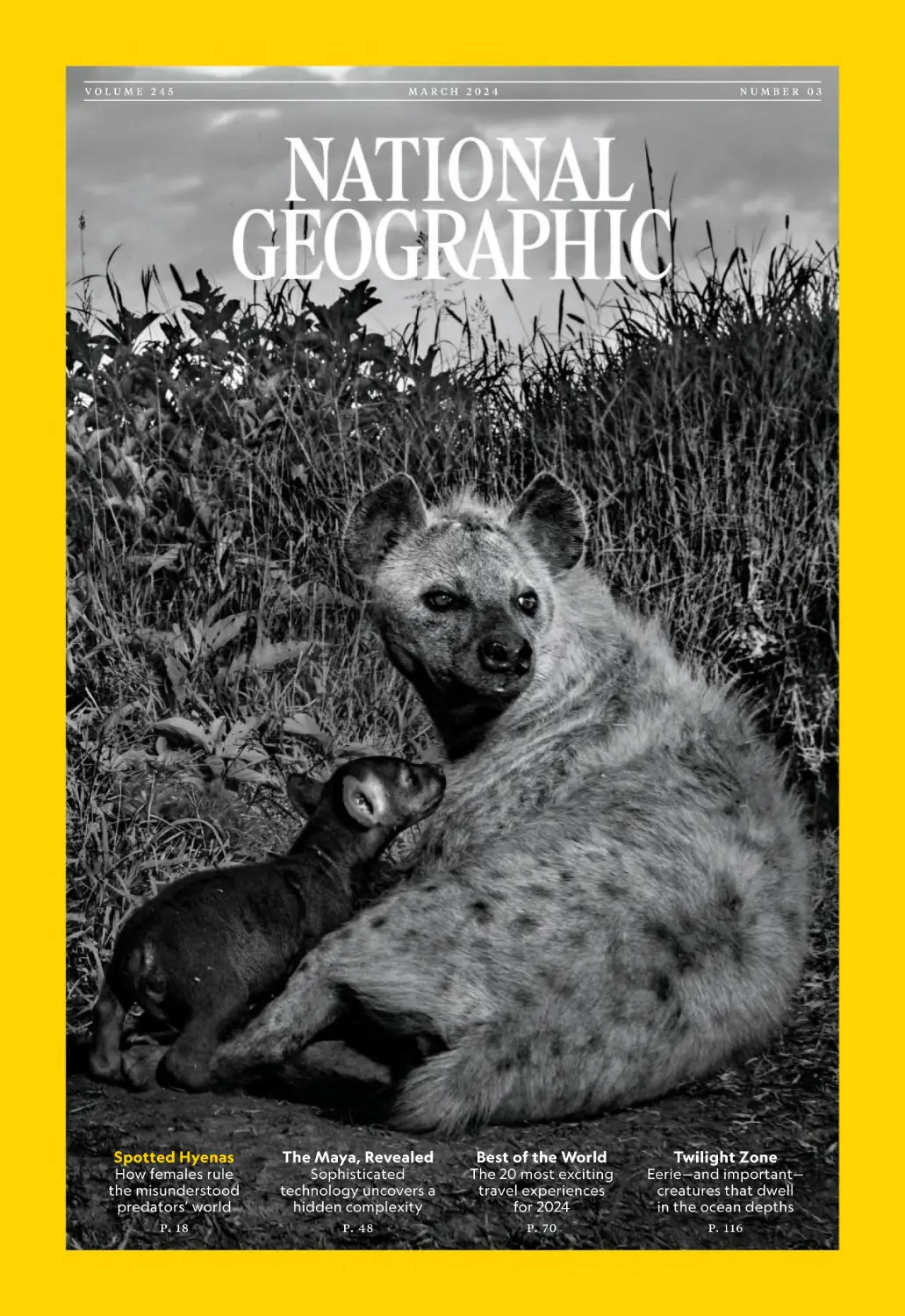
                    VOLUME 245

MARCH 2024

NUMBER 03

Spotted Hyenas

The Maya, Revealed

Best of the World

Twilight Zone

How females rule
the misunderstood
predators’ world

Sophisticated
technology uncovers a
hidden complexity

The 20 most exciting
travel experiences
for 2024

Eerie—and important—
creatures that dwell
in the ocean depths

P. 1 8

P. 4 8

P. 7 0

P. 1 1 6

WHERE M AG I C MEE TS THE SE A
A Disney cruise is a dream holiday for
the whole family. It’s an adventure full of
exciting opportunities for everyone to relax and
play in new ways with so much included.
It’s ‘we time’ at its best – family time with signature
Disney fun and Characters. Broadway quality shows,
imaginative dining and interactive activities
take families deep into whimsical worlds where they

Set sail this year with dozens of exciting destinations,
hundreds of magical moments, and millions of
memories waiting to be created. Our European Summer
sailings include magical adventures direct from the UK
to France, Spain or Belgium, culture-rich, sun-soaked
Mediterranean getaways and Frozen-inspired voyages in
UIF/PSXFHJBOŨPSET
If you dream to escape to somewhere tropical, explore

can bond and unwind together, while kids’ clubs

our Bahamian or Caribbean cruises. Wait until you see

and adult-exclusive areas provide unique venues for

our very own private paradise Disney Castaway Cay, or

everyone to enjoy their personal me-time.

our all-new island destination, Lighthouse Point.

5PţOEPVUNPSFBOEUPCPPL HPUPDisneyCruise.com

Ships’ Registry: The Bahamas ©Disney

NATIONAL GEOGRAPHIC

FROM the EDITOR
N AT H A N LU M P

National
Geographic, we’ve continued to
evolve the magazine you hold
in your hands. What started as
a journal with just words, maps,
and a simple monochrome cover
became a popular magazine filled
with photographs and known for
its striking cover images. Our commitment to bringing the world to
you and helping you understand it
better has never wavered, but the
way we’ve done that has shifted
with the times.
We last refreshed the magazine
in 2018, so it seemed like a good
moment to think about how we
could improve it even more. We
wanted to give you everything you
love about National Geographic

PHOTO: MARK THIESSEN

F O R 1 3 5 Y E A R S AT

MARCH

while making it feel livelier and
easier to read.
We kick off the magazine with
a set of pages that will appear
every month, all demarcated by a
yellow border: this welcome note
from me, followed by a guide to
the entire issue, a selection of the
most interesting images just in
from our photographers in the
field, and an introduction to
some of the contributors behind
our stories, including National
Geographic Explorers.
You’ll then arrive at the heart
of the issue—stories that bring
new insights and fresh perspectives. Between our longer, more
in-depth features you’ll find
shorter articles (differentiated by

PAGE.1

2024

NATIONAL GEOGRAPHIC

Spotted hyenas, the subject of this month’s cover story,
are efficient hunters that often work together to capture
large prey, such as an adult wildebeest, in short order.

MARCH

storytelling that you’ve come
to expect.
This month our cover story
brings you into the real lives of the
misunderstood spotted hyena,
which photographer Jen Guyton
captured as never before using
robot-mounted cameras created
by our photo engineering team.
We also take you to dark reaches
of the ocean and show what
researchers are learning about
the unusual creatures that thrive
there. We look at the changing
ways of assisting people who live
with dementia. We explain what
laser scans are revealing about
the ancient Maya. And we bring
you 2024’s Best of the World, a list
of the top experiences in travel,
curated by our global community
of experts.
I hope you enjoy the issue.

PAGE.2

2024

ILLUSTRATION: MAURICIO ANTÓN

a beige border) in recurring formats that we hope you’ll come to
recognize and anticipate. A few
examples this month are Artifact,
which explores history through
the lens of a specific object;
Charted, which leverages data
to explain a phenomenon; and
Photo Ark, which uses Explorer
Joel Sartore’s incredible images to
illustrate the wonder of wildlife.
While this magazine is very
much at the core of the National
Geographic brand, there are many
exciting things we do beyond
these pages, which we want to
share with you. So we close the
issue with some suggestions worth
checking out, whether that’s a
guided trip to an intriguing destination, a Nat Geo show to stream
on Disney+, or a popular post from
our Instagram accounts.
We love this iteration of National
Geographic—which also features
a slightly larger type size throughout—and we hope you do too. What
hasn’t changed is the exceptional

NATIONAL GEOGRAPHIC

VOLUME 245

NUMBER 03

CONTENTS
4 IN FOCUS | 10 CONTRIBUTORS

FEAT URES
18

68

90

THE L AST L AUGH

TOXIC BEAUT Y

LIVING WITH

Spotted hyenas get a
bad rap, but as the
most abundant large
carnivores in Africa,
they’ve found the
key to success. How?
Through smarts,
adaptability—and
female rule.

Tiny yet lethal, poison
dart frogs warn off
potential predators
with their exquisite patterns and brilliant hues.

DEMENTIA

44
HER SECRET
G UA R D I A N S

Anne Boleyn prized
this prayer book. After
she was executed,
a network of protectors
helped safeguard it.

70
BEST OF THE
WORLD 2024

Discover this year’s top
20 travel experiences,
from hiking an extinct
volcano in Panama
to exploring ancient
archaeology in Spain’s
Balearic Islands.
86
CLUES IN THE
STONE AGE BEADS

48
U N V E I L I N G T H E M AYA

Pyramids, canals,
terraces, and highways.
Complex structures
filled the realm of
the Maya. Researchers
using laser technology
called lidar are
“seeing” just how
complex they were.

A stunning 9,000-yearold necklace offers
insight into a community that once lived in
what’s now Jordan.
88
FOOD FIGHT

When birds fly to a
feeder, this hierarchy
of dominance determines which species
get to feast first.

While the numbers
of people with this
condition are on
the rise, so too are the
creative ways of
caring for them.
A dementia village,
for one, prioritizes
dignity and joy.
110
RESPLENDENT
WRAPPINGS

Despite our familiarity
with rubber, cork, and
other materials derived
from bark, most of
us overlook bark itself.
These photographs
show its splendor.
116
TWILIGHT ZONE

In the inky ocean
depths, eerie but
essential creatures
emit bursts of color,
disappear in
transparency,
and peer out through
bulging eyes.

1 3 4 N E W F R O M N AT I O N A L G E O G R A P H I C

O N T H E C OV E R Spotted hyenas approach a pond in Kenya’s Masai Mara region. In the

hyenas’ highly structured society, all members inherit their rank from their mother.
Photograph by JEN GUY TON

MARCH

PAGE.3

2024

IN FOCUS
JUST IN FROM OUR PHOTOGRAPHERS

C U LT U R E

“The post-Taliban generation, which once
experienced RELATIVE FREEDOM, now
grapples with a future under a regime that has
abruptly diminished those freedoms.”
K I A N A H A Y E R I , photographer

Brides and grooms participate in a mass wedding in Kabul, Afghanistan.
During the celebration, sponsored by a local NGO, a play addressed child
marriage and the ban on girls’ education.

MARCH

PAGE.4

ENVIRONMENT

“The initial thrill of discovery was soon
tempered by the sad realization that this cave
only existed because of CLIMATE CHANGE.”
J A S O N G U L L E Y , photographer

On Nepal’s Khumbu Glacier near Mount Everest, glaciologist Doug Benn
exits a huge cave created when rising temperatures increased lake levels on the
glacier’s surface, causing water to surge through cracks in the ice.

2024

MARCH

PAGE.6

IN FOCUS

SPACE

“Ines was in that
moment representing
for me ALL THE
HUMAN RACE
facing the mystery
of space and the
challenges to come.
I utilized multiple
light sources,
resulting in the
human presence
being ILLUMINATED
as if there were
multiple suns.”
PAOLO VERZONE,

photographer

Engineer Ines Barbary assesses
the performance of antennas,
essential elements of space
structures, at the European Space
Research and Technology Centre
in Noordwijk, Netherlands.

PAGE.7

2024

IN FOCUS

ANIMALS

“Documenting the RESCATE ROSADO
project was an intense experience. The most
amazing part was observing the powerful
efforts to reverse this situation and
sensitize the population about having these
migratory birds FLYING FREE.”
F E R N A N D O F A C I O L E , photographer

A rescued flamingo, one of many whose feathers have been
clipped to prevent escape from hotels and resorts, enters rehabilitation
at the National Zoological Park of the Dominican Republic.

MARCH

PAGE.8

2024

Parental
Control
Advised

CONTRIBUTORS

CAPTURING NEW VIEWS OF HYENAS

Aided by specialized cameras, this photographer is revealing the
secret lives of Africa’s most misunderstood animals.

month’s cover
story on spotted hyenas
(page 18), Jen Guyton
was determined to do
something different and
innovative. “Going into
this story, I knew that I
wanted to go against that
trend of taking photos of
FOR THIS

Ed, the
armored
robot

MARCH

hyenas during the day,” she
says. So she photographed
the primarily nocturnal
animals at night. To avoid
spooking them with bright
spotlights or flashes, she
used infrared lights, which
hyenas can’t see. National
Geographic photo engineers also supplied her
with an armored, remotely
operated robot that was
retrofitted with cameras
after an earlier career in
bomb disposal. Dubbed Ed
by the engineers, the robot
helped Guyton capture
intimate images, including
a portrait that became
one of our 2023 Pictures of
the Year. — H I C K S W O G A N

PAGE.10

Photojournalist,
ecologist, and a
National Geographic
Explorer since 2014,
Guyton has been
working on African
wildlife and conservation projects for more
than a decade.

2024

PHOTOS: JEN GUYTON; MARK THIESSEN (ROBOT)

Robot-mounted cameras
enabled Jen Guyton to
make close-up images of
hyenas and their behaviors.

CONTRIBUTORS

N AT I O N A L G E O G R A P H I C
EXPLORERS

PHOTOS (CLOCKWISE FROM TOP RIGHT): MARK ABRAMSON; HELEN SCALES; TOM CLYNES; REBECCA HALE; CIRIL JAZBEC; SUZIE RASHKIS

These contributors have
received funding from the
National Geographic Society,
which is committed to
illuminating and protecting
the wonder of our world.

David Liittschwager, p . 1 1 6
An Explorer since 2018, the San
Francisco-based photographer has
traveled around the globe to document the natural world—even the
surprising biodiversity found within
a single cubic foot. This month’s
story on the sea creatures that
thrive at depths with little light is
his 17th for the magazine.

Rubén Salgado Escudero, p . 4 8
Born in Spain and now living in
Mexico, Salgado Escudero focuses
on the human condition, including
the realm of the ancient Maya for
this feature. His photographs have
been exhibited worldwide and published in outlets such as the New
York Times and the Guardian. He
became an Explorer in 2018.

MARCH

Isadora Kosofsky, p . 9 0
A resident of Los Angeles,
Kosofsky embeds herself
in the lives of those she
photographs. For this
month’s feature on
dementia, her first for the
magazine, she shadowed
some 40 people over the
course of three years. A TED Fellow, she gave a
talk on documentary photography at the 2018
conference. Senior Love Triangle, her first monograph, was published in 2020.
Helen Scales, p . 1 1 6
The marine biologist,
author, and broadcaster
has written articles and
best-selling books about
the ocean. She’s a storytelling ambassador for the
Save Our Seas Foundation and splits her time
between England and France. For the November 2021 issue, Scales wrote about the need to
protect the waters around Antarctica, and for
this issue, animals of the ocean’s twilight zone.
Tom Clynes, p . 4 8
Clynes, a writer and
photojournalist, covers
the adventurous side of
science and the environment. His articles have
appeared in Nature and
Popular Science, among
others. His work for
National Geographic has taken him from his
Vermont home to the Arctic tundra and, for this
feature on how technology is revealing Maya
sites, to the rainforests of Guatemala.
Christine Dell’Amore, p . 1 8
As a staff editor for the
past 17 years, Dell’Amore
has reported for National
Geographic from all seven
continents. She specializes in wildlife, particularly
overlooked or misperceived species such as
the spotted hyenas in this month’s cover story.
A lifelong passion for urban wildlife led to her
award-winning feature on the ways animals are
adapting to city life, published in July 2022.

2024

In the spotted hyenas’ world,
females rule. That may be the
secret to their success.
Words by C H R I S T I N E D E L L ’ A M O R E
Photographs by J E N G U Y T O N

19

Soon after dawn in
Kenya’s Masai Mara
ecosystem, spotted
hyenas arrive at the
edge of a pond to
drink. The predators
thrive in a range of
habitats, from deserts
to forests to cities.
Photographer Jen
Guyton captured this
close-up with a remotecontrolled robot.

(Previous photo)

A female hyena
researchers named
Moulin Rouge towers over another
dubbed Palazzo,
a lower ranking
female that grins
submissively. Dominant females use
aggression to maintain rank and get
first dibs on food.

Thunderclouds rolled across
Kenya’s Masai Mara savanna as the spotted
hyena cubs played, tumbling over each other
in the wet grass. The cubs’ mother lounged
nearby, rising occasionally to discourage a bigger one-year-old from joining the little play
group. When the older animal approached

again, one of the pluckier cubs took a cue from
its high-ranking mom and stood tall, trying its
best to look intimidating. That action seemed
comical, but both animals knew their place.
The larger, lower ranking hyena stopped short,
then bowed its head and slunk off.

22

These and other insights into hyena
behavior wouldn’t be possible were it not for
35 years of on-the-ground research by Kay
Holekamp, founder of the Mara Hyena Project. Her efforts have helped reveal a creature
noted for its advanced society, cognition, and
ability to adjust to new surroundings.
Holekamp, a biologist at Michigan State
University, has been studying the African
species in the Masai Mara since 1988—one
of the longest running investigations of any
mammal ever. “I thought I’d be there for two
years,” she says, “but I got hooked.”
Hooked on hyenas? Mention their name,
and most people grimace. Aristotle described
them as “exceedingly fond of putrefied flesh.”
Theodore Roosevelt called them a “singular
mixture of abject cowardice and the utmost
ferocity.” Across Africa, hyenas are seen as
evil, greedy, and associated with witchcraft
and sexual deviance. Even the 1994 movie
The Lion King portrayed them as cunning
and malicious.
While four hyena species—brown, striped,
spotted, and aardwolves—
roam through various parts
Hyena mothers,
of Africa, the spotted has
like Empress Cicada,
been the most maligned.
are doting parents,
One reason may be that the
nursing their offspring with milk rich
animals get a little too close
in protein, fat, and
for comfort.
calcium—usually for
“Rats, cockroaches, coymore than a year.
otes—all these different
things—we just come into
contact with them more,” says National
Geographic Explorer Christine Wilkinson,
a carnivore ecologist at the University of
Photographer Jen Guyton recorded this
scene with an infrared camera, allowing an
California, Berkeley, who studies hyenas in
intimate look into hyenas’ nocturnal behavKenya’s Lake Nakuru National Park. “Your
iors. In doing so, she provided a small window
most vilified species are often the ones that
into the intriguing structure of hyena society,
live alongside people, so those that are genwhere all members inherit their place in the
eralists and adaptable.”
pecking order from their mother. Females
As Wilkinson, Holekamp, and other
are in charge, and rank means everything—a
researchers unravel more about spotted hyematrilineal system that has fueled the spotnas’ biology and behavior, they continue to
ted hyena’s rise as the most abundant large
upend our understanding of who rules the
carnivore in Africa.
wild kingdom and how they do it.

23

Soup, an alpha female,
brings a juvenile giraffe
carcass to share with her
two cubs. It takes three
years for a hyena’s skull
and jaws to develop the
bone-cracking strength
necessary for hunting,
putting pressure on
mothers to provide for
their young ones.

1

LL

SUR

VA L S

KI

VI

HUNTING
PROWESS
A lion stands
over a fresh carcass while hyenas skulk at the
periphery, heads low. The lion has made a kill,
and the hyenas are awaiting their chance for
scraps, right? Not exactly.
When biologist Hans Kruuk began studying hyenas in Tanzania in the 1960s, he
discovered that their reputation as cowardly
scavengers was a myth. When spotted hyenas
and lions shared a carcass, he found, it was
the hyenas that scored the kill more than half
the time. More recently, researchers in Kenya
have learned that hyenas in the Masai Mara
get an average of two-thirds of their food primarily by hunting, often working together
seamlessly to take down wildebeests, zebras,
buffalo, and other large prey.
How they choreograph these hunts is still
a mystery. So in late 2022 Holekamp and
colleague Ariana Strandburg-Peshkin from
the University of Konstanz in Germany outfitted an entire hyena clan with GPS collars
featuring microphones and accelerometers
to analyze their movements and vocalizations—including the trademark hyena laugh,
which likely expresses great excitement.
“The collars allow us to know where everyone is, who is saying what to whom, which
group mates respond and which do not, and
what all the hyenas are doing,” Holekamp
says. All these data are now being run
through AI algorithms to decipher specific
behaviors.
One thing has long been clear: Hyena
queens are the “backbone of hyena society,” Holekamp says. Part of that matrilineal
I T ’ S A C L A S S I C S A FA R I M O M E N T:

Clan alpha Silver
Nugget and her sister
Stardust (foreground,
center and right) visit
a communal den after
dusk. Guyton used
infrared light, invisible
to hyenas and humans,
to document nocturnal
behaviors.

dominance is physiological. Both female
and male fetuses of higher ranking females
are imbued in the womb with a boost of sex
hormones such as testosterone, which likely
increases aggression. Another part is anatomical: As the only mammal without an external vaginal opening, female spotted hyenas
have an elongated clitoris that hangs between
their legs and strongly resembles a male’s
penis. During mating, the female retracts
this “pseudopenis” into her abdomen, making it impossible for the male to gain entry

26

without her cooperation and ensuring that she
decides who fathers her offspring. (Remarkably, the female will also give birth through
her clitoris.)
“They’re like a chimera—a blend of multiple organisms,” Holekamp says. “Some of
their behaviors are heavily masculinized, and
others are not.”
Females care for their young for several
years, longer than any other African predator. During this time, the young hyena’s
skull is developing, so it’s unable to hunt

and kill large prey. Holekamp theorizes this
prolonged dependence may be one reason
female hyenas evolved to be more aggressive
than males, which play no role in parenting.
Though cubs of both sexes inherit the rank
of their mother, they fall lower in the hierarchy as new siblings are born. Tagging and
tracking studies have also revealed that most
males, starting around three years old, leave
their birth clans to join another, a strategic
choice that can raise their chances of mating
and passing on their genes.

27

2

it became clear that hyenas can also remember how they solved earlier problems.
“As soon as Gucci saw us put the baited
puzzle box on the ground, she arose from
her resting site, went directly to the box, and
opened it in only a couple of seconds, sliding the bolt holding the door closed backward
with her teeth until the box popped open,”
Holekamp says.
Arjun Dheer, a wildlife ecologist and
National Geographic Explorer who studied
hyenas in Tanzania’s Ngorongoro Crater,
is also impressed by the species’ cognitive
skills. “When you look at a hyena,” he says,
“you can see the wheels turning—there’s a
lot going on behind those eyes. We underestimate them.”
Hyenas’ teeth and powerful jaws—among
the strongest of any mammal—enable them
to hunt a wide range of prey and eat as much
of it as possible, even the hardest bones. But
it’s their built-in innovativeness that has
driven the species’ spread and success across
the continent.
Clan size depends mostly on the abundance of prey and ranges from fewer than 10
members in some desert areas to around 130
animals at resource-rich sites like the Masai
Mara and Ngorongoro Crater. Regardless of
their numbers, however, hyenas maintain
fission-fusion societies, in which groups
of animals split (fission) or merge (fusion)
depending on the need of the moment. For
instance, some animals may rest and forage solo or in smaller groups, then abruptly
join up with a larger group to hunt or defend
against attacking lions.
Such fluidity is part of what makes spotted
hyenas “the most socially complex carnivores
in the world,” says Dheer. Unlike many other
African predators, hyenas can also breed anytime and anywhere and raise cubs in habitats
that have been degraded by people and their
livestock. This flexibility may be why the species has not declined in the same way as have
African carnivores that are less able to cope
with unexpected stressors.

LL

SUR

VA L S

KI

VI

RAW
INTELLIGENCE
Holekamp’s colleague
Lily Johnson-Ulrich, a cognitive ecologist
from the University of Zürich, drove into
the city of Mekele in northern Ethiopia,
where hyenas have lived alongside people
for hundreds of years. There, she identified
appropriate study locations and unloaded a
“puzzle box,” a 16-inch square, steel container
with four small doors. Inside was a piece of
raw meat or some milk powder, and each
door required a different motor skill to open
it: push, pull, slide, or draw out.
Her team conducted trials at three sites:
a city where hyenas had long been resident; a
rural, protected reserve; and a burgeoning
town on the edge of the reserve where hyenas
had lived for only about 20 years. In each
spot the team videotaped what happened
next from behind their vehicle.
When they tallied the results, they were
floored. Based on multiple trials, the rural animals were more adept at opening the doors—a
measure of innovation—than were the town
and city dwellers. This discovery, published
in 2021, runs counter to the theory that urban
animals are better problem solvers.
Although hyenas are simply smart to begin
with, regardless of where they live, JohnsonUlrich suspects it’s more than that: While
urban hyenas tend to scavenge more and kill
livestock, rural hyenas hunt more of what
they eat, requiring more innovative thinking
and dexterous motor skills.
In earlier experiments, including one in
which Holekamp tracked the behavior of a
longtime puzzle-box champion named Gucci,
S E V E R A L Y E A R S AG O,

28

3

dismantling the repair, often opening the
same hole—making it a challenge to keep this
clever species at bay. The fence cameras have
also captured funny moments, such as hyenas
sliding easily under the perimeter early in the
night but struggling to do so on the way back
because of their bulging bellies.
Wilkinson’s research demonstrates how
readily spotted hyenas adapt to living alongside humans and how they can deftly tackle
roadblocks, such as finding work-arounds in
fences that people rely on to keep them out.
As human settlements increasingly abut
hyena habitat, the animals have learned to
actively avoid people in some situations.
Dheer’s research revealed that hyenas living
in Ngorongoro Crater were not bothered by
herders who move their livestock across the
landscape. These hyenas’ cortisol, or stress
hormone, levels were the same when compared with those of hyenas in the crater not
visited by people, and their fertility and ability to rear young were unaffected.
In fact, Ngorongoro hyenas have learned
to anticipate and avoid people’s movements
by becoming more active at night. “Not
every animal can make such a change without negative consequences, but hyenas
can,” Dheer says. “They’re able to use every
inch of the landscape and find a way to
survive and persist even in places where
they’re really disliked.”
Hyenas will obviously enter human habitats when their wild prey have been largely
wiped out, as is the case in northern Ethiopia,
where forests have been converted to farms
and grazing areas over centuries. But in these
places, hyenas live relatively peacefully
near people, in part because locals believe
the animals consume evil spirits. During the
day in Mekele, for instance, hyenas mostly
stay hidden in remaining forest patches outside the city and around churchyards. They
emerge in darkness to feed on carcasses—
mainly equines and poultry—discarded in
open landfills and on roadsides because of
the city’s poor waste collection service.

LL

SUR

VA L S

KI

VI

URBAN
ADAPTABILITY
Wilkinson steers
a beat-up, teal 4x4 through Soysambu Conservancy, a rural area on the outskirts of
the Kenyan city of Nakuru. The country’s
long-standing drought is obvious; the grass
is brittle from lack of rain, and Lake Elmenteita, known for its flocks of lesser flamingos
that sometimes fall prey to hyenas, is quiet
and still, with no birds in sight.
About 37,000 people live next to the conservancy, which is popular for wildlife tourism,
but at least one animal continues to cause
some concern. “When you are interviewing
people here, asking them about their experiences of conflict,” Wilkinson says, “hyenas
come out on top in almost every conversation
that you have.”
In a recent study, Wilkinson attached GPS
collars to seven hyenas, and now she opens
her laptop to see where they’ve traveled overnight. By reviewing GPS data and thousands
of camera-trap images, she has discovered
that at night hyenas regularly leave Lake
Nakuru National Park—one of only two fully
fenced national parks in Kenya—and head
toward neighboring communities between
the park and the conservancy to eat butchers’ scraps and carcass waste. They’ll also
occasionally kill and eat livestock not held in
predator-proof enclosures, returning to the
safety of the park in the morning. Once hyenas
find a hole in the fence, they perform what
Wilkinson jokingly calls a “downward-facing
hyena” to squeeze themselves through.
Her fieldwork shows that when rangers
fix the fence, the hyenas quickly go to work
O N A D RY, S C O R C H I N G DAY,

29

F E M A L E P OW E R

C O O P E R AT I V E

Females are more aggressive
and 10 percent bigger than
males. Sex can only occur with
a female’s consent; she must
fully retract her genitalia
to allow a male access.

Spotted hyenas can hunt alone,
but cooperative hunting increases
their success at capturing large
prey such as adult wildebeests,
buffalo, and giraffes. Most hunts
last under a minute.

Male

Uterus
Vagina

L-shaped
birth canal

Female

Female
genitalia

Cub

W E A K C U B , ST RO N G M O M
Tiny teeth and slow skull growth
make cubs dependent for at least
three years. This gradual development may have evolutionarily
favored more aggressive mothers.

A large, bony ridge
provides extra area for
powerful biting muscles.
Temporalis
muscle

B I T E F O RC E
Strong jaw muscles and
special tooth enamel in
an interlocking W shape
help bone-cracking hyenas
avoid tooth fracture.

Spotted
hyena
enamel

Masseter
muscle

Lion
enamel

Bone-cracking
premolar

Ultimate

Spotted hyenas live in socially com
from six to 130 animals. Although th
cats. Contrary to popular belief, the
hunters that kill up to 95 percent of
advanced communication strategie

Graphic by M O N I C A S E R R A N O a

ST R AT E G I C

ST RO N G

S AV V Y

Hunting techniques include
selecting a herd’s weakest member, using topography to ambush
or corral prey, and walking upwind
in a zigzag pattern to detect the
scent of hidden quarry.

Big front paws help hyenas hold
down a carcass while they tear
off flesh. To carry off hunks of
meat and bones, the animals rely
on their muscular front legs.

Hyenas are known to hide carcasses
in vegetation or water. Food caching reduces odor and detection
by vultures and other scavengers.
When it comes to social intelligence,
hyenas match baboons.

Wildebeest

e Hunters

plex, female-dominated clans that can range
hey look like dogs, they’re more closely related to
ey’re not just scavengers but also highly efficient
f their food. From their powerful jaws to their
es, these hyenas reign when on the hunt.

and K E L S E Y N O W A K O W S K I

Rank, inherited
from the mother,
sets priority of
access to food.

Each hyena has a distinct
whooping call; females
have the deepest voices.
Calls are used to recruit
clan mates to defend
food and territory.

A DA P TA B L E E AT E R S
The hyena diet encompasses
foods from termites to eggs and
elephants. They’re able to digest
any organic matter—including
anthrax-infected carcasses—
except hair and hooves.
ART: MAURICIO ANTÓN. SOURCES: KAY
HOLEKAMP, MICHIGAN STATE U.; LILY
JOHNSON-ULRICH, U. OF ZÜRICH; CYBIL
NICOLE CAVALIERI, MICH. STATE U. MUSEUM

Ostrich
egg

Realm of the Hyena
Adapted to nearly every habitat—from deserts to savannas, open woodlands
to urban areas—four species of hyenas have made Africa their home. The most
abundant large carnivore on the continent: the spotted hyena.

E U R O P E
M e d i t e r
r a
n e
a n

S e a

A
A

A

R

F

R

I

A

d

H

Re

S

I A

S

NIGER

CHAD

B.F.

E

CEN. AF. REP.

CONGO
NG

GABON

BASIN

CO

ATLANTIC
O CE A N

ETHIOPIA

S. SUDAN

Sibiloi N.P.

CAM.

M
SO
UGANDA KENYA
Lake Nakuru N.P.

Masai Mara Nat. Res.

D.R.
C ON GO

Ngorongoro
Crater

RANGE OF THE HYENA
FA M I LY ( H YA E N I DA E )
Spotted hyena (Crocuta crocuta)
Found across most of subSaharan Africa, these skilled
hunters are known to scavenge
opportunistically as well.
Striped hyena (Hyaena hyaena)
Primarily scavengers that can also
kill prey, they survive in deserts
across northern and eastern Africa
and into Asia.
Aardwolf (Proteles cristatus)
This insectivore avoids food competition by specializing in eating
termites—as many as 250,000 in
one meal.
Brown hyena (Parahyaena brunnea)
This long-haired scavenger lives in
the desert, semidesert, and open
woodlands of southern Africa.

SUR

NIGERIA

CÔTE
D’IVOIRE

DJI.

L
Harar

O

LIBERIA

SUDAN

H

VI

VA L S

4

IA

GHA.

ERIT.

Mekele

LL

SIERRA
LEONE

A

A

KI

S

GUINEA

C

likely m
loping ac
overall c
their num
face the s
predators
of death i
for reaso
are not. T
in retaliat
because t
veyors of
As an a
likely the
casses, th
new mem
mother’s
privilege
and are le
hyena con
people do
But tha
pastoral
versity o
and Nati
Torrentsin centra
other priv
in wildlife
likely to v
pared to
where Si
conserva
places wh
vation or
such as to
Early o
watched
hyenas at
average v
minutes.
movemen
of the car
people lo
queen of t

AL

A

a

MALI

SEN.

Se

MAURITANIA

By observing the feeding behavior and population size of hyenas in Mekele and plugging
the data into a disease-transmission model,
Harvard University’s Chinmay Sonawane and
colleagues made a seminal discovery: Hyenas
remove more than 200 tons of disease-carrying
carcasses from Mekele each year. That translates to fewer deaths from anthrax and bovine
tuberculosis, and the hyenas’ “disease-control
service” saves the local economy more than
$50,000 annually by reducing livestock losses
and human treatment costs.
While the animals have been known to
bite people, these incidents are often related
to humans leaving livestock enclosures
unsecured or sleeping out in the open. As
Wilkinson puts it, conservationists are now
“trying to shift the narrative from conflicts
to benefits,” which have been historically
underrated.

I N DI A N
O CE A N

PUBLIC
RELATIONS

TANZANIA
MAL.

ANGOLA

MOZ.

ZAMBIA

ZIMB.

NAMIBIA
BOTS.

ESWATINI
SOUTH
AFRICA

there’s one particular
test that Holekamp has kept running. Using
a stopwatch and a pencil, she’ll watch as
safarigoers stop by whatever clan she may be
observing. The animals might be devouring
a freshly killed wildebeest or young giraffe
or maybe just lounging together in the grass.
Back in the early 1990s, the average time
tourists watched hyenas was one minute
38 seconds. For years, it seemed most people considered the animals unappealing and
preferred seeing “real” predators like lions
or cheetahs.
That antipathy has taken a toll. There are
E V E RY F I V E Y E A R S ,

500 mi
500 km

MAP: CHRISTINE FELLENZ, NGM STAFF
SOURCE: ANDREW JACOBSON, HYAENA
DISTRIBUTION MAPPING PROJECT, IUCN

With repo

34

orting by Ayenat Mersie in Kenya

QUEENS
F E M A L E P OW E R
I N T H E N AT U R A L WO R L D

Numerous other species survive and thrive thanks to strong
female leaders that teach survival skills, resolve conflicts, even
sacrifice their bodies for the good of the group.

ILLUSTRATIONS: MUHAMMAD BAGUS PRASETYO

ore than 50,000 spotted hyenas
cross sub-Saharan Africa (the last
count was done 25 years ago), but
mbers are declining. Spotted hyenas
same threats as other large African
s, but hyenas—whose leading cause
is killing by humans—are targeted
ns that lions and other carnivores
They’re snared or poisoned not only
tion for preying on livestock but also
they’re considered vermin and purblack magic.
alpha female eats first at a kill, she’s
e first to die from poison-laced carhrowing the clan into chaos until a
mber takes the helm. The poisoned
cubs, now shorn of their matrilineal
, are not adopted by other females
eft to starve. “The biggest obstacle to
nservation,” says Holekamp, “is that
on’t like hyenas.”
at may be changing. In a study of
ist communities in Kenya, Uniof Helsinki conservation biologist
onal Geographic Explorer Miquel
-Ticó found that on group ranches
al Kenya, where conservancies and
vate reserves make high investments
e conservation, residents were more
view spotted hyenas favorably comothers living in northern Kenya,
biloi National Park has “meager”
ation initiatives. People in both
ho have family members in conserr tourism attributed more benefits,
ourism revenue, to hyenas.
one morning in 2022, Holekamp
a group of safarigoers stay glued to
t a kill for over 20 minutes—and the
viewing time is now more than four
This may mark a small but notable
nt toward respecting the “coolness”
rnivores, says Holekamp. The closer
ook, the more they can see the true
the jungle. j

AFRICAN SAVANNA
ELEPHANT

LEAFCUTTER
ANT

ETHIOPIAN
WOLF

Among African savanna
elephants, the matriarchs
are repositories of
wisdom in the ultimate
animal sisterhood.

Leafcutter ants—as many
as eight million per colony—report to one queen
that can live 20 years and
produce 200 million eggs.

The Ethiopian wolf is
Africa’s rarest canine. Usually only the alpha female
breeds, but the entire
pack helps raise the cubs.

BONOBO

ORCA

One of humans’ closest
relatives, bonobos live in
female-led societies. They
form close relationships
and are largely peaceful.

In orca pods, grandma
knows best; her presence
boosts calf survival. She
also outlives her breeding
years by decades.

35

Discover how
female animals
rise to power and
rule. Queens, a
new seven-episode
National Geographic
series, begins
streaming on
Disney+ and Hulu
on March 5.

One of Palazzo’s male
cubs stares down a bigger but lower ranking
female at a communal
den. Cubs of both sexes
inherit the rank of their
mother, though after
puberty most males
leave their natal clans
to find mates and thus
lose their rank.

In a photo taken with
the robot, hyenas feed
on a freshly killed
wildebeest. Hyenas
are both hunters and
scavengers, and in the
latter role they help
remove pathogens
such as anthrax and
bovine tuberculosis
from the ecosystem.

Michigan State University
biologist Kay Holekamp
and her team treat an
injured male hyena likely
wounded in a fight.
Holekamp’s decades-long
studies reveal that far
from being the slobbering,
stupid animals of popular
myth, hyenas are whipsmart with social skills on
par with those of primates.

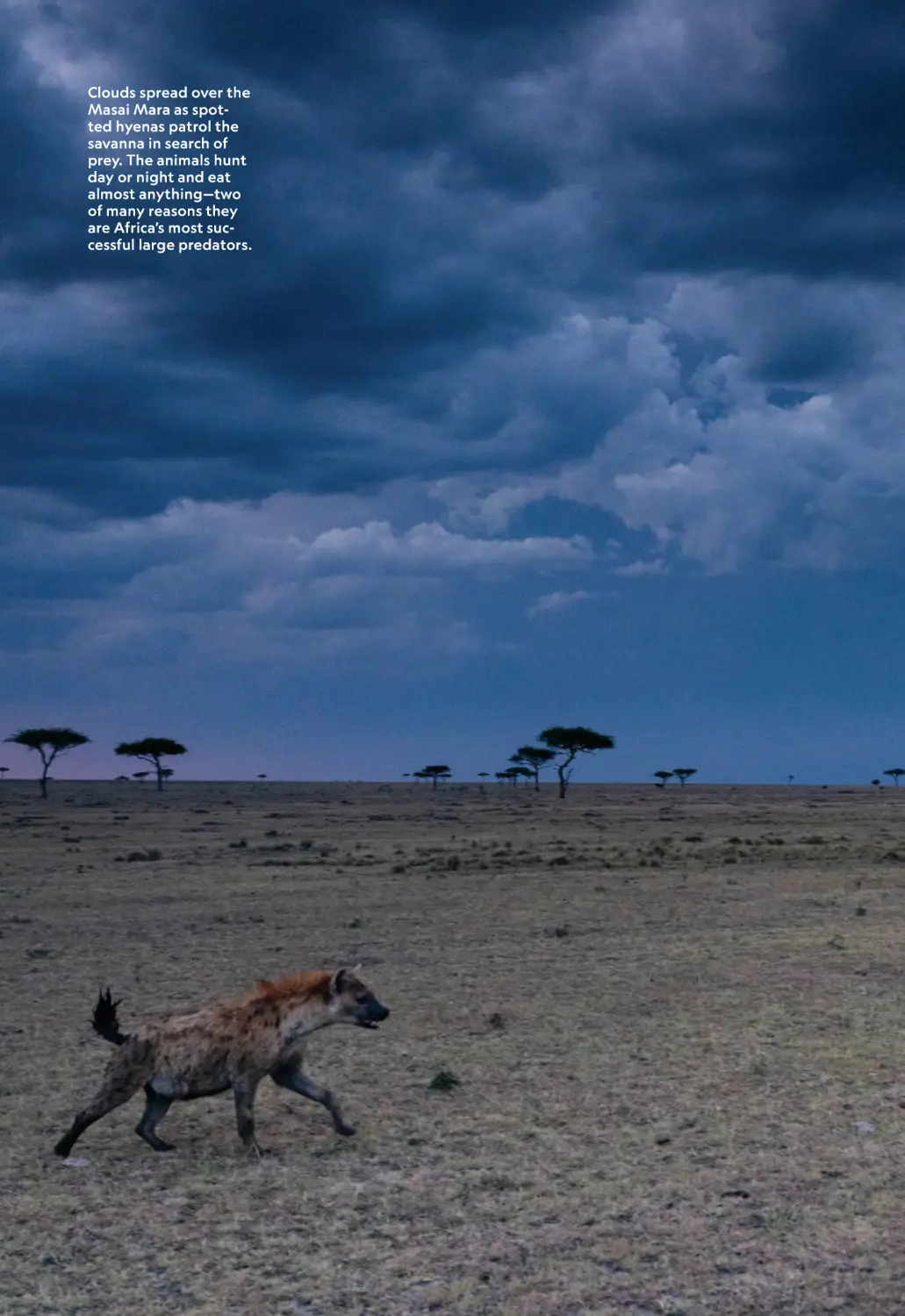
Clouds spread over the
Masai Mara as spotted hyenas patrol the
savanna in search of
prey. The animals hunt
day or night and eat
almost anything—two
of many reasons they
are Africa’s most successful large predators.

DISCOVERY

Her SECRET

GUARDIANS
When Anne Boleyn was executed
in 1536, her prized book of hours went
missing for centuries. Now we know
who helped keep it safe.
Words by

King Henry VIII’s second
queen, is often portrayed as a seductress
and ultimately the woman responsible for
changing the face of religion in England.
Boleyn is now recognized as a fiercely intelligent and pious figure dedicated to education
and religious reform. But after her arrest and
execution on questionable charges of adultery and incest in May 1536, Henry VIII was
determined to erase her. Her royal emblems
were removed from palace walls, her sparkling jewels tucked away in dark coffers, and
her precious books disappeared from the
annals of time.
But one of Boleyn’s possessions, her book
of hours, reappeared. The stunning prayer
book, printed around 1527 with devotional
texts designed to be read throughout the
day, features hand-painted woodcuts,
as well as a rare example of the queen’s
own writing. In the margins of one of the
beautifully decorated pages, she penned a
ANNE BOLEYN,

MARCH

rhyming couplet followed by her signature:
“Remember me when you do pray, that hope
doth lead from day to day, Anne Boleyn.”
The book vanished after Boleyn’s execution, then resurfaced in the early 20th
century, when American millionaire William Waldorf Astor bought Hever Castle,
Boleyn’s childhood home in the English
countryside. The journey of the disgraced
queen’s devotional book remained a mystery, however, until new research revealed
previously unknown signatures on its
pages, which helped trace part of its path
through history.
T H E R E V E L AT I O N

The book’s whereabouts in the 360-odd
years between Boleyn’s death and its
reemergence remained puzzling until
2020. That’s when Kate McCaffrey, then a
graduate student at the University of Kent

PAGE.44

PHOTO: ROBERT ALEXANDER, GETTY IMAGES

LESLIE PATRICK

NATIONAL GEOGRAPHIC

Anne Boleyn, shown here in a late 16th-century painting
by an unknown artist, was the second wife of Henry VIII and
executed on charges of adultery and incest.

DISCOVERY

working on her master’s thesis about the
queen’s book of hours, found something
unexpected in the margins.
“I noticed what appeared to be smudges
to the naked eye,” recalls McCaffrey, an
assistant curator at Hever Castle since
2021. Intrigued, she borrowed an industrialstrength ultraviolet light and set it up in
the castle’s darkest room. This type of light
is often used to examine historical documents because ink absorbs the ultraviolet
wavelength, causing it to appear darker
against the page when exposed. “The words
just came through. It was incredible to see
them underneath the light—they were completely illuminated,” the curator recalls.
McCaffrey’s theory is that the “invisible”
words were erased during the late Victorian era, when it was popular to cleanse
“unnecessary” marginalia from books or
manuscripts. But thanks to her detective
work, the erased words turned out to be
the key that unlocked the tale of the book’s
secret escape from likely destruction at the
royal court to safety in the hands of a dedicated group of Boleyn’s supporters.

Various pages throughout the text reveal
the names and notations of a string of
Kentish women—including Elizabeth
Shirley, Philippa Gage, and Mary West—
who banded together to safeguard Boleyn’s
treasured book of hours and to keep her
memory alive.
While it’s not yet clear who among them
was the first to receive the book, Boleyn
expert Natalie Grueninger suggests it was
given to Elizabeth Hill by the queen. Hill
grew up near Hever Castle, and her husband, Richard, was sergeant of the King’s
Cellar at Henry’s court. There are records of
the couple playing cards with the king, and
a possible friendship with Hill might have
prompted Boleyn to pass on her prayer

MARCH

book before her execution. “This extended
Kentish family kept the book safe following Anne’s demise, which was an incredibly
brave and bold act considering it could
have been treasonous,” says Grueninger,
author of The Final Year of Anne Boleyn.
The book of hours was handed among
mothers, daughters, sisters, and nieces
until the late 1500s, when the final name
appears in its margins. “The fact that
the women have kept it safe is a really

PAGE.46

PHOTO: COURTESY HEVER CASTLE & GARDENS

THE WOMEN

NATIONAL GEOGRAPHIC

Ultraviolet light reveals
writing in the margins of
Boleyn’s book of hours.
The inscriptions’ discovery has helped illuminate
a chapter of this prayer
book’s murky past.

beautiful story of solidarity, community,
and bravery,” says McCaffrey.
The book, now on display at Hever Castle, is a touchstone of the enigma that
was Boleyn. Historian Owen Emmerson
points out that her DNA is on the pages
she touched and kissed during her daily
devotions. “This was a really beloved possession of hers,” says Emmerson. “Because
of what happened to Anne Boleyn, we
don’t have a vast amount of information

in Anne’s own words. But the physical
remnants of her use of the book, and the
construction of that beautiful little couplet, have her identity in them.”
While Boleyn’s book of hours found its
way home, the research into this intriguing
mystery is not over. McCaffrey continues to
chart the book’s provenance through the
centuries to find out more about its furtive
course—and its owner, who has engendered
fascination for more than 500 years. j

PAGE.47

2024

both
National Geographic Explorers
with research posts at Tulane
University, had collectively spent
decades working in the jungles of
Central America. Grueling heat and
humidity, as well as encounters with
deadly wildlife and armed looters,
were inextricably part of discovering
the treasures of the ancient Maya, a
civilization that flourished for thousands of years and then mysteriously vanished beneath the
dense forest. And so, it seemed ironic—almost unfair—that
their biggest discovery would come while huddling around a
computer in an air-conditioned office in New Orleans. While
his colleague Francisco Estrada-Belli looked on, Marcello
Canuto opened an aerial image of a tract of forest in northern Guatemala. At first, the screen showed
nothing but treetops. But this image had been
made with a technology called lidar (short for
Discovered at the Maya city of Holmul,
“light detection and ranging”). Lidar devices
in Guatemala, a censer for burning
resin during rituals depicts the god
mounted on aircraft shoot billions of laser
of the underworld.
bursts downward and then measure the ones
that reflect back. The small fraction of pulses
(Previous Photo)
that penetrate the foliage provide enough data
An aerial view hardly hints at the true
size of Dzibanche in Mexico’s Yucatan.
points to assemble an image of the jungle floor.
Lidar—laser technology that digitally
With a few keyboard clicks, Canuto digiremoves the forest canopy—reveals
tally peeled away the vegetation to reveal a
that the Maya city sprawled more than
seven square miles.
three-dimensional image of the ground. Far
H E T WO A RC H A E O LO G I ST S ,

51

from any population centers, the region they were viewing
was thought to have been mostly uninhabited, even at the
peak of Maya civilization more than 1,100 years ago. But suddenly, what had looked like ordinary hillsides were shown
to have been carved with human-built reservoirs, agricultural terraces, and irrigation canals. What had appeared to
be small mountains were in fact large pyramids, topped
with ceremonial buildings. Settlements that generations
of archaeologists had assumed to be regional capitals were
mere suburbs of far larger pre-Columbian cities, connected
by paved, raised highways.
Archaeologist and National Geographic Explorer Thomas
Garrison, who viewed the data around the same time, was
stunned by what he saw. “I think we were feeling something
similar to what astronomers felt the first time they looked
through the Hubble Telescope and saw all those empty
spaces suddenly teeming with stars and galaxies,” he says.
“Here was this vast jungle that everyone thought was nearly
empty. And then, when we peeled off the trees, there were
human signatures everywhere.”
The use of lidar is revolutionizing Maya archaeology, not
only guiding researchers to promising sites but also giving
them a big-picture view of the ancient landscape. Dozens of
lidar surveys—including the breakthrough project unveiled
in New Orleans in 2018, funded by the Guatemalan Foundation for Maya Cultural and Natural Heritage (Pacunam)—
have upended long-established impressions of a civilization
that thrived in one of Earth’s least hospitable regions.
“It’s almost impossible to overstate the extent to which lidar
is energizing Maya archaeology,” says Guatemalan archaeologist Edwin Román-Ramírez. “We’ll always need to go in and
dig to understand the people who built these structures, but
this technology is showing us exactly where and how to dig.”
In particular, the imagery overturns the idea that the Maya
lowlands were a sparsely populated landscape peppered
with a few scattered and autonomous city-states. Each new
lidar survey makes it increasingly clear that the Maya were
an interconnected civilization of dazzling scale and complexity—a Maya megalopolis, with millions of farmers and
fighters and builders of infrastructure more extraordinary
than anyone had previously imagined. The revelation has
The nonprofit National Geographic Society, working to
conserve Earth’s resources, helped fund this research.

52

Dig team member Clara Alexander inspects a burial near Holmul that was breached by robbers.
As lidar reveals thousands of previously unknown tombs, temples, and other Maya structures,
it’s also uncovering evidence of widespread looting.

53

1

2

3

4

5

the power to not only rewrite the region’s past but also radically reshape its future.

economically impoverished but
rich in cultural and ecological treasures, the discoveries offer an exciting prospect: Many of the
new sites could become the centerpiece of a cultural and ecotourism industry that could help the
nation blaze a sustainable path out of poverty. But
for Estrada-Belli, Román-Ramírez, and other Guatemalan archaeologists and conservationists, the high-tech
imagery has also exposed a more troubling development
that could render those plans moot: the telltale marks of
looters, loggers, land-grabbers, and narco-traffickers who
are laying siege to the second largest remaining tropical
rainforest in the Americas. Many Guatemalans fear that
they may lose the high-stakes race to protect the landscapes
and treasures that could illuminate even more lessons the
ancient Maya have to teach us.
Much of the country’s most important cultural patrimony
is sheltered within the Maya Biosphere Reserve, a jumble of
national parks, wildlife reserves, and forestry concessions
where residents harvest timber and other forest products.
Comprising about a fifth of Guatemala’s territory, the reserve
is home to jaguars and scarlet macaws, as well as hundreds
of other species of birds, butterflies, reptiles, and mammals.
In contrast to more arid cradles of civilization such as
Egypt and Mesopotamia, Central America’s humid forests
have rarely given up their buried secrets easily. In the mid19th century, American writer John Lloyd Stephens and
his British companion, the artist Frederick Catherwood,
explored some of the abandoned Maya cities on Mexico’s
Yucatan Peninsula. Their descriptions and drawings of overgrown pyramids and palaces drew other researchers, but
O R G U AT E M A L A ,

7

8

ARTIFACTS PHOTOGRAPHED AT THE HOLMUL ARCHAEOLOGICAL PROJECT LABORATORY, ANTIGUA, GUATEMALA

6

A trove of Maya treasures recovered from two rare unlooted
tombs includes a painted bowl (1); an exquisite jade mosaic
mask (2) and a jade figure depicting the corn god (7); obsidian
projectile points remade into ritual objects (3, 5); tall cups for
chocolate (4, 6); and a human thigh bone inscribed with a portrait of a Maya king buried in one of the tombs (8). “We didn’t
realize this was a royal shrine until we saw the lidar images,”
says archaeologist Francisco Estrada-Belli.

55

Archaeologists thought they knew Tikal well, but lidar revealed that Guatemala’s largest Maya city
was at least four times as large as previously thought—a complex network of elevated roads, terraced
fields, reservoirs, and defensive fortifications.

56

FRANCISCO ESTRADA-BELLI (LIDAR DATA: PACUNAM LIDAR INITIATIVE/NCALM)

after decades of digging, archaeologists managed to open
only a few small windows into the Maya world.
In 2009 archaeologists Diane and Arlen Chase, currently
with the University of Houston, tried something new at
Caracol, an ancient city in Belize they’d been excavating
since 1985. Lidar scanners, initially used for meteorology
and tracking celestial bodies, were increasingly being
mounted to aircraft to aid mapping and surveying.
“At the beginning of the project we’d thought Caracol was
just a few pyramids and temple groups,” Arlen Chase says.
“But when we lidar-surveyed the outlying areas, we discovered that it was actually a huge, elaborately planned city.”
The metropolis likely supported at least 100,000 people,
almost twice the present-day population of Belize City.
The Chases’ findings awakened other archaeologists to
the technology’s potential. In 2021, excavations based on the
Pacunam data yielded surprises even at Tikal, Guatemala’s
largest archaeological site. The city was at least four times
as big as previously thought, and partly surrounded by a
massive ditch and defensive wall stretching for miles. Also
revealed were a large pyramid and a mysterious compound
with links to Teotihuacan, an ancient superpower more
than 800 miles to the west.
“To find major new monuments in the heart of Tikal—
one of the most extensively studied sites in the Maya
area—reinforces how many doors lidar is opening,” says
Román-Ramírez, who directs the South Tikal Archaeological Project. “We’re discovering features that we couldn’t
perceive even when we were walking on top of them.”

northwest of Tikal, archaeologist
Richard Hansen climbs a low embankment and
pauses to stomp the mud off his boots. “Years
ago, we relocated our supply path to this higher,
drier stretch,” says Hansen, a National Geographic
Explorer affiliated with Idaho State University who
co-directs research at the ancient city of El Mirador. “It wasn’t until the lidar that we realized we were walking on an ancient superhighway.”
The causeway is now covered by two feet of dirt, but centuries ago it was raised six feet above the surrounding swamp
and paved with stucco. Part of a complex network of roads
that connect Mirador to more than 400 ancient settlements, it
BOUT 40 MILES

57

‘TO FIND MAJOR NEW
MONUMENTS ... REINFORCES
HOW MANY DOORS LIDAR
I S O P E N I N G . W E ’RR E
D I S C O V E R I N G F E AT U R E S
T H AT W E C O U L D N ’TT P E R C E I V E
EVEN WHEN WE WERE
WA L K I N G O N TO P O F T H E M .’’

THE MIGHTY M

world use today,” says Tulane’s Canuto, who
models population density. He estimates that
10 million to 15 million people lived throughout the Maya realm at its peak, including
many in swampy regions that most archaeologists had thought uninhabitable.
To build El Mirador’s towering 230-foot
pyramid, known as La Danta, armies of workk
ers used hammerstones and obsidian blades
to cut and drill into the limestone, then pried
the rectangular blocks apart. Hansen and his
research partners replicated the process,
using tools found at the site’s quarries as
models. Workers built wooden litters to carry
blocks weighing an average of 900 pounds.
“With enough men and the means to feed
them,” Hansen says, “a king could complete
it in his lifetime.”

Edwin Román-Ramírez, archaeologist

B

Notable Maya sites by period
Preclassic (circa 800 B.C.–A.D. 250)
Classic (circa 250–900)
Postclassic (circa 900–1540)
Other sites
Major sites
50 mi
50 km

Comalcalco

UT MANY OF

San
Miguel

Villahermosa
Palenque

M

E

X

I

C

BIOS
RE

O

Piedras Negr
a

Tuxtla Gutiérrez
lv
a
Chiapa de Corzo

Bonam

H

Altar
Chinkul

I

Tonalá

S

G

i

e

H

the newly discovered
sites are not new to looters. “The
state doesn’t have the financial
resources to protect our patrimony,”
says Marianne Hernández, president of the Pacunam foundation.
“With the new data, we’re at least
figuring out where the sites are. If we had an
army of archaeologists, we could send them
out to study them before they are torn apart.”
Looting is only one of the threats facing
the Maya Biosphere Reserve. Illegal settlers
often set fires to clear land for cattle ranches—
frequently used by narco-traffickers for money
laundering. Many have cut airstrips out of the
jungle to land smugglers’ planes.
Guatemala’s government is making some
effort to stop deforestation—which has
diminished the country’s old-growth forests by about 20 percent over the past two
decades—and reclaim illegally occupied
territory. But its work is hampered by a lack
of equipment, fuel, reliable intelligence, and
clear approaches (Continued on page 66)

Lidar survey area, 2009–2019
Tree cover

ij
Gr

widens to 130 feet as it approaches the city center—the width of a modern eight-lane freeway.
“Can you imagine how many people must
have been moving around here to justify committing the resources to build something like
this?” Hansen asks. Carbon dating and analysis of pollen and soils suggest that the site
was occupied as early as 2600 B.C. At its zenith
between 300 and 100 B.C., El Mirador may have
been one of the largest cities in the Americas.
Nowhere in the Maya lowlands is the environment easy on humans. What few nutrients
the soil contains are regularly washed away by
months of torrential rains, often followed by
withering droughts. Hansen’s research suggests that the rise in population at El Mirador was enabled by hauling fertile mud from
low-lying swamps and depositing it on terraces cut into the hillsides. Farmers elevated
the pH by adding lime to the soil, producing
abundant harvests of corn, squash, beans,
peppers, and cotton.
In a region often plagued by too much or too
little precipitation, the flow of water was meticulously controlled via canals, dams, reservoirs,
and agricultural terraces—an immense infrastructure that is now being revealed.
“You couldn’t feed as many people as the
ancient Maya did with the kind of slash-andburn agriculture people in this part of the

Dozens of Maya city-states strove
over two millennia—trading, mingl
until the last of them were conque
the 16th century. Today, remote se
nology called lidar is peering throu
jungle to reveal a fuller picture of h
6,000 sites once supported million

L

r

A

r

a
Izapa
Tapachula

Volcanic highlands
Farming began in the
fertile volcanic soils of the
valleys below the Sierra
Madre. Settlements later
spread to higher elevations; trade with lowland
cities flourished.

Zaculeu

M

Utatl

a

M

Takalik
Abaj
Ba

MAP: MATTHEW W. CHWASTYK AND PATRICIA HEALY, NG
SOURCES: TIKAL REPORTS, UNIVERSITY OF PENNSYLVANIA
WITSCHEY AND CLIFFORD BROWN, MAYA-GIS; FRANCISCO
MIDDLE AMERICAN RESEARCH INSTITUTE, TULANE UNIVE

58

NORTH

AYA

MAP
AREA

for dominance
ling, and warring
ered by Spain in
ensing laser techugh entangled
how more than
ns of people.
Lidar
survey
track

S. AMER.

Dzibilchaltún
Izamal
Mérida

DENSE FORESTS HAVE CLOAKED THE EXTENT OF MAYA
CIVILIZATION FOR NEARLY A THOUSAND YEARS. NOW IT’S COMING TO LIGHT.

M e x i c o

o f

f
G u l

Cancún
Ek Balam
Chichén
Itzá
Cobá

Mayapán
Yaxuná

Oxkintok

San
Gervasio

Y U C A T A N

Uxmal

Defensive earthworks

Cozumel
Island

Labná

Structure detected
by lidar

P E N I N S U L A

Campeche

A

Xtampak

Y

Edzná

A

Caribbean
CALAKMUL
BIOSPHERE
RESERVE

M

Chactún

D

N

Temple III

Río
Azul

A
L

Caracol
El Ceibal

a
M

Machaquilá

r de Sacrificios
ltic

ya
M
ou
nt
ai

O

Belmopan

TIKAL

Rising cities
Lowland settlements were able
to grow abundant
crops in forests and
wetlands. This gave
rise to densely populated metropolises
defined by monumental architecture.

Temple V

G U A T E M A L A
Lake Izabal

Quiriguá
nas
i
M
s
a
Sierra de la
ag u
Copán
Mixco Viejo
Mot
M

Naco

D

A

r

Y

Guatemala City
Kaminaljuyú
Cotzumalhuapa

e

k

H O N D U R A S

A
Tegucigalpa

alberta
San José

P

A

Tazumal
Nueve
Cerros

E L S A L VA D O R
San
Salvador

C I
F I
C

GM STAFF
A; WALTER
O ESTRADA-BELLI,
ERSITY; ESA

O C
E A N

Great
Plaza

er

vo

ir

Hidden
Reservoir

San Pedro Sula

N

lán

Temple II
Temple I

us
ew
ay

Temple
Res.

as
Ho n d u r
lf of
Lubaantún G u

Cancuén

Ca

es
eR
lac
Pa

L

mpak

Holmul

ns

W
Yaxchilán

BELIZE

r
ze

ras

eway
Maudslay Caus
z
To

Waka'

Temple IV

Chetumal

Lamanai
El Mirador

Bajos
(wetlands)

Sea

Dzibanche

Becán

Calakmul

MAYA
PHERE
ESERVE

d

HIDDEN CITY SPRAWL

AMERICA

NICARAGUA

SCALE VARIES IN THIS PERSPECTIVE.
ART: OWEN FREEMAN. SOURCE: FRANCISCO ESTRADA-BELLI, TULANE UNIVERSITY

SUBURBAN
STRENGTH

Beyond Tikal’s urban core were clusters of residential compounds with
plazas surrounded by homes, kitchens, and gardens. In these social,
administrative, and commercial hubs, people sold goods in the market
and paid tribute—sometimes in the form of exotic items and even captives—to local elites. This scene, based on the work of archaeologists from
the region and other experts, illustrates how this network of neighborhoods throughout the hinterland supported the flow of a city’s resources.

ELITE’S
HOUSE

MARKET

COMMUNITY PLAZA

C O N ST RU C T I O N A N D C L A S S
Maya architecture consisted of thick-walled stone buildings with
vaulted roofs, as well as less permanent structures with thatched roofs
and wattle and daub. Labor-intensive stone homes found in suburbs
suggest elites lived among commoners and served as local leaders.

P O L I T I C S A N D C O N Q U E ST S
Warfare in the Classic period (A.D. 200 to 900)
was aimed at the conquest of rival cities and
involved large armies and massive defensive
earthworks. High-ranking captives taken during
raids or conflict could be used for ransom and
increased the prestige of the victors.

TEMPLE IV, UNDER
CONSTRUCTION IN
CITY CENTER

WARRIOR
WITH
CAPTIVES

FEEDING THE CITY
Kitchen gardens with fruit orchards
grew avocados, guava, squash, and
beans. Distant fields yielded corn
and starchy root crops, including
manioc and sweet potatoes. Terracing
of steep slopes, along with farming
on the edges of reservoirs and fertile
swamps (bajos), produced enough
crops for large populations.

ART: SAMSON J. GOETZE
SOURCES: FRANCISCO
ESTRADA-BELLI AND
MARCELLO CANUTO,
TULANE U.; NICHOLAS
DUNNING, U. OF
CINCINNATI; JESSICA J.
CHRISTIE, EAST
CAROLINA U.; KAZUO
AOYAMA, IBARAKI U.;
MARCO ANTONIO
CERVERA OBREGÓN,
NATIONAL SCHOOL OF
ANTHROPOLOGY AND
HISTORY OF MEXICO;
TRACI ARDREN, U. OF
MIAMI; SIMON MARTIN,
U. OF PENNSYLVANIA

Lidar data captured by aircraft flying above the Maya heartland are
unveiling a web of cities and suburbs that were far more populous and
interconnected than previously suspected. At Tikal, a Maya megacity
that once dominated northern Guatemala, archaeologists have recorded
signs of more than 11,900 structures extending out from the city’s core.
Map and graphic by A L B E R T O L U C A S L Ó P E Z ,
M A T T H E W W . C H W A S T Y K , and P A T R I C I A H E A L Y

Defensive e
ar

thwork
s

POINT OF VIEW OF
PLAZA ILLUSTRATION
(INTERIOR GRAPHIC)

Maler
Causeway

ez
Mend

Tikal’s city center, with its
pyramids, plazas, palaces,
and temples, was extensively mapped from 1956
to 1961. While traditional
methods of archaeological
surveying took years, lidar
has detected new structures
and patterns in just a few
months (visualized here
on a treeless landscape).

Cause
way

(Continued from page 58) to dealing with
invading communities.
“The park guards are on a mission impossible,” says Roan Balas McNab, who until
recently directed the Wildlife Conservation
Society’s Guatemala office. “They just don’t
have the resources.”
Tourism may be one way to boost those
resources. Across the border in southeastern Mexico, Maya sites like Chichén Itzá and
Palenque draw millions of visitors each year
and are major drivers of local economies.
Mexico is also constructing a controversial
railway—the so-called Maya Train—to connect beachgoers and cruise ship passengers
with inland ruins.
Hansen would also like to build a railway.
He envisions a miniature train that would
shuttle tourists and researchers to El Mirador
and eight other sites while barring unwanted
intruders. “We need to let in the people who
want to see and study these ancient wonders
and keep out the looters and settlers, the
narco-traffickers and loggers,” he says.
He has proposed a binational sanctuary
that would be Latin America’s first wilderness
area, free of roads, vehicles, and aircraft but
accessible via rail.
Hansen even hired a lobbyist in Washington, D.C., and is hoping the U.S. Congress will
allocate $72 million to build the railway and
ecolodges that will provide jobs for Guatemalans and help stem the flow of economic
migrants to the U.S. border. His proposal,
he says, “would protect habitat and wildlife
while facilitating a sustainable economy to
employ the local communities.”
Although Hansen has garnered some support for the proposal within Guatemala’s
government, some Guatemalans say he’s
appropriating their country’s cultural heritage to personally profit by transforming the
Maya lowlands into an archaeological theme
park. Tulane’s Estrada-Belli, a Guatemalan

who direc
ect, is am
oppose th
“I’m wo
his projec
benefit G
the plan a
trolling a
benefiting
Hanse
been gros
want to t
doesn’t w
he says,
whatsoev
Mirador B
Enviro
fencing o
why ther
Latin Am
on natur
doesn’t w
tell local
no option
they tend
destructiv
About a
reserve a
ber accor
mismana
administ
groups h
concessio
on wildli
constant
Pacuna
public-pr
of succes
ism are ke
place, but
and susta
commun
But Pa
from som

66

cts the Holmul Archaeological Projmong many archaeologists who
he plan.
orried that some people who support
ct genuinely believe he is working to
Guatemala,” says Estrada-Belli. “But
appears to be more about him cona large portion of the country than
g the Guatemalan people or science.”
n counters that his proposal has
ssly misrepresented by critics who
tar him as a “gringo colonizer.” He
want to develop a Maya theme park,
“and I have no private interest
ver economically in anything in the
Basin.”
nmentalists also balk at the idea of
ff the region. “There’s a good reason
re aren’t other wilderness areas in
erica that exclude locals who depend
al resources, and that’s because it
work,” says McNab. “Whenever you
people to stay out and give them
ns to sustainably harvest resources,
d to find ways to do it illegally, and
vely.”
a dozen forestry concessions in the
allow communities to harvest timrding to strict guidelines. Although
agement sometimes occurs in their
tration, studies by conservation
have found that logging within the
ons has had little negative impact
ife, and forest cover has remained
or even increased in some cases.
am’s Hernández believes some sort of
rivate approach has the best chance
ss. “Ecotourism and cultural toureys to protecting this extraordinary
t we’d like to see it done respectfully
ainably, with the involvement of local
nities.”
acunam has also come under fire
me Guatemalans who point to the

WHY DID THE
M AYA A B A N D O N
S U C H H I G H LY
FUNCTIONING
COMMUNITIES? FOR
N O W, T H E R E ’ S N O
CLEAR ANSWER.

organization’s proposals to develop roads
and other infrastructure in the fragile region.
“Pacunam cannot explain how all their
ideas will conserve nature,” says Alejandro
Santos, director of the Rainforest Alliance’s
Guatemala office. “Pacunam is talking about
ecohotels, but at the end of the day the
destruction of nature is the same. The hidden interest is to use the [Maya Biosphere]
reserve to transport other kinds of resources,
like natural gas and petroleum.”

A

El Tigre
pyramid, I ask Hansen what he’d
wish for at El Mirador if unhindered
by budget or technology.
“A time machine,” he says. “I’d
like to have even 15 minutes up here
when it was in its heyday. I’d like to
watch it all being built, to see the armies of
workers, the scribes and the craftsmen, the
farms, the royal pageants that mobilized
everyone.”
Lidar imaging, with its 3D realism, has made
it much easier to envision the landscape of
the ancients—the terraced hillsides, the broad
roads and spacious plazas, the palaces and
workshops and watchtowers. All of which highlights the biggest unanswered question: Why
did the Maya abandon such highly functioning
communities? For now, there’s no clear answer.
A turbulent pattern of collapse, rebuilding,
and revival was followed in the mid to late
ninth century by a series of severe droughts
that likely slashed crop yields throughout
the region. Julie Hoggarth of Baylor University, who researches the effects of drought
on Maya agriculture and health, says population growth and land clearing likely led to
environmental degradation in some areas.
“On top of all of this,” Hoggarth says, “the
Maya kings were considered divine intermediaries with the gods, so you can imagine how
T O P T H E W I N D -W H I P P E D

their legitimacy could have been diminished
if they didn’t bring the rains and how the populace could have voted with their feet and left
those cities.”
Whatever the causes, by the late ninth
century, the Maya were deserting their
settlements. They stopped building monuments—and began smashing them in earnest. Violence and warfare seem to have been
among the multiple factors that led to the
society’s eventual collapse.
One evening just before sunset, I hike solo
to the summit of El Tigre. An unbroken forest stretches in all directions, punctuated by
bumps in the landscape—jungled-over ruins
that could one day be carefully excavated and
preserved or looted and lost.
Accompanied by the throaty growls of
howler monkeys, I walk down to an ancient
quarry near Mirador’s central complex of pyramids and palaces. In the gathering darkness
a single block of cut stone lies on the ground,
partially covered by roots, vines, and rubble.
Whatever structure the block was destined to
support remains incomplete—along with our
understanding of this society, which reached
heights of sophistication unrivaled in its time.
There’s still more to be discovered—especially when you change the way you look at
the world. j

67

PHOTO ARK

Fantastic

TOXIC
BEAU T Y

Photographs by
JOEL SARTORE

COMMON NAME
Poison dart frogs
SCIENTIFIC NAME
Dendrobatidae
TYPE
Amphibians

members of the
Dendrobatidae family, wear some of
the most brilliant and beautiful colors on
Earth. Depending on their habitats, which
extend from the tropical forests of Nicaragua to Brazil, the amphibians can be yellow,
silver, orange, pink, green, blue, or black.
Their elaborate designs and hues are deliberately ostentatious to ward off potential
predators. And if hungry animals dare
take a bite, they’ll quickly discover their
meal is highly poisonous. A two-inch-long
golden poison frog, for example, contains
enough toxin on its skin to kill 10 adult
humans. The Indigenous Emberá people of
Colombia have carefully gathered the frogs’
poison for centuries to use on the tips of
their blowgun darts when hunting—hence
the family’s common name. Poison dart
frogs are also unusual among amphibians
for their intense devotion to their offspring.
Fathers of the strawberry species will guard
eggs until they hatch, and the mothers will
carry tadpoles to pools of water. j
P O I S O N DA RT F RO G S ,

The National Geographic Society has
funded Explorer Joel Sartore’s work
since 2012, including his Photo Ark project
documenting the world’s animal species.

PAGE.68

DIET
Carnivore
AVERAGE LIFE
SPAN IN THE WILD
3-15 years
SIZE
1-2 inches

Mimic

Strawberry

Harlequin

Strawberry

Strawberry

A RC T I C
OCEA N

Katmai
National Park

ALASKA
(U.S.)

N O R T H
CANADA

Tofino Wilderness Resort,
British Columbia

Niagara Falls

A M E R I C A
Albuquerque,
New Mexico

UN IT E D
STATES

Hudson Valley,
New York
Gauley and New Rivers,
West Virginia

ATLANTIC
OCEAN

Ruta de
la Caldera

P

A

C

I

F

I

PANAMA

C

Magdalena
River
COLOMBIA

SOUTH

C

E

A

BRAZIL

N

AMERICA
C H
I L
E

O

Museu de Arte
de São Paulo

Laguna San Rafael
National Park

UTHERN OCEA
SO
N

BEST OF THE
ISSUE

March 2024

FROM A HORSEBACK SAFARI IN KENYA TO RIVER RAFTING
IN WEST VIRGINIA, HERE’S OUR LIST OF THE TOP 20
TRAVEL EXPERIENCES RIGHT NOW, CURATED BY NATIONAL
GEOGRAPHIC EXPLORERS, PHOTOGRAPHERS, AND EDITORS.
70

TIC
ARC

OCEAN

Royal
Scotsman,
Scotland
U.K.

Paris Olympic
marathon
FR.
SP.

E U R O P E

A
S

Svaneti GEORGIA

Menorca

JAPAN

I

A

ALGERIA

Kyoto
music
scene

Tassili n’Ajjer
National Park

A

F

R

I

C

PA C I F I C

A
Isaan region
THAILAND

Borana Conservancy

O C E A N

Pekoe
SRI LANKA Trail

KENYA

I N D I A N
ATLANTIC
O C E A N

O CE A N

Ningaloo Reef
AUSTRALIA

UTHERN OCEA
SO
N

WORLD 2024
No, really, it is: Our annual Best of the World list is
a gateway to the streets of Paris, the snowy Caucasus Mountains of Georgia,
the ancient rock art of Algeria. To help us engage with places more deeply
and meaningfully, we drew on National Geographic’s global community of
experts to create a ranked list of great adventures. This year we expanded our
recommendations online to include the hotels, restaurants, cultural spots,
and wellness retreats that we love, as well as the game changers who inspire us to explore and
the gear we don’t want to leave home without. (Scan the QR code at the end of this article to
dive into the treasure trove of travel intelligence in our Best of the World hub.) Most of all,
this is a celebration—of travel’s power to transform us and our connections with one another.
T H I S PAG E I S A P O RTA L .

T

71

Ultimate
Safari on
Horseback
WHERE

Kenya

01

WHEN

JULY-SEPT

A safari in Africa usually conjures
an image of mud-spattered 4x4
vehicles bouncing through the
bush. But there’s another way to
travel: on horseback.
Although horse safaris originated
in Kenya in the 1970s, they’re a perfect fit for today’s growing number
of travelers looking for more engaging, sustainable wildlife encounters.
At the 32,000-acre Borana Conservancy, two stables house thoroughbreds and ex-polo ponies for riders
of all skill levels. Visitors can book
half-day, full-day, or overnight
rides (borana.co.ke/riding-wild).
Since wildlife perceive equines as
just another animal, exploring the
landscape atop a horse makes for
an intimate experience. “To journey
on horseback is to break down the
walls—meant to protect but also
to separate—between oneself and
the natural world,” says Nichole
Sobecki, a photographer and equestrian who’s ridden in Borana. “Your
horse is your translator, responding
to the low growl of the lion, the soft
scent of a herd of elephants.” A
horse’s ears are an advance warning
system, she says, helping knowledgeable guides navigate routes.

NICHOLE SOBECKI

NUMBER

72

WA T C H I N G
WILDLIFE
Visitors to Borana
might encounter
zebras, leopards,
impalas, elephants,
and the area’s
population of 200
rhinos—a relative
of the horse.

73

F U N FAC T

Run Like
Olympians

02

WHERE

WHEN

AUGUST 10
Paris, France

For the first time, members of the public will be able to run their
own marathon during the 2024 Summer Olympics, just one
initiative aimed at creating a more inclusive Games. Held in the
evening between the men’s and women’s official races, the Marathon for All will allow 20,024 qualifying lottery winners on the
26.2-mile route that links Paris and Versailles. Before or after the
big event, learn the route to follow in their tracks (paris2024.org).

74

The Olympic
marathon route
is inspired by the
Women’s March on
Versailles in 1789,
a pivotal moment
of the French
Revolution.

CIRIL JAZBEC

NUMBER

Join the Bears
NUMBER

04

WHERE

WHEN

Katmai N.P.,
Alaska

JUNE-SEPT

Katmai National Park is home to one of the highest
concentrations of brown bears in the world. Far from
the crowded viewing platforms of the Brooks Camp
visitors center, a guided trip along the Katmai coast with
outfitters like AK Adventures reveals a different side of
the park. Here the bears feast on a diversity of foods:
sedges, grasses, razor clams, salmon. “For me, seeing a
single brown bear in the wild is meaningful,” says Acacia
Johnson, a photographer from Alaska, “because it is a
sign that the landscape is healthy enough to support it.”

NUMBER

Hear It
Live

05

WHERE

Kyoto, Japan
WHEN

YEAR-ROUND

Ski New
Peaks
NUMBER

03

WHERE

Georgia
WHEN

DEC-APR

Guidebooks speak of Kyoto as
frozen in time, with hushed
temples and meditative gardens.
But after hours, Japan’s former
imperial capital reveals a live
music scene that can be loud and
irreverent. At venues like Jittoku
and Field, rock, swing, and even
Irish music echo into the night.
Whatever you’re into, from jazz to
punk, there’s a community to share
your jam. “This is what happens in
Japan when the mask comes off,”
says Kyoto guide Van Milton.

Long a means of transportation, exploration,
and hunting, skiing is
still a way of life in the
mountainous republic
of Georgia. Now visitors
can enjoy some of
the nation’s best backcountry skiing in the
Caucasus with the help
of outfitters such as
Svaneti Ski and Georgia
Ski Touring. In Svaneti,
excursions may lead
skiers through Gvibari
Pass (above) or to
Ushguli villages, among
the highest continuously
inhabited in Europe.

75

NUMBER

07

Road
Trip
West
Cruise
an Epic
River
NUMBER

06

WHERE

Colombia

WHEN

WHERE

New Mexico

WHEN

SEPT-NOV

For nearly a century, Route
66 has beckoned to travelers.
A trip along the Mother
Road through New Mexico
hits timeless landmarks, such
as quirky motels and curio
shops in and around Tucumcari and symbolic etchings
in Petroglyph National
Monument. And in Gallup—
mentioned as one of the
places to “get your kicks”
in Nat King Cole’s 1946
hit song “Route 66”—you
can take in performances
featuring Zuni, Lakota, and
Diné (Navajo) dancers. Some
18 miles of the highway

traverse Albuquerque, the
longest urban interlude
of the route in the United
States. And it’s getting a
half-million-dollar glow-up
with the ongoing restoration
of vintage neon signs along
Central Avenue.
While cruising down the
brightened strip, stop at
the new West Central Route
66 Visitor Center, with its
museum and outdoor amphitheater. The center will host
events like lowrider car
shows, drive-in movies, and
artisan stalls (wccdg.org/
route-66-visitors-center).

DEC-MAR
COLORADO

A.
OKLA

l
Gallup

l

Santa Fe

Petroglyph
National
Monument

Tucumcari

ARIZ ONA

Albuquerque

N EW

66
TEXAS

About 80 percent of
Colombia’s population
lives in the river basin
of the Magdalena,
which flows for nearly
a thousand miles from
the Andes to the Caribbean. AmaWaterways’
new cruises on the
river—said to be the
first by a major cruise
operator—journey
upstream during
seven-night trips from
Cartagena via Mompós
to Barranquilla. Stops
at colonial towns, performances of vallenato
and cumbia music, and
visits to a stilt-house
village highlight the
region’s culture along
this mighty waterway.

MEX ICO

l

l
TEXAS

MEXICO

50 mi
50 km

76

PRO TIP
NUMBER

Explore
Ancient Art

WHEN

08

OCT-NOV

MATJAZ KRIVIC

WHERE

Algeria

Algeria is home to Africa’s largest national park, which holds one
of the world’s greatest concentrations of ancient rock art. Tassili
n’Ajjer National Park is a geologic wonderland of sandstone towers,
arches, and sculpted outcrops. But these rock forests (such as the
one at Adrit, above) are only half the story. Neolithic herders and
hunter-gatherers carved 15,000 petroglyphs here, including images
of elephants, giraffes, and rhinos. These animals are more commonly
associated with sub-Saharan Africa—a hint that this arid wilderness
was once a grassland crisscrossed by waterways. Five- to seven-day
guided tours with Fancy Yellow take in the most spectacular works
of Tassili’s art, like the “Crying Cows,” engraved at the base of a stone
pinnacle 7,000 years ago ( fancyalgeria.com).

77

Visitors with more
time might want
to combine a trip to
Tassili with a visit
to the Algerian
Sahara’s other great
geologic marvel: the
extraordinary mountain range of Ahaggar National Park.

Dive With
Sharks

09

WHERE

WHEN

MAR-JULY
Coral Coast, Australia

Stretching almost 700 miles along the Indian Ocean north of Perth,
Western Australia’s Coral Coast is studded with natural wonders. But
Ningaloo Reef is the star. Here, you can dive with giants: Some 300 to
500 whale sharks, one of the largest congregations on Earth, gather
along the reef (below) each year between March and July. Even more
megafauna abound around Ningaloo from July to October, when
about 40,000 humpback whales migrate along the Australian coast.

WA T C H I N G
WILDLIFE
Off the Coral
Coast, you can
commune with
more than
10,000 dugongs
in Shark Bay or
swim with manta
rays at Coral Bay.

KILIII YÜYAN

NUMBER

Hike a Volcano
NUMBER

10

WHERE

WHEN

Panama

DEC-APR

A sustainability leader,
Panama recently launched
its “1,000 Kilometers of Trails”
project, which seeks to bring
outdoor recreation and green
tourism to rural communities
and protected areas.
First out of the gate is
the Ruta de la Caldera, a
system of five trails around
the extinct Valle de Antón
volcano (venalvalle.com).

The treks take in
waterfall-speckled landscapes, according to
photographer Rose Marie
Cromwell, who hiked sections of the Ruta de la
Caldera over five days.
“There were some spectacular views on top of the
volcanic crater—interesting
land formations covered
in so much green,” she says.

Trek a
Glacier
NUMBER

12

WHERE

Catch
an
Eclipse
NUMBER

11

WHERE

Niagara Falls

WHEN

APRIL 8

Directly in the path of
totality, Niagara Falls will
offer views of a total solar
eclipse, which won’t occur
again in the contiguous
United States until 2044.
For about three and a half
minutes, beginning at
approximately 3:18 p.m.,
the sky will darken over the
thunderous cataract as
the moon crosses between
Earth and the sun. On the
U.S. side of the falls, Terrapin Point, Prospect Point,
and the Observation Tower
will be prime viewing areas
(if clouds stay away). From
the Canadian side, an
excellent vantage point is
Table Rock. A side bonus:
The sunny-day rainbow
that hovers above the falls
will become pink.

79

Chile

WHEN

NOV-MAR
In Patagonian Chile’s
Laguna San Rafael
National Park, visitors
can trek atop the
Exploradores Glacier,
taking in a panorama
of pale blue ice massifs
and glacial waterways.
Some 17,300 glaciers
still cover Patagonia’s ice
fields, but rising temperatures are rapidly
melting them. Climate
scientists say sustainable tourism, such as
hikes with outfitters like
Turismo Valle Leones,
supports local communities and inspires
travelers to learn more
about how to protect
glaciers (valleleones.cl).

SEBASTIÁN ITURRALDE

Step Back
in Time
WHERE

Menorca, Spain
NUMBER

WHEN

13

APR-JUNE

Spain’s Balearic Islands are best known for
the jet-set beach destinations of Ibiza and
Mallorca. But quiet, less developed Menorca
has a unique mother lode: the archipelago’s
greatest repository of ancient architecture.
In an area of just 270 square miles,
Menorca has a total of 1,574 inventoried
archaeological sites, ranging from the foundation blocks of small dwellings to wellpreserved village centers that existed long
before the Roman Empire. Most striking are
the navetas, megalithic tombs dating back
to 1600 B.C.; talayots, watchtowers built
from mortarless blocks of limestone; and
taulas, shrines exclusive to Menorca that
evoke Stonehenge pillars. These remnants
of the Talayotic Menorcan culture, the first
civilization to inhabit the island, have now
been inscribed on UNESCO’s World Heritage List. The open-air monuments are easy
to visit; the island’s Me-1 road passes by
some of the best-preserved sites, including
the settlement of Talatí de Dalt, Naveta des
Tudons (left), and Taula de Torretrencada.
Reenter the 21st century at the new
Hauser & Wirth gallery in the picturesque
town of Mahón. Housed in repurposed
18th-century hospital buildings, the cultural
venue presents contemporary art exhibits
and has an outdoor sculpture trail with
works by Louise Bourgeois and Joan Miró.

81

PRO TIP
S’Albufera des
Grau Natural Park—
with its dunes,
marshlands,
tamarisk shrublands,
and olive groves all
wrapped around
a lagoon—offers
some of Menorca’s
best walks and
bird-watching.

Ride Classic Rails
NUMBER

14

WHERE

WHEN

Scottish Highlands

APR-OCT

Exploring Scotland’s wild,
scenic Highlands doesn’t
have to mean roughing it.
The Royal Scotsman train
glides among the moody
lochs and dramatic peaks in
style. New suites debuting in
May 2024 sport interiors that
reflect the compelling landscapes through dark woods,
wool tweeds, and richly
patterned bespoke tartans
crafted by Scottish brand
Araminta Campbell. Guests
can wind down after a day
spent hiking to waterfalls or

playing rounds of golf, a
sport inextricably tied to
Scotland, with a massage
at the onboard spa.
Departing Edinburgh’s
Waverly Station, the twoto seven-night rail journeys
cross the heart of the Highlands, from Perthshire to
Inverness to the rugged west
coast. During stops guests
can tour castles, stargaze in
Cairngorms National Park,
sample whisky at revered
distilleries, and even take
a dip in a loch.

Find
Authentic
Flavor
NUMBER

15

WHERE

Isaan,
Thailand

Royal Scotsman route
30 mi
30 km

WHEN

DEC-FEB
The
Minch

irth
yF
a
r
Mo
Inverness

Kyle of
Lochalsh

G H L A N D S
H I

Mallaig

CAIRNGORMS
NATIONAL PARK

Aberdeen

S C O T L A N D

Oban

North
Sea

Perth

ATLANTIC
OCEAN

h of
Firt

Glasgow

Forth

Edinburgh

Kilmarnock

ENGLAND

U. K.

82

The Isaan region is
known for its distinctive
cuisine that reflects
influences from bordering Laos and Cambodia.
“Isaan is a hidden
gem of Thailand,”
says Weerawat “Num”
Triyasenawat, chef
of Michelin Guide–
recommended Samuay
& Sons in the Isaan city
of Udon Thani. One
key ingredient of the
region’s delicious food is
pla ra, a fermented-fish
seasoning that boosts
umami flavor. Local
dishes include laab
(minced meat salad),
traditionally served
during celebrations.

F U N FAC T
NUMBER

TOM SIGLER

Wander
Tea Trails

WHEN

16

JAN-MAR
WHERE

Sri Lanka

Sri Lanka is virtually synonymous with tea. Now visitors can trace
the footsteps of historic tea planters on the new, nearly 200-mile
Pekoe Trail (above), the country’s first long-distance walking route.
Starting just outside Kandy, the trail follows the 19th-century
tracks upon which workers and horse-drawn carts transported
freshly plucked leaves. Hikers pass through hill towns and tea
plantations and can stop to take a cooking class or savor a cup of
aromatic Ceylon tea (thepekoetrailsrilanka.com).

83

The island nation
of Sri Lanka is one of
the world’s top producers of tea leaves.
British colonists
planted the first
tea bushes about
200 years ago.

Gallery
Hop

NUMBER

17

WHERE

São Paulo,
Brazil

WHEN

SEPT-NOV

Raft the
Rapids

NUMBER

18

WHERE

WHEN

APR-OCT

West Virginia

Despite its name, West Virginia’s New River is actually one of
the oldest on Earth, perhaps as old as 360 million years. The
river falls 750 feet in only 50 miles between sandstone cliffs.
It eventually merges with the Gauley River (above). Outfitters such as ACE Adventure Resort can arrange white-water
rafting trips here on Class III to V rapids through the longest
and deepest river gorge in the Appalachians.

84

JAY YOUNG

São Paulo, Brazil’s largest
city, is an art lover’s
paradise, home to
numerous galleries,
exhibitions, and street
art. The crowning jewel
is the Museu de Arte
de São Paulo, which is
expanding to showcase
more of its 11,000-plus
artworks, from preRenaissance paintings
to contemporary sculptures. Departing from
the usual model of
exhibiting works on
the wall, MASP hangs
some pieces against
clear panels, allowing
visitors to view the art
from all angles.

Go Antiquing
NUMBER

19

WHERE

WHEN

Hudson Valley,
New York

YEAR-ROUND

The bucolic Hudson Valley is
booming, thanks to an influx
of New York City residents
during the pandemic. But
it’s long been a mecca for
artists: Its landscapes inspired
America’s first artistic fraternity, the Hudson River School.
Antique collectors will be
drawn to the hundreds of
stores, boutiques, craft shops,
and flea markets that sell

Sleep
on
Water
NUMBER

20

WHERE

Tofino, British
Columbia

WHEN

MAY-OCT

PRO TIP
For vintage finds,
head to the Antique
Warehouse in Hudson,
Sister Salvage in
Catskill, and Opera
House Co. in Athens.

everything from colonial
furniture and rare books
to mid-century modern
decor. “There’s a common
denominator here—the
charming historic villages,”
says Sarah Gray Miller,
owner of Coxsackie antique
store UnQuiet. From Athens
to Saugerties, these towns
“share a strong commitment
to preservation.”

The newly reopened Tofino
Wilderness Resort, owned
by the Ahousaht First
Nation, is an idyllic base
from which to explore the
western coast of British
Columbia’s Vancouver
Island. In the heart of
Clayoquot Sound, the luxury floating lodge was renovated with lumber from
previously fallen timber
on-site. Through guided
whale-watching trips
or visits to the Freedom
Cove artists’ sanctuary,
the Ahousaht share with
guests their philosophy,
hishuk ish tsawalk (“everything is one”), celebrating
the interconnectedness
of people and nature in a
land they’ve occupied for
thousands of years.

85

EXPLORE
MORE
Scan to discover the
full Best of the World
list, as well as travel tips
on how to have these
experiences yourself.

Words by Karen Carmichael.
Additional reporting by
Robert Draper, Acacia
Johnson, Nichole Sobecki,
Daniel Stables, Eva van den
Berg, and Henry Wismayer

WHERE
Jordan

WHEN
Neolithic period
(7400-6800 B.C.)

WHAT
Necklace

AMY BRIGGS

Words by

STONE
AGE
BEAD S

CLUES
in the

ARTIFACT

of color
astonished archaeologists
excavating a 9,000-year-old
grave at the Ba` ja site in
Jordan, in 2018. They found
it held the remains of an
eight-year-old, and those
multihued surprises once
made up a stunning necklace
of more than 2,500 beads.
Located north of Petra,
Ba`ja was home to a remote
community of farmers
and herders who buried
TINY SPLASHES

the child with this adornment. From 2018 to 2020,
researchers studied the
carefully crafted beads and
reassembled the necklace
as closely as possible to its
original design: symmetrical
strands attached to a motherof-pearl ring and fastened
with a hematite clasp.
The necklace, now on display at the Petra Museum,
has yielded insights into
Ba`ja’s place in the Neolithic

The amber beads
and several
others were very
fragile, so foam
had to be used in
their place.

B L AC K
TUBES

Two holes were drilled into
this hard stone to create a clasp
for the necklace.

H E M AT I T E B U C K L E

world. While the piece was
likely made locally, some
elements came from a distance. The shells originated
from the Red Sea and the turquoise from the Sinai Peninsula. The amber, the region’s
first such documented use of
the resin, may be from even
farther away, in Lebanon.
These materials suggest
Ba`ja wasn’t isolated but was
connected to the wider area
through trade networks. j

PHOTO: A. BURKHARDT

PAGE.87

SHELL BEADS
From the Red Sea, shells were
shaped into tubular beads
that allowed their intricate growth
patterns to be seen.

Despite the poor condition of
the ring, archaeologists could clearly
detect the careful work that went
into its creation.

Thought to be
sourced locally,
these reddish
limestone disks
are the most
abundant in
the necklace.

The necklace’s
creators may
have used this
blue-green stone
to punctuate
the design with
pops of color.

M OT H E R- O F - P E A R L R I N G

C A LC I T E
BEADS

T U RQ U O I S E
BEAD

One or more
strands passed
through these
spheres before
reaching
the buckle.

H E M AT I T E
BEADS

SOURCE: ELIOT MILLER, CORNELL LAB OF ORNITHOLOGY

CHARTED

FO OD FIGHT
Interactions between birds at a feeder may look chaotic,
but there’s a method to the madness. A hierarchy of species’ social
dominance—shown here with the downy woodpecker as a point of
comparison—governs everything from food access to perch position.
by D I A N A M A R Q U E S and K E L S E Y N O W A K O W S K I

Blue jays are loud, large,
and typically aggressive.
Their ability to mimic hawk
calls could be a strategy
for scattering other birds.

AR

ED

I

AC
SPL

ED B

Y

D

PE

C

R
KE

W

O

O

Tufted
titmouse

DO

W

N

Y

Common
grackle

VE

RT

HE

Blue jay

DO

MIN

AT

EO

Northern
flicker

Although it shares a similar
diet and habitat, the
red-bellied woodpecker
is bigger than the downy
and often displaces it.

Northern
mockingbird

European
starling

Red-bellied
woodpecker

Hairy
woodpecker

MARCH

PAGE.88

Bushtit

NATIONAL GEOGRAPHIC

Geographically widespread and a feeder regular, the downy
woodpecker can often be spotted in encounters with other North
American bird species. The data below highlight two factors that
influence social rankings between the downy and other species.*

Heavier

Lighter

DOMINANCE
Weight compared
to the downy woodpecker
More
often

Downy
woodpecker

THE

DO

Less
often

Fights with
the downy woodpecker

Higher body weight is a frequent
indicator that a bird species will be
able to perch longer and gain superior
access to foods of greater value.

I N T E R AC T I O N S
Some birds fight often, while others
ignore each other, regardless of which
might win. Diet and how closely species
are related influence quarreling.

The much heavier northern
cardinal and the downy generally
avoid each other. But when they
fight, tree-hammering skills give
the woodpecker an advantage.
WN

YW

OO

Pine
siskin
House finch

DP

EC

KE

R

Black-capped
chickadee
American
goldfinch
Northern
cardinal
Dark-eyed
junco

Scientists are still studying
how the social hierarchy
is affected by birds invasive
to North America, such
as the house sparrow.

Red-breasted
nuthatch

House
sparrow

Carolina
wren

White-breasted
nuthatch

*DATA COLLECTED BY ABOUT 9,500 CITIZEN SCIENTISTS WITH PROJECT FEEDERWATCH BETWEEN 2016 AND 2022

2024

Bama Bradley showed
signs of dominantly inherited Alzheimer’s at age
25, after the birth of her
daughter. Now 31, she lives
in a long-term care facility
in Springfield, Missouri.
Scientists are studying
this rare form of the disease, which usually strikes
between ages 30 and 50, to
discover how it progresses
and might be prevented.

Cases of dementia are rising around the world.
The disease has no cure, but caregivers and families are
finding innovative ways for patients to live with dignity.
Words by C L A U D I A K A L B

Photographs by I S A D O R A K O S O F S K Y

91

Residents of the memory
care unit at Kontu, a
retirement community
in Tampere, Finland,
attend the midsummer
festival in a nearby town
wearing customary
flower crowns. They
have a very active life,
says staff member Iiwo
Ahola (in blue jacket).

Dona Blackman, 89,
peers out of a 1950sstyle diner, one of many
nostalgic settings at
Glenner Town Square,
a dementia day care
center in Chula Vista,
California. Based on
reminiscence therapy,
Town Square locations
have been built across
the United States.

and her sister noticed their mother’s behavior begin to change in 2012. Nancy Vorhauer, a glass artist in
her early 70s, forgot to call Jackie on her birthday. She lost her
phone. She didn’t pay her bills. She made multiple copies of
her keys. As Nancy’s symptoms intensified, Jackie made trips
from her Los Angeles home to Millville, New Jersey, to check on
her mother. One evening, Jackie arrived to find the apartment
locked. A few hours later, at about 10:30 p.m., Nancy showed
up with a rolling suitcase containing a stack of bus schedules,
a cat toy, a broken Christmas ornament, and a handful of glass
marbles—Nancy’s signature art pieces. “Hey Jack,” she said
casually to her daughter. “What are you doing here?”
JAC K I E VO R H AU E R

96

Married for 65 years,
Melvin Schantz, 91,
and wife Meme, 90,
both have Alzheimer’s.
Though Melvin’s is less
advanced, he opted
to join Meme in Aegis
Living’s memory care
section in Laguna
Niguel, California.

Nancy later told her daughters that she felt
as if she had a “black hole in her memory.”
It turned out to be dementia. After her diagnosis in 2017, Nancy spent four years in two
different memory care units. The first tended
to rely on an antipsychotic medication often
used to treat behavioral problems in people
with dementia. The second had some wonderful caregivers, but it was short-staffed and
the caregivers lacked dementia training, says
Jackie. Also, the physical space felt institutional. When Nancy wanted to go outside to

the garden, the heavy doors set off an alarm.
“What you are seeing now is not sustainable,” says Jackie, 43. “It doesn’t work for
people who are in memory care now, and it’s
certainly not going to work for my generation.”
Today an estimated 57 million people globally have dementia—about 12 percent live in
the United States—and cases are projected to
rise to 153 million by 2050. By then, medical
and caregiving costs are expected to reach
$16.9 trillion worldwide. Numerous factors are
contributing to the increase, most notably a

97

Nadia Bergese, 40 (at
right), has dominantly
inherited Alzheimer’s,
which has claimed the
lives of six family members, including Nadia’s
father. Her mother and
her sister, Marisa (at
left), care for Nadia
at home in Florencio
Varela, Argentina.
Marisa does not carry
the gene for the disease.

growing older population; a rise in risk factors
like obesity and diabetes; and worsening air
pollution, which, studies show, damages brain
health. Add in declining birth rates—meaning
less help—and a looming crisis emerges. “It’s
going to get harder and harder as the numbers go up,” says Kenneth Langa, a dementia
research scientist at the University of Michigan. “We need to figure this out.”
For those living with dementia now, the priority is more-humane care. Many individuals
who support people with the condition feel
this deeply. They know the agony of seeing
a mother struggling to speak or a widowed
grandfather believing his wife will come
home for dinner. They also regard sufferers as
people, not a constellation of symptoms. This
conviction, sparked by personal experience,
is fueling a movement to scrap outdated care
in favor of holistic approaches.
It’s not about dying, says Elroy Jespersen,
co-founder of Canada’s Village Langley, the
first large-scale “dementia village” in North
America. It’s about “enriched living.” We can
do this, he says, “if we just focus on the person—who that person is, who that person still
wants to be, and what brings them joy.”

is the result of a gene mutation passed from
parent to child. The disorders differ biologically—Alzheimer’s, for example, is characterized by brain plaques formed by a protein
called beta-amyloid, while vascular dementia is brought on by a blockage of blood flow
to the brain—and people can be afflicted by
more than one. But the outcome is the same:
a breakdown in brain cell communication and
eventually brain cell death.
Memory lapses, such as forgetting someone’s
name, are common as we age. These instances
become a problem when they impair everyday routines—a person no longer remembers
to pay the bills or becomes disoriented in a
familiar environment. Such symptoms are
typical of mild cognitive impairment (MCI),
a precursor to Alzheimer’s, or mild Alzheimer’s, the first stage of the disease. As dementia worsens, individuals become increasingly
confused and may become agitated or even
aggressive. Severe dementia often leads to
loss of language, hallucinations, and incontinence. In the final stages of the disease, brain
cell damage can inhibit core functions such
as heart rate and breathing and also increase
the likelihood of infection, which can be fatal.
Given the complexity of the disease, dementia is inherently difficult to treat. In 2021 and
2023, respectively, the U.S. Food and Drug
Administration approved two new Alzheimer’s
drugs—aducanumab and lecanemab—the first
to target the underlying biology of the disease:
plaques in the brain. Lecanemab’s trials clearly
show a slowing of cognitive decline in people
with MCI or mild Alzheimer’s; aducanumab’s

develops after
age 65, is an umbrella term for numerous conditions, including Alzheimer’s disease, vascular dementia, Lewy Body dementia, and
frontotemporal dementia. A rare form known
as dominantly inherited Alzheimer’s disease
usually strikes between ages 30 and 50 and
D E M E N T I A , W H I C H T Y P I C A L LY

Memory lapses, such as forgetting someone’s name,
are common as we age. They become a problem
when they impair everyday routines.

100

data are mixed. But neither drug is intended
for other forms of dementia, they’re expensive
infusions (lecanemab’s list price is $26,500 a
year), and both can have serious side effects,
including bleeding in the brain. “Dementia is
going to be with us for the foreseeable future,
even with these potential breakthroughs,”
says Langa.
Traditional care prioritizes medical needs,
often sidelining a person’s identity, personality, and desires. Opened in 2019, the Village
Langley is rooted instead in a philosophy that
applauds individual choice. Used to sleeping
in until 10 a.m.? Fine. Enjoy an afternoon
walk? Go ahead. There’s a barn on-site with
chickens and goats, and vegetable beds for
growing cucumbers and tomatoes. Jeannette
Wright, a longtime gardener who has mild
dementia, is especially proud of the sunflowers
she planted. One tall stem arches upward, its
yellow petals brightening a damp Vancouver,
British Columbia, sky. “I don’t know why they
grow like crazy,” says Wright, 84. “But they do.”
Research shows that social connections
reduce anxiety and depression. Each of the
Village’s six cottages has an open kitchen and
living room with a fireplace, drawing residents
out of their bedrooms to mingle. The community center houses a salon, a small store, and a
café where residents can chat over a cappuccino and lemon tart. Some like to visit Cowboy,
a 33-pound French bulldog that comes to work
with his owner, Lisa Yarosloski, the Village’s
health and wellness manager.
Natural light, which boosts mood and helps
regulate sleep, is a key design element. One
wall of the community center is composed of
floor-to-ceiling windows. Sunshine dances off
the tables and permeates the cottages, which
line a main pedestrian street adorned with
spruces, maples, and wisteria clinging to trellises. At one point Village staff thought about
constructing overhangs for bad weather, but
one of the residents disapproved. “I want to
feel the rain,” she said.
After a 30-year career in senior health care,
Jespersen had seen the best of traditional

services up close. But when his wife’s aunt
was diagnosed with dementia, he realized
they weren’t good enough. There was too
much regimentation, with meals at precise
times and fixed activities. Jespersen especially disapproved of locked doors, which he
felt contributed to residents’ agitation. “When
we are focused so much on keeping people
safe, we sterilize an environment and suck
the potential life out of it,” he says.
Jespersen, 75, schooled himself in the
Green House Project, which set out to transform the nursing home industry in 2003 when
it opened its first 10-person, family-style
dwellings for older residents in Tupelo, Mississippi. Since then, almost 400 Green Houses
have been built across the U.S. Jespersen
liked the small-scale approach, but it wasn’t
until he attended a presentation about the
Hogeweyk, the world’s first dementia village,
located in the Netherlands, that he fully realized his vision. Designed to feel like a small
Dutch town, the Hogeweyk has a central
fountain, pub, and theater. Residents cook
or help with laundry, which makes them feel
independent and gives them purpose. That
kind of freedom, says Jespersen, “is a big, big
piece of living a good life.”
Weaving together threads from these models, Jespersen founded the Village Langley,
which is now at capacity with 75 residents
who have mild, moderate, or severe dementia.
The setting pleases Jeannette Wright’s daughter, Shelley Kraan, and Kraan’s two-year-old
granddaughter, Florence, who loves to visit
and ride around on her scooter. “It’s a great
place to live with dignity,” Kraan says.

as possible, pioneers in dementia care are actively sharing
their knowledge. Since the Hogeweyk opened
in 2008, hundreds of curious parties—from
architects and clinicians to care providers
and families of people with dementia—have
toured the community. Similar settings
have opened in France, Italy, Australia, New
TO B E N E F I T A S M A N Y L I V E S

101

A reduction in dementia
prevalence of up to
40 percent is possible
if action is taken to limit
risk at this stage of life:

EARLY
LIFE

Dementia, a complex group of symptoms
caused by brain damage and resulting
from multiple diseases, can impair cognitive function and affect a person’s daily
life. Some of its impact, however, could be
prevented or delayed by addressing these
12 behaviors and health issues over time.

7% MAXIMIZE EDUCATION

MIDLIFE

8 % ATTEND TO HEARING LOSS

3 % PREVENT HEAD INJURY

LATER LIFE

2 % CONTROL HYPERTENSION
1 % LIMIT ALCOHOL
1 % REDUCE OBESITY

5 % QUIT SMOKING
4 % TREAT DEPRESSION
4 % BE MORE SOCIAL
2 % EXERCISE FREQUENTLY
2 % AVOID AIR POLLUTION
1 % MANAGE DIABETES

COMMON TYPES OF DEMENTIA
Percentage of patients and typical age of diagnosis
ALZHEIMER’S

32%*

VASCULAR

LEWY BODY

Mid-60s
or older

Over 60
years old

Caused by accumulations of proteins that
damage and kill nerve
cells, this brain disease
affects communication
and memory.

Interrupted blood flow,
often from a stroke,
causes brain damage.
Symptoms can include
confusion and difficulty
making decisions.

*AN ESTIMATED 27 PERCENT OF PATIENTS
HAVE MORE THAN ONE TYPE OF DEMENTIA
OR RARER FORMS OF THE DISEASE.

29%

6%

FRONTOTEMPORAL

6%

50 years
old or older

45 to 64
years old

Tremors, rigid muscles,
hallucinations, and trouble sleeping are hallmarks
of this disease, caused by
disruptions in brain cell
communications.

Impaired emotional
regulation, language,
and movement stem
from degenerated neurons in brain areas that
control these functions.

GRAPHIC: ALBERTO LUCAS LÓPEZ AND PATRICIA HEALY, NGM STAFF. SOURCES: EMMA NICHOLS, USC DORNSIFE CENTER FOR ECONOMIC AND SOCIAL RESEARCH; INSTITUTE FOR HEALTH
METRICS (STATISTICS FOR TYPES OF DEMENTIA); GILL LIVINGSTON AND OTHERS, THE LANCET, AUGUST 2020; NATIONAL INSTITUTE ON AGING, NATIONAL INSTITUTES OF HEALTH

REDUCING THE RISK OF

Zealand, and Norway. One of the Hogeweyk’s
greatest draws is the autonomy it cultivates,
which seems to calm aggressive behaviors.
Since the village concept was introduced, prescriptions for antipsychotic medications have
dropped from 50 percent to about 10 percent,
says Eloy van Hal, one of the Hogeweyk’s
founders. “If you keep busy in normal daily
life activities,” he says, “you stay more active,
and that has a huge effect on how you feel.”
Jennifer Sodo learned this lesson when
her grandmother, Betty, was diagnosed with
dementia. Sodo is haunted by the guilt her
mother felt after she moved Betty into a senior
living facility and later a memory care unit.
Betty protected her family fiercely and loved
baking strawberry shortcake; in memory care,
she spent most of her time alone indoors.
Sodo, an architect who specializes in senior
living design, remembers a visit when she
took Betty outside. “I saw something stir in
her. She felt the heat of the sun. She could
see the flowers moving, and the butterflies,”
says Sodo, 33. “That little moment is what this
big-picture design has to lead to. There’s a fire
in me that says we can do better.”
In 2017, Sodo and her then colleagues at
the architectural firm Perkins Eastman (she
has since moved to a different company) visited the Hogeweyk to inform their design for
Avandell, a dementia village slated to be built
in Holmdel, New Jersey. Avandell’s layout is
smaller and its setting more rural, but its philosophy is aligned with the Hogeweyk’s, says
David Hoglund, co-founder of Perkins Eastman’s senior living practice: Create intimate

living spaces that honor the simple rhythms of
life—scanning the newspaper or sipping a cup
of tea. Like Sodo, Hoglund, 68, understands
dementia at a personal level. He lost two loved
ones to the condition: his mother-in-law in
2012 and his father in 2017. “It’s one thing to
talk about it. It’s another to live it,” he says.
This mindset of honoring the person led
Dementia Innovations, a nonprofit formed in
2019 in Sheboygan, Wisconsin, to conceive of a
different model, which is tentatively scheduled
to open in 2025. The team brainstormed with
the Hogeweyk leadership and also learned
that local people wanted more ownership in
their loved ones’ care. The group mapped out
a neighborhood of privately owned houses
on 79 acres (paid for with a private donation)
near Lake Michigan. Couples can remain
together—a rarity at traditional memory care
units unless both have dementia—and
caregivers will be available at all times.
Like so many others, Chuck Butler, one of
the organization’s three founders, is propelled
by experience. His grandmother had dementia, but it was a conversation with a stranger
when he was Sheboygan’s assistant fire chief
that hit him the hardest. A man came into
the fire station and began sobbing, saying he
could no longer care for his wife, who had
been diagnosed with the condition. Butler
provided community resources, but two
months later the man was back, distraught
over her treatment at a long-term facility that
had an exceedingly rigid schedule. “People
with dementia must be able to continue their
lives,” says Butler, “rather than be slowed or

‘If you keep busy in normal daily life activities,
you stay more active, and that has a huge effect
on how you feel.’
Eloy van Hal, co-founder, the Hogeweyk dementia village

103

Eleanor Padula, 90, used
to be quick to anger,
but dementia surprisingly softened her. “She
has a joie de vivre that
I never knew existed,”
says daughter Cynthia
Lacasse, who took Padula into her home in
Lake Balboa, California.

stopped.” He and his colleagues believe this
so fervently that they named their village
Livasu—a portmanteau of “living as usual.”
One of the greatest challenges of residential
facilities is affordability. Because dementia
is progressive and often debilitating, the
costs can be exorbitant. In the Netherlands,
which has socialized medicine, the price tag is
covered or subsidized by government programs. But in North America, the cost falls
largely on individuals. The Village Langley,
a private residence, charges $7,500 to $9,000

a month. “That excludes many, many people
who really could benefit,” Jespersen says.
Even so, there are 150 people on the community’s waiting list.
Day programs provide an alternative for
the vast number of people who are cared
for at home (up to 80 percent in the U.S.), often
by spouses or children who need respite. In
2018, Glenner Town Square, a 9,000-squarefoot space fashioned to mimic a 1950s town,
opened in Chula Vista, California. Inspired by
reminiscence therapy, which aims to prompt

106

got a message
from an aide at her mother’s memory care unit
that Nancy was refusing to eat. Jackie soon
discovered the problem wasn’t her mother’s
behavior: The metal fork was uncomfortable.
Jackie ran out and bought a set of small, easyto-grip utensils. “I laid the fork in her hand,”
says Jackie, “and she started eating.” The
lesson: Creativity is the key to better care.
Soon after Nancy died in 2021 after contracting COVID-19, Jackie set out to build a
place that nourishes the spirit—a place where
her mother, the gregarious artist, would have
thrived. Jackie became certified in residential
care for the elderly in California, and she is
studying the Montessori approach to dementia and aging; a core component is using color
and light to create a soothing setting. Last fall,
Jackie reached out to Jespersen for guidance,
just as Jespersen had reached out to van Hal.
Her dream is to establish a safe, supportive,
and joyful community. “It scares
me to think that I would end up in a
Bessie Williams
place where my mom ended up,” she
once belonged to
says. “I’m pushing forward.”
a Los Angeles social
As she sketches out her to-do list,
group known as the
“elegant ladies.”
Jackie is putting music near the top.
When Williams was
Melodies tend to stick, even after
diagnosed with
dementia develops; researchers susdementia in 2008,
pect areas of the brain that process
her daughter Robin
became her full-time
music may be more resilient to cell
caregiver. Williams
damage. The late neurologist Oliver
died in 2022, at 99.
Sacks noted that personal memories
may become embedded in music “as
if in amber.” This appears to be the
memories by going back in time, Town
case at the Village Langley. One afternoon,
Square has a vintage pinball machine and a
Meg Fildes, a music therapist, strums her
guitar and begins to sing: “Que será, será.
1959 Ford Thunderbird. Across the country,
Whatever will be, will be. The future’s not
in South Bend, Indiana, a nonprofit seeking
to reconfigure its day care setting received
ours to see. Que será, será.” Two women hold
guidance from the Hogeweyk leadership.
hands and move gently to the music. When
In 2022, Milton Village opened its doors, feait ends, a 78-year-old woman with advanced
turing a diner-style cafeteria with a jukebox,
dementia, who was once a chef and a teacher,
smiles. “I love it,” she says. j
where residents can socialize at their leisure.
A medical focus alone is no longer the answer,
says van Hal. “We need to look at what people
Claudia Kalb is the author of Spark: How Genius
are still able to do.”
Ignites, From Child Prodigies to Late Bloomers.
O N E D AY, J A C K I E V O R H A U E R

107

Participating in treasured traditions is a
crucial part of care at
Kontu. In Finland that
means saunas, where
Leila Karjalainen holds
ceremonial branches
to mark the summer
solstice as a caregiver
rinses another resident.

PROOF

Resplendent

WRAPPING S
In the natural world, there’s great
beauty everywhere—even in
bark. One photographer shares
a fresh perspective on it.
Photographs by C É D R I C P O L L E T

colorful leaves, gracefully
arching branches. These are the aspects of trees and
shrubs that garner our appreciation. The bark? Not so
much. Despite the many everyday items derived from
it—including rubber, cinnamon, cork, and medicines—
bark is often overlooked. French photographer Cédric
Pollet is determined to change that. His passion for
bark began in 1999 when he encountered an ancient
oak tree while studying landscape design in England.
“Its tormented trunk opened my eyes to the world of
bark,” he says. Since then, he’s been traveling the world
and training his camera on the most striking examples
he can find. Pollet hopes his photographs will inspire
viewers to think of bark as more than simply a commodity or a covering. The protective barrier performs
many roles, such as retaining moisture, insulating
against temperature extremes, and keeping insects out.
It’s vital to the survival of trees, the ecosystems they
inhabit, and, by extension, humanity. —A N N I E R OT H
F RAG RA N T F LOW E R S ,

O C O T I L L O , Joshua Tree National Park, California

Reminiscent of a river, a yellow swath cuts a curving
path through the bark of this semi-succulent desert plant,
punctuated with spikes to deter hungry animals.

PAGE.111

PROOF

Clockwise from
near right
R A I N B OW E U C A LY P T U S

West Java, Indonesia

This aptly named tree
is a personal favorite of
Pollet’s. Its bark spans nearly
the entire color spectrum,
unlike its flowers, which are
a subtle shade of white.

SERPEN TINE MANZANITA

Berkeley, California

During its annual shedding,
the bark of this shrub—
endemic to the Golden
State—peels off in
paperlike curls, making
room for the plant to grow.

B O SW E L L I A E L O N GATA

Socotra, Yemen

Frankincense, an ingredient
used for centuries in
perfumes and incense,
comes from the resin that
adorns this tree bark like a
beaded necklace.

MARCH

PAGE.112

PAGE.113

2024

PROOF

D E E P B E N E AT H T H E
SURFACE , EERIE
S E A C R E AT U R E S
H AV E E VO LV E D TO
LIVE WITH SCARCE
L I G H T— A N D T H E
H E A LT H O F O U R
O C E A N S M AY
DEPEND ON THEM.

S T R AW B E R R Y T R E E

Antibes, France

The old burgundy
bark curves in on itself
to reveal a vibrant
new layer on this rare
hybrid specimen located
at the city’s Thuret
Botanical Garden.

WORDS BY

HELEN SCALES
PHOTOGRAPHS BY

D AV I D L I I T T S C H WA G E R

PAGE.115
116

The terrifyingly
toothy Pacific viperfish, about 12 inches
long, rises toward
the surface at night
to hunt. They trap
prey in a cage of
needle-like teeth.

Two-inch crustaceans from the
genus Cystisoma
have transparent
bodies that reflect
little light, and their
large eyes detect
dim illuminations.

Strawberry squid,
also known as cockeye squid, see in two
directions at once.
What look like strawberry seeds on the
squid’s skin are
photophores that
emit their own light.

122

of a 56-foot-long research vessel in California’s Monterey Bay, Karen Osborn peers into a cooler filled
with sloshing seawater and a galaxy of twitching life-forms.
Moments earlier, this living constellation emerged from a net
that had been slowly towed around 1,500 feet down, through an
inky realm of near-total darkness. “It’s a good catch,” she says.
Most intriguing is a hand-size squid that gleams ruby red.
Strawberry squid, as they’re known, are well adapted to their
habitat. Their red color, when absorbed in the sunless deep,
fades into a brownish black, blending them into their surroundings. Occasional flashes of bioluminescent light that
shimmer across their bodies startle intruders. And their mismatched eyes look in two directions at once: One, huge and
yellow, gazes upward, detecting silhouettes passing overhead.
The other, smaller and blue, stares down, watching for glowing
prey in the darkness. This specimen is surprisingly pristine.
“Usually they’re all scraped up,” says Osborn. The strawberry
squid likely got caught right before the net was carefully pulled
to the surface.
Osborn, an invertebrate zoologist at the Smithsonian Institution’s National Museum of Natural History in Washington, D.C.,
is no stranger to the fantastic beasts that inhabit this so-called
twilight zone, a dusky, horizontal layer of the ocean at depths of
between 660 and 3,300 feet. Over the past 25 years, she’s studied it remotely with camera-clad robots and been there herself
in deep-diving submersibles. Her co-discoveries include how
twilight zone fish make their skin intensely black and how the
bodies of crustaceans called Cystisoma are so transparent they
are almost completely invisible. “Every time we go out, we
still see something new that we haven’t seen before,” she says.
By its very nature, the twilight zone is obviously difficult and
expensive to access and study. Also known as the mesopelagic,
it makes up a fifth of the ocean’s total volume, and much of it
remains largely unexplored. The zone begins at a depth where
photosynthesis fails and continues down until the last remnants of sunlight taper out. To a human inside a submersible,
this realm appears pitch-black, but animals there have evolved
all sorts of tricks to navigate the lack of light while at the same
time avoiding predators in the open ocean. “We see all these
cool shapes and sizes: transparent animals, mirrored animals,
red animals, and ultrablack animals,” says Osborn. “They’re
solving the same problem in a bunch of different ways.”
This phantasmal region holds a particular lure for Osborn—
not simply to uncover its hidden biodiversity but also to find
out how living things can survive such extreme conditions.
What she and other researchers have discovered, however, is
that while many of the twilight zone’s inhabitants might at
THE ROLLING DECK

123

A few drops of
seawater reveal
tiny crustaceans
called copepods,
abundant and
critical prey. A
female carries a
sac of blue eggs.

124

first appear otherworldly, they’re very much earthlings with
vital roles in the health of the entire ocean and the balance of
our planet’s climate.
“It’s really important to understand what’s going on there
and who’s living there, what they’re doing, what they’re eating,
how much they’re pooping, where they’re dying,” says Osborn.
And it’s becoming increasingly apparent that even this remote
part of the ocean is not out of the reach of humans, making a
better understanding of how the whole ecosystem works more
urgent than ever.
Osborn’s twilight zone catch is transferred
to the laboratory at the Monterey Bay Aquarium Research Institute, or MBARI, in Moss Landing, where she and her colleagues
begin sorting the mix of minute animals.
“There’s a giant Paraphronima,” says Osborn, clearly
delighted. “It’s huge!” Although smaller than a pinkie fingernail, it’s a substantial specimen for this group of crustaceans,
distant relatives of sand hoppers called hyperiid amphipods
that can be flea-size or even tinier. In the twilight zone, amphipods have evolved a variety of unique and elaborate eyes, to
catch any snatches of light that make it through to the depths.
Glassy eyes take up Paraphronima’s entire head; another
species in the Streetsia genus has a single, cone-shaped eye.
Osborn wants to find out why so many highly specialized eyes
have evolved among twilight zone amphipods. “This doesn’t
happen anywhere else,” she says, as most animals that live in
darkness have reduced eyes or no eyes at all. “Not in caves, not
on the deep seafloor.”
In the lab, using dessert spoons with the handles bent,
Osborn and the other scientists delicately scoop up individual amphipods and place them in jars covered by aluminum
foil. When their eyes are once again adapted to the dark, the
animals will be sent to other parts of the laboratory to test various aspects of their vision. Some get passed to Jake Manger,
a Ph.D. candidate at the University of Western Australia, who
will release them into a virtual reality version of their habitat—a small tank of seawater surrounded by digital screens—to
see how the animals respond to shapes of different sizes and
brightness. Manger plans to build computer simulations of
their brains so he can see the twilight zone as amphipods do.
Meanwhile, off Monterey Bay, a dramatic nocturnal shift is
getting under way. Most days around sunset, throngs of twilight zone animals embark on a mass commute to the surface.
Trillions of fish, shrimps, amphipods, jellyfish, and squid rise
to feed, using the cover of darkness to hide from predators. “It’s
by far the biggest movement of any animals on the planet, and
ARRIVING ONSHORE,

125

A 2.5-inch-long
hatchetfish (right)
stares overhead for passing
prey. The twilight
zone is home to a
mind-boggling array
of species (not to
scale), all of which
evolved unique
strategies to survive
in the darkness.

Looking like a feather duster, this copepod sports appendages that detect ripples from predators.
The structures may also help the tiny crustacean save energy by slowing the rate at which it sinks.

Many animals in their early life stages take part in a nightly mass vertical migration
from the twilight zone to the surface. This includes a young crab larva, known as a zoea.

The Atolla jelly has
a dazzling tactic for
evading predators.
When attacked, blue
flashes of light spin
around its five-inchwide body like a pinwheel, distracting
aggressors.

130

it happens every day, all over the ocean,” says Osborn.
As a senior scientist at MBARI, Bruce Robison has witnessed
this migration firsthand. Years ago, hundreds of feet down, he
drove a submersible through a shoal of lanternfish so big and
dense, it was impossible for the sub’s sonar to gauge its size. “It
was pretty exciting,” Robison says of being surrounded by the
countless silvery bodies. “It was almost like it should tickle.”
People first noticed the massive scale of the ocean’s daily
vertical migration in the mid-20th century, when U.S. Navy
sonar seemed to show the seabed rising toward the surface at
night. The deep scattering layer, as it came to be known, is in
fact created by sound waves bouncing off the gas-filled swim
bladders of twilight zone fish and the bodies of other migrating
animals, such as the relatives of jellyfish called siphonophores.
Now scientists are studying the role this phenomenon plays
in regulating the global climate. Migrating animals retreat to
the deep, usually before dawn, with their bellies full of food,
including carbon harnessed from the atmosphere by phytoplankton. Waves of migrants then release much of that carbon
down deep, in their feces and through their gills. “Vertical
migration is this rapid elevator or conveyor belt connecting
the surface ocean to the deep sea,” says Kelly Benoit-Bird, a
marine acoustician at MBARI.
Approximately a quarter of carbon dioxide emissions from
fossil fuel burning and other human-made sources get absorbed
by ocean life, a process called the biological carbon pump. Scientific models have tended to focus on processes such as sinking dead plankton and their feces, but more recently attention
is turning to living animals. Studies suggest migrating twilight
zone animals may move as much as 50 percent of the pump’s
carbon load into the deep where it’s stored, away from the atmosphere, for hundreds or thousands of years.
To decipher more precisely how much carbon is shuttled
around, Benoit-Bird and colleagues are using echo sounders to
uncover the migration’s finer details. For two years, one such
device a half mile down in Monterey Bay has been sending a
sound pulse upward every two and a half seconds. Underwater
transducers detect the patterns of echoes bouncing back, which
are converted into charts, called echograms, that give a vertical
view of where things are in the water column.
So far, the data show that daily migrations can cease and
start within the course of a day or stop altogether for weeks
at a time. The presence of predators, such as Risso’s dolphins,
may also influence the animals’ movements.
Despite their best efforts at evasion, many animals still get
eaten, playing a key part in the ocean’s food web. “They support
a lot of fishery species and things that we care about,” says Ilysa

131

Iglesias, a graduate student researcher at the
University of California, Santa Cruz. She led a
2023 study revealing how twilight zone fish are
commonly found in the diets of dolphins, sea
lions, swordfish, sharks, tuna, and sometimes
salmon. Some of those are nocturnal hunters that pick off the fish when they rise to the
surface, while others are deep-diving foragers
that pursue them during the day.
Yet there may be far greater threats to twilight zone animals on the horizon.

of dollars are being spent on research and
trial fisheries targeting abundant pelagic
fish, such as lanternfish and bristlemouths,
in Europe, particularly Norway. And factory
ships could continuously pump up catches
from huge trawlnets, similar to how krill are
extracted from the upper reaches of the twilight zone around Antarctica.
With their high concentrations of indigestible oils and waxes, these fish are not suitable
for human consumption. As with Antarctic
krill, they would be mashed into meal and
oils to be used as animal feed, especially for
farmed fish. But because so much remains
unknown about these animals’ lives, scientists are concerned about trawling. “How
old are they when they spawn? How old do
they get? Where do they reproduce?” says

to establish
industrial-scale fisheries in this ultradeep
water zone have come up against the high
costs of operating far below the surface,
advances in harvesting technologies could
make twilight zone fisheries viable. Millions
T H O U G H P R E V I O U S AT T E M P T S

132

contaminate food webs. Noise pollution from
mining operations would add to the problems, masking the calls of whales and likely
changing their behavior.
Some corporations that plan to mine the
deep seabed are considering how to minimize their impacts—but developing new
wastewater-handling methods and installing environmental monitoring to prove
they work will likely take several years. In
the meantime, marine heat waves at the surface can also influence what floats beneath.
When a massive one, nicknamed the Blob,
struck the U.S. West Coast from 2014 to 2016,
it killed off swaths of shallow sea life, and
the daily migrations of twilight zone animals
shifted about 330 feet deeper.
For now, the twilight zone remains one of
the least spoiled parts of the planet, and there
are growing efforts to keep it that way. Since
2022, dozens of governments and corporations have backed proposals to halt deep-sea
mining until the environmental risks are better known. The United States has introduced
a precautionary ban on some twilight zone
fisheries in its Pacific waters. And a global
treaty for the high seas, which nations began
signing in 2023, could help protect more of
the region from mining and fishing.
Back in the Monterey Bay, in Karen Osborn’s
lab, the strawberry squid hasn’t made it
through the night, but it won’t go to waste.
Its genetic makeup will be sequenced and the
unscathed body preserved for future observation. That’s a win for science since these
animals are inspiring solutions for humanworld challenges. From cameras that work
in the dark to miniature surgical robots that
zip through blood vessels, there are countless
ideas to adopt from the living inhabitants of
the twilight zone.
“It’s the most exciting place in the universe,
in my opinion,” Osborn says. “It’s interesting
what’s in black holes and what’s out there on
Mars, but there’s so many cool things right
here that we don’t know anything about that
we’ve gotta get out there and see.” j

Glass squids, about
three inches long,
rely on transparency
to camouflage themselves in the twilight
zone. The dots on
their bodies are
pigment sacs called
chromatophores,
which can expand
to darken their
appearance.

Iglesias, who also co-leads the Mesopelagic
Fisheries Working Group at the Deep-Ocean
Stewardship Initiative. “Really basic life history is missing.”
As Benoit-Bird at MBARI frames it, the
race is now on for researchers to establish
a baseline for what this healthy ecosystem
should look like before it disappears. At the
same time, plans are accelerating to mine
metal-rich rocks from as far as three miles
underwater, which would likely cause longterm damage to fragile seabed ecosystems
and the species living there. Silty seawater
containing rock fragments, toxic heavy
metals, and radioactive isotopes could be
discharged from ships processing the ores
and pumped thousands of feet down, where
they would choke delicate life-forms and

133

NEW from NATIONAL GEO GRAPHIC

GETTING THE SHOT
TELEVISION

with
seven of the world’s most extraordinary visual storytellers in Photographer.
Each episode of this new six-part series
spotlights a photographer capturing
exceptionally powerful images. Those
featured include Muhammed Muheisen,
a two-time Pulitzer Prize winner whose
conflict coverage led him to work with
child refugees, and partners Paul Nicklen
and Cristina Mittermeier, whose sea-life
images amplify ocean conservation. The
photographers discuss how they got their
start behind the camera, how they stay
focused in extreme circumstances, and
what it really takes to create a memorable
image. Photographer premieres March 18
at 8/7c on National Geographic and the
next day on Disney+ and Hulu.

NEWSSTANDS

T R AV E L B E H I N D T H E S C E N E S

Krystle Wright
checks her setup
for a climbing
shoot in Moab,
Utah, in the television series
Photographer,
which follows storytellers as they
pursue their next
stunning image.

Planning Your
Next Adventure
In this newsstand
special issue
debuting February
23, find 50 destinations around
the globe where
flora and fauna
flourish, offering
awe-inspiring
nature escapes.
BOOKS

NATIONAL GEOGRAPHIC SOCIETY

Seeking Greater Understanding

Subscriptions For subscriptions or changes of
address, contact Customer Service at ngmservice.
com or call 1-800-647-5463. Outside the U.S. or
Canada call +1-515-237-3674.

Saving Lives
Under Pressure
A doctor recounts
how she defied
gender norms to
run a hospital
in Syria in this
memoir, available
March 5 wherever
books are sold.

Contributions to the National Geographic Society are tax deductible under Section 501(c)(3) of the U.S. tax code.
| Copyright © 2024 National Geographic Partners, LLC | All rights reserved. National Geographic and Yellow
Border: Registered Trademarks ® Marcas Registradas. National Geographic assumes no responsibility for
unsolicited materials. Printed in U.S.A. | For corrections and clarifications, go to natgeo.com/corrections.

NATIONAL GEOGRAPHIC (ISSN 0027-9358) PUBLISHED MONTHLY BY NATIONAL GEOGRAPHIC PARTNERS, LLC, 1145 17TH ST. NW, WASHINGTON, DC 20036. $54.00 PER YEAR FOR
U.S. DELIVERY, $64.00 TO CANADA, $69.00 TO INTERNATIONAL ADDRESSES. SINGLE ISSUE: $8.00 U.S. DELIVERY, $10.00 CANADA, $15.00 INTERNATIONAL. (ALL PRICES IN U.S. FUNDS;
INCLUDES SHIPPING AND HANDLING.) PERIODICALS POSTAGE PAID AT WASHINGTON, DC, AND ADDITIONAL MAILING OFFICES. POSTMASTER: SEND ADDRESS CHANGES TO NATIONAL
GEOGRAPHIC, PO BOX 37545, BOONE, IA 50037. IN CANADA, AGREEMENT NUMBER 1000010298, RETURN UNDELIVERABLE ADDRESSES TO NATIONAL GEOGRAPHIC, PO BOX 819 STN MAIN,
MARKHAM, ONTARIO L3P 9Z9. EDITEUR RESP. POUR LA BELGIQUE: MARCO PROVASI-EMD BELGIUM SA, RUE DE GRAND BIGARD 14 - 1082 BRUXELLES - BERCHEM SAINTE AGATHE. REPR. EN
FRANCE: EMD FRANCE SA, BP 1029, 59011 LILLE CEDEX; TEL. 320.300.302; CPPAP 0725U89037; DIRECTEUR PUBLICATION: D. TASSINARI. DIR. RESP. ITALY: RAPP IMD SRL, VIA G. DA VELATE 11,
20162 MILANO; AUT. TRIB. MI 258 26/5/84 POSTE ITALIANE SPA; SPED. ABB. POST. DL 353/2003 (CONV L.27/02/2004 N.46) ART 1 C. 1 DCB MILANO STAMPA. QUAD, MARTINSBURG, WV 25401.
SUBSCRIBERS: IF THE POSTAL SERVICE ALERTS US THAT YOUR MAGAZINE IS UNDELIVERABLE, WE HAVE NO FURTHER OBLIGATION UNLESS WE RECEIVE A CORRECTED ADDRESS WITHIN TWO YEARS.

MARCH

PAGE.134

2024

PHOTOS: PABLO DURANA (WRIGHT); TIAGO FALÓTICO (MONKEYS)

Animals continue to adapt, despite
unprecedented challenges. To understand
how, the Society launched the Wildlife
Intelligence Project, which funds scientists
providing insight into animal minds. The newly announced grantees
are Mauricio Cantor, studying dolphins’ cooperative behavior;
Felicity Muth, focusing on bee cognition; and Tiago Falótico,
researching tool-wielding capuchin monkeys. Learn more at ngs.org.

H I S F U T U R E C A N B E YO U R L E GAC Y

C R E AT E A L E GAC Y O F YO U R OW N
You can leave the world better than you found it. When you leave a gift to the National
Geographic Society in your will or trust, or by beneficiary designation, you can protect
critical animal species for generations to come.
Need a will?
We believe all people deserve access to estate planning tools. That’s why we are offering
this free resource to our supporters. Get started today! natgeo.org/givingdocs
Contact us for further information toll free at (800) 226-4438 or email us at legacy@ngs.org

The National Geographic Society is a 501(c)(3) non-profit organization. Our federal tax ID number is 53-0193519.

24PGAD03INTL

T R AV E L B E YO N D YO U R
WI LDEST DREAMS

T R AV E L W I T H N AT I O N A L G E O G R A P H I C
Every National Geographic expedition is grounded in our legacy of exploration, the
promise of an authentic travel experience, and a commitment to giving back. With
unique travel experiences that aim to inspire people to care about the planet, and
access to National Geographic’s grantees and active research sites, our travellers go
further and deepen their knowledge of the world.

© 2024 National Geographic Partners, LLC. National Geographic EXPEDITIONS and the Yellow Border Design are trademarks of the National Geographic Society, used under license.