/































Автор: Lovas D.
Теги: chess chess parties chess championships chess combinations chess review
ISBN: 978-963-87095-9-2
Год: 2010

Текст
-=-
--- :,.
- -.-
':'.-. "':";'- .-
<illt c
...
:
by Daniel Lovas
- -'* -
---': '.. - - .
..- .... .
.- -
..
"
:.Ji:::
,,
..
--
.
. - '.
:-:.- -:.....
t :
THE 12 GAMES WITH DETAILED ANNOTATIONS
I!a
The World: Ch s$ Champi'Qnship final organized in- 2010 in Sofia
generated, outstan,din,g interest. It is presumabl,y well-known to
every reade. that Anand won 61/2 ; 5¥2, defending hts world title..
But tp the final an adventurous path was leading_ On the pages of
this book! I. make an attempt at recalling ttte story of the match as
_,ttrc C!ly a-s pos$ible. To assist the better understanding of the
memora,bfe 1 game, detailed annotations are enclosed, which"
in addition to the at;talysis of th variations, also touch on the role
tournament tactical: and moral factors played in the forming of
the re,sult.
Daniel Lo-vas
SHIP
:" . ;' ", LOV
,. . ,i
;I: ".
-" ,': :'
iC
i
_ -1:--i":.A:-
- ,
- - -_.k:..-=- - ....-._. _..;;
I
9 789638 709592
-- -
English translation and layout by
Zoltan Molnar
Consultant: 1M Tamas Erdelyi
decoArt Books 9.
dr. Daniel Lovas
Cover design:
Borbala Kovats
ISBN 978-963-87095-9-2
Co- Publisher:
CAISSA KFT
H -6000 Kecskemet
E-mail: postmaster@caissa.t-online.hu
Published by Panton Bt.
Responsible editor: Daniel Lovas
Printed in Hektograf Nyomda, Piisp6kladany
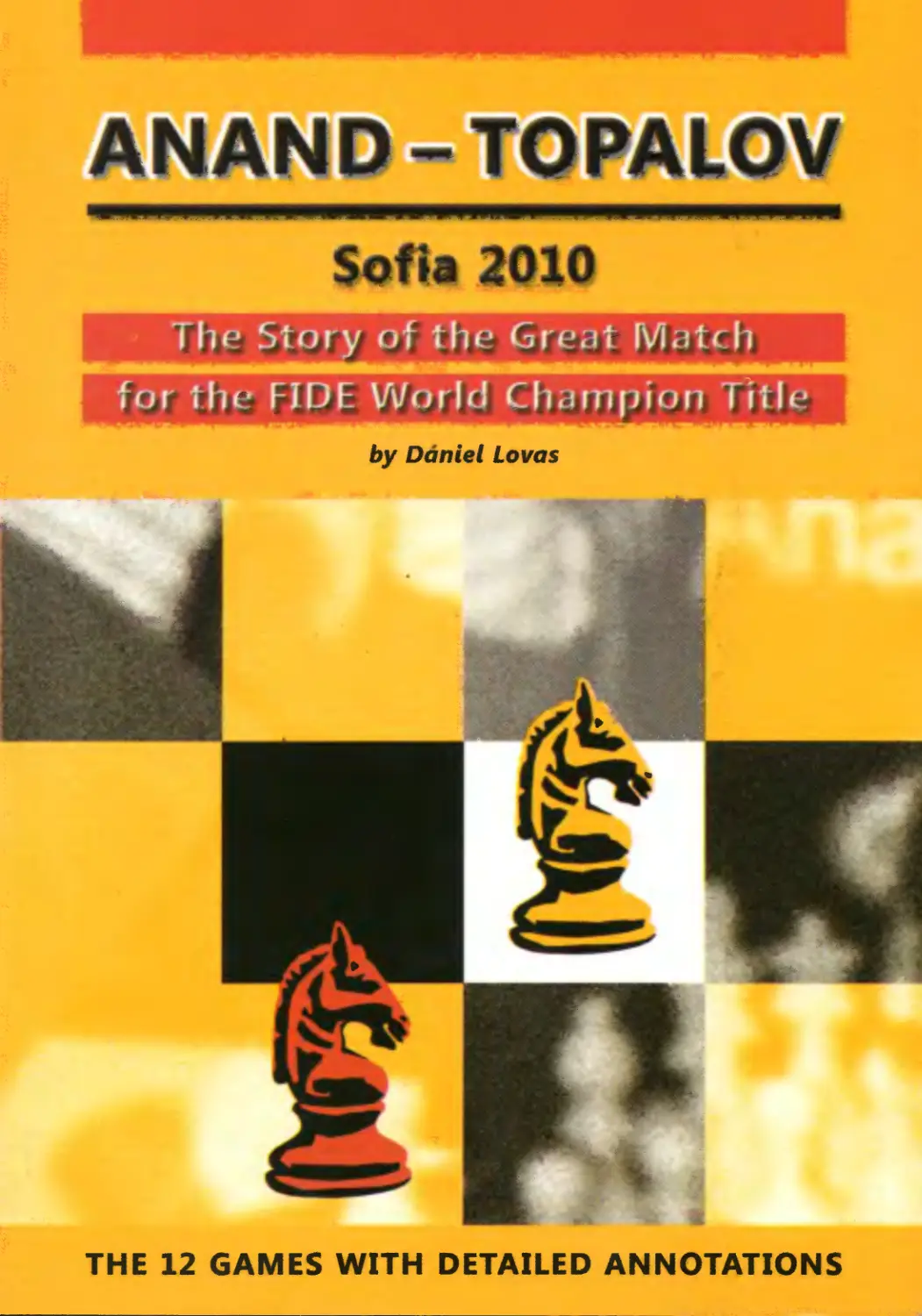
ANAND - TOPALOV
Sofia 2010
by Daniel Lovas
The Story of the Great Match For
the FIDE World Champion Title
The 12 Games with
Detailed Annotations
decoArt
Books
Prologue
5
Prologue
In oui days, world chess title is shining in its old light. As a
result of decade-long debate, the International Chess Federa-
tion has at last succeeded in forming a tournament system
mobilizing the best chess players of the world. Furthermore, a
number of brilliant young talents have appeared, whose un-
concealed aim is to win over the chess throne.
These circumstances were also instrumental in that the
final organized in Sofia between Indian title-holder Viswa-
nathan Anand and Veselin Topalov of Bulgaria, world chart
leader for a 19n9 time, excited world-wide interest. The two
contestants of outstanding knowledge did not cause disap-
pointment. The 12-game match brought a glowing but sports-
manlike fight and clashes of a high standard.
It is presumably well-known to every reader that Anand
won 6 : S , thus defending his world title. But to the final
an adventurous path was leading. On the next pages I am
going to make an attempt at recalling the story of the match
as attractively as possible, first of all for those who could not
follow the events in a minute-by-minute live broadcast.
The final in Sofia abounded in dramatic turns. Even the
start was disturbed by an unexpected event. Owing to the
Icelandic volcano eruption, Anand and his team could only
get to Sofia with an adventurous travel. In the opening match
played with a one-day delay because of this, Topalov won
with a spectacular knight sacrifice. But Anand was quick in
6
Prologue
taking his revenge, and, showing great moral strength, he
stood up to the repeated assaults of his opponent till the end
of the match.
The match was made even more interesting by the peculiar
situation arisen around the draws. Anand did not accept that
they should play according to the Sofia Rule, forbidding draw
offers, but Topalov had declared before the match that he uni-
laterally considered it binding on him and he would not offer
or accept a draw in any circumstances. So that every game
brought a long and lively battle. Though there were draws, all
of them resulted in thoroughly played positions, after mutual
repetition of moves.
Who can bear the unusual mental and physical strain bet-
ter? - chess lovers from allover the world asked, since the
decision remained to be made in the last round. And the cli-
max of the match brought another dramatic turn. Owing to
the enormous pressure of the home environment craving for
win, Topalov - just like a kamikaze fighter - staked every-
thing on one card. However, Anand refuted his risky plan
with a spectacular counterattack.
To assist the better understanding of the memorable 12th
game, detailed annotations are enclosed, which, in addition to
the analysis of the variations, also touch on the role tourna-
ment tactical and moral factors played in the forming of the
result.
Daniel Lovas
The Career of Anand
7
The Career of Anand
The fifteenth world champion - the first Asian - of modern
chess, Viswanathan (Vishy) Anand marks the beginning of
another era in the history of the royal game. His person is
symbolic: it expresses that chess sport, the centre of which was
for a long time in Western Europe and Russia, became uni-
versal in our age. Anand was born where chess itself originates
from. Chaturanga, the ancient chess took shape in India some-
time round the fifth century. One and a half millennium later,
on 11 th December 1969, a boy-child was born in the town of
Chennai (the former Madras), of which he is now the best
known son. Anand is not a lonesome knight of chess. The love
and support of a rising, continent-sized country is behind him.
In India, as early as 2000, when winning the FIDE title, he was
already regarded as a world champion of full value. And since
winning the reunified title of World Chess Champion in 2007
he is a celebrated national hero. In the vast country he is
looked upon as the greatest Indian sportsman. In addition to
his individual talent, it is this historic and cultural background
that accounts for the persistent ambition of the likeable Indian
chess player, which, as a result, enabled him to get to the
peak of the chess world at the age of 37 years.
He learned to play chess at age six from his mother. His
extraordinary gifts are indicated by the fact that already in his
8
The Career of Anand
childhood he played at an unusually quick rate - and yet with
few mistakes and effectively. As the result of his rapid manner
of play, the nickname "lightning-handed Vi shy)) was stuck to
him in the chess world, but with regard to his native land, in
the international press he is often called "the Tiger from Mad-
"
ras , too.
In his native land he swiftly rose among the best, and in
1987 he earned the title of World Junior Champion - the first
Asian to do so. He was the first Indian Chess player to be
awarded the title of international grandmaster. It was two
years later, at the age of 19, that he became connected with
the fight for the adult world title. He qualified as equal third
from the Manila Interzonal World Championship final. In his
first world champion candidates' match he won against
Aleksei Dreev, but among the best eight he lost to Anatoly
Karpov.
He achieved his first, really sensational tournament win in
1992 in Reggio Emilia, where he won defeating both Kasparov
and Karpov. By this time, his style characterized by a dynam-
ic conduct of play containing a lot of combinative elements
has taken shape. It is not for nothing that he is considered to
be one of the greatest experts of open games. His play is var-
iegated, never boring, and his games - just like his whole per-
sonality - radiate the love of chess. He competes a lot and does
not lose heart when doing not so well. With his modest, like-
able manners he is one of the most attractive figures of the
international chess elite.
He competed in both branches in the parallel world cham-
pionship cycle of 1993-95. Although in the FIDE tournament
he was eliminated by Gata Kamsky of USA, in the title-gain-
The Career of Anand
9
ing contests of PCA (Professional Chess Assocoation) he got
almost as far as the peak. In 1995 in New York he could match
his strength with Kasparov for the PCA world title. In the
middle of their match he took the lead, but in a brilliant game
Kasparov equalized and finally defended his title. But defeat
did not discourage Vishy, and in the following years he
repeatedly went to war to gain the world title.
In the knockout system world championship of FIDE
organized in Groningen in 1998 he qualified for the final by
defeating his six opponents, including Michael Adams. Then,
after a score of 3:3 with Anatoly Karpov, he was beaten by
him only in the rapid game playoff. It may have been some
compensation to him that for his first book, My Best Games of
Chess, he was given "The Best Book of the Year)) award by the
British Chess Federation.
In 2000 his efforts were at last crowned with success. He
won the World Cup, and in the FIDE World Championship in
New Delhi he could defeat Adams a second time, too. Then
came the final in Teheran, and by defeating Aleksei Shirov of
Spain he became FIDE World Chess Champion.
But then the era of Kasparov's reign still lasted, therefore
Anand - except for the Indians - was not really looked upon
as the number one player of the world. And one year later he
did actually lose his title, having been defeated in Moscow
already in the semi-final by Vassily Ivanchuk of Ukraine,
ahead of whom he had won the Junior World Championship.
This fiasco was followed by a one and a half year long trough.
But once he got over this, he started soaring again, winning
one super-tournament after the other: in Wijk aan Zee, Dort-
mund, Linares, Monaco, and Mainz. Chess specialists, too,
10
The Career of Anand
have appreciated his successes: after 1997 and 1998, two times
again, in 2003 and 2004, they selected him The Best of the
Year. So far he was four times awarded the Chess Oscar.
It is well-known that the Indian grandmaster is a specialist
of rapid tournaments. In short games he is almost undefeat-
able, and this is what brought him his second world title.
FIDE organized the first rapid world championship final in
2003 in Cap d'Adge with 25-minute games and an additional
10 seconds after each move, which was won by Anand by
beating Kramnik in the final. So Lightning-Handed Vishy has
won the title World Rapid Chess Champion - the first to do so
in the world.
In 2004, he won the historic super-tournament "Corus)) in
Holland for the fourth time. With this win Anand entered the
elite league of players that have won the Corus four times: for-
mer World Champion Max Euwe, Lajos Portisch and Viktor
Korchnoi. This year brought him several great successes. He
also came first in the Dortmund super-tournament, and then,
in rapid chess, he won for the fourth time the very strong
event in Mainz and, for the fifth time, the tournament in
Corsica. In the Calvia Olympiad, as captain of the team, he led
the Indians to a historic sixth place.
In 2005, he was also one of the favourites in the World
Championship Final in Argentina, but then, after an unex-
pected loss, he failed to catch up with Topalov playing at the
top of his form, so at length he finished equal second.
It was in April 2006 that his Elo rating broke the 2800
mark, and from April 2007 he has been holding the number
one spot in the world ranking list. This is an extraordinary
achievement, specially as he is an extremely active com-
The Career of Anand
11
petitor, and the many tournaments following one another
involve the risk of weaker performances. But Anand is a real
chess player who fears neither failure nor the burden of being
a favourite.
However, he could only become the most active super-
grandmaster of the past two decades by sharing his time
between India and the world's chess centre, Europe. He set-
tled down with his wife Aruna in Collado Mediano, a small
Spanish town near Madrid. Yet he is in a close, daily, contact
with his homeland, where he is extremely popular.
Anand is said to have revolutionized Indian chess life. His
performance was recognized with the highest Indian sport
and civilian awards. His English-language Indian home page is:
tnq .in/vish wa. h tml
To the 2007 World Championship final held in Mexico he
came with prospects of victory, too, but besides him the field
included the active world champion Kramnik and six more -
almost invincible - supergrandmasters. This time Anand has
realized Kasparov's prophecy, who held him the number one
favourite. He was better prepared than his rivals, and worked
out a number of new opening variations with his Danish sec-
ond, Peter Heine Nielsen. He managed to remain unbeaten,
though Kramnik made him sweat, and in his game against
Grischuk he also had to fight for the draw. But finally, with a
score of 9 out of 14 games, a full point clear of the field, he
won the tournament, gaining his third world title - this time
the reunified one - at the age of 37 years.
At the end of 2007, he still heads the world ranking list,
being the only one of the super-grandmasters to surpass the
magic 2800. "King Anand)), the first Asian World Chess
12
The Career of Anand
Champion meritedly wears the symbolic crown of the chess
king. But by now the rate has speeded up, the struggle among
the best is intensified. In 2008, according to the rules, Anand
had to defend his throne against Kramnik in a return match.
After eleven games, Anand successfully defended his title by a
final score of 6 1 /2:4 1 /2
In the July 2010 FIDE rating list he was ranked third with
2800.
A Selection of Anand's Nicest Games
13
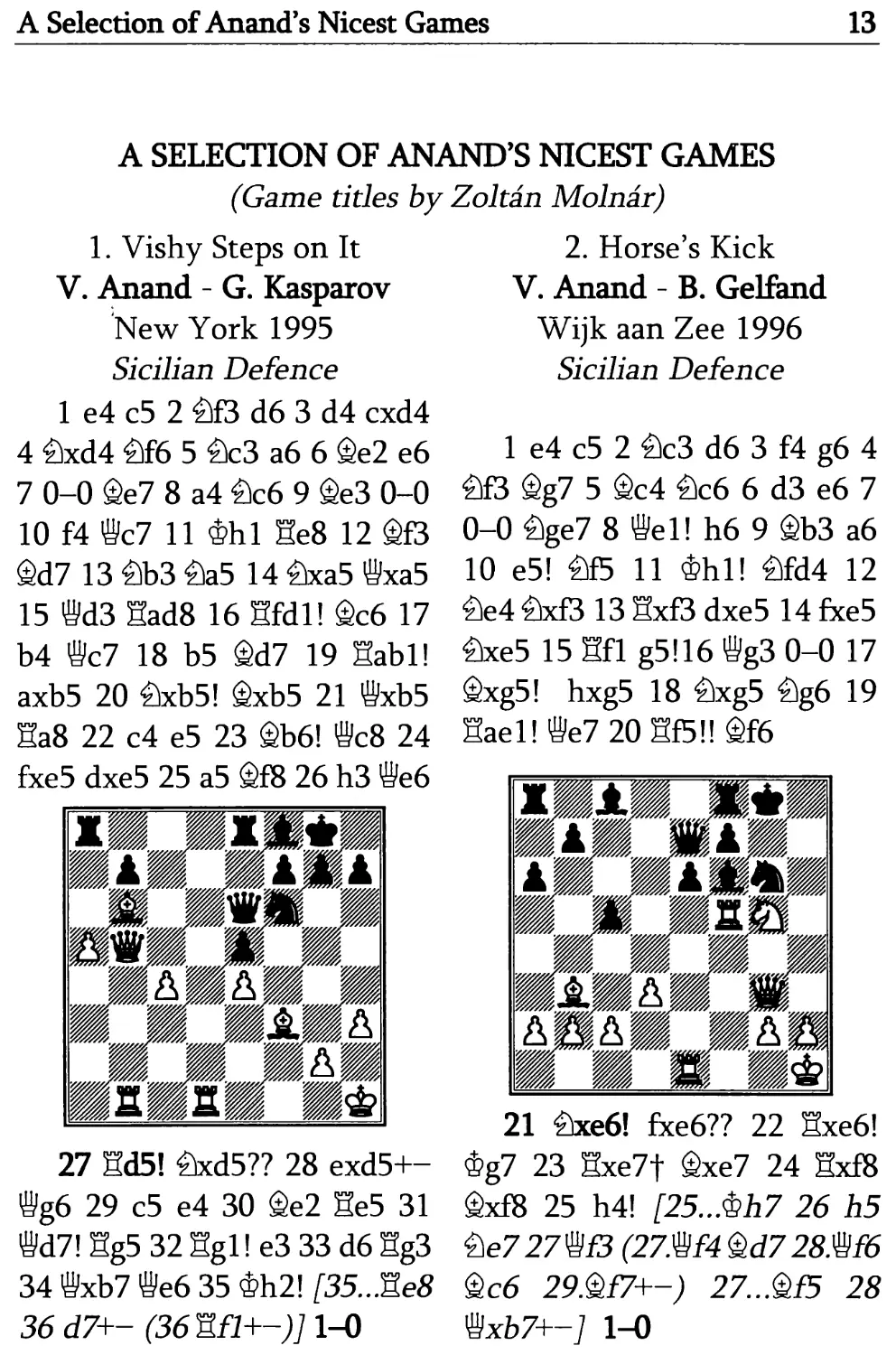
A SELECTION OF ANAND'S NICEST GAMES
(Game titles by Zoltan Molnar)
1. Vishy Steps on It
v. and - G. Kasparov
'New York 1995
Sicilian Defence
1 e4 c5 2 f1f3 d6 3 d4 cxd4
4 f1xd4 f1f6 5 f1c3 a6 6 e2 e6
7 0-0 e7 8 a4 f1c6 9 e3 0-0
10 f4 Wc7 11 whl ffe8 12 f3
d7 13 f1b3 f1a5 14 f1xa5 Wxa5
15 Wd3 ffad8 16 fffdl! c6 17
b4 Wc7 18 b5 d7 19 abl!
axb5 20 f1xb5! xb5 21 Wxb5
ffa8 22 c4 e5 23 b6! Wc8 24
fxe5 dxe5 25 as f8 26 h3 We6
27 ffd5! f1xd5?? 28 exd5+-
Wg6 29 c5 e4 30 e2 ffe5 31
Wd7! g5 32 gl! e3 33 d6 g3
34 Wxb7 We6 35 wh2! [35... e8
36 d7+- (36 fl+-)] 1-0
2. Horse's Kick
v. Anand - B. Gelfand
Wijk aan Zee 1996
Sicilian Defence
1 e4 c5 2 f1c3 d6 3 f4 g6 4
f1f3 g7 5 c4 f1c6 6 d3 e6 7
0-0 f1ge7 8 We I! h6 9 b3 a6
10 e5! f1f5 11 whl! f1fd4 12
f1e4 f1xf3 13 xf3 dxe5 14 fxe5
f1xe5 15 fffl g5!16 Wg3 0-0 17
xg5 ! hxg5 18 f1xgs f1g6 19
fJ.ae I! We 7 20 f5!! f6
14
A Selection of Anand's Nicest Games
3. Battering Ram
V. Anand - J. T imm an
Wijk aan Zee 2004
Sicilian Defence
1 e4 cs 2 f1f3 d6 3 d4 cxd4
4 f1xd4 f1f6 5 f1c3 f1c6 6 g5 e6
7 Wld2 a6 8 0-0-0 d7 9 f3 e7
10 e3 ffc8 11 g4 f1a5 12 wbl
b5 13 d3 f1c4 14 xc4 ffxc4
15 f1ce2 0-0 16 g5 f1e8 17 h4
Wc8 18 b3 ffc7 19 f1f4!? ffc3 20
ffdg1 b4 21 h5 f1c7 22 g6 f6
23 h6!? fxg6 24 hxg7 fff7
25 fJ.xh7! wxh7 26 Wh2t wxg7
27 f1xg6+- ffxe3 28 f1e7t wf8
29 f1xc8
1-0
4. Endlosung
S. Rublevsky - V. Anand
Bastia 2004
Scotch Opening
1 e4 e5 2 f)f3 f)c6 3 d4 exd4
4 f1xd4 cs 5 f1b3 b6 6 f1c3
f1f67 We2 0-0 8 g5 h6 9 h4
d6 10 f3 hxg5 11 hxg5 f1g4 12
fxg4 Wxg5 13 Wf3 xg4 14 Wg3
f1e5 15 e2 f5 16 exf5 Wlxf5 17
0-0-0 xe2 18 f1xe2 Wf2 19
Wh2 Wxe2 20 Wh8t wf7 21
ffdf1 t f2 22 Wh7
22...we6! 23 wb1 Wg4
0-1
A Selection of Anand's Nicest Games
15
5. Let us Be Sacrificers, But
Not Butchers
B. Macieja - V. Anand
Calvia 2004
Queen's Pawn Game
1 d4 f1f6 2 f1f3 e6 3 g5 h6
4 xf6 wxf6 5 e4 d5 6 f1bd2 g6
7 c3 g7 8 d3 0-0 9 0-0 f1d7
10 e5 we7 11 h4 c5 12 we2
cxd4 13 cxd4 d8 14 a3 f1f8 15
h5 d7 16 hxg6 f1xg6 17 g3 f5
18 exf6 wxf6 19 ae 1 f8 20
wg2 f7 21 wd 1 af8 22 wc2
22...f1f4tl 23 gxf4 Wxf4 24
gl xd4 25 wfl t wh8 26 e2
c8 27 Wbl f6 28 fJel e5 29
f1g2 h3 30 hl xg2t 31
wxg2 g7t 32 wfl gc7 33
b3 c1t! 34 f1xc1 xclt 35
wxcl wxcl t 36 ffel wf4 37
bl e4 38 a2 h4 39 ffe2 d4
0-1
6. Giving Black Short Shrift
V. Anand - R. Kasimdzhanov
Leon 2005
Sicilian Defence
1 e4 c5 2 f1f3 d6 3 d4 cxd4
4 fud4 f1f6 5 f1c3 a6 6 e3 e6
7 f3 b5 8 wd2 f1bd7 9 g4 h6 10
0-0-0 b7 11 h4 b4 12 f1a4
WaS 13 b3 f1c5 14 a3 c8 15
wxb4 Wc7 16 wbl f1fd7 17 f1b2
d5 18 Wd2 dxe4 19 f4 f1f6 20
e2 d5 21 c4 f1d7 22 g5
f1xe3 23 wxe3 d5 24 hfl
c5 25 Wc3 hxg5 26 fJf5 xc4
27 xg7t we7 28 xc4 ffhg8
29 hxg5 e3 30 f5 f1e5 31 fxe6
xg7
. ... .
.
.B B . .
. , " ,
..i. . .
"' -.
ii. . .
. . ..
. .:.:.
16
A Selection of Anand's Nicest Games
32 ffd7tl 4Jxd7 33 Wxg7
1-0
7. Stepping up the Pressure
V. Anand - M. Adams
San Luis 2005
Ruy Lopez
1 e4 e5 2 4Jf3 4Jc6 3 b5 a6
4 a4 fJf6 5 0-0 e7 6 ffel bs
7 b3 d6 8 c3 0-0 9 h3 b 7 10
d4 ffe8 11 f1bd2 ffi 12 a4 h6
13 c2 exd4 14 cxd4 4Jb4 15
bl cs 16 ds 4Jd7 17 ffa3 c4
18 axb5 axbs 19 4Jd4 Wb6 20
4Jf5 fJes 21 ffg3 g6 22 4Jf3
fJed3 23 Wd2 xds 24 4Jxh6t
xh6 25 Wxh6 Wxf2t 26 wh2
4Jxe 1
27 4Jh41 4Jed3 28 4Jxg6
Wxg3t 29 wxg3 fxg6 30 Wxg6t
wffi 31 Wf6t wg8 32 h6 1-0
8. V olodya's Dark Day
V. Anand - V. Kramnik
Sofia 2005
Petroff Defence
1 e4 e5 2 4Jf3 4Jf6 3 fue5 d6
44Jf3 4Jxe4 5 d4 ds 6 d3 fJc6
7 0-0 e7 8 c4 4Jb4 9 e2 0-0
10 fJc3 f5 11 a3 4Jxc3 12 bxc3
fJc6 13 ffe 1 ffe8 14 cxds Wxds
15 f4 ffac8 16 Wcl fJa5 17 c4
We4 18 d 1 Wd3 19 ffe3 Wxc4
20 ffe5!
1-0
A Selection of Anand's Nicest Games
17
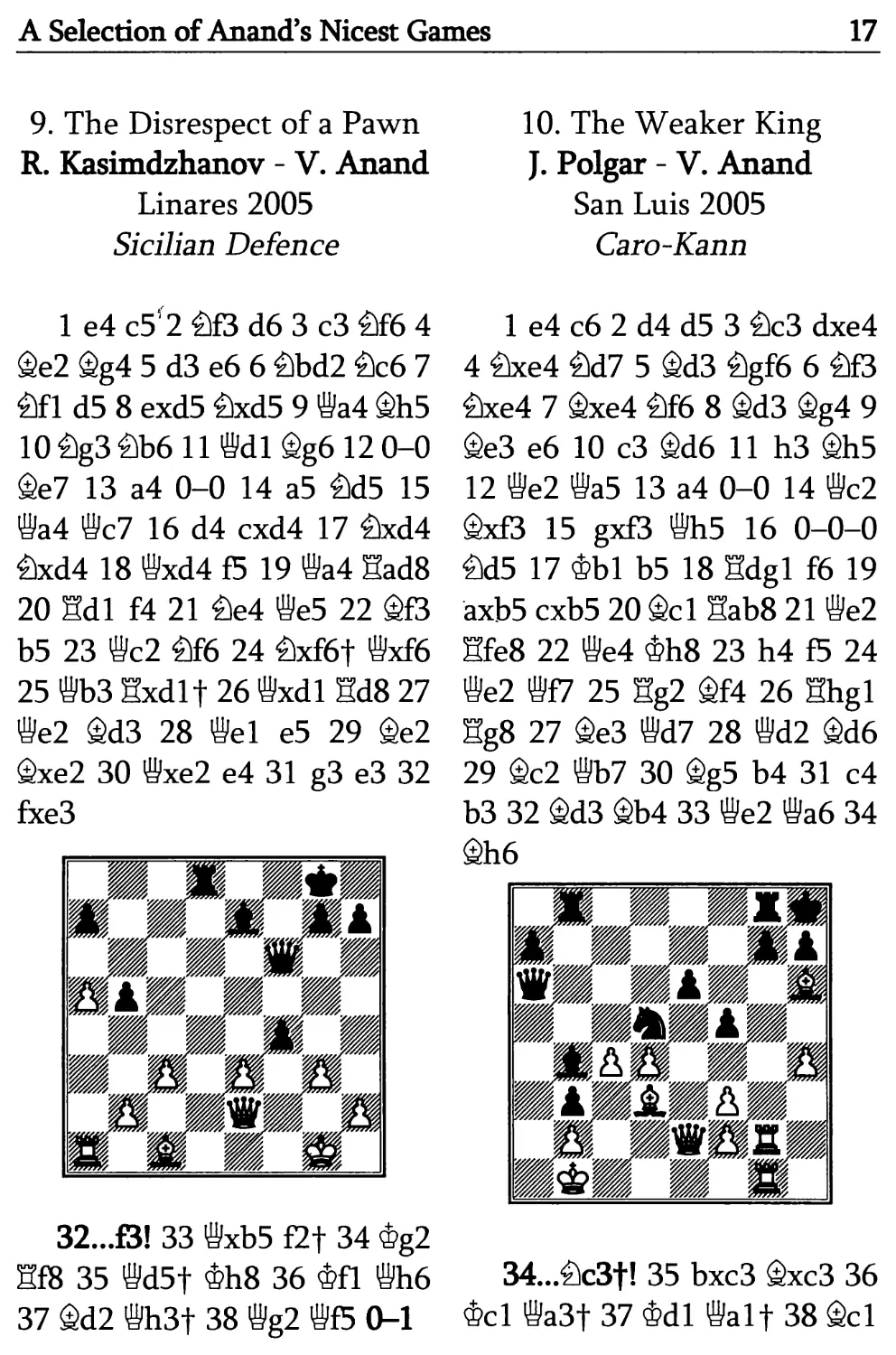
9. The Disrespect of a Pawn
R. Kasimdzhanov - V. Anand
Linares 2005
Sicilian Defence
1 e4 cs 1 2 f1f3 d6 3 c3 f1f6 4
e2 g4 5 d3 e6 6 f1bd2 fJc6 7
fJfl ds 8 exds f1xds 9 Wa4 h5
10 f1g3 f1b6 11 Wdl g6 12 0-0
e7 13 a4 0-0 14 as f1d5 15
Wa4 Wc7 16 d4 cxd4 17 f1xd4
f1xd4 18 Wxd4 f5 19 Wa4 ffad8
20 fJ.d 1 f4 21 f1e4 Wes 22 f3
bs 23 Wc2 fJf6 24 f1xf6t Wxf6
25 Wb3 ffxdl t 26 Wxdl ffd827
We2 d3 28 We 1 es 29 e2
xe2 30 Wxe2 e4 31 g3 e3 32
fxe3
32...£31 33 Wxb5 f2t 34 wg2
ffffi 35 Wdst wh8 36 wfl Wh6
37 d2 Wh3t 38 Wg2 Wf5 0-1
10. The Weaker King
J. Polgar - V. Anand
San Luis 2005
Caro- Kann
1 e4 c6 2 d4 ds 3 f1c3 dxe4
4 fue4 fJd7 5 d3 fJgf6 6 f1f3
f1xe4 7 xe4 f1f6 8 d3 g4 9
e3 e6 10 c3 d6 11 h3 h5
12 We2 WaS 13 a4 0-0 14 Wc2
xf3 15 gxf3 Whs 16 0-0-0
f1dS 17 wbl b5 18 ffdgl f6 19
"axb5 cxbs 20 cl fJ.ab8 21 We2
fffe8 22 We4 wh8 23 h4 f5 24
We2 Wf7 25 ffg2 f4 26 ffhgl
ffg8 27 e3 Wd7 28 Wd2 d6
29 c2 Wb7 30 gs b4 31 c4
b3 32 d3 b4 33 We2 Wa6 34
h6
34...f1c3tl 35 bxc3 xc3 36
Wcl Wa3t 37 wd1 Wal t 38 cl
18
b2 39 We3 xd4 40 Wd2
bxc1 Wt 41 Wxc1 Wa2
0-1
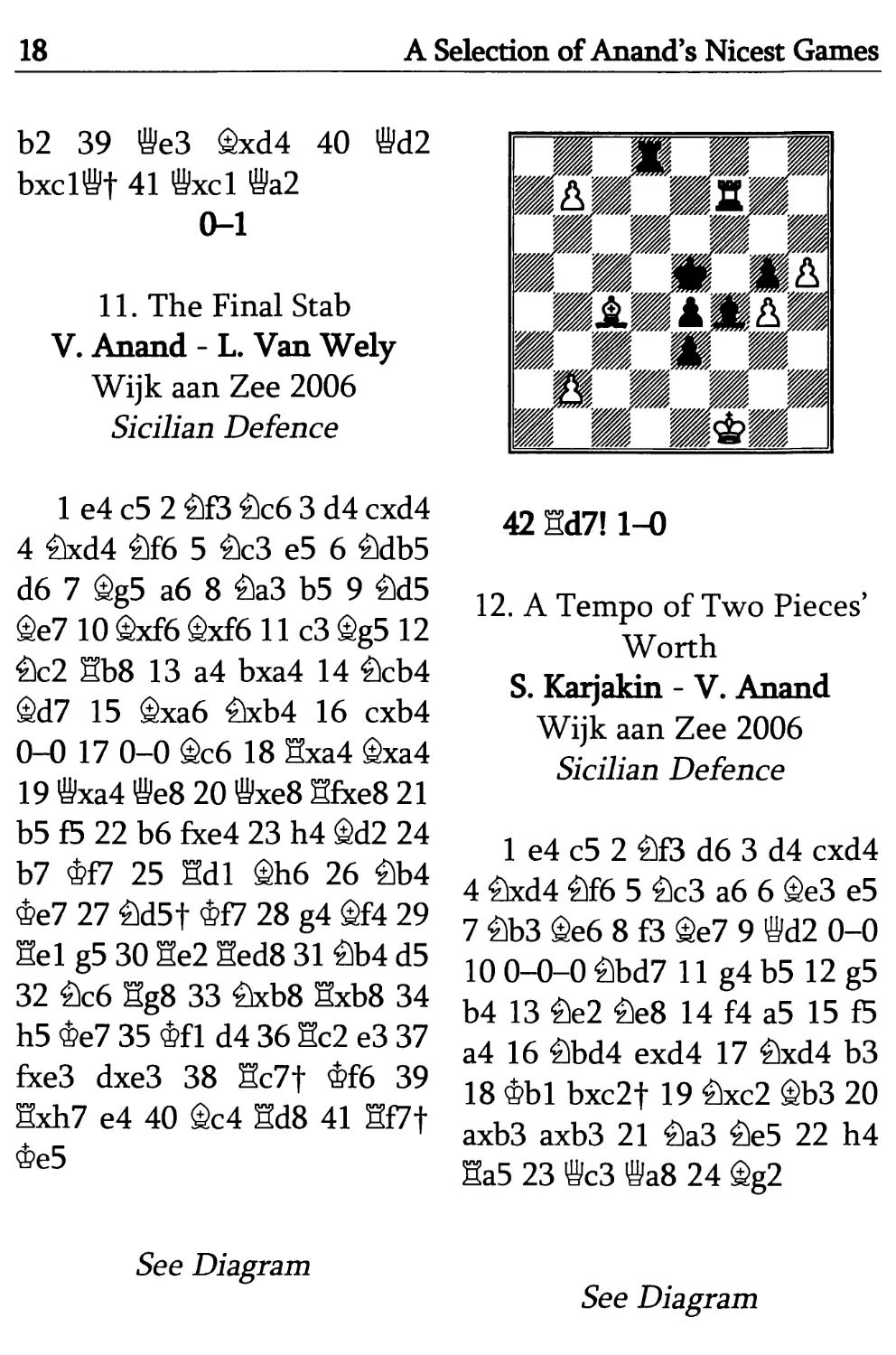
11. The Final Stab
V. Anand - L. Van Wely
Wijk aan Zee 2006
Sicilian Defence
1 e4 cs 2 fJf3 fJc6 3 d4 cxd4
4 fud4 fJf6 5 fJc3 es 6 fJdb5
d6 7 gs a6 8 fJa3 bs 9 fJds
e7 10 xf6 xf6 11 c3 gs 12
4Jc2 fJ.b8 13 a4 bxa4 14 fJcb4
d7 15 xa6 fub4 16 cxb4
0-0 17 0-0 c6 18 fJ.xa4 xa4
19 Wxa4 We8 20 Wxe8 fJ.fxe8 21
bs f5 22 b6 fxe4 23 h4 d2 24
b7 wf7 25 fJ.dl h6 26 fJb4
we7 27 fJdst wf7 28 g4 f4 29
fJ.e1 gs 30 fJ.e2 fJ.ed8 31 fJb4 ds
32 fJc6 g8 33 fub8 fJ.xb8 34
hs we7 35 wf1 d4 36 fJ.c2 e3 37
fxe3 dxe3 38 fJ.c7t wf6 39
fJ.xh7 e4 40 c4 fJ.d8 41 fJ.f7t
Wes
See Diagram
A Selection of Anand's Nicest Games
42 fJ.d7! 1-0
12. A Tempo of Two Pieces'
Worth
S. Karjakin - V. Anand
Wijk aan Zee 2006
Sicilian Defence
1 e4 cs 2 fJf3 d6 3 d4 cxd4
4 fud4 fJf6 5 fJc3 a6 6 e3 es
7 fJb3 e6 8 f3 e7 9 wd2 0-0
10 0-0-0 fJbd7 11 g4 bs 12 gs
b4 13 fJe2 fJe8 14 f4 as 15 f5
a4 16 fJbd4 exd4 17 fJxd4 b3
18 wb1 bxc2t 19 fJxc2 b3 20
axb3 axb3 21 fJa3 fJe5 22 h4
fJ.a5 23 wc3 was 24 g2
See Diagram
A Selection of Anand's Nicest Games
19
24...4Jc7! 25 Wxc7 fJ.c8 26
Wxe7 4Jc4 27 g6 hxg6 28 fxg6
xa3t 29 bxa3 fJ.xa3 30 gxf7t
wh7 31 f84Jt xf8 32 Wxf8
ffal t 33 wb2 fJ.a2t 34 wc3
WaSt 35 wd3 Wbst 36 wd4
ffa4t 37 wc3 Wc4t (37...Wc4t
38 wd2 fJ.a2t 39 wel We2#)
0-1
13. As Deep as the Sea
V. Topalov - V. Anand
Sofia 2006
Ruy Lopez
1 e4 es 2 4Jf3 4Jc6 3 bs a6
4 a4 4Jf6 5 0-0 e7 6 fJ.el bs
7 b3 0-0 8 h3 b7 9 d3 fJ.e8
10 c3 h6 11 f1bd2 f8 12 a3 d6
13 a2 4Jb8 14 b4 cs 15 4Jb3
c6 16 fJ.bl c8 17 e3 e6 18
Wc2 c8 19 Wb2 c4 20 dxc4
xc4 21 4Jbd2 xa2 22 Wxa2
ds 23 bd1 d4 24 cxd4 exd4
25 fJb3 fJxe4 26 xd4 fJxd4 27
xd4 4Jgs 28 4JeS
28...fJxh3t! 29 gxh3 Wgst
30 wh2 WfS 31 fJ.de4 fJ.xe5 32
fJ.xe5 d6 33 4JcS xest 34
wg2 c6 35 Wb3 fJ.g6t 36 wfl
g3!0-1
14. Elegant and Convincing
V. Anand - A. Morozevich
Mexico 2007
Sicilian Defence
1 e4 cs 2 4Jf3 d6 3 d4 cxd4
4 fud4 4Jf6 5 4Jc3 a6 6 f3 es 7
f1b3 e6 8 e3 f1bd7 9 g4 4Jb6
10 g5 4Jh5 11 Wd2 c8 12
20
A Selection of Anand's Nicest Games
0-0-0 {fie7 13 gl 0-0 14 wbl
Wc7 15 Wf2 f1c4 16 {fixc4 {fixc4
17 fJd5 {fixd5 18 xds f5 19
gxf6 fJ.xf6 20 We2 fJf4 21 {fixf4
fJ.xf4 22 fJ.d3 Wd7 23 f1c1 fJ.cffi
24 a3 wh8 25 f1a2 Wh3 26 fJ.g3
Wh5 27 Wg2 fJ.h4 28 h3 Wh6 29
fJ.b3 b5 30 f1b4 fJ.h5 31 Wf1
fJ.h4 32 Wg2 fJ.h5 33 fJxa6 {fih4
34 fJ.g4 {fif6 35 We2 fJ.xh3 36
fJ.xb5 {fid8 37 fJ.b8 Wf6 38 f1b4
fJ.xf3 39 fJd5 Wf7 40 Wa6 h5 41
fJ.g2 h4 42 Wxd6 {fie7 43 Wxe5
ffxb8 44 Wxb8t wh7 45 Wc7
{fif8 46 Wxf7 fJ.xf7 47 g4 fJ.f1 t
48 wa2 fJ.h 1 49 e5 {ficS 50 e6
wh6 51 fJ.c4 h3 52 ffxc5 h2 53
f1e3 ffalt 54 wxa1 h1Wt 55
wa2 We4
56 fJ.e5! 1-0
15. Curtains
V. Anand - V. Topalov
Leon 2007
Sicilian Defence
1 e4 c5 2 4Jf3 d6 3 d4 cxd4
4 fud4 fJf6 5 f1c3 a6 6 {fie3 e6
7 {fie2 f1bd7 8 0-0 b5 9 a4 b4
10 4Jc6 Wc7 11 fub4 d5 12
fua6 {fixa6 13 exd5 {fid6 14 h3
exd5 15 fud5 f1xd5 16 Wxd5
{fib7 17 Wc4 {fic6 18 b4 Wb7 19
fJ.ad1 {fie7 20 b5 {fixg2 21 fJ.xd7
wxd7 22 Wg4t we8 23 Wxg2
Wxg2t 24 wxg2 fJ.xa4 25 b6
ffa5 26 fJ.d1 {figS 27 b7 we7 28
{fib6 fJ.e5
29 d8t!
1-0
A Selection of Anand's Nicest Games
21
16. Attack a la Anand
v. Anand - M. Carlsen
Linares 2007
Ruy Lopez
1 e4 e5 2 f3 c6 3 b5 a6
4 a4 f6 5 0-0 e7 6 fJ.e1 b5
7 b3 d6 8 c3 0-0 9 h3 fJa5 10
c2 c5 11 d4 d7 12 d5 b6
13 bd2 g6 14 b4 cxb4 15
cxb4 ac4 16 fJxc4 xc4 17
b3 4Jb6 18 e3 d7 19 cl
c8 20 xc8 xc8 21 Wc2 d7
22 c 1 a8 23 Wd2 Wb8 24 g5
xgs 25 fug5 c8 26 f1 h6
27 f1e6! wh7 28 f4 Wa7t 29
wh2 e8 30 f5 gxf5 31 exf5 f6
32 fJ.e1 fJc7 33 c1 d7 34 ffc3
e4 35 fJ.g3 fJxe6 36 dxe6 e8
37 e7! h5 38 Wxd6 1-0
17. Simple But Winning
L. Aronian - V. Anand
Mexico 2007
Queen's Gambit
1 d4 f6 2 c4 e6 3 f3 d5 4
c3 c6 5 g5 h6 6 h4 dxc4 7
e4 g5 8 g3 b5 9 fJe5 h5 10 h4
g4 11 e2 b7 12 0-0 fJbd7 13
Wc2 xe5 14 xe5 g7 15
ad1 0-0 16 g3 d7 17 f3 c5
18 dxc5 We7 19 whl a6 20 a4
c6 21 f1d5 exd5 22 exd5 e5
23 f4 g7 24 dxc6 fJxc5 25
d5 fJe4 26 e1 We6 27 xh5
f5 28 wh2 ac8 29 b4 fJ.fe8
30 axb5 axb5 31 e 1
22
TheCMeerofTopalov
TheC eerofTopdov
Grandmaster Veselin Topalov was born in 1975 in Rusze,
Bulgaria. In the past decades he went through all the obstacle-
filled paths of becoming a professional Gompetitor, from jun-
ior championships to the super-tournaments. He reached the
summit of his career up till now in 2005, when in San Luis he
came first hands down in the World Championship Final
organised by FIDE, winning herewith the world title.
As so many future greats, he learned the fundamentals of
chess from his father at the age of eight. Soon he became a reg-
istered competitor and his knowledge was polished by skilled
trainers, and he kept stepping forward by degrees in the
national and, later, international age group championships. In
Puerto Rico in 1989 he won the 14-Year-Olds' World
Championship. One year later, in Singapore, he became silver
medalist among the 16-year-olds. By this time, it was obvious
that the student of the young Bulgarian competitor, 1M Silvio
Danailov, was one of the most talented members of the new
generation of chess players.
He won the title International Grandmaster in 1992, join-
ing therewith the elite of professional adult chess players. This
enabled him to participate in tournaments of the highest rank.
The Career of T opalov
23
And he did avail himself of this possibility. He travelled and
competed a lot, having ample opportunity to get to know the
best of the world.
At the 1994 Moscow Chess Olympiad, as first board of the
selected Bulgarian team, the 19-year-old grandmaster led his
comp triots to the fourth place. His first significant wins
against the leading players of the time derive from this period.
It was from the mid-1990s that he started his march towards
winning the world title.
Topalov took part in every knockout system world cham-
pionship. In 1998 in Groningen he was eliminated in round
two, in 1999 in Las Vegas he was beaten by Kramnik in the
rapid play-off, and a year later Adams stopped him. Then
came Moscow, where Shirov beat him, and in 2002 in
Dortmund the world championship semi-final was won by
Leko against him 2.5-1.5. But all these did not discourage
Topalov from getting to the top. In Tripoli in 2004 he did not
lose a single game until the semi-final. It was considered a sur-
prise that he lost to Kasimdzahov in the rapid play-off.
From the mid-1990s he rose to be one of the super-GMs,
but for a decade or so his competitor's career was uneven. In
our days the vanguard of the world is so well-balanced that in
addition to outstanding talent, a favourable coincidence of
several kinds of circumstances is also required to be first
among the excellent. For Topalov this period came after a
laborious decade, in 2005. It was in this year that he could win
for the first time against Kasparov in a classical tournament
game, in the last round of the Linares tournament. Not long
after this, Kasparov announced his intention to retire. His loss
to Topalov may also have played a part in this decision.
24
The Career of Topalov
In the eight-participant final, organised in San Luis in 2005,
took part all the world champion candidates who had earlier
been able to stop Topalov. But this time the Bulgarian grand-
master was unstoppable. Being all along in the lead, he won
the tournament hands down. He became world champion
quite deservedly - not only on the strength of his score, but
also in virtue of the level of his game and his engaging, elegant
competitor's conduct.
The international chess public opinion received it with
agreement that the Chess Oscar in 2005 was awarded to
Topalov. In addition to winning the world title, he came first
easily in the super-tournament in Sofia, getting ahead of
Anand by one point. It was then that he stated of himself: "[
am not afraid of losing, and that's what makes the difference
between me and the others. "
Indeed, the chess Topalov is playing is a modern one and is
of a typically 21 th century approach. He is well aware that
without taking risks you cannot succeed in an extremely
strong field. He bravely undertakes open game and often takes
chances. He plays unbiasedly in all stages of the game, and
makes the best of the possibilities presenting themselves with
a brilliant technique. He is not unbeatable, but is able to beat
anyone in today's leading group. Even after serious losses he
quickly finds his legs, playing the next game already with all
his strength. Similarly to the best of other sports, he is unbe-
lievably energetic, striving after success to the last moment in
every tournament. Super-GM Topalov stands for the truly
high-level, top-quality competitive chess.
The results of the past years proved that the 30-year-old
grandmaster of chess, living in Salamanca, Spain, has become
The Career of T opalov
25
fully ripe and got to the summit of his career. On the FIDE
rating list published in January of 2006 his rating was 2801,
becoming herewith the third player, after Kasparov (2851)
and Kramnik (2811), to surpass the magic 2800, and indicating
that his is an outstanding playing strength. By the way, on the
April 2006 list his rating rose to 2804.
Already on the day after his world championship victory,
Topalov proclaimed that he would not rest on his laurels, and
is ready to defend his title. In April, the president of the FIDE
officially announced that in September of 2006 it will be pos-
sible to play the title reunification match between the FIDE
World Champion and the holder of the classical world title,
i.e. between Topalov and Kramnik. It is surely going to be a
most interesting match if realised at all, yet it would make no
real difference: with his career up to now, Topalov has already
written his name in the golden book of chess. His original way
of thinking, his style, in which an enormous number of mate-
rial knowledge is combined with an immense playing
strength, makes his playa delightful experience.
It is worth learning from Topalov how to win with an ele-
gant and forceful play in our days when not only the grand-
masters are of outstanding playing strength, but at all levels
excellently prepared opponents sit on the other side of the
board.
In the July 2010 FIDE rating list he was ranked second with
2803 points.
26
A Selection of Topalov's Nicest Games
A SELECTION OF TOP ALOV'S NICEST GAMES
Game titles by Zoltan Molnar
1. A Model Deflection
V. Topalov - G. Kasparov
Moscow 1994
Sicilian Defence
1 e4 cs 2 4Jf3 d6 3 d4 cxd4
4 fud4 4Jf6 5 4Jc3 a6 6 e3 e6
7 g4 h6 8 f4 4Jc6 9 e2?! es! 10
4JfS g6 11 4Jg3 exf4 12 xf4
e6 13 fl c8 14 h3 Wb6?! 15
Wd2 g7 16 xd6 xg4? 17
xg4! Wxb2 18 e5?! f1xe5 19
bl Wxc3 20 Wxc3 ffxc3 21
xe6 fxe6 22 ffxb7 4Jc4 23 b4
e3t 24 4Je2 e5 25 ff7 xh3
I..al.
!...!.,
... ..
. + f. '...
. '... .l
!.!. ...
. .. . . ,. . .
.. .
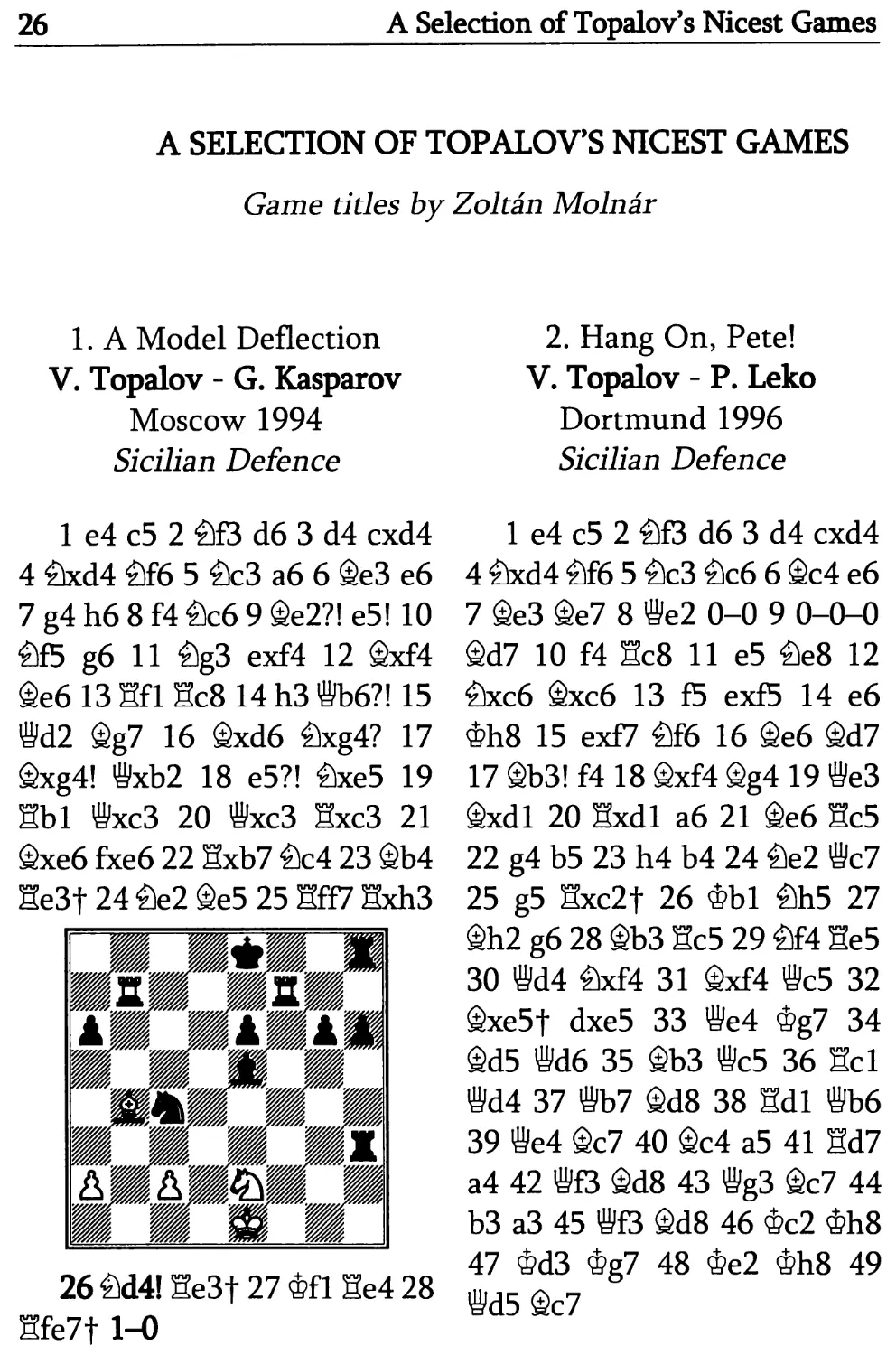
26 d41 e3t 27 wfl ffe4 28
fe7t 1-0
2. Hang On, Pete!
V. Topalov - P. Leko
Dortmund 1996
Sicilian Defence
1 e4 cs 2 4Jf3 d6 3 d4 cxd4
4 xd4 f6 5 4Jc3 c6 6 c4 e6
7 e3 e7 8 We2 0-0 9 0-0-0
d7 10 f4 c8 11 es e8 12
4Jxc6 xc6 13 fS exfS 14 e6
wh8 15 exf7 4Jf6 16 e6 d7
17 b3! f4 18 xf4 g4 19 We3
xd 1 20 ffxd 1 a6 21 e6 cs
22 g4 bs 23 h4 b4 24 e2 Wc7
25 g5 fJ.xc2t 26 wbl 4Jhs 27
h2 g6 28 b3 cs 29 4Jf4 es
30 Wd4 xf4 31 xf4 Wcs 32
xest dxes 33 We4 wg7 34
ds Wd6 35 b3 Wcs 36 c 1
Wd4 37 Wb7 d8 38 ffdl Wb6
39 We4 c7 40 c4 as 41 ffd7
a4 42 Wf3 d8 43 Wg3 c7 44
b3 a3 45 Wf3 d8 46 Wc2 wh8
47 wd3 wg7 48 We2 wh8 49
Wd5 c7
A Selection of Topalov's Nicest Games
27
50 d811 xd8 51 Wxe5t
f6 52 Wxf6t Wxf6 53 gxf6 hs
54 wf3 wh7 55 wf4 wh6 56 we5
gs 57 we6 ffb8 58 bs ffh8 59
we7 wg6 60 d3t
1-0
3. Hand-to-Hand Fight
B. Gelfand - V. Topalov
Linares 1997
King's Indian Defence
1 d4 f6 2 f3 g6 3 c4 g7
4 c3 0-0 5 e4 d6 6 e2 es 7
e3 exd 4 8 xd 4 ffe8 9 f3 c6
10 f2 ds 11 exds cxds 12 0-0
c6 13 cs hs 14 g3 h3 15
ffe1 Wgs 16 dbs ad8 17 d6
See Diagram
17... d411 18 Wc1 e3 19
xe3 xe3 20 wf2 d4 21 d1
ffxe2t 22 ffxe2 Wds 23 e4
es 24 Wgs ffe8 25 frd2 Wc4 26
dc3 h6 27 Wh4 dxc3 28 ffd8
cxb2 29 ffxe8t wg7 30 ffd1
Wc2t 31 ffd2 b1W 32 Wxh3
Wccl
0-1
4. A Vicious Horse
V. Ivanchuk - V. Topalov
Linares 1997
English Opening
1 f3 f6 2 c4 cs 3 c3 c6
4 e3 e6 5 d4 d5 6 a3 a6 7 dxcs
xcs 8 b4 a7 9 b2 0-0 10
d3 We7 11 0-0 frd8 12 We2
d7 13 ffac1 ffac8 14 cxds
exds 15 h3 h6 16 fffd1 e6 17
bs axbs 18 fubs b8 19 b1
28
A Selection of Topalov's Nicest Games
e4 20 a2 4Jgs 21 fd4 fud4
22 xd4 e4 23 a4 ffc6! 24
a7? ffdc8! 25 Wb2 Wh4 26
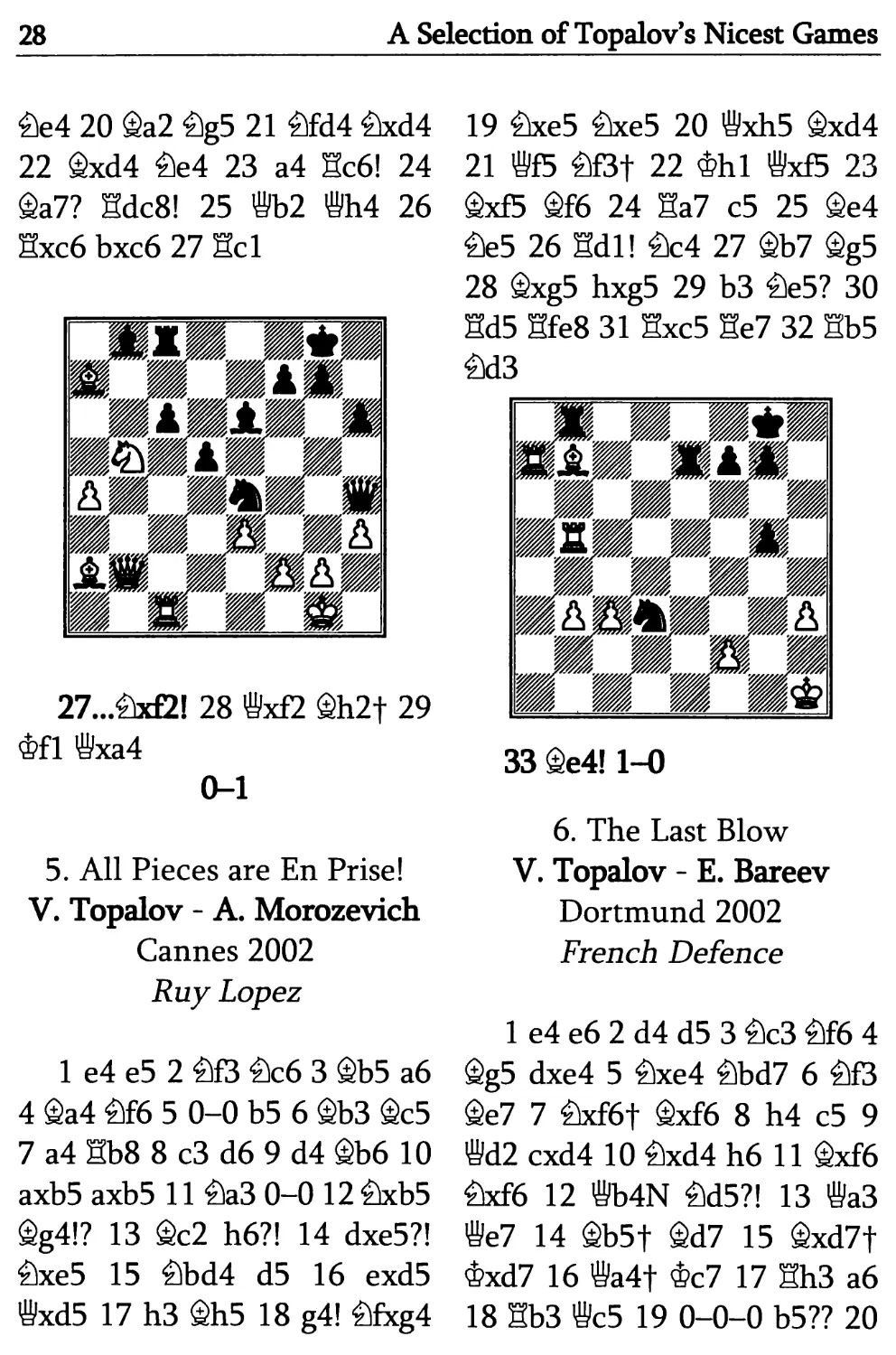
fJ.xc6 bxc6 27 fJ.c1
27...f)xf21 28 Wxf2 h2t 29
wf1 Wxa4
0-1
s. All Pieces are En Prise!
V. Topalov - A. Morozevich
Cannes 2002
Ruy Lopez
1 e4 es 2 f3 4Jc6 3 bs a6
4 a4 f6 5 0-0 bs 6 b3 cs
7 a4 b8 8 c3 d6 9 d4 b6 10
axbs axbs 11 a3 0-0 12 fubs
g4!? 13 c2 h6?! 14 dxes?!
xes 15 bd4 ds 16 exds
Wxds 17 h3 hs 18 g4! fxg4
19 fues fues 20 Wxhs xd4
21 WfS f3t 22 whl Wxf5 23
xf5 f6 24 ffa7 cs 25 e4
4Jes 26 ffd1! 4Jc4 27 b7 gs
28 xgs hxgs 29 b3 4Jes? 30
fJ.ds fffe8 31 xc5 ffe7 32 b5
4Jd3
33 e41 1-0
6. The Last Blow
V. Topalov - E. Bareev
Dortmund 2002
French Defence
1 e4 e6 2 d 4 ds 3 c3 f6 4
gs dxe4 5 xe4 bd7 6 f3
e7 7 fuf6t xf6 8 h4 cs 9
Wd2 cxd4 10 xd4 h6 11 xf6
6 12 Wb4N ds?! 13 Wa3
We7 14 bst d7 15 xd7t
wxd7 16 Wa4t wc7 17 ffh3 a6
18 ffb3 Wcs 19 0-0-0 bs?? 20
A Selection of Topalov's Nicest Games
29
WaSt Wb6?! 21 We I! wb7 22
We2 wa7 23 xbst! axbs 24
ffxbs Wc6
25 ffdxdSlI exds 26 We7t
wa6 27 frb3
1-0
7. Queen is an Awfully
Strong Piece
J. T imm an - V. Topalov
Wijk aan Zee 2003
Sicilian Defence
1 e4 cs 2 f3 c6 3 bs d6
4 d4 cxd4 5 Wxd4 d7 6 xc6
xc6 7 c3 f6 8 gs e6 9
0-0-0 (j2e7 10 he1 0-0 11
wb1 h6?! 12 h4 WaS 13 Wd2
Whs 14 h3 g5 15 g3 e5 16
Wd3 ad8 17 d2 ds 18 xes
dxe4 19 We3 ds 20 fuds
ffxds 21 d4?! f5 22 f3 fffd8
23 c3 xd4! 24 cxd4 f4 25
Wb3t ds 26 Wc2 e3 27 e4
Wf7 28 c3 e6 29 ds f5 30
f1e4 xd5 31 xd5 xds 32
ffd1 We6 33 wa1 hs 34 a3 wf7
35 Wa4 xe4?! 36 fxe4 f6 37
Wc2 Wc6 38 wbl g4 39 hxg4
hxg4 40 Wd3 We6 41 g3 f3 42
Wxe3 es 43 Wgs xg3 44
Wh5t wg7 45 Wgst wf7 46
Whst wg7 47 Wa1 f2 48 Wgst
wf7 49 Whst wg7 SO h1? es
51 Wh7t wf8 52 Wxb7 g3 53
ffc1
53...Wc411-+ 54 Wa8t we7
55 Wxa7t c7
0-1
30
A Selection of Topalov's Nicest Games
8. A Battering-Ram at Work
V. Topalov - S. Movsesian
Tripoli 2004
Sicilian Defence
1 e4 c5 2 f3 f1c6 3 d4 cxd4
4 fud4 Wc7 5 c3 e6 6 e3 a6
7 Wd2 f6 8 0-0-0 b4 9 f3
es 10 b3 b5 11 wb1 e7 12
Wf2 d6 13 b6! Wb8 14 d4
c6 15 e3 d7 16 g4 0-0 17
gs b4 18 a4 ces 19 ffg1 b7
20 as ffc8 21 b3! c6 22
xc6 f1xc6 23 f4 c5 24 f1xcS
dxc5 25 f5 f1eS 26 h3 exfS 27
exf5 !!e8 28 f4 d6
29 g6! hxg6 30 fxg6 ffa7 31
Wg2 c4 32 ffxd6! fud6 33
Wlds fJ.d8 34 gxf7t fJ.xf7 35 e6
Wb7 36 Wg5
1-0
9. Shattering Black's Hopes
V. Topalov - A. Shirov
Linares 2004
Ruy Lopez
1 e4 e5 2 f1f3 f1c6 3 b5 a6
4 a4 f1f6 5 0-0 e7 6 !!e1 bs
7 b3 d6 8 c3 0-0 9 h3 f1a5 10
c2 c5 11 d4 Wc7 12 d5!? f1c4
13 b3 f1b6 14 a4 d7 15 as c8
16 c4 g6 17 c3 f1hS 18 e2
ffe8 19 !!a2 f8 20 g4! g7 21
g3 f6 22 h2! !!e7 23 h4 fff7
24 f4 exf4 25 xf4 Wd8 26 fffl
We7 27 hs fJe8 28 d3! g7 29
wg2 Wf8 30 Wc 1 bxc4 31 bxc4
ffb8 32 ffaf2 fJ.b3 33 fff3 e7
34 d2 c8 35 Wc2 ffb8 36
wh1 gxh5 37 f1xh5 g6
38 e511 dxes 39 xg6 hxg6
40 Wxg6 e4 41 !!h3 fJ.fb7 42
A Selection of Topalov's Nicest Games
31
fJf4 frb1 43 Wlh7t wf7 44 Wlhst
wg8 45 fJg6 1-0
10. Fortune Favours the
Brave
A. Kh lov - V. Topalov
Tripoli 2004
Bishop's Opening
1 e4 es 2 c4 f1f6 3 d3 c6 4
fJf3 rJie7 5 0-0 d6 6 a4 0-0 7
fre1 f1bd7 8 f1c3 fJcs 9 d4 exd4
10 f1xd4 as 11 rJif4 f1g4 12 e2
fJf6 13 rJif3 fre8 14 Wld2 g6 15
h3 f1fd7 16 frad1 f8 17 g4!?
Wlb6 18 g2 f1es 19 b3 Wb4 20
fJde2 f6 21 e3 hs 22 f4 fug4!
23 hxg4 rJixg4 24 Wlc1 f5 25
frd4 Wlb6 26 Wld2 Wlc7 27 f2
e6 28 !!c4 ae8 29 f1d4
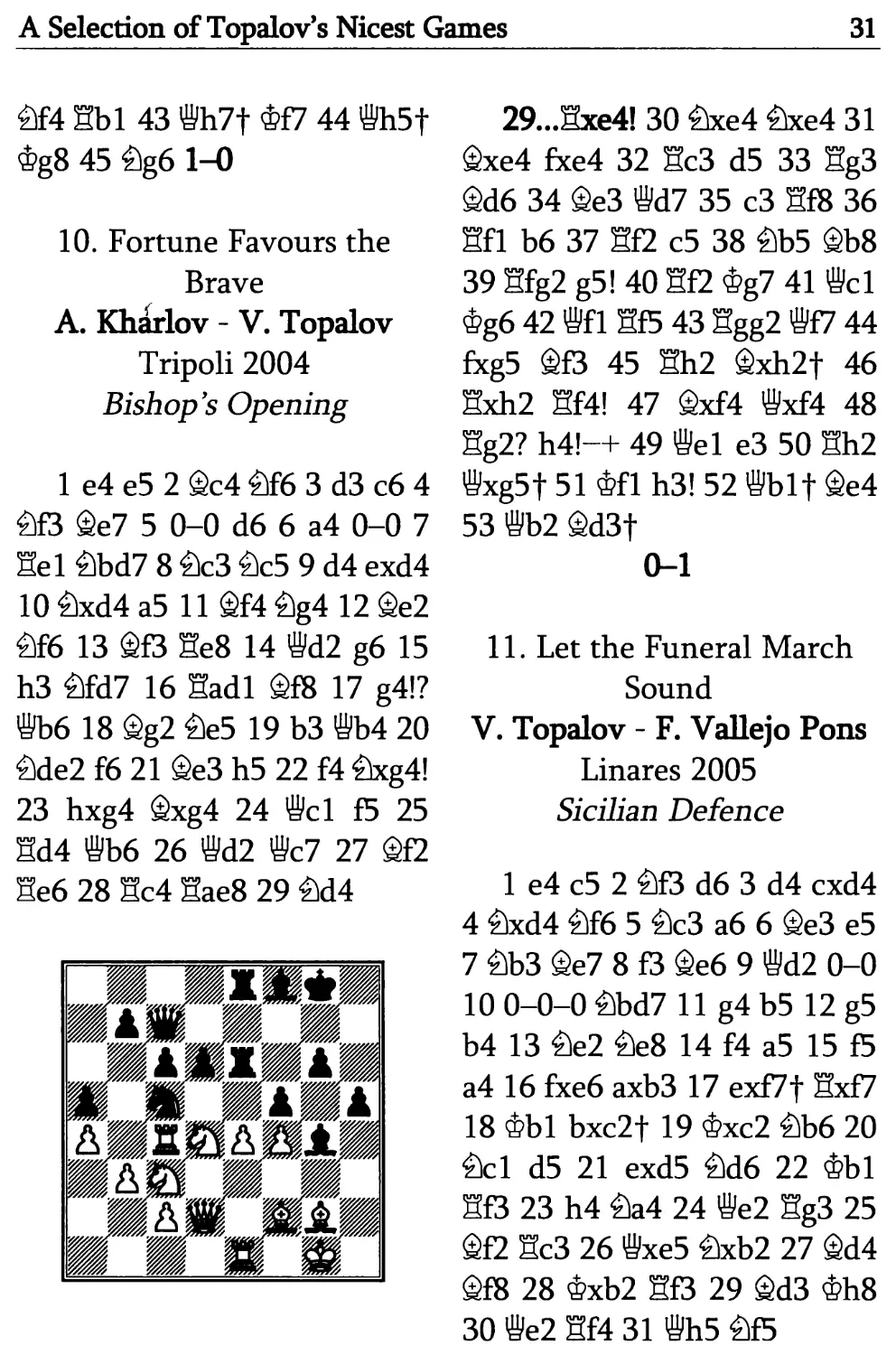
29...!he41 30 fue4 fue4 31
rJixe4 fxe4 32 frc3 ds 33 frg3
d6 34 e3 Wld7 35 c3 f8 36
frf1 b6 37 frf2 cs 38 fJbs b8
39 frfg2 gs! 40 frf2 wg7 41 Wlc1
wg6 42 Wlf1 f5 43 frgg2 Wlf7 44
fxgs rJif3 45 frh2 rJixh2t 46
frxh2 frf4! 47 xf4 Wlxf4 48
frg2? h4!-+ 49 Wle1 e3 SO !!h2
Wlxgst 51 wf1 h3! 52 Wlb 1 t rJie4
53 Wlb2 d3t
0-1
11. Let the Funeral March
Sound
V. Topalov - F. Vallejo Pons
Linares 2005
Sicilian Defence
1 e4 cs 2 f1f3 d6 3 d4 cxd4
4 f1xd4 f1f6 5 f1c3 a6 6 e3 es
7 f1b3 e7 8 f3 rJie6 9 Wd2 0-0
10 0-0-0 f1bd7 11 g4 bs 12 gs
b4 13 f1e2 f1e8 14 f4 as 15 f5
a4 16 fxe6 axb3 17 exf7t frxf7
18 wb1 bxc2t 19 wxc2 f1b6 20
f1c1 ds 21 exds f1d6 22 wb1
!!f3 23 h4 f1a4 24 Wle2 frg3 25
rJif2 !!c3 26 Wxes xb2 27 rJid4
f8 28 Wxb2 frf3 29 d3 wh8
30 Wle2 frf4 31 Wlhs f1f5
32
A Selection of Topalov's Nicest Games
32 g6! 1-{)
12. Neglected Development
V. Topalov - A. Naiditsch
Dortmund 2005
Queen's Gambit
1 4Jf3 fJf6 2 c4 e6 3 4Jc3 ds
4 d4 dxc4 5 e4 b4 6 gs cs 7
es cxd4 8 fud4 xc3t 9 bxc3
WaS 10 exf6 Wxgs 11 fxg7
Wxg7 12 Wd2 0-0 13 xc4 a6
14 0-0 d8 15 f4 bs 16 c7
Wffi 17 d3 d7 18 Wf4 b719
ae1 Wg7 20 e4 wh8 21 e3
xe4 22 Wxe4 ds
See Diagram
23 fue6 fxe6 24 xe6 d7
25 g3 Wffi 26 e 1 aa7 27
Wf6t
13. Sacrificial Fireworks
V. Topalov - R. Ponomariov
Sofia 2005
Queen's Indian Defence
1 d4 fJf6 2 c4 e6 3 fJf3 b6 4
g3 a6 5 b3 b4t 6 d2 e7 7
fJc3 0-0 8 c1 c69 e4 ds 10 es
fJe4 11 d3 fuc3 12 xc3 cs
13 dxcs bxcs 14 h4 h6 15 b1
f5 16 exf6 xf6 17 Wc2 d4
A Selection of Topalov's Nicest Games
33
18 fJg5! hxgs 19 hxgs dxc3
20 f4 wf7 21 Wg6t we7 22
gxf6t frxf6 23 Wxg7t frf7 24
gst wd6 25 Wxf7 Wxgs 26
h7 WeSt 27 wf1 wc6 28 We8t
wb6 29 Wd8t wc6 30 e4t
1-{)
14. A Staggering Blow
V. Topalov - M. Adams
San Luis (Wch) 2005
English Opening
1 fJf3 fJf6 2 c4 e6 3 fJc3 cs
4 g3 b6 5 g2 b7 6 0-0 e7 7
e1 fJe4 8 d4 fuc3 9 bxc3 e4
10 fl d6 11 h4 d7 12 ds 0-0
13 a4 h6 14 h3 exds 15 cxds
f6 16 fra3 bs 17 axbs fJb6 18
c4 xf3 19 frxf3 fuc4 20 Wa4
es 21 fra3 fre8 22 hs fre7 23
f4 frb8 24 f5 We8 25 c2
d7 26 We4 fJg6 27 Wd3 c4 28
xc4 fuf4 29 Wxf4 es 30 Wf3
h3 31 frxa7 xhs 32 e3 Wh2t
33 wfl Wh3t 34 we2 fres 35
c7 frc8
See Diagram
36 f5!! frxf5 37 xc8t wh7
38 frh 1
1-{)
15. With Knights for a Better
Future
L. Brnzon - V. Topalov
Wijk aan Zee 2005
Sicilian Defence
1 e4 cs 2 fJf3 e6 3 d3 fJc6 4
g3 g6 5 g2 g7 6 c3 fJge7 7
0-0 0-0 8 frel es 9 4Ja3 d6 10
e3 b6 11 Wd2 g4 12 h3 xf3
13 xf3 Wd7 14 g2 f5 15 exf5
gxf5 16 f4 frad8 17 fre2 We6 18
Wc2 Wg6 19 wh2 wh8 20 Wa4
ds 21 fxes xes 22 f4 Wf6 23
xes fJxes 24 d4 fJsg6 25
dxcs bxcs 26 f1
34
A Selection of Topalov's Nicest Games
26...£4! 27 gxf4 fJf5 28 Wlxa7
Wh4 29 Wxcs M4 30 fJ.d2
fuh3 31 Wlc7 fJ.d6 32 fJc2 Wg3t
33 wh1 fJ.h60-1
16. Rope for Lowering the
Coffin
V. Kramnik - V. Topalov
Wijk aan Zee 2005
Sicilian Defence
1 e4 cs 2 4Jf3 d6 3 d4 cxd4
4 fud4 4Jf6 5 fJc3 a6 6 e3 e6
7 f3 bs 8 g4 h6 9 Wd2 b4 10
4Ja4 4Jbd7 11 0-0-0 4Jes 12
xb4 d7 13 fJb3 b8 14 Wa3
15 h3 fue4 16 e2 es
17 hel Wc7 18 d4 fJc6 19
c3 ds 20 4JbcS 20... Wa7!
0-1
17. Shock Treatment
P.S iller-V.Topalov
San Luis (W ch) 2005
Sicilian Defence
1 e4 cs 2 4Jf3 d6 3 d4 cxd4
4 fud4 4Jf6 5 4Jc3 a6 6 e3 4Jg4
7 gs h6 8 h4 gs 9 g3 g7
10 h3 fJes 11 fJf5 xf5 12 exf5
4Jbc6 13 4Jds e6 14 4Je3 Wlast
15 c3
15...ffit 16 Wlxf3 xc3t 17
wd1 Wla4t 18 4Jc2 xb2 19 fxe6
fxe6 20 Wb3 xb3 21 axb3
xa1 22 4Jxa1 we7 23 d3
fJ.ac8 24 fJ.e 1 4Jd4 25 f3 c3 26
wd2 hc8 27 b 1 3cs 28 b4
fJ.ds 29 f2 wd 7 30 e3 4Jf5 31
f2 31...4Jh4! 32 xh4 gxh4 33
4Jc2 hs 34 e 1 fJ.g8 35 wc3 as
36 c4 fJ.c8 37 4Je3 bs 38 wd3
A Selection of Topalov's Nicest Games
35
T(xb4 39 xe6t wxe6 40 fJc2t
',I;ds 41 fJxb4t axb4 42 fre7 bs
l 3 h7 frc3t 44 wd2 frc4
0-1
18. Out, Damned Spot!
V. Topalov - L. Aronian
Wijk aan Zee 2006
Queen's Indian Defence
1 d4 fJf6 2 c4 e6 3 fJf3 b6 4
g3 a6 5 b3 b4t 6 d2 e7 7
g2 c6 8 c3 ds 9 fJes fJfd7 10
,:"lxd7 fJxd7 11 fJd2 0-0 12 0-0
':!'lf6 13 e4 bs 14 exds exds 15
ne 1 fJ.b8 16 cs c8 17 fJf3 fJe4
18 fuce4! dxe4 19 fJes ds
20 We1 f5 21 g4 g6 22 f3 b4
23 fxe4 e6 24 b2 f6 25
fuc6 Wxc6 26 es Wa6 27 exf6
fJ.fe8 28 f1 We2 29 f2 xg4
30 h3 gs 31 c1 hs 32 f4
frbd8 33 c6 e4 34 c7 c8 35
fre1 g6 36 xe4 xe4 37 ds
frce8 38 d6 frel t 39 wh2 fS
40 Wg3 g6 41 Wgs xgs 42
xgs fJ.d1 43 c6 2t 44 wg3
1-0
19. An Eye-Filling Kerfuffle
S. Kariakin - V. Topalov
Wijk aan Zee 2006
Sicilian Defence
1 e4 cs 2 fJf3 fJc6 3 d4 cxd4
4 fJxd4 fJf6 5 fJc3 es 6 fJdbs
d6 7 gs a6 8 fJa3 bs 9 fJds
e7 10 xf6 xf6 11 c3 gs 12
c2 0-0 13 a4 bxa4 14 frxa4 as
15 c4 frb8 16 a2 wh8 17
fJce3 xe3 18 fue3 fJe 7 19 b3
fS 20 exf5 fufS 21 ds b7 22
0-0 frc8 23 Wld3 fJh4 24 frd1
h6 25 g3 fJfS 26 g4 cs 27
frad2 c8 28 e4 b7 29 h3
fJh4 30 d3 f5 31 b1 xc3
32 Wg4 hs 33 We2 gs 34 f4
fJ.xf4 35 wh1
See Diagram
36
A Selection of Topalov's Nicest Games
35...fu:g2! 36 xg2 fJ.g3 37
M4 xg2t 38 f1xg2 ffxh3t 39
wg 1 fJ.g3 40 fJ.f2 wg8 41 ffxd6
h4 42 fJ.c6 g4 43 f5 ffxg2t
44 fJ.xg2 xf5 45 fJ.cg6 f7 46
fJ.6g4 f6 47 wh2 wf7 48 wh3
e4 49 fJ.g5 e3 SO wxh4 g6
0-1
20. Queen Sortie
V. Topalov - M. Carlsen
Bilbao 2008
Sicilian Defence
1 e4 cs 2 fJf3 d6 3 d4 cxd4
4 fud 4 fJf6 5 fJc3 g6 6 e3 g7
7 f3 fJc6 8 d2 0-0 9 c4 d7
10 0-0-0 fJ.c8 11 b3 fJes 12
wbl a6 13 h4 h5 14 g4 hxg4
15 hs fJxhs 16 fJ.dgl fJ.cs 17
h6 wh7 18 xg7 wxg7 19 f4
fJc4 20 xc4 xc4 21 f5 es 22
fJde2 fJ.h8 23 b3 fJ.c6 24 fJ.xg4
f6 25 ggl xhl 26 xhl
fJg4 27 fJg3 wg8 28 fJd5 fJ.cs 29
f1e3 f1xe3 30 xe3 f6 31 h6
g7 32 g5 f6 33 d2 c6 34
wb2gxf5
35 aS! e7 36 dst e6
37 dl g7 38 exf5 f7 39
fJe4 wffi 40 fud6 we7 41 fub7
g8 42 d2 fJ.b6 43 fJ.d1 c8
44 fJd6 d 7 45 fuf7 xd2 46
fJ.xd2 wxf7 47 c4 we7 48 wc3
1-0
37
The Anand - Topalov World
Championship Match
THE CHRONICLE OF A FANTASTIC
ENCOUNTER
April 22-May 13, 2010, Sofia
38
Gamel
The overture: a startling knight sacrifice
In matches the first game is of outstanding importance, since
the outcome may greatly influence the state of mind of the
combatants, and, in consequence, may have an impact even
on the final result. The history of chess provides several exam-
ples of this. The best-known is, perhaps, the World Cham-
pionship final Fischer-Spassky in Reykjavik in 1972, in the first
game of which Fischer, inexplicably, lost after making a gross
blunder, and then, to the greatest astonishment of the organ-
izers, the world press and his opponent, he did not even show
up for the second game. At length, starting with a disadvan-
tage of two points, he won the match hands down, conquer-
ing the world title.
This time, surprisingly, it was as if the title holder, world
champion Anand had taken Fischer's role. At the opening
match accompanied with intensified interest he could not
produce the best of his knowledge. This may also have been
related - what an odd coincidence, too! - with the complica-
tions around his adventurous travel owing to the Icelandic
volcanic ash and the one day postponement of the beginning.
But it is doubtless that Topalov, enjoying the support of home
environment, won the first game with a spectacular knight
sacrifice - one might as well say, by a knockout. With this he
not only scored an important point in the relatively short, 12-
game match, but, presumably, gained a considerable psycho-
logical advantage as well. Right at the beginning of the match
he could prove to his opponent - and the whqle chess world -
that he was a worthy challenger of the world champion.
Topalov-Anand 1:0
39
The first game seems to justify Kramnik's opinion, who had
said before the match, weighing the odds: "With regard to the
final result it may be a decisive factor fQr Anand, looking more
tired due to the long travel, that Topalov can play in a h me
environment. Anand is a grownup man, conscious of his
actions, but if I were in his place I would not have agreed to
playing the match in Sofia," he stated. With full knowledge
of the final result of the match, everyone can decide to what
extent the ex-world champion, extremely experienced in the
genre of matches, was right. But now let's see the first game,
instructive in several respects.
Gamel
V. Topalov-V. Anand
Griinfeld Defence (D87)
1.d4 4Jf6 2.c4 g6 3. fJc3 d5
4.cxdS fudS 5.e4 fuc3 6.bxc3
rJig7 7.rJic4 c5 8.fJe2 fJc69.rJie3
0-0 10.0-0 fJaS 11.rJid3 b6
12. d2
Now White would be ill
advised to accept the offered
pawn sacrifice, because after
12.dxcs bxcs 13.rJixcS Wc7 14.
d4 e5 15.rJie3 c4 16. xc4
Wxc4 17.Wds Wxds 18.exds
rJia6 19 .frfe 1 frfd8 20 .fJ.ad 1 rJic4
Black regains it in an ad-
vantageous position, with the
bishop pair in his possession.
12...e5 13.rJih6 cxd4 14.
rJixg7 wxg7 15.cxd4 exd4
Even the experts looking
at the game were surprised at
seeing that the combatants
made the first 15 moves al-
most without thinking, in six
or seven minutes. Both of
them must have been thor-
oughly prepared for the first
game, in which a well-known
variation came up, having
already been played many
times by them in practical
games. So that the later con-
tinuation bringing an unex-
pected punchline is all the
more surprIsIng.
16.fJ.ac 1
40
Game 1
The first critical pair of
moves, when both parties are
forced to put their cards on
the table. The reason Topalov
had to make his first impor-
tant decision here was that in
the first game of the 2009
World Championship Candi-
date Match in Sofia against
the American GM Kamsky he
had opted for 16.f4, but could
not gain any advantage. This
time he availed himself of the
advantage of the white co-
lour, diverting the game in
another path. A move like
this in itself does not give an
obvious advantage, but forces
the side playing with black to
disclose his cards and choose
from the possible defensive
strategies.
16... d6
The world champion was
at a crossroads here, as he
must have known the game
Kariakin-Carlsen played at
the 2008 Foros tournament,
in which Carlsen, as Black,
achieved a draw after 16...
b7. Rather than repeat Carl-
sen's move, evidently known
by Topalov and thoroughly
analysed by his team, Anand
introduced a novelty, steering
the black defence into an-
other path.
17.f4 f6 18.£5 e5
These pairs of moves were
also made relatively quickly
by the combatants. Both of
them were still on a beaten
track in what is called the
centre-forming variation of
the Grunfeld Defence, in
which White, at a compara-
tively early stage, sacrifices a
pawn for development ad-
vantage. This strategy deter-
mines the character of the
game: White has to attack as
soon as possible if he does not
want to be put at a lasting dis-
advantage. The possibilities
are given, as Black's queen-
side pieces are undeveloped,
and his knight on the rim is
temporarily shut out of play,
while, at the same time, sev-
eral of the white pieces are
Topalov-Anand 1:0
41
waiting for the continuation
in extremely favourable posi-
tions.
19. f4 g5?!
With full knowledge of
what follo*ed, it is the open-
ing move of a losing strategy.
What Anand had to weigh
was developing his pieces as
quickly as possible with the
move 19... d7, or, even be-
fore this, driving away the
knight from its menacing po-
sition. He opted for the latter.
Maybe it was a continuation
quickly simplifying for a
draw he had in view, and he
did not take into considera-
tion Topalov's attacking vein,
ready for taking risks, too.
20. h5t!
The knight would be seem-
ingly better posted after 20.
fJd5, but Topalov already has
an atta k against the king be-
fore his eyes. The value of
this move lies in the fact that
though a concrete positional
advantage on White's part
cannot be shown yet, he
compels Black to make defen-
sive moves before finishing
his queenside development.
20...wg8 21.h4 h6 22.hxg5
hxg5
It was perhaps this posi-
tion Anand had before his
eyes, a position they had ob-
viously reached with his team
during their preparations.
Black's plan is relatively sim-
ple and in keeping with the
tournament strategy he chose
in the first game: to achieve a
quick and safe draw. Here,
after 23. c4t fuc4 24. xc4
d7 25. xd4 xd4t 26. xd4
e8 27.g4 White, if he so
wished, could also settle for
an effortless draw. However,
42
Game 1
assessing the intentions of his
opponent, this time Anand
was wrong. Choosing the
drawish variation did not
even enter Topalov's mind.
Instead, he launched an at-
tack.
23.fJ.£31
The decisive psychological
turn was brought by this, in
fact self-evident, rook move,
which is also shown by the
fact that this time Anand was
pondering for long on his
reply. White's plan is logical
and simple: he tries to trans-
fer his rook as quickly as pos-
sible to the opened-up h-file,
threatening the black king.
This move contains concrete
threats, too, but its psycho-
logical content is even more
important, giving the oppo-
nent to understand: your king
is in danger, flee as long as
you can do it!
23...wf7??
The message has got home.
The right plan would still
have been to develop the
queen's bishop, 23... d7. But
Anand was obviously sur-
prised and worried by the
menacing rook, and, in a
reflex-like manner, he tried
to escape with his king as
soon as possible from the en-
dangered zone. But by doing
so, he made a serious, profes-
sionally almost inexplicable
mistake: he overlooked the
immediate tactical blow.
24.fuf6!
Topalov logically contin-
ued his conduct of play. He
didn't hesitate much, and the
sacrifice popped off. The
knight sacrificing itself has
destroyed the key piece of the
pawn position defending the
Topalov-Anand 1:0
43
king. What's more, it forced
another king move, as after
24...\Wxf6 25. b5! \We7 26.\Wxd4
fJ.d8 27.\Wb2 Black's position
cannot be defended.
24... wxf6 25.fJ.h3! fJ.g8
Black has neither a useful
development move nor any
active counterplay because
25...\Wf4 does not work in
view of 26.e5t! wxe5 27.fJ.e1 t
wf628.\We2.
26.fJ.h6t! wf7 27.fJ.h7t we8
Desperate king strolls like
this can be seen in romantic
games from the 19th century,
in which the opponents of
Morphy and Anderssen try to
save what cannot be saved
after spectacular sacrifices.
Anand's king would also flee,
but in fact there is no place
for it to hide. The extra piece
is to no avail, the pawn chain
has fallen apart, and there is
no harmony between the
black pieces. White's heavy
pieces, on the other hand, can
freely penetrate deep into the
black position to capture the
fleeing king. The defending
move, 27...fJ.g7, seemingly of-
fering itself, did no longer
work because of 28.fJ.xg7t
wxg7 29.Wlxg5t wfB 30.Wld8t
\We8 31.\Wxd4 Wlf7 32. b5 b7
33.fJ.c7! \Wxc7 34.\Wh8t we7
35.Wlg7t wd6 36. eSt leading
to win by force.
28.fJ.cc7
An even more spectacular
win would have been 28.
b5t! wd8 (28...WxbS 29.Wxd4
e6 30.\Wf6 wins) 29.\Wc2, but
now Topalov took no chances.
It is easy to see that there is
no defence against the rooks
controlling the seventh rank.
28...wd8 29. b51 Wlxe4
30.fJ.xc8t II
44
Game 2
The finishing shot. At the
sight of this further sacrifice,
Black resigned because 30.
fJ.xc8t wxc8 31.Wc1 t fJc6 32.
xc6 Wle3t 33. Wlxe3 dxe3 34.
xa8 wins a piece and the
game.
1-0
Equalizing with a consistent strategy
Will the title holder be able to get over the serious defeat suf-
fered the previous day? - asked the commenters allover the
world. In the second game, in which he could play with the
white pieces the first time, Vishy Anand made a reply to con-
jectures, worthy of a world champion. He selected the open-
ing well, and with a consistent strategy he forced 'Topa' to a
continuous defence, who apparently did not like the role
assigned to him by his opponent.
A complicated position in which unexpected tactical blows
are possible would have been much more in accordance with
Topalov's style and his present state of mind aspiring to victo-
ry. In fact, he did try several times to bring about such a situ-
ation during the game, but his attempts were staved off with
success by the world champion. Anand could all along keep
control of the course of the game, working his will upon his
opponent who could not wriggle out of the lasting, ever-
increasing positional pressure, and finally he entirely lost the
thread of the game. This game is also a good example of the
fact that competitive chess is not only a mechanical calcula-
tion of variations, not pure mathematics, but psychological
factors also play an important role in the shaping of the result.
While the first game was decided by a quick and spectacu-
Anand-Topalov 1:1
45
lar tactical blow, the second brought a strategic struggle of a
difficult character. Right at the beginning of the match, both
players made their debut with a valuable victory. The lively
overture promises an exciting continuation of high level.
('"
Game 2
v. Anand-V. Topalov
Catalan Opening (E04)
1.d4 fJf6 2.c4 e6 3.ffi d5
4.g3 dxc4
Anand chose the fianchet-
to variation of the Queen's
Gambit, and the later stage of
the game proved that his
decision was right. So far they
had not played a game of this
variation with Topalov who,
by the early taking of the c4
pawn, directed the game into
a direction richer in tactical
elements.
5. g2 a6 6.fJe5 c5 7.fJa3
While in the first game it
was Topalov who sacrificed a
pawn for development, this
time Anand decided on a
continuation with pawn sac-
rifice. The point of his strate-
gy is that in return for the
material deficit he wishes to
obtain development advantage
and attacking chances on the
queen's flank.
7...cxd4 8.fJaxc4 c5 9.0-0
0-0 10. d2 f1d5
With his knight posted in
the centre, Black tries to
restrict the range of the pow-
erful g4 bishop threatening
his queenside. From now on
one of the main questions of
the game is how long this
blockade can be sustained.
11.fJ.c 1 fJd7
46
Game 2
This pair of moves shows
well the difference between
the two positions. White
comfortably finishes the de-
velopment of his queenside
pieces, placing them in har-
monious attacking positions,
while Black - in spite of his
extra pawn in the centre - is
short of space and has prob-
lems developing his pieces.
The violent pawn move 11...
bS would have led to White's
advantage after 12.fJd3 a7
13. aS Wle7 (13...Wlf6 14. d6
d7 lS.Wlc2 b6 16. b4 as
17. e4) 14. ces b7 lS.fJ.c7!
fuc7 16. xb7.
12. fJd3 rJia7
The bishop controlling the
dark squares must be pre-
served as long as possible.
13. a5
Entering the middlegame,
the guidance is in Anand's
hands. He would like to pro-
voke the pawn move b6 to
weaken the c6 square and the
diagonal h 1-a8.
15. Wla3!?
Until now the combatants
have been going on an essen-
tially known path, yet this
move surprised the analysts.
At first sight the offer of the
exchange of queens seems il-
logical as White is a pawn
down. Given the subsequent
developments, however, we
can say that it was here that
Anand made one of the most
important decisions of his
strategy leading to victory.
The appearance is that under
the influence of his loss in the
first game he would like to
prevent even the mere possi-
bility of a mating attack
against his king. But his aim is
Anan d-Topalov 1:1
47
deeper than this: to reach a
position controllable with po-
sitional means, and to create
the possibility of a long stran-
gling in order to tire out his
opponent. As for Topalov, he
could not refuse the exchange
offered because his momen-
tary position got better by it;
according to the assessment
of the computer analysis pro-
grams, Black had even some
advantage in this stage of the
game. Paradoxically, Black's
position has improved, but
his practcal chances have be-
come worse.
15...WJxa3 16.bxa3
Another surprise, reveal-
ing the deeper sense of
Anand's strategy. Instead of
the more peaceful knight
move he undertakes the fur-
ther weakening of his pawn
structure to go ahead with
the attack on the repressed
black queenside.
16... 7f6
One of Topalov's last pos-
sibilities to confuse the issue
and to divert the game to a fa-
vourable direction for him
would have been 16...fJc5
17.fJ.fd1 fud3 18.fJ.xd3 d719.
xd5 fJ.fc8.
17. ce5 fJ.e8 18. c2 b6
19. d2 b7 20.fJ.fc1 fJ.bd8
21.f4 b8
The only thing the jam-
med black pieces can do for
the time being is a nerve-
racking manoeuvring on the
back rank, while White can,
relatively freely, regroup his
pieces and strenghten his
knight post.
22.a4 as 23. c6 xc6
24.fJ.xc6 h5
The penetration of the
white heavy pieces on the
queen's flank has begun -
Black also has to do some-
thing. But later we will see
that the pawn move on the
kings ide is not the beginning
of a well thought-out plan. It
was at this stage that Topalov
has lost his patience... and the
thread of the black conduct of
play. Anand's strategy will
48
Game 2
reach the goal within a few
moments.
25. lc4 e3?1
The Bulgarian ex-world
champion made this commit-
ting move after a short think,
which does not lead directly
to loss, but proved to be a
decisive strategic error. He
could not only say goodbye to
his active knight but, in the
long run, also restricted the
range of his bishop moving
along the dark squares. Better
would have been g4 or a7.
26. xe31 dxe3 27. f3!
A many-sided move which
defends against the later
threat of xd3, opening the
way of the pawn, attacks the
hs pawn and, at the same
time, vacates g3 for the white
king. The immediate regain
of the pawn on b6 would
have offered Topalov the ac-
tive counterplay he was for
long desiring for: 27. xb6?!
!!xd3!? 28.exd3 e2 29. b1
a7+ 30.d4 es 31.fxeS g4
32.fJ.el d8 33.h3 e3 34. ccl
£5 3s. f3 xd4t 36.wg2
xeS 37. xe2 f6 with mutual
chances.
27...g6?!
There is nothing else to do
for Black but wait passively.
For want of anything better,
he is trying to reinforce his
kingside pawn structure. The
other alternative, the some-
what more active piece play
does not solve the problems
either, as after 27... d7 28.
xhs es 29.fxes fues 30.fues
xes 31. f3 other defenders
can be traded off, further re-
ducing the chances of a coun-
terplay.
28. xb6 a7
The surprising exchange
Anand-Topalov 1:1
49
sacrifice which had been be-
fore Topalov's eyes when
playing the move fJe3 did not
work, because 28...fJ.xd3 29.
exd3 rJia7 30.fJ.b1 e2t 31.wg2
fJd5 32.f!c6 would be in
White's favour. With his
bishop move Topalov contin-
ues to evoke tactical motifs.
29.fJ.b3 fJ.d4?1
30.fJ.c71
An important gain of tem-
po. Anand's win is close at
hand.
30...rJib8 31.fJ.c5 rJid6 32.
ffxaS fJ.c8 33. wg2 fJ.c2 34.a3
fJ.a2?
Another, already fatal, in-
accuracy. 34...fJds was some-
whatbetter.
35.fJb41 xb4
It was compulsory to take
the knight, or else the a4
pawn cannot be stopped.
36.axb4 dS 37.b51
The distant passed pawn
heading for the back rank de-
cides the game.
37...fJ.axa4 38.fJ.xa4 fJ.xa4
39. xdS exdS 4O.b6 fJ.a8 41.b7
fJ.b8 42. w£3 d4 43. we4
And Black resigned.
1-0
A cautious, strength -assessing test of patience
The first chess competitions in those days were modelled on
tournaments, and it's as if the present World Championship
final also followed the choreography of a medieval jousting in
single combat. In the first two games the combatants clashed
violently, putting their cards on the table, showing their own
50
Game 3
strength and sizing up, as it were, that of the other. At the ini-
tial encounters it turned out that both of them are able to
strike serious blows, so in the continuation - the third game -
they were more cautious, watching tensely where they can
find a weak point on the armour of their opponent.
For those who like spectacular turns, this game was more
uneventful than the preceding ones, but from the point of
view of psychology and tournament tactics a very instructive
strategic fight could be seen. With the black pieces Anand
decided on a different defence as in the first game. He chose
one of the fashionable variations of the Slav Defence, which
siuts his style excellently. As White, Topalov tried to put the
same strong pressure on his opponent as he had experienced
in the previous, lost, game. Although he had the initiative in
the whole game, he could not break the resistance of the
world champion, who self-confidently warded off the attack-
ing attempts. Though Topalov, true to his promise, did not
make a draw offer at the board, finally the game - with an
arbiter's decision owing to the repetition of moves - ended in
a daw. This result rather favoured Anand who had the bene-
fit of playing with the white pieces in the next round.
Game 3
V. Topalov-V. Anand
Queen's Gambit, Slav
Defence (D 17)
1.d4 d5 2.c4 c6 3.fJf3 fJf6
4.fJc3 dxc4 5.a4 f5 6.fJe5 e6
7.£3 c5 8.e4 g6 9. e3 cxd4
10.Wlxd4 Wlxd4 11. xd4 fd7
12.fud7 fud7 13. xc4
In addition to being better
developed, White has a space
advantage, so according to
the opening theory his posi-
tion is clearly more favour-
able. But as his queen has
Topalov-Anand 1,5:1,5
51
been soon exchanged off, his
further attacking chances are
limited. It is a position calling
for a solid conduct of play, in
which Capablanca or Petrosi-
an would have made them-
selves at home. But what can
Topalov liking activity and
complications do in this field?
13...a6
Up to this point, the play-
ers have been following the
game Topalov-Kramnik play-
ed in the 2006 World Cham-
pionship final in Elista, which
ended in a draw. Here Topa-
lov deviated and instead of
14.we2, he had then played,
tried to take his opponent by
surprise with a different con-
tinuation.
14.fJ.c1 14...fJ.g8 15.h4 h6
16.we2 d6 17. h5 h7 18.aS
we7 19. a4 f6 20.b4 gc8
While Black was busy
bringing his two bishops into
play, White has pressed for-
ward on the queen's flank.
The time has come to start an
action increasing the advan-
tage till victory.
21. c5?! xc5 22.bxc5 fJ.c7
23. b6 fJ.d8 24.fud7 fJ.dxd7
25. d3 g8
Exchanging the attacking
white pieces will not be too
lucky as Black will have time
to start freeing his second
bishop. True, at the cost of
having to allow the danger-
ous-looking pawn move c6.
26.c61
52
Topalov -Anan d 1,5:1,5
26..J;rd61?
The world champion has
thought up a surprising de-
fending manoeuvre. Accord-
ing to the computer analysis
programs the line 26... xc6
27. xc6 bxc6 28. b1 wd6!
29. xa6 a7 gave a simpler
equalizing.
27.cxb7 xb7 28.fJ.c3 fl
29.we3 e81
After the long journey of
h7-g8-f7-e8, Anand's light-
squared bishop is again in
play at last. The pawn posi-
tion is symmetric, the pieces
are equally active, and as for
practical chances the position
is even. Though none of the
black pieces has crossed the
sixth rank yet, one cannot see
where to find a grip on the
resilient defensive position.
From the course of the game
until now it does seem that
Anand has not set a more
ambitious aim than a draw,
slowing down Topalov's InI-
tial dynamism.
30.g4 e5 31. hc1 d7 32.
c5 b51
The beginning of a pre-
cisely calculated manoeuvre,
which solves the problems of
the defending side for good.
33. xb5 axb5 34. b1 b4
35.fJ.b3 a6 36. wd3 ba7
37.fJ.xb4 fJ.xa5 38.fuca5 xa5
39.fJ.b7t wfB 4O.we2
Topalov started backwards
with his king, admitting that
he has abandoned any hope
of winning.
4O... a2t 41.we3 a3t 42.
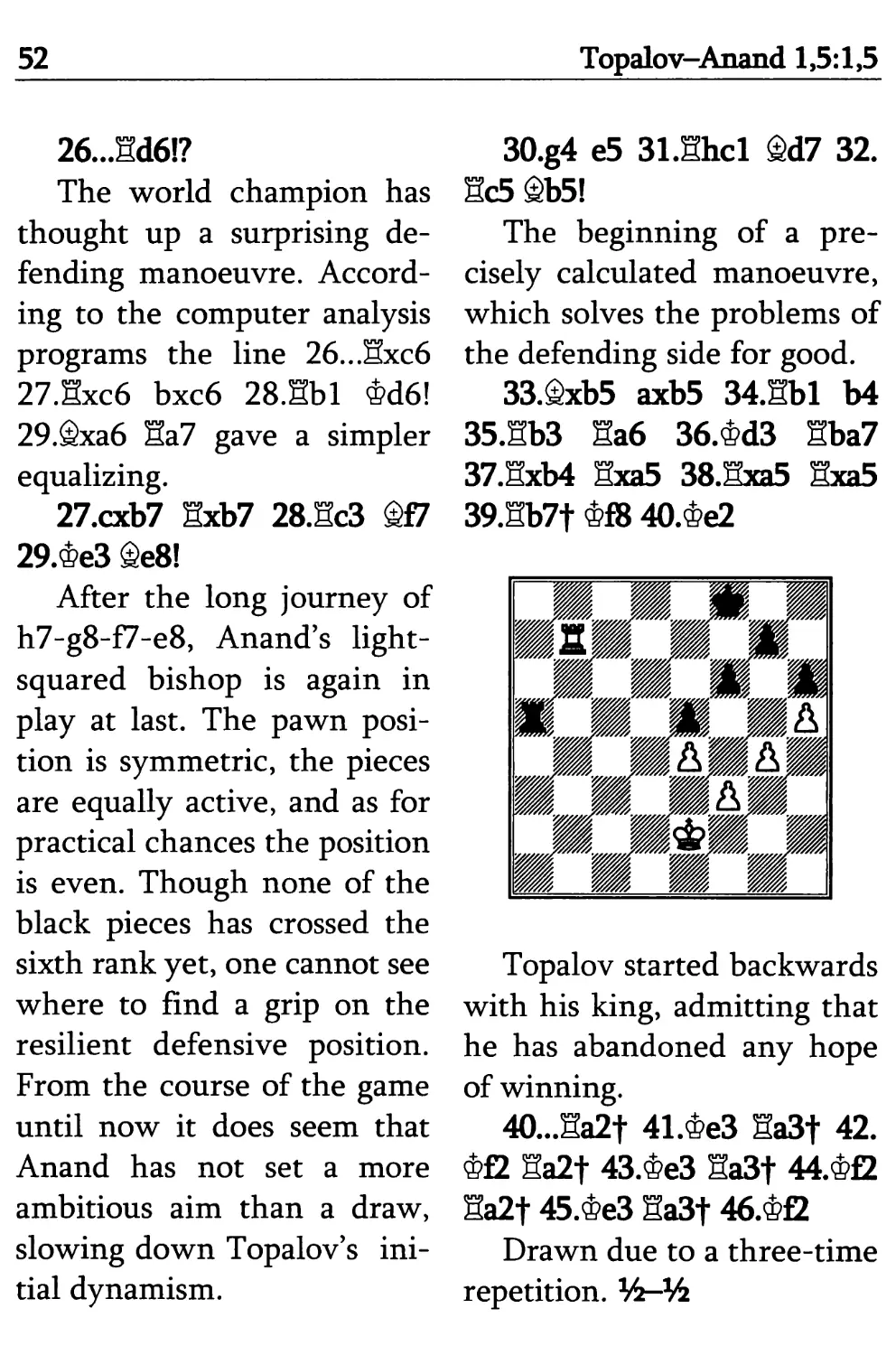
wf2 fJ.a2t 43. we3 a3t 44. wf2
a2t 45.we3 a3t 46.wf2
Drawn due to a three-time
repetition. ¥2-¥2
Game 4, Anand-Topalov 2,5:1,5
53
A brilliant attacking play with neat mating patterns
Chess is a complicated game, but its essence can be simply
defined. The aim of the combatants is to give mate to the king
of the opponent. It is possible to achieve victory with posi-
tional means, obtaining a vast material superiority or decisive
positional advantage, but the spice of the game is given by the
spectacular actions against the king. Spectators, too, are fasci-
nated most by games in which one of the sides - even at the
price of material sacrifices - launches an open attack against
the king of the opponent. The most popular, evergreen games
of the chess history, almost without exception, abound in sur-
prising sacrifices and stormy attacks leading to unavoidable
mate. However, in the professional chess of today, where
extremely well prepared opponents fight, and the power rela-
tions are balanced, even super-grandmasters are rarely given
the opportunity to give vent to their imagination motivated
by giving mate in their tournament games. It is, therefore, all
the more extraordinary that the World Championship final
just begun has already delighted the chess players with the
second such magnificent attacking game rich in mating patterns.
Round four began according to the classical choreography
of matches. With White, the world champion stuck to the
same well-tried opening that brought him the first victory.
Although Topalov did not avoid the Catalan setup, from the
very beginning he tried to divert the course of the game in a
direction favourable for him. Both of them have thoroughly
prepared for the struggle, what is shown by the fact that the
first ten moves were made by them in 5 minutes, practically
54
Game 4
without thinking, following the prepared variation. Topalov
endeavoured to create tension on the board by early taking
the gambit pawn c4 and keeping his extra pawn as long as pos-
sible. But about this conduct of play, as far back as the 1940s,
the Hungarian grandmaster Geza Maroczy wrote in his The
Guide-book of the Advanced Chess Player: "According to the
present view of theory, with Queen's Gambit Accepted it is
more difficult to equalize than with Queen's Gambit
Declined. "
Game 4
V. Anand-V. Topalov
Catalan Opening (E04)
1.d4 2.c4 e6 3.fJ£3 d5
4.g3 dxc4 S. g2 b4t 6. d2
as 7.Wlc2 xd2t 8.Wlxd2 c6
9.a4 bS
Comparing the position
arisen with that of the second
game after the ninth move,
one can see how different the
character of the fight is now.
Black's pawns on the queen-
side outnumber their white
colleagues, and seemingly
they are marching forward
menacingly. But due to their
structural weaknesses and at-
tackability, regaining the sac-
rificed pawn is only a ques-
tion of time. Anand is not in
a hurry about it, holding it
more important to develop
his pieces and create their
harmonious teamwork.
10. a3!?
This was the first time To-
palov was pondering for a
long time. It may be possible
that this move was not in-
cluded among the variations
he had prepared. In game one
of the World Championship
final Kramnik- Topalov in
Elista, White followed the
self-evident plan of 10.axbs
cxbs 11. WlgS 0-0 12.Wlxbs + .
Anand-Topalov 2,5:1,5
55
White's move in this position
is a novelty, its aim is to re-
duce Black's pieces to passivi-
ty as long as possible. If
Anand really succeeded in
surpising l his opponent, it
meant the win of the first
psychological fight at the
beginning of their encounter.
But it may be also possible
that the reason of Topalov's
musing was that here he
could chose from three differ-
ent defensive plans: d7, a6
and a6.
10... d7 11.fJe5 fJdS
Owing to the numerous
weak points, Black's defen-
sive position holds various
risks. Yet this slightly chaotic
setup just fits into Topalov's
strategy of seeking active co-
unterplay.
12.e4 b4
This is the logical continu-
ation of the strategy Black
had hitherto followed, since
he has already succeeded in
evoking a concrete threat in
the form of the unpleasant
fJd3t. By the way, the move
fJb4 will have sad conse-
quences in the long run, as an
important defender has moved
away from the king's wing for
good.
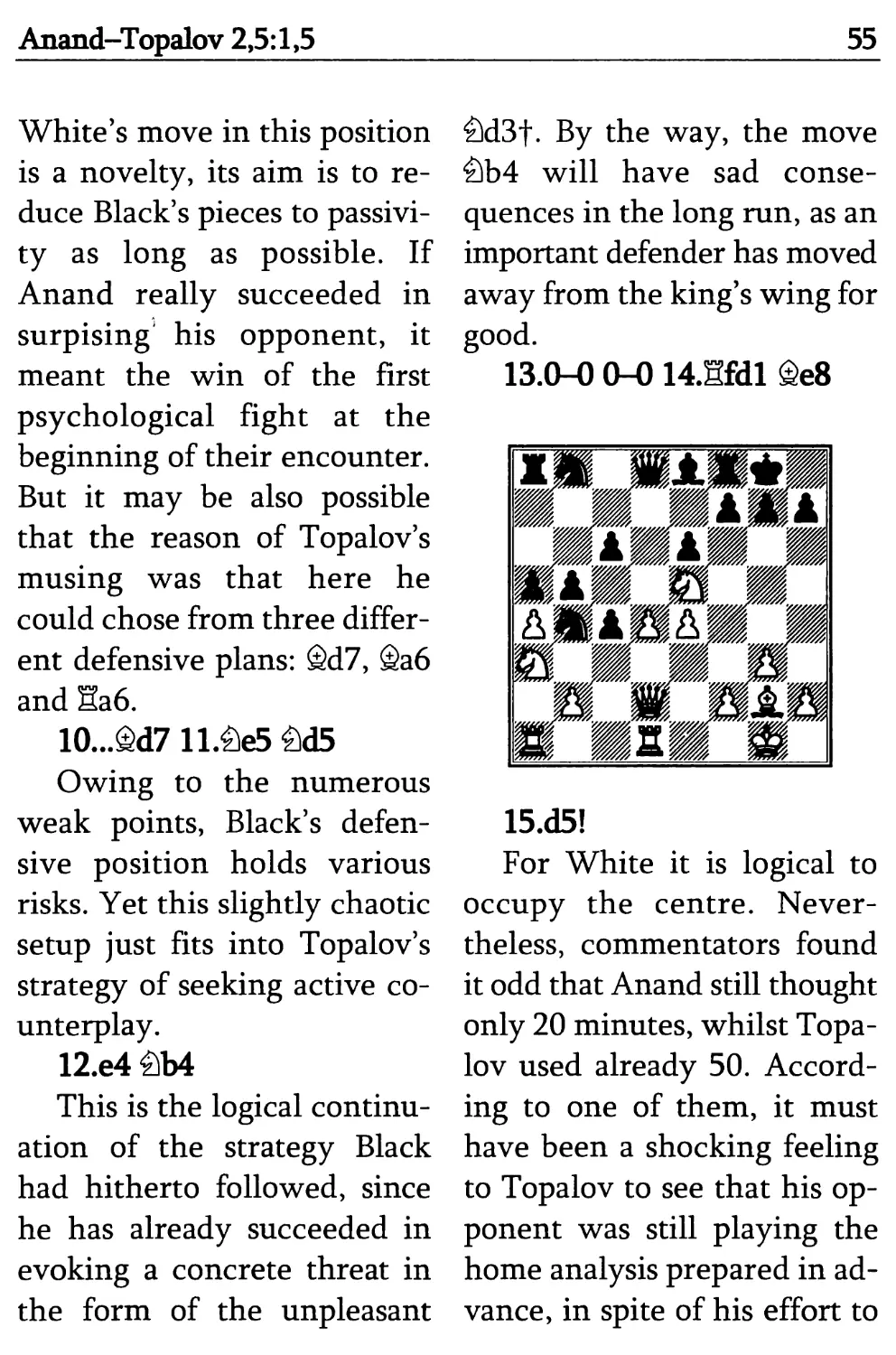
13.0-0 0-0 14. fd1 e8
15.dS!
For White it is logical to
occupy the centre. Never-
theless, commentators found
it odd that Anand still thought
only 20 minutes, whilst Topa-
lov used already so. Accord-
ing to one of them, it must
have been a shocking feeling
to Topalov to see that his op-
ponent was still playing the
home analysis prepared in ad-
vance, in spite of his effort to
56
Game 4
surprise him with a rarely-
employed defensive strategy .
15...Wld6
Topalov chose the more
risky path again, true, by
doing so he induced his oppo-
nent to come to a decision:
should he or should he not
apply a temporary sacrifice in
the variation beginning with
16.dxc6 Wlxes 17.axbs, which
was indicated even by the
computer analysis programs
as the strongest line for
White.
16.4Jg41?
Anand decided that for the
time being he would not do
his opponent the favour of al-
lowing him an active coun-
terplay. By the way, this was
the first move he was ponder-
ing over for a long time. He
was obviously aware that this
decision of his might be one
of the important turning
points of the game. With the
move he chose he continues
to be in sure control, leaving
several ways of attack open.
16..JWc5 17.4Je3 4J8a6 18.
dxc6 bxa4 19. 4Jaxc4 xc6 20.
frac1
By this time, the thinking
time of the players has got
almost even: Anand used 1
hour 5 minutes, Topalov 1
hour 15 minutes. As a result
of the pairs of moves leading
on to the middlegame, a com-
plicated position has arisen,
with better chances to White.
There can be no doubt about
Anand's advantage: his knights
are more active, he has con-
trol over the open d-file, and
the black queen does not find
her proper place. But a con-
crete queenside action is not
yet possible, as Black has
carefully organized his de-
fence: he grouped all his
pieces here, and his thoughts,
too, must have been solely
focused on this half of the
board. At least, his following
moves give evidence of the
fact that he had had no sense
of danger as for the position
of his king.
Anand-Topalov 2,5:1,5
57
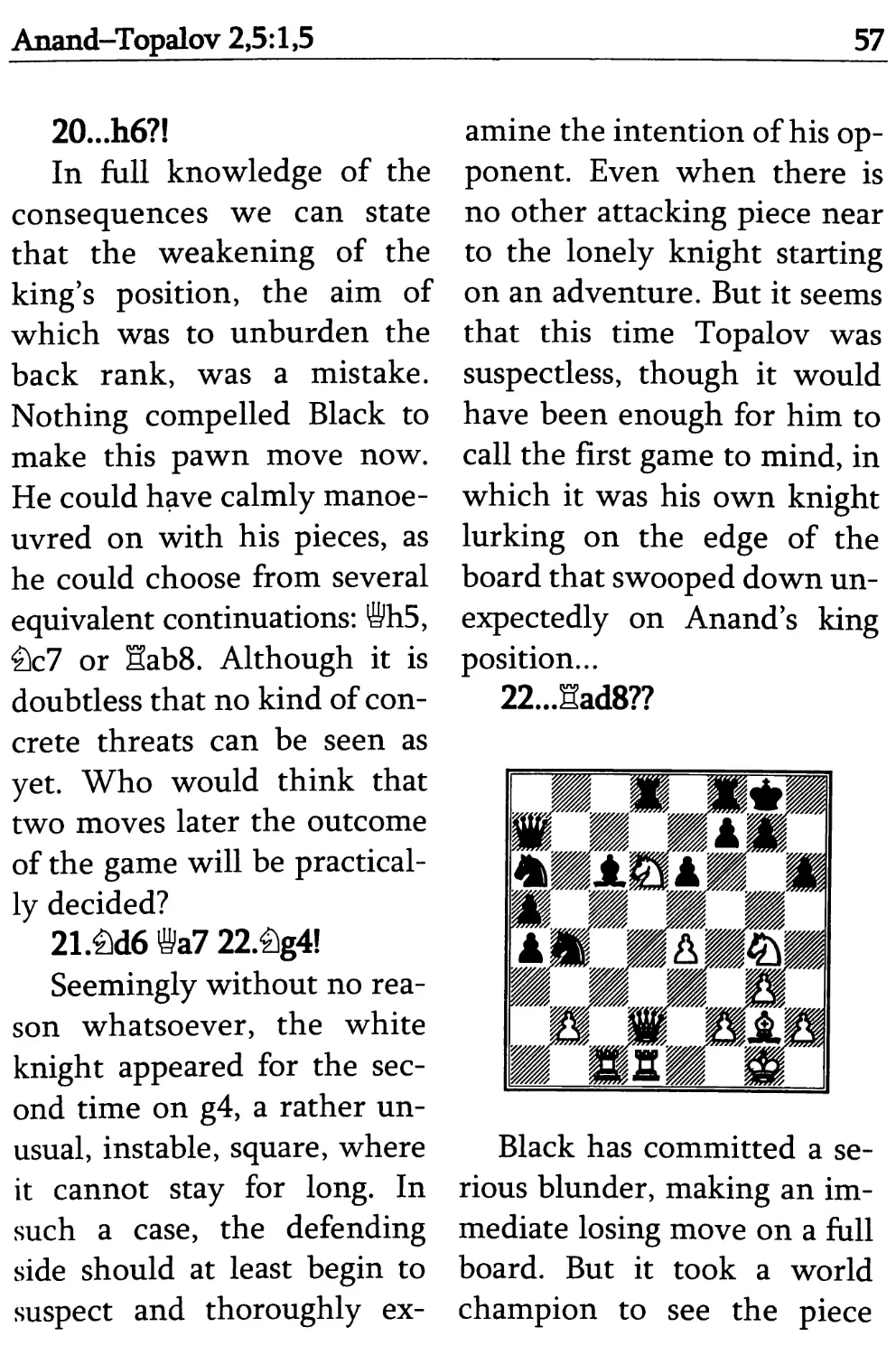
20...h6?!
In full knowledge of the
consequences we can state
that the weakening of the
king's position, the aim of
which was to unburden the
back rank, was a mistake.
Nothing compelled Black to
make this pawn move now.
He could h ve calmly manoe-
uvred on with his pieces, as
he could choose from several
equivalent continuations: Whs,
c7 or fJ.ab8. Although it is
doubtless that no kind of con-
crete threats can be seen as
yet. Who would think that
two moves later the outcome
of the game will be practical-
ly decided?
21.4Jd6 Wa7 22. g4!
Seemingly without no rea-
son whatsoever, the white
knight appeared for the sec-
ond time on g4, a rather un-
usual, instable, square, where
it cannot stay for long. In
such a case, the defending
side should at least begin to
suspect and thoroughly ex-
amine the intention of his op-
ponent. Even when there is
no other attacking piece near
to the lonely knight starting
on an adventure. But it seems
that this time Topalov was
suspectless, though it would
have been enough for him to
call the first game to mind, in
which it was his own knight
lurking on the edge of the
board that swooped down un-
expectedly on Anand's king
position.. .
22...fJ.ad8??
Black has committed a se-
rious blunder, making an im-
mediate losing move on a full
board. But it took a world
champion to see the piece
58
Game 4
sacrifice deciding the game,
who has realized that the
focal point of the game could
be transferred to the king's
flank from one moment to
the other, since Black's pieces
- especially his two knights -
were numbly loitering on the
remote, queenside area of the
board.
23.fu:h6tll
A nice and daring move!
Realizing the possibility was
not enough, with a lot being
at stake, bravery was also
called for to apply this sacri-
fice. Anand had to make pre-
cise calculations, foreseeing
all the important ramifica-
tions in order to reach the
decision from where there
was no turning back. The real
point of the sacrifice will be
seen only on move 26, and
the fact that White can teach
the winning position in all
variations is by no means self-
evident.
23...gxh6 24. Wxh6 f6
After committing himself
by accepting the sacrifice,
Black selected the strongest
defence. On 24... xd6 25.
Wgst wh7 26. xd6 b8 27.
h3! xe4 28.Wh4t wins, and
if 24...Wc7, then 2s.Wg5t wh7
26.es b8 27.Wh4t wg7 28.
c4 wins. Perhaps here Topa-
lov still hoped that he could
parry the attack, but the next
two pawn moves are like two
sledgehammer blows.
25.e5! xg2?1
Better would have been to
give back the piece at once
and save what could be saved
with Wh7 or xd6.
26.exf6!
Black's material advantage
grew even further, but Anand
An n d-Topalov 2,5:1,5
59
is not interested in the loss of
another piece of his. It is
enough for him to wedge a
pawn into f6 to totally para-
lyze the defence of his oppo-
'
nent. From far away, on the
other side of the board, the
two black knights are help-
lessly watching the proceed-
ings. And the conductor of
these knights, Topalov, could
be seen in the live internet
broadcast as holding his head
desperately with both hands.
Straining every nerve, he was
trying to find a way out from
the situation looking more
hopeless with each move. In-
credible as it may seem, there
is no defence in this position.
26...fJ.xd6 27.fJ.xd6 e4
Seemingly better is 27...
d5, but after 28.Wg6t wh8
another rook sacrifice fol-
lows: 29. fJ.c4! xc4 30.fJ.d4
Wh7 31J h4 fJ.f7 32.fJ.xh7t
xh7 33.We8, leading to mate.
28. fJ.xe61
The move order 28.\Wgst
wh8 29.fJ.xe6 also gives a deci-
sive advantage, e.g. 29... d3
30.fJ.c2 fJ.g8 31.Wh6t Wh7 32.
f7! Wxh6 33j xh6t wg7 34.
fxg8Wt wxg8 3s.fJ.xa6 +-.
28... d3
At long last, one of the
black knights has moved. To-
palov tried to reorganize his
defence and - .mo bilizing his
pieces - create a counter-
threat on the f2 square, but
now it is too late. Nor did
work 28...Wh7 because of 29.
\Wgst g6 30.f7t! wg7 31. Wf6t
wh6 32.fJ.e4.
29. c2! \Wh7
30.f7t!
Also winning was 30.Wgst
g6 31.f7t wxf7 32.fJ.cc6.
30...Wxf7 31.!he41 11Jf5?
60
Game 5
And this is the end- of it.
Black - maybe hoping for a
miracle - made one more, re-
signed, queen move, which
loses at once.
32. e7!
Mate is inevitable. On 32...
f7 33.frc8t Wxc8 34.Wg6t
wh8 3s.WJhst wg7 36J;rxf7t
wg8 37.WJh7 mate. 1-0
No break-through for the second time either
It is well-known that a match is not going on only between
the two players sitting on the stage, but it is also a struggle of
background teams working hard on both sides. The prepara-
tion is helped by the members of the team consisting mainly
of grandmasters, and all the games played are at once analyzed
by them in depth, seeking possibilities of improvement. An
opening variation can only be put on the agenda again if it had
already worked in an earlier game, or if the team succeeded in
finding an improvement giving the opponent a surprise.
In the 5th game, Topalov, as White, employed the same
variation of the Slav Defence, against which Anand had held
his position self-confidently in game 3, achieving a draw. For
the first 15 moves the combatants used only four or five min-
utes out of the precious thinking time. Anand seemed to have
entirely trusted in the variation. Topalov has obviously pre-
pared thoroughly, and being White, sat down to play not with
the intention of another draw. So all spectators and commen-
tators were curious to see what novelty he was going to come
up with.
Yet the deviation from the previous game did not occur of
his own intention, but that of the second player. On 14.h4,
Topalov -An n d 2:3
61
Anand did not reply h6, but the more active pawn move, hs,
setting a somewhat new direction for White's conduct of play,
too. So after all we could not find out what improvement
Topalov's team had prepared.
But as. for the rightness of the tournament tactics to apply
the variation again, we can draw a conclusion. Considering
the final result, it seems that the balance is negative. Although
Topalov had a positional advantage in almost the whole game,
a decisive breakthrough was not possible, he could not con-
vert the advantage into win. He must probably admit that for
him this is not the way to victory against Anand. It would be
not at all surprising, then, if this variation were not seen again
in the match.
GameS
V. Topalov-V. Anand
Queen'8 Gambit, Slav
Defence (D 17)
1.d4 d5 2.c4 c6 3.ffi f1f6
4. c3 dxc4 5.a4 f5 6. e5 e6
7.£3 c5 8.e4 g6 9. e3 cxd4
10.WJxd4 WJxd4 11. xd4 f1fd7
12.fud7 fud7 13. xc4 a6 14.
frc1 frg8 15.h4
All these are entirely iden-
tical with the opening moves
of the third game. As for the
opening, see the annotation
written there.
15...h5
In the preceding game
bringing a favourable result
for him, Anand continued
with ls...h6, but now he in-
troduced a novelty, slightly
upsetting Topalov's plans,
who was going to come up
with a novelty himself. This
move hinders the advance of
the white h-pawn, but at the
same time offers a new target
of attack to the knight head-
ing for f4. Topalov loses no
time in starting to carry out
this manoeuvre.
62
Game 5
16.'f)e2 d6 17. e3
It belongs to the history of
this, game that at this move
the lights suddenly went out
in the Central Military Club,
the venue of the match. The
ten-minute power outage and
the stoppage of the computers
caused a confusion mostly in
the work of the commenta-
tors, later the players them-
selves did not complain about
the temporary break of the
game.
17...fJe5 18.fJf4
The line 18.wf2 xe4 19.
fxe4 fJg4t 20.wf3 fJest led to
perpetual check.
18... c8
In the stage leading on to
the middlegame, Anand must
play very accurately, because
he can easily find himself in a
position leading to a disad-
vantageous endgame. E.g. on
18...fJxc4?! 19. !!xc4 bs 20.!!c2
we7 21.fug6t fxg6 22. g5t
wf7 23.we2! can follow, with
considerable advantage to
White.
19. b3 !!xc1 t 20. xc1 we7
21.\ge2 !!c8 22. d2?1
A minor inaccuracy, yet
just enough to put an end to
Topalov's winning chances.
Naturally, the bishop is head-
ed for c3, but the move order
chosen enables Anand to
solve, in this game, too, the
problem of his critical g6 bi-
shop. In the third game, he
had activated his hemmed in
bishop with the lengthy ma-
noeure of h7-g8-f7-e8. Now
he selected another way.
22...f6!
In case of 22.!!dl this
would not have worked, as on
22...f6? 23.fJxe6 f7 24.fug7
xb3 25.fJf5t wfB 26. h6t
can follow. But now if 23.
xe6, then 23...!!c2 24. bl
(24.b3 e8!) fJc4 25. xc4 xf4
26.!!d1 !!xb2=, and on 23.
fJxe6 f7 24.f1d4 xb3 25.
fub3 c2 26. f4 fJc6 27 . b 1
!!c4 28.wd3 !!xa4, also with
equal position.
23.fug6t fu:g6
At this pawn structure,
Topalov-Anand 2:3
63
possessing the bishop pair
does not give any advantage
to White. The computer ana-
lysis programs - for the first
time during the game - assess
the position as entirely equal.
In this variation, too, Anand
has equalized, whereas he has
to defend very precisely yet.
24.g3 fJe5
On 24... xg3? 25.frgl fJf4t
26.wfl d8 27. b4t would
have lost a piece. But with
such simple traps Anand can-
not be ensnared. In this stage
of the game - similarly to
game 3 - Topalov is trying to
wrest an advantage from the
even position.
25.f4 fJc6 26. c3 b4
27. xb4t fJxb4 28. d1 fJc6
29. d2 g5?1
In the post-match press
conference the world cham-
pion evaluated the gs-g4 ad-
vance as a very important
strategical -manoeuvre, help-
ing to maintain the balance.
Though it created a weakness
on h5 in his own position, it
restricted White's possibili-
ties of manoeuvring, and ob-
tained an attackable point
himself in his opponent's po-
sition, on g3.
30.wf2
The taking of the g5 pawn
does not give an advantage,
since the black knight appears
menacingly on the centre
square e5.
30...g4 31. c2 d8 32.we3
frd6 33.frc5 fJb41
The key piece of the de-
fence is the black knight,
which finds excellent support
points on the dark squares,
frustrating White's attacking
plans.
34.frc7t wd8 35. c3 we7
36.eS frd7 37.exf6t wxf6
38. we2 fJc6 39. we 1 fJd4
4O. d1 as
White's winning chances
have flown away for good,
and what's more, the range of
movement of his bishop is re-
stricted, and the knight post-
ing on the centre square d4 is
so strong that from now on
64
Game 6
the computer analyses indi-
cate Black's positional advan-
tage. The endgame was evalu-
ated basically equal by the
analysts, but in fact, right till
this moment, only Topalov
could play for a win, while
Anand was defending his po-
sition. However, from the
move pairs 39 and 40, the tide
has turned, and more and
more variations appeared with
winning chances for Anand.
Topalov had no choice but to
start saving what could be
saved. In the spirit of his ear-
lier promise, he could not of-
fer a draw, so he resorted to
repeating the moves again.
41J;rc5 fJf5 42. c3 fJd4 43.
c5 f5 44. c3
The threefold repetition
having arisen, a draw was ag-
reed. ¥2-¥2
A pair of knights fighting against a bishop pair
A world championship match is one of the most difficult com-
petition forms, since here the opponents do not alternate each
day. Two persons of outstanding knowledge face each other
for weeks or, there was also an example of it, even months,
and only one of them can be a winner in the end. This situa-
tion means an increased mental strain to the competitors, and
the struggle on the chessboard is influenced more than usual-
ly by the psychological factors.
This is why the combatants make decisions, one after an-
other, whose background will be only later, or never, acco-
unted for. It was such a decision Topalov made when under-
taking the Catalan with Black for the third time too, though
he suffered serious defeats in it during the first two games. Did
he want to prove that he was afraid of nothing? Had he pre-
pared a vast surprise? Only he can know the answer.
Anand- Topalov 3,5:2,5
65
After all, this unusual and daring decision of his was justi-
fied by the course of the game and the result. This was the first
time he could successfully resist Anand playing with White,
and this can increase his confidence for the remaining games.
And Anand can also be contented with the outcome of the
game, as he closed the first half of the match with a one-point
advantage and, thanks to the peculiar regulation, he can also
play with the white pieces in the next game.
Game 6
V. Anand-V. Topalov
Catalan Opening (E04)
1.d4 4Jf6 2.c4 e6 3.ffi d5
4.g3 dxc4 5. g2 a6 6.fJe5 c5
7.fJa3 cxd4 8.fJaxc4 c5 9.0-0
0-0
So far both players fol-
lowed the course of the sec-
ond game which was won in
an intricate fight by Anand.
Oddly enough, now it is he
who directs the game into a
new channel. Was he perhaps
afraid of a surprise prepared
by Topalov?
10. g5
A more active and com-
mitting move than 10. d2 em-
ployed in the second game.
10...h6 11. xf6 Wlxf6
As a logical continuation
of the selected plan, White
renounces his bishop pair.
This line is chosen more sel-
dom, because Black obtains
the bishop pair. Anand's aim
may be to allure his opponent
from the beaten track.
12.fJd3 a7 13.Wla4?1
A provoking move. Just
66
Game 6
like in the previous games,
White has soon sacrificed a
pawn for development, and
would like to put as strong
pressure on the black queen-
side as he can. During the
transition to the middlegame,
Topalov must play very cau-
tiously if he wants to avoid
the strategic trap prepared for
him.
13...fJc61?
It is easy to see that the
promising double attack with
13...bs? did not work because
of 14.Wlc2 bxc4 15. Wlxc4 fJd7
16. xa8 b6 17.Wlc7!+-. The
right decision is to give back
the pawn in return for the
possibility the black pieces
are given to develop.
14. ac 1
The strategical fight going
on in the whole game has
commenced. White refuses
the pawn offered, giving pref-
erence to the development
move.
14.. .e5
Topalov is now willing to
sacrifice even the es pawn to
give elbowroom to his hem-
med in bishops. It must be
accepted.
15. xc6 b5116.Wc2
This time it was Topalov
who set a strategic trap. Win-
ning Black's queenside pawns,
but allowing the central
pawns supporting each other
to live would lead to an ex-
tremely complicated position.
Anand is consistent and does
not go into the line promising
hardly calculable complica-
tions: 16. xbs axbs 17. Wlxbs
e4 18. fJdes d3. Following his
solid strategy that led to vic-
tory in the second game, he is
trying to simplify as soon as
possible, steering the course
of the game into an endgame-
like position.
16...Wxc6 17.fJcxe5 Wle4 18.
Wlc6 b7 19.Wlxe4 xe4
The comment one of the
analysts made on the queen
exchange was: "This is the
first time during the match
when Topalov can draw com-
Anan d-Topalov 3,5:2,5
67
fortably with Black.)) With
his bishop pair he really has
good long-term prospects, but
the question is what the
world chaplpion can do with
his active knights in the so far
still closed position.
20.frc2 frfe8 21.frfc1 f6 22.
d7
The white knight goes for
a long, adventurous journey,
the aim of which is to hunt
down one of the white bish-
ops.
22... f5 23. 7c5 b6
Topalov - quite under-
standably - sees his chances
in the bishop pair, therefore,
as long as he can do it, he
consistently evades the ex-
change. A long and instruc-
tive manoeuvring ensues, in
which both sides are trying to
attain their strategic target
under the most favourable
circumstances.
24. b7 d7 25. f4 frab8
26.4Jd6 fre5 27. 4Jc8 a5 28.
d3 fre8 29. a7 b6 30. c6
frb7 31. cb4 as 32. d5 a4
33. fub6
Now it is worth pausing
for a moment and drawing up
a balance of the peculiar fight
going on in the middlegame.
A bit of statistics can help to
understand what we see, and
it also sheds light on how
peculiar possibilities are in-
herent in chess if the men are
conducted by really,- expert
hands. An interesting feature
of the game is that Black's last
pawn move was 21....f6, which
was followed by the next,
31....as, only after ten pairs of
moves. And so far White -
almost incredible! - made
only three pawn moves in the
game; for the last time he
moved a pawn on the 4th
68
Game 6
move! And perhaps even
more interesting is the long
trip the white knight was
making on the board. 13 of
the first 32 moves were made
by this knight, in fact, in a
manner that it never moved
twice to the same square. This
is the route it made: b 1-a3-c4-
eS-d7-cS-b7-d6-c8-a7-c6-b4-
dS-b6. In the middlegame this
was almost the only piece
White moved. The reason
Black allowed the knight to
roam about in his camp was
that trading off any of his
bishops would have left him
with a disadvantageous end-
game. This time Topalov had
the patience to wait, and
Anand could not drive him
mad with the irritating gam-
boIling of the knight. And
when finally the knight ex-
changed itself for a bishop,
Black could bailout into a
tenable ending.
33...ffxb6 34.fJc5 f5 35.
d2 c6 36.b4 axb3 37.axb3
b4!?
Once again Black is willing
to sacrifice a pawn to be able
to organize his counterplay.
38.ffxd4 ffxe2 39Jh:b4
39... h3!
The key move of Black's
plan. His bishop of paralyzing
power keeps the white king
under constant pressure, and
his rooks threaten to pene-
trate on the second rank, at-
tacking the weak f2 square.
Anand obtained an endgame
with extra pawn in vain, as
now he has to be very careful,
lest that his king should fall
victim to the white pieces
weaving a mating net.
4O.ffbc4 ffd6 41. e4 %Th2
42.ffee 1 ?I
Anan d- Topalov 3,5:2,5
69
According to the computer
analysis programs it is not the
most active move. For Anand,
however, safety - to avoid a
possibl defeat - is more im-
portant here than to look for
a way to win in a forcible, ris-
ky manner.
42... dd2 43.f)e4 d4
44.f)eS dd2 45. f)e4 d3!
For the time being, Topa-
lov avoids move repetition
leading to a draw, trusting in
the increased activity of his
pieces. His home fans had
even started to have visions of
winning chances on the in-
ternet.
46.fJ.b1 dxb3 47.f)d2 fJ.b4
48.£3 g5 49. f!xb2 xb2 50.
d1 wf7 51.wfl
With precise manoeuvres
White has "dissolved the
blockade of his king. It is
more and more evident that
the position can be won by
neither side.
51...h5 52.we3 c2 53. a1
wg6 54. a6 f5 55. d6 c3t
56. wfl c2 57. we3 c3t
Having obtained the ini-
tiative in the finishing stage
of the game, now Topalov
admitted that in the position
arisen he cannot convert the
advantage of principle the
bishop has against the knight.
58. wf2 c2
And, as we could already
get used to it in this match,
drawn by repetition.
1f2-1h
Twenty moves, three sacrifices - in five minutes
With the 7th game -r- with Anand leading by 3,5:2,5 - the sec-
ond half of the match got under way. At this critical stage, it
was vital for Topalov that the world champion playing with
White twice over canno increase his advantage further,
because with a two- or three-point disadvantage the chal-
lenger would have got into an almost hopeless position.
70
Game 7
Playing with Black, he succeeded in drawing the sixth game
memorable for its knight stroll. Preparing for the next,
Topalov - evidently having heard the advices of his team and
weighed the largeness of the stake - made a daring decision:
in the game of key importance he would deploy one .of the
prepared "secret weapons)). That is, a risky but deeply ana-
lyzed variation which - having the element of surprise -
might cross Anand's winning plans.
However, such novelties can be employed only once, in an
exceptional situation, as their antidote can be found relatively
easily in the course of subsequent analyses. Their other feature
is that playing them carries an enormous risk, as miracles no
longer exist today, even in opening theory. Variations evoking
extraordinary complications can be defended with accurate
and faultless play. But in practical play, with a fixed amount
of time to think, it is very hard to find the best continuation
move by move in an unknown variation concealing dozens of
traps. This was the lesson, by no means an easy one, Anand
was given by his challenger in round seven. But he succeeded
in dealing with the task with an elegance befitting a world
champion, maintaining his advantage.
But Topalov has also attained the aim he set: although he
could not win, he avoided a further loss, and thus continued
to have chances to equalize.
Game 7
V. Anand-V. Topalov
Bogo-Indian Defence (Ell)
1.d4 fJf6 2.c4 e6 3.ffi d5
4.g3 b4t
Black deviates from the
earlier applied line 4....dxc4,
striving to divert the course
of the game as soon as possi-
Anand- Topalov 4:3
71
ble in the direction chosen by
him.
5. d2 e7 6. g2 0-0 7.0-0
c6 8. f4 dxc4 9.f1e5 b5?1
Topalov's first "partial))
victory: he managed to reach
the otherwise well-known
position in which he can de-
ploy, instead of the self-evi-
dent 9...f1dS, the deeply ana-
lysed home variation holding
vast complications.
10.fuc6 fuc6 11. xc6
11... d71?
The key move of the varia-
tion, the novelty of the Topa-
lov team. Hardly two months
before, at the Amber tourna-
ment in Nizza, in the blind-
fold game Gelfand-Ivanchuk,
the Ukrainian grandmaster
continued 11... a6, where-
upon 12. xa8 Wlxa8 13.Wlc2
Wlc6 14. gs b7 ls.f3 es 16.
xf6 Wlxf617.ds followed, and
the game ended in a draw. At
the press conference follow-
ing the match, Topalov re-
vealed that starting from the
above game, one of his sec-
onds, grandmaster Ivan Che-
parinov had worked out the
improved variation, in which
Black, at the cost of manifold
sacrific s, obtains connected
central pawns and a powerful
counterplay.
12. xa8
At the sight of the surpris-
ing, voluntary sacrifice, after
a short think Anand gave up
his important bishop in re-
turn for winning the ex-
change.
12...Wxa8 13.£3 f1d5 14. d2
After accepting the sacri-
fice, the world champion is
trying to consolidate his posi-
tion, but Black cannot leave
him time for this.
72
Game 7
14...eSI?
Black has to go on forward.
This time a pawn sac fol-
lowed in order to open the
way for the d7 bishop. From
now on it was clear to both
the spectators and the com-
mentators that they were
looking at a thoroughly pre-
pared home analysis, as Topa-
lov played the risky move at
once, without thinking.
lS.e4
Anand, on the other hand,
is doing his best to filter out
all risks, so that Black can
carry on with his plan only at
the price of another sacrifice.
lS... h3
Topalov - playing outright
again - offers his third piece
too as a sacrifice. The chess
clock tells everything about
the course of the game up till
now: Black used only 3 min-
utes - in fact he did not think
at all about his moves - whilst
Anand was pondering almost
an hour, having to assess the
position and find the moves
at the board.
16.exdS xfl 17.Wxfl exd4
18.a41
The world champion is a
piece up, but the strong cen-
tral pawns make it hard for
him to find an apt counter-
play. With this move he starts
an action on the queenside.
18...WxdS 19.axbS xbS 20.
fJ.xa7 fJ.e8
Anand- Topalov 4:3
73
21.wh11?
This was the first time in
the game that T opalov has
been pondering for a long
time, 17 minutes. Visibly, his
home hnalysis ended here.
Anand - first during the fight
- managed to surprise his ad-
versary. True, the computer
programs and expert com-
mentators considered the
move 21. wg2 stronger, but
we can safely accept the as-
sessment of the world cham-
pion, who did not wish to get
into a pin on the second rank,
selecting another defensive
plan instead. By the way,
Kasparov, watching the game
on the internet, recommend-
ed in a talk forum the vari-
ation 21.b3 xb3 22. el h6
23. xe7 xe7 24.Wxe7 xbl t
25. el bs. Although White
is unable to convert his extra
piece, he cannot lose either.
However, then Anand was al-
ready aspiring after some-
thing more than this.
21... f8?1
Topalov's first 'own' move
was not received with gener-
al enthusiasm by the analysts
watching the game, many of
them recommending the self-
evident 21... xb2. As it turned
out later, the problem with
this and the other lines is that
they don't give Black more
than a draw. Yet at this mo-
ment, perhaps even Topalov
longed for more. The excite-
ment rose to the highest
pitch.
22.fJ.c7 d3 23. c3 d6 24.
fJ.a7 h61?
Bad would have been 24...
hs 2s. d2 xg3? in view of
26. gl es 27.fJ.as and White
WIns.
25.f1d2?!
According to the analyses,
better is the risky-looking 25.
h3!, but a move like this is
by no means in keeping with
Anand's style.
25... b4! 26.fJ.a1 xc3 27.
bxc3 fJ.e2
The rook appears on the
second rank with a great
74
Game 7 - Anand- Topalov 4:3
force, the question is whether
this threat can be converted
into win.
28.fJ.d1 a4 29. e4 c2 30.
fJ.c 11
This time) too) Anand has
hit upon the right way of de-
fence.
30...fJ.xh2t 31.wg1 fJ.g2t 32.
Wxg2 xc1 t 33. fl We3t 34.
Wf2 Wc1 t 35. fl e3t 36. wg2
The tables have turned.
Black's attack has petered out,
and Anand avoids a repetition
of moves. Being a piece up,
from now on he is playing for
a WIn.
36...£5 37. f2 wh7 38. b1
We6 39. b5 g5 4O.g4 fxg4 41.
fxg4 wg6 42. Wb7?1
Inaccuracy, ruining White's
winning chances. 42. a4 was
necessary.
42...d2!
The key move of Black) s
defence. The passed pawn
compels the white camp to
the first rank.
43. b1t wg7 44.wfl e7
45.wg2 e646. d1 e347. f3
e648. b7t wg649. b1t wg7
50. d1 e3 51. c2 e2 52.
Wa4 wg8 53. d7 wfB 54. d5
wg7 55. wg3 e3t 56. f3 e5t
57.wg2 e6 58. d1
And drawn by repetition.
¥2-¥2
The stubborn will to win was worth a point
In the previous round, Topalov succeeded - for the first time
during the match - in controlling the game almost to the very
end, forcing his will upon his opponent. Though it ended in a
draw, even then it could be felt that the challenger's fighting
Game 8 - Topalov-Anand 4:4
75
spirit was unbroken, and his will to win grew stronger and
stronger. After the two black games, everybody was curious to
see what tactics Topalov will choose with White, since he
could hardly have a goal other than victory - that is, making
the score level before the finish of the match.
'j'
What caused a surprise this time was that there was no sur-
prise. For the third time, too, Topalov undertook the early
queen exchange variation of the Slav Defence. But this time,
further refining his play, he put a greater pressure than any
time before on the black position grappling with development
problems. Anand defended on the high level customary for
him, and he succeeded in going for an endgame with a pawn
deficit and opposite-coloured bishops. Of positions like this
chess players think that it)s impossible to lose) and almost
impossible to win. But Topalov, who was aware that he might
scarcely get better winning chances against Anand, attempted
the impossible.
At the sight of the position arisen, one of the commentators
on the internet wrote jokingly to the visitors of the home
page: "Just go to have supper and attend to your business; this
game is going to last for 100 moves, bec use Topalov has no
other choice than to attempt to win, and in this position he
can keep trying it without any risk almost interminably.))
Only a part of what the commentator wrote was justified.
The game ended relatively soon because after an inaccurate
bishop move Anand unexpectedly resigned. Some analysts
thought that he should not have resigned at once, he could
have waited to see if his opponent really saw the winning
variation. But at the very end, this game was decided by the
state of nerves rather than objective chess knowledge. In any
76
GameS
case, Topalov has achieved his aim. After a long march, de-
servedly, he equalized, so in the last four games the chances
are equal again. We can look forward to an exciting finish!
Game 8
V. Topalov-V. Anand
Queen's Gambit, Slav
Defence (D 17)
1.d4 d5 2.c4 c6 3.f1f3 f1f6
4.f1c3 dxc4 5.a4 f5 6.f1e5 e6
7.£3 c5 8.e4 g6 9. e3 cxd4
10.Wxd4 Wxd4 11. xd4 f1fd7
12.fud7 fud7 13. xc4 fJ.c8
Everybody was waiting for
Topalov's novelty, but all in
vain. In the end it was Anand
who left the path followed in
the third and fifth game. The
continuation 13...a6 had ear-
lier led to two draws. This
time the question is also the
same: can Topalov find a way
to win in the closed position
without queens?
14. b5 a6 15. xd7t wxd7
16.we2 f6 17. fJ.hd1 weB
See Diagram
18.aS!?
A novelty, presumably the
result of the industrious pre-
paratory work of the Topalov
team. In this position, moves
occurring earlier - 18. b6 and
18.fJ.acl - did not give a con-
crete advantage. Will White
be able to prevent the black
pieces stuck on the back rank
from developing? Should the
rook and the bishop get out
successfully, like in the previ-
ous games, Black would equa-
lize. But if Anand fails to do it
in the next stage, White ob-
Topalov-Anand 4:4
77
tains winning chances.
18... e7 19. b6 fJ.f8 20.
ac1 f5 21.eS gS 22. e3 f4?!
This move was liked by
nobody "( except, perhaps,
Topalov. Even Anand himself
remarked in the post-match
press conference that he
would have done better to
follow the variation 22... xe3
23.wxe3 f4t 24.wd4 we7 25.
fJe4 xe4 26.wxe4, though in
the resulting rook ending he
would have had serious prob-
lems. The main drawback to
the text move is that the f4
pawn gets lost in the long run
as it is hard to protect.
23.f1e4 fJ.xc1
24. f1d6t
The knight arrives in the
black camp with a check with
tempo. It is an old chess wis-
dom that if White manages to
create a knight post on d6,
then sooner or later he wins.
From now on, right until the
end of the game, the key of
the position will be the d6
square kept continuously oc-
cupied with different white
pieces. In the next phase of
the game, both parties will be
trying to attain a transition to
an endgame as favourable as
possible for them.
24...wd7 2S. xc1 wc6 26.
d2 e7 27. fJ.c1 t wd7 28. c3
xd6
Black has made up his mind:
he cannot allow the knight
paralyzing his position to
live, he would rather give up
his bishop pair.
29. d1 f5 30.h41?
An important zwischen-
zug, ensuring White that he
should show up actively on
both flanks.
30...g6
78
Game 8
The other defensive possi-
bility is 30...fJ.d8 31. exd6 (31.
xd6t wc7 32. xd8 wxd8 33.
d2 wc7 34. xf4 b6) 31...g6
32. e5 c8 with good draw-
ing prospects.
31.fJ.xd6t we8 32. d2 fJ.d8
33. xf4 fJ.xd6 34.exd6
The weak f4 pawn is lost,
but in return an ending of
drawing chances has arisen,
in which, in addition to the
kings, only two pieces re-
mained on the board: one
bishop on each side, which
can never meet each other
since they move on squares of
different colour. According to
public belief this division of
materials promises an easy
draw to the side with disad-
vantage, because he can block
the advance of the pawns. But
this rule is often replaced by
another: the side which can
launch a coordinated attack
on the squares his bishop is
moving on has winning
chances, because it is as
though he played with an
extra piece, and his opponent
has no defending piece be-
sides his king to use for clos-
ing the penetration points.
34...wd7 35.we3 c2
The point of Black's defen-
sive plan is that by moving
his bishop on the a4-e8 diag-
onal, he arrests the d6 pawn,
while his king, moving on the
white squares, g8-f7 -e8-d7-
c8, blocks the way of the
white king, keeping the pen-
etration points under con-
stant control.
36. wd4 we8 37. we5 wfl 38.
e3 a4 39. wf4 b5
For the time being, it can-
not be seen how White can
make progress. The exciting
Topalov-Anand 4:4
79
endgame was being analyzed
by several leading grandmas-
ters in the internet portals. It
is quite clear that in this
endgame only Topalov can
have winning chances. But
what is the way to victory? Is
there one at all? Interestingly,
it was Anand's compatriot,
grandmaster Harikrisna of In-
dia, who pointed out a plan
promising victory in case of a
faulty defence: 40.wgs e8 41.
wh6 wg8 42. d4 d7 43.g4
c6 44.f4 d7 4s. es c6 46.
hs gxhs 47.wxhs wf7 48. wh6
wg8? (it is important to arrest
the white g-pawn: 48... e4!
49.b4 we8 sO.wg5 wd7 51.£5
exf5 s2.gxf5 h6t s3.w£4 c2
s4.f6 we6 ss.we3 g6 s6.wd4
hs s7.wcs wd7 s8.wb6 wc8=)
49.gs d7 sO. g7 c6 51.
g6+-. Topalov chose another
path, but it could be expected
that he would keep trying till
the last dim chance of win-
ning, since equalizing was a
vital question for him.
4O. c5 4O...wf6 41. d4t
wf7 42. wg5 c6 43. w h6 wg8
44.h5 e8 45.wg5 wf7 46.wh6
wg8 47. eS
White's first attempt at
bringing about a zugzwang. It
is not successful yet, but it
indicates the way of a possi-
ble win. Now neither the
black king nor the bishop can
move. Luckily, there is still a
moveable pawn on the board.
47...gxh5 48.wg5 wg7
49. d4t wf7 50. e51
An important move, block-
ing Black's e-pawn.
50...h4 51.wxh4 wg6 52.
wg4 b5 53. wf4
As if the white king had
directed its steps towards the
queen's flank, so Black's king
also has to start in that direc-
tion to get there in time. Who
would think that in this posi-
tion only a few moves will
occur till resignation? Even
the computer analysis pro-
grams did not forecast the en-
suing developments. Interes-
tingly, the computers of to-
day are not yet able to find
80
Game 8 - Topalov-Anand: 4:4
their way around the world
of endings containing more
than six pieces, which, as we
can see, hold innumerable
tactical and strategic possibil-
i ti es.
53...wf7 54.wgS
Another manoeuvring move
testing the opponent's vigi-
lance, but this time back-
wards. Topalov's calculation
has worked well.
54... c6??
In case of the consistent
54...we8 the position seems
tenable, because ss.wh6 would
be met with d3, and ss.wf6
with c4, and in the event of
a pawn storm: ss.f4 wd7 s6.g4
d3 57.£5 exf5 58.gx£5 h6t!
s9.wf6 we8 60.b3 wd7=. As it
is, on s5.wh6 the bishop can-
not defend on e4 because of
the f3 pawn. The world
champion's sense of danger
ceased to function for just one
moment, but it was enough
for T opalov. After the text
move he can evoke the zug-
zwang motif he had earlier
tried.
55.wh6 wg8 56.g4!
Black resigned because of
the zugzwang arising in the
continuation s6... e8 s7.gs
c6 s8. g7! e8 s9.f4 c6
60.g6 hxg6 61.wxg6, winning
for White.
1-0
Game 9 - Anand- Topalov 4,5:4,5
81
With two rooks against the queen and the time
What a fantastic game it was! - sighed several hundred thou-
sands of chess players beside the computers allover the world
at the fend of the six-hour battle. Indeed, such a tense fight
rich in lively turns was not seen in any of the rounds so far,
although we have already experienced quite a lot of excite-
ment during the match. It is probable that not every move of
(
the combatants will pass the test of subsequent analysis, hav-
ing both of them made several errors. Yet, as if this game had
been a fine advertisement of chess, it presented all the beau-
ties and unexpected turns of the "royal game".
This time Topalov did not undertake the torments of the
Catalan Opening, selecting the Nimzo- Indian Defence instead,
and one of its main lines was put on the agenda. The specific
features of this variation are the white isolated pawn on d4
and the possibility of a lively piece play on both sides. On the
18th move, Anand employed a novelty, and then offered his
queen to be traded for two rooks. The resulting assymetric
division of materials led to an extremely intricate position.
The game was all through directed by the world champion,
but twice he got into a time trouble, and both times he let the
win out of his hands. Or, to be more precise, during the game
Topalov lined up every tactical and competition psychological
means, mobilizing his whole strength of mind to prevent
White from winning. This unshakeable fighting spirit led
eventually to success: the white queen, struggling to the end
almost all by herself, compelled the enemy king to flee end-
lessly by giving it interminable checks.
82
Game 9
Thus, the score of the match continued to be even. The
quick comments after the game, almost without exception,
were analyzing the mental impact the marathon fight, visibly
agitating both players, would make on the continuation. It is
doubtless that the result is more favourable for Topalov, who
admitted himself in the post-match press conference that this
time he escaped from defeat with an enormous amount of
luck. And what's more, in two of the remaining three games
- in the last one, too - he will be White. But knowing Anand,
there can be no doubt that in the following games he will fight
on a similarly high level, mobilizing all his power reserves,
since the final decision is yet to come, and his chances of vic-
tory are by no means less than his opponent's. As we could see
in this game, too: any turn, however fantastic and unforeseen,
can occur on the chessboard.
Game 9
V. Anand-V. Topalov
Nimzo-Indian Defence (£54)
1.d4 f6 2.c4 e6 3. c3
As the Catalan Opening,
which was at first efficient,
last time did no longer bring
victory, instead of 3. f3 Anand
diverted the game in a differ-
ent direction.
3... b4 4.e3 0-0 5. d3 c5
6. £3 d5 7.0-0 cxd4 8.exd4
dxc4 9. xc4 b6 10. g5 b7
11. e1 bd7 12. c1 fJ.c8 13.
d3 e8
We can see one of the
well-known, thoroughly ana-
lyzed variations of the Nimzo-
Indian Defence. It is charac-
terized by the white isolated
pawn on d4, for whose at-
tackability White comes to an
active play in return. The
tirlle used for thinking after
13 moves is: Anand 5 min-
Anand- Topalov 4,5:4,5
83
utes, Topalov 19 minutes, but
in fact, Topalov, too, was
pondering lenghtily only on
his 13th move, playing also
almos at once up till then in
the known position. But here
he had to choose for a longer
term from the various possi-
bilities. Finally he opted for
the most frequent continua-
tio n.
14.We2 xc3
Black closes the c-file so
that he can bring his queen
into play here.
15.bxc3 Vllc7 16. h4 h5
17. g5 g6 18. h3!?
The world champion made
this move, unprecedented in
the databases, after a striking-
ly short think. This time
Anand resorted to the psy-
chological weapon applied
several times by Topalov,
obviously to demonstrate that
he knows everything about
the position, that is, he is
playing a thoroughly pre-
pared variation.
18...e5 19.£3
A logical continuation hold-
ing some risk, too. If now
Black avails himself of the
possibility of exd4, White
must give up his queen for
the two black rooks. As for
material, White is not worse,
but the resulting position of
assymetric division of materi-
als, in which the black queen
can start operations hard to
foresee, makes the outcome
of the game unpredictable.
19...Vlld6 20. f2
Anand is practically pro-
voking his opponent, leaving
open for the second time the
possibility of exchanging his
queen for two rooks. It seems
that a careful home analysis is
84
Game 9
behind his intention. This
time his aim is not simplifica-
tion, quite the contrary, he is
luring his opponent towards
complications.
20...exd4!?
Interestingly, for the sec-
ond time Topalov does what
he did not undertake on the
first occasion: he gives up his
two rooks for the white
queen. This is a committal de-
cision, wherewith Black di-
verts the game into a new
channel. The path chosen is
apparently not against the
combatants' wilt but at this
time none of them suspects
yet what complications are
to corne.
21.lWxe8t fJ.xe8 22.fJ.xe8t
fB 23.cxd4
The advantage of the pawn
capture is that it opens the c-
file, but the drawback to it is
that thus the bishop moving
along the dark squares is less
active than it would have
been on d4. Anand has been
weighing for a long time if he
should take with the pawn or
the bishop on d4. This was
the point when he caught up
his opponent on the clock,
but then no one attached any
particular importance to it
yet.
23...fJf6 24J: ee1 e6 25.
c4 d5 26. g3
The bishop vacates f2 for
the h3 knight. In the previous
moves both players were en-
deavouring to arrange their
pieces in the best possible
position before the clash pro-
mising to be violent.
26...lWb4
Black is the first to launch
an action. Topalov is seeking
an active counterplay, but the
price of this is that his queen
moves away from the defence
of the king. True, after 26...
lWd7 27. es xc4 28. xf6 bs
29.a4 a6 30. f2! Black is also
better.
27. e5! d7!
From now on, almost every
move brings some new, sur-
prising development.
Anand- Topalov 4,5:4,5
85
28.a3
A far-sighted deflection
the sense of which will be-
come clear on the 30th move,
when t)1e el rook will not be
en prlse.
28...lWa4 29. xd5 fue5 30.
xe6 lWxd4t?1
Self-evident but not the
strongest continuation. It en-
ables the white forces to be
activated. Better would have
been 30.. . d3! 31.fJ.c8 t wg7
32. c7 xel 33. xf7t wh6 34.
f2 lWxd4 35.wfl c2 36. g4t
wh5 37.we2 Wgl 38.g3 lWeI t
39.wd3 lWxe6 40.fJ.xh7t wg5
41.h4t wf5 42.fJ.f7t lWxf7 43.
h6t we6 44.fuf7 xa3 with
equal chances. However,
even the best of the world
cannot be expected to foresee
and assess such long lines.
31.wh1 fxe6 32. g51 lWd6
33. e4 (Diagram)
In this position, computer
analysis programs suggest 33.
xe6, but also considered was
the line 33.fJ.edl! d3 (33...
lWxa3?? 34.fJ.d8t wg7 35.fJ.c7t
wf6 (35...wh6 36.h4 lWal t 37.
wh2 xf3t 38.fuf3) 36. xh7t
wf5 37.fJ.f8t) 34. e4 lWd4 35.
fJ.c2 lWe5 36.h3 c5 37.fuc5
bxc5 38.fJ.dcl. But to under-
stand the conduct of play of
the combatants we must be
aware that from now on one
of the main motifs of the
game was time! Until the first
time-control - at move 40 -
seven moves had to be made
in the opening position, in
which calculation is getting
more and more difficult, and
Anand had 13, Topalov 20
minutes, that is, rather few
for both of them. It is, there-
fore, easy to understand that
the world champion chose
86
Game 9
the surest looking way: his
knight had an excellent out-
post on e4 and strong threats
in every direction. But thus
Black gets time for a counter-
action.
33... Wxa31
Topalov does not hesitate:
he makes a sally with his
queen from its defensive posi-
tion, and removes the only
white piece on the queen's
flank which could stand in
the way of the advance of his
pawns. From this moment on,
T opalov followed the tactics
of carefully preserving his
time advantage and striving
to evoke intricate situations,
to further increase the pres-
sure of time weighing heavily
on Anand.
34.fJ.c3 Wb2 35.h4!? b5?!
Topalov does not care
about the storm clouds gath-
ering round his king and, tak-
ing chances again, he starts
with his pawn on the queen's
wing. I.t consumes valuable
seconds of his opponents time
to calculate the danger evoked
in this manner. In the pres-
sure of time, a spectacular
battle, not devoid of psycho-
logical motifs either, devel-
ops. Finding the objectively
best move is no longer the
only thing that counts. The
combatants are striving to in-
crease tension to the breaking
point, taking care to avoid
falling into an unexpected
trap, losing everything.
36.fJ.c8t
Anand starts a direct at-
tack against the king.
36...wg7
The defending side has to
be very cautious. If 36...wf7,
then 37.fJ.dl 4Jd3 (37...gs 38.
hS f)d3 39.wh2 Wd4 40.frc3)
38.wh2! Wd4 39.frc3 West 40.
wgl 4Jf4 41.frd7t we8 42.fJ.cc7
WIns.
37.fJ.c7t wf8
Not possible was 37...wh6
in view of the mate threat
38.f)gs, and if 37...wg8, then
38.f)f6t is threatened with a
check with tempo.
Anand-Topalov 4,5:4,5
87
38. g5 we8
The black king resorts to
escape.
39.fJ.xh7 lWc3
Topalov moves his queen
in the psychologically best
moment, right before the
time control, creating a new
threat.
4O.fJ.h8t?
It is hard to understand
why the world champion
took such a committing deci-
sion in the last moment of
time trouble. Black's king,
forced down by a rook, is lan-
guishing on the back rank
from where it can apparently
never escf;lpe. If in such posi-
tion the participant of a chil-
dren's tournament gives a
rook check, releasing thereby
the king, the trainer and the
parents are clutching at their
hair, horrified at the child's
blunder. Behind Anand's
move there might be some
deep strategic idea or a many-
move tactical motif, but even
subsequently one cannot find
such a thing. In fact, he di-
verts the king closer to the
black queenside pawns whose
advance means the only co-
unterchance for Black. The
only positive feature of this
move is that it does not lose at
once. But it is quite evident
that at this critical moment
the world champion has lost
his mental balance and made
a flustered, imprudent deci-
sion. It would have been a
simple and self-evident means
of gaining time and maintain-
ing the threats if Anand had
moved away with the at-
tacked rook, playing 40.fJ.e2,
which preserves the threats
and leads to a quick win in
88
Game 9
several lines: 40...as (40...b4
41. xe6 b3 42.wh2 a5 43.fJ.c7
Wlal 44.fJ.b7 a4 45.fJ.e4 a3 46.
d4+-) 41. xe6 a4 42.wh2 a3
43.fJ.c7 Wlb2 44.fJ.cc2 Wlal (44...
a2 45. fJ.xb2 al Wl 46.fJ.xb5, and
Black can resign) 45.fJ.c5 a2
( 45... c4 46.fJ.d5+-) 46.fJ.cc2
wd7 47.fJ.xa2 Wlbl 48. d4+-.
4O...wd7
And the first time trouble
is over, ending with Anand's
first great miss and Topalov's
first lucky escape. From now
on, each player has one hour
to make the next twenty
moves. The struggle on the
board is going on, the posi-
tion is more complicated with
each move, a single error can
lead to defeat.
41.fJ.h7t wc6 42.fJ.e4
The world champion can
feel safe, his pieces protect
each other. If only those two
connected queenside pawns
would not exist!
42...b4
According to the computer
analysis programs, not the
strongest move, but from the
point of view of tournament
tactics it is a perfect decision.
Topalov is striving to seize
the only counterchance, try-
ing to create concrete threats
as soon as possible.
43.fue6 wb6 44. f4
Anand's attack on the king
regains strength again, this
time on the other half. But he
has only half an hour's think-
ing time left again.
44... Wlal t?1
Several expert analysts re-
commended the more active
44... Wlc 1 t, but from the point
of view of tournament tactics
this is the right decision as it
maintains the threatening
position of the e5 knight. As
we'll see later, this knight is
going to play an important
role.
45.wh2 as
See next Diagram
46.h51
A splendid attacking move
reviving the hope of victory.
46...gxh5?1
Anand- Topalov 4,5:4,5
89
This time it was Topalov's
turn to err. More promising
would have been 46...gs.
47. fJ.xh5
The second white rook has
also joined in the attack, and
together with the knight, the
three of them are chasing the
black king whose position is
more and more hopeless.
47... c6 48. d5t wb7 49.
fJ.h 7 t
An extremely complicated,
hardly assessable position full
of mutual traps has arisen,
which was evaluated in a
pretty different manner even
by the computer programs. In
the live broadcast, Anand
could be seen tensely calcu-
lating the variations, while To-
palov appeared to be calmer
and more balanced, despite
the fact that he had the
worse, probably lost, posi-
tion. More promising than
the text move was the contin-
uation 49. fJ.e6 Wlbl SO. f4 d8
sl.fJ.d6 c6 52.£5 Wle4 53. f6
lWg6 54. f4 lWe4 55. d3 lWg6
s6.fJ.bst wa7 s7.wgl.
49...wa6 50.fJ.e6 wb5 51.
fJ.h5 d4?!
Another decisive moment.
Topalov had 23, Anand only
7 minutes on the clock. Yet,
in the more and more hope-
less position, after a short
think, Topalov run the risk of
a quick loss rather than flee
his knight to the passive
square d8. He knew that his
plight would then become
entirely hopeless.
52. b6t wa6 53.fJ.d6 wb7
54. c4?!
See Diagram
Anand was in time trouble
again, having only 4 minutes
left until the 60th move. He
missed the almost immediate
90
Game 9
win again: s4. ds! c6 (54...
fuf3t 55. gxf3 Wlb2t s6.wg3
Wlg7t s7.wh4+-) ss.fJ.h7t wa6
s6.fJ.xc6t wbs s7.fJ.e6 Wld4 58.
fJ.hs+- .
54...fu:f3t!
It looks as though the
chessmen were the heroes of
a Shakespeare drama. In the
last moment, the black knight
heroically sacrifices itself, cre-
ating thereby the only princi-
pled drawing chance.
55.gxf3 Wla2t 56. d2
Now already three white
pieces are fighting against the
lonely queen, and the experts
are about to chalk up the
point for Anand. But Topalov
still does not give up the
fight, striving to seize even
the very last chance.
56...we757.fJ.hdS
Better was s7.fJ.hh6!, pre-
serving the possibility of forc-
ing back the king to the back
rank.
57...b3
The black pawn gets an-
other step closer to the pro-
motion square.
58.fJ.d7t we8 59.fJ.d8t wc7
6O.fJ.8d7t wc8
This was the point of
Anand's 57th move. By giv-
ing checks with the vertically
moving rook, he got over the
second time trouble. Now he
has the last half-hour to win
the game. The task does not
seem insoluble.
61.fJ.g7 a4 62.fJ.c5t wb8 63.
fJ.dS weB
Anan d- Topalov 4,5:4,5
91
64. wg3?
An obvious move; the ma-
jority of beginners would
have tried to pull the same
simplE} trick: move away the
king from the pin, enabling
the d-rook to threaten with
mate without the possibility
of Wlxd2 check with tempo.
But the world champion
ought to have found the cor-
rect plan leading to win. But
in the fifth hour of the game,
on the verge of the third time
trouble, it is of course not
easy to see that the bit irregu-
lar 64.fJ.dd7is leading to win:
64...Wlc2 (64...a3 6s.wg3 Wlal
66.fJ.c7t wd8 67.fJ.a7 Wlel t 68.
wg4 Wle6t 69.wf4 Wld6t 70.we3
Wlcst 71.we2 Wlest 72.wfl
Wlbst 73.wf2 Wlcst 74.wg2+-)
6s.wg3 Wldl 66.fJ.df7 Wlgl t 67.
wf4 Wlh2t 68.wg4 Wlg2t 69.w£5
Wlh3t 70.wes Wlh2t 71.f4+-.
64... \Wall
Anand missed another win
and Topalov at once seized
the unexpected chance. With
his queen, which was long
out of play, he occupies an
important position, defend-
ing and attacking at the same
time.
65.fJ.g4?!
Anand has apparently lost
the thread of the attack on
the king, he does not find the
way to victory. Yet 6s.fJ.dd7
would still have given some
winning chances. The world
champion was short of time
again, managing the 30-sec-
ond increments received after
every move. So that now -
making it possible for Black
to advance farther with his
pawn - he was rather taking
care that he should not lose.
65...b2 66.fJ.c4t wb767.wfl
With this resigned king
move White admittted the fail-
ure of the manoeuvre started
with 64.wf3. The expert com-
mentators of the live broad-
casts on internet forums claim-
ed more and more firmly: To-
palov has escaped, the posi-
tion was a draw.
67...b1 Wl 68.fu:b1
92
Game 9 - Anand- Topalov 4,5:4,5
Even after giving back the
knight, the division of mate-
rials remaining on the board
would be in principle win-
ning for White if the position
of his pieces were favourable.
But the connection between
White's king and pieces has
been broken, so the black
queen can come into play
with full force against the
white king, circling around
its only pawn, incapable of
fleeing.
68...WJxb169.fJ.dd4 Wa2t 70.
wg3 a3 71. fJ.c3 Wa1 72.fJ.b4t
wa6 73.fra4t wb5 74.frcxa3
74.fJ.axa3 leads to the same
result.
74...Wg1t
The rooks are standing pa-
ralyzed at the edge qf the
board, the perpetual check is
unavoidable.
75.wf4 Wc1 t 76.wfS weSt
77.we4 Wc2t 78.we3 Wc1 t
79.wf2 Wd2t 80.wg3 We1 t 81.
wf4 Welt 82.wg3 Wg1t 83.wf4
And after the nearly six-
hour fantastic fight inter-
spersed with errors a draw
was agreed.
1h-1h
Game 10 - Topalov-Anand 5:5
93
On more peaceful waters, striving for safety
The main question of the round was how much the exhaust-
ing fight of the previous day wore out the opponents. It was
apparent that neither of them could rid himself yet from the
effect of the experiences. This time both of them were playing
extremely cautiously, avoiding all risks.
In the opening, Anand reverted to his beloved Griinfeld
Defence, but on the tenth move he chose a new path. This
time Topalov did not hurry in the opening, giving careful
thought to his decisions. He did find the way to an advanta-
geous endgame, obtained the bishop pair, and was in control
all along. But he could not break through the defensive posi-
tion of the world champion, who, for the first time during the
match, offered a draw in the obviously equal position, which
Topalov accepted. So the decision will have to be made in the
two last rounds.
Game 10
V. Topalov-V. Anand
Griinfeld Defence (D87)
1.d4 fJf6 2.c4 g6 3. fJc3 d5
4.cxdS fu:dS 5.e4 fu:c3 6.bxc3
g7 7. c4 c5 8.fJe2 fJc6 9. e3
0-0 10.0-0 b6
In his lost game one, Anand
continued 10...fJa5. This time
he selected such, well-known,
continuation which was made
popular in the early 1970s by
such excellent grandmasters
as Romanishin of Russia,
Miles of England, and Smej-
kal from the Czech Republic.
It was in this position that
T opalov was pondering length-
tily on his move for the first
time.
11.WJd2
94
Game 10
This time Topalov did not
attempt to evoke complica-
tions with 11.dxcs, by accept-
ing the sacrificed pawn. True,
in this position Black offers
his pawn with an easy heart,
as after 11.dxc5 bxc5 12.Wlxd8
frxd8 13. xc5, owing to the
weakness of the c3 square, he
not only reagains the pawn
sooner or later but comes to
an active counterplay as well.
11... b7 12.frac1 frc8 13.
fd1
Here White could choose
from several equivalent con-
tinuations. Now Topalov de-
cided on a solid conduct of
play. The much more active
13.h4 also occurred in this
position .
13...cxd4 14.cxd4 Wld6 15.
dSfJaS
This was the first time
Anand fell a-thinking. He
had to choose between 15...
fJes and the game continua-
tion. Similarly to the cau-
tiousness of his opponent, he
also gave preference to the
solution promising less com-
plications.
16. b5 frxc1 17.fJ.xc1 frc8
18.h3
It is almost an excess of
precaution on Topalov's part.
Evidently he wants to pre-
clude any later complications,
so he rejects the more prom-
ising sequel 18.frxc8t xc8
19.fJd4 a6 20. fl e6 21.dxe6
fxe6 22.a4.
18...frxc1 t 19.Wlxc1 e6
20. 4 exdS 21.fu:dS f5 22.£3
It is no longer worth men-
tioning that this time, too,
Topalov opted for the more
solid way. More active would
have been 22. f4, whereas
this also leads to an equal
position: 22...Wlc5 23.Wlxc5
bxc5 24. d2 fxe4 25.fJc7 fJc6
26. c4t wh8 27.fJe6 fJe5 28.
c3 fJxc4 29. xg7twg8 30.
h6 ds 31.fucs.
22...fxe4 23.fxe4 Wle5 24.
d3 fJc6
See Diagram
25. a61
A strong move, determin-
Topalov-Anand 5:5
95
ing the further course of the
game, made by Topalov after
thinking for nearly half an
hour. In the post-match press
conference Anand admitted
that he had not expected this
move.
25...4Jd4?!
The world champion did
not dare to take the way of-
fered him by White, although
25... xa6 26.Wxc6 Wlal t 27.
wf2 (27. cl b5 28.We6t wffi
29. Wd6t wg8; 27.wh2 e5t
28.fJf4 Wlc3) 27...Wxa2t 28.wg3
Wla3 would have led to an
equal position. The selected
knight move - after the
queen exchange - leads to a
worse ending for Black.
26.Wc4 xd5 27. WlxdSt
WxdS 28.exdS e5 29. wf2 wf7
3O. g5
The scenario we have al-
ready seen several times dur-
ing the match repeats itself: as
White, Topalov obtains an ad-
vantageous endgame and puts
a lasting pressure on his op-
ponent. Anand's balance is
favourable in these positions,
and this time, too, he's play-
ing it cool. Manoeuvring pa-
tiently in the cramped posi-
tion, he defends accurately.
30...ffi 31.g4 4Jd6 32.wf3
4Je8 33. c1 4Jc7 34. d3 d6
35.we4 b5 36.wd4 a6 37. e2
we7 38. g5t
Although White is holding
his advantage, he cannot in-
crease it. Premature is 38.g5,
because Black can mobilize
his knight throught the cor-
ner square: 38...fJa8 39. g4
fJb6 40. e6 fJd7 41. g8 wffi!=.
38...wd7 39. d2 g3?1
An inaccuracy, enabling
the g-pawn to lunge forward.
4O.g51 f2t 41.we5 g3t
42.we4
96
Game 10 - Topalov-Anand 5:5
Anand saw it properly that
the intrusion 42.wf6 c::\n be
easily defended: 42.wf6 fud5t
43.wg7 f4 44. xf4 f1xf4 45.
g4t wd6 46.wxh7 we5 47.
wh6 b4 48.h4 as 49. d7 we4=.
42...f1e8 43. g4t we7 44.
e6?!
With this, White's win-
ning chances have fallen to
dust for good. 44. b4t or 44.
wf3 would still have sustained
the hope to break Black's de-
fensive position.
44...fJd6t 45.wf3
45... f1c4!
The activated black knight
will sooner or later penetrate
White's hinterland, and is
able to defend Black's posi-
tion almost all by itself. And
what's more, this time Anand
has half an hour's time ad-
vantage.
46. c1 d6 47.we4 as 48.
g4 a3 49. xa3t
In the spirit of the "Sofia
Rule)), Topalov does not agree
to draw, he keeps on trying,
but all he achieves is that
eventually he remains a pawn
down.
49...fu:a3 50.we5 fJc4t 51.
wd4 wd6 52. e2 f1a3 53.h4
f1c2t 54.wc3 f1b4 55. xb5
fJxa2t 56.wb3 fJb4 57. e2
fudS 58.h5 fJf4 59.hxg6 hxg6
6O. c4
And it's a draw, as Black
cannot prevent White from
winning the a-pawn and sac-
rificing his bishop for the
only remaining black pawn.
¥2-¥l
The final position
Game 11 - Anand- Topalov 5,5:5,5
97
A lukewarm start, a hot finish
The 11 th game was given a special importance by the fact that
the world champion - at an even score - could conduct the
white';' pieces for the last time during the basic stage of the
match. It was evident that if he wins, his advantage would be
almost irreversible. But should they draw, or should his oppo-
nent win, then in the last round Topalov's position would be
more favourable.
Everybody was anxious to see what tactics Anand will
select, and how his opponent will answer the challenge. The
surprise did not fail to happen. The world champion opted for
the English Opening, which seldom occurs in his tournament
practice. For the last time it was in 2005, just in Sofia, against
English grandmaster Adams that he played a game of English
Opening at normal thinking time, true, with a transposition,
because then he adopted the move order 1.fJf3 fJf6 2.c4. This
time, throwing his cards on the table, he played 1.c4. So he
could expect with good reason that he would surprise his
opponent, who had presumably prepared for the various lines
of 1.d4, an opening of different character.
But Topalov did not seem to be surprised at all, he could
effortlessly hold the balance with Black. But the world cham-
pion, understandably, was not content with a draw. After a
long manoeuvring, changing over to the endgame, he made up
his mind to sacrifice a pawn. A sharp position arose, in which,
despite the few pieces, tactical motifs, one more beautiful than
the other, followed. By the end of the game, the struggle - in
a manner worthy of the great stake - got heated, but neither
player erred. The exciting game of high standard ended in a
98
Game 11
mutually deserved draw. So the decision of the world title
remained to be seen in the last round, promising to be more
exciting than any earlier clash.
Game 11
V. Anand-V. Topalov
English Opening (A29)
1.c4 e5 2.fJc3 fJf6 3.ffi fJc6
4.g3 dS 5.cxdS fu:dS 6. g2
The Dragon setup, well-
known from the Sicilian De-
fence, only with reversed co-
lours, white pieces and the
advantage of a move.
6...fJb6 7.0-0 e7 8.a3 0-0
9.b4 e6 10. d3 f6
Black continued in a se-
date manner. To sharper fight
lead the variations arising af-
ter 10...a5 11.b5 fJd4.
11.fJe4 e81?
So far T opalov has presum-
ably been waiting to find out
what surprise his opponent
prepared for him - in addi-
tion to the choice of opening.
But as hitherto everything
went along the line written in
the textbooks of opening the-
ory, he, after thinking for a
long time, came up with a
new idea himself, with which
he managed to surpise the
titleholder. Black's usual con-
tinuation here is 11... d7,
11...fJ.b8 or 11...fJd5. But To-
palov's move is also logical:
the queen vacates d8 for the
rook, and it can also join a
later kingside attack on the
squares g6 and h5. Behind
Topalov's decision there may
also be the consideration that
Anand's team had probably
not taken this rare move into
account during their prepara-
tions.
12.fJc5l?
Anand continues to carry
out his plan. The knight
move provokes the exchange
of the bishop and opens the
b-file for White.
Anand- Topalov 5,5:5,5
99
12... xc5 13.bxc5 fJdS 14.
b2 fJ.d8 15. Wc2 fJde7
A resilient, well-balanced
position typical of the English
Opening has arisen, in which
both sides have the possibility
to rearrange their pieces even
several times before starting a
concrete action. Maybe this
was the very aim Anand had
set himself when choosing
the opening, as in the genre
of long manoeuvring he is
somewhat stronger than his
opponent who has a liking for
active, resolute manner of
play. Topalov, however, is a
many-sided chess player, who
doesn't mind at all that in this
important game he does not
have to defend at each move
against concrete threats pre-
pared during the home analy-
sis of his opponent's team.
16.ffab1 a2 17.fJ.bc1 Wf7
18. c3 !!d7 19.Wb2 fJ.b8 20.
fJ.fd1 e6 21.fJ.d2 h6?!
As it could be foreseen, for
the time being not too much
happened. The combatants
made 16 piece moves one
after the other. They were
looking for a hold on each
other, waiting to see if the
other made a mistake they
could profit from. Topalov's
pawn move was the first deci-
sion which, by virtue of its
nature, could not be correct-
ed. Nor is its real aim visible
as yet. Black protected the g5
square with another pawn,
maybe to support a later f6-
£5, weakening, at the same
time, the g6 square which is
to play an important part
later on.
22.Wb1 fJdS 23.fJ.b2 b6 24.
cxb6 cxb6 25. d2 fJ.d6 26.
fJ.bc2 Wd7 27.h4?!
The game is flowing on-
ward slowly. After the de-
fending move b6 the c-file
has opened, and the c6 square
weakened in Black's camp,
but this can be compensated
by his strong centre position.
White, for lack of a concrete
attacking possibility - simi-
larly to his adversary's move
100
Game 11
h6 - decided to make an un-
usual preventive move with
his h-pawn. In such positions
more common is the setup h3
and wh2.
27... d8 28.Wb5 de7 29.
Wb2 d5 30. b4 fu:b4 31.axb4
fJ.c6 32.bS fJ.xc2 33.fJ.xc2 e6
34.d4?!
Now that by means of the
advanced b5 pawn he man-
aged to temporarily pin down
Black's queenside, Anand re-
signed himself to a committal
move. By blasting the centre,
he forces out a series of ex-
changes, a transit into the end-
game. Then it was not yet clear
which side will profit more
from this stategic decision.
34...e4 3S.4Jd2 Wxd4 36.
fu:e4 Wxb2 37.fJ.xb2 wfl 38.e3
gS 39.hxgS hxgS 4O.f4 gxf4
41.exf4
Now the hidden meaning
of the move pair h6-h4 has
become evident at last. Both
players have been counting
on and prepared for these
pawn manoeuvres well in ad-
vance.
41...fJ.d4 42.wf2 fJf5 43. f3
d5 44.fJd2 xf3 45.fuf3 fJ.a4
46.g4 fJd6 47.wg3 4Je4t 48.
wh4 fJd6
49. d21?
By the series of exchanges
Black obtained an active play,
the resulting endgame seems
preferable for him. And it
Anand- Topalov 5,5:5,5
101
would certainly be if Anand
waited passively for the de-
velopments by playing 49.wg3.
But the world champion is
consistent: he was striving for
an endgame himself, and now
it turned out that he did it not
with the intention of a quick
draw. He resolved upon a
risky pawn sac, and in spite of
the few pieces he tried to
breathe life into his position
and strive for victory. Vishy's
pawn sac is all the more in-
teresting as it is improbable
that he could calculate all
possible variations in advance.
He presumably relied upon
his sense of chess when mak-
ing his decision.
49...fu:b5
After a short weighing To-
palov accepted the pawn.
From this moment the seem-
ingly sleepy struggle resem-
bling a mud wrestling gets
heated.
50.5
The logical continuation of
the plan started with a sacri-
fice. Anand initiates a coun-
terplay on the kingside.
50... e4! 51.whS e3 52.
fJh4 fJc3
A whole series of splendid,
exciting moves! Anand is
pressing forward on the king-
side in an original manner,
while Topalov is holding the
balance with strong counter-
threats. The experts, as it
were inspired by the exciting
position, published interest-
ing attacking and defending
variations on the various in-
ternet homepages. Although
the majority of the lines final-
ly led to a draw, a great num-
ber of ramifications were pre-
sented in which one of the
sides managed to get the up-
per hand. Similarly to the
ninth game, such struggle
arose on the chessboard, in
which the computer analysis
programs could not enter into
competition with the creative
human imagination; their as-
sessments of position proved
to be a lot more unreliable
102
Game 11
then the quick analyses of the
experts.
53.fJ.d7t fJ.e7 54.fJ.d3
It is only natural that the
rook, suited to force the black
king and create threats of
mate, must not be traded off.
54...f)e4 55.f)g6 f)c5 56.fJ.a3
fJ.d7 57.fJ.e3 wg7 58.g51 b51
To Anand's kingside action
Black can only respond by
starting with his pawns on
the other side. He begins the
advance on the queen's flank,
just as in the fantastic ninth
game. From now on, any time
Topalov wins a breathing space,
he moves his passed pawn one
square forward.
59.fJf4 b4 6O.g61
An extremely complicated,
two-edged position has aris-
en. The white pawn wedge
paralyses the black king, but
Topalov has two mobile, con-
nected passed pawns on the
queenside. Whichever of the
two players errs, it may cost
him the world title. If Anand
were able to win, his brave
move 49.fJ.d2 would remain
graven on everybody's mem-
ory. But if he loses, people
might believe that he has lost
his sound judgement by tak-
ing senseless chances in a
critical game. So that there is
a whole lot at stake for him.
6O...b31
61.!!c31
A brililiant move! Anand
has found the most impres-
sive counterplay. Splendid va-
riations delight the specta-
tor's eye. As one of the visi-
tors on an internet forum put
it at the sight of the masterful
moves: "Seeing this move, a
lot of people will take a fancy
to chess!)) Indeed, this hard-
Anand- Topalov 5,5:5,5
103
fought endgame demonstrates
almost all the beauties of
chess.
61...fJ.d4
On 61...fJ.c7 62.fJ.xc5?? fJ.xc5
63.f1e6t \ g8 64.fuc5 b2, and
Black wins. But White can
hold his ground with 62.
fJ.xb3! fub3 63.f1e6t followed
by fJxc7. Not possible is 61...
b2?? in view of 62.fJ.xc5! bl WJ
63.4Je6t wg8 64.fJ.c8t fJ.d8 65.
fJ.xd8 mate.
62.fJ.xc5
62.4Je6t fue6 63.fJ.c7t fuc7
would have led to stalemate.
And if after 63.fJ.c7t Black
moves away with his king,
then the knight can already
be taken on e6, e.g. 63. fJ.c7t
wffi 64.fxe6 b2 65.fJ.f7t we8
66.g7 fJ.d5t 67.wh6 fJ.g5 68.
fJ.b7 fJ.g1 69.fJ.xb2 we7 70.
fJ.b8 fJ.h 1 t 71. wg6 fJ.g 1 t 72.
wh6 fJ.h1 t 73.wg6=. But Vishy,
not wishing to give up his
winning chances yet, keeps
on examining his opponent in
endgame skills. But Topalov
has passed the test.
62...fJ.xf4
The position has turned
into a rook ending in which
White can still force out the
draw any time he wishes, but
he cannot win if his opponent
defends properly.
63.fJ.c7t wg8 64JTh7
On 64.fJ.g7t obligatory is
64...wxg7 and it's stalemate,
because none of the remain-
ing white pieces can move.
However, Anand tries yet an-
other test move before forc-
ing out the draw with perpet-
ual check.
64...fJ.f3
Seeing that his opponent
defends precisely, Anand stops
his attempts at winning.
65JTh8t wg7
And Black cannot avoid
the repetition of move.
1h-lh
104
Game 12
A dramatic finale, deciding everything
As it could be expected, the last round of the match was antic-
ipated by an increased expectation. The theatre room and
almost the whole building of the Central Military Club was
jam-packed with the spectators and correspondents. "The
high point of a fantastic match!)) "The decisive encounter!)) -
such were the expressions the media heralded the last, deci-
sive game. And the players, too, felt in the same way. In the
press conference after the match Anand said: "When I woke
up this morning I thought that this could be the saddest day of
my life or the happiest. I have almost no experience in a
World Championship match where every result is possible on
the final game. I was not unhappy that it would be over soon. "
According to the public belief, Topalov's chances, owing to
playing with the white pieces, were better, but appearances
are sometimes deceptive. Being in a home environment, an
enormous psychological pressure weighed upon the Bulgarian
player: he had to take chances; he just couldn't allow himself
not to play for a win in the decisive game. Anand, on the other
hand, was not paralyzed by the pressure to win, so he could
afford to play for two kinds of results - sedately, striving for
safety. If he succeeds, he continues to be world champion. But
had he not, a draw would not have been bad for him either, as
in the playoff with shortened playing time he had clearly the
better chances.
The course of the game precisely reflected the different
psychological position of the two combatants. During the
middlegame, on one occassion, Anand - with his move
Topalov-Anand 5,5:6,5
105
25. a6 - offered the possibility of a peaceful repetition of
moves in a position where nothing was decided yet. But
Topalov did not - could not - accept the early conclusion of
peace, whereas by doing so he could have assured the res-
pectable result of attaining a draw against the world champi-
on in {the basic stage of the match. From this moment on, the
advantage of the home environment has become rather a dis-
advantage for him, since a forced, stubborn will to win does
generally not lead to a good result.
That was just the way it happened now. In the psychologi-
cal warfare Anand obtained some advantage already with his
choice of the opening, and after the refusal of his draw offer
he was sitting at the board more and more calmly and self-
confidently. The burden of weighing the final result has fall-
en off his mind, and seemingly he was concentrating solely on
the game. The interlude provoking a draw could rightly make
Topalov think that his opponent had no winning ambitions.
Probably the way he interpreted the situation was that Anand
was doing his best to draw the last game with Black, for he
was relying on the playoff. All he focused his attention on,
accordingly, was the problem of finding the winning strategy.
His sense of danger diminished, and mentally he was not pre-
pared for the serious threat of a counterattack.
Where Topalov erred in his evaluation of the situation was
that by this time Anand has been concentrating with full force
on the events occurring on the chessboard. When, mentally
relieved, hardly five moves after the offer and refusal of the
draw, he started a brave counteraction, his opponent made a
rash move. Or, to be more precise, he selected a bad plan,
wanting to attack at any cost. For a moment Topalov lost his
106
Game 12
sense of danger, and, insisting on his own, faulty, strategic
plan, responded badly to Black's next attacking move. He
made a mistake, even more serious than the previous one, that
decided the outcome of the whole match. Yet the remaining
part of the game continued to be very interesting, because
after his momentary neglect Topalov found himself again,
and, defending resourcefully, he tried to seize every counter-
chances. Now he was the one fighting for the draw. But the
world champion, realizing the possibility of the final win,
although tensely and nervously, yet with an accurate play,
striving for safety, succeeded in converting his advantage.
The dramatic last game was a worthy finish of the extreme-
ly high-level match. Just in the same way as it had started -
with Topalov's fast mate attack - the World Championship
final ended in a similar, unforgettable finale: with Anand's
spectacular kingside attack launched with the black pieces.
While in the first game key-role was given to a white knight,
in the last clash it was given to a black bishop. But eventually
the hand - and soul - conducting the black bishop proved to
be stronger in Sofia. Viswanathan Anand of India, the 15th
world champion of classical chess, just as against Kramnik, he
successfully defended his title against Topalov, too!
Game 12
V. Topalov-V. Anand
Queen's Gambit (D56)
1.d4 d5 2.c4 e6
After Black's second move
it has turned out that this
time the world champion was
not going to play either Griin-
feld or Szlav Defence. What
did Anand and his team pre-
pare for this crucial game?
3.ffi 4.4Jc3 (j2e7 5.(j2g5
h6 6. h4 0-0 7.e3 4Je4
Topalov-Anand 5,5:6,5
107
This time Anand's choice
fell on a well-known, classi-
cal setup. According to statis-
tical reports, the Queen's Gam-
bit is the most frequently
played opening in the world
championship matches. With-
in this, the Lasker Defence -
the pet variation of the sec-
ond world champion - is a
sedate but very stable setup.
It came now as a real surprise
that hitherto it has never
been adopted by Anand in
any of his games with tradi-
tional thinking time, he only
used it in some blitz games,
true, against noted grandmas-
ters, Aronian and Grischuk.
The opponent's analysing team
could scarcely prepare thor-
oughly for a rare line like
this, so that Topalov had to
cope with the problems of the
opening all by himself, over
the board.
8. xe7 Wlxe7 9.fJ.c1 c6 10.
e2 fu:c3 11. fJ.xc3 dxc4 12.
xc4 f1d7
This position has already
arisen in a number of world
championship matches. Its pe-
culiarity is that though White
has no problem with his own
position, it is very hard for
him to break Black's defence.
Topalov could rightly think
that Anand's chief aim was to
prevent him from playing for
a win with White. In the last
game the world champion
would be surely content with
a draw.
13.0-0 b6
Just to be on the safe side,
Anand selects a different way
than at the 2009 Lightning
World Championship, where
against Grischuk he continu-
ed 13...e5.
14. d3 c5
Black's plan is simple: he is
striving for a symmetric pawn
structure, not exposing him-
self to any attack.
15. e4 fJ.b8 16.Wc2 f1f6
Not the most popul r line,
more common is I6...aS or
I6...bS, but I6... b7 also oc-
curs. Now it is possible for
108
Game 12
White to disrupt the symme-
try of the pawn positions and
create an attackable, weak
pawn on cS. And Topalov
does not miss the possibility.
17.dxc5 fue418.Wxe4 bxc5
19.Wc2
White immediately starts
attacking the cS pawn. But it
was not by chance that Anand
steered the game in this di-
rection. It is obvious that he
had worked out with his team
a very secure variation, giving
much practical chances. Even
if Black loses his pawn, he
gets an excellent counterplay
thanks to his rook controlling
the b-file and the open diago-
nals, along which he can start
dangerous actions with his
bishop.
19... b7
The later protagonist, the
black bishop moving along
the light squares, has appear-
ed on the scene. Anand de-
fends his pawn by means of
exploiting the possibilities in-
herent in the position - men-
tioned at the previous move -
and creating counter-threats.
20.!!xc5 is met with 20... xf3,
followed by xb2 with ad-
vantage to Black.
20.f1d2
On 20.f1eS there follows
20... xg2 and WgSt.
20... !!fd8
Another black major piece
makes its appearance on an
important open line. The cS
pawn is now protected by the
counter-threat fJ.xd2.
21.£3
Before starting to win the
lonely white pawn, White
must secure his position. To-
palov selects an original plan:
he wants to make his kingside
shell-proof with tbe setup e4-
f3-fJ.f2-wg2, closing the diago-
nal a8-hl to Black's bishop.
21... a6
Seeing White's plan unfold,
Anand pondered lenghtily on
his reply, for the first time
during the match. He decided
to occupy the open a6-fl dia-
gonal and the d-file.
Topalov-Anand 5,5:6,5
109
22.fJ.fl fJ.d7 23.g3 fJ.bd8 24.
wg2
24... d3
With this move we have
arrived at the psychological
key motif of the game, whose
background and relations I
had tried to present in detail
in the summary before the
game. The bishop has nothing
to seek on the d3 square, so in
his next move Anand will put
it back on its starting point,
a6. This there-and-back move
is like a virtual draw offer.
With his bishop manoeuvre
Black gives his adversary to
understand that the position
is equal, the struggle has not
been decided in any direction
yet, and he is willing to agree
a draw.
25.Wc1 a6
There can be no doubt that
if Topalov had played 26.Wc2,
Anand would have moved his
bishop to d3 again, the game
is drawn, and let the playoff
follow.
26. fJ.a3
However, in front of his
home public Topalov could
not allow himself to draw by
repeating moves without any
struggle. Also, he had to stay
true to his former promise
that in the spirit of the 'Sofia
Rule' he would play every
game to the end. Yet Anand
has achieved his aim after all:
his opponent put his cards on
the table - he would fight,
and, if he had to, risk, at any
price in the interest of victo-
ry. It was then that the deci-
sive game - at least from the
point of view of the combat-
ants' state of mind - entered a
new phase. White continues
his attacking manoeuvre.
110
Game 12
26... b7 27.fJb3 fJ.c7
Another indirect pawn de-
fence. Not possible is 28.
fJ.xa7, because 28... xf3t wins
the exchange.
28. a5 a81? ·
Anand decided that he
would preserve his most effi-
cient piece at all costs. With
full knowledge of the conse-
quences, we may state that it
was an extremely wise and
far-seeing decision, even if
the bishop gets to an unusual
place.
29. fJc4
White's knight found a
sure support point, but it
temporarily closes the way
before the attack of the c5
pawn.
29...e5
With the pawn move Black
gains space, but at the same
time it weakens his position,
allowing White the possibili-
ty of a later knight manoeu-
vre e4-fJd3 and fJf5 or fJd5.
But will Topalov have time to
carry this out?
30.e4
White goes ahead with his
plan, finishing the build-up
of his defensive position on
the king's flank.
30...51
An unexpected turn after
the calm, peaceful manner of
play. The world champion
starts an action without de-
lay. As it will soon become
clear, he had assessed the po-
sition very profoundly and
understood its essence. His
bishop is in an ideal attacking
position, and if Black suc-
ceeds in attacking the white
pawns stationed on the large
diagonal with other pieces as
welt he can seize the initia-
Topalov-Anand 5,5:6,5
111
tive. The pawn move f5 serves
this strategic aim. White's
best reply would be 3I. 2,
organizing the defence of the
e4 square, but Topalov is not
in the least inclined to with-
draw and make arrangements
for defence. Not being men-
tally attuned to this, he pre-
fers t'o accept unforeseeable
complications.
31.exf5?!
White made this commit-
tal move after thinking for
just a few seconds. It made
the commentators toss their
heads in amazement. O-la-la!
Really? - such expressions ap-
peared throughout the world
on the internet forums. The
line 3I.fJd2 fxe4 32.fJxe4
xe4 33.fxe4 d4 would have
led to a position of even
chances, with better attack-
ing prospects for Black. But
Topalov had no intention of
relinquishing the initiative,
underestimating the perils
looming over his king.
31...e4!
Black is consistent: he car-
ries on opening up the diago-
nal of his bishop stationing on
a8.
32.fxe4??
The most dramatic moment
of the whole match! There
was still a chance of defence
in the line 32. e3 exf3t 33.
wgI. But Topalov, continuing
his unrealistic plan, made an
immediate losing move, al-
most without thinking. "And
tell me now that chess is not a
game of pure psychology!))
Women's World Champion
exclaimed in an internet fo-
rum, seeing Topalov's moves.
Indeed, it is hard to find any
explanation other than one of
112
Game 12
mental origin for what hap-
pened. Even a less experi-
enced chess player can feel
that with the pawns e4 and f3
gone, White's king position is
almost indefensible. Never-
theless, Topalov opened the
way himself for the black bi-
shop. He may have reasoned
that there was no immediate
mate, and on the opening
lines he, too, would be able to
start an attack at last against
the enemy camp. So the pos-
sible explanation for his two,
hardly understandable, moves
is: attack at all costs, even at
the expense of the greatest
possible risk!
32...Wxe4t 33.wh3 d41
But here it is the world
champion who attacks, and it
cannot be stopped.
34.fJe3
See Diagram
34... We8!!
This time such position
arose whose complicated but
concrete, calculable varia-
tions can be analyzed excel-
lently by the computer pro-
grams, almost better than by
humans. Here, as a sure way
to win, the computers pro-
posed to Black an unusually
hard move. The expert com-
mentators were waiting curi-
ously, wondering if Anand
would discover the winning
variation. The world champi-
on did not disappoint them:
he did find the key move con-
sidered best even by the com-
puters, and with this, the
game was practically decided.
From now on the only ques-
tion was: will the world
champion choose the shorter
or longer way to finish the
game? By the way, from this
Topalov-Anand 5,5:6,5
113
time on he was playing very
carefully, so as not to let the
final win slip through his fin-
gers.
35.g4 h5 36.wh4 g5t
A I1ianner of attack of a
typically "human logic)). Ac-
cording to the calculations of
the computer analysis pro-
grams, a quicker win is 36...
Wd8t 37.f6 (37.wg3 Wd6t 38.
wh3 Wh6-+) 37...hxg4 38.
fJxg4 gxf6 39.fffS ffh7t 40.wg3
Wb8t 4I.wf2 xg4. The king
standing on h 4 surrounded
with enemy pieces is done for
anyway.
37.fxg6 Wxg6 38. Wfl
The only move not losing
at once. On 38.h3 38...hxg4
39.fug4 ffh7t 40.wg3 ffxh3t
4I.wxh3 Wh5t 42.wg3 xg4
ma te!
38.. Jhg4t I
The rook invading White's
defensive position cannot be
taken because of Wxg4 mate.
39.wh3 ffe7
Black's plan is simple: re-
move the knight with the
sacrifice ffxe3, followed by
ffh4t and Wg4 mate. Anand
could already take his pick
from various winning plans;
fff7 was also possible.
4O. f8t
In chess slang this is called
vengeance check, although it
still contains some threat. On
40...wh7 4I. h8t wxh8 42.
Wffit Wg8 43.Wh6t can follow,
and the white queen can give
further vengeance checks, but
with exact play Black wins
even then.
4O...wg7 41.fJf5t wh7 42.
ffg3 3t 43. hxg3 Wg4t 44.
wh2
It is worth casting a glance
at the position. The chess-
114
Game 12
board is divided into two
parts by the empty a8-hl
diagonal, which is kept under
total control by the black bi-
shop stationing on a8. There
is no escape from its fatal
force.
44... e2t 45.wg1 g2t 46.
xg2 xg2
Hitherto the black bishop
has kept the white position
under fire from a distance.
During the attack it moves
only once, but then with the
no ble aim of winning the
enemy queen - at the expense
of sacrificing itself.
47.wxg2
Here White could also
have won his opponent's
queen with 47. f7t wg6 48.
g7t wxf5 49. xg4, restoring
material balance, but after
49...hxg4! 50.wxg2 we4 he
would have been left with a
lost pawn ending: 5!.wf2 wd3
52.b3 a5 53.a4 (53.we! we3-
+) 53...wc3-+. So that Topa-
lov had no other choice than
to take the bishop.
47... e2t 48.wh3 c4 49.a4
as 50. f6
Topalov's last hope is to
sacrifice his knight for the c-
pawn, and after winning the
other two white pawns he
would try to go for a rook
versus queen ending, with
drawing chances. But it is
only natural that Anand does
not allow time for him to
carry out this complicated
manoeuvre, and with accu-
rate play he converts his ad-
vantage. Normally, grandmas-
ters do not play on in such
disadvantageous positions, they
resign the game. But this time
Topalov, with regard to the
extraordinary circumstances,
Topalov-Anand 5,5:6,5
115
tries to seize even the last dim
chance.
50...wg8 51.fJh6t wg7 52.
ffb6 We4 53. wh2
The king move is obligato-
ry, as Whl mate was threat-
ened. White is now in a fatal
zugzwang.
53...wh7 54.ffd6 We5 55.fJf7
Wxb2t 56. wh3 Wg7!
T opalov resigned because
he has no useful move left,
and Black's c4 pawn is un-
stoppable: in a few moves
it will be promoted to an-
other queen.
0-1
The final position
Prime Ministerial Reaction
The words of Bulgarian Prime Minister Boyko Borisov:
HLet's hope we all will be second in the world in what we are doing and
you will see how successful we will be even in the second place. We are
proud ofVesko (Veselin) Topalov. We are a bit sorry he is not first. We are
ready for a return match. One Bulgaria with eight million people again
India with one billion - it is not that hard to lose by one point. "
The message of Dr. Manmohan Singh, Prime Minister of India, to Vish-
wanathan Anand on his triumph at the World Chess Championship:
HI am delighted to salute you at your fourth World Chess Championship
triumph within a decade. I understand that your championship game in
Sofia was played under the most difficult circumstances but you proved
once again that you remain the grandest of Grand Masters. You have made
the country proud and I join millions of admirers of the game of chess in
celebrating your magnificent triumph. "