/
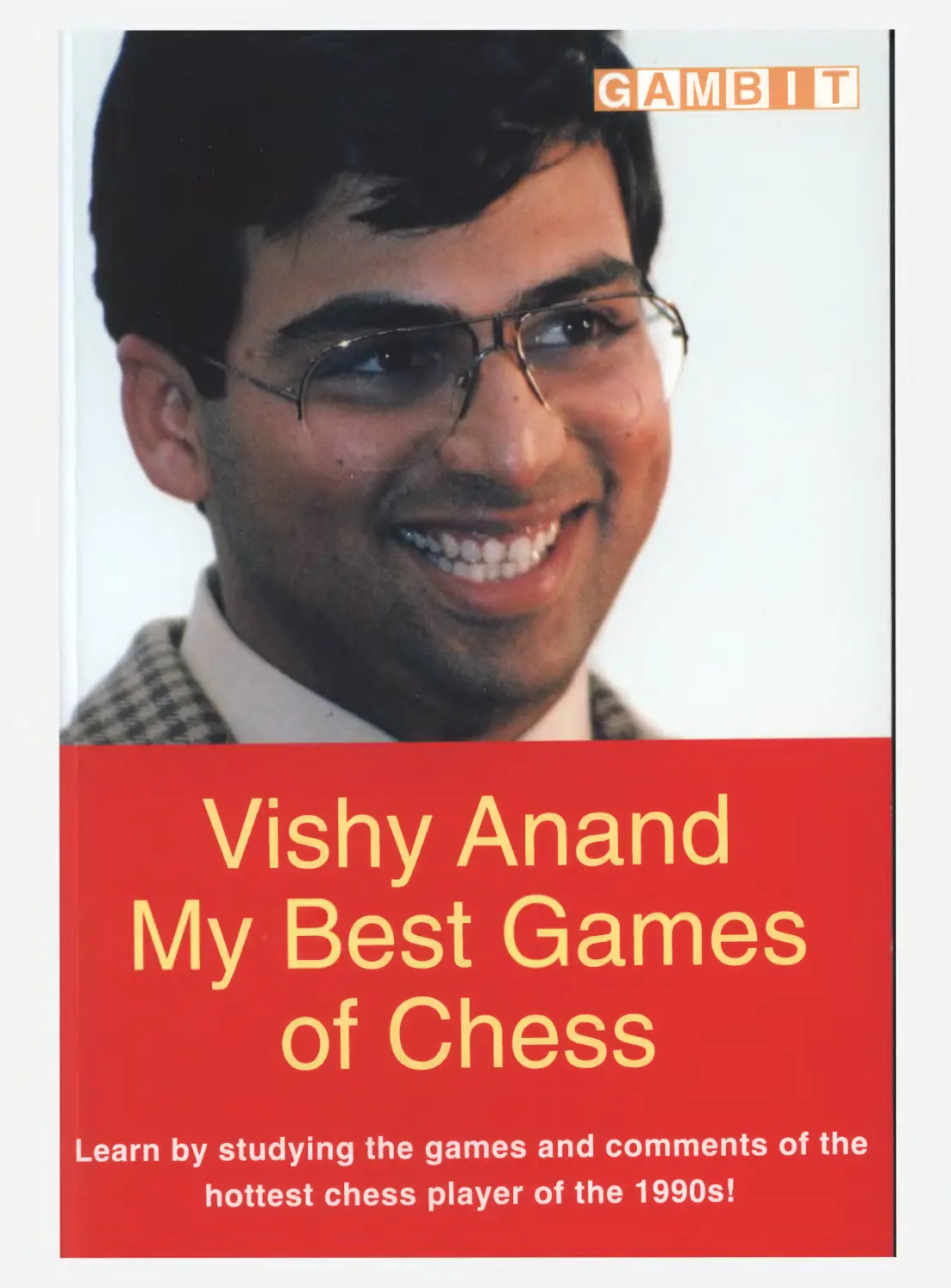


Автор: Anand V.
Теги: chess chess parties chess championships chess combinations chess review
ISBN: 978-1901983005
Год: 1998


Текст
AMDI(j
\.
Vishy Anand
y =est ames
of Chess
Learn by studying the games and comments of the
hottest chess player of the 1990s1
First published in the UK by Gambit Publications Ltd 1998
Copyright @ Vishy Anand and John Nunn 1998
The right of Vishy Anand and John Nunn to be identified as the authors of
this work has been asserted in accordance with the Copyright, Designs and
Patents Act 1988.
All rights reserved. This book is sold subject to the condition that it shall not,
by way of trade or otherwise, be lent, re-sold, hired out or otherwise circu-
lated in any form of binding or cover other than that in which it is published
and without a similar condition including this condition being imposed on
the subsequent purchaser.
A copy of the British Library Cataloguing in Publication data is available
from the British Library
ISBN 1 901983 00 5
DISTRIBUTION:
Worldwide (except USA): Biblios Distribution Services, Star Rd, Partridge
Green, West Sussex, RH13 8LD, England.
USA: BHB International, Inc, 994 Riverview Drive, Totowa, New Jersey
07511, USA.
For all other enquiries (including a full list of all Gambit Chess titles) please
contact the publishers, Gambit Publications Ltd, 69 Masbro Rd, Kensington,
London W14 OLS, England.
Fax +44 (0)171 3711477. E-maill00561.3121@compuserve.com.
Edited by Graham Burgess
Typeset by John Nunn
Printed in Great Britain by Redwood Books, Trowbridge, Wilts.
10 9 8 7 6 5 4 3 2 1
Gambit Publications Ltd
Managing Director: GM Murray Chandler
Chess Director: GM John Nunn
Editorial Director: PM Graham Burgess
Assistant Editor: GM John Emms
German Editor: WPM Petra Nunn
Contents
Introduction 5
1 Anand - Inkiov, Calcutta 1986 7
2 Anand - K. Ninov, World Junior Championship,
Baguio City 1987 12
3 Anand - S. Agdestein, World Junior Championship,
Baguio City 1987 16
4 Anand - J. Benjamin, Wijk aan Zee 1989 23
5 M. TaI- Anand, Youth vs Veterans, Cannes 1989 29
6 Anand - B. Spassky, Youth vs Veterans, Cannes 1989 34
7 M. Kuijf - Anand, Wijk aan Zee 1990 40
8 M. Petursson - Anand, Manila Interzonal 1990 43
9 Anand - I. Morovic Fernandez, Novi Sad Olympiad 1990 49
10 A. Beliavsky - Anand, Munich 1991 54
11 A. Karpov - V. Anand, Candidates match (6), Brussels 1991 59
12 Anand - G. Kasparov, Tilburg 1991 67
13 G. Kasparov - V. Anand, Reggio Emilia 1991/2 74
14 Anand - E. Bareev, Dortmund 1992 81
15 Anand - R. Hfibner, Dortmund 1992 87
16 Anand - I. Sokolov, SWIFT rapid, Brussels 1992 90
17 Ivanchuk - Anand, Match (1), Linares 1992 92
18 Anand - G. Kamsky, Alekhine Memorial, Moscow 1992 98
19 Anand - Ivanchuk, Linares 1993 102
20 B. Gelfand - V. Anand, Linares 1993 106
21 Anand - E. Bareev, Linares 1993 110
22 Anand - F. Izeta, Madrid 1993 115
23 Anand - L. Ftacnik, Biel Interzonal 1993 119
24 L. 011- V. Anand, Biel Interzonal 1993 126
25 M. Adams - Anand, European Clubs Cup Final,
Hilversum 1993 130
26 Anand - A. Beliavsky, PCA Qualifier, Groningen 1993 136
27 J. Benjamin - V. Anand, PCA Qualifier, Groningen 1993 142
28 Anand - G. Kamsky, Linares 1994 148
4
VISHY ANAND: My BEST GAMES OF CHESS
29 V. Anand - J. Polgar, Linares 1994 153
30 V. Anand - G. Kamsky, PCA Candidates (3), Las Palmas 1995 157
31 V. Anand - G. Kamsky, PCA Candidates (9),
Las Palmas 1995 164
32 V. Anand - G. Kamsky, PCA Candidates ( 11 ),
Las Palmas 1995 171
33 V. Anand - J. Timman, Tal Memorial, Riga 1995 176
34 V. Anand - G. Kasparov, PCA World Championship (9),
New York 1995 184
35 V. Anand - B. Gelfand, Wijk aan Zee 1996 189
36 V. Anand - J. Polgar, Amber Rapid, Monte Carlo 1996 198
37 Anand - Topalov, Dortmund 1996 202
38 V. Anand - Ivanchuk, Las Palmas 1996 207
39 V. Anand - A. Karpov, Las Palmas 1996 211
40 V. Anand - J. Lautier, Biel1997 216
Combinations 220
Solutions 230
Index of Opponents 239
Index of Openings 240
Symbols 240
Introduction
I don't want to spend too much time on biographical details, because this is a
book about my games, so I will be content with a brief sketch.
I was born on 11 th December 1969 in Madras, and learnt chess at the age
of six from my mother. A year later I joined the Tal Chess club in Madras. A
couple of years later I went to Manila when my father had an assignment
there and got caught up in the Philippines chess fever resulting from the 1978
Karpov-Korchnoi World Championship match. Returning to India, my fasci-
nation for chess took off, but it was not until 1983 that I achieved a real break-
through. In that year I won both the national Sub-Junior (under-16) and
Junior (under-19) titles, and qualified for the (adult) national championship.
The championship itself was held the following year, and I finished fourth. I
had a real success in 1984, winning the Asian Junior Championship, which
was held in Coimbatore, a victory which I repeated in 1985. It was also in
1985 that I gained my International Master title; at the time I was the young-
est Asian ever to achieve this distinction. In 1986 I won the National Champi-
0nship and became India's youngest champion.
The following year, 1987, was special. After having played three times be-
fore in the World Junior Championship, finishing 10th, 5th and 7th, I finally
won this' title. In December of the same year I became the world's youngest
grandmaster (at that time) by making consecutive norms in New Delhi and
Coimbatore (FIDE actually awarded the title in April 1988).
The next couple of years featured steady progress, but nothing really spec-
tacular. Then, in July 1990, I broke through the 2600 barrier. In the same
month, I qualified for the Candidates from the Manila Interzonal. The first
round of the Candidates was held in January 1991, and I won my match
against Dreev, but in the quarter-finals I lost narrowly to Karpov in a match
that hinged on the final game. After this disappointment, I concentrated on
tournament play with some success: I won outright at Reggio Emilia 1991/2
(ahead of Karpov and Kasparov) and in Moscow (November 1992). These
successes pushed my rating up to 2700, and I became only the eighth person
ever to reach this level.
The following year, 1993, was important because, after the formation of
the PCA by Kasparov and Short, there were now two Candidates cycles. The
6
VISHY ANAND: My BEST GAMES OF CHESS
qualifying events for these were to be held in Biel during July (for the FIDE
cycle) and in Groningen during December (for the PCA cycle). I was perhaps
somewhat fortunate to qualify from Biel, but at Groningen I reached the
PCA Candidates in more convincing style, finishing joint first in the quali-
fier.
In 1994 I was successful in the PCA cycle, defeating first Romanishin and
then Adams to reach the Final of the Candidates. In the FIDE cycle my for-
tunes were mixed; in the first round I beat Yusupov (who then became my
second!), but then I lost to Kamsky after having been two games up with
three to play. Round about this time I was also quite successful in quickplay
events, winning both the Amber tournament in Monaco and the PCA Grand
Prix in Moscow (ahead of Kasparov).
In early 1995 I faced Kamsky in the Final of the PCA Candidates, and I
managed to reverse the result of the previous FIDE match and gained the
right to face Kasparov for the PCA World Championship in New York. As
everybody knows, I started well but faded in the second half. However, losing
this match was not the end of the world and in 1996 I was back on the tourna-
ment trail, finishing joint first with Kramnik at Dortmund and beating Kas-
parov in the Final of the Geneva Quickplay However, the most important
event of 1996 had nothing to do with chess: on June 27th I married Aruna in
Madras.
So far, 1997 has been a very successful year. In April I finished joint first
with Kramnik in the Category 19 tournament at Dos Hermanas and in May I
became the first person to win the Amber tournament in Monaco twice.
There followed a win in the Frankfurt Rapid, in which I defeated Karpov in
the Final. The summer months saw a second place in Dortmund and outright
first in Biel; in this latter event I received the prize for the most beautiful
game (see Game 40). At the moment I am working hard preparing for a heavy
schedule of tournaments in the first half of 1998, so I will sign off now and
leave readers to enjoy the games.
Vishy Anand
Collado, Spain
October 1997
Game 1
V. Anand - V. Inkiov
Calcutta 1986
Sicilian, Richter-Rauzer
1 e4
2 lbf3
3 d4
4 lbxd4
5 lbc3
6 i.g5
7 'iWd2
8 0-0-0
9 lbb3
In 1986 this move was in vogue
thanks to the efforts of Mikhail Tal.
9 ... as
10 a4 d5
11 .i.b5
A move first played in Tal-Sis-
niega, Taxco Interzonal 1985, even
though Tal ascribes the move's in-
vention to Vitolin . Tal won that game
and scored an even greater success
when he beat Korchnoi with it at the
1985 Montpellier Candidates Tour-
nament. I figured that I could do
worse than to follow in Tal's foot-
steps.
11 ... ltJb4
Sisniega played 11.. .lbxe4 and
Korchnoi 11...dxe4. 11....i.b4 is an-
other possibility; after 12 exd5 exd5
13 'ir'f4, followed by exchanges on
c3 and f6, both sides will end up
with fractured pawn structures, but
c5
d6
cxd4
lbf6
lbc6
e6
.i.e7
0-0
it will be difficult for Black to get
at White's c-pawns, whereas White
will attack the d5-pawn. The move
11.. .lbb4 had been played before, in
Vitolin -Inkiov, Jurmala 1985.
12 :he1 (D)
I."'. ...
... . .
B_ _ _ _
. ..- .
i..'.
_ d d _
- . . .
. . .
_e.z.J _ a
D
u _ , u
. : -
- - .
12 ... dxe4
After 12... 'iWc7 13 e5 lbe8 14
lbd4! Black is in a bad way. Due to
the weakness of the e6-pawn, Black
can't play ...f6 and his e8-knight is
badly placed.
13 'iWxd8
Really the first new move of the
game. Vitolin played 13lbxe4lbxe4
14 'iWxd8 .i.xg5+ 15 'iWxg5lbxg5 16
h4, regaining the piece with an un-
clear position.
8
VISHY ANAND: My BEST GAMES OF CHESS
13 ... .:xd8
After 13...i.xd8 14 llJxe4 i.e7
(14...ltJxe4 15 .i.xd8ltJxf2 16 :d2 is
very promising for White; Black has
no reasonable defence to the threats
of 17 i.xa5 and 17 i.e7) 15 ltJxf6+
.i.xf6 (15...gxf6 16 i.h6 is similar to
the game) 16 i.xf6 gxf6 17 :d6
Black can play neither ...b6 nor ...e5,
and so has serious problems devel-
oping his queenside.
14 ltJxe4 ltJbd5 (D)
XB.t._ .._
.. ...
W _ _ Ymu
, ?ff$f . . //.//// :r:
/ /'l ;/ } ' ;-;'/1'0
w% ; /./" ;;/ ..%
.i..."
u,u // $ ;//
8 . .tlJ
i% . . F
0 t.t.J _ ; %// %/ ,
"8. 8"
%':f : /
%
;0:> , " '/ ,'/, . :
15 c4
A positionally ugly move, but the
main thing is to exploit White's lead
in development. To this end, White
must keep the d-file open.
15 ... ltJc7
15.. .ltJb4 occupies the 'hole' cre-
ated by White's previous move, but
then 16 :xd8+ i.xd8 17 :dl .i.e7
18 ltJd6 e5 (18...b6 19 i.e3! also
nets a pawn) 19ltJxc8 :Xc8 20 ltJxa5
wins a pawn.
16 .:xd8+ .i.xd8
17 :d1
Everything with tempo.
17 ... i.e7 (D)
. /j: .t. ti'% {:;;/d% . 0i ;
01;::,/ Z.-: · /';/; ' ; ;;;.
%%"i % ;; ; ;? {
W .. ' ...
,," Y, ,,,
/ /:/, ' ////:/:;,:/ . . "// ;:-/: , // ,
$}?''/, // /.j 'l. ,', '/ 0;
. _ f
. ' if}& % , , , .
... ;;( :'%ifif 0
Y"" -;// // ;.:: all '"
8R8.tlJ. .
. . 0:$
Bt.t.JB %_
O ' ;; ;"lf/ /' ':// A 'iJ'::j
o
/ / /' ,
. ".
W$Z /; :j;;;/,//,;:;/-;;;
18 ltJxf6+ ?!
White retains the advantage after
this move, but Black could have put
up more resistance. It was probably
stronger to play 18 ltJd6!. I would
not claim that thi s is a forced win
(Larsen once observed that all long
variations are wrong!), but Black is
definitely in real trouble:
1) 18...b6 19 i.c6! (not 19 i.e3
because now Black can reasonably
play 19...ltJxb5! with a satisfactory
position after either 20 cxb5 ltJd5!
or 20 axb5 transposing to line 2a be-
low) 19...:b8 20 .i.f4! and White's
pieces occupy dominating positions.
2) 18.. .ltJx b5 and now there are
two possible lines:
2a) 19 axb5 b6 (best; 19...a4 20
ltJa5! and 19.. .h6 20 i.xf6 .i.xf6 21
ltJc5 are more promising for White)
20 .i.e3 a4 21 ltJa 1 ltJd5! 22 cxd5
ANAND -INKIOV, CALCU1TA 1986
i.xd6 23 dxe6 i.e7 24 exf7+ cj;xf7
with fair compensation for the pawn.
2b) 19 cxb5! (this concedes the
d5-square, but Black can't make full
use of it) 19...b6 20 ltJc4 (20 i.e3
ltJd5! as in line 1) 20.. .J:b8 21 ltJd4
(intending ltJc6) 21...i.b7 (21...i.d7
22 ltJe5 is also good for White) 22
ltJxb6 i.xg2 23 ltJc4! (although
Black has the two bishops, the mass
of pawns on the queenside is the
most important factor in the posi-
tion; 23 ltJd7 is less accurate since
after 23...J:c8+ 24 cj;bl i.e4+ things
are getting quite messy) 23...J:c8 24
b3 (White only needs to play cj;b2
and ltJxa5 to decide the game with
his queenside passed pawns; how-
ever, Black can try to win a pawn)
24.. .i.d5 25 cj;b2! i.xc4 26 J:c 1 !
(when I checked this position with
Fritz, it said that Black was winning!
Surprised, I looked to see why)
26...J:c5 (this is the reason, but after
some thought I found a solution) 27
':xc4 ':xg5 28 J:c8+ i.f8 29 b6!
(Black is helpless) 29...J:c5 (after
29...ltJd7 30 b7 ':d5 31ltJc6 Black
has no defence to both 32ltJe7+ and
32 ':d8) 30 b7 ltJd7 31 ltJb5! and
Black cannot meet the threat of 32
J:d8.
18 ... gxf6
19 i.e3 ltJxb5
20 axb5 f5!
Black fights back. This gives his
bishop some air and prevents White
forcing the exchange of bishops by
9
i.c5. 20...e5 is worse, as after 21
i.c5 i.xc5 22 ltJxc5 i.g4 23 J:d5
J:c8 24 b3 Black's queenside pawns
are in trouble.
21 ltJc5 (D)
The alternative 21 f4 ambitiously
attempts to squash Black, but he can
free himself by sacrificing a pawn:
21.. .e5! 22 i.c5 (22 fxe5?! i.e6 23
ltJd2 a4 prevents White supporting
his c4-pawn by b3, and then the c4-
pawn itself is attacked by ...i.b4 and
...:c8) 22...i.f6 (not 22...i.xc5?,
when 23 ltJxc5 gives White exactly
what he wants) and now 23 fxe5 fails
to 23...i.g5+ 24 cj;c2 i.e6 and Black
is doing well as White cannot hang
on to all the pawns (for instance 25
cj;c3 J:c8, foIl owed by some combi-
nation of ...a4 and ...b6).
...i.. M.'
... ..&
B _ ;; A
;0 ' /'%/ & %' /{
£i A :
_ l\ / .. '! & .
_ 0 ,;f A /'
//u,,!I; / .//;;:: W-X:;'
)%-;/c. //,/:'/ //;;:;':/. //. ;/
1 l\ i. ;ff/ . ; :
»} ; 0 ;J!/Z; . /;: ;tr
r l' ? /2
/ / // '/ ; . /'i,
:/j;',<// /// ,
&ffiK l\ i
Q . /:;; } 0 :
//?'/f; .. / .: 0 . / . '/. . % . . ':
;'/.: -; . //J///
. %; ,; i
21 ... e5?
The best defence was 21...f4! 22
i.d4, and now:
1) 22.. .e5 23 i.xe5! i.xc5 24
J:d8+ i.f8 25 i.d6 and White wins.
10
VISHY ANAND: My BEST GAMES OF CHESS
2) 22...a4 (by not allowing ltJa4,
Black gets some counterplay) and
now:
2a) 23ltJd3 i.d7 (23...f6? is very
good for White after both 24 i.c5
and 24 lL\xf4 e5 25 lL\d5) 24 lL\xf4
:c8 25 i.c3 i.e8 and Black has suf-
ficient counterplay.
2b) 23lL\e4 f5 (23...e5? 24 i.xe5
i.e6 25 c5) 24 i.c5 and White re-
tains some advantage.
3) 22...f6 (a solid and sensible
defence; Black prepares .. .e5 fol-
lowed by ... t7) 23ltJa4! e5 24 i.c5
f7 25 i.xe7 xe7 26 lL\b6 :b8
with a slight advantage for White.
Thus 21...f4, while not equaliz-
ing, would have restricted White's
advantage. The importance of driv-
ing the bishop to d4 becomes clear
after the text-move.
22 lL\d7!
From this excellent square the
knight virtually paralyses Black's
whole army. The game is already al-
most over.
22 ... f4
Too late, as now the bishop need
not block the d-file.
23 i.b6 f6
24 i.c7!
Since 25 ltJb6 is threatened, Black
can no longer delay capturing the
knight; the result is that White's rook
occupies the seventh rank.
24 ... i.xd7
25 .:xd7 i.c5
26 i.d6 i.xd6
White also wins after 26...i.xf2
27 :xb7 :d8 28 :b8! (not 28 c5?
i.xc5 29 i.xc5 :c8) 28...:xb8 29
i.xb8 t7 30 i.c7 and the threat of
31 b6 forces Black to approach with
his king, whereupon 31 i.xa5 gives
White an overwhelming mass of
passed pawns.
27 .:xd6 (D)
.B B B.B
B B'B B B'
. .
; M_.
8 .
- - -
88- .
.. --
- - . .
. "8P
u . u u
. . .
- -
Black's position is lost. The active
rook, combined with White's queen-
side pawn majority, guarantees a
straightforward win.
27 ... :c8
28 b3 a4
29 b2 axb3
30 xb3 7
Just abandoning the b-pawn, but
30.. .f5 31 :d7 :b8 32 c5 is also
hopeless.
31 :d7+ e6
32 .:xb7 e4
33 :&7 e3
34 fxe3 fxe3
35 c3 :d8
ANAND - INKIOV, CALCUTTA 1986
11
36 .:a2
37 b6!
38 b7
39 b4
e5
e4
:d3+
:d2
40 b8'ir'
41 'iib7+
42 'ir'd5+
43 c5
.:xa2
d3
e2
1-0
The 1987 World Junior Championship was a breakthrough for me. It was
already my fourth World Junior Championship; I had played in every one
since 1984, finishing 10th in my first appearance, 5th in 1985 and 7th in
1986, a fairly zigzagging pattern. I started the 1987 event in fairly good shape
but I drew 3 out of my first 4 games, and at that point I didn't imagine that I
might win the tournament. However, the following game was a turning point.
Game 2
V. Anand - K. Ninov
World Junior Championship, Baguio City 1987
Sicilian, Kan
1 e4 c5
2 ltJf3 e6
3 d4 cxd4
4 ltJxd4 a6
5 .i.d3 .i.c5
6 ltJb3 .i.a 7
7 ltJc3 ltJc6
8 'iVe2 d6
9 .i.e3 .i.xe3
As a result of this game, players
with Black started delaying this ex-
change so as to leave the white
queen on e2 and thereby prevent the
.i.e2 line mentioned in the note to
Black's 13th move. In time, this led
to the development of a whole new
branch of opening theory.
10 'iVxe3 ltJf6 (D)
. %: . }.:; J. // . ' . % <j: . f
//>/ 'I - /,ij 2" / 'l;
0/;;% :% j)'l;;i;; /J / / / /
%:;::f .& JJJ%f/: /'/;f!t.& .&
W .. c &:; .. ..
I....I.
W;/0: //////
/:/: /-;'; '« :: % : . // . " /, / /
////// x/))/;; / //;'l
9jj;J ; A //2&;/
/ . /: '/ffi / . ; ; . ' ' ///
. . Pjj!f};
t2J ; rLj ;// 'c; M1 // // ///
/ / + / /
/
/./ %/
A A
O{Q;O
/i / /
'l //;
1'; : //
-;' /
/ . ' iJ /''> A 1j 'A /
/ ' O //
"/ / / / v
. .. d 'j/. // ;/.::: 1:
/ ///.//
'/' >", / /
'/.
11 g4!
I found this innovation over the
board. Previously White had contin-
ued 11 0-0-0, but after 11...0-0 White
either has to prepare this advance
with :hg 1, or play g4 as a pawn sac-
rifice. The idea behind the immedi-
ate g4 is quite simple: if you play it
when g7 is undefended, then it isn't
a sacrifice.
11 ... b5
Black thought for a while, and
then decided simply to proceed with
his queenside counterplay. However,
the tempo White saves by missing
out :hgl is quite important, and he
should have tried 11. ..ltJxg4. After
12'iVg3ltJf6 13'iVxg7 :g8 14'iVh6
.i.d7 Black will play ...'iVe7 and both
sides will castle queenside. How-
ever, when Black castles queenside
in the Sicilian, White is better unless
there is some mitigating factor, which
is not the case here. Indeed, after
'ir'e3 by White there is an awkward
weakness on b6 and the d6-pawn it-
self may become vulnerable later.
12 0-0-0 0-0
13 g5 ltJe8
A poor square for the knight, but
after 13...ltJd7 14 i.e2 Black has
ANAND - NINO V, BAGUIO CITY 1987
immediate problems with his d6-
pawn, due to the exchange of dark-
squared bishops and White's extra
tempo. Usually White doesn't go af-
ter d6 in a Sicilian, but that doesn't
mean you should forget about the
possibility altogether!
After the text-move, there is no
point to :hgl, which would throw
away the advantage gained as a re-
sult of White's innovation, so White
has to come up with an alternative
attacking plan.
One possibility is h4-h5 followed
by J:dgl. The arrangement with rooks
on gland hI is very desirable, be-
cause they will break through almost
any kingside defence, but it is very
time-consuming to set up. Unlike
many similar positions in the Sicil-
ian, Black's queenside counterplay
is rather slow here, which is the only
reason White can consider this plan,
but in the end I decided on a more
conventional approach.
14 f4 b4
15 ltJe2
15 ltJa4 would be a more posi-
tional formula. White stops .. .a5-a4
and threatens to invade on b6. After
15...J:b8 White can continue 16 e5,
in order to clear the c5-square for the
knight. However, I preferred to play
for the attack, and for that the knight
is needed on the kingside.
15 ... as
16 ltJbd4 ltJxd4
17 ltJxd4 (D)
13
White has the advantage. Nor-
mally in the Sicilian, Black's the-
matic queenside pawn advance gains
time because it hits minor pieces on
b3 and c3, but here White has evacu-
ated these squares quite quickly.
Moreover, the knight on e8 is very
badly placed for supporting the at-
tack. Just about the only useful thing
it can do is to shore up the kingside
by ...g6 and ...ltJg7.
. r?# ... 1&\ . . p }
... 0:;;;,//.JL i" /j /. ,/
' // /. ' /. :rft!: ' I. " /. I / 1. // /
B m; './%0
x /;/ ,
. /. . / . /' . ;:' . '. . / I. w //, /- /:/ . ;:
: ; !t ; ' ; ;
///'l/ ' /., ,0- // :;:// ;;;
- (!; @) [ffj %
_ :fi!:: /i0if
/"U/ ;;//% , ;%;0/ /.u y;
. % ' fiJ {fJ //:J / /:; . ;:,//,;
/. " , ;;:,
/uu, /." f:, ::/f:; ;
% , :# , ;/ ' i. /. '//.: ;::/: ,
;y :/S' +;, / j/:«/; /
%; ; // /- ;f/:! /
';'" ;.. A t;' ,j' :ff
L) , L) <' /Q/
: :
17 ... 'iVb6
At the time I felt that Black should
have gone in for 17...a4, but now I
don't think so. The line that worried
me was 18ltJc6'iVc7 19ltJxb4 a3 (if
Black doesn't play this, then White
plays a3 himself, followed by <it>b 1
and c3, and Black will never break
through) 20 b3 (threatening to cen-
tralize with 'iVd4) 20...'iVc3 (after
20...J:b8 21 ltJa6 xa6 22 xa6,
followed by c4, White's queen-
side position is solid since the poorly
placed knight on e8 cannot displace
14
VISHY ANAND: My BEST GAMES OF CHESS
White's bishop), but in fact 21 'ir'el!
'iiD2+ 22 d2 is clearly better for
White - Black has surprisingly little
compensation for the pawn.
These were still the pre-computer
days, when players were much more
intuitive. Nowadays everybody goes
home and checks everything with
Fritz. The use of computers has made
people more sceptical and now they
are more prone to go pawn-grabbing
unless there is definite compensa-
tion.
18 e5 .1b7
19 :hO (D)
.I. .a_..
B."'. .._.
mz .. .
- -
/ .
% U U
r D .
fi , ,!/;.
. P ill1i .
- ..... .
. . "
u _ , u
. :.:p
- - -
19 ... dxe5
Or 19...a4 (19...:d8 20 f5! is simi-
lar) 20 f5! dxe5 (20...exf5 21 e6 is
very good for White) 21 fxe6! (not
21 'ir'xe5 :a5!) 21...exd4 22 'ir'h3 g6
(22...f5 23 :xf5! gives White a win-
ning attack) 23 exf7+ :xn (23... h8
24 'ir'h6lbg7 25 :f6 wins) 24 :xf7
xf7 25 'ir'xh7+ winning the black
queen.
20 fxe5 :d8? (D)
Allowing a pretty finish. 20...g6!
was best, when White could con-
tinue 21lbf5 'ir'xe3+ 22lbxe3 with a
pleasant endgame - his knight could
head for either f6 or d6. Still, Black
has some chances by playing his
knight to f5, and he should certainly
have gone for this.
. _a_..
....R .. / .
w _ _ ,!Ii
Ii ... _
'/ · D 8
@ % %
%!/; w !/;
. .
_ d
. .i._ .
8 8. .
U . U
. :.:.
_ w _ _
21 .1xh7+! xh7
22 g6+
Once again Black suffers because
of his miserable knight position.
Here it prevents Black from playing
22...fxg6.
22 ... g8
Or 22... xg6 23 'ir'd3+ (stopping
... h7) 23...f5 (23... h6 24 'ir'h3+
g5 25 :gl+ f4 26 :de1 with
mate next move) 24 exf6+ with a de-
cisi ve attack.
23 'ir'h3 lbf6
23...fxg6 loses to 24 :xf8+ xf8
25lbxe6+.
24 exf6 (D)
ANAND - NINO V, BAGUIO CITY 1987
. . ...
. . ..
B."'. _ _
illU .& I\.
_ ..UO
/ N.
. . .
'/ J .
W'
- - - --
8 R 8. . P
u _ _ U
. :.:.
. * . .
15
It isn't every day you see two at-
tacking pawns on f6 and g6! When
you get a position like this, you go
away feeling very pleased and have
a warm glow for the next few games.
24 ... fxg6
25 fxg7 1-0
Since 25... xg7 26 lbxe6+ and
25...:'xfl 26 'ii'h8+ f7 27 :'xfl+
are decisive.
After this game, which was from round 5, there was a free day and the
players went on an excursion. I still hadn't broken free from the pack. The
following day, however, saw another good result. I was facing Agdestein,
who at 2565 was the highest-rated player in the tournament, although he was
not the only grandmaster (Ivan Sokolov was also participating, although he
was not very successful).
I prepared as well as I could because Agdestein is very unpredictable in the
openings, and sat down hoping to playa good garnet
Game 3
V. Anand - S. Agdestein
World Junior Championship, Baguio City 1987
Ruy Lopez
1 e4 llJc6
A provocative move. At the time
it was felt that this move had little in-
dependent significance because so
long as White knew he should play 2
ltJf3, Black had nothing better than
2...e5, thereby transposing into stan-
dard king's pawn openings. Subse-
quently it was discovered that Black
could wind White up even more by
playing 2...d6, but I don't trust this
for Black!
2 ltJf3 e5
3 .i.b5 a6
4 .i.a4 b5
5 .i.b3 ltJa5
Agdestein is fond of offbeat sys-
tems. I didn't know much about this
one, although it is popular amongst
Norwegian players. I could only re-
member a game between Spassky
and Taimanov (in fact from the 1955
USSR Championship, held in Mos-
cow). Nevertheless, I was quite happy
to see it on the board. White can play
natural moves and there is not much
risk even if he commits a slight inac-
curacy - a pleasant situation when
facing the top seed!
6 0-0
7 d4
d6
ltJxb3
8 axb3 f6
9 llJc3 .i.b7
I recalled that Spassky had played
10 ltJh4 in the above-mentioned
game, with dxe5, iff3 and J:[dl fol-
lowing in some order, and that later
Spassky sacrificed a piece by means
of llJxb5.
10 ltJh4 ltJe7 (D)
K 4
Wff0
/,
W .t
/-/
& j% . / . % /%
.. //
j};;, / / // /
. & /Y1
# . (/ :: . / y/
, }" ( .. y; , ' . / fij
/) %J ,/////-'
:;://:/,-;/ 'l/',//:';,/ / / // , / / // ;
:' . /;:/ ' / 'l "
;}/::' ;.J '/
;:0:;'% ;, ,
-'/////:/;,
G
//, // '/ /: if
:;, +'/
: /'
;.// ;;/
;,i ''l'.,;
'//////'
fIj / ' A ftj ;;
; . % 0 /
'/// / 0
,,
Wi
11 dxe5! dxe5
HBlack plays 11...fxe5, then White
can strongly reply 12 f4, opening the
position up while Black's king is
still stuck in the centre. However,
taking back with the d-pawn retains
control of g5, so that f4 can be met
by ...exf4 followed by the fork ...g5.
12 iff3
ANAND - AGDESTEIN, BAGUIO CITY 1987
White avoids the exchange of
queens as most of his chances lie in
exploiting Black's poor develop-
ment and centralized king.
12 ... 'iVd7
13 J:tdl 'iVe6
By now I had worked out that this
was indeed what had happened in
the Spassky game, and that he now
continued with 14 .i.e3. For a mo-
ment I wondered what Taimanov had
played that allowed the sacrifice on
b5, then I realized that it was 14...g5.
After 15 ltJxb5! axb5 16 'iVh5+ 'iVf7
(16...ltJg6 17 ltJxg6 'iVf7 18 J:xa8+
.i.xa8 19 'if g4! also wins) 17 J:xa8+
.i.xa8 18 J:td8+ <it>xd8 19 'ifxf7 gxh4
20 'iVxf6 White had a winning posi-
tion.
However, I was worried by the
idea of 14...h5!?, intending ...'iVg4. I
mulled over this for some time, but
couldn't see an easy answer. If
White plays 15 h3, then 15...g5 is
now possible because White has no
queen check on h5. If 15 ltJd5, then
Black just castles queenside. It ap-
peared to me that if White was going
to play ltJd5, then it would be better
to do it straight away, before Black
had time to set up the threat of
...'iVg4.
14 ltJd5 ltJxd5
If 14...0-0-0, then 15 c4 and White
is already starting to make Black's
king feel insecure.
15 exd5 'iVf7
16 c4?! (D)
17
A slight inaccuracy which gives
Black the chance to sideline the
knight on h4. 16 ltJf5 would have
been more accurate, because White
can play c4 at any time - Black can't
prevent it. Then 16.. .g6 17 ltJh6
.i.xh6 18 .i.xh6 0-0-0 19 c4 J:[d7
would have led to a position in which
White has an edge, since Black has
no really constructive plan.
. . % .. /
t _ 00/
B."'. .1fV..
.. . . .
%3 .. :;; ::}J A . / . :r@i;
/ w . ;{'0: 0 ';j; / -;, / ; / / / / /
/:/",;;:;/h,; /;i:/"'// / /// // /////,
A ///ffi// /;/:/,
. 0 ;i 8: ; 0I/ ;
. ' i .I;i
?iJ fff%
'Jf// )
.
/ '/; ; % %
/,,/ / / '/////// /,
16 ... .i.e7?
Black misses the opportunity he
has been given. 16...g6! would have
left the h4-knight misplaced. It is
true that after 17'iVe2 .i.g7 18 f40-0
19 f5, followed by 'iVe4, White has a
good centralized position and Black's
bishops are hemmed in. However,
after 18...0-0-0!? Black would have
chances of putting his two bishops to
work. The b7-bishop functions as a
kind of 'Dragon' bishop, in that it
makes it hard for White's attack
down the a-file to strike home prop-
erly. Moreover, playing cxb5 will
18
VISHY ANAND: My BEST GAMES OF CHESS
leave d5 hanging. White is certainly
not worse, but Black would have far
more counterplay than he obtains in
the game.
17 lbf5 (D)
.. ... -
. \Wt i
B d"'. .-.
iB . . B
BiB8.tDB
88. B _
.8. ....
p . P8
:.
The exchange of inaccuracies has
favoured White, because Black's in-
accuracy is actually quite serious -
his bishop doesn't belong on e7 at
all. Now White is clearly better.
17 ... :d8
17...0-0 is impossible because of
18 .i.h6.
18 .i.e3 g6 (D)
More or less forced, because oth-
erwise Black lacks a constructive
move. 18...0-0? still fails to 19 .i.h6
while after 18....i.c8 White has a
choice of promising lines:
1) 19 :ac 1 0-0 20 lbxe7+ (not 20
cxb5 .i.xf5 21 'it'xf5 axb5 22 :xc7
:xd5! and Black escapes) 20...'it'xe7
21 cxb5 :fe8 22 b6 cxb6 23 .i.xb6
:d7 24 'it'd3! .i.b7 25 d6 gives White
a clear advantage. .
2) 19 c5! (even more forcing)
19.. ..txf5 (19.. .0-0 20 d6 wins a
piece) 20 'it'xf5 :xd5 21 'it'c8+ and
after 21.. ..i.d8 22 'it'xa6 or 21.. .:d8
22 :xd8+. .i.xd8 23 :dl 'it'e7 24
'it'xa6 White wins a pawn while re-
taining a positional advantage.
. -.. -
8.t / .8i
wd y;._
i8 . i8
d _ . _
.i.8
_ _ .e.zJ_
.8. _ .
.88 _...
. 8R
d
a:.
19 lbh6!
White could exchange on e7, but
then Black's king could castle or
move to f7 and he would have fair de-
fensive chances. White's queenside
majority is an asset, but it will not
win the game by itself because the
c-pawn is tied to the defence of d5.
Instead, I wanted to keep Black's
king on e8, while I broke through on
the c- and d-files.
19 ... 'it' g7
Intending ...f5, when the knight
might be in trouble.
20 'it'g3?!
This move, introducing lbf5 ideas,
is not so strong as I imagined during
the game. Sometimes, when you
ANAND - AGDESTEIN, BAGUIO CITY 1987
have a good position, the temptation
is just to play easy, comfortable moves
and wait for the position to win it-
self. The correct move was 20 cxb5!,
when 20...axb5 fails to 21 :a7. Dur-
ing the game I rejected it because of
20...f5 21 bxa6 .1a8, with the threat
of ...f4. However, with ten years'
hindsight I don.'t see Black's com-
pensation for the two pawns. In par-
ticular, once White has played a7 the
bishop on a8 will effectively be dead,
since taking on d5 will always allow
a combination involving the promo-
tion of the a-pawn. One line is 22
'ii'h3! f4 23 .1d2 .1g5 24 g4 h5 25
xe5 and wins.
It is worth noting that 20 h4 was
playable. After 20....1c8 we trans-
pose into the game, but White has
saved a couple of moves.
20 ... .1c8
Threatening ...g5, so White's next
move is forced.
21 h4 .1d6 (D)
If Black attempts to play actively
by 21...f5 22 .1g5! f4 then:
1) 23 'ii'c3 b4 24 'ii'd2 (24 'iff3
.1xg5 25 hxg5 'ife7 26 g4 'ii'xg5
27llJxe5 O-O! is unclear) 24....1xg5
25 hxg5 'ii'e7 26 :el f8! and
Black has counterplay.
2) 23 'ii'h2!. A paradoxical move
which nails down Black's kingside.
Now White simply threatens :el
followed by doubling or even g3
(meeting ...f3 by g4). However Black
continues, his e5-pawn will come
19
under fire and his king is trapped in
the centre. The point of'ifh2 is that
after 23....1xg5 24 hxg5 'ife7 White
can defend the g5-pawn and main-
tain his kingside bind.
-...-.- -
_.mu
w. _ . ..
.. .
. - -
B'.8 B
- - -
_8_ _ D
.8.
. . - -
. 8.
u dud
B:B
- - - *
22 'iff3
Other moves are inferior, for ex-
ample 22 c5? .1xc5 or 22 :acl e4
23 .1f4 'ifxh6! 24 .1xh6 .1xg3 25
fxg3. In this latter line White keeps a
slight edge as the opposite-coloured
bishops (which normally have a
drawish influence) make Black's de-
fence a bit more difficult, when there
are still a fair number of major pieces
on the board. However, I thought
that keeping the queens on offered
even more.
The move 'iff3 is mainly to pre-
empt the threat of ...e4. Now that
White has got the knight firmly en-
trenched on h6, he can proceed with
:acl followed by c5 and d6. The
manoeuvre 'iff3-g3-f3 may appear
odd, but Black has also wasted time
20
VISHY ANAND: My BEST GAMES OF CHESS
with the manoeuvres ....i.b7-c8 and
.. ..i.f8-e7 -d6.
22 ... .i.e7
Black would like to play .. .J:f8, but
the immediate 22...:t"8 allows 23 c5,
because after 23....i.xc5 24 .i.xc5
the rook on f8 is hanging. So Black
returns to e7, still preventing c5 and
getting ready to play ...J:f8 next
move. The net effect of both players'
oscillations has been to add the
moves h4 and ....i.c8, which benefits
White.
At this stage I felt that my posi-
tion was very comfortable, but I had
(and still have) a great deal of re-
spect for Agdestein and I wasn't
counting on victory yet.
23 :acl
Retaining the option of either cxb5
or c5 followed by d6.
23 ... bxc4
Agdestein finally decides to re-
move the cxb5 option.
24 bxc4 :f8
25 c5 f5
26 .i.g5 .i.xg5
27 hxg5 'ilie7
28 'ilig3! (D)
White had a more complex alter-
native in 28 d6 'ilixg5 29 'ilic6+ .i.d7
(29...J:d7 30 _a8! J:d8 31 J:el
should win for White) 30 'ilixc7
'ilixh6 31 c6. This would also have
been quite promising, as Black would
have to return the piece for one
pawn, still leaving White with a an-
gerous passed pawn. However, given
that an effective, solid alternative ex-
isted, I preferred to play safe.
Mi.... .
. 81.
BB . _ _
&. . .&
a. _ p a
. _'D
. . .
; 0/,j: /W// M$;
. [ . . :r . / ' . .& . * ID1t
W ; : J} _
' . .
// fff% i _
. ".
wgj; ? u .... rf,}
In a way it is quite strange that
White is not winning already, since
Black's king is irrevocably trapped
in the centre - not only can it not
castle, but even f7 is denied to it.
However, the reason is the knight on
h6. It is of course doing a wonderful
job, but when it comes to landing a
killing blow in the centre, White is
effectively a piece down.
28 ... f4
29 'ilih4 e4
30 d6 'ilie5!
The best chance. After 30...cxd6
31 cxd6 'ilie6 (31...'ilie5? 32 J:xc8!)
32 J:c7 e3 (32....i.d7 33ltJg4) White
can continue 33 fxe3 fxe3 (after
33...'ilixe3+ 34 <it>hl there is no de-
fence against 35 J:e 1) 34 'ilic4! J:f2
35 'ilixe6+ .i.xe6 36 J:e7+ <it>f8 37
J:xe6 with an extra piece.
31 dxc7 .:xdl+
32 1hdl (D)
ANAND - AGDESTEIN, BAGUIO CITY 1987
..t.... .
. ..
/';-/1/1:: ::;;::; .
- !%
)f /:
/' . //' // '0: //
;, y.
/", ,/, //,
. . & I / : '/:
(n:l A y. :;; y.
'/ ;/m: './:0/:0 ;/// / Y,;' /
f; )ff/f
. %
: %t{/ f4 (tJ /% ', A
_ O_
/ u Y,;' ,///;;/j /, / Y,;'
r . .
. h _ ,
. "
B _
..
.
,
32 ... e3?
Black decides to counterattack, but
now White's win is fairly straight-
forward. Black's only chance was
32...'iixc7, when we can see that it is
not so easy for White because his
knight is on h6. If it were on any nor-
mal square then, for example, ltJc3
or ltJc4, heading for d5 or d6, would
be decisive. Nevertheless, after 33
lbg4 (heading for f6) 33... xg4 34
'iixg4 J:f5 35 b4! (White needs to
pause for this move; it strengthens
c5 and indirectly supports J:d6; after
21
35 'iie2.:xc5 36 'iixe4+ White's
attack has got a bit stuck) White has
a large advantage. He intends 'iie2
and J:d6, taking aim at e4 and a6,
when Black's exposed king causes
continuing problems. If 35...e3, then
36 fxe3 fxe3 37 'iie4+ picks up the
e3-pawn (37...J:e5 38 'iia8+ q;e7 39
'iih8 is even worse).
33 J:d8+ q;e7
34 ltJg8+ .:xg8
35 .:xg8! e6
Or 35...e2 36 'iixh7+ e6 37
J:e8+ and wins.
36 c8'ii
36 'iixh7+ f7 37 J:e8+ q;xe8 38
c8'ii+ q;e7 39 'iib7+ q;d8 40 'iih8+!
is a prettier win, but I preferred the
prosaic text.
36 ... exf2+
37 'iixf2!
This game has been published in
some magazines with the move 37
xf2, but that allows mate in two!!
37 ... xc8
38 .:xc8 1-0
This win over the top seed put me well on the way to becoming World Jun-
ior Champion. My run of wins continued with further victories over Klinger,
I vanchuk and Blatny, after which I was in clear first place, a position I held on
to until the end of the tournament.
Winning the World Junior was my big breakthrough. Normally a player
from India would have to waste a lot of time playing in mediocre open tour-
naments, gradually improving his Elo rating and hoping to get some invita-
tions. However, the two factors of my World Junior title and my GM title,
which I gained shortly after this event, enabled me to short-circuit the pro-
cess. I got an invitation to a pleasant open tournament in Lugano (but after
22
VISHY ANAND: My BEST GAMES OF CHESS
my play there, I didn't get invited again!). Then I was asked to be a commen-
tator at the World Cup event in Brussels (April 1988). In Brussels I was able
to meet some tournament organizers and this led to my first top-class invita-
tion - to Wijk aan Zee 1989.
I had a tough year in 1988, just after gaining my GM title. I lost about 40
rating points in two tournaments at Biel and Blackpool- I still don't under-
stand why, although many GMs have told me that they had similar experi-
ences after gaining their title. I had a break after Biel and returned to active
play near the end of the year at the Thessaloniki Olympiad, making 8 1 /2
points out of 12 games. This score was sufficient to regain 10 of the Elo
points I had lost, but later I was surprised to discover that FIDE had not given
me any points at Thessaloniki. The reason, I found out, was that the Indian
team had arrived late, after the first round, and had therefore lost one match
by default. FIDE had counted this as a normal loss, thereby wiping out my
ten point gain from the rest of the event! Later on I had my ten points rein-
stated.
I then scored 6/9 at the GMA Open in Belgrade and subsequently I played
at Reggio Emilia, another good invitation resulting from my World Junior
success. This tournament started well with wins against Ivanchuk and Sax,
but after that I lost some games and finished on 4/9. However, this event was
very useful for me; it was the first time that I had played such a strong field.
My next event was the long-awaited trip to Wijk aan Zee. This was my first
really big event and I was thrilled to be there. I had a zigzag course in the
tournament. I won my first two games, just as at Reggio Emilia, then lost to
Tseshkovsky (who used to be a nemesis of sorts!). I also lost to Van der Wiel,
but then won against Ivan Sokolov. I was still on '+ l' when the following
game was played in the penultimate round.
Game 4
V. Anand - J. Benjamin
Wijk aan lee 1989
Sicilian, Richter-Rauzer
1 e4
2 ltJf3
3 d4
4 ltJxd4
5 ltJc3
6 .1g5
7 'iid2
8 0-0-0
9 ltJb3
Two of the first four games in the
book reach this position! I have done
pretty well with this line so far.
9 ... 'iib6
By the time this game was played
it had become clear that 9...a5 wasn't
that great a move.
10 f3
c5
d6
cxd4
ltJf6
ltJc6
e6
i..e7
0-0
':d8 (D)
..J._ ...
i . ' i i
w_ ,, _
JIL\ / & . /., .
_.. A , .
. . . -
- . - .
. . l\ .
_ _ 0
l\ ' l\ l\
O O_ .ou
_ 1t:.J..:
11 bl
There is an interesting story relat-
ing to this move. I used to get a lot
of my theoretical information from
Ivanchuk. For example, during the
1985 World Junior Championship in
Sharjah he had shown me a tremen-
dous idea in the Dragon, which turned
an existing evaluation upside down;
I was amazed (and thankful!) that he
was so open and generous about
showing his ideas to me. I would try
to give him some titbit in return, but
unfortunately my novelties were not
that good!
At the Reggio Emilia event the
month before Wijk aan Zee, there
hadn't been much to do in the eve-
nings, so one day I went to Chucky's
room. By this time he had recovered
from his first round loss to me and
was on a respectable score. He was
also feeling bored; we went out for a
walk and then returned to his room. I
asked him "Why does everybody
play the Catalan - it seems such a
boring opening." He replied that it
was not boring at all and proceeded
to show me an interesting idea. The
introductory moves were 1 d4ltJf6 2
c4 e6 3ltJf3 d5 4 g3 .1e7 5 .1g2 0-0
6 ltJc3 dxc4 7 ltJe5 c5 8 dxc5 and
24
VISHY ANAND: My BEST GAMES OF CHESS
now Vassily said that 8..:iic7 was
supposed to be a good move. He ex-
plained that after 9 ltJxc4 'fixc5...
(D)
a-i.. / ..
_ d /. u/ /. _
w.'. M'.'
. _'11 _
ill11 . .
. . .
BltJ_ . .
. . /
- - /'/
%' . "
. U /!//
m 'iV .:
/ /. / " /. /, ,
...everybody plays 10 'fib 3 , but he
had found a very strong idea: 10 b3 ! .
The point is that after 10....:d8 White
can play 11 i.a3 :xd 1 + 12 ':xd 1
'fic7 13 ltJb5 trapping the queen. I
was very impressed by this line,
which I had never seen before. He
explained that this was the reason
why... 'fic7 was not good in this par-
ticular line of the Catalan, but was
good in the similar lines in which
Black plays. ..i.b4 and later retreats
the bishop to e7 in response to a3.
The reason, of course, is that the
pawn on a3 prevents the move i.a3.
A nice idea, but apparently not much
use to me as I didn't play the Cata-
lan. I hope Chucky will forgive me
for revealing this piece of analysis!
Returning to the Benjamin game,
at this time I didn't really study the
openings too deeply. I looked at all
the theory, but didn't really go be-
yond that. After 10....:d8 I suddenly
didn't feel very happy with my posi-
tion and couldn't find a continuation
I felt comfortable with. Then I sud-
denly brightened up, because I saw a
little trick after 11 bl.
11 ... d5?! (D)
If Black plays 11. ..a6, then 12
.te3 'i6c7 13 'fif2 and White gains
time owing to the threat of i.b6, so
bl is really to provoke ...a6. Later
on it was discovered that this doesn't
really matter, because Black's coun-
terplay consists of .. .a6, .. .ltJd7 and
...b5 in any case, but we didn't know
that in 1989!
After 11 bl Benjamin looked
surprised, because he didn't under-
stand the point of the move. Perhaps
he was thinking 'Vishy doesn't know
that Black's threat is ...d5'. Anyhow,
when he played ...d5 I checked my
idea carefully, although there isn't
much choice because after anything
else White is clearly worse.
...t.. ...
. /0 & . & &
W .0?;;; .f_.
/n u / ; nu
roa JIL\ Wi% & -
... f&:?/ . _ /w;
;;0 ') , ' // , > , '/ & /./ /" , /" .
. { .. ?+
//./ /;:-/' ,./ '/ // , /////--;:;/.' ///" /' , :/;//' / 'W%
;; ':X";;/;m/ //;};: :" :
//;::/< ;'/ >//-; ;//'/)/ x{//;/;
>//: /; / -% // ,'/;////'
. J":'\ m ;; l\ Jt
_ ;, @:i/ 0 :? j;
D ' /. '--; : ;// D ;/
'1!!0
, :' : /.;;; '/
/ <it> w/ . /'1. : f'l . ;/ . ;/; . / . ' :
;;; i!JJ: ; + 0;;:;';:
4 ;,;:/% ; ;/:
ANAND - BENJAMIN, WIJK AAN ZEE 1989
12 xf6 dxe4?
Benjamin falls for it hook, line
and sinker. He could still have bailed
out by 12... xf6 13 exd5 xc3 14
'iixc3 exd5, although after 15 'iic5
or 15 .id3 White has some positional
advantage. However, as he admitted
after the game, he simply hadn't seen
the idea at all.
13 xe7
Not 13 d4ltJxd4 14ltJxd4 e5.
13 ... .:xd2
14 ltJxd2! (D)
.1."'8 ...
... . .
B '///// . ,,;
illaJl1\.&B .
.... A /£%:%
{;;;{j 0 f/ r ;:f/; /; :
; /:1;'; / ' /"; ;( d /// %
%;, '0 ) , ;, / /
. B'. .
B . .
" ?;j . "
u
B<&t>.:Bi..:
14 ... exf3
After 14.. .ltJxe 7? White wins by
15 ltJc4 'iic7 16 ltJb5 and Black's
queen is lost almost exactly as in Iv-
anchuk's Catalan idea. It isn't trapped
here as it was in the Catalan, but the
threat of mate on d8 means that it
amounts to the same thing. At the
next tournament where I met I van-
chuk, he came up to me and said "I
see you used my idea in the Cata-
Ian!" .
25
After the game Benjamin said that
he wanted to resign at this point, but
decided to playa few more moves;
however, I then started to play so
bad I y that he couldn't bring himself
to resign any more.
15 gxf3?
Here's the bad move. Later I real-
ized that 15ltJc4! would have won on
the spot. 15...'iif2 loses to 16 ltJe4,
and after 15...'iic7 16 .id6 fxg2 17
xg2 'fid8 18 g3 'fie7 19 J:hel all
White's pieces are active and his
knights are going on a queenside
rampage (ltJb5 or ltJd5, coupled
with ltJd6). The fact that White has a
lost a pawn is irrelevant.
15 ... eS
16 h4?! (D)
Another mistake. 16 .ia3 would
have been much better, keeping con-
trol of key squares such as c5 and d6.
In this case White should still win in
the long run, although thanks to
White's previous error it is likely to
be a laborious process.
a.i.. ...
... .. .
B '///// _ _
illU JI1\ . ;
.... -
/j ; . /{ ' . ' , . ; . .
_ ' fi?: _ ;::
/W"-;;:/ " '//// /" ,, ////:.
8 . ::; {$; ?
/?;?:; %fi'X ;;0Z :, , ;
m .1\.
. y do.
D ' ' . : '
;;% ' %J
'/ , / / / //
.'it>.:.i..:
26 VISHY ANAND: My BEST GAMES OF CHESS
16 ... e6
17 lbde4
White already has to take care:
not 17 c4? xc4 18 lL\xc4 'iWb4.
17 ... lL\d4 (D)
z. . ...
.. .. .
W_ _ _ _
illi1 - J. - -
- . . .
. . .
- - - -
. llliJ. _
- . .
. . n
u u
.<t>.:. .:
18 g2?!
After this, the position becomes
rather murky, although it is possible
that White can still retain an advan-
tage by accurate play. 18 f2 was a
much safer way to prove that White
is better.
18 ... :e8
Suddenly I couldn't find a line
that worked for White. The threat is
...f5 followed by ....:xc3, and it isn't
easy to find a good defence. Finally I
found a line that seemed to work for
White but I was very nervous be-
cause Black has all his pieces aimed
at White's queenside.
19 f2 f5!
20 f4!
Not 20 lL\g5? :xc3 21 lbxe6
'ifxe6 22 xd4 (22 bxc3? 6+ and
Black wins) 22...exd4 23 bxc3 dxc3
24 al 'iWe2! (24... 6 25 :bl 'iWf2
26 fl 'ii'xc2 27 c4+ followed by
:Xb7 wins for White) 25 :hgl 'iWxc2
26 :bl 'ii'd2 27 a3 and Black is even
slightly better.
20 ... fxe4
21 fxe5 (D)
_z. ...
.. . -.
B_ _ _ _
_ .J.. .
. . 0 _
. II'. .
. . .
.
U _ u
.<t>.:. .:
21 ... :e4
21...:d8! would have made life
much harder for White:
1) 22 lbe2? xa2+ 23 xa2
'iWa6+ wins for Black.
2) 22 :hel?! g4! 23 ':d2 'iWh6!
24 .1e3 (24 :xd4 :xd4 25 xd4
'iWd2 favours Black) 24...'iWh4 25 .1f2
with a draw by repetition.
3) 22 :d2! f5 (not 22...lbb3?
23 axb3 and White wins) 23 .1e3!
'iWg6 24 :hdl and, surprisingly, there
is little Black can do to prevent fl
followed by taking on d4.
While 21...:d8 might not have
been any better than the text-move
against perfect play, 22 :d2! and 23
ANAND - BENJAMIN, WIJK AAN ZEE 1989 27
i.e3! aren't easy moves to find over
the board.
22 ':he1? (D)
Missing 22 ltJe2! ':a4 (Black's
sacrificial attempts fail, for example
22...'ifxb2+ 23 <li>xb2 ':xc2+ 24
<li>alltJxe2 25 i.el or 22....:xc2 23
i.xd4 'ifc6 24 ltJf4 and White wins
in both cases) 23 b3! ':xa2 (if
23... xb3, then simply 24 axb3) 24
i.xd4 and wins.
. - ...
' i. . ' i
B . d
II ..i.. .
. _ B _
...i. .
. . .
- - -
8 8. i."
u d _ u
. .:a .
22 ... ':b4?
Benjamin was in time-trouble by
now, and commits another mistake.
The best line was 22...i.g4! 23 ':d2
(not 23 ':xd4? J:xd4 24 lbxe4 ':xe4
25 i.xb6 Jhel#) 23...'ifh6! 24ltJxe4
(or 24 ':xd4 ':xd4 25 i.xd4 'ifd2)
24...ltJe6 and Black has avoided los-
ing a piece. Despite Black's slight
material advantage, I don't think
White is worse, since Black's king is
fairly exposed and his pieces dis-
jointed.
23 <li>c1!
It would also have been good to
play 23 b3!, which looks a bit para-
doxical as Black has so many pieces
ready to sacrifice on b3. However,
after 23...i.xb3 24 axb3 ':xb3+ 25
<li>c 1 White should win.
23 ... i.g4
If 23...ltJb3+ then 24 axb3 'iWxf2
25 ':d8+ <li>f7 26 ':fl picks up the
queen.
24 ltJd5 'ifc5
25 ltJxb4 i.xd1
26 <li>xd1! (D)
Not 26 ':xdl? ltJe2+ and Black
wins, nor 26 ':xe4 ltJb3+! 27 <li>xd 1
'ifxf2 28 axb3 'ifxg2 29 ':e2 and
only Black can be better.
After the text-move it suddenly
dawned on me that I was completely
winning. I had been struggling to
contain Black's queenside initiative
for so many moves that the realiza-
tion caught me by surprise!
- .
i. .
B_ _ _
. . .
. .
. _ U .
_&
_.
. . . .
8 8. i.
u _ U
. _ a _
-.-
i
-
-
.
26 ... e3
26...'ifxb410ses to 27 ':xe4.
28
VISHY ANAND: My BEST GAMES OF CHESS
27 :xe3 ltJfS
28 .1dS+
An important intermezzo. 28 :f3
is a mistake because of 28..:iixb4 29
:xf5 'if g4+ .
28 ... f8
Forced; 28...<ith8 fails to 29 :c3.
29 :f3 'ifxb4
30 J:xfS+ e8
31 e6 1-0
After 31...'ifxb2 32 c5 it is all
over.
Before the last round I was in a tie for first place with Nikolic, Ribli and
Sax. I had the feeling that a draw in the last round would be enough to main-
tain the status quo, and indeed when my game with Douven ended in a draw
my feeling turned out to be justified, as the other leaders also drew. Thus we
ended up in a four-way tie for first. It was my first success in one of the
world's major international events.
In 1989, Bessel Kok, the chairman of SWIFT and a great chess benefactor,
organized a Youth vs Veterans event in Cannes not long after Wijk aan Zee. It
was held in conjunction with the annual Cannes Games Festival and was a
very enjoyable event. The veterans were Tal, Spassky, Andersson, Csom and
Larsen; the youth team consisted of Lautier, Renet, Adams, Miralles and my-
self. As the only GM in the youth team, I was accommodated in an excellent
hotel; indeed, the conditions at this event were the best I had experienced un-
til then.
Game 5
M. Tal - V. Anand
Youth vs Veterans, Cannes 1989
English
I met Misha Tal for the first time when I visited the World Cup tournament in
Brussels in 1988. He was the most popular player by far, captivating every-
one with his personality and his brilliant chess. This was my first game
against my childhood hero and I was obviously quite excited.
lc4 cS
2 ltJf3 ltJc6
3 ltJc3 ltJd4
How do you explain a move that
violates the rule not to move the
same piece twice in the opening?
Well, I can't really find a general
principle that justifies it, but it does
seem to work! One possible expla-
nation is that when White recaptures
on f3 with his queen, he has lost con-
trol of the important d4-square. Then
Black can bring out his other knight
via h6 and f5 to fight for d4.
In any case, 3...ltJd4 is a provoca-
tive move which leads to a more un-
balanced type of position than is
usual in the Symmetrical English.
4 e3 ltJxf3+
5 'iixf3 g6 (D)
6 b3
Or 6 d4 g7 7 dxc5 (after 7 'iidl
ltJf6 White will have to play d5 and
then lose a tempo with e3-e4 in order
to get his customary space advan-
tage) and now:
., tij ; . J&\ £ /
.& '/::: .JL_ _ / /
i i.i.i
W //// ij' //.; Yu///
. jjj{ : $ , ::!$ff & .
p ¥% A .
. . . .
:;;:::; /uU/ 0::://' ///// /
%1 l\. i?M .
;,//; / 0 ;:;, ;0
///: // 'l";;0/ 0;(///.;-: /j///
. rm \Wr.
. 6.
fj ?' ' ; B / /
0
/ .; /.; rf uu :; /// u
%I // .; ? ' Wj% . "
/ ;;+ / ...
/-, 0%/;
1) 7... 'iia5 8 e4! 'iixc5 9 ltJd5!
(stronger than 9 d3 xc3+ 10
bxc3 d6) with a slight advantage for
White.
2) 7... xc3+!? 8 bxc3 'iia5 9 e4
'iixc5 10 d3 d6. Normally Black
should not give up his bishop like
this in an 'Indian structure', but due
to White's doubled c-pawns this po-
sition should be compared with the
Nimzo-Indian rather than the King's
Indian Defence. Admittedly Black
has already played ...g6, but it's not
clear how White can exploit this.
30
VISHY ANAND: My BEST GAMES OF CHESS
6 ... g7
7 b2 d6
8 g3 ':b8
9 g2 lbh6?!
Two years later, I beat Karpov
with 9...lbf6; the tactical justifica-
tion is that 10 lbd5 g4! equalizes
immediately. Actually, it is much
more natural than 9...lbh6. Whatever
can be said about the objective mer-
its of 3...lbd4, I scored 2/2 against
Tal and Karpov with it!
10 'ifdl 0-0
11 0-0 d7
To support the ...b5 advance.
12 a4
After 12 d4?! Black's plan of ex-
erting pressure on d4 comes to frui-
tion: 12...cxd4 13 exd4lbf5! 14 d5
(14 lbd5 b5! gives Black the edge)
14...b5! with good counterplay.
12 ... c6
13 d4 xg2
14 xg2 (D)
.mu..
- - .*.
.. . .
B_ . _ _
. ..-
M _ M _
- - - .
8.8 . .
MUM M
.8 n
U U
.
_ . u'&'u
a .if_:.
14 ... ':c8
After 14...cxd4 15 exd4 lbf5 16
d5 a6 17 ':bl! the position is slightly
better for White. He has a space ad-
vantage and a weak black e-pawn to
play against. On the other hand, his
pieces on the queens ide are awk-
wardly placed.
15 'ifd3?!
Tal later mentioned the possibility
of 15 d5! and this move does seem
to offer White a stable if minuscule
edge. Black will hardly be able to
achieve ...b5 and playing ...e7-e6
would create weak pawns on e6 and
d6.
15 ... cxd4
16 exd4 lbfS
Now Black is fine.
17 dS (D)
After 17 lbe2 d5 18 c5 a5 Black is
slightly better. White's queenside
pawns are crippled and the pawn on
d4 is weak. White's best line was
probably 17 lbd5! e6 18 lbe3, just
playing for the exchange of knights
and equality.
.. -..
.. ' . .
B_ d _
- . ...
B _88..
888_ _ _
.8 if_ 8
. "<itt
_ U u
a _ 8:.
TAL - ANAND, CANNES 1989
17 ...
The reason why 'ii'd3 was bad -
b3 is undefended.
18 lbdl i.xb2
19 lbxb2 e5!
Now Black is justified in playing
actively. The open f-file counts for
more than Black's slightly weak cen-
tral pawns.
20 dxe6
Forced. If White doesn't do this,
Black can aim for ...e4-e3. Moreover,
his knight can settle comfortably on
d4.
20 ... fxe6
21 :adl .:t'6
Preparing to double rooks on the
f-file.
22 :d2 e5! (D)
... ...
W '/ ._ . ..
_ ' ',,/, _ o '/ _ %1 & .
z ..
" ...!I:i ,,
. . -..
. . - -
_ _.._ D
" <ifi>
U U
. . .:.
23 _d5+
After 23lbdllbd4 Black wins a
pawn as White has to meet the threat
of 24... 'ii'c6+.
23 ... g7
24 5 'ii'c7
31
25 c5
There is no other defence against
25...lbd4.
25 ... 'ii'xcs
26 'ii'xb7 + :c7
27 'ii'd5 'iib4
Not 27...'ii'xd5+? 28 :xd5 :c2
and White can hang on with 29 c4.
28 .:t'd1 :c5
Exploiting the weakness of b3.
28...lbd4 is less clear after 29 lbc4
:c5 (not 29...lbxb3? 30 lbxd6!) 30
'ii'a8.
29 'ii'a8
If 29 lbd3? then 29...lbe3+! 30
fxe3 'ii'xd2+ winning the exchange.
29 ... 'ii'xb3
30 lbd3 (D)
After 30 'ii'xa7+:f7 31 'ii'a6 (31
'ii'a8 :c2 is similar, e.g. 32lbd3 _c3
33 :xc2 'ii'xc2 winning material)
31...:c2! 32 lbd3 :xd2 33 :xd2
'ii'd5+ 34 gl e4 White loses the
pinned knight.
... - - .
' . . .
B . . _
. .../ ..
- - -
. IA\.
. - .--.
. - . .
.._ . D
. rlh
U1SiU
. B:B _
30 ... :c2?!
32
VISHY ANAND: My BEST GAMES OF CHESS
30...':c7! would have been bru-
tally effective - Black simply main-
tains his a-pawn and threatens both
31..:iixa4 and 31...ltJd4.
31 'ii'e4?!
White could have made life harder
by playing 31 1ixa7+ ':f7 32 1ia5
(D) (32 1ia8 1ic3! wins). I don't
know if Tal spent much time consid-
ering this apparently greedy con-
tinuation. I must admit that it was
only after some time checking the
position with Fritz that I began to re-
alize that Black's task was not so
easy. Still, Black does have a way to
WIn:
. . . -
B . / . .I '
- . -
. ...
. -
1UU . .IA\.
_ . /U, ...
. . . .
._.ttJ_
. · g /' ' '/j; rlh D /
.A '&'
/ /" /,,/
. .:8 .
1) 32...e4?! and now:
la) 33 ':xc2 'ii'xc2 34 ':d2 1ic6
35 ltJb4 1ic3! wins for Black.
Ib) 33 ltJf4 'ii'f3+ (33...J:tc5 34
1id8 is unclear) 34 <it>gl e3 looks
strong, but after 35 fxe3 1ixe3+ 36
<it>h 1 there is nothing clear-cut, for
example 36...1if3+ 37 <it>glltJd4 38
:tel.
lc) 33 'iib4! 1ixb4 34ltJxb4 saves
White.
2) 32...1ib7+?! 33 <it>gl :Xd2 34
1ixd2ltJd4 35ltJel and White avoids
disaster.
3) 32...':xd2 33 'ii'xd2 (33 ':xd2?
'ii'b7+ 34 <it>gl 1ibl + 35 <it>g2ltJe3+
wins) 33...1ixa4 wins a pawn, but
there is still a long way to go.
4) 32...ltJe3+! 33 fxe3 1ixd3 34
':xc2 1ie4+ 35 <it>g 1 (35 <it>h3 :f5!
and there is no way to stop ...':h5#)
35...1ixe3+ 36 <it>g2 1if3+ 37 <it>h3
1ixdl and White's king is hope-
lessly exposed.
31 ... ':c4
32 1id5 1ic3
Besides the extra pawn, the differ-
ence in strength of the knights can be
seen.
33 ':b2
34 ':b7+
35 5 (D)
35 1ig8 loses to 35...1ic6+.
:d4
<it> h 6
', ///
.::: ..
". . -.
B ; a ?i .
_ %i / & . //.A'0
- .
@; /uu, , / "
.\WJ 4i . JIl\ .
$ . / / ,/, .. %
/ . / n '/;//0/ /,///c;/:'
; }%;/ ;@)
»;; / ;';';0,/ :(:/,;;::
/// /; "" / '/>///,/ ///////
f%/ . / '/ ttJ x;; ' . /' :::
/ /t
/;//;;, /j /j,/ ;: :- /
% ' .' / :rt] ' <it> fj
,@/ ;c. ; 'l
,/ ;" ; // /, ; /,/ /' " /
1: ) : fjjjM:
t% : '/ ";/;: C ;
-j/////,-'/ -J//'// , /// /
35 ... ltJe3+
TAL - ANAND, CANNES 1989
33
36 '1t>gl
Or 36 fxe3 'iic2+ 37 '1t>h3 J:th4+!
38 gxh4 J:tf3+ 39 '1t>g4 'iig2#.
36 ... 'iic2
37 J:tn .:xd3
0-1
After 38 'iid7 Black mates by
38...'iixf2+! .
I was very happy to win in Tal's own style, although I recognized that his
poor play in this game was due to illness. In fact, he withdrew from the tour-
nament after the first half for medical treatment. Still, I am proud to have
played at least one game against Misha Tal.
Game 6
V. Anand - B. Spassky
Youth vs Veterans, Cannes 1989
Ruy Lopez, Breyer
1 e4 e5
During the course of his career,
Spassky has played just about every
opening there is, but in recent years
he has tended to stick to dual king
pawn openings, so this was not a sur-
.
pnse.
2 f3 c6
3 .i.b5 a6
4 .1a4 ltJf6
5 0-0 .1e7
6 :el b5
7 .1b3 d6
8 c3 0-0
9 h3 ltJb8
The Breyer Defence, for decades
Spassky's main weapon against the
Ruy Lopez.
10 d4 ltJbd7
11 c4
Round about this time there had
been a modest revival in this old
move. I felt that Spassky's knowl-
edge of the main lines would be
much greater than mine, so I tried,
with some difficulty, to find a rela-
tively unexplored continuation. 11
c4 enjoyed popularity in the 1960s
and was probably no surprise, but at
least it didn't have such a huge body
of theory as 11 ltJbd2.
11 ... c6
12 a3
This was an idea I came up with
over the board. At the time I had no
idea if it had ever been played be-
fore, but I have since found a couple
of earlier games. The immediate 12
ltJc3 is met by 12...b4.
12 ... bxc4!
The best reply. After 12....1b7 13
ltJc3 I think White is slightly better,
since White's structure is a bit more
comfortable in this type of 'Old In-
dian' position. Black can of course
continue with ...ilc7, ...:ac8 and so
on, but White can gain more space
with an eventual .1a2 and b4.
13 .1xc4 (D)
. ill _ .
..i.. .*.
. .. . '/ .
B _ . _ ,,
'B'_ (I .
- . - .
.i.D . .
o . .lD.
. R .
U . U .
.
- - -
ANAND - SPASSKY, CANNES 1989
13 ... d5
Black is not worse after the text-
move, but 13...ltJxe4 would have
equalized straight away:
1) 14 dxe5? d5 15 .1xd5 cxd5 16
1Wxd5 :b8 (16...ltJxf2 may also be
good for Black) 17 1Wxe4 lbc5 18
1We2 ltJb3 19 :a2 .1e6 and White
loses the exchange by force.
2) 14 :xe4 d5 with two possibili-
ties:
2a) 15 ltJxe5 (Spassky suggested
this, but Black has an escape route)
15...dxe4 (not 15...ltJxe5 16 .1xd5
cxd5 17 .:xe5 .1d6 18 :el and White
can be happy because, compared to
the Marshall Attack, his piece devel-
opment is easier as ltJc3 is possible)
16 ltJxc6 1We8 17 .1d5 .1d6 18
ltJe7+ 1Wxe7 19 .1xa8 ltJb6 20 .1c6
.1c7 (the exposed bishop on c6 gives
Black's queen a free tempo on its
way to h2) 21ltJc31Wd6! (21...f5 22
1Wb3+ <it>h8 23 1Wb4 is annoying for
Black) 22 .1xe4 f5 23 .1f3 1Wh2+ 24
<it>fl ':e8 25 g3 f4 and White is cer-
tainly not playing for the advantage
- indeed, Black is probably slightly
better.
2b) 15 :el dxc4 161We2 (after
16 dxe5 lbc5 the outposts at d3 and
b3 give Black the edge) 16....:e8 with
equality, as Black's weak pawns are
balanced by his active pieces. In fact
this had been played as long ago as
1971, in the game Htibner- Lengyel
from Wijk aan Zee.
14 exd5
35
14 dxe5? ltJxe4 transposes to line
1 of the previous note.
14 ... cxd5
15 .1a2 e4
16 ltJe5 .1b7 (D)
.. -..
..t.IA\ . .
w .._ _
.. . (I .
. .. .
. ".. .
U _ .
. . .8
u..'.
i." . 8.
u u_
g ' . / %\WJ a /' = /.;.;
. /
/ './ / /
Here I was quite happy, as it
seemed to me that my pieces were
well placed to exert pressure on d5.
While there is some truth in this,
Black has so many pieces available
to defend d5 that the inconvenience
is not serious.
17 ltJc3 ltJb6
By protecting d5, Black sets up
various threats based on moving the
f6-knight. The first is to expel the
e5-knight by ...ltJe8 followed by
...f6, in which case he would proba-
bly be better. The second is the sim-
ple ...ltJfd7, when Black can ex-
change on e5 without having a knight
attacked after dxe5. Hence White
must react quickly.
18 f3! ':c8
19 .1b3
36
VISHY ANAND: My BEST GAMES OF CHESS
White could have maintained
some slight pressure by 19 i.g5, as
Spassky pointed out after the game.
19....1xa3? 20 bxa3 :xc3 is bad af-
ter 21 .1d2! :c8 (21...:xa3 22 i.b4
favours White) 22 .1a5! with a very
awkward pin.
19 ... i.a8
20 .1g5 :c7
Black's position is basically safe;
for example he could have played
20...exf3 21 1ixf3ltJc4 with equal-
ity, and indeed this would have been
the natural way to make use of
....1a8, which protected the bishop.
21 :c1 ltJfd7
22 .1f4 .1g5 (D)
.,. . Wit .
.JL it _ _ .
. 1&\ . .. . / ..
W -a\ ' " ..
/0;/; " ////
. "//. . ;/; .
i/. : . . .
%A . /;' .. j1 // '
. , ../.. 0
W .y ""
. . /, n / .. d . . /
%;, .. -
/.U/ /" /
i. ./jE/j
/. ////.%
f/j/ . : '
D . g/j.
. B \Wr g
wffi: ? a /. / /.
//% :::/ // /0// / ////-j ,,
23 .1xg5
After 23 ltJxd7 the line 23.. ..1xf4
24 ltJxb6 .1xc 1 25 ltJxa8 .1xb2
(25...:xc3 26 bxc3 is also very good
for White) 26 ltJxc7 .1xc3 27 ltJxd5
i.xel 28 1ixel exf3 29 gxf3 clearly
favours White. However, Black can
improve by 23...:xd7! 24 .1xg5
1ixg5 25 fxe4 dxe4 26 ltJxe4 'iVg6
and he regains the pawn since 27
.1c2 fails to 27...f5.
23 ... 'iVxg5
24 fxe4 dxe4
Black had a good alternative in
24...ltJxe5 25 dxe5 dxe4 and now:
1) 26 'iVd4 ltJd7! (not 26...e3 27
J:e2 attacking b6 and e3) 27 e6 (not
27 ltJxe4?? .1xe4! and Black wins)
27...ltJe5 28 exf7+ <it>h8! 29 'iVd6
:cc8 and Black has dangerous king-
side threats.
2) 26 e6. During the game, I be-
lieved this was good for White, but
Black simply continues 26...'iVc5+
27 <it>h 1 fxe6 28 .1xe6+ <it>h8 and the
position is just unclear.
The game continuation is also
roughly equal.
25 'iVg4 'iVxg4
Black cannot get away with
25...'iVd2, when White must decide
how to take on f7:
1) 26 .1xf7+ (obvious, but this is
in fact an error) and now:'
1 a) 26.. .:xf7 27 ltJxf7 ltJf6 28
'iVe6 'iVxd4+ (28...J:xf7 29 'iVxb6 e3
30 ltJe4! wins) 29 <it>hl :xf7 30
J:cdl and White is winning.
1 b) 26...<it>h8! 27 ltJxd7 (not 27
:cd I? ltJxe5 28 dxe5 'iVxb2 and
Black wins) 27...'iVxd4+ 28 <it>hl
ltJxd7 with an unclear position.
2) 26 ltJxf7! ltJf6 (26...'iVxd4+
27 <it>h 1 ltJc5 28 J:cd 1 'iVf6 29 J:fl !
wins, while after 26...'iVxb2 27 'iVe6!
Black is in considerable difficulties)
ANAND - SPASSKY, CANNES 1989
27 ltJg5+ <it>h8 (27....1d5 28 1idl!
with a clear extra pawn) 281ig3 and
White is clearly better.
26 ltJxg4 g6?
Black's first step downhill. After
26...<it>h8 27ltJe3 f5 Black activates
his kingside majority, which should
provide enough counterplay to main-
tain the balance.
27 ltJf2!
White now wins a pawn, although
in view of the reduced material this
does not necessarily guarantee win-
ning the game.
27 ...
28 d5
29 ltJfxe4
J:te8
rl;g7
ltJxd5 (D)
.t :;:,.;/ ;//. W ;0 ;;;;:0 : :
ffi _ ., f /;mt/
.aW
. - . -
w. ......
.. B B'.
B... _
. .lb. .
"i. . .8
u _ _
. .8.
. n ;0
w ; <
At first I couldn't believe this
move; it looks as though White must
win material after 30 .1xd5 .1xd5
31 ltJd6, as Black will end up being
threatened with ltJxd5 and ltJe8+.
However, Spas sky had worked out a
defence. After I had calmed down, I
didn't see any way to force a decisive
37
material gain, so I just went for a
pawn.
30 ltJd6
30 .1xd5 .1xd5 31 ltJd6 is an-
swered by 31...J:txel + 32 J:txel J:tc5,
meeting both of White's threats. It is
easy to miss that the c3-knight is no
longer protected twice and therefore
b2-b4 is impossible. White can try
33 J:te7 .1e6 34ltJxf7 <it>f6 35 ':xd7
':xc3! 36 bxc3 .1xd7 37 ltJd6 <it>e5,
but although he has won a pawn,
Black's king becomes too active and
he draws easily.
30 ... .:xe1+
31 .:xe1 ltJ5f6
32 J:te7 J:tc6
33 .:xf7+ <it>h6
34 ltJc4 ':e6
Black has managed to get some
counterplay; White's f7-rook is sur-
rounded and Black can activate his
king via g5.
35
36 .1c2
37 ltJd2
<it>g5
.1c6
h5(D)
- . . .
w. ....:.
...t.a...
. . . II'
. . . .
" . . 8
u
i. 8 .
U1flJ
. . . .
38 VISHY ANAND: My BEST GAMES OF CHESS
38 b3?!
This would have been the moment
to settle for 38 ':g7! e5 (38...lbe8
39 de4+! <it>h6 40 ':h7+! <it>xh741
g5+ leaves White a clear pawn up)
39 ':a7 and White's rook gets out of
the trap! In fact this is quite awkward
for Black as a6 is weak. Black's
mass of pieces appears menacing,
but White has all the critical squares
controlled. The sacrifice 39.. .lbeg4+
doesn't work here: 40 hxg4 xg4+
41 gl (but not 41 g3? h4+! 42
<it>h3 ':e3+ 43 f3+ .1xf3 44 gxf3
':xf3+ and Black wins) 41....:el+
42 fl defends.
I thought that the text-move was
even stronger, but I hadn't really
seen Black's 39th move - in fact, I'm
quite lucky that it doesn't cause seri-
ous damage!
38 ...
39 :&7
e5
eg4+! (D)
. . . .
wa . . .
...i...II..
. . . -.
- - - -
. . ...
" . .8
u
. 8.
u
. . . .
This works because White can't
play fl any more.
xg4+
lbe3+
ltJxc2
.1d7
40 hxg4
41
42 <it>gl
43 .:xa6
44 .:xe6?
Though this sets up the nice fin-
ish to follow, it is a mistake. Two
knights can't win by themselves and
there aren't that many pawns left!
White should have played 44 ':a5+!,
followed by ':d5-d2. By keeping
the rooks on, White has much better
chances of pushing the queenside
pawns and in fact he still has excel-
lent winning prospects.
44 ... .1xe6 (D)
. . . .
w. . . .
. ..i....
. . . -.
- - - -
. . . .
. .
U _ _
.. .8.
u d .
. . . =
45 lbc5 .1c4
46 a4 4?
One reason why I exchanged
rooks earlier was the combination
which now occurs, but in the interim
I had realized that 46...<it>f5 prevents
it: 47 a5 b4 48 b3 .1f7 49 d3
xd3 (a forced move, as 49... a6
50 b4 .1c4 51 lbb2 is good for
ANAND - SPASSKY, CANNES 1989
White) 50 a6 .1e8 51 d5 e6 52
c7+ d6 53 xe8+ c6 and the
king catches the a-pawn. Therefore
White has to settle for 47 f2, but
Black has good drawing chances.
47 as
Now we get to see an elegant fin-
ish - a lone knight dominating two
minor pieces!
47 ...
48 b3
49 d3+!!
Spassky had only seen 49 a6??
xa6 50 xa6 .1xb3 and White has
no winning chances since he has
only one pawn left.
49 ,..
50 a6
lbb4
.1f7
lbxd3
.1e8
39
51 d5+ 1-0
After 51... e5 52 e7 (D) the
position deserves a diagram:
. ..tB .
/. ////, /,//////
"?:
B. '. .
. _ _..
_ R II R'
. . - -
- _.- -
. - - -
. .
E,/ *
Black can't stop the pawn - a nice
bit of domination!
In Cannes I made the best score in the junior team, 6 1 /2110, but the 'Senior'
Andersson made the best score overall, with 7 1 /2 points.
The next game is again from Wijk aan Zee, the year after my success in the
1989 event.
Game 7
M. Kuijf - V. Anand
Wijk aan lee 1990
Ponziani Opening
1e4 e5
Round about a month before I had
beaten Kuijf in the tournament at
Groningen. That game had been a
Closed Sicilian, and at one stage it
could have been very dangerous for
me. This time I didn't want the same
'excitement' so I decided to play
more solidly. Hence my choice of
first move.
2 ltJf3 ltJc6
3 c3
A real surprise.
3 ... ltJf6
I played this move instantly and
while he was thinking about his re-
ply I had to spend a few minutes try-
ing to remember the name of the
opening!
4 d4 ltJxe4
5 d5 ltJe7
I don't really understand what
Kuijf was aiming for with his choice
of opening. It is harmless and only
useful if White is aiming for a draw.
6 ltJxe5 ltJg6
7 .1d3
However, this indicates that White
is not aiming for a draw, towards
which he could have made substan-
tial progress by 7 'iie2 'iie7 8 'iixe4
(8 ltJxg6?! hxg6 is a little better for
Black) 8... 'iixe5 9 ltJd2 (or alterna-
tively 9 'iixe5+).
7 ... ltJxe5
7.. .ltJxf2? isn't even a difficult
trap: White wins by 8 .1xg6ltJxdl 9
.1xt7+ q;e7 10 .1g5+ q;d6 IlltJc4+
Q;c5 12.1xd8.
8 .1xe4 .1c5
9 'iih5 d6
10 .1g5? (D)
10 h3 was a much better move, al-
though even in this case Black can
play for an advantage.
z..t ' :..
- ,, . -
B _._ .._.
. . .
- ..
. ' A . / u// % m ; \WI
. 0 ' 0 /, e
' / , , /
. 8.t. .
. . . .
- ", ;; /'/: /
A D ' %J fj / , ;0 '% A D %
O o
/,!/ "/'// /'0 Y'/ uu
ltJ. ;;; ' .:
/ , ,/ - . /;/
10 ... .1g4!
Black can play 10...'iid7 11 0-0
'ii g4, with boring equality, but I had
seen that the text-move is much
M. KUIJF - ANAND, WIJK AAN ZEE 1990
stronger. Technically, it may be a
novelty, but I am reluctant to call it
that. To my mind, novelties should
be at least a little bit difficult to find.
If you play the most obvious move
and then discover that by an accident
of history nobody has played it be-
fore, I am not sure that it deserves
any special appellation.
11 'iVh4?
Losing on the spot. The lines 11
'iVxh7 'iVxg5! and 11 'iVxg4ltJxg4 12
..txd8 ltJxf2 13 ':fl ltJxe4 14 ..txc7
':c8 15 ..ta5 b6 16 ..tb4 ..txb4 17
cxb4 ':c2 also offer White no hope.
This leaves 11 ..txd8 ..txh5 12 ..tg5
(12 ..txc7 ':c8 13 ..ta5 b6 14 b4
.txf2+ 15 xf2 bxa5 and 12 ..th4
0-0 followed by 13.. .':ae8 are also
very promising for Black) as the only
realistic way for White to play on.
Even here Black has a range of
tempting options. He could simply
play for the two bishops by 12.. ...tg6
13 ltJd2ltJd3+, but 13...f6 is proba-
bly stronger. Then 14 ..tf4 is impos-
sible, 14 ..th41eaves the bishop shut
out on the kingside and 14 ..te3 al-
lows Black to shatter White's pawns.
Black could also consider 12.. .f6,
with similar ideas.
11 ... t[Ci
Now White has no reasonable
continuation.
12 ..tcl
After 12 .td2 'iVe7 13 0-0 g5
White has the unpleasant choice be-
tween:
41
1) 14 'iVh6ltJf7 15 'iVg7 'iVxe4 16
':el ..te2 17 b4 ..tb6 18 ..te3 e7 19
:Xe2 (19ltJd2 'iVd3) 19....:ag8 wins.
2) 14 'iVg3 f5 15 h3 (the only
chance, or else ...f4 traps the queen)
15.. .f4 16 'iVh2 ..td7 and although
material is even, White is playing a
whole queen down for all practical
purposes. After ...0-0-0 and a subse-
quent ...g4 the attack should over-
whelm White.
If White retreats his bishop to e3
the lines are even simpler: 12 ..te3
g5 13 'iVh6 (13 'iWg3 f5 14 f4 ..txe3 15
fxe5 ..tf4 and Black wins) 13...'iVe7
14 0-0 ltJf7 15 'iVg7 0-0-0 16 ..txc5
':dg8 17 ':el ..td7 and White loses
his queen.
12 ... 'iVe7 (D)
.. . . .
... //////. /./ /</
' 0f/ illIi
w.l.. _
. / . '%
'/ --
y"" Ym"
. 8 .
d _ _ .
. . ..t.
. -
. ' ..
.
A ' U ./ /; ' A { %
O _ o
y, / /, "
a /. % . ; = ,/.A//. . "
/ % / ....
" , , ,; , /m
/:i
_/';&/
.-
Y,,,,,
.
.
13 0-0
This is forced to meet the threat of
...ltJd3+, because 13 f3 is met by
13....1xf3.
13 ... g5
14 'iVg3 f5
42
VI SHY ANAND: MY BEST GAMES OF CHESS
The threat is .. .f4, so White re- 17 ltJd2 ':g8
sorts to desperation. 18 .:&el h6
15 .1xf5 19 .:xe5+ dxe5
15 h3 f4 16 'iih2 .1d7 shuts the 20 'iixe5+ d7
queen completely out of play and 21 .1e3 ':&e8
Black wins by ...0-0-0 and a pawn 22 'iff4 'ifxd5
push on the kingside. 23 ltJf3 .1d6
15 ... .1xf5 24 'if84+ b5
16 .1xg5 'iff7 0-1
This game was finished while some of the others were still in the opening;
I spent ten minutes and my opponent a little under half an hour.
It was a nice miniature to play in the first round, but the rest of the tourna-
ment didn't go as well as the year before. I lost in the second round to Nunn
and continued unevenly throughout the event, finishing on 50%.
Shortly after Wijk aan Zee, I played an open tournament in Rome. This
started well, but I lost a miniature to Miles in the penultimate round and fin-
ished with 6/9. Then I went back to India for some rest before travelling to the
Zonal tournament in Qatar. I was by far the highest rated player, but even so I
was happy to win the tournament convincingly. As a result of this and some
other tournaments I gained quite a lot of rating points, and on the 1st July
1990 list I stood at 2610 - I had broken through the 2600 banier. I took part in
an open tournament in Manila, went back to India and then returned to Ma-
nila for the Interzonal. Based on my new rating I was certainly a potential
qualifier, but in an Interzonal you cannot take anything for granted - an Inter-
zonal is a tough tournament even for the top seeds.
My results in the Interzonal followed a fluctuating course: I won in the
second round, lost in the third, won in the fourth and lost in the fifth. After a
draw with Chandler in the sixth round, I faced the Icelandic grandmaster
Margeir Petursson in round 7.
Game 8
M. Petursson - V. Anand
Manila Interzonal 1990
Queen's Pawn
1 d4 d6
2c4 e5
This was part of my usual open-
ing repertoire at the time. I liked
1.. .d6 because it is such a complete
system in itself. IT you play the Pirc
then you have no reason to fear 2 e4,
and 2 f3 can be met by 2...i.g4.
Since then, however, White has found
ways to keep some pressure. As a re-
sult I lost faith in the system and had
to learn a decent defence to 1 d4.
3 lbc3 exd4
4 'ifxd4 lbf6
An important finesse. If Black
plays 4...lbc6, then 5 'ife3+ is a little
annoying as 5...i.e7 6 lbd5 snares
the two bishops.
5 g3 lbc6
6 'ifd2 g6
White's pieces are not badly
placed - for example, the queen is
quite useful on d2 if White intends to
play b3 and i.b2. On the other hand,
Black has gained a tempo because of
'ifxd4 and 'ifd2.
7 i.g2 i.g7
8 h3 0-0
9 lbf4
White is aiming to establish a grip
on d5. He has played the opening
accurately, for example by not play-
ing b3 too early, which sometimes
allows a tactical ...d5! by Black.
9 ... as (D)
. . .t. . .
- -
.i ' .i i
w_ , _ _
. . -i .
- -
'/ . . .
, d
. . .
. . "
U
"
U U U
- . ':
- - *
This is designed to prevent White
from easily developing his queen's
bishop, for if 10 b3, then 10...a4 11
':bl (11 lbxa4 lbe4 wins the ex-
change, while 11 i.b2 may be met
by 11...a3 12 .1c 1 .1f5 or 11...lba5)
11...axb3 12 axb3 ':e8, followed by
...i.f5, with active play.
10 0-0 ':e8?!
A slight inaccuracy. 10...a4 was
better, simply preventing b3.
11 ':el?!
White misses his chance. 11 e4
was correct, and after 11.. .a4 12':b 1
44
VISHY ANAND: My BEST GAMES OF CHESS
ltJe5 13 b3 White has secured his
queenside pawn structure. Of course
the immediate 11 ':bl is answered
by 11.....tf5.
11 ... a4
12 ':bl ltJd7!
A good move. By the time White
has played b3, Black has arranged
to occupy active squares with his
knights.
13 b3 axb3
14 axb3 (D)
....t.SI.....
.. ... / .
B /" '/
B _ B..
B B . .
. . r
:// £tli; /;im
. . "
- -
. "i."
. _ U U
. " m %; D /. / '0
_.... /j
:- , , ,,/ '/ ,,/ /, Y;:
14 ... ltJce5!
If 14...ltJde5!? (intending to play
15...ltJd4) then 15 ltJb5! is slightly
better for White. It is the c6-knight
which belongs on e5, so that the other
one can occupy c5.
15 'ifc2 ltJc5
16 b4?
Premature, because with ener-
getic play Black now gets the better
posi tion. After the correct 16 ..tb2
c6 we reach a position typical of the
Fianchetto King's Indian. White has
the centre, whilst Black has open
lines for his rooks and active squares
for his knights. Chances are about
equal.
16 ... ..tf5!
An important intermezzo.
17 e4
After 17 ltJe4 ltJa4, followed by
18...ltJc6, Black has excellent control
over the long dark-square diagonal.
17 ... ltJe6! (D)
Margeir had missed this tactic.
... ......
.. .. .
W _
. _.B.B
. . M.t..
" . .
U // /'/ :0;;
. . /
/. ' . /
... "i."
d . U U
. " %; a = ,,/
.... /. /j
/ " '/ /. /, Y;:
18 ltJxe6
Black's play is tactically justified
by the variation 18 exf5 ltJd4 (at-
tacking the queen and threatening
19...ltJef3+) 19 'ife4 (19 'ifdlltJef3+
20 .1xf3 ':xe 1 + 21 'it' xe 1 xf3+
and Black wins) 19... gxf5 ! (the queen
is trapped) 20 'ifxb7 (20 'ife3 c2)
20....:b8 with a clear advantage to
Black as White must now give up his
queen.
If 18 ..te3, then 18.....tg4 19ltJxe6
':xe6 and f3 is very weak.
PETURSSON - ANAND, MANIlA INTERZONAL 1990 45
18 ... ..txe6
Now Black is much better; his
pieces are active and the c4-pawn is
weak.
19 ltJd5
19 c5 dxc5 is very good for Black
after 20 bxc51Wd3! or 20':d l1Wf6!.
19 ... b5!
Winning the c-pawn and forcing
White to search for some sort of
compensation.
20 ..tb2 (D)
Not 20 cxb5? ..txd5 21 exd5ltJf3+
wInnIng.
.B ii....
. .. .
B. . _
. _.i....
B.RltJ. .
"8.88 .
u W ;; /;/////
. _ . D
.. ".1"
/, "Y . U U
.:.
. . -
20 ... :a2!
I prefer this to the line 20...ltJxc4
21 ..txg7 <ifi>xg7 221Wc3+ f6 23ltJf4
c6! (23.....tf7 24 e5 ltJxe5 25 ..txa8
'6'xa8 26 ':e3 ':c8 intending. ..c5 is
unclear) 24 ltJxe6+ ':xe6 25 ..tfl
ltJe5. Here Black is a pawn up, but
White has some compensation due
to the weak queenside and the open
7th rank, which would enhance the
strength of any rook penetration by
White. Note that 26 f4 can be met by
26...1Wb6+ followed by 27...ltJg4.
21 ltJc3 ':xb2!
22 .:xb2 ..txc4!
Not 22...ltJxc4 23 ':a2 with an un-
clear position. After the text, Black
has extremely active pieces and
strong dark-squared pressure in re-
turn for his small sacrifice. The im-
mediate threat is 23...ltJd3.
23 ':e3 (D)
After 23 ':d 1 'ii'f6 24 ltJd5 ltJf3+
25 ..txf3 1Wxf3 White is pretty close
to being lost.
. IB..
. . .. ' .
B. uu _ / , , ,;
'{(if;!) . . / W! .& . 0
/:@(}j .
;;// / , //// / {ffi-;{f
% . /" . 'l//X ;%1 . "//
/ 2X A
_ W d /'/;
.i..8. .
.. / / /
_ A /
/ ,
\Wr. .1"
R U U
. . . /0
- - /,
23 ... ..th6?
A really awful move whereby, in
one stroke, Black throws away all
his advantage. The problem was that
I was so excited about the way all
Black's pieces were working well
together that I forgot White could
still develop counterplay. The cor-
rect line was 23. ..ltJg4! 24 ':f3 (24
':e 1 ..td4 25 1Wc 1 1Wf6 26ltJd 1 ..txb2
wins) 24.....td4 251Wd2 c5, followed
46 VISHY ANAND: My BEST GAMES OF CHESS
by 26...lbe5, and Black has a large
advantage.
24 f4!
More or less equalizing.
24 ... lbg4
25 :f3 i.g7
26 'it'd2
26 ':b 1 !? was also possible.
26 ... 'iVa8
27 h3 'iVal+ (D)
The tactics don't work for Black
after 27...'it'a7+ 28 <ifi>hl 'iVaI + 29
':bl .1xc3 30 'iVc2! 'iVa2 31 ':xc3
'it'xc2 32 ':xc2 .1d3 33 hxg4 .1xc2
34 ':cl .1xe4 35 ':xc7 .1xg2+ 36
<ifi>xg2 ':e4 and the resulting rook
ending is probably a draw in view of
White's active rook position. I was
quite surprised that Black had noth-
ing better in this line; with a King's
Indian bishop and a knight rampag-
ing around, you expect something to
work but in this case there was noth-
ing.
. .....
. // .. .
w_ / _ _
. ,' ...
... . -
P.t..8 ..
u _ u _
. " .: 8
. _ U
.i..
- . .
. .
- . .
28 .1n .1xn
29 .:xn 'iVa3
Once again White can hang on af-
ter 29...'iVa7+ 30 <ifi>hl lbe3 by 31
':cl! lbc4 32 ':a2 'iVb7 33 'iVd5!.
30 .:f3 lbf6
31 ':e3 (D)
. .....
. .. .
B_._.
. . _..
... B .
.8 .
u _ u _
_ ' '//, \ a ' D
% ' 8
/. / / / %-
. .
- .
. - . =
31 ... d5
Black can regain the exchange by
31...lbd5?! 32lbxd5 'iVxb2 33 'iVxb2
.1xb2, but after 34 lbxc7 Black is
suffering, for example 34.. .':b8 35
':d3, 34....:c8 35lbxb5 ':b8 36 ':b3!
or 34....1d4 35lbxe8 .1xe3+ 36 <ifi>g2
.1d2 37 lbxd6 .1xb4 38 lbxb5 and
White is better in every line.
32 lbxd5
White should avoid 32 e5 d4!,
which gives Black a clear advantage
after 33 'iVxd4 'it'xb2 34 exf6 ':xe3
35 'iVxe3 .1xf6. However, 32lbdl!
'iVa7 33 e5 was a perfectly good al-
ternative to the text; after 33...lbe4
the position is unclear.
32 ... 'iVai +
33 ':el 'iVa7+! (D)
PEIURSSON - ANAND, MANIlA INTERZONAL 1990 47
I could have forced a draw by
33...ll)xe4 34 ':xallbxd2 35 ':xd2
..txal 36 lbxc7, but even though
things had not gone according to plan,
I was still hoping to win. Sometimes
it is a mistake to play under the influ-
ence of your former advantage, but
in this case Black's optimism proved
justified.
a aIa.a
illU &_&
w_ _ _-.-
a . lI.a
..alb. a
.8 .
u . u
. . . P8
_ _ _ U
R m . .
- - . .
. .
. - *
34 h2?
Petursson returns the favour with
this blunder. The alternatives were:
1) 34 hl?! lbxe4 35 ':a21Wb7!
is also bad for White.
2) 34 'ife3! 'ifxe3+ 35 lbxe3 lbxe4
36 ':c2 xg3 37 g2 ':d8 38 ':xc7
lbf5 with a near-certain draw. White
has a nominal material advantage,
but Black's pieces are well coordi-
nated and White's pawns are dis-
jointed, so he has no chance of
putting it to use.
It often happens that a player
who has fought back from a bad po-
sition with a long series of accurate
defensive moves subconsciously re-
laxes just when his troubles appear
to be over, and commits a further er-
ror. In this case time-trouble proba-
bly also played a part.
34 ... lbxd5
35 :a2 'ifd4!
36 'ifxd4 ..txd4
Petursson had overlooked that
there was no way to catch one of the
minor pieces, even though they are
temptingly lined up on the d-file. 37
':dl fails to 37...lbc3 and 37 ':d2 to
37.....tc3.
37 :as lbc3
38 e5 ..tb6
39 :a3 lbd5
40 ':b3 (D)
. .I...
B a _ a.B.
_ B B.a
....n .
_ _ u _
p . n .
u u .
B:B B 98
. . .
d
a . a a
40 ... xb4!
Simplest. Now if 41 ':xb4, then
41.. ...ta5 42 ':eb 1 ..txb4 43 ':xb4
':b8, and 44...c5, when the connected
passed pawns will romp home.
41 ':dl c5
42 ':d7 ':b8
48
VI SHY ANAND: My BEST GAMES OF CHESS
43 g4
44 :a7
45 :a6
.1a5
ltJc6
ltJd4
46 :a3
47 <ifi>g3
.1d2
b4
0-1
This game put me on + 1, but although it put me in the right direction, it
was a late winning streak in which I beat Lautier, Miles and M. Gurevich in
consecutive rounds that made me a qualifier for the Candidates.
My next major event was the Novi Sad Olympiad towards the end of 1990.
I have always enjoyed playing in Olympiads. Dubai 1986 and Manila 1992
were my favourites; in both cases the organizers went all-out to make the
players feel comfortable. However, the Novi Sad Olympiad was also pleas-
ant, despite the cold and dismal weather. In general I enjoyed playing events
in the former Yugoslavia because of the great public interest, which always
ensured a good turnout of spectators.
I started the Olympiad with a good win against Olafsson, but lost a rather
silly game to Bouaziz in round 3. Later on things started to get better, and I
was satisfied with my final score of7 1 /2112. The following eventful game was
played in round 7.
Game 9
V. Anand - I. Morovic Fernandez
Novi Sad Olympiad 1990
Sicilian, Maroczy Bind
le4 c5
2 ltJf3 ltJc6
3 d4 cxd4
4 ltJxd4 g6
5 c4 .1g7
6 ..te3 ltJf6
7 ltJc3 0-0
8 .1e2 d6
9 0-0 ltJd7 (D)
I had played the white side of the
Maroczy Bind before, including a
good win against Larsen from the
Cannes event mentioned previously.
However, in that game Larsen played
9....1d7 10 'it'd2ltJxd4 11 .1xd4.1c6.
Morovic adopts a rather unusual
move, re-deploying his knight to the
queenside.
XB.t. .B
i.. i i
W . _
B._ BiB
. . . .
...
UA A. .
.o o_ _
' ,w:P/
/j '1 / + @; ?'
. / ; , .
A D ' u - /' A /
O _... o
/ ;r /, /'/
.iV.:
-
10 ':bl
I was just casting around for a
logical move, and since Black in-
tends to play ...ltJc5, it seemed rea-
sonable to prepare to meet it with b4.
It perhaps looks a little odd to put the
rook on bl rather than cl or (after
'it'd2) dl, but in fact White often puts
his rooks on bl and c 1 in this varia-
tion, in order to support a queenside
pawn advance. Typically White con-
tinues ':cl-bl to play a2-a3. Black
responds with ...1Wb6-b4. White then
plays ':fc 1 to support the c3-knight.
Play then revolves around White's
ability to get a3 and b4 in, and
Black's ability to stop it. The idea
behind the text-move is to save time
by going to bl directly.
10 ... lbc5
When he played this anyway, I
wondered what the idea was, as he
seemed to be running into b4. Then I
saw that after 11 b4 ltJe6 12 ltJxe6,
he could play 12...fxe6! (12....1xe6?!
13ltJd5 is clearly better for White, to
be followed by 'it'd2, ':dl and possi-
bly c5) 13ltJb5 e5. However, 14 c5
would then give White a slight ad-
vantage, so this would have been a
valid alternative to the text-move.
50
VISHY ANAND: My BEST GAMES OF CHESS
11 'ifd2
A flexible alternative; White keeps
open the possibility of b4 while de-
veloping his pieces.
11 ... xd4
Black decides to prevent b4 by
playing ...a5. If immediately 11...a5,
then 12 db5; the plan is f3, fol-
lowed by d5, and White will play
b3, a3 and b4 at his leisure. Black's
c5-knight can eventually be kicked
away, while the knight on b5 is there
permanently. Hence Black's deci-
sion to swap knights before advanc-
ing the a-pawn.
12 .1xd4 as
13 b3
White is aiming for an eventual
b4, but the immediate 13 a3 allows
13...a4.
13 ... .1xd4
14 'ifxd4 (D)
.B"'_ _.B
B BiB .iBi
. .i.
- - - -
- . .
- - - -
B . B B
B B B
. .!LP
. . U u
.:. .:
- - - *
14 ... b6?!
There are some lines of the Mar-
oczy Bind in which ...b6 and ....1b7
is played, but normally only where
Black is aiming for central and king-
side play by ... h5 and ...f5 - it's a
completely different type of plan to
that Black has adopted here. In this
position... b6 is an inaccurate move,
which reduces Black's options. His
queen can no longer occupy b6 and
in some lines where Black plays
...e5, it is useful to have ....:a6 de-
fending the weak d6-pawn.
14....1d7 was probably better, al-
though White has the interesting line
15 e5 e6 16 'ife3 dxe5 17 ':bdl!
and Black still faces difficulties (if
17...f6, then 18 .1f3).
15 :reI
Now White has a very comfort-
able position. He has a space advan-
tage and Black has no chance of
playing ...b5 or ...d5, the two breaks
which normally give Black counter-
play in the Maroczy Bind. Moreover
.. .a4 is no danger, as Black cannot
back it up by .. .1i'b6, so White can
always reply b4.
The only question is how White
arranges to play h4-h5 to step up the
pressure on Black's poorly defended
kingside.
15 ... .1b7
16 ':bd1
The rook has done its duty on bl,
inducing Black to weaken his queen-
side. Now the need is for play in the
centre and in the changed circum-
stances White reacts by moving his
rook to the half-open d-file.
ANAND - MOROVIt FERNANDEZ, NOVI SAD OLYMPIAD 1990 51
16 ... f6
17 i.g4
A nice move, activating White's
bishop. He doesn't mind exchanging
bishops, because in the Maroczy
Bind White doesn't need many mi-
nor pieces to prosecute his advan-
tage. Black can normally hold a pure
major-piece position, but even one
pair of minor pieces can be enough
for White to exploit his space advan-
tage.
17 ... i.c6
18 h4 1ic7
19 1ie3 (D)
19 h5!? is possible, but I didn't
want to commit my pawns to light
squares too quickly; Black might
still set up some sort of dark-squared
blockade by continuing ...g;g7, ...g5
and . ..h6.
.. . -..
. mu Ba
B. _ _ ...
i. ..
- - -
/ . . .
N _ _ _
.8.8.i.8
.8" .
. -
8. . 88.
. .:
M
19 ... 7?!
Black should play 19...G;g7!, when
after 20 h5 g5, followed by .. .h6,
Black has set up the sort of blockade
mentioned above. In this case White
would have to prepare h5, for exam-
ple by playing lDd5 or f4. It's only a
small point, but in such positions
you have to put as many obstacles in
your opponent's path as possible.
20 h5
White can push his h-pawn with-
out more ado, because ...g5 can al-
ways be met by h6, both creating a
permanent danger to Black's king
and making f4 much stronger.
20 ... :f7 (D)
Now it is too late for 20... G;g7 as
White can play 21 h6+ G;h8 22 f4,
preventing ...g5.
.. . ...
W .... '/ ...
i. ..
- - -
- . .8
- - - -
.8.8.i..
.8 .
-
8. . 08.
. .:
- - -
21 lDd5
Preparing to step up the pressure
on g6 by lDf4. 21 hxg6 would be
premature; Black can defend after
21...hxg6 221ih6 :g7.
21 ... g5
22 h6
As intended. Now the g5-pawn is
vulnerable to f4, and Black has to
52
VISHY ANAND: My BEST GAMES OF CHESS
look after e7, as the rook can always
be driven away by i.h5.
22 ... cit>h8
23 a3
Black's position on the kingside is
creaking and now White inconven-
iences him further by resuming his
queenside play.
23 ...
24b4
25 axb4
26 exd5?!
A mistake, not because it doesn't
win but because 26 bxc5! was much
simpler. If Black takes on c4 or e4,
White obtains a tremendous passed
pawn on d6, while after 26...d4 27
J:txd4 dxc5 28 J:td6, followed by e5,
Black's king will come under a dev-
astating attack.
26 ...
e6
axb4
exd5
i.a4 (D)
. . . -
.. . . -
w..B B.B'
_ 0 / /% _ 0 / 0 / /
// / //// !/,: %-/ / //
. 8.
___ /,i
"'08B BiLB
. . ruu .
. . - .
B _ 8B
. .:
-
27 bxcS?
Seduced by beauty, I allowed my-
self to be distracted from the process
of gaining a point! I had seen the
winning move 27 J:tal!, whereupon
27.. .li:Jd7 28 J:txa4 J:txa4 29 'ii'e8+
ltJf8 (29...J:tf8 30 'ii'e7 forces mate)
30 'ii'xa4 is hopeless for Black, but I
unwisely decided to 'win' in more
flashy style.
27 ...
28 c6
i.xdl
'ii'e7! (D)
.B B B ,
wB _ ...
. / /% A . / _ %/
/, , Y,.,,, %: /,,"' ,
. .8M .
A _ _
. . .a..
r ;' '/ -
. . .
. . 88.
. .... , w ; / /
, - //
Somehow this move had escaped
my attention. White still has the ad-
vantage because of his powerful pro-
tected passed pawn, but of course I
had spoilt my winning position.
29 1ic3
White has a slight advantage after
29 J:txdl 'ii'xe3 30 fxe3 f5, but the
pawns appeared so strong that I
thought I could play on with a queen
against two rooks and a bishop.
29 ... 'ii'xel +
30 'ii'xel i.xg4
31 'ii'b4?
Another error. 31 'ii'e4! i.h5 32
'ii'e6 wins the d-pawn (32...J:td8? 33
c7 wins) without allowing Black to
ANAND - MOROVIt FERNANDEZ, NOVI SAD OLYMPIAD 1990 53
take the c4-pawn in return, which
should be enough for a clear advan-
tage.
31 ...
32 'ii'xd6
..te2
..txe4 (D)
.B / , . .
$ $ .-
rff{@ _._ &
w . .AB.
/01i . :'-: /% 8 /. '// I / '/:1 '
/
///// , /// // ///
P .8.
I -
R.i.. . .
% / _ ;@0
...
. . W!J8B
rt .
%:$; h' / If
33 e7?!
33 'ii'e6 is a better try:
1) 33..J:tff8? 34 'ii'e7 wins im-
mediately.
2) 33... g8 34 c7 ..txd5 (or
34.....ta6 35 d6 ..tc8 36 'ii'e8+ 1:tf8
37 d7 ..txd7 38 'ii'xd7 and wins) 35
c8'ii'+ (35 'ii'xd5 1:te8 36 'ii'd8 is also
effective) 35...1:txc8 36 'ii'xc8+ 1:tf8
37 'ii'd7 ..tf7 38 'ii'e7 wins.
2) 33...:af8! 34 'ii'e4 ..ta6! (a dif-
ficult move to see; after 34.....txd5
35 'ii'xd5 Black can't immediately
double rooks against the pawn, for
example 35...1:tc7 allows 36 'ii'd6)
35 d6 i.c8 36 'ii'd5 g8 37 d7 ..txd7
38 cxd7 1:td8 39 'ii'e6 <it>f8 and Black
draws.
33 ... 1:te8??
A time-trouble blunder. Black
could force a draw by 33...1:taf8! 34
'ii'c6 ..txd5 35 'ii'xd5 1:txc7 36 'ii'd6
1:tcf7 37 'ii'xb6.
34 'ii'e6!
Grabbing my chance.
34 ... :iTS
35 e8'ii'!
A pretty win.
35 ... :Xe8
36 'ii'e7 1-0
In April 1991 I played in a tournament held in Munich. While I very much
liked the city, I have less happy memories of the chess. In fact, my greatest
pleasure was the blitz tournament held at the end, which I won with 14/15,
2 1 /2 points ahead of the next player.
In round 1 I lost to Nunn, and in round 2 I was fortunate to defeat Zsuzsa
Polgar. In round 3 I met Beliavsky, and the result was one of the few good
games I played at Munich.
Game 10
A. Beliavsky - V. Anand
Munich 1991
Pirc Defence
In our previous encounter (Linares
1991) I had built up a totally won po-
sition only to perpetrate a form of
hara-kiri. I was very pleased to get
revenge in this game!
1 d4 d6
2 e4 lbf6
3 lbc3 g6
4 f4 i.g7
5 lbf3 0-0
6 i.e3 b6 (D)
.- . B
..... - .
- -i-i
w. . . _
- .
. . .i
B B _ .
B ft8ft .
. U U .
_ rlliJ.
8 ft 8B .8 ft
u d . u
II ..= ..:
When I was studying this line
from White's point of view, I won-
dered why 6...b6 wasn't a more
popular reply. Black forces through
...c5, and if White is to try for an ad-
vantage he has to push all his pawns
forward in the centre, which is very
committal. If the pawns eventually
turn out to be weak, the weakness
will probably be serious.
7 e5 lbg4
8 i.g1 c5
9 h3
White avoids a little trap: 9 dxc5
bxc5 10 _d5 'ir'b6 11 'ir'xa810ses to
11...i.b7 12lbd5 'ir'xb2.
9 ... lDh6
10 d5 i.b7 (D)
._ mt1 . .
-. . - .
. i-i
w..... . _
Bi-
. . . .
. 8 .
. . U .
. . 0 .
_ [1 .liJ.8
808. .8.
Bli ':
- . -
I knew the theory, but at this point
I decided to ignore it and just look at
the position. It seemed to me that
Black could play very natural moves.
The point of this one is to play. ..e6
and completely destroy White's cen-
tre. After the resulting exchanges
BEUAVSKY - ANAND, MUNICH 1991
Black may be left with a weak pawn
(for example, on e6) but it doesn't
matter because Black has generated
so much active play for his pieces.
While the specific move 10.. ...tb7
was thought up over the board, I had
looked at these lines before and the
ideas I had during this earlier analy-
sis germinated into this 'innov-
ation' .
11 1id2
After 11 1ie2 ..ta6 (11...a6 and
12...b5 is also possible) 12 1if2
..txfl 13 1ixfl lDf5 Black equalizes
comfortably. If White tries to shut
the h6-knight out by 11 g4, then
Black plays 11.. .dxe5 12 fxe5 e6 13
i.c4 exd5! (13...b5 14 ..txb5 exd5
15 ..txc5 favours White) 14 ..txd5
with an unclear position. The knight
on h6 is bad, but the e5-pawn is weak
and gl-bishop is also oddly placed.
11 ... lDf5
12 ..th2
After 12 ..tf2 die5 13 fxe5 e6
White doesn't have time to castle
long owing to 140-0-0 ..th6. Hence
the text-move.
12 ...
13 fxe5
14 0-0-0
Other moves are ineffective, e.g.
14 g4lDh4 is very bad for White, 14
d6 lDd7 leaves e5 collapsing and fi-
nally 14 ..tc4 ..th6 (14.. .exd5 15
..txd5lbc6 and 14...b5 15lDxb5 exd5
16 ..td3 are also possible, in both
cases with an unclear position) 15
dxe5
e6!
55
..tf4 ..txf4 16 1ixf4 exd5 17 0-0-0
d4 18 lDe4 lDd7 leaves White with-
out enough for the pawn.
14 ... exd5
15 lDxd5 lDc6
16 c3 (D)
Underestimating Black's initia-
tive. If White had time for ..tc4 and
':hel then he would have a clear ad-
vantage, but Black's counterplay is
so fast that he has no time for the
necessary consolidation, e.g. 16 ..tc4
lDcd4 17 lDxd4 cxd4 attacking the
d5-knight and, when it moves, creat-
ing the possibility of .. .lDe3.
.. - -..
.t.. .. .
B. B B _
JI1\. ...
."'B B B
. RJI1\.
.'tJU"'
. . . .
. R . .8
B U B'tJB
8 R .8
U _ . _
. =:..i..:
16 ... lDcd4
17 lDf6+
17 cxd4 1ixd5 18 bl ':ad8 is
very good for Black.
17 ... ..txf6
18 cxd4
18 exf6lDxf3 19 gxf3 1ixf6 gives
Black a safe extra pawn.
18 ... ..tg7
19 d5 (D)
56
VISHY ANAND: My BEST GAMES OF CHESS
.B . ..
%0 U/ /
.t. .. .
B _ d _
. . ...
//// ?W . /
/ ..
- - // -
- . - .
. . .ltJ.
A 8 / / ; // / J: A 0/ +%
Q .Q0
/,. / //. /' / / / / /
. :.i..:
_ _ ;I/&i
19 ... c4!
Essential. If White could play .i.c4,
then Black would be in some trou-
ble. Now Black locks in the bishop
on fl and frees the c5-square for the
manoeuvre ...%lc8-c5. All Black's
moves are very natural; he has the
initiative and must make use of it be-
fore White completes his develop-
ment, so he need only consider active
moves.
20 .i.e2?
In the critical position White goes
wrong. He should play 20 <ifi>b 1, with
the possible continuation 20.. .%lc8
21 d6 (21 .i.e2 ..th6 22 .i.f4 .i.xf4 23
'ii'xf4 ..txd5 transposes to the game)
and now Black can choose between
21...'ii'd7 and 21...b5. Black has a lot
of trumps, not least of which is his
lead in development. The position is
unclear but I prefer Black.
20 ... %lc8
21 <ifi>bl
21 g4 li:Je7 22 d6 li:Jd5, threaten-
ing 23...c3, favours Black.
21 ... .i.h6
22 .i.f4
After 22 'ii'c3 Black can also
safely take the d5-pawn.
22 ... .i.xf4
23 'ii'xf4 .i.xd5! (D)
ill11 _ .
a.. _
W{$ f .& . / .&
- < @ .. ..
W ///U/ : Iffj% $
. ;/- / ; . /. / .& . .
/ ..-
/"u ::::-/$ // //// W
8.-\"1&\.
& ; &.JLU"_
w% . illit W'
j '. - .
. . _ltJ.
D .iL. _
,,- ."
'&'. . d
24 h4?!
There is no way White can exploit
the d- file pin, so he tries for a king-
side attack. The alternatives were:
1) 24li:Jd4 c3 (24...li:Jg7 25li:Jb5!
is bad, but 24...'ii'h4 25 .i.g4 li:Jxd4
26 %lxd4 %lcd8 is a reasonable alter-
native for Black) 25 bxc3 'ii'h4 26
..tg4 li:Jxd4 27 %lxd4 ..txg2 28 %lgl
.i.xh3 29 .i.xc8 'ii'xf4 30 %lxf4 %lxc8
is excellent for Black. He has two
connected passed pawns for the ex-
change and White's remaining pawns
are weak.
2) 24 %ld2 c3 (alternatively, after
24...%lc5 25 %lhdl 'ii'a8 Black keeps
his extra pawn) 25 bxc3 %lxc3 26
%lhd lli:Je3 and Black is clearly bet-
ter.
BEUAVSKY - ANAND, MUNICH 1991
3) 24 g4 '£Jg7 25 1Vh6 '£Je6 26 h4
c3 27 bxc3 (27 '£Jg5 c2+ 28 <it>al
cxdl1V+ 29 :xdl '£Jxg5 and Black
wins) 27.. ...te4+ 28 <it>b2 1Vc7 fa-
vours Black. White's pawns are weak
and his king exposed.
24 ... c3
25 bxc3 .:xc3
26 h5 '£Je3!
Black's attack is much faster than
anything White can muster.
27 '£Jg5
57
After 27 hxg6 fxg6 28 1Vh6 1Vc7
Black defends h7 and White will be
mated, while after 271Vh6 '£Jxdl 28
hxg6 (28 ltJg5 ..txa2+ forces mate)
28.....te4+ 29 <it>al ..txg6 Black wins
easily.
27 ...
28
1Vc7
J:tb3+!
'£Jxh7
0-1
It is mate after 29 axb3 1Wc2+ 30
<it>al 1Vc3+ 31 <it>bl 1Wxb3+ 32 <it>al
'£Jc2# .
A few days after qualifying from the Manila Interzonal, I received an invi-
tation to play in Linares (1991) from Senor Rentero. On my way to Linares
(which was a couple of months before the Munich event mentioned above) I
stopped off for a couple of days in Amsterdam. There I received the news that
FIDE had made the pairings for the quarter-finals. Instead of the simple 1 vs
8, 2 vs 7, etc., they had changed the system such that anyone in the top half
could be paired against anyone from the bottom half.
Karpov, Timman, Yusupov and Short were in the top half of the draw, with
Gelfand, Ivanchuk, Korchnoi and myself in the bottom. I was paired against
Karpov, who at that time was a formidable opponent. Just at that moment I
was quite annoyed by this pairing, but later I took the view that you couldn't
become World Champion by avoiding people - you just have to take oppo-
nents as they come.
I was heartened by the fact that I beat Karpov quite easily in Linares after
he misplayed a promising position. Between then and the match in August
neither of us had produced any inspiring results. My own performance in
Munich was not very satisfactory, while Karpov had drawn a match 2-2 with
Agdestein.
In the first game of the match itself I played an insipid system; to be honest
we (my second in this match was M. Gurevich) knew that it gave White noth-
ing against best play, but we decided to try it anyway, because Karpov had
failed to find the correct solution in a previous game. He got a bad position
with an isolated pawn and suffered a lot, but defended very well and, indeed,
outplayed me completely. However, he threw away all his good efforts by
misplaying the ending.
58
VISHY ANAND: My BEST GAMES OF CHESS
In the second game I outplayed Karpov completely, but then went wrong
and had to acquiesce to a draw. In the third game I could have mated him in a
few moves, but somehow just didn't see it. Then I lost the fourth game. In
both. game two and game four I had played the Meran Defence, which I pre-
pared especially for this match; I felt it was a dynamic opening and that Kar-
pov wasn't particularly good against it. In games two and four I had played,
after 1 d4 d5 2 c4 c6 3 lDf3 lDf6 4lDc3 e6 5 e3 lDbd7 6 .i.e2 .i.d6 7 0-0 0-0 8
'ir'c2 dxc4 9 .i.xc4, a plan involving ...a6. In game four Karpov had found a
pretty good line against this system, so in game six I decided to switch to
9...'ir'e7, which also formed part of my preparation. I should add that game
five was unfinished when the following game was played, but I was winning
the adjourned position.
Game 11
A. Karpov - V. Anand
Candidates match (6), Brussels 1991
Semi-Slav
1 d4
2 c4
3 lDf3
4 lDc3
5 e3
6 _c2
7 .i.e2
8 0-0
9 ..txc4
10 h3
In game eight he finally found the
right recipe, which is to play 10 a3.
10 ... c5
In game four I had played 10...a6.
11 dxc5 .i.xc5
12 e4 (D)
d5
c6
lDf6
e6
lDbd7
i.d6
0-0
dxc4
_e7
.BJ.B ..B
&. mu&_&
B_. "_._.
_ Bill B
B _ B B
B B8B B
B BtbB8
8 .B 8B
u dud
.:
- .
12 ... .i.d6
13 lDd4
To avoid the exchange of knights
after ...lbe5, but it is not a very ambi-
tious move.
13 ... lDe5
14 ..tb3 ..td7
15 ..te3 (D)
.B _ ..B
B _i Ll_i_i
B _ill B
_ B 1.1 B
B 8_ _
_ . _8
8 W \WJB W8B
uwd u d
B B:
- - - *
15 ... lDg6
15...:td8? is a loss of time; White
continues 16 f4lbc6 17 e5 lDxd4 18
..txd4 i.c5 19 :tad 1 (after 19 i.xc5
_xc5+ 20 _f2 _xf2+ 21 :txf2lDe8
22 :dl ..tc6 23 :fd2 :Xd2 24 :xd2
f8 Black should hold on) and now:
1) 19.. ...tc6? 20 exf6 :Xd4 (White
also wins after 20....i.xd4+ 21 :xd4
'ii'c5 22 lDe2!) 21 fxe7 :xdl+ 22
h2 :xfl 23 _d3 ..tgl+ 24 hl
and White is winning.
60
VISHY ANAND: My BEST GAMES OF CHESS
2) 19.. ...txd4+ 20 :xd4 ltJe8 21
:fdl and White is clearly better.
After the text-move Black has
more or less equalized.
16 :&d1 :rd8
17 lbf3 ..tc6
18 :rei :dc8
This looks a little odd, but I felt
it was important to inconvenience
White's queen by playing a rook to
c8. The a8-rook can't go there be-
cause the a7-pawn is hanging, so it
has to be this one. White must move
his queen because 19.. ...txe4 is a
threat.
19 1fb1 (D)
.aKa ...
.. . ' I / '
B uu!/j _ ///u!/j
. i. ' . "// ..
- .
. . . .
. . . .
.ii. mltJ.
" . " .
U U
.... : / ;
. -
19 ... ..tb4
Everything is based on threats
against the e4-pawn.
20 ..td2
After 20 ..td4 e5 the e-pawn
would be in serious trouble. In this
position only White can be worse,
because of his exposed e-pawn.
20 ... :d8
The rook returns now that White
has been forced to block the.d-file.
21 a3 ..tc5
22 ltJa4 ..td6 (D)
Black is more or less committed
to this piece sacrifice, as 22.. ...txa4
23 ..txa4 would give White a slight
advantage based on his two bishops.
However, I had no objections as I
felt that it was promising for Black.
.. - ...
E.. ...
W %"U _ uu
.A &_1&\.
..JL ;-...&
...
. . fI;
. . A p$% t
_ Q iJ};;:/, ::;;:f'$
Dii. .ltJ6
%" . (5 &' A r
/. ,:;; /, ,:;; Q /;;:p
% ,// , / /, . // ;. /;/
\Wr / /0
.B.:r
23 ltJc3?
After this cop-out, Black's pieces
are more harmoniously placed. The
critical line is 23 e5! ..txf3 and now:
1) 24 exf6 (bad) 24...'ii'xf6 25 gxf3
..tf4! and now:
1 a) 26 ..tc3 'ii' g5+ 27 h 1 (27
fl 'ii'b5+) 27...'ii'h5 28 g2ltJh4+
and wins.
1 b) 26 ..txf4 ltJxf4 also wins.
lc) 26..tb4 'ii'g5+ 27 fl 5+,
followed by 28...a5, with a distinct
plus for Black.
2) 24 exd6 (best) 24...'ii'xd6 25
gxf3 h4 and now:
KARPOV - ANAND, BRUSSELS CANDIDATES 1991 61
2a) 26 .tc3?! ltJxf3+ 27 <itg2
ltJh4+ 28 <itfl (28 <itg 1 'ii'c6 is dead
lost) 28...'ii'a6+ 29 J:e2 'ii'c6 and
Black should win.
2b) 26 .te3? ltJxf3+ wins.
2c) 26 J:e3 (D) and now:
., . p . .
.& 0/ /// _ W//% _
i. .i i
B . _
. illlia- .
. .-. .
. . . .
lb. . .
- j2 /%% -
Dil.. .
/ rJj / ; . :
/I'/. -
/ V , ;'" /
.\WJ "p
da..... *
2cl) 26...'ii'f4?! 27 J:d3! ltJxf3+
28 <itg2ltJh4+ (28...ltJxd2 29 J:lxd2
'ii'g5+ 30 <itfl 'ii'xd2 31 ':xd2 J:xd2
gives White an edge) 29 <itfl 'ii'h2
30 .tg5! (30 .tc3 ltJd5 31 .txd5
':xd5 32ltJc5 is unclear) 30...J:xd3
31 'ii'xd3 'ii'g2+ 32 <ite2 ltJg6 33
'ii' g3 favours White.
2c2) 26...'ii'c6 27 .tc3ltJxf3+ 28
<iti>fl b5 with a final branch:
2c21) 29 J:xd8+ J:xd8 30 .tdl
ltJd4 (30...ltJd2+ 31 .txd2 J:xd2 32
.tf3 defends, while 30...ltJh4 31
.txf6 gxf6 32 ':g3+ <ith8 33 ltJc3
'ii'hl + 34 <ite2ltJf5 35 J:d3ltJd4+ 36
<itd2 is at least equal for White) 31
.txd4 ':xd4 32ltJc3 'ii'hl + 33 <ite2
ltJh5 34 J:f3 'ii'h2 35 .tc2 ltJf4+ 36
<ite3 ltJg2+ 37 <itxd4 'ii'd6+ 38 <ite4
'ii'c6+ 39 <ite5 and this exciting line
ends in a draw by perpetual check.
2c22) 29 ltJc5 ltJh2+ 30 <ite2
'ii'xc5 31 J:xd8+ J:xd8 32 .txf6
gxf6 33 'ii'gl + <ith8 34 'ii'xh2 'ii'cl is
unclear.
The conclusion is that White may
be able to hold the balance by ac-
cepting the sacrifice, but it would
have been very difficult for Karpov
to find all this at the board!
23 ... 'ii'c7 (D)
If we look at the total effect of the
last five moves, White has played
.td2, 'ii'bl and a3, while Black has
achieved ...'ii'c7. Thus White's queen
and bishop have been pushed back,
while Black has improved his queen
position and now controls e5 -
Black's manoeuvre can be counted a
success.
Now Black is slightly better be-
cause he can expand on the queen-
side, while in the meantime White's
pieces are only crawling back to
their earlier positions.
.. - ...
i .i i
w. _ .
.J. / i ..
W /,,,y _ _
. . . .
. . . .
0J/ Ji. .lb.
- .
" . fj .
"y .
.jV.: /0
. . _ u
62
VISHY ANAND: My BEST GAMES OF CHESS
24 i.a2
It's hard to say what this move is
for. Perhaps he was worried that af-
ter .. .i.c5, there might be a threat of
...i.xf2+ and ...Wb6+, but it's only a
guess.
24 ... a6
2S i.e3 b5
White's 24th move is revealed as
a mistake. It may have solved one
problem, but now the bishop has to
return in order to meet ... 'fib 7 by
i.c2.
26 i.b3 i.b7
27 :cl 'fie7 (D)
I was very proud of this game, be-
cause I felt that I had outplayed Kar-
pov in the manoeuvring phase of the
game. The idea now is .. .ltJd7 fol-
lowed by either ...ltJc5 or ...ltJde5
heading for c4.
z_ _ _..
B.t. i i
w. . _ _
i. -i-..
- - - -
.i. . .
- - . .
i." B
.
p . R .
. .
B"
. - -
28 i.b6 :dc8
29 i.d4
Now 29 e5 i.xf3 is good for Black,
as 30 exf6 'fixf6 leads to variations
similar to those in the note to
White's 23rd move, while 30 exd6
'fixd6 attacks the bishop on b6 so
there is no win of a piece.
29 ... ltJd7
30 :cdl
Over the last few moves White
has only been moving his pieces
backwards and forwards, simply re-
sponding to Black's various threats,
while Black has gained space on the
queenside and created an outpost at
c4. Nevertheless, the symmetrical
nature of the position exerts a draw-
ish tendency. Black's position is
more comfortable and easier to play,
but one cannot say more than that.
30 ... ltJge5
31 ltJxe5 ltJxe5 (D)
z_z_ ...
..mum
w..t. _i_i
i. _i. .
.i. (I .
. - . .
"i. . .
. .
. " .
U . .
.\WJ.:
... -
32 ltJe2?
An error, overlooking the reply.
32 ... 1i'h4
33 f4
After 33 ltJc3 Black continues
33...ltJf3+ 34 gxf3 'fixh3 35 :d3
KARPOV - ANAND, BRUSSELS CANDIDATES 1991 63
.th2+ 36 <ithl .tf4+ 37 <itgl :c6,
and the possibility of playing ...e5
and switching the rook to the king-
side gives Black an easy win. The al-
ternative 33 lbg3 is similar; then
33...lbf3+ 34 gxf3 i.xg3 35 <itg2
.tf4 doesn't lead to a winning at-
tack, but White's pawn structure is
significantly damaged.
The text-move is therefore forced,
but it is a move White certainly
doesn't want to play with Black's
bishops pointing at the kingside.
33 ... lbc4
34 .tn .tc5
35 .txc5 .:xc5 (D)
.a a a.a
wa.i.a a._.
.a a.a a
a._ a a
.Jk\.
d..d u _
Di.a _ _
. . .
u _vu_ _
.\Wr.:
dwd _
36 :cl?
36 :d4 was a better defence, when
36...lbxb2? loses to 37 :fllbc4 38
.txc4. However, Black can continue
36...:ac8 with a clear advantage.
36 ... lbd2
37 'ir'd3 lbxe4?!
One of my weaknesses during
this match was my inefficiency in
converting technically winning po-
sitions. Too often I played moves
which just maintained my advan-
tage, instead of pressing it home
forcefully. On the other hand, Kar-
pov, although he only gained a large
advantage twice, pushed it home
both times, and this effectively de-
cided the match.
Here 37...:d8! 38 'ir'e3lbxb3 39
'ir'xb3 .txe4 would be a much im-
proved version of what happens in
the game.
38 'ir'e3 .:ac8
39 :cdl h6
39.. .g6 would have been slightly
more precise.
40 :n
41 lbc3
lbf6
1i'h5 (D)
..a ..a
. .i. . ..
W_ _ _ _
.. ..-
d d _ _
a._ . ....
_ . D .
" .
u"' _ .
. . .
u _ _ _
. .:.:
- - -
Black has a clear extra pawn, and
despite White's stern resistance, the
win should only be a matter of time.
42 :d6 :5c6
43 .:xc6 .txc6
44 m lbd7
64
VISHY ANAND: MY BEST GAMES OF CHESS
45 :d2 'fic5
I decided not to try to find a mid-
dlegame win, but just to liquidate
down to an ending.
46 'fixc5 ltJxc5
47 .tc2 <itf8
48 <ita rt;e7
49 <ite3 lbd7
50 g3 ltJf6
51 .tdl lbe8 (D)
At some point I should play ...g5,
so that if White plays h4, then Black
can reply ...gxh4 followed by ...:g8,
when White has the possibility of a
g-file penetration to worry about.
BZB . B
. . '/.;, '
W . /. n
.8.t....
-
B'B B .
. . .
' '/
%
, /. ,. , ,
" " . .
U _ .
. .i.. .
52 .tc2 lbd6
53 .td3 .tb7
53...g5 would still be good, but
this is the last chance as White now
prevents it (of course, he could have
played h4 earlier himself).
54 h4
Now any attempt to prepare ...g5
will just lead to a lot of simplifica-
tion.
54 ... ltJc4+ ?!
A real mistake. Again, it -doesn't
give away Black's advantage but it
makes the win fairly complicated.
In endings with bishop and knight
each, exchanging dissimilar pieces
(i.e. a bishop for a knight) has the
effect of increasing the defender's
drawing chances. The superior side
should therefore only exchange simi-
lar pieces.
55 .txc4 .:xc4
Now White has much better pros-
pects of setting up a dark-squared
blockade.
56 ':d4 :c5 (D)
. . . .
E.t.. '0 ,
W . ,
. . . . .
.1._ . .
. a ' 'i D '
% /.
f:f$; / /'n /",
%'0 D '
/. . . / % %
/. , /'/n
- - .
. . . .
57 a4
At this point I decided to sit down
and really calculate, because I could
see that the win was no longer going
to be trivial.
57 ... e5
Over the next few moves Kar-
pov's resistance starts to weaken.
58 ':b4
KARPOV - ANAND, BRUSSELS CANDIDATES 1991 65
Already 58 fxe5 ':xe5+ 59 <iti>f2
was more accurate, when Black has
a long way to go to create a passed
pawn on the kingside.
58 ... .tc6
59 axb5 axb5
60 ll)e2? (D)
This was White's last chance to
play 60 fxe5 ':xe5+ 61 <iti>f2.
. . WJffi .
/" all//// ;i
ffi: . i
B. _ _
-.... . .
;i / .
/
a u %' /
$j
w , "'/
. . "
. . * u
8 BtlJ. .
%/;0;:: ;ffi // . ' -0% /
(i' f: ;'/ }$; /
$' .-
60 ... f6!
Now Black retains control of the
key dark squares d4 and f4, and the
white knight will feel a lack of good
squares.
61 ':b3?
Another bad move. White should
have tried 61ltJc3.
61 ... <iti>e6
62 .:aJ ':c2
Now Black is winning.
63 fxe5 fxe5
64 .:&6
The only line I needed to calcu-
late was 64 ':c3 ':xc3+ 65 ll)xc3
<iti>d6 66 b4 <iti>e6 67 <iti>d3 <iti>f5 68 <iti>e3
<iti>g4 69 <itf2 e4 70 ll)dl <iti>f5 71 <iti>e3
<iti>e5 72ll)c3 g6 (but not 72...g5? 73
hxg5 hxg5 74 g4 and White escapes
with a draw) 73 g4 g5 74 h5 .td7
and Black wins.
64 ... <iti>d6
65 b4
65 ':a7 ':xb2 66 ':xg7 b4 is also
an easy win.
65 ...
66 .:&7
67 .:&6+
68 ':g6
69 ':d6
70 ':d5
':c4
i.d7
<iti>e7
<iti>f7
.tg4
':c2
0-1
As the knight is trapped after 71
ll)g 1 ':g2.
This game was finished after the conclusion of the fifth game; the two ad-
journments were played on the same day. Unfortunately, in the adjournment
of the fifth game I first made a simple win rather complicated and then, when
I needed to calculate a long forced line in order to win, I made a mistake that
allowed him to gain a tempo. The game ended in a draw. Here Karpov's expe-
rience also played a part. He had two lost positions (games five and six), but
he concentrated all his efforts on finding resources in game five (where he
had a better chance to save the game) and eventually managed to salvage a
half-point.
66
VISHY ANAND: MY BEST GAMES OF CHESS
I missed a forced win in the seventh game and then he won the eighth game
to take the match. Certainly he defended very well in this match, but he didn't
demonstrate the form which would have taken him to the world champion-
ship, and he subsequently lost to Short in the semi-finals.
The two matches I played in this Candidates cycle were virtually the first
matches I had ever played. Before, I had only played a not especially serious
four-game match with Levitt. When the next Candidates cycle came around,
the experience of match play that I gained against Dreev and Karpov turned
out to be very useful.
The 1991 Tilburg tournament was a double-round event. Prior to this tour-
nament I had only played Kasparov once, the game ending in a draw. In the
first cycle at Tilburg I lost, but gained my revenge in the game immediately
following. I won again in Reggio Emilia (see Game 13) but, to date, that was
the last I saw of a plus score against him!
Game 12
V. Anand - G. Kasparov
Tilburg 1991
Sicilian, Scheveningen
This was quite a pleasing game. In
fact, I hadn't really bothered to pre-
pare for this game - I decided that
whatever I did, it would be inade-
quate. He'd played this line so many
times I couldn't hope to out-prepare
him, so I preferred to concentrate on
keeping a clear head for the game.
Although the strategy worked well
on this occasion, it would be easy to
exaggerate its advantages!
1 e4 c5
2 lbf3 d6
3 d4 cxd4
4 lbxd4 lbf6
5 lbc3 a6
6 f4 e6
7 .1d3 lbbd7
I later discovered that Kasparov
and Nikitin's book on the Scheven-
ingen gives 'The position after 8 0-0
iib6 9 .te3 'ir'xb2 10 lbcb5 axb5 11
ltJxb5 :a5 is interesting for analy-
sis', but during the game I wasn't
aware of this. At the board I was
considering 8 0-0, and my analysis
ran '8 0-0 'iib6 9 .1e3 'ir'xb2 and
there must be something strong.' Af-
ter I played 8 0-0, he instantly flashed
out 8...'iib6 and I thought for a
while, during which I saw that it was
not so easy.
8 0-0
9 .te3 'ir'xb2
Here I realized that I had to sacri-
flee on b5, or else I would just be a
pawn down for nothing.
10 lbdb5 (D)
10 'ir'd2lbg4 is clearly better for
Black.
...t. .
. d _ _
.'.Jk\.' ' '
B. ....
.. -.- .
.tb_ B _
q B8 ' .
; ?' ", ;
. i. .
. -
I\ I\. .I\
o_o .oU
.\WJ.:
_ ..W
10 ... axb5
11 lbxb5 .:as
The line which had convinced me
to play 10 lbdb5 was 11...'ir'b4 12
lbc7+ <itd8 13 lbxa8 'ir'a5 14 lbb6
ltJxb6 15 'iiel! 'iia7 16 a4 lbg4 17
a5 and White wins. However, Black
can improve on this by 12...<ite7! 13
68
VI SHY ANAND: My BEST GAMES OF CHESS
ltJxa8 'ii'aS which leads, just like the
game, to a complex and unclear po-
sition.
Other moves are bad, for example
11... d8? 12 a3! (threatening 13
.td4) 12...:a4 (12...d5 13 :bl 'iia2
14 :b3! followed by lbc3) 13 c4! and
wins, or 11...:b8? 12 :bl 'iixa2 13
:al 'iib2 14 .td4 'iib4 15 c3 trap-
ping the queen.
12 :bl
Better than 12 a4 :xb5 (12...d5
13 :bl 'iia2 14 :al is a draw) 13
axb5 'iic3, which is better for Black,
e.g. 14 :a8 .te7 15 'iiel 'iic7 and 16
b6 ltJxb6 17 .txb6 fails because
Black takes on b6 with check.
12 ... .:xb5
Not 12...'ii'xa2? 13 lbc3 'ii'a3 14
:b3 and Black does not get enough
for the queen.
13 .:xb2 .:xb2 (D)
..t..
. - - -
wB'B..'_'
n . .
. -;
- . B B
. 88" .
W{{ .U_
_ Bi.m .
8.8. B8B
. ...:
- - -
14 'ii'al
I was quite surprised that Kaspa-
rov went in for this, but I was sure it
was still analysis as he was playing
very fast.
14 ... :b6
Not 14...:b4? 15 'iic3 and wins.
15 .txb6 ltJxb6
16 'iic3(D)
This move was the product of
long thought. I realized that any
other move would allow Black to re-
group his b6-knight to c5. Then it is
hard to judge whether the queen or
the three minor pieces would be bet-
ter, but Black's solid pawn structure
gives him a head start. I therefore de-
cided that it was necessary to keep
the knight fixed on b6 as a target,
and force the other knight to occupy
d7.
..t. .
. . - -
B.'. _.r' .
. ' '/ & II /.j ":/. . W4
. ' -
. /, /'!@d
B . . .
A . - . A D ' ' /
_ / 0 -
;;/ /$h
. i.. .
--- ;
8_8. .80
. . .:
--
16 ... .te7
Alternatively:
1) 16... d817'iiaSlbfd718:bl
and now:
la) 18... c7 19 .tb5 b8 (White
wins after 19.. .ltJc5? 20 .1e8) 20
.1xd7 ltJxd7 21 'iid8 g6 (21...d5 22
ANAND - KASPAROV, TILBURG 1991
fl dxe4 23 ':b3 lbc5 24 ':c3 is
again winning) 22 hl! .i.g7 23 'ir'e7
c7 24 ':dl and White is clearly
better.
1 b) 18...d5 19 exd5 exd5 20 .i.f5
.1c5+ 21 fl e7 22 .1xd7lbxd7
23 'ir'c7 f6 24 ':dl d4 25 c3 also fa-
vours White.
2) 16...lbfd7 17 ':bl d5? (Black
can transpose into the game by
17....1e7) 18 ':xb6 and White wins
after 18....1c5+ 19 fl d4 20 'ir'c4
or 18...lbxb6 19 'ir'c7.
17 ':b1 (D)
B"'_.. _
... ' ...
B. , , /,oo
. ' '/ . .
/ , /,o
- - - -
. . ' B
_ _.18 B
B B _ D
B:. . =
17 ... lbfd7
Black can get castled at the cost of
his d-pawn by 17....1d8 18 'iid4
lbbd7 (18...lbfd7 19 'iixd6 also fa-
vours White) 19 'ii'xd6 .1e7 20 'iic7
0-0 21 <itfl, but White retains a
slight advantage.
18 'iixg7
Now 18 'iic7 fails to 18...0-0! 19
:xb6? .1d8 20 'iixc8 .1xb6+.
18 ... .1f6
69
Now that Black cannot castle, he
finds it hard to coordinate his pieces.
19 'iih6 (D)
R...... :
BB'...'.'
. /. ' /: . /% . ' . /. ' , //.
, %j & /
, /, ., " ; /.,
. B . .
. n
. . U .
8 8.1. .
8 . .
.:-
- - -
19 ... e7
The alternative is 19....:g8 20 e5
dxe5 and now:
1) 21 .1xh7 with two lines:
la) 21....:h8 22 ':xb6 lbxb6 (if
22...e4, then 23 ':b4 e7 24 ':c4
wins) 23 'ir'xf6 ':xh7 24 'ir'xe5lbd5
25 c4 lbe7 26 a4 with the plan of
'ir'c7, c5-c6 and pushing the a-pawn
forward to queen. Of course, matters
are not so simple as this, but White
has the advantage.
Ib) 21....:g4! 22 ':xb6 ':h4 23
':xe6+ fxe6 24 'ir'g6+ e7 25 .1g8
':xf4 26 'ir'f7+ d8 27 'iixe6 is un-
clear.
2) 21 ':xb6! e4 22 ':b4 (22 .1b5
.1d4+ 23 fl .1xb6 24 'ir'xh7 f8
25 'iixe4 is unclear, but 22 ':xe6+
fxe6 23 .i.xe4 should be slightly bet-
ter for White) 22...exd3 23 'ir'xh7
with advantage to White.
70
VISHY ANAND: My BEST GAMES OF CHESS
20 i.b5?
Missing a stronger possibility: 20
g4! (while not winning, this gives
White an advantage) 20...:g8 (not
20...i.d4+? 21 <it>fl c5 22 :b4,
nor 20... c5? 21 e5 dxe5 22 g5 and
White wins in both lines) 21 g5 i.g7
(21.. .i.d4+ 22 <it>fl f8 is possible,
but still better for White) 22 1Wh4
(D) (not 221Wxh7?? i.d4+ 23 <it>fl
:h8 and Black wins) and now:
..i.. BI.
. . . Jk\ ' .
B .._ _
. . . .
- -
. . . D
. . p
U _
. .ii.B .
B . . r
. : . .
-
1) 22...h6 23 <it>fl and now both
23...hxg5 24 1Wxg5+ and 23... a4
24 e5! dxe5 25 fxe5 favour White.
2) 22... a4 23 <it>hl (23 :b4
ac5 24 1Wxh7 <it>f8 251Wh4 is also
good for White since he has the e4-
pawn well supported) 23... ac5 24
g6+ (24 1Wxh7 <it>f8 25 'ir'h4 :h8 26
1W g3 b6 is only slightly better for
White) 24...i.f6 25 gxh7 :h8 26
1Wh6! (now the manoeuvre :gl-g8
will also introduce the possibility of
1Wf8+) 26...e5 (26... xd3 27 cxd3
f8 28 e5 dxe5 29 fxe5 .1xe5 30
1Wg5+ i.f6 311Wc5+ <it>d8 321Wd6+
lbd7 33 :gl is very unpleasant for
Black) 27 :gl (27 .:fl f8 28 fxe5
.1xe5 is less clear) 27...exf4 28 :g8
e6 291Wxf6+! xf6 30 :xh8 and
wins.
3) 22...e5 23 <it>hl exf4 and now:
3a) 24 g6+ .1f6 25 gxh7 :h8 26
1Wh5 i.e5! 27 1Wg5+ f6 28 :xb6
:xh7 29 :b5! (29 i.e2 f3 30 .1xf3
:xh2+ 31 <it>gl :xc2 is not easy for
White - Black's pieces are very ac-
tive) 29...:h5 30 :xe5+ dxe5 31
1Wgl .1d7 32 i.e2 (321Wc5+ <it>e8 33
i.b5 .1xb5 341Wxb5+ <it>f8 351Wxb7
<it>g7 is less clear as Black has coun-
terplay with ... g4 or with his f-
pawn) followed by either 1Wc5+ or
1Wg5, with advantage to White.
3b) 24 e5! (also strong) and now:
3bl) 24...dxe5 25 g6+ i.f6 26
gxh7 :h8 (26...:f8 271Wh6 d5 28
:gl i.h8 29 :g8 5f6 30 :xf8
xf8 311Wg5 g6 32 .1xg6 fxg6 33
1Wxe5+ wins) 271Wh5 (271Wh6 d5
28 :gl is also promising for White)
27... a4 (27... d5 28 .1c4lbe3 29
1Wxf7+ <it>d6 30 :b6+ is winning) 28
:gl ac5 29 .1c4 e6 30 .1xe6!
<it>xe6 31 :g8 and White should win.
3b2) 24...i.xe5 25 g6+ .1f6 (the
line 25...<it>e8 26 gxh7 :h8 27 :b5!!
lba4 28 :xe5+ dxe5 291Wg5 is deci-
sive) 26 gxh7 :h8 271Wh6, again in-
tending :gl-g8, and Black faces
serious problems.
Kasparov pointed out many of
these variations after the game. My
ANAND - KASPAROV, TILBURG 1991
inaccuracy arose because I failed to
appreciate that this was really a criti-
cal position in which White had to
continue very precisely, and not just
play natural-looking moves.
20 ... :g8?! (D)
Missing a simple chance: after
20...e5! (not 20... c5? 21 e5 dxe5
22 fxe5 .txe5 23 1Vg5+ d6 24
:dl+ ltJd5 25 c4 and wins) 21 :fl
(after 21 f5 c5 Black has wrested
control of some dark squares; 21 a4
ltJc5 22 a5 bd7 is also fine for
Black) 21...:g8 22 fxe5 .txe5 23
'iixh7 :g7 24 'iih4+ ltJf6 Black has
regrouped his pieces with a solid po-
sition.
B-*-a a-a
wa'Ba_'B'
II ' '/ _ ' iH /. ' . '/'
'0
, I'
Hi-B _ B
. .A" .
_ / ou _
..
-
f) W R
. . . u
B:a . =
21 :dl! e5?!
After 21... c5 White can gain the
advantage:
1) 22 :xd6?! is inferior after
22.. .:g6 23 1i'h5! ltJxe4! (23... xd6
24 e5+ c7 25 exf6ltJbd7 261Vxh7
:xf6 27 g3 is slightly better for
White) 24 :d3 d5 and Black's
71
active pieces provide him with suffi-
cient counterplay.
2) 22 e5! dxe5 23 fxe5 .txe5 24
1Ve3 and now 24....td6 251Vd4 :d8
(25... d5 26 c4 wins for White) 26
1Vh4+ f6 27 1Vxh7+ f8 28 1Vh8+
e7 291Vg7# is mate, so Black must
play 24... bd7 25 .txd7 xd7 26
:xd7+ .txd7 271Vxe5 .tc6 28 g3,
when White has fair winning pros-
pects.
The best move is 21...:g4! (D),
which was Kasparov's original in-
tention, but when he was about to
play it, he saw a hole in his analysis.
However, it appears that the move is
playable after all:
a-*-a _ H
.'.JI1\_'.'
w. .... .
- ' . mu
- - -
Hi-B a _
_ _ D-a
. . . .
_/ %/
A A. AP
0.0& .0U
a _:a =
1) 22 g3? e5! 23 a4 exf4 24 a5
fxg3 25 axb6 gxh2+ 26 h 1 .te5 fa-
vours Black - the h2-pawn is very
strong.
2) 22 e5 dxe5 23 1Vh3 :xf4 24
'iia3+ e8 (not 24... d8? 251Vf8+
c7 26 1Vd6+) 25 'iic5 .td8 26 a4
and now:
72
VISHY ANAND: My BEST GAMES OF CHESS
2a) 26...:f5? 27 :fl :g5 (White
wins after 27...:xfl+ 28 xfl as
Black cannot defend against a5) 28
h4! is very good for White.
2b) 26...e4 27 :fl! (now not 27
a5? :f5 281i'b4ltJd5 291i'c4ltJe7
and Black is better) 27...:g4! 28 h4!
(28 as :g5 291i'f2 f6, intending 30
c4 ltJa8, is slightly better for Black)
and now Kasparov goes into some
spectacular lines, but he missed
28...e3!, which looks fine for Black,
e.g. 29 a5 (29 1i'xe3 ltJd5 is very
good for Black) 29...e2! 30 :el .tf6
31 c31i>d8! with advantage to Black.
3) 22 .te2!? (probably objec-
tively best) 22...:g8 and White may
have nothing better than to repeat
moves.
22 f5 (D)
81.. ...
..... .....
.&. _&.&
B ...._...
. "/./'/; . // % ii /.' '/"-:
/::1 /. V/ /. /.
, ' %:i / /.
/. /uu " / ,
.i.. ' .
/. _ /uu/ 0;$/
. . . .
. . . .
. . . D
. .:. / /. /
%:0: _ _ ,,//.
22 ... ltJc5?
It is now too late for this move. I
was rather relieved when he didn't
play 22...:d8!, after which White is
still better, but the position remains
complicated. The analysis runs 23
g4 c5 (23...:g8 24 h3 is a simple
win) 24 g5 ltJxe4 (not 24....th8? 25
f6+) 25 gxf6+ ltJxf6 (Kasparov ana-
lysed this in excruciating detail and
decided it favoured White; however,
when you go for your best practical
chance, you shouldn't be too fussy!)
26 1i'e3! (26 c4?! :g8+ 27 fl
.txf5 28 c5 dxc5 291i'e3 ltJbd7 and
26 :fl :g8+ 27 h 1 :g4! are less
clear; Black has real counterplay in
both cases) 26.. .ltJbd5 (26.. .ltJbd7
27 1i'a7! ltJc5 28 :xd6! :g8+ 29
fl xd6 30 1i'b6+ wins) 271i'b3
ltJc7! (27...ltJf4 281i'c4 heading for
c7) 28 1i'c4 ltJxb5 29 'iixb5 :g8+
and Black can play on, but White has
excellent winning chances.
Other 22nd moves are bad, for ex-
ample 22...:g4? 23 1i'd2 d5 24
i.xd7 ltJxd7 (24.. ..txd7 25 1i'b4+
and 24... xd7 251i'e2 are also win-
ning for White) 25 1i'xd5 wins, or
22...ltJa8 23 .txd7! .txd7 24 :xd6
i.g5 (24... xd6 2S1i'xf6+ c7 26
1i'xt7) 25 'iixh7 and White wins.
23 .:xd6!
Black's position crumbles.
23 ... .tg5
23... xd610ses to 241i'xf6+ c7
25 1i'xe5+.
24 1i'xh7
Now all the tactics work out for
White.
24 ... ltJxe4
Or 24... xd6 25 1i'xg8 .te3+
(25...ltJxe4 26 'iixf7 and wins) 26
ANAND - KASPAROV, TILBURG 1991
<ittfl ltJxe4 (26... <itte7 27 f6+ <ittxf6
28 'ii'd8+ and 26.. ..td7 27 .txd7
ltJbxd7 28 'ii'xf7 are decisive) 27
'ii'xf7 with too many passed pawns.
25 .:xb6 ':d8
25....te3+ 26 fl :g4 (26...:d8
27 'ii'h4+) 27 f6+ f8 (27... d8 28
'ii'xf7) 28 e2 would be fatal for
Black.
26 .td3 .te3+
27 n (D)
27 ... .txb6
27...ltJd2+ 28 e2 .txb6 29 'ii'h4+
<itte8 (29...<ittd7 30 xd2) 30 .tb5+
.td7 31 'ii'h8+ <itte7 32 'ii'xe5+ <ittf8
33 'ii'd6+ decides the game.
73
.t . ::'1 / /. "/@ -/. '/;://);
; :/ '0?JJ
/ / /'- //
/1"" :f(:;-/ ' '/
;{ .. f; _.. ;&, \Wr
B .. %;5/ _ .. .
J( '( ;,; )
// 5 @' %(
::.tJf:, ! A ;/< j:</
%i :: _ 0 r
-//:/;///// ////u!0 "/:/"////
... f
P' % / :?:-:-f/ ii. . ;;::% /% :
%'$// + / : "
% : ,
8.8. .8 .'
. / . ' :0 . . %: '// .. :{ /:;;
/ @ '@:}{ /:.:// @ ' // .','
:.o//- '.// './ ./;..0; O'/(-/:.//.
, '/// //:::>x ; ;> ,/,:j 0/,,0:;-:
28 .txe4 ':d4
29 c3 1-0
In view of 29.. .':xe4 30 f6+ <ittxf6
31 'ii'xe4.
The result of this game was a pleasant surprise for me. At the time Kaspa-
rov already had a huge lead over the other players, but now I had visions of
overhauling him. I already had a winning adjournment against Kamsky in the
bag, then I won this game, and the following day I had a winning position
against Karpov. However, I lost the game against Karpov and then I blun-
dered into a mate in two in the Kamsky adjournment, so to win the tourna-
ment Kasparov didn't have to do anything other than to watch my mistakes.
Game 13
G. Kasparov - V. Anand
Reggio Emilia 1991/2
French Defence
This game was played in the New
Year tournament at Reggio Emilia,
which at the time was the strongest
tournament ever held and was the
first to reach category 18. Nowadays
this has become par for the course,
but at that time it was something
special.
What was also special about this
event was that I was the only player
in the tournament who didn't speak
Russian, the other nine participants
all being from the Soviet Union (af-
ter the fifth round, they were from
the former Soviet Union!) - the
event was effectively the last Soviet
Championship.
1 e4 e6
I chose this because I didn't want
to challenge Kasparov again in the
Sicilian. He had already shown in
Tilburg how well prepared he is for
the Sicilian and I didn't see the point
of provoking him again.
2 d4 d5
3 ltJd2
In Tilburg, he had started playing
3 exd5 and 4ltJf3 against the French
and it was partly in the hope that he
would repeat this insipid system that
I chose the opening. 3 ltJd2 was a bit
of a surprise.
3 ... c5
4 exd5 'iixd5
I had studied this line fairly exten-
sively for the Dreev match.
5 dxc5
A very surprising move, which I
had never seen before. It seemed
quite unlike Kasparov to step out of
theory into unknown territory.
5 ... i.xc5
6 ltJgf3 ltJf6 (D)
_II"'... _
' .. .. .
w% . _
B.'. .
. \Wr. .
d .-d d
- - - -
- - - -
8R8 R8 R
\WJ .:
- _. ....
7 i.d3
Here I realized that he wanted to
get the type of set-up that often
arises in the Rubinstein French (i.e.
3...dxe4) - White castles long and
KASPAROV - ANAND, REGGIO EMIUA 1991/2 75
has attacking chances on the king-
side, but Black has an extra centre
pawn.
7 ... 0-0
8 1ie2 ltJbd7
Better than 8...ltJc6 9 ltJe4 .i.e7
10 0-0, with an edge for White. Here
it is better to have the knights con-
nected, and in some lines with ltJe4
and ltJxc5, Black can reply ...ltJxc5
and hit the bishop on d3.
9 ltJe4 b6
10 ltJxc5 1ixeS (D)
10...ltJxc5 is also fine for Black,
e.g. 11 .tc41if5 12 .i.e3 .tb7 with
equality. All Black's pieces are in
play and the advantage of the two
bishops is purely academic.
.-...- -..
JI1\ ' '
w_ .. _
.,- .
- -
- II _ _
- - - -
_ _i._ _
8088_080
.:
_ _ w d
11 .te3
White's idea is to put the bishop
on the long diagonal and aim for
ltJe5 followed by f4. If he could
achieve this then he would have an
advantage, but there just isn't time
for it. The quiet 11 0-0 may be better.
11 ... 1ic7
12 .i.d4 .i.b7
13 0-0-0
Thanks to the loss of time with
.te3-d4, Black can safely meet 13
0-0 by 13.. .ltJc5. The exchange on f6
is not dangerous as White's pieces
are not active enough to achieve any-
thing before Black plays ... h8 and
....:g8.
13 ... ltJc5! (D)
.- - -.-
.t ., ,
w _ . _
/ ,- .
, - -
- II _ _
- - - -
.T:'\r
. ....'U.
8"8B\WJP8"
u dwu u
. :. -:
_ w _
14 .i.e5
After 14 .i.xf6 Black has a range
of satisfactory options. 14... xd3+
15 ':xd3 1if4+ 16 bl 1Wxf6 is the
simplest possibility, but Black can
even play for the advantage with
14...1if4+ (more accurate than the
immediate 14...gxf6 15 1ie3 g7,
although that is also playable) 15
bl gxf6!? and the active queen on
f4 immobilizes White's queen, while
the f6-pawn prevents ltJe5.
14 ... ltJxd3+
15 .:xd3?!
76
VISHY ANAND: My BEST GAMES OF CHESS
15 1ixd3 was better, leading to an
unclear position after 15...1ic6 16
.txf6 gxf6 17 ltJd4.
15 ... 1ic4
16 ltJd4
Other moves are not very impres-
SIve:
1) 16 bl?! .te4 17 ':e3 1ixe2
18 ':xe2 .txf3 19 gxf3 ltJd5 with a
clear endgame advantage for Black.
2) 16 .txf6 1if4+ 17 bl 'iixf6
is at least equal for Black.
3) 16 ltJd2 1ig4! (16...1ixa2 17
.txf6 gxf6 18 1ig4+ h8 19 'iih4
':g8 20 1ixf6+ ':g7 21 ':d7 is too
dangerous for Black) 17 f3 1ig6,
threatening 18....ta6 or 18....:ac8,
again with a comfortable position
for Black.
16 ... .te4! (D)
I thought for some time about
16...1ixa2!? I couldn't see anything
definitely wrong with it, but it ap-
peared more prudent to have the
bishop on e4, from where it could de-
fend the kingside. After 16...1ixa2
17 .txf6 Black can play:
1) 17...1ial+ (this move is defi-
nitely too risky) 18 <iti>d2 1ia5+ 19 b4
1ixb4+ and now:
la) 20 cl gxf6 21 'iig4+ h8
22 1ih4 (22 ':h3 1ia5! is favourable
for Black) 22....:g8 23 1ixf6+ ':g7
24 ':g3 with a likely draw.
Ib) 20 c3! 'iib2+ 21ltJc2 gxf6 22
1ig4+ h8 23 'iih4 ':g8 24 'iixf6+
':g7 25 ':el! with a dangerous at-
tack.
2) 17...gxf6 18ltJb3 (I don't see a
direct try that works, so this sensible
move seems best - it stops ...'iial +
and temporarily shuts out the queen;
18 1ig4+ h8 19 1ih4 'iial+ 20
d2 1ia5+ and 18 ':a3 1id5 19 ':dl
'iie5! favour Black) 18... 'iia4 (after
18... h8 19 1ig4 the enemy queen
is totally isolated) 19 ':d4! 1ic6 20
l1hd 1 is a hard position to evaluate,
but White certainly has compensa-
tion.
ZB _ _._
. . .
W B R _
.. .
- , --
B B .
_.. ' .t_ _
. .:. .
0 ii n
/ . U U
'W, .' ..
- / /; :/;' :, //:/ ...
/ j/:x; //a?;
17 ':e3 1ixa2!
Not 17...1ixe2?! 18 ':xe2 .txg2?
19 ':gl and White wins.
18 .txf6
18 ':xe4 doesn't work because of
18...1ial+ 19 d2ltJxe4+ 20 'iixe4
1ixhl 21 1ig4 f6 22ltJxe6':f7 de-
fending, for example 23 .txf6 1ixh2
24 .txg7 ':xf2+ 25 c3 1ixg2 and
the attack collapses.
18 ... .tg6! (D)
I felt much more secure with my
bishop placed on g6, safeguarding
KASPAROV - ANAND, REGGIO EMIUA 1991/2 77
the kingside. 18..:iial +?! is risky:
after 19 d2 Wi'xh 1 20 ':xe4 gxf6 21
'iig4+ h8 22 'iih4 Wi'xg2 (22....:g8
23 'iixf6+ ':g7 24 ':g4 ':ag8 25 ltJf3
wins) 23 ':g4 Black has to give up
his queen.
.B . ...
// . .. .
w/ _ _
' . . . .t .
/, -
. . . .
.
- $ -
a ' :
. . % ¥
%% Jri%/ /
iV" .ii D "
w " !/j U
. ...
. /" ...
19 :a3 'iid5
The point of Black's play; White
can't defend his knight because 20
i.e5 is met by 20...f6.
20 h4?!
A risky try which I hadn't really
looked at - White could have settled
for sterile equality with 20 .te5 (20
'iie5 is met by 20... 'iixg2! and not
20.. .gxf6 21 'iixd5 with excellent
play for the pawn) 20...f6 and now:
1) 21 .td6?! ':fc8! (21...Wi'xd6
22 'iixe6+ 'iixe6 23 ltJxe6 is equal,
while 21....:fe8? 22ltJb5 a6 23ltJc7
is good for White) 22 'iixe6+ (22 c3
'iixd4 '23 'iixe6+ .tf7 24 'iie7 'iixf2
and Black wins) 22...'iixe6 23ltJxe6
':xc2+ 24 dl ':c6 and Black will
be a pawn up.
2) 21 .tg3 'iixd4 22 'iixe6+ with
a draw.
20 ... gxf6
21 h5 'iixd4
22 hxg6 hxg6
23 .:&h3 fS
24 ':h4 f4! (D)
Kasparov had placed many of his
hopes on 24 ':h4, based on the line
24...Wi'f6 25 'iie3 ':fd8 26 Wi'h3 f8
27 :h8+ e7 28 'iia3+ d7 29
':dl+ c6 30 'iia4+. After 30... c7
(not 30... b7? 31 ':d7+ ':xd7 32
'iixd7+ a6 33 ':xa8 and White
wins) 31':dxd8! (31':d7+':xd7 32
':xa8 'iid4 is unclear) 31....:xd8 32
'iixa7+ c6 33 ':h3 :d5 White has
a dangerous attack for the pawn and
can force a draw whenever he wants.
.. . -..
w_ . ...
- .....
. . . .
- / ;y@) / ;
. ::tf)% / . /' '//. '%d a '"
:
'W&
//f) i : W# »;@/
. / . % . 1:
, ,; }, ;, %
.\Wr .
B .
. . .:
, ;(
I had pinned my own hopes on
24...f4!, keeping the queen in the
centre. My queen functions like a
Dragon bishop in preventing mate
at h8. Kasparov is very good at long
forcing lines, but it is the nature of
n V HYM D:MYB TG OFCHE
such lines that one cannot be abso-
lutely certain about them. In this
case he was just wrong.
25 11f3?
After the game Kasparov pointed
out that 25 g3! would have given
him excellent drawing chances, for
example 25...:ac8 (25...e5 26 :h8+
g7 27 :8h7+ f6 28 :dl 11b4 29
1Ig4 gives White at least a draw) 26
gxf4 (D) and now:
.a. ...
. ...
B_ _
.....
. - - -
. . . .
mu
_ U _
- . . .
8.\WJ" .
.u
- = . .:
1) 26...1If6 (my intention during
the game) 27 1Ie5 (27 1Ie3 :c5 28
1Ih3 1Ixh4! 29 1Ixh4 :h5 is also
drawn) 27...1Ixe5 28 fxe5 g5 29
:h5 :fd8 with a near-certain draw.
2) 26...:c5 27 f5 1If6 28 fxg6
fxg6 29 :h8+ 1Ixh8 30 1Ixe6+ g7
31 1Ie7+ (or 31 1Id7+ g8 with a
repetition) 31...:f7 32 1Ixf7+ xf7
33 :xh8 draws.
The text-move is a mistake be-
cause it gives Black time to bring his
rook into play and thereby gain a
tempo by threatening mate on c2.
Kasparov should have abandoned
his winning attempts and gone for
the draw, but he decided to 'fish' for
a move too long! After 25 1If3?, the
game followed his analysis but the
position arising favours Black rather
than White.
25 ... :tac8
26 .:xf4
Not 26 1Ih3 1Ixf2! 27 :h8+ g7
and Black wins after 28 1Ih6+ f6
or 28 :h7+ f6 29 c3 1Ie3+.
26 ... 1Ic5
27 c3 g7 (D)
.a. _ .
W . .. . ?/
. - -
.....
. - - -
- - . -
. . a _
- ....
" . ' 8.
u y. .
. = - .:
By now Black is slightly better.
28 :hh4
Following the game I pointed out
that 28 ':fh4! 1Ig5+ 29 c2 1If5+
30 1Ixf5 might have been a better
chance. However, 30...gxf5 (after
30...exf5 31 :d4 it would be very
hard for Black to win) 31 :a4 :c7
32:hal a5 33 b4:fc8 34':la3:h8
35 bxa5 bxa5 36 :xa5 :h2 is still
quite promising for Black.
KASPAROV - ANAND
. . REGGIO EMIliA 1991/2
During the g
with queens on :: .1 felt happier
ending and so 1 10 a pure rook
the text-move. was pleased to see
28 ...
29 g3
30 c2
31 :d4 :cd8
Now Black 'iVeS
pawn has secured h i " S
. extra
32 1%hf4
33 _ 3 'fic7
B' e eS
orcmg an exch
out allowing th ange of rooks with-
to d4. e other rook to come
34 .:xd8
35 :e4 (D) .:xd8
. /.'
.-, .,,- - .
B _ p. .&0 . "p
. _."
_ _>;.' _i.
- - .-
'. - .
_ .0' _:. 0.
. R . '.,/,- ·
rgx u 8 rgx
R %
{ul'- 8' .
. - .
-
'fie5
'fiel+
35 ... 1%
36 g4?! dS
36 f4! would ha
ducing the nu mb ve been better, re-
p o . b er of P
SSI l y ex po " awns an d
sing the b l
more checks. ack king to
36 ...
37 g5
b5
79
White's P l an "
IS to cr" I
pawn majority, but' I p e Black's
square to Black' It gIves the f5-
37 s queen.
38 f3 'iVd6
39 'iVe2 as
40 'ifh2 'iVe6
Perhaps W hi 'fif5
te could h
more resistanc ave put up
should be won r : t the position
41 'iVg3 ack.
Or 41 'fih6+
and wins. g8 42 b3 :d2
41 .. \WI
. .d
42 'iVel (D) 7
42 ...
4 b4'
3 cxb4 ·
Black also "
'fia4+ 44 l wlns after 43 1%x 5
:x wC bxc3' 4 5 e
d5 'iVal+) 45 'iV. bxc3 (45
so the best ch ... f4+ 46 :e3 :d3
avoids an' ance was 43 b3 whi h
the lOstant catastro h ' c
text-move BI p e. After
game by a direct ack decides the
43 attack.
... 'fi84+
80
VISHY ANAND: My BEST GAMES OF CHESS
44 b3
The continuations 44 c 1 axb4
45 ':xe5 ':d8 and 44 c3 'ifc6+ 4S
':c4 axb4+ 46 xb4 ':b5+ 47 c3
'iixf3+ 48 c2 'iib3+ are equally
hopeless for White.
44 ... 'iia2+
45 c3
45 clloses to 45...axb4 46 'iixb4
'iial+ 47 c2 'iidl+.
45 ... a4
46 bxa4 'iia3+
47 c2 'iixa4+
48 c3 'iia3+
49 c2 ':d3
0-1
I started Reggio Emilia with my traditional two wins. In the next round I
drew with Khalifman but lost in round 4, which allowed everybody to catch
up with me. The rest of the tournament was a race between Kasparov, Gel-
fand and myself and in the end the three of us tied for first - my greatest suc-
cess up to that point, and even today I would consider it one of my best
results.
Game 14
V. Anand - E. Bareev
Dortmund 1992
French Defence
This was my best game from Dort-
mund 1992. I also won a nice game
against Htibner (see the following
game), but I particularly like this
one as it is a kind of model game for
dark-squared play against the French.
1 e4 e6
Bareev's favourite defence is the
French. Although he has also experi-
mented with other lines, all our en-
counters in which I was White have
been French Defences.
2 d4 d5
3 ltJc3 ltJf6
4 e5 ltJfd7
5 f4 c5
6 ltJf3 ltJc6
7 e3 a6
8 1*'d2 b5
9 dxc5 xc5
10 xc5 ltJxc5
11 1ff2 1i'b6
12 d3 ':b8
13 0-0 ltJb4
This is all fairly standard stuff in
this opening. Black must develop
play on the queenside, whilst White
tries to play on the kingside.
14 .:fdl 0-0
After 14...ltJa4 15 ltJxa4 bxa4 16
b3 Black isn't doing too badly, but he
has a long evening ahead of him as
White tries to exploit the d4-square
and Black's bad bishop. However,
heading for an ending may be
Black's best chance once he has de-
cided to play ....:b8 and ...ltJb4. My
personal view is that if Black wants
to keep the queens on, he should
adopt the plan with ...b4, ...a5 and
... a6.
15 ltJe2! d7
The option of .. .ltJa4 has already
gone, as now it would just be punch-
ing thin air.
16 ltJed4(D)
. ..
- - - -
B . J..i / i
_ W2 nm
aillU .a. .
.. ?Iiri . .. . g
.i . "'1i D .
- . // ,%'
. "/ /-/ //-
/.J /.J ;i3%
, ' /. . /. (-/;0;
:// ;.'> / !% ///.'/
_ o/ 0 / //
. { A.t.z.Jd
n WU R
8u8. .8u
.:.
- . -
16 ... ltJbxd3
16...ltJe4 is bad in view of 17
xe4 dxe4 18ltJg5, but 16...a5 is a
82
VISHY ANAND: My BEST GAMES OF CHESS
possibility. From Black's point of
view there is no advantage to this
move, because White can just reply
17 b3 and Black has nothing better
than 17.. .ltJbxd3 18 cxd3 b4, trans-
posing into the note to Black's 17th
move. However, White can try to
refute 16...a5 out of hand by 17
xh7+!? During the game I looked
at some of the following lines; the
analysis is quite interesting, but the
tree of variations is so large that I
will only give the basic variations:
17... xh7 18 1*'h4+ g8 19 ltJg5
':fc8 and now:
1) 201*'h5h821 hl (211*'h7+
f8 22 f5 exf5 23 ltJxf5? ltJcd3+!
mates) 21...ltJe4 22 1*'h7+ f8 23
ltJxe4 dxe4 24 f5 ltJd5 (the knight
comes back to aid the defence) 25
1*'h8+ e7 26 1*'xg7 d8 27 fxe6
fxe6 28 1*'g8 e7 29 1*'g5+ d7 30
1*'g7+ d8 is unclear.
2) 20 hl!? (D) and now there
are three possible lines:
... ...
B _ ..t.. i '/
BiB .
- - - -
i-i
_ _ U
_ ', /. " fi.; 8 0 ' /. _ / ' ' '/.
, % % %'
,
- - . a
AnA. .An
OUO. .OU
a a.:. .
2a) 20...ltJcd3? 21 c3 ltJc2 22
1*'h7+ f8 23 ':xd3ltJxal 241*'h8+
e7 25 lIxg7 ':f8 26 f5 exf5 27 e6
xe6 28 ':e3 winning.
2b) 20... f8 21 1*'h8+ e7 22
1*'xg7 ':f8! (22... e810ses to 23 f5,
while 22... d8 23 'iixf7 clearly fa-
vours White) 23ltJdf3 ! ! (threatening
24 ltJh4; 23 a4 is less effective - the
idea is to play ':a3-h3, but 23...lbe4
is quite an annoying reply) 23...lbe4
(23...ltJxc2 24 ':ac 1 ltJe3 25 ltJh4
with a crushing attack) 24ltJxe4 dxe4
25 ltJh4! ':fc8 26 1*'f6+ e8 27
1*'h8+ e7 28 ltJg6+ fxg6 29 1*'g7+
e8 30 ':xd7 and White wins.
2c) 20...ltJe4! (best) 21 1*'h7+
22 'iih8+ (22 ltJxe4 dxe4 23 ltJf5
exf5 24 ':xd7 1*'h6 wins for Black)
22... e7 23 1*'xg7 (D) and now:
... . .
..-rou
B. ..i..i.
ill11 . .
_ .i. .
i.i D
- . ,
. " " .D ' "/'//.
/1 / /1 rh _
', .
Bi ..
_ h
8 8. .8"
u . d u
a _.:_ _
2cl) 23...ltJf2+ 24 glltJxdl 25
1*'f6+ e8 26 ':xdl ':xc2 (26....:c4
27 c3 is hopeless) 27ltJxf7 ':c6 28
f5 c8 29 'iih8+ d7 (29... xf7 30
f6 wins) 30 ltJg5 c7 31 'iih7+ d7
ANAND - BAREEV, DORTMUND 1992
32 fxe6 ':d8 33 'ile7! and White
ends up well ahead on material.
2c2) 23...ltJxg5 24 fxg5 (if 24
'ilxg5+, then 24... e8) 24....:g8 25
'ilf6+ and now 25... e8 26 ':fl
'ilxd4 27 'ilxf7+ d8 28 'ilxg8+ is
good for White, but 25... f8! is un-
clear.
2c3) 23...:f8! (this defence ap-
pears to hold out for Black) 24 c3 (24
xe4 dxe4 25 c3 ltJd5) 24...ltJf2+
25 gl ltJxdl 26 ltJh7 and now
26....:g8 27 'ilf6+ e8 28 'ilh4 is
probably a draw, while 26...ltJxc3!?
27 bxc3 'ilc5 28 'ilg5+ e8 29
f6+ d8 is unclear.
One can see why Bareev decided
not to invest a lot of time in working
through these variations and opted
for the simpler text-move.
17 cxd3 ltJa4 ?
A serious error - Black shouldn't
allow White to fix the enemy pawns
on light squares. Black should play
either 17...b4 or 17...a5, which gives
him chances of eventually activating
his bishop at b5. After 17...a5 18 b3,
for example, White is just slightly
better.
18 b4! (D)
At first it seems that Black's
knight can reach a good square by
... a4-c3, but in fact it is not very
effective at c3 because it lacks ade-
quate support. By contrast, White's
knights, after b3 and ltJfd4, have
well-supported and useful squares to
land on at d4 and c5. Alternatively,
83
White can use the fact that Black has
no queenside counterplay to start
kings ide operations.
- B _.B
BB B-*-B'_'
.. -.- -
B'_'O B
JI1\ .
..u u .
_ B8BtlJ_
8. . mfi8
d . _ u
:.
- *
18 ... as
19 a3 :rc8
20 ':dcl axb4
21 axb4 :Xcl+
After 21....:c7 22ltJb3 ':xcl+ 23
':xcl White retains a clear advan-
tage. The position is very pleasant
for White because it doesn't matter
whether he swaps rooks, queens, or
both - his advantage persists in any
case. The plan of h4-h5 followed by
g4 and f5 is effective both in the
middlegame and in the endgame.
22 .:xci :c8
23 .:xc8+ i.xc8
White could play for the exchange
of queens, but keeping queens on the
board allows him the option of start-
ing an attack using his space advan-
tage on the kingside.
24 'ilc2
25 f2
d7
f8
84
VISHY ANAND: My BEST GAMES OF CHESS
26 g4 e8
27 e3 (D)
27 g3!? might have been more
precise - White's king is safer on g3,
and the king would not obstruct
White's kingside attack. I intended
to bring the king to d2 to complete
the domination of the a4-knight, but
this is not necessary and in fact al-
lows Black some slight counterplay.
. ... .
. ..i..' '
B___
..m .
_ . . d
.... / .
- - /
l&\ A.
-"U CO.
_ .8=liJ.
... _ r
- . . .
27 ... j[e)
28 h4
White could have played more di-
rectly by 28 exf6 gxf6 29 g5 fxg5
30 ltJxg5 'iWd6 (the attack on b4 and
the threat to play ...e5 look awk-
ward, but...) 31 'iWe2! (...White simply
abandons the b-pawn) 31...'iWxb4 32
'ii'h5+ d8 33ltJgxe6+ c8 34 'iWe5
'iWel+ 35ltJe2 xe6 36 'ii'xe6+ c7
37 'iWe5+ b6 38 f5 and Black's
pieces are practically powerless to
stop the f-pawn.
When you have a grip suc as
White has in this game, it is not easy
to decide on the right moment to con-
vert the advantage. Once you have
opened the position you can't close
it again, so a heavy commitment is
involved in playing a line such as the
above. It mustn't be too early, but
you must also avoid enjoying your
grip for too long and letting Black
gradually free himself.
During the game, I thought that
exf6 and g5 was still premature, but
it turns out to be possible for tactical
reasons. Still, I prefer the game con-
tinuation; as yet there is no need to
hurry. After the text-move White
clearly threatens exf6 and g5, be-
cause ...fxg5 can be met by hxg5.
28 ... 'iWb8
After 28... f7? White just con-
tinues with his plan by 29 exf6 gxf6
30 g5.
29 'iWcl (D)
Now 29 exf6? gxf6 30 g5 allows
30...e5 !.
illi1 _ . _ .
:. ; -
. R.i.. .
B_ w _
H .. .
- //%@
.'R'D .
D %' % 8 / / A /. D /
' %J 00
/: /. % /:
. .8 .
d W vud
. . . .
. ' Ri ,/. '/', %" ..
/ /. ;ffj#
;%$ / , "/tlfd /w/
29 ... f8
ANAND - BAREEV, DORTMUND 1992
30 e2
Imprecise. 30 f2!, heading for
g2 or g3, would have been more effi-
cient.
30 ... f7
31 'ile3 'ilf8
After 31...ltJc3+ White has to take
some care: 32 d2 would allow a
measure of counterplay by 32...'ilc7!
(but not 32...ltJa2? 33ltJc2! 'ilc7 34
'iid4 and the a2-knight is trapped),
but 32 fl! is very good for White
after 32...'ila7 33 'ilel or 32...'ilc7
33 f5.
32 f5 'ile8
33 g5 (D)
Not 33 exf6 gxf6 34 fxe6+?!
xe6 35 ltJxe6 'ilxe6 36 'ilxe6+
xe6 37ltJd4+ e5 38ltJxb5 f4
with a likely draw. When you have
such an advantage, simplifying eve-
rything just to win a pawn is insane.
However, White could also have
maintained the pressure by 33 fl,
stepping out of the way of some
checks.
- .,.,. .
B. ..t.....
. .. .
. - - ,
.' '"8"
d u U
1&\ ' .
.. /..'
_ _ illi1 _
. .8_l2J
. . . .
. . . .
85
33 ... exf5
34 gxf6 gxf6
35 'ilh6 fxe5
After 35...'ilh8 White wins by 36
e6+ xe6 37ltJe5+!.
36 'ilxh7+ f6
37 'iib6+ f7
38 ltJg5+ e7
39 'ilg7+ d6
40 ltJf7+ c7
41 ltJxe5 (D)
. .,.,. .
' . WU
B. % .t.. _
. . B _
.'B' '.
B / /.:'j' /'% B '
' %J:%
/, /..' ,
. .8. .
_ ;;j;i% ;
. .<&it. _
. . . .
White has established complete
dominance and should win without
difficulty. On top of all his other ad-
vantages, he has an outside passed
pawn.
41 ...
42 ltJxb5+
43 ltJd4
44 ltJdf3
45 f2
46 'ile7
Threatening 47 b5 xb5 (or else
ltJc6+) 48 'ilc5.
46 ...
ltJb6
b8
'ilh5+
e8
f4
ltJc8
86
VISHY ANAND: MY BEST GAMES OF CHESS
47 _f6 b7 If 52..:iWg7+, then 53 f2.
48 'iWxf4 8 53 'iWxf7+ b6
49 lOg5 6 54 'iWf4 'iWe6
50 g3 lOd6 55 h5 b7
51 'iWf3 c6 56 'iWf6! 1-0
52 lbgf7 lbxf7 A neat finish.
Bareev subsequently recovered and had a very good tournament. The
above game was played in round three. Over the next few rounds I had a
number of sharp draws, including a very exciting one against Shirov, and
then in round seven I faced Htibner.
Game 15
V. Anand - R. Hubner
Dortmund 1992
Petroff Defence
le4 e5
2 lbf3 lbf6
Round about this time I was very
well prepared against the Petroff, be-
cause I had played the opening myself
for many years, so I was quite happy
with Htibner's choice. I had many
interesting ideas stored up for White
and was hoping that I would be able
to use one of them.
3 d4 ltJxe4
4 d3 d5
5 lbxe5 lbd7
6 lbxd7 xd7
7 0-0 'iWh4
8 c4 0-0-0
9c5 g6
An unusual move instead of the
normaI9...g5. Htibner had played it
once before, in 1983, but I had never
seriously looked at it. One reason
was that Htibner had annotated the
earlier game in lnformator, and had
spent about two pages explaining
why the move was really lousy!
For the moment I decided to con-
tinue as if Black had played 9...g5.
10 lbc3 g7
11 g3
The earlier game, Tinunan-Htibner,
Tilburg 1983, had gone I1ltJe2ltJf6
12 b4ltJh5 13 b5 and White gained
the advantage, but presumably there
was an improvement somewhere.
11 ... _f6
Perhaps this is the point behind
9.. .g6; with the pawn on g5 this re-
treat would not be possible.
12 e3 (D)
..- . -
i .t.i i
B_ _ _
. i.
d _
_ Di. _
B 0._ .
. i. p
AR .
o .
a ...:=
12 ... f5?
Black should have attempted to
make use of the fact that g5 is free by
playing 12...lbg5 !? Then White can
try:
1) 13 ltJxd5 lbh3+ (if 13... c6,
then 14 'iWg4+ wins) 14 g2 (14 hl
c6 15 'iWg4+ 'iWe6 and Black wins)
14... c6 15 'iWg4+ (15 xh3 xd5
leaves the king miserably placed)
88
VISHY ANAND: My BEST GAMES OF CHESS
15...<ifi>b8 16 _xh3 ':xd5 and Black
is much better.
2) 13 e2 h3 14 ':el ltJe6 is
unclear.
3) 13 f4 and now:
3a) 13. ..ltJe6? 14 lDxd5 wins.
3b) 13...ltJh3+ (a difficult move to
make; of cours the knight is rather
annoying for White, but it has no
way out) 14 <it>g2 :he8 (14...h5? 15
f5! is very good for White) 15 _d2
with an unclear and double-edged
position.
3c) 13..._e6! 14 ':el ltJe4 15
.i.xe4 dxe4 16 d5 is another unclear
line. Black can try to develop light-
squared counterplay, while White
can use his pawn-mass for attacking
purposes.
The text-move is a clear mistake. I
didn't realize this immediately, be-
cause I was trying to imagine what
this position would be like with the
pawn on g5. Suddenly I noticed that
ltJb5 was very strong, precisely be-
cause with the pawn on g6 my bishop
has access to f4.
13 ltJb5! h3
After 13...a6 White continues 14
liJxc7! ri;xc7 (14..:iWc6 15ltJa8! and
the knight escapes via b6) 15 f4+
ri;c8 16 e5 _c6 (16..:iWe6 is the
same) 17 .i.xg7 ':hg8 18 e5 f6 19
i.f4 g5 20 e3 with a safe extra
pawn and an attack by b4-b5.
14 ltJxa7+! b8
15 liJbS xn
16 .i.xfi (D)
I didn't think long about this ex-
change sacrifice or even bother to
calculate variations; it's clear that
without the black a-pawn, White's
own a-pawn can just run all the way
through.
- . -
- . -
.. . .
B_ ?%% _
_ . _'B
BliJB'_ .
. ".. .
dud d
. .
_ ;rf$ ',,; U
A B / / : . / % / D /;
Q -
!// ' & /!// //!//
;&:%\WJ.
?J I!!J 2; .JL I
'/ ,/ ,/ 0:- , //y //
16 ... ':he8
More or less forced, to meet f4
by....:e7.
17 'iWa4 'iWa6
18 'iWb4 'iWa8
White wins after 18...'iWc619 'iWaS
f5 (..._a6 is no longer possible be-
cause c7 is also attacked) 20 f4
':e7 21ltJxc7 ':xc7 22 b5.
19 a4!
Intending to tuck in her majesty
with as-a6.
19 ... g5
Black even has to spend a tempo
preventing f4+ before he can play
.. .c6.
20 as
21 ltJc3
22 bxc3 (D)
c6
ltJxc3
ANAND - HORNER, DORTMUND 1992
\Wr0 . . B
. , //.... ; //
"/" , '" ?,,'l/// ///// -;
B -.. .. .
-- ; -
... - .
. ' /, . ; . %
'0 ;%J '/. { ;/, //.
,/" /,' !/; ///;, ("'/"
ij '/' :// ' /(//';'/ /w%
" '/ , ;'( ;j; ;;:0%
%, 0{W; ;$
0( ' ' m ' /
/) / /
??{% , " /, / ,/"
;r/ W
" . .i.
. .
Black is dead lost.
22 ... h6
23 a6 f5
24 .1h3 :f8
25 a7+ c8
26 'iibl
89
Forcing the g-pawn forwards and
so gaining f4 for the dark-squared
bishop.
26 g4
27 n d7
28 i.d3 e6
29 f4 :t7
I was tempted to toss in b8, but
it isn't really necessary!
30 'iWc2 f8
31 'iWe2+ 1-0
White finishes off by 31... f6 32
'iWe5+ g6 33 'iWe6+ :f6 (33... g7
34 e5+ g8 35 xf5 ':e8 36
h7+! mates) 34 xf5+ g7 35
e5 and mate in three more moves.
A nice crisp win, though Black's
12th move made it easy for me.
The above two games were my only two wins from Dortmund and I fin-
ished fourth with a score of 5/9 - not one of my most memorable results.
In July 1992 we had the GMA 'farewell party'. The organization had
fallen into difficult times and with the failure of the second World Cup cycle
it was recognized that its tournament-organizing days were over. SWIFf
sponsored a final rapid-play knock-out event held in Brussels. It was su-
perbly organized.
Game 16
V. Anand - I. Sokolov
Brussels SWIFT rapid 1992
Sicilian, Scheveningen
This was the second game of a two-
game mini-match. I had won the first
game and so only needed a draw to
go through to the next round.
1 e4 c5
2 ltJf3 e6
3 d4 cxd4
4 ltJxd4 a6
5 ltJc3 d6
6 a4 ltJf6
7 i.e2 ltJbd7
I found this move a bit strange,
but 7...ltJc6 would have transposed
into one of the main lines of the
Scheveningen and I suppose Sok-
olov wanted something a bit sharper.
8 0-0 ltJc5
9 i.f3 i.e7
10 g3 0-0
11 i.g2
In a sense White has lost time
with this bishop manoeuvre, but on
the other hand the e4-pawn is well-
defended and so the knight on c5
isn't doing much. Moreover, Black
cannot play ...b6 easily and ...i.d7 is
met by b4, so he is going to have a
lot of trouble developing his queen-
side.
11 ... 'i/ic7
12 i.e3
I think that White already has a
significant advantage.
12 ... ':b8
13 f4 ':e8
Here I was about to play the stan-
dard plan g4-g5, when I noticed that
it wasn't really necessary as White
can break through right away.
14 e5 dxe5
Forced, since 14...ltJfd7 15 exd6
i.xd6 (or 15...'ii'xd6 16 b4) 16ltJdb5
.
WIns.
15 fxe5 ltJfd7 (D)
15...'ii'xe5 loses to 16 i.f4.
..i......
w.. .._.
.. ... -
. .
d _ U _
8. . .
.
_ U
8. .i.
U d d U
1i.:
- - -
16 .:xf7!
A very common tactic when the
rook is on e8 and the f-file opens.
ANAND - I. SOKOLOV, BRUSSELS SWIFT RAPID 1992 91
16 ... xf7
IT Black tries to decline the sacri-
fice by 16...l[}xe5 then 17 i.f4 _d6
(17... xf7 18 _h5+ f8 19 i.xe5
wins) and now:
1) 18 hll[}cd719:xe7andaf-
ter 19...J:xe7 20 l[}f3 _xdl+ 21 J:xdl
l[}xf3 22 i.xb8:f7 or 19..._xe7 20
1i'e2 l[}c6 21 l[}xc6 bxc6 22 i.xb8
l[}xb8 White has a positional advan-
tage.
2) 18 :xe7! (an even stronger
move) 18...:xe7 19 l[}db5 _xdl+
20 ':xdl axb5 (20...l[}cd7 21 i.xe5
l[}xe5 22 :d8+ f7 23 l[}d6+ wins)
21 i.xe5 :a8 22 i.d6 :d7 23 i.xc5
':xd 1 + 24 l[}xd 1 :xa4 25 l[}e3 :a2
26 i.d4 with a winning endgame.
After the text-move the attack
crashes home.
17 'iWh5+
18 :0+
19 exf6
20 l[}db5
21 l[}xb5
21 i.xc5+ :e7 22 l[}xb5 also
f8
l[}f6
i.xf6
axb5
.
WIns.
21 ...
_d7 (D)
.t..- .
_ d _ d
., .\WJ. /. ,
w. .-. ,
. .'E .
.llJII . ..
. . . .
. . "
d
" . .
. -
. . .:
. - . *
22 _xh7
A nice move. White can take the
c5-knight with check in two different
ways, but ignores it. White threatens
23 :xf6+ gxf6 24 i.h6+, so Black
has to waste more time.
22 ... _e7
23 Jbf6+ _xf6
24 i.xc5+ :e7
25 'iWh8+ f7
26 l[}d6+ 1-0
I was eliminated by Adams in the
semi-finals, so the above game was
the highlight of the tournament for
me.
In September I played a match with Ivanchuk in Linares. It was not part of
any cycle, but simply a one-off event arranged by Rentero (the organizer of
the Linares tournament) who wanted to hold an event in addition to the an-
nual super-tournament. Ivanchuk and I were his first choice for the players,
and we each had our own reasons for wanting to participate. Ivanchuk
wanted to erase the memory of the loss to Yusupov in the Candidates
quarter-finals in Brussels, and I wanted to keep my match experience going
between world championship cycles. Subsequently, he organized two more
matches: Ljubojevic-Illescas and Lautier-Karpov.
Game 17
V. Ivanchuk - V. Anand
Match (1), Linares 1992
Sicilian, Richter-Rauzer
1e4 c5
2 l[}f3 d6
3 d4 cxd4
4 l[}xd4 l[}f6
5 l[}c3 l[}c6
6 .tgS e6
7 _d2 a6
8 0-0-0 h6
I had prepared this variation spe-
cially for the match. I hadn't played
it before so I could hardly imagine
Ivanchuk having prepared it deeply.
Nevertheless, Ivanchuk blitzed out
his next few moves and in fact played
the whole game at high speed!
9 .1e3 l[}xd4
10 .i.xd4 b5
11 f3
11 bl is more promising. Ivan-
chuk played it in the fifth game of
the match and gained the advantage,
although the game finally ended in a
draw.
11 ... _as
12 a3
A new and quite good move. 12
bl was played in earlier games,
while 12 _f2 b4 13 .1b6 'ii'g5+ 14
.1e3 _a5 is a popular variation for
players who feel like an early din-
ner!
12 ...
13 .1e3
14 bl
e5
.1e6
.1e7 (D)
-. ... -
R M .
w _ ,, _
.. ..t-
. /uu/ _ _
: . / / & / // .
%.- % -
% ;;:: U / ffj;fj/;
. _8. .
/ ' ' 8 // .
/ +
/. /. ,
/ / y,; ;., '/ '/:0" )
' / A :/ ,,/, W{@'A B
%J o Po
// /
. .:.i..:
15 g4?!
Playing l[}d5 is an option which is
available to White at virtually every
move. However, without any knights
White can hardly expect to do any-
thing against Black's slightly weak-
ened queenside, so playing l[}d5 is
an admission that White can no
longer hope to gain the advantage.
The problem with Ivanchuk's move
is that he is soon forced to play l[}d5
in any case, when the move g4 not
only fails to benefit White but can
even prove a weakening of his king-
side.
IVANCHUK - ANAND, MATCH (1), LINARES 1992 93
After 15 h4 ':b8 16 d5 'ii'xd2 17
ll)xf6+ gxf6 18 ':xd2 f5 the conse-
quences would not be so serious for
White as h4 does much less damage
to White's kingside.
15 ... ':b8
15...b4!? was an interesting alter-
native:
1) 16 lbd5 .1xd5 17 exd5 :b8 is
unclear.
2) 16 axb4 'ii'xb4 17 d5 lbxd5
18 exd51Wxd2 19 ':xd2 .1d7 with a
roughly equal position.
3) 16 a2 d5 17 axb4 'ii'c7 with
compensation for the pawn.
I wasn't feeling quite awake at
this point and so I played the 'solid'
15....:b8.
16 llJd5 'ii'xd2 (D)
- .-
- ... -
. . .
wd _ _ _
.. J.
. - -
... / .
/ - % -
. .8.8.
" . 8.
d._.
8 .
U _ . u
. .:.i..:
17 xf6+?
In conjunction with 15 g4 this is
a terrible move. I suspect Ivanchuk
hadn't woken up either! He should
have continued 17 ':xd2, but after
17... xd5 18 exd5 .1d7 Black is
slightly better, because he has the
...f5 break, whereas White has no
comparable play on the queenside.
After the text-move I was about to
make the routine capture 17.....ixf6
(when White could perhaps be a lit-
tle better after 18 :xd2 e7 19 h4)
when suddenly I noticed that 17...gxf6
might be a good move. After about
ten minutes' thought, I decided to
play it.
17 ... gxf6!!
Now we were both wide awake!
18 .:xd2 h5! (D)
. . .
- . . -
. . ..
w_ _ _ _
.. .t .
- - - -
... ..
- -
. .8.8.
o m 8.
// %J& ," %
"8 . 0
a _.
. . . .:
At first glance White is better, or
at least not worse, in view of Black's
damaged pawn structure. However,
White is actually seriously worse. If
White could consolidate his king-
side pawn structure by h3 then he
would indeed be better, but just at
the moment this is impossible.
19 :gl
Also after 19 .te2 hxg4 20 fxg4
:h3 Black's rook takes up residence
94
VISHY ANAND: My BEST GAMES OF CHESS
at a most inconvenient location for
White.
19 ...
20 fxg4
hxg4
.1c4!! (D)
- ... .
. . -'B
w_ _ _ _
'B B
d _ _
., . // B
- % -
.1..8.8B
R . .
u d _ d
R8 B
u _ u
.<it>. . a
Just in time to stop White setting
up some sort of fortress on the king-
side by h3 and :g3. Black's 'bad'
e7-bishop will protect his pawns
while he forces pawn exchanges
eventually leading to connected cen-
tral passed pawns.
21 b3
After 21 .1xc4 bxc4 White again
has no time to consolidate his king-
side by 22 :g3 (and 23 h3) because
of 22...c3. If 22 :d5, then 22...:b5
and again Black is better.
21 ... .1xn
22 .:xn :h3
Black appears to have committed
a whole list of positional sins: allow-
ing doubled f-pawns, giving White
an outside passed h-pawn and ex-
changing his 'good' bishop with
....1c4; yet he is better. Paradoxfcal?
Yes, but this does not mean that the
old positional rules have been sus-
pended for the course of this game.
Black's play depends on two things.
First of all, his long-term aim is to
exchange his d-pawn for White's e-
pawn by ...d5 and to exchange his
f6-pawn for White's g-pawn (either
by ...f5 or by forcing White to play
g5). Then he will be left with two
connected central passed pawns, sup-
ported by his king, whereas White
will have pawns on c2 and h2 that
aren't going anywhere. Secondly, he
can only put his plan into action be-
cause he has the initiative, and espe-
cially as the rook on h3 disrupts
White's whole position and leaves
both g- and h-pawns vulnerable to
attack. Had Black wasted even one
move, White would have fortified
his kingside and the old positional
values would have reasserted them-
sel ves.
The text-move is more accurate
than 22... d7, not because of 23
:f3, when 23...:h4 24 h3 :bh8
wins a pawn, but owing to 23 g5!,
which confuses the issue. Then af-
ter 23...fxg5 24 :xf7 Black's over-
all plan has been disrupted, while
23... e6 24 gxf6 .1xf6 25 ':xd6+!
xd6 26 :xf6+ e7 27 .1g5, fol-
lowed by h4, gives White plenty of
counterplay.
23 ':e2
23 .1gl would have been a better
chance, but Black maintains the
IVANCHUK - ANAND, MATCH (1), LINARES 1992 95
advantage by 23... d7 24 ':d3 ':h4!
(24....:xd3 25 cxd3 ':h8 26 :f3 d5
is unclear) 25 :g3 (25 h3 :bh8 26
':ff3 f5! 27 ':xf5 ':xh3 28 ':xf7
:Xd3 29 cxd3 ':hl 30:fl .1g5 wins
material, as in line 1 below) 25....:g8
26 h3 ':gh8 27 ':ff3 f5! and now
White cannot maintain his fortress:
1) 28 ':xf5 ':xh3 29 ':xh3 ':xh3
30 .1f2 (30 ':xf7? ':hl 31 ':fl .1g5
32 ':el .1d2 is winning for Black)
30... e6 and White's pawns on e4
and g4 are so weak that he might
easily lose both of them.
2) 28 exf5 e4 29 ':e3 (29 ':c3?
.1f6) 29...d5 and Black has strong
pressure.
23 ... d7
24 g5 (D)
. . . .
B B .._i.
iB '/ B
. , - .
BiB
. . _ u
B B B B
. ..
U _ _ _
B B:B 0
B<it>B B:B
24 ... e6
Now this is good as White does
not have an exchange sacrifice (see
note to Black's 22nd move).
25 gxf6 .1xf6
26 .1d2
26 ':ef2 makes no sense as after
26.. ..1e7 White has to attend to his
attacked bishop.
26 ... .1e7!
Simplest and best. The alterna-
tives 26....1h4 27 .1b4 and 26....:g8
27 :ef2 .1e7 28 ':xf7 :g4 allow
White more counter-chances.
27 .1el f6
28 .1g3
White has finally defended the
weak h2-pawn, but Black has time
for .. .d5.
28 ... dS
28....:d8!? was also possible, al-
though in this case Black would
have to wony about 29 c4. I pre-
ferred to play.. .d5 immediately.
29 exd5+ d5(D)
. . . B
wB B _ B
i. . ' .
.iB. " B
. . . .
" B . .
U . . _
. .:. R
_ _ _ u
.<it>B B:B
30 :t5!
A good defence, forcing Black to
lose some time.
30 ... c6
A forced move, as 30... e6? 31
.1xe5 ':e8 32 ':xf6+ and 30....:b7?
96 VISHY ANAND: My BEST GAMES OF CHESS
31 .1xe5 e6 (31...fxe5 32 .:cxe5+
d6 33 :e6+ d5 34 :xe7 is no
better) 32 -*.xf6+ xf5 33 .1xe7
would lead to a draw.
31 ':ef2?
31 :f3! would have made life far
harder for Black as White threatens
both 32 .1xe5 and 32 ':c3+ followed
by 33 i.xe5. There would be noth-
ing better than 31....:h7 32 :c3+
b7 (not 32... d7 33 :d2+ .1d6 34
:cd3 :b6 35 i..n :c6 36 i.c5), but
this would represent a success for
White. The black king belongs on
e6 and while the connected passed
pawns guarantee Black an advan-
tage, he would have a hard technical
task ahead.
After the text-move White has a
large disadvantage.
31 ... ':h6 (D)
Not 31... d5 32 :xf6 .i.xf6 33
:xf6 and White has complicated
matters. The text-move prevents any
sacrifice on f6.
. . . -
. . .
w _
.. . ir
- - , -
... :.
-- -
. . . .
"8. .
U ,- /
. A g %i" D '
o_
/. %" "'0'
- . . .
32 b2 <itrd7
33 :e2 i.d6
34 :f3 :'e8!
Very precise. 34... e6 would al-
low 35 ':c3, intending :c6, and
again White has some counterplay.
35 .i.el e6
Mission accomplished!
36 :d3 (D)
... . .
. . . .
B. _ _ _
.. .
- - -
... . .
. . . .
. .
A." .
Uo..... .
'0 8.".
, G- u
. . + .
36 ... :h7
37 :g3 .i.c5
Black doesn't even have to push
the pawns immediately. He can play
to improve the position of his pieces,
or try to exchange a pair of rooks to
reduce the chances of a blockade.
38 a2 :d7
39 :c3 ':cc7
39....:dl? 40 .1n .i.xf2 41 ':xc8
.1d4 doesn't mate after 42 c3.
40 h4 ':dl
41 .1n .1d6
42 ':g3 e4!
After all the fuss about Black's
connected passed pawns, he gives
IVANCHUK - ANAND, MATCH (1), LINARES 1992 97
one of them up! However, it does
win the exchange.
43 .:xe4+
43 J:gl J:xgl 44 .1xgl f5 wins
easily.
43 ... .1e5
44 .:xe5+
Or 44 c3 J:d2+ 45 bl :Xf2 win-
ning.
44 ... fxe5
45 b2 J:d2
0-1
This match was an important point in my career as I gained a great deal of
confidence as a result of beating Ivanchuk 5-3. He was the first really strong
opponent I had beaten in a match and I took this as a promising sign for the
next world championship cycle.
In November I took part in a very strong (and enjoyable) tournament in
Moscow. I think it was only the second tournament to reach category 18, al-
though this had been achieved by having only eight players. I lost the first
game to Gelfand after allowing myself to be swindled in a favourable posi-
tion, and after losing the first game in a seven-round event I couldn't really
expect that I would win. However, Moscow turned out to be one of my more
successful tournaments. I scored 4 1 /2 out of my remaining six games and
shared first place with Gelfand. The following game is from the second
round and was the first step towards recovering from my first-round defeat.
Game 18
V. Anand - G. Kamsky
Alekhine Memorial, Moscow 1992
Ruy Lopez, Worrall Attack
1 e4 e5
2 l[}f3 l[}c6
3 .1b5 a6
4 .1a4 l[}f6
5 0-0 .1e7
6 _e2
I played this move because I had
beaten Kamsky with the same move
the previous year in Tilburg, and I
just decided to repeat it.
6 ... b5
7 .1b3 0-0
8 c3 d6
9 d4 .1g4
10 ':dl exd4
11 cxd4 d5
12 e5 l[}e4
13 a4 (D)
A couple of months before Short's
semi-final Candidates match vs Kar-
pov (which was in April 1992), he
asked if I would like to come to Ath-
ens to work with him. This visit was
just a one-off arrangement and I
wasn't Nigel's second. We analysed
the _e2 Ruy Lopez during the week
I stayed there, but I had no part in
some of the other openings Nigel
played in the Karpov match.
A strange coincidence occurred
in the Linares tournament shortly
before the Short-Karpov match. I
played the Queen's Gambit Accepted
against Karpov, tried out something
very unusual and drew without any
difficulty. I had no idea that Nigel
had prepared the QGA for Karpov
until Nigel revealed the fact after my
game!
- :/.' //, - . -
.I. %. .
. . .
B. _ _ _
.... . .
.... .
_ _ U _
8. D.."'.
.ii.. .lb.
.. 8
u u u
lb :.
- - .
13 ... ':b8
One of the points of 13 a4 is the
line Short showed against Karpov:
13...bxa4 14 .1xa4l[}b4 15 h3 .1h5
16 l[}c3 .1g6 17 .1e3 ':b8 18 l[}a2!.
This last move is one of the discov-
eries we made during our analytical
week in Athens: it is much more im-
portant to eliminate the knight on b4
than the one on e4. The reason is that
ANAND - KAMSKY, Moscow 1992
the knight on e4 is only potentially
threatening (e.g. if Black plays ...c5
and.. .cxd4) while the knight on b4 is
critical, as it stops White invading
on c6.
Kamsky, not surprisingly, does not
repeat the line that led to a loss for
Karpov.
14 axb5 axb5
15 h3 .1h5
16 .1e3 (D)
_ mu _ . _
- - - .
. '/ % . ' & _ 0' &
B - 0 . .
?? ," ,
... . B
B'B'B B.1
. I&\. .
. U'-'. .
.i.B mt2J.8
.."8_
u dud
.:.
_ "l...J. .
16 ... 'ii'd7
Not 16...l[}g5 17 .1xg5 .1xg5 18
l[}c3 l[}b4 19 g4, winning the d5-
pawn.
17 :c1
17l[}c3 would have been interest-
ing, e.g. 17...l[}b4!? (17...l[}xc3 18
bxc3 b4 19 c4 dxc4 20 .1xc4 is un-
clear) 18 .1f4 'ii'f5 (18....1g6!? is
also possible) and now both 19l[}xd5
l[}xd5 20 .1xd5 l[}xf2 and 19 'ii'e3
l[}xc3 20 bxc3 l[}c2 21 .1xc2 'ii'xc2
are unclear.
17 ... :b6
99
Supporting the weak third rank and
the c6-knight in particular. 17...l[}d8
was an alternative.
18 l[}c3 l[}b4
After 18...l[}xc3 19 :xc3 White
has a small advantage.
19 :&7 l[}g5
Again the correct choice. After
19...:g6 (19...l[}c6? loses after 20
l[}xd5l[}xa7 21 :xc7) White replies
simply 20 h2 and Black has to deal
with the threats of 21 'ii'xb5, 21
l[}xb5 and 21 :xc7 (20...l[}c6 fails
to 21l[}xd5 !).
20 .1xg5 .1xg5
21 :ca1?! (D)
I intended the exchange sacrifice
given in the next note, but I had mis-
calculated one variation, so the solid
21 :dl would have been better.
. . ...
... .
B_ _ d _
- . . .
..B.n .1
d d u -
. . .
_ U . .
.i. _t2J.8
.. 8.
u dud
. .
_ d
21 ... .1f4?
21...l[}c6! was the right move:
1) 22 :a8? l[}xd4 23 :xf8+ xf8
24 :a8+ .1d8! and Black wins, but
not 24... e7? 25 l[}xd4 .1xe2 26
100 VISHY ANAND: My BEST GAMES OF CHESS
ltJxd5+ 'ii'xd5 27 .1xd5 .1c4 28 .i.c6!
wInnIng.
2) 22 ltJxdS ltJxd4! (this is the
move I had missed; after 22...ltJxa7
23 1txa7 White has good compensa-
tion for the exchange) 23 'ii'd3 lbxf3+
24 gxf3 'ii'xh3 and Black is better.
3) 22 'ii'd3 .i.xf3 (22...ltJxa7 23
':xa7 wins the d-pawn and is prom-
ising for White) 23 'ii'xf3 lL1xd4 24
'ii'xd5 'irxd5 25 .i.xd5 c6 26 ':dl (26
i.e4 is also equal) 26.. ..i.f4 27 :xd4
.i.xe leads to a draw.
22 l[}xd5!
This gives White a large advan-
tage in every line.
22 ... ltJxdS
23 _e4 (D)
- . ...
/ .., / ,
BM .
- . . .
.'. D ....
. "\WJ .
d a-. d
B.t. .l2J.8
. 8.
a dad
. .
M d d
23 ... .i.xf3?!
Now White is winning. Black
could still have continued the fight
by 23...ltJe7! 24 'ii'xf4ltJg6 25 'ii'e3
.i.xf3 26 'ii'xf3 'ii'xd4 27 :Xc7ltJxe5,
but now either 28 ':xf7 ltJxf3+ 29
:xf3+ 'iic4 30 :c3 or 28 .i.xf7+
h8 29 'ii'e3 'ii'xe3 30 fxe3 gives
White a clear extra pawn.
24 1i'xf3 .i.xe5
25 dxe5 b4 (D)
- - -..
.., ,
w_ _ . n
- . - .
.,. .
_ _ U _
II . . .
.i.. ...8
. "8.
u . u .
. . ,
M zt . //
26 'ii'e3?!
After the game Gelfand pointed
out a much simpler (and quicker!)
win by 26 ':a8! ':bb8 (or 26...ltJc6
27 e6) 27 ':xb8 ':xb8 28 ':a8!.
26 ... 'ii'c8
Or 26...'ii'd3 27 .i.xf7+ ':xf7 28
':a8+ ':f8 29 ':xf8+ xf8 30 'iic5+
and White wins.
27 _e4
Once again missing an easier win,
this time by 27 e6 fxe6 28 :c 1, for
example 28...:t7 29 'ii'xb6, 28...ltJa6
29 'ii'xb6 cxb6 30 :xc8 ':xc8 31
.i.xe6+ or 28...ltJd5 29 .i.xd5 exd5
30 ':cxc7.
27 ... ltJa6
After 27...ltJc6 28 ':a8 'ii'xa8 29
':xa8 ':xa8 30 e6 fxe6 31 .i.xe6+
h8 32 .i.d5 White wins material.
28 .i.d5 c6
ANAND - KAMSKY, Moscow 1992
On 28...ltJc5, 29 'it'b4ltJd7 30.:a8
finishes Black off.
29 'it'e3 ':b7
More or less forced, because af-
ter 29...c5 White's bishop is abso-
lutely dominant, but now White has
a forced win.
30 .1xf7 +
31 ':7xa6
32 e6 (D)
32 ...
33 e7
34 :a8
35 h2
White must still be careful. After
35 ':xbl? Black would slip out by
35..:ii'xa8 36 'it'e6+ h8 37 ':fl h6
38 'it'd7 g8.
':bxf7
.:xn
.:xb2
':e8
':bl+
101
... ...
. / ; % / .
B - /, m
i j /t/%@ c/'/u
.:_.. - -
... _ 8
- - - -
- . - -
R _ _
U . . .
. . =
- . /./,
35 ... 'it'c7+
36 g3 ':b2+
37 gl 'it'd7
38 .:xe8+ 1-0
Since 38...'it'xe8 39 'it'e6+ h8 40
':fl leaves Black defenceless.
Game 19
V. Anand - V. Ivanchuk
Linares 1993
Petroff Defence
1 e4
2 lL\f3
3 d4
4 .1d3
5 ltJxe5
6 lL\xd7
7 0-0
8 c4
9 c5
10 lL\c3
11 g3
12 lL\xe4
13 .1xe4
e5
lL\f6
ltJxe4
d5
lL\d7
.1xd7
-"4
0-0-0
g5
.1g7
-"3
dxe4
.1b5 (D)
..- - -
. .. .
w. . d _
. B B B
.R . '
....U d
B DJi.B B
B . B D'ii'
A .
lJ U U U
\Wr.:
_ .-d
This position had been reached
umpteen times before the game and
the path to equality for Black had
been more or less worked out after
14 'ii'b3 and 14 .1xg5, but I had a
new idea that I had been waiting to
use.
14 .1g2!
After 14 .1xg5 ':xd4 15 .1g2 'it'f5
16 'it'b3 c6 17 .1e3 .1xfl 18 ':xfl,
Black can continue 18.. .':hd8! 19
'it'a3 ':dl 20 'it'xa7 ':xfl+ 21 .1xfl
':dl 22 'it'a8+ c7 23 .1d2 'it'xc5 24
..ta5+ b6 25 'it'a7+ d6 26 .1xb6
'ii'b5 27 'it'c7+ e6 28 'ii'c8+ e7
with a draw.
14 ... 'ii'f5
Ivanchuk looked surprised, be-
cause it was well known that 15 d5 is
bad, but this was not White's idea.
15 .1e3! (D)
15 'it'b3 c6leads nowhere.
..- . -
. ..-.
B_ _ d _
B B . B
.. ..
d...u . _
B 0 _ .
. .
. . . U
A . i.R
lJU d U U
.\Wr.:
- . - .
15 ... .1xfi
ANAND - IVANCHUK, LINARES 1993
16 .1xn
White intends 'it'a4 followed by
:dl-d3, swinging the major pieces
into the queenside attack. 16 xfl ?!
is inferior as the king is exposed on
fl.
16 ... ':he8
Black has several alternatives:
1) 16....1xd4 (the tactics don't
work for Black) 17 .1xd4 'it'e4 18
.1xh8 ':xd119 ':xdl with too much
for the queen.
2) 16...:xd4 17 ..txd4 ':d8 18
1Wh5 :Xd4 19 .1h3 wins the queen.
3) 16...'it'd7 17 'it'b3 ':he8 18
':dl, intending d5, with a strong ini-
tiative.
4) 16...c6 17 'it'a4 h5 18 'it'xa7
':xd4 19 ':el ':hd8 20 .1xd4 1-0
Kharlov- T.Christensen, N rresundby
Open 1993 was an abrupt finish.
5) 16... b8 17 'it'a4 c6 18 ':dl
':d7 19 ':d3 ':hd8 20 ':a3, Zar-
nicki-Howell, Capablanca Memorial,
Matanzas 1993, with fine compen-
sation for White.
Ivanchuk's move is good and al-
lows him to develop counterplay
against d4.
17 'it'a4 b8
White wins after 17....:xe3 18
fxe3'it'e4(18...'it'f319':el) 19'it'b3!
(not 19 ':el .1xd4 and White's queen
is threatened) 19....:e8 (19....:xd4
20 .1g2 also wins) 20 ':el .1xd421
.1g2 .1xe3+ 22 hl and Black's po-
sition collapses.
18 ':dl (D)
103
Ii ..B B
. ..-.
B_ _ _
- B . _
. " . \WJ
U ._
-B B B B
B . n
_ u
8" . " n
u u u
B B:B.t=
White's plan is to use the bishop
on fl to support ':d3-a3, and then to
swing the bishop back to g2.
18 ... c6
After 18....:xe3 19 fxe3 'it'e4 (the
line 19... 'it'f3 20 ':d3 is similar) 20
':d3 White consolidates his extra
pawn.
19 ':d3
19 .1g2 is premature since after
19....:e7! 20 d5 cxd5 21 c6 d4 the
position is unclear.
19 ... 'it'e4
20 .:aJ
In view of Black's improvement
at move 21, an interesting alternative
here is 20 'it'd 1 !?, intending either
.1g2 followed by d5, or simply b4,
a4 and b5. The queen on dl over-
protects d4, preventing a counter-
sacrifice by Black on that square.
20 ... a6
21 .1d3 (D)
After 21 .1xa6 ':xd4! Black gains
enough counterplay to hold the bal-
ance: 22 .1xd4 .1xd4 (22...'it'xd4 is
104 VISHY ANAND: My BEST GAMES OF CHESS
also viable) 23 .1fl .1xc5 (but not
23....1xb2? 24 'iVa7+ g;c7 25 ':b3
and wins) 24 'iVa8+ g;c7 25 'iVa5+
.1b6 26 'iVxg5 ':e5! and the pressure
on f2 gives Black enough for the
pawn.
//- .. B /
/, _.-
B .i. .iili
i.i. . .
. P;. .
dud.
'if. 8.. .
..i. "
d _ u
8" B " "
u u u
. . . .'
21 ... 'iVg4?
This move loses because it leaves
the c6-square weak. During the game,
I realized that 21... 'iVd5! probably
saves Black:
1) 22 .1c4 'iVe4 will be a repeti-
tion.
2) 22 ':b3?! .1xd4 and now:
2a) 23 ':xb7+? g;xb7 24 'iVxa6+
cit>b8 25 'Wb6+ cit>c8 26 'iVa7 (after 26
.1f5+ ':d7 27 .1xd7+ 'iVxd7 28
.1xd4 'iVxd4 White has no perpetual
check) 26....:d7 27 'iVa8+ g;c7 28
'iVxe8 .1xe3 and Black wins.
2b) 23 .1xa6 ':e7! 24 ':d3 (24
.1xd4 'iVxd4 25 'iVxc6? 'iVdl+ 26
g;g2 'iVxb3 wins) 24.. .':e4 25 ':b3
':d7 and White's attack runs out of
steam.
2c) 23 .1xd4 ':el + (23...'iVxd4
24 ':xb7+ g;xb7 25 'iVxa6+ g;b8 26
'iVb6+ g;a8 27 'iVxc6+ g;b8 leads to
perpetual check) 24 .1fl 'iVxd4 25
':xb7+ (25 'iVxc6? ':xfl + 26 xfl
'iVdl + 27 g;g210ses after 27...'iVxb3)
25...cit>xb7 26 'iVxa6+ cit>c7 (26...cit>b8
27 'iVb6+ is a draw) 27 'iVa5+ cit>d7
28 'iVxel 'iVxc5 and Black is slightly
better.
3) 22 .1xa6 .1xd4 23 .1xb7 (23
':b3 is line 2b above) 23.. ..1xc5! !
(D) (an amazing defence that I spot-
ted while waiting for his reply; not
23....1xe3 24 'iVa7+ cit>c7 25 .1a6#
nor 23...g;xb7 24 'iVb4+ g;c8 25
':a7 winning) and now:
II ... .
w..i.. .i.i
.i. . .
. ..
d _ d _
... . . .
a . m D
"/ "/ . , , ,Y' /
8" . " R
U d u u
. . .
- - -
3a) 24 ':b3? 'iVdl + 25 cit>g2 .:xe3!
26 'iVa8+ (or 26 fxe3 ':d2+ 27 cit>h3
'iVh5+ and wins) 26...cit>c7 27 'iVa5+
g;d7 28 fxe3 'ii'e2+ 29 g;h3 'iVfl + 30
g;g4 f5+ and Black mates.
3b) 24 'iVa8+ c7 25 'iVa5+ g;xb7
26 .1xc5 'iVd 1 + 27 cit>g2 'iVd5+ and
White cannot gain the advantage:
ANAND -IVANCHUK, LINARES 1993
3bl) 28 f3? ':e2+ 29 <it>h3 _e6+
and Black wins.
3b2) 28 ':f3 ':a8 29 _b4+ (29
'iib6+ <it>c8 and White is lost be-
cause of the doomed rook on f3)
29... c8 is unclear, but White can-
not have the advantage.
3b3) 28 <it>h3 'iif5+ is a draw.
3b4) 28 <it>gl _dl+ is also a
draw.
3c) 24 .1xc6 (best) 24..._dl+ 25
<it>g2 _xa4 26 ':xa4 ':xe3 27 fxe3
':d2+ 28 <it>f3 (28 <it>h3 :xb2 is just a
draw) 28....:xb2 with slight winning
chances for White. A subsequent
game Gi.Hernandez-Howell, Capa-
blanca Memorial, Matanzas 1993
ended in a draw. It's certainly possi-
ble to repeat this and try to play for a
win in the ending, but White's ad-
vantage isn't that great.
22 ':b3! .1xd4? (D)
This loses immediately, but the
alternatives are not much better:
1) 22.. ..:ct7 23 .1xa6 (not 23 ':b4?
':xe3 24 fxe3 _f3 and Black wins)
23....1xd4 24 _xc6 _dl+ 25 <it>g2
_xb3 26 _xd7 and wins.
2) 22....:e7 is relatively best, but
after 23 ':b4!, threatening both 24
.1xa6 and 24 d5, White has a clear
advantage in any case.
105
.. .
- - . .
w_'_ B'_'
.-.- - .
. " .
.U _
\WJ. ' .\1Ur.
.- ,. -/ .-.
.:..t "
_ d _ U
8" . " "
u d u u
. .
. .
23 .:xb7 +!! <it>xb7
24 _xa6+ b8
2S + <it> a 8
26 _xc6+ <it>b8
27 + <it> a 8
28 .1bS 1-0
Because 28....:c8 29 .1c6+ ':xc6
30 _xc6+ <it>a7 31 'ii'xe8 _d 1 + 32
<it>g2 .1xe3 33 _xe3 leaves White
three pawns ahead.
Gurevich and I had the final posi-
tion on the board during our work in
1991 - an unusual experience for
me! I consider myself reasonably
well-prepared, but to have worked
out the whole game in advance is
rare. It is also quite unusual to catch
Ivanchuk out in opening prepara-
tion. Several players later asked me:
"Gee, you out-prepared Ivanchuk?"
If it hadn't been for the following game, which I played a couple of days
later, I would have considered this my best game from Linares 1993.
Game 20
B. Gelfand - V. Anand
Linares 1993
Queen's Gambit Accepted
1 d4 d5
2 c4 dxc4
3 e4 c5
4 d5 It)f6
5 It)c3 b5
I had prepared this line for my
match against Ivanchuk the previous
year, when I was analysing with
Wolff, but as.Ivanchuk played 1 e4
throughout the match, I had to wait a
year before it came up. During the
interim I had realized there were
some holes in the earlier analysis,
but I hadn't really looked at it thor-
oughly, so to some extent the spe-
cific line played in this game was
improvisation at the board.
6 .1f4 _as
7 e5 It)e4
8 It)ge2 It)a6!
9 f3
After 9 a3 .1b7 10 f3 It)xc3 11
It)xc3 It)c7! Black is slightly better
because the d5-pawn is weak.
9 ... It)b4! (D)
In the second round I played
9. ..It)xc3 10 It)xc3 .1f5 against Be-
liavsky, but he responded very accu-
rately: 11 g4.1g6 12 a4! and White
gained the advantage. In my earlier
analysis I had considered 9...ltJb4,
but only with the idea of taking the
rook on hI (see the note to Black's
11th move). After the Beliavsky
game I looked at 9...lt)b4 again, and
discovered the move 11...g6!!. I didn't
imagine that I would face this line
again, but a few days later Gelfand
confidently went down the same
variation. I was quite happy as I felt
sure that he would not have seen
11.. .g6! !.
z..t.. .
. . - -
. . .
w_ . _ _
- - - .
' 8R .
- .
-.... -
. .8.
- - -
8 R . .8R
d"l.Jd
... i..:
- - -
10 fxe4 It)d3+
11 d2 g6!! (D)
I played this and got up from the
board. Gelfand sank into lengthy
thought, during which time he seems
to have convinced himself that he
was completely lost. This is an
GELFAND - ANAND, LINARES 1993
exaggeration, but I think that Black
is already slightly better. White's
best lines lead to positions in which
Black has something like two pawns
and a dangerous attack for the piece.
11...lt)f2?! 12 'ii'ellt)xhl is com-
pletely wrong. The knight will be
trapped after 13 g3 and Black has
surrendered all his pressure.
After the text-move Black's im-
mediate compensation lies in the
paralysing effect of his knight. How-
ever, in the longer term Black may
play ....1g7 and ...It)xe5, when the
queenside pawn-mass, supported by
the g7-bishop, will become extremely
dangerous, especially as White's king
will be floating around in the centre.
.I.J..*_ _
. ,.,
w_ _ _
. _ _i.
' 8 .
-
.'.8m .
. .- .
88 =lb.8D
a .'iI. .:
12 b3?!
This is just a mistake. The alterna-
tives are:
1) 12 a4 b4 13 It)bl (13 It)b5 a6
and the knight is trapped) 13....1g7
with fantastic positional compensa-
tion for the piece.
107
2) 12 d6 exd6 (12...e6!? is inter-
esting, taking away the d5-square;
Black plans ....1g7 and ....1b7 with
great play, but maybe the d6-pawn
improves White's prospects slightly)
13 a4 and now:
2a) 13...lt)xf4 (this was our post-
mortem analysis, but there is a hole
in it!) 14lt)xf4 .1h6 15 g3 dxe5 16
c2! (the line 16 axb5 'ii'd8+ 17
c2 'ii'xd 1 + 18 ':xd 1 exf4 favours
Black) 16...exf4 (16...b4 17 'ifd6! is
good for White) 17 'ii'd6! (the flaw;
after 17 'ii'd5 O-O! 18 'ii'xa8 b4 Black
has more than enough compensa-
tion) with an unclear position. One
possible line is 17....1e6 18 'ii'c6+
e7 19 'ifxc5+ f6 20 'ifd4+ with a
draw by perpetual check.
2b) 13...b4 14lt)d5 .1g7 15lt)f6+
(15 exd6 0-0 is unclear) 15....1xf6
16 exf6 .1e6 intending ...0-0-0. Ad-
mittedly this is all a bit speculative,
but Black has real compensation.
Both line 2b and 12...e6 offer
Black good chances against 12 d6.
3) 12 g3 .1g7 13 .1g2lt)xe5 and
Black continues with his plan.
4) 12 e3 .1g7 13 g3 (13lt)cl?
It)xf4 14 xf4 .1xe5+ 15 xe5 g5!
leads to mate in six more moves by
16 d6 f6+ 17 d5 e6+ 18 xc5
'ii'b6+ 19 b4 a5+ 20 a3 'ifc5+)
13...lt)xe5 and again Black has good
play. He will continue with ...0-0
and possibly. ..f5.
5) 12 .1g3 .1h6+ 13 c2 b4!
(13...'ifb4 is met by 14 'ifbl! with
108 VISHY ANAND: My BEST GAMES OF CHESS
ad vantage to White, and not 14':b 1 ?
1ib3+! 15 axb3lbb4#) regaining the
piece.
6) 12 <it>c2 can be met by 12...b4
or 12.. ..1g7 13 <it>b 1 0-0, intending
. ..':b8 and ... b4.
12 ...
13 bxc4
14 lbxf4?
14 cxb5 .1xe5 15 1;'b3 lbxe2 16
.1xe2 0-0 is excellent for Black, but
the text-move loses even more rap-
idly.
.1g7
lbxf4
14 ...
15 ltJfe2
.1xe5
b4 (D)
..J...*. _
/ . / . . .
w/ ,
. . ...
8 .
- - - .
.8.8. .
. . -
8. '0 liJ.8"
d ,, d u
a .ii.i..':
16 1;'a4+
White also loses after 16 ':c 1
bxc3+ 17 lbxc3 .1f4+ or 16 1;'b3
bxc3+ 17 lbxc3 ':b8.
16 ... 1;'xa4
17 lbxa4 .1xa1
18 ltJxc5 O-O!
I thought about 18...f5, trying to
break up his pawn-chain, but then I
realized that after 19ltJf4, the arrival
of a knight on e6 would only compli-
cate the winning process.
19 ltJd3 as
Black has a decisive material ad-
vantage, but White still has some po-
tential counterplay with his central
pawns, so the technical phase is still
quite interesting.
20 g3 .1g7
White must try to make something
of his pawn-mass, but Black will
strike with both a left hook (....1a6)
and a right hook (.. ..1h6).
21 .1g2 .1a6!
22 c5
22 ':c 1 ':ac8 23 c5 will be a trans-
position.
22 ... .:ac8
23 c6 :Cd 8
Threatening 24.. ..1xd3 25 <it>xd3
':xc6.
24 ':c1
25 lbef4
25 lbdf4 e5 26 .1h3 f5! wins for
Black.
25 ...
26 <it>xd3
27 <it>c4
Again, if 27 .1h3 then Black re-
plies 27.. .f5.
27 ... exf4
28 ':e1 fxg3
Black still has to be careful; if
White could obtain three connected
passed pawns then his counterplay
could prove troublesome. For this
reason 28...f6? is inferior since after
29 ':fl! g5 (29.. .fxg3 30 ':xf6) 30
.1h6+
.1xd3
e5
GELFAND - ANAND, LINARES 1993
h4 Black will have to be extremely
careful.
29 e5
Now 29 hxg3 f6leads to the block-
ade of the pawns.
29 ... .1f4
Here the bishop is well-placed to
hold back the pawns.
30 hxg3
Or 30 ':e4 g5.
30 ... .1xg3
31 ':e3 .1f4! (D)
Such little finesses make life eas-
ier. After 31. ...1h2 White could play
32 d6.
.-- ...
w. . ....
. . ...
// . " .
,,!« /. U
'/ <it>. .
",' - - .
. .
. - .
. . . .
. . . .
109
32 ':e4 .1h2
32...g5 was also good.
33 .1h3
Now White cannot play 33 d6 be-
cause his rook is blocking the long
diagonal.
33 ... ':c7
34 ':e2 .1g3
35 ':e3 .1f4
36 ':e4 g5
37 <it>c5 ':e7
This move wins tactically.
38 <it>d4
Or 38 d6 ':xe5+ 39 ':xe5 i.xe5
40 .1d7 h5! 41 c7 ':f8 42 <it>d5 (42
.1e8 .1xd6+) 42....1f4 (or 42....1xd6
43 xd6 g4 and after 44 e7, with
the threat of 45 .1e8, Black wins by
44....:a8!) winning as 43 .1e8 ':xe8
44 d7 fails to 44....:e5+ 45 d4
':e4+ 46 <it>xe4 .1xc7.
38 ... f6!
39 d6 .1xe5+
40 .:xeS .:xd6+
0-1
I was extremely proud of this game and Gelfand was very sporting; he said
that he didn't mind losing such a game and that I would have good chances to
win both the best game and best novelty prizes in Informator (in fact I won
neither!).
The following game was played in the penultimate round (round 12). I was
on +3 and having a very good tournament by any standards, but after eight
rounds I had been on +4, sharing the lead with Kasparov. However, Kasparov
was on even better form and beat both myself and Karpov to take the lead; he
went on to win the tournament in very convincing style.
Game 21
V. Anand - E. Bareev
Linares 1993
French Defence
1 e4 e6
2 d4 d5
3 ltJc3 ltJf6
4 e5 lbfd7
5 f4 c5
6 lbf3 a6
7 .1e3 b5
I'm not sure what the point of de-
laying ...lbc6 is (the same idea was
played in Kamsky-Ivanchuk, Tilburg
1992). I just responded with natural
moves.
8 _d2 .1e7
The Kamsky-Ivanchuk game con-
tinued 8....1b7 9 .1d3 b4 10 ltJdl
lbc6 11 0-0 cxd4 12lbxd4 .1e7 13
':f3 0-0 14 ':h3 g6 15 ltJf2 and was
also won by White.
9 .1d3 g6
This is really asking a bit too
much of Black's position. Of course
the position is somewhat closed but
Black cannot completely neglect his
development.
10 0-0 .1b7
11 lbd1
Forcing Black to commit himself.
If White is allowed to play c3 then,
having reinforced his centre he will
be free to play lbf2 followed by ei-
ther g4 or ltJg4 as appropriate.
11 ...
12 lbxd4
cxd4
lbcS (D)
.- . .
-. - . -
w.-*-. ....
.. .....
.'_'D .
. " .
d u d
. B1i.m .
1\ 1\illi1 .I\
oUo_ .OU
. .:
dt.z.Jd
13 b4!
A similar idea to White's 18th
move in Game 14. White locks the
queenside pawn structure and in-
creases his dark-square control on
that side of the board, too.
13 ... lba4
13...lbxd3 14 cxd3lbc6 15 ':bl is
clearly better for White (see Game
14 for a similar type of position),
while after 13...lbe4 14 'ii'el, fol-
lowed by a4, Black's queenside is
undermined.
Bareev chooses the best plan,
which is to manoeuvre his knight to
c4.
ANAND - BAREEV, LINARES 1993
14 c3 ltJb6!
15 .tf2?!
Probably not the most accurate;
as we will see, it allows Black a good
chance at move 17. It would have
been better to play 15ltJb2ltJc4 16
ltJxc4 dxc4 17 .tc2, followed by a4,
effectively gaining a tempo over the
note to White's 17th move.
15 ... 'fic7
16 ltJb2 ltJc4
17 'fie2?! (D)
Even here 17 ltJxc4 would be bet-
ter, for example 17...dxc4 18 .te2
ltJc6 19 a4ltJxd4 20 .txd4, followed
by 'fie3 and .tf3, with a slight edge
for White.
.- ... .
. .t. i . i
B _ _
i. .i.i.
.i.iD .
RJIa\ R .
U" U
. D.t. .
8 ....80
. . :
?
17 ... ltJc6?
A grave error after which Black's
position declines dramatically. It is
essential to hold up a4 and 17...ltJa3!
seems to do the job for a few moves.
After 18 ltJc2 Black just returns to
c4 (not 18...'fixc3? 19 .td4), while
after 18 ':ac 1 Black just continues
111
his development by 18...ltJd7 19ltJb3
ltJb6 20 ltJa5 ltJbc4, and White's
queenside play has been stymied.
White's problem here is the poorly
placed knight on b2; in the game
White manages to swap it off for the
well-placed c4-knight.
The blockading move .. .ltJa3! is
rather unusual and I had simply
missed the possibility.
18 a4
Now White has a distinct advan-
tage.
18 ... ltJxd4
19 .txd4 (D)
.. ... .
. .t. i.i
B _ _
i. .iBiB
Bi.iD .
8 JIa\ .
U" U
. B.tB .
. .. . 8 R
U
R H. .:
- .
19 ... .tc6?
A loss of tempo when Black can
ill afford it. 19...0-0 was a better
chance, although White has various
lines that preserve his advantage:
1) 20 a5ltJxb2 (20...f6!? 21 exf6
.txf6 22 'fixe6+ q;g7 gives Black
some counterplay for the pawn) 21
'fixb2 f5 although here it would be
hard to make progress.
112 VISHY ANAND: My BEST GAMES OF CHESS
2) 20 axb5 axb5 21ltJxc4 dxc4 22
i.e4 with an edge.
3) 20 ltJd 1 (perhaps the strongest
line; White preserves his knight for
the kingside attack) 20...bxa4 (oth-
erwise White plays a5, and then
feeds his knight to the kingside) 21
ltJf2! f6 (21.. .i.c6 22 ltJg4 is even
more dangerous) 22 exf6 i.xf6 23
i.xf6 :Xf6 24ltJg4 with advantage.
Note that 24....:xf4 loses to 25
1Wxe6+ h8 26 ':xf4 1Wxf4 27 ':fl
1Wd6 281Wf7, with decisive threats.
20 axb5 axb5
21 .:xa8+
The correct move-order. After 21
ltJxc4 dxc4 22 i.e4? Black is not
forced to exchange as he can just
play 22...0-0.
21 ... .txa8 (D)
.i._ ... _
w. II _i.i
. .i.i_
_i_iB .
. . .
/ ,; / .
. ii.. .
.\WJB8"
..
. . .:=
22 ltJxc4! bxc4
Forced, as 22...dxc4 23 i.e4 0-0
(23...i.xe4 24 1Wxe4 0-0 25 ':al is
similar) 24:al wins; this may seem
a strong evaluation but I don't see
any hope for Black. Although in
terms of structure Black has the
'good' bishop, in fact his bishop has
no squares at all. White can pene-
trate down the a-file and Black will
soon lose the pawns on b5 and c4. It's
an unusual case, but here White's
'bad' bishop is far better than
Black's 'good' bishop, which is se-
verely restricted by White's pawn
chains.
23 i.c2 i.c6
24 'ii'e3
Here White doesn't have a deci-
sive entry on the a-file, but he has
both a middlegame advantage (at-
tack on the kingside) and an end-
game advantage (protected passed
b-pawn).
The move played prepares a strong
reply in case Black castles.
24 ... 0-0 (D)
After 24... d7 White just contin-
ues 25 g4, followed by f5.
. . -..
. i.i
w. _ _
R.i..i.iB
. BiD .
i .
_ d
. illil .
. U _
_ii.B B80
. . .:
- - -
25 f5! exf5
ANAND - BAREEV, LINARES 1993
After 25....:a8 26 f6 .1f8 White
can either start an attack with 27 h4
or simply seal Black's bishop in by
g4-g5, continuing with both an extra
piece and an extra king!
26 .1xf5 (D)
B B ..B
. ' .
B. _ ,,, . . .
B.t.B B'B
B .'Di..
". . .
U _ . .
. " .
. U _ .
. . . D
. . .:=
Now White has the possibility of
e6, opening up the kingside. Once
again we can see that White's bish-
ops are much more effective than
Black's.
26 ... 'iWd8
Or 26....:a8 (26...gxf5?? loses the
queen after 27 'ii'g3+ h8 28 e6+)
and now 27 e6 gxf5 28 exf7+ xf7
29 'ii'h6 ':f8! is not conclusive, so
White should play 27 .1g4, followed
by e6, much as in the game.
27 i.g4!
To help with e6. The bishop has
no more work to do on the bl-h7 di-
agonal.
113
27 ... .1g5
28 'ii'e2 h5 (D)
Black was almost in zugzwang:
1) 28....1d7 29 e6 wins.
2) 28...'ii'e7 29 .1c5 picks up the
exchange.
3) 28....:e8 29 e6 (the simplest)
29...f6 (now that the rook has left f8
White can meet 29...f5 by 30 .1xf5
gxf5 31 ':xf5 winning) 30 g3, fol-
lowed by h4, and wins.
. . B
- -
wB . ...
B"'. B'.
. .." .
. . U _
". . .
U _ ......
. 0 . .
. BiV.8D
. . B:=
29 .1xh5 gxh5
30 'ii'xh5 i.e8
Or 30...'ii'e7 31 h4! winning after
31....1xh4 32 ':f4 or 31....1d2 32
':f3.
31 M6! 1-0
The end might be 31....1d2 32 e6
.1e3+ 33 hl fxe6 34 ':g6+.
A finish reminiscent of the fa-
mous encounter Fischer-Benko, US
Championship 1963/4.
This win put me injoint second place with Karpov on +4 - it was an excep-
tionally good result.
114
VISHY ANAND: My BEST GAMES OF CHESS
At the Madrid tournament in June I started with five draws. No matter
what I did I would either have to defend a worse position and hang on for a
draw, or not be able to break through. At this point there was an article in the
tournament bulletin, which said that I was "on vacation". It infuriated me. I
don't know if there was any connection, but I won my last four games and
finished in joint first place. The following game was the second of the series.
Game 22
V. Anand - F. Izeta
Madrid 1993
Pirc Defence
1 e4 d6
2 d4 ltJf6
3 c3 c6
I was happy with this line as it
gave me the chance to play some-
thing really sharp.
4 f3!? e5
5 .1e3 .1e7
6 'iid2 0-0
7 0-0-0 b5
8 g4 exd4
8...b4 9 ce2 exd4 10 xd4 c5
11 f5! gives White a good attack,
while after 8oo.'iia5!? 9 bl b4 10
ce2 .1e6 11 cl c5 12 d5 .1d7 13
ge2, followed by g3, White is
also slightly better.
9 'iixd4!?
The right recapture. You shouldn't
take with the queen if Black still has
the option of ... c6, but in all the
lines with .ooc6, taking with the queen
is the normal capture. The logic is
the same as in the Sicilian after 1 e4
c5 2 f3 c6 3 d4 cxd4 4 xd4;
Black mustn't play ... xd4 too
early, as the queen occupies a domi-
nating post in the centre.
After 9 .1xd4 Black could con-
tinue 9...b4 10 ce2 c5, and grab-
bing a pawn by 11 .1xf6? .1xf6 12
'iixd6 'iia5 would give Black excel-
lent compensation.
9 ... i.e6
10 g5 (D)
III . _..
B ' B .._.
. .t.- .
- - - -
... . '
. - . .
. .
. - .
" . . n
u . . U
. :.i. :
- -
10 ... e8
For a time I was worried about
10. ..c5, but it turns out that White
can gain the advantage by an accu-
rate sequence of moves: 11 'iid3!
(not 11 'iid2 b4 12 gxf6 bxc3 13
'iixc3 .1xf6 and Black is a little bet-
ter) 11...c4 (11....1c4 12 'iid2 favours
White) 12 'iie2! (12 'iid4 c6 13
gxf6 xd4 14 fxe7 'iixe7 15 .1xd4
is risky as ...b4 and ...c3 might rip
open the white king position before
his minor pieces can come into play)
12... e8 13 xb5 and White stands
116 VISHY ANAND: My BEST GAMES OF CHESS
very well, since 13....1xg5 may be
met by 14 f4 and 15 e5.
11 f4 'fia5
12 a3 f5?
Black had two better lines:
1) 12...c5!? 13 'fid2 b4 and now:
la) 14 ltJd5 .1xd5 15 exd5 (15
'ii'xd5 bxa3! is good for Black) and
after 15...ltJd7 or 15....1d8 Black has
good counterplay.
Ib) 14 ltJbl ! ltJc6 15ltJf3 :b8 16
f5-! .1a2! (16.. ..1d7 17 .1c4 bxa3 18
ltJxa3 with advantage to White) 17
b3! .1xbl 18 xbl bxa3 (18...'fixa3
19 .1c4ltJa5 20 'fid3 is also good for
White) 19 'fixa5ltJxa5 20 a2 and
White has the two bishops and a
structural advantage.
2) 12...f6 13 h4ltJc7 is rather un-
clear.
After the game !zeta explained that
he did not like 12...f6 because White
is not obliged to take on f6, but can
play 13 h4 (as in line 2 above). He
therefore preferred 12...f5, because
he thought that it would force 13
gxf6; otherwise White would be left
with a backward f-pawn and not
much chance of an attack. However,
this argument is flawed because af-
ter the exchange on f5 Black cannot
maintain his bishop on that square,
and once it has gone, the white
queen can occupy the powerful cen-
tral square e4, ready for moves such
as .1d3 and f5.
13 exf5! .1xf5
14 ltJge2
Now White has a definite advan-
tage.
14 ... ltJc7
15 ltJg3! .1g4(D)
If 15...ltJe6, then 16 'fid2 .1g4 17
:el followed by .1d3 with a prom-
ising attacking position.
-..
/ &
%;i .
/
.
.I .
- .
/ . "// . /"%
W %;i
// !t::: / '/
.i ' .
i. .
_ . . U
. .
. _ U....
D
// ;; m+ v/. /.
' ,/. '
/ ' , ','; /.,
"8. .
u d . u
/0 :.i..:
d /!t::: d .
16 .1d3!
Although this is not bad, White
misses the most efficient continua-
tion, 16 'fie4!:
1) 16....1xdl 17 .1d3 g6 18 f5!
(18 'fixe7 is also good) 18....1f3 19
'fixe7! ':e8 (19....:f7 20 'fid8+ ':f8
21 'fixd6 .1xhl 22 fxg6 wins) 20
'fixd6 ':xe3 21 fxg6 with a decisive
attack.
2) 16...:e8 17.1d3 g618 f5 .1xdl
(18....1xg5 19 'fixg4 .1xe3+ 20 bl
is hopeless) 19 fxg6! (19 ltJxd 1
.1xg5 is unclear; Black will win a
piece, but meanwhile White will
get in fxg6) 19....1f8 (19....1xg5 20
gxh7+ h8 21 'fid4+ ':e5 22.1xg5
wins) 20 gxh7+ h8 (20... g7 21
ANAND - IZErA, MADRID 1993
h8'ii'+ xh8 22 'ii'h7#) 21 .1d4+
i.g7 22 .1xg7 + xg7 23 'ii' g6+ f8
24 'ii'f6#.
16 ... d5(D)
16...i.xdI17 'iie4 transposes into
the preceding note.
.. B ..B
- i
w_ _ _ _
Bi. B B
illI1 . . R
.i.i. u
. .t.
u
D / . ,. i. 0 y; ,.
%j + + v/. %j
h ' //.
, / . ;
8. .
u d d u
p :. .:
. . d
17 f5!
Of course White cannot play 17
':de 1 c5 18 'iie5 ltJc6 and his queen
is trapped, but I always intended to
sacrifice the exchange here.
17 ... .1xdl
18 ltJxdl (D)
This is again a slight inaccuracy.
The alternatives are:
1) 18Jhdl? 19'ii'e5(19'ii'f4
ltJe6! 20 'ii'e5 'ii'xe3+! and Black
wins) 19....1d6 20 'ii'xd6 (20 .1xb6
.1xe5 is lost for White) 20...'ii'xe3+
21 blltJe8 22 'ii'd8 (22 'ii'b4 'iixg5
is winning) 22...ltJf6! 23 'ii'c7 'ii'xg5
24 'ii'b7 ltJbd7 25 'ii'xc6 and Black
has a clear advantage.
2) 18 f6! Jhf6! (18...gxf6 19ltJf5
and 18...i.xf6 19 gxf6:xt6 20 Jhdl
117
are hopeless for Black) 19 gxf6 .1xf6
20 'ii'f4 .1xc3 21 ':xdl and White
has an extremely strong attack.
. . ..
- . - .
B ' II _ .i
BiB B .
i.i.8
_ d d u
. . .
.i.
u . _
"8. .
u d . u
B =l2JB .:
18 ... .1d6?
Black should have tried 18.. .c5 !
19 'ii'g4 (19 'ii'h4 c4 20 f6 cxd3 21
fxe7 ':e8 22 ltJf5 'iia4! is unclear)
19...c4 and now:
1) 20 'ii'h5? cxd3 21 g6 h6 22
.1xh6 'ii'a4! 23 ltJe3 'ii'h4 24 .1xg7
'ii'xh5 (24... xg7?? 25 f6+! wins for
White) 25 ltJxh5 .1g5! and Black
WIns.
2) 20 .1e2 (it is not very attrac-
tive to have to retreat the bishop, but
White retains a very dangerous at-
tack) 20....1d6 (20... h8 21 f6 gxf6
22ltJf5 ltJc6 23 g6 wins) 21 f6 g6 22
h4 and the position is still very diffi-
cult for Black.
19 4
Now White's attack is decisive.
19 ... ltJe8
Alternatively, 19...ltJd7 20 f6 g6
21 'iih6 ':f7 22 i.xg6 hxg6 23
118 VISHY ANAND: My BEST GAMES OF CHESS
_xg6+ f8 24ltJf5 and White's at-
tack breaks through.
20 i.d4 _c7
20...c5 loses immediately after 21
i.xg7! ltJxg7 22 f6.
21 f6 (D)
.- ..-..
mmu._
B _ _ .i
_iE 0 .
mimim
_ _ _ U
. .
. - . -
6 mi..
u _ _
68. .
U d _ U
. . .:
_ *"'Z.J_ _
21 ... gxf6
After 21...g6 the most convincing
line is 22 :e I! (22 i.xg6 hxg6 23
f7+ xf7 24 'iih7+ ltJg7 is less con-
vincing) and now:
1) 22... _f7 23 ltJe3 'iie6 24
ltJgf5! wins.
2) 22...c5 23 i.xg6 hxg6 (White
also wins after 23...cxd4 24 :e7
'iixe7 25 fxe7 hxg6 26 exf8'ii+) 24
f7+ xf7 25 'iih7+ ltJg7 26 'iixg7#.
22 gxf6 .:f7
23 :gl h8
24 i.xh7! .:xh7
25 f7+ ltJg7
26 i.xg7+ 1-0
As 26... xg7 27 ltJf5+ f8 28
'iixh7 leads to mate.
The summer of 1993 was Interzonal time again. I started with two draws,
and the following game was played in the third round.
Game 23
V. Anand - L. Ftacnik
Bie//nterzona/1993
Sicilian, Najdorf
1 e4
2 ltJf3
3 d4
4 ltJxd4
5 ltJc3
6 i.e3
I had quite a few interesting ideas
in the .te3 line against the Najdorf,
but this is a very difficult and com-
plex variation to analyse. It has
taken many years for theory to con-
verge on what are now considered
'main lines'. The positions are so
tricky that you can never be sure that
your ideas are correct; the advantage
is that your opponent has the same
problem!
6 ... e6
7f3 b5
8 g4 h6
9 'iid2 .tb7
This game showed for the first
time that 9. ...tb 7 is just a mistake
with this move-order. Black has to
play 9...ltJbd7, when we reach the
main line (after 10 0-0-0 .1b7). In
this case White would have no time
for 10 h4 because of 10...b4 11
ltJce2 d5, and White cannot push his
e-pawn since the e5-square is cov-
ered.
c5
d6
cxd4
ltJf6
a6
10 h4
Here Fta nik thought for some
time and realized that the attempt
to transpose to the main line with
10...ltJbd7 is bad after 11 ':gl, with
the immediate threat of g5-g6.
10 ... b4(D)
After 10....te7 11 0-0-0 White is
slightly better because Black has
been forced to spend a tempo on
....te7, which he can normally avoid
in this system.
-- -.. .
w..... .._
. . // ..
/ - -
. . . .
8.8n
_ . U
. 8.
8"8 . . '
U _
. i. . :
- .
11 ltJce2 d5
11.. .e5 12 'iixb4! gives White a
clear advantage after 12...'iid7 13
ltJb3 d5 14 ltJc5 or 12...'iic7 13
'iia4+ ltJbd7 14ltJf5.
12 e5 ltJfd7
120 VISHY ANAND: My BEST GAMES OF CHESS
13 f4!
We have reached a kind of super-
French position, but in the French
Black would not weaken his pawn
structure by playing ....h6.
13 ... ltJc5
14 .1g2! (D)
Better than 14 ltJg3 .1e7 - the
knight might go to f4 later.
. " / ma .
I, _._
..t. ..
B____
.B ...
. d d _
. %j . /.,, /. .
d , u d
D A D
_ /., 0
. . . B
8 8 l2J..t.
u _ d .
. .:
_ d d
14 ... llJbd7
After 14...ltJe4 White can start the
attack against e6 with 15 .1xe4 dxe4
16 f5!, followed by llJf4.
15 0-0-0 .1e7
The alternatives are also favour-
able for White:
1) 15...ltJb6 16 b3 a5 (16...ltJe4
17 .1xe4 dxe4 18 f5 .1d5 19 ltJf4
and again e6 is the weak point) 17
f5 a4 18 fxe6 axb3 19 cxb3 fxe6 20
ltJf4 iic7 21 bl is good for White.
2) 15...a5 16 g5 (16 bl is also
possible, with the idea of ltJb5)
16...h5 17 f5ltJxe5 18llJf4ltJc4 19
iie2 (a typical line; the weakness of
e6 proves fatal) 19.. .e5 20 ltJxd5
i.xd5 21 llJc6 'fic7 22 :xd5 win-
nIng.
3) 15...ltJe4 16 .1xe4 dxe4 17 f5
ltJxe5 18 f xe6 ltJc4 ( 18.. .ltJf3 19
exf7+ xf7 20 ltJxf3 exf3 21 'fixd8
':xd8 22 ':xd8 fxe2 23 ':d7+ wins)
and now both 19 'fielltJxe3 20 'fif2
fxe6 21 'fixe3 and 19 exf7+ xf7 20
iielltJxe3 21 iif2+ g8 22 iixe3
are promising for White.
4) 15...'ifb6 16 g5 h5 17 g6! fxg6
18 .1h3 with a strong attack.
16 g5!
White has the advantage, but he
mustn't waste too much time!
16 ... h5 (D)
Black is distinctly worse after
16...hxg5 17 hxg5 ':g8 18 g6! or
16...g6 17 h5! gxh5 18 ':xh5.
.B _.. _
.J.. '
w _ _... _
.B B'B B
. . u/./. .
. " U U
D D
_ z,
B B . .
8 8 ..t.
U Bt.flJ_ _
. / :. .:
d , d d
17 f5!
The best way to soften up the e6-
square. After 17 g6 fxg6 18 .1h3
ltJf8 or 17 b 1 'fib6 18 g6 fxg6 19
.1h3 ltJf8 the situation is less clear.
ANAND - FTACNIK, BIEL INTERZONAL 1993 121
None of this was home prepara-
tion. I had been working on the Eng-
lish Attack with Patrick Wolff, and
he mentioned that 9....1b7 is bad be-
cause of 10 h4, and we left it at that.
However, all White's moves appear
perfectly natural, so it was not diffi-
cult to play. In such messy and com-
plex positions, I think it is better not
to calculate too much - the tree of
variations can get enormously dense.
I prefer to wait to see what my oppo-
nent plays, and that immediately re-
moves a large percentage of possible
branches.
17 ... ltJxe5 (D)
Forced, as 17.. .exf5 loses to 18
ltJxf5 ltJxe5 19 ltJxg7 +.
.. -.. -
.J.H i
w. . _ _
iB BiB B
. -i-8 R i
. _ _ U
. p
_ . u
B B m B
808_ttJ.ii.B
. :. .:
- - -
18 ltJf4!
18 fxe6! ltJc4 (18...fxe6? 19ltJf4
wins) 19 ext7+ is also strong, e.g.:
1) 19...<itd7 (Fta nik) 20 .1h3+
<itc7 21 i.f4+ wins.
2) 19... xf7 20 'ifel :e8 (the
line 20.. . ltJxe 3 21 'ii'f2+ <itg8 22
'ii'xe3 is also good for White) 21ltJf5
(21 .1f4 <itg8 is less clear) 21...:c8
(21.. .ltJxe3 22 ltJxe3 and d5 hangs)
22 .1d4 .1xg5+ (or else White has a
very strong attack in any case) 23
hxg5 'ii'xg5+ 24 <itbl 'ii'xg2 25 :gl
with a decisive attack.
3) 19...<itf8 20 'ii'el 'ii'a5 (White
wins the queen after 20.. .ltJxe3 21
ltJf4ltJxg2 22ltJfe6+ ) 21 <itb Ilbxe3
22 ltJf4 (D) with the two possibili-
ties:
.B B . .
. J.. ' 8 '
B . ,Y ,,
iB B B B
illi1 _.. . ..
_ .... U"
_ %'
0
/', , , /. , /. ,
B . . B
808. Bii.B
B .:_ B:
3a) 22...ltJxg2 23ltJg6+ <itxf7 24
'ii'xe7+ <itxg6 25 :hfl! lbxh4 (the
lines 25....:he8 26 'ii'f7+ <ith7 27
'ii'xh5+ <itg8 28 g6 and 25...:hf8 26
:xf8 :xf8 27 'ii'xf8 are no better)
26 'ii'f7+ <ith7 (26...<itxg5 27 :gl +)
27 'ii'xh5+ g8 28 'ii'f7+ h7 29
:h 1 mating.
3b) 22...ltJxdl 23ltJg6+ <itxf7 24
'ii'xe7+ <itxg6 (24...<itg8 25 ltJf5
:h7 26 :flltJc3+ 27 bxc3 bxc3 28
'iff8+ :Xf8 29lbfe7#) 25 'ifd6+ with
a final branch:
122 VISHY ANAND: My BEST GAMES OF CHESS
3bl) 25...<ith7 26 g6+ <itg8 (or
26...<ith6 27lbf5#) 27 .i.xd5+ .i.xd5
28 'iixd5+ <itf8 29 'iif7#.
3b2) 25...<itf7 26 g6+ <itg8 (mate
is also inevitable after 26... <ite8 27
lbf5) 27 .1xd5+ .1xd5 28 'iixd5+
<itf8 29 'iif7#.
18 ... lbc4
18...exf5 19 lbxf5 is clearly very
good for White.
19 'iie2 (D)
.- -.- -
..t. .
B____
._ _._ B
. -.B8 W .
. _ . U
_ 0
_ _ _ B
8D8B-Bi.B
- =:_ B:
19 ... 'iia5
Going for queenside counterplay.
The alternative is 19...e5:
1) 20 lbxd5 and now:
la) 20...lbxe3 21lbc6! (21 'iixe3
.1xd5 22lL\c6 .1xg2 23lbxd8 .1xh 1
24 'ii'xe5 transposes to the unclear
line 1 b below) 21.. .lbxg2 (21.. ..1xc6
22 lbf6+ gxf6 23 .1xc6+ <itf8 24
':xd8+ ':xd8 25 'ii'xe3 also wins) 22
lbxd8 :Xd8 23 lbxe7 winning.
Ib) 20....1xd5 and now:
Ibl) 21lbb3lbxe3! (21...lbxb3+
22 axb3 'ii'a5 23 bxc4 Jlxg2 24
'ii'xg2 'iial+ 25 <itd2 ':d8+ 26 <ite2
'iixb2 27 'iic6+ <itf8 28 ':xd8+
.1xd8 29 .1c5+ <itg8 30 'iie8+ wins
for White) 22 'iixe3lbxb3+ 23 axb3
.1xg2 24 :Xd8+ :Xd8 favours Black.
Ib2) 21 lbc6 .1xg2 (21...lbxe3
22 .1xd5 'iic7 23 'iixe3 and White
wins) 22lbxd8 (22 ':xd8+ :Xd8 23
lbxd8lbxe3 24 ':el <itxd8 25 'iixe3
.1e4 is also unclear) 22.. .lbxe3! (not
22....1xhl? 23 .1xc5) 23 'iixe3 .1xhl
24 'iixe5 (24lbxf7 <itxf7 25 :Xhl is
again unclear) 24...f6! (24...:Xd8 25
':xd8+ <itxd8 26 'iib8+ <itd7 27
'iixh8 g6 28 'iih7! should win for
White) and the position remains un-
clear.
2) 20 f6!? gxf6 21 lbxd5 .1xd5
(21...lbxe3 22 lbc6 lbxd5 23lbxd8
':xd8 24 gxf6 .1xf6 25 'iic4 and
White wins) 22lbf5lbxe3 23lbxe3
with advantage to White.
3) 20 lbc6! .1xc6 21 lbxd5 (21
'iixc4 dxc4 22 .1xc6+ <itf8 23
':xd8+ ':xd8 24 lbd5 lbd7 is good
for Black) 21...'iia5 22lbxe7! (after
22 .1xc5 'iixa2 23 lbc7+ f8 24
Jlxe7+ <itxe7 or 22 'iixc4 .1b5 23
'iixb5+ axb5 24lbxe7lbd7 25 .1xa8
'iixa8 26lbd5 'iixa2 Black has the
advantage) and now:
3a) 22....1b5 23 .1c6+ .1xc6 (or
23...<itf8 24 .1xc5 'iixa2 25 lbc8+!
and mates) 24 'iixc4 .1xhl 25.1xc5
.1f3 26 g6! ':f8 27 gxf7+ ':xf7 28
lbc6 and wins.
3b) 22....1xg2 23 'iixc4! lbb3+
(23....1xhl 24 .1xc5 transposes to
ANAND - FTACNIK, BIEL INTERZONAL 1993
line 3a) 24 cxb3 and White is win-
nin:c;) 22....xa2 23 i.xc6+ f8 2
lbg6+ <i1i>g8 2 _xc4 _xc4 26 i.xa8.
· & r White
WInS 10 · b2 ( D )
20 <i1i>bl x
The alternatives are winning for
White: 2
1) 20...lLJa4 21 fxe6 lLJcxb ?
f7 23 i.d2 with a decIsIve
exf7+ wx lLJ dl 24
attack for example 23... x
':xdlltJc3+ 25 i.xc3 bxc3 26 _e6+
<it>f8 27 i.xd5!. .
2) 20...e5 21lbxd5lbxe3 (White
d 4 22 i.xd4 i.xd5
wins after 21.. .ex
23 i.xd5) 22 _xe3 i.xd5 23 xd5
exd4 24 ':xd4! ':c8 25 f6 fimshes
Black.
.. .=-..-
..i.. Ei.
w f. . i'R0. :.
_ //, /. . & .8 i
' " -., 0
/.:: '/. .
- /
_ z
.
., . ' -.\Wi. .
8 8.. !,-
_<t>_:_ R:
21 fxe6!!
White should just ignore ev ry-
thing, except mate itself, and Just
hack away. I was on e verge ;:
playing the really amazIng ve
I'":\. b3 '? if onl y because it elllmnates
"LJ · · , lei After
all threats to White's ng.
123
21 lbxb3 (21..._a3 22 i.xc5lba4
23..i.d4 lbc3+ 24 i.xc3 bxc3 25
lbd3 wins) 22 axb3lbxdl 23 ':xdl
0-0-0 24 fxe6 I would prefer to be
White, but in the end 21 fxe6 seemed
even stronger! . .
Note that 21 <i1i>xb2? is bad In vIew
of 21. ..lba4+ 22 <i1i>c 1 lbc3 23 _d3
e5.
21 ...
Or:
1) 21...0-0 (Fta nik) 22 _xh5
lbxd 1 23 ':xd 1 lba4 24 i.d2 lbc3+
25 i.xc3 bxc3 26 exf7+:Xf7 2?g6
_b4+ 28 lbb3 and Black's posItion
collapses. r
2) 21...lbxdl 22 exf7+ <i1i>xf7 (0
22... <i1i>d7 23 ':xd 1) 23 ':xd 1 (D) and
0-0-0
now:
.. ."..-
R.i._ E..
B !_ _' '-0.:-
//. . ' i_ ,i
-_ 0
. . . R
:- .--i.
.<t>.:. .
2a) 23...lbe4 24 i.xe4 dxe4 25
_c4+ e8 26lbde6 ':c8 27lbxg7+
<i1i>f8 28lbg6+ <i1i>xg7 29 i.d4+ leads
to mate. I'":\. 2 5
2b) 23...lba4 24 i.d2 c3+
i.xc3 bxc3 26 _e6+ <i1i>e8 27 lbxd5
124 VISHY ANAND: My BEST GAMES OF CHESS
.1xd5 28 .1xd5 _b4+ 29 .1b3 win-
ning.
2c) 23....:af8 24lbxd5 winning.
3) 21...fxe6 22lbdxe6! (22 xb2
lba4+ 23 cllbc3 is less clear-cut)
22...lbxdl 23lbxg7+ f7 24 ':xdl
wi th a decisive attack.
22 b2! lba4+
23 cl b3 (D)
23...lbc3 24 _d3 _xa2 25 exf7
wins as Black has no real threats.
..- . .
. J. . i-
w. . _
i. . . .
. i . i
_ U
.
... u
BiB _ .
. B.B.i..
. m:. .:
- - -
24 lbxb3!
Not 24 cxb3? .1a3+ 25 c2 _c7+
26 <itbllbc3+ and Black wins.
24 ... .1a3+
25 bl lbc3+
Or 25..._c3 26.1d4.
26 al _a4
Black's compensation is inade-
quate.
27 _d3 .1b4
28 lbcl b8 (D)
Other lines are also hopeless:
I) 28...lbxdl 29 ':xdl fxe6 30
lbxe6 ':d7 31 .1d4 winning.
2) 28....1c6 29 exf7 .1b5 30
.1h3+ b8 31 _d4 also wins.
3) 28....1a5 29 .1d4 (29 exf7?
_b4 30 lbb3 _a3 31 lbc 1 _b4 re-
peats moves) 29...'iVb4 30 .1xc3 con-
solidates the extra piece.
Ii //:: . ' . _ '
, . %4
fi / /
wBJ.. .i.
i. . . .
. BiB 0'
\Wr . P
-. _ u
B -. .
- - .
B . ..i..
:. .:
. .
29 .1d4 :c8
30 .1e5+
Even the calm 30 exf7 would
have been sufficient.
30 ... a7 (D)
30... a8 loses to 31 lbxd5.
... . .
J. . .,
w_ _
,. . . .
. .,m p,
_ _ U
\Wr . R
-. . U
- ... .
. . ..i..
m :. 8:
- -
ANAND - FTAtNIK, BIEL INTERZONAL 1993 125
31 'ii'e3+ ':c5
32 ':d3 'ii'xc2
32...d4 33 xd4 'ii'xc2 34 .1xc5+
a8 35 .1xb7+ xb7 36':d7+ c8
37 'ii'd3 wins.
33 .1xc3
34 .:xc3
35 'ii'xc3
36 exf7
.1xc3+
_xc3+
.:xc3
.:fS
37 g6 1-0
I spent only about 30-35 minutes
on this game. Afterwards, I was very
proud of my cold-bloodedness dur-
ing the game; I hadn't prepared it at
home, but even so I played the critical
and best moves with very little ef-
fort. This game won me the prestig-
ious Best Game Prize in Informator.
The following game was played in the very next round, and was part of my
best streak of the event.
Game 24
L. 011 - V. Anand
Bie//nterzona/1993
Slav Defence
1 d4 d5
2c4 c6
3 ltJf3 ltJf6
4 ltJc3 a6
I played this simply because it
was fashionable.
5e3 b5
6 b3
I don't think this is the most dan-
gerous system for Black as his reply
is quite straightforward: he just takes
his bishop outside the pawn chain to
g4, swaps it off and then plays ...e6.
It is difficult for White to make any-
thing of his two bishops.
6 ... .1g4
7 h3
More recently, the refinement 7
_c2 has been introduced. White
doesn't mind the exchange on f3,
and by playing very precisely he
may gain a slight advantage.
7 ... .1xf3
8 _xf3 e6
The alternative is the sharp line
8...bxc4 9 bxc4 e5, but I didn't see
the need for such extreme measures.
In particular, I didn't like the idea of
opening the position by exchanging
on c4. White has no particular threats
on the queenside, so there seems no
reason for Black to clarify the pawn
structure.
9 .1d2
9 cxd5 cxd5 10 .1d3ltJc6 is equal.
9 ... .1b4! (D)
.. .. /
- - . -
wB . .i_i
iBiBili .
Bi.iB .
8" . .
_ U . .
.8 "\Wr.8
u.
8. 8.
_ u d
. i..:
_ d d
10 _dl
10 a3 Jlxc3 11 Jlxc3 bxc4 12
bxc4 ltJe4 13 ':cl ltJxc3 14 ':xc3
'ii'a5 15 d2 is certainly not better
for White.
10 ... 0-0
11 .1e2
After 11 cxd5 (11 .1d3 dxc4 12
bxc4 c5! is also fine for Black)
11...cxd5 12 a4 bxa4 13 ltJxa4 (13
':xa4 a5 is also comfortable for
Black) 13...ltJc6 14 .1xb4ltJxb4 15
.1e2 'ii'd6 the position is level.
OLL - ANAND, BIEL INTERZONAL 1993 127
11 ... bxc4
12 bxc4 c5!
At this point I felt that I had equal-
ized completely.
13 dxc5?
After this error White is strug-
gling. The alternatives are:
1) 13 0-0 cxd4 14lbxd5 lbxd5 15
cxd5.1xd2 16 'iixd2 dxe3 17 'iixe3
exd5 18 .1f3 and now 18...lbc6 19
':adl lbe7 20 ':fel ':e8 21 .1xd5
lbxd5 22 'iixe8+ 'iixe8 23 ':xe8+
:Xe8 24 ':xd5 is a dead draw, while
18...d4!, followed by ....:a7-d7, is a
possible way for Black to play for
the advantage.
2) 13 cxd5 (the soundest line)
13...cxd4 14 exd4 .1xc3 (14...lbxd5
15lbxd5 .1xd2+ 16 'iixd2 exd5 17
0-0 is a little better for White) 15
.1xc3 lbxd5 with equality. Even
though White has an isolated pawn,
the two bishops and the potentially
weak pawn on a6 will ensure that he
is not worse.
13 ... d4! (D)
.11 Ii _..
. _ . WA .. .
W _ _
.. .'11 .
. 0 . .
8 . .
- - . .
. . .8
. U
8. 8 . -
. ....u
.. . .:
.
14 exd4
Forced, as 14 lba4 'iia5 favours
Black, while 14 lbe4? lbxe4 15
.1xb4 dxe3 is just lost for White.
14 ... 'iixd4
15 'iic2
15 :cl :d8 prevents castling and
is very awkward for White.
15 ... lbc6
16 0-0 (D)
.. . -..
B. . .._.
'...'11 .
. . .
_ u _ _
8 . .
- - .
. . - . 8
- -
8 . \Wr i. 8 .
... U
. ..:
-
16 ... 'iie5
16....:ad8 was also good, for ex-
ample 17 ':ad 1 'iie5 18 .1d3 .1xc5
or 17 ':fdl 'iie5 18 .1d3 (18 .1f3
:xd2!) 18...lbd4 19 'iiD2 .1xc5 with
a clear advantage to Black in either
case.
17 'iia4
Alternatively:
1) 17 ':fe 1 ':ad8 18 .1f3 ( 18
':adl lbd4 is also good for Black)
18...lbd4! (not 18....:xd2 19 'iixd2
.1xc3 20 ':xe5) 19 ':xe5 lbxc2 20
':dl ':xd2 21 ':xd2 .1xc3 and Black
wIns.
128 VISHY ANAND: My BEST GAMES OF CHESS
2) 17 :ael :ad8 (the simple
17..._xc5 is also good) 18 .1f3lbd4
19 ':xe5 lL\xc2 20 lbbl .1xd2 21
:e2 lbd4 22 :xd2 lbxf3+ 23 gxf3
':c8 with a clear endgame advantage.
3) 17 .1d 1 ! is relatively best, but
Black retains the advantage after
17...:ad8 or 17...lbd4.
17 ... :ad 8
18 .1el lbd4 (D)
B . _.B
wB B B...
.B B.. _
. R .
. U _
. 8- n. _
- - - -
_ B B8
8B Bii.D8B
. :
M . _
19 'iixb4
19 .1d3 .1xc3 20 .1xc3lbf3+ 21
gxf3 'iixc3 is winning for Black,
while after 19 .1dl .1xc5, intending
...lbf5-g3, White has a miserable po-
sition.
19 ... lbxe2+
20 lbxe2?!
Losing quickly. The last chance
was 20 <iii>h 1 ':d3 (20.. .lbe4 21lbxe4
'iixal 22lbd6) 21 :dl :Xc3 22.1xc3
lbxc3, when Black is much better
although the passed c-pawns offer
some hope of counterplay.
20 ... 'iixal
21 lbc3 'iicl!
22 'iia5 'iif4
23 'iixa6 :a8
24 'iWd6 'iixc4
0-1
As White will soon lose the c5-
pawn.
In the fifth round I won against Khalifman, and was in joint first place.
Then I lost recklessly against Gelfand; had I defended well I could have held
the position, but I was careless and suddenly it was allover. This put me on
+2, below the level necessary for qualifying. I tried very hard to improve my
score but despite reaching a number of winning positions I failed to score the
full point in any of them. I had given up hope when I met Korchnoi in round
12. In this game Korchnoi completely outplayed me and I felt a huge weight
off my shoulders. It was suddenly clear that I wasn't going to qualify and I
felt enormously relieved at the lifting of the burden. Then Korchnoi started to
have difficulty winning and I began to regain my interest in drawing the
game. Korchnoi gradually went completely awry and even lost the game.
Suddenly I had moved from absolutely nowhere to having a theoretical
chance of qualifying.
A win in the last round would have guaranteed qualification, but I could
only draw with Epishin. Then it required five different games to have the
BIEL INTERZONAL 1993
129
right result for me to qualify. In the end everything worked out perfectly: all
the people with worse tie-breaks than me finished level with me on +3 and all
the people with better tie-breaks ended up on +2. It wasn't very convincing,
but at least I had reached the Candidates again.
The following game is from the final of the European Clubs Cup, in which
I was playing for Lyons. Curiously, the only French player in the Lyons team
was Lautier. Michael had a horrible event: he lost all three games (of which
this was the first). He then went on to Groningen for the PCA Qualifier and
almost lost the first game there. However, he salvaged a draw and, typically
for Michael, then went on to win the tournament!
Game 25
M. Adams - V. Anand
European Clubs Cup Final, Hilversum 1993
Sicilian, Kan
1 e4 c5
2 lbc3 e6
3 lbf3
While White gains some advan-
tages with this move-order, it allows
Black to adopt a system in which
...lbf6 is delayed.
3 ... a6
4 d4 cxd4
5 lbxd4 d6
6 f4 b5
7 .1d3 .1b7
Thanks to the omission of .. .l2Jf6,
Black is able to accelerate his queen-
side development.
8 0-0
One advantage of Black's system
is that 8 _f3?! doesn't really work
when Black hasn't played ...lbf6
since g4-g5 threatens nothing! The
game Anand-Wojtkiewicz, Manila
Olympiad 1992 continued 8...lbd7 9
.1e3 ':c8 10 g4lbc5 II g5 lbe7 12
lbb3lba4 13lbxa4 bxa4 14lbd2 d5
and Black was slightly better. If
White wants to adopt the _f3 and
g4-g5 system then he shouldn't play
2l2Jc3.
8 ... lbf6
Now that White has effectively
abandoned the _f3 system (because
the advance of the g-pawn doesn't fit
in with kingside castling) I decided
to play ...lbf6. Black can still tinker
with his move-order by 8...l2Jd7!?,
but after 9 <iii>h I (not 9 f5? _b6!) he
probably has nothing better than
9...l2Jgf6.
9 a3
Meeting Black's threat to the e-
pawn, but after this loss of tempo
Black has no problems.
9 ... lbbd7
10 <iii>hl .1e7 (D)
10....:c8 and 10...g6 are playable
alternatives.
ZB _._ .
. .JIa\_' '
W ........ _
.. .- .
. - - .
_._ _ B
. 8" .
. U .
o i._ B
R8. .8
u . u
a fI.B:B<iit
11 b4?!
This plan can be effective, but
only when Black's knight has been
ADAMS - ANAND, HILVERSUM 1993
developed to c6. Here Black has a
ready counter in the form of ...:c8
and ... b6-c4.
11 ... 0-0
12 .1b2 ':c8!
13 'iie2
Preparing e5, which Black meets
by providing the f6-knight with a
well-supported square on d5.
13 ... lbb6! (D)
... . .
. - - .
....B . .
w. d _ _
.- .- .
- - - .
B'B B .
" 8" .
" . .
.... .
8B..8"
_ d d
a . .:.
14 e5?
If White tries queenside play by
14 a4 c4 15 .1cl 'iib6 16 f3
:fd8, then Black has a promising
position; he has played normal moves
but White has done disgusting things
on the queenside. The continuation
might be 17 axb5 axb5 18 e5 and now:
1) 18...dxe5?! 19 fxe5:
la) 19....1xb4 20 a2 .1xf3 21
.:xt3 d5 22 .fu.b4 xb4 23 .1xh7+
xh7 24 :h3+ g8 25 1Wh5 wins
for White.
Ib) 19... d5 20 g5 .1xg5 21
.1xg5 xc3 22 .1xh7+ xh7 23
131
'iih5+ g8 24 'iixf7+ h8 25 :f6
e4 (25....1xg2+ 26 xg2 'iic6+
27 h3 e4 28 .1h6! and White
wins) 26 .1h6 f2+ 27 :xf2 gxh6
(27....:g8 281Wh5! g6 291Wh4 wins)
with a likely draw.
lc) 19... d7 20 g5 .1xg5 21
.1xg5 :f8 22 .1f4 is unclear.
2) 18... d5! 19 xd5 .1xd5 is
fine for Black.
14 ... dxeS
15 fxe5 fd5! (D)
Not 15...'iixd4?? 16 exf6 .1xf6 17
a4! (17 d 1 ? 'iih4! 18 .i.xf6 gxf6
favours Black) 17... 'iid8 18 .1xf6
gxf6 19 xb6 1Wxb6 20 1Wh5 f5 21
'iig5+ h8 22 'iif6+ g8 23 :xf5
and White wins.
... . .
. - - .
.... . .
w ..... _ _
.11 B'B .
.'BaD .
" . .
. .
i.. .
u . .
_8."'.80
a . .:.
16 xd5
I spent a long time on the alterna-
tives, but I eventually decided that
they were not worrying for Black:
1 ) 16 xe6 fxe6 1 7 'iih5 :f5!
(17...g6 18 .1xg6 hxg6 19 'iixg6+
h8 20 'iih6+ g8 21 'iixe6+ is
132 VISHY ANAND: My BEST GAMES OF CHESS
only dangerous for Black) 18 ':xf5
g6! 19 ':g5 .i.xg5 20 .i.xg6 ':c7!
would be winning for Black.
2) 16 e4 and now:
2a) 16... a4?! 17 'iih5 with a
further branch:
2al) 17...h6?! 18 .1cl with very
dangerous threats.
2a2) 17...lbxb2?! 18 ltJg5! (18
f6+ ltJxf6 19 exf6 lbxd3 wins for
Black) 18...h6 (D) and now:
. .. illt1 . .
.-- - .
. .t. i
w _ _
iB BiB _
. i . ."
" . .
. ,
r#/ . ..t . .
// / -
8. 88"
__i
a B .:.
2a21) 19 ':xf7 f4 20 ':xg7+
tj;xg7 21 gxe6+ g8 22 'iixh6
.1xg2+ 23 gl 'iixd4+ 24 xd4
bxd3 25 cxd3 .1d5 is unclear.
2a22) 19 .1h7+ h8 20 xf7+
':xf7 21 ':xf7 f4 22 ':xf4 xh7
and Black defends.
2a23) 19 xf7 ':xf7 (but not
19...1We8 20 .1g6 and now 20...'iid7
21 ltJxh6+ gxh6 22 .1f7+ ':xf7 23
':xf7 f4 24 ':xf4 .1g5 25 'iig6+
'iig7 26 'iixe6+ wins for White) 20
1Wxf7+ h8 21 xe6 'iig8 22 'iig6
!iJxd3 with a murky position.
2a3) 17...g6! 18 'iih6 xb2 19
':f3 lbf4! 20 'iixf4 (20 ':xf4 .i.xe4
21 ':xe4 xd3 22 cxd3 .1g5 with a
clear advantage for Black) 20... xd3
21 cxd3 .1xe4 and Black has the
same type of advantage as in the
game.
2b) 16...lbc4! (even stronger than
line 2a3 above) 17 'iih5 (17 .1xc4
:Xc4 followed by ...'iia8 gives Black
strong pressure) 17...h6! (17...g6 18
'iih6 xb2 is line 2a3) 18 .1c 1 de3!
with a large advantage for Black.
16 ... .1xd5
Now Black has a safe advantage.
The exchange of knights has extin-
guished White's hopes of a success-
ful kingside attack, and his position
is structurally much worse.
17 .:ael .1c4 (D)
W .. illil _ . _
/ -
(!f; / .& . / .&
W / rf$4 0 . .
,:::0;; . / /', /
i RiB .
_ _ 0/
Bi. B .
"I. . .
... W .
D B..tB B
8.iY . 8"
- .
. . D:B
18 f3
The sacrifice 18 .1xh7+? <iii>xh7
19 'iih5+ g8 is not dangerous:
1) 20 ':f3 g6 21 ':g3 g7 22 ':fl
(22 f5+ exf5 23 e6+ .1f6 24 e7
ADAMS - ANAND, HILVERSUM 1993
'iid6 25 exf8'ii+ J%xf8 consolidating
the extra material) 22...'iie8 23 J%f6
J%h8 24 'iig5 d7 and Black wins.
2) 20 J%e3! forces accurate de-
fence:
2a) 20...g6? 21 J%g3 'iie8 (the line
21....1xfl 22 J%xg6+ also draws) 22
1txf7 (22 J%f6 rt;g7) 22...'iixf7 23
1hg6+ 'iixg6 24 'iixg6+ rt;h8 with a
draw.
2b) 20....ig5? 21 J%h3 .ih6 22
J%f6! with a dangerous attack.
2c) 20.. ..ixfl! 21 J%h3 .ixg2+!
22 rt;xg2 'iid5+ 23 rt;gl f5! (utiliz-
ing the pin) 24 'iih7+ rt;f7 25 J%g3
(25 'iih5+ g6 26 'iih7+ rt;e8 27
'iixg6+ rt;d7 and the king escapes)
25... rt;e8 26 J%xg7 J%c7 is hopeless
for White.
18 ... .ixd3
19 cxd3 (D)
... ...
B 8 / ' . . .
d__
.. ..- .
... 0 .
4' . '
:, . %g D
B .8. .
.".8"
,...u
. . a:.
19 ... d5?
A clear error. Black has too many
pieces wanting to occupy d5, but
whereas the queen does not have a
133
good alternative post, the knight
would also be well-placed on a4.
Therefore the correct arrangement is
queen on d5 and knight on a4, which
Black could have achieved by either
19...'iid5! or 19...ltJa4!, with a dis-
tinct advantage.
20 'iid2!
Now I realized my error. I consid-
ered 20...a5!? 21 bxa5 b4, but after
22 J%al I decided that the complete
dissolution of the queenside would
not help Black's winning chances.
However, this line might have been
objectively best in that Black would
preserve a slight edge.
20 ... J%a8
Perhaps 20...ltJb6!? is best, re-
verting to the correct plan, although
this would be psychologically diffi-
cult to play.
21 ltJd4 .ig5
22 'iin (D)
.. ..
-_.
B B / . . // .
- > /,,///
.. ... .
..p."
-- -
. .
U $
r 8. .
u . _ .
. 8
_W _U
. . a:.
22 ... .ih4
23 g3
134 VISHY ANAND: My BEST GAMES OF CHESS
This may prove to be weakening
in the future, but one cannot pretend
that it is a serious matter.
23 ... .1g5
24 h4 .1h6
25 h2 :c8
26 .1cl?? (D)
But this is a serious mistake. 26
':e4? is also bad after 26...f5! 27
exf6 (27 ':e2 1Wd7 should also win
for Black, because 28...f4 is a threat)
27...ltJxf6, but 26lbb3! is the correct
move. White has a good outpost on
c5 and this compensates for Black's
theoretical structural advantage; the
position would be roughly equal.
8" .8
. - - .
B _ _ B'_'
.. ... .
_._ n .
o . "
" 888 "
u d d
. Wit
. . - *
8 :.
. - - .
26 ... .:xc 1 !
27 .:xci e3
28 h3?
28 ltJc6! was the best chance:
I) 28...1Wxd3 29 1Wf3! (not 29
1Wxf7+ :xf7 30 ltJe7+ f8! nor 29
ltJe7+ h8 30 1Wxf7 ltJxfl +, as
Black wins in both cases) 29...1Wd2+
(29...ltJxfl + 30 :xfl1Wxf3 31 ':xf3
is only slightly better for Black) 30
h3 lbxfl 31 :xfl and White has
defensive chances.
2) 28...ltJg4+ 29 g2 (forced, as
29 gl 1Wxd3 wins) 29...1Wxd3 (not
29...ltJxf2? 30 ltJxd8ltJxd3 31 :c8!
defending) 30 1Wf3 and again the
win for Black is not guaranteed.
The text-move plays for a trap,
but if Black avoids this the game is
over.
28 ... lbxn!
Avoiding 28...1Wxd4?? 291Wxf7+
:xf7 30 :c8+ :f8 31 ':fxf8#.
29 .:xn _d5! (D)
. . -..
. .& &
wR .-.-
.8 ..B
d _ d _
.'..0 .
8
.
.88
; - '&I
__12M
_ M m:.
A dream position for Black. White
has several weak pawns, an exposed
king and passively placed pieces.
Black only needs to bring his rook
into play and White will start shed-
ding pawns.
30 g4 g6
31 :el :c8
32 lbf3 :c3
33 g5 .1f8
ADAMS - ANAND, HILVERSUM 1993
135
34 ':e3
35 d4
36 _xe3
37 g3
38 4
.:xa3
.:xe3
.1xb4
as
a4
39 _cl _c4
40 _bl a3
0-1
The finish might be 41 'iie4 a2 42
_a8+ .1f8.
I haven't played much club chess, the total being the one year I played for
Lyons. That year was quite pleasant because I just turned out for the big
matches. However, I wasn't especially excited by club chess, so I wasn't too
disappointed when the club just folded up - at least I didn't have to resign
from the team! I might play for a club again in the future, but there is no im-
mediate prospect of this.
The next game is from the PCA Qualifier event held in Groningen during
December 1993.
Game 26
V. Anand - A. Beliavsky
PCA Qualifier, Groningen 1993
Sicilian, Najdorf
le4 c5
2 ltJf3 d6
3 d4 cxd4
4 ltJxd4 ltJf6
5 ltJc3 a6
Round about this time Beliavsky
had started playing the Najdorf and
it was quite clear why - he had been
one of Kasparov's seconds for his
match against Short. Since Short was
one of the players who popularized 6
.i.e3, they must have looked at it
very deeply. Unfortunately, I didn't
have anything else against the Naj-
dorf, so I decided to play it in any
case.
6 .i.e3 e6
7 f3 b5
8 g4 h6
9 'iid2 ltJbd7
Beliavsky doesn't repeat Ftacnik's
imprecise move-order - see Game
23.
10 0-0-0 .i.b7
11 h4 b4
12 ltJce2 d5
The big question was whether to
play 13 .i.h3 or 13ltJg3. The former
seemed rather foolhardy, as it in-
volves various pawn sacrifices. How-
ever, when we had the position after
12.. .d5 on the board, I just decided to
gamble.
13 .i.h3!?
White is committed because quiet
play doesn't work, for example 13
exd5 ltJxd5 14 ltJf4 ltJxe3 15 'iWxe3
'iWb6 16 .i.c4 0-0-0 17ltJd3 'iWc7 was
slightly better for Black in Sax-
Anand, Philadelphia 1986.
13 ... dxe4
14 g5 (D)
. } . .
a. _ mJ
B .i......
. '// %/,> :; . ' . . ' . U// . /
/ c,> : ;;: ;; ;;:j
/' / /// 0! //" / /
%:f:% '
:yt : . '
/ / //// / / //
. / fij ';' ///,' . ; . ,. ; , f!J '.
" /
/ / '/'l////" / Y
%:1:: . , . /:;; . / . . i.
//0/ / / "//" '
f :: 1/:<://
ffj ' "/ l2J <: (;; f;::: ;;:
o /; / /. % 'i /;; i/;:'
/" '/ ;; % /// ///,> . ;.:;;:;'0
,/, ;;.::::;:/ ;;:///;;'-h
- " %"
. %
14 ... hxg5
Beliavsky played all these moves
more or less instantaneously. The
text-move is the best move-order,
as after 14...exf3 the reply 15 gxf6!
fxe2 16 'iWxe2 is very dangerous for
Black, for example 16.. ..i.xh 1 17
ANAND - BEUAVSKY, PCA QUAUFIER, GRONINGEN 1993 137
ltJxe6 or 16..:iixf6 17 ':hfl. Prepa-
ration for a World Championship
match needs to be extremely thor-
ough - one must not only take the
existing theory a little bit further, but
in fact almost reinvent the lines you
expect to use since it must withstand
several months of scrutiny by a team
of grandmasters. I had noticed this
little detail when I looked at the line,
but didn't expect that players such as
Kasparov and Beliavsky would have
missed something like this when
preparing for a world championship
match!
15 hxg5 exf3
16 ltJf4
Now 16 gxf6 fxe2 17 'iixe2 'iixf6
18 ':hfl 'iie5! is fine for Black, as
the bishop on h3 is hanging.
16llJg3 is a major alternative, but
in this book I am avoiding getting
embroiled in opening theory.
16 ... ltJe4
17 'iiel (D)
. . /.' //' .. 0' %i'
/ ,/ 0
//:/7& % /,,; ,/.
B.....4\...
.. ... .
. . .
_ n////// /%;
. f% /. 4\ / . ;
/, / /. /. /
. . ; ..i.
D . . .
. : .:
. -
This was all theory and I was
wondering when his novelty was go-
ing to appear.
17 ... f2
This was it, but it became clear the
following year that it was not best.
The alternative 17...ltJxg5? is bad:
18 ltJdxe6! fxe6 19 xe6! (19 .1xe6
is also possible: 19...ltJxe6 20 ':xh8
'iif6 21 ':d6! 0-0-0 22 ltJxe6 ':e8
23 'iixb4 f2 24 'iic4+ b8 25 'iic7+
a8 26 :Xa6+ 1-0 Romero Holmes-
Tukmakov, Wijk aan Zee 1991)
19.. .ltJxe6 20 .1xe6 ':xh 1 21 'ii xh 1
ltJf6 (21...'iia5 22 .1xd7+ f7 23
'iih2 is clearly winning for White)
22 ':xd8+ ':xd8 23 'iigl and White
has a clear advantage.
After my success in the Beliavsky
game, I continued playing the line as
I felt that if I had won against Kaspa-
rov's preparation, it must be good
for White. However, the following
year I played the variation once too
often and Ljubojevic brilliantly re-
futed White's play by 17....:xh3! 18
ltJxh3 e5 19 ltJb3 (19 ltJf5? 'iia5 20
b 1 .1d5 21 a3 ':b8, threatening
22...ltJc3+, and 19 ltJxf3? 'iia5 20
bl c3+ 21 bxc3 .1xf3 are both
very good for Black) 19.. .a5 with a
clear advantage for Black, Anand-
Ljubojevic, Sicilian theme tourna-
ment, Buenos Aires 1994. I won this
game anyway, but only due to
Ljubo's blunders in time pressure.
At the present time the line remains
unplayable for White.
138 VISHY ANAND: My BEST GAMES OF CHESS
Actually the Ljubo near-disaster
was the result of a lapse of memory
on my part. Ljubo had come to Gron-
ingen and after the Beliavsky game
he mentioned 17...':xh3! to me, but
later I imagined that it was Van Wely
who suggested it. I therefore felt it
was safe to play the line against
Ljubo several months later, but not
surprisingly Ljubo was baffled as to
why I had played the line against
him when he had already told me the
refutation.
These days I note down not only
the ideas, but also who told them to
me!
18 .1xf2 'fixg5
Not 18... xf2? and White has a
pleasant choice:
1) 19 .i.xe6! fxe6 (19.. .':xh 1 ? 20
.1xf7+! xf7 21 'fie6#) 20 dxe6
'fie7 21 ':xh8 xdl 22 g6 win-
.
mng.
2) 19 dxe6 fxe6 20 'fixe6+ 'fie7
21 'fig6+ d8 22 ':xd7+ 'fixd7 23
'ii'b6+ e7 24 g6+ is also deci-
Sl ve.
19 .1e3 'iih4
After 17...f2 I was of course wor-
ried about my preparation, as if this
was indeed part of Kasparov's world
championship preparation, then I
could expect that it would be very
well analysed. However, this move
really surprised me, because I saw
that I could reply 20 dxe6. The more
I looked at it, the better it seemed,
and it appears that the Kasparov
team must have overlooked some-
thing in their analysis.
19...'fie7 20 dxe6 ':xh3 21
xg7+ .1xg7 22 ':xh3 was a possi-
ble alternative, with an unclear posi-
tion.
20 dxe6! (D)
Not 20 'fie2 g3!.
I.. ... .
8.tBJIL\.' /
B. ....
.. .lb_ _
_ . - -
.JIL\
- .. -
_ _ _ Bio
B _ _ _
. : .:
. - .
20 ... 'fixel !
Beliavsky played this move very
quickly. The alternative is 20...fxe6
21 .1xe6 'fixhl (21...'fixel 22.1xd7+
f7 23 .1e6+! should win for White
after 23... f6 24 .1d4+ <it>g5 25
':hxe 1 <it>xf4 26 ':fl + <it>g5 27 ':f5+
or 23...<it>e8 24 ':hxel) 22 .1xd7+
f7 (22... <it>d8 23 .1b6+ <it>e7 24
'fixb4+ and 22...<it>e7 23 'fixb4+ are
hopeless for Black) and now:
1) 23 'fixhl ':xhl 24 ':xhl c5
25 ':d 1 ':d8 is unclear.
2) 23 .1e6+ and now:
2a) 23...<it>f6 24 .1d4+ <it>g5 25
'fie3 'fixdl+ (25...':h2 26 d5+
<it>h5 27 .1xg7! 'fixd 1 + 28 <it>xd 1
ANAND - BEUAVSKY, PCA QUAUFIER, GRONINGEN 1993 139
J:thl+ 29 <it>e2 and White wins) 26
xd 1 ':h 1 + 27 e2 ':h2+ 28lbg2+
g6 29 .1f5+ xf5 30 1Wf4+ fol-
lowed by 31 1Wxh2, winning.
2b) 23... e8 24 1Wxhl J:txhl 25
J:txhl is slightly better for White.
3) 231We2! and now:
3a) 23...1Wh6 24 'ii'c4+ e7 25
1Wc7 wins.
3b) 23....1d6 24 1Wc4+ e7 25
ltJg6+ <it>xd7 26ltJe5+ d8 27 .1b6+
e8 28 'ii'f7#.
3c) 23..._xdl+ 241Wxdl .1d625
1Wfl! and the two rooks are not a
match for White's queen, for exam-
ple 25....1xf4 261Wxf4+ e7 27 .1h3
with a very strong attack.
21 ltJxg7+!
Not 21 lbc7+? d8 22 ':hxel
':xh3, which favours Black after 23
lbxa8 ':xe3! 24 ':xe3 .1xa8 or 23
.1b6 ':h6.
21 ... d8 (D)
21....1xg7 22 .1xd7+ f8 23
':hxe 1 leads to a slightly better end-
ing for White.
... . z
. - -
w..l.a_.
.. . . .
. . . .
.a .
_ d d
. . m Bi.
D . _ .
. : B:
/ _.
22 J:thxel!
After 22 .1b6+?! e7! 23lbf5+
(23 J:thxel lbxb6 wins for Black)
23... f6 (not 23... e8 24 ':hxel
lbxb6 25 .1g2 and White retains
some advantage) 24 .1d4+ g5 25
':dxe 1 ':xh3 26 lbxh3+ xf5 27
J:thfl + g6 28 ':g 1 + the position re-
solves to perpetual check.
22 ... Jbh3
23 lbxh3 .1xg7
24 ltJg5! (D)
Now I was really happy - White is
going to get Black's last kingside
pawn and as a result can play for a
win at absolutely no risk. Did Beliav-
sky miss that 24...lbxg5 is met by 25
.1b6+ ?
... . z . .
- - -
BB.l.a_..
.. . B B
- . .
. Ba. .
. . .
-
D . . .
. : -
- - -
24 ... <it>e8? (D)
Not the best square for the king.
The alternatives are:
1) 24...lbxg5?? 25 .1b6+ c8 26
':e8#.
2) 24... e7?? 25 lbxe4 .1xe4 26
.1g5+ wins.
140 VISHY ANAND: My BEST GAMES OF CHESS
3) 24...ltJf6 25 ltJxf7+ c7 26
.i.f4+ b6 27 ':e6+ is clearly better
for White.
4) 24... c8! 25 ltJxf7 a5 was the
correct choice, with just a minimal
advantage for White. Black should
draw but White can still poke around
for a few moves.
... ... .
i..JIL\.' '
W _ _" h ,;
.. . . .
. . ..
: "fi%; C'/
- ... .
· - m ·
. . .
8?jf]8. . .
; '0 " a /'
. % .
;ij/// , '/ uu
25 ltJxf7!
Now I felt that I was going to win
this game. Black is in considerable
difficulties.
25 ... ltJe5
Here the alternatives make grim
reading:
1) 25....:c8? 26 ltJd6+ ltJxd6 27
':xd6 wins.
2) 25... xf7 26 1txd7+ is also
hopeless for Black.
3) 25....i.f8 26 ltJg5 ltJdf6 27
ltJxe4 ltJxe4 28 ':d4 .i.e7 29 .1f4
ltJf6 30 .1d6 ltJg8 31 1txb4 .1c6 32
':g4 with excellent winning chances
for White, much as occurs in the
game.
4) 25.. .ltJdf6 26 ltJd6+ ltJxd6 27
':xd6 and White has a clear plus.
26 ltJd6+! ltJxd6
27 Jbd6 f8?! (D)
Or:
1) 27... f7? 28 .i.d4 ':e8 (White
wins after 28...llJf3 29 1td7+) 29
.1xe5 .1xe5 (or 29...1txe5 30 ':xe5
.ixe5 31 ':d7+) 30 ':d7+ f6 31
1tfl+! e6 32 1txb7 and wins.
2) 27...ltJf3? 28 ':e2 is very good
for White.
3) 27....:d8! (probably Black's
best chance) 28 1tb6 gives White a
distinct advantage.
. A/0 .
.
r:rfj r . // %
ijj% 0
,/
n . .
% .
) j;; -
I ' ;:' . ; f% {&J3. 0&
' w /;/;;0'
uu/ f$'/ 4»:i/' ;@
' //;/ ; c%; ;,;/; tI / / 'w
W&0 ;, &' / + //
. fd? .
888. . .
= :;: A /0,;, a /' IJ /. //
& /;
/;///$ , -:. ,/,,-j,/;
z. .
_ uW
.A a%
w.....
..
.
28 .i.h6!
Very strong. If White can exchange
bishops and win the b-pawn, then
Black will be facing defeat, since
Black's king will be too far away to
defend the queenside. 28 .id4? is
less accurate on account of 28....:e8.
28 ... .1xh6+
28...1te81oses to 29 ':f6+ g8 30
1tgl ':e7 31 1tb6.
ANAND - BEUAVSKY, PCA QUAUFIER, GRONINGEN 1993 141
29 Jbh6 ltJf7
30 J:tb6 .1d5
31 Jbb4 J:tc8
31...a5 might have made things
slightly more difficult, but would not
fundamentally change the position.
32 J:tb6 as
32...J:tc6 33 J:txc6 .1xc6 34 d2
is a simple win.
33 a4! (D)
Not 33 J:tb5? .1xa2 34 b3 a4 35
b2 axb3 36 cxb3 .1xb3 drawing.
B.B / .
B B _ ...
R / rf E
W . . .
B.t.B 1&
?W _ J}i
. . B .
. . . .
. . .
U . _ .
. .
. _/
33 ... .1c6
34 b3 .1d7?!
Once again Black could have
dragged the game out by defending
more accurately with 34...ltJd8, but
in view of White's material advan-
tage and Black's poorly placed king,
White should win in the long run. I
was just going to play quietly with
35 b2, but White still has to break
Black's resistance.
35 b2 J:tc5
35...ltJd8 36 J:tf6+ drives the king
even further away.
36 J:tb8+ g7
37 :b7 .1c8
Or 37....1f5 (Black also loses af-
ter 37...J:td5 38 J:te7 and 37...J..c6
38 J:tc7) 38 c4 f6 39 J:tb5 lbe5 40
c3lbd7 41 d4 and the queenside
pawns will decide.
38 J:tb5 1-0
The importance of this game, which was played in round five, cannot be
overestimated; it was the encounter which put me on the road to qualification
for the PCA Candidates. Before it, Beliavsky was on +4 and I was on +2.
This win propelled me towards the lead while Beliavsky, who had managed a
fantastic start, subsequently collapsed and failed to qualify. The following
game was played the round after the Beliavsky game.
Game 27
J. Benjamin - V. Anand
PCA Qualifier, Groningen 1993
Sicilian, Richter-Rauzer
le4 c5
2 lbf3 d6
3 d4 cxd4
4 lbxd4 lL\f6
5 lL\c3 lbc6
6 .1g5 e6
7 'iWd2 .1e7
8 0-0-0 0-0
9 lbb3 'ifb6
I had prepared the Classical Sicil-
ian to be my main defence for this
tournament, and in view of Game 4
in this book, it was ironic that we en-
tered the same variation, but with
colours reversed.
10 f3 :d8
11 bl (D)
.-...- -..
i . i-i
B. _ .
i- .
.--. -
. . . m
. . . .
_tiJ . .
R .
U _ u
. .:. .:
11 ... 'iWc7
An interesting move which forces
White to decide how he is going to
prevent ...d5.
12 .1xf6!
When Benjamin took on f6 I just
couldn't believe it - I hadn't consid-
ered this move at all, believing that
nobody would voluntarily give up
the dark-squared bishop! However,
it is a reasonable move; in return for
surrendering an important minor
piece, White gains time to push his
kingside pawns. There are a number
of alternatives, for example 12ltJb5,
12 .1f4 or 12 h4, but we will leave
the relative merits of these to a book
on opening theory.
12 ... .1xf6
13 g4 g6 .
This is a critical moment for Black.
There is an argument for 13...g5, for
example 14 h4 h6 15 hxg5 hxg5 16
:h5 'iWe7, followed by ...lL\e5-g6,
dominating the dark squares on the
kingside. However, this involves a
certain amount of risk, as if the posi-
tion opens up, the exposed state of
Black's king may be more important
than control of a few dark squares.
Black can continue with 13...a6!?
14 g5 .1e7, but after 15 f4 White
BENJAMIN - ANAND, PCA QUAUFIER, GRONINGEN 1993 143
probably has a slight advantage. I
preferred the text-move because it
seemed to me that Black's queenside
attack, supported by the bishop on
the long diagonal, would be very
dangerous. I still hadn't taken Ben-
jamin's idea seriously, but the next
few moves show that it is not so easy
for Black.
14 h4 a6
15 g5!
Now 15 h5?! would be bad, as
15...g5! 16 h6 'ike7 seizes the dark
squares without opening the h-file.
15 ... .i.g7
16 h5 b5
17 hxg6 hxg6 (D)
..-*-_ ...
. ..
w _ _
.. _._..
B.B B n
_ _ _ U
. - . .
.llJ . .
n mfi . .
U _
. .:. .:
18 f4!
After 18 .i.d3 lL\e5 19 f4 lL\xd3!
(not 19...ltJc4 20 .i.xc4 'ikxc4 21 'ikh2
with a dangerous attack) 20 cxd3 (20
'ir'xd3 b4! 21 lL\e2 a5 is similar)
20...b4 21lL\e2 a5 the position is un-
clear, with both sides having attack-
ing chances.
The text-move threatens 19 f5,
which would win as Black cannot
reply 19.. .exf5 because of 20 lL\d5.
Thus Black is forced to drive the
knight away from c3.
18 ... b4
19 lL\a4! (D)
A very comfortable square for the
knight, blocking Black's queenside
attack. 19 lL\e2 a5! would be much
weaker.
..-*-_ ...
. ..
B. _ . _
.. _....
B B .
_ _ _ u
llJ . .
_ U
.llJ_ . .
p . .
U _
. .:. .:
19 ... :b8
After 19...e5 20 fxe5! (20 .i.c4
exf4 21 'ikxf4lL\e5 22 .i.d5 .i.b7 is
unclear) 20...lL\xe5 (both 20...dxe5
21 .i.d3 and 20.. ..i.xe5 21 .i.c4! fa-
vour White) 21 'ikxb4 Black has in-
sufficient compensation, but at least
he doesn't have to worry about his
king! In fact this drastic remedy
might be necessary; I just hadn't re-
alized how critical my position was.
20 '5b2
This is one way to build up on the
h-file, but it was also very dangerous
144 VISHY ANAND: My BEST GAMES OF CHESS
to play 20 .1d3!?, followed by :h4,
'ifh2 and :h 1.
The queen on h2 is not only effec-
tive down the h-file; in some lines it
can act along the h2-b8 diagonal, for
example by f5 followed by ltJac5.
20 ... f8 (D)
Time to get the king out! The al-
ternatives are:
1) 20...e5? 21 f5 gxf5 22 'ifh7+
f8 23 exf5 and White wins.
2) 20....1d7 21 :d3 ltJe7? (the
best move is 21... f8, transposing
to the following note) 22 :h3 f8
23 :h 7! ltJg8 24 f5!? (24 :xg7
xg7 25 'ir'h8+ f8 26 :h7 is less
clear after 26... e7) and now:
2a) 24....1e5 25 :xf7+ xn 26
'ir'h7+ .1g7 27 fxg6+ f8 28 .1d3
with a decisive attack.
2b) 24....1xct4 25 :xg7 xg7 26
'ifh8+ f8 27 :h7 .1e8 28 f6 forc-
ing mate.
2c) 24.. .exf5 25 ltJac5 .1c8 26
:xg7 xg7 27 'ir'h8+ f8 28 :h7
winning for White.
%'i /u _ ' ///- 11 /.1.: .
/.
%
/uu/.t. U ,/ /,
. ..
w. _ . _
'.4\.'.'.
. . . 0
lb / . 8 ' .
/ / .
.lb. . .
8"8. .
U . . _
.<&t>.:. .:
21 :d3 e5
21....1d7 was also possible, for ex-
ample 22 :h3 (22 f5 exf5 23 ltJac5
is unclear) 22... e 7! 23 'ife2 (23
:h7 :h8 24 'iff2 1/ 2 _1/ 2 Landen-
bergue-Georges, Swiss Team Cham-
pionship 1994) 23...e5! (23... f8 24
:h7 ltJe7 25 'ifh2 and 23...ltJa5 24
f5 .1xa4 25 f6+ .1xf6 26 gxf6+
xf6 27 'ife3 .1xb3 28 :f3+! ate
good for White) 24 :h7 :h8 with an
unclear position.
22 f5
22 .1h3 exf4 23 'ir'xf4lbe5 is fine
for Black.
22 ... gxf5
23 :h3! ltJe7?! (D)
23...f4? 24 :h7! and 23...fxe4? 24
:h7 .1e6 25 :xg7 win for White,
but 23... e7! 24 :h7 :g8 was a bet-
ter defence.
- - ' / -
..t.. % .
. . "/ .
w. _ , _
. . ,' . .
. . .
d_ u
lb ' .8. .
/ / - - -
- %'(( - -
Rt.z.JB . .:
A ' A . // '/} Ii ' ' "//.
O o .. %
// '0f%; "
B<t>. _ B:
24 :h8+
A critical moment. At first sight
24 :h7 appears very dangerous, but
Black can defend:
BENJAMIN - ANAND, PCA QUAUFIER, GRONINGEN 1993 145
1) 24...ltJg8? 25 J:txg7 q;xg7 26
'fih8+ q;f8 27 J:th7 .1e6 28 exf5
:dc8 29 ltJc3 bxc3 30 fxe6! and
WIns.
2) 24...ltJg6! 25 J:txg7 q;xg7 26
'fih6+ q;g8 and now Black is better.
The continuation might be 27 .1e2
'fie7 28 .1h5 'iff8 29 .1xg6 'ifxh6 30
:xh6 fxg6 31 J:txg6+ q;h7 with a
winning ending.
24 ... ltJg8
Not 24....1xh8? 25 'ifxh8+ lL\g8
26 J:th7 transposing to line 1 of the
previous note.
25 .:xg8+!
After 25 'ifh7 .1xh8 26 1fxh8
'fie7! the attack peters out.
25 ... Q;xg8
26 7+ Q;f8
27 exf5 (D)
- / -
_... / - .
B _ _ _.__
.. . .
- - -
. 8"
. . _ u
lD. _ . .
.lD. . .
808_ . _
_ . ..i..:
27 ... .1xf5!
27...'ife7!? is possible, but White
is slightly better after 28 f6 .1xf6 29
gxf6 'ifxf6 30 .1h3.
28 'ifxf5 'ifc6
29 g6! J:tb7
30 J:th7?!
Later on the computer Deep Blue
suggested 30 'ifg5!. Black's best ap-
pears to be 30...J:tc8 31 'ifg2 J:tbc7
(31...e4? 32ltJa5 really does win) 32
'ifxc6 J:txc6 33 .1d3 d5!. White is
better, but his minor pieces are not
well placed and so Black might be
able to generate a lot of counterplay.
Coincidentally, Benjamin later
ended up working for the Deep Blue
team in their matches against Kaspa-
rov!
30 ... 'ifxa4 (D)
- %/ .
. .
w... ...:
.. . .8.
. . / iV.
_ _ Ym _
.. . - -
alD. . .
808. . .
. . ..i..
31 'ifg5?!
Here is White's last chance to
force a clear-cut draw, for example:
1) 31 .i.c4 d5 (31... 'ifd7 32 'ifh5
is unclear, but 31...J:tdd7 32 'iff3 is
probably good for White) 32 ltJc5
'ifc6 33 ltJxb7 'ifxb7 34 .1xa6 'ifd7
leads to a drawn ending.
2) 31 J:txg7 Q;xg7 32 gxf7 and
now:
146 VISHY ANAND: My BEST GAMES OF CHESS
2a) 32...:xf7? 33 'ii'g5+ h7 34
i.d3+ wins for White.
2b) 32...:f8? 33 'ii'g4+ xf7 34
.1c4+ f6 35 'ii'f3+ is also winning.
2c) 32... f8 33 'ii'g5 'ii'd7 (not
33...:bb8 34 .1c4 d5 35 'ii'g8+ e7
36 'ii'g7 :i8 37lbc5 and Black loses)
34 .1c4 d5 35 'ii'g8+ e7 36 'ii'g5+
xf7 371Wh5+ g8 38 'ii'g5+ draws.
2d) 32...'ii'd7 33 'ii'g5+ xf7 34
lL\c5 dxc5 (34...'ii'e7? 35 'ii'h5+) 35
.1c4+ with perpetual check.
31 ... 'ii'e8
White still has an amazing number
of attacking possibilities, but Black
seems to be able to hold out with ac-
curate defence. Here he must avoid
31...:c8 32 :xg7 xg7 33 gxf7+
xf7 34 'ii'f5+ and 31.. .:e8 32 Lg7
xg7 33 gxf7+ xf7 34 .1c4+, with
a win for White in either case.
32 .1xa6 (D)
. \\Ur_ .
.-.
. I. . . .-:
B _
.t. _ . .
. .
- -
. . .
- . .
.tlJ. . .
D . . .
.<iii>. . .
After 32 .1g2!? (32ltJa5 :c7 33
ltJc6? f6 wins for Black) Black again
must be very careful:
1) 32...'ii'e7 33 'ii'h5 wins.
2) 32...:c7? 33 :xg7 xg7 34
gxf7+ xf7 35 .1d5+ also wins.
3) 32...e4? 33 :xg7 xg7 34
gxf7+ xf7 35 'ii'd5+ gaining mate-
rial.
4) 32...d5! 33ltJc5 'ii'e7! defends.
32 ... :e7! (D)
. --. .
w. . _.E:
- / - -
.... . .
. . /%a m
-
" . - .
.tlJ. . .
D . . .
.<iii>. . .
33 .1d3
Threatening to win by 34 :xg7
xg7 35 gxf7+ xf7 36 .1g6+.
33 ... e4!
34 i.b5
White has nothing better, for ex-
ample:
1) 34 .1xe4 :xe4 35 gxf7 :el+
36 ltJc 1 :xc 1 +! 37 'ii'xc 1 'ii'e5 de-
fends.
2) 34 .1c4 d5 35 .1xd5 :e5 36
gxf7 :xg5 37 fxe8'ii'+ :xe8 wins
for Black.
3) 34 :xg7 xg7 35 gxf7+ rl;xf7
36 .1c4+ d5 37 .i.xd5+ :xd5 38
'ii'xd5+ f8 with good winning
chances for Black.
BENJAMIN - ANAND, PCA QUAUFIER, GRONINGEN 1993 147
34 ... ':e5!
Forcing the following liquidation.
35 gxf7 .:xg5
36 fxe81f+ .:xe8
37 .1xe8 ':gl+!
38 lL\cl xe8 (D)
. -..
wB . _
. . // .
- - . .
BiB B
- - - -
B B _ .
8 8B . .
U _ _
.<it> .
. . -
.
.:
.
39 84??
A blunder caused by time-trouble.
White had to try 39 c3 (getting rid of
the c-pawn to release the king)
39...bxc3 (39...b3? 40 axb3 i.f6 41
c2 i.g5 42lL\e2 :el is ingenious,
but leads to less than nothing after
43 ':h2!) 40 bxc3 .1xc3 41 c2
i.f6, when Black is clearly better,
but the reduced material gives White
some drawing chances.
39 ... bxa3
40 bxa3 i.c3!
With total paralysis.
41 ':h4 d5
0-1
This game gave me the clear lead and, unlike at Biel, I reached the neces-
sary score very comfortably.
At the beginning of 1994 I played my first-round match in the FIDE Can-
didates cycle against Artur Yusupov, which I won 4 1 /2-2 1 /2. In the draw for the
second-round matches I was paired against Gata Kamsky. Before the match
took place, Gata and I participated in the Linares tournament and we met in
the very first round. In view of the forthcoming match, the game had more
importance than a normal tournament game. In fact we were to spend a lot of
time with each other in the following years...
Game 28
V. Anand - G. Kamsky
Linares 1994
Sicilian, Najdorf
1 e4 c5
2 lbf3 d6
3 d4 cxd4
4 ltJxd4 ltJf6
5 ltJc3 a6
At the time Kamsky played many
openings, but I wasn't sure whether
he had really studied them or whether
he gave priority to being difficult to
prepare for. Later it became clear
that he does study a lot and under-
stands a lot of different openings,
but not too well! I often encountered
holes in his repertoire.
6 .1e3 e5
7 ltJb3 .1e6
8 f3 .1e7
The thematic Sicilian thrust 8...d5
does not equalize here: 9 exd5 ltJxd5
10 ltJxd5 .1xd5 11 c4 .1b4+ 12 f2
.1e6 13 'iixd8+ xd8 14 J:tdl+ gives
White an advantageous ending.
9 'iid2 ltJbd7
10 g4 h6
10...b5 is less accurate as White
may continue 11 a4! b4 12 ltJd5
.1xd5 13 exd5, when 13...ltJb6 fails
to 14 a5! ltJbxd5 15 g5 ltJxe3 16
gxf6 ltJxfl 17 fxe7 'iixe7 18 J:txfl
and White wins a piece.
11 h4 b5 (D)
.. ..
. . /
. .. .
wd . _ j,;
.. .J. .
/ uu _ "U///
B.. . .
/%% $ /'/uu @J)}
. .888"
/ :/;;// _ U
. l\.
dVLJ .0.
8"8 . .
U . .
. i..:
- - -
12 J:tgl
This idea, which came to me over
the board, is borrowed from the game
against Ftacnik (Game 23). Although
the position is completely different,
the idea is the same - White saves a
tempo by missing out 0-0-0 and uses
it to push through g5 as quickly as
possible.
12 ... b4
12...ltJb6!? 13 g5 hxg5 14 hxg5
ltJfd7 is another possible continua-
tion.
13 ltJa4
Later it turned out that 12 J:tgl had
been played before, only to be fol-
lowed up by the weak 13 ltJe2?,
when 13...a5 14 g5ltJh5 gave Black
ANAND - KAMSKY, LINARES 1994
a fine position in Los-De Boer, Gron-
ingen Open 1990.
13 ... d5 (D)
13. ..a5 14 g5 hxg5 15 hxg5 ltJh5
is unclear.
_ruu__
.. .*. -
. .. .
W. . _
.. ..t
.d_.
. B'. .
/ .888"
vz.J / _ _
.l2J. ;5 8 .
8 8. . .
a ' . ' /0 D
. / %"'/1
/J , , / /
14 g5 d4
It is hard to judge how the disap-
pearance of the h-pawns affects the
position. After 14.. .hxg5 15 hxg5 d4
16 .1xd4 (16 gxf6 dxe3 17 'ifxe3
ltJxf6! and now White has to play 18
i.d3 in order to castle; the resulting
position is unclear) Black can try:
1) 16...i.xb3 17 gxf6 i.xf6 18
axb3 exd4 19 0-0-0 lbe5 with the
same position as in the game, minus
the h-pawns. Certainly the h- file is
bad for Black if he castles, but in
some other lines it is useful. Still, 20
f4 looks good for White anyway af-
ter 20...ltJf3 21 'iig2ltJxgl 22 'iixgl!
(here 22 e5 allows 22....1xe5! 23
fxe5 ltJh3 and the knight escapes)
and I think White has great long-
term compensation.
149
2) 16...ltJxe4 17 fxe4 .1xb3 18
axb3 exd4 (here the interpolation of
...hxg5 favours Black - compare the
note to Black's 15th move in the
game) 190-0-0 ltJe5 is unclear.
15 i.xd4!
Not 15 i.f2? ltJh5 and Black is
better.
15 ... .1xb3 (D)
After 15...ltJxe4 16 fxe4 .1xb3 17
axb3 (not 17 .1b6 ltJxb6 and Black
has no problems) 17...exd4 18 'ifxd4
hxg5 19 O-O-O! (19 hxg5 i.xg5 20
'ifxg7 .1h4+ 21 cjj>e2 .1f6 22 '*' g3
is unclear) White seems to have a
pleasant edge, for example after
19...:xh4 both 20 'ifxg7 .1f6 21
'iig8+ cjj>e7 22 :xd7+ cjj>xd7 23
'iixf7+ and the simple 20 .1c4 are
very good for White.
.I. .. _
. .. .
w . _
.. " -
. d _ _
" "
d . ,, u
l2J _ 8.
_ ,,, / d u
.J.. .8.
8"8 " "
u _ . .
D ' %% ; = '0 a / '
/ :- %...
/ , / W;ffi ,, /
16 gxf6
16 axb3 ltJxe4 17 fxe4 is also
promising, transposing into the note
to Black's 15th move.
16 ... .1xf6
150 VISHY ANAND: My BEST GAMES OF CHESS
16...i.xa4? 17 fxe7 'ikxe7 18 i.f2
is good for White.
17 axb3 exd4
18 0-0-0
Now White threatens simply f4
and e5, with an overwhelming posi-
tion, so Black has to take counter-
measures.
18 ... ltJe5 (D)
The critical1ine as 18...i.xh4? 19
'ikxd4, 18...0-0 19 'ikxh6 and 18...'ikaS
19 f4 (followed by e5) are all very
good for White.
. . . .
- -
w. . ...
. . .
. d _ _
. . II .
. . n
t.tJ_ _ U
. . . .
n illI1 . .
U _
. =:.ii.a
19 f4!!
The most forcing continuation.
The alternatives are:
1) 19 i.g2 i.xh4 20 f4 O-O! is not
very dangerous for Black.
2) 19 'ikg2 ltJg6 20 h5 ltJf4 21
'ik g4 i.e5 22 ltJc5 0-0 23 'ikf5 with
an edge for White.
3) 19 i.e2, intending 20 f4, is also
promising as 19...d3 may be met by
20 'ike3!.
19 ... ltJf3
20 'ikg2 ltJxgl
21 e5 0-0
After 21...i.xh4 22 'ikxg7 ':f8 23
'ikxgl, followed by i.g2, ':xd4, etc.,
White has an enormous attack.
22 i.d3!
White wants to take on gl with his
rook, so as to tie Black down to the
defence of g7. After 22 exf6 'ikxf6
23 'ikxgl 'ikxf4+ 24 cjj>bl 'ikxh4
White is not as well placed to attack
Black's king as after 22 i.d3.
22 ... i.xe5!
White wins after 22...i.xh4 23
':xgl g6 (or 23...g5 24 'ikh3!) 24
.1xg6 cjj>h8 25 i.h7! i.g5 26 fxg5
cjj>xh7 27 'ike4+ cjj>h8 28 'ikh4 cjj>g8
29 'ikxh6, followed by ':h 1 or g6.
23 fxe5 'ikxb4
24 Jbgl (D)
.. . -..
B. . .._
& . ' . ' .
.. . -
. .0.
/ .
t.tJ _ _
. .ii.. .
. .. .
U ,
. M .
-
24 ... 'ikf4+
The ending after 24...'ikg5+ 25
'ikxg5 hxg5 26 ':xg5 is favourable
for White.
25 cjj>bl!
ANAND - KAMSKY, LINARES 1994
25 'ir'd2 was also possible, but the
text is more incisive.
25 ... 'ir'xe5 (D)
.. . ...
w. . ...
.. . .
_ _ ,#A _
. . . .
I / . .
'-'lJ_ % _
. .i.. .
B . ...
.<iti>. . a
In this position Black has a rook
and three pawns for a bishop and a
knight, and there is no obvious way
for White's attack to break through,
so it might appear favourable for
Black. However, it turns out that the
most important factor is the initia-
tive. White can keep harassing Black
before he can coordinate his rooks.
26 lbc5! :a7
Black could have removed the
danger to his king by jettisoning a
couple of pawns: 26....:ad8 (26...11fd8
27lbd7 'ir'g5 28 'ir'hl! is also very
good for White) 27ltJxa6 and now:
1) 27...:fe8 28lbxb4 g5 29 ':fl
(not 29 lbc6?? _el+ mating), fol-
lowed by lbc6.
2) 27....:a8 28lbxb4, followed by
ltJc6 and b4-b5, when White should
.
WIn.
27 'ir'c6
151
Threatening 28 'ir'xh6.
27 ... 'ir'e3
Or 27... h8 (27...:e8 28 lbd7
'ir'e3 29lbf6+ wins) 28lbd7 'ir'e3 29
lbxf8! 'ir'xgl+ 30 a2 (the threat is
31 'ir'c8) 30...g6 31 'ir'c5 :a8 32
'ir'e5+ g8 33 lbxg6 fxg6 34 'ir'd5+
and wins.
28 ':g2
29 ':e2
30 a2 (D)
Now the threat is 31 :e8 g8 32
:Xf8+ xf8 33 _d6+ mating. Black
has still not been able to coordinate
his pieces and, indeed, in order to
meet White's threat he is obliged to
retract his 26th move.
h8
'ir'gl+
. .
. - -
B. . ...
.... .
- - -
. . .
. .
_ _ d
. .i.. .
<&t>8 .:. .
. . . .
30 ... :aa8
Now White aims to transfer his
knight to e5, when the weakness of
f7 will tell.
31 llJd7 :ac8
Black loses after 31...:fc8 32 'ir'f3
or 31...:fd8 32lbe5.
32 'ir'f3 f5
152
VISHY ANAND: My BEST GAMES OF CHESS
After 32....:fe8 33 ltJe5 the f7-
square is fatally weak.
33 ltJxf8 ':c5 (D)
Or 33....:xf8 34 'ifb7 and White's
initiative is too strong. The text-
move is a dangerous try, but White
has a good reply ready.
"/
/. -
::fJ1:i /
- /
/uu
. >fif//
fll .
.i '
_ %:m %
_ _ :0 .
/u/u /u/u m/ y /,,/,:/
_ _i..'iV.
D .:_ .
_ _ ill11
.. -
. .
-
f/ /
W. .
all//,
i @ffi@
' //
.
34 ltJg6+!
The simplest method, although 34
'ir'xf5 ':xf5 35 .i.xf5 'ir'fl (35...g5 36
':e7 and 35... g8 36 .i.g6! also win
for White) 36ltJg6+ h7 37llJh4+!
would also have been effective.
34 ... 'ir'xg6
After 34... h7 White prevents
the mate by 35 ':e5.
35 ':el
36 'ir'a8+
37 .i.c4
White's attack is too strong.
37 ... ':c6
38 'ir'g8+ g6
39 ':gl+ 1-0
As 39... h5 40 .i.e2+ h4 41
'iWd5 leads to mate.
'ir'f6
h7
Although the above game was a good start, the rest of the tournament
didn't go so well- I barely made 50%, which amounted to a fairly lousy re-
sult. The following game was the only other high spot - but it was quite
pleasant!
Game 29
V. Anand - J. Polgar
Linares 1994
Sicilian, Najdorf
le4 c5
2 ltJf3 e6
3 d4 cxd4
4 ltJxd4 ltJf6
5 ltJc3 d6
Giving White the chance to playa
Scheveningen, but I decided to trans-
pose into the English Attack.
6 i.e3 a6
7 f3 ltJbd7
I was surprised that she chose the
...ltJbd7 system, because an earlier
game of Kasparov had seemed to
show that White could gain a strong
initiative. However, Judit comes up
with an improvement.
8 g4 h6
9 1:tgl b5!
Better than 9...'ifb6?!, when the
continuation 10 a3ltJe5 11 i.f2 'ikc7
12 f4ltJc4 13 i.xc4 'ikxc4 14 'ii'f3 e5
15 ltJf5 .i.xf5 16 gxf5 d5 17 fxe5
ltJxe4 18 :g4 was very good for
White in Kasparov- Kamsky, Linares
1993.
10 h4 ltJb6
10...g6 has been played before, so
this is the innovation.
11 g5 ltJfd7!
After 11...hxg512hxg5ltJfd713
g6, with the idea 13.. .1:th2 14 gxf7 +
xf7 15 i.f4!, White has some ad-
vantage. After the text, however, 12
g6 is impossible because the h4-
pawn is hanging with check.
12 'ii'e2!?
12 'ifd2 may be met by 12...b4 13
ltJd 1 d5 or 12.. .ltJe5 .
12 ... hxg5
After 12.. .ltJc4 13 0-0-0 ltJxe3 14
'ii'xe3 hxg5 15 hxg5 g6 16 f4 White's
lead in development compensates
for the two bishops.
13 hxg5 g6 (D)
Not 13...b4? 14ltJc6 'ii'c7 15ltJxb4
d5 16 ltJd3 and White wins a pawn,
but 13...ltJc4 140-0-0 ltJxe3 15 'ifxe3
g6 16 f4 is still playable, transposing
to the preceding note.
.I . / .t. //./"///. . /% _ /
W f / 0
w %: %' // /;
/. /, ,/ / /
wB . ...
. ....
_ /,i__
... . "
. U
. A. .
. ;o .
. % 8.
/' ";.
808... .
/ / : = 0 /0 i. a /
;%i % /+:/-
.;y;4// /
/ / '///m/ /,"// / /
154 VISHY ANAND: My BEST GAMES OF CHESS
14 0-0-0 ltJc4
15 i.f2 i.b7
16 f4 (D)
._ mii . _ _
.. - .
B........ .
.. -....
... . 0
.JI1\"8 .
d.. u d
. . .
8 8 .\Wr . -
u d-.
. :.i.
_ d _
16 ... 'ifa5
After 16....:c8 White also plays
17 'ifg4, with the plan of eliminating
the dangerous knight by i.xc4.
17 'ifg4!
Once again White's priority is to
eliminate the knight. Black's queen-
side play appears dangerous, but she
cannot land a ...llJxb2 blow before
the knight is swapped off.
Note that 17llJb3 'ifc7 is inferior,
since next move 18...i.g7 really will
threaten to take on b2.
17 ... O-O-O?
This allows an unusual combina-
tion, so 17.. .':c8 would have been
better:
1) 18 llJxe6? ltJxb2 is good for
Black.
2) 18 i.xc4 ':xc4 19 llJxe6! fxe6
( 19. ..':xc3 20 bxc3 fxe6 21 'ifxe6+
d8 22 i.d4 ':h2 23 ':h I! with
advantage to White) 20 'ifxe6+ d8
21 i.d4 is unclear.
3) 18llJb3!? 'ifc7 19 i.xc4 'ifxc4
(19...bxc4 20 llJd4 and Black's cen-
tralized king is a ready target) 20
llJa5 'ifc7 21 llJxb7 'ifxb7 22 i.d4
leading to a double-edged position.
18 i.xc4 bxc4 (D)
- . - - -
. - -
w.........
.. ....
- - - -
mii . . R
_ . . u
.. 80..
. . .
808. . .
. :.
- - -
19 llJxe6!
While this sacrifice is perfectly
normal when Black's king is still on
e8, it is unusual when Black has al-
ready castled queenside. However,
here White is not aiming for a direct
attack but for positional compensa-
tion.
19 ... fxe6
20 'ir'xe6 b8
After 20...i.g7 (the continuation
20...d5 21llJxd5 is also favourable
for White) 21 i.d4! i.xd4 22 ]hd4
6 23 ':gdl! Black will shed some
more pawns (note that 23....:hl??
fails to 24 ':xc4+).
21 'ir'xg6!
ANAND - J P
. OWAR, LINARES 1994
Gaining a third awn
Unless Blac k d p for the piece
. evelo p ·
qUIckl y th e s counte rp l ay
. passed g
cIde the game. -pawn will de-
21 ... "
21 lb 5? .h3 (D)
23 ';£6!. c . loses to 22 i.xc5 .xc5
22 bl '
The most str. .
nullify Black' t a h lghtforward wa y to
t s reat of "
s ead, for exam I ....xc3.In-
23 i.xc3 _ 2 p e, 22 i.d4? :xc 3 '
xa would I .
essary com I .. a low unne c
2 p Icatlons 2 2 \WI -
3 exf5 :f3 24: f1 : _f5 .xf5
more complicate IS playable, but
25 lbe2 (25 f 6 J':-. after 24...i. g 7'
. th . "lJxf6 26 '
WI Just an ed gxf6 i.xf6
26 i. d4 " ge for White ) 25
.e8 Wh" ...,*,c8'
if Black ret ms eIS till better, bu
ending would b ,pIece, then the
ferred to keep the dIfficult, so I pre-
22 e queens on.
. ... 1lf3
WhIte wins aft
hI. er 22...:xc3 23
23 i.d4
155
23 :gfl! would h
precise _ ther e ave been more
was no
up one of the need to give
23 pawns.
... ]bf:
24 'iVh7! (D) 'I
24
Black's -;; dS?
25 estchanc
g6lbxe4 26 e was 24...lbc5
lbxc3+ 28 i.xc3 f;8 i.xg7 27 :xg7
to an unclear positi bxc3 i.e4leads
c1, although I thi n) 28....d5 29
a clear advantage. Hi t W!rlte has
safe, while Black' . king IS ultra-
O pp . s IS ve ry
, oSIte-coloured bis weak.
gIn to exert th . hops only be-
elr draw. h
once the ma'or' IS tendenc
changed b t h PIeces have been e:
. ' ere all h
pIeces are S ti 0 ll t e ma 1 0 r
,. on the b
IS g010g to come d oard so Black
attack. un er a very strong
After the text-m
comfortably. ove White wins
25 6
N g i.cS
e o 25...dxe4 26 7,t, ,
ffective and Wh' g, .JLxg7 IS in-
Ite wIns easily by
156 VISHY ANAND: My BEST GAMES OF CHESS
continuing 27 :xg7 .i.c6 28 _h6
_c7 29 .i.b6.
26 .i.xc5 ltJxc5
Or 26..._xc5 27 g7ltJf6 28 g8_
:xg8 (28...ltJxg8 29 :Xg8) 29 :Xg8+
ltJxg8 30 _xg8+ a7 31 exd5 with
a simple win..
27 g7 a7
28 g8_
28 :xd5 was also very good.
28 ... Jbg8
29 _xg8 ltJxe4
30 ltJxe4 :xe4
31 'fig7 'fic5
32 :gel :f4
33 :e7 _b6
34 _g5 c3
35 b3 _b4
36 :c7 :e4
36... b6 37 :xc3.
37 _xd5
b8 (D)
.
_#&:
w.J.
/ ///// "/ "
& "x;:/
.. x >:!;f:(:
/ '/ ; // "
:f{ '>; . . . 0 ... > . '/ . ' . :::/
t% 'A% ?'//%
j/t;,; ;>/;;; :;;;;c,;; /
>;;3J; . ¥WJ::
_ rf& A fd
.8. . .
A ; A ;;
oao. I::i
. .. ;
.'itiI. a
f} .
/;%;;;; .
:: f:::}/
:(@
::1, . /. /
;1Ji
>"""
38 _d8+ a7
39 a3 _xa3
1-0
White mates in five: 40 :xb7+
xb7 41 :d7+ c6 42 _c7+ b5
43 :d5+ b4 44 _b6#.
Game 30
V. Anand - G. Kamsky
PCA Candidates (3), Las Palmas 1995
Ruy Lopez, Arkhangelsk
le4 e5
2 ltJf3 ltJc6
3 i.bS a6
4 i.a4 ltJf6
5 0-0 bS
6 i.b3 i.b7
Kamsky plays a lot of different
openings, and here he decides to
play the Arkhangelsk. However, this
was no surprise; he played it in the
1994 FIDE Candidates match in
Sanghi Nagar, which I lost, and sub-
sequently played it against Short in
their PCA Candidates match.
7 1:tel i.c5
8 c3 d6
9 d4 i.b6
10 i.e3 0-0
Not 10...ltJxe4? 11 d5 and White
. .
wIns a pIece.
11 ltJbd2 h6
12 h3
I was following the game Short-
Kamsky, PCA Candidates (6), Lin-
ares 1994, which continued 12...ltJd7
13 a3 ltJe7 14 i.a2 h8 15 b4 and
was eventually won by Black. I had
prepared some new ideas in this
game, but in fact Kamsky was the
first to vary.
12 ... 'ii'b8!? (D)
Z . ..
- . - .
..t .i
w. _ ;;
i . 0. ' .. / . %j"// / /
/
: " " // /
BiB _ .
B D B B
. i." t2J .
u _
" .
U U
. \Wr
_ / R_
This looks an odd move, but
Black is trying to batter down d4 by
. ..'ii'a7. The problem is that it allows
White to play d5.
13 d5! ltJe7
The tactical variation 13.. .i.xe3
14 dxc6 i.xd2 15 cxb7 i.xel 16
bxa8'ii' i.xf2+ 17 xf2 'ii'xa8 18
ltJd2ltJxe4+ 19ltJxe4'ii'xe4 20 'ii'd5!
leads to an ending in which White
has a slight advantage. Gata played
13...ltJe7 very quickly so he obvi-
ously didn't believe this line.
14 i.xb6 cxb6
15 i.c2!
After 15 a4 bxa4 16 i.xa4 'ii'd8
Black has a satisfactory position.
15 ... ltJd7
158
VISHY ANAND: My BEST GAMES OF CHESS
A critical moment. One of the
points of 12...'ii'b8 (as opposed to
the similar line 12....:e8 13 d5l[je7
14 -'.xb6 cxb6 15 -'.c2 l[jd7) is that
by leaving the rook on f8 Black sets
up the immediate threat of ...f5. It is
also helpful for Black that his queen
defends d6, since after ...f5 a white
knight might easily come to e4.
I decided that it is imperative to
stop.. .f5, and to this end I was able
to use the negative side of ... 'ii'b8,
namely that on b8 the queen does not
exert a latent influence on the d8-h4
diagonal.
16 l[jh4! 'ir'd8 (D)
16.. .f5 is bad in view of 17 l[jxf5
ltJxf5 18 exf5 -'.xd5 19 l[je4, so
Gata decides simply to return the
queen to d8. However, this in itself
shows that White's strategy was cor-
rect.
. mu_ .
.. - .*.
w_..._._._
. .
_'_8_ .
. .8.
. D . .8
8ni.. n8 .
u u
. \WJ
- .-
17 l[jn
White can hardly playa weaken-
ing move such as g3, so the knight
has to remain undefended on h4.
Fortunately, after the text-move Black
is not able to exploit this.
17 ... g5?
After 17.. .l[jxd5 18 l[jf5, followed
by 19l[jxd6, White gains the advan-
tage. However, this variation helps
us to find the best line for Black,
namely 17...b4! 18 cxb4l[jxd5. Even
in this case the continuation 19l[jg6!
(19 l[jf5 l[jxb4 20 l[jxd6l[jxc2 21
'ii'xc2 is also slightly better for
White) 19...fxg6 20.1b3 gives White
some advantage. It is odd that in this
variation the doubled b-pawns are
liquidated, but Black gets doubled
g-pawns instead!
In this match Kamsky had a ten-
dency to take really drastic measures
when faced by minor positional
problems, and the text-move is a
good example. Pushing the g-pawn
clarifies the position, but at the cost
of seriously weakening Black's king-
side.
18 l[jf3! (D)
A difficult choice as 18l[jf5l[jxf5
19 exf5 l[jf6 was also tempting. Af-
ter, for example, 20 .i.e4 ':c8 21 f3
':c5 22 l[je3 g7, White has ce-
mented everything but the position
becomes rather closed and I wasn't
sure that I would be able to break:
through on the kingside later.
The text-move is more compli-
cated, but promises a larger advan-
tage if everything works out. One
factor in the decision was that at this
ANAND - KAMSKY, PCA CAND. (3), LAs PAIMAS 1995 159
point of the match I was a point
down and badly needed a win.
.. II ...
8......111..
1.- .
- - -
. 1. . 8 ' -
-
. .8. .
. . . 8
_ u t.tJ
8 R i.B R8 .
u u
. %" CiJ
- -
18 ... f5
After 18... g7 19 llJe3 White
again prevents ...f5.
19 exf5 llJxf5
20 l2J3h2!
A key move, with the idea of re-
grouping the knight via g4. White
intends using all the light squares
and the weakness of the bl-h7 di-
agonal. Black is unable to mount a
counter-attack against d5 quickly
enough to deflect White from his
plan.
20 ... 'ir'f6
After 20.. .llJe 7? 21 llJe3 White
consolidates his grip.
21 llJg4 'ir'g7
The queen comes across to sup-
port the weakened kingside.
22 llJge3!
After 22llJfe3 llJe7 the knight on
g4 has nowhere to go.
22 ... llJxe3
Now, however, 22...llJe7 23 llJg3
leaves both knights ideally posted.
23 llJxe3
Black is in a very bad way be-
cause it is almost impossible to de-
fend f5.
23 ... :14 (D)
After 23....:f6 24 'ir'h5 'ir'f7 25
'ir'e2, threatening 26 llJg4, White
also has a clear advantage.
.. . ...
w....... _
I. '/ .
- -
. 1. . 8-
- -
. . . .
. . 8
u
8Ri. . P8 .
u u
.\WJ
III
24 a4! !
White would like to occupy f5,
bu t neither 24 -'.f5 ':f8 25 -'.e6+
h8 nor 24 g3 ':f6 25 -'.f5 :af8 is
really good for White. However, 24
llJf5 'ir'f6 25 llJg3! was a good alter-
native to the text-move, with ideas of
llJh5/llJe4 and 'ir'h5.
24 ... :ar8
The point of White's play is that if
one pair of rooks can be exchanged,
then the occupation of f5 will be per-
manent, e.g. 24...bxa4 (24...b4 25 g3
':ff8 26 cxb4 is just a clear extra
pawn) 25 ':xa4 and now:
160 VISHY. ANAND: My BEST GAMES OF CHESS
1) 25...:af8 26 :xf4 :xf4 (both
26...gxf4 27 llJf5 'iff6 28 'ifh5 and
26.. .exf4 27 ltJf5 'iff6 28 :e6 are
also excellent for White) 27 .i.f5!
and Black has no defence against g3.
2) 25...:xa4 26 i.xa4 b5 27 i.c2
ltJf6 28 b3 when White has control
of f5 and can continue with c4.
Gata decides simply to abandon a
queenside pawn.
25 axb5 as
Forced, because Black cannot al-
low White to create a passed pawn on
a6, for example 25...:xf2 26 bxa6
i.a8 27 1:.fl 'iff7 28 'ifel forcing ex-
changes.
26 :n i.c8
27 g3 (D)
R.i.B ''' .B
B. _._ Hi
% . / / 1 % / /
-
/ /"/ /", , /
8 . 8 / /
- . /'// //
- - . -
. n ' 8
. / /",
"i.. " .
U . U .
...:
- . .
27 ... :4f7
After 27...ltJf6 White can win
with the complicated 28 gxf4 gxf4+
29 h2 fxe3 30 fxe3! 'ifg5 31 :a4!
or the simple 28 h2!, which just
leaves the rook trapped.
28 b4
I decided that it was time to stop
...llJc5, but it would have been safer
to play 28 i.e4! ltJc5 29 .i.g2, de-
fending the slightly weak kingside.
After 29...e4 30 ltJc4! White starts to
exploit Black's weak pawns.
28 ... e4!
A good try, activating the knight
and creating some kingside counter-
play. One of Kamsky's strengths is
that once he realizes his position is
critical, he doesn't hesitate to make
the necessary sacrifices to stir up com-
plications. Here one wasted tempo
would be too late: if White could
play i.e4, Black's position would be
hopeless.
29 i.xe4 ltJe5 (D)
After 29...'ifxc3 30 bxa5 bxa5 31
ltJf5! White wins, e.g. 31.. .:xf5 32
i.xf5 :xf5 33 :cl or 31..:i6f6 32
'ifh5 :h7 33 f4.
_.i._ ', ._
. . . illi1
w. . .z.
.
-_._
8 8 "//
. . /'l
D _i.B B
. " "8
. // U
. . 8 .
a ...:=
30 i.g2 axb4
After 30...ltJf3+ 31 hl g4 32
bxa5 gxh3 33 i.xf3 :xf3 34 axb6
ANAND - KAMSKY, PCA CAND. (3), LAs PALM AS 1995 161
:xf2 35 ':xf2 ':xf2 36 ':a8! Black's
counterplay comes to an end.
31 cxb4 lbf3+
32 i.xf3
Necessary; White can't continue
with this knight stuck in the middle
of his position.
32 ... Jbf3
33 ':a8 .1xh3
33...Wb7 34 'ii'al !, threatening 35
':a7, is hopeless for Black.
34 lWxf3 Jba8
Despite the inaccuracy commit-
ted at move 28, White retains a large
advantage.
35 ':c1 .:f8 (D)
35...Wb2 is met by 36 ':c2.
. .
w. . .
/ .
- .
.8.8. .
o . . .
. . \WIp
d d -U.L
. . .
_ _ U _
. .
. .
...
-
-
36 'ii'e2
37 ':c7
38 ':b7
39 n
After 39 h2 'ii'f6 Black will de-
velop more counterplay than in the
game.
39 ...
i.d7
.:f7
lWa1+
g7
The ending after 39...'ii'a8 4O:Xb6
'ii'xd5 41 'ii'd2 'ii'xd2 42 lbxd2 is
winning for White.
40 Jbb6 'ii'd4
41 ':b8 'ii'xb4
Or 41...'ii'xd5 42 Wb2+ 'ii'e5 (the
line 42.. .':f6 43 ':f8! 'ii'e5 44 'ii'xe5
dxe5 45 ':xf6 xf6 46 b6 i.c6 47
e3 e7 48 c4 also wins) 43
'ii'xe5+ dxe5 44 e3 and the b5-
pawn advances.
42 e3 h5
43 b6
Not 43 'ii'xh5? 'ii'el+ 44 h2
':xf2+ 45 g2 ':xg2+! 46 xg2
'ii'd2+ 47 fllWcl+ 48 e2 'ii'c4+
with perpetual check.
43 ... h4 (D)
43...i.b5 loses instantly after 44
lbf5+ !.
a . . .
. ..t . .-
w .
" . .
U _
. .8 .
. . -
. .
- . . -
. .."
. U
. .\WIn .
.-U .
. . .
.; .
44 g4
This pawn is very important since
it shuts Black's bishop out of the
game. It may appear weakening, but
Black cannot exploit this because of
162 VISHY ANAND: My BEST GAMES OF CHESS
White's dangerous passed pawn and
the fact that Black's king is also ex-
posed.
44 ... i.b5
45 1Wd1
From the practical point of view,
45 f5+ h7 461Wdl would be bet-
ter as it cuts out some tactical ideas
by Black, but White has not gone
wrong yet.
45 ... Wb2
46 f5+ .:xt5
46... h7Ioses to 471Wd41Wxd4 48
xd4 i.a6 49 e6 ':b7 50 xg5+.
47 gxf5 i.e2
48 1Wa4?!
Unnecessarily complicating mat-
ters. After 48 1We 1 ! "h3 49 ':e8 White
would win comfortably.
48 ... i.f3! (D)
a . . .
w. /. . Ii
p . .
u _ d d
. .8.8_
.. . . -
. . .....
. R .
_ . u .
. . .
A brilliant resource, which forces
White to play very accurately. After
48...1Wbl + 49 h2 1Wxf5 50 1Wd4+
f7 51 b7 White wins far more eas-
ily.
49 1Wd7+
49 f6+ is simply met by 49 ..1Wxf6.
49 ... h6
Incredibly, there is no mate for
White.
50 1We6+ h5 (D)
a . . .
. .
w. /. . .
\Wr.
u ..d d
. .8.8_.
. . . -
. . .....
. p .
_ . u .
. . .
_ Wf{% :
51 1We8+!
An important finesse, which forces
Black to block the g4-square with
his king. After 511We l1Wd4 the posi-
tion would be a draw.
51 ... g4
52 1We1
Now everything is under control
agaIn.
52 ... .1xd5
53 ':e8 i.f3
53...1Wxb6 fails to 541Wdl+ .1f3
55 ':e4+ while 53... xf5 opens the
position up and allows White to re-
sume his attack by 54 ':f8+ g6 55
1We8+ g7 56 h2!, when Black is
helpless.
54 f6
There are just too many pawns.
ANAND - KAMSKY, PCA CAND. (3), LAs PALM AS 1995 163
54 ... h5
54...1Wxf6 allows 55 1We6+ ex-
changing queens.
55 f7 1Wd4 (D)
. :@v 1: / % .
/@a :; 0 //j/%'j
VIi?! ; %'} $% _
wB . .8.
: ..
u . d
. . . .
- -
. rua . _
. - . -
B B ..t.B
. / . " .
? .u.
. WIt
. . -
56 ':e4
This interference move finishes
Black's resistance.
56 ... 1Wf6
56....1xe4 57 f81W.
57 b7 .1xe4
58 1Wxe4
581Wdl+ .1f3 59 b81W xdl 60
f81W is much more elegant; White
loses all his original pieces but he
has produced two queens.
1-0
Gata had seen enough. 58...1Wal+
59 h21Wf6 60 h3 would be a pos-
sible finish.
After this struggle, which equalized the scores, there was a series of five
draws in which I gradually gained the initiative. In game seven I gained a de-
cisive advantage, but although I failed to convert this into a win it was never-
theless an important game because it dented his main opening as Black - the
Flohr-Zaitsev line of the Ruy Lopez. The drawing run was finally broken in
the following game.
Game 31
V. Anand - G. Kamsky
PCA Candidates (9), Las Pa/mas 1995
Ruy Lopez, Flohr-Zaitsev
1 e4 e5
2 ltJf3 ltJc6
3 b5 a6
4 a4 ltJf6
5 0-0 e7
6 ':e1 b5
7 b3 d6
8 c3 0-0
9 h3 ':e8
10 d4 b7
11 ltJbd2 f8
12 a4 h6
13 c2 exd4
14 cxd4 ltJb4
15 .1b1 lId7 (D)
An unexpected and rather unusual
move. In game seven he had played
the more normal 15...c5.
.a a...a
.J. ".i
W _ _
i. . ',
. - , -
aia . a
_ D a a
_ a atba
p " ' .
u % .
i. .
- - - *
16 b3!
I hadn't prepared anything espe-
cially against 15.. :iid7, although I
knew all the theory. Since Kamsky
must have carefully prepared this
line, I decided to try to find a con-
tinuation which would take the
game out of theory and after a time I
noticed the move 16 b3 (16 e5 and 16
':a3 had been tried before). While
there is some risl\.. in leaving the
known paths, I had spent so much
time on the Flohr-Zaitsev that I felt
confident in my general understand-
ing of this type of position.
16 b3 is quite a difficult move to
make if you are used to the standard
theme of swinging the rook over to
the kingside via a3, but blocking the
third rank doesn't mean that I am
abandoning the rook to its fate. It
can later have an influence along the
a-file, but for this White needs to de-
lay axb5 until it is really effective.
16 ... g6
If 16...c5, then 17 .1b2 and White
prevents the usual re-deployment of
the bishop by ...g6 and ... g7.
17 b2! (D)
The earlier game Van der Wiel-
Karpov, Amsterdam 1991 continued
ANAND - KAMSKY, PCA CAND. (9), LAs PAIMAS 1995 165
17 axb51Wxb5 18 d5 c6 19 i.b2ltJh5
20 dxc6ltJxc6 with an unclear posi-
tion. However, in this example White
played axb5 too soon; it is a useful
threat and shouldn't be executed too
early.
.IB B.lfI.B
B B.t ' "B . B
.B -.
- - -
B'B B B
8- 8B B
_ u
B8_ B _8
8.
_ U _
"i..ii
- - -
17 ... i.g7
18 1Wc1!
This is really the new idea: White
intends to play i.c3 and 'iWb2, build-
ing up pressure on the long diagonal.
Van der Wiel had analysed 18 d5 c6,
which is satisfactory for Black, but
the alternative 18 i.c3 c5 19 axb5
(not 19 d5? ltJxe4 20 i.xg7 ltJxd2
and Black wins) 19...axb5 20 :xa8
i.xa8 21 i.xb4 cxb4 22 i.d3 also
merited attention.
18 ... ':ac8
White gains the advantage after
either 18...d5 19 e5 ltJe4 20 ltJxe4
dxe4 21 i.xe4 i.xe4 22 ':xe4 ':ac8
or 18...c5 19 e5 dxe5 20 dxe5.
19 i.c3 c5
20 d5
The structure is now very similar
to the Benoni Defence. White's dream
is to achieve the push e4-e5 under fa-
vourable circumstances. Obviously
not 20 i.xb4?! cxb4 21 1Wb2 :c3
with very active play.
20 ... 1We7
Preparing .. .ltJd7 .
21 ltJn (D)
Now 21 1Wb2 is not especially
effective because Black can reply
21.. .ltJh5 .
B.lB.lB.B
..... .-
B____
.B ..
- - -
B._8B B
8_ B8B B
B8m . B8
B . 08.
ai.1I a =
21 ... ltJh7?!
Black changes his plan and de-
cides to retreat the knight to h7 in-
stead. 21...ltJd7 would have been
better, although White has a slight
advantage after 22 axb5! (22 i.xg7
xg7 23ltJe3 h5 followed by ...lbe5
is safer for Black) 22...axb5 23 :a7
i.xc3 24 1Wxc3 :b8! (24...ltJb6 25
1Wcl h7 26 e5 :a8 27 exd61Wxel
28 1Wf4! i.xd5 29 :xf7+ g8 30
i.xg6 wins for White) 25 1Wd2 g7.
This line again emphasizes the point
166 VISHY ANAND: My BEST GAMES OF CHESS
that White should delay axb5 until it
results in a concrete gain.
22 xg7 xg7
23 e3! (D)
.IBIB _
fl . m -
B."'. _'.-
.. / ..
u ,,
' 8. .
_ 2__
8_ 888 .
.8B tD_8
8 8 088
a ' i. /. ' .,/ a %i' = 0-, /0/
+ ' '
/1 /: /1 /' '
/ u /' / / /, /' "
Threatening g4.
23 .., h5
This weakens the kingside but
the alternative defences also favour
White:
1) 23...lbg5 and now:
la) 24 xg5 hxg5 (24...1Wxg5 25
axb5 axb5 26 f4! is very promisjng
for White) 25 axb5 axb5 26 :a5!
Wlc7 27 ':a7 when Black is in trou-
ble:
1 a 1) 27... 'iib6 28 lL)f + gxf5 29
1Wxg5+ ct.fs 30 'ii'h6+ e7 (30... g8
31 :e3 f4 32 e wins) 31 e5! with a
winning ttack.
la2) 27....:a8 28 f5+! gxf5
(White also wins after 28... f6 29
':xb7 1Wxb7 30 xd6) 29 'ii'xg5+
f8 30 1Wh6+ e7 31 e5! d8 32
exd6! ':xel+ 33 h2 is an attractive
finish.
Ib) 24 1Wc3+ (also very strong)
24...1Wf6 (24... h7 25lbxg5+ 'it'xg5
26 g4 and the f6-square is a horri-
ble weakness) 25 1Wxf6+ xf6 26
xg5 hxg5 27 axb5 axb5 28 ':a5
with a very promising ending for
White.
2) 23...1Wf6 24 lbg4! 1Wxal 25
1Wxh6+ g8 26 e5 ! (D) and now:
..I.....
B B"'B B'B.
. . . ' . &
/', . .. -
...8" .
_ 'u, U
A_ . . k
o ,.. W B"Z.J.
.8. .ltJB8
. _ 088
. ' ' '//. . '/',0 / = /.
%; %.... /
" "
2a) 26...1Wc3 27 .1xg6 (not 27
g5? 1Wxel+ 28 h2 1Wxe5+ 29
xe5 xg5 30 xg6 f6 and Black
defends) 27...fxg6 28 f6+! xf6
29 1Wxg6+ <it>f8 30 1Wxf6+ g8 3
':e4! winning for White.
2b) 26...dxe5 27 g5 ':c7 28
xh7 also wins.
2c) 26... xdS 27 i.xg6 'iixel+
28 xel fxg6 29 1Wxg6+ h8 30
h6 ':f8 31 f7+ :xf7 32 1Wxn
with a clear advantage for White.
2d) 26....:xe5 27 gxe5! (not 27
':xe5? dxe5! 28 llJg5 'iixbl + 29
h2 'it'f5) 27...dxe5 28 .1xg61Wxel+
29 xel fxg6 30 twxg6+ strongly
ANAND - KAMSKY, PCA CAND. (9), LAs PAIMAS 1995 167
favours White. The queen and passed
pawns are far more effective than
Black's scattered forces.
24 1Wd2!?
White starts to play against the
knight on b4. One idea is to play
llJd4 at some stage, and if .. .exd4
then 'ifxd4+ and 'ifxb4.
24 ... g8
Simply stepping off the danger-
ous long diagonal. After 24...'iff6 25
':a3 bxa4 26 ':xa4 or 24...bxa4!? 25
:xa4 White has a positional advan-
tage, while 24...11Jf6 meets with the
tactical refutation 25 axb5 axb5 26
llJf5+! gxf5 27 'if g5+ h8 28 e5 and
now:
1) 28...11Jh7 29 'ifxh5 f6 30 .1xf5
.1xd5 31 llJh4! 'iff7 32 llJg6+ g7
33 e6 .1xe6 34 .1xe6 :xe6 35 :xe6
'ifxe6 36 ':a7+, winning.
2) 28...dxe5 29 ':xe5 'ifd6 30
'ifh6+ g8 31 ':xf5 llJe4 32 ':g5+
llJxg5 33 1Wxd6 with a decisive ma-
terial advantage.
25 axb5 axb5(D)
BIB.B.B
wB.t.. .iB4\
_ . Bi.
.i 8. r i
,,0 _ /%ff' , ;?:
_ .8. .
.l\. .l\
o_ "lJ_O
. "8_
, _ U .
iL.
.
26 d1!!
I spent a long time on this move,
because if White delays then Black
can play. ..':a8 and relieve the pres-
sure. My main problem against Kam-
sky has always been messing up
winning positions (as in the Sanghi
Nagar match), so I put a special ef-
fort into being precise.
The point of the move is both to
prevent .. .llJg5 and to prepare c3,
striking at the weak b5-pawn. It
turns out that to save the pawn Black
has to retreat his knight from b4, but
then his most active piece disap-
pears.
26 ... a6
Or 26....:a8 (26...11Jf6 27 llJc3 is
very awkward for Black) 27 ':xa8
':xa8 28 llJc3 'ifd7 29 e5 dxe5 30
llJxe5 'ifd6 31 'iff4 'iff6 32 'ifxf6
llJxf6 33 d6 with a clear endgame
advantage for White.
27 llJc3 b4 (D)
BIBIB..
wBJ._ _i.4\
4\. r BiB
. .8. .i
" .8. . .
_ _ W
.8 .tLJB8
. 1Uii "8 . -
. _ U
%:I '" iL :W @A a /' //.
+ ;;!%{i
{I ,, /. ,
28 llJb5
168 VISHY ANAND: My BEST GAMES OF CHESS
28 a4!?, followed by b6-c4, is
also very strong.
28 ... c7
After 28....:b8 29 1Wf4 ':ed8 30
i.d3 White again consolidates his
positional advantage.
29 i.d3 ltJxb5
30 i.xb5 ':ed8
31 i.c4!
Most Benoni players would have
fainted by this point! White has a
dream position: the bishop on c4
supports d5 in preparation for e4-e5,
Black's minor pieces are ineffective
and his kingside is weak.
31 ... f6 (D)
Trying to bring the knight back
into play.
..- ...
. . illt1 P
w..t.. .'.
. -..
- -
. 8. ..
. - - .
_ .8. .
.8. .ttJ.8
. "8.
_ U
.
32 6!
This creates the tactical threat of
e5, followed by d6 and 1Wxg6+, so
Black is forced to retreat his queen.
The effect is that White activates his
queen with gain of tempo.
32 ... 1Wf8
Black has no time for 32....:a8
(32... xe4 33 ':a2! wins) owing to
33 ':xa8 ':xa8 34 e5 h7 (34...dxe5
35 d61Wf8 361Wxg6+ and 34... xd5
35 ltJg5 are dead lost for Black) 35
e6 driving a wedge into Black's po-
sition.
33 1Wg5 1Wg7
33...ltJh7 341Wf4 and 33...1We7 34
':a 7! are no better for Black.
34 :&7 (D)
..- ...
R._rua
B ..t.. ...
. - -.-
. / 8. .
% - -
r .8. .
.8. .ttJ.8
. . B8.
. .
- -
34 ... ':c7
There is no defence: 34....:d7 (if
34...i.a8, then 35 e5 h7 36 1Wg3
puts Black's position under intoler-
able pressure) 35 e5ltJe8 (35... xd5
36 i.xd5 and 35...dxe5 36 xe5
':dc7 37 d6 also win for White) 36
e6 ':dc7 37 exf7+ 1Wxf7 38 ':e6
wins for White.
35 i.a6! ':b8
Or 35....:dd7 36 i.xb7 ':xb7 37
':a8+! h7 381Wf4 g8 39 e5 dxe5
40 ':xe5!, followed by ':ee8.
36 e5!
ANAND - KAMSKY, PCA CAND. (9), LAs PAIMAS 1995 169
The thematic breakthrough comes
just when Black's pieces are tied up
and unable to meet the new threats
generated by this move.
36 ... ltJe8
Forced, as 36...dxe5 37 d6:d7 38
ltJxe5 and 36...ltJxd5 37 exd6 are
hopeless.
37 Jbb7
38 i.xb7
39 'iid8
40 :&1!
40 e6 is less accurate as Black can
still resist by 40...fxe6 41 ':xe6 (41
dxe6 'iie7) 41...ltJg7 42 'iixf8+ xf8
43 ':xg6 c4.
40 ... ltJc7
41 'iid7 _b8
White can win more easily after
41..._e8? 42 _c6! 'iixc6 43 dxc6
':b6 44 exd6 or 41.. .dxe5 42 d6 _e8
43 dxc7! _xd7 44 ':a8+ g7 45
c8_.
42 'iixd6
The only chance.
43 bxc4
':cxb7
Jbb7
_f8
c4
b3(D)
- B B.B
wB-_ BiB
_ _ BiB
_ _ D .i
_ B _ B
Bi_ Bt;JB
_ B D .
. .
- . .
44 ':b1
I thought for some time about this
move in order to find a clear-cut win.
In fact 44ltJg5 b2 45 ':bl ':a7 would
also have won, but White needs to
find 46 h2! (after 46 ':xb2 'iixb2
47 'iid8+ ltJe8! 48 'iixe8+ g7
Black is saved because White's king
is too exposed) 46....:al 47 ':xb2
'iixb2 48 'iid8+ g7 (or 48...ltJe8
49 'iixe8+ g7 50 'iixf7+ h6 51
'iif8+! xg5 52 h4+ g4 53 'iif3+
xh4 54 'iif4#) 49 'iif6+ h6 50
ltJxf7+ h7 51 'iih8#.
44 ... b2
45 'iic5! (D)
The idea is to bring the queen
back to d4. Then Black's pieces will
be tied down to defending the b2-
pawn, and White can exploit his cen-
tral pawns.
- . B.B
B .-_ Bi.
- . _iB
. R .i
d _ u d
. - . -
. . _t;J_
. .
_ , U .
_:B _ =
45 ... ':b3
45....:a7 46 'iid4 ':a2leaves Black
equally pinned down, when White
wins by 47 ltJg5 followed by 48 e6.
170 VISHY ANAND: My BEST GAMES OF CHESS
46 'iid4
(D)
//'/;;W# 0;%;' / j '
. / .
; :;(1:: / @ 0;
P;0 _ .aU
w _ ...
////:;' ////"/ 0''-; ''0
i : ;W: .\
' ; , , , '?lfi , , A /./ ' , , ' , ' , : a
% % 0 ;%'/ ; .
all/// >/, /P /,u' //0>,
. ' "//, / 11 ' '/: %); w
l 8 l ? ;;f). i
//, "// ,,"// /////// /// /'//
,fa// . _ / /% /'0'0
... .t.z.JR8
_ . 8.
.". . %/0
- - ,
47 ltJg5
White could also win by 47 e6
':c3 48 exf7+ xf7 49ltJg5+ e7 50
d6+ (but not 50 ':el+ d7 51'iig7+
c8 52 d6! ':xc4! and the fight con-
tinues as 53 ':e8+ loses to 53... b7!)
50... d7 (50... d8 51ltJf7+ d7 52
ltJe5+) 51'iig7+! xd6 52ltJe4+.
47 ... ':c3
48 'iif4! f6
Or 48....:cl+ (48...'iif8 49 ':xb2)
49 ':xc 1 (49 h2 is also winning)
49...bxcl'ii+ 50 'iixcl with three ex-
tra pawns.
49 exf6
50 f7+
ltJxd5
1-0
Game 32
V. Anand - G. Kamsky
PCA Candidates (11), Las Palmas 1995
Sicilian, Najdorf
le4 c5
2 ltJf3 d6
3 d4 cxd4
4 ltJxd4 ltJf6
5 ltJc3 a6
I had held the 10th game with
Black fairly easily, so Gata was get-
ting a bit desperate; hence his choice
of the Najdorf.
6 i.e3 e6
7 .te2 .te7
8 f4 ltJc6
9 1*'d2 ltJxd4
10 1*'xd4 0-0
11 0-0-0 1*'a5? (D)
A serious mistake, all the more
surprising in that similar positions
arise in the Richter-Rauzer, an open-
ing with which Kamsky is very fa-
miliar.
11...b5 or 11...1*'c7 would have
been better.
12 'iib6! 1*'xb6
13 i.xb6
A dream position for White, espe-
cially in view of the match situation
(I needed one point from the last two
games to win). White has a clear end-
game advantage and can press hard
for the win without the slightest risk
of losing.
. B: J. 0 .
........ - .
... ...
w. . _ /j",, .
.. .- .
. /u/y: _ .
//.' '// . . .
;m _ .
. rou l\ / .
rtJJf _ 0 / ,0 _
. .
0"-1/ ,/ /; W&
8 8.i. 8"
// ;:; _ U
' / /; /;-%?
. ' '''lf ...
- ;" - ,%
13 ltJe8
Black also has a poor position af-
ter 13....td7 (13...ltJd7 drops a pawn
to 14 .tc7 while 13...e5 14 f5 does not
help Black) 14 e5 dxe5 (14...ltJe8 15
.tc5! with a decisive advantage) 15
fxe5 lbd5 16 ltJxd5 exd5 17 .tf3
%lac8 18 i.xd5 (18 .te3 .tf5 19 c3
d4 20 %lxcJ4 .tc5 21 i.xb7 :tc7 is
less clear, for example 22 .txa6 :ta8)
18.. ..tf5 19 .tb3 i.g5+ 20 cJi>b 1.
White seems to keep his pawn and
though Black has a temporary initia-
tive, White should be able to weather
it.
14 e5!
Immobilizing the knight on e8.
14 ... d5
172 VISHY ANAND: My BEST GAMES OF CHESS
After 14.. .f6 15 .tf3! (15 exf6
.txf6 16lbe4 is also good for White)
White has strong pressure. 14...dxe5
15 fxe5 f6 16 .tf3 is similar.
15 f5! (D)
The most forceful method. After
15 i.g4 g6!, followed by ...ltJg7,
Black has better defensive chances.
.......-..
... -. / .
B_ _.
.. ... .
_ .'D .
. . . .
. . .
D .i.. D
. :. .:
- - -
15 ... .td7
Or:
1) 15.. .exf5 16 ltJxd5 i.g5+ 17
cJi>bl .te6 18 .tf3, followed by h4,
and White stands very well because
of the e8-knight.
2) 15....tg5+ 16 cJi>bl .tf4! 17
.td4! (17 .tc5 .txe5 18 .txf8 cJi>xf8
is only slightly better for White)
17...b5 (17...ltJc7 18 g3 .tg5 19 f6!
is similar) 18 J:dfl .tg5 19 f6 with a
large advantage.
16 .tg4! (D)
White must be accurate. After 16
fxe6 fxe6 17 .tg4 .tc8, followed by
...g6 and ...lbg7, Black might wrig-
gle out.
.. ..-..
... . .
B _ _.... _
.. ... .
. .'D .
_ . .i..
. . .
" . . "
U _ U
. :. .:
- - -
16 ... .tc8?
After this Black is in dire trouble.
The alternatives were:
1) 16...1:c8? 17 f6! gxf6 (17....tc5
18 ltJxd5 gxf6 19 exf6 and 17.. ..td8
18 ltJxd5 are also winning) 18 ltJxd5
.td8 19 .txd8 exd5 (19...%lxd8 20
ltJb6) 20 .txd7 J:xd8 21 e6 winning
either a clear pawn or the exchange
for a pawn.
2) 16....tb4! 17 fxe6 .txe6 18
ltJxd5! (18 .tf3 i.xc3 19 bxc3 J:c8
20 .txd5 .txd5 21 J:xd5ltJc7 is not
clear) 18....txg4 19 J:d4 winning a
pawn.
3) 16...i.g5+ 17 cJi>bl J:c8 (after
17.. . exf5 18 .tf3 .tc6 19 ltJxd5 the
e8-knight is again a serious handi-
cap) 18 fxe6 .txe6 (or 18...fxe6 19
ltJxd5 and wins) 19 .tf3 with a clear
advantage to White.
4) 16.. .exf5 is most simply met
by 17 i.f3! as in line 3 above. 17
ltJxd5?! is less clear after 17.. ..tg5+
18 .te3 f4! (18...fxg4 19 .txg5 and
18...i.xe3+ 19ltJxe3 i.e6 20 i.xf5
ANAND - KAMSKY, PCA CAND. (11), LAs PALMAS 1995 173
should win for White) 19ltJe7+ (19
.txd7 fxe3 20 J:d3 J:d8 is unclear)
19... h8 (19... xe7 20 ':xd7 fxe3
21 J:xe7 strongly favours White) 20
J:xd7 fxe3, although 21ltJd5 retains
some advantage for White.
17 J:hn! as
18 ltJa4! (D)
.IB-*-B...B
BBiB .i.i
m BiB B
Bi R 8B
_ _ U _
lDB . Bi.B
B . B B
8"8. .8
u U
. :.:.
- - -
From here the knight can move to
c5 or b6, as appropriate.
18 ... f6
There is no good move, for exam-
ple 18.. .exf5 19 .txf5 .te6 20 ltJc5
or 18...J:a6 19 e2 J:a8 20 .te3 and
Black has serious problems in either
case. The text-move is more com-
plex, but White's advantage persists.
19 fxe6 fxeS
20 ltJc3
The knight has achieved its task
and now heads for the excellent
square d5. Round about here I was
suddenly worried that I had allowed
the position to become unnecessar-
ily complicated, but this was only
nerves due to the exceptional impor-
tance of the game - in fact White has
everything under control.
20 ... .tgS+
If 20...J:xfl 21 J:xflltJf6, White
has a nice win: 22 J:xf6!! .txf6 (or
22...gxf6 23 ltJxd5 f8 24 ltJxe7!)
23 ltJxd5 a4 24 ltJc7 picking up ma-
terial.
21 bl (D)
.IB-*-B..._
B _iB B .i
m B8B .
.i
- - -
_ B .i._
B _ B
8 8. .8"
u _ u
B<iiiB:_:B
21 ... ltJf6
Or 21...J:xfl 22 J:xflltJf6 (after
22....:a6 White has the pleasant
choice between 23 ltJxd5 and 23 e7
.tf6 24 .txc8 J:xb6 25 ltJxd5) 23
J:xf6 (23 h3 d4 24 ltJb5 ltJd5 is
less effective) 23.. .i.xf6 24 ltJxd5
h5 25 .th3 e4 26lbc7 J:b8 27 a7
e3 28 c 1 and wins.
22 ltJxdS ltJxg4
22...ltJxd5 23 J:xf8+ xf8 24
J:xd5 is a simple win.
23 Jbf8+
This wins the exchange and leads
to a technically winning ending. 23
174 VISHY ANAND: My BEST GAMES OF CHESS
e7 would have had a similar result:
23...:e8 (23...:xfl 24 e81i'+ :f8 25
1i'h5) 24ltJc7ltJxh2 25ltJxe8 i..xe7
26 :hl i..g4 (26...ltJg4 27ltJc7) 27
ltJc7 :c8 28 :de 1 i..d8 29 :xe5
i..xc7 30 i..xc7 :xc7 31 :xh2.
23 ... cJi>xf8
24 ltJc7
Not 24 i..c5+ cJi>g8 25 ltJc7 b6!.
24 ... :a6
On 24...:b8, 25 i..c5+ cJi>g8 26
i..a 7 traps the rook.
25 i..c5+!
A necessary intermediate check.
25 ... cJi>g8
25...i..e7?? allows mate in one.
26 ltJxa6 i..xe6
26...bxa6 27 e7 cJi>f7 28 :d8 also
leaves White the exchange up.
27 ltJc7 i..f5
28 h3 ltJf6
Or 28...ltJe3 29 i..xe3 i..xe3 30 g4
i..g6 31 ltJe6 and White wins an-
other pawn.
29 g4! (D)
. . ..8
.. . / .
BB d
.8_8
. / . . / . '
%ii .JL:lj
, ;.,/ / ,,/
8 . . 8
- 8 8 .
B . . .
. .:8 _
Of course the position is winning
for White as Black doesn't even
have a pawn for the exchange, but
this forcing sequence of moves gives
Black no chance to develop counter-
play.
29 ... i..e4
29...i..g6 30 ltJe6 i..h4 31 i..b6 is
no better.
30 ltJe6 i..h4
Or 30...i..f4 31 i..b6.
31 g5! ltJd5
32 :n h6
33 gxh6 gxh6
34 :'-8+ cJi>h7 (D)
8 . a _
w_.. . ..
. . . /
_ _t.z.J. u,
. .
,,/ _ d
. ..1.
d d d _
8 _ _ .
B . .. 8
.<it>. . .
_ _ Wd _
35 i..d6! ltJb4
The alternatives are 35...i..f6 36
ltJc5 i..g6 37ltJxb7 and 35...i..g2 36
i..xe5 i..xh3 37 ltJf4 ltJxf4 38 :xf4
i..g5 39 :f7+ cJi>g6 40 Jhb7. In both
cases White gains another pawn.
36 i..xe5 i..xc2+
White wins easily after 36...ltJxc2
37 :f4 i..d3 38 J:xh4ltJd4+ 39 <it>cl
ltJxe6, simplifying the position.
ANAND - KAMSKY, PCA CAND. (11), LAs PALMAS 1995 175
37 cl i.e4
38 ltJf4 ltJd3+
Otherwise Black is mated on h8.
39 ltJxd3 i.xd3
40 ':h8+
White could have taken the pawn
by 40 ':f7+ g6 41 ':xb7, but forc-
ing the exchange of bishops leaves
White with a trivial technical task.
40 g6
41 i.f4! i.g5
42 i.xg5 xg5
43 d2 .tb5
44 .:a8 i.a6
45 ':c8 h4
46 ':c5 a4
47 .:as h5 (D)
48 e3
Of course it doesn't really matter,
but 48 el! was a little more accurate
$I . . .
/ //--;/ Z;0 '// ffi:
wR'. _ B
- gr . .
.IL. . . .
a _ _ ..
.. . - '
. . . .
. .
U . .
. . . .
in that 48.. ..td3? 49 ':xa4+ cJi>xh3
loses the bishop after 50 ':a3.
48 i.n
49 Jba4+ 3
50 1-0
. ..and I had won the right to chal-
lenge Kasparov.
My success in this match was mainly due to not underestimating Kam-
sky's fighting qualities. Already in Sanghi Nagar I had him beaten, but Ijust
didn't finish the job. This time I was more careful in winning positions and
didn't relax until the match was actually over.
In the Riga tournament during May I finished second. My play was very
convincing, apart from the loss to Kasparov in the Evans Gambit, and I felt
on form. This was the first time that I encountered Kasparov after becoming
the challenger and although I lost the individual game, I was happy with my
performance. Both the tournament and the city were very pleasant, so I had
every reason to be in a good mood as I started my preparations for the World
Championship match.
Game 33
V. Anand - J. Timman
Tal Memorial, Riga 1995
Ruy Lopez, Worrall Attack
1 e4 e5
2 lbf3 lbc6
3 .tb5 a6
4 .ta4 lbf6
5 0-0 .te7
6 1i'e2
It's perhaps a bit flippant to say
that I played 1Ve2 because I was sick
of %leI, but it is useful to vary your
openings a bit. Even chess profes-
sionals are human beings, and if you
have seen a position hundreds of
times then it is possible to become
stale. A bit of variety helps to keep
one's interest alive.
Another point is that I had just
played 33 games against top-level
grandmasters (11 in Las Palmas and
22 in Monaco) and no one has an in-
exhaustible fund of new ideas. I still
had a few left in this 1i'e2 variation,
which was another reason to try it in
this game.
6 ... b5
7 .tb3 0-0
8 c3 d6
9 %ld1 .tg4
10 h3
It's best to force Black to decide
right away whether he is going to
take on f3. For this reason I regard
9.. ..tg4 as being premature. Tivia-
kov, who is an expert on this line, is
of the same opinion.
10 ... .th5?! (D)
10....txf3 11 1i'xf3ltJa5 12 .tc2
c5 is probably the lesser evil.
-B . ...
. ". .
w _ _ _
...- - .
... _ ..t
. . . .
..i.D .12J.
"\WJ .
U UWU .
12J :.
r _.
11 d3
,White could already play 11 g4,
but given that Black didn't take on f3
last move, he is hardly going to do so
now.
11 ... lba5
12 .tc2 c5
13 ltJbd2 ltJd7
Now 14lbfl can be answered by
14....txf3 15 1i'xi3 .tg5, so it is time
to break the pin.
14 g4! i.g6
ANAND - TIMMAN, TAL MEMORIAL, RIGA 1995 177
15 ltJn
White has opted for a very solid
formation in the centre and will con-
duct all his play on the kingside.
15 ... lbb6
Black has many possibilities, but
White retains a slight advantage in
any case, for example after 15.. .h6
16ltJg3 i.g5 17 ltJxg5 hxg5 18lbf5.
In this line the pawn on g5 doesn't
really block White's kingside play
because he can often continue with
h4, meeting ...gxh4 by g5 and re-
gaining the pawn on h4 at his leisure.
Black's best idea may be 15...ltJc6
16lbg3 J:e8 17 lbf5 lbf8, heading
for e6, when the slight weakness of
f4 might be relevant later.
16 ltJg3 lbc6 (D)
:I // : // % . / / .
/.
w ;/ /;I / ; /';$/<
_ ;; ;!:';' . . / / ;; & / . :0' &
W / ;; ::},'i/ 0 .. %:;i ..
'l/// // '0'#/ / " '/ / ,/""
& "/ 1&\ W&% ;; ; mr
.. /" ...w w;f .IL
//;:/ , <'#; i // . //,,-:: ' / / 1 / ,, //;::/
/;, ///; / 0 1/1 ;;; /'/
0 0 /
'(0; % :0,,,,'/ /. ,,// /0>
;tf :i;;:i: A /'0C A %
;* _O %iJor
. llJ
u z
"i..jy
;; / U _
".
/ / (j
17 lbf5!
A very awkward knight. If Black
ever plays .. .i.xf5, White will take
back with the g-pawn, opening the
g-file for his attack.
17 ... ':e8?!
18 h4!
This threatens 19 lbxe7+ li'xe7
20 h5, so now Black is forced to take.
Black can, it is true, win a pawn, but
White's attacking chances more than
compensate.
18 ... i.xf5
After 18...f6 19 i.b3+! i.f7 (not
19...d5? 20 exd5lbxd5 21 c4! win-
ning for White, and 19...cJi>h8? 20 h5
gives White a clear advantage) 20
i.xf7+ cJi>xf7 21 g5 White has excel-
lent attacking prospects.
19 gxf5 (D)
.- -.-.-
. . "i i
B )ff;,; ,_
i . .
..
.i .
/ : ,,0 .
. /; t ///// / f/] ;;j/',f;
p I %Z /.
@ x/ 1 ' / /..1 %
/;/ //" /,,-::'/-/// '//'/// , / /
. f!R /. A iY T:'\ .
. ,Lt 0 /// _
A , _\Wr .
o ru}... _ iii ?:Qft
g " ':: : /. '0
/- %
? / / ; / ;/ /
19 ... d5?!
Black could have transposed into
the game by 19...i.xh4! 20cJi>hl (20
ltJxh41i'xh4 21 cJi>g21i'e7 22 J:hl is
also feasible) 20...d5. This move-
order would have been more accu-
rate, as it denies White the opportu-
nity mentioned in the next note.
20 <iithl?!
Not bad in itself, but Black's pre-
vious move gave White an additional
178 VISHY ANAND: My BEST GAMES OF CHESS
option which he didn't exploit: 20
lbg5! (not 20 h5 h6 21 h2 .tg5 22
:g 1 f6 and Black sets up a blockade)
20...h6 (otherwise White proceeds
with his attack without sacrificing a
pawn) 21 _h5! hxg5 22 hxg5 .td6
(22..._d6 23 g2 g6 24 4 gxf5 25
:hl winning) 23 g6 fxg6 (23... f8
24 .tg5 fxg6 25 fxg6 and Black is
lost) 24 fxg6lbe7 (24..._f6 25 i.g5
_e6 26 exd5! lbxd5 27 .tb3 with a
decisive attack) 25 _h7+ f8 26
.th6 lbf5 27 .txg7+! followed by
mate.
20 ... .txh4
21 :gl (D)
21 lbxh4 _xh4+ 22 g2 d4 is
less clear.
._ ....B
. . . -
B. . .1..1.
I._ B _ B
.1. 1. 8.
- - - .
. .8.
d d . _
_ D8BliJB
8 i..\WIP .
u .wu .
.
- - . -
21 ... .tf6
White's attacking chances along
the open kingside files offer very
good compensation for the pawn. In
addition, White's bishops are very
effective; the one on cl is ready for a
sacrifice on h6, while the c2-bishop
can go to b3 and in the long run will
play an important role in exploiting
Black's weak light squares.
22 lbh2 g6
23 _f3 dxe4
If 23.. .d4, White plays simply 24
lbg4.
24 dxe4 ltJd7
2S 3! _e7
After 25...c4 26 .te3, followed by
:ad 1, the combined pressure on d7
from dl and h3 would be very awk-
ward.
26 .te3 .tg7
27 ltJg4 ltJf6
27...gxf5?? loses immediately af-
ter 28lbh6+ h8 29ltJxf5.
28 lbxf6+!
If 28 .tg5?, then Black escapes
from the pin by 28...ltJxg4 29 :xg4
f6.
28 ... _xf6 (D)
After 28....txf6 29 :g2, followed
by :agl and :h2, White has an
enormous attack.
.B ....B
wB . _1._,
'. B .'B
.. 8.
. - - .
B _8B B
. .\WI
d u _ .W
8"i.B " B
u _ U M
a ' . ' a ' <it>
:/jff%.
/ :!z-;% " /
ANAND - TIMMAN, TAL MEMORIAL, RIGA 1995 179
29 ':g3?
The obvious 29 i.xc5! would
have been the logical culmination of
White's play. This not only regains
the pawn, but also prevents .. .c4,
which imprisons the c2-bishop. Af-
ter 29...g5 30 i.e3 h6 31 ':g2 'ile7
32 i.b3 Black's position would come
under steadily increasing pressure.
After the careless text-move Black
gains a new lease of life.
29 ... ltJe7!
30 h2
Now 30 i.xc5? is impossible be-
cause of 30...ltJxf5 31 exf5 'ilc6+.
30 ... c4
31 ':h1 (D)
.. .....
B _ _ lIi_'
._ _ _i.
... r/ _
.._ - .
. "\WI
. U _ .-
"i..
U . U *
- - - .:
31 ... h6
More or less forced to prevent
.tg5. If Black tries to keep the pawn
then 31...:ad8 32 gl h5 33 i.g5
'ilc6 34 'ilh4 f6 (34...c;t>f8 35 f6
wins) 35 .te3 g5 36 'ilxh5 and White
is very much better.
32 .txh6 i.xh6
33 'iixh6 :ad 8
Not 33...'ilh8? 34 'ilxh8+ xh8
35 f6lbc6 36 g2+ g8 37 ':gh3,
winning.
34 g2 'ilg7
3S 'ile3 :d6
White still has a clear advantage,
but he cannot win by playing solely on
the kingside. The next move starts
the opening of the queenside with
the aim of activating the c2-bishop.
36 b3! ':c8 (D)
... ...
w. . _i_
i. _ .i.
... - .
... . -
."" mu
.OU _ _
_i._ <iit_
. B _ .:
37 bxc4 bxc4
After this the bishop can become
active at a4, denying critical squares
to Black's pieces. The alternative
was 37....:xc4, but then the bishop
becomes active on b3 instead and
White can gradually step up the
pressure, much as in the game:
1) 38 i.b3 :c7 39 'ilg5 'ilf640
'ilh6 'ilg7 is not entirely clear.
2) 38 'ila7! 'ilf6 (38...ltJc8 39
7 :c5 40 i.b3, etc.) 39 i.b3 ':c8
40 fxg6 ltJxg6 41 i.xf7+ 'ilxf7 42
180 VISHY ANAND: My BEST GAMES OF CHESS
:h8+ cJi>xh8 43 'iixf7 ltJf4+ 44 cJi>f3
and White will win.
38 :hh3
White doesn't have a straightfor-
ward winning plan. He is just probing,
altering his plan of attack according
to how Black arranges his defensive
pieces. Winning is often as much a
matter of putting pressure on the op-
ponent and making life unpleasant
for him as it is about specific moves.
38 ... cJi>f8
39 'iicl
Now the threat is 'iihl, so Black's
king has to return.
39 ... cJi>g8 (D)
BE. ...
W . / / / / . .
. ,.
.. - ...
. . .
- -
... . .
. R . :
. u ou
{ / -
.... u'&'
. .
,-;,// R d '<0{ /
40 :f3
Just at this moment White can
switch his rooks to f3 and g3, since
40...gxf5+ loses to 41 :fg3! :g6 (or
41...ltJg6 42 exf5 ltJf4+ 43 cJi>h2) 42
exf5. This will eventually cause f7 to
come under strong pressure.
40 ... :cd8
41 ':hg3
Now White threatens a gradual
penetration on the queenside by
'iia3, i.a4 and 'iic5. Then c4 will be
attacked and White will also be
threatening 'iic7. Timman decides
that there is no real defence against
this plan, and so goes for desperate
counterplay. The result is only to ac-
celerate his loss.
41 ... f6?!
42 fxg6 ':d2
42...ltJxg6? loses after 43 ':xg6
'iixg6+ 44 :g3.
43 'iibl 'iif8 (D)
43...:e2 loses to 44 'iib6, but
Black might have lasted longer with
43...cJi>f8. However, after 44 ':g4
ltJxg6 45 'iib4+ ':8d6 46 'iic5 the
win is just a matter of time.
. . / 0 . iI ; / /.' //, . .
p
/ / / , W}}
. - -
w. ,. _
.. . r .
. fgr . ?
.;:j:t:{:
%. f
'/ '/;:/ ///
; tj /h/ ; "
m}& / 'l:;:-i:;
// /-;/ ',-',-///': // /
A //. fWJ: / £
o ... d'&'.
.\WJ .. /j.. Y . ;@ . ' . ;: .
. . / ;: : ;:'>
44 'iih I! 'iig7
45 .:xf6 1-0
In view of 45...'iixf6 (45....:xc2
46 :f7 and 45...:f8 46 'iih7+ are
also catastrophic) 46 'iih7+ cJi>f8 47
g7+.
MATCH WITH KASPAROV 1995
181
The months leading up to the Kasparov match were a very exciting time,
with winning the World Championship a real possibility. I had been compet-
ing in the FIDE and PCA cycles for roughly two years and there had been
many tense and exciting moments. When I finally reached the Kasparov
match there was a feeling of anticlimax, as if I was already spent from the
earlier efforts. I had the feeling that, having played so many matches, I was
fairly exposed because I had already shown most of my best ideas trying to
reach the world championship itself. The champion can be much better pre-
pared, as he only has to play when and where he chooses and can just wait to
see how the cycle develops. Of course, every challenger says much the same
thing!
Certainly, I would have preferred seven or eight months to prepare for
Kasparov instead of just under six. Moreover, I had agreed to play tourna-
ments in Monaco, Riga and Moscow (these were arranged before I knew I
would play Kasparov) which ate into the possible preparation time. However,
it was perhaps no bad thing that I played in these events, as six months is a
long time to sit analysing without any tournament activity, although it did
mean that my preparation only really began in May, and the first game even-
tually started on September 11 tho
I had to assemble a team in a hurry, and it was a unique experience sud-
denly going from having at most two seconds to having four. These were
Ubilava, who had been with me since the beginning of the cycle; Yusupov,
who had already helped me earlier in the Kamsky match; Wolff, who had
been my second in the Ivanchuk match (see Game 17), and Speelman, who
was completely new. I had worked with Ubilava and Yusupov before, and
was very happy with them. I felt that Patrick Wolff would be a help as he is
very well organized and has great experience against the Sicilian. Speelman
had been Short's second in his match against Kasparov and I felt that he
might be able to offer me some insight into world championship chess.
It was amazing how much more you could accomplish with such help, but
it was also much more confusing comparing the results of one person's
analysis with another's. Trying to get everybody to work together in the most
efficient manner was a major task in itself. You can't have all five people ana-
lysing on one board - it's just too many heads and hands. On the other hand,
splitting into groups analysing the same position often leads to the groups
heading off in entirely different directions and then it can be hard to decide
which line you are actually going to play. Thanks to the information explo-
sion, the amount of material you have to deal with is gigantic. Facing
182
VISHY ANAND: My BEST GAMES OF CHESS
Kasparov, analysis of the Sicilian was a priority, but this is one of the largest
of all opening complexes. I had decided that my main defence to 1 e4 would
be 1...e5, and this was also an enormous amount of work. Kasparov had
shown that he was prepared to play openings other than the Ruy Lopez, so we
had to spend some time on the Evans Gambit, Scotch and Irregular Open
Games. He also plays 1 d4 regularly, so one can imagine the amount of work
we had to do.
With hindsight, and given that we were new to the job, I think that we did a
reasonably good job with our preparation. I am sure that we would do better
next time, based on our experience in 1995. Still, this was an area where Kas-
parov had an advantage due to his vast experience preparing for world cham-
pionship matches. His preparation was able to survive the close scrutiny of a
world championship match while mine took some heavy blows.
It was exciting finally to be given the chance to play against Kasparov for
the world championship, but I look back on it now with a fair amount of disil-
lusionment. The organization of the match verged on the ludicrous. First the
venue for the match was changed from Cologne to New York without con-
sulting or even informing me! I was still preparing for Cologne and making
hotel reservations there when it was known within the PCA that New York
would be the venue. I should perhaps explain that under the PCA system you
are left largely to make all your own arrangements for the match, so a switch
of venue is quite an inconvenience. Then, in late July or August, Bob Rice
suddenly called to announce that the prize fund had been reduced from $1.5
million to $1.35 million. And so on. The only response from the PCA to the
various problems regarding the organization of the match was "We are doing
our best, but...". I didn't find this argument particularly convincing. I had to
try to shut myself away from all these other problems to concentrate on the
chess, but I didn't have total success. At some level, it kept bothering me.
They tended to take the most optimistic interpretation of any good news.
On the other hand, bad news would be parcelled out bit by bit in small doses,
so that you would not realize the full import straight away. If it hadn't been
for Frederic Friedel, who was in charge of player relations for the PCA, I
probably wouldn't have been kept informed at all. A few days before the
match we were suddenly told that we had to write a daily column for USA To-
day. Towards the end I completely lost interest in this and produced just the
barest minimum - deep notes along the lines of "He played the Sicilian."
The dealings with the PCA leading up to the match were thoroughly de-
pressing and, by the time I got to New York, I was just sick of the whole
MATCH WITH KASPAROV 1995
183
thing. This was not a factor in my defeat but my inability to deal with it and
take it in my stride was! Kasparov put up with a lot during his 1984 match
against Karpov. I have a much better idea now of how one should just develop
a thick hide in these matters. Nevertheless, a positive consequence of the
whole affair was that when it was over, I was quite happy to forget about both
it and the events leading up to it.
Game 34
V. Anand - G. Kasparov
PCA World Championship, New York (9) 1995
Sicilian, Scheveningen
1 e4
The World Championship had be-
gun with eight draws. The absolute
record, 17 consecutive draws, still
belongs to Karpov vs Kasparov from
Moscow 1984/5. However, in 1995
the next six games had five decisive
results!
1 ...
2 ltJf3
3 d4
4 It)xd4
5 It)c3
6 ..te2
This had become one of the main
battlegrounds of the match. Neither
player wanted to blink first, so an-
other Classical Scheveningen ap-
peared on the board.
6 ...
7 0-0
8 a4
9 i.e3
10 f4
11 <it>hl
12 ..tf3 (D)
Our discussion of the Schevenin-
gen continues into my fifth White. I
had tried 12 'iid2 in the first game
and then 12 i.d3 three times. In
games five and seven Garry had
c5
d6
cxd4
It)f6
a6
e6
..te7
ltJc6
0-0
'iic7
:te8
managed to find a solution to 12
i.d3, so it was time to switch varia-
tions.
..1. .. . 1@
A J});.JL J A %
:;;;; i . ' '//. 0 . i . / i
B ;0 /.
/;;f/; %, ; /'/ / /
i ;f::: ::; . :% . ; ; i PI //. /'i /:; , /. , :;
0 f/ / . /?, /, ;'l:i%;?
:-;:-:,; /' /.: / '/
>; / 1;/;/; ; i fi
?2J '// A {fj ;;A >;;/ //).::%
. / Q / ? ;
; / /' V ;;;;/}
:fI i. , /// , / ;/0
//; /";/// .
;::; +/; + i;;/;
h / /. %;X0/,
, ; 'l/@/;
// , :://!;}: , ' fj / /0
.;-;;:i;) / /
> ;;;::i 1/ / i
" ; ,
;{ '8'
/:$ , :// , / , ' rD ,/i ,/ / /
';:; . /, /.
. /. /
'{fj ';/:' ,
/'
/ / / .;-
a /
/. /
//
12 ... ..td7
Kasparov had played 12...:tb8
consistently in the matches against
Karpov, but then switched to this
move against Van der Wiel in Am-
sterdam 1987. I can't really say that
I was surprised by .....td7, because I
had studied the Van der Wiel game,
but it wasn't uppermost in my mind.
I was waiting for 12...:tb8 and was
ready to whip out 13 g4, when this
move was played. I had to search my
memory to remember what we had
found in the Van der Wiel game.
13 ltJb3 ltJa5
ANAND - KASPAROV, PCA WORW CH., NEW YORK (9) 1995 185
14 ltJxa5
15 'ii'd3
16 :rd1!
Almost all the interesting games
in this line were played by Van der
Wiel, against Polugaevsky and Kas-
parov himself. Van der Wiel's notes
were a good starting point for my
own analysis. We had prepared both
16 g4 (Van der Wiel-Polugaevsky,
Haninge 1989) and the text-move,
which was a recommendation of Van
der Wiel (a third move, 16 'fid2, was
played in Van der Wiel-Kasparov).
My decision to prefer 16 :fdl was
made at the board.
16 ... i.c6
After 16...e5 White simply plays
17 f5.
17 b4 'fic7
18 b5 .i.d7 (D)
Not 18...axb5? 19 axb5 i.d7 20
ltJa4 with advantage to White.
'ii'xa5
:ad8
j ... ffi
. ;:: ? ,,/ / Wg # ;/
. : u/ .t. :« / . . / .
W { %
(2;,0 . /:; / ; /uu,
.. . .
_ /,: _ ffZ
8 . . .
A. {A .
Q '0/i% ;:/;; Q r ;p;}%
w m ii . i. ;f .. :
% + + % :{//
/ //' ::; ;
. ' . 3 A. . A /
/;/;: Q w j/.% Q;A v
D ' /;0' : % , :; <it>
% ;:..;// . ;;//. /')/ . '/%' . -;//;://
/ ;;{ :??;:; fd%
I was surprised that he was pre-
pared to go down this line so blithely
but later it turned out that there was
a good reason: an earlier game Cuij-
pers-De Boer, Dutch Championship
1988 had continued 19 ltJe2 :c8 20
bxa6 bxa6 21 'ii'xa6 :a8 22 'iid3
:xa4 23 :xa4 i.xa4 with equality.
It was lucky I didn't know about this
game, or I might have abandoned the
whole line!
19 :abl!
Clearly stronger than 19 ltJe2.
19 ... axb5 (D)
After 19...:c8 20 e5 dxe5 21 fxe5
'ii'xe5 (21.. .ltJd5 22 i.xd5 exd5 23
ltJxd5 'fixe5 24 i.f4 is also good for
White) 22 i.d4 'ii'c7 23 i.xf6 (after
23 b6 'ii'b8 24 .i.xf6 i.xf6 25 'fixd7
:e7 Black will regain the piece)
23...i.xf6 24 'fixd7 White will cre-
ate dangerous passed pawns as Black
hasn't exchanged the a-pawns.
i ' . · . .
,;/ ;X' {o /u/'" f ffg
W .. .t ,/ '.'
.: // % . % /% & . nl' % .
. . /
/ ,i // / /z %%
..- . -
A f j( .. . . : . ft:7 A :ti / :'@ %
Q ;f :?;- // Q i%
/// //% // u .;:.;///'&
0? < 3; ii % ' i. if::;--,f
. / -j + + -0(//;;/-
;, ,,;
: ;/<'/ A f:%d? _ A
Q. Qd
8:8:8 .
20 ltJxb5!
20 axb5 :c8 offers White less
than the previous note, now that the
a-pawns have gone: 21 ltJa4 'ii'xc2
186 VISHY ANAND: My BEST GAMES OF CHESS
22 lL\b6 (after 22 Wixc2 :xc2 23
lL\b6 White's compensation for the
pawn is nebulous) 22...Wixd3 23
:xd3 :c7 24 e5 dxe5 25 fxe5 lL\d5
26 .i.xd5 exd5 27 lL\xd5 .i.f5! 28
lL\xc7 .i.xd3 29 lL\xe8 (or 29 :dl
:d8) 29.. ..i.xb 1 30 lL\d6 .i.xd6 (or
30....i.d3) 31 exd6.i.f5 with a draw.
20 ... i.xbS
This surprised me since I was ex-
pecting 20...Wia5 21lL\xd6 (anything
else allows Black to play .. .i.c6 with
a fine position) 21....i.xa4 22 .i.b6
(22 e5 .i.xd6 23 exd6lL\d5 24 .i.xd5
:xd6 25 Wia3 :xd5 26 :xd5 exd5
is, if anything, slightly better for
Black) 22...:xd6 and now:
1) 23 Wixd6 .i.xd6 24 .i.xa5 .i.xf4
(24....i.xc2? loses to 25 e5) 25 :Xb7
.i.xc2 26 :d8 :Xd8 27 .i.xd8 .i.xe4!
(27...lL\xe4 28 i.c7 gives White more
chances) 28:b4 .i.xf3 29 :xf4 .i.d5
30 .i.xf6 gxf6 31 :xf6 is a draw.
2) 23 .i.xa5! :xd3 24 cxd3 .i.xdl
and in the resulting ending White
keeps a slight advantage due to his
two bishops and Black's weak b-
pawn.
21 _xb5
21 :xb5!? may be even stronger
than the game continuation, e.g.
21...lL\d7 (21...:c8 22 :dbl Wixc2
23 Wixc2 :xc2 24 :xb7 definitely
favours White; note that 24...d5?
loses to 25 e5) 22 :dbllL\c5 23 Wic4
with a clear edge for White.
21 ... :a8
22 c4 e5 (D)
aB BaB.B
..ma _. .
w. _ _ _
B _ II B
B..-8 _ B
888B80 B
B . mi.B
B B B80
B.:B.:B B
23 .i.b6!
A fine move, forcing the queen to
go to c8. The exchange 23 fxe5?
dxe5 is premature since then Black
can meet 24 .i.b6 by 24...Wic6!.
23 ... Wic8
Now 23...Wic6 is bad owing to 24
Wixc6 bxc6 25 c5!, when 25...dxc5
loses a piece after 26 fxe5. Therefore
the queen has to retreat to a more
passive square.
24 fxe5
25 as
26 h3
dxe5
.i.f8
Wie6 (D)
a. .a-..
- - - -
wB'_ B'_'
m 8"_ _
"\WI. // .
u-. .
_8888 .
_ _ .i.B8
. . 88.
.':.':B B
ANAND - KAsPAROV, PCA WORW CH., NEW YORK (9) 1995 187
27 :d5! lbxd5??
An inexplicable mistake. Black
should just wait and make a useful
move on the kingside, e.g. 27...h5.
Then if White plays 28 c5, Black
can reply 28...Wic6 or 28...:ec8. If
White retreats the bishop from b6,
then Black can safely take the ex-
change since White needs the b6-
bishop to support the advance of the
pawns. White remains with the bet-
ter position but has to find a way to
break through.
28 exd5
White is clearly better and, more-
over, his position is very easy to
play: he just has to push his pawns.
28 ... Wig6 (D)
.. ._ .
.... d _
wBiB Bi.i
m B...
n\WJ 8- .
U.. _ d
.8B . .
. . .J.B8
_ . 88.
B:B B B<iit
29 c5 e4
30 i..e2 :e5
After 30...i..e7 31 d6 i..f6 32 d7
:f8 Black threatens . ..i..e5 with
some counterplay, but 33 i..c7! kills
any potential black activity.
31 Wid7! :g5 (D)
-B B .._
wBiB_Bi_i
it B .-B
n P8.
u u . _
B BiB _
. . _ 88
8 BJ.B8B
B:. B B<iit
31...Wig3 32 Wixb7 :g5 33 :gl is
hopeless for Black.
After the text-move I just had to
calculate a little to be sure of victory.
32 :gl! e3
33 d6 :g3
34 Wixb7
The simplest, although 34 <it>h2 is
also good.
34 ... Wie6 (D)
-B B...
wB-. .i.i
_ D-. .
" . .
UU/
_ B . .
. . " 8
. d _ _
. BJ._88
_ _ B a<iit
35 <it>h2!
At first I intended to continue 35
:fl, but then I saw Kasparov's trap:
188
VISHY ANAND: My BEST GAMES OF CHESS
35..J%b8! 36 'iixb8 :xh3+ 37 <it>gl
'iie5 and, amazingly, Black forces a
draw. I then saw that 35 :dl :b8 36
'iid5 would lead to a win, but the
text-move is even easier, because
35...:e8 may be answered by the
simple 36 d7.
1-0
This gave me my first win in a world championship match and my first win
against Kasparov (in a tournament game) since Reggio Emilia 1991/2. I was
ecstatic. Needless to say, the rest of the week was a cold shower.
I think one of my main problems was that I had no idea how tense you
could become in such a match. Although I had gained a lot of match experi-
ence during the cycles, I had no idea what it was like to playa world champi-
onship match; it is genuinely different to lesser matches. Looking back at the
11th and 13th games, I didn't need four seconds to tell me what I did wrong
in these games - I just blundered.
Kasparov's play was far from exemplary during the match, but he didn't
make any real blunders. This shows that he was able to keep his nerves under
much better control, which could, of course, be a function of his much
greater world championship experience. If there is a next time, I believe I
would be much better prepared to cope with the pressure of the match.
I had noticed that a number of players had been badly affected by match
defeats. Andrei Sokolov's loss to Karpov sent his career into a tailspin. Like-
wise Hjartarson against Karpov. After my defeat by Kasparov, I gave some
thought as to how to get my career back on track. The memory of the chess
world can be very short-lived - you can become a nobody within a year if you
don't back your reputation up by good results. I was still strongly motivated
to stay at the top, but I understood that waiting for the next Candidates
wouldn't be enough - I would have to keep making good results in the inter-
vening period.
After the match, my first event was the tournament at Wijk aan Zee, which
was Heaven compared to the New York match. You could just go to Wijk aan
Zee, everybody understands chess and is enthusiastic about chess; you can
just play chess and need not be distracted by changes of venues and prize-
funds and 101 other things. I felt happy in this event, despite the bitterly cold
weather, and I played reasonably well. One of my targets was to regain my
appetite for chess and to this end I decided to vary my openings. In some
games I played 1 d4, and in others I adopted very sharp lines - all to keep my
interest and motivation alive. The following game shows one of these open-
ing experiments.
Game 35
V. Anand - B. Gelfand
Wijk aan lee 1996
Sicilian, Grand Prix Attack
le4 c5
Gelfand is a very straightforward
player who doesn't vary his open-
ings much - with Black against 1 e4
he likes to play the Najdorf. I had
noticed that he makes no effort to
avoid the Grand Prix Attack and had
shown some vulnerability against
this line. For example, in his Candi-
dates match against Short at Brus-
sels 1991, he lost a game against the
Grand Prix Attack and for the rest of
the match abandoned the Sicilian.
Later, however, Gelfand beat Sax
when the Hungarian Grandmaster
tried to repeat Short's success. In
view of these games, I knew that I
couldn't really catch Gelfand by sur-
prise with the Grand Prix Attack, but
I did have one new idea to try out...
2 ltJc3 d6
3 f4 g6
4 ltJf3 i.g7
5 .i.c4 ltJc6
6 d3 e6
7 0-0 ltJge7
8 1Vel! h6
Not 8...d5? 9 exd5 exd5 10 ltJxd5!,
while after 8...0-0 9 f5!? exf5 10
1Vh4! White has an automatic king-
side attack.
9 .i.b3 a6 (D)
After 9...ltJd4 (9...0-0 10 _h4 is
slightly better for White) 10 ltJxd4
cxd4 I1ltJe2 0-0 12 <it>h 1 f5 13 ltJg 1
<it>h8 14 ltJf3 .i.d7 15 .i.d2 :c8 16
'if g3 fxe4 17 dxe4 d5 18 exd5 exd5
White had the advantage in the game
Topalov- Van Wely, Wijk aan Zee
1996.
., w£ .... MUi . . //
.. d.ILB I.
Ni., i .
w , ;;;; w;&/ _ , , ,;
.& 1% 1&\ . ' .& W . p/, .& . /
A " A_A
all/'-''// '/uu !/,: Y:0//j ,/, // !/,:
. . . .
/f u, u!/,: :/W;? ;';;;:://J,
. . " .
/ ; $ ; g /%/W
A. P
..5iL Q_t.z..J.
Yffi . . "
U i
: . ' '"
+ / /" '
% / %
/ u/ ",/ / y;; /, y;;
10 e5!?
d h . . .,
... an t IS IS It.
After 10 a4 :b8 II1Vg3ltJd4?!
(11...b5!? may be better) 12ltJxd4
cxd4 13 ltJe2 b5 14 axb5 axb5 15
1Vf2! 1Vb6 16 f5 exf5 17 exf5 gxf5,
which was played in Anand-Gel-
fand, Reggio Emilia 1991/2, White
could have gained the advantage
190 VISHY ANAND: My BEST GAMES OF CHESS
by continuing 18 lbf4, but clearly
Gelfand was not going to repeat the
whole variation.
The idea of this type of pawn sac-
rifice, which occurs relatively often
in the Closed Sicilian and Grand
Prix Attack, is simply to fight for the
dark squares.
10 ... lbf5
If Black plays 10...d5, then 11
_f2 b6 12 i..d2lba5 (12...0-0?! 13
lbe2 i..b7 14 a4 is good for White;
a5 is a threat as c5 is weak) 13lbe2
lbxb3 14 axb3 favours White, who
will play b4 or d4 and exploit the ab-
sence of Black's dark-squared bishop
from the queenside.
If 10...dxe5 11 fxe5lbxe5 (11...g5
12lbe4 g4 13lbd6+ f8 14lbg5!
with a winning attack for White) 12
lbxe5 _d4+ 13 <it>h 1 (not 13 i..e3
_xe5 14 _f2? _xe3! 15 _xe3 i..d4)
13..._xe5, then 14lbe4 (14 Wif2 is
also possible) 14...0-0 (14...f5 15
i..f4 _xb2 16 lbd6+ and 14..._c7
15 i..f4 e5 16 i..xf7+! are also very
good for White) 15 i..xh6 f5 16 i..f4
(even stronger than 16 i..xg7 <it>xg7
17lbg5) 16..._xb2 17 :bl _d418
lbg5 and White wins.
The move Gelfand played is the
best.
11 <it>h1!
11 lbe4 would be premature, as
Black could take on e5.
11 ... lbfd4 (D)
After 11. ..0-0 White could play
12 lbe4, since if Black takes the
pawn on e5 then White has g4 fol-
lowed by i..xh6 at the end. Also
11. . .lbcd4 12 i..d2 (since the pres-
sure on e5 has been lifted, White
doesn't have to play lbe4 immedi-
ately) and 11...d5 12 lbe2 (or 12
Wif2) would give White a slight ad-
vantage.
z...._.. _
w... .._
..JIt\ ...
.--. . .
. .
. . U .
.-p.
. _ U _
.J. _llJ.
. .
U . . U
:.<iit
- - -
12 lbe4
I spent a long time thinking about
12lbxd4 cxd4 13lbe4 dxe5 14 Wig3
(14 fxe5 is met by 14...i..xe5 and not
14...lbxe5? 15 _g3! g5 16 i..f4!,
winning) with the point that 14...0-0
allows 15 f5! exf5 16 i..xh6! (16
_xg6 <it>h8 17 i..xf7lbe7!) 16...lbe7!
17 i..g5! fxe4 18 _h4 with a clear
advantage for White, e.g. 18...lbf5
19 :xf5 _b6 20 :f6!. However, I
just couldn't find anything against
14... _e7! 15 fxe5 i..xe5 16 i..f4
i..xf4 17 :xf4 f5! (17...0-0 18 :f6!
is too dangerous) 18 _xg6+ <it>d8 19
lbg3 (19lbc5 :e8!) 19..._g5!. Al-
though Black needs to playa whole
ANAND - GELFAND, WIJK AAN ZEE 1996 191
string of 'only' moves, I didn't doubt
that Boris would find the correct
path. In the end I settled for the more
modest text-move, but this has the
defect that Black can gain time
against White's rook.
12 ... lbxf3
12.. .dxe5 13 lbxe5! is promising
for White.
13 .:xt3 (D)
Not 13lbxd6+? Wxd6 and Black
wins.
..J. ..
. - . -
... ..
B_ _ _ _
........
. .
_ _ U _
. .ttJD .
.i.. .:.
. .
U U
.
- - - .'*'
13 ... dxe5
14 fxe5 lbxe5
After 14...i.xe5 White can choose
between two favourable lines: 15
Wf2 and 15lbxc5 i.xh2 16 .1xe6!.
15 .:n g5!
Boris immediately found this
forced move. 15...0-0 loses to 16
.1xh6! and now:
1) 16...lbxd3 17 We3 lbxb2 18
i.xg7 <i'xg7 19 Wxc5 f5 20 We5+
<i'h7 21lbg3 Wf6 22 Wxf6 :xf6 23
:abl trapping the knight.
2) 16....1xh6 17 lL\f6+ <i'g7 18
Wxe5 Wd4 19 Wg3! with a very dan-
gerous attack.
After other 15th moves, White
just plays .1f4 and Wg3, with a very
strong attack.
16 Wg3
16lbxc5 0-0 17 'ir'e4 We7 regains
the pawn, but White's attack has
gone.
16 ... 0-0 (D)
Once again the correct move. In-
stead, for example, 16...f5 (16...b6
17 .1f4! Wc7 18 :ael and 16...:g8
17lbxc5 also favour White) 17lbxc5
(17 .1f4 Wc7!) 17...We7 18 d4lbc6
19 c3 is good for White.
..J. . .
. - - ,
... . .
w_ _ _
.. ...
- - - -
. - ' - '
, - "
. BttJ. .
.i.. . Hi
. .
U _ . u
a m B:.<it>
17 .1xg5!?
I didn't think much about this
piece sacrifice, since it seemed to be
the natural follow-up to White's ear-
lier plan. I just checked that Black had
no obvious defence, and then played
it. While this may appear reckless, it
fitted in with my ambition to play
192 VISHY ANAND: My BEST GAMES OF CHESS
interesting chess during the tourna-
ment.
With best play Black can survive,
so it is probable that White should
look for an improvement earlier.
Still, Black has to walk a tightrope
for several moves, no easy task in
such a complex position.
17 lbxc5 is not dangerous for
Black and he can equalize comforta-
bly by 17...b6 18lbe4 ii.b7.
17 ... hxg5
18 lbxg5 (D)
Threatening 19 'ii'h4.
..I. . .
.......- - -
... .. '
B. _ ,;
.. ... .
/;j /. . %" . "// m
/. 11 2 /j
_ %;jil z; / '
W /j///,// I I Y ::-'
. . . .
-;f )/;@
. . . IDi1
..... . -
" . . "
U u
a _ _:.
18 ... lbg6
Best. After 18...'ii'd4 (18...b5 19
:ae 1 ltJg6 20 ltJxf7! is good for
White) 19 'ii'h3! :e8 20 :ael :e7
21 :e4 White's attack is dangerous,
for example 21...'ii'xb2 (21...'ii'd6
22 :e3, intending :g3, also poses
problems for Black) 22 d4! c4 23
i.a4 (so that Black doesn't get a
pawn on b3, though even 23 dxe5
cxb3 24 'ii'h7+ <i'f8 25 :ef4! looks
good) 23...'ii'xa2 24 dxe5 'ii'xa4 25
'ii'h7+ <i'f8 26 :ef4 and White wins.
19 .:ael! (D)
Not 19 'ii'g4? 'ii'd4 20 'ii'h5 'ii'h4
and the attack collapses.
K . ?fi} .t. : '// . 'U . <
_ gffi
;;:; , /.I,
& ?:{/p f & _
B ...P ...
.. ....
.
. ;; f%
. . . .
.i._ . .
" . . "
. U
. &0% rlh
. . :.'8'
I had seen up to here when I sacri-
ficed the piece and thought that
Black would have a tough job de-
fending the position, but in fact he
can hold on.
19 ... 'ii'e7
A critical moment. The alterna-
tives are:
1) 19...c4? 20 i.xc4 b5 21 i.b3 is
pointless as 21...i.b7? loses to 22
:xe6! .
2) 19...i.h6? 20 ltJxf7 :xf7 21
'ii'xg6+ wins.
3) 19.. .i.xb2 (Black can just about
hang on after this move) and now:
3a) 20 ltJxe6 i.xe6 21 i.xe6
<i'g7! defends.
3b) 20 i.xe6!? i.e5 (20...fxe6
21 lbxe6 :xfl + 22 :xfl i.xe6 23
'ii'xg6+ and White may have no
ANAND - GELFAND, WIJK AAN ZEE 1996 193
more than perpetual check) 21 :xe5
fxe6 22 :ee 1 q;g7 and Black is
slightly better.
3c) 20 ltJxf7! :xf7 21 'ii'xg6+
:g7 22 i.xe6+ i.xe6 23 'ii'xe6+
q;h8 24 :e3 :h7 (24...'ii'g810ses af-
ter 25 :h3+ :h7 26 1Ixh7+ 'ii'xh7
27 :f3) 25 :f7 (D) leading to a final
branch:
.B .
w {:? _ ;2::ffi _
BB'. .:..
.. _if. .
#;: : ffi. . /' ;:0
r
. , . 1 Y $; :0
, ,>/ ?;; /; .'///c;/ (?'
///-j,// /////// 0:// /, ////////
'i'/ (( 8 a ", % '/j
/?;'/' 1;:W ; ; ;
/ /-j :,; $;/ 1 ; /
////.., / / ///// /.. /
8 . / ' 8 - }{ 8 rJ %,: r
'
/ '/// /// /, //
. . . .rlh
//: }%& w %j 'tiiiI
3cl) 25...:h4 26 :h3 'ii'g5 27
:xh4+ 'ii'xh4 28 :f3 wins.
3c2) 25. ..i.g7 26 :xg7! :xg7 27
:h3+ :h7 28 'ii'e5+ q;g8 29 :g3+
q;f8 30 'ii'f4+ :f7 31 'ii'h6+ q;e8
(31...q;e7 32 :e3+ q;d7 33 'ii'e6+) 32
:g8+ q;e7 33 'ii'e3+ q;d7 34 :xd8+
with a winning ending.
3c3) 25...:h5! 26 :xb7 (26 :h3
jig5 27 :xh5+ 'ii'xh5 28 :f3 :e8
wins for Black) 26...i.g7 is unclear.
White has three pawns for the piece
but Black has enough pieces in play
to defend his king.
4) 19...i.f6!? (D) (this may also
enable Black to draw) and now:
EB.*.. ...
w.'. B'.
a_ . .a_1&\_
.-. .-.--.
£J . / :f$i; '//
:// % /";;//;/. ,
//;//. // // !/,: ;::; ;'1; //
. . . .
. .8. .
808. .80
. . a:B<t>
4a) 20 ltJxf7? q;xf7 is unsound.
4b) 20 ltJe4? i.h4 solves all
Black's problems.
4c) 20 :f5?! q;g7 repulses White,
but not 20...exf5? 21ltJxf7 :xf7 22
'ii'xg6+ q;h8 23 i.xf7 'ii'f8 24 :e8
'ii'xe8 25 'ii'h6#.
4d) 20 1he6!? i.xe6 (20...i.xg5?
21 1Ixg6+ wins) 21 ltJxe6 'ii'e 7 ! (not
21. ..fxe6? 22 'ii'xg6+, nor 21... 'iib8?!
22 ltJxf8 'ii'xg3 23 hxg3 with excel-
lent winning chances for White) and
now:
4dl) 22 ltJf4?! q;h7 (22...q;g7?
23 ltJh5+ wins for White) and Black
has some advantage after 23 ltJd5
i.h4 or 23 'ii'h3+ i.h4.
4d2) 22ltJxf8 q;xf8 23 'ii'f3 q;g7
24 i.d5lbe5 25 'ii'e4 is unclear. White
will gain three pawns for the knight,
but Black's king is not in danger.
4d3) 22ltJc7 (with the threat 23
'ii'xg6+) 22...q;g7 23 ltJd5 'ii'e2!
(23...'ii'e5 24ltJxf6 'ii'xg3 25 ltJh5+
wins while 23...i.h4 24ltJxe7 i.xg3
25 ltJf5+ q;h7 26 ltJxg3 is a very
194 VISHY ANAND: My BEST GAMES OF CHESS
favourable endgame for White) 24
:e 1 J.h4 25 :xe2 J.xg3 26 hxg3
and in view of White's broken king-
side pawns, Black has no problems.
4e) 20 lbxe6 fxe6 and now:
4el) 21 he6 g7! (certainly not
21...i.xe6 22 Wxg6+ h8 23 Wh6+
g8 24 .ixe6+ winning for White)
22 :d6 We7 23 h4 We5 and Black
wins.
4e2) 21 Wxg6+ .ig7 22 .ixe6+
J.xe6 23 Wxe6+ h8 and White has
a perpetual check although possibly
not more.
20 :IS!! (D)
a.i.. ...
... .-
B..__
.. .....
. . 0 .:
. .
. . . -
_.t. . _
" . .
U . U
. . a R<it
Defending the knight on g5 so
that White can play Wh3.
20 ... .if6
The main alternative is 20....ih6
(20...exf5? loses to 21 :xe7 lbxe7
22 Wh4 :d8 23 Wh5) and now:
1) 21lbxe6?! i.xe6 22 .ixe6 (22
:xe6 fxe6 23 Wxg6+ Wg7 defends)
22...fxe6 23 Wxg6+ Wg7 24 Wxe6+
h7 is unclear.
2) 21lbxf7?! and now:
2a) 21... g7 22lbe5! and Black
is helpless:
2al) 22...exf5 23 Wxg6+ h8 24
Wixh6+ mates.
2a2) 22...:xf5?! 23 Wxg6+ wins
after 23... h8 24 Wxf5 or 23... f8
24 Wxf5+! exf5 25lbg6+.
2a3) 22...:f6 23 :f3! (threaten-
ing 24 :efl) wins.
2b) 21.. .:xf7 22 Wxg6+ .1g7 (or
22...:g7 23 Wxh6) 23 :xe6 i.xe6
24 .ixe6 :af8 25 :g5! (threatening
mate in one) 25... h8 (25...Wf6 26
Wxf6 - isn't that a nice pair of pins?)
26 :h5+ .ih6 27 :xh6+ ':h7 28
gl Wg7 29 ':xh7+ Wxh7 30 Wg5
should be winning for White.
2c) 21... h7! (Gelfand's sugges-
tion) is unclear after 22lbxh6 xh6
or 22 lbg5+ i.xg5 23 :xg5 Wf7 24
h4 b6.
3) 21 h4 (D) and Black seems to
have no adequate defence against
the threat of h5:
a R"'_ ..
..mu.
BE.. ...
.B B....
. .:
d _ d
. . . n
_ _ _ U
.. illU
..t. . _
B B . .
. " .Ah
d 0 '&I
ANAND - GELFAND, WIJK AAN ZEE 1996 195
3a) 21...q;g7 22 h5 i.xg5 23 Jhg5
:'h8 (23...Wf6 24 hxg6 :'h8+ 25
q;gl wins a pawn with a good posi-
tion) 24 :'xg6+ q;f8 (24...fxg6? 25
'ii'xg6+ wins) 25 ':g5 and again
White has a clear pawn more.
3b) 21...q;h8 22 h5 exf5 (the line
22...i.xg5 23 ':xg5 is very good for
White) 23 :'xe7 lbxe7 24 lbxf7+
Jhf7 25 i.xf7 i.g7 26 Wg5 and
White wins.
3c) 21...i.xg5 22 :'xg5 q;g7 23
h5 is line 3a.
3d) 21...c4!? 22 i.xc4 b5 23 i.b3
(D) (23 i.d5 ':a7 24 h5 'ii'c7! is less
clear-cut) and now:
...t. ...
. illU
B _'
.. ....-
... .:
. 8 . D
. .I\.
.....0. _
8D88 .88
. . a 8
3dl) 23...q;h8 24 h5 exf5 25 Jhe7
lbxe7 26lbxf7+ :'xf7 27 i.xf7 and
White wins.
3d2) 23...i.b7 24 h5 Wb4 (White
also wins after 24...exf5 25 :'xe7
lbxe7 26 lbxf7+ q;h7 27lbxh6) 25
hxg6 exf5 26 i.xf7+ ':xf7 27 gxf7+
q;f8 (or 27...q;g7 28 :'e8) 28 :'e6 is
winning for White.
3d3) 23...Wb4 24lbxf7! i.g7 25
:'e4 We7 26lbd6 Jhf5 27lbxf5 and
again White wins.
21 lbxe6 (D)
...t. ...
B.'. _..
.. .CD_a.
. - .:.
. - . -
.i..8m _
8 8. .8P
u U
. . a .
21 ... fxe6??
Up to here Black has found the
correct defence time after time, but
now he goes down without a fight.
21...:'e8! was the right defence:
1) 22 :'efl was my original in-
tention. During the post-mortem we
agreed that after 22...i.xe6 23 i.xe6
Wxe6 24 :'xf6 White has enough
compensation. Later Gelfand sent me
an e-mail pointing out that 22...i.h4!
is very good for Black.
2) 22 Wf3 i.h4 (22...lbh4 23
Wg4+ lbg6 24 Wf3 is a likely draw,
but not 22...i.e5? 23 :'xf7! Wh424
:'xe5 i.xe6 25 :'xe6 :'xe6 26 Wfl
:'ae8 27 :'f6 and White wins) 23
:'xf7 Wxf7 24 Wxf7+ q;xf7 25
ltJc7+ i.e6 26 :'xe6 Jhe6 27 i.xe6+
q;e7 28lbxa8 q;xe6 29lbb6 and the
ending slightly favours Black.
196
VISHY ANAND: My BEST GAMES OF CHESS
3) 22 J:tffl i.xe6 (22...fxe6 23
'ii'xg6+ i.g7 24 :f6! 'ii'xf6 25 'ii'xe8+
1Wf8 26 i.xe6+ i.xe6 27 1Wxe6+
1Wf7 28 1Wb6 is unclear) 23 i.xe6
fxe6 24 1Wxg6+ i.g7 25 J:tf3 J:tf8
with advantage for Black.
4) 22 J:te4! i.xe6 23 i.xe6 fxe6
24 1Wxg6+ i.g7 and after 25 J:tf3 or
25 J:th5 1Wf6 26 1Wxf6 i.xf6 27 J:txc5
White still should be able to make a
draw owing to the reduced material.
However, whatever winning chances
there are lie with Black.
22 .:xe6! (D)
A deadly blow. Not 22 i.xe6+?
i.xe6 23 ':xe6 1W g7! and Black is
better, nor 22 1Wxg6+? 1Wg7 (how-
ever, 22...i.g7? 23 J:txe6 wins for
White) 23 1Wh5 leading only to a
draw.
22 ... 1i;g7
Or 22...i.xe6 23 1Wxg6+ 1Wg7 (if
23...i.g7, then 24 i.xe6+) 24 i.xe6+
J:tf7 (24...<iti>h8 25 J:th5+ mates) 25
...t.. ...
B BiB _ B
iB .: ..
. ,W _ _
. .:
. ..
. . . B
W}j %/ i. /@, 0 / ' '//
+ fJj% A / ///j , /
_0_ ,
" . . /
d /m
i70
_ ( ;;; // '// ///'// /;::0); 'itiiI
i.xf7+ f8 26 'ii'xf6 and White
.
WIns.
23 .:xe7 + i.xe7
24 .:xf8 i.xf8
White's large excess of pawns
would be enough to win in any case,
but in fact Black doesn't even get a
chance to bring his queenside pieces
into play.
25 h4! 1-0
In view of 25...1i;h7 26 h5ltJe7 27
1Wf3 i.f5 28 'ii'xb7.
The Wijk aan Zee tournament went well in general, although the failed
brilliancy against Sokolov was an unnecessary loss. At first I thought that my
loss to Topalov was also unnecessary, but it turned out later that he had seen
much more than I had. In the last round I beat Tiviakov in a game lasting 107
moves, gaining revenge for a loss I had suffered against him in 1989. In fact I
have only lost once to him at a normal time-limit, but he has written about it
so often that most people think I have a huge negative score against him! My
score of 8/13 was sufficient for second place behind Ivanchuk.
In April I participated in the annual Amber tournament in Monaco, which
consists of a mixture of blindfold and rapid games. At the start I played a
number of difficult opponents, but in these early rounds managed 1 1 /2- 1 12
against Karpov and Lautier and 2-0 against Nikolic. However, Kramnik had
5TH AMBER RAPID, MONTE CARLO 1996
197
raced into the lead and I was never able to catch up with him. Half-way
through I had a bad patch with six draws and two losses from eight games (I
was even a bit lucky to achieve this meagre total). Finally I came to the end of
the bad patch, beat Xie Jun 2-0 and then met Judit in the following round. In
the blindfold game she had the advantage but then played some strange
moves and after a hard fight I won. Then we met in the rapid game.
Game 36
V. Anand - J. Polgar
5th Amber Rapid, Monte Carlo 1996
Pirc Defence
1 e4
My win in the earlier blindfold
game had been tiring - after getting
a position where she could barely
move a piece, I allowed myself to be
swindled and had to win the game
several times. Surely the rapid game
(with my eyes open!) would be more
relaxing?
1 ... g6
I didn't expect ...g6 and was quite
surprised that she played it.
2 d4 i.g7
3 lbc3 d6
4 i.e3 c6
5 'iid2 b5
6 f4
I couldn't really remember what
to play here, but in a rapid game you
shouldn't worry too much about mi-
nor details. By now the exertions of
the first game had faded away, at the
prospect of a good hackfest! Some-
how, I couldn't bring myself to be
solid, especially after three wins in a
row.
6 ... lbf6
7 i.d3
Not 7 e5? b4!.
7 ...
8 lbf3
e5
exd4
9 .i.xd4
10 0-0
At first I was quite happy with my
position as all White's pieces are de-
veloped to reasonable squares. How-
ever, after her next two moves I real-
ized that my opening had not been
very successful.
10 ...
11 lbe2
12 hl
13 i.gl
14 lbg3
15 b3
16 .:ael
0-0
b4
lbbd7
c5
i.b7
'iic7
.:ae8
:'e7 (D)
. . ...
' _ " .,/, ... . & _ 0 &
W I'/"' I . '.
% / . ' " ' '.'.'
/ j', --
- :/ . -
'/ . .
, U
_ . .lb
. .
_ _ U
_ . a:m<itt
Now 17 :'e2 ':fe8 18 ':felleads
to a horribly passive position, and
18.. .lbg4 intending 19.. .i.c3 would
ANAND - J. POLGAR, MONTE CARLO RAPID 1996 199
be very unpleasant. Therefore, I de-
cided to throw caution to the winds
and swing my queen over.
17 f5 :re8
18 _f4 lbe5 (D)
18...h6!? is also possible: after 19
fxg6 fxg6 20 :e2! (direct attempts
like 20 i.c4+ don't work) the posi-
tion is quite messy.
Understandably, Judit tries some-
thing else.
_ B.B.8
_ /. // - '''/. - ' & % &
W .../. /.. .
,.,,,
. / -..
. M¥
8.
. - - .
8 .
- . -
888ii._lD
8888 _8U
8 8 a:m
19 _h4
20 i.e3
21 gxf3
22 i.f4
To meet ...d5 with e5. Neverthe-
less, Black must play.. .d5 as other-
wise White would have time for
':e2-g2.
22 ...
23 e5
24 fxg6 (D)
Not 24 bxc4? dxc4 25 fxg6 hxg6!
(by including the exchange on c4,
White has forced Black to recapture
_d8
lbxf3
'iib6
d5
c4
with ...hxg6, since 25...fxg6? loses
to 26 i.e3 !, but he has outfoxed him-
self, since that mighty b7-bishop is
now staring at f3!) 26 lbf5 gxf5 27
i.xf5 lbd7! (now this works since
Black can meet :gl with ...i.xf3+)
and I suspect that Black is already
. .
wlnmng.
24 exf6? is also bad as Black can
reply 24...:xel 25 fxg6 (25 fxg7
cxd3) 25.. .fxg6 !.
8 8.B.8
// .t.. . .
B% . _ _
illi1 _ _1\_
_ . M¥O.
8 8'U B
..
- . - -
88_ii.B8
8888 . B
B . a:8
24 ... hxg6 (D)
24...fxg6! is better:
1) 25 bxc4 lbd7 is clearly good
for Black.
2) 25 exf6 i.xf6 26 :xe7 i.xe7!
(26...:xe7? 27 i.g5) is slightly bet-
ter for Black.
3) 25 lbf5!. We thought in the
post-mortem that Black was better
after 24...fxg6, but later I found this
move, which, while not as promising
as in the game, still offers White good
chances. Besides, White doesn't have
much of a choice at this point. I am
200 VISHY ANAND: My BEST GAMES OF CHESS
not sure how to assess the position
aside from the usual cop-out of un-
clear! One possible continuation is
25. ..gxf5 26 i.xf5! h6 (26.. .i.c8 27
exf6!) 27 :gl with messy complica-
tions.
. .Z...
.t.. i
W.h . _ _
. i.
- . - .
_ .iD .
/ & . % %; . /. /
.. %
/ ",- ,,
B .i..
/1w 'h /
. . ,,
_ . n:R<iit
25 ltJf5!
Now this is extremely strong and I
think White is already winning.
25 ... gxf5
Or 25. ..cxd3 26 ltJxg7! and wins.
26 i.xf5 d4
26... d7 27 iih7+ f8 28 :gl is
decisive.
27 :e2 d3
27...ltJd5 28 iih7+ cjj>f8 29 J:g2
f6 30 i.h6 and White mates in a few
moves.
28 J:g2 :xe5
29 Jbg7+
Better than the unclear continua-
tion 29 'iih6ltJg4 30 'iih7+ f8 31
:xg4 'ii'f6 32 i.xe5 (32 :Xg7 'iixg7!
33 i.xe5 :xe5 is good for BI ck)
32...:xe5.
29 ... 8
Or 29... xg7 30 i.h6+! h8 31
e3+ g8 32 'ii'g5+ f8 33 i.xb6
picking up the queen.
30 'iih6 :e2(D)
. .. /0; .
ji; / ;ffi;j ... M
/ /!;2 & n
W ... /;;; ;I . /.
/u/U '/////,//, }f/ /.i , ,
, _ illU
_ , > f _ _
. . i..
- :
/ i. . .
/j" . ' , ",- .
. .i. .
A A... "
o !&% 0 / '/;//; ... _ U
. ff ".
::;::::,;;% '/,///0 / //;/ .... '8'
31 bxc4!!
I am very proud of this move,
which was the main reason why I se-
lected this game. Basically, I quickly
rejected 31 :g6+ followed by 32
:xf6 because of 32....txf3+. Judit
had gone much further in this line,
but I couldn't be bothered - I wanted
something cleaner. Black's pieces
are perfectly placed; indeed the only
piece which can be better placed is
the e8-rook (aside from the black
king, of course!). I noticed :g2+ fol-
lowed by :xe2 and I also saw bxc4
in connection with the move c5 dis-
turbing the black queen. Suddenly I
realized that the d3-pawn could not
move! Bingo!
After 31 :g6+ e7 32 :Xf6 Black
may play:
ANAND - J. POLGAR, MONTE CARLO RAPID 1996 201
1) 32....i.xf3+ (I had only seen
this) 33 :xf3 :el+ 34 <it>g2 :gl+
35 <it>h3 'ii'xf6. I stopped here - I was
convinced I was winning and didn't
want to waste my time making this
work.
2) 32...:g8! (full marks to Judit
for noticing this move!) and now 1
am indebted to Fritz4 for the reply
33 i.d6+! 'ii'xd6 34 i.xd3! (the only
way - White needed to jettison his
f4-bishop in order to cover f3 and
to lure the enemy queen to d6, from
where it no longer eyes the gl-
square) 34...'ii'xf6 35 'ii'xf6+ <it>xf6
36 i.xe2 c3! and Black is certainly
not worse here.
White can also try 31 cxd3, with
the same idea as in the game, but then
Black can limp on with 31...<it>e7.
31 ... d2?
After 31... <it>e 7 32 i.xd3! :f2
Whi te has:
1) 33 :xf2'ii'xf2 34 :xf7+ <it>xf7
35'ii'g6+ (35 i.g6+ <it>g8!) 35...<it>e7
(35...<it>e6 36 i.f5+ <it>e7 37 'ii'g7+
<it>d8 38 i.c7#) 36 'ii'g7+ <it>e6.
2) 33 :xf7+! xf7 34 'ii'g6+
<it>e7 (34...<it>e6 35 :xf2 is winning
for White) 35'ii'g7+ and now either
35...<it>d8 36 :xf2 :el + (36...:g8
37 .i.c7+! 'ii'xc7 38 'ii'xf6+ is deci-
sive) 37 <it>g2, or 35...<it>e6 36 :el +
ltJe4 (36...i.e4 37 i.xe4 is winning)
37 i.xe4, winning for White in both
cases.
32 :g2+
She had missed this one. Now 1
win the house.
1-0
Topalov was easily the most successful tournament player in 1996, finish-
ing either first or joint first in Amsterdam, Novgorod, Leon, Madrid, Vienna
and Dos Hermanas. I had already lost two games against him in 1996, so I
was looking forward to stopping the sequence.
Game 37
V. Anand - V. Topalov
Dortmund 1996
Sicilian, Scheveningen
1 e4 c5
2 lL\f3 e6
3 lL\c3 a6
A slightly unusual move-order,
but both of us seemed to have de-
cided that the game was going to be
a i.e2 Scheveningen regardless of
the move-order! The comment in
Game 25 about this being an inflexi-
ble move-order for White only ap-
plies if White is going to play the
aggressive f4 and 'ii'f3 system. You
can play the solid i.e2 line against
almost anything.
4 d4 cxd4
5 lL\xd4 lL\c6
6 i.e2 d6
7 0-0 lL\f6
8 i.e3 i.e7
9 f4 0-0
10 a4 'ii'c7
11 <it>hl :e8
A position on which I had done a
lot of work for the Kasparov match.
Although I wasn't so successful in
the match itself, the analysis paid off
over the succeeding months. At the
time this game was played, I was
still far ahead of other grandmasters
in my understanding of this line.
Later on they caught up with me, but
not before I had notched up several
.
WIns.
12 i.f3 fiJaS (D)
IB.lBIB.B
.. .-.
w. _ _ _
.. .- .
- - - -
. . - .
. m D B
B m m.tB
" . . "
U _ _ u
a ."B:B<it
13 g4!
Kasparov played 13 i.gl against
Topalov a month earlier at Dos Her-
manas, but I decided to be less sub-
tle. That game continued 13.. .i.f8
14 'ii'e 1 :b8 15 h3 fiJd7 16 i.h2 fiJc6
17 :d 1 lL\xd4 18 :xd4 b5 19 axb5
axb5 20 e5 with an edge for White.
13 ... fiJd7
13... fiJc4 14 i.c 1 e5 15 fiJf5 exf4
16 g5 is good for White.
14 i.g2
This move reflects one of my
discoveries: that when Black plays
...ltJd7 voluntarily, it may not be
ANAND - TOPALOV, DORTMUND 1996 203
necessary to play g5. Of course, you
may want to play g5 in the end for
attacking purposes, but White can
time it much better. One point be-
hind leaving the pawn on g4 is that
an early g5 can be met by ...g6 fol-
lowed by .. .e5. If the pawn is still on
g4 it is much easier for White to
meet this manoeuvre by the piece
sacrifice f5, opening the g-file af-
ter ...gxf5 gxf5.
14 ... i.f8
Black has a range of possible
plans; for example he could continue
14...b6, but again White plays 'ii'el,
:d 1 and any other useful moves he
can find before pushing the g-pawn.
15 'ii'el b6
After 15... c4,. White plays 16
i.c 1 intending b3 and i.b2.
16 :dl i.b7 (D)
.- .. . .
- . - .
I&\.i i
w ........ _
i i. .
- - . -
- . . -
8- 8"8.
. U .
. .
. - .
"8. .i.
u . . U
. .:.:.
17 'Wh4
White's plan is to move the e3-
bishop out of the way (possibly to
gl) and then to play %ld3-h3. After
Black defends the h7-square by ...g6,
...i.g7 and ... f8 White again makes
use of the position of the pawn on g4
by playing f5, since then .. .exf5 can
be met by gxf5.
17 ... c6
After 17... c418i.cl g619%1d3
White proceeds with his kingside at-
tack.
18 de2!
White must make time for this
move as 18 %lf3 lets Black free his
position by 18... xd4 19 i.xd4 e5
20 %lh3 h6.
18 ... b4
19 %ld2 (D)
.. ..-..
.J. ..i i
B....
i ; i. .
; - . .
. . . .
_ . illi1
8. .8u8.
- .
. -
"8 l2J.i.
u _ . U
. - .:.
19 ... 'ii'd8
If 19...d5, then 20 e5 f6 21 exf6
xf6 22 i.d4 gives White a posi-
tional advantage. The text-move
aims to provoke g5. This looks odd
unless you have read the earlier dis-
cussion about the merits of with-
holding g5 !
20 g5 f6 (D)
204 VISHY ANAND: My BEST GAMES OF CHESS
After 20...g6 21 :f3 :c8 22 J:h3
h5 23 ltJg3 a deadly sacrifice on h5
is looming, while 20.. .h6!? 21 'ii'f2
(21 ltJd4!? hxg5 22 fxg5 ltJe5 23
:df2 is also possible) 21...hxg5 22
fxg5 ltJe5 23 g6! fxg6 24 i.xb6 fa-
vours White.
If Black continues quietly by
20.. .:c8, White plays 21 i.g 1 fol-
lowed by :f3-h3.
.. -.-..
..t.. . ..
w _ _ _ /uu,
. ... .
/u", /u"' .
. . . 0
8- .8"
_ . U _
. .
. - .
...tn
u8 t.z..J. u
. . .:.
21 ltJd4!
Returning to exert pressure on the
new weakness at e6.
21 ... fxg5
After 21.. .ltJc6 22 gxf6! Black
runs into problems:
1) 22... 'ii'xf6 23 'ii'xf6ltJxf6 24 e5
ltJg4 25 i.gl ltJa5 26 ltJb3 i.xg2+
27 :xg2 lL\h6 28 ltJe4 with a clear
endgame advantage.
2) 22...ltJxf6 23 e5 (23 ltJxc6
i.xc6 24 e5 i.xg2+ 25 :xg2ltJd7 is
only equal) 23...ltJd5 24 'ii'xd8ltJxd8
25 ltJxd5 i.xd5 (25...exd5 26 e6!
ltJxe6 27 ltJxe6 :xe6 28 i.xb6 is
very pleasant for White) 26 i.xd5
exd5 and now both 27ltJf3!? and 27
e6 ltJxe6 28 ltJxe6 :xe6 29 i.xb6
give White some advantage.
22 fxg5 ltJc6
23 :df2! :c8
After 23...ltJxd4 24 i.xd4 ltJe5
Black has finally occupied the e5-
square, but it's a bit late for this to
matter: White continues 25 i.xe5
dxe5 26 :17 with an excellent posi-
tion.
24 ltJce2!
In order to make sure that White
can maintain a knight on d4.
24 ... ltJc5
After 24.. .ltJde5? White can choose
between the quiet 25 b3 and the
sharp 25 ltJxe6 :xe6 26 :xf8+
'ii'xf8 27 :xf8+ :xf8 28 ltJf4 :ee8
29 ltJd5, with some advantage for
White in either case.
25 ltJxc6 i.xc6
26 ltJd4 (D)
. . . .
. - -
/! % ; W &
%//, /?i W .
B. _ % /mu
. f .t.. . . .
, //,," . @f
. . '// .
. /' W&/
A. A
0_ o. _
. %: /
: J,> ' /::
/'///// /, //,;, /' h//:/,/
8ri#!% "
:'///;/; , JiL
. % f;: : _ rlh
'W:fJ£ ;,;,,;/:;: )//;j( '8'
26 ... i.d7
ANAND - TOPALOV, DORTMUND 1996
I don't think either of us looked
at 26...i.xa4 for more than one sec-
ond. In such a position you just
know that Black cannot afford to go
pawn-grabbing. White would con-
tinue 27 1:tf3 (threatening 28 1:th3;
27 b4 e5 is less clear) and now:
1) 27...e5 28 1:th3 h6 29 'ii'h5!
and White's attack is very strong.
2) 27...1:tc7 28 b4! and now:
2a) 28...ltJb7 29ltJxe6! 1:txe6 30
g6 and White is winning.
2b) 28...ltJd7 29 i.h3 ltJe5 30
g6!! ltJxg6 (30... 'ii' xh4 31 i.xe6+)
31 'ii'xd8 1:txd8 32 ltJxe6 and wins.
2c) 28...e5 29 bxc5 exd4 30 cxb6
is the critical line. White has the ad-
vantage but the game is far from
over.
27 e5!
The point of Black's previous
move is to set up latent threats along
the c8-h3 diagonal; for example 27
1:tf3 e5 28 ltJf5 g6 29 1:th3 h5! re-
futes the attack. The text-move ef-
fectively counters this plan.
27 ... dxe5
After 27...d5 28 1:tf3, followed by
1:th3, White has an immense attack.
28 ltJf3 i.c6
After 28..:ii'c7 (28...i.d6 29 1:td2
'ii'c7 30 1:tfdl and wins) White con-
tinues his attack by 29 g6 h6 30
ltJg5. It looks slow, but White will
gradually use his greater firepower
on the kingside: 30...i.e7 (30...i.c6
31 ltJf7) 31 1:tf7! i.c6 32 i.xc6
'ii'xc6+ 33 <it>gl i.f8 34 ltJh7 'ii'xa4
205
35 b4! 'ii'a3 (35... 'ii'xc2 36 ltJxf8
wins) 36 i.xh6! and the lbng-awaited
sacrifice on h6 finishes Black.
29 ltJxe5 .txg2+
30 Jbg2 (D)
. . / Ii /." '//. · . ' . . ' %
, ... /. %... -
»/;// %" " ,; @
" . . .
B_._
. ... .
- - - -
. . "//. /
.
/
AB . . Wi1
o. . . _
. . "
. . - .
0 / / A I / . /
O- : .,.
/, / !/,: w// // //;//; /// , !/,:
. . ....
. gffj ; .Ii6. . 'i!i¥
The threat is 31 ltJg4 followed by
32ltJf6+.
30 ... 1:tc7
White's preponderance on the
kingside is simply too great:
1) 30...i.e7 31ltJg4! and nbw:
la) 31...<it>h8 32 ltJf6 i.xf6 (if
32...gxf6, then 33 g6) 33 gxf6 gxf6
(33...g6 34 i.g5) 34 1:txf6 and the
white attack is decisive.
1 b) 31.. . 'ii'd5 32 ltJf6+ i.xf6 33
gxf6 %lc7 34 a5! and White is win-
ning, for example 34...bxa5 35 f7+
1:txf7 36 1:txf7 <it>xf7 37 'ii'f2+ picks
up a pIece.
2) 30...'ifd5 31 g6 h6 32 i.xh6!
gxh6 (32...'ii'xe5 33 i.c 1 mates) 33
ltJg4 ltJd7 34 g7 'ii'xg2+ 35 <it>xg2
%lxc2+ 36 <it>h 1 i.xg7 37 ltJxh6+
wIns.
206 VISHY ANAND: My BEST GAMES OF CHESS
31 lL\g4 h8
White also wins after 31.. .e5 32
lbf6+ gxf6 33 gxf6+ h8 34 'ii'g3
i.d6 35 i.h6 or 31...'ii'd5 32lbf6+
gxf6 33 gxf6+ i.g7 34 i.h6.
32 'ii'h3!
Threatening 33 g6 followed by a
sacrifice on h6.
32 ... 'ii'd5
The continuation 32...g6 33 i.f4
i.d6 34 'ii'c3+ :g7 35 :d 1 lbe4 36
'ii'c6 is decisive.
33 g6 h6 (D)
. .. -
d d _ _
. .
wg _ g _
i .i.8
- g g -
. _... B
8. . Bl2J.
- . - ...
P8. .:
u . d u
. . .:.
34 i.xh6!
White has more than one good
continuation, but this is the most
convincing. After 34lbxh6 gxh6 35
i.xh6! (not 35 g7+? i.xg7 36 i.xh6
g8, but 35 :xf8+ :xf8 36 g7+
g8 37 gxf8'ii'++ xf8 38 i.xh6+
e8 39 'ii'g4 is also very good for
White) 35...i.xh6 36 'ii'xh6+ g8
37 g7 'ii'xg2+ 38 xg2 :xg7+ 39
h 1 lbxa4 White should win, but
the text-move is instantly deadly.
34 ... gxh6
35 g7+!
35lbxh6 (35 :xf8+?:Xf8 36 g7+
xg7 37 'ii'xh6+ 17) 35...i.xh6 36
'ii'xh6+ g8 transposes to the last
note. The order of moves in the game
rules out the possibility of ...'ii'xg2+.
35 ... i.xg7
Or 35...:xg7 36 :xf8+ :xf8 37
'ii'xh6+ g8 38 lbf6+ 17 39
'ii'xg7#.
36 lbxh6
Threatening 37 lbf7++ g8 38
'ii'h8#.
36 ... 'ii'xg2+
37 'ii'xg2 i.xh6
Or 37... h7 38 'ii'h3 i.xh6 39
:f6 g8 40 :xh6 with further ma-
terial gains to follow.
38 'ii'g6 1-0
38...:g8 39 'ii'xh6+ :h7 40 'it'f6+
:hg7 41 'ii'h4+ :h7 42 'ii'd4+ :hg7
43 :17 wins at least another piece.
This was almost a model game,
but it is not easy to appreciate unless
you are familiar with all the intrica-
cies of the Scheveningen.
Towards the end of the year I competed in a very strong double-round
event in Las Palmas. The other players were Kasparov, Karpov, Topalov,
Kramnik and Ivanchuk. I started with two draws, but in the third round my
tournament 'came alive with the following game.
Game 38
V. Anand - V. Ivanchuk
Las Palmas 1996
Ruy Lopez
This game was played on my birth-
day. The tournament had begun
slowly, with only one decisive result
in the first two rounds and there had
been a lot of whining amongst the
public and press about it. This seems
a bit unjustified, given the fighting
spirit that prevails these days, but
perhaps chess fans are right to worry
that chess will revert back to the 17-
move draws prevalent in the 1980s.
1 e4 e5
If anyone doesn't know already,
I vanchuk plays everything. In fact I
expected this, but of course couldn't
be sure!
2 f3 c6
3 i.b5 a6
4 i.a4 f6
5 0-0 i.c5
Ivanchuk had already played this
move twice during 1996. 5...b5 6
i.b3 i.c5 was all the rage in 1995,
but by this time it had been super-
seded by the text-move.
6 xe5
6 c3 b5 7 d4 bxa4 8 dxc5 xe4 9
ltJxe5 xe5 10 'iWd5 i.b7 was played
in Short-Ivanchuk, Novgorod 1996,
which ended in a draw. Somehow I
didn't feel like repeating this line.
6 ... xe5
7 d4 xe4
8 :tel i.e7
9 .:xe4 g6
10 c4 0-0
11 c3 d6
If 11...c6, intending 12...b5, then
12 d5 is slightly better for White.
12 d5 i.h4
For some reason, this had escaped
my attention; the point is that 13 g3
is met by 13...c6 (this actually hap-
pened in Smirin- Izeta, Las Palmas
1993). After the text-move I thought
for a long time, because if Black
drives the knight back with ...c6 then
he has solved all his opening prob-
lems. Then I saw the exchange sacri-
fice, but I consumed a lot of time
before taking the plunge. I didn't
want to concede equality too easily
on my birthday, but the possibility of
just being an exchange down was so-
bering. Finally I decided that Black
wouldn't be able to break White's
bind.
13 'WIts!
An innovation.
13 ... c6 (D)
13.. .i.e6 !? is an al temati ve since
14 f4? i.xc4 15 xg6 fails to
208 VISHY ANAND: My BEST GAMES OF CHESS
15...i.xf2+!. Therefore White is bet-
ter advised to play 14 i.c2.
.B.t._ _.B
wB'B B'_'
... .Jk\.
- ....
B BtiJB ..
i.-8":.
. u d _
B B _ B
A D / . D /. / A /
O . O
/ I: /", /
. «;
'/ '"" . ,
14 Jbh4!
Consistent. Otherwise Black is
just better.
14 ... 'ii'xh4
Not 14...ltJxh4? 15 i.g5 with the
lines:
1) 15...'fIa5 16 ltJe7+ h8 17
i.c2 h6 (17.. .ltJg6 18 i.xg6 fxg6 19
ltJxg6+ and 17...ltJf5 18ltJxf5 i.xf5
19 i.f6! are also hopeless for Black)
18 'fIxh6+! gxh6 19 i.f6#.
2) 15...f6 16 i.xh4! cxd5 17
'fIxd5+ h8 18 i.g3 with excellent
compensation for the exchange.
15 'ii'xh4 ltJxh4
16 ltJb6 :b8
Trying to keep the material. Black
can bailout by playing 16...i.f5, but
the two bishops give White a slight
edge.
17 J..f4 ltJf5
Not 17...:d8? 18 i.g5.
18 d5
Establishing the bind. 18 :el?
ltJxd4 19 i.xd6 i.e6 20 i.xb8 :xb8
is even slightly better for Black.
18 ... :e8 (D)
After 18...cxd5 19 cxd5 :d8 20
:e 1 <it>f8 21 h3 ltJe 7 22 g4! Black
still has to find a way to untangle.
_.tBI...
..R. .. .
w. _ .
. . .
- . .
B _8. .
i.B8B ?; .
B . . .
8" . "8"
u . u u
n , . =
//&/i _ / %
" /. /. "//m, "
19 n
White would like to play 19 g4,
but this is impossible because of the
reply 19...:e4. The text-move, how-
ever, threatens 20 g4 because White
can meet 19...:e4 by 20 :el!. Other
methods of preparing g4 are less ef-
fective:
1) 19 h3 h5! (19...:e5 20 :dl
and 19...:e2 20 g4 :xb2 21 i.b3
ltJd4 22 i.xd6 ltJxb3 23 axb3 :xb3
24 c5! favour White) 20 fl :e4!
and White no longer has the move
:el.
2) 19 f3 ? (this stops 19. ..:e4 and
threatens g4, but there is another
problem) 19...:e2! 20 g4 ltJd4 21
fl J%xb2 22 i.xd6 ltJxf3 23 i.xb8
ANAND - IVANCHUK, LAs PALMAS 1996 209
.i.xg4 and there is no defence to
mate!
It is hardly necessary to mention
that the greedy 19 dxc6 bxc6 20
.i.xc6 releases the bind and gives
Black the advantage after 20...:e2!.
19 ... h6?
Up to here Black has defended
well, but after this move he gets in
serious trouble. The idea of relieving
the back rank in order to prevent :e 1
in response to .. .:e4 is correct, but he
has chosen the wrong pawn move.
The alternatives are:
1) 19...:e4? 20 :el! is good for
White.
2) 19...f6 20 h3 :e5 21 :dl c5
22 .i.xe5 fxe5 23 g4ltJd4 (23...ltJe7
24 J:td3 !, followed by :b3, and White
will win at least a pawn) 24 f4! is
very good for White, since Black's
queens ide pieces are still immobi-
lized. If Black continues 24.. .exf4,
then 25 :el followed by :e8 wins a
pIece.
3) 19...h5!? and now:
3a) 20 dxc6 (White can always
bailout this way) 20...bxc6 21 .i.xc6
.:xb6! (better than 21.. .:e 7 22 ltJd5
or 21...J:td8 22 c5!) 22 .i.xe8 :xb2
and Black should be fine.
3b) 20:d 1 :e4! is very unpleas-
ant for White.
3c) 20 :el :xel+ 21 <it>xel f6 is
a risky line for White.
20 h3
Now Black is in difficulties.
20 ... :e4
20...:d8 21 g4llJh4 22 c5 is good
for White.
21 .i.h2
Black's problem is that ...h6 has
not prevented White's g4, as 19.. .h5
would have done.
21 ... cxd5 (D)
-.... ...
w BiB _i ]
i . .
, //,,//
. .i_..
.JtB8..B .
. . . .8
8" . "8
u d u _
a _ . .
22 g4
White's threat is not so much 23
gxf5 as 23 .i.c2. Black is obliged to
surrender material in the hope of ob-
taining three pawns for a piece.
22 .:xc4
23 ltJxc4 dxc4
24 :e1
This intermezzo does the trick -
White succeeds in exchanging rooks.
After 24 :dl i.e6! (but not 24...b5
25 .i.c2 llJh4 26 .i.xd6 :b7 27 .i.g3
threatening both mate and the h4-
knight) 25 gxf5 .i.xf5 Black avoids
the rook-swap.
24 ... .i.e6
Or 24...ltJd4 25 :e8+ <it>h7 26
.i.xd6 :a8 27 .i.e5 b5 (27...ltJc6 28
210 VISHY ANAND: My BEST GAMES OF CHESS
i.c2+ f5 29 f4! is hopeless; the threat
is 30 :xc8, and if Black exchanges
on e5 the passed pawn will decide)
28 i.d 1 lbc6 29 i.c2+ f5 30 ':xc8
':xc8 31 i.xf5+ g6 32 i.xc8 lbxe5
33 i.xa6 b4 34 <i>e2 and the minor-
piece ending is won for White.
25 gxf5 i.xf5
26 i.xd6 i.xh3+
27 <i>gl ':d8
28 ':e8+ .:xe8 .
29 i.xe8 i.e6
Black has three pawns for the
bishop, but the pawns are far back and
Black has only one passed pawn, so
White should win, although care is
required.
30 a4! g5
31 as
Now there is only the kingside to
worry about.
31 ... <i>g7
32 i.a4 <i>g6
33 i.dl
After 33 i.c2+ i.f5 34 i.dl i.e4
Black's bishop takes up its optimum
square.
33 ... i.d5
34 i.c2+ f6
35 i.c7
Stopping 35...h5 because of the
reply 36 i.d8+.
35 ... <i>e6
36 i.h7
Now White prevents ...f5. Black
is gradually running out of active
moves, when it will be time for the
white king to advance.
36 ... i.f3
37 <i>h2 (D)
. B . B
.. ..Bi-
B_ _ _ _
.B B.B
- - - -
. .
U . _
B.B B .
B B B.t.B
" . R
U . U
. . . .
37 ... <i>d5
38 i.c2!
Not 38 g3? i.e4. It is still too
early to allow the exchange of bish-
ops.
38 ... i.e4
39 i.dl <i>d4
40 i.e2 i.d3
41 i.b6+
The two bishops form an effective
team.
41 ... <i>d5
42 i.dl f5
43 g3 e5
44 i.c5 <i>f6
45 i.h5 f4+
Or 45...<i>g7 46 i.d4+ <i>h7 47
i.n, followed by i.d5, and one of
Black's queenside pawns faIls.
46 <i>h2 1-0
The pawns are blockaded and
White will soon win one by either
i.f3 or i.f8.
Game 39
V. Anand - A. Karpov
Las Palmas 1996
Queen's Gambit Accepted
In round 6 I slid back to 50% after a
horrible loss to Kramnik in which I
failed to put up any resistance. I
spent the evening disgusted with my
play and decided to adopt an uncom-
promising style the next day against
Karpov. The result was my best
game of the tournament.
1 lbf3
There was no way I could face a
boring Caro- Kann and trying to deal
with an improvement on move 45
leading to a difficult ending, etc. I
felt that it would be better to go
down in style than to do something
like that. Now, how does a move like
1 l£1f3 allow me to get interesting
positions? Well, to be honest, ll£1f3
can lead to positions even more bor-
ing than after 1 e4 c6, but at least
they would be unfamiliar boring po-
sitions!
1 ...
2 d4
3 c4
4 e4
I played this without hesitation as
I wanted to liven things up immedi-
ately.
d5
e6
dxc4
4 ... b5
5a4 c6
6 axb5
7 b3
He had already started thinking a
lot and I knew that he wasn't famil-
iar with this opening - not that there
is a great deal of theory on it.
7 ... b7
8 bxc4 xe4
9 cxb5 l£1f6
10 .1e2
1 0 d3 has been played more fre-
quently.
10 ...
11 0-0
cxb5
.1e7
0-0 (D)
. . uz, ..
.
. . .
w_ . _ _
. M'. _
M8M M M
M D-*-M M
_ M Mt[)M
. B!L"8 R
. . U U
\Wr.:
_e.z.J__.
12 l£1c3
The game Lutz-P.Schlosser, Ber-
lin 1989 continued 12l£1bd2 b7 13
l£1c4 a6 14 b6 l£1c6 15 d2 l£1d5
212 VISHY ANAND: My BEST GAMES OF CHESS
with an obscure position - it isn't
clear whether the b6-pawn will be
weak or strong. Developing the bl-
knight to c3 appears more natural as
it exerts some influence over the im-
portant d5-square.
12 ... i.b7
13 ltJe5 a6
After 13...i.b4 14 i.b2 i.xc3 (or
14...a615 i.f3) 15 i.xc3 a6 (15...'ii'd5
16 ltJf3 is also a little better for
Whi te) 16 i.f3! (better than 16 i.a5
'ii'd5! 17 i.f3 'ii'xb5 and White can-
not profit from the b-file line-up)
White has an edge.
14 i.f3 (D)
a- ....
- - - .
..t.. . .
B _
.. ... .
. . .
. . .
. ..t.
. . " "
/ UU
1f.:
- .
14 ... ltJd5
Karpov finds the safest solution,
leaving himself with only a slight
disadvantage. Black can also try
14...i.xf3 15 'ii'xf3 'ii'xd4 16 'ii'xa8
'ii'xc3 17 i.f4, when again White has
a slight edge.
15 ltJxd5 exd5
16 ':b1!
After 161Wb3 axb5 17 ]has i.xa8
18 'ii'xb5 White has an edge, but fac-
ing Karpov's defensive skills I pre-
ferred to aim for a large advantage!
16 ... 'ii'b6
17 i.e2!!
I decided that the bishop had noth-
ing more to do on f3 and the best
plan was to relocate it to d3.
17 ... axb5
There is no choice; both 17.. .a5
and 17...f6 18 i.e3! a5 19ltJd3ltJd7
20 i.f3 would leave White with a
very strong passed b-pawn.
18 ':xb5 'ii'c7
19 i.f4 i.d6
20 i.d3 i.a6 (D)
After 20...i.c6 21 ':b3, the white
pieces are ominously aimed at the
black kingside.
.. . -..
. .. .
w _ _ _
.t.. . . /
._ -
.:.. .
. / .
z _ .
. ..t. .
' . " "
. , U U
. .1f.:
- - -
21 i.xh7+!
Here, I spent a few seconds look-
ing at 21 ':xd5, which leaves White
with a clear extra pawn, but as I
mentioned earlier I couldn't face a
ANAND - KARPOV, LAs P AlMAS 1996
long, technical game. In many lines
Black can exchange on e5, leaving a
position with 4 vs 3 on one side. De-
pending on which pieces are left,
this might or might not be a win, but
the game would certainly continue
for a long time. Then I saw i.xh7+
and didn't waste any more time on
':xd5. I spent some time analysing
the sacrifice, and didn't see a de-
fence for Black. By now was too
excited to analyse and decided that I
would simply play it. Karpov had
hardly any time left and I was sure
he wouldn't find a defence.
Perhaps this decision was some-
what reckless but I wasn't punished
for it - indeed, I was rewarded with a
. .
nIce wIn.
21 ...
22 'Wh5+
23 ':b3 (D)
xh7
g8
.. . ..B
. .. /
B. _ n
.t ' . . / /
,/ W
B B' ..
"
U _ .
B:. . B
. . "8"
. U U
. . .:
. . .
23 ... i.xe5?
After this error there is no saving
Black's position. There were two
213
alternatives that would have offered
Black more defensive chances, al-
though White retains a very danger-
ous attack in every line. Certainly it
would be a monumental task to de-
fend this position over the board, es-
pecially taking into account Black's
time shortage.
The alternatives are:
1) 23...i.c8 24 ':g3 and now:
la) 24....:a3 (this move was sug-
gested by a New in Chess reader,
Maarten de Zeeuw) (D) with a fur-
ther branch:
. .
,-..... - ,%
. illU ...
w. _ . '/n
. . .
- - - .
B .. B.
. " .
. U _ .
_..Md
- . .
. . "8"
U U
. . .:
-, -
lal) 25 ':xg7+ xg7 26 i.h6+
<iti>f6 27 ':e 1 ':g8 28 'iVh4+ (28 ltJg6
':xg6 29 'iVh4+ f5 30 'iVh5+ is per-
petual check, while 28 f4 is unclear,
but could also be a draw) 28...<it>e6 29
ltJg4+ d7 30 ltJf6+ c6 31 ':c 1 +
<it>b7 32 ':xc7+ i.xc7looks unclear.
la2) 25 f3 'iVe7 and White has
various attacking ideas:
la21) 26 i.h6 i.xe5 27 dxe5 g6
28 i.xf8 'iVa7+ 29 hl ':al 30
214 VISHY ANAND: My BEST GAMES OF CHESS
':xg6+ fxg6 31 'iWxg6+ leads to a
draw.
la22) 26 g5 f6 (26...'iWe6 27
':h3) 27lL\g6 'iWe8 and White has no
effective way to proceed.
la23) 26 J:cl! 'iWf6 27 .1h6 (27
g5 xe5 28 xf6 xf6 29 'iWxd5
':d3 is a likely draw) 27... xe5 (if
Black allows White to take on g7
then White should have the advan-
tage) 28 dxe5 'iWb6+ 29 hl g630
xf8 ':c3 31 'iWh6 :Xcl+ 32 'iWxcl
and White wins.
Ib) 24...'iWe7 (D) and now:
.III-*-. _..
w. . _._
.11. .
. .. ..
. n .
_ U _ _
. _ _ a
. . 8
U U
- . .:=
Ibl) 25 g5 and now Black
should play 25.. .f6 26 lL\g6 'iWe8,
with an unclear position, rather than
25... 'iWe6, when 26 ':h3 'iWxh3 27
gxh3 f6 28 lL\g6 fxg5 29 'iWh8+ f7
30 lL\xf8 xf8 31 f4 g4 32 'iWh5+ is
very promising for White.
Ib2) 25 h6! xe5 26 dxe5 g6
27 e6! .1xe6 (27...'iWxe6 28 xf8
wins material) 28 'iWe5 f6 29 ':xg6+
and White wins.
2) 23...f6! 24 ':h3 fxe5 (24... xe5
25 dxe5 transposes to the game) 25
dxe5 'iWc4! (25.. .':xf4 26 e6 f8
27 'iWh8+ e7 28 'iWxg7+ xe6 29
':el+ ':e4 30 ':h6+ forces mate)
and now:
2a) 26 'iWh7+ f7 27 e6+ f6
(27... xe6 28 ':el +! wins for White
and 27... e8 28 'iWg6+ d8 29
g5+ c8 30 ':cl is clearly better
for White) with another fork:
2al) 28 ':h6+? gxh6 29 'iWxh6+
f5 (29... e7 30 g5+ mates) 30
g4+ e4 31 ':el+ 'iWe2! (31... d3
32 'iWg6+ d4 33 .1xd6 probably fa-
vours White, but is extremely messy;
I didn't bother to analyse this line
deeply as the strength of 31..._e2!
made it irrelevant) 32 ':xe2+ xe2
33 .i.xd6 ':al+ 34 g2 fl+ 35
g3 ':f3+ 36 h4 ':h3+ and Black
wins.
2a2) 28 g5+ xe6 29 ':el+
d7 (not 29... e5 30 ':xe5+ d6
31 ':el lL\c6 32 'iWg6+ c7 33
'iWxg7+ b6 34 ':bl + b5 35 ':hb3
winning for White) 30 'iWxg7+ c6
31 ':c3 lbd7 32 ':xc4+ xc4 with
an unclear position. White has a lot
of pawns on the kingside, but since
Black's king is now safe he can acti-
vate his pieces.
2b) 26 ':el! (cutting off the en-
emy king's escape route) 26..._xf4
27 'iWh7+ f7 28 exd6 and now:
2bl) 28....:e8 29 'iWh5+ g6 30
':e7+!! ':xe7 (30... f6 31 'iWf3! is
an unexpected win) 31 'iWh7+ f6
ANAND - KARPOV, LAs PAIMAS 1996 215
(31... f8 32 dxe7+ e8 3311i'xg6+
xe7 34 :h7+ mates) 32 1Ii'xe7+
f5 33 1Ii'f8+ e5 34 :e3+ with a
decisive advantage for White.
2b2) 28...ltJc6 29 :f3 1Ii'xf3 30
gxf3 .1c4 31 h 1. White has the ad-
vantage because of his d-pawn and
persisting attack, but this was Black's
best chance.
24 :h3 f6
25 dxe5 1Ii'e7
25...1Ii'c4 26 :el 1Ii'xf4 2711i'h7+
f7 28 e6+ e8 2911i'g6+ is also no
help for Black.
26 7+ 7
27 :g3 (D)
1.- . _ .
B _ . _._-
.t.8 8 8
- - - -
. .iD .
. . m .
. . . a
. . R8 R
. U U
. . .:=
27 ... e8
27...:g8 2811i'g6+ f8 29 exf6 is
devastating.
28 Jbg7
From now on, the game pretty
much plays itself - there are several
ways to win on every move! One al-
ternative is 28 exf6! gxf6 (the lines
28.. .:xf6 29 :xg7 1Ii'e6 30 1Ii'h5+
:17 31 :xf7 jfxf7 32 :el+ and
28...1Ii'xf6 29 :el + are also termi-
nal) 29 :e3 jfxe3 30 fxe3 .1xfl 31
.1d6 and White will have a decisive
material advantage.
28 ... 1Ii'e6
29 exf6 lL1c6
30 .:&t d8
31 h4
To clear the back rank - it's always
nice to have time for such details.
31 ... b7
31...ltJd4 loses to 32 c7+ c8
33.1a5.
32 :c1 a6
33 .:&1
Again, there are other routes to
victory, e.g. 33 .1c7+ c8 34 .1b6.
33 ... b7
34 :d1 a6
35 1fb1! 1hf6
36 g5 c8
1-0
Karpov lost on time while in the
act of playing 36... c8. The reply
37 1Ii'b6 wins on the spot.
Winning this game gave me a 6-3 score against Karpov in decisive games.
My other games ended in draws and my score of + 1 was sufficient for out-
right second place behind Kasparov.
Finally, here is an effort of which I am very proud, from the Credit Suisse
chess festival in Biel (July-August 1997).
Game 40
V. Anand - J. Lautier
Bie/1997
Scandinavian Defence
At the opening ceremony the previ-
ous day, the chess players had to
play a match against representatives
from the Swiss Skiing Federation.
Each participant from the A and B
tournaments had to play two moves
and if they didn't mate the skiers
within 24 moves, then the skiers won.
The chess players chose the Scandi-
navian. To my great surprise, this is
exactly what happened in my first
round game!
1 e4 d5
I don't recall Joel ever having
played this before, but he hadn't com-
peted at all since Monaco in April,
so I assumed this was an opening he
had prepared during the intervening
three months.
2 exd5
3 ltJc3
4 d4
5 ltJf3
6 i.c4
Nowadays 6ltJe5 is more popular,
but during my preparations for the
World Championship, I noticed that
the lines with 6 i.c4 were very dan-
gerous for Black to navigate. Know-
ing that Joel didn't have a great deal
of experience with the Scandinavian,
1Ii'xd5
1Ii'a5
ltJf6
c6
I decided to test him in this critical
variation.
6 ... i.f5
7 ltJe5
The variations with 7 i.d2 leave
White with a slight edge, but I re-
membered that 7 ltJe5 and 8 g4 gave
Black more problems.
7 ... e6
8 g4 i.g6
9 h4 ltJbd7! (D)
Joel chooses the best line. After
9...i.b4 10 i.d2ltJe4 11 f3! White
gained some advantage in Campora-
Curt Hansen, Palma de Mallorca
1989 and it was after this game that
people started to look at 9...ltJbd7
more seriously.
.. ... .
. ... .
w_ . . _
.'.'rI.t.
. .
- .
Bi." .8 '
-
. . .
8 8B .
U _ U _
.. B:
_ * d
ANAND - LAUTIER, BIEL 1997
10 ltJxd7 ltJxd7
11 h5 i.e4
12 ':h3 i.g2
A nice finesse - if White plays
':g3, then Black will gain a tempo
with a later.. .i.d6. However, if the
game continuation is correct, then
Black will have to abandon his fi-
nesse and play 12...i.d5. Then 13
i.d3 i.d6 14 i.d2 1/ic7 15 ltJxd5
cxd5 16 1/ie2 i.f4? 17 0-0-0 0-0-0
18 i.xh7 won a pawn for White in
Ochoa de Echaguen-Denker, New
York Open 1989, but of course this
was not forced.
13 ':e3!
I had wanted to play 13 ':g3,
which gives White a slight edge de-
spite the fact that Black can play
.. .i.d6, but a fresh look at a position
during a game can often turn up bet-
ter moves than those found during
home preparation!
13 ... ltJb6
After 13... b5 14 i.d3 b4 15 ltJe4
Black will have to play .. .i.xe4
sooner or later, when White will be
better due to his two bishops. Under-
standably, Joel didn't want to resign
himself to an inferior position with
few prospects of counterplay.
14 i.d3!
This move, which I found at the
board, was the reason I decided to go
for 13 ':e3 instead of 13 ':g3.
14 i.b3?! is inferior after 14...c5!,
when Black has good counterplay.
14 ... ltJd5 (D)
217
The obvious reply, attacking c3
and e3.
.. / n
/.(/2;:;; /
,//;0/ ,y /' ",,/
& ;;: ;< %g & - &
W W. 4;) : '/ . - .
;/,n , ;/,////': /y //////
_i.i. .
ill ... .8
. D B8.
/ / . .
. .
_ .iL ({f:W
8n8B .t..
K .U.
g %l % _ /;; \WJ = /0 . .
// 0 .y % .
/ "" '/ , //0j
z
15 f3!
This remarkably calm move is the
point behind White's play. He is
willing to jettison a few pawns and/or
the exchange in order to snare the
bishop on g2. When the bishop is fi-
nally trapped, Black will probably
end up with a rook and two pawns
for two minor pieces. Owing to the
lack of open files, the minor pieces
will be very much more at home in
the resulting position than the rooks
and this, coupled with White's lead
in development, will almost inevita-
bly give him a clear advantage.
In C.Bauer-Prie, French Champi-
onship 1996, the continuation 15
':g3 ltJxc3 16 bxc3 i.d5 17 i.d2
1/ia4 18 1/ie2 b5 19 h6 0-0-0 was fine
for Black.
15 ... i.b4 (D)
After 15...ltJxc3 16 bxc3 1/ixc3+
1 7 i.d2 1/ixd4 18 f2 i.xf3 19
218 VISHY ANAND: My BEST GAMES OF CHESS
xf3 or 15... xe3 16 xe3 'iWb6 17
f2 h3 18 :bl a position of the
type mentioned above is reached;
White holds the advantage in both
cases.
I.B B.B .
// i. .i i
w _ _ _
BiBiB _
- . . .fj
R .8.
_ u
B mi.a8_
8 R 8. R.t..
u _ _ _
1f* .
- - *
16 f2! xc3
The above comment also applies
to the line 16.. .lL\xc3 17 bxc3 i.xc3
18 :bl xd4 19 xg2 xe3 20
xe3.
17 bxc3 'iWxc3
18 :b1 'iWxd4
White wins after 18... xf3 19
'iWxf3 'iWxd4 20 :Xb7 0-0 21 'iWe4.
19 Jbb7 :d8 (D)
The other critical variation runs
19... h3 20 :xf7! (I stopped here,
but Joel saw two moves further!)
20.. .c5 (Black simply protects his
queen and threatens 21... xf7; if in-
stead 20... xe3, then 21 xe3 'iWd6
22 :f4 is very good for White) 21
:f5!! xe3 22 xe3 'iWb2 23 :xc5
0-0 24 g3! winning, as Black will
be lucky to get a single extra pawn.
If 19... f4, then 20 g3 'iWd6 21
a3! xh5+ (21...'iWxa3 22 e4!
also wins) 22 xg2 'iWg3+ 23 fl is
winning for White.
- ..- .
:. .i-i
w_ _ . _
Bi.i. _
B _ . _fj
. _ B8_
_ _i.a8.
fj.fj. =.t._
. -... .
After the text-move, I saw the
possibility of g6 but then I realized
that it didn't work immediately be-
cause Black could run with his king,
e.g. 20 g6 'iWxdl 21 :Xe6+ f8 22
a3+ (or 22 :xf7+ g8) 22... e7
23 i.xe7+ g8, and the attack fails.
Then I saw the possibility of in-
serting h6 at the start of the combi-
nation, when a later ... g8 could be
met by :g7+!. Suddenly, all that re-
mained was to check the details...
20 h6!! gxh6?
This gave me a chance for a really
beautiful finish. Black could still
fight on with 20... xe3, but Joel
hadn't seen the idea behind h6!. The
analysis runs:
1) 20...g6 21 i.xg6! 'iWxdl 22
:xe6+ f8 23 :Xf7+ g8 24 :g7+
f8 25 i.a3+ followed by mate.
ANAND - LAUTIER, BIEL 1997
219
2) 20...ltJxe3 (absolutely the only
move that doesn't lose by force) 21
xe3 'iWe5 22 hxg7 :gS and now 23
'iWc 1 ! threatening 'iWa3 and xg2 is
strong (not 23 h6 'iWh2!).
21 .1g6!! (D)
- ... .
B _.:. ....
......t_
a... .
_ II .8.
. . a88
8.88 =.1.
. \WJ. .
. .-. .
21 ... lbe7
There is no way out:
1) 21...'iWxe3+ 22 xe3 fxg6 23
c5 wins.
2) 21...'iWf6 22 xf7+ 'iWxf7 23
:xt7 ltJxe3 24 'iWxdS+! (24 'iWe2
ltJd 1 + 25 xg2 xt7 is less clear,
although White remains much better
after 26 'iWe4) 24... xdS 25 xe3
.1h3 26 :xa7 :eS 27 :xh7 and
Black loses several pawns, followed
by his bishop!
3) The key variation is 21... 'iWxd 1
22 :xe6+ fS 23 .1xh6+ gS 24
xt7#.
22 'iWxd4 Jbd4
23 :d3!
There is no need to bother with 23
:Xe6 :d7 when the text-move wins
effortlessly.
23 ... :d8
24 Jbd8+ xd8
25 d3! 1-0
Because after 25....1hl 26 .1b2
:eS 27 f6 Black will soon be in
zugzwang and have to surrender at
least a piece.
1996 and 1997 have been extremely successful years for me. I've not only
had good and consistent results, but have also produced a lot of beautiful
games. I am enjoying myself immensely playing chess and hope that my cur-
rent form augurs well for a renewed attempt at gaining the title of World
Champion.
Combinations
- ; { . -
- . . .
1 . . .&g&
- :}!$} % . - .
B tw > /,; & g & -
; .. ..
D '/. ' i :
:;j /1, 0
/:////; /"o// /,. 0 /m
$A. !
w 0 _ //jZi &Q
a %i ' /. . /:J" / A // D /'
0 i' «'&'
/.i, , '.. /,
.'if. ..tM
... . "':
. . . u
A. Hamed - Anand
Thessaloniki Olympiad 1984
Although White's king is in an
awkward situation, for the moment
the bishop on g2 is providing an ade-
quate defence. How did Black press
home his attack?
%'///',.' (<< :%;; . %,/
; ; ,;,/jf i;:; j . / /
$:3 )}$'h ,/ m a
¥ J11 1 "'/'i' % ;:f;/,z: &
2 i , ] /1£1 . .
. ' '% // i?I /Aiii ' . '" i :li //'M'
B _
/0 , '/ , 3
% . '% . % 8 // . ) .. :*f::'f!::
%;j ; i;; /'>/"'/-'l
/"o// /'/" -://;/ ;;/ :*' '<
.t /. : 8 ;? . : . iJd . >i' . /" ;;
-;;,//;;)..{0 ///: :; ';:1;
/o/; ., ij///: / //,/,. 0'///;;'-;
/,. /; A { ; ,, ' . ¥lj '
.o %4
t ,// ;"
A / .. r/j ' D /
o Wf ;W% / '/ /;
w/// // ;; /, y/ //
- - .,/ /
. .
Thkmakov - Anand
Delhi 1986
White's bishop is horribly placed
and Black is effectively a piece up
on the rest of the board, but does he
have anything better than simply ex-
changing on f2?
COMBINATIONS
221
{/ . " dW . ; :
;://. ./ % %
<;; ;;% :- / -:; '/;,0;0; $:
". i i
3 3
wiM . . .
.i / .
ifi nn , _ z
. . . .
"::0" 'm//% // '/'d
+ ; X .
,; Wd .?t
.:. " "
. .\WI.
; 7 M.' ,
Ja. Gil - V. Anand
World Junior Championship,
Gausdal1986
White chose to meet the attack on
his queen by 31 1Id2 (31 'iie2 would
have been a better chance). How did
Black finish the game at a stroke?
. / / / . / % '0
a , ;m / , , / %,
4 _ ... Ri
& - - .
BA _ ,. .
.i.i.
_ z .
" "iB .
u G .
D 0 ' J":\. 'f!ffi R 0 0 % ' /j'
"l..J. % /j
/" /" //
-i."
_ W U .
. . /0
.
J. Levitt - V. Anand
Match (3), London 1987
White is threatening to make fur-
ther progress on the queenside with
29 1Icc6. How did Black pre-empt
this with a kingside strike?
;!PJK / .;. / ':. 1 {
;:! >x/ jp}f _ _
. !!i (jW3 . &
5 _ ?/ / { :; /7 .. A
BI.B ... _
...
@ t;/;) '. ;fff$j
. .A.
'0JP 0 _;
. i D rih. J":\. ?f
0, 'i!iiI «,,1/,::: "l..J ;
& r!1 : . / . / . id
A 0} ,
, / V % //, /'>, 'W///"/
a %i 0 : . . . ..{'?i . ; % ;%
W:0 f ;f
/ , u/. , , ,W);/j /.0/j/
J. Gdanski - Anand
World Junior Championship,
Baguio City 1987
Although Black's protected passed
pawn on a2 is very dangerous, White
has an extra pawn and threatens to
start eliminating the queenside pawns
by lbd4+ and lbxb3. How did Black
make use of his advanced pawns?
Note that it is not Black's first move
but his fourth which is the difficult
one!
222 VISHY ANAND: My BEST GAMES OF CHESS
..Wt1 _ . .
. - - .
. . .
6_ _ _
W.t...... _
. ... -
"". .
u u d
. ttJ . m
u
i. . 8
_ u u
. \Wr
M .
V. Anand - M. Adams
Lloyds Bank, London 1987
Black has just played 14...lbf6-
d5, preparing to answer 15 b5 by
15...lbxc3 followed by 16....1xb5.
What is the flaw in this plan which
allowed White to score a quick win?
. . . .
7. . . .
B... . .
. . . .
..ttJ. . .
. .
_ U _ /;;:0';;
. . . .
. . . .
v. Anand - P. Thipsay
Coimbatore 1987
Anand had gone into this ending
deliberately, even though his king is
now far away from the action. Is the
position a win?
. . . " .
. . .
. . . \Wr..t.
8 _ _ ..
w.. . .
- - . -
o W: , : , ? 8 . ' '/
//. ,0£ w
/.4 I /;'//- < ?:0 "(
/ '// /,///// /. //,-/ '//
.8. .8.
W . . :;;/ %
+ W1:% _
- ,; % .
. .
U . . U
. . a .
R. Tomczak - V. Anand
Lugano Open 1988
This was a lucky escape for An-
and. White has sacrificed a piece for
an enormous attack, and now he
could have won by 35 'iih6+ g8 36
Zle6, when there is no answer to the
threat of 37 'iig5+ f8 38 Zlf6. In-
stead, he rushed in with 35 Zle6, but
Black replied ... what?
COMBINATIONS
223
. . ' .
. .
9 _ _ Bi.
B _ _ . .
. . .
_'-Z.J8 , _
. . .
_ . . d
. B BiB
" . . .
u _ _ d
. . R
_ 1 /
v. Anand - R. Gerber
Biel1988
After 44.. ..1e3, confining White's
king, Black has good drawing pros-
pects, for example 45 lbd6 c7 46
xf7 (46 f5 .1c1) 46... xc6 47
h6 .1d4 4S h7 d5 49 hS_ .1xhS 50
lbxhS d4 51 f7 d3 52 e5+
c2. However, Black was impatient
to attack the b2-pawn and played
44....1g7. Why was this a mistake?
. . .. .
/_, /',
10 . / ; ! .
@: _ ,ili;, _
B . ,/.
-
i.i
_ . _ d
. _ _ D
. D _ _
. ...ml..
R . . R
- . . M'*'
D. Campora - V. Anand
Thessaloniki Olympiad 1988
Black has a formidable line-up
along the g-file, but White is threat-
ening to force exchanges by _fl.
How did Black make use of the ag-
gressively posted rook on g2?
...1.. .
ll i . i
- - - -
W . . ...
. BiBi.
. R .
_ U d _
t2JD . ..t.
\Wr. .
uwd d u
-:-
M _ .
V. Ivanchuk - V. Anand
Reggio Emilia 1988/9
Ivanchuk now played the serious
elTor 17 hl ? (instead 17 .1f4 would
have been very good for White).
How did Black then win?
224 VISHY ANAND: My BEST GAMES OF CHESS
BZB . '
12.'& . .
B'. ttJ.
- . -
" .8 8
u . _'t..J_
Di.& & &
. "
. _ U _
& . D .
.. . -
- -
v. Ruban - Anand
Palma de Mallorca GMA 1989
Material is equal, but White has
several threats. IT Black does not have
something special, then he will be in
big trouble. What did Anand play?
. & . &
13. .if& .
w .:. . .
.8& . ..
& ... 0
. .
. . _ U
. .."
. U
. . . .
Anand - Ye Rongguang
Manila Interzonal 1990
White would like to advance his
pawn, but at the moment this would
leave his rook undefended. Is 51 :C2+
followed by 52 b6 the right way to
proceed?
0'//0' :, ; , /ij /, ;::;%
I /% :', /$ 0% 1::'
////, : / . :f { J% %f%
/,/", /;:/ ,/ ,/,// /,////// 0
14 ri" fj .
:;:fJ(/ ;W$' %;Z
W . . ...
. / . .
- - .
8. . .8.
. . . ..
. . _ 0
. Bi . .
v. Anand - A. Dreev
Candidates match (2),
Madras 1991
The position seems to be rather
awkward for White as his king is in
serious danger. Not only does the
possibility of a back-rank mate mean
that White's queen has restricted
mobility, but Black is also threaten-
ing to win the h2-pawn, after which
his own h-pawn will become very
dangerous. If White defends it by 42
1i'gl, then 42....:g2 will drive the
queen away. Can you see a clear-cut
way for White to save the game?
COMBINATIONS
\Wr } i% '
_ . ,;; »'A / //<-%';
& )}, :/;;;: 1&\ ; / /// &
15.. / ;j}J....
B . ;'0 it . ' . ' : :do ll ' ,,/0.-;::
:0:1f. '/ m):/ '
,; ,
0 1 / 81 ° / . '/ . ' . % 8
/, //;;/://:c
'/ 'u/ , %;::%
(;;;}0 8 ?/:; 8 . " / . /;::i . /;
/ c.' ;};,/ % ////
:>4/;' ,,;;:; , ", ;::c.:
u0;/,i //// /u u :'////,'/
?1)< : : Ii "'::;{{'f) 8 : /;;*;
'///// / / / /";;//'} ;;?;:././:'
g% %/ 0 ;jj
A .,.
o {Q ,,; %; % A %
'0 " . . "
. , .... - - ....
Anand - J. Timman
Linares 1991
White has an extra pawn, but he
will have to work hard to exploit it.
However, the Dutch grandmaster
made the awful blunder 27...1Vd7??
Why was this so bad?
SB"'. ..
16_'_'.'_'
B'. _ a.m
. .
- - .
. . .
; ./,: /W;
'// . . 8
/. W$ ; M' /
A ¥' / A W
o if ;;' 0 /; 1d
// ,Y'/'0/ u , -://,//.
n a\WJ n =
1i!Ir /
/ , / ,/, / ,
v. Anand - Salov
Immopar Rapid, Paris 1991
16....:dS 17 'iif3 and 16....:eS 17
f4 are winning for White, so Salov
decided to give up the exchange by
16...d6. What happened next?
225
k' ., .
;(/} A w : ' _ .-7:%
0/1 . / : . '/., '//, ? ,{ . . /.' /%d
17 ?J i%i:
// /// ), } / ,
B 2:0r B.R .
;-;:0 ,%$ ,,&[$ /u/u
ff/;f; / . rlJ if
%1 /;; ;% ; %n
w/ / ,/ ,// /" // //////'/,
;,,; . ' ' ' ? ?i:/ ;: 0 /
/:; :::0:;/ ,:;;y-:- /
'f / V '00;:/;: -:;;:;'> ' , /,
. :; ?f .
//;/xi ;O' ;%
A D g / A
O / O :;%
// ;., ,/ /. :/$,,1;
/$ %/ / 0;: ' /, '/;
! : ,
. ; ..
A. Beliavsky - V. Anand
Reggio Emilia 1991/2
Black has an advantage, but it ap-
pears that considerable work will be
needed to win. Anand made it look
easy by winning a vital pawn. How?
%r; . W '
ff%f : i ...
18.'. . ..
B M _ R.a
. ' D 0/%0 & . u/ .,
. 'A /
//// !.% /" /.
/ . R8 Wtl
. . -
. / / fj / . /., "/, /./% A
. h o
,,%; // , /w;«
8. . . .
. :; ff "' "
a Xj W;%;"' , ....
L. Ljubojevic - V. Anand
Roquebrune Rapid 1992
A truly chaotic position. Black
can reach a favourable ending by
playing 29...'iixg5 30 'iixg5 ':xg5
31 <iti>xfl d3, but how did Anand
win far more convincingly?
226 VISHY ANAND: My BEST GAMES OF CHESS
...- - ...
... .-. .
19d _ _ .
W. .- H.
. _ _ d
_ . . .
n8 8H. H.
e.z.JU _ d d
Dlt). _8.
H. H. 8R
_ u
. a:B.tB<iit
Anand - M. Illescas
Linares 1992
In this position one might expect
protracted strategic manoeuvring by
White, but Anand was able to utilize
his queenside pressure to launch an
explosive combination. How?
........ -
.H. .. .
20_ . . .
W . .. H.
. - .
. II . _
. a.i.. .
. . mlt).
AmA.\Wr AR
1IrU U
. .:.
- -
Anand - K. Robatsch
Manila Olympiad 1992
In return for the sacrificed pawn,
White has a large lead in develop-
ment. How did he use it to launch a
deadly attack? The detailed varia-
tions are quite complex, but the main
point is to get the basic idea right!
... ...
p\WJ. . _
21... ...
B..... _
H.... H.
.'-Z.Jd u d
. 8n
e.z.J_ u u
.8. _ .
8. ....
- - - *
B B:. .
c. Garcia Palermo - Anand
Manila Olympiad 1992
White's king is very exposed, but
he has a knight ready to hop into d6.
How did Black win material?
COMBINATIONS
. . ...
228 _ . _
Bi. . .iB
B _ II .i
.8. .
. - - -
88B _ a8
. .8
x __
8 . B..
L. van Wely - V. Anand
1ilburg 1992
White is a pawn up and he is at-
tacking Black's rook, but even so An-
and found a combination leaving him
with a clear advantage. What was it?
.. . ...
. . R i
23d . _
W . . . .
. 8.
- - . -
m . .
.... d..d
. B _ 88
8 8 088
.wa.
. - .
V. Anand - J. Piket
Amsterdam VSB 1993
White has very strong threats on
the kingside in return for the piece,
but first of all he has to deal with the
attack on his rook. Which move is
correct: 42 f6 or 42 .1f6?
227
II 8....
24_ 8 B Bi
w BiB IIi Ii
.
. . .
88 88. .
.8.
. .
.t.a _ 8B
. . :
d . R
Anand - A. Khalifman
Las Palmas 1993
White's h-file attack is certainly
dangerous, but Black's queen has
just leapt into White's position and is
attacking the b2-rook and c3-pawn.
How did White proceed with his at-
tack?
228
VISHY ANAND: My BEST GAMES OF CHESS
..- ...
/% & ' . '..,//, /1 ,'Y'1:J . &
25 A . ; /: A
". $/ ;
B B'B'. .
D . B'B
D : " .
, /' U .
B . . D
. . i.Q
. u
.:. a .<it;>
v. Anand - M. Adams
PCA Candidates match (1),
Linares 1994
White has a slight advantage as
Black's e-pawn is slightly weak and
his bishop is more active than the
enemy knight. On the other hand,
Black's doubled rooks on the d-file
could be useful. Adams now contin-
ued with 31...1if7. Why was this a
mistake?
W %} / ;:;r 0 . / " , ' . W :Wa // % /
g "; ;:'/; ;; // .
,@; : {< ,,"
@ 0/': . ./;//..' .. . /
26 . :r:;: %j
/y / ;:;///,/;/, ''''
B . %J ; .. <;;/ . / / /j;;;;:; . ' @
%;? < ;;;) {. : / /! / ./ . ' . /: .. :. . ': }$
/. ;/ /'" //;g
. [: .J. j .
:0- "/ '/X /"",1,;/ W 'l'
· " ttJ ;:
l : @,dh
(//';;ij/,/, '0)// '/':;;-,: /"",
_ A ,' iY ((/ A Wf A
.0. :.0.0
D .ii. .
. .:B .<it;>
V. Anand - B. Gelfand
Dos Hermanas 1996
White has a decisive positional
advantage in that he is a pawn up and
his knights dominate the centre. Gel-
fand therefore decided to stake eve-
rything on a last gamble by 4O...i.xh3
41 gxh3 .:xf3. How did Anand re-
fute this last desperate attack?
COMBINATIONS
. . .
a 0:f0/ t.z.J W / /
27_ _ _.18.
w " .' I /
. //u/
. _ a..
. ... B
. . B .
. . "8"
/ uu
a . . .
v. Anand - J. Polgar
Dos Hermanas 1997
Material is equal, but White has a
dangerous passed pawn. How did
Anand utilize this pawn to win the
game?
B _.I...
28 .iV. .' _.
w ' li..'.'.
. . B .
8B8.811 .
B8 . .:
. 8"
_ d U U
R.i.R .:.
V. Anand - V. Ivanchuk
6th Amber Rapid, Monaco 1997
White is already a pawn up, but
Black will gain a little counterplay if
he has time for .. .lL\c5, attacking b3
and opening the d-file. How did An-
and finish the game vigorously?
229
. B....
29B a B'B.
w'B _.IB'B
. . B .
B . B'B
. %/ .
,'h
, , ,/ / /
.
u. _
. .:. .
V. Anand - Kramnik
6th Amber Rapid, Monaco 1997
Despite material equality, White
is winning due to the imprisoned
bishop on h2. What is the most effi-
cient method of finishing the game?
.I. . _..
/ .t. . / . .
30 / _ _
W . - .
_ d ,. .
. // - .
, /m _ .
8 / . . '
U /m d
R .8. "
U d t.z.JU
m 8 .i.
, , ," _ U /
. . Wd : /
- , /
V. Anand - U. Andersson
6th Amber Rapid, Monaco 1997
In this innocuous-looking posi-
tion, White found a way to win a
pawn. How?
Solutions
1)
42...lbdl !
Threatening to win the queen with
43...lbf2+ and thus forcing White's
reply.
43 :a2 :al!
A neat way to eliminate the defen-
sive rook and so gain access to 12.
44 ':b2
44 ':xal lb12+ 45 'iix12 'iix12 is
hopeless as White will lose the e-
pawn immediately.
44...lbxb245 'iixb2 1 46 _e2
:a3 47 .1n:a2 0-1
2)
26...lbdJ !
This is much stronger than taking
on f2. Black ends up in the same type
of position, but with an extra pawn.
27 'iie2
This is forced because 27 fxe3
'iial+ 28 <iti>g2lbel+ and 27 'iixd3
'iix12+ 28 <iti>h 1 e2 are dead lost for
White.
27... 'iixf2+ 281Vxf2 exf2+ 29
g7
Not only has Black won an impor-
tant pawn, but his king has a clear
run into the heart of White's posi-
tion.
30 .1b5 <iti>f6 31 c5lbxc5 32 <iti>xf2
<iti>e5 0-1
White will soon lose the d5-pawn,
when he will be two pawns down for
nothing.
3)
31...lbf3+ 0-1
A typical combination. After 32
gxf3 _g5+ Black wins material.
4)
28....1xg3
A surprising but strong combina-
tion based on the immobility of the
e2-bishop.
29 fxg3 'iih3 30 .1dl
White is unable to defend because
his bishop gets in the way wherever
it moves. The alternatives are:
1) 30 ':bc6 1Vxg3+ 31 <iti>h 1 g8
32 ':fl g4 33 'iid2 _h3+ 34 <iti>gl g3
and wins.
2) 30 ':fl 'iixg3+ 31 <iti>h 1 g4
32 ':xf8+ ':xf8, again winning.
3) 30 .1fl _xg3+ 31 _g2 (31
.1g2 and 31 hllose to 31... g4)
31..._xe3+ 32 <iti>h2 1Vxb3.
30...lbd7
White no longer defends fl and so
Black can win a whole rook.
31 'iig2 _xg2+ 32 <iti>xg2 xb6
33 lbaS :ac8 34 ':c5 Jbc5 35 bxc5
lbc4 36 lbxc4 bxc4 37 c6 ':c8 38
.ta4 c3 0-1
SOLUTIONS
231
5)
48....1a3!
The only possibility, but the game
is not over yet.
49ltJd4+
Or 49 ':h 1 ':d6+ 50 ltJd4+ ':xd4+
51 cxd4 .1xb2 and the pawns are
too dangerous, e.g. 52 c4 .i.cl! 53
':xcl b2 or 52 ':h6+ f7 53 ':xh7+
g6 54 ':a7 .1cl.
49... e5 50 lbxb3 .1xb2 51':hl
White takes aim at Black's last
pawn.
51....:&3 !
Of course 51...al'ir' 52ltJxal, fol-
lowed by ':xh7, is a draw.
52 ltJal
After 52 c2 ':xb3 53 xb3 al'ir'
54 ':xal .1xal the h-pawn decides
as the white king cannot reach hI
(55 c2 xe4 56 d2 f3 57 el
g2).
52...Jbc3+ 53 d2 .1xal
The simplest solution. Now there
is no question of a rook's pawn and
wrong bishop draw.
54 Jbal ':a3 55 c2 h5 56 b2
.:a8 57 f4+ xe4 58 ':el + xf4 59
al h4 60 ':e7 ':h8 61 81 0-1
6)
After 15 b5 ltJxc3 White played
16 'ir'd3!, threatening mate on h7.
This interpolation defends the b5-
pawn with gain of tempo, and so
wins a piece. The finish was 16...g6
17 Jlxc3 1Wc7 18 bxa6 ltJa5 19
.i.xa5 1-0.
7)
Finding the winning line (without
moving the pieces!) is a good test of
your powers of visualization. It is
long but absolutely forced.
53... c5
After 53... d5 54ltJb6+ c5 55
ltJxa4+ c4 56 g5 b3 57 f5
xa4 58 e5, White's king is just in
time to win the game.
54 ltJa3 d5
The best chance. White can no
longer win the a-pawn, so Black can
ultimately play his king round to b3.
55 g4 e4 56 c4 d4 57 f3
c5 58 e3 b4 59 d3!
This knight sacrifice leads to a
winning ending of'ir' vs 'ir'.
59... xa3 60 c5 b2
Or 60... b3 (60... b4 61 c6 a3
62 c2) 61 c6 a3 62 c7 a2 63 c8'ir'
al'ir' 64 'ir'c4+ a3 65 'ir'a6+ b2 66
5+ c 1, winning as in the game.
61 c6 a3 62 c7 8163 c8'ir' a1'ir'64
_c2+ a3 65 _c5+ 81 66 _c4+
a3 67 _a6+ b2 68 'iib6+ c1
69 'ir'c5+ b2 70 'ir'b4+ 1-0
After 70... a2 71 c2 Black is
mated.
8)
After 35... 'ii'xe6 White resigned
immediately, due to 36 fxe6 .1e4#.
9)
Black had overlooked a tactical
point and White won by 45 c7+ d7
46 ltJd6 xc7 47 ltJe8+ d7 48
232 VISHY ANAND: My BEST GAMES OF CHESS
ltJxg7 e7 49 f2 f6 50 h6 g6
51llJf5 1-0.
10)
33...'ir'g3!
Sometimes the best move is not a
spectacular combination but a sim-
ple liquidation to an ending. At first
sight Black has not obtained very
much from his position, but a closer
inspection shows that the penetra-
tion of a rook into the heart of White's
position has fatal consequences.
34 .1xg3 ':xe2
The pawns on a2, c3, d3 and f3
are all vulnerable to attack and in
this blocked position White's bishop
is unable to develop any activity.
35 .1h2 ':e3 36 ':xg8+ xg8 37
d4
A desperate attempt to bring the
bishop to life.
37...f4
Black shuts the bishop out com-
pletely.
38 dxe5 dxe5 39 ':gl+ h7 40
.:n
Or 40 ':g5 ltJf7 41 ':xh5+ g7
42 ':f5 ':xc3 and the pawns will fall
one by one.
40....:xc3 41':f2ltJf7 42 g2 b5
43 n b4 0-1
11)
17...ltJf2+! 18 ':xf2 (the alterna-
tive 18 'ir'xf2 .1xf2 19 gxh3 .1e3 is
hopeless) 18....1xg2+ 0-1 leads to a
forced mate.
12)
48...llJf3+ 49 g2ltJh4+!
An unusual case in which a knight
forks another knight.
50 xg3
Or 50 ltJxh4 .1xd5+ 51 f3 (51
xg3 gxh4+ wins a whole rook)
51...:Xc3 52ltJg6+ h7 and Black's
material advantage is decisive. Thus
White has to surrender a piece.
50...ltJxf5+ 51 h2 ltJe7
Defending the rook and thus un-
pinning the bishop.
52 e4 .1e2
The rest is easy.
53 Jbc8+ ltJxc8 54 g3 .1xh5 55
ltJd8 b6 56 f4 bxa5 57 bxa5 g7 58
e5 .1f7 59 fxg5 hxg5 60 exd6ltJxd6
0-1
13)
Definitely not!
51 g2!
Avoiding Black's cunning trap,
51 ':c2+ f3 52 b6? 'ir'h3+!! forc-
ing a draw by stalemate. White would
have to return by 52 ':c6 or 52 ':c5,
but of course this loses time.
51...'ir'f5 52 ':c2+ dl 53 ':cl+
Again White must take care. 53
':d2+ el 54 b6? again runs into a
stalemate after 54...'ir'f3+ 55 gl
'ir'g2+.
53... e2 54 b6
Now the pawn can safely advance.
Black's one check on f3 is harmless.
54...'iib5 55 ':c7 'ir'e5 56 ':c2+
dl 57 ':cl+ e2 58 ':bll-0
SOLUTIONS
14)
White continued:
42 'ii'gl':g2 43 as!
Not 43 'ii'xg2? hxg2+ 44 xg2
g5 45 h3 f4 46 a5 .1b8 47 a6
.1a7 48 fl g3 49 e2 xh3 50
f3 .1b8! 51 a7 .1xa7 52 f4 and
one way to win is the attractive ma-
noeuvre 52....1e3+! 53 f5 .1g5.
Paradoxically, White needs to pre-
serve the black pawn on h3 to set up
a stalemate.
43 1Wbl + rJ;g7 44 a5 ':xh2+ 45
gl may also draw, but it is cer-
tainly a less forcing line than the
text-move and offers more chances
to go wrong, for example 45....:g2+
46 hl.:xg4 47 a6? (47 'ii'b7+ g6
48 'ii'c8 is correct) 47...h2 48 a7
':gl+ 49 'ir'xgl+ hxgl'ii'+ 50 xgl
.1d4+ and wins.
43...Jbg1 + 44 xg1
Now White only needs to give up
his g-pawn with g5 and his a-pawn
with a7 to force a draw, but he has to
make sure that Black cannot win by
meeting g5 with ...f5.
44... g7
After 44... g5 45 a6 .1d4+ 46
hl f4 47 g5, to be followed by
48 a 7, Black is forced to stalemate
White.
45 a6 .1b8 46 hl g8 47 gl
47 g5 f5 48 g6 f4 49 g7 f3 50 a7
would also draw.
47... 848 hl e849g5f550
g6 f4 51 g7 7 52 g8'ii'+ g8 53
a7 i.xa7 1/ 2 _1/ 2
233
15)
The game finished 28 .1xf4+! 1-0
since 28...exf4 29 'ii'f6+ forces mate
and 28... g7 29 ':dglleaves Black
two pawns down with a bad posi-
tion.
16)
17 .1d2
A surprise. White ignores the ex-
change and, making use of the fact
that d6 is now blocked, traps the
black queen instead!
17... 'ii'c5 18 ':cl 'ii'xcl 19 .1xc1
.1d7 20 .1h6 .:re8 21 'ii'f3 1-0
17)
33...'ir'c5!
This creates an awkward double
threat: 34...ltJf6, trapping the queen,
and simply 34...'ii'xe3+.
34 ltJd4
This rescues the queen, but at the
cost of giving up the e5-pawn.
34...ltJf6 35 'ii'f3 'ii'xe5
Not only has Black won a pawn,
but he also retains a large positional
advantage.
36 ':d1 g8 37 'ii'f4 'ii'd5 38.:&1
e5 39 'ii'f5 ':c4
Further material loss is now inevi-
table.
40 b3 exd4! 0-1
As 41 'ir'xd5 ':c2+ 42 f3ltJxd5
wins a piece.
18)
29....1xh3!
234 VISHY ANAND: My BEST GAMES OF CHESS
A very surprising move. Ignoring
the attacked rook, Black takes a pawn
which is defended three times!
30 'ji'xh3
The other lines lead to crushing
material loss, e.g. 30 gxf5 'ii g4+ 31
f2'ji'g2+32 el 'iixhl+,30':xh3
'iixg4+ 31 ':g3 'ii'xdl + or 30 ltJxh3
'iixg4+ 31 h2 ltJf3+.
30...'ji'e1+ 31 g2 'iie2+ 32 g3
:f3+
32....:xg5 33 'ji'xh7+ f7 would
have been even more devastating, but
the move played is more than suffi-
cient.
33 ltJxf3 'iixf3+ 34 h2
34 h4 g5+ 35 h5 'iif7+ 36
xg5 'iif6+ 37 h5 'iih6#.
34...ltJxg4+ 35 gl 'iixdl+ 36
g2 'ji'e2+ 37 g3 'iif2+ 38 xg4
h5+ 39 g5 'ji'f6# (0-1)
19)
32ltJxb6!
Hedgehogs are not normally run
over like thi s !
32...ltJxb6 33 ltJa5 'ir'a7 34 e5
dxc5 35 bxe5 ltJe8
White also wins after 35....1xc5
36 .1xc5 ltJfd7 37 ':xd7 ':xd7 38
.i.xb6 or 35...ltJfd7 36 cxb6 ltJxb6
37 'iig3.
36 e6 ':b6
36...ltJb6 37 ':bl is similar.
37 ':b1]bb138 ]bb11-0
20)
14 ':d8+!
This unusual sacrifice traps the
black king in the centre long enough
for the active white pieces to mount
a lethal attack.
14....1xd8 15 .1xe5 .1d7
Or 15....1e7 16 'iid3 f5 (16...'ii'f6
17 'ji'b5+ leads to mate) 17 .1xe7
xe7 18 .1xf5! 'iib6 (18...exf5 19
'iid6+ mates, while 18...'iib4 19
.1xh7 gives White an enormous at-
tack for almost no sacrifice) 19'ii'c3!
f8 20 .1e4 e5 (or else 21ltJe5) 21
ltJxe5 .1e6 22 'iia3+ g8 23 'iie7
':f8 24 .1f3 (threatening 25 ltJd7)
with a winning attack.
16 'iid3 5
After 16....1a4 White has a very
attractive win by 17ltJd4! (17'ii'd6
.1f6!) 17....1e7 (17....:c8 18 lbc6!
mates and 17...f5 also loses to 18
ltJc6) 18ltJc6!! .i.xc6 (18....i.xc5 19
'ji'd8+ ':xd8 20 ':xd8#) 19 .1xc6+
f8 20 'ji'd8+ ':xd8 21 ':xd8#.
If Black tries 16.. ..i.b5, then 17
'iid6 wins.
17 e4 'iixe5
17... 'iia4 18 ltJe5 .1f6 19 ltJxd7
0-0-020 .1xb7+ c7 (20... xb7 21
':bl+ mates) allows a beautiful mat-
ing continuation: 21 'ji'd6+ xb7 22
':bl+ a8 23 ':b5! ':c8 24 'ir'd3!
':c6 25 'ji'f3 'ji'a6 (25....:hc8 26
'ii'xc6+ ':xc6 27 ':b8#) 26':a5 ':b8
27 'ji'xc6+ 'ir'xc6 28 ':xa7#.
18 'ir'xd7+ 8 19 'ji'xb7
Not 19 .1xb7 ':b8 20 .1c6 g6 and
Black escapes.
19...g6
SOLUTIONS
After 19....:c8, White finishes by
20 .1c6! 'ii'xc6 21 'ii'xc6 (21':xd8+?
':xd8) 21....:xc6 22 ':xd8+ e7 23
':xh8 with a clear extra piece.
20 'ii'xaS g7 1-0
Black is too much material down
after 21 ':xd8 'ii'xc4 22 ltJd2.
21)
29...ltJxe5! 30 fxe5
After 30 ltJd6 'ii'e7 31 ':xd5 (or
31 fxe5 'ii'xh4+ 32 gl ':c2! 33
'ii'xc2 'iihl+ 34 f2 'iig2+ winning
the queen) 31...'iixh4+ 32 g2lbg6
33 ':d4 ':cl Black has a winning at-
tack.
30....1f3 31 'ii'd3
31 'ii'f2 .1xdl 32 ltJd6 'ii'c7 33
ltJxc8 'ii'xc8 is similar to the game:
Black has an extra pawn and a large
positional advantage.
31....1xdl 32ltJd6 .1e2!
The key point.
33 'ii'e2 'ii'e7 34 ltJxe8 'ii'xe8
White's king is exposed and his
pawns are weak, making Black's task
straightforward.
35ltJb6 'ii'c5 36lL\c4 .1bl 37 2
.1d3 38ltJd6 'ii'c3 0-1
White is losing more material.
22)
44..J:f3!
Threatening both 45...ltJg4+ and
45...h4. Note that the alternatives
44...ltJf3+? 45 gxf3 ':xf3 46 'ii'g5
and 44...h4 45 .1xfl hxg3+ 46 hl
'ii'xaS 47 'ii'el are unsound.
235
45 .1e2
45 gxf3 ltJxf3+ costs White his
queen.
45...ltJg4+
Once again, there are various al-
ternatives which fail, for example
45...ltJc4? 46 .1xc4+, 45....:xb3 46
'ii'd5+ and 45....:xg3 46 xg3lbc4+
47 'ii'f4 h4+ 48 g4ltJe5+ 49 xh4.
Black can play 45...h4, but it only
draws after 46 gxf3ltJxf3+ 47 .1xf3
'ii'xg3+ 48 hl 'ii'xh3+ 49 gl
'iixf3 50 'iid8+.
46 hxg4 ]bg3 47 hl ?
47 gl would have been a better
chance, but 47...'ii'c5+ 48 hl':xb3
gives Black excellent winning pros-
pects, for example 49 'ii'a2 'ii'c 1 + 50
h2 'ii'c7+ 51 h 1 'ii'f7.
47...hxg4
Thanks to the position of the king
on hI, Black has greater attacking
possibilities down the h-file.
48 'ii'xb4 h7! 49 'ii'e4 'ii'e7 50
'ii'd5 ':e3 51 .1xg4 'ii'h4+ 52 .1h3
'ii'el + 53 h2 'ii'g3+ 0-1
23)
42 .1f6!
42 f6 is certainly tempting, but
Black can reply 42...ltJce3! 43 fxe3
(43 hxg4 is also met by 43... 'ii'c3)
43... 'ii'c3 44 'ii'xc3 (44 'ii'fl 'ii' xe3+ )
44...dxc3 45 hxg4 c2 (the bishop on
g7 may not be well placed if White
cannot actually give mate) 46 ':c7
':al+ 47 f2 cl'ii' 48 ':xcl ':xcl
with a drawn ending.
236 VISHY ANAND: My BEST GAMES OF CHESS
42... <iti>f8
42...lbd2 43 :g7+ <iti>f8 44 .ie7+
wins White's queen.
43 hxg4 1Wd2 44 1Wxd2
Not 44 1Wxc4? :al+ 45 <iti>h2
1Wh6+ 46 <iti>g31Wf4+ 47 <iti>h3 :h 1 #.
44...lbxd2 45 :d7:as 46 f3ltJc4
47 g5 :al + 48 <iti>h2 :a6 49 :c7
49 g4 would have been simpler as
Black's pawns cannot move at the
moment.
49...lbe3 50 .ig7+ <iti>g8 51 .ixe5
d3 52 .ic3
White must not try to be too
clever: 52 f6 d2 53 g6 hxg6 54 f7+
<iti>f8 55 .if4 g5! 56 .ixe3 :h6+ 57
<iti>g3 dl1W 58 .ic5+ :d6 would be
embarrassing for White.
52...d2 53 .ixd2 lbn + 54 <iti>h3
lbxd2 55 f6
White wins this ending fairly
easily thanks to the poor position of
Black's knight.
55...:al 56 <iti>g4 :gl 57 <iti>g3
:hl 58 f4 :h4+ 59 <iti>f5 :a4 60
:g7+ <iti>f8 61 ]bh7 1-0
24)
23 :xa2!
The first sacrifice defuses Black's
counterplay...
23...1Wxa2 24lbxh7!
...and the second breaks through
on the kingside.
24...lbxh7 25 1Wxg6+ <iti>f8 26
.:xh7 ':xh7 27 1Wxh7
The liquidation has left White with
a large advantage. Black's king is
permanently exposed while White
has sufficient pawns nearby to be
relatively safe. White must try to
bring his knight up to support his
queen.
27...1Wg8
After 27...'iixa4 28lbg4 'iial+ 29
f2 1Wa2+ 30 gl 1Wf7 31 1Wh8+
e7 321Wxe5+ <iti>f8 33 1Wxa5 White
has enough material to win, while
27...1Wal+ 28 ltJdl 'iixa4 29 lbe3
1Wal + 30 <iti>f2 gives White a decisive
attack.
28 1Wh4 ltJd7 29 ltJg4 1Wb3 30
1Wh6+ e7 31 'iixc6 'iibl+ 32 f2
1Wb2+
The alternative was 32...'iib6+ 33
1Wxb6 ltJxb6 34 .ib5 :c8 35 ltJxe5
d6 36 f4 :xc3 37 g4, although this
ending should be a win, for example
37... c5 38 g5 <iti>d4 39 g6 xe4 40
g7 :c8 41 .id3+! <iti>d4 42 .ih7
lbxa4 43lbd7, followed by lbf8.
33 .ie2 :b8 34 ltJxe5! ltJxe5 35
1Wc5+ <iti>e6 36 1Wd5+ 6 37 1Wd6+
7 381Wxe5 'iib6+ 391Wd41Wxd4+
40 cxd4 :b4 41 .ib5! ':xd4
Or 41...:xb5 42 axb5 <iti>e7 43
e3.
42 e3 :b4 43 g4 e6 44 g5
:b3+ 45 <iti>f4 :b4
45...:xb5 46 axb5 a4 47 b6 d7
48 g6 a3 49 b 7 <iti>c7 50 g7 will pro-
mote with check.
46 .ic6 <iti>d6 47 .idS :bl 48 f5
e7 49 f4 ':al 50 <iti>g6 :xa4 51
<iti>g7 :al 52 f5 :n 53 f6+ <iti>d6 54
g6 1-0
SOLUTIONS
237
25)
32 .idS!
Cutting off Black's defence of the
d4-rook. Adams should have recon-
ciled himself to the loss of the ex-
change and played 32....:4xd5 33
cxdS exdS 34 ':eS, although even
here White would retain a large ad-
vantage. However, Black decided to
defend his rook diagonally...
32...1Wg7? 33 ':e5
...only to have the defence cut off
again! There was an equally good al-
ternative solution by 33 ..txe6+ h8
34 ..txfS.
33....:4xd5 34 cxd5 cxd5 35 g4!
Opening up more lines for the
rooks makes the win easy.
35...ltJe7 36 ':xe6 fxg4 37 'iih4
':d7 38 ':be1 f8 39 f5 1-0
After 39.. .ltJxfS 40 ':f6+ ':f7 41
':xfS ':xf5 42 1Wd8+ f7 43 ':e7+
Black loses his queen.
26)
By far the simplest solution is 42
ltJef6+! gxf6 43 ':g4+ 1-0, as White
will be a clear rook up.
27)
56 ':d1ltJc5 57 d7
Winning a piece, after which the
remaining task is purely technical.
57...ltJe6 58 d81W ltJxd8 59 ]bd8
g5 60 ':d7
A neat echo of the earlier combi-
nation. The exchange of rooks makes
the task simpler.
60...Jbd7 61ltJf6+ g6 62ltJxd7
f7 63 d2 e6 64lbb6 h5 65 h4
f4 66 hxg5 f5 67 ltJc4 xg5 68
ltJd6 e3+ 69 fxe3 h4 70 ltJe4+ g4
71 e2 f5 72ltJf2 1-0
28)
22 ltJb5! axb5
22.. .e5 (22.. ...txb2 23 ltJd6 costs
Black his queen) 23 1Wh4 ltJf6 24
ltJc3 is relatively best, but now the
win is much simpler for White as he
can just drop his knight in on dS.
23 ..txg7 <it>xg7 24 1Wh6+
Cleaning up the kingside before
trapping the 1?ishop by taking back
on bS.
24... g8 251Wxh7+ <iti>f8 26 'iih8+
e7 27 'iih4+ g5
27... f8 28 axbS leaves White
well ahead on material, position and
attack!
281Wxg5+ f6
28...ltJf6 29 ':f3 is deadly.
29 ':h7+ d6 30 1Wd2+ c7 31
cxb5 1-0
31.....txe4 32 ..txe41Wxe4 33 ':cl+
b8 34 ':xd7 is devastating.
29)
451Wxe6 1-0, since 4S....:xe6 al-
lows mate, while 4S...fxe6 46 ':xh7
xh7 47 ':hl wins the bishop in
perfect safety.
30)
14ltJxd4! ..txg2 15 ltJf5 1We6 16
1Wg5
238 VISHY ANAND: My BEST GAMES OF CHESS
Defending the knight on f5 with
gain of tempo.
16...lL\e8 17 xg2 h6 18 'ir'g4
ltJdf6 19 'ir'f3
The extra pawn has been consoli-
dated and, as a bonus, the bishop on
b2 has been activated. The rest is
straightforward.
19...e4 20 dxe4 lL\xe4 21 ':fdl
h7 22 bxc5 bxc5 23 ':d5ltJ8f6 24
i.xf6 ltJxf6 25 ':xc5 ':ab8 26 ':dl
':b2 27ltJd4 'ir'e7 28 ':b51-0
I ndex of Opponents
Numbers refer to pages.
A bold number indicates that Anand was White.
Adams 130,222,228
Agdestein 16
Andersson 229
Bareev 81, 110
Beliavsky 54, 136, 225
Benjamin 23, 142
Campora 223
Dreev 224
Fta nik 119
Garcia Palermo 226
Gdanski 221
Gelfand 106, 189, 228
Gerber 223
Gil 221
Hamed 220
Hubner 87
Illescas 226
Inkiov 7
Ivanchuk 92, 102, 207, 223, 229
Izeta 115
Kamsky 98, 148, 157, 164, 171
Karpov 59, 211
Kasparov 67, 74,184
Khalifman 227
Kramnik 229
Kuijf, M. 40
Lautier 216
Levitt 221
Ljubojevic 225
Morovic Fernandez 49
Ninov 12
011 126
Petursson 43
Piket 227
Polgar, J. 153, 198, 229
Robatsch 226
Ruban 224
Salov 225
Sokolov, I. 90
Spassky 34
Tal 29
Thipsay 222
Timman 176,225
Tomczak 222
Topalov 202
Thkmakov 220
Van Wely 227
Ye Rongguang 224
Index of Openings
Numbers refer to pages.
A bold number indicates that Anand was White.
English 29
French Defence 74, 81, 110
Petroff Defence 87, 102
Pirc Defence 54, 115, 198
Ponziani Opening 40
Queen's Gambit
Queen's Gambit Accepted 106,
211
Semi-Slav 59
Slav Defence 126
Queen's Pawn 43
Ruy Lopez 16, 207
Symbols
Arkhangelsk 157
Breyer 34
Flohr-Zaitsev 164
Worrall Attack 98, 176
Scandinavian Defence 216
Sicilian
Grand Prix Attack 189
Kan 12, 130
Maroczy Bind 49
Najdorf 119,136,148,153,171
Richter-Rauzer 7, 23, 92, 142
Scheveningen 67, 90, 184, 202
+ Check !? Interesting move
++ Double check ?! Dubious move
# Mate 1-0 Whi te wins
, Good move 0-1 Black wins
" Excellent move 1/ 2 _1/ 2 Draw
? Bad move (n) nth match game
?? Blunder (D) Diagram follows
J
-
.
T
Vishy Anand is the strongest chess player ever to come from India, and is
currently rated number two in the world, with Garry Kasparov in his sights.
His friendly, unpretentious personality makes him extremely popular with
chess players around the world.
In this, his first book, he presents detailed and entertaining commentaries to
forty of his best games. Anand's ability to get to the heart of complex
positions, which makes him a deadly opponent over the board, comes over
supremely well in his notes, which will amply repay careful study.
. Flowing attacking masterpieces - explained logically step-by-step
. Anecdotes from top-level events
. Practical hints from a world-championship challenger
. Game introductions set each game in its practical context
. Thirty puzzle positions to test your skill
Viswanathan (Vishy) Anand comes from Madras in southern India. Having
shot to fame as a child, playing master-standard chess at lightning speed, he
became a grandmaster in 1987 after winning the World Junior
Championship. By the start of 1991, at the age of 21, he had established
himself among the world's elite by winning the Reggio Emilia tournament
ahead of Kasparov and Karpov, defeating both in their individual games. In
1995 he challenged Garry Kasparov for the world championship in New
York, and although Kasparov won in the end, it was a tough fight, with Anand
leading after nine games. Since then, Anand has remained a major threat to
Kasparov.
Other titles from Gambit Publications:
Secrets of Practical Chess
John Nunn
101 Chess Opening Surprises
Graham Burgess
The GAMBIT Guide to the Bogo-Indian
Michael Rohde
S.T.A.R. Chess
Paul Motwani
How to Beat Your Dad at Chess
Murray Chandler
Gambit Publications Ltd is:
Managing Director: Murray Chandler GM
Chess Director: Dr John Nunn GM
Editorial Director: Graham Burgess FM
£15.99 $24.95
ISBN 1-901983-00-5
For further information about
Gambit Publications, write to us at:
Gambit Publications Ltd, 69 Masbro Road
Kensington, London W14 OLS, England.
Or send an e-mail to:100617.2702@compuserve.com