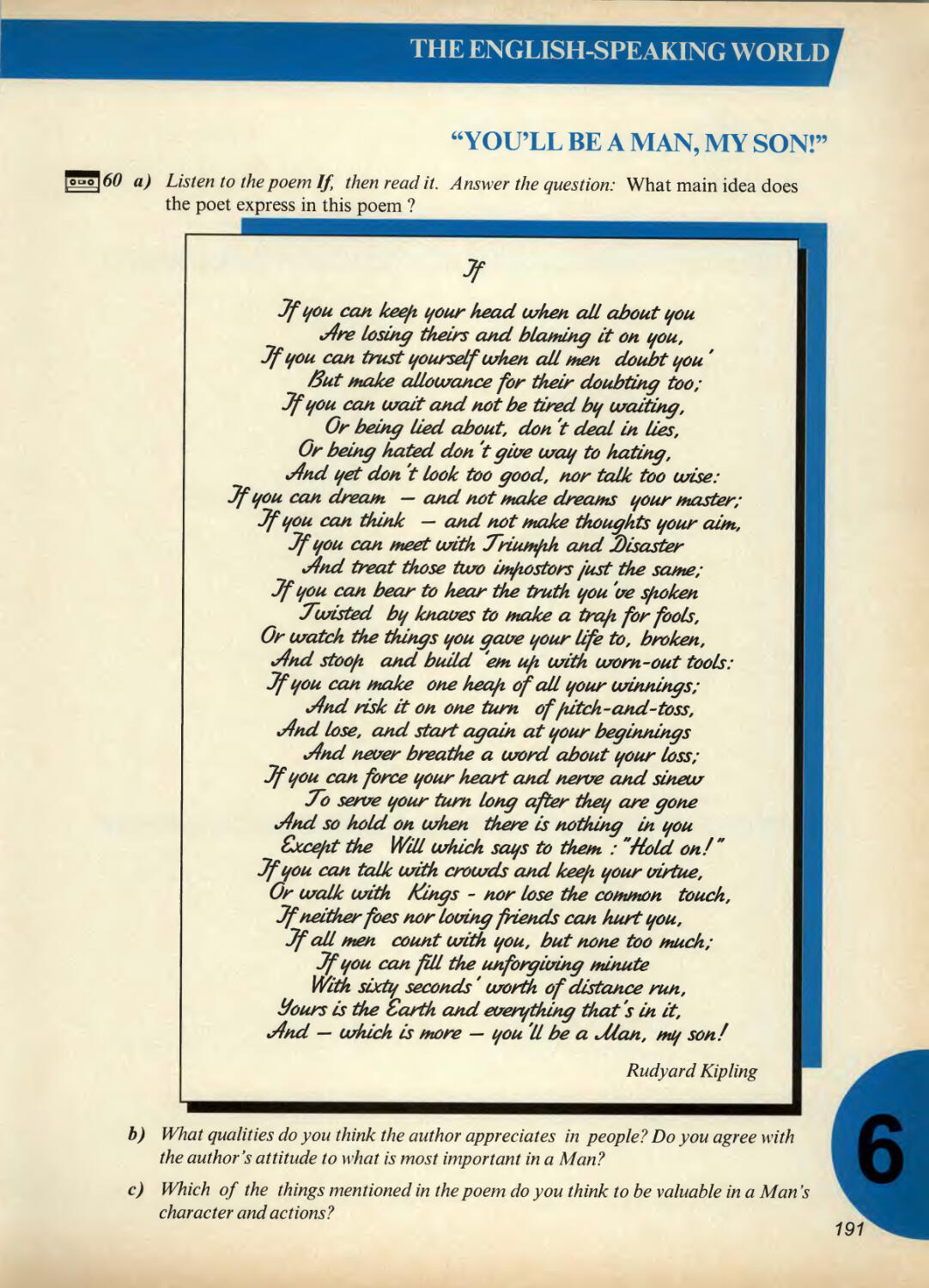
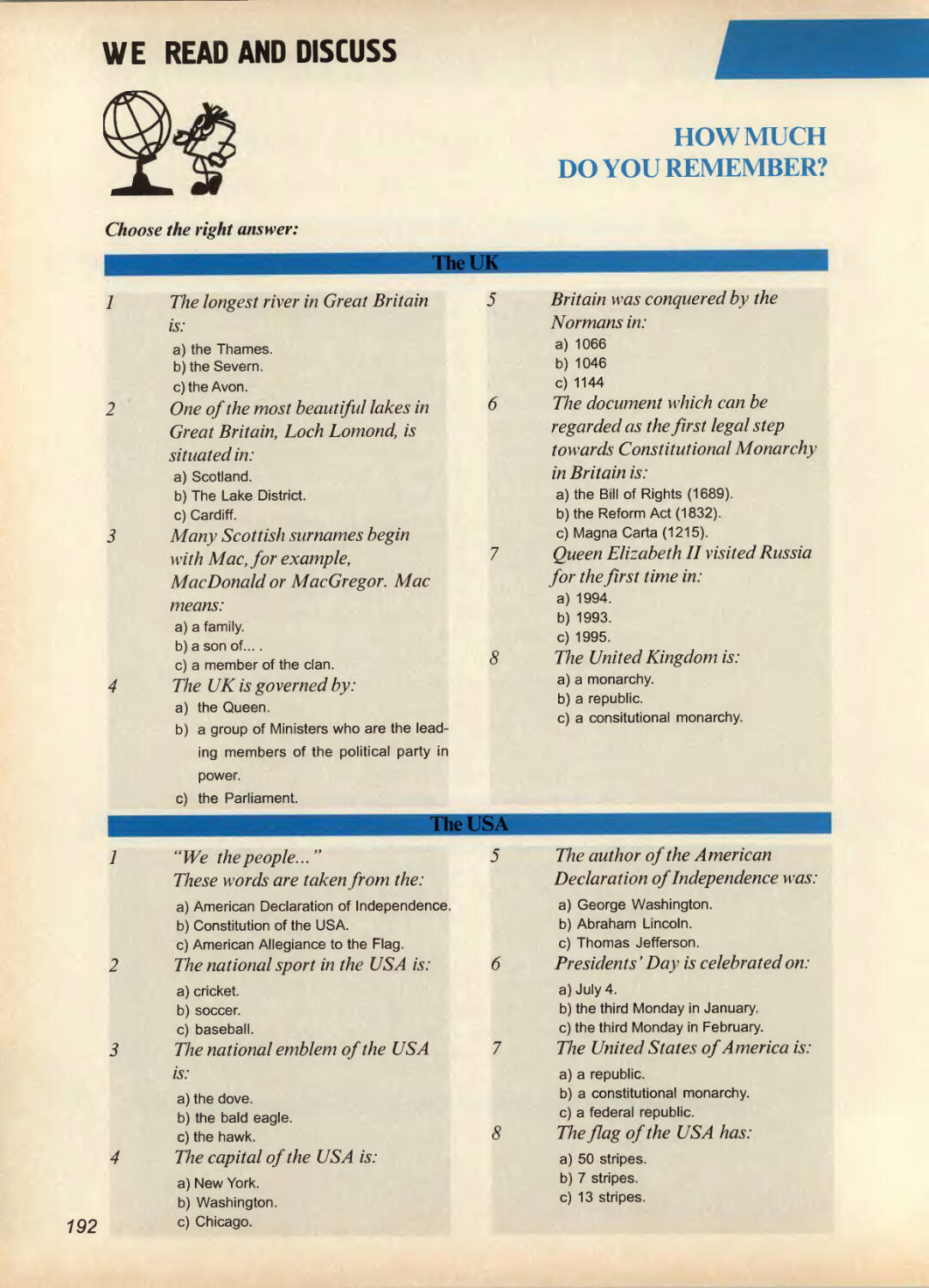
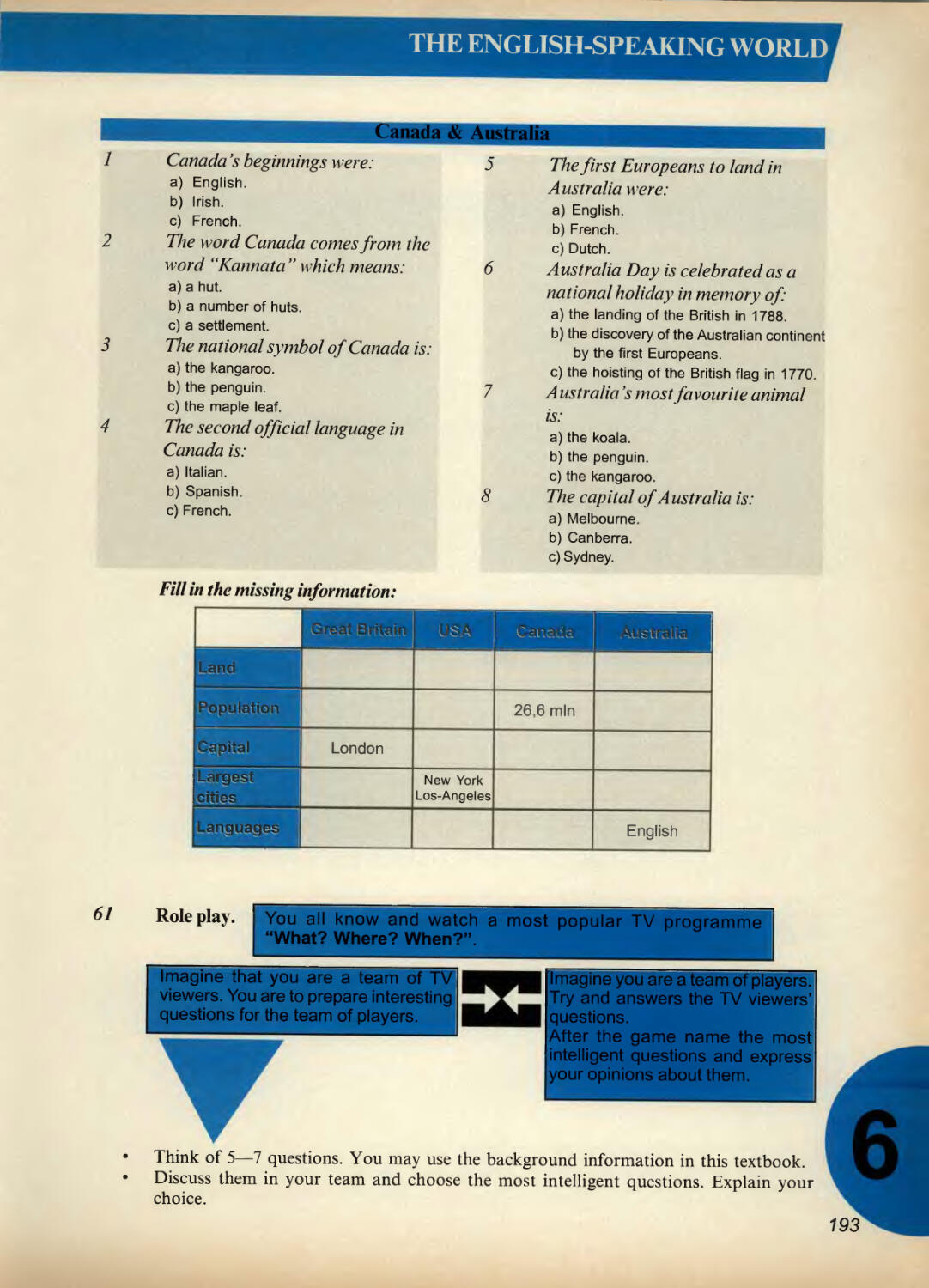
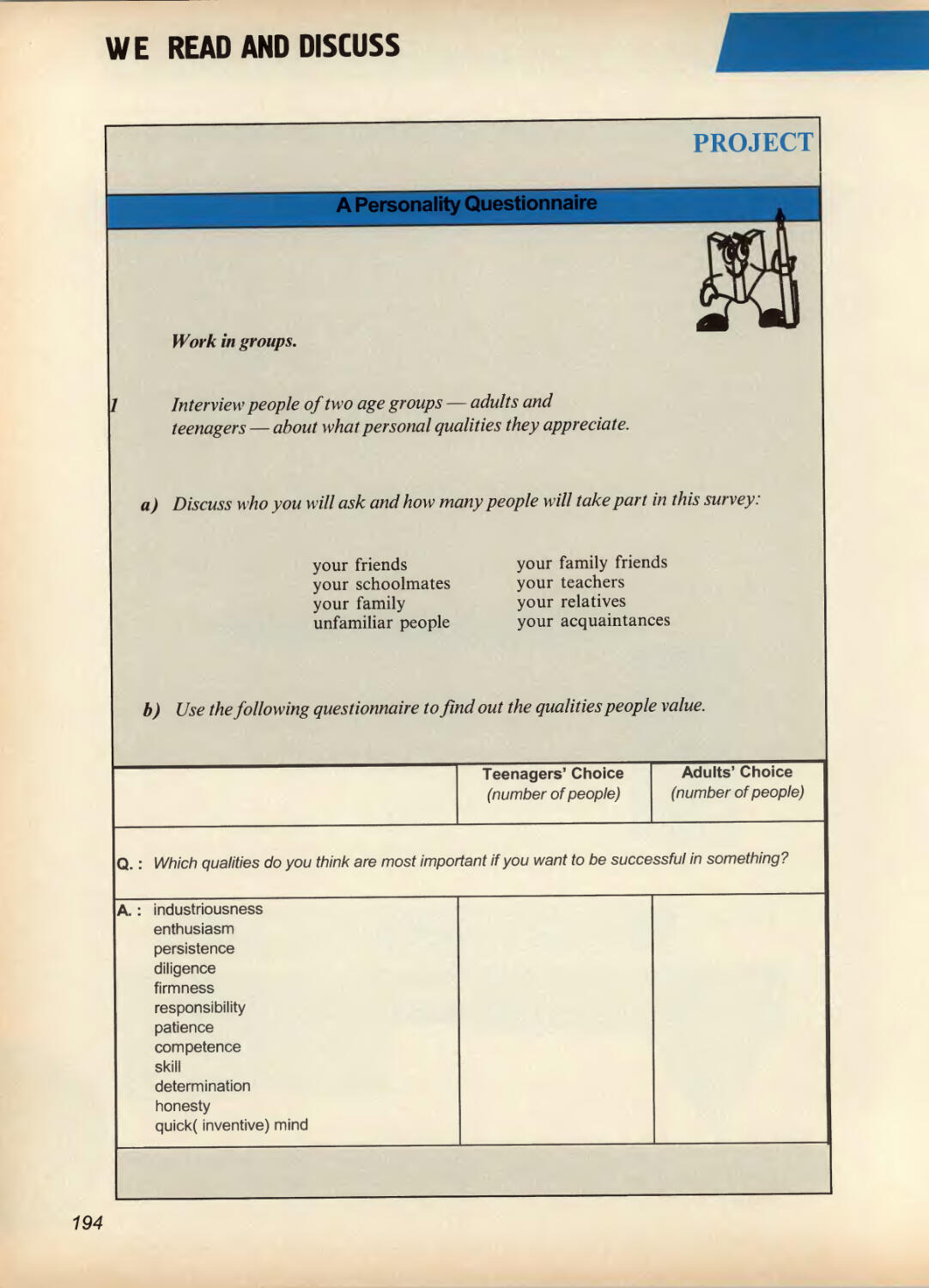
/
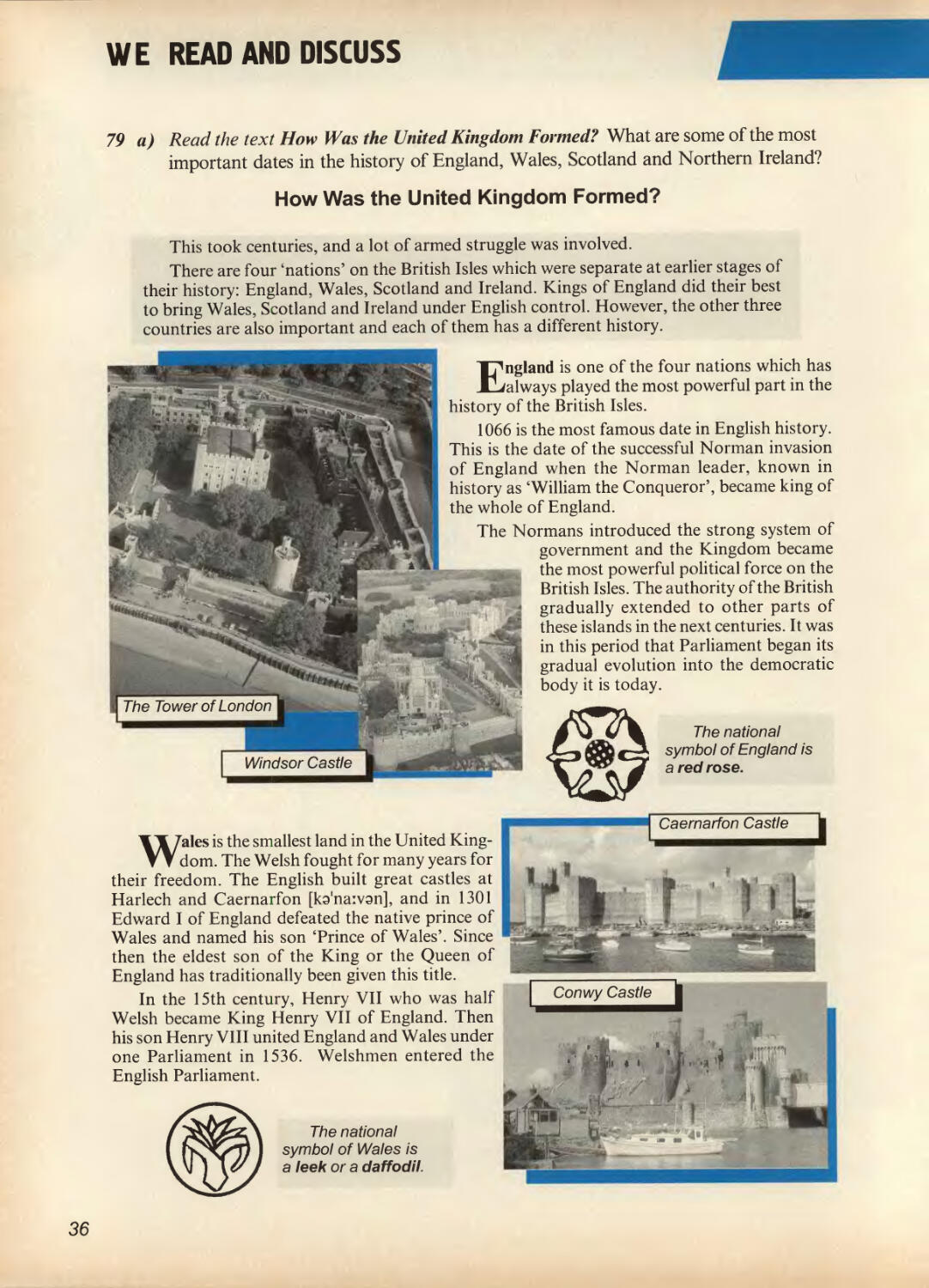
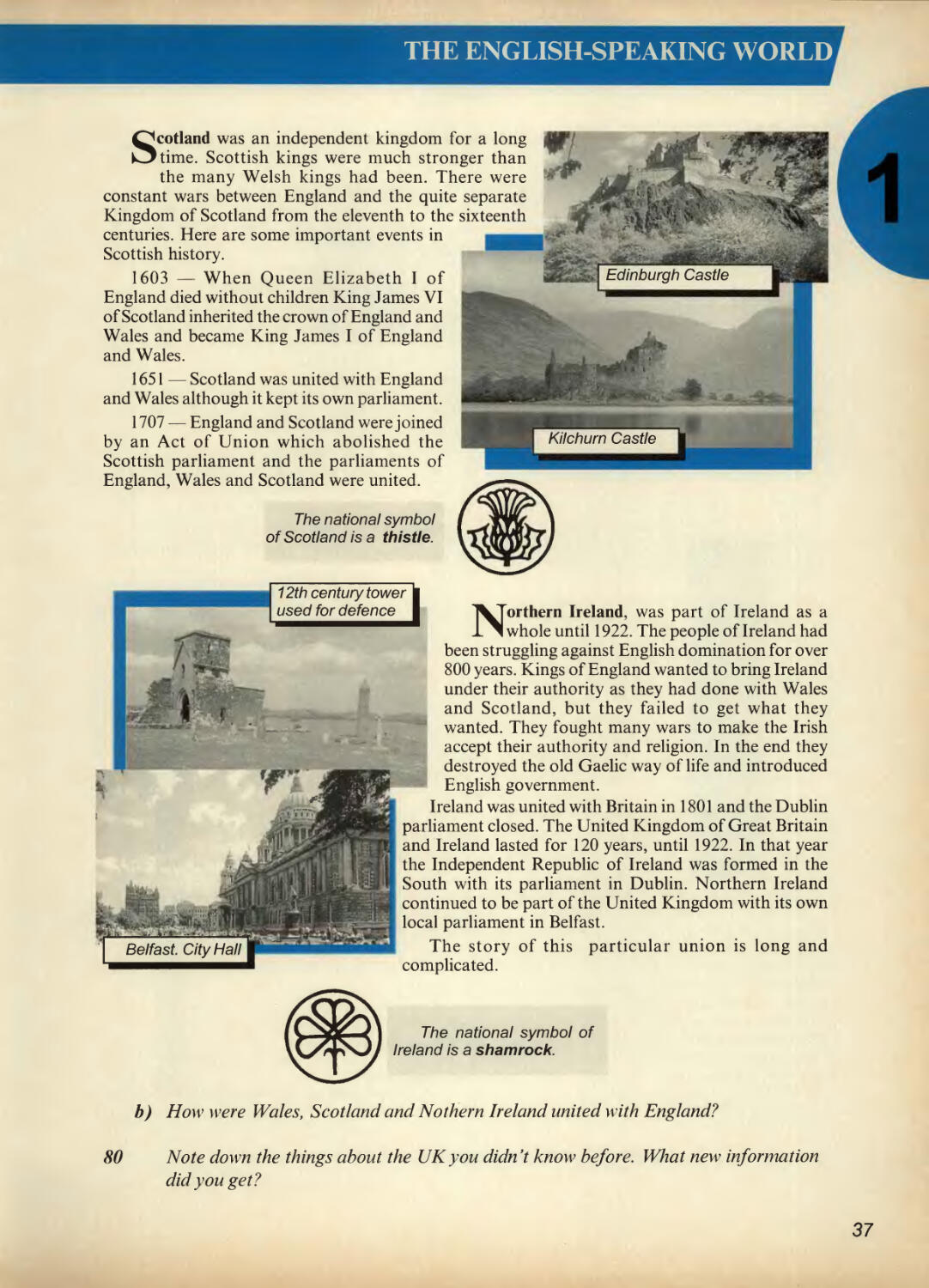
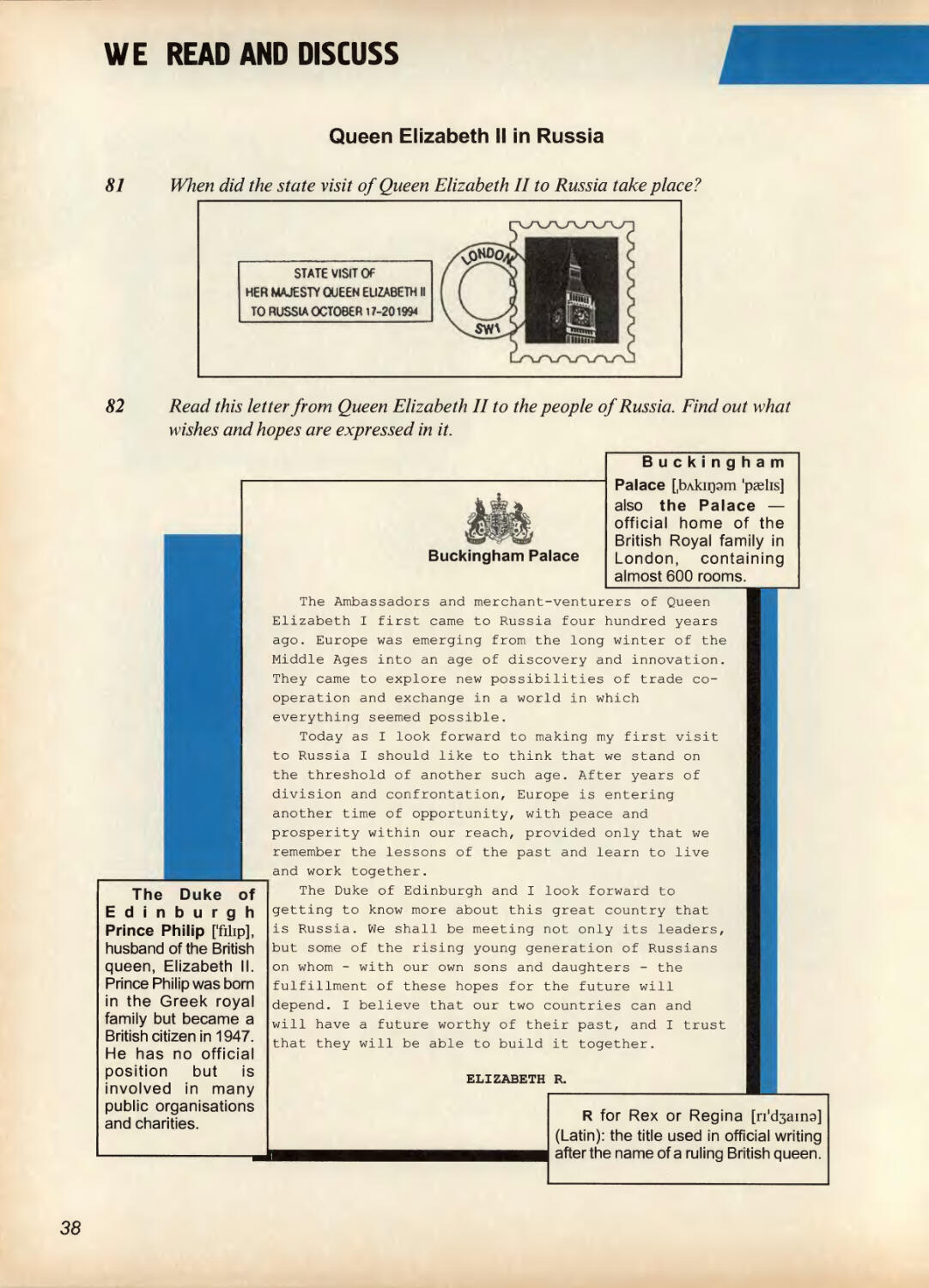
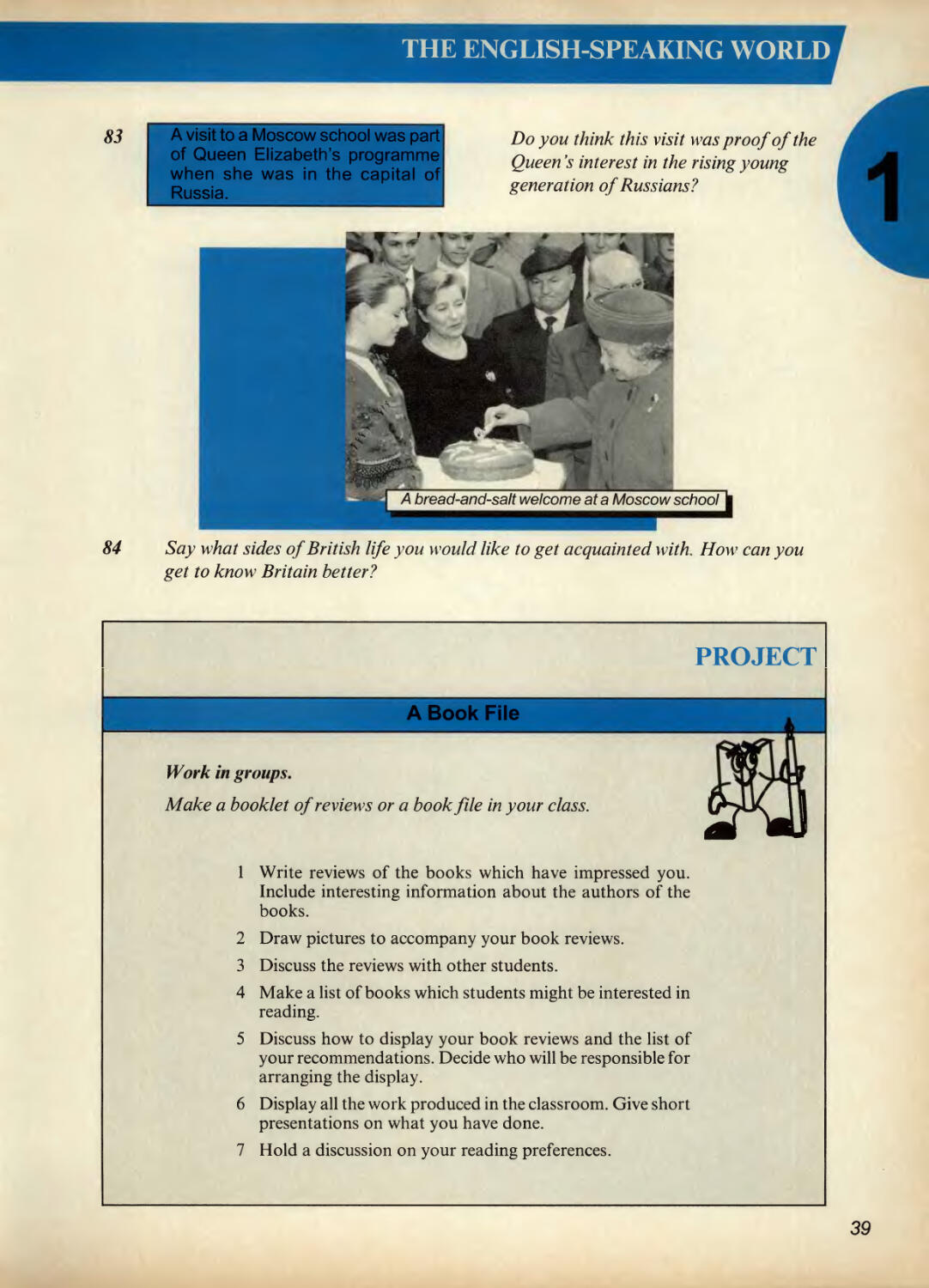
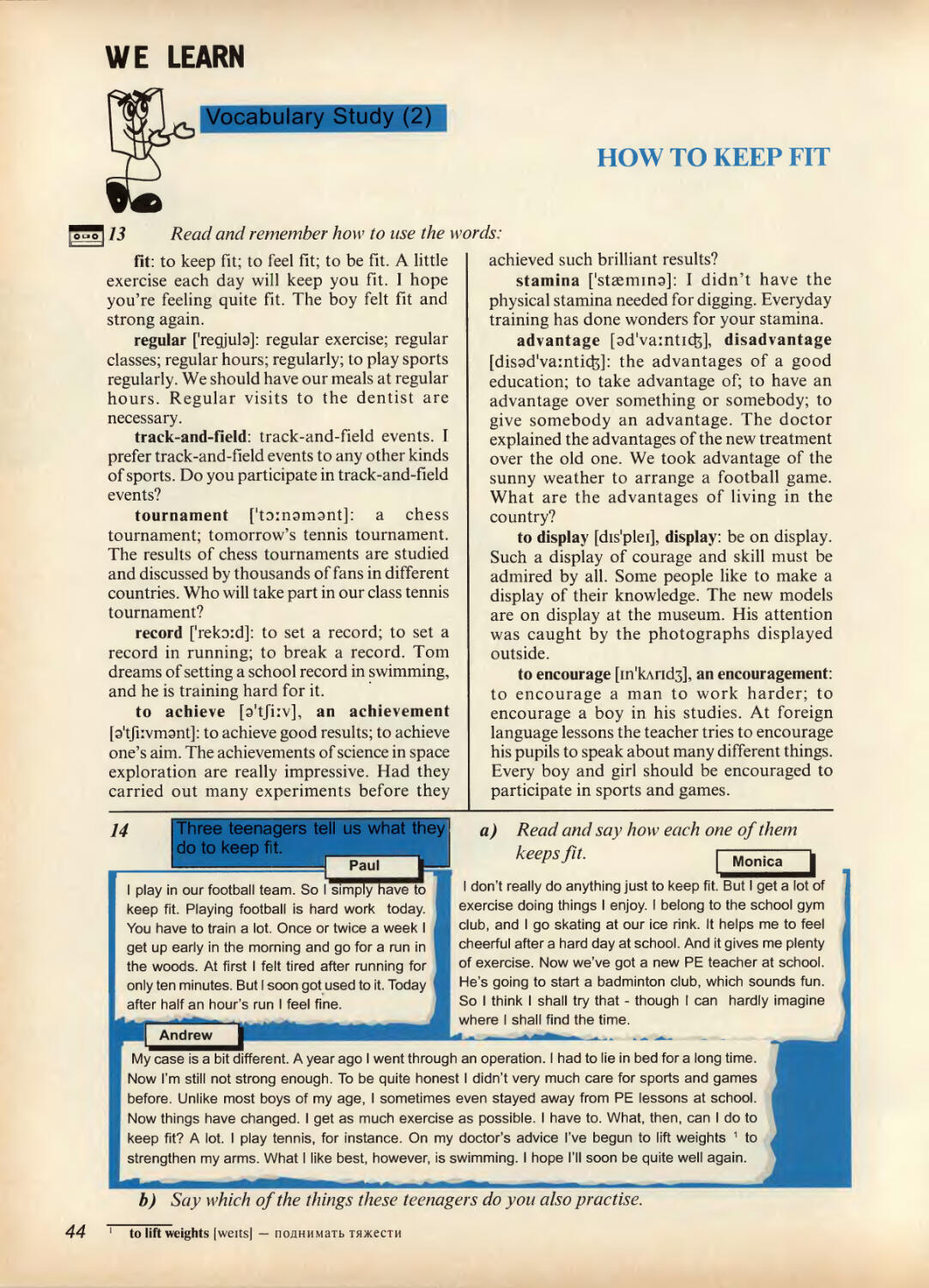
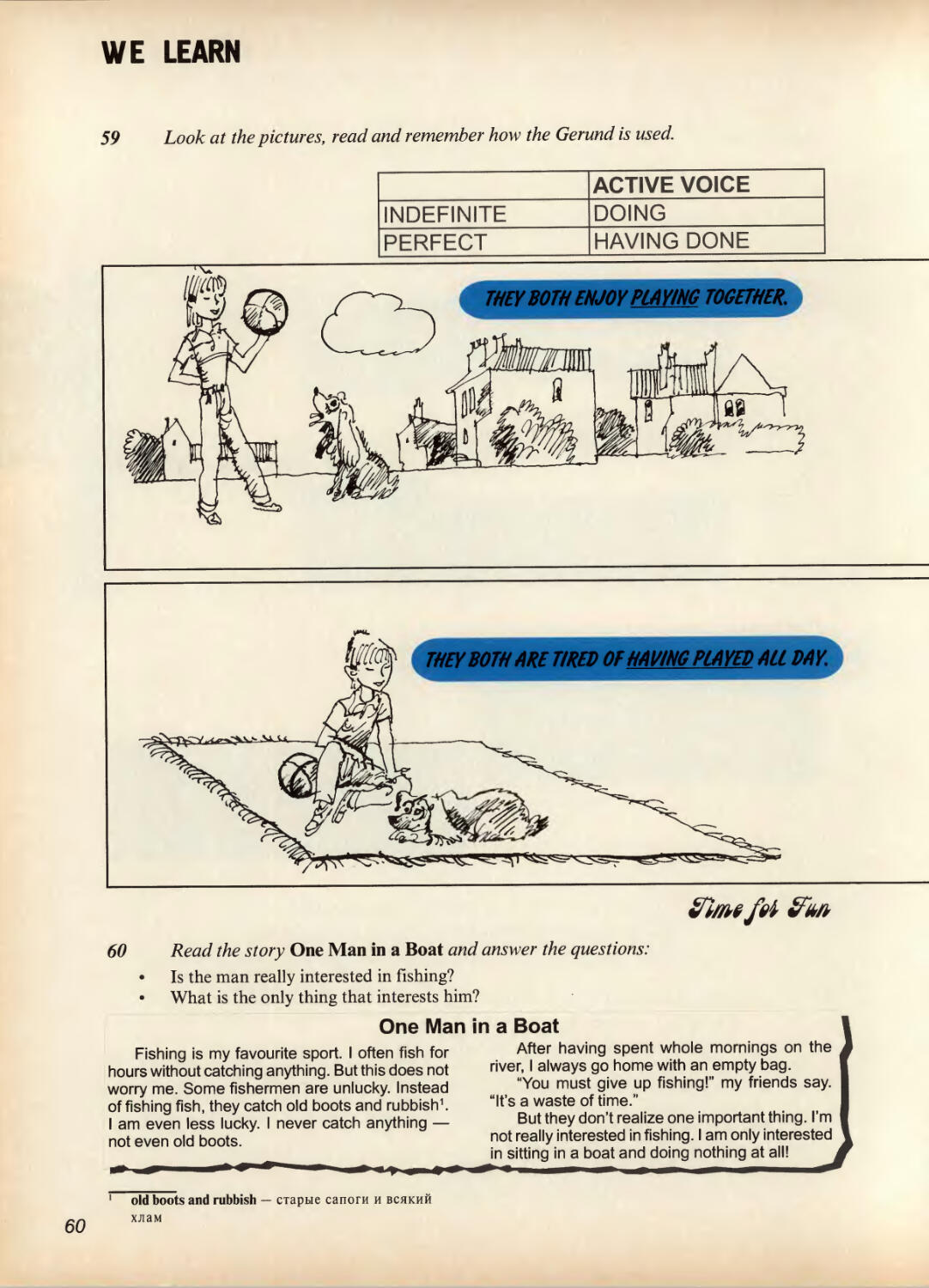
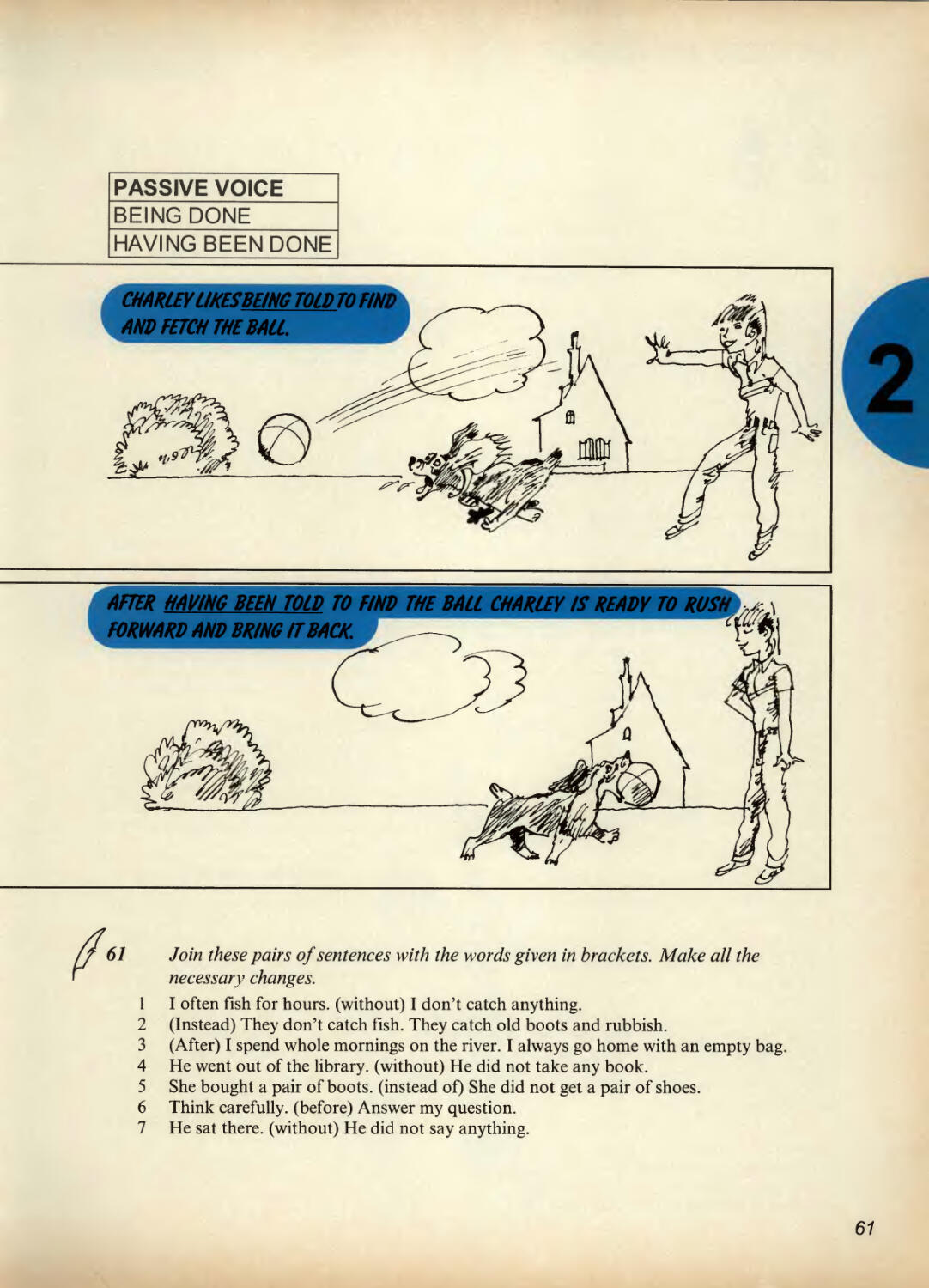
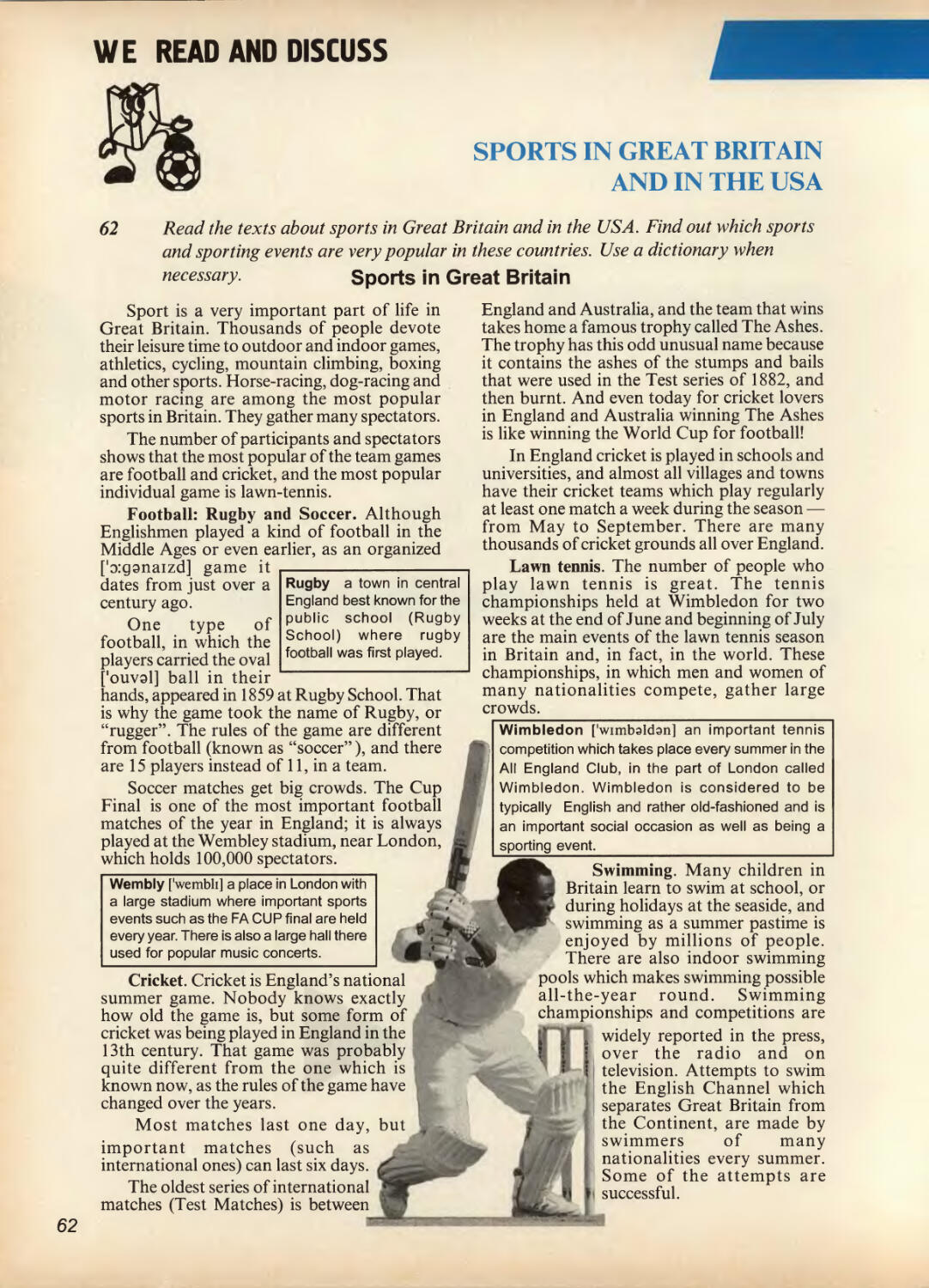
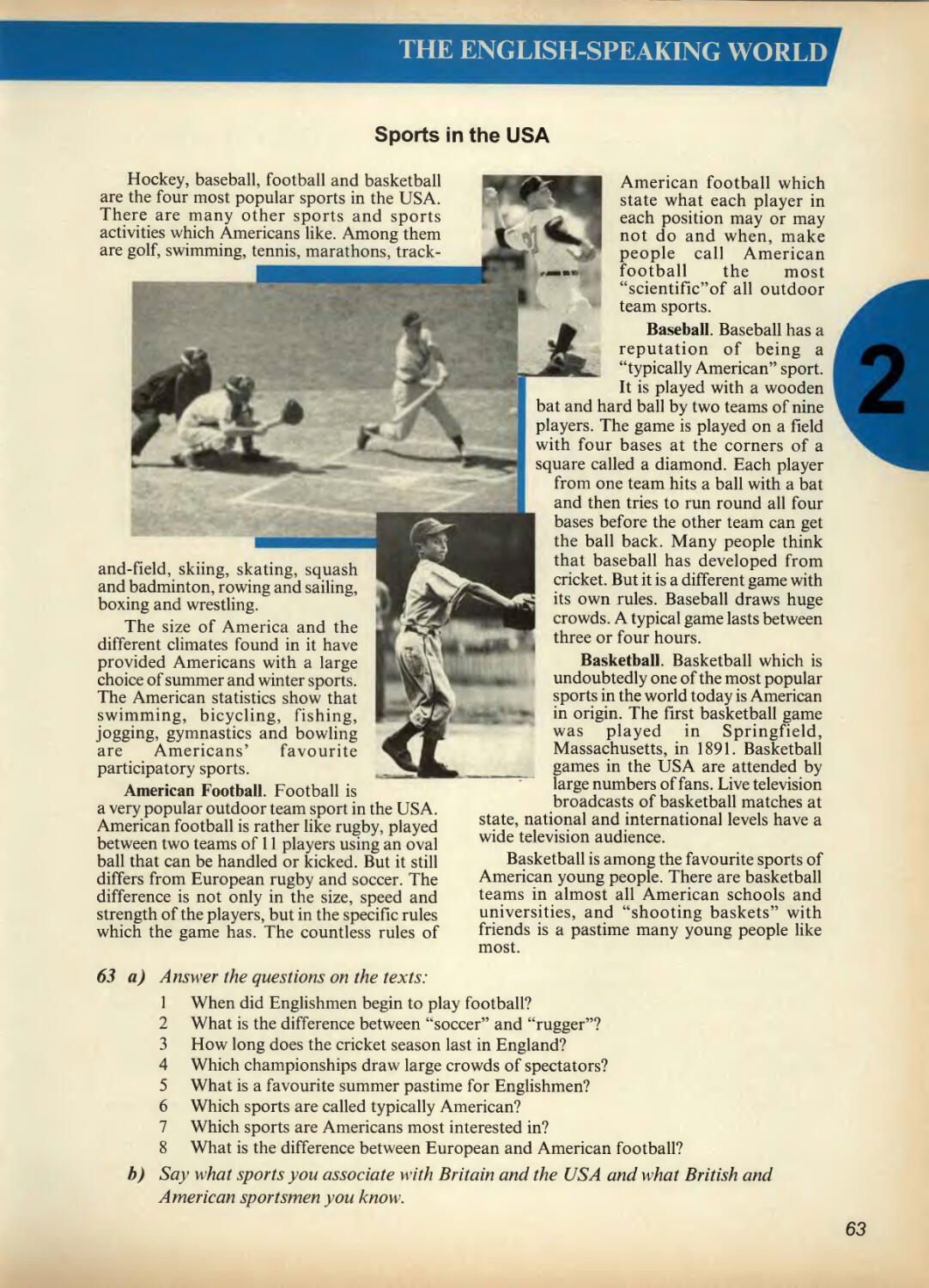
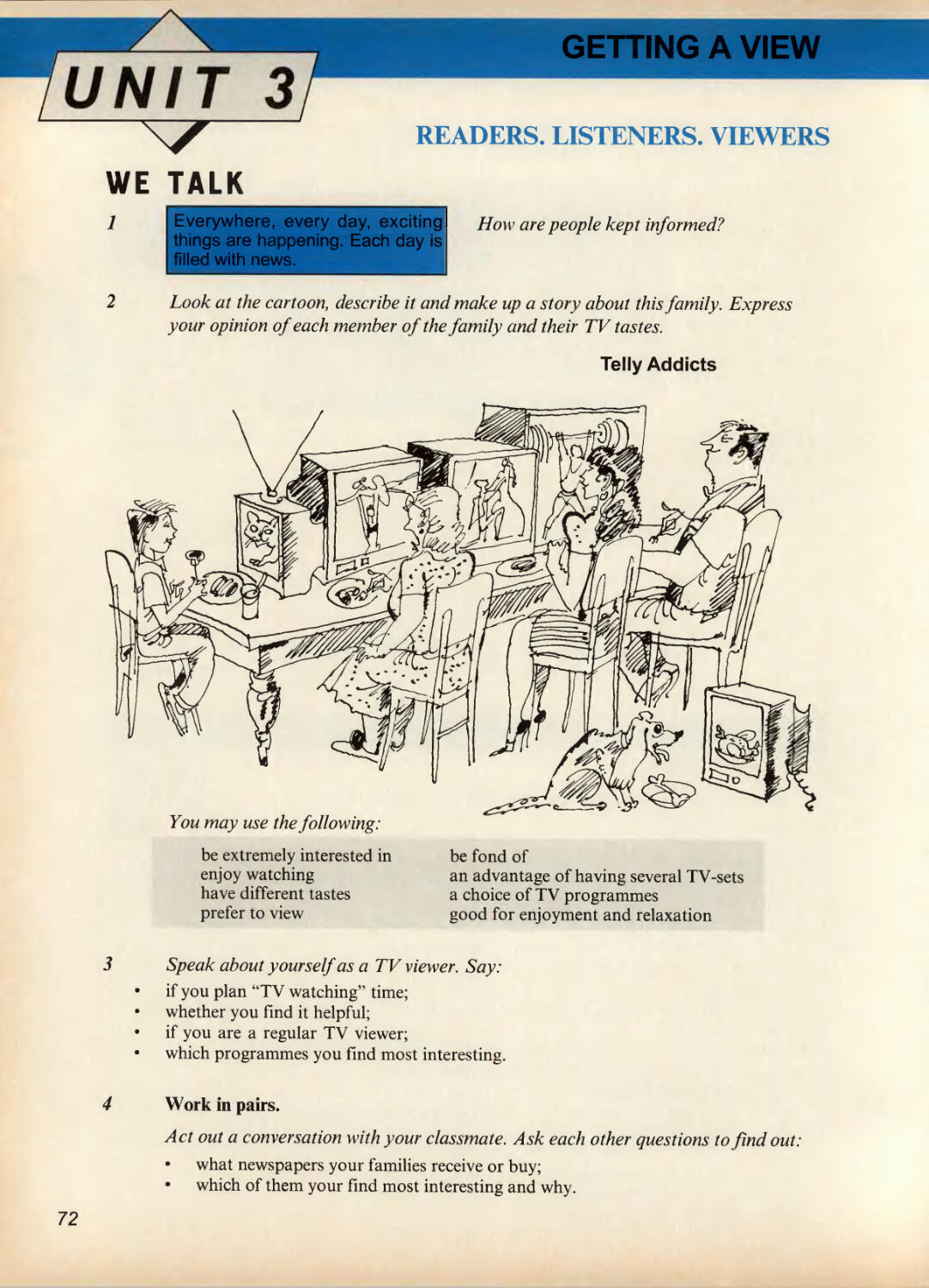

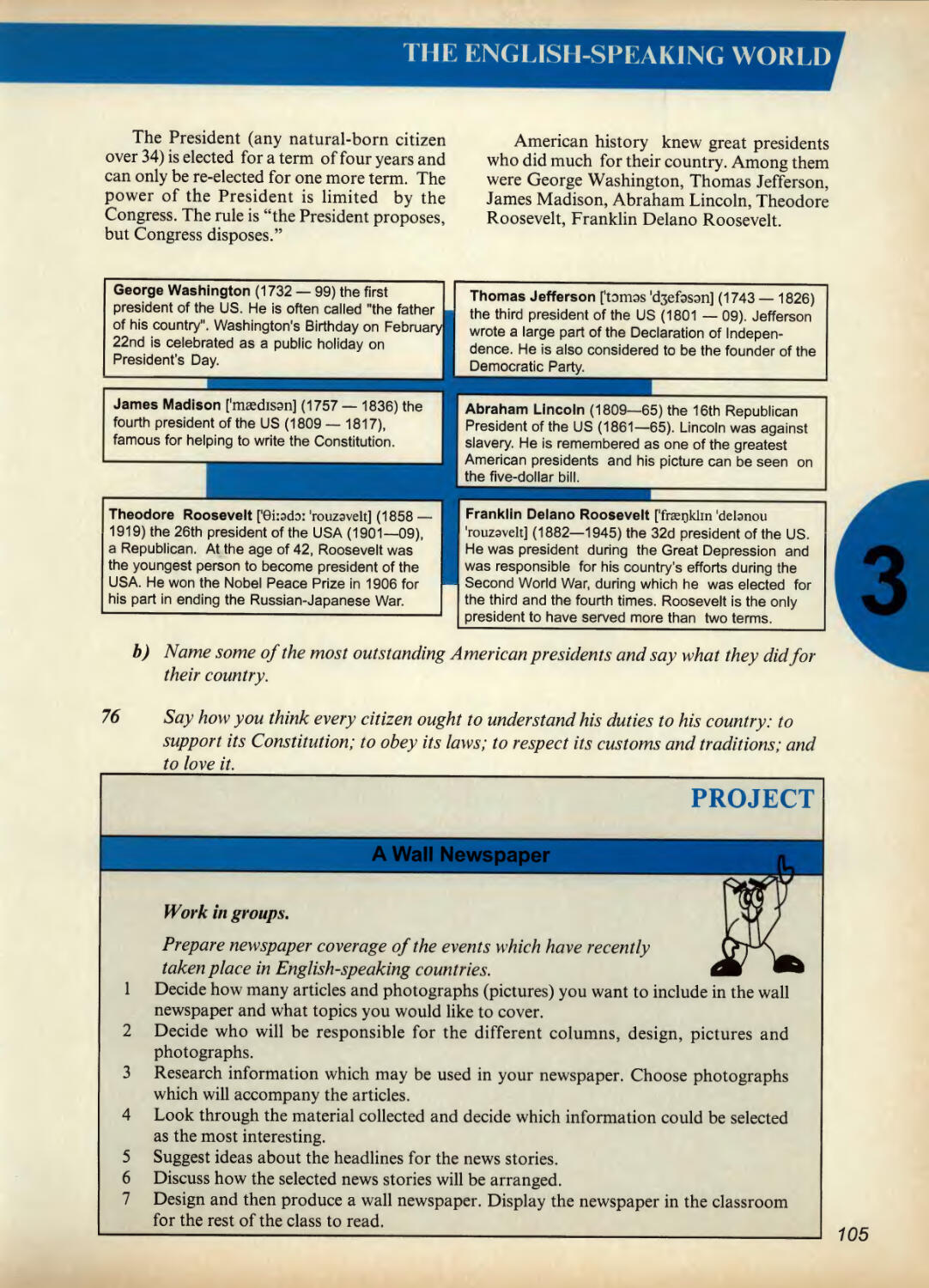
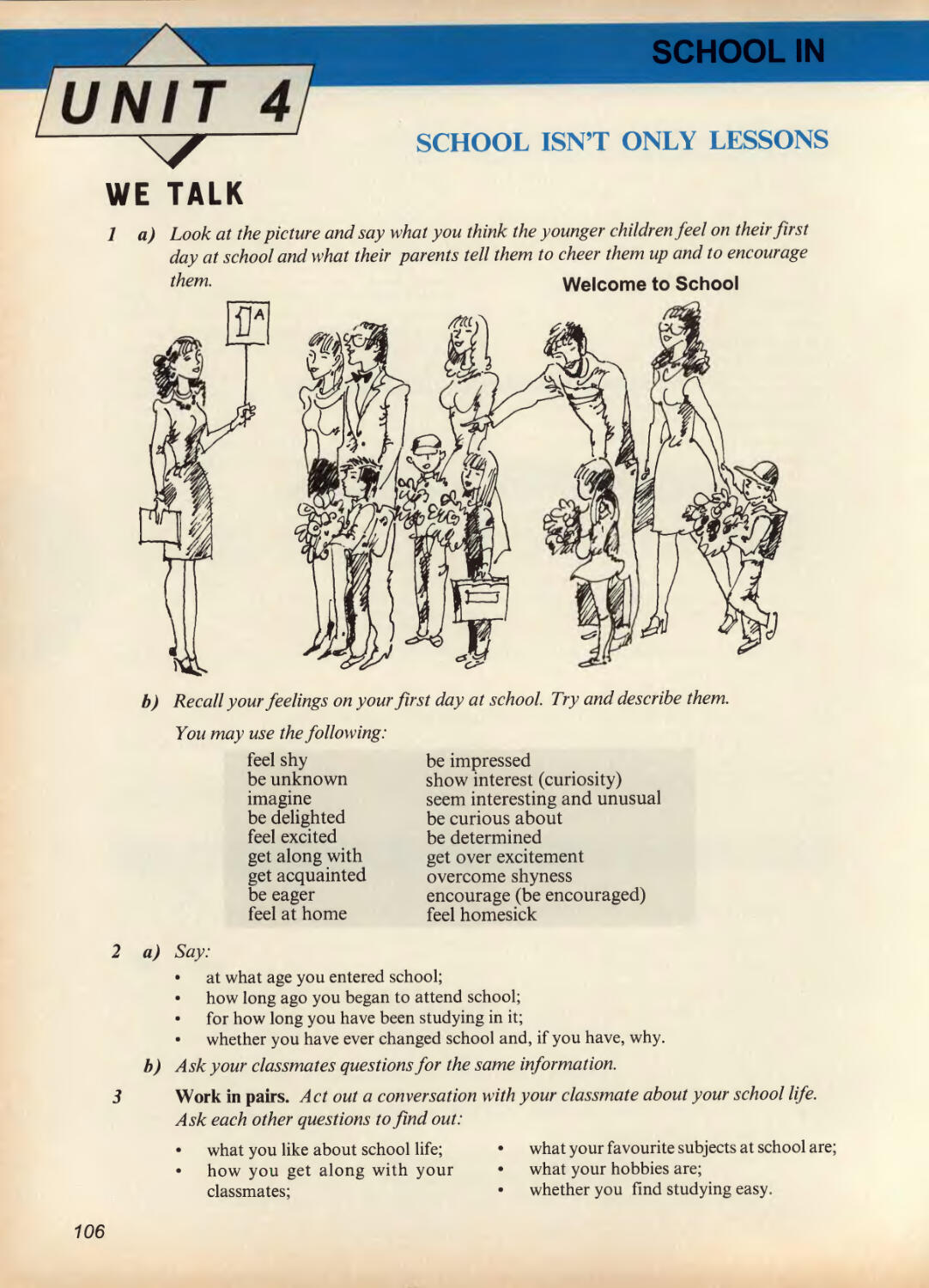
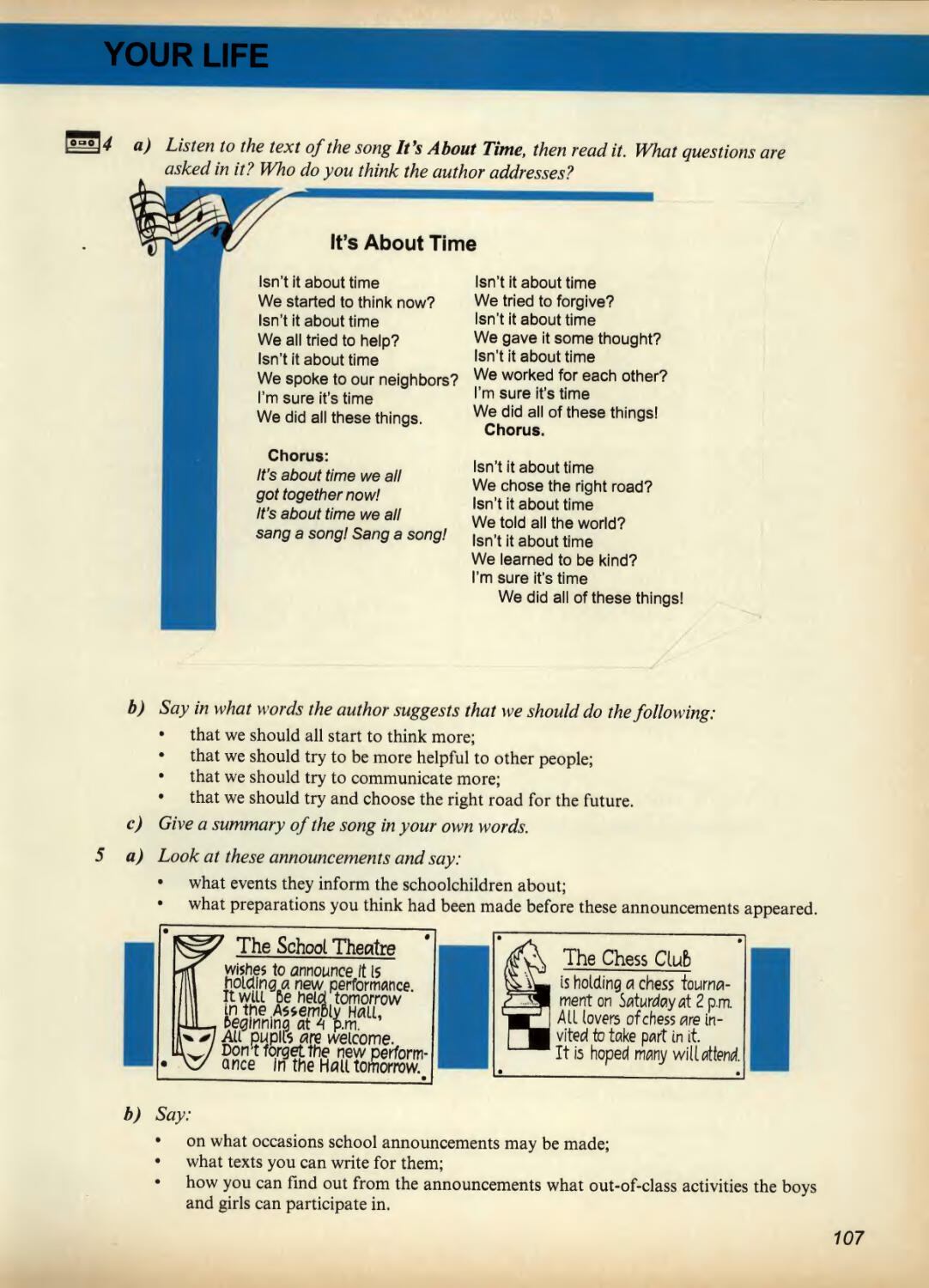
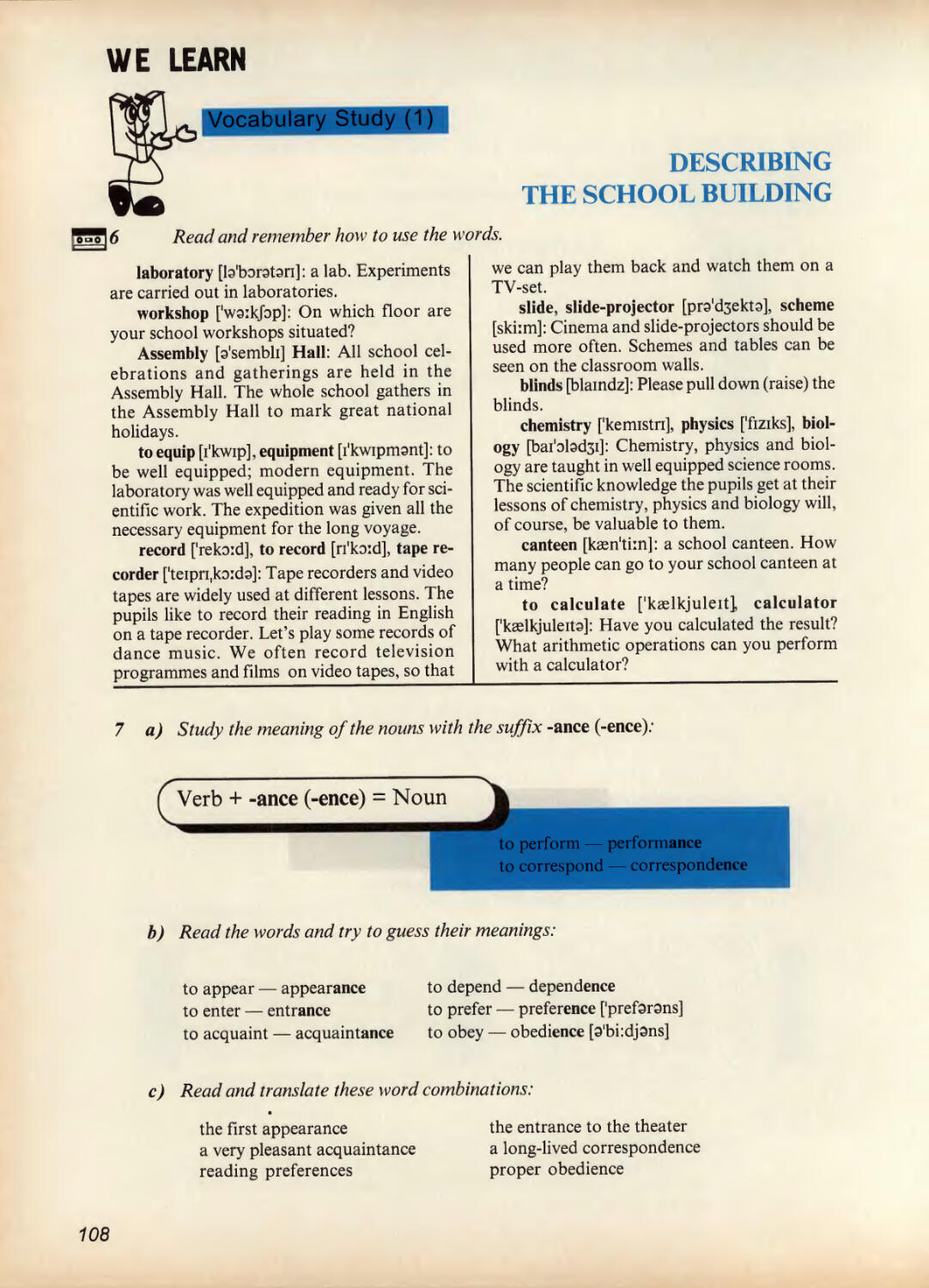
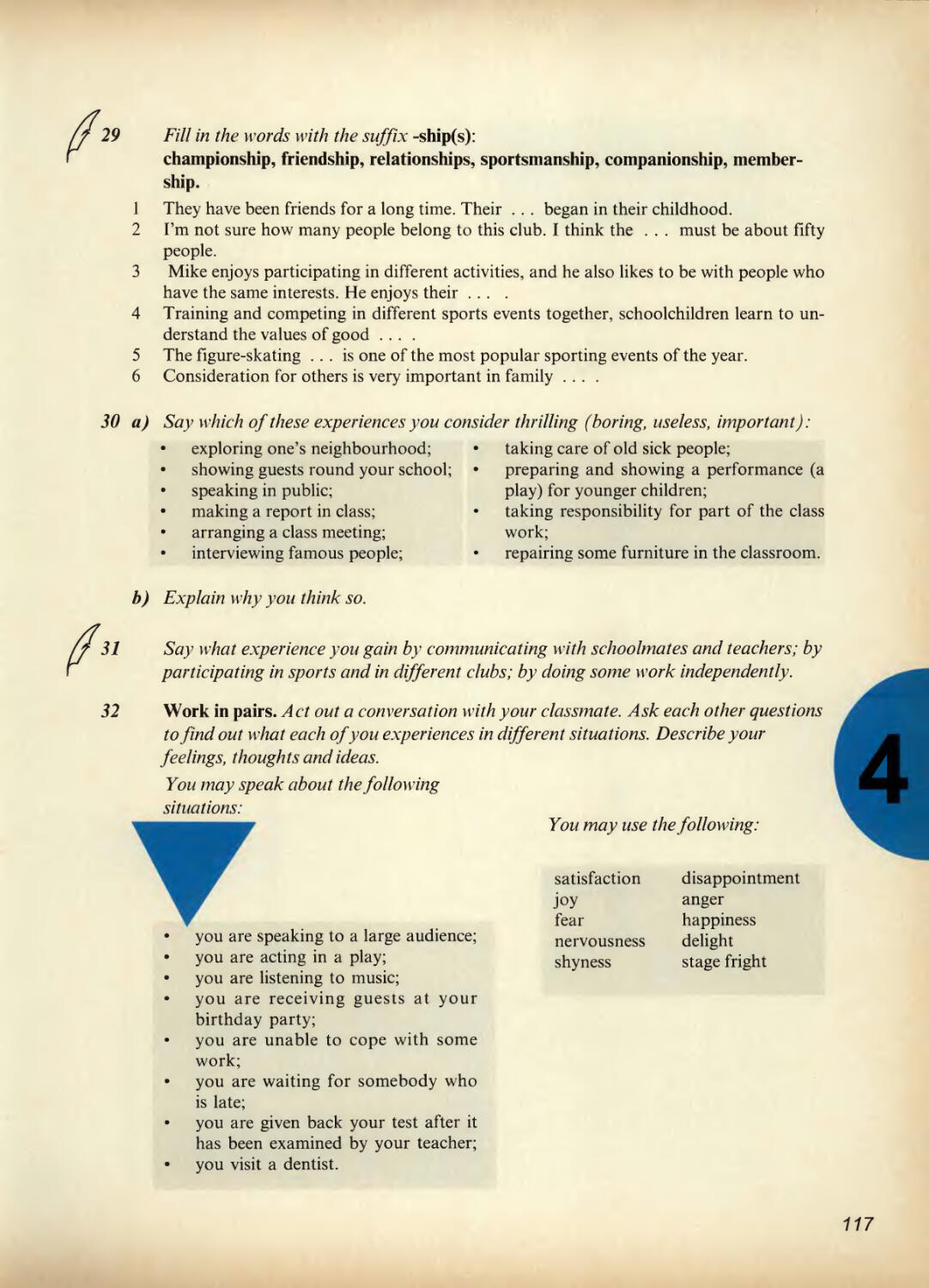
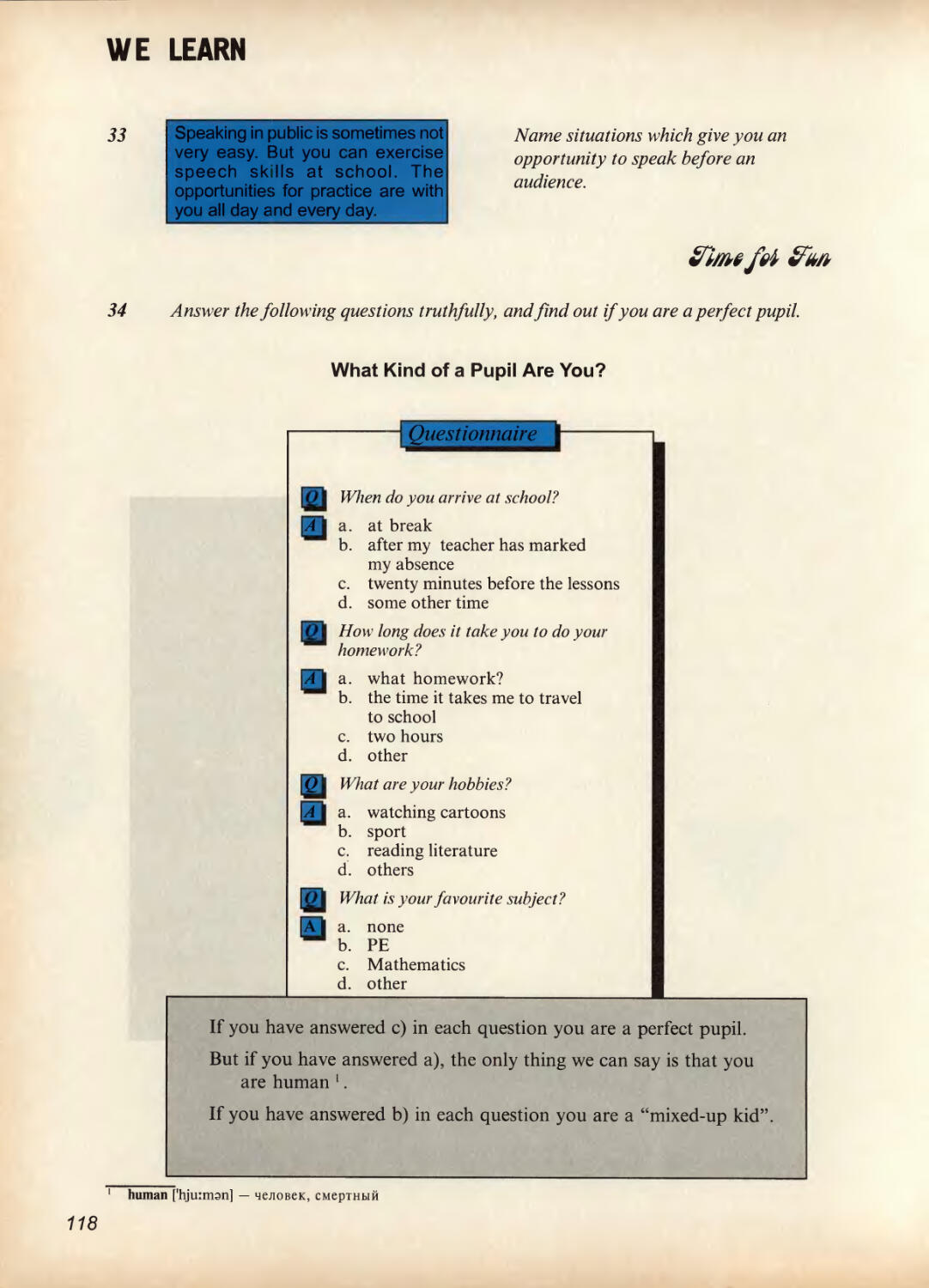
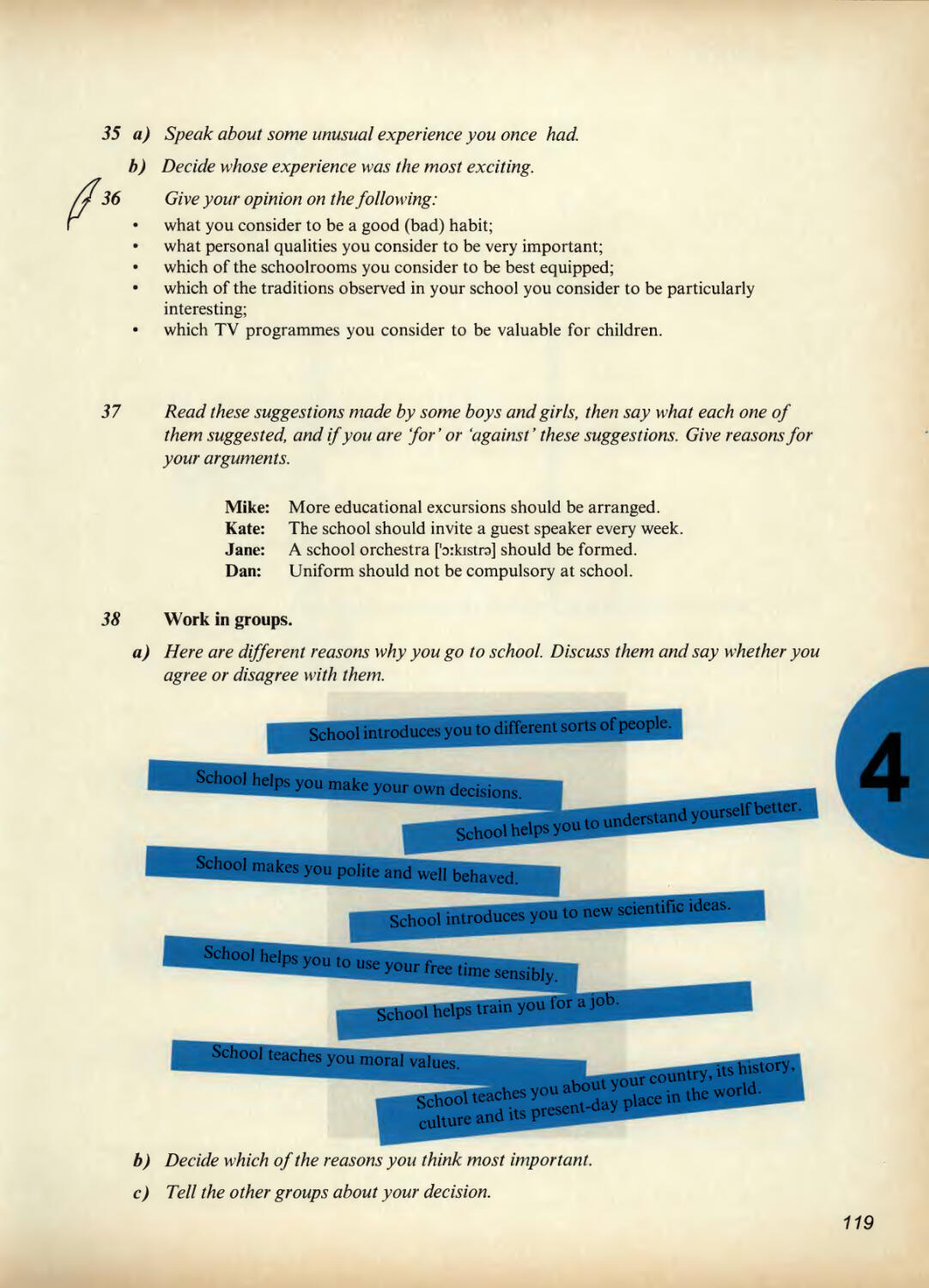
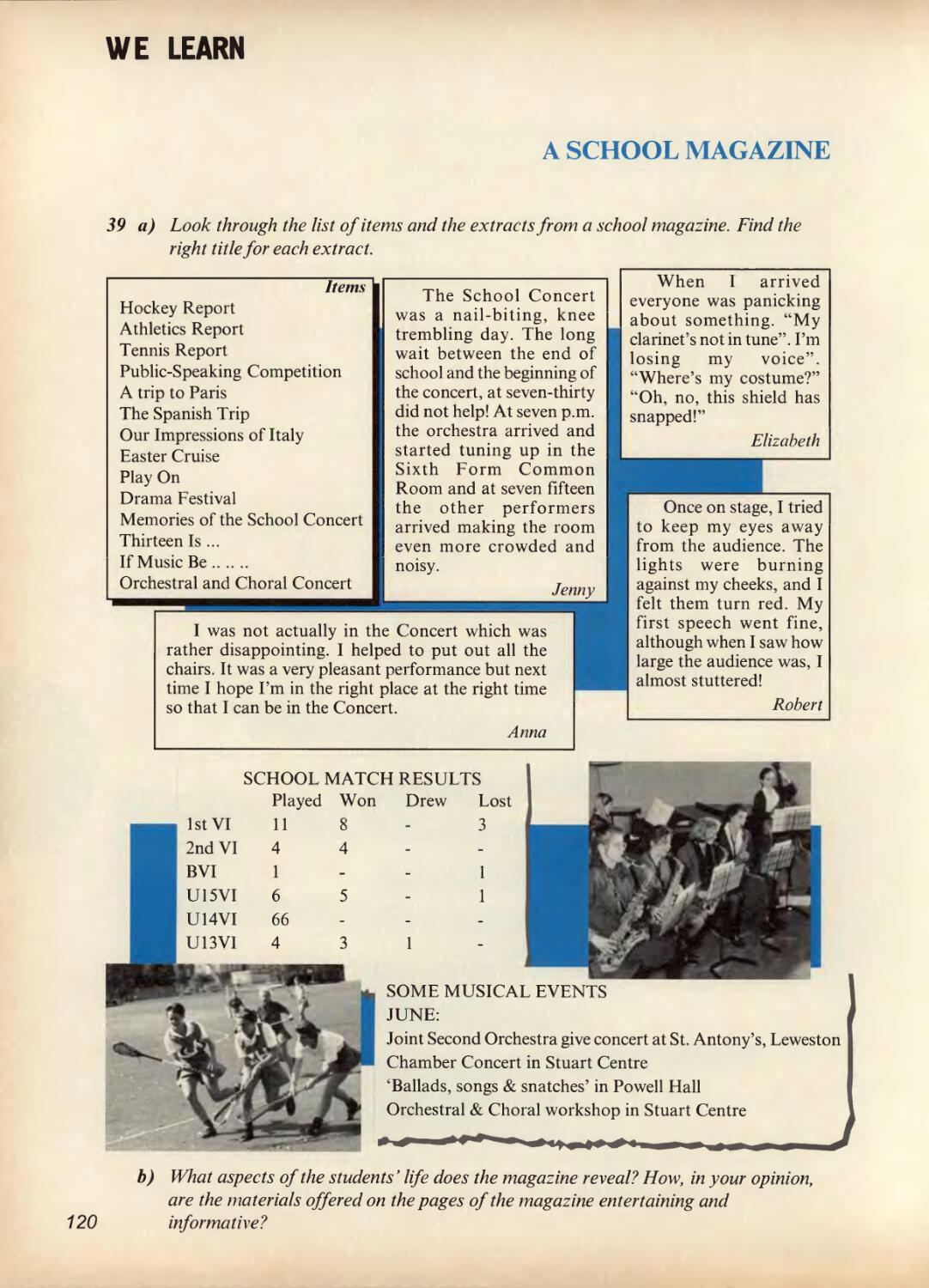

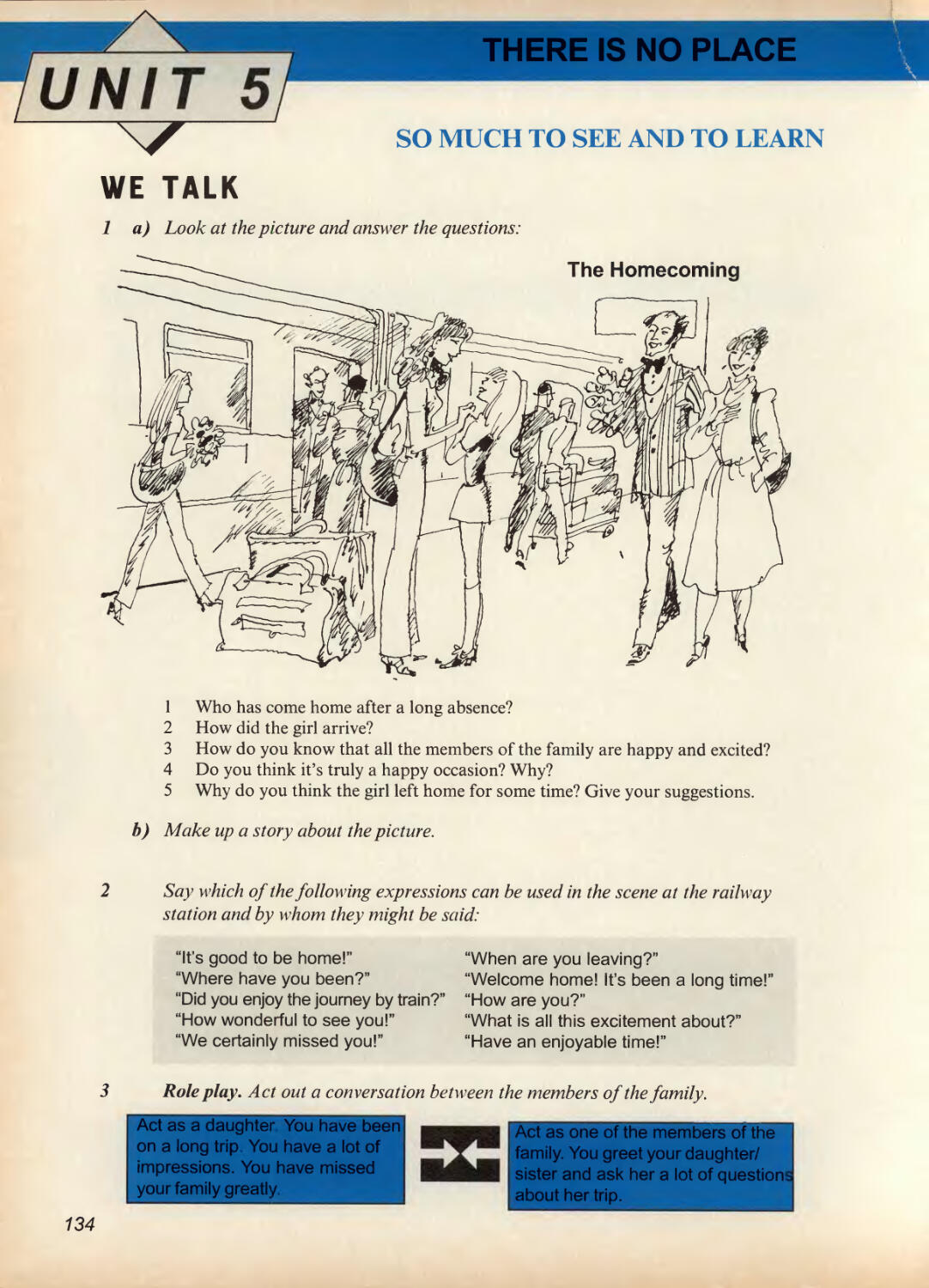

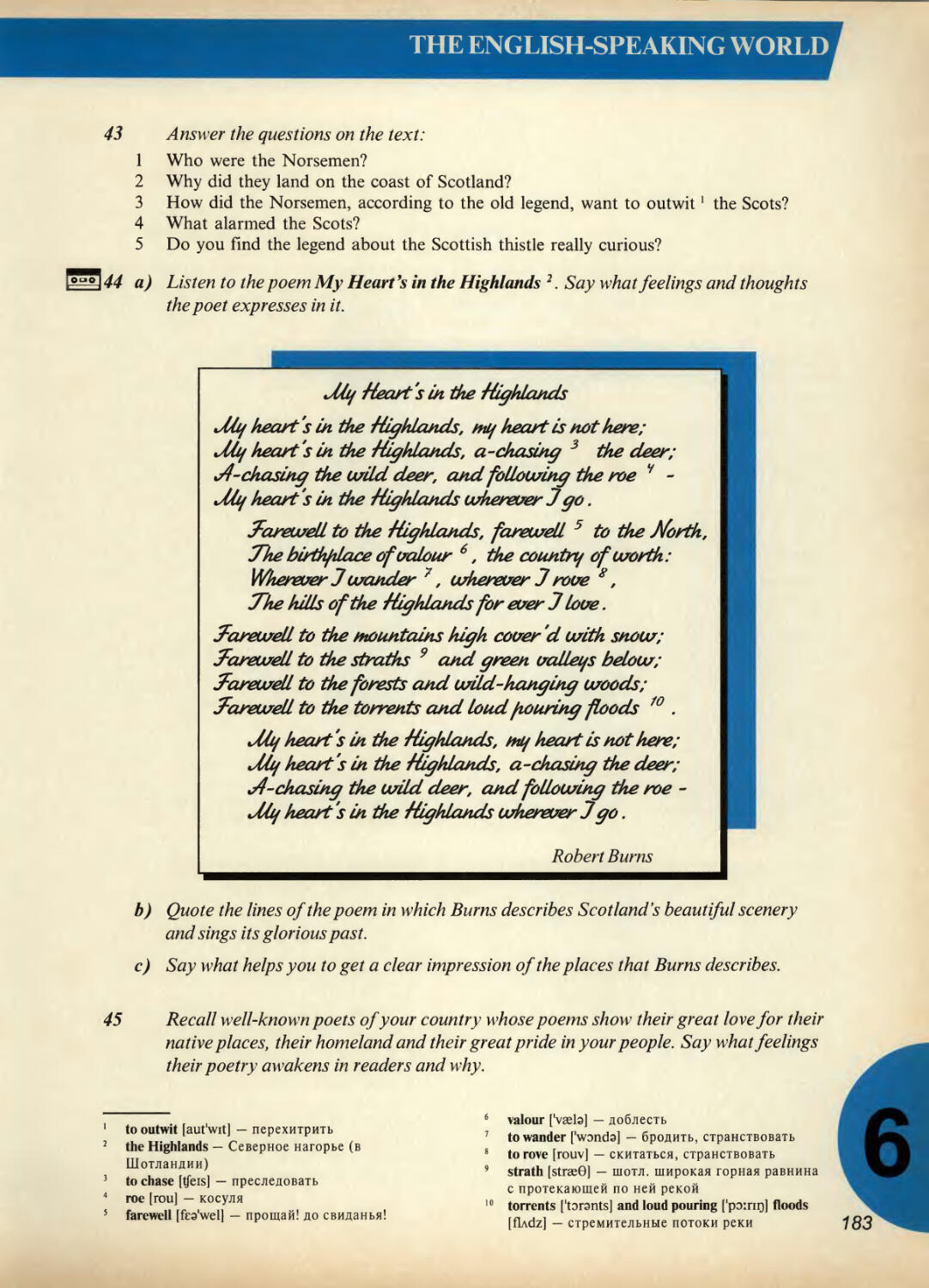
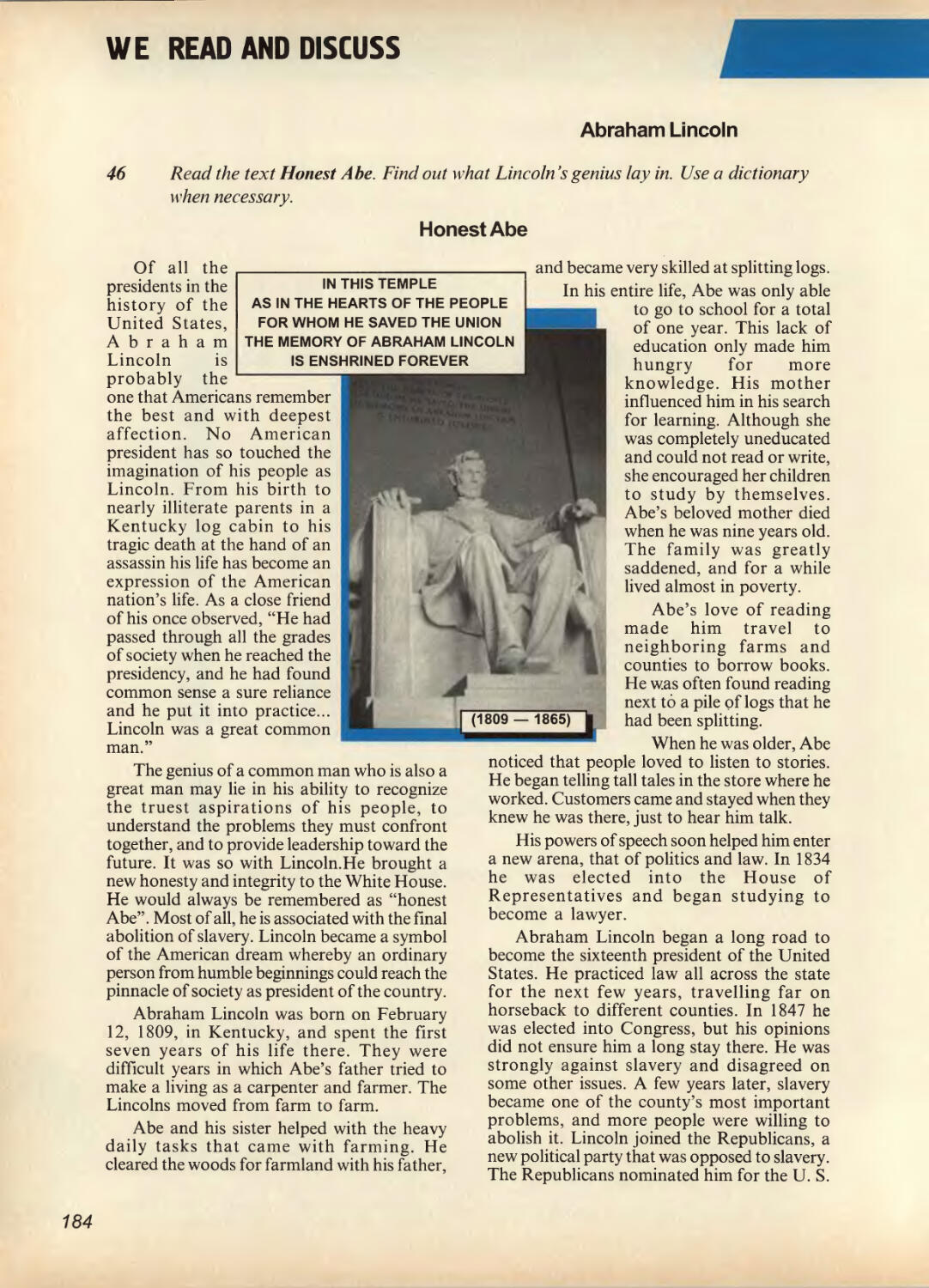
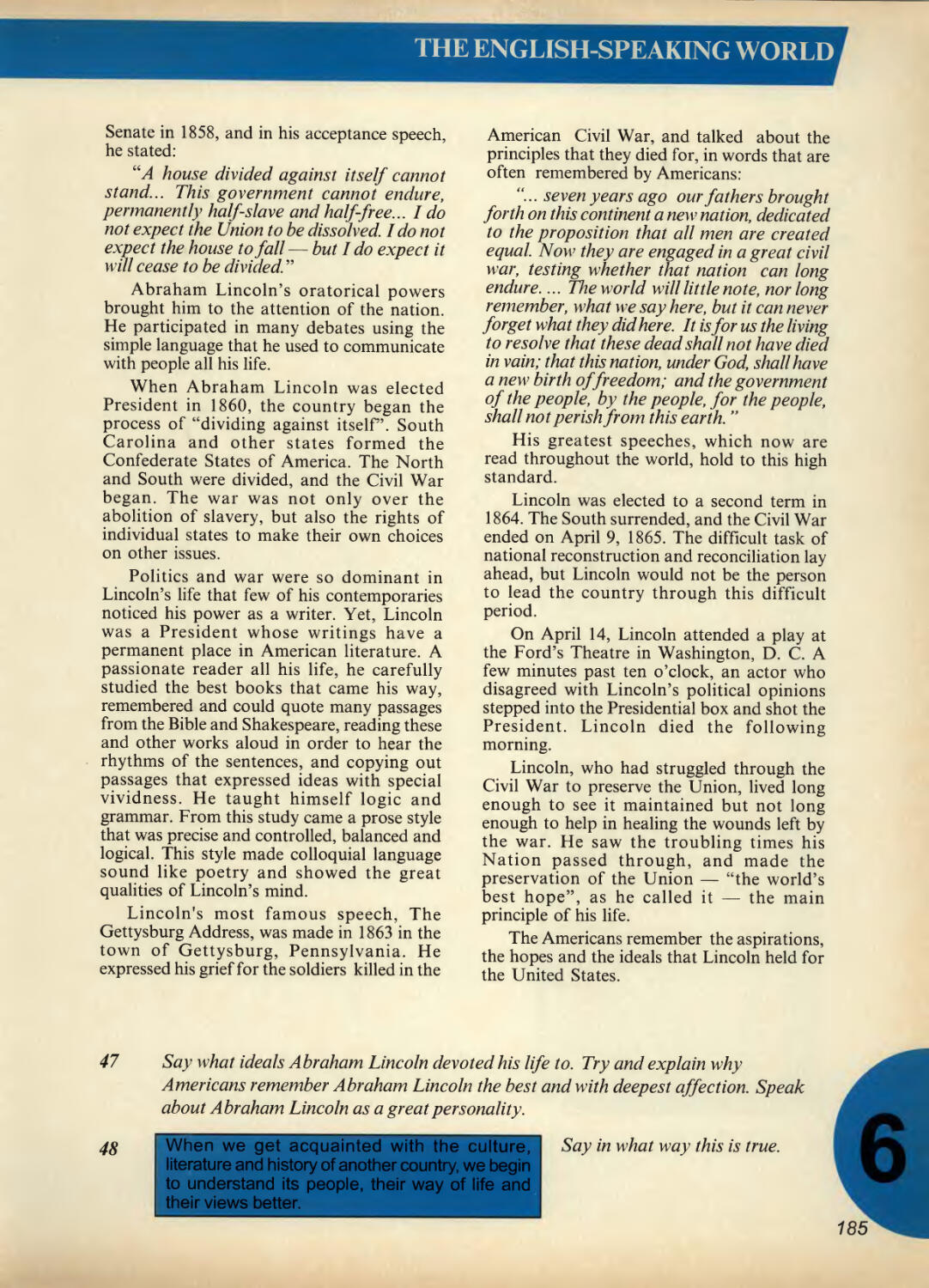
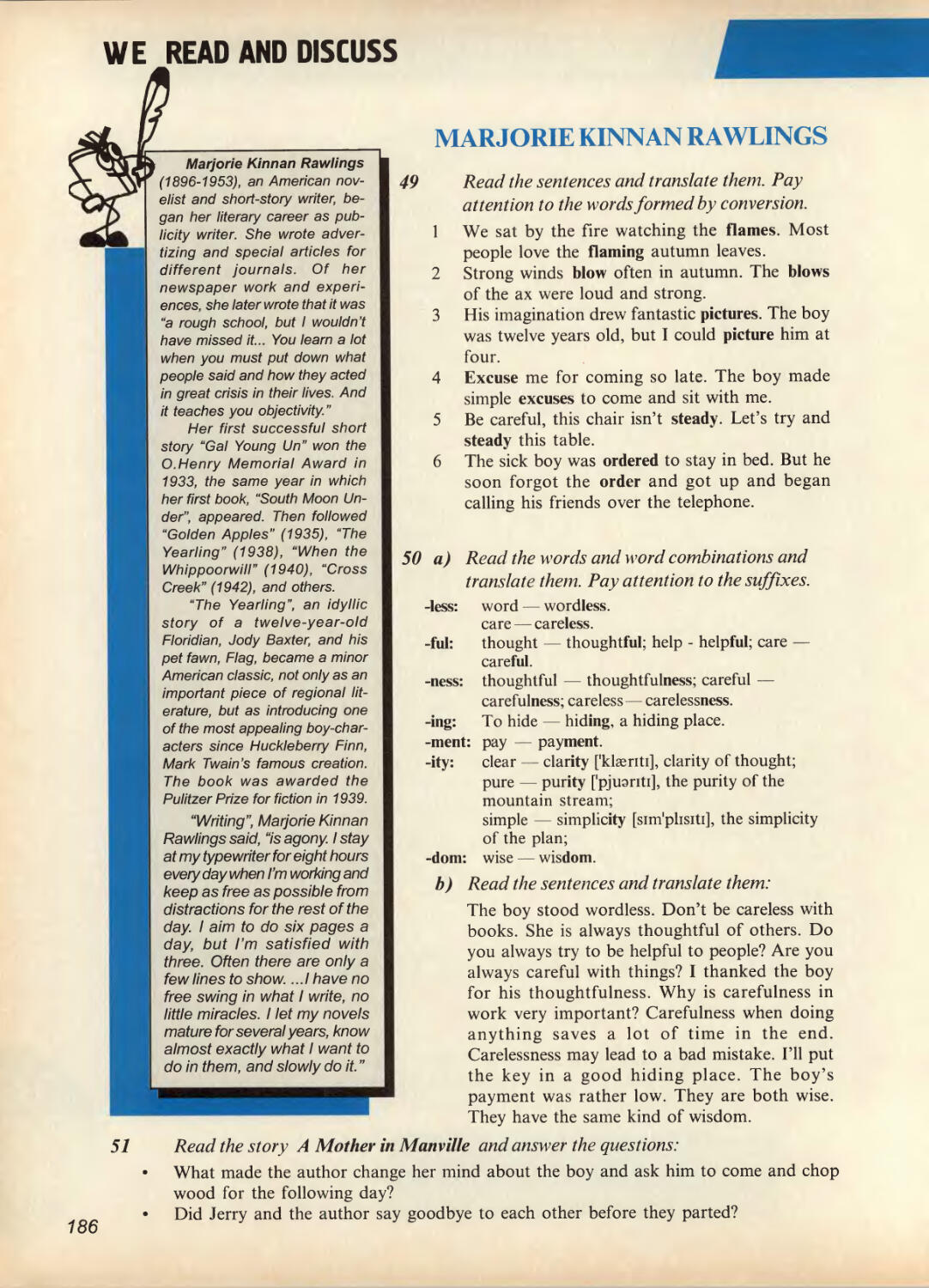




Текст
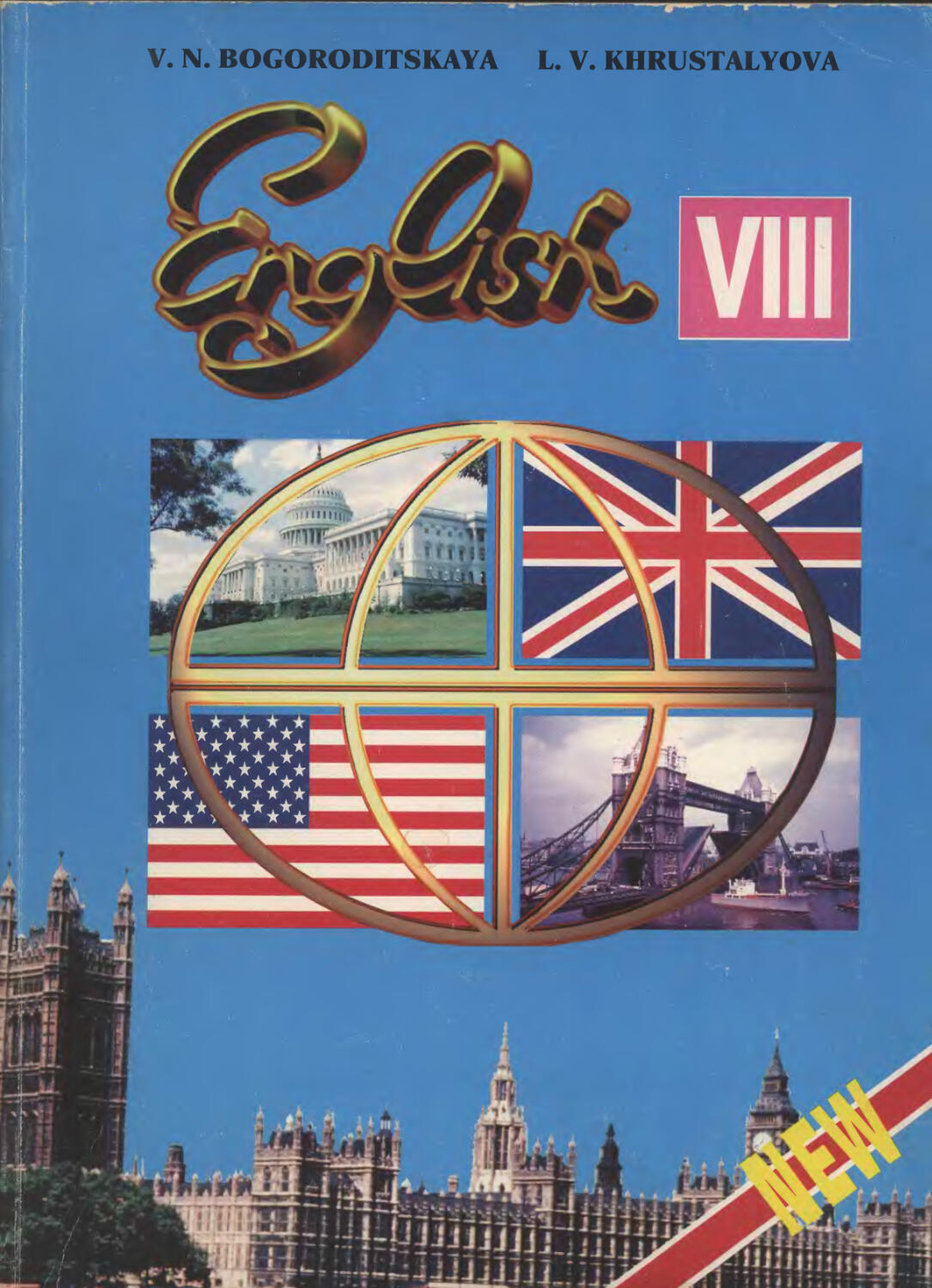
                    V. N. BOGORODITSKAYA L. V. KHRUSTALYOVA
Ш

В. Н. БОГОРОДИЦКАЯ
Л. В. ХРУСТАЛЕВА
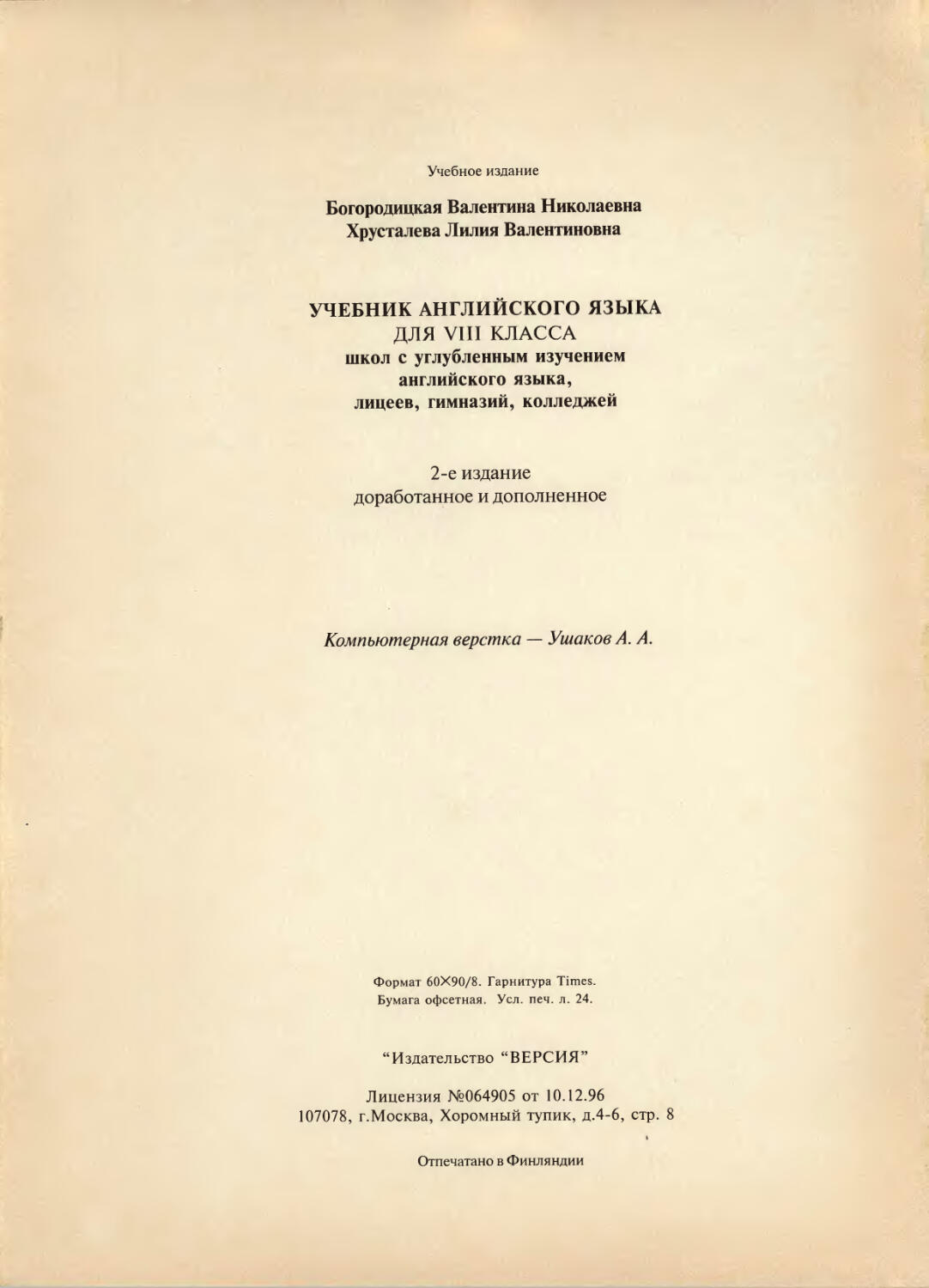
УЧЕБНИК
АНГЛИЙСКОГО
ЯЗЫКА
ДЛЯ VIII КЛАССА
школ с углубленным изучением
английского языка,
лицеев, гимназий, колледжей
Рекомендовано
Министерством образования
Российской Федерации
2-е издание
доработанное и дополненное
Художник В.Гальдяев
Москва
"Издательство "ВЕРСИЯ'
1997

УДК 373.167.1:802.0 + 802.0 (075.3)
ББК 81.2Англ=922
Б74
Консультант: профессор Кейт Роусон-Джоунз (Великобритания),
факультет иностранных языков МГУ
УСЛОВНЫЕ ОБОЗНАЧЕНИЯ
Этот значок означает, что упражнение или часть текста
записаны на аудиокассету.
Этот значок рядом с номером упражнения указывает,
что упражнение следует выполнить письменно.
Богородицкая В. Н., Хрусталсва Л. В.
Б74 Учебник английского языка: Для VIII кл. шк. с углубл. изуч. англ. яз., лицеев,
гимназий, колледжей.— М.: 1997.— 224 с: илл.
ISBN 5-901059-02-6
© В. Н. Богородицкая, Л. В. Хрусталева, текст, 1997
© В. Н. Богородицкая, оригинал-макет, обложка, оформление, 1997

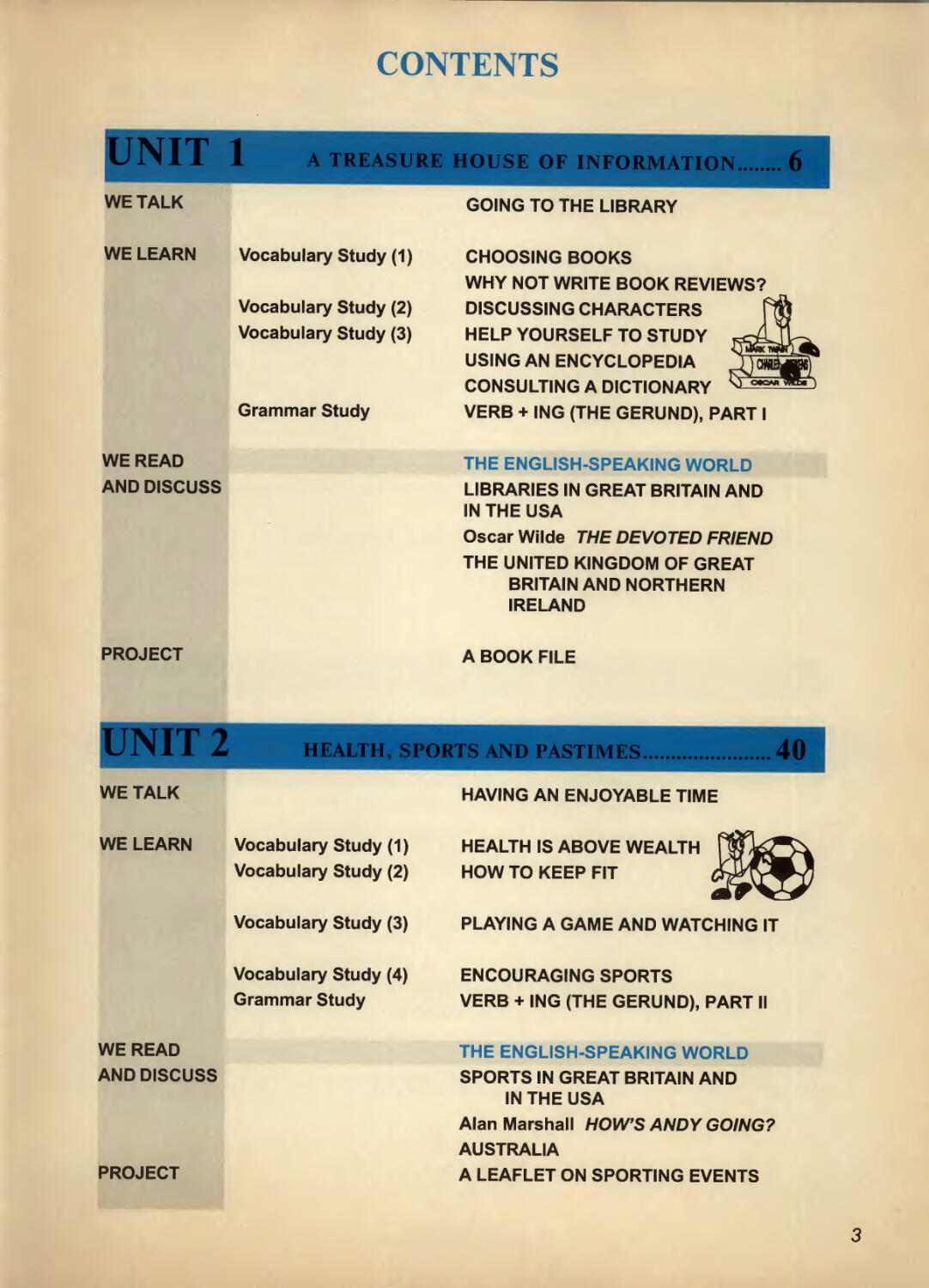
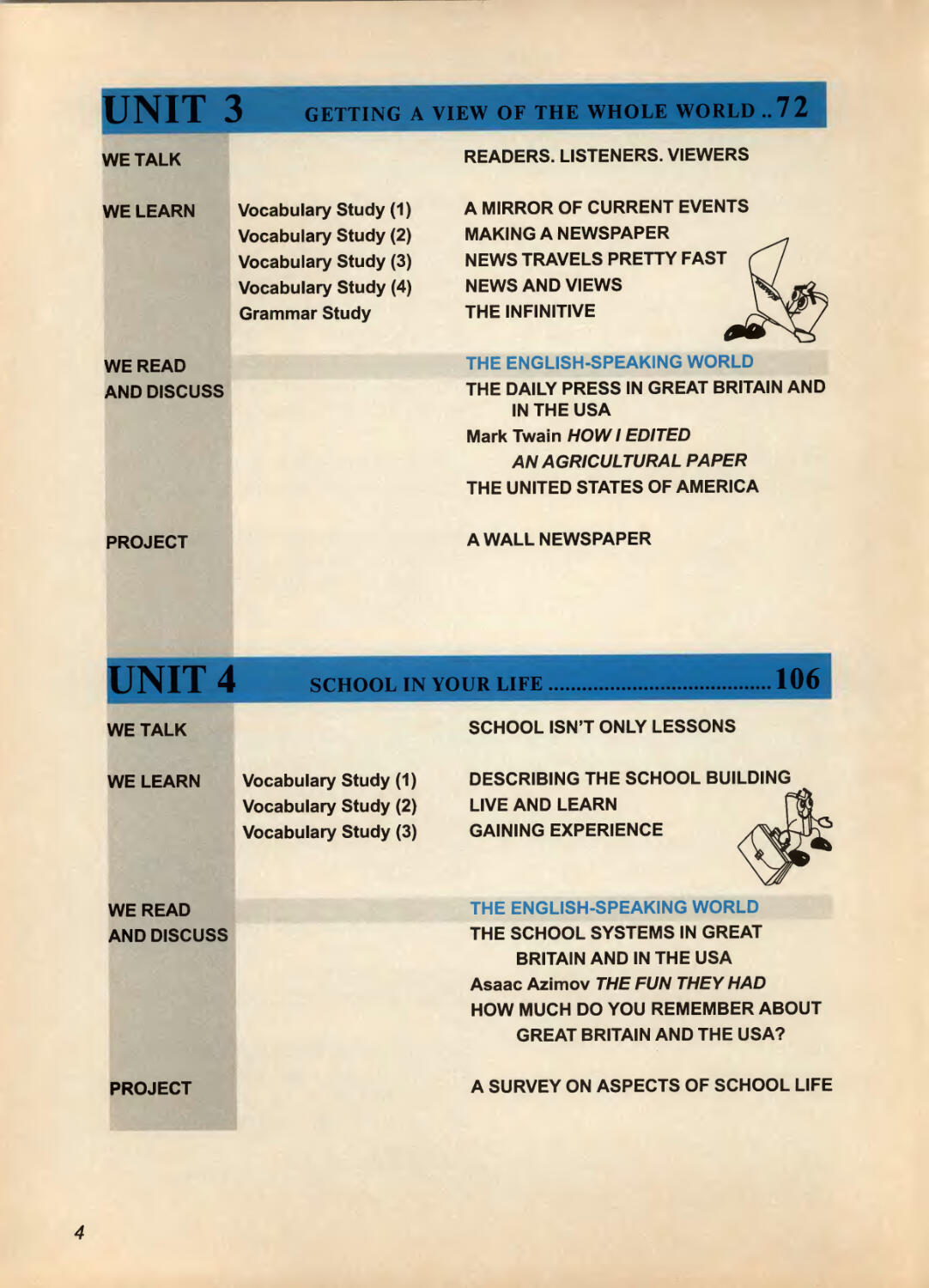
CONTENTS
UNIT 1
WE TALK
A TREASURE HOUSE OF INFORMATION 6
GOING TO THE LIBRARY
WE LEARN
Vocabulary Study (1)
CHOOSING BOOKS
WHY NOT WRITE BOOK REVIEWS?
Vocabulary Study (2)
DISCUSSING CHARACTERS
Vocabulary Study (3)
HELP YOURSELF TO STUDY
USING AN ENCYCLOPEDIA
CONSULTING A DICTIONARY
Grammar Study
VERB + ING (THE GERUND), PART I
WE READ
AND DISCUSS
THE ENGLISH-SPEAKING WORLD
LIBRARIES IN GREAT BRITAIN AND
IN THE USA
Oscar Wilde THE DEVOTED FRIEND
THE UNITED KINGDOM OF GREAT
BRITAIN AND NORTHERN
IRELAND
PROJECT
A BOOK FILE
UNIT 2
HEALTH, SPORTS AND PASTIMES 40
WE TALK
HAVING AN ENJOYABLE TIME
WE LEARN
Vocabulary Study (1)
HEALTH IS ABOVE WEALTH
Vocabulary Study (2)
HOW TO KEEP FIT
Vocabulary Study (3)
PLAYING A GAME AND WATCHING IT
Vocabulary Study (4)
ENCOURAGING SPORTS
Grammar Study
VERB + ING (THE GERUND), PART II
WE READ
AND DISCUSS
THE ENGLISH-SPEAKING WORLD
SPORTS IN GREAT BRITAIN AND
IN THE USA
Alan Marshall HOWS ANDY GOING?
AUSTRALIA
PROJECT
A LEAFLET ON SPORTING EVENTS

UNIT 3
GETTING A VIEW OF THE WHOLE WORLD ..72
WE TALK
READERS. LISTENERS. VIEWERS
WE LEARN
Vocabulary Study (1)
A MIRROR OF CURRENT EVENTS
Vocabulary Study (2)
MAKING A NEWSPAPER
Vocabulary Study (3)
NEWS TRAVELS PRETTY FAST
Vocabulary Study (4)
NEWS AND VIEWS
Grammar Study
THE INFINITIVE
WE READ
AND DISCUSS
THE ENGLISH-SPEAKING WORLD
THE DAILY PRESS IN GREAT BRITAIN AND
IN THE USA
Mark Twain HOW I EDITED
AN AGRICULTURAL PAPER
THE UNITED STATES OF AMERICA
PROJECT
A WALL NEWSPAPER
UNIT 4
SCHOOL IN YOUR LIFE 106
WE TALK
SCHOOL ISN'T ONLY LESSONS
WE LEARN
Vocabulary Study (1)
DESCRIBING THE SCHOOL BUILDING
Vocabulary Study (2)
LIVE AND LEARN
Vocabulary Study (3)
GAINING EXPERIENCE
WE READ
AND DISCUSS
THE ENGLISH-SPEAKING WORLD
THE SCHOOL SYSTEMS IN GREAT
BRITAIN AND IN THE USA
Asaac Azimov THE FUN THEY HAD
HOW MUCH DO YOU REMEMBER ABOUT
GREAT BRITAIN AND THE USA?
PROJECT
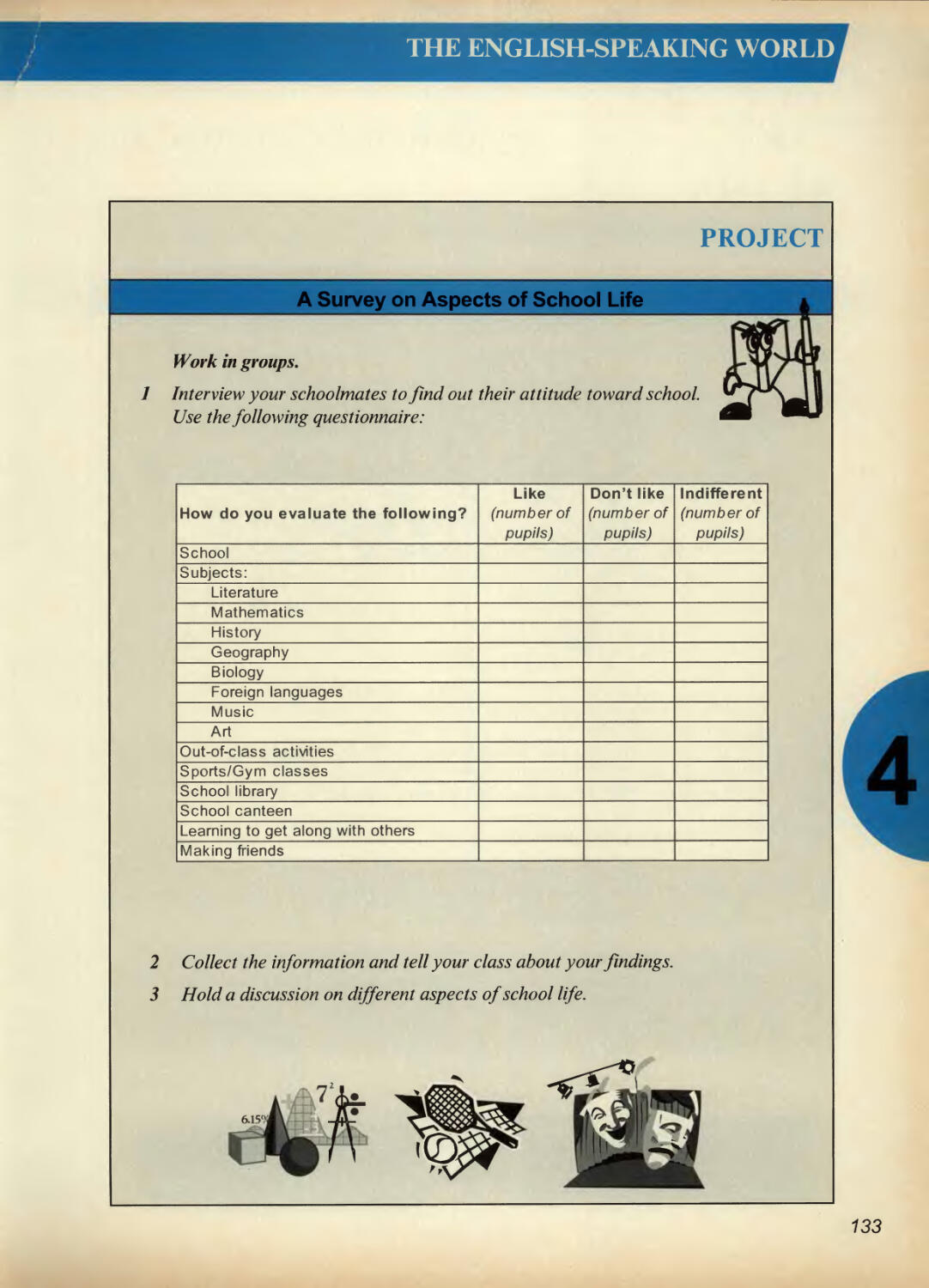
A SURVEY ON ASPECTS OF SCHOOL LIFE

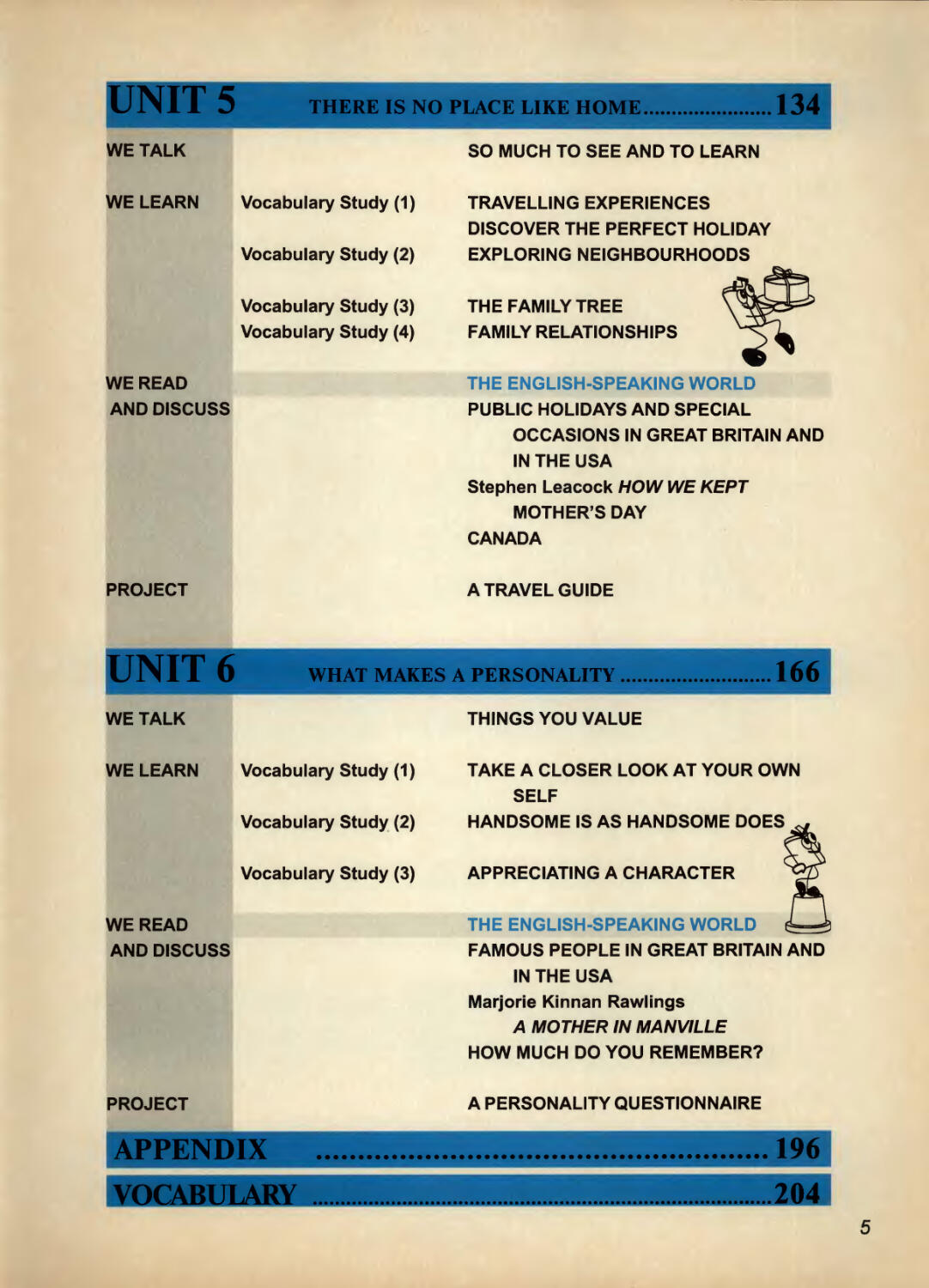
UNIT 5
THERE IS NO PLACE LIKE HOME 134
WE TALK
SO MUCH TO SEE AND TO LEARN
WE LEARN
Vocabulary Study (1)
TRAVELLING EXPERIENCES
DISCOVER THE PERFECT HOLIDAY
Vocabulary Study (2)
EXPLORING NEIGHBOURHOODS
Vocabulary Study (3)
THE FAMILY TREE
Vocabulary Study (4)
FAMILY RELATIONSHIPS
WE READ
AND DISCUSS
THE ENGLISH-SPEAKING WORLD
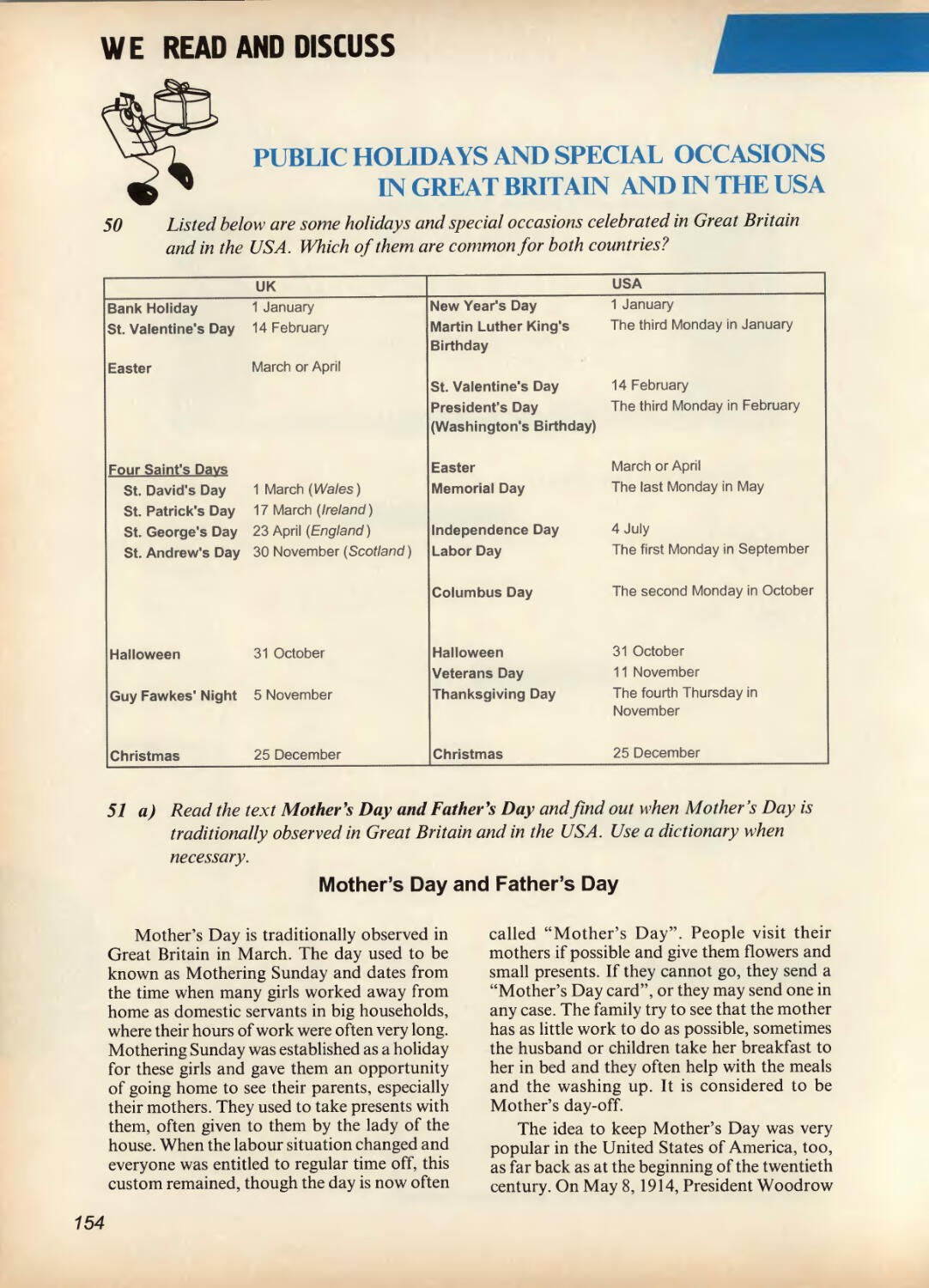
PUBLIC HOLIDAYS AND SPECIAL
OCCASIONS IN GREAT BRITAIN AND
IN THE USA
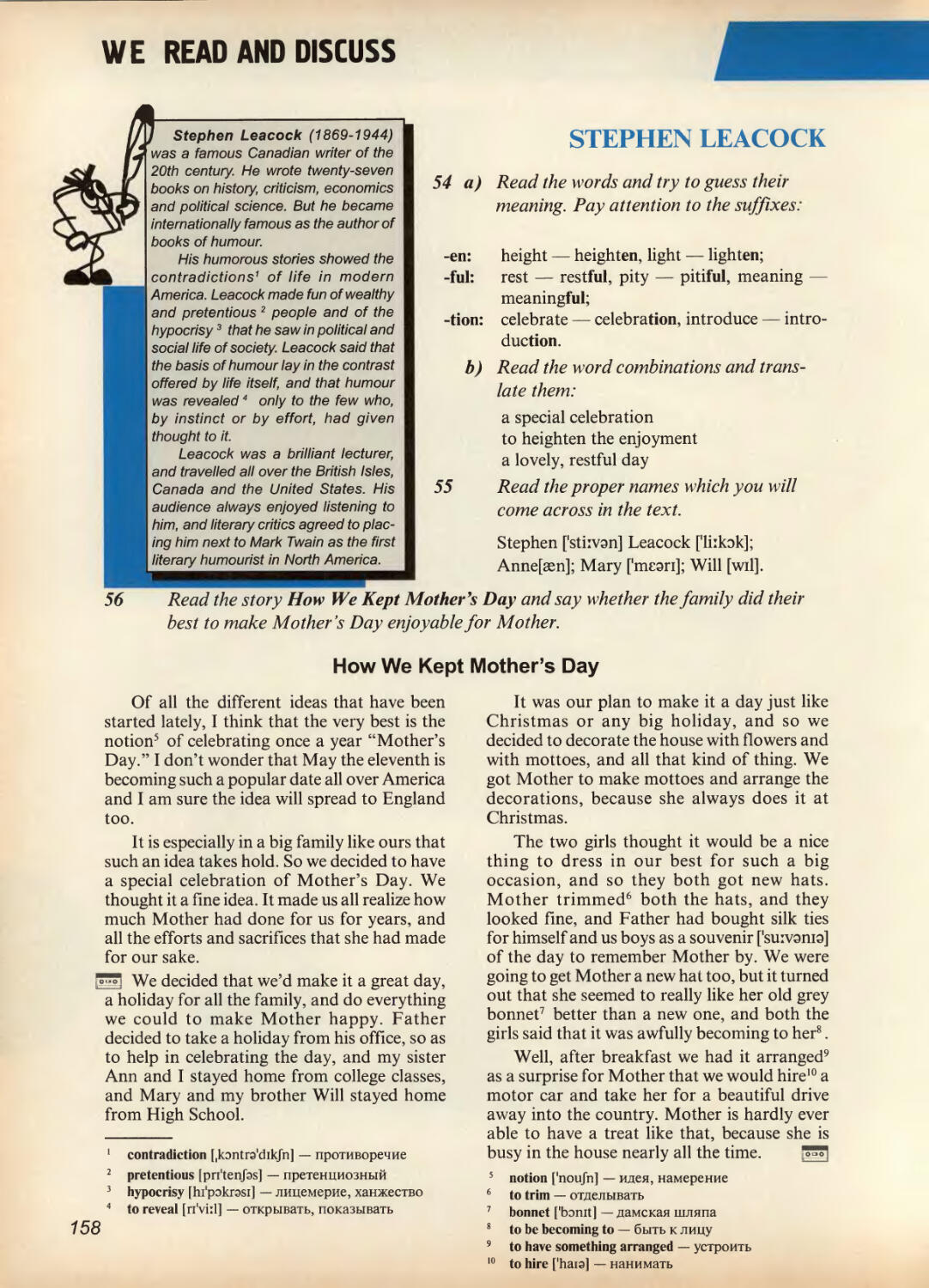
Stephen Leacock HOW WE KEPT
MOTHER'S DAY
CANADA
PROJECT
A TRAVEL GUIDE
UNIT 6
WHAT MAKES A PERSONALITY 166
WE TALK
THINGS YOU VALUE
WE LEARN
Vocabulary Study (1)
TAKE A CLOSER LOOK AT YOUR OWN
SELF
Vocabulary Study (2)
HANDSOME IS AS HANDSOME DOES
Vocabulary Study (3)
APPRECIATING A CHARACTER
WE READ
AND DISCUSS
THE ENGLISH-SPEAKING WORLD
FAMOUS PEOPLE IN GREAT BRITAIN AND
IN THE USA
Marjorie Kinnan Rawlings
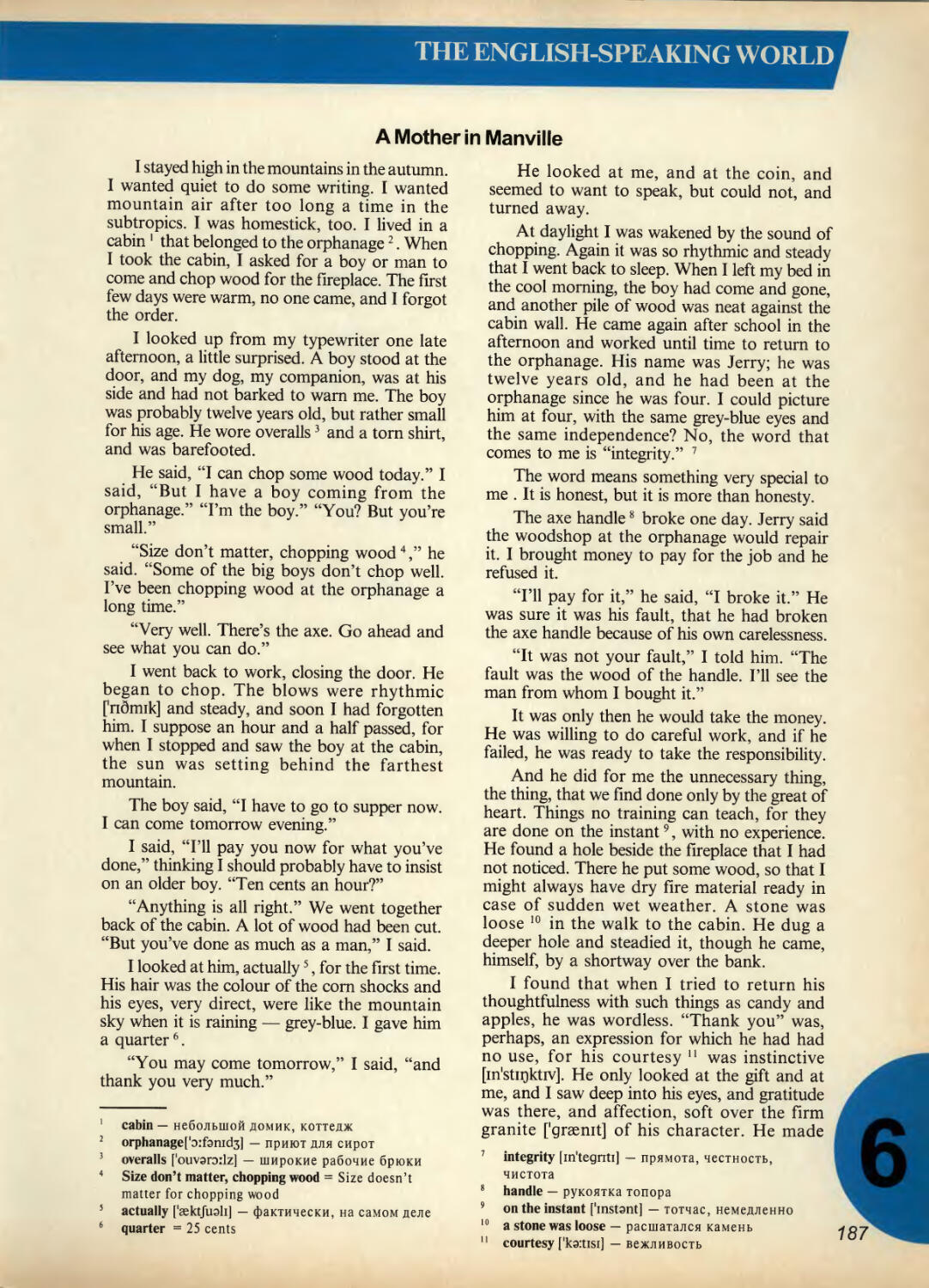
A MOTHER IN MANVILLE
HOW MUCH DO YOU REMEMBER?
PROJECT
A PERSONALITY QUESTIONNAIRE
njj^hbi mm
VOCABULARY 204

A TREASURE
UNIT 1
WE TALK
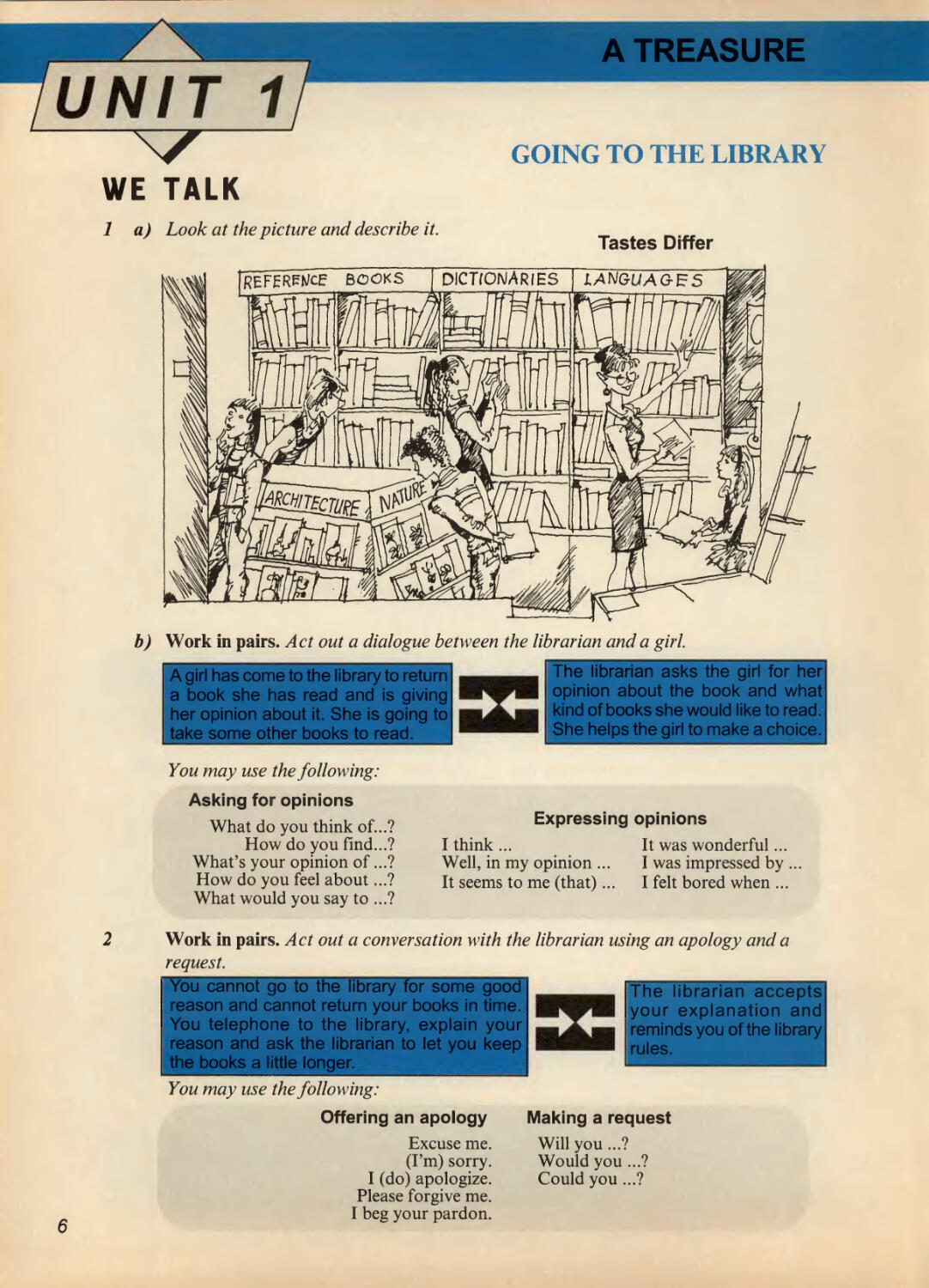
1 a) Look at the picture and describe it.
GOING TO THE LIBRARY
Tastes Differ
b) Work in pairs. Act out a dialogue between the librarian and a girl.
A girl has come to the library to return
a book she has read and is giving
her opinion about it. She is going to
take some other books to read.
librarian asks the girl for her
opinion about the book and what
kind of books she would like to read.
She helps the girl to make a choice.
You may use the following:
Asking for opinions
What do you think of...?
How do you find...?
What's your opinion of...?
How do you feel about...?
What would you say to ...?
Expressing opinions
I think ...
Well, in my opinion ...
It seems to me (that)...
It was wonderful...
I was impressed by ...
I felt bored when ...
Work in pairs. Act out a conversation with the librarian using an apology and a
request.
You cannot go to the library for some good
reason and cannot return your books in time.
You telephone to the library, explain your
reason and ask the librarian to let you keep
the books a little longer.
The librarian accepts
your explanation and
reminds you of the library
rules.
You may use the following:
Offering an apology
Excuse me.
(I'm) sorry.
I (do) apologize.
Please forgive me.
I beg your pardon.
Making a request
Will you ...?
Would you ...?
Could you ...?

HOUSE OF INFORMATIOI
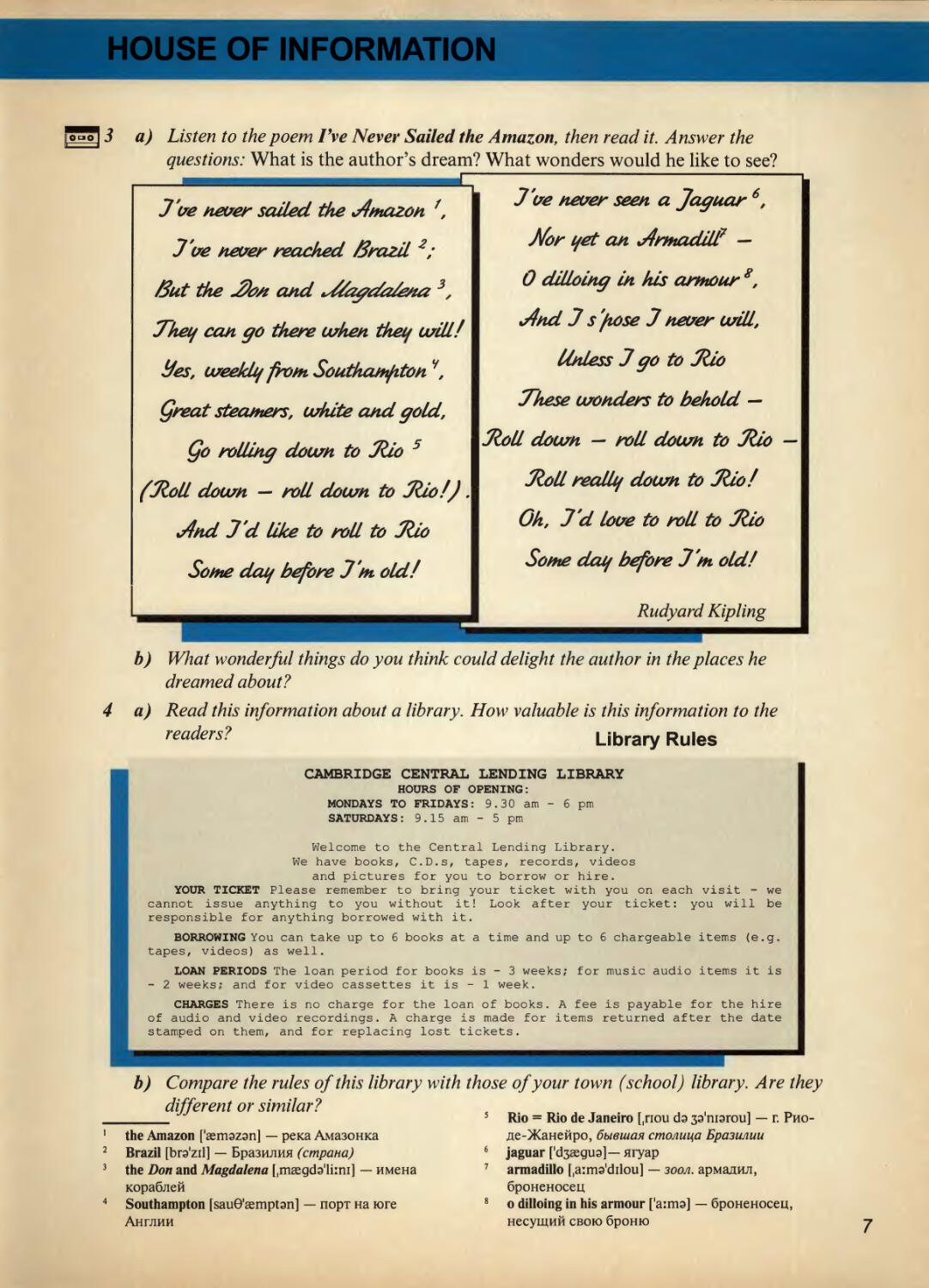
3 a) Listen to the poem I've Never Sailed the Amazon, then read it. Answer the
questions: What is the author's dream? What wonders would he like to see?
J've never sailed the Amazon f.
J'we never reached /Srazil *;
/3ut the &/i and ^ДараЫ&иг 3,
Theif can go there u/ken th&f will!
yes, weekly from Southampton4,
Qreat steamers, white and gold,
Qo rolling down to Rio 5
(Roll down — roll down to Rio!).
dnd J'd like to roll to Rio
So иге dacf before J'm old/
I've never seen a Jaguar 6,
Мог tfet an drmadiU7 —
0 dittoing in his armour 8,
dnd Js'/tose J never will,
Unless J go to Rio
J~hese wonders to behold —
Roll down — roll down to Rio —
Roll reallif down to Rio!
Oh, J'd bve to roll to Rio
Some daif before J'm old!
Rudyard Kipling
b) What wonderful things do you think could delight the author in the places he
dreamed about?
4 a) Read this information about a library. How valuable is this information to the
readers? Library Rules
CAMBRIDGE CENTRAL LENDING LIBRARY
HOURS OF OPENING:
MONDAYS TO FRIDAYS: 9.30 am - 6 pm
SATURDAYS: 9.15 am - 5 pm
Welcome to the Central Lending Library.
We have books, C.D.s, tapes, records, videos
and pictures for you to borrow or hire.
YOUR TICKET Please remember to bring your ticket with you on each visit - we
cannot issue anything to you without it! Look after your ticket: you will be
responsible for anything borrowed with it.
BORROWING You can take up to 6 books at a time and up to 6 chargeable items (e.g.
tapes, videos) as well.
LOAN PERIODS The loan period for books is - 3 weeks; for music audio items it is
- 2 weeks; and for video cassettes it is - 1 week.
CHARGES There is no charge for the loan of books. A fee is payable for the hire
of audio and video recordings. A charge is made for items returned after the date
stamped on them, and for replacing lost tickets.
b) Compare the rules of this library with those of your town (school) library. Are they
different or similar?
1 the Amazon ['азтэгэп] — река Амазонка
2 Brazil [bra'zil] — Бразилия (страна)
3 the Don and Magdalena [.masgds'liini] — имена
кораблей
4 Southampton [sauO'aemptan] — порт на юге
Англии
5 Rio = Rio de Janeiro [,nou da зэ'шэгои] — г. Рио-
де-Жанейро, бывшая столица Бразилии
6 jaguar [^заздиэ]— ягуар
7 armadillo [.aima'dilou] — зоол. армадил,
броненосец
8 о dilloing in his armour ['aims] — броненосец,
несущий свою броню

WE LEARN
Vocabulary Study (1)
CHOOSING BOOKS
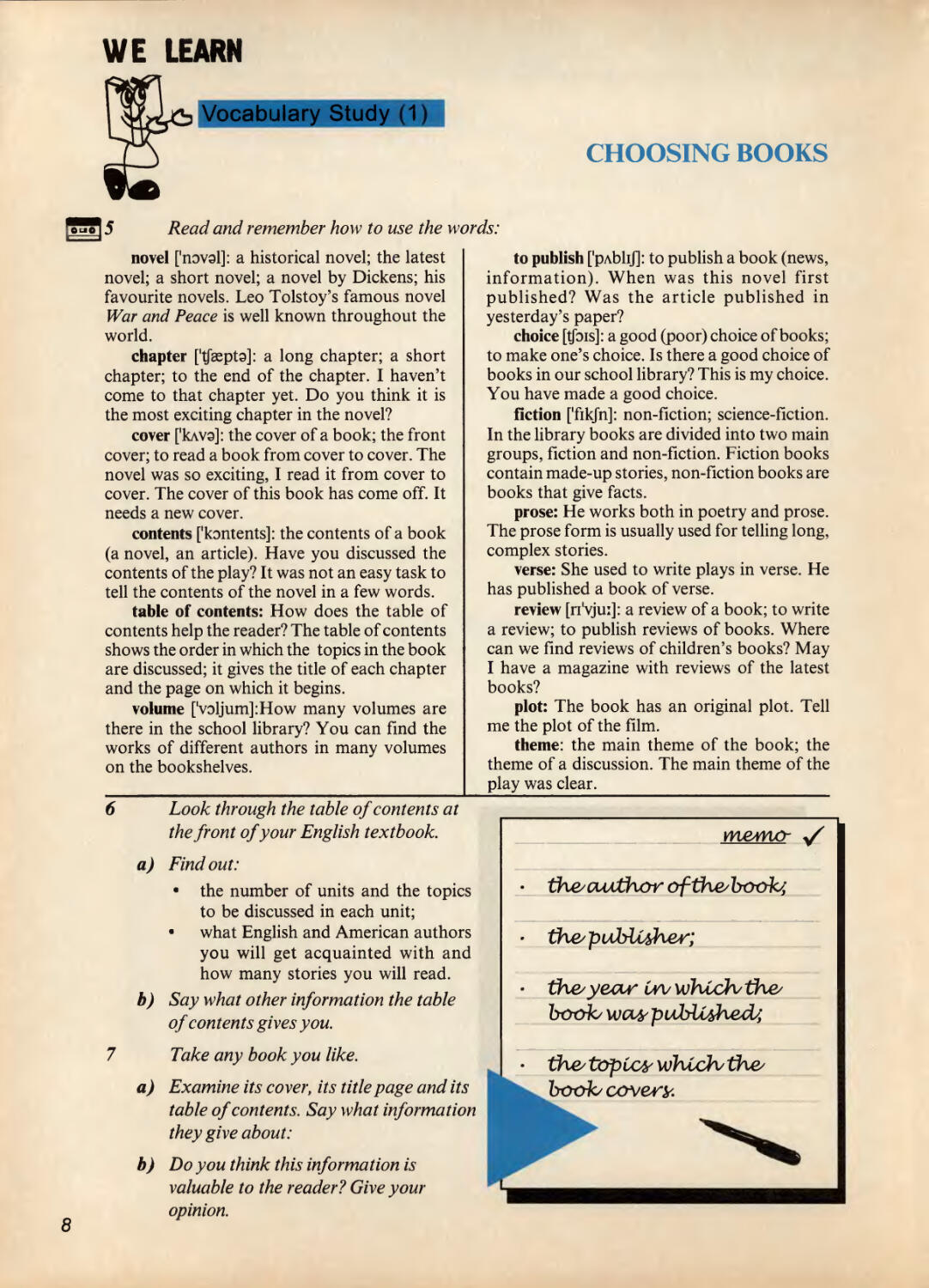
5 Read and remember how to use the words:
novel ['noval]: a historical novel; the latest
novel; a short novel; a novel by Dickens; his
favourite novels. Leo Tolstoy's famous novel
War and Peace is well known throughout the
world.
chapter ['tfaepta]: a long chapter; a short
chapter; to the end of the chapter. I haven't
come to that chapter yet. Do you think it is
the most exciting chapter in the novel?
cover ['k/vva]: the cover of a book; the front
cover; to read a book from cover to cover. The
novel was so exciting, I read it from cover to
cover. The cover of this book has come off. It
needs a new cover.
contents ['kontents]: the contents of a book
(a novel, an article). Have you discussed the
contents of the play? It was not an easy task to
tell the contents of the novel in a few words.
table of contents: How does the table of
contents help the reader? The table of contents
shows the order in which the topics in the book
are discussed; it gives the title of each chapter
and the page on which it begins.
volume ['vo]jum]: How many volumes are
there in the school library? You can find the
works of different authors in many volumes
on the bookshelves.
to publish ['pAblifJ: to publish a book (news,
information). When was this novel first
published? Was the article published in
yesterday's paper?
choice [tfois]: a good (poor) choice of books;
to make one's choice. Is there a good choice of
books in our school library? This is my choice.
You have made a good choice.
fiction ['fikjh]: non-fiction; science-fiction.
In the library books are divided into two main
groups, fiction and non-fiction. Fiction books
contain made-up stories, non-fiction books are
books that give facts.
prose: He works both in poetry and prose.
The prose form is usually used for telling long,
complex stories.
verse: She used to write plays in verse. He
has published a book of verse.
review [n'yju:]: a review of a book; to write
a review; to publish reviews of books. Where
can we find reviews of children's books? May
I have a magazine with reviews of the latest
books?
plot: The book has an original plot. Tell
me the plot of the film.
theme: the main theme of the book; the
theme of a discussion. The main theme of the
play was clear.
Look through the table of contents at
the front of your English textbook.
a) Find out:
• the number of units and the topics
to be discussed in each unit;
• what English and American authors
you will get acquainted with and
how many stories you will read.
b) Say what other information the table
of contents gives you.
Take any book you like.
a) Examine its cover, its title page and its
table of contents. Say what information
they give about:
b) Do you think this information is
valuable to the reader? Give your
opinion.
memo-
the/cvuthor ofthe/Ъоок/,
the/publCbher;
the/year (av which/the/
Ъ<ю&ыа&риЫ1$ъес1г,
the/ topic* which/ the/
boohcovery.

8 How do you choose books? Answer the questions:
1 When you go to the library, do you always know which books you want to look for?
2 When you see a lot of new books at the library, do you find it easy to make a choice?
3 What helps you to make a choice — the pictures in the book, its cover, the table of contents,
the advice of the librarian or of one of your classmates?
4 Do you make a list of books you would like to borrow before you go to the library? Why?
10 | Books offer romance, history,|
adventure, autobiography, science
fiction and humour in the form of
short stories, novels, poetry and
plays.
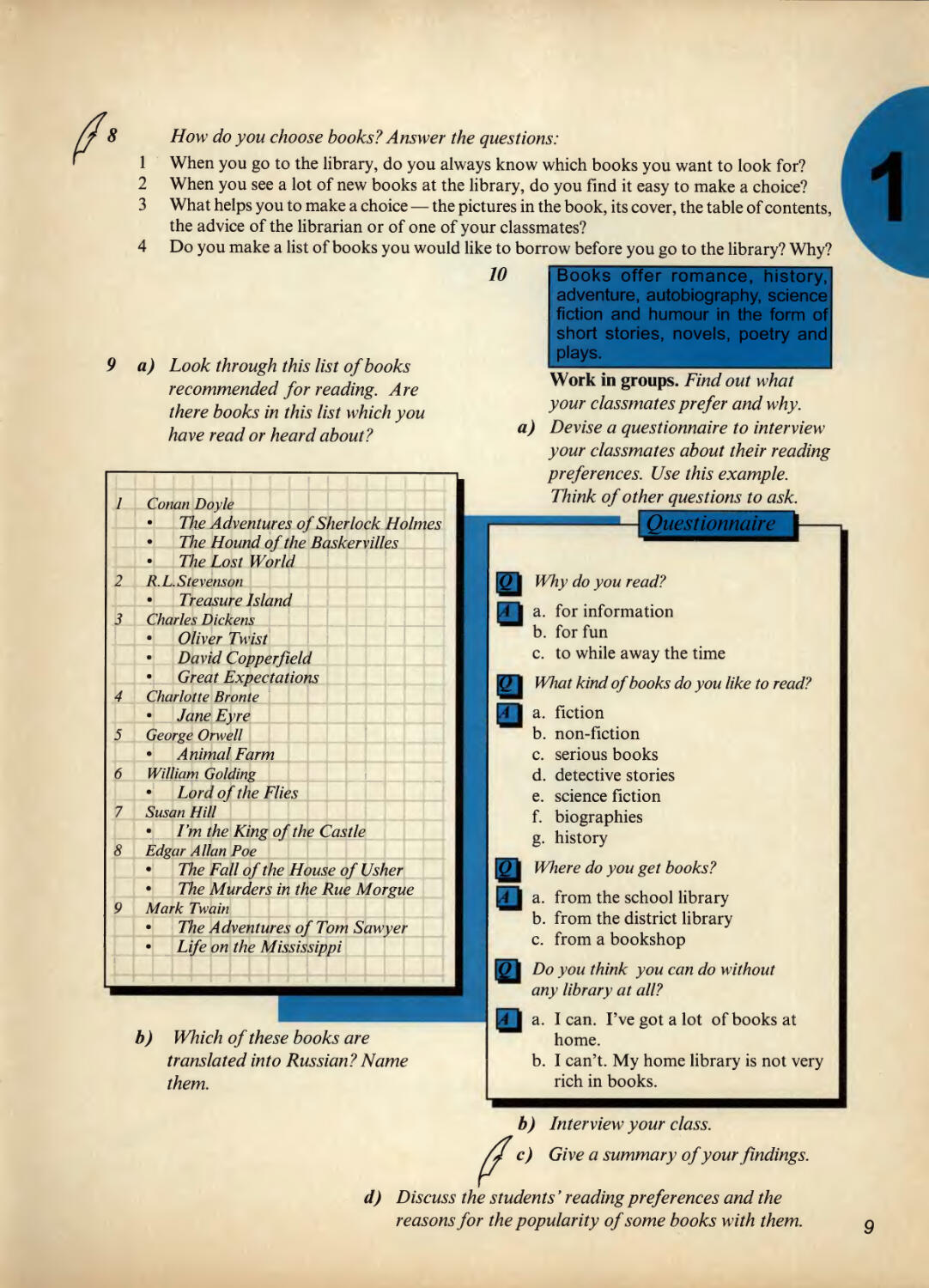
9 a) Look through this list of books
recommended for reading. Are
there books in this list which you
have read or heard about?
Work in groups. Find out what
your classmates prefer and why.
a) Devise a questionnaire to interview
your classmates about their reading
preferences. Use this example.
Think of other questions to ask.
Questionnaire \
1 Conan Doyle
• The A dventures of Sherlock Holmes
• The Hound of the Baskervilles
• The Lost World
2 R.L.Stevenson
• Treasure Island
3 Charles Dickens
• Oliver Twist
• David Copperfield
• Great Expectations
4 Charlotte Bronte
• Jane Eyre
5 George Orwell
• Animal Farm
"I ""T™ I i ' y' tttiit Till ■—— ——■■ —» " ' —— ■
6 William Golding
• Lord of the Flies
7 Susan Hill
• Fm the King of the Castle
8 Edgar Allan Рое
• The Fall of the House of Usher
• The Murders in the Rue Morgue
9 Mark Twain
• The Adventures of Tom Sawyer
• Life on the Mississippi
"Till'
b) Which of these books are
translated into Russian? Name
them.
\Q\ Why do you read?
\A~\ a. for information
b. for fun
с to while away the time
\0 | What kind of books do you like to read?
\A~\ a. fiction
b. non-fiction
с serious books
d. detective stories
e. science fiction
f. biographies
g. history
;OJ Where do you get books?
\ t\ a. from the school library
b. from the district library
с from a bookshop
}(j\ Do you think you can do without
any library at all?
: (J a. lean. I've got a lot of books at
home,
b. I can't. My home library is not very
rich in books.
b) Interview your class.
c) Give a summary of your findings.
d) Discuss the students' reading preferences and the
reasons for the popularity of some books with them.

WE LEARN
WHY NOT WRITE BOOK REVIEWS?
и
There are some more new books in the
school library. The pupils are choosing
books to read. Here is what they are
talking about:
a) Listen to the dialogue, then read it.
Say what a book review is and
where book reviews can be kept.
A — Ann ; N — Nick; M — Mike; T — Teacher
>-
A: Here's a book I'd like to read. It's about adventures. I can tell that by the title. I'm sure
I'd like it.
N: But titles don't always tell you what a book is about.
T: No, that's true. So why not write book reviews?
A: What's a book review?
T: A book review is a short report about a book. It tells just enough to give a person an
idea about the story.
N: But how shall we know that the book is really very interesting and worth reading?
T: A person who has read a book writes a review of it. You write a review of your favourite
book. You write why you enjoyed the book. You ought also to write something to
interest other people in the book and make them want to read it.
M: Reviews of our favourite books will be very helpful to others, I'm sure. But where shall
we keep the reviews?
T: You may sew the reviews together and make a booklet, which can be kept on the
library table. Or you may write very short reviews on cards and keep them in a box
which is called a "Book File". You may also write reviews for our school magazine.
b) Say what a person ought to write to show that the book is worth reading.
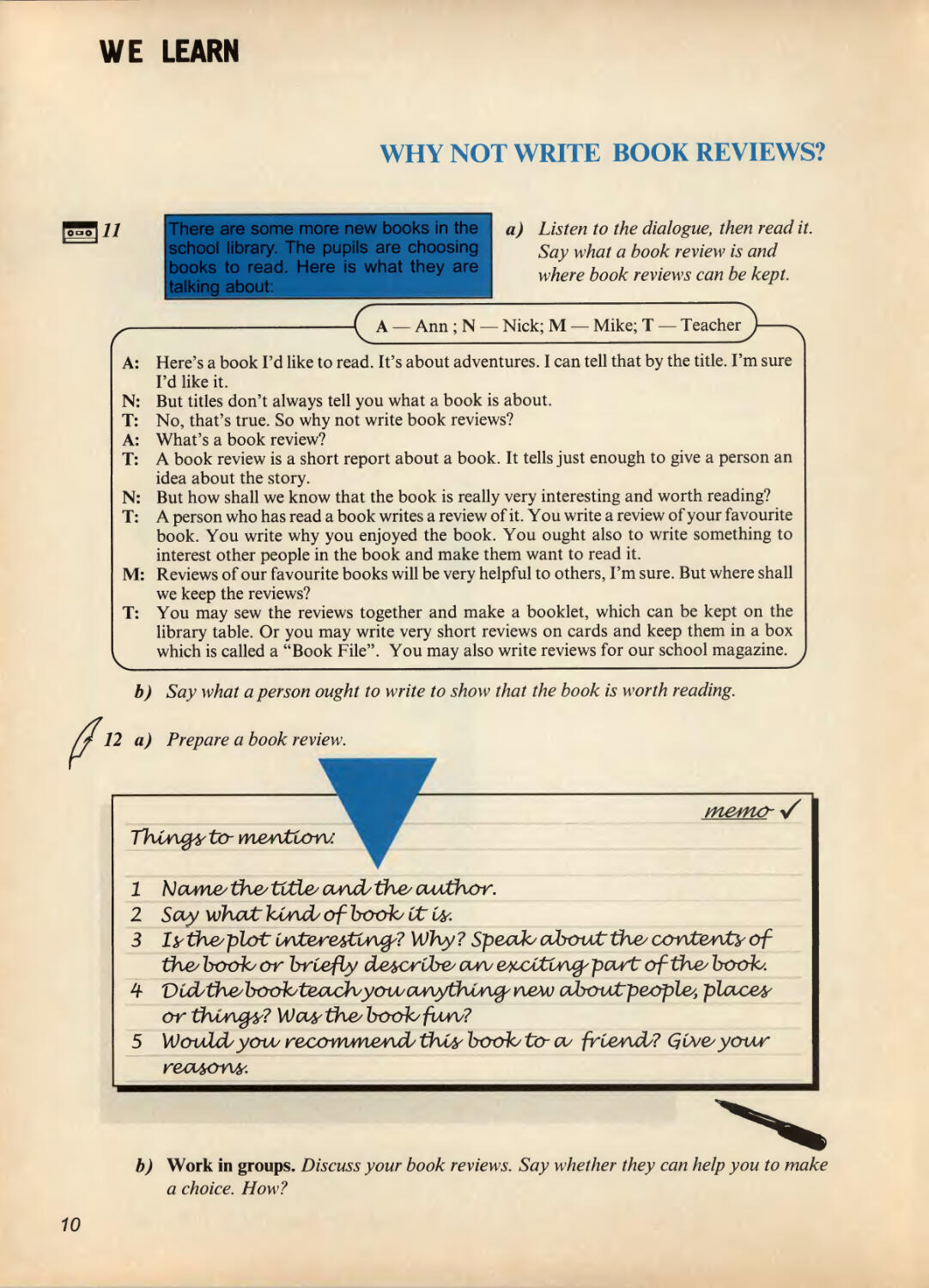
12 a) Prepare a book review.
Tbln^to-m£4\tXxyvu
теша-
1 Name/the/title/ and/ the/ author.
2 Say what ktnd/of booh it its.
3 lythe/plot interesting/? Why? Speak/ahoutthe/contentyof
the/book/or briefly describe/an/e^oiting^partof the/booh.
Ц- Vidthe/hoohteaxfayowavtytfalntynew ahoutp&ople/, places
orthOngy? Way the/book fans?
5 WouM/yous recomm&nd/ thiy book/ to- a/ friend/? Gjwe/your
rewborw.
b) Work in groups. Discuss your book reviews. Say whether they can help you to make
a choice. How?

13
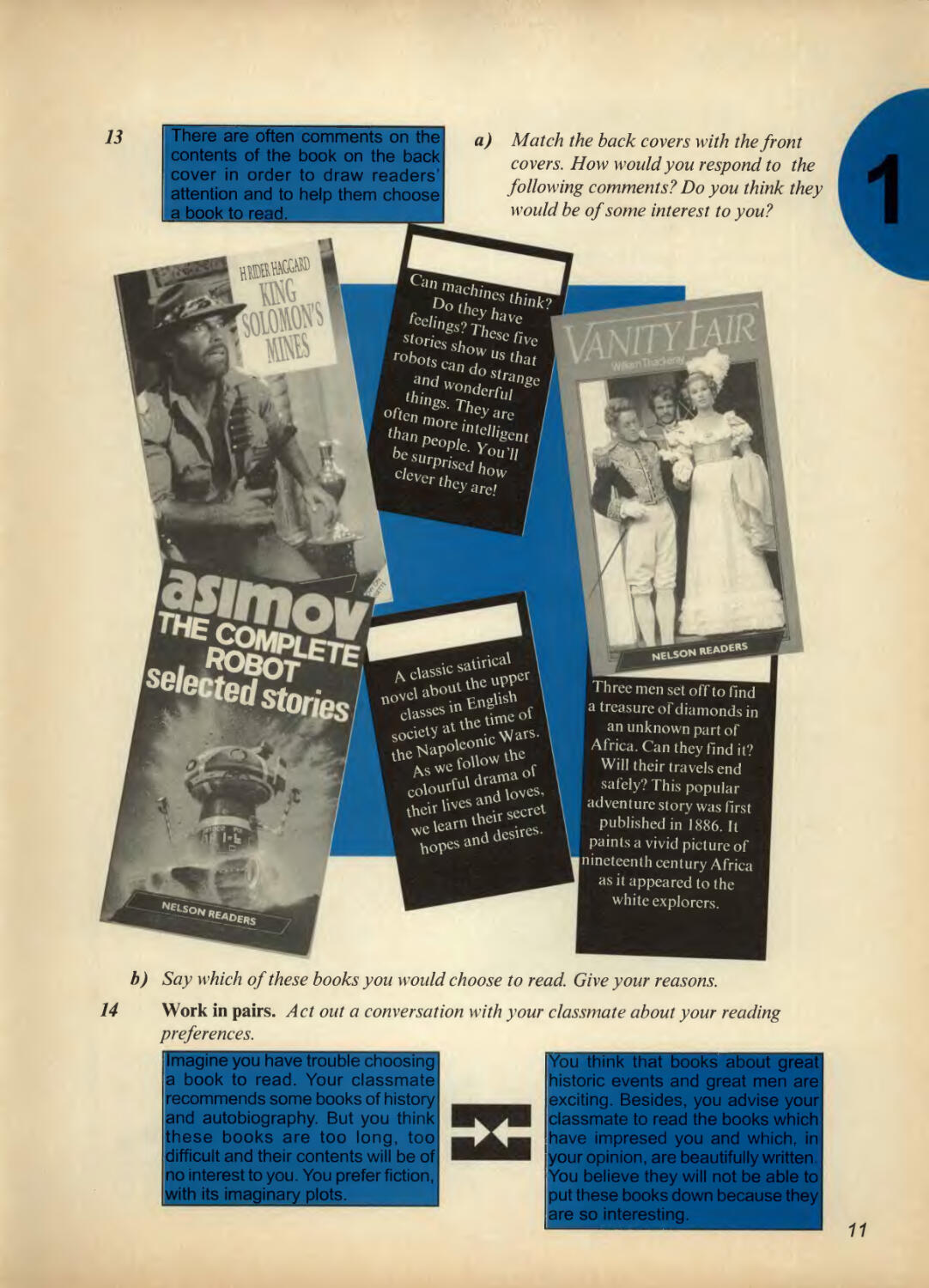
There are often comments on the
contents of the book on the back
cover in order to draw readers'
attention and to help them choose
a book to read,
a) Match the back covers with the front
covers. How would you respond to the
following comments? Do you think they
would be of some interest to you?
""fAOE,,
b) Say which of these books you would choose to read. Give your reasons.
14 Work in pairs. Act out a conversation with your classmate about your reading
preferences.
Imagine you have trouble choosing
a book to read. Your classmate
recommends some books of history
and autobiography. But you think
these books are too long, too
difficult and their contents will be of
no interest to you. You prefer fiction,
with its imaginary plots.
!bu think that books about great
istoric events and great men are
xciting. Besides, you advise your
lassmate to read the books which
ave impresed you and which, in
our opinion, are beautifully written,
bu believe they will not be able to
ut these books down because they
re so interesting.

WE LEARN
Vocabulary Study (2)
DISCUSSING CHARACTERS
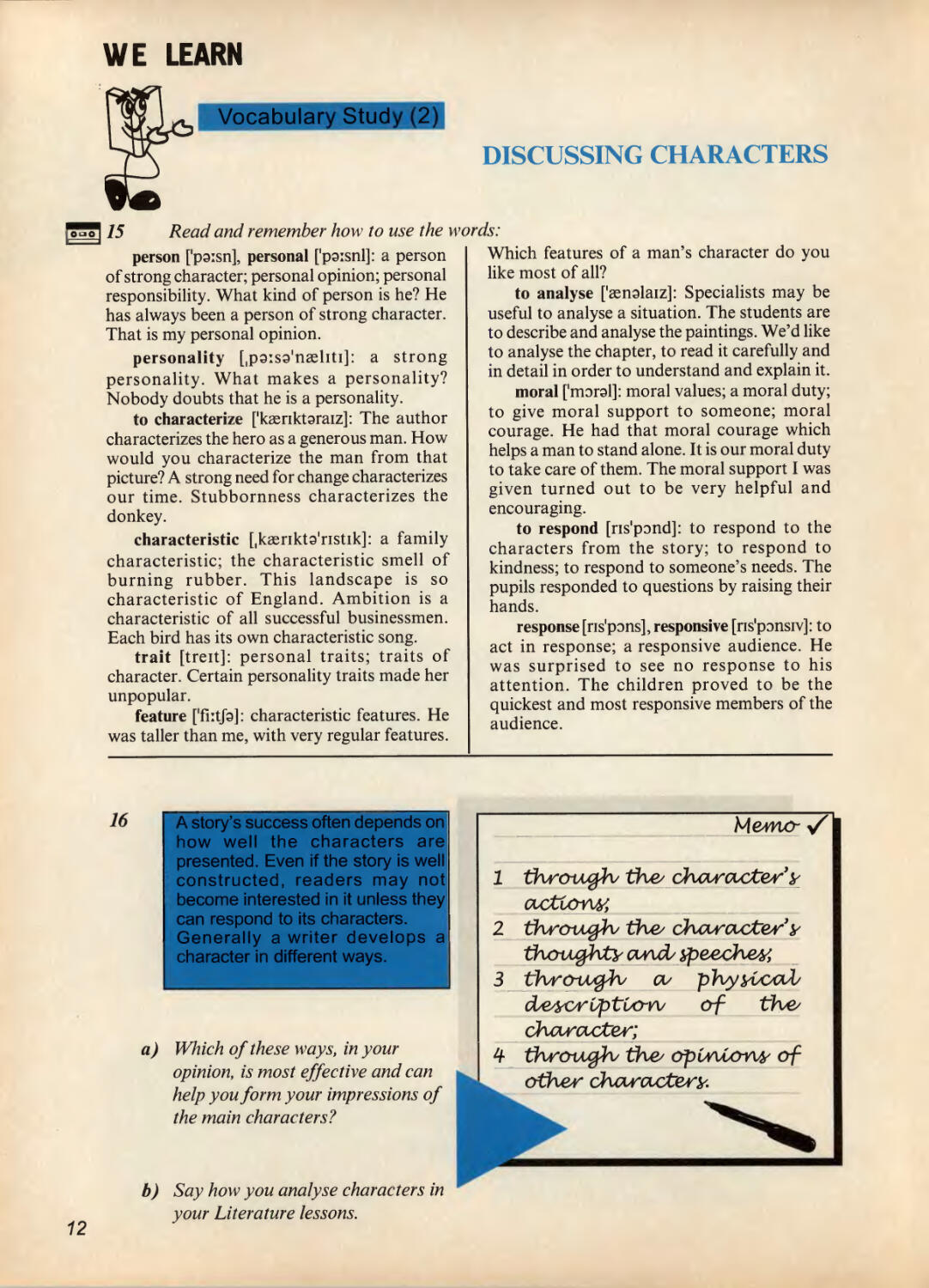
15 Read and remember how to use the words:
person ['psisn], personal ['paisnl]: a person
of strong character; personal opinion; personal
responsibility. What kind of person is he? He
has always been a person of strong character.
That is my personal opinion.
personality [.paisa'nasliti]: a strong
personality. What makes a personality?
Nobody doubts that he is a personality.
to characterize ['kaenktaraiz]: The author
characterizes the hero as a generous man. How
would you characterize the man from that
picture? A strong need for change characterizes
our time. Stubbornness characterizes the
donkey.
characteristic [kaenkta'nstik]: a family
characteristic; the characteristic smell of
burning rubber. This landscape is so
characteristic of England. Ambition is a
characteristic of all successful businessmen.
Each bird has its own characteristic song.
trait [treit]: personal traits; traits of
character. Certain personality traits made her
unpopular.
feature ['fiitjb]: characteristic features. He
was taller than me, with very regular features.
Which features of a man's character do you
like most of all?
to analyse ['aenalaiz]: Specialists may be
useful to analyse a situation. The students are
to describe and analyse the paintings. We'd like
to analyse the chapter, to read it carefully and
in detail in order to understand and explain it.
moral [moral]: moral values; a moral duty;
to give moral support to someone; moral
courage. He had that moral courage which
helps a man to stand alone. It is our moral duty
to take care of them. The moral support I was
given turned out to be very helpful and
encouraging.
to respond [ns'pond]: to respond to the
characters from the story; to respond to
kindness; to respond to someone's needs. The
pupils responded to questions by raising their
hands.
response [ns'pons], responsive [ns'ponsrv]: to
act in response; a responsive audience. He
was surprised to see no response to his
attention. The children proved to be the
quickest and most responsive members of the
audience.
16
A story's success often depends on
how well the characters are
presented. Even if the story is well
constructed, readers may not
become interested in it unless they
can respond to its characters.
Generally a writer develops a
character in different ways
a) Which of these ways, in your
opinion, is most effective and can
help you form your impressions of
the main characters?
b) Say how you analyse characters in
your Literature lessons.
1 through/ the/ character's
Gvctiony,
2 through/ the/ character'у
thoughts and/ ypecchey,
3 thro-uogh/ a/ phyyOocU/
de/ycriptOcnv of the/
character;
4 through/ the/ opOniOYUr- of
other characters

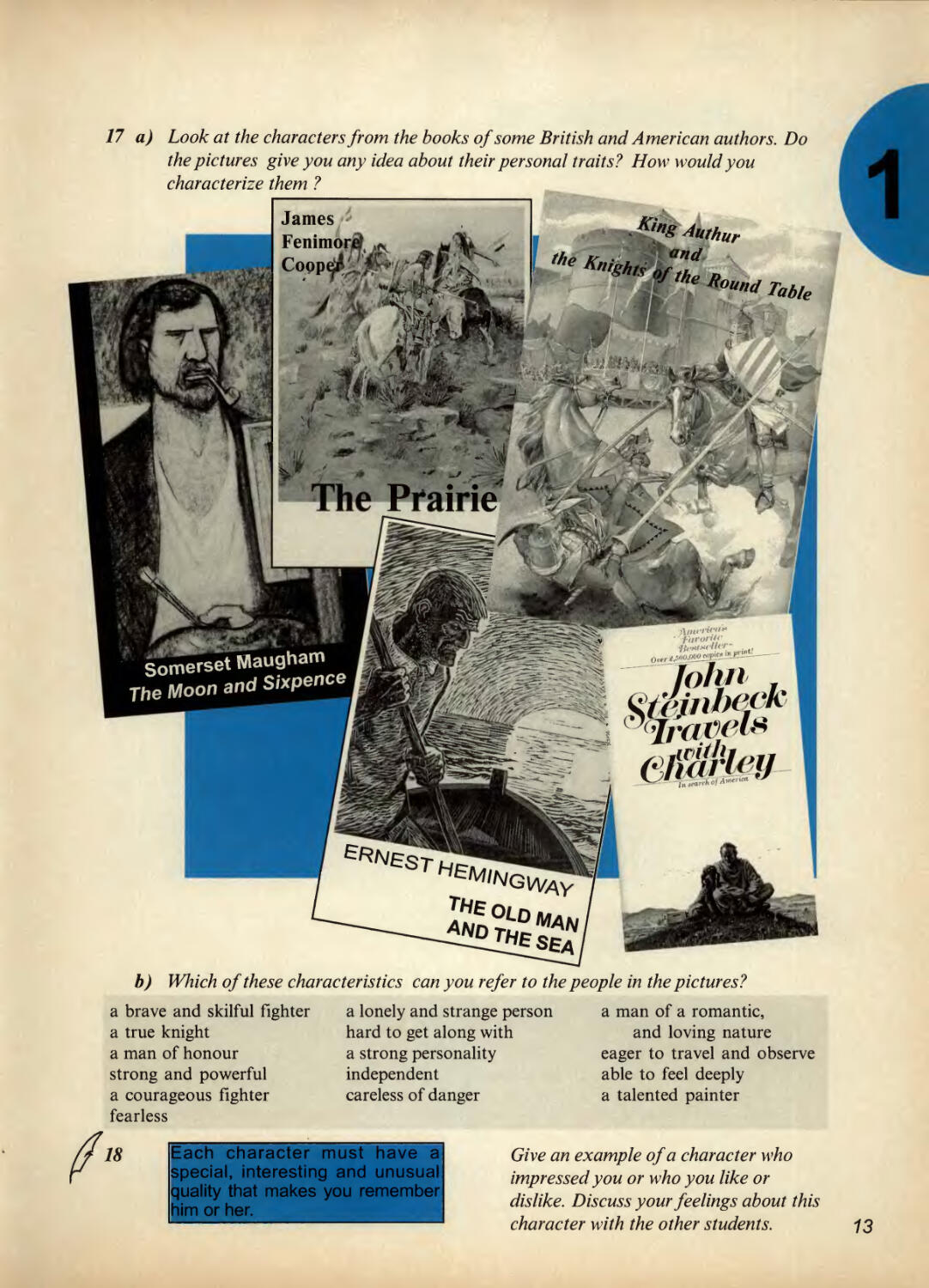
17 a) Look at the characters from the books of some British and American authors. Do
the pictures give you any idea about their personal traits? How would you
characterize them ?
b) Which of these characteristics can you refer to the people in the pictures?
18
a brave and skilful fighter
a true knight
a man of honour
strong and powerful
a courageous fighter
fearless
a lonely and strange person
hard to get along with
a strong personality
independent
careless of danger
a man of a romantic,
and loving nature
eager to travel and observe
able to feel deeply
a talented painter
Each character must have a
special, interesting and unusual
quality that makes you remember
him or her.
Give an example of a character who
impressed you or who you like or
dislike. Discuss your feelings about this
character with the other students.

WE LEARN
Vocabulary Study (3)
HELP YOURSELF TO STUDY
19 Read and remember how to use the words:
card: a library card; a reader's card.
A reader's card can tell a lot about the reader.
catalogue ['kaetabg]: a library catalogue; a
card catalogue; to make a catalogue of books.
The titles and authors of all the books in the
library can be found in a card catalogue or a
computer listing. Each card in the catalogue
gives very useful information about the book:
the title and the author, the time and place of
publication and even something about its
contents.
to arrange [s'remcfc]: to arrange books on
shelves; to arrange books in alphabetical order;
to arrange flowers. May I ask you to arrange
the books on the shelves more carefully? The
books in a children's library are arranged in
such a way that even the smallest children can
easily reach them. It won't take you long to
arrange the flowers in this jar.
reference ['refrsns]: reference books; a
reference reading list; a reference library. May
I have a reference reading list for pupils my
age? There are a lot of useful reference books
in every library. Some public libraries have
good reference sections.
to approve [a'pru:v], to disapprove
[disa'pruiv]: to approve a plan; to approve of
an action (event, situation, choice); to
disapprove of somebody's behaviour. Do you
approve my plan to change my job? His return
to the office was widely approved of. He did
not approve of my choice of books. She wants
to go on the stage, but her parents disapprove
of it. "Why can't I smoke?"— "Because I
disapprove, that's why."
encyclopedia [en.saiklou'pkdja]: An
encyclopedia is extremely useful in our work;
it gives information about every branch of
knowledge. The articles in an encyclopedia are
arranged in alphabetical order. How many
volumes are there in the Children's
Encyclopedia? Why do you call that boy a
"walking encyclopedia"?
entry ['entn]: entries in an encyclopedia.
Each entry has information on a single topic.
Entries in an encyclopedia are arranged in
alphabetical order, as in a dictionary. I was in
the library looking up the entry for New
Zealand in the Encyclopedia Britannica.
dictionary ['dikfann]: to use a dictionary; to
look up a word in a dictionary; a pocket
dictionary; English-Russian and Russian-
English dictionaries. An English-Russian
dictionary gives the Russian meaning of
English words. In English-English dictionaries
the words are explained in English.
vocabulary [vs'ksebjulan]: There is a
vocabulary at the back of our English
textbook. No dictionary can list the whole
vocabulary of our language, for new words
appear all the time. How large is your English
vocabulary?
to consult [kan'sAlt]: to consult somebody;
to consult an encyclopedia (a dictionary,
a map). If you are not sure how to use a word,
you should consult a dictionary or reference
books.
20 Answer the questions:
1 What does a reader's card tell about the reader and his reading interests?
2 What do you usually do if you wish to find a book you need — do you go to the classroom
library, to the school library or to the public library, or do you borrow it from a friend
of yours who has it?
3 Why is it useful to consult a library catalogue?
4 How are books usually arranged in a library catalogue?
5 What kinds of books are extremely useful in your work?
6 Where can the learner of a foreign language find the meaning of a word he doesn't know
and find out how to pronounce it, spell it and also how it is used?
21 In the library, books of the same kind are kept together, in one section. Why do
you think it is necessary to do this?

USING AN ENCYCLOPEDIA
22 a) Do you know the answers to these questions:
1 How long is the Mississippi-River?
2 Was Robin Hood a real person?
3 Why is the Bermuda Triangle famous?
4 Who discovered penicillin?
5 Who invented the bicycle?
6 What is the closest star to earth?
7 Can you really get water from a cactus?
8 What form of Government does Great Britain have?
b) If you do not know the answers, practise researching a topic. Use an encyclopedia
to find the answers.
23 Think of 5 questions you would like to know the answers to. Look in an
encyclopedia for a topic you are interested in. Read the information, then tell your
class about what you have learned.
24 Look at these two texts which offer the same information. One of them is taken
from an encyclopedia, the other is a rendering of the encyclopedia entry. Compare
the texts and say how they differ.
Dragon, an imaginary beast in folk tales of
many countries. In legends, dragons were large,
firebreathing creatures like lizards. They had long
scaly tails. In European legends dragons were
fierce and dangerous. But in the legends of China
and Japan dragons were friendly bearers of good
luck. In China the traditional New Year's Parade
includes a large group of people in a dragon
costume. The dragon is supposed to prevent bad
luck from spoiling the new year.
You can read about dragons in stories from
many countries. They were large, make-believe
animals that looked like lizards. In legends
dragons breathed fire! In some countries' stories
dragons were bad, but in others they brought
good luck. In fact, in a Chinese New Year's
Parade a make-believe dragon is there to bring
a lucky new year.
25 When you use some reference material in your report or composition, do you try to
make its language simpler, or do you change nothing in the text you use? Say which
you prefer and explain why.
26 Now read each encyclopedia entry below. Use a dictionary if necessary. How would
you express the information given in them in your own words?
WR.GHT, FRANK LLOYD, one of,he
most important American architects. He
created architecture that blended in perfectly
with its environment. His designs included a
home called Fallingwater, built over a
waterfall.
SATURN, a large planet, second only to
Jupiter in size. Saturn has beautiful rings
around it. There are six thin gleaming rings,
which cannot be seen with the naked eye. The
planet itself can be seen, even though it is very
far away. One year on Saturn is about 29,5
years in Earth time.
I

WE LEARN
CONSULTING A DICTIONARY
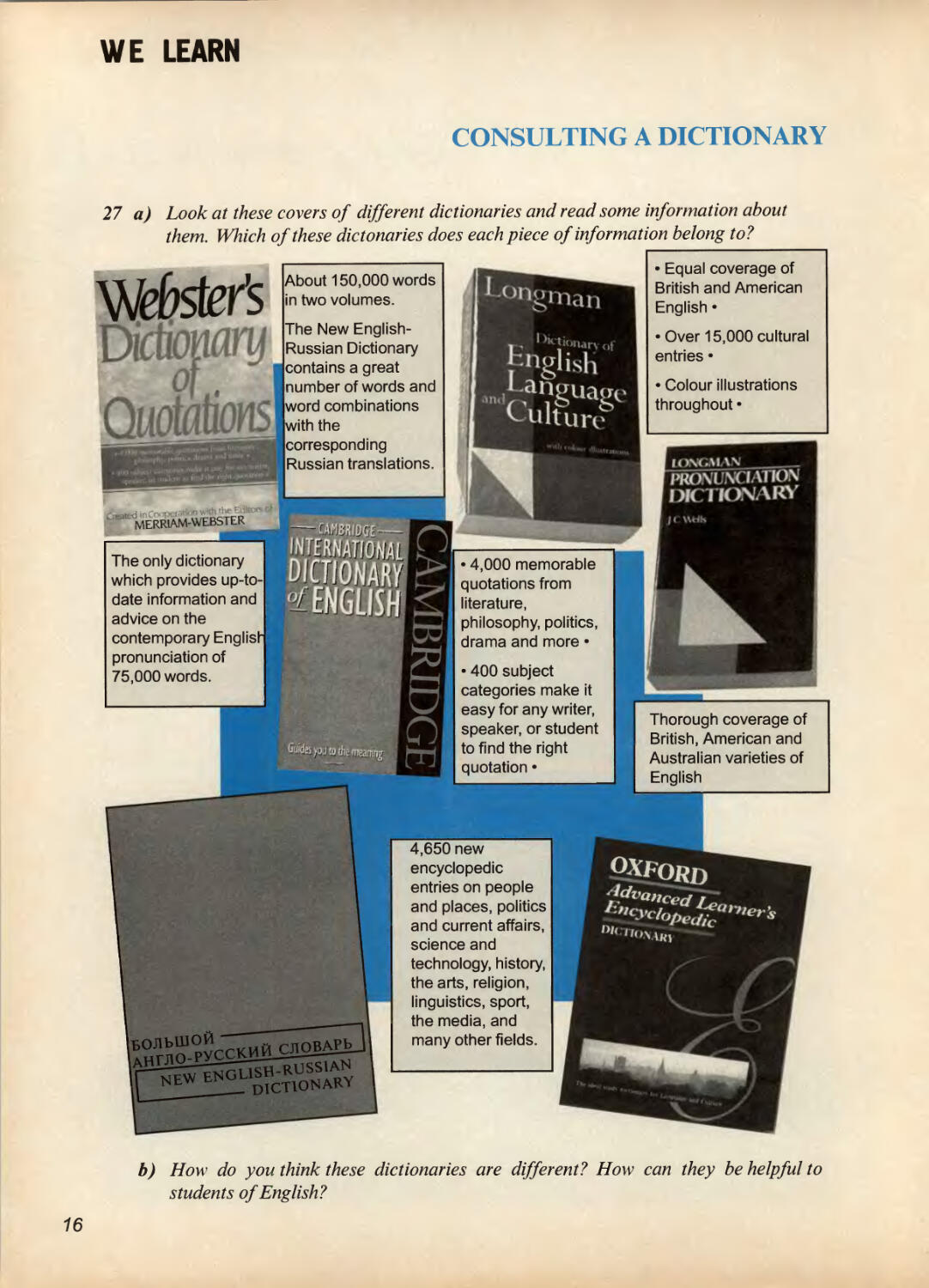
27 a) Look at these covers of different dictionaries and read some information about
them. Which of these dictonaries does each piece of information belong to?
About 150,000 words
in two volumes.
The New English-
Russian Dictionary
contains a great
number of words and
word combinations
with the
corresponding
Russian translations.
• Equal coverage of
British and American
English •
•Over 15,000 cultural
entries •
• Colour illustrations
throughout •
The only dictionary
which provides up-to-
date information and
advice on the
contemporary English
pronunciation of
75,000 words.
• 4,000 memorable
quotations from
literature,
philosophy, politics,
drama and more •
• 400 subject
categories make it
easy for any writer,
speaker, or student
to find the right
quotation •
Thorough coverage of
British, American and
Australian varieties of
English
4,650 new
encyclopedic
entries on people
and places, politics
and current affairs,
science and
technology, history,
the arts, religion,
linguistics, sport,
the media, and
many other fields.
b) How do you think these dictionaries are different? How can they be helpful to
students of English?

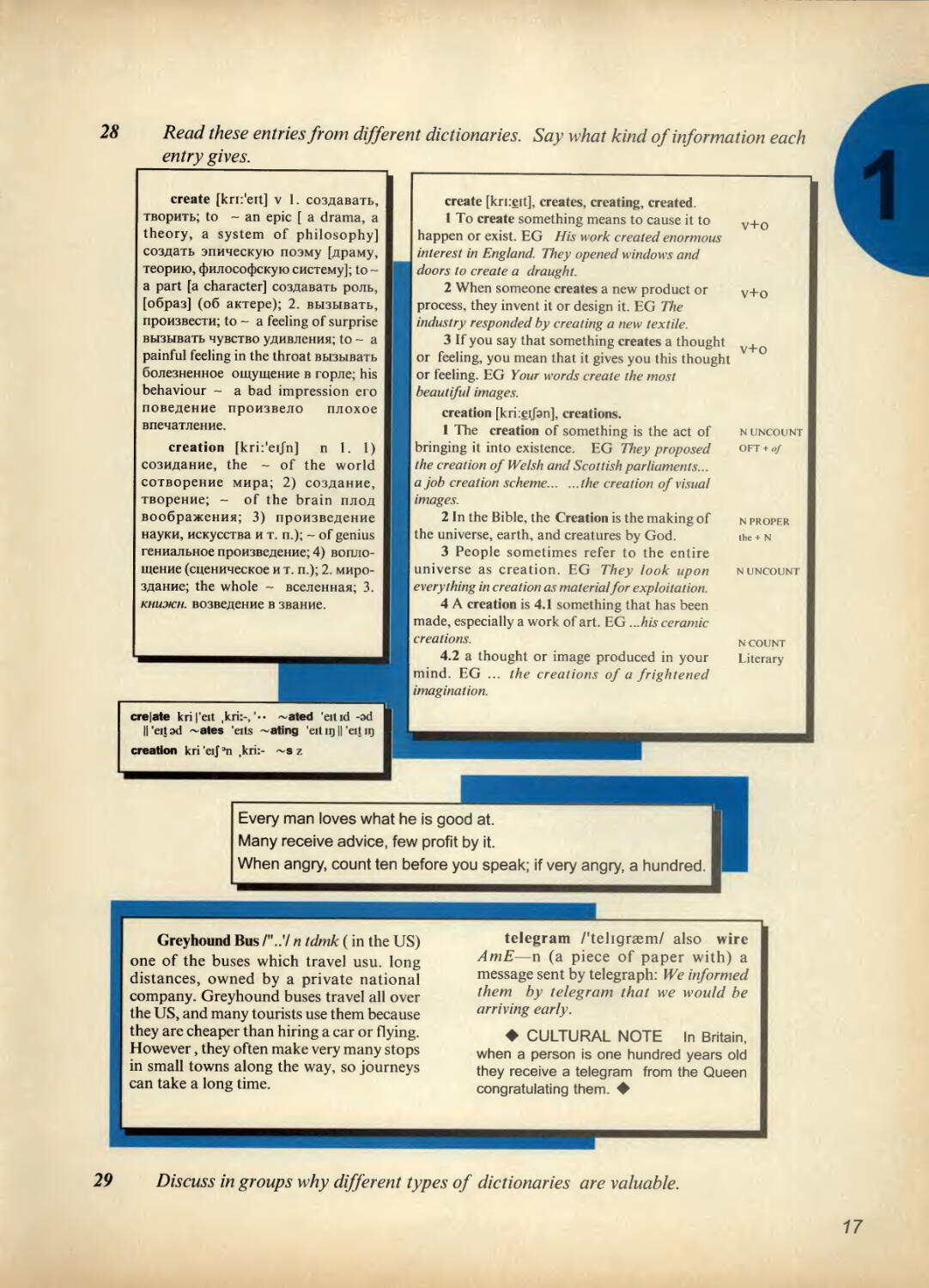
28 Read these entries from different dictionaries. Say what kind of information each
entry gives.
create [knr'eit] v 1. создавать,
творить; to - an epic [ a drama, a
theory, a system of philosophy]
создать эпическую поэму [драму,
теорию, философскую систему]; to-
a part [a character] создавать роль,
[образ] (об актере); 2. вызывать,
произвести; to ~ a feeling of surprise
вызывать чувство удивления; to - a
painful feeling in the throat вызывать
болезненное ощущение в горле; his
behaviour - a bad impression его
поведение произвело плохое
впечатление.
creation [kri:'eijn] n 1. 1)
созидание, the ~ of the world
сотворение мира; 2) создание,
творение; - of the brain плод
воображения; 3) произведение
науки, искусства и т. п.); - of genius
гениальное произведение; 4)
воплощение (сценическое и т. п.); 2.
мироздание; the whole - вселенная; 3.
книжн. возведение в звание.
create [kn:eit], creates, creating, created.
1 To create something means to cause it to
happen or exist. EG His work created enormous
interest in England. They opened windows and
doors to create a draught.
2 When someone creates a new product or
process, they invent it or design it. EG The
industry responded by creating a new textile.
3 If you say that something creates a thought
or feeling, you mean that it gives you this thought
or feeling. EG Your words create the most
beautiful images.
creation [kri:ei/an], creations.
1 The creation of something is the act of
bringing it into existence. EG They proposed
the creation of Welsh and Scottish parliaments...
a job creation scheme the creation of visual
images.
2 In the Bible, the Creation is the making of
the universe, earth, and creatures by God.
3 People sometimes refer to the entire
universe as creation. EG They look upon
everything in creation as material for exploitation.
4 A creation is 4.1 something that has been
made, especially a work of art. EG ...his ceramic
creations.
4.2 a thought or image produced in your
mind. EG ... the creations of a frightened
imagination.
create krifeit ,kri:-,'■• ~ated 'eitid -ad
H'eitad ~ates 'eits ~ating 'eitiqll 'eitii)
creation kri'eif3!! ,kri:- ~s z
Every man loves what he is good at.
Many receive advice, few profit by it.
When angry, count ten before you speak; if very angry, a hundred.
Greyhound Bus /"..'/ n tdmk (in the US)
one of the buses which travel usu. long
distances, owned by a private national
company. Greyhound buses travel all over
the US, and many tourists use them because
they are cheaper than hiring a car or flying.
However, they often make very many stops
in small towns along the way, so journeys
can take a long time.
telegram /'tehgraem/ also wire
AmE—n (a piece of paper with) a
message sent by telegraph: We informed
them by telegram that we would be
arriving early.
♦ CULTURAL NOTE In Britain,
when a person is one hundred years old
they receive a telegram from the Queen
congratulating them. ♦
29 Discuss in groups why different types of dictionaries are valuable.

WE LEARN
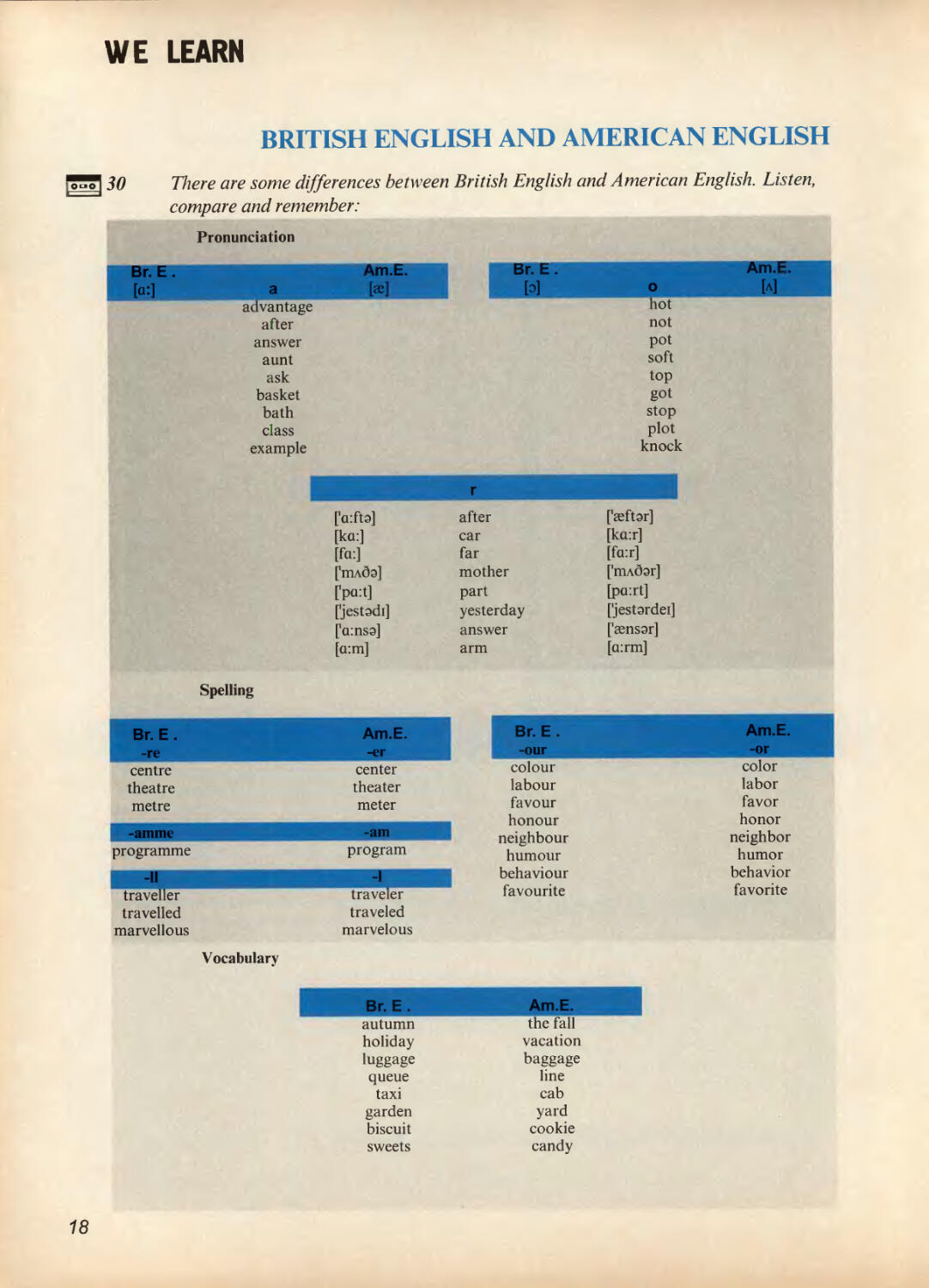
BRITISH ENGLISH AND AMERICAN ENGLISH
30 There are some differences between British English and American English. Listen,
compare and remember:
Br. E.
[a:]
Pronunciation
advantage
after
answer
aunt
ask
basket
bath
class
example
Am.E.
Br. E.
hot
not
pot
soft
top
got
stop
plot
knock
after
car
far
mother
part
yesterday
answer
arm
Spelling
Br. E.
-re
centre
theatre
metre
programme
traveller
travelled
marvellous
Am.E.
center
theater
meter
program
traveler
traveled
marvelous
Br. E.
colour
labour
favour
honour
neighbour
humour
behaviour
favourite
Am.E.
color
labor
favor
honor
neighbor
humor
behavior
favorite
autumn
holiday
luggage
queue
taxi
garden
biscuit
sweets
the fall
vacation
baggage
line
cab
yard
cookie
candy

31
You can use different kinds of books in your studies: fiction books,
non-fiction books, biographies, reference books.
Say:
• which books make it easier for us to learn subjects such as history, geography, a foreign
language and others;
which make your school subjects more interesting.
32 Speak about your school (town) library. Explain:
• why it is a great help to you in your studies;
• why it is necessary for every schoolboy and schoolgirl to go there as often as possible;
• how a librarian can interest you in a book.
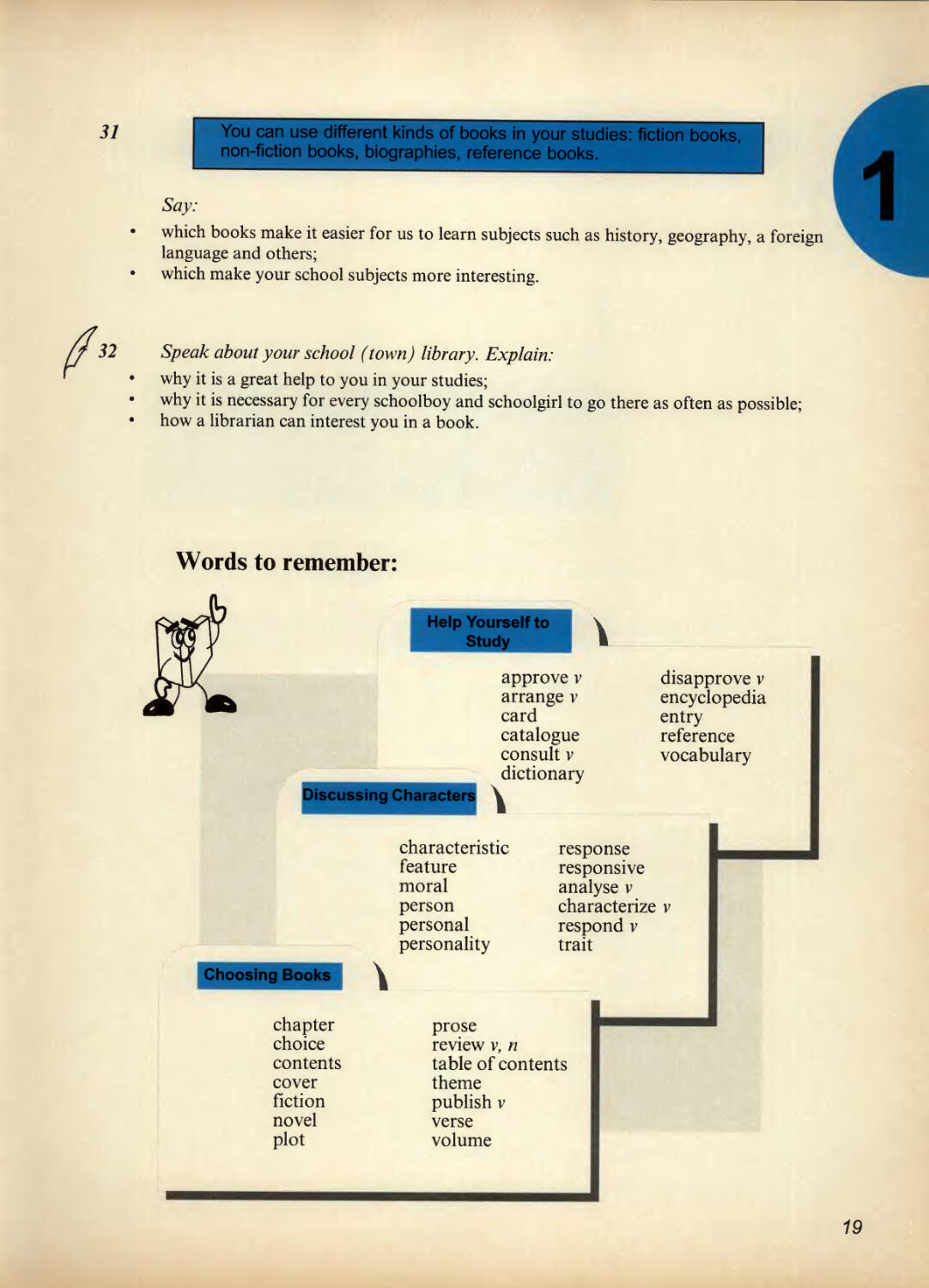
Words to remember:
Help Yourself to
Study
approve v
arrange v
card
catalogue
consult v
dictionary
Discussing Characters
disapprove v
encyclopedia
entry
reference
vocabulary
characteristic
feature
moral
person
personal
personality
response
responsive
analyse v
characterize v
respond v
trait
Choosing Books
chapter
choice
contents
cover
fiction
novel
plot
prose
review v, n
table of contents
theme
publish v
verse
volume

WE LEARN
ЦЖГП'гИ
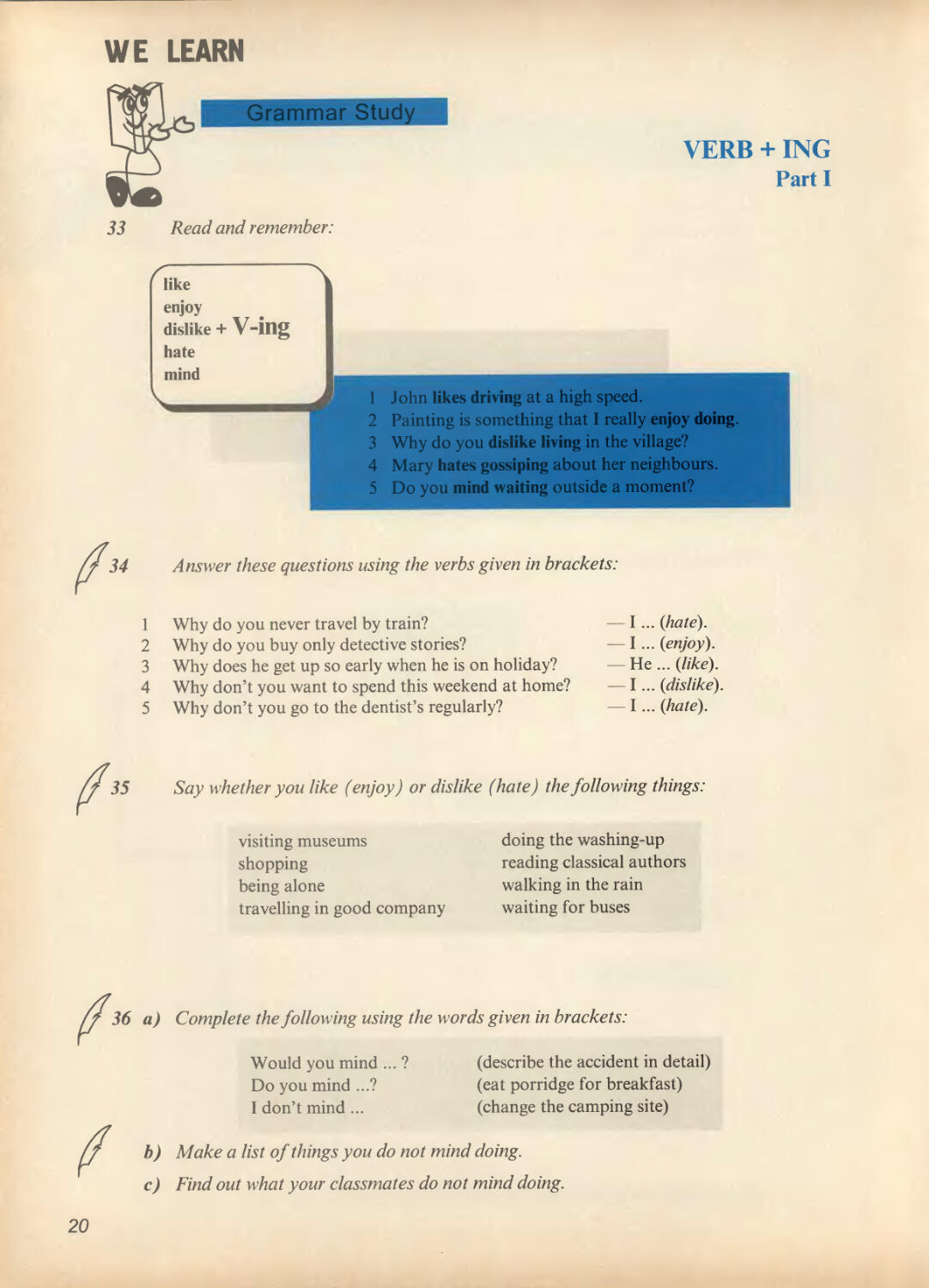
VERB + ING
Parti
like
enjoy
dislike + V-ing
hate
mind
33 Read and remember:
34 Answer these questions using the verbs given in brackets:
1 Why do you never travel by train? — I... {hate).
2 Why do you buy only detective stories? —I ... (enjoy).
3 Why does he get up so early when he is on holiday? —He ... (like).
4 Why don't you want to spend this weekend at home? —I... (dislike).
5 Why don't you go to the dentist's regularly? —I... (hate).
35 Say whether you like (enjoy) or dislike (hate) the following things:
visiting museums
shopping
being alone
travelling in good company
doing the washing-up
reading classical authors
walking in the rain
waiting for buses
36 a) Complete the following using the words given in brackets:
Would you mind ... ?
Do you mind ...?
I don't mind ...
(describe the accident in detail)
(eat porridge for breakfast)
(change the camping site)
b) Make a list of things you do not mind doing.
c) Find out what your classmates do not mind doing.
John likes driving at a high speed.
2 Painting is something that I really enjoy doing.
3 Why do you dislike living in the village?
4 Mary hates gossiping about her neighbours.
5 Do you mind waiting outside a moment?

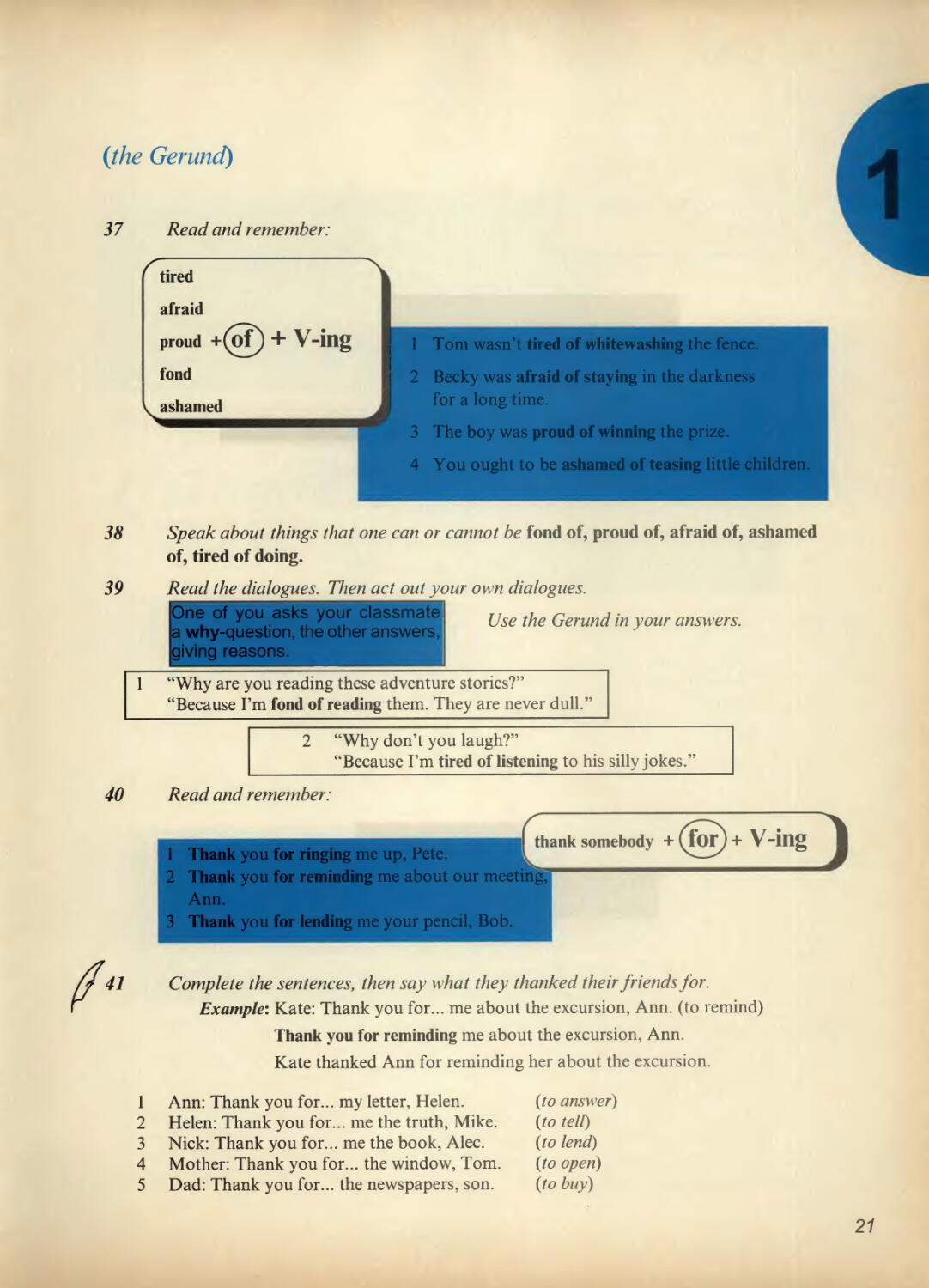
(the Gerund)
37 Read and remember:
tired
afraid
proud +(of) + V-ing
fond
ashamed
1 Tom wasn't tired of whitewashing the fence.
2 Becky was afraid of staying in the darkness
for a long time.
3 The boy was proud of winning the prize.
4 You ought to be ashamed of teasing little children.
38 Speak about things that one can or cannot be fond of, proud of, afraid of, ashamed
of, tired of doing.
39 Read the dialogues. Then act out your own dialogues.
One of you asks your classmate
a why-question, the other answers,
giving reasons.
Use the Gerund in your answers.
1 "Why are you reading these adventure stories?"
"Because I'm fond of reading them. They are never dull.'
2 "Why don't you laugh?"
"Because I'm tired of listening to his silly jokes."
40 Read and remember:
1 Thank you for ringing me up, Pete.
2 Thank you for reminding me about our meeting
Ann.
3 Thank you for lending me your pencil, Bob
thank somebody + (for) + V-ing
41 Complete the sentences, then say what they thanked their friends for.
Example: Kate: Thank you for... me about the excursion, Ann. (to remind)
Thank you for reminding me about the excursion, Ann.
Kate thanked Ann for reminding her about the excursion.
1 Ann: Thank you for... my letter, Helen. {to answer)
2 Helen: Thank you for... me the truth, Mike. {to tell)
3 Nick: Thank you for... me the book, Alec. {to lend)
4 Mother: Thank you for... the window, Tom. {to open)
5 Dad: Thank you for... the newspapers, son. {to buy)

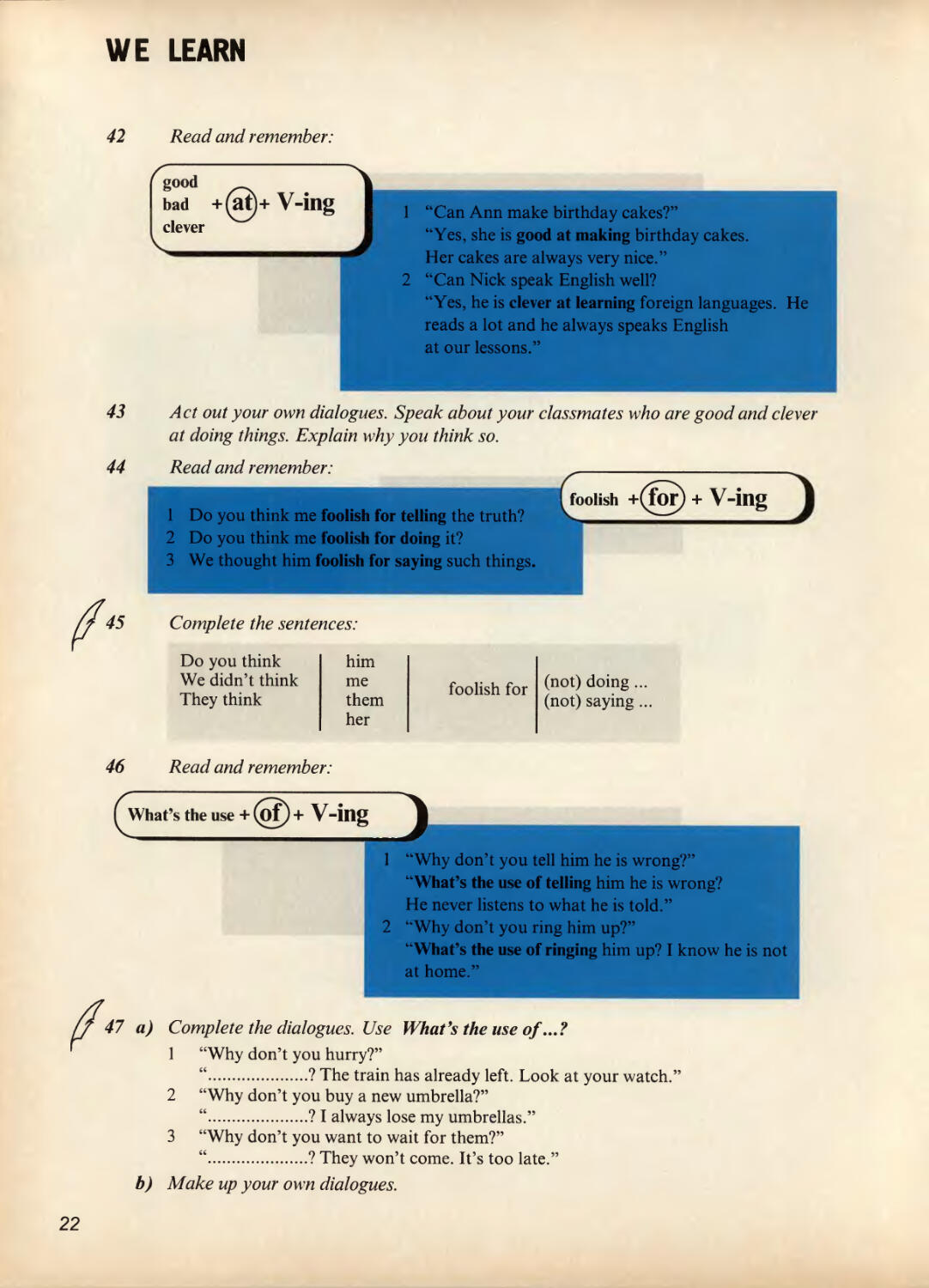
WE LEARN
42 Read and remember:
r
good
bad
clever
+®
+ V-ing
1 "Can Ann make birthday cakes?"
"Yes, she is good at making birthday cakes.
Her cakes are always very nice."
2 "Can Nick speak English well?
"Yes, he is clever at learning foreign languages. He
reads a lot and he always speaks English
at our lessons."
43 Act out your own dialogues. Speak about your classmates who are good and clever
at doing things. Explain why you think so.
44 Read and remember:
1 Do you think me foolish for telling the truth?
2 Do you think me foolish for doing it?
3 We thought him foolish for saying such things.
foolish +(6>r) + V-ing
45 Complete the sentences:
Do you think
We didn't think
They think
him
me
them
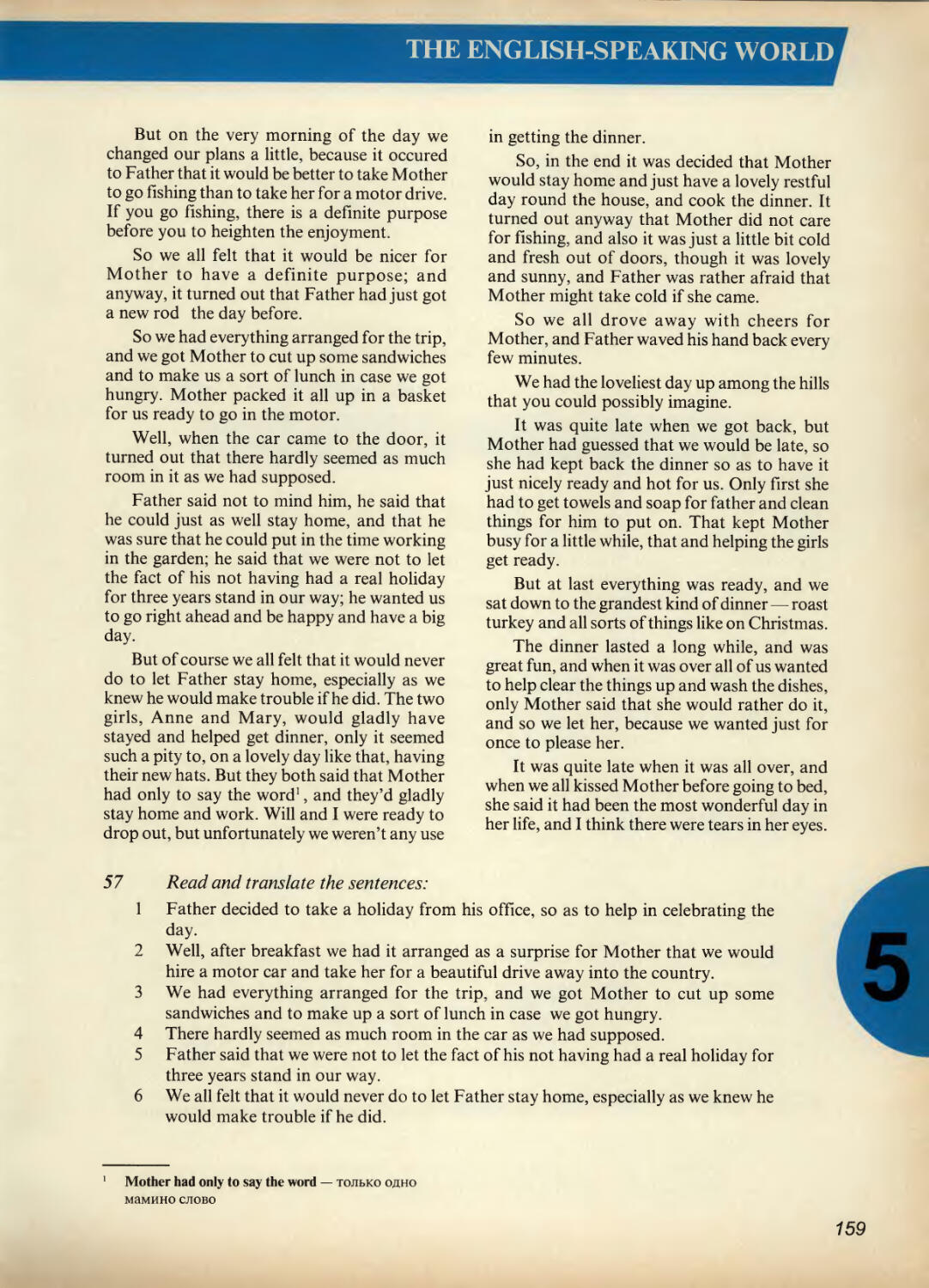
her
foolish for
(not) doing...
(not) saying...
46 Read and remember:
What's the use + (ш) + V-ing
1 "Why don't you tell him he is wrong?"
"What's the use of telling him he is wrong?
He never listens to what he is told."
2 "Why don't you ring him up?"
"What's the use of ringing him up? I know he is not
at home."
47 a) Complete the dialogues. Use What's the use of...?
1 "Why don't you hurry?"
" ? The train has already left. Look at your watch.'
2 "Why don't you buy a new umbrella?"
" ? I always lose my umbrellas."
3 "Why don't you want to wait for them?"
" ? They won't come. It's too late."
b) Make up your own dialogues.

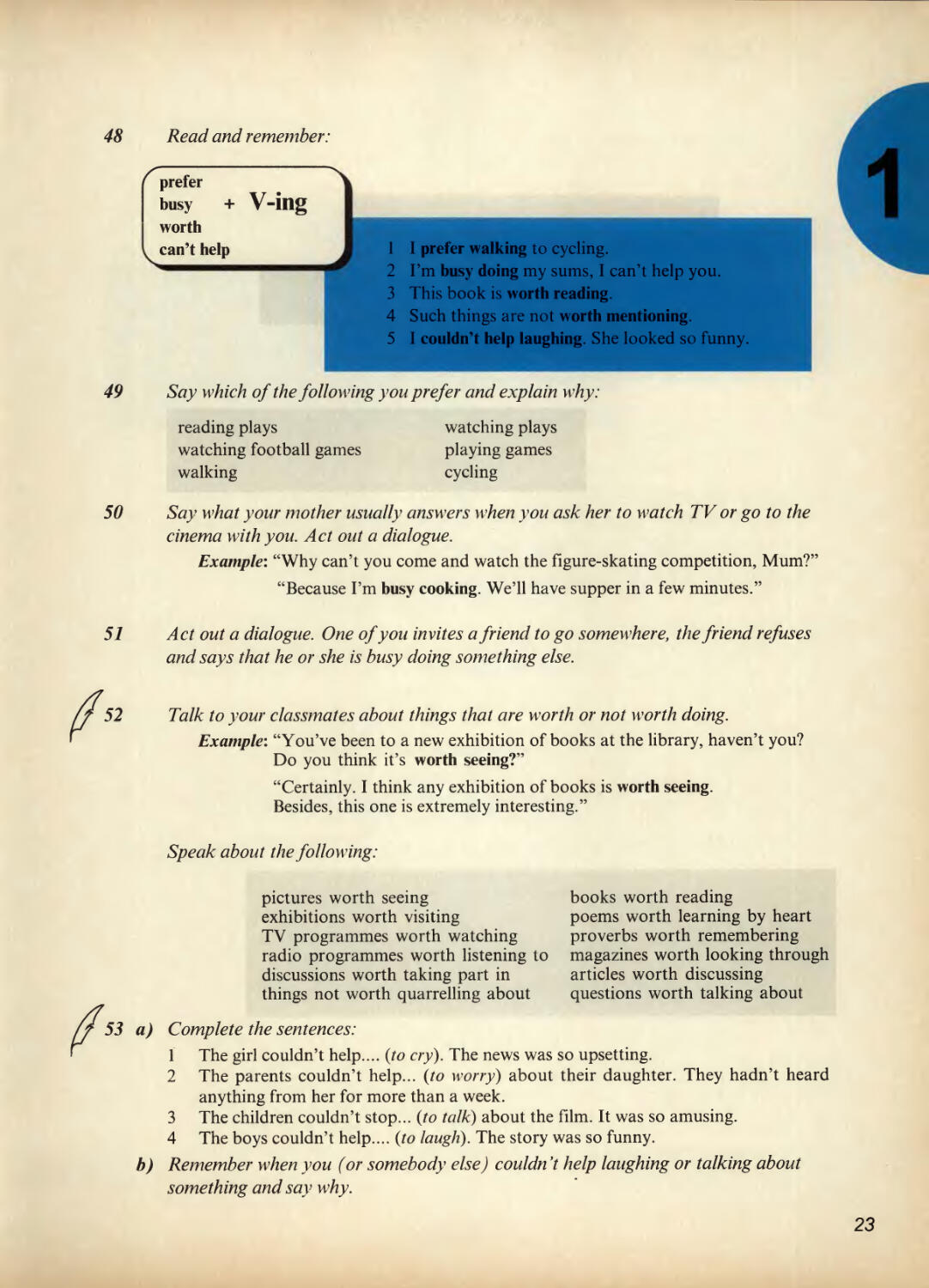
48 Read and remember:
prefer
busy + V-ing
worth
can't help
1 I prefer walking to cycling.
2 I'm busy doing my sums, I can't help you.
3 This book is worth reading.
4 Such things are not worth mentioning.
5 I couldn't help laughing. She looked so funny.
49 Say which of the following you prefer and explain why:
reading plays
watching football games
walking
watching plays
playing games
cycling
50 Say what your mother usually answers when you ask her to watch TV or go to the
cinema with you. Act out a dialogue.
Example: "Why can't you come and watch the figure-skating competition, Mum?"
"Because I'm busy cooking. We'll have supper in a few minutes."
51 Act out a dialogue. One of you invites a friend to go somewhere, the friend refuses
and says that he or she is busy doing something else.
52 Talk to your classmates about things that are worth or not worth doing.
Example: "You've been to a new exhibition of books at the library, haven't you?
Do you think it's worth seeing?"
"Certainly. I think any exhibition of books is worth seeing.
Besides, this one is extremely interesting."
Speak about the following:
pictures worth seeing
exhibitions worth visiting
TV programmes worth watching
radio programmes worth listening to
discussions worth taking part in
things not worth quarrelling about
books worth reading
poems worth learning by heart
proverbs worth remembering
magazines worth looking through
articles worth discussing
questions worth talking about
53 a) Complete the sentences:
1 The girl couldn't help.... (to cry). The news was so upsetting.
2 The parents couldn't help... (to worry) about their daughter. They hadn't heard
anything from her for more than a week.
3 The children couldn't stop... (to talk) about the film. It was so amusing.
4 The boys couldn't help.... (to laugh). The story was so funny.
b) Remember when you (or somebody else) couldn 't help laughing or talking about
something and say why.

WE LEARN
54 Read and remember:
instead of
without
before + V-ing
after
on
1 He left the room without saying a word.
2 Instead of going to the cinema after school we went to
a museum.
3 Stick a stamp on the envelope before posting a letter.
4 After doing the exercises he switched on TV.
5 On hearing the news he felt pleased.
55 Join the following sentences as in the example. Use the preposition without.
Example: She left the room. She didn't say a word.
She left the room without saying a word.
1 We walked for a long time. We didn't speak to one another.
2 He looked at me for a moment. He didn't answer my question.
3 He left us. He didn't say good-bye.
4 She took my pen. She didn't ask me.
5 We found the way. We didn't ask anybody.
6 He entered the room. He didn't knock at the door.
56 Read and say as in the examples.
a) Example: Stick a stamp on the envelope before posting the letter.
First stick a stamp on the envelope, then post the letter.
1 Read the rule before writing the exercise.
2 Learn the new words before reading the text.
3 Switch off the light before going out.
b) Example: After doing the exercises he switched on TV.
He did the exercises, then he switched on TV.
1 After laying the table Mother brought in the tea.
2 After visiting the museum we went home.
3 After playing football he had a good bath.
c) Example: On hearing the news he felt pleased.
He heard the news and felt pleased.
1 On reaching home he went to bed immediately.
2 On hearing the news he got very angry.
3 On getting the telegram he drove to the station.

57 a) Join the following sentences as in the example. Use the preposition instead of.
Example: We planned to go to the cinema after school. Then we changed our minds
and went to a museum instead.
Instead of going to the cinema after school we went to a museum.
1 She promised to bring some fruit to the party. She brought some cakes instead.
2 He wanted to buy a pen. He bought some new stamps.
3 We were going to spend our holidays in the country. Then we changed our minds and
went to the seaside.
b) Say what you planned to do but then changed your mind and did something else
instead.
ПЕРЕВОД ГЕРУНДИЯ
НА РУССКИЙ ЯЗЫК
ГЕРУНДИИ
переводится
на русский язык
различными способами:
инфинитивом:
She enjoyed sitting in the sun.
Ей доставляло удовольствие
сидеть на солнце.
именем существительным:
I go in for swimming.
Я занимаюсь плаванием.
придаточным предложением:
Excuse my interrupting you.
Простите, что я вас перебиваю.
There is no hope of seeing him soon.
Нет надежды на то, что мы его
скоро увидим.
I remember seeing him somewhere.
Я помню, что видел его где-то.
деепричастием:
Не went away without leaving his address.
Он уехал, не оставив своего адреса.
On coming home he went to bed
immediately.
Возвратившись домой,
он сразу лег спать.

WE READ AND DISCUSS
LIBRARIES
IN GREAT BRITAIN AND IN THE USA
58 Read the texts about the famous libraries in Great Britain and the USA and find
out what they are remarkable for. Use a dictionary when necessary.
The British Library
The British Library is the largest public
library in Britain. It consists of the Reference
Division, the Bibliographic Service Division,
the National Sound Archive ['aikaiv] and the
Research and Development Department in
London, and the Lending Division in
Yorkshire.
The Magna Carta
a famous
document in British
history agreed in 1215 by
King John of England
which sets limits on royal
powers. Later it was
seen as statement of
basic civil rights. Four
copies of the original still
exist.
Щ The Reading Room I
The Reference
Division has its origins
in the library
departments of the
British Museum
founded in 1753. It is
housed within the
same 19th century
building of the British
Museum, with more
than 9 million books
stored along two miles
(three km) of shelving,
and includes a
Gutenberg Bible, the
Magna Carta,
medieval illuminated
manuscripts and
The Gutenberg
Bible [.guitanbaig 'baibl]
a Bible which was the
first book to be printed
using movable type. It is
named after the printer
Johann Gutenberg (1397
— 1468).
original texts by
Shakespeare,
Dickens, da Vinci
and many others.
The collections of
early printed
books, of old
English books and
of books in all
European
languages make
the British Library one of the finest libraries in
the world. It is, however, not only a collection
of old books, it is also, with all its current
publications, a rapidly growing modern
research library.
The British Library receives one copy of
every book and of every issue of every
periodical or newspaper published in the
United Kingdom and the Republic of Ireland.
Now, as in the past, the collections are not only
in many languages, but also cover all fields of
human knowledge.
The Reading
Room of the
British Library is a
centre of serious
study in all fields. It
is used by
university
professors and lecturers,
by students reading
for higher degrees
and by those who
are engaged in
research in their
spare time.
The richness of
the collections in different subjects makes the
Library specially useful for journalists and
writers. In the summer, a high proportion of
readers are visitors from abroad, particularly
from the United States. Well-known literary
and historical personages worked here, Sir
Walter Scott, Dickens, Carlyle, Thackeray,
Marx, Lenin, Thomas Hardy and George
Bernard Shaw among them.
The British Museum

THE ENGLISH-SPEAKING WORLD
The Library of Congress
The Library of Congress today is among the
world's largest. It was established as a reference
library in 1800, and occupied one room in the
building of the United States Capitol,
Washington, DC. The first Capitol's one-room
Library of Congress would become a world-
famous institution
that now occupies
three huge
buildings,
including the James
Madison
Memorial Building
James Madison
['meedisan] (1751 —
1836) the fourth
president of the US
(1809 —1817), famous
for helping to write the
Constitution.
The Library of Congress
The Reading Room
completed in 1980. These structures
hold more than 80 million items in
collections of books, newspapers,
periodicals, manuscripts, films, maps,
and works of drama, music, and art.
The Library's archives keep a great
number of important and exciting
documents from American history. Its
original purpose was to provide
research facilities for members of
Congress. There are materials on practically
every subject to which members of Congress
can refer. Today the library serves the public
as well.
59 Answer the questions on the texts:
1 Where is the British Library housed?
2 What unique books are there in the collections of the British Library?
3 What makes the British Library a centre of serious study in all fields?
4 What well-known personages used to work in the Reading Room of the British Library?
5 What is the Library of Congress rich in?
60 Say what other famous libraries, apart from the British Library and the Library of
Congress, you know. Try and describe the largest library of your country (city).
Give some information about its collections.
61 Study some reference materials to find information about a famous library. Then
tell your class about your findings.

WE READ AND DISCUSS
Oscar Wilde (1854-1900)
was born in Dublin, Ireland, and
educated in Oxford, England.
A playwright, essayist, poet
and novelist, he is also
remembered for his wonderful
tales. Some of them are
remarkable for their wit and
humour, they are light-hearted
and amusing; some tales
delight readers by their
charming beauty and romantic
spirit; some are sad and make
us think about the injustices and
sorrows of life.
Among the best-known of
Wilde's tales are "The
Canterville Ghost", "The Happy
Prince", "The Nightingale and
the Rose", "The Selfish Giant"
and "The Devoted Friend".
The most famous book of
Oscar Wilde is "The Picture of
Dorian Gray".
OSCAR WILDE
62 Read the words and guess their meaning:
-ness: idle — idleness, selfish — selfishness;
-ity (-ry, -y): generous — generosity, envious — envy,
poet — poetry;
-y: dust — dusty, luck — lucky, wool — woolly,
hair — hairy;
-ly: exact — exactly, terrible — terribly, friend
— friendly, comfortable — comfortably,
different — differently, plain — plainly,
sorrowful — sorrowfully;
un-: unselfish, unfriendly, uncomfortable, unlucky.
63 Read and translate. Pay attention to the
meaning of the conjunctions: so... that, as, for.
1 I was so tired that I thought I would lie in bed for
a little and listen to the birds singing.
2 "It has been a hard day," he said to himself as he
was going to bed.
3 He walked quickly, for he was in a great hurry.
64 Read the names, which you will come across
in the text:
Oscar ['oska:] Wilde [waild]; Hans [haens]; the Miller ['mils]
65 Read Part I of the tale The Devoted Friend and answer the question: Why was
little Hans so proud of having the Miller as his friend?
The Devoted Friend
Parti
Once upon a time there was an honest little
fellow named Hans who was known for his
kind heart. He lived in a tiny little cottage all
by himself, and every day he worked in his
garden. In all the countryside there was no
garden so lovely as his.
Little Hans had many friends, but the most
devoted friend of all was the Miller. Indeed, so
devoted was the rich Miller to little Hans, that
he would never go by his garden without
picking some beautiful flowers, or filling his
pockets with plums and cherries if it was the
fruit season.
"Real friends should have everything in
common," the Miller used to say, and little
Hans nodded and smiled, and felt very
proud of having a friend with such noble
ideas.
Sometimes, indeed, the neighbours
thought it was strange that the rich Miller
never gave little Hans anything in return,
though he had a hundred sacks of flour
stored away in his mill, and six cows, and a
large flock of woolly sheep; but Hans never
troubled his head about these things, and
nothing gave him greater pleasure than to
listen to all the wonderful things the Miller
used to say about the unselfishness of true
friendship.
Little Hans worked away in his garden.
During the spring, the summer, and the autumn
he was very happy, but when the winter came,
and he had no fruit or flowers to take to the
market, he suffered a lot from cold and hunger,
and often had to go to bed without any supper
except for a few dried pears or some hard nuts.
In the winter, also, he was extremely lonely, as
the Miller never came to see him then.
"There is no good in my going to see little
Hans as long as the winter lasts," the Miller

THE ENGLISH-SPEAKING WORLD
used to say to his wife, "for when people are in
trouble it is better to leave them alone and not
to bother them. That is my idea about
friendship, and I am sure I am right."
"You are certainly very thoughtful about
others," answered the Wife, as she sat in her
comfortable arm-chair by the big fire; "very
thoughtful indeed. It is quite a pleasure to hear
you talk about friendship."
"But could we not invite little Hans up
here?" said the Miller's youngest son. "If poor
Hans is in trouble I will give him half of my
porridge, and show him my white rabbits."
"What a silly boy you are!" cried the Miller;
" I really don't know what is the use of sending
you to school. You seem not to learn anything.
If little Hans comes up here, and sees our warm
fire, and our good supper, he may get envious,
and envy is a most terrible thing, and can spoil
anybody's nature. Besides, Hans may ask me
to give him some flour on credit ['kredit], and
that I can't do. Flour is one thing, and
friendship is another, and they should not be
confused. The words are spelt differently, and
mean quite different things. Everybody can see
that."
"How well you talk!" said the Miller's Wife.
"Lots of people act well," answered the
Miller; "but very few people talk well, which
shows that talking is much the more difficult
thing of the two, and much the finer thing
also."
As soon as the winter was over and the
flowers began to blossom, the Miller said to
his wife that he would go down and see little
Hans.
"Good morning, little Hans," said the
Miller, "and how have you been all the winter?
We often talked of you during the winter and
wondered how you were getting on. How lovely
your flowers are looking!"
They are certainly very lovely," said Hans,
"and it's a most lucky thing for me that I have
so many. I am going to take them to the market
and sell them, and buy back my wheelbarrow
and other things with the money. I was obliged
to sell some things because the winter was a
very bad time for me, and I really had no
money at all to buy bread with."
"Hans," said the Miller. "I will give you
my wheelbarrow. It is not in very good repair;
but in spite of that I will give it to you. I know
it is very generous of me, and many people
would think me extremely foolish for parting
with it, but I am not like the rest of the world.
I think that generosity is the essence1 of
friendship, and, besides, I have got a new
wheelbarrow for myself."
"Well, really, that is very generous of you,"
said little Hans, "I can easily repair it, as I have
a plank of wood in the house."
"A plank of wood!" said the Miller; "that
is just what I want for the roof of my barn.
There is a very large hole in it. How lucky you
mentioned it! It is quite remarkable how one
good action leads to another. I have given you
my wheelbarrow, and now you are going to
give me your plank. Of course, the
wheelbarrow is worth far more than2 the plank,
but true friendship never notices little things
like that." ^
"Certainly," said little Hans and he ran to
the shed and came back carrying a large plank.
"And now, as I have given you my
wheelbarrow," the Miller went on, "I am sure
you would like to give me some flowers in
return. Here is a basket, and mind you fill it
quite full."
"Quite full?" said little Hans, rather
sorrowfully, for it was really a very big basket,
and he knew that if he filled it he would have
no flowers for the market, and he was very
anxious to get his things back.
"Well, really," answered the Miller, "as I
have given you my wheelbarrow, I don't think
that it is much to ask you for a few flowers, I
may be wrong, but I think that friendship, true
friendship, is quite free from selfishness of any
kind."
"My dear friend, my best friend," cried little
Hans, " you are welcome to all the flowers in
my garden." And he ran and picked all his
pretty flowers, and filled the Miller's basket.
66 Answer the questions about the text:
1 How did the Miller show that he was
devoted to little Hans?
2 What did the neighbours think was
strange about the Miller's friendship with
little Hans?
3 What did the Miller think people should
do when their friends were in trouble? Do
you agree?
4 How did the Miller's youngest son show
that he did not understand his father's
idea of friendship and did not think his
father thoughtful about others?
5 How did the Miller explain to his
youngest son that it would be wrong to
invite Hans to come to their pleasant
home in winter?
1 essence ['esns] — суть
2 is worth far more than — стоит гораздо больше, чем

WE READ AND DISCUSS
67 Read Part II of the tale The Devoted Friend and answer the question: Why was
little Hans glad that he did not refuse when the Miller needed his help?
The Devoted Friend
The next day when little Hans was working
in his garden he heard the Miller's voice. The
Miller had a large sack of flour on his back.
"Dear little Hans," said the Miller, "would
you mind carrying this sack of flour for me to
market and selling it for me? As I am going to
give you my wheelbarrow, I don't think you will
refuse."
"Oh, no, no," cried little Hans and he went
to the market. He had waited there for some time
and at last sold the sack of flour at a very good
price.
"It has certainly been a hard day," he said to
himself as he was going to bed, "but I am glad I
did not refuse the Miller, he is my best friend and,
besides, he is going to give me his wheelbarrow."
Early the next morning the Miller came down
to get the money for his sack of flour, but little
Hans was so tired that he was still in bed.
"You are very lazy," said the Miller," Really,
I think you ought to work harder. Idleness is a
great sin1, and I certainly don't like my friends
to be idle. You must not mind my speaking quite
plainly2 to you. But what is the good of
friendship if one cannot say exactly what one
means? Anybody can say nice things and try
to please and to flatter, but a true friend always
says unpleasant things, and does not mind
giving pain."
"I am very sorry," said little Hans, "but I
was so tired that I thought I would lie in bed for
a little while."
"Well, I am glad of that," said the Miller,
"for I want you to come up to the mill as soon
as you are dressed and mend my barn roof for
me."
Poor little Hans was very anxious to go and
work in his garden, for his flowers had not been
watered for two days, but he did not like to refuse
the Miller, as he was such a good friend to him.
So he jumped out of bed, and dressed himself,
and went up to the barn.
"There is no work so delightful as the work
one does for others," the Miller used to say. So
little Hans worked away for the Miller, and the
Miller said all kinds of beautiful things about
friendship.
One rainy evening little Hans was sitting by
his fireside when a loud knock came at the door.
Part II
"It is some poor traveller," said little Hans to
himself, and he ran to the door. There stood the
Miller.
"Dear little Hans," cried the Miller, "I am
in great trouble. My little boy has fallen off a
ladder and hurt himself. I thought that it would
be much better if you went for the Doctor
instead of me. You know I am going to give
you my wheelbarrow, and so it is only fair that
you should do something for me in return."
"Certainly", cried little Hans, "but you
must lend me your lantern, as the night is so
dark that I am afraid of falling into the ditch3."
"I am very sorry," answered the Miller,
"but it is my new lantern, and it would be a
great loss4 to me if anything happened to it."
"Well, never mind, I will do without it5,"
cried little Hans and started off.
What a terrible storm it was! The night was
so black that little Hans could hardly see, and
the wind was so strong that he could hardly stand.
However, he was very courageous, and after he
had been walking about three hours, he arrived
at the Doctor's house. The Doctor immediately
rode off towards the Miller's house.
Little Hans was walking behind him. The
storm grew worse and worse, and he could not
see where he was going. At last he lost his way
and found himself in a very dangerous place
which was full of deep holes, and there poor little
Hans was drowned6.
"Little Hans is certainly a great loss to me,"
said the Miller. "I have given him my
wheelbarrow, and now I don't know what to do
with it. One certainly suffers for being generous."
68 Answer the questions about the
text:
1 What did little Hans do for the Miller
the next two days?
2 What happened to the Miller's son one
evening?
3 Why didn't the Miller go for the
Doctor himself but asked little Hans
to do it?
4 Why did the Miller refuse to give little
Hans his lantern?
1 sin — грех
2 plainly — прямо, откровенно
3 ditch — канава
4 loss — потеря
5 to do without something — обойтись без чего-либо
6 was drowned [draund] — утонул

THE ENGLISH-SPEAKING WORLD
Discussing the Characters of the Story
69
The following sentences describe things that Hans and the Miller
aid or did. How does each item characterize them?
Hans
♦ Every day Hans worked in his garden. In
all the countryside there was no garden so
lovely as his.
♦ Little Hans never troubled his head about
the fact that his friend the Miller used to
pick a lot of beautiful flowers in his
garden and to fill his pockets with plums and
cherries, but never gave little Hans
anything in return. Nothing gave Hans more
pleasure than to listen to all the
wonderful things the Miller used to say about the
unselfishness of true friendship.
♦ "It has certainly been a hard day," Hans
said to himself as he was going to bed
after he had returned from the market," but
I'm glad I did not refuse the Miller, for he
is my best friend, and, besides, he is going
to give me his wheelbarrow."
♦ Little Hans went for the Doctor in spite
of the terrible storm and the strong wind
that night.
the Miller
♦ The rich Miller never gave little Hans
anything in return, though he had a hundred
sacks of flour, six cows, and a large flock
of woolly sheep.
♦ In the winter the Miller never came to see
little Hans. "There is no good in my going
to see little Hans as long as the winter
lasts," the Miller used to say, "for when
people are in trouble it is better to leave
them alone and not to bother them ."
♦ "Flour is one thing, and friendship is
another, and they shouldn't be confused,"
the Miller used to repeat speaking to his
son.
♦ "You are lazy. Really, I think you ought
to work harder. Idleness is a great sin, and
I certainly don't like my friends to be idle.
Anybody can say nice things and try to
please and to flatter, but a true friend
always says unpleasant things, and does not
mind giving pain," said the Miller when
he saw Hans in bed.
You may find the following words helpful in
describing Hans:
kind-hearted
unselfish
generous
courageous
devoted
willing to be helpful
diligent
friendly
open-hearted
industrious
faithful
You may find the following words helpful in
describing the Miller:
selfish
envious
unjust
unfriendly
mean
greedy
good at flattering
unable to be thankful
70 Prove that Hans was honest and generous, hard-working and courageous, had a
kind heart and was a devoted friend.
71 a) How do these quotations characterize the Miller?
1 "I will give you my wheelbarrow. I know it is very generous of me. I think that
generosity is the essence of friendship, and, besides, I have got a new wheelbarrow for
myself."
2 "And now, as I have given you my wheelbarrow, I am sure you would like to give me
some flowers in return."
3 "You know, as I have given you my wheelbarrow, it is only fair that you should do
something for me in return."
4 "I'm very sorry," answered the Miller, "but it is my new lantern, and it would be a
great loss to me if anything happened to it."
b) Compare the Miller's words with his actions. Characterize the Miller.

WE READ AND DISCUSS
Discussing the Theme of the Story
72 These are the Miller s ideas about friendship. Read them and say what you think oj
them:
• "Real friends should have everything in common."
• "When people are in trouble it is better to leave them alone and not to bother them by
visits."
• "Flour is one thing, and friendship is another, and they should not be confused."
• "I may be wrong, but I think that friendship, true friendship, is quite free from selfishness
of any kind."
• "What is the good of friendship if one cannot say exactly what one means? Anybody can
say nice things to please and to flatter, but a true friend always says unpleasant things,
and does not mind giving pain. Indeed, if he is a really good friend he prefers it, for he
knows that he is doing good."
73 This is what the Miller used to say about generosity and envy, about words and
actions, and about the work one does for others. Which of these ideas do you agree
or disagree with?
• "I think that generosity is the essence of friendship."
"Envy is a most terrible thing, and can spoil anybody's nature."
• "Lots of people act well, but very few people talk well, which shows that talking is much
the more difficult thing of the two, and much the finer thing also."
• "There is no work so delightful as the work one does for others."
74 a) Read the following proverbs. How do you understand them? Do you agree with
them? Why or why not?
Friendship cannot stand a/ways on one side.
Between friends all is common.
Actions speak louder than words.
b) Which of the proverbs do you think will better fit the moral of the story "The
Devoted Friend"?
75 Give your comments on the following:
Hot he who has much is rich, hut he who gives much.
Fromm, an American psychologist (1900 —1980)
No man is useless while he has a friend.
Robert Louis Stevenson, an English poet (1850 — 1894\
Prosperity makes friends, adversity tries them.
Proverb

THE ENGLISH-SPEAKING WORLD
&1ш/М £ш
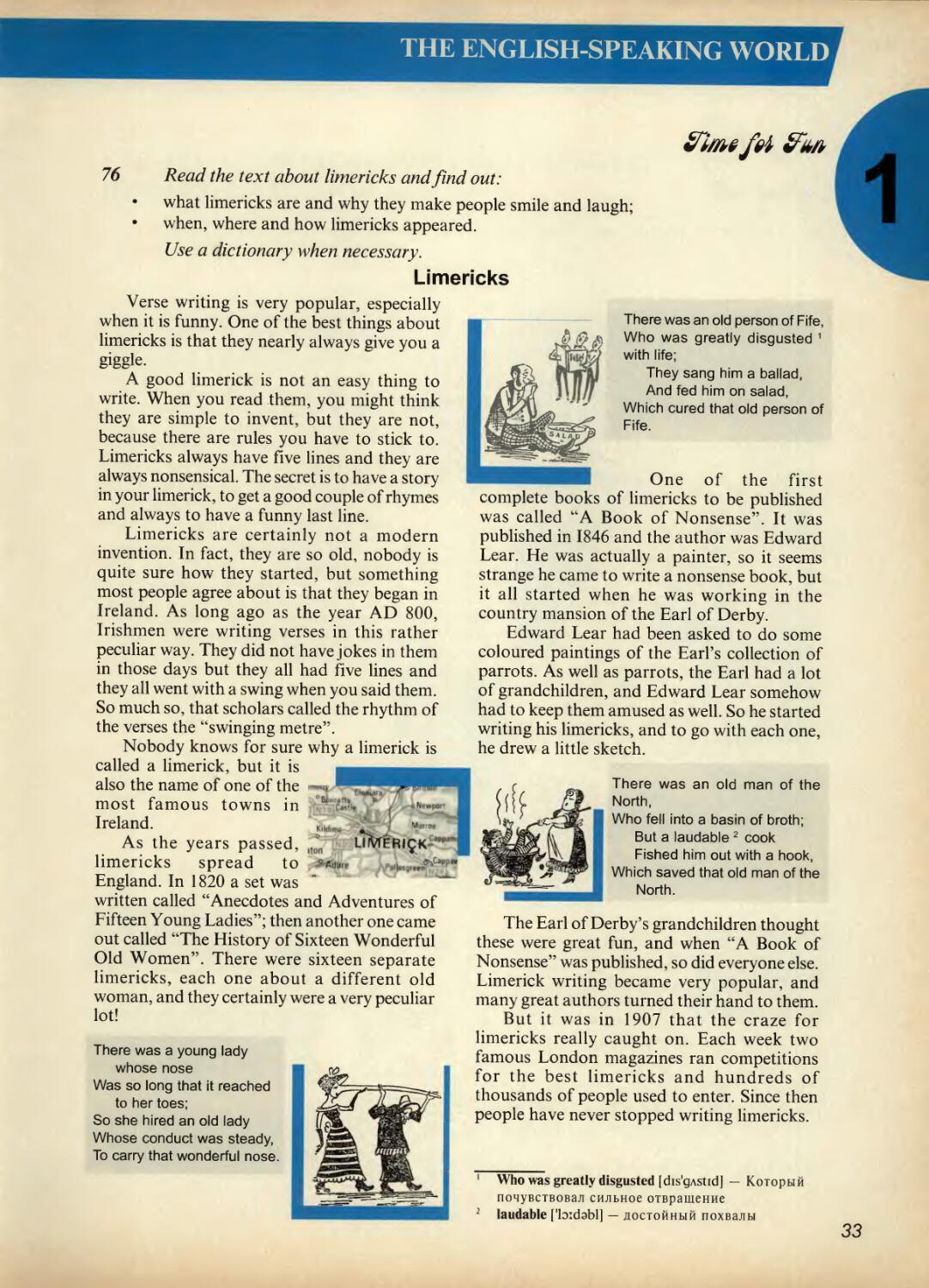
76 Read the text about limericks and find out:
• what limericks are and why they make people smile and laugh;
• when, where and how limericks appeared.
Use a dictionary when necessary.
Limericks
Verse writing is very popular, especially
when it is funny. One of the best things about
limericks is that they nearly always give you a
giggle.
A good limerick is not an easy thing to
write. When you read them, you might think
they are simple to invent, but they are not,
because there are rules you have to stick to.
Limericks always have five lines and they are
always nonsensical. The secret is to have a story
in your limerick, to get a good couple of rhymes
and always to have a funny last line.
Limericks are certainly not a modern
invention. In fact, they are so old, nobody is
quite sure how they started, but something
most people agree about is that they began in
Ireland. As long ago as the year AD 800,
Irishmen were writing verses in this rather
peculiar way. They did not have jokes in them
in those days but they all had five lines and
they all went with a swing when you said them.
So much so, that scholars called the rhythm of
the verses the "swinging metre".
Nobody knows for sure why a limerick is
called a limerick, but it is
also the name of one of the
most famous towns in
Ireland.
As the years passed,
limericks spread to
England. In 1820 a set was
written called "Anecdotes and Adventures of
Fifteen Young Ladies"; then another one came
out called "The History of Sixteen Wonderful
Old Women". There were sixteen separate
limericks, each one about a different old
woman, and they certainly were a very peculiar
lot!
There was an old person of Fife,
Who was greatly disgusted 1
with life;
They sang him a ballad,
And fed him on salad,
Which cured that old person of
Fife.
One of the first
complete books of limericks to be published
was called "A Book of Nonsense". It was
published in 1846 and the author was Edward
Lear. He was actually a painter, so it seems
strange he came to write a nonsense book, but
it all started when he was working in the
country mansion of the Earl of Derby.
Edward Lear had been asked to do some
coloured paintings of the Earl's collection of
parrots. As well as parrots, the Earl had a lot
of grandchildren, and Edward Lear somehow
had to keep them amused as well. So he started
writing his limericks, and to go with each one,
he drew a little sketch.
There was an old man of the
North,
Who fell into a basin of broth;
But a laudable 2 cook
Fished him out with a hook,
Which saved that old man of the
North.
There was a young lady
whose nose
Was so long that it reached
to her toes;
So she hired an old lady
Whose conduct was steady,
To carry that wonderful nose.
The Earl of Derby's grandchildren thought
these were great fun, and when "A Book of
Nonsense" was published, so did everyone else.
Limerick writing became very popular, and
many great authors turned their hand to them.
But it was in 1907 that the craze for
limericks really caught on. Each week two
famous London magazines ran competitions
for the best limericks and hundreds of
thousands of people used to enter. Since then
people have never stopped writing limericks.
1 Who was greatly disgusted [dis'gAstid] — Который
почувствовал сильное отвращение
1 laudable [loidsbl] — достойный похвалы

WE READ AND DISCUSS
THE UNITED KINGDOM OF GREAT BRITAIN
AND NORTHERN IRELAND
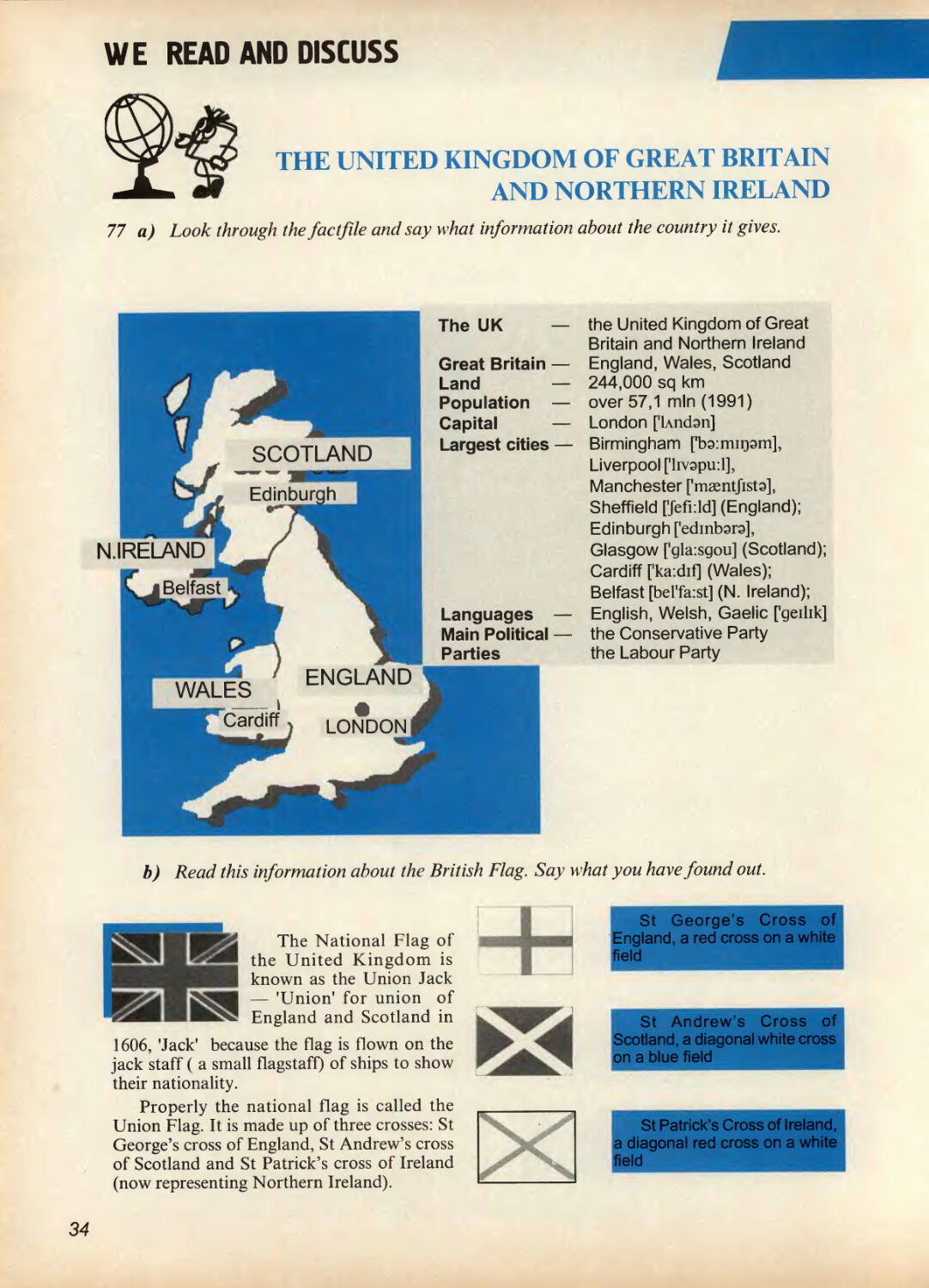
77 a) Look through thefactfile and say what information about the country it gives.
The UK — the United Kingdom of Great
Britain and Northern Ireland
Great Britain — England, Wales, Scotland
Land — 244,000 sq km
Population — over 57,1 mln (1991)
Capital — London ['Lvndsn]
Largest cities — Birmingham [Ъэ:пппэт],
Liverpool ['lrvapuil],
Manchester ['maentjista],
Sheffield ['Jefi:ld] (England);
Edinburgh [edmbara],
Glasgow ['gla:sgou] (Scotland);
Cardiff ['ka:dif] (Wales);
Belfast [bel'fa:st] (N. Ireland);
Languages — English, Welsh, Gaelic [geilik]
Main Political — the Conservative Party
Parties the Labour Party
b) Read this information about the British Flag. Say what you have found out.
The National Flag of
the United Kingdom is
known as the Union Jack
— 'Union' for union of
England and Scotland in
1606, 'Jack' because the flag is flown on the
jack staff ( a small flagstaff) of ships to show
their nationality.
Properly the national flag is called the
Union Flag. It is made up of three crosses: St
George's cross of England, St Andrew's cross
of Scotland and St Patrick's cross of Ireland
(now representing Northern Ireland).
St George's Cross of
England, a red cross on a white
field
St Andrew's Cross of
Scotland, a diagonal white cross
on a blue field
St Patrick's Cross of Ireland,
a diagonal red cross on a white
field

THE ENGLISH-SPEAKING WORLD
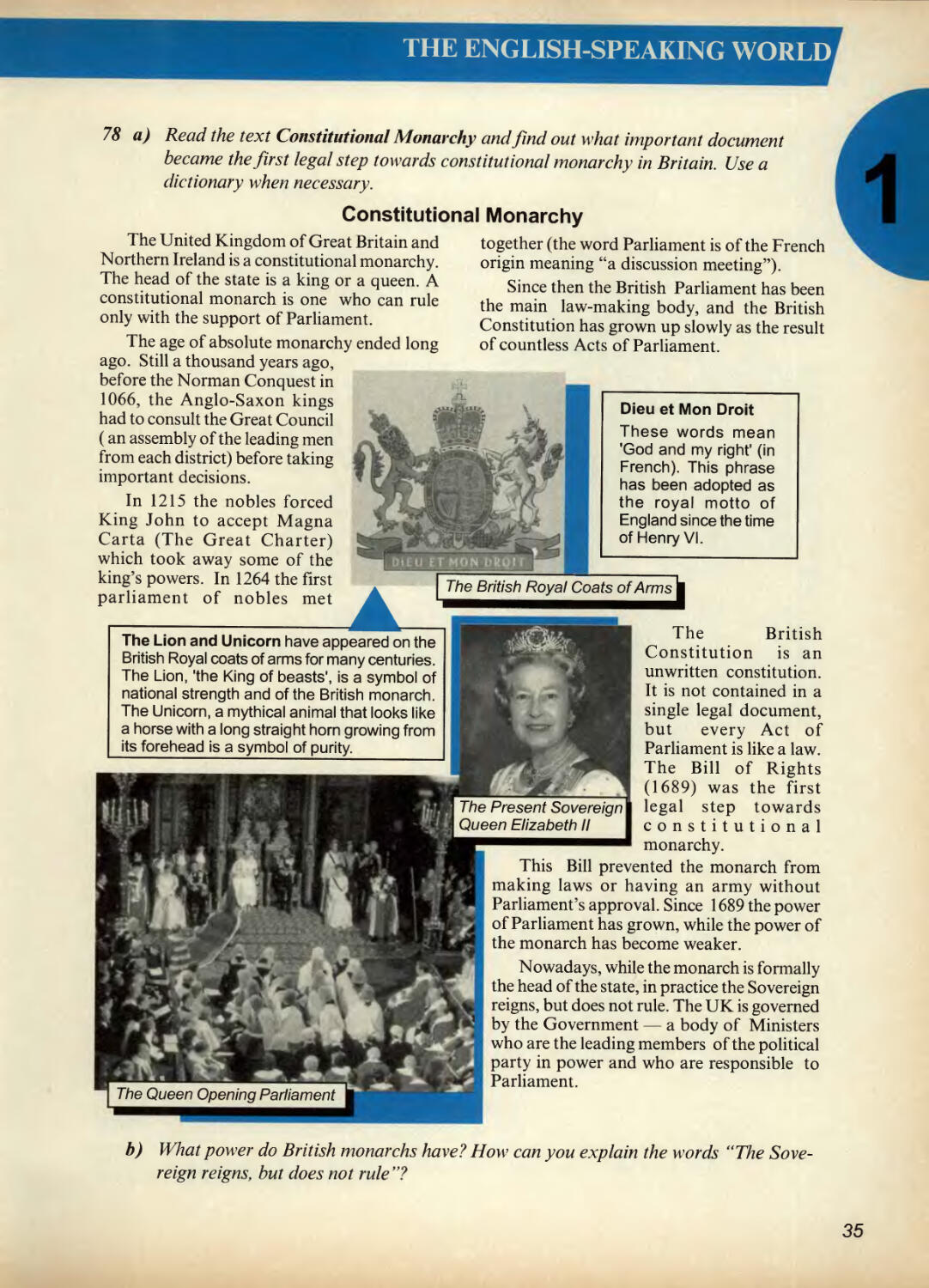
78 a) Read the text Constitutional Monarchy and find out what important document
became the first legal step towards constitutional monarchy in Britain. Use a
dictionary when necessary.
Constitutional Monarchy
The United Kingdom of Great Britain and
Northern Ireland is a constitutional monarchy.
The head of the state is a king or a queen. A
constitutional monarch is one who can rule
only with the support of Parliament.
The age of absolute monarchy ended long
ago. Still a thousand years ago,
before the Norman Conquest in
1066, the Anglo-Saxon kings
had to consult the Great Council
(an assembly of the leading men
from each district) before taking
important decisions.
In 1215 the nobles forced
King John to accept Magna
Carta (The Great Charter)
which took away some of the
king's powers. In 1264 the first
parliament of nobles met
together (the word Parliament is of the French
origin meaning "a discussion meeting").
Since then the British Parliament has been
the main law-making body, and the British
Constitution has grown up slowly as the result
of countless Acts of Parliament.
Dieu et Mon Droit
These words mean
'God and my right' (in
French). This phrase
has been adopted as
the royal motto of
England since the time
of Henry VI.
The British Royal Coats of Arms
The Present Sovereign
Queen Elizabeth II
The Lion and Unicorn have appeared on the
British Royal coats of arms for many centuries.
The Lion, 'the King of beasts', is a symbol of
national strength and of the British monarch.
The Unicorn, a mythical animal that looks like
a horse with a long straight horn growing from
its forehead is a symbol of purity.
The British
Constitution is an
unwritten constitution.
It is not contained in a
single legal document,
but every Act of
Parliament is like a law.
The Bill of Rights
(1689) was the first
legal step towards
constitutional
monarchy.
This Bill prevented the monarch from
making laws or having an army without
Parliament's approval. Since 1689 the power
of Parliament has grown, while the power of
the monarch has become weaker.
Nowadays, while the monarch is formally
the head of the state, in practice the Sovereign
reigns, but does not rule. The UK is governed
by the Government — a body of Ministers
who are the leading members of the political
party in power and who are responsible to
Parliament.
The Queen Opening Parliament
b) What power do British monarchs have? How can you explain the words "The
Sovereign reigns, but does not rule"?

WE READ AND DISCUSS
79 a) Read the text How Was the United Kingdom Formed? What are some of the most
important dates in the history of England, Wales, Scotland and Northern Ireland?
How Was the United Kingdom Formed?
This took centuries, and a lot of armed struggle was involved.
There are four 'nations' on the British Isles which were separate at earlier stages of
their history: England, Wales, Scotland and Ireland. Kings of England did their best
to bring Wales, Scotland and Ireland under English control. However, the other three
countries are also important and each of them has a different history.
England is one of the four nations which has
always played the most powerful part in the
history of the British Isles.
1066 is the most famous date in English history.
This is the date of the successful Norman invasion
of England when the Norman leader, known in
history as 'William the Conqueror', became king of
the whole of England.
The Normans introduced the strong system of
government and the Kingdom became
the most powerful political force on the
British Isles. The authority of the British
gradually extended to other parts of
these islands in the next centuries. It was
in this period that Parliament began its
gradual evolution into the democratic
body it is today.
Windsor Castle
The Tower of London
The national
symbol of England is
a red rose.
I Caernarfon Castle
Wales is the smallest land in the United
Kingdom. The Welsh fought for many years for
their freedom. The English built great castles at
Harlech and Caernarfon [ka'naivan], and in 1301
Edward I of England defeated the native prince of
Wales and named his son 'Prince of Wales'. Since
then the eldest son of the King or the Queen of
England has traditionally been given this title.
In the 15th century, Henry VII who was half
Welsh became King Henry VII of England. Then
his son Henry VIII united England and Wales under
one Parliament in 1536. Welshmen entered the
English Parliament.
Conwy Castle
The national
symbol of Wales is
a leek or a daffodil.

THE ENGLISH-SPEAKING WORLD
Scotland was an independent kingdom for a long
time. Scottish kings were much stronger than
the many Welsh kings had been. There were
constant wars between England and the quite separate
Kingdom of Scotland from the eleventh to the sixteenth
centuries. Here are some important events in
Scottish history.
1603 — When Queen Elizabeth I of
England died without children King James VI
of Scotland inherited the crown of England and
Wales and became King James I of England
and Wales.
1651 — Scotland was united with England
and Wales although it kept its own parliament.
1707 — England and Scotland were joined
by an Act of Union which abolished the
Scottish parliament and the parliaments of
England, Wales and Scotland were united.
The national symbol
of Scotland is a thistle.
Edinburgh Castle
Kilchurn Castle
12th century tower
used for defence
Northern Ireland, was part of Ireland as a
whole until 1922. The people of Ireland had
been struggling against English domination for over
800 years. Kings of England wanted to bring Ireland
under their authority as they had done with Wales
and Scotland, but they failed to get what they
wanted. They fought many wars to make the Irish
accept their authority and religion. In the end they
destroyed the old Gaelic way of life and introduced
English government.
Ireland was united with Britain in 1801 and the Dublin
parliament closed. The United Kingdom of Great Britain
and Ireland lasted for 120 years, until 1922. In that year
the Independent Republic of Ireland was formed in the
South with its parliament in Dublin. Northern Ireland
continued to be part of the United Kingdom with its own
local parliament in Belfast.
The story of this particular union is long and
complicated.
Belfast. City Hall
The national symbol of
Ireland is a shamrock.
b) How were Wales, Scotland and Nothern Ireland united with England?
80 Note down the things about the UK you didn't know before. What new information
did you get?

WE READ AND DISCUSS
Queen Elizabeth II in Russia
81 When did the state visit of Queen Elizabeth II to Russia take place?
STATE VISIT Of
HER MAJESTY QUEEN ELIZABETH II
TO RUSSIA OCTOBER! 7-20199*
82 Read this letter from Queen Elizabeth II to the people of Russia. Find out what
wishes and hopes are expressed in it.
The Duke of
Edinburgh
Prince Philip [filip],
husband of the British
queen, Elizabeth II.
Prince Philip was born
in the Greek royal
family but became a
British citizen in 1947.
He has no official
position but is
involved in many
public organisations
and charities.
Buckingham Palace
Buckingham
Palace [.Ьлкнрт 'paelis]
also the Palace —
official home of the
British Royal family in
London, containing
almost 600 rooms.
The Ambassadors and merchant-venturers of Queen
Elizabeth I first came to Russia four hundred years
ago. Europe was emerging from the long winter of the
Middle Ages into an age of discovery and innovation.
They came to explore new possibilities of trade
cooperation and exchange in a world in which
everything seemed possible.
Today as I look forward to making my first visit
to Russia I should like to think that we stand on
the threshold of another such age. After years of
division and confrontation, Europe is entering
another time of opportunity, with peace and
prosperity within our reach, provided only that we
remember the lessons of the past and learn to live
and work together.
The Duke of Edinburgh and I look forward to
getting to know more about this great country that
is Russia. We shall be meeting not only its leaders,
but some of the rising young generation of Russians
on whom - with our own sons and daughters - the
fulfillment of these hopes for the future will
depend. I believe that our two countries can and
will have a future worthy of their past, and I trust
that they will be able to build it together.
ELIZABETH R.
R for Rex or Regina [п'йзашэ]
(Latin): the title used in official writing
after the name of a ruling British queen.

THE ENGLISH-SPEAKING WORLD
83
A visit to a Moscow school was part
of Queen Elizabeth's programme
when she was in the capital of
Russia.
Do you think this visit was proof of the
Queen's interest in the rising young
generation of Russians?
A bread-and-salt welcome at a Moscow school
84 Say what sides of British life you would like to get acquainted with. How can you
get to know Britain better?
PROJECT
A Book File
Work in groups.
Make a booklet of reviews or a bookfde in your class.
1 Write reviews of the books which have impressed you.
Include interesting information about the authors of the
books.
2 Draw pictures to accompany your book reviews.
3 Discuss the reviews with other students.
4 Make a list of books which students might be interested in
reading.
5 Discuss how to display your book reviews and the list of
your recommendations. Decide who will be responsible for
arranging the display.
6 Display all the work produced in the classroom. Give short
presentations on what you have done.
7 Hold a discussion on your reading preferences.

UNIT 2
HEALTH,
WE TALK
HAVING AN ENJOYABLE TIME
/ a) Look at the picture and say what you think can make these boys and girls healthy
and cheerful.
A Day in the Countryside
b) Make up a story about the picture.
Use the following:
be impressed
be delighted
be full of joy
be excited
feel cheerful
enjoy camping
(not) to feel tired
have an enjoyable time
admire the splendid scenery
(not) to feel bored
go for a bicycle ride
ride a long distance
find something to do
stop in a remarkable place
c) Imagine that you are a participant in a bicycle ride. What do you say about it after
you get back home?
2 Say what else, besides hiking, can make you feel healthy and cheerful.
3 Work in groups.
Remember the last hike your
classmates and you went on. Of
course, you found a lot of things to
enjoy during your hike, but there
were perhaps things which caused
some problems and made the hike
hard for some of you.
Act out a conversation with your
classmates. Exchange your opinions
about the hike and give your ideas for
the next hike you are planning.

SPORTS AND PASTIMES
4 Work in pairs. Act out a conversation with your classmate about how you prefer to
spend a weekend.
You would prefer spending a
weekend at home rather than
going out somewhere and
explain why.
You are surprised and ask your
classmate why (s)he prefers staying at
home to going for a bicycle ride or
camping or simply going out for a walk.
Ask him(her) what he does in his free
time and what he enjoys doing at home.
You may use the following:
Showing surprise
How surprising!
That is surprising.
I'm surprised to hear that.
I can't believe it!
Really?
Oh, really!
Asking about interest
Are you interested in... ?
Aren't you interested in ...?
Does it interest you?
Doesn't it interest you?
5 a) Listen to the poem Leisure, then read it. Say which of the things the author observes
in the surrounding world delight him.
{leisure
What Is this life, If, fill of care,
We have no time to stand and stare,*
Mo tithe to stand beneath the boughs г
and stare as long as sheeft or cows.
Mo time to see, when woods we ftass,
Where squirrels hide their nuts in grass.
Mo time to see, in broad daiflight,3
Streams full of stars, Шее sides at night.
Mo time to turn at Beauty s glance,
dnd watch her feet, how thei/ can dance.
Mo time to wait till her mouth can
Cnrich that smile her eyes began.
Afioor life this if, full of care.
We have no time to stand and stare.
W. B. Davies
b) Try and explain why the author thinks it's a poor life if people have no time to look
around attentively, with curiosity and interest.
c) Look at the title of the poem and think of several ideas that it suggests to you.
Discuss your ideas with the others in the group.
1 to stare [stea] — смотреть пристально
2 beneath the boughs [bauz] — под ветвями
3 in broad daylight — средь бела дня

WE LEARN
6 Read and remember how to use the words:
to catch (a) cold: No wonder Kate has
caught a cold; the weather has been so windy
and rainy this week. "Aren't you afraid of
catching a cold? Why aren't you wearing a
cap?" Grandmother asked Nick.
ache [eik], to ache: headache, toothache,
heart-ache, stomach-ache. I have a terrible
headache. After climbing the mountain he
ached all over. Anything that hurts or aches
causes pain. The pain in the knee was sharp; it
ached to move.
sick: a sick man. A nurse takes care of sick
people. Are you allowed to visit a sick friend if
he has a high temperature ['tempntfa] and has
to stay in bed?
disease [di'zi:z]: infectious diseases. I have
a rare eye disease. What is your disease caused
by? If you have a disease that is infectious,
other people can catch it from you.
to treat, treatment: to treat somebody for.
Which doctor is treating you for your illness?
The man soon felt better under the doctor's
treatment.
to cure [kjua]: to cure a patient (an illness, a
headache). How can this illness be cured? There
are some diseases that modern drugs cannot
cure.
to prevent [pn'venfj: to prevent something;
to prevent somebody from doing something;
to prevent illnesses; to prevent a fire. I'll come
at 6 if nothing prevents me. Tom's illness
HEALTH IS ABOVE WEALTH
prevented him from participating in the
contest. What prevented you from coming?
medicine ['medsm]: to take a medicine.
People take medicines for some illnesses.
to prescribe [pn'skraib]: Doctor, will you
please prescribe some medicine for my
headache?
patient ['peifnt]: be patient; to examine a
patient. People must be patient with children.
I know Tom hurt his leg and it gives him much
pain, but he is very patient and never
complains. The patient received good medical
treatment; now he is out of danger.
eyesight ['aisait]: good (bad) eyesight.
"Your eyesight has become worse, I'm afraid.
You'll see much better with new glasses," the
doctor told Mary after he had examined her
eyes.
to cough [kofj, cough: There was so much
smoke that my sister started coughing. Every
winter he has a bad cough.
to improve [im'pruiv]: to improve health; to
improve education; to improve living
conditions. The boy's health improved
wonderfully. Tom's spelling has improved.
improvement [im'pruivmant]: the
improvement of relations between the
countries.There was no improvement
immediately after the operation.
to recover [n'kwa]: It took her a long time
to recover after a serious illness.
7 Read and remember:
Asking about somebody's health
What's wrong with you?
I've got
a headache,
a (bad) cold,
a cough,
(the) flu.
a temperature.
Expressing sympathy
What a pity!
It's a great pity.
I'm sorry to hear that.
Oh, dear.
8 Work in pairs. Act out a conversation with your parents.
Imagine you are not feeling quite well and!
you complain to your parents about it.
Explain the reasons for complaining (they
may be your headache, or toothache, or a
sharp pain in a knee, or a high temperature,
or something else). Thank your parents for
their advice.
Listen to your daugthter's or
your son's complaint about his
or her health, express your
concern and sympathy. Then
give your advice on what you
think it is good to do in this
situation.

Consulting a Doctor
9 a) Look at the pictures and say:
• what made each of these boys consult a doctor;
• whether the doctors examined their patients carefully;
what the doctors prescribed for their patients;
how the doctors helped.
Use the following:
prescribe medicines
a patient
suffer from
consult the doctor
complain of
recover
give practical advice
prevent an illness
treat
cure
examine
find out
examine someone's eyes
listen to someone's heart
extract a bad tooth1
10 a) Say:
• when you have to visit or call out
a doctor;
• why it is necessary to get medical
care during one's illness;
what kind of advice doctors give
you to cure you or help to keep
you healthy;
• how often you have seen a doctor
(or the doctor has visited you) this
year and what the reasons were.
11 Describe your visit to the doctor.
12
Proper food, exercise, sleep and
medical care help you to develop a
healthy body.
give practical advice
In what way do they? Give reasons for
your answer.
1 to extract a tooth — удалить зуб

WE LEARN
Vocabulary Study (2]
13 Read and remember how to use the words:
fit: to keep fit; to feel fit; to be fit. A little
exercise each day will keep you fit. I hope
you're feeling quite fit. The boy felt fit and
strong again.
regular ['reqjuta]: regular exercise; regular
classes; regular hours; regularly; to play sports
regularly. We should have our meals at regular
hours. Regular visits to the dentist are
necessary.
track-and-field: track-and-field events. I
prefer track-and-field events to any other kinds
of sports. Do you participate in track-and-field
events?
tournament ['tomamsnt]: a chess
tournament; tomorrow's tennis tournament.
The results of chess tournaments are studied
and discussed by thousands of fans in different
countries. Who will take part in our class tennis
tournament?
record ['rekoid]: to set a record; to set a
record in running; to break a record. Tom
dreams of setting a school record in swimming,
and he is training hard for it.
to achieve [a'tfiiv], an achievement
[s'tjiivmant]: to achieve good results; to achieve
one's aim. The achievements of science in space
exploration are really impressive. Had they
carried out many experiments before they
HOW TO KEEP FIT
achieved such brilliant results?
stamina ['staemma]: I didn't have the
physical stamina needed for digging. Everyday
training has done wonders for your stamina.
advantage [sd'vamticfe], disadvantage
[disad'vamtidj]: the advantages of a good
education; to take advantage of; to have an
advantage over something or somebody; to
give somebody an advantage. The doctor
explained the advantages of the new treatment
over the old one. We took advantage of the
sunny weather to arrange a football game.
What are the advantages of living in the
country?
to display [dis'plei], display: be on display.
Such a display of courage and skill must be
admired by all. Some people like to make a
display of their knowledge. The new models
are on display at the museum. His attention
was caught by the photographs displayed
outside.
to encourage [ш'клг^з], an encouragement:
to encourage a man to work harder; to
encourage a boy in his studies. At foreign
language lessons the teacher tries to encourage
his pupils to speak about many different things.
Every boy and girl should be encouraged to
participate in sports and games.
14 | Three teenagers tell us what they
do to keep fit.
Paul
a)
Read and say how each one of them
keeps fit.
Monica
I play in our football team. So I simply have to
keep fit. Playing football is hard work today.
You have to train a lot. Once or twice a week I
get up early in the morning and go for a run in
the woods. At first I felt tired after running for
only ten minutes. But I soon got used to it. Today
after half an hour's run I feel fine.
I don't really do anything just to keep fit. But I get a lot of
exercise doing things I enjoy. I belong to the school gym
club, and I go skating at our ice rink. It helps me to feel
cheerful after a hard day at school. And it gives me plenty
of exercise. Now we've got a new PE teacher at school.
He's going to start a badminton club, which sounds fun.
So I think I shall try that - though I can hardly imagine
where I shall find the time.
Andrew
My case is a bit different. A year ago I went through an operation. I had to lie in bed for a long time.
Now I'm still not strong enough. To be quite honest I didn't very much care for sports and games
before. Unlike most boys of my age, I sometimes even stayed away from PE lessons at school.
Now things have changed. I get as much exercise as possible. I have to. What, then, can I do to
keep fit? A lot. I play tennis, for instance. On my doctor's advice I've begun to lift weights 1 to
strengthen my arms. What I like best, however, is swimming. I hope I'll soon be quite well again.
b) Say which of the things these teenagers do you also practise.
1 to lift weights [weits] — поднимать тяжести

15 a) Look at the pictures and say what you think keeps these people fit
Use the following:
roller-skate
have stamina
go in for gymnastics
plenty of exercise
improve health
physical fitness
participate in
regular exercise
test oneself
daily training
feel cheerful
develop a skill
training in a gym
mountain climbing
b) Say what may keep you fit.
16
Many people enjoy training in a gym,
taking exercise classes, or doing
exercises at home. They believe that
physical fitness is important.
roller-skating and riding on a skateboard
Work in pairs.
Act out a conversation with your
classmate to find out:
• whether s/he takes part in any of these
activities;
• what things s/he does for exercise;
• why s/he thinks it is important to keep fit.
17 a) Say which of these sports, in your
opinion, are excellent for stamina:
swimming
cycling
jogging
swimming
playing football
hill walking
doing aerobics
skiing
playing tennis
b) What other sports can you add to this list? Give your reasons.
18 Discuss the following:
• Do you think it is an advantage to have a tennis court, a swimming pool and a large gym
at school?
What are the advantages of having a sports centre near your house or school?
• Are there reasons which prevent your playing sports or devoting your free time to active
leisure and hobbies? What are they?

WE LEARN
19 a) Read the joke. Say what
made the patient consult
the doctor.
Good Medicine
Patient: I suffer terribly from
headaches. What advice can you
give me, doctor? Should I take
headache tablets?
Doctor: Yes, I've got some fine
tablets for your trouble. One of my
patients has been using them for
fifteen years and he has never
asked for any more.
&1ш/$Ь &ш
b) Answer the question: Do you think the patient
will like the tablets?
c) Read the following explanations and say which
ones show that the headache tablets are good,
and which can be used as a joke.
Doctor: The tablets are really good. One of my patients...
• often takes one and it sometimes helps him.
took one once and it helped him immediately.
• is using them now and says that he feels much
better.
• has been using them for fifteen years and he has
never asked for any more.
20 a) Study the meaning of the words with the suffix -th.
Adjective + - th = Noun
strong - strength
deep - depth
b) Read the words and try
to guess their meaning:
strong — strength
deep — depth
wide — width
broad — breadth
long — length
c) Read and translate the word combinations:
the strength of the body
things of different width
the wealth of a museum
depth of thought
the depth of the ocean
width of mind
a wealth of examples
a room 20 feet in length
and 12 feet in breadth
21 Agree or disagree. Give reasons for your answer.
1 Our health doesn't depend on our way of life.
2 Healthy food is not very important. What really matters is plenty of physical exercise.
3 To keep in good health one must get plenty of sleep, plenty of rest and plenty of food.
22 Read the sayings and remember them. Explain how you understand them.
An apple a day keeps the doctor away.
Health is above wealth.
23 Work in groups. Read this quotation, then share your comments about the
quotation with the others in the group.
There are a lot of people in this world who spend so much time
watching their health that they haven t time to enjoy it.
Billings, an American writer (1818 — 1885)

24 a) Look at these adverts and say what activities are offered by a recreation centre.
How are they helpful to those who want to keep fit?
Recreation Centre
b) Do you think such recreation centres are good for people of all ages? Give reasons
for your opinion.

WE LEARN
Vocabulary Study (3)
PLAYING A GAME AND WATCHING IT
25 Read and remember how to use the words:
goal [goul], goalkeeper: Hockey players hit
a puck with their sticks; they aim for goals.
Who do you think is the best goalkeeper in our
country?
score [sko:], to score: to score a goal; to win
with a score of 5 to 3. How did the game end?
What was the score? The score in the tennis
tournament was 6 to 4.
defeat [di'fi:t], to defeat: to be defeated. Our
volleyball team has never been defeated. You
must behave well in defeat as well as in victory.
to attend [a'tend]: to attend a stadium; to
attend a meeting; to attend school. Do you plan
to attend our meeting? Figure-skating
competitions are very popular and attended by
thousands of spectators. All children over 6
must attend school.
spectator [spek'teita]: Do you know any
stadiums which can hold 100,000 spectators at
a time? Journalists, newspapermen,
photographers and spectators all crowded
round the sports field.
enthusiast [m'Gju:zisest], enthusiasm
[in'9ju:ziaezm], enthusiastic [in,9ju:zi'aestik]: a
group of enthusiasts; to be full of enthusiasm;
to participate in the school activities with
interest and enthusiasm. The fans shouted
enthusiastically to cheer their favourite players.
The shouts of enthusiastic spectators cheered
the participants in the contest. Enthusiasts may
find it very exciting to speak about their
hobbies for hours. There was not much
enthusiasm to go on a hike in the cold weather.
to award [a'wo:d], award: The painter was
awarded the first prize. The winner of the
contest was given the highest award for his
brilliant results.
to suggest [safest], a suggestion [s9'd3estjh]:
to make a suggestion. The teacher suggested
that we should use a dictionary when we come
across new words and cannot guess their
meaning. The librarian suggested that we
should arrange the books on the shelves in
alphabetical order. Her suggestion seemed
interesting to all.
26 a) Read this magazine article. What information does it give you?
Too Much TV?
Young people in Britain
spend too much time watching
TV and not enough time taking
exercise. That's the conclusion
of a report on young people's
health and fitness.
750 school pupils were
tested and their heart rates
were measured. 20 % of boys
and 50 % of girls were not fit
enough. Is this because they
don't take enough exercise?
School pupils between the
ages of twelve and fifteen have
two hours of physical education
every week. But when the
pupils are over sixteen, physical
education classes are
voluntary.
Some people think we
should have physical education
exams in schools. Recently, it
was discovered that one in four
young people can't swim. The
police and army have said that
young people who join them are
often not fit enough. On the
other hand, young people
watch television for up to 3.5
hours a night.
How fit are you? Do you
exercise more than three times
a week for at least 20 minutes
a time? Can you swim? Or are
you like a famous writer who
said: "When I feel like doing
some exercise, I lie down and
wait until the feeling goes"?
("Catch")
b) Say what troubles the parents, the teachers and even the army and the police.
c) Comment on the words said by a famous writer. Do you know people like him?

27
; ■ • 1 . .
eter is a great sports enthusiast. Every sports event seems very
exciting to him. He dreams of becoming a sporting reporter and has
begun to write his first articles.
Sports and Fans
a) Look at the pictures and say:
whether Peter is watching the football
match with interest and what pictures
he is taking;
what questions Peter is asking a
football player when interviewing
him after the game; what notes
you think he is making;
what text you think Peter is typing for his article.
b) Do you believe Peter will be a good sporting reporter? Why? Give reasons for your
answer.
c) Make up a story about the pictures.

WE LEARN
28 a) Look at the picture and describe it.
Ready, Steady, Go!
b) Say:
what events the athletes are taking
part in:
• what results you think the athletes
would like to have in the high
jump, in the long jump, in the 100
metres race and in the discus
['diskas] throw;
• how long you think they have
been preparing for the
competitions;
• whether you think they have been
training hard and why.
г
29 Remember your school's last sports competitions in track-and-field events. Say:
• which events you took part in;
• what results you and your classmates obtained in the different events;
• whether you were pleased or not and what you think you ought to pay attention to in
your further training in order to achieve better results.
30 Say what athletes ought to do to achieve good results and what their results depend on.
31 Name several well-known athletes who have set records in track-and-field events (in
swimming, gymnastics, wrestling or other kinds of sport). Explain how they have
achieved such good results and what character they had to show while training and
competing in contests.
32 Say:
• whether you belong to a young athletes' club or any other sports club;
• whether you can advise others to join it and why;
• what club you'd like to belong to and what are your possibilities for playing sports regularly.
33 Read the text and find out what kind of game Octopush is.
OCTOPUSH DELIGHTS
It's Saturday afternoon in a north
London swimming pool. There's a lot of
activity, but it's hard to say what's going
on. There are plenty of spectators, but
they're not looking at the pool. You can
just about make out some people
swimming around at the bottom of the
pool.
This is Octopush, known outside
Britain as underwater hockey. It's one of
the oddest water sports you can play. Two
teams of ten, six in the water and four
substitutes, try to push a weighted disk,
called a squid, along the bottom of the pool.
They aim for the opposition's goal, or gully,
using Y-shaped sticks that are about ten
inches long.
It is not really a spectator sport. The best
venues are equipped with closed-circuit TV2,
and one or two pools have portholes in the
pool's sides. Without these, it's hard to follow
a match.
(from Current)
b) Do you think that Octopush is a difficult game? What does one need to be good at
it?
make out — видеть 2 closed circuit TV — замкнутое телевидение

34 Read the text Shirts with a Message and find out what qualities make T-shirts
popular with people from all walks of life. Use a dictionary when necessary.
Shirts with a Message
For many years, T-shirts - the
name comes from their shape -
were simply short-sleeved
undershirts for men and boys. T-
shirts came in only one colour
(white). And since they were worn
under sweaters or shirts, they
were generally not seen.
Nowadays, the T-shirt is no
longer an undergarment; it has
become high fashion. It can be
seen everywhere and on
everyone. Women and little
children wear T-shirts as do
teenagers, university students and
men from all walks of life. T-shirts
are worn on tennis courts and golf
courses, at the beach or in town.
They can be casual to go with
jeans or slacks, or dressy for work
or evening wear. Yet they remain
relatively inexpensive and long
wearing as well as easy to care
for, which makes them very
popular. Stylish but comfortable
and convenient to wear, T-shirts
have blossomed into one of the
world's newest fashion ideas.
Although T-shirts are now
available ' in a wide assortment
of bright materials and styles, the
most popular kind is the traditional
cotton version much like the old
T-shirt but with a or picture printed
on the front. A T-shirt may bear a
single word, a popular phrase,
pictures of rock musicians, or an
advertisement. With the
increasing 2 popularity of T-shirts,
new ideas are popping up all the
time.
It is safe to say that the T-shirt
is one fashion item that will be
around for a long time. After all, it
has a lot to say.
(from "Man and Man Series:
Fads and Fashions")
35 Answer the questions on the text:
1 Why are they called T-shirts?
2 Who used to wear T-shirts as an undergarment?
3 What is the most popular kind of T-shirt worn today?
4 In what way can a T-shirt be decorated?
36 Discuss the fashion of wearing T-shirts in your country. Are T-shirts still popular?
Are they convenient to wear? How long do you think the T-shirt will enjoy its
present popularity?
&lm$frt &Ъя
37 Read the joke. Say why you think the goalkeeper did not leave the football field.
Foggy Football
After a football match two sports ground workers were walking across the field to take down
the nets from the goal posts3. It was a very foggy day and so it took them some time to find
the goal. And whom did they find there? The goalkeeper. He was standing near the goal and
talking to himself, "We must be giving them a really tough4 time today. I haven't seen my
players for twenty minutes..."
1 available [a'veibbl]— доступный
2 increasing [m'kriisirj] — (зд.) растущий
3 the nets from the goal posts [pousts] — сетка с
футбольных ворот
4 tough [Uf] — зд. трудный

WE LEARN
38 Read, compare and remember:
to offer
to offer somebody something
He offered me his help.
to offer to do something
He offered to help me.
OFFERS AND SUGGESTIONS
When we offer something to someone, we show
we are willing to do something for somebody or
give somebody something. We may offer a person
a cup of tea, or we may offer him our help, or we
may offer to help him.
The verb to offer is followed by an infinitive
or a noun.
to suggest
to suggest that somebody should
do something
My friend suggested that we
should go for a bicycle ride.
to suggest something
My friend suggested a bicycle
ride.
When we suggest something, we put an idea
into the mind of the person we are speaking to.
We may suggest a visit to the theatre, or we may
suggest that we should go to the theatre.
The verb to suggest cannot be followed by an
infinitive. It is followed by a that-clause or a noun.
39 Fill in offered or suggested:
Example: Mother...
that I should take some medicine for my headache,
to call the doctor.
Mother suggested that I should take some medicine for my headache.
Mother offered to call the doctor.
1
2
3
4
Mary...
Pete-
Kate...
The doctor...
to go to the Central Store and to do the shopping there,
that we should buy Mother an umbrella as a present.
that we should go to the cinema on Saturday,
to buy tickets beforehand.
that we should send Helen a telegram,
to go to the nearest post-office.
his advice for a quick recovery.
that the patient should go to the country for a month.

40 a) Read these short conversations. Say what opinions are expressed in them.
Mike: How about watching the boxing
championship? Boxing is always so
very thrilling to watch!
Ann: I prefer to attend quieter competitions.
I hate boxing. It's a rough ' sport, I
think.
Alex: There is a good sporting programme
on television today. They are showing
the International Boat Race. What do
you say to watching it?
Tim: I wouldn't miss it, though I'd prefer to
attend it. The race is never the same
on TV. I miss the noise and the
excitement of the fans.
b) Report the conversations. Use suggest that somebody should do something.
c) Say whether you prefer attending competitions to watching them on television. Why?
41 Read and remember:
Suggesting
Shall we go to...?
What about going to...?
What do you say to camping...?
How about watching...?
We could go ...
Why don't we go ...?
Agreeing to a suggestion
That's fine!
(That's) good idea.
Not a bad idea.
Why not?
All right.
42 Read the dialogues, then say what the boys and girls suggested; whether their
suggestions were met with or without enthusiasm and why.
M — Mike
J — Joe
M: What about going to the
sports ground this
afternoon? Our team will
compete with another
school in track-and-field
events.
J: Not a bad idea. We'll have
an exciting time, 1 'm sure.
And we'll cheer up our
boys and girls.
M — Mary^
L — Lucy ,
T — Paul
В — Bill
M: How about arranging a
performance for the
anniversary party? We
can prepare something
special.
L: That's fine. Everybody
will take part in it
willingly.
P: What do you say to practising
tennis every day this week?
Then we'll be better prepared
for the tournament.
B: I don't care if we practise
every other day. But I can't
afford to devote all my time
to tennis. Schoolwork comes
first!
43 a) Read these suggestions made by some boys and girls and say what they suggested:
Tom: More television programmes should be devoted to sports.
Joe: More pupils should join sports clubs.
Eliza: More PE lessons should be introduced at school.
Jane: PE lessons should be held only out-of-doors.
Bill: Every boy and girl should learn how to play chess.
b) Say whether you are for or against these suggestions. Give reasons for your answer.
c) Continue the list suggesting your own ideas and discuss them.
1 rough [r\f| — грубый

WE LEARN
Vocabulary Study (4)
ENCOURAGING SPORTS
\44 Read and remember how to use the words:
to determine [di'tamm]: to be determined
to do something; a determined character. Do
actions determine a man's character? We are
determined to master English. The scientists
were determined to continue their experiments.
I like people of determined character.
attempt [a'tem(p)t]: to make an attempt.
The girl made an attempt at reading the book
without a dictionary, but found it difficult.
After several attempts the travellers at last
reached the top of the mountain.
particular [pa'tikjub]: to be particular about
something; in particular; particularly. He
always does things in his own particular way.
What she said was of no particular interest. The
girl is very particular about her notebooks and
they are always in perfect order. Which radio
and television programmes do you like
particularly?
ahead [a'hed]: Tom was a quick walker so
he soon got ahead of the others. Please go
ahead and say we are coming.
doubt [daut], to doubt: I have no doubt that
Mary will be a skilful typist. When in doubt
about the meaning of a word, use your
dictionary. A sudden doubt came to his mind.
I doubt whether Mike will come. I never doubt
his honesty.
force [fo:s], to force: to force one's way
through a crowd; to force a person to do
something. He knocked at the door with force.
Nobody could force Tom to do what he
thought was wrong.
worthy fwazdi]: worthy of great praise;
deeds worthy of admiration; worthy examples
(ideas). Skilled work is always worthy of
admiration. He was a worthy winner of the
Nobel Prize.
initiative [I'mjiativ]: to do something on
one's own initiative; to take the initiative. He
went to America on his own initiative. If you
act responsibly and show that you have
initiative, you will sooner or later be successful.
You will be working in a situation, where
initiative, inventiveness and independence are
important.
to accept [sk'sept]: to accept an offer; to
accept an invitation. The girl accepted our offer
of help. They accepted the invitation with
pleasure. Did you accept their invitation to the
party?
praise [preiz], to praise: The man's heroism
is worthy of great praise. It is always kind and
encouraging to praise a person if he has done
a good deed.
45 Read and say what these people are (were) determined to do and why:
Example: The players train hard to win the championship.
The players are determined to win the championship.
They are sure that they are strong enough to do so.
They have trained hard and have shown good results.
1 The mountain climbers did their best to reach the top in spite of the terrible weather
conditions and the snowstorm.
2 The rain might prevent the cyclists from showing good results in the race. But their
enthusiasm was so great that they decided to do everything possible to cycle at top speed.
3 The scientists could not say that they had achieved good results, but they were ready to
carry out as many experiments as was necessary.
4 The boy was not strong but he believed that physical exercises could help him to develop
a strong and healthy body. So he made up his mind to play sports regularly.
5 Every summer English swimmers make attempts to cross the English Channel and to
reach the French coast, trying to prove that it is quite possible.

46 Read and say what these people doubt or have no doubts about, then think of a
possible explanation why they have their doubts (have no doubts).
Example: Ann: I'm not sure Kate will make good progress in English. She is lazy.
Ann doubts that Kate will make good progress in English.
She doesn't devote much time to her English.
Mike: I don't think you'll be impressed by the sight of the old part of the town.
Tom: I can't believe that the cyclists will be able to cover the distance in half an hour.
Jane: I'm sure our class will accept the invitation to visit the new exhibition with pleasure.
Bill: I think our school team has a chance of winning the competition.
Kate: I don't think we'll be able to translate the text without a dictionary.
Paul: We think that the holiday celebrations will be colourful and impressive.
47 a) Look at the pictures and make up a story.
Enthusiasts
Use the following:
score a goal
be determined
be full of enthusiasm
make a poor attempt
fly past... and into....
encourage
have no doubts
be impressed by
be impatient
be enthusiastic
b) Give your opinion about the man's and the boy's enthusiasm for playing football.
48 Say how spectators encourage their favourite players (athletes).
You may use the following:
attend the game
applaud
shout enthusiastically
shouts of encouragement
crowd round the field
cheer favourite players

WE LEARN
49 Describe different kinds of spectators. Speak about their behaviour and feelings
before, during and after competitions (games). Say:
• how the results of the participants determine the spectators' feelings;
• in what way their encouragement is helpful to the sportsmen.
You may use the following:
attend the game (the competition)
wait patiently
be enthusiastic
be excited
applaud
admire
a wonderful sight
win a victory
be defeated
show particular interest in
crowd round the sports field
follow the exciting match (race, contest)
with interest
cheer favourite players (athletes)
with shouts of encouragement
the excitement of the game
shout enthusiastically to a player
Memxy-
ThCngyto- vYi&rtkuyYV
50 Name the most popular international sporting events attended by thousands of
spectators. Explain their popularity.
51 a) Give a report about an interesting international match or competition.
b) Work in pairs. Act out a
conversation with your classmate
about an international match,
contest, race, game, tournament he
(she) watched.
52 Work in groups.
a) Discuss these questions:
1 Why do you think it is necessary
for people of all ages to play
sports?
2 How is sport helpful to people?
3 Why is it sometimes difficult to
find time for regular sports?
4 How can you arrange your day so
that you will have time for sports?
5 Do your schoolmates like PE
lessons? Why or why not? What
role do they play in your physical
development?
6 What competitions are
particularly exciting for you to
watch and why?
b) Tell the others how different or
similar your opinions are.
• where/ cwbd/ when/ it wafr
held/;
• the/re&vCbty;
■ the/ hett playery (cUhletey);
• cvny ewcifcvv\fy (атлАЛыхс^,
thrilling^) moment;
• успмг cla^nwite^ Отргея-
• th&cx)yu&ifca&as№ciabevev\£.
53 Work in pairs. Act out a conversation with your classmate. Try to convince each
other that exercise is important for good health. You might suggest some specific
exercises, games and sports that would improve a person's physical fitness.
54 Name several reasons for the wide interest of a lot of people in sports.

55 a) Devise a questionnaire to interview your class about their leisure habits. You may
use this questionnaire as an example. Think of other questions to ask.
Questionnaire
0Щ How often do you exercise?
J a. every day
b. once a week
с once a month
d. never
<) | How many hours do you watch TV per day?
I J a. more than three hours
b. two or three hours
с one or two hours
d. one hour or less
b) Interview your class to find out about their leisure habits.
c) Write a summary of your findings.
d) Discuss your leisure habits.
Words to remember:
gjfflgEJB
ahead
attempt v, n
doubt v, n
initiative
praise v, n
accept v
determine v
force v, n
particular
.
award v, n
attend v
enthusiasm
goal
score
a suggestion
enthusiastic
defeat v, n
enthusiast
goalkeeper
spectator
suggest v
an advantage
an achievement
an encouragement
display v, n
record
stamina
track-and-field
disadvantage
achieve v
encourage v
fit
regular
tournament
TiMliLH?
ache v, n
cough v, n
disease
sick
improve v
patient
prevent v
treatment
cure v
catch (a) cold v
eyesight
improvement
medicine
prescribe v
treat v
recover v

WE LEARN
56 Read, analyse and remember:
VERB + ING
Part II
doing
Форма indefinite gerund active обычно
показывает, что обозначаемое ею
действие одновременно действию,
выраженному глаголом-сказуемым (1),
или следует за ним (2).
[She was busy doing her
exercises.
Do you think this question
is worth discussing?
having done
Форма perfect gerund active
употребляется, чтобы выразить действие,
которое предшествует действию,
выраженному глаголом-сказуемым, или
описываемой ситуации.
1 I'm sure of having read it once.
2 I'm tired of having argued with you for
such a long time.
3 I don't remember having seen him
before.
ПРИМЕЧАНИЕ:
В некоторых случаях предшествование может быть выражено и формой
indefinite gerund active.
I can still remember running down the sandhills
in the morning.
Я все еще помню, как по утрам сбегала вниз
по дюнам.
a) after the verbs:
to remember, to thank,
to excuse, to forget
After leaving her umbrella in the hall,
she entered the room.
Оставив зонтик в прихожей, она вошла
в комнату.
(perfect gerund active здесь также возможен)
After having left her umbrella in the hall,
she entered the room.
6) after the prepositions:
after, on, before,
without, since

(the Gerund)
57 Read, analyse and remember:
Q
1 I like being invited to their parties.
2 He entered the room without being noticed
Формы passive gerund называют действие,
которое испытывает лицо или предмет,
обозначенный подлежащим предложения.
being done
having been done
1 I remember having been shown this letter.
2 He could not speak after having been interrupted.
COMPARE:
Active Gerund
1 I remember having shown her the letter.
2 I must apologize for having interrupted
you.
Passive Gerund
1 I remember having been shown the letter.
2 He could not speak after having been
interrupted.
В основном используется indefinite gerund active,
реже —perfect gerund active и indefinite gerund passive;
perfect gerund passive употребляется крайне редко.
58 Join the sentences as in the example. Use the gerund active or passive.
Example: I have read this magazine. I am sure.
I am sure of having read this magazine.
1 We have seen this film. We are sure.
2 They have asked me about it. I remember.
3 I have given her the book. I remember.
4 She has been so rude. She is sorry.
5 He entered the room. Nobody noticed him.
6 They have shown me the letter. I remember.

WE LEARN
59 Look at the pictures, read and remember how the Gerund is used.
INDEFINITE
PERFECT
ACTIVE VOICE
DOING
HAVING DONE
THEY BOTH ENJOY PLAYING TOGETHER.
THEY BOTH ARE TIRED Of HAVING PLAYED ALL DAY.
fflmfri *Tm
60 Read the story One Man in a Boat and answer the questions:
• Is the man really interested in fishing?
• What is the only thing that interests him?
One Man in a Boat
Fishing is my favourite sport. I often fish for
hours without catching anything. But this does not
worry me. Some fishermen are unlucky. Instead
of fishing fish, they catch old boots and rubbish1.
I am even less lucky. I never catch anything —
not even old boots.
After having spent whole mornings on the
river, I always go home with an empty bag.
"You must give up fishing!" my friends say.
"It's a waste of time."
But they don't realize one important thing. I'm
not really interested in fishing. I am only interested
in sitting in a boat and doing nothing at all!
1 old boots and rubbish — старые сапоги и всякий
хлам

PASSIVE VOICE
BEING DONE
HAVING BEEN DONE
CHARLEY LIKESBEINGTOLDTO FIND
AND FETCH THE BALL
AFTER HAVING BEEN TOLD TO FIND THE BALL CHARLEY IS READY TO RUSH
FORWARD AND BRING IT BACK.
61 Join these pairs of sentences with the words given in brackets. Make all the
necessary changes.
1 I often fish for hours, (without) I don't catch anything.
2 (Instead) They don't catch fish. They catch old boots and rubbish.
3 (After) I spend whole mornings on the river. I always go home with an empty bag.
4 He went out of the library, (without) He did not take any book.
5 She bought a pair of boots, (instead of) She did not get a pair of shoes.
6 Think carefully, (before) Answer my question.
7 He sat there, (without) He did not say anything.

WE READ AND DISCUSS
SPORTS IN GREAT BRITAIN
AND IN THE USA
62 Read the texts about sports in Great Britain and in the USA. Find out which sports
and sporting events are very popular in these countries. Use a dictionary when
necessary. Sports in Great Britain
Sport is a very important part of life in
Great Britain. Thousands of people devote
their leisure time to outdoor and indoor games,
athletics, cycling, mountain climbing, boxing
and other sports. Horse-racing, dog-racing and
motor racing are among the most popular
sports in Britain. They gather many spectators.
The number of participants and spectators
shows that the most popular of the team games
are football and cricket, and the most popular
individual game is lawn-tennis.
Football: Rugby and Soccer. Although
Englishmen played a kind of football in the
Middle Ages or even earlier, as an organized
['o:ganaizd] game it
dates from just over a
century ago.
One type of
football, in which the
players carried the oval
['ouval] ball in their
hands, appeared in 1859 at Rugby School. That
is why the game took the name of Rugby, or
"rugger". The rules of the game are different
from football (known as "soccer"), and there
are 15 players instead of 11, in a team.
Soccer matches get big crowds. The Cup
Final is one of the most important football
matches of the year in England; it is always
played at the Wembley stadium, near London,
which holds 100,000 spectators.
Rugby a town in central
England best known for the
public school (Rugby
School) where rugby
football was first played.
Wembly ['wembli] a place in London with
a large stadium where important sports
events such as the FA CUP final are held
every year. There is also a large hall there
used for popular music concerts.
Cricket. Cricket is England's national
summer game. Nobody knows exactly
how old the game is, but some form of
cricket was being played in England in the
13th century. That game was probably
quite different from the one which is
known now, as the rules of the game have
changed over the years.
Most matches last one day, but
important matches (such as
international ones) can last six days.
The oldest series of international
matches (Test Matches) is between
England and Australia, and the team that wins
takes home a famous trophy called The Ashes.
The trophy has this odd unusual name because
it contains the ashes of the stumps and bails
that were used in the Test series of 1882, and
then burnt. And even today for cricket lovers
in England and Australia winning The Ashes
is like winning the World Cup for football!
In England cricket is played in schools and
universities, and almost all villages and towns
have their cricket teams which play regularly
at least one match a week during the season —
from May to September. There are many
thousands of cricket grounds all over England.
Lawn tennis. The number of people who
play lawn tennis is great. The tennis
championships held at Wimbledon for two
weeks at the end of June and beginning of July
are the main events of the lawn tennis season
in Britain and, in fact, in the world. These
championships, in which men and women of
many nationalities compete, gather large
crowds.
Wimbledon ['wimbaldan] an important tennis
competition which takes place every summer in the
All England Club, in the part of London called
Wimbledon. Wimbledon is considered to be
typically English and rather old-fashioned and is
an important social occasion as well as being a
sporting event.
Swimming. Many children in
Britain learn to swim at school, or
during holidays at the seaside, and
swimming as a summer pastime is
enjoyed by millions of people.
There are also indoor swimming
pools which makes swimming possible
all-the-year round. Swimming
championships and competitions are
widely reported in the press,
over the radio and on
television. Attempts to swim
the English Channel which
separates Great Britain from
the Continent, are made by
swimmers of many
nationalities every summer.
Some of the attempts are
successful.

THE ENGLISH-SPEAKING WORLD
Sports in the USA
Hockey, baseball, football and basketball
are the four most popular sports in the USA.
There are many other sports and sports
activities which Americans like. Among them
are golf, swimming, tennis, marathons, track-
and-field, skiing, skating, squash
and badminton, rowing and sailing,
boxing and wrestling.
The size of America and the
different climates found in it have
provided Americans with a large
choice of summer and winter sports.
The American statistics show that
swimming, bicycling, fishing,
jogging, gymnastics and bowling
are Americans' favourite
participatory sports.
American Football. Football is
a very popular outdoor team sport in the USA.
American football is rather like rugby, played
between two teams of 11 players using an oval
ball that can be handled or kicked. But it still
differs from European rugby and soccer. The
difference is not only in the size, speed and
strength of the players, but in the specific rules
which the game has. The countless rules of
American football which
state what each player in
each position may or may
not do and when, make
people call American
football the most
"scientific"of all outdoor
team sports.
Baseball. Baseball has a
reputation of being a
"typically American" sport.
It is played with a wooden
bat and hard ball by two teams of nine
players. The game is played on a field
with four bases at the corners of a
square called a diamond. Each player
from one team hits a ball with a bat
and then tries to run round all four
bases before the other team can get
the ball back. Many people think
that baseball has developed from
cricket. But it is a different game with
its own rules. Baseball draws huge
crowds. A typical game lasts between
three or four hours.
Basketball. Basketball which is
undoubtedly one of the most popular
sports in the world today is American
in origin. The first basketball game
was played in Springfield,
Massachusetts, in 1891. Basketball
games in the USA are attended by
large numbers of fans. Live television
broadcasts of basketball matches at
state, national and international levels have a
wide television audience.
Basketball is among the favourite sports of
American young people. There are basketball
teams in almost all American schools and
universities, and "shooting baskets" with
friends is a pastime many young people like
most.
63 a) Answer the questions on the texts:
1 When did Englishmen begin to play football?
2 What is the difference between "soccer" and "rugger"?
3 How long does the cricket season last in England?
4 Which championships draw large crowds of spectators?
5 What is a favourite summer pastime for Englishmen?
6 Which sports are called typically American?
7 Which sports are Americans most interested in?
8 What is the difference between European and American football?
b) Say what sports you associate with Britain and the USA and what British and
American sportsmen you know.

WE READ AND DISCUSS
ALAN MARSHALL
Alan Marshall is
Australia's greatest
storyteller. He was born in Noorat,
Victoria on May 2nd 1902.
Alan Marshall has written
fourteen books, many of which
have been published around
the world.
Marshall has a place in
the hearts of all Australians,
for he writes about his fellow
countrymen with a rare wit,
humour, compassion1 and
deep understanding. He has
spent his lifetime living among
them in the bush 2 and the
cities. He has travelled
throughout the countryside,
writing about them, talking
with them, amusing them,
loving them. All his stories -
sad stories, funny stories,
warm stories, tragic stories -
are really remarkable.
64 Read the words and guess their meaning. Pay
attention to the suffixes:
-ful: doubt — doubtful;
-ion: express — expression; react — reaction; admire —
admiration;
-ship: champion — championship;
-ant: triumph — triumphant [trai4mfant];
-ive: imagine — imaginative; impress — impressive;
express — expressive;
-ly: normal — normally; natural — naturally; doubtful —
doubtfully; triumphant — triumphantly; particular —
particularly.
65 Read the word combinations and translate them:
to be particularly fond of running; imaginative children;
to listen to something with a bored expression; to see
somebody's reaction to words; the running championship of
the world; to shout triumphantly [traiVrnfanth]; to become
enthusiastic over somebody or something; to look with
admiration at somebody or something.
66 Read the proper names which you will come
across in the text:
Alan ['aebn] Marshall fmajbl]; Andy ['aendi]; Joe [фои]
67 Read the story How's Andy Going? and say how Andy surprised his elder brother
and his friend.
How's Andy Going?
Joe was not particularly fond of running.
He preferred sitting down more than running.
He liked to sit on a log with his elbows 3 on his
knees, watching out dogs sniffing through the
bush for rabbits.
Maybe I trained him that way. An attack
of polio 4 had forced me to walk on crutches 5,
and Joe was the sort of fellow who naturally
adjusted himself6 to those he liked. He made
our walks through the bush a series of journeys
from one resting place to another.
"You can't just sit down and look," he
sometimes said when he felt I needed a rest.
Joe looked at everything with great
curiosity. An ant was just as interesting to Joe
as an elephant to less imaginative schoolmates.
Each year a sports meeting was held in our
small town. On that day the area around the
track 7 was full of spectators. Everyone
attended the sports meeting. Not to attend was
surprising.
When the first poster appeared on the post-
office wall the schoolchildren gathered round
it in an excited group. From then on till sports-
day their activities were coloured by the events
it described; the manner of those who could
run or ride bicycles was more important, the
position of those who couldn't, was less
pleasant.
Those boys who had bicycles began talking
only about racing and rode to school as fast as
they could.
The runners of the school stood on mark 8
with their finger-tips touching the grounds,
jumping away at the shout of "Bang!" 9 and
running in a style [stall] they never showed at
other times. They slowed down, and looked to
see if the girls were watching them.
Joe and I ignored [ig'noid] the excitement
in our schoolmates. We certainly could not
boast we were good at sports but we pretended
we were persons with long sporting experience.
' wit..., compassion [kam'pasfn] — остроумие...,
сострадание
2 the bush [bufl — буш (пространства
некультивированной земли, покрытые кустарником, в
Австралии)
3 elbow ['elbou] — локоть
4 an attack of polio fpouliou] — приступ
полиомиелита
5 crutches ['krAtfiz] — костыли
6 to adjust oneself — приспособиться
7 track — спорт, беговая дорожка
8 to stand on mark — стоять на старте
9 Bang! — зд. Марш!

THE ENGLISH-SPEAKING WORLD
We listened with bored expressions to talks of
school runners and bike-riders, but after a day
of strain1 Joe began to run round the
schoolyard.
Joe explained his sudden interest in sport
by the influence 2 of his grandfather, a well-
known runner of his day.
"It's coming out in me," Joe explained.
"I've never been fond of running, but it's in
my blood all right."
Running kept Joe busy. In the evenings he
took off his boots and jumped and ran in wide
circles 3 round the yard.
He shouted instructions [in'strAkjnz] to
himself, praised himself and cried something
angry at imaginary runners attempting to
prevent him from winning.
I sat on the grass and watched him,
sometimes giving advice or shouting
encouragement.
"Take your time: there's no one near you,"
I cried when Joe went past me.
Joe never went far away: he wanted an
audience.
"I'll run anyone in the world,"4 he shouted.
At that moment Andy appeared.
|55j Andy was Joe's younger brother. He had
not yet started school5 and it was Joe's job to
look after him. Joe was not fond of looking
after Andy, though Andy was always eager to
stay with Joe.
"What do you want?" Joe asked him.
"Mum said you've got to look after me,"
said Andy, who was watching us both, waiting
to see our reaction to his words.
"All right," said Joe after hesitating 6 a
moment. "You stop here with us and don't go
away."
"I'll race anyone in the world," Joe cried
again.
"I'll crawl 7 anyone in the world," I sang
out in answer, determined to be in it. "I'll crawl
you or anyone. I'm the champion crawler of
the world."
I began crawling, moving quickly on the
grass.
Joe became interested. He dropped to his
hands and knees and crawled after me,
shouting, "Here I come, the greatest crawler
who ever lived."
"Listen," I suggested. "How about us
holding the crawling-championship of the
world, eh?"
The suggestion seemed very doubtful to
Joe.
"They never have crawling-champion-
ships," he said at last. "It would be good to
have the running-championship of the world
but not the crawling." £55]
"That's no good to me," I protested
[pra'testid]. "Where would I get, running? "
Andy, who had been listening to what Joe had
been saying, dared to express the opinion that
"crawling was better than anything".
"You're too little to know anything about
crawling, Andy," Joe told him.
Still we decided to hold the crawling-
championship of the world on the sports
ground the next evening.
In the centre of the ground a circular
grassed track8, a quarter of a mile round, was
used for cycling and running events and we
decided to crawl round this, quite certain9 that
no one else in the world had crawled this far, a
thought that made the race much more exciting
and worth having.
When Joe came to the ground next evening
Andy was with him.
While I examined the track Joe paraded 10
in circles crying, "Hurry, hurry, hurry! The
crawling-championship of the world!" Andy
followed Joe around with great interest. Andy
admired Joe when Joe was addressing crowds.
"The great race is about to begin," shouted
Joe. He sat down and pulled off his boots, then
he asked, "What about Andy?"
"Hey, Andy!" I called. "You walk beside
us and tell us who is leading."
"I want to crawl in the race with you and
Joe."
"If you crawl with us, Andy, we won't wait
for you," I warned him.
"I want to crawl with you," Andy said
again.
"All right," I said to Andy, "you can come.
1 strain — напряжение
2 influence ['mfluans] — влияние
3 in wide circles ['ssiklz] — широкими кругами
4 I'll run anyone in the world — Я не боюсь бежать
на перегонки ни с кем в мире
Не had not yet started school — Он еще не начал
ходить в школу
6 to hesitate ['heziteit] — колебаться
to crawl [кгэ:1] — ползать, ползти
8 circular ['ssikjub] grassed track — круговая
дорожка, покрытая травой
9 certain ['ssitn] — уверенный
10 to parade [ps'reid] — шествовать

But we won't count you in the championship.
You can run in ahead of us if you like. It
doesn't matter."
Andy agreed. Joe accepted. "Now let's all
get on the mark."
Joe and I knelt1 side by side on the track
and Andy knelt down just behind us. "All set!"
called Joe. "Bang!"
And the crawling-championship of the
world began.
It was a race with plenty of time for
conversation. We crawled rather quickly,
"How's Andy going?" Joe asked me.
"How are you going, Andy?" I asked.
"Good," said Andy, who was crawling at our
heels2.
"The grass is good to crawl on, isn't it?" I
said to Joe, "but I think it'll wear holes in the
knees of our socks."
"My knees are beginning to feel it,"
complained Joe. "How are yours? "
"Not bad," I said doubtfully. "I'm going
well."
"Andy is suffering now, I'm sure," said Joe
after a period of silence. "This crawling-
championship will knock hell out of3 him. He's
too little for the crawling-championship of the
world."
"How are you, Andy?" "Good." "Ar, he'd
say that if he was dying 4. You can't believe
anything he says. How far have we gone?" Joe
said.
"More than half-way, I think." We crawled
some distance in silence. "How're your knees,
Andy?" "Good."
"My knees are about done," 5 Joe said.
"The grass is not as thick here as when we
started. I feel sorry for Andy. That kid can't
last much longer," Joe decided. "Anyway, he
can't blame us. We told him to keep out."
"I haven't got too much strength left in
me," I said at last, "but I'll go the distance."
"I'm suffering hell in the knees,"
complained Joe.
We were forcing our aching bodies to crawl
still faster when, on my left, a little figure came
along with quick-moving knees!
"There goes Andy!" I cried. "What's
happened?" exclaimed Joe. "Andy..."
Andy passed us with an eager and excited
face, looking straight ahead to where my
crutches were lying on the grass.
He drew farther and farther away from us
until he reached the winning post6, where he
jumped to his feet and called out triumphantly,
"I am the champion crawler of the world!"
1 to kneel [ni:l] (knelt, knelt) — становиться на
колени
2 at heels [hi:lz] — по пятам, следом за кем-то
3 knock hell out of (зд.)— измотать
4 he'd say that if he was dying — он бы так сказал,
даже если бы умирал
5 My knees are about done — У меня колени почти
стерты
6 winning post — финиш

THE ENGLISH-SPEAKING WORLD
"Get home now or I'll beat you when I get
you," Joe shouted. Andy retreated ' to a safe
distance.
Joe and I reached the post crying out with
pain. "Oh, my knees!" Joe cried, then added
with sudden strength, "I'll kill Andy when I
get home, joining our race and winning like
that."
"He must be tough!"2 I said, with a new
interest in Andy. "I think he's the toughest kid
in Australia."
"That's right!" exclaimed Joe, sitting up to
look at Andy. "He is; there's no doubt about
it. Just look at him, there. There's nothing to
him and the little kid goes and wins the
crawling-championship of the world."
We suddenly became enthusiastic over
Andy. We praised him to each other.
"In all my life," said Joe with admiration,
"I've never seen such a crawler as Andy."
"He's better than you or me," I said.
"Better than anyone in the world."
We rose to our feet and went over to Andy
where he sat alone on the grass. We felt very
proud of him. Joe put his arm round Andy's
shoulder as we walked home together. We
boasted about Andy for weeks.
"He's a marvel," 3 said Joe. "And I'm not
just talking." 4
68 Translate the following sentences:
1 From then on till sports-day their activities were coloured by the events it
described; the manner of those who could run or ride bicycles was more
important, the position of those who couldn't, was less pleasant.
2 He shouted instructions to himself, praised himself and cried something angry
at imaginary runners attempting to prevent him from winning.
3 " Andy, who had been listening to what Joe had been saying, dared to express
the opinion that "crawling was better than anything".
4 In the centre of the ground a circular grassed track, a quarter of a mile round,
was used for cycling and running events and we decided to crawl round this,
quite certain that no one else in the world had crawled this far, a thought that
made the race much more exciting and worth having.
5 "The grass is good to crawl on, isn't it?" I said to Joe, "but I think it'll wear
holes in the knees of our socks."
6 "The grass is not as thick here as when we started. I feel sorry for Andy. That
kid can't last much longer," Joe decided.
69 Answer the questions on the text:
1 Why did Joe prefer a quiet way of life though he was enthusiastic by nature?
2 Was a sports meeting a big event for the small town where Joe and his friend Alan
lived? Why?
3 How did all the boys in the town behave to show that they were enthusiastic admirers
of sports?
4 Who was Andy? How did Joe speak to him and why?
5 What did Alan suggest one day?
6 How did Joe accept Alan's suggestion at first? Why?
7 Did the boys take Andy seriously when they allowed him to take part in their
competition?
8 Was it easy or hard for the boys to compete in the crawling race? How do you know?
9 What was the boys' reaction when they saw Andy passing them and reaching the winning
post?
10 What did the boys praise Andy for?
1 to retreat [n'triit] — отступать, отходить
1 tough [Uf] — крепкий, сильный
3 marvel ['ma:val] — чудо
4 And I'm not just talking. — И это не болтовня.
(Я действительно это имею в виду.)

Discussing the Characters of the Story
70
Joe
I 11С IUIIUWII ly OCl llcl lOCo UColjl lUC Li III iyo LI idt /~\ldl I Сл\ IU JUG OdlU,
did or felt. How does each item characterize them?
♦ Joe made their walks through the bush a series of journeys from one resting place to
another. "You can't just sit down and look," he sometimes said to Alan.
♦ Joe and Alan listened with bored expressions to talks of school runners and bike-
riders, but after a day of strain Joe began to run round the schoolyard. He shouted
instructions to himself, praised himself and cried something angry at imaginary
runners attempting to prevent him from winning.
♦ Joe didn't accept the idea of holding the craling-championship with enthusiasm at
first.
♦ Joe began to like the idea suggested by Alan.
♦ While Alan examined the track Joe paraded in circles crying,"Hurry, hurry, hurry!
The crawling championship of the world!"
♦ When Joe saw Andy reaching the winning post he cried angrily," I'll kill Andy when
I get home, joining our race and winning like that."
♦ Joe boasted about his brother Andy for weeks. "He's a marvel," said Joe."And I 'm
not just talking."
You may find the following words helpful in describing Joe:
restless
fair
determined
responsive
enthusiastic
boastful
kind-hearted
willing to please
faithful
curious
imaginative
eager to show his strength and skill
Alan |
♦ "I'll crawl anyone in the world," Alan cried, determined to participate in a sporting
competition. "I'm the champion crawler of the world." And he began crawling, moving quickly
on the grass.
♦ "I haven't got too much strength left in me," Alan said while crawling,"but I'll go the
distance."
♦ After Andy's unexpected victory Alan began to feel a new interest in Andy. "He must be
tough," Alan said. "I think he's the toughest kid in Australia."
You may find the following words helpful in describing Alan:
71 Speak about Joe's favourite occupations. Say how they showed his character.
72 Do you think Alan (the author of the story) and Joe envied the boys who were good
at sports? Give your opinion.
73 Though Andy was a little boy he proved he had a character worthy of admiration.
What traits of his character does the story show?
determined
courageous
enthusiastic
kind
just
patient
interested
friendly

THE ENGLISH-SPEAKING WORLD
Discussing the Events and the Theme of the Story
74 1 Speak about the events which are described in the story:
♦ Describe:
• the atmosphere of excitement in the town before the sports meetings;
the crawling-championship the boys held.
♦ Say what, in the boys' opinion, made the crawling race exciting and worth having.
♦ Find the facts from the text which show that crawling was very hard for Alan and Joe.
♦ Do you think:
• the boys expected that the competition would be so hard?
• Joe was only thinking of Andy when he said that he felt sorry for him?
• the boys regretted having started the crawling championship? What do you think
they felt when crawling?
♦ Speak about the two brothers. Say:
• how Joe used to treat his younger brother;
• why Andy loved Joe and was eager to stay with him;
• what changed in Joe's attitude towards Andy and why.
2 Role play
Joe and Alan are enthusiastically discussing their
crawling-championship, praising Andy and showing
their surprise that Andy was the winner.
You may use the following:
Expressing pleasure, happiness and satisfaction
That's great!
That's wonderful!
I'm so happy!
I'm so delighted!
Fine!
He's the toughest boy I know!
I've never seen such a crawler!
He's a marvel!
3 Speak about the theme of the story.
♦ Try and explain what made Alan and Joe friends.
♦ Find the facts in the story:
• which prove that Joe was a true friend;
• which show that Joe was proud of his younger brother.

WE READ AND DISCUSS
AUSTRALIA
75 Read the text about Australia. Say when and how the Australian continent was
discovered by Europeans. Use a dictionary when necessary.
Canberra
Land — 7,687,000 sq km
Population — 17mln(1990)
Capital — Canberra ['кзепЬэгэ]
Largest cities — Sidney ['sidni],
Melbourne ['melban],
Adelaide ['aedaleid],
Perth [рэ:0]
Language — English
Australia is a large
country lying between
the Indian and Pacific
Oceans.
The Olgas
Australia is an island, like Britain, but
unlike Britain it is vast. It is, in fact, nearly
twenty-five times as large as the British
Isles.
Most of Australia is a semi-desert '.
People cannot live where there is no water,
and so most of the people in Australia live
in the richer south-east.
The first Australian people were the dark-
skinned Aborigines [,aebo'nd3ini:z], and though
the coming of the white settlers destroyed their
tribal lives 2, some sixty thousand still survive3
in Australia today. They account for about 1%
(percent) of the population. They may be found
in the inland areas of the country. Some live in
reservations [rezaVeifnz], others
work as stockmen, shepherds
and cattle drivers4. Some live in
modern cities but it is not really
easy for them. They have to
fight for their rights.
The first Europeans to land
in this country were Dutch
sailors who were blown
off their course across the
Indian Ocean in the
seventeenth century.
They were not impressed
by what they found. It
remained for Captain
Cook, an Englishman,
who arrived in 1770 to
notice the possibilities of
the new country. He
hoisted the British Flag,
and Australia was
British.
Though Cook was
warmly congratulated on
his discovery, nothing
was done about it until
Aboriginal boys playing
with toy motocars
1 semi-desert ['semi'dezat] — полупустыня
2 tribal lives — племенной уклад
3 to survive [sa'vaiv] — выжить, уцелеть
4 stockmen, shepherds ['Jepadz] cattle drivers —
скотоводы, пастухи, погонщики скота

THE ENGLISH-SPEAKING WORLD
Port Sidney
after the American Revolution when royalists1,
who had to leave the United States, appealed
to the British
Colonial Office for
new colonies, in
which to settle. The
British
Government needed a
place to send
British prisoners,
too. And Captain
Cook's discovery
was remembered.
Thus it was that
over 1,000 people,
850 of them
convicts2, set sail in 1787 to start the first
European colony in Australia.
The national holiday, Australia Day, is
now celebrated on or near January 26th in
memory of the landing of the British in 1788.
Explorers followed, and though they met with
great hardships,
they discovered
good, rich places to
live in, they found
minerals, they began
to build new
settlements. The
young country grew
very fast.
Today Australia
is an independent
federative state
consisting of 6 states
and 2 territories. It is
a member of the Commonwealth headed by
the British Queen.
76 Answer the questions on the text:
1 Who were the first of the Europeans to land in Australia?
2 How did Australia become British?
3 Who are the natives of the Australian continent?
4 In what part of Australia do the majority of the people live? Why?
5 What holiday is celebrated in Australia in memory of the landing of the British in 1788?
PROJECT
A Leaflet on Sporting Events
Work in groups.
Prepare a leaflet on current sporting events and make
a collage about sports.
1 Look through sporting newspapers, magazines and reference books, listen to radio and
television programmes. Research all aspects of different sports: where they are played;
the rules; famous teams or personalities.
2 Collect pictures of British and American sports personalities and make a collage.
3 Discuss the materials about the sportsmen and write about them and their sport.
3 Trace the fortunes of British and American individuals or teams in an international
competition.
4 Write up results of research and present them to the rest of the class: classroom displays
and short talks.
5 Design and then produce a leaflet on sports. Display it in the classroom.
6 Hold class discussions on one of the following issues:
how a sport is organized in your country and in the USA or in Great Britain;
training facilities for young people in Great Britain and in the USA;
• the pros and cons of paying famous sports personalities large sums of money.
1 royalist ['rDislist] — роялист, приверженец
королевской власти; зд. противник
независимости США; настроенный пробритански
2 convict ['konvikt] — каторжник, осужденный

UNIT 3
WE TALK
GETTING A VIEW
READERS. LISTENERS. VIEWERS
/ Everywhere, every day, exciting
things are happening. Each day is
filled with news.
How are people kept informed?
2 Look at the cartoon, describe it and make up a story about this family. Express
your opinion of each member of the family and their TV tastes.
Telly Addicts
You may use the following
be extremely interested in
enjoy watching
have different tastes
prefer to view
be fond of
an advantage of having several TV-sets
a choice of TV programmes
good for enjoyment and relaxation
3 Speak about yourself as a TV viewer. Say:
• if you plan "TV watching" time;
• whether you find it helpful;
• if you are a regular TV viewer;
which programmes you find most interesting.
4 Work in pairs.
Act out a conversation with your classmate. Ask each other questions to find out:
what newspapers your families receive or buy;
• which of them your find most interesting and why.

OF THE WHOLE WORLD
5 Read these quotations and give your comments on them.
When a dog bites a man, that is not news, because it happens so often.
But if a man bites a dog, that is news.
John B. Bogart
people everywhere confuse'
<«***"«b-»"*7Z»
A. J. Liebling]
Why should people go out and pay to see bad movies when
they can stay at home and see bad television for nothing?
Samuel Goldwyn
hrevefynian the world is aSfr..i, - —*—
Thomas Henry Huxley
6 Speak about radio programmes and their listeners. Say:
• if you listen to the radio regularly;
• what your favourite programmes are;
• whether you prefer some of the radio programmes to TV programmes and why.
7
Many people learn
foreign languages by
radio.
Say:
• whether you have ever thought of learning a foreign
language this way;
• if you heard any language programme;
• if you liked it.
1 confuse [ksn'fuiz] — путать, смешивать
2 novelty ['novslti] — новинка, новость

WE LEARN
Vocabulary Study (1)
A MIRROR OF CURRENT EVENTS
18 Read and remember how to use the words:
the press: The press has great political
influence. Press comments could be more
objective and independent.
occasion [a'kersn]: on the occasion of; a
great occasion; to celebrate the occasion; an
important social occasion. There are occasions
when you must not refuse. I met him only on
one occasion.
affair [эТеэ]: international affairs; affairs of
state; home affairs. Mind your own affairs. The
whole affair isn't worth speaking about.
Newspapers publish articles on home and
foreign affairs.
daily: a daily newspaper; to appear daily.
Most newspapers come out daily. Hundreds
of letters are received daily.
weekly: a weekly newspaper; a weekly
magazine. What weekly newspapers and
magazines do you know?
monthly: Most magazines usually appear
monthly.
to subscribe [sAb'skraib], subscription
[sAb'skripfn]: to subscribe to a newspaper; a
subscription to a magazine or a newspaper.
What newspapers does your family subscribe
to? Do you subscribe to any magazines? She
subscribed to Reader's Digest and TV Guide.
I started subscribing to a morning newspaper.
Please send your subscription now if you wish
to receive further copies of this magazine.
broadcast ['bro:dka:st], to broadcast: to
broadcast a programme; to broadcast a speech.
They were criticized for making these
broadcasts. Episode 1 was broadcast last night.
issue ['isju:], to issue: the issue of a
newspaper; the latest issue; to buy the latest
issue of a newspaper; an important issue; a
topical issue; international and domestic issues;
to issue a newspaper. Have you bought the
latest issue of the magazine? Ecology is the
topical issue of all publications.
supplement ['sAplimant], supplementary
[.SApli'mentsri]: The Times Literary
Supplement; a supplement to the Oxford
English Dictionary. Some magazines have
literary supplements.
9 Answer the questions:
1 What daily and weekly newspapers do you know? Which of them do you read regularly?
2 What publications do you subscribe to? Which are you planning to subscribe to next
year?
3 Do you think it is convenient to subscribe to newspapers and magazines? Why do you
think some people prefer to buy single issues? What reasons do people have in the both
cases?
10 Name a newspaper or a magazine which you and your family read regularly.
Say:
whether it is a daily, weekly, or monthly publication;
how large it is and how many pages it consists of;
• what it looks like;
• what kinds of readers it may be interesting to;
what reputation this newspaper (or magazine) has.
11 Can you name a newspaper or a magazine which has supplements? What kind or
supplement is it?
12 Work in groups.
Make a list of topical issues of those newspapers and magazines which the students
are familiar with.
Compare your list with those of the other groups.
Then name the topical issues of most publications today.

13 Work in pairs. Act out a conversation with your classmate about the newspapers
your families subscribe to. Tell each other which newspapers you and your family
prefer and why. Exchange your opinions about these newspapers. Advise each other
to subscribe to the newspaper you like to read.
You may use the following :
Giving advice and taking it
You had better...
You'd better...
Why don't you...?
I think it would be good to...
Good, I'll do that.
You are right. That's a good idea.
Oh, I can't agree to that.
No, I don't want to do that.
14 Give three reasons why a lot of people read newspapers and magazines.
15 a) Look and say what magazines give information about TV and radio programmes
for the coming week or month.
b) In what way do you think Radio and TV guides can give practical help to regular
TV viewers or radio listeners?
16
Radio and television
programmes offer a wide choice of
items to radio listeners and TV
viewers.
How frequently are the news stories broadcast?
Say how radio and television can be helpful in
getting a view of the whole world.

Vocabulary Study (2)
MAKING A NEWSPAPER
17 Read and remember how to use the words:
to edit [edit], edition [I'dijh]: a cheap
edition; a popular edition; an evening edition of a
newspaper; English edition; to publish a new
edition; an edition of 25,000 copies; to edit a
newspaper or a magazine. The book was
published in a limited edition.
editor ['edits]: editor-in-chief; newspaper
editor; magazine editor; "Letters to the
Editor". The readers' questions, opinions and
suggestions, which they send in letters to the
editor, help to improve the newspaper, and
make it more interesting.
editorial [edi'tonal]: editorial board. The
editorial usually deals with the topical issues
of the day.
item [aitam]: news item; an item on the
programme. There are several interesting news
items in yesterday's newspaper. Are there any
important news items in today's newspaper?
What is the first item on the programme?
current ['клгэт], current events: current
news; the current issue of a magazine. Who is
to prepare a report on current events for our
next lesson?
brief, in brief: a brief review; a brief speech;
a brief introduction; a report in brief. Will you
start with a brief description of your work?
heading: under the heading. Look through
the items under the heading "Facts and
Comments" and choose those which you think most
important. Each chapter heading is printed in
capital letters.
headline: Under what headlines are the
articles on the front page published? The
headlines that day were full of news of the
Olympic Games. He wrote a long article
headlined "The New Economics".
column: newspaper columns; the
correspondence columns; in our columns;
traditional and new columns of the newspaper;
to start new columns. "Letters to the Editor",
"Contacts and Information", "Events: Details
and Analysis" are the traditional columns of
this newspaper.
to cover, coverage ['kAvand3]: to cover the
topics; widely covered topics; newspaper
coverage of the latest events; TV coverage of
the topical issues of the day. The editor gave
the correspondents the assignment of covering
the topical international issue.
18 a) Look through the contents of a newspaper. What topics does it cover?
News
European News 2,3
International News 6
Asia-Pacific News 10
American News 4
World Trade News 7
UK News 17
Contents
Features
Leader Page 21
Letters 20
Management 16
Observer 21
Technology 18
Business Law 18
Arts 19
TV and Radio 19
Crossword 33
Markets
Foreign Exchanges ..34
Gold Markets 33
Money Markets 34
Surveys
Business Books
b) In what sections of the newspaper and on what pages can you find the
information which may interest you?

19 a) Read these extracts from newspaper stories and match them with the headlines.
L2L%J^h^uFfoTNessie~
For the first
time, a submarine
was taking six
ordinary non-
scientists into the
world's most
famous mystery.
This is the ultimate
monster hunt.
For those who
believe in such things,
this may be the chance
to come face to face
with a Jurassic
plesiosaur somehow
miraculously trapped in
a sub Arctic, landlocked
lake 60 million years
after it should have died
out.
For those who don't
it is an extraordinary
experience, exploring a
world of Inner Space
that has been hidden
from man for all of its
12,000 years of
existence.
The analysis of
national test results
for 11-year-olds,
the first of its kind,
shows that pupils
in the key subjects
of mathematics and
English were on
average up to two
years below the
standard expected
for their age.
Traditionalists
blame poor
standards on
"progressive" approaches
where children are
left to discover
things for
themselves in
groups rather than
being taught as a
whole class.
"We are taking counter measures," a spokeswoman said darkly,
admitting that the area, despite the installation of many extra security
devices since the Fagan incident, was still not fox-proof.
"The birds were clearly happy here, and had a very good diet; we
fed them twice a day with Dutch cockles and shrimps to keep them
pink," the spokeswoman added.
"We used to send them to London Zoo in winter to keep warm,
but the travel proved too stressful for them and one died. So we built
them a hut in the middle of the pond where they could keep warm."
b) Say what topics these newspaper articles cover.

WE LEARN
Vocsbulsrv Studv (3)
NEWS TRAVELS PRETTY FAST
20 Read and remember how to use the words:
to inform [m'fo:m]: to inform somebody of
something; to be informed; to be well-
informed; to keep somebody informed. The
press, radio and television keep people
informed on all topical issues of the day. If you
are a regular reader of the press, you will be
well-informed about all questions.
report, to report: a newspaper report; to
report for a newspaper; it is reported that...;
newspaper reporters. You can get a lot of useful
information from newspaper reports.
comment [koment], to comment: to make
comments; to comment on a text; critical
comments; to keep up a running commentary on a
match. Have you any comments to make on
my report? Did you like the broadcast
comments on the football match today?
recent ['rhsnf], recently: recent events in the
country; recent publications; in recent times.
They talked about their recent trip to Africa.
It is only quite recently that I started painting.
I wonder whether she has been writing
recently.
commentator ['komenteita], commentary
['komantan]: Do you listen to the radio
programme "Commentator's Round Table"?
Which do you prefer: a radio commentary or
a TV commentary on a chess tournament?
correspondent [.kons'pondant]: a foreign
correspondent; our London correspondent; a
report from our correspondent. A report from
our London correspondent will be published
in the next issue of our paper.
to observe [ab'zarv], observer: political
observer. Reports by political observers and
commentators help us to get useful
information on international and domestic issues.
21 Answer the questions:
1 What kind of information do newspapers offer?
2 How does the information you get from the newspapers help you to understand the world
today?
3 What does the editorial deal with?
4 Which of the news items in yesterday's and today's newspapers do you find most
interesting?
22
Information about recent events in
the country or the world can be
published in newspapers and broadcast
on radio and television.
Which do you prefer: to watch news on
telly or to read newspapers? Give your
reasons.
23 Compare any two newspapers or magazines. How do they differ? Give your
comments on the way different topics are covered.
24
Lots of readers complain
there is plenty of "rubbish"
in the modern press.
Do you think all newspapers and magazines offer
important and interesting information? Give your
arguments "for" and "against" this opinion, based on
the example of some newspaper or magazine you read.
25 a) Is there a section in a newspaper or a magazine which is extremely popular among
the readers? Give an example.
b) Suggest a new section which will be interesting for teenagers. Give reasons for what
you suggest.

26 Look through one of the latest issues of any newspaper and say:
what kind of columns it has;
• what widely-covered topics are in it.
27 Express your opinion about the news coverage in your favourite newspaper.
28 a) Look at the pictures and describe them. Do you think these scenes are
typical?
News not to be Missed
b) How effective is each of these
ways of keeping people
informed?
29 Can you call yourself a well-informed person? Tell the others in the class how the
press, radio and television keep you informed on all topical issues of the day.

WE LEARN
Vocabulary Study (4)
NEWS AND VIEWS
30 Read and remember how to use the words:
view, viewpoint, point of view: political
views; strange views; original views; to hold the
same views; to share somebody's views;
progressive views; reactionary views; from my
point of view; the scientific view of the world.
I can't agree with your point of view.
interview ['mtavju:]: newspaper interview; to
ask for an interview; to have an interview with
somebody; to give an interview to journalists
or TV men; to refuse to give an interview; to
be interviewed by. Do you like to read
newspaper interviews given by famous people?
relations: human relations; international
(economic, scientific, cultural) relations;
friendly and good-neighbourly relations
between countries; to establish relations; to
strengthen relations; to develop friendly
relations. Canada and Italy established
diplomatic relations in 1970.
to advertise ['aedvataiz]; advertisement
[ad'vaitisimnt]: A lot of products are advertised
on television. The advertisements show the
advantages of some new cars and try to
convince people that they are of excellent
quality.
to contribute [kan'tnbjuit]: to contribute to
something; to contribute to science; to
contribute money to some fund; to contribute
ideas. Each new discovery contributes to the
development of science.
to represent [repn'zent], representative
[repri'zentativ]: representation of the press;
representation of the government; to represent the
party (the organization). Various youth
organizations were represented at the Conference.
The audience welcomed the representatives of
the Congress. All these artists are well
represented at the exhibition.
public [рлЬкк]: public life; public opinion;
public figures. Public life, rich in interesting and
important events, receives full coverage on the
pages of many newspapers.
to convince [ksn'vms]: to try to convince; to
convince somebody of something; to be
convinced of something. Everyone tried to
convince me that he was right. I tried to
convince him but failed. He was still not
convinced.
convincing: a convincing speaker;
convincing words; convincing arguments and
facts. Your arguments are not convincing.
to persuade [pa'sweid]: to try to persuade;
to persuade somebody to do something. We
tried to persuade him to go at once. Did you
manage to persuade him that he must work
hard to improve his English?
31 Read, compare and remember:
to convince
to convince somebody of something
We have convinced him of the necessity of
arranging a discussion.
to convince somebody that ...
They convinced me that he was right.
to persuade
to persuade somebody to do something
They persuaded him to go, though he did
not want to at first.
We convinced him that it was his duty and
persuaded him to carry it out at once.
When we convince
somebody we make a person believe
something.
The verb to convince is
followed by an object and
the preposition of or a that-
clause.
When we persuade somebody
we make a person do something
by argument.
The verb to persuade is
followed by an object and the
infinitive.

32 Fill in persuade or convince in the proper tense form.
1 I am glad you ... me to change my mind.
2 Powerful advertising can . . . people to buy almost anything.
3 He is the sort of man that could be . . . into anything.
4 I tried to . . . him that the journey was unnecessary.
5 How can I. . . you that I'm sincere?
6 These experiences served to ... me of the drug's harmful effects.
7 We worked hard to . . . them that we were greatly interested in the project.
8 It took me a day or two to . . . her that I wasn't going to harm her.
9 I had . . . myself that I could continue attending the club.
33 Say whether you find it interesting and useful to read newspaper interviews given by
famous people. Give reasons for your answer.
34 Look through some current issues of the newspapers you read regularly and say
what important international and domestic affairs and news items receive full
coverage on their pages.
35 a) Look at these adverts. What do they try to persuade people to do? How do they do
it?
b)
Advertisements try to persuade people I
to do something and they are often!
successful.
Give your explanation of this fact.

WE LEARN
36 Speak about the newspapers or magazines you read regularly.
Things to-m^rvUotv:
Memo-
2 How often/they come/ out,
2 WhatluA^ofvvuxterurttheypuhlCfa
topics they cover;
3 What ргоЫелщ- they д-iA/e/ futt/ attention/ to-;
4 Whether they have/ wpplem&nty and/ what hurud
of wpplemervty are/ added/;
5 whether thete/ n&w&papery or mx^gafrvnefr are/
popular and why.
37 Imagine you are a news reporter. Act as one on a TV news show. Include sports,
and weather along with interesting news events. Present the information for your
telecast in a brief way.
38 a) Interview your class to find out about their interest in TV-viewing:
I Questionnaire
О | Do you give your full attention to the
TV programmes you view?
[j~| a. always
b. mostly
с sometimes
О I Do you prefer programmes which are:
^Л a. unusual?
b. dramatic and exciting?
с educational?
d. informative?
e. humorous?
О I Why do you dislike some programmes?
H~j a. because they are hard to
understand
b. because they are unrealistic
с because they have too many
advertisements
d. because they are false
e. because they are very childish
(- I Can you remember the details of your
favourite programmes?
I I a. I can remember them well
b. a little
с not at all
■; I Do you have difficulty in viewing TV
programmes because other members of
your family insist on watching
something else?
la. always
b. often
с occasionally
d. never
<J I Do you think some TV programmes
have helped you in your studies?
Щк a. not at all
b. very little
с a little
d. a great deal
b) Collect the information and inform your class about your findings.

39 Choose the most and the least important reasons for showing advertisements on
television:
• they are amusing, colourful and pleasant to see;
• most of the income comes from advertising;
famous stars of the cinema, theatre, and sports appear in them;
they occupy the screen time between different TV programmes.
40 Read these quotations and give your comments on them:
You can tell the ideals of a nation by its advertisements.
Norman Douglas
Good times, bad times, there will always be advertising. In good
times people want to advertise; in bad times they have to.
Bruce Barton
By persuading others, we convince ourselves.
Words to remember:
News and Views
Making a Newspaper
■ews Travels
etty Fast
commentator
commentary
inform v
observe v
recent
. reporter
brief
advertisement
contribute v
interview v, n
public
relations
representative
viewpoint
advertise v
convince v
convincing
persuade v
represent v
view
comment v, n
correspondent
information
observer
report
A Mirror of Current
Events
affair
daily
weekly
monthly
subscribe v
subscription
cover
current
heading
editor
edition
broadcast v, n
issue v, n
occasion
supplement
supplementary
the press
column
coverage
item
headline
edit v
editorial

WE LEARN
Grammar Study
THE INFINITIVE
41 Read, analyse and remember:
to do
II It was pleasant to speak to him.
2 The teacher asked the pupil to
open the window.
Глагол в форме indefinite infinitive
показывает, что действие, выраженное им,
одновременно действию, выраженному
глаголом-сказуемым (1), или следует за
ним (2).
to be doing
1 Where are the children? - They
are supposed to be swimming.
I It was a real pleasure to be
swimming in the sea. |_
Глагол в форме continuous infinitive
употребляется, чтобы подчеркнуть, что
действие, выраженное им, находится в
процессе его совершения и происходит
одновременно с действием, выраженным
глаголом-сказуемым.
Сравните:
It was pleasant to speak to him.
It was pleasant to be speaking to him.
to have done
1 It is very nice of you to have
come.
2 I am sorry to have kept you
waiting.
Глагол в форме perfect infinitive показывает,
что действие, выраженное им, предшествует
действию, выраженному глаголом-сказуемым.
Сравните:
When meeting a person, you may say,
"I'm pleased to meet you."
When leaving a person, you may say,
"I'm pleased to have met you."
Примечание:
Perfect infinitive после глаголов to expect,
to mean, to hope, стоящих в past indefinife,
означает, что действие, которое
ожидалось, не произошло.
I'm very sorry. I hoped to have come in time.
Простите, я надеялся прийти вовремя
(но не сумел).
to have been doing
1 You seem to have been doing
this work too long.
2 You look so tired. You seem to
have been working hard for a
long time.
Глагол в форме perfect continuous
infinitive употребляется, чтобы подчеркнуть, что
речь идет о действии в предшествующем
периоде и в процессе его совершения.
Сравните:
a) Where are the children? - They are
supposed to be working in the garden.
b) It was very hot. It was hard to have been
working in the garden since morning.
c) It is very nice of you to have done this
hard work for me.

to be done
Сравните:
Active Infinitive
Man has always wanted to discover the
secrets of Nature.
The parents were happy to have taken their
children to the Zoo.
Passive Infinitive
Nature has still many secrets to be
discovered.
The children were delighted to have been
taken to the Zoo.
1 Nature has many secrets to be
discovered yet.
2 This poem is too long to be learned
by heart in such a short period of
time.
to have been done
В основном используется
indefinite infinitive, реже —passive
infinitive, perfect infinitive
и continuous infinitive.
1 The children were delighted to have
been taken to the Zoo.
2 He was happy to have been given the
part of Hamlet.
Примечание:
В примере (а) — to be working — речь идет о действии
в определенный момент его протекания (в тот момент,
когда спрашивают о детях — Where are the children?).
В примере (b) — to have been working — речь идет о
действии не в какой-то один конкретный момент его
протекания, а о действии как совершавшемся процессе,
происходившем в предшествующем периоде (since
morning).
В примере (с) — to have done — речь идет о действии,
не только предшествовавшем, но и завершившемся к
моменту речи.

WE LEARN
42 Look at the pictures, read and remember how the infinitive is used:
INDEFINITE
CONTINUOUS
PERFECT
PERFECT CONTINUOUS
ACTIVE VOICE
TO DO
TO BE DOING
TO HAVE DONE
TO HAVE BEEN DOING
"do you want me to find and bring you the ball?"
"It's a pleasure to be playing with you."
"It's very nice of you to have taken
Be to the park."
"You are tired. Was it hard
to have been running all morning?"
43 Read and pay attention to the place of the particle not in negative sentences
with the infinitive.
1 The public are requested not to walk on the grass.
2 He pretended not to be listening.
3 Laws are made not to be broken.
4 I am sorry not to have met you before.

PASSIVE VOICE
TO BE DONE
TO HAVE BEEN DONE
The boy wants the ball
to be found and brought to him.
Charley is happy
to have been taken to the park.
44 Read the sentences and state what kinds of infinitives are used in them:
active or passive; indefinite, continuous or perfect.
1 She was sorry to have missed the train.
2 The weather seems to be changing.
3 There is nothing to be done.
4 He is said to have left school.
5 Look out of the window. It seems to be snowing.

WE LEARN
45 Use the infinitive in the proper form: active or passive, indefinite,
continuous or perfect.
1 Speak louder if you want....
2 Don't talk too much if you want people ... to you.
3 Ask yourself always: how can this . . . better?
4 I am glad . . . your advice.
5 The doctor prescribed medicine . . . every three hours.
6 I expect the telegram ... in two hours.
7 He is said ... a new play every year.
8 I am lucky . .. this book.
9 Take your umbrella. It seems ....
10 The boy was sorry ... to feed his rabbits.
11 The girl pretended ... a book as she did not want to speak to him.
46 State the form of the given infinitives:
a) to hear
b) to be heard
a) to listen
b) to be listened
a) do
b) be done
a) to take
b) to have taken
a) to take
b) to be taken
a) to bring
b) to be brought
a) to write
b) to be writing
a) to buy
b) to have bought
a) to rain
b) to be raining
a) to forget
b) to have forgotten
a) to read
b) to be reading
to be mentioned
to be shouting
to have been told
to be dancing
to have been travelling
to be recited
Supply all the missing forms of the following infinitives as in the example:
to have made, to have been learning, to have been spending, to be selling, to have taken, to
have been recited, to be met, to have been invited.
to do
to be doing
to have done
to have been doing
to be done
to have been done
to have made
to have been learning
48 Use the following word combinations in sentences or situations of your own.
mistakes to be corrected — to correct mistal
a poem to be recited — to recite a poem
exercises to be done — to do exercises
new words to be learned — to learn new words
b) delighted to be invited — to have been invited
pleased to be offered — to have been offered
c) did not expect to be punished
glad to have met
lucky to have travelled
sorry to have spoilt

49 Read the sentences paying attention to the use of the infinitive and translate them.
Explain the use of different kinds of the infinitive.
1 It was pleasant to be driving a car again.
2 Cosmic space has many secrets to be discovered.
3 The boy was sorry to have missed a chance of taking part in the competitions.
4 She seemed to have forgotten something.
5 I don't like to be interrupted.
6 They happened, at the moment, to be standing near the garden.
7 He seemed to be studying me.
8 I am sorry to have argued with you on this question.
9 Nothing seems to have been forgotten.
50 Complete the sentences using negative infinitives:
It will be wise not to...
It was natural not to...
It was so surprising not to...
We decided not to...
Try not to...
We agreed not to...
51 a) Express your point of view. Do you agree that it is really a pleasure:
to be swimming in cold water?
to be talking about horrors?
to be playing with little children?
to be listening to music?
to be looking for something that you have lost?
to be carrying out experiments at your lessons?
to be watching a chess tournament?
to be talking to a clever man?
b) Say what it gives (doesn 't give) you (or your friend, parents, relatives) a pleasure
to be doing and why.
52 Use perfect infinitive in these sentences:
1 How lucky he is (to travel) all over the world and (to see) so much.
2 I regret (to miss) such an interesting performance.
3 It's terrible of you (to make) such a mistake.
4 He seemed (to understand) your joke.
5 We are glad (to do) the work in time.
6 It's so nice of you (to buy) the tickets beforehand.
7 It's wise of him (to discuss) the matter in a very detailed way.
8 She seemed (to translate) four out of the five articles already.
53 Use passive infinitive in these sentences:
1 I hate to bother you but the man is still waiting (to give) an answer.
2 He hated (to bother) with unimportant matters when he had so many questions to decide.
3 The idea was too complicated (to express) in just one sentence.
4 The book is (to publish) very soon.
5 The only sound (to hear) was the ticking of the grandfather clock downstairs.

WE READ AND DISCUSS
THE DAILY PRESS
IN GREAT BRITAIN AND IN THE USA
54 a) Read the text and find out what British newspapers and magazines are popular. Use
a dictionary when necessary.
British Newspapers and Magazines
The British are great newspaper readers.
Newspapers are often thought of as either
'qualities' or 'populars' which depends on
differences in style and content. The 'qualities'
are newspapers which are generally thought to
give serious accounts of the news and reports
on business matters, industry, culture and
society. They are usually large-sized.
The 'quality' papers, like The Times, The
Guardian and others, are directed at readers
who want full information on a wide range of
public matters and are prepared to spend a
considerable amount of time reading it. They
appreciate serious news presented seriously.
'Qualities'
The Times
Finantial Times
The Daily Telegraph
The Guardian
The Independent
'Populars'
Daily Express
Daily Mail
Daily Mirror
Daily Star
The Sun
'Popular' newspapers appeal to people
wanting news of a more entertaining character,
presented in a more concise form and with lots
of illustrations. They offer little amount of
political news and explain political issues in
easily inderstandable language. Some
populars, like The Sun, are noted for their
sensational stories and photographs.
Some newspapers come out only on
Sundays:
'Qualities'
The Sunday Telegraph
The Independent on Sunday
Tlie Observer
The Sunday Correspondent
The Sunday Times
'Populars'
News of the World
Sunday Express
Sunday Mirror
Sunday Sport
The Mail on Sunday
Many newspapers are printed in colour,
and a number of papers produce colour
magazines as part of the Saturday and Sunday
paper. They provide reading material about
fashion, clothes, cooking, diet, the house and
home, motoring and holidays. They publish
sections with articles on travel, food and wine,
and other leisure topics.
The most flourishing magazines are those
published for women. Their bright covers are
designed to catch the eye, and they certainly
succeed in doing so.
There is a wide variety of magazines in
Britain. Their titles show that they cater for all
tastes and interests:
Amateur Gardening
British Chess Magazine
Creative Needle Craft
Country Life
Do-it- Yourself
Dog News and Family Pets
Homes and Gardens
Modern Knitting
Good Housekeeping
There are magazines for the motorist, the
farmer, the gardener, the nurse, the wireless
enthusiast, and many others. There is always
something to read.
b) Say how 'quality' and 'popular' newspapers are different.

THE ENGLISH-SPEAKING WORLD
55 a) Read the text about American newspapers and magazines and find out what is the
most prestigious newspaper in the US.
American Newspapers and Magazines
The most prominent American newspapers
are The New York Times, Tire Washington Post,
the Los Angeles Times, the Boston Globe, the
Chicago Tribune and the Christian Science
Monitor. Many Americans consider The New
York Times the
nation's most
prestigious [pre'stid39s] newspaper which
established itself as a serious alternative to
sensational journalism. The paper gives
coverage of important national and
international events. Its reputation is so solid
today that it is used as a major reference
tool by American libraries, and is standard
reading for diplomats, scholars and
government officials.
People have begun to buy less
newspapers, and the most important reason
for this trend is probably the growing
popularity of television which 65 percent of
Americans use as their primary source of
news.
Among popular magazines are
Time, Newsweek, Business Week and
World Report which give information
on national affairs, business and
science.
But the largest readership has
been won by magazines that are
full of advertisements and are
good at leisure time, such as
Cosmopolitan, the Ladies Home
Journal and the Saturday Evening
Post.
b) Say what makes The New York Times the most prestigious newspaper.
c) Say how American magazines can be classified.

56 a) Look at the names of different sections in a newspaper. What kind of material is
printed in it? What kind of readers do you think this newspaper has?
b) Look through these extracts and say what sections they belong to.
Park security
From Ms Susan Lasdun
Sir, The money to be given by the National
Lottery to restore our public parks ("A green
and pleasant land?", January 29) is indeed
cause for celebration.
I agree with Marcus Binney that improving
the security in parks is essential if we are to
safeguard the lottery investment fn— *"*—
vandalism. However I question th
best achieved by simply increasing
bers of police.
M
any classical ballets of the 19th
century were based on feeble texts
and survived either because they
contained brilliant choreography or marvellous
music or both.
London:
DM: 1.4860 (1.4888)
FFr 5.1037(5.1037)
SFr 1.2144(1.2115)
Yen 106.75(107.02)
The universities are revolting. Today, the
vice-chancellors will decide whether to
charge new students an emergency levy
of £300, as a preliminary to making all students,
pay for higher education. Also this week, the
LONDON
SPRING COLLECTION: The
South Bank Centre and the
Place Theatre offer a
marathon weekend of some
of The best of British con-
|porary dance. There are
ablished creators such as
WEEKEND CHOICE
A daily guide to arts and
entertainment compiled by
Kris Anderson
Osbomes The Entertainer,
Transfers to Leeds in March.
Repertory, Centenary Squar
BY COLIN MCQUILLAN
AT THE end of November, Simon
Parke was on top of the world. He
was the main attraction at a special
press conference at Lamb's Club in
London. On one hand was England's
first world team squash trophy; on the
other, Caroline Varley, his new
girlfriend.

THE ENGLISH-SPEAKING WORLD
57 Look and make two lists of (a) British and (b) American newspapers:
58 Speak about the following:
• What British and American newspapers and magazines do you know? Are they easy
to buy in this country? Are they interesting to read? What are your impressions?
What, in your opinion, are some advantages and disadvantages of having a wide
choice of newspapers and magazines offered to readers?

WE READ AND DISCUSS
Mark Twain (1835-1910) (born Samuel Langhorne
Clemens) is one of the best known American writers,
^recognized almost anywhere in the world. He spent his
childhood in a small town on the banks of the Mississippi
River. Later, in his books "The Adventures of Tom Sawyer"
(1876) and "The Adventures of Huckleberry Finn" (1884)
Twain made the Mississippi a place of light, happiness and
adventure, one of the most wonderful countries of the
imagination, and a myth of everyone's childhood. These two
famous books were Twain's hymn to boyhood, in which he
described boyhood's deepest wishes for fame, heroism,
treasure, and admiration.
Samuel's schooling ended very early. At the age of 11,
after his father's death, he was apprenticed to a printer.
This occupation gave him a useful education. The printshop
was to Twain a college. It was a world of the printed word
which awakened his mind and a thirst for knowledge. He
picked up a lot of information when printing and learned to
tell good writing from bad.
Mark Twain had changed many jobs before he became
a writer. He was a steamboat pilot, took up silver mining,
prospected for gold in California gold fields, tried speculation
in timber and land, and finally became a journalist, and the
author of humorous stories, the most famous being "The
Celebrated Jumping Frog of Calaveras County". Then he
went on tours to Hawaii, Europe, and the Middle East as a
correspondent. Later his adventures served as the subject
of several books. On his return he became a successful
humorous lecturer.
Mark Twain felt a call for humorous literature. But with
years, his humour changed. Once light and amusing, it later
became sharp and bitter. He often showed people as 'a
museum of diseases'and attacked society with all its wrongs.
Mark Twain's story "How I Edited an Agricultural Paper"
was published in 1870.
MARK TWAIN
59 Read the words and guess
their meaning. Pay attention
to the suffixes and prefixes:
un-: healthy — unhealthy; popular
— unpopular; comfortable —
uncomfortable.
dis-: believe — disbelieve; able —
disable; grace — disgrace;
order — disorder; interested —
disinterested; pleased —
displeased.
-y: luck — lucky; risk — risky;
cheer — cheery.
-ly: secret — secretly; practical —
practically; perfect —
perfectly; final — finally.
-ism: journal — journalism;
commercial — commercialism;
exhibition — exhibitionism;
impression — impressionism.
60 Read the word
combinations and translate
them:
to hear cheery voices
to have experience in agriculture
an unhealthy-looking man
to become unpopular
to feel a little uncomfortable
a disgrace to journalism
61 Read the story How I Edited an Agricultural Paper and find out why the issue of
the newspaper edited by the author caused so much excitement among the readers.
How I Edited an Agricultural Paper
I had some doubts when I agreed to edit
an agricultural paper. But I needed money.
The regular editor of the paper was going off
for a holiday, and I accepted his offer, and took
his place.
The sensation of being at work again was
great, and I worked hard all the week with
pleasure. We went to press, and I waited a day
with a hope that my effort was going to be
noticed. As I left the office, a group of men
and boys at the foot of the stairs gave me
passageway, and I heard one or two of them
say: "That's him!" I was naturally pleased with
their attention. The next morning I found a
similar group at the foot of the stairs, standing
here and there in the street, and over the way,
watching me with interest. I heard a man say,
"Look at his eye!" I pretended not to notice
their attention, but secretly I was pleased with
it. I went up the short flight of stairs, and heard
cheery voices and a ringing laugh as I drew near
the door, which I opened, and saw two young
men jumping out of the window with a great
crash. I was surprised.
In about half an hour an old gentleman,
with a fine but rather strict face, entered, and
sat down at my invitation. He seemed to have
something on his mind. He took off his hat and
set it on the floor, and got out of it a red silk
handkerchief and a copy of our paper.
He polished his spectacles with his
handkerchief and said, "Are you the new
editor?"

THE ENGLISH-SPEAKING WORLD
I said I was.
"Have you ever edited an agricultural paper
before?"
"No," I said; "this is my first attempt."
"Very likely. Have you had any experience
in agriculture practically?"
"No; I believe I have not."
"Some instinct told me so," said the old
gentleman. "I wish to read you what made me
have that instinct. It was this editorial. Listen,
and see if it was you who wrote it: — 'Turnips
should never be pulled, it injures ' them. It is
much better to send a boy up and let him shake
the tree'. Now, what do you think of that? —
for I really suppose you wrote it? "
"Think of it? Why, I think it is good. I think
it is sense. I have no doubt that every year
millions and millions of turnips are spoiled by
being pulled in a half — ripe condition, when
if you send a boy up to shake the tree"—
"Shake your grandmother! Turnips don't
grow on trees!"
Then this old person got up and tore his
paper all into small pieces, and broke several
things with his cane, and said I did not know
as much as a cow; and then went out and
banged the door after him, and, in short, acted
in such a way that I thought he was displeased
about something. But not knowing what the
trouble was, I could not be any help to him.
Soon after this a long, pale, unhealthy —
looking man ran into the room, stopped at
some distance from me, and, after examining
my face with interest for a while, drew a copy
of our paper from his jacket, and said:
"There, you wrote that. Read it to me —
quick! Relieve 2 me. I suffer."
" I read as follows; and as the sentences fell
from my lips I could see the relief come, I could
see the excitement go out of the face, and rest
and peace change the features:
The guano 3 is a fine bird, but great care is
necessary in looking after it. In the winter it
should be kept in a warm place, where it can
hatch out its young.
Concerning the pumpkin. This berry is a
favorite with the people of New England, who
prefer it to the gooseberry for the making of
fruit-cake, and who give it the preference over
the raspberry for feeding cows. The pumpkin
is the only plant of the orange family that will
grow in the North, but planting it in the yard
is becoming unpopular because it does not give
shade..."
The excited listener sprang toward me to
shake hands, and said:
"There, there — that will do. I know I am
all right now, because you have read it just as
I did, word for word. But, when I first read it
this morning, I said to myself I was crazy. I
1 to injure ['тс1зэ] — повредить
2 to relieve — облегчить
3 guano — помет

WE READ AND DISCUSS
read your newspaper again and again, to be
certain that I was crazy, and then I burned my
house down and started. I have crippled '
several people, and have got one fellow up a
tree, where I can get him if I want it. But I
thought I would call in here as I passed along
and make the thing perfectly certain; and now
it is certain, and I tell you it is lucky for the
fellow that is in the tree. Good-bye, sir; you
have taken a great load off my mind."
I felt a little uncomfortable about the
cripplings2, but soon stopped worrying, for the
regular editor walked in!
The editor was looking sad and unhappy.
He looked at the pieces of furniture broken by
that old rioter 3 and those two young farmers,
and then said: "This is a sad business — a very
sad business. But that is not the worst. The
reputation of the paper is ruined, I fear. True,
there never was such a call for the paper before,
and it never sold such a large edition; but does
one want to be famous for lunacy4 ? My friend,
as I am an honest man, the street out here is
full of people, waiting to have a look at you,
because they think you are crazy. And well they
might after reading your editorials. They are a
disgrace to journalism. Why, who put it into
your head that you could edit a paper of this
nature? You know nothing about agriculture.
I want you to throw up your situation and go.
I want no more holiday. Certainly not with you
in my chair. I want you to go. Nothing on earth
could persuade me to take another holiday. Oh,
why didn't you tell me you didn't know
anything about agriculture?"
"Tell you, you corn-stalk, you cabbage, you
son of a cauliflower 5? It's the first time I ever
heard such an unfeeling remark. I tell you I
have been in editorial business for fourteen
years, and it is the first time I ever heard of a
man's having to know anything in order to edit
a newspaper. You turnip! Who write the
dramatic critiques for the second-rate papers?
Why, shoemakers, who know just as much
about good acting as I do about good farming
and no more. Who review the books? People
who never wrote one. Who write appeals to
stop drinking? Those who are sober6 only in
the grave. Who edit the agricultural papers?
Men, as a general thing, who fail in the poetry
line, adventure novel line, sensation drama line,
city editor line, and finally fall back on
agriculture. You try to tell me anything about
the newspaper business! I take my leave, sir.
Since I have been treated as you have treated
me, I am perfectly willing to go. But I have
done my duty. I said I could make your paper
of interest to all classes — and I have. I said I
could run your circulation up to twenty
thousand copies, and I have done it. And I
have given you the best class of readers that
ever an agricultural paper had. You are the
loser in this situation, not me. Good-bye."
I then left.
62 Translate the following sentences:
1 The sensation of being at work again was great.
2 I have no doubt that every year millions and millions of turnips are
spoiled by being pulled in a half-ripe condition.
3 As the sentences fell from my lips I could see the relief come, I could
see the excitement go out of the face, and rest and peace change the
features.
4 I felt a little uncomfortable about the cripplings, but soon stopped
worrying, for the regular editor walked in!
5 It is the first time I ever heard such an unfeeling remark.
6 It is the first time I ever heard of a man's having to know anything in
order to edit a newspaper.
1 to cripple ['kripl] — калечить
2 crippling — калека
3 rioter ['raiata] — бунтовщик
4 lunacy— сумасшествие
5 cauliflower ['kailiflaua] — цветная капуста
6 sober — трезвый

THE ENCLISH-SPEAKINC WORLD
63 Answer the questions on the story:
1 Why did the author agree to edit an agricultural paper?
2 How did the regular readers of the newspaper respond to the appearance of the first
issue edited by the author?
3 Who visited the new editor?
4 Why did one of the visitors ask the author to read some articles to him?
5 What made the visitors so excited?
6 What made the regular editor come back from his holiday?
7 Why was the regular editor sure that the reputation of his newspaper was ruined?
8 In what way did the author speak to the editor?
Discussing the Events and the Theme of the Story
64 1 Speak about the events which are described in the story:
♦ Say what impressions the paper produced when it came out.
♦ Try and explain why the new issue of the newspaper did not amuse anyone
in the town described.
♦ Say how you imagine the agricultural paper for which the author began to
work. What kind of articles do you think it published? Were the articles
exciting and their language colourful?
2 Exchange your ideas about the following:
♦ Do you think the author was really ignorant and had no idea about how
turnips grew or what guano was?
♦ What, in your opinion, was the author's main aim when he began to edit an
agricultural paper? How did he try to achieve his aim?
♦ Do you agree with the author that it is not very important to know much
about the things he mentions in his articles?
♦ The author said that he had been in editorial business for fourteen years.
What do you think those years taught him about journalism?
♦ The regular editor called the author's editorials a disgrace to journalism.
What do you think he meant by saying that?
♦ The author made the agricultural paper more alive and certainly more
exciting. He made it, as he said, of interest to all classes. He gave it the best
class of readers that ever an agricultural paper had. Do you think his way
of editing the paper was effective? Give your reasons.
3 What do you think of Mark Twain's humour?
♦ Find some humorous lines in the story and explain why you think them
funny.
♦ Mark Twain was famous for his disrespectful humour. What in the story
"How I Edited an Agricultural Paper" demonstrates this quality of Twain's
character?
Ф Twain's humour is very often grotesque and the things he laughs at are very
exaggerated. Look through the story one more time and show how the
manner of telling it makes the story funny.
4 Discuss the following:
♦ The story shows two types of journalists. Describe their attitudes towards
editing a newspaper. What were their principles?
♦ Make a list of things which, in your opinion, can make the circulation of a
newspaper or a magazine wide.

WE READ AND DISCUSS
65 Read the proper names you will come across in the story Nellie Bly:
Nellie ['neli] Bly [blai]; Pittsburgh ['prtsbare];
Elizabeth [I'lizabaG] Cochrane ['кэкгэп]; Pennsylvania [.pensilVemja].
Dispatch [dis'psetj];
66 Read the story about Nellie Bly and find out how she succeeded in making a name
for herself in journalism.
10 PAGES.
NEW YORK, MONDAY, OCTOBER 10, 1887.
10 PAGES.
Nellie Bly
Remarkable Story
of the Successful Female Reporter
One hundred years ago, if you were a girl,
nobody even thought of asking you what you
wanted to be when you grew up. Women were
expected to stay at home. When Elizabeth
Cochrane decided in 1885 that she was going
to be a reporter, she knew she would have to
fight for herself as well as for all the people
whose stories she wanted to tell.
Elizabeth was a born reporter. Her father,
who was a judge in Pittsburgh, Pennsylvania,
sent her around as his scout when he had a case
to decide. She talked to the people involved '
and tried to find useful information that might
not turn out in court. Judge Cochrane trained
Elizabeth to think for herself and to draw up
reports on what she had learned.
When her father died, Elizabeth's six
brothers wanted her to be an old lady's
companion or a children's governess. But she
liked adventure. She decided to make her own
plans.
In Pittsburgh's main newspaper, the
Dispatch, Elizabeth read an editorial called
"What Girls Are Good For?". It said that
women had "inferior2 brains" and should stay
at home where they would not be in men's way.
Elizabeth boiled over. Inferior brains
indeed! She would show that editor.
She wrote a furious answer to the Dispatch
but didn't sign it. Her anonymous letter was
so good that George Hadden, who had written
1 to involve [m'valv] — вовлекать
2 inferior [in'fians] — низший (по положению),
стоящий ниже
the editorial, thought it had been sent by a man.
He wanted someone with so much talent to
work for his newspaper.
In an advertisement, Hadden offered a job
to "the gentleman who wrote a letter to the
Pittsburgh Dispatch, criticizing our editorial".
When the gentleman turned out to be
Elizabeth, he nearly refused to see her. Luckily,
Elizabeth was as good a talker as she was a
writer. Even though she was only eighteen, it
was obvious that she had talent, ideas, and
courage. Hadden knew he was taking a risk,
but he hired 3 her.
Because women in those days were not
supposed to do anything so unladylike as work
for a newspaper, Hadden decided to protect
Elizabeth and her family by giving her a pen
name. He chose "Nellie Bly", the name of a
Stephen Foster song everyone was singing at
the time.
And it wasn't
long before Nellie
Bly the reporter
was as well known
as the song. Nellie
wanted to help the
poor and
downtrodden 4, and she
fought for them with her pen.
She went into the slums 5 and wrote about
the horrible conditions there: dirt, sickness, and
suffering. She went into tenements and
Stephen [striven] Foster (1826
— 1864) American songwriter
remembered for his many
popular songs known to most
Americans such as Oh
Susanna and Camptown
Races.
3 to hire [Ьаю] — нанимать
4 downtrodden [.daun'trsdn] — угнетенный
5 slum — трущоба

THE ENGLISH-SPEAKING WORLD
factories and wrote angrily about landlords
and factory owners who let people live and
work in cold, dark, rat-infested rooms. The
people of Pittsburgh who read her articles
began to get angry, too.
Next, Nellie had the idea of pretending she
needed a job. She went to work in one of the
darkest and coldest factories she could find.
Her fellow workers were half-blind, shivered1
with cold, and often fainted2 from having to
stand and twist wires as quickly as they could
for twelve hours a day.
The story Nellie wrote about this factory
made its owners so angry that they threatened
to ruin Hadden's newspaper by pulling out all
their advertisements. Hadden asked Nellie to
write about music and art, instead of slums.
He hoped she would settle down.
But Nellie did not want to settle down. She
decided to work in New York instead.
"Why go to New York?" Nellie's family
asked her. The answer was simple. New York
had the biggest, most important newspapers
in the country.
Nellie had been drawn into the lives of the
poor people whose stories she told in her
Dispatch articles, stories of suffering and
hardship met with quiet strength and sharing.
Nellie decided to give these people voices.
But she soon found that it was not so easy
to speak up for others when she couldn't be
heard herself. The New York newspaper
publishers were so big and important that they
didn't have to listen to her. For weeks Nellie
looked for a job.
Finally, in desperation 3, she decided to
stand outside a publisher's door until he took
notice of her. This was a bold 4 move, and she
boldly chose the greatest and most important
editor of all, Joseph Pulitzer of the World.
For three hours she stood outside his office.
At last, impressed by her determination, the
managing editor let her in to see Mr. Pulitzer.
Nellie knew she had to talk quickly and talk
well. She
remembered
that Hadden
had decided
to hire her
because she
Joseph Pulitzer (1847 — 1911), an
American newspaper publisher who
provided money for the prizes.
Pulitzer Prize one of the eight prizes
given every year for newspaper writing
(journalism) and for literary
achievement.
1 to shiver ['Jiva] — дрожать
2 to faint [feint] — падать в обморок
3 desperation [.despa'reifan] — отчаяние
4 bold [bould] — смелый
had interesting new ideas and courage to carry
them out.
She told Pulitzer, "I have a good idea for a
new story. I'll find out what Blackswell's Island
for the insane 5 is really like, from the inside".
"How?" said Mr. Pulitzer.
Nellie gulped. "I'll have to pretend that I'm
insane, too".
By pretending she had lost her memory,
Nellie found it was easy to get to Blackswell's
Island. It was not so easy to stay there. Before
she went, she had been afraid of how the real
patients would treat her, but she soon found
she had more to fear from the cruel and careless
nurses.
After lining up with all the other patients
to be washed in the same tin tub of dirty, ice-
cold water, she was dressed in a thin slip
marked LUNATIC ASYLUM 6. Shivering,
she ate her poor meals. Ten days after a lawyer
from the World came to rescue 7 Nellie. She
had seen so many suffering patients and
ignorant nurses that she was almost sick
herself. But she rushed home and sat down and
wrote a whole series of articles.
Her opening story, "Behind Asylum Bars",
took up almost the entire front page of the
newspaper. This was the first time anyone had
thought of writing an I-was-there story about
such an important subject. Everyone was so
interested in what Nellie had to say that the
World had to print thousands of extra copies
that day. Nellie felt proud, but she was even
prouder when the city raised a large sum of
money for better food, better clothing and
better nurses at Blackswell's Island.
This was only the beginning. Nellie pointed
the way for many other reforms and rescued
countless people from misery and injustice in
the factories, jails8, and workhouses.
Whenever she discovered that someone had
become rich and powerful by cheating and
stealing9, she didn't hesitate to write about it.
"Don't hire a small, pretty girl if you have
something to hide", people joked. "She may
be Nellie Bly, and then you'll be in trouble".
When Nellie wanted to relax, she wrote
articles that made people laugh. Even these
5 insane [m'sem] — душевнобольной
6 lunatic asylum [luinatik a'saibm] — сумасшедший
дом
7 to rescue ['reskju:] — спасать, вызволять
8 jail [d3eil] — тюрьма
' to steal [sti:l] — красть, воровать

WE READ AND DISCUSS
stories came out of her own experience.
Dancing in a chorus line was almost as hard
for Nellie as going to
Blackswell's Island, but she
and her readers had fun.
One evening, curled up
by the fire with a popular
new book, Nellie had the
most exciting idea of all.
She was reading Around
the World in Eighty Days by
the French writer Jules
Verne. She smiled at the
hero, Phileas Fogg, and his
idea of going around the
world in two months and
two weeks just to prove it
could be done. Then she
laughed.
It was a good idea. Why
shouldn't somebody really
go around the world in
eighty days?
Joseph Pulitzer agreed
with Nellie. The publisher
saw his chance to increase
the newspaper's circulation
and to show all the world
what America and
Americans can do. Nellie
took only two dresses with her for the
whole trip. On shipboard a gentleman
who had nineteen trunks himself asked
her to marry him because he admired
a woman who could travel with just
one bag and who didn't think about
clothes all the time.
Nellie's route was slightly different from
Phileas Fogg's, partly because she stopped in
France to meet Jules Verne
and have tea with him. She
finally arrived back in New
York Harbour after 72 days,
6 hours, 11 minutes and 14
seconds. A small monkey she
had found in Singapore sat
chattering on her shoulder.
Nellie was the biggest
story of the day in
newspapers throughout the
world. Her own paper's front
page headline proudly
announced, "Father Time
Outdone!"
But her best story was
what she made out of her
own life. She showed that the
pen really is mightier ' than
the sword 2 and she led the
way for women into
journalism. Nellie had
become a part of history, a
legend in her own time,
because she had new ideas
and the courage to carry
them out.
{From the magazine
CRICKET,
after the story by Polly
Carter)
Nellie Bly in the costume]
she wore around the world
Phileas [filiss] Fogg the
main character in the book
Around the World in Eighty
Days by Jules Verne
[d3u:lz'v3:n]. Phileas Fogg is
an Englishman who travels
around the world and has
many adventures.
67 Read the sentences and translate them:
1 Because women in those days were not supposed to do anything so unladylike as work for
a newspaper, Hadden decided to protect Elizabeth and her family by giving her a pen
name.
2 Nellie had been drawn into the lives of the poor people whose stories she told in her
Dispatch articles, stories of suffering and hardship met with quiet strength and sharing.
3 After lining up with all the other patients to be washed in the same tin tub of dirty, ice-
cold water, she was dressed in a thin slip marked LUNATIC ASYLUM.
4 Nellie pointed the way for many other reforms and rescued countless people from misery
and injustice.
5 She showed that the pen really is mightier than the sword and she led the way for women
into journalism.
1 mighty ['maiti] — могущественный, мощный
2 sword [so:d] — меч

ТНК ENGLISH-SPEAKING WORLD
68 Answer the questions on the text:
1 How had Elizabeth Cochrane got an experience of interviewing people and finding
useful information before she became a journalist?
2 What made Elizabeth write a furious letter in the Dispatch, Pittsburgh's main
newspaper?
3 Why did the editor of the Dispatch think he was taking a big risk hiring Elizabeth?
4 What pen name was chosen for Elizabeth and why did she have to sign a pen name
on her articles?
5 What were the topics Nellie Bly wrote on?
6 How did Nellie get a job at the World ? What idea did she suggest?
7 What were Nellie's impressions about Blackswell's Island for the insane?
8 In what way were Nellie's articles helpful to those whom she tried to defend?
9 What gave Nellie Bly the idea of going around the world?
10 Why did Nellie Bly become a sensation herself?
Discussing the Main Character and the Theme of the Story
69
The following sentences describe things that Nellie Bly
said, did or felt. How does each item characterize her?
Nellie Bly
♦ When Elizabeth read an editorial called "What Girls Are Good
For?", she boiled over and wrote a furious letter to the editor.
♦ Nellie Bly went into the slums and wrote about the horrible
conditions there. She went into tenements and factories and wrote
angrily about landowners and factory owners.
♦ Nellie stood outside the publisher's door for three hours until he
took notice of her.
♦ By pretending she had lost her memory, Nellie succeeded in
getting to Blackswell's Island.
♦ Nellie travelled around the world in 72 days.
You may find the following words helpful in describing Nellie Bly:
courageous
honest
truthful
bold
eager and ready to risk
noble-hearted
determined
fearless
a strong personality
enthusiastic
independent
71
70 Give your opinion about Nellie Bly as a reporter.
1 What qualities of character helped Elizabeth Cochrane to work successfully in a field
where no woman had ever tried to?
2 Prove that she was a good reporter.
Work for a newspaper
seemed to be
unladylike in those
days.
What do you think were the reasons for that opinion?
Are there many women in journalism nowadays?
Why do you think the situation has changed?
72 "The pen is mightier that the sword". Do you agree? Why or why not?

WE READ AND DISCUSS
THE UNITED STATES OF AMERICA
73 a) Look through thefactfile and say what information about the USA it gives.
WASHINGTON
ALASKA
Land — 9,363,000 sq km
Population — 248,7 mln (1990)
Capital — Washington ['wojintsn] DC
Largest cities — New York ['nju:'jo:k], Los Angeles [bs'a3nd3ili:z],
Chicago [fi'ka:gou], Philadelphia [.fib'delfja],
Boston ['bostan], Detroit [ds'troit], Houston ['hjuistan],
Baltimore ['boiltimo:], San Francisco [saenfrsn'siskou]
Language — English, Spanish
Main Political — the Democrats,
Parties the Republicans
b) Read this information about the Flag of the United States. Say what you have
found out.
The Flag of the United States is called
the Stars and Stripes (the thirteen stripes on
the Flag represent the original 13 states; each of the
fifty stars represents one of the states).
In the USA the American Flag is a very important
symbol of the country and is supposed to be treated with
respect.
School children across the nation make the Pledge
of Allegiance [э'1Ызэш] to the Flag (= promise to be
loyal to the country and its flag) every weekday morning:
The bald eagle is the
national emblem of the
USA.
II pledge allegiance to the Flag of the United
States of America, and to the Republic for
vhich it stands, one Nation under God,
ndivisible, with liberty and justice for all."

THE ENGLISH-SPEAKING WORLD
74 a) Read the text Life, Liberty and the Pursuit of Happiness. What document are
these words taken from? Use a dictionary when necessary.
Life, Liberty, and the Pursuit of Happiness
1776 ... Philadelphia
... The thirteen British
colonies in North
America which were part
of what was then the
world's greatest power —
the British Empire —
came together, stood up
and solemnly declared
"That these United
Colonies are, and of Right
ought to be free and
independent states."
This was the end of the colonial
period in American history and the
beginning of a bitter six-year
struggle for independence known in
history as the Revolutionary War
(1775 — 1783).
After more than a century and a
half of colonial life the settlers in
North America stopped being
Englishmen and became Americans.
The Declaration of
Independence, adopted on July 4th, 1776,
not only announced the birth of a
new nation, but also set forth a
philosophy of human freedom. The
following words of the opening
passage of the Declaration ring
through American history:
"We hold these truths to be self-
evident, that all men are created
equal, that they are endowed by their
Creator with certain unalienable
Rights, that among these are Life,
Liberty, and the pursuit of
Happiness."
The Liberty Bell
I Independence Hall
\The Original Flag of the US
b) Why is the year of 1776 so greatly important in American history?

WE READ AND DISCUSS
75 a) Read the text We the People. What document defines the rights and liberties of
the American people? Use a dictionary when necessary.
We the People
The Declaration of Independence was the
promise; the Constitution was the fulfillment.
Though the United States was recognized
as an independent nation when the war was
over, it was not one nation as it is today.
In 1783 most Americans saw themselves
first as citizens of their own state than of the
new United States. Each individual American
country had its own government and behaved
very much like an independent state.
Many Americans became worried about
the future. How could the country prosper if
the states continued to quarrel among
themselves?
The first big problem that faced the new
United States was how to join together these
sometimes quarrelsome little countries into one
united nation.
The states had to enforce law and order,
collect taxes, pay a large public debt, and
regulate trade among themselves. They also
had to deal with Indian tribes and negotiate
with other governments. Leading statesmen,
such as George Washington and Alexander
Hamilton, began to discuss the creation of a
strong national government under a new
constitution.
The Constitution of the United States
created the system of federal government
which began to function in 1789.
The Constitution consists of a preamble,
seven articles and 26 amendments. The first 10
are called the Bill of Rights.
The Constitution begins with the famous
Preamble:
We the People of the United States, in Order
to form a more perfect Union, establish Justice,
insure domestic Tranquility, provide for the
common defence, promote the general Welfare,
and secure the Blessings of Liberty to ourselves
and our Posterity, do ordain and establish this
Constitution for the United States of America.
The Constitution of the US sets forth the
nation's fundamental laws. It establishes the
form of the national government and defines
the rights and liberties of the American people.
The Bill of Rights was added because the
original Constitution said nothing about the
rights and freedoms of individual citizens. The
Bill of Rights promised to protect individual
rights and freedoms. It promised all Americans
freedom of religion, a free press, free speech,
the right to carry arms, the right to a fair trial
by jury, and protection against "cruel and
unusual punishments".
The duty "to preserve, protect and defend
the Constitution of the United States" and
enforce the laws made by the Congress is given
to the President.

THE ENGLISH-SPEAKING WORLD
The President (any natural-born citizen
over 34) is elected for a term of four years and
can only be re-elected for one more term. The
power of the President is limited by the
Congress. The rule is "the President proposes,
but Congress disposes."
American history knew great presidents
who did much for their country. Among them
were George Washington, Thomas Jefferson,
James Madison, Abraham Lincoln, Theodore
Roosevelt, Franklin Delano Roosevelt.
George Washington (1732 — 99) the first
president of the US. He is often called "the father
of his country". Washington's Birthday on February
22nd is celebrated as a public holiday on
President's Day.
Thomas Jefferson [tomas 'd3efas9n] (1743 — 1826)
the third president of the US (1801 — 09). Jefferson
wrote a large part of the Declaration of
Independence. He is also considered to be the founder of the
Democratic Party.
James Madison ['msedisan] (1757 — 1836) the
fourth president of the US (1809 — 1817),
famous for helping to write the Constitution.
Abraham Lincoln (1809—65) the 16th Republican
President of the US (1861—65). Lincoln was against
slavery. He is remembered as one of the greatest
American presidents and his picture can be seen on
the five-dollar bill.
Theodore Roosevelt ['Giiado: 'rouzavelt] (1858 —
1919) the 26th president of the USA (1901—09),
a Republican. At the age of 42, Roosevelt was
the youngest person to become president of the
USA. He won the Nobel Peace Prize in 1906 for
his part in ending the Russian-Japanese War.
Franklin Delano Roosevelt ['franklin 'debnou
'rouzsvelt] (1882—1945) the 32d president of the US.
He was president during the Great Depression and
was responsible for his country's efforts during the
Second World War, during which he was elected for
the third and the fourth times. Roosevelt is the only
president to have served more than two terms.
b) Name some of the most outstanding American presidents and say what they did for
their country.
76 Say how you think every citizen ought to understand his duties to his country: to
support its Constitution; to obey its laws; to respect its customs and traditions; and
to love it.
PROJECT
A Wall Newspaper
Work in groups.
Prepare newspaper coverage of the events which have recently
taken place in English-speaking countries.
1 Decide how many articles and photographs (pictures) you want to include in the wall
newspaper and what topics you would like to cover.
2 Decide who will be responsible for the different columns, design, pictures and
photographs.
3 Research information which may be used in your newspaper. Choose photographs
which will accompany the articles.
4 Look through the material collected and decide which information could be selected
as the most interesting.
5 Suggest ideas about the headlines for the news stories.
6 Discuss how the selected news stories will be arranged.
7 Design and then produce a wall newspaper. Display the newspaper in the classroom
for the rest of the class to read.

SCHOOL IN
UNIT 4
WE TALK
SCHOOL ISN'T ONLY LESSONS
1 a) Look at the picture and say what you think the younger children feel on their first
day at school and what their parents tell them to cheer them up and to encourage
them- Welcome to School
b) Recall your feelings on your first day at school Try and describe them.
You may use the following:
feel shy
be unknown
imagine
be delighted
feel excited
get along with
get acquainted
be eager
feel at home
be impressed
show interest (curiosity)
seem interesting and unusual
be curious about
be determined
get over excitement
overcome shyness
encourage (be encouraged)
feel homesick
2 a) Say:
• at what age you entered school;
• how long ago you began to attend school;
• for how long you have been studying in it;
• whether you have ever changed school and, if you have, why.
b) Ask your classmates questions for the same information.
3 Work in pairs. Act out a conversation with your classmate about your school life.
Ask each other questions to find out:
• what you like about school life;
• how you get along with your
classmates;
• what your favourite subjects at school are;
• what your hobbies are;
• whether you find studying easy.

YOUR LIFE
4 a) Listen to the text of the song It's About Time, then read it. What questions are
asked in it? Who do you think the author addresses?
It's About Time
Isn't it about time
We started to think now?
Isn't it about time
We all tried to help?
sn't it about time
We spoke to our neighbors?
m sure it's time
We did all these things.
Chorus:
It's about time we all
got together now!
It's about time we all
sang a song! Sang a song!
Isn't it about time
We tried to forgive?
Isn't it about time
We gave it some thought?
Isn't it about time
We worked for each other?
I'm sure it's time
We did all of these things!
Chorus.
Isn't it about time
We chose the right road?
Isn't it about time
We told all the world?
Isn't it about time
We learned to be kind?
I'm sure it's time
We did all of these things!
b) Say in what words the author suggests that we should do the following:
• that we should all start to think more;
• that we should try to be more helpful to other people;
• that we should try to communicate more;
• that we should try and choose the right road for the future.
c) Give a summary of the song in your own words.
5 a) Look at these announcements and say:
• what events they inform the schoolchildren about;
• what preparations you think had been made before these announcements appeared.
The School Theatre
wishes to announce ft 15
holding a new performance.
It will Be held tomorrow
in the AssemBly Hall,
beginning at A p.m.
All pupils are welcome.
Dont forget The new
performance In the Hall tomorrow.
The Chess Club
is holding a chess
tournament on Saturday^ 2 p.m.
All lovers of chess are
invited to take part in it.
It is hoped гшу will <А\Ы.
b) Say:
• on what occasions school announcements may be made;
• what texts you can write for them;
• how you can find out from the announcements what out-of-class activities the boys
and girls can participate in.

WE LEARN
Vocabulary Study (1)
DESCRIBING
THE SCHOOL BUILDING
16 Read and remember how to use the words.
laboratory [b'borstsn]: a lab. Experiments
are carried out in laboratories.
workshop ['waikjbp]: On which floor are
your school workshops situated?
Assembly [a'sembli] Hall: All school
celebrations and gatherings are held in the
Assembly Hall. The whole school gathers in
the Assembly Hall to mark great national
holidays.
to equip [1'kwip], equipment [I'kwipmant]: to
be well equipped; modern equipment. The
laboratory was well equipped and ready for
scientific work. The expedition was given all the
necessary equipment for the long voyage.
record [retold], to record [n'koid], tape
recorder ['teipnkoids]: Tape recorders and video
tapes are widely used at different lessons. The
pupils like to record their reading in English
on a tape recorder. Let's play some records of
dance music. We often record television
programmes and films on video tapes, so that
we can play them back and watch them on a
TV-set.
slide, slide-projector [pr9'd3ekt3], scheme
[skkm]: Cinema and slide-projectors should be
used more often. Schemes and tables can be
seen on the classroom walls.
blinds [blamdz]: Please pull down (raise) the
blinds.
chemistry [kemistn], physics ['fiziks],
biology [bai'obd3i]: Chemistry, physics and
biology are taught in well equipped science rooms.
The scientific knowledge the pupils get at their
lessons of chemistry, physics and biology will,
of course, be valuable to them.
canteen [kaen'tim]: a school canteen. How
many people can go to your school canteen at
a time?
to calculate ['kselkjuleit], calculator
[kaelkjuleita]: Have you calculated the result?
What arithmetic operations can you perform
with a calculator?
7 a) Study the meaning of the nouns with the suffix -ance (-ence):
Verb + -ance (-ence) = Noun
to perform — performance
to correspond — correspondence
b) Read the words and try to guess their meanings:
to appear — appearance
to enter — entrance
to acquaint — acquaintance
to depend — dependence
to prefer — preference ['prefarsns]
to obey — obedience [3'bi:djans]
c) Read and translate these word combinations:
the first appearance
a very pleasant acquaintance
reading preferences
the entrance to the theater
a long-lived correspondence
proper obedience

8 a) Study the meaning of the nouns with the suffix -ance (-ence) and the adjectives with
the suffix -ant (-ent):
/
Adjective -> Noun
(-ant, -ent) (-ance, -ence)
important —> importance
different —» difference
b) Read the words and try to guess their meanings:
significant —> significance
present —> presence
absent —> absence
patient —> patience
c) Read and translate the word combinations:
to be of great political significance
a short absence
a surprising patience
regular attendance at lessons
difference between the regions
9 Fill in the words with the suffix -ance (-ence):
appearance, importance, attendance, entrance, correspondence, difference.
1 The news is of great... to me.
2 That was the young actor's first... on the stage.
3 There are many ... between the southern and northern regions of the country.
4 The ... to the building was decorated with flags and posters.
5 Our class suggested that we should keep up a ... with a school in an English-speaking
country.
6 I don't like her ..., she looks pale and unhealthy.
7 Regular ... at lessons is necessary if you want to be successful in your language studies.
10 a) Give your ideas and discuss them with your classmates.
• How can illustrations, pictures and posters, schemes and tables be helpful at the
lessons?
• What do you think the classroom (the lab, the workshop) should look like?
How should it be equipped to make it a good place in which to work?
• What are the advantages of well equipped classrooms? Do you think it is important
to use modern equipment only at your science lessons?
b) Say how you can recognize different kinds of school rooms by their appearance.
11
There are TV programmes to help
classroom teaching.
Discuss these questions:
• Do you watch any educational television programmes in your school? What do you think
about them? Are they really helpful and interesting?
• Could television teaching ever replace classroom teaching?

12 Look at the pictures and describe them.
CHEMISTRY LAB
Use the following:
a lab
be well equipped with
a TV set
schemes and tables
the equipment for laboratory
experiments
carry out experiments
make careful observations
SCHOOL WORKSHOP
show new tools and instruments
acquaint somebody with the latest
achievements and modern equipment
be taught to use some tools and
machines
be acquainted with production [pre'dAkfn]
work
practise
become skilful (get skills)
ASSEMBLY HALL
be decorated with
have seats for 200 people
arrange a performance
on the occasion of
the stage
the audience
prepare for
participants in

13 a) Describe one of these rooms below:
Memo-
Thingsto- mention/.
- on/ which/ ficror the/ room/
Vy yCtuated/,
• ity yO$e/ (how bong-, high/
and wide/ it is);
- how the/ waU/y are/
decorated/ ovnd/ what
colour they are/,
- the/ windowy (if there/ are/
CAMrtaAsvw or bbOrody, o-r
both);
- the/ furniture/;
- the/ equipment.
b) Speak about the classroom you
like best.
14 Speak about your school Assembly Hall:
Memo-
Thingsto- mention/:
• what it loohy like/;
■ what hincly of meetings,
performances, gatherings
and/everungsare/heM/in/it,
■ on/ what occasionsthey are/
arranged/;
• how the/ haU/ and the/
entrance/ can/he/decorated/
for different occasions,
- if T you/ arra/v^gc/
exhibitions of various
collectOo-yvy, yuch/ a/y
p up vby' p abvxtings
(drawings, pouter у and/
hand/- made/ things) in/
the/haW,
- how many people/ oan
attend it at a/tVme/;
- ifthe/whote/ychoob can/be/
present at the/yawie/timje/.
15 Role play. You are receiving guests from another country (city).
a) Act as a guide and show your guests round your school. Talk about:
• your school and the rooms in it;
• your class and your classmates;
• your subjects and your teachers;
• the breaks and your school meals;
• your after-school activities;
• the traditions that are observed in
your school.
b) Act as a guest and ask questions for more details. Give your impressions of the
school.

WE LEARN
ШАШЛИЫДяЯВИеИ
LIVE AND LEARN
16 Read and remember how to use the words:
habit ['haebit]: work habits; school habits;
to develop good work habits; to be in the habit
of doing something; to break a habit. Are you
in the habit of getting up early? Each one of
you ought to develop good work habits and a
true love to learn.
opportunity [.opa'tjuiniti]: to offer
opportunities; to find (afford) an opportunity to do
something; to give (somebody) an opportunity;
to miss an opportunity; to have an opportunity
for (of) doing something. I'm glad to have this
opportunity of speaking with you. Summer
affords brilliant opportunities for sports. You
should take every opportunity of speaking
English.
to satisfy ['saetisfai] , satisfactory
[saetis'faektsn]: to satisfy somebody's curiosity
(interest); to be satisfied with the results in
sports (work, studies); a satisfactory answer.
Are you satisfied with your progress in English?
The teacher can ask you for further details if
he is not satisfied with the answers given.
to disappoint [diss'pomt], disappointed: to
be disappointed (in a person, in some idea, in
a book). The book disappointed me; it wasn't
as good as I hoped it would be. I was so
disappointed when I heard you couldn't come.
to acquire [skwara]: to acquire knowledge
(a habit, skills). You must work hard to acquire
a good knowledge of a foreign language. How
did you acquire such good work habits?
to point: to point at the building; to point
out a mistake; to point out that.... The teacher
pointed out to the pupil that his notebook was
very untidy.
success [ssk'ses], successful [sak'sesful]: to be
a success. His speech was a success; the
audience listened attentively. It was a successful trip
because I achieved my goal.
to create [kn'eit], creative [kri'eitrv]: to be
creative; creative writing; to create great works
of art. Can computers really create language?
I convinced myself that my imagination had
created this feeling of joy. Words can create
the most beautiful images. His creative work
is highly valued. A youngster has more time to
be creative.
to turn to somebody for: to turn to
somebody for help (advice). Why didn't you
turn to your parents for advice when you had
problems while doing your homework?
to cope: to cope with a difficult task
(problem, subject); to cope with difficulties. Do you
turn to your parents, a friend or a teacher for
help if you can't cope with your homework?
17 Describe your activities in the English language lessons. Say:
• how you can improve your reading, writing, conversation skills and how you can improve
your pronunciation;
why you think a lot of attention should be paid to your pronunciation;
• what opportunities for your English practice you have outside your classroom;
• what results you have already achieved and whether you are satisfied with them.
18 a) Say who you can turn to for help or practical advice when you can't cope with your work.
b) Say what can help a pupil:
• to cope with a difficult subject;
• to improve his (her) reading skills;
• to do the work properly;
• to pass an examination successfully;
• to acquire a serious knowledge of some
subject.
You may use the following:
the teacher's encouragement
a friend's help and support
good work habits
constant study
daily writing practice
industriousness and responsibility
the teacher's exact and clear explanations
someone's parents' advice
a good memory
diligent work
additional reading
c) Say what you think may help you to be successful in your studies.

19 Work in pairs.
a) Act out a conversation with your classmate. Ask each other questions to find out:
• which subjects s/he is particularly interested in and why;
• whether s/he is always satisfied with the results of his/her work and studies;
what may make him/her feel disappointed with the results sometimes;
whether s/he always copes with the subjects s/he studies;
what difficulties s/he may sometimes have;
• what s/he does to improve his/her skills.
b) Say what you have found out.
20 a) Look at the pictures and say:
• who the teacher is examining and in what
subject;
if the boy shows a good knowledge of the
subject;
• why the teacher
is satisfied with
the boy's
answer;
what you think
the teacher will
tell the boy after
the examination.
whether the young figure
skaters have obtained good
results in the competitions;
• whether you think they hoped to
achieve better results;
• whether they look disappointed
or satisfied;
what you think they will do to improve their skating skills
and to be successful at all other competitions.
b) Make up stories about the pictures.

WE LEARN
ENCOURAGING TALENTS
21 a) Look at the pictures and say:
what the children are taught
to do in the Art Club;
• whether you think the
studies in the Art Club
develop good work
habits, tastes and
one's talents;
how the
instructor
encourages
a boy or a
girl if he is
not quite satisfied
with his (her) drawings;
• what the instructor does to try to improve his pupils'
drawing skills.
• what you think the teacher is
telling his pupils at the
Natural History Museum;
• how you can know that the
information the children get
is new and interesting to
them;
• how you think educational
excursions may be helpful for
deeper study and for
developing the pupils' interest in the
subjects they learn at school.
b) Make up stories about the pictures.
22
The activities of the school day
afford different opportunities for
pupils to participate in sports and
in some useful work. They give
opportunities for deeper study, for
aking a wall newspaper, for
eveloping your talents for
iaintings, music, drama and so on
Say:
• whether you have special groups such as an
Art Club, a Drama Club, a Gymnastic
team, a History Club or any other club in
your school;
• what opportunities you and your
schoolmates have to develop your interests;
• what activities you participate in with
enthusiasm.

23 Read and remember:
Encouragement
Cheer up!
Never give way to despair.
Let's hope for the best.
Make the best of it!
Don't let it get you down.
Why not give it another try?
24 a) Listen to the dialogues, then read them. Say:
• what made Tom, Ann and Elizabeth feel disappointed (dissatisfied) and why;
• by whom and how Ann, Tom and Elizabeth were encouraged.
A — Ann
F — Father
A: I spend very much time on my
mathematics, but it's very hard
for me to solve some
problems. I shan't be able to cope
with these, I'm afraid.
F: Well, Ann, why not give it
another try and see what
happens? Never give way to
despair. Read the rule
attentively again. Let's see
what is wrong in the way
you're solving the problems.
T—Tom
I — Instructor
T: I can't even explain what
happened to me when the race
began. It's not that I felt excited
or something. I was not bad
at the long jump and high
jump, and I tried my best in
the race, too. But I came in
only third.
I: Nobody's good at everything,
but you did better than
anyone else on the team,
Tom. Cheer up! Things do
happen. You'll be more
successful next time, I'm sure.
E — Elizabeth
F — Friend
E: Oh, I hoped this term
would go well. But the
result of my first test in
chemistry was so poor. I
feel that this new subject
may turn out to be hard for
me to cope with.
F: We all make mistakes at
first, so don't let it get you
down. And go to your
chemistry teacher for
advice and help. I'm sure
L she can always help you. ^
b) Do you believe their efforts in their further studies will be successful? Explain why.
25 a) Do you always believe in yourself, and in your abilities? Do you think
encouragement is helpful? Why? Give reasons for what you say.
b) Think of a possible situation in which you have to encourage your classmates, friends
and acquaintances. Say how you will do it and what you will say.
26 Say which activities at the lessons and after school give you opportunities:
• to develop speaking, reading and writing skills;
• to develop good work habits;
• to observe both plant and animal life and to explore nature;
• to acquire some scientific knowledge and explore new ideas.
You may use the following:
carrying out experiments
getting acquainted with somebody
solving problems
taking part in nature walks
developing a habit for (additional) reading
holding discussions and conversations
making careful observations
participating in all kinds of activities
writing compositions
going on educational excursions and trips
holding all kinds of contests and competitions
making reports

WE LEARN
GAINING EXPERIENCE
27 Read and remember how to use the words:
experience [iks'pianans], to experience: to
have a pleasant (rare, unusual) experience; to
gain experience; a rich life experience; to
experience joy (happiness, satisfaction,
excitement, disappointment, fear, great
hardships). Did you have a lot of interesting
experiences during your holidays? The author
wrote a book about his own experiences during
his travels. We all learn by experience. Have
you ever experienced great excitement?
to consider [ksn'sida]: to consider
somebody's feelings (opinions, point of view); to be
considered. Doctors consider smoking a very
bad habit. Do you consider him a talented
painter? Hockey is considered to be one of the
most exciting spectator sports. Always consider
the feelings of other people.
consideration [kan.sida'reijh]: consideration
for other people; to take into consideration.
Consideration for other people is important in
life. When marking Tom's examination papers,
the teacher took Tom's long illness into
consideration.
to suppose [sa'pouz]: What do you suppose
happened next? You'll be here, I suppose.
Supposing it rains, what shall we do? "Will
he come?" — "Yes, I suppose so." ("No, I
suppose not.")
to communicate [ka'mjuimkeit],
communication [ks.mjuini'keifn]: We more
often communicate by telephone than see
each other. All communication with the North
has been stopped by the snowstorm.
awfully ['oifuli]: awfully funny; awfully
tired. We were awfully tired after the work in
the garden. It has been awfully cold this week.
I'm awfully sorry I'm late.
probably ['ргэЬэЫт]: You will probably find
the exhibition interesting. It will probably rain
this evening.
level ['levl]: How high are we above sea-
level? The water rose until it was on a level
with the banks of the river. The pupils of our
group are at the same level; they all have
much the same knowledge.
fault [foilt]: to find fault with somebody or
something. It happened through no fault of
mine. He's always finding fault with everybody
and everything. Whose fault is it that we are
late? It's your own fault. She has many faults
in her pronunciation. She finds faults with
everything I do or say.
28 a) Study the meaning of the nouns with the suffix -ship.
Noun + -ship = Noun
friend — friendship
champion — championshi
b) Read the words and try to guess their meaning:
comradeship
sportsmanship
membership
leadership
partnership
relationship
companionship
authorship
c) Read and translate these word combinations:
good sportsmanship
valuable partnership
the club's membership
unforgettable comradeship
family relationship
true friendship
remarkable companionship
a new style of leadership

29 Fill in the words with the suffix -ship(s):
championship, friendship, relationships, sportsmanship, companionship,
membership.
1 They have been friends for a long time. Their . . . began in their childhood.
2 I'm not sure how many people belong to this club. I think the ... must be about fifty
people.
3 Mike enjoys participating in different activities, and he also likes to be with people who
have the same interests. He enjoys their ... .
4 Training and competing in different sports events together, schoolchildren learn to
understand the values of good ....
5 The figure-skating ... is one of the most popular sporting events of the year.
6 Consideration for others is very important in family ....
30 a) Say which of these experiences you consider thrilling (boring, useless, important):
exploring one's neighbourhood;
showing guests round your school;
• speaking in public;
• making a report in class;
arranging a class meeting;
• interviewing famous people;
taking care of old sick people;
preparing and showing a performance (a
play) for younger children;
taking responsibility for part of the class
work;
repairing some furniture in the classroom.
b) Explain why you think so.
31 Say what experience you gain by communicating with schoolmates and teachers; by
participating in sports and in different clubs; by doing some work independently.
32 Work in pairs. Act out a conversation with your classmate. Ask each other questions
to find out what each of you experiences in different situations. Describe your
feelings, thoughts and ideas.
You may speak about the following
situations:
You may use the following:
• you are speaking to a large audience;
• you are acting in a play;
you are listening to music;
you are receiving guests at your
birthday party;
• you are unable to cope with some
work;
• you are waiting for somebody who
is late;
• you are given back your test after it
has been examined by your teacher;
you visit a dentist.
satisfaction
joy
fear
nervousness
shyness
disappointment
anger
happiness
delight
stage fright

WE LEARN
33
Speaking in public is sometimes not
very easy. E3ut you can exercise
speech skills at school. The
opportunities for practice are with
you all day and every day.
Name situations which give you an
opportunity to speak before an
audience.
tflmfti &m
34 Answer the following questions truthfully, and find out if you are a perfect pupil.
What Kind of a Pupil Are You?
Questionnaire \
- ■• I When do you arrive at school?
\A~\ a. at break
b. after my teacher has marked
my absence
с twenty minutes before the lessons
d. some other time
I How long does it take you to do your
homework?
la. what homework?
b. the time it takes me to travel
to school
с two hours
d. other
What are your hobbies?
! | a. watching cartoons
b. sport
с reading literature
d. others
(J | What is your favourite subject?
[a"| a. none
b. PE
с Mathematics
d. other
If you have answered c) in each question you are a perfect pupil.
But if you have answered a), the only thing we can say is that you
are human '.
If you have answered b) in each question you are a "mixed-up kid'
1 human ['hjuiman] — человек, смертный

35 a) Speak about some unusual experience you once had.
b) Decide whose experience was the most exciting.
36 Give your opinion on the following:
• what you consider to be a good (bad) habit;
what personal qualities you consider to be very important;
• which of the schoolrooms you consider to be best equipped;
• which of the traditions observed in your school you consider to be particularly
interesting;
• which TV programmes you consider to be valuable for children.
37 Read these suggestions made by some boys and girls, then say what each one of
them suggested, and if you are for' or 'against' these suggestions. Give reasons for
your arguments.
Mike: More educational excursions should be arranged.
Kate: The school should invite a guest speaker every week.
Jane: A school orchestra ['oikistra] should be formed.
Dan: Uniform should not be compulsory at school.
38 Work in groups.
a) Here are different reasons why you go to school. Discuss them and say whether you
agree or disagree with them.
b) Decide which of the reasons you think most important.
c) Tell the other groups about your decision.

WE LEARN
A SCHOOL MAGAZINE
39 a) Look through the list of items and the extracts from a school magazine. Find the
right title for each extract.
Items
Hockey Report
Athletics Report
Tennis Report
Public-Speaking Competition
A trip to Paris
The Spanish Trip
Our Impressions of Italy
Easter Cruise
Play On
Drama Festival
Memories of the School Concert
Thirteen Is ...
If Music Be
Orchestral and Choral Concert
The School Concert
was a nail-biting, knee
trembling day. The long
wait between the end of
school and the beginning of
the concert, at seven-thirty
did not help! At seven p.m.
the orchestra arrived and
started tuning up in the
Sixth Form Common
Room and at seven fifteen
the other performers
arrived making the room
even more crowded and
noisy.
Jenny
When I arrived
everyone was panicking
about something. "My
clarinet's not in tune". I'm
losing my voice".
"Where's my costume?"
"Oh, no, this shield has
snapped!"
Elizabeth
I was not actually in the Concert which was
rather disappointing. I helped to put out all the
chairs. It was a very pleasant performance but next
time I hope I'm in the right place at the right time
so that I can be in the Concert.
Anna
Once on stage, I tried
to keep my eyes away
from the audience. The
lights were burning
against my cheeks, and I
felt them turn red. My
first speech went fine,
although when I saw how
large the audience was, I
almost stuttered!
Robert
SCHOOL MATCH RESULTS
Played Won Drew Lost
SOME MUSICAL EVENTS
JUNE:
Joint Second Orchestra give concert at St. Antony's, Leweston
Chamber Concert in Stuart Centre
'Ballads, songs & snatches' in Powell Hall
Orchestral & Choral workshop in Stuart Centre
b) What aspects of the students' life does the magazine reveal? How, in your opinion,
are the materials offered on the pages of the magazine entertaining and
informative?

Thirteen is...
Thirteen is...
What is thirteen?
It's nowhere land.
It's in between.
You're growing up.
YOU'RE STILL A CHILD
Responsibilities.
A time to express opinions
A time to keep quiet.
When you see and almost understand.
Complex feelings contend,
Depression then happiness Insecurity,
This is thirteen,
Thirteen is me.
Liz Austin, 14
Thirteen is allowance not pocket money,
Thirteen is 'Next' not 'Marks and Spencers'
Thirteen is boys not Maths or English,
Thirteen is trips into town with friends, not Mum.
Thirteen is cinemas, not Saturday chores,
Thirteen is hinting, not expressing, your views,
Thirteen means make-up littering your desk,
Thirteen means clothes hanging out your wardrobe,
Thirteen means Mum moaning "Tidy your bedroom".
Thirteen is 'The Body Shop' not 'Boots' the chemists.
Thirteen on the whole is fun.
Lizzie Amies
At the beginning of next Summer
holiday, a party of LVI studying 'A' level
Geography, Italian or History of Art will be
going by coach to Venice for ten days. "
Much of the time will be spent exploring
the sights and delights of that city, but they
will also enjoy visits to both Padua and
Vicenza and will travel back to England via
the Ortles for the benefit of the
Geographers. We, rather enviously, hope they
have a wonderful time!
Best ten days of my life. .
. What can I say?.
.. I just want to go straight
back and stay there for ever.
.. The school was, well —
different!
... impossible not to have
a good time
in Spain!.
40 Give your own idea of the contents for a school magazine which may be interesting
for students your age.

WE LEARN
41 Read and remember:
Expressing approval and disapproval
Approval
It's a good thing!
Sounds good to me.
That's just what I was going to say.
Fine!
That'll do.
I'm all for it.
Disapproval
I'm against it!
That won't do!
What's the use of...?
No go!
That won't work.
What's the good of...?
42 Approve or disapprove of these ideas about a school newspaper or a magazine:
• It's reasonable to devote a school newspaper to only one topic, to our sporting experience
or to our hobbies, for example.
• We must put a lot of colourful pictures into the school newspaper.
The editorial should always be serious.
• New editors must be chosen for each new issue of the school newspaper or magazine.
The class newspaper must reflect only our class's activities.
43 IA lot of different opinions are always expressed when an issue of the school
| magazine is being discussed.
Work in groups. Discuss your ideas about an issue of your school magazine.
a)
You suggest your ideas about the
contents of the new issue of your
school magazine and give reasons
for your suggestions.
You approve or disapprove of the
ideas expressed and make your
own suggestions.
b) Exchange the ideas discussed in your group with those of other groups.
44 Express your opinion about the latest issue of your school newspaper or magazine.
Say what you like in it and what you could criticize. Try and make your
explanation as reasonable as possible.
45
An educated person is one who knows a lot about many things.
He is also finding out more about the world around him.
Express your point of view on these questions. Give reasons for your answer.
What helps to make a person educated?
• Do you think it is very important that everyone should be educated? Why?

THE JOY AND POWER OF KNOWLEDGE
46 a) Read these sayings about knowledge and say what knowledge is compared to.
Knowledge is power.
Knowledge is wealth.
Knowledge is light.
b) Explain how you understand these sayings. Say why you think knowledge is
compared with light, power and wealth. What else do you think knowledge can be
compared with?
47 a) Have you ever heard these sayings? Compare them and discuss them with your
classmates.
As know/edge increases, wonder deepens.^
A little know/edge is a dangerous thing.
b) Give examples from your own experience or from books which prove
the truth of these sayings.
Words to remember:
Oaming Experience
altogether
consider v
communicate v
fault
probably
through
awfully
consideration
experience v, n
level
suppose v
acquire v
create v
habit
point v, n
turn to somebody v
satisfy v
cope v
disappoint v
opportunity
success
successful
satisfactory
Describing
the School Building
Assembly Hall
blinds
calculate v
slide
equipment
physics
workshop
biology
canteen
chemistry
equip v
laboratory
record v, n

WE READ AND DISCUSS
THE SCHOOL SYSTEMS
IN GREAT BRITAIN AND IN THE USA
48 a) Read the text about the school system in Great Britain and identify the levels of
schooling British students pass through. Use a dictionary when necessary.
School in Great Britain
Education in Britain is compulsory and free
for all children between the ages of 5-16. About
93 percent of all children are educated in state
schools and the rest attend private schools.
Primary School. Schoolchildren attend a
primary school for 6 years (5 to 11 years). The
division between primary and secondar
education is at the age of
11 when almost all
children in the state
system change schools.
When students transfer to
Secondary School at the
age of 11, they do not take
any examination, but
their reports are sent on
from the Primary School.
Secondary School. Most children — over
80 per cent — go to a comprehensive school.
"Comprehensive" means all-inclusive. They
admit pupils of all abilities.
But there are also 'grammar schools' and
'secondary modern schools'. The pupils have
to pass an exam to go there; so admission
depends on the results of the selective exams
and the pupils' abilities.
Nottingham High School for Girls
Using a Computer
All types of secondary schools have
the 5-year courses for pupils from 11
years up to the school leaving age.
Pupils in all state schools in England
and Wales study 10 main subjects (in
Scotland and Northern Ireland, the
education system is a little different).
Core subjects
English
Mathematics
Science
Foundation subjects
History
Geography
A modern language
Art, Craft and Design (ACD)
Music
Information Technology (IT)
Physical Education (PE)
Grammar school a school for children over the
age of 11, who are specially chosen to study for
examinations which may lead to higher education.
Secondary modern school a school for children
over the age of 11, who are not expected to go
on to higher study later.
At the School Library
Religious education is also taught.
Attainment tests are given at the ages of
7,11 and 14. At the end of a 5-year course, at
the age of 16, students sit the G.C.S.E. (General
Certificate of Secondary Education) exams in
as many subjects as possible. Weak students
may only sit for three or four subjects. Better
students take ten subjects.
At the age of 16 about two thirds of these
pupils leave school and get jobs or
apprenticeships. About one-third stay on at

THE ENGLISH-SPEAKING WORLD
school until the age of 18, preparing themselves
for higher education.
The 6th Form. More ambitious pupils
continue to study in the 6th form. They stay
on at school for one or two years to prepare
themselves for university. They have only three
or four main subjects which are necessary to
pass the advanced level exams (called A- level
exams) at the age of 18. In addition to the
foundation subjects the 6th formers are offered
many other courses at Advanced Level such
as Classical Civilization, Further Mathematics,
Information Technology, History of Art,
Social Biology and many others.
The school year is divided into three terms
with the intervals between them during the
Christmas and Easter holidays lasting about
two weeks each and the summer holiday which
begins rather late and is usually six weeks long.
All kinds of out-of-class activities are part
of school life in Britain. Students have a lot of
opportunities for playing sports, attending
different clubs (for example, Book Club, Maths
Club, Chess Club, etc.) and singing in a choir.
Most schools have very good libraries which
students use for reference work.
Public Schools
State Schools
b) What have you found out about the 6th Form?

WE READ AND DISCUSS
49 a) Read the text about the school system in the USA and identify the levels of
schooling American students pass through. Use a dictionary when necessary.
School in the United States
The Hewitt School
There are different types of
schools and colleges in the United
States, and there are many
differences among them. Yet, they
are in some ways similar in their
structure.
American students pass
through elementary and high
school. About 85 per cent of
students attend public schools. The
other 15 per cent attend private
schools.
Elementary School usually
means grades Kindergarten (K -
most schools start at the
kindergarten level) through 8. But in some
places, the elementary school includes only
grades К to 6.
Almost every elementary school provides
instruction in Mathematics, Language arts (a
subject that includes reading, grammar,
composition and literature), penmanship,
science, social
studies (a
subject that includes
history,
geography,
citizenship and
economics),
music, art and
physical
education. In
many
elementary
schools, courses
in the use of
computers have
been
introduced. And in
some areas, a second language (other than
English) is offered in the upper elementary
grades.
High School generally means grades 9 to
12. However, in many districts, junior high
school includes grades 7 to 9. And when grades
7-9 are included with the 10th, 11th and 12th
grades, all six are said to form a senior high
school.
b) What have you found out about elective and
vocational courses most high schools offer?
The Reseda School
1
Most secondary schools offer
the same "core" of required
subjects: English, Mathematics,
Science, Social Studies and
Physical Education. In some areas
and at more advanced levels
students can choose some subjects.
And they can take additional units
as electives, for example, a year of
European history and a year of
world political issues. Elective
courses vary from school to school.
Some high schools specialize in
business education, or industrial
trades, or foreign languages. A
student planning to be a physician
would want to attend a school offering many
electives in science.
High school students can take vocational
courses that prepare
them to perform
specific jobs, such as
that of an automobile
mechanic or a
carpenter. Advanced
courses prepare other
students for university
or college study.
Schools organize
all kinds of sport
activities. Most
schools publish their
own student newspapers, and some have their
own radio stations. Almost all have student
orchestras, bands and choirs, which give public
performances. There are theatres and drama
groups, chess and debating clubs, Latin,
French, Spanish and German Clubs, groups
which meet after school to discuss computers,
chemistry, or other topics.
The Shell School

THE ENGLISH-SPEAKING WORLD
50
These charts show how education is organized in Britain and the USA.
Britain
NURSERY SCHOOL
PRIMARY SCHOOL
(in some
areas)
MIDDLE
SCHOOL
SECONDARY SCHOOL
6-th FORM
HIGHER EDUCATION
USA
GCSE
A-Level
NURSERY SCHOOL
KINDERGARTEN
ELEMENTARY
SCHOOL
JUNIOR HIGH
SCHOOL
SENIOR HIGH
SCHOOL
HIGH
"SCHOOL
HIGHER EDUCATION
Compare the school systems in Britain and in the USA. How do they differ?
1 At what age do children in Britain and in the USA start school?
2 What types of schools can be found in these countries?
4 What subjects are taught in British and American schools?
5 What is the school leaving age in Britain and in the USA?
57 Do the structures of British and American schools differ greatly from that of your
own country? How?
52 Compare and remember these words from the school vocabulary:
Br.E.
public (=private)
primary
secondary
form
1st year
2nd year
3rd year
4th year
term (three in a year)
break
time-table
rubber
packed lunch
headmaster
holiday
Am.E.
public (=state)
elementary
high
grade
freshman
sophomore
junior
senior
semester (two in a year)
recess
schedule
eraser
sack lunch
principal
vacation

WE READ AND DISCUSS
The name of the American writer
Isaac Asimov (1920-1992) is one of
the biggest names in science fiction
today. He is by far one of today's most
widely read authors.
Isaac Asimov was not only a
science fiction master. He was a
professor of biochemistry ['baiou 'kemistn] who
received a lot of awards for his
scientific articles covering a wide range of
subjects. As a popular lecturer and
scientist he was valued highly in the world
of science. Isaac Asimov also wrote
stories and articles on history, literature,
geography and humour.
His books include such classic
works as "I Robot". "Guide to Science".
"Before the Golden Age". "Lucky Starr
and the Pirates of the Asteroids", "The
Kingdom of the Sun", "The End of
Eternity ' ".
Asimov's imagination has
remarkable adventures set in the
not-too-distant future - adventures that could
change from fiction to fact any day now.
ISAAC ASIMOV
53 Read the words and try to guess their
meaning. Pay attention to the suffixes:
- ful: sorrow — sorrowful, scorn — scornful;
- ly: sorrowful — sorrowfully, proud — proudly,
wide — widely, careful — carefully;
- hood: neighbour — neighbourhood, brother —
brotherhood.
54 Read these word combinations and
translate them:
a widely read author
a scornful look
to shake one's head sorrowfully
to pronounce the word carefully
children from the whole neighbourhood
55 Read the proper names which you will
come across in the text.
Margie ['ma:d3i]; Tommy f'tomi]; Mrs Jones [d30unz];
Isaac [aizak] Asimov ['aesimov].
56 Read the story The Fun They Had and say why Margie changed her opinion about
the school that the old book described.
The Fun They Had
Margie even wrote about it that night in
her diary.
On the page headed May 17, 2157, she
wrote, "Today Tommy found a real book!"
It was a very old book. Margie's
grandfather once said that when he was a little
boy his grandfather told him that there was a
time when all stories were printed on paper.
They turned the pages, which were yellow
and crinkly2, and it was awfully funny to read
words that stood still instead of moving the
way they were supposed to — on a screen, you
know. And then, when they turned back to the
page before, it had been the same words on it
that it had when they read it the first time.
"Gee3," said Tommy, "what a waste. When
you're through with the book, you just throw
it away, I guess. Our television screen has had
a million books on it and it's good for plenty
more. I wouldn't throw it away."
"Same with mine", said Margie. She was
eleven and hadn't seen as many telebooks as
Tommy had. He was thirteen. She said, "Where
did you find it?"
"In my house." He pointed without looking,
because he was busy reading. "In the attic4."
"What is it about?"
"School."
Margie was scornful. "School? What's
there to write about school? I hate school."
Margie always hated school, but now she
hated it more than ever. The mechanical
[mi'ksenikal] teacher had been giving her test
after test in geography and she had been doing
worse and worse until her mother had shaken
her head sorrowfully and sent for the Inspector
[in'spekta].
He was a round little man with a red face
and a whole box of tools. He smiled at Margie
and gave her an apple, then took the teacher
apart5. Margie had hoped he wouldn't know
how to put it together again, but he knew all
right, and, after an hour or so, there it was
again, large and ugly, with a big screen on
which all the lessons were shown and the
questions were asked. That wasn't so bad. The
part Margie hated most was the slot6 where
she had to put homework and test papers. She
always had to write them out in a code they
made her learn when she was six years old, and
the mechanical teacher calculated the mark in
no time.
1 eternity [I'tainrti] — вечность
2 crinkly ['krirjkli] — мятый
3 Gee — Вот так так. Вот это да.
4 attic ['aetik] — чердак
s to take apart [a'pcnt] — разобрать на части
6 slot — щель

THE ENGLISH-SPEAKING WORLD
The Inspector had smiled after he was
finished and patted Margie's head. He said to
her mother, "It's not the little girl's fault, Mrs
Jones. I think the geography sector was a little
too quick to change the tasks. Those things
happen sometimes. I've slowed it up to an
average ten-year-level'. At the present moment
her progress is quite satisfactory." And he
patted Margie's head again.
Margie was disappointed. She had been
hoping they would take the teacher away
altogether. They had once taken Tommy's
teacher away for nearly a month because
something had gone wrong with the history
sector.
So she said to Tommy, "Why would
anyone write about school?"
Tommy looked at her with very superior2
eyes. "Because it's not our kind of school,
stupid. This is the old kind of school they had
hundreds and hundreds of years ago." He
added proudly, pronouncing the word
carefully, "Centuries ago."
Margie was hurt. "Well, I don't know what
kind of school they had all that
time ago." She read the book
over his shoulder for a while,
then said, "Anyway they had
a teacher."
"Sure, they had a teacher,
but it wasn't a regular teacher.
It was a man."
"A man? How could a
man be a teacher?"
"Well, he just told the
boys and girls things and gave
them homework and asked them questions."
"A man isn't good enough."
"Sure he is. My father knows as much as
my teacher."
"He can't. A man can't know as much as a
teacher."
"He knows almost as much, I bet you3."
Margie wasn't prepared to dispute [dis'pju:t]
that. She said, "I wouldn't want a strange man
in my house to teach me."
Tommy screamed with laughter. "You
don't know much, Margie. The teachers didn't
live in the house. They had a special building
and all the kids went there."
"And all the kids learned the same things?"
"Sure, if they were the same age."
1 average ten-year level — средний уровень
десятилетнего ребенка
2 superior [sjui'pians] — полный превосходства
3 I bet you — зд. Я уверяю тебя
"But my mother says a teacher has to be
adjusted4 to fit the mind of each boy and girl
it teaches and that each kid has to be taught
differently."
"Just the same they didn't do it that way
then. If you don't like it, you don't have to
read the book."
"I didn't say I didn't like it," Margie said
quickly. She wanted to read about those funny
schools.
They weren't even half-finished, when
Margie's mother called, "Margie! School!"
Margie looked up. "Not yet, Mamma."
"Now!" said Mrs Jones. "And it's probably
time for Tommy, too."
Margie said to Tommy, "Can I read the
book some more with you after school?"
"Maybe," he said without enthusiasm.
He took the dusty old book and walked
away, whistling.
Margie went into the schoolroom. It was
right next to her bedroom, and the mechanical
teacher was on 5 and waiting for her. It was
always on at the same
time every day, except
Saturday and Sunday,
because her mother said
little girls learned better
if they learned at regular
hours.
The screen lit up,
and it said: "Today's
arithmetic lesson is on
the addition of proper
fractions 6. Please put
yesterday's homework in the proper slot."
Margie did so with a sigh 7. She was
thinking about the old schools they had when
her grandfather's grandfather was a little boy.
All the kids from the whole neighbourhood
came, laughing and shouting in the schoolyard,
sitting together in the schoolroom, going home
together at the end of the day. They learned
the same things, so they could help one another
with the homework and talk about it.
And the teachers were people ... The
mechanical teacher was flashing 8 on the
screen:
"When we add the fractions 1/2 and 1/4 -"
Margie was thinking about how the kids must
have loved it9 in the old days. She was thinking
about the fun they had.
4 be adjusted — приспособиться
5 to be on — быть на экране
6 proper fractions — неправильные дроби
7 sigh [sai] — вздох
8 to flash — вспыхивать
9 must have loved it — должно быть, любили

WE READ AND DISCUSS
57 Translate the sentences:
1 It was awfully funny to read words that stood still instead of moving the way they were
supposed to — on a screen, you know.
2 She always had to write them (test papers) out in a code they made her learn when she was
six years old, and the mechanical teacher calculated the mark in no time.
3 "My mother says a teacher has to be adjusted to fit the mind of each boy and girl it
teaches and that each kid has to be taught differently".
58 Find and read aloud the lines which show:
• what book Tommy once found in his house in the attic;
• that Margie was surprised at the sight of the book;
• that the writer is describing a school of the future and the way the children of 2157 study;
• what Margie's attitude towards school was like.
Discussing the Main Characters
of the Story
59
The following sentences describe things that Margie and Tommy
said, did or felt. How does each item characterize them?
Margie
♦ Margie was scornful when Tommy said
that the book he had found was about
school.
♦ Margie was disappointed that the
mechanical teacher had not been taken away.
♦ Margie did her homework with a sigh.
♦ Margie was sure that a man could not be
a teacher.
♦ Margie began to believe that the children
in the old days loved their school. She
thought about the fun they had.
Tommy
♦ It was awfully funny for Tommy to read
words that stood still, and he thought that
reading a book like the one he had found
was a waste of time.
♦ Tommy looked at Margie with very
superior eyes when he told her about the kind
of school the old book described.
♦ "My father knows as much as my
teacher," Tommy said proudly.
♦ When Margie asked Tommy to give her
the old book to read with him after school,
the boy answered,"Maybe," without
enthusiasm.
You may find the following words
helpful in describing Margie:
indifferent
bored
imaginative
naive
tired of learning
feeling lonely
open-hearted
responsive
You may find the following words
helpful in describing Tommy:
scornful
ironical
independent
proud
sure of himself

THE ENGLISH-SPEAKING WORLD
Discussing the Events and the Theme of the Story
60 1 Give explanations of these facts from the story:
♦ It was awfully funny for Margie and Tommy to read words that stood
still.
♦ Tommy thought that reading a book like the one he had found was a
waste of time.
♦ Margie hated school.
♦ The Inspector believed it was not Margie's fault that she could not
cope with her homework in geography.
♦ Margie was disappointed that the mechanical teacher had not been taken
away.
♦ Margie was sure that a man could not be a teacher.
♦ Margie began to believe that the children in the old days had loved
their school.
2 Think of what made Margie say that the children of the 20th century
must have had fun at their school. Speak about it.
3 Role play
Act out a conversation between Tommy and Margie.
♦ They discuss the school in the old days.
♦ They express opinions about teachers.
♦ They speak about the type of teaching and learning they prefer.
4 Express your opinion on these points:
♦ Each pupil has to be taught differently.
♦ A man cannot know as much as a mechanical teacher.
♦ Communication with other children is not necessary
when you study.
3 I A good title excites interest and gives clues to what the story is about.
Do you think The Fun They Had is a good title? Why or why not? Explain your
answer.
6 Give your own ideas of a school of the future. Discuss them with your classmates.

WE READ AND DISCUSS
HOW MUCH DO YOU REMEMBER
ABOUT GREAT BRITAIN AND THE USA?
Choose the right answer:
1 V The national emblem of Scotland is:
a) a rose.
b) a thistle.
c) a daffodil.
2 Wales is:
a) the biggest land of the UK.
b) the smallest land of the UK.
c) a very flat country.
3 Most children in England and
Wales go to:
a) secondary modern schools.
b) comprehensive schools.
c) grammar screols.
4 Cardiff is the largest city in:
a) Scotland.
b) England.
c) Wales.
5 These newspapers are published in
Great Britain:
a) The Times.
b) The Christian Science Monitor
c) The Star.
6 The first President of the USA
was:
a) Richard Henry Lee. Ш
b) George Washington.
c) Abraham Lincoln. Щ
Independence Day is celebrated in
the USA: Щ
a) on the fourth Thursday in November.
b) on the fourth of July.
c) on the 31st of October.
The real name of Mark Twain was:
a) William Sydney Porter.
b) Samuel Clemens.
c) Charles Dodgson.

THE ENGLISH-SPEAKING WORLD
PROJECT
A Survey on Aspects of School Life
Work in groups.
1 Interview your schoolmates to find out their attitude toward school.
Use the following questionnaire:
How do you evaluate the following?
School
Subjects:
Literature
Mathematics
History
Geography
Biology
Foreign languages
Music
Art
Out-of-class activities
Sports/Gym classes
School library
School canteen
Learning to get along with others
Making friends
Like
(number of
pupils)
Don't like
(number of
pupils)
Indifferent
(number of
pupils)
2 Collect the information and tell your class about your findings.
3 Hold a discussion on different aspects of school life.

UNIT 5
THERE IS NO PLACE
SO MUCH TO SEE AND TO LEARN
WE TALK
1 a) Look at the picture and answer the questions:
The Homecoming
1 Who has come home after a long absence?
2 How did the girl arrive?
3 How do you know that all the members of the family are happy and excited?
4 Do you think it's truly a happy occasion? Why?
5 Why do you think the girl left home for some time? Give your suggestions.
b) Make up a story about the picture.
2 Say which of the following expressions can be used in the scene at the railway
station and by whom they might be said:
"It's good to be home!" "When are you leaving?"
"Where have you been?" "Welcome home! It's been a long time!"
"Did you enjoy the journey by train?" "How are you?"
"How wonderful to see you!" "What is all this excitement about?"
"We certainly missed you!" "Have an enjoyable time!"
3 Role play. Act out a conversation between the members of the family
Act as a daughter. You have been
on a long trip. You have a lot of
impressions. You have missed
your family greatly.
Act as one of the members of the
family. You greet your daughter/
sister and ask her a lot of questions)
about her trip.

LIKE НОМ
4
Your education or learning becomes
richer as you travel, meet people
iad.
Prove that it is so.
5 a) Listen to the text of the song Travelling in My Mind, then read it. Answer the
questions:
• The singer can travel all over the world. When does he do this?
• What are some of the things he doesn't like doing when he goes on a real holiday?
Travelling in Mtf Mind
Instead of travelling the world for real,
I travel it in my mind,
I'm fond of visiting distant lands,
Where people are always kind.
When I'm sleeping in my bed at night
I wander in my dreams,
And drift1 away to Southern Sea
Islands,
Sun and sparkling 2 streams.
Chorus:
'Cause I'm a mind traveller!
I travel anywhere I please!
Yes, I'm a mind traveller!
Don't care about the mountains
or the seas!
While others give up travelling when
Their money's all been spent,
I keep on roaming 3 round the world:
I'm happy and content.
If I don't feel like seeing Spain,
I just don't go, that's all.
'Cause I can close my eyes and go
To any place at all.
Chorus:
'Cause I'm a mind traveller!
While others insist on packing bags
And getting into a daze 4,
I wonder if they have the strength
To enjoy their holidays.
I'm tired of gazing 5 at monuments
And photographing views.
I get fed up with crowded trains
And standing in long queues.
Chorus:
So I'm a mind traveller!
b) Do you agree that "travelling in the mind" may be exciting? Why or why not?
1 to drift — перемещаться (по ветру, течению),
дрейфовать.
2 sparkling ['spaiklirj] — сверкающий, блестящий.
3 to roam [roum] — странствовать, бродить.
4 daze — оцепенение, изумление.
5 to gaze — пристально глядеть, вглядываться.

WE LEARN
Vocabulary Study (1)
TRAVELLING EXPERIENCES
6 Read and remember how to use the words.
to attract [a'traekt], attractive [a'traektrv],
attraction [a'traekjh]: to attract attention; an
attractive old town. He shouted to attract
attention. The village is attractively situated on the
shore of a lake. The real attraction of the square
is the monument which stands in the centre.
picturesque [piktfa'resk]: a picturesque view;
picturesque hills. From the mountain top, the
tourists got a picturesque view of a small
village. Where does this picturesque road lead
to?
route [ru:t]: popular routes, a favourite
bicycle route. Which route shall we take? Our
route passed through some picturesque towns
and villages. My route to school takes 10
minutes.
to look forward to: Children always look
forward to holidays which afford so many
opportunities for fun. I'm really looking forward
to seeing you.
to turn out: The day turned out to be a fine
one. Everything turned out to be excellent.
guide [gaid], guide-book ['gaidbuk]: The
guide will show the tourists and holiday-
makers some of the most attractive parts of this
region. It is best to have a guide-book or a
travel brochure with you when you go
travelling. The guide-book is well illustrated,
and from time to time you will enjoy looking
through it, and remembering the beautiful
places you visited.
remote [n'mout]: remote parts of the
country. These are remote, rarely visited
islands.
tour [tua], tourist ['tuanst]: make a tour
about the country. The beauty of these places
is very attractive to tourists. It's so exciting to
make a tour about our country.
convenient [kan'viinjant], inconvenient: a
convenient time. We decided that it would be
a rather convenient place to live in. "Could I
have a word with you?" — "Well, it's a bit
inconvenient at the moment." You always
travel by train. Do you find it convenient?
comfort fkAmfat], comfortable, discomfort:
She wanted a life of reasonable comfort. The
discomfort of hiking doesn't worry me at all.
Sit down and make yourself comfortable. They
have been living comfortably for the last ten
years.
brochure [ЪгоиГэ]: travel brochures; a
brochure about the ancient castles of Scotland.
All kinds of travel brochures and booklets give
much useful information about places of
interest and possibilities for sightseeing. They
brought home heaps of travel brochures.
hotel [hou'tel]: The attractive hotel offers
beautiful views over the river. Tourists prefer
hotels with modern comforts.
7 Say if and why you think that:
• those who are fond of travelling look forward to a trip (tour, journey, voyage) to some
unknown place;
• we all look forward to meeting our family, relations and friends after a long absence from
home;
we look forward to good weather after endless rains;
we look forward to the beginning of our favourite TV programmes;
• sports fans look forward to some important competitions (contests, tournaments);
• mountain climbers look forward to reaching the top of the mountain.
8 Say whose opinion (that of the guide, teacher or parents) is very valuable to you if
you have difficulty in choosing a route for your trip or hike. Explain your answer.
9 Think of a possible explanation of these facts:
1 The trip turned out to be a disappointment.
2 The route turned out easier than we had expected it to be.
3 The guide-book turned out to be very useful indeed.
4 Our travelling companions turned out to be very pleasant people.

10 a) Look at these guide-books, brochures and booklets. What kind of information do
they offer?
b) Make a list of reasons why tourists and holiday-makers need travel brochures,
guide-books and different kinds of booklets.
11 Work in pairs. A ct out a conversation with a classmate about your travelling
experiences. Speak about your most exciting experiences; a trip which was really
remarkable and a trip which turned out to be a disappointment.
You may use the following:
Expressing delight
I really liked that ancient castle.
I admired the quiet beauty of the place.
It was really worth visiting.
Great! It looked fantastic!
We had a gorgeous (lovely) trip!
I was delighted!
It was delightful!
Expressing disappointment
The trip left much to be desired.
I was disappointed with the place.
The sight didn't impress me.
I felt bored.

WE LEARN
DISCOVER THE PERFECT HOLIDAY
12 Agree or disagree. Give reasons for your answer.
1 The idea of cycling holidays comes only to young people. Older people are not so
enthusiastic.
2 Travelling in another country is a very pleasant thing even if you do not know the
language of this country.
3 You always discover something new when you are travelling.
4 People travel to enjoy the beauties of nature and to see places of cultural and historic
interest.
13
There are two viewpoints on travel. Some
people like to go to one place and spend
their holidays there. The place may be
an interesting city, a picturesque village,
a remote island or some other attractive
place. Others believe in seeing as much
as possible in the time they have.
Which group do you belong to? Express
your own point of view. Give reasons for
what you say.
14 Name various kinds of travelling you know. Say a few words about each of them:
• whether it is a comfortable way of travelling;
whether it is interesting, exciting, adventurous, enjoyable, dangerous or safe;
what advantages and disadvantages it has.
15
~л i 7 \ м^ i '•
Some people prefer travelling by air,
or by car, some by water, some like
walking or cycling holidays.
Explain how this choice depends:
• on the traveller's age, profession, character,
health, and aims;
• on the distance the traveller is going to
cover;
• on the place he is planning to visit.
16 Work in groups. Discuss the following:
1 What role do adverts play in choosing your route or making a decision where to go
travelling?
2 How can adverts get you to make a decision and go to some place?
3 Do you think they give a real picture of the place or do they exaggerate?
17 Imagine yourself in one of the following situations and describe your experiences
and impressions.
You went to China
You tried to learn the language.
You went by train through Siberia.
No one spoke English or Russian.
You went to Scotland
You visited remote islands.
They were hilly and cold.
The scenery was lovely.
You met three men in kilts.
You went to Paris
You flew there.
You had two days there.
It rained, but not hard.

18 a) Read these adverts and find the places on the map of Great Britain.
Select park in
sheltered river valley,
within Dartmoor
National Park.
Explore the beautiful
countryside, an area
of outstanding natural
beauty. This park is
ideal for walking, pony trekking, golfing, fishing,
touring and relaxing.
Enjoy a delightful
holiday a mile away
from the historical
cathedral city of
Exeter. The rich
heritage of
architecture,
hundreds of years old,
remain the great attraction of the place to this
day.
Exeter ['eksitsr] a city in Devon in SW
England.
Dartmoor ['daitmo:] a large wild open
hilly area of great natural beauty in
Devon in SW England. Dartmoor is
one of the ten National Parks in
England and Wales.
Set in magnificent
scenery with views of
Lake Ullswater. It is a
quiet, beautifully
wooded place.
Excellent country
walks, fishing and
boating on an unspoilt
lake with an abundance of wildlife. Ideal for
exploring this area.
A delightful,
beautifully
landscaped park right in the
heart of Cheshire.
Outstanding
panoramic view over
the water. An ideal
place for boating,
fishing, sailing and windsurfing.
Cheshire ['tjejb] a
county in NW England,
famous for its hard
cheese.
Discover the
picturesque Lulworth
Cove and numerous
sandy beaches from
this friendly quiet
Holiday Park. Enjoy
the lovely views of this
most beautiful part of
the South Coast. An
ideal base from which to explore Thomas
Hardy's Dorset.
I Dorset ['doisit] a
(county in SW England
Ion the Channel coast.
Tomas Hardy (1840 — 1928) an English
writer and poet, most of whose books are set
in Dorset, where he was born. His best
known book is Tess of the D'Urbervilles
[tesavas'dabavilz] written in 1891.
Ullswater [41zwD:ts] one of the lakes in the
Lake District, NW England
b) Say how these places are attractive (remarkable, impressive, enjoyable).

WE LEARN
Vocabulary Study (2)
EXPLORING NEIGHBOURHOODS
19 Read and remember how to use the words:
to populate ['popjuleitj population
[,popju:'leiJh]: to be populated. This is one of
the most populated parts of the country. This
is a quiet town, with a population of under
15,000 people. The population of New York is
over 10 million people.
area ['еэпэ]: an area of great historic
interest. There are large areas in Australia still
unpopulated. From this place, there are fine views
of the surrounding area.
various [Veanas], variety [va'raiati]: to read
various books; for various reasons; variety of
scenery. This country occupies a very large
territory, and it has a great variety of scenery.
Various languages are spoken in our country.
There are various ways of travelling (by bus,
train, air, bicycle).
culture ['kvltfa], cultural ['kvltfaral]: a centre
of culture; the cultural centre of the republic.
London is the cultural centre of England.
industry [mdastn], industrial [in'dAstnsl]: the
industrial areas of the country; highly
developed industries; an industrial centre of the
region. The most important industry in Scotland
is ship-building.
architecture ['aikitektfa], architectural
[aiki'tektjbrel]: a fantastic piece of
architecture; classical (modern) architecture; a style of
architecture; architectural beauties of the city.
The building is known for its unusual
architecture. In which part of the city can we find
some buildings of historic and architectural
interest?
to found: to found a town; to found an
important building. The Cathedral was
founded in the 12th century. York was
founded by the Romans more than twenty
centuries ago.
to restore: to restore an old painting; to
restore a building. I asked whether the pictures
could be restored. The furniture and paintings
have all been carefully restored.
to remind: to remind of a fact or event. This
hot summer reminds me of my holiday in
Spain. This colourful guidebook will remind
me of my pleasant visit to Paris. You do not
need to remind people of their mistakes all the
time. Please remind me to post the letter.
20 a) Look at the plan and say what may attract tourists to this part of a city.
|The Great Writer's]
Birthplace
Museum of Art
GREEN
ROAD
I Monument!
PARK
b) Draw a map to show the others the part of your city which you consider really
attractive.
21 Speak about your city (region). Say:
• how large it is and what population it has;
• whether it is an industrial (cultural) centre;
• what makes it a centre of highly developed industry (culture);
• which buildings (areas) of historic (cultural, architectural) interest
in it are worth mentioning and why.

22 Study the map of central London and find the most famous sights of the city. Say
why they attract tourists.
23
In the city where you live you know a district where
some very interesting buildings, streets,
monuments and museums are situated. You would like
your classmate to get acquainted with them, too.
You want to find out some information about the
place which may attract tourists. You as!
questions to find out:
whether there are some buildings of historic
architectural interest in this place;
why this part of your city is considered to be of
some particular interest.
Work in pairs. Act out a
conversation with your
classmate about the place
which may attract tourists.
You answer your
classmate's questions
about the place and
explain why you think it
is really attractive.
24 Describe a place you were impressed by or disappointed in. What were your
expectations? Did you see what you expected? Or, if you prefer, speak about a
place you did not expect much of, but were pleasantly surprised to find you liked it
very much.
You may use the following:
attract
be attractively situated
expect
a remote place
be overcrowded
be impressed by
be a real attraction
turn out to be a disappointment
look forward to
picturesque places
nothing in particular
admire the architecture of

WE LEARN
25 a) Read this magazine article and find out the reasons for the walkabout which is
described in it. Use a dictionary when necessary.
Ffyona Campbell's Australian Walkabout
From her early teens Ffyona Campbell
longed to escape from city life. She was looking
forward to finding some wide open spaces and
simply walking as far as her legs could take her.
She couldn't do that when she was at school,
but now she can.
Soon after leaving school Ffyona became
the youngest person to walk the length of
Britain from John O'Groats in the north to Land's
End in the south. By completing this first
marathon walk she raised over £25000 for cancer
research.
Ffyona's next venture was even more
ambitious. In 1986
she set out to
raise money for
African Famine
Relief by walking
from New York,
across the
United States to
Los Angeles. She not only completed the
journey, but she also set a women's long
distance walking speed record by clocking up
twenty-five miles a day
for 151 days.
Instead of hanging
up her walking shoes
and calling it a day1,
Ffyona set about
planning her most arduous trip to date. She
intended to leave her comfortable home in
London and fly to Australia where she would walk
from Sydney to Perth, crossing the arid Nullabor
Plain.
The walk from Sydney to Canberra and then
on to Melbourne and Adelaide wasn't especially
difficult. Ffyona was used to that kind of
longdistance walking. Her problems started when
John O'Groats [,d3on
a'grouts] a place in the NE
Scotland, thought of as being
the most northern part of the
mainland of Britain.
Land's End [laendz'end] the point of
the English coast thought of as
being the furtherst southern part of
the mainland of Britain.
she entered the Nullabor desert, west of
Adelaide.
Temperatures there were extreme, and
during the day the road surface heated up to a
sizzling 136°F. It was far too hot for Ffyona to
walk during the day. Instead, she had to walk
at night and attempt to sleep in the daytime.
She couldn't stay in hotels because there
weren't any. She just had to make do2 with the
hot, dusty camper-van brought along by her
fitness instructor, David Richards.
Despite the searing heat, Ffyona averaged
between forty and forty-five miles a day and
covered an astounding total of 3,517 miles in
ninety-five days. She kept her strength by
eating a high-carbohydrate diet of muesli,
pasta, fruit and toast.
It didn't matter to Ffyona that her throat
was dry, her muscles ached and her feet were
blistered. The beauty of the scenery around
her, the evening sunsets and the dawn sun,
made up for3 all the discomfort she suffered.
As she made her way across the desert she
looked forward to spotting the dingos and
kangaroos that lived there and the
eagles that flew overhead. "How
could anyone really understand
what it is like without experiencing
it first hand?", said Ffyona. "This
is what life really is all about."
Ffyona's walked across Britain, the United
States and Australia and she's still only twenty-
two years old. It won't be long before she puts
on her walking shoes again. She is already
planning her next great walk... across Africa!
The phrase From Land's End to John
O'Groats means from the extreme
south to the extreme north of Britain.
26 a) Work in pairs. Imagine one of you is a reporter who is going to interview Ffyona
Campbell Make a list of questions you would ask her about her travelling
experiences.
b) Act out an interview. Use the following expressions to keep the conversation going:
Showing interest
Really?
Did you ...?
That's interesting!
742' ca" '*a ^аУ — прекратить какое-либо дело
2 make do ['meikdu:] — обходиться тем, что
имеется
make up for— восполнять, возмещать

27
An interesting part of travelling is
planning the trip (the tour). You can
read about the places you want to
see, and you can gather information
about them from people who have
already been there.
a) Work in pairs. Act out a conversation
with a classmate who has been to a
place which impressed him greatly.
You ask questions to find out:
• what impressed your partner most of all;
• what particular things you can see there;
• how much time you'll need to see all the interesting sights;
• how to reach the place;
• what is a good starting point for your trip;
• when is the best time of the year to go there;
• where he can advise you to stay;
what you should prepare for your trip;
how much time your trip will take.
You answer the
questions that
interest your
classmate and
try to convince
him/her that the
place is really
worth seeing.
b) After you have gathered information, tell the whole group whether you feel like
going to the place which you classmate spoke about.
28 a) Read the text Adventure Is Necessary and identify different aims of travelling.
Adventure Is Necessary
Adventure is necessary for us all. It keeps us from
growing stale and old; it develops our imagination, it gives us that
movement and change which are necessary to our life.
One of the aims of travel is to go in search 1 of beauty.
The beauty spots of the world are magnets fmaegnits] which
attract travellers year after year. Yet even more valuable to
the traveller is the knowledge which he gets of his fellow
men by going among people of different character and
different ways of life. The proverb says, "So many countries,
so many customs."
And then there is for the traveller the great joy of coming
home again. When his curiosity for new scenes is satisfied
he turns his thought toward home where all the things are
most familiar, and he loves them. So the traveller, besides
the delight of travel, has the warmest feeling of returning
home.
b) Make a list of reasons you think people have for planning a trip.
c) Discuss these reasons in class and decide which are more (less) important.
1 search [sa:tfj — поиск

WE LEARN
ШЛШНкиШгЖЯЫ!
THE FAMILY TREE
129 Read and remember how to use the words:
relative['rebtrv]: Do relatives or friends
often visit your family? Who are your relatives
on your mother's side?
nephew ['nevju:], niece [ni:s], cousin['kAzn]:
Once in a while my parents' nephew and niece
come to live with our family. I've got a cousin
who lives in another city.
twin: twins. Two children born at the same
time of the same mother are called twins.
term: to be on friendly (good, bad) terms;
not on speaking terms. It struck me as being
unusual that the girls were not on speaking
terms. They had never quarrelled before. Are
you on good terms with all your relatives?
youth [ju:0]: We change and learn from
youth to old age. He visited India in his youth.
The dream of her youth has come true. They
were full of the idealism of youth.
adult ['aedAlt]: Little children must be
accompanied by adults. She had very adult
features.
generation [,d3en3'reijh]: the new
generation; an older generation; from generation to
generation; a generation gap. A generation gap
is a difference in attitude and behaviour
between older people and younger people, which
often causes them to argue or to be unfriendly
to one another. There is no generation gap in
this family. Her brother Fred, the youngest of
that generation, was also a teacher.
pension ['penfan], to retire [n'taia]: to retire
on pension. My grandparents haven't yet
retired on pension; they still work.
alike [a'laik]: to be alike; to look very much
alike. They are twins; no wonder they look so
much alike. These two things are alike.
30 Read and remember:
to be like
to be alike
If people (things, actions or situations) are
similar to each other in character, manners, tastes,
attitudes, we use to be like or to be alike.
to look like
to look alike
If people are similar in appearance,
we use to look like or to look alike.
I'm like my brother. — We are alike.
My sister isn't much like me. — My sister and I aren't alike.
His sister looks just like him. — His sister and he look alike.
His two daughters are very (much) alike in character, and they look very much alike.
When we ask about the characteristics
of people and things, we use "What's...like?".
What's your mother like? — She is a very nice person.
What's Tom like? — Tall and dark. Rather nice, but very shy.
What's your new girl-friend like? — She is lovely.
"What's...like?" is often used for the weather.
What's the weather like this morning? — It's rather cold.
What's it like outside? — Fine. The dav is so sunnv and warm.

31 Work in pairs. Act out a conversation with your classmate. Ask each other
questions to find out:
• whether he (she) looks like his (her) mother or father;
• whether your classmate and his (her) cousin look very much alike or not;
• what your classmate's aunt (uncle), cousin or some other relative is like;
whether his (her) brother is just like him (her) in character and manners;
• whether your tastes are alike.
32 a) Read the text At Mealtime. Say whether the sisters are alike and what makes you
think so.
At Mealtime
"Why," Betty asked her mother, "do you always
give Susan a bigger slice of cake than you do
me?"
"I like that!" protested her sister. "Mine is much
smaller than yours."
"Then change plates," suggested the girls'
mother, adding when they had done this: "Now
you are both satisfied."
But the girls were not. Each thought she had
got the worst of the exchange.
b) Say what you think the girls are like; whether they are friendly or envious of each
other; who turned out to be the wisest in the situation.
33 Speak about your family tree. Say:
• whether you have many relatives;
• who your relatives are and what they do;
• what qualities you appreciate in them;
• which of your relatives you consider to be interesting people;
who of them are dearer to you and why;
• whether the immediate members of your family and your other relatives
are on good (bad) terms.
34 Say:
• when you see your relatives;
which ones you see on holidays, on birthdays, or on anniversaries;
on what other occasions you see them.

WE LEARN
Vocabulary Study (4)
FAMILY RELATIONSHIPS
35 Read and remember how to use the words:
unit ['jumit]: The family is very important
as a unit in our society.
affection [a'fekfn]: to feel affection for
somebody. Every mother feels affection for
(towards) her children. He doesn't show much
affection for animals.
tender: tender-hearted; tender-heartedness;
tender heart; to be tender to somebody. The
child was left in the tender care of his
grandmother. This is a very tender plant; let it grow
in a warm place. She loved her mother very
tenderly.
to concern [ken'sam], concern, concerning
[kan'sainin]: be of concern; a matter of serious
concern; be concerned about someone; be
concerned with something. All parents are very
much concerned about the future of their
children. That doesn't concern you at all. Don't
trouble about things that do not concern you.
Don't concern yourself with other people's
affairs. Everybody was concerned at the news.
She shows a true concern for others. You've
got a Mum who is really concerned about you.
He refused to answer questions concerning his
private life.
to desire [di'zaia], desire: to leave much to
be desired. He passionately desired to continue
his career. This could help us to understand
our own desires and needs. His work left much
to be desired.
equal ['iikwsl], equality [iik'woliti]: equal
rights; to enjoy equal rights; be on equal terms
with; the equality of all before the law. Men
and women must become equally responsible
for bringing up children. Do they have equal
opportunities to make a career? The two boys
are of equal strength. The Constitution speaks
of the equality of all men before the law.
to provide [pra'vaid]: to provide food and
clothes for one's family; to be provided with
(money, clothes, food); to provide something
for somebody. Parents are expected to provide
for their children. Are they provided for
financially? The police are provided with guns only
for defence.
to exist [ig'zist]: We can't exist without air,
food and warmth. Does life exist on other
planets? The world has existed for ages.
to argue ['a:qju:], argument ['aigjumant]:
They argued with each other about the best
place for a holiday. What are you arguing so
passionately about?
to share [fea]: to share joys and sorrows; to
share somebody's opinion. A true friend is a
person who shares all your joys and sorrows. I
can't share his opinion on this problem; I have
a different point of view.
to keep: to keep somebody's birthday; to
keep a family; to keep the house. He has a wife
and a large family to keep. Is it your mother's
duty to keep the house? We have decided to
keep our granny's birthday and invite all our
relatives.
36 a) Read and say which of these activities may unite the people in the family and make
them a friendly, strong unit and which do not unite them. Explain your answers.
• Discussing all the family plans together.
• Going on trips (hikes) together.
Visiting museums, theatres, exhibitions and exchanging opinions about
them.
• Showing no interest in what the others like.
• Helping each other in everything.
• Sharing the same joys and troubles.
• Remaining indifferent to what happens to the others.
b) Say what can unite the members of a family.

37 Choose 5 things you think are important in family relationships and make a list of 5
things that should not exist in family relationships:
consideration for others
tenderness
indifference
impatience
selfishness
attention understanding
warm-heartedness
patience
unfriendliness
respect
hypocrisy
rudeness
insincerity
love
38 a) Look at the pictures and comment on them. Speak about the families you see and
their relationships.
Families are Different
You may use the following.
enjoy housework
do many things together
be a great help
share joys and sorrows
attend sports competitions
be indifferent
selfish
unfair
unwilling to be helpful
tidy (clean) one's house with pleasure
feel affection for
be kind and patient
be interested in many different things
a close relationship
have no consideration for others
inattentive
unable to be thankful
b) In your opinion, are they ideal families? Give reasons for your answer.

WE LEARN
39 Work in pairs. Exchange opinions with your classmate about what you appreciate
in family relationships. Discuss these questions:
• What relations must exist in every family to make it a unit of friendly and loving people?
Why is it important to think of the others in the family? Can you hurt people if you are
selfish, inattentive and insincere?
How can you show love, kind-heartedness, tenderness and attention in everyday life?
40 a) Listen to the dialogue Why Do I Have to Go to Bed So Early?, then read it.
Answer the questions:
• What time does Henny's father want his daughter to come home?
Did Henny make her father change his mind?
Why Do I Have to Go to Bed So Early?
F — Father
H — Henny
E — Ella
H: Why do I have to go to bed so early?
F: Why, why! Always why! Eve answered that
question so many times already. A girl your age
needs lots of sleep if she wants to be healthy. If
you don't get your rest, you won't do your lessons
right. You have trouble enough with your marks
in school.
H: But nine thirty is awfully early! You let Ella stay
out till ten thirty.
E: Ten thirty is early enough for a girl nearly sixteen
years old and don't try to spoil it!
H: Not a single one of my friends has to be home
that early. You treat me like a baby.
F: Never mind about your friends. Their parents will
worry about them.
H: But it's Saturday night. There's no school
tomorrow.
F: I know very well what night it is.
H: Could you make it ten o'clock, at least?
F: No, Henny. I've been very patient with you up
till now, no matter how many times you were late
before. Now my patience is at an end. I expect
you home by nine thirty.
H: Nine forty-five, Papa, please!
F: Henny! I said nine thirty, and not one minute
more!
b) Say what Henny's and her father's arguments are.
c) Act out the dialogue.
d) Say if you have the same problems in your family and how they are usually solved.
Give examples from your own experience.

41 a) Look at the picture and describe the scene.
Grandpa's Birthday
You may use the following:
celebrate somebody's birthday
look at somebody tenderly
watch somebody doing something
blow out the candles
feel affection for...
b) What do you think each of the three persons in the picture is thinking about?
42 a) Read these proverbs which say just the opposite and comment on them.
Absence makes the heart grow fonder.
Out of sight, out of mind.
b) Think of situations in which you could use these proverbs.
43
There are different opinions in families and between parents in the same family on
how children should be treated when they disobey their parents and when they break
the rules accepted in the family, do forbidden things, do not keep their word or promises,
and thus cause a lot of trouble.
Some people are sure that parents should be patient with
their children, always kind and understanding. They believe
that kindness, understanding and patience are the only ways
to bring up children and to make them understand what wrong
things they have done. The rules and the children's behaviour
are discussed in the family.
Others believe that children
ought to obey their parents and if they
do not, they should be punished. The
rules in these families are as follows:
"Do as I say", "Do as you think is
right."
Which side would you take? Express your point of view on the problem.

EAST OR WEST, HOME IS BEST
44 a) Listen to the poem The Restless ' Boy, then read it. Say why the boy dreamed so
passionately of going away and what he saw during his travels.
The Restless Зоц
There was once a restless bo if
Who lived In a home bif the sea,
Where the water danced for /oi/,
dnd the wind was glad and free.
8ut he said, "Qood mother, oh!
Let me go;
Tor the dullest /dace in the world,
J know,
Js this little brown house.
This old brown house,
Under the afi/tle-tree.
7 will travel east and west;
The loveliest homes J11
second when J have found Hie best,
2)ear mother, J'U come for thee *
J'U come for thee in a year and a dau,
dnd jotffulltf then we 11 haste 3 awau
Trom this little brown house,
This old brown house,
Under the aftftle-tree. "
1 restless — беспокойный
2 thee [5i:] = you
3 to haste [heist] — спешить, торопиться

So he travelled here and there,
/Sut never content f was he,
Though he saw in lands most fair
The costliest 2 homes there be.
He something missed from the sea or ski/,
Till he turned again u/ith wistful sigh 3
To the little brown house.
The old brou/n house.
Under the afifde-tree.
Then the mother sour and smiled,
While her heart grew glad and free;
"Hast y thou 5 chosen a home, тц child?
dh, where shall we litre? " said she.
dnd he said,
"Sweet mother, from east to west.
The bveliest home,
and the dearest and best
Js a little brown house,
o4n old brown house,
Under an aftfde-tree. "
Eudora Bumstead
b) Say:
• why the boy's mother smiled when she saw him come back home;
• how the boy began to understand that there is no place like home.
c) Speak about the idea of the poem. What feelings and thoughts does the poem
awaken in you?
45 Try and explain why people love their homes and miss them badly when they are far
away.
46 Describe:
how people feel if they are separated from their family and friends and if they are far from
home;
• what a person does to get over the feeling of lonelines and homesickness.
1 to be content [ksn'tent] — быть довольным
2 costly fkastli] — дорогой
3 wistful sigh [sai] — тоскливый вздох
4 hast [haest] = have
5 thou [5au] = you

WE LEARN
47 Work in pairs. Interview your classmates to find out about their families. Ask the
following questions:
1 What are the occupations of all the members in your family? Which
members of the household work? Who attends school?
2 Who does the household repairs? Who prepares meals? Who keeps the
house? What responsibilities does each member in the family have?
3 When does your family have time to talk things over? During meals? In
the evening? What topics and problems are usually discussed in your
family?
4 Do all the members of your family get along with each other? Do you
argue or tease one another?
5 What terms are you all on? What is the attitude of your parents to you
and yours to them?
48 a) Read and remember these proverbs. Try to explain how you understand them.
As the baker - so the buns, as the father - so the son.
Ш As the tree - so the fruit Like father, like son.
Many a good father hath but a bad son. Ш
There is a black sheep in every flock.
b) Say which of the proverbs are close in meaning.
c) Read and choose the proper meaning for the proverbs mentioned above:
Many sons take after their fathers, not only in looks
[but also in character.
Children are often like their parents,
both in character and in behaviour.
There is a bad man in every family - a neer1-do-well
who is a cause of shame to his parents and relatives.
1 ne'er [пеэ] — old poetic form of 'never'

&ше &&# fuw
49 Read the joke and comment on it:
Fathers and Sons
"Dad," said Willie at the breakfast table. "I thought
you told me not to read at mealtimes. Now you're doing
it yourself."
"Do as I say, Willie, not as I do," said his father over
the top of the newspaper.
Words to remember:
I
argue v
affection
desire v, n
equality
tender
provide v
unit
argument
concern v, n
concerning
exist v
keep v
share v
equal
The Family Tree
adult
cousin
nephew
pension
term
twin
alike
generation
niece
relative
retire v
youth
Я Exploring V
ghbourhoods 1
architectural
cultural
industrial
population
variety
area
restore v
architecture
culture
industry
populate v
various
found v
remind v
Travelling Experiences i
attract v
attractive
picturesque
look forward to v
tour v, n
convenient
inconvenient
comfort
discomfort
attraction
turn out v
remote
route
tourist
brochure
hotel
comfortable

WE READ AND DISCUSS
PUBLIC HOLIDAYS AND SPECIAL OCCASIONS
IN GREAT BRITAIN AND IN THE USA
50 Listed below are some holidays and special occasions celebrated in Great Britain
and in the USA. Which of them are common for both countries?
Bank Holiday
St. Valentine's Day
Easter
Four Saint's Davs
St. David's Day
St. Patrick's Day
St. George's Day
St. Andrew's Day
Halloween
Guy Fawkes" Night
Christmas
UK
1 January
14 February
March or April
1 March (Wales)
17 March (Ireland)
23 April (England)
30 November (Scotland)
31 October
5 November
25 December
New Year's Day
Martin Luther King's
Birthday
St. Valentine's Day
President's Day
(Washington's Birthday)
Easter
Memorial Day
Independence Day
Labor Day
Columbus Day
Halloween
Veterans Day
Thanksgiving Day
Christmas
USA
1 January
The third Monday in January
14 February
The third Monday in February
March or April
The last Monday in May
4 July
The first Monday in September
The second Monday in October
31 October
11 November
The fourth Thursday in
November
25 December
51 a) Read the text Mother's Day and Father's Day and find out when Mother's Day is
traditionally observed in Great Britain and in the USA. Use a dictionary when
necessary.
Mother's Day and Father's Day
Mother's Day is traditionally observed in
Great Britain in March. The day used to be
known as Mothering Sunday and dates from
the time when many girls worked away from
home as domestic servants in big households,
where their hours of work were often very long.
Mothering Sunday was established as a holiday
for these girls and gave them an opportunity
of going home to see their parents, especially
their mothers. They used to take presents with
them, often given to them by the lady of the
house. When the labour situation changed and
everyone was entitled to regular time off, this
custom remained, though the day is now often
called "Mother's Day". People visit their
mothers if possible and give them flowers and
small presents. If they cannot go, they send a
"Mother's Day card", or they may send one in
any case. The family try to see that the mother
has as little work to do as possible, sometimes
the husband or children take her breakfast to
her in bed and they often help with the meals
and the washing up. It is considered to be
Mother's day-off.
The idea to keep Mother's Day was very
popular in the United States of America, too,
as far back as at the beginning of the twentieth
century. On May 8,1914, President Woodrow

THE ENGLISH-SPEAKING WORLD
Wilson issued a proclamation making the
second Sunday in May a day for "public
expression of our love and reverence for the
mothers of our country." On Mother's Day,
American children follow the tradition of
giving their mothers gifts which they have made
themselves, or bought in stores. Adults give
their mothers red carnations, the official
Mother's Day flower.
The United States is one of the few
countries in the world that has an official day
on which fathers are honoured by their
children. On the third Sunday in June, fathers
all across the United States are given presents,
treated to dinner or otherwise made to feel
special.
Father's Day was declared a national event
in 1924 to "establish more intimate relations
between fathers and their children and to
impress upon fathers the full measure of their
obligations."
b) What kind of events are Father's Day and Mother's Day? Speak about a similar
celebration in your country.
52 a) Read this postcard which can be sent to a boy by his parents on his birthday. Do
you think it is pleasant for any boy or girl to receive a postcard like this one? Is it
written with a sense of humour? How do you see it?
To
Whereas you are a son who has everything- looks, intelligence, personality, and great
parents, and whereas you are neat (except for your room), helpful (when cornered), polite
(as necessary), bright (judging by lights left on), and hard-working (depending on task),
you are hereby designated "Son-in-a-Million" because sons like you just don't happen
every day-except in the best of families.
Signed with love and pride this day of , 19
by
HAPPY BIRTHDAY!
b) What relations do you think exist between the members of this family?

53 a) Look at these greeting cards. On what occasions are they written?
Greeting Cards
Day
Z T" With «*er
™aJ°ythcf ringersj
**f* tne уеГ'
You »«te come true
Ana bring /;fes
■ "^Jgt to you.
Vou>7 »oUghtabou
,8tmasan,eishere.
,e chrlstmas greeting
и5й,"*':г"

THE ENGLISH-SPEAKING WORLD
Jo 9* jm*^ e*e!
0*4 "aos
A,) Do you think the texts on these greeting cards are formal or informal?
How do you see it?
Do you think of something special and out-of-the-ordinary to write in the greeting
cards, or do you prefer a formal style? How does it depend on the occassion?
c) Write a greeting card for some special day.

WE READ AND DISCUSS
Stephen Leacock (1869-1944)
was a famous Canadian writer of the
20th century. He wrote twenty-seven
books on history, criticism, economics
and political science. But he became
internationally famous as the author of
books of humour.
His humorous stories showed the
contradictions1 of life in modern
America. Leacock made fun of wealthy
and pretentious 2 people and of the
hypocrisy3 that he saw in political and
social life of society. Leacock said that
the basis of humour lay in the contrast
offered by life itself, and that humour
was revealed4 only to the few who,
by instinct or by effort, had given
thought to it.
Leacock was a brilliant lecturer,
and travelled all over the British Isles,
Canada and the United States. His
audience always enjoyed listening to
him, and literary critics agreed to
placing him next to Mark Twain as the first
literary humourist in North America.
STEPHEN LEACOCK
54 a) Read the words and try to guess their
meaning. Pay attention to the suffixes:
-en: height — heighten, light — lighten;
-ful: rest — restful, pity — pitiful, meaning —
meaningful;
-tion: celebrate — celebration, introduce —
introduction.
b) Read the word combinations and
translate them:
a special celebration
to heighten the enjoyment
a lovely, restful day
55 Read the proper names which you will
come across in the text.
Stephen ['stiivsn] Leacock ['lhkok];
Anne[sen]; Mary ['mean]; Will [wil].
56 Read the story How We Kept Mother's Day and say whether the family did their
best to make Mother's Day enjoyable for Mother.
How We Kept Mother's Day
Of all the different ideas that have been
started lately, I think that the very best is the
notion5 of celebrating once a year "Mother's
Day." I don't wonder that May the eleventh is
becoming such a popular date all over America
and I am sure the idea will spread to England
too.
It is especially in a big family like ours that
such an idea takes hold. So we decided to have
a special celebration of Mother's Day. We
thought it a fine idea. It made us all realize how
much Mother had done for us for years, and
all the efforts and sacrifices that she had made
for our sake.
'°Щ We decided that we'd make it a great day,
a holiday for all the family, and do everything
we could to make Mother happy. Father
decided to take a holiday from his office, so as
to help in celebrating the day, and my sister
Ann and I stayed home from college classes,
and Mary and my brother Will stayed home
from High School.
1 contradiction [kDntra'dikfn] — противоречие
2 pretentious [pn'tenjas] — претенциозный
3 hypocrisy [hi'pokrssi] — лицемерие, ханжество
4 to reveal [n'vkl] — открывать, показывать
It was our plan to make it a day just like
Christmas or any big holiday, and so we
decided to decorate the house with flowers and
with mottoes, and all that kind of thing. We
got Mother to make mottoes and arrange the
decorations, because she always does it at
Christmas.
The two girls thought it would be a nice
thing to dress in our best for such a big
occasion, and so they both got new hats.
Mother trimmed6 both the hats, and they
looked fine, and Father had bought silk ties
for himself and us boys as a souvenir [suivania]
of the day to remember Mother by. We were
going to get Mother a new hat too, but it turned
out that she seemed to really like her old grey
bonnet7 better than a new one, and both the
girls said that it was awfully becoming to her8.
Well, after breakfast we had it arranged9
as a surprise for Mother that we would hire10 a
motor car and take her for a beautiful drive
away into the country. Mother is hardly ever
able to have a treat like that, because she is
busy in the house nearly all the time.
5 notion ['noufn] — идея, намерение
6 to trim — отделывать
7 bonnet ['bonit] — дамская шляпа
8 to be becoming to — быть к лицу
9 to have something arranged — устроить
10 to hire ['паю] — нанимать

THE ENGLISH-SPEAKING WORLD
But on the very morning of the day we
changed our plans a little, because it occured
to Father that it would be better to take Mother
to go fishing than to take her for a motor drive.
If you go fishing, there is a definite purpose
before you to heighten the enjoyment.
So we all felt that it would be nicer for
Mother to have a definite purpose; and
anyway, it turned out that Father had just got
a new rod the day before.
So we had everything arranged for the trip,
and we got Mother to cut up some sandwiches
and to make us a sort of lunch in case we got
hungry. Mother packed it all up in a basket
for us ready to go in the motor.
Well, when the car came to the door, it
turned out that there hardly seemed as much
room in it as we had supposed.
Father said not to mind him, he said that
he could just as well stay home, and that he
was sure that he could put in the time working
in the garden; he said that we were not to let
the fact of his not having had a real holiday
for three years stand in our way; he wanted us
to go right ahead and be happy and have a big
day.
But of course we all felt that it would never
do to let Father stay home, especially as we
knew he would make trouble if he did. The two
girls, Anne and Mary, would gladly have
stayed and helped get dinner, only it seemed
such a pity to, on a lovely day like that, having
their new hats. But they both said that Mother
had only to say the word1, and they'd gladly
stay home and work. Will and I were ready to
drop out, but unfortunately we weren't any use
in getting the dinner.
So, in the end it was decided that Mother
would stay home and just have a lovely restful
day round the house, and cook the dinner. It
turned out anyway that Mother did not care
for fishing, and also it was just a little bit cold
and fresh out of doors, though it was lovely
and sunny, and Father was rather afraid that
Mother might take cold if she came.
So we all drove away with cheers for
Mother, and Father waved his hand back every
few minutes.
We had the loveliest day up among the hills
that you could possibly imagine.
It was quite late when we got back, but
Mother had guessed that we would be late, so
she had kept back the dinner so as to have it
just nicely ready and hot for us. Only first she
had to get towels and soap for father and clean
things for him to put on. That kept Mother
busy for a little while, that and helping the girls
get ready.
But at last everything was ready, and we
sat down to the grandest kind of dinner — roast
turkey and all sorts of things like on Christmas.
The dinner lasted a long while, and was
great fun, and when it was over all of us wanted
to help clear the things up and wash the dishes,
only Mother said that she would rather do it,
and so we let her, because we wanted just for
once to please her.
It was quite late when it was all over, and
when we all kissed Mother before going to bed,
she said it had been the most wonderful day in
her life, and I think there were tears in her eyes.
57 Read and translate the sentences:
1 Father decided to take a holiday from his office, so as to help in celebrating the
day.
2 Well, after breakfast we had it arranged as a surprise for Mother that we would
hire a motor car and take her for a beautiful drive away into the country.
3 We had everything arranged for the trip, and we got Mother to cut up some
sandwiches and to make up a sort of lunch in case we got hungry.
4 There hardly seemed as much room in the car as we had supposed.
5 Father said that we were not to let the fact of his not having had a real holiday for
three years stand in our way.
6 We all felt that it would never do to let Father stay home, especially as we knew he
would make trouble if he did.
Mother had only to say the word — только одно
мамино слово

WE READ AND DISCUSS
58 Answer the questions on the text:
1 What celebration did the family once decide to have?
2 What did each member of the family want to do to mark the holiday?
3 What plans did they have and how did they change them?
4 Why did Father suggest that they should go fishing?
5 Why did Mother have to stay at home?
6 How did each member of the family try to explain why they would be of no use if they
stayed at home?
7 How did they spend their time in the country?
8 Did the members of the family show consideration for their Mother on her day?
9 What did Mother do when Father and the children returned from the trip and exchanged
impressions?
Discussing the Characters of the Story
The following sentences describe things that Mother and the members
of her family said or did. How does each item characterize them?
Mother
♦ Mother said she would stay home and just have a lovely restful day round the house, and
cook the dinner.
♦ Mother guessed that Father and the children would be late, so she kept back the dinner to
have it nicely ready and hot.
♦ Mother had to get towels and soap for Father and clean things for him to put on. Then she
helped the girls get ready.
♦ When the children kissed Mother before going to bed, she said it had been the most
wonderful day in her life, and there were tears in her eyes.
You may find the following words helpful in describing Mother:
unselfish ready to please
noblehearted attentive
generous
tactful
thoughtful
gentle
loving
Father and the Children!
♦ Father and the children decided to have a special celebration of Mother's Day. They
decided that they would make it a great day, a holiday for all the family.
♦ They got Mother to make mottoes and arrange the decorations because she always did it
at Christmas.
♦ They changed their plans a little because it occurred to Father that it would be better to
take Mother to go fishing than to take her for a motor drive.
♦ When it turned out that there was no room for all in the car, Father said that they were
not to let the fact of his not having had a real holiday for three years stand in their way.
♦ Ann and Mary would gladly have stayed at home and helped to get dinner, only it seemed
such a pity to, on a lovely day like that, having their new hats.
♦ The dinner was great fun, and when it was over all of them wanted to help wash the
dishes, only Mother said that she would rather do it, so the children let her, because they
wanted just for once to please her.
You may find the following words helpful in describing Father and the children:
selfish
enthusiastic
light-minded
cheerful
careless
practical
indifferent

THE ENGLISH-SPEAKING WORLD
59 Quote the lines of the story which show:
that all the members of the family had noble feelings and wishes when it occurred to them to
keep Mother's Day;
• how selfish Father and the children were.
60 Look at the pictures and answer the questions:
They look a friendly family, don't they? What makes you think so? What impression do
they make on you? Do they look happy?
• The family starts on a trip. Look how delighted they are. They prove once again that they
are a friendly family, a unit of loving people, don't they?
• The family is back at home again. It's so nice at home. They all can say what
a delightful day they have had, can't they?

WE READ AND DISCUSS
Discussing the Events and the Theme of the Story
*• -* л *—» I 7 1 7*7 1 *1 7 • 7
61 1 Speak about the events which are described in the story.
♦ Explain why the family thought it a grand idea to have a special celebration of Mother's
Day.
♦ Say what Father and the children did for themselves and what they did for Mother.
♦ Describe:
how Mother spent Mother's Day;
• how Father and the children spent Mother's Day.
The family had grand plans "fori
keeping Mother's Day.
Say which of their plans were realized and
which were not.
2 Give your comments on the theme of the story.
♦ Say whether you could recognize the selfishness of Father and the children at once.
♦ What do you think Mother felt and thought when the children kissed her good-night?
Why were there tears in her eyes? Give reasons for your answer.
♦ Give your opinion about the members of the family: Mother, Father and the children.
Explain your attitude towards them.
♦ Say what the story makes you think about.
3
The story seems funny when you
are reading it.
Is it really so humorous? Why or why
not? Can you feel any sad note in it?
Explain your answer.
4 Role play
Act out a scene in which the family is planning a day out and is discussing various
ideas.
Each member of the family
suggests ideas of where to go,
trying to convince the others
that his (her) idea is the best.
The others express their approval or
disapproval, delight or disagreement,
trying to force the rest of the family to
change their minds if they disapprove of
I the suggestion.
5 Role play
Act out a scene in which the members of the family are speaking about their
impressions of the day out.
Mother asks the children and
Father when they come back
home after their trip about their
impressions of the day. She
wants to find out how the day
was spent.
Father and the children give their
impressions of the day spent in the
countryside. Father expresses his delight with
the trip, and the children show that they
share their father's opinion.

THE ENGLISH-SPEAKING WORLD
62 Read the text Convenient Hearing and think of the problems of communication that
exist in the family. Use a dictionary when necessary.
Convenient Hearing
(after Erma Bombeck)
That was the first time I observed my son
with a case of Convenient Hearing.
I had called him six times to come to dinner.
There was no answer. Finally, I went directly
to his room. He was sitting on the floor in a
fatal position. The record player was going full
blast. The television set was up. He had a
transistor cord in one ear and a telephone
receiver in the other. He was teasing a barking
dog with a sock between his toes.
He looked up slowly, made a peace sign
with his fingers and said, "You know I can't
hear you."
What I had suspected was true. My son
heard what he wanted to hear. He turned on
or turned out when he felt like hearing.
There were many incongruities1. He could
not hear the phone ring when he was leaning
on it and you were in another room. If it was a
girl calling for him, he heard it before it even
rang. He could not hear the dog scratch when
he wanted in or out. He could hear his friends
talk and laugh twenty minutes away from the
house. He could not hear you ask him to take
out the rubbish when your lips touched his ear.
He overheard your discussion of his report card
when you talked in a whisper in the north-east
corner of the garage. He could not hear his
alarm clock in the morning. My neighbor
Maxine couldn't understand our case of
Convenient Hearing.
"How do you communicate?" she asked
one day over coffee.
"We don't," I said. "My son has only
spoken four words to me all year."
"What were they?"
"It was last April. I was separating some
eggs for a cake. As I dumped the yolk from
one shell to another, I miscalculated and the
egg slid down along the cupboard and onto
my new kitchen carpet. My son was standing
there watching. He looked at me and said,
"Way to go, Mom."
"That was it?"
"I was thrilled," I said. "I didn't think he
even knew my name."
"I don't see how you can raise him when
you don't talk," she sighed.
"There are ways", I said. "There's the old
trick. I hang homemade posters and stickers
around his room reading "HELP THE
ECONOMY — TAKE A LEFTOVER TO
LUNCH!" or "STAMP OUT POLLUTION2
IN YOUR AREA — SEND YOUR GYM
SHOES OUT OF STATE". Of course, there's
the ever-popular, "DON'T LET YOUR
MORALS BE DROPOUTS3: SEE YOUR
DENTIST AT 1:30 THURSDAY."
"Oh good grief," she said, "does it work?"
"Most of the time. Of course, we have to
get drastic on occasions and buy time on local
rock stations to get through to him. This is how
he found out we moved last April."
"I don't see how you have the patience to
talk all the time to a boy who only listens at
his own convenience."
"The beautiful thing about Convenient
Hearing," I said, smiling, "is that it can be
contagious4.1 can catch it too, you know. Like
the other day, I was vacuuming the kitchen.
The dryer buzzer was going off, the washer was
pulsating, my favorite soap opera was on
television. My son came out and said, "Hey,
Mom, you got two dollars?"
"I didn't move a muscle."
"Mom, did you hear me?" he shouted.
"I need two dollars. Where's your purse?"
"Finally, he unplugged all my appliances
and put his face in mine. "Are you deaf?"
"I pretended I could not understand, and
said, "You know I can't hear you."
63 Discuss the following: Is it fair to call Convenient Hearing a teenage disease?
Explain your answer.
1 incongruity [inkorj'gnmti] — несоответствие
2 pollution — загрязнение
3 be dropouts [or — to be a dropout] — исчезать
4 contagious [ksn'teidsss] — заразный

WE READ AND DISCUSS
CANADA
64 Read the text about Canada. Say why different languages are spoken in this
country. Use a dictionary when necessary.
Land — 9,976,000 sq km
Population — 26,6 mln (1990)
Capital — Ottawa [otawa]
Largest cities— Montreal [,montn'o:l],
Quebec [kwi'bek],
Toronto [ta'rontou],
Vancouver [vasn'kuiva],
Winnipeg ['wimpeg]
Languages — English and French
CANADA
Ottawa
Canada is a vast country,
bigger than the
United States, bigger than
the continent of Australia.
It is in fact one of the
world's largest countries. As
Canada extends ' for thousands of miles from
the Arctic Ocean to the United States and from
the Atlantic Ocean to the Pacific Ocean, all
kinds of weather conditions and scenery are to
be found there.
The word Canada comes from one of the
Red Indian languages — "Kannata", meaning
"a number of huts". Canada is often called the
"Land of the Maple Leaf. The maple leaf is
the national emblem of Canada.
The story of Canada goes back over 400
years. The French were the first settlers in this
country. As far back as the 15th century French
explorers crossed the Atlantic, and sailed up
Magnificent Rock
The trees are beautiful year-round I
the east coast of Canada. In the 17th century
several expeditions from France were sent out
to explore the new country. This was the real
beginning of Canada. Colonists were then sent
from the mother country, and they built several
764 ' to extend [iks'tend] — простираться

THE ENGLISH-SPEAKING WORLD
large French colonies. The history of the
country during this period is the history of
daring explorations, wars with the Indians, and
struggles against Great Britain and the British
colonies in the south. In 1759 France lost
Canada. A battle was fought that ended
France's rule in Canada. Canada became a
British colony. Later Canada was given its
independence, but it remained part of the
British Empire [empais].
Today Canada is an independent federative
state, consisting of 10 provinces and two
territories. It is a member of the
Commonwealth, headed by the Queen of Great
Britain.
Canada's beginnings were French, and
French is the language spoken today by about
one fifth of its people. Many settlers came to
Canada from England, Scotland and Ireland,
so today about two-thirds of the people of
Canada speak only English. Canada today has
two national languages, English and French.
65 Say what information you have received:
• about the geographical position of Canada;
• about the name of the country;
• about its history;
• about its largest cities;
• about the people and languages.
Changing of the Guard on Parliament Hill
The Towers across the Canal
PROJECT
A Travel Guide
Work in groups.
Make a travel guide or a brochure which will be attractive
and informative.
1 Choose a country which you can advertise as an interesting place to go to. Interview
other students who have travelled a lot and find out what places they can recommend
you to visit.
2 Find information on the following subjects:
places to visit in the country;
• tourist attractions;
getting around (transport);
• history/ famous people.
Use maps, books, newspapers, and magazines.
3 Make written notes on the information collected.
4 Draw maps of interesting routes.
5 Use photographs and postcards. Photocopy (reducing or enlarging) the pictures from
books or magazines which illustrate some places of interest.
6 Design your own adverts and think of a text for them which will persuade others to visit
the place you are advertising.
7 Produce a brochure or a travel guide containing information and pictures.

WHAT MAKES
UNIT 6
WE TALK THINGS YOU VALUE
1 Look at the scenes and say what you think these people value or do not value.
What Do They Care About?
2 a) Read these sayings. Do you agree or disagree with them?
Would you live with ease, do what you ought, and not what you please.
When you are good to others, you are best to yourself.
b) Say which of these sayings you think is most true or most important. Give examples
of something you have seen, read or experienced that shows the truth of these
sayings.
3 Read the proverbs and sayings about the value of time and money, then say how you
understand them.
\ There is no time like the present,
Time is money.
Time waits for no man.
Everything has its time.
Time lost cannot be won again.
The love of money is the root of all evil.
Bible

A PERSONALITY?
4 a) Listen to the poem When 1 was One-and-Twenty, then read it. Find out what the
poet said he "heard a wise man say " when he was "one-and-twenty ".
When Ju/as Gne-and-Twentif
When Ju/as one-and-twentu
J heard a wise тан sai/,
(five crowns and fwunds and guineas
/3ut not if our heart awau;
Qu/efiearis awau and rubies
But kee/t цour fancy free.'
8utJ was one-and-tu/enuf.
Mo use to talk to me.
When J was one-and-twentif
J heard him. sou again,
'The heart out of the bosom
Was never given in vain;
Tisftaid with sighs afdentif
dnd sold for endless rue.'
dnd Jam two-and-twentif,
dndoh, 'tis true, 'tis true.
A.E. Houseman
b) What is the poet's response to the advice given by a wise man?
c) How do you understand the advice given?
d) What, in your opinion, is the idea of the poem?
5 Read and think, then answer the question: Which is more important — saving
minutes or saving hours?
I recommend you to take care of the minutes, for the hours will take
care of themselves. Know the true value of time..., enjoy every
moment of it. Never put off till tomorrow what you can do today.
An English writer of the 18th century

WE LEARN
TAKE A CLOSER LOOK AT YOUR OWN SELF
6 Read and remember how to use the words.
to distinguish [dis'tingwij], distinguishing
[dis'tmgwijirj], distinguished[dis'tir)gwijt]: to
distinguish oneself; a distinguished writer; a
distinguishing feature. It was so dark that we could
distinguish nothing. Franklin was a
distinguished American thinker, scientist and public
figure. He distinguished himself by his courage.
The child could not distinguish right from
wrong.
conscience [кэпГэш]: a clear conscience; a
good conscience; the voice of conscience; to act
according to one's conscience; to go against
one's conscience. Is your conscience clear?
conscientious [konfi'enjas]: a conscientious
worker; to be conscientious in one's duty. He is
a highly respected person: he always does his
duty conscientiously.
to judge by [d3Ad3]: to judge by appearance;
to judge by words; to judge by deeds. What do
you judge a person by? Don't judge a man by
his looks. Can you judge a person only by his
words?
anxious ['aenkfas]: to feel anxious about
something or somebody; to be anxious for
something; to be anxious to do something. The
girl's parents were anxious about her future.
Though I had a lot of work to do and was
anxious about it, I felt that I could not refuse
my friend who needed my help very much.
Don't be anxious if I am late.
indifferent [m'drfrant], indifference: to be
indifferent to something; to remain indifferent; to
show indifference; to treat somebody with
indifference. How can you be so indifferent to
the sufferings of others? The explorers were
indifferent to the dangers and hardships of the
expedition. We cannot remain indifferent in this
discussion. He treated my request with
indifference. Success or failure cannot be a matter
of indifference to a person.
firm [form]: a firm character; a firm voice; a
firm decision; to be firm with somebody. He
said it in a firm voice. Are all parents always
firm with their children?
stubborn ['st\ban]: a stubborn person; a
stubborn struggle or fight; stubborn resistance.
Don't be stubborn!
frank [fraerjk]: to be frank with somebody;
a frank look in one's eyes; a frank answer; frank
advice; a frank manner. Let's be frank. I'll be
perfectly frank with you. The boy was afraid
of being punished, still his reply was frank. I
can't help believing him — he has such a frank
look in his eyes.
sincere [sm'sia]: The words "Yours
sincerely" are often used at the end of letters. He
was sincerely glad to see me. Her words seemed
so sincere, that it was impossible not to believe
her.
reserved [n'zaivd]: a reserved person;
reserved behaviour. He is always silent or says
little; he seldom shows his feelings or opinions.
They say he is a reserved person.
to rely [n'lai] on: to rely on one's friend; to
rely on (upon) somebody's word or promise; to
rely fully. Can you rely on him? You may rely
on me. I rely on you to arrange everything.
reliable [rilaiabl]: a reliable person; reliable
information. You shouldn't be anxious about
it; the work will be done properly and in time.
He is a very reliable person.
to trust, trust: to have trust in somebody; to
trust somebody with something. He says he will
come early but I don't trust him. I trust him
more than I trust my brother. I trust him as I
would myself. He is not the sort of man to be
trusted. I would never trust him with such
responsible work. A child usually has perfect trust
in his mother.
7 a) Name several things parents, teachers and pupils can be anxious about.
b) Say whether you will feel anxious if:
• you can't reach the place you are going to before dark;
• you don't get a letter you have been looking forward to;
• you can't find out the results of a very important test;
• you don't know how to cope with the task given;
• you are not sure you will finish school successfully.
8 Speak about people who are respected by everybody. Explain why they are
respected and what they are judged by. Say if you would like to develop the same
qualities in yourself.

9 a) Read and remember:
Your "self is your nature.
A person's "self means "individuality",
and it makes you different
from everyone and everything else.
10
selfish
self-disciplined
self-interested
self-confident
self-educated
self-assured
self-possessed
self-reliant
b) Say how you would characterize people who:
• feel sure of their abilities and worth;
• are able to control themselves and make themselves work hard or behave in a
particular way without needing anyone else to tell them what to do;
• always want to do what is best for themselves rather than for anyone else;
• care only about themselves, and not about other people;
• care about other people and their needs rather than considering themselves and
their own needs;
• are calm and confident and in control of their emotions;
• have learnt a skill by themselves.
Some people are always convino
that they are right in their attitudes
and ways of behaving, and that other
people are wrong.
Have you happened to meet such
people? How do you treat them?
How do you behave if you are convinced
you are right?
11 a) Look at these people in the pictures. What impression do they make on you? Try to
guess what kind of character they have.
b) What do you think their interests and abilities are?

WE LEARN
Vocabulary Study (2)
HANDSOME IS AS HANDSOME DOES
12 Read and remember how to use the words:
intelligent [in'telid33nt]: an intelligent
person; intelligent eyes;an intelligent question or
reply. At the competition the boy asked a
very intelligent question, the boys from the
other team could not answer it.
persistent [pa'sistant], persistence: to be
persistent in something; to do something with
amazing persistence. He is persistent in
everything he does. Her persistence in studying
music is amazing. Persistence and courage
are wonderful qualities.
straightforward [streit'foiwad]: a
straightforward person; a straightforward
explanation; a straightforward answer; to be
straightforward about something. It is not
always easy to give a straightforward reply.
confident ['konfidant], confidence: to be
confident of something; to feel confident of
something; to be confident of victory; to be
confident of success; confident manner; to
have confidence in the future; to lose
confidence in something. He feels confident
of passing the examination. We are confident
of success. Are you confident that everything
will go well? He answered all the questions
with confidence.
to put up with: to put up with hardships;
to put up with somebody. I can't put up with
it any longer. Their purpose was so important
that they were ready to put up with all the
hardships.
to stand up to: to stand up to somebody;
to stand up to something. The workers had
enough courage to stand up to their master.
Are you sure the boys have enough character
to stand up to difficulties?
guilt [gilt], guilty: to be guilty of
something; to look guilty; a guilty look; a
guilty person; a guilty conscience. He felt he
was guilty of nothing. She couldn't imagine
what she was guilty of.
innocent ['masntj: to be innocent of
something; an innocent look; to look innocent.
Don't be so innocent as to believe everything
he says. Don't look so upset, it was just an
innocent joke.
decent ['dhsnt], indecent: decent people;
decent clothes; decent language and
behavior; to look decent; to speak decently
about something; to treat somebody decently;
to behave decently. Never tell stories that are
not decent. They only want the chance to live
their lives decently. We could not expect him
to do an indecent thing.
sympathy ['simpaGiJ to sympathize
['simpaGaiz]: to express sympathy; to feel
sympathy for somebody; to sympathize with
somebody. He has no sympathy for such
people. I can sympathize with you but I
cannot help you.
13 Do you think persistence is a good quality ? Explain why.
Do you agree that it is important to develop confidence in oneself? Explain your
opinion.
14 Speak about situations:
in which the only choice is to put up with hardships;
in which people must have enough courage to stand up to difficulties.
15 a) Say what proverbs and sayings come to your mind when you talk about friendship.
Explain what they mean to you.
b) Discuss your ideas of friendship, generosity, words and actions on the one hand; of
selfishness, meanness and flattery on the other hand.
16 Work in groups.
a) Discuss what activities give you opportunities:
• to develop your independent thinking and independence of character;
• to develop responsibility for your own actions;
to understand the value of help, advice and encouragement.
b) Give a summary of your discussions.

17 Work in groups. Discuss the following:
• which traits of character, in your opinion, are most valuable and why you admire
them in people;
• which traits of character disappoint you and why you hate them in people.
18
A person's character is usually
formed in childhood.
a) Do you agree or disagree? Give your
opinion.
b) Say what qualities you think are worth developing in oneself.
19
That is how people react when they experience some feelings:
The Real You
shift from foot to foot
frown
raise their eyebrows
exclaim out loud
rub their hands together
sigh deeply
smile broadly
bite their lips
blush
jump up and down
sob
widen their eyes
cry
nod
talk quickly
throw something down
put their head forward
gored
scream
make fists
clasp hands together
cover their face
a) Look through the feeling' words mentioned above and choose those which can be
related to:
doubt excitement satisfaction
joy admiration delight
sorrow fright anger
shyness curiosity interest
disappointment sadness shame
Example: Doubt — biting your lip, frowning, raising your eyebrows
b) Say how you can show these feelings.
c) Describe a situation in which a person reacts to something that has happened in a
particular way.

WE LEARN
20 a) Listen to the dialogue Borrowing the Money, then read it. Answer the questions:
• What does Mary need the money for?
How is she going to pay the money back?
Borrowing the Money
M — Mary
Mrs — Mrs Richardson
M: Mrs Richardson, would you lend
me five dollars?
Mrs: Five dollars! What for?
M: You remember the ceremony I
talked about?
Mrs: Of course. Your parents have
written me and asked me to excuse you
from school so you can participate
in it.
M: Well, I need some things for the
ceremony. I don't want to ask my
parents for the money.
Mrs: Well, it's not a crime to borrow
money, Mary. But how can you
pay it back?
M: I'll baby-sit for you ten times.
Mrs:That's more than fair.
b) Act out the dialogue.
c) Say what this dialogue tells you
about Mary herself and the
relations between Mary and Mrs
Richardson, her teacher, Mary's
parents and Mrs Richardson.
d) Say what you usually do when you
have money problems. Give
examples from your own experience.
21 Read and remember:
Showing your attitude to and expressing opinions on what we are saying
Frankly speaking...
Honestly...
I suppose...
I would say...
I feel...
I think...
In my view...
In my opinion...
It was really thrilling.
I was disappointed at...
It was so exciting.
It was so boring.
1 Frankly speaking, I don't like this kind of story.
2 Honestly, Mike, why are you always so indifferent to everything?
3 I think you ought to turn to more serious literature, Ann.
4 I really feel Kate is impressed by his powerful speech.
5 Can you advise me on the choice of another task? — I suppose so.
22 a) Think of situations from books, plays or films you know and from your own life in
which people showed their firm character or acted just like stubborn people.
b) Speak about people who you have trust in, on whose words or promise you can fully
rely. Say:
• why it is hard and unpleasant to deal with unreliable people, with people who you
cannot trust;
• why it is important to be reliable;
• whether you yourself are a reliable person and what you do to be reliable.

23 a) Read what several American teenagers wrote about their characters. How does their
opinion about themselves differ from what their parents, friends and teachers think?
_Brian_ J—,
My poverty thiv^Jk/I'm/ a/ la%y peryoru
that doeyn/t like/ to- work/. They alyo-
thivChl am/\>ery calm/and/composed/.
My te^cheryihlvbk/I am/an/average/,
funny ytudentthat yometim&y доъу a/
little/ too- far.
My friends thinks of me/ asy a/ cra^y
and/ wild/ guy that thinks ychoob Vy a/
bore/!
I think/ of myyebf аь a/ ww>ced/ up
peryoru Ъеоаиде/1 love/ sporty yuch ajy
bajketbatt/and/fbotbaU/butthen/I like/
to-he/la^y and/watch/TV or yorvbetVmzy
ju$t taVk^rug- and/ walking' mak&y me/
happy.
I like/ being/ m&/. but I dontthink/I
could/ get along* with yovyieone/ that
wo* the/ уалпе/ a* me/. MO>oed/-up Vy vwt
bad/. Mv>ced/-up iythe/only way to-be/.
J Patrick
Liza
уИу patents thin/: that f7
am individualistic, shy and
intelligent. J hey a£so have
said that 0'am veey creative
and thoughtfiu£.
Л4у teachets thin/ that £7
am veeysmatt, but a bit базу.
J hey don't thin/ S7 ivoe/ as
haea as £7 am capable ofi.
Л4у fitiends thin/ £7 am
smatt as ive&£, but they aeso
thin/ £7 ant shy.
because ofi my ideals, my
ambitions to see these
ideals in society, and even to
he£p put these ideates into
p£ay sometime in the fiutute,
f7 beeieve myse£fi to be an
idealistic pet son.
j^ЛX. VU)VlSSlJlA-o\ol o|aOY"«-<S. АиЛ>/ 4fW* л/^О ~\\M\fdc t\/^& I C\wx TOO od^vib^iyB,.
~НлАТ I SUUn. TO OL ■fLA.jh нЬ^М v*rt Ь*^ it) -^im'jIa. v*4 S^\aX)o\ UTOfk (\*A
yvtflWcfftlW vW*i 40(W ЧГЛд/в-Д. OOwii^fiwA^S ТУил чНл-1^ I 0iwi \o&4 VILUK)A£lb SOv*lcfcv*SLS
Л1*Л>/ ЛС^ ТТаАЛ чНд-1иА 4fWvvf' I wi Л cSi^C, С1А^ I olo^j" tarJOUf U/!a--«j. I wi \^X)j^ Л
cSn-ob. OHajjjTcS tIa-ih^c I ЙЛ1 i^iob £4mU>/ -fvuv *fb Ь«^ uri^A-
A,) /^ow can you explain that the same people can make such different impressions on
those who they have to communicate with every day — their parents, teachers, and
friends?
c) How would you describe yourself? Do you know what other people think about you?
Can you be objective about yourself, your character and behaviour?

WE LEARN
•Twefri &м
24 a) Read the text Whose Stars? Which of the famous people born under these signs do
you know? What are they known for? Use a dictonary when necessary.
Whose Stars?
Aries
March 21 —April 19
Ruling element:r\re
Famous people.Hms Christian Anderson,
Leonardo da Vinci
People born und^r this sign are often
strong and enthusiastic^ with forceful person
alities. They can be a iource of inspiration
for others. They are busy and active and sb
a youthful approach to life^and are qjten
particularly talented in the^wusic and arts
fields.
Cancer
June 21— Yuly22
'Ruling elktnent.Water
Famous people: George Orwell,
.Rembrandt
The CanceriaiMthas an understanding
nature and is honest and generally patient.
They are often very concerned about the
world and its current probleois.
Taurus
April 20 — May 20
Leo
Yuly 23 — August 22
Ruling element.Water
Famous people: Queen Elizabeth II,
Shakespeare
Th^e typical Tauren is easy goftjg, amiable
and hasjjjttle trouble getting on wjy* others.
He/she is yery tolerant and helpfur^p those
in need, although also determined. Talbn^sjie
in domestic areas.
Ruling element: Fire
Famous fQbple.Atired Hitchcock,
Napoleon
The typical Leo isa^good leader and
organiser, particularly because of his/her
ability for-^ИЙс decision-making. Tends to
be family-orrentated and, lift^xies, talents
lie in the field »f Arts and Enprature.
Gemini
May 21 —June 20
Virgo
August 23 — September 22
Ruling element:Air
Famous people .Laurence Olivier,
Queen Victoria
People born under th^s sign ten^Jto have
an active mind and this is often reffectecTnT
their work. Their main assets are Jheir
versatility and adaptability and they/generally
show a good sense of hwmour. /
Ruling element .Earth
mamous people:Agatha Christie,
^.HLX§wj|pce
Some Virgos seem rather emotionless and
tooLJ^A» know how to arrange and
organise mingsTOb»®«ianJ and outspoken,
with no trouble in expressrp^ themselves.
Avoids excesses o^bjoffc. Talented in Arts
and Literature.***

Aries
Taurus|
Gemen
Cancer
Leo
Virgo
Libra
Scorpio
Sagittarius
Capricorn
Aquarius
Pisces
Libra
September 23 — October 22
Capricorn
December 22 — January 19
Ruling element:A\r
Fanious^paople+Gers hwi n,
Margaret Thatcher
'Alert and intelligent; enjoys other
company and thus is often a good family persern.
They are kind and considerate and always
put^other people before themselves. Thevjaje,
easily adaptable to, and interested in foreign
countries.
Ruling element: Earth
Famous people.Rudyard Kipling,
Elvis Presley
The Capffeomian*efs generally serioup
about whatever he/she does1, tending toybc
^?actical and down to earth. The
Capricornian likes to return favours due to
his/her charitable nature.-
Scorpio
October 23 — November 21
Aquarius
January 20 — February 18
Ruling element Water
Famms people:Ъ\\\\е-Зеап King,
Pablo Picasso
-
,._, JJie*fypic«fw;orpio is very determined
and strong willed. Obstacles often seem to
spur him/her on. He/she has many strengths
and resources and challenges of any sort often
bringoitth^best in him/her. —-^ *z£2m
Ruling lement: Air
Famous people Mozart,
%,% Charles Dickens
Aquarians are giving, considerate and
without prejudice. They have no trouble
getting along with others. They are
individual, broadminded and up to date.
Sagittarius
November 22 — December 21
Pisces
February 19 — March 20
Ruling element:Fire
Famous people.Noel Coward,
Walt Disney
Peopled born <j>nder this sign are
broadminded, easy-goiSg and friendly. They
trust others easily and expect, in turn, to be
trusted.plhey arelmaginative and^cjngatHjg,
yet practical. TJbiey like exchangingydeas_ancl
are seldom critical of others. v*
Ruling element /Water ^s
Famous people:Michelangelo,
George Washington
The Piscean is unusually perceptive and
often knows what is bothering someone
before that-person himself is aware of it. The
Piscean man от, woman is an idealistic person
apd is interested in fgaking the"w|5rld a better
pfece. Dedicated to^fes or her wpqrk.
b) Can you find the sign appropriate to yourself, to members of у our family and your
friends, to your teachers and classmates?

WE LEARN
Vocabulary Study (3)
APPRECIATING THE CHARACTER
25 Read and remember how to use the words:
dignity ['digniti]: human dignity. A man's
dignity depends on what he is.
passion ['paefn], passionate ['paejanat]: to
have a passion for reading (travelling); a
passionate fighter for freedom and
independence; passionate spectators; to be
passionately devoted to...; to believe
passionately in... . Ann has a passion for
music. Millions of people in the world believe
passionately in a peaceful future for
humanity.
effort ['efat]: to make an effort; to unite
efforts. I shall make every effort to help you.
Their efforts were successful.
rapid ['raepid]: rapid progress; rapid
development. Mike's progress in learning foreign
languages was very rapid. The storm spread
rapidly over the countryside.
to owe [ou], owing to: to owe much to one's
parents; to owe much to reading. Owing to
her illness, Mary was unable to finish the
work in time.
except [ik'sept], exception [ik'sepfn]: We
come to school every day except Sunday.
Your composition is good except for a few
spelling mistakes. With the exception of
Harry, all the boys passed the examination
well. There is no one except Tom.
humanity [hjui'maeniti]: the whole of
humanity. We are looking forward to a future
without wars for all of humanity on this
beautiful planet.
purpose ['psipss]: purpose in life; to
achieve one's purpose; to do something on
purpose. For what purpose do you want it?
I'm sure he has done it on purpose.
sake: for the sake of; for my (his, your,
our country's) sake. We must be patient for
the sake of peace. He worked hard for the
sake of his family.
to establish [is'tasblij]: to establish a
system or an organization; to establish one's
own business; to establish communications
with other people; to establish one's
reputation; to establish friendly relations.
There he set out to establish his own business.
These performances established the singer's
international reputation.
sacrifice ['saeknfais], to sacrifice: The man
sacrificed his life to save the drowning child.
Parents often make sacrifices for the sake of
their children.
to appreciate [a'priijieit]: We really
appreciate all the help you gave us last
weekend. His abilities will be appreciated, I'm
sure.
26 Complete the sentences:
1 Owing to the efforts of the whole team, the athletes . . .
2 Owing to constant reading, students . . .
3 Owing to her passionate wish to study music, the girl . . .
4 Owing to our friends' help and encouragement, we . . .
5 Owing to his good memory, the child . . .
27 Say how you can know that somebody has a passion for literature (painting, music,
sports, travelling).

28 Can you judge a person's character by the way he looks? Why or why not?
Judging by Appearance
ANGRY
да
ШЮ
ВСКФ
SHY
29 How do you understand these words?
YOU MUST LOORtNTO PEOPLE AS WEU AS AT THEM.
APPEARANCES ARE DECEPTIVE.
In what way do you think these words are true?
Words to remember:
Appreciating the
Character
appreciate v
except
effort
owing to
passion
purpose
sacrifice v, n
establish v
exception
humanity
owe v
passionate
rapid
sake
Handsome Is as
Handsome Does
confidence
guilt
decent
intelligent
persistent
stand up to v
confident
guilty
innocent
persistence
put up with v
straightforward
Take a Closer Look at
Your Own Self
anxious
distinguish v
firm
indifferent
reliable
trust v
sincere
conscience
distinguished
frank
judge by v
rely on v
reserved
stubborn

WE READ AND DISCUSS
FAMOUS PEOPLE
Robert Burns
30 Read the text The Poet of World Brotherhood and say what made Robert Bums a
great national poet of Scotland.
The Poet of World Brotherhood
Robert Burns is the national poet of
Scotland. Every year on his birthday
Scotsmen all over the world gather together
for a traditional celebration in which his
memory is glorified, his poems are recited and
his songs are sung. Burns's poetry is loved
and enjoyed by all his countrymen. They love
Burns for the generosity and kindness of his
nature, for his patriotism and truthfulness.
Robert Burns
(1759 — 1796)
Himself a farmer, whose short life of
thirty-seven was one of constant strain1,
Burns sang and described the common joys,
sorrows, and life of the common people. In
his poems he sang the pride and dignity of
the Scottish peasantry and praised "Honest
poverty". He was a poet of brotherhood who
declared that a man is a man, must be treated
as a man, have the freedom of a man. He
looked to the time when class distinctions
would come to an end, when only personal
qualities, and not wealth and titles, would
make "a man for a'that".
1 strain [strem] — напряжение
Burns alone is enough to make us
everlasting friends with Scotland .
S. Marshak
Then let us pray that come it may,
As come it will for a'that,
That Sense and Worth, o'er2 a'the earth
Shall bear the gree 3, an'4 a' that.
For a 'that, an a' that,
It's coming yet for a' that,
That Man to Man the warld5 o'er,
Shall brothers be for a' that. —
(from For A 'That and A 'That )
/. -■'
Burns sang the beauty and the glory of
his native land. He glorified true love and
friendship. He was a remarkable lyrical poet,
and he could also be humorous, ironical and
satirical. He presented the truth with
simplicity so that common people may also
see and love it. That is why he has become
the daily companion of hundreds of thousands
of men and he holds the first place in the
hearts of his fellow-countrymen.
Burns was born on the 25th of January,
1759. His father, a small farmer, was a
hardworking man and he took great trouble to
give his family all the education he could. Like
so many Scottish peasants of his day he
believed passionately in education, and made
every effort to see that his children received
proper instruction.
Burns owed much to his father, a poor
man as he had no land of his own, and a rich
man if valued in character, independence, in
thought and action. Burns, writing of his
father, says, "I have met with few who have
2 o'er. ove г
3 bear the gree = win the first place
4 an' = and
5 warld= world

THE ENGLISH-SPEAKING WORLD
understood men, their manners and their
ways equal to him."
For some years Burns worked on the
family farm, ploughing and reaping '. Robert
later recalled: "I was the eldest of seven
children; and he (Father) worn out by early
hardships, was unfit to labour... We lived very
poorly; I was a dextrous 2 Ploughman for my
years, and the next eldest to me was a brother
who could drive the plough very well and help
me to thrash 3." Robert at early age did most
of the ploughing, and it was the combination
of hard physical labour and poor food in his
youth that brought about the first symptoms
of the heart disease which troubled him for
much of his life and from which he died.
Burns wrote his first poem at the age of
fourteen for a girl who worked with him in
the fields. She sang a song she said was
composed by a country boy. "I saw no reason
why I might not rhyme [raim] as well as he,"
Burns wrote, and thus he composed his first
poem "Handsome Nell". And from then till
his death about twenty-three years later his
poems and songs came out, giving delight and
joy to the poet himself, his
countrymen and all the world. It
was as his father had once said:
"Rob will one day become
famous."
As Burns grew older, the
farm took more and more of his
time and energy. The death of his
father in 1784 left Burns free to
choose his own kind of life, but
it also gave him new
responsibilities as head of the
family. Robert and his brother
Gilbert moved to another farm
a few miles away, and it was
while working on his farm that
Burns composed some of his best
known verses.
His most creative years were probably
1785 and 1786. During this period he wrote
his most brilliant poems. Their success was
great, and the publication changed the course
of Burns's life. Burns was so encouraged by
the kind and warm reception4 given to his
poems that he determined to go to Edinburgh,
the capital of Scotland. He was introduced
to many famous people. All were impressed
by Burns's modesty, his brilliant conversation
and his behaviour.
Now Burns had the opportunity to see
more of his native land which he so dearly
loved. He made several tours which he
enjoyed very much. He admired the lovely
landscapes and lochs of the Highlands and
all their splendid beauty. He visited some
historic places which made a great impression
on him. It all added to a very memorable and
enjoyable experience for the poet which
resulted in his writing of many of his fine
poems.
In 1789 Burns, now 30, bought a farm of
his own. But the farm again proved a
disappointment and Burns became an
exciseman 5 for his district. He held this
position until his death.
During the last five years of his life, Burns
wrote some of his best poems and songs.
By this time he was a very sick man.
After a short illness he died on 21st July,
1796.
Robert Burns' Cottage
1 to plough [plau] and to reap [ri:p] — пахать и жать
2 dextrous [.dekstrss] — ловкий, проворный,
способный
3 to thrash [9гагП — молотить
4 reception [n'sepjh] — прием
Millions of people all over the world
highly esteem 6 and love Burns's poems. They
appeal to all, they find a way to every heart
because Burns was sincere to the core 7, and
every reader of his poems feels it. And the
main things that make him memorable are
his great love for people and his protest for
the independence and dignity of humanity.
5 exciseman [ek'saizmaen] — акцизный чиновник
(взимающий налоги)
6 to esteem [is'tkm] — ценить
7 core — сердце, сердцевина

31 Answer the questions on the text:
1 What kind of family did Robert Burns come from?
2 What did Robert Burns's father do for the education of his son?
3 What hardships did Robert Burns live through in his young years?
4 When did Robert Burns begin to write poems?
5 What tours of Scotland did Robert Burns make and what were his
impressions?
6 What did Robert Burns write about in his poems? What were his
subjects?
7 Why are Robert Burns's poems loved by millions of people all over
the world? What do readers appreciate his poems for?
32 Read the sentences and try to guess the meaning of the underlined words.
Translate the sentences ifnecesssary.
1 Robert Burns looked to the time when only personal qualities, and not wealth
and titles, would make "a man for a' that".
2 He was a remarkable lyrical ['hnkal] poet, and he could also be humorous,
ironical [ai'roniksl] and satirical [sa'tinkal].
3 As Robert Burns grew older the farm took more and more of his time and
energy ['en3d3i].
4 It was a combination [kombi'neifn] of hard physical labour and poor food in
youth that brought the first symptoms ['simptamz] of the heart disease.
5 He visited some historic places which made a great impression on him. It all
added to a very memorable ['тетэгэЫ] and enjoyable experience for the
poet.
33 Quote the lines of the text which build up a picture of Burns's working life.
34 Give explanations of these facts:
• Robert Burns owed a lot to his father.
• Robert Burns had to work hard at an early age.
The publication of the poet's first book of poems changed
the course of Robert Burns's life.
35 Characterize Robert Burns as a poet and as a personality.
36 Try and explain why Robert Burns was able to express the common joys
and sorrows of his people in a language which was clear and
understandable to all.
37 Say what made Robert Burns a people's poet.
38 Explain why the poetry of Robert Burns is valued highly in the whole world.

THE ENGLISH-SPEAKING WORLD
139 Listen to the words of the most famous of Burns's songs A uld Lang Syne ', then
learn it.
duld £anq Se/fte
Auld Land Syne
a Scottish song sung by
British people when they
celebrate the beginning of
the New Year at 12o'clock on
December 31st.
Should auld acquaintance be forgot,
dnd never brought to nun '?
Should auld acquaintance be forgot,
*4nd daifs о' 3 Lang sifne?
for auld long syne, inq dear,
J-or auld long sqne,
We 'U talc ч a cufi о ' kindness yet
?or auld Lang si/ne/
Jtnd here's a hand, mqtrustyftere 5,
j4nd gie s 6 a hand о ' thine 7 ;
j4nd u/e 'U talc a cufi о ' kindness ifet,
?or auld Lang syne.
' auld [add] lang [ten] syne [sain] = old long ago ■
days of long ago
2 min' = mind
3 o' = of
4 tak = take
5 fiere = friend
5 gie's = give us
6 thine = yours

WE READ AND DISCUSS
40 Read the text Scottish Clans and Their Tartans^. Find out what things are usually
associated with Scotland. Use a dictionary when necessary.
Scottish Clans and Their Tartans
One of the first things that people
associate with Scotland is the kilt2. The kilt
is only worn by men and it is a relic of the
time when the clan system existed in the
Scottish Highlands. The clan was like a very
large family and everyone had the same
family name, like MacDonald or MacGregor
(Mac means "son of"). The clan had its
particular territory and was governed by a
chieftain. Each clan had its own tartan, which
both men and women wore.
The kilt and the tartan are very much
connected with Scottish history, which was
a long story of struggle for independence. The
highlanders from the clans took part in many
rebellions against the English rule but they
were defeated. The rebels were hunted down
and the clan settlements were destroyed. To
break up the clans and to make people
remember that they were ruled by the English,
a law was passed that made it a crime to
wear the tartan. The punishment was death.
The tartans were no
longer woven and in time
were forgotten.
The ones that people
can buy in the shops
nowadays are new
designs, different from the
ones worn by the clans
long ago. The old fabrics
woven from local sheep's
wool disappeared, and the
secret of making them is
lost. But the machine-
made tartans are
picturesque and popular.
The clans are
dangerous no longer.
41 Answer the questions on the text:
1 What was a Scottish clan like?
2 What is a kilt and by whom is it worn?
3 How can you explain the fact that Scottish names begin with Mac?
4 Why were the clan settlements in the Highlands destroyed?
5 Are the present-day tartans exact copies of the Scottish tartans of long ago?
42 Read the text The Scottish Thistle and say why the Scots made this plant their
national emblem. Use a dictionary when necessary.
The Scottish Thistle
The thistle is
the national
emblem of
Scotland. This is how,
according to a
curious legend, that
homely plant came
to be chosen as a
badge, in
preference to any other.
In very ancient times the Norsemen once
landed somewhere on the east coast of
Scotland, with the intention of plundering and
settling in the country. The Scots assembled
with their arms and took their station behind
the river Tay, the largest in Scotland, as the
only practicable fort. As they arrived late in
the day, weary and tired after a long march,
they pitched their camp and rested, not
expecting the enemy before the next day.
The Norsemen however were near; noticing
that no guards or sentinels protected the camp,
they crossed the Tay, intending to take the
Scots by surprise and slaughter them in their
sleep. To this end, they took off their shoes so
as to make the least noise possible. But one of
the Norsemen stepped on a thistle. The sudden
and sharp pain he felt caused him to shriek.
The alarm was given in the Scots' camp. The
Norsemen were put to flight, and as an
acknowledgement for the timely and
unexpected help from the thistle, the Scots
made it their national emblem.
1 a tartan — клетчатая ткань
2 kilt — шотландская юбка
3 thistle ['Gisl] — чертополох

THE ENGLISH-SPEAKING WORLD
43 Answer the questions on the text:
1 Who were the Norsemen?
2 Why did they land on the coast of Scotland?
3 How did the Norsemen, according to the old legend, want to outwit' the Scots?
4 What alarmed the Scots?
5 Do you find the legend about the Scottish thistle really curious?
44 a) Listen to the poem My Heart's in the Highlands 2. Say what feelings and thoughts
the poet expresses in it.
Mtf Heart's in the Highlands
Mi/ heart's in the Highlands, щ heart is not here;
Mif heart's in the Highlands, a-chasing 3 the deer;
^-chasing the wild deer, and following the roe y -
Mif heart's in the Highlands wherever J go.
farewell to the Highlands, farewell 5 to the North,
The birthftlace of valour , the country of worth :
Whereuer J wander ', wherever J roue 8,
The hills of the Highlands for ever J love.
farewell to the mountains high cover d with snow;
farewell to Иге straths 9 and green vallei/s below;
farewell to the forests and wild-hanging woods;
farewell to the torrents and bud /touring floods ,0 .
Mif heart's in the Highlands, no/ heart is not here;
Mif heart's in the Highlands, a-chasing the deer;
^-chasing the wild deer, and following the roe -
Mif heart's in the Highlands wherever J go.
Robert Burns
b) Quote the lines of the poem in which Burns describes Scotland's beautiful scenery
and sings its glorious past.
c) Say what helps you to get a clear impression of the places that Burns describes.
45 Recall well-known poets of your country whose poems show their great love for their
native places, their homeland and their great pride in your people. Say what feelings
their poetry awakens in readers and why.
1 to outwit [aut'wit] — перехитрить
2 the Highlands — Северное нагорье (в
Шотландии)
3 to chase [tfeis] — преследовать
4 roe [rou] — косуля
5 farewell [fes'wel] — прощай! до свиданья!
6 valour [Vasb] — доблесть
7 to wander ['woncta] — бродить, странствовать
8 to rove [rouv] — скитаться, странствовать
9 strath [straeG] — шотл. широкая горная равнина
с протекающей по ней рекой
10 torrents ['torgnts] and loud pouring ['рэ:пг)] floods
[fL\dz] — стремительные потоки реки

WE READ AND DISCUSS
Abraham Lincoln
46 Read the text Honest Abe. Find out what Lincoln's genius lay in. Use a dictionary
when necessary.
Honest Abe
IN THIS TEMPLE
AS IN THE HEARTS OF THE PEOPLE
FOR WHOM HE SAVED THE UNION
THE MEMORY OF ABRAHAM LINCOLN
IS ENSHRINED FOREVER
Of all the
presidents in the
history of the
United States,
Abraham
Lincoln is
probably the
one that Americans remember
the best and with deepest
affection. No American
president has so touched the
imagination of his people as
Lincoln. From his birth to
nearly illiterate parents in a
Kentucky log cabin to his
tragic death at the hand of an
assassin his life has become an
expression of the American
nation's life. As a close friend
of his once observed, "He had
passed through all the grades
of society when he reached the
presidency, and he had found
common sense a sure reliance
and he put it into practice...
Lincoln was a great common
man."
The genius of a common man who is also a
great man may lie in his ability to recognize
the truest aspirations of his people, to
understand the problems they must confront
together, and to provide leadership toward the
future. It was so with Lincoln.He brought a
new honesty and integrity to the White House.
He would always be remembered as "honest
Abe". Most of all, he is associated with the final
abolition of slavery. Lincoln became a symbol
of the American dream whereby an ordinary
person from humble beginnings could reach the
pinnacle of society as president of the country.
Abraham Lincoln was born on February
12, 1809, in Kentucky, and spent the first
seven years of his life there. They were
difficult years in which Abe's father tried to
make a living as a carpenter and farmer. The
Lincolns moved from farm to farm.
Abe and his sister helped with the heavy
daily tasks that came with farming. He
cleared the woods for farmland with his father,
(1809 — 1865)
and became very skilled at splitting logs.
In his entire life, Abe was only able
to go to school for a total
of one year. This lack of
education only made him
hungry for more
knowledge. His mother
influenced him in his search
for learning. Although she
was completely uneducated
and could not read or write,
she encouraged her children
to study by themselves.
Abe's beloved mother died
when he was nine years old.
The family was greatly
saddened, and for a while
lived almost in poverty.
Abe's love of reading
made him travel to
neighboring farms and
counties to borrow books.
He was often found reading
next to a pile of logs that he
had been splitting.
When he was older, Abe
noticed that people loved to listen to stories.
He began telling tall tales in the store where he
worked. Customers came and stayed when they
knew he was there, just to hear him talk.
His powers of speech soon helped him enter
a new arena, that of politics and law. In 1834
he was elected into the House of
Representatives and began studying to
become a lawyer.
Abraham Lincoln began a long road to
become the sixteenth president of the United
States. He practiced law all across the state
for the next few years, travelling far on
horseback to different counties. In 1847 he
was elected into Congress, but his opinions
did not ensure him a long stay there. He was
strongly against slavery and disagreed on
some other issues. A few years later, slavery
became one of the county's most important
problems, and more people were willing to
abolish it. Lincoln joined the Republicans, a
new political party that was opposed to slavery.
The Republicans nominated him for the U. S.

THE ENGLISH-SPEAKING WORLD
Senate in 1858, and in his acceptance speech,
he stated:
"A house divided against itself cannot
stand... This government cannot endure,
permanently half-slave and half-free... I do
not expect the Union to be dissolved. I do not
expect the house to fall — but I do expect it
will cease to be divided."
Abraham Lincoln's oratorical powers
brought him to the attention of the nation.
He participated in many debates using the
simple language that he used to communicate
with people all his life.
When Abraham Lincoln was elected
President in 1860, the country began the
process of "dividing against itself. South
Carolina and other states formed the
Confederate States of America. The North
and South were divided, and the Civil War
began. The war was not only over the
abolition of slavery, but also the rights of
individual states to make their own choices
on other issues.
Politics and war were so dominant in
Lincoln's life that few of his contemporaries
noticed his power as a writer. Yet, Lincoln
was a President whose writings have a
permanent place in American literature. A
passionate reader all his life, he carefully
studied the best books that came his way,
remembered and could quote many passages
from the Bible and Shakespeare, reading these
and other works aloud in order to hear the
rhythms of the sentences, and copying out
passages that expressed ideas with special
vividness. He taught himself logic and
grammar. From this study came a prose style
that was precise and controlled, balanced and
logical. This style made colloquial language
sound like poetry and showed the great
qualities of Lincoln's mind.
Lincoln's most famous speech, The
Gettysburg Address, was made in 1863 in the
town of Gettysburg, Pennsylvania. He
expressed his grief for the soldiers killed in the
American Civil War, and talked about the
principles that they died for, in words that are
often remembered by Americans:
"... seven years ago our fathers brought
forth on this continent a new nation, dedicated
to the proposition that all men are created
equal. Now they are engaged in a great civil
war, testing whether that nation can long
endure.... The world will little note, nor long
remember, what we say here, but it can never
forget what they did here. It is for us the living
to resolve that these dead shall not have died
in vain; that this nation, under God, shall have
a new birth of freedom; and the government
of the people, by the people, for the people,
shall not perish from this earth. "
His greatest speeches, which now are
read throughout the world, hold to this high
standard.
Lincoln was elected to a second term in
1864. The South surrended, and the Civil War
ended on April 9, 1865. The difficult task of
national reconstruction and reconciliation lay
ahead, but Lincoln would not be the person
to lead the country through this difficult
period.
On April 14, Lincoln attended a play at
the Ford's Theatre in Washington, D. С. А
few minutes past ten o'clock, an actor who
disagreed with Lincoln's political opinions
stepped into the Presidential box and shot the
President. Lincoln died the following
morning.
Lincoln, who had struggled through the
Civil War to preserve the Union, lived long
enough to see it maintained but not long
enough to help in healing the wounds left by
the war. He saw the troubling times his
Nation passed through, and made the
preservation of the Union — "the world's
best hope", as he called it — the main
principle of his life.
The Americans remember the aspirations,
the hopes and the ideals that Lincoln held for
the United States.
48
47 Say what ideals Abraham Lincoln devoted his life to. Try and explain why
Americans remember Abraham Lincoln the best and with deepest affection. Speak
about Abraham Lincoln as a great personality.
When we get acquainted with the culture,
literature and history of another country, we begin
to understand its people, their way of life and
their views better.
Say in what way this is true.

WE READ AND DISCUSS
^ Marjorie Kinnan Rawlings
(1896-1953), an American
novelist and short-story writer,
began her literary career as
publicity writer. She wrote
advertizing and special articles for
different journals. Of her
newspaper work and
experiences, she later wrote that it was
"a rough school, but I wouldn't
have missed it... You learn a lot
when you must put down what
people said and how they acted
in great crisis in their lives. And
it teaches you objectivity."
Her first successful short
story "Gal Young Un" won the
O.Henry Memorial Award in
1933, the same year in which
her first book, "South Moon
Under", appeared. Then followed
"Golden Apples" (1935), "The
Yearling" (1938), "When the
Whippoorwill" (1940), "Cross
Creek" (1942), and others.
"The Yearling", an idyllic
story of a twelve-year-old
Floridian, Jody Baxter, and his
pet fawn, Flag, became a minor
American classic, not only as an
important piece of regional
literature, but as introducing one
of the most appealing
boy-characters since Huckleberry Finn,
Mark Twain's famous creation.
The book was awarded the
Pulitzer Prize for fiction in 1939.
"Writing", Marjorie Kinnan
Rawlings said, "is agony. I stay
at my typewriter for eight hours
everyday when I'm working and
keep as free as possible from
distractions for the rest of the
day. I aim to do six pages a
day, but I'm satisfied with
three. Often there are only a
few lines to show. ...I have no
free swing in what I write, no
little miracles. I let my novels
mature for several years, know
almost exactly what I want to
do in them, and slowly do it."
MARJORIE KINNAN RAWLINGS
49 Read the sentences and translate them. Pay
attention to the words formed by conversion.
1 We sat by the fire watching the flames. Most
people love the flaming autumn leaves.
2 Strong winds blow often in autumn. The blows
of the ax were loud and strong.
3 His imagination drew fantastic pictures. The boy
was twelve years old, but I could picture him at
four.
4 Excuse me for coming so late. The boy made
simple excuses to come and sit with me.
5 Be careful, this chair isn't steady. Let's try and
steady this table.
6 The sick boy was ordered to stay in bed. But he
soon forgot the order and got up and began
calling his friends over the telephone.
50 a) Read the words and word combinations and
translate them. Pay attention to the suffixes.
-less: word — wordless.
care — careless.
-ful: thought — thoughtful; help - helpful; care —
careful,
-ness: thoughtful — thoughtfulness; careful —
carefulness; careless — carelessness.
-ing: To hide — hiding, a hiding place.
-ment: pay — payment,
-ity: clear — clarity ['klaenti], clarity of thought;
pure — purity [pjuanti], the purity of the
mountain stream;
simple — simplicity [sim'phsiti], the simplicity
of the plan;
-dom: wise — wisdom.
b) Read the sentences and translate them:
The boy stood wordless. Don't be careless with
books. She is always thoughtful of others. Do
you always try to be helpful to people? Are you
always careful with things? I thanked the boy
for his thoughtfulness. Why is carefulness in
work very important? Carefulness when doing
anything saves a lot of time in the end.
Carelessness may lead to a bad mistake. I'll put
the key in a good hiding place. The boy's
payment was rather low. They are both wise.
They have the same kind of wisdom.
57 Read the story A Mother in Manville and answer the questions:
What made the author change her mind about the boy and ask him to come and chop
wood for the following day?
• Did Jerry and the author say goodbye to each other before they parted?

THE ENGLISH-SPEAKING WORLD
A Mother in Manville
I stayed high in the mountains in the autumn.
I wanted quiet to do some writing. I wanted
mountain air after too long a time in the
subtropics. I was homestick, too. I lived in a
cabin ' that belonged to the orphanage2. When
I took the cabin, I asked for a boy or man to
come and chop wood for the fireplace. The first
few days were warm, no one came, and I forgot
the order.
I looked up from my typewriter one late
afternoon, a little surprised. A boy stood at the
door, and my dog, my companion, was at his
side and had not barked to warn me. The boy
was probably twelve years old, but rather small
for his age. He wore overalls3 and a torn shirt,
and was barefooted.
He said, "I can chop some wood today." I
said, "But I have a boy coming from the
orphanage." "I'm the boy." "You? But you're
small."
"Size don't matter, chopping wood4," he
said. "Some of the big boys don't chop well.
I've been chopping wood at the orphanage a
long time."
"Very well. There's the axe. Go ahead and
see what you can do."
I went back to work, closing the door. He
began to chop. The blows were rhythmic
['ridmik] and steady, and soon I had forgotten
him. I suppose an hour and a half passed, for
when I stopped and saw the boy at the cabin,
the sun was setting behind the farthest
mountain.
The boy said, "I have to go to supper now.
I can come tomorrow evening."
I said, "I'll pay you now for what you've
done," thinking I should probably have to insist
on an older boy. "Ten cents an hour?"
"Anything is all right." We went together
back of the cabin. A lot of wood had been cut.
"But you've done as much as a man," I said.
I looked at him, actually5, for the first time.
His hair was the colour of the corn shocks and
his eyes, very direct, were like the mountain
sky when it is raining — grey-blue. I gave him
a quarter6.
"You may come tomorrow," I said, "and
thank you very much."
He looked at me, and at the coin, and
seemed to want to speak, but could not, and
turned away.
At daylight I was wakened by the sound of
chopping. Again it was so rhythmic and steady
that I went back to sleep. When I left my bed in
the cool morning, the boy had come and gone,
and another pile of wood was neat against the
cabin wall. He came again after school in the
afternoon and worked until time to return to
the orphanage. His name was Jerry; he was
twelve years old, and he had been at the
orphanage since he was four. I could picture
him at four, with the same grey-blue eyes and
the same independence? No, the word that
comes to me is "integrity." 7
The word means something very special to
me . It is honest, but it is more than honesty.
The axe handle8 broke one day. Jerry said
the woodshop at the orphanage would repair
it. I brought money to pay for the job and he
refused it.
"I'll pay for it," he said, "I broke it." He
was sure it was his fault, that he had broken
the axe handle because of his own carelessness.
"It was not your fault," I told him. "The
fault was the wood of the handle. I'll see the
man from whom I bought it."
It was only then he would take the money.
He was willing to do careful work, and if he
failed, he was ready to take the responsibility.
And he did for me the unnecessary thing,
the thing, that we find done only by the great of
heart. Things no training can teach, for they
are done on the instant9, with no experience.
He found a hole beside the fireplace that I had
not noticed. There he put some wood, so that I
might always have dry fire material ready in
case of sudden wet weather. A stone was
loose 10 in the walk to the cabin. He dug a
deeper hole and steadied it, though he came,
himself, by a shortway over the bank.
I found that when I tried to return his
thoughtfulness with such things as candy and
apples, he was wordless. "Thank you" was,
perhaps, an expression for which he had had
no use, for his courtesy " was instinctive
[m'stinktiv]. He only looked at the gift and at
me, and I saw deep into his eyes, and gratitude
was there, and affection, soft over the firm
granite ['grasnit] of his character. He made
1 cabin — небольшой домик, коттедж
2 orphanage['o:f3md3] — приют для сирот
3 overalls ['ouvaro:lz] — широкие рабочие брюки
4 Size don't matter, chopping wood = Size doesn't
matter for chopping wood
5 actually ['aektfuali] — фактически, на самом деле
6 quarter = 25 cents
7 integrity [m'tegnti] — прямота, честность,
чистота
8 handle — рукоятка топора
9 on the instant ['instant] — тотчас, немедленно
10 a stone was loose — расшатался камень
" courtesy ['kaitisi] — вежливость

simple excuses to come and sit with me. I
suggested once that the best time for us to visit
was just before supper, when I left off my
writing. After that, he waited always until my
typewriter had been some time quiet. One day
I worked until nearly dark. I went outside the
cabin, having forgotten him. I saw him going
up over the hill in the twilight' toward the
orphanage. When I sat down on the step of my
cabin, a place was warm from his body where
he had been sitting.
He became friendly, of course, with my
pointer dog, Pat. There is a strange
communication between a boy and a dog.
Perhaps they have the same kind of wisdom. It
is difficult to explain, but it exists. When I went
across the state for a weekend, I left the dog in
Jerry's charge2. He was to come two or three
times a day and let out the dog, and feed and
exercise him. I should return Sunday night, and
Jerry would take out the dog for the last time
Sunday afternoon and leave the key under an
agreed hiding place. But it was Monday noon
before I reached the cabin because of the thick
fog in the mountains. The dog had been fed and
cared for that morning. Jerry came early in the
afternoon, anxious.
"They said nobody would drive in the fog,"
he said. "I came just before bedtime last night
and you hadn't come. So I brought Pat some of
my breakfast this morning. I wouldn't have let
anything happen to him." 3
"I was sure of that. I didn't worry."
He was needed for work in the orphanage
and he had to return at once. I gave him a dollar
in payment, and he looked at it and went away.
But that night he came in the darkness and
knocked at the door.
"I told — maybe a story," 4 he said. "I told
them I thought you would want to see me."
"That's true," I said, and saw his relief5, "I
want to hear about how you managed with the
dog."
He sat by the fire with me, with no other
light, and told me of their two days together.
"He stayed right with me," he told me,
"except when he ran in the laurel 6. He likes
the laurel. I took him up over the hill and we
both ran fast. There was a place where the grass
was high and I lay down in it and hid. I could
hear Pat hunting for me. He found my trail and
he barked. When he found me, he acted crazy,
and he ran around and around me, in circles."
We watched the flames.
"That's an apple log," he said. "It burns the
prettiest of any wood."
He suddenly began to speak of things he
had not spoken before, nor had I dared to ask
him.
"You look a little bit like my mother," he
said. "Especially in the dark, by the fire."
"But you were only four, Jerry, when you
came here. You have remembered how she
looked, all these years?"
"My mother lives in Mannville," he said.
"Have you seen her, Jerry — lately?"
"I see her every summer. She sends for me."
1 in the twilight ['twailait] — в сумерках
2 in somebody's charge — на чьем-то попечении
3 I wouldn't have let anything happen to him. — Я бы
не допустил, чтобы что-то с ним случилось.
4 I told - maybe a story = Perhaps, I didn't tell the
truth
5 relief — облегчение
6 laurel ['bralj — лавр

THE ENGLISH-SPEAKING WORLD
He went on, "She comes up here from
Mannville whenever she can. She doesn't have
a job now." His face shone in the firelight.
"She wanted to give me a puppy, but they
can't let any one boy keep a puppy. You
remember the suit I had on last Sunday?" He
was very proud. "She sent me that for
Christmas. The Christmas before that" — he
drew a long breath,' — "she sent me a pair of
skates."
"Roller skates?"
"Roller skates. I let other boys use them.
They're always borrowing them, but they're
careful of them. I'm going to take the dollar
you gave me for taking care of Pat," he said,
"and buy her a pair of gloves. She likes white
gloves," he went on. "Do you think I can get
them for a dollar?"
"I think so," I said. He came every day and
cut my wood and did small helpful things and
stayed to talk. The days had become cold, and
often I let him come inside the cabin. He would
lie on the floor in front of the fire, with one arm
across the pointer, and they would both sit and
wait quietly for me. Other days they ran
through the laurel, and he brought me maple
leaves, and yellow chestnut boughs 2.
I finished my work and was ready to leave
for another place and do the writing there.
I said to him, "You have been my good
friend, Jerry. I shall often think of you and miss
you. Pat will miss you too. I am leaving
tomorrow." He did not answer. When he went
away, I watched him go in silence up the hill. I
expected him the next day, but he did not come.
Late in the day I closed the cabin and started
the car. I stopped by the orphanage and left the
cabin key and money for my light bill3 with
Miss Clark.
"And will you call Jerry for me to say
goodbye to him?"
"I don't know where he is," she said, "I'm
afraid he's not well. He didn't eat his dinner
this noon. One of the other boys saw him going
over the hills into the laurel. He was supposed
to fire the boiler this afternoon. It's not like him;
he's unusually reliable."
I said, "I wanted to talk with you about his
mother — why he's here — and here's some
money I'd like to leave with you to buy things
for him at Christmas and on his birthday. It
will be better than for me to try to send him
things. What I mean," I added, "is that I don't
want to buy the same things his mother sends
him. I might have chosen skates if I didn't know
she had already given them to him."
She looked at me in surprise. "I don't
understand." she said. "He has no mother. He
has no skates."
52 Answer the questions on the story:
1 Why did the author want to pay the boy at once for what he had done?
2 What little helpful things did Jerry do for the author?
3 How did the author try to thank Jerry and pay him back for his thoughtfulness?
4 What was Jerry to do when the author left for a weekend and left the dog in
Jerrry's charge?
5 What did Jerry tell to the author about his mother when they sat by the fire late
at night?
6 Why could the author not say goodbye to the boy before she left the place?
7 What conversation did the author have with Miss Clark and what did she
understand about Jerry from this conversation?
53 Translate the following sentences. Pay attention to the meaning of the modal
verbs.
• "I have to go to supper now. I can come tomorrow evening," the boy said.
• "You may come tomorrow," I said.
• The boy was to come two or three times a day and let out the dog.
He was needed for work in the orphanage and he had to return at once.
The boy found a hole beside the fireplace. There he put some wood, so that I
might always have dry material in case of sudden wet weather.
1 he drew a long breath — он глубоко вздохнул
2 chestnut boughs [bauz] — ветви каштана
3 light bill — счет за электричество

WE READ AND DISCUSS
Discussing the Main Character and the Theme of the Story
54
The following sentences describe things that Jerry said, did or felt. How
does each item characterize him?
Jerry
^^Тгёпте axe broke one day, Jerry said that he would pay for it. He was sure that it
was his fault, that he had broken the axe handle because of his own carelessness.
♦ He did for the author an unnecessary thing. He found a hole beside the fireplace, there
he put some wood, so that the author might always have dry fire material ready in case
of sudden wet weather.
♦ Jerry once began to speak of things he had not spoken about before, nor had the author
dared to ask him. He spoke about his mother who lived, as he said, in Mannville, and
who sent him presents.
♦ Jerry came to the author's cabin every day and cut her wood and did small helpful
things and stayed to talk. He sometimes brought her maple leaves and yellow chestnut
boughs.
♦ When the author told Jerry that she was leaving, he did not answer and went away in
silence. She expected him the next day, but he did not come.
You may find the following words helpful in describing Jerry:
reserved
proud
calm
attentive
faithful
shy
reliable
unselfish
honest
independent
hard-working
firm
sensitive
thoughtful
responsible
55 Say how the author of the story describes Jerry's appearance. Does it reveal his
character?
56 Find in the text and read aloud the parts of the story:
a) which best show the character of Jerry and prove that:
• Jerry enjoyed nature and understood it deeply;
• Jerry was fond of the dog and devoted most of his free time to taking care of it;
• Jerry did a lot of work at the orphanage.
b) which describe the scenes which you think:
• most impressed Jerry;
• most disappointed him;
• made him suffer most deeply;
• will last in his memory for a long time.
57 How can you tell from the story that Jerry felt deep pain when he learned that the
author was leaving for another place and when he realized that he had to part with
the woman who had become very dear to him and with the dog with whom he had
made friends?
58
Jerry never said "Thank you" and was
always wordless when the author tried
to give him something for his thoughtful-
Does that mean that the boy was
impolite or ungrateful? Give reasons for
your answer.
59 Describe Jerry's feelings and thoughts during the short weeks of his unusual and
friendly relations with the author and his feelings after they parted.
You may use the following:
to feel satisfaction
enjoyment
delight
loneliness
fear
grief
sadness
to feel disappointment
joy and happiness
to leave an unforgettable memory of
to give somebody rare moments of happiness
unusual and unforgettable experience
to experience the bitter feeling of loneliness

THE ENGLISH-SPEAKING WORLD
"YOU'LL BE A MAN, MY SON!"
60 a) Listen to the poem If, then read it. Answer the question: What main idea does
the poet express in this poem ?
Jfifou can keefi ifour head when all about uou
j4re losing theirs and blaming it on i/ou,
Jfifou can trust ifourself when all men doubt uou '
/3ut make allowance for their- doubting too;
Jfifou can wait and not be tired bu waiting,
Or- being lied about, don 't deal in lies,
Or- being hated don t give waif to hating,
dnd yet don 't look too good, nor- talk too wise:
Jfuou can dream — and not make dreams ifour- master;
Jf i/ou can think — and not make thoughts if our aim,
Jfifou can meet with Triumfth and jDisaster
J4nd treat those two imfiostors /ust the same;
Jfi/ou can bear to hear the truth i/ou we sftoken
Twisted bu knaves to make a tra/t for-fools.
Or- watch the things ifou gave ifour life to, broken,
j4nd stooft and build 'em ufi with worn-out tools:
Jfi/ou can make one heaft of all ifour winnings;
dnd risk it on one turn of /titch-and-toss,
dnd lose, and start again at if our beginnings
dnd newer breathe a word about ifour loss;
Jfifou can force if our heart and nerve and sinew
To serve if our turn long after theif are gone
dnd so hold on when there is nothing in uou
Excefit the Will which saifs to them : "Hold on/"
Jfi/ou can talk with crowds and keeft uour virtue,
Or walk with /tings - nor lose the common touch,
Jf neither foes nor loving friends can hurt uou,
Jf all men count with uou, but none too much;
Jfuou can fill the unforgiving minute
Wait sixtif seconds' worth of distance run,
Уоип is the oarth and everything that's in it,
j4nd — which is more — uou 11 be a Ulan, тц son/
Rudyard Kipling
b) What qualities do you think the author appreciates in people? Do you agree with
the author's attitude to what is most important in a Man?
c) Which of the things mentioned in the poem do you think to be valuable in a Man's
character and actions?

WE READ AND DISCUSS
HOW MUCH
DO YOU REMEMBER?
Choose the right answer:
The UK
1 The longest river in Great Britain
is:
a) the Thames.
b) the Severn.
c) the Avon.
2 One of the most beautiful lakes in
Great Britain, Loch Lomond, is
situated in:
a) Scotland.
b) The Lake District.
c) Cardiff.
3 Many Scottish surnames begin
with Mac, for example,
MacDonald or MacGregor. Mac
means:
a) a family.
b) a son of... .
c) a member of the clan.
4 The UK is governed by:
a) the Queen.
b) a group of Ministers who are the
leading members of the political party in
power.
c) the Parliament.
5 Britain was conquered by the
Normans in:
a) 1066
b) 1046
c) 1144
6 The document which can be
regarded as the first legal step
towards Constitutional Monarchy
in Britain is:
a) the Bill of Rights (1689).
b) the Reform Act (1832).
c) Magna Carta (1215).
7 Queen Elizabeth II visited Russia
for the first time in:
a) 1994.
b) 1993.
c) 1995.
8 The United Kingdom is:
a) a monarchy.
b) a republic.
c) a consitutional monarchy.
The USA
1 "We the people..."
These words are taken from the:
a) American Declaration of Independence.
b) Constitution of the USA.
c) American Allegiance to the Flag.
2 The national sport in the USA is:
a) cricket.
b) soccer.
c) baseball.
3 The national emblem of the USA
is:
a) the dove.
b) the bald eagle.
c) the hawk.
4 The capital of the USA is:
a) New York.
b) Washington.
c) Chicago.
5 The author of the A merican
Declaration of Independence was:
a) George Washington.
b) Abraham Lincoln.
c) Thomas Jefferson.
6 Presidents' Day is celebrated on:
a) July 4.
b) the third Monday in January.
c) the third Monday in February.
7 The United States of America is:
a) a republic.
b) a constitutional monarchy.
c) a federal republic.
8 The flag of the USA has:
a) 50 stripes.
b) 7 stripes.
c) 13 stripes.

THE ENGLISH-SPEAKING WORLD
Canada & Australia
1 Canada's beginnings were:
a) English.
b) Irish.
c) French.
2 The word Canada comes from the
word "Kannata " which means:
a) a hut.
b) a number of huts.
c) a settlement.
3 The national symbol of Canada is:
a) the kangaroo.
b) the penguin.
c) the maple leaf.
4 The second official language in
Canada is:
a) Italian.
b) Spanish.
c) French.
5 The first Europeans to land in
Australia were:
a) English.
b) French.
c) Dutch.
6 A ustralia Day is celebrated as a
national holiday in memory of:
a) the landing of the British in 1788.
b) the discovery of the Australian continent
by the first Europeans.
c) the hoisting of the British flag in 1770.
7 A ustralia's most favourite animal
is:
a) the koala.
b) the penguin.
c) the kangaroo.
8 The capital of A ustralia is:
a) Melbourne.
b) Canberra.
c) Sydney.
Fill in the missing information:
Land
Population
Capua,
Largest
cities
Languages
London
New York
Los-Angeles
26,6 mln
English
61 Role play.
You all know and watch a most popular TV programme
"What? Where? When?".
Imagine that you are a team of TV
viewers. You are to prepare interesting
questions for the team of players.
Imagine you are a team of players.
Try and answers the TV viewers'
questions.
After the game name the most
intelligent questions and express
your opinions about them.
• Think of 5—7 questions. You may use the background information in this textbook.
• Discuss them in your team and choose the most intelligent questions. Explain your
choice.

WE READ AND DISCUSS
PROJECT
A Personality Questionnaire
Work in groups.
1 Interview people of two age groups — adults and
teenagers — about what personal qualities they appreciate.
a) Discuss who you will ask and how many people will take part in this survey:
your friends
your schoolmates
your family
unfamiliar people
your family friends
your teachers
your relatives
your acquaintances
b) Use the following questionnaire to find out the qualities people value.
Teenagers' Choice
(number of people)
Adults' Choice
(number of people)
Q.: Which qualities do you think are most important if you want to be successful in something?
A.: industriousness
enthusiasm
persistence
diligence
firmness
responsibility
patience
competence
skill
determination
honesty
quick( inventive) mind

THE ENGLISH-SPEAKING WORLD
Q.: What traits of character make a person reliable ?
A.: straightforwardness
honesty
accuracy
generosity
seriousness
intelligence
decency
friendliness
Q.: What qualities do you appreciate in your personal relationships with other people ?
A.: honesty
politeness
a sense of humour
kindness
sincerity
frankness
an ability to get along with others easily
Q.: What factors do not play an important role in your attitudes to others?
A.: a high qualification
skill
an excellent knowledge of
a sense of humour
an ability to make quick decisions
carefulness
unfriendliness
rudeness
2 Write a summary of your interviews.
Mention:
• what things you found out about other people;
• which person you feel is most like you;
what you think is the most striking quality about
teenagers and adults.
3 Draw conclusions about how adults and teenagers differ in their attitudes and
evaluations.

A Treasure House of Information
1 Try and explain why a library can be called a treasure-house of
information.
2 Say how often you use all kinds of reference books, dictionaries or
encyclopedias. How are they helpful to you?
3 Describe the library which you regularly attend. How rich in books is it?
Are there tapes, records and videos for you to borrow or hire? What
rules does this library have? How long is the loan period for books?
4 Speak about your reading preferences. What can make you take an
interest in a story, a novel, or a magazine article? What do you appreciate
a book for? What helps you to form your impressions of the main
characters?
Sports, Health and Pastimes
1 If you want to keep fit and healthy, you need exercise. Say what
opportunities for sports and games you have and what you do to keep
fit.
2 Speak about sports and games which are popular among your friends
and schoolmates. Say how you follow the most exciting sporting events.
3 Express your opinion about PE lessons at school. Do you think that
much attention is paid to sports in your school? Do you have any sports
clubs or groups? How do they work?
4 Suppose you are trying to persuade another person that sport is
necessary for his/her health. What do you say?
Getting a View of the Whole World
1 Say which newspapers and magazines you and your family read
regularly. Express your opinion about them.
2 Speak about the topical issues of most publications today. Say what
important international and domestic issues and news items receive
full coverage on their pages.
3 Say how the information you get from newspapers and magazines helps
you to understand the present-day world and to know the life in your
country.
4 Say what you find interesting and useful for yourself to read in
newspapers and magazines.

REVIEWING TOPICS
School in Your Life
1 Say what you think may help every pupil and you in particular to be
successful in your studies. How can you acquire a serious knowledge of
different subjects?
2 Say what opportunities for the pupils to participate in sports, in clubs and
in some useful work school affords. Explain why all kinds of activities the
pupils participate in are valuable to them. Say what experience you gain
communicating with schoolmates and teachers, participating in sports and
clubs, doing some work independently.
3 Say what traditions are observed in your school. Do you think it is
important for every school to keep some traditions? Why?
4 Explain why so much importance is given to education; why education is
so important in your life.
5 What makes a person educated?
6 How do you imagine a school of the future?
There is No Place Like Home
1 Explain why it is exciting to go travelling and sightseeing.
2 Describe a place which you were once impressed by. Try and persuade
your listeners to make a journey to this place.
3 Comment on the following:
"So many countries, so many customs."
"There is no place more delightful than home."
"He who loves not his country can love nothing." (Byron)
4 Give your idea of the ideal relationship in the family.
5 Consideration for others is very important in the family.
6 Try and explain why people love their homes and miss them badly when
they are far away.
What Makes a Personality?
1 What, in your opinion, is the most beautiful thing about people? What
qualities do you appreciate in your friends, parents, teachers and
schoolmates?
2 What is the greatest value that guides your life?
3 Say which qualities of character:
• are the most valuable;
• you consider unpleasant;
• you admire in people;
• you would not like to see in people;
• you would like to develop in yourself.
4 Comment on the following:
"Actions speak louder than words."
"No man is useless while he has a friend."
"A friend is a person with whom you may be sincere, before him you may
think aloud."

How to Ask for and Give Directions
Asking for Direction
Excuse me, could you tell me ..., please?
Excuse me, do you know ..., please?
Excuse me, how do I get to ..., please?
Excuse me, where is ..., please?
Replies
Certainly. (Yes, of course.)
Yes, I know.
No, I'm sorry, I've no idea.
Well, I'm not (very) sure.
Well, I'm sorry, I'm not absolutely certain.
How to Express Agreement or Disagreement
Agreement
Certainly!
Of course!
You're quite right!
I agree with you. I also think..
I couldn't agree more.
It's just what I was thinking.
Disagreement
Certainly not!
Of course not!
I don't think you're right!
I don't quite agree with you.
I think...
Yes, that's quite true but...
How to Express Opinions
That was a wonderful performance!
What a delightful place!
The match is so exciting!
The book is really thrilling!
I was impressed by his brilliant conversation.
The way the actors play is really remarkable!
We all felt bored when we listened to his report.
I was disappointed at the trip.
This game is boring. a
How to Congratulate and Wish
Something
on Different Occasions
Congratulations!
Many happy returns (of the day)!
(A) Happy New Year!
I wish you all the very best!
Best wishes for...
I wish you good luck in everything.
A very enjoyable holiday to you!
Have a good time!
How to Show Surprise, Polite Interest,
Joy, Regret on Hearing Some News
Showing Surprise
I'm surprised.
Oh, really!
I can't believe it.
1
Showing Polite Interest Showing Joy
How interesting. Wonderful!
Oh, really! That's good news!
I see. How nice!
Showing Regret
Oh, I'm sorry.
Well, it's a pity.
That's bad news.
How to Give Advice and How to Accept It
Giving Advice
You had better...
You'd better...
You'd rather...
I think it would be good to...
Replies
Good, I'll do that.
You are right. That's an idea.
Oh, I can't agree to that.
I don't think you are right
No, I don't want to do that.
How to Express Encouragement
Cheer up!
Make the best of it.
Let's hope for the best.
Never give way to despair.
Don't let it get you down.
Why not give it another try?
How to Apologize
Apologies
(I'm)Sorry!
Excuse me.
I (do) apologize.
Please forgive me.
Replies
Oh, that's all right.
Never mind!

CONVERSATIONAL FORMULAS
How to Express Approval or Disapproval
Approval
It's a good thing.
Sounds good to me.
Fine!
That'll do.
That's just what I was
Disapproval
I'm against it.
That won't do.
No go!
That won't work.
What's the use of...?
going to say. What's the good of...?
I m all for it.
How to Make Requests
Requests
Please do...
Please don't...
Will you...?
Would you...?
Could you...?
Replies
Yes, certainly.
Of course, I will.
With pleasure.
Willingly.
(I'm) Sorry I can't.
-4
How to Invite and How to Accept or Reject an
Invitation
Invitations
I'd like to invite you to the circus.
How (What) about going hiking?
Let's go to see the new exhibition.
Would you like to go the theatre?
Replies
With pleasure.
Yes. I'd like to.
I'm afraid I can't, because...
I'm sorry I can't.
How to Express Doubt
Do you really think so?
Is that what you honestly think?
You are convinced of this, aren't you?
I'm not so sure about that.
Well, I don't know ...
Well, it depends, doesn't it?
You can't be serious.
f How to Ask for and Give an Opinion
What do you think of...?
How do you find ...?
What's your opinion of...?
How do you feel about...?
What would you say to ...?
L
I think...
I feel...
If you want my opinion ...
Well, in my opinion ...
In my view...
As far as I'm concerned ...
As I see it...
I would say...
Frankly speaking...
Honestly...
I suppose... A
How to Make a Suggestion and How to Reply
Expressing Likes, Dislikes and Preferences
Suggestions
Do you feel like going to the
cinema tonight?
How about buying new
records?
What about going to the
exhibition?
How about watching the new
programme?
What do you say to camping?
Replies
1 Yes, good idea. (Good idea!)
Yes, that's a splendid idea.
Yes, that sounds like a good idea.
That's fine!
Not a bad idea.
2 Well, I can't say I feel like it really.
No, I don't think that's such a good idea, really.
No, I don't think so.
No, thanks.
I don't care.
3 I think I'd rather ...
I prefer...
I think I'd rather...

THE VERB
The Tense-Aspect Forms
The Voice
INDEFINITE
CONTINUOUS
PERFECT
PERFECT
CONTINUOUS
Active Voice
^^^^■■1
Yesterday was Friday. Tom
washed his dog.
ВЗЕВЗЭШНН^^Н
The telephone rang, but Tom
could not answer. He was
washing his dog.
ЩсЕШ^^^^^^^^Н
When Mother saw Tom, he
looked pleased. He had
washed his dog.
ШЛуШЛЛЯШШШИШШ
Mother asked Tom why there
was so much water on the floor.
He said that he had been
washing his dog.
Passive Voice
Yesterday was Friday. Charley
was washed as usual.
вшвнин
Charley was being washed
when the telephone rang. Tom
could not answer. He was busy.
had been done
When Mother saw Tom and
Charley, they both looked
pleased. The dog had been
washed.
—
INDEFINITE
CONTINUOUS
PERFECT
PERFECT
CONTINUOUS
Active Voice
E9
Tom usually washes his dog on
Friday.
^ВВ^Ш^^ШШШ^^Ш
Tom is washing his dog. He
cannot answer the phone.
ЩЩЗВННН
Tom has washed his dog. They
are both pleased.
Ц^АкЫАДДВВ^
What's the matter? 1 have been
washing my dog.
Passive Voice
Charley is usually washed on
Friday.
ЩдЩ£Ц0НН
Look! Charley is being
washed.
qqqSHH^HH
Charley has been washed.
He looks pleased.
—

GRAMMAR
The Non-finite Forms
The Infinitive
INDEFINITE
CONTINUOUS
PERFECT
PERFECT
CONTINUOUS
Active Voice
^^9
"Do you want me to find and
bring the ball?"
цш£Ш^ ■
"It's a pleasure to be playing
with you."
^ввшннн
"It's very nice of you to have
taken me to the park."
ЦМЛ-Ш-ЫгЬДВИ—1
"You are tired. Was it hard to
have been running all
morning?"
Passive Voice
ИИЯЯЕШ
The boy wants the ball to
be found and brought to
him.
—
ДНИИНИ
Charley is happy to have
been taken to the park.
—
The Gerund
INDEFINITE
PERFECT
Active Voice
221H^HHHH^I
They both enjoy playing
together.
|цмшд ШШ^ШШ
They are both tired of having
played all morning.
Passive Voice
QQQ^g
Charley likes being
asked to find and bring
the ball.
ШШВЯЕВВВШЕШ
After having been asked
to find and bring the ball
Charley is ready to rush
forward and bring it back.

Infinitive
be [bi:]
beat [bi:t]
become [bi'Lvm]
begin [bi'gm]
bend [bend]
blow [blou]
break [breik]
bring [bnrj]
build [bild]
burn [Ьэ:п]
buy [bai]
catch [kastf]
choose[tfu:z]
come [клт]
cut [kAt]
dig [dig]
do [du:]
draw [dro:]
dream [dri:m]
drink [dnnk]
drive [draiv]
eat[i:t]
fall [fal]
feed [fi:d]
feel [fi:l]
fight [fait]
find [famd]
fly[flai]
forget [fa'get]
get [get]
give [giv]
go [gou]
grow [grou]
hang [пагп]
have [heev]
hear [hia]
hide [haid]
hit [hit]
hold [hould]
hurt [ha:t]
keep [ki:p]
know [now]
lay [lei]
Past Indefinite
was[woz], were [wo:]
beat [bi:t]
became [bi'keim]
began [bi'gaen]
bent [bent]
blew [blu:]
broke [brouk]
brought [bro:t]
built [bilt]
burnt [bo:nt]
bought [bo:t]
caught [ko:t]
chose [tfouz]
came [keim]
cut [kAt]
dug [dAg]
did [did]
drew [dru:]
dreamt [dremt]
drank [draenk]
drove[drouv]
ate [et]
fell [fel]
fed [fed]
felt [felt]
fought [fat]
found [faund]
flew [flu:]
forgot [fo'got]
got [got]
gave [geiv]
went [went]
grew [gru:]
hung [плп]
had [haed]
heard [ho:d]
hid [hid]
hit [hit]
held [held]
hurt [ho:t]
kept [kept]
knew [nju:]
laid [leid]
Past Participle
been [bi:n]
beat [bi:t]
become [Ы'клт]
begun [bi'gAn]
bent [bent]
blown [bloun]
broken ['broukn]
brought [brat]
built [bilt]
burnt [bo:nt]
bought [bo:t]
caught [ko:t]
chosen f'tfouzn]
come [клт]
cut [L\t]
dug [dAg]
done [dAn]
drawn [do:n]
dreamt [dremt]
drunk [drAnk]
driven ['dnvn]
eaten ['i:tn]
fallen [Tain]
fed [fed]
felt [felt]
fought [fat]
found [faund]
flown [floun]
forgotten[fo'gotn]
got [got]
given ['givn]
gone [gon]
grown [groun]
hung [плп]
had [haed]
heard [ho:d]
hidden ['hidn]
hit [hit]
held [held]
hurt [ho:t]
kept [kept]
known [noun]
laid [leid]
Meaning
быть
бить
становиться, стать
начинать
наклонять(ся)
дуть
ломать(ся)
приносить
строить
гореть, жечь
покупать
ловить, хватать
выбирать
приходить
резать
копать
делать
рисовать
мечтать
пить
водить
есть
падать
кормить
чувствовать
бороться
находить
летать
забывать
получать
давать
идти
расти
висеть
иметь
слышать
прятать
ударять
держать
причинять боль
держать
знать
класть

IRREGULAR VERBS
lead [li:d]
learn [b:n]
leave [li:v]
lie [lai]
lose [lu:z]
make [meik]
mean [mi:n]
meet [mi:t]
overcome [оиуэ'клт]
pay [pei]
put [put]
read [ri:d]
ride [raid]
ring [rm]
rise [raiz]
run [глп]
say [sei]
see [si:]
set [set]
sew [sou]
shake [feik]
shine [fain]
shoot [fu:t]
show [fou]
sing [sin]
sit [sit]
sleep [sli:p]
speak [spi:k]
spend [spend]
stand [staend]
steal [sti:l]
strike [straik]
sweep [swi:p]
swim [swim]
take [teik]
teach [ti:tf]
tear [tea]
tell [tel]
think [Gink]
throw [Qrou]
understand [Anda'staend]
upset [Ap'set]
wake [weik]
wear [wea]
write [rait]
led [led]
learnt [la:nt]
left [left]
lay [lei]
lost [lost]
made [meid]
meant [ment]
met [met]
overcame [ouva'kerm]
paid [peid]
put [put]
read [red]
rode [roud]
rang [raen]
rose [rouz]
ran [raen]
said [sed]
saw [so:]
set [set]
sewed [soud]
shook [fuk]
shone [fon]
shot [jot]
showed [foud]
sang [saerj]
sat [sast]
slept [slept]
spoke [spouk]
spent [spent]
stood [stud]
stole [stoul]
struck [strAk]
swept [swept]
swam [swaem]
took [tuk]
taught [tat]
tore [to:]
told [tould]
thought [Go:t]
threw [Gru:]
understood [Anda'stud]
upset [Ap'set]
woke [wouk]
wore [wo:]
wrote [rout]
led [led]
learnt [la:nt]
left [left]
lain [lem]
lost [lost]
made [meid]
meant [ment]
met [met]
overcome [оиуэ'клт]
paid [peid]
put [put]
read [red]
ridden ['ndn]
rung [глп]
risen ['nzn]
run [глп]
said [sed]
seen [si:n]
set [set]
sewn [soun]
shaken [Jeikn]
shone [fon]
shot [fot]
shown [foun]
SUng [SAT)]
sat [saet]
slept [slept]
spoken [spoukn]
spent [spent]
stood [stud]
stolen [stouln]
struck [strAk]
swept [swept]
swum [swAm]
taken ['teikn]
taught [to:t]
torn [to:n]
told [tould]
thought [Qo:t]
thrown [Groun]
understood [Anda'stud]
upset [Ap'set]
woken [Wukn]
worn [wo:n]
written ['ritn]
вести
учить
оставлять
лежать
терять
делать
означать
встречать
преодолевать
платить
класть
читать
ездить, ехать
звенеть
подниматься
бежать
говорить
видеть
заходить, садиться
шить
трясти
сиять, блестеть
стрелять
показывать
петь
сидеть
спать
говорить
тратить
стоять
красть
ударять, бить
мести
плавать
брать
учить
рвать
говорить
думать
бросать
понимать
опрокидывать
будить
носить (одежду)
писать

VOCABULARY*
a — adjective — прилагательное
adv — adverb — наречие
cj — conjunction — союз
int — interjection — междометие
n — noun — существительное
пит — numeral — числительное
part — particle — частица
pi — plural — множественное число
prn — proper noun — собственное имя
prep — preposition — предлог
pron — pronoun — местоимение
v — verb — глагол
A
ability* [a'biliti] n способность, умение
able ['eibl]: be able (to do something) уметь, мочь,
быть в состоянии (сделать что-то)
about [a'baut] adv около, приблизительно
above* [э'Ьлу] prep над
abroad [a'broid] adv за границей, за границу
go abroad поехать за границу
absent ['ajbsant]: be absent отсутствовать
absent-minded рассеянный
accept[ak'sept] v 2 принимать
accept an invitation 2 принимать приглашение
accept an offer 2 принимать предложение
accident* ['seksidant] n несчастный случай
according* [a'koidin] to prep в соответствии с,
согласно, по
ache [eik] n 2 боль; v болеть
achieve [a'tfiiv] v 2 достигать
achievement [a'tfiivmant] n 2 достижение
acquaint [a'kwemt] v знакомить
be acquainted (with) быть знакомым (с)
get acquainted (with) познакомиться (с)
acquire [a'kwais] v 4 приобрести (навыки, знания)
across [a'kros] prep через
act [aekt] v действовать, поступать
action['8ekJh] л действие
active ['aektrv] а активный
activity [aek'trviti] n деятельность, активность
actor ['aekta] n актер
add [asd] v прибавлять, складывать; добавить
addition [a'dijh] n сложение
address [a'dres] n адрес; v обращаться (к кому-
либо)
receiver's address адрес получателя
return address адрес отправителя
admire [ad'maia] v восхищаться
adopt [a'dopt]' v принимать
adult ['aedAlt] n 5 взрослый
advantage [3d'va:ntid3] n 2преимущество
adventure [ad'ventfa] n приключение
advertise ['aedvataiz] v 3 рекламировать
advertisement [ad'vaitismant] n J реклама
advice [ad'vais] и совет
follow somebody's advice следовать чьему-либо
совету
advise [sd'vaiz] v советовать
affair [эТеэ] п З дело
affectionfa'fekjh] n 5любовь
afford [a'fD:d] v позволить себе
afraid [a'freid]: be afraid (of) бояться
after ['а:йэ] prep после
afternoon [,пэпи:п] п время после полудня
in the afternoon днем
against [a'gemst] prep против
age [eid5] n возраст
at the age (of) в возрасте
ago [э'дои] adv тому назад
long ago давно
agree [э'дп:] v соглашаться
ahead [a'hed] adv 2 впереди, вперед
aim [eim] n цель
air [еэ] п воздух; v проветривать
alarm* [э'1а:т] п тревога, смятение
in alarm в тревоге, страхе
alarming [a'laimir)] а тревожный
algebra ['selo^ibra] n алгебра
alike [a'laik] a 5 похожий
alive [a'larv] а живой, в живых
become alive оживать
allow [a'lau] v разрешать, позволять
almost ['o:lmoust] adv почти, едва не
alone [a'loun] а один, одинокий
alphabet ['aelfabit] n алфавит
also['o:lsou] adv тоже, также
altogether [рИэ'дебэ] adv 4совсем, совершенно;
в общем, в целом; вместе
not altogether bad неплохой
ambassador* [asm'baesada] n посол
America [э'тепкэ] рг п Америка
the United States of America Соединенные
Штаты Америки
among [э'тлг)] prep среди, между
amuse [a'mjuiz] v забавлять, развлекать
amusing [a'mjuizirj] а забавный, смешной
analyse ['aenalaiz] v 1 анализировать
ancient ['einjant] а древний
anniversary [.asni'vaisan] n годовщина
announce [a'nauns] v объявлять
announcement [a'naunsmant] и заявление
announcer [э'паишэ] п диктор
another [э'плбэ] prow другой, еще один
* Слова, отмеченные звездочкой (*), не входят в лексический минимум VIII класса.
Цифра, стоящая после слова, обозначает номер урока, в котором это слово вводится.

anthem* ['эепвэт] п гимн
anxious faenkbs] а в беспокоящийся
apologize [a'pobc&aiz] v извиняться
appeal* [э'рг.1] n обращение с призывом; v
обращаться с призывом
appear [э'рю] v появляться, показываться
applaud [a'pbd] v аплодировать
appreciate [a'prrjieit] v 6 оценивать
approval [a'pruival] n 1 одобрение
approve [э'рш:у] v 1 одобрять
architectural [,a:ki'tektbr3l] a 5архитектурный
architecture ['a:krtektfe] n 5 архитектура
area ['еэпэ] п 5 район, округ
argue ['a:gju:] v 5спорить
argument ['aigjumant] n 5 аргумент, довод
around [a'raund] adv, prep вокруг, кругом
arrange [э'гетф] v 1 приводить в порядок,
располагать
arrive [a'rarv] v прибывать
arrow ['aerou] n стрелка
art [a:t] n искусство
article [a:tikl] n статья; статья (конституции)
artist [a:tist] n художник
as [aez] с/как, в качестве, когда
as...as такой же как...
as if* как будто
as though* как будто
as soon as как только, не позже
ashamed [a'Jeimd]: be ashamed стыдиться
Asia ['eib] pr n Азия
asleep [a'sliip] а спящий
be asleep спать
Assembly [a'sembli] Hall Тактовый зал
athlete* ['ae91i:t] n спортсмен
attempt [a'tempt] n 2 попытка; v пытаться
attend [a'tend] v 2 посещать
attention [s'tenfn] n внимание
pay attention (to) обращать внимание
attentive [a'tentrv] а внимательный
attitude ['aetitju:d] n отношение
attract [s'trsekt] v 5 привлекать
attraction [a'traekfn] n 5 привлекательность
attractive [s'traektiv] a 5 привлекательный
audience ['oidjans] n аудитория, публика
Australia [ois'treilja] pr n Австралия
author ['э:6э] п автор
award [a'wo:d] n 2 награда; v награждать
away [a'wei] adv прочь
far away далеко
go away уходить
run away убегать
awful ['orful] а ужасный
awfully ['dtuIi] adv 4ужасно; очень
В
back [bsek] adv назад, обратно
be (come, go) back возвращаться
baker [Ъе1кэ] п пекарь, булочник
bakery* [Ъыкэп] п пекарня, булочная
ballet ['baelei] n балет
bank [baenk] n берег (реки)
banner [Ъаепэ] п знамя
barber [Ъа:Ьэ] п парикмахер
bark [ba:k] и лай; v лаять
barrow* [Ъэггои] п тачка, ручная тележка,
НОСИЛКИ
basic ['beisik] а основной, главный
bathe [bei6] v купаться
battle ['baetl] n битва, сражение
be [bi:] v (was/were, been) быть, находиться
be going to do something собираться сделать
что-либо
be on идти (офильме, спектакле);
происходить
be to do модальный глагол со значением
долженствования
beat [bi:t] v (beat, beaten) бить, ударять
beaten ['bi:tn] см. beat
beauty ['bju:ti] n красота
because [bi'koz] cj потому что; так как
because of prep из-за, вследствие
bedtime ['bedtaim] n время ложиться спать
bee [bi:] я пчела
before [bi'fo:] prep перед; до; впереди
beg [beg] упросить, умолять
begin [bi'gm] v (began, begun) начинать(ся)
beginning [bi'gmin] n начало
at the beginning (of) в начале
behave [bi'herv] v вести себя
behaviour [bi'hervja] n поведение
behind [bi'hamd] prep сзади, позади
believe [bi'li:v] v верить
bell* [bel] n звонок
belong [bi'bn] (to) v принадлежать (кому-либо)
bend* [bend] v (bent, bent) гнуть, сгибать
beside [bi'said] prep 2 рядом
besides [bi'saidz] adv кроме того, помимо
between [bi'twi:n] prep между
beyond [bi'jond] prep по ту сторону
bicycle [Ъа181к1] а велосипед
biology [bai'obcfei] n 4 биология
blind* [blamd] а слепой
blinds [blamdz] n 4шторы, затемнение
blood* [bkd] n кровь
blow [blou] v (blew, blown) дуть
board [bo:d] n доска, борт (судна)
boast [boust] v хвастаться, хвалиться
boastful ['boustful] а хвастливый
boil ['boil] v кипятить, кипеть
border ['boida] n граница; v граничить
bore [Ьэ:] п скучное занятие, скучный человек;
v надоедать
bored [bo:d] а скучающий
boredom* ['boidam] а скука
boring [Ъэ:пп] а надоедливый
born [bo:n]: be born родиться
borrow ['borou]v занимать
botany ['botani]« ботаника
both [bou9] pron оба

both ...and... и... и...
bottle [Ъэи]л бутылка
bow ' [bou] n лук, самострел
bow2 [bou] n бант
brain [brem] n мозг; pi умственные способности
branch [brcuntf] n ветка, ветвь (дерева)
brave [breiv] а смелый, храбрый
break [breik] n перемена; v (broke, broken)
разбить, сломать
bridge [bndj] n мост
brief [bri:f]: in brief J вкратце, кратко
bright [brait] а яркий, блестящий; смышленный
brilliant* ['bnljant] а блестящий, сверкающий
bring [bnn] v (brought, brought) приносить
bring up воспитывать
British ['bntif] а (велико) британский
British Isles ['ailz] Британские острова
broadcast ['bro:dka:st] n J передача, трансляция
(по радио); v вести радиопередачу,
транслировать
brochure [ЪгоцГэ] п 5брошюра
brush [ЬгдЛ п щетка, кисть; v чистить щеткой;
причесывать
hairbrush ['ЬеэЬглЛ п щетка для волос
bucket [ЪлкП] п ведро
build [bild] v (built, built) строить, сооружать,
создавать
building ['bildin] n здание
burn [Ьз:п] v (burnt, burnt) гореть, сжигать
bush [buj] n куст
business ['biznis] n дело, занятие
busy ['bizi] а занятой
be busy быть занятым
button [ЪлШ] п пуговица
buy [bai] v (bought, bought) покупать
by [bai] prep около
С
calculate ['kaslkjuleit] v расчитывать
calculator ['kaelkjuleita] n калькулятор
call [ko:l] n зов, призвание, влечение; называть
camera ['кэетэгэ] п фотографический аппарат
camera-man* n фоторепортер, кинооператор
Canada ['kaenada] pr n Канада
candle ['ksendl] n свеча
canteen [kaen'ti:n] n 4столовая
card [ka:d] п 1 карточка
саге [кеэ] п забота; v (for) заботиться;
интересоваться, иметь желание
I don't саге мне безразлично, мне все равно
take care (of) заботиться
careful ['keaful] а заботливый; осторожный
carpenter ['kctpmta] n плотник
carry ['ksen] v нести
carry out выполнять, доводить до конца
cart* [ka:t] n телега; уехать, везти в телеге
cartoon [ka:'tu:n] n карикатура, мультипликация
animated ['aenimeitid] cartoon мультфильм
case [keis]: in case of в случае
catalogue [Tcaetalog] я / каталог
catch [kaetf] (caught, caught) v ловить, поймать
catch up (with) догонять, догнать
catch a cold 2 простудиться
cause [ko:z] n причина; дело; v быть причиной,
причинять, вызывать
in the cause of ради, во имя
the cause of peace дело мира
celebrate ['selibreit] v праздновать, отмечать
праздник
celebration [,seli'breifn] n празднование,
торжество
central ['sentral] а центральный
centre ['senta] n центр
century ['sentfun] n столетие, век
certainly f'saitnli] adv конечно
chalk [tfo:k] n мел, мелок
coloured chalk цветной мелок
champion ['tfaempjan] n чемпион
champion of peace сторонник мира, борец за
мир
chance [tfa:ns] n возможность, шанс
change [tfeirufc] v менять(ся)
chapter ['tfsepta] n 1 глава
character ['kajnkta] n действующее лицо;
характер
characteristic [.kasrikta'ristik] a 1 характерный
be characteristic of... быть характерным для
characterize ['kasnktaraiz] v 1 характеризовать
charming ['tfa:mirj] а очаровательный,
прелестный
cheap [tfi:p] а дешевый
cheer [tfia] v ободрять
cheerful ['tfiaful] а бодрый, веселый
chemistry ['kemistri] n 4 химия
childhood ['tfaildhud] n детство
choice [tfois] n 1 выбор
choose [tfu:z] (chose, chosen) v выбирать
chore [tfo:]: household chores n домашняя работа
circus ['saikss] n цирк
be at the circus быть в цирке
citizen ['sitizan] n гражданин
city ['siti] n город (большой, промышленный)
classical ['klaesikl] а классический
classmate ['klcusmeit] n одноклассник
clear [klia] а ясный, чистый
climate ['klaimit] n климат
climb [klaim] v подниматься; взбираться,
взлетать
climb a mountain подниматься на гору
close1 [klouz] v закрывать
close2* [klous] adv близко
cloud [klaud] n облако
cloudy ['klaudi] а облачный
clown [klaun] n клоун
coal* [koul] n уголь
cold [kould] а холодный
be cold мерзнуть, замерзать
I am cold. Мне холодно, я замерз.
It is cold. Холодно.

colony* ['kalani] n колония
column ['kalam] n колонка, колонна; J раздел (в
газете, газетный столбец)
come [клт] (came, come) v приходить, приезжать
come across натолкнуться на (что-то),
(случайно) встретиться с (кем-то)
come true сбываться, осуществляться
comfort ['kAinfat] n 5 удобство
comfortable ['kAmfatabl] «удобный, уютный,
комфортабельный
command [ka'mcr.nd] v приказывать
comment ['kament] n 3 комментарий; v
комментировать
commentary ['kamantan] n 3 комментарий
commentator ['kamenteita] n 3 комментатор
common* ['кэтэп] а общий; простой,
обыкновенный, обычный
have much (something) in common иметь много
общего
have nothing in common не иметь ничего
общего
communicate [ka'mjir.nikeit] v 4 общаться
communication [k3,mju:ni'keijh] n 4общение
companion [kam'paenjan] n спутник, попутчик,
товарищ
company ['клтрэш] п общество, компания
compare* [кэт'реэ] v сравнивать
comparison* [kam'paensn] n сравнение
compete [kam'pi:t] v соревноваться
competition [.kampi'tijh] n соревнование
complain [kam'plem] v жаловаться (на)
complete* [kam'pli:t] v заканчивать, завершать
complex* ['kompleks] n комплекс; о сложный
complex object сложное дополнение
sport complex спортивный комплекс
compose [kam'pouz] v сочинять
composition [.kampa'zijh] n сочинение
computer [kam'pju:ta] n 4 компьютер
comrade ['kamnd] n товарищ
concern [kan'sa:n] n 5 забота; v касаться (какого-
либо вопроса, прблемы)
be much concerned about быть сильно
озабоченным
concerning [kan'sa:nirj] prep 5что касается
condition [kan'difn] n условие, обстоятельство
confidence ['kanfidans] n 6уверенность
confident ['kanfidant] а Суверенный
confuse [kan'fju:z] v смешивать, спутывать
congratulate [kan'grastjuleit] v поздравлять
congratulation [kan.graetju'leifn] n поздравление
connect [ka'nekt] усоединять(ся), связывать(ся)
conquer ['kanka] v завоевывать, покорять
conquest* ['karjkwest] n завоевание, покорение
conscience ['kanfans] n 6 совесть
conscientious [.kanji'enfas] а 6 добросовестный,
честный, сознательный
consider [kan'sida] v ^считать(ся), полагать
consideration [kan.sida'reijh] n 4 внимание,
уважение
take into consideration принимать во внимание
consist [kansist] (of) v состоять (из)
constant* ['konstant] v постоянный
constitution [,konsti'tju:Jh] n конституция,
основной закон
construct [kan'strnkt] v строить, сооружать,
создавать
construction [kan'strAkjh] n строительство,
сооружение
consult [kan'sAlt] v / консультироваться
contain* [kan'tein] v содержать в себе, вмещать
contents ['kantents] n 1 содержание
table of contents оглавление
contest ['kantest] n соревнование, состязание,
конкурс
continent ['kantmant] n континент
continue [kan'tmju:] v продолжать(ся)
contribute [kan'tnbju:t] v 3 вносить вклад
contribution* [,kantn'bju:Jh] n вклад
convenient [kan'vimjant] a 5удобный
conversation [,kanva'seijh] n разговор, беседа
convince [kan'vms] v 3 убеждать
convincing [kan'vmsin] a J убедительный
cool [ku:l] а прохладный, свежий; нежаркий
co-operate [kou'apareit] v сотрудничать
co-operation [kou.apa'reifn] n сотрудничество,
совместные действия
cope [koup] v 4справлять(ся)
copy* ['kapi] v переписывать, списывать
corner ['ka:na] n угол
correct [ka'rekt] а правильный, верный; v
исправлять
correspondence [.kans'pandans] n
корреспонденция, переписка, письма
keep up correspondence вести перериску
correspondent [,kans'pandant] я J корреспондент
cosmonaut ['kazmanart] n космонавт
costume* ['kastju:m] n одежда, костюм
cough [kaf] n 2 кашель; v кашлять
country fkAntn] n страна; сельская местность,
деревня
in the country за городом
countryside* ['kAntnsaid] n сельская местность
courage ['клпс!з] п мужество, смелость, храбрость
courageous [ka'reidsas] а мужественный, храбрый,
отважный
course [ka:s]: in the course of в течение
of course конечно
cousin ['клгп] п 5двоюродный брат (сестра)
cover ['клуэ] п 1 обложка; v покрывать; 3
освещать (события)
coverage ['клуэпЗз] п J освещение (в газете)
coward fkauad] n трус
cowardly ['kauadh] а трусливый
create [kn'eit] v 4 создавать
creative [kri'eitiv] a 4созидательный, творческий
crime [kraim] n преступление
crop [krap] n урожай
cross1 [kras] v пересекать, переходить
cross2* [kras] а сердитый, раздраженный
crossing* ['krasin] n перекресток

crossing place* переход
crowd [kraud] n толпа
cruel [кшэ1] а жестокий
cruelty* ['krualti] n жестокость
cry [krai] v кричать, плакать
cultural ['клп]эгэ1] a 5 культурный
culture ['кли/э] п 5 культура
cure [kjua] v 2 вылечивать
curiosity* [.kjuan'ositi] «любопытство
curious [Iguanas] а любопытный
curly ['ka:h] а кудрявый; вьющийся, волнистый
current ['клгэп;] 3 текущий (о событиях)
custom ['kAStam] n обычай, привычка
customary* ['kAStaman] а привычный, обычный
cut [kAt] (cut, cut) v резать
cut away срезать, отрезать
cycle ['saikl] v кататься на велосипеде
cyclist ['saiklist] n велосипедист
D
daily ['deili] n 3 ежедневная газета; adv ежедневно
danger ['demcfea] n опасность
dangerous ['demdsaras] а опасный
dare* [dea] v осмеливаться
daring ['deann] а отважный, бестрашный
dark [da:k] а темный
date [deit] n дата, число
dawn* [do:n] n рассвет, заря
dear [dia] а дорогой, милый
dearly [diali] adv нежно, горячо; дорого
love dearly нежно любить
death [deG] n смерть
decent ['di:snt] a 6приличный, порядочный
decorate ['dekareit] v украшать
decoration [.deka'reifn] n украшение
dedicate ['dedikeit] v посвящать
deed [di:d] n подвиг; поступок; действие; дело
perform a deed совершить подвиг
deep [di:p] а глубокий
defeat [di'fi:t] и 2 поражение; v сражать (врага),
нанести поражение
defend [di'fend] v защищать
delight [di'lait] n восторг, восхищение
be delighted (with) восхищаться (чем-либо)
in delight в восторге
democratic [.dema'krastik] а демократический
demonstration [.deman'streifn] n демонстрация
holiday demonstration праздничная
демонстрация
depend [di'pend] (on, upon) v зависеть (от чего-
либо)
depict* [di'pikt] v изображать
describe [dis'kraib] v описывать
description [dis'kripfn] n описание, изображение
desert ['dezat] n пустыня
desire [di'zaia] n 5желание; v желать
despair [dis'pea] n отчаяние
destroy [dis'troi] v разрушать, уничтожать
determine [di'tarmm] v 2 определять, решаться
determined [ditaimmd] a 2решительный
be determined to do быть полным решимости
develop [di'vebp] уразвивать(ся),
совершенствовать
devote [di'vout] v посвящать
devote much time to studies уделять много
времени занятиям
devoted [di'voutid] а преданный
devotion [di'voufn] n преданность; сильная
привязанность
dialogue* ['daiabg] n диалог
diamond* ['daiarmnd] n алмаз
diary ['daian] n дневник
dictate [dik'teit] v диктовать
dictation [dik'teifn] n диктант
dictionary ['dikfonn] n 1 словарь
die [dai] v умирать
differ f'difa] v различать
different ['difrant] а разный, различный
difficult ['difikalt] а трудный
difficulty* ['difikalti] n трудность
dig [dig] v (dug, dug) рыть , копать
dignity ['digniti] n Учесть, достоинство
diligence ['dilicfeans] n прилежание, усердие,
старание
diligent ['dihd3ant] а прилежный, усердный,
старательный
direction [di'rekfn] n направление
in the direction of в направлении
dirt* [da:t] n грязь, сор, мусор
dirty ['da:ti] а грязный
disadvantage [dis9d'va:ntid3] n 2 неудобство,
невыгода
disagree [.disa'gri:] уне соглашаться
disappear [,disa'pi3] v исчезать
disappoint [.disa'pamt] v 4 разочаровывать
disappointed [.disa'pamtid] a 4 разочарованный
disapprove [,disa'pru:v] v 1 осуждать, не одобрять
discipline f'disiplm] n дисциплина, порядок
discomfort [dis'Lvrnfat] n 5 неудобство
discover [dis'kAva] v обнаруживать, делать
открытия
discoverer [dis'kAvara] n первооткрыватель
discovery [dis'k/wan] n открытие
discuss [dis'kAs] v обсуждать
discussion [dis'kAfn] n обсуждение, дискуссия
hold a discussion проводить обсуждение
disease [di'ziiz] n 2 болезнь
dish [dij] n блюдо, кушанье
disobey [.disa'bei] v ослушаться, не повиноваться
display [dis'plei] n 2 показ; v показывать
distance ['distans] n расстояние
at a distance of на определенном расстояние
distinguish [dis'tingwij] v 6 отличать
distinguished [dis'tingwijt] a 6 выдающийся
distinguishing [dis'tingwijin] а отличительный,
характерный
district ['distnkt] n район, округ
divide [di'vaid] v делить
division [di'vrjn] «деление

do [du:] v (did, done) делать, выполнять
do good приносить пользу
do one's best делать все возможное
do one's duty выполнять долг
do one's homework делать уроки
document* ['dokjuimnt] «документ
doubt [daut] n 2 сомнение; vсомневаться
down [daun] adv вниз
dream [dri:m] n мечта, сон; v (dreamt, dreamt)
мечтать, видеть сон
dress [dres] n платье; v одеваться
dressmaker ['dresmeika] n портниха
drill [dnl] n дрель, сверло
drink [drink] v (drank, drunk) пить
drive [drav] v (drove, driven) водить машину, ехать
(в автомобиле)
drop [drop] v уронить, ронять; бросать
drummer [Углтэ] п барабанщик
drunk |drviik| см. drink
dry [drai] а сухой
dull [dAl] а скучный, грустный; тупой, глупый
during fdjuann] prep в течение, во время
dust [dAst] n пыль; v вытирать пыль
duty ['dju:ti] n обязанность, долг
be on duty дежурить, быть дежурным
Е
each [i:t(] pron каждый
each other друг друга
eager [т.дэ]: be eager to do something очень хотеть
сделать что-то
eagerly ['i:g9li] adv с большим желанием
ear [ю] п ухо
early ['э:п] adv рано
earn [э:п] v зарабатывать
earth [э:9] п земля; земной шар
east [i:st] n восток
in the east на востоке
eastern ['i:st9n] а восточный
easy ['i:zi] а легкий
edit ['edit] v 3 издавать
edition [I'dijh] л J издание, выпуск
editor ['edits] n 3 редактор
editorial [.editorial] n 3 передовая статья
education [,edju:'keijh] n образование
effort ['efat] n 6 усилие
either* ['а1бэ] pron один из двух, тот или другой
either... or cjили... или
elbow* felbou] n локоть
else [els] adv еще, кроме
What else...? Что еще...?
Where else...? Где еще...?
Who else...? Кто еще...?
encourage [т'клпЗз] v 2 ободрять, воодушевлять
encouragement [т'клгшзтэШ] n 2 ободрение;
воодушевление, поддержка, поощрение
encyclopedia [en,saiklou'pi:dJ3] n 1 энциклопедия
end [end] n конец
at the end в конце
enjoy [m'dpi] v получать удовольствие
enjoy doing something наслаждаться чем-либо
enjoy the rights пользоваться правами
enjoyable [m'dpiabl] а приятный, доставляющий
удовольствие
enough [I'riAf] а достаточный; adv достаточно
enrich* [in'ritfl v обогащать
enter ['enta] v входить (в)
enter a room входить в комнату
enter (а university, an institute поступать (в
университет, институт)
enthusiasm [in'9Ju:ziaezm] n 2 энтузиазм
enthusiast [m'Gjuiziaest] n 2энтузиаст
enthusiastic [m,9ju:zi'aestik] a 2восторженный,
полный энтузиазма
entry ['entn] n 1 статья (в словаре, справочнике,
энциклопедии)
envelope ['enviloup] n конверт
envious ['envias] а завистливый
envy ['envi] v завидовать
equal ['iikwal] a 5равный
equality [i:'kwohti] n 5равенство, равноправие
equip [1'kwip] v 4 оборудовать
equipment [I'kwipmant] n 4 оборудование
especially[is'pej9li] * adv особенно, главным
образом
establish [is'taeblif] v 6устанавливать
eternal [I'tanl] а вечный
Eternal Flame Вечный огонь
Europe ['juarep] pr n Европа
even ['i:van] adv даже
event [iVent] n событие; важное явление
ever ['eva] adv всегда; когда-либо
everywhere ['evrrwea] adv везде, всюду
exact [ig'zsekt] а точный; пунктуальный,
аккуратный
examination [ig.zaemi'neijh] n экзамен
examine [ig'zaemm] v рассматривать, исследовать;
экзаменовать
example [ig'zcumpl] n пример
for example* например
give an example давать пример
excellent ['eksabnt] а отличный
except [ik'sept] prep 6за исключением
exception [ik'sepfn] n 6 исключение
exchange [iks't|eind3] v обменивать(ся)
excite [ik'sait] v возбуждать, волновать,
пробуждать (интерес)
excited [ik'saitid] a взволнованный,
возбужденный
excitement [ik'saitmant] n возбуждение, волнение
exciting [ik'saitin] о волнующий, очень
интересный
exclaim* [iks'kleim] v восклицать
excursion [iks'ksijh] n экскурсия, поездка
go on an excursion поехать на экскурсию
excuse [iks'kju:z] v извинять, прощать
Excuse me! Извините!
exhibit* [ig'zibit] v показывать, экспонировать,
выставлять (на выставке)

exhibition [,eksi'bijh] n выставка
exist [ig'zist] v 5 существовать
expect [iks'pekt] v ожидать, предполагать
expedition [,ekspi'dijh] n экспедиция
expensive [iks'pensiv] а дорогой, дорогостоящий
experience [iks'piarons] n 4 опыт; v испытывать,
узнать по опыту
experiment [iks'perimant] n экперимент
carry out an experiment проводить опыт
explain [iks'plem] v объяснять
explanation* [.ekspta'neifn] n объяснение
exploration [,ekspb:'reijh] n исследование
explore [iks'pb:] v исследовать, разведывать
explorer [iks'pb:re] n исследователь
express* [iks'pres] v выражать
express an opinion выражать мнение
extremely [iks'tri:mh] adv чрезвычайно
eyesight ['aisait] n 2 зрение
F
fable [Teibl] n басня
fail [feil] v проваливаться, не удаваться;
потерпеть неудачу
fair [fea] а справедливый
fairy [Теэп] п волшебница, фея
fan [faen] п болельщик
far [fa:] a далекий, дальний; adv далеко
fault* [fo:lt] n промах; ошибка; проступок; вина
find fault with придираться к (кому- либо)
feather [Тедэ] п перо
feature ['fi:tfa] n 6черта характера
feed [fi:d] v кормить
feel [fi:l] v (felt,felt) чувствовать
feel bad чувствовать себя плохо
feel well чувствовать себя хорошо
feel at home чувствовать себя как дома
feeling [Ti:lin] n чувство
feet [fi:t] n (pi от foot) ноги
fellow [Telou] n товарищ, собрат; парень
fence* [fens] n забор
festival [festival] n фестиваль, праздник
fetch* [fetf] v (сходить и) принести что-нибудь
few [fju:] pron мало
a few несколько
fiction [fikfn] n 1 художественная литература
field [fi:ld] n поле
fight [fait] v (fought, fought) сражаться, драться
figure-skating ['figa.skeitin] n фигурное катание
file* [fail] n подшивка (газет), картотека
fill [fil] (in)* v заполнять (пробелы), вставлять
(слова)
find [famd] v (found, found) найти, находить
find oneself оказаться (где-то)
find out узнавать, выяснять
fine [fain] а прекрасный, хороший, чудесный (о
погоде)
finish [finij] укончать(ся), заканчивать(ся)
fire [Таю] п огонь, костер
make a fire зажечь костер
fireplace* [Taiapleis] n камин
firm [fa:m] а 6 твердый (о характере)
first [fa:st] пит первый
fir-tree ['fatri:] п елка
fit [fit] v Сгодиться, быть впору; а здоровый,
бодрый
feel (keep) fit быть здоровым и бодрым
flame* [fleim] n пламя, огонь
flatter ['flasta] v льстить
flight [flait] n полет
flour* ['flaua] n мука
flow* [flou] v течь, литься
fly [flai] v (flew, flown) летать
fold [fould] v складывать
folk* [fouk] а народный
folk-song народная песня
follow [folou] v следовать, идти за
fond [fond]: be fond of любить
food [fu:d] n пища, еда
fool [fu:l] n дурак, глупец
foolish [Tu:liJ] а глупый, безрассудный
foot [fut] n (pi feet) нога, ступня
at the foot of у подножия
footstep* [futstep] n след, поступь
follow in somebody's footsteps идти по чьим-то
следам
in the footsteps of fathers по стопам отцов
for [fo:] prep в течение; для; cjтак как
for a long time долго
for a year (week) в течение года (недели)
forbidden* [fb'bidn] а запрещенный
force [fo:s] n 2 сила; v заставлять силой
forehead [fond] n лоб
foreign [form] а иностранный
foreign language иностранный язык
forget [fa'get] v (forgot,forgotten) забывать
fork [fo:k] n вилка
form [form] v формировать; образовывать;
организовывать
forward(s)* ['fo:wad(z)] adv вперед, дальше
foster [Tosta] v воспитывать
found [faund] v 5 основать
France [fm:ns] pr n Франция
frank [frank] a 6 откровенный
free [fri:] а свободный; v освобождать
freedom [friidam] n свобода
French [frentf] а французский
fresh [fref] а свежий
friendliness* [Trendlmis] n дружелюбие
friendly [Trendli] а дружеский
friendship ['frendfip] n дружба
frightened [Traitnd] а испуганный
be frightened испугаться, быть испуганным
front [fx/uit]: in front of перед
frost [frost] n мороз
frosty [Trosti] а морозный
full [ful] (of) а полный
fulfil [fulfil] v выполнять, исполнять
fulfil the duties выполнять обязанности
fun [fXn] n забава, веселье

have a lot of fun весело проводить время
fur [fa:] n мех
furniture [Тэ:пп]э] п мебель
further [Тэ:бэ] a, adv (сравнит, ст. от far) дальше
furthest [Taidist] a, adv (превосх. ст. от far) самый
дальний; дальше всего
fuss* [fXs] и суета, беспокойство из-за пустяков
make a fuss суетиться, волноваться
G
gallery ['gaetan] n галерея
garden ['gcudn] n сад
gate* [geit] п ворота
gather [дззбэ] п собирать(ся)
gay [gei] а веселый
generation [cfeena'reifn] n 5 поколение
generosity [.cfeena'rositi] и щедрость, великодушие
generous ['cfeensras] а благородный
genius* ['cl$i:nj3s] n гений
geography [ф'одгэй] п география
geologist* [c&i'obdyst] n геолог
geometry* [cfei'omitn] n геометрия
German ['фэ:тэп] а немецкий
get [get] v (got, got) получать, становиться
get acquainted (with) знакомиться
get along ладить, относиться друг к другу
хорошо
get on делать успехи, преуспевать
get ready (for) приготовиться
get to know узнавать
get up вставать
get used (to) привыкнуть
get over преодолеть
get-together* ['депэ'дебэ] п неофициальное
совещание, встреча
gift* [gift] n подарок, дар
give [grv] v (gave, given) давать
give up уотказать(ся), оставить
glad [glaed]: be glad радоваться, быть довольным
glance [gla:ns] n взгляд; v взглянуть
glass [gla:s] n стекло, стакан, стеклянная посуда
globe* [gloub] n глобус; шар
glorious ['gb:ri3s] а славный
glory ['gb:n] n слава
glove [gL\v] n перчатка
go [gou] v (went, gone) ходить, идти, ехать
go for a walk пойти погулять, выйти на
прогулку
go in for sports заниматься спортом
go on (doing something) продолжать (делать
что-либо)
goal [goul] n 2 цель; гол
goalkeeper ['goul,ki:pa] n 2 вратарь
gold [gould] n золото
golden ['gouldn] а золотой
good [gud] a (better, best) хороший
be good (at) быть способным (к)
good-natured [.gud'nertfed] а добродушный
government ['длуптэт] v правительство
grand* [graend] а грандиозный, величественный
great [greit] а великий
Great Britain ['greit tmtn] Великобритания
Greece [gri:s] pr n Греция
greedy ['gri:di] о жадный, скупой
Greek [gri:k] а греческий
greet [gri:t] v приветствовать
greeting ['gri:tin] n приветствие
ground [graund] n земля, почва, участок земли;
площадка; спортивная площадка
sports ground спортивная площадка
groundless* ['graundlis] а беспричинный,
беспочвенный
grow [grou] v (grew, grown) расти, выращивать
grown [groun] см. grow
grown-up ['дгоиплр] п взрослый человек; а
взрослый
guess [ges] v догадываться
guest [gest] n гость
guide [gaid] n гид; v руководить, вести за (собой)
guide-book ['gaidbuk]« 5 путеводитель
guilt [gilt] n 6 вина
guilty ['gilti] a 6виновный,виноватый
gym [d3im] n гимнастический зал
gymnastics [dsim'naestiks] n гимнастика
H
habit ['haebit] n 4 привычка
hair [пеэ] п волосы
hairdresser ['headresa] n парикмахер
hall [пэ:1] п зал
hammer [Ъззтэ] п молоток
hand [haend] n рука; v передавать, вручать
hand out выдавать, раздавать
handkerchief ['haenkatfif] n носовой платок;
шейный платок, косынка
hang [haen] v (hung, hung) вешать, развешивать;
висеть
happen [Ъэерэп] (to) v случаться, происходить (с)
happiness ['haepmis] n счастье
happy ['haspi] а счастливый
Happy Birthday! Поздравляю с днем
рождения!
Happy New Year! Поздравляю с Новым годом!
hard [had] a трудный, тяжелый; adv много,
упорно
work hard много работать
hardly ['ha:dli] adv с трудом, едва
hardship ['ha:dfip] n трудность
harm [ha:m] n ущерб
do harm вредить, наносить вред, ущерб
harvest ['ha:vist] урожай
hate [heit] v не любить, ненавидеть
have [haev] v (had,had) иметь
have a good time хорошо проводить время
have to do модальный глагол со значением
долженствования
have got иметь
hay* [hei] n сено

headache ['hedeik] n 2 головная боль
heading ['hedin] n 3 заглавие, заголовок; рубрика
headline ['hedlam] n 3 заголовок
health [helG] n здоровье
healthy ['helGi] а здоровый
heap* [hi:p] n куча, груда
hear [пю] v (heard, heard) слышать
heart [ha:t] n сердце
by heart наизусть
heartache ['haiteikj n 2 боль в сердце
heartless ['ha:ths] а бессердечный
heavy ['hevi] а тяжелый
here [hia] adv здесь, сюда
hero fhiarou] n герой
heroic [hi'rouik] а героический
heroically [hi'rouikah] adv героически
hide [haid] v (hid, hidden) прятать(ся)
hide-and-seek ['haidand'si:k] n игра в прятки
high [hai] а высокий
highway ['haiwei] n шоссе
hike [haik] n длительная прогулка, путешествие
пешком
go on a hike отправляться в путешествие
пешком, пойти в поход
historic [his'tDrik] а исторический, имеющий
историческое значение
historical [his'tankal] а исторический, связанный
с историей
history ['histari] n история
hit [hit] v (hit,hit) ударять, попадать в цель
hoist* [hoist] v поднимать (флаг)
hold [hould] v (held, held) держать
hole [houl] n дупло, нора, ямка
homeland ['houmlaend] n отечество, родина
homesick ['houmsik] а тоскующий по дому
honest ['onist] а честный
honesty ['onasti] n честность
honey [Ълш] п мед
honour ['опэ] п слава, честь; почет; уважение; v
уважать, почитать
in honour of в честь кого-то
hope [houp] п надежда; v надеяться
horrible* [ЪэгэЫ] а страшный, ужасный
hot [hot] а жаркий
hotel [hou'tel] n 5 отель, гостиница
hour ['аиэ] п час
how [hau] adv как
How long...? Сколько времени...?
How many...? Сколько...? (с исчисл. сущ.)
How much...? Сколько...? (с неисчисл. сущ.)
How old are you? Сколько тебе лет?
however* [hau'eva] adv однако, все-таки
human ['hju:man] а человеческий, свойственный
человеку
human being* человек
humanity* [hju:'mgeniti] n человечество
hunger* ['плпдэ] п голод
hunt [плШ] v охотиться
hunt a bear охотиться на медведя
hunter ['Junta] п охотник
hurry ['плп] торопиться, спешить
hurt [ha:t] v (hurt, hurt) причинить боль,
повреждать
hut* [hAt] n хижина
I
ice [ais] n лед
iceberg ['aisba:g] n айсберг
ice-cream ['aiskri:m] n мороженое
icy* ['aisi] а ледяной, холодный
idea [ai'dia] n идея, мысль
That's a good idea! Прекрасная мысль!
idle ['aidl] а незанятый, свободный; ленивый,
праздный
be idle бездельничать, лодырничать
idleness ['aidlnis] n безделье, праздность, лень
idly f'aidli] adv лениво, праздно
if [if] cjесли, ли
I wonder if he will go. Интересно, пойдет ли он.
illustration* [.itas'treijh] n иллюстрация, рисунок
imaginary* [I'maecfcinan] а воображаемый;
нереальный
imagination [i.maecbji'neijn] n воображение
imagine [I'maecfein] v воображать, представлять
себе
imitate* ['imiteit] v подражать, имитировать
immediately* [i'mi:dj9tli] adv немедленно
important [im'poitant] а важный
impossible [im'posibl] о невозможный,
невыполнимый
impress [im'pres] v производить впечатление,
поражать
impression [im'prejh] n впечатление
improve [im'pru:v] v 2улучшать
improvement [im'pnxvimnt] n 2улучшение
indeed [in'di:d] adv в самом деле, действительно
(служит для усиления, подчеркивания)
independence [.indi'pendsns] n независимость,
самостоятельность
India ['indja] prn Индия
Indian* ['indjan] n индиец; а индийский
indifference [m'difirens] n 6 равнодушие
indifferent [m'difrant] а б равнодушный,
безразличный
industrial [m'dAstnal] a 5 промышленный
industrious [in'dAstnas] a трудолюбивый
industry ['indsstn] n 5 промышленность,
индустрия; прилежание
inform [m'fb:m] v 3 информировать, сообщать
information [.mfa'meifn] n J информация,
сообщение
initiative [I'nijiatrv] n 2 инициатива
injustice [in'd5AStis] n несправедливость
ink [mk] «чернила
inland* ['inland] n внутренняя часть страны
innocent ['masnt] a 6 невиновный, невинный
insect finsekt] n насекомое
inside [m'said] prep внутри, внутрь
insist* [m'sist] v настаивать

inspection* [m'spekjh] n осмотр
inspiration [.mspa'reifn] n вдохновение,
воодушевление
instead [m'sted] prep вместо
instructor [m'strAkta] n преподаватель, тренер
intelligent [m'tehdpnt] a <5умный, разумный
interest ['intnst] n интерес
interested ['mtnstid]: be interested (in)
интересоваться
international [.mta'naejanl] а международный
interrupt [.ints'rApt] v прерывать, перебивать
interview ['mtavju:] n 3 интервью; v брать
интервью
introduce [,intr9'dju:s] v представлять, знакомить
introduction* [.intra'dAkfn] n представление
invent [m'vent] v изобретать
inventive [m'ventiv] а изобретательный
invisible* [m'vizabl] а невидимый
invitation [.invi'teifn] n приглашение
accept an invitation* принимать приглашение
Ireland ['aiatand] prn Ирландия
iron* ['аюп] п железо
island ['ailand] n остров
isle [ail] n остров
issue ['isju:] n J выпуск, номер, экземпляр
(газеты); предмет обсуждения; v выпускать,
издавать (газету)
Italian [I'teeljan] а итальянский
Italy ['itah] pr n Италия
item ['aitam] n 3 сообщение, новость, небольшая
заметка
J
jar [030:] п кувшин, банка
job [dpb] n работа, труд
joint [dpmt] а объединенный, общий,
совместный
joke [dpuk] и шутка
journalist ['dpmalist] «журналист, газетный
сотрудник
journey ['фэ:ш] п путешествие
joy [dpi] n радость
judge [djAds] v (by) 6 судить (по чему-либо)
jump [с&лтр] п прыжок; v прыгать
junior ['d3u:nj9]a младший (по возрасту)
just1 [d^ASt] adv только
just2[d3ASt] а справедливый
justice ['d3AStis] n справедливость
К
keep [ki:p] v (kept, kept) держать, хранить,
сохранять
keep busy быть занятым, заниматься (чем-
либо)
keep one's eyes open быть наблюдательным
keep rules выполнять правила, следовать
правилам
keep the house вести хозяйство
keep somebody's birthday отмечать день
рождения
keep up a correspondence поддерживать
переписку
key [ki:] n ключ
kid [kid] n ребенок
kill [kil] v убить, бивать
kind' [kamd] n вид, сорт
What kind of...? Какой...? Что за...? Какого
рода...?
kind2 [kamd] а добрый
kind-hearted [,kamd'ha:tid] о добрый,
мягкосердечный
kindness* ['kaindms] n доброта
king* [kin] n король
kingdom* ['kindam] n королевство
knee [ni:] n колено
knife [naif] n (pi knives) нож
knit [nit] v вязать
knock [пэк] v стучать
know [nou] v (knew, known) знать
knowledge ['nolid^] n знания
L
laboratory [la'bDratan] n ^лаборатория
labour [Чешэ] п труд, работа, усилие; о трудовой,
рабочий
ladder ['lasda] n лестница
lamp [laemp] n лампа
land [laend] n земля; v высаживаться,
приземляться
language ['laengwids] n язык
last [lcust] а последний; прошлый
at last наконец
last [la:st] v длиться, продолжаться
lately ['leith] adv последнее время
Latin ['laetm] n латинский язык
law [b:] n закон
lawn [b:n] «лужайка
lay [lei] v (laid, laid) класть, положить;
накрывать; стелить
lay the table накрыть на стол
lazy ['leizi] а ленивый
lead [li:d] v (led, led) вести; быть лидером;
руководить
leaf [li:f] n {pi leaves) лист
leave [li:v] (for) v (left, left) уезжать, оставлять
leisure [Чезэ] п досуг; свободное время
lend [lend] v < lent,lent > давать взаймы;
одалживать
less [les] а меньше, менее
let [let] v (let,let) позволять, разрешать
letter ['lets] n письмо
letter-box ['letaboks] n почтовый ящик
level ['levl] n 4 уровень
librarian [lai'breanan] n библиотекарь
library [ЧагЬгэп] п библиотека
lie [lai] n ложь
tell a lie говорить неправду

life [laif] n (pi lives) жизнь
lift* [lift] v поднимать
light1 [lait] n огонь, свет
light2 [lait] v (lit, lighted or lit) зажигать, освещать
lighting* ['laitin] n освещение
like1 [laik] v любить, нравиться
I'd like to Мне бы хотелось
like2 [laik] а похожий, подобный
line [lam] n очередь, линия, строка
line up вставать в очередь
list* [list] n список
listen [lisn] (to) v слушать
literature ['litretfa] n литература
little flitl] а маленький; adv немного, мало
a little немного
lively f'laivli] а живой, оживленный, веселый
lock [bk] n замок; v запирать на замок
London ['Kndan] pr n Лондон
lonely ['lounli] а одинокий
long [Ion] а длинный
long ago давно
look [luk] (at) v смотреть (на)
look after присматривать (за), ухаживать
look for искать
look forward to 5 c нетерпением ожидать чего-
либо
look happy выглядеть счастливым
look like быть похожим
look through* просматривать
lorry* [Ъп] п грузовик
lose [lu:z] v (lost, lost) терять
lose a game (a match) проиграть игру (матч)
lot: a lot of много
loss* [bs] n потеря
lovely ['L\vli] а красивый, прекрасный,
привлекательный
low [lou] а низкий
luck [1лк] п счастье, удача
M
machine [тэ'/кп] п машина, станок; механизм,
автомобиль
sewing-machine швейная машина
washing-machine стиральная машина
mad* [majd] а сумасшедший
go mad сходить с ума
magazine [.maega'zim] «журнал
magic ['masc&ik] n волшебство; а волшебный
mail [meil] n почта, почтовая корреспонденция;
v посылать по почте
main [mem] а главный, основной
make [meik] v (made, made) делать
make a mistake делать ошибку
make one's bed стелить постель
make somebody angry рассердить кого-либо
make somebody do something заставить кого-то
сделать что-то
make up* (a story, a dialogue, a plan) составить
(рассказ, диалог, план)
make up one's mind решиться, принять
решение
manage ['masnicfc] v суметь (сделать), справиться
mankind* [masn'kamd] n человечество
manner [тпаепэ] п манера, поведение
table manners правила поведения за столом
map [тзер] п карта
maple* ['meipl] n клен
mark [так] n метка, знак; отметка, оценка; v
отмечать
mark an anniversary отмечать годовщину
market ['makit] n рынок, базар
master* ['masts] n хозяин
material* [тэ'Нэпэ1] п материал
mathematician [.тагбэтэ'П/п] п математик
mathematics [.mseea'maetiks] n математика
matter ['maeta] n дело; v иметь значение
no matter how (where) как (где) бы ни было...
по matter what что бы ни было
What's the matter? Что случилось?
may [mei] v (might) мочь (модальный глагол,
выражает просьбу или разрешение)
meadow ['medou] n луг
meal [mi:l] n еда; принятие пищи
mean [mi:n] а подлый, нечестный, скупой
mean [mi:n] v (meant, meant) иметь в виду,
значить, означать
meanwhile* ]'mi:n'wail] adv тем временем; между
тем
medal* ['medl] n медаль, орден
medicine ['medsm] n 2лекарство
meet [mi:t] v (met, met) встречать (ся)
meeting ['mi:tin] n встреча, собрание, митинг
melt [melt] v таять
member* ['membo] n член (организации)
memorial [mi'morml] n мемориал, памятник
memorize ['memaraiz] v запоминать
memory ['тетэп] п память
mend [mend]учинить, штопать; латать;
ремонтировать
mention ['menjh] v упоминать, ссылаться
meridian* [ma'ndian] n меридиан
message* ['mesid3] n идея; мысли, взгляды
metal* ['metl] n металл
middle ['midl] n середина
in the middle в середине
mighty* f'maiti] а мощный; могущественный
mind [mamd] n разум, ум; pi умственные
способности; v помнить; заботиться;
заниматься чем-то; возражать, иметь (что-
либо) против
Never mind Ничего, не беспокойтесь. Не беда.
Would you mind doing something? Вы не будете
возражать против того, чтобы сделать что-
то?
minerals ['mmaralz] n полезные ископаемые,
минералы
minute ['mmit] n минута
miracle ['mirakl] n чудо
mirror ['пнгэ] п зеркало

misery* [ mizon] n несчастье, страдание
miss [mis] v скучать (по кому-либо); пропустить
miss a lesson (a meeting) пропустить урок
(собрание)
missing ['misin] а недостающий, отсутствующий
mistake* [mis'teik] n ошибка
mistrust* [mis'trASt] n недоверие
mix [miks] v смешивать, мешать
mix up спутать, перепутать
modern ['imdn] а современный
modest ['modist] а скромный
moment ['moumont] n момент, мгновение
money [тлш] п деньги
monitor* ['monito] n староста (в классе)
monthly ['тлпбк] п 3ежемесячное издание; adv
ежемесячно, раз в месяц
monument ['monjumont] n памятник
moral ['moral] n 1 мораль, а моральный,
духовный
motor-car* ['moutaka:] и легковой автомобиль
motto ['motou] n девиз, лозунг
move [mu:v] v двигаться, переезжать,
переселяться
movement* ['mu:vmont] n движение
multiplication ['mAltipli'keifn] n умножение
multiplication table таблица умножения
multiply [Wltiplai] v умножить
must [mASt] v должен, обязан
mutual* ['mju:tfual] а взаимный
mysterious [mis'tianas] а таинственный
mystery ['mistan] n тайна
myth* [mi9] n миф
N
nail [neil] n гвоздь
narrow ['naerou] а узкий, тесный
nation ['neifn] n народ, нация; народность
national ['naejanl] а национальный, народный
native ['neitiv] а родной
natural ['naetfral] а естественный
natural ['nastfral] n природа
naughty ['no:ti] а непослушный, озорной,
капризный
neat [ni:t] а чистый; аккуратный, опрятный
necessary ['nesasan] а необходимый
need [ni:d] v нуждаться (в чем-либо)
needle ['ni:dl] n иголка
neighbour ['neiba] n сосед
neighbourhood* ['neibahud] n соседство
neighbouring ['neibann] а соседний
neither ['nai6a]: neither... nor ни... ни...
nephew ['neyju:] n 5 племянник
nervous ['na:vas] а нервный
nest [nest] n гнездо
news [nju:z] n новость, новости, известия
newspaper ['nju:s,peipa] n газета
next [nekst] а следующий
next week на следующей неделе
niece [ni:s] n 5 племянница
nobility [nou'bihti] n благородство
noble ['noubl] а благородный
nod* [nod] v кивать головой (в знак согласия)
noise [noiz] n шум
noisy ['noizi] а шумный
north [по:в] п север
in the north на севере
the North Pole Северный полюс
northern ['no:6an] а северный
notice ['noutis] n заметка, объявление,
уведомление; v замечать
novel ['noval] n 1 роман
short novel повесть
nowhere* ['nouwea] adv нигде
number ['плтЬэ] п число
a number of много
nurse [na:s] n няня, госпитальная сестра
nut [riAt] n орех
О
oak-tree* ['ouktri:] и дуб
oath* [ouB] n клятва
take an oath поклясться
obey [a'bei] v слушаться, повиноваться
obliged [a'blaufed]: be obliged быть обязанным,
быть благодарным
observation [,obza:'veiJn] n наблюдение
observe [ab'za:v] v наблюдать, замечать, следить
(за чем-либо)
observer [ab'za:va] n наблюдатель; 3 обозреватель
occasion [э'кегзп] и J случай, событие
occupation [,okju'peiJn] n занятие, род занятий,
профессия
occupy ['okjupai] v занимать, завладевать,
оккупировать
occur [э'кэ:] v случаться, происходить, приходить
на ум
ocean ['oujh] n океан
the Arctic Ocean Северный Ледовитый океан
the Atlantic Ocean Атлантический океан
the Indian Ocean Индийский океан
the Pacific Ocean Тихий океан
offer fofa] v предлагать; п предложение
office ['ofis] n учреждение
oil* [oil] n нефть
oils [oilz] n pi масляные краски
once [wAns] adv однажды
at once сразу же, немедленно
once more еще раз
one* [wAn] pron некто, некий, кто-то
only ['ounli] adv только
the only единственный
opinion [o'pmjon] n мнение
opportunity [,opo'tju:niti] 4 возможность
opposite* ['opozit] adv а напротив; находящийся
напротив, противоположный
orchard ['o:tfod] n фруктовый сад
order ['o:do] n порядок; v приказывать
in order to для того чтобы

organize ['o:ganarz] v организовывать
organization [,a:ganai'zeijh] n организация
other [Чбэ] pron другой
at each other друг на друга
with each other друг с другом
ought [a:t] (to) у модальный глагол со значением
долженствования
out [aut] prep вне, наружу
go out выходить
out of из
outer* ['auta] а внешний, наружный
outlook ['autluk] n точка зрения; кругозор
outside [,aut'said] adv снаружи, на открытом
воздухе
over ['ouvaj: all over the world во всем мире
be over кончаться, оканчиваться
overcoat ['ouvakout] n пальто
overcome [.оиуэ'клш] v (overcame, overcome)
преодолеть, превозмочь
overthrow* [,ouva'6rou] v (overthrew, overthrown)
свергать
owe [ou] v 6 быть обязанным
owing ['ouirj] (to)prep 6 благодаря (чему-либо),
вследствие, по причине
own [oun] а собственный; v владеть
owner ['оипэ] п владелец
Р
раек [раек] v упаковать
page [peicfc] n страница
pail* [peil] n ведро
pain [pern] n боль, страдание, горе
paint [pemt] v писать красками; заниматься
живописью
painting ['pemtin] n картина; живопись
pair [pea] п пара
a pair of gloves пара перчаток
palace ['paehs] n дворец
pale [peil] а бледный
paper ['peipa] n бумага
parade [pa'reid] n парад; v шествовать
paragraph* ['pasragraif] n абзац
parents ['pearants] n родители
part1 [pa:t] «часть
part2 [pa:t] v расставаться, разлучаться
participant [pa:'tisipant] n участник
participate [pa:'tisipeit] v участвовать
particular [pa'tikjula] a 2особенный
party ['pa:ti] n вечер
New Year party новогодний вечер
pass [pa:s] v проходить, проезжать, проходить
(о времени)
passenger* fpaesincfca] n пассажир
passer-by* [,pa:sa'bai] n прохожий
passion ['paefn] n б страсть
passionate [paejanat] a 6страстный
past1* [pa:st] prep мимо
past2 [pa: st]: half past nine половина десятого
pastime ['pa:staim] n развлечение, приятное
времяпровождение
pat* [past] v погладить
patience* ['peijans] « терпение
patient ['perjant] n пациент; а 2 терпеливый
patiently* ['peifantli] adv терпеливо
patriot f'paetnat] n патриот
patriotic [.pastn'otik] а патриотический
pay [pei] v (paid, paid) платить, вознагоаждать
pay attention (to) обращать внимание (на)
peace [pi:s] n мир
peasant ['pezant] n крестьянин
pen-friend ['penfrend] n друг по переписке
pension ['pen/an] n 5 пенсия
perform [pa'fo:m] v исполнять, играть; совершать
performance [pa'famans] n представление
perhaps [pa'hasps] adv может быть, возможно
period* ['pianad] n период
persistence [pa'sistans] n ^упорство,
настойчивость
persistent [pa'sistant] а ^упорный, настойчивый
person ['pa:sn] n /человек; личность
personal ['pa:snl] а /личный
personality [,pa:sa'naeliti] n /личность,
индивидуальность
persuade [pa'sweid] v 3 убедить
physical* [Tizikal] а физический
physics [Tiziks] n 4 физика
pick [pik] v рвать
picnic ['piknik] n пикник
picturesque [,piktfa'resk] a 5 живописный
piece [pi:s] (of) n кусок
pity f'piti] n жалость; v жалеть
It's a pity! Как жаль!
place [pleis] n место
take one's place сесть на место
plan [plasn] n план; v планировать
plane' [plem] n самолет
plane2 [plem] n рубанок
plant1 [pla:nt] n завод
in a plant на заводе
plant2 [pla:nt] n растение; v сажать (растение)
plantation [plajn'teifn] n плантация
play [plei] n пьеса; v играть
playground ['pleigraund] n площадка для игр
pleasant ['pleznt] а приятный
please [pli:z] уделать приятное, доставлять
удовольствие
be pleased быть довольным
pleasure ['р1езэ] п удовольствие
plenty ['plenti] n изобилие, достаток
plenty of достаточно много, достаточно,
вполне
pocket ['pokit] n карман
poem ['pouim] n стихотворение
poet ['point] n поэт
poetry ['pouitri] n поэзия
polite [pa'lait] а вежливый
point [paint] n точка, пункт; момент; вопрос;
главное, суть
point of view 5 точка зрения

point at v 4 указывать на
pool* [pu:l] n пруд, заводь
poor [риэ] а бедный
the poor бедные, бедняки
popular ['papjula] а популярный
popularity [jjopju'lasnti] n популярность
populate ['popjuleit] v 5 населять
population [,popju'leiJn] n 5население
possibility* [,posi'bilati] n возможность
possible ['posabl] а возможный
post [poust] n почта; у отправлять по почте
postcard ['poustkaid] n почтовая открытка
poster* ['pousta] n плакат
postman ['poustman] n почтальон
post-office ['poust.ofis] n почта, почтовое
отделение
poverty ['povati] n бедность, нищета
power ['раиэ] сила, мощь, власть
power station электростанция
powerful ['pauaful] а сильный, могущественный
practice ['praektis] n практика, действие,
применение
in practice на практике, наделе
practise ['praektis] упрактиковать(ся);
осуществлять
praise [preiz] n похвала; 2 v хвалить
prefer [pri'fa:] v предпочитать
prepare [рп'реэ] v приготавливать
prescribe [pn'skraib] v 2 прописывать,
предписывать
present1 ['preznt] n подарок
present2 ['preznt]: be present присутствовать
preserve [pn'za:v] v сохранять
president* ['prezidant] n президент
press (the) [pres] n 3 пресса, печать
pretend [pn'tend] v притворяться, делать вид
pretty ['pnti] а милый, прелестный
prevent [pri'vent] v 2 предупреждать,
предотвращать, помешать
price* [prais] n цена
pride* [praid] n гордость
prize [praiz] n приз
probably ['prababli] adv 4 возможно; вероятно
problem ['problam] n проблема; вопрос; задача
solve a problem решить задачу
proclaim [pra'kleim] v сообщать; провозглашать
profession [pra'fejh] n профессия
professor* [pra'fesa] n профессор
programme ['prougraem] n программа
progress ['prougres] n прогресс
progressive* [pra'gresiv] а прогрессивный
promise ['promis] «обещание; vобещать
keep one's promise сдержать обещание
pronounce [pra'nauns] v произносить; объявлять,
провозглашать
pronunciation [pra.nAnsi'eifn] n произношение
proper ['ргэрэ] а правильный, должный,
подходящий
properly ['ргорэй] adv как полагается, как следует
protect [pra'tekt] v защищать
prove [pru:v] v доказывать
proverb* ['prova:b] n пословица
provide [pra'vaid] v 5 обеспечивать
proud [praud] а гордый
be proud of гордиться
public ['publik] a 3 общественный
publication [pAbli'keifn] n 3 публикация
publish f'pAbliJ] v / опубликовать
pull* [pul] v тащить, тянуть
punish ['рлшЛ v наказывать
punishment ['pAnifmant] n наказание
purpose ['p3:p9s] n 6цель
on purpose нарочно, умышленно
purse* [pa:s] n кошелек
push* [puj~] v толкать
put [put] v (put,put) положить, класть
put on надевать (одежду)
put up with 6 примириться, смириться
Q
quality ['kwoliti] n качество
quantity ['kwDntiti] n количество
quarrel ['kworal] n ссора; v ссориться
question ['kwestfn] n вопрос
answer questions отвечать на вопросы
ask questions задавать вопросы
quiet ['kwaiat] а спокойный, тихий
quite [kwait] adv совсем, вполне
R
race [reis] n состязание, гонка, гонки; v
состязаться
radio ['reidiou] n радио
railway ['reilwei] n железная дорога; а
железнодорожный
railway line железнодорожная линия
railway station железнодорожная станция
raincoat ['remkout] n плащ
rainy ['remi] а дождливый
rake [reik] n грабли, скребок
rake up сгребать, подчищать граблями
rapid ['raspid] a 6быстрый
rare [геэ] а редкий, необыкновенный
rather ['га:5э] adv довольно
reach [ri:tf] v достигать, доходить
reaction* [ri:'aekjh] n реакция
real [rial] а действительный; настоящий
really ['nali] adv действительно
reason ['ri:zn] n разум, рассудок, благоразумие;
причина, повод, основание, довод
reasonable* ['ri:znabl] а разумный
recall [n'ko:l] v вспоминать
receive [n'si:v] v получать, принимать
recent ['ri:snt] a 3 недавний, последний
recently ['ri:sntli] adv 3 недавно; на днях; в
последнее время
recognize ['rekagnaiz] v узнавать
record'*['rekD:d] n 4запись, пластинка; v вести

запись, записывать на пластинку (на пленку)
record2 ['reko:d] n 2 рекорд
break a record побить рекорд
set a record устанавливать рекорд
record-book ['reko:dbuk] n дневник
record-player ['reko.d.pleia] n 4 проигрыватель
recover [п'клуэ] v 2 выздоравливать
reference ['refrans] a 1 справочный
refuse [n'fju:z] v отказаться, отказываться
region ['п:фэп] n край, область, округ, район
(страны)
regular ['regjub] a 2 регулярный,
систематический
relation [ri'leifn] n родственник, родственница
relations [n'leijhz] n 3 отношения
relative ['rebtiv] n 5 родственник
reliable [n'laiabl] a 6 надежный
rely [n'lai] on v 6 положиться (на кого-либо)
remain [n'mem] v оставаться
remarkable [п'пмкэЫ] а замечательный,
удивительный
remember [п'тетЬэ] v помнить
remind [n'maind] v 5 напоминать
remote [n'mout] а 5далекий, отдаленный
repair [п'реэ] учинить, ремонтировать
repairman* [п'реэтэп] п мастер, производящий
ремонт
repeat [n'pi:t] v повторять
reply [n'plai] v отвечать
report [n'pD:t] n J отчет; сообщение, доклад; v
сообщать, докладывать
reporter [n'po:ta] n 3 репортер
represent [,repn'zent] n 3 представлять
representative [.repn'zentatrv] n 3 представитель
republic [n'pAbhk] n республика
request* [n'kwest] n просьба
reserved [ri'za:vd] а 6 сдержанный, замкнутый
respect [n'spekt] «уважение; vуважать
respond [n'spond] v / отвечать; реагировать;
отзываться (на что-либо)
response [n'spons] n 1 ответ, реакция, отклик
responsive [n'sponsrv] a 1 реагирующий,
откликающийся
responsibility [ns'ponsa'bihti] n ответственность
responsible [ns'ponsabl] а ответственный
rest1 [rest] v отдыхать
rest2 [rest]: the rest of остаток, остальное,
остальные, другие
restless* ['resths] а беспокойный
restore [n'sto:] v восстановить, реставрировать
result [п'глк] п результат
retire [n'taia] v 5удаляться, уходить
return [n'ta:n] n возвращение, возврат; v
возвращаться
in return в обмен
review [n'vju:] n 1 отзыв, повторение
пройденного материала; v повторить
пройденный материал
rhyme [raim] n стихотворение, рифма; v
рифмовать
nursery rhymes детские стишки
rhythm ['пбэт] п ритм
rich [ntj] а богатый
the rich богатые
riches ['rrtfiz] n богатства
ride [raid] v (rode, ridden) кататься (на
велосипеде, лошади)
right [rait] a 1 правильный, правый, верный,
справедливый
in the right order* в правильной
последовательности, в правильном порядке
right [rait] n 2 право
ring [rin] v (rang, rung) звонить, звенеть
ring somebody up позвонить кому-либо по
телефону
ripe [raip] а зрелый, спелый
rise [raiz] v (rose, risen) подниматься, вставать
risk [risk] n риск; v рисковать
take a risk (run risks) рисковать
road [roud] n дорога
roam* [roum] v бродить, скитаться
rock* [rok] n скала
Rome [roum] prn Рим
roof* [ru:f] n крыша
root* [ru:t] n корень
rope* [roup] n веревка
round [raund] prep вокруг; а круглый
route [ru:t] n 5 маршрут
row [rou] n 1 ряд
row [rou] v 2 грести
rub [глЬ] out v стирать, протирать
rubbish* ['глЫЛ п мусор, хлам
rude [ru:d] а грубый
rudely ['ru:dh] adv грубо
rule [ru:l] n правило; v править, управлять
as a rule как правило
keep rules выполнять правила
run [глп] v (ran, run) бегать
S
sacrifice ['saeknfais] n 6 жертва v жертвовать
sad [seed] а печальный, грустный
safe [seif] а безопасный; надежный
safe and sound* цел(ый) и невредим(ый)
safety* ['seifti] n безоасность
sail [seil] n парус; v идти под парусом, плавать (о
судне)
sailor ['seib] n матрос; моряк
sake [seik]: for the sake of 6 ради
salt [so:lt] n соль
salty ['so:lti] а соленый
same [semi] pron тот же самый, один и тот же;
одинаковый, такой же
sand [saend] n песок
sandwich ['saenwidj] n бутерброд
satisfactory [.saetis'faektan] a 4
удовлетворительный
satisfy ['saetisfai] v 4 удовлетворять
save [seiv] v спасать

saw [sd:] cm. see
saying* ['seiin] n поговорка
scarf [skaf] и шарф
scenery ['si:nan] n пейзаж; декорация
scheme [ski:m] n '/схема
science ['saians] n наука
science fiction научная фантастика
scientist ['saiantist] n ученый
scissors ['sizaz] n ножницы
score [sko:] n 2 счет v забить (гол)
Scotland ['skotbnd] pr n Шотландия
screen [skri.n] n экран
seaside f'siisaid] n побережье
at the seaside у моря
to the seaside к морю
secret ['si:knt] n секрет, тайна
keep a secret не выдавать тайну, хранить
тайну
secretary* ['sekratn] n секретарь
secure* [si'kjua] а безопасный, прочный
see [si:] v ( saw, seen) видеть
seed [si:d] n семена, зерно
seem [si:m] v казаться
It seems to me that... Мне кажется, что ...
seize [si.z] v хватать, схватить; захватывать
seldom ['seldam] adv редко
selfish ['selfij] а эгоистичный
sell [sel] v (sold, sold) продавать
sense [sens] n чувство
sentence ['sentans] n предложение
separate ['separeit] v отделять(ся)
separate fsepnt] а отдельный, самостоятельный
serious ['sianas] а серьезный
servant ['saivant] n слуга
serve [sa:v] услужить, обслуживать, быть
полезным
set [set] v (set, set) ставить, класть, помещать;
садиться, заходить (о луне, солнце)
set an example подавать пример
set out on a trip отправиться в путешествие
set up начать, учреждать
settle [setl] упоселить(ся), заселять
settle down обосноваться, устроиться
settlement* ['setlmant] n поселение, колония,
небольшой поселок
settler ['setla] n поселенец
several ['sevral] а несколько
sew [sou] v (sewed; sewed, sewn) шить, сшивать,
зашивать
sew a button (on) пришивать пуговицу (к)
shade [feid] n тень
shake [feik] v (shook, shaken) трясти(сь)
shake hands подать руки друг другу
shake one's head покачать головой
shame Lfeim] n стыд
Shame on you! Как вам не стыдно!
share Цеэ] v 5делиться
sharp [fa:p] а резкий, острый
sheep Ql:p] n (pi sheep) овца
sheet* [fi:t] n лист (бумаги), листок
a sheet of paper лист бумаги
shelter ['Jelta] « убежище, укрытие
shine [jam] v (shone, shone) светить
shiny* ['/ami] а солнечный, блестящий
shoot [ju:t] v (shot, shot) стрелять, застрелить
shop [fop] n магазин
do one's shopping делать покупки
go shopping идти за покупками
shop-assistant ['Jbpa.sistant] n продавец,
продавщица
shore [|Ъ:] п берег (моря)
shout [/aut] v кричать
shovel ['JXvl] n лопата; v копать; рыть; сгребать
show [fou] n зрелище, спектакль, выставка; v
(showed, shown) показывать
shy [fai] а робкий, застенчивый, нерешительный
sick [sik] a 2 больной
side [said] n сторона
sigh* [sai] v вздыхать
sight [sait] n вид, зрелище
sightseeing ['sait,si:n] n осмотр
достопримечательностей
go sightseeing осматривать
достопримечательности
sign [sam] n знак, признак, символ
silence ['saltans] n молчание
silk* [silk] n шелк
silly ['sili] а глупый
silver f'silva] n серебро; а серебряный
simple ['simpl] а простой
since [sins] cj с тех пор
sincere [sm'sia] a 6 искренний
sincerity [sm'senti] n (J искренность
sing [sin] v (sang, sung) петь
sister ['sista] n сестра
sit [sit] v (sat, sat) сидеть
sit down садиться
situated ['sitjueitid] а расположенный
be situated быть расположенным, находиться
situation* [.sitju'eifn] n положение, место;
местоположение; ситуация
size [saiz] n размер, величина
skating-rink ['skeitinnnk] n каток
skilful ['skilful] а умелый, искусный
skill [skil] n мастерство; умение
skilled [skild] а квалифицированный; искусный
sleep [sliip] v (slept, slept) спать
slide [slaid] n 4 диапозитив
slide-projector ['slaidprs'dsekta] n -/диапроектор
slow [slou] а медленный
slowly ['slouli] adv медленно
smell [smel] n запах; v (smelt, smelt) чувствовать
запах
smile [small] n улыбка; v улыбаться
smoke [smouk] n дым
society [sa'saiati] n общество
soft [soft] а мягкий
soil [soil] n почва, земля
sometimes ['sAmtaimz] adv иногда
soon [su:n] adv скоро, вскоре

sorrow* ['sorou] n печаль; горе
sorry [son]: be sorry сожалеть, жалеть
I am sorry. Простите. (Извините.)
sound [saund] n звук; v звучать
soup [sup] n суп
southern ['sAdan] а южный
sow [sou] v (sowed, sown) сеять, засевать
space [speis] n космос
space flight космический полет
spade [speid] n лопата, заступ
Spain [spem] prn Испания
Spanish ['spaenij] а испанский
speak [spi:k] v (spoke, spoken) говорить
speak a foreign language говорить на
иностранном языке
special* ['spejol] а специальный, особый
spectator [spek'teito] n 2 зритель
speed [spi:d] n скорость
spell [spel] v (spelt, spelt) писать или произносить
слово по буквам
spend [spend] v (spent, spent) тратить, проводить
spite [span]: in spite of несмотря на
splendid ['splendid] а великолепный, роскошный
spoil [spoil] v (spoilt, spoilt) портить
sport [spo:t] n спорт
stadium ['steidjom] n стадион
stage [steids] n сцена v ставить (пьесу),
инсценировать
stamina f'staemmo] n 2выносливость;
жизнеспособность; стойкость
stand [staend] v (stood, stood) стоять;
выдерживать; выносить, терпеть
stand up вставать
stand up to 6выносить, выдерживать,
преодолевать (трудности)
state [steit] n государство, штат
statement* ['steitmont] n утверждение
station* ['steifn] n станция
statue* ['staetju:] n статуя, изваяние
stay [stei] v оставаться, гостить, жить
steady* ['stedi] а прочный, устойчивый; v
укреплять
steal* [sti:l] v (stole, stolen) красть, украсть,
воровать
step [step] n шаг; ступень, ступенька; v ступать,
шагать
stepmother* ['stepnWte] n мачеха
stick* [stik] n палка
stick [stik] v (stuck, stuck) втыкать, колоть;
приклеивать
stick a stamp on an envelope приклеивать марку
на конверт
still [stil] adv все еще
stomach-ache ['sUmokeik] n 2 боль в животе
stone [stoun] n камень
stop [stop] n остановка; v останавливать(ся)
stop over делать короткую остановку в пути
store [sto:] n запас; универмаг, магазин; v
запасать, делать запасы
storm [sto:m] n шторм, буря
story [ sto:n] и рассказ
straight [streit] а прямой
straightforward [streit'fo:wod] а б честный, прямой,
откровенный
strange [stremd3] а странный, удивительный;
чужой
stream* [stri:m] n ручей
strength [strerjQ] n сила
strengthen* ['strenGon] v усиливать, укреплять
stretch [stretT] Упростираться,растягиваться,
тянуться
strict [stnkt] а строгий
strike [straik] v (struck, struck) ударять, бить;
производить впечатление, поражать
struggle ['strAgl] n борьба; v бороться
stubborn ['sUban] a 6 упрямый
study ['sUdi] n занятие; кабинет; v изучать,
учиться
subject ['sAbdsikt] n предмет
subscribe [sob'skraib] v 3 подписываться (на
газету)
subscriber [sob'skraiba] n подписчик
subscription [ssb'skripfn] n 3 подписка
subtract [sab'traekt] v вычитать
subtraction* [sob'trakfn] n вычитание
subtropics* [,SAb'tropiks] n субтропики
success [sok'ses] n 4 успех
be a success иметь успех
such [sAtf] а такой
suddenly ['sAdnli] adv вдруг
suffer ['sAfo] v страдать
suffering ['sAfonrj] n страдание
sugar ['Jugo] n сахар
lump of sugar* кусочек сахара
suggest [so'a^est] v 2 предлагать
suggestion [so'dsestfn] n 2 предложение
sum [sAm] n арифметическая задача,
арифметический пример
do a sum решить задачу (пример)
sunny ['sAni] а солнечный
sunshine ['sAnfain] n солнечный свет
supplement ['sAplimont] n 3 приложение
supplementary [sApli'menton] а .^дополнительный
suppose [so'pouz] v 4 полагать, думать
sure Lfuo]: be sure быть уверенным
make sure убедиться, удостовериться
surprise [so'praiz] n сюрприз, удивление
surprised [so'praizd]: be surprised удивляться
surround [sa'raund] v окружать, обступать
sweater ['sweta] n свитер
sweep [swi:p] v (swept, swept) подметать
sweet [swi:t] а сладкий
swim [swim] v (swam, swum) плавать
swimming pool n бассейн
sword* [so:d] n меч
symbol ['simbol] n символ
sympathy ['simpoei] n бсимпатия, сочувствие
sympathize ['simpoBaiz] (with) v 6 сочувствовать,
симпатизировать

т
take [teik] v (took, taken) брать, взять
take off снимать (одежду)
take one's eyes from the stage оторвать глаза от
сцены
take one's place сесть на место
take part (in) принимать участие
take pictures фотографировать
take place происходить, иметь место
take something for granted* принимать как
само собой разумеющееся
take somebody to some place отвести кого-то
куда-то
It takes me ... to do... У меня уходит..., чтобы
сделать...
take up заниматься)
tale [teil] n рассказ
talk [to:k] n разговор, беседа; v разговаривать
tame [teim] а ручной, домашний; прирученный;
v приручать; дрессировать, укрощать
tape-recorder ['teipn,ko:da] n 4 магнитофон
target ['tcr.git] n цель, мишень
hit the target попать в цель
task [ta:sk] n задача
taste [teist] n вкус
tasty ['teisti] а вкусный
teach [ti:tf] v (taught taught) учить, обучать
team [ti:m] n команда
tear/ [tea] v (tore, torn) рвать
tear 2 [tia] n слеза
tease [ti:z] v дразнить, приставать
teenager* р&пен&э] п подросток
telegram ['teligraem] n телеграмма
telephone ['telifoun] n телефон; v звонить по
телефону
talk over the telephone говорить по телефону
television ['teh.vryi] n телевидение
tell [tel] v (told, told) сказать, рассказывать
tell a lie говорить неправду
tell the truth говорить правду
tender ['tends] a 5 нежный
tent [tent] n палатка
put up a tent ставить палатку
term [ta:m]: on friendly terms 5 в дружеских
отношениях
terrible ['terabl] а ужасный, страшный
territory ['tentan] n территория, земля
test [test] n испытание, проверка; контрольная
работа; v проверять, испытывать
text [tekst] n текст
than [daen] с/чем (при сравнении)
thank [Gaenk] v благодарить
thanks [9senks]:thanks to благодаря
that [dast] pron (pi those) тот; су что
theatre ['Qiata] n театр
at the theatre в театре
theme [9i:m] n тема
there [бгэ] акутам, туда
therefore* ['deafo:] cj поэтому
thick [Gik] а густой; толстый
think [Gink] v (thought, thought) думать
thirst [6a:st] n жажда
thirsty ['9a:sti] о жаждущий
though [бои] cj хотя
thought [Qo:t] n мысль
thoughtful ['6o:tful] (of) а заботливый,
внимательный
thousand ['6auzand] пит тысяча
thread [Gred] n нитки
thrilling ['Gnlin] а волнующий, захватывающий
through [Qru:] prep 4 через
be through with покончить с чем-либо
look something through просмотреть что-то
throw [Qrou] v (threw, thrown) бросать
thus* [6as] с/таким образом
ticket ['tikit] n билет
tidy ['taidi] а аккуратный, чистый; v приводить в
порядок
tie [tai] а галстук (мужской); v завязывать
till [til] prep no, не раньше; с/до тех пор пока
timetable ['taim,teibl] n расписание
tiny ['tami] а очень маленький, крошечный
tired [taiad]: be tired уставать
title ['taitl] n заголовок, название (книги)
together [ta'geda] вместе
tomb [tu:m] могила
the Tomb of the Unknown Soldier могила
Неизвестного солдата
tongue [Un] n язык
the mother tongue родной язык
too [tu:] adv также; слишком
too much слишком много
too soon слишком скоро
tool [tu.l] n инструмент
toothache ['tu:Geik] n 2 зубная боль
top [top] n вершина, верхушка
topic ['topik] n тема
touch [Ш(] v касаться, трогать
tour [Шэ] п 5 турне
tourist ['tuanst] n 5 турист
tournament ['to:naimnt] n 2 турнир
toward(s) [ta'wD:d(z)] prep к, по направлению
towel ['taual] n полотенце
town [taun] n город
track-and-field ['traekand'fiild] a 2
легкоатлетический
tradition [tra'difn] n традиция
traffic ['traefik] n движение, транспорт
traffic lights светофор
train [trein] v обучать, тренировать
trainer ['trema] n тренер
trait [trei], [treit] n 1 черта характера
treasure* ['tre3a] n сокровище
treat [tri:t] v обращаться (с кем-либо); 2лечить
treat somebody badly(kindly) обращаться с кем-
либо плохо (бережно)
treatment ['tri:tmant] n 2лечение
tremble ['trembl] v дрожать
trick* [tnk] n шутка

trip [trip] n путешествие; поездка, экскурсия
make a trip совершить путешествие, поездку,
экскурсию
trouble [тхлЫ] п волнение, беспокойство;
тревога; v беспокоиться, тревожиться
true [tru:] а верный
come true сбываться, осуществляться
trust [trASt] n 6доверие; v доверять
truth [tru:9] n правда
tell the truth сказать правду
truthful ['tru:9ful] а правдивый
truthfulness ['tru:9fulnis] n правдивость
try [trai] v стараться, пытаться; пробовать
try one's best делать все возможное
turn [гэ:п] v поворачивать(ся)
turn off выключать
turn on включать
turn out 5 оказываться
turn to somebody for 4 обратиться к кому-либо
за (советом)
twice* [twais] пит дважды
twin [twin] n 5 близнец
type [taip] v печатать на машинке
typical ['tipikal] а типичный
typist ['taipist] n машинистка
U
umbrella [лт'Ьгегэ] п зонтик
underground [4ndagraund] (the) n метро
underline* [глпс1э'1ат] v подчеркивать
understand [.Anda'staend] v (understood, understood)
понимать
unforgettable [.Anfa'getabl] а незабываемый
unfortunately [An'foitfnith] adv к сожалению
unjust [An'd3Ast] а несправедливый
uniform ['ju:nifD:m] n форма
school-uniform школьная форма
unit ['ju:nit] n 5 часть; единица, целое
unite [ju:'nait] v соединяться; объединять (ся)
united* jju:'naitid] а объединенный; соединенный
the United Kingdom of Great Britain and
Northern Ireland Соединенное Королевство
Великобритании и Северной Ирландии
the United States of America Соединенные
Штаты Америки
unity* ['ju:niti] n единство
university [ju:ni'v3:siti] n университет
unless* [an'les] prep если не
unlike* [,An'laik] prep в отличие (от)
unload* [.An'loud] v разгружать
unlock [лп'Ьк] v отпереть
untidy [An'taidi] а неопрятный
until [an'til] cj (до тех пор) пока не
up [лр] adv наверху, выше
upset [Ap'set] v (upset, upset) перевернуть,
опрокинуть; огорчать, расстраивать
use [ju:s] n польза; [ju:z] v пользоваться,
применять; употреблять
used [ju:st] а привыкший
be used (to) быть привыкшим (к)
get used (to) привыкнуть (к)
useful ['jusful] а полезный; пригодный
V
valuable [Vaeljuabl] а ценный, дорогой; полезный
value [Vselju:] n ценность; v ценить
variety [va'raiati] n 5 разнообразие
various [Veanas] a 5 разнообразный
vegetables ['ved3tablz] n овощи
victory [Viktan] n победа
Victory Day День Победы
view [yju:]: point of view 3 точка зрения
viewpoint [Vjuipomt] и Сточка зрения
village [Vilid3] n деревня
vocabulary [va'kasbjubn] n 1 запас слов, словарь
voice [vois] n голос
volume [Voljum] n 1 том
vote*[vout] v голосовать
voyage [VDiid3] n морское путешествие
W
wait [weit] (for) v ждать
wake [weik] v (woke, woken) просыпаться, будить
Wales [weilz]/?r n Уэльс
wall [wo:l] n стена
war [wo:]« война
warn [wo:n] v предупреждать
warning ['wDinin] n предупреждение
wash [wofl гмыть(ся), стирать
wash up мыть посуду
waste [weist] n потери, убыль; vтерять (время),
расточать
watch [worj] n часы
water ['wo:te] n вода; v поливать
water-colours ['wo:t3,kAl9z] n акварель,
акварельные краски
way [wei] n дорога, путь; способ
on the way по пути
weak [wi:k] а слабый
wealth [welG] n богатство
wealthy ['welGi] а богатый
weapon ['wepan] n оружие; орудие
wear [wea] v (wore, worn) носить (одежду)
weather ['we5a] n погода
week [wi:k] n неделя
weekly ['wi:kli] и J еженедельный выпуск
welcome ['welkam] n гостеприимство, радушный
прием; v приветствовать; а желанный,
приятный
Welcome! Добро Пожаловать!
well [wel] adv хорошо
well-known [,wel'noun] а известный, популярный
western ['westan] а западный
westward(s)* ['westwad(z)] adv направление к
западу
wet [wet] а мокрый, влажный
wheel [wi:l] n колесо

whether [Veda] с/ли
which [witf] adv, cj который; какой
while [wail] cj в то время как; когда
for a while на время
whisper [Vispa] v шептать
whistle* [Svisl] v свистеть
whole [houl] а целый, весь
whom [hu:m] pron кого
whose [hu:z] pron чей, чья, чье, чьи
wicked* ['wikid] а злой, нехороший
wide [waid] а широкий
will [wil] n воля, завещание
willing ['wilin] а готовый (сделать что-то),
охотно делающий что-то
be willing to do something охотно делать что-то
win [win] v (won, won) выиграть; победить
wind [wind] n ветер
windy [Vmdi] а ветренный
wing* [win] n крыло
winner f'wma] n победитель
wipe [waip] v вытирать
wisdom* ['wizdam] n мудрость
wise [waiz] а мудрый
wish [wij] «желание; vжелать
without [wi'6aut] prep без
wonder f'wAnda] n чудо; v интересоваться
I wonder... Интересно, что...
wood [wud] n лес; дерево
wool* [wul] n шерсть
word [ws:d] n слово
workshop [Va.'kjbp] n 4 мастерская
worry ['wah] v беспокоить(ся)
be worried быть обеспокоенным
feel worried чувствовать беспокойство
worth [wa:0] а заслуживающий, стоящий
worthy ['wa:5i] a .2достойный
wrestling ['reslin] n борьба (спортивная)
Y
yard [jfrd] n двор
year [jia] n год
yet [jet] adv еще, все еще
young Цлг)] а молодой
youth [ш:в] « 5 молодежь; а молодежный
Z
zone* [zoun] n зона
Zoo [zu:] n зоопарк

Учебное издание
Богородицкая Валентина Николаевна
Хрусталева Лилия Валентиновна
УЧЕБНИК АНГЛИЙСКОГО ЯЗЫКА
ДЛЯ VIII КЛАССА
школ с углубленным изучением
английского языка,
лицеев, гимназий, колледжей
2-е издание
доработанное и дополненное
Компьютерная верстка — Ушаков А. А.
Формат 60X90/8. Гарнитура Times.
Бумага офсетная. Усл. печ. л. 24.
"Издательство "ВЕРСИЯ"
Лицензия №064905 от 10.12.96
107078, г.Москва, Хоромный тупик, д.4-6, стр. 8
Отпечатано в Финляндии