/





































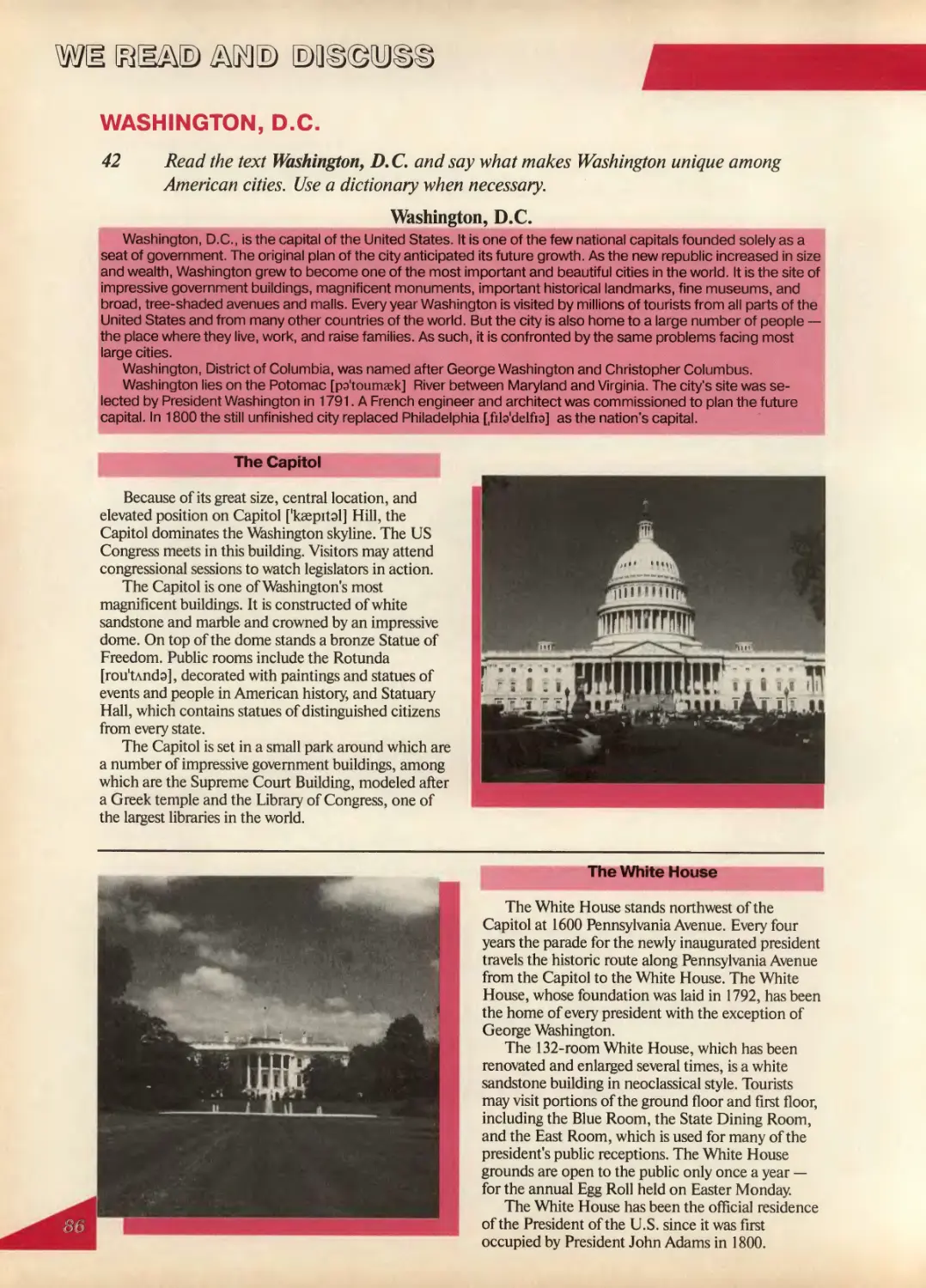
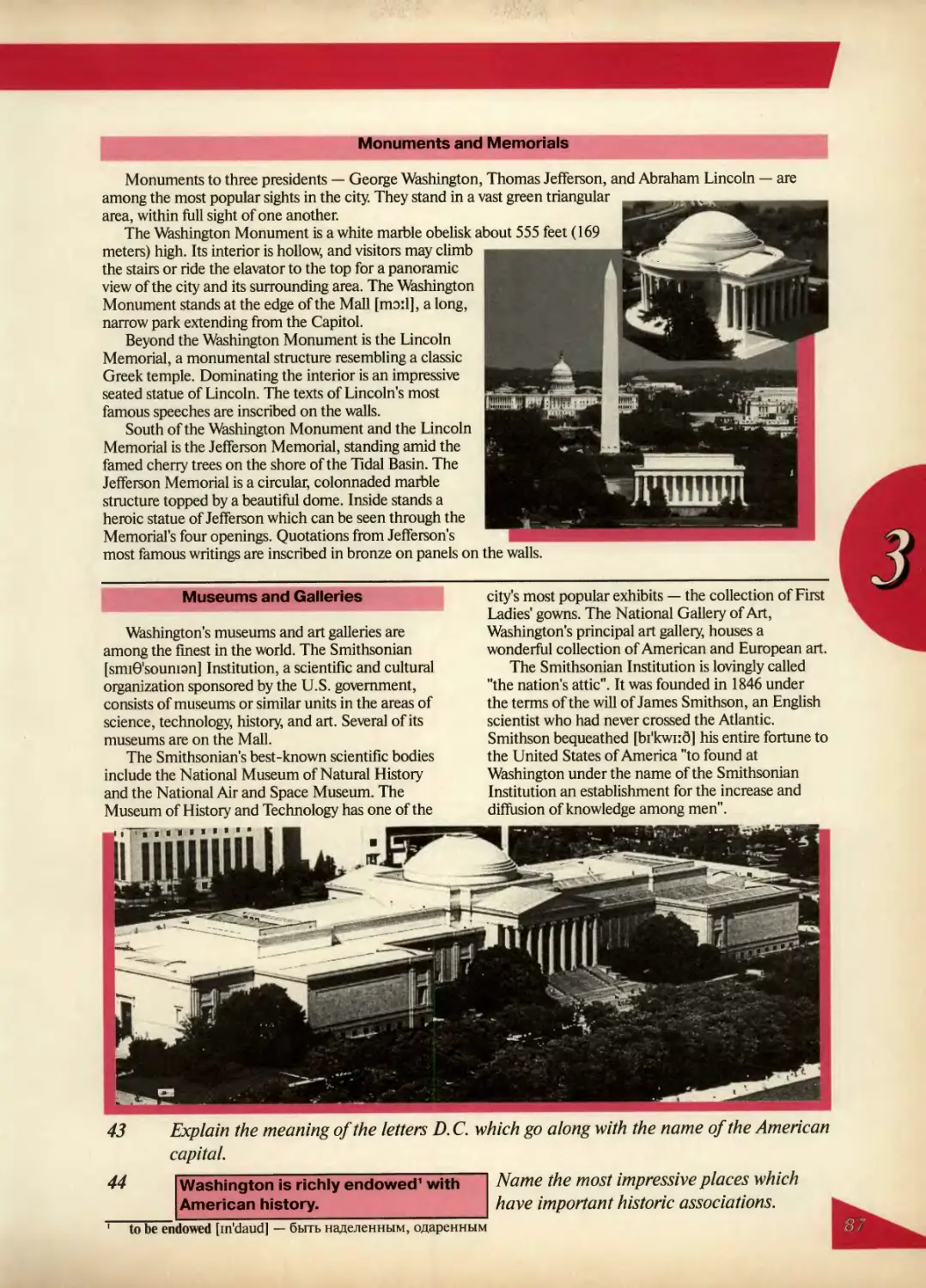


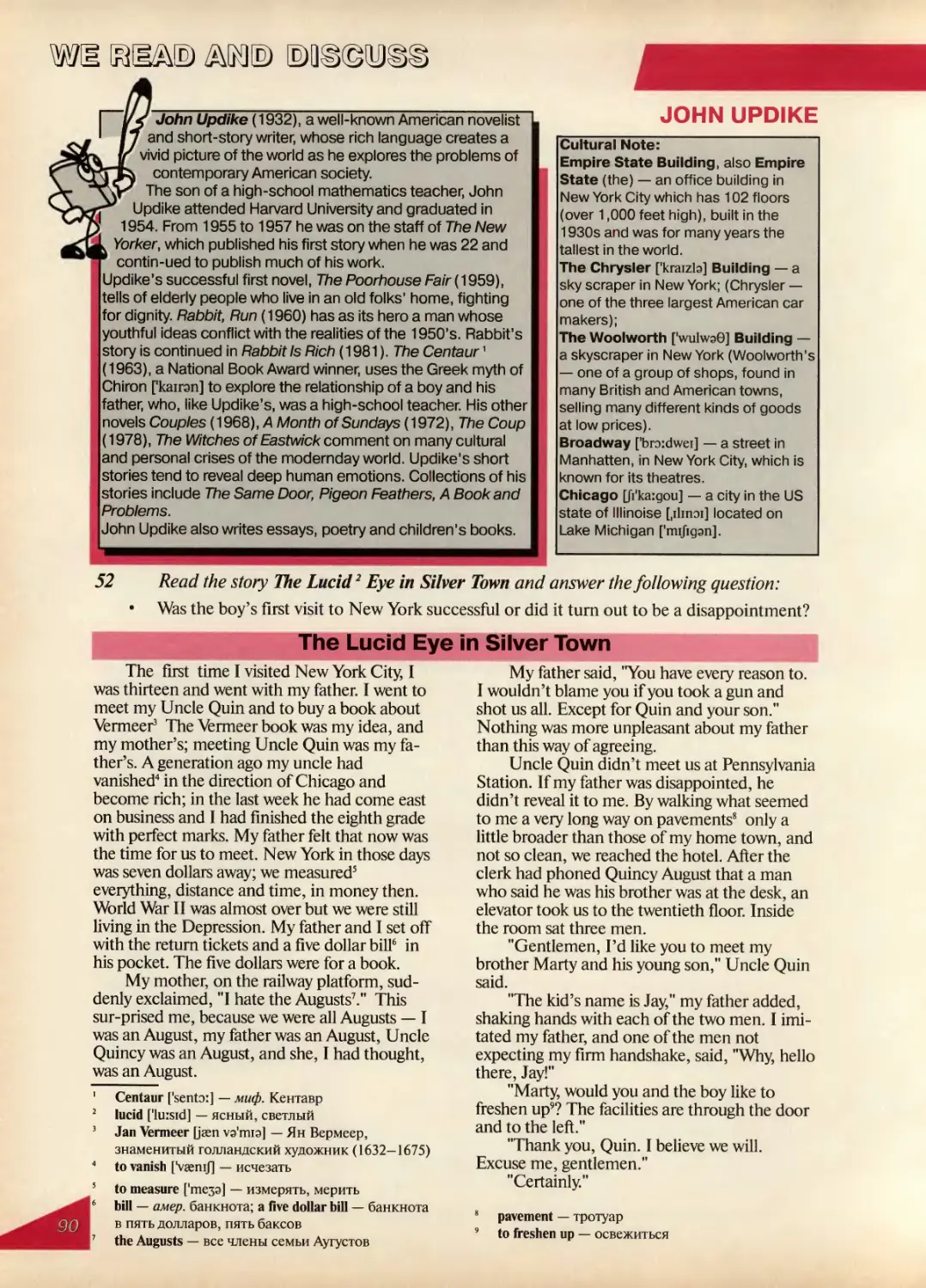


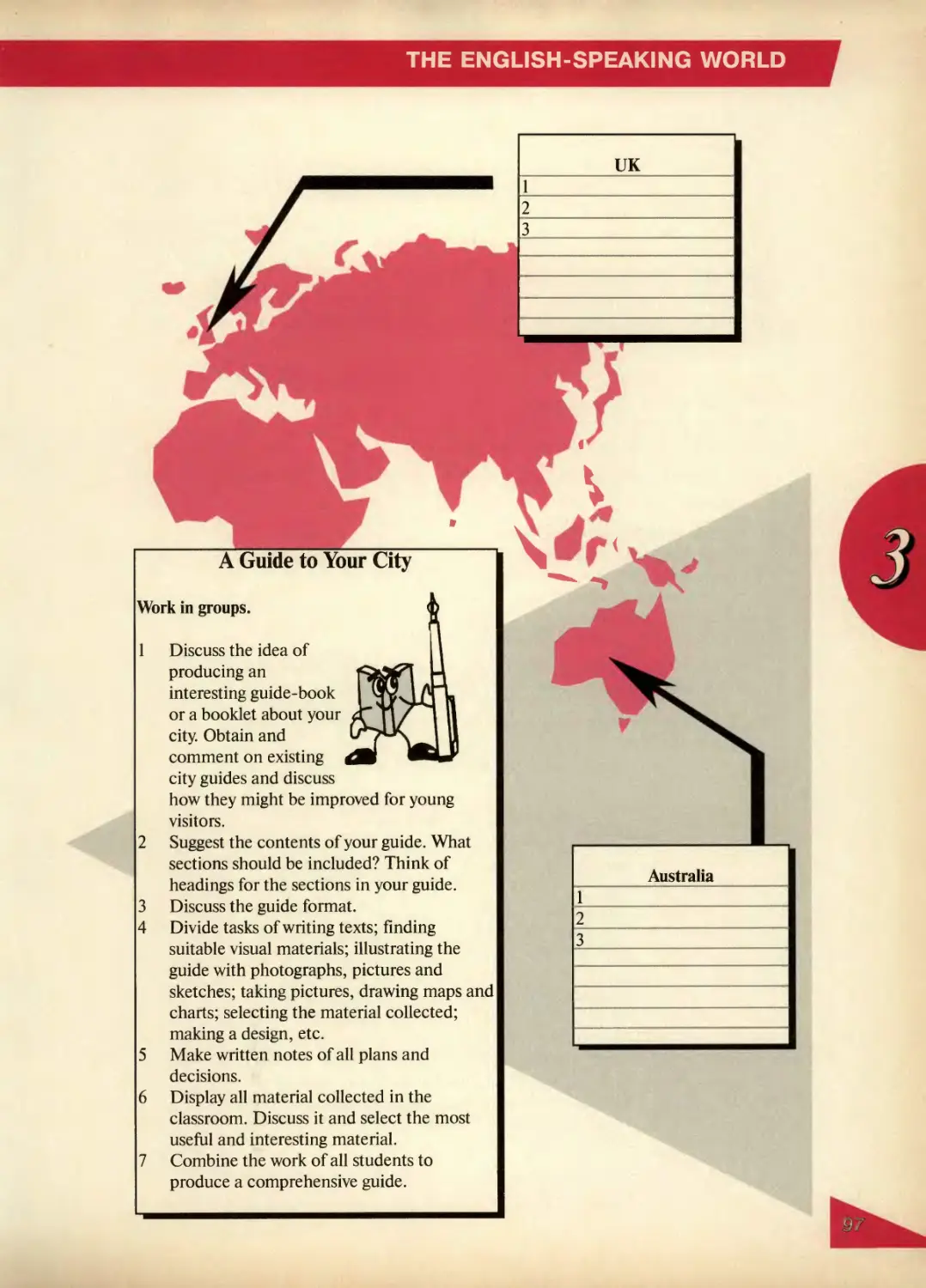






















































Автор: Bogoroditskaya V.N. Khrustalyova L.V.
Теги: english english grammar english language student book soviet student book
ISBN: 5-901059-03-4
Год: 1997



Текст
                    IX
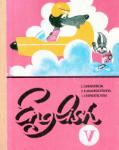
ENGLISH

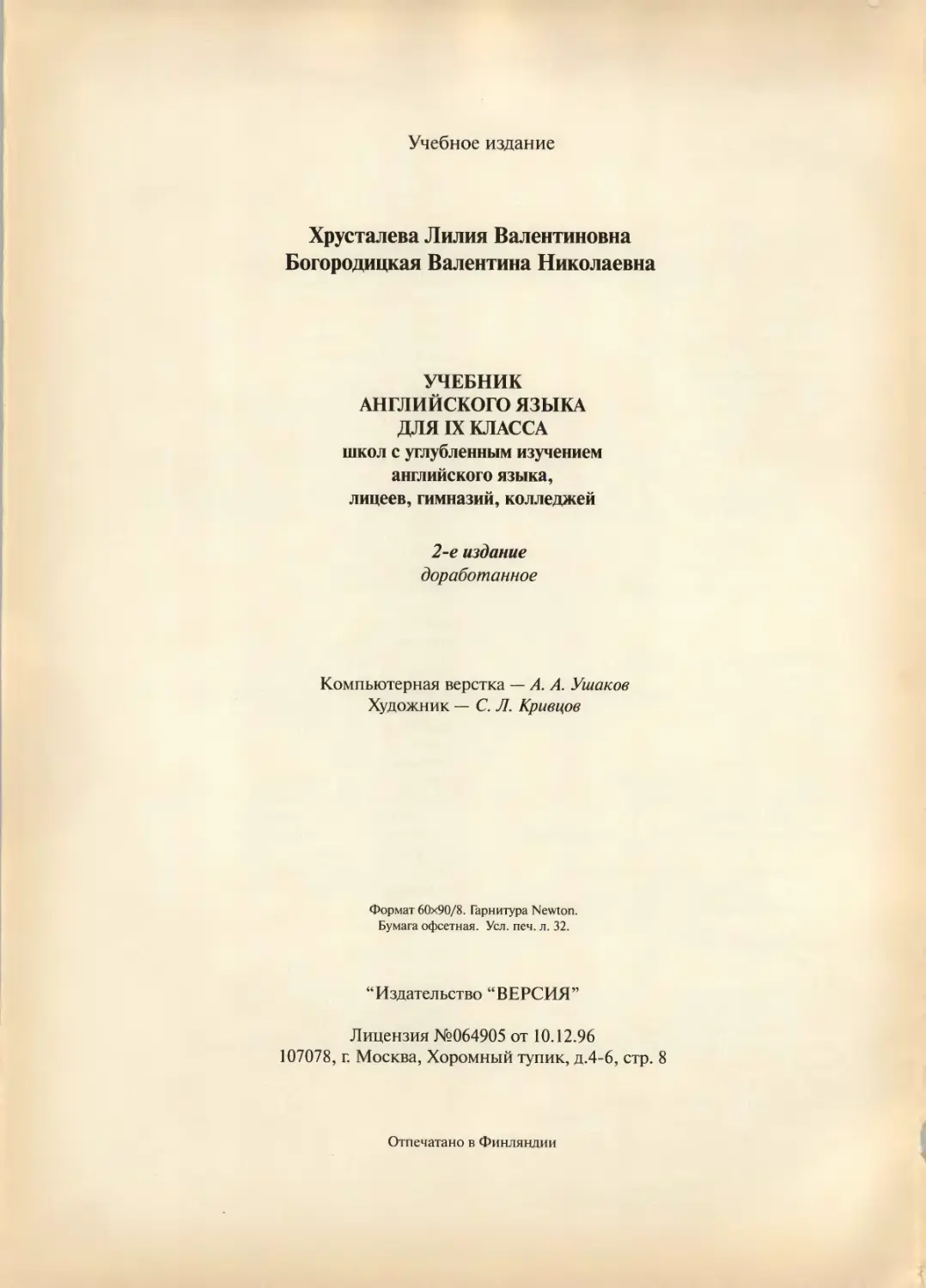
Л. В. ХРУСТАЛЕВА
В. Н. БОГОРОДИЦКАЯ
УЧЕБНИК
АНГЛИЙСКОГО
ЯЗЫКА
ДЛЯ IX КЛАССА
школ с углубленным изучением
английского языка,
лицеев, гимназий, колледжей
Рекомендовано
Министерством образования
Российской Федерации
2-е издание
доработанное
Москва
'Издательство "ВЕРСИЯ'
1997

CONTENTS
UNIT 1 "THERE IS NO FRIGATE LIKE A BOOK" 6
WE TALK READING IN YOUR LIFE
WE LEARN Vocabulary Study (1) REAL READING! REAL BOOKS!
Vocabulary Study (2) BOOKS AND READERS
Vocabulary Study (3) MEN OF LITERATURE
Grammar Study MODAL VERBS
WE READ The English-Speaking World
AND DISCUSS FAMOUS ENGLISH AND
AMERICAN POETS:
William Shakespeare, Walt Whitman
Frank O'Connor. The Idealist
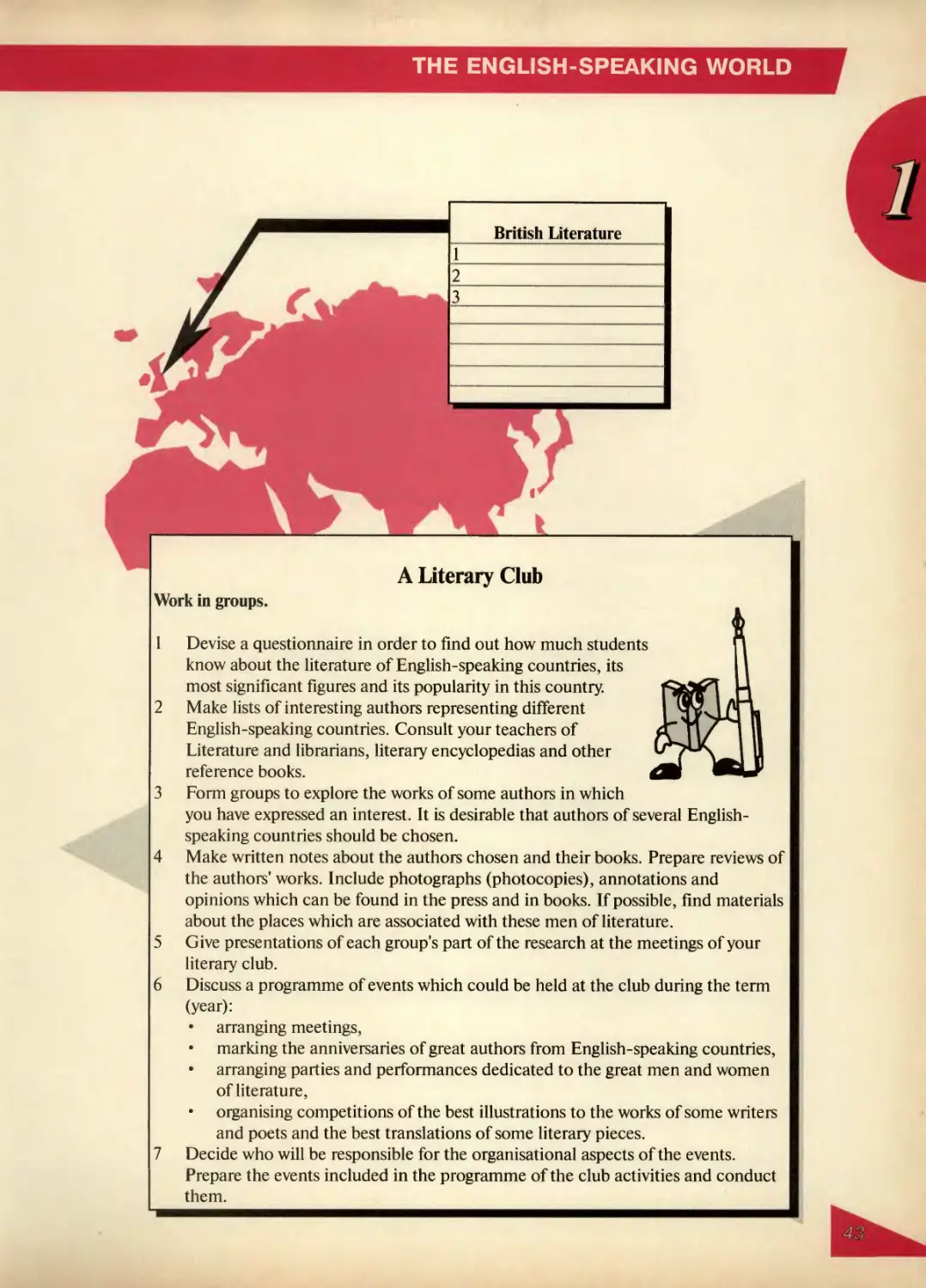
PROJECT A LITERARY CLUB
UNIT2 REALITY, DREAMS AND FANTASIES 44
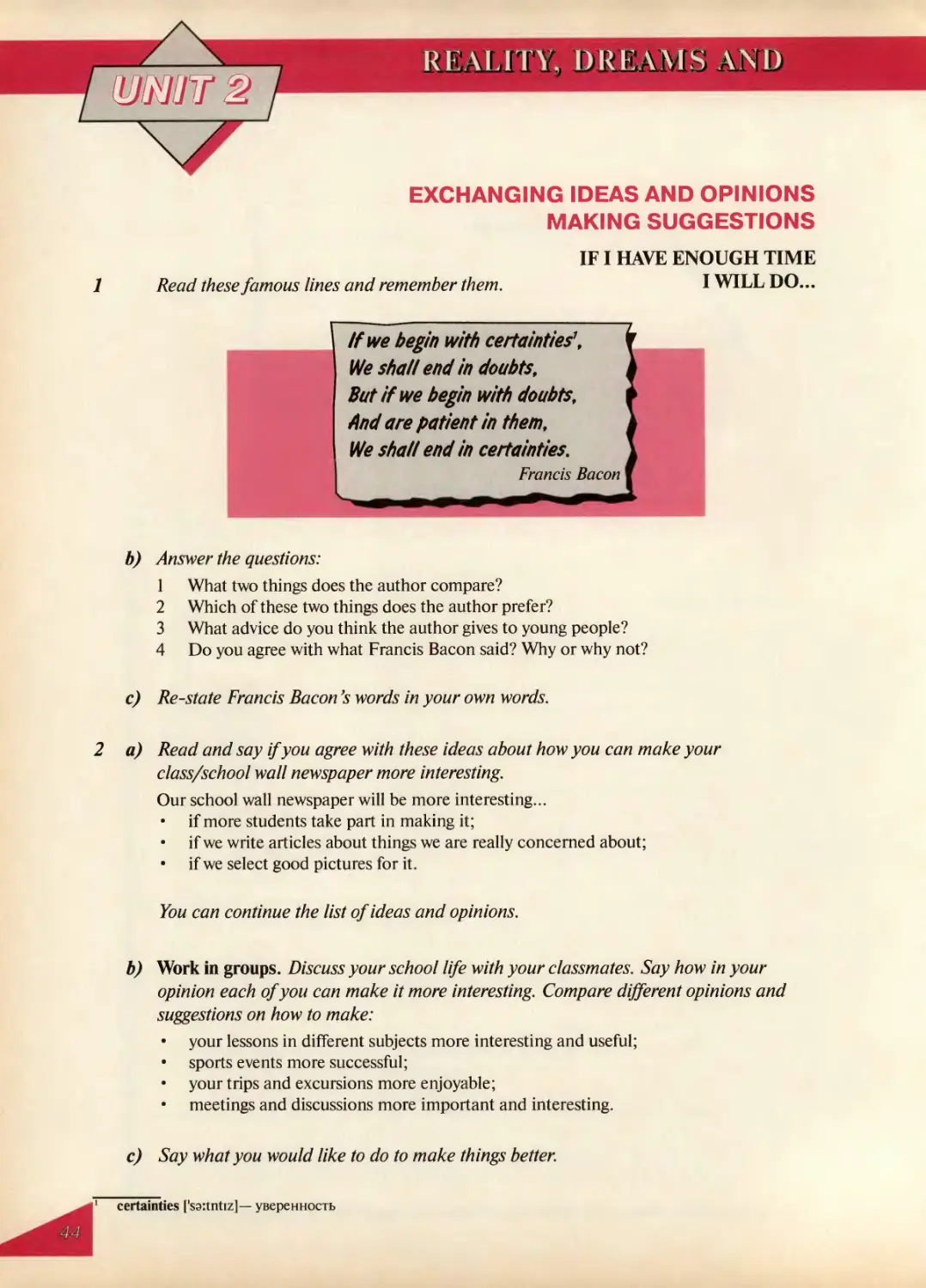
WE TALK EXCHANGING IDEAS AND OPINIONS
MAKING SUGGESTIONS
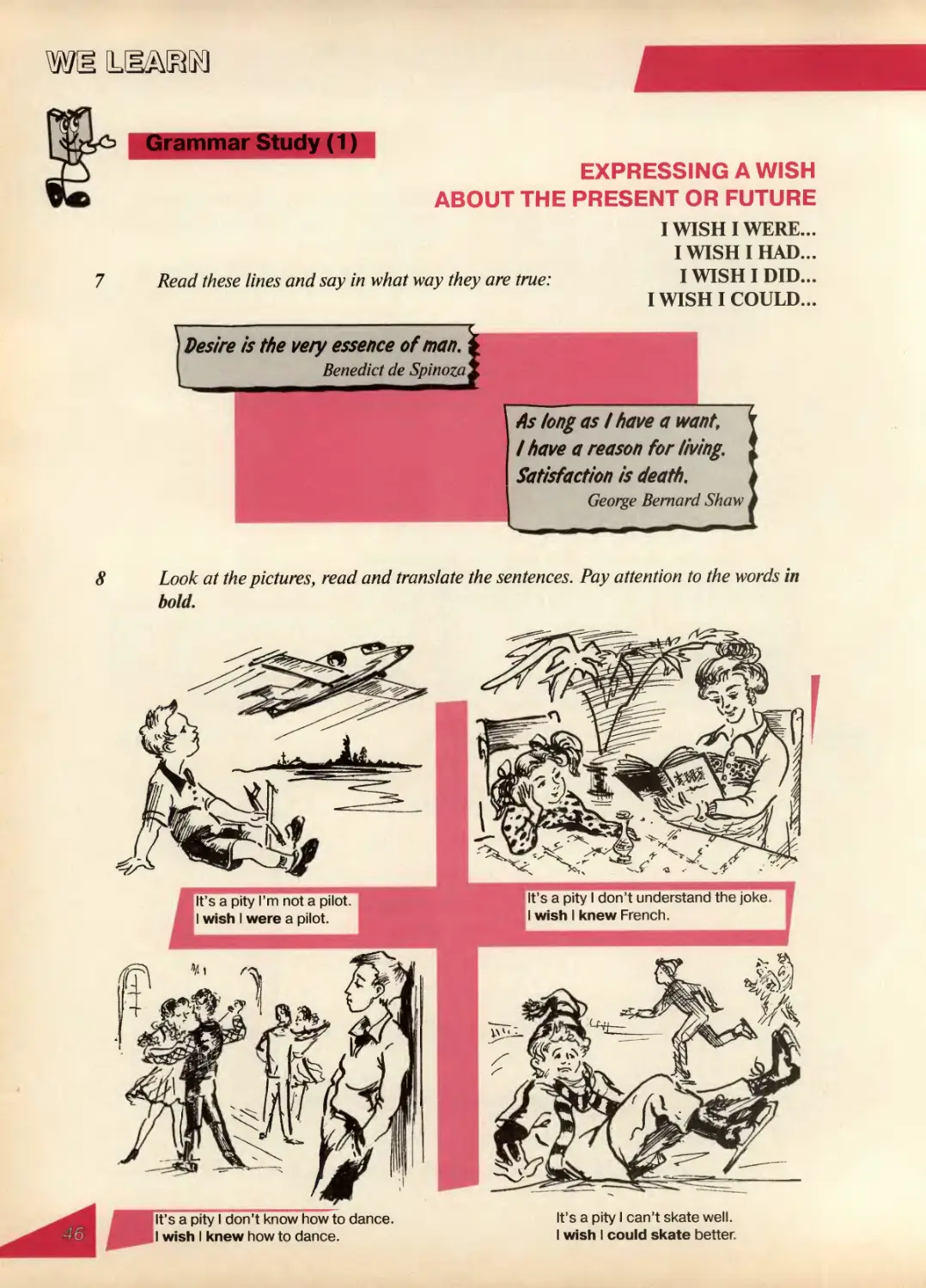
WE LEARN Grammar Study (1) EXPRESSING A WISH OR A DREAM
ABOUT THE PRESENT OR FUTURE
Grammar Study (2) TALKING ABOUT OUR FANTASIES
WE READ Charles Dickens. Only Facts
AND DISCUSS
UNIT3 "A STRANGE AND EXCLUSIVE WORD IS'CITY'" ..68
WE TALK ADVANTAGES AND DISADVANTAGES
WE LEARN Vocabulary Study (1) GOING IN THE RIGHT DIRECTION
THE LANGUAGE OF A CITY
PUBLIC SIGNS
Vocabulary Study (2) PLACES TO VISIT AND THINGS TO SEE
Vocabulary Study (3) ENTERTAINMENTS, RECREATIONS
AND LEISURE
WE READ The English-Speaking World
AND DISCUSS THE CAPITALS OF THE UK AND THE USA
London, Washington, D.C.
John Updike. The Lucid Eye in Silver Town
PROJECT A GUIDE TO YOUR CITY

UNIT4 REALITY, DREAMS AND FANTASIES 98
WE TALK TALKING ABOUT OUR DREAMS
AND FANTASIES
WE LEARN Grammar Study (1) EXPRESSING A WISH ABOUT THE PAST
Grammar Study (2) TALKING ABOUT OUR FANTASIES
(Subjunctive II)
WE READ Roselee Rockman. First Prize
AND DISCUSS
UNIT 5 "A NATION TALKING TO ITSELF" 112
WE TALK INFORMATION IS GOING AROUND
WE LEARN Vocabulary Study (1) SHAPING OPINIONS
Vocabulary Study (2) EFFECTIVE ADVERTISING
Vocabulary Study (3) THE POWER AND DANGERS
OF TELEVISION
Grammar Study UNREAL OR PROBLEMATIC ACTIONS
WE READ The English-Speaking World
AND DISCUSS TELEVISION IN GREAT BRITAIN
AND IN THE USA
Ray Bradbury. The Pedestrian
PROJECT A TELEVISION PROGRAMME
UNIT 6 FACING THE UNKNOWN 142
WE TALK CURIOSITY IS ONE OF THE DOORS
TO THE WORLD
WE LEARN Vocabulary Study (1) SCIENCE IS DISCOVERY
Vocabulary Study (2) FINDING OUT THE TRUTH
MAKERS OF THE MODERN WORLD
WE READ The English-Speaking World
AND DISCUSS FAMOUS ENGLISH
AND AMERICAN SCIENTISTS:
Michael Faraday, Thomas Alva Edison
Arthur Conan Doyle. The Lost World
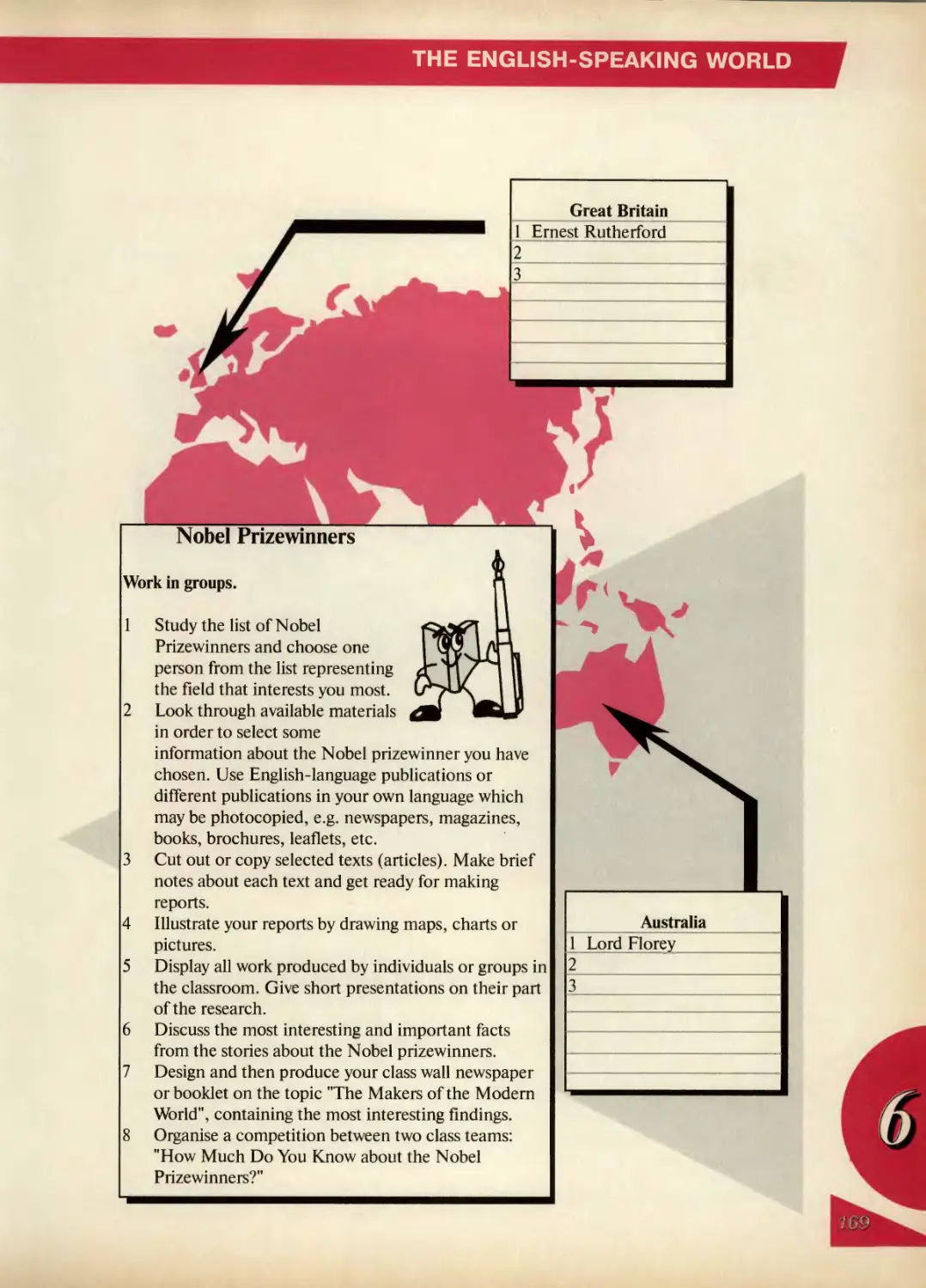
PROJECT NOBEL PRIZEWINNERS

CONTENTS
UNIT 7 "IF YOU DO NOT THINK ABOUT
THE FUTURE, YOU CANNOT HAVE ONE" 170
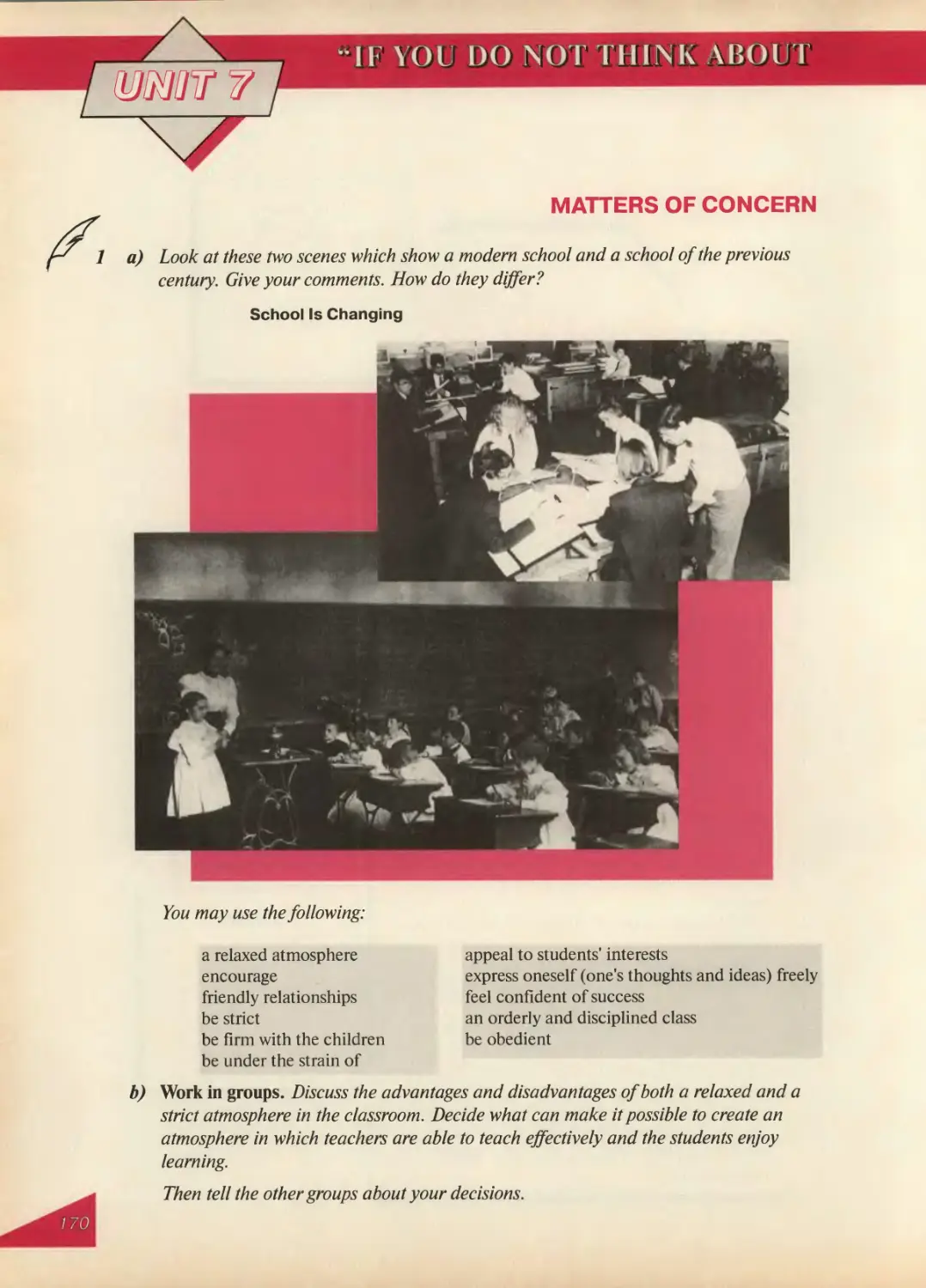
WE TALK MATTERS OF CONCERN
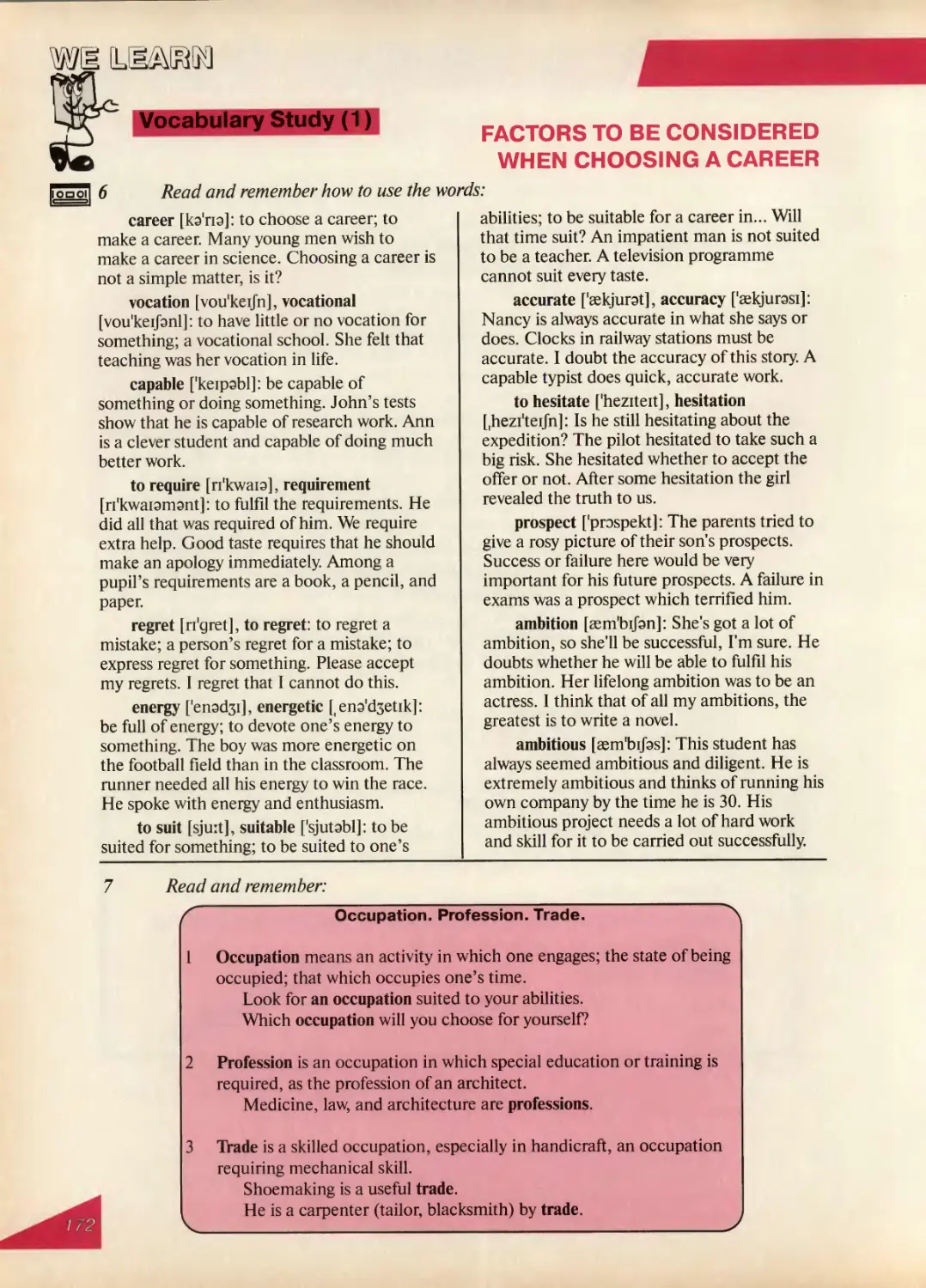
WE LEARN Vocabulary Study (1) FACTORS TO BE CONSIDERED
WHEN CHOOSING A CAREER
Vocabulary Study (2) CREATING TOMORROW TODAY
WE READ The English-Speaking World
AND DISCUSS CAREEERS GUIDANCE IN BRITISH
AND AMERICAN SCHOOLS
William Saroyan. Out of Order
PROJECT JOB ADVERTS
UNIT 8 "SPEAK TO THE EARTH" 200
WE TALK LOVELINESS TO BE FOUND
WE LEARN Vocabulary Study (1) YOU ARE A PART OF THE ENVIRONMENT
Vocabulary Study (2) WHAT CAN BE DONE?
Vocabulary Study (3) PRESERVING THE PLANET
FOR THE FUTURE GENERATIONS
WE READ The English- Speaking World
AND DISCUSS ENVIRONMENTAL POLICIES
IN GREAT BRITAIN AND IN THE USA
Art Buchwald. Fresh Air Will Kill You
PROJECT EARTH DAY POSTERS
Appendix 226
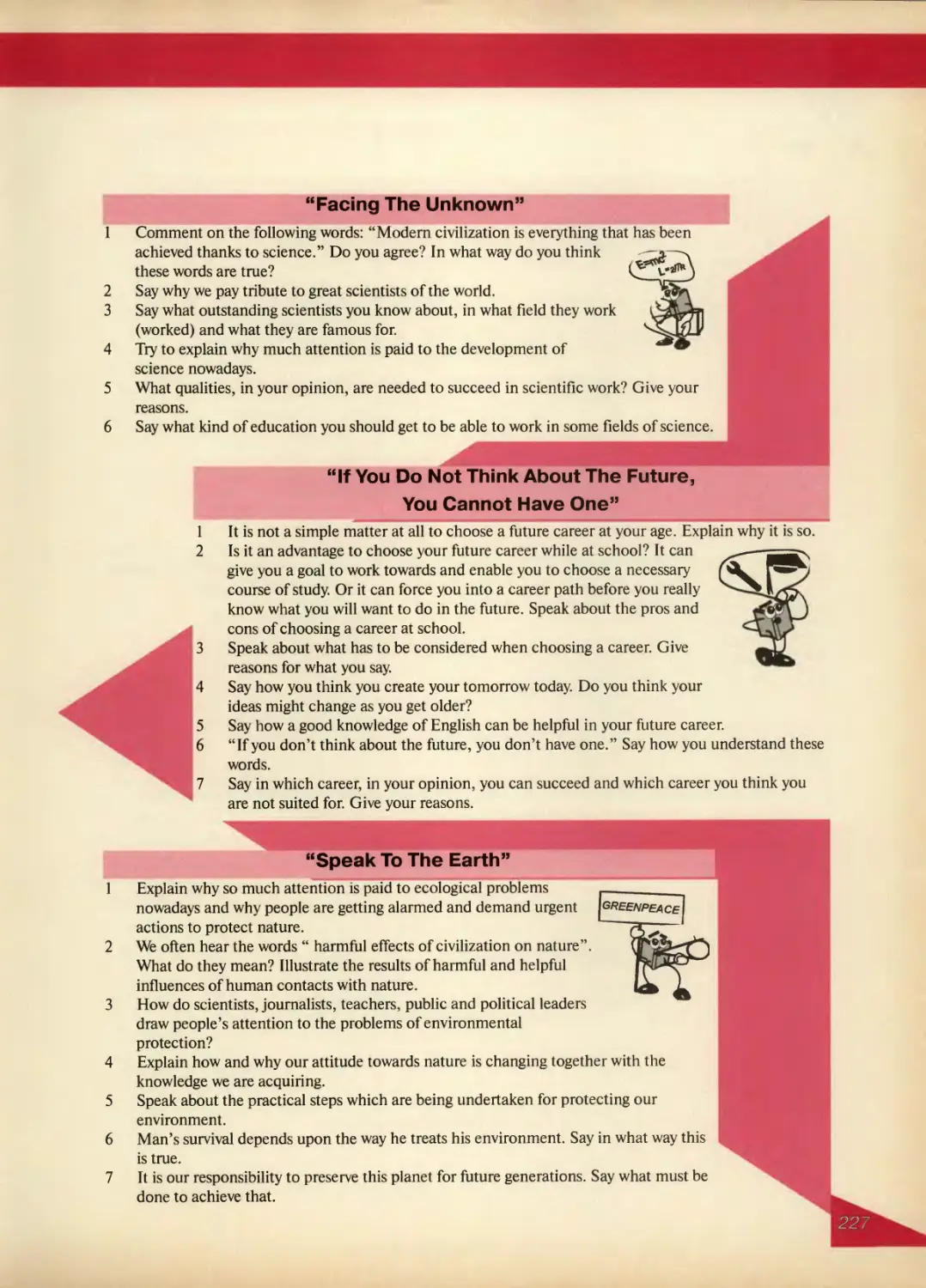
REVIEWING TOPICS
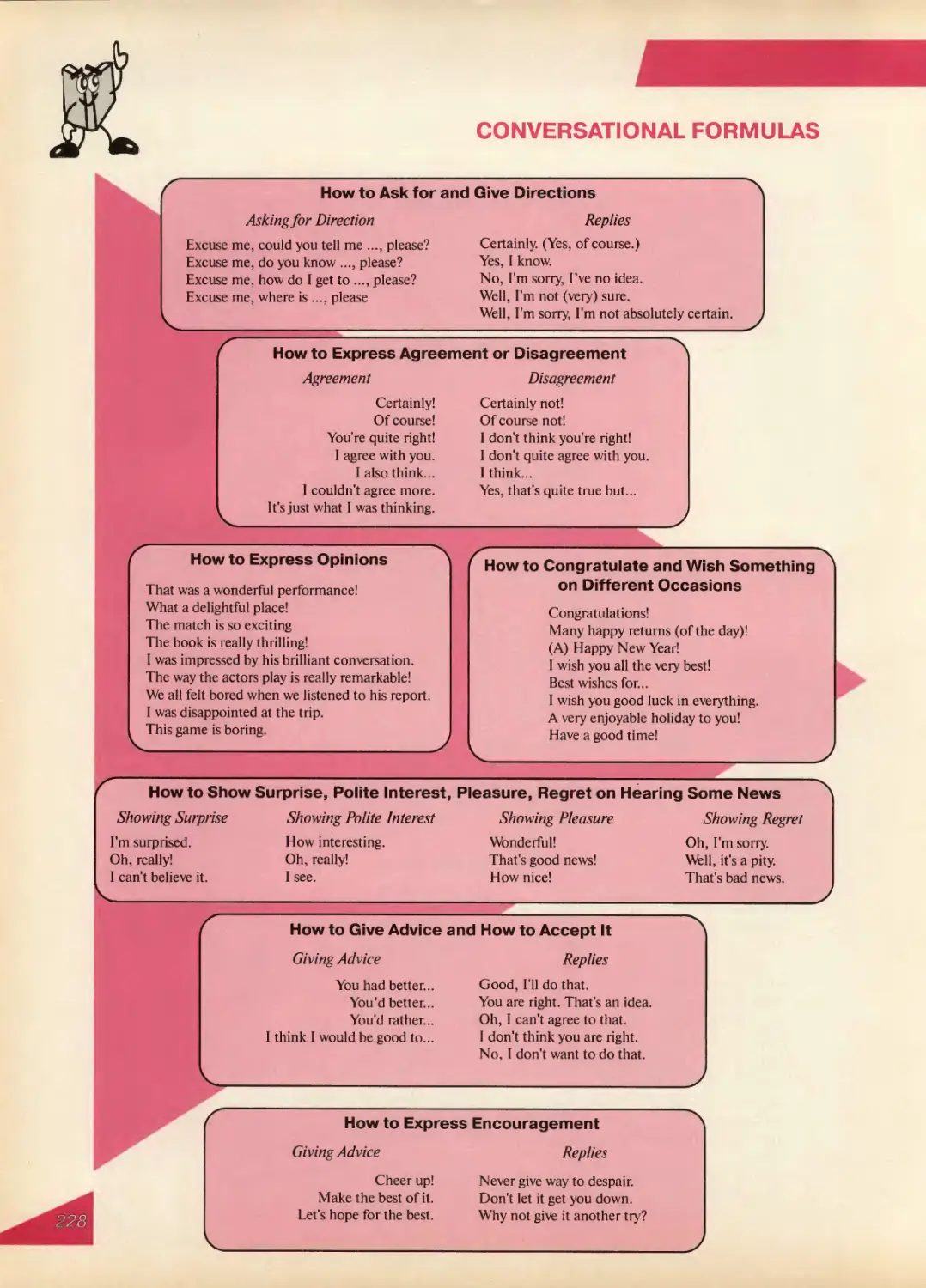
CONVERSATIONAL FORMULAS
GRAMMAR
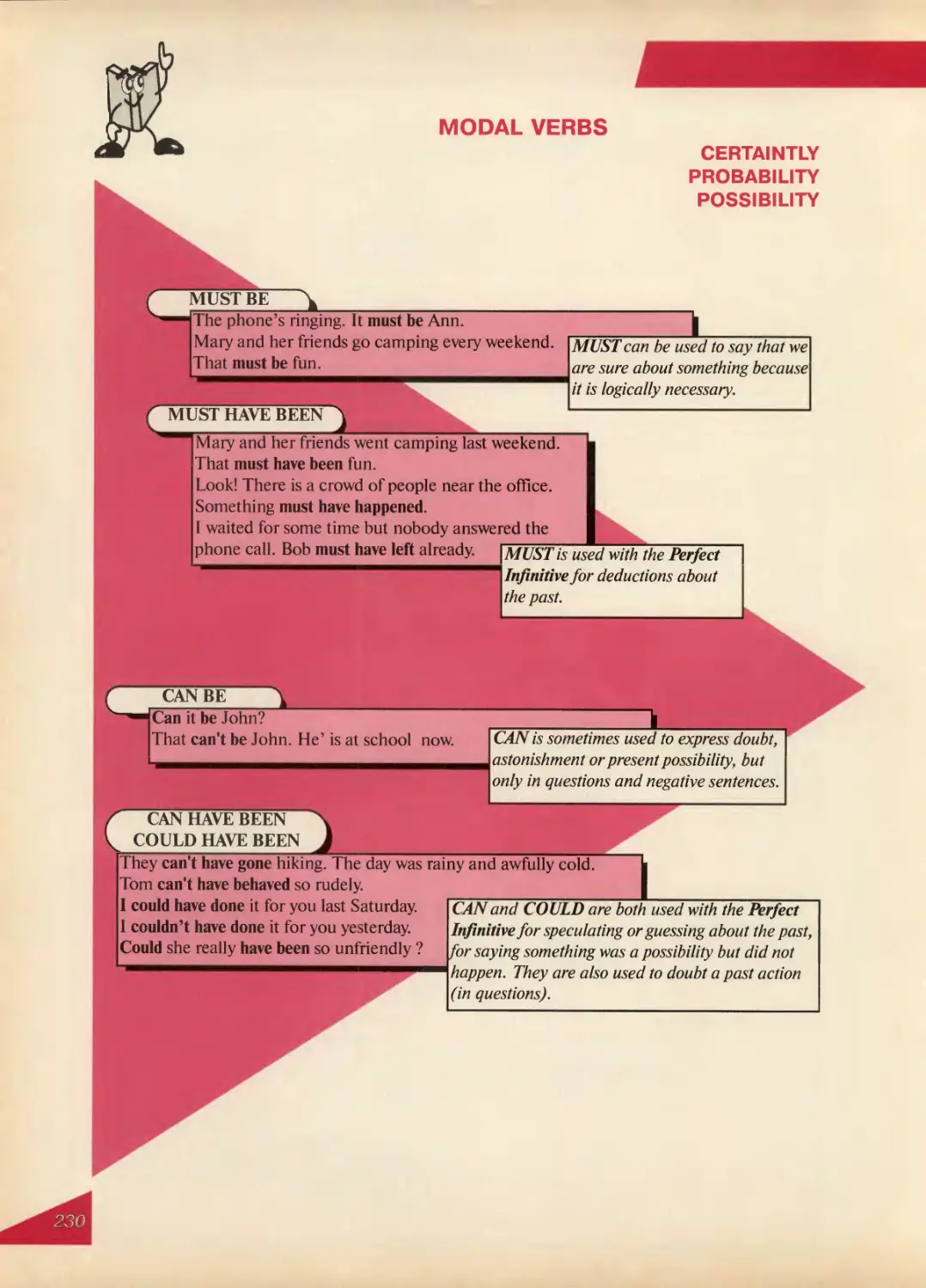
Modal Verbs
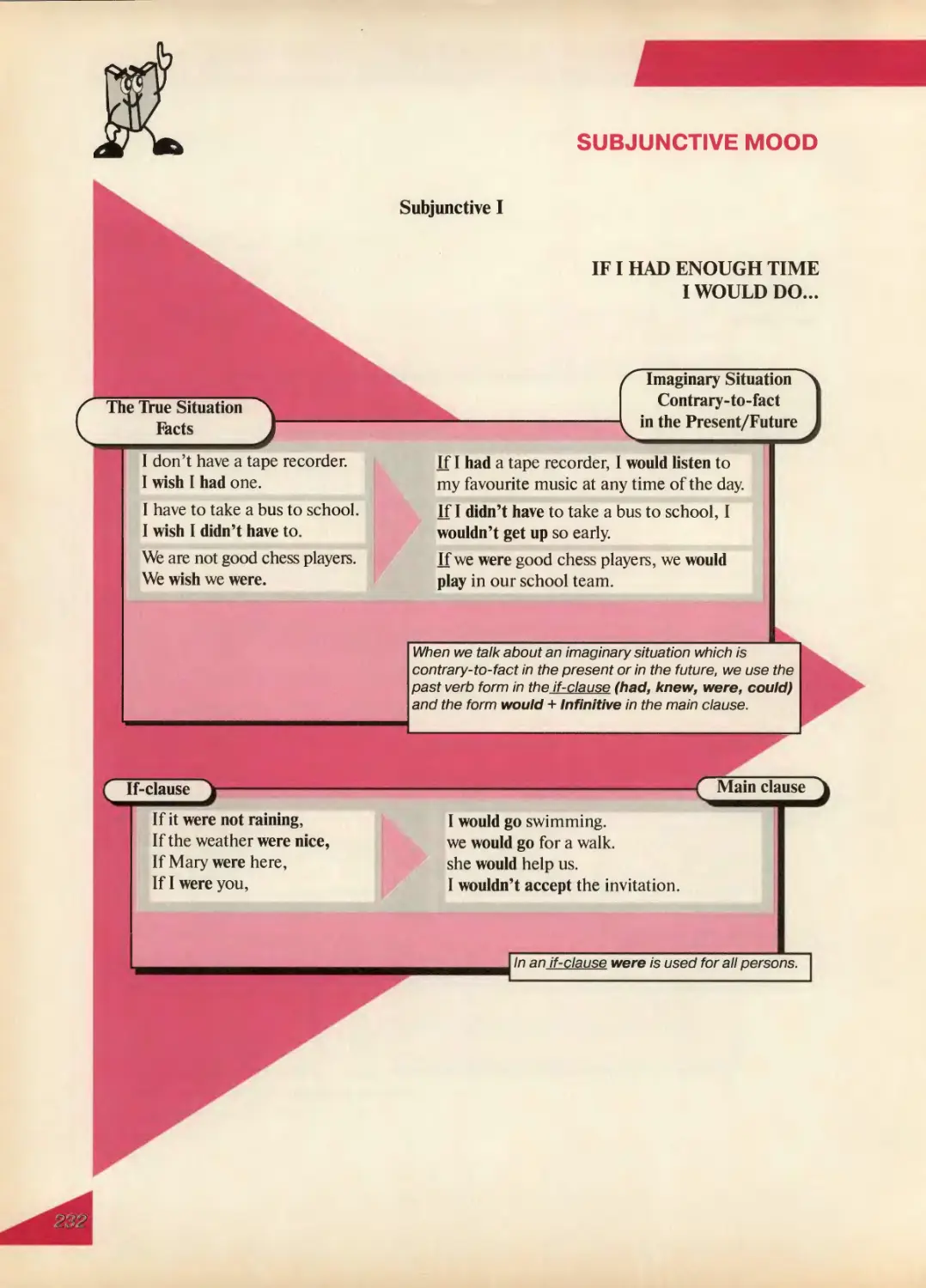
Subjunctive Mood
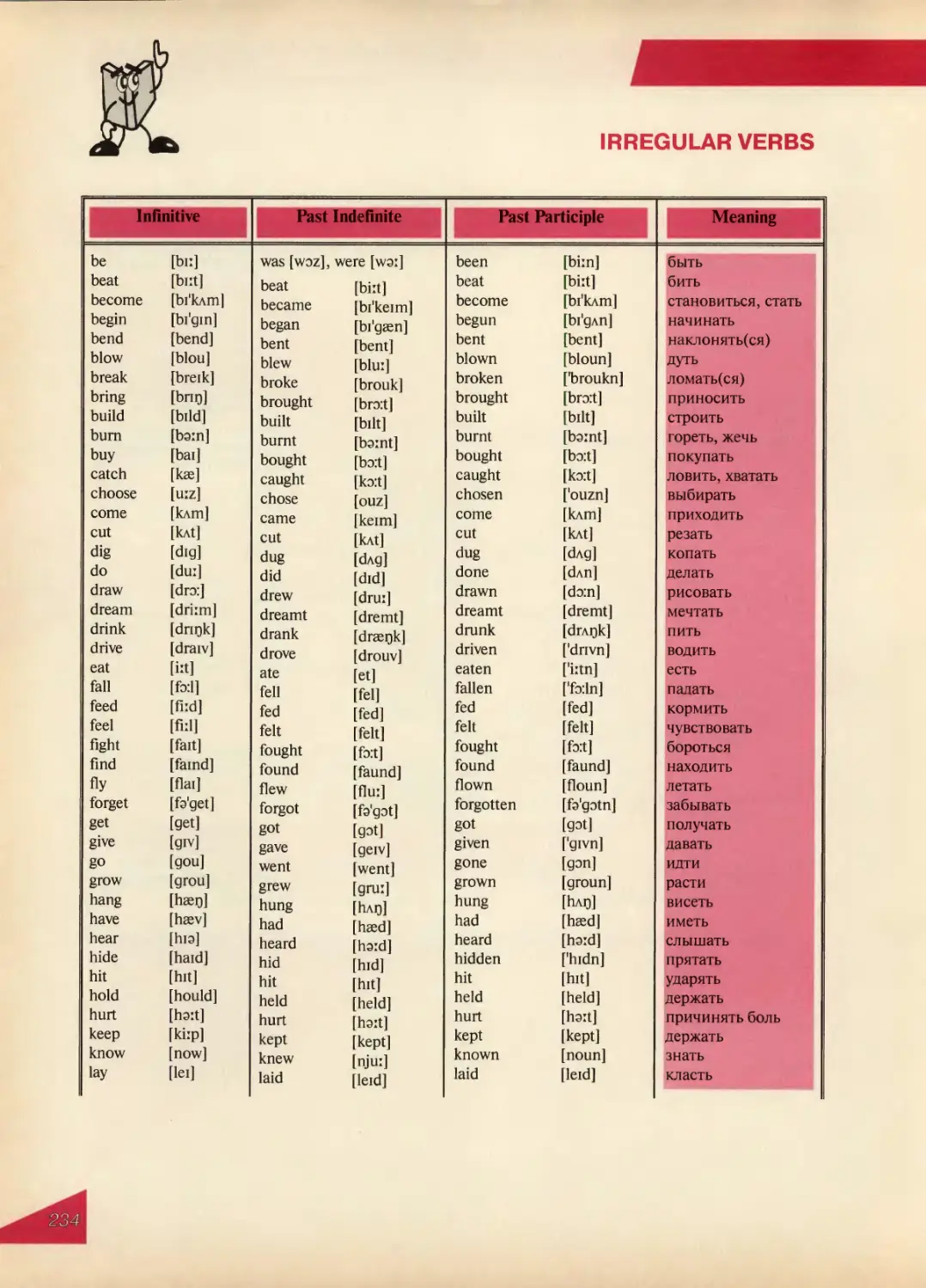
IRREGULAR VERBS
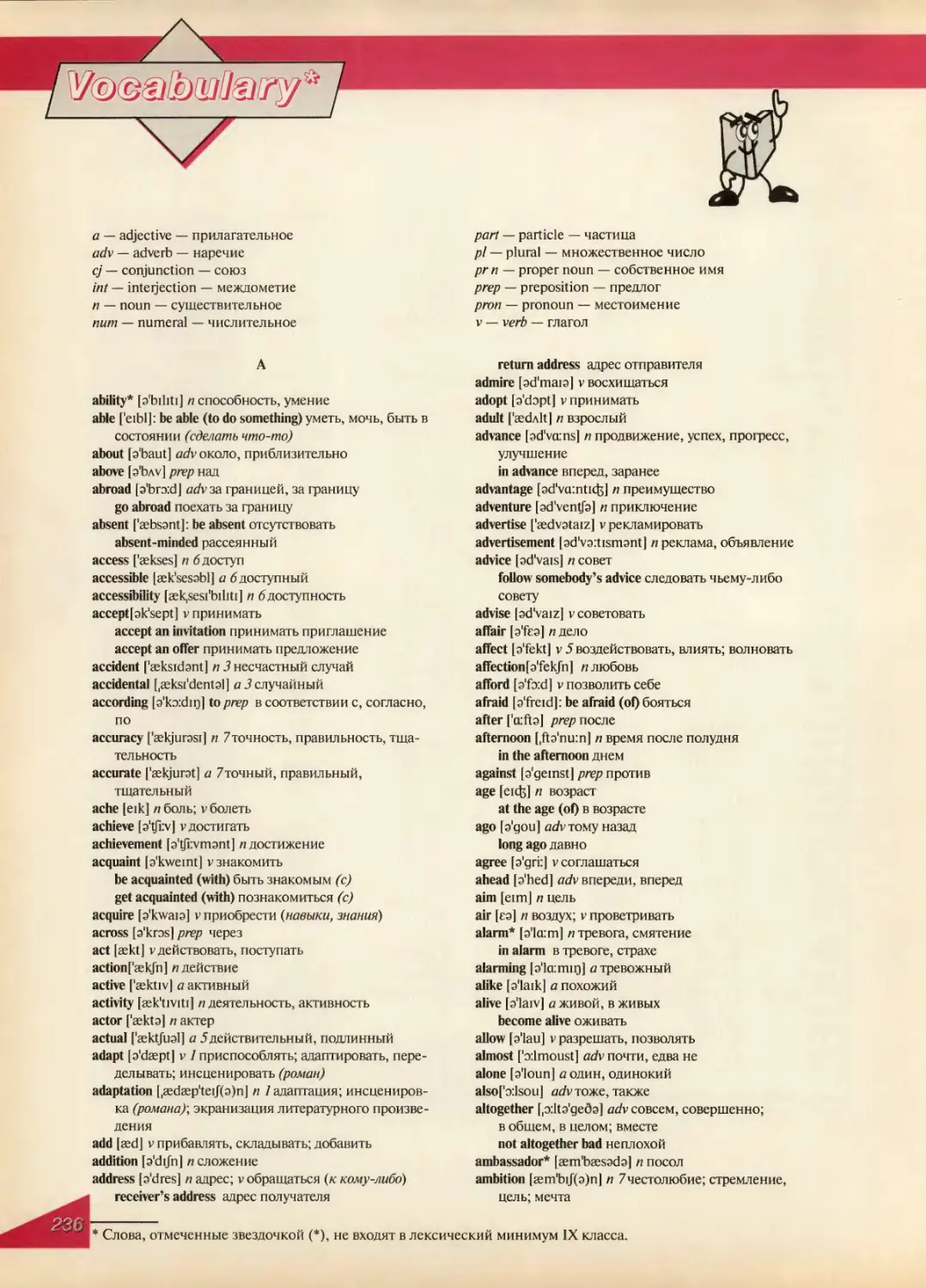
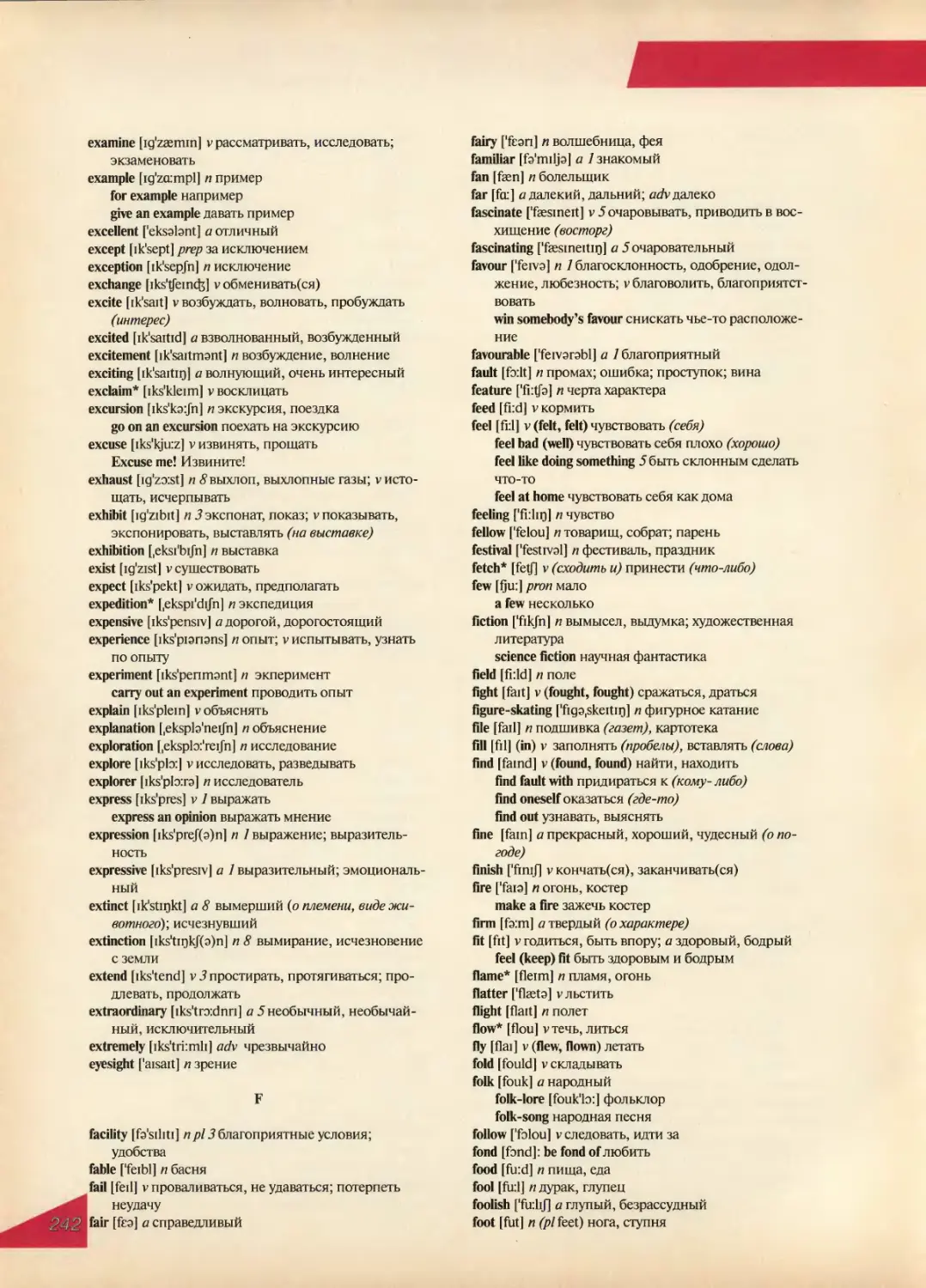
Vocabulary 238

UNIT 1
"THERE IS NO FRIGATE
READING IN YOUR LIFE
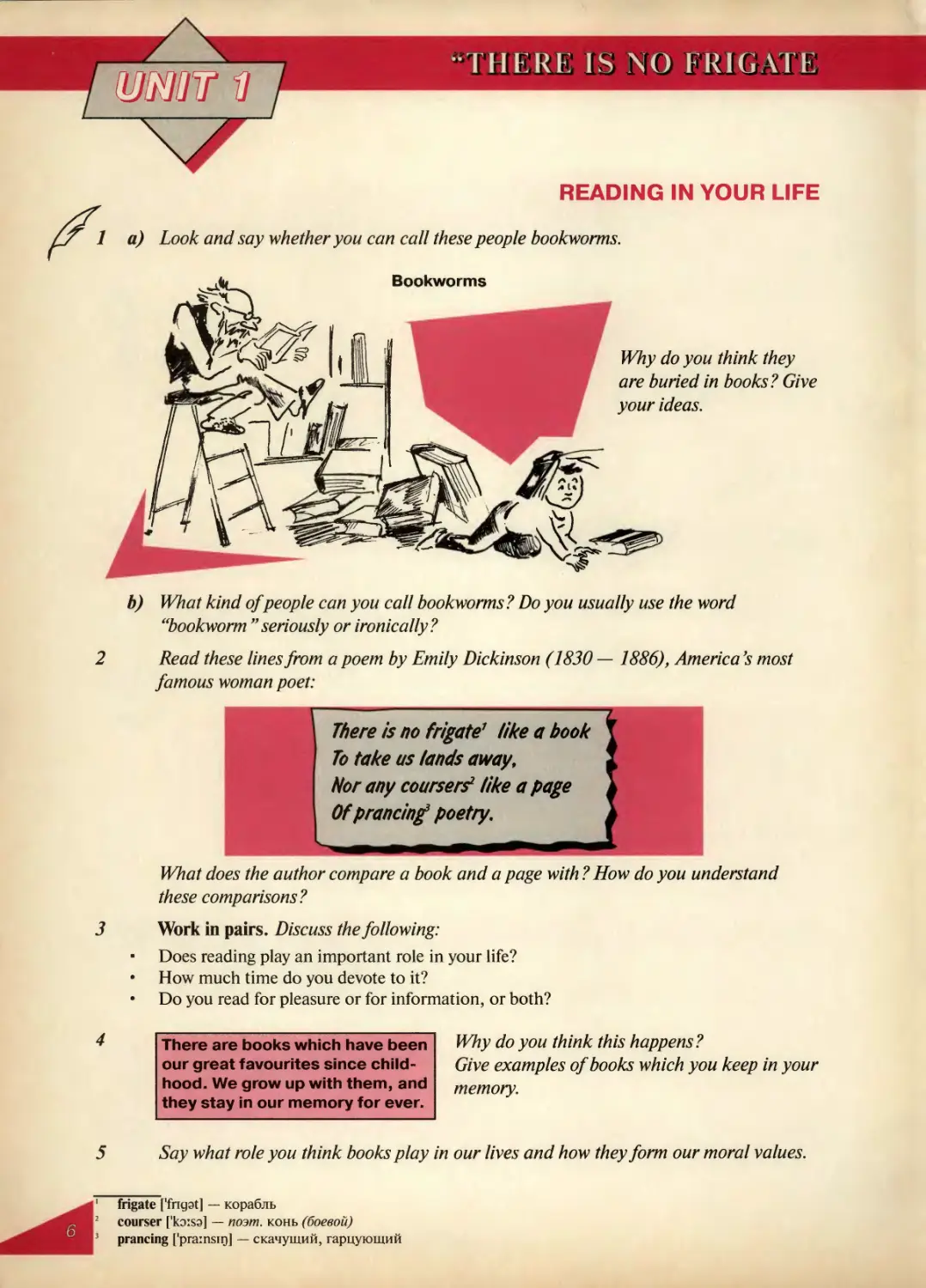
1 a) Look and say whether you can call these people bookworms.
Bookworms
Why do you think they
are buried in books? Give
your ideas.
b) What kind of people can you call bookworms ? Do you usually use the word
"bookworm "seriously or ironically?
2 Read these lines from a poem by Emily Dickinson (1830 — 1886), America's most
famous woman poet:
There is no frigate1 like a book
To take us lands away,
Nor any coursers2 like a page
Of prancing poetry.
What does the author compare a book and a page with ? How do you understand
these comparisons?
3 Work in pairs. Discuss the following:
Does reading play an important role in your life?
• How much time do you devote to it?
Do you read for pleasure or for information, or both?
4 I There are books which have been I Why do you think this happens ?
our great favourites since child- Give examples of books which you keep in your
hood. We grow up with them, and memory.
they stay in our memory for ever.
5 Say what role you think books play in our lives and how they form our moral values.
1 frigate [Tngat] — корабль
2 courser ['kaisa] — поэт, конь (боевой)
3 prancing ['pramsirj] — скачущий, гарцующий

LIKE A BOOK"
(Emily Dickinson)
6 a) Listen to the poem Unfolding Bud', then read it. Answer the question: How does the
author show that a poem "at a first glance" is like a tiny bud?
Ом iq 0/}>vave>d
D(j 0> UQ/toi-$b&U bcod
QtujotdUbg
QlAttv e>ck>fv ptbQQbug dcoy,
Та/Ь'мд btv со AbokbA oofloorA
And MM dbtH/mQbOVbQ9.
Ом bQ fbOt Q/ln/Q&&d,
At Ct/ {jbAQt фО/№Ъ
iBq л pom,
4/\flvbCik bQ qa tbg/vt-aioQ&d
{\q Q/ tbng bu/d.
Q^&t OM bQ QtoAp/bbQ&d
To Qe>e> the/ рош
QACbdu/Q/Щ frthfrofldbng
*&ша4ыьд btQ Abah ьпмл g&ty,
As om A&adQ bt Q/gQ/bib
And OVbA Q/gO/blb.
Naoshi Koriyama
b) How do you understand the author's words about the poem "gradually unfolding "?
What do you think makes a poem unfold? How are the bud and the poem alike after
they unfolded?
c) Express the idea of the poem in your own words.
Love for reading gives those who
are great readers of books an
advantage over those who have
not read so much.
Do you agree with these words? In what
way do you think they are true ? Develop
this idea.
1 bud — бутон, почка
2 dimension [dai'menjbn] — размер
1 gradually ['grasdjuali] — постепенно

WE LEARN
i REAL READING! REAL BOOKS!
8 Read and remember how to use the words:
emotion [I'moujh], emotional: an emotional
person. Love, hate, joy, fear and anger are
emotions. Chopin [^oupaen] aroused very deep
emotions in her. I think the Welsh are a much
more emotional people than the English.
to arouse [a'rauz]: to arouse emotions; to
arouse feelings of sympathy; to arouse
admiration. Their terrible sufferings aroused
our pity.
to express [iks'pres]: to express an idea or
feeling; to express an opinion. A child's feelings
are often expressed by crying. Her eyes
expressed joy. She expressed herself through
art. The writer expresses his views and ideas in
clear simple words.
expression [iks'prejan], expressive
[iks'presrv]: expressions of joy; slang
expressions; an expressive language. When I saw the
expression on his face, I realised how angry he
was. I couldn't see Helen's expression, because
her head was turned away. Their playing of
Beethoven ['beithouvn] was full of expression.
She gave me an expressive look.
to entertain [.enta'tem], entertaining,
entertainment [.ents'temmant]: to entertain
friends. We were all entertained by his jokes.
The circus clown showed amusing tricks, much
to the entertainment of the audience. We
entertained the guests with a detailed
description of the party. He is full of
entertaining stories.
to depict [di'pikt]: The author depicts his
characters very convincingly, as he experienced
the same joys and troubles. Realistic writing
often depicts the everyday life and speech of
ordinary people.
to portray [po:'trei]: to portray life
truthfully. The artist portrayed the sunny field
in brilliant colour. The author portrayed the
village as a delightful place.
lack [laek], to lack: a lack of knowledge; a
lack of information; lack of emotion; lack of
discipline; to lack words; to lack wisdom;
lacking of generosity. Lack of time prevented
me from writing to you. He is clever but he
lacks experience.
appeal [э'рЫ], to appeal: to appeal to
somebody's interests. Books bring people
pleasure and delight, and appeal to the readers'
own interests. Do these paintings appeal to
you? Bright colours appeal to small children.
That sort of music hasn't much appeal for me.
It is a love story in great appeal.
episode ['episoud]: Will you please describe
the most powerful episode from the chapter?
The novel, episode by episode, shows how the
hero was making his own way of life.
passage ['paesid3]: Do you remember any
powerful passage that you came across in your
reading?
9 a) Read these lines from the old Japanese Moral Code. Find out what used to be one of
the most highly-valued qualities for the Japanese. Why did they appreciate it?
"Patience means holding back your inclination
to the seven emotions: hate, adoration, joy,
anxiety, anger, grief, fear. If you do not give way
to the seven, if you are patient, then you will
soon understand all manner of things and be in
harmony with Eternity."
Japanese Moral Code
10 Some people show their emotions, such
as sadness, delight, happiness, anger
and so on. Others try not to show their
feelings.
b) Have our values changed in the
twentieth century? Which do you
value more: holding back your
emotions or giving way to your
feelings and being free in
expressing yourself? Why?
a) Describe what different people
do or how they act when they
feel different emotions.
b) Say:
what you do and how you act when you feel various emotions;
whether you express your feelings emotionally and let others know what you feel;
or whether you hold back your emotions, trying not to show them.

11 Say what emotions you feel when reading different kinds of books and how these
emotions are determined by the contents of the book, its problems, its language and
the way the characters are depicted.
12 Recall an episode or a passage from a book which aroused emotions in you such as
sympathy, admiration, delight, horror and so on.
13 Give a character sketch' of the person who most appealed to you in the books you
read. Say what emotions his or her actions, behaviour, manners and words aroused in
you.
14 Work in pairs.
a) Find out whether your classmates change their views about the plot and the
characters while reading a book. If they do, what makes them change their opinions?
b) Tell the others in the group what you have found out.
15 Read this quotation and comment on it.
There is an art of reading as well as an art of thinking
and an art of writing.
Isaac Disraeli
Why do you think the author considers reading, thinking and writing to be an art? Do
you agree? Why or why not?
16 a) Study the meaning of the words with the suffix -ize.
Noun/Adj + -ize = Verb
central centralize critic criticize "^
popular — popularize sympathy — sympathize
special — specialize drama — dramatize
memory — memorize character — characterize
b) Read and translate these phrases:
to criticize some works of art to sympathize with a person's feelings
to dramatize a popular story to characterize a situation
to memorize a dialogue to popularize classical music
c) Read and translate these sentences:
1 The teacher asked the students to learn the dialogue by heart. Within ten minutes
they all memorized it.
2 Your work is characterized by lack of attention to detail.
3 His parents do not sympathize with his wish to be an actor.
4 The new novel of a young and promising writer was dramatized by one of London's
theatres.
5 Specialized knowledge is something more valuable than general knowledge.
6 I consider it wiser not to criticize the report.
1 character sketch — характеристика, описание действующего лица

Vocabulary Study (2)
BOOKS AND READERS
17 Read and remember how to use the words:
to quote [kwout], quotation [kwou'teijh]:
quotations from Shakespeare. Which book is
this phrase quoted from? Can you quote any
famous man or woman of literature?
familiar [fa'milja]: familiar quotations; the
familiar voice of an old friend. These facts may
be familiar to you.
humour ['hjuima], humorous ['hjuimaras]:
to have a good sense of humour; a humorous
writer; a humorous remark; a humorous
character. The story is full of humour. I don't
see much humour in his remarks. Which of the
humorous writers do you appreciate most of
all?
vivid [Vivid]: a vivid imagination; a vivid
description. There are perhaps several faults in
this book but we can't help admiring its vivid
descriptions. The character of the hero is
vividly drawn in the book. There are lots of
things of interest at the exhibition which vividly
demonstrate the latest achievements in
medicine. Do you think that vivid descriptions
add interest to a book?
similar ['simib]: words with a similar
meaning; to write in a similar manner. Pink
and rose are similar colours. How are these
authors similar?
remark [n'ma:k], to remark: to make
remarks. He made a few remarks about the
weather and then said goodbye. Did he make a
remark about my coming late? Did you remark
the similarity between them? He remarked that
he would be absent the next day.
influence ['influans], to influence: to
influence the readers; an influence on
character. What is the influence of literature on
young people? Our literary tastes are influenced
by classical writers. We are influenced by good
examples. I didn't want him to influence me in
my choice.
entire [m'taia]: to be in entire ignorance of
what happened; entirely forgotten. I disagree
entirely. I entirely agree with you. He ate the
entire cake.
keen: a keen gardener; to be keen on
literature; a keen, enthusiastic boy; a keen
emotion; a keen sense of humour. He took a
keen interest in domestic affairs. Boys are less
keen on cooking than girls. I was still keenly
interested in outdoor activities. Molly was very
keen on music.
to adapt [a'daept], adaptation
[.asdap'teifon]: to adapt to a new situation; to
adapt a book or a play for television; a screen
adaptation; a stage adaptation. This book is
about change and how we adapt to it. He
cannot adapt himself to the new conditions.
They are adapting one of Arthur Hailey's
novels for television. The new television
adaptation of "A Tale of Two Cities" was a great
success.
well-read: Her brother was very
companionable, active, intelligent, and very
well-read. She was well-read in the literary
classics.
to possess [pa'zes]: to possess some
qualities; to possess courage; to possess a talent
for writing poetry. Can you name a poet who
possesses a powerful imagination?
18 Here are some qualities that good writers and poets possess.
• an ability to portray life very truthfully;
• an ability to describe nature (wildlife) with love and understanding;
• an ability to make people laugh or cry;
• an ability to depict characters so vividly that people immediately
recognize themselves;
• an ability to amuse the readers;
• an ability to arouse a feeling of admiration;
• a sense of humour;
• a skill with language;
• a great lyrical power;
• a rich and vivid imagination.
a) You can continue the list. What would you add to it?
b) Name writers and poets who, in your opinion, possess these qualities.

19 There are these different kinds of books:
Мекнсг
fiction
novels
short stories
detective, stories
adventure, stories
fantasy stories
humorous stories
spy stories
thrillers
non-fiction
• popular science
• biographies
• autobiographies
' documentaries
' diaries
• memoirs ['memwa:z]
science fiction
• space, adventures
• aliens
• Monsters
• timetravel
drama poetry
• verses
- rhymes
• odes
folklore, r'foukbil
• folk tales
• fairy tales
' myths
• ballads
essay ['esei]
• various subjects
a) Say:
what you can enjoy in each kind of book and why;
what kind of people these books appeal to.
b) Would a non-fiction book be of interest to a general reader or only to a reader
interested in a particular subject? Express your opinion. Give reasons.
c) Say why a book can disappoint you sometimes or leave you indifferent.
20 Agree or disagree. Give reasons for your opinion.
1 It is very good when a book has colourful and attractive illustrations. A nicely illustrated
book adds to a better understanding of the characters. A book without illustrations is
boring to read.
2 It is important to find out something about the author of the book chosen for reading.
The author's life gives explanations of his characters' behaviour and actions.
3 It is clear at first sight whether the book is interesting to read.
4 The classics are boring.
5 The classics never die.
6 There are books that delight all ages.
21 Work in groups. Discuss book illustrations and their role in getting the "feeling" of the
book. Report back to the class on your discussions.

22 a) Look at the pictures and say how the readers and their tastes differ.
Readers Differ
You may use the following:
make somebody think over
be deep in thought
most humorous
enthusiastic
be well-read
fall asleep
entertain
a serious reader
be curious about
can hardly read for laughing (for tears)
be delighted
arouse feelings of curiosity
be keen on
appeal to
b) How can the choice of books characterize the reader, his interests and education ?

23 Speak about different kinds of readers. Say what different readers appreciate in
different kinds of books.
You may find the following words helpful.
develop a literary taste
arouse interest (curiosity, admiration)
develop somebody's imagination
possess an ability to show
enjoy new ideas
portray life in its richness
can't help admiring
be filled with wonder
appeal to the reader's interests
entertain the reader
be delighted with humour
bring pleasure and delight
24 Work in groups. What do you think is most important in a book?
Things tor mention:
• fresh And original ideas
• the rich W interesting Ымдилде-
• the- Author's sense- of humour
• the book's realism And truthfulness
• An intriguing plot
• some- shocking situations And events
• detailed descriptions
• the- power of the- Author's imagination
b) Name three or four things which you think make a book powerful reading.
25 Speak about:
the most memorable or powerful passage or episode that you came across in your
reading;
a passage which appealed to you because of the author's skill with language.
Things taspeak About:
• An exciting happening
• ли unusual view
• a remarkable- deed
• a natural wonder
• something faiMiliar
26 Work in groups.
a) Devise a questionnaire and interview people of different ages (your schoolmates,
teachers, friends and parents) to find out what kind of readers they are. You may use
the following questions as examples and think of others:
• Do you sometimes read the same book again and again? What is the reason for this?
Is it true that you often choose a book because a friend of yours has read it and has
told you how much he or she enjoyed it? What are the other reasons why you choose
a book?
What books do you read in your spare time? What books do you take on trips, for
study or discussion?
Do you think that books help you to learn how to express your thoughts and feelings
more exactly?
b) Tell the class what you have found out.
c) Write a summary of your findings.

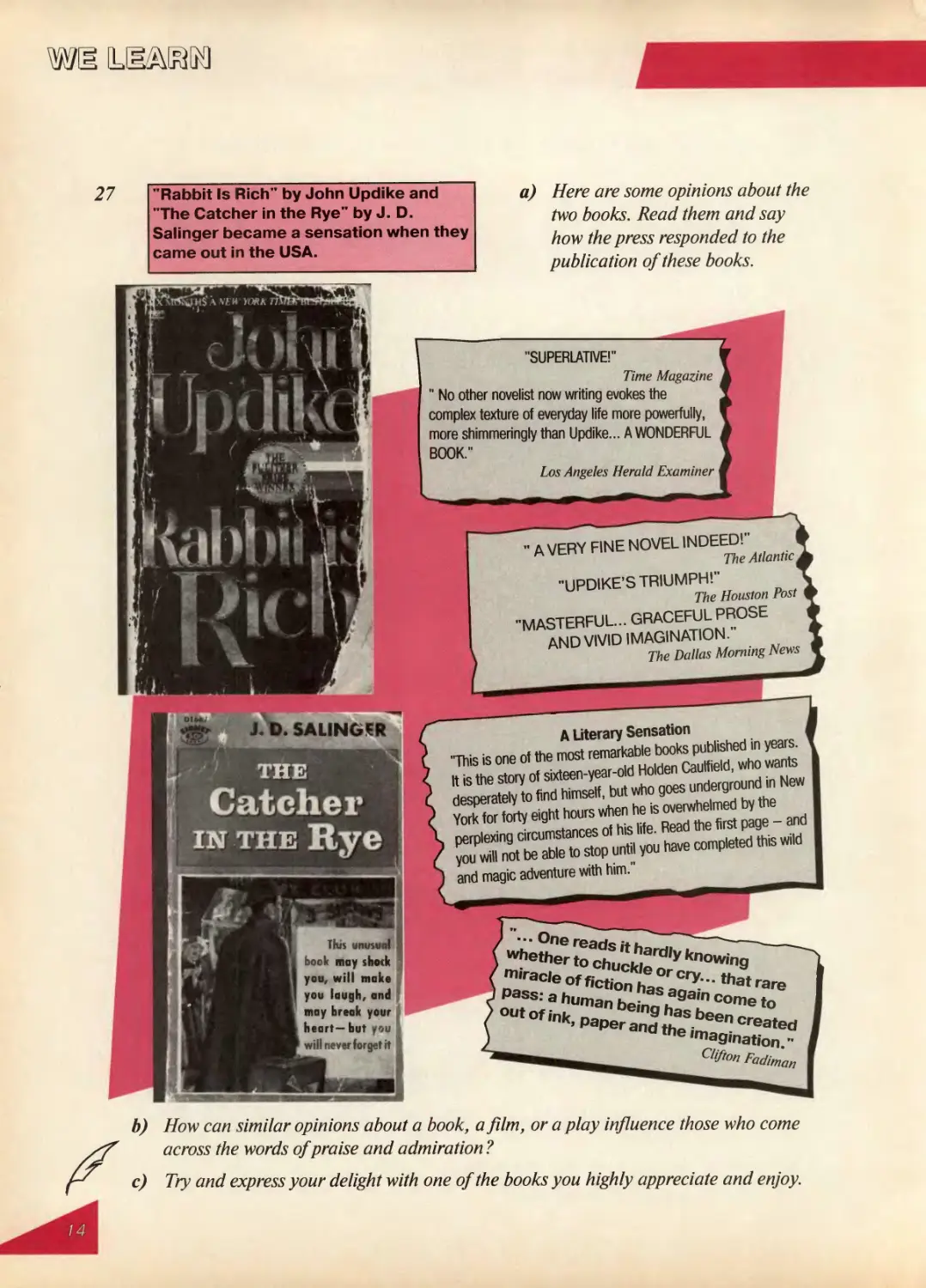
27 "Rabbit Is Rich" by John Updike and
"The Catcher in the Rye" by J. D.
Salinger became a sensation when they
came out in the USA.
J. D. SALINGER
THE
Catcher
in the Rye
a) Here are some opinions about the
two books. Read them and say
how the press responded to the
publication of these books.
"SUPERLATIVE!"
Time Magazine
" No other novelist now writing evokes the
complex texture of everyday life more powerfully,
more shimmeringly than Updike... A WONDERFUL
BOOK."
Los Angeles Herald Examiner i
" A VERY FINE NOVEL INDEED!"
The Atlantic t
"UPDIKE'S TRIUMPH!"
The Houston Post
'MASTERFUL... GRACEFUL PROSE
AND VIVID IMAGINATION."
The Dallas Morning News
A Literary Sensation
"This is one of the most remarkable books published in years.
It is the story of sixteen-year-old Holden Caulfield, who wants
desperately to find himself, but who goes underground in New
York for forty eight hours when he is overwhelmed by the
perplexing circumstances of his life. Read the first page - and
you will not be able to stop until you have completed this wild
and magic adventure with him."
This unusual
book may shock
you, will make
you laugh, and
may break your
heart— but you
will never forget it
"... One reads it hardly knowing
whether to chuckle or cry... that rare
miracle of fiction has again come to
pass: a human being has been created
out of ink, paper and the imagination."
Clifton Fadiman
b) How can similar opinions about a book, a film, or a play influence those who come
across the words of praise and admiration ?
c) Try and express your delight with one of the books you highly appreciate and enjoy.

looks on the Screen and on Stage
28 Many popular novels and
stories have been
adapted for the theatre,
television, and film.
In new screen splendor...
Hie most magnificent picture erer!
DAVID QSaZWICkS-roeraAwMM» иижш
"G0№ WITH ШЕ ОДМГ
С1Ж(ЖЕ
VIVIEN \Ш
LKSLIE HOWARD OIJVlVdrlLVVllJANI)
a) What do you think of this practice ? Are all
screen and stage adaptations successful? Do they
add to the popularity of the book, or can they
only spoil your impressions of it? Give your
opinions.
Margaret Mitchell's "Gone with the Wind", published
in 1936, became an immediate bestseller and in 1937
won the Pulitzer Prize. A film version of the novel,
made in 1939, with Vivien Leigh and Clark Gable in the
roles of Scarlett O'Hara and Rhett Butler, equaled or
surpassed the book in popularity.
"Gone with the Wind" is a romance that includes
strong elements of realism: it depicts the horrors of
war (one of the movie's most memorable scenes is the
burning of Atlanta by the Union army), deep conflicts
in personal relationships, and themes of rebellion and
alienation.
b) Name some novels or stories which, in your
opinion, have been successfully turned into
films or plays and appealed to different
audiences.
29 Brilliant actors and actresses have appeared in
films based on the classic works of literature.
Can you give any examples?
John Gielgud ['gr.lgud]
in Othello [ои'веЬи]
Vivien Leigh f'vrvwn'hj in
Titus Andronicus ['taitas een'dromkas]

Either
Neither
30 Read and remember:
ither
"Come on Tuesday or Wednesday. Either day is all right
There were flowers on either side of the street.
I can't agree in either case.
Neither
Either usually means one or the other.
Sometimes it can mean both.
Neither statement is true
Neither of the books is of any interest to^me.
Neither means not either,
not the one and not the other.
31 Read and translate these sentences. Pay attention to the use of either (of) and neither
(of).
1 Neither parent realized what was happening.
2 Neither of the girls understood why they had been refused to participate in the
expedition.
3 Neither of the books is exactly what I want.
4 Neither of the answers is correct.
5 Either kind of literature is interesting.
6 Either of the children is quite capable of learning foreign languages.
32 Complete the sentences:
1 Neither place ....
2 Neither story in this publication ...
3 Neither quotation...
4 Either of my brothers ...
5 Neither of the authors tries.
6 Either of you could ...
33 Read and remember:
You can either come with me or walk home alone.
Either... or...
I should like to live either in the country or in a small, quiet town.
This structure is used to talk
about two possibilities.
Neither... nor...
Neither James nor Virginia was at home.
If you can neither visit nor telephone your friend, write him or her a letter.
This structure is used to join
together two negative ideas.

So am I Neither am I
So were they Neither were they
So do we Neither do we
34 Read and remember:
So and neither can be used to introduce sentences in
which we say that people (or things or situations) are the
same as others that have just been mentioned.
Ann is fond of detective stories. So am I.
I was delighted with the story, and so
were the others.
Tom likes classics. So do I.
I can't speak English so fluently. Neither
can my friend Mike.
John did not like to play. Neither did we.
I don't really like football. Neither does
Andrew.
35 Say that you are (or somebody else is) in agreement with others. Explain your
preference or lack of preference.
a) Example: Tom likes listening to music. — So do I. Listening to music
is a wonderful pastime, I think.
1 I prefer to go on a trip in July rather than in October. — ...
2 I am always delighted with the sight of an ancient castle or a building associated
with some historical event. — ....
3 I try to visit each new exhibition which is talked about a lot. — ...
4 I decided to stay in town in July. — ...
5 I was trying to persuade Mary to change her mind. — ...
6 Nature, a simple life, that's what I need. — ...
7 John congratulated Tony on having won the race. — ...
b) Example: I wasn't disappointed by the trip. — Neither were my companions.
The trip was really enjoyable!
1 My brother does not like it when it rains. — ...
2 I can't work when somebody interrupts me. — ...
3 I can't read serious books on journeys. — ...
4 I can't be so frank with unfamiliar people. — ...
5 I simply couldn't believe that John had failed his examinations. — ...
6 He is never on time. — ...
7 My friend didn't feel like talking. — ...
8 She never forgets to book the tickets in advance. — ...
c) 1 John hasn't arrived yet. — ...
2 Ann was feeling sad and didn't want to show it. — ...
3 I was indifferent to the news. — ...
4 George would be furious if he discovered the truth. — ...
5 Tom and Rosy were tired. — ...
6 Unfortunately, I can't have a holiday this year. — ...
7 She never gave up hope. — ...
8 I could come on Sunday. — ...
36 Work in pairs. Practise expressing the same preferences or lack of preferences in
discussions about books, authors, plots and characters in books.

Vocabulary Study (3)
MEN OF LITERATURE
37 Read and remember how to use the words:
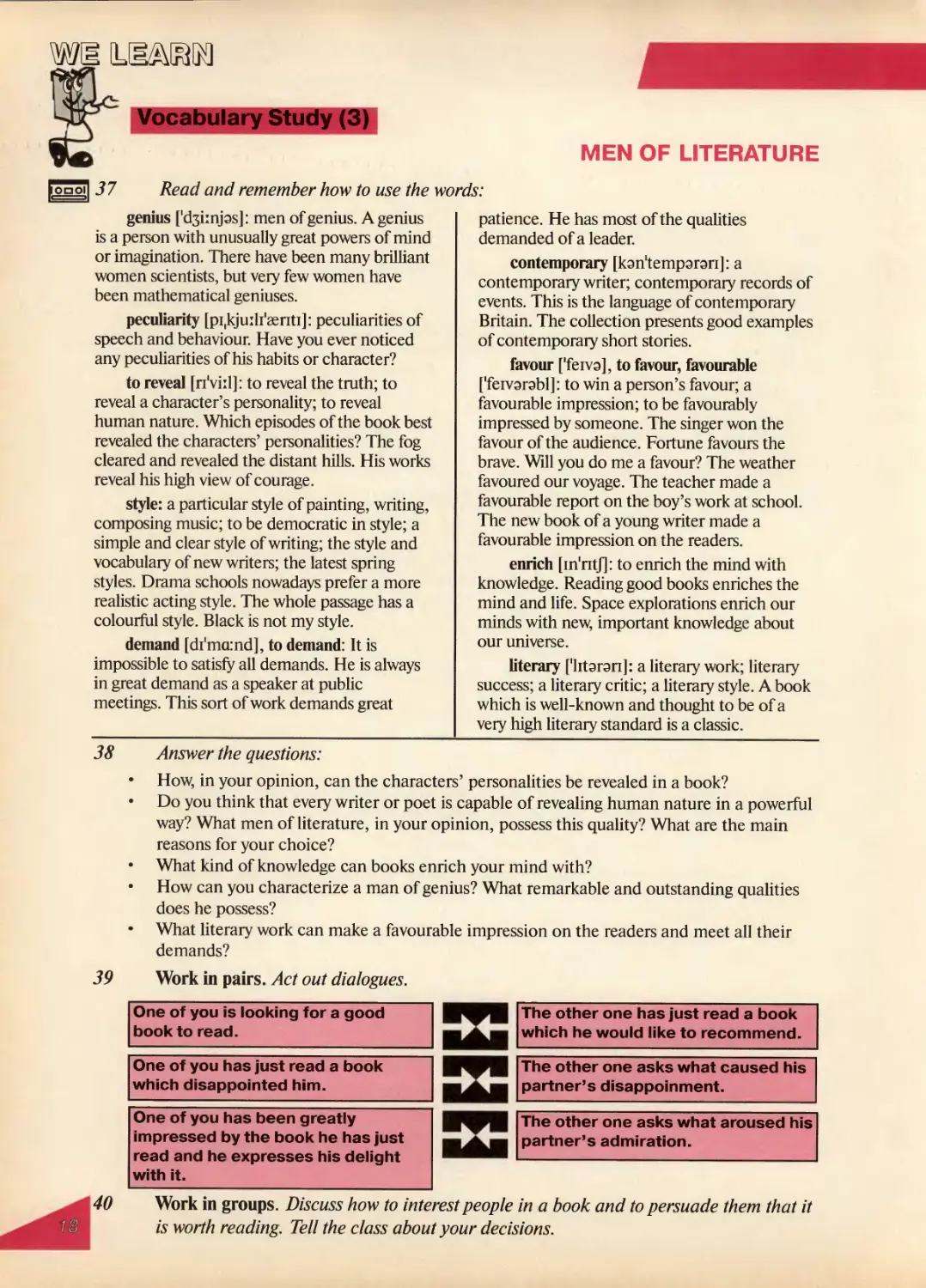
genius ['d3i:nj3s]: men of genius. A genius
is a person with unusually great powers of mind
or imagination. There have been many brilliant
women scientists, but very few women have
been mathematical geniuses.
peculiarity [pi.kjudi'aenti]: peculiarities of
speech and behaviour. Have you ever noticed
any peculiarities of his habits or character?
to reveal [rivhl]: to reveal the truth; to
reveal a character's personality; to reveal
human nature. Which episodes of the book best
revealed the characters' personalities? The fog
cleared and revealed the distant hills. His works
reveal his high view of courage.
style: a particular style of painting, writing,
composing music; to be democratic in style; a
simple and clear style of writing; the style and
vocabulary of new writers; the latest spring
styles. Drama schools nowadays prefer a more
realistic acting style. The whole passage has a
colourful style. Black is not my style.
demand [di'mamd], to demand: It is
impossible to satisfy all demands. He is always
in great demand as a speaker at public
meetings. This sort of work demands great
patience. He has most of the qualities
demanded of a leader.
contemporary [kan'temparan]: a
contemporary writer; contemporary records of
events. This is the language of contemporary
Britain. The collection presents good examples
of contemporary short stories.
favour [Terva], to favour, favourable
['fervarablj: to win a person's favour; a
favourable impression; to be favourably
impressed by someone. The singer won the
favour of the audience. Fortune favours the
brave. Will you do me a favour? The weather
favoured our voyage. The teacher made a
favourable report on the boy's work at school.
The new book of a young writer made a
favourable impression on the readers.
enrich [irintfl: to enrich the mind with
knowledge. Reading good books enriches the
mind and life. Space explorations enrich our
minds with new, important knowledge about
our universe.
literary [litaran]: a literary work; literary
success; a literary critic; a literary style. A book
which is well-known and thought to be of a
very high literary standard is a classic.
38 Answer the questions:
How, in your opinion, can the characters' personalities be revealed in a book?
Do you think that every writer or poet is capable of revealing human nature in a powerful
way? What men of literature, in your opinion, possess this quality? What are the main
reasons for your choice?
• What kind of knowledge can books enrich your mind with?
How can you characterize a man of genius? What remarkable and outstanding qualities
does he possess?
What literary work can make a favourable impression on the readers and meet all their
demands?
39 Work in pairs. Act out dialogues.
One of you is looking for a good
book to read.
The other one has just read a book
which he would like to recommend.
One of you has just read a book
which disappointed him.
The other one asks what caused his
partner's disappoinment.
One of you has been greatly
impressed by the book he has just
read and he expresses his delight
with it.
The other one asks what aroused his
partner's admiration.
40 Work in groups. Discuss how to interest people in a book and to persuade them that it
is worth reading. Tell the class about your decisions.

41 Read these quotations. Which one do you find most amusing? In what way do they
characterize their authors, their hobbies and habits?
.the
tOOiS i need
for my _
work
, _ are paper,
tobacco,
fOOd. and
a little
whiskey.
William Faulkner
best
time for
planning
book
is
while
you're
doing the
dishes.
Agatha Christie
it
book Is
Яке а .
garden!
^-'curried in
the
pocket.
1 put
things down on
sheets of piipCT
• and Stuff
them 111 my
pockets.
when 1 nave enough
._ i have a
book.
John Lemon,
i think i did
pretty well
considering
i started out
with nothing hut
a bunch of
blank
paper.
William Faulkner [Тэ:1кпэ]
Agatha ['зедэвэ] Christie ['knsti
42 a) Read and say how the two prominent modern fiction writers are characterized in these
notes:
Ernest Hemingway ['ainist 'hemirjwei] (1898 - 1961)
"Hemingway's style of writing is striking. His sentences are
short, his words simple, yet they are often filled with emotion.
A careful reading can show us that he is a master of the
pause. That is, if we look closely, we see how the action of his
stories continues during the silences, during the times his
characters say nothing.This action is often full of meaning.
There are times when the most powerful effect comes from
restraint. Such times occur often in Hemingway's fiction. He
perfected the art of conveying emotion with few words."
(from Highlights of American Literature)
Graham Greene ['greiam 'gn:n] (1904-1991)
"... Much of Greene's early working life was spent as a
journalist and travel writer. His training in these areas helped
him develop the powers of keen observation, sensitivity to
atmosphere, and simplicity of language that have become
hallmarks of his fictional style. His journey to Mexico in 1938
provided the setting for his best-known novel The Power and
the Glory (1940). His trips to Africa resulted in travelogues as
well as two novels, The Heart of the Matter (1944) and A
Burnt-Out Case (1961).
Greene is also the author of books for children, an essayist,
and an editor, and has enjoyed considerable success writing
films and adapting his own stories for the screen. His
cinematic work is tied to yet another outlet for his creativity,
which Greene has called "entertainments". These are
adventure stories and spy thrillers, often dealing with the
secret service and with pursuit. Among these are Our Man in
Havana (1958) and The Human Factor (1978).
.... Greene focuses more on the psychology of human
character than on a plot. Many of his protagonists are people
without roots or beliefs - people in pain. They come across
as real and believable individuals in whom good and evil,
weakness and strength are intermingled.... They almost
always excite the reader's curiosity and pity - and, almost
always, their author treats them with compassion.
(from Prentice Hall Literature.
The English Tradition)
b) Make up similar characteristics of writers or poets whom you consider to be
interesting authors.
c) Say how the language of contemporary writers differs from the language of the 19th
century or earlier writers. What peculiarities does the language of every generation
possess?
43 Work in groups. Discuss the following:
• What does the reputation of the authors rest upon?
What is appreciated in every literary work?

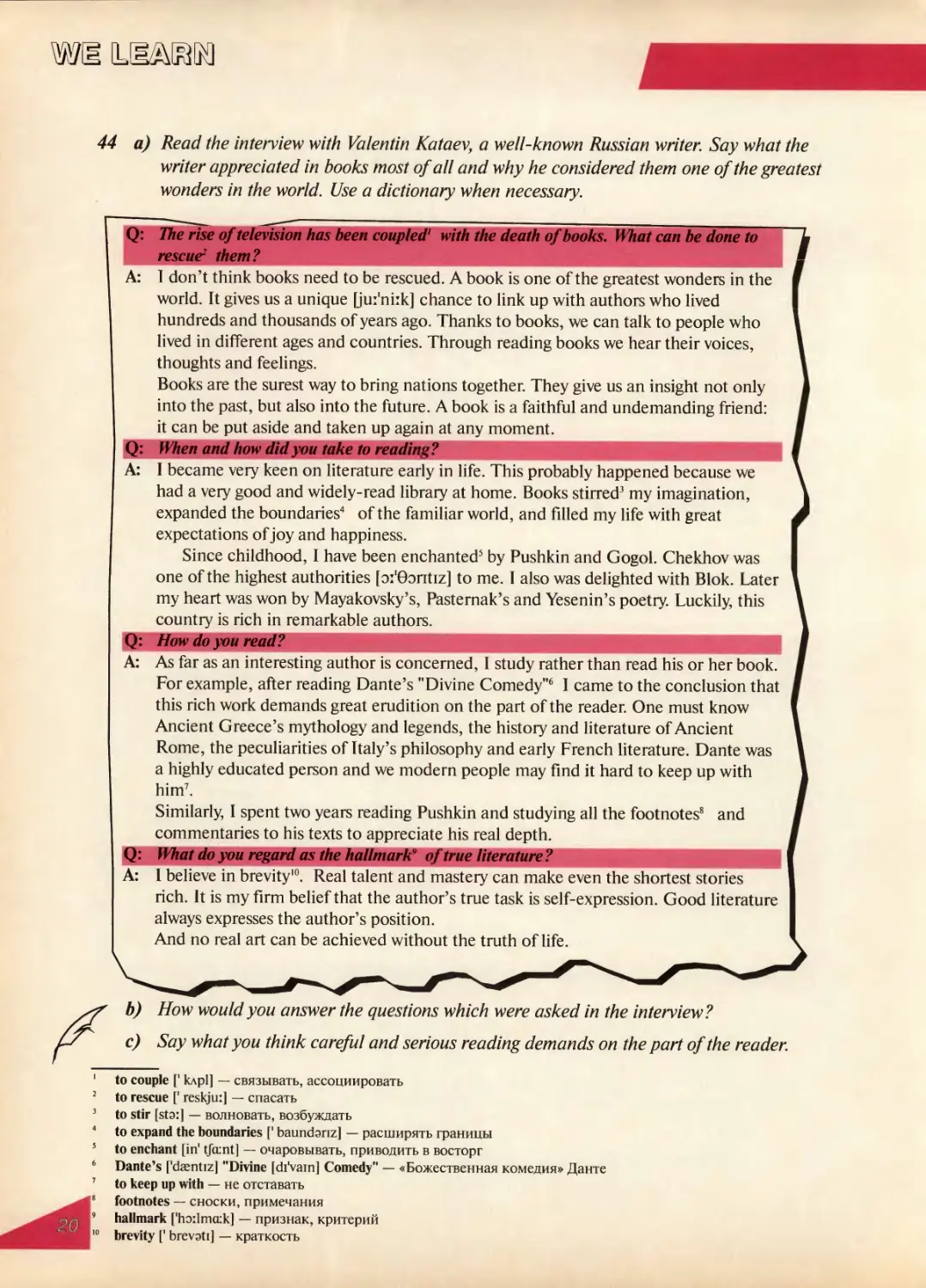
44 a) Read the interview with Valentin Kataev, a well-known Russian writer. Say what the
writer appreciated in books most of all and why he considered them one of the greatest
wonders in the world. Use a dictionary when necessary.
Q: The rise of television has been coupled' with the death of books. What can be done to
rescue2 them?
A: I don't think books need to be rescued. A book is one of the greatest wonders in the
world. It gives us a unique [ju:'ni:k] chance to link up with authors who lived
hundreds and thousands of years ago. Thanks to books, we can talk to people who
lived in different ages and countries. Through reading books we hear their voices,
thoughts and feelings.
Books are the surest way to bring nations together. They give us an insight not only
into the past, but also into the future. A book is a faithful and undemanding friend:
it can be put aside and taken up again at any moment.
Q: When and how did you take to reading?
A: I became very keen on literature early in life. This probably happened because we
had a very good and widely-read library at home. Books stirred3 my imagination,
expanded the boundaries4 of the familiar world, and filled my life with great
expectations of joy and happiness.
Since childhood, I have been enchanted5 by Pushkin and Gogol. Chekhov was
one of the highest authorities [o:'9oritiz] to me. I also was delighted with Blok. Later
my heart was won by Mayakovsky's, Pasternak's and Yesenin's poetry. Luckily, this
country is rich in remarkable authors.
Q: How do you read?
A: As far as an interesting author is concerned, I study rather than read his or her book.
For example, after reading Dante's "Divine Comedy"6 I came to the conclusion that
this rich work demands great erudition on the part of the reader. One must know
Ancient Greece's mythology and legends, the history and literature of Ancient
Rome, the peculiarities of Italy's philosophy and early French literature. Dante was
a highly educated person and we modern people may find it hard to keep up with
him7.
Similarly, I spent two years reading Pushkin and studying all the footnotes8 and
commentaries to his texts to appreciate his real depth.
A: I believe in brevity10. Real talent and mastery can make even the shortest stories
rich. It is my firm belief that the author's true task is self-expression. Good literature
always expresses the author's position.
And no real art can be achieved without the truth of life.
b) How would you answer the questions which were asked in the interview?
c) Say what you think careful and serious reading demands on the part of the reader.
1 to couple [' клр1] — связывать, ассоциировать
2 to rescue [' reskju:] — спасать
3 to stir [sta:] — волновать, возбуждать
4 to expand the boundaries [' bauncbnz] — расширять границы
5 to enchant [in' tfaint] — очаровывать, приводить в восторг
6 Dante's ['daentiz] "Divine [di'vam] Comedy" — «Божественная комедия» Данте
7 to keep up with — не отставать
8 footnotes — сноски, примечания
' hallmark ['ho:lma:k] — признак, критерий
10 brevity [' brevsti] — краткость

45 a) Look at this advertisement and find out where it is placed and who the advertisers
are.
T.'ff, .48» V0*,\ IWia, 1:И;\>ЛУ,Ц11УЦ, tm
Have ж got 150,000 titles?
\fo we say yes we do Ъ.
JUST ARRIVED!
The Lessons of Love
by Melody Beattie
This moving narrative
about a woman's recovery
from grief carries a heartfelt
and inspiring message,
Drawing on personal
experience, the author
emphasizes the importance
of both patience and the willingness to forgive.
(HarperCollins)
El Also Available in Audio
Pub. Price $10.Q0$/\()O
B&N Price У
To Renew
America
Newt
Gingrich T° Renew America
by Newt Gingrich
In this controversial new
book, the Speaker of the
House proposes to restore
the nation by reviving five
key elements that have been
lost from American life-
personal strength, commitment to quality, the
spirit of invention, free enterprise and the lessons
of American history. (HarperCollins)
E3 Also Available in Audio
Pub. Price $24.00
B&N Price
ЩОШЕЫ
RULES..
ТШТМВПЯСЛ1.
Vaiub Ми /J
NseTPTlACM (A
THInCMUW Г
ПЫМ
DOHEX
Golden Rules
by Wayne Dosick
More than just an amusing
collection of stories, this
book introduces ten
important ethical values
through compelling tales
and real-life examples that
children will love to read.
(HarperCollins)
Pub. Price $16.00
B&N Price
STOP
rVGING
NOW!
Jean Carper
Stop Aging Now!
by Jean Carper
Learn how to combat aging
and resist disease! Based on
hundreds of studies, this book
shows how vitamin deficiencies
cause needless aging, Included
is an easy-to-use guide
explaining which supplements improve brain
or body functions, and in what quantities
they should be taken. (HarperCollins)
0 Also Available in Audio
Pub. Price $24.00
B&N Price
Mutant Message
Down Under
by Mario Morgan
While traveling barefoot
across 1,400 miles of the
Outback with a nomadic tribe
of Aboriginals called the "Real
People," an American woman
is introduced to a new way of life. This powerful
novel reveals the tribe's message—all living
things share a common unity (HarperPerennial)
\П1 Also Available in Audio
Pub. Price $10.00
B&N Price
MM HO moiGanI
One Man Tango
by Anthony Quinn
Take a fascinating inside look
at this celebrated actor's life.
Following Self-Portrail, this
new autobiography focuses
on his life in Hollywood—
from his award-winning
performances to his
friendships and affairs with legendary stars.
(HarperCollins)
El Also Available in Audio
Pub. Price $25.00
B&N Price
b) Read this advertisement carefully and say how the new books are advertised and how
the advertisers draw the reader's attention to the most precious and most valuable
ideas revealed in these books.
Cultural Note:
Barnes & Noble (B&N) are a big
American company which sells books.
Pub. Price — Publisher's price

46 a) Read the text Poor Richard Says and say which of the quotations from Benjamin
Franklin are familiar to you.
Poor Richard Says
(From the book "Scenes of America")
The great American scientist, philosopher and statesman of
the 18th century Benjamin Franklin was also a publisher.
Benjamin Franklin published and edited an almanac
['oilimnaek] known as "Poor Richard's Almanac" from 1733
to 1758 under the name of Richard Saunders fsomdaz]; and
"Poor Richard" became a well-known pen-name in American
literature. The sayings of "Poor Richard" which appeared in
the almanacs were based on the common sense proverbs and
expressions of all ages and nations. These practical words of
advice to the people, improved by Franklin's talent for simple,
humorous writing, had universal appeal. Many of them, in one
form or another, are still quoted today. The almanacs
achieved world-wide fame and were published in many
languages.
A word to the wise is enough.
Wise men /earn by the mistakes of
others, fools hardly by their own.
m m ■
A little carelessness may cause great trouble.
Poor Richard, 173-
an ;.
Almanack
For the Year of Chrift
Being the tMafter I.R'AP YE-AR
Jed nuAts ji**r the CrtMim \tjr
By the Account of the Baftpff) Gr&h' 7241
By the Latin Church, v-htn Q еги, f (,^\г
Bv the Con fniufcion o/ №,№. 574л
By the Ятьт Chronology рЛа
By (be Jtvjt 8«bbfts 5404
Whtrtin U t&tiaimcf
"The Lunation"*, Edipfea, luc|ffm?ot ol
the Weathet, Sprint Tides, Р1а*п*ч Ио('1аа< 8c
nmruai Afpefh, 8йо льА Моап'л Rifintt ond'Soi-
tinn. Length of Days, Ttmfc ©f High Water,
Fair*, O^rti, tiid oMcrvaolc. pjys
Fitted to the Laritude of Fortr Degrees,
and a Meridian or Kivr Hours Wert ''mrr /•mfor,
hut may without ГсмьЫс Enor, fi-iv» t), th** »{■
jacriit Places, even from Ыпфтивап! то South
Carolha.
ЪуШСНЖ DS/UNDERS, Phiiom.
PHlLADRLPHtA:
i агй ГоМ by S. f&XHKllV, « the New
Faatbip Office near rite Mjikci
Th: Third Imprclficn,
Industriousness is the mother of good luck.
There are no gains' without pains.
At the workingman 's house hunger looks in,
but does not enter.
Have you something to do tomorrow?
do it today.
Early to bed and early to rise,
makes a man healthy, wealthy and wise.
Ь) Comment on the quotations. Say how you understand them and in what situations
you can use them.
Explain why some quotations have
universal appeal.
47 Some phrases, poems or passages from
books are memorized and often quoted by
people in talks, speeches and reports.
Г gains [geinz] — доходы, заработок

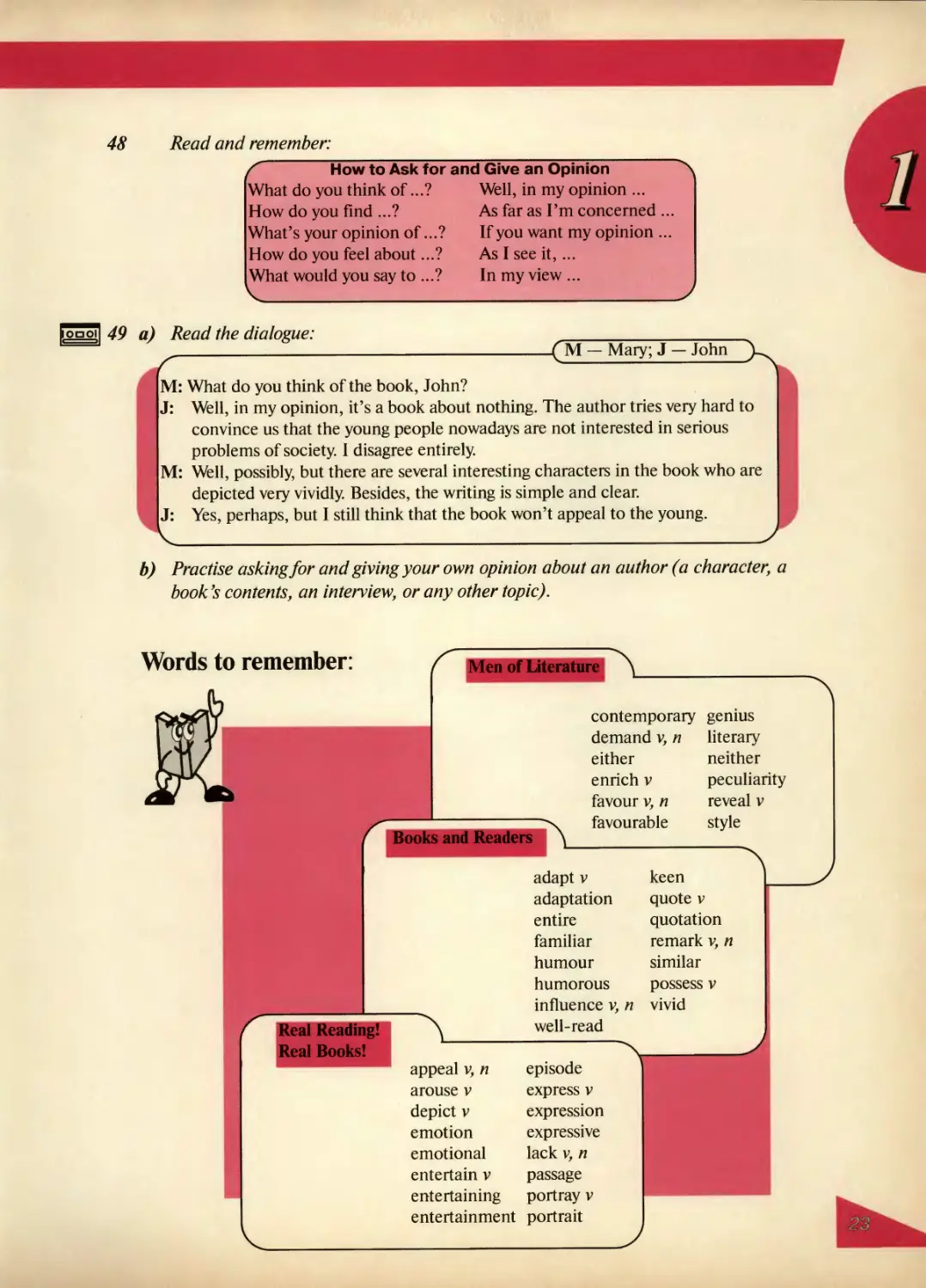
48 Read and remember:
How to Ask for and Give an Opinion
What do you think of...?
How do you find ...?
What's your opinion of...?
How do you feel about...?
What would you say to ...?
Well, in my opinion ...
As far as I'm concerned ...
If you want my opinion ...
As I see it, ...
In my view...
49 a) Read the dialogue:
M — Mary; J — John
M: What do you think of the book, John?
J: Well, in my opinion, it's a book about nothing. The author tries very hard to
convince us that the young people nowadays are not interested in serious
problems of society. I disagree entirely.
M: Well, possibly, but there are several interesting characters in the book who are
depicted very vividly. Besides, the writing is simple and clear.
J: Yes, perhaps, but I still think that the book won't appeal to the young.
b) Practise asking for and giving your own opinion about an author (a character, a
book's contents, an interview, or any other topic).
Words to remember:
Men of Literature
BOOKS and Keaoers
contemporary genius
demand v, п literary
either neither
enrich v peculiarity
favour v, n reveal v
favourable style
adapt v
adaptation
entire
familiar
humour
humorous
influence v, n
well-read
keen
quote v
quotation
remark v, n
similar
possess v
vivid
Real Reading!
Real Books!
appeal v, n
arouse v
depict v
emotion
emotional
entertain v
entertaining
entertainment
episode
express v
expression
expressive
lack v, n
passage
portray v
portrait

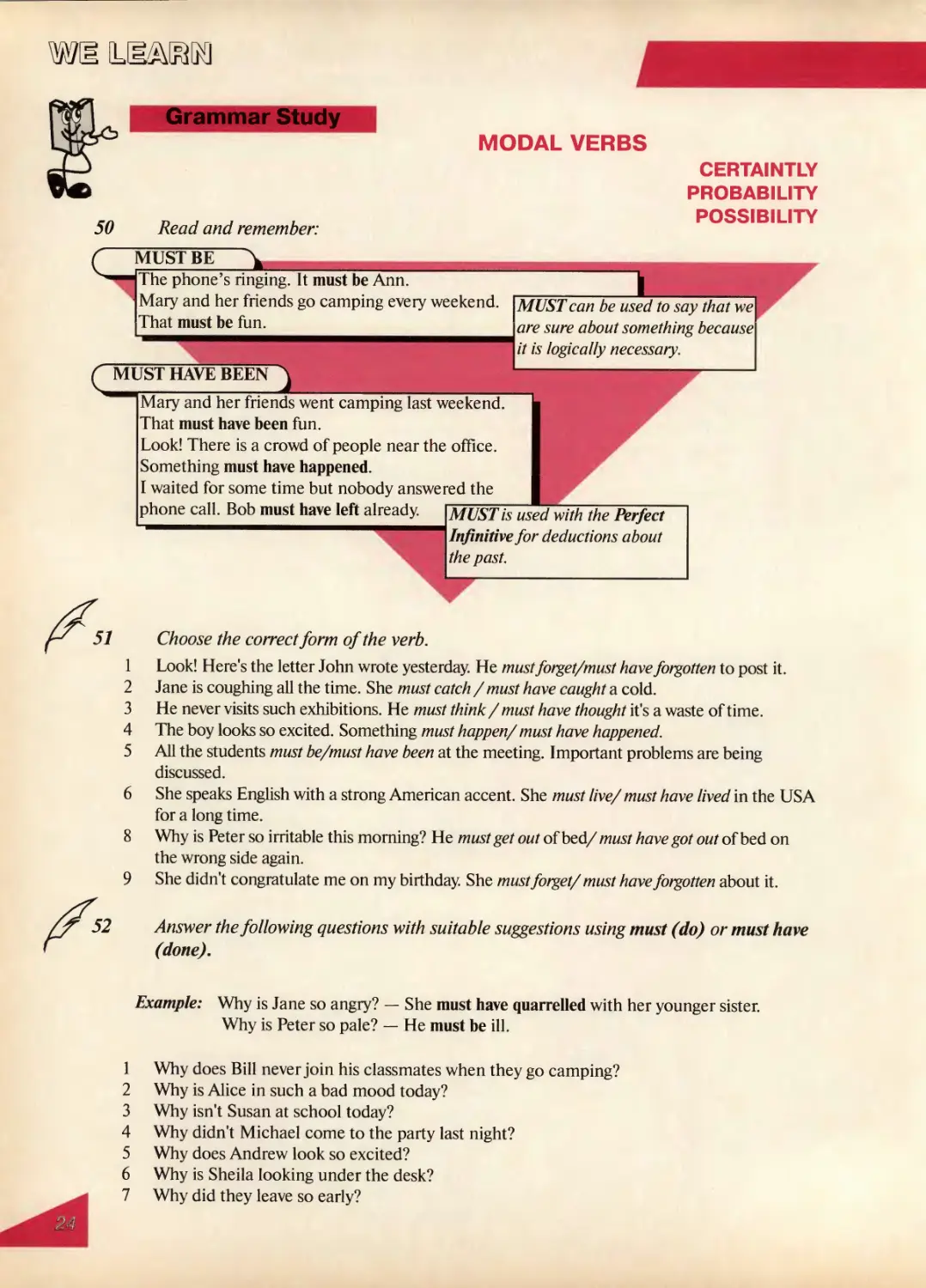
Gramm3r Study
MODAL VERBS
50 Read and remember:
CERTAINTLY
PROBABILITY
POSSIBILITY
MUST BE \.
The phone's ringing. It must be Ann.
Mary and her friends go camping every weekend.
That must be fun.
MUST HAVE BEEN
MUST can be used to say that we
are sure about something because
it is logically necessary.
Mary and her friends went camping last weekend
That must have been fun.
Look! There is a crowd of people near the office.
Something must have happened.
I waited for some time but nobody answered the
phone call. Bob must have left already.
MUST is used with the Perfect
Infinitive for deductions about
the past.
51 Choose the correct form of the verb.
1 Look! Here's the letter John wrote yesterday. He must forget/must have forgotten to post it.
2 Jane is coughing all the time. She must catch / must have caught a cold.
3 He never visits such exhibitions. He must think/must have thought it's a waste of time.
4 The boy looks so excited. Something must happen/ must have happened.
5 All the students must be/must have been at the meeting. Important problems are being
discussed.
6 She speaks English with a strong American accent. She must live/must have lived in the USA
for a long time.
8 Why is Peter so irritable this morning? He must get out of bed/ must have got out of bed on
the wrong side again.
9 She didn't congratulate me on my birthday. She must forget/must have forgotten about it.
52 Answer the following questions with suitable suggestions using must (do) or must have
(done).
Example: Why is Jane so angry? — She must have quarrelled with her younger sister.
Why is Peter so pale? — He must be ill.
1 Why does Bill never join his classmates when they go camping?
2 Why is Alice in such a bad mood today?
3 Why isn't Susan at school today?
4 Why didn't Michael come to the party last night?
5 Why does Andrew look so excited?
6 Why is Sheila looking under the desk?
7 Why did they leave so early?

53 Read and remember:
CAN BE
Can it be John?
That can't be John. He' is at school now.
CAN is sometimes used to express doubt,
astonishment or present possibility, but
only in questions and negative sentences.
CAN HAVE BEEN
COULD HAVE BEEN
They can't have gone hiking. The day was rainy and awfully cold.
Tom can't have behaved so rudely.
I could have done it for you last Saturday.
I couldn't have done it for you yesterday.
Could she really have been so unfriendly ?
CAN and COULD are both used with the Perfect
Infinitive for speculating or guessing about the past,
for saying something was a possibility but did not
happen. They are also used to doubt a past action
(in questions).
54 Match the two halves of these sentences and translate them.
1 Jack can't be tired.
2 The boys couldn't have crossed the
lake in this boat.
3 They couldn't have spent the whole
day at home.
4 I could have gone with you,
5 Can David have won the
competition?
6 Can she be so ill-mannered?
7 Can he have refused to help you?
8 We could have gone on a hike,
He is a very generous and kind-hearted man.
He has been absolutely idle this weekend.
but it was raining .
It leaks.
The weather was so pleasant and sunny.
but I didn't want to.
He didn't train much.
She makes an impression of a very friendly
and polite girl.
55 Express doubt or astonishment.
Example: Can this custom be so old?
It is difficult to believe that this custom is so old. This custom can't be so old.
1 We can't believe that he expressed such absurd ideas.
2 I can't believe that she changes her mind three or four times a day.
3 It is difficult to believe that they have persuaded the girls to join a sports club.
4 It is impossible that she didn't do her job in time. She is a very responsible person.
5 I don't believe that they enjoyed the performance. It seemed pretty boring.

56 Read and remember:
( MAYBE
I wonder where Nell is.
— She may be with Mary, I suppose.
— She might be with Mary.
MAY and MIGHT are both used when we
say that something is possible and we get
some suggestions. There is no important
difference between may and might.
( MAY/MIGHT HAVE BEEN^
I wonder why Mary didn't answer my letter.
— Well, I suppose she may have been very busy.
— She might have been busy.
MAY and MIGHT can be used with the
Perfect Infinitive when we say what was
possible in the past.
MIGHT HAVE BEEN
You might have told me about your plans
Why didn't you?
MIGHT with the Perfect Infinitive
expresses criticism, or reproach.
57 Give your suggestions in order to explain the situation.
Example: Jane didn't ring me up. She might have forgotten my phone number.
1 John left the office without even saying 'good-bye'.
2 Why is Nelly so upset?
3 I can't remember where I have put my textbook.
4 I recognize that picture.
5 He seems to know this man.
6 I wonder where Bill is.
58 Read the poem Spring Rain. Pay attention to the use of the modal verbs.
Spjtitvg <r4a*n,
~Tki> StOAhv OQ/Ш U>p 80 0Щ qU/ЬС/Ь
It oocbidtb 'i> hcwb Ььт дсьЬоЬм.
I Qk/Otoid k/Q/Vb bWU/Qki ni/Cj hO/b Q/I/CMQ,
I QhOtoid kQ/Ub блОСодЫ hv(j sl/lC/bi/Hi 1.
Qfltj hQ/i/Л i/8 ые/t, m>(j fawt> M& №t,
I aou/lldnj 4 be/ hvu,c>k ыШ&а,
I {jM ЬпЛо си Ше>л on&e>
U>U/b thi/8 i/8 ШИ Ь&ШЛ.
Marchette Chute
у slicker (амер.) — непромокаемый плащ

59 Read and remember:
SHOULD BE
OUGHT TO BE
The child shouldn't eat so much icecream.
He may get a sore throat.
You ought not to drive now. You are too tired.
You should be more careful when you drive in town.
SHOULD HAVE BEEN
OUGHT TO HAVE BEEN
SHOULD and OUGHT can often be
used when we say what we think is the
right (not right) thing to do, or to say
that we expect something.
He should have devoted more time to his studies.
It's a pity he didn't.
They ought to have been more attentive to their friends
But they were not.
SHOULD and OUGHT can be used
with the Perfect Infinitive when we say
that somebody did the wrong thing.
60 Give an appropriate ending or add some extra information to these sentences.
Example: \ You ought to go home.
You ought to go home because your parents are worrying about you.
2 You should have stayed at home.
It was raining. You should have stayed at home not to get wet.
1 You should go to bed now.
2 You should try to open the lock.
3 I feel I ought to treat my schoolmates in a different way.
4 You should work harder before your exams.
5 You shouldn't have eaten so many cream cakes.
6 You ought to have supported him.
7 They ought to have kept the secret.
8 They should have trained more regularly.
9 You ought to visit John.
10 You ought not to have shouted so angrily at her.
61 Supply all the missing forms of the modal verbs.
certainty
possibility
probability
reproach
must
can
could
may
might
should
ought
might
must be
could be
maybe
ought to be
must have been
can have been
might have been
_

ШШ ШШШ ШШ Ш1©(УШ
FAMOUS ENGLISH AND
AMERICAN POETS
William Shakespeare
62 a) Read the text He Was Not of an Age but for All Time. Use a dictionary when
necessary.
"He Was Not of an Age but for All Time'
Benjamin Jonson '
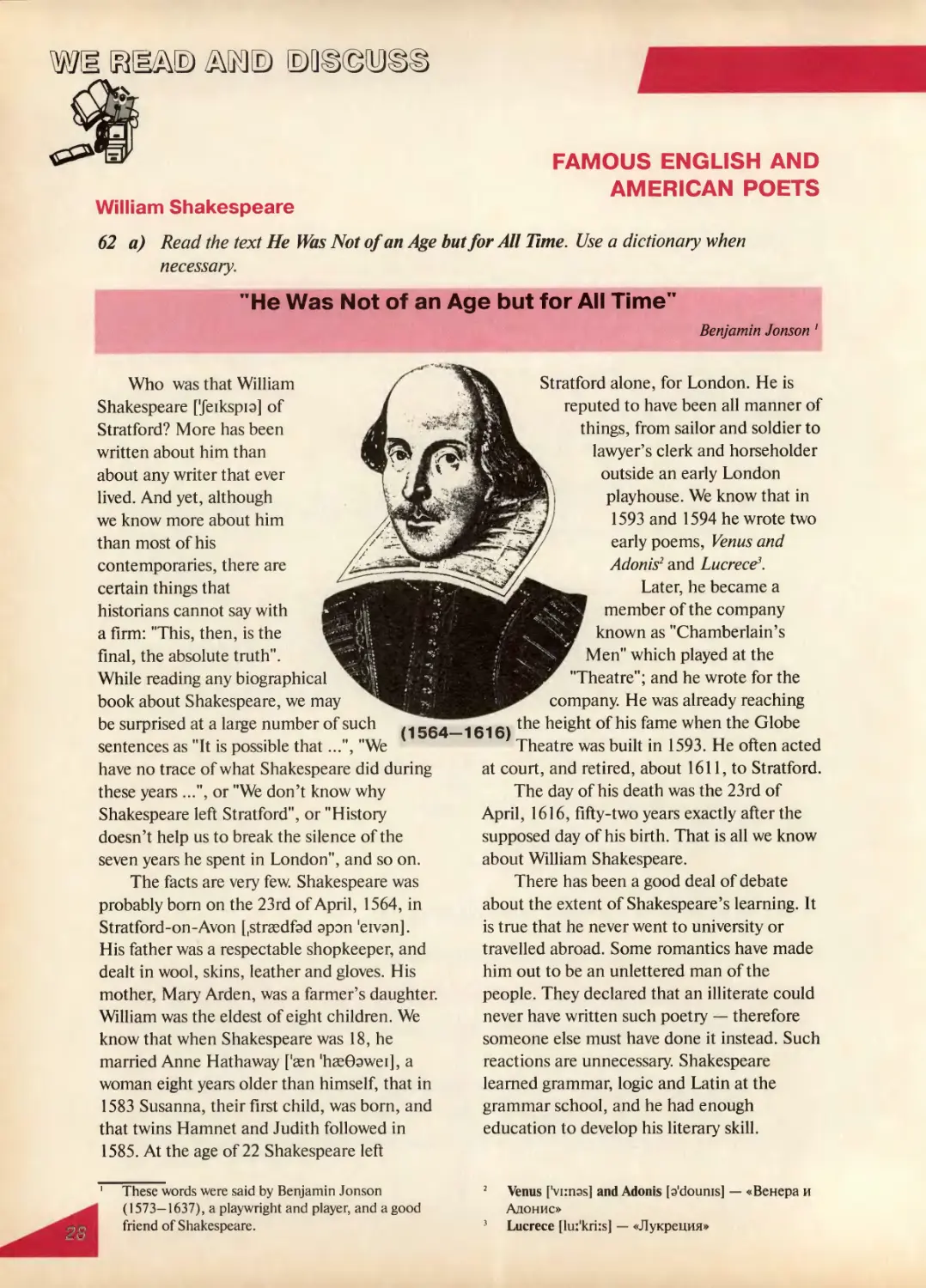
Who was that William
Shakespeare ['Jeikspia] of
Stratford? More has been
written about him than
about any writer that ever
lived. And yet, although
we know more about him
than most of his
contemporaries, there are
certain things that
historians cannot say with
a firm: "This, then, is the
final, the absolute truth".
While reading any biographical
book about Shakespeare, we may
be surprised at a large number of such
sentences as "It is possible that...", "We
have no trace of what Shakespeare did during
these years ...", or "We don't know why
Shakespeare left Stratford", or "History
doesn't help us to break the silence of the
seven years he spent in London", and so on.
The facts are very few. Shakespeare was
probably born on the 23rd of April, 1564, in
Stratford-on-Avon [.strsedfad эрэп 'eivan].
His father was a respectable shopkeeper, and
dealt in wool, skins, leather and gloves. His
mother, Mary Arden, was a farmer's daughter.
William was the eldest of eight children. We
know that when Shakespeare was 18, he
married Anne Hathaway ['aen 'hasGawei], a
woman eight years older than himself, that in
1583 Susanna, their first child, was born, and
that twins Hamnet and Judith followed in
1585. At the age of 22 Shakespeare left
(1564-1616)
1 These words were said by Benjamin Jonson
(1573—1637), a playwright and player, and a good
friend of Shakespeare.
Stratford alone, for London. He is
reputed to have been all manner of
things, from sailor and soldier to
lawyer's clerk and horseholder
outside an early London
playhouse. We know that in
1593 and 1594 he wrote two
early poems, Venus and
Adonis2 and Lucrece3.
Later, he became a
member of the company
known as "Chamberlain's
Men" which played at the
"Theatre"; and he wrote for the
company. He was already reaching
the height of his fame when the Globe
Theatre was built in 1593. He often acted
at court, and retired, about 1611, to Stratford.
The day of his death was the 23rd of
April, 1616, fifty-two years exactly after the
supposed day of his birth. That is all we know
about William Shakespeare.
There has been a good deal of debate
about the extent of Shakespeare's learning. It
is true that he never went to university or
travelled abroad. Some romantics have made
him out to be an unlettered man of the
people. They declared that an illiterate could
never have written such poetry — therefore
someone else must have done it instead. Such
reactions are unnecessary. Shakespeare
learned grammar, logic and Latin at the
grammar school, and he had enough
education to develop his literary skill.
2 Venus [Viinas] and Adonis [a'dounis] — «Венера и
Адонис»
3 Lucrece [lu:'kri:s] — «Лукреция»

THE ENGLISH-SPEAKING WORLD
We do not know whether Shakespeare
went to London with the intention of
becoming an actor. He may have done so;
there would have been plenty of opportunity
for him to be attracted to the stage in his
youth, quite apart from any natural
inclinations towards poetry. Theatre was very
popular at that time. Classical plays were
acted at schools, with educational purposes in
view; travelling companies of professional
actors often visited Stratford and performed
there. We cannot prove anything for certain,
but it is highly possible that William
Shakespeare joined one of these companies
when they passed through Stratford.
The London to which young Shakespeare
came was a splendid place where painters,
musicians and poets shone. Theatre was the
most exciting entertainment. If genius could
be accounted for, it might perhaps be said
that Shakespeare's acquaintance with the art
of the actor helped him in an understanding
of the art of the playwright. But this
explanation is not enough. To it must be
added an observing mind, a profound
sympathetic understanding of life, an
acquaintance with all classes of men and
women, and above all an ability to see human
nature.
Shakespeare wrote 37 plays, among them
comedies (The Taming of the Shrew, Much
Ado About Nothing, Twelfth Night, As You Like
It, etc.), tragedies (Hamlet, King Lear,
Macbeth, Romeo and Juliet, Othello and
others), historical plays (Henry VI, Richard
III, Henry IV, etc.) and sonnets.
Shakespeare's genius did not lie in his
ability to originate plays (for almost all of the
stories were borrowed from chronicle,
biography, prose tale, or earlier play), but
rather in his capacity for revealing life in its
full richness and movement. Shakespeare's
plays and sonnets are masterpieces.
Shakespeare expressed in them the variety of
human nature. All human life is there in his
plays, its greatness and its imperfections alike.
Shakespeare possesses some special merit for
every generation, and almost every person in
turn. Whether he is writing of history, or love,
or tragedy, or comedy, things have meaning
and value. It was his genius that gave the
world poetry of a deathless beauty.
b) Say what made Shakespeare the greatest of all poets.

63 Read these quotations from Shakespeare. Say how you understand them. Express
your opinion about the quotations. Say in what way they are true and in what
situations you can use them.
SHAKESPEARE'
A Midsummer NighADrtum
Brevity is the soul ofwif.
0 shame! Where is thy blush2?
We know what we are, but we know
Ш, what we may be.
(Hamlet3)
What is done can't
be undone.
(Macbeth4)
Better a witty fool than a
foolish wit.
(Twelfth Night)
Time is the nurse and breeder5
of aft good.
(The Two Gentlemen of Verona6) I
1 wit — ум, разум, остроумие
2 thy [dai] blush [bUJ] — твоя стыдливость
3 Hamlet ['haemlit] — Гамлет
4 Macbeth [тэк'ЬеВ] — Макбет
5 breeder [ЪгЫэ] — производитель
6 Verona [va'rouna] — г. Верона

THE ENGLISH-SPEAKING WORLD
64 a) Listen to Shakespeare's poem Age and Youth, then read it. Answer the questions:
• What words does Shakespeare choose to describe youth and age?
• What thoughts and feelings does he express most exactly?
b) Speak about the theme of the poem. Say how you understand it.
65 Read these lines about age and youth and say in what way they are true.
The old believe everything;
the middle-aged suspect everything;
the young know everything.
Youth without ambition is tike
iron without steel.
1 crabbed ['kraebid] — ворчливый, сварливый
2 morn = morning
5 nimble ['nimbi] — проворный, ловкий
4 adore [э'сЬ:] — обожать
s thee = you поэт, ты

Walt Whitman
66 Read the text The Spirit of a Poet and say what Americans appreciate in Walt
Whitman's poetry. Use a dictionary when necessary.
The Spirit of a Poet
"For you these from me,
0 democracy, to serve you ma
femme'!
For you, for you I am
thrilling these songs."
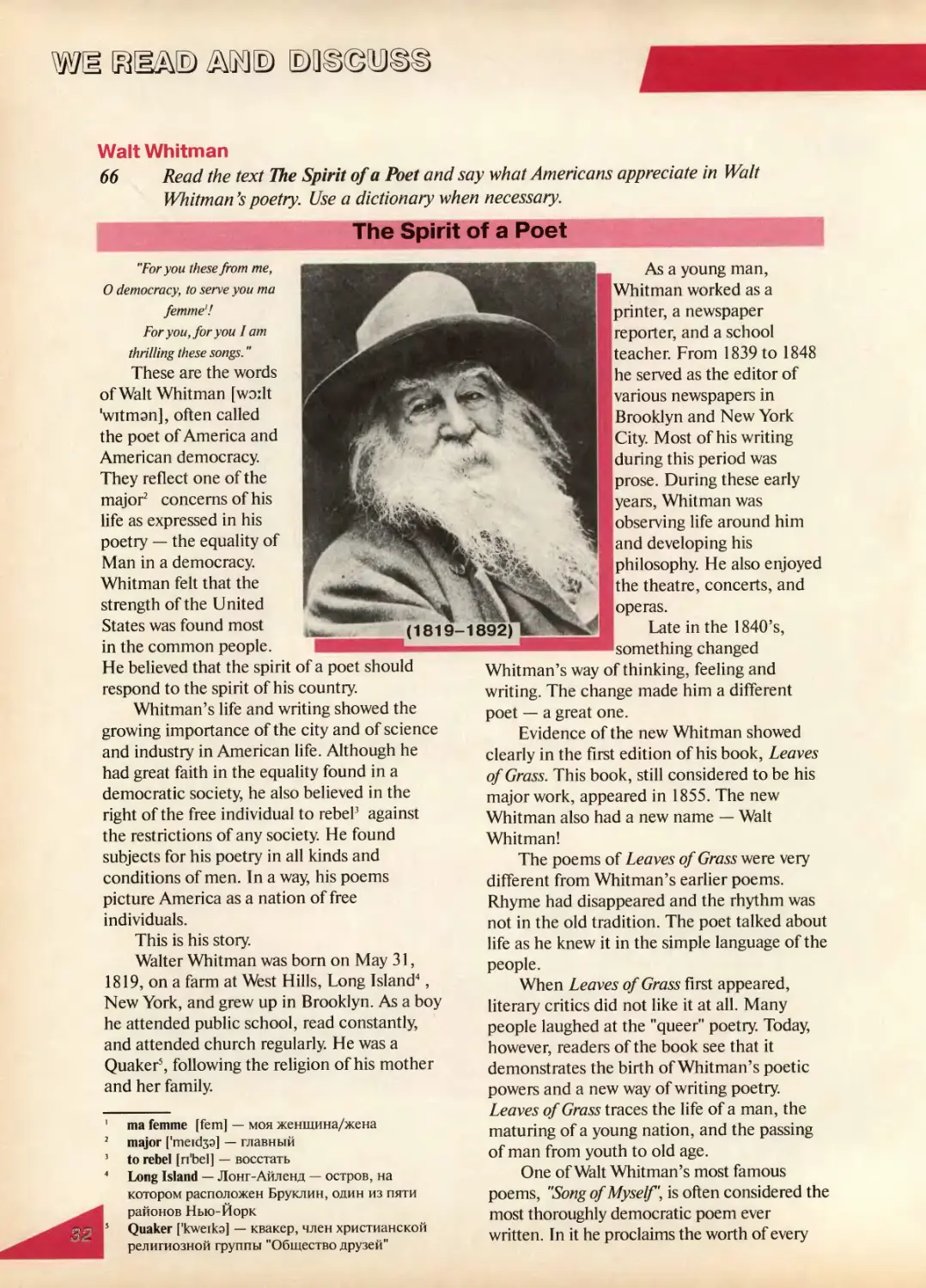
These are the words
of Walt Whitman [wo:lt
'witman], often called
the poet of America and
American democracy.
They reflect one of the
major2 concerns of his
life as expressed in his
poetry — the equality of
Man in a democracy.
Whitman felt that the
strength of the United
States was found most
in the common people.
He believed that the spirit of a poet should
respond to the spirit of his country.
Whitman's life and writing showed the
growing importance of the city and of science
and industry in American life. Although he
had great faith in the equality found in a
democratic society, he also believed in the
right of the free individual to rebel3 against
the restrictions of any society. He found
subjects for his poetry in all kinds and
conditions of men. In a way, his poems
picture America as a nation of free
individuals.
This is his story.
Walter Whitman was born on May 31,
1819, on a farm at West Hills, Long Island4,
New York, and grew up in Brooklyn. As a boy
he attended public school, read constantly,
and attended church regularly. He was a
Quaker5, following the religion of his mother
and her family.
(1819-1892)
1 ma femme [fern] — моя женщина/жена
2 major ['meid39] — главный
3 to rebel [n'bel] — восстать
4 Long Island — Лонг-Айленд — остров, на
котором расположен Бруклин, один из пяти
районов Нью-Йорк
5 Quaker ['kweiks] — квакер, член христианской
религиозной группы "Общество друзей"
As a young man,
Whitman worked as a
printer, a newspaper
reporter, and a school
teacher. From 1839 to 1848
he served as the editor of
various newspapers in
Brooklyn and New York
City. Most of his writing
during this period was
prose. During these early
years, Whitman was
observing life around him
and developing his
philosophy. He also enjoyed
the theatre, concerts, and
operas.
Late in the 1840's,
something changed
Whitman's way of thinking, feeling and
writing. The change made him a different
poet — a great one.
Evidence of the new Whitman showed
clearly in the first edition of his book, Leaves
of Grass. This book, still considered to be his
major work, appeared in 1855. The new
Whitman also had a new name — Walt
Whitman!
The poems of Leaves of Grass were very
different from Whitman's earlier poems.
Rhyme had disappeared and the rhythm was
not in the old tradition. The poet talked about
life as he knew it in the simple language of the
people.
When Leaves of Grass first appeared,
literary critics did not like it at all. Many
people laughed at the "queer" poetry. Today,
however, readers of the book see that it
demonstrates the birth of Whitman's poetic
powers and a new way of writing poetry.
Leaves of Grass traces the life of a man, the
maturing of a young nation, and the passing
of man from youth to old age.
One of Walt Whitman's most famous
poems, "Song of Myself, is often considered the
most thoroughly democratic poem ever
written. In it he proclaims the worth of every

THE ENGLISH-SPEAKING WORLD
individual and identifies himself with each and
every possible human creature.
"Song of Myself gives the impression of
reflecting the personal love and concern of the
poet for all mankind. It moves from interest in
the present to the more ultimate' matters of
life, death, eternity2, and God. Whitman
imagines himself as speaking through the poem
for all Americans as he says:
"I celebrate myself, and sing myself,
and what I assume
you shall assume,
For every atom belonging to me
as good belongs to you. "
Walt Whitman possessed an extraordinary
ability to identify3 himself with all sorts and
conditions of men. He associated with all types
of people and their needs and interests became
his. For example, after a trip to the West in
1848, his interest was awakened to the
problems of western farmers and workmen. As
a result, upon his return to Brooklyn he
became a laborer to show his sympathy with
laboring people.
Whitman's journey to the West also
inspired him to write a number of poems about
the frontier, the best known being "The Song of
the Broad Axe"'and "Pioneers; О Pioneers!" The
latter celebrated the westward movement of
America.
Whitman was deeply affected by the
American Civil War (1861-1865), and
beginning in 1862 he served in various hospitals
and army camps as a male nurse.
Some of Whitman's best poems came out
of his wartime experiences. A very famous
poem "0 Captain! My Captain!" was written
about the death of President Abraham Lincoln,
for whom Whitman had special admiration.
In 1873, while working in Washington,
Whitman suffered an illness which left him
partially lame4. He left the city for Camden,
New Jersey5, where he lived during the final
years of his life, dying there in 1892 at the age
of 73.
In his last years, another change took
place in Walt Whitman. He developed new
themes in his poetry: idealism, nationalism,
and internationalism. His writing became more
thoughtful and serene6.
The interdependence of man filled his
thinking and is especially reflected in his poem,
"Passage to India". The poem presents hope for
the renewing of the human race by uniting the
spiritual wisdom of the East with the
materialism of the West. In effect it is a call for
the physical, intellectual, and spiritual unity of
all nations of the world.
Another theme new to Whitman in his
later years was that of death and immortality7.
No doubt his experiences during the war and
his own suffering helped to form his thinking.
He came to see that death was a part of the
total plan of life. The only true life, he said,
must be life and death.
Critics still differ today concerning the
greatness of Walt Whitman as a poet. Yet there
can be no doubt about his power or his
influence on later generations of poets. His
verse has a certain magnetic force and a
passionate quality that excite the imagination
and earn either strong enthusiasm or strong
dislike. Whitman had more influence than any
other poet on the directions taken by American
poetry after the middle of the nineteenth
century.
"The proof of a poet," Whitman said, "is
that his country absorbs him as affectionately as
he has absorbed it." One can say that
Whitman's country is still in the process of
absorbing him and accepting Whitman's work
with understanding and affection. Out of the
problems of the twentieth century it is possible
that Americans are moving to a new
understanding of the value of "simple separate
persons" in a democratic society.
67 Name the themes of Whitman's poetry.
68 Find the lines which characterize Walt Whitman as a poet and as a personality.
69 Say why Whitman is called the poet of America and American democracy.
1 ultimate [41tim3t] — зд. глобальный
2 eternity [I'tainiti] — вечность
3 to identify [ai'denti,fai] — отождествлять
4 lame — хромой
5 New Jersey ['nju: 'd33:zi] — Нью Джерси, штат
США
6 serene [si'nm] — умиротворенный
immortality [.imoi'teeliti] — бессмертие

70 The appearance of Whitman's book of
poems called "Leaves of Grass"
marked a turning point in American
literature.
Say what new way of writing poetry Walt
Whitman demonstrated in his book.
71 Walt Whitman believed that the spirit of a poet should respond to the spirit of his
country. How did he respond to his country's life and ideals?
72 a) Listen to the poem I Hear America Singing, then read it and answer the question:
What is the theme of the poem?
b) One of the strongest themes in
Whitman's poetry is the celebration
of work, because work is the
universal lot of ordinary people.
' carol ['kaerel] — зд. песня, мелодия
2 blithe [blaifl] — веселый, жизнерадостный
3 plank [plaenk] or beam — доска или брус
4 mason ['meissn] — каменщик, каменотёс
s intermission [.mta'mifan] — перерыв
I6 robust [ra'bAst] — здоровый, крепкий
How is this theme revealed in "I Hear
America Singing"?
How does the poet celebrate the spirit of
the American workers and what does he
write of their contributions?

THE ENGLISH-SPEAKING WORLD
73 a) Read these lines about poetry and comment on them:
Poetry is language that tells us, through a
more or less emotional reaction, something
that cannot be said,
Edwin Arlington Robinson
I have nothing to say and I am saying it
and that is poetry.
John Cage I
Genuine poetry can communicate
before it is understood,
T. S. Eliot]
A poem should not mean
But be.
Archibald MacLeish
Poetry is the opening and closing of a door,
leaving those who look through to guess about
what is seen during a moment.
Carl Sandburg]
Poetry is either something that lives like fire inside
you - tike music to the musician...
- or else it is nothing, an empty, formalized bore,.,
F. Scott Fitzgeralc
b) How do you respond to poetry ?

Frank O'Connor is the
pseudonym ['sjuidsnim] of
Michael O'Donovan, born in
Cork, Ireland, in 1903. He
grew up in an Irish provincial
town, and his stories preserve
amused, and sometimes
tender observations of Irish
customs, loves and hates. His
published works include
poems, plays, novels,
translations, criticism, political
and biographical studies,
autobiographical travel books,
and, above all, stories. Frank
O'Connor was a real master of
the short story. He could draw
his countless readers into Irish
life showing his sense of
humour, and his compassion
for human beings in their
loneliness and their
confusions.'
His most popular books are An
Only Child and My Father's
Son. He wrote very successful
stories about English public
schools. The Idealist is among
them.
FRANK O'CONNOR
74 Read the words and guess their meanings. Pay
attention to the suffixes:
-ism, -ist: real — realism — realist, ideal — idealism — idealist;
-er: climb — climber, murder — murderer, boil — boiler;
-ness: busy — business, unfriendly — unfriendliness, lively — liveliness;
-ly: natural — naturally, firm — firmly, proper — properly,
innocent — innocently, threaten — threatening — threateningly;
-y: hair — hairy, wool — woolly, grass — grassy, mud — muddy,
ice — icy, milk — milky.
75 Read the sentences and translate them. Pay attention
to the words formed by conversion:
knot: Can you help me to knot my tie? Will you tie it in a tight knot?
cane: The master caned the boy for breaking rules. The boy was
punished with a cane.
sob: The boy began to sob all over. He tried to speak through his
sobs.
fight: Who were you fighting? The boy tried to start a fight.
step: Somebody stepped out of the darkness. Now the boy had to
watch his step at school.
blame: You have only yourself to blame. Don't put the blame on
somebody else.
excuse: I can't excuse you for coming so late. There is no excuse for
such behaviour.
respect: We all respected him. Everybody looked at the boy with respect.
76 Read these proper names which you will come across in the story The Idealist:
O'Connor [ои'кзпэ], Moloney [ma'loum], Delaney [ds'lemi],
Gorman ['до:тэп], Flanagan ['Аэепэдэп], Spillane ['spilem].
77 Read Part I of the story The Idealist and answer the questions:
Why was Delaney never happy about saying that he had been at Mass after he started
reading school stories?
What did the boys think of Delaney after he had been punished a second time?
The Idealisl
I don't know how it is about education,
but it never seemed to do anything for me but
get me into trouble.
Adventure stories weren't so bad, but as a
kid I was very serious and preferred realism
['riahzm] to romance [rou'masns]. School
stories were what I liked best. The schools were
English, and according to the pictures, they
were all clock-towers and spires2. The fellows
in the stories were all good climbers, and got in
and out of school at night on ropes made of
knotted sheets3. Whenever they did anything
wrong they were given "lines" in Latin4. When
1 confusion [кэп'^изп] — смущение,
замешательство
2 spire ['spais] — шпиль
1 ropes made of knotted sheets — веревки,
сделанные из связанных узлом простыни
4 "lines" in Latin — латинские стихи,
переписываемые в виде наказания
Parti
they were caned for breaking the rules of the
school, they never showed any sign of pain.
Most of them were great at football and
cricket. They never told lies and wouldn't talk
to anyone who did. If they were caught doing
something wrong, they always told the truth,
unless someone else was with them, and even if
they were to be expelled for it, they wouldn't
give his name, even if he was a thief.
I worked hard at football and cricket,
though of course we never had either a proper
football or a proper cricket team.
Our school was a red brick5 building
without tower or spires a fellow could climb; we
had no football or cricket team, so a fellow, no
matter how hard he worked, could never play
for the school, and instead of giving you "lines"
in Latin, Murderer Moloney either lifted you
by the ears or punished you with a cane.
brick — кирпич

THE ENGLISH-SPEAKING WORLD
But these things were not so important.
What was really important was ourselves. The
fellows talked to the masters, told them all that
went on and got others into trouble. If they
were caught doing something wrong, they tried
to put the blame on someone else, even if it
meant telling lies. When they were caned, they
cried and said it wasn't fair. I mean you
couldn't help feeling ashamed, imagining what
boys from a decent school would think if they
saw it.
My own way to school led me past the gate
of the military barracks. You could have a look
at the boys marching at the barrack square; if
you came past at dinner-time, they even called
you in and gave you pudding and tea. Naturally,
I was often late. The only excuse was to say you
were at early Mass'.
But after I started reading those school
stories, I was never happy about saying I had
been at Mass. It was a lie, and I knew that the
boys in the stories would have died sooner than2
tell a lie.
One morning I came in very late and
rather frightened.
"What kept you till this hour, Delaney?"
Murderer Moloney asked, looking at the clock.
I wanted to say I had been at Mass, but I
couldn't.
"I was at the barracks, sir," I replied in
panic. "I was watching the soldiers marching, sir."
There was soft laughter from the class, and
Moloney raised his brows3 in mild surprise,
"Oh, I never knew you were such a military
man. Hold out your hand!"
Compared with the laughter from the
class, the caning was nothing. I returned to my
desk slowly and quietly, and the Murderer
looked after me in surprise as if to show that
this was something new for him. The others
looked at me in surprise too and whispered as if
I were4 some strange animal. At playtime, they
gathered about me, full of curiosity and
excitement.
"Delaney, why did you say that about the
barrack?"
"Because it was true." I replied firmly. "I
wasn't going to tell him a lie."
"What lie?"
"That I was at Mass."
"Then couldn't you say you had to go on a
message5?"
"That would be a lie too."
"My Goodness!6" they said. 'You'd better
mind yourself. The murderer will kill you."
I knew that and for the rest of the day was
on my best behaviour. But my best wasn't good
enough. Though he pretended to be reading, he
was watching me the whole time.
"Delaney," he said at last without raising
his head from his book, "was that you talking?"
"It was, sir," I replied.
The whole class laughed.
"Oh," he said, throwing down his book,
"we'll soon stop that."
This time he punished me more cruelly. I
got through it without moving a muscle
[Wsal], and returned to my desk with my
hands by my sides. After school some of the
boys followed me down the school yard.
"Go on!7" they shouted. "Boasting, as
usual! You are always boasting. Trying to
pretend he didn't hurt you — a cry-baby like you!"
"I wasn't boasting! I wasn't trying to
pretend," I shouted. "Only decent fellows don't
cry over every little pain like kids."
"Go on!" they shouted after me. "You old
idiot ['idiat]!" And as I went down the school
lane8,1 heard them laughing behind me.
1 Mass [maes] — месса
2 would have died sooner than — скорее бы умерли, чем
5 to raise one's brows — (удивленно) поднимать брови
4 as if I were — как если бы я был
s to go on a message — пойти с поручением
6 My Goodness — О боже!
78 Read and translate:
1 They never told lies and wouldn't talk
to anyone who did.
2 We had no football or cricket team, so a
fellow, no matter how hard he worked,
could never play for the school.
3 But after I started reading those school
stories I was never happy about saying I
had been at Mass.
4 For the rest of the day I was on my best
behaviour. But my best wasn't good
enough.
79 Answer the questions:
1 What kind of books did young Delaney
like best?
2 What did he like about the boys in
stories about English school life?
3 What did he not like about the school
he went to in Ireland?
4 What did he think was really wrong, the
boys themselves or the school itself?
5 What was the only excuse that those
who were late for school could give?
6 Why do you think the boys laughed
when they heard Delaney say he had
told the truth?
7 How do you understand the words,
"compared with the laughter from the
class, the caning was nothing"?
8 Why did the master and the boys look
at Delaney in surprise?
7 Go on! — Продолжай! Давай дальше!
8 lane — узкая дорога, переулок

80 Read Part II of the story Ihe Idealist and answer the questions:
• Why did Delaney take all that punishment rather than give Gorman away?
Did the master learn the truth about the shilling?
The Idealist
Part II
I realized that I should have to watch my
step at school.
So I did, all through that year. But one
day an awful thing happened. I was coming in
from the yard, and in the porch1 outside our
classroom I saw a fellow called Gorman
taking something from a coat hanging there.
He was a fellow I disliked and feared.
"Who are you looking at?" Gorman asked
threateningly.
"I wasn't looking at anyone," I replied.
"I was only getting a pencil out of the
pocket of my coat," he added.
'Nobody said you weren't," I replied.
"You'd better not, either," he added.
"You'd better mind your own business."
'You mind yours!" I said. "I never spoke
to you at all."
And that was the end of it.
But after the playtime the Murderer said,
"Everyone who left the classroom this
morning, stand out!"
I stood out with the others, so did
Gorman.
"Did you take anything from a coat
hanging in the porch this morning?" the
Murderer asked, laying a heavy, hairy paw2 on
Gorman's shoulder and looking into his eyes.
"Me, sir?" Gorman exclaimed innocently.
"No, sir."
'You?" he asked another boy, but even
before he reached me at all I realized why
Gorman had told the lie and wondered what I
should do.
'You?" he asked me, and his big red face
was close to mine. My panic made me say the
wrong thing as though I had planned it.
"I didn't take anything, sir," I said in a
low voice.
"Did you see someone else do it?" he
asked. "Have you a tongue in your head?" he
shouted suddenly, and the whole class looked
at me. "You?" he added to the next boy as
though he had lost interest in me.
"No, sir."
"Back to your desks, the rest of you!" he
ordered. "Delaney, you stay here. Turn out
your pockets!"
I1 in the porch — в подъезде
2 paw [рэ:]— лапа
I did. Even for a small boy I had pockets
that were museums in themselves; why I kept
half the things I couldn't have explained
myself. Among them was a school story
borrowed from a boy.
"Oh," he said, "so this is how you waste
your time! Is that what you did with the
money!" he asked quickly.
"Money?" I repeated. "What money?"
"The shilling that was taken from
Flanagan's overcoat this morning."
"I never took Flanagan's shilling," I said,
beginning to cry, "and you have no right to say
I did."
"I have the right to say you're the most
impudent puppy in the school," he replied.
And he tore my school story in halves and
threw them to the furthest corner of the
classroom. "Now hold out your hand!"
This time the Murderer went mad. Even
the other fellows were frightened.
"But why didn't you say you didn't see
anyone?" asked the eldest, a fellow called
Spillane.
"Because I did," I said, beginning to sob
all over again. "I saw Gorman."
"Gorman? Was it Gorman who took
Flanagan's money? And why didn't you say
so?"
"Because it wouldn't be right." I sobbed.
"Why wouldn't it be right?"
"Because Gorman should have told4 the
truth himself," I said. "And if this were a
proper school no one would ever speak to him
again."
Suddenly Gorman came up, red and
angry.
"Delaney," he shouted threateningly, "Did
you say I took Flanagan's money?"
He had come at a moment when I didn't
care for him at all6.1 didn't even bother to
reply, I hit7 with all my strength at his face.
This was the last thing he expected. At the
same moment a door opened and a teacher
3 I couldn't have explained myself — я сам бы не
смог объяснить
4 should have told — следовало бы сказать
5 I didn't care for him at all — я о нем вообще не
беспокоился
6 to hit — ударить

THE ENGLISH-SPEAKING WORLD
appeared. We all ran like mad and the fight
was forgotten.
It didn't remain forgotten, though. Next
morning the Murderer looked at me.
"Delaney, were you fighting in the yard
after school yesterday?"
For a second I didn't reply. I couldn't
help feeling that it wasn't worth it. But before
I answered I made another effort.
"I was, sir," I said, and this time nobody
laug-hed. I was out of my mind. The whole
class knew it.
"Who were you fighting?"
"I prefer not to say, sir," I replied.
"Who was he fighting with?" he asked.
"Gorman, sir," replied three or four
voices — as easy as that!'
"Did Gorman hit him first?"
"No, sir. He hit Gorman first."
"Stand out," he said, taking up the cane.
"Now," he added, going up to Gorman, "you
take this and hit him. He thinks he is a great
fellow. You show him what we think of him."
"Hold out you hand, hold out your hand,
I say," he shouted.
"I will not," I shouted back losing all
control of myself.
"You what?" he cried. "What's that you
said, you dirty little thief?"
"I'm not a thief, I'm not a thief," I
shouted. "And if he comes near me I'll put
him in his place. You have no right to give
him that cane, and you have no right to call
me a thief either. If you do it again, I'll go
down to the police and then we'll see who the
thief is."
'You refused to answer my questions," he
said.
"No," I said through my sobs, "and I
won't answer them now either. I'm not a spy."
"That's enough now, that's enough! Go
back to your seat now and I'll talk to you
another time."
I obeyed, but I did no work. No one else
did much either.
After that I was the hero of the school for
the whole afternoon.
Gorman tried to start the fight again, but
Spillane ordered him away.
Next morning I was in such a state of
panic that I didn't know how I should go to
school at all. I had made myself late as well.
"What kept you, Delaney?" the Murderer
asked quietly.
"I was at Mass, sir."
"All right. Take your seat."
He seemed a bit surprised. What I had
not realized was the advantage of our school
over the English one. By this time half a
dozen of his pets had brought the Murderer
the true story of Flanagan's shilling.
But by that time I didn't care. In my
school bag I had another story. Not a school
story this time, though.
81 Answer the questions:
1 What did Delaney see in the porch outside the classroom one day?
2 Delaney had seen Gorman taking something from a coat, hadn't he? Why didn't he say
so? Why did he think it wouldn't be right to tell the truth in this case?
3 Do you think Delaney was right in saying that Gorman should have told the truth
himself?
4 Why did the master think that it was Delaney who had stolen a shilling?
5 How did the master learn the truth about the shilling?
82 Read the sentences and translate them.
1 "Did you take anything from a coat hanging in the porch this morning?" The Murderer
asked, laying a heavy, hairy paw on Gorman's shoulder and looking into his eyes.— "Me,
sir?" Gorman exclaimed innocently.
2 "I have the right to say you're the most impudent puppy in the school", he replied.
3 "Gorman should have told the truth himself," I said. "And if this were a proper school no
one would ever speak to him again."
4 For a second I didn't reply. I couldn't help feeling that it wasn't worth it. But before I
answered I made another effort.
1 as easy as that — само собой разумеется, зд. а кто же еще?

Discussing the Characters
81 The following sentences describe things that Delaney, the
schoolmaster, and Gorman, one of Delaney's classmates, said or
did. How does each item characterize them?
Gorman
♦ In the porch outside the
classroom Delaney saw a j
fellow called Gorman
taking something from a
coat hanging there.
♦ "Did you take anything
from a coat hanging in
the porch this morning?"
the Murderer asked
looking into Gorman's
eyes. — "Me, sir?"
Gorman exclaimed
innocently. "No, sir."
You may find the following
words helpful in describing \
Gorman:
I Moloney
♦ Murderer Moloney either
lifted someone by the ears or
punished him with a cane.
♦ He punished Delaney cruelly.
♦ "I have the right to say you're
the most impudent puppy in
the school," Moloney replied.
And he tore Delaney's school
story in halves and threw
them to the furthest corner of
the classroom. "Now hold out
your hand." This time the
Murderer went mad. Even the
other fellows were frightened.
You may find the following
words helpful in describing
Moloney:
[Delaney
♦ Delaney wanted to say he had been
at Mass, but he couldn't.
♦ "I wasn't boasting! I wasn't trying to
pretend," Delaney shouted. "Only
decent fellows don't cry over every
little pain like kids."
♦ "Gorman should have told the truth
himself," Delaney said.
♦ Delaney hit with all his strength at
Gorman's face.
♦ "I'm not a thief, I'm not a thief,"
Delaney shouted. "And if he comes
near me I'll put him in his place. You
have no right to give him that cane,
and you have no right to call me a
thief, either."
You may find the following words
helpful in describing Delaney:
mean
cowardly
indecent
dishonest
unpleasant
cruel
indifferent
unpleasant
rude
hateful
unjust
truthful
frank
conscientious
romantic
decisive
firm
serious
fair
82 How did Delaney show his anger, his indignation with the master's unjust attitude
towards himself? What do you think caused Delaney's stormy emotions? What
qualities of character were needed to speak to the master in such a manner?
83 Which episodes show that Delaney had a determined character?
84 Quote the lines of the story which show Delaney's character.
85 Delaney mentioned In the story that he disliked and feared Gorman. What do you
think the reasons could be?
86 Say how the author depicts Moloney.
87 What feelings does each character of the story arouse In you ? Give reasons.
88 Role play.
Delaney's classmates are discussing the
incident in class after school. They are
exchanging opinions about the teacher's
behaviour and Delaney's reaction. Some boys
are greatly surprised at Delaney's fearless
manner, some think he is showing off and some
are greatly impressed by Delaney's behaviour.
Act out a conversation in which
different opinions are expressed and
different attitudes are shown about
this.

THE ENGLISH-SPEAKING WORLD
Discussing the Theme of the Story
and the Author's Attitude
91 Discuss the following:
How did books make Delaney create his own world of things, people and ideas?
What characters did he admire?
How did he try to imitate them?
The real world turned out to differ greatly from the imaginary world which Delaney had
created in his mind. Find the proof of this in the story.
Explain the title of the story. Do you think it fits the story? Why or why not?
Whom does the author sympathize with? What makes you think so?
The Greatest of the World's Wonders
92 Comment on these quotations:
Reading is to the mind
what exercise is to the body.
Choose an author as you
choose a friend.
Books and friends should be
few but good.
All books are divisible into two classes;
the books of the hour and the books of all time.
93 Develop these ideas:
Books awaken the young reader's imagination and cause laughter as well as tears.
They help him/her to understand and to love his/her fellow men.
A person's ideas, attitudes, or activities are often influenced by the time and place,
customs, or conditions in which s/he lives, and by books s/he reads.
94 Speak about the aim of literature and its influence upon minds, tastes, opinions,
interests and characters.
95 How can this quotation be referred to literature ?
96 What do you consider great literature ? Give your opinion.
1 Pablo ['paeblou] Picasso [pi'kaesou]
art washes
away from the SOUl
the dust
Mof everyday
Pablo Picasso

97 Look through these names of British and American writers and their books and
arrange them properly into two lists: "British Literature"and "American Literature".
You may continue the lists given below. Prepare a quiz on English literature.
American Literature
John Galsworthy (1867-1933)
Ernest Hemingway (1899-1961)
Charles Dickens (1812-1870)
Mark Twain (1835-1910)
Theodor Dreiser (1871-1945)
John Steinbeck (1902-1968)
William Makepeace Thackeray (1811—1863)
Thomas Hardy (1840-1928)
John Updike (1932-)
Daniel Defoe (1660-1731)
Charlotte Bronte (1816 - 1855)
Emily Bronte (1818 —1848)
Dame Agatha Christie (1890— 1976)
The Old Man and the Sea
A Farewell to Arms
Robinson Crusoe
The Forsyte Saga
The Financier
Vanity Fair
Rabbit, Run
David Copperfield
The Winter of Our Discontent
The Adventures of Tom Sawyer
The Mousetrap
Jane Eyre
Wuthering Heights

THE ENGLISH-SPEAKING WORLD
British Literature
A Literary Club
Work in groups.
1 Devise a questionnaire in order to find out how much students
know about the literature of English-speaking countries, its
most significant figures and its popularity in this country.
2 Make lists of interesting authors representing different
English-speaking countries. Consult your teachers of
Literature and librarians, literary encyclopedias and other
reference books.
3 Form groups to explore the works of some authors in which
you have expressed an interest. It is desirable that authors of several English-
speaking countries should be chosen.
4 Make written notes about the authors chosen and their books. Prepare reviews of
the authors' works. Include photographs (photocopies), annotations and
opinions which can be found in the press and in books. If possible, find materials
about the places which are associated with these men of literature.
5 Give presentations of each group's part of the research at the meetings of your
literary club.
6 Discuss a programme of events which could be held at the club during the term
(year):
arranging meetings,
marking the anniversaries of great authors from English-speaking countries,
arranging parties and performances dedicated to the great men and women
of literature,
organising competitions of the best illustrations to the works of some writers
and poets and the best translations of some literary pieces.
7 Decide who will be responsible for the organisational aspects of the events.
Prepare the events included in the programme of the club activities and conduct
them.

UNIT 2
REALITY, DREAMS AND
EXCHANGING IDEAS AND OPINIONS
MAKING SUGGESTIONS
IF I HAVE ENOUGH TIME
1 Read these famous lines and remember them. I WILL DO...
If we begin with certainties',
We shall end in doubts,
But if we begin with doubts,
And are patient in them.
We shall end in certainties.
Francis Bacon
b) Answer the questions:
1 What two things does the author compare?
2 Which of these two things does the author prefer?
3 What advice do you think the author gives to young people?
4 Do you agree with what Francis Bacon said? Why or why not?
c) Re-state Francis Bacon's words in your own words.
2 a) Read and say if you agree with these ideas about how you can make your
class/school wall newspaper more interesting.
Our school wall newspaper will be more interesting...
if more students take part in making it;
if we write articles about things we are really concerned about;
if we select good pictures for it.
You can continue the list of ideas and opinions.
b) Work in groups. Discuss your school life with your classmates. Say how in your
opinion each of you can make it more interesting. Compare different opinions and
suggestions on how to make:
your lessons in different subjects more interesting and useful;
sports events more successful;
your trips and excursions more enjoyable;
meetings and discussions more important and interesting.
c) Say what you would like to do to make things better.
1 certainties ['saitntiz]— уверенность

FANTASIES
(Subjunctive I)
3 Work in groups.
Your family is going to receive
guests or give a party. You are
discussing what should be done
to make the house look better.
Everyone is giving his/her
suggestions.
Act out a conversation. Have as many
suggestions as possible. These are some of
the possible ideas:
If we paint the house, it will look better.
If we remove the furniture, the room will
look bigger.
b) Say what you would like to do to help your family.
4 Work in groups. Discuss your plans for the weekend. Say what you will do if
something unexpected happens:
if you miss the early train;
if it starts raining;
if you don't get tickets for the theatre.
You may continue the list.
5 Read these lines and say in what way they are true:
Those who never retract their opinions
iove themselves more than
they love truth.
Joseph Joubert
So many men, so many opinions.
Terence <
6 a) Listen to the poem Dreams, then read it. Say what the poem compares a life without
dreams with.
b) Does the theme of the poem have a universal appeal? Give your reasons.
c) Do you agree with the advice the poet gives "to holdfast to dreams"? Why or why not?
1 barren [Ъаегэп] — бесплодный, неплодородный

Grammar Study (1)
EXPRESSING A WISH
ABOUT THE PRESENT OR FUTURE
I WISH I WERE...
I WISH I HAD...
Read these lines and say in -what way they are true: I WISH I DID...
I WISH I COULD...
I Desire is the very essence of man.
Benedict de Spinoza
As long as I have a want,
I have a reason for living.
Satisfaction is death.
George Bernard Shaw.
8 Look at the pictures, read and translate the sentences. Pay attention to the words in
bold.
It's a pity I'm not a pilot.
I wish I were a pilot.
It's a pity I don't understand the joke.
, I wish I knew French.
It's a pity I don't know how to dance.
I wish I knew how to dance.
It's a pity I can't skate well.
I wish I could skate better.

9 Study the table. Observe the form of the verb after wish. Remember how to
express a wish about the present or future.
1
The True Situation
I don't have a tape recorder.
I have to take a bus to school.
We are not good chess players.
I don't know how to dance.
He cannot speak French.
Expressing a Wish
I wish I had a tape recorder.
I wish I didn't have to take a bus to school.
We wish we were good chess players.
I wish I knew how to dance.
He wishes he could speak French.
When a speaker expresses_a_wjsh about the
present/future situation, he uses a past
verb form — had, were, could, knew.
2
I'm not a good chess player.
It's cold today.
He isn't at school today.
I wish I were a good chess player.
I wish it were not cold today.
I wish he were at school today.
Notice that after the verb wish.
were is used for all persons:
I
you c^,
he, she, it
we
they
I wish
were...
10 Read what the true situation is and complete the sentences expressing a wish:
The True Situation
Example:
My younger brother doesn't have a bicycle.
1 I don't have a camera.
2 Ann's sister doesn't know how to swim.
3 My friend doesn't have a good library.
4 We don't have a lot of time.
5 I can't go to the cinema tonight.
6 I'm not a good cook.
7 He always makes mistakes.
8 He often misses classes.
Expressing a Wish
He wishes he had a bicycle.
I wish...
She wishes...
He wishes...
We wish...
I wish...
My mother wishes...
The teacher wishes...
The teacher wishes...

11 Complete the sentences expressing a wish, as in the examples. Pay attention to the use
of auxiliary verbs.
Examples: We don't have a colour TV, but we wish we did.
My parents can't speak English, but they wish they could.
1 Sometimes we are not polite, ....
2 We don't always return library books in time, ...
3 There are people who are always in a hurry, ...
4 He doesn't get along with his friends, ...
5 Some people are always late,...
12 Work in pairs. Act out the following dialogues expressing wishes. Use auxiliary verbs
as in the example:
Example: A: Can you go to Tim's party tonight?
B: No, I can't, but I wish I could.
1 Can you play a musical instrument?
2 Does your sister (or brother) know how to play a musical instrument?
3 Do you have to take a bus to school?
4 Do your classmates always come to school in time?
5 Is there an art museum in your district?
1 j Here is a letter from an eight-
year-old daughter to her mother.
Read it, then say what the girl
wishes her mother would not do.
14 Think of real life situations and say what you (your friends, parents) wish you or
someone else would or would not do.

Everyone has problems. You
might have problems at school
or at home, with your
schoolmates or parents.
a) Work in pairs. Read the dialogues
about relationships with people and say
what problems they have.
A— Ann; В—Ben
A: How do you get along with your
sister?
B: We get along well. She's easy to work
and play with.
A: You are lucky. Mine is always giving
me advice. I wish she weren't. It really
gets on my nerves.
B: I can see why.
A- Alex; B- Bill
A: I just can't seem to have a conversation
with my father. The problem is he's
always interrupting me. He never lets me
finish a sentence.
B: Oh, I've got it...
A: And to make matters worse, he never
listens to my point of view.
B: Well, what can I say? Cheer up!
b) Learn the dialogues.
16 Work in groups. Choose a partner and discuss some real or imaginary problems at
home or at school. Talk about your relationship with a member of your family, your
classmate, a friend or anyone else you know. Express your wishes.
You may discuss if it is easy to get along with people ...
who are always complaining;
who are always criticizing someone;
who are always giving advice to everybody;
who are always interrupting;
who never listen to someone else's point of view;
• who are always changing their mind (first they want one thing, then they want something
completely different).
The following may help you:
We get along well with each other.
He is easy/difficult to work with.
We agree on everything.
He gets on my nerves.
It hurts my feelings.
We can't stand each other.

Grammar Study (2)
17 a) Read these lines and remember them:
TALKING ABOUT
OUR DREAMS AND FANTASIES
IF I HAD ENOUGH TIME
I WOULD DO...
If all good people were clever,
And all clever people were good,
The world would be nicer than ever...
William Wordsworthi
b) Discuss these lines. Say what in the author's opinion would make the world nicer.
18 Look at the pictures, then read and translate the sentences. Pay attention to the parts
of the sentences in bold.
If I were a pilot, I would fly to the North Pole.
Compare:
It's a pity I'm not a pilot. I wish I were a pilot.
If I knew French, I would understand the joke.
Compare:
It's a pity I don't understand the joke. I wish I knew
French.
If I knew how to dance, I wouldn't stand here
alone.
Compare:
It's a pity I don't know how to dance. I wish I knew
how to dance.
If I could skate better, they wouldn't laugh at me.
Compare:
It's a pity I can't skate well. I wish I could skate
better.

19 Study the table. Observe the form of the verb in the if-clause and in the main clause.
Remember how to express a fantasy or how to speak about an imaginary situation.
The True Situation
Facts
I don't have a tape recorder.
I wish I had one.
I have to take a bus to school.
I wish I didn't have to.
We are not good chess players.
We wish we were.
Imaginary Situation
Contrary-to-fact
in the Present/Future
If I had a tape recorder, I would listen to
my favourite music at any time of the day.
If I didn't have to take a bus to school, I
wouldn't get up so early.
If we were good chess players, we would
play in our school team.
When we talk about an imaginary situation which is
contrary-to- fact in the present or in the future, we use the
past verb form in the if-clause (had, knew, were, could)
and the form would + Infinitive in the main clause.
If-clause
If it were not raining,
If the weather were nice,
If Mary were here,
If I were you,
Main clause
I would go swimming.
we would go for a walk.
she would help us.
I wouldn't accept the invitation.
In an if-clause were is used for all persons.
20 Read these lines and say in what way they are true:
If there were dreams to sell.
What would you buy?
Thomas Lovell Beddoes
In dreams begins responsibility.
W. B. Yeats
Nothing happens unless first
a dream.
Carl Sandburg

Talking About People Critically
21 Dan's parents are talking about
their son. They are worried
about him.
a) Work in pairs. Read the dialogue. Say
what the parents are worried about.
M— Mother; F— Father
F: I'm so worried about Dan. What are we going to do about
him?
M: I don't know He doesn't lift a finger to help.
F: When did he get up this morning? Does he ever get up early
enough to get to school in time?
M: I'd be happier if he got up earlier.
F: And does he ever iron his shirts?
M: I'd be happier if he ironed his shirts sometimes.
b) These are some other problems
Dan has that his parents are
worried about.
Continue the conversation. Say what could make
his parents happier.
Dan never goes shopping;
he often complains that he has nothing to do;
he often changes his mind;
he does not talk about his problems and keeps everything inside himself;
he helps about the house unwillingly;
he often complains that he is tired;
he has problems with his teachers.
22 Dan's mother is talking with
Bob. her elder son.
a) Work in pairs. Read the dialogue.
-( M- Mother; B- Bob~>)-
B: Dan talks on the telephone too long. He takes
too much time.
M: Yes, if he didn't talk on the telephone so long, I
wouldn't mind.
B: And besides, he watches TV till late at night.
M: Yes, if he didn't watch TV till late at night, I
wouldn't mind.
b) These are some other problems Bob
is discussing with his mother.
Continue the conversation.
• Dan complains too often;
he criticizes everybody and everything;
he interrupts people;
he is indifferent to other people's problems.

Reacting to Criticism
23 a) Work in pairs. Read the conversation between Dan and his father.
F— Father; D— Dan
F: Turn off that music, Dan. Do you really like to listen to those
loud songs?
D: Of course I do. I wouldn't listen to them if I didn't.
F: You don't mean to say that you like that sort of music, do you?
D: Of course I do. I wouldn't buy so many records if I didn't.
F: What's this? You don't mean to say that you are going to wear
these things?
D: Of course I am.
F: Do you really like them?
D: Of course I do. I wouldn't wear them if I didn't.
b) Imagine a similar conversation and make up a dialogue. Speak about:
books you read;
TV programmes you watch;
music you listen to;
songs you sing;
clothes you wear.
Discussing Some Problems About People
Imagine what they would say. Complete the
sentences as in the example:
24 Boys and girls are discussing
the problems they have with
some of their classmates.
Example: He would be easier to get along with if he were more reliable.
He would be a better friend
She would be easier to get along with
The following may help you:
always criticizes everything
is always complaining
is always boastful
is ambitious and unreliable
never listens to other people's point of view
if he were ...
if she didn't...
if she were more
if she were less ...
is always in a hurry
pretends not to notice people
isn't easy to talk to
never looks happy
is very stubborn

25 The parents are talking to the
teachers about some of the
problems their children have.
Imagine what the teachers would say to the
parents. Try to follow this pattern as an example:
Teacher: I am sure your son would be a better student if he were
more attentive during lessons and if he worked harder
at home. It would be easier to get along with him if he
tried to see things from a different point of view.
The following may be helpful:
They don't do well in some subjects.
They often come late.
• They are not responsible.
They do not get along with their classmates.
They sometimes miss classes.
26 a) Work in pairs. Read the dialogues and compare them. Observe how people express
their opinions when they are not very sympathetic.
A— Ann; B— Betty
A: I'm always late for work.
B: If you got up earlier, you
wouldn't be late.
A— Andrew: B— Bob
A: My marks this week are
terrible.
B: If you worked harder, your
marks would be better.
b) Make up similar dialogues. One speaks about a problem he/she has. The other one
expresses an opinion which shows that he/she isn 't very sympathetic.
You may use the following list of problems and opinions to begin. Then add ideas of
your own.
Opinions
You never call them.
You don't write to your friends.
You don't communicate with them
He wastes a lot of time.
She is not very reliable.
Problems
• My friends never call me.
• I never get any interesting letters.
• My parents don't understand me.
• My son never gets his work done in time.
• My daughter doesn't have many friends.
27 Imagine what people with different jobs (a postman, milkman, driver, etc.) would say
about themselves. Try to follow this pattern as an example:
Postman: If I didn't bring those people letters and papers, I guess they
wouldn't know about anything that is going on in the world.

Reacting to Criticism
28 Imagine what people say when they want to make a polite request.
a) Make up sentences.
It would be nice
Life would be happier
The neighbours would be pleased
if
you
didn't
play too noisily
quarrel and fight
talk too loud
tease each other
say rude things
fight and shout
every day.
so often,
so much,
all the time.
b) Paraphrase the following orders to make them polite requests. Which of these forms
do you think is most effective?
Stop playing so noisily! Don't say such rude things!
Stop quarrelling and shouting! Don't fight and shout!
Stop playing your loud music every night!
c) Imagine a situation in which people usually make polite requests. What would you
say if you saw or heard younger boys or girls do something wrong (dangerous, rude,
impolite) ?
Expressing Regret
a) What would you say to show that
you are sorry? Complete the
sentences.
29 You are going on a trip, but a friend
of yours cannot join you for some
reasons. You are both sorry that you
won't enjoy a lot of things together:
If you went with us, we would enjoy watching ..
If you joined us, we would enjoy listening ...
If we were together, we would enjoy gathering ..
b) Work in pairs. Think of similar situations, act out a dialogue with your classmate and
express sympathy.
30 Work in pairs.
A friend of yours is unwilling to go
on an excursion (a trip or a hike)
because s/he thinks it is a waste
of time.
You would find it helpful in learning
Trying to Convince People
and Giving Arguments
Try to convince your partner that the trip
will be helpful in getting a lot of knowledge.
Complete the sentences giving arguments:
geography
botany
history
if you explored.
if you collected
if you watched.
if you visited...

Trying to Convince People
and Giving Advice
31 Work in pairs.
A person has been ill for a long
time and he does not feel fit. S/he
wants the doctor's advice. S/he
goes to see the doctor.
The doctor asks his patient some
questions, then he gives him/her
advice.
Act out a conversation between a patient and the doctor.
Try to follow this pattern as an example in giving advice.
Patient: I just sit at home and watch television all day.
Doctor: It would do you good if you did a lot of regular exercise.
The following may be helpful:
not to stay away from PE lessons
to walk a lot
to join a gym club
to spend a lot of time in the fresh air
32 Very often people
need advice.
Work in pairs. Give advice to a friend of yours and try to
convince him/her that life would change and become more
interesting ifs/he took up a hobby, or ifs/he chose an
interesting occupation.
Try to use this pattern as an example:
If you took up photography, you would find it a pleasure.
If you took up metalwork, you wouldn't think it boring.
If you took up making radio sets, you would find it interesting.
If you took up gardening, you wouldn't waste your time.
33 a) Work in pairs. You ask your classmate (or someone else) to join you or advise
him/her to go somewhere or do something. Try to convince him/her that the place is
worth visiting or the thing is worth doing. Give reasons. Say:
• what would impress him/her, what s/he would enjoy, admire or appreciate;
why s/he would be delighted if s/he accepted your invitation or followed your advice.
Try to use this pattern as an example:
Why not join us and see this new performance? It's worth
seeing. They say it's delightful. I'm sure you would admire
the music and I think you would be impressed by the scenery.
Imaginary situations:
The game is worth watching.
The excursion is worth taking part in.
• The performance is worth seeing.
The story is worth reading.
The exhibition is worth visiting.
b) Think of similar and real situations. Give your classmates advice and try to convince
them, giving your reasons.

Criticizing and Discussing Ideas
for Improving Something
34 You are feeling dissatisfied with some of the
things at your school or in your class. You
haven't got any authority, but you think you and
your classmates can do something to improve
the situation.
Try to use this pattern as an example:
a) Discuss your ideas for
improving some situations
or solving some problems
you have at your school or
in your class.
The new library that is being built in
our district is too far from school and
it is difficult to get there.
If I had the authority, I would build
a library at a place which is more
convenient for people.
Imaginary situations:
There are not enough books in foreign languages in your school library.
The stadium that is being built not far from your school is not big enough.
There are not enough rooms for play and rest for younger children at school.
There are not enough clubs at school for students.
Sports competitions with other schools are held too seldom.
There are too few places for school students to go to in the evening.
b) Think of the real problems you have at your school and in your class and discuss your
ideas for solving them.
35 You are complaining about the new district
library- You have a lot of complaints.
a) Work in pairs. Act out a conversation with your classmates.
These are your complaints:
The library is too far from school.
The reading-room for schoolchildren is not big enough.
There are too few books in foreign languages.
Not all the librarians know foreign languages.
Try to follow this pattern as an example:
It wouldn't be so bad if the new district library weren't so far away.
b) Think of a similar situation. Express your critical remarks about something and your
ideas for improving the situation.

36 Read the following opinions and say:
who the speakers are;
what the problem in each case is;
• what each speaker wishes.
♦ I can't figure my parents out. First they want me to do
one thing, then they want something completely
different. They are always changing their minds.
♦ My son is a complete mystery to me. He is always
complaining that he has nothing to do. Then, when his
friend calls him to go to the cinema, he says he is too
tired.
♦ We re worried about Susie. She isn t doing well at
school. She doesn't get along with her classmates. She
doesn't talk to us about her problems. She keeps
everything inside.
♦ I've got a real problem with my neighbours. They play
their stereo at all hours of the day and night. They
keep all their windows open, too. They aren't
thoughtful about others.
37 Read these lines and say in what way they are true:
The world is not run by thought,
nor by imagination, but by opinion,
Elizabeth Drew
The only sin which we never forgive
in each other is difference of opinion,
Ralph Waldo Emerson
All progress is precarious1, and
the solution of one problem brings
us face to face with another problem.
Martin Luther King, Jr.
1 precarious [pn'kegrres] — ненадежный, сомнительный, случайный

Talking About Possible Reactions
38 a) Ask your partner the questions. Then each of you say what you yourself would do and
what you think a friend of yours would do in these situations.
Personality Quiz
1 If a friend bought some new clothes which you didn't like and she/he asked you for your
honest opinion, would you:
a tell her/him that you didn't like it?
b mention some part of the clothing that you liked?
с change the conversation?
2 If the people living next door to you always made a lot of noise late at night and at
weekends, would you:
a telephone them and complain?
b start making noise yourself?
с say nothing but look for somewhere else to live?
3 If your classmates asked you to do something for a boy or a girl who was leaving and
whom you didn't like very much, would you:
a do nothing?
b do only a little?
с do as much as the others?
4 If you suddenly saw a friend whom you had not invited to your birthday party and whom
you were not going to invite, would you:
a say hello and invite him/her to come to your birthday party?
b say hello and make an excuse to rush off immediately?
с pretend not to notice him/her and walk straight past?
5 If you noticed a friend cheating in a game, would you:
a ask your friend why s/he was cheating?
b start cheating yourself?
с pretend not to notice?
6 If you saw a friend in a bus pushing a younger boy for no reason, would you:
a tell him/her that you didn't like it?
b pretend not to notice him/her doing it?
с say nothing but take the younger boy away from him/her?
b) Now check (each other's answers) and tell each other what sort of person you think
s/he is.
Mostly a's.
You say what you mean and you mean what you say. You are honest and
frank about your opinions. You tend to be either very popular or very
unpopular.
Mostly b's.
You feel strongly about certain things but you do not always say what you
feel as you are too frightened of what others might think of you. You are an
easy-going sort of person and you have a lot of friends.
Mostly c's.
You are a quiet person. You like keeping the peace and you don't like
making a fuss. You prefer to follow rather than to lead. As you tend to hide
your emotions, you sometimes find it difficult to form a lasting relationship.

JOKES AND FUNNY STORIES
39 Read Jokes and Funny Stories (Part I) and do the tasks after them.
Plans for the Future
Father: What will you become, my child, when you are a
grown-up?
Child: When I am as big as you are, I'll become an
honest merchant.
Father: An honest merchant! That's a good idea! If you
ever become an honest merchant, you won't
have any competitors, for you will be the only
one.
Parti
a) Answer the question:
• Why does the father say that his son won't have any competitors if he becomes an
honest merchant?
b) Read these paraphrases of the child's answer and say which one best expresses the
idea of the text:
1 I am going to become an honest merchant, when I am a grown-up.
2 I wish to become an honest merchant.
Lucky Fisherman
Husband (to his wife): I don't see why you are so cross with me. Haven't
I been really lucky in my fishing this time?
Wife: You have, I am sure. But when you go fishing next time, let
me buy all the fish for you to bring home. If I choose it
myself, it will at least be fresh.
a) Answer the question:
• Why is the man's wife cross with him?
b) Read these paraphrases of the wife's words and say which of them best express the
idea of the text:
1 I shall buy all the fish for you to bring home.
2 I wish I had bought all the fish you brought home.
3 I shall choose the fish myself next time.
4 I wish I had chosen the fish myself this time.

When going to Boston, Conan Doyle engaged a cab.
The cab driver recognized at once the famous author
of detective stories.
When Conan Doyle was about to pay his fare, the cab
driver said: "If you give me a ticket to your lecture, sir,
I'll prefer it to any fare." "Certainly, my brave man!"
exclaimed Conan Doyle. "I'll give you tickets for all
members of your family if you tell me how you got to
know my name."
"Thanks, sir," answered the cab driver, highly pleased.
"You'll find the answer when you look at the side of
your suitcase, for the name "Conan Doyle" is written
on it."
a) Answer the question:
What did the cab driver prefer to get from Conan Doyle when he was about to pay
his fare?
b) Read these paraphrases of the cab driver's request and Conan Doyle's answer and
compare them with the form of their request and answer given in the text.
Cab driver: If you gave me a ticket to your lecture, sir, I
would prefer it to any fare.
Conan Doyle: I wish you would tell me how you got to know
my name.
Asking for Instructions
Father: Now, Patrick, if Uncle James calls, tell him that
I'll be back at five o'clock.
Patrick: I see, Pa! But what shall I tell him if he doesn't
call?
a) Join the next two sentences together to make Father's request sound more exact:
Father: Uncle James is going to call. Tell him that I'll be
back at five o'clock.
b) Do you think that the boy always gets good instructions from his parents ? Explain how
this idea is supported by the text.

Presently
Uncle: When do you intend to pay back the money you have
borrowed?
Nephew: Oh, presently, dear uncle! I will do it as soon as I get
the money from the publishing house.
Uncle: When will you get it, I would like to know?
Nephew: I will certainly get it as soon as the publisher accepts
my novel.
Uncle: Do you think he will accept your novel, my boy?
Nephew: No doubt he will when I finish it.
Uncle: Are you going to finish it soon, my boy?
Nephew: Of course I am. I will begin to write it the moment I
К have found a suitable subject and the necessary
inspiration.
a) Join the following sentences together to make the nephew's words sound better and
express the idea in a more exact way:
1 I will certainly pay back the money I have borrowed. I hope to get the money from
the publishing house.
2 I hope the publisher will accept my novel. Then I will get the money.
3 I'm sure I'll finish the novel. The publisher will accept it.
4 I shall find a suitable subject. Then I shall write my novel.
A Square Deal1
A man with a little dog in his arms enters a restaurant and calls the
bell boy. This is what he tells him:
"Take this dog, boy, and carry it to my wife. Here is my wife's
address. When she answers the bell, you will show her the dog.
When she sees the dog, she will be beside herself with joy and will
certainly give you a tip. As soon as you get the tip, come back here
and we shall share it. If you act as I am telling you to, we'll be able to
repeat the deal. If you don't, I'll show you what's what.2"
a) Enumerate the conditions of the deal as told by the man. Use direct speech:
1 You will show her the dog when ...
2 She will give you the tip when ...
3 We shall share the tip if...
4 We'll be able to repeat the deal if...
5 I'll show you what's what if...
b) Speak about the conditions of the deal as reported by the boy to his friends.
1 A Square Deal — честная сделка
2 "I'll show you what's what." — «Я тебе покажу.»

Indecision
Mr. Brown is going to do some shopping.
Mr. Brown (to his wife): Do you think I should take my umbrella?
Mrs. Brown: As you like, my dear.
Mr. Brown: If it begins to rain, I'll certainly need it.
Mrs. Brown: No doubt, if it rains, you will need it.
Mr. Brown: But if it doesn't, the umbrella will be in my way.
Mrs. Brown: Certainly, leave it then.
Mr. Brown: But supposing it rains, then I'll get drenched1 and my hat will be no longer fit to
wear.
Mrs. Brown: Well, take it then.
Mr. Brown: What a nuisance2 you are, my dear. You never know your own mind. Do I take it?
Or do I leave it? Which should I do?
Mrs. Brown: Take it then, and put an end to it.
Mr. Brown: So I'll take it. But the barometer [ba'romita] is rising, the sky is clear. If the
L weather stays fine, I'll certainly forget all about my umbrella and, more likely than
not, I'll lose it. So I won't take it.
Mr. Brown goes into the anteroom, sees his umbrella in the umbrella stand, picks it
up, and goes out. In the street he drops in at the nearest shop and asks the
shopkeeper to keep his umbrella till he returns home.
a) Answer the question:
What were Mr. Brown's reasons for and against taking his umbrella?
b) Explain why Mr. Brown took his umbrella and then asked the shopkeeper to keep it
till he returned home ?
A Polite Request
If you park your car in the wrong place, a traffic policeman will soon fine
it. You will be very lucky if he lets you go without a ticket3. However, this
does not always happen. Traffic police are sometimes very polite. During a
holiday in Sweden, I found this note on my car: "Sir, we welcome you to our
city. This is a 'No Parking' area. You will enjoy your stay here if you pay
attention to our street signs. This note is only a reminder." If you receive a
request like this, you cannot fail to obey it!
a) Answer the question:
How did the traffic police remind travellers not to park their cars in the wrong place?
b) Read the following ways of expressing requests, and try to formulate them in a polite
way:
1 Don't park your car here. 'No Parking.'
2 Don't walk on the grass. 'Keep off the grass.'
c) Think of different requests and express them in a polite way.
40 Read Jokes and Funny Stories (Part I) again. Choose the one you like best, act it out
and then restate it in reported speech.
1 to get drenched — промокнуть насквозь
2 nuisance ['njuisans] — зд.: раздражающий, надоедливый (человек)
3 ticket — зд.: штраф

41 Read Jokes and Funny Stories (Part II) and do the tasks after them.
Part II
Mr. X.: If I were you, I wouldn't see too much of young Z.
His daughter: Why shouldn't I? What's wrong with him?
Mr. X.: Well, if you were older, you'd understand.
His daughter: And if you were younger, perhaps you might like him.
Mr. X.: You're just starting a new job. If I were in your place, I'd be very careful in
choosing my friends.
His daughter: If you were in my place, you wouldn't choose differently.
Mr. X.: Young people aren't what we were. If I were the Minister of Education, I should do
something about it.
His daughter: If I were Prime Minister, I would have a young Minister of Education.
Paraphrase the next sentences to express the way the father gave advice to his
daughter:
I wish you wouldn't see too much of young Z.
I wish you would be very careful in choosing your friends.
If It Were Really Your Tooth
Dentist: Well, if it were my tooth, I should have it pulled out immediately.
Patient: Oh, if it were really your tooth, I shouldn't object to it.
Choose (a) or (b) to express what the patient thought:
a It would be a good idea to have my tooth pulled out.
b Having my tooth pulled out wouldn't be a good idea.
Polite Ways
Mother: What would you say to me, Betty, if I came to breakfast with my hands as dirty as
yours?
Betty: If you came to breakfast with dirty hands, I shouldn't tell you anything. I should be
more polite.
Choose (a), (b) or (c), to express what Betty meant to say:
a I wish I always washed my hands before breakfast.
b I wish my hands were not so dirty.
с I wish you hadn't noticed my dirty hands.
an Mothers See Faults in Their Children?
Mrs. Smith: It's extraordinary that Mrs. Jenkin can never see faults in her children.
Mr. Smith: Mothers never can.
Mrs. Smith: What an absurd idea! So like a man! I'm sure I would see faults in our children
— if they had any.
Choose (a) or (b) to express the idea of the joke:
a Mrs. Smith would see faults in her children.
b Mrs. Smith would never see faults in her children.

I Would Write Better If ...
A man of practically no education was writing a letter to his friend. He
made mistakes in almost every word he wrote.
"What terrible spelling you have got!" exclaimed his neighbour.
"Well, how can one write well with a pen like that," said the man. "If I had a
better pen, I would certainly write better."
Paraphrase and join the next sentences:
I wish I had a better pen. I'd write better if I had.
If You Were a Gentleman
An Irishman was sitting in a station smoking, when a woman came in, and
sitting beside him, remarked: "If you were a gentleman, you wouldn't smoke in
the presence of a lady."
"Madam," he answered, "if you were a lady, you would sit further away."
"If you were my husband, I would give you poison!" she replied.
"Well, Madam," returned the Irishman, 'if you were my wife, I would
accept it."
Paraphrase the words of the lady and the Irishman:
I wish you wouldn't smoke in the presence of a lady.
I wish you would sit further away.
Food and Talk
Last week at a dinner-party, the hostess asked me to sit next to Mrs.
Rumbold. Mrs. Rumbold was a large, unsmiling lady in a tight black dress. She
didn't even look up when I took my seat beside her. Her eyes were fixed on her
plate and in a short time, she was busy eating. I tried to make conversation.
"A new play is coming to 'The Globe' soon," I said. "Will you be seeing it?"
"No," she answered.
"Will you be spending your holidays abroad this year?" I asked.
"No," she answered.
"Will you be staying in England?" I asked.
"No," she answered.
In despair, I asked her whether she was enjoying her dinner.
"Young man," she answered, "if you ate more and talked less, we would
both enjoy our dinner!"
Paraphrase and join the sentences:
I wish you would eat more and talk less. We would both enjoy our dinner if you did
so.
42 Read Jokes and Funny Stories (Part II) again. Choose the one you like best, act it
out and then restate it in reported speech.

The great English writer Charles Dickens
(1812—1870) is an author who has evoked
devotion and love in quite extraordinary measure.
His books are read by millions of people
everywhere. His energy, vividness, imaginative
sweep, and tender concern have made his
characters unforgettable. He is tragic, humorous,
dramatic, funny, melodramatic, delicate by turns. He
was able to raise a smile or a laugh and bring a tear
to the eye. His characters cannot be forgotten. Such is
the power of Dickens's imagination, which is seen in
his style, in his striking originality and variety. His novels
form a world which is seen sharply. He showed a great
moving picture of everyday life and wrote about the
common people with sympathy
We must admire the noble feeling that filled Dickens in
the writing of many of his novels—the desire to show
up some wrong and put it right. He attacked poverty,
greed, cruelty, terrible labour conditions, children's
labour, the system of education, all the social
conditions of his time. His most important novels are
Dawd Copperfield, The Pickwick Papers, Oliver Twist,
Dombey and Son, Hard Times, Little Dorrit, Great
Expectations, Our Mutual Friend, Bleak House and
Nicholas Nickleby.
His novels and stories are adapted for the theatre, for
radio, television, and film, for solo performance, and
for both musicals and modern opera.
FRANK O'CONNOR
45 Read the words and guess their
meaning:
colour — colourless;
expression — expressionless;
education — educational;
mathematics — mathematical;
paper — to paper;
sound — to sound;
step — to step.
44 Read these word combinations
and translate them:
colourless eyes; expressionless face;
to paper a wall; to sound disappointed;
to step forward; mathematical figures;
educational factory.
45 Read the proper names:
Charles [tfailz] Dickens ['dikmz],
Thomas ['tomas] Gradgrind
['grasd'gramd],
Cecilia [si'siljs] Yupe [ju:p],
Mr. Choacumchild ['tjoukam'tfaild].
46 Read the story Only facts from Hard Times. Answer the question:
• Which words made the visitors to the class angry?
ONLY FACTS
"I want Facts, Sir," said Mr. Thomas
Gradgrind. "Teach these children nothing
that cannot be proved. Only Facts will ever be
any use to them. That is how I bring up my
own children, and these children too. Stick to
the Facts, Sir!"
The scene was a high, plain1 schoolroom.
Mr. Gradgrind was a square man with hard
dark eyes and a wide, thin mouth. "In this
life," he said firmly, "we want nothing but
Facts, Sir; nothing but Facts."
The other men listened. In front of them
sat forty children, all ready to have Facts
poured into them until they were full. Mr.
Gradgrind pointed to a girl. "Girl number
twenty. Who are you?"
"Sissy Jupe, Sir," said the child,
curtseying2.
"Sissy is not a name. Say Cecilia."
"Father calls me Sissy, Sir," replied the
girl shyly, curtseying again.
"Then he is wrong. Cecilia Jupe, what
does your father do?"
"He works with horses, Sir."
"Very well. What is a horse?"
1 plain [plem] — простой
2 to curtsey ['ksitsi] — приседать, делать реверанс
Cecilia Jupe said nothing. "There!" said
Mr. Gradgrind. "Girl number twenty knows
nothing about one of the commonest animals.
Bitzer! What is a horse?"
A boy stood up. He looked at Mr.
Gradgrind with colourless, expressionless
eyes. "Four legs. Eats grass... thirty teeth..."
He went on and on.
"Now, girl number twenty," said Mr.
Gradgrind. "You know what a horse is." She
went red, curtseyed, and sat down again.
The third gentleman stepped forward: he
was a government education officer. "Now,
children," he said. "That is a horse. Would
you have wallpaper with horses on it?"
'Yes, Sir!" said all the children except
one.
"Why wouldn't you do that?" the officer
asked this child.
"Please, Sir, I wouldn't paper a wall, I
would paint it."
'You must use paper," said Mr.
Gradgrind. "Now, children, I will explain why
you would not paper a wall with pictures of
horses. Do you ever see horses walking up and
down your walls?"
"No, Sir." They sounded disappointed.

THE ENGLISH-SPEAKING WORLD
"Of course not," said the officer. "You
must stick to Facts."
Thomas Gradgrind looked pleased. "This
is an important thing," the officer continued.
"I will try again. Would you have a carpet with
pictures of flowers on it?" The children knew
what he expected now. Most said, "No," and
only a few said, "Yes". Sissy Jupe was one.
"Girl number twenty!" Sissy stood up and
curtseyed again. "So you'd have a carpet with
flowers on it? Why?"
"Please, Sir, I like flowers."
"So you want to put tables and chairs on
them, and let people walk on them?"
"Please, Sir, it wouldn't hurt them.
They'd only be pictures; pictures of
something very pretty and pleasant. And I'd
imagine..."
"Imagine!" cried the gentleman. "You
must not do that. You must stick to the Facts,
Cecilia Jupe, and forget Imagination. You
don't walk on flowers in Fact; so you must not
walk on them on carpets. You do not find
fruit and birds on your cups and plates in real
life, so you must not have pictures of them on
your cups and plates. You must have, in
simple colours, pictures of mathematical
figures which can be proved. That is Fact.
This is Taste."
The girl curtseyed again and sat down.
She looked troubled.
"Now," said the education officer, "would
Mr. Choacumchild give his first lesson ... ?"
Mr. Gradgrind looked pleased. "We are
ready for you, Mr. Choacumchild." And the
schoolmaster began. He was one of a hundred
and forty schoolmasters. They had all been
produced at the same educational factory, like
a hundred and forty piano legs. They all knew
all the Facts about everything. And now Mr.
Choacumchild was ready to deliver1 all these
Facts to the children who sat before him.
47 Answer the questions:
1 Who was Mr. Thomas Grandgrind?
2 How did he address the schoolchildren when he wanted their response?
3 Whose answer did he appreciate? Why was he satisfied with it?
4 What were Mr. Gradgrind's main teaching principles?
5 Did the girl understand why the visitors were so much disappointed with her?
How did she feel when they talked to her?
Discussing the Theme of the Story
48 ♦ What impression did the school in the story make on you? What kind of
teacher-pupil relationships existed in it?
♦ In your opinion, did the children have an opportunity to develop their abilities,
their imagination? What kind of education do you suppose they could get?
♦ One of the boys with colourless, expressionless eyes answered the teacher. Was it
surprising or was it quite a normal thing at that school? Express your opinion.
♦ Why do you think the education officer looked so frightened when he heard
Sissy's words, "I'd imagine..."?
♦ Could you call this kind of school and teaching ugly? Give your reasons.
♦ How can you explain the sentence, "They (the schoolmasters) had all been
produced at the same educational factory, like a hundred and forty piano legs"?
49 Read these quotations and say in what way they are true.
What is now proved was
once only imagin 'd.
William Blake,
\ Imagination is more important
than knowledge.
Albert Einstein
1 to deliver [di'lrvs] — зд. передавать

UNIT 3
"A STRANGE AND EXCLUSIVE
ADVANTAGES AND DISADVANTAGES
/ Do you have a favourite city? A place that you know and enjoy? Is it the city where
you live or a city you have only visited once but which you would like to go back to
again ? Speak about your favourite city (town). Try to illustrate your story with
pictures or photographs if you have some.
2 a) Look at the picture and describe it. Say what feelings the scene may cause.
Traffic Jam1
b) What thoughts do you think might go through your mind at the sight of this traffic
jam ? What are some of the feelings of a person who has experienced a traffic jam ?
Imagine you complain about the problem and offer some of your own solutions.
c) What are some other problems of a big city ?
3 Work in groups. Make a list of things which are real attractions of a big city. Give
your reasons.
1 traffic jam [d3aem] — "пробка", затор (в уличном движении)

WORD IS 'CITY'
( John Steinbeck)
4 Look at the pictures of an old town
and a modem city. Compare them.
Then say what changes modern city
civilization has brought about and
how these changes determine the
modern life style in a big city.
5 Read these lines and comment on them:
All cities are mad: but the madness is gallant.
All cities are beautiful: but the beauty is grim.
Christopher Morley I
Clearly, then, the city is not a concrete jungle,
it is a human zoo.
Desmond Morris
If you would be known, and not know,
vegetate in a village; if you would know,
and not be known, live in a city.
Charles Caleb Colton
In Rome you long for the country;
in the country - oh inconstant! -
you praise the distant city to the stars.
Horace
6 Speak about some of the advantages and disadvantages of a big city, of a small town,
and of life in the countryside. Say where you would prefer to live. Explain your
preferences.

GOING IN THE RIGHT DIRECTION
7 Read and remember how to use the words:
sign [sain], to sign: road signs; to sign a
letter. A common traffic sign reads "dangerous
corner". The policeman made a sign for the
driver to stop. How do you sign a business
letter? The petition was signed by the entire
class.
opposite ['opszit]: the house opposite to
ours; the opposite side of the road; in the
opposite direction. Who lives in the house
opposite to yours? Darkness and daylight are
opposites. The monument stands directly
opposite the theatre. I thought quite the
opposite.
to direct [di'rekt], direct, direction
[di'rekjh]: Which is the most direct way? I
want a direct answer: 'Yes" or "No". Can you
direct me to the post office? He directed me
wrongly. Improvements are needed in many
directions.
storey fstom], storeyed ['stoind]: a multi-
storeyed building; a six-storeyed house; two-
storeyed houses. Can you imagine a modern
city without multi-storeyed buildings? Visitors
to the museum can first look at the entrance
hall, three storeys high, with its beautifully
decorated ceilings. The gallery is situated in a
beautiful two-storeyed house remarkable for its
architecture.
suburb ['sAbaib]: the immediate suburbs of
the city; to live in a suburb and work in town; a
newly built area in the suburbs. Factories have
moved from the central part of the city to the
suburbs.
to extend [iks'tend]: Our garden extends as
far as the river. The road extends for miles and
miles. Can't you extend your visit for a few
days more? The bus route was extended to
connect the neighbouring village with the city.
to inquire [m'kwaia], inquiry [in'kwaian]:
to inquire about a person's name; to inquire
what a person's name is; to inquire where to
stay; to inquire for a book at a shop; to make
inquiries about the town. The visitors to a
strange town go to an information desk to
make inquiries about hotels at which they can
stay.
facility [fa'siliti]: facilities for study
(leisure, travel); facilities for sports (sporting
facilities); to provide the facilities; educational
facilities; modern facilities; excellent shopping
facilities. Are there good sporting facilities in
your city? Yes, there are very good sporting
facilities — tennis courts, children's
playgrounds, and swimming pools in various
parts of the city.
accident ['seksidant], accidental
[.aeksi'dental]: a railway accident; a traffic
accident; an accidental discovery. What was
the reason for the accident? All the newspapers
wrote about that traffic accident. We met
accidentally. There have been many railway
accidents this year.
pedestrian [pi'destnan]: pedestrian
crossing. When pedestrians cross a street on a
pedestrian crossing, drivers must stop to let
them cross.
8 a) Say what kind of inquiries one can make at an information desk and how quickly it
can provide the necessary information.
b) Can we do without an Information Service in a big city? Give reasons for your
answer.
c) What would you do if you failed to find the Information Service ?
9 Read and remember:
How to Ask for and Give Directions
Asking for directions
Excuse me, could you tell me ..., please?
Excuse me, do you know ..., please?
Excuse me, where is ..., please?
Excuse me, how can I get to ..., please?
Replies
Certainly (Yes, of course).
No, I'm sorry, I've no idea.
Well, I'm sorry, I'm not absolutely certain.
Sorry, I'm not (really) sure.
10 Work in pairs. Act out a conversation between a person who wants to make inquiries
about some place of historic interest and a person from the Information Service.

11 a) Listen to the dialogue, then read it. Comment on the situation, explaining why a
visitor to a strange city had to inquire about the Picture Gallery.
V — Visitor; P — Passer-by "Л.
V: Excuse me. Could you tell me where the
Picture Gallery is, please?
P: It's just around the corner, on the opposite
side of the road. Let me show you.
V: Thank you yery much. That's very kind of
you.
P: Are you a stranger in town?
V: Yes, I've just arrived this morning.
P: Where are you from?
V: Newport.
P: That's a nice town. I've been there. Oh,
there's the Picture Gallery there.
V: Thank you for your help.
P: You're quite welcome. I hope you'll enjoy
your visit.
b) Work in pairs.
You are a stranger to a city
or a town and you do not
know how to reach some
place. You meet a
passerby.
Practice asking for and giving
directions.
Act out a dialogue.
12 a) Listen to the dialogue, then read it. Comment on the situation. Explain why the
passer-by failed to give directions at first.
V — Visitor; P — Passer-by
V: Excuse me, could you tell me the way to Whisting Street,
please? I believe it's around here somewhere, isn't it?
P: Well, I'm sorry, but I'm afraid I've never heard of it. Are
you quite sure you got the name right?
V: Well, I believe so, but, I'm not absolutely certain.
P: I know Wishing Street. It's the next turning to the left.
V: Wishing Street. Oh, I see. Thank you.
b) Restate the dialogue in reported speech.
13 Work in pairs.
You have gone to see an exhibition at the
Town Library. You know that the exhibition
attracts lots of lovers of literature and that
new publications of both well-known and
young writers and poets are on display. You
only know the name of the street but you do
not know which building the library is in.
Act out a dialogue for this situation.
You stop a boy (or a girl) and ask
him (her) the way. Unfortunately he
(she) is unable to help.
Then you ask someone else.
Fortunately, the person knows the
way and gives you the right
directions. You thank him (her).

THE LANGUAGE OF A CITY
14 With the growth of traffic, road signs
become important. They may be warning
signs, traffic lights, arrows and stripes
that show you where you can cross the
street. These signs have to be
understood at a glance.
a) Here are some examples of
international road signs.
Comment on them.
River-bank
Swing bridge
Except for access
Beware — children!
No passing.
No overtaking.
b) Find or draw some other road signs you know and show them to the class.
Explain what they mean.
c) Say how road signs are helpful to drivers and to pedestrians.
d) What would you do if you were driving a car and saw a school sign ?
e) Are traffic laws and regulations necessary? Why or why not?
15 Look at the picture and describe it. Is it a typical street scene ? In what part of a city
can you observe a similar scene ?
You may use the following:
street signs
extend
multi-storeyed buildings
the opposite side of the road
go in the direction of
shop-windows
heavy traffic
attract people
excellent shopping facilities
pedestrian

16
PUBLIC SIGNS
In every city you can come across a lot of different public signs in
the streets, in the underground, in department stores, on different
buildings. They are signs of orientation (O), instructions (I),
warnings (W), bans and restrictions (B).
Read these signs and say which groups they belong to.
Example: Group О (orientation sign): "SmokingArea", ...
Group В (bans): "Do not litter etc", ...
Don't leave
your things
unattended
Keep
your dog
on the lead]
We respectfully
ask you
not to smoke
Yes, we are open
No cycling
No parking
Books must not be marked
or defaced in any way
Open.
Come in.
ilt is hot and dry out in the trails.
\Be sure to carry water with you.
iBe sure not to drink from the stream.
Please no smoking,
food or beverages
in our galleries
PLEASE USE
OTHER DOOR.
Stay back from the edge of the
platform
Keep off grass — area reseeded
No bikes, no skateboarding.
No ballplaying, etc. allowed
in the plaza area
Recycle Here
Remember to protect
your valuables
Caution. Stairs
No smoking,
eating, drinking
Press bar
to open door
I Low ceiling
Save energy,
keep doors closed
Form two lines
Smoking Area
No pets allowed
Exit by centre door
Open Sunday
Don't leave your
possessions unattended
Fittings Rooms
b) Do you think that public signs are necessary ? Give your reasons.

Vocabulary Study (2)
17 Read and remember how to use the words:
note [nout], to note: to be noted for (the
remarkable architecture); to take notes; to be
worthy of note; a matter worthy of note. He
spoke for an hour without notes. There was a
note of selfsatisfaction in his speech. There is
a note of sadness in her voice. He took little
note of what was going on. The town is noted
for its historic buildings.
considerable [kan'sidarabl]: a considerable
distance. The city has been considerably
extended during the last ten years. It's
considerably colder this morning.
magnificent [masg'niftsant], magnificence
[mseg'mfisans]: a magnificent building;
magnificent generosity; to be impressed by
the magnificence of some place. The house
stands amid magnificent parks and gardens.
There is a magnificent view from the highest
point of the building.
to associate [a'soujieit], association
[a.sousi'eijh]: historic associations. We
associate the name of Nelson with the battle
of Trafalgar. What associations do you have
when you hear the word "grand"? Lots of
PLACES TO VISIT
AND THINGS TO SEE
buildings in this part of the city have some
associations with famous names of the past.
The students belong to the Youth Association.
to commemorate [ka'memareit]: to
commemorate a victory (a great event). The
names of many cities commemorate men
who brilliantly served their country.
to erect [i'rekt]: to erect a monument.
The memorial was erected to commemorate
the victory in the great battle.
to date back to, to date from: The castle
dates back to the 14th century. The old
church dates from the 12th century.
outstanding [aut'staendin]: an outstanding
fact (person). George Washington is among
the outstanding men in American history.
diverse [dai'va:s], diversity [dai'vaisiti]: to
have diverse views; a man of diverse talents; a
diversity of opinion; a diversity of colour;
diversity of nature. She had a great love of
literature in all its diverse forms. The USA is
a country of enormous size and diversity. His
writing displays the diversity of human
character.
18 Look and say what these buildings
are remarkable for.
London. The new National
Theatre (1977)
19 Say why it is important to preserve
buildings of great historic or
architectural interest and how your
city cares for its places of interest.
New York. Saint Patrick's
Cathedral (1879)

20 Every sightseeing tour of
a big city includes visits
to places of historic
interest.
What can excite the visitors' interest: the
magnificent architecture, the associations with
great events, or the lives of outstanding men ?
Explain the attraction of places of historic interest.
21 Speak about one of the places of historic interest in your city. Say:
• what it is noted for;
what time it dates back to;
* what it looks like;
• why you think it is worth visiting.
22 Firsttime visitors to a city usually
want to see the famous places they
have read or heard about. This is
natural. But there are many more
attractions which it would be a pity to
miss.
Name some places in your city which
are not so famous but you think are
worth visiting. Explain why you
would advise visitors to see them.
23 There are streets or shopping areas in some
big cities that are intended mainly for
pedestrians, and where cars are not usually
allowed.
Is there such an area in
your city? Describe it.
24 Work in pairs.
There are, of course, facilities
which enable the shortstay
visitor to go quickly round the
most remarkable places of
interest in your city.
a) Make a list of facilities people
need for leisure, sports,
education, sightseeing.
b) Say how your city provides its
people with these facilities.
25 a) Read the text. Make a list of different advantages of a shopping centre.
For thousands of years man
has found the market place to
be the centre of community
life, the place around which
much of the activity of the
social and economic life turns.
Now the market place has
adopted a new name:
shopping centre. The old
market square has moved
under a roof and been
organized. The attraction of
the shopping centre is its
concentration of diversity.
Customers may expect to find
many different kinds of stores
and services in it.
b) Do you prefer to go shopping in different stores, small shops, or in a giant
shopping centre? Give reasons for your preferences.
c) Do you think that big shopping centres will be soon replaced by something
better? Give your ideas.

Vocabulary Study (3)
26 Read and remember how to use the words:
to include [m'kluid], including: They offer
light entertainment including light music,
dancing and so on. The collection includes
some excellent examples of English paintings.
to contain [kan'tein]: to contain
collections of pictures and objects of art. The
book contains so much useful information.
The atlas contains forty maps, including three
of Great Britain. The newspaper contained
comments on the latest events.
recreation [,rekn'eijh]: recreation
facilities. Some people look upon gardening
as a recreation. Baseball was his favourite
recreation.
exhibit [ig'zibit], to exhibit: an interesting
exhibit in a museum; to exhibit paintings in
an art gallery; to exhibit flowers at a flower
show. The exhibits contained glass, silver and
artistic ironwork.
masterpiece ['maistapiis]: Many consider
this statue ['staetju:] a masterpiece.
"Huckleberry Finn" is considered Mark
Twain's masterpiece. It is one of the great
masterpieces of European art.
sculpture ['skAlptfa], sculptor ['stadpta]:
There is probably a greater interest in
ENTERTAINMENTS,
RECREATIONS AND LEISURE
painting and sculpture today than ever before.
He is now accepted as one of the world's
greatest sculptors, but he shocked people
when he first exhibited his sculptures.
genuine ['dsenjumj: genuine art; genuine
sorrow; to show genuine affection. His work
displays a wonderful feeling for nature, it is a
genuine masterpiece.
precious ['pre/as]: precious stones; the
precious metals. Human freedom is our most
precious possession.
concert ['konsat]: programmes of classical
and popular concerts; pop concerts; a
magnificent concert hall. The concert was
given in one of the best concert halls in the
city. The enthusiastic audience greeted the
participants in the concert very warmly.
range [remd3], to range: The range of
topics for discussion was very wide. The Art
Gallery is a real treasurehouse of fine arts
ranging from the 14th century paintings to
the works of modern painters and sculptors.
unique [nii'mik]: I'd recognise your
handwriting anywhere — it's unique. Do not
miss this unique opportunity to visit Iceland.
27 Say what various recreations, entertainments and leisure interests a city can provide.
28 a) Look at the picture and describe it. Say what the visitors can see and enjoy in this
picture gallery.
You may use the following:
a rich variety of works
a genuine piece of art
be rich in colours
possess a magnificent collection
range
include
be on display
be a delight to the eye
depict vividly
reveal
a painting that appeals to
keep looking at the painting (sculpture)
make an impression
b) Make up a story about the picture.

29 a) Read these descriptions and match them with the names of museums:
(National
(Portraitgallery
This museum gives people a sense of
participation in the evolution of air and
space technology. Featured are special
films, shown on a five-storey high
screen, and insights into the workings of
our universe, with presentations in the
planetarium. Twenty-three exhibit areas
house dozens of airplanes and
spacecraft, missiles and rockets, and
other flightrelated artifacts.
The museum is devoted to research in and
to the collection and exhibition of African
art. The facility serves as an art museum
and a research and reference centre,
housing a photographic archives and
research library, as well as exhibition
galleries and public education facilities.
The museum's collection of 7,000 works of
art includes objects in wood, metal,
ceramics, cloth, and ivory.
Museum
cfoNaturai llistory
(Nationalc/far
andSf>ace Museum
Visitors can trace the country's
history through representations of
the men and women who
contributed to its cultural, political,
scientific and military development.
Portraits ranging in time from the
15th century to our days are on
display.
With more than 120 million objects in
its research collections, the museum is
a fascinating resource on people and
their natural surroundings. Visitors can
learn about humankind's earliest history
and the development of world cultures
and see thousands of specimens of
mammals, birds, amphibians, insects,
sea life and fossils.
Museum
of: African cdrt
b) Say how each museum is interesting and unique.
30 a) Say what emotions, thoughts and ideas every contact with a genuine work of art
awakens in you.
b) Describe your visit to a museum (a picture gallery, a concert hall, a theatre). Say
what emotions you experienced and what aroused these emotions.

31 a) Look at the picture and describe the scene.
Tired Madonna and Child
You may use the following:
a tiring day
be seated directly in front of the
famous painting
look exhausted (very tired)
carry a child
a genuine masterpiece
a marvellous painting
be exhibited
be charmed by
be impressed by the magnificence of
a diversity of colours
b) Make up a story about
the picture.

32 a) Read the text Why Be a Tourist?, then comment on it. Say whether you agree with the
opinion which is expressed in the text. What is your point of view on tourism and
sightseeing?
Why Be a Tourist?
(From "BBCEnglish")
In many countries of the world when the time
for holidays comes, people want to get away
from home. I agree it's nice to have a change,
but I do think being a tourist is a silly
occupation.
Have you ever asked yourself what you really
learn from going abroad just for two or three
weeks? Not much, I suspect. You wander
around looking at buildings and people in
different clothes with eyes wide open. You eat
different food and sit in the sun but you don't
really get to know the people. And the local
people don't really like you — you are spoiling
their normal way of life.
Well, you don't agree with me? All right, count
up all the advantages for you and the country
you visit.
Now, what about the disadvantages? Do you
know any places in your country that have been
spoilt by too many hotels, too many cars, too
many souvenir shops, and too many people
with cameras and icecreams? Tell about these
places. I can think of plenty of places like this in
Britain. If you were a Minister for Tourism in
your government how would you prevent
places from being spoilt?
33 Read this advertisement carefully. Find out from what modern and busy city you can
easily get to a sleepy and peaceful place — a museum where time stands still. What is
this place famous for? How can you travel there? What can charm a visitor to this place?
You get on at 38th Street.
You get off in the 1600's.
There's a place north of midtown where lime
slands still. It's called Sleepy Hollow Country
and we can take you there on a short day
trip by boat. You'll visit a working
Dutch-Colonial farm, see the home
of Washington Irving, author of
"The Legend of Sleepy Hollow,"
and picnic on grassy fields.
No other getaway can make you
feel like you've traveled not
only to a different place, but a
different time. Boats depart every day except
Tuesday from Port Imperial, Weehawken, NJ and
from W. 38th St. and 12th Ave. in Manhattan.
For reservations and information
on our other sightseeing cruises
call 1-800-53-FERRY
NY WATERWAY
The NY Waterway Sleepy Hollow Cruise.
1 local ['louksl] — местный
Cultural Note:
1600's (=the sixteen hundreds)
— the seventeenth century.
Washington Irving [givin]
(1783-1859) an American writer
remembered mostly for his stories
set in New England, including Rip
Van Winkle and The Legend of
Sleepy Hollow.
Dutch-Colonial farm — the
Dutch colonized the area around
New York (called New Amsterdam)
before the British.

34 Read the magazine article Goodbye Country, Hello City. Find out what problems the
author raises in it, how he looks at urban evolution and how cities have changed the
way we live and think. Use a dictionary when necessary.
Goodbye
country,
hello city
By the year 2000 at the latest, more people will
be living in urban areas than in the countryside.
This has never happened before in human
history.
THE FIRST CITIES APPEARED ONLY ABOUT
7,000 years ago, in the Middle East and in
China. Against several million years of human
evolution, the city is just a few seconds old. Yet in its
brief existence it has changed all the ground rules
of human behaviour. We are still living through a
major transformation which in a way is so immense
that we are hardly aware of its implications.
To understand what the city means we have to
think hard about what it is. In the 18th century a
Huron Indian from what was then French Canada —
devoid of cities — visited Paris and was amazed by
what he saw as an abundance of strange, cavelike
structures and by how well these natural
phenomena had been adapted for human life.
What he missed was the fundamental point of
the city: that it is an environment constructed by
humans for humans as an alternative to nature. In
the words of Felipe Fernandez-Armesto, author of
an ambitious new history of the world over the past
millennium: "The city is one of man's blows against
nature, the essence of a city consists of an act of
defiance of nature by man".
Today the scale of modern cities, especially in
the developing world, makes some wonder if we
humans have taken our defiance of nature too far.
Tension between city and country is as old as
the idea of the city itself. Romans 2,000 years ago
dreamt of the good life in their rural villas, removed
from the corrupting
luxuries, temptations and squalor of the city.
But the idea of Arcadia — of a calm, tranquil and,
above all, innocent countryside — is an invention of
the city, as artificial as the city itself.
But what would a world without cities be like?
Why do so many of us apparently find cities so
attractive, even to the point of giving up village life
for a teeming shanty town on the edge of a
Bombay, Sao Paulo or a Jakarta? The past again
gives helpful clues.
Until the middle of the 19th century big cities
were collective consumers of people. London, for
example, had become the biggest city in Europe by
the mid-18th century, with a million inhabitants.
But none of this growth came from within the
city itself. By contemporary standards the London
of the recent past was an unimaginably filthy and
dangerous place, where the number of deaths year
on year exceeded the birth rate. It grew only
because people flocked in from provincial England
and the Continent.
The dream of streets paved with gold was a big
pull. But long before real political freedom was
available in Britain, a great city like London offered
a degree of personal freedom almost entirely
absent from the countryside, except for the very
rich.
And this was true for cities outside the
mainstream of western society. An immigrant from
the plains of Anatolia to Constantinople in the 18th
century would, says the author of a new history of
that city, Philip Mansel, have found greater freedom I
from family, the freedom not to be watched.
Essentially a city is a place where different
human beings and human activities are
concentrated, and where specialisation becomes
possible. If you wanted to insure a ship in the
England of 1400 you had to go to London. So for
the big city to flourish it had to be more open to
different kinds of people than the town or the
village.
From this over time there emerged another big
idea: tolerance. Freedom and tolerance, two of the
most cherished values of our time, are a condition
of civilised urban life. Would they have emerged as
human values without cities?
b) How do you understand the following statements:
The city is one of man's blows against nature.
Freedom and tolerance are a condition of civilised urban life.
c) Work in groups. Discuss the following:
Can we regard a city just as a concentration of people and buildings? What new
opportunities and new way of life do cities offer?
• What is the major impact of urban life on human behaviour and human values?
• Have cities fostered freedom and tolerance? Are they really necessary for those who
live in big cities? Do you believe that there will soon be more people in the world
living in cities than in the countryside?
Do you think that cities may disappear in the future? Or is the world moving towards
a global megalopolis [.mega'lopahs]?

35 a) How do you understand the following words:
The purpose of an ideal city is to make possible
a rich and biologically satisfying life
for all the city s people.
b) Work in groups. Exchange your ideas on the subject of "The Ideal City" with the
others in the group. Find out which of your classmates share your ideas, and whose
ideas are different from yours.
Words to remember:
Entertainments,
Recreations and
Leisure
concert
contain v
exhibit v, n
genuine
include v
including
unique
masterpiece
precious
range v, n
recreation
sculptor
sculpture
Places to Visit and
Things to See
associate v
association
commemorate v
considerable
date back to v
diverse
diversity
erect v
magnificence
magnificent
note v, n
outstanding
Going in the
Right
Direction
accident
accidental
direct v, a
direction
extend v
facility
suburb
inquire v
inquiry
opposite
pedestrian
sign v, n
storey

LONDON
THE CAPITALS OF THE UK
AND THE USA
36 Read the text Sights of London. Use a dictionary when necessary.
Sights of London
London is one of the world's most enjoyable cities. Visited by tourists in the millions, the city offers them an
astonishing variety of scenes. In this historic city the modern rubs shoulders with the old, the present is ever
conscious of the past, the great and the small live side by side in mutual tolerance and respect and in every part of
London's busy and complex life there is to be found a very genuine affection for her traditions, and her fortunes.
London survived the Plague [pleig], which killed nearly 100,000 people, and the Great Fire which followed.
Little damage occurred during World War I, but World War II brought tremendous destruction. Many buildings of
great historic value were laid in ruins and today the face of London is changed. Yet much was spared, including the
Tower, St. Paul's Cathedral and Westminster Abbey.
London has buildings that express all the different areas of its history, for London manages in a unique way to
reflect its past and at the same time to fulfil the functions of a modern city. There is always something new to be
discovered, some fresh approach to a familiar scene, some curious piece of history to be investigated.
The Houses of Parliamen
From the centre of Westminster Bridge, one can
have a splendid view of the Houses of Parliament
which spread magnificently on the north bank of the
Thames. This structure is a remarkable example of
Gothic architecture. The Clock Tower, which
contains the hour-bell called "Big Ben", is known
the world over.
Royal Palaces and houses were built along the
banks of the Thames in medieval days. The Houses
of Parliament, called officially the Palace of
Westminster, were formerly a palace for kings and
queens.
The palace was used both as a royal residence
and also as a parliament house until the sixteenth
century. In the course of the sixteenth century when
the royal family moved to the new palace within half
a mile of Westminster — Whitehall Palace, the
Palace of Westminster was occupied by the
Parliament and became its home. So the site of
Westminster has been involved with the government
of England for 500 years.
Westminster Abbey
Westminster Abbey is a national shrine where
the kings and queens are crowned and famous
people are buried. Founded by Edward the
Confessor in 1050, the Abbey was a monastery for a
long time. The present building dates largely from
the time of Henry III who began to rebuild the
church, a task which lasted nearly 300 years. The
West towers were added in the eighteenth century.
Since William I almost every English monarch has
been crowned in this great church, which contains
the tombs [tu:mz] and memorials of many of
Britain's most eminent citizens. One of the greatest
treasures of the Abbey is the oaken Coronation
Chair made in 1300.
Near the West Door of the Abbey the Unknown
Warrior lies in a simple grave commemorating the
men who died in the First World War.
The Abbey is also known for its Poets' Corner.
Graves and memorials to many English poets and
writers are clustered round about.

St. Paul's Cathedral
St. Paul's Cathedral has always dominated the
centre of London. It stands on the site of former
Saxon and Norman churches. The latter were
destroyed in the Great Fire and the present
building, completed in 1710, is the work of the
eminent architect Sir Christopher Wren. It is an
architectural masterpiece.
Londoners have a particular affection for St.
Paul's, which is the largest Protestant Church in
England. Its high dome, containing the remarkable
Whispering Gallery, is a prominent landmark
towering above the multi-storeyed buildings which
line the river-bank.
Trafalgar Square
Trafalgar Square is the natural centre of London.
The square was so named to commemorate Nelson's
victory at the Battle of Trafalgar in 1805, and the
monument in the centre, known as Nelson's Column, is
surmounted with a Statue of Nelson 16 feet high. The
pedestal of the Column is decorated with bas-reliefs
[baesnlhf] representing Nelson's most familiar victories.
At the base of Nelson's Column are four lions.
The square has now become a huge traffic island, the
statues and fountains have enlivened the space so that it
remains a place of pilgrimage for visitors. When the
square is not used for demonstrations, it is full of visitors
feeding the pigeons or watching the traffic.
On the north side of the square are the National
Gallery and the National Portrait Gallery. The National
Gallery has an outstanding varied collection of paintings
from British, Italian, Spanish, French, Dutch and other
famous schools. It is an international, rather than, as it is
named, a National Gallery.
The Tower of London
The River is the main approach to London from the east.
1000 years ago William the Conqueror decided to build a
strong fortress to protect the City of London, which he had
just conquered.
The Tower of London was one of the first and most
impressive castles after the Norman invasion of England in
1066. Since the times of William I various kings have built and
extended the Tower of London and used it for many purposes.
The Tower has been used as a royal palace, an observatory, an
arsenal, a state prison, and many famous and infamous people
have been executed within its walls. It is now a museum. For
many visitors the principal attraction is the Crown Jewels, the
finest precious stones of the nation. A fine collection of
armour is exhibited in the Keep.
The security of the Tower is ensured by a military garrison
and by the Yeoman Warders or "Beefeaters" who still wear
their picturesque Tudor uniform.
37 Name the most impressive places of interest in London. Say what they are noted for.
38 Say what makes London one of the world's most enjoyable cities.

39 Here are some extracts from a
sightseeing programme for a group of
Russian tourists visiting London for
a week. When they arrived at
Heathrow Airport they were met by a
Russian representative of the
Russian Tourist Agency which
organised their trip, who acted as
their guide. Of course, the guide
spoke fluent English.
a) Read the programme which the
guide gave to the tourists. The
original was in Russian. We have
translated it into English. Please
translate it back into Russian!
b) Which of the visits do you think
would be the most interesting for
you. Why?
Programme for a Visit to London
Monday 1st July
17.30 Arrive Heathrow. Transfer to Wellington
Hotel, Kensington.
20.00 Dinner at hotel.
Evening free.
Tuesday 2nd July
07.30 — 08.30 Breakfast.
09.00 Depart from hotel by coach for
sightseeing tour of the City of London,
including the Tower of London (and
Crown Jewels) and St. Paul's Cathedral.
13.30 Lunch in a typical English Pub.
After lunch, visit to the National Gallery
in Trafalgar Square.
19.30 Dinner at the hotel.
21.00 London by night. Coach tour of
illuminated places of interest.
Wednesday 3rd July ???????????
Thursday 4th July
07.30 — 08.30 Breakfast.
09.00 Depart from hotel by coach for Windsor.
Visit the Palace.
13.30 Lunch in Windsor. After lunch, atrip
around the English countryside.
18.00 Dinner at the hotel.
18.45 Depart from the hotel and travel by
Underground to Covent Garden Station
to visit the Drury Lane Theatre.
19.30 Performance of The Great Waltz, a
musical romance based on the lives of
the Johann Strausses, father and son.
Return to the hotel by Underground.
Friday 5th July
07.30 — 09.00 Breakfast.
09.30 Depart from the hotel by coach to see
the Changing of the Guard at
Buckingham Palace, followed by a visit
to Westminster Abbey and the Houses of
Parliament.
13.00 Lunch at the Quality Inn. Coach back to
the hotel for those who wish.
Afternoon free.
19.30 Dinner at the hotel. Evening free.
Saturday 6th July ??????????
Sunday 7th July
08.00 — 09.00 Breakfast. Check out of the
hotel. Leave luggage with the porter.
09.15 Coach departs for Greenwich. Visits to
the Royal Observatory and the National
Maritime Museum. Pub lunch in
Blackheath.
14.30 Depart from Greenwich Pier to go by
boat to Westminster. Underground to
Marble Arch. Visit to Speakers' Corner in
Hyde Park.
16.00 Coach to hotel to collect luggage. Then
to Heathrow to check in for flight back to
Moscow.
Cultural Note:
Maritime ['maentaim] Museum — Морской
музей.
Madame Tussaud's [.maedsm tu'so:dz] Museum
of Waxworks ['waekswsiks] — Музей восковых
фигур мадам Тюссо.
c) Discuss what you think the tourists did on the Wednesday and the Saturday. Work
out a programme for these days. Some ideas: Wembley Stadium, Wimbledon,
cinema, theatre, night club, disco, the British Museum, the Tate Gallery, Madame
Tussaud's (waxwork museum), Stratford-on-Avon (Shakespeare's birthplace) — and
so on. Scotland? Wales?
d) Discuss the programme and express your opinion of it. Would you be satisfied with
this programme if you were in the group ?

LONDON TRANSPORT
40 a) Look at these symbols and match them with the texts:
Request — Buses will only stop if
you put out your arm in good time.
Just look for the London Transport
Service sign in the front of buses
which are not red — it tells you our
Travelcards are accepted.
The Buses
lOHOONKIMS
London
Transport
Service
Night Buses
London's famous buses now
come in all shapes and sizes,
many are still red but other
companies run buses for us
too, in their own colours.
Compulsory — Buses will
automatically stop, unless they are full.
London's Underground serves most of the city and links it
with its suburbs. Frequent and reliable it runs 20 hous a
day with trains every few minutes on most lines
Travel Information
Centres
London Transport Travel Information
Centres offer all the travel advice
you'll need and the widest range of
free maps, leaflets, guide books,
souvenirs and sightseeing tours.
Connections with British Rail. All
British Rail Terminals in London are
linked to the underground system.
Late at night special 'N' numbered Night Buses run.
Please note all bus stops become Request stops at
night. Night Bus maps and timetables are available
from Travel Information Centres.
b) Say how they can be helpful to a visitor to London.
41 Work in pairs.
This is a map of the London Underground (called "the tube").
Each of the lines has a different name and a different colour.
a) Study the map and see if you can find the Central Line and the Circle Line. On
which of these lines is:
• Marble Arch • St. Paul's
Aldgate • Westminster

WASHINGTON, D.C.
42 Read the text Washington, D. C. and say what makes Washington unique among
American cities. Use a dictionary when necessary.
Washington, D.C. ^^^^^^^^^^^^^^^^^^^
Washington, D.C, is the capital of the United States. It is one of the few national capitals founded solely as a
seat of government. The original plan of the city anticipated its future growth. As the new republic increased in size
and wealth, Washington grew to become one of the most important and beautiful cities in the world. It is the site of
impressive government buildings, magnificent monuments, important historical landmarks, fine museums, and
broad, tree-shaded avenues and malls. Every year Washington is visited by millions of tourists from all parts of the
United States and from many other countries of the world. But the city is also home to a large number of people —
the place where they live, work, and raise families. As such, it is confronted by the same problems facing most
large cities.
Washington, District of Columbia, was named after George Washington and Christopher Columbus.
Washington lies on the Potomac [pa'toumaek] River between Maryland and Virginia. The city's site was
selected by President Washington in 1791. A French engineer and architect was commissioned to plan the future
capital. In 1800 the still unfinished city replaced Philadelphia [.fib'delfta] as the nation's capital.
The Capitol
Because of its great size, central location, and
elevated position on Capitol ['kaepital] Hill, the
Capitol dominates the Washington skyline. The US
Congress meets in this building. Visitors may attend
congressional sessions to watch legislators in action.
The Capitol is one of Washington's most
magnificent buildings. It is constructed of white
sandstone and marble and crowned by an impressive
dome. On top of the dome stands a bronze Statue of
Freedom. Public rooms include the Rotunda
[rou'Unda], decorated with paintings and statues of
events and people in American history, and Statuary
Hall, which contains statues of distinguished citizens
from every state.
The Capitol is set in a small park around which are
a number of impressive government buildings, among
which are the Supreme Court Building, modeled after
a Greek temple and the Library of Congress, one of
the largest libraries in the world.
The White House stands northwest of the
Capitol at 1600 Pennsylvania Avenue. Every four
years the parade for the newly inaugurated president
travels the historic route along Pennsylvania Avenue
from the Capitol to the White House. The White
House, whose foundation was laid in 1792, has been
the home of every president with the exception of
George Washington.
The 132-room White House, which has been
renovated and enlarged several times, is a white
sandstone building in neoclassical style. Tourists
may visit portions of the ground floor and first floor,
including the Blue Room, the State Dining Room,
and the East Room, which is used for many of the
president's public receptions. The White House
grounds are open to the public only once a year —
for the annual Egg Roll held on Easter Monday.
The White House has been the official residence
of the President of the U.S. since it was first
occupied by President John Adams in 1800.

Monuments and Memorials
Monuments to three presidents — George Washington, Thomas Jefferson, and Abraham Lincoln — are
among the most popular sights in the city. They stand in a vast green triangular
area, within full sight of one another.
The Washington Monument is a white marble obelisk about 555 feet (169
meters) high. Its interior is hollow, and visitors may climb
the stairs or ride the elavator to the top for a panoramic
view of the city and its surrounding area. The Washington
Monument stands at the edge of the Mall [moil], a long,
narrow park extending from the Capitol.
Beyond the Washington Monument is the Lincoln
Memorial, a monumental structure resembling a classic
Greek temple. Dominating the interior is an impressive
seated statue of Lincoln. The texts of Lincoln's most
famous speeches are inscribed on the walls.
South of the Washington Monument and the Lincoln
Memorial is the Jefferson Memorial, standing amid the
famed cherry trees on the shore of the Tidal Basin. The
Jefferson Memorial is a circular, colonnaded marble
structure topped by a beautiful dome. Inside stands a
heroic statue of Jefferson which can be seen through the
Memorial's four openings. Quotations from Jefferson's
most famous writings are inscribed in bronze on panels on the walls.
Museums and Galleries
Washington's museums and art galleries are
among the finest in the world. The Smithsonian
[smiG'sounian] Institution, a scientific and cultural
organization sponsored by the U.S. government,
consists of museums or similar units in the areas of
science, technology, history, and art. Several of its
museums are on the Mall.
The Smithsonian's best-known scientific bodies
include the National Museum of Natural History
and the National Air and Space Museum. The
Museum of History and Technology has one of the
city's most popular exhibits — the collection of First
Ladies' gowns. The National Gallery of Art,
Washington's principal art gallery, houses a
wonderful collection of American and European art.
The Smithsonian Institution is lovingly called
"the nation's attic". It was founded in 1846 under
the terms of the will of James Smithson, an English
scientist who had never crossed the Atlantic.
Smithson bequeathed [bi'kwnd] his entire fortune to
the United States of America "to found at
Washington under the name of the Smithsonian
Institution an establishment for the increase and
diffusion of knowledge among men".
43 Explain the meaning of the letters D. С which go along with the name of the American
capital.
44 Washington is richly endowed1 with
American history.
Name the most impressive places which
have important historic associations.
' to be endowed [m'daud] — быть наделенным, одаренным

45 a) Read the text Cherry Blossoms and say whose gift the cherry trees near the
Washington Monument were. Use a dictionary when necessary.
Cherry Blossoms
Spring has come to Washington, D.C.! This season is
welcomed in by the Cherry Blossom Festival every
spring. The pink and white blossoms of the Japanese
cherry trees near the Washington Monument create a
wonderfully delicate fairyland of nature. Their
breathtaking loveliness is reflected in the shining waters
of the Tidal Basin and forms an enchanting archway that
stretches over the curving paths along the Potomac
River.
Originally, these trees were a gift from the City of Tokyo
to the City of Washington in 1912. Their buds were
carefully selected from the descendants of an original
species in the Japanese Imperial Horticulture Section.
The trees planted around the Basin in the West Potomac
Park are single-flowering, pale pink or white in color;
they bloom first and when their petals begin to flutter to
the ground, the double-flowering, deeper pink blossoms
of the trees in the East Potomac Park are ready to bloom.
All during the month of April throngs of tourists walk
through the parks, past the polo field and memorials,
along the riverbank, under the giant weeping willows
near the seawall, just to catch a glimpse of the famous
trees in bloom. No one who has ever seen them forgets
their beauty. Many have photographed or painted the
scene, others have been inspired to write poetry, such as
these Japanese-style haiku1 poems.
Cherry Blossoms
Their snowy petals fall
slowly, one by one
until next year's April.
Petals
Fragile as snow,
first harbinger2 of spring
fleeting as a swallow's wing.
b) What does the area near the Washington Monument look like in spring when the
cherry trees blossom ? What mood does the scene create?
c) Describe some lovely corner in your city which evokes similar emotions in you.
46 Read, compare and remember these words:
Br. E.
lift
underground
coach
lorry
crossroads
pavement
Am. E.
elevator
subway
bus
truck
intersection
sidewalk
1 haiku ['haiku:] — хййку (хбкку), жанр и форма японской поэзии; трехстишие, состоящее из 17-ти слогов.
I2 harbinger [ТииЬгпёзэ] — предвестник

47 Study the map of the area in which the Smithsonian National Museums are situated.
Say what kinds of museums the largest museum complex includes. How is this
complex valuable "for the increase and diffusion of knowledge"?
SMITHSONIAN NATIONAL MUSEUMS
ON AND NEAR THE MALL
48 Work in groups. Plan a programme for visitors to
Washington. What most remarkable places of interest
would you include in it? Give reasons for your choice.
49 Role play. Act as a guide around Washington. How
would you present it so that the listeners could see, feel
and understand its beauty and magnificence?
50 I There is never a dull moment in your city for those
who like to see things happen. Each city has its own
peculiarities, its own history and character.
Say in what way this is true.
51 Read, compare and remember these words:
Smithsonian
Institution
A Free Guide to rhc
World's Largest Museum
and Research Complex
Br. E.
[city centre
flat
block of flats
shopping centre
chemists
call box
Directory Enquiries
Am. E.
1 downtown
apartment
apartment house
mall
drug store
telephone booth
Directory Assistance

JOHN UPDIKE
John Updike (1932), a well-known American novelist
and short-story writer, whose rich language creates a
vivid picture of the world as he explores the problems of
contemporary American society.
The son of a high-school mathematics teacher, John
Updike attended Harvard University and graduated in
1954. From 1955 to 1957 he was on the staff of The New
Yorker, which published his first story when he was 22 and
contin-ued to publish much of his work.
Updike's successful first novel, The Poorhouse Fair (1959),
tells of elderly people who live in an old folks' home, fighting
for dignity. Rabbit, Run (1960) has as its hero a man whose
youthful ideas conflict with the realities of the 1950's. Rabbit's
story is continued in Rabbit Is Rich (1981). The Centaur'
(1963), a National Book Award winner, uses the Greek myth of
Chiron ['kairen] to explore the relationship of a boy and his
father, who, like Updike's, was a high-school teacher. His other
novels Couples (1968), A Month of Sundays (1972), The Coup
(1978), The Witches of Eastwick comment on many cultural
and personal crises of the modernday world. Updike's short
stories tend to reveal deep human emotions. Collections of his
stories include The Same Door, Pigeon Feathers, A Book and
Problems.
John Updike also writes essays, poetry and children's books.
Cultural Note:
Empire State Building, also Empire
State (the) — an office building in
New York City which has 102 floors
(over 1,000 feet high), built in the
1930s and was for many years the
tallest in the world.
The Chrysler [kraizb] Building — a
sky scraper in New York; (Chrysler —
one of the three largest American car
makers);
The Woolworth fwulwaO] Building —
a skyscraper in New York (Woolworth's
— one of a group of shops, found in
many British and American towns,
selling many different kinds of goods
at low prices).
Broadway ['bro:dwei] — a street in
Manhatten, in New York City, which is
known for its theatres.
Chicago [fi'kargou] — a city in the US
state of lllinoise [,ilmoi] located on
Lake Michigan ['mijigan].
52 Read the story The Lucid2 Eye in Silver Town and answer the following question:
• Was the boy's first visit to New York successful or did it turn out to be a disappointment?
The Lucid Eye in Silver Town
The first time I visited New York City, I
was thirteen and went with my father. I went to
meet my Uncle Quin and to buy a book about
Vermeer3 The Vermeer book was my idea, and
my mother's; meeting Uncle Quin was my
father's. A generation ago my uncle had
vanished4 in the direction of Chicago and
become rich; in the last week he had come east
on business and I had finished the eighth grade
with perfect marks. My father felt that now was
the time for us to meet. New York in those days
was seven dollars away; we measured5
everything, distance and time, in money then.
World War II was almost over but we were still
living in the Depression. My father and I set off
with the return tickets and a five dollar bill6 in
his pocket. The five dollars were for a book.
My mother, on the railway platform,
suddenly exclaimed, "I hate the Augusts7." This
sur-prised me, because we were all Augusts — I
was an August, my father was an August, Uncle
Quincy was an August, and she, I had thought,
was an August.
My father said, 'You have every reason to.
I wouldn't blame you if you took a gun and
shot us all. Except for Quin and your son."
Nothing was more unpleasant about my father
than this way of agreeing.
Uncle Quin didn't meet us at Pennsylvania
Station. If my father was disappointed, he
didn't reveal it to me. By walking what seemed
to me a very long way on pavements8 only a
little broader than those of my home town, and
not so clean, we reached the hotel. After the
clerk had phoned Quincy August that a man
who said he was his brother was at the desk, an
elevator took us to the twentieth floor. Inside
the room sat three men.
"Gentlemen, I'd like you to meet my
brother Marty and his young son," Uncle Quin
said.
"The kid's name is Jay," my father added,
shaking hands with each of the two men. I
imitated my father, and one of the men not
expecting my firm handshake, said, "Why, hello
there, Jay!"
"Marty, would you and the boy like to
freshen up9? The facilities are through the door
and to the left."
"Thank you, Quin. I believe we will.
Excuse me, gentlemen."
"Certainly."
1 Centaur ['sento:] — миф. Кентавр
2 lucid ['luisid] — ясный, светлый
3 Jan Vermeer [jasn vs'mis] — Ян Вермеер,
знаменитый голландский художник (1632—1675)
4 to vanish [VasniJ] — исчезать
s to measure ['тезэ] — измерять, мерить
6 bill — амер. банкнота; a five dollar bill — банкнота
в пять долларов, пять баксов
7 the Augusts — все члены семьи Аугустов
8 pavement — тротуар
9 to freshen up — освежиться

THE ENGLISH-SPEAKING WORLD
"Certainly."
My father and I went to the bedroom. The
furniture was new. On the bed was an open
suit-case, also new. The clean expensive smells
of leather1 were beautiful to me. I washed my
face and hands and wanted to make for the
living room, to rejoin Uncle Quin and his
friends.
"Hold it," my father said. "Let's wait in
here."
"Won't that look rude?"
"No, it's what Quin wants."
"Now, Daddy, don't be ridiculous2. He'll
think we've died in here."
"No, he won't, not my brother. He's
working. He does not want to be bothered3.1 know
how my brother works: he got us in here so
we'd stay in here."
I looked around the room for something to
read. There was nothing, not even a newspaper,
except a shiny little pamphlet4 about the hotel
itself. I wondered when we would get a chance
to look for the Vermeer book. I wondered what
the men in the next room were talking about. I
wondered why Uncle Quin was so short when
my father was so tall. By leaning out of the
window, I could see taxi-cabs which looked like
toys.
My father came and stood beside me.
"Don't lean out too far."
"Look at the green cab cut in front of the
yellow," I said. "Should they be making U-
turns5 on that street?"
"In New York it's OK. Survival of the
fittest6 is the only law here."
"Isn't that the Chrysler Building?"
"Yes, isn't it graceful though? It always
reminds me of the queen of the chessboard."
"What's the one beside it?"
"I don't know. The one deep on back, from
the window, is the Woolworth Building. For
years it was the tallest building in the world.
As, side by side at the window, we talked, I
was surprised that my father could answer so
many of my questions. As a young man, before
I was born, he had travelled, looking for work;
this was not his first trip to New York. Excited
by my new respect, I wanted to say something
to please him.
"Do you really think he meant for us to
stay out here?" I asked.
' leather [Чебэ] — кожа (в предметах мебели,
одежды и т.п. изделиях)
1 ridiculous [n'dikjulas] — смешной
3 to bother [Ъэбэ] — надоедать, беспокоить
4 pamphlet ['paemflit] — брошюра
s U-turn ['ju:t3:n] — разворот (автомобильный
термин)
6 survival [ss'vaivsl] of the fittest — выживание
наиболее приспособленных, сильнейших
"Quin is a go-getter7," he said. "I admire
him. Anything he wanted, from little on up, he
went after it. Slam. Bang. His thinking is miles
ahead of mine."
"Sure, sure." I was irritated8 that he
consid-ered Uncle Quin so smart9. At that
point in my life I was sure that only stupid
people took an interest in money.
When Uncle Quin entered the bedroom,
he said, "Martin, I hoped you and the boy
would come and join us."
"Hell, I didn't want to bother you. You and
those men were talking business."
"Now, Marty, it was nothing that my own
brother couldn't hear. Both these men are fine
men. Very important in their own fields. I'm
dis-appointed that you couldn't see more of
them. Believe me, I hadn't meant for you to
hide here."
As I remember it, I asked if we were going
to spend all afternoon in this room. Uncle
Quin didn't seem to hear, but five minutes later
he suggested that the boy might like to take a
look around the city. My father said that that
would be a once-in-a-lifetime treat10 for the
kid. He always called me "the kid" when I was
sick or had lost something or was angry —
when he felt sorry for me, in short. The three of
us went down in the elevator and took a taxi
ride from Broadway, or up Broadway — I
wasn't sure. The trip didn't seem so much
designed" for sightseeing as for getting Uncle
Quin to a small restaurant. I remember we
stepped down into it and it was dark inside.
A waiter in a red coat came up. "Mr.
August! Back from the West? How are you, Mr.
August?"
"Getting by, Jerome, getting by. Jerome,
I'd like you to meet my kid brother, Martin."
"How do you do, Mr. Martin. Are you
paying New York a visit? Or do you live here?"
"I'm just up for this afternoon, thank you. I
live in a small town in Pennsylvania you never
heard of."
"I see, sir. A quick visit."
"This is the first time in six years that I've
had a chance to see my brother."
'Yes, we've seen very little of him these
past years. He's a man we can never see too
much of, isn't that right?"
Uncle Quin interrupted. "This is my
nephew Jay."
"How do you like the big city, Jay?"
"Fine."
"Why, Jerome," Uncle Quin said. "My
7 go-getter fgou'geta] — предприимчивый делец,
энергичный и удачливый человек
8 to irritate ['mteit] —раздражать
9 smart — ловкий
10 treat [tri:t] — зд.: удовольствие, наслаждение
" designed [di'zamd] — зд.: предназначенный

brother and I would like to have a Scotch1. And
the boy would like ice-cream."
When their Scotch and my ice-cream
came, Uncle Quin asked, "Is there anything
especially you'd like to do?"
"The kid'd like to get into a bookstore," my
father said.
"A bookstore. What sort of book, Jay?"
I said, "I'd like to look for a good book of
Vermeer."
"Vermeer," Uncle Quin pronounced slowly.
"Dutch School.2"
"He's Dutch, yes."
"For my own money, Jay, the French are
the people to beat. We have four Degas ballet
dancers3 in our living room in Chicago, and I
could sit and look at one of them for hours. I
think it's wonderful, the feeling for balance the
man had."
'Yes, but don't Degas' paintings always
remind you of coloured drawings? For actually
looking at things in terms of paint, for the lucid
eye, I think Vermeer makes Degas look sick."
Uncle Quin said nothing, and my father,
after an anxious look across the table, said,
"That's the way he and his mother talk all the
time. It's all beyond me4.1 can't understand a
thing they say."
"Your mother is encouraging you to be a
painter, is she, Jay?"
"Sure, I suppose she is."
'Your mother is a very wonderful woman,
Jay," Uncle Quin said.
When we left, Uncle Quin signed the
check with his name and the name of some
company. It was close to five o'clock.
My uncle didn't know much about the
location5 of book-stores in New-York — his
last fifteen years had been spent in Chicago —
but he thought that we should find something.
"If you stand here," my father said, "you
can see the Empire State Building." I went and
stood beneath my father's arm and followed
with my eyes the direction of it. Something
sharp and hard fell into my right eye. I bobbed6
my head and blinked7; it was painful.
"What's the trouble?" Uncle Quin's voice
asked.
My father said, "The poor kid's got
something in his eye. He has the worst luck that way
of anybody I ever knew."
1 Scotch — разг. шотландское виски
2 Dutch School — голландская школа (живописи)
3 Degas ballet dancers — картина Дега,
изображающая балерин
4 It's all beyond me — это выше моего понимания
5 location [lou'keifn] — местонахождение
6 to bob — делать резкое движение, зд.: встряхнуть
7 to blink — мигать
The thing seemed to have life. It bit. "Ow,"
I said, angry enough to cry.
"If we can get him off of the wind," my
father's voice said, "maybe I can see it."
"No, no, Marty, use your head. Never fool
with the eyes or ears. The hotel is within two
blocks. Can you walk two blocks, Jay?"
"I'm blind, not lame," I said.
"He has a ready wit," Uncle Quin said.
We walked fast to the hotel.
"Poor kid got something in the eye," Uncle
Quin said to the man at the desk when we
came into the hotel, and called, "Send up a
doctor to Twenty-eleven."
'You shouldn't have done that, Quin," my
father said in the elevator. "I can get it out, now
that he's out of the wind. This is happening all
the time. The kid's eyes are too far front."
"Never fool with the eyes, Martin. They
are the most precious tool in life."
Up in the room, Uncle Quin made me lie
down on the bed.
The doctor came soon. He rolled my lower
eyelid8 on a thin stick and showed me an
eyelash9. He dropped three drops of yellow
fluid10 into the eye to remove any chance of
infection. I shut my eye, glad it was over. When
I opened them, my father was passing a bill
into the doctor's hand. The doctor thanked
him and left. Uncle Quin came out of the
bathroom.
"Well, young man, how are you feeling
now?" he asked.
"Fine."
"It was just an eyelash," my father said.
"Just an eyelash! Well I know an eyelash
can feel like a razor blade" in there. But, now
that the young invalid is recovered, we can
think of dinner."
"No, I really appreciate your kindness,
Quin, but we must be getting back."
"I'm really sorry to hear that."
"Could you possibly come over one some
day?" my father asked. "It would be a pleasure
to see you again."
Uncle Quin put his arm around his
younger brother's shoulders. "Martin, I'd like
that better than anything in the world. But I
have a lot of appointments12, and I have to go
West this Thursday. They don't let me have a
minute's rest. Nothing would please my heart
better than to share a quiet day with you and
your wife in your home. Please give her my
" He rolled my lower eyelid — он завернул мое
нижнее веко
' eyelash — ресница
10 fluid ['flimd] — жидкость
" razor ['reiza] blade — лезвие бритвы
12 appointment [s'pointmant] — условленная
встреча, свидание

THE ENGLISH-SPEAKING WORLD
love, and tell her what a wonderful boy she is
raising. The two of you are raising."
My father promised, "I'll do that." And
after a little more fuss , we left.
When we got outside, I wondered if there
were any book stores still open.
"We have no money."
"None at all?"
"The doctor took five dollars. That's how
much it costs in New York to get something in
your eye."
"I didn't do it on purpose. Do you think I
pulled out the eyelash and stuck it in there
myself? I didn't tell you to call the doctor."
"I know that."
"Couldn't we just go into a bookstore and
look for a minute?"
"We haven't time, Jay."
But when we reached Pennsylvania
Station, it was over thirty minutes until the next
train left. As we sat on a bench, my father
smiled. "Boy, he's smart, isn't he? His thinking
is sixty light-years ahead of mine."
"Whose?"
"My brother. Notice the way he hid in the
bathroom until the doctor was gone? That's
how to make money. The rich man collects
dollar bills like the stamp collector collects
stamps. I knew he'd do it. I knew it when he
told the clerk to send up a doctor that I've to
pay for it."
"Well, why should he pay for it? You were
the person to pay for it."
"That's right. Why should he? That's why
he's where he is now, and that's why I am
where I am."
"Well, why'd you bring along only five
dollars? You might have known something would
happen."
'You're right, Jay. I should have brought
more."
"Look. Right over there is an open
bookstore. Now if you had brought ten dollars
"Is it open? I don't think so. They just left
lights in the window on."
"What if it isn't? What does it matter to us?
Anyway, what kind of art book can you get for
five dollars? Colour plates' cost money. How
much do you think a good book on Vermeer
costs? It'd be cheap at fifteen dollars, even
second-hand."
Only when we were on the homeward
train, my anger ended. Years passed before I
needed to go to New York again.
53 Read and translate:
1 My father said, "You have every reason to. I wouldn't blame you if you took a gun and
shot us all."
2 By walking what seemed to me a very long way on pavements only a little broader than
those of my home town, and not so clean, we reached the hotel.
3 "Quin is a go-getter," my father said. "I admire him. Anything he wanted, from little on
up, he went after it. His thinking is miles ahead of mine."
4 My father said that that would be a once-in-a-lifetime treat for the kid.
5 The trip didn't seem so much designed for sightseeing as for getting Uncle Quin to a
small restaurant. I remember we stepped down into it and it was dark inside.
6 "For my own money, Jay, the French are the people to beat."
7 "Actually looking at things in terms of paint, for the lucid eye, I think Vermeer makes
Degas look sick."
8 The doctor rolled my lower eyelid on a thin stick and showed me an eyelash. He dropped
three drops of yellow fluid into the eye to remove any chance of infection.
9 "You might have known something would happen." — 'You're right, Jay. I should have
brought more."
54 Answer the questions:
1 Did Jay and his father often have an opportunity to visit New York?
What plans did they have once they made up their minds to go there?
2 What was the first disappointment they met with when they arrived in New York?
3 How did the two brothers meet? Did they show much affection for each other?
4 What surprised Jay in his father's behaviour?
5 When did Jay suddenly begin to feel a new respect for his father?
6 How did Jay's father speak about his brother Quin?
7 How much of New York did Jay see? Could their trip be called a sightseeing trip?
8 What happening finally spoilt Jay's visit to New York?
9 How much did the doctor's visit cost?
10 What emotions was Jay experiencing when he was leaving New York?
1 colour plate — цветная иллюстрация

Discussing the Characters
35 The following sentences describe things that Jay, his father and
his uncle Quin said, felt or did. How does each item characterize
them?
Jay
♦ It was Jay's idea to go to New
York to buy a book about
Vermeer.
♦ Jay finished the eighth grade
with perfect marks.
♦ Jay was surprised that his
father could answer so many
questions. Excited by his new
respect for his father, he
wanted to say something to
please him.
♦ Jay was irritated that his father
considered Uncle Quin smart.
At that point in his life he was
sure that only stupid people
took an interest in money.
♦ When Uncle Quin mentioned
Degas, the topic immediately
found an appeal in Jay's heart.
He was impatient to express
his point of view saying," Yes,
but don't Degas's paintings
always remind you of coloured
drawings? For actually looking
at things in terms of paint, for
the lucid eye, I think Vermeer
makes Degas look sick."
♦ "Couldn't we just go into a
bookstore and look for a
minute?" said Jay when he already
knew that the last five dollars
had gone to the doctor.
You may find the following words
helpful in describing Jay:
Uncle Quin
♦ Uncle Quin did not
meet Jay and his father
at the station.
♦ "Vermeer," Uncle Quin
pronounced slowly.
"Dutch School." "We
have four Degas ballet
dancers in our living
room in Chicago, and I
could sit and look at
one of them for hours. I
think it's wonderful,
the feeling for balance
the man had."
♦ Uncle Quin came out
of the bathroom only
after the doctor had
left.
♦ I have a lot of
appointments. They don't let
me have a minute's
rest," Uncle Quin said
apologising that he
could not find an
opportunity to come
and see his brother's
family.
You may find the
following words helpful
in describing Uncle
Quin:
imaginative
enthusiastic
emotional
modest
intelligent
open-hearted
frank
eager to learn
having a lucid eye for things
and people
smart
quick-witted
money-making
businessman
interested in art
energetic
careful
indifferent
successful
sincere
modest
common
understanding
reserved
honest
unsuccessful
sensitive
Jay's father
♦ It was Jay's father's idea to meet
Uncle Quin in New York.
♦ If Jay's father was disappointed
when he saw that Quin August had
not come to meet them at the
station, he did not reveal it to his
son.
♦ When Jay was going to rejoin Uncle
Quin and his friends in the living-
room, his father stopped him. "Hold
it," he said to his son. "Let's wait in
here. My brother is working. He
does not want to be bothered. I
know how my brother works: he got
us in here so we'd stay in here."
♦ Jay was surprised that his father
could answer so many of his
questions. As a young man Martin
August had travelled, looking for
work; this was not his first trip to
New York.
♦ Jay's father admired his brother's
ability to make money. Even in the
episode with the doctor when he
had to pay his only five dollars for
the visit, he was not hurt by his
brother's disappearance. "Notice
the way he hid in the bathroom until
the doctor was gone?" he asked Jay.
"That's how to make money. I knew
he'd do it. That's he's where he is
now, and that's why I am where I
am."
You may find the following words
helpful in describing Martin
August:
56 Say how you imagine Jay. What were his interests and attitudes?
57 How do you think the two August brothers were different?

THE ENGLISH-SPEAKING WORLD
Discussing
the Theme of the Story
58 Express your opinion:
1 What do you think Jay knew about his Uncle Quin before that visit to New York?
Do you think he was hurt by the way his uncle received them?
2 Making business was more important for Quin August than having a chance to
spend more time with his brother and his nephew whom he had not seen for
several years. Which episodes in the story characterise him as a man who only
cared for business?
3 What do you think Jay's father meant when he said that anything his brother
wanted, from little on up, he went after it?
4 Do you think Quin August was sincere when he said that it would be a pleasure
for him to see his brother again and that nothing would please his heart better
than to share a quiet day with his brother's family in his home?
5 What values do you think Quin August considered most important?
6 Quin certainly understood that it was the boy's first visit to New York and he
might like to take a look around the city. Why do you think he was indifferent to
the boy's plans?
7 Do you think Jay and his uncle would remain strangers to each other?
8 Was there anything that Jay didn't like in his father? Did Jay's attitude towards
his father change in New York? What, in your opinion, was the reason?
9 Could Quin August pay for the doctor's visit? Was he rich enough for that, the
more so because it was his initiative to call the doctor? Do you think Martin
August wouldn't have allowed his brother to pay in a similar situation?
10 What do you think were the brothers' attitudes towards each other?
11 What do you think it was that made Jay's mother exclaim, "I hate the Augusts"?
12 Jay did not even get to the bookstore though his main aim was to buy a book he
had been for so long dreaming about. Do you think it was the only reason for his
anger and dissatisfaction?
13 What do you think Jay and his father expected from their visit to New York? Why
did their visit turn out to be a failure?
59 The central episode of the story
concerns Jay's getting something
in his eye and consequently not
being able to buy the Vermeer
book.
60 John Updike's story is concerned
with complex emotional
relationships and with a "lucid eye",
an eye that sees these
relationships clearly.
How does this episode reveal the characters'
personalities? Which character do you
think has the "lucid eye"?
What scenes suggest that Jay feels he sees
things clearly?

61 Маке 4 lists of the most populated cities in the UK, the USA, Canada and Australia.
You may continue the list of cities given below. Consult different reference books and
find out what these cities are remarkable for.
Prepare a quiz "The Largest Cities in the World".
Canada
US
Baltimore
Canberra
Toronto
Belfast
Chicago
Melbourne
Cardiff
Montreal
Sydney
Ottawa
Glasgow
Los Angeles
Edinburgh
Vancouver

THE ENGLISH-SPEAKING WORLD
UK
A Guide to Your City
Work in groups.
1 Discuss the idea of
producing an
interesting guide-book
or a booklet about your
city. Obtain and
comment on existing
city guides and discuss
how they might be improved for young
visitors.
2 Suggest the contents of your guide. What
sections should be included? Think of
headings for the sections in your guide.
3 Discuss the guide format.
4 Divide tasks of writing texts; finding
suitable visual materials; illustrating the
guide with photographs, pictures and
sketches; taking pictures, drawing maps and
charts; selecting the material collected;
making a design, etc.
5 Make written notes of all plans and
decisions.
6 Display all material collected in the
classroom. Discuss it and select the most
useful and interesting material.
7 Combine the work of all students to
produce a comprehensive guide.
Australia

UNIT 4
REALITY, DREAMS
TALKING ABOUT OUR
DREAMS AND FANTASIES
IF I HAD ENOUGH TIME
I WOULD DO...
/ Have you ever heard someone say,
"If I had the time, there are so many things I would like to do!" Most
of us never have enough time to do all the things we want to.
Say what you would like to do if you had the time. You may talk about:
the places you've always wanted to go to;
• the things you've always wanted to see or do;
the experiences you've always wanted to have.
2 Tell each other what you would do if only you had the time and money.
Are there:
books you've always wanted to read?
plays you've always wanted to see?
TV programmes you've always wanted to watch?
movies you've always wanted to go to?
sports events you've always wanted to attend?
famous artists you've always wanted to see perform?
3 Work in pairs. Act out a dialogue with your classmates. Discuss different ways you
would like to spend your free time, if you only had some.
4 Read this dialogue and find out about the boy's dreams and fantasies.
IF I HAD WINGS!
F— Father; D— David
R What would you do, David, if you had wings and
could fly?
D: If I had wings and could fly, I would soar above the
house-tops and see what the world looked like to a
bird in the air. Sometimes I would play pranks on
people by suddenly appearing from nowhere and
snatching off their hats. When I had tired of that, I
would glide over the crest of the hill and see what lay
beyond. Then I would fly out to sea and watch the
ships sailing far below. If I could stay in the air long
enough I would fly to foreign countries hundreds of
miles away and see strange sights and people. If I had
wings and could fly, I would have many adventures
and lots of fun.

AND FANTASIES
(Subjunctive II)
5 Make up sentences and say what you would do, see and watch if you had wings and
couldfly.
1 stay in the air
2 glide over the hill
3 fly out to sea
4 fly to foreign countries miles away
5 soar above the house-tops
6 stay in the air long enough to
a) watch the ships sailing far below
b) play jokes on people by appearing from
nowhere and snatching off their hats
c) see what the world looked like to a bird in
the air
d) see what lay beyond
e) see strange sights and people
f) have many adventures and lots of fun
6 When David was asked the question "What would you do if you had
wings and could fly?" he wrote a story 'If I had wings' in which he
described an imaginary situation.
Think of a similar story. The pictures may give you some ideas.
7 a) Think of another story. Say what you could see, watch and do if you could stay under
water for hours.
b) Write a story 'If I could stay under water for hours'.

vocabulary study (i)
8 Look at the pictures, read and translate the sentences.
EXPRESSING A WISH
ABOUT THE PAST
I WISH I HAD BEEN...
I WISH I HAD DONE...
I'm sorry I ate so much ice-cream last night
I wish I hadn't eaten so much ice-cream
last night.
We're sorry we came so late.
We wish we had come earlier.
I'm sorry I didn't go to school.
I wish I had gone to school.
I'm sorry I told a lie.
I wish I had told the truth.
9 Look at the pictures, read and compare the sentences. Pay attention to the words in
bold.
a wish about the present
I wish I were younger.
a wish/regret about the past
I wish I had caught him.
I wish I were a better skater.
I wish I hadn't fallen on the ice.

10 Study the table. Observe the form of the verb after wish.
Remember how to express a wish or regret about the past.
The True Situation
I didn't call my friend last night.
I didn't go to the meeting yesterday.
He didn't watch TV last night.
He talked on the telephone with his
friends all evening.
Expressing a Wish
or Regret About the Past
I wish I had called my friend last night.
I wish I had gone to the meeting yesterday.
He wishes he had watched TV last night.
He wishes he hadn't talked on the
telephone with his friends all evening.
After the verb wish, when people express a wish or
regret about a past situation, the form had done (had
been, had gone, etc.) is used.
// Read what the true situation is and express a wish or regret:
1 We did not go camping with our classmates.
2 They did not visit the picture gallery when they were in the city.
3 He did not help his younger brother with his maths.
4 She did not wash the dishes right after breakfast.
5 He did not catch many fish.
6 They did not take pictures when they visited the ancient place.
12 Work in pairs. Act out the following dialogues expressing a wish or regret. Use
auxiliary verbs as in the example:
Example: A: Did you go to the party last night?
B: Yes, I did, but I wish I hadn't. It was boring.
1 Did you go to the movie last night?
Yes,..., but I wish ....
2 Is it hard to learn a second language?
Yes, ...,but I wish....
3 Did you travel by bus?
Yes,..., but I wish ... .
4 Do you exercise regularly?
No,..., but I wish ... .
5 Did you study for the test?
No,..., but I wish ... .
13 Think of a real life situation and say what you (your friends, parents) wish you or
someone else had done or had not done.

14 Look at the six photographs of Martin. Then read the sentences below and decide
which picture each sentence goes with.
1. In the river. Age 8.
2. My first long trousers. Age 12.
1
13. After my first driving lesson. Age 17
4. An early walk with Jill. Age 20
5. My first car. Age 21.
6. A fishing experience. Age 21.
1 I wish I had noticed that tree.
2 I wish I hadn't taken the dog.
3 I wish I had caught a fish.
4 I wish I had cleaned the car more carefully.
5 I wish I had tried not to cry.
6 I wish I had asked her to sit closer.
7 I wish I had bought a few more flowers.
8 I wish I had taken my hands out of my pockets.
9 I wish I had chosen a different instructor.
10 I wish I had stopped smoking for a minute.

15 a) The boy is envious of those who are
good at underwater swimming,
windsurfing, surfing, diving, playing
beach volleyball, etc.
What wishes and regrets do you think
the boy can express, and why?
Example: I wish I had joined a sports club where I could learn how to swim
underwater.
I could shoot a film with an underwater camera.
b) The girl understands that she will not get a job as a
secretary at present because her computer skills are
rather poor, she knows only one foreign language and
she is not fluent in it. She produces an impression of a
person without good communication skills, and she
does not have any secretarial experience such as
sending a fax or photocopying documents.
What wishes and regrets,
in your opinion, can the
girl express ?

Vocabulary Study (2)
TALKING ABOUT OUR FANTASIES
IF I HAD HAD ENOUGH TIME
I WOULD HAVE DONE...
17 a) Read these lines from a song and remember them:
It would have been much better
If we had seen the signs,
If we 'd listened to the warnings,
If we hadn У closed our minds.
b) Discuss these lines. Answer the questions:
1 What feelings does the author express in these lines? Do you hear the notes of
sadness, regret and concern?
2 The author wishes that we had seen the signs. What signs do you think he speaks
about?
3 The author wishes he had listened to the warnings. What warnings are meant?
4 The author wishes we had not closed our minds. What, in your opinion, does the
author want to say?
5 What is the author's concern and what is he worried about?
17 Look at the pictures. Read and translate the sentences. Pay attention to the words in
bold.
If I hadn't eaten so much ice-cream last night,
I wouldn't have fallen ill.
Compare:
I'm sorry I ate so much ice-cream last night. I wish I
hadn't, because now I am ill.
If we had come earlier, we wouldn't have missed
the train.
Compare:
We are sorry we came so late. We wish we had
come earlier, and not missed the train.
If I had gone to school, my ears wouldn't have
grown so big.
Compare:
I'm sorry I didn't go to school. I wish I had gone to
school, because now my ears have grown so big.
If I had told the truth, my nose wouldn't have
grown so long.
Compare:
I'm sorry I told a lie. I wish I hadn't, because now
my nose has grown longer.

18 Study the table. Observe the form of the verb in the if-clause and in the main clause.
Remember how to express a fantasy or how to speak about an imaginary situation.
The True Situation
Facts
I didn't call my friend last night.
I wish I had called him, to tell him the
news.
I didn't go to the meeting yesterday.
I wish I had gone to the meeting yesterday,
to take part in the discussion.
He didn't watch TV last night.
He wishes he had watched TV last night,
and not missed such an interesting
interview.
He talked on the telephone with his
friends all evening. He wishes he hadn't
talked on the telephone with his friends all
evening, and that he had studied for the test.
Imaginary Situation
Contrary-to-fact in the Past^
If I had called my friend last night,
I would have told him the news.
If I had gone to the meeting yesterday,
I would have taken part in the discussion.
If he had watched TV last night, he
wouldn't have missed such an interesting
interview.
If he hadn't talked on the telephone with
his friends all evening, he would have
studied for the test.
When we talk about an imaginary situation which is contrary-to- fact in the past,
we use the form had done (had been, had gone, etc.) in the if-clause and the
form would have + Past Participle in the main clause.
If-clause
If the weather had been nice,
we would have gone swimming
Main clause
19 Read the statements. Then join the sentences using the if-clause. Say why you think
these people failed to do something or what would have helped them.
Example: He didn't learn much about the system of education. He would have learned
more by visiting school board meetings.
He would have learned a lot about the system of education if he had visited
school board meetings.
1 He didn't learn much English. He would have learned more by practising.
2 He didn't see many plays. He would have seen a lot by watching television.
3 He didn't learn any songs. He would have learned several by going to activity hours.
4 He didn't learn much about the customs of this country. He would have learned a lot by
borrowing my book.
5 I didn't help him very much. I would have helped him by giving him my books.
6 I didn't discuss the subject very intelligently. I would have discussed it better by reading
more articles on this problem.
7 He never understood people. He would have understood them better by talking to them.
8 He didn't notice the customs and traditions of the people. He would have learned them
by observing people.
9 He didn't do well at the examination. He would have done better by working harder.
10 He didn't arrive in time. He would have arrived earlier by taking a plane.
11 I didn't find his house. I would have found it by looking harder.

20 Read the sentences and think about what each of them implies.
Choose (a) or (b).
1 The boys would have liked to visit their friend in the summer if it had been possible.
a The boys and their friend live in the same town.
b The boys and their friend live far away.
2 We would not have been so happy if we hadn't met our friend.
a We aren't happy that we met our friend.
b We are glad that we met our friend.
3 You wouldn't have learned any more if you had attended the last meeting.
a The meeting was interesting and important.
b They didn't like the meeting.
4 If this were Thursday, I would watch my favourite TV programmes tonight.
a My favourite TV programmes are on Thursday nights.
b Today must be Thursday.
5 If I didn't like what I am doing now, I'd get a different job.
a I'm happy with what I'm doing now.
b I wish I were doing a different job.
21 a) Read the following situations. Then say what would have happened or how things
would have been different if people had acted differently or if they had done
otherwise.
J The movie critics did not like the film
И but Alice did not read the reviews. She
И went to see the movie with a friend,
■ and neither of them enjoyed it.
I Jane went away on vacation without check-
ing to see when she was to return her library
I books. When she returned, she had to pay a
ge sum of money.
ie boys were late to the airport because
I they missed the bus. So they did not see their
friends off.
My elder sister always wanted to study
architecture. Our parents told her it was
a man's profession, so she became a
teacher instead.
Think of similar situations and do the same task.
22 a) Recall the story "Uncle Podger at Work". Imagine what Uncle Podger said to the
members of the family when he was going to put up the picture.
Example: If you brought me my hammer, I would put up the picture.
b) If the whole family had not helped Uncle Podger, he would not have put up the
picture.
Say what each member of the family did to help him.
Example: Uncle Podger would not have put up the picture if the nails had not been
brought.

23 a) Recall the story "How We Kept Mother's Day" and speak about the ideas of
celebrating Mother's Day the family had.
You may use the following:
Example: If we decorated the house with flowers, it would be a day just like Christmas
or any big holiday.
if father took a holiday from his office.
if Stephen and Anne stayed home from college
classes,
if Mary and Will stayed home from High
School,
if we dressed in our best.if father bought silk
ties for himself and the boys,
if we hired a motor car.
if we took her for a beautiful drive away into
the country,
if we took mother fishing.
b) Say what the members of the family thought they would do if they stayed at home.
We would help in celebrating Mother's Day
It would be a nice thing
It would be a surprise for Mother
Mother would have a treat
It would be even better
You may use the following:
work in the garden and do a lot of rough dirty work
not be of any use
help the maid to get the dinner
have a lovely restful day around the home
c) Speak about your ideas of celebrating some holiday.
24 The stories you have read tell you what
really happened to the characters. If they
had acted differently, other things might
have occurred.
a) Recall the stories you have read and say what you think would have happened if the
characters had acted differently.
Example: Delaney would not have been punished if he had told a lie.
If Gorman had told the truth, the teacher would not have asked Delaney to
turn out his pockets
("The Idealist").
b) Ask your classmates what they think would have happened to characters of other
stories if they had acted differently.
25 Think of different discoveries and inventions. Suppose these discoveries and
inventions had never been made. Say what you think would have happened or how
things would have been different in each of the following cases:
suppose the printing press had never been invented;
suppose electricity had never been discovered;
suppose the automobile had never been invented.
Example: Suppose America had never been discovered.
If Columbus had not discovered America, somebody else would have found it.

JOKES AND FUNNY STORIES
26 Read the Jokes and Funny Stories and do the tasks after them.
Natural Conclusions
Mother: You see, Sonny, if the little lamb had obeyed his mother, he
wouldn't have run away into the forest. And if he hadn't run away
into the forest, the wolf wouldn't have eaten him up.
Son: Certainly, Mummy. But if the little lamb had obeyed his
I mother, and if he hadn't run away into the forest, and if the wolf
hadn't eaten him up, then we should have eaten him.
Choose (a), (b) or (c).
Mother: If the little lamb had obeyed his mother, the wolf
a would not eat him.
b would have eaten him.
с would not have eaten him.
If You Had Been Good
Mother: You never do what you are told to, you naughty boy. If you
were good, my hair wouldn't turn grey so early.
Son: Now I see you never did what you were told to. For if you had
been good, granny wouldn't have had such a grey head.
Choose (a) or (b).
Mother: If you were good,
a my hair wouldn't have turned grey so early.
b my hair wouldn't turn grey so early.
Son:
a If you were good, granny wouldn't have had such a grey head.
b If you had been good, granny wouldn't have had such a grey head.
How to Save Money
Son: Father, I saved two pence today. I ran all the way to school
behind a tram.
Father: But if you had run behind a taxi, you would have saved 3
shillings. I wish you had done that.
Choose (a) or (b).
Father thinks that:
a running behind a taxi wouldn't be a good way of saving money.
b it would be a good idea to save money by running behind a taxi.
Which one, (a) or (b), expresses advice, and which expresses reproach:
a If you ran behind a taxi, you would save 3 shillings.
b If you had run behind a taxi, you would have saved more money.

Not the Toughest
Customer: This chicken here is the toughest piece of meat I have ever tasted.
Waiter: You wouldn't have said so if you had tried our beefsteak.
Choose (a) or (b) to express what the waiter meant to say:
a The chicken was not the toughest piece of meat.
b The beefsteak was much better.
Customer: I have been staying in your town for a fortnight. I'm sorry I didn't come to
your restaurant on the very day of my arrival here.
Owner of the restaurant: Really? You don't say so! You are flattering me, sir.
Customer: You see, if I had come here a fortnight ago, I would have eaten that fish fresh
Choose (a) or (b) to express the customer's idea:
a If I had come a fortnight ago, I would have eaten that fish fresh.
b If I come to your restaurant next time, I am sure I shall have fresh fish.
If You Had Told Her
Friend: Why haven't you told Margaret about your rich uncle? She wouldn't
have refused to marry you, if you had told her what a rich uncle you have.
Fred: But I have told her about him. And now she is my aunt.
Choose (a) or (b) to express what Fred's friend thought:
a Margaret would have married Fred if he had not told her that he had a
rich uncle.
b Margaret would have married Fred if he had told her that he had a rich
uncle.
27 Read the text Л Serious Misunderstanding and say what caused the
misunderstanding.
A Serious Misunderstanding
(From the book "English by Stages")
There was once a king who sent a message to the
king of a neighbouring country, saying, "Send me
a brown monkey with a black tail, or else —."
To this the other king replied: "I have not got one,
and if I had —."
When the first king got this answer, he became
terribly angry and made war on the other.
The fighting went on for many months, but at last
the two kings arranged a meeting.
"What did you mean," said one king, "by the
words 'or else —' in your message?"
"I meant simply 'or else some other colour'."
"And I thought you meant, 'If you don't send me a
brown monkey with a black tail, I will fight you'."
"You were wrong. But let me ask you what you
meant by your message, 'I have not got one, and
if I had—.'"
"My meaning was plain enough, for, of course, if I
had had such a monkey, I would have sent it to
you."
"And I thought you meant, 'If I had, I would not
send it to you.'"
"Dear me, how foolish we have been! Let us
make peace and be friends."
So peace was made, and the story was written in
the history books of both countries to serve as a
warning to those who should come after, to avoid
such misunderstanding between nations.

ROSELEE ROCKMAN
Read the text Erst Prize and say why Jean was ashamed that her kid brother had won.
First Prize
"I don't know what has come over you lately,
Jean," Mother complained. "You are either
picking on Willie or ignoring him, and you used to
be so good to your little brother."
Unfortunately, Willie, stepping into the room
just then, heard this speech. He made a face. He
hates to be called "little" now that he is thirteen
and a freshman in high school. My little brother!
At this moment I hated him not only because he
had turned into a liar and a cheat1, but because
actually I was even more guilty than he was. It all
happened so quickly, so unexpectedly. I know I
should have confessed when the prize was
announced, the arrangements for the assembly
made. But it would have meant not only exposing
myself and my brother but also bringing disgrace
on Mother and Dad, and I just didn't have the
courage.
It hadn't occurred to me that it wouldn't stop
there — with his winning the prize — that it would
mount and mount, that it would become a
citywide occasion; and that if I spoke up now, I
should involve not only myself and my brother
and my parents but our teachers and principal as
well, and maybe even the radio station.
"I know, Jean," Mother was saying now, "that
in your heart you are as proud of your brother as
your father and I are."
Proud! If she only knew!
She turned to Willie and reminded him it was
time for him to get to bed so he could be bright
and rested for his big moment tomorrow. I just
stood there looking at him. Maybe if he had said
something even now, if he confessed the whole
thing, we could still do something. Tomorrow
would be too late. Tomorrow everything would be
over, and he and I and Mother and Dad too would
be disgraced before the entire school and the
whole city.
But no. He wasn't saying anything. He was
only giving Mother a break this once, suffering
himself to be kissed goodnight, and off he went to
his room.
"You didn't even say good night to him,"
Mother reprimanded after Willie had gone.
"You've been so sullen2 lately, so unlike yourself,
dear," she went on. "Daddy and I understand. But
after all, Willie is still such a little boy and you are
three years older and a senior, so you can't
possibly be jealous of him. In your heart I'm sure
you feel the way your father and I do — awfully
proud that out of all those thousands of pupils in
the school our Willie's composition won the first
prize."
1 cheat — обманщик
2 sullen [sAlan] — мрачный, замкнутый
That ring of pride in her voice as she said,
"Our Willie!" His composition! If only I hadn't —
but how could I possibly have guessed where it
would lead? It had started so innocently.
Mother had given a tea for her bridge club
and her literary circle, a combined affair. It meant
twice as many guests as usual, and so she had
borrowed some silver from her friend, Mrs.
Brooks. After the guests had gone and the dishes
were washed, Mom asked me to return the silver.
It is only a few blocks to Mrs. Brooks' house and
it would have taken me only a few minutes. But
the gang was going to the first show at the Grand,
so I asked Willie to take the stuff. Sure, he said,
he'd take it for a nickel, only he didn't have time
because he had homework to do.
"What homework?" I asked him.
"Some dopey3 composition."
"I can fix that in a moment," I said.
I opened my notebook, took out an essay I
had written that week on "If I Had My Wish" and
handed it to him. I don't usually bother much
with compositions, but I had gone to town with
this one because the topic is right up my alley. It
must have turned out all right, too, for my English
teacher actually marked it as excellent and asked
me to read it to the class.
"Be sure to copy it in your own handwriting,"
I told Willie when I handed him the paper and the
nickel. "Leave out some sentences and misspell a
few words."
Although homework is passed around all the
time, I know it is not an ethical thing to do. You
bet I'll never, never do it again. I learned my
lesson all right, the hard way. I probably thought
Willie's teacher wouldn't even look at the old
paper. How was I to know that she would not only
read it but would enter it in the citywide contest,
that it would win the first prize? And tomorrow
morning Willie was to read it in the assembly, and
the entire programme would be broadcast over the
municipal radio station as part of the celebration
of Our Borough Day!
The fatal morning arrived at last. We all
saluted the flag; they played "The Star-Spangled
Banner"; then the programme started, and went
on and on like something in a dream that I
couldn't believe was really happening. But there
was Willie, sitting on the platform, looking shiny
and wearing a white shirt, a tie and his blue
Sunday suit — embarrassed and shy as any kid
would be — but more happy than anything else.
The principal, teachers, school officials, and
people from the radio station were all over the
platform. There were a lot of speeches, the school
3 dopey ['doupi] — глупый

THE ENGLISH-SPEAKING WORLD
orchestra played, the students sang, but I kept
looking into the palms of my hands, and breathing
hard as if I'd been running.
Now Willie was standing in the centre of the
platform. The man had lowered the microphone
for him. He seemed very small standing there
alone. I could hear Father clear his throat and I
could feel Mom stiffen1 a bit in her seat. As for
me, I lowered my head, my cheeks, burning with
shame. For the moment Willie opened his mouth,
they would all recognize the words I had read in
the classroom only a few weeks before. Oh, the
disgrace of it! I shut my eyes tight when Willie
began to speak. His voice was loud and clear as he
proclaimed the title: "If I Had My Wish."
"If I had my wish, I'd want our team to win
every game this season because they are fine
players and deserve it. They are also a great bunch
of fellows and a regular United Nations so far as
race, colour, religion, and all that goes. If I had
my wish, there would be teams like ours all over
the world; then the H and A bombs would never
get out of the comic books. Joe Vitale is the best
pitcher we ever had."
Willie went on talking about each player for
maybe two or three minutes. As far as I was
concerned, it might have been a second or forever.
Slowly my hands unclenched. I slumped further
into my seat, and suddenly I was sobbing. Mother
placed a firm, steadying arm around me. When I
dared look up, I noticed her eyes were shining
with tears and even Dad's eyes looked a bit misty2.
If I live to be a hundred, I don't think I'll
ever be happier than I was for the rest of that day. I
confessed everything to Mother and Dad, and
although they scolded me, I felt it was well
deserved. I had learned my lesson and all that was
behind me. Nothing could mar the joy I felt. It
was as if I had found my brother all over again.
That evening I was so happy, I couldn't help
doing it although I knew he didn't like it — I
asked Willie what he had done with my
composition.
His face turned red. "I stuck it in my pocket,"
he explained, "but I must have lost it somewhere
because it wasn't there when I got to school in the
morning. Miss Farnum made me stay after school
and write one. I remembered your title, so I put
that down. If I'd had your paper, I might have
copied the whole thing," he admitted ruefully3.
"I'm lucky I lost it."
My composition was about an imaginary trip
to Hollywood. In spite of Willie's protests I kissed
him, and then I apologized to him, and
congratulated him on being honest and doing his
own thinking.
"I'm so ashamed," I said, "I don't know what
I was thinking of to suggest such a thing. A fine
example I am."
"Forget it, Sis," he said.
I'm just crazy about my kid brother.
29 Discuss Jean's point of view:
1 How did Jean get herself into the situation that she described here?
2 Was Jean more ashamed of herself or of her brother? Why didn't she confess when Willie
won the prize? What did she do?
3 What did Jean's parents think was the matter with her?
Were they unfair?
4 At the programme, why did Jean turn to look at her English teacher and classmates?
5 Why did Jean sob when she heard Willie read his composition?
6 Even though things turned out all right, Jean told her parents the whole story. Why do
you suppose she did this?
7 What responsibilities do older brothers and sisters have for the conduct and standards of
the younger members of the family?
8 The author told this story in the first person, from Jean's point of view. Did this make it
seem more or less realistic to you? How would the story be different if the author had
chosen to tell it from Willie's point of view? From the mother's?
30 If you had been in Jean's place, how would you have felt when Willie got up to make
his speech ?
Express your opinion. Is there a question of
ethics involved? Is it ethical to copy
homework? If Willie had copied Jean's
composition, which of them would have
been more responsible ? Is it ethical to use
cribs4 in examinations?
31 At one place in the story Jean said,
"Although homework is passed around
all the time, I know it is not an ethical
thing to do." Ethical conduct is, of
course, right conduct. In this story
Jean is concerned with ethics, the
study of questions of right and wrong.
1 to stiffen ['stifn] — делаться жестким, негибким,
костенеть
2 misty ['misti]— затуманенный (слезами)
3 ruefully ['ru:fuli] — с сожалением, печально
4 crib — шпаргалка

UNIT 5
ieA. NATION TALKING
INFORMATION IS GOING AROUND
1 a) Comment on the scene.
You may use the following:
look through the news items
be curious about
get a picture of
keep informed
be extremely interesting
be important at the moment
sensational news
contain information about
recent events
advertisements
full coverage of the topical issues
of the day
interesting items
leading daily newspapers
b) Can you imagine what kind of
people these newspaper lovers are ?
What are your ideas?
2 Work in groups. Talk about different kinds of newspapers or magazines you and your
classmates read, and decide how they are similar and how they are different.
3 Read the quotation. How do you understand these words ? In what way do you think
they are true ? Do you think they can also be referred to radio and television ?
"A good newspaper, I suppose,
is a nation talking to itself."
Arthur Miller

TO itSELF"
(Arthur Miller)
4 Work in groups. Look through the news items in current newspapers. Find the articles
which cover the latest events. Name the topical issues of the day.
5 a) lind some news items with catchy headlines and ask the class to guess the subject of
the item.
b) Examine:
the headlines;
the contents of each item;
the importance given to each item.
Which one seems the most interesting to you ? Speak about it.
6 Role play.
Imagine you are a commentator of a
television or a radio programme
which gives information about the
latest events and discusses the
most topical problems.
Imagine you are TV viewers or radio
listeners. What questions will you
ask to find out more about the most
important (sensational,
troublesome) events?
7 Read these opinions about the press and journalism. Do you agree with them ? Why or
why not?
Literature is the art of writing something
that will be read twice;
journalism what will be grasped at once,
Cyril Connolly
Г A free press can of course be good or bad,
but, most certainty, without freedom it will
never be anything but bad.
Albert Camus
People everywhere confuse what they read
in newspapers with news.
A. J. Liebling

Vocabulary Study (1)
SHAPING OPINIONS
8 Read and remember how to use the words:
mass media (the): The mass media have
done and continue doing much to excite an
interest in every aspect of the country's life.
The mass media are the various ways by
which information and news is given to large
numbers of people, especially television,
radio, newspapers, and magazines. The mass
media now play an important role in shaping
our opinions.
to reflect [n'flekt], reflection [n'flekfn]: to
reflect life. Important events often reflect
themselves quickly in the literature of a
country. How does the book reflect present-
day problems? The trees which grew on the
lakeshore were reflected in the water. Ought
plays to be a reflection of society and present
life as we see it?
vital [Vaitl]: vital problems; a vital
necessity; to be of vital importance. Nature
protection is considered to be a problem of
vital importance nowadays.
principal ['pnnsapal]: principal
newspapers. The speech was reported in all of
the principal newspapers. The lecture gave an
outline of the principal points of his report.
Illness was the principal cause of the girl's
absence during the school year.
to affect [a'fekt]: to affect various spheres
of life. The unusually hot weather affected his
health. Are plants quickly affected by cold?
The news of the catastrophe affected him
deeply. We always tried to persuade him to
work better, but our words did not even seem
to affect him.
recent ['riisant]: recent publications; the
most recent issues of the magazine; recently.
The most recent news is excellent. They came
to live here quite recently. Recent events or
fresh information are always reported in the
newspapers, over the radio or television.
broad [bro:d]: broad roads; in broad
daylight; a broad mind; broadminded. If a
man has a broad mind, he can understand the
opinions of other people even when they do
not agree with him.
amount [a'maunt]: a great amount of
(information, work, energy). Your
information is large in amount but poor in
quality. A great amount of work was done in
order to restore the pictures destroyed by the
fire. Children spend a frightful amount of
energy running about.
to raise [reiz]: to raise a problem; to raise
a cloud of dust; to raise one's voice; to raise a
question (a point) in discussion; to raise
crops; to raise a family. The theatre is raising
an important question of responsibility to the
public.
to feel like doing: I don't feel like going
out because the weather is so dull. Tom did
not feel like speaking on the topic because the
subject was of no interest to him.
9 Say what kind of news (information, events, stories, books) affects people (you
personally) deeply.
10 Work in pairs. Find out which of the most recent events (news) your classmates were
affected by. Tell the others what you have found out.
11 Work in groups. Make a list of the recent publications which have interested the
readers most of all. Explain why.
12 Name some vital problems of our day (in the present-day world, in our country). Say
how these vital problems are reflected in the press and how people try to solve them.
13 Every newspaper and
magazine offers its
readers a wide range
| of topics.
Bring a recent issue of some newspaper or magazine to
class, then discuss the contents of this issue with your
classmates. Exchange your opinions about the topics
offered.

14 a) Study the meaning of the words with the suffix -en:
adj + -en = verb
JThe verb with -en usually means to make or
Ito become, e. g. to soften means make soft or
■become soft.
black — blacken
bright — brighten
weak — weaken
wide — widen
short — shorten
deep — deepen
dark — darken
sharp — sharpen
broad — broaden
hard — harden
b) Read and translate these word combinations:
widen a path
shorten a text
brighten shop windows
deepen one's knowledge
sharpen a knife
deepen a canal
broaden cooperation
widen international trade
c) Use these verbs with the suffix -en in the proper form: to darken, to broaden, to
brighten, to widen, to deepen.
Example: This coffee is too strong. Please put in a little water to weaken it.
1 This street is very narrow. I understand there are plans to ... it.
2 The room does not look very cheerful. I think some flowers would ... it considerably.
3 A storm was coming and the sky began to ....
4 They suggested that the range of topics for discussion should be ... .
5 The anxiety ... as time passes without news of the missing plane.
15 Explain why it is often difficult to make a choice of which newspaper to buy or to
subscribe to. Say what helps you to make a choice.
You may use the following:
a great choice of
great diversity of
appeal to
excite an interest in
various newspapers and magazines for all tastes
look attractive
a wide range of topics and problems
serious, entertaining reading
16 Read these adverts. What are they trying to get people to do and how is it done ?
START YOUR DAY
WITH THE
DAILY NEWS
reakfast and the Daily News, it's the
perfect way to start your day. And
now it's even easier with convenient
home delivery of New York's
Hometown Paper delivered right to
your door every day. Don't delay!
Start your day the right way, can:
ЫЮ0-692-639
TJ1 E HOIMK
шахт
Enjoy the convenience and time-saving efficiency of
having The New York Times delivered to your home
seven days a week. Give yourself the home advantage, and
get the informative, entertaining head Mart on each day
that only The Times can provide. Call toll-free 1 -800-
NYTIMES (1-800-698-4637). Or use the coupon below.
Already getting home delivery? We applaud your good
sense and wise investment. And we thank you for reading
SbeJfrUriJorkSimc* f
READ WHAT YOU UKE™

17 Readers may write to a newspaper or a magazine to get advice about
problems they face or decisions they have to make. The newspaper
publishes both the reader's letter and the advice given. It, in turn, receives
comments from other readers with similar problems who agree (do not
agree) with the way they found a solution.
a) Read the letters below.
Cultural Note:
take the mick to make someone
feel foolish by copying them or
laughing at them.
Mick Jagger [Узаедэ] — an English
popular music singer and song
writer, part of the group The Rolling
Stones.
&j^ub
pzcess
1 wholeheartedly agree
with $ Mass's letter on over
f>ackayina of Products (Уои
cAndme, z6 February), so
today iholitely refused a
fdastic hay for my already
jdastic-wrafyed bread.
Unfortunately, the checbut
operator then screwed uf> this
unused hay and threw it away!
b) What kind of problems do people write about to newspapers or magazines ? Do you
think advice from a newspaper (magazine) is helpful?
c) Think of a problem you could write about in a letter to a newspaper or magazine.

18 Read and remember:
Making Suggestions
Suggestions
Do you feel like going to the
cinema tonight?
How about buying some new
records?
What about getting out of town?
Replies Expressing Likes, Dislikes, Preferences
a Yes, a good idea.
Yes, that's a splendid idea.
Yes, that sounds like a good idea.
b Well, I can't say I feel like it really.
No, I don't think that's such a good idea, really.
No, thanks.
с 1 think I'd rather ....
19 Listen to the dialogues, then read them. Say what suggestions were made in them,
how these suggestions were accepted and why.
T— Tom; A— Andrew
T: Do you feel like going to the new
exhibition of modern art this
Saturday? It opened two days ago
and it's now the talk of the town.
A: No, thanks. I'm not all that keen,
actually. I'd prefer classical
paintings.
A— Ann; J—John
A: My cousin is coming to stay with us at
the weekend. Can you suggest
anything to do, John? Any idea for
what I can do with her?
J: What about getting out of town for the
weekend? It's worth going to the
birthplace of some famous person, a
writer or an artist.
A: That's a splendid idea. I quite like it.
Listen, John, are you doing anything
this weekend?
J: No, I don't think so, Ann. Why?
A: Well, if not, I was wondering if you felt
like coming to the country with us?
Yes, I'd love to. Thank you.
b) Restate the dialogues in reported speech.
20 Work in pairs. Act out conversations making suggestions and giving replies expressing
likes, dislikes and preferences.
One of your friends suggests
subscribing to a magazine for lovers
of music.
One of your friends suggests
writing a letter to a newspaper to
get advice about the problems you
face at school.
The other one either accepts or
turns down the suggestion with a
reason.
The other one turns down the
suggestion and makes a counter
suggestion.

21 Some special magazines for
teenagers are very popular with
British and American boys and
girls, "Teen" (USA), "Seventeen"
(USA), "Mizz" (Britain) among
them.
a) Look at the cover of a popular magazine
for teenagers. What is the name of the
magazine? What topics does this issue of
the magazine cover?
MAJOR BABES! BRAETOITT & KEANU
TEEN
are you
too nice?
what makes you hdppy?
spring things
• hair
• clothes
• makeup
"I just
wanted
todie"
b) Do you find these topics appealing? Which of these articles would you like to read
most? Which articles would you begin with?
22 a) Give your opinion about newspapers and magazines for young people. Say if they
reflect the young people's hopes and worries, their leisure and education, their
attitudes and opinions.
b) Say what kind of articles appeal to you most and why.
find out!
don't
be shy!
IMPROVE
YOUR
SOCIAL
SKILLS

23 I Here is one of the problems
which the magazine "Teen"
raises on its pages.
a) Read and find out what kind of emotion
shyness is and how frequently people
experience it.
howto
lovercome
Л1JL V J. J.CU51
f shyness; making' It
ficult for ycu to
шке friends1, express
yourself'and get-the
lost out of your» life?
П Asking a question or
speaking up In class
D Walking by, a group of
students in the hallway
П Starting up at a new
school
U Meeting new people
at a party or dance
U Asking for directions,
information or help
П Telling a saiesclerk
you were overcharged
for a purchase
П Standing before
a crowd to receive
recognition or an
award
U Calling about a job or
going on an interview
DO YOU TEND TO:
U Play down your
accomplishments or
your intelligence
П Avoid taking risks
or trying new things
П Put yourself down
D Remain quiet and
non-assertive in group
situations
G Dress to avoid
standing out
U Stay home most
weekends and rarely
invite friends over
what is
shyness?
Shyness involves the way
you feel in social situations.
It usually involves feeling
J uncomfortable or uneasy with
J others. Dictionaries offer
| many definitions, from being
| reserved, modest, cautious
or withdrawn to more intense
; feelings of being fearful,
distrustful or suspicious.
I isn't everyone
I shy?
r Dr. Philip Zimbardo and a
team of researchers at
i Stanford University have
I done extensive studies on
shyness. Their conclusion?
| Shyness is almost a univer-
I sal normal human emotion.
j Only 7 percent of the people
they questioned claimed that
I they never experienced shy-
I ness. Eighty percent of
people admitted feeling shy at
| some time in their lives.
Shyness is equally common
! among males and females,
| with adolescents
experiencing the greatest shvness.
Would you feel shy in the situations
mentioned?
Do you think the problem is worth
discussing on the pages of youth
magazines? Why or why not?
DID YOU CHECK OFF EIGHT OR MORE BOXES?
1 walk by — проходить мимо
2 stand out — выделяться

Vocabulary Study (2)
24 Read and remember how to use the words:
actual ['aektfual]: actually. It is an actual
fact. I haven't invented or imagined it. He not
only ran in the race, he actually won it!
poster ['pousta]: cinema posters; posters
for political parties; colourful posters; an
eyecatching poster. Posters can portray all
kinds of topics.
ordinary ['oidmn], extraordinary
[iks'troidnn]: an ordinary day's work; an
ordinary dress; in an ordinary manner; an
ordinary speech; a man of extraordinary
genius; an extraordinary appearance. He
knows English much better than an ordinary
student does.
effective [ifektiv]: an effective picture;
effective advertisements; to take effective
actions; an effective medicine. The speech
was very effective and made a deep
impression on all the listeners.
EFFECTIVE ADVERTISING
means: by means of; by all means.
Thoughts are expressed by means of words.
Do it by all means.
to fascinate [Taesmeit], fascinating: a
fascinating piece of news; a fascinating book.
I love history, it fascinates me. It's a truly
fascinating country. I was fascinated by Bill's
stories of his travels. It was fascinating to
watch the glass being made.
marvellous ['ma:valas]: a marvellous
place; a marvellous name; a marvellous
feeling; marvellous news. It took me ages to
get it right, but it was a marvellous feeling
when I did. Jill is a marvellous person to work
with. That's marvellous! Ann, you are
marvellous.
25 Mass media offer so much
advertizing that there is
something for everyone. Music
is usually well-advertised in the
press and by posters.
a) Do you think there is a need to
advertise music ?
b) Say what sort of music you like and
explain why.
Classical?
• Rock?
• Rock "n" Roll?
• Folk?
• Jazz?
• Pop?
Country?
c) Name several things which, in your opinion, must be well-advertised. Why?
26 Newspaper publisher Joseph Pulitzer, the USA, once told a New York
World editor that a newspaper should contain "what is new, what is
original, distinctive, dramatic, romantic, thrilling, unique, curious,
humorous, odd, apt to be talked about without shocking good
taste..."
Do you think the newspaper publisher was right? Why or why not? Give your opinion
about what a newspaper should contain.

27 a) Read the text Posters and say what role posters played in different periods of society's
development.
Posters
A poster is a printed sign, usually a
large one, which is shown in a public
place. Its purpose may be to
announce an event or to advertise
something. There are travel posters,
posters for art exhibitions and political
posters.
Posters developed from printed
notices which were stuck on walls. As
printing methods developed, it
became possible to produce colour
prints. This was the beginning of the
poster as we know it today. Posters
became more colourful and pictures
were used to express the idea. The
text grew less important.
The first modern colour prints
began to be produced around the
year 1850. In the second half of the
19th century poster art became a
powerful medium. It was used to
advertise the amusements of the day
and the new products that poured
from the factories. Posters reflected
the social changes of the industrial
age.
Humorous posters have always
been very popular. The unusual, the
astonishing catches the attention of
the passer-by. Advertising experts say
that if people do not take in a poster in
two seconds, it is not a good one.
Posters are often used as means of
propaganda [,ргэрэ'даепс1э]. They can
be a vivid commentary on different
events in the history of the country. Some of the most effective political posters have been
designed to protest against the atomic bomb. One of them had a single word: No! and a
great mushroom cloud of skulls.
(From the magazine "Say it in English ")
ighty percent of the damage that will ever be done to a person's skin by the sun occurs before ag
GET SMART. GET SCARED. GET OUT OF THE
SUN
Ф It's worse than you tliiiik. As the ozone layer thins, as
Americans s/jciuI more ana" more time in tlie sun, as new
research leads inertical science to recognize exactly what
ultraviolet rays can do, it has Iwcome clear that the sun is deadly.
Worst of all, it s our children who are in greatest danger. О
b) Look at the poster and say what message it conveys.
28 Speak about the role of different kinds of posters. Say what ideas (events) they reflect
and when they become effective.
You may use the following words:
make people think about the future
reflect vividly
announce an event
express the idea clearly and understandably
educate people
an image of
depict
catch the attention of
29 A poster's strength lies in an unexpected and fresh rendering of the most important
issues of the day. Do you agree? Give your opinion.

30 a) Look at the texts for advertisements and match them with the pictures. Then say what
the advertisements are trying to get people to do.
KIPLING.
All the baggage you need
Whether it's a mini-pack for club-
hopping, a backpack on a bike ride, a
tote at the gym, or a handbag for all
around town, Kipling is the hottest
name in bags. Lots of great details
like strong snaps, big zippers, cute
monkeys, and colors that go with
every look. With back-to-school just
around the corner, Kipling will hold a
ton of texts.
Another
Day.
Another
Chance To
Feel
Healthy

The answer is blowing in the wind
Listen, my friend. Listen to the wind and let yourself
be carried away by it. It's charged with light and sun,
taking you towards new
horizons along one of a million pathways offered by
the sea.
The coast speeds past in a haze while the prow of
your boat throws up a fine spray of foam around you.
Nothing, nobody can break the magic of this
moment. You and the air are one.
Where are you?
The answer is blowing in the wind: Spain.
The Special К Breakfast
that fits so many modern diets
built around the low-fat,
protein cereal tastes good, too.
"The best to you each morning"
b) Do advertisemets sometimes get you to make your decision or to change it? When do
they? What does it depend on ?
c) Try to analyse the appeal of each advertisement.

Ecabulary Study (3)
31 Read and remember how to use the words:
documentary [dokju'mentari]: There will
be a documentary on wildlife on the
educational programme.
channel ['tfaenl]: What channels of
information does he have? What's on tonight
on Channel I?
frequent [friikwant]: frequent trips;
frequent rains. Strong winds are frequent here
during early autumn. He is a frequent visitor.
This magazine has been frequently criticized
in recent years.
strain, eyestrain, nervous strain: be under
heavy strain; be under the strain of.... The
students could not cope with the strain
caused by all the extra work.
to relax [n'laeks], relaxed, relaxing: a
relaxed atmosphere. Some people can't even
relax when they are at home. He saw that
nothing was wrong, and relaxed. It was a
relaxed and quiet informal discussion. It is a
delightful, relaxing place for a short holiday
break.
THE POWER AND DANGERS
OF TELEVISION
schedule ['Jedjuil]: according to the
schedule. Will you show me the television
schedule, please? The schedule for spring
basketball practice was printed in the school
newspaper.
variety [va'raiati], variety show: The new
variety show was a really wonderful
entertainment which consisted of dancing,
singing, short plays and music.
sociable ['soufabl]: a sociable person; a
pleasant sociable evening with friends. Why
do you spend so much time in front of the
television screen instead of visiting friends
and being sociable?
to concentrate ['konsantreit]: You must
concentrate your attention on what you are
reading. If you concentrate upon a problem,
you will solve it, I'm sure. It is hard to
concentrate on television because you may
talk or carry on some other activity.
32 Here is a list of different TV
programmes.
a) Give a brief description of each kind of
programme.
Current Affairs
Documentary
Sport
Film
Play
The Arts
News
Educational
Variety Show
Example:
Current Affairs. These programmes deal with political and social problems of modern
society. Their aim is to give an analysis [a'naehsis] of the problems and to
show different viewpoints. They are concerned with the country's
nationals events, festivals and public gatherings. They also include news
commentaries.
b) Say which programmes you have watched this week.
33 Work in groups.
a) Say how many television channels there are in your country; whether there are any
differences in the programmes shown on the different channels.
b) Describe a TV programme which appeals to you most.
c) Give your ideas about a new TV channel. What kind of programmes would you like to
show and at what time ?

34 a) Read the text Announcer and find the answers to the question: What is the right
personality for a TV announcer? Use a dictionary when necessary.
Announcer
(From the book "Twenty Texts for Discussion ")
Announcing in television is part of what is
called "Presentation", the department which
presents programmes. Announcers are
necessary because without them television
would proceed in a series of disconnected jerks.
What is the right personality? There are
several obvious answers. A good appearance is
naturally of the first importance. This does not
mean good looks alone.
The first assets are an attractive face and a
reasonably good figure in a woman, and, in a
man, the ability to hold himself well. Next comes
intelligence. It includes first a good
understanding of the language, and a very large
measure of common sense. You must also have
a good memory.
Next to appearance and intelligence you
should have a friendly, likeable manner, not over-
friendly or with any hint of that detestable
chumminess which is the stamp of insincerity.
The right kind of voice is important. It must be
pleasant, yet have sufficient quiet authority to
make the viewer listen to what is being said. You
are there as an announcer to convey information
and to get the viewer to listen to it. "Confidence"
is perhaps a better word than "authority" in this
connection and it is linked with the most
important thing of all — the ability to be posed
and at ease before the cameras. If you have this
gift by nature, you are fortunate: not too many
possess it. The majority of people are self-
conscious or become so when they face a
microphone or a camera.
b) Say:
• whether you agree with the way the right personality of a TV announcer is described
in the text;
which of the qualities mentioned you consider really very important and which ones,
in your opinion, do not matter a lot (are less important).
c) Do you think there are other qualities to be considered in addition to those mentioned
in the text? What are they?
35 Work in groups. Make a list of qualities which, in your opinion, a good TV
announcer should possess. Give reasons.
36 The success of some programmes in which TV viewers take part (competitions,
contests, shows) depends very much on the personality of the talk-show host1.
a) Name a successful host of some television programme. Explain your choice.
b) Express your opinion about the role of the talk-show host.
37 Televison created many popular
personalities.
a) Name:
a well-known TV newsreader/announcer;
a famous singer who often appears on TV;
a TV sporting reporter who enjoys popularity;
a popular TV journalist.
b) Say what, in your opinion, made these people so popular. What fascinates the TV-
viewers ?
He's seen it. He's done «. He's been then ф.
Watch and you'll understand
why he's #L
1 talk-show host [houst] — ведущий программу

38 a) Look and say how well you know these TV channels and whether you have
opportunities to watch them.
KOSMOS TV
Satellite TV Without a "Dish"
I. BBC Prime
2.TV5
3.MTV
4. NBC Super Channel
5. PRO 7
6. EuroSport
7.EuroNews
8. Country Music Television
9. Cine Plus
10. Cartoon Network
II. TNT
12. CNN International
13. The Discovery Channel
14. The Travel Channel
.15. Cine Ruse
b) Suppose you want:
to watch some sporting events;
to listen to your favourite music
group;
to plan an interesting tour
abroad;
to be informed about the latest
European and World News.
Which channel will you switch on ?
39 Comment on the picture.
"Good evening. Nothing
happened today. Here
with that story is Jim
Fulton in Moscow, Ginny
Cooper in Washington
and Fred Weidner in
London."

40 Look at the picture and comment on it. What do you think these people's interests and
hobbies are? What, in your opinion, makes the scene humorous?
"From now until
October, he'll
be quiet as a
pussycat."
41 Listen to the conversation. Say what arguments for and against televisions are offered
in it and with which opinions you agree (disagree).
Mr. Lacey: Television is doing a lot of harm, I think. We begin to forget how to occupy our spare time.
For instance, we used to have hobbies, we used to meet our friends, we used to go outside for
our amusements, to the theatres, cinemas and sporting events. We used to read books and
listen to music. Now all our free time is given to television.
Mr. Mason: Well, nobody makes you watch TV. If you don't like it, switch off your TV set. But why do you
forget what a great amount of information we get! I think we must watch TV to be well
informed. It gives wonderful possibilities for education. Besides, there is a considerable variety
of programmes. We can choose what we want to see.
Mr. Lacey: Yes, I agree. But I'm always under the impression that little by little television cuts us off from
the real world. It is so easy to sit in our armchair watching others working. We get too lazy, we
choose to spend a fine day glued to our sets, rather than go out into the world itself.
Television may be a splendid medium of communication, but it prevents us from
communicating with each other. Only when we spend a holiday by the sea or in the
mountains, far away from civilisation, we quickly discover how little we miss television.
Mr. Mason: No, I disagree entirely. It's an absurd idea that television makes you its slave. It enriches our
intellect, gives us opportunities to see the best actors and performances, to hear the latest
news, to listen to political discussions. In my opinion TV is a great force in the world.
42 a) Look at the picture and say
how the statistics show
people's leisure preferences.
Compare the amount of time
adult women and men,
teenagers and children spend
before the television screen.
b) Do you agree that TV shapes
our life? How does it?
Statistics Shape Our Lives
Cultural Note:
couch [kautj]
potato — a person
who takes little or
no exercise, but
spends most or the
time sitting around,
esp. watching
television.
U.S. couch potatoes
American households watch TV an average
total of 7 hours, 42 minutes per day. Average
daily viewing by:
Adult women 5 hrs., 1 min.
Adult men 4 hrs., 17 min.
Teens (12-17) 3 hrs., 14 min.
.Children (2-11) 3 hrs., 26 min.
1 to glue [glu:] — приклеиваться, прилипать, зд.:
не отрывать взгляда

43 Read and remember:
How to Exchange Opinions
That may be so, but...
Why do you think ...?
I can see your point of view ...
Well, I'm not entirely convinced that
44 Work in pairs. Act out a conversation in which you can use some of these common
arguments for and against television:
For
1 Television brings the world to our
livingroom. We see people in our
country and in other lands, and learn
of their customs, occupations,
opinions and problems.
2 We become better informed by
watching documentaries, science
programmes, discussions and by
learning about the most important
economic, social and political issues
of the day.
3 We see great events which will pass
into history. We can see famous
people.
4 We become more cultured people by
learning more of the arts.
5 Television helps us to relax after a
hard day's work. We can then cope
better with the next day's work.
6 Television programmes gather big
audiences. Apart from their
entertainment value, they provide
useful topics of conversation.
Against
1 Some pupils do their homework in front of the television
screen. Others rush' their homework so they can
watch television. In either case, the quality of the work
is affected. Some pupils are so attracted by television
that they do not do their homework at all.
2 Many people do not concentrate when viewing — so
their time is largely wasted.
3 Many boys and girls watch television on Sunday
afternoon, when outside activities would do them so
much good.
4 Some children have made watching TV their main
leisure activity and they are not enriching their
personalities by developing hobbies and belonging to
clubs.
5 Television may lead to poor health, through rushed
meals, lack of sleep, lack of exercise and eyestrain.
6 People begin to forget the art of conversation. They sit
glued to the television screen instead of visiting their
friends and relations.
7 Many children no longer read books. This will seriously
affect their performance in higher forms, for reading is
the key to all higher study, and needs constant
practice.
45 a) Read these opinions about television and say which of them you agree or disagree
with. Give your reasons.
When television is good, nothing... is better.
But when television is bad, nothing is worse.
Newton Minow
Some television programs are
so much chewing gum for the eyes.
John Mason Brown I
I hate television. I hate it as much as peanuts.
| But I can't stop eating peanuts.
Orson Welles]
b) Express your own opinion about television.
46 We are all subject to influences from the mass media. Do you agree ? In what way do
you think this is true?
47 Work in groups. Decide how to appreciate the power and dangers of the mass media.
1 to rush — выполнять слишком поспешно

48 Work in pairs.
Suppose you were impressed by
yesterday's radio or television news
broadcast. You try to persuade your
classmates to see a programme
which you think is worth seeing.
Your neighbour tells you he thinks it
is a waste of time watching TV.
Your classmates ask you a lot of
questions to find out what kind of
programme it was and what
interesting news it offered.
You agree on the whole but you
think that there are several good
points about television.
Act out conversations.
49 Work in groups.
a) Exchange opinions about the latest musical or educational TV programme. Make
sure you can give reasons for your opinions.
b) Discuss a new kind of TV (radio) programme which you think is interesting for
teenagers. Try to interest your friends and to persuade them that your idea is
very attractive and should be accepted.
Words to remember
Dangers of Television
channel
concentrate v
documentary
frequent
relax v
relaxed
relaxing
schedule
sociable
strain
variety show
щщжга
actual
effective
extraordinary
fascinate v
fascinating
feel like doing
marvellous
means (by means of)
ordinary
poster
Shaping Opinions
affect v
amount
broad
mass media
principal
raise v
recent
reflect v
reflection
vital

ItH^liilnM^HIMJ
UNREAL OR PROBLEMATIC
ACTIONS AFTER
THE VERBS:
To Suggest
To Order
To Demand
To Insist
To Recommend
50 Read and translate. Observe the form of the verb in bold.
1 He suggested that we should discuss the problem
again. "^и"
2 The principal ordered that everything should be ready by
Monday.
3 The scientists demanded that the experiment should go
on.
4 We insisted that the meeting should be postponed.
In object clauses after verbs
expressing orders, commands,
suggestions, should*Infinitive
(without "to") is used.
51 Translate the following sentences:
1 The captain ordered that the anchor should be raised when he
heard that the boy had been lost.
2 The trainer demanded that all the members of the team should
never miss any training.
3 She insisted that Jim should leave immediately.
4 The opposition have demanded that all the facts should be made
public.
5 Library rules demand that books should be returned in due time.
6 The doctor recommended that she should stop smoking
immediately.
52 Paraphrase using should*Infinitive.
1 "You must work more in the laboratory," the teacher said.
2 The present law must continue to operate. The Congress insisted
on that.
3 "Do not tire yourself," the doctor recommended.
4 "Let us hold a meeting as soon as possible," suggested the students.
5 "Let us change the route," suggested one of the hikers.

UNREAL OR PROBLEMATIC
ACTIONS AFTER:
It Is Necessary...
It Is Important...
It Is Possible ...
It Is Natural...
53 Read and translate. Observe the forms of the verb in bold.
1 It is necessary that they should report to us on the
progress of their work.
2 It is important that all countries should cooperate in dealing
with global problems.
3 It is natural that people should love freedom.
In object clauses after
It is necessary...,
It is important..., etc.
should-^Infinitive
is used.
~ Note the form of the verb which is
sometimes used in newspapers
and official documents
after the verbs expressing orders,
commands and suggestions and
after It is necessary ..., It is important...,
It is impossible ..., It is natural..., etc.
They suggest(ed) that the issue be discussed
in a week.
It is (was) necessary that they report to us on the progress of their
work.
54 a) Translate the following sentences:
1 It is important that this method should be tested in practice.
2 It is necessary that the committee should consult public opinion before working out
their new programme.
3 It is necessary that every child should have the same educational opportunities.
4 It is necessary that the conflict should be solved peacefully.
5 It is natural that parents should be anxious about their children's future.
6 It is important that mass media should immediately reflect current events and
comment on them.
b) Make up your own sentences following the same pattern.

TELEVISION IN GREAT BRITAIN
AND IN THE USA
55 Read the texts about television in Great Britain and in the USA. Find out what
television stations are the most popular in these countries, how they are financed and
how they are trying to attract TV viewers.
TV in Great Britain
The ВВС World Service Magazine
~ with full Radio and TV guide
Whichever way you look at it, TV has
become a part of daily life, providing
information and entertainment at the touch
of a button. Statistics of recent years have
revealed that around 38 million of the British
people watch television for an average of two
to three hours every day (some people watch
television for as many as five) and that the
television news alone is watched by 20 million
people daily.
There are four channels to choose from:
BBC1 and BBC2 (the British Broadcasting
Corporation), ITV (Independent Television)
and Channel Four, which specializes in
minority interest programmes, but is very
successful.
BBC television derives its income from
the annual licence fee for television, while
ITV and Channel Four are financed solely
through advertising. Coronation Street, ITVs
Cultural Note:
Coronation Street — one of the most popular
and longest running British television
programme ever, first broadcast in 1960. It is a
soap opera set in Lancashire in the N of
England and tells events in the lives of the
working class people who live in a street
named Coronation Street.
most watched show, attracts advertising worth
ten times the cost of making the programme.
If asked about TV as an information
source most people in Britain single out news
and current affairs programmes, but this is
just part of the overall factual output. TV is
used regularly to give information on
everything from weather conditions to
wildlife. There are programmes on the arts,
history, archaeology, technical inventions,
and all the hobby-type subjects like
gardening, steam engines and sailing barges.
Much school broadcasting and many
children's programmes also have a high
factual content. Television is a very important
sector in the continuous contest for the
public's favour between the political parties.
Each channel provides time for each of the
main political parties for party-political
broadcasts, and during an election campaign
much time is provided for the parties' election
broadcasts, always on an equal basis.
The strength of British television lies in
its high quality, its willingness to experiment
and its ability to please most tastes and
preferences. Some quiz-shows and 'soap-
operas ', or long-running sagas, attract large
numbers of viewers.
Television viewing in recent years has
been influenced by the rapid ownership of
video recorders. Further changes are likely
with the public growth of cable television
stations and international broadcasting by
satellites. Small computers have also been
very readily accepted for entertainment and
educational purposes.

THE ENGLISH-SPEAKING WORLD
TV in the USA
The problem of describing American
television is simply this: there is so much of it,
so many different types, and so much variety.
For the most part, the American
broadcasting system has always been a commercial
system. It is supported by money from
businesses that pay to advertise goods or
services to the audience. Most commercial
TV stations are affiliated with one of the three
major networks, ABC (American
Broadcasting Company), CBS (Columbia
Broadcasting Service), and NBC (National
Broadcasting Company). These networks are
not television stations or channels or
programs: they are not licensed to broadcast.
Rather, they sell programs and news to
individual television stations which choose
those they want to broadcast. These affiliated
stations, of course, also create some of their
own state and local news programs, purchase
films from other sources, and so on. Because
networks are commercial systems dependent
on advertising, they compete with each other
for viewers and are intent on choosing
programs that will win high audience ratings.
Programs that aim at mass entertainment are
preferred over educational and news
programs.
The largest television network is not
CBS, NBC, or ABC. Nor is it one of the
cable networks such as CNN( Cable News
Network), which carries only news and news
stories. The largest network is PBS (Public
Broadcasting Service) with its over 280
nonprofit, non commercial stations which are
educational in nature and allowing no
commercials and advertising. These TV
stations are supported by individual
donations, grants from foundations and
private organizations, and funds from city,
state, and federal sources. There are similar
types of stations, but no one station is exactly
the same as another. Their level of quality,
whether in national and international news,
entertainment or education, is excellent. TV
viewers in many parts of the world are
familiar with Sesame ['sesami] Street,
Holocaust, Roots, Dallas, or Dynasty, which
enjoy a great popularity everywhere.
All of the networks have nationwide news
programs. All have regularly scheduled news
series. Among the most popular are CBS's
Sixty Minutes and PBS's The
MacNeil/Lehrer Newshour. The world's most
durable TV show is NBC's Meet the Press. In
this show, important political figures and
leaders are interviewed by journalists.
As the aim of television is to attract as
many viewers as possible, there is no escape
from the dictates of popular tastes. The result
is rather monotonous, with many variety
shows. But it is not only the triviality that
brings complaints. There is no formal
censorship, and the portrayal of crime and
violence for entertainment and thrills goes on
without restriction. Danger and excitement
attract big audiences, and night after night
gangsters go through their routines of
fighting, shooting, menacing, deceiving and
robbing. The wrong-doers may be caught in
the end, but they are shown as having
qualities worthy of imitation, and their crimes
bring them luxurious homes, swimming-
pools, cars and boats. As the effects of
television violence on children and adults can
be very strong, and a link between the amount
of violence on television and the amount of
violence in society is possible, many people's
protest has led to the introduction of "family
viewing time" from seven to nine o'clock in
the evening. During these hours, programs
containing violence and sexual suggestiveness
are kept to a minimum.
56 I Children are the nation's future. How
they view their country, its problems
and prospects is vitally important to
the nation's well-being.
How do you think the mass media help
teenagers develop a broader understanding
of the world around them ?
57 Say how all the mass media (newspapers, radio, television and the graphic arts, etc.)
show their concern with the problems of young people nowadays. What important
problems do they raise ?
58 The mass media are a reflection of society.
Say in what way this is true.

59 Look through this TV Guide, Find out what BBC Prime and the BBC World Channel
focus on and in what countries their programmes are shown. What is the difference in
programme content between these BBC channels? Which channel would you prefer to
watch and why?
TV Guide
WORLD
The international news and information channel is
now available in Europe. It features news every hour,
a range of current affairs series, documentaries
|k and, in the Time Out slot, topical factual
I magazines. All listings for BBC World are
A given in GMT.
for EUROPE
Times: 24 hours.
(Central European Time = GMT + 1 hour)
for CANADA
PRIME
The new 24-hour entertainment channel for
Europe fetuses on drama, comedy, light
entertainment/ natural history and children's
programmes,, as vyeilas newsand business news
from London. AH listings for BBC Prime are
given in Centra! European Time (CET).
for EUROPE
Times: 24 hours.
Bleak House
A multi-award-winning eight-part
adaptation of Charles Dickens' novel
which centres around the
circumlocutions and frustrations of the
British law courts.
EastEnders
Set in Walford, an imaginary borough
of London, the regular series
EastEnders centres around the lives of
a close-knit, multi-racial community.
Young Charlie Chaplin
The last of a six-part series in which
Joe Geary plays the great silent screen
star during his early years, while
Twiggy takes the role of his alcoholic
mother.
Direct to home daily on CBC Newsworld.
for ASIA/MIDDLE EAST
Times: 24 hours. (Middle East * GMT+3 hours)
for AFRICA
; Times: Sat 0700-0800; Sun 1700-1900; Mon-Fri 0300-1100, 1400-1600,
2000-2100 Central African Time (CAT - GMT + 2 hours)
for JAPAN
Panorama
Investigative series presenting
documentary-style film reports covering
the most important current affairs issues
and stories from around the world.
Question Time
David Dimbleby chairs the debate in
which members of the public put a
panel of public figures, ranging from
politicians to top business people, 'on
the spot'.
Naked Hollywood
The concluding part of the
documentary series which analyses
the mystery and magic of the world's
showbusiness capital, Hollywood.
I Times: 24 hours, including four hours a day with Japanese audio between
; 2000-2400 Japanese Standard Time. (JST = GMT + 9 hours)
World News
The complete international news, a
I business update, analysis and
i comment, interviews, features,
I regional news and the world's weather
Britain In View
| Documentary series which studies
I British life, region by region. Topics
covered include health, law and order,
education and the family.
The World Today
A two-hour programme which looks at
developments in the news around the
world. It has a wide agenda ranging
from international politics to foreign
affairs; from business and finance to
developments in science, technology
and medicine and from international
newspaper reviews to sports and arts
reporting. Presented by Donald
McCormack and Nici Marx.
The Clothes Show
Jeff Banks, Caryn Franklin and Brenda
Emmanus look at spring and summer
fashions and preview the autumn and
winter couture collections in Paris,
Milan, London and New York.They
also present a guide to careers in the
clothing industry.
Cracking The Code
David Suzuki, Professor of Zoology at
the University of British Columbia,
presents this series which explains
how nature can be changed for good
and ill and what this means for
mankind.
| March 1995 I ШЩВ WORLDWIDE

THE ENGLISH-SPEAKING WORLD
60 a) Look through this television schedule for Late Movies. Say whether you think it can
attract different kinds of viewers.
THE NEW YORK TIMES TELEVISION FRIDAY, JULY21, 1995
88957 Edition 83686
56044
*53
Paid
£2L
rotee '95 43976
Alio, 'Alio
ЛШ (See Late
Movjgtj 78624
1986). Judge RelnhoW.
IS— UfMovf) (11:05)
nas Howel. Tie Carrere.
hotel. 813247
FIMfSMUt»
>) 891131
gee In Mender* Sunny
SKI—372315
von Sydow. Maine
re. 6 mint.) 5301334
•rder Man who strangles
blames therapist 469315
хйса
|Ш1 (fee Late
Movteej
NEWS 848334
(1984). John HurtTer-
з. (See Late Movies)
nel |O.J. Simpson
light
MoneyWr»
Kids In Hall
Literary Vision
Pirates 741421
Howard Stern
tsf(CC)821131
421
1911
Designing
Women 914315
d (11:15) 7298957
MTV Sports
[Mary T. Moore
me iTelee/Derkelde
The House of
Blues 904044
It World 302082
*. Fairly iuepeneeful
idlo
Moxy Plrste
ЛШ(8е*Ше
L Л '1' К MOVIES
11 P.M. (BRV) * THE -HIT (1984). Terence
Stamp, John Hurt. Twisty, colorful crime
drama. (R) (2 hrs.) 887518
11:06 P.M. (DIS) OFF BEAT (1986). Judge
Reinhold, Meg Tilly. Low-keyed but
ineffectual comedy about library clerk covering for
cop friend. (PG) (1 hr. 55 mins.) 77237082
11:30 P.M. (55) HIGHLANDER 2: THE
QUICKENING (1991). Christopher Lambert, Virginia
Madsen. Immortal Scottish swordsmen from
another planet return, with environmental
terrorist. (R) (2 hrs.) 78624
11:30 P.M. (AMC) SUN VALLEY SERENADE I
(1941). Sonja Henie, John Payne, Milton
Berle, Glenn Miller. Formula ice-slicer. Some
nice songs. (1 hr. 30 mins.) 520709
11:30 P.M. (MAX) SECRET QAMES 2: THE
ESCORT (1993). Martin Hewitt, Marie Leroux.
An artist unwisely tries an escort agency
while wife's away. (1 hr. 30 mins.) 891131
11:30 P.U (USA) ILLICIT BEHAVIOR (1992)
Jack Scaiia, Joan Severance. Wife plots
revenge on abusive spouse. (2 hrs.) 356402
MIDNIGHT (CUNY) LAS CARTAS DE ALOU
(1990). Mulie Jarju, Eulalia Ramon.
Immigrants look to start new lives in Spain. (2
hrs. 10 mins.) 60784280
12:05 A.M. (7) A NIGHTMARE ON ELM
STREET (1984). John Saxon, Ronee Blakley.
Killer of L.A. children. Gore galore. (R) (1 hr.
55 mins.) 21725087
12:15 A.M. (TNT) AROUND THE WORLD.*
UNDER THE SEA (1966). Lloyd Bridges.
Shirley Eaton. Standard package for TV
names. (G) (2 hrs. 30 mins.) 39864396
12:30 A.M. (8HO) STONE COLD (1991). Brian
Bosworth, Lance Henriksen. Unorthodox
cop joins biker gang for the F.B.I. (R) (1 hr.
40 mins.) 9271209
12:35 A.M. (TBS) • BUSTIN' LOOSE (1981).
Richard Pryor, Cicely Tyson. Ex-convict,
teacher and handicapped students. Most
appealing. (R) (2 hrs.) 9257629
1 A.M. (AMC) CAPTAIN LrGHTFOOT (See 8
P.M.) 190803
1 A.M. (DIS) LEONARD PART • (1987). Bill
Cosby, Tom Courtenay Bill's banana peel.
(PG) (1 hr. 30 mins ) 687700
1 a.m. (HBO) SLIVER (1993). Sharon Stone,
William Baldwin, Tom Berenger. High-rise
lowdown, and smutty, phony baloney. (R) (1
hr. 50 mins.) 5472445
1:30 A.M. (MAX) MOLLY A GINA (1994).
Frances Fisher. Peter Fonda, Natasha Greg|
son Wagner. Sleuth's secretary probes his
murder with another victim's girlfriend. (R) (i
hr. 35 mins.) 6854629
1:45 A.M. (21) * GULLIVER'S TRAVELS
(1939) Cute, frisky animation, all but
obliterated back when by "Snow White." The spies
are a riot. (1 hr. 15 mins.) 39019087
2 A.M. (BRV) THE ADVENTURES OF BARON
MUNCHAUSEN (See 8 P.M.) 20204551
2:10 A.M. (SHO) CRISIS IN THE KREMLIN
(1992). Robert Rusler, Theodore Bikel.
C.I.A. rookie and K.G.B. vet thwart plot to kill
Gorbachev. (R) (1 hr. 30 mins.) 6683777
2:30 AM. (DIS) THE THREE MUSKETEERS
(See 7:30 P.M.) 2814880
2:45 A.M. (TNT) THE MONSTER THAT
CHALLENGED THE WORLD (1957). Tim Holt,
Audrey Dalton. Anyway, loose. (G) (1 hr. 4S1
mins.) 87059938
2:50 A.M. (HBO) CHAINED HEAT II (1993).
Brigitte Nielsen, Paul Koslo. American
tourist lands in strange Slavic prison. (R) (1
hr. 45 mins.) 92335984
3 А.М. (11) THE ADVENTURES OF BUCKA
ROO BANZAI ACROSS THE 6TH DIMENSION
(1984). Peter Weller, John Lithgow. inteM
galactic doings. (PG) (2 hrs.) 797358
3 A.M. (55) ECHOES OF PARADISE (See 2
P.M.) 793532
3 A.M. (AMC) * SULLIVAN'S TRAVELS (See
10 P.M) 687754
3:05 A.M. (MAX) SCORNED (1994). Andrew
Stevens, Shannon Tweed. Revenge drives
wife of man passed over for promotion. (R)
(1hr. 40 mins.) 88125396
3:35 AM. (2) SOMETHING EVIL (1972).
Sandy Dennis, Ralph Bellamy. Country
witchcraft. Some good chills but no culmina-
tive punch, (1 hr. 35 mins.) 89128483
3:40 A.M. (SHO) CARN08AUR (1993). Diane
Ladd, Raphael Sbarge. Mad doctor crosses
chicken eggs with Tyrannosaurus rex's. (R)
(1 hr. 25 mins.) 43474782
4:30 A.M. (AMC) TELL ME THAT YOU LOVE
ME, junie MOON (1970). Liza Minnelli. Ken
Howard, Robert Moore, James Coco.
Handicapped people braving the world. Theatrics
take over. (PG) (2 hrs.) 137700
4:30 A.M. (TNT) GODZILLA (1956). Raymond
Burr, Takashi Shimura. Makes Kong look
like a runt, but not his picture. (1 hr. 45
mins.) 1489700
Programs of special note are indicated by these symbols:
• CRITIC'S RECOMMENDATION (r) REBROADCA8T
tr 6ERIE8 PREVIOUSLY RECOMMENDED (CC) CL08ED-CAPTIONED FOR THE
• NEW OR NOTEWORTHY PROGRAM HEARING IMPAIRED
Numbers that follow most listings and highlights araj)rogramming codes for VCR Plus+, a
controller for recording programs automatically. Details are in the Television section on
Sunday. For purchase information: 1-800-4321-VCR.
b) Make a list of:
films recommended by a film critic;
films which have already been shown.
c) In which films are these actresses the stars:
Liza Minelli,
Sharon Stone,
Sonja Henie.
d) Name any of the scheduled films which you have seen. Did you enjoy it/them ? Why?
or Why not?
61 Plan your television schedule for Saturday or Sunday afternoon and give reasons for
your choice of programmes and for the time at which you have decided to watch them.

Ray Bradbury ['brasdbari]
(born in Illinois [.ili'noi], the
USA, in 1920) is a famous
American science fiction
novelist, dramatist, poet, and
writer of fiction for children,
whose brilliant books and stories
have brought new excitement to
the field of imaginative writing. His
stories display the remarkable
variety and strength that have
always characterised his work. He
conducts a reader on a tour
through time and space — into the
future.
Among Ray Bradbury's most
celebrated1 works of science fiction
and fantasy are The Maritime
Chronicles (1950), The Machinery
of Joy (1963), Tomorrow Midnight
(1966), Long After Midnight (1976).
Bradbury's most famous novel
Fahrenheit 451 shows a future
totalitarian state in which
supertelevision presents all that
people are to think or know, and
the ownership of books is cause for
the state to burn volumes and
owners alike.
Bradbury's story The Pedestrian
was published in 1951
RAY BRADBURY
62 Read the words and word combinations and guess
their meaning. Translate them paying attention to
the suffixes and prefixes.
-ic: metal — metallic, a metallic voice, a metallic
whisper;
scene — scenic, a scenic view;
-less: wind — windless, a windless country;
expression — expressionless, expressionless faces;
-al: occasion — occasional, occasionally picked up a leaf;
season — seasonal, a seasonal sport, seasonal
activity;
in-: frequent — infrequent, infrequent lamplights;
capable — incapable, an incapable student
63 Translate these word combinations. Pay attention
to the use of the past participle:
the hidden sea; moonlit avenues; ill-lit by television
light; brightly lit electric lights.
64 Read these sentences and translate them:
1 He would stand upon the corner of a street and look
down long moonlit avenues in four directions
deciding which way to go.
2 Sometimes he would walk for hours and miles and
return only at midnight. He would pause, raise his
head, listen, look, and march on.
65 Read the story The Pedestrian and say what seemed strange in the behaviour of the
pedestrian from the point of view of the police.
The Pedestrian
To enter out into that silence that was
the city at eight o'clock of a misty2 evening in
November, to put your feet upon that
concrete walk3 and make your way, hands in
pockets, through the silence, that was what
Mr. Leonard Mead most dearly loved to do.
He would stand upon the corner of a crossing
and look down long moonlit avenues of
sidewalk4 in four directions, deciding which
way to go, but it really made no difference; he
was alone in his world of 2131.
Sometimes he would walk for hours and
miles and return only at midnight to his
house. And on his way he would see the
cottages and homes with their dark windows,
and only the faintest glimmers5 of firefly light
1 celebrated ['selibreitid] —знаменитый,
прославленный
2 misty ['misti] — туманный
3 concrete ['kDnkriit] walk — бетонная дорожка,
тротуар
4 sidewalk ['saidwo:k] — тротуар
5 the faintest glimmers — самое слабое мерцание
appeared in television screens behind the
windows.
Mr. Leonard Mead would pause, raise his
head, listen, look, and march on, his feet
making no noise on the walk. For a long
while now the sidewalks had been vanishing6
under flowers and grass. In ten years of
walking by night or day, for thousands of
miles, he had never met another person
walking, not one in all that time.
He now wore soft shoes strolling7 at
night because if he wore hard heels8, lights
might click on and faces appear, and an entire
street be startled by the passing of a lone
figure, himself, in the early November
evening.
On this particular evening he began his
journey in a westerly direction, towards the
hidden sea. There was a good crystal frost in
the air. You could feel the cold light going on
6 to vanish [VasniJ] — исчезать
7 to stroll [stroul] — прогуливаться
8 heel [hi:l] — каблук

THE ENGLISH-SPEAKING WORLD
and off, all the branches filled with invisible1
snow. He listened to the faint push of his soft
shoes through autumn leaves with
satisfaction, and whistled a cold quiet whistle
between his teeth, occasionally picking up a
leaf as he passed, examining it in the
infrequent lamplights as he went on, smelling
its rusty2 smell.
"Hello, in there," he whispered to every
house on every side as he moved. "What's on
tonight on Channel 4, Channel 7, Channel 9?
Where are the cowboys rushing? Is it time for
a quiz? A review? A comedian [ka'mndian]
falling off the stage?"
The street was silent and long and empty,
with only his shadow moving like the shadow
of a flying bird. If he closed his eyes and stood
very still, frozen, he imagined himself upon
the centre of a plain, a cold windless Arizona
[,аеп'гоипэ] country with no house in a
thousand miles, and only dry riverbeds, the
streets, for company.
He turned back on a side street circling
around toward his home. He was not far from
it when the lone car turned a corner quite
suddenly and flashed a fierce white cone of
light upon him. He stood stunned3 by the
illumination.
A metallic voice called to him:
"Stand still. Stay were you are! Don't
move!"
He stopped.
"Put up your hands."
"But -" he said.
"Your hands up!"
The police, of course, but what a rare,
incredible4 thing; in a city of three million,
there was only one police car left. Ever since
a year ago, 2130, the election year5, the force
had been cut down from three cars to one.
Crime was ebbing6; there was no need now
for the police; this one lone car was
wandering7 and wandering the empty streets.
"Your name?" said the police car in a
metallic whisper. He couldn't see the men in
it because of the bright light in his eyes.
"Leonard Mead," he said.
"Speak up!"
1 invisible [m'vizabl] — невидимый
2 rusty ['rAsti] — ржавый
3 to stun [sUn] — ошеломлять
4 incredible [in'kredsbl] — невероятный
5 election year — год выборов
6 to ebb — ослабевать
7 to wander ['wonds] — блуждать
"Leonard Mead!"
"Business or profession?"
"I guess you'd call me a writer."
"No profession," said the police car, as if
talking to itself.
"You might say that," said Mr. Mead. He
hadn't written in years. Magazines and books
didn't sell8 any more. Everything went on in
the tomblike9 houses at night now, he
thought, continuing his fancy10 The tombs,
ill-lit by television light, where the people sat
like dead, the multi-coloured lights touching
their expressionless faces but never really
touching them.
"No profession," said the metallic voice.
"What are you doing out?"
"Walking," said Leonard Mead.
"Walking!"
"Just walking," he said, but his face felt
cold.
"Walking, just walking, walking?"
"Yes, sir."
"Walking where? For what?"
"Walking for air. Walking to see."
"Your address!"
"Eleven South, St. James Street."
"And there is air in your house, you have
an air-conditioner, Mr. Mead?"
"Yes."
"And you have a viewing screen in your
house to see with?"
"No."
"No?" There was a quiet that in itself was
an accusation."
"Are you married, Mr. Mead?"
"No."
"Not married," said the police car. The
moon was high and clear among the stars and
the houses were grey and silent.
"Nobody wanted me," said Leonard
Mead with a smile.
"Don't speak unless you're told to!"
Leonard Mead waited in the cold night.
"Just walking, Mr. Mead?"
"Yes."
"But you haven't explained for what
purpose."
"I explained: for air and to see, and just
to walk."
"Have you done this often?"
Every night for years."
8 books didn't sell — книги не распродавались
' tomblike ['tu:mlaik] — похожие на могилы
10 fancy [Taensi] —воображение, мысль
" accusation [: eekju'zeijn] — обвинение

"Well, Mr. Mead," said the voice. There
was a pause. Then the back door of the police
car sprang wide. "Get in."
"Wait a minute, I haven't done anything!
I protest!"
"Mr. Mead. Get in."
"Where are you taking me?"
The car hesitated1, then said, "To the
Psychiatric Centre for Research on Regressive
Tendencies2."
Leonard Mead got in. The door shut with
a soft dull sound. The police car rolled
through the night avenues. They passed one
66 Read and translate the sentences.
1 On his way he would see the cottages and homes with their dark windows, and only
the faintest glimmers of firefly light appeared in television screens behind the
windows.
2 For a long while now the sidewalks had been vanishing under flowers and grass.
3 He now wore soft shoes strolling at night because if he wore hard heels, lights might
click on and faces appear, and an entire street be startled by the passing of a lone
figure, himself, in the early November evening.
4 All the branches were filled with invisible snow.
5 He listened to the faint push of his soft shoes through autumn leaves with
satisfaction, and whistled, occasionally picking up a leaf, examining it in the
infrequent lamplights, smelling its rusty smell.
6 Ever since a year ago the force had been cut down from three cars to one.
67 Answer the questions:
1 When and where did this episode take place? What was the world like at that time?
2 Who was Leonard Mead? What were his habits?
3 What thoughts were in his mind when he was strolling along the empty streets?
4 What was the common evening pastime of all the people of that time?
5 Which of Leonard Mead's answers do you think seemed the most surprising, and
even shocking to the police?
6 How did the conversation with the police end?
68 Give an explanation of these facts from the story:
The streets were silent and empty.
The police were a rare, incredible thing; in a city of three million, there was only
one police car left.
The police did not consider writing to be a profession.
The cold silence of the police after each of Leonard Mead's answers was in itself an
accusation.
Leonard Mead was taken to the Psychiatric Centre for Research on Regressive
Tendencies.
1 to hesitate ['heziteit] — колебаться (в принятии
решения).
2 the Psychiatric [,saiki'setnk] Centre for Research on
Regressive [n'gresiv] Tendencies —
Психиатрический Центр по Исследованию
Регрессивных Тенденций
house on one street a moment later, one in an
electric city of houses that were dark, but this
one particular house had all its electric lights
brightly lit, every window a loud yellow
illumination, square and warm in the cold
darkness.
"That's my house," said Leonard Mead.
No one answered him.
The car moved down the empty streets
and off away, leaving the empty streets with
the empty sidewalks, and no sound and no
motion3 all the rest of the chill4 November
night.
3 motion ['moujh] — движение
4 chill — неприятный холод

THE ENGLISH-SPEAKING WORLD
Discussing the Main Character
69 The following sentences describe things that Leonard Mead said
or did. How does each item characterise him?
♦ He would walk for hours and miles and return only at midnight to his house. On his way he
would see the cottages and homes, listen, look, and march on.
♦ He occasionally picked up a leaf as he passed, examining it in the infrequent lamplights,
smelling its rusty smell.
♦ When the police asked Leonard Mead whether he had a viewing screen in his house to see
with, his answer was "No".
♦ The police were surprised to hear that Leonard Mead was just walking. "Just walking, Mr.
Mead? But you haven't explained for what purpose." "I explained: for air and to see, and just
to walk."
You may find the following words helpful in describing Leonard Mead:
romantic
intelligent
a keen observer
poetic
ironical
gentle
anxious
frank
be touched by
feel the beauty of the world
be in the habit of
have a vivid imagination
70 Say how the author shows the reader what kind of person the main character is.
71 a) What do you think it was that distinguished Leonard Mead from the people of his
generation ?
b) Does Leonard Mead seem to be a man who differs greatly from the people of our day ?
Say what impression he has made on you.
Discussing the Theme of the Story
72 Describing the world of 2131 Ray Bradbury
compares the city streets with a cold windless
plain. He shows a world of tomblike houses in
which people sit before their viewing screens.
He mentions their expressionless faces which
are never really touched by television
programmes they watch every day.
73
Civilisation brings about a lot of new scientific
discoveries. It makes people's living conditions
much more comfortable. Nevertheless Bradbury
is pessimistic in showing man's loneliness.
Does the picture which
Bradbury depicts in the story
make a gloomy impression ?
How does he make the readers
feel the unattractiveness of the
future world?
How is this theme reflected in
the story?
74 How do you imagine the human relationships which existed in Bradbury's fantastic
world? Did the people care for each other? Did they show much affection for each
other, any interest in the outside world? Express your opinion.
75 Would you like the future world to be like the one depicted in Bradbury's story ? Give
r reasons for what you say.
76 Do you have any image of what the world will be like in some fifty years ? Will it be
changed greatly? Give your idea of your native city or town, telling what you want to
be changed, and commenting on the changes that you think will take place.

More daily newspapers are sold for every person in Britain than in almost any other
country. National newspapers have a total circulation of 14.2 million on weekdays
and 16.2 million on Sundays.
The daily newspapers in the United States sell over 63 million copies a day. The
Sunday papers are usually much larger than the regular editions. Reading the
Sunday paper is an American tradition, for some people an alternative to going to
church.
Make 2 lists of major British and American newspapers and say how they differ. It is
often said that there is no "nationalpress" in the US as there is in Great Britain. Why
do you think these words are true?
American newspapers

THE ENGLISH-SPEAKING WORLD
British newspapers
Television Programme
Work in groups.
1 Discuss the idea of producing a TV schedule for an
educational (or entertainment) channel which would be of
interest to students of different ages. Comment on existing
educational (or entertainment) programmes, concentrating
on the items and features which you feel are missing from
existing programmes. Make suggestions on how they might be improved.
2 Decide whether you will work in groups on one of the programmes of the
schedule, or different groups might prefer to produce the whole schedule.
3 Plan a day on the Educational (or Entertainment) Channel. What programmes
should be included?
4 Compare different schedules. Then decide which schedule you consider the
best one. Give reasons for your decision.
5 Introduce the idea of producing a page of a special TV magazine with a TV
guide. Get the class to suggest ways in which they could advertise several items
of the educational (or entertainment) programme so that the viewers could get
interested. Mention:
the name of the programme,
the topic,
• the peculiarities,
the main attraction,
the host,
the time of the programme's broadcast.
Think of headings and pictures which can accompany the text.
6 Arrange a contest of the best presentations of TV programmes for the
Educational (or Entertainment) Channel.

UNIT 6
FACING
CURIOSITY IS ONE
OF THE DOORS TO THE WORLD
1 a) Listen to the poem, then read it. Answer the question:
• What main idea does the poet express in this poem?
John Moffitt
b) Is it enough just to look at any thing, if you would know that thing? What must you do
to know that thing?
c) What must you be and do to have the right to say 'I have seen spring in these Woods'?
d) Say how the poet conveys his main idea.
Read the following statements and comment on them.
If you never thought of asking a question,
you are not interested in having the answer.
Most people can question the uncertain,
only a few can question the obvious.
1 would know — хотите знать, хотели бы знать
2 stem — ствол, стебель
3 ferny plume [plu:m] — оперение

тем; о'мжмшш
3 Give examples to prove how important it is to ask questions; why curiosity is "one of
the doors to the world".
4 Read the statements and say whether you agree or disagree with them.
1 Some people spend their life working on a scientific problem because they are paid large
sums of money
2 Great explorers went overseas because they were curious people.
3 Well-known writers were once unknown. They wrote books to become popular.
4 One can be a great scientist only in one field of knowledge.
5 It is the highest reward for your effort if you see you have made life for other people
easier and more pleasant.
5 I Here are some reasons why we pay tribute to great scientists:
because they devoted so- much time- fa their work;
because, their Achievements helped fa glorify their country;
becxuse it is unfair fa forget them;
becxuse they advanced the development of civilization
and helped us in our co-operation with nature.
Think of other reasons. Say which of these reasons you consider more or less
important.
6 Read the following quotation and say how you understand it:
To see a World in a Grain of sand,
And a Heaven in a Wild flower,
Hold Infinity1 in the palm of your hand,
And Eternity1 in an hour,
William Blake
1 infinity — бесконечность
2 eternity — вечность

Vocabulary Study (1)
SCIENCE IS DISCOVERY
7 Read and remember how to use the words:
science ['saians]: the natural sciences; the
physical sciences; social sciences. The word
"science" comes from a Latin word "scire", meaning
"to know".What are the physical sciences?
Psychology [sai'kotad3i] and politics ['pohtiks]
belong to social sciences.
the humanities [hju:'maenitiz]: Literature,
history and philosophy are called the humanities.
to apply [s'plai]: to apply science for practical
purposes; to apply one's knowledge (skill,
experience, energy); applied mathematics
(linguistics, art); to apply for a job; to apply for
university. This rule cannot be applied in every case.
Man must apply his skill and knowledge, his
experience and energy to discovering the secrets of
nature. He wants a job in which he can apply his
knowledge of foreign languages. It was already too
late to apply for the job advertised in the newspaper.
research [n'saitf]: research work; a research
laboratory; space research; to carry out research
work. Modern research is carried out in such
subjects as the use of computers. Are these projects
based on scientific research? Are you still doing
research into linguistics?
to engage [т'декгз], to be engaged in: Many
scientists are engaged in research to discover the
cause of some dangerous diseases.
to involve [m'volv], to be involved in: They
continue to involve themselves deeply in community
affairs. Did you have to involve me in this? More
people should be involved in decision making. Do
you have any idea of what is involved in making a
television programme? The new system involves
little new technology.
to investigate [in'vestigeit], investigation: to
carry on an investigation; to contribute to the
investigation of something. Scientists of the world
contribute to the investigation of the laws of the
Universe.
to succeed [sak'snd]: to succeed in something
or in doing something. Scientists do not always
succeed in their experiments. He succeeded as an
architect. The results of research were disappointing
— they did not succeed in discovering new facts and
getting additional information.
to support [sa'poit], support: to support a party
(a government, a point of view, an idea); to be
supported by facts; to support a family (parents); to
have somebody's support; to give support; to turn to
somebody for support; in support of something. No
one supported his idea. His family refused to
support him any longer. I hope to have your
support. He didn't give me much support. We
turned to him for support. The suggestion found
support. He spoke in support of the plan.
phenomenon [fi'nomman], phenomena
[fi'nomma]: a city phenomenon; a rare
phenomenon; natural phenomena. He was a
phenomenon, a titanic force in the history of
modern art. The Beatles were a phenomenon —
nobody had heard anything like them before.
technology [tek'nobd3i], technological
[,tekn3'bd3ik9l]: to apply technology; modern
scientific and technological knowledge; the world's
richest and technologically advanced nations. We
are living in an era of rapid technological change. Is
modern technology capable of sending messages to
other planets? What are the achievements of
modern science and technology?
8 Read and remember the names of professions:
Noun + -ist
Noun + -ian
science — scientist
chemistry — chemist
physics — physicist [Tizisist]
biology — biologist
linguistics — linguist ['hrjgwist]
psychology — psychologist
mathematics — mathematician [.maeGama'tiJbn]
history — historian [his'toinan]
politics — politician [.poh'tijbn]
music — musician
physics — physician [fi'zifon]
The suffixes -ist, -ian form noun denoting professions
dealing with different branches of learning, science or art.
9 Read these words about science, then say how you would continue this description:
Science is discovery. Science is fun. Science is understanding
what makes a clock tick and what makes a car purr,
what makes the sun rise and what makes the moon look so large
on the horizon sometimes during the year.
Rita Colwell\

10 Read these definitions of different branches of science and match them with the
names of sciences.
It is the science of the stars. It deals with
celestial bodies such as our earth, its
moon, the sun, the other planets.
It is the study of the way in which
language works.
It is the science of mental life
which studies human and animal
behaviour.
astronomy
biology
linpistics
psychology
meteorology
It is the science of life. It deals with
the great diversity of life forms.
It deals with the scientific observation
and study of the phenomena of
weather and climate.
11 Look at these drawings and say what branches of science you can match them with.
12 Say what subjects belong to various branches of science, such as the natural sciences,
the physical sciences and social sciences; what subjects are called the humanities.
13 Say what outstanding scientists you know of in what field they work, and what they
are famous for.
14 Work in pairs.
a) Make a list of examples to show that you are able to apply the knowledge and skills
you got at school in different situations.
b) Speak about different situations in which it is necessary to apply one's energy.
15 Say how important it is to have life experience, so as to be able to apply it in different
cases.
16 a) Work in pairs. Ask your partner the following questions:
1 Do you feel that you are willing to carry out research work and that you are ready for
it?
2 Would you like to be engaged in scientific research in the field of different branches
of science or in the humanities?
3 What qualities do you think are needed to succeed in scientific research? Do you
think you will be able to carry out scientific research?
4 If you choose a scientific career, what would you like to become and why?
b) Tell the others what you have found out.

Vocabulary Study (2)
FINDING OUT THE TRUTH
17 Read and remember how to use the words:
to decide [di'said]: to decide a question; to
decide to do something. We cannot decide such
a serious question so quickly. We decided the
question by experiment. She decided to become
an artist. I haven't yet decided where to go for
summer. You must decide one way or the other.
to conclude [kgn'khnd]: to conclude a
speech (a lecture, a letter, a talk); to conclude an
agreement (a treaty of peace). He concluded
with a quotation from Shakespeare. It is of vital
importance to conclude an agreement on
international cooperation in the field of
scientific research.
access ['aekses], accessible [sk'sesabl],
accessibility [3k,ses3'biliti]: to be easy (difficult)
of access. I demanded access to a telephone.
This computer is cheap enough to be accessible
to everyone. The only access to the building is at
the side. The system can give the user quick and
easy access to the required information. Two
new roads are being built to make the town
centre easy of access.
to inspire [m'spaia]: to inspire a person with
hope; to inspire somebody to do something; to
be inspired by; an inspired poet (artist). The
news inspired us with hope. His first success
inspired him to further attempts. The artist was
inspired by the beauty of the scenery. The poet
was inspired by music.
to exaggerate [ig'zaed39reit], exaggerated:
You are exaggerating the difficulties of your
work. If you always exaggerate, people will no
longer believe what you say. Some people have
an exaggerated sense of their own importance.
to contradict [.kontra'dikt]: to contradict a
statement (a report, a fact); to contradict a
person. The two reports contradicted each other.
The results of the experiment contradicted his
theory. Don't contradict me.
to predict [pn'dikt], predictable
[pn'diktabl], unpredictable [.Anpn'diktabl]: to
predict an event or action. He predicted a
brilliant future for the child. They can't predict
what these people are going to do. The storms
are predicted to reach the North of the country
tomorrow morning. We are not yet able to
predict when the next earthquake will happen.
Comets appear at predictable times. He was
unpredictable — you never really knew what he
would be like from one day to the next.
spectacular [spek'taekjab]: spectacular
discoveries. Many scientists are remembered for
their spectacular discoveries and inventions. The
most spectacular exhibits of this extraordinary
collection can be seen in the museum. The
scenery in the Alps is spectacular. The view of
the surrounding countryside seen from the top of
the mountain was spectacular!
18 a) Read the words and guess their meaning.
to decide — decision
to conclude — conclusion
to contradict — contradiction
to inspire — inspiration
Verb + -s(tion) = Noun
to exaggerate — exaggeration
to recognize — recognition
to determine — determination
to apply — application
b) Read and translate:
1 decision: a final decision; a wise decision; to come to decisions; to take (to make) decisions;
to influence decisions. It is not always easy to take correct and wise decisions. Are you
interested in the decision of that question? We did not agree with the decision. Do you
support the final decision taken at the meeting? What influenced your decision?
2 conclusion: the right conclusion; the wrong conclusion; to come to a conclusion; to support
conclusions; to say a few words in conclusion. Are these conclusions based on scientific
research? "After examining your work, I have come to the conclusion that you are a very
intelligent boy," said the teacher.
3 contradiction: to be in contradiction with; full of contradictions; a spirit of contradiction.
Your statements today are in contradiction with what you said yesterday.
4 inspiration: to draw one's inspiration from. Poets and artists often draw their inspiration from
nature. His mother was a constant inspiration to him.
5 exaggeration [iqlza?d33'reifh]: The stories he tells are always full of exaggerations.
6 recognition [.rekag'nifn]: to win recognition; to deserve recognition; to receive recognition
from the public; in recognition of his services. He received no recognition.
7 determination [di.taimi'neifn]: with determination; determination to do something. Your
determination to learn English should not be weakened when you meet with difficulties. He
carried out his plans with determination.

19 a) Read the passage Science and Scientists and find out what in the author's opinion the
object of scientific work is. Use a dictionary when necessary.
Science and Scientists
The man in the street has a very faint idea of the
meaning of the word science. It includes, he feels,
such pursuits as astronomy, chemistry and
biology. He is not so sure whether engineering or
medicine is science, and he is quite sure that
politics, history, art, religion, and the like are not.
The scientist is more interested in doing scientific
work than in defining it. He sometimes says that a
piece of work or a book is 'unscientific' and he
usually means by the phrase that it is inexact; that
it is badly arranged; that it jumps to conclusions
without
evidence, or that the author has allowed his
personal prejudices to influence his report. By
scientific work, then, we mean that which is as
exact as is possible, orderly in arrangement, and
based on sound and sufficient evidence.
Moreover, it must have no object except to find
out the truth.
Perhaps science is more clearly defined by saying
that it is firstly a vast collection of facts expressed
in exact and unambiguous language in such a
manner that any one who cares to take the trouble
can test their truth; and secondly a collection of
rules or laws which express the connection
between these facts. This does not sound very
interesting, but it is extremely important. As long
as men hunted for knowledge in a random sort of
way and believed each other's assertions without
testing them, knowledge made negligible
progress. Once they began to make sure that their
facts were right by doing experiments for
themselves, science began to grow.
(From "The World of Science")
b) Write down:
1 a list of subjects coming under the heading of science, and
2 the characteristics of scientific work;
3 a list of subjects not coming under the heading of science, and
4 the features of work that may be called "unscientific",
5 the two main characteristics of science.
c) Exchange your opinions about the ideas on science and scientific work expressed in
the article.
20 Read these lines about science and comment on them:
Science is organized knowledge.
Science is built up of facts,
as a house is built of stones;
but accumulation of facts is no more a science
than a heap of stones is a house.
Jules-Henri Poincare
Scientific work must have no object
except to find out the truth.
True science teaches, above all,
to doubt and to be ignorant.
Miguel de UnamunoX

MAKERS OF THE MODERN WORLD
21 a) Read the words about these distinguished people of the world and say how mankind's
recognition and gratitude for their great contribution to world progress is expressed.
Sir Isaac Newton
(1642-1727)
"Mortals! Rejoice at so great
an ornament to the human race!"
(the inscription on Newton's tomb)
Leonardo da Vinci
(1452-1519)
.. whose masterpieces
glorified man, life,
nature.
Benjamin Franklin
(1706-1790)
.. often called "the first American"
because of his outstanding role
in the birth of the United States,
Franklin was truly
a citizen of the world.
Mikhail Lomonosov
(1711-1765)
... a pride of Russia,
the national genius;
the inspiring image
of selfless service to
one's Motherland ...
Albert Einstein
(1879-1955)
"A new Copernicus
has been born."
1 mortal ['mo:tl] — смертный

b) Read the words of these famous people and compare these words with what has been
said about them. Say how you understand these quotations and how, in your opinion,
they characterize "the world's great".
I do not know what I may appear to the world;
but to myself I seem to have been only like a boy
playing on the seashore... whilst the great ocean of truth
lay all undiscovered before me.
Isaac Newton
...the Russian land could give birth
to its own Platos and quick minded Uewtons.
Mikhail Lomonosov]
Dost thou1 love life? Then do not squander time,
for that is the stuff life is made of.
A long life may nozt be good enough
but a good life is long enough.
I would rather have it said, 'He lived useful'
than 'He died rich'...
Benjamin Franklin
I think and think, for months, for years,
ninety-nine times the conclusion is false.
The hundredth time I am right.
Forgive me, Newton...
Albert Einstein
1 dost thou = Do you

22 a) Read the text Alfred Nobel — a Man of Contrasts and say why he is remembered by
the whole of mankind.
Alfred Nobel — a Man of Contrasts
Alfred Nobel, the
great Swedish
inventor and
industrialist, was a
man of many
contrasts. He was
a scientist with a
love of literature,
and industrialist
who managed to
remain an idealist. He
made a fortune but lived a
simple life, and although cheerful in company
he was often sad in private. A lover of mankind,
he never had a wife or family to love him; a
patriotic son of his native land, he died alone on
foreign soil. He invented a new explosive,
dynamite, to improve the peacetime industries
of mining and road building, but saw it used as a
weapon of war to kill and injure his fellow men.
During his useful life he often felt he was
useless. "Alfred Nobel," he once wrote of
himself, "ought to have been put to death by a
kind doctor as soon as, with a cry, he entered
life." World-famous for his works he was never
personally well known, for throughout his life he
avoided publicity. "I do not see," he once said,
"that I have deserved any fame and I have no
taste for it." But since his death, his name has
brought fame and glory to others.
He was born in Stockholm on October 21,
1833 but moved to Russia with his parents in
1842, where his father made a strong position
for himself in the engineering industry. Most of
the family returned to Sweden in 1859, where
Alfred rejoined them in 1863, beginning his own
study of explosives in his father's laboratory. He
had never been to school or university but had
studied privately and by the time he was twenty
was a skilful chemist and
excellent linguist,
speaking Swedish,
Russian, German,
French and
English. Alfred
Nobel was
imaginative and
inventive. He was
quick to see industrial
openings for his
scientific inventions and built
up over 80 companies in 20 different countries.
Indeed his greatness lay in his outstanding
ability to combine the qualities of an original
scientist with those of a forward-looking
industrialist.
But Nobel's main concern was never with
making money or even with making scientific
discoveries. Seldom happy, he was always
searching for a meaning to life, and from his
youth he had taken a serious interest in
literature and philosophy. Perhaps because he
could not find ordinary human love he never
married — he came to care deeply about the
whole of mankind. He was always generous to
the poor. "I'd rather take care of the stomachs
of the living than the glory of the dead in the
form of stone memorials," he once said. His
greatest wish, however, was to see an end to
wars, and thus peace between nations, and he
spent much time and money working for this
cause until his death in Italy in 1896. His famous
will, in which he left money to provide prizes for
outstanding work in Physics, Chemistry,
Physiology, Medicine, Literature and Peace, is a
memorial to his interests and ideals.
(From "Reading for Adults"
by R. Lewis, McVincent, S. Weir)
b) Say:
how Alfred Nobel distinguished himself throughout his lifetime;
what the Nobel Prizes are given for.
23 Read this quotation and comment on it:
Scientific discovery and scientific know/edge have been achieved only by those
who have gone in pursuit of it without any practical purpose whatsoever in view.
Max Planck

24 Read the list of Nobel prizewinners. What achievements were the Nobel prizes given
for?
PHYSICS
Pierre and Marie Curie (France) — the discoverers of radium 1903
Guglielmo Marconi (Italy) — inventor of wireless 1909
Max Planck (Germany) — discoverer that energy only exists in particular amounts,
called quanta 1918
Albert Einstein (USA) — evolver of theory of relativity 1921
Niels Bohr (Denmark) — discoverer of the structure of the atom 1922
Klaus von Kitzing (Germany) — discoverer of an exact method for measuring electric
resistance 1985
Richard Taylor (Canada),
Jerome Triedman,
Henry Kendall (USA) — for their work on quarks, the particles that make up
protons, neutrons and electrons 1990
Ernest Rutherford (Britain) — for his work on radioactivity - 1908
Willard Libby (USA) — for developing radiocarbon dating 1960
Elias Corey (USA) — for his work in synthesizing chemical compounds 1990
PHYSIOLOGISTS AND DOCTORS
Ivan Pavlov (Russia) — for his work on conditioned reflex 1908
Sir Frederick Banting (Canada) — for the discovery of the drug insulin 1923
Sir Alexander Fleming and
Ernst Chain (Britain) and
Lord Florey (Australia) — for discovering penicillin 1945
James Watson (USA) and
Francis Crick and
Maurice Wilkins (Britain) — for discovering the molecular structure of DNA 1962
Michael Bishop and
Harold Varmus (USA) — for their study of cancer-causing genes 1989
LITERATURE
Rudyard Kipling (Britain) 1907
Rabindranath Tagore (India) 1913
W. B. Yeats (Ireland) 1923
George Bernard Shaw (Britain) 1925
Thomas Mann (Germany) 1929
Ivan Bunin (Russia) 1933
Luigi Pirandello (Italy) 1934
T. S. Eliot (Britain) 1948
Bertrand Russell (Britain) 1950
Winston Churchill (Britain) 1953
Ernest Hemingway (USA) 1954
Albert Camus (France) 1957
Boris Pasternak (USSR) 1958
Mikhail Sholokhov (USSR) 1965
Alexander Solzhenitsyn (USSR) 1970
Joseph Brodsky (USSR) 1987
FOR THE CAUSE OF PEACE
Theodore Roosevelt (USA) 1906
Woodrow Wilson (USA) 1919
Austen Chamberlain (Britain) 1925
Albert Schweitzer (West Germany) 1952
Lester Pearson (Canada) 1957
Martin Luther King, Jr. (USA) 1964
Willy Brandt (West Germany) 1971
Andrey Sakharov (USSR) 1975
Mother Teresa of Calcutta (India) 1979
Lech Walesa (Poland) 1983
Mikhail Gorbachev (USSR) 1990

25 I WITH NEW SCIENTIST EVERY THING
BECOMES CRYSTAL CLEAR. Focus your
eyes on the future with a subscription to
New Scientist. Every week, New
Scientist takes you behind the issues
that make the headlines, revealing all
the latest developments from the world
of science and technology.
Look through the table of contents of
the magazine "New Scientist". What
problems are raised in the magazine
articles? Can the magazine be of any
interest to you ? Explain why or why
not.
NewScientist
SCIENCE 15
Are we at the centre of the
Universe?/Ants grow their own/
Species-hopping virus/Quark stars/
Bat-insect arms race/Towards a
leishmaniasis vaccine/Emotions
TECHNOLOGY 21
Shell records/Heroin detector/
Artificial blood/Long-distance wind
tunnel/Brain tumour treatment/
Web growth/
COVER The rise and rise 28
of food poisoning
John Maurice
With more than a million
people dying from food poisoning
each year worldwide, public
health officials are beginning
to panic
When the great bell broke 37
Mick Hamer
Mending the clapper that
gives the great bell of St Paul's
Cathedral in London its distinctive
sound has turned out to have
interesting implications for
nuclear power stations
FASTER THAN THE SPEED OF LIGHT
SHATTERED
EINSTEIN'S ULTIMATE BARRIER
И FOCUS
Thank heaven for little pills
The French take far more drugs for depression than the British. Are people in France
more unstable ?
FEATURES
26 FASTER THAN THE SPEED OF LIGHT: COVER STORY
Einstein came up with the ultimate speed limit—nothing moves faster than light. But
was he wrong? Julian Brown investigates
34 TV'S LOOSE CONNECTIONS
Home shopping and video-on-demand are supposed to be delivering a cable revolution.
Joe Flower looks at why we are still waiting

26 Read this article from the magazine "New Scientist". Find out what explanation for
how the people of Easter Island moved their gigantic stone statues is given by
scientists. Use a dictionary when necessary.
Stone giants follow path of robots
LEGEND has it that supernatural
forces had a hand in raising the great
statues of Easter Island onto their stone
pedestals, where they have stood guard
over the island for hundreds of years.
Archaeologists have offered more prosaic
explanations without ever settling the
question of how the massive statues, or
moai, arrived there. Two American
scientists—one an archaeologist, Jo Anne
Van Tilburg, the other a specialist in
robotics, Zvi Shillers, have now come up
with what many think is the most plausible
explanation for how the people of Easter
Island moved the moai from the inland
quarry of Rano Raraku to their pedestals
(ahu) around the coast.
Shiller and his colleagues divided the
island into grids and built up a detailed 3D
computer model of the terrain. "To
determine the optimal path, we calculated
the amount of energy required to move the
statue along every grid segment, taking
into consideration weight, estimated
coefficient of friction and the slope of the
terrain," he says. From this information,
they picked out three routes where the
going was easiest. "Route 1" was the
shortest of the three. "If the Rapa Nui did
not use that path—they should have," he
says.
Returning to Easter Island with
Shiller's projected routes, Van Tilburg
found previously undiscovered fragments
and some whole statues along Route 1.
This suggests that it was almost certainly
the route taken by the Easter Islanders
centuries before.
But how did the people move the
gigantic stone figures across the island?
The statues would have been moved on
rollers, probably stabilised with the help of
a V-shaped cradle made of two wooden
beams. "The flat backs of the moai suggest
that they were transported horizontally,"
says Van Tilburg.
The model suggests that, depending
on the size of the statue, it would have
taken between 75 and 150 people between
four and a half and nine days to haul it to
its final destination, where it would have
been hoisted and levered into position on
its ahu.
Although the island no longer has any
trees, research by Chris Stevenson of the
University of Pennsylvania, has shown that
trees grew there in the 15th and 16th
centuries when the statues were erected.
Christopher Chippindale, editor of
Antiquity magazine says: "The striking
thing about the moving of huge stones at
Rapa Nui and other prehistoric sites is that
it was accomplished by using the most
simple of techniques—sticks, rope and
muscle—technology that we in modern
times have totally forgotten. It's an
interesting concept that fancy technologies
such as robotics may help us to rediscover
it."
David Windle

27 a) Read these extracts and find out what problems some scientists are working at.
DRINKING SMOKE
Early explorers to America were surprised to
see Indians "drinking smoke." They saw the
Indians set fire to rolls of dried leaves and then
inhale the smoke. The dried leaves were
tobacco.
Today, people set fire to cigarettes—a roll of
dried tobacco leaves. It is no longer the strange
or unusual sight that Christopher Columbus
saw. In recent years scientists have discovered
that "drinking smoke" is dangerous to one's
health. As a result, doctors have made many
studies to find out the effect of cigarette smoke
on the human body. They have discovered that
the most serious effects are hidden.
How does the smoke of a cigarette affect a
person's body? For one thing it interferes with
the basic purpose of breathing. It prevents
oxygen from getting into the blood by paralyzing
the cells that clean the air in the lungs. The
"dirty" air in the lungs then causes mucus to
build up in the lungs and this, in turn, causes
coughing.
Smoking cigarettes also affects the heart
because of a drug in cigarettes called nicotine
Nicotine travels rapidly to the brain. Within a
minute or two after a person "drinks smoke"
from a cigarette, nicotine is present in the brain.
From the brain, the nicotine travels to other
important organs such as the liver and the
kidneys. In the liver it causes the release of
sugar into the blood. The increase of sugar in
the blood makes one feel more energetic by
giving the feeling of a "lift."
Many experts feel that cigarette smoking is
so common and so dangerous that it can be
called an epidemic.
EARTHQUAKES
Earthquakes are probably one of the most
frightening and destructive happenings of
nature that man
experiences. The
effects of an
earthquake often are
most terrible.
Earthquakes have
caused the death of
many human beings,
much suffering, and
great damage to
property. Today, the
study of earthquakes
has grown greatly as
scientists all over the
world investigate the
causes of earthquakes.
Scientists hope that
their studies will
improve ways of
predicting earthquakes and also develop ways
to reduce their destructive effects.
Currently, scientists are making studies to
enable them to predict earthquakes. At the
present time, the ability to predict the time,
place, and size of
earthquakes is very
limited. However, a
large group of
scientists at the
National Center for
Earthquake Research
in Menlo Park,
California, has made
considerable progress
in predicting areas in
which earthquakes
might occur. Research
at the Center about
the physical and
chemical nature of
rocks and their
behaviour under the
force of an earthquake
will help engineers in designing and building
structures for areas that often suffer from
earthquakes.

28 a) Read these lines about science and express your personal opinion.
Science brings disasters.
Science has a potential
for both Good and Evil.
Science is a little bit like literature,
like the mass media - all those things have
a very great creative potential
to expand the human mind.
Maurice Wilkins
Modern civilization is everything that
has been achieved thanks to science.
t
It is science that does us good, f
Words to remember:
Finding Out
the Ihith
access
accessible
accessibility
conclude v
contradict v
decide v
exaggerate v
inspire v
predict v
predictable
spectacular
unpredictable
apply v
engage v
humanities (the)
investigate v
investigation
involve v
phenomenon
research
science
succeed v
support v, n
technological
technology

FAMOUS BRITISH
AND AMERICAN SCIENTISTS
Michael Faraday
29 Read the text about Michael Faraday and find out in what branches of science he
made a name for himself. Use a dictionary when necessary.
Cultural Note:
The Royal Institution — a British institution
which encourages science.
The Royal Society — Britain's oldest scientific
society, whose members (fellows) are elected
because of the high standard of their work in
their particular fields.
Sir Humphry Davy (1778-1829) British
chemist, in 1802 became professor at the
Royal Institution, London.
Cultural Note:
Sir Isaac Newton (1642-1727) — natural
philosopher and mathematician who laid the
foundation of physics as a modern discipline. In
1672 Newton was elected Fellow of the Royal
Society.
Sir Joseph Banks (1743-1820) — naturalist
and explorer, introduced new plants into various
parts of the world, and was President of the
Royal Society.
Michael Faraday — English Physicist and Chemist
(1791-1867)
The great British scientist
Michael Faraday was born at
Newington, now in south
London. He was one of the ten
children of a blacksmith. It is a
rare labouring family with ten
children that is affluent1, so
there was no question of an
education for young Faraday
and he was apprenticed to a
bookbinder2.
This, as it happened, was a
stroke of luck3, for he was
exposed to books. Officially he
was concerned only with the
outside, but he could not help
opening the pages as well.
Faraday's second stroke of luck was that his
employer was sympathetic to the young man's
desire for learning and allowed him to read the
books and to attend scientific lectures.
In 1812 a customer gave Faraday tickets to
attend the lectures of Sir Humphry Davy at the
Royal Institution. Young Faraday took careful
notes which he further elaborated4 with
coloured diagrams ['daiagraemz] and these he
sent to Sir Joseph Banks, President of the
Royal Society, in the hope of getting a job that
would bring him into closer contact with
science. Getting no answer he sent others to
Davy himself, along with an application for a
job as his assistant. Davy was
enormously impressed, as
much by the flattery implicit5
in the gesture as by the clear
ability of the youngster. He did
not oblige Faraday at once but
when an opening as his
assistant occurred, he offered
the young man the job.
Faraday took it in 1813, at the
age of twenty-two — at a
salary6 that was smaller than
the one he had been earning as
a book-binder. Almost, at once
Davy left for his grand tour of
Europe and took Faraday with
him as secretary and valet7.
Faraday became director of the laboratory
in 1825, and in 1833 the one-time bookbinder's
apprentice became professor of chemistry at
the Royal Institution.
Faraday's work in chemistry was quite
important. In 1825 he discovered benzene
[ben'znn]. This discovery was his greatest single
contribution to organic chemistry. He made a
special study of the gas chlorine; succeeded in
changing several gases into liquids; invented
new kinds of glass for optical instruments such
as microscopes; and made the first stainless
steel in Europe. Nevertheless it was his work on
electricity and magnetism that made him
famous. The Danish scientist Hans С Oersted
1 affluent ['aefluant] — роскошный, богатый
2 bookbinder ['buk.bamds] — переплетчик
3 stroke of luck — удача
4 to elaborate [I'kebareit] — тщательно
разрабатывать
implicit [im'phsit] — подразумеваемый, не
выраженный прямо, имплицитный
6 salary [sae'bn] — жалованье
7 valet ['vaelit] — слуга, камердинер

THE ENGLISH-SPEAKING WORLD
had in 1820 shown that an electric current
would produce a magnetic field, and Faraday
thought about this and devised experiments to
find out more. Then he had the idea that a
magnetic field might produce an electric
current, and in 1831 he proved that it could by
moving a magnet near a wire. It was a discovery
of the greatest importance because it opened
the way for the producing of electric current on
a much larger scale.
Faraday carried on Davy's great work in
electrochemistry. Davy had liberated a number
of new metals by passing an electric current
through molten ['moultan] compounds of
those metals. Faraday named this process
electrolysis [i.lek'troubsis]. He named a
compound or solution that could carry an
electric current an electrolyte [I'lektroulait]. All
these names still exist unchanged and are used
constantly in science.
In 1832 Faraday further reduced the
matter of electrolysis to quantitative1 terms by
announcing what are now called Faraday's laws
of electrolysis.
Faraday's laws put electrochemistry on its
modern basis. In his honour the quantity
of electricity required to liberate 23 grams of
sodium2, or 108 grams of silver or 32 grams of
copper (that is, to liberate an "equivalent
weight"of an element) is called a faraday. Also,
the unit of electrostatic capacitance3 is the
farad, in his honour.
Faraday, at the time, was giving
enormously popular lectures in science for the
general public. His theory of the lines of force
(which he published in 1844) was not taken too
seriously at first. However, when Maxwell came
to tackle4 the matter of electromagnetism
[i.lektrou'maegnatizam] with precise
mathematical tools, he was to end with the
same picture, mathematically phrased, that
Faraday had drawn in simple words.
In later years Faraday made more
discoveries in connection with
electromagnetism and its interaction5 with
light.
Faraday received many honours for his
work, but he remained a simple and modest
man; he never bothered his head about the
money that he might have made from his
inventions and several times refused offers of
employment from manufacturers.
When he was eventually offered the
presidency of the Society, however, he declined
and he also declined an offer of knighthood6.
He was intent on being plain7 Michael Faraday.
Faraday was very fond of children though
he had none of his own and he would
sometimes take his nephews and nieces into the
laboratory and show them exciting
experiments. It was he who started the lectures
for young people which are still held in the
Christmas season at the Royal Institution.
He requested during life that he be buried
under "gravestone of the most ordinary kind"
and this was done.
30 Answer the questions:
1 Did Michael Faraday owe his success to his talent, industry or ambition?
2 What traits of character did he begin to reveal in his youth? How did they enable
him to become a scientist?
3 What important discoveries did Michael Faraday make?
4 What was his contribution to physics and chemistry?
5 Would you say that he lived a spectacular life? Why or why not?
1 quantitative ['kwontitstiv] — количественный
2 sodium ['soudism] — натрий
1 capacitance [ks'paesitsns] — емкость
4 to tackle f'taekl] — взяться за дело, за решение
задачи
interaction [ints'raskjgn] — взаимодействие
6 knighthood ['naithud] — рыцарское достоинство,
дворянство
plain — простой

Thomas Alva Edison
31 Read the text The Lights Still Burn and give your idea of the author's choice of the
title.
The Lights Still Burn
(From "My Most Unforgettable Character" by Charles Edison)
(1847-1931)
Thomas Alva Edison never
looked like a man whose inventions
had changed the world. And he
never acted like one either. Once, a
visitor asked whether he had
received many honours and
medals, he repUed, "Oh, yes, Mom
has baskets of them up at the
house." "Mom" was his wife, my
mother.
He moved about his
laboratory at Menlo Park, New
Jersey, with a funny walk that was
more of a shuffle1. His hair fell
down over one side of his forehead.
There were always chemical burns
on his unpressed clothing. No, he
didn't look like man who had
changed our world.
Yet every day, those of us who were close to
him realized what a great man he was. His
contributions to better living were 1093 inventions,
but it is not for these that I remember him. It is for
his courage, his imagination and determination, his
humility2, his wit.
Because he spent such long hours in the
laboratory, he was at home very Uttle. But he did
find time to go fishing and take short trips with the
family. And when the children were young, he often
played games with us.
One thing I remember well was Independence
Day at our home in New Jersey. This was Father's
favourite holiday. He might start the day exploding a
huge firecracker3 at dawn, awakening us and the
neighbours, too. Then he would shoot off fireworks
of different kinds all day long.
"Mom's not going to like it," he would say, but
let's put 20 together and see what happens."
Always Father led us to experiment and explore
for ourselves. He provided all sorts of material and
got us to work with them laughing, joking,
questioning. He had me washing bottles in his
laboratory when I was six. When I was ten, he
helped me start building a full-sized car. It never did
get any seats, but it did have a fine engine4 by the
time I finished with it. It worked,
too.
At home or at the laboratory,
Father seemed to know how to
get other people to do things. He
could and did give orders, but he
liked better to inspire people by
his own example. This was one of
the secrets of his success.
He was not, as many people
believe, a scientist working alone
in his laboratory. After he sold his
first successful inventions — for
$40,000 - he began hiring
chemists, mathematicians,
engineers — any-one who knew
things that he thought would help
him solve a difficult problem.
Often Father had money troubles and couldn't
pay his men. But, as one of them said later, "It
didn't matter. We wouldn't stay away."
Father himself usually worked 18 or more
hours a day. "Achievement provides the only real
pleasure in life," he told us. He slept only four hours
each night, with a few additional short naps5. "If you
sleep too much," he said, "you get dopey6. You lose
time and opportunities, too."
His many successful inventions are well-
known. Among them were the phonograph7, which
he invented when he was 30; the incandescent bulb8,
which lighted the world; and moving pictures. These
are only three of hundreds. He also made the
inventions of other people into practical things that
could be bought and sold. Without his work, the
telegraph and telephone, for example, might have
remained unknown.
It is sometimes asked, "Didn't he ever fail?"
The answer is yes. He failed quite often. But he
never hesitated to act because he was afraid of
failing.
1 shuffle — шарканье
2 humility [hju:'mibti] — скромность,
застенчивость
3 firecracker [Таю.кгэекэ]— фейерверк
4 engine ['end3in] — двигатель
5 nap — короткий сон днем
6 dopey ['doupi] — вялый, полусонный
7 phonograph ['founggraif] — фонограф, прообраз
граммофона, но запись ведется на валик, и игла
колеблется вверх-вниз (в граммофоне игла
колеблется поперек дорожки)
8 incandescent [.inkasn'desnt] bulb — лампа
накаливания

THE ENGLISH-SPEAKING WORLD
"We haven't failed," he told an unhappy worker
during one set of disappointing experiments. "We
now know 100 things that won't work. So we are
that much closer to finding one that will."
His feelings about money were somewhat the
same. He never hesitated to spend every cent that he
had. He considered money a material, like metal, to
be used rather than kept. He put nearly all his
money into his experiments. Several times he was
almost completely without money, but that didn't
stop him.
I especially remember a freezing December
night in 1914, when Father's experiments on
another invention of his were still a great
disappointment. Father had spent ten years and a lot
of money on it. Only the money from his motion-
picture machines and photographs was keeping the
laboratory open and his family alive.
On that December evening the cry "Fire!" was
heard in the laboratory. Within moments everything
was burning. Chemicals were exploding like
fireworks. Firemen from eight nearby towns arrived,
but the heat was so great and the water pressure2 so
low that they could do nothing.
When I couldn't find Father, I became worried.
Was he safe? Would losing his laboratory make him
losing his courage and determination? He was 67,
too old to begin again, I thought. Then I saw him in
the yard running toward me.
"Where's Mom?" he shouted. "Go get her! Tell
her to tell her friends! They'll never see a fire like
this again."
At 5:30 the next morning the fire was still
burning but under control. He called his workmen
together. "We are going to build again," he said. And
he started giving orders.
One man was to find a building in which they
could work while the new laboratory was being built.
Another was to get men and machines to clear away
the burned building. Suddenly Father said, "Oh!
Does anyone know where we can get some money?"
"There is always some value," he told the men,
"in every trouble, even the destruction of everything
we own. The fire has cleaned out a lot of things that
were really no good. We'll build bigger and better
next time." Then he rolled up his coat, shuffled over
to a table, climbed up on it and went to sleep.
Because he was able to lose everything and start
again, and because he invented so many practical
machines both before and after the fire, he appeared
to have a magic power. He was often called "The
Wizard of Menlo Park".
"Wizard?" he would say. "It's hard work that
does it."
And Father never changed his sense of values.
It has often been said that Edison had no
schooling. And it is true that he went to school for
only six months. But his mother taught him at his
boyhood home in Port Huron, Michigan. With her
help, he was reading histories of the Roman Empire
at the age of eight or nine.
After he started selling newspapers on
Michigan trains, he spent whole days reading in the
Detroit Free Library. In our home he always had
books, magazines and a half dozen daily
newspapers.
From childhood, this man who was to achieve
so much was almost completely deaf. He could hear
only the loudest noises, but this did not trouble him.
"I haven't heard a bird sing since I was 12," he once
said. "But being deaf probably helped me." He
believed that it drove him to reading when he was
young, provided silence in which he could think,
and saved him from small talk3.
People asked him why he didn't invent a
machine to help him hear. Father always repUed,
"How much have you heard in the last 24 hours that
was important?" And he added: "A man who has to
shout can never tell a lie."
He enjoyed music, and he could "listen" by
putting one end of a pencil between his teeth and
the other end on the phonograph. The vibrations
came through perfectly. The phonograph was his
favourite of all his inventions.
Father never stopped working. And he was not
afraid of growing old. At the age of 80, he began to
study botany, a science new to him. He wanted to
find a North American plant which would produce
rubber. He experimented with 17,000 kinds of plants
and finally got rubber from an ordinary roadside
plant, the goldenrod3.
Finally, at 84, his health started to fail.
Newspapermen arrived at our door to keep watch.
Every hour the news was sent out to them: "The
light still burns." But at 3:24 in the morning of
October 18, 1931, word came: "The light is out."
On the day he was buried, all electric lights in
the nation were to be turned off for one minute in
his honour. But this seemed too dangerous and
costly. Instead, only certain lights were turned low
for a minute. The work of the nation was not
stopped, even for a second. Thomas Edison, I am
sure, would have wanted it that way.
1 pressure ['prefo] — давление, напор
2 small talk — пустой разговор, болтовня
3 goldenrod — бот. золотая розга, золотарник

32 Answer the questions:
1 Who wrote the story about Thomas Alva Edison?
2 What does the author remember the great man for?
3 What episodes did the author choose to speak about Edison as a father?
4 What were the secrets of Edison's success and which of them did he prefer?
5 Which of Edison's inventions were most successful?
6 Which inventions of other scientists did Edison make into practical things?
7 What made people think that Edison had a magic power?
8 How many years and whose money had been spent on disappointing experiments by the
time Edison lost his laboratory in a fire?
9 What made Edison's son feel worried about his father on the day of the fire?
10 What did the people do in Edison's honour on the day he was buried?
33 Suppose you are to write a film
script about Edison's life.
Say which facts you would choose for a
documentary fdm and which episodes from
Edison's life you would select for a feature fdm.
34 Say what evidence you can find in the story that:
Edison was a true scientist;
Edison was a great inventor;
Edison was a great personality.
35 Say what circumstances might have prevented Edison from becoming a great scientist
and inventor.
Discussing Edison's Personality
36 The following sentences describe things
that Thomas Edison did or said. How does
each item characterize him?
♦ Always Edison led us to experiment and explore for ourselves. He provided all
sorts of material and got us to work with them laughing, joking, questioning.
♦ After he sold his first successful inventions — for $40,000 — he began hiring
chemists, mathematicians, engineers — anyone who knew things that he thought
would help him solve a difficult problem.
♦ He put nearly all his money into his experiments. Several times he was almost
completely without money, but that didn't stop him.
♦ Once, when a visitor asked whether he had received many honours and medals,
he replied, "Oh, yes, Mom has baskets of them up at the house."
♦ "If you sleep too much, you get dopey. You lose time and opportunities, too."
♦ "We haven't failed," he told an unhappy worker during one set of disappointing
experiments. "We now know 100 things that won't work. So we are that much
closer to finding one that will."
37 Discuss the reasons for doing those things and the way Edison went about doing them.

THE ENGLISH-SPEAKING WORLD
38 Discuss the meaning of Edison's words "There is always some value in every
trouble. "Say what, according to Edison, the value of these troubles was and
express your personal point of view on Edison's ideas.
1 From childhood, this man was almost completely deaf.
2 He had a lot of disappointing experiments.
3 His laboratory was completely ruined by fire when he was 67.
39 Read the following sentences which say how other people characterized
Thomas Edison. Discuss the reasons for these characteristics and express your
personal point of view on each of them.
He was often called "The Wizard of Menlo Park".
It has been said that Edison had no schooling.
Thomas Alva Edison never looked like a man whose inventions had changed the
world. And he never acted like one either.
He was not, as many people believe, a scientist working alone in a laboratory.
40 Comment on Edison's words:
"education isn't foag and it can't he made to look iike jdag. 'It's hard work
hut it can he made interesting work.
"If дои do not (earn to think when дои are доищ, дои тад never learn.
"orfchievement provides the onig real tyteasure in life.
"genius is 7 for cent inspiration and 99 for cent forsforation'.
41 Say:
• what made Edison world famous and worthy of respect;
• what features essential to a scientist he possessed;
• what lesson a young scientist can learn from Edison's life.
42 It is sometimes said that a true
scientist cannot be a good
teacher or instructor.
What is your opinion ? Does Edison's life
support this point of view?
43 Imagine that you are to explain "the secrets" of Edison's success. What would you
say?
44 What inventions of our day do you think would be admired by Edison ? Give
reasons for "his" choice.
1 perspiration [.psispa'reijn] — пот

Arthur Conan Doyle (1859-1930)
is chiefly remembered for his widely
celebrated creation of the subtle,
hawk-eyed private detective
Sherlock Holmes, whose brilliant
solutions to a wide variety of crimes
began in A Study in Scarlet (1887),
continued through a long line of stories,
and were collected in The Adventures of
Sherlock Holmes (1892), The memoirs
of Sherlock Holmes (1894), The Hound
of the Baskervilles (1902), and other
works. His friend and foil, the solid Dr
Watson with whom he shares rooms in
Baker Street, attends him throughout
most of his adventures.
As well as his Holmes stories Doyle wrote
a long series of historical and other
romances. The most notable among
them is The Lost World (1912), the first
of a series of stories dominated by
Professor Challenger. The book is about
Edward Malone, a newspaper reporter,
who was looking for adventure. He found
it when he agreed to go to the Amazon
jungle with the famous Professor
Challenger. On his fantastic journey of
adventure and danger, the travellers
found a Lost World — a world of
prehistoric animals and of danger.
ARTHUR CONAN DOYLE
45 Read the words and word combinations and
guess their meaning. Translate them paying
attention to the suffixes and prefixes.
-less: sleepless, homeless, fearless, tactless;
sleepless nights, fearless explorers, tactless men.
-ous: joyous, monstrous, famous, glorious,
monotonous;
to feel joyous, monstrous cruelty, a famous name,
glorious victories, monotonous talks.
-some: tiresome, lonesome, quarrelsome;
a tiresome life, a lonesome highway, a quarrelsome
person.
un-: unbelievable, unprintable, uneasy, unaware;
an unbelievable story, unprintable words, uneasy
silence, be unaware of a difficulty, to take a person
unawares.
46 Read the proper names which you will come
across in the story.
Arthur Conan Doyle ['а:9э 'коипэп 'doil],
Gladys ['glaedis], McArdle [ma'kaidl],
Arthur Malone ['а:0э ms'loun],
Challenger ['tJaernKija] ,Wadley ['wodli].
47 Read the chapter There Are Heroisms All Round Us from the book "The Lost World".
Say what kind of man's character Gladys admired.
There Are Heroisms All Round Us
Mr. Hungerton, her father, really was the
most tactless person upon earth — perfectly
good-natured, but absolutely centred upon his
own silly self. If anything could have driven me
from Gladys, it would have been the thought of
such a father-in-law. I am convinced that he
really beUeved in his heart that I came round
three days a week for the pleasure of his
company.
For an hour or more that evening I listened
to his monotonous chirrup1. Finally he jumped
from his chair and bounced off out of the room
to dress for a meeting.
At last I was alone with Gladys, and the
moment of fate had come!
She sat with that proud, delicate profile of
hers outlined against the red curtain. How
beautiful she was! And yet how aloof!
Gladys was full of every womanly quality.
Some judged her to be cold and hard, but such
a thought was treason3. She could refuse me, I
1 chirrup ['tfirep] — щебетание
2 aloof — в стороне
understood it, but I was fully determined to
make a proposal.
So far my thoughts had carried me, and I
was about to break the long and uneasy silence,
when two critical dark eyes looked round at
me, and a smile appeared on her proud face.
"I guess you are going to propose, Ned. I
do wish you wouldn't, for things are so much
nicer as they are."
I drew my chair a litle nearer.
"Now, how did you know that I was going
to propose?" I asked, in genuine wonder.
"Don't women always know? Do you
suppose any woman in the world was ever taken
unawares? But, oh, Ned, our friendship has
been so good and so pleasant! What a pity to
spoil it! Don't you feel how splendid it is that a
young man should be able to talk face to face as
we have talked?"
"I don't know, Gladys. You see, I can talk
face to face with — with the station — master.
That doesn't satisfy me in the least. I want my
3 treason [tri:zn] — измена

THE ENGLISH-SPEAKING WORLD
arms round you, and, oh, Gladys, I want —".
'You've spoiled everything, Ned," she said.
" Why can't you control yourself?"
I didn't invent it, I said. "It's nature. It's
love!"
"Well, perhaps, if both love, it may be
different. I have never felt it."
"But you must — you, with your beauty,
with your soul! Oh, Gladys, you were made for
love! You must love!"
"One must wait till it comes."
"But why can't you love me, Gladys? Is it
my appearance, or what?"
"No, it's not that," she said. "It's deeper."
"My character?"
She nodded severely.
"What can I do to mend it? Do sit down
and talk it over." She sat down. "Now tell me
what's wrong with me."
"I'm in love with somebody else," said she.
It was my turn to jump out of my chair. "It's
nobody in particular," she explained, laughing
at the expression of my face, "only an ideal. I've
never met the kind of man I mean."
"Tell me about him. What does he look
like?"
"Oh, he might look very much like you."
"How dear of you to say that! Well, what is
it that he does that I don't do? Just say the word
— teetotal1, vegetarian, aeronaut, Superman —
I'll have a try at it, Gladys, if you will only give
me an idea what would please you."
She laughed.
"Well, in the first place, I don't think my
ideal would speak like that," she said." He
would be a harder, sterner man, not so ready to
adapt himself to a silly girl's whim2. But
above all he must be a man who could do, who
could act, who would look death in the face
and have no fear of it. It is never a man that I
should love, but always the glories he had won,
for they would be reflected upon me. These are
the sort of men that a woman could worship3
with all her soul and yet be the greater, not the
less, on account of her love, honoured by all
the world as the inspirer of noble deeds."
"But we can't be all heroes," said I.
"Besides, we don't get the chance — at least, I
never had the chance. If I did I should try to
take it."
"But chances are all around you. There are
heroisms all round us waiting to be done. It's
for men to do them, and for women to reserve
their love as a reward for such men. I dare say
I'm a foolish woman with a young girl's fancies.
And yet it is so real with me, that if I marry, I
do want to marry a famous man."
"Give me a chance and see if I will take it!
By George!4 I'll do something in the world yet."
"Why not?" Gladys laughed. "You have
everything a man could have — youth, health,
strength, education, energy."
And so it was that I found myself that
foggy November evening on my way to the
office of the Daily Gazette with the eager
determination to find some deed which was
worthy of my lady. But who in all this wide
world could ever have imagined the incredible5
shape which that deed was to take, or the
strange steps by which I was led to the doing of
it?
48 Translate the sentences:
1 If anything could have driven me from Gladys, it would have been the thought of such a
father-in-law.
2 " It's never a man that I should love, but always the glories he had won, for they would be
reflected upon me."
3 But who in all this wide world could ever have imagined the incredible shape which that
deed was to take, or the strange steps by which I was led to the doing of it?
49 Answer the questions:
1 Was Edward Malone, the story-teller, deep in love with Gladys? How did she respond to his
feelings?
2 Did Gladys predict that Arthur Malone would propose to her? How did she explain to him
why she felt sure he was going to propose?
3 What was Gladys's ideal of a real man?
4 What did she expect from Edward Malone ? Did she believe he could perform a great deed?
5 Was Edward Malone determined to find some deed worthy of his lady?
1 teetotal [tn'toutl] — трезвый, непьющий
2 whim [wim] — каприз, причуда
3 worship ['waifip] — обожать, почитать
4 By George! — честное слово
5 incredible [m'krecbbl] — невероятный

50 Read the chapter Try Your Luck with Professor Challenger from the book "The Lost
World" and find out what opinion about Professor Challenger many of his colleagues
had.
Try Your Luck with Professor Challenger
Mr. McArdle, our new editor, nodded as
I entered his room, and he pushed his
spectacles far up on his bald forehead.
"Well, Mr. Malone, from all I hear, you
seem to be doing very well," said he, in his
kindly Scotch accent.
I thanked him.
"The colliery explosion was excellent. So
was the Southwark fire1. You have the true
descriptive touch. What did you want to see
me about?"
"To ask a favour."
He looked alarmed and his eyes shunned2
mine.
"Tut! tut! What is it?"
"Do you think, sir, that you could
possibly send me on some mission for the
paper? I would do my best to put it through
and get you some good copy"
"What sort of mission had you in your
mind, Mr. Malone?"
"Well, sir, anything that had adventure
and danger in it. I would really do my very
best. The more difficult it was the better it
would suit me."
"You seem very anxious to lose your life."
"To justify my life, sir."
"Dear me, Mr. Malone, I'm afraid the
day for this sort of thing is rather past. The big
blank spaces in the map are all being filled in,
and there's no room for romance anywhere.
Wait a bit, though!" he added, with a sudden
smile upon his face. "Talking of the blank
spaces of the map gives me an idea. What
about exposing a fraud3 — a modern
Munchausen ['nuntfauzn] — and making him
ridiculous ? You could show him up as the
liar that he is! Eh, man, it would be fine. How
does it appeal to you?"
"Anything — anywhere — I care
nothing."
McArdle thought for some minutes.
"I wonder whether you can get on friendly
— or at least on talking terms with the fellow,"
1 The editor praised Malone's articles which reported
a terrible explosion in a colliery and a fire in
Southwark.
2 to shun — избегать, остерегаться
3 to expose a fraud [fro:d] — разоблачать
мошенника
he said, at last. 'You seem to have a sort of
genius for establishing relations with people."
"You are very good, sir."
"So why should you not try your luck
with Professor Challenger?"
"Challenger!" I cried. "Professor
Challenger, the famous zoologist! Wasn't he
the man who broke the skull4 of Blundell, of
the Telegraph5?"
The news editor smiled grimly.
"Do you mind? Didn't you say it was
adventures you were after? I'm thinking that
Brundell got him at the wrong moment,
maybe, or in the wrong fashion. You may
have better luck."
"I really know nothing about him," said I.
"I have a few notes for your guidance,
Mr. Malone." He took a paper from a drawer.
"Here is a summary of his record. I give it you
briefly:
"'Challenger, George Edward. Born:
Largs [la:gz], N.B.6, 1863. Educ: Largs
Academy; Edinburgh ['edmbsrs] University.
British Museum assistant, 1892.
AssistantKeeper of Comparative
Anthropology [.eenGrs'pobdsi] Department,
1893. Winner of Crayston Medal for
Zoological Research. Foreign member of
American Academy of Sciences, ExPresident
Palaeontological [paehonta'bdsiksl] Society,
British Association' so on, so on."
"One moment, sir," Г said."I am not very
clear yet why I am to interview this
gentleman. What has he done?"
"Went to South America on a solitary7
expedition two years ago. Came back last
year. Had undoubtedly been to South
America, but refused to say exactly where.
Something wonderful happened — or the
man's a champion liar, which is the more
probable supposition. Had some damaged
photographs, said to be fakes8. Got so touchy
that he assaults9 anyone who asks questions,
and heaves reporters down the stairs. That's
4 skull — скальп
the Telegraph = the Daily Telegraph
6 N. B.=North Britain
solitary ['solitsn] — один, обособленный
8 fake — подделка
9 to assault [s'soilt] — нападать

THE ENGLISH-SPEAKING WORLD
your man, Mr. Malone. Now, off you run,
and see what you can make of him."
I walked along the street thinking about
Professor Challenger. As a Pressman, I felt
sure from what I had been told that I could
never hope to get into touch with him. The
facts mentioned in his biography could only
mean that he was a fanatic [fs'naetik] in
science. Was there not a point upon which he
might be accessible? I would try.
When I entered my club, it was just after
eleven, and the big room was full. I noticed a
tall, thin man seated in an armchair by the
fire. It was Tarp Henry of the staff of Nature1.
I came up to him and immediately began to
talk on my subject.
"What do you know of Professor
Challenger?" *
"Challenger? " There was a sign of
disapproval on his face. "Challenger was the
man who came with some fantastic story from
South America."
"What story?"
"Oh, it was nonsense about some queer2
animals he had discovered. He gave an
interview to Reuter's3, and there was such a
howl4 that he saw it wouldn't do. There were
one or two people who took him seriously, but
he soon disappointed them."
"How?"
"Well, by his rudeness and impossible
behaviour. There was poor old Wadley, of the
Zoological Institute. Wadley sent a message:
'The President of the Zoological Institute
presents his compliments to Professor
Challenger, and would take it as a personal
favour if he would do them the honour to
come to their next meeting.' The answer was
unprintable."
"You don't say?"
"Well, a decent version of it would run:
'Professor Challenger presents his
compliments to the President of the
Zoological Institute, and would take it as a
personal favour if he would go to the devil.'"
"Good Lord!"
"Yes, I expect that's what old Wadley
said. I remember his wail at the meeting,
which began: 'In fifty years' experience of
1 Nature — название журнала
2 queer [kwia] — странный
3 Reuter's ['roitsz]— агенство Рейтер (крупнейшее
английское информационное агентство)
4 howl [haul] — вой, завывание
scientific inter-course — 'It quite broke the
old man up."
"Anything more about Challenger?"
"Well, I'm a bacteriologist
[baek^ten'oba^ist], you know. I live in a nine-
hundred-diameter microscope. I do not take
serious notice of anything that I can see with
my naked eye. I hate scandals, and yet I have
heard something of Challenger, for he is one
of those men whom nobody can ignore. He is
very clever, full of force and vitality5, but very
quarrelsome at the same time. I remember his
having spoken about Evolution in Vienna
[vi'ena]. There was some scandal caused by
Challenger. Many newspapers wrote about it."
"Can you tell me the point?6"
"Not at the moment, but a translation of
the proceedings exists. We have it filed at the
office. Would you care to come?"
"It's just what I want. I have to interview
the fellow, and I need some lead up to him. I'll
go with you now, if it is not too late."
Half an hour later I was seated in the
news-paper office with a file of newspapers in
front of me, with the headings, "Spirited
Protest in Vienna. Lively Proceedings7." My
scientific education was very poor, and I was
unable to follow the whole argument, but it
was clear that the English Professor had
behaved in a very aggressive manner, and had
annoyed his Continental colleagues ['koliigz].
"Protests", "Uproar," and "General appeal to
the Chairman" were three of the first brackets
which caught my eye. Most of the matter
might have been written in Chinese to my
brain.
"I wish you could translate it into English
for me," I said to my helpmate.
"Well, it is a translation."
"Then I'd better try my luck with the
original."
" It is certainly rather difficult for you."
"If I could get only one good sentence
which seemed to have a clear idea, it would
serve my plan. Ah, yes, this one will do. I
seem to understand it. I'll copy it out. This
shall be my link with the terrible Professor."
"Nothing else I can do?"
"Well, yes; I want to write to him. If I
could write the letter here, and use your
address, it would give atmosphere."
! vitality [vai'tseliti] — жизнеспособность
6 the point — главное, суть, смысл
proceeding [pra'shdinz] — протоколы (ученого
общества)

"Well, that's my chair and desk. You'll
find paper there."
Soon the letter was finished.
"Dear Professor Challenger," it said. "As a
student of Nature, I have always taken the
most profound interest in your speculations
over the theories of Darwin. I have recently
had an opportunity to reread your masterly
address at Vienna. That admirable statement
seems to be the last word in the matter. There
is one thing, however, which I would like to
hear your comments on. With your
permission, I would ask the favour of an
interview, as I have certain suggestions which
I could only express in a personal
51 Translate the sentences:
1 Most of the matter might have been written in Chinese to my brain, so I failed to
understand.
2 You could show him up as the liar that he is!
3 I have to interview the fellow, and I need some lead up to him.
4 "Protests", "Uproar", "General Appeal to the Chairman" were three of the first
brackets which caught my eye.
52 Answer the questions:
1 What was Edward Malone's occupation?
2 What opinion about him and the way he worked did the new editor have?
3 What was the aim of Malone's visit to the new editor?
4 Was the new editor surprised to hear that Malone was eager to perform a great deed
and meet with dangerous adventures?
5 What idea did the editor suggest?
6 What did Malone find out about Professor Challenger as a scientist?
7 What did Edward Malone do in order to get acquainted with Professor Challenger
and to make a favourable impression on him?
8 Why did nobody believe Professor Challenger's stories about the traces of queer
animals in South America?
53 Say why the editor was surprised to hear that Malone wanted to experience
adventure and danger. How did he explain his surprise?
54 Why do you think the editor called Professor Challenger a modern
Munchausen ?
55 Say how Professor Challenger's message to a colleague added to his reputation
as a rude trouble-maker.
56 Edward Malone wanted to find some lead up to Professor Challenger. How did
he do it?
conversation. I trust to have the honour of
calling at eleven o'clock the day after
tomorrow morning.
I remain, Sir, with assurances of
profound respect, yours very truly,
Edward D. Malone."
I showed the letter to Tarp Henry.
"How's that?" I asked.
He looked at me doubtfully.
"I do not believe he will answer you. He
is a violent, dangerous character, hated by
everyone who comes across him. Perhaps it
would be best for you if you never heard from
the fellow at all."

THE ENGLISH-SPEAKING WORLD
Discussing the Characters
57 The following sentences describe things that Edward Malone and
Professor Challenger said or did. How does each item
characterize them?
Edward Malone
♦ "Well, what is it that he does that I don't
do? Just say the word — I'll have a try at
it, Gladys," Edward told the girl.
♦ "Give me a chance and see if I will take
it!...By George! I'll do something in the
world yet," said Edward.
♦ As a pressman Edward Malone was
doing very well. His reports about the
colliery explosion and the Southwark
fire were excellent.
♦ "Well, sir," Edward said to the new
editor when he asked to send him on
some mission for the paper," anything
that had adventure and danger in it...
The more difficult it was the better it
would suit me."
You may find the following words helpful
in describing Edward Malone:
Professor Challenger
♦ Professor Challenger once broke the
skull of Brundell, a reporter of the
Telegraph.
♦ Professor Challenger was a winner of
the Crayston Medal for Zoological
I Research and a member of several
foreign Academies of Sciences.
♦ Tarp Henry described Challenger's
1 behaviour with his colleagues as rude
and impossible and the answer to his
colleagues' message as unprintable.
♦ Professor Challenger went to South
America on a solitary expedition.
You may find the following words
helpful in describing Professor
Challenger:
enthusiastic
loving
sincere
passionate
open-hearted
easy to get along with
ready to please
unselfish
easy-going
tender
skilful
stupid
firm
violent
fanatic
quarrelsome
impolite
ill-mannered
displaying stormy
aggressive
strange
gifted
argumentative
rude
eccentric
emotions
58 Give your opinion about Edward Malone as a journalist.
What qualities necessary for a journalist did he possess?
• What helped him do well in his job?
Do you think Malone will be able to win Challenger's favour? Why?
59 Say what reputation among his colleagues and among journalists Professor
Challenger had.
Was he a famous scientist?
What was his scientific reputation based upon?
• Why was the label of an aggressive, violent and dangerous maniac applied to him?
How did he acquire his scandalous reputation?
60 Find something in Professor Challenger's behaviour, actions and attitudes which
might excite your interest and curiosity.

61 Alfred Nobel was never
personally well known but his
name has brought fame and glory
to others.
Consult ex. 24, page 151 and other reference
materials and continue the lists of Nobel
Prizewinners given below.
Canada
1 Richard Taylor
USA
1 Albert Einstein

THE ENGLISH-SPEAKING WORLD
Great Britain
1 Ernest Rutherford
Nobel Prizewinners
Work in groups.
1 Study the list of Nobel
Prizewinners and choose one
person from the list representing
the field that interests you most.
2 Look through available materials
in order to select some
information about the Nobel prizewinner you have
chosen. Use English-language publications or
different publications in your own language which
may be photocopied, e.g. newspapers, magazines,
books, brochures, leaflets, etc.
3 Cut out or copy selected texts (articles). Make brief
notes about each text and get ready for making
reports.
4 Illustrate your reports by drawing maps, charts or
pictures.
5 Display all work produced by individuals or groups in
the classroom. Give short presentations on their part
of the research.
6 Discuss the most interesting and important facts
from the stories about the Nobel prizewinners.
7 Design and then produce your class wall newspaper
or booklet on the topic "The Makers of the Modern
World", containing the most interesting findings.
8 Organise a competition between two class teams:
"How Much Do You Know about the Nobel
Prizewinners?"
Australia
1 Lord Florey

"IF YOU DO NOT THINK ABOUT
UNIT 7
MATTERS OF CONCERN
1 a) Look at these two scenes which show a modern school and a school of the previous
century. Give your comments. How do they differ?
School Is Changing
You may use the following:
a relaxed atmosphere
encourage
friendly relationships
be strict
be firm with the children
be under the strain of
appeal to students' interests
express oneself (one's thoughts and ideas) freely
feel confident of success
an orderly and disciplined class
be obedient
b) Work in groups. Discuss the advantages and disadvantages of both a relaxed and a
strict atmosphere in the classroom. Decide what can make it possible to create an
atmosphere in which teachers are able to teach effectively and the students enjoy
learning.
Then tell the other groups about your decisions.

2 a) Read these extracts from students'writings. What are their opinions of the school they
go to?
9 did not think 9 would enjou, mu, put couple, tf ЬелтА kite.,
сЫеЩ, Ucaait 9 camt piom. a dtffrtent ichool to еоелиопе. die.. Rut
9 шал. in {ел a pleaiant iuMVdu! 9 had made, a couple o{ puendi,
utitnin the pAit 2 uteefa., and alio the. шолк wai. not too difficult.
Sominq, to 9длк Uouie, in tkt iecohd uea\, 9 wai immediately, made,
welcome, by all the teacheM, ai. much io ai ащ new. pMt ueaA,
would have. teen. Оке atmoipktte wai eaiy to utile into, the
шииге diiciplined, and piiendi. waiiina to be. made eueAywhete.
b) Work in pairs. Find out
what your classmates
appreciate in their
school life.
9 aueu my fiMl impteUioni o$ 9алИ Uouie wete. a tia, icatey,
place.. Olvioudu 9 wai wAona. 9a\k Uouie. Li a aAeat place, to
ipend my iecondoAy education. 9 've, had ateat риг at the. ichool
oocK the (but ueaA. and, although it can be. an uphill dAuaale. at
timei, thete'i alwayi a UachtA, ptepated to help. Оке teacheM. ate
aAeat. ttlail will tend a hand when needed, while. olheM will tend
a hand anyway. £ute all ichooli. thete ate. teacheM. uau, don't want
toad on the wAona iide of, tut uou ioon pad out who. 9 d iay
that ?oaA Uouie'i pluiei outweighed iti minutei by {ok. 9 'd
recommend the ichool to anyone.
3 Here is a list of ideas which
can be suggested to improve
the quality of education.
Which of these suggestions are you for or
against? Give your reasons.
/ Making the- school day Longer.
I More modern equipment (suck as computers, film projectors).
3 More attention fa the- humanities or sciences.
4 Smaller cUsses.
5 More Attention by parents fa what their children are learning
and how they art doing in school.
6 Better textbooks.
f Making the. school year longer.
8 /Vane-
4 Have you already begun developing your plans for the future, when you finish school?
Do you know what to be or do when you finish school? What is that?
5 Your parents (relations, teachers or other
more experienced people) can guide you
and help you to make a decision concerning
your future plans, can't they?
Do you think your parents'
practical advice is helpful and
valuable? Why?

Vocabulary Study (1)
FACTORS TO BE CONSIDERED
WHEN CHOOSING A CAREER
6 Read and remember how to use the words:
career [кэ'пэ]: to choose a career; to
make a career. Many young men wish to
make a career in science. Choosing a career is
not a simple matter, is it?
vocation [vou'keijh], vocational
[vou'keijanl]: to have little or no vocation for
something; a vocational school. She felt that
teaching was her vocation in life.
capable ['кегоэЫ]: be capable of
something or doing something. John's tests
show that he is capable of research work. Ann
is a clever student and capable of doing much
better work.
to require [ri'kwais], requirement
[n'kwaiamant]: to fulfil the requirements. He
did all that was required of him. We require
extra help. Good taste requires that he should
make an apology immediately. Among a
pupil's requirements are a book, a pencil, and
paper.
regret [n'gret], to regret: to regret a
mistake; a person's regret for a mistake; to
express regret for something. Please accept
my regrets. I regret that 1 cannot do this.
energy ['enad3i], energetic [епэУзеПк]:
be full of energy; to devote one's energy to
something. The boy was more energetic on
the football field than in the classroom. The
runner needed all his energy to win the race.
He spoke with energy and enthusiasm.
to suit [sju:t], suitable ['sjutabl]: to be
suited for something; to be suited to one's
abilities; to be suitable for a career in... Will
that time suit? An impatient man is not suited
to be a teacher. A television programme
cannot suit every taste.
accurate ['aekjurat], accuracy ['aekjurasi]:
Nancy is always accurate in what she says or
does. Clocks in railway stations must be
accurate. I doubt the accuracy of this story. A
capable typist does quick, accurate work.
to hesitate ['heziteit], hesitation
[.hezi'teifn]: Is he still hesitating about the
expedition? The pilot hesitated to take such a
big risk. She hesitated whether to accept the
offer or not. After some hesitation the girl
revealed the truth to us.
prospect ['prospekt]: The parents tried to
give a rosy picture of their son's prospects.
Success or failure here would be very
important for his future prospects. A failure in
exams was a prospect which terrified him.
ambition [aem'bifsn]: She's got a lot of
ambition, so she'll be successful, I'm sure. He
doubts whether he will be able to fulfil his
ambition. Her lifelong ambition was to be an
actress. I think that of all my ambitions, the
greatest is to write a novel.
ambitious [aem'bijbs]: This student has
always seemed ambitious and diligent. He is
extremely ambitious and thinks of running his
own company by the time he is 30. His
ambitious project needs a lot of hard work
and skill for it to be carried out successfully.
7 Read and remember:
r Occupation. Profession. Trade.
1 Occupation means an activity in which one engages; the state of being
occupied; that which occupies one's time.
Look for an occupation suited to your abilities.
Which occupation will you choose for yourself?
2 Profession is an occupation in which special education or training is
required, as the profession of an architect.
Medicine, law, and architecture are professions.
3 Trade is a skilled occupation, especially in handicraft, an occupation
requiring mechanical skill.
Shoemaking is a useful trade.
He is a carpenter (tailor, blacksmith) by trade.

8 a) Read the dialogue. Say how the father characterizes both his sons and how he sees
their future careers. What makes him anxious about his younger son Edward?
Career Prospects
A - Andy; W - William
W: How have your two sons been doing at school lately, Andy?
A: Terrible! Edward never starts working, and James never stops working.
W: You're joking, of course. I hear that James is likely to win all the prizes in the exams this
year.
A: Yes, so the teachers say. But he deserves to do well. He's always been so conscientious and
hard-working, and he's been slaving at his books every evening for months on end
recently. He wants to go to University next year.
W: Maybe he'll become a university lecturer himself in the end.
A: Maybe. But I think he studies too hard. I sometimes wish he'd go out and enjoy himself
for a change.
W: Yes. And what about the younger one?
A: Well, Edward's teachers say that he is a capable boy but he rarely does his best. In other
words, he's not serious, he's not bad when he makes an effort, but he's too idle. He
couldn't care less about exams. He does his homework in ten minutes every evening and
then rushes off to play tennis.
W: He's crazy about tennis, isn't he? Perhaps his future is with sports.
A: So I believe. But my wife always worries about the children's future. She wants Edward to
give up tennis and study law, but he isn't cut out for it. I wonder how Edward'll develop in
a couple of years' time!
b) Say what prospects both boys have.
c) Compare the parents' attitudes towards the choice of a career for Edward.
How do their attitudes differ?
9 a) Read these lines about the road to education. Say how you understand them.
The roots of education are bitter,
but the fruit is sweet.
Aristotle I
Activity is the only road to knowledge,
George Bernard Shaw\
There is no royal road to learning.
a proverbX
Pupils must not be encouraged to think that
there are short cuts to knowledge.
Bertrand Russel
b) Compare the quotations and say what common idea they are united by.
1 to be cut out for something — быть словно созданным для чего-либо

10 Here is a list of subjects you
study at school.
a) Which do you feel are important for
you personally to study and which are
not? Why?
Mathematics Science (Physics, Chemistry, Biology)
Geography
Literature
Physical Education
Foreign Languages
History
Art
Music Social Studies
Information Technology
b) Do you believe that a young person can best approach the future when enriched with
a knowledge of many different subjects?
11 Are you satisfied or not satisfied with the school you go to now; with the quality of
education you receive; with your own participation in the school activities? Express
your opinion.
12 Computer instruction is conducted in special computer classes. Its
aims include an understanding of computers and their applications,
familiarity with the keyboard1 and development of the skills necessary
to communicate with computers; programming is taught, and students
learn to design and change programmes.
Say:
how computer instruction is organized in your school;
whether you think the right amount of attention is paid to developing computer skills or
whether there is a lack of attention;
whether you are interested in this subject and how good you are at it.
13 a) Study the meaning of the words with the suffix -ive:
Verb + -ive =Adjective
describe — descriptive
imagine — imaginative
communicate — communicative
construct — constructive
protect — protective
co-operate — co-operative
create — creative
invent — inventive
decide — decisive
instruct — instructive
b) Read and translate these word combinations:
descriptive passages
a co-operative character
imaginative writing
decisive steps
a constructive idea
creative abilities
an inventive mind
a communicative person
a protective covering
an instructive book
1 keyboard ['ki:bo:d] — клавиатура

14 a) Choose some personal characteristics out of those listed which best describe people
who want to succeed in work or study. Explain your choice.
truthful
independent
patient
indifferent
generous
frank
strong-willed
accurate
decisive
broad-minded
enthusiastic
reliable
persistent
careful
firm
honest
intelligent
doubtful
determined
straightforward
quick-minded
responsible
quiet
reserved
stubborn
energetic
conscientious
diligent
b) Are there differences in the career aspirations' of boys and girls? What are they?
One Picture Is Worth a Thousand Words
15 a) Look at the picture. This young
teacher is comforting one of her
small pupils. What do you suppose
has happened? Give your ideas.
b) Make up a story about the picture.
You may use the following:
cry bitterly
comfort a crying child
be patient
treat somebody with love and understanding
express sympathy
have perfect trust in the teacher
show a true concern for
c) Comment on the picture. Do you
think this young teacher is cut out
for her profession ? Give reasons.
16 Work in groups. Discuss what
makes a good teacher. Here are
some qualities a teacher should
possess. Rearrange them to show
which qualities you consider to be
most important.
strong-willed
enthusiastic
communicative
firm
reserved
diligent
broad-minded
patient
frank
intelligent
cheerful
well-trained
1 aspiration [ ajspa'reijh] — стремление, страстное желание

/ 7 Read and remember:
r Expressing Doubt
Do you really think so?
Is that what you honestly think?
Are you really convinced?
Well, that all depends, doesn't it?
You can't be serious.
18 Discuss these statements which may seem rather doubtful to you.
Too much knowledge is a dangerous thing.
We have too much leisure.
• We think teaching machines will replace teachers.
School holidays are too long.
The most important of all human qualities is a sense of humour.
• All work and no play makes Jack a dull boy.
19 A friend of yours has made
his/her mind up to choose
arts (or medicine or science)
as his/her future profession.
You doubt that your friend will succeed. Try to
persuade him/her that s/he is not suited for this
career. What can you say to get him/her to change
his/her mind?
20 Do you know people who put their life into their work ? Is it a quality to be admired?
Say what you appreciate in a person's attitude towards work.
21 When deciding your future career you must
be realistic about your interests and
abilities. For example, if you want to
choose medicine as your future
profession, you must be good at science,
be patient, be attentive to people and have
a strong desire to serve them.
Do your interests and abilities
satisfy the requirements of the job
you would like to do in the future?
22 a) Read the following, then say in which of these fields you would like to work in the
future. Do you think you possess the qualities required for this job or do you believe
you will be able to develop these qualities in yourself before making a final decision ?
Medical care
Science
Computers
Teaching
Law
Engineering
Arts
Journalism
Architecture
b) Say why you think you will be suited (will not be suited) for this or that job; which
qualities you think you have or lack.
c) Would you make a good doctor, teacher, journalist, researcher? Why or why not?
Explain your reasons for and against.

23 a) Read this chart from a newspaper for young readers and try to discover which is the
job for you.
YT Special Report
JUST THE JOB?
Are people always asking you what you want to be when you leave school? It's a pretty
tricky question to answer» especially when getting a Job seems such a long way off.
Try our special chart, compiled by Jaqui Deevoy, to help you discover which is the Job for youl
START
HERE
It It Important for you
to be the tmt at
things you ilka doing?
Do'you Ok* being in
tho company of
people your own afe7
Can you work well
without being told
what to do7
Do you secretry
hat* doing £avours
for people
Do you feel different
in some way to other
I An» look! important
[Arsyou protective
and- (oying by nature!
T
Are you
outgoing and
confident?
Do you like to help -
people you feel
sorry for?
If you do odd
Job* at home,
do you expect
to be paid?
Шттш-;
DoyouBke '_,;
getting up e*ay
\n the то^цЬдо
Do you I
always get I
your_..'Щ.. I
Do you get
good пыле fpr
writing
school?
Do you cry
during fOppy
Akns and r;.1/*
programmes!
•j^ydu;,-
sometimes
Just want to
hide owsy,.;
Iny**"^: \#
room?
re^gtru*.
stof^fyftction?
Do some cofourir*;"^'.
make you feel more"
unhappy than others!
Do you sometimes
think that animals
are nicer than
Do you prefer to work
and play with others
rather than on your own?!
Is your room neat
«nd tidy?
ITrai
Do you read a
lot {tnorm than |
throe books
pmr month)?
ork out which Job you're suited
to by answering *y«' or 'no' to
the questions posed, and then
following the right arrows to the next box.
When you've completed the chart and
reached the symbol which represents you,
refer to the job panel below headed by your
symbol. Please bear in mind that not all the
jobs mentioned in that section are right for
you; there'll probably be one - perhaps two
- especially suited to you. Take your pick.
I Good points: you're chatty, imaginative,
lively, big hearted, artistic and loving.
Bad points: you're moody, noiy. fussy
and a bit touchy sometimes.
The job for you: something creat:ve or artistic
like a painter, poet, photographer, actor,
singer, dancer, florist, journalist, architect,
sculptor, hairdresser, beautician or chef.
Good points: you're active,
adventurous, 'green', udy. energetic,
practical, and organised.
Bad points: you're a bit 01 a loner, bossy, stubborn,
and can be a bit of a bad lr»«»r
The Job for you: something active, possibly
Involving animals, like a vet, postperson,
messenger, dog trainer, athlete, surveyor,
police officer, zookeeper or mechanic.
Good points: you're helpful,
practical, caring, calm, patient,
friendly, cheerful and outgoing.
Bad points: you can be a bit self-satisfied and have a
tendency to hide your true feelings.
The job for you: something which involves
helping people like an air steward, nurse,
teacher, driving instructor, midwife, health
visitor, GP, nanny, firefighter or dentist,
Good points: you're level headed.
sociable, reliable, helpful, a good
communicator, and creative.
Bad points: you can be crafty, insensitive, and a little
cold. You like to get your own way.
The job for you: something practical and
creative like a jewellery maker, interior
designer, tourist officer, customs officer,
caterer, interpreter or market researcher.
I Good points: you're clever, expressive,
artistic, observant, and independent.
I Bad points: you're secretive, a bit
antisocial, and sometimes lost in your own world.
The job for you: something which involves
reading and writing such as a lawyer, novelist,
museum curator, English teacher or librarian.
I Good points: you're fast-thinking, logical,
sensible, rational, cool-headed, ambitious
and keen to learn.
Bad points: you can be critical, calculating, slightly
selfish and a little ruthless.
The job for you: something analytical and fairly
well paid like a computer specialist, politician,
pilot, barrister, surgeon, advertising executive,
stockbroker or entrepreneur.

Vocabulary Study (2)
CREATING TOMORROW TODAY
24 Read and remember how to use the words:
to design [di'zam], design, designer: a
fashion designer; a flower design. This test is
designed to find out what a person is best
suited for. The design of the book is excellent
but there are many small faults in it. The
Japanese are clever at designing rock gardens.
This is a machine of excellent design.
to qualify ['kwohfai], qualification
[kwolifi'keijh]: be a highly-qualified engineer.
He is not qualified to teach English; he has
not enough knowledge of the English
language. A high qualification makes a person
fit for a certain position.
to realize ['nalaiz]: to realize the
importance of study. Does he realize his
mistake yet? She did not realize the danger
until it was too late to call for help. He
realized his wish to be a doctor.
consequence ['konsikwans]: the
consequences of the storm; to take the
consequences. If you are determined to act so
foolishly, you must be ready to take the
consequences. She must suffer the
consequences of her carelessness.
to enable [i'neibl]: The school forms
those intellectual and personal qualities that
will enable the students to lead productive
lives.
to increase [m'kriis], increasing: an
increasing interest. The driver increased speed
suddenly. The audience listened to the
speaker with increasing interest. His skill
increased with practice.
circumstance ['saikamstans]: under the
circumstances; to depend on the
circumstances; to know all the circumstances.
Before we judge a person's acts, we must
know all the circumstances. Under no
circumstances must a soldier leave his post!
proficient [pra'fijant], proficiency
[pra'fijbnsi]: I can make myself understood in
French, but I wouldn't say I'm really
proficient in the language. It is said in the job
advertisement that they wanted proficiency in
at least two languages. Do you think that
calculators stop children becoming proficient
at arithmetic? You need some proficiency in
book-keeping for this job.
25 Say:
what can increase your interest in study, in a trade or a profession;
what circumstances can influence your decision to follow some career (to take some
course of training; to turn to somebody for advice; to change your mind).
26 A knowledge of foreign languages and
foreign cultures is growing in importance
nowadays.
a) Try and explain why it is so.
b) Name some occupations or professions for which a good knowledge of a foreign
language is desirable. Give reasons for your answer.
c) Do you think you will be able to use foreign languages in your career? Say how.
27 Read these quotations, then say whether you agree or disagree with them. Give your
reasons.
Every man is the maker of his own fortune.
Richard Steelel
Few things are impossible to diligence and skill.
Samuel Johnson\

28
Some jobs are traditionally
considered to be "women's jobs"
and some "men's".
a) Work in groups. Find out details
of the work done by people in
these occupations.
b) Speak about these occupations and advertise them.
c) Make two lists of job areas in which chiefly men or women work. Then name several
jobs in which both men and women work successfully.
d) Discuss the information you have found out in class, then decide whose presentation
is the best advertisement for choosing this or that occupation as your future career.

29 Look at the pictures. Have these girls chosen traditional women 'sjobs ? What is
unusual in the girls' choices ? Do you think girls can cope with many of the jobs which
have always been considered men'sprivileges?
They Are Happy with Their Choice
A trained electrician, Karyl Keenan
works at the famous Vickers Shipbuilding
and Engineering works in Barrow-in-
Furness. The photograph shows her
carrying out the kind of highly skilled job
that is part of her normal working day -
in this case connecting up a multi-core,
low-power junction box, on board a ship
being built in the yard
Photo: Courtesy of Vickers Shipbuilding
t'r Engineering Lid.
Angela Hull achieved a distinction in
her City & Guilds course at the Building
Crafts Training School in London and
now works as a stonemason for a firm of
architectural craftsmen. She began stone
carving as a hobby and previously
restored pottery before taking her TOPS
course.
Her skill so impressed the master
mason she works with that she was given
the job of restoring the figures of Christ
over the north transept door of
Westminster Abbey.
Photo: Bill Mackenzie, London.
Sheila Edmundson was the first
woman to get a foreign-going Master's
Certificate in the Merchant Navy and is a
second officer with Ellerman Lines,
spending alternate months at sea art*! at
home. "I like being at sea"she says, \
"because you have to pit your wits
against the elements!'
She studied at Portsmouth Technical
College and joined the merchant navy as
a cadet. A recent survey proves that the
U.K. leads the world in the number of
female Merchant Navy officers with a
total of 255.
Photo: Courtesy of Ellerman Lines.
30 I Magazines for teenagers often offer
questionnaires, quizzes or surveys to
help young people to see their
interests and abilities more clearly
and to make a decision concerning
their future occupation.
a) Here are some of the questions offered
in a quiz. Read both the questions and
the answers readers may choose from
and say how they can give teenagers a
nudge1 in the right direction.
JUSTTHE JOB!
Your school life is finally coming to an end and it's time to think of that four-letter word...
WORK! Thing is, you're not sure which career to head for. We might not be able to cover
every job, but try our quiz and see if we can give you a nudge in the right direction...
1. HOW IMPORTANT IS MONEY TO YOU?
a. Not very — you'd much rather have a fulfilling, interesting job than earn loads of money and be
bored.
b. Quite important — you require enough to be independent and have a good social life.
с Very — you like to have plenty of money to go out with your mates and have a good time.
d. Fairly — you don't want to have to worry about where the next pound is coming from.
e. Important but not really essential — enough for a basic lifestyle is sufficient.
2. YOU HAVE THE OPPORTUNITY FOR PROMOTION BUT IT WOULD MEAN GOING TO
COLLEGE - WITHOUT SALARY - FOR A FEW MONTHS. WHAT WOULD YOU DO?
a. Go for it. A few months struggle will be worth it in the end.
b. If it meant a better standing in the company you'd do it.
с Turn it down, it's not worth giving up a wage and your social life for.
d. Depends if you'd be on your own — you wouldn't like to feel left out if no one else was up for it.
e. You couldn't face sitting in a classroom again — you had enough of that at school.
b) What answers would you choose ?
c) Find out what answers your classmates would choose.
1 nudge — легкий толчок

31 Here are some professions which you
may take an interest in.
I
1.
THE CARING
PROFESSIONS
(ie. nursing;
veterinary
surgeon; nanny;
teacher).
2.
THE CREATIVE
PROFESSIONS
(ie. journalist;
designer;
beautician;
hairdresser).
3.
THE OFFICE
PROFESSIONS
(ie.
secretary; bank
worker;
receptionist).
4.
THE FORCES
(ie. Police; RAF';
Navy; Army).
5.
THE
OUTDOOR
PROFESSIONS
(ie. Horticulture;
Agriculture;
Conservation).
II
Pros
The chance to
meet lots of
different people;
Your services are
greatly
appreciated;
Immense job
satisfaction;
Varied work.
You're able to use
your imagination;
Money can be
quite good;
Varied work life;
Can be a
glamorous
occupation.
Good chance of
promotion;
Stable profession;
Can transfer to
other branches.
Travel;
There's a strong
sense of
comradeship;
Good promotion
opportunities.
Rewarding;
Work is never dull
for long;
Close to nature;
Pleasant working
environment.
Ill
Cons
Training
allowances and
starting salary are
low;
Hours are often
very unsocial;
Emotional
involvement can
be a problem.
This work is much
sought after and
hard to get into, it
can also be
unstable.
Can get boring if
your duties never
change;
Little chance of
meeting different
people.
You're away from
your family a lot;
It may be hard to
have a
relationship;
A strict way of life.
Physical hard
labour;
Outside all year
round, not just in
the sunshine;
Work is dictated
by the seasons:
busy in summer,
monotonous in
winter months;
Can be a solitary
occupation;
Traditionally poorly
paid.
a) Read these characteristics (Column
ГУ) and match them with the
professions (Column I).
IV
A
You love the fresh air and an
uncomplicated, unhurried way of
life. The idea of being stuck in an
office would drive you mad. You like
to be your own boss, doing things at
your own pace.
В
You're well organised and have a tidy
mind. You like routines which don't
vary too much and enjoy knowing
what you're doing from one day to
the next. Your social life is very
important, and therefore you require
a good starting salary which can
build slowly as you progress up the
career ladder.
С
You've got artistic flair, yet you're
also practical, organised and able to
convey your ideas to other people.
You are confident, outgoing and
some may say, even pushy. You find
communication with others very easy
and people feel instantly at ease with
you.
D
You're down-to-earth, full of
common sense and sympathy.
You're also unselfish, patient and
thrive on mixing with all types of
people. Money isn't a prime
consideration in the short -term and
you wouldn't mind studying for a few
years to achieve your goals.
E
You are, on the whole, a follower and
not a leader. You like your life to be
well organised and love being with
like-minded people. You are sporty
and love a life that's constantly on
the go. You wouldn't mind living
away from home and find the idea of
exploring new countries and ways of
life a thrill.
b) Which professions do you think you would or would not suit? Why ?
c) What are the pros and cons of these professions ?
1 RAF — Royal Air Force — Королевский воздушный флот

32 a) Work in groups. Read these job adverts carefully in order to find out what qualities
and experience are desirable for each job.
We require dynamic men and
women, with good spoken
commercial French, to join our
rapidly expanding property
broking and marketing
telesales team.
Applicants will be computer
literate and have selling
experience.
Please write, enclosing your
CV, to:
Managing Directors,
Voulez-Vous Ltd
50 Highgate West Hill
Highgate Village,
London N6 6DA
Florida Community
College at Jacksonville ,
LIBRARIAN
MINIMUM QUALIFICATIONS: Master's degree in Library Science '
from an ALA accredited school or suitable Master's degree which in- ,
eludes specialization in Educational Media, as appropriate.
SALARY: $30,823-$39,529 (Dependent upon education/experience.) •
Review will begin 8/21/95, and continue until a sufficient applicant
pool can be developed. j
CONTACT: For an official Florida Community College at
Jacksonville application, contact the Human Resources Department at 501W. {
State St., Jacksonville, FL 32202, or call (904) 632-3210 days and (904)
632-3160 evenings/weekends.
FCCJ does not discriminate on the basis of race, color, national origin,
sex, religion, age or disability in employment or the provision of serv- '■•
ices ana is an equal access, equal opportunity, affirmative action col* J
lege.
Translators
Two permanent posts
for experienced,
professionally trained
translators.
LONDON: French,
Spanish and German
into English. To £22K.
GERMANY: German
and another
European language
nto English. To £24K
or over, aae.
071-106 3794
CAREERS IN TEACHING
Places available пою for mature students with work
experience on 2-year BEd courses in these subjects:
Mathematics Chemistry Physics
There is a national shortage of teachers in these subjects, so
career prospects are excellent Students are eligible for a
mandatory award and an additional bursary of £1,500 per year.
If you are enthusiastic and motivated to teach in secondary
schools, and have studied the subject you intend to teach to
HNC/HND level or equivalent, find out more by contacting
Sheffield City Polytechnic, Pond Street, Sheffield SI 1WB.
Telephone: (0742) 532343.
We are an internationally active, growing businesS'to-
business advertising agency. If you are an energetic
young graduate we have two opportunities for you.
ACCOUNT EXECUTIVE
Working with an Account Manager on demanding
pan European campaigns, you will be put to the test
both in terms of character and organisational skills.
Languages and some advertising experience is desirable.
MANAGEMENT ASSISTANT
The challenging task of working for four directors
waits for a person with the ability to self'Start,
co-ordinate and run the office. For a bright applicant
this could be the start of your agency career.
ANDERSON & LEMBKE
Sheffield
City Polytechnic
FOR THE 21ST CENTURY
1 ПТЧ»»,
Rssisf ANT EDITOR
Leading independent, international
monthly covering the container and
intermodaJ transport industries seeks
young, enthusiastic assistant editor.
A background in the shipping/transport sectors
would be an advantage, but the emphasis is on all
! round news and feature writing ability and the flair
f to research original copy. Languages and knowledge
7 of DTP (PageMaker3) would be useful. Willingness
to undertake international travel essential
Salary range £15-ШК. Please apply in writing to:
The Editor, Cargo Systems International,
McMillan House, 54 Cheam Common Road,
Worcester Park, Surrey ЮМ 8RJ

SALES AND PROMOTION
ASSISTANT
ELT
Collins ELT wishes to appoint a Sales and Promotions Assistant with
responsibility for helping to develop business in the UK and Eastern
Europe.
Reporting to ELT Sales Executive, UK and Eastern Europe, you will be
responsible for helping to maximise sales of the Collins ELT list in these
markets. This will involve extensive UK travel, promoting to language
schools and educational institutes and attendance at ELT exhibitions,
Summer Schools and launches. Overseas travel is not envisaged.
The ideal candidate will have an ELT background and possibly a sales
background but the post could suit a teacher currently in a position of
responsibility who can demonstrate promotional skills. Initiative, energy
and good organisational skills will be necesssary.
Salary c.£13,000 per annum, plus attractive additional benefits.
To apply, please write, enclosing a full CV, giving details of your
present role and current remuneration, to:
Mary McNerney,
Personnel Officer,
HarperCollins Publishers,
77-85 Fulham Palace Road,
Hammersmith, London W6 8JB.
SiCoUinsELT
A division of the HarperCollins Publishing Group
b) Decide:
• what skills are necessary for each job;
if these jobs need specific skills or training;
what sort of activities people do in these jobs.
c) Tell the others in the group which of the jobs advertised you
would like to apply for
33 Say how you can get information about different trades and
professions, about all kinds of jobs.
34 Role play.
Job Adverts
SECRETARY TO THE
CENTRAL REGISTRY
An enthusiastic person is required to provide
secretarial and clerical support to the Central Registry,
a busy public office dealing with all matters relating to
student administration. The work is varied and requires
a flexible approach and good communication skills.
Bask; secretarial experience and a knowledge of word
processing would be an advantage.
Salary: £11.699 to £12,594 inclusive.
Twenty days annual leave plus statutory holidays and
College closure days.
Contributory superannuation and season ticket loan
schemes are available.
Further details are available from Oarakshan Khan to
whom written applications, full CV including the names
and addresses of two referees should be sent
Oarakshan Khan, Central Registry, King's College
London, Strand, London WC2R 2LS. Tel: 071-973 2996.
Closing date: August 29,1991.
Interviews will be held on September 3 and 4,1991.
Equality of employment opportunity is College ppllcy.
It is very helpful to talk to someone who is
following a career which interests you.
COLLEGE LIBRARIAN
Saint Anthony College of Nursing, a
single purpose Bachelor of Science
in Nursing Degree granting
institution, is seeking an energetic,
motivated individual to direct its College
Library. You will be expected to
play a creative and knowledgeable
role in the planning, development
and implementation of a new
technologically current library /
learning resource center.
Qualifications include:
• Master's degree in Library
Science.
• Experience in academic,
nursing or health science center
library and electronic
information delivery systems.
e Strong written / oral
communication and organizational
skills.
We provide an excellent salary and
benefits. To apply, send resume
with cover letter and
names/addresses of 3 references to:
Carolyn Dalen
Human Resources
OSF
SAINT ANTHONY
MEDICAL CENTER
5666 E. State Street
Rockford, IL 6П08-2472
Equal Opportunity Employer M/F
Imagine you are speaking with a person who works in the
field which you may choose as your future career, for
example, a translator, an account executive, an assistant
editor, a librarian, etc.
You can ask your partner:
whether his/her job requires a lot of skill (knowledge, education, practice);
where s/he has acquired the necessary skills (knowledge, education, practice);
what s/he can advise you to do to become better acquainted with this trade or profession.
Think of other questions for further details. Your partner answers your questions
mentioning the advantages and disadvantages of his/her job.
Act out a conversation.
35 Speak about the career you would like to follow. Say:
what you know about it;
why it attracts you;
what qualifications you will need;
why you think this kind of career will suit you.

36 a) Listen to the poem Mother to Son, then read it. What, in your opinion, is the main
thought expressed by the author?
b) What symbolic meaning is attached to "crystal stair"?
c) What advice does the mother give her son ?
d) What admirable human qualities do you think the mother possesses?
37 Role play.
A reporter is interviewing a well-
known architect (actor, scientist,
musician, politician) to find out
about his/her career.
Act out an interview.
A well-known architect (actor, scientist,
musician, politician) answers the
reporter's questions about how s/he
began his/her career, present day
activities and plans for the future.
38 Role play.
One of the classmates is thinking of becoming
a teacher. S/he asks his/her school teacher to
find out all the sides of the teacher's work.
The teacher answers her
student's questions about
the pros and cons2 of her
profession.
1 I'se: ( dialect) I have
2 pros [prouz] and cons [konz] — "за" и "против"
Act out an interview.

39 Read these quotations, then say whether you agree or disagree with them. Give your
reasons.
Future is purchased by the present.
Samuel Johnson]
The future... something which everyone reaches^
at the rate of sixty minutes an hour,
whatever he does, whoever he is.
C. S. Lewis]
The future is made of the same stuff as the present.
Simone Weill
40 It is an advantage to choose your future
career while at school. It gives you a
goal to work towards and enables you to
choose a right, suitable course of study.
41 Choosing a career and getting a job are
two of the most important things any
person does in a lifetime.
Develop this idea. Give your reasons.
Speak on the topic "Choosing a
Career".
Words to remember:
Creating Tomorrow
Today
Factors to Be
Considered When
Choosing a Career
circumstance
consequence
design v, n
designer
enable v
increase v
increasing
proficiency
proficient
qualification
qualify v
realize v
accurate
accuracy
ambition
ambitious
capable
career
energetic
energy
hesitate v
hesitation
prospect
regret v, n
require v
requirement
suit v
suitable
vocation
vocational

CAREERS GUIDANCE IN BRITISH
AND AMERICAN SCHOOLS
42 Read the information about how Careers Education and Guidance is provided by
some schools in Great Britain and in the USA. Compare the opportunities given to the
students. Then discuss the role of Careers Education at school. How is it valuable?
Careers Education in British schools
Careers education and guidance in British schools
is concerned with helping pupils acquire the skills
and knowledge which will enable them to
understand the structure of opportunities that face
them, understand their own strengths and
weaknesses in relation to that structure and learn
the decision making and transition skills that will
enable them to take charge of their own future.
The Careers Room contains a comprehensive range of
careers literature and very detailed information about courses
of Higher and Further Education. It is available to pupils nearly
every lunchtime and instruction in its use is given.
Consultations involving pupils, parents and teachers are
offered, as required, whenever a choice of subject is to be
made, especially before selecting subjects for GCSE, and in
the fifth year, before choice of subjects for A-Level.
There are regular talks and films and visits to places of
employment and higher education.
In the fifth form all pupils are covered by a scheme of
careers interviews or small seminars. In the sixth form
conferences are held, which are attended by representatives
from Higher Education, Industry and Commerce.
The Latymer School]
(from a Handbook)
All pupils in Years 3, 4 and 5 receive Careers
Education as an integral part of the core course.
Whitstone is proud of its close links with
employers, further education colleges and the
community as a whole. Throughout the Careers
Education Programme pupils are provided with
opportunities to investigate their own strengths
and weaknesses, interests and aptitudes,
attitudes and values and to relate these to their
ambitions and to the requirements of different
occupations.
During the year pupils will visit places of
work and local colleges and will be counselled
on their career choices. Pupils will also be given
the opportunity to spend a week on Work
Experience. Throughout the Careers Education
Programme all pupils are encouraged to
investigate all aspects of career opportunities
open to them.
Whitstone School
(from a Handbook)
Careers Education in the present economic
climate is one of the most difficult tasks in any
school. Do we spend time being despondent and
pessimistic about the future or can we be positive
and realistic? We aim to take the second course.
At present Careers Education starts with tutor
group-based work in the third year, before pupils
choose their options. In the 4th year there are
group interviews.
During the 5th year pupils have individual
interviews, group talks and lessons on a variety of
work oriented topics.
All pupils, teachers and tutors are encouraged
to visit the library and careers room to become
more informed and up to date.
All children are encouraged to express their
career ideas so that the Careers Officer and
Careers teachers may deal positively but
realistically with all their future hopes.
Kingsland Schoolt
(from a Handbook)]

THE ENGLISH-SPEAKING WORLD
CVE... A New Concept in American Schools
43 Co-operative Vocational Education is a work
experience program in which the students receive
instruction about the world of work, its
opportunities and responsibilities. The course
combines learning experience gained through
regularly scheduled supervised employment in the
community and vocationally oriented in-school
instruction. Students receive two credits for each
semester enrolled. The on-the-job phase of
instruction is graded on a pass/fail basis. A letter
grade is earned for the classroom portion of the
course of instruction. The program includes on-the-
job training, development of a training plan, career
testing, and career and educational investigations
via the Guidance Information System. The teacher
will assist the student in finding approved
employment.
CVE IS RELEVANT-
IT'S "IN"
* Students have the opportunity to learn skills
on real jobs under actual learning conditions.
Students are placed in occupations that are in
harmony with their abilities and interests.
Students are able to identity with the world of
work in a meaningful way.
' Students encounter daily situations in an
adult environment which cause them to
examine their values and reappraise their
potential in occupational and social
situations.
Students make the transition from school to
work gradually and under the skilled guidance
of a teacher-coordinator who gives them time
to comprehend the significance of the
learning situation and the world of work.
' Students receive direct on-the-job contact
with professionals whose responsibility it is to
stay up-to-date in their professions.
* Cooperative Vocational Education enables
the student to relate education to his
occupational interest in a period of life when it
is natural for him to look outside the school for
learning and earning.
Cooperative
Vocational
Education
in the
Niles Township High Schools
CVE PROVIDES "REAL LIFE'
LEARNING
* Students apply their learning in a variety of job
situations and return to trie classroom for
analysis and group discussions.
* Students acquire a better understanding of
problem solving and the scientific method.
' Well chosen training stations become rich
learning resources and usually furnish more
valid information than is available to learners
through other means.
Under guided experiences on their jobs and
sometimes in unplanned sifuations, students
are led to appreciate the values of general
education.
" As wage earners, students develop an
appreciation and respect for work and are
aided in obtaining worthwhile jobs.
* Students are able to observe and assess the
importance of persona/ traits so necessary for
employment: punctuality, dress, regular
attendance, and responsibility for completing
an assigned task.
* Cooperative Vocational Education helps
students clarify relationships between
education and employment and earnings.
* Students who have the opportunities afforded
in Cooperative Vocational Education are
provided early occupational experiences
which are vital in making immediate and long
range career decisions
' Cooperative Vocational Education provides
the student with a wider range of possibilities
for employment after graduation
Cooperative Vocational Education
encourages students to finish high school and enter
employment or continue in higher education.

44 Read and say how some careers are advertised in British and American booklets and
magazines for young people.
Police Officer
DO YOU WANT A CAREER:
and not just a job;
with opportunities equal to and better than many in industry and
commerce;
where you will be fully trained to handle any challenge;
where everyone joins at the same level — as a police constable;
which offers responsibility, variety, security, attractive rates of pay, a
pension, free housing or a generous rent allowance;
which offers, above all else, genuine satisfaction... the satisfaction of
interesting, challenging and worthwhile work. If so, you are
obviously looking for something more than the nine-to-five routine
of an office or factory job.
A CAREER AS A POLICE OFFICER CAN CERTAINLY
OFFER YOU MORE BUT...
IT WILL DEMAND MORE OF YOU
Are you:
prepared to work shifts?
prepared to spend at least two years as a
constable in uniform?
a British citizen, a Commonwealth citizen
whose stay in the United Kingdom is not
subject to restrictions, or a citizen of the Irish
Republic?
at least 5'8M tall if you are a man; at least 5'4M
tall if you are a woman?
physically fit with good eyesight?
Can you:
accept discipline?
accept responsibility?
show a willingness to learn?
show personal integrity?
take decisions on your own initiative?
convince us that you have both intelligence and
common sense?
be tolerant of people from many different
backgrounds?
work as part of a team?
COULD YOU COPE?
A young police officer came across a fighting incident after four hours of his patrol — four hours during which
nothing else had caused him the slightest concern. If you were in this officer's position would you...
Try to use your authority to break-up the fight?
Rush in and arrest as many of the youths as possible?
Contact your station by radio and ask for assistance?
Try to give medical aid to the injured youth?
In fact, there are a number of things you could do, and, to be honest, we wouldn't expect you to know exactly
what to do. But we would expect the officer in question to use his training and intelligence to make the right
decision.
CAREER OPPORTUNITIES
The way to the top ...
This rank structure relates to Provincial Forces
in England and Wales.
The City of London Police and the MetropelStan
Police have a slightly different rank
structure above the rank of
Chief Superintendent.
waiez ueattutt
Chief Constable
Assistant
Chief Countable
Chief
Superintendent
Superintendent
Chief Iixsp&cto*
Inspector
90,000 officer*
approximately
approximately
approximately 2S0 officers
This diagram shows you the career path that could be open to you. Promotion in the police is strictly on merit
— every man or woman starts at the same level with the same basic training and the same opportunities.

THE ENGLISH-SPEAKING WORLD
In Four Years,
You Won't Recognize Yourself
CENTRAL H/Gh
RWsha Johnsofr
Hawaii/ Japan.
teacher i
computer toeration^
career counselor
The woman you see in the
mirror four years from now
depends a lot on what the girl
reading this ad does today.
This year, over 23,000
ambitious young women, like
Kiesha Johnson, will find the
encouragement, opportunities,
training and experience they
need in the U.S. Armed Forces.
Smart move. Because the
military is opening more jobs
to women, in more fields than
ever before. Now you may be
eligible for one of the new
positions in aviation, or serve at
sea aboard a carrier or cruiser.
Over 50,000 new jobs have
opened to women in the last
year alone. Every one offers
you training and travel
benefits, career skills and education
opportunities—including the
Montgomery G.l. Bill, which
can help you put aside over
$14,000 for college, up to
$30,000 in select career areas.
In the next four years,
Kiesha Johnson will serve her
country in Hawaii and Japan,
discovering her talent for
teaching and helping others.
what will you be doing?
With over 200 job
specialties to choose from, chances
are the Armed Forces can help
you get where you want to go.
See your local recruiter, or
call 1-800-893-LEAD for more
information. Take a look at all
you can do for yourself and
your country. And get a glimpse
of yourself four years from now.
You'll like what you see.
Make It Happen.
US. Armed Forces
■ARMY -k NAVY ~k AIR FORCE ~k
MARJNES -k COAST GUARDS
b) What can attract young people to these jobs? What prospects for promotion are
offered?
1 G. I. [,d3i:'ai] — солдат в американской армии

William Saroyan (1908—1981) first
appeared on the literary scene of the
United States in the mid-thirties. Highly
original short stories made him one of
the most talked-about writers in America.
These were followed by plays and short
stories that were even more enthusiastically
received.
Saroyan's stories are richly funny and
humane. He is a very honest writer. He writes
clearly, without pose, about what can happen
to people — and does so often happen, both
accidentally and purposefully. Saroyan has a
real love and compassion for common people,
and a deep understanding of their dignity. He
always makes his reader sympathize with
them and share in their sufferings.
Saroyan had little schooling, but he was a
keen observer of life, and almost all the
episodes described in his works are taken
either from his own life or from the life of the
people who came in touch with him. Saroyan
likes his characters, a rare thing in modern
fiction, and he persuades his reader to accept
them — and in some way to accept the comic
and pathetic nature in us all.
William Saroyan published more than thirty
books and plays. His best-known novel is The
Human Comedy. Among his most popular
works are The Adventures of Wesley Jackson,
Rock Wagram, The Laughing Matter, Boys
and Girls Together, and One Day in the
Afternoon of the World.
WILLIAM SAROYAN
45 Read the words and word combinations
and guess their meaning. Pay attention
to the suffixes.
-ness: aware — awareness; an awareness that here was
a truly original mind.
-en: threat — threaten; a brilliant man came and
threatened the principal.
-ly: frequent — frequently; she was frequently seen
by students; honest — honestly; he was glad to
say honestly; clear — clearly; he recalled quite
clearly; safe — safely; the boy got out of the
room safely.
Cultural Note:
Stonehenge [,stoun'hend3] a group of large, tall stones
arranged in circles which stand on Salisbury Plain, South
England. They were put there in pre-historic times (about
2500-1500 ВС), perhaps as a religious sign or perhaps
as a way to study the sun, moon, and stars. Stonehenge
is a popular tourist attraction.
46 Read the proper names which you will
come across in the story Out of Order:
William ['wiljam] Saroyan [scu'roujan],
Miss Shenstone [jenstan],
Mr. Monsoon ['тлшэп],
Uncle Aleksander [selik'samda].
47 Read the story Out of Order and answer the question:
What was the cause of the conflict between William Saroyan and the teacher?
Out of Order
Longfellow High was not strictly
speaking a high school at all. It was the
seventh and eight grades of a grammar
school, and its full name was Longfellow
Junior High School.
It was in Ancient History that I first
astonished my class into an awareness that
here was a truly original mind. It happened
that this was the first class of the very first day.
The teacher was a woman of forty or so. She
smoked cigarettes, laughed loudly with other
teachers during the lunch hour, and had
frequently been seen by the students running
suddenly, pushing, and acting gay. She was
called Miss Shenstone by the students and
Harriet or Harry by the other teachers.
Ancient-history books were distributed to the
class, and Miss Shenstone asked us to turn to
page 192 for the first lesson.
I remarked that it would seem more in
order to turn to page one for the first lesson.
I was asked my name, whereupon11 was
only too glad to say honestly, "William
Saroyan."
"Well, William Saroyan," Miss Shenstone
said, "I might say, Mister William Saroyan,
just shut up and let me do the teaching of
Ancient History in this class."
Quite a blow.2
On page 192,1 recall quite clearly, was a
photograph of two rather common-looking
stones which Miss Shenstone said were called
Stonehenge. She then said that these stones
were twenty thousand years old.
It was at this point that my school of
thought and behaviour was started.
"How do you know?" I said.
This was a fresh twist1 to the old school:
the school of thought in which the teachers
asked the questions and students tried to
1 whereupon [, wesra'pon] — после чего
2 blow — зд.: удар

THE ENGLISH-SPEAKING WORLD
answer them. The entire class expressed
approval of the new school. What happened
might be accurately described as a
demonstration. The truth of the matter is that
neither Miss Shenstone, or Harry (as she
enjoyed being called), nor Mr. Monsoon
himself, the principal2, had anything like a
satisfactory answer to any legitimate3
question of this sort, for they (and all the
other teachers) had always accepted what
they had found in the textbooks.
Instead of trying to answer the question,
Miss Shenstone compelled4 me to
demonstrate the behaviour of the new school.
That is, she compelled me to run. She flung5
herself at me with such speed that I was
hardly able to get away. For half a moment
she clung to my homeknit sweater, and
damaged it before I got away. Instead of
remaining in one's seat in a crisis, it was
better to get up and go. The chase6 was an
exciting one, but I got out of the room safely.
Five minutes later, believing that the woman
had calmed down, I opened the door to step
in and return to my seat, but again she flung
herself at me, and again I got away.
Rather than wait for the consequences, I
decided to present my case to Mr. Monsoon
himself, but when I did so, I was amazed to
find that his sympathies were with Miss
Shenstone and that he looked upon me with
loathing7.
"She said the rocks were twenty thousand
years old," I said. "All I said was, 'How do you
know?' I didn't mean they weren't that old. I
meant that maybe they were older, maybe
thirty thousand years old. How old is the
earth? Several million years old, isn't? If the
book can say the rocks are twenty thousand
years old, somebody ought to be able to say
how the book got that figure. I came here to
learn. I don't expect to be punished because I
want to learn."
"Your name again, please?" Mr. Monsoon
said.
"William Saroyan," I said as humbly8 as
possible, although I must confess9 it was not
easy to do.
"You are?" Mr. Monsoon said.
"Eleven," I said.
' twist — поворот
2 principal — зд.: директор школы
' legitimate [Ii'd3itim3t] — законный
4 to compel [kam'pel] — заставить, вынудить
5 to fling (flung, flung) — кидаться, бросаться
6 chase [tjeis] — погоня
loathing floudin] — отвращение
8 humbly — смиренно, покорно
9 to confess [kan'fes] — признавать, признать
"No. I don't mean that."
"One hundred and three pounds."
"No, no. The name, I'm thinking of."
"And nationality," Mr. Monsoon said.
"Armenian," I said proudly.
"Just as I thought," the principal said.
"Just as you thought what?"
"Nobody but an Armenian would have
asked a question like that."
"How do you know?" I said, giving the
new school another whirl10.
"Nobody did," the principal said. "Does
that answer your question?"
"Only partly," I said. "How do you know
somebody else would not have asked it if I
hadn't?"
"In all the years that I have been
connected with the public school system of
California," Mr. Monsoon said, "no one has
ever asked such a question."
"Yes," I said quickly, "and in all the years
before Newton wanted to know what made
the apple fall, nobody wanted to know what
made it fall."
I was brilliant. It's not my fault nobody
else was.
Mr. Monsoon chose not to continue the
discussion. He just sat and looked at his
shoes.
"How about that?" I said.
"Well," he said rather wearily". "I must
give you a thrashing12. "How about that?"
"For what?" I said.
I got to my feet, watching the
stenographer, whose desk was beside the door.
This was a rather pretty girl, and I hoped to
make a favourable impression on her,
although I can't imagine what I expected to
come of it."
"Miss Slifo," Mr. Monsoon said, but that
was all I needed to hear, and before Miss Slifo
was able to block my way, I was at the door,
out of the room, and just about halfway across
the school grounds.
Once again, the behaviour of the new
school had been tested and found true. I went
home and found my Uncle Aleksander who
was studying law at the University of
Southern California, on a visit at our house,
drinking coffee. I told him the story. He
invited me into his car and we took off for
Longfellow High School.
"That's the story, just as you've told it to
me?" he said as we rode.
"That's exactly how it happened."
10 whirl — оборот
" wearily ['wianli] — утомленно, потеряв терпение
12 thrashing — палочные удары, взбучка

"All right," my Uncle Aleksander said.
"You wait in the car."
I don't know what my Uncle Aleksander
and Mr. Monsoon said to one another, but
after a few minutes Miss Slifo came out to the
car and said, "Your uncle and Mr. Monsoon
and Miss Shenstone would like to see you in
the office."
I went in and my uncle said, "There are
men who know how to determine the
approximate age of different things in the
world and on the earth. Who these men are
and how they determine these things, Mr.
Monsoon does not know, and neither does
Miss Shenstone. Miss Shenstone has
promised to look into the matter. On your
part, you may ask any questions you like, but
in a more co-operative and polite tone of
voice." He turned to the principal. "Is that in
accordance with' our understanding?"
"Quite," the principal said.
"It was with admiration that Mr.
Monsoon remarked that only an Armenian
would have asked a question like that," my
Uncle Aleksander went on. "Is that correct,
Mr. Monsoon?"
"It is," Mr. Monsoon said, "in a city with
a population often or three thousand of
them, I could hardly —"
"With admiration, then," my Uncle
Aleksander said. He turned to me.
"You will spend the rest of this day away
from school, but tomorrow you will return to
classes as though nothing had happened."
"Is that also in accordance with our
understanding?" he asked the principal.
"I was wondering if he might not be
transferred2 to another school," the principal
said, but my uncle said quickly, "He lives in
this district. His friends come to this school. I
shall be interested in his progress."
"We all shall," the principal said.
I could not have been more ill at ease3,
or more angry at my uncle. The very thing I
had always despised4 had just taken place,
that is to say, a brilliant man had come to my
defence, a circumstance I could hardly be
expected to enjoy.
A brilliant man, who happened to be my
mother's younger brother, has stepped in
among the great figures of the school,
belittled5 and threatened them; and they,
instead of fighting back, had let him get away
with it. Well, I didn't want him to get away
with it.
The following day I presented myself to
Mr. Monsoon, who, when he saw me,
appeared to want to close his eyes and to go
to sleep.
"I've come to apologize," I said. "I don't
want any special privileges."
"Just ask your questions in a polite tone
of voice," the man said. "You may go now."
He refused to open his eyes.
I went straight to the ancient-history
class, where I found Miss Shenstone at her
desk.
"I'm sorry about the trouble I made," I
said. "I won't do it again."
For a moment I thought she was about to
fling herself at me again, but without looking
up from her work, she said very dryly, "They
have a way of determining such things. You
may go now."
I felt sure the principal and the teacher
would one day remember how wonderfully I
behaved in this unfortunate affair, but as I've
said, they didn't, and so I have had to.
Miss Shenstone taught at Longfellow
only another four days. A series of substitute
teachers6 took over the teaching of the
ancient-history class, but now the new school
was in full operation throughout Longfellow
High, and the substitutes were always eager to
finish out a day or a week and be gone forever.
Mr. Monsoon, too, left the school and
was succeeded by a man who tried the
method of brute7 force at first, thrashing as
many as three dozen boys a day, and then he
tried the method of taking the worst boys into
his confidence8, going for walks with them
through the schoolgrounds, being friendly
and so on; but neither of these methods
worked, and after the first semester, the man
accepted a post at a small country school with
only forty or fifty students.
As for myself, I transferred to another
school in order to learn typing.
1 in accordance with — в соответствии с
2 to transfer [traens'fa:] — переводить, переходить
' ill at ease — не по себе
|4 to despise [di'spaiz] — презирать
5 to belittle — принижать
6 substitute teacher — заменяющий учитель
7 brute [bru:t] — грубый
8 to take into one's confidence — доверить (кому-то)
свои тайны

THE ENGLISH-SPEAKING WORLD
48 Read the sentences and translate them. Pay attention to the use of the modal
verbs.
1 What happened might be accurately described as a demonstration.
2 "Somebody ought to be able to say how the book got that figure."
3 "I might say, just shut up and let me do the teaching of Ancient History in this class."
4 "William Saroyan," I said as humbly as possible, although I must confess it was not
easy to do.
49 Translate the sentences. Pay attention to the use of the grammar forms in bold.
1 I remarked that it would have seemed more in order to turn to page one for the first
lesson.
2 "Nobody but an Armenian would have asked a question like that."
3 "How do you know somebody else would not have asked it if 1 hadn't?"
4 Tomorrow you will return to classes as though nothing had happened."
50 Read and translate:
1 I first astonished my class into an awareness that here was a truly original mind.
2 Rather than wait for the consequences, I decided to present my case to Mr. Monsoon
himself, but when I did so, I was amazed to find that his sympathies were with Miss
Shenstone and that he looked upon me with loathing.
3 I could not have been more ill at ease, or more angry at my uncle.
4 A brilliant man had come to my defence, a circumstance I could hardly be expected
to enjoy.
5 The following day I presented myself to Mr. Monsoon.
6 Now the new school was in full operation, and the substitutes were always eager to
finish out a day or a week and be gone forever.
7 He first tried the method of brute force, and then he tried the method of taking the
worst boys into his confidence, going for walks with them, being friendly and so on.
51 Answer the questions:
1 What made the teacher of Ancient History angry when her first lesson of the school
year began?
2 Did the class approve of Saroyan's curiosity and his eagerness to find out the accuracy
of the teacher's words? How did they?
3 What did William Saroyan mean by "the old school of thought?"
4 In what way did the teacher behave?
5 Did Saroyan hope to find understanding and sympathy in Mr. Monsoon, the
principal? What didn't he expect?
6 How did William escape punishment?
7 How did the conflict end?
8 What were William's arguments in support of his position?
9 Why did William feel ill at ease and angry with his uncle?

Discussing the Characters
52 The following sentences describe things that Miss Shenstone,
Mr. Monsoon, the Uncle and William Saroyan said or did. How
does each item characterize them?
William Saroyan
♦ In reference to the age of Stonehenge , William asked
Miss Shenstone, "How do you know?"
♦ He ran out of the room when Miss Shenstone flung
herself at him.
♦ He went to present his case to Mr. Monsoon himself.
♦ He ran out of the principal's office when he was told
he was going to get a thrashing.
♦ He told Mr. Monsoon, "I came here to learn. I don't
expect to be punished because I want to learn.."
♦ The day after his uncle talked with Mr. Monsoon and
Miss Shenstone he went in and apologized to them.
You may find the following words helpful in describing
William Saroyan:
aggressive
brave
curious
frank
impolite
intelligent
proud
straightforward
disrespectful
bold
cowardly
determined
honest
insistent
polite
reasonable
wise
foolish
Miss Shenstone
♦ After William asked the question about the age of the
stones, "she flung herself after him. When he
returned, she did the same thing again.
♦ After the discussion with William's uncle, she agreed
to look into finding out how the age of Stonehenge
was determined.
♦ After the incident occurred, Miss Shenstone no longer
looked at William in class nor asked him any
questions.
♦ She left Longfellow School four days after the
incident.
You may find the following words helpful in describing
Miss Shenstone:
aggressive
strange
impulsive
childish
violent
frightened
co-operative
cowardly
ashamed
upset
incompetent
compromising
wild
Mr. Monsoon
♦ When William said that he was an
Armenian, the principal said,
"Nobody but an Armenian would
have asked a question like that."
♦ He told William that he must give
him a thrashing.
♦ After the discussion with the uncle,
he said that he had meant to make
the comment with admiration that
only an Armenian would ask a
question like that.
♦ He suggested to the uncle that
William might be transferred to
another school.
♦ A month after the incident he left
Longfellow School.
You may find the following words
helpful in describing Mr. Monsoon:
cowardly
unfair
reasonable
threatening
unreasonable
forgiving
diplomatic,
unforgiving
strict
The Uncle
♦ After hearing his nephew's story, he
went to the school with him and
talked with Mr. Monsoon and Miss
Shenstone.
♦ He related the agreement they all
had reached.
♦ He said that William should not be
transferred to another school
because he lived in this district and
his friends went to this school.
You may find the following words
helpful in describing the Uncle:
concerned
protective
insistent
firm
supportive
frank
diplomatic
proud
principled

THE ENGLISH-SPEAKING WORLD
53 Discuss these questions:
1 If you were a teacher, what would you have done if William Saroyan had asked you about
how the age of the stones was determined?
2 What would you have done if you were the principal and William Saroyan had come to
you with an account of what happened in Miss Shenstone's class?
3 What would you have done if you were William Saroyan's uncle and he had come to you
with an account of what had happened at school?
4 As a student would you ever ask a teacher how she/he knows that something is a fact?
5 Do you think a teacher should know answers to all possible questions?
Discussing the Theme of the Story
54 What do you think Saroyan means by the "old school" and the "new school" in the
following sentences ?
"This was a fresh twist to the old school: the school of thought in which the teachers asked
questions and the students tried to answer them."
"Instead of trying to answer the question, Miss Shenstone forced me to demonstrate the
behaviour ofthe new school."
55 In the story William Saroyan gets in trouble because he
breaks several accepted rules of classroom behaviour.
Each of the following sentences describes something
that he does which is not typically done in schools. Some
of them also describe behaviour that is unusual for a
teacher or principal.
For each one, say what
you think is the accepted
way to behave in
schools.
Example: Miss Shenstone tells William,"... just shut up and let me do the teaching
of Ancient History in this class."
What rule does Miss Shenstone break?
This type of language is not considered acceptable for teachers in a classroom. They might say
a similar thing in a more polite manner.
1 Miss Shenstone asks the class to turn to page 192 in their history books for their first
lesson. William remarks that it would seem more in order to start on page one for the first
lesson.
2 In reference to the age of Stonehenge, William asks, "How do you know?"
3 William presents his own case to Mr. Monsoon before Miss Shenstone goes to him.
4 When Mr. Monsoon says that only an Armenian would ask a question like that, William
asks the principal how he knows someone else would not have asked the same question.
5 After the principal says that he must give William a thrashing, William asks, "For what?"
6 William runs out of the office when he hears he is going to get a thrashing.
56 Choose a saying that, in your opinion, is best illustrated in the story.
Better know nothing than half
know many things.
He who is afraid of asking,
is ashamed of/earning.
Better untaught than ill-taught.
Though we study till old age,
we cannot learn all.

57 The way the story is told reflects the
author's attitude. In "Out of Order" as
Saroyan is telling the story, he is also
commenting on what happened.
For each of the following statements, choose
the words and phrases that show Saroyan's
opinion about the incident and about
himself as a school student.
"It was in Ancient History that I first astonished my class into an awareness that here was
a truly original mind."
He told Mr. Monsoon his name "as humbly as possible, although I must confess it was
not easy to do."
After the discussion with Mr. Monsoon he thinks, "I was brilliant. It's not my fault
nobody else was."
After the incident, he comments, "I felt sure the principal and the teacher would one day
remember how wonderfully I behaved in this unfortunate affair, but as I've said, they
didn't, and so I have had to."
58 How do you think Saroyan felt about himself as eleven-year-old? What makes you
think so? Did you ever do anything when you were young that you were later very
proud of?
59 Saroyan comments on his uncle's talk with Miss
Shenstone and Mr. Monsoon: "... a brilliant man
had come to my defence, a circumstance I
could hardly be expected to enjoy."
Why do you think Saroyan did
not enjoy the fact that his uncle
helped him ?
60 Describe several characteristics that you think are the most important to being an
effective teacher. Then, explain your reason for giving the characteristics you have
chosen. Finally, evaluate the teacher in the story according to these characteristics.
For example, if you believe that patience is one important quality of a good teacher,
do you think the teacher in this story has or does not have this quality?
61 Say what you believe are the most important characteristics of a student and then
evaluate the student in this story.
62 Express your opinion about:
how well you and most of your teachers get along;
how school and your family help you to become a good citizen and a socially-minded
person;
how your school is preparing its students to choose an occupation in future;
what kind of atmosphere in class (in school) can make both teaching and learning
successful.
63 You no doubt have formed an opinion about
how good or bad the teacher and the student in
the story is. Your opinion reflects your beliefs
about what makes a good teacher or student.
Speak on the topics:
What makes a good teacher.
What makes a good student.

THE ENGLISH-SPEAKING WORLD
64 a) Listen to the poem The Road Not Taken, then read it. Say what the poet must decide.
Does the author hesitate before making a decision ? How can you feel it in the poem ?
Robert Frost
b) Find and read aloud the lines which answer the following questions:
1 What was the poet's feeling when he had to make a choice between two roads?
2 The poet stood long and looked at one road, but he took the other one.
How does he describe the road he has taken?
3 How does he show that he was going to travel the first road too?
4 Was he sure that he would ever come back to the same place?
5 Why did he take the road which "was grassy and wanted wear"?
c) What is the theme of the poem ? Do you think that the two roads in the wood
symbolize different roads we have to take in life? Discuss the idea.
d) Do you think it was difficult for the poet to choose which road to take ? Why do you
think he preferred "the one less travelled by"? Give your reasons.
e) Do you think the poet might regret some day that he hadn 't taken the other road?
Would it have made a difference if he had chosen the other way?
65 Say how choices in your own life can make a difference in the course it takes. Do you
think that the choices we take in life always turn out to be the right ones? Give your
reasons.
1 to diverge [dai'va:d3] — расходиться
2 to claim [kleim] — зд.: предъявлять претензии
3 to tread [tred] (trod, trodden) — ступать, шагать
4 hence [hens] — зд.: с этих пор

WE READ AND DISCUSS
66 lOver two thirds of the world's scientists
write in English.
Three quarters of the world's mail is
written in English.
Almost 85% of the information stored in
computers around the world is in English.
Look at the table and say why English
is a world language.
Write a list of jobs for which you have
to be able to speak English.
Englishas a native/first
language
UK
USA
Canada
Australia
New Zealand
more than 350 mln
Englishas a second/official
language
India
Hong Kong
South Africa
(more than 60 countries)
more than 160 mln
Englishas a foreign
language
Russia
China
Japan
(the rest of the world)
more than 100 mln

THE ENGLISH-SPEAKING WORLD
Work in groups.
Job Adverts
List of jobs
1 Collect different job adverts from
all sources available. Look
through newspapers, magazines,
leaflets and advertisements.
2 Study all adverts collected
carefully. Compare the texts,
designs, prints, colours and pictures. Then decide
which most important components every job advert
should contain and what you should focus on while
producing a job advert of your own.
3 Design your own adverts for different jobs. Discuss
them, praising or criticising. Then suggest some
possible improvements.
4 Remake designs or rewrite the texts if necessary.
Then do the final work of producing job adverts.
5 Display the job adverts produced in the classroom.
6 Arrange a competition of the best job adverts.

UNIT 8
"SPEAK
LOVELINESS TO BE FOUND
/ Beauty attracts lots of tourists and holiday-
makers who love to get close to nature.
People sometimes come from thousands of
miles away to spend their holidays in the
mountains or near a lake, and to enjoy the
beautiful scenery and the peace and quiet
of the countryside.
a) Look at the picture and
describe the scene.
You may use the following:
the bright blue of the sky
a cold, crystal-clear mountain lake
the rich green of the mountain slopes
peace and quiet
picturesque views
add colour (beauty, charm) to the scenery
be impressed (delighted)
fresh air
reflect
wild flowers
enthusiastic
admire
be filled with admiration
feel inspired
b) How do you think you would feel if you were sitting on the shore of the lake in the
picture: peaceful, inspired, full of energy, poetic, delighted, eager to reach the peaks
— or small and unimportant? Imagine what you might be thinking about as you look
at the wonderful scenery.
c) Would your feelings be different if the scene were in winter? How?
d) Can you change this picture to a winter scene ? What would everything look like ?
You may use the following:
snow-capped
frosty
impressive
snowy
frozen
grand
snow-covered
ice-covered
powerful

TO THE ЖАЖТГНи/*
(Bible)
2 Read these words from the Bible and say how you understand them:
Speak to the earth, and it shaft teach thee,
Bible
3 Describe your favourite place (the seaside, the mountains, a lake, a particular
village). Why do you like it? What do you enjoy doing there?
4 Work in pairs.
One of you asks questions to
gather information about some
place which you may choose for
a successful trip.
The other partner has travelled a lot and
he gives his opinion about a place which
he thinks to be really attractive and
which he recommends for a trip.
Act out a conversation.
5 Listen to the poem Swift Things Are Beautiful, then read it.
a) Say what beauty the author sees in the surrounding world.
Elizabeth Coatsworth
b) What feelings and attitude towards nature does the author of the poem express ?
1 wheat [wi:t] — пшеница
2 strong-withered — зд.: выносливый
3 to spray — распылять, обрызгивать
4 the ember that crumbles — тлеющий уголек
5 ox [oks] — бык

Vocabulary Study (1)
6 Read and remember how to use the words:
ecology [i'kDbd3i], ecological [,пкэ'кх1з1кэ1]:
ecological problems. The term ecology was
introduced into scientific language by the German
biologist Ernst Haeckel. Ecology deals with the
relationships of man and nature. All states ought
to join efforts to save the Earth from an ecological
catastrophe [ka'tsestrafi].
environment [m'vaiaranmant], environmental
[invaiaran'mentl]: clean and healthy
environment; the protection of the environment;
to improve the environment; environmental
protection. The protection of the environment is a
task which requires great efforts by many public
organizations.
to pollute [pa'luit], pollution [pa'luifn]: to
pollute air (water, soil); polluted water; soil (air,
water, noise) pollution; the danger of pollution; to
overcome the problem of pollution; to be polluted
with (garbage, fumes, soot, industrial waste).
Pollution of air and water is one of the problems
millions of people are concerned about today. The
stream was so polluted that the fish died.
to breathe [bri:6], breath [breO]: to take a
breath; to lose one's breath. If you run very fast,
you may lose your breath. Halfway up the
mountain, we stopped to take a breath. He was
breathing hard when he finished the race. Spring
breathed new life into the landscape.
to pour [po:]: Water poured from the broken
pipe. The rain is pouring down.
pure [pjua], purity ['pjuarati]: pure water; pure
air; to preserve the purity of air. The purity of air,
YOU ARE A PART
OF THE ENVIRONMENT
water and soil largely depends on the preservation
of forests.
damage ['daemid3], to damage: ecological
damage; to damage nature by changing the
ecological conditions. Storms sometimes cause
great damage. The accident did not do much
damage to either of the motorcars. Several
valuable pictures were damaged by fire. Was there
much damage caused by the frost?
resource [n'so:s]: natural resources; energy
resources. Soil is our most important natural
resource: without soil, plant life could not exist.
Undoubtedly natural resources in general and
energy resources in particular should be used
economically.
civilization [smlai'zeifn], civilized ['suvilaizd]:
civilized people; the ancient civilizations. The
civilization of mankind has taken thousands of
years.
release [n'liis], to release: to release dirt into
the atmosphere; to release a trapped animal. The
bird was released from its cage. We anxiously
awaited the release of the new film.
substance f'sAbstans]: harmful substances;
poisonous substances; chemical substances; to be
polluted with harmful substances. Some factories
and plants release poisonous substances into the
atmosphere.
exhaust [ig'zoist], to exhaust: exhaust fume;
to exhaust the subject; to be exhausted. The air
was black from the exhaust of cars. Gone are the
days when it seemed to man that nature's
resources could not be exhausted.
7 a) Did you ever come across traces of holiday-makers (tins, egg-shells, yoghurt cartons,
paper-bags, rubbish, bottles left lying about) when you happened to go hiking or
camping? If so, what do you think of the people who were there before you?
b) Do you always pick up your litter after a picnic ? Explain why we should always
remember to do this.
8 a) Say how you think everyone can show his (her) concern with the cleanliness and the
beauty of the place in which he (she) lives.
You may use the following:
plant greenery
protect trees in parks and yards
take care
preserve a healthy and clean environment
keep the greenery fresh
not to pollute with
keep clean
collect rubbish
b) What is your contribution ? What do you do to keep your city clean ?

9 This is an advertisement about a
problem which exists in many big
cities today — litter in city streets
and highways, which spoils the
view.
a) Express your opinion about the
advertisement.
Do you think it is effective? Why
or why not?
What problems does it draw the
attention of the public to?
A lot of
little
litterers
mate
big;
problems
People start
pollution.
People can
Stop it
b) Work in groups. Discuss your ideas about advertisements concerning the problem of
pollution and think of the texts for them.
c) Say which terms for advertisements you choose as the most effective and explain why
you have chosen them.
10 Read these words and say in what way they are, or are not true.
The Nation that destroys its soil destroys itself.
Franklin D.Roosevelt
Civilization is being poisoned
by its own waste products.
William Ralph Inge

WHERE DOES THE POLLUTION COME FROM?
Look at the pictures and comment on them. Say what ecological problems are matters
of people's concern nowadays.
You may use the following:
air pollution
smoke from chimneys'
the release of harmful substances into the air
be covered with soot and dirt
smog over the city
hard to breathe
unhealthy environment
smoke clouds
preserve the purity of air
———^—ran mi— i i ■
noise and air pollution
a great number of cars, lorries and buses
exhaust fumes
frequent traffic jams
rush hour
affect harmfully
water pollution
ugly rivers of dirty water
pollute water with factory waste
polluted fish
influence harmfully
dead rivers
preserve the purity of water
dead land
a lifeless area
exhaust
turn the land into a desert
stunted2 trees and plants
pollute the sea with oil
waste from chemical plants
poison
poisonous substances
' chimney ['tjimni] — труба (дымовая)
2 stunted — низкорослый, чахлый

12 a) Read the text The Baltic, a Sea of Waste. Say how the Baltic Sea was polluted and
what actions should be constantly taken by the countries of the Baltic Sea area to
improve the situation.
The Baltic, a Sea of Waste
Pollution is a serious problem. It affects
everyone every day. Where does the pollution
come from? Is it only factories, big ships and cars
that pollute? No. It is you and me as well. If you
drop litter, you pollute. That's how it begins. What
happens when millions of people do the same
thing?
Most big cities pour their waste into seas and
rivers. For a long time people did not realize the
danger. The first alarm came from Japan. Some
sixty people died because they had eaten
polluted fish. And since 1967 it has not been
possible to eat fish from many Swedish ['swndij]
lakes.
The Baltic is a special case. Because it is such
a small sea it becomes dirty very easily. Its water
changes slowly through the shallow straits. As
many as 250 rivers run into the Baltic. There are
hundreds of factories on these rivers and millions
of people live along them. Seven industrial
countries surround the Baltic. Quite a lot of big
cities lie on its coast. All of this combined with the
active navigation of the sea naturally affects the
state of the sea water and the shore line flora
['fb:re] and fauna [Тэ:пэ].
Once we have polluted a sea it is very difficult
to clean it. Fortunately all the countries in the
Baltic area have realized the problem. They
cooperate actively in solving ecological problems
of the Baltic basin. Both international law and the
national laws of the coastal states define the
regime [rei^hm] of environmental protection of
the Baltic Sea. The aim of the agreements among
these states is to prevent oil pollution of the sea,
to organize rational fishing and the preservation
of sea life.
(from Say It in English) I
b) Name the possible consequences of the pollution of seas and oceans.
13 Unhappily the story of man includes the careless killing
of wildlife and the careless exploitation of natural
resources, the pollution of rivers and streams and the
destruction of forest lands.
a) Say what damage people have done to nature by treating their environment so
carelessly.
b) Do you know about any places on the Earth that were destroyed, where life was killed
as a result of man's interference?
c) Say how forests and rivers, soil and natural resources are valuable to us.
14 Here are some newspaper
headlines.
Say what problems the articles deal with.
Guess the contents of each article.
"SEARCH FOR AWAY OUT OF
THE ECOLOGICAL CRISIS
CLEAN AIR FOR THE CITY
NATURAL SIGHTS
PROTECTED BY THE
STATE
BAIKAL'S "HEALTH"
FOR A GLOBAL SYSTEM
OF ECOLOGICAL SECURITY

Vocabulary Study (2)
WHAT CAN BE DONE?
15 Read and remember how to use the words:
measure ['тезэ], to measure: to take
measures; to propose measures. What
measures do you propose? Deeds are a better
measure of character than words. The
government takes measures to prevent the
pollution of water resources.
urgent ['aidsant]: urgent actions; urgent
measures. "SOS" is an urgent signal. As the
call was urgent, they started out without
losing a moment. It is urgent to build
purifying systems to avoid the pollution of
rivers.
to conserve [kan's9:v], conservation
[.konsa'veifn]: to conserve fruit; water (forest)
conservation; conservation of wild life.
Scientific farming conserves the soil. How
can we conserve our soil against further
waste?
to oblige [эЬЧакЗз], to be obliged to: The
law obliges people to protect nature. I'm
much obliged to you for your help. They were
obliged to speak in whispers because everyone
was asleep.
campaign [kaem'pem]: to take part in
public environmental campaigns; the clean
air campaign. In a political campaign, the
purpose is to get people to support a political
party.
to reduce [n'djuis]: to reduce speed; to
reduce the price; to reduce the amount of
waste in the air; to take measures to reduce
the noise in big cities. Are there special
effective systems which enable us to reduce
the amount of harmful chemical waste in the
air?
consequence ['konsikwans]: the
consequences of the storm, to take the
consequences. If you are determined to act so foolishly,
you must be ready to face the consequences.
She must suffer the consequences of her
carelessness.
to avoid [a'void]: Try to avoid danger.
They have just avoided an accident. Children
should try to avoid crossing the road except
when the traffic stops.
to remove [n'muiv]: to remove factories
and plants from the city. Many ecologically
harmful plants have been removed from the
city.
to astonish [a'stomj], astonishment,
astonishing: We were astonished at his
courage. The acrobat performed astonishing
tricks. Imagine our astonishment when the
weaker team won the game! We must preserve
a world that continues to astonish us with its
diversity.
to recycle [m'saikl]: recycled paper.
Companies are now trying to recycle their
waste. There is no point in recycling plastics if
it does more harm than good.
16 a) Study the meaning of the verbs with the suffix -ify.
Noun/Adj + -ify = Verb
beauty — beautify
class — classify
clear — clarify
glory — glorify
simple — simplify
false — falsify
pure — purify
intense — intensify
The suffix -ify means to make
or to become like the base word
b) Read and translate these word combinations:
simplify a question or a difficult explanation
classify books by subjects
simplify a design (a task, a style of architecture)
purify the water of the rivers polluted by factory waste
classify a collection of minerals according to shape, colour or size
glorify heroic deeds
beautify a yard with flowers
intensify efforts
falsify documents
clarify thoughts

17 Look through the table of contents of this magazine and say what ecological issues are
covered on its pages.
Searching
for a
Sustainable
future
Environment
The Next Frontier
New Challenges
2 Thinking Like A Mountain
Reflections on an essential new way of understanding nature.
A Turning the Tide
The fight to restore the huge Chesapeake Bay reveals the
complexity of today's environmental issues and solutions.
11 The Green Heart of Texas
In the Texas hill country, an experiment in what might be called
the New Conservation treats people as part of the ecosystem.
Debate, Consensus
12 The Democratic Environment
This overview essay argues that the institutions of freedom are the
essential tools of environmental protection.
1Д A Breath of Fresh Air
The passage of the 1990 Clean Air Act is a model of how
democracies can confront the most daunting environmental issues.
18 The U.S. Disposes of the Way It Disposes
Expanded recycling programs are reducing waste and saving money.
A Sustainable Future
20 Living on Planet Earth
Global action requires science, innovation and freedom.
22 Waters of the World
An international effort is under way to safeguard the Earth's oceans.
26 Protecting the Earth's Blanket of Ozone
Government and industry are moving quickly to stem the depletion
of this crucial atmospheric shield.
28 In Praise of Biodiversity
Our planet is home to a dazzling variety of living things, each
intrinsically valuable—and each holding potential benefits for humanity.
ЗО Green News
Environmental action from Alaska to Eastern Europe.
A Wilderness Portfolio
33 "In Wildness Is the Preservation of the World"
Leading nature photographers capture the richness and diversity of
the United States" unspoiled wilderness.
Say:
how mass media draw public attention to ecological problems;
how they reflect the ecological situation;
whether discussions with broad public participation are held;
in what way mass media influence public opinion on matters of environmental
protection.

Look through the page of the magazine
and what problems it raises.
earth day
What's one of the most important days on
the planet — perhaps the most important day?
We're talking Earth Day, which celebrates its
25th birthday this April 22.
Earth Day is a great time for you to think
about making the planet a better place. Here's
the scoop on the hottest causes and the
coolest things you can do every day.
Did you know that the
production of electricity
causes not only air
pollution, but acid rain
and global warming?
Sulfur dioxide, a major
cause of acid rain, is
produced when
electricity is generated.
So are massive quantities
of carbon dioxide.
Carbon dioxide is the
number one cause of
global warming.
Did you also know that
your school is probably
contributing to the
problem by using
energy-eating
fluorescent lamps? You
can reduce your school's
energy consumption by
up to 40 percent by
persuading your school
to change to a new kind
of light called "T-8"
lamps that greatly reduce
the amount of energy
being used. Most public
schools, however, don't
even know about them.
If you're interested in
getting your school to
make the switch, contact
YES! (Youth for
Environmental Sanity).
The address is listed at
right. It can give you all
the information you
need as well as a step-
by-step manual of how
to implement the project
at your school.
Here are some terms you
can use to prove you're
right at home in the
environmentally correct
environment.
BROWN: The opposite of|
being green. Some-one
not environmentally
aware.
ECO WARRIOR:
Professional
environmentalists. As in: "You'll never
guess who came to the
meeting. A whole pack of
eco warriors"
GREENWASH: When a
corporation claims its
products or services are
more environmental than
they really are.
ORGANIC: (You may
throw around this term,
but do you know what it
really means?) Produce
and food products that
are grown or made
without pesticides or
chemical fertilizers.
SUSTAINABLE
DEVELOPMENT:
Development that doesn't
deprive future
generations of the same
types of opportunities we
now have.
SUSTAINABLE
SOCIETY: A society
where you don't use up
more resources than are
produced.
TREEFREE PAPER:
Paper made from hemp
or some other fibrous
plant.
VEGAN: A person who
goes one step further than
a vegetarian and doesn't
believe in consuming any
animal products at all:
dairy, eggs or meat.

earth day
Every year the earth
loses 20 million acres
of tropical rain forests.
Only half of the
world's original
tropical forests still
stand. This is a
disaster in the
making! More than
200 million people
depend on the
tropical forests for
shelter and food. The
extinction of the rain
forests also means
the possible extinction
of thousands of
species that live
there.The United
States doesn't have
tropical rain forests.
However, our trees are
also being cut down
at an alarmingly high
rate. Any tree cut
down is a loss for all
of us. You can help by
doing the following:
Reuse notebook paper and
computer paper. Using
paper again reduces our
need for forest products.
According to The Institute
of Scrap Recycling, paper
recycling saves the United
States 200 million trees per
year.
Plant a tree. Or "adopt" a
tree that needs a friend to
water and protect it.
Adopt a rain forest. You can
personally save an acre or
more of rain forest by
writing to Adopt-A-Rain
Forest Program, The Nature
Conservancy, 1815 N. Lynn
St., Arlington, VA 22209 or
calling 709841-5300.
Cut back on or avoid eating
beef. Forests are often cut
down or burned so that
cattle can be brought in to
graze. Cutting back on
meat consumption cuts
back on the cattle that need
to be raised.
Seventy percent of the earth is
covered by oceans. Oceans are
vital to life on earth. They
provide homes for millions of
plants and animals, provide
people with food and help
regulate the climate, just for
starters. But the bummer thing
is, our oceans are currently a big
dumping ground for tons of
toxic waste and sewage. If you
don't live by a beach, you may
think what you do doesn't affect
the ocean. Not true. The United
States is made up of rivers. All
rivers end up in the sea. In fact,
pollution that finds itself into
any body of water will eventually
make its way into the ocean. But
don't despair. You can help keep
our oceans clean:
NEVER DUMP used motor
oil on the ground or down a
storm sewer. One quart of
oil can pollute l million
gallons of water.
MAKE SURE you and your
parents don't use chemicals
on your lawn. When it rains,
these poisons can wash from
your yard into a waterway
and into the ocean.
DON'T FLUSH any
household hazardous waste
down the drain. It will
eventually end up in the
water.
WHEN YOU PICNIC near a
lake, river or ocean, pick up
all your trash. Any litter left
behind will be swept into the
water.
Which animals are most in clanger of
becoming extinct? Read this and weep:
Pandas
Fewer than 1,000 giant pandas remain
in the wild in their homeland, western
China.
Black rhinos
Fewer than 2,000 of them remain in
the wild. That's a 95 percent decline since
1970. Most are killed for their horns,
which are ground into powder for
medicinal purposes in Asia.
Tigers
Only 67,000 wild tigers remain. Tigers
are hunted and killed for their body parts,
which are used in oriental medicines.
Chimpanzees
Chimps and other primates are on the
verge of becoming extinct, primarily due
to the destruction of tropical rain forests,
which are home to 90 percent of all
primates.
Elephants
In the last 20 years, half the African
elephants have been killed off. The Asian
elephant population has shrunk even
more. Elephants are killed for their ivory
tusks, most of which are used for making
lewelry.
At the present rate of extinction, 20 to
50 percent of all known species
existing today will have been lost by the
year 2000. What can you do to help
protect animals' lives as well as ensure
their quality of life?
NEVER PURCHASE PRODUCTS
made from endangered animals, such
as ivory jewelry or figurines.
VOLUNTEER to work at your local
zoo, aquarium or animal shelter.
ONLY BUY tinned tuna and salmon
that have "dolphin friendly" stamps
on them. Some fishing companies
use nets that catch dolphin along
with the fish. When the dolphins
become trapped in the nets, they
drown.
PURSUADE EVERYONE you know
not to buy real fur. Fake fur looks just
as good, is a lot cheaper and will win
them brownie points for being
considerate to animals.
b) Say what response the vital problems raised in the magazine articles cause in the
young people.

20 Look through this page from the magazine "Best".
a) Find out what solutions to some ecological problems are offered in it.
A GREENER WORLD
Recharge your
Every time you
throw away a
batteryy you're
adding to the toxic
waste that's spoiling
our planet So why
not buy recharge-
able ones and help
solve the problem?
Have you ever thought
about the number of
battery-operated
appliances you own? From
radios and cameras to
torches and toys, they quickly add
up. But batteries contain
mercury, lead and cadmium,
all of which are known to be
toxic. When they're dumped
or incinerated, those heavy
metals escape into the
atmosphere and the ground.
The making of batteries
also uses aereat deal of
energy - up to эО times as much as
they'll ever give you in your
cassette player or radio! So
always plug things into the
mains if you can. It's far less
wasteful- and much cheaper.
And when buying toys for
children, try to avoid battery-
operated varieties.
Some 'green' batteries
contain reduced amounts of
mercury or cadmium, or even
none at all, but still work just
as well. You can find them in
supermarkets and chemists.
batteries!
It's drfficuft to avoid
this convenient power
source altogether, but
reusables will cause
less damage to the
environment and to
your pocket too
Water pollution
has become a
huge problem and
water authorities
are failing to
enforce regulations.
Friends of the Earth
is now
encouraging us to monitor
local water quality
to put pressure on
authorities whose
supplies don't
meet the required
standard
Clean up our water
Green
tip
f When you throw away an
aluminium can, you waste
as much energy as if you'd
half filled it with petrol and
poured it all away! So recy-
i cle i nstead - can banks
are everywhere now,
including many
Tesco stores.'
A cheaper solution
The greenest solution - and
much cheaper - is to buy a
battery recnarger, and start
using rechargeables. These
batteries can be re-used up to
50 times, and are juiced up
ovemignt trom tne mams.
Most manufacturers also
run a recycling scheme for
used rechargeables, to ensure
they're safely disposed of
when they reach the end of
their life;
These batteries have come to
the end of their useful life, but will
start to pollute the ground or the
atmosphere with poisonous metals
once they have been dumped
or incinerated
Next time you turn on the
tap and pour yourself a
lovely, cool glass of water,
don't take it for granted. Our
supplies of pure, clean water
are running out because we
are wasting it and polluting
what's left. All kinds of
chemicals are pouring into
the rivers and streams which
feed our reservoirs, including
phosphates, nitrates, heavy
metals, chloroform, agri-
chemicals and sewage.
Our water quality is
scandalously low. There's a
European directive on dan-
§erous substances, which was
reached at 148 locations
within the 10 water areas of
England and Wales. In 1990
the law wasn't being enforced
by water authorities, so if you
pink fines for dumping
should beprohibitive, write
ко your MP and your МЕР.
People who live near
Jrivers can also monitor water
[quality and help to find out
/no's to blame for pollution
rith the help of Friends of
be Earth's Sleuth Kit, avail-
ble (price £2) from 26-28
Underwood Street, Londoi
N17JQ. It features instruc-l
tions about how to find out|
who is causing the pollution
so that they can be reported
to Friends of the Earth, who
will then put pressure on the
relevant water authority.
And everyone can help by
buying organic produce,'
which is grown without
unnecessary pesticides,
herbicides and chemical fertilisers.
Cleaning with care
You can also help the water
pollution crisis bybeing
careful about what you pour
down the sink, put in the
washing machine or flush
down the loo at home, too.
Never pour toxic chemicals
such as paint-stripper down
the sink, or oil down the drain
- take them to your dump,
instead. Switch to a
phosphate-free washing powder
and avoid bleach in the loo,
opting instead for a/greener'
alternative like Ecover's
bleach-free loo cleaner.
Elbow grease and a loo brush
will do the trick, too! •
b) How can each of us contribute to keeping the environment cleaner and healthier?

21 a) Study this newspaper section. Use a dictionary when necessary.
EARTHWEEK: A DIARY OF THE PLANET
By Steve Newman
For the week ending
July 28, 1995 .
Global Warming
I As waring summer be*
caused further deaths and
•puked forest fires in
many areas of the Northern
Hemisphere, scientists renewed their
debate over whether the recent heat
was further evidence that man-
made global warming is in progress.
British meteorologists even went as
far as to predict that 1996 may go
down ея the hottest year since
global temperatures were first
; recorded, more than 100 years ago.
This summer's heat and humidity
are estimated to have killed more
j than 700 people in the U.S., and
; scores more in southern Europe.
Typhoon
More than 50 people were
reported missing or dead
after typhoon Faye tore
into the southern coast of South
Korea, sending mountainous waves
smashing into ships and ports.
Eruptions
i Minor eruptions continued
| to worry residents of the
British Caribbean colony of
Monserrat one week after the
activity began,
Indonesia's Mount Serheru
volcano, the tallest mountain on Java,
sent clouds of steam soaring almost
four miles high and blanketed Its
western slops with ash. An eruption
of Semeru in early 1994 Wiled seven
people.
Colombian officials advised roe-
| idents around the Nevada del Ruiz
| volcano to remain alert following an
increase in seismic activity within
J the 17,700-foot mountain.
Tropical Storms
Storm activity in the
tropical regions of the Northern
Hemisphere increased
| with typhoon Faye and hurricane
Cosmo forming at opposite sides of
the Pacific. Hurricane Chantai
I briefly threatened the Bahamas and
Bermuda before losing fores.
Locust Invasion
Albania was hit by a plague
of locusts that devoured
com and bean crops, and
inremenedto migrate into cities. The
worst infestation eeen in decades
began in southern parts of the
country, then spread into the key
growing areas of Durres and Berat in the
country's heartland.
Migration
A column of migrating
toads more than 1,000
miles long snaked through
northeastern China's Uaoning
Province, stunning residents who
had never teen such- an exodus.
Residents in Benxi city watched in
amazement as the toads traveled
along the local Taize River,
according to the official Xinhua news
agency. The toads seemed
disciplined ... once one tried to stop, the
others would push him on," the
agency quoted one witness as
saying. While most of the toads were
newly-born and no longer than a
fingernail, larger ones were said to be
•paced out every 30 feet, leading
the others along.
Floods
Monsoon floods that have
swept across almost half of
Bangladesh since early
July have kHed scores of people and
destroyed nearly 10,000 homes.
Swirling waters also carried away
thousands of cattle and damaged
approximately 1,000 bridges and
culverts. In neighboring India,
inundations covering almost all of the
Kazkanga Notional Park have killed
several one-homed rhinoceros and
other threatened species. A large
number of elephants have migrated
to the nearby Karbi Anglong hills to
escape the floods.
At least two people were missing
and about 12,000 others were
evacuated from parts of northern and
central Japan after heavy rains
swept the region. Dozens of houses
were swept away by the rains that
also triggered landslides in Nagano,
Niigata and Toyama prefectures.
Overdose
Three ravenous sheep and I
a cow in the southern
Brazilian state of Rio
Grande do Sul died from an over- i
doee of marijuana after a farmhand 1
fed them what he thought was dried
alfalfa. Foreman Paulo Sergio}
Goulart found bricks of plastic-
wrapped marijuana hidden in a farm 1
pen near the southern city of Porto i
Alegre and fed the beasts what he 1
thought was merely strong-smelling i
alfalfa. The famished farm animals i
devoured the cannabis and its
packaging, then began fading down, §
bleating and mooing for no apparent
reason. "It was a good thing that the
cow wasn't giving milk, or people
would have gotten stoned by just
drinking It," Goulart told reporters.
The incident is being investigated by
federal drug officials.
Adtmtontl яОШОФШ! British MtttorofogtceJ
от*. u.s. cansf» лпыушш с*т, u.s.
Bsfs^sssss jr^vnuffwi pester ass1the workt
ЛЛ ■ *■ III i Г ~— I !■!! *. ! II
b) Answer the questions:
What information is offered in this newspaper section?
What picture of the Planet's natural life does it give?
How can different natural phenomena be predicted?
What are possible consequences of different natural
disasters?
What measures can be taken to avoid natural
disasters?

Vocabulary Study (3)
22 Read and remember how to use the words:
PRESERVING THE PLANET
FOR FUTURE GENERATIONS
threat [Gret], to threaten ['Qretn],
threatening: He threatened that he would leave
home. She felt threatened. The whole country
is threatened with an ecological catastrophe.
The world faces dangers greater and more
threatening than any known in the past.
to secure [si'kjus], secure, security
[si'kjuarati]: to feel secure about something;
European security. Do you feel secure about
your future? By strengthening the river banks,
the city secured itself against floods. The
country's security depends on its government
policy. Children count on their parents for love
and security. This was regarded by the
Government as a possible threat to national
security.
to avert [a'vait]: to avert danger; to avert
catastrophe. People are becoming aware of an
ecological catastrophe and are doing their best
to avert it.
to maintain [mein'tein], maintenance
['memtanans]: to maintain friendly relations
(contacts); to maintain an opinion. The
supplies of food were not enough to maintain
life. Part of her job is to maintain good
relations with our suppliers.
to survive [sa'vaiv], survivor [sa'vaiva],
survival [sa'vaival]: struggle for survival. Only
two people survived the fire. These plants
cannot survive in very cold conditions. They
were very lucky to survive the accident. Few
buildings survived the earthquake. They are
fighting for the survival of their country. The
crops survived in spite of the lack of rain.
People of different nations can work together
for mutual help and survival.
to promote [pra'mout], promotion
[pra'moujh]: Greenpeace works to promote
awareness of the dangers that threaten our
planet today. She took a computing course to
improve her chances of promotion. What are
your promotion prospects in this job? The
meeting was held in order to promote better
understanding between the two countries. The
government was doing its best to promote
economic growth.
species ['spnjnz]: A species is a class of
plants or animals. There are more than two
hundred and fifty species of shark. This
evergreen species will keep its berries until
March.
to endanger [in'demc&d], endangered:
There can be no doubt that smoking endangers
your health. Endangered species are animals or
plants that are in danger of dying out
completely, often because of exploitation by
humans. The main aim is to return the
endangered species to the wild.
extinct [ik'stirjkt], extinction: The wolf is
now nearly extinct. There is concern that the
giant panda will soon become extinct. The
extinction of dinosaurs ['damasoiz] occurred
millions of years ago. Apes are in danger of
extinction.
23 Here are some of the ways
to solve ecological problems.
Try and explain how they are helpful.
1Ы factories And plants must be- rtmoved frwn cities,
tree* zoms must be- сгъаШ.
The, greenery must be- protected And incrtAsed.
Pollution control systems must be- introduced.
Purifying systems for cleaning And trapping kxrvnfuL
substances Must be widely used.
Moise, must be- reduced.
24 Speak about the practical measures which must be taken in order to improve the
ecological situation.
25 Characterize the ecological situation of the area in which you live. Does it need
improvement? Give an example to show how man is affecting the ecology of the area
in which you live.

26 a) Listen to the poem Barter', then read it. Say what things, both concrete and abstract,
are lovely to the author.
Sara Teasdale
b) Say what emotions are expressed in the poem. What word images do you find that are
particularly vivid?
c) Express in your own words the idea of loveliness to be found in everyday life.
d) Say what emotions nature evokes in you; what you value in the world outdoors.
27 Read this quotation and say how you understand it.
One touch of nature makes the whole world km7,
William Shakespeare
1 barter ['baits] — товарообмен
2 to sway — колебаться, качаться
3 curve [ka:v] — изгиб, дуга
4 scent [sent] — запах
s holy ['houli] — священный, святой
6 strife — борьба, спор, раздор
7 kin — родственный

28 Today's boys and girls are not only concerned with the problems of their
immediate environment, like the daily routine of getting along with one's family
and friends and of meeting the demands of school life. They are increasingly
concerned with the larger issues of society. They read newspapers, magazines
and books, they attend theatres, museums and exhibitions. They become
interested and involved, form opinions and participate in discussions about the
critical issues of the times — issues that may well shape their own future as well as
that of humanity in general. And they form their own ideas, they express their
feelings and their awareness of the world around them, in their stories or essays
which reflect their life involvement.
Here is an essay entitled Plea\ It is written by Barbara Cohea, a 16-year-old
American student.
a) Read and say how the young author showed her deep respect for nature. Use a
dictionary when necessary.
Plea
The plain is gone. The desert is gone. The
mountain is gone. Gone. Gone from the earth. No
more do they stretch endless before a wondering
eye, but though they are gone and dead they still
live in the shadows of my mind. In farthest corners
they are still there and they will always be fresh,
real...
Once the land was free. The wind blew wild
across the earth's face. Desert grass stirred in the
breeze. The air was clean and crisp, so crisp in the
cool early morning it hurt the lungs just to breathe
it. The fresh summer winds flowed from the
mountains to cool the burning desert. The clay hills
shone bright red in the rising sun and when the sun
set the sky was painted with a myriad of sunreds,
pinks, yellows, oranges.
Nature was the ruler, the queen. She was
passive, splendid, tender, but still, she could be
angered, and when she was she would summon
the wind and together they would turn the desert
upside down, driving huge tumbleweeds, hurling
sand and dirt before them. There was nothing on
earth like the roar of the wind sweeping down the
desert, the spectacle of a calm, clear day turned
into a swirling, ranging sea of endless blowing
sand. No sky, no earth, just sand, everywhere
sand.
Then suddenly it was over; it ended just as
quickly as it began. The sky still brown with dust
began to turn pale blue, the wind ceased its roar
and peace once again spread throughout the land.
But the land is this way no longer. Man, his
machines, his progress have seen to that and it will
(From the magazine "Sun and Shadow") \
never be the same again.
When the sun sets, it sets through a haze of
smog. The new morning is interrupted by the
clatter of garbage cans.
Everywhere people are rushing from here to
there, always busy, too busy to notice or even care
about what is dying before their eyes. They are
blind.
They don't care. They don't care that the wind
blows a little less hard, that the rain beats a little
less free, that the thunder rolls a little less booming
across the night sky.
They conquered the land, stripped her of her
pride and know she kneels conquered.
New buildings close in upon the desert. Houses
encroach on the foothills of the mountains and
somehow the mountains aren't as high any more.
Cans float down the river; the canyon becomes
part of the city dump, the breeze kicks a copy of
last night's newspaper down the noisy avenue.
Broken bottles litter the mountain paths; papers
cling to cactus flowers.
Still the city spreads. Where will it end? Who will
stand to say no?
Nature bows her head in defeat. The battle lost,
but who won the war? Man? He may turn his head,
close his eyes, his ears, his mind, his heart, but
sooner or later he'll have to look and when he
does, he won't like what he sees.
I just hope that he looks before it's too late.
Even now if he will only listen, he will hear the
wind echo the cries of better days gone by.
b) Does the author succeed in awakening your interest in the problem of the destruction
and defeat of nature ?
c) Do you think, as the author seems to, that the wasteful ways of the city will destroy
much of nature? Give reasons for your answer.
d) Do you think that man is capable of correcting the damage he has done to the earth's
ecological system before it is too late? Explain your answer.
' plea [pli:] — мольба

29 Look at the poster and say what idea, in your opinion, it reflects. Do you think this
idea is expressed clearly and understandably? Give reasons for your opinion.
Planet of the Year
TIME
Endangered Earth
30 Speak on the topic "Man's survival depends upon the way he treats his environment".
31 Suppose your pen-friend from another country is interested
in your opinion of what may happen to the world in the next
10, 20, 30 years. The future may hold many differences of
opinions from country to country, but he thinks people
should try everything possible to preserve our planet for
future generations. He wants to know your views and hopes
that you are as concerned as he is.
What would you
write to your
pen-friend?
32 Read these quotations about nature and comment on them.
We are the children of our landscape;
it dictates behavior and even thought
in the measure to which we are responsive to it.
Lawrence Durrell
In nature there are neither
rewards nor punishment -
there are consequences.
Robert G. Ingersoll

33 a) Read this extract from a magazine article. Find out what has been done in the USA to
protect unspoiled wilderness '. Use a dictionary when necessary.
A WILDERNESS PORTFOLIO
"In Wildness Is the
Preservation of the World"
For more than lOO years, the United States has been working
to protect unspoiled wilderness. In the pages that follow, leading
nature photographers capture the richness of these wild areas
Л Т 7H£N NATURALIST and author Henry
%/%/ David Thoreau ['0o:rou] wrote the words
T T quoted above, more than a century ago, he
|was describing the moral responsibility we all share to
[preserve and protect the natural world. For Thoreau,
I to save the wilderness — powerful places of solitude
and contemplation — was to save one's soul.
But today, Thoreau's words have taken on another
| meaning. Nature and its wilderness have become
jessential to our very survival. Wilderness areas help
| clean our water by protecting watersheds; they filter
pollutants from our air. They are also "living
|laboratories" for medical and scientific research.
Many prescription drugs, for instance, are made from
I natural substances which can be found on public
lands. And, of course, wilderness areas provide
j critical habitat for threatened species and offer
humans havens of recreation and beauty.
The United States established the world's first
'national park, Wyoming's2 Yellowstone, in 1872, and
has steadily added land to national forests, parks and
wildlife refuges throughout the 20th century. Today,
the federal government manages some 290 million
hectares of public land, some reserved for multiple
uses such as forestry, mining and recreation, but much j
of it preserved solely as parks and wilderness. States
administer another 25 million hectares of parks and
recreation areas (including the glowing desert
landscape of California's Anza Borrego Desert State
Park shown above) and localities control 3.5 million
hectares. And in recent years, private organizations
such as The Nature Conservancy have worked to
purchase and protect valuable natural habitats
throughout the country.
Wilderness areas are forced to cope with the
environmental pressures of development, pollution
and even the over-eager embrace of too many hikers, ]
campers and visitors. Preserving them will require
government and private citizens to make a continuing
commitment to heed Thoreau's words.
b) Say in what way nature and its wilderness have become essential to our very survival.
1 wilderness ['wildsnss] — девственная природа
2 Wyoming [wai'oumin] — один из западных штатов США

34 Read these quotations about nature. Say how you understand them. In what way do
you think they are true?
You could cover the whole world with asphalt,
but sooner or later green grass would break through,
Ilya Ehrenburg
Nature never did betray
The heart that loved her.
William Wordsworth
Words to remember
Г serving the Planet
for Future
Generations
avert
endanger v
endangered
extinct
extinction
maintain v
maintenance
promote v
promotion
secure v, n
security
species
survival
survive v
survivor
threat
threaten v
threatening
What Can Be Done?
You Are a Part of the
Environment
astonish v
astonishing
astonishment
avoid v
campaign
consequence
conservation
conserve v
measure v, n
oblige v
recycle v
reduce v
remove v
urgent
breath
breathe v
civilization
civilized
damage v, n
ecological
ecology
environment
exhaust v, n
pollute v
pollution
pure
purity
pour v
release v, n
resource
environmental substance

GREENPEACE
ENVIRONMENTAL POLICIES IN
GREAT BRITAIN AND IN THE USA
Survival Projects in Britain
35 a) Look at the photo and give your comments on it. How do the people show their
concern with the problems of their environment?
Cultural Note:
The Green Party
'gn:n ,pa:ti] a British
political party started
in 1973 which wants
a nuclear-free
society and whose
idea centres around
caring for the
environment.
b) What do you think about the "green" movement ? Is it necessary ? How effective is it ?
36 a) Read the text The Changed Face of Sheffield. Say what environmental change the
clean air campaign brought about in Sheffield.
The Changed Face of Sheffield
Sheffield is one of England's largest cities. It is
an industrial city, a steel-making centre of the
country with lots of plants and factories in it. For
more than a century it was a smoky and dirty city,
and the view of chimneys releasing smoke and dirt
was very characteristic of it.Today, though the city
is still proud to be one of the greatest industrial
centres, the environment is entirely different. This
is largely due to the city's clean air programme,
which has made Sheffield smokeless, and probably
one of the cleanest industrial cities in Europe.The
city made great efforts to overcome the problem of
pollution when it began the clean air campaign.
Smoke Control Orders were introduced into various
parts of the city. The factories and plants were
redesigned and modified. Modern technology
enabled the city to reduce the amount of waste in
the air, to trap' harmful substances released into
the air with smoke and to purify them by special
filters. Massive redevelopment, widescale tree
planting and rigid2 smoke control have changed
the whole environment. Gone are the smoke and
the dirt that once blackened the atmosphere.For
city outdoor displays, a quarter of a million tulips
are imported from Holland each year. Until recently
only coloured tulips were ordered — the darker, the
better. Today white tulips are also included and
remain white during the three or four weeks in
which their lovely blooms3 bring an additional
charm to the centre of town.
b) Say what measures were taken in Sheffield to improve the environment.
1 to trap — тех. задерживать
2 rigid ['nd3id] — жесткий, строгий, суровый
3 bloom [blu:m] — цвет, цветение

THE ENGLISH-SPEAKING WORLD
Wildlife Conservation
37 a) Look at these leaflets and say what opportunities to experience wildlife and to learn
something of nature's problems zoos, wildlife parks and conservancy centres offer.
The Trust is a non-profit
making organisation, working
for wildlife conservation in
Montgomeryshire.
Formed in 1982, it is now one
of nearly fifty Wild-life Trust's in
the UK affiliated to the Royal
Society for Nature
Conservation.
The Conservancy offers educational
facilities to schools and youth
organisations, at no extra charge each
weekday during term-time. This includes
a short introductory lecture and
worksheets for the children to complete. We
feel it is very important that the children
who visit the centre should learn about
their own indigenous' species.
b) How, in your opinion, are zoos, wildlife parks and conservancy centres important for
the conservation of rare and endangered animals, plants and birds?
1 indigenous [in'did3in9s] — зд. местный
The Welsh Mountain Zoo is a member
of the Federation of Zoological
Gardens of Great Britain and Ireland.
We participate in cooperative
worldwide species survival projects and we
are dedicated to the conservation of
rare and endangered wildlife.

Scientists believe that at
least one unique life form
disappears from our planet
every day. The greatest
task for conservationists is
to educate people and
change their destructive
attitudes towards nature.
Come Visit Оиг Twins
Nqotna bTambo.
38 a) Look at this poster and the one opposite attentively and give your opinion about them.
What catches the onlookers' attention at first sight? What makes you stop and read
the text?
b) What organizations published these posters ?
c) Read the texts of the posters and find out:
what is offered to amuse and to educate visitors to the Bronx Zoo;
how people can contribute to improving their environment.
Cultural Note:
The Bronx [branks II bracks]
a county and one of the five
boroughs of New York City.
It's not every day that twin gorillas are born in zoos. As a matter of fact, in the whole
world, only five other pairs have ever been born. And now it has happened at the Bronx
Zoo! Ngoma &Tambo,our baby twins, are making their public debut now through July23.
There will be lots of Gorilla-themed games for you to enjoy; a "Find the Primate"
scavenger hunt; live music from Annie & the Natural Wonder Band; magic shows from
Dolly the Clown; and important information about the Wildlife Conservation Society's
international gorilla conservation efforts.
So don't miss this coming out party because it doesn't come around very often. For more
information call us at 718-367-1010.
BRONX ZOO
Wildlife Conservation Park

Cultural Note:
International Union for the Conservation of Nature (IUCN) an organization established by the
United Nations to promote the conservation of wildlife and habitats in the national policies of member
states.
Nature Conservancy Council (NCC) a UK government agency established in 1973 to oversee nature
conservation. It is responsible for designating and managing National Nature Reserves and other
conservation areas (for example, Sites of Special Scientific Interest, SSSI) and for the enforcement of
legislation that protects wildlife and habitats.
World Wildlife Fund an international organization established in 1961 to raise funds for conservation by
public appeal. Its headquarters are at Gland, Switzerland, but many countries have their own
autonomous branches. Projects include conservation of particular species (for example, the tiger and
giant panda) or special areas (for example, the Simen Mountains, Ethiopia).
Greenpeace an international organization which actively works to protect the environment from harm. It
is known especially for its direct non-violent actions and wants to stop damage to the environment
caused by nuclear testing, the pouring of poisonous waste into the sea, and the killing of whales.
All people, especially
children, are defenseless
against a toxic
environment. But with the
support of Greenpeace, a
group of Califomian farm
workers kept the biggest
toxic waste company in
the world from poisoning
the air and water in their
city. We have also
succeeded in doing
everything from stopping
nuclear waste dumping
into our oceans to
exposing carcino-genic
chemicals in our food. And
with your help, we can
continue to do more.
Call Greenpeace on
1-800-430-4542. We're
making a difference.
c) Say what you know about Greenpeace or any other ecological organizations and their
activities.

Art Buchwald
(born 1925)a
native New Yorker, first
became known when
he was a columnist for
the newspaper New York
Herald Tribune. When he
settled in Washington,
D.C., he started writing
humorous articles about
American politics. They
appeared in over four
hundred newspapers, and
Buchwald became noted
for his commentaries on
politics and contemporary
customs. Among his
books are / Never Danced
at the White House (1973)
and I Am Not a Crook
(1974).
ART BUCHWALD
39 Read the sentences and translate them. Pay attention to
the words formed by conversion:
sense: His sense of humour is really remarkable. The man sensed that his
guest felt very uncomfortable in a new environment.
water: The water in the lake seemed crystal blue. My eyes are watering
from the fresh mountain air.
lecture: The lecture attracted lots of listeners as the topic was very
interesting. The writer was lecturing in several states of the country.
Cultural Note:
California [.kasli'foinja] a state in the north-central United States.
Los Angeles [bs'aend33li:z], LA [,el'ei], largest city in southern California;
second most populated city in the United States. Los Angeles suffers from
serious smog pollution created by industry and large numbers of automobiles.
Montana [mon'taens] a state in the northwestern United States.
Butte [bju:t] a city in Montana.
Arizona [aen'zouna] a state in the south-western United States.
Flagstaff ['fkegstaf] a city in Arizona.
40 Read the story Fresh Air Will Kill You and say how the author felt when he
happened to lecture in Arizona.
Fresh Air Will Kill You
Smog, which was once the big attraction of
Los Angeles, can now be found all over the
country from Butte, Montana, to New York
City, and people are getting so used to polluted
air that it's very difficult for them to breathe
anything else.
I was lecturing recently, and one of my stops
was Flagstaff, Arizona, which is about 7,000 feet
above the sea level.
As soon as I got out of the plane, I smelled
something peculiar.
"What's that smell?" I asked the man who
met me at the plane.
"I don't smell anything," he replied.
"There is a definite odour1 that I'm not
familiar with," I said.
"Oh, you must be talking about the fresh air.
A lot of people come out here who have never
smelled fresh air before. It's supposed to be good
for your lungs."
"I've heard that story before," I said. "How
come if it's air, my eyes aren't watering?"
"Your eyes don't water with fresh air. That's
the advantage of it."
I looked around and everything appeared
crystal clear. It was a strange sensation and made
me feel very uncomfortable.
My host, sensing this, tried to be
reassuring2. "Please don't worry about it. Tests
have proved that you can breathe fresh air day
and night without its doing any harm to the
body."
'You're just saying that because you don't
want me to leave," I said. "Nobody who has lived
in a big city can stand fresh air for a very long
time. He has no tolerance for it."
"Well, if the fresh air bothers you, why don't
you put a handkerchief over your nose and
breathe through your mouth?"
"Okay, I'll try it. If I'd known I was coming
to a place that had nothing but fresh air, I would
have brought a surgicaPmask."
We drove in silence. About fifteen minutes
later he asked, "How do you feel now?"
"Okay, I guess, but I sure miss sneezing."
'We don't sneeze4 too much here," the man
admitted. "Do they sneeze a lot where you come
from?"
"All the time. There are some days when
that's all you do."
"Do you enjoy it?"
"Not necessarily, but if you don't sneeze,
you'll die. Let me ask you something. How
come there's no air pollution around here?"
1 odour ['ouda] — запах, аромат, благоухание
2 to reassure [ п:э'/иэ] — убеждать
5 surgical ['S3:d3ik3l] — хирургический
4 to sneeze [sni:z] — чихать

THE ENGLISH-SPEAKING WORLD
"Flagstaff can't seem to attract industry. I
guess we're really behind the times. The only
smoke we get is when the Indians start signalling
each other. But the wind seems to blow it away."
The fresh air was making me feel dizzy.1
"Isn't there a diesel bus around here that I could
breathe into a couple of hours?"
"Not at this time of day. I might be able to
find a truck2 for you."
We found a truck driver, and slipped him a
five-dollar bill, and he let me put my head near
his exhaust pipe for half an hour. I was
immediately revived3 and able to give my
speech.
Nobody was as happy to leave Flagstaff as I
was. My next stop was Los Angeles, and when I
got off the plane, I took one deep breath of the
smog-filled air, my eyes started to water, I began
to sneeze, and I felt like a new man again.
41 Read and translate these sentences:
1 "If I'd known I was coming to a place that had nothing but fresh air,
I would have brought a surgical mask."
2 "I might be able to find a truck for you."
42 Answer the questions:
1 How did the author react when he felt fresh air? What made him worry?
2 Do you think that the man who met the author at the airport understood what was
happening to him? How did he try to cheer the author up?
3 What did the author find out about the surroundings from the talk with his host?
4 What was the author's only desire?
5 How did the author's mood change when he got a chance to breathe polluted air again?
43 Describe the place where the author of the story had to stay when lecturing.
44 a) Describe the emotions that the author experienced from the moment when he got out
off the plane till the moment when he left Flagstaff.
b) How would you have felt if you had found yourself in a similar place ? Say what
emotions you would have experienced.
Discussing the Theme of the Story
45 Do you think "Fresh Air Will Kill You" is a good title ?
Why or why not? Does it give readers clues to what the story is about?
46 What do you think is the author's purpose in writing the story ?
47 Give reasons to explain these facts from the story:
The smell of fresh air was unfamiliar to the author.
The author felt very uncomfortable in Flagstaff.
It was a surprise for the author that there was no air pollution around there.
The author found a truck driver, slipped him a five-dollar bill and put his head near the
exhaust pipe for half an hour.
The author was happy to leave Flagstaff.
48 Quote the words which indicate that the writer is treating the situation humorously.
49 The story was told from the author's point of view. How do you think the author's host
might have told it?
50 Work in pairs.
The author has returned home. He
describes his impressions and his new
experience of breathing fresh air.
Act out a conversation between the author and
a member of his family or a family friend.
1 to feel dizzy — чувствовать головокружение
2 truck — грузовик
3 to revive [n'varv] — оживать, приходить в себя

51 There have been National Parks in the United
States for more than a century. At present there
are 48 National Parks in the US. Nevertheless, it
was not until 1949 that the first National Park was
set up in England and Wales. Now there are 10
National Parks in England and Wales which cover 9
per cent of the total land area.
Consult different reference
books to find out some
information about National
Parks. You may continue the
lists given below.
Canada
l The Wood Buffalo [Wfalou]
National Park
USA
1 The Yellowstone National Park
2 The Yosemite [jou'semrti] Valley
3 Rocky Mountains
4 The Grand Canyon ['kaenjan]

THE ENGLISH-SPEAKING WORLD
England and Wales
1 Lake District
2 Peak District
3 Snowdonia
4 The Brecon Beacons
Earth Day Poster
Work in groups.
1 Discuss your ideas about
how ecological
education for people of
different age groups can
be organized. How can
ecological education be
organized at school?
2 Devise a questionnaire to interview school
teachers (the members of the school
administration, your schoolmates) in order
to find out their views on the importance of
environmental protection.
3 Interview your schoolmates and your
teachers to collect suggestions on what
practical steps the school can take in order
to make the school environment clean, tidy
and pleasant.
4 Discuss the suggestions made by the
interviewees. Decide which of them can be
effectively realized.
5 Design and produce posters to be placed in
the school building which call upon the
students to treat their environment with
respect and care.
6 Arrange a display of the posters and select
the best.
Australia

Appendix
REVIEWING TOPICS
"There Is No Frigate Like a Book"
1 A person's ideas, attitudes or activities are often influenced by the time and place, customs
or conditions in which he lives. Does literature also add to moulding a person's character,
activities and forming his moral values? Say in what way this is true or not true.
2 Comment on the following:
"The books which help us most are those which make us think most."
"I need no company when I have a good book to read."
3 There are a lot of masterpieces in literature but only very few writers become
your favourites. Why?
4 What is the most significant book you ever read? Say why it has
influenced you so much.
5 Speak about the kinds of books you consider most attractive. Explain your preferences.
6 Do you agree that both classical and contemporary writers appeal to readers? Speak about
the attraction of the classics and modern literature.
7 Are there any books that have left you indifferent? Why? Give your reasons.
"A Strange And Exclusive Word Is 'City' "
1 What are the principal attractions of a big city?
2 Speak about an excursion or visit to an exhibit (concert hall, theatre, museum,
gallery) you have been on recently. What were your impressions?
3 Do visits to picture galleries, art museums, different exhibits of crafts help
you to appreciate real beauty? In what way?
4 Say which places of historical and architectural interest (museums and
exhibits, theatres, newly-built districts or buildings) in your city you would
advise a visitor to your city to see. Give reasons.
5 Are there any entertainments in the district in which you live? What recreation facilities does
your district provide? Describe them.
6 Say how you imagine a city which can provide all the facilities which people need without
spoiling the beauty of the city.
7 The face of every city is changing rapidly. What causes this?
8 Those who live in big cities often prefer to spend much of their leisure time in the
surrounding countryside. Is it surprising? What are the reasons?
9 Speak about the problems of a big city. Do you think all these problems can be solved? How?
"A Nation Talking To Itself "
1 Mass media play an important role in reflecting the life of society and in building
opinions. Say in what way this is true.
2 Say how mass media draw the public's attention to the most serious
political, economical, social and ecological problems. Express your
opinion about the effectiveness of their influence on people. What does
it depend on?
3 Express your opinion about a television programme (it may be a
programme you like most or a programme which does not appeal to
you).
4 Speak about advantages and disadvantages of television.
5 Say what important problems of young people are raised by mass media.
6 Speak about yourself as a TV viewer.

"Facing The Unknown"
1 Comment on the following words: "Modern civilization is everything that has been
achieved thanks to science." Do you agree? In what way do you think
these words are true?
2 Say why we pay tribute to great scientists of the world.
3 Say what outstanding scientists you know about, in what field they work
(worked) and what they are famous for.
4 Try to explain why much attention is paid to the development of
science nowadays.
5 What qualities, in your opinion, are needed to succeed in scientific work? Give your
reasons.
6 Say what kind of education you should get to be able to work in some fields of science.
"If You Do Not Think About The Future,
You Cannot Have One"
1 It is not a simple matter at all to choose a future career at your age. Explain why it is so.
2 Is it an advantage to choose your future career while at school? It can
give you a goal to work towards and enable you to choose a necessary
course of study. Or it can force you into a career path before you really
know what you will want to do in the future. Speak about the pros and
cons of choosing a career at school.
3 Speak about what has to be considered when choosing a career. Give
reasons for what you say.
4 Say how you think you create your tomorrow today. Do you think your
ideas might change as you get older?
5 Say how a good knowledge of English can be helpful in your future career.
6 "If you don't think about the future, you don't have one." Say how you understand these
words.
7 Say in which career, in your opinion, you can succeed and which career you think you
are not suited for. Give your reasons.
"Speak To The Earth"
1 Explain why so much attention is paid to ecological problems
nowadays and why people are getting alarmed and demand urgent
actions to protect nature.
2 We often hear the words " harmful effects of civilization on nature".
What do they mean? Illustrate the results of harmful and helpful
influences of human contacts with nature.
3 How do scientists, journalists, teachers, public and political leaders
draw people's attention to the problems of environmental
protection?
4 Explain how and why our attitude towards nature is changing together with the
knowledge we are acquiring.
5 Speak about the practical steps which are being undertaken for protecting our
environment.
6 Man's survival depends upon the way he treats his environment. Say in what way this
is true.
7 It is our responsibility to preserve this planet for future generations. Say what must be
done to achieve that.

CONVERSATIONAL FORMULAS
How to Ask for and Give Directions
Asking for Direction
Excuse me, could you tell me ..., please?
Excuse me, do you know ..., please?
Excuse me, how do I get to ..., please?
Excuse me, where is..., please
Replies
Certainly. (Yes, of course.)
Yes, I know.
No, I'm sorry, I've no idea.
Well, I'm not (very) sure.
Well, I'm sorry, I'm not absolutely certain.
How to Express Agreement or Disagreement
Agreement
Certainly!
Of course!
You're quite right!
I agree with you.
I also think...
I couldn't agree more.
It's just what I was thinking.
Disagreement
Certainly not!
Of course not!
I don't think you're right!
I don't quite agree with you.
I think...
Yes, that's quite true but...
How to Express Opinions
That was a wonderful performance!
What a delightful place!
The match is so exciting
The book is really thrilling!
I was impressed by his brilliant conversation.
The way the actors play is really remarkable!
We all felt bored when we listened to his report.
I was disappointed at the trip.
This game is boring.
How to Congratulate and Wish Something
on Different Occasions
Congratulations!
Many happy returns (of the day)!
(A) Happy New Year!
I wish you all the very best!
Best wishes for...
I wish you good luck in everything.
A very enjoyable holiday to you!
Have a good time!
How to Show Surprise, Polite Interest, Pleasure, Regret on Hearing Some News
Showing Surprise
I'm surprised.
Oh, really!
I can't believe it.
Showing Polite Interest
How interesting.
Oh, really!
I see.
Showing Pleasure
Wonderful!
That's good news!
How nice!
Showing Regret
Oh, I'm sorry.
Well, it's a pity.
That's bad news.
How to Give Advice and How to Accept It
Giving Advice
You had better..
You'd better..
You'd rather..
I think I would be good to..
Replies
Good, I'll do that.
You are right. That's an idea.
Oh, I can't agree to that.
I don't think you are right.
No, I don't want to do that.
How to Express Encouragement
Giving Advice
Cheer up!
Make the best of it.
Let's hope for the best.
Replies
Never give way to despair.
Don't let it get you down.
Why not give it another try?

APPENDIX
How to Express Approval or Disapproval
Approval
It's a good thing.
Sounds good to me.
Fine!
That'll do.
That's just what I was going to say.
I'm all for it.
Disapproval
I'm against it.
That won't do.
No go!
That won't work.
What's the use of...?
What's the good of...?
How to Invite and How to Accept or Reject an Invitation
Invitations
I'd like to invite you to the circus.
How (What) about going hiking?
Let's go to see the new exhibition.
Would you like to go the theatre?
Replies
With pleasure.
Yes. I'd like to.
I'm afraid I can't, because...
I'm sorry I can't.
How to Make Requests
Requests
Please do... (Please
don't...)
Will you...?
Would you...?
Could you...?
Replies
Yes, certainly.
Of course I will.
With pleasure. (Willingly.)
(I'm) Sorry I can't.
How to Apologize
Apologies
(I'm)Sorry!
Excuse me.
I (do) apologize.
Please forgive me.
Replies
Oh, that's all right.
Never mind!
How to Ask for and Give an Opinion
What do you think of...?
How do you find ...?
What's your opinion of...?
How do you feel about...?
What would you say to ...?
I think...
I feel...
If you want my opinion .
Well, in my opinion ...
In my view...
As far as I'm concerned
As I see it...
I would say...
Frankly speaking...
Honestly...
I suppose...
How to Express Doubt
Do you really think so?
Is that what you honestly think?
You are convinced of this, aren't you?
I'm not so sure about that.
Well, I don't know ...
Well, it depends, doesn't it?
You can't be serious.
How to Make a Suggestion and How to Reply
Expressing Likes, Dislikes and Preferences
Suggestions
Do you feel like going to the cinema tonight?
How about buying some new records?
What about going to the exhibition?
How about watching the new programme?
What do you say to camping?
Replies
1 Yes, good idea. (Good idea!)
Yes, that's a splendid idea.
Yes, that sounds like a good idea.
That's fine!
Not a bad idea.
2 Well, I can't say I feel like it really.
No, I don't think that's such a good idea, really.
No, I don't think so.
No, thanks.
I don't care.
3 I think I'd rather ...
I prefer...
I think I'd rather...

MODAL VERBS
CERTAINTLY
PROBABILITY
POSSIBILITY
MUST BE
The phone's ringing. It must be Ann.
Mary and her friends go camping every weekend.
That must be fun.
MUST can be used to say that we
are sure about something because
it is logically necessary.
MUST HAVE BEEN \
Mary and her friends went camping last weekend.
That must have been fun.
Look! There is a crowd of people near the office.
Something must have happened.
waited for some time but nobody answered the
phone call. Bob must have left already.
MUST is used with the Perfect
Infinitive for deductions about
the past.
CAN BE
Can it be John?
That can't be John. He' is at school now.
CAN is sometimes used to express doubt,
astonishment or present possibility, but
only in questions and negative sentences
CAN HAVE BEEN
COULD HAVE BEEN
They can't have gone hiking. The day was rainy and awfully cold
Tom can't have behaved so rudely.
I could have done it for you last Saturday.
I couldn't have done it for you yesterday.
Could she really have been so unfriendly ?
CAN and COULD are both used with the Perfect
Infinitive for speculating or guessing about the past,
for saying something was a possibility but did not
happen. They are also used to doubt a past action
(in questions).

APPENDIX
MAY and MIGHT are both used when we
say that something is possible and we get
some suggestions. There is no important
difference between may and might.
MAYBE
I wonder where Nell is.
— She may be with Mary, I suppose.
— She might be with Mary.
MAY/MIGHT HAVE BEEN
I wonder why Mary didn't answer my letter.
— Well, I suppose she may have been very busy.
— She might have been busy.
MAY and MIGHT can be used with the
Perfect Infinitive when we say what was
possible in the past.
MIGHT HAVE BEEN
You might have told me about your plans
Why didn't you?
MIGHT with the Perfect Infinitive
expresses criticism, or reproach.
SHOULD BE
OUGHT TO BE
The child shouldn't eat so much icecream.
He may get a sore throat.
You ought not to drive now. You are too tired.
You should be more careful when you drive in town.
SHOULD and OUGHT can often be
used when we say what we think is the
right (not right) thing to do, or to say
that we expect something.
SHOULD HAVE BEEN
OUGHT TO HAVE BEEN
He should have devoted more time to his studies.
It's a pity he didn't.
They ought to have been more attentive to their friends
But they were not.
SHOULD and OUGHT can be used
with the Perfect Infinitive when we say
that somebody did the wrong thing.

SUBJUNCTIVE MOOD
Subjunctive I
IF I HAD ENOUGH TIME
I WOULD DO...
I he True Situation
Facts
Imaginary Situation
Contrary-to-fact
in the Present/Future
I don't have a tape recorder.
I wish I had one.
I have to take a bus to school.
I wish I didn't have to.
We are not good chess players.
We wish we were.
If I had a tape recorder, I would listen to
my favourite music at any time of the day.
If I didn't have to take a bus to school, I
wouldn't get up so early.
If we were good chess players, we would
play in our school team.
When we talk about an imaginary situation which is
contrary-to- fact in the present or in the future, we use the
past verb form in the if-clause (had, knew, were, could)
and the form would + Infinitive in the main clause.
If-clause
Main clause
If it were not raining,
If the weather were nice,
If Mary were here,
If I were you,
I would go swimming.
we would go for a walk.
she would help us.
I wouldn't accept the invitation.
In an if-clause were is used for all persons.

APPENDIX
Subjunctive II
IF I HAD HAD ENOUGH TIME
I WOULD HAVE DONE...
The True Situation
Facts
I didn't call my friend last night.
I wish I had called him, to tell him the
news.
I didn't go to the meeting yesterday.
I wish I had gone to the meeting yesterday,
to take part in the discussion.
He didn't watch TV last night.
He wishes he had watched TV last night,
and not missed such an interesting
interview.
He talked on the telephone with his
friends all evening. He wishes he hadn't
talked on the telephone with his friends all
evening, and that he had studied for the test.
Imaginary Situation
Contrary-to-fact in the Past^
If I had called my friend last night,
I would have told him the news.
If I had gone to the meeting yesterday,
I would have taken part in the discussion.
If he had watched TV last night, he
wouldn't have missed such an interesting
interview.
If he hadn't talked on the telephone with
his friends all evening, he would have
studied for the test.
When we talk about an imaginary situation which is contrary-to- fact in the past,
we use the form had done (had been, had gone, etc.) in the if-clause and the
form would have + Past Participle in the main clause.
If-clause
Main clause
If the weather had been nice,
we would have gone swimming.

IRREGULAR VERBS
Infinitive
be
beat
become
begin
bend
blow
break
bring
build
burn
buy
catch
choose
come
cut
dig
do
draw
dream
drink
drive
eat
fall
feed
feel
fight
find
fly
forget
get
give
go
grow
hang
have
hear
hide
hit
hold
hurt
keep
know
lay
Past Indefinite
was ,
beat
became
began
bent
blew
broke
brought
built
burnt
bought
caught
chose
came
cut
dug
did
drew
dreamt
drank
drove
ate
fell
fed
felt
fought
found
flew
forgot
got
gave
went
grew
hung
had
heard
hid
hit
held
hurt
kept
knew
laid
were
Past Participle
been
beat
become
begun
bent
blown
broken
brought
built
burnt
bought
caught
chosen
come
cut
dug
done
drawn
dreamt
drunk
driven
eaten
fallen
fed
felt
fought
found
flown
forgotten
got
given
gone
grown
hung
had
heard
hidden
hit
held
hurt
kept
known
laid
Meaning
быть
бить
становиться, стать
начинать
наклонять(ся)
дуть
ломать(ся)
приносить
строить
гореть, жечь
покупать
ловить, хватать
выбирать
приходить
резать
копать
делать
рисовать
мечтать
пить
водить
есть
падать
кормить
чувствовать
бороться
находить
летать
забывать
получать
давать
идти
расти
висеть
иметь
слышать
прятать
ударять
держать
причинять боль
держать
знать
класть

APPENDIX
Продолжение
lead
learn
leave
lie
lose
make
mean
meet
overcome
pay
put
read
ride
ring
rise
run
say
see
set
sew
shake
shine
shoot
show
sing
sit
sleep
speak
spend
stand
steal
strike
sweep
swim
take
teach
tear
tell
think
throw
understand
upset
wake
wear
write
led
learnt
left
lay
lost
made
meant
met
overcame
paid
put
read
rode
rang
rose
ran
said
saw
set
sewed
shook
shone
shot
showed
sang
sat
slept
spoke
spent
stood
stole
struck
swept
swam
took
taught
tore
told
thought
threw
understood
upset
woke
wore
wrote
led
learnt
left
lain
lost
made
meant
met
overcome
paid
put
read
ridden
rung
risen
run
said
seen
set
sewn
shaken
shone
shot
shown
sung
sat
slept
spoken
spent
stood
stolen
struck
swept
swum
taken
taught
torn
told
thought
thrown
understood
upset
woken
worn
written
вести
учить
оставлять
лежать
терять
делать
означать
встречать
преодолевать
платить
класть
читать
ездить, ехать
звенеть
подниматься
бежать
говорить
видеть
заходить
шить
трясти
сиять, блестеть
стрелять
показывать
петь
сидеть
спать
говорить
тратить
стоять
красть
ударять, бить
мести
плавать
брать
учить
рвать
говорить
думать
бросать
понимать
опрокидывать
будить
носить (одежду)
писать

Vocabulary*
а — adjective — прилагательное
adv — adverb — наречие
cj — conjunction — союз
int — interjection — междометие
л — noun — существительное
пит — numeral — числительное
part — particle — частица
pi — plural — множественное число
prn — proper noun — собственное имя
prep — preposition — предлог
pron — pronoun — местоимение
v — verb — глагол
ability* [a'biliti] л способность, умение
able ['eibl]: be able (to do something) уметь, мочь, быть в
состоянии (сделать что-то)
about [s'baut] adv около, приблизительно
above [э'Ьлу] prep над
abroad [a'brad] adv за границей, за границу
go abroad поехать за границу
absent ['aebssnt]: be absent отсутствовать
absent-minded рассеянный
access ['aekses] n 6доступ
accessible [a;k'ses3bl] а 6 доступный
accessibility [aek,sesi'biliti] n б доступность
accept[3k'sept] v принимать
accept an invitation принимать приглашение
accept an offer принимать предложение
accident fasksidsnt] n 3 несчастный случай
accidental [.aeksi'dental] a 3 случайный
according [a'koxlin] to prep в соответствии с, согласно,
по
accuracy ['aekjuresi] л 7точность, правильность,
тщательность
accurate [cekjuret] а 7точный, правильный,
тщательный
ache [eik] л боль; v болеть
achieve [a'tjliv] v достигать
achievement [s'tfrvmsnt] л достижение
acquaint [s'kwemt] v знакомить
be acquainted (with) быть знакомым (с)
get acquainted (with) познакомиться (с)
acquire [a'kwaia] v приобрести (навыки, знания)
across [s'kros] prep через
act [aekt] v действовать, поступать
action['aekfn] л действие
active ['aektiv] а активный
activity [sek'tiviti] л деятельность, активность
actor ['aekts] n актер
actual ['aektjusl] а 5действительный, подлинный
adapt [a'daspt] v / приспособлять; адаптировать,
переделывать; инсценировать (роман)
adaptation [,sedaep'teij(3)n] n 1 адаптация;
инсценировка (романа); экранизация литературного
произведения
add [aed] v прибавлять, складывать; добавить
addition [a'difn] n сложение
address [s'dres] л адрес; v обращаться (к кому-либо)
receiver's address адрес получателя
return address адрес отправителя
admire [ad'maia] v восхищаться
adopt [s'dopt] v принимать
adult ['aedAlt] л взрослый
advance [ad'vans] л продвижение, успех, прогресс,
улучшение
in advance вперед, заранее
advantage [sd'vainticfc] л преимущество
adventure [gd'ventfa] л приключение
advertise ['aedvataiz] v рекламировать
advertisement [ad'vsitismant] л реклама, объявление
advice [ad'vais] л совет
follow somebody's advice следовать чьему-либо
совету
advise [ad'vaiz] v советовать
affair [эТеэ] л дело
affect [s'fekt] v 5 воздействовать, влиять; волновать
affection[3'fek|h] «любовь
afford [s'fbid] v позволить себе
afraid [a'freid]: be afraid (of) бояться
after ['cufts] prep после
afternoon [,йэ'пи:п] п время после полудня
in the afternoon днем
against [a'gemst] prep против
age [eid3] л возраст
at the age (of) в возрасте
ago [э'дои] adv тому назад
long ago давно
agree [a'gri:] v соглашаться
ahead [a'hed] adv впереди, вперед
aim [eim] л цель
air [еэ] л воздух; v проветривать
alarm* [э'1а:т] л тревога, смятение
in alarm в тревоге, страхе
alarming [a'laimirj] а тревожный
alike [s'laik] а похожий
alive [a'laiv] а живой, в живых
become alive оживать
allow [a'lau] v разрешать, позволять
almost ['o:lmoust] adv почти, едва не
alone [a'loun] а один, одинокий
also['o:lsou] adv тоже, также
altogether [pdte'geOe] adv совсем, совершенно;
в общем, в целом; вместе
not altogether bad неплохой
ambassador* [asm'baesada] л посол
ambition [a;m'bif(3)n] л 7честолюбие; стремление,
цель; мечта
* Слова, отмеченные звездочкой (*), не входят в лексический минимум IX класса.

ambitious [aem'bijas] а /честолюбивый, стремящийся,
мечтающий сделать что-либо
America [э'тепкэ] pr л Америка
the United States of America Соединенные Штаты
Америки
among [э'тлп] prep среди, между
amount [a'maunt] я 5 количество
a large amount of (work) много (работы)
amuse [a'mjuiz] v забавлять, развлекать
amusing [s'mjuizin] а забавный, смешной
analyse ['asnalaiz] v анализировать
ancient ['em/ant] а древний
anniversary [,aeni'v3:s3n] я годовщина
announce [s'nauns] v объявлять
announcement [s'naunsnwnt] л заявление
announcer [s'naunss] л диктор
another [э'плбэ] ргоп другой, еще один
anthem* ['аепвэт] л гимн
anxious ['aenkfas] а беспокоящийся
apologize [a'pDlac&aiz] v извиняться
appeal [a'piil] n обращение с призывом; v обращаться
с призывом
appeal [s'pi:l] я привлекательность; v привлекать
appear [э'рю] v появляться, показываться
applaud [s'pb:d] v аплодировать
apply [a'plai] v 6 применяться; касаться, относиться
appreciate [a'prirjieit] v оценивать
approval [э'рга:уз1] п одобрение
approve [s'pruiv] v одобрять
approximate* [a'proksimat] а приблизительный
architectural [ki'tektfarel] а архитектурный
architecture ['aikitektfa] л архитектура
area ['еэпэ] л район, округ
argue ['a:gju:] v спорить
argument ['agjumsnt] л аргументы, доводы
around [s'raund] adv, prep вокруг, крутом
arouse [a'rauz] v 1 вызывать, пробуждать
arrange [э'гетф] v приводить в порядок, располагать
arrive [s'raiv] v прибывать
arrow ['aerou] л стрелка
art [at] n искусство
article ['ojtikl] n статья; статья (конституции)
artist ['atist] n художник
as [asz] cj как, в качестве, когда
as...as такой же как...
as if как будто
as though как будто
as soon as как только, не позже
ashamed [aXeimd]: be ashamed of стыдиться
Asia f'eifo] pr n Азия
asleep [a'sliip] а спящий; be asleep спать
Assembly [s'sembli] Hall актовый зал
associate [s'soufieit] v^соединяться); связывать;
ассоциировать(ся)
association [3,sousi'eif(3)n] я J ассоциация, связь
astonish [s'stonij] v ^удивлять, изумлять
astonishing [s'stDni/in] a 8удивительный,
изумительный
astonishment [as'tonifmant] я 8удивление, изумление
athlete ['as91i:t] я спортсмен
attempt [s'tempt] я попытка; v пытаться
attend [a'tend] v посещать
attention [s'tenfn] n внимание
pay attention (to) обращать внимание
attentive [s'tentiv] а внимательный
attitude ['a;titju:d] n отношение
attract [s'traekt] v привлекать
attraction [s'traekfn] я привлекательность
attractive [a'traektiv] а привлекательный
audience ['o:djans] я аудитория, публика
Australia [ois'treilja]/v я Австралия
author ['э:9э] я автор
avert [a'v3:t] v 8 предотвращать (опасность)
avoid [s'void] v избегать, сторониться
aware ['awea]: be aware (oO знать, сознавать
award [a'wo:d] я нафада; v нафаждать
away [s'wei] adv прочь
far away далеко
go away уходить
run away убегать
awful ['o:ful] а ужасный
awfully ['oifuli] adv ужасно; очень
В
back [bask] adv назад, обратно
be (come, go) back возвращаться
baker ['beika] л пекарь, булочник
bakery* ['beiksn] я пекарня, булочная
ballet ['beelei] я балет
bank [baenk] я берег (реки)
barber [Ъа:Ьэ] я парикмахер
bark [bak] я лай; v лаять
basic ['beisik] а основной, главный
bathe [beid] v купаться
battle ['baetl] я битва, сражение
be [bi:] v (was/were, been) быть, находиться
be going to do something собираться сделать что-
либо
be on идти (о фильме, спектакле); происходить
be to do модальный глагол со значением
долженствования
beat [bi:t] v (beat, beaten) бить, ударять
beauty ['bju:ti] я красота
because [bi'koz] cj потому что; так как
because of prep из-за, вследствие
bedtime ['bedtaim] л время ложиться спать
before [bi'fo:] prep перед; до; впереди
beg [beg] v просить, умолять
begin [bi'gin] v (began, begun) начинать(ся)
beginning [bi'gmin] я начало
at the beginning (of) в начале
behave [bi'heiv] v вести себя
behaviour [bi'heivja] я поведение
behind [bi'hamd] prep сзади, позади
believe [bi'li:v] v верить
belong [bi'lon] (to) v принадлежать (кому-либо)
bend* [bend] v (bent, bent) гнуть, сгибать
beside [bi'said] prep рядом
besides [bi'saidz] adv кроме того, помимо
between [bi'twi:n] prep между
beyond [bi'jond] prep по ту сторону
blind* [blamd] а слепой
blinds [blaindz] л шторы, затемнение

blow [blou] v (blew, blown) дуть
board [bo:d] л доска, борт (судна)
boast [boust] v хвастаться, хвалиться
boastful ['boustful] а хвастливый
boil ['boil] v кипятить, кипеть
border [Ъэ:с1э] л граница; v граничить
bore [Ьэ:] л скучное занятие, скучный человек;
v надоедать, наскучить
bored [bo:d] (with) а скучающий
boredom* ['badsm] а скука
boring [Ъэ:пп] а надоедливый
born [bo:n]: be born родиться
borrow ['barou]v занимать
both [bouG] pron оба
both... and... и... и...
bow [bou] я лук, самострел
brain [brem] л мозг; pi умственные способности
branch [ЬпхщЛ л ветка, ветвь (дерева)
brave [brew] а смелый, храбрый
break [breik] л перерыв, перемена; v (broke, broken)
разбить, сломать
breath [breG] л вдыхание
breathe [bn:5] v 8дышать
bridge [bndj]л мост
brief [bri:f]: in brief вкратце, кратко
bright [brait] а яркий, блестящий; смышленный
brilliant ['bnljant] а блестящий, сверкающий
bring [bnn] v (brought, brought) приносить
bring up воспитывать
British [bntij] а (велико)британский
the British Isles [ailz] Британские острова
broad [brad] a 5 широкий
broadcast ['bro:dka:st] я передача, трансляция (по
радио); v вести радиопередачу, транслировать
build [bild] v (built, built) строить, сооружать, создавать
building ['bildin] л здание
burn [Ьэ:п] v (burnt, burnt) гореть, сжигать
bush [buf] л куст
business ['biznis] л дело, занятие
busy ['bizi] а занятой
be busy быть занятым
buy [bai] v (bought, bought) покупать
by [bai] prep около
С
calculate ['kaelkjuleit] v расчитывать
calculator ['kaslkjuleita] л калькулятор
call [ko:l] л зов, призвание, влечение; называть
calm [ka:m] а спокойный, тихий; v успокоить
calm down успокаивать(ся), смягчать(ся)
camera ['каетэгэ] л фото аппарат
camera-man* л фоторепортер, кинооператор
campaign [kaem'pem] л с? кампания
Canada ['kaensds] prn Канада
candle ['kaendl] л свеча
canteen [kaen'tiin] я столовая
capable [keipabl] а 7способный; одаренный
care [кеэ] я забота; v (for) заботиться; интересоваться,
иметь желание
I don't care мне безразлично, мне все равно
take care (of) заботиться
career [кэ'пэ] и 7 карьера, успех; профессия, занятие
careful ['keaful] а заботливый; осторожный
carpenter ['kapmta] я плотник
carry ['kaen] v нести
carry out выполнять, доводить до конца
cartoon [ka'tu:n] n карикатура, мультипликация
animated ['aenimeitid] cartoon мультфильм
case [keis]: in case of в случае
catalogue ['ksetsbg] n каталог
catch [kaetf] v (caught, caught) ловить, поймать
catch up (with) догонять, догнать
catch a cold простудиться
cause [ko:z] n причина; дело; v быть причиной,
причинять, вызывать
in the cause of ради, во имя
the cause of peace дело мира
celebrate ['selibreit] v праздновать, отмечать праздник
celebration [,seli'breijh] n празднование, торжество
central ['sentrel] а центральный
centre ['senta] n центр
century ['sentfun] n столетие, век
certainly ['saitnli] adv конечно
chalk [tfo:k] n мел, мелок
coloured chalk цветной мелок
champion ['tfasmpjsn] n чемпион
chance [tfains] n возможность, шанс
change [tfemcfe] v менять(ся)
channel ['tfaenl] n 5 канал; путь, источник
chapter ['tfaspta] n глава
character ['kaenkta] n действующее лицо; характер
characteristic [.kaenkta'nstik] a (of) характерный,
типичный
characterize ['kaenktaraiz] v характеризовать
charming ['tfamin] а очаровательный, прелестный
cheap |tfi:p| а дешевый
cheer [tjb] v ободрять
cheerful ['tfiaful] а бодрый, веселый
childhood ['tfaildhud] n детство
choice [tjbis] n выбор
choose [tju:z] v (chose, chosen) выбирать
chore [tjb:]: household chores n домашняя работа
circumstance fsaikamstans] n /обстоятельство, случай
citizen ['sitizan]« гражданин
city ['siti] я город (большой, промышленный)
civilization [,sml(a)i'zeif(3)n] л # цивилизация
civilized ['sivilaizd] a £ цивилизованный;
воспитанный, культурный
classical fklsesikl] а классический
classmate ['klasmert] я одноклассник
clear [klia] а ясный, чистый
climate ['klaimit] л климат
climb [klaim] v подниматься; взбираться, взлетать
climb a mountain подниматься на гору
close [klouz] v закрывать
close [klous] adv близко
cloud [klaud] я облако
cloudy ['klaudi] а облачный
cold [kould] а холодный
be cold мерзнуть, замерзать
I am cold. Мне холодно, я замерз.
It is cold. Холодно.
colony* ['кэ1эш] л колония

VOCABULARY
column ['kolam] л колонка, колонна; раздел (в газете,
газетный столбец)
соте [клт] (came, come) v приходить, приезжать
come across натолкнуться на (что-то), (случайно)
встретиться с (кем-то)
come true сбываться, осуществляться
comfortable ['kAmfatabI] о удобный, уютный,
комфортабельный
command [ka'tnand] v приказывать
commemorate [ka'memareit] v 3 праздновать, отмечать
(годовщину какого-либо события)
commemoration* [кэ,тетэ'ге1/(э)п] л 3 празднование
comment ['koment] я комментарий; v комментировать
commentary ['kamantan] л комментарий
commentator ['komenteita] n комментатор
common ['koman] а общий; простой, обыкновенный,
обычный
have much (something) in common иметь много
общего
have nothing in common не иметь ничего общего
communicate [ka'mjumikeit] v общаться
communication [ka^juini'keifn] n общение
companion [kam'paenjan] я спутник, попутчик,
товарищ
company ['клтрэш] п общество, компания
compare [кэт'реэ] v сравнивать
comparison* [kam'psensn] я сравнение
compete [kam'pi:t] v соревноваться
competition [,kompi'tiJh] я соревнование
complain [kam'plem] v жаловаться (на)
complete* [kam'plkt] v заканчивать, завершать
complex* ['kampleks] я комплекс; а сложный
complex object "сложное дополнение"
sport complex спортивный комплекс
compose [kam'pouz] v сочинять
composition [.kampa'zifn] n сочинение
computer [kam'pju:ta] n компьютер
concentrate ['kansantreit] v 5 сосредоточиться
concern [kan'sa:n] я забота; v касаться (какого-либо
вопроса, проблемы)
be much concerned about быть сильно озабоченным
concerning [kan'sa:nin] prep что касается
concert ['kansat] n 3 концерт
conclude [kan'klu:d] v 6 заключать, делать заключение
condition [kan'dijh] n условие, обстоятельство
confidence ['kanfidans] я уверенность
confident ['konftdant] а уверенный
confuse [kan'fju:z] v смешивать, спутывать
congratulate [karigraetjuleit] v поздравлять
congratulation [kan,gra;tju'leijh] n поздравление
connect [ka'nekt] усоединять(ся), связывать(ся)
conquer ['капка] v завоевывать, покорять
conquest* ['kankwest] n завоевание, покорение
conscience ['kanjans] n совесть
conscientious [.kanji'enjas] а добросовестный, честный,
сознательный
consequence ['kansikwans] n #последствие
conservation [.konsa'veifn] n <?сохранение, консервация
conserve [ksn'ssiv] v <? сохранять, консервировать
consider [ksn'sida] v считать(ся), полагать
considerable [kan'sid(3)r3bl] a 3 значительный
consideration [k3n,sid3'reijn] n внимание, уважение
take into consideration принимать во внимание
consist [kan'sist] (of) v состоять (из)
constant* ['konstant] v постоянный
constitution [,konsti'tju:/n] n конституция, основной
закон
construct [kan'strAkt] v строить, сооружать, создавать
construction [ksn'strAkJh] n строительство, сооружение
consult [kan'sAlt] v консультироваться
contain [kan'tem] v 3 содержать в себе, вмещать
contemporary [кэп'1етр(э)гэп] п 1 современник; а
современный
contents ['kontents] n содержание
table of contents оглавление
contest ['kontest] n соревнование, состязание, конкурс
continent ['kontmsnt] я континент
continue [kan'tinju:] v продолжать(ся)
contradict [,kontra'dikt] v 6 противоречить
contradiction [.kontra'dikfn] я 6 противоречие
contrast ['kantrast] я З противоположность, контраст;
[kan'trast] v сопоставлять, контрастировать
contribute [kan'tnbju:t] v вносить вклад
contribution [,kantn'bju:Jn] я вклад
conversation [konva'seifn] л разговор, беседа
convince [kan'vins] v убеждать
convincing [kan'vinsin] а убедительный
cool [ku:l] а прохладный, свежий; нежаркий
co-operate [kou'opareit] v сотрудничать
co-operation [kouppa'reijh] я сотрудничество,
совместные действия
соре [koup] v справлять(ся)
copy ['kopi] v переписывать, списывать
corner ['ko:na] л угол
correct [ka'rekt] а правильный, верный; v исправлять
correspondence [.kans'pandans] я корреспонденция,
переписка, письма
keep up correspondence вести переписку
correspondent dkans'pDndant] я корреспондент
cough [kaf] л кашель; v кашлять
country ['kAntn] я страна; сельская местность, деревня
in the country за городом
countryside* ['kAntnsaid] л сельская местность
courage ['клпсй] я мужество, смелость, храбрость
courageous [ka'reid3as] а мужественный, храбрый,
отважный
course [ka:s]: in the course of в течение
of course конечно
cousin ['клгп] я двоюродный брат (сестра)
cover ['клуэ] я обложка; v покрывать; освещать
(события)
coverage ['клуапф] я освещение (в газете)
coward ['kauad] л трус
cowardly ['kauadh] а трусливый
create [kn'eit] v создавать
creative [kn'eitiv] а созидательный, творческий
crime [kraim] л преступление
cross [kros] v пересекать, переходить
cross * [kros] а сердитый, раздраженный
crossing ['krasin] я перекресток
crossing place переход
crowd [kraud] я толпа
cruel [krual] а жестокий

cruelty ['kruslti] л жестокость
cry [krai] v кричать, плакать
cultural ['Mtfarel] а культурный
culture ['кли/э] л культура
cure [kjus] v вылечивать
curiosity [.kjuan'Dsiti] л любопытство
curious ['kjuanas] а любопытный
curly ['кэ:11] а кудрявый; вьющийся, волнистый
current ['kArent] текущий (о событиях)
custom ['kAStsm] л обычай, привычка
customary* ['kAStamsn] а привычный, обычный
cut [kAt] (cut, cut) v резать
cut away срезать, отрезать
cycle ['saikl] v кататься на велосипеде
cyclist ['saiklist] n велосипедист
D
daily ['deih] л ежедневная газета; adv ежедневно
damage ['daemid3] л <?вред, ущерб; v повреждать,
портить, наносить ущерб
danger ['dein^a] n опасность
dangerous fdeincfcaras] а опасный
dare [dea] v осмеливаться
daring ['desnn] а отважный, бестрашный
dark [dirk] а темный
date [deit] л дата, число
date back from 3 вести начало от, относиться к
dawn* [do:n] л рассвет, заря
dear [dia] о дорогой, милый
dearly [diali] adv нежно, горячо; дорого
love dearly нежно любить
decent ['di:snt] а приличный, порядочный
decide [di'said] v б решать
decision [di'srjan] л б решение
decorate ['dekareit] v украшать
decoration [deka'reijh] л украшение
dedicate ['dedikeit] v посвящать
deed [di:d] л подвиг; поступок; действие; дело
perform a deed совершить подвиг
deep [di:p] а глубокий
defeat [di'fi:t] л поражение; v сражать (врага), нанести
поражение
defend [di'fend] v защищать
delight [di'lait] л восторг, восхищение
be delighted (with) восхищаться (чем-либо)
in delight в восторге
demand [di'ma:nd] л /требование, потребность;
v требовать, предъявлять требование
depend [di'pend] (on, upon) v зависеть (от чего-либо)
depict [di'pikt] v / изображать
describe [dis'kraib] v описывать
description [dis'knpjh] л описание, изображение
desert* ['dezat] л пустыня
design [di'zam] я 7замысел, план, проект, эскиз; v
задумывать, конструировать, изображать
designer [di'zama] л 7 конструктор
desire [di'zaia] «желание; v желать
despair [dis'pea] л отчаяние
destroy [dis'troi] v разрушать, уничтожать
I determination [di.taimi'neijh] л решительность
determine [di'taimin] v определять, решаться
determined [di'tsraind] а решительный
be determined (to do) быть полным решимости
develop [di'vebp] уразвивать(ся), совершенствовать
devote [di'vout] v посвящать
devote much time to studies уделять много времени
занятиям
devoted [di'voutid] а преданный
devotion [di'voufn] n преданность; сильная
привязанность
dialogue fdaiabg] n диалог
diary ['daian] n дневник
dictate [dik'teit] v диктовать
dictation [dik'teijh] n диктант
dictionary ['dikfsnn] n словарь
die [dai] v умирать
differ ['difa] v различать
different ['difrent] а разный, различный
difficult ['difikalt] а трудный
difficulty ['difikslti] n трудность
dig [dig] v (dug, dug) рыть, копать
dignity ['digniti] л честь, достоинство
diligence ['dilid33ns] n прилежание, усердие, старание
diligent ['dilicfcant] а прилежный, усердный,
старательный
direct [di'rekt] v 3 направлять; а прямой
direction [di'rekfn] n 3 направление
in the direction of в направлении
dirt [da:t] n грязь, сор, мусор
dirty ['da:ti] а грязный
disadvantage [,dis3d'va:ntid3] n неудобство, невыгода
disagree [.diss'gri:] v не соглашаться
disappear ^diss'pia] v исчезать
disappoint [.diss'pomt] v разочаровывать
disappointed [.diss'pointid] а разочарованный
disapprove [,dis3'pra:v] v осуждать, не одобрять
discipline ['disiplm] и дисциплина, порядок
discover [dis'kAvs] v обнаруживать, делать открытия
discoverer [dis'kAvara] я первооткрыватель
discovery [dis'lowsn] л открытие
discuss [dis'k\s] v обсуждать
discussion [dis'k\Jh] л обсуждение, дискуссия
hold a discussion проводить обсуждение
dish [dij] л блюдо, кушанье
disobey [,dis3'bei] v ослушаться, не повиноваться
display [dis'plei] n показ; v показывать
distance ['distsns] л расстояние
at a distance of на определенном расстояни
distinguish [dis'tingwij] v отличать
distinguished [dis'tingwijt] а выдающийся
distinguishing [dis'tingwifirj] а отличительный,
характерный
distribute [di'stnbju(:)t] v распределять
district fdistnkt] л район, округ
diverse [dai'va:s] a 3 различный; разный,
разнообразный
diversity [dai'vatsiti] л З разнообразие; многообразие
divide [di'vaid] уделить
division [di'vi3n] л деление
do [du:] v (did, done) делать, выполнять
do good приносить пользу
do one's best делать все возможное
do one's duty выполнять долг
do one's homework делать уроки

VOCABULARY
documentary [.dakju'inentan] n 5 документальный
фильм
doubt [daut] n сомнение; v сомневаться
down [daun] adv вниз
dream [dri:m] n мечта, сон; v (dreamt, dreamt) мечтать,
видеть сон
dress [dres] n платье; v одеваться
dressmaker ['dresmeika] n портниха
drill [dnl] n дрель, сверло
drink [dnnk] v (drank, drunk) пить
drive [drav] v (drove, driven) водить машину, ехать (в
автомобиле)
drop [drop] v уронить, ронять; бросать
dry [drai] а сухой
dull [dAl] а скучный, грустный; тупой, глупый
during ['djuann] prep в течение, во время
dust [d\st] п пыль; v вытирать пыль
duty ['dju:ti] и обязанность, долг
be on duty дежурить, быть дежурным
each [i:tf] pron каждый
each other друг друга
eager ['i:ga[: be eager to do something очень хотеть
сделать что-то
eagerly ['ixjali] adv с большим желанием
ear [ю] п ухо
early ['ah] дЛрано
earn [э:п] v зарабатывать
earth [э:9] я земля; земной шар
east [i:st] п восток
in the east на востоке
eastern ['i:stan] а восточный
easy ['i:zi[ а легкий
ecological [,i:ka'bd3ikl] a 8 экологический
ecology [i:'kobd3i] n 8 экология
edit ['edit] v издавать
edition [I'difn] n издание, выпуск
editor ['edits] n редактор
editorial [.editorial] n передовая статья
education [,edju:'keifn] n образование
effective [iTektrv] a 5 эффективный, производящий
впечатление, эффектный
effort fefat] n 6 усилие
either ['aids] pron 1 один из двух, тот или другой
either... or... cj 1 или... или
eliminate [I'limineit] v ^уничтожать, ликвидировать
elimination [i.limi'neijn] n ^уничтожение
else [els] adv еще, кроме
What else...? Что еще...?
Where else...? Где еще...?
Who else...? Кто еще...?
emotion [I'moufn] n 1 чувство, эмоция
emotional [I'moufanl] a 1 эмоциональный, волнующий
enable [1'neibl] v 7давать возможность, делать
возможным, создавать возможность, облегчать
encourage [т'клпф] v ободрять, воодушевлять
encouragement [in'kAndjmant] n ободрение,
воодушевление; поощрение, поддержка
encyclopedia [en.saiklou'piidjs] n энциклопедия
end [end] n конец
at the end в конце
endanger [m'deind33] v 8подвергать опасности,
ставить под угрозу
endangered [in'deind33d] а с?находящийся под угрозой
исчезновения
energetic [,en3'd3etik] а 7энергичный
energy ['ensd3i] n 7энергия
engage [m'geid3] v 6 занимать (время), привлекать,
вовлекать
be engaged in быть занятым (чем-либо)
enjoy [m'd33i] v получать удовольствие
enjoy doing something наслаждаться чем-либо
enjoy the rights пользоваться правами
enjoyable [iridjoiabl] а приятный, доставляющий
удовольствие
enough [I'tuf] а достаточный; adv достаточно
enrich [m'ntf] v / обогащать
enter ['enta] v входить (в)
enter a room входить в комнату
enter (a university, an institute) поступать (в
университет, институт)
entertain ['enta.tein] v / развлекать
entertaining [.enta'temmrj] a 1 занимательный,
забавный
entertainment [.enta'tammant] n /зрелище,
представление, развлечение
enthusiasm [in'OJuiziaszm] n энтузиазм
enthusiast [m'8ju:ziaest] n энтузиаст
enthusiastic [in,9ju:zi'a;stik] а восторженный, полный
энтузиазма
entire [in'taia] a 1 целый, весь
entirely [in'taiahjadv / вполне, совершенно
entry ['entn] n статья (в словаре, справочнике,
энциклопедии)
envelope ['enviloup] n конверт
envious ['envias] а завистливый
environment [m'vaiaranment] n 8 окружающая среда
environmental [in.vaiarsn'mentl] a # относящийся к
окружающей среде, обстановке
envy ['envi] v завидовать
episode ['episoud] n l эпизод
equal ['i:kwal] а равный
equality [i:'kwoliti] n равенство, равноправие
equip [1'kwip] v оборудовать
equipment [I'kwipmant] n оборудование
erect [iVekt] v 3 воздвигать, сооружать, создавать
especially[is'pej3li] adv особенно, главным образом
essay ['esei] n 1 очерк, сочинение (школьное)
establish [is'taebhj] v устанавливать
eternal [i'ta:nl] а вечный
Eternal Flame Вечный огонь
Europe ['jusrap] prn Европа
even ['i:van] adv даже
event [iVent] n событие; важное явление
ever ['eva] adv всегда; когда-либо
everywhere ['evnwea] adv везде, всюду
exact [ig'zaekt] а точный; пунктуальный, аккуратный
exaggerate [ig'zaed3areit] v 6 преувеличивать
exaggeration [ig,z8ed3a'reijn] n 6 преувеличение
examination [ig.zasmi'neijh] n экзамен

examine [ig'zaemm] v рассматривать, исследовать;
экзаменовать
example [ig'zcumpl] n пример
for example например
give an example давать пример
excellent ['eksabnt] а отличный
except [ik'sept] prep за исключением
exception [ik'sepjh] n исключение
exchange [iks'tfeincfe] v обменивать(ся)
excite [ik'sait] v возбуждать, волновать, пробуждать
(интерес)
excited [ik'saitid] а взволнованный, возбужденный
excitement [ik'saitmsnt] n возбуждение, волнение
exciting [ik'saitin] а волнующий, очень интересный
exclaim* [iks'kleim] v восклицать
excursion [iks'kajh] n экскурсия, поездка
go on an excursion поехать на экскурсию
excuse [iks'kju:z] v извинять, прощать
Excuse me! Извините!
exhaust [ig'zo:st] n # выхлоп, выхлопные газы; v
истощать, исчерпывать
exhibit [ig'zibit] n 3 экспонат, показ; v показывать,
экспонировать, выставлять (на выставке)
exhibition [.eksi'bifn] я выставка
exist [ig'zist] v существовать
expect [iks'pekt] v ожидать, предполагать
expedition* [.ekspi'difn] я экспедиция
expensive [iks'pensrv] а дорогой, дорогостоящий
experience [iks'pianans] n опыт; v испытывать, узнать
по опыту
experiment [iks'penmsnt] я экперимент
carry out an experiment проводить опыт
explain [iks'plem] v объяснять
explanation [.ekspb'neijh] я объяснение
exploration [,ekspb:'reijh] я исследование
explore [iks'pb:] v исследовать, разведывать
explorer [iks'pbre] л исследователь
express [iks'pres] v / выражать
express an opinion выражать мнение
expression [iks'prej(3)n] я 1 выражение;
выразительность
expressive [iks'presrv] а /выразительный;
эмоциональный
extinct [ik'stinkt] a 8 вымерший (о племени, виде
животного); исчезнувший
extinction [iks'tinkf(3)n] n 8 вымирание, исчезновение
с земли
extend [iks'tend] v 3простирать, протягиваться;
продлевать, продолжать
extraordinary [iks'tro:dnn] a 5 необычный,
необычайный, исключительный
extremely [iks'tri:mli] adv чрезвычайно
eyesight ['aisait] я зрение
F
facility [fa'siliti] npl 3 благоприятные условия;
удобства
fable [Teibl] я басня
fail [fed] v проваливаться, не удаваться; потерпеть
неудачу
fair [fes] а справедливый
fairy [Теэп] я волшебница, фея
familiar [fa'milja] a 1 знакомый
fan [faen] n болельщик
far [fa:] a далекий, дальний; adv далеко
fascinate [Taesmeit] v 5 очаровывать, приводить в
восхищение (восторг)
fascinating [Taesmeitin] a 5 очаровательный
favour [Terva] n 1 благосклонность, одобрение,
одолжение, любезность; v благоволить,
благоприятствовать
win somebody's favour снискать чье-то
расположение
favourable [Teivarabl] a 1 благоприятный
fault [fo:lt] n промах; ошибка; проступок; вина
feature [Tiitfa] n черта характера
feed [fi:d] v кормить
feel [fid] v (felt, felt) чувствовать (себя)
feel bad (well) чувствовать себя плохо (хорошо)
feel like doing something J быть склонным сделать
что-то
feel at home чувствовать себя как дома
feeling [Tiilirj] n чувство
fellow [Telou] n товарищ, собрат; парень
festival [festival] n фестиваль, праздник
fetch* [fetf] v (сходить и) принести (что-либо)
few [fju:] pron мало
a few несколько
fiction [Tikfn] л вымысел, выдумка; художественная
литература
science fiction научная фантастика
field [fi:ld] n поле
fight [fait] v (fought, fought) сражаться, драться
figure-skating [Tiga.skeitirj] я фигурное катание
file [fail] n подшивка (газет), картотека
fill [fil] (in) v заполнять (пробелы), вставлять (слова)
find [famd] v (found, found) найти, находить
find fault with придираться к (кому- либо)
find oneself оказаться (где-то)
find out узнавать, выяснять
fine [fain] а прекрасный, хороший, чудесный (о
погоде)
finish [Tiruf] укончать(ся), заканчивать(ся)
fire [Таю] п огонь, костер
make a fire зажечь костер
firm [farm] а твердый (о характере)
fit [fit] v годиться, быть впору; а здоровый, бодрый
feel (keep) fit быть здоровым и бодрым
flame* [fleim] n пламя, огонь
flatter ['flaeta] v льстить
flight [flait] n полет
flow* [flou] v течь, литься
fly [flai] v (flew, flown) летать
fold [fould] v складывать
folk [fouk] а народный
folk-lore [fouk'b:] фольклор
folk-song народная песня
follow [Tolou] v следовать, идти за
fond [fond]: be fond of любить
food [fu:d] n пища, еда
fool [fuil] n дурак, глупец
foolish ['fu:hj] а глупый, безрассудный
foot [fut] n (pi feet) нога, ступня

VOCABULARY
at the foot of у подножия
for [fo:] prep в течение; для; cj так как
for a long time долго
for a year (week) в течение года (недели)
forbid [fo*bid] v (forbade, forbidden) запрещать
forbidden [fo'bidn] а запрещенный
force [fo:s] n сила; v заставлять силой
foreign ['form] а иностранный
foreign language иностранный язык
forget [fo'get] v (forgot,forgotten) забывать
form [fo:m] v формировать; образовывать;
организовывать
forward(s)* ['forwad(z)] adv вперед, дальше
France [frans] prn Франция
frank [frank] а откровенный
free [fri:] а свободный; v освобождать
freedom [fn:d3m] л свобода
French [frentf] а французский
fresh [frej] а свежий
frequent ['frfckwant] a 5 частый, часто повторяющийся
friendliness* [Trendlmis] n дружелюбие
friendly [Trendli] а дружеский
friendship [Trendjip] л дружба
frightened [Traitnd] а испуганный
be frightened испугаться, быть испуганным
front [fiyvnt]: in front of перед
frost [frost] л мороз
frosty [Trosti] а морозный
full [ful] (of) а полный
fulfil [fulfil] v выполнять, исполнять
fulfil the duties выполнять обязанности
fun [£\n] л забава, веселье
have a lot of fun весело проводить время
fur* [fo:] л мех
furniture ['fomtfa] л мебель
further [Тэ:дэ]а, adv (сравнит, ст. от far) дальше
furthest ['fo:5ist] a, adv (превосх. ст. от far) дальше
всего
fuss [fas] л суета, беспокойство из-за пустяков
make a fuss суетиться, волноваться
gallery ['gaebn] л галерея
garden |'gu:dn] л сад
gate* [geit] л ворота
gather ['дагбэ] л собирать(ся)
generation [.dsena'reijn] л поколение
generosity [.cfeena'rositi] л щедрость, великодушие
generous ['dsensras] а благородный, щедрый
genius ['cfjirnjas] л 1 гений
genuine ['djenjum] a J подлинный, истинный,
настоящий
geologist* [d3i'ofod3ist] л геолог
German ['фэ:тэп] а немецкий
get [get] v (got, got) получать; становиться
get acquainted (with) знакомиться
get along (with) ладить, относиться друг к другу
хорошо
get on делать успехи, преуспевать
get ready (for) приготовиться
get to know узнавать
get up вставать
get used (to) привыкнуть
get over преодолеть
get-together* ['деПэ'дебэ] л неофициальное
совещание, встреча
gift [gift] л подарок, дар
give [giv] v (gave, given) давать
give up v отказать(ся), оставить
glad [glaed]: be glad радоваться, быть довольным
glance [gla:ns] л взгляд; v взглянуть
glass [glas] л стекло, стакан, стеклянная посуда
globe* [gloub] л глобус; шар
glorious ['gfonss] а славный
glory ['gfo:n] л слава
go [gou] v (went, gone) ходить, идти, ехать
go for а walk пойти погулять, выйти на прогулку
go in for sports заниматься спортом
go on (doing something) продолжать (делать что-
либо)
goal [goul] л цель, гол
goalkeeper ['goul.kiips] л вратарь
gold [gould] л золото
golden ['gouldn] а золотой
good [gud] a (better, best) хороший
be good (at) быть способным (к)
good-natured [,gud'neitfod] а добродушный
government ['gAvnmant] v правительство
great [greit] а великий
Great Britain ['greit 'bntn] Великобритания
Greece [gri:s] prn Греция
greedy ['gri:di] а жадный, скупой
Greek [gri:k] а греческий
greet [gri:t] v приветствовать
greeting ['gri:tirj] n приветствие
ground [graund] л земля, почва, участок земли;
площадка; спортивная площадка
sports ground спортивная площадка
groundless* ['graundlis] а беспричинный,
беспочвенный
grow [grou] v (grew, grown) расти, выращивать
grown-up ['дгоиплр] л взрослый человек; а взрослый
guess [ges] v догадываться
guest [gest] л гость
guide [gaid] л гид; v руководить, вести за (собой)
guide-book ['gaidbuk]fl путеводитель
guilt [gilt] л вина
guilty ['gilti] а виновный,виноватый
gym [фт] л гимнастический зал
gymnastics [dsim'nasstiks] л гимнастика
Н
habit ['haebit] л привычка
hair [Иеэ] л волосы
hairdresser ['headresa] л парикмахер
hall [ho:l] л зал
hammer [Ъэетэ] л молоток
hand [hasnd] л рука; v передавать, вручать
hand out выдавать, раздавать
handkerchief ['haenkatfif] л носовой платок; шейный
платок, косынка

hang [haen] v (hung, hung) вешать, развешивать; висеть
happen [Ъаерэп] (to) v случаться, происходить (с)
happiness ['haepinis] n счастье
happy ['ha;pi]a счастливый
Happy birthday! Поздравляю с днем рождения!
Happy New Year! Поздравляю с Новым годом!
hard [had] a трудный, тяжелый; adv много, упорно
work hard много работать
hardly ['hadli] adv с трудом, едва
hardship ['haidfip] п трудность
harm [hcum] п ущерб
do harm вредить, наносить вред, ущерб
harvest ['ha:vist] урожай
hate [heit] v не любить, ненавидеть
have [haev] v (had.had) иметь
have a good time хорошо проводить время
have to do модальный глагол со значением
долженствования
have got иметь
headache ['hedeik] n головная боль
heading ['hedin] n заглавие, заголовок; рубрика
headline ['hedlam] n заголовок
health [helO] n здоровье
healthy ['helGi] а здоровый
hear [his] v (heard, heard) слышать
heart [ha:t] n сердце
by heart наизусть
heartache ['ha:teik] n боль в сердце
heartless ['hatlis] а бессердечный
heavy ['hevi] а тяжелый
here [his] adv здесь, сюда
hero [Ъюгои] п герой
heroic [hi'rouik] а героический
heroically [hi'rouikali] adv героически
hesitate ['heziteit] v 7 колебаться (в принятии решения)\
не решаться
hesitation [.hezi'teijh] n 7 колебание (в принятии
решения), нерешительность
hide [haid] v (hid, hidden) прятать(ся)
hide-and-seek ['haidsnd'skk] n игра в прятки
high [hai] а высокий
highway ['harwei] n шоссе
hike [haik] n длительная прогулка, путешествие
пешком
go on a hike отправляться в путешествие пешком,
пойти в поход
historian [his'to:nsn] n историк
historic [his'tonk] а исторический, имеющий
историческое значение
historical [his'tonksl] а исторический, связанный с
историей
history ['histan] n история
hit [hit] v (hit,hit) ударять, попадать в цель
hoist* [hDist] v поднимать (флаг)
hold [hould] v (held, held) держать
hole [houl] n дупло, нора, ямка
homeland ['houmlaend] n отечество, родина
homesick ['houmsik] а тоскующий по дому
honest ['onist] а честный
honesty ['Dnisti] n честность
honour ['эпэ] п слава, честь; почет; уважение; v
уважать, почитать
in honour of в честь (кого-либо)
hope [houp] n надежда; v надеяться
horrible* [ЪэгэЫ] а страшный, ужасный
hot [hot] а жаркий
hour ['аиэ] п час
how [hau] adv как
How long ...? Сколько времени...?
How many...? Сколько...? (с исчисл. сущ.)
How much...? Сколько...? (с неисчисл. сущ.)
How old are you? Сколько тебе/Вам лет?
however* [hau'eva] adv однако, все-таки
human [tijurmsn] а человеческий, свойственный
человеку
human being* человек
Humanities [hju:'maenitiz] n the 5гуманитарные науки
humanity [hjir.'maeniti] n человечество
humorous ['hjuimaras] a 1 юмористический
humour ['hjuima] n 1 юмор
hunger [Ълвдэ] п голод
hunt [hAnt] v охотиться
hunt a bear охотиться на медведя
hunter [Ълхйэ] п охотник
hurry [Ълп] v торопиться, спешить
hurt [ha:t] v (hurt, hurt) причинить боль, повреждать
hut* [h\t] n хижина
I
ice [ais] n лед
iceberg ['aisba:g] n айсберг
icecream ['aiskri:m] n мороженое
icy ['aisi] а ледяной, холодный
idea [ai'dia] n идея, мысль
That s a good idea! Прекрасная мысль!
idle ['aidl] а незанятый, свободный; ленивый,
праздный
be idle бездельничать, лодырничать
idleness faidlnis] n безделье, праздность, лень
idly ['aidh] adv лениво, праздно
if [if] cj если; ли
I wonder if he will go. Интересно, пойдет ли он.
ignore* [ig'no:] v игнорировать
illustration [.itas'treijh] n иллюстрация, рисунок
imaginary [Гтзефпэп] о воображаемый; нереальный
imagination [i.masdji'neijn] n воображение
imagine [I'masc&in] v воображать, представлять себе
imitate* ['imiteit] v подражать, имитировать
immediately [I'mirdjath] adv немедленно
important [im'poitsnt] а важный
impossible [im'pDsabl] а невозможный, невыполнимый
impress [im'pres] v производить впечатление,
поражать
impression [im'prejh] n впечатление
improve [im'pnrv] v улучшать
improvement [im'pnrvmgnt] n улучшение
include [in'klurd] v 3 включать, содержать в себе
including [in'klu:din] prep 3 включая, вместе с, в том
числе
increase [m'kri:s] v 7возрастать, увеличивать(ся);
['inkn:s] n рост, увеличение
increasing [m'krnsir)] а 7увеличивающийся,
возрастающий
indeed [m'di:d] adv в самом деле, действительно

VOCABULARY
(служит для усиления, подчеркивания)
independence [mdi'pendans] n независимость,
самостоятельность
India ['mdjs] prn Индия
Indian ['mdjan] л индиец; а индийский
indifference [in'difrans] n равнодушие
indifferent [m'difrent] а равнодушный, безразличный
industrial [in'dAstnas] а промышленный
industrious [in'dAStnss] а трудолюбивый
industry ['mdsstn] л промышленность, индустрия
influence ['influsns] n 1 влияние; v влиять (на кого-то
или что-то)
inform [m'fb:m] v информировать, сообщать
information [.mfo'meijh] n информация, сообщение
initiative [I'mjigtrv] n инициатива
injustice [in'd^AStis] л несправедливость
innocent ['inssnt] а невиновный, невинный
inquire [m'kwais] v 3 спрашивать, узнавать, наводить
справки
inquiry [m'kwaisn] л 3 запрос
make inquiries about наводить справки о
insect ['msekt] n насекомое
inside [m'said] prep внутри, внутрь
insist [in'sist] v настаивать
inspiration [,inspa'reijh] л 6 вдохновение,
воодушевление
inspire [m'spais] v 6 вдохновлять
instead [m'sted] prep вместо
instructor [in'strAkta] n преподаватель, тренер
intelligent [m'telicfcant] о умный, разумный
interest ['mtnst] n интерес
interested ['mtnstid]: be interested (in) интересоваться
international [.inta'naejanl] а международный
interrupt [.ints'rApt] v прерывать, перебивать
interview ['intavju:] n интервью; v брать интервью
introduce [,intr9'dju:s] v представлять, знакомить
introduction* [.intra'dAkJh] л представление
invent [m'vent] v изобретать
inventive [m'ventiv] а изобретательный
investigate [m'vestigeit] v 6расследовать, исследовать
investigation [in,vesti'geijh] л 6 расследование,
исследование
invisible* [inVizabl] а невидимый
invitation [,invi'teijh] л приглашение
accept an invitation принимать приглашение
involve [in'volv] v 6 вовлекать, впутывать
be involved in быть вовлеченным (во что-либо)
Ireland [aratand] prn Ирландия
iron* ['aian] л железо
island ['aitand] л остров
isle* [ail] л остров
issue fisju:] л выпуск, номер, экземпляр (газеты);
предмет обсуждения; v выпускать, издавать
(газету)
Italian [I'taeljsn] а итальянский
Italy ['itsh] prn Италия
item ['aitam] л сообщение, новость, небольшая
заметка
jar [d3a:] л кувшин, банка
job [фэЬ] л работа, труд
joint [d33int] а объединенный, общий, совместный
joke [djouk] л шутка
journalist ['cfeainalist] л журналист, газетный сотрудник
journey ['фэ:ш] л путешествие
joy [d5Di] л радость
judge [d3Acfc] v (by) судить (по чему-либо)
jump [d5Amp] л прыжок; v прыгать
junior ['d3u:nj3]a младший (по возрасту)
just [d3ASt] adv только
just [djASt] а справедливый
justice ['djAStis] л справедливость
К
keen [ki:n] a 1 живоинтересующийся
be keen (on) очень любить, увлекаться
keep [ki:p] v (kept, kept) держать, хранить, сохранять
keep busy быть занятым, заниматься (чем-либо)
keep one's eyes open быть наблюдательным
keep rules выполнять правила, следовать
правилам
keep the house вести хозяйство
keep somebody's birthday отмечать день рождения
keep up a correspondence поддерживать переписку
key [ki:] л ключ
kid [kid] л ребенок
kill [kil] v убить, убивать
kind [kamd] л вид, сорт
What kind of...? Какой...? Что за...? Какого рода...?
kind* [kamd] а добрый
kind-hearted [.kaind'hatid] а добрый, мягкосердечный
kindness ['kamdnis] n доброта
king [kin] л король
kingdom ['kirjdsm] л королевство
knife [naif] л (pi knives) нож
knit [nit] v вязать
knock [пэк] v стучать
know [nou] v (knew, known) знать
knowledge ['nolid^] л знания
laboratory [ta'boratsn] л лаборатория
labour ['leiba] л труд, работа, усилие; а трудовой,
рабочий
lack [laek] л / недостаток, нужда, отсутствие чего-то;
v испытывать нужду, не иметь, не хватать
ladder ['teds] л лестница
land [laand] л земля; v высаживаться, приземляться
language ['laengwicfe] л язык
last [last] а последний; прошлый
at last наконец
last [lojst] v длиться, продолжаться
lately ['leitli] adv последнее время
Latin ['laetin] л латинский язык
law [b:[ л закон
lawn [b:n] л лужайка
lay [lei] v (laid, laid) класть, положить; накрывать;
стелить
lay the table накрыть на стол
lazy fleizi] а ленивый

lead [li:d] v(led, led) вести; быть лидером; руководить
leaf [li:f] л (pi leaves) лист
leave [li:v] (for) v (left, left) уезжать, оставлять
leisure [Чезэ] п досуг; свободное время
lend [lend] v (lent,lent) давать взаймы; одалживать
less [les] а меньше, менее
let [let] v (let,let) позволять, разрешать
letter ['lets] л письмо
letter-box ['letaboks] л почтовый ящик
level ['levl] л уровень
librarian [lai'bregnsn] л библиотекарь
library ['laibren] л библиотека
lie [lai] л ложь
tell a lie говорить неправду
lie [lai] v (lay, lain) лежать
life [laif] n (pi lives) жизнь
lift [lift] v поднимать
light [lait] л огонь, свет
light [lait] v (lit, lighted or lit) зажигать, освещать
lighting* ['laitirj] л освещение
like [laik] v любить, нравиться
I'd like to Мне бы хотелось
like [laik] а похожий, подобный
line [lain] л очередь, линия, строка
line up вставать в очередь
linguist ['lingwist] л лингвист
list [list] n список
listen fhsn] (to) v слушать
literary ['ht(9)ran] a 1 литературный
literature ['litrstfa] л литература
little ['litl] а маленький; adv немного, мало
a little немного
lively [laivli] а живой, оживленный, веселый
lock [bk] л замок; v запирать на замок
London ['Undgn] prn Лондон
lonely ['lounli] а одинокий
long [bo] о длинный
long ago давно
look [luk] (at) v смотреть (на)
look after присматривать (за), ухаживать
look for искать
look forward to с нетерпением ожидать чего-либо
look happy выглядеть счастливым
look like выглядеть похожим
look through просматривать
lose [lu:z] v (lost, lost) терять
lose a game (a match) проиграть игру (матч)
lot: a lot of много
loss* [bs] л потеря
lovely ['Uvli] а красивый, прекрасный,
привлекательный
low [lou] а низкий
luck [L\k] л счастье, удача
M
machine [rm'JI:n] л машина, станок; механизм,
sewing-machine швейная машина
washing-machine стиральная машина
mad* [maed] а сумасшедший
go mad сходить с ума
magazine [,тэедэ zi:n] л журнал
magic ['mascfcik] л волшебство; а волшебный
magnificence [maeg'mfisns] л 3 великолепие,пышность
magnificent [masg'mfisant] a 3 великолепный,
величественный
mail [meil] л почта, почтовая корреспонденция; v
посылать по почте
main [mem] а главный, основной
maintain [men'tem] v 8 поддерживать, сохранять
maintenance ['memt(i)n3ns] л <? поддержание,
сохранение, поддержка
make [meik] v (made, made) делать
make a mistake делать ошибку
make one's bed стелить постель
make somebody angry рассердить кого-либо
make somebody do something заставить кого-то
сделать что-то
make up (a story, a dialogue, a plan) составить
(рассказ, диалог, план)
make up one s mind решиться, принять решение
manage ['тэешф] v суметь (сделать), справиться
mankind* [majn'kaind] л человечество
manner ['mans] л манера, поведение
table manners правила поведения за столом
map [maep] n карта
mark [так] п метка, знак; отметка, оценка;
v отмечать
mark an anniversary отмечать годовщину
market* ['makit] л рынок, базар
marvellous ['maivibs] (the) a 5 изумительный,
удивительный
mass media ['maes 'miidja] л 5 средства массовой
информации
master* ['maista] л хозяин
masterpiece ['ma:st3pi:s] л 3 шедевр
material* [ms'tianal] л материал
mathematician [meeeama'tijh] л математик
mathematics [.maees'mastiks] л математика
matter ['maeta] n дело; v иметь значение
no matter how как бы ни было
по matter where где бы ни было
по matter what что бы ни было
What's the matter? Что случилось?
may [mei] v (might) мочь (модальный глагол,
выражает просьбу или разрешение)
meal [mi:l] л еда; принятие пищи
mean [mi:n] v (meant, meant) иметь в виду, значить,
означать
mean [mi:n] а подлый, нечестный, скупой
means [mi:nz] л 5 средство, способ
by means of посредством
meanwhile* [,mi:n'wail] adv тем временем; между тем
measure ['тезэ] л 8 мера, мерка; v измерять, мерить
take measures принять меры
medicine ['medsm] л лекарство'
medium ['mMjam] л (pi media) 5средство, способ
meet [mi:t] v (met, met) встречать (ся)
meeting ['mi:tin] л встреча, собрание, митинг
melt [melt] v таять
member ['membs] л член семьи, организации,
общества

VOCABULARY
memorial [пн'тэ:пэ1] л мемориал, памятник
memorize ['memaraiz] v запоминать
memory ['тетэп] я память
mend [mend]учинить, штопать; латать;
ремонтировать
mention ['menjh] v упоминать, ссылаться
message ['mesicfe] л идея; мысли, взгляды
metal* ['metl] л металл
middle ['midl] я середина
in the middle в середине
mighty* ['maiti] а мощный; могущественный
mind [maind] я разум, ум; pi умственные
способности; v помнить; заботиться; заниматься чем-то;
возражать, иметь (что-либо) против
Never mind Ничего, не беспокойтесь. Не беда
Would you mind doing something? Вы не будете
возражать против того, чтобы сделать что-то?
minerals ['mmarelz] я полезные ископаемые,
минералы
minute ['mirut] я минута
miracle ['mirekl] я чудо
mirror ['mire] я зеркало
misery* ['гшгэп] я несчастье, страдание
miss [mis] v скучать (по кому-либо); пропустить
miss a lesson (a meeting) пропустить урок (собрание)
missing ['misin] а недостающий, отсутствующий
mistake [mis'teik] я ошибка
mistrust [mis'trAst] я недоверие
mix [miks] v смешивать, мешать
mix up спутать, перепутать
modern ['modn] а современный
modest ['modist] а скромный
moment ['moumant] я момент, мгновение
money ['тлш] я деньги
monitor ['тэгшэ] я староста в классе
monthly ['rrunOli] я ежемесячное издание; adv
ежемесячно, раз в месяц
monument ['monjurrant] л памятник
moral ['morel] л мораль, а моральный, духовный
motto ['motou] л девиз, лозунг
move [mu:v] v двигаться, переезжать, переселяться
movement ['muivmant] л движение
multiplication [,iTL\ltipli'keifn] л умножение
multiplication table таблица умножения
multiply ['rrultiplai] v умножить
musician [mju:'zijh] л музыкант
must [m\st] v должен, обязан (модальный глагол,
выражает должествование)
mutual* ['mjuitfusl] а взаимный
mysterious [mis'tianas] а таинственный
mystery ['mistan] л тайна
myth* [mi9] л миф
N
nail [neil] л гвоздь
narrow ['паггои] а узкий, тесный
nation fneifn] л народ, нация; народность
national ['naejanl] а национальный, народный
native ['neitiv] а родной
natural ['naetfrel] а естественный
nature ['neitfa] л природа
naughty ['no:ti] а непослушный, озорной, капризный
neat [ni:t] а аккуратный, опрятный
necessary ['nesasan] а необходимый
need [ni:d] v нуждаться (в чем-либо)
needle ['ni:dl] л иголка
neighbour ['neiba] л сосед
neighbourhood* ['neibahud] л соседство
neighbouring ['neibann] а соседний
neither ['naids]: neither... nor... cj 1 ни ... ни ...
neither of... никто из...
nephew ['nevju:] л племянник
nervous ['nsivss] а нервный
nest [nest] я гнездо
news [nju:z] л новость, новости, известия
newspaper ['nju:s,peip3] л газета
next [nekst] а следующий
next week на следующей неделе
niece [ni:s] я племянница
nobility [nou'biliti] я благородство
noble ['noubl] а благородный
nod [nod] v кивать головой (в знак согласия)
noise [noiz] л шум
noisy ['noizi] а шумный
north [no:8] л север
in the north на севере
the North Pole Северный полюс
northern ['пэ:бэп] а северный
note [nout] л J заметка, запись, записка; уделать
заметки
notice ['noutis] л заметка, объявление, уведомление;
v замечать
novel ['novsl] л роман
short novel повесть
nowhere* ['nouwea] adv нигде
number ['плтЬэ] я число
a number of много
nurse [na:s] л няня, медсестра
nut [riAt] я орех
О
oath* [ouG] л клятва
take an oath поклясться
obey [a'bei] v слушаться, повиноваться
oblige [3'blaid3] v 8 обязывать
be obliged быть обязанным, быть благодарным
observation [,obz3(:)'veiJn] л наблюдение
observe [ab'zaiv] v наблюдать, замечать, следить (за
чем-либо)
observer [эЬ'гэ:уэ] я наблюдатель; обозреватель
occasion [s'kerjn] л случай, событие
occupation [pkju'peijh] л занятие, род занятий,
профессия
occupy ['okjupai] v занимать, завладевать,
оккупировать
occur [э'кэ:] v случаться, происходить, приходить на
ум
ocean ['oujh] л океан
the Arctic Ocean Северный Ледовитый океан
the Atlantic Ocean Атлантический океан
the Indian Ocean Индийский океан
the Pacific Ocean Тихий океан

offer ['ofa] v предлагать, « предложение
office ['ofis] « учреждение
oils [diIz] n pi масляные краски
once [wAns] adv однажды
at once сразу же, немедленно
once more еще раз
one [\улп] ргоп некто, некий, кто-то
only ['ounli] adv только
the only единственный
opinion [a'pmjan] n мнение
opportunity [ppg'tjurniti] возможность
opposite ['opszit] adv напротив; а 3 находящийся
напротив, противоположный
orchard ['ottfsd] n фруктовый сад
order ['э:с!э] п порядок; v приказывать
in order to для того чтобы
ordinary ['o:dnn] a 5 обыкновенный
organize ['o:ganaiz] v организовывать
organization [oiganai'zeifn] n организация
other [Ч5э] ргоп другой
at each other друг на друга
with each other друг с другом
ought [o:t] (to) vмодальный глагол со значением
долженствования
out [aut] prep вне, наружу
go out выходить
out of из
outlook ['autluk] n точка зрения; кругозор
outside [.aut'said] adv снаружи, на открытом воздухе
outstanding [aut'staendirj] a 3 выдающийся,
знаменитый
over ['ouvsj: all over the world во всем мире
be over кончаться, оканчиваться
overcoat fouvakout] n пальто
overcome [,оиуэ'клт] v (overcame, overcome)
преодолеть, побороть, превозмочь
owe [ou] v быть обязанным
owing ['ouirj] (to) prep благодаря (чему-либо),
вследствие, по причине
own [oun] а собственный; v владеть
owner ['оипэ] п владелец
Р
раек [раек] v упаковать
page [peid3] « страница
pain [pern] n боль, страдание, горе
paint [pemt] v писать красками; заниматься
живописью
painting ['pemtin] n картина; живопись
pair [pes] « пара
a pair of gloves пара перчаток
palace ['paslis] n дворец
pale [peil] а бледный
paper Грефа] п бумага
parade [ps'reid] n парад; v шествовать
paragraph* ['paeragraf] n абзац
parents ['pesrants] n родители
part [pat] n часть
part [pat] v расставаться, разлучаться
participant [pa'tisipant] n участник
participate [pa: tisipeit] v участвовать
particular [pa'tikjub] а особенный
party ['pati] « вечер
New Year party новогодний вечер
pass [pais] v проходить, проезжать, проходить (о
времени)
passage ['paesid3] n 1 эпизод, отрывок
passenger ['paesindp] n пассажир
passer-by [.pasa'bai] n прохожий
passion ['paefn] п страсть
passionate ['paejbnst] а страстный
past [past] prep мимо
past [pa:st]: half past nine половина десятого
pastime ['pirstaim] « развлечение, приятное
времяпровождение
pat* [past] v погладить
patience fpeijans] n терпение
patient ['peifant] n пациент; а терпеливый
patiently ['peijbntli] adv терпеливо
patriot ['paetnat, 'peitngt] n патриот
patriotic [.pastn'otik] а патриотический
patriotism fpaetnatizsm] « патриотизм
pay [pei] v (paid, paid) платить, вознаграждать
pay attention (to) обращать внимание (на)
peace [pi:s] n мир
peasant ['pezsnt] n крестьянин
peculiarity [pi.kjuili'aerati] n /особенность
pedestrian [pi'destnan] n 3 пешеход
pen-friend ['penfrend] n друг по переписке
pension ['penjbn] n пенсия
perform [рэТэ:т] v исполнять, представлять, играть;
совершать
performance [pa'foimans] n представление
perhaps [ps'haeps] adv может быть, возможно
period* [pianad] n период
persistence [pa'sistans] n упорство, настойчивость
persistent [pa'sistant] а упорный, настойчивый
person ['pa:sn] n человек; личность
personal ['pa:snl] а личный
personality [.paiss'naeliti] «личность,
индивидуальность
persuade [pa'sweid] v убедить, уговорить
phenomenon [fi'nonman] n (p/-mena) <5 явление,
феномен
physical* [Tizikal] а физический
physician [fi'zif(3)n] n врач
physicist [Tizisist] n физик
physics [Tiziks] n физика
pick [pik] v рвать
picnic ['piknik] n пикник
picturesque [piktfs'resk] а живописный
piece [pi:s] (of) n кусок
pity ['piti] «жалость; vжалеть
It's a pity! Как жаль!
place [pleis] « место
take one's place сесть на место
plan [plaen] « план; v планировать
plane [plem] « самолет
plane [plem] « рубанок
plant [pla:nt] « завод
in a plant на заводе
plant [plant] « растение; усажать (растение)

VOCABULARY
plantation [plasn'teijh] я плантация
play [plei] я пьеса; v играть
playground ['pleigraund] я площадка для игр
pleasant ['pleznt] а приятный
please [pli:z] уделать приятное, доставлять
удовольствие
be pleased быть довольным
pleasure ['р1езэ] я удовольствие
plenty ['plenti] л изобилие, достаток
plenty of достаточно много, достаточно, вполне
plot [plot] л сюжет
pocket ['pokit] л карман
poem ['pouim] л стихотворение
poet ['pouit] л поэт
poetry ['pouitn] л поэзия
polite [po'lait] а вежливый
politician [,poli'tiJ(9)n] л политик
point [point] я точка, пункт; момент; вопрос; главное,
суть
point of view точка зрения
point at v указывать на
pool* [pu:l] л пруд, заводь
pollute [po'lurt] v # загрязнять
pollution [po'lujh] л <? загрязнение
poor [риэ] а бедный; the poor бедные, бедняки
popular ['popjulo] а популярный
popularity [.popju'laenti] я популярность
populate ['popjuleit] v населять
population [.popju'leifn] л население
portray [po:'trei] v / нарисовать портрет,
охарактеризовать
possess [po'zes] v / обладать, владеть, иметь
possibility [,posi'biloti] л возможность
possible ['posobl] а возможный
post [poust] л почта; v отправлять по почте
postcard ['poustkad] л почтовая открытка
poster ['pousto] я 5 плакат
postman fpoustmon] л почтальон
post-office ['poust.ofis] л почта, почтовое отделение
poverty fpovoti] я бедность, нищета
pour [po:] v <?лить, выливать
power ['раиэ] сила, мощь, власть
power station электростанция
powerful ['pauoful] а сильный, могущественный
practice ['praektis] я практика, действие, применение
in practice на практике, на деле
practise ['praektis] упрактиковать(ся); осуществлять
praise [preiz] я похвала; v хвалить
precious ['prejbs] a J драгоценный
predict [pn'dikt] v 6 предсказывать
predictable [pn'diktobol] a 6 предсказуемый
prefer [pri'fo:] v предпочитать
prepare [рп'реэ] v приготавливать
prescribe [pn'skraib] v прописывать, предписывать
present' ['preznt] я подарок
present ['preznt]: be present присутствовать
preserve [pn'zo:v] v сохранять
president ['prezidont] я президент
press (the) [pres] я пресса, печать
pretend [pn'tend] v притворяться, делать вид
pretty ['pnti] а милый, прелестный
prevent [pn'vent] v предупреждать, предотвращать,
помешать
price [prais] я цена
pride [praid] я гордость
principal ['prmsopl] a J главный, ведущий
prison* ['pnzn] я тюрьма
prisoner [pnzno] я заключенный; подсудимый; арес-
товнный
prize [praiz] я приз
probably ['probobh] adv возможно; вероятно
problem ['problom] я проблема; вопрос; задача
solve a problem решить задачу
proclaim [pro'kleim] v сообщать; провозглашать
profession [pra'fefn] я профессия
professor* [profess] я профессор
proficiency [pro'fif(o)nsi] я 7 опытность, умение,
искусство
proficient [pro'fif(o)nt] а 7искусный, умелый, опытный
programme ['prougrasm] я программа
progress ['prougres] я прогресс
progressive* [pro'gresiv] а прогрессивный
promise ['promis] я обещание; v обещать
keep one's promise сдержать обещание
promote [pro'mout] v 8 выдвигать; способствовать,
помогать, поддерживать
promotion [pro'mouf(o)n] я #поощрение, поддержка;
продвижение по службе
pronounce [pro'nauns] v произносить; объявлять,
провозглашать
pronunciation [pro.nAnsi'eifn] я произношение
proper ['propo] а правильный, должный, подходящий
properly ['propoli] adv как полагается, как следует
prospect [prospekt] я 7 часто pi перспектива; планы на
будущее
protect [pro'tekt] v защищать
prove [pru:v] v доказывать
proverb ['provo:b] я пословица
provide [pro'vaid] v обеспечивать
proud [praud] а гордый
be proud (of) гордиться
public ['publik] а общественный
publication [pAbh'keiJh] л публикация
publish ['рлЬЬЛ v опубликовать
pull* [pul] v тащить, тянуть
punish ['рлшЛ v наказывать
punishment ['рлш/mont] я наказание
pure [pjuo] a 8 чистый, ясный
purity ['pjuonti] я 8 чистота, ясность
purpose ['po:pos] я цель
on purpose нарочно, умышленно
purse* [po:s] я кошелек
push* [puj] v толкать
put [put] v (put,put) положить, класть
put on надевать (одежду)
put up with примириться, смириться
qualification [.kwolifi'keifn] я 7квалификация
qualify ['kwolifai] v 7определять, квалифицировать
quality ['kwoliti] я качество
quantity ['kwontiti] я количество

quarrel ['kworal] n ссора; v ссориться
question ['kwestfn] n вопрос
quiet ['kwaist] а спокойный, тихий
quite [kwait] adv совсем, вполне
quotation [kwo(u)'teiJh] n 1 цитата
quote [kwout] v / цитировать
R
race [reis] n состязание, гонка, гонки; v состязаться
radio ['reidiou] n радио
railway ['reilwei] n железная дорога; а
железнодорожный
railway line железнодорожная линия
railway station железнодорожная станция
raincoat ['remkout] n плащ
rainy ['reini] а дождливый
raise [reiz] v 5 поднять, поднимать
range [reined] n 3 область распространения, диапазон;
v тянуться, простираться
rapid ['raspid] а быстрый
rare [геэ] а редкий, необыкновенный
rather ['гадэ] adv довольно
reach [ri:tf] v достигать, доходить
reaction* [ri:'aekjh] п реакция
real [пэ1] а действительный; настоящий
realize ['nslaiz] v 7понимать, осознавать; реализо-
вывать
really ['nali] adv действительно
reason ['ri:zn] n разум, рассудок, благоразумие;
причина, повод, основание, довод
reasonable ['riiznabl] а разумный
recall* [п'кэ:1] v вспоминать
receive [n'si:v] v получать, принимать
recent ['ri:snt] a 5 недавний
recognition [reksg'nijn] n 6 признание
recognize ['rekagnaiz] v узнавать
record ['reko:d] n запись, учет; [n'ko:d] v вести запись
record ['reko:d] n рекорд; пластинка; [n'ko:d] v
записывать на пластинку (на пленку)
record-player ['rekoid.pleia] n проигрыватель
recreation [,rekn'eijh] n J развлечение, отдых
recycle [,ri:'saikl] v # подвергать вторичной
переработке
reduce [n'dju:s] v <!? сокращать, уменьшать, ослаблять
reference ['refrens] а справочный
reflect [n'flekt] v 5 отражать
reflection [n'flekjh] n 5 отражение
refuse [n'fju:z] v отказаться, отказываться
region ['ltcfcsn] n край, область, округ, район (страны)
regret [n'gret] п 7сожаление; v сожалеть
regular ['regjuta] а регулярный, систематический
relation [n'leijh] n родственник, родственница
relations [n'leifnz] n отношения
relative ['retativ] n родственник
relax [n'lasks] v 5расслаблять(ся); отдыхать
relaxed [n'laekst] a 5спокойный; удобный
relaxing [n'laeksin] a 5 успокаивающий,
расслабляющий
release [n'li:s] n 8 освобождение; выпуск; v выпускать;
высвобождать, отпускать
reliable [n'laiabl] а надежный
rely [n'lai] on v положиться (на кого-либо)
remain [n'mem] v оставаться
remark [n'mak] n 1 замечание, заметка; v замечать,
отмечать, наблюдать
remarkable [п'тшкэЫ] а замечательный,
удивительный
remember [п'теггшэ] v помнить
remind [n'mamd] v напоминать
remote [n'mout] а далекий, отдаленный
remove [n'mu:v] v ^устранять, удалять
repair [п'реэ] v чинить, ремонтировать
repairman* [п'реэтэп] п мастер, производящий
ремонт
repeat [n'pi:t] v повторять
reply [n'plai] v отвечать
report [n'port] n отчет; сообщение, доклад; v сообщать,
докладывать
reporter [n'poita] n репортер
represent [,repn'zent] v представлять
representative [,repn'zent3trv] n представитель
republic [n'pAblik] n республика
request* [n'kwest] n просьба
require [n'kwaia] v 7требовать
requirement [n'kwaismant] n /требование
research [n'saitj] n 6 научное исследование, изучение;
v исследовать, заниматься исследованием
reserved [ri'zaivd] а сдержанный, замкнутый
resource [n'so:s] n ^средства, возможности, ресурсы,
находчивость
resourceful [n'so:sful] а находчивый, изобретательный
respect [n'spekt] n уважение; v уважать
responsibility [ns'ponss'biliti] n ответственность
responsible [ns'ponsabl] а ответственный
rest [rest] v отдыхать
rest [rest]: the rest of остаток, остальное, остальные,
другие
restless* ['restlis] а беспокойный
restore [n'sto:] v восстановить, реставрировать
result [riZAlt] n результат
retire [n'tais] v удаляться, уходить
return [n'tsin] n возвращение; v возвращаться
in return в обмен
reveal [nVi:l] v / показывать, обнаруживать
review [n'vju:] n отзыв; повторение пройденного
материала; v повторить пройденный материал
rhyme* [raim] n стихотворение, рифма; v рифмовать
nursery rhymes детские стишки
rhythm ['пбэт] п ритм
rich [ntf] а богатый; the rich богатые
riches ['ntfiz] n богатства
ride [raid] v (rode, ridden) кататься (на велосипеде,
лошади)
right1 [rait] а правильный, правый, верный,
справедливый
in the right order в правильной
последовательности, в правильном порядке
right2 [rait] л право
ring [nrj] v (rang, rung) звонить, звенеть
ring somebody up позвонить кому-либо (по
телефону)
ripe [raip] а зрелый, спелый

VOCABULARY
rise [raiz] v (rose, risen) подниматься, вставать
risk [risk] я риск; v рисковать
take a risk (run risks) рисковать
road [roud] я дорога
rock* [rok] я скала
Rome [roum] prn Рим
roof* [ru:f] я крыша
root* [ru:t] я корень
round [raund] prep вокруг; а круглый
route [ru:t] я маршрут
row1 [rou] я ряд
row2 [rou] v грести
rub [глЬ] out v стирать, протирать
rubbish* ['глЫЛ я мусор, хлам
rude [ru:d] а грубый
rudely ['ru:dli] adv грубо
rule [ru:l] я правило; v править, управлять
as a rule как правило
keep rules соблюдать правила
run [глп] v (ran, run) бегать
sacrifice ['saeknfais] я жертва v жертвовать
sad [saed] а печальный, грустный
safe [seif] а безопасный; надежный
safe and sound цел(ый) и невредим(ый)
safety ['seifti] я безоасность
sail [seil] я парус; v идти под парусом, плавать (о
судне)
sailor ['seila] я матрос; моряк
sake [seik]: for the sake of ради
salt [so:lt] я соль
salty ['sxlti] а соленый
same [seim] pron тот же самый, один и тот же;
одинаковый, такой же
sand [saend] я песок
sandwich ['saenwicu]я бутерброд
satisfactory [.saetis'faektan] а удовлетворительный
satisfy ['saetisfai] v удовлетворять
save [serv] v спасать
saying ['senn] я поговорка
scenery ['si:nan] я пейзаж; декорация
schedule ['Jedju:l] я J расписание
scheme [ski:m] я схема
science ['saians] я 6 наука
the natural sciences естественные науки
the physical sciences точные науки
social sciences общественный науки
science fiction научная фантастика
scientist ['saiantist] я ученый
scissors ['sizsz] я ножницы
score [sko:] я счет; v забить (гол)
scorn* ['sko:n] я презрение; v презирать
Scotland ['skotbnd] prn Шотландия
screen [skri:n] я экран
sculptor ['skAlpta] n J скульптор
sculpture ['skAlptja] n 3 скульптура
seaside |'si:said] л побережье
at the seaside у моря
to the seaside к морю
secret ['si:knt] я секрет, тайна
keep a secret не выдавать тайну, хранить тайну
secretary ['sekratn] n секретарь
secure [si'kjua] n £ безопасный, прочный, надежный;
v обезопасить
security [si'kjuarati] n # безопасность
see [si:] v (saw, seen) видеть
seed [si:d] n семена, зерно
seem [si:m] v казаться
It seems to me that... Мне кажется, что ...
seize* [si:z] v хватать, схватить; захватывать
seldom ['seldsm] adv редко
selfish ['selfif] а эгоистичный
sell [sel] v (sold, sold) продавать
sense [sens] n чувство
sentence ['sentans] n предложение
separate ['separeit] v отделять(ся)
separate ['sepnt] а отдельный, самостоятельный
serious ['sianas] а серьезный
servant* ['sarvant] n слуга
serve [sa:v] v служить, обслуживать, быть полезным
set [set] v (set, set) ставить, класть, помещать;
садиться, заходить (о луне, солнце)
set an example подавать пример
set out on a trip отправиться в путешествие
set up начать, учреждать
settle [setl] v поселить(ся), заселять
settle down обосноваться, устроиться
settlement* ['setlmant] я поселение, колония,
небольшой поселок
settler* ['setb] и поселенец
several ['sevral] а несколько
sew [sou] v (sewed; sewed, sewn) шить, сшивать,
зашивать
sew a button (on) пришивать пуговицу (к)
shade [feid] n тень
shake Lfeik] v (shook, shaken) трясти(сь)
shake hands подать руки друг другу
shake one's head покачать головой
shame [feim] я стыд
Shame on you! Как вам не стыдно!
share [|еэ] v делить, делиться
sharp [jap] а резкий, острый
sheet [p:t] я лист (бумаги), листок; простыня
а sheet of paper лист бумаги
shelter ['Jelta] я убежище, укрытие
shine [fain] v (shone, shone) светить
shiny* ['Jaini] а солнечный, блестящий
shoot Lfirt] v (shot, shot) стрелять, застрелить
shop [fop] я магазин
do one's shopping делать покупки
go shopping идти за покупками
shop-assistant ['Jopa.sistant] я продавец, продавщица
shore [jo:] я берег (моря)
shout [faut] v кричать
show [fou] я зрелище, спектакль, выставка
variety show я 5 варьете
show [fou] v (showed, shown) показывать
shy [fai] а робкий, застенчивый, нерешительный
sick [sik] а больной
side [said] я сторона

sigh* [sai] v вздыхать
sight [sait] я вид, зрелище
sightseeing ['sait,si:in] я осмотр
достопримечательностей
go sightseeing осматривать достопримечательности
sign [sain] я J знак, признак, символ; v подписывать;
подать знак
silence ['saltans] я молчание
silk* [silk] я шелк
silly ['sili] а глупый
silver ['silva] я серебро; а серебряный
similar ['simita] a 1 подобный
simple ['simpl] а простой
since [sins] cj с тех пор
sincere [sin'sia] а искренний
sincerity [sin'senti] я искренность
sing [sin] v (sang, sung) петь
sister ['sisto] я сестра
sit [sit] v (sat, sat) сидеть
sit down садиться
situated ['sitjueitid] а расположенный
be situated быт расположенным, находиться
situation [.sitju'eijh] я положение, место;
местоположение; ситуация
size [saiz] я размер, величина
skating-rink ['skeitinnnk] я каток
skilful ['skilful] а умелый, искусный
skill [skil] я мастерство; умение
skilled [skild] а квалифицированный; искусный
sleep [sli:p] v (slept, slept) спать
slide [slaid] я диапозитив
slide-projector ['slaidpre'djekto] я диапроектор
slow [slou] а медленный
slowly ['slouli] adv медленно
smell [smel] я запах; v (smelt, smelt) чувствовать запах
smile [small] я улыбка; v улыбаться
smoke [smouk] я дым; v курить
sociable ['soutabl] a 5 общительный, дружеский
society [so'saioti] я общество
soft [soft] а мягкий
soil [soil] я почва, земля
soldier ['soulcfeo] я солдат
sometimes ['sAmtaimz] adv иногда
soon [su:n] adv скоро, вскоре
sorrow* ['sorou] я печаль; горе
sorry [son]: be sorry сожалеть, жалеть
I am sorry. Простите. (Извините.)
sound [saund] я звук; v звучать
soup [su:p] я суп
South [sau9] юг
in the south на юге
the South Pole Южный полюс
southern ['sASan] а южный
sow [sou] v (sowed, sown) сеять, засевать
space [speis] я космос
space flight космический полет
spade [speid] n лопата, заступ
Spain [spein] prn Испания
Spanish ['spasnij] а испанский
speak [spi:k] v (spoke, spoken) говорить
speak a foreign language говорить на иностранном
языке
special ['spefal] а специальный, особый
species ['spi:Jl:z] n 8 вид, (биологический)
endangered species вид (животных, растений),
находящийся под угрозой исчезновения с земли
spectacular [spek'taekjuta] а б эффектный,
захватывающий
spectator [spek'teita] n зритель
speed [spi:d] n скорость
spell [spel] v (spelt, spelt) писать или произносить слово
по буквам
spend [spend] v (spent, spent) тратить, проводить
spite [spait]: in spite of несмотря на
splendid ['splendid] а великолепный, роскошный
spoil [spoil] v (spoilt, spoilt) портить
sport [spo:t] n спорт
stadium ['steidjom] n стадион
stage [steid3] я сцена; v ставить (пьесу), инсценировать
stamina ['stasmmo] n выносливость
stand [staend] v (stood, stood) стоять; выдерживать;
выносить, терпеть
stand up вставать
stand up to выносить, выдерживать, преодолевать
(трудности)
state [steit] n государство, штат
statement* ['steitrmnt] n утверждение, заявление
station ['steijh] n станция
statue ['stsetju:] я статуя, изваяние
stay [stei] v оставаться, гостить, жить
steady ['stedi] а прочный, устойчивый; v укреплять
steal* [sti:l] v (stole, stolen) красть, украсть, воровать
step [step] я шаг; ступень, ступенька; v ступать,
шагать
stepmother* ['steprmda] я мачеха
stick [stik] я палка
stick [stik] v (stuck, stuck) втыкать; приклеивать
stick a stamp on an envelope приклеивать марку на
конверт
still [stil] adv все еще
stomach-ache ['sUmakeik] я боль в животе
stone [stoun] я камень
stop [stop] я остановка; v останавливать(ся)
stop over делать короткую остановку в пути
(переночевать)
store [sto:] я запас; универмаг, магазин; v запасать,
делать запасы
storey ['sto:n] я 3 этаж
many-storeyed (multi-storeyed) многоэтажный
storm [sto:m] я шторм, буря
story ['sto:n] я рассказ
straight [streit] а прямой
straightforward [streit'forwad] а честный, прямой,
откровенный
strain [strein] я 5 напряжение, нагрузка,
переутомление; v напрягаться, делать усилие
strange [streind3] а странный, удивительный; чужой
stream* [stri:m] я ручей
strength [stren6] я сила
strengthen* ['strenBon] v усиливать, укреплять
stretch [stretf] v простираться, растягиваться, тянуться
strict [stnkt] а строгий

VOCABULARY
strike [straik] v (struck, struck) ударять, бить;
производить впечатление, поражать
struggle ['strAgl] л борьба; v бороться
stubborn ['stAbsn] а упрямый
study ['sUdi] n занятие; кабинет; v изучать, учиться
style [stail] л 1 стиль; манера; направление {в
искусстве)
subject ['sAbd3ikt] л предмет
subscribe [sab'skraib] v подписываться (на газету)
subscriber [ssb'skraibg] л подписчик
subscription [sab'skripfn] n подписка
substance ['sAbstsns] л 8 вещество
subtract [saeb'traekt] v вычитать
subtraction* [sgb'trajkfn] л вычитание
suburb fsAbsib] n 3 окраина
succeed [sak'si:d] v 6 преуспеть, иметь успех; достигать
цели
success [ssk'ses] л успех
be a success иметь успех
such [sAtf] а такой
suddenly ['sAdnli] adv вдруг
suffer ['sAfs] v страдать
suffering ['sAfsnn] л страдание
sugar [jugs] л сахар
lump of sugar* кусочек сахара
suggest [safest] v предлагать
suggestion [sa'auestlh] n предложение
suit [sju:t], [su:t] v 7годиться, соответствовать,
подходить
be suited for быть пригодным для
suitable ['sju:t3bl] a 7 подходящий, соответствующий,
годный
sum [saiti] n арифметическая задача, арифметический
пример
do a sum решить задачу (пример)
sunny ['sAm] а солнечный
sunshine ['здп/ат] л солнечный свет
supplement ['sAphmant] л приложение
supplementary [.SApli'msntsn] о дополнительный
support [sa'po:t] n 6 поддержка; v поддерживать
suppose [sa'pouz] v полагать, думать
sure Qua]: be sure быть уверенным
make sure убедиться, удостовериться
surprise [ss'praiz] л сюрприз, удивление
surprised [sa'praizd]: be surprised удивляться
surround [ss'raund] v окружать, обступать
survival [ss'vaivl] n 8 выживание
survive [ss'vaiv] v 8 выживать
survivor [sa'varva] n 8 выживший
sweep [swi:p] v (swept, swept) подметать
sweet [swi:t] а сладкий
swim [swim] v (swam, swum) плавать
swimming pool /; бассейн
symbol ['simbal] n символ
sympathy ['simpaBi] n симпатия, сочувствие
sympathize ['simpsBaiz] (with) v сочувствовать,
симпатизировать
take [teik] v (took, taken) брать, взять
take off снимать (одежду)
take one's eyes from the stage оторвать глаза от
сцены
take one's place сесть на место
take part (in) принимать участие
take pictures фотографировать
take place происходить, иметь место
take something for granted принимать как само
собой разумеющееся
take somebody to some place отвести кого-то куда-
то
It takes me ... to do... У меня уходит..., чтобы
сделать...
take up занимать(ся)
tale [teil] n рассказ
talk [to:k] n разговор, беседа; v разговаривать
tame [teim] а ручной, домашний; прирученный;
v приручать; дрессировать, укрощать
tape-recorder ['teipn.koria] n магнитофон
target ['tcugit] n цель, мишень
hit the target попать в цель
task [ta:sk] n задача
taste [teist] n вкус, v пробовать (на вкус)
tasty ['teisti] а вкусный
teach [ti:tf] v (taught taught) учить, обучать
team [ti:m] n команда
tear [tea] v (tore, torn) рвать
tear [tia] n слеза
tease [ti:z] v дразнить, приставать
technology [tek'nobd3i] л 6 технология
technological [,tekn3'bd3ik3l] a 6 технологический
teenager ['tirneidjs] n подросток
telegram ['teligrasm] n телеграмма
telephone [telifoun] n телефон; v звонить по телефону
talk over the telephone говорить по телефону
television ['teli,vi3n] n телевидение
tell [tel] v (told, told) сказать, рассказывать
tell a lie говорить неправду
tell the truth говорить правду
tender ['tends] а нежный
tension ['tenfn] n напряжение
tent [tent] n палатка
put up a tent ставить палатку
term [ts:m]: on friendly terms в дружеских отношениях
terrible ['terebl] а ужасный, страшный
territory ['tentan] n территория, земля
test [test] n испытание, проверка; контрольная
работа; v проверять, испытывать
text [tekst] л текст
than [daen] cj чем (при сравнении)
thank [Gaenk] v благодарить, спасибо
thanks [9senks]:thanks to благодаря
that [6aet] pron (pi those) тот; cj что
theatre ['Giata] «театр
at the theatre в театре
theme [9i:m] л тема
there [5еэ] adv там, туда
therefore ['беэгЬ:] cj поэтому
thick [0ik] a густой; толстый
think [Gink] v (thought, thought) думать
thirst [Gs:st] л жажда

thirsty [ Qsisti] а жаждущий
though [бои] cj хотя
thought [9o:t] л мысль
thoughtful ['Qoitful] а заботливый, внимательный
thousand ['Gauzand] пит тысяча
thread [0red] л нитки
threat [Qret] n 8 угроза
threaten [Gretn] v 8 угрожать
threatening ['Qretnin] a 8 угрожающий
hrilling ['Qnlin] а волнующий, захватывающий
through [0ru:] prep через
be through with покончить с (чем-либо)
look through something просмотреть что-то
throw [Grou] v (threw, thrown) бросать
thus* [6as] cj таким образом
ticket ['tikit] л билет
tidy ['taidi] а аккуратный; v приводить в порядок
tie [tai] а галстук (мужской); v завязывать
till [til] prep до, не раньше; cj до тех пор пока
time-table ['taim,teibl] л расписание
tin* [tin] л консервная банка, жестянка
tiny ['taini] а очень маленький, крошечный
tired [taisd]: be tired уставать
title ['taitl] л заголовок, название (книги)
together [ts'geds] вместе
tomb [tu:m] n могила
the Tomb of the Unknown Soldier Могила
Неизвестного солдата
tongue [Un] л язык
the mother tongue родной язык
too [tu:] adv также
too much слишком много
too soon слишком скоро
tool [tu:l] л инструмент
toothache ['tu:Qeik] n зубная боль
top [top] n вершина, верхушка
topic ['topik] л тема
touch [Utf] v касаться, трогать
tour [шэ] п турне, поездка, экскурсия
tourist ['tuanst] л турист
tournament ['tornamsnt] л турнир
toward(s) [taSrad^)] prep к, по направлению
towel ['taual] л полотенце
town [taun] л город
track-and-field ['traekand'fiild] а легкоатлетический
trade [treid] л 7занятие, ремесло, профессия
tradition [tre'dijh] л традиция
traffic ['traefik] я движение, транспорт
traffic lights светофор
train [trein] v обучать, тренировать
trainer ['treina] n тренер
trait [trei, treit] n черта характера
treasure* ['ti-езэ] n сокровище
treat [tri:t] v обращаться (с кем-либо); лечить
treat somebody badly(kindry) обращаться с кем-либо
плохо(бережно)
treatment ['trktmant] n лечение
tremble ['trembl] v дрожать
trick* [tnk] n шутка
trip [trip] n путешествие; поездка, экскурсия
make a trip совершить путешествие, поездку,
экскурсию
trouble ['trAbl] n волнение, беспокойство; тревога;
v беспокоиться, тревожиться
true [tru:] а верный
come true сбываться, осуществляться
trust [trASt] л доверие; v доверять
truth [tru:G] n правда
tell the truth сказать правду
truthful ['tru:Gful] а правдивый
truthfulness ['tru:Gfulnis] n правдивость
try [trai] v стараться, пытаться; пробовать
try one s best делать все возможное
turn [ta:n] v поворачивать(ся)
turn off выключать
turn on включать
turn to somebody for обратиться к кому-либо за
(советом)
turn out оказываться
twice* [twais] пит дважды
twin [twin] n близнец
type [taip] v печатать на машинке
typist ['taipist] л машинистка
U
umbrella [лт'ЬгеЬ] л зонтик
underground [4ndograund| (the) л метро
underline* ^nda'lam] v подчеркивать
understand [.Ands'stasnd] v (understood, understood)
понимать
unforgettable [Anfb'getabl] а незабываемый
unfortunately [An'foitfmtli] adv к сожалению
unjust [An'd3ASt] а несправедливый
uniform ['ju:nrfb:m] л форма
school-uniform школьная форма
unique [ju(:)n'i:k] a J единственный в своем роде,
уникальный
unit ['ju:nrt] л часть; единица, целое
unite [ju:'nait] v соединяться; объединять (ся)
united [ju:'naitid] а объединенный; соединенный
the United Kingdom of Great Britain and Northern
Ireland Соединенное Королевство
Великобритании и Северной Ирландии
the United States of America Соединенные Штаты
Америки
unity ['ju:niti] л единство
university [ju:niV3:siti] л университет
unless [An'les, sn'les] cj если не
unlike* [^n'laik] prep в отличие (от)
unlock [лп'Ьк] v отпереть
unpredictable [.Anpn'diktabl] a 6 непредсказуемый
untidy [An'taidi] а неопрятный
until [An'til, sn'til] cj (до тех пор) пока не
up [лр] adv наверху, выше
upset [Ap'set] v (upset, upset) перевернуть, опрокинуть;
огорчать, расстраивать
urgent ['a:d39nt] a <? срочный, крайне необходимый
use [ju:s] л польза; [ju:z] v пользоваться, применять;
употреблять
used |ju:st ] а привыкший
be used (to) быть привыкшим (к)

VOCABULARY
get used (to) привыкнуть (к)
useful ['juisful] а полезный; пригодный
valuable [Vaelju9bl] а ценный, дорогой; полезный
value [Vselju:] л ценность; v ценить
variety [va'raiati] л 5 разнообразие
various [Ve9ri9s] а разнообразный
vegetables [Ved3tablz] л овощи
victory [Viktan] л победа
Victory Day День Победы
view [vju:]: point of view точка зрения
viewpoint [Vju:point] л точка зрения
village [ЧаЬёз] л деревня
vital [Vaitl] a J жизненный, насущный,
первостепенной важности
vivid [Vrvid] a 1 яркий; живой, пылкий
vocation [vo(u)'keifn] л 7 призвание, склонность
vocational [vo(u)'keiJbnl] а /профессиональный
vocational school профессиональное училище
vocabulary [va'kasbjubn] л запас слов, словарь
voice [vois] л голос
volume [Volju:m] л том
vote* [vout] v голосовать
voyage [VDiid3] л морское путешествие
W
Washington ['wofintan] г. Вашингтон
wait [weit] (for) v ждать
wake [weik] v (woke, woken) up просыпаться, будить
Wales [wei\z\pr л Уэльс
wall [wo:l] л стена
war [wo:] л война
warn [wo:n] v предупреждать
warning ['wo:nin] л предупреждение
wash [wof] v мыть(ся), стирать
wash up мыть посуду
waste [weist] л потери, убыль; утерять (время),
расточать
watch [wotf] я часы; v смотреть (телевизор)
water ['wo:ta] л вода; v поливать
water-colours fwDita.kAlaz] л акварель, акварельные
краски
way [wei] я дорога, путь; способ
on the way по пути
weak [wi:k] а слабый
wealth [welG] я богатство
wealthy fwelGi] а богатый
weapon ['wepan] я оружие; орудие
wear [we9] v (wore, worn) носить (одежду)
weather ['we63] я погода
week [wi:k] л неделя
weekly [\vi:kh] я еженедельный выпуск
welcome [Svelkgm] я гостеприимство, радушный
прием; v приветствовать; а желанный, приятный
Welcome! Добро Пожаловать!
well [wel] adv хорошо
well-read ['wel'red] a 1 начитанный, эрудированный
well-known [,wel'noun] а известный, популярный
west [west] я запад
in the west на западе
western [Svestan] а западный
westward(s)* ['westwad(z)] adv направление к западу
wet [wet] а мокрый, влажный
wheel [wi:l] n колесо
whether ['weda] с/ли
which [witj] adv, cj который; какой
while [wail] cj в то время как; когда
for a while на время
whisper [Vispa] v шептать
whistle* ['wisl] v свистеть
whole [houl] а целый, весь
whom [hu:m] pron кого
whose [hu:z] pron чей, чья, чье, чьи
wicked* ['wikid] а злой, нехороший
wide [waid] а широкий
will [wil] я воля, завещание
willing ['wilirj] а готовый (сделать что-то), охотно
делающий что-то
be willing to do something охотно делать что-то
win [win] v (won, won) выиграть; победить
wind [wind] я ветер
windy [Svindi] а ветреный
wing* [win] я крыло
winner ['wins] я победитель
wipe [waip] v вытирать
wisdom ["wizdam] n мудрость
wise [waiz] а мудрый
wish [wij] я желание; v желать
without [wi'6aut] prep без
wonder [\vAnds] л чудо; v интересоваться
I wonder... Интересно, что...
wood [wud] л лес; дерево
wool* [wul] л шерсть
word [wa:d] л слово
workshop [Srakfop] л мастерская
worry ['wait] v беспокоить(ся)
be worried быть обеспокоенным
feel worried чувствовать беспокойство
worth [wa:9] а заслуживающий, стоящий
worthy ['wa:5i] а достойный
wrestling ['reslin] л борьба (спортивная)
yard [jad] л двор
year [ji9] л год
yellow [jelou] а желтый
yet [jet] adv еще, все еще
young []лп] а молодой
youth [ju:9] я молодежь; а молодежный

УДК 373.167.1:802.0 + 802.0 (075.3)
ББК81.2Англ-922
Х955
Консультант: профессор Кейт Роусон-Джоунз (Великобритания),
факультет иностранных языков МГУ
УСЛОВНЫЕ ОБОЗНАЧЕНИЯ
Этот значок означает, что упражнение или часть текста
записаны на аудиокассету.
Этот значок рядом с номером упражнения указывает, что
упражнение следует выполнить письменно.
Заказы, предложения, замечания направляйте по адресу:
119146, г. Москва, а/я 573
Хрусталева Л. В., Богородицкая В. Н.
Х955 Учебник английского языка: Для IX кл. шк. с углубл. изуч. англ. яз.,
лицеев, гимназий, колледжей.
2-е издание доработанное — М.: 1997.— 256 с: илл.
ISBN 5-901059-03-4 © Л. В. Хрусталева, В. Н. Богородицкая, текст, 1996
© Л. В. Хрусталева, В. Н. Богородицкая, текст, 1997,
доработанное
© В. Н. Богородицкая, оригинал-макет, обложка, оформление,
1996
© В. Н. Богородицкая, оригинал-макет, обложка, оформление,
1997, доработанное

Учебное издание
Хрусталева Лилия Валентиновна
Богородицкая Валентина Николаевна
УЧЕБНИК
АНГЛИЙСКОГО ЯЗЫКА
ДЛЯ IX КЛАССА
школ с углубленным изучением
английского языка,
лицеев, гимназий, колледжей
2-е издание
доработанное
Компьютерная верстка — А. А. Ушаков
Художник — С. Л. Кривцов
Формат 60x90/8. Гарнитура Newton.
Бумага офсетная. Усл. печ. л. 32.
"Издательство "ВЕРСИЯ"
Лицензия №064905 от 10.12.96
107078, г. Москва, Хоромный тупик, д.4-6, стр. 8
Отпечатано в Финляндии