/
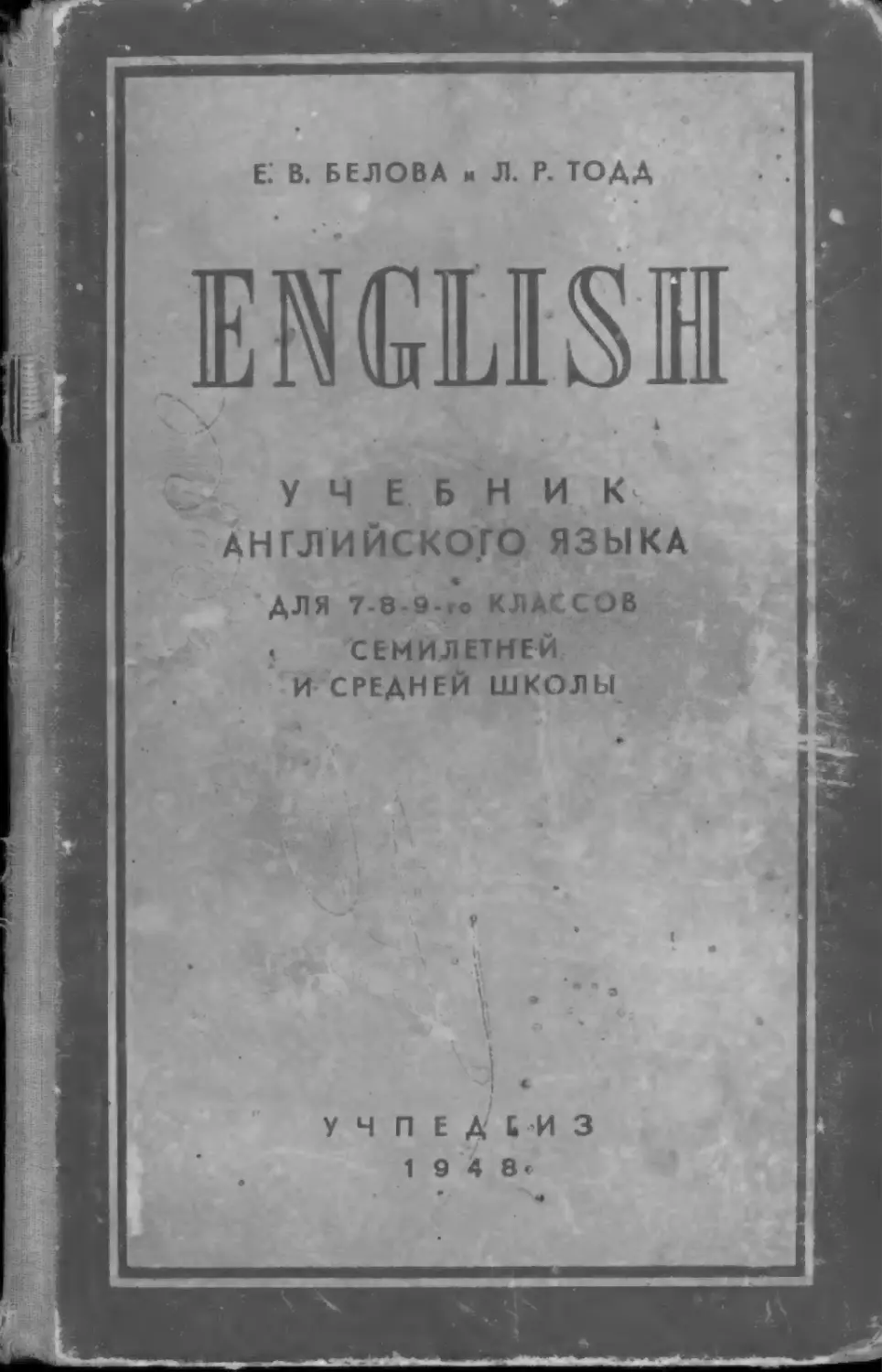


Автор: Белова Е.В. Тодд Л.Р.
Теги: english английский язык английский для детей english grammar english for children госучпедгиз
Год: 1948


Текст
Е: В. БЕЛОВА И Л. R ТОДД
х V	i
> У Ч Е Б Н И К
АНГЛИЙСКОГО ЯЗЫКА
' -'Х ’ДЛЯ 7-8-9-го КЛАССОВ
J	с ем И ЛЕТНЕ й,
И СРЕДНЕЙ ШКОЛЫ
 -.

УЧПЕДЬИЗ
1 9 4 В>
Е. В. БЕЛОВА и Л. Р. ТОДД
ENGLISH
УЧЕБНИК
АНГЛИЙСКОГО языка
ДЛЯ 7-го, 8-го и 9-го КЛАССОВ
СЕМИЛЕТНЕЙ И СРЕДНЕЙ ШКОЛЫ
ИЗДАНИЕ ТРЕТЬЕ
ПЕРЕРАБОТАННОЕ И ДОПОЛНЕННОЕ
ГОСУДАРСТВЕННОЕ
УЧЕБНО-ПЕДАГОГИЧЕСКОЕ ИЗДАТЕЛЬСТВО
МИНИСТЕРСТВА ПРОСВЕЩЕНИЯ РСФСР
МОСКВА * 1048
Утверждён
Министром просвещения РСФСР
к переизданию 25 декабря 1947 г., протокол Л? 446.
Редактор В. Я. Гудзь.	Техн, редактор Н. П. Цирулъницкий.
Подписано к печати 30/VII 1948 г. А06692.
Печатных листов 24. Учётно-иадат. л. 25,89.
Отпечатано в тип. М-109, М-114 и М-118
CONTENTS.
LESSONS.
Part 1.	Page
1.	The Sun and the Wind........	5
2.	Summer Holidays............... 8
3.	The Blind Toymaker........... 12
4.	The Blind Toymakcr (Continued) 15
5.	The Twenty-Second of June, 1941 20
6.	A Lesson...................   24
7.	About Books.................. 29
8.	Plans for Sunday ............ 33
9.	A Visit...................... 38
10.	A Visit (Continued) .......... 44
11.	Androcles and the Lion ....... 48
Part II.
12.	School-Friends................ 55
13.	School-Friends (Continued) .... 60
14.	The Wolf in Sheep’s Clothing.. 65
15.	Different Kinds of Buildings... 70
16.	School-Friends............... 74
17.	Exploring ..................   79
18.	The Blind Toymaker............ 84
19.	Some Wild Animals........	90
Page
20.	Ivan Susanin	..........    96
21.	Great Rivers	of the World.... 100
22.	Partisans.................... 105
23.	Jokes........................ 109
24.	Travelling ................   113
25.	Travelling (Continued)........ 118
26.	A Hero from	a City of Heroes .. 122
27.	The Walking	Stamp .... 125
Part III.
28.	Canals ....'.................. 129
29.	In Hospital................... 133
30.	A Letter ........’............ 136
31.	Over the ’Phone............... 139
32.	Dust.......................... 143
33.	Observation .................  146
34.	V. I. Lenin................... 150
35.	Northern Myths............... 155
36.	Steam Engines and Locomotives 158
37.	Steam Engines and Locomotives
(Continued)....................... I6l
38.	Victory Day in Moscow ........ 166
RULES OF READING AND SPELLING §§ I—154.
General §§ I—16.......................................................... I7l
I.	Reading of Vowel Letters §§ 17—108.................................. 174
1.	One-Syllable Words §§17—25.....................................    174
2.	Two-Syllable Words §§26—59 ...................................... 179
3.	Digraphs §§ 60—82 ..............................................  188
4.	Combinations of Vowel Letters with Consonant Groups §§ 83—87 .... 196
5.	Three-Syllable and Many-Syllable Words §§88—108.................. 198
II.	Reading of Consonant Letters §§ 109—154 ............................. 204
III.	Exceptions to the Rules of Reading and Spelling .................... 213
3
GRAMMAR §§ 1—314.	Page
Introduction §§ I—21 ....................................................   217
Parts of Speech §§ 22—254
The Verb §§22—142 ......................................................... 231
Finite and Non-Finite Forms of the Verb §§22—29.......................  231
Auxiliary Verbs §§ 30—69..............................................  234
Mudal Verbs §§ 70—86  ...............................................   244
Infinitive and Participles §§ 87—Ю2 ................................... 248
Tenses §§ 103—126 ........"............................................ 255
Indefinite Tenses in the Active Voice §§ 104—108	........ 256
Indefinite lenses in the Passive Voice §§ 1U9—112................. 258
Continuous Tenses §§ 113—119.......................................260
Perfect Tenses §§ 120—124 ......................................   262
Perfect Continuous Tenses §§ 125—126	........................... 265
Sequence of Tenses §5 127—131.......................................... 266
Direct and Indirect Speech §§ 132—142	.............................. 268
The Noun §§ 143- 158 ...................................................... 272
The Plural of Nouns § 144 ........................................... -	273
The Possessive Case §§ 145—151......................................... 273
The Common Case § 152...............................................    275
English Equivalents of Russian Case Endings §§ 153—156 ...............  275
Noun-Attributes §§ 157—158 ............................................ 276
Pronouns §§ 159—196 ....................................................... 277
Personal Pronouns §§160—162 ........................................... 277
Possessive Pronouns §§ 163— 164 ....................................... 279
Interrogative and Relative Pronouns §§ 165—168......................    280
Reflexive and Emphatic Pronouns §§ 169— 171 ............................281
Demonstrative Pronouns §§ 172—174 ..................................... 282
Indefinite Pronouns §§175—196  .............. ,................... .. 283
Articles §§197-218.....................................................     288
Numerals §§219—221 ...........:............................................ 296
Adjectives §§ 222- 226 .......,............................................ 298
Adverbs §§227—235 ......................................................... 300
Prepositions §§ 236— 242 ...............................................    302
Wordbuiiding §§243-254..................................................... 309
The Sentence §§ 255— 3'4
Kinds of Sentences §§ 255-283 ............................................. 314
The Declarative Sentence §§256—261 .................................... 315
The Imperative Sentence § 262 ......................................... 316
The Exclamatory Sentence §263 .....................................     317
The Interrogative Sentence §6 264— 283 ...........  ...	............ 318
General Questions §§ 265—277 ..................................... 318
Special Questions §§ 278—283 ...................................   322
Types of Sentences §§ 284—314 ..........................................    323
The Simple Sentence §§ 285-297 ........................................ 324
The Principal Parts of the Sentence §§ 286—290...	.. . .	324
The Secondary Parts of the Sentence §§ 291—297 .................   327
The Compound Sentence §§ 298- 299 ..................................... 331
The Complex Sentence §§300- 314 ...................................     332
Types of Subordinate Clauses §§ 301—314......... ..	. .. ...... 333
Table of Tenses............................................................ 344
List of Irregular Verbs ............................................. .	. 345
Alphabetic Vocabulary ..................................................... 346
LESSONS
Part L
LESSON ONE.
THE 'SUN AND THE 'WIND1).
'One 'bright 'windy 'day3 the 'wind 'met the 'sun2 and 'said,1 “'I am
'stroncer than 'you.”1
“You are 'not 'stronger than 'I,”1 'said the 'sun.1
“1 'am,”1 'said the 'wind.1
They 'said 'this to 'each 'other2 'many 'times a 'day2 for 'six 'weeks.1
At 'last the 'wind 'said,1 “'Shall we 'see 'who is the 'stronger?”2
“I should 'like to 'do 'that,”1 'said the 'sun,1 “but 'how 'can we?”1
’) Следующие слова являются исключениями из правил чтения и
правописания. Перед чтением текста найдите их в списке исключений на
стр. 213 и проверьте их чтение —
are, could, do, many, one, other, pull, said, shall, shone, should, shoulder,
this, very, who, whom, whose, wind, yts, you.
Читайте и переводите текст с помощью словаря па стр. 346.
“'Do you 'see 'that 'man?”2 'said the 'wind.2
“'Do you 'mean the 'man with a 'cloak on liis 'shoulders?’2 'asked
the 'sun.2
“'Yes,”7 'said the 'wind.1 "'That is the 'man whom I 'mean.1 И
'you can 'make him 'take his 'cloak 'off.2 'you are 'stronger than 'I,1 but
if 'J can 'make him 'take it 'off,3 '1 am 'stronger than 'you.1 'Let us 'each
'try.1 '1 shall 'try 'first.”1
Then the 'wind 'blew and 'blew.1 But the 'more it 'blew,2 the 'more
the 'man 'pulled his 'cloak2 a'round him,1 be'eause the 'wind was 'very
'cold.1 The 'wind could 'not 'blow the 'cloak 'off.1
“It is 'my 'turn 'now,”1 'said the 'sun.1 Then the 'sun 'came 'out2
and 'shone 'very 'brightly.1
“'How 'hot it is!”1 'said the 'man.1 “1 must 'take my’ 'cloak 'off,”1
and he 'touk it 'off.7
'Whose 'victory 'was it?1 It was the 'sun’s 'victory’.1
Примечания.
shall we see who is the stronger? посмо-
трим, uro более сильный (из нас)?
I should like to do that Мне хотелось
бы это сделать (т. с. посмотреть).
1 shall try first Я попробую первый.
the more... the more чем больше...,
тем больше (зд. чем сильнее...»тем
плотнее).
Упражнения па правила чтения и правописания
(§§ 1—10, 38—39, 116, 127—128).
1. Прочитайте следующие слова —
bit bid	pet met	back man	hop lop	hug tub
bite bide	Pete mete	bake mane hope lope huge tube
IJ. Напишите в две колонки слова, в которых буквы г/ и w передают (1) гласные
звуки, (2) согласные звуки —
yes, very, brightly, you, flying, gyps, yet, my, buy, yellow, body,
lying, your, only, young, trying, yesterday;
wind, how, we, week, swim, down, know, with, was, window, water,
wash, blow, wall, Moscow, were, new.
HI. Hu ин шито в две колоики слова, в которых буква и передаёт (1) гласный звук,
(2) согласный звук —
sun, quick, pupil, us, quite, gun, round, question, music, but,
quarter, union, quit, house, square.
IV.	Прочитайте следующие слова н, отбросив окончания, напишите основную форму
каждого слова —
Пример: ladies—lady crying—cry eightieth — eighty
babies, tries, thirtieth, cried, easier, happiest, happily, dried,
countries, carried, families, twentieth, cries, trying, ugliest.
V.	Напишите в две колонки существительные е неопределённым артиклем в форме (1)
а и (2) ап —
a shelf, an egg, a boy, a girl, еп ear, a face, an arm, a hand, ап
eye, a foot, an uncle, a year, a hero, an hour, a week, a bag, an apple,
a window.
6
VI.	Напятите в" две колонки существительные с определённым артиклем the, читаю-
щимся (1) [6о] и (2) [6i] —
the hero, the union, the banner, the army, the hat, the wind,
the end, the year, the ice, the thing, the ear, the evening, the enemy.
Упражнения к тексту1).
1. Ответьте пя следующие вопросы —
1) Was it a bright windy day when the wind said to the sun.
“I am stronger than you?” 2) What did the wind say to the sun?
3) What did the sun answer? 4) What did the sun and the wind say
to each other many times a day? 5) What did the wind see one day?
6) What had the man on his shoulders? 7) Did the sun and the
wind each try to make the man take his cloak off? 8) How did the
wind try to make the man take his cloak off? 9) What did the man
do when the wind blew? 10) How did the sun try to make the man
take his cloak off? 11) What did the man do when the sun shone
very brightly? 12) Which was the stronger, the sun or the wind?
IL Вставьте подходящее елнво из слов, данных в скобках —
1) When it is very ..., we put nn our coats (hot, cold). 2) If the
weather is cold, Kitty... her warm dress... (takes off, puts on).
3) In summer the days are always... (dark, bright). 4) There are
. many bright days in ... (winter, summer).
III.	Дайте форм) Past Indefinite Tense от следующих глаголов —
ask, see, sav, pull, make, try, blow, like, come.
IV.	Вставьте подходящие слова из текста —
1)	Is it Tom’s... to be on duty? 2) The wind ... the boy’s hat....
3) When we come into the room, we ... our coats..., and when we
go out, we put our coats on.
V.	Прочитайте и переведите па русский лык следующие предложения —
1) The 'bright 'sunny 'morning2 'made us 'get 'up3 'very 'early.1
2) My 'brother 'said to me,1 “'Shall we 'go to the 'river?”2
3) “1 should 'like to 'bathe,” said I,1 “but I am a'fraid2 that the
'water2 is 'very 'cold in the 'morning.”1
4) “'Let us 'go and 'sec,”1 'said my 'brother,1 “'I shall 'try 'first.”1
VI. Переведите па алглпйскнй язык следующие предлоа:еппя —
1) «Дайте мне книгу, пожалуйста».—«Я не знаю, какую
книгу вы имеете в виду». 2) Сегодня моя очередь дежурить.
3) Чем сильнее дул ветер, тем плотнее человек закутывался
в плащ. 4) Солнце появилось после полудня. 5) Как жарко
сегодня! б) Как холодно было вчера! 7) Ученики помогали
друг другу. 8) Чья эта книга? 9) Учитель заставил ученика
написать снова это упражнение.
VII. Выучите рассказ наизусть.
*) Делая упражнения, переводите каждое предложение, чтобы точно
понять его смысл.
7
Упражнения но грамматике (§§ 1—21).
1.	Переведите следующие предложения и напишите, к какой части речи принадлежат
выделенные слова (§§ 1—6) —
А.	1) Yesterday they had a long talk. 2) “Please don’t talk”
3) I work quickly.’ 4) This work is not difficult. 5) I like to go to
the cinema. 6) 1 want a pencil like this. 7) She is sitting at the open
window. 8) “I can’t open the door.” 9) It was a still autumn day.
10) I still have time to go there.
В.	1) Long walks in the wood are very pleasant. 2) She always
walks there when she is not tired. 3) Where are your skis? 4) He
skis very well. 5) It rains very much in autumn. 6) The autumn
rains began early. 7) There are some bandages in this box. 8) She
bandages his arm in the morning. 9) This is my friend's book. 10) Two
of my friends came to see me.
11.	Напишите вопросы, относящиеся к выделенным словам (§ 20) —
1)	The wind blew his hat off. 2) Children like cherries. 3) Masha
went to see her friend. 4) The Soviet soldier carried a banner.
III.	Составьте предложения из следующих слов (§§ 17—21) —
1)	Pears, do, children, like? 7) Hot, is, how, it!
2)	An egg, the girl, for breakfast, 8) Here, doing, are, what, you?
had.	9) Autumn, is, in, there, fruit,
3)	Bag, the, put, the book, into. much.
4)	Cloak, the aian, his, around, 10) This, is, whose, book?
pulled, him. e	11) Cold, he, winds, like, not,
5)	A plate of cakes, on the table, does.
put, my mother.	12) Sit, come, and, in, down.
6)	A pig, docs, grass, eat? 13) It, cold, is, how!
LESSON TWO.
SUMMER HOLIDAYS.
All Soviet schoolchildren like very much to go back to school in
September after the summer holidays. Before the Great Patriotic War
began in 1941, most Soviet children who lived in big towns spent
the summer in the country. Some went to villages and country houses
with their parents; others went to pioneer camps in the country or near
the sea. They played games in the garden, or went for walks in the
forest, where it is always cool and pleasant in summer. Some boys and
girls like to read very much, and during the summer months they sit
out-of-doors, or lie on the ground and read books. Most boys and girls
like to bathe and swim, and so pioneer camps are usually near a river,
a lake, or the sea.
Исключения из правил чтения и правописания — answer, body, country,
door, fascist, field, forest, front, girl, great, house, month, most, of, oh, people,
pleasant, proverb, river, school, second, some, two, usually, were, where.
8
After the 22nd of June, 1941, very many of our men went to the
front to defend our Soviet fatherland. School hoys and girls did not
spend their summer holidays in quite the same way as before. They
went to the collective farms and helped to do the work of the men
who were at the front. They often did quite hard work. They made
hay and helped with the harvesting. Our Soviet Army and our people
needed much com, and Soviet school boys and girls worked in the fields
yellow with ripe corn. In this way they helped the Soviet Army to fight
for our country against the German fascists. The hard work out-of-doors'
in the fields made their bodies strong, and when school began again, they
were ready to work hard at their books.
Proverbs. Make hay while the sun shines.
A change of work is as good as a rest.
Примечания,
not ... in quite the same way нс совсем 1ак.
Упражнения па правила чтеппя п правописания
(§§11—16, 40, 121, 126, 138—144).
I.	Прочитайте следующие слова —
can lack	rod cock	must luck	met mess	I	sit fill
cane lake	rode coke	muse Luke	mete these	'	site file
П. Выпишите в две колонки слова, в которых буква г (1) читается, (2) не читается —
red, drink, dark, Mary, bright, her, first, Russian, American,
story, for, street, brown, merry, garden, hero, bird, cry, morning.
Ш. Выпишите в две колонки слова, в которых буква 8 в конце слови передает (1)
звонкий звук [z], (2) глухой звук [S] —
takes, this, pencils, class, helps, cries, tables, yes, days, thus, us,
arms, chess, wants, tries, wars, base, works, heroes, use n., lamps,
pass, babies, stands, house, looks, knives, sees, desks, bodies, sofas,
use v., paints, hoys, blows, shelves, bus, mouse.
9

IV.	Выпишите в две колонки слова, в которых буква d в конце слова передаёт (1) звон-
кий звук Id), (2) глухой звук [t] —
worked, tried, passed, called, looked, played, cried, lived, washed,
liked, lied, opened, rained, talked, dressed, answered.
V.	Выпишите в две колонки слова, в которых буква е в конце слова (1) не читается,
(2) передаёт звук [i] н прибавляет слог —
time, houses, helped, biggest, bodies, asked, opened, defended,
dressed, wanted, passed, dresses, heroes, washes, washed, apples,
cherries, shouted, twentieth, classes, faces, happiest, noses, fortieth,
quickest, knives, nicest, invented.
VI.	Прочитайте следующие группы слов, делая ударение па существительном —
in a house, in a room, in a bag, in a box, in a town;
on a table, on a chair, on a lake, on a river;
of a man, of a woman, of a girl, of a boy;
from a town, from a village, from a forest, from a lesson;
with a book, with a dog, with a stick, with an apple.
VII.	Подчеркните слово to одной чертой, когда оно читается [tu], и двумя чертами,
когда оно читается [to] —
A.	to the table, to a desk, to her house, to our school, to a river,
to the sea, to a lake, to your parents.
B.	to eat, to drink, to ask, to answer, to say, to speak, to talk,
to meet, to work, to invite, to understand.
Упражнения к тексту.
I.	Ответьте на следующие вопросы —
1)	In what month do children go back to school? 2) Do all
schoolchildren like to go back to school after the summer holidays?
3) Where did most Soviet children spend the summer holidays
before 1941? 4) What did they do in the country? 5) When did
many of our men go to the front? 6) What did school boys and
girls do during the Great Patriotic War? 7) Did they live in the
same way as before ? 8) Where does corn grow ? 9) In what season
is corn ripe? 10) What makes our bodies strong?
II,	Напишите форму' Past Indefinite Tense от следующих глаголов —
spend, go, need, lie, read, help, swim, bathe, speak.
III.	Вставьте правильный предлог —
1)	Their country house was... a little lake. 2) The schoolboys
worked... the fields... the summer holidays. 3) You must work
hard... your English. 4) My brother was... the front ... 1945.
5) The boy was ill in bed ... five days and could not go ... school.
IV.	Вставьте нодходяпще слова из текста —
1)	The school year... begins in September. 2) Do you ... your
pen? I should like to use it. 3) This is not the ... paper, you gave
me different paper last week. 4) A child’s mother and father
are its ... .
10
V.	Прочитайте п переведите па русский язык следующие предложения —
1)	The 'winter 'holidays2 are in 'January.1
2)	In the 'summer2 the 'children 'went for 'walks2 in the 'forest.1
3)	My 'sister 'likes to 'read 'very 'much.1
4)	'Most 'boys and 'girls2 can 'swim.1
5)	Be'fore the 'Great Patriotic 'War be'gan,2 he 'lived in 'Lenin-
grad.1
6.	) They could 'not 'live2 in the 'same 'way2 as be'fore.1
VI.	Переведите на английский язык следующие предложении —
1)	Мне всё ещё нужна эта книга. 2) Летом я люблю читать
на открытом воздухе. 3) Он прочитал много книг за лето.
4) Он приехал домой на 5 дней. 5) Это очень хорошенькая
деревенька. 6) Я живу в большом городе, а мой дядя живёт
в деревне. 7) Он сделал это упражнение не так, как я.
Упражнения по грамматике (§§ 22—41).
I.	Переведите следующие предложения и напишите, к какой части речи принадлежат
выделенные слова (§§ 1—6) —
1)	She left the potatoes on the table. 2) Bob writes with his left
hand. 3) He always answers my questions. 4) He knows the answers
to the questions. 5) It was a dark night. 6) Cats can see in the dark.
7) Mary writes better than Tom. 8) This is a better book; take it.
9) He is a very good shot with a rifle. 10) The man shot the bear.
11) She often dresses her little brother. 12) Mother bought us new
dresses for school. 13) He usually sings Russian songs. 14) His father
is a Russian and his mother is a Ukrainian. 15) Our school is near
the river. 16) Don’t stand so near when I am writing.
II.	Напишите подлежащее каждого предложения в 8-м лице единственного числа
и сделайте соответствующие изменения в сказуемом (§ 23) —
1)	1 am not afraid of dogs. 2) We speak to that man every
morning. 3) You do not swim very often. 4) I usually see Tom
every day. 5) 1 have no time to speak to you now.
III.	Напишите следующие предложения в Present Indefinite Tense (§ 23) —
1)	My father went to work every day. 2) We made hay and
helped with the harvesting. 3) He was very tired and sleepy. 4) He
took his hat off at the door. 5) We were ready to go to bed. 6) He
had no parents.
IV.	Напишите следующие предложения в Past Indefinite Tense (§ 26) —
1)	Does he know your brother? 4) My sisters are very young.
2)	He can ski very well.	5) He is not old.
3)	They have very good skis.	6) Can he read English ?
V.	Скажете, чем является глагол be в следующих предложениях — смысловым гла-
голом, глаголом-связкой или вспомогательным глаголом (§§ 30—35) —
1) There is some bread on the table. 2) The pioneers are bathing
in the river. 3) We were at the cinema yesterday. 4) Sasha is absent
from school. 5) Winter is a very cold season. 6) Bob was at school
yesterday at 8 o’clock.
11
EESSCEX TUREE.
THE BLIND TOYMAKER.
From "The Cricket on the Hearth”
by Charles Dickens.
Caleb Plummer and his blind daughter Bertha live alone in a little
wooden house. They make toys for children and work for Mr. Tackleton,
the toy-merchant. Their house stands near the toy-shop where Mr. Tackle-
ton lives.
Bertha does not know that their house is old and ugly, with dirty
walls and black ceilings. She does not know that her father is a tired
old man with grey hair. She does not know that the master for whom
they work is hard and cruel. Oh dear, no! She thinks that she lives in a
bright, pretty little home and that her father is a clever young man with
black hair. She thinks, too, that the toy-merchant, their master, is kind
and good.
This is all Caleb’s work. When his blind daughter was a baby, he
wanted to make her happy. So he did not give her a true picture of their
life. He told her only about pleasant things. She thought that everything
was nice and pleasant. She was a happy child, and she is a happy girl.
The toymaker’s home is very funny. Their living-room is their work-
room, too. On shelves around it there are many dolls, dolls’ houses, dolls’
tables and chairs, and a lot of bright material out of which the blind girl
makes clothes for the dolls. There are other children’s toys there too—
wooden cats and dogs, chickens and birds, brown bears, lions and tigers,
Исключения из правил чтения и правописания — bear, ceiling, clever,
continued, everything, eyes, full, give, good, heart, hearth, live, monkey, oil, pretty,
soldier, there, tiger, ugly, wooden, young.
12
monkeys, and other animals; there are bright red wooden soldiers and boxes
of little wooden knives, forks and spoons.
Bertha and her father are sitting at work at a big table. She is making
a doll’s dress and he is painting a doll’s house.	(To be continued.)
Proverb. Л happy heart is better than a full purse.
Примечания.
a little wooden house деревянный домик.
Упражнения на правила чтения и нравоппеания
(§§17—19, 122, 130—131, 134—136, 145).
I. Прочитайте следующие слова —
gap gape	not note	tub tube	met mete	bit bite
tack take	rod rode	cub cube	pet Pete	fin fine
pan pane	hop hope	cut cute	then these	lick like
man mane	rob robe	nut mute	wet Swede	Sid side
II. Выпишите и две колонки слова, принадлежащие (1) к I типу слога, (2) ко 11 типу
слога —
quick, try, she, bag, much, ring, bed, shot, we, my, must, stove,
face, he, nine, so, on, nice, by, plus, quite, thank, those, will, me,
bus, then, ink, life, be, write, rose, shut, I, late, wave, no.
1П. Выпишите в дв<* колонки слова, в китирьп буква е передаёт (1) звук [к],
(2) звук [S] —
came, dance, Moscow, call, pencil, music, face, can, nice, became,
doctor, place, cold, December, ice, once.
IV.	Выпишите в две ко.1<>ньи слона, в которых буква у/ передаёт (1) звук [g], (2)
звук —
gun, began, begin, village, slogan, dog, girl, page, green, leg,
bigger, German, egg, give, good, August, big, gift, tiger, large, get,
finger, barge, edge.
V.	Выпишите .. две колонки сл»ва е сочетанием согласных (1) ch (leh) и (2) sfi и
напишите над колопкамя соответствующие фонетические знаки —
shelf, chick, chair, dish, chalk, shall, chess, short, she, catch,
fish, cherry, shout, child, shine, match, stitch.
VI.	Вставьте прилагательное и, где нужно, измените форму неопределённого артикля —
an apple fn’t/J, a man (young), a book (English), a year (happy),
a face (ugly), an orange (yellow), an egg (white).
VII.	Подчеркните одной чертой определённый артикль, читающийся [di], и двумя
чертами — определённый артикль, читающийся |йа] —
the long way, the ugly face, the strong wind, the other day,
the left arm, the young woman, the warm spring, the open sea, the
English book.
13
Управления к тексту.
1.	Переведите письменно на русский язык —
1)	Не thought hard for a minute and then gave the right answer.
2)	This book is not hard to read.
3)	Caleb Plummer was not a hard father; he loved his daughter
and wanted to be kind to her.
il.	Ответьте па следующие вопросы —
1)	Whose daughter is Bertha? 2) What do Caleb Plummer and
his daughter do? 3) Where does Mr.Tackleton live? 4) Where does
Caleb Plummer’s house stand? 5) Is his house pretty? 6) Why is
it ugly? 7) Is Bertha’s father a clever young man with black hair?
8) What is he then? 9) Is Mr. Tackleton good and kind? 10) What
is he then? 11) Why didn’t Caleb give his daughter a true picture
of their life? 12) What are there on shelves round the walls of the
living-room? 13) What does Bertha make? 14) W'hat does Caleb
make?
III.	Напишите форм; Past Indefinite Tense от следующих глаголов —
make, stand, know, iry, call, give, tell, paint, sit, think, live.
IV.	Вставьте подходящие слов» из текста •—
1)	This pupil is very..., he always knows his lessons. 2) The...
is only four months old, but it smiles all the time. 3) This girl can
draw and ... very well. 4) Children are sometimes ... to animals.
5) The... old man gave an apple io each child. 6) Mr. Tackleton
was a ... master. 7) I... that 1 shall go home now; I am very tired.
8) 1 have a bouk of... stories about animals.
V.	Прочитайте в переведите на русский язык следующие предложения —
1)	'Caleb 'told his 'daughter2 'only about 'pleasant 'things.1
2)	Their 'living-room was their 'work-room, 'too.1
3)	The 'blind 'toymaker2 had a 'lot of 'bright ma'terial.1
4)	There were 'many 'children’s 'toys 'there, 'too.1
VI.	Переведите па английский язык следующие предложения —
1)	В деревнях много деревянных домов. 2) Они делали
игрушки для детей. 3) Опа крупная девушка с тёмными воло-
сами. 4) Калеб хотел сделать свою дочь счастливой. 5) Он не
рассказывал ей о неприятных вещах в их жизни. 6) Был
ясный день. 7) У неё есть яркое синее платье. 8) Мистер
Таклтоп был суровый и жестокий человек. 9) Он заставлял
Калеба и Bi-рту много работать. 10) Работа Калеба не была
тяжёлой, по он работал очень много.
VII.	Дайте описание комнаты, употребив следующие слова —
wall, ceiling, door, window, floor, table, chair, bed, shelf, book-
case, sofa. VIII.
VIII. Выучите рассказ наизусть.
14
Упражнения по грамматике (§§ 42—50, 143 —158).
I.	Напиши ie следующие предложения в Past Indefinite и в Future Indefinite (§32) —
1)	There are two windows in my room. 2) Is there time to do
that? 3) There are no children there after six o’clock. 4) There is
corn in this field. 5) There are many animals on the farm.
II.	В следующих предложенных поставьте подлежащее во множественном числе
и сделайте соответствующие изменения (§§ 143—144) —
1)	The hoy is sitting on a chair. 2) She has a box of paints and
likes to use it. 3) .My sister is putting on her new dress. 4) Is this
your ski? 5) Was that his picture? 6) There was an apple on the
table. 7) The woman read a story to her child. 8) He put his bag
on the chair.
III.	Дайте Possessive Case вместо выделенных слов (§§ 145—148) —
1)	The legs о/ the tiger are very strong. 2) The books of my sister
are in that bookcase. 3) The schoolbags of the pupils were on their
desks. 4) The living-room of my uncle is very pleasant. 5) The rifles
of the Soviet soldiers were new.
IV.	Ответьте на следующие вопросы, употребив существительные в притяжательном
падеже (§§145- 148) —
1)	Whose daughter was blind?
2)	Whose dress is very nice?
3)	Whose toys were on the floor?
V.	Переведите на русский язык следующие предложения (§§ 153—154) —
1)	I don’t like to write with a pencil. 2) The door of her room
was open. 3) They went there by tram. 4) Did you show’ your work
to your teacher? 5) She spoke to the father of the two children.
6) She was pleased with his work.
VI.	Переведите па русский язык следующие предложения (§ 42) —
1)	We have a big bookcase in our living-room. 2) October has
thirty-one days. 3) We have breakfast at 8 o’clock. 4) Have you
time to help me with my English? 5) Will you have a cup of tea?
6) Caleb Plummer and his daughter had a hard master. 7) This table
has only three legs. 8) Mr. Tackleton had an ugly face.
4} Whose copy-books are- these ?
5) Whose are these shoes and
stockings?
LESSON FOVR.
THE BLIND TOYMAKER.
(Continued.)
As 'Caleb and his 'daughter 'work,2 they be'gin to 'talk.1
“You 'went 'out in the 'rain 'last 'night2 in your 'beautiful 'new 'over-
coat,”1 'says 'Bertha.1
“'Yes,1 in my 'beautiful 'new 'overcoat,”1 'answers 'Caleb.1 He 'looks
at a 'coat of 'rough 'sack-cloth2 that is 'hanging on a 'line2 to dry.1
Исключения из правил чтения и правописания— beautiful, begin, buy,
come, don’t, four, friend, have, laugh, minute, nothing, present, rough, says, your.
15
“'How 'glad I 'am2 that you 'bought it, Father.”1
“It’s 'too 'good a 'coat for 'me,1 'that 'bright 'blue 'coat2 with its
'shining 'buttons.”1
“'Too 'good !”2 'cries the 'blind 'girl.2 She 'stops her 'work for a
'minute2 and 'laughs.1 “'Nothing is 'too 'good for my 'clever 'father,2
with his 'smiling 'face2 and 'black 'hair!1 'Nothing is 'too 'good for
'him!”1
'Caleb be'gins to 'sing.1
“'What!2 'Are you 'singing?2 'Why arc you 'singing?”1 'says a 'rough
'voice,1 and '.Mr. 'Tackleton 'comes 'in? “'I 'don’t 'sing.2 'I have 'no
'time to 'sing.2 I 'hope that you can 'work 'too.1 'I 'can’t 'sing when
I 'work.”2
“You 'don’t 'see how the 'master is 'smiling at me,”1 'says 'Caleb
in his 'daughter’s 'ear? “He is pre'tending to be 'hard and 'cruel? you
'know.”1
The 'blind 'girl 'laughs? Then she 'takes 'Mr. 'Tackleton’s 'hand2 and
'kisses it?
“'What is the 'idiot 'doing?”1 'asks the 'toy-merchant? and 'pulls
his 'hand 'roughly a'way?
“1 am 'thanking you for the 'little 'tree? the 'beautiful 'little 'tree,”1
'answers 'Bertha? She 'brings 'forward a 'little 'rose-tree2 with a 'yellow
'rose on it? She 'thinks2 that the 'rose-tree2 is a 'present2 from her 'master?
She does 'not 'know2 that 'all “the 'master’s 'presents”2 'come from her
'father? and that he 'often 'goes with'out his 'dinner2 to 'buy them?
“'What dues the 'idiot'mean?”1 'asks 'Mr.'Tackleton? He'gives'Caleb
some 'rough 'orders2 and 'then 'goes a'way2 with'out a'nofher 'word?
“He 'didn’t 'want 'thanks, you 'see? and he 'smiled at 'me 'all the
'time,”1 'said 'Caleb 'brightly,1 when the 'door was 'shut?
“'Mr. 'Tacklcton is my 'best 'friend,”1 'said 'Bertha? “he is 'always
'very 'kind to me.”1
Proverbs. There is no place like home.
No rose without a thorn.
Примечания.
last night вчера вечером.	without another word ue сказав больше
you know знаете ли.	ни слова.
goes without his dinner остаётся без you see видите ли (понимаете ли),
обеда.
Упражнения па правила чтения и правописания
(§§ 20—21,41, 109—111, 114, 117—119, 125, 132, 135, 148-150).
I. Прочитайте следующие слова —
dark mark port lord cur purr her merge fir stir
dare mare pore lore cure pure here mere fire tire
II. Напишите « две колонки слова, принадлежащие (1) к III типу слога, (2) к IV типу
слога —
bird, more, care, sport, here, arm, fur, tyre, star, mere, bar, bare,
first, her, fire, Byrd, cur, tired, third, cure, shirt.
16
Ш. Напишите в две колонки слова, в которых сочетание th передаёт (1) звонкий звук [3],
(2J глухой звук |0| —
this, these, third, that, those, fifth, with, three, Bertha, the,
thirty, then, than, thing, think, thirteen, their, Smith, father,
mother, thousand, they, there, through, brother, sixth, together,
other, another, ninth.
IV.	Напишите в три колонки слове, в которых нс читается (1) букв» Л, (2) буква w,
(3) сочетание gh—
where, light, wrote, which, daughter, what, high, when, bright,
who, why, eight, write, whom, white, night, whose, wrong, whole.
V.	Прочитайте следующие труппы слов —
А.	Ударепис па сущсствительпом—
in the sky, in the forest, in the river, in the village;
on the table, on the ceiling, on the sofa, on the wall;
at the lesson, at the table, at the window, at the blackboard.
В.	Ударение ьч местоимении л ни существительном —
with this man, with that boy, with these pupils, with this girl.
VI. Прочитайте следующие группы слов, делая ударение па существительных —
A.	a boy and a girl a man and a woman B.	a dress or a coat a book or a toy	a pen and a pencil a flag and a banner a spoon or a furk a cup or a glass	a table and a chair a tram and a car an apple or a pear a bed or a sofa
VII. Прочитайте следующие слова — A. lack — lake — leek - - look — lurk		mice pace pence
rack — rake — reek — rouk — murk		rice race fence
B.	riff	—	rife	—	reef	—	roof	—	surf cliff	—	life	—	leaf	—	hoof	—	serf C.	bill	—	bile	—	eel	—	pool	—	ball mill	—	mile	—	meal	—	fool	—	fall sill — sole — seal — stool — small D.	buzz — breeze — size rise has his		kiss tense us
fuzz — freeze — prize wise as is		miss sense plus
E. gave five serve cave drive nerve	serf leaf knife wife serve leaves knives wives
F. sleg — sledge	bag — badge	rag — rage
rig — ridge	plug — plunge hug — huge
Упражнения к тексту.
I.	Переведите письменно па русский язык —
1)	She has a beautiful voice and sings very well. 2) Put your
shoes here to dry. 3) Torn pretended to be a dog and he made all
the children laugh. 4) .Many pictures hang on the walls of our
class-room.
2
17
II.	Ответьте ла еле дующие вопросы —
1)	Did Caleb go out in the rain in his overcoat? 2) Where did
he put his overcoat to dry? 3) Did Caleb buy his overcoat, or did
he make it? 4) What does Bertha say when her father tells her
that the coat is too good for him? 5) Docs Mr. Tackleton smile
when he comes into the room? 6) Does Caleb say that Mr. Tackleton
is smiling at him? 7) Why does Caleb say that Mr. Tackleton is
smiling at him? 8) Why does Bertha kiss Mr. Tackleton’s hand?
9) Who gave Bertha a rose-tree as a present? 10) Was Mr. Tackle-
ton kind to Bertha? 11) Who was always kind to Bertha?
III.	Вставьте правильный предлог —
1)	Don’t go out ... the rain ... your new hat. 2) Please look ...
my homework. 3) These clothes are too big ... your little sister.
4) Our baby smiles... us all the time. 5) 1 want to say something ...
your ear. 6) She kissed her mother and thanked her ... her present.
7) The old woman loved children and was always very kind ...
them. 8) ... summer we can go ... coats, because it is warm then.
IV.	Вставьте подходящие слова из текста —
1)	She washed the clothes and they ... very quickly in the hot
sun. 2) Don’t speak so ... to the little boy; you will make him cry.
3) The teacher called my name, I came ... and she gave me a copy-
book. 4) He has a very interesting book about Russian painters with
many ... pictures in it. 5) “... your coat up,” she said.
V.	Прочитайте и переведите па русский язык следующие предложения —
1)	“'How 'glad I 'am to 'see you,”1 'said her 'mother.1
2)	She 'stopped her 'work for a 'minute2 and 'laughed.1
3)	“'I have 'no 'time to 'sing,”2 'says the 'toy-merchant as he
'comes 'in.2
4)	'Caleb 'says2 that his 'master2 is 'only pre'tending to be
'hard and 'cruel.1
5)	“'What does she 'mean?”1 he 'asked.1
VI.	Переведите на английский язык следующие предложения —
1)	Это пальто слишком велико для вашего маленького
брата. 2) Он не болен, он только притворяется больным.
3) Моя девочка всегда встаёт утром с весёлым улыбающимся
лицом. 4) Калеб часто оставался без обеда, потому что хотел
купить подарок для своей слепой дочери. 5) «Есть ли у вас
ещё (другая) книга? Эта не интересная.» 6) «Я надеюсь, что
вы всегда добры к животным», сказал мой отец. 7) У него
на пальто шесть пуговиц. 8) Мама повесила на верёвку
сушить бельё.
VII.	Напишите по два-три предложения о Берте, Калебе и Мистере Таклтопс.
VIII.	Паппшпте несколько предложений о ваших родителях, употребив следующие
слова —
love, kiss, kind, presents, birthday, New Year, May Day, the
7th of November, shopping, buy, thank, cinema, dinner, family,
help, tired.
18
Упражнения по грамматик? (§§51—55, 159—163, 165—168).
I.	Напишите вопросы к выделенным словам (§§ 165—166) —
1)	Caleb Plummer loved his daughter very much. 2) I saw
your mother in the street yesterday. 3) The rose-tree was a present
from Bertha's father. 4) He gave Caleb some rough orders. 5) Mr.Tackle-
ton's voice was rough. 6) These are my skates. 7) I saw an elephant
at the Zoo. 8) He gave the little girl a doll’s house. 9) The tram stops
near our house. 10) He wrote his exercise with a pen.
IL Поставьте местоимение, указанное в скобках, вместо выделенного местоимения,
ц сделайте соответствующие изменения в предложении (§§ 159—163) —
1)	I put my bag on the desk. (3rd pers. sing, fem.)
2)	He is speaking to us about his friend. (3rd pers. plur.)
3)	You will tell me about that. (3rd pers. sing, fem.)
4)	They hope that you are better now. (3rd pers. sing, fem.)
5)	He does not know where his brother is. (1st pers. plur.)
III.	Переведите на английский язык следующие предложения (§ 163) —
1)	Он дал мне свой портфель.
2)	Я покажу вам своё упраж-
нение.
3)	Пожалуйста, принесите мне
свою работу.
4)	Она вымыла руки.
5)	Я хочу прочитать своё
упражнение.
6)	Она надела шляпу и вышла
из комнаты.
IV.	Перепишите и переведите устно следующие предложения. Подчеркните вопроси-
тельные местоимения одной чертой, а относительные местоимения двумя чертами
(§§ 165-168)-
1)	Who is the tall man that is talking to our teacher? 2) The
dress which Bertha was making was for one of the dolls. 3) Which
dress do you like best? 4) Whose copy-book is this? 5) The girl
who spoke to me is in our class. 6) What time is it? 7) Is this the
boy to whom you spoke? 8) Have you a pencil which writes well?
9) We have a boy in our class whose mother is a teacher.
V.	Переведите на русский язык следующие предложения (§ 167) —
1)	The rose-tree Caleb gave his daughter had a red rose on it.
2) He pretended he was a bear, but the children were not afraid.
3) The toys the little girls liked best were dolls and dolls’ houses.
4) I hope you will come again soon. 5) We understood everything
our teacher of English said. 6) Who was the man you spoke to?
7) He knew he was right.
VI. Сделайте следующие предложения отрицательными и отрицательно-вопроситель-
ными (§§ 51—55) —
си г. *	. f (1) She does not like to read.
Пример. She likes to read. | [)oes she not like to read?
1)	You want this portrait.
2)	The dog smells the meat.
3)	We like to sing when we work.
4)	She works at a mill.
5)	He knows my uncle.
6)	He often smiled at us.
2
19
V1L В каких предложениях глагол do является вспомогательным глаголом п в каких —•
смысловым глаголом ? (§§ 51—52) —
1)	Не did his work very well.
2)	I can’t do this exercise.
3)	Do not speak so quickly.
4)	When do you do your home-
work?
5)	Do you know where Misha
Sedov lives?
6)	He did not come home that
day.
7)	Does the tram stnp here?
8)	Why do you say that?
LESSON FIVE.
THE TWENTY-SECOND OF JUNE, 1941.
From "It Actually Happened”
by M. Shkapskaya.
The '2'2nd of 'June,2 '19'4'1,2 was a 'beautiful'warm 'summer 'day2
in Lithu'ania.1 At a 'pioneer 'camp at Pa'langa,2 there were about 'two
'thousand 'children.1 'School was 'over2 and 'these Lithu'anian 'chil-
dren2 were 'spending their 'holidays2 in the 'country.1 They al'ready
'knew2 of the 'treacherous in'vasion of our 'country1 by the 'German
'fascists,2 but they did 'not 'know2 what the 'news 'meant.1 'That 'morning1
they were 'playing 'games,2 'swimming2 or 'running a'bout in the
'garden2 as 'usual.1
Exceptions — above, aeroplane, bullet, bury, Lithuania, machine, meant, tongue,
treacherous, usual, wounded.
20
'Suddenly2 a 'German 'aeroplane 'roared a'bove them2 and 'bombs
'fell.1 Then the 'fascists in the 'plane2 be'gan to 'fire at the 'children2
from their ma'chine-guns.1 The 'children 'tried to 'hide where they
'could,1 but the 'bullets 'caught them 'everywhere.1 'One 'little 'girl2
'fell 'down on the 'grass.1 She was 'wounded in the 'leg.1 A'nother 'one2
was 'wounded in the 'eye.1
Then a 'part of the 'house2 be'gan to 'burn.1 It was the 'part2 where
the 'youngest 'children 'lived.1 The 'fire 'spread 'so 'quickly2 that the
'children had 'no 'time2 to 'go 'down'stairs.1 They 'ran in 'terror2 from
'one 'open 'window2 to a'nother,1 but they were a'fraid to 'jump.1 The
'windows were 'too 'high.1
“'Jump,1 'jump!1 We shall 'catch you,”1 'cried 'those2 who were
'standing out'side.1
The 'older 'children be'gan to 'jump2 'one 'after the 'other2 from
the 'windows,1 but the 'younger 'ones2 re'mained in the 'house.1
“'Jump,1 'jump I1 'Don’t be a'fraid,1 'jump 1”1 'came a'gain from below.1
But it was 'too 'late.1 The 'roof 'fell 'in2 and 'buried 'all 'those2
who re'mained in'side.1 A 'great 'roaring 'tongue of 'fire2 'suddenly
'rose 'up3 'higher than the 'house;1 but the 'roaring of the 'fire2 could
'not 'drown the 'terrible 'cry2 'that 'came 'down2 to 'those who were
'standing bc'low.1
Slogans. Long live our glorious Soviet Army which freed our country
from the German fascists!
Long live our Great Leader Comrade Stalin!
Explanatory Notes.
came again from below опять донеслось снизу.
that came down to those... который донёсся (вниз) до тех...
Exercises on Rules of		Reading and Spelling (§§22—25, 124).
I. Прочитайте следующие слова —
far fare	for fore	cur cure	her here	fir fire
car care	or more	purr pure	nerve mere	third tire
bar bare	nor pore	nurse lure	serve sphere	dirt dire
II. Напишите в две колонки слова, в которых гласные буквы оо передают звуки [и]
п [и:] —
too, took, tool, good, look, zoo, room, foot, pool, moon, stood,
nook, spoon, book, noon, rook, wood, cook, doom.
111. Нашшпгге в три колонки слона с сочетаниями гласных букв ом, oi(oy) noitr и
надпишите соответствующие знаки фонетической транскрипции —
boy, hour, house, joy, our, mouth, oil, flour, coin, out, toy,
sour, mouse, count, boil, bound, shout, soil, round, ground.
IV. Прочитайте следующие слова —
sink	sank	sang	song	sing	singing
rink	rank	rang	wrong	ring	ringing
brink	bank	bang	long	bring	bringing
think	thank	hang	strong	fling	flinging
21
V.	Сделайте такую же таблицу, как па стр 178, в вставьте следую|цие слова в соответ-
ствующие графы таблицы —
pole, tap, dirt, flour, sit, tape, fur, mete, myth, tar, site, boil,
type, pure, top, lyre, port, cute, more, Byrd, met, noun, hut, her,
care, here, hook, fire.
VI.	Прочитайте следующи*- группы слов, делая ударение на существительных —
A.	a chair and a table
a teacher and a pupil
В.	a car or a tram
a bear or a monkey
a year and a day
a banner and a slogan
a pear or an apple
a sister or a brother
Exercises to the Text
I. Write the Russian translation1) of the text.
IL Answer the following*) questions —
1)	Where were there about two thousand children on the 22nd of
June, 1941 ? 2) What were the children doing that morning? 3) What
did they suddenly see above them? 4) What did the fascists do?
5) What did the children do when bombs fell and bullets began
to fly? G) Were any children wounded? 7) Which part of the house
began to burn? 8) Why had the children no time to go downstairs?
У) What did the children upstairs do? 10) Why were they afraid
to jump from the windows? 11) What did those who were standing
outside cry to the children at the windows? 12) Did the younger
ones jump? 13) Why was it too late? 14) What did those who
were standing below hear when the roof fell in?
III.	Fill in the blanks3) with the correct1) word —
1)	There is air... (nowhere, everywhere). 2) The sky is ... us
(above, below). 3) You go ... if you want to go on the roof of a house
(downstairs, upstairs). 4) We ... our hats and coats when we go ...
(take off, put on; inside, outside).
IV.	Fill in suitable words3) from the text —
1)	The lions at the Zoo were... for their dinner. 2) The camp
fire ... very brightly. 3) He will be home at six o’clock as....
4) The Russians... all they could from the Germans and burned
what they could not ... or take awayfi). 5) All the people went
into the forest when the fascists came to the village; no one7)...
there. 6) Every morning at 7 o’clock Moscow time") we hear the ...
over the radio9).
*) translation [trans'leijn] перевод. *) following ['folouig] следующий. ’) fill
in the blanks заполните пропуски. 4) cor'rect правильный. s) fill in suitable
words вставьте подходящие слова. •) lake away унести. T) no one никто.
b) Moscow time по московскому времени. ’) radio frcidiou] радио.
22
V.	Read and translate into Russian —
1)	The 'war be'gan2 on the '2'2nd of 'June,2 '19'4'L1
2)	When they 'heard about the beginning of the 'war,2 they did
'not 'know what the 'news 'meant.1
3)	'That 'morning2 she 'got 'up 'very 'early2 as 'usual.1
VI.	Translate into English —
J) В моём классе около сорока учеников. 2) Прозвонил
звонок, и урок кончился. 3) Эта новость очень интересна.
4) Пули из пулемётов Советской Армии везде настигали
немецких солдат. 5) У них нет времени сейчас ответить на
эти вопросы, б) Только Елена (Ellen) осталась дома. 7) Само-
лёт поднимался выше и выше. 8) В деревне был ужасный
пожар. 9) Литва является частью СССР.
Vll.	Write some sentences about the summer holidays1) —
(Did you go to a collective farm? What did you do there?
Did you go to a pioneer camp ? What did you do there ?
Did you go to a country house or to a village with your parents?
What did you do there?)
VIII.	Name1) all the parts of a house that you know.
IX.	Fill in the blanks with the names of the parts of the body —
A man has a ..., a body, two ..., two ..., two ... and two ....
He has a ..., a mouth and two ... on his face. He hears with his ....
In his mouth he has a ... and many....
X.	Learn the story by heart8).
Grammar Exercises
(§§172—177, 103—107, 113—117, 119).
I.	Make the subject1) of the following sentences plural and make all the other
changes necessary6) (§§ 172—174) —
1)	This part of the house is wooden. 2) This book on the table
is Russian, but that in the bookcase is English.
II.	Fill in thin, that, these or those (§§ 172—174) —
1)	... news is very interesting. 2)... day some friends came to
see us. 3) Let us go and sit at... table near the window; it is too
dark at... one. 4)... apples are not very good; let us try....
III.	Complete6) the following sentences using7) the pronoun one or ones with an
adjective (§§ 175- 177) —
1)	I have a blue pencil and Misha has a..........2) Last winter
was not a very........... 3) These stockings are not Lena’s. She
has........and these are.........4) Rosie has blue eyes and Betty
has........
x) Read Lesson 2 once more; that will help you to write this exercise. *) name
назовите. 3) by heart наизусть. 4) subject подлежащее. 6) changes necessary
необходимые изменения. e) com'plete закончите. 7) using употребив.
23
IV.	Fill in the blanks with one, the other, some, others (§§ 175—177) —
1)	I have two pencils;... is green and ... is red. 2) Two of these
books are English, and ... is Russian. 3) There are many trees in
the park,... are old and... are quite young. 4) Here is... shoe,
but I do not know where... is.
V.	Answer the following questions (§ 117)—•
1)	What were you doing at five o’clock yesterday?
2)	What was your mother (or father) doing yesterday at eleven
o’clock in the morning?
VI.	Fill in the blanks using the Past Indefinite Tense or the Past Continuous Tense
of the verbs in the'margin1) (§§ 107, 117) —
1)	Many people... in the garden when the roof of
the burning house ... in.
2)	On the 22nd of June, 1941, the pioneers of the
camp ... the same things as on the 21st of June.
3)	I... to school when I suddenly... my uncle, but
he... me.
4)	We ... in the class-room at the English lesson when
the director... in.
5)	At 7 o’clock yesterday I... home from school as
usual. Why do you ask?
stand
fall
do
go, see
not -J- see
sit
come
come
VII.	Analyze the following sentences —
1)	We saw the planes very well.
2)	She has a new dress.
3)	My friend told us the news.
’) in the margin па полях.
LESSON SIX.
A LESSON.
'Once I 'knew a 'boy2 who 'always 'said,1 “I 'don’t be'lieve in 'anything2
I have 'not 'seen2 with my 'own 'eyes.”1
'One 'day I 'asked him,1 “'Have you 'ever 'been to 'France?”2
“'No,” he answered,1 “I have 'never 'been 'there.”1
“'Do you be'lieve there is 'such a 'country as 'France?”2
“'Yes,” said he,1 “I have 'never 'seen it,2 but I 'know 'others2 who
have 'been there2 and 'seen it.”1
“Then I 'understand2 that you 'don’t be'lieve in 'anything2 that
'you or 'others2 have 'not 'seen?”1
“'Yes,1 'that’s 'right,” said the boy.1
“'Have you 'seen your 'own 'brains?”2
“Of 'course 'not.”1
Exceptions— almost, aunt, believe, course, drown, England, ever, every, given,
never, niece, once, put.
24
“'Do you 'know 'anyone2 who 'has 'seen them?”2
“'No,1 J 'don’t.”1
“Then 'do you 'think you have 'got any?”2
The 'boy 'saw2 that he was caught.1
A KITTEN.
AUNT: When 'I was 'here 'last 'time,2 I 'saw a 'kitten? 'What has
'happened to it?1
NIECE: 'Why!1 'Don’t you 'know?2
AUNT: I 'haven’t 'heard 'anything? 'Has it 'died?2
NIECE: 'No? it 'hasn’t?
AUNT: 'Have you 'drowned it?3
NIECE: 'Oh, 'no!1
AUNT: 'Have vou 'given it a'way, then?3
NIECE: 'No? we 'haven’t?
AUNT: 'Well,2 I 'don’t understand? 'What has 'happened to it?1
NIECE: It has 'grown into a 'cat?
TURN DOWN THE SEAT!
'Lydia 'lives in the 'country? but she has an 'aunt who 'lives in
'London? 'One 'day® 'Lydia’s 'aunt in'vited
with her in 'London2 'during the 'summer
'holidays?
“'Have you 'ever 'been to the 'cinema,
Lydia?”2 'asked 'Aunt 'Mary 'one 'day?
“'Yes? I 'have, Aunt Mary,”1 'answered
'Lydia? "'Every 'week2 'films are 'shown in
our 'village 'hall.”1
“'Do you 'want to 'go to the 'cinema in
'London?”2 'asked 'Aunt 'Mary.2
“'Oh, 'yes? I 'do, Auntie? I should 'like
to 'go very 'much.”1
“'Well? 'put your 'things 'on2 and 'let
her2 to 'come and 'stay
us 'go at 'once.”1
'Lydia and her 'aunt were
'almost 'late1 and it was al'ready 'dark3
when they 'went 'in? They 'found their 'seats2 and 'sat 'down?
After about 'ten 'minutes? 'Aunt 'Alary 'said to 'Lydia? “'Do you
'like it, my dear?”2
“'Yes,” said Lydia,1 “but 1 'don’t 'like 'this 'seat? I 'can’t 'sit on it.”1
'Aunt 'Mary 'looked2 and 'said, “'Oh? my 'dear 'girl!1 You 'haven’t
'turned it 'down.”1
Explanatory Notes.
pvt your things on — одевайся.
films are shown — показываются картины.
25
Exercises on Rules of Reading and Spelling (§§ 26—41, 152—153).
I.	Напишите в две колонки слови, в которых буква х передаёт звуки Jks] и [gz] —
express, exist, except, excite, exam, excel, excess, excuse, exert,
expect, expel, explore, explain, exclaim.
II.	Распределите следующие слова, имеющие ударение па втором слоге, пи четырём
типам слога—
begin, invite, along, alone, pretend, regard, before, enquire,
escape, insult, prepare, include, inform, occur, precede, adhere,
endure, prefer, bestir, attract.
III.	Намишнтс в две колонки слова, в которых гласная в начальном безударном слоге
передаёт звук [1] И [а] —
about, today, defend, tonight, invite, perhaps, receive, become,
again, forget, arrive, partake, confuse, include, intend.
IV.	Напишите в две колонки слова, в которых гласная в конечном безударном слоге
передаёт звук [i] и [э] —
meeting, leader, bottom, sofa, merry, picture, village, better,
minus, cottage, doctor, August, morning, butter, baby, bullet, during,
thirty, under, forest, mortar.
V.	Прочитайте следующие группы слов, делая ударение на глаголе —
A.	she takes it, he writes them, she brings it, he reads it, she shuts
it, it eats them, he drinks it.
B.	we hide them, you spend it, they name him, you bring her,
1 ask them, we like her, they love him, I know her.
VI.	Прочитайте следующие сложные существительные —
a birthday,
a blackboard,
a toymaker,
a living-room,
a pencil-box,
a class-room,
a toy-shop,
a dining-room,
a schoolbag,
a copy-book,
a toy-merchant,
a bedroom,
a skating-rink;
a schoolboy;
a rose-tree;
a workroom.
VII.	Прочитайте следующие глаголы в их трёх основных формах —
do	— did	—	done
go	—	went	—	gone
be	—	was	—	been
take	—	took	—	taken
give	—	gave	—	given
sec	—	saw	—	seen
know— knew— known
have	—	had	—	had
say	—	said	—	said
tell	—	told	—	told
spend	—	spent —	spent
leave	—	left	—	left
come — came — come
Exercises to the Text
I. Answer the following questions —
1) Who invited Lydia to come and stay in London? 2) Are
films shown in the village hall every week? 3) Did Lydia want to
go to the cinema in London? 4) What did Aunt Mary say to Lydia
after about ten minutes? 5) What did Lydia answer? 6) Did Aunt
Mary look at Lydia’s scat? 7) What did she say then?
26
II. Fill In the blanks with prepositions —
1) My brother was ... the front... 1942... 1945. He was wounded
once... the arm ajid once... the head. 2) The children were standing
... the wall of the garden and jumping one ... the other ... the
street below. 3) Come and stay ... me ... the country ... the summer
holidays. 4) Have you ever been... Leningrad? 5) Something has
happened ... our dog. 6) Lydia has grown ... a big girl.
HI. Fill in suitable words from the text —
1) “What has... to my pen? I can’t find it.” “I have... it.
Do you want it now?” 2) “Where is my ball?” “Here it is;... it!”
3) “The boys of our house are helping to plant trees in our street.”
“I don’t... you.” “Well, come to the window and you will see with
your... eyes.” 4) "Think hard; use your...,” said the teacher.
5) Maxim Gorki... in 1936.
IV.	Read and translate into Russian —
1)	“'Have you 'ever 'been to 'Moscow?”2 “'No,1 I’ve 'never
'been 'there.”1
2)	'Every 'week2 'films are 'shown at our col'lective 'farm 'club.1
3)	'Put 'on your 'things2 and 'let us 'go at 'once.1
4)	'Do you 'like it, my 'dear?2
5)	'Does the 'boy be'lieve there is 'such a 'country as 'France?2
V.	Translate into English —
1)	Приезжай к нам на дачу (и поживи у пас) будущим
летом.
2)	Том чуть не опоздал в школу вчера.
3)	Они одедись и ушли домой.
4)	В школах часто показывают кинофильмы.
VI.	Dramatize "Turn down the Seat!”, "A Lesson” and "A Kitten.”
Grammar Exercises (§§219—221, 120—122).
I. Read the following numbers (§219) —
155, 202, 875, 1066, 1139, 1945, 2843.
II. Read the following dates (§ 220) —
7th November, 1917; 1st January, 1905; 23rd March, 1945;
15th July, 1866.
HI. Write in words the ordinal numerals corresponding1) to the following cardinal
numerals (§220) —
14, 2, 24, 40, 95, 3, 15.
0 ^corresponding соответствующие.
27
IV.	Using the vocabulary1) at the end of the bnnk, translate the following story into
Russian. Write out the sentences containing2) the Present Perfect (§§ 120—122) —
WHERE’S GEORGIE?
Mary Pavlenko and her brother Georgie live in Leningrad with their
parents. Mary is thirteen and Georgie is eight.
One day a terrible thing happened. Georgie Pavlenko disappeared.
When Mary came home in the afternoon, her mother said to her,
‘'Where’s Georgie?”
“1 haven’t seen him since breakfast-time.”
“Well, he hasn’t come back from school,” said Mother. “He is usually
here at a quarter past twelve and now it is ten to two and dinner-time
already. Go back to school, dear, and try to find him.”
Mary went back, but she could not find Georgie. “Have all the second
class boys gone home?” she asked the door-keeper at Gcorgie’s school.
“We can’t find my little brother.”
“Oh, yes,” answered the door-keeper. “They all left the school long
ago. There are no second class boys here now.”
Alary ran home again. Still no Georgie.	(To be continued.)
V.	Give the 1st and 3rd persons singular Present Perfect of the following verbs
(§120)-
be, see, say, go, tell, leave, stay, take, get, shine, do, know,
think, give, have, live.
VI.	Make the following sentences negative, interrogative, and negative-interrogative5)
(§120)-
1)	( have read this book. 2) He has done the exercises. 3) You
have made a mistake.4) 4) She has seen the new picture at the
cinema. 5) They have washed their hands. 6) We have finished our
homework.
VII.	Fill in the blanks with the correct tense (§§ 121—122) —
“... you ... the new picture at the Udarnik cinema?”
“No, I... it yet, but 1 hope to go to the cinema next
week. Is it easy to get tickets?”6)
“No, it isn’t, but go in the morning, it is easier. I...
yesterday morning, and we... our tickets in half an hour.”
see
not 4- see
go
get
VIII.	Point outv) the sentences in which have or has is an auxiliary7) verb, and in
which it is a notional8) verb —
1) She has a new schoolbag. 2) She has bought a new schoolbag.
3) I have a picture of her. 4) I have seen a picture of her. 5) Have yuu
time to speak to me now? G) Have you spoken to him?
’) using the vo'cabulary пользуясь словарём. *) containing содержащие.
s) negative, inter'rogative, and negative-interrogative отрицательными, вопроси-
тельными и отрицательно-вопросительными. 4) niis'take ошибка. ь) is it
easy to get tickets? легко достать билеты? *) point out указать. auxiliary
to /gziliari] вспомогательный. s) notional смысловой.
28
LESSON SEVEN.
ABOUT BOOKS.
In our country every school has a library. You have read many
interesting books which came from the school library, I am sure. Perhaps
you also get books from the Children’s Library in your town. Then your
parents and friends sometimes give you books as presents. Besides, if you
like reading and want to learn much, I am sure that you buy books, too.
Have you ever thought about the work of the people who make books?
After a book is written, it passes through the hands of very many different
workers. Each one works very carefully, for there must not be any mistakes
in the book. It is read many times by different people before it is finished.
Now may I ask you a question ? How well do you take care of books ?
What have you learned about the care of books?
Perhaps your father has just bought some new school books for you.
Have you put paper covers on them? Do you open them carefully?
Sometimes new books break along the back if you open them suddenly
in the middle. I hope that you do not turn the pages carelessly. If you do,
you may tear them.
Do you always put a paper cover on a library book too? We must
take even more care of library books, for very many boys and girls read
them. If one person is careless with a library book, then others can’t
read it. “Somebody has torn this book; somebody has lost some of the
pages,” you say, and you are angry.
People who like reading always take care of books. They never lick
their fingers to turn the pages. Besides, they never turn down the corner
Exceptions — break, cover, finger, library, question, seven, somebody, sometimes,
sure, tear, through.
29
of a page to mark the place where they are reading. They can find their
place without that.
Let us then take care of books!
Explanatory Notes.
if you like reading если вы любите
читать (чтение).
may 1 ask you a question? можно мне
задать вам вопрос?
if you do если вы делаете это (не-
брежно перевёртываете страницы).
if one person is careless... если кто-ни-
будь неосторожно обращается... .
people who like reading те, кто любят
читать (кто любит читать).
is written написана.
it is read [red] она читается.
Exercises on Rules of Reading and Spelling (§§ 42—54, 118).
I.	Напашите в две колонки слова, в которых (1) ударный слог закрыт, (2) ударный
слог открыт —
A.	sixty, banner, duty, winter, poem, minus, butter, baby, under,
sofa, Peter, doctor, washing, button, rider, going, number, flier,
later, letter, symbol, lion, crystal, tiger.
B.	table, struggle, metre, rifle, apple, bugle, little, centre, kettle,
cycle, settle, able, bottle, idle, simple, noble, middle, title, jungle.
If. Напишите в две колонки слова, в которых гласно в ударном слоге читается, (1) как
в закрытом слоге, (2) как в открытом слоге —
even, seven, driver, clever, travel, ever, novel, proverb, never,
level, river, over.
III. Напишите в две колонки слова (1) с буквой г после гласной и (2) с буквой г
между двумя гласными —
thirty, Mary, morning, era, firmly, army, parents, German, hero,
forty, story, during, firing, corner, pardon, sharer, garden.
IV. Напишите в две колонки слова, в которых гласная в безударном слоге (1) чи-
тается [э], (2) не читается совсем —
paper, open, pupil, lesson, doctor, slogan, sentence, pencil,
little, signal, brother, student, table, absent, parcel, order, grammar,
pardon, mortar.
V.	Прочитайте следующие группы слов, делая ударение па смысловом глаголе —
he is walking, she is writing, we are reading, they are swimming,
it is crying, I am coming, you are going.
VI.	Прочитайте следующие группы слов, делая ударение
существительном —
the next page
the best book
the red apple
the fat cook
па прилагательном и на
the left side
the black desk
the green grass
the brown dog
the big shelf
the left hand
the long dress
the grey cat
VII. Прочитайте следующие глаголы в их трёх основных формах —
lead — led — led	tear — tore — torn
read — read — read	wear — wore —	worn
lose — lost — lost	shine — shone —	shone
find — found — found	get — got —	got
put — put — put
30
Exercises to the Text.
I. Answer the following questions —
1) What do we find in libraries? 2) What do you sometimes get
as a present ? 3) What must you always put on a new book or a library
book? 4) How must you open a new book? 5) How must you turn
the pages? 6) Why must we take even more care of library books?
7) What do you say when somebody has been careless with a library
book? 8) What do people who like reading always do?
If. Give the three forms of the following verbs —
read, come, give, want, buy, put, do, take, lose, find.
III.	Fill in the blanks with the correct antonym1) —
1)	The elephant is a very ... animal, and the cat is a... one
(small, large). 2) Lions ... eat potatoes, but pigs ... do (always,
never). 3) People who are ... with books do not open them suddenly,
or lick their fingers to turn the pages; only... people do that (care-
less, careful). 4) It is easier to ... a thing than to ... it (find, lose).
5) “Why can’t you see it? It is there ... you (behind, in front of)”
IV.	Fill in the blanks with a suitable word from the text —
1)	Write the exercise...; do not make mistakes. 2) “Where is
the...? 1 want to get some books.” “Go along this street to the
first..., then turn the.... It is the second house from the... .”
3) Always put a small piece2) of paper in a book to ... your place;
never........the corner of the.... 4) Georgie is only a baby' yet.
You mustn’t be ... with him. Don’t put your books where he can...
them.
V.	Read and translate into Russian —
1)	'May we 'ask you a 'question?2
2)	'Don’t 'turn 'down the 'corner of a 'page2 to 'mark the 'place2
where you are 'reading.1
3)	'People who 'like 'reading2 can 'find their 'place with'out
'that.1
4)	'People must 'take 'even 'more 'care of 'library 'books,2 for
'very 'many 'boys and 'girls 'read them.1
5)	A 'person who 'likes 'reading2 and 'wants to 'learn 'much2
'always 'buys 'many books.
6)	'Let us 'be 'careful with 'library 'booksI’-
VE Tianslate into English —
1) Название книги всегда па обложке, а иногда и на
корешке (too). 2) Это — книга из библиотеки. Вы должны
ещё (even) больше заботиться о ней. 3) Когда вы читаете
книгу, как вы отмечаете место, где вы читаете (your place)?
4) Он очень хороший мальчик, он всегда заботится о своей
маленькой сестре. 5) Достаёте ли вы книги из детской библио-
теки в городе (in your town)?
*) with the cor'rect antonym правильным антонимом. 2) piece [pi:в] кусочек.
31
VII. Speak about one of your books —
(What is its name? Who wrote it? Who gave it to you, or did
you buy it? What colour is the cover? Is there a picture on the
cover besides the name? Is the name on the back too? How many
pages are there in it? What else1) can you say about it?)
Grammar Exercises (§§70—74,76—81, 197—202).
I.	Fill in the blanks with can or may (§ 71) —
1)	... you speak English? 2) I need a pencil. ...I take this
one for a minute? 3) You...come tomorrow at 5 o’clock, I shall
be home then. 4) Boris... draw pictures very well. 5) He ... come
tomorrow. 6) ... anybody tell me who brought this present? 7) Give
me your exercise books; then you ... go home. 8) Look in your bag;
you ... find the book there.
II.	Translate into English using can, may or must <§§ 71—73) —
1)	Можете вы сказать мне, кто написал эту книгу? 2) Мож-
но мне войти (come in)? 3) Вы должны сейчас ложиться
спать, уже поздно. 4) Положи свои карандаши в пенал (in
your pcncil-case), ты можешь потерять их. 5) Мы должны ждать
один час. б) Вы спрашивали (ask for) эту книгу в детской
библиотеке? Её можно (вы можете) там найти. 7) Том
может помочь вам; оп знает, куда идти (whereto go).
III.	Write the following sentences using the contracted forms®) of the verbs (§§ 40,
49, 54, 60) —
1)	She is not ill. 2) I am ready. 3) Is be not here? 4) Will you
not help me? 5) 1 shall not be there. 6) It will be too late soon.
7) I have not found the book you need. 8) Do you not think it is
time to go? 9) 1 have done all my exercises. 10) He will come in
a minute. 11) Has she not been to Leningrad? 12) We did not
know anything about it. 13) I hope we shall not be late. 14) He
does not want to go home. 15) 1 have not seen him since break-
fast-time. 16) They are going to play in the garden. 17) He has
never been there. 18) It is too late to go to the forest. 19) He has
spoken to me already. 20) I have put your lunch in your bag.
IV.	Using the vocabulary at the end of the book, translate the following story into
Russian. Write out the sentences containing the Present Perfect (§§ 121—122) —
WHERE’S GEORGIE?
(Continued.)
All the children in the house began to look for Georgie. They looked
in all the streets near their home and went to all the houses where their
friends lived.
Alary hoped to find him in the Children’s Park. He liked to ride on
the merry-go-round there.
2) what else что ещё. :) contracted forms сокращённые формы.
32
“He hasn’t been here all day,” said the park-keeper who knew Georgie.
When they went back to the house, it was nearly half past three, and
still no Georgie!
“Mary,” said Mother, “you stay at home now and wait. 1 shall go
to the Militia station.”
Just then the door opened—and in walked Georgie.
“Georgie, where have you been?” said Mother.
“In the Children’s Library. 1 got a new book, Mother, and I’ve read
half of it already. Is it dinner-time yet? I’m hungry.”
V.	Fill in the blanks using the Present Perfect or the Past Indefinite of the verbs in
the margin (§ 122) —
1)	... you ... the book you ... yesterday?
2)	Do you know the name of the man whose
house wc ...?
3)	You ... my question. I asked you who ...
you that dog.
4)	“Where ... you ... that new overcoat?”
“Mother ... it for me. I ... a new over-
coat since 1 was twelve.”
find, lose
just 4- pass
not answer,
give
get
buy, not -f- have
VI.	Fill in the definite or indefinite article (§§ 197—202) —
1)	My father is... tall man. 2) Leo took ... apple and Peter took ...
pear. 3) ... sun does not shine brightly in winter. 4) The children
sat on ... ground. 5) Is there ... bookcase in your room? 6) Please
sit down on ... sofa. 7) This is ... very small book. 8) 1 am writing
with ... pencil, and you are writing with ... pen. 9) The teacher
said to Georgie, “Come to ... blackboard.” 10) The boys went to
Ostankino to see ... palace there. 11) I must go to Sokol to see ...
friend there.
VII.	Analyze the following sentences —
1)	In our country every school has a library.
2)	Do you open your books carefully?
3)	They will go to school tomorrow.
LESSON EIGHT.
PLANS FOR SUNDAY.
Dialogue.
(It is 'Saturday after'noon2 and 'school is 'over for the 'week.1 'Peter
'Volkov and 'Leo Pe'trov,2 who live in the 'same 'street,2 are 'going
'home to'gether.1)
LEO:	'What arc you 'doing to'morrow, Peter?1
PETER: 'Nothing.2 'Why?1
LEO:	'I should 'like to 'go to the 'forest2 for 'mushrooms.1 I 'think
'that will be the 'most 'interesting 'thing to 'do.1 'What do
'you 'think?1
Exceptions — anyway, cousin, gather, idea, Monday, Thursday, together, Tuesday,
weather, Wednesday, won’t, would.
з
33
PETER: 'Not a 'bad i'dea, Leo.1
LEO: 'Mother will 'give us a 'good Hunch2 and 'so we shall be 'able2
to 'spend the 'whole 'day 'there2 and 'not be 'hungry.1 'Let’s
de'cide to 'go, Peter.1
('Olga Pe'trova,2 'Leo's 'cousin? 'comes 'out of the 'girls’ 'school2
as the 'two 'boys are 'passing it.1)
LEO: Hal'Io, Olga!2 'Come 'home with us.1
OLGA: Hal'Io, Leo!2 Hal'Io, Peter!2
PETER: Hal'Io!2 'How are 'things, Olga?1
OLGA: 'All 'right.2 'What are you 'doing to'morrow?1
LEO:	'Going to the 'forest to 'gather 'mushrooms, I think.1
OLGA:	It’s 'too 'late to 'go to the 'forest.1 It will be 'cold and 'wet
'there.1 Be'sides,2 the 'leaves have 'all 'fallen from the 'trees,1
and the 'mushrooms will be 'under them.1 We 'shan’t be 'able
to 'see them.1 'I 'don’t 'want to 'go.1
LEO: You 'needn’t 'go2 if you 'don’t 'want to.1 'I 'asked 'Peter,1
'that’s 'all.2 And it 'won’t be 'cold and 'wet.1 It’s 'going to
be 'like to'day,1 as 'fine and 'warm as in 'summer,1 'only the
'days are 'much 'shorter 'now, of 'course.1
OLGA: 'Yes,1 but you 'know2 that the 'weather 'changes 'very 'often
in 'autumn.1 I 'think it will 'rain to'morrow.1
LEO:	'No, it 'won’t.1 'Look how 'bright the 'sky is.1
PETER: You 'never 'know,1 but 'let’s 'go to the 'forest 'anyway.1 'I
should 'like to.1
LEO: 'All 'right.2 If it 'rains,2 we 'shan’t 'go,1 and we 'shan’t 'get
any 'mushrooms,1 'that’s 'all.2
PETER (to 'Leo1)'. I 'think 'Olga would 'like to 'come 'with us.1 She
can 'ask 'Lydia Voront'sova if she 'wants to,1 and 'then we
shall be 'four.1
LEO: 'Not a 'bad i'dea.1 'Let’s 'ask 'Boris Glad'kov,1 and his 'sister
'too.1 The 'more the 'merrier, you know.1
PETER: 'Do you 'hear, Olga?2 We’re 'going to 'make a 'big 'party
for to'morrow.1 We’ll 'go to 'Boris Glad'kov’s by 'train2 and
'then we’ll 'go from 'his 'house2 to the 'forest.1
OLGA: 'I’ll 'ask 'Lydia.1 It will be 'more 'interesting for 'me2 if 'she
'comes.1 I’m 'sure she will be 'able to.2
LEO:	'Yes,1 'let 'her 'come,1 and 'Annie Fe'dotova, 'too.1
(Olga 'goes 'into lhe 'doorway of her 'house1)
OLGA: Good'bye!2 'Oh!1 'What 'train shall we 'take to'morrow?1
'Let’s 'leave 'early.1
LEO:	I’ll 'ring you 'up in the 'evening2 and Het you 'know.1 I’ll
'get the 'tickets for 'all of us.1 Be 'sure to 'find 'out2 'which
of the 'girls are 'coming2 before 1 'ring you 'up1.
OLGA: 'All 'right.2 Good'bye, Peter.2 (She 'goes 'up the 'stairs.1)
PETER: We can 'go to the 'country2 'even if it 'rains.1 We can 'spend
the 'day at 'Boris’s.1
LEO: 'Yes,1' of 'course.1 And 'Boris 'knows2 where 'all the 'best
'mushrooms 'grow.1 He has 'often 'been 'there.1 I’m 'sure we
shah 'have a 'fine 'time.1
34
The Days of the Week:
Sunday, Monday, Tuesday,
Wednesday, Thursday, Friday, Saturday.
Explanatory Notes.
why? а что?
the most interesting thing to do
всего интереснее,
how are things? как дела?
going to the forest = we are
going to the forest.
if you don’t want to if you don’t want
to go.
you never know никогда нс знаешь
(кто знает?).
we shall be four нас будет четверо.
the more the merrier чем больше (на-
роду), тем веселее.
al Borises у Бориса (в доме Бориса).
Exercises on Rules of Reading and Spelling (§§ 55—59).
I.	Прочитайте следующие слова, имеющие ударение и» втором слоге, в паппшито
в две колонки слова, в которых гласная в безударном слоге передаёт звук |i] и [о] —
began, across, upon, event, along, depend, suppose, forgive,
arrive, refuse, suspect, advice, describe, produce, insist, perforin,
partake, mistake, forget, become, invite, upset, intend, object.
II.	Напишите форму Present Participle от следующих глаголов —
stand, take, help, plane, care, plan, hate, hop, bar, rest, hope,
skate, share, sit, make, go, write, tell, fire, shine, back, wash, beg,
ring, box, cure.
BL Напишите основную форму следующих глаголов —
A.	making, wiring, selling, saving, robbing, hoping, curing,
sitting, closing, stirring, giving, stopping, staring, swimming, tak-
ing, thinking, blurring.
B.	stopped, closed, asked, smiled, shared, barred, dressed, flamed,
turned, started, dared, jumped, cured, placed, planned.
IV,	Попишите положжтельвую степень следующих прилагательных —
hotter, safer, thinnest, brighter, smaller, later, richer, finest,
happier, bigger, barer, truer.
V.	Образуйте существительные от следующих глаголов —
write, read, ride, share, boil, go, hire, skate, mine, trade, fly,
call, swim, stop, think.
VI.	Прочитайте следующие группы слов, делал ударение на прилагательном и на
существительном —
the red rose, the late hour, the brave boy, the next line, the
dark corner, the best worker, the burning house, the first quarter,
the third person, the early hour.
VII.	Прочитайте следующие сложные существительные —
an arm-chair, a living-room, a dining-room, a bath-room; a news-
paper, a water-colour, an overcoat, a kilometre; the fatherland,
the motherland, the sunshine, the week-end.
3»
35
VIII.	Прочптпйте следующие глаголы в га тррх основных формах —
know	— knew	— known	take	— took	— taken
blow	— blew	— blown	give	— gave	— given
grow	—grew	—grown	fall	—fell	—fallen
throw — threw — thrown
make — made — made
ring	—rang	—rung	hear —heard —heard
sing	-sang	-sung	think-thought-thought
let	— let	— let	bring — brought — brought
Exercises to the Text.
I.	Write the Russian translation oi the following sentences —
1)	There are no stairs in our house.
2)	Shall we take a tram or a bus to go there? I should like to
go by bus.
3)	Peter and George changed seats because Peter couldn’t see
the blackboard well.
4)	Gather the pioneers together and we shall march to the
Pioneer House.
II.	Answer the following questions —
1)	On what day is school over for the week? 2) Why will the boys
not be hungry even if they spend the whole day in the forest? 3) When
is the weather always fine and warm? 4) Are some autumn days
like summer days? 5) Which are shorter, autumn days or winter
days? 6) What will the boys do if it rains? 7) Does it snow in
autumn? 8) Which boy is kinder to Olga, Leo or Peter?
III.	Fill in the blanks with suitable words from the text —
1)	When you want to go into a house, you must pass through
the .... 2) I’m ... it is going to rain. 3) 1 must ... a new exercise
book, my old one is full. 4) Your clothes are ... with the rain; you
must ... them. 5) It is raining now, but I think the weather will ...
before evening. 6) Olga Petrova’s father and Leo Petrov’s father
arc brothers and so Olga and Leo are .... 7) It was a ... day on Sun-
day, so the boys went to the country. 8) She went there by ....
9) Go and ... the apples that are lying under the tree. 10) if we
can get ..., we shall go to the cinema.
IV.	Read and translate into Russian —
1)	I'think the'most 'interesting'thing2 will be to 'go to the 'forest.1
2)	Hallo!2 'How are 'things, Peter?1
3)	My 'mother is as 'old as my 'father.1
4)	She is 'going to 'do 'something2 'much 'more 'interesting
to'morrow.1
5)	We shall have a 'much 'more 'interesting 'time2 than 'they.1
6)	'Let them 'do what they 'like.1
7)	'Do the 'exercise like 'that2 if you 'want to,1 but '1 'don’t
'think you are 'right.1
8)	'Be 'sure to 'ring me 'up to'morrow 'morning.1
36
V.	Translate into English —
1)	С каким поездом они поехали? 2) Лёва гораздо старше
своего брата. 3) Он был лучшим другом моего брата, по я
никогда нс зна.ч его. 4) Вы идёте завтра в лес? 5) Пойди туда,
если хочешь, по я пе пойду. 6) Урок сейчас окончен. 7) По-
жалуйста, узнай, кто едет с нами завтра. 8) Пожалуйста,
узнай, кто из мальчиков пе. достал билета. 9) Обязательно
позвони мне рано утром.
VI.	Name ail the things which you know that you can see in the country.
VII.	Make two or three sentences about what you are going to do next Sunday.
Grammar Exercises (§§ 222—235, 58—63, 65—67, 75, 82, 108).
I.	Fill in the positive, comparative or superlative degree of the adjective in brackets
according to the sense’)(§ 223)—
1)	... children went to bed first (young). 2) My sister is ...
than my brother (young). -3) 1 am not so ... as I once was (young).
4) This flower is as ... as that one (pretty). 5) This kitten is...
than that one (pretty). 6) She is ... of all the girls, 1 think (pretty).
II.	Fill in the words omitted") (§§ 223—226) —
1)	Peter is ... old ... Tom. 2) Tom is older... his brother. 3)Who
is the oldest ... the family? 4) Summer is warmer ... winter. 5) A
train is slower ... an aeroplane. 6) Summer is the wannest ... the
four seasons. 7) My hands are ... cold ... ice. 8) Odessa is not... big...
Leningrad.
III.	Fill in the positive, comparative or superlative degree of the adjectives in brackets
(f§ 223—225) —
1)	This cake is ... than that one (good). 2) This stove is ...
of all (big). 3) Jack was... with his present than Henry was (pleased).
4) 1 think that I am ... of fire than of anything (afraid). 5) She is ...
of all the girls that 1 know (beautiful). 6) The weather was cold,
and so he put on ... clothes that he had (warm). 7) 1 am sure that
you are not ... than 1 am (young).
IV.	Make adverbs of the tollowing adjectives and fill in the blanks with suitable ones
227-228) —
clever, different, pleasant, nice, pretty, bright, quick, bad, beautiful,
good, cruel, happy, gay, kind.
1)	The girls played ... in the garden. 2) She smiled .... 3) The
children walked ... out of the room. 4) She laid the table .... 5) He
did his work .... 6) The boys made the kite .... 7) Bob writes very ...
from Sasha. 8) The sun shone ... that day. 9) The pupil answered
the question very .... 10) She spoke ... to the little boy. 11) The
boy hit the dog ... with a stick. 12) She dresses her baby very....
13) They danced ... all evening. 14) He paints pictures ....
’) according to the sense согласно смыслу. ®) o'mitted пропущенные.
37
V.	Make the italicized verbs future (§ 108) —
1)	He is twelve years old. 2) Do they not go to the cinema with
you? 3) 1 hope wre are not late. 4) 1 n’fls ready at six o’clock. 5) Do
they do this exercise without help?
VI.	Fill in the blanks using the Present Indefinite Tense or the
Tense of the verbs in the margin (§§ 104, 106, 108) —
1)	In autumn the forest... the same as it ... in
summer.
2)	If the boys... to the forest on Sunday as they...
to, they ... that the leaves on the trees ... yel-
low', red and brown, and that they ... to the
ground when the wind ....
3)	Soon all the leaves ... and the trees ... bare.
4)	In winter most people ... to the forest for
pleasure.
5)	Only those who ... skiing ... there.
6)	Leo ... skating better than skiing and so he ...
to the forest in winter. He ... to the skating-
rink.	*
Future Indefinite
not be, be
go, want
see, be
fall
blow
fall, be
not -f- go
like, go
like, not-j-go
go
VII.	Translate the following sentences into Russian (§§ 71, 73, 75, 82) —
1)	You needn’t drink the milk if you don’t like it. 2) You mustn’t
be late. If you are (late), you won’t be able to see the film. 3) “May
I have your English book?’’ — “No, you can’t, I am reading it.”
4) “May 1 speak to the director?” — “No, you can’t. He is busy.”
5) I must finish this book tomorrow'. 6) I can come at 2 o’clock.
7) Tom may go to the cinema, but Sasha mustn’t, because he has
too much homework. 8) You must get a ticket for Misha, but Yura
is only four. You needn’t get one for him.
VIII.	Translate into English using should or would (§§ 66 — 67) —
1)	Мне хотелось бы пойти в лес. 2) «Не хотите ли пойти с
нами в кино?» — «Спасибо, я очень хотел бы». 3) Пётр
говорит, что он хотел бы пойти с нами. 4) «Кому хочется
поиграть с нами в футбол?» — «Я уверен, всем хочется».
LESSON NINE.
A VISIT.
Last week my school-friend, Boris Gladkov, who lives with his parents
in a nice little house about twenty kilometres from Moscow, invited
me to spend the week-end with him. Boris and his father, who is an
engineer, go to town every day except Sunday. Boris goes to school
and his father goes to work. They take the electric train. Boris has
two sisters, one older and one younger than he is, and a small brother.
Exceptions — enough, hunger, kilometre, magazine, Michael, piano, soup, visit.
38
Well, I got out of the electric (rain at Boris’s station on Saturday
afternoon and walked to the Gladkovs’ house. There is a large garden
round it. I went in at the gate and walked along the path to the front door.
In front of the house there are many flowers and a large tree, but its leaves
were already yellow and brown. Behind the house there are a few fruit trees.
I rang the bell and Boris’s sister Tanya opened the door. I asked
for Boris, and she told me to come in. I hung up my hat and coat and
then she took me into the living-room. Here was Boris, who came forward
smiling. He shook hands with me and said, “Michael, let me introduce
you to my mother, Natalia Ivanovna.”
“Mother,” he said, “this is my friend Michael Karpov. You know
all about him from me, I’m sure.” Natalia Ivanovna said, “How do
you do? I’m very glad to meet you.” I said “How do you do?” to her,
shook hands and then we all sat down.
The living-room is a large room about five metres long by four metres
wide. One or two good water-colours hung on the walls, and there was
a piano on one side of the room. The whole family likes music very much,
and most of them play or sing. Boris’s little brother, Pavel, is learning
to play the violin.
On the other side of the room there was a large sofa. On a small table
near the window there were some beautiful flowers and a few newspapers
and magazines. The shelves round the walls were full of books.
While we were talking, Natalia Ivanovna came in. “Dinner is ready,”
she said. We went to the dining-room and sat down to dinner. First we had
soup, then fish and potatoes, and after that sweet apples from the garden.
_	...	. .. , .	(To be continued.)
Proverbs. Hunger is the best sauce.	'
Enough is as good as a feast.
39
Explanatory Notes.
how do you do? здравствуйте (буквально как вы поживаете?).
five metres long by four metres wide пять метров в длину и четыре метра
в ширину.
one or two несколько; две-три.
Exercises on Rules of Reading and Spelling (§§ 60—72).
I. Прочитайте следующие слова —
A. boil coin boy		veil they	book foot too
oil join joy		vein grey	look good zoo
soil voice toy		rein prey	took wood soon
coil noise coy		skein whey	hook stood moon
B. cause saw		out round	our how power
pause paw		shout sound	sour now tower
sauce law		mouth pound	hour down bower
Paul draw		south ground	flour town flower
11. Напишите в две колонки слова, в которых диграф огг читается [аи] и [ои] —
snow, crowd, show, now, low, how, throw, town, know, grow, cow,
down, own, slow, grown, row, be'low, known, blow.
HI. Прочитайте следующие слова —
valley	famous	colour	Moscow
alley	nervous	favour	yellow
volley	joyous	ardour	follow
		odour	window
IV. Прочитайте следующие слова —
tacked	— tact	planed	— planned	pined	— pinned
missed	— mist	hoped	— hopped	filed	— filled
trussed	— trust	fused	— fussed	liked	— licked
V.	Напишите в две колонки следующие глаголы, в которых окончание -ed читается
[d] и [t]-
begged, closed, camped, • passed, worked, used, dressed, lived,
filled, placed, stepped, washed, looked, caused, showed, snowed.
VI.	Прочитайте следующие группы слов, делая ударение на прилагательном п на
существительном —
a sunny morning, a long talk, a red cherry, an English book,
a summer month, a strong body, a wooden house, an old man, a hard
master, an ugly face, a bright material, a true picture;
the open window, the Arctic Ocean, the windy night, the young
woman, the early visit, the late hour, the warm clothes, the icy
water, the ugly picture, the sweet apple.
Подчеркните одной чертой определённый артикль, читающийся [di], и двумя чер-
тами определённый артикль, читающийся [да] —
VII.	Прочитайте следующие глаголы в их трёх основных формах —
take — took — taken shake — shook — shaken meet — met — met sit — sat — sat get — got — got	ring — rang — rung sing —sang —sung hang — hung — hung let — let — let
40
Exercises to the Text.
J. Answer the following questions —
1) Where does Boris Gladkov live? 2) How far is Boris’s home
from Moscow? 3) What is Boiis’s father? 4) How do the Gladkovs
go to town? 5) What is there in front of the Gladkovs’ house?
6) Are there fruit trees behind the house or in front of it? 7) Who
opened the door when Michael rang the bell? 8) Whom did Michael
ask for? 9) What did Boris do when Michael came into the living-
room? 10) What did Boris say when he introduced Michael to his
mother? 11) What did Natalia Ivanovna say? 12) What was there
on a small table near the window of the living-room? 13) What
had they for dinner?
II.	Construct1) questions about the italicized parts of the following sentences —
1)	He walked along the path. 2) Michael spent the week-end with
Boris. 3) There were flowers in front of the house. 4) Boris introduced
Alichael to his mother. 5) There were shelves round the walls.
III.	Fill in the blanks with prepositions —
1)	He went in ... the gate. 2) He hung up his overcoat before
he went... the living-room. 3) There was a bookcase ... one side ...
the room. 4) Boris’s mother knew all... Michael... Boris. 5) The
table stood ... the window. 6) They went ... the dining-room.
7) We walked ... Maxim Gorky Street. 8) The whole family was ...
home... Igor, who is in the army.
IV.	Fill in the blanks with words which are opposite in meaningV. 1 2) to those italicized —
1)	This tree is small, but that one is.... 2) Tom stood ... Bob,
and Alisha behind Bob. 3) The front door was shut, so we went to
the back door, and found it.... 4) Her nose was ugly, but her mouth
and eyes were....
V. Translate into English using very or very much —
1) Это яблоко очень сладкое.
2) Я очень люблю яблоки.
3) Ребёнок был очень малень-
кий.
4) Он очень хорошо провёл
-время.
5) Я очень хочу познакомить-
ся с вашим другом.
VI. Fill in the blanks with suitable words from the text —
1)	We go into a house by a door, and into a garden by a....
2)	As I was going home, I... my old friend Peter Volkov in
the street.
3)	The streets in Leningrad are very....
4)	Most people who like music play the... or the....
5)	The... of the Moscow metro3) are very beautiful.
x) construct постройте. 2) opposite in meaning противоположные по зна-
чению. ’) metro ['metrouj метро.
41
VII.	Read and translate into Russian —
1)	'Last 'week2 I in'vited my 'school-friend2 to 'spend the 'week-
end 'with me.1
2)	We 'always 'take the e'lectric 'train2 when we 'go to 'Moscow.1
3)	In 'front of the 'house2 there is a 'large 'tree.1
4)	'Boris’s 'sister2 'told me to 'come 'in.1
5)	“'Let me introduce you2 to my 'friend,” she said.1
6)	“'How do you 'do?1 Гт 'very 'glad to 'meet you,” 1 said.1
Vill.	Translate into English —
1)	Они сели обедать. 2) Наталия Ивановна сидела на диване.
3)	Разрешите мне представить моего друга Леву Сидорова.
4) Он провёл меня в столовую. 5) Опа взяла со стола журнал
и начала читать его. б) Он потряс дерево, и несколько яблок
упало. 7) Я пожал руку моему товарищу. 8) Эта комната
четыре метра в длину и три метра в ширину. 9) На одной
стороне комнаты было пианино, а на другой стороне —диван.
10) Эта картина — самая красивая. 11) Многие из учеников
были уже в классе. 12) Мы сели на автобус, а она—на
трамвай.
IX.	Make a few sentences about a garden —
(Whom do you know who has a garden? Arc there flowers in
the garden? Arc there any roses there? Are there fruit trees in the
garden? Do you like to work in a garden? Does it help to make
your body strong?)
X.	Name all the things that you know which are (1) in a living-room, (2) in a dining-
room.
XI.	Make a few sentences about a living-room or a dining-room.
Grammar Exercises (§§ 178—185, 203—204).
I.	Translate into Russian (§§ 178—180) —
1)	I have a few apples, and 1 shall give them to the children.
2) He has few English books; he won’t be able to give you any.
3) There is very little time before the train leaves. I don’t think
you will have time to tell him the whole story. 4) There is still a
little time. You will have time to tell him the story.
II.	Fill in rhe blanks with few, a few, little, a little (§§ 178—180) —
1)1 have... tea. Will you please buy some? 2) There is...
butter in that dish. Eat it with your bread. 3) He has... English
books, and I am sure he will be able to give you one. 4) As it was
a very wet day, there were ... people in the streets. 5)... children
can read when they arc only three years old. б) I should like to
spend ... days in the country. 7) In winter there are ... sunny days.
8) Please give me... ink. 9) There is... time to go there now. I’m
afraid you will be late for school.
42
III.	Fill in the blanks with much or many (§§ 178—180) —
1)	She has ... friends. 2) We haven’t... time and I don’t want
to be late. 3)... spring flowers are yellow. 4) There is ... long
grass in that field. 5)... people say that this winter will be a cold
one. 6) There is... interesting news in today’s paper.
IV.	Fill in the blanks with the definite or indefinite article (§§203—204) —
1)	When did ... doctor come, in ... morning or in ... afternoon?
2) Which of these books is... most interesting? 3) ...legs of...
table were round. 4) There was... little table near ... window
with ... magazine and ... newspaper on it. 5) Is this... house in
which Leo and his cousin Olga lived last year? 6)... oldest son
was in... army at that time. 7)... mother of these children is
ill, and... pioneer from our school goes to their house every day
to help them. 8)... most difficult thing is to get into... train,
for there are always very many people. 9)... book you gave me is
very interesting. 10) He came back on... ninth of May. I think
that was ... happiest day in my life. 11) “Please come to ...
blackboard,” said ...-teacher. 12) Is he in ... sixth or... seventh
class?
V.	Fill in the blanks with the Present Indefinite Tense, the Present Continuous Tense
or the Fjiture Indefinite Tense of the verbs in the margin (§§ 105, 108, 114) —
Bertha Plummer and her father... at the table
in their living-room. Bertha ... a doll’s dress and
Caleb ... a doll’s house.
Caleb ... the house and ... up from his chair.
“ 1... some more work,” he .... He ... to a shelf
and ... some wooden animals from it. “I ... these
animals,” he ... to Bertha. As he ... down again, Mr.
Tackleton ... the door and ... in. He ... the animals
on the table and ... roughly, “Why ... you ... those
animals? I... wooden soldiers. I... any soldiers in
the shop. I told you that yesterday.”
sit
make
paint
finish, get
need, say, go
take, paint
say, sit
open,come,see
say, paint
want,
not + have
VI.	Fill in the blanks with may, can, needn’t or must (§§ 71, 73, 75) —
1)	You ... take a tram; the place is very far from here. 2) I...
skate and ski, but I ...’t play tennis. 3) “... 1 speak to you for a
moment, Elena Petrovna?” “Yes, you....” 4) She... not sleep at
night and ... go to the doctor. 5) “You ... buy any bread today,”
said my mother, “we don’t need any for today.” 6) We ... take a
tram, the place is very near. 7) “... you come with me to the cinema
on Sunday? Go and ask your mother if you... .” 8) “... we
walk there or ... we take a tram?” 8) Ask Tom; he ... be able to
help you.
VII. Analyze the following sentences —
1)	Boris introduced me to his mother.
2)	He is walking along the path to the front door.
3)	The children have not gone to bed yet.
43
LESSON TEN.
A VISIT.
(Continued.)
When dinner was over, Natalia Ivanovna and Tanya took the dishes
to the kitchen and washed them while Boris’s father Gregori Nikolayevich,
Boris and I went back to the living-room, where Gregori Nikolayevich had
a smoke. The younger children went out into the garden to play till
bed-time. After a quarter of an hour Natalia Ivanovna came in, saying,
“Tanya will bring in the coffee and cake in a few minutes.” While we
were taking our coffee, we listened to the news over the radio.
“Will you have another cup of coffee, Michael?” Natalia Ivanovna
asked me.
’ “No, thank you,” 1 answered. “1 have had plenty.”
Then Tanya played some Tchaikovsky on the piano. She played very
well.
It was now eleven o’clock and I was already a little sleepy. Gregori
Nikolayevich saw this and said to his son, “Boris, your friend must
be tired. Take him up to your room. There is no need to hurry in the
morning, boys. No one has to get up early on Sunday mornings.”
In the house there are three bedrooms, a bath-room and a lavatory. We
went to Boris’s room and he said, “Here you are. Mother has put another
bed in my room for you. Make yourself at home. If you want to wash, you
will find soap in the bath-room. Here are your towels. There are sheets, two
blankets and one pillow on your bed. Is there anything else you would like ?”
Exceptions — another, coffee, son, yourself.
44
“Oh no, there is nothing else,” I answered, “I have everything 1 want.”
Then he said, “We have breakfast about 9 o’clock on Sundays; but
if you sleep late, you can, of course, have it when you get up. 1 shall
wait for you.”
“I should like to have breakfast with everyone,” I answered.
“All right,” he said. “I shall waken you at half past eight. That
will give us time to wash and dress before breakfast.”
“Good,” I said. “Thank you very much. Good night.”
“What nice people Boris’s family are!” I said to myself as 1 undressed
and hung my suit on the back of the chair.
Proverb. It’s the early bird that catches the worm.
Explanatory Notes.
after a quarter of an hour через чет-
верть часа.
in a few minutes через несколько
минут.
another cup of coffee егаё чашку кофе.
must be tired должно быть устал.
here you are ад. ну вот.
make yourself at home будьте, как
дома.
Exercises on Rules of Reading and Spelling (§§ 73—79).
I. Причитайте следующие слова —
A. rain chair	day	boat boar		toe low	lie lies lied
pain air may		coat oar		foe blow	tie ties tied
pail pair	gay	road roar		goes snow	die dies died
sail fair	say	load soar		floes show	pie tries tried
B. tea hear	see deer			feud new	due suit
sea ear	bee beer		deuce few		sue fruit
eat near	meet steer			feud blew	blue juice
meat dear	feet sneer		deuce drew		true sluice
II. Напишите в две болонья следующие слова, в которых диграфы дублируют глас-
ные (1) во II типе слога, (2) в IV типе слога —
paint, sleep, speak, chair, May, soap, flow, glow, afraid, air, dye,
chew, rear, lie, fruit, pay, free, seat, toes, hear, teeth, steer, knew,
beer.
(II. Прочитайте следующие слова —
A. list — least	ill — eel	dip — deep	rich — reach
it — eat	kill — keel	hit — heat	rid — read
did— deed	mill — meal	cliff — leaf	slip — sleep
sit — seat	fill — feel	live — leave	will — wheel
B. marries married Willie		Sunday captain certain
carries carried Annie		Monday mountain curtain
IV. Паппшптс в три колонки следующие елола, в которых диграф е« передаёт диф-
тонг [i:j, краткий звук р] и долгий звук [э:] —
speak, head, learn, beat, deal, bread, early, scam, dead, team,
earn, spread, beam, heard, eat.
45
V. Прочитайте следующие предложения е падающей интонацией —
A.	I’m 'glad to 'hear it.1
Гт 'glad .to 'see you.1
The 'teacher is at 'home.1
It 'wasn’t 'ready.1
B.	'Come 'in.1 'Sit 'down.1
'Close the 'door.1
'Open your 'books.1
C.	'How 'hot it is!1
'How 'late you are!1
She’s 'reading a 'book.1
He’s 'writing a 'letter.1
We’re 'coming at 'once.1
I 'can’t undcr'stand it.1
'Stand 'up.1 'Go 'out.1
'Come to the 'table.1
'Read the 'story.1
'What a 'cold 'day!1
'What 'fun!1
VI. Прочитайте следующие глаголы в их трёх основных формах —
sleep	— slept —	slept	bring —	brought —	brought
keep	— kept —	kept	think —	thought —	thought
mean	— meant —	meant	buy —	bought —	bought
leave	— left —	left	catch —	caught —	caught
take	— took —	taken	put —	put	—	put
shake	—shook —	shaken	let —	let	—	let
Exercises to the Text.
I. Answer the following questions —
1) What did Tanya and her mother do when dinner was over?
2) What did the boys do? 3) What did the younger children do?
4) What did they listen to while they were taking their coffee?
5) Did Michael have another cup? 6) What did Tanya do after that?
7)	Was Michael a little sleepy at eleven o’clock? 8) So what did
he and Boris do? 9) What was there on Michael’s bed? 10) About
what time do the Gladkovs have breakfast? 11) At what time will
Boris waken Michael?
II.	Fill in suitable words from the text —
1)	... to me and I shall tell you a story. 2) My father likes to ...
after dinner. 3) 1 am always ...at bed-time and fall asleep at once
when I go to bed. 4) People sleep in a bedroom and wash in a ....
5) We wash with ... and water. 6) A bed has a pillow, two ... and
one or more... on it. 7) He... to school, for he did not want to be
late. 8) “Do you need any coloured1) pencils?” “No, thank you,
1 have....”
III.	Read and translate into Russian —
1)	She 'asked her 'daughter2 to 'take the 'dishes2 to the 'kitchen.1
2)	“'Will you 'have a'nother 'cup of 'tea?” she asked.2
3)	After a 'quarter of an 'hour2 he 'came 'back.1
4)	At eleven o’clock2 he was a 'little 'sleepy.1
5)	After 'dinner2 we 'took 'coffee,1
6)	“'Make your'self at 'home,”1 he 'said to me.1
') coloured ['kAlad] цветные.
46
7)	1 'asked him to 'waken me2 at 'half 'past 'seven.1
8)	“'What 'nice 'people2 'Boris’s 'family 'are,’’1 I 'said to my'self
as I un'dressed.1
9)	'Is there 'anything 'else you would 'like?2
IV.	Translate into English —
1)	Мы слушали (some) Мусоргского по радио. 2) Моему
отцу хотелось покурить. 3)Что ещё я мог)’ сделать для вас?
4) Лене хотелось бы поехать с вамп в деревню. 5) Какие
хорошенькие цветы у вас в саду! (глагрл have), б) Какая
хорошая погода сегодня! 7) Он надел свой лучший костюм
и пошёл встречать своего друга.
V.	Name all the things that you know which are in a bedroom.
VI.	Say what you do when you get up in the morning. Use the following words —
put on, clothes, stockings, socks1), shoes, suit, dress, bath-room,
kitchen, wash, soap, water, hands, face, teeth, dry, towel, have
breakfast, tea, coffee, bread, eggs, butter.
Grammar Exercises (§§ 169—170, 186—196, 203—206).
1.	Translate into English (§§ 169- 170) —
1)	Я смотрелась в зеркало (mirror). 2) Он смотрелся
в зеркало. 3) Посмотрите на себя в зеркало. 4) Она смотрится
в зеркало. 5) Они смотрелись в зеркало. 6) Мы посмотрели
на себя в зеркало. 7) Я устроился, как дома. 8) Поставьте
себя па (in) моё место. 9) «Какая она добрая», сказал он
самому себе.
II.	Fill in the blanks with the correct reflexive pronouns (§§ 160—170) —
I)	The collective farmers hid ... in the forest where the Ger-
mans could not find them. 2) “How kind he is,’’ she said to ....
3) “You must not let ... be late, Annie,” said Elena Petrovna.
4) “You must not let ... be late, boys,” said Gregori Nikolayevich.
5) The old man walked along the street talking to .... 6) I didn’t
know ... in my sister’s clothes.
III.	Fill in the blanks with some. any or no (§§ 186—189) —
1)	Is there ... interesting news in the paper today? 2) We have
... coffee, but we have ... tea. 3) Please bring me ... soap. 4) “Did
you get ... presents for your birthday?” “Of course, I did.”
IV.	Fill in the blanks with anyone, someone, no one, everyone (§§ 193—194) —
1)	... was glad to hear the good news. 2) ... knew where to go.
3) If you can’t find the house, ask ... in the street,... knows it. 4) I
think that there is ... at home, hut if you don’t find please
wait for me. 5) Is there ... there?
*) socks носки.
47
V.	Fili in the blanks with anything,nothing, something or everything (§ 192) —
1) There is... on the floor; what is it? I’m sure he will be able
to do ... for you. 3) Can I do ... to help you? 4) Nobody knew ...
about his plans. 5) I’m afraid I can do ....
VI. Fill in the blanks with somewhere, anywhere and everywhere (§ 195) —
1) We didn’t go ... last Sunday. 2) You will find the book you
need ... among1) those on that shelf. 3) I couldn’t find my English
• copy-book ... in my bag. 4) Apples do not grow ... in the U.S.S.R.
5)	The wounded Soviet soldier gave the banner to a boy and told
him to hide it .... “We shall come back to Kiev,’’ he said.
VII.	Fill in the blanks with the definite article where necessary (§§ 205—206) —
... U.S.S.R. is a very large country. ... Siberia, ... Byelorussia,
... Kazakhstan, ... Ukraine and ... Crimea are all parts of our
country. There are some very big rivers in ... Soviet Union, for
example ... Volga, ... Ob, and ... Lena. In ... United States of ...
America, there are also some very large rivers, for example ...
Alississippi. There are some seas near our country, for example ...
White Sea and ... Black Sea. ... Odessa in ... Ukraine and
Sevastopol in ... Crimea are on ... Black Sea.
VIII.	Rewrite the following dialogue, using the modal verbs must, need or can
(§§71, 73, 75) —
PETER: Uo you have to do this work now, Leo?
LEO:	No, 1 don’t (have to), Peter. Why do you ask?
PETER: Well, I have to go to the country to my grandmother’s,
and 1 don’t want to go alone.
LEO:	I am able to go with you, but I have to be back before
evening. We don’t have to stay long.
J) among [о'тлд] среди, между.
LESSON ELEVEN.
ANDROCLES AND THE LION.
Once there was a slave in Carthage whose name was Androcles. His
master was so cruel to him that he ran away. He hid himself in the forest,
but he could find no food there and soon became very weak. One day
he came to a large cave. He went in, lay down and soon fell asleep.
Suddenly Androcles heard a terrible noise. There was a wild animal
somewhere near. He tried to go away, but at the mouth of the cave he
met a great lion, which was roaring and making a terrible noise.
“It will kill me,” cried Androcles in terror. “What shall I do?”
But to the slave’s great surprise, the lion came slowly towards him.
It did not seem to be angry. Then Androcles saw that it limped. He
Exceptions — Androcles, governor, public.
48
went up to the great animal, lifted its paw from the ground and looked
at it. He saw a very large thorn in it. He pulled it out and at once the
lion felt better. It began to jump about like a dog and licked the slave’s
hands and feet with joy.
Now Androcles was not afraid of the lion, and when night came,
he lay down beside the lion in the cave, and they slept together. In the
day-time, when the lion killed an animal for food, he always brought
some to Androcles. For a few months the two friends lived together
in the cave, and Androcles was very pleased with his new life.
But one day, when Androcles was walking about in the forest, some
soldiers found him and took him back to his cruel master.
In those days a slave who ran away had to fight a hungry lion in the
public arena. Thousands of people came to see the fight. Androcles
/ stood in the middle of the arena and waited. In a minute there was a ter-
rible roar and a lion ran in. In one jump it reached the slave. Then An-
drocles shouted not with terror, but with joy, for the lion lay down
and began to lick his feet. It was his old friend, the lion of the cave
himself.
The governor of Carthage then ordered Androcles to explain every-
thing to the people. The slave told his story.
“This is the same lion,” he said. “And we love each other like
brothers.”
The people were very pleased with the story and they asked the
governor to let Androcles live.
“Live and be free,” they shouted. “Live and be free.”
Others shouted, “Let the.lion be free too. Let the lion and the slave
be free.”
The governor of the town had to agree. “Go free yourself,” he said
to Androcles, “and take the lion with you. You may have him.”
4
49
Explanatory Notes.
whose name was которого звали.
the lk>n ... it; the lion ... he.
Alter the lion became the friend
of Androcles, the pronoun he is used
instead of it.
what shall I do? что мне делать?
ths two friends оба друга.
in those days в то время.
in a minute через минуту.
let the lion be free пусть лев будет
свободным.
Exercises on Rules ol Reading and Spelling (§§ 80—87).
I.	Прочитайте следующие слива и напишите в две колонки слова, в которых две
гласные образуют (1) диграфы и (2) случайные сочетании гласных —
A.	toe, goer, goes, floe, poem, poet.
B.	flies, flier, tie, pies, drier, trial. lion.
C.	true, bluer, truest, dual, rum.
D.	tea, real, people, seat.
11. Прочитайте следующие слива —
A. find	child	high	fight	old	hold
kind	mild	sigh	bright	tuld	fold
bind	wild	sight	might	sold	older
mind	mild	night	light	bold	folder
hind	wild	right	tight	cold	coIdee
В. all	salt	talk	calm	dance	can't pass ask bath
.ball	malt	chalk	nahn chance		shan't class mask path
tall	false	walk	half France		plant glass task lath
111. Натяните в две колонки следующие слова, и которых буква а читается [ei] и [а:] —
last, path, haste, father, lath, bathe, past, faster, change, master,
taste, rather, lathe, after, nasty, stranger, branch, paste, danger, fast.
IV. Напишите в Две колонки слова, в которых буква а читается [э:] и [э] —
want, warm, wrash, war, watch, wall, was, walk.
V. Напишите в две колонки слова, в которых буква о читается [а:] и [л] —
word, wonder, work, world, won, worry, worm.
VI. Прочитайте следующие глаголы в их трёх основных формах —
speak	— spoke	— spoken	lie	— lay	— lain
break	— broke	— broken	tear	— tore	— torn
hide	— hid	— hidden	wear	— wore	— worn
feel	— felt	— felt	stand	— stood	— stood
keep	— kept	— kept	find	— found	— found
sleep	— slept	— slept	hold	— held	— held
get	— got	— got	make	— made	— made
fight	— fought	— fought	hear	— heard	— heard
VII. Прочитайте следующие предложения е падающей интонацией —
* 'What’s the 'time?1	'How do you 'do?1
'Where can 1 'find it?1	'What’s your 'name?1
'When are you 'guing?1	'How 'old are you?1
VIII. Прочитайте следующие предложения е повышающейся интонацией —
A.	'Shall I 'read?2	'May we 'come 'in?2
'Did you 'find him there?2	'Will he 'bring it?2
'Must he 'go there?2	'Can he 'do that?2
B.	'Come 'in, please.2	'Sit 'down, please.2
'Ring me 'up, please.2	'Give me your 'pen, please.2
Exercises to the Text.
1.	Write lhe Russian translation of the following sentences —
1)	His mother told him to lie down, for he felt very weak and ill.
2)	Why haven’t you taken this book back to the library?
3)	He could lift the box of books, but he couldn’t carry it far.
4)	Let me explain to you what 1 mean.
П. Answer the following questions —
1)	What was Androcles? 2) Where did he live? 3) In what
country was there once a town by the name of Carthage? 4) Why
did Apdrocles run away? 5) Where did he hide himself? 6) Why
did he soon become very weak? 7) Where did he fall asleep?
8) What did Androcles suddenly hear? 9) Why did he try to go
away? 10) What did he meet at the mouth of the cave? 11) Did
the lion seem to be angry? 12) What was there in the lion’s paw?
13) Why did it limp? 14) What did Androcles do when he saw
the thorn? 15) What did the lion do then?
HI. Construct questions about the italicized parts of the following sentences —
1)	There was a wild animal somewhere near.
2)	He met a great lion at the mouth of the cave.
3)	Androcles and the lion soon became friends.
4)	For a few months the friends lived together in the cave.
5)	Androcles was very pleased with his new life.
6)	One day some soldiers found Androcles.
7)	Androcles had to fight a hungry lion.
8)	Thousands of people came to see the fight.
9)	Androcles stood in the middle of the arena.
10)	Androcles shouted with joy, for the lion lay down and began
to lick his feet.
11)	The governor of Carthage ordered Androcles to explain everything.
12)	He had to agree to let Androcles and the lion go free.
IV.	Give the three forms of the following verbs —
lie, fall, run, explain, hear, meet, see, go, feel, begin, tell, agree,
make, try, go, come, hide, find, sleep, bring, take, stand.
V.	Correct the sense1) of the following sentences by using antonyms instead of the
italicized moi ds —
1)	Caleb Plummer was a cruel father. 2) If people have very
little food, they become stroqg. 3) The lion is a small animal. 4) People
usually work at night. 5) He was an old man about eighteen years
old. 6) My dress is quite old. 1 bought it last week.
’) sense смысл.
4
51
VI.	Fill In the blanks with the correct prepositions —
1)	They walked for a few hours and then came 4. an old house ...
the middle ... the forest. 2)... his great surprise the animal walked
slowly ... him. 3) Don’t be afraid, go up ... him and speak. 4) She
lifted the child ... the floor. 5)... a minute everyone was shouting ...
joy at the news. 6) The lion licked Androcles... a dog. 7) Sit down ...
me and tell me your story. 8) Why are these people coming ... us?
VII.	Fill in the blanks with suitable words from the text —
1)	He was very sleepy, so he ... down on the sofa and..............at
once. 2) She ... to be tired, for she was walking very slowly. 3) “Is
that true?” he asked in great .... 4) Don't make a ..., the baby
is asleep. 5) I am ... with myself because I couldn’t answer such
an easy1) question. 6) Annie ... better now; she will come to school
tomorrow. 7) He ... them to take the boxes to the station. 8) 1 ...
that you were right and I was not.
VIII.	Read and translate into Russian —
1)	I 'know a 'boy2 whose 'name is 'Alichael.1
2)	She was 'ill4 and be'came 'very 'weak.1
3)	“'What shall 1 'do?” she cried.1
4)	She was 'not 'smiling,2 but she did 'not 'seem to be 'angry'.1
5)	'Androcles had to 'fight a 'hungry 'lion2 in the 'public a'rcna.1
6)	“'Let the 'lion be 'free 'too!”1 'cried the 'people.1
7)	They a'greed to 'come 'back2 in a 'minute.1
IX.	Translate into English —
1)	Губернатор приказал Андроклу всё объяснить. 2) Офи-
цер отдал приказ солдатам стрелять в немцев. 3) Оба маль-
чика помогли друг другу сделать домашнее задание. 4) Пусть
Том ответит на вопрос. 5) Они уговорились встретиться в
9 часов. 6) Вы согласны со мной? 7) Дети закричали от ра-
дости. 8) Посредине комнаты был большой стол. 9. Поезд
прибудет (reach) в Одессу утром. 10) Через две минуты мы
дойдём до дома.
X.	Imagine®) that you are Androcles. Tell your story. Begin like this —
Шу name is Androcles. I live in Carthage. Once I was a slave.
Aly master was a very cruel man, so I ran away ...)
Grammar Exercises (§§83—86, 171, 207).
I.	Make the following sentences (1) past, (2)tuture. Add a suitable expression1)
of past or future time. Translate your sentences into Russian (§83—86) —
1)	1 must go there. 2) He must go to the doctor. 3) He can play
the piano very well. 4) We can’t stay long with her.
®) easy лёгкий. imagine [i'maedjln] вообразите. ®) expression [iks'prcfn]
выражение.
52
II.	Fill in the definite or indefinite article (§ 207) —
1)	My father is ... engineer. He works at ... factory1) in ...
little town not far from Saratov. It is ... new factory, and it is
... very large one. My father helped to build2) ... factory.
2)	At last Androcles found ... cave. He went in and lay down
on ... ground. It was quite dark in ... cave and soon Androcles
fell asleep. Suddenly he heard ... terrible roar. “What is that?”
said ... slave in terror. “I am sure it is ... roar of ... lion. I must
get out of ... cave.” He went to ... mouth of ... cave and there
he saw ... great animal. Yes, Androcles was right; ... animal at ...
mouth of ... cave was ... lion. “What shall I do?” said Androcles.
“... lion will eat me.”
III.	Translate into English (§ 171) —
1)	Он сам поговорит с доктором. 2) Не посылайте (не
просите) никого другого (else) пойти туда, пойдите сами, Лидия.
3) В тот день мама сама должна была приготовить (get ready)
обед. 4) Я сама поговорю с ним.
IV. Fill in the blanks using the Present Indefinite, Present Continuous, Present
Perfect, Future Indefinite or Past Indefinite of the verbs in the margin (§§ 104—108,
114, 121—122) —
A TELEPHONE CONVERSATION3).
PETER: Is that you, George?
GEORGE: Hallo? (What’s the matter4)? I can’t hear a thing.) Hallo? Hallo! PETER: Is that you, George? GEORGE: Oh! Hallo, Peter. What ... you ... me up for? We have to be at school in less than an hour.
	ring
PETER: Oh, I’m sorry, Peter. I ... the numbers of the English exercises we have to do for today. A few	lose
minutes ago the wind ... my paper off the table	blow
and out of the window. I ... downstairs at once	run
but I ... find it.	can + not
GEORGE: All right. Just a minute5), and I... what you .... Hold the line6), will you? GEORGE: Hallo! Are you there, Peter? Listen! Page 16, exercises six, seven and eight.	get, need
PETER: Thank you very much, George. ... you ... all your homework? GEORGE: Yes. You go and do those exercises. See you soon7). PETER: Yes. Goodbye, George.	finish
*) factory фабрика, завод. 4) build [bild] строить. я) a 'telephone ,conversation
разговор по телефону. *) what’s the matter? в чём дело? b) just a minute
подожди минутку. e) hold the line держи трубку (буквально линию). ’) see
you soon = 1 shall see you soon.
53
V.	Write the translation of the following fable —
THE HEN AND THE CAT.
A Fable.
A hen was once lying ill under a tree. A cat heard this and came
to sec her.
“I have just heard that you have fallen ill,” she said. “How long
have you been ill?”
“1 have been ill since morning,” answered the hen. ‘‘I fell ill a few
hours ago, just after breakfast.”
“What can I do for you?” asked the cat. "Can I bring you anything?
I hope you will soon be better.”
“Thank you,” said the hen. “I need nothing. You go away1). Then
I shall soon be better.”
VI.	Analyze the following sentences —
1)	He dressed himself carefully.
2)	J spoke to her myself.
3)	The boys planted the trees themselves.
you go away уйди ты.
Part II.
LESSOX TWELVE.
SCHOOL-FRIENDS.
Dialogue.
(At 'school.1 'Olga Pe'trova and 'Lydia Voront'sova2 are 'talking in
the 'corridor2 'during the 'interval.1)
LYDIA: 'Annie 'isn’t at 'school to'day.1 I 'wonder 'why.1 She is 'never
'absent.1
OLGA: Per'haps she’s 'ill.1 'Let’s 'go and 'see her after 'school.1 'Do
you 'know her ad'dress?2
LYDIA: 'No,1 but I’m 'sure E'lena Pe'trovna 'does.1 'Let’s 'ask her
'during the 'next 'interval.1 There 'isn’t e'nough 'time now.1
(The 'bell 'rings2 and the 'girls 'go into the 'class-room.1)
(An 'hour 'later.1)
Exceptions — busy, floor, lieutenant, poor, promise.
55
LYDIA ('going 'up to E'lena Pe'trovna1 their 'teacher1): E'lena Pe'trov-
ra? 'do you 'know 'Annie Fe'dotova’s ad'dress?2 She is 'absent
to'dav2 and 'Olga and 'I2 should 'like to 'go and 'see her.1
ELENA PETROVNA: 'Yes,1 she is 'ill.1 Her 'mother 'came 'in2 to
'tell me 'so2 'this 'morning.1 The 'poor 'girl is 'all a'lone.1 Her
'mother 'works till 'late 'this 'evening,2 and her 'father,2 a lieu-
'tenant in the 'Soviet 'Army,* is a'way from 'home.1 I 'promised
iny'self to 'go and 'see her to'day? but I am 'too 'busy.1 If
'you 'two can 'go,21 shall be 'very 'glad.’ She 'lives at '16 'Kirov
Street,2 'flat '9,2 on the 'third 'floor.1
OLGA: 'Thank you 'very 'much, E'lena Pe'trovna.1 We shall 'cer-
tainly 'go.1 (To 'Lydia.1) She 'lives 'quite 'near the 'school.1
We 'needn’t 'take a 'tram.2 It’s 'only a 'five 'minutes’ 'walk
from 'here.1
(After 'school.1 'Olga and 'Lydia are 'walking along 'Kirov
Street.1)
LYDIA: The 'odd 'numbers are on 'this 'side of the 'street,1 'see?2 (She
'points to the 'number '3 on a 'house1) We must 'cross the 'street.1
Six'teen is an 'even 'number.1
OLGA: 'Yes. (They 'cross the 'street2 and con'tinue on their 'way1)
'Look I1 'This 'house is 'No. 'IO.1 We shall 'have to 'cross 'that
'side-sheet,2 and 'Annie’s 'house will be in the 'next 'block.1
'Don’t you 'think so?2
LYDIA: 'Do you 'think she will be in 'bed?2
OLGA: 'Yes,1 of 'course,1 if she is 'really 'ill.2 'Here is 'No. '14,1 'Annie’s
is the 'next 'house.1
(They 'step in 'front of 'No. '162 'Kirov Street.1)
LYDIA: There's 'orly 'one 'doorway.1 It fnust be 'here,2 and 'up the
'stairs.1 (They 'go 'up the 'stairs2 ’looking at the 'numbers of
the 'flats1)
OLGA; 'Yes,1 'three 'flats on 'each 'floor.1 'No. '9 is on the 'third 'floor
all right.1 (They 'reach the 'third 'floor and 'find 'No.'Q.1)
LYDIA: 'There’s the 'bell.1 'You 'ring,1 'will you?2 I 'wonder 'who
will 'open the 'door.1
(A 'voice from in'side1): 'Who’s 'there?1 ‘
OLGA: 'That’s 'Annie’s 'voice.1 'May we 'come 'in, Annie?2 We have
'cume to 'see you.1 (The 'door 'opens2 and the 'girls 'see Annie2
'standing in the 'doorway2 with a 'coat on 'top of her 'nightdress.1
Her 'face is 'red and she 'looks 'very 'hot1)
ANNIE: 'Oh,1 'come 'in, girls,1 'do!1 I’m 'so 'glad to 'see you.2 I’m
'all a'lone.1 I’ve 'been a'lone 'ever since 'morning.1
LYDIA (’shutting the 'door1): 'You 'go 'back to 'bed at 'once, Annie?
We shall 'take 'off our 'things our'selves2 and 'then 'come into
your 'room? (’Annie 'goes.1)
OLGA: She 'looks 'very 'ill? 'don’t you 'think so?2 (They 'enter
'Annie's 'room2 and 'see her al'ready 'back in 'bed.1)
ANNIE: 'Sit 'down, girls, please.2 There are 'plenty of 'chairs? ('Lydia
'sits 'down on a 'chair near the 'bed}1 'Olga 'takes an 'arm-chair
near the 'window.1)	(To be continued.)
56
Explanatory Notes.
an hour later через час.
to tell me so сказать мне об этом.
this morning сегодня утром.
till late this evening до позднего вечера.
is away from home уехал.
see?= do you see? видишь?
don’t you think so? как ты думаешь?
(не правда ли? не так ли?)
Annie’s is the next house дом Анн —
следующий.
we shall take off our things мы разде-
немся.
Exercises on Rules of Reading and Spelling (§§ 88—97).
I.	Прочитайте следующие слова —
А.	Ударение на 1-ом слоге с конца (второстепенное ударение
на 3-ем слоге с конца) —
understand	introduce correspond	rearrange
undertake	interrupt	contradict	supervise
В.	Ударение па 2-ом слоге с конца:
remember imagine	expensive	September November
consider	continue collective	December	October
С. Ударение на 3-ем слоге с конца:
animal
hospital
interval
family
victory
enemy
yesterday
Saturday
holiday
cardinal
circular
article
numeral
funeral
unity
poetry
diamond
violet
D. Ударение па начальном слоге:
nature — natural circle — circular music — musical
miner — mineral organ — organize unit unity
II.	Напишите форму (1) 3-го лица единственного числа Present Indefinite Tense,
(2) Past Indefinite Tense, (3) Present Participle —
pretend, organize, express, introduce, understand, invite, ex-
pect, invade, explore, invent, construct, examine, prepare.
ill.	Напишите наречия от следующих прилагательных, прибавив к ним суффикс-1у—
pretty, wonderful, happy, extensive, easy, cruel, careful, dif-
ferent.
IV.	Напиппгте существительные от следующих глаголов, прибавив к пил суффикс -er—
organize, open, invade, explore, carry, begin.
V.	Напишите существительные, отбросив суффиксы -/ui и -less от следующих при-
лагательных —
useful, helpless, beautiful, wonderful, useless, careful, penniless
careless, friendless.
VI.	Прочитайте следующие предложения —
A.	She 'lives 'quite 'near the 'school.1
We 'needn’t 'take a 'tram.2
It’s 'only a 'five 'minutes’ 'walk from 'here.1
B.	'Open the 'door,1 'will you?2
'Ring me 'up,1 'will you?2
'Have 'tea with me,1 'will you?2
57
Exercises to the Text.
I.	Answer the following questions —
1)	When do Lydia and Olga speak to Elena Petrovna about
Annie Fedotova? 2) How does Elena Petrovna know that Annie
is ill? 3) What is Annie’s address? 4) Why can’t Elena Petrovna
go to sec Annie? 5) How far is Annie’s home from the school?
6) Who rings the bell when the girls reach Annie’s flat? 7) What »
does Olga say when Annie asks, “Who’s there?” 8) What do the
girls do before they go into Annie’s room?
II.	Answer the following questions —
e. g.1)— (a) Who is Annie Fedotova? (She is Lydia’s and Olga’s
friend.)
(b) What is Annie Fedotova? (She is a schoolgirl.)
1)	What is Annie Fedotova’s father? 2) What is Boris Gladkov’s
father? 3) What is Elena Petrovna? 4) Who is Elena Petrovna?
5) Who is Natalia Ivanovna Gladkova? 6) Who is Leo Petrov?
7) What are Leo Petrov and Peter Volkov? 8) Who is Peter Volkov?
III.	Fill in the blanks with suitable words from the text —
1)	I ... who will get 5 for control-work2). 2) They ... the station
in plenty of time for the train. 3) What is the ... of your flat? Is
it sixteen? 4) He came at ... when I called him. 5) At school there
is a short... after each lesson. 6) He ... the street and walked along
the other side. 7) lam sorry, but I am too ... to goto the cinema with
you today.’ 8) She ... to a tall man walking on the other side of the
street and said, “That is my uncle.” 9) The workers were very ...
before the Revolution, sometimes they couldn’t even feed their
children.
IV.	Read and translate into Russian —
1)	“She does 'not 'know my ad'dress,1 but I’m 'sure 'you 'do.”1
2)	An 'hour 'later2 they 'came 'back.1
3)	'Annie was 'absent 'yesterday,2 and she is 'absent a'gain
to'day.1
4)	He 'told me 'so 'yesterday.1
5)	I was 'all a'lone when she 'came 'in.1
6)	Her 'brother,2 an 'officer in the 'Soviet 'Army,2 is a'way
from 'home.1
7)	'Does he 'live at '10 'Gorky Street,2 'flat '14,2 on the 'second
'floor?2
8)	You 'needn’t 'bring the 'book,2 1 'don’t 'need it 'now.2
9)	“'May I 'take 'this 'book?”2—“'Certainly.”1
V.	Translate into English —
1)	Это, действительно, правда? 2) On показал на переулок,
говоря: «Опа живбт где-то на этой улице*. 3) Когда они до-
стигли реки, они сели и начали есть свой завтрак (lunch).
9 е. g. fiz'dji:] например.s) control-work [kan'troulwa:k] контрольная работа.
58
4)	Интересно знать, кто будет наш новый пионервожатый.
5) Моего отца нет дома как раз сейчас. 6) Это хорошая книга,
не правда ли? 7) Я не буду дома до позднего вечера. 8) Поло-
жите то одеяло поверх всех других. 9) Он вернулся через два
часа. 10) Пам придётся поехать на трамвае. Слишком поздно
идти пешком.
VI.	Tell everything that the girls do on their way to Annie’s home. (Use the Present
Tense.)
VII.	Name ail the clothes that you know.
VIII.	Describe1) the way you go to school (or to a friend's house). Begin in the fol-
lowing way:
(When 1 go to school, 1 ....
If I want to go to the house of my friend Nina Ivanova, I....)
Use the following words —
along, street, cross, round, corner, walk, take the tram, address,
floor, number, odd, even, path, doorway, stairs.
IX.	Dramatize2) the dialogue.
Grammar Exercises (§§ 56—57, 64, 208, 255—263).
I.	Translate the following sentences into Russian (§§ 56—57) —
I)	Do come and see me, I’m all alone. 2) I don’t know your
cousin, but my brother does. 3) “Did you recognize your old school-
friend?”— “Yes, I did.” 4) I didn’t cross the street. Did you?
5) Help me with this exercise, Nina, do! 6) He did all the exercises
correctly. 7) The first group of skiers3) didn’t reach the village
that day, but the second group did.
II.	Fill in the blanks with the definite article where necessary (§ 208) —
1)	I shall go to ... bed at once as ! am very tired. We had a long
day at ... school today. 2) When I was in ... bed, Mother came
to talk to me. I asked her to sit down on ... bed. 3) I have a cat
that likes to lie on ... bed in my room. Sometimes it even gets
into ... bed and no one can see it. 4) Yesterday J was not well
I got up as usual, but Mother said, “I see that you are ill. Get back
into ... bed at once. I won’t let you go to ... school today. I shall
go to ... school and tell your teacher that you can’t come.”
HI. Arrange the following word:» so as to make correct sentences (statements or
commands) (§§ 255 263) —
1)	Olga’s, yesterday afternoon, I, in, cousin, met, the park.
2)	Two, on, put, your, tonight, blankets, bed.
3)	Too, he, now, is, to speak, you, busy, to.
4)	Two, the street, were, friends, along, walking, the, together.
5)	For, today, don’t, school, late, be.
G) In, come, half an hour, back.
7) Glad, am, see, I, you, to.
’) de'scribe опишите. 2) dramatize инсценируйте. •) skier ['ski :э] лынсннк.
59
LESSON THIRTEEN.
SCHOOL-FRIENDS.
(Continued.)
LYDIA: 'What’s the 'matter 'with you, Annie?1 You 'look 'so 'hot!1
ANNIE: 'Yes,1 I have 'fever.1 I 'hope it is 'only the 'grippe1 and 'not
'something 'worse.1 The 'doctor will 'come 'this 'evening,1
when 'Mother is at 'home.1
OLGA: 'Can we 'do 'anything 'for you, Annie?2 Per'haps you would
'like to have some 'tea?1 '1 shall 'go and 'put 'on the 'kettle.1
ANNIE: 'Thank you 'so much.2 I am 'very 'thirsty,1 and 'tea is 'always
the 'best 'thing when you are 'thirsty,1 'isn’t it?1
('Olga 'goes to the 'kitchen.1)
LYDIA: We have 'come 'straight from 'school. E'lena Pe'trovna 'wanted
to 'come and 'see you,1 but she is 'too 'busy to'day.1
ANNIE: I am 'very 'fond of E'lena Pe'trovna.1 'She and 'Mother have
been 'friends for 'many 'years.1
OLGA ('coming'back from the kitchen : The 'ketfle will be 'boiling 'very
'soon.1 'Where do you 'keep your 'cups and 'saucers, Annie?1
ANNIE: In the 'kitchen 'cupboard,2 on the 'top 'shelf.1 You’ll 'find
'sugar,2 'milk2 and 'biscuits2 on the 'middle 'shelf,2 and 'bread
and 'butter 'too.1 'Have 'tea with me,1 'will you, girls?2
LYDIA: 'Thank you 'very 'much.1 We should 'like to.1 It’s great 'fun
to be a'lone2 with'out 'any 'grown-ups,1 'isn’t it?1
ANNIE: 'Yes,1 when 'you’re 'here;1 but 'not when I’m 'quite by my'sel!,
and 'ill 'too.1
('Olga 'brings in the 'tea-things.1)
Exceptions — biscuit, cupboard, headache, sugar.
CO
LYDIA: 'Can you 'read, Annie?2 'Do you 'need any 'books?2
ANNIE: I can 'read 'only a 'little.1 I 'get a 'headache if I 'read 'much,2
and a 'headache is 'still 'worse than 'fever.1 But I should 'like
some 'books.1 'Have you any 'interesting ones?2
LYDIA: 'Yes,1 a 'few.1 But I can 'bring you 'some from the 'library
to'morrow,1 if you 'like.2
ANNIE: 'Oh, 'do!1 1 shall be 'very 'grateful 'to you.1 1 'haven’t 'any
'new 'books 'just 'now.1
OLGA: 'Who 'gets 'supper when your 'mother 'comes 'home 'late?1
ANN IE: 'I 'usually 'do;1 but 'Mother will 'have to 'get it her'self to'night.’
'1 'can’t.2
OLGA: 'What 'time does she 'come 'home?1
ANNIE: At 'half past 'nine.1
OLGA: 'Lydia,1 'let 'us 'get 'supper for 'Annie’s 'mother.1 'We can
'get 'everything 'ready,2 and 'when she 'comes,2 she will 'have
to 'warm it,1 'that’s 'all.2
LYDIA: 'Yes,1 'let’s.1 'What 'fun!1
ANNIE: 'Oh,1 'that’s 'very 'nice of you.2
LYDIA: 'That’s 'nothing.2 'What shall we 'make for 'supper?1
ANNIE: 'Something 'not 'difficult.1 'What about 'vegetable 'soup2 and
'boiled 'rice with 'butter?1
LYDIA: 'Good.1 'That’s 'not 'difficult.2
ANNIE: You’ll 'find 'everything you 'need2 in the 'kitchen 'cupboard.1
The 'vegetables are on the 'bottom 'shelf2 in a 'wooden 'box,1
and the 'rice is on the 'second 'shelf.1 There 'aren’t 'many
po'tatoes.1 'Put them 'all in the 'soup.1
OLGA: We shall 'find 'everything,1 I’m 'sure.1
LYDIA: We’ll 'get the 'vegetables 'ready for the 'soup2 and then the
'kettle will be 'boiling for 'tea.1 (They 'go to the 'kitchen.1)
Explanatory Notes.
the best thing лучше всего.
it's great fun очень весело.
We can get everything ready Мы можем
всё приготовить.
What fun! Как весело (интересно)!
that’s very nice of you это очень мило
с вашей стороны.
if you like если хотите.
Exercises on Rules of Reading and Spelling (§§ 98—108, 151).
1. Распределите следующие слова по чтению ударного слога, как указано —
Ударный слог
Закрыт	Открыт	G буквой г после гласной	С буквой г между гласными
assistant	excited	according	desiring
important, inventor, explorer, exactly, preparing, decided, im-
posing, affirming, recrossing, inducing, preferring, constructor,.
translator, returning, adhering, description, preceding, regarding,
endurance, admirer.
61
II.	Напишите в три колонки следующие слова, в которых гласная в начальном ударном
слоге читается no I типу, по II типу, по III типу и по IV типу слога —
colony, definite, mineral, family, certainly, organize, unity, arable,
nursery, Parthenon, origin, furious, circular, spherical, miracle.
III.	Прочитайте следующие слова —
translation
dictation
formation
invention
collection
conjunction
position
condition
petition
e,xami'nation
bmagi'nation
,hesitation
IV.	Напишите в две колонки слова, в которых первый безударный слог читается [i] п
|э]-
discover, surround, arrange, exception, construction, perfection,
suspended, excited, assistant, surprising, important, according,
professor, succeeded, description, inventor, correction.
V.	Напишите в три колонки слова, в которых послеударный слог читается [э], [i]
и [juj —
communist, accurate, Italy, elephant, typical, cinema, industry,
opposite, absolute, calendar, Canada, syllable, possible, formula,
difficult, consonant, enemy, primitive.
VI.	Прочитайте следующие предложения —
A.	'Ann 'lives on the 'third 'floor.1
'How 'ill she looks!1
'Go to 'bed at 'once, Annie,1
'Who is on 'duty to'day?1
B.	'Shall we 'go by 'tram?2
'May I 'have 'this 'newspaper?2
'Will you 'pass me the 'sugar, please?2
'Can you 'tell me the 'time?2
Exercises to the Text.
1.	Answer (tie following questions —
1)	What is the matter with Annie? 2) When will the doctor
come? 3) What is the best thing to drink when you are thirsty?
4) What does Olga do in the kitchen? 5) Where do the Fedotovs
keep their cups and saucers? 6) What do they keep on the middle
shelf of the kitchen cupboard? 7) Which is worse for Annie, fever
or a headache? 8) Who usually gets dinner when Annie’s mother
comes home late? 9) What do the girls do to help Annie and her
mother? 10) What will the girls put in the soup?
II.	Fill in the blanks with suitable adjectives from those below —
1)	Helen looks .... 2) Your new dress looks very .... 3) My
mother looked ... when 1 told her what 1 wanted to do. 4) The
Plummers’ room looked very ... with all the wooden toys on shelves
around it. 5) You look ...; why don’t you goto bed? 6) Annie
looks ... today than she did yesterday. She really looks very ....
7) He is only fourteen, but he looks much ....
tired, funny, pretty, ill, older, surprised, sleepy, worse.
62
111.	Fill in the blanks with the correct prepositions —
1)	It was nice... her to get tea for me. 2) We are very fond ...
our pioneer leader. 3) Annie was very grateful... me ... the maga-
zine that 1 brought her. 4) The girls got dinner... Annie’s mother.
5)... that time Annie’s father was ... the front. 6) The pupils went...
the class-room. 7) He lives ... 25 Karl Marx Street, flat 15, ... the
third floor, but he is away ... home just now. 8) She went back ... bed.
IV.	Fill in the blanks with suitable words from the text —
1)	When I am hungry I eat, and when I am... I drink.
2)	If you want to make tea or coffee, you must... some water.
3)	We keep dishes in a... and books in a bookcase.
4)	She is only sixteen, but she looks quite like a ....
5)	I am very... for your help; thank you very much.
6)	The soup is already cold; let me ... it a little.
7)	She is very... of flowers and has a beautiful garden full of
flowers in front of the house.
V.	Read and translate into Russian —
1)	“'What’s the 'matter with your 'mother?1 She 'looks 'quite
'ill.”1 — “I’m 'sure she has the'grippe1 or'something 'worse.’’1
2)	We 'keep our 'books in a 'bookcase2 and on 'shelves.1
3)	“'May we have 'tea with you?”2 — “'Certainly,1 'do, girls.”’
4)	'I shall 'have to 'get 'dinner to'day2 as 'Mother has 'fever.1
5)	“You will 'find the 'books you 'need2 in my 'bag.”1
6)	“I’m 'very 'fond of her,1 and 'she 'likes 'me, 'too.”1
7)	“'Oh,1 'that’s 'very 'nice of 'you,” she said.2
VI.	Translate into English —
1)	Что с ним? Он выглядит усталым. 2) Давайте, поставим
чайник и попьём чаю. 3) Поставьте эти вещи в шкаф на сред-
нюю полку. 4) Приготовить мне ужин сейчас? Мы идём в
кино сегодня вечером. 5) Это было очень любезно с вашей
стороны позвонить мне. Я очень благодарна вам. 6) Очень
весело ходить на каток после школы. 7) Где вы сохраняете
старые газеты? 8) Как интересно! Я хотела бы сделать это!
9) Лучше всего поехать с первым поездом утром. 10) Вы
можете поужинать сейчас, если хотите.
VII.	Describe everything that Olga does at Annie’s flat.
VIII.	Say what you must do when you get tea for somebody. Use the following words
and expressions —
kitchen, put on the kettle, lay the table, tea-things, cups, saucers,
plates, teaspoons, sugar, milk, biscuits, cut1), bread, butter, when
the kettle boils, make the tea, hungry, thirsty, sit down.
IX.	Dramatize the dialogue.
’) cut резать.
63
Grammar Exercises (§§ 118, 264—283).
I.	Complete the question part of the following sentences (§§ 272—277), e. g. —
It 'isn’t 'raining,1 'is it?2
You are 'coming 'home 'early to'night,1 'aren’t you?2
1)	It’s not dangerous-1) to swim in this river, ...it? 2) That is
the kitchen,... it? 3) You arc ready,... you? We are not going
to be late,... we? 5) You are listening to me,... you? 6) They
are waiting for you,... they? 7) He is very fond of her,... he?
II.	Arrange the following words so as to make correct sentences (questions, general8)
or special»)) (§§264- 271, 278—283) —
1)	These, where, did, biscuits, you, nice, buy. 2) Home, tomorrow,
evening, will, at, you, be. 3) Old, you, how, are. 4) My, who, sister’s,
found, pen. 5) About, yesterday, you, that, did, speak. 6) No,
copy-book, why, there, nanfe, is, on, this. 7) To, yesterday, Annie,
you, speak, that, about, did. 8) This, is, without, copy-book, whose,
a, name.
III.	Translate into English (§§ 71, 73, 75) —
1)	Вы должны встретить её на станции. 2) Можно не разо-
гревать суп, он ещё совсем горячий. 3) Она должна всё время
лежать в постели, или ей можно днём встать на один час?
4) Ей нельзя вставать сейчас. Она может встать только то^да,
когда я скажу (вам). 5) Вам не нужно ждать меня, я буду
поздно. 6) Можно мне помочь вам? 7)Что я могу сделать для
вас? 8) Я могу прийти завтра в 6 часов.
IV.	Make the following sentences future (§§ 83—85) —
1)	You must come to school early. 2) Leo can’t come with us.
3)	I must speak to your parents. 4) We had to take the morning
train. 5) I could not go with them.
V.	Fill in the blanks with the correct tense of the verbs in the margin (§ 106) —
1)	When she ..., she will have to warm the supper.
2)	If'you ... me what to do, I shall get dinner for
you.
3)	We shall go when Boris ... ready.
4)	I shall... her ...when I... home.
5)	Please tell me when you ... news of him.
6)	I shan’t go to the concert if you ... with me.
7)	He will be surprised when he ... you, I am sure.
come
tell
be
ring up, get
get
not -f- come
see
VI.	Copy the sentences in which you find the Future Continuous and translate the
whole dialogue into Russian (§§ 113, 118) —
A.	What shall you be doing on Sunday morning?
В.	I don’t know. Why do you ask?
A.	Well, I want to go skating on Sunday and I don’t like to be alone.
В.	I must do some things for Mother in the morning, but I shall be
free in the afternoon.
’) dangerous ['deindsorosj опасный. ») general ['ёзэпэг!] общий. 3) special
['spejl] специальный.
64
A.	Let’s go in the afternoon, then. I haven’t done all my homework
yet. I was going to finish it in the afternoon, but if you are busy
in the morning, 1 shall do it then.
B.	Good. So I shall be helping Mother at the time you are finishing
your homework, and in the afternoon we shall go and have a
;ood time on the skating-rink.
LESSON FOURTEEN.
THE 'WOLF IN 'SHEEP’S 'CLOTHING.
A 'wolf 'once 'saw some 'sheep2 'feeding at the 'foot of a 'hill.1 'Wanting
to 'eat 'some of them,2 he 'thought of a 'plan.1 He 'put 'on the 'skin of
a 'sheep,2 and in 'this 'way,2 'going 'in a mong the 'sheep,2 he was 'able
to 'kill 'many of them.1 The 'shepherd did 'not 'recognize his 'enemy3
be'eause he 'looked like a 'sheep.1
“'Why do so 'many of my 'sheep disappear?’’1 he 'asked him'self.1
'But,2 as they con'tinued to disappear,2 he be'eame 'more 'watchful.1
At 'last he 'saw the 'wolf.1 'Finding a 'thick 'rope,2 he 'quickly 'threw
it 'round the 'wolf’s 'neck.1 Then he 'took him to a 'tree2 that 'grew
at the 'top of the 'hill2 and 'hanged him.1
'Two 'other 'shepherds2 were 'passing the 'place at 'that 'time,1 and
they were 'very 'much sur'prised2 to 'see a 'sheep 'hanging from a
'tree2 at the 'top of the 'hill.1
Exceptions — among, foot, once, shepherd, wolf.
5
65
“'What does 'that 'mean, brother?”1 'asked 'one of the 'men in sur'prise.1
“'Is it 'possible that you 'hang 'sheep?”2
“'No,”1 'answered the 'shepherd,1 “but I 'hang 'wolves when I 'catch
them,2 'even if they are 'dressed in 'sheep’s 'clothing.”1
When the 'two 'men understood their mis'take,2 and 'saw that 'what
the 'shepherd 'said was 'true,2 they 'said:1
“You are 'quite 'right, brother.1 The 'most 'dangerous 'enemies are
'those2 who pre'tend to be 'friends.”1
Proverbs. No one is too old to learn.
It is never too late to learn.
Hear first and speak afterwards.
Explanatory Notes.
he thought of a plan он придумал план.
Exercises on Rules of Reading and Spelling
(§§ 109—114, 117—119, 123, 125, 132, 134—135).
I.	Напишите в разных колонках слова е одинаковыми согласными немыми бук-
вами —
knife, autumn, write, whose, half, high, white, caught, column,
calf, wrong, know, whom, chalk, bomb, often, brought, talk, palm,
wring, stalk, knew, whole, writer, who, walk, bright, known, listen,
thought, why, eight.
II.	Прочитайте следующие слова —
A.	riff — rife — reef — roof — surf	telephone photograph
cliff — life — leaf — hoof — serf	telegraph elephant
B.	fill— file— feel— fool— fall
will — while — wheel — wool — wall
till —	tile —	teal — tool — tall
pill — pile — peal — pool — pall
C.	back — bake — beak — book — bark ice face pence music
lack — lake — leak — look — lark nice lace fence magic
D.	buzz breeze size	rise nose has his	hiss tense plus
fuzz freeze prize wise rose as is	miss sense thus
E.	gave five serve solve shelf—shelves knife — knives
cave drive nerve twelve leaf— leaves wife— wives
F.	bag — badge egg— edge
log— lodge leg — ledge
jug—judge big —ridge
page range damage
age strange cottage
stage ar'range village
HI. Дайте множественное число от следующих существительных —
flat, bench, bone, leaf, rope, page, song, stick, sled, sledge,
bag, tense, judge, face, road, dress, bridge, coat, dish, kg, fence,
flake, wave, knife.
06
IV. Прочитайте следующие предложения —
1)	“Of 'course,” he said,1 “I’ll 'go there at 'once.”1
2)	“'No,” he said,1 “I’ve 'never 'been there.”1
3)	“I’ve 'called 'several 'times,” he said,1 “and 'never 'found
you there.”1
4)	'Then I 'went to 'bed,1 for it was 'getting 'late.1
5)	'Why did she 'come 'now,1 when we are so 'busy?1
6)	He 'couldn’t 'come,1 as he was a'way from 'home.1
7)	The 'sun was 'shining,1 and 'everything 'looked 'bright.1
Exercises to the Text.
I.	Write the Russian translation <jf the following sentences —
1)	Oh, Sasha Belov! I haven’t seen you for more than ten years.
Do you recognize me?
2)	Pigs have very thick skins.
3)	It is dangerous to jump on a moving tram or bus.
4)	“This looks like my book,” he said opening it to look at the
name inside the cover.
II.	Answer the following questions —
1)	What did a wolf once see? 2) What were the sheep doing?
3) What did the wolf want to do? 4) Why did the wolf think of
a plan to catch some sheep? 5) Where did the wolf go in the skin
of a sheep? 6) Why was he able to kill many of the sheep? 7) Why
didn’t the shepherd recognize his enemy? 8) Who was the shepherd’s
enemy? 9) What was the question the shepherd asked himself?
10) Why did he become more watchful? 11) What did the shepherd
do with the thick rope he found? 12) What did he do then? 13) Who
was passing the place at that time? 14) Why were these two shep-
herds surprised? 15) What question did one of them ask? 16) What
answer did the shepherd give? 17) W'hat did the other shepherds
say when they saw that what the shepherd said was true?
III.	Construct questions about the italicized parts of the following sentences —
1)	The shepherd’s enemy looked like a sheep.
2)	The child was dressed in its mother's clothes.
3)	The two men understood their mistake.
4)	The baby looks like its father.
5)	He pretended to be my friend, but he was my enemy.
6)	The wolf in the story pretended to be the kittens' mother.
IV.	Fill in the blanks with very or very much —
1)	Caleb and his daughter were ... happy. 2) I should like ...
to meet your brother. 3) We were ... surprised to hear the news.
4) 1 want... to remain at home today. 5) It is ... possible that I shall
go to Tashkent next week.

67
V.	Fill in the blanks with the correct prepositions —
1) The sheep were feeding ... the foot ... a hill. 2) ... this way
the wolf was able to kill many sheep. 3) Your sister looks ... you.
4) Trees grew ... the top ... the hill. 5) We were skating ... that
time. 6) The teacher thought ... a game that the pupils could play
in English. 7) ... the books lying ... her table there were a few
English ones. 8) “Are you still ... Moscow?” she said looking ...
me ... surprise. “Didn’t you go ... Odessa last week?” У) A rope
hung ... the wall.
VI. Fill in the blanks with suitable words from the text —
1)	She made no ... in her dictation.
2)	Lions and tigers are ... animals.
3)	The giraffe has a very long ... and so it can eat the leaves of
high trees.
4)	“Goodbye,” he said and ... in the darkness. 1 never saw
him again.
5)	“Don’t you ... me?” she asked. “I am your old friend Bertha.”
“Is it ...?” I asked in .... “You look quite different from my old
friend.” “Don’t be.she answered. “The Germans nearly killed me.”
6)	The Soviet soldiers ... hand grenades at the German tanks,
and many of them began to burn.
7)	This is the ... where the boy hid the banner from the fascists.
VII. Read and translate into Russian —
1)	'Wanting to 'kill 'some of the 'sheep,2 the 'wolf 'thought of a 'plan.1
2) The 'shepherd 'took the 'wolf to a 'tree.1
3)	'Is it 'possible that you 'read 'this 'thick 'book on 'Sunday?8
4)	'Take the 'books,1 I 'don’t 'need them.1
5)	They were 'passing the 'place at 'that 'time.1
6)	I 'saw that 'what he 'said was 'true.1
7)	“'Hang'wolves when you 'catch them,2 'even if they are 'dressed
in 'sheep’s 'clothing,” he said.1
VIII.	Translate into English —
1)	To, что вы говорите, правда. 2) Ребёнок был болен и
похож на маленького старичка. 3) Она продолжала работу.
4) Самые опасные враги те, которые делают вид, что они
друзья. 5) У нас дома есть многие из этих книг. 6) Некоторые
из этих животных опасны. 7) Мы делаем пальто и ботинки
и много других вещей из овечьей кожи. 8) Зная, что я жду её,
она позвонила мне по телефону.
IX.	Tell the story of the wolf in sheep’s clothing.
X.	Make a picture in words, using the Present Indefinite and the Present Continuous
Tenses.
(Begin: “It is a bright summer day in the country. I am sitting... .”) Use the
following words —
field, hill, river, top, foot, sheep, grass, trees, feed, eat, dog,
among, children, bathe, ball, throw, lunch
and any other words you like.
68
Grammar Exercises (§§87—102, 209—213).
J. Change the italicized finite verbs into participles (§§ 98. 99), e. g. —
A.	The shepherd found a thick rope, and quickly threw it round
the wolf’s neck. — Finding a 1 hick rope, the shepherd quickly threw
it round the wolfs neck.
1)	The wolf wanted to eat some of the sheep, so he thought of
a plan.
2)	The shepherd took the wolf to a tree and hanged him.
3)	The pupil knew that his friend had the book he needed, so
he went to his friend’s home.
B.	A wolf once saw some sheep which were feeding at the foot
of a hill. — Л wolf once saw some sheep feeding at the foot of a hill.
1)	The two shepherds saw a sheep which was hanging from a tree.
2)	1 looked through the window and saw a tall man who was
coming to our house.
3)	The children saw some Soviet tanks which were moving along
the road to their village, and ran to meet them.
II.	Make the italicized words in the following sentences plural and make all the other
changes necessary (§§ 209—213) —
1)	He has an apple and not a pear. 2) I have an English book.
3) The teacher gave me a pencil, not a pen. 4) I saw a little boy.
5) He was playing with a kite (not a ball or a rope) in the garden.
6) 1 found a potato on the floor and my mother told me to put it
in the box.
111.	In the following passage1) put one line under the indefinite article and under
those words that are used instead of2) lhe indefinite article; put two lines under
the definite article and under those words that are used instead of the definite
article. Then translate the whole passage carefully into Russian (§§ 209—213) —
A wolf once saw some sheep feeding at the foot of a hill. As
there was a shepherd there, he was afraid to go near them. “I should
like to eat a sheep,” he said to himself, “I am very hungry* but
I am afraid of that man.” Then he thought of a plan. Here is his
plan. He got the skin of a sheep and put it on, saying to himself,
“The man, who is my enemy, will not recognize me because I look
like a sheep. 1 shall go and kill many sheep and have a great feast3).”
The wolf had a great feast, because the shepherd did not recognize
his enemy at first. But at last the shepherd saw the wolf. He threw
a rope round the animal’s neck and caught him. There were some
trees at the top of the hill, so the shepherd took the wolf there and
hanged him on a tree.
IV.	Fill in the blanks with a suitable present or past participle used as an adjective
from those below (§97) —
1)	... fruit and vegetables are very useful. 2) The other two
shepherds did not know that the ... sheep was really a wolf. 3) There
were many ... wooden toys on the shelves in the Plummers’ living-
J)	passage f'piesids] отрывок. a) instead of вместо. 3) feast пиршество, пир.
69
room. 4) He came to school with a...head. 5) Thanks to the Soviet
Army there are now no more... fascists in our country. 6) On Victory
Day the streets were full of ... people. 7) She put the... child on
the bed. 8) Look at all the ... birds. 9) Never jump on to a ... train.
hanged, bandaged, dried, hated, painted, smiling, flying,
sleeping, moving.
V. State whether the -ing-forms in the following sentences are (1) present par-
ticiples, (2) participles used as adjectives or (3) gerunds (§§ 98—102) —
1) Stop running in the corridor. 2) Out of the gate came a group
vf running children. 3) He walked there instead of running as 1 told
him to, and of course, was late. 4) Who is that boy running along
the street? 5) American people often call talking pictures “talkies.”
6) Talking of books, I think most of you read tou few hooks about
travel. 7) Children learn very much by talking to people about
their work. 8) We like talking to heroes of the Great Patriotic War.
LESSON FIFTEEN.
DIFFERENT KINDS OF BUILDINGS.
'Thousands of 'years a'go2 'men did 'not 'live in 'houses2 like 'those
in 'which they 'live to'day.1 'Sometimes they 'lived in 'trees,1 'using
the 'leaves2 to 'keep the 'rain 'off.1 In 'colder 'countries,2 and in 'places
where there were 'no 'trees,2 they 'often 'lived in 'caves.1 'If they could
'not 'find a 'cave2 they 'made 'big 'holes2 in the 'side of a 'hill.1 They
'used 'pieces of 'wood and 'leaves2 to 'make a 'kind of 'roof at the 'mouth.1
In 'front of 'such 'cave 'homes,2 'these 'men of 'long a'go2 had to 'build
a 'wall of 'stones2 to 'keep 'animals 'off.1 'Later2 'men 'learned to 'make
'houses of 'trees2 in'stead of 'living in 'trees,1 and to 'use 'dried 'mud for
the 'walls2 and 'grass for the 'roof.1
In Egypt they became very clever in the use of dried mud from which
they made bricks. The Egyptians dried their bricks in the sun, and soon
they became almost as hard as stone. Then with these bricks they made
houses and shops and even large public buildings. Some Egyptian buildings,
for example, the Pyramids, are still standing after many hundreds of
years.
The Greeks learned to make buildings out of stone, buildings that
were beautiful and useful at the same time. The Egyptians and the
Romans built many fine public buildings too, but not one of them was so
beautiful as the Parthenon in Athens.
About a hundred yeais ago, men found a new building material in
the ground. They called it cement. Builders put cement, sand and water
together to make concrete, a material which is as strong as stone. Today
men build roads, bridges, shops and large public buildings of concrete.
Exceptions — almost, Athens, build, built, example, piece, use, useful.
70
Concrete is cheaper than bricks. It is easier to build with concrete than
with stone. Concrete does not burn like wood. Then it is possible to
make concrete grey, pink, yellow, or any other colour. So it is easy to
understand why concrete is now taking the place of more expensive building
materials.
Proverbs. Everything must have a beginning.
Great things have small beginnings.
Explanatory Notes.
today эд. в настоящее время, сейчас,
these men of long ago эти люди далё-
ких времён (буквально давно тому
назад).
they became very clever они сделались
(были) очень искусными (умели
очень хорошо ...).
Exercises on Rules of Reading and Spelling
(§§ 115, 120, 127, 133, 143, 147, 151).
I.	Прочитайте следующие слова —
A.	want —wane
was — waste
squad — wave
won — wove
wonder — woke
worry — woe
B.	paw —war — pause
draw — ward — cause
war — ware
warm — wai e
quarter — square
word — wore
work — wore '
worm — swore
new— deuce — Eu'gene
few — feud — Euphrates
II.	Дайте форму Past Indefinite Tense от следующих глаголов —
hate, pick, warm, reach, hang, rob, skate, watch, fit, place,
work, note, boil, drown, paint, change.
III.	Прочитайте следующие слова —
A.	picture nature	nation	exception	E'gyptian
torture future	station	in'vention	es'sential
B.	Russian — de'cision	official	mu'sician
mission — di'vision	de'licious suspicion
IV.	Дайте основную форму каждого слова, отбросив окончание —
tries, easier, drying, days, marrying, happily, cried, armies,
played, babies, carried, laziest, dutiful, crying, earlier, studying.
V.	Прочитайте следующие группы слов —
А.	Ударение на существительном —
at the station, at the theatre, at the lesson;
in the sky, in the corner, in the world;
on the ground, on the shelf, on the table.
В.	Ударение на глаголе и на существительном —
send the letter, open the door, find the box, put them on the
table, put them on the desk.
С.	Ударение на местонмениь и на существительном —
all the pupils, all the children, all the toys, all the books, all
the pencils, all the pens.
71
VI.	Прочитайте следующие предложения —
1)	“'As to 'that,” he said,2 “I’m 'not at 'ail 'sure.”1
2)	“'May I 'stay a 'little 'longer?” she asked.2
3)	A 'wolf 'once 'saw some 'sheep2 'feeding at the 'foot of a 'hill.1
4)'Two 'other 'shepherds2 were 'passing the 'place2 at 'that
'time.1
5) She 'thinks2 that the 'rose-tree2 is a 'present from her 'master.1
6) 'That 'morning2 they were 'playing 'games,2 'swimming2 or
'running a'bout in the 'garden2 as 'usual.1
Exercises to the Text.
I.	Write the Russian translation of the whole text.
II.	Answer the following questions —
l)What did men live in thousands of years ago? 2) What did
they often do if they could not find a cave? 3) What did they put
on top of these holes to make a roof? 4) Why did cave men1) build
a wall of stones in front of their caves? 5) What building materials
did men first use? 6) What did the Egyptians make bricks from?
7) How did they dry their bricks? 8) How hard were their bricks?
9) What Egyptian buildings are still standing? 10) What building
material did the Greeks use? 11) Where is the Parthenon? 12) Where
does cement come from?
III.	Construct questions asking about the italicized parts of the following sentences—
1)	They used the leaves to keep the rain off.
2)	They called this new building material cement.
3)	Concrete is now taking the place of more expensive building
materials.
4)	The Romans built many fine public buildings.
-	5) The Egyptians built the pyramids.
6)	Concrete is cheaper than bricks.
IV.	Fill in the blanks with suitable words from the text —
1)	Once men could not cross wide rivers, but now engineers can ...
a ... over the widest river. 2) This ... goes all the way from Moscow
to Kharkov. 3) His fourteenth birthday is the day after tomorrow,
so he is ... fourteen now. 4) ..., ..., ... and ... are all building
materials.
V.	Complete the following sentences by using a suitable group of words from below —
1)	Men made houses of trees instead of.... 2) We took a tram
instead of .... 3) Instead of ..., they made it of concrete. 4) In-
stead of ..., he went to see his friend.
walking to the station; going home early that evening;
living in trees; building the house of stone.
!) cave men пещерные люди.
72
VI.	Fill in the blanks with words opposite in meaning to those italicized —
1)	Some books are cheap, but others are quite ....
2)	These exercises are not at ail difficult; in fact they are quite ....
3)	A German dictionary1) is useless to me, as I don’t know the
language, but an English one will be very ....
VII.	Read and translate into Russian —
1)	1 'met 'Olga at the 'cinema2 'two 'days a'go.1
2)	She 'sometimes 'comes to 'see me,2 but 'not 'very 'often.
3)	They 'planted 'trees2 to 'keep the 'wind 'off.1
4)	They 'shut the 'door2 to 'keep the 'wind 'out.1
5)	He 'went to the 'skating-rink2 in'stead of 'learning his 'lessons.1
6)	'Bertha was 'very 'clever2 at 'making 'toys.1
7)	She is 'beautiful2 and at the 'same 'time 'very 'clever.1
8)	It is 'easy to understand2 why 'everybody is 'fond of her.1
9)	I shall 'have to 'go there at 'once.1
VIII.	Translate into English —
1)	Наденьте это пальто, оно защитит вас от дождя. 2) Вместо
того чтобы позвонить, он написал мне. 3) Сухая (высушенная)
глина нс так хороша для степ, как цемент. 4) Это упражнение
такое же лёгкое, как и другие (others were). 5) Около лагеря
был небольшой лес. 6) Они строили деревянные дома, так как
там было много леса. 7) Я иду за хлебом (покупать хлеб),
так что могу купить и для вас, если хотите. 8) Этот карандаш
заменит старый, который слишком мал. 9) Они должны были
построить мост через реку. 10) Дешевле и легче строить
дома из бетона, чем из кирпича.
IX.	Make a sentence or two about the houses that the different peoples3) of the U.S.S.R.
build in their towns and villages, for example, the Russian people, the Ukrainian
people, the Kazakh people, the Nenets people.
Grammar Exercises (§§214—218, 284—294, 296—297).
I.	Put one line under the words used instead of the indefinite article and two lines
under the definite article and those words that are used instead of the definite
article. Then carefully translate the sentences into Russian (§§214—218) —
1)	There is butter (and not tea) in this dish. 2) This bread is
brown. 3) 1 like brown bread and my sister likes white bread.
4) Please pass me some bread. 5) Please buy me some sugar. 6) Did
you buy the sugar (which I asked you to buy me)? 7) There is no
sugar in this dish. 8) Here is your bread. 9) Do you like coffee?
10) Have you any tea? 11) Where is the soap? I want to wash
my hands.
II.	Fill in the blanks with the indefinite article where necessary (§§211—214) —
1) The boy took... stone and threw it over the bridge into the river.
2)	In Greece3) there are not many trees and so the Greeks made
their houses of ... stone or of ... dried mud.
3)	When ... mud is dry4), it is very hard.
*) dictionary ['dikpnrij словарь. 2) peoples народы. 3) Greece Греция. «) dry
сухая.
73
4)	The Egyptians made .,. bricks out of ... mud.
5)	In ... places where there are ... great forests as in Russia,
for example, ... men build ... houses of ... wood.
6)	There is ... beautiful wood not far from the city.
Ill.	Put the adverbs in brackets in the correct place in the sentence (§ 258) —
1)	The Egyptians dried their bricks in the sun (always). 2) Very
long ago, people lived in caves (often). 3) I knew that he was your
uncle (never). 4) We go to school at 8 o’clock (usually). 5) He is
not late (often). 6) I am in the train at that time (usually). 7) I shall
see him again (never). 8) You will not be a schoolboy (always).
9) I do not meet him (often). 10) I shall speak to him again (never).
IV.	Analyze the following sentences —
1)	She was not at home yesterday.
2)	We must hurry today.
3)	Who gave you those cherries?
4)	Bob is sitting at his desk.
5)	The children’s coats are on the back of that chair.
LESSON SIXTEEN.
SCHOOL-FRIENDS.
In Lesson Twelve we met the school-friends Olga Petrova and Lydia
Vorontsova. In fad we met Olga even earlier, in Lesson Eight, for she
is the cousin of Leo Petrov. If you remember, Olga and Lydia went to
visit Annie Fedotova, the third member of the too, who was ill. This
lesson is the continuation of Lessons Twelve and Thirteen.
(The kitchen in Annie Fedotova’s flat. Olga Petrova and Lydia
Vorontsova are preparing vegetables for soup.)
OLGA: 'Annie has a 'lot of 'books in her 'room,1 'hasn’t she?1
LYDIA: 'Yes.1 'Do you 'think she has 'read them 'all?2
OLGA: I 'think so.2 I 'know she is 'fond of 'reading.1 She has 'read
Tol'stoy’s “'War and 'Peace”2 and 'Pushkin’s “Eu'gene O'negin.”1
J 'think she has 'read 'most of the 'Russian 'classics,1 and
be'si des 'that,2 she 'knows 'many 'poems by 'heart.1
LYDIA: I 'like 'English 'books 'very 'much.1 I have 'read 'quite a 'lot
of 'books by 'Dickens2 and 'Jack 'London3 and 'Fenimore
'Cooper1- in 'Russian trans'lations, of 'course.1
OLGA: 'Who is 'Fenimore 'Cooper?1 1 have 'never 'heard of him.1
LYDIA: 'Oh,1 he is an A'merican 'writer2 who 'wrote 'stories2 about the
'Red 'Indians.1 “The 'Last of the 'Mohicans”2 is his 'best
Tcnown 'novel.1
OLGA: 'Oh,1 I have 'heard of 'that 'book.1 'Leo was 'talking a'bout it
the 'other 'day.1 I’ve 'read “The 'Three zMuske'teers.”1 'That’s
by an 'English 'author,1 'isn’t it?2 I’ve lor'gotten his 'name,1
Exceptions — author, classics, forget, London, Mohican, novel, pour, trio.
74

LYDIA: 'Oh, 'dear 'no!1 “The 'Three ,Muske'teers” is by Du'mas,1
a 'well-known 'French 'writer2 of the 'nineteenth 'century.1
You are 'thinking of the 'picture2 “The 'Three ,Muske'teers”2
that we 'saw at the 'cinema 'some 'time a'go,1 'aren’t you?2
'That 'film is an A'merican 'one,1 'don’t you re'membcr?2
They 'all 'speak 'English 'in it2 in'stead of 'French.1
OLGA: 'Yes,1 I rc'member 'very 'well.1 'Look,1 the 'kettle’s 'boiling.1
'Where’s the 'salt?1 'Ah,1 'here it 'is.1 ('Puts 'some in the 'sauce-
pan.1) 'Now,2 'put the 'soup 'on2 and 'let’s 'go 'back to 'Annie2
and 'have 'tea.1
(A 'few 'minutes 'later in 'Annie’s ’room1 'Lydia is 'pouring
out the 'tea1)
OLGA: 'Lydia and 'I were 'talking about 'books, Annie.1 You have
'read 'very 'many 'books,1 'haven’t you?2
ANNIE: 'Yes,1 I 'have.1 I’m 'very 'fond of 'reading1 and 'Mother
'always 'buys me 'books2 for 'birthday and 'New Year 'presents.1
LYDIA: 'Have you 'heard the 'story of the 'two 'girls2 who 'wanted
to 'give a 'New Year 'present to a 'friend,2 but they 'didn’t
'know 'what to 'send?2
ANNIE: 'No, I 'haven’t.1 'Tell us.1
LYDIA: 'One 'said,1 “'Let’s 'give her a 'clock or a 'watch.’’1 “'What’s
the 'use of 'giving her a 'clock?”1 'said the 'other.1 “She 'doesn’t
'want 'that.1 She’s 'got a 'clock.1 And a 'watch is 'too ex'pensive.1
I 'think we should 'send her a 'book.”1 “'But,”1 'said the
'first 'girl,1 “she’s 'got a 'book, 'too,1 'hasn’t she?”2
Explanatory Notes.
1 think so Я думаю, что да (что так). she’s got = she has got.
the other day на-днях.	I think we should ... Я думаю, что мы
what’s the use of... какой смысл ... должны (что нам лучше) ...
Exercises on Rules of Reading and Spelling.
I.	Напшппте в три колонки следующие группы слов, в которых окончание -’s
притяжательного падежа читается [s], |zj и [iz] —
a girl’s hat, a boy’s cap, a cat’s head, a wolf’s neck, our mother’s
room, her children’s toys, my baby’s eyes, Michael’s book, Jack’s
pencil, Boris’s parents.
II.	Напишите основную форму каждого слова, отбросив окончание —
likes, places, blocks, benches, barges, hopes, boys, dances, smokes,
cries, wives, tenses, prices, cars, matches, boxes, cares, horses, foes,
lies, bathes, draws, dresses, waves, skates, baths, tries, voices, cabs,
days.
III.	Напишите форму Present Participle от следующих глаголов —
read, beg, take, look, dry, hope, bark, mine, tie, stare, act, ride,
lie, smoke, blow, hear, stop, pay, fire, roar.
75
IV. Распределите следующие слова по графим таблицы, как указано —
Слово читается
По 1 типу		По 11 типу		По III типу
Мопограф	Диграф	Монограф	Диграф	С буквой г после гласной
pick	rook	Nile	deal, cool	dark
beef, tack, mark, mile, cliff, page, tool, peak, hoof, badge, serf,
meal, knife, curl, take, large, look, mill.
V. Прочитайте следующие глаголы в их трёх основных формах —
do — did — done go — went — gone be — was — been see — saw — seen	throw — threw — thrown grow — grew — grown know — knew — known blow — blew — blown fall — fell — fallen
draw — drew — drawn fly — flew — flown show — showed — shown	beat — beat — beaten eat — ate — eaten give — gave — given
shake — shook — shaken
take — took — taken
write — wrote — written
drive — drove — driven
ride — rode — ridden
rise — rose — risen
VI. Прочитайте следующие предложения —
1)	I 'know she is 'fond of 'reading.1
2)	I 'think she has 'read 'most of the 'Russian 'classics.1
3)'Jump,1 'jump!1 'Don’t be a'fraid,1 'jump!1
4)	'Look how 'bright the 'sky is.1
5)	'What 'train shall we 'take to'morrow?1
6)	'What 'time does she 'come 'home?1
7)	“'What 'fun I” she said.1
8)	'How 'glad 1 'am to 'see you!1
Exercises to the Text.
I.	Answer the following questions —
1)	In what lesson did we first meet Olga Petrova? 2) What are
Olga and Lydia Vorontsova doing in Annie Fedotova’s flat? 3) What
do they talk about while they are preparing the vegetables? 4) What
books has Annie read besides “War and Peace” and “ Eugene Onegin ?”
5) Does Lydia like English books very much? 6) What kind of books
does Lydia like very much? 7) Did Fenimore Cooper write books
about Indians? 8) What kind of books did Fenimore Cooper write?
9) Who is Leo? 10) In what century did Dumas live?
76
11.	Construct questions asking about the italicized parts oT the following sentences —
i) Annie has a lot of books.
2)	Lydia likes to read books.
3)	Leo was talking about "The Last of the Mohicans” the other day.
4)	They saw "The Three Musketeers” at the cinema.
5)	She knew the poem by heart.
111. Make nouns from the following verbs by adding the suffix -er.
(Note: Don’t forget to double1) the final consonant2) where necessary.
Your nouns will have the meanings given in brackets —
write (писатель)
bathe (купальщик)
dance (танцор)
draw (чертёжник,
рисовальщик)
sing (певец)
build (строитель)
begin (начинающий,
новичок)
defend (защитник)
machine-gun (пуле-
мётчик)
swim (пловец)
)
work (рабочий)
buy (покупатель)
fly (лётчик)
paint (живописец,
маляр)
listen (слушатель)
Make sentences with some of the nouns you have made.
IV.	Fill in the blanks with the correct prepositions —
1)	Have you read ‘‘Peter the First” ... Alexei Tolstoy? 2) They
went back ... Annie. 3) 1 knowr this story... heart 4) They went
back... Annie’s room. 5) What shall we get her... a birthday
present? 6) Stone does not burn ... wood. 7) Engineers often build
bridges ... concrete. 8) The Pyramids are still standing ... many
hundreds of years. 9) We like to have buildings beautiful and useful
... the same time. 10) The children were playing... the sun.
V.	Fill in suitable words from the text —
1)	My mother is a ... of the Communist Party and I am a ... of
the Young Communist League.3)
2)	1 shall never... my first day at school.
3)	Do you ... the name of the well-known American ... who wrote
stories about Red Indians?
4)	We now have good ... of many world classics.
5)	A ... is a hundred years.
VI.	Read and translate into Russian —
1)	'Are you a 'member of the 'Young 'Communist 'League?3
2)	She has 'read a 'lot of 'English 'books3 in 'Russian 'trans-
lations.1
3)	I 'met her at my 'school-friend’s 'house2 'some 'time a'go.1
4)	“They 'haven’t 'been 'here 'yet,1 'have they?”2
5)	She 'often 'came to 'visit me2 when I was 'ill.1
6)	The 'book “The 'Three ,Muske'teers”2 is by a 'French 'author,1
'isn’t it?2
7)	He 'talked to me about 'this 'book2 the 'other 'day.1
8)	“'What’s the 'use of 'going 'there 'now?1 It’s 'much 'too 'late.”1
9)	I 'think we should 'give her a 'nice 'book.1
*) double I'dAbl] удвоить. 2) final consonant конечная согласная. B) the
Young Communist League [li:g] комсомол.
77
VH. Translate into English —
1) Я не узнал Петю, когда на-днях увидел его. 2) Некото-
рые пионеры читали, а другие играли в игры. 3) Они встретились
друг с другом в первый раз в пионерском лагере. 4) Какой
смысл идти туда сейчас? Слишком поздно. 5) «Лидия здесь?»
— «Я думаю, здесь.» 6) Я видел его несколько дней назад,
в конце прошлого месяца. 7) Это — английский фильм, а
это—американский. 8) Какой смысл говорить с ней? Опа
ничего не может сделать.
VIII.	Tell lhe story about the two girls who wanted to send a New Year present to a
friend.
IX.	Dramatize the dialogue.
X.	Using the material of lessons 12, 13, 16, say all you can about Annie Fedotova,
Olga Petrova and Lydia Vorontsova. (You may add1) anything you like from
your own imagination2); for instance3), you may describe the appearance1) of
each of the girls.)
XL	Make four or more sentences about each of the writers mentioned6) in this lesson
(cr any others you like) —
(In what century did lie live? In what country did he live and
in what language did he write? What books did he write? What
bouks by him have you read?)
Grammar Exercises (§§68, 298—309).
1. Complete the question pait of the following sentences (§§ 272—277) —
1) You have read “Anna Karenina,”...? 2) You haven’t seen
the picture yet, ... ? 3) She hasn’t got a clock,...? 4) I have met
you somewhere before,...? 5) We have time to go home first,...?
6) They haven’t been here yet,...? 7) You have put salt in the
soup,...?
II. Translate into English (§§ 120—122) —
1) Слышали ли вы о хорошо известном американском писа-
теле Марк Твене (Mark Twain)? 2) Слышали ли вы рассказ
о дв^х девочках? 3) Я не >знал его, когда увидел вчера.
On очень изменился. 4) Я ещё не читал этой книги. 5) Я напи-
сал упражнение. Дать его вам? 6) Я не могу сказать вам
имя автора, я его забыл.
HI. Fill In the blanks with should or must (§ 68) —
1) “You ... not go out in the rain without a coat,” said Olga to
Nina. 2) Lessons begin at nine o’clock; so everyone... be here a
few minutes before nine. 3) Everyone who goes in a tram or a train
or a bus ... have a ticket. 4) You ... go to a pioneer camp in summer;
you need country air. 5) I can’t answer your question now, I... speak
to the director first. 6) “Mhat do you think? ... J buy a red dress
or a blue one fur next summer?” "I think you ... get a blue one.”
7)... we do this homework for tomorrow or for Munday?
J) add прибавить, добавить. ?) i magi'ration воображение. я) for instance па-
пример. 4) appearance [a'piarans] наружность. ®) mentioned ['menjndj упомянутый.
78
IV. State which of the following sentences are compound and which are complex.
Underline the conjunctive words (§§ 298—309) —
1) That is the man whom I mean. 2) School boys and girls on
the collective farms helped to do the work of the men who were at
the front. 3) Bertha Plummer did not know that the man for whom
they worked was hard and cruel. 4) She was making a doll’s dress
and he was painting a doll’s house. 5) Mr. Tackleton couldn’t sing
when he worked. 6) School was over and these Lithuanian children
were spending their holidays in the country. 7) The fire spread so
quickly that the children had no time to go downstairs. 8) They
ran in terror from one open window to another, but they were afraid
to jump. 9) While we were taking our coffee, we listened to the news
over the radio. 10) At the mouth of the cave there was a great lion,
which was roaring and making a terrible noise.
LESSON SEVENTEEN.
EXPLORING.
When a boy reads about Magellan/the first man to sail a ship round
the world, or Marco Polo, who travelled overland to the Far East in the
thirteenth century, or Sedov and his comrades in the North, or Miklukho-
Maklai he will perhaps want to leave his home and explore the world.
There have been many great travellers who have learned to observe
things for themselves and to depend on themselves in a difficulty. But
there are other explorers who have never gone
far from their own homes.
Schoolchildren can become explorers without
leaving the district in which they live. People
who observe their own home district carefully
learn to understand better other parts of the
world and the people who live there.
You will perhaps say, “Oh, J know all about my
own village (or my own town),”—but do you?
Have you ever walked right round your vil-
lage or your town? Do you know all the bridges
over the rivers in your district? Where is the
highest point near your school? How high is this
point above sea level? Could you sit at your
desk and make a very simple map of your village ?
Have you ever looked at a Government map of your
one of these maps you will probably learn many new
facts about places quite near your home. Get such a map of your own
district and learn to read it, that is, to understand how map-makers
show roads, railways, rivers, bridges, paths and other interesting facts.
If you are a true explorer, you will not be happy until you have made
a map of your own village.
district? From
and interesting
Exceptions — gone, government, level, observe, probably, travel.
79
In the Great Patriotic War, many school boys and girls were able
to help the Soviet Army and the partisans because they knew their home
district well. .Many became scouts and guides because they knew how
to observe things and were able to depend on themselves in a dangerous
and unknown situation.
WIND AND WEATHER.
The 'South 'Wind2 'brings 'wet 'weather.1
The 'North 'Wind2 'wet and 'cold to'gether.1
The 'West 'Wind2 'always 'brings us 'rain,1
The 'East 'Wind2 'blows it 'back a'gain.1
Explanatory Notes.
without leaving... не покидая (не оставляя района)...
that is ... то-есть ...
Exercises on Rules of Reading and Spelling.
I. II а пишите форму множественного числа от следующих существительных —
hour, lady, paint, sofa, foy, tie, dress, mark, fox, march, fog,
cart, shirt, hope, price, size, smile, act, tyre, nose, desk, day.
Распределите в три солонки существительные, в которых окончание -(e)s чи-
тается [s], [zj н [iz].
11. Напишите форму 3-го лица единственного числа Present Indefinite Tense от
следующих глаголов —
try, count, work, smile, hope, go, hear, see, blow, lie, say, change,
point, care, skate, catch, pay, turn, reach, play, dress.
Распределите в три колонки глаголы, в которых окончание -(e)s читается [s],
|zj и [iz].	t
HI. II а пишите в три колонки следующие глаголы, в которых окончание -cd читается
[t], [d] и [id] —
dressed, cared, added, seemed, closed, tried, crossed, wanted,
robbed, smiled, mixed, marched, worked, painted, died, reached,
turned, scored, warmed, packed, formed, played, judged, cried,
roared, stopped, used, washed, cured.
Напишите форму инфинитива от этих глаголов.
IV. Прочитайте следующие глаголы в их трёх основных формах —
break — broke — broken
speak — spoke — spoken
choose — chose —chosen
hide * — hid — hidden
forget — forgot — forgotten
tear — tore — torn
wear — wore — worn
bear — bore — born
lie — lay — lain
drink— drank— drunk
sink — sank — sunk
sing —sang —sung
ring — rang — rung
swim — swam — swum
begin — began — begun
come — came — come
run — ran — run
80
V. Прочитаете следующие rpjnnu слов:
better^	„and	'better	'shut _	,or^	/open	'here^	„and	'there
darker	and	darker	drink	or	eat	there	and	then
larger	and	larger	paper	or	ink	far	and	near
wider	and	wider	Peter	or	1	pure	and	clear
VI. Прочитайте следующие предложения				—
1)	'Can you 'read, Annie?3 'Do you 'need any 'books?2
2)	'Is it 'possible that you 'hang 'sheep?2
3)	'Pass me the 'sugar, please.2
4)	'Come and 'see me soon.2
5)	Her 'mother 'came 'in3 and 'told me 'so2 'this 'morning.1
6)	I have 'read 'quite a 'lot of 'books by 'Dickens2 and 'Jack
'London2 and 'Fenimore 'Cooper.1
7)	It is 'Saturday afler'noon2 and 'school is 'over for the 'week.1
8)	He 'put 'on the 'skin of a 'sheep,2 and in 'this 'way,2 'going
'in a'mong the 'sheep,2 he was 'able to 'kill 'many of them.1
Exercises to the Text.
1.	Read the text once, and make a list of the words unknown to you. Then read
it again, trying to guess the meanings of the new words. Now find in the vocab-
ulary and write down the meanings of the words in your list. Lastly, write the
Russian translation of the text.
11.	Answer the following questions —
1)	Who was the first man to sail round the world? 2) How
did Marco Polo travel to the Far East? 3) How did Sedov and
his comrades try to go to the North Pole? 4) Did they reach the
North Pole? 5) What do we call people who explore the world?
6) What must travellers and explorers learn to do? 7) What does
a Government map of a district show? 8) Why were many school
boys and girls able to help the Soviet Arniy and the partisans in
the Great Patriotic War? У) Why could many of them become
scouts and guides?
III.	Ask questions about the italicized parts of the following sentences —
1)	И'Лел a boy reads about Magellan, or Marco Polo, or Sedov,
or Miklukho-Maklai, he will perhaps want to explore the world.
2)	From one of these maps you will probably learn many new
and interesting facts about places quite near your home.
3)	He knows all the bridges across the rivers in his own home
district.
4)	They all know how map-makers show rivers, roads, railways,
paths, bridges and other interesting facts.
IV.	Translate the following sentences into English, using the preposition without
followed by the -huj-lotm —
1)	Школьники могут сделаться исследователями, не поки-
дая района, в котором они ншвут. 2) Он ушёл из комнаты, не
говоря ни слова. 3) Она прошла мимо меня по улице, не
узнав меня. 4) Он ушёл домой, не дожидаясь своего брата.
в
81
V.	Translate into Russian —
1)	The Soviet soldiers are the best fighters in the world. 2) Leo
is the best jumper in our class. 3) Tanya is not a good skier yet.
4) He turned his head towards the questioner. 5) There were many
skaters on the lake that evening. 6) He can’t play the piano yet;
he is only a learner. 7) Be careful not to waken the sleepers.
8) “Thank you, dear, you are Mother’s little helper.’’
VI.	Fill in the blanks with suitable words from the text —
1)	He found the place without any... .
2)	A scout must be able to... on himself in any situation.
3)	I shall... see him on Wednesday, but I am not quite sure.
4)	The work is very...; you will have no difficulty with it.
5)	Potatoes grow very well in our... .
6)	When you are learning a language, you must... the words
and sentences very carefully and remember them correctly.
VH. Read and translate into Russian —
1)	'Shall you be 'able to de'pend on your'self in a 'difficulty?2
2)	'This 'clever 'boy will be a 'true 'explorer;1 he has 'learned
to ob'serve 'things for him'self.1
3)	We can 'learn 'many 'new and 'interesting 'facts2 with'out
'leaving our 'own 'home 'district.1
4)	You 'needn’t 'take a 'tram;2 the 'place is 'quite 'near your
'house.1
5)	She 'left the 'room2 with'out 'saying a'nother 'word.1
6)	'Have you 'ever 'heard about Ma'gellan?2
7)	He will 'not be 'happy2 until he 'gets 'this 'book.1
VIII. Translate into English —
1)	Это моя собственная английская книга; я купил её на
прошлой неделе. 2) Это место (the place) совсем близко от
вашего дома. 3) Сможете ли вы положиться на себя при
каком-нибудь затруднении? 4) Он знает всё о своём собствен-
ном районе. 5) Он аккуратно написал свою фамилию на
новой тетради. 6) Корабль медленно отплыл. 7) Деревня была
небольшая, и мы скоро обошли её кругом. 8) Пожалуйста,
подождите здесь, пока я не вернусь. 9) Я подожду, пока вы
сделаете уроки, потом мы пойдём вместе гулять. IX.
IX. Construct sentences using the following words. Take care to use the correct ar-
ticles, pronouns, prepositions, and the correct tense of the verb in brackets
(Note: You must not change or «.niit any of the words given except those in
brackets), e. g. —
He always (put)... books carefully............shelves........room.
He always puts his books carefully on the shelves in his room.
1) We (stay)........park ... late........evening, for it (be) very
cool there.
2) Go and get ... book.........library; then you (can) read and
you (feel) better.
82
3)	There (be) many wild animals........forests......U.S.S.R.
... winter men (go) ......forests.......guns........shoulders to
shoot....
4)	MOTHER: Go..........bath-room and wash ... hands, Mike.
MIKE:	All right, .Mother. (Mike [goJ.....bath-room.)
MOTHER: Mike, you ... not (take) ... soap and ...
towel. Come back at once!
5)	“Gregori, this (be) Boris’s friend, Michael,” (say) Natalia
Ivanovna. “I ... already (meet) him,” (say) Gregori Nikolayevich.
“Boris (introduce)................garden.”
X. Answer as many ot the questions in the text as you can.
Grammar Exercises (§ 133).
I. Fill in the blanks with the correct tense of the verbs in the margin (§§ 120— 122) —
As you know, Russian people ... always ... great
explorers. For example, Afanasy Nikitin ... over-
land to Persia (Iran) and India in the fifteenth
century. He ... a book about the things he ....
If we ... at a map of the North, we ... the names
of Russian explorers like Bering and Laptev. Early
in the nineteenth century a number of1) Russian
explorers ... in the South Seas and in the Ant-
arctic2). They ... important discoveries3). Between
1871 and 1884 Miklukho-.Maklai ... in the South.
He ... much about the people he ... with, and
then ... about them. Many expeditions ... different
parts of Siberia and the Far East.
After the Great October Socialist Revolution,
our government ... expeditions to all parts of our
great country. Now we ... much more about our
country than we ever ... before. ... you ... any
books by Russian and Soviet explorers?
be
travel
write, see
look, see
travel
make
travel
learn, meet
write, explore
send
know
know, read
II.	Put the Tollowing sentences into indirect speech. Do not change the tense of
the verb su# (§ 133), e. g. —
“I like your dress, Olga,” she says.
She says she likes Olga’s dress.
1)	“You are quite right, Mary,” he says.
2)	“J shall certainly meet him at the station,” Olga says.
3)	“We have finished the exercises,” the girls say to Elena
Petrovna.
4)	“1 think that hat is too expensive for you,” Lydia’s mother
says. “You must buy something cheaper.”
5)	“I have never been to the South,” says Jane.
6)	“I am sure your shoes are in the cupboard,” says Leo’s
mother.
7)	“1 want to visit Boris tomorrow,” says Leo.
l) a number ol несколько. s) Antarctic Антарктика 3) discoveries открытия.
«♦	83
III.	Put the following sentences into indirect speech (§ 133), e. g.—
“Come in, Tom,” he says. He tells (asks) Tom to come in.
“Don’t talk, please,” said the teacher to the boys. The teacher
asked (told) the boys not to talk.
1)	“Put on the kettle, Annie,” said Annie’s mother.
2)	“Remain at home,” she says to the little boy.
3)	“Don’t forget to bring me the magazine, Bob,” said Michael.
4)	“Please introduce me to your friend,” says Boris’s mother
to her son.
5)	“Don’t pretend to be busy,” says the boy’s mother.
IV.	Join the following simple sentences to make compound sentences. Use the con-
junctions in brackets 298) —
1)	Some boys and girls like to read much. They sit out-of-
doors. They read many .books (so, and). 2) They played games
in the garden. They went for walks in the forest (or). 3) The
children at the camp knew of the treacherous invasion of our
country by the German fascists. They did not know what it meant
(but). 4) I rang the bell. Boris’s sister opened the door (and).
LESSON EIGHTEEN.
THE BLIND TOYMAKER.
(In Lessons Three and Four we read about Bertha Plummer, the
blind toymaker, and her father Caleb. You remember how Caleb deceived
his daughter. He never told her the truth when the truth wras unpleasant
or ugly. So poor Bertha thought that Mr. Tackleton, their master, was
kind and good, when he was really hard and cruel.)
Now a very sad thing happened. As you know, Bertha imagined
that Mr. Tackleton was full of thought and care for her, and she fell
in love with him, not with him as he was, of course, but as she imagined
he was. One day she heard that he was going to get married. This news
gave her so much pain that she could not hide it from her father.
“'Great 'heaven!” said he,1 under'standing the 'truth at 'once.1
“'Have I de'ceived you,8 my 'poor 'Bertha,2 from the 'time you were
a 'baby2 'only to 'break your 'heart?”2 'Bertha 'said 'nothing.1 She
was beginning to understand.1 For 'some 'days 'afterwards2 she 'went
a'bout2 'sad and 'silent1
“'Bertha, my dear,”1 'said 'Caleb at 'last.1 “I have 'something to
'say to you.1 'Hear me 'kindly,1 'though I have been 'cruel 'to you.”1
“'Cruel to 'me?2 'You 'cruel to 'me?”2 'cried 'Bertha.2
“My 'poor 'one,1 my 'dear 'blind 'daughter,1 the 'eyes you 'trusted2
have been 'false to you.1 The 'world in 'which you 'live2 does 'not e'xist2
as 'I have 'painted it.1 I have sur'rounded you with 'fancies.”1
“But 'living 'people are 'not 'fancies, Father;1 you 'cannot 'change
'them.”1
Exceptions — both, deceive, done, fancy, heaven, imagine, love, though, truth.
84
“I have 'done so, my child.1 The 'man who is •'getting 'married
to'day2 is 'not the 'man2 you i'magine he is.1 He is a 'hard 'master
to us 'both,1 'ugly2 and as 'hard and 'heartless2 as he can 'be.”1
“'Oh, 'heavens!1 'How 'blind I have 'been!1 'How 'could you,
Father,1 and '1 'so 'helpless!”1
'Poor 'Caleb 'hung his 'head.1
“'Answer me, Father,”1 'said 'Bertha.1 “'What is my Ъоте 'like?”1
“A 'poor 'place, Bertha,1 a 'very 'poor 'place.”1
“And the 'presents of 'which I have 'been so 'careful?”2
'Caleb did 'not 'answer.1
“1 'see,1 I understand,”1 'said 'Bertha,1 “and 'now I am 'looking
at my 'kind 'loving 'father.1 'Tell me what 'he is 'like.”1
“An 'old 'man, my child,1 'thin and 'grey-'haired,1 a 'poor, 'tired
'old 'man.”1
The 'blind 'girl 'threw her'self on the 'floor in 'front of him2 and
'took his 'grey 'head in her 'arms.1 “1 have been 'blind,” she cried,1
“'now I 'see.1 1 have 'never 'truly 'seen my 'father.1 I have been
'happy,1 but I shall be Tiappier2 'now that I 'know what 'you are.1
1 am not 'blind, Father,2 'any 'longer.”1
Explanatory Notes.
Now ... зд. и вот ...
my poor one бедняжка.
what is my home like? каков мой дом?
(буквально на что похож мой дом?)
Exercises on Rules of Reading and Spelling (§§ 1—87).
I.	Сделайте такую же таблицу, как на стр. 178, и вставьте следующие слова в соответ-
ствующие графы таблицы —
A.	look, bone, herd, map, prize, type, surf, beg, fare, shout, hug,
tyre, Pete, nymph, blame, pit, sore, Byrd, mute, mere, pot, boil,
mire, far, north, flour, bird, pure.
B.	corner, music, letter, latter, poker, during, cycle, perfect,
bitter, party, tyrant, button, silent, Mary, syntax, waken, era, pocket,
Peter, story, turner, spiral, dirty, myrtle.
II.	Напииштс следующие прилагательные в сравнительной и превосходной степени —
small, large, big, easy, cold, hot, early, quick, long, happy,
wide, ugly, clever, funny, fine, nice.
III.	Напишите парения от следующих прилагательных —
late, funny, nice, bright, pretty, rough, fine, usual, happy, cruel,
merry, dear, busy, dry, quick, clever.
IV.	Паплпштс порядковые числительные от следующих количественных числитель-
ных -
three, thirteen, thirty, five, forty, twelve, nine, one, two.
85
V. Вставьте следующие слова в таблиц}’, согласно указаниям —
Односложные слова		Двусложные слова
Закрытый слог	Открытый слог	Ударный закрытый слог	Ударный открытый слог
badge	page	struggle	bugle
table, bridge, tense, riddle, plunge, since, little, able, sledge,
sickle, rifle, later, China, club, bugle, battle, home, centre, help,
metre, name, letter, judge, dinner, ridge, sing, badge, jungle, candle,
duty.
VI.	Прочитайте следующие группы слов, делая ударение на глаголе и предлоге —
Пример: she 'puts it 'on.
He takes it off, she cuts it up, it drinks it up, she gives it back,
he hangs it up, she picks them up, he brings them in, it keeps them
off, she sends them out, she lets them in, she turns it on, he turns
it off, she tics them up.
VII.	Прочитайте следующие сложные существительные —
football, volley-ball, tea-things, sackcloth;
a school-child, a school-friend, a pencil-box, a copy-book;
day-time, bed-time, sunshine, sunset;
a toy-shop, a living-room, a dining-room, a bedroom.
VII1. Прочитайте следующие глаголы в пт трёх основных формах —
do	— did	— done	tear	— tore	— torn
go	— went	— gone	wear	— wore	— worn
be	— was	— been	lie	— lay	— lain
eat	— ate	— eaten	write	—wrote	— written
beat	— beat	— beaten	ride	— rode	— ridden
fall	— fell	— fallen	give	— gave	— given
drink	— drank	— drunk	send	— sent	— sent
sink	— sank	— sunk	spend	— spent	— spent
sing ring	— sang — rang	— sung — rung	tell	— told	— told
swim	— swam	— swum	sell	— sold	— sold
come	— came	— come	put	— put	— put
run	— ran	— run	let	— let	— let
Exercises to the Text.
I.	Give the Russian translation of the following sentences —
1)	The Germans surrounded Leningrad during the Great Patriotic
War, but they could not take it.
2)	Both, the brothers are black-haired.
3)	The old bridge doesn’t exist any longer. A fine new one stands
in its place.
4)	1 didn’t mean to deceive you; you didn’t understand right
what I said.
86
II.	Answer the following questions —
1)	What did Bertha Plummer imagine that Mr. Tackleton was?
2) What happened because she imagined Mr Tackleton was full of
thought and care for her? 3) What news did she hear one day?
4) Did this news give her pain because she loved .Mr. Tackleton, or
because she was sorry for the girl to whom he was going to get mar-
ried? 5) Why couldn’t Bertha hide her pain from her father? 6) Why
did she go about sad and silent for some days afterwards? 7) What
did Caleb say to his daughter at last? 8) Did the world in which
Bertha lived exist as her father painted it? 9) Why did Caleb say,
“The eyes you trusted have been false to you?” 10) What was Mr.
Tackleton really like? 11) Was Caleb sorry when Bertha said, “How
could you, Father, and I so helpless?” 12) How do you know that?
13) What was Bertha’s father really like? 14) Why did Bertha say,
“I am not blind, Father, any longer?”
III.	Make adjectives from the following nouns by adding the suffix -ful ( — full of).
Your adjectives will have the meanings given in brackets —
care (заботливый)	help (полезный)
use (полезный)	joy (радостный)
pain (мучительный)	beauty (прекрасный)
IV.	Make adjectives from the following nouns by adding the suffix -less(= without}.
Your adjectives will have the meanings given tn brackets —
care	(беззаботный)	help	(беспомощный)
mother (не имеющий матери)	heart	(бессердечный)
father	(не имеющий	отца)	pain	(безболезненный)
use	(бесполезный)	friend	(не имеющий друзей)
V.	Fill in the correct adjective from those below —
1)	These exercises are very .... 2) How ... the trees are in spring
with their young green leaves. 3) Please be... with these cups and
saucers. They break easily. 4) My daughter tries to help me in the
kitchen, but"sometimes sire is... and breaks dishes. 5) It is... to
go now, no one will be at home. 6) The fascists were very cruel in
our towns and villages; they killed many ... babies and left others ...
and .... 7) She has a very ... headache. It is ... to make her
talk now. Let her lie quietly.
painful, beautiful, helpless, careful, fatherless,
useful, motherless, heartless, careless, useless.
VI.	Fili in the correct prepositions —
1)	This cup is full... water. 2) She couldn't hide her pain ... her
father. 3)... the time I was a child ... last year 1 lived ... Leningrad.
4) Some children are cruel... animals instead of being kind ... them.
5) Mr. Tackleton was a hard master... the Plummers. 6) She is a
good mother... her children. 7) The girl sat ... the floor ... front...
her baby brother. 8) The mother took her baby ... her arms. 9) Why
are they looking... the roof... the house?
87
VII.	Fill in the blanks with suitable words from the text —
1)	The town of Komsomolsk did not... before the Great October
Socialist Revolution..
2)	“Keep ...,” said the teacher. “I don’t want any talking just
now.”
3)	No one will ever forget what... on the 22nd of June, 1941.
4)	When he first came home from the hospital, he looked very...
but he soon became fatter1).
5)	She was full of ... for her pupils.
6)	Caleb loved his daughter very much; but once his kindness
brought her much ....
VIII.	Read and translate into Russian —
1)	'Bertha 'Plummer 'fell in 'love with 'Mr. 'Tackleton, the 'toy-
merchant.1
2)	She i'magined2 that he was 'full of 'thought and 'care
for her.1
3)	“'Didn’t you 'know2 that she was 'going to 'get 'married?”2
4)	She 'trusted him,2 'though he was 'false to her.1
5)	He was 'hard and 'cruel to them 'both.1
6)	'This 'news 'gave me 'much 'pain2 and 'almost 'broke my
'heart.1
7)	When she 'heard 'that,2 she was 'silent for 'some 'minutes.1
8)	He was a 'poor, 'tired 'old 'man,1 'thin and 'grey-'haired.1
IX.	Translate into English —
1)	Я больше не чувствую себя утомлённым. 2) Мне. что-то
нужно сказать вам. 3) Берта предполагает, что её отец
молодой и весёлый. 4) «Не обманывайте меня; я уверена,
что вы говорите неправду (не говорите правду),» ’ 5) Она
ничего не сказала. 6) Хотя он кричал много раз, никто не
слышал его.
X.	Memorize7) and dramatize the conversation between Caleb and Bertha.
XI.	Make a few sentences about Caleb Plummer. (Use the past tense.)
XII.	Make a few sentences about Mr. Tackleton. (Use the past tense.)
XIII.	Describe Bertha —
(How old was she? Was she tall or short, fat3) or thin? Was
her face pleasant or unpleasant? Was her mouth small or large?
Was her nose straight or turned-up4), large or small? Were her
blind eyes open or shut? If open, what colour were they? Was
her hair long or short? What colour was it? Were her hands
clever? What did she do with them? Was she gay and happy?
Why?)
]) became fatter поправился (пополнел). 7) memorize выучите наизусть.
•) fat полный, толстый. 4) turned-up вздбриутый.
88
Grammar Exercises (§§ 134—135).
I.	Change the Tollowing sentences into indirect speech. Do not change the tense
Of the verb ask (§ 134), e. g. —
“Why do you continue to deceive me?” asks the boy’s mother.
The boy’s mother asks why he continues to deceive her.
1)	“When did you study history1), Father?” asks the boy.
2)	“What is the news?” she asks every day. 3) “Why am I so thirsty?”
Tom asks. 4) “What have you prepared for dinner?” asks Annie’s
mother. 5) “Where did you put the milk?” asks Olga. 6) “Who has
seen the monkeys at the Zoo?” asks the teacher. 7) “When do you
go to bed?” the doctor asks me. 8) “What are you doing on Sun-
day?” Leo asks Peter. 9) “What would you like to du during the
holidays?” asks Lydia’s mother. 10) “Who was the first man to sail
round the world?” asks the teacher.
II.	Change the following questions into indirect speech (§ 135), e. g. —
“Can Leo go to see Peter?” Boris wonders.
Boris wonders whether Leo can go to see Peter.
“Does Leo know that?” I ask.
1 ask whether Leo knows that.
I)	“Is it time to say goodbye?” she asks. 2) “Is there anyone
at home?” I wonder. 3) “Have you had dinner?” she asks me.
4) “Will it rain?” I wonder. 5) “Have you time to help me with
my homework, Mother?” the boy asks. 6) “Does it often snow
in England in winter?” she asks the Englishman. 7) “Would you
like to come with me, Annie?” she asks. 8) “Shall 1 get the vege-
tables ready for the soup?” asks Mary.
III.	Fill in the correct tense (Present Perfect or Past Indefinite) of the verbs in the
margin (§§ 121—122) —
1)	... you ... your homework?
2)	... you ... your homework this morning or last
night?
3)	“The eyes that you.....false to you,” said Caleb.
4)	Bertha ... Caleb’s eyes, and they ... false to her.
5)	“I ... cruel to you, my dear daughter,” said the
old man.
6)	Caleb ... not really cruel to his daughter; he only ...
to make her happy.
7)	“... you ... your face and hands? Are you ready
for breakfast?”
8)	... you ... before breakfast?
do
do
trust, be
trust, be
be
be,want
wash
wash
IV.	Analyze the following sentences —
1)	Bertha was Caleb Plummer’s blind daughter.
2)	Why can’t you skate well?
3)	She was walking along the street towards the station.
*) history история.
89
LESSON NINETEEN.
SOME WILD ANIMALS.
THE GORILLA.
Have you ever thought why animals are so different from one another?
In Africa there is a kind of monkey which is called the gorilla. A gorilla
can walk on two legs and use its other
two legs as arms. It has five toes on
each foot and the toes on the front feet
are almost like fingers.
It is interesting to study why the gorilla
has had to stand on its back legs and
use its front legs as arms and its toes as
fingers.
Gorillas make their homes in tropical
forests near rivers where the trees and
bushes are very thick. So the best place
for them to live are the tree tops. When
a gorilla wants to go quickly from one
place to another, it travels along the
branches, swinging itself from tree to tree.
Living and travelling among trees, go-
rillas have had to use their bodies in
different ways from many other animals.
As a result, their bodies have become
fitted for the kind of life they live. Gorillas arc very large, strong
animals, yet they eat only vegetable food, especially fruit and nuts.
THE TIGER.
In the forests of India there are not so many trees and the bushes
are not so thick as they are in the hot wet parts of Africa. This kind
of forest is called the jungle. The jungle
is the home of the tiger. It is difficult
for other animals to see the tiger as it
makes its way through the long grass,
because of the stripes of black and orange
on its body. With shining green eyes the
tiger runs through the jungle looking for
food.
The tiger, like the lion, kills and eats
the weaker animals that live in and near the
jungle. So it must he able to move without
making a noise. It must also be able to
jump very far in order to catch the animal
it wants to kill. That is why the tiger has a body that can jump so
far, legs that are so terribly strong, and paws that can walk so quietly.
Exceptions — bush, especially, mouse, move, orange, study.
90
As you see, the tiger’s body, too, is also fitted for the kind of life it
lives. It is the same with all wild animals. If an animal’s body is not
fitted for the kind of life it must live, it will die in the struggle for existence.
Proverbs. Nothing falls into the mouth of a sleeping fox.
It’s a poor mouse that has only one hole.
Explanatory Notes.
which is called который называется, make their homes живут.
Exercises on Rules of Reading and Spelling.
1.	Сделайте такую же таблицу, какам дама на стр. 178, и вставьте следующие слова
в соответствующие графы таблицы —
A.	cook, coke, her, cap, sire, dyke, cur, met, care, out, cut,
tyre, mete, gyps, cape, sit, core, Byrd, cute, here, cock, coil, site,
car, cord, our, sir, cure.
B.	order, human, better, banner, sofa, during, cycle, person,
dinner, parcel, tyrant, number, diner, parent, syntax, paper, era,
offer, Peter, stury, burden, spiral, dirty, myrtle.
II. Вставьте следующие слив» в графы таблицы, как указано —
Односложные слова		Двусложные слова
Закрытый слог	Открытый слог	Ударный закрытый слог	Ударный открытый слог
badge	page	apple	cable
tense, sledge, table, centre, bridge, twelve, ladle, judge, riddle,
since, bugle, little, sense, range, pulse, ridge, jungle, solve, cycle,
cripple, metre, battle, noble, struggle, change, sickle, twelve, pence,
plunge, cage, candle, bottle, rifle, fence, twinkle, title, rage.
III.	Напишите в четыре колонки следующие слива, в которых гласная в ударной слоге
читается но I типу, по Г! типу, по III типу и по IV типу слога —
practical, colony, nursery, pyramid, victory, enemy, ornament,
charity, possible, numeral, spherical, cardinal, summary, mineral,
purity, mystery, attribute, probable, furious, cylinder, sensible,
circular, natural, certainly, continent, origin, history, funeral, fir-
mament, tyranny, sentiment, article, customer, furniture, family,
formula, symphony, personal, criminal, regular.
Подчеркните в отих словах послеударные конечные слоги, передающие (1)
гласный звук [э] — одном чертой, (2) гласный звук |i] — двумя чертами, (3) слого-
образующие согласные звуки |п] и [1J — тремя чертами.
IV.	Напишите в три колонки следующие слова, в которых средний послеударный
слог передаёт (1) гласный звук [а], (2) гласный звук [ij, согласные звуки |п]
или [I] —
officer, Canada, interval, tendency, institute, probable, general,
gentleman, cinema, Africa, recently, elephant, absolute, unity,
settlement, elegant, openly, history, animal, spectacle, industry,
certainty, energy, constancy, cavalry, suitable, different, factory.
91
V.	Прочитайте следующие глаголы в их трёх основных формах —
таке — made	— made	lose	— lost	—	lost
have — had	— had	leave	— left	—	left
sell —sold	—sold	mean	— meant—meant
tell —told	—told
sleep —slept —slept
say —said	—said	feel	—felt	—felt
hear — heard — heard
meet — met — met
feed	—fed	—fed	sit	—sat	—sat
lead — led — led
read	— read	— read	shoot	— shot	— shot
get — got — got
hold —held —held
stand — stood — stood fight — fought — fought
find — found — found
think — thought — thought
bring — brought — brought
buy —bought —bought
teach — taught — taught
catch — caught — caught
shut —shut —shut
cut	—/cut	—cut
put	—put	—put
let	— let	—	let
set	— set	—	set
Vl< Напишите основную форму каждого слова, отбросив окончание —
A.	facts, dresses, armies, knives, hares, toys, squires, parties,
toes, years, barges, losses, cages, clouds, birches, faces, sleeves,
apples, nerves, places, torches, bridges.
B.	boils, marches, changes, bathes, tries, judges, sees, hopes,
cares, plays, roars, ties, skates, frees, flies, passes.
C.	curving, choosing, printing, voting, raising, leaving, chang-
ing, sharing, shutting, loading, sleeping, curing, stopping.
D.	blotted, parted, skipped, waved, charged, cabled, shaded,
shaved, rotted, noted, buzzed, hated, struggled, cracked.
E.	happily, brightly, easily, bravely, nicely, cruelly, beauti-
fully, usually.
F.	earlier, finer, tidiest, latest, thinner, easiest, nicest, bravest.
G.	beautiful, careful, plentiful, dutiful, penniless, hopeless,
merciless.
H.	greatness, fineness, easiness, happiness, suddenness, laziness.
I.	writer, reader, beginner, skater, explorer, swimmer, thinker,
reporter, producer.
92
VII. Прочитайте следующую басню —
THE 'ANTS AND THE 'GRASSHOPPER.* 1
By 'Aesop.1
'One 'cold 'winter’s 'day2 some 'ants were 'looking at their
'storehouse,2 in which they 'kepi the 'corn2 they had 'gathered
in 'summer.1
'Just 'then2 a 'grasshopper 'came 'up to them.1 He 'looked
very 'thin and 'hungry,2 and he 'asked them to 'give him2 'something
to 'eat.1 They 'asked him2 'why he had 'no 'corn of his 'own.1
“'Why,” said they,2 “did you 'not 'gather 'grain in the 'sum-
mer?”1
“'Oh,1 I had 'no 'time,” he answered;1 “I was 'always 'singing.”1
'Then they 'laughed and 'said,1 “'If you 'chose to 'sing all the
'summer,2 you may 'go and 'dance all the 'winter.”1
Exercises to the Text.
I.	Write the Russian translation of the text, proceeding in the same way as you
did lor Lesson 17 (see page 81).
II.	Answer the following questions—	>
1)	In what country does the gorilla live? 2) What kind of animal
is the gorilla? 3) How does the gorilla walk? 4) How does it use
its other two legs? 5) What are the toes on its front feet like?
6) Where do gorillas make their homes? 7) Why are the tree tops
the best place for them to live? 8) How do gorillas move from
one place to another? 9) What kind of food do gorillas cat? 10) In
what country does the tiger live? 11) What is the forest in India
usually called? 12) Where do tigers make their homes? 13) Why
is it difficult for other animals to see the tiger as it makes its way
through the long grass? 14) What kind of eyes has the tiger?
15) What kind of food do tigers eat, meat or vegetable food ? 16) Why
must a tiger be able to jump very far?
III.	Ask questions about the words that are attributes1) in the following sentences,
e. g.—
The tiger has terribly strong legs. What kind of legs has the tiger?
1)	Gorillas eat vegetable food. 2) They are very large strong
animals. 3) Gorillas make their homes in tropical forests. 4) The
tiger has long black and orange stripes on its body. 5) It has a
body that can jump very far.
IV.	Arrange the following words in pairs of antonyms —
live, difficult, front, unknown, easy, small, back, strong, peace,
pleasant, weak, useful, die, remember, large, top, known, cheap,
sad, unpleasant, war, useless, happy, forget, bottom, expensive.
ant муравей, 'grasshopper кузнечик. Aesop ["iisopj Эзоп, 'storehouse
кладовая, had gathered собрали, you chose ты предпочитала (ты хотела).
l) attribute определение.
93
V.	Translate Into English using without followed by the -ing-form —
1)	Никто не может получить хорошую отметку, не учась
усердно. 2) Мы не можем жить без пищи и питья. 3) Он
исчез, никому ничего не сказав. 4) Простите, я ответил, не
думая.
VI.	Join the following sentences by changing the second sentence into without fol-
lowed by the -frig-form, e. g. —
The tiger can move quietly. It does not make a noise.
The tiger can move quietly without making a noise.
1) He went home. He did not find his copy-book. 2) We can
learn English. We do not live in England. 3) He walked very
quickly. He did not stop to rest.
VII. Fill in the blanks with suitable words from the text —
1) Don’t make a ...; everyone is asleep. 2) The apples on the
tree were very heavy1) and the ... broke. 3) ... are like small trees.
4) I like ... soup with very little water in it. 5) People eat many
different kinds of ... like meat, fish, bread, potatoes and vegetables.
6) Some ... animals, like lions and tigers, are terribly dangerous.
7) Many animals and plants die in the ... for existence.
VIII.	Read and translate into Russian —
1)	His 'mother does 'not 'like the 'kind of 'life he 'lives.1
2)	'What 'kind of 'monkey2 did you 'see on 'Sunday?1
3)	'Does she 'like 'this 'kind of 'book?2
4)	We must be 'able to 'read and 'write 'English.1
5)	He 'made his 'way through the 'thick 'forest.1
6)	She 'left the 'room2 with'out 'saying a'nother 'word.1
7)	'Have you 'ever 'thought why 'English is 'difficult?2
8)	'Has the 'little 'girl 'ever 'been to the 'Zoo?2
IX.	Translate into English —
1)	Кошка ловит и убивает птиц и маленьких животных,
вот почему она двигается (can move) так тихо. 2) Первые
люди делали свои жилища на деревьях и в пещерах. 3) Он
искал книгу на верхней полке книжного шкафа. 4) Хотя
гориллы едят только растительную пищу, они очень сильные
животные. 5) Он лёг спать очень поздно и в результате не
мог встать утром, поэтому опоздал в школу, б) Дети помогли
друг другу одеться. 7) Он пошёл тихо, чтобы не делать
шума. 8) Советские танки пробирались через леса Гер-
мании.
X.	Speak about the elephant —
(In what countries do elephants live? Do they live in places
where there is long grass and in forests where the trees and bushes
;) heavy f'hevi] тяжёлый.
94
are not thick? Which is larger, the Indian elephant or the African
one? What kind of food do elephants eat? Do elephants move
about in families? Do they all go together to drink in water-holes
and rivers? Why is the elephant’s skin so thick? Have you ever
seen an elephant? Do people ride1) on elephants?)
XI.	Speak about the camel*)—
(Do camels live in dry places in hot countries where there is
much sand? Is there much or little water in such places? Is there
much or little food? Can a camel go without food or water for a
long time? Has a camel a hump3) on its back? Have some
camels two humps? Do camels carry water and food in their
humps? Dots the camel’s hump get smaller if it has to go without
food or water for a long time? What does this fact show? Do
people ride on camels? Do they use camels to carry things from
place to place?)
Grammar Exercises
1. Change the following sentences into indirect speech. Do not change the tense
of the verb say or ask (§§ 133—135) —
1) ‘’Have the eyes yuu trusted been false to you?” asks Caleb,
2) “The world in which you live does not exist as 1 have painted
it,” says Caleb to his daughter. 3) “What is my home like?” Bertha
asks. 4) “Now 1 am looking at my kind loving father,” says the
blind girl. 5) “Tell me what my father is like,” she asks. 6) “I
have been happy, but I shall be happier now that 1 know what
you are,” she says.
II. Fill in the blanks with the definite or indefinite article where necessary (§ 207) —
One day, two English boys, who were ... friends of Darwin,
the great naturalist4), wanted to make him laugh. They caught ...
butterfly5), ... grasshopper6), ... beetle7) and ... centipede8), and
out of them they made ... new bug8). They took ... centipede’s
body, ... butterfly’s wings, ... grasshopper’s legs and ... beetle’s
head and glued10) them all together. Then, with their new bug
in ... box, they went to Darwin’s room.
“We caught this bug in ... field,” said one of them. “Can you
tell us what it is?”
Darwin looked at ... bug and then at ... boys. He smiled and
asked, “Did it hum11) when yuu caught it?”
“Yes,” they answered.
“Well, then,” said Darwin, “it is ... humbug12).”
*) ride ездить верхом. s) camel верблюд. 3) hump горб. *) naturalist
естествоиспытатель. s) butterfly бабочка. ') grasshopper кузнечик. 7) beetle
жук. b) centipede сороконожка. ®) bug насекомое. *•) glue склеить. 1]) hum
жужжать. 1г) humbug ерунда, обман (игра слов: жужжащее насекомое).
95
LESSON TWENTY.
I'VAN SU'SANIN.
In the 'year '16'12,2 when the 'Poles were in 'Moscow,2 about 'two
'hundred 'Polish 'horsemen2 'rode into a 'little 'village near Kostro'ma.1
They 'robbed all the 'peasants in the 'village2 and 'then 'asked for a
'man2 to 'show them the 'way to 'Moscow.1 They could 'not 'find the
'road in the 'snow,1 and 'nobody 'wanted to 'help them.1
“You will 'have to 'go through 'that 'big 'forest,”1 'said an 'old
'man2 whose 'name was I'van Su'sanin.1 “The 'road is on the 'other
'side.”1
“'Show us the 'way,”1 'cried the 'Poles,1 “or we shall 'kill 'everyone
in the 'village.”1
“I am 'old,”1 'said I'van Su'sanin.1 “I may 'not 'be 'able to 'walk
so 'far.”1
But to him'self he 'said,1 “I shall 'have to 'show them the 'way,1
but 'if 1 'lead them into a 'swamp,2 1 shall 'help to 'save my 'country.”
He 'went in 'front2 and the 'two 'hundred 'horsemen 'followed him.1
For 'many 'hours,2 they 'rode 'on through the 'forest.1
“'Where is the 'road?” they cried.1
Exceptions — money, neither, peasant, soul.
96
“I am 'old,”1 'answered Su'sanin.1 “Per'haps 1 have 'lost my
'way.”1
“He 'wants 'money,”1 they 'said to 'one a'nother.1
“'Give him 'gold,”1 'said 'one of the 'leaders.1 “'Now 'show us the
'way,2 or we shall 'kill you.”1
“We shall 'soon be on the 'road 'now,”1 'said Su'sanin,1 “and you
will be 'able to 'go to 'Moscow.”1
But 'soon the 'ground be'came 'soft2 and there was 'water under
the 'snow.1 'Farther and 'farther they 'went over the 'swamp2 until
the 'horses could 'neither 'go 'farther2 nor 'turn 'back.1
“'So,”1 said I'van Su'sanin when they 'stopped,1 “You will 'never
be 'able2 to get 'out of 'this 'swamp a'live.1 You will re'main 'here2
and you will 'die 'here.1 1 am 'not a 'traitor2 and will 'not 'sell my 'country2
for 'your 'gold.”1	ж
^van Su'sanin was 'killed by the 'Pules,1 but they did 'not 'get to
'Moscow1—they 'died in the 'swamp.1
In the 'same 'year,2 the 'Russian 'people,2 'led by 'Minin and
Po'zharsky,2 'drove the 'Poles 'out of 'Russia.1	*
The 'story of I'van Su'sanin2 is 'known to 'all the 'Russian 'people,1
and 'during the 'Great Patriotic 'War2 I'van Su'sanin’s 'deed2 was
repeated by 'more than 'one 'Soviet 'patriot.1 'Fascists were 'more
than 'once 'led into 'swamps2 from 'which 'not 'one 'man returned.1
They 'died in the 'swamp2 or wrere 'killed by 'partisan 'bullets.1
'Mure than 'one 'Soviet 'hero2 'gave his 'life for his 'country2 in the
'same 'way2 as I'van Su'sanin 'did.1
patriotism
'Breathes there a 'man with 'soul so 'dead,2
Who 'never to him'self has 'said,2
“'This is my 'own, my 'native 'land?”2
Walter Scott.
Explanatory Notes.
by more than one ...не одним...
more than once нс один раз (много раз).
Exercises to the Text.
I.	Write the Russian translation of the following sentences —«
1)	Please repeat what you said.
2)	Fruit is sold in this shop.
3)	The horses were driven into the fields to feed.
4)	Before the revolution many peasants could neither read
nor write.
5)	The dog followed his master to the station and then returned
home.
97
II.	Answer the following questions —
1)	Who r.ode into a little village near Kostroma in the year
1612? 2) What did the Polish horsemen do in the village? 3) Why \
couldn’t they find the road to Moscow? 4) What had they to go
through? 5) Who went in front of them through the forest?
6) What did he lead the horsemen into? 7) What did they give
Susanin to make him show them the way ? 8) What did Susanin
say when the horses could neither go farther nor turn back? 9) What
happened to Ivan Susanin? 10) By whom were the Russian people
led when they drove the Poles out of Russia?
Ill.	Change the italicized words so that the sentence has the opposite meaning —
J) She is very"sfrong. 2) This exercise is quite difficult. 3) She
has small blue eyes. 4) He lived in Tashkent. 5) Mr. Tackleton
was a very pleasant man. 6) The story is known to everyone. 7) J re-
membered the story. 8) The biscuits are on the bottom shelf of the
cupboard. 9) She looked very happy. 10) She is very careful with
her books. 11) This picture is very expensive. 12) The sheep were
feeding at the top of the hill.
IV.	Give the Past Tense, Past Participle and Present Participle of the following verbs —
rob, ride, find, lead, cry, lose, give, become, die, sell, drive.
V.	Join the following sentences, using neither ... nor, e. g. —
They did not look at him. They did not listen to him.
They neither looked at him nor listened to him.
1)	They could not go forward. They could not turn back.
2)	He could not hear. He could not speak.
3)	They did not see us. They did not hear us.
4)	She did not smile. She did not laugh.
VI.	Fill in suitable words from the text —
1)	Will you buy the book for me too? How' much ... shall
I give you?
2)	Alma-Ata is much ...from Moscow than Kuihyshev is.
3)	1 had news from my brother yesterday; he says that Grand-
father is ... and well.
4)	The Poles thought that Ivan Susanin wanted... .
5)	When the fascists were driven out of our country, people...
to their old homes.
VII.	Read and translate into Russian —
1)	It ’happened in '16’12.1
2)	The 'Russian 'people,2 'led by 'Minin and Po'zharsky,2 'drove
the 'Poles 'out of 'Russia.1
3)	The 'fascists were 'more than 'once 'led into 'swamps.1
4)	She 'asked for a 'man2 to 'show her the 'way to the 'village.1
98
5)	He will 'have to 'go there at 'once1 as it is 'late.1
6)	'Everyone was 'glad to 'see him2 when he 'came 'back from
the 'country.1
7)	He may 'not be 'able to 'go there 'just 'now.1
VIII.	Translate into English •—
1)	Опп попросили человека показать им дорогу. 2) Он
попросил газету, чтобы почитать. 3) Опп поехали (верхом)
через лес. 4) Они пошли (пешком) по дороге. 5) Я, может
быть, не смогу идти так далёко. 6) Может быть, он ещё жив.
7) Поступок Ивана Сусанина был повторен не одним советским
героем. 8) Они повернули обратно в деревню из-за дождя.
9) Они не хотели заблудиться.
IX.	Memorize and dramatize the conversation between Ivan Susanin and the Polish
horsemen.
Grammar Exercises (§§ 109—111).
I. Translate the following sentences into Russian; then make each one negative,
interrogative and negative-interrogative (§§ 109—111) —
1) He was followed by his 3) We were led to our places.
dug.	4) The story was repeated.
2) Pens and pencils are sold 5) The horses were driven to the
here.	river to drink.
II. Translate the following sentences into Russian, then change them into the active
voice (§§ Ю9—111) —
1) That picture was put there by my father. 2) He was followed
by live or six small children. 3) Almost everyone in the village was
killed by the fascists. 4) The fascists were driven out of our country
by the Soviet Army. III. IV. V.
III. Make the following sentences passive, then translate the sentences containing
the passive into Russian (§§ 109—111) —
1) The boys often drive the sheep to the field. 2) Ivan Susanin led
the Polish horsemen into a swamp. 3) More than one Soviet patriot
repeated the deed of Ivan Susanin. 4) The fascists burned the village.
5) The partisan killed the fascist.
IV. Translate into English using the present participle (§§ 98—99) —
1) Имея очень сильные ноги, тигры могут прыгать очень
далеко. 2) Увидя, что он один, мальчик начал кричать (shout).
3) Он пошёл по дороге, гоня перед собой овец. 4) Они пошли
по дороге, ведущей в Кострому.
V. Analyze the following sentences —
1) This floor was washed yesterday.
2) Mary washed this floor when you were at school.
3) Mary has washed the fluor already.
7
99
LESSON TWENTY-ONE,
GREAT RIVERS OF THE WORLD.
THE EUPHRATES.
In Asia Minor, more than seven thousand years ago, there was a great
city at the mouth of the river Euphrates. The cities which were built
along this river are the first great cities we know of.
By means of canals the water was taken from the river to farms and
oven to cities. Although those early builders took great care of their
canals, they did not plant trees on
the sides of the mountains where the
river Euphrates began. As there
were no trees to hold the soil, it
was washed down into the river by
heavy rains.
As time passed, very much mud
and sand was carried down by the
river to the sea. At the mouth of
the river, this mud and sand sank
to the bottom. Little by little the
bottom rose higher and higher, until
at last new' land was formed which
pushed the sea farther and farther
away. The result of this formation
of new land was that a city which once
stood near the sea found itself
many kilometres from it. Then
there were sometimes great floods
which broke down the walls of the
canals. At last the water stopped
flowing in them, and as a result, the greatness of the cities along the
Euphrates passed away.
The Euphrates still carries down much sand and mud which sinks
to the bottom at the place where the waters of the river meet the waters
of the sea. In this way the formation of new land at the mouth of the
river Euphrates continues to this day.
'Little 'drops of 'water,2
'Little 'grains of 'sand2
'Make the 'mighty 'ocean2
And the 'pleasant 'land.1
Exceptions — although, Asia, canal, city, desert, discover, flood, heavy, ocean,
push.
300
THE NILE.
The lower Nile flows in a lung narrow valley through the desert of
North Africa into the Mediterranean Sea. Although it rains very seldom
in Egypt, every summer the waters of the Nile rise and flood the whole
of the long narrow valley.
Explorers discovered thecause
of these floods not more than
a hundred years ago. Before
their discoveries people living
in Egypt wondered very
much about the yearly floods
of their great river.
The Nile is formed of
two blanches, the White
Nile and the Blue Nile. The
White Nile rises in mountain
lakes where there is plenty of
rain, both in summer and in
winter. The Blue Nile rises
in districts where it rains
heavily in the summer
months, but very little at
other times. When the waters
of the Blue Nile are low in
the winter months, the White
Nile keeps the lower Nile full
of water. But in the summer
months, when both the Blue
Nile and the White Nile are
full, the lower Nile cannot
hold so much water and the
river flows over its banks.
The water covers the land
in the narrow valley and leaves behind a rich soil in which everything
grows well.
It was the river Nile with its yearly flood that made Egypt a great
country many thousands of years ago, and it is the nver Nile which the
people of Egypt thank for their food today.
Exercises to the Text.
I.	Write the Russian translation of the text, proceeding as for Lesson 17 (see page 81).
II.	Answer the following questions —
1)	Where is the river Euphrates? 2) Where were the first great
cities of the world built? 3) How was water taken from the Euphrates
to farms and cities? 4) Why was the soil washed down into the
river by heavy rains? 5) Where did the mud and sand carried down
by the river sink to the bottom? 6) What happened little by little
ar the mouth of the river? 7) Why did a city that once stood near
301
the sea find itself many kilometres from it? 8) What broke down
the walls of the canals? 9) Why did the greatness of the cities along
the Euphrates die away? 10) What do we call the place where
the waters of a river meet the waters of the sea? 11) Does the for-
mation of new land at the mouth of the river Euphrates continue
to this day? 12) Why does it?
111.	Ask questions about the river Nile beginning with the given interrogative word.
The subject and the verb are given in brackets —
1)	Where (the lower Nile,
flow) ?
2)	What (the waters of the
Nile, do)?
3)	When (explorers, discover)?
4)	What (the names of the
two branches, be)?
5)	Where (the White Nile, rise)?
6)	Where (the Blue Nile, rise)?
7)	When (the White Nile,
keep)?
8)	When (the lower Nile, flow
over) ?
9)	Why (the lower Nile, flow
over) ?
10)	What (the water, cover)?
11)	What (the water, leave
behind)?
12)	When (Egypt, be)?
13)	What (the people of Egypt,
thank)?
IV.	Give the answers to your questions about the Nile.
V.	Give the Past Tense, Past Participle and Present Participle of the following verbs —
build, know, take, begin, hold, carry, meet, sink, stand, break,
flow, rise, flood, continue, keep, leave, grow.
VI.	Translate into English using the infinitive with to after begin and continue,
and the -ing-form after stop —
1)	Он начал изучать англий-
ский (язык).
2)	Они перестали разговари-
вать.
3)	Вода продолжала вли-
ваться в каналы.
4)	Мы перестали работать
в 6 часов.
5)	Опа начинает работать
лучше.
6)	Он продолжал писать мне.
7)	Я перестану ходить туда.
VII. Add the suffix -ness to the following adjectives to form nouns which will have
the meanings given in brackets, e. g. —
great — greatness (величие)
blind bright	(слепота) (ясность)	rough (грубость)
		small	(незначительность)
cheap	(дешевизна)	thick	(густота)
expensive (дороговизна)		thin	(худоба)
false	(неверность)	ugly	(безобразие)
hard	(суровость)	good	(доброта)
VIII. Fill in a suitable noun from those below, then translate the sentences into
Russian —
1)	Everyone was surprised at the ... of Little Dorritt.
2)	She was pleased at the ... of the pupil’s answer.
3)	Her shining eyes and bright smile showed her ....
102
4)	Thank you for your ... to me.
5)	The ... of her face makes me think she is ill.
6)	She came back to school yesterday after her ....
happiness, redness, smallness, cleverness, kindness, illness.
IX.	Make adjectives from the Tollowing nouns by adding the suffix -ly. Your adjec-
tives will have the meanings given in brackets —
year (ежегодный) day (ежедневный) month (ежемесячный)
week (еженедельный) friend (дружеский) brother (братский)
mother (материнский) father (отцовский) sister (сестринский)
X.	Fili in the blanks with suitable words from the text —
1)	A ... is much larger than a town. 2) By ... of hard work,
he learned to read and speak English well in two years. 3) If we
have mountains in a place, we must also have .... 4) ... rain fell
and we could not go out. 5) Stones are heavier than water and
so they always ... to the bottom. 6) The Volga river ... into the
Caspian Sea. 7) Please ... my bag while I put on my coat. 8) We
must always take ... of books. 9) The North Pole expedition ...
many important facts about the movement of the ice at the North
Pole. 10) Many Russian rivers have a high ... and a low.... 11) It...
snows in April, but it often rams. 12) The collective farmers of
Kazakhstan have built many ..., and places which were once dry ...
are now' like gardens.
XI.	Read and translate into Russian —
1)	It is 'she who 'takes 'care of the 'child.1
2)	The re'sult of 'this 'was2 that he 'lost his 'way in the forest.1
3) He 'found him'self at the 'toot of a 'mountain.1
XII.	Translate into English —
1)	Будьте опрятны (tidy) и следите за своей одеждой
(clothes). 2) Много песка и глины смывается этой рекой.
3) В местах, где сильные ветры, люди сажают деревья и
кусты, чтобы .задержать почву. 4) Песок уносился рекой.
5) Ребёнок оттолкнул сестру. «Я не хочу играть с тобой»,
сказал он. 6) Во многих частях Азии очень редко бывает
дождь. 7) Ему только шесть лет, но он уже может и читать,и
писать. 8) Она поблагодарила свою подругу за подарок.
XIII.	Speak abt.ul the Volga river or any other river in the Soviet Union —
(Where does it rise? Is it long or short, wide or narrow? Does
it flow N., S., E. or W.? What does it flow into (the Black Sea,
the Caspian Sea, the Arctic Ocean)? Does it often flood? Docs
it flood in spring? Does it carry down great pieces of ice in
spring?)
103
Grammar Exercises (§§ 127—129, 132, 136—137, 140, 142).
I.	Translate the following sentences into Russian, then make them active (§§ 109— -111)—
1)	Great cities were built along the river Euphrates by men
of long ago.
2)	Much mud and sand is carried down by the river to the sea.
3)	The cause of the Nile floods was discovered by explorers
not more than a hundred years ago.
4)	The sea was pushed farther and farther away by this new
land.
5)	The North was explored by many Russian travellers.
11.	Make the following sentences passive and then translate the sentences with the
passive into Russian (§§109—111) —
1)	Those early builders did not plant trees.
2)	Every summer the river floods the whole of the long narrow
valley.
3)	Great floods broke down the walls of the canals.
4)	In the winter the White Nile keeps the lower Nile full of
water,
5)	The water covers the land in the narrow valley.
111.	Fill in the blanks with the definite or indefinite article where necessary
200- 206) -
... Mississippi is ... great river in the United States1) of ...
America. It is ... very dangerous river because of its great floods.
... farmers who live along ... banks of ... Mississippi have tried
to build ... walls. But it is of ... little use for one farmer to
build such ... wall if ... next farmer does not build one too.
... work of making ... banks of ... river higher is really ... work
of a central2) government, which can build ... walls where
they are needed and which can plant ... trees on ... banks to
hold ... soil.
1V.	Change the following sentences into indirect speech (f§ 136—137), e. g.—
“I am going to school,” said the boy.
The boy said that he ws going to school.
1)	“Mar}' is going to take the little children to the park,” said
the mother. 2) “Push the door open,” he said to the boy. 3) “The
Nile flows over its banks every year,” said the teacher. 4) “I seldom
see you now, Olga,” said Annie. 5) “I don’t know the cause of the
floods,” said the farmer. 6) “Don’t hold the bag all the time,
boys,” said the pioneer leader. 7) “You can put it on the ground,”
he said.
’) the U'nited States of America Соединённые Штаты Америки. a) central
центральный.
104
LESSON TWENTY-TWO.
PARTISANS.
In 1943, before Byelorussia was treed from the fascist invaders, a
special correspondent of the newspaper “Izvestia,” flew over the German
lines in a partisan aeroplane and spent five months in the German rear
with the Byelorussian partisans. In his articles he has told us many
terrible things about sufferings of the Byelorussian people under the
fascists, and many interesting and wonderful things about the partisans.
In all the three years of the German occupation of Byelorussia, there
was not a day that Germans were not shot, choked or stabbed by the hand
of a partisan. There was not a night when the Germans slept in
peace. Day and night mines exploded whenever a German appeared.
Their whole life was mined. And often we do not know who laid the
mines. Perhaps we shall never know. They are unknown heroes, plain
Russian people. Many of them are not on the partisan records, and
had neither rifle nor machine-gun. All they had was a Soviet patriot’s
heart and a little T. N. T.
On the high bank of the river Oressa, open to the wind and the sky,
there is a grave. Three maples stand above it. Here lies Fanya Kononova,
a Byelorussian teacher.
In October 1941 the Germans tortured her on this spot. She was
covered with blood. An angry German sergeant-major was question-
ing her.
Exceptions — blood, record, sergeant, special, ton.
105
“How many partisans are there in the forest?” he asked.
“As many as there are trees,” answered the teacher.
“How many partisans have been to your place?”
“My mother had two tons of corn. We made gruel of it but could
feed less than half of them.”
They cut out her eyes, tied a stone round her neck and threw her
into the river.
Partisans on foot or on horseback travelling along the great partisan
road always stopped at the grave under the red maples.
The Germans wanted to find out from Fanya Kononova how many
partisans there were in the woods. Just as you cannot count the trees
in the forest, the stars in the sky, the grains of sand on the river bottom,
so the Germans could not count the partisans of Byelorussia.
THE LAST WORDS OF Л YOUNG SOVIET HEROINE.
“I’m not afraid to die.
It is a great happiness to die for one’s people.
Farewell, comrades! Stalin will come.”
Zoya Kosmodemyanskaya.
Explanatory Notes.
under the fascists при фашистах,
for one’s people за свой народ.
Exercises to the Text.
I.	Write the Russian translation of the following sentences —
1)	Whenever he has time, he visits the spot where he lived as
a child.
2)	The teacher was questioning the pupils about the stories of
Pushkin.
3)	He tied his horse to a tree, and pushing the gate open, went
up to the house.
4)	Next day he appeared in a plain blue suit and white shirt.
II.	Write the Russian translation of the first paragraph of the text.
III.	Answer the following questions —
1)	Who wrote this story? 2) What did the partisans of Byelo-
russia do? 3) What happened whenever a German appeared?
4) Why do we not know who laid the mines? 5) What do we know
about the people who laid the mines? 6) Where is the grave of
Fanya Kononova? 7) What answer did Fanya Kononova give the
German sergeant-major when he asked, “How many partisans are
there in the forest?” 8) And what answer did she give when he
asked, “How many partisans have been to your place?” 9) Did
the partisans remember Fanya Kononova when they stopped at
her grave? 10) Why did partisans always stop at Fanya Kononova’s
grave ?
106
IV.	Give the Past Tense, Past Participle and Present Participle of the Yellowing verbs —
fly, spend, throw, tell, cur, tie, sleep, lay, stand, put, lie.
V* Form negative adjectives, having the meanings given in brackets, from the
following adjectives by putting the negative prefix un- before them, e. g. —
known — unknown (неизвестный)
smiling (неулыбающпйся)
true	(неверный)
usual (необыкновенный)
known (неизвестный)
kind (недобрый)
pleasant (неприятный)
happy (несчастный)
healthy (нездоровый)
VI.	Fill in the blanks with a suitable adjective from those below —
1)	I did everything I could for him, but when I went away, he
said in an ... way, “1 didn’t ask you to help me.”
2)	The two girls are so..., that no one thinks that they are
sisters.
3)	I am quite... to answer your questions.
4)	Don’t take that book to read, it is quite....
51	She felt... yesterday, and didn’t go to school.
uninteresting, unable, ungrateful, unlike, unwell.
VII.	Arrange the following in pairs of antonyms —
low, below, peace, wide, rich, high, appear, less, day, often,
narrow, war, more, disappear, night, above, seldom, poor.
Vlll.	Fill in the blanks with the correct prepositions —
1)	Please go away and leave me... peace. 2) A house once
stood ... this spot, but it was burned ... the fascists. 3) The ground
was covered ... fallen apples. Children were picking them up and
putting them ... boxes. 4) How many times have you been ... the
cinema this month? 5) I do not take a tram to go ... school; I go ...
foot. 6) The train does not stop ... this station. 7) Leningrad stands...
the mouth ... the river Neva. 8)... this day the waters of the Nile
rise every summer and flood the fields of Egypt. У) The saucepan
was full... gruel. 10) “...last you are here,” he said. “Why are
you so late?”
IX.	Fill in the blanks with suitable words from the text —
1)	Please... the bread, will you? 2) Twenty minutes is more
than a quarter of an hour, but... than half an hour. 3) Don’t be...»
I didn’t do it on purpose. 4) Our English teacher wrote an... for
the wall newspaper. 5) He is a ... friend of children and often visits
them at their schools. 6) Every Soviet soldier has a red ... on his
cap1)- 7) The scout... his horse to a tree while he went nearer to the
enemy guns. 8) The mines... and the bridge flew into the air.
9) Whenever a German... the sniper2) saw him and shot him at
once. 10) He is a... airman, three times Hero of the Soviet Union.
b cap фуражка. a) sniper снайпер.
107
X.	Translate into Russian —
1)	I have 'heard of 'that be'fore.1
2)	I shall 'see you be'fore he 'comes.1
3)	He 'flew over the 'German 'lines2 in an 'aeroplane.1
4)	'Many of them2 are 'not on the 'partisan 'records.1
5)	An 'angry 'German 'sergeant-'major2 was 'questioning her?
6)	'How many partisans have 'been to your 'place?1
7)	I 'wanted to 'find 'out 'from her2 when her 'brother 'came
'back from the 'front.1
XI.	Translate into English —
1)	В каком году Белоруссия была освобождена от фаши-
стов? 2) Разведчик перешёл через германские позиции.
3) Страдания людей при фашистах были ужасны. 4) Может
быть, мы никогда не узнаем, кто заложил эту мину. 5) Она
была одета в простое голубое платье. 6) Он поехал туда
верхом, а вернулся пешком. 7) Вы были когда-нибудь у моей
сестры в деревне?
XII.	Make a tew sentences about Zoya Kosmodemyanskaya —
(Was the young heroine a Moscow girl? How old was she when
the Great Patriotic War began? Did she become a partisan in the
autumn of 1941? Was she caught by the Germans in the village
of Petrishchevo in December 1941? Did the fascists question her?
Did they want to know where the partisans were hiding? Did she
answer? Did they torture her then? Was she covered with blood?
Did they make her walk almost without clothes through the snow?
Did she answer then ? Did they tie a rope round her neck and hang
her? What were her last words?)
Grammar Exercises (§§ 136— 137, 141).
I.	Put the following sentences into indirect speech after the verb know in the form
given in brackets (§§ 134- 135), e. g.—
“Where did the correspondent spend five months?” (Do you
know)
Do you know where the correspondent spent five months?
1)	How many trees are there in the forest? (Do we know)
2)	Where did partisans travelling along the great Byelorussian
partisan road always stop? (1 know)
3)	How many tons of corn had Fanya Kononova’s mother?
(We don't know)
4)	What did she make of the corn? (Do you know)
5)	How did the correspondent cross the German lines? (He
knows)
6)	Who killed those Germans? (We may never know)
108
II.	Change the following sentences into indirect speech (§§ 136—137, 141), e. g. —
'‘Who is there?” he asked. He asked who ii’os there.
"Have you a pencil?” the teacher asked me.
The teacher asked me whether I had a pencil.
1)	“Is the river Oressa in Byelorussia?” he asked. 2) “When
does your mother come home from work?” she asked the girl.
3) “Do you know where the Fedotovs live?” we asked a little boy.
4) “Are there many trains to your station on Sundays, Boris?”
asked Leo. 5) “Do you often meet my sister at the library?” he
asked me. 6) “Which of you can answer my question ?” the teacher
asked her pupils. 7) “Do you think that plain food is better for
children than rich food?” she asked the doctor.
III.	Put into the passive (§§ 109—111) —
1)	Who laid those mines? 2) An angry German sergeant-major
questioned her. 3) The scout tied the horse to a tree. 4) The sniper
shot ten fascists that day. 5) American people drink much coffee.
IV.	Put into the active. Supply a suitable subject where necessary (§§ 109—111) —
1)	Every day Germans were shot, choked or stabbed by par-
tisans.
2)	Byelorussia was freed from the fascist invaders.
3)	No people were seen there that day.
4)	These books are read with pleasure by every child.
V.	Analyze the following sentences —
1)	Twelve years passed before we met again.
2)	It was a very hot, bright day, and people were sitting in
their gardens.
3)	The man whom you saw yesterday is my father’s best friend.
4)	I know that it is already late.
LESSON TWENTY-THREE.
JOKES.
Every language has its own jokes, many of which it is impossible
to translate into any other language. Therefore these jokes are difficult
to understand, especially for those who don’t know the language per-
fectly. In every language there are words which have more than one
meaning, and funny stories are often based on this fact. If we know
only one meaning of a word, or if we do not think of its second meaning
at once, it may happen that we do not see a joke. Sometimes such jokes
are made on purpose, other times they happen by chance.
Can you see this joke? It is based on the two meanings of the word
country.
Exceptions — base, language, purpose.
109
LADY: 4s 'this 'butter 'good?2
SHOPMAN: 'Oh, 'yes!1 It is 'just 'in from the 'country.1
LADY: 'Yes,1 but from 'what 'country?1
The lady in this story wanted to make the shopman laugh, and made
the joke on purpose. Don’t you think so?
Here is another joke based on the two meanings of the verb paint.
'One 'day a 'painter,2 'looking 'out of his 'window,2 'saw an 'old 'country-
man 'going 'by2 and 'thought the 'man would 'make a 'good 'subject2 for
a 'picture.1 So he 'sent 'out his 'servant2 to 'tell the 'man2 that her
'master would 'like to 'paint him.1 The 'old 'man 'hesitated2 and 'asked
what the 'painter would 'pay him.1
She 'said2 he would 'probably 'give him a 'pound.1 The 'man 'still
'hesitated.1
“'Come 'on,” she said,2 “it’s an 'easy 'way to 'earn a 'pound.”2
“'Oh,1 1 'know 'that,” he answered.1 “1 was 'only 'wondering2 'how
I should 'get the 'paint 'off 'afterwards.”1
In this story, the old man did not think of the second meaning of
the verb paint and so he made a joke without meaning to.
Here is a third joke, and that will be enough for one lesson.
A 'traveller 'once 'went to a 'country ho'tel2 to have 'dinner.1 He
'ordered 'dinner2 and the 'waiter 'brought him a 'plate of soup.1 'Putting
it on the 'table before the 'traveller,2 he 'went to the 'window2 and 'looked
'out.1
“It 'looks like Tain, sir,” he said.1
“'Yes,”1 'said the 'traveller,1 as he 'tasted his 'soup.1 “It 'tastes like
'rain, 'too.”1
Can any of these jokes be translated into Russian and still remain jokes?
Proverb. It is easy to swim if another holds up your head.
Explanatory Notes.
more than one meaning нс одно значение.
it is just in from the country оно только что из деревни.
come on! ну, идём же!
without meaning to без намерения (не думая).
Exercises to the Text.
I. Write the Russian translation of the introduction to the jokes.
II. Answer the following questions —
1) Have words only one meaning, or do they sometimes have
several meanings? 2) Are funny stories sometimes based on the fact
that words have more than one meaning? 3) On what are funny
stories sometimes based? 4) How many meanings do you know
of the word country? What are they? 5) How many meanings do
you know of the word make? What are they? 6) Do people always
make jokes on purpose? 7) Which jokes do you think are funnier,
those that a person makes on purpose, or those that are made by
chance? 8) Which of the three jokes in this lesson do you like best?
110
6)	Where (he, put)?
7)	Where (lie, go)?
8)	What (he, say)?
9)	What (the traveller, answer)?
10)	Why (the traveller, say)?
Ш. Ask questions about the third joke in the text using the interrogative words given.
The subject and the verb are given in brackets —
1)	Who (go)?
2)	Where (a traveller, go)?
3)	Why (a traveller, go)?
4)	Who (bring)?
5)	What (the waiter, bring)?
IV.	Arrange the following words in order to make correct sentences. Pay attention
to the position of enough, e. g. —
J have enough pencils (У меня достаточно карандашей).
The dinner is not hot enough yet (Обед ещё недостаточно
горячий).
1)	We, enough, to go, time, the station, to, have.
2)	To, fine, the weather, enough, is, to go, today, the country.
3)	Enough, you, to make, eggs, a cake, have?
4)	Hard, Bob, doesn’t, enough, work.
5)	Today, I, for, enough, have, work.
V.	Change the meaning of the following sentences by using antonyms instead of
the italicized words —
1)	Some parts of the country are pour in forests. 2) It is quite
impossible to fly in such weather. 3) J often see him now. 4) Next,
to our great surprise, Boris appeared. 5) My brother earns more
money than my sister does, b) There are some tall trees in the garden.
7) A boy in my class lives in the flat above us. 8) 1 don’t like dresses
that are too wide.
VI.	Fill in suitable words from the text —
1) How much money does he... a month? 2) I met him quite
by... in the street after ten years, but he remembered me....
3) “This apple... very good.” “Does it? Let me... it.” 4) The
Englishman didn’t know French and couldn’t ... the dinner he
wanted. 5) The ... in big hotels can usually speak foreign languages
a little. 6) It took me a long time to... the mud... my boots.
7) You may laugh, but I don’t think it’s a .... 8) He was angry
when he found that she was not at home. “She knew that I was
coming on... to see her,” he said. 9) It is a long English puem,
but she knows it by heart....
VII.	Read and translate into Russian —
1)	'This 'joke was 'difficult to undcr'stand.1
2)	'Can you 'see 'this 'joke?3 And 'here is a'nothcr 'joke.1
3)	She 'wanted to 'make us 'laugh.1
4)	I 'think 'that 'man will 'make a 'good 'subject2 for a 'picture.1
5)	“'Come 'on,” she said,2 “'don’t 'hesitate.”2
6)	She 'made a 'joke2 w'ithout 'meaning to.1
7)	'Sometimes she was 'gay,2 'other 'times she was 'sad.1
8)	“It 'looks like 'rain,”1 'said the 'traveller,1 as he 'tasted his
'soup.1
Ill
VIII.	Translate into English —
1)	Она смотрела в окно, когда увидела меня. 2) Она
подошла к окну и выглянула. 3) Он вошёл в комнату. 4) Он
открыл дверь и вошёл. 5) Она только что приехала в город
из деревни. 6) Она только что из деревни. 7) Мы будем
проводить лето за городом около деревни Васильево. 8) Эта
рыба хороша на вкус. 9) Он попробовал кофе и сказал:
«Оно хорошее.» 10)* Я унёс вашу книгу домой по ошибке
(by mistake). И) Я вошёл в магазин совсем случайно.
12) Он сказал это нарочно.
IX.	Tell each of the three jokes in Lesson Twenty-Three.
X.	Do you know any other English jokes? If you do, tell them.
XI.	Dramatize each of the jokes.
Grammar Exercises (§§ 65,69, 130, 136, 139, 141).
I.	Fill in the blanks with some, any, a, an or the where necessary (§§ 186—191,
197- 207) —
One day... English lady who lived in... London, wanted to
buy ... milk. She went into... shop where ... eggs, ... butter
and ... milk are sold and said to ... shopman, “Have you ... milk?'’
“Yes,” answered ... shopman, “we have ... very good milk. It is
just in from ... country.” “Oh,” said... lady, “but from what
country?” ... lady wanted to make... joke. We know that if...
milk comes from... country that is very far from ... England, it
may not be good. But really, of course,... milk in... shop came
from ... country not far from ... London.
II.	Fill in the blanks with the correct tense (Future Indefinite or Future in the Past)
of the verbs in the margin (§§ 108, 130, 139, 141) —
1)	I know we ... late.
2)	I wondered whether he ... at home or not.
3)	“When ... you ... ready?” he asked.
4)	I can’t say whether Bob ... the work per-
fectly, but he... his best.
5)	He asked me whether I... Olga there.
6)	Are you sure that we ... time to do that?
7)	I was afraid he ... and ..., “I don’t think
I... come.”
8)	I didn’t know what he... about.
not 4- be
be
be
do
do
see
have
hesitate, say
can
speak
III.	Change the following sentences into indirect speech (§ 139, 141), e.g.—
“I shall soon see you again,” he said.
He said he would soon see me again.
1)	“He will never go there again,” said his mother. 2) “Who
will read the next story?” he asked. 3) “Will you come and see me
tomorrow?” she asked her friend. 4) “Will you need this book for
a long time?” he asked. 5) “I shall soon know the poem perfectly,”
she said. 6) “How shall I see Boris?” he wondered.
112
IV.	Change the construction ot the following sentences by using present participles
instead ul the italicized verbs (§§ 98— 99) —
1)	"Dinner will be on the table in a minute,” she said, as she cut
the bread.
2)	When he found that it was already two o’clock, he decided to
go into the building without waiting for his friends.
3)	Motor-lorries which carried great loads of boxes followed one
after the other along the road.
4)	“This seems a very interesting book,” he said, as he turned
over the pages and looked at the pictures.
LESSON TWENTY-FOVR.
TRAVELLING.
At the present time, by steamships, aeroplanes and express trains,
a man can travel round the world in a few weeks, and we know that in the
future new and still quicker ways of travelling from place to place will
be invented. In the uld days, however, when there were no trains or
aeroplanes or motor-cars, a traveller thought it was a long journey
to go fifty or sixty kilometres. Do you know how men made journeys
and carried things from one land to another before such wonderful
things as aeroplanes
and steamships were
known ?
Thousands of years
ago, men had to walk
and carry things them-
selves just as they do
now when they are in
a part of the country
where there are no
roads. Sometimes they
carried great loads oh
- their backs as men do
even now in China
and Africa.
Then someone found that a man could pull a much heavier load
than he could carry, and so sledges were made. It is not at all hard to
pull a heavy load on a sledge.
Alon learned many hundreds of years ago to use animals for carrying
and pulling loads. Even today animals are very useful for this purpose in
parts of the country where it is difficult to build good roads. In Egypt
one can see long trains of camels carrying loads across the dry sands
where roads can hardly be built. In North China among the mountains
Exceptions— Belgium, camel, journey, republic.
8
113
where roads are narrow and rocky, one finds many little donkeys, slowly
making their way from one city to another. Down in the valleys one can
see camels too. In India there arc camels, donkeys and also elephants
which help men to go from place to place and carry greater loads.
Then someone thought of making a wheel. This was the beginning
of a new and quicker way of travelling. By adding two wheels to a sledge,
men made a cart, and in a cart far heavier loads could be carried. The
first carts were heavy and moved slowly, but it was not long before a better
kind of wheel was made and a better lighter kind of cart.
All kinds of animals were used and in many places are still used to pull
carts or sledges. In Europe horses are most often used, but in different
parts of Asia, one can see carts pulled by donkeys, bullocks and other
animals. In the Far North men make quite long journeys on sledges pulled
over the snow by reindeer or dogs. In Belgium dogs pul) little carts about
the streets of country towns and villages. Even camels can be taught to
pull carts. In Kazakhstan and other Centra) Asian Soviet republics one
can often see collective farmers driving carts pulled by camels.
(To be continued.)
Explanatory Notes.
in the old days в старые времена. one finds находят, встречают.
today зд. в настоящее время; сейчас, it was not long before скоро, вскоре,
one can see можно видеть.
114
Exercises to the Text.
I.	Write the Russian translation of the text, proceeding as for Lesson 17 (see page 81).
II.	Answer the following questions —
1)	How did men travel from place to place thousands of years
ago? 2) How did they carry loads? 3) What fact made someone
think of making a sledge? 4) In what season is it easiest to pull a
sledge? 5) What animals do you know that are used for carrying and
pulling loads? 6) In what kinds of places are camels used for the
same purpose ? 7) In what kinds of places are donkeys used? 8) Where
are dogs used? 9) How are they used? 10) How were the first carts
made?
III.	Give the Past Tense, Past Participle and Present Participle of the following verbe —
think, know, carry, build, see, find, pay, bring.
IV.	Make adjectives from the following nouns by adding the suffix -y. (Pay attention
to the spelling.) Your adjectives will have the following meanings —
rock (скалистый) sun (солнечный)	wind (ветреный)
rain (дождливый) snow (снежный)	sand (песчаный)
cloud (облачный) rose (розовый, румяный) sugar (сахаристый)
mud (грязный) silver (серебристый) water (водянистый)
V.	Translate Into English using the verb think followed by of and the -ing-form,
e- g- —
Then someone thought of making a wheel.
1)	Я думал послать ей некоторые из моих игрушек. 2) Мы
собирались пойти на станцию встретить его. 3) Я хотела
пойти по (follow) этой маленькой тропинке; она ведёт к её
дому. 4) Что вы думаете делать? 5) Никто не собирался
навестить его.
VI.	Answer the following questions by using by followed by the -fng-form, e. g.—
How did men make a cart? By adding two wheels to a sledge.
1)	How did you help your mother this morning? (wash the
dishes)
2)	How do boys and girls learn things at school? (listen to the
teacher; read books)
3)	How can a person get warm1) when he is cold? (jump, run)
Vll.	Fill in the blanks with the correct prepositions —
1)	He came ... the village ... purpose to visit us. 2) It is a very
long journey ... Leningrad ... Vladivostok if you go... train, but
if you go ... aeroplane, it becomes much shorter. 3)... the old days
people did not travel much, but... the present time they travel
very much. 4) A man can carry a far heavier load ... his back than
he can ... his hands. 5)... the days when there were no forks people
used their fingers ... eating. 6) This river is not very wide, I am sure
you can swim ... it. 7) Camels are used to carry loads... hot dry
parts of the country.
1) get warm согреться.
8*
115
VIII.	Change the meaning of the following sentences by using antonyms instead of the
italicized words —
1)	These plants grow only in dry places.
2)	There are apple-trees at the back of the house.
3)	It is hard to build good roads in this district.
4)	We sang songs at the beginning of the meeting.
5)	My friend who is ill is better today than he was yesterday.
IX.	Fill in the blanks with suitable words from the text —
1)	If you ... six to nine, you get fifteen.
2)	Some carts have two..., others have four.
3)	1 don’t think he will come tonight, but he may come by...
tomorrow.
4)	Our engineers have... many new kinds of machines1), guns
and aeroplanes.
5)	This is an ... train, it goes much quicker than the others.
6)	He made part of the ... by train and part by steamship.
X.	Translate into English —
1)	Я едва мог понять его, 2) Хороший ученик учится
очень усердно. 3) Работа была не тяжёлая. 4) Мне трудно
было ответить па этот вопрос. 5) Это был не трудный вопрос.
6) Она сильно ударила мяч палкой. 7) Это было очень твёрдое
дерево. 8) У нас едва было время добраться до школы. 9) Эти
ножи употребляются только для того, чтобы резать (for cut-
ting) хлеб. 10) Вместо того чтобы ехать поездом, он полетел
самолётом. 11) Он ушёл, нс дожидаясь меня. 12) Самый
быстрый путь добраться туда (of going there) это — авто-
бусом. 13) Я собирался навестить Аню сегодня. 14) Вы
доберётесь туда быстрее,-если поедете на трамвае.
XI.	Make a few sentences about a journey that you vnee made, or that someone you
know once made —
(Where did you make the journey? How long was it? How
did you travel? What places did you pass through? Did you learn
anything while you were making the journey?)
XII.	Make a few sentences about the different animals that are used for carrying and
pulling loads.
Grammar Exercises (§§ 109—112).
I. Put the following into the passive (§§ 109—112) —
I)	All of you will see the books. 2) We shall take the big things
to the station in a cart. 3) In the spring the collective farmers will
build a new road from their farm to the railway station. 4) Explorers
will make many new discoveries in little known parts of our
country. 5) We shall forget nothing, 1 tell you.
J)	machine [ma'Ji:n] машина.
116
II.	Put the following into the active. The subject of the active construction is given
in brackets (§§ 109—111) —
1)	Each of these little sledges will be pulled by six dogs.
2)	Some salt will be added and then the soup will be ready (wd.
3)	We shall be told where to go (someone).
4)	Still more wonderful things will be invented in the future
(men).
5)	The work will be begun tomorrow (I).
III.	Fill in the correct tense of the verbs in the margin —
J... only fourteen years old, but I... quite a
lot over the Soviet Union already. My father...
an engineer and he... in many different places.
We ... in Odessa, in Nikolayev and in Vladivostok.
When the Great Patriotic War..., we... in
Kiev. In July 1941, my father... to the Soviet
Army, for the Soviet Army... engineers just as
much as it... riflemen, artillery-men and tank-
men1).
Now my brother... also in the Soviet Army.
He... a tankman. At the beginning of the war,
my mother, my younger brother and I... Kiev,
and...to Tashkent. We ...there till the Soviet
Army... Kiev.
Now we ... to Kiev and ... anywhere else until
Father ... home.
be, travel
be
work
live
begin, live
go
need
need
be
be
leave,
go, live
free
return, not J- go
come
IV,	Put Into the passive (§§ 109—112) —
1)	Anyone can do such a simple piece of work. 2) Even small
children can understand this. 3) No one could ride that horse.
4) Anyone may visit him at any time.
V.	Put into the passive. Do nut say by whom the action is pel formed1). That is
not important (§§ 109—112), e. g.—
You can’t translate this joke into Russian.
This joke can’t be translated into Russian.
1) They could discover nothing about those people. 2) You
can’t break these dishes. 3) You can’t keep fish in hot weather; you
must eat it at once.
VI. Put the following sentences into indirect speech (§§ 131, 136, 141) —
“1 know that,” he said. — He said (that) he knew that.
“Du camels carry loads across the dry sands of Egypt?” he
asked.— He asked whether camels carried loads across the dry sands
of Egypt.
1)	‘‘Nothing can be done about it now,” he said to himself.
2)	“It is a long journey to Tashkent,” she said.
3)	“You can’t carry such a load,” said Tom.
!) 'riflemen, ar'tillery-men and 'tankmen стрелки, артиллеристы и танки-
сты. г) the action is performed действие совершается.
117
4)	“Animals are very useful for carrying and pulling loads,” he said.
5)	“In Belgium dogs are used	to pull little carts,”	he said.
6)	“Who wants to come with	me?” he asked.	>
7)	“Has your cart two wheels or four?” he asked.
8)	“Can roads be built across	dry sands?” she asked.
9)	“What animals do people in	India use for pulling	and carrying
loads?” the teacher asked.
LESSON TWENTY-FIVE.
TRAVELLING.
(Continued.)
'After 'carts were in'vented,2 'men 'found that in 'many 'places2 they
could 'not 'take their 'carts2 because the 'roads were 'too 'narrow2 or
'too 'rough.1 'Roads must be 'hard,2 'wide2 and 'straight,1 'and 'then
'carts can be 'used2 to 'carry 'corn,2 'butter,2 'eggs,2 'milk2 and 'other
'food 'products2 from the 'farms to the 'cities.1 So 'men were 'not 'long2 in
'building 'good 'strong
'roads2 on which their
'carts could 'go 'farther2
with 'greater 'loads2
than 'ever be'fore.1
'Then 'carriages
wrere 'built2 'pulled by
'fast 'horses.1 'Stage
'coaches ap'peared
'next2 in which 'several 'people could 'ride to'gether2 and 'make
'long 'journeys.1 'Stage 'coaches2 were 'pulled by 'six or 'even 'ten
'horses.1 At 'definite 'places2 along the 'road between 'one 'town
or 'village and a'nother,2 there were 'inns2 at which the 'horses were
'changed2 and the 'passengers had their 'meals.1 The 'driver and the
'guard of the 'stage
'coach2 were 'always
'armed with 'guns and
'pistols1 because the
'coach was 'sometimes
at'tacked by 'robbers.1
When the motor-car
was invented, it was
soon found that better
roads were needed.
Roads which were good enough for stage coaches were not good enough
for motor-cars and motor-lorries. It often happened that a motor-car
could not move because of the thick mud on the roads, and horses had
to be found to pull the car out of the mud.
Exceptions—carriage, guard, passenger, product.
118
One of the most important results of all these changes in ways of
travelling is that there are now good roads from farms into villages,
from villages into towns, and from towns into cities. By means of these
roads distant parts of large countries like the Soviet Union, the United
States, Canada and Australia are brought together. The different countries
of Europe are also joined together by means of such roads. There are
few better ways of helping one’s country to go forward than by building
and keeping up good roads.
In later lessons we shall read about other means of travelling, about
travelling by water and by rail.
Exercises to the Text.
I. Write the Russian translation of the text, proceeding as for Lesson 17 (see page 81).
IL Answer the following questions —
। 1) Why could men not take their carts in many places?
2) What kind of roads were men not long in building? 3) Is a stage
cuach a kind of large carriage in which several people can make
long journeys? 4) What is a stage coach? 5) What were there at
definite places along the road by which stage coaches travelled?
6) Do motor-cars and motor-buses1) take the place of carriages
and stage coaches on the roads today? 7) What takes the place
of carriages and stage coaches today? 8) What is one of the most
important results of all these changes in ways of travelling? 9) How
are different parts of our country joined together?
IIL Arrange the following words in pairs of antonyms —
fast, near, after, greater, important, slow, better, distant, light,
before, strong, smaller, worse, unimportant, weak, heavy.
IV,	Fili in the prepositions by r with-—
1)	This picture is drawn... a pen. 2) These two villages are
joined ... a good hard road. 3) He attacked the wild dog ... a stick.
4) The journey was made ... aeroplane. 5) The fascist scouts were
attacked ... two Soviet soldiers and killed. 6) The Soviet soldiers
were armed ... machine-guns and hand-grenades.
V.	Fill in the prepositions among or between—
1)	There is no railway... these towns yet. 2) He looked... his
books for the one he wanted. 3) She walked ... the children, holding
each by the hand. 4) There was one little black girl... the children
playing in the garden. 5) He put the paper ... the pages of a
book.
2)	motor-buses автобусы.
119
VI.	Translate into English using the -nig-form preceded by the prepositions in or by —
1) Он быстро (be not long) вернулся. 2) Я очень скоро
сделаю своё домашнее задание. 3) Она никогда не задержи-
вает ответов па письма (letters). 4) Я помогаю маме чистить
(get ready) овощи для супа. 5) «Как я могу помочь вам?» —
«Пойти и купить хлеба.» 6) Она спрятала деньга, положив
их в башмак.
VII. Translate Into Russian —
1) It was a cold, starry night. 2) The sky was full of little silvery
clouds. 3) “It is wintry weather today, isn’t it? Very cold and
wet for May.” 4) The old man looked at us with his watery eyes.
5) What strange hairy leaves this plant has! 6) We walked along
a grassy path. 7) “Don’t touch my book with your buttery fingers,”
said Boris to Pavel.
VIII.	Fill in the blanks with suitable words from the text —
1)	At... times of the day the radio gives us the exact1) Moscow
time. 2) There were... magazines and a newspaper on the table.
3) There were many... in the bus, some sitting and some standing.
4) Please be especially careful when you copy this paper, for it is
very.... 5) We found a great... in her, she looked very old, and
her hair once thick, dark and straight, was now almost white and
very thin2). 6) The two parts of Budapest—Buda and Pest—
are ... by means of several wide bridges. 7) When they were
travelling through the African forests, they were once ... by a lion.
8) This is a very... train, you will be there in two hours instead of
the usual three hours. 9) Motor-cars take the place of carriages
today and ... take the place of carts. 10) We usually have three...
a day: breakfast, dinner and supper. 11) The Soviet soldiers were ...
with rifles and hand-grenades.
IX.	Read and translate into Russian —
1)	You will 'not be 'long in 'coming 'back,1 'will you?2
2)	She 'made a 'long 'journey.1
3)	'Nelly was 'sitting on the 'sofa2 between 'Kitty and 'Mary.1
4) I 'found 'this 'letter among your 'books.1
5)	It was 'soon 'found2 that 'better 'roads were 'needed.1
6)	Then 'flowers had to be 'found2 to 'plant in the 'school 'garden.1
X.	Translate into English —
1)	Я скоро навещу вас опять (a second time). 2) Скоро
оказалось (нашли), что дороги были недостаточно хороши
для автомобилей. 3) Он помог мне, переписав стихотворение.
4) Имеется много способов для передвижения из одного
места в другое.
XI.	Give the names of the meals and say about what time people have them, and
what they eat.
’) exact точный. ®) thin редкий.
120
XII.	Name the ford products that you know, and if you can, say where they come
from, for example:
Milk comes from the cow1).
Corn grows in the fields of the collective farms.
XIII.	What means of going from place to place do you see in the district where you
live? Make one sentence about each of them.
Grammar Exercises (§ 112).
I.	Translate into English (§ 112) —
I)	После того как были изобретены автомобили, нужно
было построить лучшие дороги. 2) Воду можно принести
из реки. 3) Много народу потребуется для этой работы.
4) Ребёнка нужно было отвезти в больницу. 5) Язык рас-
сказов очень простой, и их каждый может причитать.
11.	Charge the following questions into Indirect speech after the forms of the verb
know or wonder which are given in brackets (§ 141) —
1)	When will he come? (I wondered) 2) What time do we go
to the station? (When will you know) 3) Where does she keep her
pencils? (Do you know) 4) Who will change pens with me? (I won-
dered) 5) Where does that road go? (Did you know) 6) How long
is the journey? (He didn’t know)
111.	Fill in the correct article (definite or indefinite) where necessary (§ 207) —
When I was... small boy, I lived in... village about fifty kilo-
metres from... Moscow. Behind our house there was... hard,
wide, straight road. It went to... Kharkov, my father told me.
1 understood that... Kharkov was... fine city, and I wanted to
go there. Every day 1 went and sat on ... side of... road. I liked
to look at... carts and ... motor-lorries that passed up and down
it. Sometimes... fast motor-car went past, and then I said to
myself, “I wonder where that car is going. I should like very much
to be in it. One day 1 shall have ... car and 1 shall ride up and down
in it on ... roads that I have built.” I already knew that I wanted
to be ... engineer who builds ... roads. I wanted to build ... roads
everywhere in ... Soviet Union.
Now I am ... engineer and 1 am doing what 1 wanted to do when
I was ... child. I have already built... roads from ... villages to ...
towns and from ... towns to ... cities. We shall build ... roads
everywhere, my fellow-workers and I.
1V.	Analyze the following sentences —
1)	Motor-cars do not go along these streets because they are
too narrow.
2)	Soon good strong roads veere built along which carts and
carriages could go.
3)	As they passed through the forest they were attacked by
wolves.
J) cow (kauj корова.
121
LESSON TWENTY-SIX.
A HERO FROM A CITY OF HEROES.
From "The Youth of Heroic Leningrad”
by V. Ivanov.
In the third month of the Great Patriotic War, Leningrad was sur-
rounded by the German fascists. Their airmen bombed its beautiful
palaces, theatres, museums and libraries, its hospitals, its factories and
its public buildings. They dropped bombs on civilians, on defenceless
women and children. Day after day the fascist artillery bombarded the
city, using shrapnel in order to kill civilians.
The young workers of Leningrad left their machines and the students
of Leningrad left their books in order to defend their native city. There
are hundreds and hundreds of stories of brave men and heroic deeds, some
of which have appeared in newspapers and magazines, but many of which
are known only to a few. Here is one story of heroism.
On one sector of the front, a party of German soldiers reached the
line held by a unit of the Soviet Army. They silently surrounded
Lazarev, a young Soviet soldier, in order to take him prisoner. At last
someone saw them and firing began, but it was too late to save Lazarev.
A German had already thrown himself on the Soviet soldier from behind
and had disarmed him. Then his hands were quickly tied, and the party
turned back towards the German headquarters, making their prisoner
walk in front of them.
On the way they came to a place which Lazarev recognized. He had
been there before, and knew that Soviet soldiers had mined it. He did
Exceptions — consciousness, death, prisoner.
122
С<И е
not think of his own life. He decided to lead the Germans to their death.
He walked as much as possible to the right in order to bring them straight
into the mine-field. He knew that he would be killed too, but what did
that matter? He decided that he would die for Stalin and his country
and at least fifteen fascists would pay for his death with their lives.
Lazarev marched forward fearlessly.
Before they had gone much farther, one of the Germans came into
contact with a mine. There was a terrible explosion and several Germans
fell at once. Other mines began to explode too. Lazarev fell and lost
consciousness.
It was already night when he came to himself. Bodies of dead Germans
were lying all around him. He was badly wounded and had lost much
blood, but in spite of pain and weakness, he was able to move. Slowly
he crawled back and at last reached his unit.
Explanatory Notes.
as much as possible насколько возможно
Exercises to the Text.
I.	Write the Russian translation of the following sentences —
1)	This is your pencil. You dropped it just now.
2)	The Soviet army took hundreds of thousands of German
soldiers prisoner at Stalingrad and disarmed them.
3)	He returned to his native village at least once every year.
4)	Do you think it matters whether we have supper at 7 o’clock
or at 10 past 7?
5)	In spite of the bad weather no one was late for school.
6)	He was so angry that it was impossible to speak to him, but
wrhen he came to himself a little, we told him that he did not under-
stand the matter right and he agreed.
II.	Answer the following questions —
1)	When was Leningrad surrounded by the German fascists?
2)	W’hat buildings were bombed by fascist airmen? 3) Why did
the fascist artillery use shrapnel? 4) Why did the young workers
of Leningrad leave their machines? 5) Why did the students of
Leningrad leave their books? 6) What was Lazarev?
Write similar1) questions about the text for your fellow-pupils to answer2).
III.	Give the Past Tense, Past Part^cl)jfi^3 Present Participle of the following verbs —
drop, leave, take, nirow, die, 'make, recognize, think, lead,
know, pay, go, fall, come, lose, lie, tie, hold.
IV.	Fill in the blanks with suitable words from the text —
1)	The girl wanted to go to the front, she ... to become a sniper.
2)	A few minutes after the partisans had mined the railway-line,
there was a terrible....
*) similar подобный. 3) for your fellow-pupite to answer чтобы ваши това-
рищи отвечали па них.
123
3)	The Soviet soldier led his... to headquarters.
4)	In spite of the firing, the ... girl continued to help the wounded.
5)	The city was ... from the air and ... by heavy guns for many
months.
6)	In all our towns, cities and villages there are ... where people
can go to read newspapers and magazines and from which they can
get books.
7)	She works at a shoe ....
8)	It doesn’t... when you come. I shall be at home all day
tomorrow.
9)	“I haven’t seen my... town for six years,” he said. ‘‘Six
years ago 1 left it to become a...of a Moscow Institute.”
V.	Translate into English —
I)	Он был тяжело ранен, но всё же смог доползти до
своей части. 2) Несмотря на раненую ногу, он продолжал
стрелять в неприятеля. 3) День за днём, несмотря на голод
и слабость, героическое население (people) Ленинграда про-
должало работать для фронта. 4) По крайней мере двадцать
фашистов были убиты, когда взорвалась мина.
VI.	Tell the story of how the young Soviet soldier Lazarev led at least fifteen fascists
to their death.
VII.	Make a list of all the English military words that you know.
Grammar Exercises (§§ 123, 127, 129, 136, 138, 140—142).
I.	Change the tense of the principal clause in the following sentences from present
to past. Make the necessary corresponding change of tense in the subordinate
clause (§§ 123, 127—131) —
1)	I know I shall see him. 2) I know you have seen him. 3) I know
you see him almost every day. 4) I think they will be ready soon.
5) He thinks you are busy. 6) I think she has left the city. 7) I won-
der where they have gone. 8) He wonders what will happen to
them. 9) I wonder how often he goes to the library.
II.	Fill in the blanks with the correct tense (Past Indefinite or Past Perfect) of the
verbs in the margin (§§ 123, 129) —
1)	Lazarev ... the place because he ... there
before.
2)	Before the war they... students of the same
institute and so they ... friends.
3)	I... that you... to him about that.
4)	No one ... where she ....
5)	He... very weak because he... much blood.
6)	Before the fascist... what was happening, the
Soviet soldier... him.
7)	He... home to get the book he....
8)	When Annie’s mother... home, she ... that the
two girls ... dinner for her,... the tea-things,... every-
thing they... to make Annie feel better.
recognize, be
be
be
know, speak
know, go
be, lose
know
disarm
return, forget
come, find
get, wash, do
can
124
III.	Analyze the following sentences —
1)	That is the most beautiful building I have ever seen. 1 wonder
when it was built.
2)	He wrote me a letter saying he would come next week.
3)	When the house was built, ten families of workers received
flats in it.
LESSON TWENTY-SEVEN.
THE 'WALKING 'STAMP.1
'Yesterday I was 'writing a 'long 'letter2 to 'one of my 'sisters2 when
a 'friend 'came 'in.1
“'Just a 'moment,” I said to him.1 “I must 'finish 'this 'letter? To'day’s
'newspaper is 'over 'there2 on'that 'table? Per'haps you 'haven’t 'seen it yet.”1
He 'sat 'down with the 'newspaper2 and 'read it2 while 'I 'finished my
'letter,2 'put it into an envelope2 and ad'dressed it?
'After 'that2 we 'talked a 'little2 and 'then 'I 'said,1 “I must 'post my
'letter,1 but I 'haven’t a 'stamp? 'Have 'you 'one by 'chance?”2
“'No,1 I’m 'sorry 1 'haven’t,” he answered?
“'Well,” I said,2 “I shall 'have to 'go to the 'Post Office,1 as 1 'want 'this
'letter to 'go to'day? My 'sister 'always 'answers my Tetters at 'once2 and I
'try to 'answer 'hers at 'once 'too? It*s a 'pity 'not to 'post a 'letter2 when
you have 'written it? 'isn’t it?”1
“'i’ll 'come 'with you,”1 'said my 'friend? “We can 'talk on the
'way? And be'sides,2 I must 'send a 'telegram, I have'just'remembered.”1
1 'lighted a ,ciga'rette2 and 'put 'on my 'hat? But it 'wasn’t 'mine?
It was 'too 'small for me? “'Is 'this 'hat 'yours?”2 1 'asked my 'friend.2
“It is 'certainly 'not 'mine? It 'won’t 'go 'on me.”1
“I’m 'sorry,” he answered,2 “I 'always 'take 'someone 'else’s 'hat by
mis'take.”2 He 'gave me 'mine,2 and 'J 'gave him 'his?
We 'reached the 'Post Office2 before 1 had 'finished my ,ciga'rette?
“'You 'go 'in2 and 'get me a 'stamp? 'will you?” I said.2 “'Smoking is'not
al lowed in the 'Post Office? and I 'want to 'finish my /Ciga'rette.”1
Exceptions—allow, climb, envelope, pity, post.
125
“'All 'right,” he said,2 “'give me your 'letter.”1
My 'friend 'went 'in,2 'bought a 'stamp at the 'window where 'stamps
are 'sold,2 'wet the 'back of it,2 and was 'going to 'stick it2 in the 'right-
'hand 'top 'corner of the 'envelope2 when he 'dropped it.1 He was 'just
'going to 'pick it 'up2 'when2—'can you i'magine it?2—the 'stamp
be'gan to 'walk. It 'walked 'very 'slowly,1 but it 'really 'walked.1 It
'reached the 'wall2 and be'gan to 'climb 'up it.1
My 'friend 'ran to the 'door2 'shouting,1 “'Come 'here,1 'quick!1
There’s a 'stamp 'walking 'in 'here.”1
I 'threw a'way my ,ciga'rette2 and 'went into the 'Post Office.1 There
was 'no mis'take a'bout it!1 A 'stamp was 'climbing 'up the 'wall.1 It
'reached the 'ceiling,2 'slowly 'crossed it2 and 'came 'down a'gain2 by the
'opposite 'wall.1
I 'took the 'stamp 'off the 'wall2 before 'anyone 'else 'could,2 and
'turned it 'over.1
'Can you i'magine 'what it 'was?2 An 'ordinary 'stamp2 'stuck on
the 'back2 of a 'big 'fiy!1
Proverbs. Two heads are better than one.
Four eyes are more than two.
Explanatory Notes.
just a moment подождите минутку.
over there там, вон там.
I want this letter to go ... я хочу, чтобы это письмо пошло ...
there was no mistake about it не могло быть никаких сомнений.
Exercises to the Text.
I.	Write the Russian translation of the following sentences —
1)	Why have you stuck together these two pages of your copy-
book?
2)	Telegrams come very much quicker than letters.
3)	Don’t go outside in those thin shoes; it is raining and you
will wet your feet.
4)	He didn’t paint the back of the cupboard.
5)	The doctor says he must lie on his back for three weeks;
it’s a pity, isn’t it?
6)	She gets up at 7 o’clock on ordinary days, but on Sundays
she likes to stay in bed a little longer.
11.	Answer the following questions —
1)	What do you put a letter into after you have written it?
2) What do you write on the envelope? 3) What do you put in
the right-hand corner of the envelope? 4) What do you do when
you want to stick a stamp on a letter? 5) What do you do when
you have addressed your letter and put a stamp on it? 6) When
you want to post a letter, must you take it to the Post Office, or
may you drop it in a letter-box1)? 7) Where can we buy stamps
and envelopes? 8) What is not allowed at the Post Office?
*) letter-box почтовый ящик.
326
III.	Give the Past Tense, Past Participle and Present Participle of the following verbs —
take, ride, attack, keep, find, write, read, see, sit, put, try,
come, give, say, buy, sell, wet, stick, begin, throw.
IV.	Change the meaning of the following sentences by using antonyms instead of
the italicized words —
1)	I shall finish my homework in a few minutes. 2) He took
the letter out of his bag. 3) Have you dried your hands? 4) The
bag was very light. 5) I dropped my pencil on the floor. 6) Our
collective farm sold some horses to the farm in the next village.
V.	Translate the following sentences into English, e. g.—
Я хочу, чтобы это письмо пошло сегодня.
I want this letter to go today.
Я хотел бы, чтобы он знал это.
J should like him to know that.
1)	Она хочет, чтобы вы ей помогли. 2) Мы хотим, чтобы
все это прочитали. 3) Мне хотелось бы, чтобы доктор посмот-
рел его. 4) Они хотели, чтобы я рассказала им какой-нибудь
рассказ. 5) Вы хотели бы, чтобы я послала телеграмму
для вас? 6) Я не хочу, чтобы опа знала об этом. 7) Он хотел,
чтобы его товарищ пошёл с ним.
VI.	Fill in the blanks with the correct prepositions —
1)	They talked ... the way ... the Post Office. 2) He put the
money ... an envelope and stuck it. 3) This coat is not mine, it
won’t go ... me. 4) You must stick the stamp ... the right-hand
corner of the envelope, not ... the left-hand one. 5) He bought a
stamp ... the window where stamps are sold. 6) The walking stamp
came down ... the opposite wall. 7) He took the book ... the table
and gave it ... me.
VII.	Fill in the blanks with suitable words from the text —
1)	All boys and many girls like to ... up trees. 2) You must...
your letter if you want it to go. 3) You must... the back of the stamp
if you want it to ... to the envelope. 4) It’s a ... that you were not at
the concert. It was very good. 5) “I won’t... you to go outside and
play until you have done your homework,” said the boy’s mother.
6) They will wait for us at the... of the street near the library. 7) My
best friend lives on the... side of the same street as I live in. 8) He is
a Hero of the Soviet Union, but he looks like any ... young man.
VIII.	Translate into English —
1)	He сомневайтесь, это письмо для вас. 2) Нет ли у вас
случайно кусочка бумаги? 3) Жаль опоздать, вы. не уви-
дите начала. 4) Здесь не разрешается курить. 5) Я по
ошибке взял чыо-то тетрадь. 6) Вы уже написали адреса
па этих письмах? 7) Она сейчас же ответила па телеграмму.
8) Подождите минуточку, я хочу закурить (папироску). 9) По-
жалуйста, поднимите это письмо (will you?). 10) Медведь
влез на дерево. 11) Я пришёл домой раньше всех {before
anyone else did) и приготовил обед.
127
IX.	Say what you do when you have written a letter to someone.
X.	Tell the story of the walking stamp in the third person. Begin like this —
(“Once a man wrote a letter to his sister. He wanted the letter
to go at once, but he had no stamp ... .”)
Grammar Exercises (§ 164).
I. Make the infinitives in the following sentences negative (§ 93), e. g. —•
Ask her to write this letter at once.
Ask her not to write this letter at once.
1) Tell him to do that work today. 2) It’s a pity to say goodbye.
3) 1 want her to go there. 4) I asked him to come at six o’clock
tomorrow. 5) It’s a pity to post a letter when you have written it.
II. Change the italicized nouns into possessive pronouns (§ 164) —
1) This is my book and that is Bob's. 2) That hat is Olga's.
3) There is your mother, and there is Betty's and Lydia’s.
III. Translate into English (§ 164) —
1) Она дала каждому из нас по новому карандашу. Мой
был синий. 2) Эти чулки не твои; ты надела мои. 3) Эта
кошка не наша; наша была чёрная. 4) И Нора, и я потеряли
(наши) ручки (pens). Её была зелёная, а моя коричневая.
IV. Fill in the correct tense (Present Indefinite, Present Perfect, Future Indefinite)
of the verbs in the margin (§§ 105, 108, 121—122) —
1 ... a letter to my brother in the army.
He ... to get my letters and I ... to get his.
After 1 ... the envelope I ... my letter into it.
When my sister ... a letter, she ... it into the
envelope first, and then ... the address, but
I ... it ... easier to write on an envelope when
there ... no letter inside it. I ... a stamp in the
right-hand top corner because letters sent to the
Soviet soldiers and officers ... stamps. Soviet
soldiers and officers ... stamps on their letters
before they ... them either1).
Now I ... out and ... my letter in the post-
box. After that I ... home and ... my lessons.
When 1 ... them, J ... supper.
just 4- write
like, like
address, put
write, put
write
think, be
be, not 4- stick
not 4- need
not 4- put
post
go, drop
come, do
finish, have
V. Put the following sentences into indirect speech (§§ 133—142) —
1) “1 shall finish the book tomorrow and then you can have
it,” he said to me. 2) “I didn’t take the tram yesterday,” she said,
“I walked all the way.” 3) “1 saw him last year,” she answered.
4) “Do you think this is really correct?” 1 asked my father. 5) “1
shall meet you here tomorrow,” he answered. 6) “He began the
work a week ago,” I was told.
J) either pai&a] так же (at the end of a negative sentence).
Part 1П.
LESSON TH ENT?-EIGHT.
CANALS.
The cheapest way to carry heavy goods from one place to another
is by water. Therefore a country which has many large rivers up and
down which river-steamers and barges can pass, possesses a very important
means of transport. The Soviet Union has many such rivers; for example,
the Volga, the Dnieper and the great Siberian rivers.
In England there are no very wide rivers, but many of the English
rivers are deep enough for barges pulled by horses, and heavy goods
like bricks, stone, cement and other building materials, and also coal
and iron, are carried from one part of the country to another in barges.
In order to make water transport still better, canals were built joining
one river to another, so that now it is possible to travel from one end
of England to the other by water.
In our country there are many large and important canals and now
it is possible to travel by water from the White Sea in the North to the
Exceptions — movement, passage, possess, southern, wisdom.
9
12b
Black Sea in the South. But you can speak about our great canals like
the Moscow Canal or the Baltic—White Sea Canal yourselves. I want
to tell you something about the Suez Canal, which joins two seas—the
Red Sea and the Mediterranean Sea—and thus shortens the voyage
from Europe to India and Australia and other eastern or southern countries
by several weeks.
In the year 1854, Ferdinand de Lcsseps, a great French engineer,
laid before the government of Egypt plans for a canal to join the Red
Sea and the Mediterranean Sea. The idea of such a canal was not a new
one. Hundreds of years before, men had cut small canals between the
river Nile and the Red Sea. But these canals had been of little use be-
cause the ships making voyages to the Far East were large ships, too
large for such small canals. It was necessary to build a long straight
canal, deep enough for these ships to pass through.
Although the Egyptian government saw at once how useful such a
canal would be to the whole world, work on the canal itself was not begun
until 1859. De Lesseps had serious difficulty in getting enough money
and men to finish the work. At last, fifteen years after De Lesseps had
first made his plans, the canal was opened. It is one hundred miles long.
At first it took more than thirty-six hours to go through the canal. As
the canal was too narrow for ships to pass each other, several places were
made wider and ships had to pass there. At first, movement was allowed
only by day, but after the invention of electric lights it became possible
for ships to move at night as well as by day.
Now the canal is much wider than it was at first, and instead of taking
a day and a half, the passage takes about fifteen hours.
Proverb. That is good wisdom which is wisdom in the end'.
Explanatory Notes.
laid plans представил планы.
for a canal to join ...для канала, который соединил бы...
had been of little use приносили мало пользы.
for these ships to pass through чтобы эти корабли могли проходить,
had serious difficulty in getting очень трудно было достать.
for ships to pass each other для того, чтобы корабли могли разойтись.
Exercises to the Text.
1.	Write the Russian translation of the text, proceeding aS for Lesson 17 (see page 81).
II.	Answer the following questions —
1)	What is the cheapest way of carrying goods from one place to
another? 2) How are heavy goods, especially building materials,
often carried from one part of England to another? 3) What
great canals are there in the Soviet Union? 4) What two seas
does the Suez Canal join? 5) What voyages does the Suez Canal
shorten?
 Write similar questions about the text for your fellow-pupils to answer.
130
III.	Make verbs from the following adjectives by adding the suffix -ем. (Pay attention
to the spelling.) Your verbs will have the following meanings —
short	(укорачивать-	black	( чернить)	white	(белить)
(ся))
dark	(затемнять,	glad	(радовать)	sweet	(делать слад-
тсмнеть)	кпм,	подслащивать)
bright (проясняться)	cheap	(дешеветь,	rough	(делать(ся)
удешевлять) грубым)
weak (слабеть, worse (ухудшать- ripe (созревать,
ослаблять)	(ся))	делаться зрелым)
IV.	Fill in the blanks with any suitable words which will give sense to the sen-
tence, e. g. —
The canal was too narrow for ships to pass each other.
1)	Now the canal is... enough for... to pass each other at any
place. 2) This English book is too... for me to read. 3) This tea is
too ... for... to drink. 4) Is it too late for ... to ... there now?
5) It is important for... to....
V.	Fill in the blanks with the correct prepositions —
1)	He had no difficulty ... getting the books he needed. 2) The
road is very rough, so it is better to go there... day. 3) It is not
good ... children to read late ... night. 4) The Suez Canal is useful...
the whole world. 5) This knife is... little use, you can’t cut... it.
6) Will these goods go...water or... rail? 7) You can travel...
one end of the country ... the other ... means ... rivers and canals.
VI.	Fill in the blanks with suitable words from the text —
1)	The Soviet Union... many wide and deep rivers. 2) It was
a very good ...to visit the Pushkin museum before we studied his
poems. 3) Before you bathe in a river, you should know how^.. it
is. 4) Both ... and ... are found in the ground. 5) We make a...
by sea and a journey by land. 6) It is... for everyone to know at
least one foreign language. 7) From the hill we * could see the...
of the city shining far below us in the darkness.
VII.	Translate into English —
1)	На всех улицах города электрическое освещение. 2) Сна-
чала корабли могли расходиться только в специальных ме-
стах. 3) Девочкам, так же как и мальчикам, нравится эта
книга. 4) В Англии нет очень длинных рек. 5) Суэцкий
канал сейчас гораздо шире, чем он был сначала. 6) Нужно
было больше тридцати шести часов, чтобы пройти канал.
7) Вам понадобится много времени, чтобы прочитать эту
книгу, она очень толстая (thick). 8) Ему нетрудно было
найти это место. 9) Канал достаточно глубок для того, чтобы
большие корабли могли проходить. 10) Эта книга принесёт
вам мало пользы, она написана для IV класса.
VIII.	Speak about the Suez Canal.	•
131
IX.	Speak about one of our Soviet canals —
(What seas or rivers does it join? When was it started? How
long did it take to build it? How is it used? What goods are car-
ried on it and by what means are they carried? Is it wide enough
for ships to pass at any point, or are there special places
where ships must pass? Is it deep enough for river-steamers to
go up and down it or are there only barges on it? How are the
barges pulled?)
Grammar Exercises.
I.	Fill in the blanks with the correct tense (Past Indefinite, Past Perfect or Future
In the Past) of the verbs in the margin (§§ 129—131) —
THE PANAMA1) CANAL.
From the time of Christopher Columbus2)
plans ... to build a canal which ... the Atlantic
Ocean3) to the Pacific Ocean4).
When De Lesseps ... the Suez Canal, he ...
to make such a canal. The French ... on one
from 1880—1888, but the work .... It ... too
expensive, and besides, many of the workers ...
of fever.
In 1904 the Government of the United
States ... the work again. The American engin-
eers ... able to finish the Panama Canal in 10 years.
Our Soviet engineers, however, ... the great Mos-
cow Canal in less than 5 years, and it ... much
more difficult to build than the Panama Canal. (The
Moskow Canal is the finest in the world.)
make (pass.),
join
finish, want
work
stop (passive),
be, die
begin
be
finish
be
II.	Fill in the blanks with the correct emphatic pronouns (§ 171) —
1)	The story ... is interesting, but the book is too long. 2) I shall
visit him ... and see what is the matter. 3) And can you imagine
whom I saw? Henry .... 4) “But you must read the book ..., girls;
then you will understand better what I mean,’’ said the teacher
of literature. 5) “I’m sorry I can’t help you,” said the librarian,
“but we ... haven’t enough copies of that book.”
III.	Put the following sentences into indirect speech (§ 138—141) —
1)	“He has been a very brave boy,” said the doctor. 2) “Have
you got a Russian-English dictionary?” he asked me. 3) “Where
have you put my bag?” he asked his sister. 4) “1 went to the Post
Office first, and then to the Public Library,” she said. 5) “When
did you return to Leningrad?” he asked us.
IV.	Analyze the following sentences —
1)	A country which has many large rivers possesses a very im-
portant means of transport.
2)	These small canals had been of little use because the ships
making voyages to the Far East wrere large ships.
*) Panama панамский. г) Christopher Co'lumbus Христофор Колумб. *) the
Atlantic Ocean Атлантический оксан. 4) the Pa'cific Ocean Тихий океан.
132
LESSON TWENTY-NIN E.
IN HOSPITAL.
David lay in his bed looking up at the ceiling. He had been blind
but now he could see. He did not move because he was afraid he might
lose this wonderful new thing—this gift of sight. Near the door of the
ward, the doctor was standing beside the nurse. David heard the doctor
speaking to her. He heard him say that David had been a very brave
boy. David felt proud as he heard the doctor’s words.
The operation that had given the boy his sight had been a very pain-
ful one, but David had not shown any fear either before the operation
or during the operation itself. And he was not frightened by the new
world, the world of sight that had opened out to him.
fhe nurse had been very kind to him. She herself had described very
carefully what everything would be like. And of course that was why
he was not frightened.
“I think he vfill be all right now,” he heard the doctor say. “I’ll
come and see him again tomorrow. Now put him out in the sunshine
for a while. He will like that, and it won’t be harmful any longer.”
The nurse put him in a chair, and he was taken out into the garden.
For a while he sat there looking at nothing in particular. Suddenly
his heart jumped and then seemed to stop with terror; he sat there too
frightened to move. Then he rose up, holding out his hands to keep
off that great black thing in front of him that danced at his feet and
seemed at any moment as if it would strike him.
He cried out in terror and fell down.
Exceptions — either, gift, lose, shadow.
133
The nurse ran out to him.
“So you see, doctor,” she said, when he came the next morning,
“though David was not frightened by anything else, he was frightened
by that, because 1 had forgotten to tell him about his own shadow.”
Explanatory Notes.
his heart jumped and then seemed to stop у него сердце екнуло и, каза-
лось, остановилось.
danced at his feet двигалась у его пог.
Exercises to the Text.
I.	Write the Russian translation of the following sentences —
1)	We are very proud-of our Soviet country and our Soviet people.
2)	It is said that sailors usually have very good sight.
3)	How do you explain his fear of horses? Was he ever frightened
by a horse?
4)	He described in particular everything that happened.
5)	Noise is harmful as well as unpleasant.
6)	Come either on Saturday evening or any time on Sunday.
II.	Write questions about the text for your fellow-pupils to answer.
III.	Give the Past Tense, Past Participle and Present Participle of the following
verbs —
lie, see, lose, hear, speak, feel, give, show, take, put, rise, hold,
strike, cry, fall, run, forget.
IV.	Join the following sentences by means of either ... or, e. g. —
David had not shown any fear before the operation. He had
not shown any fear during the operation itself.
David had not shown any fear either before the operation or
during the operation itself.
1)	It did not rain in the morning. It did not rain in the afternoon.
•2) The book is in the bookcase. It is on the table.
3)	You can go there by train. You can go there by bus.
V.	Fill in the blanks with the correct prepositions —
1)	He sat ... an arm-chair ... the sunshine ... a little while.
2) Everyone tvas very kind ... us when we were ... hospital. 3) You
have dropped something; what is that lying ... your feet? 4) The
train will come... any moment now. 5) She took us out... the garden.
VI.	Fill in the blanks with suitable words from the text —
1)	The dog was very large and the little girl was ... by it. 2) A per-
son who takes care of sick people is called a ... . 3) Are you doing
anything in ... now? I should like you to explain to me how to
go to Boris Petrov’s place. 4) Thank you very much for your birth-
day ... to me. 5) He ... the table with his hand saying, “I know
134
I can do it.” 6) It was very ... for her to speak about the death
of her husband and children at the hands of the fascists. 7) He ...
very carefully everything he had seen in the museum. 8) It is ...
• for children to go to bed late.
VII.	Translate into English —
1)	Казалось, как будто он никогда не придёт. 2) Он был
слишком испуган, чтобы двигаться. 3) Я сама пойду с вами.
4) Она описала, как всё будет выглядеть. 5) Мы очень гор-
димся нашей Советской Армией. 6) Фаня Кононова не вы-
казала страха, когда немецкий сержант допрашивал сё. 7) Он
боялся, что может опоздать.
VIII.	Tell David’s story as if you were David himself. Begin like this —
(Until 1 was ten years old 1 could not see. I was quite blind.
Then one day 1 was taken to a hospital for an operation. The doctor
said that I should be able to see. Before the operation the nurse
described very carefully what everything would be like ...)
IX.	Imagine that you are the nurse (or the doctor) and tell David's story in simple
words.
Grammar Exercises (§ 295).
1,	Join the following pairs ot sentences to make one simple sentence (§ 295), e. g. —
He ws reading in the garden. She saw him.
She saw him reading in the garden.
1)	The girl was singing. I heard her. 2) They were talking
about libraries. He heard them. 3) You and your friend were walk-
ing along Kirov Street yesterday. I saw you. 4) The little girls
were playing on the grass. We saw them. 5) The steamship wras
leaving the port. He stood and looked at it.
II.	Join the following pairs of sentences to make one simple sentence (§ 295), e. g. —
He came home half an hour ago. Tom saw him.
Tom saw him come home half an hour ago.
1)	He went into the house. I saw him. 2) She said that every-
thing was all right. T heard her. 3) He threw his boots on the floor.
His mother heard him. 4) He addressed the envelope and put a stamp
on it. 1 saw him.
III.	Copy all the sentences in the text containing the Past Perfect Tense. There are
seven sentences.
IV.	Analyze the following sentences —
1)	Did you hear the bell ring?
2)	I watched her working in the garden.
3)	The boy reading the newspaper there is the best pupil in
our class.
4)	You won’t remember it without writing it in your notebook.
135
LESSON THIRTY.
A LETTER.
7 Bolshoi Komsomolski Streef,
Moscow.
Dear Andrei,	8th September, 1947
I feel so proud that I am a Moscovite and that 1 live in the city
where Stalin lives and works. I am so happy that I have been able to
join in the celebrations in connection with the 800th anniversary of
Moscow. You in Tashkent will hear about everything that took place
in Moscow over the radio, but to be in the middle of it all, you will agree,
is a hundred times better.
Moscow has never been so lovely as it is now. All summer a small
army of building workers have been repairing and painting buildings
which have not received any attention since the time before the war
broke out. And the speed at which they work! You simply can’t imagine
it. There is a great building near our house called the Polytechnical
Museum. It is an old, very beautiful piece of architecture occupying
a whole block. I went to school on the morning of the 2nd and when
I returned I was greatly surprised to see the building half hidden by wooden
scaffolding. I went to see what was happening. I learned from the plac-
ards that Stakhanovite workers from among the Moscow Metro builders
had undertaken to repair the Polytechnical Museum as their gift to
800-year-old Moscow. “Is that possible?” I asked myself. “The building
is in bad repair. It needs much more than painting. The plaster has
been falling off in many places for a long time. Can they really do it?
We shall see.”
Whenever I had time, I went to see how the work was getting on.
It was just as exciting as watching a football match—even more so,
for the Polytechnical Museum will stand there in its beauty for all to
look at, while a football match is soon over and forgotten. At night
the whole building was ablaze with powerful electric lights and work
continued without a stop. And will you believe it? The work was finished
ahead of time. That’s Stakhanovite work for you I
But it’s not only the building workers who have been working hard
to make Moscow beautiful. Gardeners have been planting fresh autumn
flowers in parks and squares. Then brand-new shining trams, buses and
trolley-buses have appeared in many of the streets. Some of them are
gifts to Moscow on its anniversary from the workers of the plants where
they were made. I wish you could sec the great new type of bus made
at the Stalin Motor Works. It’s a real beauty. It looks almost like a
trolley-bus, for its engine is at the back instead of the front. The driver
sits right over the front wheels.	-
But I wanted to tell you about the celebrations, about the electric
lights outlining the walls and towers of the ancient Kremlin, about the
pictures and portraits and flags, about the chains of lights on the bridges
Exceptions — ancient, beauty, believe, boulevard, gaiety, greatly, occupy, placard,
receive.
13G
and all the big buildings, new and old, about the fireworks, about the
people filling all the central squares and streets, about the wonderful
new buildings and beautifully reconstructed streets and boulevards, about
the music and singing and gaiety— but I can’t. I’m not a writer and
I’m not going to he one. Do you know, I have decided to become a builder.
I have been reading a lot about architecture and the work of building
engineers, and I think that’s just the work for me. There are others who
have the gift of language—you will read and feel what they write. And
one day you will come and see our beautiful socialist capital.
Yours,
*	Boris.
Explanatory Notes.
for all to look ai чтобы все могли смотреть (на пего).
that’s Stakhanovite work for you! вот это стахановская работа!
Exercises to the Text.
I.	Write the translation of the text.
II.	Write questions about the text for your fellow-pupils to answer.
HI. Give the nouns corresponding to the following —
a)	verbs: give, celebrate, repair, stop, begin;
b)	adjectives: beautiful, gay, happy, surprised, wooden.
IV.	Add the prefix re- to the following verbs. The meanings of the verbs thus formed
are given in brackets —
construct (рскон- write (переписать)
струировать)
open (снова paint (снова
открыть)	окрасить)
tell (пересказать) wash (перемыть)
build (перестроить) cross (перекре-
щнвать)
read (пере читывать)
plant (пересаживать)
boil (снова кипятить)
appear (снова появиться)
V.	Fill in the blanks with the correct prepositions —
*	1) “Have you seen the news ... today’s paper?”—“No, but
I heard it ... the radio.” 2) Soon everyone had joined ... the game.
3) “Tomorrow we are having a meeting ... school ... connection ...
winter sports, so I shall be home late, Mother.” 4) He goes ... school
and ... the same time studies music. 5) Don’t you remember what
took place ... the beginning of the story? 6) The train passed ...
the little station ... a speed of 50 kilometres an hour. 7) Boris
jumped.......bed ... the morning ... the 7th ... September and
ran ... the window to see what the weather was like.
VI.	Fill in suitable words from the text —
1)	The workers of the factory held a meeting in ... with the ...
of the Great October Socialist Revolution, and ... to make 2,000 pairs
of shoes above the plan as a ... to the country. 2) He..............very
quickly with the work and it was finished ... of time. 3) Have you
137
seen the new ... about being careful in the streets on the wall in the
corridor? 4) After the war many of the buildings in Moscow were
in bad ... and needed attention, but now that they have been ...
and carefully painted, they look as fresh and clean as the new ones
which have been built on the streets and ... of the Soviet capital.
5) These aeroplanes have very ... engines and can fly at a very
high .... 6) My brother ... the football match between Dynamo
and Torpedo yesterday, and he says he has never seen such an ...
match. 7) The new factory will... several hectares of land, won’t it?
8) The nearest tram ... is just round the corner; all the trams pass
through the centre of the town.
VII.	Translate into English —
1)	Пойдёмте завтра и посмотрим на футбольный матч;
он будет интересный, вы согласны (don't you agree)*! 2) Кем
(what) вы хотите быть, когда окончите школу? 3) Я не был
там, и поэтому не знаю, что там произошло. 4) Я попробую
описать вам это. 5) А, «Молодая Гвардия»! Вот это хорошая
книга. 6) Доктор говорит, что я должен обращать внимание
на глаза. 7) Когда вспыхнула первая мировая война? 8) Дом
стоял далеко от дороги, наполовину скрытый деревьями. 9) Как
ваша сестра поживает в Ташкенте? 10) Это — интересная
новость (a piece of news).
VIII.	Write a short letter to a friend describing the place in which you live, or a place
you have visited. Pay attention to the beginning and the end of the letter.
IX.	Speak of some of the things every Soviet citizen is so proud of, for instance —
(The new factories, buildings and streets in your district, towns
reconstructed after the German invasion, great collective farms
[kolkhozes] and state farms [sovkhozes], Russian and Soviet in-
ventions, etc.)
Grammar Exercises (§§ 125—126).
1.	Fill in the blanks with the Present Perfect, Present Perfect Continuous, or Past
Perfect of the verbs in the margin (§§ 120--122, 123, 125—126) —
1)	What are those two men doing on the roof
of that house? I... them for a long time and 1 watch
can’t understand.
2)	“Someone... my pencils. Who... them?” break, use
“I’m sorry, Sasha, it was Baby. I left him alone
in the room for a few minutes, and when I
returned he ... right on to the writing-table and climb
wras having a lovely lime. ‘What... you ... to do
Sasha’s pencils?’ 1 said to him when I saw the
broken pencils in his hand; but he laughed in
such a funny way that 1 couldn’t be angry with
him.”
138
3)	For several days now a number of workers
...a brick wall right under our windows. My
little brother Peter and 1 like to watch the work.
We ... how mortar1) is made from sand and
cement and ... how carefully, yet quickly the
bricks are laid. Peter ..., of course, to be a
bricklayer when he grows up. He ... to be an
engine-driver, a seller of bread, a coal-miner, a
grower of vegetables and a lot of other things.
He ... that a man may make nothing or do
nothing with his hands and yet may work.
build
t
learn
see
decide
want already
learn + yet not
IL Translate into English (§§ 125—126) —
1) Сколько времени вы изучаете английский язык? 2) Мы
ждём их с трёх часов, а они ещё не пришли. 3) Я долго пы-
тался звонить ему, но никто не отвечает (по телефону). 4) Весь
день шёл дождь, и я думаю, чти дождь будет идти всю ночь.
III. Fill in the articles where necessary —
On ... 800th anniversary of ... .Moscow, all ... people of ...
Soviet capital seemed to be out-of-doors. ... 7th of... September,
1947 was ... beautiful warm autumn day. All... central squares and
streets were flooded with ... people: ... men and ... women, ... boys
and ... girls, old and young. They walked slowly, moving like ...
river, ... banks of which were ... buildings on either side. There
were ... portraits, ...pictures and... placards everywhere; ... long
pieces of... red material with ... slogans on them hung from ... roofs
and balconies2) of many of ... houses, and there were ... flags, ...
bright red flags everywhere.
x) mortar известковый раствор. 2) balcony ['badkoni] балкон.
LESSON TIHKTY-ONE.
OVER THE ’PHONE.
Jack is alone at home. He is sitting at his desk with books all around
him and several sheets of paper in front of him covered with writing. He
has to write a composition for next week on one of the characters in
Pushkin’s Eugene Onegin for the literature class. He has made many
notes and written down quotations which he intends to use. With his
elbow on the desk and his head in his hand he is deep in thought. He has
chosen to write about the main character. The subject is a broad one and
Exceptions — bother, broad, receiver.
139
he has much material. The difficulty is to decide what to put into the
composition and what to leave out.
Suddenly the telephone bell rings.
JACK: Oh, bother the ’phone!
(He goes over to the telephone and takes up the receiver.)
JACK: Hallo? .... Yes. Who’s speaking? .... Working hard at my com-
position on Eugene Onegin. It’s a big piece of work, you know.
I’ve read so much and made so many notes that I can’t decide
what to put in and what not. I’ve made up my mind that I won’t
leave my desk today till I’ve worked out the plan .... For the
6 o’clock showing? Oh, it’s almost five now. I certainly won’t
have finished my plan by then; I’ve done less than a quarter of
it, and I have been working for an hour. No, I can’t possibly
go with you. You will have to invite someone else. ... Well,
perhaps. ... That’s a good idea. Try and change them for the
9 o’clock showing. By that time I shall either have finished my
plan or else be so tired that my brain won’t work any longer.
... No, please don’t. I’ll give you a ring about half past
seven. Of course, if you can’t change the tickets, get someone
else to go with you at 6 o’clock. ... Goodbye. (He hangs up
the receiver).
Jack returns to his composition, wondering why it is that his friends
always seem to invite him to go to the cinema when it is impossible for
him to accept their invitation.
Explanatory Notes.
he Is deep in thought он глубоко за-
думался.
the difficulty is to decide трудно ре-
шить (трудность заключается в
том, чтобы решить).
working hard = 1 am working hard.
I won’t leave my desk не отойду от
письменного стола.
by then к этому времени.
I can’t possibly ‘go я никак не могу
пойти.
it is impossible for him он не может.
Exercises to the Text.
I.	Write the Russian translation of the first paragraph of the text, proceeding as for
Lesson 17 (see page 81).
11.	Write questions about the text for your fellow-pupils to answer.
III.	Use words or expressions from the text instead of the italicized words or ex-
pressions —
1)	He decided to finish his composition before going out. 2) Don’t
forget to send Helen a telegram saying that you can't go with her to
the theatre tomorrow afternoon. 3) Would you mind ringing him up
a little later? 4) He was sitting at his desk thinking deeply. 5) He
can’t accept their invitation.
140
IV.	Form nouns from the following verbs by adding the noun-forming suffix -ing.
Your nouns will have the meanings given'in brackets —
write (писание)
teach (преподавание)
draw (рисование,
черчение)
paint (живопись)
read (чтение)
fight (борьба,
сражение)
sing (пение)
cry (плач)
hear (слух)
V.	Translate the following into English —
1)	Он внимательно перечитал письмо, прежде чем ответить
па него. 2) Пересчитайте деньги; может быть, вы неправильно
сосчитали их. 3) Город Симбирск был переименован в Улья-
новск. 4) Через несколько секунд опа снова появилась
и сказала (saying), что директор примет нас. 5) Она любила
раскладывать (arrange) и перекладывать книги па полках.
6) Мы уже восстановили очень многие из нйших заводов,
разрушенных немцами. 7) Мне нужно будет слова вы-
учить это стихотворение, я совсем забыл его. 8) «Как я
могу (когда-нибудь) отплатить вам за всю вашу доброту!»
сказала она.
VI.	Translate into English using the construction (im)possible fur ...to ..., e. g.
It is impossible for him to accept their invitation.
Он пе может принять ваше приглашение.
1)	Может она быть здесь в 8 часов?
2)	Я нс смогу приняться (undertake) за эту работу в на-
стоящий момент (just now).
3)	Почему вы не могли прийти, когда вы обещали?
4)	Я пе могу описать, как прекрасно это место.
i
VII.	Fill in the blanks with the correct prepositions —
1)	He came in simply covered ... snow. 2) You will find him ...
his room working ... his homework. 3) We have a composition to
write ... tomorrow ... the architecture of ancient Greece. 4) I think
I shall have finished reading it ... tomorrow. 5) I shall change this
book ... one ... Alexei Tolstoi.
VIII.	Fill in the blanks with suitable words from the text —
1)	He has ... ... the auxiliary verb; that is why the sentence is
wrong. 2) How do you ... to use these notes? 3) 1 am afraid Thurs-
day isn’t suitable; please ... some other day. 4) The narrow streets
of the old town are very different from the ... streets of the
new Soviet town with their flowers and trees on either side.
5) That is less important; you must speak about the ...events
that took place.
141
IX.	Translate into English —
1)	Запишите все новые слова в свои записные книжки.
2)	Он сказал, что не уйдёт от письменного стола (leave his
desk), пока не выработает плана.
3)	Это небольшая работа (a small piece of). Вы скоро сё
окончите.
4)	Могли бы вы (possibly) помочь мне минутку (for a moment) 7
5)	Достанемте билеты на один из утренних сеансов.
6)	Мы все удивлялись, почему это (why it was) Борис и Лёва
нс друзья больше.
7)	Мы пытались убедить Алексея пойти с нами, но оп сказал,
что он никак не может (пойти с нами).
8)	Он толкнул дверь локтем и открыл её (push open).
X.	Write one or two sentences saying what you do when you have to write a com-
position on a character in literature.
XI.	Turn the telephone conversation in the text into a dialogue in which what is said
by both Jack and his friend is given.
XII.	Write a telephone conversation between yourself and your friend. After your
teacher has corrected it, you may perhaps want to act it.
Grammar Exercises (§ 124).
I.	Construct questions about the italicized parts of the following sentences (§ 124) —
1)	He will have finished his composition by 6 o'clock.
2)	She will have worked out the plan by tomorrow.
3)	By 9 o’clock tomorrow morning, they will have arrived in
Leningrad.
4)	When we reach the next village, we shall have covered half the
journey.
II.	Translate the above sentences into Russian.
III.	Fill in the blanks with the Present Perfect, Present Perfect Continuous or Future
Perfect of the verbs in the margin (§§ 120—122, 124—126) —
1)	When you ...-this book, you ... the main works of
the author.
2)	I shall ring you up as soon as I ... the tickets.
3)	This noise ... ever since I came in.
4)	Just imagine! I ... nearly all day. I began at
11 o’clock in the morning and I ... the book.
5)	Put these books away when you ... with them.
read, read
buy
go on
read
finish + soon
do
IV.	Translate into English —
1)	К концу года мы выучим много новых слов. 2) Я думаю,
что все придут к этому времени. 3) Он даже ещё не по-
лучил вашего письма. Если он получит его послезавтра,
вы не получите ответа до следующей субботы. 4) Они кончат
красить дом к пятнице, я думаю.
142
LESSON THIRTY-TWO.
DUST.
If I asked you whether dust is of any use, what answer would you give ?
You would probably say that it is only a nuisance. You would say that
dust in the home makes it very unhealthy, and that much time has to be
spent every day in dusting the rooms.
These answers would be only partly right. It is true that many germs
live in dust, and everyone knows that germs carry disease. Therefore
dust in houses and cities is harmful, yet without dust in the air, we should
not have the gentle rain, the soft daylight, the beauty of the blue sky
and the glorious colours of the sunset.
Have you ever let a sunbeam pass between the curtains into a dark
room? How it lights up the room at once! In the path of the sunbeam
you see hundreds of fine grains of dust shining like gold. Without this
dust we should be unable to see the sunbeam until it fell on the floor
or the wall. The dust reflects the light and spreads it around. It is the
same out-of-doors. The dust gives us our soft pleasant daylight. If
there were no dust, there would be either very strong sunshine that would
be harmful to the eyes, or else a black shadow in which we could see
nothing.
The higher up we go, the smaller and lighter are the grains of dust in
the air. These fine grains reflect only the blue light, and it is for this
reason that the clear sky appears blue. The coarse dust near the earth
reflects a good deal of white or yellow light. If we go up a high mountain,
most of the coarse dust is below us. We then find that the sky is a much
deeper blue than it was when seen from the foot of the mountain. The
sky over a big industrial city is never so blue as it is in the country. The
sky over cities would be much bluer if the factory chimneys did not pour
so much smoke into the air.
Further, if there were no dust at all in the air, we should not be able
to live on this earth of ours, for without dust there would be no clouds
and no rain.
You know that the heat of the sun turns the water of the ocean into
vapour, which rises invisibly into the air. As it rises, the cold air about
it makes it condense into the form of clouds. When the clouds are further
cooled by rising over mountains or by meeting colder currents of air,
then rain falls on the earth.
Now it is known that this process could not take place if there were
no dust in the air. The vapour in the air w'ould remain invisible. Floods
of water would fall on the mountain sides and the lowlands would be dry
deserts where nothing could live.
So wre see that, though we must keep as much dust as we can out of
our houses and cities, yet dust has a very important part to play in the
work of nature.
Exceptions — nuisance, unhealthy.

Explanatory Notes.
whether dust is of any use полезна ля
пыль (приносит ли пыль пользу),
it is for this reason (that) как раз no
этой причине (поэтому).
when seen = when it was seen когда
мы видели его.
on this earth of ours на этой нашей
земле.
Exercises to the Text.
I.	Write the Russian translation of the text proceeding as for Lesson 17 (see page 81).
11.	Write questions about the text for your fellow-pupils to answer.
III.	Make the following sentences affirmative and use words of opposite meaning in
place of the italicized words —
1)	My friend does not like the cold of the winter in Siberia. 2) To
look at the bright sun is not harmless to the eyes. 3) In the dark
we did not see the ugliness of the place. 4) He never spoke to children
in a rough voice. 5) Trees and parks do not make a city unhealthy
to live in. 6) You are wrong. He is not unable to study hard. 7) Oh,
no! Coarse material is not at all suitable for such a dress. 8) Please
don’t give me strong tea; I don’t like it strong.
IV.	Translate into Russian guessing the meaning of the nouns in -ing —
1)	They went to the Stadium to watch the running and jumping.
2) We have a family gathering once a year on our grandmother’s
birthday. 3) The child showed a liking for music at a very early
age. 4) It was very difficult for Gorki to make a living when he was
a boy. 5) We go there every summer, for the bathing and swimming
are excellent1). 6) The lightning2) seemed tu come from an opening
in the clouds. 7) There are six showings a day at this cinema theatre.
8) She is a person of great understanding. 9) The finding of the
commission is as follows3).
V.	Make the following words negative by adding the prefix in-. (NOTE: If the word
to which the prefix is to be added begins with tn orp, the prefix in- becomes im-.
Before r the prefix in- becomes ir-.) The words thus formed have the meanings
given in brackets —
visible (невидимый)
attention (невнимательность,
невнимание)
definite (неопределённый)
possible (невозможный)
correct (неправильный)
expensive (недорогой, дешёвый)
regularly (нерегулярно, неравно-
мерно)
probable (невероятный)
perfectly (недостаточно, несовер-
шенно)
9 excellent превосходный. 3) lightning молния. 8) as follows следующее.
144
VI.	Fill in the blanks with the correct prepositions —
1) Her eyes shone ... stars. 2) She poured some milk ... my
coffee. 3) The aeroplane rose ... the air. 4) The water was turned ...
ice. 5) He always spends much time ... reading. 6) He stood ... the
path wondering whether to go forward or to turn back. 7) We could
see a distant lake ... the top of the mountain.
VII.	Fill in the blanks with suitable words from the text —
1)	The day was only ... fine, for heavy rain fell towards sunset.
2) The ... on the windows were made of ... silk. 3) The sky was ...
in the east, but heavy black ... hid the sun in the west. 4) The new
Soviet factories do not... black smoke into the air. They have hardly
any ..., for they use electric motors to turn the machines. 5 ) The
heavy rain ... the dust on the roads into mud. 6) What a strange ...
that cloud has! It looks like a great white bear. 7) My only ... for
joining the circle is that 1 am greatly interested1) in history. 8) She
intended to return home while it was still ..., but when we told her
that it would be much cooler after ..., she agreed to remain an hour
or two longer.
VIII.	Translate into English —
1)	Чем быстрее вы будете идти (walk), тем скорее добе-
рётесь до дома. 2) Листья на (of) деревьях весной значи-
тельно более зелёного цвета, чем (they аге) летом. 3) Ран-
ней весной и поздней осенью обычно бывает много (большое
количество) дождей. 4) «Облака при заходе солнца на са-
мом деле не красные, они только кажутся красными», объяс-
нил Борис своему маленькому брату Павлу. 5) Пойди
(come over) сюда. Картина кажется (выглядит) гораздо
лучше, если на неё смотреть отсюда. 6) Кроме того, вы убеди-
тесь (find) в том, что этот процесс не происходит, если
солнце не светит. 7) Вода превращается в пар кипячением.
IX.	Explain —
a)	Why it is only partly right to say that dust is only a nuisance;
b)	Why it is that the dust in the air gives us our soft pleasant
daylight and the glorious colours of the sunset;
c)	Why it is that the dust gives us the gentle rain that falls on
the earth.
Grammar Exercises (§§310—314).
I.	Complete the following conditional sentences. State whether they are sentences
of real or unreal condition (§§310—312) —
1)	If you let a sunbeam pass between the curtains into a dark
room, it.... 2) If there were no dust in the air, we .... 3) If we go
up a high mountain, most of the coarse dust .... 4) If the factory
chimneys did not pour so much smoke into the air, the sky over a big
industrial city .... 5) If there were no dust in the air, there ....
г) I am greatly interested я очень интересуюсь.
ю
145
11.	Answer the following questions (§ 312) —
1)	Would you go with me to the cinema on Sunday if I invited you ?
2) If I said that many germs lived in dust, would that be true?
3) What should we not have if there were no dust in the air? 4) What
would the sky over a big industrial city be like if the factory chimneys
did not pour so much smoke into the air? 5) What kind of light
would there be if there were no dust in the air? 6) Why should we be
unable to live on the earth if there were no dust at all in the air?
HI. Join the following sentences in three ways, so as to form (1) sentences of real
condition, (2) sentences of unreal condition referring to the present or future,
(3) sentences of unreal condition referring to the past (translate each of your
sentences into Russian), e. g.—
He was ill. He was certainly absent.
If he was ill, he was certainly absent.
If he were ill, he would certainly be absent.
If he had been ill, he would certainly have been absent.
1)	I shall find the book. I shall give it to you at once.
2)	You have turned away from the main road. You have cer-
tainly gone the wrong way.
3)	It will rain. The weather will not be fine.
4)	John was here. The secretary certainly saw him.
LESS О А TII1R TY- THREE.
OBSERVATION.
'Once 'two 'merchants2 who were 'travelling in the 'desert by 'night2
'lost 'one of their 'camels.1 The 'camel was 'loaded with 'corn,2 'honey2
and a 'bag of 'gold,1 and the 'merchants 'wanted 'very 'much2 to 'find
him.1
An 'old 'man,2 who had 'spent 'all his 'life in the 'desert,2 'noticed
them2 and 'said,1 “I 'see you have 'lost a 'camel!”1
“'Yes,1 we 'have,” they answered.1
“'Was he 'not 'blind in his 'right 'eye,2 and 'lame in his 'left 'leg?”2
con'tinued the 'old 'man.2
“He 'was!”1 'answered the 'merchants.1
“And 'was he 'not 'loaded with 'honey on 'one 'side2 and with 'corn
on the 'other?”2
“He 'certainly 'was!”1 ex'claimed the 'merchants 'joyfully.1 “And
'as you have 'seen him so 'lately2 and 'noticed him so 'well,2 I 'hope
you will be 'able to 'show us2 'where he 'is 'now,”1 'added 'one of
them.1
“My 'friends,”1 'said the 'old 'man,1 “I have 'never 'seen your 'camel I1
'If I had 'seen it,2 I should have 'told you 'so at 'once.”1
“A 'pretty 'story!”1 'said the 'merchants.1 “But 'where is the 'bag
of 'gold2 which 'formed 'part of his 'load?”1
Exceptions — honey, prove, seize.
146
“I have 'seen 'neither your 'camel2 nor your 'bag of 'gold!”1 re'peated
the 'old 'man 'calmly.1
When the 'merchants 'heard 'this,2 they 'seized the 'old 'man2 and
'took him be'fore a 'judge.1 But 'nothing could be 'found u'pon him2
to 'prove that he had 'stolen the 'gold.1 Yet the 'merchants were 'not
'satisfied- and 'called him a ma'gician.1 Then the 'old 'man2 with 'great
'calmness2 ad dressed the 'judge:1
“My 'life in the 'desert2 has 'taught me to 'notice 'things.1 So when
I 'crossed the 'footprints of a 'camel,2 I 'knew at 'once2 that he had 'run
a'way from his 'owner,1 for I 'saw 'no 'other 'footprints in the 'sand.1
1 'knew that the 'animal was 'blind in 'one 'eye,2 because he had 'bitten
the 'grass2 'only on 'one 'side of his 'path.1 1 could 'tell from the 'foot-
prints2 that he was 'lame,2 for 'some were 'deeper than 'others.1 There
were a 'great 'number of 'flies2 and some 'grains of 'wheat2 'near the
'place where he had 'lain 'down.2 so it was 'clear to me2 that his 'load
consisted of 'corn and 'honey.”1
“'This is the 'man2 who can 'help you to 'find your 'camel,”1 'said
the 'judge to the 'merchants.1 “If you had 'asked him to 'help you2
in'stead of 'bringing him 'here,2 you would have 'had your 'camel 'long
a'go.1 You have 'lost 'much 'time by 'bringing him before 'me.1 If
you suc'ceed in 'finding the 'animal 'now,2 J shall he 'very 'much
surprised.”1
Explanatory Notes.
a pretty story'! хорошенькая история!
tell from the tootprints сказать (узнать, определить) по следам.
Exercises to the Text.
1. Write the Russian translation of the following sentences —
1) He was wounded in the leg during the war; that’s why he
is lame. 2) The forest there consists of different kinds of trees.
3) He was satisfied only when he had proved to everyone that there
had been no mistake. 4) Wheat is one kind of corn. 5) Who is
the owner of this pencil? 6) If I had noticed when she went out,
I should have asked her to buy some bread and some honey for
tea. 7) The partisans loaded the rifles they had seized from the
enemy on to a sledge and took them to their camp in the forest.
8) It has been very fine weather lately.
II. Write questions about the text for your fellow-pupils to answer.
HI. Give the Past Tense, Past Participle and Present Participle of the following verbs —
lose, show, hear, seize, steal, teach, bite, lie, find.
IV.	Arrange the following words in two columns, one column with nouns, the other
with verbs. Give the Russian translation of the nouns —
occupation, observe, continuation, form, translation, occupy,
explode, observation, invent, translate, continue, invention, ex-
plosion, formation.
lu*
147
V.	Fill in the blanks with suitable words from the text —
1)	It was quite ... to the old tnqn that the camel had run away
from its ... for he saw no other footprints in the sand. 2) Did you ...
what time it was as you passed the street-clock? 3) The barges
were ... with coal. 4) You mustn’t ride the horse today; it is ....
5) Leo has not been here ... , so I don’t know when his parents will
return. 6) “What fine weather it is today!” she .... 7) She ...
the child by the shoulder and pulled it off the road just in time.
8) I can ... that I am right by showing you Chapter III in this book.
9) The family ... of father, mother and three children, two boys
and one girl. 10) Do you agree that nobody ... Bob’s bag, that
he simply left it somewhere? 11) Who is the ... of this pen? I found
it lying on my desk. 12) Be careful; this dog sometimes ... people.
13) You have only to try a little harder and you will .... 14) The
director of the school ... the pupils, telling them of the great victory
of the Soviet Union over the German fascists.
VI.	Translate into English —
1)	Я не видал его и не говорил с ним, но я знаю о нём
всё. 2) Я и видел ого, и говорил с ним сегодня. 3) Завтра
навестят Ольгу или Мэри, пли Лидия. 4) Можете ли вы
различить (tell the difference) этих двух сестёр? Я не
могу отличить одну от другой. Они очень похожи друг па
друга, не правда ли? 5) Класс состоял из тридцати маль-
чиков. 6) Всё вам ясно? 7) Сейчас же пойдите на почту,
не теряйте времени. 8) Он потерял много времени, идя
пешком вместо того, чтобы сесть на трамвай. 9) Не пугайтесь.
Собака пе укусит вас. 10) Им удалось достичь лагеря до
темноты.
VII.	Tell the story as it you were the old man. Begin your story like this —
("Once I was crossing the desert where I have lived all my life.
As I walked, I came to some footprints in the sand ...”)
VIII.	Tell the story as if you were one of the merchants. Begin the story like this —
(“Once another merchant and I were crossing the desert by
night. We had many camels. During the night...”)
Grammar Exercises (§§ 310—314).
I.	Construct questions like the following for your class-mates1) to answer (§312) —
1)	Question: If you were a building worker, what would you do?
Answer: I should build houses (if 1 were a building worker).
2)	Question: If Leo were a horse, what would he do?
Answer: He would pull a cart along the streets (if he were a
horse).
’) class-mate товарищ по классу.
148
II.	Fill in the correct tense Terms in the following conditional sentences (NOTE: The
Present Indefinite and the Present Continuous are not required) (§§ 310—314) —
1)	If he... the work, he... it well, you may be sure.
2)	If we... to the top of the tower, we... to see the
city spread out below us.
3)	If the kettle..., I... you a cup bf tea at once.
4)	You ... a very interesting story if you ... last
night; it ... such a pity you ... leave so
early.
5)	If he... on his toes on a chair, he... reach the
top shelf, I’m sure.
6)	If she... things more carefully, she... so helpless
when asked to speak about something she...
about in a book.
7)	If they... for one moment before making that
terrible jump from one piece of ice to the next,
they....
undertake, do
climb, be able
boil, bring
hear, stay
be, have to
stand, can
observe, be 4- not
read + not
hesitate
be lost
HI. Translate into English (§§310—314) —
1)	Я позвоню вам (give a ring), если он не может при-
нять ваше приглашение. 2) Если бы вы сказали мне это
два года назад, я нс поверил бы вам. 3) Если бы оп поторо-
пился, он пришёл бы (be) во-время; но оп не любит торо-
питься. 4) Какой ты мокрый! Если бы ты подождал, когда
перестанет дождь, ты пришёл бы совершенно сухим. 5) Если
бы Калеб Пламмер не обманывал свою дочь, он не сделал
бы сё несчастной.
IV. Fill in the blanks with the definite or indefinite article where necessary —
The tlv is one of ... most dangerous enemies of man. It is
dangerous because it carries ... diseases. The fly does not care
whether ... food it eats is dirty or clean1). ...food it likes best
is often ... dirtiest that can be found. Then it may fly into ...
house where ... good clean food is kept and begin to walk all over
it and cat it. Soon ... good food becomes unfit2) for ... people
to cat. Often ... person who is preparing ... food cannot tell that
it is unfit for ... people to eat, and so ... food is put on ... table
and eaten. Those who eat such food become dangerously ill.
Whenever you see ... flies in ... house, kill them at once. If you
live in ... hot part of the country where there are always many
flies, you must cover ... open windows so that ... flies cannot get
into ... rooms.
V. Put the following passage from the text into indirect speech —
(Begin from “An old man, who had spent all his life in the desert,
noticed them and said, ‘I see ...”’ down tu “*I have seen neither
yuiir camel nor your bag of gold!’ repeated the old man calmly.”)
J) clean чистый. 2) unfit негодный.
149
LESSON THIRTY-FOUR.
V. I. LENIN.
Remember, love and study Lenin, our teacher and leader.
Fight and vanquish the enemies, internal and foreign—as Lenin
taught us.
Build the new life, the new existence, the new culture—as Lenin
taught us.
Never refuse to do the little things, for from little things are built
the big things—this is one of Lenin’s important behests.
THE GENIUS OF REVOLUTION.
Lenin was born for revolution. He was, in truth, the genius of revolution-
ary outbreaks and a supreme master of the art of revolutionary leadership.
Never did he feel so free and happy as in times of revolutionary upheavals.
I do not mean by this that Lenin equally approved of all revolutionary
upheavals, or that he was in favour of revolutionary outbreaks at all
times and under all circumstances. Not at all. What I do mean is that
Exceptions — approve, bourgeoisie, bulwark, civil, clarity, confront, crisis, demand,
driven, finish, opinion, outbreak.
130
never was Lenin’s brilliant insight displayed so fully and conspicuously
as in times of revolutionary outbreak. During revolutionary upheavals
he literally blossomed forth, became a seer, divined rhe movement of
classes and the probable zigzags of revolution as if they lay in the palm
of his hand. It used to be said with good reason in our Party circles*.
“Lunin swims in the tide of revolution like a fish in water.”
Hence, the “amazing” clarity of Lenin’s tactical slogans and the
“astounding” boldness of his revolutionary plans.
1 recall two facts which are particularly characteristic of tins feature
of Lenin.
First fact. It was in the period just prior to the October Revolution,
when millions of workers, peasants and soldiers, driven by the crisis in
the rear and at the front, were demanding peace and liberty: when the
generals and the bourgeoisie were working for a military dictatorship
for the sake of “war to a finish”; when so-called “public opinion” and
the so-called “Socialist parties” were inimical to the Bolsheviks and
were branding them as “German spies”; when Kerensky was trying—
already with some success-—to drive the Bolshevik Party underground;
and when the still powerful and disciplined armies of the Austro-German
coalition stood confronting our weary, disintegrating armies, while the
West-European “Socialists” lived in blissful alliance with their govern-
ments for the sake of “war to a victorious finish ...”
What did starting an uprising at such a moment mean? Starting
an uprising in such a situation meant staking everything. But Lenin
did not fear the risk, for he knew, he saw with his prophetic eye, that
an uprising was inevitable, that it would win; that an uprising in Russia
would pave the way for the termination of the imperialist war, that it
would rouse the worn-out masses of the West, that it would transform
the imperialist war into a civil war; that the uprising would usher in a
Republic of Soviets, and that the Republic of Soviets would serve as
a bulwark for the revolutionary movement all over the world.
We know that Lenin’s revolutionary foresight was subsequently
confirmed with unparalleled fidelity.	j Stalin.
Exercises to the Text.
I. Study the translation, underlining those parts in which the construction of the
English sentence or the word order differs1) from the Russian.
(Draw a line fr<im top to bottom [in the middle of a page! of your exercise-hook,
then copy the text on the right-hand side. Get the originale) Russian text and
copy it on the left-hand side of your page, so that the Russian sentences are as
nearly as possible opposite their English translation.)
JI. Give the remaining forms of the following verbs —
feel, mean, became, lay, swim, driven, stood, knew, saw, win,
taught.
differ I'difa] отличаться. ’) original Ja'ridsinJ] оригинальный.
151
Ill,	Arrange the following words in columns1) according to whether they are verbs,
nouns or adjectives. Write the translation under each word —
lead, leader, leadership, character, characteristic, finish, success,
succeed, fear, fearless, civil, civilian, exist, existence, serve, servant,
revolutionary, revolution.
IV.	Make abstract nouns from the following nouns by adding the suffix -ship. Your
nouns will have the meanings given in brackets —
leader (руководство) member (членство, friend (дружба)
horseman (искусство	звание члена) owner (право
верховой student (студен-	собствен-
сзды)	чество)	ности)
V.	Translate the following into English using gerunds —
1)	Что значит требовать что-нибудь? Это значит говорить
решительно (in a strong voice), что вы должны иметь это
(that thing). 2) Видеть значит (is) верить. 3) Я больше
всего (best) люблю заниматься утром. 4) Работать тща-
тельно и с большим (great) вниманием характерно для
всех учащихся этого класса.
VI.	Fill in the blanks with the correct prepositions —
1)	Our Soviet army is ready... all times and...all circum-
stances to defend our Soviet fatherland. 2) The Soviet people is
as heroic ... times ... peace as ... times ... war. 3) He spoke...
good reason when he said that during the war the army... the
front depended ... the workers *.. the rear. 4) It is said ... school
circles that there are to be new text-books in some subjects next
year. 5) He held the piece of metal... the palm of his hand for all
to look at.
VII.	Read the following numbers —
6000000, 70000700, 2768, 10647592, 501000, 2 002202.
VIII.	Fill in the blanks with suitable words from the text —
1)	The ... war in our country ended in the victory of the workers
and peasants. 2) During the Great Patriotic War many German ...
were recognized by civilians who pointed them out to a militia-man
or a ... man. 3) In its... meaning the word blossom is used of trees
and plants and means to have flowers, but it is often used of people
as well. 4) In my ... you are sure of success. 5) This dress is quite ....
Why don’t you put on your new one? 6) “Do you remember the evening
last summer when you and 1 went out for a walk for the... of the
air?” “I’m afraid I can’t just... the one you mean. Why do you
ask?” 7) My brother is a lieutenant in the Soviet Army, and a stu-
dent in a... school. 8) Everybody thought that neither Dynamo
nor Spartak would... the match, for they each had an... number
of goals2), two each, but a few minutes before the..., the Spartak men
made a brilliant goal, and the match ended in a victory for Spartak.
9) The pupils of this school are very well..., and this is certainly
one of the reasons that they learn with such....
9 column fkalam] столбик. *) goal цель; ворота, гол.
152
IX.	Translate into English —
1)	Говорят, что новый перевод «Давида Копперфильда»
Диккенса лучше, чем старый.
2)	Он бежал так быстро, что буквально летел но (over)
земле.
3)	Говорили, что новая железнодорожная станция будет
закончена первого ноября, но она открылась на месяц раньше.
4)	Он занимается всеми предметами одинаково хорошо.
X.	Speak or write about the early life of Comrade Stalin —
(When and where was Joseph Stalin [Djugashvili] born? When
and to what school wras he sent in Gori? [the church school.] Was
he interested in his studies? Did he study well? When did he pass
to the Orthodox1) theological2) seminary in Tiflis? He did not like
the regime3) there, did he? The regime made him more revolutionary,
didn’t it? How old was he when he joined the revolutionary move-
ment? Did he read the works of Marx and Engels when he was
at the theological seminary? Were these works forbidden4) in the
seminary? Did he lead Marxist study circles in the seminary?
When did he become a member of the Tiflis branch of the Russian
Social-Democratic Labour Party? Did he read very much on many
subjects when he was at the seminary? Were most of the books
he read there forbidden ? Did he read Lenin’s writings at this period ?
Did he lead workers’ study circles and write leaflets5) also? Did
he carry on propaganda6) and do practical revolutionary work?
When was he expelled1) from the theological seminary for carrying
on Marxist propaganda?)
XI.	Speak or write about the early life of Vladimir Ilyich Lenin —
(When and where was Vladimir Ilyich Lenin [Ulyanov] born?
Did Vladimir Ulyanov grow up in a happy family with his brothers
and sisters? All the Ulyanov children became revolutionaries,
didn’t they? At what age did Vladimir Ulyanov enter the gym-
nasium?8) Did he like to study? Was it easy for him to learn?
Did he always prepare his work very carefully? When did he begin
to understand how hard the life of the workers and peasants in
Russia was? Was his brother Alexander a member of a revolutionary
circle? Did he carry on propaganda among the workers? Did
Alexander Ulyanov have a great influence9) over his young brother?
When was Alexander arrested on the charge10) of plotting11) to kill
the tsar Alexander 111? Was he executed12) in the same year? Did
the death of Alexander Ulyanov make Vladimir more revolutionary
and make him think about his life’s work? Did he begin to study
x) orthodox ['o:badoks] православный. 3) theological [Oia'hdsikl] духовный,
богословский. s) regime [rc'ji:m] режим. 4) for'bidden запрещены. s) leaflet
листовка. e) propaganda (,pr?po'gando] пропаганда. ’) ex'pel исключать.
8) gymnasium [dsim'neizpm] гимназия. ’) 'influence влияние. 10) charge обви-
нение. u) plot составлять заговор. 12) execute ['eksikju: t] казнить.
153
the works of Marx and Engels? When did he leave the gymnasium
and receive a gold medal?1) When did he enter the University of
Kazan? When was he expelled from the university for taking part
in students’ meetings against the regime in the universities?)
Grammar Exercises.
I.	Translate into English using the construction used to 4- infinitive —
1)	Иногда он вспоминал свои ранние годы, когда он был
подпольным работником. 2) Мы всегда говорили ему, что
он должен изучать искусство, так как он превосходно (was
excellent at) рисовал и писал красками. 3) Люди некогда
думали, что солнце движется вокруг земли. 4) Раньше
невозможно было проникнуть (reach) в некоторые части
этой республики, но теперь самолёты могут летать туда,
когда невозможно пройти туда по дороге.
II.	Construct questions of the following type for your class-mates to answer
(§ 312)-
1)	Question: If a small boy climbed up a very high tree, what might
happen?
Answer: He might fall.
2)	Question: What might happen if a cow got on the railway line?
Answer: It might be killed.
III.	Fill in each blank with one of the following words —
someone, anyone, no one.
1)	I saw... I knew at the theatre. 2) There may be... 1 know
at the party. I don’t want to go. 3) I have never seen ... do that
before. 4) I am afraid there is... in the house; ...answers the bell.
5) If... comes while 1 am out, please ask him to stay. 6)... must
be at home, the window is open.
somewhere, anywhere, nowhere.
1)	I haven’t seen him..*. 2) I know the place is... here, but
I don’t exactly know where. 3) “I’ve looked everywhere for my
other boot, it’s... here.” “What?...? What is that under the
chair?”
IV.	Analyze the following sentences —
1)	If I knew where he lived, I should go there at once.
2)	I should like you to post this letter when you go to school.
3)	This is George’s book; where is yours?
*) medal ['medl] медаль.
154
LESSON THIRTY-FIVE.
NORTHERN MYTHS.
In the North of Europe there lived long ago a race of people known as
Norsemen or Northmen. They were tall, tair-haired men, strong and
warlike, and as much at home on sea as on land. They went to Britain in
great numbers at different times and settled there, they also settled in
the North of France. We read of them sometimes as Vikings, sometimes
as Danes, and, sometimes as Normans.
Before these Norsemen became Christians, they believed in many
gods and goddesses. Strange tales are told of the doings of these gods.
Like the myths of other ancient
peoples, most of the northern myths,
called sagas, are really pictures of
the things that take place in nature,
such as the wars between wind and
sea, between light and darkness, and
between sun and frost. Like the
Greeks with Zeus, the Romans with
Jupiter and the Slavs with Perun,
the Norsemen had their god of
thunder and lightning called Thor.
They also had gods of the sky and
of the sea, of spring and summer,
of frost and storm. The days of
the week except Saturday are named
after these gods. For instance, Thurs-
day is Thor’s day.
The Norsemen thought that
besides this world of men there
were a world of the gods, a world
of the giants, a world of the dwarfs and other worlds. Between the home
of the gods, which was called Asgard, and the world of men, which
was called Midgard, a beautiful bridge was built, which we call the
rainbow.
Odin, or Woden, was the highest of the gods. Wednesday is Odin's
day. He was the god of wisdom and of victory, the friend of heroes.
Men spoke of him as tall and strong, with long hair and beard, and
wearing a wide blue and white cloak like the blue sky with white clouds
sailing in it.
On his shoulders sat two ravens, Memory and Thought; they flew
about the world by day and came back at night to whisper in his ear all
they had seen and heard. At his feet lay two wolves, which he fed with
his own hand.
Odin did not become the god of wisdom without much suffering. It
happened in this way.
Exceptions — beard, Britain, courage, precious, viking, wear, wolves.
155
Far below the world of the giants was a crystal spring which watered
the roots of the tree of life, a great tree reaching up to heaven. This
was the fountain of wisdom, and anyone who drank from it became
wise. It was guarded by a giant called Mimir, or Memory. Mimir
was older than the gods, and wiser than they, for he remembered all
things.
Odin went down below the world of the giants one day, and he said to
Mimir, “Give me a drink of the clear water of your fountain.”
“Ah,” said Mimir, “this water is never given to anyone except at a
great price. You must be ready to give up the most precious thing you
possess before you can drink from Mimic’s fountain.”
“Very well,” said Odin; “I will give anything you ask.”
Mimir looked at him, admiring his courage, and then said, “If you
want to drink, you must leave with me one of your eyes.”
This was a great price to pay, but Odin was not afraid. He drank
from the fountain, and came back to Asgard with only one eye, but he
had won the wisdom he wanted.
Explanatory Notes.
were as much at home on sea as on land
были, как у себя дома, и на море,
и на суше.
did not become ... without much suf
fering сделался ... не без страда
ний.
Exercises to the Text.
I.	Write the Russian translation of the following sentences —
1)	Miklukho-Maklai succeeded in proving that there are no
higher or lower races of men.
2)	Different kinds of precious stones arc found in the Urals.
3)	Who do you think will win the football match today?
4)	All Soviet people admire the character of Pavel Korchagin.
5)	Our doctors not only help people who are ill, but also work
hard to kill the roots of disease and so rid people of unnecessary
suffering.
6)	What a short memory you have! You bought the dress you
are wearing only last week, didn’t you? and you don’t remember
the price!
II.	Write questions about the text for your fellow-pupils to answer.
III.	Construct compound nouns from the italicized groups of words, e. g. —
A girl with fair hair — a fair-haired girl.
A baby with blue eyes, a man having broad shoulders, a boy with
long legs and long arms, children with bare feet, shoes of low price.
IV.	Give the remaining principal forms of the following verbs —
thought, built, spoke, wearing, flew, fed, drunk, leave, won.
156
V.	Rewrite the following using a word or expression from the text instead of the
italicized ones —
1)	The Norsemen were people who loved war and fighting. 2) They
also went to the north of France and began to live there. 3) There are
many stories about wtiat these gods did. 4) Odin himself gave the
wolves their food. 5) This water is given only to those who are ready
to pay very much for it. 6) Mimir looked at Odin, greatly pleased that
he was so brave. 7) The ravens spoke very softly in Odin’s ear.
VI.	Find in the list below a noun that corresponds to the following —
A big black bird; a very small man; a very tall and big man; the
loud noise that goes with lightning; a man of great courage; the hair
that grows on a man’s face; water flowing from the earth; that for
which a thing is bought or sold; boldness.
List: price; raven; thunder; giant; beard; hero; spring; dwarf;
courage.
VII.	Fill in the blanks with suitable words from the text —
1)	There was a terrible thunder-storm that night, and the ... lit
up the darkness every few minutes. 2) It was a yery ... and unusual
work of art. All agreed that it was realistic, but some people ... it,
while others did not like it. 3) That morning the grass was white
with .... 4) When the sun is shining and rain falls, a ... appears in
the sky. 5) We ... thick warm clothes in winter and cool thin ones
in summer. 6) People of long ago did not understand many of the
things that take place in ..., and so they invented ... to explain them.
7) He was a ... old man, and people said he ... his dog better than
he ... himself, for it was very fat and he was very thin. 8) The water
of a ... is better and clearer than any other water. 9) This part of
the country is... by many large and small rivers. 10) Gold and silver
are known as ... metals.
VIII.	Translate into English —
1)	Он был назван Петром по (своему) отцу. 2) Кто же-
лает, может присутствовать (be present) на этих собраниях.
3) Эта книга была среди самых драгоценных вещей, кото-
рыми он обладал, так как она когда-то принадлежала боль-
шому революционеру. 4) Я вижу, что вы так же (as much)
удивлены, как и я. 5) Во время войны железные дороги
и мосты тщательно охранялись советскими бойцами (army
теп). 6) Но мере того как она становилась старше, память
у неё делалась лучше. 7) Он сделался инженером не без
тяжёлой работы и учения. 8) Вот интересная книга для
чтения.
IX.	Tell the story of how Odin became the god of wisdom.
X.	If you know any other myths or tales, which are really pictures of things that
take place in nature, speak about them.
XI.	Prepare to tell a Russian myth in simple English.
157
Grammar Exercises.
I.	Fill in the blanks with the correct article where necessary —
... Norsemen had ... god of... summer called Frey, who was ...
brother of Frcya, ... goddess of... beauty. When Frey came to ...
place, there was ... summer and ... sunshine there. ... flowers grew
up under ... footsteps of ... god of ... summer. His warm breath
ripened ... fruit on ... trees and gave ... bright yellow colour to ...
corn, as he passed through ... fields and ... gardens. ... soft winds
blew before him carrying ... news, “Frey is coming,” and ... half-
closed flowers opened into ... beauty; and ... forests and ... fields
dressed themselves in their richest colours to greet him.
II.	Analyze the following sentence? —
1)	They feared that they might lose their way in the heavily
falling snow.
2)	He explained where he would meet us the next day.
3)	If I had known who he was, I should have given him the
letter.
III.	Fill in the correct tenses of the verbs in the margin —
THE LION AND THE ASS GO HUNTING.
A Fable.
A lion and an ass ... to go hunting to-
gether. Soon they ... to a cave where many
wild goats .... The lion ... outside at the
mouth of the cave and the ass... inside. There
he... and ... a great noise to frighten the goats
out of the cave. When the lion ... very many
of them, the ass ... out and ...,
“I... these goats very well, haven’t I? I...
them all out of the cave.”
“Yes, indeed,” ... the lion, “and I ... you
you ... me too, if I ... you to be an ass.”
agree
come
live, stand
go
kick, make
kill
come, say
fight, drive
say, tell
frighten, know-)- not
LESSON THIRTY-SIX.
STEAM ENGINES AND LOCOMOTIVES.
Part I.
Even before our era men understood something of the power of steam
and tried to make steam engines to do various kinds of work. For instance,
Hero of Alexandria in the year 130 В. C. made a primitive “fire engine”
which opened and closed the doors of a temple.
In the 17th century steam engines were made by men in different
countries for use in pumping water out of mines. Until the 19th century
no one seems to have thought of using such an engine to drive machinery
Exceptions — consider, design, develop, improve, knowledge, mechanic, rouble,
talented, worn.
168
in works and factories, or to carry goods and people from one part of
the country to another. But all over Europe industry was developing
very fast and in different countries men were improving steam engines
and inventing new uses for them.
The Soviet people are proud of the part that Russians have played
in this work. It has been proved that the talented Russian inventor,
Ivan Ivanovich Polzunov was the first in the world not only to design,
but to build a steam engine for universal use in factories and works.
I. I. Polzunov, who was the son of a soldier, was born in 1728 in the
Urals. At the age of fourteen he became a mechanic apprentice at the
Ekaterinburg works and was paid six roubles a year. By strong will-
power and hard work he got great knowledge not only in the workshop
but from books as well. In 1748 he went with a number of other Urals
specialists to the Altai and began to work at the Barnaul works. Here
he continued to study regularly. He clearly understood the connection
between practice and theory and knew both practically and theoretically
all sides of the working processes at the works.
In 1764—65 after overcoming very great difficulties, Polzunov built
at Barnaul a steam engine of a new type to drive machinery at the works.
But worn-out by hard work, the inventor did not live to see his engine
working. He died in 1766.
A few weeks later Polzunov’s pupils tested the engine and it worked
successfully for three months. But then it was stopped, as it was con-
sidered to be only expensive experiment. Its great inventor was almost
forgotten by his fellow country-men, while James Watt, who invented
the same type of engine only in 1784 became world-famous.
Under socialism, however, the work of the great Russians of the
past is truly recognized, and Soviet people will never let them be forgotten.
(To be continued.)
Explanatory Notes.
B.C. [bic'si:] (= before Christ fkraistf) до нашей эры.
one seems to have thought казалось, никто не думал,
did not live to see ... не дожил до того времени ...
Exercises to the Text.
1.	Write the Russian translation of the following sentences —
1)	Today it is universally recognized that... Popov was the in-
ventor of the radio, and that Marconi, the Italian inventor, made
use of Popov’s discoveries.
2)	His strong will-power and his great love of his heroic country
helped him in his struggle to reach the Soviet lines in spite of his
wounds and the terrible frost.
3)	The teacher advised the pupils to study regularly, for he
considered that knowledge got by regular study is not easily forgotten.
4)	Many members of the Soviet government have come from mill
and factory, from mine, workshop and engine-room; others have
come from collective farms.
159
II.	Write questions about the text for your fellow-pupils to answer.
III.	Change the meaning of the following sentences by using antonyms instead uf the
italicized words. Make any other necessary changes —
1)	Go straight on till you come to the next corner, then turn to
the left. 2) He went to the wrong house. 3) This book is useful; it
has got what we need in it. 4) She learns singing at a music school.
5) My sister is younger than I am. 6) I lave you found your bag, Leo?
7) My father works at the factory at night. 8) Their answers were
different.
IV.	Answer the following questions by using by followed by the -n»g-forni of the
verb in brackets, e. g. —	•
How did Polzunov learn all about machinery? (work, read)
He learned all about machinery by working and reading.
1)	How did Yablochkov become famous? (invent electric lights)
2)	How did you get here so quickly? (take a bus)
3)	How will you tell him the news? (write a letter)
4)	How will you finish your composition as soon as possible?
(begin to work at once)
V.	Translate into English according to the following example —
Ему платили шесть рублей в год.
Не was paid six roubles a year.
1)	Ему платили очень мало
(денег) за его работу.
2)	11х просили Ъыть там в два
часа.
3)	Ей нс позволяют выходить
вечером.
4)	Ей велели пойти к доктору
сейчас же.
5)	Вас не просили говорить.
6)	Нам не велели приходить
рано сегодня.
7)	Вам не позволят этого де-
лать.
8)	Его сейчас же послали на
работу.
VI.	Fill in the blanks with suitable words from the text —
1)	Polzunov died at a very early .... 2) Ask George; he has
plenty of ... about radio-sets. 3) “You will never learn English
if you don’t begin to work and study ... every day.” 4) Before
the revolution workers were ... very little money. 5) Our Russian
teacher is one of the best ... in the school; he has been teaching
thirty-five years. 6) The child put its fingers in the ... from the
kettle and burned them. 7) The tsarist1) government w’as not
interested in progress, and very few Russian inventors became ...
in tsarist times. 8) Soviet ... is the most highly developed in the
world, for under socialism inventors get very much help from the
Government and their inventions arc always ... at once in practice.
9) Schoolchildren of ... ages were sitting in the reading-room of the
library deep in books and magazines.
’) tsarbl [z«:ri«t] царский.
160
VII.	Translate into English —
1)	Он родился в 1930 году. 2) Когда он был ребёнком,
он не был крепким. 3) Когда она была совсем маленькой,
она должна была заботиться о (look after) брате и сестре.
4) Мы часто можем многому научиться, наблюдая за другими
людьми. 5) Мы должны знать о жизни и работе наших
русских и советских изобретателей, б) Нам пришлось идти
домой пешком. 7) В этом возрасте он уже писал стихи. 8) Он
ходил в вечернюю школу и таким образом научился читать
и писать. 9) Многими учителями эта статья считается лучшей.
VIII.	Read about I. I. Polzunov in Russian and tell some more about his life.
IX.	Write or speak about a Russian inventor, for example, Yablochkov, Popov,
Zhukovsky, Tsiolkovsky.
Grammar Exercises.
I.	Write out the sentences which contain verbs in the passive. Name the tense
and change the sentences into the active. In some cases you will need to find
a suitable subject yourselves.
II.	Analyze the following sentences —
1.	His friends told him about a special night-school in the town,
where boys who worked in the day-time could study in the evenings.
2.	Popov became famous because he sent the first radio telegram.
3.	He learned very much by watching the older men working.
LESSON THIRTY-SEVEN.
STEAM ENGINES AND LOCOMOTIVES
(Continued.)
Part II.
The railway engine was invented later than the stationary engine,
though in 1769 a steam carriage which ran on ordinary roads has been
invented in France.
The railway engine is connected with the name of George Stephenson,
the son of a poor English engineer who looked after a small steam engine
which pumped water out of a mine.
When George Stephenson was eight years old, he earned twopence
a day looking after cows. He had plenty of time on his hands and he spent
most of it building models of mills or making engines out of clay. As he
grew older, Stephenson was set to harder work, leading horses at the
plough, digging and hoeing turnips and doing similar farm work, but all
the time he wanted to be with his father and work on the engine. He
was not allowed to do that until he was thirteen. Then it was his duty
Exceptions — chief, company, model, modern, Stephenson, twopence.
ii
161
to put coal on the fires under the boilers from which the engine got the
steam that gave it power.
For two years he worked in this way, learning everything he could
by watching the older men and asking questions. Then he was made
engineer and had to look after the pumping engine.
It was only in bis eighteenth year that he learned to read and write
at a night-school. But he got as much knowledge in the workshop as
he got at school, for he studied every part of the engine and boiler till
he knew exactly how they worked. Whenever anything went wrong
with the engine, the other engineers always sent for Stephenson and he
advised them what to do. He was considered the best-trained and most
experienced man in the engine-room.
One day George Stephenson heard that in a town not far away, a man
had built an engine that could use its own power to move itself from
one place to another. He went to see it, and when he returned home
his head was full of plans for making an engine of this kind to carry
people and goods all over England. Indeed, he began to dream of new
ways of travelling, not only in England, but all over the world. If he
could make an engine that would have enough pow'er to pull heavy loads
and many people, there would be little further use of stage coaches.
After many years of hard work, he made the Rocket, the ancestor
of the modern locomotive.
When people heard that Stephenson had made an engine which could
run at a speed of ten miles an hour, they refused to believe it. Some
expected the boilers would blow up if the engine went at such a speed.
Others feared that such engines would be very dangerous; they said they
would never feel safe travelling behind them.
162
There were others, however, who saw the usefulness of the new in-
vention, and who hoped that the engine would do what Stephenson
claimed it could do.
To everyone’s surprise, the engine did not blow up and no one died of
fear. It ran not only at a speed of ten miles an hour, but for a while it
went as fast as thirty miles an hour.
Part HI.
It was not long before Stephenson was asked to make locomotives
and to build railways for other parts of England. Fie had proved his
claim that locomotives would make travelling not only quicker, but
safer. But there was much opposition to the further development of rail-
ways, especially by land-owners, stage coach owners, canal companies
and others, for they believed that it would mean financial loss to them.
Pamphlets were written and newspapers were hired to protest against
the building of the Liverpool to Manchester railway, for which Stephen-
son was chief engineer. People were told that the sparks from the engine
chimneys would set fire to their houses. Their cows and hens would suffer
from the smoke, and birds would be killed by the poisoned air as they
flew over the trains. There would be no longer any use for horses, and
therefore farmers would be unable to sell their oats and hay. However,
when the Liverpool to Manchester railway was publicly opened on the 15th
uf September, 1830, the event was rightly considered one of national
importance.
At the same time that Stephenson was working at his locomotive,
a Russian mechanic Cherepanov was also building an engine, which was
completed in 1833. This was the first railway engine made in Russia. The
first railways in Russia, between St. Petersburg (Leningrad) and Tsar-
skoye Selo (the town Pushkin) and then between St. Petersburg and
Moscow, were opened about thirty years after Stephenson invented the
Rocket.
Now there are railways in all parts of the world, and inventors in
many countries have helped to improve and develop locomotives and
other parts of railway trains. For instance, the Soviet engineer В. V. Ka-
zantsev has invented a new, improved type of brake. Other Soviet rail-
way engineers have produced many new powerful types of locomotives,
two of the most important of which arc the “Felix Dzerzhinsky” and
the “Joseph Stalin.”
Explanatory Notes.
he had plenty of time on his hands у него было много свободного времени,
it was only in his eighteenth year только, когда ему пошёл восемнадцатый год.
Exercises to the Text.
I. Write the translation of Part III of the text.
II. Write questions about the text for your fellow-pupils to answer.
Hi. Give the Past Tense, Past Participle and Present Participle of the following verbs —
build, spend, carry, believe, blow, feel, see, die, run, set.
n*
103
IV. Form nouns from the following verbs by adding the suffix -nient. Your nouns
will have the meanings given in brackets —
develop (развитие),	bombard (бомбардировка),
agree (соглашение),	move (движение),
improve (улучшение),	pay (плата).
V. Translate into English using the -ing-torm preceded by of or for, e. g. —
1) Он мечтал о новых способах передвижения.
Не dreamed of new ways of travelling.
2) Голова у пего была полна планами, как сделать машину.
His head was full of plans for making an engine.
1)	Есть несколько способов, как это сделать. 2) Есть
ещё (другом) путь, чтобы пройти туда. 3) Каковы ваши
планы, как провести лето?
VI.	Fill in the blanks with the correct prepositions —
1)	I shall go and see ... myself whether there is a river near
the village or not. 2) These are the highest mountains ... the world.
3) Fast trains can now go ... a speed ... over a hundred kilometres
an hour. 4) I can come again ... the 16th of May. Will you be ...
home ... that day? 5) The engine moved ... its own pow^r. 6) ...
everyone’s surprise, the engine did not blow up.
VII.	Fili in the blanks with suitable words from the text —
1)	The boy ... of becoming an airman and liked to make aero-
plane models. 2) He spoke about the ... of knowing foreign languages.
3) I... him to be here at six o’clock; probably his train is late.
4) At first no one believed Stephenson’s ... that engines would be
as... as stage coaches and would be able to go faster than they.
5) Two years after the Great Patriotic War came to an end, many
of our factories were ... more goods than they had ... in 1940.
6) The literature teacher said my compositions were ..., for I made
fewer mistakes, bitt he thought I could do still better. 7) The Soviet
partisans.....bridges on roads and railway lines during the Great
Patriotic War. 8) In the last few years Soviet farming has greatly...,
and now we get much greater harvests than ever before. 9) Horses
eat grass, and besides are generally fed on... and hay. 10) Be
careful; the ... from the camp fire may.......to the grass, and a
forest fire may be the result. 11) Aesop’s fable about the stork
and the cranes shows that a person who is caught together with
enemies must... with them; it is no use for him to ... that he is
not an enemy.
VIII.	Translate Into English —
1)	Никто не пришёл раньше двух часов. 2) Я не видал
в театре никого, кого бы я знал. 3) Вскоре все были готовы.
164
4) Трудно поверить такому рассказу, но всё же часто слу-
чаются странные вещи. 5) Путешествие по железной дороге
скоро сделалось не только быстрее и безопаснее, чем в
почтовой карете, но и дешевле. 6) Автомобиль шёл со ско-
ростью 40 километров в час, когда он прошёл мимо нас.
7) Однако были другие, которые не были против нового
изобретения. 8) Он путешествовал по всему СССР. 9) Странно
подумать, что когда-то люди боялись ездить (не чувство-
вали себя безопасно) в поездах. 10) Мальчик мечтал стать
машинистом.
IX.	Write a dialogue between two people who have heard about the Rocket tor the
first time. (Yuu can do this quite easily by putting into direct speech what is
given in indirect speech in the text.)
X.	Write a dialogue between Stephenson and someone who is afraid o! his engine.
(Again use the indirect speech given in the text.)
XI.	Speak or write about some well-known Russian or Soviet inventor.
XII.	Speak or write about the railways in our country.
Grammar Exercises.
I.	Fill in the blanks with the correct tense of the verbs in the margin —
Griboyedov ... in Moscow on January 15, 1795.
He ... English, French, German and Italian when
still a child. He ... a student of the Moscow Uni-
versity at a very early age. He ... there when Na-
poleon ... his invasbin of Russia. Griboyedov... into
the army and soon ... a very good officer. After the
Russian people, with the help of the Russian winter,
... Napoleon out of Russia, Griboyedov... a Russian
diplomatic servant.
Griboyedov ... very fond of literature and he ...
a number of works, but it... his play “Wit Works
Woe” that... him famous. Many lines from the play
... proverbs, and people ... them very often without
knowing that they ... by Griboyedov.
In February 1829 Griboyedov ... in Teheran in
Persia (now Iran) by enemies of Russia.
be born
learn
become
study
begin, go
become
drive, become
be, write
be
make
become, repeat
write (passive)
kill (passive)
II.	Fill in each blank with one of the following words —
some, any, no.
1)	There were ... old friends of mine there, but I soon made
... new ones. 2) Have you ever seen ... of these pictures before?
3) There is... water in the kettle; they have drunk it all, it seems.
4) If you have... interesting books, I should like to read them.
5) Let us send Henry for ...milk.
165
something, anything, nothing.
1)	I was very sorry that I could do ... to help him. 2) “Do you
know... about the first aeroplane?” “1 know..., but I’m afraid
... that you don’t know already.” 3) There is ... lying on the
floor over there; what is it? 4) “What are you talking about?”
“... in particular.”
can, can't, could, couldn't.
1)	I’m afraid I ... tell you anything more about it. 2) Nobody
knows whether he ... come or not. 3) The old man ... tell anyone
where he had seen the camel because he had not seen it at all.
4) He ... prove to the merchants that he knew nothing of the lost
camel, and so they took him before a judge.
III. Analyze the following sentences —
1)	No one expected him to come back from the park so soon.
2)	He asked me if there was any hope of reaching the place
by five o’clock.
3)	You can go where you like.
LESSON THIRTY-EIGHT.
VICTORY DAY IN MOSCOW.
Many years may pass and many events may take place, but we
shall never forget the spring of 1945 and that historic night when the
whole world learned that the war with Germany was over. After the
fall of Berlin on the 2nd of May, it was clear to everyone that the
day of complete victory was not far off. The word victory was on every-
one’s lips. Then it came at last, the victory which we had fought for,
worked for and waited for so long. The titanic struggle that had cost
so much effort and suffering had at last come to an end.
On the 9th of May, at two o’clock in the morning, the radio gave
us the news. Some were expecting it and had not gone to bed. Others
were wakened by the triumphant voice of the announcer: “Act of Un-
conditional Surrender....” The war was over.
In a second lights appeared in the windows; telephones began to
ring. “Congratulations, friends, on victory! Congratulations!”
Early in the morning crowds of people in their holiday clothes were
out in the streets of the Soviet capital. Who could stay at home on
such a day? It was Victory Day, and a wonderful, bright sunny day
after four days of rain! There were flags everywhere, red Soviet flags,
flags of the United Nations, and portraits, portraits of Stalin and those
who helped him to bring us triumphantly to Victory Day.
Exceptions — microphone, titanic.
166
As the sun rose higher in the sky, more and more people filled the
streets. Strangers kissed and congratulated each other. Everywhere
there were happy smiling faces, young people walked from street to
street, from square to square, singing, dancing, laughing, but always
moving towards the Red Square and the Kremlin. Heroes of the Soviet
Union and men wearing orders were tossed in the air.
Towards nine o’clock in the evening, people crowded round the loud-
speakers in the streets. Then in complete silence came the words of the
announcer: “Comrade Stalin is at the microphone.”
Holding their breath, the people listened to comrade Stalin’s short
moving speech. A woman near me was crying softly as she listened.
Her three sons would never return to her. But soon she smiled through
her tears. Stalin’s words filled her heart, and the hearts of millions, with
joy and pride.
We have paid a high price for our victory. Thousands of young
people have given their lives for our happiness, in our joy we remember
them; they shall never be forgotten.
Following Comrade Stalin’s speech came the Victory Salute—thirty
salvoes from a thousand guns. The sky was crossed and recrossed by
hundreds of search-lights. Red, green and golden stars fell from the sky.
Every wide street and square was crowded with people; nobody remained
ar home, not even little children. Then came aeroplanes, one after another,
each dropping more red, golden and green rockets. Moscow celebrated
Victory Day far into the night.
167
SOVIET NATIONAL ANTHEM.
Unbreakable Union of freeborn Republics
Great Russia has welded forever to stand;
Created in struggle by will of the peoples,
United and mighty, our Soviet Land!
Sing to our Motherland, glory undying,
Bulwark of peoples in brotherhood strong!
Flag of the Soviets, peoples’ flag flying,
Lead us from vict’ry to victory on!
Through tempests the sunrays of freedom have cheered us,
Along the new path where great Lenin did lead.
Be true to the people, thus Stalin has reared us,
Inspired us to labour and valorous deed!
Sing to our Motherland, glory undying,
Bulwark of peoples in happiness strong!
Flag of the Soviets, peoples’ flag flying,
Lead us from vict’ry to victory on!
Our army grew’ up in the heat of grim battle,
Barbarian invaders w’e’Il swiftly strike down.
In combat the fate of the future we settle,
Our country we’ll lead to eternal renown!
Sing to our Motherland, glory undying,
Bulwark of peoples in glory so strong!
Flag of the Soviets, peoples’ flag Hying,
Lead us from vict’ry to victory on!
Exercises to the Text.
I. Write the Russian translation of the text.
IL Ask as many questions as you can about the part of the text which describes the
Victory Salute in Moscow.
Ш. Give the Pest Tense, Past Participle and Present Participle of the following verbs —
forget, fight, cost, go, rise, sing, wear, hold, pay, fall.
IV. By adding the suffix -able tc the following verbs form adjectives having the
meanings given in brackets. Choose a suitable noun out of those given below
and translate adjective and noun into	Russian —
break	(possible to break)	read (possible to read)
laugh	(making a person laugh)	believe (impossible to believe) answer (that no one can answer)
understand (possible to under- stand)	count (impossible to be counted) drink (that mustn’t be drunk)
change (that changes very often)	forget (that cannot be forgotten)
List: a reason, numbers of people, water, glasses, a story, a book,
weather, that day, a sight, a question.
168
V. Translate the following sentences into Russian —
1) He had to re-do his homework. 2) Now, try and retell the
story you have read. 3) If you have forgotten the facts, you will
have to re-read the book. 4) If you make a mistake in an exercise,
you must rewrite it correctly. 5) The people of the Ukraine and
Byelorussia have already rebuilt hundreds of thousands of houses
burnt by the Germans. 6) Mother is going to remake my winter
coat, and it will look like a new one. 7) These plants must be dug
up in autumn and replanted in spring.
VJ. Change the meaning of the following sentences by using antonyms instead of
the italicized words —
1) She has a very loud voice. 2) There were some people in
the room, who wTere speaking softly, 3) You have forgotten the
book, haven’t you? 4) He soon fell asleep. 5) The river is very
wide at that place.
VII. Fill in the blanks with the correct prepositions —
1) Is the meaning of this word clear... you? 2) Late ... the
evening I heard the telephone ring and ran tn answer it. 3) What
price did you pay... your new coat? 4) She looked ... me ...
silence ... a few seconds. 5) The streets of the city are always
filled ... trams, buses, motor-cars and lorries ... the middle of the
day. 6) Peter congratulated Olga ... her birthday. “Many happy
returns of your birthday, Olga,” is what he said.
VIII.	Fill in the blanks with suitable words from the text —
1)	The Soviet Annies marched ... through the streets of Berlin.
2)	A very interesting ... took place in June, 1945; the Academy
of Sciences of the U.S.S.R. celebrated its 220th anniversary. 3) The
...said that in a few minutes we should hear the pioneer news.
4) “... please, girls; we can’t work if there is a noise in the class-
room,” said the teacher. 5) The boys... round their teacher to
say goodbye till next year. 6) When English people speak, they
do not move their ... in the same way as Russian people do. 7) “Let
me introduce my friend George.” “Oh, hallo, George, we are not....”
8) Please accept our...; we are so glad you have received an
order. 9) You don’t try hard enough; make a greater....
IX.	Translate Into English —
1)	Он всегда просыпается около семи часов. 2) Эта книга
стоит недорого, все должны купить её. 3) Дети затаили ды-
хание, когда слушали этот рассказ. 4) Глаза матери были
полны слёз. 5) Она посмотрела на меня в совершенном изум-
лении. 6) Я заплатила шестьдесят рублей за эти ботинки,
это невысокая цена. 7) Пионеры всегда носят красные гал-
стуки. 8) Что произошло вчера па пионерском собрании?
9) Борис Гладков произнёс интересную речь. 10) Школьный
год почти кончился.
X.	Describe the Victory Salute in Moscow.
169
XI.	Speak or write about someone you know who came back after the war
was over.
(Who is he [she]? Where was he fighting? What did he do?
Has he any orders or medals? Is he still in the army, or is he
working again?)
Grammar Exercises.
I. Choose the correct form of the verb and fill in each blank —
1) Nobody... at home that evening (remained, didn't remain).
2) 1 ... nothing about what she said in her speech (don’t know,
know). 3) Nothing... make me forget them (will, won’t). 4) I ...
never seen such a crowd of people (haven't, have). 5) He... no-
body there (saw, didn’t see). 6) ... there nobody in the kitchen
(isn’t, is)? 7)Nobody ... make me believe such a story (will, won’t).
8) There... something you can do (isn’t, is). 9) He ... no attention
to what people were doing (paid, didn’t pay). 10) I... her speaking
to somebody (didn’t hear, heard).
II. A. Join the following simple sentences into complex sentences consisting of a prin-
cipal clause and a subordinate adverbial clause. Use the conjunctions in brackets —
1) The news of the unconditional surrender of Germany came.
I was asleep in bed (when). 2) My mother heard the news over
the radio. She wakened me to tell me the wonderful news (when).
3) Some people were expecting the news. They did not go to bed
(as). 4) The announcer was reading the Act. There was complete
silence (while). 5) I really understood that the war was over. Tears
of joy ran down my face (when). 6) People crowded round the
microphones. They learned that comrade Stalin would speak to
them (when).
B. (In the following sentences you must make a change in the tense of your
subordinate clause.)
1) 1 shall make an effort to finish my homework. Will you wait
for me (if)? 2) Dinner will be ready. You will come home (when).
3) The telephone will ring. I shall go to answer it (if). 4) Will you
show me your letter? You will post it (before). 5) You will give
me your attention. I shall tell you the whole story (if). 6) I shall
get up. I shall waken you (when).
III.	Translate the following into English —
1)	Вы не можете выйти на улицу (outside), пока идёт
дождь. 2) Не выходите, пока не кончится дождь. 3) Так как
идёт дождь, вы должны оставаться дома (inside). 4) Пожа-
луйста, сделай уроки прежде, чем я вернусь домой. 5) Я вер-
нул книгу после того, как прочитал её.
IV.	Analyze the following sentences —
1)	If he had not wakened me, I should have been late for school.
2)	He tried to speak pleasantly, though he was angry.
3)	Have you already read the book I brought yesterday?
ПРАВИЛА ЧТЕНИЯ И ПРАВОПИСАНИЯ
(RUT.ES OF READING AND SPELLING).
ОБЩИЕ СВЕДЕНИЯ (GENERAL).
§ 1. Трудности чтения по-английски объясняются совершенно
особой английской графической системой, отличной от графи-
ческой системы русского языка1).
Сложность способа чтения па английском языке заключается
не столько в чтении согласных, хотя и они имеют свои особен-
ности, сколько, главным образом, в чтении гласных букв. Про-
исходит это вследствие того, что в английской графической
системе каждая гласная латинского алфавита, которым поль-
зуются англичане (и другие европейские народы), передаёт
разные гласные звуки в зависимости от двух условий: (1) от
положения гласной в определённом типе слога и (2) от соседства
гласной с другими определёнными для каждого случая гласными
или согласными —
(1) man [ае], mane [ei], mar [a:], mare [ea];
(2) pain [ei], pair [ea], pause [□:], paw [a:];
all [a:], half [a:], grass [a:], want [a], quarter [a:].
§ 2. Такое использование одной гласной буквы для передачи
разных гласных звуков является характерной особенностью
английской графической системы. Эта особенность объясняется
разницей между количеством звуков в английской речи
и графическими средствами для их иередачи, т. е. количе-
ством букв в алфавите.
В английской речи 47 звуков (sounds)2) —
24 согласных звука [р, b, in, f, v, w, 0, 0, k, g, rj, h, j, t, d, n,
I, s, z, J, 3, tj, dj, r];
23 гласных звука: [i:, i, e, зе, a:, a:, a, u, u:, л, э:, э, ei, ou, ai,
au, ai, ia, ед, ээ, uo, aia, auaj.
Подробные и исчерпывающие сведения об английской графической
системе учащиеся могут получить в учебнике английского языка Е. II. Дра-
гуновой и Г. И. Краснощековой. Часть I. Вводный курс. Постановка
произношения и техника чтения.
®) Считая нейтральный неударный гласный [а], встречающийся в безудар-
ных слогах в двусложных и многосложных словах, а также в безударных
грамматически-служебных словах — артиклях, предлогах, союзах и вспо-
могательных и модальных глаголах (см. §§ 38—41).
171
В английском алфавите 26 букв (letters) —
20 согласных букв (consonant letters): b, с, d, f, g, h, j, k, 1, m,
n, p, q, r, s, t, v, w, x, z;
6 гласных букв (vowel letters): a, e, i, o, u, y.
§ 3.	Из сопоставления количества звуков (sounds) в англий-
ской речи и букв (letters) в алфавите видно, что 20 согласных букв
передают 24 согласных звука и что для передачи 23 гласных
звуков английская графическая система располагает только
6 гласными буквами, вернее, 5 гласными буквами, так как буква
у дублирует букву i, т. е. передаёт те же звуки, что и буква i, —
pin, gyps [i]; nine, style [ai]; fir, Byrd [э:]; fire, tyre [aia].
Особенности чтения букв у, w, г, е
(Peculiarities of Reading the Letters y, w, r, e).
§ 4.	В конце слов буква у целиком заменяет букву i, так
как, за исключением немногих слов (иностранных для англий-
ского языка, т. е. не характерных для его графической системы),
буква г нс встречается в конце английских слов —
baby, boy, they, pay, happy, carry, valley.
§ 5.	Буква у заменяет букву i и перед окончанием -ing, так
как буква i пе встречается в удвоенном виде (при этом буква
е выпадает перед окончанием -ing) —
lie 4- ing = lying, die 4- ing = dying, так же как
cry + ing = crying, try -f- ing = trying.
§ б.	В свою очередь, буква i заменяет букву у перед следую-
щими окончаниями —
-es	— множественного числа существительных и единствен-
ного числа 3-го лица настоящего неопределённого
времени (Present Indefinite Tense) в том случае, если
перед буквой у стоит согласная буква,—
baby 4- es = babies, try 4- es = tries;
-ed—	прошедшего неопределённого времени и причастия
прошедшего вр’емени правильных глаголов (Past In-
definite Tense и Past Participle) —
cry 4- ed = cried, carry 4- ed = carried;
-th	— суффикса порядковых числительных (при этом перед -th
появляется буква е)—
twenty 4- th = twentieth, forty 4- th = fortieth;
-er—суффикса сравнительной степени прилагательных —
happy 4- er = happier, easy 4- er = easier;
-est — суффикса превосходной степени прилагательных —
happy 4- est = happiest, easy 4- est = easiest;
-ly — суффикса наречий —
happy 4- ly — happily, easy 4- 1y = easily.
172
§7.	Буква у, помимо значения гласной, имеет значение
согласной, когда она находится в начале слова перед гласной
и передаёт согласный звук [j] •—
yes, yellow, you, yard, yet, year, young, youth.
§ 8.	Такую же двойную роль играет и буква w, передающая
согласный звук [w], находясь перед гласной,—
wet, wing, window, swim, wet, wash, wall
и гласный звук, находясь после гласной,—
show, blow, know, brown, how, now, few, new.
В этом случае буква w дублирует букву w, целиком заменяя
её в конце слов, так как буква и, так же как и буква г, не встре-
чается в конце английских слов (и в удвоенном виде).
§ 9.	В свою очередь, буква и выступает в функции согласной
в сочетании qu (за буквой q всегда следует буква и). Буква и
после q передаёт тот же звук [w], что и буква w перед гласной —
quest |kwest] — west [west]
quite [kwait] —white [wait].
§ 10.	Взаимосвязь между буквами u и w видна и во влиянии
сочетания qu и w на чтение гласных а и о. Рядом с ними буква а
имеет нс свои обычные значения, а передаёт звуки, свойственные
букве о —
squat, wash [о], как в слове pot; quart, wart [э:], как в слове port.
Буква о, следуя за буквой w, передаёт значения, свойствен-
ные букве и —
won [л], как fun; word [э:], как curd.
Буква w и сочетание qu влияют на буквы а и о только в не-
чётных слогах (I и III), а в чётных слогах (II и IV) буквы а и о
имеют свои обычные звуковые значения —
wave [ei], как в слове brave; wove [ou], как в слове stove;
ware [ео], как в слове bare; wore [эа], как в слове Ьоге.|
§ 11.	Буква г имеет своп особенности. Находясь перед глас-
ной, буква г передаёт согласный звук [г] —
red, rose, Russian, merry, carry, green, street, cry.
§ 12.	Стоя после гласной в ударном слоге, буква г или (1)
сосвем не произносится —
park [a:], north [□:], her [э:], bird [a:], first [э:]
пли (2) передаёт два звука — неударный гласный звук [о] и со-
гласный звук [г]; это происходит в том случае, если буква г
находится между двумя гласными —
Mary I'nitari], hero ['hiarou], era [Чэгэ], during ['djuarirj].
173
§ 13.	В тех случаях, когда за словом, кончающимся на букву
г, следует слово, начинающееся с гласного звука, буква гчитается
по правилу слияния слов в речи —
a car is ... [э 'ka:r iz], так же как a cap is... [э 'кзер iz];
the chair is [da 'tjbr iz], так же как the chairs are ... [de 'tjcaz a:];
here is... ; there is... ; there are ...; where is...; where are....
§ 14.	В неударном слоге буква г передаёт звук [а] независимо
от того, после какой гласной она находится —
'teacher [д], docior [a], popular [a], letter ]э].
§ 15.	Гласная буква е имеет ту особенность, что она не чи-
тается в конце английских слов (за исключением односложных
слов, в которых буква е является единственной гласной буквой
и читается [i:] — he, she, we, be, me) —
five, tried, bodies, knives, worked, cried, asked, nine, ladies.
§ 16.	Но буква e в окончании читается [i] и даёт лишний слог
(т. с. делает односложное слово двусложным, а двусложное —
трёхсложным), когда к? основной фирме слова присоединяются
следующие окончания —
-	(e)s—к существительным и глаголам, оканчивающимся на
буквы s, ss, ch, tch, sh, се, se, ze, де —
bus — buses, pass — passes, bench — benches, match — matches,
brush — brushes, place — places, nose — noses, prize — prizes.
judge —judges;
-	ed— к глаголам, оканчивающимся па буквы d(e) п t(e) —
add — added, want — wanted, decide — decided, invite — invited;
-	th — к числительным, оканчивающимся на букву у —
forty — fortieth, ninety — ninetieth;
-	est— ко всем прилагательным в превосходной степени —
quick — quickest, dirty — dirtiest, happy—happiest.
Примечание. Окончание -er в прилагательных сравнительной
степени читается [а] — happy — happier.
ЧТЕНИЕ ГЛАСНЫХ БУКВ (READING OF VOWEL LETTERS).
ОДНОСЛОЖНЫЕ СЛОВА (ONE-SYLLABLE WORDS).
Четыре типа слога (Four Types of Syllables).
§ 17. Для чтения гласных большую роль играют две буквы —
немая буква е (the mute letter е) в конце слова и буква г после
гласной. И буква е в конце слова, и буква г после гласной сами
не читаются, но определяют чтение предыдущей гласной буквы.
174
Наличие или отсутствие немой буквы е в конце слова или
буквы т после гласной обусловливает звуковое значение
гласной в односложном слове. На основе роли этих двух букв
в английской графической системе мы различаем чтение гласных
букв в четырёх тинах слога (four types of syllables) —
I тип слога кончается па любую согласную, кроме г—pot, pots;
II тип слога кончается па гласную или немую букву е — he, pole;
Ш тип слога имеет букву т после гласной—far, farm;
IV тип слога кончается на буквы ге—more.
I тип слога (First Type of Syllable).
§ 18. К I типу слога принадлежат закрытые слоги (closed
syllables), кончающиеся па любую согласную (или несколько
согласных), кроме буквы г —
fat, fact, box, nuts, bench, tricks.
В I типе слога а, о, и, с, i (и у) передают краткие звуки [ж,
’’Л- е> ‘1 “	[»]	[,)	[л]	[е]	[i]
man not but net pit, gyps.
11 тип слога (Second Type of Syllable).
§ 19. Ко II типу слога относятся открытые слоги (open syl-
lables), т. е. слоги, кончающиеся на гласную букву. Открытые
слоги включают (1) абсолютно открытые слоги, т. е. открытые,
как на слух (фонетически), так и графически1) —
A, no, U, he, I, my
и (2) условно открытые слоги, т. е. графически открытые, но
па слух закрытые (в словах, оканчивающихся на немую букву е,
отделённую от предыдущей гласной одной согласной) —
take, note, tube, Pete, mine, style.
Примечание. Если две согласные отделяют немую букву е от
предыдущей гласной, эти согласные закрывают слог и делают его
слогом I типа. Конечная буква е играет здесь роль показателя чте-
ния предыдущей согласной —
tense, since, once, pence, badge, edge.
Во II типе слога гласные передают сложные звуки—диф-
тонги (двугласные), кончающиеся на звуки [ij или (и] — [ei, он,
JU-, i;, ai]- [ei] [ouJ lj|1:] и [ai]
mane note mute mete fine, style.
*) Абсолютно открытые слоги встречаются, главным образом, в двуслож-
ных словах, а в односложных — только в грамматическп-служебных словах
и английских названиях букв алфавита и в небольшой группе смысловых
слов (go, do, sky, fly, dry и т. д.).
175
Как для I типа, так и для II типа слога, характерно отсутствие
буквы г после гласной. Разница между I и II типами слога заклю-
чается в наличии во II типе слога немой буквы е в конце слова,
отделённой одной согласной от первой гласной —
I тип слога
Краткие звуки
fat
not
tub
met
fin
gyps
II тип слога
Дифтонги на [i] и [u]
fate |	[ei]
note |	|ou]
tube j	M
mete |	[i:]
fine type.	j- [ai]
III тип слога (Third Type of Syllable).
§20. К III типу слога принадлежат слоги с буквой г после
гласной. За буквой г могут следовать еще согласные (только
не гласные), причём сама буква г не читается —
far, farm; nor, north; cur, curd; her, herd; fir, first.
В III типе гласные имеют долгое произношение. Долгих
звуков всего три: звуки [а:] и [о:] передаются буквами афги о-|-г,
а третий звук [а:] передаётся буквами и, е, г, у -f- г, так что эти
четыре буквы в III типе слога передают один и тот же звук [а:] —
к] [о:]	[т.]
far nor fur, her, fir, Byrd.
Слоги III типа имеют сходство со слогами I типа, поскольку
для обоих типов характерно отсутствие немой буквы е в конце
слова. Разница между ними заключается в том, что в слогах
I .типа после гласной стоит любая согласная, кроме буквы г,
а в слогах III типа за гласной следует именно буква г—
1 ТИП
Краткие звуки
fat
not
fun
hen
fin
gyps .
ж]
з
Л
е
HI тип
Долгие звуки
far	k]
nor	[э:]
fur
her fir	M
Byrd .
IV тип слога (Fourth Type of Syllable).
§ 21.	К IV типу слога принадлежат слова, оканчивающиеся
на буквы те —
bare, core, pure, mere, fire, tyre.
176
В IV типе слога гласные передают сложные звуки, в которых
последним элементом является неударный гласный [э]. Это —
дифтонги [гэ, ээ, jua, io] и трифтонг (трёхгласный звук) [aio]—
И [ээ] [jua] [io] [aip]
care more cure here fire, tyre.
Примечание. Звуки [э:] и [ээ] большинством англичан не раз-
личаются, как разные звуки, и в словах ore, тоге они произносят долгий
звук [э:].
Слоги IV типа имеют графическое сходство со слогами II типа:
и те, и другие оканчиваются па немую букву е. Различие между
ними заключается в наличии буквы г в IV типе слога —
II ТПП
Дифтонги на [i] и [и]
mate
mole
mule
mete
mine
type
IV тип
Сложные звуки на [э]
mare	ra]
more	ээ] или [э:]
mure	jua]
mere	Ч
mire tyre	[aio]
Для III и IV типа слога характерно наличие буквы г, причём
в IV типе слога за буквой г следует буква е—
ill тип слога
Долгие звуки
bar [а:]
or [о:]
cur
her
fir
Byrd .
IV тип слога
Сложные звуки на [э]
bare [еэ]
ore [ээ] или. [э:]
cure [jua]
here [is]
fire 1 r . ,
tyre J
§ 22.	В четырёх типах слога 5 гласных букв а, о, и, et i (считая
буквы in у за одну букву) передают 18 гласных звуков полного
образования:
5 кра	тких гласных звуков — [аг, э, Л, е, i]— в I типе слога,
5 сло	жных звуков на [i] и [и] — [ei, ои, ju:, i:, ai] во II типе слога,
3 долгих звука — [а:, э:, э:] в 111 типе слога,
5 сло	жных звуков па [э] — [гэ, ээ, jua, io, aia] в IV типе слога.
§ 23.	Остальные 4 гласных звука полного образования пере-
даются сочетанием буквы о с другими гласными буквами.
Сочетание оо 4- к передаёт краткий гласный звук [и] —
book, hook, took, look, rook.
Примечание. Если сочетание оо заканчивает слог или за ним
следует любая другая согласная, кроме буквы к, оно передаёт дифтонг
[и:], тот же, что передаёт гласная буква t< во II типе слога, только без
зв\ 1.<| [jJ —	too, zoo, tooj, moon school.
1$
177
Сочетания ои и oi (и оу) передают два дифтонга [ап] и [oi] —
bound, out, loud; boil, coin, voice, boy, toy, joy.
Сочетание ou 4- г передаёт сложный звук (трифтонг) [аиэ] —
our, hour, sour.
В словах four, your, pour, course сочетание ou 4- г читается [э:].
§ 24.	В следующей таблице показано чтение всех гласных
букв в четырёх типах слога, а также сочетания буквы о
с гласными —
Чтение гласных в ударном слоге.
Типы слога	I	11	III	IV
х. Звуки БуКВЫ	Хч	Краткие звуки	Сложные звуки на [i] и [uj	Долгие звуки	Сложные звуки на [э]
а	[ае] fat	|ei] fate	la:] far	Н fare
о	м not	loti] note	M	[за] nor	ore
и	[Л] cut	[ju:] cute	[a:] cur her f fir (Byrd	[jua] cure
е	[е] hen	(H mete		[io] here
• 1	[i] f fin (gyps	[ai] f fine (type		[aia] f fire I tyre
О + ...	M book	[au] bound	[3i] boil	[аиэ] our
Первая колонка в этой таблице показывает чтение гласных
в закрытом слоге, а также чтение сочетания оо 4- к.
Во второй колонке показано чтение гласных в открытом слоге,
а также чтение сочетаний ои и oi (оу).
Третья колонка иллюстрирует чтение гласных в слогах с бук-
вой г после гласной.
Четвёртая колонка показывает чтение гласных в слогах,
кончающихся на буквы те, и чтение сочетания ои 4- г.
В этой таблице представлены все гласные звуки английской
речи в ударных слогах.
178
Исключения из принял чтения и прашшисапия
(Exceptions to the Rules of Reading and Spelling).
§ 25.	Следующие слова являются исключениями по чтению
гласных в односложных словах —
Letter A
have	[e] ate	fa:] ah are
Letter 0
[31 shone gone	[u] wolf	(OU) oh most don’t both post won’t	|m] do who move to whom prove two whose iose
son fiont once one come none ton month tongue love some done
Letter U
[i‘l fuil put pull push bush	|u:J truth
Letter E
la:] were	where there
Letter I
Hl give live	fai] ninth climb	IH ski
Letter 0 4- гласная
[u] foot Rood could wood should stood would	[ou] soul though	[u:] soup you wound group youth through	|A] young touch rough	your four pour
ДВУСЛОЖНЫЕ СЛОВА (TWO-SYLLABLE WORDS).
Ударные слоги (Stressed Syllables).
§ 26.	Как правило, ударение (stress) в двусложном слове —
на начальном слоге —
'banner, 'sofa, 'pupil, 'pencil, 'lesson, 'fifty.
Но если слово префиксовой структуры, т. е. состоит из пре-
фикса и керня, удареы е падает па корень — па конечный слог,
таи как префикс не несёт на себе ударения. К словам префик-
совой структуры принадлежат, главным образом, глаголы и
двусложные наречия, предлоги и союзы —
de'cide, re'fuse, pre'pare, a'way, a'long, be'fore.
179
§ 27.	Гласная в конечном ударном слоге читается, как р
односложном слове, в зависимости от типа слога —
I тип	11 тип
a'long, как long	re'fuse, как fuse
1П тип	IV тип
re'turn, как turn	pre'pare, как pare
Безударные слоги (Unstressed Syllables).
Редукция (Reduction).
§28.	Благодаря сильному ударению, в английском языке
так же, как и в русском, гласные произносятся ясно только
в ударных слогах. Безударные слоги ослаблены, и гласные
в них произносятся неясно; они редуцируются, т. е. сокра-
щаются и обезличиваются.
Редуцированные гласные звуки передаются теми же бук-
вами, что и ударные гласные. В слове ком буква о передаёт
ударный гласный, а в слове комдк—неударный гласный звук.
В словах же лиса и леса буквы и и е передают в безударных
слогах одни и тот же неударный гласный звук.
Так же и в английском языке в слове Тот [tom] буква о пе-
редаёт ударный гласный звук [э], а в безударном слоге дву-
сложного слова bottom ['botsni] — неударный гласный [а]. В сло-
вах же de'fend [di'fend] и in'vent [in'vent] буквы е и i в безударных
слогах передают один и тот же гласный звук [i].
§ 29.	Правила чтения редуцированных гласных в безударном
слоге в общем одинаковы и в английском, и в русском языке.
Как в русском, так и в английском языке, всем гласным звукам,
произносящимся в ударных слогах, соответствуют только два
редуцированных гласных звука в безударном слоге — [i] или [э].
§30.	Чтение гласной в безударном слоге — начальном или
конечном — совершенно не зависит от типа слога, в котором опа
находится. Каждая гласная в безударном слоге имеет только
одно звуковое значение.
Гласные е, г, у передают гласный звук [i], а гласные а, о, и —
гласный звук [а] —
Буквы	е, I, У	a, o, u
Звуки	Ш	[a]
Предударный слог	de'fend	in'vent de'cide	mis'takc	ad'dress col'lect suc'cess a'lone con'ncct sup'prcss
Послеударный слог	'biggest 'music	'happy 'classes 'morning	'Egypt	'comma 'bottom 'minus 'sofa 'pilot 'focus
180
Примечание. В сложных существительных гласная в безударном
слоге произносится ясно, не редуцируется —
work-shop ['wazkfop], sunshine I'sAnfain], birthday ['ba:0dei],
blackboard ['bkckbo:d].
§31.	По правилу буква а в безударном слоге передаёт звук
[э], но в послеударных слогах, имеющих видимость открытого
слога (II типа), буква а передаёт звук [i] —
'village, 'cottage, 'bandage, 'comrade, 'climate.
§ 32.	По правилу буквы опив безударном слоге передают
звук [а], но в безударных слогах, имеющих видимость открытого
слога [II типа], они не редуцируются —
hero ['hiarouj, zero J'ziarou];
unite [jui'nait], commune ['komjumj.
§ 33.	Все безударные слоги с буквой г после гласной, имею-
щие видимость слогов III типа, содержат один и тот же безудар-
ный гласный [э], независимо от того, какая гласная находится
в безударном слоге —
Буквы	а, о,		u, e, i, у + r
Звук	[а!
Предударный		correct	surprise	percent
слог	——	for'get	surpass	persist
Послеударный	'dollar	'doctor	'murmur	'later	'tapir
слог	'collar	'tractor	'picture	'better	'martyr
§ 34.	В небольшой группе слов, в которых в послеударных
слогах немая буква е стоит не перед буквой г, а после неё (на-
пример слово centre), содержится безударный звук [а] так же,
как и в безударных слогах, кончающихся на ег. Эти слова имеют
два разных правописания — британское centre и американское —
center, но одно и то же произношение —
centre, center ['sent?], metre, meter ['mi:ta].
§ 35.	Если в послеударном слоге за гласной буквой следует
буква п или I, гласная в безударном слоге совсем не читается —
lesson ['lean], pupil ['pju:pl], pencil ['pensl].
Хотя в таких словах из двух гласных читается только одна
гласная в ударном слоге, вес они — двусложные слова, так как
звуки [п] и [1], благодаря своей звучности, слогообразующие
звуки и выполняют функцию, свойственную гласным звукам —
cotton ['kotn], written ['ritn];
student ['stju:dnt], absent ['sebsntj;
local ['loukl], parcel ['pa:sl], pencil ['pensl].
181
§ 36.	Такими же двусложными являются слова со слогообра-
зующим [I], в которых немая буква е стоит не перед буквой I,
а после неё —
little ['lit!], apple [xaepl], table ['teibl], rifle ['raifl].
§ 37. Послеударные слога co слогообразующими [1] и [n],
в которых гласная совсем не читается, содержат нуль гласного
звука —
Буквы	а, о, u, е, i + 1 или п
Звуки	Нуль гласного звука
Послеударный слог	'signal 'symbol 'consul 'parcel 'little 'pencil 'servant 'lesson	— 'garden — 'basin
Безударные слова в предложении
(Unstressed Words in the Sentence).
§ 38.	Как в двусложном (и многосложном) слове ударение
падает на корень — смысловую часть слова, а префиксы и
суффиксы — служебные элементы слова — не несут на себе уда-
рения, так и в предложении ударение падает на знаменатель-
ные (смысловые) слова.
Служебно-грамматические слова представляют собою без-
ударные элементы в предложении и редуцируются так же, как
и безударные слоги в двусложных (и многосложных) словах:
гласные е, i читаются [i], а гласные а, о, и передают гласный
звук [а]г) —
The 'windows of the 'room are 'open.1
[da 'windouz av da 'ru:m ar 'oupn.1]
'Boris 'came 'home 'very 'late from 'school.1
['baris 'keim 'houm 'veri 'leit from 'skuJ1].
'Olga 'saw 'Annie with 'Mary.1
['alga 'so: 'aeni wid 'meari.1]
She is 'speaking about her 'work.1
[Ji iz 'spiikig abaut ha 'wark.1]
Артикли, предлоги и союзы, а также местоимения личные,
притяжательные и относительные, обычно являются безудар-
ными словами в предложении.
Вспомогательные и модальные глаголы, являющиеся безудар-
ными элементами в повествовательном предложении, несут па
себе ударение, когда они стоят в начале вопросительного пред-
ложения и в сокращённом ответе —
'Is the 'baby a'sleep?2 'Yes,1 it 'is.1
'Can they 'come at 'once?2 'Yes, they 'can.1
x) Местоимения I, my, they и предлог on нс подвергаются редукции.
182
Но на любое слово в предложении — знаменательное или
служебное—может падать особое ударение, подчёркивающее
смысл и значение этого слова для данного предложения. В таких
случаях служебные слова нс подвергаются редукции. Они чи-
таются так, как они читаются в изолированном виде (взятые
отдельно вне контекста) — в своей сильной форме (strong form),
а не в слабой форме (weak form), являющейся результатом
редукции, т. е. безударного положения —
Weak forms: her (ha(r)]. I 'met her in the 'street.1
[ai 'met har in бэ 'strut.1]
them [Oom]. 'Did you 'see them there?2
['did ju 'si: dam 'too?2]
Strong forms: her [ha:(r)J. 'Shall you 'speak to 'her2 or to 'him?1
['jael ju 'spi:k to 'ha:r2 э ta 'him?1}
them [dem]. 'Give it to 'them and 'not to 'us.1
['giv it ta 'dem and 'not tu 'as.1]
§ 39.	Артикли читаются совершенно слитно с тем словом
(существительным или прилагательным), перед которым они
стоят —
address [a 'dres] читается так же, как слово ad'dress [a'dress]
a^'bed [a 'bed] „	„ „ „	„ a'bed fo'bed].
Неопределённый артикль имеет две формы — а и ап. Он чи-
тается [э] перед словом, начинающимся с согласного звука,
и [эп]— перед словом, начинающимся с гласного звука —
a 'hand [э 'hand] — an 'arm [эп 'а:т]
a 'big 'boy [a 'big 'boi] — an 'English 'bo^k [эп 'igglij 'buk].
Определённый артикль имеет одну форму the, по он читается
[di] только перед словом, начинающимся с гласного звука, а
перед словом, начинающимся с согласного звука, он читается
[to] -
the 'ice [di 'ais] — the 'wind [da 'wind]
the 'icy 'water [di 'aisi 'wa:taj — the 'sunny 'day [do 'SAni 'dei],
§ 40.	Разница в чтении перед гласным или согласным звуком
отмечается и в предлоге (и частице инфинитива) to. Слово to
читается [tu] перед словом, начинающимся с гласного звука,
11 11Ч— перед словом, начинающимся с согласного звука—*
to a 'table [tu э 'teibl] — to the 'door [ta 0э 'do:]
to our 'teacher [tu аиэ 'ti: tja] — to his 'father (to hiz 'fa:da]
to 'eat [tu 'i:t] — to 'drink [ta 'driijk]
to 'open [tu 'oupn] — to close |ta 'klouzj.
§ 41.	Союз or [э:(г)] имеет ту особенность, что буква г читается
в нём, если он стоит перед словом, начинающимся с гласного
183
звука, и не читается, если он стоит перед словом, начинающимся
с согласного звука —
'Do you 'want a 'pear2 or an 'apple?1
['du: ju 'wont э 'pear2 or on 'aepl?1]
'Take the 'red 'pencil2 or the 'green 'one.1
['teik do 'red 'pensl2 о do 'grim WAn.1]
Слогоделение (Syllable Division).
§ 42.	Если двусложное слово не начинается с префикса, уда-
рение падает па начальный слог, и гласная в этом слоге читается
так же, как в односложном слове соответствующего типа. Но
для того чтобы установить, по какому типу читается ударный
слог, необходимо найти границу между ударным и безударным
слогом. Она определяется следующими правилами слогоделения.
Закрытый слог (The Closed Syllable).
§43.	Если за гласной ударного слога стоят две согласные
буквы, вторая согласная входит в состав конечного безударного
слога, а первая согласная принадлежит начальному ударному
слогу и закрывает его. Гласная в закрытом слоге читается по I
типу —
М [о]	[л]	[е]	[i]
stan/ding doc/tor, un/der pen/cil sis/ter, sym/bol.
§ 44.	Если за гласной ударного слога стоят две одинаковые
согласные (включая и буквы гт), передающие один согласный
звук, первая согласная закрывает ударный слог, а вторая входит
в состав конечного безударного слога —
И
hap/py
mar/ry
[3]	[Л]	[е]
hot/test	fun/ny	bet/ter
sor/ry cur/rent mer/ry
[i]
din/ner
mir/ror.
§ 45.	Хотя сочетания согласных сЛ, cfc, ng, sh, th передают
один согласный звук, при слогоделении первая согласная вхо-
дит в состав первого ударного слога и закрывает его —
ric/her nic/kel sin/ger was/hing whet/her.
§ 46.	Так же закрывает слог буква х, передающая последо-
вательность двух согласных звуков [k -J- s] —
boxer oxen foxes fixing.
Открытый слог (The Open Syllable).
§47.	Одна согласная буква, стоящая после гласной буквы
в ударном слоге, входит в состав конечного безударного слога,
и начальный ударный слог остаётся открытым. Гласная в нём
читается по 11 типу —
[ei] [ou] [ju:]	[i:]	[ai]
pa/per о/pen pu/pil Ре/ter mi/nus, ty/pist.
184
§ 48.	Если на слоговой границе между ударным и безударным
слогом стоит буква v, нельзя определить, как читается гласная
в ударном слоге. Буква v в условиях английской графики не
может быть удвоена, так как она совпадала бы с буквой w.
Между тем в одних словах с буквой v гласная в ударном слоге
читается по II типу, а в других она читается по I типу —
II тип: even ['i:vn] over ['ouvo]	driver ['draiva];
I тип: seven ['sevn]	cover ['клуэ] river ['riva].
Чтение слов с буквой v на границе между ударным и без-
ударным слогом надо всегда проверять по словарю и стараться
запоминать их.
Следующие слова с буквой v на слоговой границе читаются
по 1 типу —
[ае]
travel
м
novel
proverb
[A]	[e]	[i]
cover	seven ever	river
govern	level never	given
	clever	driven.
§ 49.	Если между гласной в уда{ ном слоге и гласной в без-
ударном слоге совсем нет согласье й б^квы, ударный слог открыт,
и гласная в нём читается по II типу —
dri/er ['draia] fli/er ['flaia] fly/ing ['flaiirj].
§ 50.	Если за гласной в ударном слоге следуют две соглас-
ные буквы, из которых вторая согласная — буква I (слогообра-
зующий звук [1]), в состав безударного слога входит нс только
сама буква I, но и стоящая перед ней другая согласная, и удар-
ный слог остаётся открытым —
[ei] [ou] [ju:] [ai]
ta/ble no/ble bu/gle ri/fle, cy/cle.
Но если перед буквой l стоят две согласные буквы, первая
из них принадлежит начальному ударному слогу и закрывает
его —	[ei]	[ou]	[ju:]	[ai]
	II тип: a/ble	no/ble	bu/gle	ri/fle;
	[ae]	M	[Л]
	I тип: ap/ple	gob/ble	jun/gle	lit/tle.
§ 51.	То же правило относится и к словам с буквой г в без-
ударном слоге. Одна согласная буква перед буквой г входит
в состав безударного слога вместе с буквой г, и ударный слог
остаётся открытым. Если же перед буквой г стоят две согласные,
первая принадлежит ударному слогу и закрывает его —
[ei] [он] [ju:]	[i]:
II тип: ma/trix	o/gre	lu/cre	me/tre;
[ае]	[л]	[e]
I тип: mat/tress	—	lus/tre	cen/tre.
185
Слог с буквой г после гласной
(The Syllable with the Letter r after the Vowel).
§52.	Если за гласной в ударном слоге следуют две соглас-
ные, из которых первая — буква г, а вторая —любая другая со-
гласная (кроме г, см. § 44), последняя входит в состав конечного
безударного слога, а буква г остаётся в ударном слоге. Гласная
в нём читается по III типу —
[а:] И [э:]	[э:]	[а:]
ar/my	mor/ning	mur/mur per/son	fir/mer.
Буква г между двумя гласными.
(The Letter г between Two Vowels.)
§ 53.	Если на границе между гласной ударного слога и глас-
ной безударного слога стоит одна буква г, она входит в состав
конечного безударного слога и, находясь перед гласной и начи-
ная чтение этого слога, передаёт в нём согласный звук [г]. Вместе
с тем буква г заканчивает чтение первого ударного слога, пере-
давая в нём гласный звук [э] — последний элемент дифтонга или
трифтонга. Гласная в ударном слоге читается по IV типу —
Ы
Ма/гу
['meari]
[ээ]	[jua]
sto/ry	du/ring
['stoori]	['djuarir)]
[ia] [aia]
he/ro fi/ring
['hiarou]	['faiarirj].
§ 54. Следующая таблица показывает чтение гласных в на-
чальном ударном слоге двусложных слов —
По 1 типу	Ho 11 типу	По Ill типу	По IV типу
Ударный слог закрыт	Ударный слог открыт	Буква г после гласной	Буква г между двумя гласными
bit/ter hap/py, mar/ry was/hing ap/ple cen/tre	la/ter li/on ta/ble me/tre	аг/шу	Ма/гу
Правописание производных форм
(Spelling of Derivative Forms).
§ 55.	Правилами слогоделения объясняется правописание
производных форм —
(1)	отпадение немой буквы е в словах, читающихся по II
и IV типу —	1т
*	II ТИП	IV ТПП
plane 4- ing = pla/ning spare + ing = spa/ring
и (2) удвоение конечной согласной в словах, читающихся по I
и III типу —	.	...
J	I ТИП	III тип
plan -F ing = plan/ning bar + ing = bar/ring.
186
§ 56. Удвоение конечной согласной происходит только в
словах, кончающихся на одну согласную букву —
I тип: bet — bet/ting, по bend — ben/ding;
TH тип: bar —bar/ring, „ farm — far/ming.
§ 57. Оба эти явления — отпадение немой буквы е и удвоение
конечной согласной — происходят в тех случаях, когда к основе
слова присоединяются следующие грамматические окончания
и суффиксы —
-	ing, -ed — в глаголах —
beg — begging — begged, note — noting — noted;
-	er, -est— в прилагательных —
big — bigger — biggest, nice — nicer — nicest;
-	er — в существительных, производных от глаголов —
swim — swimmer, write — writer;
-	у — в прилагательных, производных от существительных —
fun — funny, shine — shiny.
§ 58. Благодаря отпадению пемой буквы с в чётных типах
слога и удвоению конечной согласной в нечётных типах слога,
сохраняется звуковое единство производных форм с основной
формой —
Основа Око!ь''\^ чание	Без буквы г	Тип слога		С буквой r
-Ing, -е<1 в глаголах	pine — pining — pined pin — pinning — pinned	П I	IV III	fire — firing — fired stir — stirring — stirred
-er, -est в прилагат.	fine — finer — finest thin — thinner — thinnest	II 1	IV III	dire — direr — direst
-ег сущ. от глаг.	write — writer sin — sinner	II I	IV III	hire — hirer stir — stirrer
-У прил. от сущ.	shine — shiny skin — skinny	II I	IV III	wire — wiry fir — firry
Исключения из правил чтения и правописания
(Exceptions to the Rules of Reading and Spelling).
§ 59. Следующие слова являются исключениями по чтению
гласной в ударном слоге двусложных слов —
	Letter A		A
k)	[e]		[«:]
shadow caincl	any many	water	dc'mand
187
1 —		—			 "		 		 		 	- “	— 		- " - Letter 0
[31 body honest promise copy forest foreign	(Al other money London nothing a'mong mother honey Monday colour be'come brother twopence monkey
[u]	[i]	[ou] woman	women	soldier
Letter U
[«J bullet	П1 busy	[e] bury	[A] study public ugly
Letter E ,
Hl English pretty	[a:1 sergeant	[e] very second present record
Letter I
given city finish prison driven pity visit Britain	П-1 ma'chine po'lice
ДИГРАФЫ (DIGRAPHS).
§ 60.	В таблице в § 24 даны все звуки английской речи в
ударных слогах (stressed syllables), передаваемые гласными (моно-
графами) в четырёх тинах слога и сочетанием буквы ос гласными —
оо 4- к, ou, oi (оу), он 4- г.
Все остальные двухбуквенные гласные сочетания, назы-
ваемые гласными диграфами (digraphs), не дают каких-нибудь
новых звуков, а представляют собою только другие способы
передачи тех же звуков —
диграф а! в pain передаёт звук [ei], как буква а в рапе;
aw „ saw „	„ [э:] „	„	о (4- г) в fork.
§ 61.	Чтение диграфов отличается от чтения монографов,
так как чтение диграфа пе зависит от типа слога, в котором
он находится: закрытость или открытость слога пе отражается
на чтении диграфа —
sea — seat [i:] see — seem [i:] paw — Paul’ [э:].
188
§ 62.	Но наличие буквы г после диграфа является фактором,
определяющим его другое звуковое значение —
по II типу: pain |ei|	boat [он]	bee [i:];
по IV типу: pair [еа]	boar [ээ]	beer [io].
Диграфы первой группы (Digraphs of the First Group).
§ 63.	Все диграфы можно разделить иа три группы. В пер-
вую группу входят диграфы, в которых читаются обе гласные,
причём каждая гласная, входящая в диграф, читается с тем
звуковым значением, которое она имеет в закрытом слоге —
oi, оу	ei,	еу
[oi]	[ei]
boil boy	vein they
coil juy eight grey
§ 64.	Диграф oi (и его конечная форма оу) передаёт сложный
звук- [oi], который не может быть передан одной гласной буквой
(монографом). Этот диграф не дублируется никаким другим
сочетанием гласных.
В безударной слоге диграф oi (оу) встречается очень редко
и не меняет своего чтения, т. е. не подвергается редукции.
§ 65,	Диграф ei (л его конечная форма еу) передаёт сложный
звук [ei], дублируя букву ст во II типе слога, а с буквой г—в
IV типе слога — their [еэ] —
Диграф	Ьез буквы г по 11 типу	С буквой r но IV типу
ei еу	[ei] vein eight they grey	Ы their
В следующих словах диграф ei (еу) читается [i:], т. е. читается
только первая гласная буква, а вторая гласная нс читается,
как в диграфах третьей группы (§ 73) —
ceiling, seize re'ceive, de'ceive key.
В безударном слоге диграф ei (еу) передаёт звук |ij, как глас-
ные е, г, у— volley, valley, hockey, alley.
Диграфы второй группы (Digraphs of the Second Group).
§ 66.	Во вторую группу входят диграфы, в которых обе глас-
ные читаются комплексно, т. с. обе гласные буквы передают
вместе один звук —
ooH-k		oo без k		au,	aw		ou,	ow
book		too zoo		Paul	saw		out	now
look		moon		pause	paw		shout	how
took		spoon		cause	draw		trout	town
189
§ 67.	Диграф oo-pfc передаёт краткий гласный звук [и], кото-
рый не может быть передан одной гласной буквой1).
Этот диграф не дублируется никаким другим сочетанием
гласных. В безударном слоге он не встречается.
§ 68.	Если диграф оо заканчивает собою слог или за ним
следует любая согласная буква, кроме буквы к, этот диграф
передаёт сложный звук [и:], т. е. тот звук, который передаётся
буквой и во II типе слога, только без согласного звука [j]2)—
pool |pu:l] — pule [pju:l].
Если за диграфом оо следует буква г, он передаёт звук (на]
без звука [j], дублируя букву и в IV типе слога —
poor [риэ] — pure [pjua].
Диграф	Без буквы г по 11 типу	С буквой г по IV типу
00 без к	|1К] moon pool	[из] moor poor'
В словах door п flour диграф оо -р г передаёт звук [ээ] (или [э:]).
В безударном слоге диграф оо без к не встречается, так же
как диграф оо к.
§ 69.	Диграф аи (и его конечная форма aw) передаёт долгий
звук [о:], дублируя букву о (+ т) в III типе слога. В этом случае
проявляется влияние па букву а букв и и гс, которые, стоя перед
буквой а или после неё, меняют сё звуковое значение в нечётных
типах слога (§ 10) —
по I типу: was [woz]	по III типу: ward [wo:d], quart [kWo:t]
no III типу: saw [so:]	no III типу: draw [dro:], cause [ko:z].
Диграф аи встречается главным образом в интернациональ-
ных словах латинского происхождения —
Paul — Павел, pause — пауза, August — август.
В безударном слоге диграф au(aw) встречается очень редко
и редукции не подвергается.
§ 70.	Диграф ои (и сто конечная форма ow) передаёт сложный
звук [аи], который не может быть передан одной гласной. Этот
*) В словах full, pull, put, push, bush, pussy звук [u] передаётся гласной и,
но эти слова являются исключениями из правил чтения и правописания.
-) Этот ?ке звук [и:] без [j] передаётся гласной буквой и во II типе слога,
если перед ней стоят согласные буквы j или г —June, rule.
190
диграф не передаётся никаким другим сочетанием гласных, так
же как диграфы oi (оу) и по к.
Если за диграфом ou(ow) следует буква г, он передаёт слож-
ный звук — трифтонг [аиэ], который не может быть передан
никаким другим сочетанием гласных. Необходимо отметить, что
после диграфа ow перед г стоит гласная буква е—
Диграф	Без буквы г ио 11 типу	С буквой r по IV типу
ou	[an] round sound	| аиэ] our hour sour
ow	down brown	flower power
В безударном слоге диграф ои читается [о] —
famous, nervous, colour, favour.
§71. Есть частное правило, касающееся диграфа ои. Если за
диграфом ои следует немая согласная группа gh + буква t, он
передаёт долгий звук [о:], дублируя букву о(+г) в III типе
слога —
OU-pgh-l-t
м
bought fought
brought thought
§ 72. Диграф ow не равноценен диграфу он, так как он не
всегда читается |аи], как диграф он. Диграф ow передаёт ещё
сложный звук [он], дублируя букву о во 11 типе слога —
show, know, blow, low, bc'low, row, snow.
Слова с диграфом oic надо проверять по словарю, как случай
сомнительного написания —
grow [grou], но brow [brau].
В следующих словах диграф ow передаёт звук [аи] —
COW	brown	frown
how	down	crown
now	town	crowd
power	bower	vowel
tower	powder towel
shower
В большинстве случаев диграф» ow читается [ои]. В следую-
щих глаголах диграф ow передаёт звук [ои] —
blow	grow crow snow
know	throw show row
191
Исключение представляют глаголы allow и drown, которые
читаются [a'lau] и [draun],
В безударном слоге диграф ow всегда читается [ои] и редук-
ции не подвергается —
'Moscow, 'window, 'yellow, 'follow.
Дигрифы третьей группы (Digraphs of the Third Group).
§73. В третью группу входят диграфы, в которых
читается только одна гласная буква диграфа, а другая
гласная нс читается, так же как немая буква е во
II типе слога.
Во всех диграфах этой группы читается первая
гласная буква, за исключением диграфа си (и его ко-
нечной формы ей?), в котором читается вторая буква —
W ИЛИ W—
tie [ai] due [ju:] coat [on] lay [ei]
Zeus [ju:] neutral [ju:] few [ju:].
Примечание к таблице. Вопросительный знак показывает,
что диграф ow читается или [аи] или [ои]. Выделены буквы,
которые читаются в этих диграфах.
ie
уе
ис
ое
ее
еа
оа
ai
ay
UI
?ow?
eu
ew
§74. Так же как немая буква е во II типе слога, нечитаемая
гласная буква в диграфах третьей группы указывает на второе
звуковое значение той буквы, которая читается. Таким образом,
все диграфы этой группы дублируют гласные во II типе
слога —
ai, ay
[ei]
pain pay
main day
oa, oe, ow
[ou]
boat goes low
coat toes row
ue, ui
Kj)u:]
due suit
blue fruit1)
ез, ее
[i:J
meat meet
beat beet
eu, ew
ie, ye
l(j)u:]
feud blew
deuce drew3)
[ai]
lie dye
tie rye
Примечание. В следующих
читается одна вторая буква —
словах диграф ie читается [i:|, т. е.
field
shield
chief piece
thief	be'lieve
J) После согласных букв j, r. ch в согласной + I диграфы не, ui и ей, etc
читаются [и:] без согласного звука [j] — jewel, true, fruit, drew, blue, blew,
chew.
192
§ 75.	Если за диграфами этой группы следует буква г,
они передают сложные звуки па [э], дублируя гласные
в IV типе слога —
Диграф	Без буквы г по II типу	С бу kb oil r по IV типу
ai, ay	[ei] pain pay	[«] pair
oa, oe, ow	[ou] boat goes low	[ээ] boar
ue, ui	true suit	—
ea, ec	[i'-l eat beet	[ia] ear beer
eu, ew	[(j)u--l feud few	[jua] Europe
ie, ye	[ai] tie dye
§ 76.	Следующие частные правила касаются диграфа еа.
Как правило, диграф еа читается [i:], но если за диграфом еа
следует буква d, он читается [е], как буква е в I типе слога —
еа + d
[е]
bread read
head lead
Примечание. Основные формы глаголов read [ri:d] и lead [li:d]
читаются по общему правилу, в то время как read [red] — форма про-
шедшего времени н причастия прошедшего времени и lead [led] —
свинец (существительное) читаются по этому частному правилу.
Если за диграфом еа 4- г следует любая согласная, он передаёт
долгий звук [о:], как буква е г) в III типе слога —
еа 4- г -f- согласная
learn heard early
earn earth search
13
193
§ 77.	В безударном слоге диграф ai встречается почти исклю-
чительно перед буквой п и после гласных „ли буквы г совсем
пе читается, а после согласных читается [i] —
ai 4-и
certain
curtain
Britain
[tn]
captain
mountain
[tin]
Диграф ay в безударном слоге передаёт звук |i] —
Sunday, Monday, Murray.
Диграф ie в безударном слоге читается [i] —
carries, cherries, married, Willie, Annie.
Диграфы oa, oe, ow, ue, ui, eu, ew, передающие сложные звуки
на [и], сопротивляются редукции, т. е. не меняют своего чтения
в безударном слоге так же, как и буква о в конце слова и буква
и в слоге, имеющем вид открытого слога (§ 32) —
cocoa, Moscow, rescue, curfew, Eu'gene, Euphrates.
§ 78* Следующая таблица показывает распределение гласных
диграфов в рамках слоговой системы —
Типы слога	1	II	Ill	IV
^\3вуки Буквы	Краткие	Сложные на |ij и [и]	Долгие	Сложные на [э]
а	——	[eij pain pay vein they	—	ka] pair their
о	—	(ou] ?snuw? boat goes	b:] pause paw brought	[ЗЭ] oar
и		due suit feud few pool	—	Kj)ua] Europe pooi
е	[е] head	li:J eat beet	[a:] learn	M ear beer
i У	—	lai] die dye	—	—
о	м book	[au] out ?now?	bi] boil boy	[аил] our
194
Исключения пз правил чтения п правописания
(Exceptions to the Rules of Reading and Spelling).
Letter А
[с] said says	[«:] laugh
Letter U
in build biscuit built	[ai] buy
Letter I
§79. Следующие слова представляют исключения по чтению
гласных диграфов —
Letter 0
blood flood		[A] cousin country	c'nough southern		[ou] although shoulder
[з:] door floor	[A] does			[u:] shoe	[3:] journey
Iе)
friend
П1
grief field
chief piece
thief be'lieve
Letter E
[e] breath weapon	peasant death weather pleasant meant heavy	pleasure healthy heaven measure breakfast		Ra] bear tear wear pear		[a:] heart hearth
				[ei] great break
		[ju:] beautiful
[h] ceiling re'ceive seize de'ceive	|ai] cither eye neither		П] foreign coffee
Сочетание двух гласных букв, образующих два слога
(Combination of Two Vowels Forming Two Syllables).
§ 80.	Сочетание двух гласных не всегда образует диграф.
Если гласные принадлежат разным слогам (одна — ударному,
а другая — безударному слогу), они образуют не диграф, а
просто сочетание гласных.
В словах goes, flies, true гласные oe, ie, ue, находясь обе в
одном слоге, образуют диграфы, передающие сложные звуки
[ou, ai, (i)u:].
В словах goer, flier, truer гласные буквы oe, ie, ие образуют
не диграфы, а просто сочетания гласных, так как слова goer,
flier, truer — производные слова, которые можно разложить на
основу и суффикс, и гласные в них принадлежат разным слогам —
goer —существительное от глагола go — go -f-er
flier —	„	„	„ fly — fly + er
truer— сравнительная степень от true — true + er
Слова goer, flier, truer — двусложные слова. По правилу
слогоделения (§ 49), если на границе между ударным и без-
ударным слогом нет согласной буквы, ударный слог открыт,
13
195
п гласная в нём читается по II типу слога, а с буквой г — по
IV типу слога —
go/er ['goua], fli/cr ['flaia], tru/er ['truaj.
Сочетания гласных oe, ie, ue только в конце слова или перед
окончаниями -я и -ed представляют собою диграфы, во всех
других случаях это — просто сочетания гласных.
§ 81.	В словах tea, feud, fruit гласные буквы еа, ей, ui, находясь
обе в ударном слоге, образуют диграфы, передающие сложные
звуки [i:, (j)u:].
В следующих интернациональных словах real, poet, museum,
ruin гласные буквы еа, ое, ей, ui образуют случайные сочетания
гласных, так как гласные в них принадлежат разным слогам —
re/al ['rial], po/et ['pouit], muse/um [mju:'zi:am], ru/in ['ru:in].
В следующих словах гласные буквы представляют собою
случайные сочетания гласных, ио не диграфы —
real, poem, museum, idea [ai'dia], theatre ['Oiata].
Примечание. Слова re/al и po/em — двусложные, а слова mu/se/um,
i/de/a, the/a/tre—трёхсложные.
§ 82. Следующие сочетания гласных букв образуют только
случайные сочетания, но не диграфы —
i + а	i "h О	i + u	ufa	e + о	a + о
trial I'traial]	lion ['laian]	triumph ['traiamf]	dual ['djual]	theory ['OiariJ	chaos ['keias]
Примечание. Слово people читается ['pi:pl] и является исключением,
так как буква о в нём не читается. Слово piano читается ['pjsenou].
СОЧЕТАНИЯ ГЛАСНЫХ С ГРУППАМИ СОГЛАСНЫХ
(COMBINATIONS OF VOWEL LEITERS WITH CONSONANT
GROUPS).
§ 83.	Есть группы согласных, которые, следуя за гласной,
определяют её чтение по II или ПГтипу слога. Эти сочетания
согласных влияют на чтение не всех гласных, а только трёх
гласных букв — i, о, а. Каждая из этих букв только перед
определённой для неё согласной группой отклоняется от своего
обычного чтения в закрытом слоге.
Буква I (The Letter I).
§ 84.	Если за буквой i следуют согласные id и nd и немая
согласная группа gh, буква i передаёт сложный звук [ai], т. е.
читается по II типу, а не по I типу слога —
i + Id	i 4- nd	i + gh
wild	[ai] find	high
child	kind	right
196
Слова wind и build — исключения из этого правила, так как
в этих словах буква i читается [i] — [wind, bild].
Буква О (The Letter О).
§ 85.	Если за буквой о следуют согласные hl и И, опа передаёт
сложный звук [ои], т. е. читается по II, а не по I типу слога —
о + Id
о -j- It
r , old, cold, sold, told, fold;
I01'1 bolt, colt, jolt.
Буква /1 (The Letter Л).
§ 86.	Буква а имеет разные звуковые значения в зависимости
от состава следующих за ней согласных групп.
(1)	Перед буквой I + согласная гласная а передаёт долгий
звук [з:[, т. е. читается, как буква о г) в III типе слога —
a -j- I + согласная
М
all also	salt	talk
ball	false	halt	chalk
call always	bald	walk
Примечания. 1. В словах talk, chalk, walk, stalk буква l не читается.
2. Слова shall, ca'nal, alphabet являются исключениями из этого
правила: буква а читается [sc] — [fael, кэ'паН, 'aelfabit].
(2)	Если за буквой а следует согласная группа, состоящая
из буквы I + т, /, г, она передаёт долгий звук [х:], т. е. читается
по III типу, причём буква I нс читается —
а 4-1m	а + If	а 4- lv
calm	KI half	halves
balm	calf	calves
(3) Перед буквами п, s, / 4- согласная и перед сочетанием
согласных th буква а передаёт долгий звук [а:], т. е. читается
по III типу —
a 4- n 4- согл.	a 4- s 4- согл.	a 4- f 4- согл.		a 4- th 4- согл.
[a:] dance	pass	mask	last branch	grass	task	fast France	glass	ask	cast			staff	path father shaft	bath rather after
Примечания. 1. В американском произношении буква а в этих
словах передаёт краткий звук [ае] по правилу закрытого слога.
2. Слова fancy, classic, gather, passage, passenger, passive — исключения
из этого правила: буква а читается [ае].
197
(4)	Если за буквой а следуют согласные группы ny, at и th
с немой буквой е, буква а передаёт дифтонг [ei], т. е. читается
по П типу—	_____________________________
а + nge а -Ь ste а -+- the
[eij
change taste	bathe
strange paste	pathe
Примечание. Слова с сочетанием а + пде надо проверять по
словарю, так как они читаются разно —
danger ['deind3a] и anger ['seggaj.
§ 87.	Следующая таблица показывает распределение сочета-
ний гласных с группами согласных в рамках слоговой системы —
 Типы слога	и	HI
Звуки Буквь1"\	Сложные на [i] и [и]	Долгие
а	[ei] change taste bathe	[ос:] calm	dance	pass	staff half	branch	past	shaft halves	plant	ask	bath
о	[ou] bold bolt	[o:] all	salt	also	talk tall	bald	false	chalk call	walk
• 1	[ai] child find right
ТРЕХСЛОЖНЫЕ И МНОГОСЛОЖНЫЕ СЛОВА
(THREE-SYLLABLE AND MANY-SYLLABLE WORDS).
§ 88.	В многосложных словах ударение падает и па конечный
слог (т. е. 1-й слог с конца), и на 2-й или 4-й слог с конца —
overtake	rc'incmber	'ordinary
321	321	4321
но в большинстве случаев и, как правило, оно падает па 3-й слог
с конца —
'factory 'opposite 'definite A'merica uni'versity
'century 'terrible	'regular a'pologize satisfactory.
§ 89.	Так как префиксы не несут на себе ударения, в словах
с префиксовой структурой (главным образом в глаголах) ударе-
198
ние падает на корень — на следующий за префиксом слог (конеч-
ный пли 2-й с конца) —
understand introduce overtake
re'member important ex'plorer.
•
§ 90.	В словах с префпксовой структурой гласная в удар-
ном слоге читается по правилам для односложных и двуслож-
ных слов — в зависимости от типа слога, в котором гласная
находится —
Закрытый слог	understand читается, как	stand re'member „	„	member	no 1 типу M 99	M
Открытый слог	overtake	„	„	take in'vader	„	„	trader	no II типу 99	99	99
Слог с буквой г после гласной	overturn	„	„ turn dis'arming	„	„	arming	no III типу 99	99	99
Слог с буквой г между гласными	over'bore	„	„	bore in'curable	„	„	curing	no IV типу Я 99	99
Исключение представляют слова consider, con'tinue, e'xamine,
i'magine [kan'sida, kan'tinju:, ig'zsemin, i'majdsin].
§ 91.	В словах с ударением на 3-м (или 4-м) слоге с конца
гласная в ударном слоге читается по особому правилу, а не
по правилам для односложных и двусложных слов. За исключе-
нием трёх случаев, которые описываются ниже, гласная, незави-
симо от типа слога, в котором она находится, читается, как
в закрытом слоге (по I типу), и передаёт краткий гласный звук —
.	Типы X^ слога Буквы x. и звуки X.	I = I	11—► I	III = III	IV—> I
а [®]	factory	family	—	arable
о [о]	opposite	probable	—	origin
и [Л]	suddenly	—	—	—
е [е]	terrible	definite	—	spherical
у14	difficult symphony	Italy synonym	—•	miracle pyramid
Слова library [ai], bicycle [ai], microphone [ai], favourite [ei],
photograph [ou] — исключения из этого правила.
199
§ 92.	Как видно из таблицы, слоги с буквой t после гласной,
т. е. слоги, читающиеся по III типу, пе подвергаются переходу
в I тип с краткими гласными звуками. Все ударные слоги
III типа в многосложных словах читаются по правилам для
односложных и двусложных слов и передают долгие звуки —
X. Буквы и х^ звуки Тип х. слога \	Я [а:]	О [э:]	И М	е [о:]	i [э:]
III Буква г после гласной	ar/ticle	сог/рога!	fur/niture	per/sonal	cir/cular
§ 93.	Не подвергаются переходу в I тип и ударные слоги
с буквой и — открытые (II типа) и с буквой г между двумя глас-
ными (IV тина) —
s Тин X. слога Буква 'Х.	II тип Ударный слог открыт	IV тип Буква г между двумя гласными
U	[ju:] numeral fu/neral	[jua] fu/rious pu/rity
§ 94. В словах, в которых на границе между ударным и без-
ударным слогом нет согласной буквы (см. § 49 о встрече глас-
ных) п ударный слог открыт, гласная и в многосложных словах
читается, как в двусложных, по II типу, т. с. передаёт сложный
звук па [i| или [и] —
X Буквы и X. звуки Тип слога х^	a [ci]	О [ou]	U [ju:]	e [i:l	i [ai]
II Встреча гласных	Na/omi	po/etry	du/alism	thc/ory	di/amond
§ 95.	Правило о чтении гласной в ударном слоге, если он
3-й или 4-й (с конца), как в закрытом слоге, наблюдается даже
в словах одного корня при удлинении слова путём присоедине-
ния некоторых суффиксов. Гласная, читающаяся в ударном
слоге односложного или двусложного слова ио II или IV типу
200
слога, изменяет своё звуковое значение в ударном слоге много-
сложного слова, читаясь, как в закрытом слоге, т. е. по I типу —
cave [ei] — cavity [ае]; crime [ai] — criminal [i].
Двусложное слово	Многосложное слово	Двусложное слово	Многосложное слово
По II типу	По I типу	По IV типу	По I типу
nature [ei] miner [ai]	natural [ze] mineral |i]	hero [ia] tyrant [aia]	heroism [el tyranny |ij
§ 96.	Только в открытых слогах с буквой w, читающихся по
II типу (и по IV типу), и во всех слогах с буквой г после глас-
ной, читающихся по III типу в односложных и двусложных
словах, гласная нс меняет своего звукового значения при удли-
нении слова —
'К	Тин X. слога	II тип	—	11 тип
Буква	music [ju:]	— musical [ju:]
III тип — Hi тип
Я [ос:] carbon — carbonize	О[э:] form — formula	ik] circle — circular
§ 97.	Присоединение грамматических окончаний -ing, -(e)s,-ed
и живых суффиксов -ly, -jul,-less,-ness, -er не сдвигает ударения
с того слога, на который оно падает в основной форме, и гласная
в ударном слоге получившегося многосложного слова сохраняет
то звуковое значение, которое она имела в основной форме —
в односложном или двусложном слове —
Гласная	В	opening	читается, как в		open (+ ing)
if	ff	organizes	ff	if a	organize (+ s)
a	ff	in'vited	a	ff ff	in'vite (4- ed)
ff	ft	prettily	ff	if f>	pretty (+ ly)
if	if	penniless	if	it if	penny (4- less)
>>	rt	usefulness	ff	if it	useful (+ ness)
ff	n	ex'plorer	if	a a	ex'plorc (4- er)
§ 98.	В существительных с суффиксом -ton (который раньше
был двусложным), ударение падает на слог, который предше-
ствует суффиксу. Гласная в ударном слоге читается по пра-
вилам для двусложных слов, т. е. в зависимости от типа слога —
attention [е], dictation [ei], revolution [u:].
201
Исключение представляют слоги с буквой i, которая перед
суффиксом -ion читается [i], как в закрытом слоге —
position [i], condition [i].
§ 99.	В прилагательных с суффиксами -ial, -ian(t), -ien(t)
и -ions ударение падает так же, как в существительных с суф-
фиксом -ion, на слог, стоянии! перед суффиксом. Гласная в удар-
ном слоге читается по правилам для двусложных слов —
E'gyptian [i], social [он], partial [a:], various [еэ].
Слова special ['spejl] и precious ['preJas] являются исключениями.
§ 100,	В прилагательных с суффиксом -гс (и -ical) ударение
падает на слог, стоящий перед суффиксом, и гласная в нём
читается по правилам для двусложных слов —
he'roic [lii'roiiik], e'lectric(al) [i'lektrik].
Безударные елогп (Unstressed Syllables).
§ 101.	Гласные в безударных слогах многосложных слов
читаются по правилам для безударных слогов двусложных слов —
гласные е, г, у в безударном слоге читаются [i];
,, а, о, и „	,,	,,	,,	[э].
Буквы	е, 1, У	a, o, u
Звуш!	1П	[a]
Предударный слог	expensive in'vention syn'thetic	ma'terial together suspicion
Послеударный конечный слог	alphabet opposite enemy	Africa diamond difficult
Слог, следующий за ударным	elephant family	Canada colony industry
§ 102. В предударных и послеударных слогах с буквой г
(а в слоге, следующем за ударным, и с буквой г между глас-
ными), буква г вместе с гласной читается [о], независимо от
того, какая гласная стоит перед буквой г —
Предударный слог	correction	surprising perfection
Послеударный конечный слог	singular	editor furniture
Слог, следующий за ударным	summary	victory general interval
202
Примечание. В некоторых многосложных словах безударный
слог с буквой г в слогах, следующих за ударным слогом, настолько
обезличивается, что читается только буква г, стоящая перед гласной —
every I'evril,	several ['sevral],	lavatory ['lavatri],
interesting I'intristirj],	different ['difrantj,	ordinary |'o:dinrij.
§ 103.	В послеударных слогах с буквами и и I после гласной
эта гласная пе читается, и безударный слог состоит из слого-
образующих [I] и [п]—
нуль гласного звука
forgiven skeleton capital.
§ 104.	Как и в двусложных словах, открытые слоги с бук-
вой и в предударном и послеударном положении и с буквой о
(и диграфом ow) в послеударном положении не подвергаются
редукции —
u [ju(:)l	u'nited, absolute, institute, singular, formula
О [oul	p(/tato [pa'teitou], to'mato [ta'maitou]
§ 105.	Не подвергаются редукции и конечные послеударные
слоги в глаголах с суффиксами -ize (-ise) и -fy—
italicize recognize satisfy specify.
§ 106.	Безударный слог с суффиксом -ton читается разно
в зависимости от согласной, стоящей перед ним.
Если перед суффиксом -ion стоят согласные I, с, ss, соглас-
ная -j- s, он читается [fn] —
formation, sus'picion, expression, excursion.
Если перед суффиксом -гоп стоит одна согласная s, он чи-
тается [jn] —
in'vasion [in'veisn], ex'plosion [iks'ploujn].
Во всех остальных случаях, т. е. после других согласных,
суффикс -гоп читается [ian] или [jan] —
million ['miljan], union ['junjan], ac'cordion [a'kardjan].
Безударный слог с суффиксами -ial, -ian(t), -ien(t) и -ious чи-
тается, так же как и с суффиксом -ion, разно в зависимости
от согласной буквы, стоящей перед суффиксом —
[JI]
partial
social
+ -ian(t)
U"]
Egyptian
mu'sician
Russian
-ien(t)
Un]
patient
efficient
4- -ious
[fas]
cautious
conscious
203
В остальных случаях, т. е. после других согласных, эти суф-
фиксы читаются —
-ial [ial] -ian, -ien(t) [ionJ -ious [ios]
medial proletarian	various.
Второстепенное ударение (Secondary Stress).
§ 107.	В многосложных словах имеется ещё второстепенное
ударение, которое падает на третий слог, считая от того слога,
на который падает главное ударение —
, demonstration ezxami'nation
3 2 1	3 2 1
3 2	1	3 2 1
Гласная в слоге, на который падает второстепенное ударение,
читается ясно, как в ударном слоге, и с тем звуковым значе-
нием, которое опа имеет в основной форме —
/demonstration [,deman'streijn] от 'demonstrate [е]
/Constitution [,k3nstitju:Jn] от 'constitute [э]
e/Xami'nation [ig,zaemi'neijnj от e'xamine [ае].
§ 108.	В трёхсложных словах французского происхождения,
сохранивших в английском языке ударение на последнем слоге,
второстепенное ударение падает на 1-й (начальный) слог —
,maga'zine [,maega'zi:n]	,pio'neer [,paia'nio]
,engi'neer [/Cndji'niaJ	/musketeer [,niAskotia].
ЧТЕНИЕ СОГЛАСНЫХ БУКВ
(READING OF CONSONANT LETTERS).
§ 109.	Чтение согласных букв не представляет таких трудно-
стей, как чтение гласных. По в противоположность русскому
языку, в котором звонкие согласные в конце слов оглушаются —
таз [с], Зуб [п], луз [к] — и конечные согласные произносятся
вяло, для английского языка характерно, что звонкие согласные
остаются в конце слов звонкими и конечные согласные про-
износятся чётко и энергично —
bit — bid, hiss — his, back — bag, cap — cab.
Чтение согласных букв имеет свои особенности. В известных
условиях некоторые буквы совсем нс читаются или имеют, помимо
основного значения, несколько разных звуковых значений.
НЕМЫЕ СОГЛАСНЫЕ БУКВЫ
(SILENT CONSONANT LETTERS).
§110.	В определённых сочетаниях некоторые согласные
буквы не читаются: из двух соседних согласных читается одна
буква или из трёх согласных читается только одна или две
буквы.
204
§ 111.	Следующие согласные буквы не читаются в начале
слова —
w немая перед г и h — (w)rite, (w)rong; (w)hole, (w)ho, (w)hom,
(w)hose (когда за сочетанием wh следует
буква о);
h „ после w, г, k, g — w(h)en, r(h)yme, k(h)aki, g(h)ost;
к и g немые перед n — (k)nife, (k)now, (k)new, (k)nock, (g)naw;
p немая перед s и n — (p)sy'chology, (p)neu'matic (в интернацио-
нальных словах греческого происхогкде-
ния).
§ 112.	Следующие согласные буквы не читаются в конце
слова —
1 немая перед 1, m, k — ha(l)f, ca(l)f, ca(l)ni, ta(l)k, cha(l)k, wa(l)k,
sta(J)k;
b немая перед t	—de(b)t, dou(b)t;
g „	„ n	— si(g)n (ко sig nal);
n и b немые после m — autum(n), colum(n), bom(b) (но au'tum/nal
и 'bom/ber, так как tn и n, m и Ъ принадле-
жат разным слогам).
§ 113.	В следующих словах из трёх согласных букв средняя
п< читает< 1 t немая между t и еп — of(t)en;
t	„	„	s и еп — lis(t)en;
с	„	„	s и 1е — mus(c)le.
§ 114.	Сочетание gh представляет собою немую согласную
— hi(gh), ni(gh)t, tau(gh)t, brou(gh)t, ei(gh)t.
В нескольких словах сочетание gh передаёт звук |f] —
laugh e'nough [1'плГ], rough, tough [гл!, Ш].
СОГЛАСНЫЕ БУКВЫ С ОДНИМ ЗВУКОВЫМ ЗНАЧЕНИЕМ
(CONSONANT LETTERS GIVING ONE SOUND ONLY).
§ 115.	Все согласные буквы можно разделить на три группы —
(1) согласные с одним звуковым значением, (2) с двумя звуко-
выми значениями и (3) с несколькими звуковыми значениями.
К первой группе принадлежат согласные буквы б, /, j, к, tn,
Ч, «.
Каждая из этих букв имеет только одно звуковое значение,
но некоторые буквы имеют свои особенности.
Буква q(u) (The Letter q(u)).
§ 116.	Буква q всегда сопровождается буквой и (см. §9) и не
встречается в конце английских слов. Сочетание qu передаёт
звук [kw] —
quick, quite, question, quarter, square, acquire, require.
205
Буква / (The Letter /).
§ 117.	Буква / передаёт глухой согласный звук [f]. (Предлог
of, который читается [эл, эл], является исключением.)
В существительных, оканчивающихся на f(e), во множествен-
ном числе глухой звук [f] переходит в звонкий [v], к которому
присоединяется окончание -cs —
shelf — shelves wife — wives.
Некоторые существительные, оканчивающиеся на f(e), обра-
зуют множественное число путём присоединения окончания -s
без изменения глухого звука [f] в звонкий [v] —
roof — roofs cliff — cliffs.
В конце односложных слов звук |1) передаётся
(1)	удвоенной буквой f (ft) после кратких гласных — stiff;
(2)	буквами fe после дифтонгов, изображаемых на письме
одной гласной—safe;
(3)	буквой / после дифтонгов, изображаемых диграфами —
beef, hoof, и после долгих гласных — scarf —
cliff — life — leaf — hoof — serf
riff — rife — reef — roof — turf.
Буква v (The Letter v).
§ 118.	Буква v не встречается в конце английских слов. За
ней всегда следует немая буква е —
solve, valve, stove, wave, leave, knives, twelve.
В существительных множественного числа, оканчивающихся
в единственном числе на / и fe, перед -s вставляется буква е —
shelf — shelves leaf — leaves.
Буква v никогда не удваивается, так как она совпадала бы
с буквой w. Вследствие этого, в словах с буквой v, как в одно-
сложных, так и в многосложных — на границе между ударным
и безударным слогом гласная может читаться, как в закрытом
слоге —
live, give, seven, e'leven, river, ever, every, never, driven.
Поэтому чтение слов с буквой между двумя гласными надо
проверять по словарю.
Буква z (The Letter z).
§119.	Буква z в конце слов встречается или в удвоенном
виде, или за ней следует немая буква е —
buzz, jazz; size, prize, seize, recognize, italicize.
206
СОГЛАСНЫЕ БУКВЫ С ДВУМЯ ЗВУКОВЫМИ ЗНАЧЕНИЯМИ
(CONSONANT LETTERS GIVING TWO SOUNDS).
§ 120.	Ко второй группе принадлежат согласные буквы d, ft,
n, p, I, r, w, y.
Каждая из этих букв передаёт один согласный звук, но
в известных условиях имеет и второе звуковое значение.
Буква d (The Letter <f).
§ 121.	Буква d передаёт глухой звук [t] в глагольных формах
(Past Indefinite Tense и Past Participle), оканчивающихся на -ed,
после глухих согласных /, к, р, ss, (t)ch, sh, х—
sniffed, worked, asked, stopped, passed, fetched, washed, boxed.
В глаголах, оканчивающихся па букву f(e), после которой
окончание -ed даёт отдельный слог, -ed читается [id], так же как
после буквы d(e) —
de'cide — de'cided, de'fend — de'fended,
want — wanted, shout — shouted, in'vite— in'vited.
В слове Wednesday буква d не читается ['wenzdi].
Буква ft (The Letter h).
§ 122.	Буква ft, помимо своего основного значения [h], играет
роль показателя особого чтения для некоторых согласных. Соче-
тания eft, sft и th передают согласные звуки [tj, J] и [0] или [0] —
chair [фэ], sheep [Ji:p], three [Gri:], then [den].
В сочетании согласных gh обе буквы немые —
high, right, daughter, taught, bought.
В словах hour ['аил], 'honest ['onist] и shepherd ['fepod] буква ft
пе читается.
Буква p (The Letter p).
§ 123.	Буква p в сочетании с буквой ft передаст звук [f],
дублируя букву / (в интернациональных словах греческого про-
исхождения) —
photograph, physical, telephone, telegraph, sphere, elephant.
В слове cupboard буква p не читается J'kAbad].
В слове Stephenson сочетание ph передаёт звук [v].
Буква n (The Letter и).
§ 124.	Буква п перед буквами с, д, к не имеет своего обыч-
ного значения, а передаёт согласный звук |н] —
uncle, song, finger, washing, singing, bank, thinking.
207
Буква I (The Letter !)•
§ 125.	Буква I, только находясь перед гласной (кроме немой
буквы е), передаёт „мягкий" оттенок —
let, lamp, long.
Во всех остальных случаях буква 1 передаёт „твёрдый" отте-
вок	milk, pencil, apple.
В слове little в нервом случае буква Z передаёт „мягкий" звук,
а перед е—„твёрдый" звук.
В конце односложных слов звук [I] передаётся
(1)	удвоенной буквой 1 (И) после кратких гласных — till;
(2)	буквами Ze после дифтонгов, изображаемых на письме
одной гласной — tale;
(3)	буквой I после дифтонгов, изображаемых диграфами —
tail, tuol, и после долгих гласных — snarl, curl —
pill — pile — peal — pool — pearl
fill—file—feel—foul— furl.
В двусложных и многосложных словах звук* |i] в конце слов
передаётся одной буквой I или буквами Ze—
pupil, pencil, musical, table, probable, possible.
Буква r (The Letter r).
§ 126.	Буква г только перед гласной буквой (кроме немой
буквы «) передаёт согласный звук —
red, Russian, brown, ma'terial.
После гласной буквы г не читается (см. §§ 11—14) —
car, form, mere, order.
Буква гг (The Letter w).
§ 127.	Буква w только перед гласной и перед немой соглас-
ной буквой h передаёт согласный звук [w] —
wet, work, warm, which, when, white,
а в конце слов после гласной заменяет букву и, которая пе
встречается в конце английских слов (см. §§ 8—10) —
few, flew new dew drew blew threw
feud neutral deuce Europe Eu'gcne Euphrates.
Если за сочетанием гг/i следует буква о, буква гг не читается —
who [liu:], whom [hu:m], whose [hu:z], whole [huul|.
Буква гс пе читается перед буквой г — write [rail] и в сле-
дующих словах — two [tu:], answer ['a:nsa].
208
Буква у (The Letter у).
§ 128.	Буква у в начале слова перед гласной имеет значение
согласного звука [j], в середине слов дублирует букву i, а в
конце слов целиком заменяет букву г, так как в конце слов
буква г не встречается (см. §§ 3—7) —
yes, yet, yard, youth, gyps, type, Byrd, tyre, happy, easy, day.
СОГЛАСНЫЕ БУКВЫ С НЕСКОЛЬКИМИ ЗВУКОВЫМИ ЗНАЧЕНИЯМИ
(CONSONANT LETTERS GIVING SEVERAL SOUNDS).
§ 129.	К третьей группе принадлежат согласные буквы с, д,
s, t, х.
Каждая из этих букв имеет несколько звуковых значений
в зависимости от определённых условий.
Буква с (The Letter с).
§ 130.	Буква с, дублируя в этом случае букву к, передаёт
звук [к] перед всеми согласными и перед гласными а, о, и —
cry, carry, сир, cock.
Перед гласными е, i, у буква с передаёт звук fs], дублируя
букву s—
cent, centre, circle, cycle, face, pencil, currency.
В удвоенном виде буква с читается [к] перед буквами а, о, ы,
но [ks] перед буквами е, i, у —
account [k], accept [ks].
Сочетание sc передаёт один звук [s] перед гласными е, г, у —
science f'saians], scissors ['sizazj.
В слове fascist сочетание sc передаёт звук [f].
§ 131.	Сочетания ch и tch (последнее встречается только в
конце слов) передают звук [tj] —
chair, cheese, child, each, lunch, teacher; catch, match, stitch.
В словах греческого происхождения сочетание ch передаёт
ВУК *	school, Michael, technical, Christian.
§ 132.	Сочетания ck (встречается только в конце слова) и cq(u)
' (последнее только в середине слова) всегда передают звук [к] —
black, brick, acquire, acquaint.
Сочетание ck, передающее звук [к], встречается только в конце
односложных слов после кратких гласных — tack.
После дифтонгов, изображаемых па письме одной гласной,
звук [к] передаётся буквами ке — take.
14
209
После дифтонгов, изображаемых диграфами — leak, look, и
после долгих гласных — Turk — звук [к] передаётся одной бук-
вой к	back — bake — beak — book — bark
lack— lake —leak— look —lark.
В двусложных (и многосложных) словах звук [к] в конце
слова передаётся одной буквой с —
music, public, he'roic, e'lectric, patriotic.
§ 133.	Перед суффиксами -ion, -ial, -ian(t), -ien(t),ious буква
с читается [J J —
suspicion, social, special ['spejl], precious ['preJas].
Примечание. В слове ocean буква с передаёт звук [J] — ['uufnj.
Буква д (The Letter д).
§ 134.	Буква д передаёт звук [g] перед всеми согласными,
перед гласными а, о, и и в конце слова —
great, garden, go, August, bag, guard [ga:d].
Перед гласными e, i, у буква g передаёт звук [dj], дублируя
букву j—
German, gipsy, gyps, large, region, Egypt, George ^30^3].
В следующих словах g передаёт звук [g] перед буквами е, »—
give, girl, gift, be'gin, tiger, finger, get, forget, to'gether.
§ 135.	Поскольку’ буква j никогда не встречается в конце
английских слов, звук [ds] в конце слов передаётся буквами dge
после кратких гласных и буквами де после дифтонгов и долгих
гласных звуков —
judge, edge, age, page, barge, large.
§ 136.	Удвоенная буква g всегда передаёт звук [g] —
bigger, foggy, digging, begging.
§ 137.	Если за буквой g следует буква ft, всё сочетание gh не
читается —
night, bright, sight, slight, daughter, eight, taught, brought.
Буква 8 (The Letter s).
§ 138.	Буква s читается разно в зависимости от положения
в слове. В начале слова и в середине слова перед согласной
буква з передаёт глухой звук [s] —
sand, soup, send, stand, spend, desk, basket, best.
Примечания. 1. В следующих словах перед согласной в середине
слова буква я передаёт звонкий звук [z] —
husband, Thursday, Wednesday, Tuesday, observe, wisdom.
2. В словах sure, sugar, Asia буква s передаёт звук (J] — [Jua, 'Jug®, 'eija].
210
§ 139.	Между двумя гласными и в конце слова буква s пере-
даёт звонкий звук [z] —
rose, nose, his, is, has, as.
В следующих словах конечная буква s(e) читается [s]—
yes	house	goose	case	purpose	comparison
this	mouse	geese	base	promise	use (n).
В глаголе use буква s читается [z] — [ju:z].
Во множественном числе houses читается ['hauziz].
В слове usual буква s передаёт звук [j] — ['juzjual].
§ 140.	После буквы и и сочетания гласных ои в конце слова
буква s всегда передаёт глухой звук [s| —
us, bus, thus, minus, focus, famous, glorious, dangerous.
§ 141.	Удвоенная буква s — ss (double s) — читается [s] —
lesson, chess, pass, glass.
В словах possess, possessive удвоенное s читается [z].
§ 142.	Окончание -s множественного числа существительных
(plural of nouns) и 3-го лица единственного числа настоящего
неопределённого времени (3rd person singular Present Indefinite
Tense) передаёт глухой звук [s] после глухих согласных осно-
вы—/, Я, к(е),ск, р(е), t(e). Это же правило относится и к чтению
окончания ~’s притяжательного падежа (Possessive Case) существи-
тельных—
roof — roofs	desk — desks	cap — caps	cat — cats
sniff — sniffs	take — takes	hope —hopes	write — writes
Naff — Naff’s	Jack — Jack’s	Hope — Hope’s	Kate — Kate’s
§ 143.	После гласных и звонких согласных окончание -s и -’s
предаёт звонкий звук [z] —
sofa	—sofas	bed	—beds	car	—cars	hill	—hills
hero	— heroes	mean —	means	blow	— blows	cab	— cabs
see	— sees	beg	—	begs	hear	— hears	stand — stands
Nelly — Nelly’s	Jim	—	Jim’s	Mother — Mother’s Bob	— Bob’s
§ 144.	Окончание -es и -’s после свистящих и шипящих со-
гласных основы — s(e), се, де, ss, ch, tch, sh, x образует отдельный
слог и читается [iz] —
horse — horses	change — changes	pass	— passes
place — places	judge — judges	catch	— catches
Alice — Alice’s	George — George’s	Boris	— Boris’s
§ 145.	Сочетание sh передаёт звук [J] —
ship, fresh, sheep, fish, shoe, dish.
box — boxes
fix —fixes
Rex — Rex’s
§ 146.	Удвоенная буква s и любая согласная 4- s перед суф-
фиксами -ion, -ian(t), -ien(t) передаёт звук [J] —
expression, 'mission, excursion, 'Russian.
211
§ 147.	Одна буква s перед суффиксами -ion и -иге передаёт
звук 1,| — in'vasion, ex'plosion, 'pleasure, 'measure.
Буква t (The Letter t).
§ 148.	Буква t в сочетании с буквой h имеет два разных зву-
ковых значения — [д] и [0].
Сочетание th передаёт звонкий звук [д] в грамматически-
служебных словах и между двумя гласными —
the, this, these, that, those, they, them, there, then,
than, thus, though, with, without, within;
bathe, father, mother, brother, other, another, together.
§ 149.	В остальных случаях сочетание th передаёт глухой
согласный звук [6] —
three, third, thirty, smith, thin, thick, bath, fifth, nineteenth, sixtieth.
Слово smooth читается co звонким [0] — [smuzd].
§ 150.	Междузубный звук [d], передаваемый сочетанием со-
гласных W*, влияет па произношение стоящих перед ним в преды-
дущем слове альвеолярных (зазубных) согласных звуков [t, d,
n, 1]. Перед междузубным звуком [d] эти звуки из альвеолярных
делаются дентальными (зубными) —
at the 'lesson 'send the 'letter on the 'bench all the 'time.
§ 151.	Перед суффиксами -ion, -ian(t), -ien(t), -ious буква t
передаёт звук [J] —
translation, Egyptian, patient, cautious.
Перед суффиксом -иге буква t читается [tj] —
future, picture, furniture.
В словах question n fortune буква t также передаёт звук [tj].
Буква x (The Letter x).
§ 152.	Буква x имеет два основных звуковых значения: [ks]-и
[gz], В конце слов и в начальном ударном слоге буква х пере-
даёт глухие звуки [ks] —
box, fix, 'exercise, 'exile.
§ 153.	В предударном слоге перед согласной буква х пере-
даёт глухие звуки [ks], но перед гласной она передаёт звонкие
звуки [gz] —
ex'cept, expression [ks] — e'xist, e'xample [gz].
§ 154.	Перед суффиксами -ion и -ious буква x передаёт звук
connexion, anxious.
212
ИСКЛЮЧЕНИЯ ИЗ ПРАВИЛ ЧТЕНИЯ И ПРАВОПИСАНИЯ
(EXCEPTIONS ТО THE RULES OF READING AND SPELLING).
a'bove [л]
ache [eik]
aeroplane Daraplain]
ah [a:]
al'low |a'lau]
'almost [ou]
'alphabet [ie]
'although [ou]
a'mong [л]
ancient [ei]
Androcles ['sndrakliz]
a'nother [л]
answer [a:nsa]
any [e]
anyone
anything
anyway
approve [u:]
are [a:]
Asia ['eija]
Asian
ass [a]
ate [et]
Athens ['aOinz]
aunt [a:]
author [a:]
balcony [ae]
base [s]
bear [bra]
beard jio]
beautiful [ju;]
beauty
be'come [л]
beget [g]
be'gin [g]
beginning
Belgium [a]
be'lieve [h]
bicycle |baisikl]
biscuit ['biskit]
blood [л]
body [a]
both jbouO]
bother [Ьзда]
boulevard ['butlva;]
bourgeoisie pbuajwai'zi:]
break [ei]
breakfast [e]
breath [e]
Britain I'britin]
broad [a:]
broadcast
brother [л]
build [ij
built [i]
bullet [u]
bulwark ['bulwok]
bury [e]
bush [u]
busy [i]
buy ]bai]
camel |se]
ca'nal [ж]
carriage [-ids]
case [s]
ceiling [i:]
chamber [ei]
character ['kzerikta]
chief [i:]
city [i]
civil [i|
classic [<e]
clever [e]
climb |klaim]
coffee |i]
colour |л]
come [л]
commander [a:]
company [л]
comparison [-'prerisn]
confront [л]
consciousness [J]
consider [kan'sida]
continue [ij
copy [a]
could [kud]
country [л]
courage [л]
course [a:]
cousin ['клгп]
cover [л]
crisis [s]
cupboard ['kAbod]
danger [deindgo]
death [dcO]
de'ceive [i:]
de'mand [a:]
desert [e]
de'sign [ai]
de'veiop [e]
dialogue [g]
dis'eover [л]
do [u:]
does |л1
done [л]
don’t [ou]
door [a:]
double [л]
driven [i]
drown [an]
eighth [eitO]
either ['ai]
e'leven [e]
England [i]
English [i]
Englishman
enough [i'nxf]
envelope [ou]
especially [e]
evening ['izvnip]
ever [e]
every ['evri]
everyone
everything
examine [sb]
e'xample [r'gzannpl]
'exercise [ai]
eye [aij
fancy [ж]
fascism [J]
fascist
favourite [ei]
field [i:]
finger [rjg]
213
finish [i]
finite [ai]
flood [л)
floor [э:]
foot [u]
foreign f'farin]
foreigner ['farina]
forest [a]
forget [g]
fortune [tj|
four [a:]
friend [e]
front [л]
full [u]
gather [ж]
geese [s]
gerund [e]
get [g]
gift [g]
girl Lg]
give [giv]
given
gone (a]
good ju]
good'bye
good'night
goose [s]
government [л]
governor [л]
great [ei]
grief |1;]
group [u:]
guard |ga:d]
have [a?]
headache [k]
healthy f'helOi]
heart [a:]
hearth [a:]
heaven [c]
heavy [e]
honest ['anist]
honey [л]
ho'tel [ou]
hour [aua]
house [s]
however [e]
hunger [g]
i'magine [ai]
improve |ut]
into [u, a]
iron ['afanj
journey [a:]
Ju'ly [u:]
kilometre [i]
knowledge [a]
language ['laeggwids]
laugh [la:f]
leisure ['1сзэ]
level [c]
librarian [ai]
library [ai]
lieu'tenant [lef'tenant]
Lithuania [liujuc'cinia]
live [i]
living
living-room
London [л]
lose [u:]
love [л]
lovely ['lAvli]
ma'chine [ma'Jim]
maga'zine [maega'zim]
many [e]
meant [e]
measure ['meja]
mechanic [mi'kaenik]
medal [e]
metal [e]
Michael ['maikl]
microphone [ai, ou]
minute f'minit]
model [a]
modern [j]
Monday [л]
money [л]
monkey [л]
month [л]
most [ou]
mother [л]
mouse [s]
move [u:]
Mrs,, ['misis]
neither [ai]
never [e]
niece |i:]
ninth [ai]
none [л]
nothing [a]
novel I?]
nuisance [s]
ob'serve [z]
cean ['oujn]
of [Л]
oh [ou]
once [waus]
one [wAn]
o'pinion [i]
orange ['orin(d)3]
other [л]
'outbreak ]ei]
Pa'clfic [i]
palace [ae]
passage [ae]
passenger
passive [ж]
pear [pa]
peasant [e]
people [i:]
photograph [ou]
piano ['pjsnouj
piece |i:]
pity [i]
placard [ae]
pleasant [e]
pleasure ['plejaj
poor [ua]
purtrait [i]
pus'sess [z]
pos'sessive [z]
post |ou]
pour [a:]
precious [e]
present [t]
pretty [i]
prisoner [i]
probable [a]
product |>]
promise ['promis]
proper [a]
pro'phetic [e]
214
prove [u:]
proverb fa]
public ]л]
pull [u]
punish [л]
purpose [s]
push [u]
put [u]
question [tj]
quiet ['kwaiat]
receive [it]
receiver
record [e]
re'gime [ге'зпт]
republic {a]
risen [i]
river |i|
rouble |u:]
rough [rAf]
said [e|
says fe]
second |fj
seize [1:]
sergeant (eu]
shadow (ж)
shall [a?]
, shepherd ['jepad]
shoe [u:]
shone ]э]
should [fud]
shoulder |ou]
ski [ski:]
soldier ['souldse]
some [a]
somebody
something
sometimes
somewhere
son [a]
soul |ou]
soup [u:]
southern [л]
special I'spvjl]
Stephenson [v]
stoud [u]
study [л]
sugar ['Ju]
sure [Jua]
swam [a?j
talented [ae]
tear v. |ea]
there [ea]
this [s]
though [dou]
through [Oru:]
Thursday [z]
tiger [g]
tl'tanic [tai'taenik]
to [u, a]
to'gethcr [ta'geba]
ton [л]
tongue [tAp]
touch [a]
travel lae]
traveller
treacherous ]e]
trio [i:ou]
truth [u:]
Tuesday ['tju-.zdi]
two [tru]
two! old
twopence [Ha-]
ugly |л]
understood [u]
unhealthy [e]
un'pleasant [e]
use n. ]s]
useful
usual ['jutsuol]
very [e]
visit |i]
water [o:]
water-colour [a:, a]
weapon [e]
wear [ro]
weather [e]
Wednesday ['wenzdij
welcome 1л]
were [a:]
when'ever |e]
where [ca]
whether |e]
who [hu:]
whom [hu:m]
whose [hu:z]
wind [i]
wisdom Iz]
wolf [u]
wolves
woman |u]
women ['wirnin]
won’t [ou]
wood [u]
wooden
worn [a]
would [wud]
wound [u:|
wounded
yes Is]
you [u:]
young [л]
your [o:]
yours
yourself
youth [u:]
1
 ГРАММАТИКА (GRAMMAR).
I
ПОУРОЧНОЕ РАСПРЕДЕЛЕНИЕ ГРАММАТИКИ.
Урок	1 ЧАСТЬ.	Ж
1.	Средства выражения связи между словами §§ 1—21.
2.	(1) Личные и неличные формы глагола §§22—29.
(2)	Глагол be §§30—41.
3.	(1) Имя существительное §§143—158.
(2)	Глагол have §§42—50.
4.	(1) Местоимения личные, притяжательные, вопросительные и относи-
тельные §§ 159—163, 165—168.
(2)	Глагол do §§51—55.
5.	(1) Местоимения указательные и неопределенные one и other §§ 172—177.
(2)	Present indefinite и Past Indefinite §§ 103—107;
Present Continuous и Past Continuous §§ 113—117, 119.
6.	(B Present Perfect §§ 120—122.
(2)	Имя числительное §§219—221.
7.	(1) Модальные глаголы §§70—74, 76—81.
(2)	Артикль §§ 197—202.
8.	(1) Future Indefinite § 108.
(2)	Глаголы shall и 'will §§ 58—63 и should и would §§ 65—67.
(3)	Имя прилагательное и наречие §§222—235.
(4)	Модальные глаголы §§75, 82.
9.	(1) Местоимения many, much, (a) few, (a) little §§ 178—185.
(2)	Артикль §§203—204.
10.	(1) Местоимения some, any, по, every §§ 186—196.
(2)	Возвратные местоимения §§ 16У—170.
(3)	Артикль §§205—206.
11.	(1) Эмфатические местоимения §171.
(2)	Модальные глаголы §§83—86.
(3)	Артикль § 207. II
II ЧАСТЬ.
12. (1) Глагол do §§56—57.
(2) Глагол will § 64.
(3) Артикль § 208.
(4) Повествовательное, повелительное и восклицательное предложения
§§ 255—263.
13. (1) Future Continuous §118.
(2) Вопросительное предложение §§ 264—283.
14. (1) Неличные формы глагола §§87—102.
(2) Артикль §§209—213.
216
Урок
15.	(1) Простое предложение п члены предложения §§284—294, 296—297.
(2)	Артикль §§214—218.
16.	(I) Сложно-сочинённое предложение и сложно-подчинённое предложе-
ние §§298—309.
(2)	Модальный глагол should §69.
17.	(1) Заявления, просьбы и приказания в косвенной речи с глаголами say
и tell в настоящем и будущем времени § 133.
(2)	Словообразование §§243-:-247.
18.	(1) Специальные и общие вопросы в косвенной речи с глаголами say
и tell в настоящем и будущем времени §§ 134—135.
(2)	Предлог §§236—239.
19.	(1) Словообразование §§248— 254.
(2)	Предлог §§240—242.
20.	Present Indefinite, Past Indefinite и Future Indefinite в страдательном залоге
§§ 109—111.
21.	(1) Последовательность времён §§127—129.
(2)	Заявления, просьбы и приказания в косвенной речи с глаголами
say и tell в прошедшем времени §§ 132, 136—137, 140, 142.
22.	Вопросы в косвенной • речи с глаголами say и ask в прошедшем времени
§141.
23.	(1) Последовательность времён § 130 и глаголы should и would §§65, 69.
(2) Косвенная речь §§132, 136, 139, 141.
24.	Future Indefinite и инфинитив в страдательном залоге §§ 109—112.
26. (1) Past Perfect § 123.
(2) Последовательность времён § 129.
(3) Косвенная речь §§ 136, 138, 140—142.
27. Абсолютные притяжательные местоимения § 164.
III ЧАСТЬ.
29.	Сложное дополнение §295.
30.	Present Perfect Continuous §§ 125—126.
31.	Future Perfect § 124.
32.	Условные предложения §§310—314.
ВВЕДЕНИЕ (INTRODUCTION).
СРЕДСТВА ВЫРАЖЕНИЯ СВЯЗИ МЕЖДУ СЛОВАМИ
(MEANS OF EXPRESSING THE RELATIONS BETWEEN WORDS).
§ 1.	Современный английский язык отличается от русского
языка почти полным отсутствием грамматических окончаний,
которые служат для выражения связи между словами, показы-
вая род, число и падеж в имени существительном и прилага-
тельном, род, лицо и число в местоимении, а также род, число,
время и лицо в глаголе.
В русском языке по окончаниям в большинстве случаев легко
определить, к какой части речи принадлежит данное слово и
217
каким членом предложения опо может быть. Например, оконча-
ние ой в слове газетой показывает, что это существительное
женского рода в единственном числе в творительном падеже
и что это слово может быть косвенным дополнением в предложе-
нии. Окончание ла в слове искала показывает, что это глагол
в прошедшем времени в единственном числе в третьем лице
женского рода и что это слово может быть сказуемым в пред-
ложении.
В древнеанглийском языке была сложная система склонений
и спряжений и много грамматических окончаний. Но с течением
времени, в результате длительного исторического развития, эта
система склонений и спряжений разрушилась. В современном
английском языке осталось очень мало грамматических оконча-
ний, по которым можно было бы определить принадлежность
слова к той или иной части речи, а также его функцию
в предложении. Например, глагол play может означать ин-
финитив играть, а также личные формы играю, играем, играете,
играют.
§ 2.	В современном английском языке преобладают короткие
односложные слова —
room, pen, book, light, warm, work.
Многосложные слова представляют собою или слова со слово-
образовательными элементами — префиксами (приставками) и
суффиксами —
begin, understand, writer, goodness, wonderful
или слова, заимствованные из других языков, главным образом
из латинского и французского языков —
dictation, specially, return, address, revolutionary.
§3.	Вследствие отсутствия грамматических окончаний, при-
сущих различным частям речи, в современном английском языке
оказалось много слов, совпадающих по форме, но имеющих
разное значение и разные функции. Например, прилагательное
warm — тёплый имеет одинаковую форму с глаголом warm —
разогревать, греть. Существительное work — работа совпадает
по форме с глаголом work — работать. Прилагательное round —
круглый не отличается по форме от предлога round — вокруг.
Существительное light — свет совпадает по форме с глаго-
лом light — освещать, зажигать и с прилагательным light —
светлый.
Про такие слова, взятые отдельно, вне контекста, нельзя ска-
зать, к какой части речи они принадлежат и как их перевести
на русский язык. Только в связи с другими словами в пред-
ложении можно определить их значение. В русском же языке
мы видим это из грамматических окончаний.
218
Грамматические окончания (Grammatical Endings).
§ 4.	В современном английском языке сохранились следующие
грамматические окончания —
В глаголе: -(e)s— окончание 3-го лица единственного числа
настоящего неопределённого времени (Present In-
definite Tense);
-	ing— окончание причастия настоящего времени
(Present Participle);
-	ed — окончание прошедшего неопределённого вре-
мени (Past Indefinite Tense) и причастия прошедшего
времени (Past Participle) правильных глаголов.
В имени существительном: -(e)s— окончание множественного
числа (Plural);
-	'а (-’)—окончание притяжательного падежа (Pos-
sessive Case).
Надо отметить, что окончание -(e)s множественного числа
существительных, например dresses — платья, и по форме, и по
звучанию не отличается от окончания -(e)s 3-го лица единствен-
ного числа Present Indefinite Tense глагола dresses — одевается, а по
звучанию оно совпадает с окончанием притяжательного
падежа: fathers — отцы, father’s, fathers’ — отца (отцовский), отцов.
Только в связи с другими словами можно определить, какое
значение имеет слово dresses (существительного или глагола) и
что имеется в виду — fathers, father’s или fathers’ (множественное
число или притяжательный падеж единственного или множест-
венного числа).
Окончание -ed Past Indefinite Tense (правильных глаголов),
например wounded — ранил, не отличается по форме от оконча-
ния -ed причастия прошедшего времени wounded — ранен, ране-
ный. Только в предложении и в связи с другими словами можно
определить значение этого слова.
§ 5.	Помимо грамматических окончаний, сохранились ещё сле-
дующие суффиксы —
-th — для образования порядковых числительных;
-ег и -est — для образования степеней сравнения от при-
лагательных и наречий.
§ 6.	Знание словообразования, т. с. умение различать пре-
фиксы и суффиксы, характерные для той или иной части речи,
даёт возможность определить по внешнему виду, к какой части
речи принадлежит данное слово.
Для существительных и прилагательных характерны сле-
дующие часто встречающиеся словообразовательные суффиксы —
Для существительных: -ег — teacher, leader, writer;
-ing — meeting, roaring, building;
-ness — goodness, greatness;
-alien — dictation, translation.
219
Для прилагательных: -ful— useful, beautiful;
-less—useless, helpless;
-y — windy, sunny, dirty;
Для наречий:	-ly—badly, quickly.
Для глагола же характерны следующие префиксы —
be-	de-	dis-	ex-	pre-	ГС-»
become	defend	disappear	expect	prepare	refuse
begin	decide	discover	explore	pretend	remember.
(См. правила чтения §§ 26—30.)
Служебные слова (Form-Words).
§ 7.	В английском языке недостаток грамматических оконча-
ний возмещается другими средствами, служащими для выражения
связи между словами. Одно из этих средств — служебные слова
(form-words).
§ 8.	Вспомогательные и модальные глаголы (п глаголы-связки),
артикли, предлоги, союзы, а также местоимения, играя служеб-
ную роль в предложении, называются служебными словами
(form-words), в отличие от зн амен а те л ьн ых слов (notional words)—
глаголов, существительных, прилагательных и наречий — частей
речи, имеющих самостоятельное смысловое значение в предло-
жении.
Знаменательные слова являются ударными словами в пред-
ложении, а служебные слова не несут па себе ударения (см. пра-
вила чтения §§38—41). Артикли, вспомогательные и модальные
глаголы, предлоги и союзы представляют собою безударные
элементы в предложении. Местоимения личные, притяжатель-
ные, относительные и возвратные также не несут на себе ударения,
в то время как местоимения вопросительные и указательные
являются ударными элементами в предложении —
We are 'reading a 'story about the 'sun and the 'wind.
The 'sun was 'stronger than the 'wind.
Личные местоимения (Personal Pronouns).
§ 9.	Личные местоимения в именительном падеже (Nominative
Case) представляют собою служебные слова, относящиеся к
глаголу. Они являются одним из признаков личных форм
глагола (finite forms of the verb), т. e. форм глагола, спрягающихся
по лицам и стоящих с личными местоимениями. К личным фор-
мам глагола принадлежат формы всех времён изъявительного
наклонения (Indicative Mood), а также форма 2-го лица повелитель-
ного наклонения (Imperative Mood) —
We go to school. Мы ходим в школу.
I am reading a story. Я читаю рассказ.
She took her coat off. Она сняла пальто.
They will come in time. Они придут во-время.
Come in, please. Войдите, пожалуйста.
(You) try first. (Ты) попробуй первый.
220
Личные местоимения в именительном падеже выполняют
в предложении функцию подлежащего и стоят перед личными
формами глагола, выполняющими функцию сказуемого. По-
этому по личным местоимениям в именительном падеже легко
найти сказуемое в предложении. Между личными местоимениями
и личными формами глагола могут стоять только наречия не-
определённого времени (adverbs of indefinite time) — always —
всегда, never — никогда, often — часто, seldom — редко и т. д.
I always do my lessons in the afternoon.
Я всегда делаю уроки днём.
In the evening they often played chess.
Вечером они часто играли в шахматы.
Для неличных форм глагола (non-finite forms of the verb) —
неопределённой формы (Infinitive) и причастий (Participles) —
характерно отсутствие перед ними личных местоимений в имени-
тельном падеже, и это отличает их от личных форм глагола —
We like to bathe. Мы любим купаться.
They made him lie down. Опп заставили его лечь.
Глаголы bathe и lie down в этих предложениях стоят без лич-
ных местоимений в именительном падеже. Это показывает, что
они употреблены в неличной форме. Они не имеют никаких
особых окончаний, присущих причастиям: -ing — причастию
настоящего времени (Present Participle) и -ed — причастию
прошедшего времени (Past Participle). Это показывает, что эти
глаголы стоят в инфинитиве; инфинитив нс имеет особых
окончаний (сравните—read — читать, sit — сидеть) и по форме
совпадает с основной формой глагола (stem form). В предло-
жении We like to bathe па форму инфинитива указывает и частица
to, являющаяся признаком инфинитива и стоящая перед гла-
голом bathe, так как после глагола like — любить инфинитив
употребляется с частицей to. В предложении They made him lie
down перед глаголом lie down нет частицы to, так как после гла-
гола таке — заставлять инфинитив стоит без частицы to.
Благодаря почти полному отсутствию личных окончаний
в английском глаголе, значение личных местоимений в предло-
жении очень велико. Они служат единственными показате-
лями лица и числа глагола. Исключение представляет только
3-е лицо единственного числа настоящего времени. Из всех
лиц глагола 3-е лицо единственного числа имеет особое личное
окончание ~(e)s, отличающее его от всех остальных лиц и по-
казывающее лицо, число и время глагола —
Не wants to read. Оп хочет читать.
She dresses the baby. Она одевает ребёнка.
It (the table) stands in the middle of the room.
Он (стол) стоит посредине комнаты.
221
В русском предложении Я хочу читать личное местоимение
я показывает лицо и число глагола. Но, помимо личного ме-
стоимения я, в самой форме глагола хочу лицо и число (а также
время) выражено личным окончанием -у, присущим 1-му лицу
единственного числа настоящего времени. Поэтому по-русски
и без личных местоимении — по личным глагольным оконча-
ниям— можно понять, к какому лицу и числу (и времени) отно-
сятся следующие предложения —
Хочу почитать сейчас. Где Петя? Играет в футбол.
Скоро напишешь письмо? Часто ходите в театр?
В английском предложении I want to read в самой форме
глагола want не выражено ни лицо, ни число. Форма глагола want,
не имея никаких особых окончаний, представляет основную
форму глагола. Эта форма может относиться ко всем лицам
(за исключением 3-го лица единственного числа) настоящего
времени, а также к инфинитиву и к императиву, так как они
не имеют особых окончаний и совпадают с основной формой
глагола. Личное местоимение I в этом предложении является
единственным показателем лица и числа глагола want и де-
лает его личной глагольной формой.
Таким образом, личные местоимения в именительном па-
деже выполняют грамматически служебную функцию, со-
ответствующую функции русских личных глагольных оконча-
ний. Поэтому они нс могут опускаться, как в русском языке,
в котором личное глагольное окончание показывает лицо и число
глагола — Хочу почитать. По-английски можно сказать только
I want to read, так как без личного местоимения непонятно было
бы, к какому лицу и числу относится это предложение.
Личные местоимения, помимо именительного падежа, имеют
ещё одну форму — форму объектного падежа (Objective Case) —
те, him, her, it, us, you, them. Английский объектный падеж соот-
ветствует русским косвенным падежам — дательному и винитель-
ному, а с предлогами — также творительному и предложному
падежам —
Do you see him? Вы видите его?
Give те the button, please. Дай мне эту пуговицу, пожалуйста.
I am pleased with you. Я доволен вами.
Let us speak about them. Поговорим о них.
Личные местоимения в объектном падеже выполняют главным
образом функцию дополнения к глаголу и стоят после сказуемого.
В английской грамматике различаются три дополнения —
косвенное дополнение без предлога (Indirect Object), отвечающее
на вопрос to whom?—кому?; прямое дополнение (Direct Object),
отвечающее па вопросы whom?, what? — кого?, что?; предложное
дополнение — дополнение с предлогом (Prepositional Object), отве-
чающее на разные вопросы — to whom ? кому ?; for whom ?, for what ? —
222
для кого?, для чего?; with whom?, with what?— (с) кем?, (с) чем?;
about whom?, about what? — о ком?, о чём? —
Не told her only about pleasant things.
Он рассказывал ей только о приятном.
I sent him to Father.
Я послал его к отцу.
(Oirect Object.)
Give the apple to her.
Дай яблоко ей.
(Prepositional Object.)
(Indirect Object.)
We shall come with her.
Мы придём с ней.
(Prepositional Object,)
Tell me about them.
Расскажи мне о них.
(Prepositional Object.)
Личные местоимения в объектном падеже, выполняя в предло-
жении функцию дополнения к глаголу, всегда стоят после того
глагола, к которому они относятся. Благодаря тому, что они
относятся к глаголу, они являются одним из признаков гла-
гола, по которым легко найти глагол в предложении.
Вспомогательные глаголы (Auxiliary Verbs).
§ 10.	Вспомогательные глаголы be, have, shall, will, do имеют
очень большое значение в системе английского глагола, так
как они участвуют в образовании сложных времён глагола.
Все времена английского глагола —сложные. Исключение
представляет только утвердительная форма двух простых
времён — Present Indefinite и Past Indefinite — и 2-го лица повели-
тельного наклонения—
Their house stands near the school.
Их дом находится около школы.
One day the wind met the sun.
Однажды ветер встретил солнце.
Write this exercise again.
Напишите снова это упражнение.
Вспомогательные глаголы be, have, shall, will служат для образо-
вания сложных времён, а вспомоготельный глагол do участвует
в образовании вопросительной и отрицательной форм двух
простых времён — Present Indefinite и Past Indefinite — и отри-
цательной формы 2-го лица повелительного наклонения —
The wind is blowing. Ветер дует.
I have written my exercise. Я. написал упражнение.
My brother will help me. Брат мне поможет.
She does not like cold weather. Она не любит холодной погоды.
Mother did not tell me about that. Мама не сказала мне об этом.
Don't talk during the lesson. Нс разговаривайте во время урока.
Во всех сложных временах глагола вспомогательные гла-
голы, теряя своё лексическое значение, служат показателями
липа, числа и времени смыслового глагола.
223
Например, в личной форме глагола —
am writing — пишу
форма вспомогательного глагола ат показывает, что am writing
представляет собою личную форму глагола write, выражающую
I-е лицо единственного числа настоящего продолженного вре-
мени (Present Continuous).
В личной форме —
shall go — пойду, пойдем
форма вспомогательного глагола shall показывает, что shall go —
личная форма глагола go, выражающая 1-с лицо единственного
или множественного числа будущего времени (Future Indefinite).
Вспомогательные глаголы, образуя личные формы смысло-
вых глаголов, являются признаками начала сказуемого в пред-
ложении —
The children were playing in the garden.
Дети играли в саду.
Вспомогательные глаголы являются также признаками
вопросительного предложения, так как в вопросительном пред-
ложении они стоят перед подлежащим — в самом начале пред-
ложения или сразу за вопросительным словом1) —
Will he come back soon? Он скоро вернётся?
Does he often go to the skating-rink?
Он часто ходит на каток?
Where did she spend her holidays?
Где она провела каникулы?
Так как по вспомогательным глаголам легко находить ска-
зуемое в предложении, надо твёрдо знать их личные формы —
Stem form	Present Indefinite	Past Indefinite
be	am, is, are have, has	was, were had
have
do	do, does	did
shall	shall	should
will	will	would
Модальные глаголы (Modal Verbs).
§ 11.	Модальные глаголы can (could), may (might), must, need,
выражающие возможность, долженствование и необходимость,
так же как вспомогательные глаголы, представляют собою
служебные слова. Не имея личных окончаний, они показы-
вают только время действия (или состояния) смыслового гла-
гола.
*) В этом случае и вспомогательные, и модальные глаголы несут на
себе ударение.
224
Модальные глаголы служат признаками начала сказуемого
в предложении —
Peter can draw very well. Петя хорошо рисует.
You must come back early. Вы должны рано вернуться.
Стоя перед подлежащим в вопросительном предложении, они
сразу показывают, что это вопросительное предложение —
May I take your реп? Можно мне взять вашу ручку?
Need we take the tram? Нам нужно ехать на трамвае?
Предлоги (Prepositions).
§ 12.	В системе имени существительного очень большую роль
играют предлоги, служащие для выражения связи между
словами. В английском языке предлоги представляют собою
одно из средств, заменяющих недостаток падежных окончаний,
которые выражают отношения между членами предложения —
She likes to go to school. Она любит ходить в школу.
On the first of September she was at school.
Первого сентября она была в школе.
Некоторые английские предлоги, теряя своё лексическое зна-
чение, помимо синтаксической функции, выполняют чисто грам-
матическую функцию, соответствующую функции падежных
окончаний в русском языке. Это — предлоги of, to, with, by.
Предлог of соответствует падежному окончанию русского
родительного падежа —
The windows of the room were large.
Окна комнаты были большие.
•
Предлог to соответствует падежному окончанию русского
дательного падежа —
Mother gave an apple to Olga and a pear to Leo.
Мама дала яблоко Ольге, а грушу Лёве.
Предлоги with и by соответствуют падежному окончанию рус-
ского творительного падежа —
I am writing with а реп. Я пишу пероле.
Не came by tram. Он приехал трамвае.и (на трамвае).
Так как предлоги относятся к имени существительному
и стоят перед существительным или перед группой существитель-
ного, они являются признаками существительного и помогают
определить его в предложении.
Детерминативы (Determinatives).
§13.	Детерминативами (определителями) называются слу-
жебные слова, которые определяют существительное и являются
его признаками. Стоя перед существительными, они сразу пока-
16	225
зывают его в предложении, возмещая, таким образом, недостаток
грамматических окончаний, отличающих существительное от
других частей речи.
§ 14.	К детерминативам относятся артикли а (ап) и the и сле-
дующие местоимения, определяющие существительное —
Неопределённые: some, any, по, much, many, (a) little, (a) few.
Вопросительные: what, which, whose.
Указательные: this — these, that — those.
Притяжательные: my, his, her, its, our, your, their.
This is a room. The sun was shining brightly.
Это комната. Солнце ярко светило.
His sister is younger than he is.
Его сестра моложе его.
This boy is sitting and that boy is standing.
Этот мальчик сидит, а тот стоит.
What book are you reading? Какую книгу вы читаете?
Whose pencil is this? Чей это карандаш?
§ 15.	Детерминативы стоят или непосредственно перед суще-
ствительным, к которому они относятся, пли они могут быть
отделены от этого существительного прилагательным (или
другим словом), определяющим данное существительное —
Look at her pretty little toy dog!
Посмотрите на её хорошенькую игрушечную собачку!
They live in that large red house.
Они живут в том большом красном доме.
§ 16.	Детерминативы, имеющие разные формы для единствен-
ного и множественного числа, сразу показывают число суще-
ствительного, иногда отделённого от детерминатива другими сло-
вами —
We saw many beautiful white and yellow flowers there.
Мы там видели много красивых белых и жёлтых цветов.
These bright windy mornings are very cold.
Эти ясные ветреные утра очень холодные.
Порядок слов в предложении
(Order of Words in the Sentence).
§ 17.	Помимо служебных слов, в английском языке имеется
второе средство, определяющее связь между словами в предло-
жении и возмещающее недостаток грамматических окончаний.
Это — твёрдый порядок слов в предложении, требующий,
чтобы каждый член предложения имел своё определённое место —
226
Order of Words.
Subject	Predicate	Object		Prepositional Object	Adverbials
		Indirect	Direct
I	I!	III		IV
She We 'Nina The 'day 1	'gave can 'see 'Come 'came 'back is 'bright.1 'thanked	me	a 'book/ —	the 'sun —	her		—	'yesterday.1 —	in the 'sky.1 with her	to'morrow.1 with me	on 'Monday.1 for her 'letter.1	—
Подлежащее (subject) — первый член предложения (I). Оно
может быть выражено различными частями речи, но, главным
образом,оно выражается именем существительным в общем
падеже (Common Case) и личным местоимением в именительном
падеже. Подлежащее отвечает на вопросы who? — кто? и what? —
что? —
The man took his cloak off. Человек снял плащ.
She skates well. Опа хорошо катается па коньках.
Сказуемое (predicate) — второй член предложения (11). Ска-
зуемое может быть глагольным (verbal predicate) и именным
(nominal predicate). Простое глагольное сказуемое выражается
смысловым глаголом в личной форме и отвечает на вопросы
What does (is doing, did, will do) the person expressed by the subject? —
Что делает (сейчас делает, делал, будет делать) лицо, обозначаемое
подлежащим ? и What is said about the person or thing expressed by the
subject? — Что говорится о лице или предмете, обозначаемом
подлежащим ? —
The man had a cloak on his shoulders.
У человека был плащ на плечах.
Pioneer camps are near a river, a lake, or a sea.
Пионерские лагери бывают около реки, озера пли моря.
They often did quite hard work.
Они часто делали очень тяжёлую работу.
At last the wind said to the sun ...
Наконец, ветер сказал солнцу...
Сложное глагольное сказуемое выражается модальным гла-
голом в сочетании с инфинитивом смыслового глагола —
The wind could not blow his cloak off.
Ветер не мог сдуть с него плащ.
»•	227
Именное сказуемое состоит из глагола-связки be (link-verb)
и именной части — предикатива (predicative), выражаемой именем
существительным или прилагательным (или другой частью речи).
Именное сказуемое отвечает на вопросы What is the person or thing
expressed by the subject like ? — Каково лицо или предмет, обозначаемый
подлежащим ?; Inwhat state isthe person or thingexpressed by the subject? —
В каком состоянии находится лицо или предмет, обозначаемый
подлежащим?; What is said about the person or thing expressed by the
subject? — Что говорится о лице или предмете, обозначаемом
подлежащим ? —
Her father is a teacher. Её отец — учитель.
In summer the days are longer than in winter.
Летом дни длиннее, чем зимой.
Дополнение без предлога представляет собою третий член
предложения (III). Дополнение без предлога может быть косвен-
ным дополнением (indirect object) и прямым дополнением (direct
object). И то, и другое дополнение, главным образом, выражается
именем существительным в общем падеже и личным ме-
стоимением в объектном падеже. Косвенное дополнение отве-
чает на вопрос to whom? — кому? Прямое дополнение отвечает
на вопросы whom? — кого? и what?— что? Если в предложении
два дополнения без предлога, косвенное дополнение стоит сразу
после сказуемого и перед прямым дополнением —
I mean that man. Я имею в виду этого человека.
She gave the little girl a nice apple.
Она дала девочке хорошее яблоко.
Дополнение с предлогом или предложное дополнение
(prepositional object) является четвёртым членом предложения (IV).
Оно может быть выражено именем существительным в общем
падеже и личным местоимением в объектном падеже с пред-
логом и отвечает па вопросы to whom? — кому?; for whom?, for
what?—для кого?, для чего?; with whom?, with what? — (с) кем?,
(с) чем?; about whom?, about what? — о ком?, о чём? —
Mother said this to the little boy many times a day.
Мать говорила это мальчику много раз в день.
They told me about that victory.
Они рассказали мне об этой победе.
Обстоятельственные слова (adverbials) представляют со-
бою также четвёртый член предложения, как и предложные
дополнения. Они могут быть выражены наречием (adverb),
именем существительным в общем падеже и личным место-
имением в объектном падеже (с предлогом или без предлога).
Обстоятельства отвечают на вопросы where? — где, куда?; when? —
когда?; how? — как?, каким образом?; how long? — сколько ере-
228
мени?; how often? — как часто?; why? почему?; what for?— зачем?,
почему ? —
I met him in the street.
It was in the morning.
The sun shone very brightly.
Я встретил его на улице.
Это было утром.
Солнце ярко сияло.
Если в предложении есть предложное дополнение и об-
стоятельственные слова, последние стоят после дополнения —
They said this to each other many times a day.
Они говорили это друг другу много раз в день.
Если в предложении несколько обстоятельственных слов,
обстоятельство времени стоит на последнем месте. Обстоятель-
ства места и времени могут также стоять в самом начале предло-
жения перед подлежащим —
I was at the cinema yesterday. Я был в кино вчера.
Yesterday I was at the cinema. Вчера я был в кино.
§ 18.	В русском языке, благодаря наличию грамматических
окончаний, выражающих связь между словами, порядок слов
в предложении свободный, так как смысл мало меняется от
перестановки слов —
Петя ест яблоко.
Яблоко ест Петя.
Ест Петя яблоко.
Ест яблоко Петя
Яблоко Петя ест,
Петя яблоко ест.
В английском языке такая перестановка слов в предложении
совершенно невозможна. Всем этим шести русским пред-
ложениям соответствует только одно английское предложение —
I	и	in
'Peter | is 'eating ’ an 'apple.
Петя ест яблоко.
В этом предложении подлежащее стоит на первом месте,
сказуемое — на втором, а дополнение — па третьем.
Перестановка подлежащего и дополнения привела бы к немыс-
лимому предложению —
I	и ш
Ап apple | is eating | Peter.
Яблоко ест Петю.
§ 19.	В отрицательном предложении тот же порядок слов,
что и в утвердительном предложении, причём отрицание not —
не стоит после вспомогательного глагола —
She is 'not 'writing, she is 'reading.
Она нс пишет, она читает.
§ 20.	В вопросительном предложении соблюдается тот же
твёрдый порядок слов, только сказуемое расщепляется на
две части: смысловая часть сказуемого (глагольного или имен-
229
ного) остаётся на своём втором месте, а вспомогательный (или
модальный) глагол стоит на нулевом месте перед подлежащим.
Вопросительное слово заменяет тот член предложения, к кото-
рому относится вопрос —
Inter- rogative Word	Auxiliary Verb	Subject	Predicate	Object	Pre- positional Object	Adverbials
				In- Di- direct rect
?	0	I	II	III	IV
'Where 'What 'What	'Do will 'has 'Did 'Is can 'Did	you they he the 'sun he she he	'see 'go 'shine 'give 'not 'go	— him?2	— to'morrow?1 in his 'hand?1 . —	'brightly?2 —	at 'home?2 to the 'children?1 —	there?2
§ 21.	В английском языке, так же как и в русском, в непре-
рывном потоке речи слова сливаются друг с другом, и каждое
предложение произносится, как единое связное целое —
'This is a 'red 'pencil.
,	Это красный карандаш.
Но английский язык отличается от русского постепенным и
очень равномерным понижением голоса. В предложении один
ударный’ слог как бы равномерно спускается за другим —
'This is a 'red 'pencil.1
Для английского языка характерны две интонации: интонация!
(Tune 1) и интонация II (Tune II). Они отличаются друг от друга
произношением последнего ударного слога. В предложении с
интонацией I голос понижается на последнем ударном слоге —

The 'wind 'met the 'sun and 'said...1
Ветер встретил солнце и сказал...
В предложении с интонацией II последний ударный слог про-
износится с повышением голоса —
’ )
'Is your 'mother at 'home?2
Ваша мама дома?
230
Интонация I встречается (1) в повествовательных предло-
жениях (утвердительных и отрицательных), (2) в повелительных
предложениях, выражающих приказание, (3) в вопросительных
предложениях, начинающихся с вопросительного слова, и (4)
в восклицательных предложениях —
(1)	Нс will 'come to'morrow.1
(2)	'Open your 'books.1
(3)	'Where is the 'boy?1
(4)	'Huw 'hot it is!1
Он придёт завтра.
Откройте книги.
Где мальчик?
Как жарко!
Интонация II встречается (1) в вопросительных предложениях,
начинающихся с вспомогательных и модальных глаголов, (2) в
предложениях, выражающих просьбу, (3) при перечислении и (4)
в незаконченных смысловых группах, являющихся частями
простого или сложного предложения —
(1)	'Do you 'mean the 'man with a 'cloak on bis 'shoulders?2
Вы имеете в виду человека с плащом на плечах?
(2)	'Give me your 'pen, please.2
Дайте мне, пожалуйста, вашу ручку.
(3)	'Pioneer 'camps are 'usually near a 'river,2 a 'lake,2 or the 'sea.
Пионерские лагери обычно бывают около реки, озера или
моря.
(4)	They 'said 'this to 'each 'other3 'many 'times a 'day2 for 'six
weeks.1
Они говорили это друг Другу много раз в день в течение
шести недель.
ЧАСТИ РЕЧИ (PARTS OF SPEECH).
ГЛАГОЛ (THE VERB).
ЛИЧНЫЕ П ПЕЛПЧПЫЕ ФОРМЫ ГЛАГОЛА
(FINITE AND NON-FINITE FORMS OF THE VERB).
§22.	В системе глагола сохранилось только три граммати-
ческих окончания. Эти окончания присоединяются непосред-
ственно к основной форме глагола (stem form).
Настоящее неопределённое время (Present Indefinite Tense).
§23.	Из всех лип только 3-е лицо единственного числа (3rd
person singular) Present Indefinite Tense имеет особое окончание -(e)s—
stop(+s) want(+s) read (4 s)
stops wants reads
see (is) carry (-^es) go (н-es) dress (4es)
sees carries goes dresses
(См. Правила чтения §§ 6, 16, 112—141.)
231
Остальные лица Present Indefinite Tense не имеют особых грам-
матических окончаний и по форме совпадают с основной формой
глагола —
Singular	Plural
1st Person — I read	1st Person — We read 2nd Person — You read 3rd Person — They read
Инфинитив и повелительное пак.тоионпс
(Infinitive and Imperative).
§ 24.	Форма инфинитива и форма 2-го липа повелительного
наклонения также совпадают с основной формой глагола —
2nd Person
Infinitive — Read Imperative — Read !
Причастие настоящего времени (Present Participle).
§ 25.	Причастие настоящего времени, а также герундий
(gerund ['djerond], см. § 100) оканчиваются на -ing —
read (4 ing)
reading
stop (+ing)
stopping
write (Fing)	fly (4ing) dieting)
writing	flying	dying
(См. Правила чтения §§ 5, 55—58.)
Прошедшее неопределённое время и причастие прошедшего
времени (Past Indefinite Tense and Past Participle).
§ 26.	Past Indefinite Tense, а также Past Participle правильных
глаголов (regular verbs) оканчиваются на -?d—
work (+ed)
worked
worked
stop (-ed)
stopped
stopped
live (i ed)
lived
lived
carry (+ed)
carried
carried
want (+ed)
wanted
wanted
add (±ed)
added
added
(См. Правила чтения §§ 5—6, 55—58, 121.)
Формы неправильных глаголов (irregular verbs) следует за-
учивать вместе с основной формой —
Stem form.	Past Indefinite.	Past Participle.
blow	blew	blown
stand	stood	stood
gu	went	gone
eat	ale	eaten
Примечанпе. В словарях при неправильных глаголах даются
формы прошедшего неопределённого времени и причастия прошедшего
времени в скобках после основной формы —
write (wrote, written).
232
§ 27.	В следующей таблице даны неличные и личные формы
глагола, образующиеся из основной формы —
Non-Finite and Finite Forms of the Verb.
Non-Finite Forms	Finite Forms
Infinitive	Present Indefinite	Past Indefinite	Imperative
work Present Participle working Past Participle worked	j- 1. I work •=	2.	— j? 3. I he works Й	she works it works «	1.	we work з	2.	you work cl.	3.	they work	1.	I worked 2.	— he worked 3.	she worked it worked 1.	we worked 2.	you worked 3.	they worked	2. work!
Примечание. В современном английском языке нет местоимения
2-го лица единственного числа. Местоимение you — вы употребляется
и для единственного, и для множественного числа. Местоимение thou
[баи] — ты для 2-го лица единственного числа, существовавшее в дрецне-
английском языке, исчезло в современном английском языке, и вместе
с ним исчезла и форма глагола для 2-го лица единственного числа.
Местоимение thou и соответствующие ему формы — thee — тебе, тебя
(для объектного падежа) и thy — твой (1гритяжательное местоимение) —
употребляются только в поэзии.
Времена (Tenses).
§ 28.	Несмотря па почти полное отсутствие грамматических
окончаний в глаголе, в современном английском языке очень
стройная и логичная система времён, и их значительно больше,
чем в русском языке.
В английском глаголе 16 форм времён, называемых tenses,
в действительном залоге (active voice) и 10 — в страдательном
залоге (passive voice) (см. таблицу на стр.344).
§ 29.	Из всех шестнадцати времён только два—Present In-
definite Tense и Past Indefinite Tense — простые, образующиеся
из основной формы глагола.
Все остальные времена — сложные. Опп образуются из
соответствующих времён вспомогательных глаголов be, have,
shall п will в сочетании с неличными формами смыслового гла-
гола— инфинитивом и причастиями.
Но и простые времена также требуют помещу вспомогатель-
ных глаголов. Только в утвердительной форме Present Indefinite
и Past Indefinite — простые времена, а в отрицательной и во-
просительной формах они строятся с помощью вспомогатель-
ного глагола do —
The sun shone brightly yesterday.
The sun did not shine brightly yesterday.
Did the sun shine brightly yesterday?
233
ВСПОМОГАТЕЛЬНЫЕ ГЛАГОЛЫ (Auxiliary Verbs).
§ 30.	В системе глагола служебными словами являются
вспомогательные глаголы. Опп служат заменой граммати-
ческих окончаний, выражающих категории лица, числа и вре-
мени в глаголе.
В русском языке мы знаем вспомогательный глагол быть,
который служит для образования (I) будущего времени —
Я буду читать эту книгу вечером.
и (2) времён страдательного залога —
Оп был приглашён на вечер.
В английском языке имеется пять вспомогательных гла-
голов:	. .	,	. ,,
be, have, do, shall, will.
Глагол Be (The Verb Be).
§ 31.	Как и в русском языке глагол быть, глагол be является
не только вспомогательным глаголом. Оп имеет три значения —
(1) смыслового глагола (notional verb), (2) глагола-связки (link-
verb) и (3) вспомогательного глагола (auxiliary verb).
Как смысловой глагол, глагол be означает быть, бывать, нахо-
диться, существовать, и его личные формы могут составлять
глагольное сказуемое, причём по-русски они обычно опускаются
в настоящем времени —
I am at home.	I was at home.	I shall be at home.
Я — дома.	Я был дома.	Я буду дома.
§ 32.	Значение смыслового глагола быть, находиться, иметься
глагол be имеет также, когда перед ним стоит слово there, кото-
рое в этом случае играет чисто служебную роль и на русский
язык пе переводится. Это особенно видно в тех предложениях,
в которых /Легеявлястсянаречиемиперсводитсянарусскийязык—
There is a table in the room.
В комнате (есть) стол.
There will be many people there.
Там будет много пароду.
§ 33.	Как глагол-связка, глагол be означает быть, являться,
представлять собою, и его личные формы могут входить в со-
став именного сказуемого вместе с предикативным членом —
существительным или прилагательным (или другой частью речи).
По-русски и в этом случае глагол be — быть обычно опускается
в настоящем времени. Именное сказуемое отвечает на следую-
щие вопросы: кем, чем является...?; какой, каков?; в каком
состоянии находится ?
Не is a teacher.
Он — учитель.
The pens are clean.
Перья — чистые.’
Не was a teacher.
Он был учителем.
The pens were clean.
Перья были чистые.
Не will be a teacher.
Он будет учителем.
The pens will be clean.
Перья будут чистыми.
234
§ 34.	Глагол be служит глаголом-связкой (1) в безличных
предложениях (соответствующих русским безличным предло-
жениям), в которых речь идёт о природе или времени —
It is very cold (warm, hot, cool) today.
Сегодня очень холодно (тепло, жарко, прохладно).
It is winter (spring, summer, autumn).
Зима (весна, лето, осень).
It is morning (afternoon, evening, night).
Утро (день, вечер, ночь).
It is nine o’clock (a quarter to nine).
Девять часов (без четверти девять).
В русских безличных предложениях подлежащее совсем от-
сутствует —
Холодно. Зима. Утро. Девять часов.
В английских безличных предложениях есть подлежащее —
личное местоимение it. Но оно представляет собою чисто фор-
мальное подлежащее, выполняющее только грамматическую
функцию. Личная форма 3-го лица единственного числа
глагола be в этих предложениях является глаголом-связкой
и представляет собою именное сказуемое вместе с преди-
кативным членом — именем существительным пли прила-
гательным.
Во всех этих предложениях ни формальное подлежащее it,
пи глагол-связка в настоящем времени не переводятся на рус-
ский язык.
Глагол be является также глаголом-связкой (2) в безличных
предложениях, в которых настоящее подлежащее выражено
глаголом в форме инфинитива —
It is too late to go there. Слишком поздно идти туда.
It is pleasant to skate. Приятно кататься па коньках.
f
В этих безличных предложениях личное местоимение it играет
роль формального подлежащего, а глагол-связка be вместе
с прилагательным является именным сказуемым, за которым
следует настоящее подлежащее — глагол в форме инфини-
тива.
§ 35.	Как вспомогательный глагол, глагол be помогает
строить (1) все продолженные времена (continuous tenses) в
сочетании с причастием настоящего времени смыслового глагола.
Как вспомогательный глагол, глагол be теряет своё смысловое
значение и только выражает время, лицо и число смыслового
глагола —
We are writing.	We were writing.	We shall be writing.
Мы пишем.	Мы писали.	Мы будем писать.
23э
(2)	При помощи глагола be также строятся все времена стра-
дательного залога (passive voice) в сочетании с причастием
прошедшего времени смыслового глагола —
First all the texts are translated. First all the texts we translated.
Сначала все тексты переводятся. Сначала все тексты переводились.
First all the texts will be translated.
Сначала все тексты будут переводиться.
§36.	Глагол be — единственный глагол в английском языке,
сохранивший восемь разных форм — три неличных формы и пять
личных форм (в то время как все остальные глаголы имеют
только по четыре или по пять форм) —
be, being, been-, am, is, are, was, were.
Non-Finite and Finite Forms of the Verb Be.
Non-Finite Forms	Finite Forms
Infinitive	Present Indefinite	Past Indefinite	Imperative
be Present Participle being Past Participle been	Й 1. 1 am 3 2.— .=	(he is 01	3.	{ she is [it is 7=	1.	we are □	2.	you are x	3.	they are	1. I was 2.	— I he was 3.1 she was [it was 1. we were 2. you were 3. they were	2. be!
§ 37.	В вопросительной форме (interrogative form) личные формы
глагола be стоят па нулевом месте перед подлежащим —
Interrogative Form.
?	0	I	II	Ill	IV
	Is Are	he they	good pupils?		at home?
What	is	Ann	writing?	—	—
§ 38.	В отрицательной форме (negative form) отрицание not —
не стоит непосредственно после личных форм глагола be —
Affirmative Form.
She is at home.
Она — дома.
He ws asleep.
Он спал.
Negative Form.
She is not at home.
Её нет дома.
He wos not asleep.
Он не спал.
236
§ 39.	В вопросительно-отрицательпой форме (negative-inter-
rogative form) личные формы глагола be стоят перед подлежащим,
а отрицание not после подлежащего —
Is your brother not at home?	Разве вашего брата пет дома?
Are the children not asleep yet?	Разве дети ещё не спят?
§ 40.	Личные формы глагола be в разговорной речи сливаются
в одно слово (1) с отрицанием
is not = isn’t ['iznt|
are not = aren’t ['a:nt]
He wasn't very tired.
Он не очень устал.
not —
was not = wasn’t ['woznt]
were not = weren’t [’wo:nt]
Isn’t he with his parents?
Разве он не с родителями?
we are = we’re [win]
you are * you’re [jua]
they are = they’re [deio]
и (2) с личными местоимениями
I ат = Гт [aim]
he is = he’s [hi:zj
she is = she’s [fi:z]
it is = it’s [its]
§ 41.	В сокращённом ответе да или нет содержится как личное
местоимение (заменяющее существительное), так и соответ-
ствующая личная форма глагола —
Questions.
Is your brother at home?
Ваш брат дома?
Are the children reading?
Дети читают?
Answers.
Yes, he is.
Да.
Yes, they are.
Да-
No, he isn't.
Нет.
No, they aren't
Нет.
Глагол Have (The Verb Have).
§42.	Глагол have имеет два значения — (1) смыслового гла-
гола и (2) вспомогательного глагола.
Как смысловой глагол, глагол have означает иметь, владеть,
обладать, и его личные формы могут быть глагольным сказуе-
мым —
Не has a pencil.	She had a brother.
У него есть карандаш. У неё был брат.
We shall have a new teacher.
У нас будет новый учитель.
§ 43.	Как вспомогательный глагол, глагол have участвует
в построении всех завершённых или перфектных времён (per-
fect tenses) в сочетании с причастием прошедшего времени
смыслового глагола —
We have been there.
Мы были там.
I have seen her.
Я видел её.
Не had come back by that time.
Он (уже) вернулся к этому времени.
They will have come back by that time.
Они (уже) вернутся к этому времени.
237
§ 44.	Глагол have имеет только четыре формы —
have, having, had, has.
Non-Finite and Finite Forms of the Verb Have.
Non-Finite Forms	Finite Forms
Infinitive	Present Indefinite	Past Indefinite	Imperative
have Present Participle having Past Participle had	_	1. I have 2	2.- ~	| he has •S	3. 1 she has | it has 1. we have 5 2. you have x 3. they have	1.	I had 2.	— he had 3.	she had it had 1.	we had 2.	you had 3.	they had	2. have I
§ 45.	Вопросительная форма глагола have образуется путём
перестановки личных форм глагола со второго места на нулевое
место перед подлежащим —
Affirmative Form.	Interrogative Form.
I have a nice dress.	Have I a nice dress?
У меня хорошенькое платье. Хорошенькое у меня платье?
Не has done his lessons.	Has he done his lessons?
Он сделал уроки.	Сделал он уроки?
§ 46.	В отрицательной форме отрицание not или отрицатель-
ное местоимение по (= not a, not any) стоит непосредственно
после глагола have —
Affirmative Form.
She has many books.
У неё много книг.
Не has a tie.
У него есть галстук.
We have seen her.
Мы видели её.
Negative Form.
She has not many books.
У неё не много книг.
Не has по tie.
У него пет галстука.
We have not seen her.
Мы не видели сё.
§ 47.	В вопросительно-отрицательной форме личные формы
глагола have стоят перед подлежащим, а отрицание not и по после
подлежащего —
Has he not this book? Разве у него нет этой книги?
Have you по ink? У вас нет чернил?
§ 48.	Если глагол have составляет с существительным одно
понятие — have breakfast — завтракать, have dinner — обедать, have
tea — пить чай, вопросительная и отрицательная формы глагола
have в Present Indefinite и Past Indefinite образуются с помощью
вспомогательного глагола do —
When do you have dinner? Когда вы обедаете?
Did you have tea at five o’clock? Вы пили чай в 5 часов?
238
§ 49.	В разговорной речи личные формы глагола have сли-
ваются в одно слово (1) с отрицанием not —
have not = haven’t ['hsevnt] has not = hasn’t ['haeznt]
had not = hadn’t [Tiajdnt]
She hasn't any brothers. У неё нет братьев.
Hasn't he this book?	Разве у него нет этой книги?
и (2) с личными местоимениями в perfect tenses —
I have = I’ve [aiv] he has = he’s [hi:z] 1 had = I’d [aid]
we have = we’ve [wi:v] she has = she’s [Ji:z] we had = we’d [wi:d]
you have = you’ve [ju:v] it has = it’s [its] you had=you’d [ju:d]
they have = they’ve [deiv]	they had = they’d [deid]
§ 50.	В сокращённом ответе да и нет с глаголом have так же,
как с глаголом be, содержится местоимение (заменяющее
существительное) и соответствующая личная форма глагола
have —
Questions.	Answers.
Has your sister a pencil-box?
У вашей сестры есть пенал?
Have they done their lessons?
Сделали они уроки?
Yes, she has.
Да (есть).
Yes, they have.
Да (сделали).
No, she hasn’t.
Нет (нет).
No, they haven’t.
Нет (не сделали).
Глагол Do (The Verb Do).
§ 51.	Глагол do, как смысловой глагол, означает делать,
исполнять, выполнять —
We do our duty. . She will do her lessons in the evening.
Мы выполняем свой долг. Опа сделает уроки вечером.
§ 52.	Глагол do, как вспомогательный глагол, имеет более узкое
применение по сравнению с глаголами be и have. Он участвует
только (1) в образовании вопросительной и отрицательной
форм Present Indefinite и Past Indefinite всех смысловых глаголов —
Does he go to school?
Ходит он в школу?
I do not like to go there.
Я не люблю ходить туда.
Do they go to school in the morning?
Они ходят в школу утром?
We did not want to sleep.
Нам не хотелось спать.
Do you not see him?
Разве вы не видите его?
п (2) отрицательной формы 2-го лица императива —
Do not go there!	Do not be afraid!	Do not have tea without me!
He ходите, туда!	He бойтесь!	He пейте чай без меня!
239
Примечания. 1. Вспомогательные и модальные глаголы образуют
вопросительную и отрицательную формы без помощи глагола do.
2.	Вопросительная и отрицательная формы самого глагола do, как
и всех других смысловых глаголов, образуются с помощью вспомога-
тельного глагола do —
We do not do our lessons on Sunday.
Мы нс делаем уроков в воскресенье.
Did you do your lessons yesterday?
Вы сделали уроки вчера?
§ 53.	Глагол do имеет пять следующих форм —
do, doing, done, does, did.
Non-Finite and Finite Forms of the Verb Do.
Non-Finite Forms	Finite Forms
Infinitive	Present Indefinite	Past Indefinite	Imperative
do Present Participle doing Past Participle done	_	1. 1 do «	2,	— ш	[he does —	3.	•! she does °0	[it does g	1.	we do з	2.	you do сь	3.	they do	1.	I did 2.	— [ he did 3.	< she did [ it did 1.	we did 2.	you did 3.	they did	2. do!
§ 54.	В разговорной речи личные формы глагола do сли-
ваются в одно слово с отрицанием not —
do not = don’t [dount] does not = doesn’t fdAznt]
did not = didn’t ['didnt].
I don't understand you. Я вас не понимаю.
Don't you see him? Разве вы не видите его?
§ 55.	Личные формы глагола do, как и глаголов be и have,
содержатся в сокращённом ответе да и нет вместе с соответ-
ствующими местоимениями —
Questions.
Does he often come here?
Он часто приходит сюда?
Did she go to school last year?
Она ходила в школу в прошлом
году?
Answers.
Yes, he does.
Да (часто).
Yes, she did.
Да (ходила). Нет (не ходила).
No, he doesn’t.
Нет (не часто).
No, she didn't.
§ 56.	Помимо участия в образовании вопросительной и отри-
цательной форм двух простых времён и отрицательной формы
. 2-го лица императива, личные формы глагола do употребляются
240
вместо раньше упомянутого глагола, чтобы избежать его повто-
рения —
1 do not know her address, but my mother does.
Я нс знаю её адреса, но мама знает.
Му brother learns better than I do.
Мой брат учится лучше, чем я (учусь).
Who took my book? Nina did.
Кто взял мою книгу? Пина (взяла).
§ 57.	Кроме того, глагол do имеет усилительное значение
в просьбах —
Have tea with me, do, girls!
Выпейте чаю co мной, пожалуйста, девочки!
Come on Sunday, do come!
Приходите в воскресенье, пожалуйста, приходите!
Глаголы Shull и Will (The Verbs Shall and Will).
§ 58.	Глаголы shall и will служат для образования будущих
времён (Future Tenses) в сочетании с инфинитивом смыслового
глагола. Глагол shall употребляется для 1-го лица единственного
и множественного числа, а глагол will для 2-го и 3-го лица един-
ственного и множественного числа —
We shall write a dictation tomorrow.
Завтра мы будем писать диктант.
She will go to the country in July.
Она поедет в деревню в июле.
§ 59.	В вопросительной форме глаголы shall и will стоят перед
подлежащим, а в отрицательной форме отрицание not следует
непосредственно за ними —
When will they be at home?	Когда они будут дома?
She will not go with them.	Она не пойдёт с ними.
В вопросительно-отрицательпой форме глаголы shall и will
стоят перед подлежащим, а отрицание not после подлежащего —
Shall we not go together? Разве мы пойдём не вместе?
§ 60.	В разговорной речи глаголы shall и will сливаются
в одно слово с отрицанием not и с личными местоимениями —
shall not = shan’t [Ja:nt] will not= won’t [wount]
1 will = I’ll [ail]	he will = he’ll [hi:l] it will = it’ll [itl]
we will = we’ll [wi:l]	she will = she’ll [Ji:l]	they will = they’ll [deil]
I shan't see him if he comes late.
Я не увижу его, если оп придёт поздно.
They won’t be late. Они не опоздают.
Shan’t we go together? Разве мы пойдём не вместе?
1в
241
§ 61.	Глаголы shall и will, так же как и личные формы гла-
голов be, have и do, содержатся вместе с личными местоиме-
ниями в сокращённом ответе.
Future Indefinite Tense of the Verb Go.
Affirmative Form	Negative Form «	Interrogative Form
1.	I shall go 2.	— ( he will go 3.	! she will go ( it will go 1.	we shall go 2.	you will go 3.	they will go	1 shall not go he will not go she will not go it will not go we shall not go you will not go they will not go	Shall I go? Will he go? Will she go? Will it go? Shall we go? Shall you go? Will they go?
Примечание. Во 2-м лице в вопросительной форме употребляется
глагол shall, а не will —
What train shall you take? С каким поездом вы поедете?
§62.	Глаголы shall и will раньше имели самостоятельное зна-
чение: shall — долженствования, will — желания, намерения, и
они отчасти сохранили оттенки прежних значений.
Если вместо shall в 1-м лице стоит will, будущее время имеет
значение намерения и желания, а также возможности со стороны
говорящего лица исполнить действие, выраженное смысловым
глаголом —
I shall come tomorrow.
Я приду завтра.
(Просто будущее время.)
I will come tomorrow
Я приду завтра.
(Я намерен прийти завтра
и это зависит от меня.)
Если вместо will во 2-м и 3-м лице стоит shall, это означает
или приказание, или угрозу, или исполнение обещания со сто-
роны говорящего —
Не will do it.
Он сделает это.
(Просто будущее
время.)
Не shall do it.
Он сделает это.
(Ои должен сделать
это.)
You shall receive the book.
Вы получите эту книгу.
(Я обещаю дать вам эту
книгу.)
§ 63.	Если во 2-м лице в вопросительной форме вместо shall
стоит will, это означает, что ответ зависит от желания и воз-
можности 2-го лица —
When shall you be twenty?
Когда вам будет 20 лет?
(Просто будущее время.)
Will you come tomorrow?
Вы придёте завтра?
(Не придёте ли вы завтра?)
242
§ 64.	Глагол will употребляется во 2-м лице в вопроситель-
ной форме после предложения с императивом, представляя
собою вежливую форму просьбы или приказания —
Open the door, will you? Откройте дверь, пожалуйста.
Глаголы Should и Would (The Verbs Should and Would).
§ 65.	Оттенки разных значений в глаголах shall и will делают
их близкими к модальным глаголам, с которыми они сходны
и в другом отношении — в том, что они не имеют неличных
форм — инфинитива и причастий, и поэтому у них остутствуют
все сложные времена.
Глаголы shall и will имеют только по две личных формы —
для настоящего времени shall и will и для прошедшего времени
should и would.
§ 66.	С инфинитивом глагола like глаголы should (в 1-м лице
единственного и множественного числа) и would (во 2-м и 3-м лице
единственного и множественного числа) образуют сочетание,
которое означает хотел бы, хотелось бы —
I should like to speak English.
Мне хотелось бы говорить по-английски.
They would like to do that.
Они хотели бы это сделать.
§ 67.	Для того чтобы не повторять употреблённого раньше
глагола, в разговорной речи принято оставлять только частицу
to — признак инфинитива, следующего за сочетанием I should like,
he would like —
Would you like to go with us? Вы хотели бы пойти с нами?
Yes, I should like to (go). Да, мне хотелось бы (пойти).
§68.	Глагол should (для всех лиц единственного и множествен-
ного числа) употребляется, как модальный глагол в значении
долженствования, и в этом случае переводится на русский
язык глаголами должен, нужно бы, следует, следовало бы —
You should not go out in the rain.
Вы не должны (вам не следовало бы) выходить в дождь.
Разница между глаголами must и should состоит в следующем.
Глагол must означает долженствование, обязанность и
необходимость в выполнении действия во избежание плохих
последствий. Глагол should выражает или предостережение и
совет со стороны другого лица или необходимость, вызываемую
обстоятельствами —
We must go to school every day, except Sunday.
Мы должны ходить в школу каждый день, кроме воскресенья.
You must leave before 5 o’clock, or you will be late.
Вам нужно уйти до 5 часов, а го вы опоздаете.
10»
243
Schoolchildren should go to bed before 10 o’clock.
Школьники должны ложиться спать до 10 часов.
You look quite ill, you should go to the doctor.
Вы выглядите совсем больным, вам следовало бы пойти
к доктору.
You should put on your blue dress, you look so nice in it.
Вам лучше бы надеть синее платье, оно так идёт к вам.
I know I should go there, but I have no time just now.
Я знаю, что мне надо было бы пойти туда, по у меня сейчас
нет времени.
§ 69.	Глаголы should (прошедшее время от shall) и would (про-
шедшее время от will) служат для образования будущего времени
в прошлом (Future in the Past), выражающего будущие действия
или состояния, о которых говорилось в прошлом. Как и глагол
shall, глагол should употребляется в 1-м лице единственного и
множественного числа, а глагол would, так же как и глагол will,
употребляется для 2-го и 3-го лиц единственного и множествен-
ного числа —
I said (that) I should come back very soon.
Я сказал, что очень скоро вернусь.
Не thought (that) he would be there in time.
Он думал, что придёт туда во-время.
МОДАЛЬНЫЕ ГЛАГОЛЫ (MODAL VERBS).
§ 70.	Модальные глаголы сап — могу1), may — могу, must —
должен, need — должен представляют совершенно особую группу,
отличную как от смысловых, так и от вспомогательных глаголов.
Модальные глаголы не могут употребляться самостоятельно,
за ними всегда следует инфинитив смыслового глагола. Так же
и по-русски могу (в состоянии), можно (позволено), должен,
нужно не имеют полного смысла, если за ними не следует смысло-
вой глагол, который стоит в форме инфинитива. Только в соче-
тании со смысловыми глаголами модальные глаголы составляют
сказуемое —
I can go there. Я могу пойти туда (я в состоянии).
Не may go there. Он может пойти туда (ему можно, ему раз-
решено).
I must go there. Я должен пойти туда (мне нужно).
Не need not go there. Ему не нужно идти туда (ему можно не
идти туда).
Модальные глаголы не выражают самого действия, а только
возможность или необходимость в произведении действия,
выраженного смысловым глаголом. Сап выражает физическую
возможность, may — возможность благодаря разрешению
другого лица, must — долженствование, need — необходи-
мость в зависимости от обстоятельств.
*) Модальные глаголы не имеют неличных форм инфинитива и причастий.
244
Глаголы Сап и May (The Verbs Can and May).
§71	. Оба глагола can и may означают возможность. Раз-
ница между ними состоит в следующем: глагол сап означает
физическую возможность (быть в состоянии что-либо делать) и
по-русски переводится личными формами глаголов мочь, уметь
Или быть в состоянии —
I can read English.	= I am able to read English.
Я могу читать по-английски. = Я в состоянии (умею) читать
по-английски.
Глагол may означает возможность благодаря разрешению
другого липа и по-русски переводится личными формами гла-
голов мочь, разрешать, позволять —
May I go home?	—Allow me to go home.
Можно мне идти домой? = Разрешите мне идти домой.
§72	. Глагол may имеет ещё другое значение — предполо-
жения о возможности действия или состояния, выражаемого
смысловым глаголом, и по-русски переводится может быть —
Не may be asleep. = Perhaps, he is asleep.
Он, может быть, спит. = Может быть, он спит.
Глагол Must (The Verb Must).
§73	.Глагол must означает долженствование или необходи-
мость и по-русски переводится личными формами глаголов
быть должным или нужно или пригодится —
1 must do that.	= ] have to do that.
Я должен это сделать. = Мне нужно это сделать.
§	74. Глагол must имеет ещё другое значение —вероятности
п по-русски переводится должно быть, вероятно —
Не must be asleep. = Он, должно быть, спит.
Глагол Need (The Verb Need).
§75	. Глагол need — нуждаться, иметь нужду в чём-нибудь
представляет собою смысловой глагол. Но в значении быть
должным, обязанным он употребляется как модальный глагол,
главным образом, в вопросительной и отрицательной формах и
по-русски переводится должно, нужно в не нужно, можно не...—
Need I go there? Мне нужно (я должен) пойти туда?
Не need not go there. Ему не нужно (можно не) идти туда.
§76	. Модальные глаголы can, may, must, need (not), а также
вспомогательные shall и will не имеют окончания -s в 3-м лице
единственного числа настоящего неопределённого времени —
he can, he may, he must, he need (not), he shall, he will.
245
§ 77. Следующий за модальными глаголами смысловой глагол
стоит без частицы to—признака инфинитива, тогда как после
глаголов like, want (и некоторых других) инфинитив употребля-
ется с частицей to —
I can read English.
Я умею читать по-английски.
He'nwsi read English.
Он должен читать по-английски.
Не may come in.
Ему можно войти.
Не’wed not go there.
Ему не нужно идти туда.
I like to read English.
Я люблю читать по-английски.
Не wants to read English.
Он хочет читать по английски,
lie is allowed to conie in.
Ему разрешается войти.
Не docs not want to go there.
Он не хочет идти туда.
§ 78.	После модальных глаголов раньше упомянутый смысло-
вой глагол может выпускаться, и остаётся один модальный
глагол —
I cannot read French, but she can.
Я не могу читать по-французски, а опа может.
§ 79.	Между модальными и вспомогательными глаголами есть
сходство, отличающее и те, и другие глаголы от всех смысло-
вых глаголов. Как вспомогательные глаголы be, have, shall и will,
модальные глаголы образуют вопросительную форму без помощи
глагола do —
О	1	П	Ш	IV
Сап	you	bring	the book	tomorrow?
Можете	вы	принести	книгу	завтра?
Мау	he	соте		• on Sunday?
Можно	ему	прийти	—	в воскресенье?
Must	1	go	—-	there at once?
Должен	я	пойти	—	туда сейчас же?
Need	he	meet	you	at the station?
Нужно	ему	встретить	вас	па вокзале?
§ 80.	В отрицательной форме отрицание not следует непо-
средственно за модальными глаголами can, may, must, need (глагол
сап сливается в одно слово с отрицанием not) —
Не cannot come back so soon. Он не может (не в состоянии)
вернуться так скоро.
Не may not be there. Его, может быть, там нет.
1 le must not smoke here. Он не должен (ему нельзя) курить здесь.
Не need nut bring the book. Ему не нужно (можно нс) приносить
книгу.
В вопросительно-отрицательной форме глаголы can, may, must,
need стоят перед подлежащим, а отрицание nut стоит после
подлежащего —
Can he not speak slowly? Разве ои не может говорить медленно?
Need we not take the tram? Разве нам не нужно ехать на трамвае?
246
§ 81.	В разговорной речи формы глаголов can, may, must, need,
так же как и формы вспомогательных глаголов, сливаются в одно
слово с отрицанием not —
cannot = can’t [ka:nt] could not = couldn’t [kudnt]
may not = mayn’t ['meint] must not = mustn’t ('niAsnt]
need not = needn’t ['nkdnt]
You mustn't go near that dog, it bites.
Вы нс должны подходить близко к этой собаке, она кусается.
Yon needn't run, you won’t be late.
Вам не нужно бежать, вы нс опоздаете.
§ 82.	Так же как вспомогательные глаголы, модальные гла-
голы can, may, must, need содержатся в сокращённом ответе да и
нет вместе с соответствующими личными местоимениями —
Questions.
Answers.
Cun you come tomorrow? Можете вы прийти завтра? May I smoke in this room? Можно курить в этой комнате?	Yes, / сап. Да (могу). Yes. you may. Да (можно).	No, I can’t. Нет (не могу). No, you can’t Нет (нельзя).
Мау 1 go and play?	Yes, you may.	No, you mustn’t (do your work first).
Можно мне пойти поиграть?	Да (можно).	11ет, нельзя (сначала сделай свою работу).
Must ! come back here?	Yes, you must.	No. you needn’t.
Мне нужно вернуться сюда?	Да (нужно).	Нет, не нужно (можно пе ...).
Need / go there at once?	Yes, you must.	No, you needn’t.
Мне нужно сейчас же идти туда?	Да (нужно).	Нет, нс нужно (можно нс ...).
Примечания. I. На вопрос с глаголом may — молено в утверди-
тельном ответе будет тоже may — можно, но в отрицательном ответе
будет can’t или mustn’t — нельзя.
2. На вопрос с глаголом must — должен, нужно, в утвердительном
ответе будет тоже must — должен, нужно, а в отрицательном ответе
будет needn’t — не нужно, можно не, что находит соответствие и в
разнице в русском языке.
3. На вопрос с глаголом need, в утвердительном ответе будет mast,
а в отрицательном — needn't.
§ 83.	Модальные глаголы can, may, must, need (not) являются
в то же время недостаточными или дефективными глаголами
(defective verbs), так как они не имеют неличных форм — ин-
финитива и причастий и, следовательно, тех времён, которые
образуются с помощью вспомогательных глаголов в сочетании
с неличными формами.
Такими же дефективными глаголами являются и вспомогатель-
ные глаголы shall и will, имеющие только по две личных формы —
shall — should и will — would и близкие к глаголам can, may, must,
need (not) и по своему модальному характеру.
§ 84.	Глаголы сап и may имеют но две формы: сап и may —
для Present Indefinite Tense и could и might — для Past Indefinite
247
Tense. В остальных временах идея возможности выражается
глаголом be able — быть в состоянии.
Present Indefinite.
Не can do it.
Не is able to do it.
Он может это сделать.
Past indefinite.	Future Indefinite.
He could do it.	-----
He ws to do it. He will be able to do it.
Он мог это сделать. Он сможет это сделать.
§ 85.	Глагол must имеет только одну форму — для настоя-
щего времени, в остальных временах его заменяет глагол have
(to), который в сочетании с инфинитивом смыслового глагола
означает быть должным.
Present Indefinite.
Не must go there.
He has to go there.
Он должен пойти туда.
Past Indefinite.
He had to go there.
Он должен был пойти
туда.
Future Indefinite.
He will have to go
there.
Он должен будет
пойти туда.
§ 86.	Глагол need как смысловой глагол нуждаться, иметь
нужду употребляется во всех временах, как и другие смысловые
глаголы, но как модальный глагол он имеет только одну
форму — Present Indefinite Tense —
We need not take the tram.
Нам не нужно (нам можно пе) ехать на трамвае.
ИНФИНИТИВ И ПРИЧАСТИЯ (INFINITIVE AND PARTICIPLES).
§ 87.	Неличные формы смысловых глаголов — инфинитив
и причастия — в сочетании с вспомогательными глаголами
(auxiliary verbs) участвуют в образовании всех сложных времён.
Ипфинптпв (Infinitive).
§ 88.	Инфинитив смыслового глагола в сочетании с соответ-
ствующими формами вспомогательного глагола do — do, does,
did — участвует в образовании
(1)	вопросительной и отрицательной форм Present Indefinite
Tense и Past Indefinite Tense —
Do you mean the man with a cloak on his shoulders?
Вы имеете в виду человека с плащом на плечах?
Не did not hear any noise.
Он не слыхал никакого шума.
(2)	и отрицательной формы императива (Imperative) —
'"Don't be late, I can’t wait for you.”
„Не опаздывайте, я не могу вас дожидаться”.
248
(3)	В сочетании с вспомогательными глаголами shall и will
инфинитив смыслового глагола участвует в образовании буду-
щего времени (Future Tense) —
It will be cold and wet in the forest
В лесу будет холодно и мокро.
I shall explain it to you.
Я объясню вам это.
(4)	В сочетании с вспомогательными глаголами should и would
инфинитив смыслового глагола участвует в образовании буду-
щего в прошлом (Future in the Past lense) —
He thought that he would spend the summer near the sea.
Он думал, что проведёт лето около моря.
We knew that wc should see him very soon.
Мы знали, что увидим его очень скоро.
§ 89.	Участвуя в образовании сложных времён, инфинитив
(являясь носителем смысла глагола) вместе с соответствующими
формами вспомогательных глаголов do, does, did-, shall, should; will,
would составляет личные формы глагола, которые па русский
язык переводятся также личными формами —
(At) what time does he get up? В котором часу он встаёт?
“I don’t like coffee; I like tea.” „Я не люблю кофе, я люблю чай'4.
I shall try first. Я попробую первый.
§ 90.	Помимо участия в образовании сложных времён, ин-
финитив имеет самостоятельное значение и переводится на
русский язык в большинстве случаев также неопределённой
формой глагола —
I decided to go there at once.
Я решил пойти туда сейчас же.
Mother promised to take me to the cinema.
Мама обещала взять меня в кино.
We must always do our duty.
Мы всегда должны выполнять свой долг.
She has come to help me.
Она пришла (чтобы) помочь мне.
Но бывают случаи, когда по-русски неопределённая форма
глагола звучит неестественно, и при переводе приходится под-
бирать другую форму —
They were surprised to see me so early.
Они были удивлены, увидя меня так рано (увидя вместо увидеть).
§ 91.	Когда инфинитив смыслового глагола следует за вспо-
могательными глаголами du, does, did; shall, should; will, would,
он стоит без частицы to (particle to) —
He would like to explain everything to you.
Ему хотелось бы всё объяснить вам.
Не will not go there at once.
Он не пойдёт туда сейчас же.
249
Следуя за модальными глаголами сип, could; may, might: must;
need (not), инфинитив смыслового глагола также стоит без ча-
стицы to —
You may read this letter.
Можете прочитать это письмо.
They needn't copy the dictation.
Им можно не переписывать диктант.
Если же инфинитив следует за смысловым глаголом, перед
ним стоит частица to —
Michael asked Tanya to play some more Tchaikovsky.
Миша попросил Таню сыграть ещё что-нибудь Чайковского.
She wants to speak to him when he comes home.
Она хочет поговорить с ним, когда ин придёт домой.
§ 92.	Во избежание повторения глагола, частица to может
стоять без инфинитива смыслового глагола —
Let them learn this poem by heart if they want to (learn it.)
Пусть они выучат это стихотворение наизусть, если хотят.
Would you like to sing this song? Yes, we should like to.
Хотели бы вы спеть эту песню? Да (хотели бы).
В этих случаях роль частицы to сходна с ролью глагола do,
также заменяющего раньше упомянутый смысловой глагол.
Но разница между ними заключается в том, что глагол do заме-
няет личные формы, а частица to стоит вместо инфинитива —
Some children like to swim, others do not.
Некоторые дети любят плавать, другие не любят.
Peter wanted to row, but Leo did not want to.
Пете хотелось грести, а Лёве не хотелось.
§93.	Отрицание not, как и по-русски, стоит непосредственно
перец инфинитивом, перед частицей to —
Father asked me not to be late.
Ilana просил меня не опаздывать.
I promised not to be angiy w'ith her.
Я обещал не сердиться на неё.
Ask her not to take my pencil.
Попросите её не брать моего карандаша.
Прмчаетпя (Participles).
§ 94.	Причастия — настоящего и прошедшего времени—так
же, как инфинитив, участвуют в образовании сложных времён.
Причастие настоящего времени (Present Participle) в сочетании
с соответствующими формами вспомогательного глагола be —ат,
is, are, was, were — участвует в образовании всех Continuous Tenses —
She is reading a very interesting book.
Она читает очень интересную книгу.
Не B’flS smiling at me all the time.
Ои всё время улыбался мне.
250
§ 95.	Причастие прошедшего времени (Past Participle) в соче-
тании с соответствующими формами вспомогательного глагола
have — have, has, had — участвует
(1) в образовании всех завершённых времён (Perfect Tenses)—
I have never heard of him. Я никогда не слышала о нём.
Не had finished his work by that time.
Он (уже) окончил работу к этому времени.
(2) В сочетании с формами вспомогательного глагола be — ат,
is, are, was, were — причастие прошедшего времени участвует
в образовании всех времён в страдательном залоге (passive
voice) —
This joke is based on the two meanings of this word.
Этот каламбур основан на двух значениях этого слова.
Не ws* invited to dinner by his friend.
Он был приглашён своим другом на обед.
§ 96.	Когда причастия участвуют в образовании сложных
времён, они не имеют самостоятельного значения (хотя и
являются носителями смысла глагола) и отдельно на русский
язык пе переводятся. Вместе с соответствующими формами
вспомогательных глаголов они составляют личные формы,
которые на русский язык переводятся также личными формами
смыслового глагола —
Глагол Ье 4- ing (Present Participle) = continuous tenses.
Mary is waiting for me. Маня ждёт меня.
He ws writing an exercise, when 1 telephoned to him.
Он писал упражнение, когда я позвонил ему.
Глагол have 4- Past Participle = perfect tenses.
He has learned this poem by heart.
Он выучил это стихотворение наизусть.
Глагол be -j- Past Participle == tenses in the passive voice.
First the text is translated. Сначала текст переводится.
The letter ws received only yesterday.
Письмо было получено только вчера.
§ 97.	Помимо участия в образовании сложных времён, при-
частия имеют самостоятельное значение и переводятся на рус-
ский язык также причастиями.
Оба причастия — настоящее и прошедшее — могут быть при-
частными прилагательными (participial adjectives) и служить
определением (attribute) существительного —
Look at the baby, look at its smiling face!
Посмотрите на ребёнка, посмотрите на его улыбающееся лицо!
They used dried mud for the walls.
Для стен они употребляли высушенную глину.
251
Причастия, кроме того, могут быть предикативным чле-
ном (predicative) в предложении —
The wolf was dressed in sheep’s clothing.
Волк был одет в овечью шкуру.
She was surprised when she heard that.
Опа была удивлена, когда услышала это.
§ 98.	Причастия — настоящее и прошедшее — употребляются
также, как обособленные определения, заменяющие прида-
точные определительные предложения, и на русский язык пере-
водятся причастиями —
Г Ask the little boy who is sitting beside Michael.
(Ask the little boy sitting beside .Michael.
Спросите мальчика, сидящего рядом с Мишей.
[Show me a story which was translated by your son.
[Show me a story translated by your son.
Покажите мне рассказ, переведённый вашим сыном.
§99.	Помимо этого, причастие настоящего времени может
быть обособленным обстоятельственным словом, заменяющим
личные формы глагола в слитных, сложно-сочинённых и сложно-
подчинённых предложениях. В этих случаях причастие настоя-
щего времени переводится по-русски деепричастием —
(Не ws smiling as he came forward.
[He came forward smiling.
Он вышел вперёд улыбаясь.
Coming back from the kitchen...
Вернувшись (возвращаясь) из кухни...
(She took a knife and cut the bread into two halves.
\Taking a knife she cut the bread into two halves.
Взяв нож, она разрезала хлеб пополам.
(The little girl ran away as she saw a dug.
[Seing a dog the little girl ran away.
Увидя собаку, девочка убежала.
Герундий (Gerund).
§ 100.	В английском языке есть глагольная форма, которой
нет в русском языке. Это — неличная форма глагола, которая
называется герундием (Gerund). В современном английском
языке герундий оканчивается также на -ing, как и причастие
настоящего времени, но отличается от причастия по своим при-
знакам и функциям в предложении.
Причастию настоящего времени присущи признаки и функ-
ции глагола и прилагательного, но оно не имеет функций
существительного, и перед ним не может стоять предлог. Как
глагол, причастие может определяться наречием и иметь
252
дополнение. Как прилагательное, причастие может быть
определением существительного —
Giving him my address, I forgot to ask him for his address.
Давая ему свой адрес, я забыл попросить у пего его адрес.
Going quickly along the street, he did not notice me.
Быстро идя no улице, он пе заметил меня.
The little boy looked at the shining buttons of my coat.
Мальчик посмотрел па блестящие пуговицы моего пальто.
Герундию присущи признаки глагола и имени существи-
тельного, и последним оп отличается от причастия настоящего
времени. Как глагол, герундий может определяться наречием
и иметь дополнение. Как существительное, герундий может
быть (1) подлежащим и (2) дополнением, (3) перед ним может
стоять предлог, и (4) он может иметь определение—при-
тяжательное местоимение и существительное в родительном
падеже. На русский язык герундий переводится существи-
тельным, инфинитивом, деепричастием или придаточным пред-
ложением —
(1)	Reading is useful. Читать (чтение) полезно.
(2)	I like reading. Я люблю читать (чтение).
She stopped writing when she saw me.
Она перестала писать, когда увидела меня.
(3)	Instead of going to the theatre, he went to the cinema.
Вместо того чтобы пойти в театр, он пошёл в кино.
Не is fond of fishing.
Он любит ловить рыбу (рыбную ловлю).
She thinks of going there" tomorrow.
Она думает поехать (о поездке) туда завтра.
Не liked my plan of spending the summer in the country.
Ему понравился мой плап провести (о проведении) лето
в деревне.
(4)	Mother is pleased with my studying English so hard.
Мама довольна, что я так усердно занимаюсь английским.
I don’t like Ellen's dancing so much.
Мне не нравится, что Елена так много танцует.
Если перед герундием стоят предлоги by и without, герундий
по-русски переводится деепричастием —
I helped Mother by washing the dishes.
H помогла маме, вымыв посуду (тем, что вымыла посуду).
She hid her money by putting it into her shoe.
Ona спрятала деньги, положив их в башмак.
They passed me without recognizing me.
Они прошли мимо меня, не узнав меня.
Нс walked very quickly without stopping to rest.
On шёл очень быстро, he останавливаясь для отдыха.
253
Герундий может употребляться и в качестве определения
так же, как существительное может быть определением другого
существительного —
A football match.
Футбольный матч.
A swimming match.
Состязание в плавании.
В следующих фразах видна разница между причастием и
герундием, употребляемыми в качестве определения —
Participle.
A swimming boy.
Плавающий мальчик.
A building worker.
Строительный рабочий.
(Рабочий, который строит.)
Gerund.
A swimming match.
Состязание в плавании.
Building material.
Строительный материал.
(Материал, который употре-
бляется для строительства.)
Когда герундий употребляется в качестве прямого дополнения,
после некоторых глаголов, например, like, hate, begin, continue,
может стоять и герундий, и инфинитив —
Gerund.	Infinitive.
She likes reading.	She likes to read.
Она любит читать (чтение).
Не continued studying English. He continued to study English.
Он продолжал заниматься английским.
Но после глаголов finish, go on (и некоторых других) употре-
бляется только герундий —
I finished writing.
She went on singing.
Я кончил писать.
Опа продолжала петь.
После глаголов stop, remember, forget прямое дополнение, выра-
женное глаголом, может стоять в форме герундия или инфини-
тива, по в зависимости от формы глагола меняется смысл предло-
жения —
Не stopped speaking.
Не stopped to speak to me.
I remember seeing you.
I remember to see you tomorrow.
He forgot bringing the book.
He forgot to bring the book.
Он перестал говорить.
Он остановился, чтобы пого-
ворить со мной.
Я помню, что видел вас.
Я помню, что должен пови
даться с вами завтра.
Оп забыл, что принёс книгу.
Он забыл принести книгу.
254
§ 101. Но форме с герундием совпадает отглагольное сущест-
вительное (verbal noun), которое также оканчивается на
-ing —
The reading of this story gave him much pleasure.
Чтение этого рассказа доставило ему большое удовольствие.
Разница между герундием и отглагольным существительным
заключается в том, что отглагольное существительное имеет при-
знаки и функции только существительного. Оно может употре-
бляться с артиклем и другими детерминативами, стоять во
множественном числе, определяться прилагательным и быть
подлежащим и дополнением в предложении —
The bathing and swimming in this river are excellent.
Купанье и плаванье в этой реке превосходны.
* She has a liking for music. У неё склонность к музыке.
/
§ 102, Причастие настоящего времени и герундий, которые
оба оканчиваются на -ing, принято называть fttg-form (ing-форма)
и различать функции ing-form следующим образом —
Функция frig-form.
(J) Часть личной гла- гольной формы (2)	Причастное прила- гательное (3)	Причастие (4)	Причастие (5)	Герундий	Не is smiling. I like tu look at her smiling face. Look at that baby smiling at its sister! He came up to us smiling. She did not stop smiling.	Он улыбается. Я люблю смотреть на её улыбающееся лицо. Посмотрите на эту ма- лютку, улыбающуюся своей сестре! Он подошёл к вам улы- баясь. Она не переставала улы- баться.
ВРЕМЕНА (TENSES).
§ 103. За исключением двух времён — Present Indefinite Tense
и Past Indefinite Tense—все времена в английском глаголе строятся
с помощью вспомогательных глаголов в сочетании с не-
личными формами — инфинитивом и причастиями смыслового
глагола.
В английском языке глагол в изъявительном наклонении (Indi-
cative Mood) имеет не три деления времени, как в русском языке,
а четыре — настоящее (Present), прошедшее (Past), будущее (Future)
и будущее в прошлом (Future in the Past).
Кроме того, каждое время включает четыре формы (tenses):
неопределённую (indefinite), продолженную (continuous), завершён-
ную пли перфектную (perfect) и завершённо-продолженную (per-
fect continuous).
255
В общей сложности получается шестнадцать времён —
Tenses in the Active Voice.
Indicative Mood.
1 -^Tenses Forms	Present	Past	Future	Future in the Past
Indefinite	Present Indefinite	Past Indefinite	Future Indefinite	Future Indefinite in the Past 1
Continuous	Present Continuous	Past Continuous	Future Continuous	Future Continuous in the Past
Perfect	Present Perfect	Past Perfect	Future Perfect	Future Perfect in the Past
Perfect Continuous	Present Perfect Continuous	Past Perfect Continuous	Future Perfect Continuous	Future Perfect Continuous in the Past
Примечания. 1. Выделены два времени, образующиеся без помощи
вспомогательных глаголов.
2.	Не все шестнадцать времен имеют равную употребительность,
в частности последняя — четвёртая — группа (perfect continuous) встре-
чается значительно реже, чем все остальные времена.
Неопределенные времени (indefinite Tenses).
§ 104.	Термин „неопределённое время” (Indefinite Tense) озна-
чает, что это время пе определяет длительности или завершён-
ности действия (или состояния), выраженного смысловым гла-
голом, а только показывает, что действие (или состояние Проис-
ходит в настоящем или происходило (произошло) в прошлом, или
будет происходить (произойдёт) в будущем.
Два неопределённых времени—настоящее и прошедшее —
образуются из основной формы смыслового глагола, а третье —
будущее время — образуется с помощью вспомогательных гла-
голов shall и will в сочетании с инфинитивом смыслового глагола.
Indefinite Tenses.
Present Indefinite	Past Indefinite	Future Indefinite
I write many letters. Я пишу много писем.	I wrote many letters. Я писал (написал) много писем.	1 shall write many letters. Я буду писать (напишу) много писем.
256
Present Indefinite Tense.
§ 105.	Present Indefinite Tense показывает, что действие про-
исходит в настоящее время и (1) что это действие совершается
обычно или постоянно или (2) что это — действия, следующие
одно за другим —
The sun rises in the East.
Солнце посходит на востоке.
Peter gets up at seven o’clock. He dresses and washes. Then he
has his breakfast and goes to school.
Петя встаёт в 7 часов. Оп одевается и умывается. Затем оп
завтракает и идёт в школу.
The sun begins to shine. The man feels hot and he takes off his
cloak.
Солнце начинает светить. Человеку становится жарко, и он
снимает плащ.
§ 106.	Present Indefinite Tense имеет ещё особые применения.
(1) Оно употребляется для выражения будущего времени
в обстоятельственных придаточных предложениях времени и
условия (отвечающих на вопросы in what ctse?, when?, how long? —
в каком случае?, когда?, сколько времени?) после подчинитель-
ных союзов if — если, when — когда, before — прежде чем, after —
после того как, till — до того как, пока не, as soon as — как
только —
I shall speak to him when he comes back.
Я поговорю с ним, когда он вернётся.
She will read the book till it is dark.
Опа будет читать книгу, пока не стемнеет.
If he comes to Moscow, we shall see him.
Если он приедет в Москву, мы увидим его.
As soon as he comes home, give him this letter.
Как только он придёт домой, дайте ему это письмо.
По-русски и в главном, и в придаточном предложении гла-
голы стоят в будущем времени. По-английски только в главном
предложен пи глагол в будущем времени, а в придаточном пред-
ложении глагол стоит в настоящем времени.
(2) Present Indefinite Tense употребляется также с глаголами,
не имеющими форм Continuous Tenses (§ 119), для выражения дей-
ствия, совершающегося в данный момент настоящего времени —
I don’t understand what you are saying.
Я не понимаю, что вы говорите.
Past Indefinite Tense.
§ 117. Past Indefinite Tense показывает, что действие (пли
состояние) происходило или произошло в прошлом. Оно
употребляется при рассказе о прошлых событиях. На русский
язык оно переводится соответствующими глаголами несовсршеп-
17
257
ного или совершенного вида (смотря но смыслу) в прошедшем
времени —
I often met him last year. Я часто встречал его в прошлом году.
I met him an hour ago.	Я встретил его час назад.
Future Indefinite Tense.
§ 108. Future Indefinite Tense показывает, что действие (или
состояние) будет происходить или произойдёт в будущем.
На русский язык оно переводится соответствующими глаголами
несовершенного или совершенного вида (смотря по смыслу)
в будущем времени —
1 shall meet him this winter. Я буду встречаться с ним этой
зимой.
I shall meet him tomorrow. Я встречу его завтра.
I shall write to you when I Я напишу вам, когда вернусь.
come back.
Примечание. В предложении 1 shall write to you when I come back
в придаточном предложении употребляется настоящее время (§ 106).
Неопределённые времена в страдательном залоге
(Indefinite Tenses in the Passive Voice).
§ 109. Формы страдательного залога имеют только пере-
ходные глаголы (transitive verbs), т. е. глаголы, которые могут
иметь прямое дополнение (direct object) —
take — брать, взять	give — давать	receive — получать
translate — переводить write — писать	read — читать и т. д.
Все времена в страдательном залоге строятся с помощью вспо-
могательного глагола be в сочетании с причастием прошед-
шего времени смыслового глагола —
Active Voice
(Действительный залог).
I receive many letters.
Я получаю много писем.
Passive Veice
(Страдательный залог).
Many letters are received by me.
Мною получается много писем.
Как в русском языке, так и в английском, прямое допол-
нение в действительном залоге делается подлежащим в стра-
дательном залоге. По-русски подлежащее в активном обороте
становится косвенным дополнением в пассивном обороте.
По-английски в пассивном обороте перед существительным (или
местоимением) стоит предлог by, соответствующий русскому
творительному падежу и требующий вопроса by what? — чем?
пли by whom? — кем?
258
Active Voice.	Passive Voice.
Peter painted this picture. This picture was painted by Peter.
Петя нарисовал эту картину. Эта картина была нарисована
Петей.
Who painted this picture? By whom was this picture painted?
Кто нарисовал эту картину? Кем была нарисована эта кар-
тина?
§ ПО. Неопределённые времена в страдательном залоге по
своему значению и употреблению соответствуют неопределён-
ным временам в действительном залоге. На русский язык они
переводятся или глаголами в страдательном залоге, оканчи-
вающимися на -ся (-еь), пли глаголом быть с кратким пассивным
причастием прошедшего времени.
Active Voice.
Passive Voice.
Present Indefinite Tense.
Ann translates every text.	Every text is translated by Ann.
Аня переводит каждый текст.	Аней переводится каждый текст.
Every child reads these books.	These books are read by every child.
Каждый ребёнок читает эти книги. Эти книги читаются каждым ре-
бёнком (всеми детьми).
Past Indefinite Tense.
IVe built many new roads last year.
Мы строили много новых дорог в
прошлом году.
They finished their work very soon.
Они окончили (свою) работу очень
скоро.
Many new roads were built (by us) last
year.
В прошлом годут строилось (нами)
много новых дорог.
Their work was finished (by them) very
soon.
(Их) работа была окончена (ими)
очень скоро.
Future Indefinite Tense.
We shall build many new roads next
year.
Мы будем строить много новых до-
рог в следующем году.
We shall invent new ways of travelling.
Мы изобретём новые пути для пу-
тешествия.
Many new roads will be built (by us)
next year.
В следующем году будет строиться
(нами) много новых дорог.
New ways of travelling will be invented
(by us).
(Нами) будут изобретены новые
пути для путешествия.
Примечание. В страдательном залоге всего десять времён (см.
таблицу на стр. 344).
§ 111. Страдательный залог в английском языке значительно
более распространён, чем в русском языке, и по-русски
иногда приходится переводить в действительном залоге англий-
ское предложение, стоящее в страдательном залоге —
I was asked to come back as soon as possible.
Меня просили вернуться как можно скорее.
17*
259
1 was told that she was there.
Мне сказали, что она там.
/ П'л$ told to do it at once.
Мне сказали, чтобы я сделал это сейчас же.
§	112. Форма инфинитива в страдательном залоге также очень
часто употребляется после модальных глаголов can, may, must,
need —
These goods can be carried in a cart.
Эти грузы могут перевозиться в телеге.
(Эти грузы можно перевозить в телеге.)
This text must be translated very well.
Этот текст должен быть переведён очень хорошо.
(Этот текст надо перевести очень хорошо.)
Continuous Tenses.
•
§	113. Термин „продолженное время” (Continuous Tense) озна-
чает, что это время определяет длительность действия (пли
состояния), выраженного смысловым глаголом. Оно показывает
незаконченное действие (или состояние), которое началось
до определённого момента в настоящем, прошлом или будущем
и в данный момент продолжается.
Continuous tenses образуются с помощью соответствующих
времён вспомогательного глагола be в сочетании с причастием
настоящего времени смыслового глагола.
Continuous Tenses.
Present Continuous Tense	Past Continuous Tense	Future Continuous Tense
i am writing a letter (now). Я пишу письмо (сейчас).	(1)	I was writing a letter at that time. В это время я писал письмо. (2)	1 was writing a letter when she came back. Я писал письмо, ког- да она вернулась. (3)	I was writing a letter from 3 till 3.30. Я писал письмо с 3 до 3.30.	1)	1 shall be writing a letter at that time. В это время я буду пи- сать письмо. (2)	I shall still be writing my letter when she comes back. Я буду всё ещё писать письмо, когда опа вер- нётся. (3)	1 shall be writing a letter from 3 till 3.30. Я буду писать письмо с 3 до 3.30.
Примечание. Как видно из таблицы, случаи употребления Past
Continuous Tense и Future Continuous Tense вполне совпадают.
Present Continuous Tense.
§	114. Present Continuous Tense показывает, что действие на-
чалось до определённого момента в настоящем и продолжается
в настоящий момент (сейчас, теперь), т. е. тогда, когда о нём
260
говорят, и на русский язык переводится глаголами несовершен-
ного вида.
Разница между Present Indefinite Tense и Present Continuous Tense
хорошо видна из сравнения русских глаголов ходить и идти —
Present Indefinite Tense.	Present Continuous Tense.
I go to school.	I am going to school.
Я хожу в школу (вообще). Я иду в школу (сейчас).
§115	. Продолженная форма инфинитива be going с инфини-
тивом другого глагола означает собираться (что-нибудь де-
лать) —
I am going to write a letter. Я собираюсь написать письмо.
I was going to have breakfast when somebody rang the bell.
Я собиралась завтракать, когда кто-то позвонил.
§116	. Present Continuous Tense употребляется в смысле буду-
щего и по-русски переводится или также настоящим, или бу-
дущим временем —
What are you doing tomorrow?
Что ты делаешь (будешь делать) завтра?
I am going to Moscow tonight.
Сегодня вечером я еду (поеду) в Москву.
Past Continuous Tense.
§117	. Past Continuous Tense показывает, что действие (или
состояние) началось (I) до определённого момента или (2) до
другого действия в пришлом и продолжалось в данный момент
или одновременно с началом другого действия. На русский
язык Past Continuous Tense переводится глаголами несовершен-
ного вида —
(1) The child was sleeping at that time.
В это время ребёнок спал.
(2) The child was sleeping when I came back.
Ребёнок спал, когда я вернулась.
Future Continuous Tense.
§ 118. Future Continuous Tense показывает, что действие (или
состояние) начнётся (1) до определённого момента или (2) раньше
другого действия в будущем и будет продолжаться в данный
момент или одновременно с началом другого действия. На
русский язык Future Continuous Tense переводится глаголами
несовершенного вида —
(1) The child will be sleeping at that time.
Ребёнок будет спать в это время.
(2) The child will still be sleeping when I come back.
Ребёнок всё ещё будет спать, когда я вернусь.
Примечание. The child will be sleepingwhen I comeback — в придаточном
предложении употребляется настоящее время (см. § 106).
261
Verbs with No Continuous Tenses.
§ 119.	Следующие глаголы, которые обозначают восприятия
органов чувств, а также умственные восприятия, не имеют про-
долженных времён —
see — видеть hear — слышать feel — чувствовать know — знать love — любить hate — ненавидеть mean — значить seem — казаться	be — быть have — иметь need — нуждаться like — любить fear — бояться believe — верить recognize — узнавать understand — понимать
Эти глаголы сами в себе заключают идею постоянной дли-
тельности, а не длительности, ограниченной известным периодом,
что характерно для продолженных времён —
Present Continuous Tense.
Не is looking at the sky.
Он смотрит на небо.
We are listening to the music.
Мы слушаем музыку.
Present Indefinite Tense.
He sees the sky.
Он видит небо.
We hear a noise.
Мы слышим шум.
Завершённые (или перфектные) времена (Perfect Tenses).
§ 120.	Термин „завершённое, или перфектное, время" (Perfect
Tense) означает, что это время определяет завершённость или
законченность действия (или состояния) но отношению к опре-
делённому моменту в настоящем, прошлом или будущем.
Завершённые времена образуются с помощью соответствую-
щих времён вспомогательного глагола have в сочетании с прича-
стием прошедшего времени смыслового глагола —
Perfect Tenses.
Present Perfect Tense	Past Perfect Tense	Future Perfect Tense
I have written a letter. fl написал письмо.	(1) I had written a letter by that time. Я (уже) написал письмо к этому вре- мени. (2) I had written a letter when she came back. Я (уже) написал письмо, когда (преж- де чем) она вер- нулась.	(1) I shall have written a letter by that time. Я (уже) напишу пись- мо к этому времени. (2) 1 shall have written а letter when she comes back. Я (уже) напишу письмо, когда(преяс- де чем) опа вернётся.
Примечание. I shall have written a letter when she comes back — в придав
точном предложении употребляется настоящее время (см. § 124)..
262
Present Perfect Tense.
§ 121.	Present Perfect Tense показывает, что действие (или
состояние) завершено, закончено по отношению к настоя-
щему моменту. Оно включает как действия, только что закон-
ченные в настоящем, так и действия, совершённые в прошлом,
но имеющие отношение к настоящему, так как результат этих
действий существует и в настоящее время —
1 have received a letter from my brother. Я получила письмо от
брата.
She has been to Leningrad. Опа была (бывала) в Ленинграде.
We have read Tolstoy’s “War and Peace.” Мы читали „Воину
и Мир“ Толстого.
Предложения 1 received a letter yesterday (Past Indefinite Tense)
и 1 have received a letter (Present Perfect Tense) па русский язык пере-
водятся одинаково —
Я получил письмо вчера.
Я получил письмо.
Первое предложение относится к прошедшему времени
и говорит о времени совершения действия, что показывает
слово вчера, которое отделяет действие от настоящего момента.
Второе предложение относится к настоящему моменту
и говорит о самом действии и его результате в настоящем
(о том, что письмо получено и имеется в настоящий момент).
В этом предложении пет указания на время совершения действия,
и это как раз характерно для Present Perfect Tense.
Па действия, совершённые в прошлом и нс связанные с на-
стоящим моментом, обычно указывают определённые упомина-
ния об истёкшем времени действия, или они подразумеваются —
yesterday — вчера
last week—на прошлой неделе
last summer — прошлым летом
at that time — в то (это) время
two days (hours) ago — два дня (часа) назад
on Tuesday — во вторник
in the year 1940 — в 1940 году
С этими указаниями определённого времени употребляется
Past Indefinite Tense. Так же и вопрос о времени совершения
действия стоит в Past Indefinite Tense —
When did you come back to Moscow?
Когда вы вернулись в Москву?
Но: Has he come back to Moscow?
Он вернулся в Москву?
(В последнем предложении интерес не во времени, а в самом
факте.)
263
§ 122.	Present Perfect Tense употребляется в следующих случаях:
(1)	Когда совсем нс упоминается время совершения дей-
ствия или время совершения действия указано неопределённо,
но ясно, что действие и его результаты относятся к настоящему
моменту —
ever — когда-нибудь often — часто	already — уже
never — никогда	always — всегда just — только что
She has seen this film.	Она видела этот фильм.
Have you ever been to England? Были ли вы когда-нибудь в
Англии?
We have already done our lessons. Мы уже сделали уроки.
(2)	Когда действие совершено в период времени, включающий
настоящее время —
today — сегодня this month — в этом месяце
this week — на этой неделе this winter — этой зимой
We have worked hard this week.
Мы усердно работали эту неделю.
They have had a good rest today.
Сегодня они хорошо отдохнули.
(3)	Present Perfect употребляется с глаголами, нс имеющими
Continuous Tenses, для выражения действия, начавшегося в опре-
делённый момент в прошлом и продолжающегося в настоящий
момент —
I have loved them since my childhood.
Я люблю их с детства.
(4)	Present Perfect употребляется для выражения будущего в
придаточных предложениях времени и условия —
1 shall not read this book till I have finished my lessons.
Я не буду читать эту книгу, пока не кончу уроков.
Past Pertect Tease.
§ 123. Past Perfect Tense показывает, что действие (или состоя-
ние) было закончено (1) к определённому моменту или (2) раньше
другого действия в прошлом —
I had done my exercise by that time (by 6 o’clock).
Я (уже) сделал упражнение к этому времени (к 6 часам).
I bought a new red pencil because I had lost my old one.
Я купил новый красный карандаш, так как потерял старый.
В сложно-подчинённых предложениях из двух действий, со-
вершённых в прошлом, то действие, которое произошло раньше
другого, стоит в Past Perfect Tense, а последующее по времени
действие стоит в Past Indefinite Tense —
Не knew that Soviet soldiers had mined that field.
Он знал, что советские солдаты минировали это поле.
По-русски эта разница между двумя временами не передаётся,
таи как в русском языке одно прошедшее время, но разница всегда
204
ясно видна из контекста. По-английски же это употребление
разных времён требуется правилом о последовательности
времён.
Future Perfect Tense.
§ 124. Future Perfect Tense показывает, что действие (или
состояние) будет закончено (1) к определённому моменту или
(2) раньше другого действия в будущем —
1 shall have done my exercise by that time (by 6 o'clock).
Я (уже) сделаю упражнение к этому времени (к 6 часам).
I shall have had my dinner before he comes back.
Я (уже) пообедаю прежде, чем ои вернётся.
Пр имечапие. В обстоятельственных придаточных предложениях
времени и условия после союзов if, when, before, after, till, as soon as и т. д.
глагол стоит
(1) в Present Indefinite для выражения будущего времени —
When you finish your plan, you will have done half of your work.
Когда вы кончите план, вы (уже) сделаете половину работы.
(2) и в Present Perfect для выражения будущего совершённого времени —
I shall not go to the cinema till I have worked out the plan.
Я не пойду в кино, пока не выработаю плана.
Perfect Continuous Tenses.
§ 125.	Термин завершённо-продолженное время (Perfect Con-
tinuous) означает, что это время определяет и завершённость,
и длительность действия, выраженного смысловым глаголом.
Времена Perfect Continuous показывают, что действие, которое
началось до определённого момента в настоящем, прошлом или
будущем, продолжается в течение известного периода времени
вплоть до этого определённого момента.
Времена Perfect Continuous образуются из соответствующих
перфектных времён вспомогательного глагола be в сочетании
с причастием настоящего времени смыслового глагола —
Perfect Continuous Tenses.
Present Perfect Continuous Tense	(1) 1 have been writing this article for an hour. Я пишу эту статью (уже) час. (2) I have been writing this article since 2 o’clock. Я пишу эту статью с 2 часов.
Past Perfect Continuous Tense	(1) I had been writing this article for an hour when she came back. Я писал эту статью (уже) час, когда она вернулась. (2) By 3 o’clock 1 had been writing this article for an hour. В 3 часа был (уже) час, как я писал эту статью.
Future Perfect Continuous Tense	(1) I shall have been writing this article for an hour before she conies back. Я уже час как буду писать эту статью, когда она вер- нётся. (2) By 3 o’clock I shall have been writing this article for an hour. В три часа будет (уже) час, как я пишу эту статью.
265
Present Perfect Continuous Tense.
§ 126.	Present Perfect Continuous выражает действие, начав-
шееся до настоящего момента (разговора) и продолжавшееся
в течение известного периода времени вплоть до настоящего
момента. На русский язык это время переводится или настоя-
щим или прошедшим временем —
How long have you been studying English?
Сколько времени вы занимаетесь английским?
I have been studying English for four years.
Я изучаю английский четыре года.
Не has been living in this town all his life.
On всю жизнь живёт в этом городе.
They have been working hard for the last two days.
Они очень много работали за последние два дня.
For several days now she has been painting this picture.
(Уже) несколько дней, как она рисует эту картину.
We have been waiting for her since 6 o’clock.
Мы ждём её с 6 часов.
What have you been doing since I saw you last?
Что вы поделывали с тех пор, как я видел вас в последний раз?
Примечание. Глаголы, которые не имеют Continuous Tenses, нс
имеют и форм Perfect Continuous Tenses и поэтому употребляются в Present
Perfect —
She has known him for eight years.
Она знает его (уже) восемь лет.
I have heard the noise for a long time.
Я уже давно слышу этот шум.
ПОСЛЕДОВАТЕЛЬНОСТЬ ВРЕМЁН (SEQUENCE OF TENSES).
§ 127.	В английском языке строго соблюдается закон о по-
следовательности времён в сложных предложениях с прида-
точным дополнительным. Этот закон касается только тех слож-
ных предложений, в которых в главном предложении глагол
стоит в одном из прошедших времён.
(1) Если в главном предложении глагол стоит в одном из
настоящих или будущих времён, в придаточном предложении
глагол может стоять в любом времени, требуемом по смыслу —
I know that she is there. Я знаю, что она там.
1 know that she was there. Я знаю, что она была там.
1 know that she will be there. Я знаю, что она будет там.
I shall find out whether she is there. Я узнаю, там ли она.
I shall find out whether she ws there. Я узнаю, была ли она там.
I shall find out whether she will be there. Я узнаю, будет ли она там.
§ 128.	(2) Если в главном предложении глагол стоит в Past
Indefinite Tense, в дополнительных и обстоятельственных
придаточных предложениях глагол должен стоять в одном из
266
прошедших времён (Past Indefinite или Past Continuous, смотря
по смыслу)—
Unew that she ws there. Я знал, что она там.
I knew that it was raining. Я знал, что идёт дождь.
По-русски в этом случае в придаточном предложении глагол
стоит в настоящем времени. По-английски правило о последо-
вательности времён требует, чтобы глагол в придаточном пред-
ложении стоял в одном из прошедших времён, если в главном
предложении глагол стоит в Past Indefinite Tense. Это относится
к тем случаям, когда говорится об одновременных действиях
в главном и придаточном предложениях.
§ 129.	Если глагол в придаточном предложении выражает
действие (или состояние), предшествовавшее действию в глав-
ном предложении, то этот глагол стоит в Past Perfect lense и по-
русски переводится глаголом в прошедшем времени —
I knew that she had been there. Я знал, что она (уже) была там.
Не thought that I had done my lessons.
Он думал, что я (уже) сделал уроки.
§ 130.	Как настоящие, так и будущие времена не могут стоять
в придаточном предложении, если в главном предложении
глагол стоит в прошедшем времени. По-русски можно ска-
зать	Он знаЛ} чт0 я Прцду завтра.
По-английски это предложение должно быть переведено сле-
дующим образом —
Не knew that I should come tomorrow.
Если в главном предложении глагол стоит в прошедшем
времени, в придаточном для выражения будущего употребляется
особое время, которое называется будущим в прошедшем —
(Future in the Past). Оно показывает, что действие, выраженное
глаголом в придаточном предложении, произойдёт позже, чем
действие, выраженное глаголом в главном предложении —
I thought that he would wait for me.
Я думал, что он подождёт меня.
Future in the Past образуется из вспомогательных глаголов
should — для 1-го лица единственного и множественного числа и
would — для 2-го и 3-го лиц единственного и множественного
числа —
Future in the Past.
Singular
1st person.
2nd person.
3rd person.
I should write.
He would write.
She would write.
Plural
We should write.
You would write.
They would write.
2G7
§ 131.	Future in the Past так же, как Present, Past и Future,
имеет четыре формы —
(1)	Indefinite, выражающую действие без определения его
завершённости или длительности;
(2)	Continuous, определяющую длительность действия;
(3)	Perfect, определяющую завершённость действия;
(4)	Perfect Continuous, определяющую и завершённость, и дли-
тельность действия —
Future in the Past.
Future
Indefinite
in the Past
He would write a letter tomorrow.
Он напишет письмо завтра.
Future
Continuous
in the Past
Future
Perfect
in the Past
(He thought)
(Он думал)
He would be writing a letter at that time.
В это время он будет писать письмо.
Не would have written а letter by that
time.
К этому времени он (уже) напишет
письмо.
Future
Perfect
Continuous
in the Past
By 3 o’clock he would have been writing
a letter for an hour.
В 3 часа будет уже час, как оп будет
писать письмо.
Времена Future in the Past имеют ещё особое применение.
Они употребляются в главном предложении нереальных услов-
ных предложений, выражая нереальность условия. Для выра-
жения нереальности условия в настоящем (и будущем) времени
употребляется Future Indefinite in the Past, а для выражения
нереальности условия в прошедшем времени употребляется
Future Perfect in the Past. Ila русский язык эти времена
в условных предложениях переводятся сослагательным накло-
нением —
If he had time (now, tomorrow), he would go to the cinema.
Если бы у него было время (сейчас, завтра), он пошёл бы
в кино.
If he had had time (yesterday), he would have gone to the cinema.
Если бы у него было время (вчера), он пошёл бы в кино.
ПРЯМАЯ И КОСВЕННАЯ РЕЧЬ (DIRECT AND INDIRECT SPEECH).
§	132. Правила о последовательности времён очень важно
знать при передаче чужой речи, т. е. в косвенной речи, когда
она передаётся в прошедшем времени.
268
§	133. Если при передаче чужой речи глагол Say— говорить,
сказать стоит в настоящем или будущем времени, в косвенной
речи русский перевод соответствует английскому в заявлениях
(statements), приказаниях и просьбах (orders and requests) —
Direct Speech.
Indirect Speech.
Statements.
He says, “1 am a pioneer.”
Он говорит: „Я — пионер.”
He says, “I shall be an airman.”
Он говорит: „Я буду лётчиком.”
Не says, “I was there on Monday.”
Он говорит: „Я был там в поне-
дельник.”
Не says (that) he is a pioneer.
Он говорит, что он — пионер.
Не says (that) he will be an airman.
Он говорит, что он будет лётчи-
ком.
Не says (that) he was there on Mon-
day.
Он говорит, что он был там в по-
недельник.
Примечания. 1. Подчинительный союз that — что обычно
опускается в косвенной речи.
' 2. Обратите внимание на знаки препинания, так как они не со-
впадают в русском и английском языках.
Direct Speech.	Indirect Speech.
---------- _-------------------------------------------------------
Orders and Requests.
The teacher says to us, ‘'Open your
books.”
Учитель говорит нам: „Откройте
книги.”
Не will say to us, “Open your books.”
Он скажет нам: „Откройте книги.”
Mother says to us, “Don’t be late.”
Мама говорит нам: „Не опазды-
вайте.”
The teacher tells us to open our books.
Учитель велит нам открыть книги.
Не will ask us to open our books.
Он попросит нас открыть книги.
Mother asks us not to be late.
Мама просит нас не опаздывать.
Примечания. 1. Если после глагола say — говорить, сказать
стоит дополнение (существительное или местоимение), в косвенной
речи вместо глагола' say употребляется глагол tell — говорить, ска-
зать, сообщать, причем после глагола say дополнение стоит с пред-
логом to, а после tell — без предлога to —
Не says to us = he tells us.
2.	Как и по-русски, в приказаниях и просьбах в косвенной речи
повелительное наклонение заменяется инфинитивом, а глагол say
заменяется глаголами tell — велеть, приказать или ask — просить.
3.	В отрицательной форме отрицание not стоит перед инфинитивом.
§ 134.	При передаче вопросов в косвенной речи, вопросы
с вопросительным словом (interrogative word), называемые спе-
циальными (special questions), совпадают в русском и в англий-
ском языках. Но надо обратить внимание па то, что порядок
слов в косвенных вопросах такой же, как в повествовательном
предложении, т. е. подлежащее стоит перед сказуемым. Пря-
269
мой вопрос делается в косвенной речи частью сложного предло-
жения— придаточным предложением, в котором порядок слов
обычный, т. е. тот же, что и в простом предложении —
Direct Speech.
Indirect Speech.
Special Questions.
She says to me, “Where have you
been?”
Она говорит мне: „Где ты был?"
She says, “Why are you here?”
Опа говорит: „Почему ты здесь?"
She asks me where / have been.
Опа спрашивает меня, где я был.
She asks why I am here.
Она спрашивает, почему я здесь.
§ 135.	Вопросы без вопросительного слова, называемые об-
щими вопросами (general questions), в косвенной речи вводятся
словами whether и if— ли. В русском косвенном вопросе частица
ли стоит между сказуемым и подлежащим. В английском косвен-
ном вопросе слово whether (if) является союзом, соединяющим
придаточное предложение (косвенный вопрос) с главным предло-
жением, и стоит перед подлежащим, за которым следует ска-
зуемое —
Direct Speech.
Indirect Speech.
General Questions.
He asks me, "Have you been there?”
Он спрашивает меня: „Ты был
там?"
She says, "Do you speak English?”
Она говорит: „Говорите ли вы
по-английски?"
Не asks me whether (if) I have been
there.
Он спрашивает меня, был ли я
там.
She asks whether (if) 1 speak English.
Она спрашивает, говорю ли я по-
английски.
В таких случаях по-русски употребляется частица лц, и гла-
гол стоит перед ней. По-английски употребляется слово whether
(if) — ли, и порядок слов остаётся тот же, что в повество-
вательном предложении.
§ 136.	Если в косвенной речи глагол say в главном предло-
жении стоит в прошедшем времени, правило о последователь-
ности времён вступает в силу, и получается расхождение во
временах в русском и английском языках.
§ 137.	Если в прямой речи, введённой глаголом say в про-
шедшем времени, говорится о действии (или состоянии), про-
исходящем в настоящее время, в косвенной речи глагол в при-
даточном предложении стоит в прошедшем времени (Past
Indefinite Tense или Past Continuous Tense), а не в настоящем,
как по-русски —
270
Direct Speech.
Indirect Speech.
Statements.
He said to me, "7 play the piano.”
Он сказал мне: „Я играю на роя-
ле."
She said, “Olga is writing a letter.”
Она сказала: „Ольга пишет пись-
мо."
Не told me (that) he played the piano.
Он сказал мне, что ои играет на
рояле.
She said (that) Olga was writing a
letter.
Она сказала, что Ольга пишет
письмо.
§ 138.	Если в прямой речи с глаголом say в прошедшем вре-
мени говорится о действии (или состоянии), законченном по
отношению к данному моменту, в косвенной речи глагол в при-
даточном предложении стоит в Past Perfect Tense —
Direct Speech.
Indirect Speech.
She said, “7 bought this book yester-
day."
Она сказала: „Я купила эту кни-
гу вчера."
Нс said, “7 have brought the book.”
Он сказал: „Я принёс книгу."
She said (that) she had bought that
book the day before.
Она сказала, что купила эту кни-
гу' вчера (накануне).
Не said (that) he had brought the book.
Он сказал, что принёс книгу'.
---------------------------------Л---
ee/cci к
§ 139.	Если в прямой речи с глаголом say в прошедшем вре-
мени говорится о действии (пли состоянии), которое будет про-
исходить (или произойдёт) в будущем, в косвенной речи гла-
гол в придаточном предложении стоит не в будущем времени, как
по-русски, а в будущем в прошлом (Future in the Past Tense) —
Direct Speech.	Indirect Speech.
1 said to him, "7 shall learn this poem
by heart.”
Я сказал ему: „Я выучу это сти-
хотворение наизусть."
I told him (that) 7 should learn this
poem by heart.
Я сказал ему, что выучу это сти-
хотворение наизусть.
§ 140.	При передаче в косвенной речи просьб и приказаний
последовательность времён не играет роли, так как императив
заменяется инфинитивом (см. § 133) —
Direct Speech.
Indirect Speech.
Orders and Requests.
He said to me, "Read slowly.”
Он сказал мне: „Читайте мед-
ленно."
She said to him, "Sit down, please.”
Она сказала ему: „Сядьте, по-
жалуйста."
She said to me, "Don’t be late.”
Она сказала мне: „Не опазды-
вайте."
Не told me to read slowly.
Он попросил меня читать мед-
ленно.
She asked him to sit down.
Она попросила его сесть.
She asked me not to be late.
Она просила меня не опазды-
вать.
§ 141.	При передаче специальных и общих вопросов, вводимых
глаголом ask (и say) в прошедшем времени, последовательность
времён соблюдается так же, как и в заявлениях —
Direct Speech.
Indirect Speech.
Questions.
She asked me, "Do you play the
violin?”
Она спросила меня: „Вы играете
па скрипке?”
She asked me, "When shall you see
my sister?”
Опа спросила меня: „Когда вы
увидите мою сестру?”
Не asked, "When did you come back?”
Он спросил: „Когда вы верну-
лись?”
I asked her, "Have you been there?”
Я спросил её: „Были вы там?”
She asked me whether I played the
violin.
Она спросила меня, играю ли я
на скрипке.
She asked me when I should see her
sister.
Она спросила меня, когда я уви-
жу её сестру.
Не asked when I had come back.
Он спросил, когда я вернулась.
I asked her whether she had been
there.
Я спросил сё, была ли она там.
§ 142.	При передаче чужой речи происходят ещё следующие
изменения: (1) слова (и словосочетания), относящиеся к настоя-
щему времени, заменяются словами (и словосочетаниями),
относящимися к прошедшему времени —
заменяется then
тогда
„ the day before
накануне
„	the next day
на следующий день
„	that day
в этот (тот) день
„	the next year
в следующем году
„	two days before
два дня назад
близкие предметы, заменяются
now
теперь
yesterday
вчера
tomorrow
завтра
today
сегодня
next year
в следующем году
two days ago
два дня назад
(2)	слова, обозначающие
словами, обозначающими более отдалённые предметы —
this заменяется that	these
этот	тот	эти
here заменяется
здесь, сюда
заменяется those
те
there
там, туда
ИМЯ СУЩЕСТВИТЕЛЬНОЕ (THE NOUN).
§ 143.	В современном английском языке в имени существи-
тельном сохранилось только два грамматических окончания: во
множественном числе и в притяжательном падеже.
272
МНОЖЕСТВЕННОЕ ЧИСЛО СУЩЕСТВИТЕЛЬНЫХ (THE PLURAL OF NOUNS).
§ 144.	Окончание ~(e)s множественного числа присоединяется
к существительному в единственном числе (Singular) —
Singular: lamp(+s) pen(+s)' potato(-Fes) lady(+es) drcss(+es) knife(-l-s)
Plural: lamps	pens potatoes	ladies	dresses	knives
(См. Правила чтения §§5--6, 16, 55—57, 116, 142—144.)
Несколько существительных, сохранивших свои формы мн.
числа от древней системы склонений, считаются исключениями
(exceptions) в современном английском языке —
Singular: child	ox	man	woman I foot	tooth	goose	mouse
Plural: children	oxen	men	women feet	teeth	geese	mice
Примечание. Существительные sheep и fish не изменяются во
мп. числе.
(См. слова woman, women, goose, geese, mouse в списке исключений
из правил чтения.)
ПРИТЯЖАТЕЛЬНЫЙ ПАДЕЖ (THE POSSESSIVE CASE).
§ 145.	Притяжательный падеж имеет окончание -’я (апостроф
-} s) для существительных в единственном числе и окончание -’
(апостроф) для существительных, оканчивающихся во множе-
ственном числе на -(e)s—
Singular: the girl’s book the boy’s toy the fox’s tail1)
Plural: the girls’ books the boys’ toys the foxes’ tails
(См. Правила чтения §§ 142—144.)
Существительные-исключения во мн. числе имеют окончание
-’я, как и в сд. числе —
Singular: the man’s coat
Plural: the men’s coats
the woman’s dress
the women’s dresses
the goose’s tail
the geese’s tails
§ 146.	Из всей древней системы склонений существительных
в современном английском языке сохранился только притяжа-
тельный падеж. Но и он имеет очень узкое применение. Он
употребляется только по отношению к существительным, обо-
значающим одушевлённые предметы (animate objects) — людей
и животных, и совершенно не применяется по отношению к не-
одушевлённым предметам (inanimate objects).
Противопоставление живых существ неодушевлённым пред-
метам характерно для английского языка. Но и в русском
языке мы видим примеры этого противопоставления в некоторых
типах склонений существительных. В винительном падеже па
вопрос кого? для одушевлённых существ и что? для неодуше-
влённых предметов существительные, обозначающие людей и жи-
вотных, имеют ту же форму, что и в родительном падеже —
Я вижу артиста (артистов). Я вижу аиста (аистов).
’) tail хвост.
1Н
273
Существительные, обозначающие неодушевлённые предметы,
имеют в винительном падеже ту же форму, что и в именитель-
ном —
Я вижу лист (листья).
§ 147.	Второй пример противопоставления живых существ
неодушевлённым предметам совпадает как в русском, так и
в английском языке. Английскому притяжательному падежу
соответствует употребление русских притяжательных прилага-
тельных, которые также отвечают на вопрос чей? и образуются
только от существительных, обозначающих одушевлённые су-
щества —
Mother’s room Misha’s coat the cat’s tail.
мамина комната Мишино пальто кошкин хвост.
Yesterday I was at Boris's (house).
Вчера я был у Бориса (в Борисовом доме, в доме Бориса).
В английском языке существительное в притяжательном
падеже стоит перед другим существительным и является его
определением. На русский язык оно переводится притя-
жательным прилагательным (или суще стрите л ьным в родитель-
ном падеже), тоже являющимся определением существительного.
§ 148.	Притяжательный падеж может заменяться существи-
тельным с предлогом of, соответствующим русскому родитель-
ному падежу —
the monkey’s tail
обезьяний хвост
the tail of the monkey,
хвост обезьяны.
§ 149.	Притяжательный падеж, помимо выражения принад-
лежности, имеет ещё одно применение. Ои употребляется с су-
ществительными, обозначающими время и пространство.
В русском языке этому употреблению притяжательного па-
дежа соответствует или относительное прилагательное, или
существительное в родительном падеже (или в другом падеже
с предлогом или без предлога) —
today’s newspaper сегодняшняя газета;
yesterday’s newspaper вчерашняя газета;
a five minutes’ walk пятиминутная прогулка (или пять минут
ходьбы);
three miles’ distance трёхмильное расстояние (или расстояние
в три мили).
§ 150.	Бывают случаи, когда неодушевлённые предметы оли-
цетворяются, и в таких случаях, вместо существительного с пред-
логом of, может стоять притяжательный падеж —
Whose victory was it? It was the sun's victory.
274
§ 15	L Как по-английски, говоря о неодушевлённых предме-
тах, мы не можем употребить притяжательный падеж, так и по-
русски нельзя сказать комнатины окна и стопины ножки, а
говорят окна комнаты и ножки стола, т. е. употребляют не
притяжательное или относительное прилагательное, а существи-
тельное в родительном падеже. По-английски родительному
падежу в данном случае соответствует употребление служебного
слова—предлога of—
the windows of the room the legs of the table.
окна комнаты	ножки стола.
ОБЩИЙ ПАДЕЖ (THE COMMON CASE).
§ 15	2* Кроме окончания множественного числа и притяжа-
тельного падежа, существительное в английском языке нс имеет
никаких других грамматических окончаний. По, как проти-
вопоставление притяжательному падежу, есть термин общий
падеж (Common Case).
АНГЛИЙСКИЕ СООТВЕТСТВИЯ РУССКИМ ПАДЕЖНЫМ ОКОНЧАНИЯМ
(ENGLISH EQUIVALENTS OF RUSSIAN CASE ENDINGS).
§ 153.	Связь между словами, выражаемая в русском языке
падежными окончаниями (без предлогов или с предлогами),
в английском языке выражается предлогами, которые соот-
ветствуют русским падежным окончаниям и которые, в отли-
чие от других предлогов, называются грамматическими.
Таких грамматических предлогов четыре — of, to, with, by.
Предлог of соответствует окончанию родительного падежа
„	to	„	„	дательного надежа
„	with	„	„	творительного падежа
„	by	,,	„	творительного падежа
The wolf was standing at the foot of a hill. Give that to the boy.
Волк стоял у подножия холма.	Дай это мальчику.
I like to write with a pen. He went there by tram.
Я люблю писать пером. Он поехал туда трамваем.
§ 154.	Разница между предлогами with и by состоит в том,
что предлог with употребляется с существительными, обозначаю-
щими орудие действия, а предлог by — с существительными,
обозначающими действующую силу пли действующее лицо —
Не was killed with a knife. Не was killed by his enemies.
On был убит ножом. On был убит своими врагами.
Не was killed by a' bullet.
Он был убит нулей.
§ 155.	Предложный падеж в русском языке употребляется
с разными предлогами — о, в. на, при и т. д. В английском языке
они находят своё соответствие в предлогах, считающихся пе
грамматическими — about, in, on, at и т. д.
275
§ 156.	Именительному п винительному падежам, а также да-
тельному падежу — косвенному дополнению без предлога —
в английском языке соответствует общий падеж. При этом
только место в предложении различает их функции. Подлежа-
щее (существительное, стоящее по-русски в именительном па-
деже) занимает первое место в английском предложении, а до-
полнение (существительное, стоящее по-русски в винительном
или дательном падеже без предлога) занимает третье место
в предложении —
Subject	Predicate	Object		Prepositional Object	Adverbials
		Indirect	Direct
I	11	HI		IV
Му sister Моя сестра	brought принесла	me	a pencil мне	карандаш		—	yesterday. —	вчера.
Если косвенное дополнение с предлогом, оно стоит па IV
месте —
Ad- verbials	Subject	Predicate	Object	Prepositional Object
			Indirect	Direct
0	I	II	111	IV
Yesterday Вчера	1 я	gave дала	—	books —	книги	to all my pupils, всем моим ученикам.
Примечание. Обстоятельство времени—единственный подвиж-
ный член предложения, но и его подвижность ограничена: вместо чет-
вёртого места оно может занимать пулевое место перед подлежащим
(в повествовательном предложении).
СУЩЕСТВИТЕЛЬНОЕ- ОПРЕДЕЛЕНИЕ (NOUN-ATTRIBUTES).
§ 157.	Помимо большой роли, которую играет твёрдый поря-
док слов в предложении, для английского языка характерно
следующее явление. Существительное, стоящее перед другим
существительным и служащее его определением, несёт функ-
цию прилагательного без всякого изменения своей формы —
the class-room door — дверь класса
the toy-shop walls — стены игрушечного магазина.
На русский язык такие определения переводятся или су-
ществительными в родительном падеже (иногда и в другом
падеже) или относительными прилагательными —
the school garden the town buildings the factory workers
школьный сад городские здания фабричные рабочие
Victory Day День Победы.
276
§ 158.	Такое превращение существительных без всякого из-
менения фирмы в прилагательные очень распространено в англий-
ском языке. Иногда это явление представляет значительные
трудности при переводе на русский язык, так как перед одним
существительным может стоять несколько определений в виде
двух-трёх существительных или в виде прилагательных и су-
ществительных, которые могут составлять группы подлежащего,
дополнения, предикативного члена или обстоятельства, по-
скольку существительное может быть любым членом предло-
жения —
Му brother’s ink pencil. Чернильный карандаш моего брата.
(Southern England’s white chalk hills.
|The white chalk hills of Southern England.
Белые меловые горы Южной Англии.
МЕСТОИМЕНИЕ (PRONOUNS).
§ 159.	Из древней системы склонений местоимений в совре-
менном английском языке сохранились только некоторые грам-
матические формы.
ЛПЧПЫЕ МЕСТОИМЕНИЯ (PERSONAL PRONOUNS).
Именительный и объектный падежи
(Nominative and Objective Cases).
§ 160.	В личных местоимениях существуют две разные формы:
одна для именительного падежа, отвечающего на вопросы who?,
what? — кто?, что?— I, he, she, it и т. д., и другая — для объект-
ного падежа — падежа косвенного и прямого дополнения, от-
вечающего на вопросы whom? — кому?, кого? и what? — что? —
те, him, her, it, us, you, them.
Лицо и число (Person and Number).
§ 161. Личные местоимения различаются и по липу, и по
числу —
	Singular		Plural
Person	Nominative Objective Case	Case	Person	Nominative Objective Case	Case
1st Person 2nd Persun 3rd Person	VV/ro?	Whom? What?	What? 1	me he	him	] she	her it	it	I	1st Person 2nd Person 3rd Person	Who?	Whom? What?	What? we	us you	you they	them
Род (Gender).
§ 162.	В английском языке совсем нет категории граммати-
ческого рода, т. е. различия существительных по граммати-
ческим окончаниям для мужского, женского и среднего родов.
В русском языке мальчик и стол — мужского рода, девочка
и книга — женского рода, дитя и перо — среднего рода. Мы
видим это по характерным для каждого рода окончаниям.
В английском языке различается только биологический
род. Для существ мужского рода и женского рода имеются
разные существительные, как и в русском языке —
a man — a woman
мужчина женщина
а Ьоу — a girl a brother — a sister,
мальчик девочка брат сестра.
Но есть существительные, обозначающие одинаково как
мужчин, так и женщин — a teacher	a friend	a student.
учитель,	Друг,	студент,
учительница	подруга	студентка.
II в русском языке есть существительные, обозначающие как
мужчин, так и женщин —
доктор	директор	профессор	товарищ.
a doctor	a director	a professor	a comrade.
Только местоимения he — он или she — она, his — его пли
her — её показывают, о ком идёт речь — о мужчине или о жен-
щине--- Гт
Доктор—дома, но она очень занята.
The doctor is at home, but she is very busy.
Примечания. 1. Существительное baby — ребёнок, дитя, младенец,
как и по-русски, относится и к мальчикам, и к девичкам. Для различия
употребляются существительные boy и girl —
She has a baby hoy. У неё маленький мальчик.
Her baby girl is ill. Её маленькая девочка больна.
2. Существительные boy и girl ставятся также для различия перед
существительным friend — друг, обозначающим как мужской, так и
женский род —
Му boy friend is in the army Мой друг в армии.
She is writing to her girl friend.
Она пишет своему другу (подруге).
Местоимение he — он заменяет существительные, обозначаю-
щие существа мужского пола, а местоимение she—она — су-
ществительные, обозначающие существа женского пола.
Все остальные существительные — неодушевлённые пред-
меты — считаются принадлежащими к среднему роду. Заменяю-
щее их местоимение it на русский язык переводится в зависи-
мости от русского грамматического рода этих существительных
местоимениями он, ина или оно —
278
The room is large. There are three windows in it.
Комната большая. В ней три окна.
The table was in the middle of the room. It was round.
Стол стоял посредине комнаты. Он был круглый.
Му pen is bad. It is very dirty.
У меня скверное перо. Оно очень грязное.
Примечание. Местоимение it заменяет и существительные, обо-
значающие животных, за исключением (1) тех "случаев, когда речь
идёт о домашних животных, пол которых известен, (2) а также басен
и сказок, так как в них животные изображают людей.
ПРИТЯЖАТЕЛЬНЫЕ МЕСТОИМЕНИЯ (POSSESSIVE PRONOUNS).
§ 163.	Притяжательные местоимения ту, his, her, its, our,
your, their, выражая принадлежность лиц (и предметов), согла-
суются в лице, с существительными (и местоимениями), обо-
значающими эти лица (и предметы) —
/ have a nice tie. Му tie is red. Мой галстук красный.
Не has a dog. His dog is in the garden. Его собака в саду.
They have no books. Their books arc at home. Их книги дома.
В этих предложениях русские и английские притяжатель-
ные местоимения совпадают. Следующие предложения показы-
вают особенность русского языка в употреблении притяжа-
тельного местоимения свой, не имеющего соответствия в англий-
ском языке —
/ put ту hat on the table. Я положил (свою) шляпу на стол.
They put on their caps. Они надели (свои) фуражки.
Местоимение свой в таких случаях при переводе па русский
язык выпускается, так как ясно, к кому относится существитель-
ное, перед которым стоит притяжательное местоимение.
Но предложение The girl gave me her book имеет два смысла
и может быть переведено по-разному —
Девочка дала мне свою книгу (т. е. книгу, принадлежащую
этой девочке).
Девочка дала мне её книгу (т. е. книгу, принадлежащую
другой девочке).
Детерминативы и абсолютные местоимения
(Determinatives and Absolute Pronouns).
§ 164.	Для английского языка характерно, что притяжатель-
ные местоимения имеют две формы. Притяжательные местоиме-
ния ту, his, her и т. д. — детерминативы, т. е. определители
существительного. Они стоят перед существительным (или его
определением) и отвечают на вопрос whose? — чей?, играя роль
определения и заменяя определённый артикль.
Другая форма — mine, his, hers, ours, yours, theirs, заменяя
существительное, носит чисто местоимённый характер, т. е.
употребляется, как абсолютное местоимение (absolute pronoun).
279
В этой форме притяжательное местоимение может заменять
существительное в роли подлежащего, дополнения и предикатив-
ного члена —
Таке ту реп, please. Mine is better than yours.
Возьмите, пожалуйста, моё перо. Моё лучше, чем ваше.
This is ту newspaper. This newspaper is mine.
Это моя газета. Эта газета моя.
"Yon have no pen. Take mine, please.”
„У вас нет пера. Возьмите моё, пожалуйста".
ВОПРОСИТЕЛЬНЫЕ И ОТНОСИТЕЛЬНЫЕ МЕСТОИМЕНИЯ
(INTERROGATIVE AND RELATIVE PRONOUNS).
§ 165.	Вопросительных местоимений три — what? —что?, ка-
кой?— для неодушевлённых предметов, who? — кто? — для оду-
шевлённых существ и which? — какой?, который? — для одуше-
влённых и неодушевлённых предметов, когда оно означает
который из... —
What can you see? What present did you receive?
Что вы видите? Какой подарок вы получили?
Who came into the room? Кто вошёл в комнату?
Which of the boys is stronger, Leo or Peter?
Какой из мальчиков сильнее, Лёва или Летя?
Which of these apples do you want?
Какое из этих яблок вы хотите?
§ 166.	Из вопросительных местоимений только местоимение
who? имеет форму объектного падежа — whom? — кому?, кого? —
и форму притяжательного падежа — whose? — чей? —
Whom can you see behind the tree? Кого вы видите за деревом?
То whom did you give the book? Кому дали вы книгу?
Whose pencil is this?	Чей это карандаш?
§ 167.	Местоимения who (whom, whose), which играют роль
относительных местоимений, служа союзными словами,
соединяющими придаточное предложение с главным предложе-
нием. Как относительные местоимения, они переводятся сле-
дующим образом —
who — кто, который	which — который
whom — кому, кого, которому, которого whose — чей
The woman who is sitting at the window is our director.
Женщина, которая сидит у окна, наш директор.
The pencil (which) he brought me is very good.
Карандаш, который он принёс мне, очень хороший.
Местоимение who заменяет существительные, обозначающие
одушевлённые существа, а местоимение which — существитель-
ные, обозначающие неодушевлённые предметы.
Примечание. Относительные местоимения whom, which и that
обычно опускаются, если они являются дополнением в придаточном
предложении.
280	>
§ 168.	Есть ещё относительное местоимение that — который
(имеющее ту же форму, что и указательное местоимение that —
тот и подчинительный союз that — что). Местоимение that
употребляется с существительными, обозначающими как оду-
шевлённые, так и неодушевлённые предметы —
I liked the boy that came yesterday.
Мне нравится мальчик, который приходил вчера.
i should like to see the book (that) you brought yesterday.
Мне хотелось бы посмотреть книгу, которую вы принесли
вчера.
ВОЗВРАТНЫЕ И ЭМФАТИЧЕСКИЕ МЕСТОИМЕНИЯ
(REFLEXIVE AND EMPHATIC PRONOUNS).
§ 169.	К группе личных и притяжательных местоимений по
своему образованию примыкают возвратные местоимения —
myself, yourself, himself, herself, itself, ourselves, yourselves, themselves.
Они образуются из соответствующих личных или притяжательных
местоимений в сочетании со словом self — себя. Они так же, как
притяжательные местоимения, согласуются в числе и лице
с существительными или личными местоимениями, к которым
они относятся. Возвратным местоимениям в русском языке
соответствует частица -ся (-еь) в возвратных глаголах и место-
имение себя, себе —
1 dressed myself. Я оделся.
The boy cut himself. Мальчик порезался.
They found themselves in the forest. Они очутились в лесу.
The girl looked at herself in the mirror. Девочка посмотрелась
(посмотрела на себя) в зеркало.
Не said to himself. Он сказал себе.
§ 170. В следующей таблице даны все формы личных, при-
тяжательных и возвратных местоимений —
Personal, Possessive and Reflexive Pronouns.
Personal Pronouns	Possessive Pronouns	Reflexive Pronouns
Nominative Objective Case	Case	Determin- Absolute atives Pronouns	Objective Case
Who?	Whom? What?	What? Й	1.	I	Inc з	2.	—	— |	he	him 35	3.	|	she	her I	it	it 75	1.	we	us £	2.	you	you E	3.	they	them	Whose? my	mine his	his her	hers its	— our	ours your	yours their	theirs	Whom? What? myself yourself himself herself itself ourselves yourselves themselves
281
Примечания. 1. Обратите внимание (а) на совпадающие формы
личных местоимения it и you в именительном и объектном падежах,
(б) на совпадающие формы her личного местоимения объектного падежа
и her притяжательно 14) местоимения и (в) па совпадающую форму his
в обеих формах притяжательных местоимений.
2.	Притяжательное местоимение its имеет только одну форму и нс
употребляется, как абсолютное местоимение, тан как всегда стоит перед
существительным, служа его детерминативом.
3.	В абсолютных притяжательных местоимениях сохранилось окон-
чание -s во всех лицах, кроме 1-го липа — mine.
4.	В возвратных местоимениях во 2-м лице имеются две формы —
одна для единственного числа — yourself и другая для множественного
числа — yourselves. В словарях форма инфинитива даётся с безличным
местоимением oneself: find oneself — очутиться.
§ 171.	Местоимения myself, himself, herself и т. д. называются
эмфатическими, когда они означают сам, сама, само, сами —
Не went there himself. Он пошёл туда сам.
We did it ourselves. Мы сделали это сами.
‘'Why don’t уии do it yourself?" „Почему ты сам не делаешь
этого?”
УКАЗАТЕЛЬНЫЕ МЕСТОИМЕНИЯ (DEMONSTRATIVE PRONOUNS).
§ 172.	В указательных местоимениях сохранились разные
формы для единственного и множественного числа —
Singular: this —этот that — тот;
Plural: these — эти those — те.
Местоимения this, these — этот, эти обозначают непосред-
ственно близкие предметы, а местоимения that, those — тот,
те — более отдалённые и далёкие предметы. В русском
языке не всегда соблюдается разница между местоимениями
этот и тот, и местоимения that, those — тот, те иногда пере-
водятся местоименями этот, эти —
This book is thick and that one is thin.
Эта книга толстая, а та (эта) — тонкая.
These flowers are blue and those are red.
Эти цветы синие, а те (эти)—красные.
§ 173.	Местоимения this, these и that, those являются (1) детер-
минативами, когда они определяют существительное и стоят
перед ним, и (2) абсолютными местоимениями (absolute
pronouns), когда они заменяют раньше, упомянутые лица или
предметы —
These pictures are good and those (pictures) are bad.
Эти картины хорошие, а те (картины) плохие.
Look at the pencils! These are long and those are short.
Посмотрите на карандаши! Эти — большие, а те — маленькие.
§ 174.	Когда абсолютные местоимения this, these и that, those
не заменяют раньше упомянутых предметов или лиц, а вводят
282
новые предметы или лица, они означают вот, вот это и вот,
вот то —
This is a chair and that is an armchair.
Вот (это) стул, а вот (то) кресло.
These are boys and those are girls.
Вот мальчики, а вот девочки.
НЕОПРЕДЕЛЁННЫЕ МЕСТОИМЕНИЯ (INDEFINITE PRONOUNS).
Местоимения one и other (The Pronouns one and other).
§ 175.	Из большой группы неопределённых местоимений
только два местоимения имеют окончание -s во множественном
числе: one и other.
§ 176.	Местоимение one (совпадающее по форме с числи-
тельным one — один) заменяет раньше упомянутый предмет или
лицо как в единственном, так и во множественном числе, причём
на русский язык оно не переводится —
Here are three pencils. Take the green one (ones).
Вот три карандаша. Возьми зелёный (или зелёные).
There were many girls at the pioneer camp. The older ones (старшие)
went to the forest, the younger ones (младшие) remained at the camp.
§ 177.	Местоимение other — другой также имеет форму мно-
жественного числа, когда оно употребляется, как абсолютное
местоимение, заменяя существительное —
Many children came into the room. Some of them sat down, others
began to walk about.
В комнату вошло много детей. Некоторые если, другие начали
ходить.
Когда местоимение other стоит перед существительным (а не за-
меняет его), оно не имеет окончания -s во множественном числе —
The other children began to walk about.
Другие дети начали ходить.
Примечание. Местоимение another употребляется, когда гово-
рится о многих лицах (и предметах) —
One boy is reading, another is writing, another is drawing a picture.
Один мальчик играет, один пишет, один рисует картину.
Местоимение the other употребляется, когда говорится только о двух
лицах или предметах —
One boy is reading, the other is writing.
Один мальчик пишет, а другой читает.
Местоимения many, much, (a) few, (a) little
(The Pronouns many, much, (a) few, (a) little).
§ 178.	Неопределённые местоимения many — .много, многие,
few — .мало, a jew — немного, немногие, несколько; much — много,
little — мало, a little — немного, немножко, выражающие не-
определённое количество, различаются в своём употреблении
283
в зависимости от существительного, которое они определяют
или заменяют.
§ 179.	Местоимения many, few, a few определяют или заме-
няют существительные (во множественном числе), обозначающие
одушевлённые и неодушевленные предметы, которые можно
сосчитать (countables); эти местоимения отвечают на вопрос
how many ? — сколько ? —
She read many books last summer.
Прошлым летом она прочитала много книг.
Many of the children were bathing at that time.
Многие из детей в это время купались.
Не saw very few people in the street.
Он видел очень мало людей на улице.
A few minutes later they came back.
Через несколько минут они вернулись.
§ 180.	Местоимения much, little, a little определяют или заме-
няют существительные (имеющие только единственное число),
обозначающие неодушевлённые предметы, которые нельзя со-
считать (uncountables); эти местоимения отвечают на вопрос
how much? — сколько? —
There was much snow last winter.
Прошлой зимой было много снегу.
I have very little time just now.
У меня как раз сейчас очень мало времени.
Give me a little salt, please.
Дайте мне, пожалуйста, немного соли.
§ 181.	Слова much, little, a little могут относиться не только
к существительным, но также к глаголу, причастию и прилага-
тельному и в этом случае имеют значение наречий —
Peter works very much. Петя работает очень много.
She was a little sleepy.
Ей немножко хотелось спать. (Она была немного сонной.)
They were a little surprised when they saw him.
Они немного удивились, когда увидели его.
§ 182.	Если перед наречием much стоит наречие very, всё
словосочетание означает очень в следующих случаях: (1) перед
причастием и (2) после глагола —
She was very much surprised. Она была очень удивлена.
We like Tchaikovsky very much. Мы очень любим Чайковского.
§ 183. Слова many, few, much, little имеют степени сравнения —
Positive Degree.	Comparative Degree.	Superlative Degree.
many 1 much j много	more больше	most больше всего, большинство, бблыиая часть
few мало	fewer меньше	fewest меньше всего
little мало	less меньше	least меньше всего
284
He makes more (fewer) mistakes than I do.
Uh делает больше (меньше) ошибок, чем я.
Most children like to bathe and swim.
Большинство детей любят купаться и плавать.
We could feed less than half of them.
Мы могли накормить меньше половины их.
§ 184.	Слово much при сравнительной степени прилагатель-
ного означает гораздо —
Michael is much taller than his sister.
Миша гораздо выше своей сестры.
§ 185.	Слово тоге после some означает ещё —
She would like to have some more tea.
Ей хотелось бы ещё чаю.
I shall bring you some more books tomorrow.
Завтра я принесу вам ещё книг.
Перед существительными в единственном числе, которые
можно сосчитать, русское слово ещё передаётся неопределённым
местоимением another —
Would you like another cup of tea?
Хотите ещё чашку чаю?
Местоимения some, any, по, every
(The Pronouns some, any, no, every).
The Pronouns some and any.
§ 186.	Местоимение some и any, означающие неопределённое
количество, являются служебными словами, признаками суще-
ствительного, и стоят перед ним вместо неопределённого
артикля.
Неопределённый артикль употребляется с существительными,
которые можно сосчитать (countables), только когда они стоят
в единственном числе. С существительными countables, стоя-
щими во множественном числе, и с существительными, которые
нельзя сосчитать (uncountables), неопределённый артикль нс
употребляется, и вместо него перед этими существительными
стоят неопределённые местоимения some и any. Перед существи-
тельными countables во множественном числе местоимения some
и any означают какие-то, какие-нибудь, несколько, а перед
существительными uncountables эти местоимения означают сколь-
ко-то, сколько-нибудь, какое-то количество. На русский язык
местоимения some и any в этих случаях не переводятся —
Sln8ular.	Counuwes.	Ptara'-
She has a pencil.	She has some pencils.
У неё есть (один) карандаш. У неё есть карандаши (несколько).
... .	Uncountables.
We have some paper.
У нас есть бумага (какое-то количество).
285
§ 187.	Местоимения some и any отличаются друг от друга по
своему употреблению в зависимости от типа предложения.
Местоимение some стоит перед существительным в утверди-
тельном предложении (affirmative sentences) —
Affirmative Sentences.
There were some newspapers on the table.
Ila столе были газеты (несколько).
There was some tea in the tea-pot.
В чайнике был чай (какое-то количество).
§ 188.	Местоимение any стоит перед существительными в во-
просительном предложении (interrogative sentences) —
Interrogative Sentences.
Were there any newspapers on the table?
Были ли газеты на столе? (какие-нибудь)
Was there any tea in the tea-pot?
Выл ли чай в чайнике? (сколько-нибудь)
§ 189.	В отрицательном предложении (negative sentences) перед
существительным стоит местоимение по или any, последнее в том
случае, если при глаголе стоит отрицание not. Оба местоимения
по и not ... any означают одно и то же — никакой —
Negative Sentences.
I 1 saw no flowers in front of the house.
(1 did not see any flowers in front of the house.
Я не видал (никаких) цветов перед домом.
JHe brought по paper.
(Не did not bring any paper.
Он не принёс (никакой) бумаги.
§ 190.	Неопределённые местоимения some и any имеют и само-
стоятельное значение.
Местоимение some, определяя или заменяя countables во мно-
жественном числе, означает некоторые, одни — другие, а опре-
деляя или заменяя uncountables, оно означает часть —
Some children like skating, and some like skiing.
Некоторые (одни) дети любят кататься на коньках, а неко-
торые (другие) — ходить на лыжах.
Some of the letters are for you.
Некоторые из писем для вас.
Some of the paper was for her.
Часть бумаги была для неё.
§ 191.	Местоимение any в утвердительном предложении
имеет значение всякий, любой, какой угодно, всё равно какой —
“Give me any book (that) you don’t need just now.”
„Дайте мне любую книгу, которая вам не нужна сейчас”.
You can read any of these books.
Вы можете прочитать любые из этих книг.
2Я6
Производные от some, any, по, every
(Derivatives of some, any, no, every).
§ 192.	Местоимения some, any, no, а также every — каждый
с существительным thing — вещь образуют следующие место-
имения, относящиеся к неодушевлённым предметам —
something, anything	nothing = not... anything everything
что-то, что-нибудь	ничего	всё
1 have something to say to you.
Мне нужно что-то сказать вам.
Is there anything else (that) you would like?
Нет ли ещё чего-нибудь, что бы вы хотели?
She saw nothing on the chair.	Юна ничего не
She did not see anything on the chair. (увидела на стуле.
We can get everything ready.
Мы можем всё приготовить.
§ 193.	С неопределённым местоимением one и с существитель-
ным body — человек, тело местоимения some, any, по, every об-
разуют следующие местоимения, относящиеся к одушевлённым
предметам —
somebody anybody	nobody=not... anybody	everybody
someone	anyone	no one = not... anyone	everyone
кто-то кто-нибудь	никто	все ("каждый)
Someone (somebody) was in the room when I came in.
Кто-то был в комнате, когда я вошёл.
Did you see anyone (anybody) there?
Видели вы там кого-нибудь?
I saw no one (nobody) there.
I did not sec anyone (anybody) there.
The Germans killed everyone (everybody) in the village.
Немцы убили всех в деревне.
Я никого там не видал.
§ 194.	Так же как местоимение any в утвердительном пред-
ложении имеет смысл всякий, любой, какой угодно, в утверди-
тельном предложении anything имеет значение любое, что угодно,
a anyone, anybody — всякий, любой, каждый (человек), кто угодно —
You can take anything (that) you like.
Вы можете взять (всё) то, что вам правится ("что хотите).
Anyone (anybody) can do that.
Всякий (кто угодно) может это сделать.
§ 195.	Местоимения some, any, по, every с наречием where —
где, куда образуют следующие наречия, обозначающие неопре-
делённое местонахождение —
somewhere
где-то
куда-то
anywhere
где-нибудь
куда-нибудь
nowhere
not.» anywhere
нигде, никуда
everywhere
везде
повсюду
287
1 left my bag somewhere in the room.
Я оставила сумку где-то в комнате.
We looked for it everywhere, but could not find it anywhere.
Мы искали её везде, но нигде не могли найти.
Shall you go anywhere on Sunday?
Вы пойдёте куда-нибудь в воскресенье?
ОТРИЦАТЕЛЬНЫЕ МЕСТОИМЕНИЯ (NEGATIVE PRONOUNS).
§ 196. Отрицательные местоимения по, nothing, по one, nobody
(а также наречие nowhere) могут стоять в предложении только
в том случае, если при глаголе нет отрицания not. Если в пред-
ложении есть отрицание not, вместо этих местоимений употре-
бляются местоимения any, anything, anyone, anybody (и наречие
anywhere).
В этом отношении наблюдается большая разница между
английским и русским языком. В русском предложении может
быть два отрицательных слова, в английском языке двойное
отрицание (double negation) недопустимо.
По-русски говорят —
Я никого там не встретил, (два отрицания)
Он никуда не пошёл вчера, (два отрицания)
По-английски можно употребить только одно отрицание —
1 met по one there. == I did not meet anyone there.
He went nowhere yesterday. = He did not go anywhere yesterday.
АРТИКЛП (ARTICLES).
§ 197.	В системе имени существительного, помимо предлогов,
служебными словами являются артикли и заменяющие их
местоимения, т. е. детерминативы — определители существи-
тельного. За исключением очень небольшого числа случаев,
перед существительными всегда стоит один из детермина-
тивов— артикль или местоимение. Детерминативы являются
признаками существительного, отличающими его от всех дру-
гих частей речи.
§ 198.	В английском языке два артикля — неопределённый
артикль (indefinite article) а (и его вторая форма ап) и определён-
ный артикль (definite article) the.
Артикли (и другие детерминативы) стоят непосредственно
перед существительным или перед словом, относящимся к этому
существительному, — перед прилагательным или другим суще-
ствительным —
а сир
чашка
the sun
солнце
a grey sofa
серый диван
the Soviet Army
Советская Армия
a silk dress
шёлковое платье
the pretty little girl
хорошенькая девочка
288
THE INDEFINITE ARTICLE.
§ 199.	Неопределённый артикль a (an) происходит от числи-
тельного one—один и означает один из (многих), некий, какой-то,
какой-нибудь или всякий, любой. На русский язык неопределён-
ный артикль иногда переводится этими словами, но в боль-
шинстве случаев совсем не переводится.
Неопределённый артикль показывает, что говорится
(1) об одном из предметов (или лиц) именно этого сорта, а не
какого-нибудь другого; например, о мальчике, а не о девочке,
или о книге, по не о тетради —
I am writing with a pencil (not with a pen).
Я пишу карандашом (а не пером).
(2) об одном каком-нибудь предмете (или лице) —
Give me a book, please.
Дайте мне, пожалуйста, книгу (одну, какую-нибудь).
или (3) о любом предмете (или лице), обозначающем все пред-
меты (или лица) этой категории —
A child likes a toy. (Any child likes any toy.)
Ребёнок любит игрушку. (Всякий ребёнок любит всякую
игрушку.)
Последнее предложение по-русски обычно переводится во
множественном числе — Дети любят игрушки, что означает, что
все дети любят игрушки.
THE DEFINITE ARTICLE.
§ 200. Определённый артикль the произошёл от указательного
местоимения that — тот и означает этот, тот, а также может
означать мой, его (её, свой и т. д.), и на русский язык перево-
дится этими словами или совсем не переводится.
Определённый артикль показывает, что говорится о вполне
определённом предмете (или лице); или этот предмет (или
лицо) упоминался раньше, или он, вообще, известен читаю-
щему или слушающему —
“Where is the dog?” (this, that, our dog).
«Где собака?» (эта, та, наша собака).
Не was looking for the book (this, that, his book).
Он искал книгу (эту, ту, свою книгу).
The (this, that, her) doctor says that she must stay in bed.
(Этот, тот, её) доктор говорит, что она должна быть в постели
(её доктор, т. е. тот доктор, который её лечит).
§ 201. Определённый артикль, (1) означая этот, тот, отве-
чает па вопросы what? — какой?, which? — какой, который?
19
289
и (2) означая мой, его (свой) и т. д., отвечает на вопрос whose? —
чей?
1. Two boys were passing the place at that time.
В это время два мальчика проходили мимо этого места.
What place were two boys passing at that time?
Мимо какого места проходили в это время мальчики?
2. Не put the (his) box under a chair.
Он поставил (свой) ящик под стул.
Whose box did he put under a chair?
Чей ящик он поставил под стул?
§ 202.	Определённый артикль всегда показывает, что дело
идёт об определённом предмете (или лице) в определённом
положении или обстановке. Поэтому он употребляется с такими
существительными, которые являются единственными на
свете —
the world the sun the moon the north the east
мир (свет) солнце луна север восток
пли в данной комнате, или в данном месте (например в школе) —
the ceiling the floor the blackboard the director
потолок пол доска	директор
§ 203.	Определённый артикль стоит перед существительным,
которое определяется прилагательным в превосходной сте-
пени или порядковым числительным, так как они относятся
к определённым предметам (или лицам), выделенным из всей
массы этих предметов (или лиц) —
Не is the best pupil in our class.
Он лучший ученик в нашем классе.
She is in the seventh class.
Она в седьмом классе.
He is the happiest boy in the world.
Он самый счастливый мальчик на свете.
§ 204.	Определённый артикль стоит также перед существи-
тельным, которое сопровождается определением или при-
даточным определительным предложением, отвечающим
на вопросы what? — какой?, which? — какой?, который?, whose? —
чей? —
The pupils of class 7A learn well. (Which pupils...?)
Ученики класса 7A учатся очень хорошо. (Какие ученики...?)
The house in which J live is very large. (Which house...?)
Дом, в котором я живу, очень велик. (Какой дом...?)
The wolf got the skin of a sheep. (Whose skin...?)
Волк достал овечью шкуру. (Чью шкуру...?)
§ 205.	Собственные имена — имена (и фамилии) людей и
названия городов, стран (и других местностей) — стоят без ар-
290
тикля, так как эти имена и названия сами по себе показывают
выделенные из всей массы определённые предметы (или лица) —
Michael Dickens London France	Byelorussia America
Михаил Дикенс Лондон Франция Белоруссия Америка
Но перед следующими названиями стран стоит определён-
ный артикль, так как эти названия состоят из нарицательного
существительного, определяемого другими существительными
или прилагательными —
The U.S.S.R. The Union of Soviet Socialist Republics.
СССР	Союз Советских Социалистических Республик.
The U.S.A. The United States of America.
США	Соединённые Штаты Америки.'
Следующие названия стран стоят с определённым артиклем —
the Caucasus the Crimea the Ukraine
§ 206.	Определённый артикль всегда стоит перед следующими
существительными — названиями рек, озёр, морей, океанов
и горных цепей, так как эти названия как бы служат опре-
делениями к словам река, озеро, море п т. д. —
the Volga (river)
Волга
the Mediterranean (sea)
Средиземное море
the Thames (temz)
Темза
the Urals
Уральские горы
the Euphrates
Евфрат
the Alps
Альпы
РАЗНИЦА МЕЖДУ НЕОПРЕДЕЛЁННЫМ И ОПРЕДЕЛЁННЫМ АРТИКЛЕМ
(DIFFERENCE BETWEEN THE INDEFINITE ARTICLE AND THE DEFINITE
ARTICLE).
§ 207.	Разница между неопределённым и определённым ар-
тиклями видна в следующих предложениях —
1. Не brought a book. (What did he bring?)
Он принёс книгу (какую-то). (Что он принёс?)
Неопределённый артикль показывает, что он принёс (I) именно
книгу, а не что-нибудь другое, или (2) что он принёс какую-то
одну книгу.
2. Не brought the book. (Which book did he bring?)
Он принёс (эту) книгу. (Какую книгу он принёс?)
Определённый артикль показывает, что он принёс опреде-
лённую книгу, известно какую книгу, которую он хотел или
обещал принести, и можно предложить вопрос какую книгу...?
1. She gave me a long pencil. (What kind of pencil did she give me?)
Она дала мне (один) большой карандаш. (Какой или какого
рода карандаш она дала мне?)
2. She gave me the long pencil. (Which pencil did she give me?)
Она дала мне (этот) большой карандаш. (Какой или который
из карандашей она дала мне?)
!»•
291
В первом предложении a long pencil показывает, что говорится
о каком-то большом карандаше, а во втором предложении
the long pencil показывает, что говорится об определённом
большом карандаше — одном из двух или нескольких разных
карандашей. Разница в вопросах—what kind of — какой?, какого
рода?, which?— какой?, который из...? отражает разницу в не-
определённом и определённом артиклях.
1. There is a blanket on the bed.
На кровати одеяло.
2. The blanket is on the bed.
Одеяло (это) на кровати.
(What is there on the bed?)
(Что па кровати?)
(Where is the blanket?)
(Где (это) одеяло?)
Разный порядок слов в русских предложениях и разница
в вопросах отражает разницу между неопределённым и опреде-
лённым артиклями так же, как в следующих двух предложе-
ниях—
1. A girl came into the room.
В комнату вошла (какая-то)
девочка.
2. The girl came into the room.
Девочка (эта) вошла в ком-
(Who came into the room?)
(Кто вошёл в комнату?)
(Where did the girl come?)
(Куда вошла (эта) девочка?)
нату.
1. The bell rings, and the teacher comes into the class-room.
Звонок звонит, и (наш) учитель входит в класс.
Определённый артикль со словом teacher в этом предложении
показывает, что это — тот учитель, которого ожидали в этом
классе в этот час.
2. The bell rings, and a teacher comes into the class-room.
Звонок звонит, и в класс входит учитель (какой-то).
Неопределённый артикль в этом предложении показывает,
что в класс входит не тот учитель, который должен был прий-
ти на этот урок, а какой-то другой учитель (один из учителей
школы), которого учащиеся не ждали.
§ 208.	Наличие или отсутствие артикля перед существитель-
ными school и bed показывает разницу в значении этих слов.
Если существительное school означает школу, как школьные
занятия, уроки, оно стоит без артикля; если же оно озна-
чает само здание школы (дом), оно стоит с артиклем — опре-
делённым или неопределённым, в зависимости от смысла —
At that time he was at school (at the lessons).
В это время он был в школе (на уроках, на занятиях).
They came home after school (after the lessons).
Они пришли домой после школы (после занятий).
Annie is ill, and her mother went to the school.
Аня больна, и мама пошла в (ее) школу.
We live near a school (near a school building).
Мы живём около (одной) школы (около школьного здания).
292
Если существительное bed означает постель (например, ле-
жать в постели), оно стоит без артикля; если оно означает
кровать, как предмет в комнате, оно употребляется с артиклем—
She went to bed. Она пошла спать.
She walked up to the bed. Она подошла к кровати.
She was lying in bed when I came in. (She was ill.)
Она лежала в постели, когда я вошла. (Она была больна.)
“Sit down near the bed, please,” she said.
«Садитесь, пожалуйста, около кровати», сказала она.
There was a bed on one side of the room.
На одной стороне комнаты стояла кровать.
THE ARTICLES IN THE PLURAL.
§ 209.	Определённый артикль the стоит и перед существитель-
ными во множественном числе, когда говорится об определённых
предметах (пли лицах) и когда он может означать эти, те, мои,
наши, свои п т. д. —
Singular.
Не brought the book.
Он приьёс (эту, ту, свою) книгу.
Did he bring the book?
Он принёс (эту, ту, свою) книгу?
Не did not bring the book.
Он пепринёс (этой, той, своей)
книги.
Plural.
Не brought the books.
Он принёс (эти, те, свои) книги.
Did he bring the books?
Он принёс (эти, тс, свои) книга?
Не did not bring the books.
Он не принёс (этих, тех, своих)
книг.
§ 210.	Поскольку определённый артикль the, означая this, that,
ту, his и т. д. и отвечая на вопросы what, which, whose?, заменяет
указательные и притяжательные местоимения, в свою очередь,
последние могут заменять определённый артикль, уточняя его
значение —
Singular.	Plural.
Не brought the book — the books
Он принёс книгу — книги
(эту, ту, свою)(эти, те, своп)
„	„	this book	— these books	1
„	„	эту книгу	•—эти книги	I
„	„	that book	— those books
„	,,	ту книгу	—те книги
„	„	his book *	— his books
„	„	свою книгу	— свои книги
Questions.
What book(s) did he bring?
Какую Книгу (книги) он
принёс?
Which book did he bring?
Какую книгу on принёс?
Whose book did he bring?
Чью книгу он принёс?
§ 211.	Неопределённый артикль а не имеет множественного
числа. (1) Когда он показывает, что говорится именно об этого
сорта предметах (или лицах), а не о каких-нибудь других
293
предметах (или лицах), существительное стоит без артикля и,
вообще, без детерминатива во множественном числе —
Singular.	Plural.
Не brought a book (not a toy). Не brought books (not toys).
Он принёс книгу (не игрушку). Он принёс книги (нс игрушки).
Did he bring a book (or a toy)? Did he bring books (or toys)?
Он принёс книгу (пли игрушку)? Он принёс книги (или игрушки)?
Не brought по book (no toy).* * Не brought по books (по toys).
Он не принёс книги (игрушки). Он не принёс книг (игрушек).
Примечание. Если в предложении есть отрицательное слово —
местоимение по, означающее not a (not any) — отрицательная частица
not не употребляется.
(2)	Когда неопределённый артикль а означает any — всякий,
любой, существительное во множественном числе также стоит
без артикля и, вообще, без детерминатива —
Singular. A child likes a toy. (Any child likes any toy.)
Ребёнок любит игрушку. (Всякий ребёнок любит
всякую игрушку.)
Plural. Children like toys. (All children like toys.)
Дети любят игрушки. (Все дети любят игрушки.)
Singular. No child is afraid of him. Ни один ребёнок нс боится его.
Plural. Children are not afraid of him. Дети не боятся его.
Только в этих двух значениях, имеющих характер подчёр-
кивания и обобщения, существительное, стоящее с неопре-
делённым артиклем в единственном числе, стоит без артикля и,
вообще, без детерминатива во множественном числе.
§ 212.	Если неопределённый артикль а означает один, один
из, некий, какой-то, какой-нибудь, во множественном числе его
заменяют неопределённые местоимения —
some — какие-нибудь, какие-то — в утвердительном предло-
жении,
any — какие-нибудь — в вопросительном предложении,
not any — никакие — в отрицательном предложении.
Plural.
Не brought some books.
Он принёс (какие-то) книги.
Did he bring any books?
Он принёс (какие-нибудь) кни-
ги?
He did not bring any books.
Он не принёс (никаких) книг.
Singular.
Не brought a book.
Он принёс (какую-то) книгу.
Did he bring a book?
Он принёс (какую-нибудь) кни-
гу?
Не did not bring a book.
Он не принёс (никакой) книги.
§ 213.	Неопределённый артикль а, означая one и отвечая на
вопрос flow many...?, в единственном числе заменяет количе-
ственное числительное one — один, а во множественном числе он
294
заменяется неопределёнными местоимениями, обозначающими
неопределённое количество, а также количественными
числительными, обозначающими определённое количество —
Singular.
Plural.
Questions
Не brought a book — some books
Он принёс (одну) книгу книги
(несколько книг)
rWhat did he bring?
How many books did
he bring?
п	н	a book	— a book	—	many books много книг few books мало книг	неопределённое коли-
м	99	a book —	a few books немного (не- сколько) книг	чество
>>	99 99	one book — одну книгу	five books — пять книг	 определённое количество
В русском языке родительный падеж существительного — не-
сколько (много, мало, немного) книг—отражает эту неопреде-
лённость количества.
§ 214.	Неопределённый артикль а никогда не стоит перед су-
ществительными, обозначающими вещество пли материал, т. е.
перед предметами, которые нельзя сосчитать (uncountables) —
milk	salt iron	gold money	concrete
молоко соль железо	золото деньги	бетон
Когда имеется в виду неопределённое количество, перед
этими существительными стоят неопределённые местоимения
some — сколько-то, некоторое количество —, в утвердительном
предложении, any — сколько-нибудь — в вопросительном пред-
ложении и not any, по — нисколько — в отрицательном предло-
жении —
Не brought some tea. Он принёс чаю (сколько-то).
Did he bring any tea? Он принёс чаю (сколько-нибудь)?
Не did not bring any tea. Он не принёс чаю (нисколько).
§ 215.	Перед существительными, которые нельзя сосчитать,
стоят также неопределённые местоимения, обозначающие
неопределённое количество —
Не brought much tea
Он принёс много чаю
„	„	little tea	How	much	tea did he	bring?
„	,,	мало чаю	неопределённое количество
„	„	a little tea
„	„	немного чаю.
295
В русском языке родительный падеж существительного много
(мало, немного) чаю отражает неопределённость количества.
Особенно это видно в предложении —
Give me some tea (sugar, salt), please.
Дайте мне, пожалуйста, чаю (сахару, соли).
§ 216.	Существительные, обозначающие предметы, которые
нельзя сосчитать, стоят без детерминативов в двух случаях
(так же как существительные во множественном числе) —
(1	) когда подчёркивается, что это именно данный предмет,
(вещество или материал), а не какой-нибудь другой —
Не brought tea (not coffee). On принёс чай (не кофе).
Did he bring tea (or coffee)? Он принёс чаю (или кофе)?
Не brought по tea (or coffee). Он не принёс чаю (пли кофе).
(2	) когда говорится о данном веществе (или материале) в об-
щем смысле —
Sugar is sweet. Milk is white.
Сахар — сладкий. Молоко — белое.
§	217. Если говорится об определённом количестве ве-
щества (или материала), перед существительным стоит опреде-
лённый артикль the или детерминативы this, that, ту (our и т. д.) —
Не brought the tea. Он принёс (этот, тот, свой) чай (который
обещал пли должен был принести).
Give me the tea, please; it is in the cupboard. Дайте мне, пожа-
луйста, чай; он в шкафу (т. е. то количество чаю или весь тот чай,
который находится в шкафу).
§	218. Разница в трёх следующих предложениях показывает
разницу в детерминативах, употребляющихся с предметами, кото-
рые нельзя сосчитать —
1.	I like coffee (not tea). Я люблю кофе (не чай).
Tea is the best thing when you are thirsty.
Чай лучше всего, когда хочется пить.
2.	Give me some milk, please.
Дайте мне, пожалуйста, молока (неопределённое коли-
чество).
3.	Pass me the salt, please.
Передайте мне, пожалуйста, соль (которая находится па
столе — определённое количество).
ИМЯ ЧИСЛИТЕЛЬНОЕ (NUMERALS).
Количественные числительные (Cardinal Numerals).
§ 219.	Как количественные, так и порядковые числительные,
пе имеют никаких грамматических окончаний, т. е. не изменяются
по роду и падежу —
Two men were going along the street.
I saw two women in the room.
296
Количественные числительные делятся на простые и слож-
ные. Простые числительные включают числительные от one —
один до twelve — двенадцать, а также hundred — сто, thousand —
тысяча, million — миллион.
Сложные числительные, начиная с thirteen — тринадцать до
nineteen — девятнадцать, образуются путём присоединения суф-
фикса -teen к соответствующим простым числительным —
four (4—teen)	six (4—teen)	eight (ч—teen)
fourteen	sixteen	eighteen
Примечание. Числительные thirteen и fifteen имеют изменения
в основе —	three _ thirteen	fjvc _ fifteen
Сложные числительные, начиная c twenty—двадцать до
ninety — девяносто, образуются путём присоединения суффикса
-ty к простым числительным —
six (4 -ty) eight (4-ty)
sixty	eighty
Примечание. Числительные twenty, thirty и fifty имеют изменения
в основе, а в числительном forty выпадает буква и —
two — twenty three — thirty four — forty five — fifty
В составных числительных единицы непосредственно присое-
диняются к десяткам, но между десятками и сотнями стоит
союз and —
twenty-two, two hundred and fOrty-five.
nine (4—ty)
ninety
Cardinal Numerals.
1	— one	11	— eleven		—
2	— two	12	— twelve	20	— twenty
3	— three	13	— thirteen	30	— thirty
4	— feur	14	— fourteen	40	— forty
5	— five	15	— fifteen	50	— fifty
6	— six	16	— sixteen	60	— sixty
7	— seven	17	— seventeen	70	— seventy
8	— eight	18	— eighteen	80	— eighty
9	— nine	19	— nineteen	90	— ninety
10	— ten		—	100	— one hundred
ОБРАЗОВАНИЕ ПОРЯДКОВЫХ ЧИСЛИТЕЛЬНЫХ
(THE FORMATION OF ORDINAL NUMERALS).
§ 220.	Порядковые числительные образуются из соответствую-
щих количественных числительных путём присоединения суф-
фикса -th —
4 — four (4-th) 20 — twenty (4-th) 100 — hundred (4-th)
4th — fourth 20th — twentieth 100th — hundredth
(См. Правила чтения §§ 6, 16, 148—149.)
297
Исключение представляют порядковые числительные от коли-
чественных one и two, образующиеся от других корней, и по-
рядковое числительное third от количественного three. Порядко-
вые числительные от количественных five, nine, twelve имеют
изменение в основе —
1 — one
1st — first
8 — eight (4-th)
8th — eighth
2 — two
2nd — second
9 — nine (+ th)
9th — ninth
3 — three	5—fivc(-i-th)
3rd — third	5th — fifth
12 — twelve (+ th)
12th — twelfth
Примечание. Обозначения года и даты читаются следующим об-
Ра ом “ In 1950 = In the year nineteen hundred and fifty.
В 1950 году (In nineteen fifty).
1st January'1950 = The first of January nineteen fifty.
1-го января 1950 года.
§ 221.	Количественные и порядковые числительные имеют
разные функции. Количественные числительные, заменяя ар-
тикль, являются детерминативами и отвечают на вопрос how
many?—сколько? Они служат признаками существительного и
показывают количество —
one thick book three thick books
one hundred pens one thousand schoolboys
Порядковые числительные, занимая место между артиклем
исуществитсльным и выполняя функцию прилагательных,играют
роль определения и отвечают на вопросы what?, which?— какой.?,
который. — Uie jjrst class	jjrst Masses
ИМЯ ПРИЛАГАТЕЛЬНОЕ (ADJECTIVES).
§ 222.	В современном английском языке имя прилагательное
не изменяется но роду, числу и падежу, в то время как в рус-
ском языке оно согласуется с существительным, к которому
относится —
a large room	a large field large halls
большая комната большое поле большие мячи
Прилагательное, играющее роль определения существитель-
ного, стоит между артиклем (или другим детерминативом) и су-
ществительным - Thjs is а yetlow hat
Это — жёлтая шляпа.
Находясь в именном сказуемом в качестве предикативного
члена, прилагательное стоит после глагола-связки be—
This hat is yellow.
Эта шляпа — жёлтая.
Как в первом, так и во втором случае, прилагательное остаётся
без изменения.
298
СТЕПЕНИ СРАВНЕНИЯ (DEGREES OF COMPARISON).
§ 223.	Имя прилагательное изменяется только ио степеням
сравнения.
Сравнительная степень (the comparative degree) образуется
путём присоединения суффикса -ег, а превосходная степень (the
superlative degree) — суффикса -est к прилагательному в поло-
жительной степени (the positive degree).
Перед существительным, определяемым прилагательным в
превосходной степени, стоит артикль the —
Peter is the tallest hoy in the class.
Петя самый высокий мальчик в классе.
Degrees id Comparison.
Positive Degree	Comparative Degree	Superlative Degree
small big large easy	smaller bigger larger easier	smallest biggest largest easiest
Таким путём образуются степени сравнения односложных
и двусложных прилагательных.
При сравнительной степени употребляется союз than — чем —
His pictures are better than his sister’s.
У него картинки лучше, чем у его сестры.
§ 224.	Степени сравнения многосложных прилагательных
образуются с помощью наречий—тоге—более — для сравни-
тельной степени и most — наиболее — дпн превосходной степени—
difficult —more difficult —most difficult
beautiful—more beautiful — most beautiful
§ 225.	Степени сравнения от следующих прилагательных счи-
таются исключениями. У некоторых из них сравнительная
и превосходная степени образуются от других корней, что нахо-
дит соответствие и в русском языке —
Positive Degree		Comparative Degree		Superlative Degree
good	— хороший	better	— лучше	best	— наилучший1
bad	— плохой	worse	— хуже	worst	— наихудший
little	— маленький	less	— меньше	least	— наименьший
far	—далёкий	farther	— дальше	farthest	— самый дальний
§ 226.	Сравнение при помощи союзов as... as и not so... as
по-русски переводится так (такой) же., .как и не так (та-
кой) ... как —
239
I
She is as pretty as her sister.
Она такая же хорошенькая, как её сестра.
She is not so pretty as her sister.
Она не такая хорошенькая, как её сестра.
Му brother is as busy as yours.
Мой брат так же занят, как ваш.
Му brother is not so busy as yours.
Мой брат не так занят, как ваш.
НАРЕЧИЕ (ADVERBS).
§ 227.	По своему значению и форме наречия делятся на две
группы —
(1) Наречия, образуемые от качественных прилагательных
путем присоединения суффикса -ly (suffix -ly) —
bright —brightly happy —happi/y rough —roughty
яркий — ярко счастливый — счастливо грубый — грубо
и (2) наречия простые (т. с. не производные от прилагательных
и не имеющие суффикса -1у) —
now, there, very, only, always, today, together и т. д.
§ 228.	Наречия, образуемые от качественных прилагатель-
ных, представляют собою знаменательные слова. Они относятся
к глаголу, т. е. поясняют действие (или состояние), и, отвечая
па вопрос how?—как?, каким Образом?, в предложении играют
роль обстоятельств образа действия (adverbials of manner) —
The sun shone so brightly that the man took his cloak off.
Солнце светило так ярко, что человек снял плащ.
§ 229. Так же как прилагательные, от которых образуются
эти наречия, последние имеют степени сравнения (degrees
of comparison). Сравнительная степень образуется путём при-
бавления наречия тоге — более, а превосходная степень — пу-
тём прибавления наречия most—больше всего —
Positive Degree	Comparative Degree	Superlative Degree
happily brightly	more happily more brightly	most happily most brightly
§ 230. Следующие наречия образуют степени сравнения не
по правилу и считаются исключениями (exceptions) —
well — хорошо	better — лучше	best — лучше всего
badly — плохо	worse — хуже	worst — хуже всего
much — много	more — больше	most — больше всего
little — мало	less — меньше	least — меньше всего
far — далеко	farther — дальше	farthest — дальше всего
§ 231. Несколько наречий, имеющих одинаковую форму с при-
лагательными, т. с. не оканчивающихся на суффикс -1у,
300
образуют степени сравнения, как эти прилагательные, путём
присоединения суффиксов -ег и -est —
late —поздно
early — рано
long —долго
hard —усердно
quick — быстро
slow —медленно
later — позже
earlier —раньше
longer —дольше
harder —усерднее
quicker— быстрее
slower —медленнее
latest —позже всего
earliest —раньше „
longest —дольше „
hardest —усерднее „
quickest — быстрее „
slowest —медленнее „
§ 232.	Простые наречия (не производные от прилагательных)
играют служебную роль в предложении и принадлежат к кате-
гории служебных слов. Они относятся к глаголам, прилагатель-
ным и наречиям и в предложении несут функцию обстоятель-
ственных слов (adverbials).
§ 233.	К простым наречиям прежде всего относится группа
вопросительных наречий (interrogative adverbs) —
where? when? how? how often? how long? why?
где? когда? как? как часто? сколько времени? почему?
куда?	(когда?) (как долго?)
How often do you go to the cinema?
Как часто вы ходите в кино?
Why did he do that?
Почему on это сделал?
How long will they be here?
Сколько времени они пробудут здесь?
§ 234.	Вопросительные наречия могут быть также союзами
или союзными словами (conjunctive words), соединяющими
придаточное предложение с главным —
We do not know when we shall go to the forest.
Мы не знаем, когда пойдём в лес.
She doesn’t know how she will spend next Sunday.
Она не знает, как проведёт следующее воскресенье.
They are going to the place where they spent their last holidays.
Они сдут в то место, где они провели последние каникулы.
§ 235.	Все простые наречия можно разделить на следующие
группы —
(1)	Наречия времени (adverbs of time), отвечающие на во-
просы when? — когда?, how often? — как часто?, how long?—
сколько времена? (как долго)? —
now, then, before, afterwards, today, tonight, soon, first, still,
always, never, often, seldom и т. д.
(2)	Наречия места (adverbs of place), отвечающие на вопросы
where? — где?, куда?, where from? — откуда?, where to? — куда? —
here, there, somewhere, everywhere, back, below, downstairs и т. д.
(3)	Наречия меры и степени (adverbs of measure and degree),
отвечающие на вопрос how much? — сколько? —
much, little, a little, too, very, only, so, almost, enough и т. д.
301
ПРЕДЛОГ (PREPOSITIONS).
Значение предлогов (The Meaning of Prepositions).
§ 236. Предлог является служебным словом и в предложении
не несёт на себе ударения. Предлоги сочетаются с именем су-
ществительным и местоимением, а также с прилагательным,
причастием и герундием, когда последние выполняют функции
существительного в предложении —
Не 'looked at ту 'brother and then at 'me.
Он посмотрел на моего ^брата, а потом на меня.
The 'nurse 'looked after the 'wounded.
Сестра ухаживала за ранеными.
The 'little 'dog was a'fraid of the uriknown.
Маленькая собака боялась неизвестного.
Не is 'fond of 'reading.
Он любит чтение (читать).
Значение предлогов очень велико, так как они служат для
выражения отношений между членами предложения. Это осо-
бенно относится к английскому языку, ввиду почти полного
отсутствия в нём падежных окончаний, служащих для выра-
жения связи между словами —
She is waiting for me. Опа ждёт меня.
He was proud of his son. Он гордился своим сыном.
§ 237. По своему лексическому значению предлоги выражают
следующие отношения:
(1)	Пространственные отношения — место и направление
действия (предлоги in, on, at, from, to, beside, by, round и т. д.) —
Ann was sitting beside her friend.
Аня сидела рядом co своей подругой.
They have just gone to school.
Они только-что ушли в школу.
(2)	Временные отношения—время и продолжительность дей-
ствия (предлоги in, on, at, to, till, since и т. д.) —
The lesson began in the morning.
Урок начался утром.
He was at our place from 9 till 10 o’clock.
On был у нас с 9 до 10 часов.
(3)	Отношения цели и причины (предлоги for, for the sake
of, because of, in spite of, according to и т. д.) —
I have brought these maps for you.
Я принёс эти карты для вас.
Не was late because of the rain.
Он опоздал из-за дождя.
302
(4)	Отношения сопровождения и соучастия (предлоги
with, without, by, by means of и т. д.) —
She often came here with her sister.
Она часто приходила сюда со своей сестрой.
(5)	Отношения лишения, удаления, замены и противо-
поставления (предлоги off, instead of, besides, except и т. д.) —
The wind blew the hat off his head.
Ветер сдул шляпу с его головы.
. (б) Отношения образа действия (предлоги in, like, by, on,
with и т. д.) —
She spoke in a very low voice.
Она говорила очень тихо (тихим голосом).
They did it on purpose, not by chance.
Они сделали это нарочно, нс случайно.
Предлоги места (Prepositions of Place).
§ 238. Пространственные отношения выражаются большой
группой предлогов:
Оп — па (говоря о какой-либо поверхности).
There was a black spot on the picture.
На картине было чёрное пятно.
Но: What do you see in the picture?
Что вы видите на картине? (Что на ней изображено?)
In — в, во, на (внутри чего-либо—на вопрос where? — еде?).
The young girl had many flowers in her hands.
У девушки в руках было много цветов.
They live in their country-house.
Они живут на своей даче.
At — в, во, на, за, у, около (на вопрос where? — где?).
Yesterday we were at the theatre (at the concert).
Вчера мы были в театре (на концерте).
Не was standing at the window.
Он стоял у окна.
The little girl was sitting at the table.
Девочка сидела за столом.
From — с, со, из, изо (па То — к, ко, в, во, на, до (на
вопрос where from?—от- вопрос where to — куда?),
куда ?).
Не has come from school.
Он пришёл из школы.
) like to go to the cinema.
Я люблю ходить в кино.
Towards — к, Ко, по направлению, в направлении (выражает
только направление, ио не достижение цели).
The dog was running towards me.
Собака бежала (по направлению) ко мне.
303
Against — против, к (чему-нибудь вертикальному).
The old man was leaning against the wall.
Старик стоял, прислонившись к стене.
Out of — из, изо, изнутри Into — в, во, внутрь (на вопрос
(на вопрос where from? —	where to? — куда?).
откуда ?).
Не took a handkerchief out of his pocket.
Он вынул из кармана носовой платок.
The ball fell into the river. Мяч упал в реку.
Outside — снаружи, вне. Inside — в, во, внутри.
The dog was left outside the house.
Собаку оставили снаружи (вне дома).
We* remained inside the house.
Мы оставались в доме (внутри дома).
In front о! — перед, впереди. Behind — за, сзади, позади.
In front of the house there was a garden.
Перед домом был сад.
Behind the house there was a kitchen garden.
За домом был огород.
Up — вверх по, вверху. Down — вниз по (с), внизу.
Не went up the stairs while I was going down the stairs.
Он поднимался по лестнице, когда я спускался вниз (по
лестнице).
Over— над, сверху, вверху. Under — под, снизу, внизу
(непосредственно над или под какой-либо поверхностью).
The lamp hung over the table.
Лампа висела над столом.
There was a thick carpet under the table.
Под столом лежал толстый ковёр.
Above —над, вверху, выше. Below —под, внизу, ниже.
The blue sky was above us.
Над нами было голубое небо.
There was a small village below the hill.
Под холмом было небольшое селение.
Near (to) — около, близ, близко. Far from — далеко (от).
Mary lives near the centre of the city and we live far from it.
Мария живёт близко от центра города, а мы далеко (от
него). *
304
Beside — около, рядом.
By — у, при, около; мимо. •
Past — мимо.
Предлоги beside и by выражают
отношения непосредственной
близости. Предлог by означает
ещё мимо так же, как предлог
past.
Не was sitting by the fire. She sat down beside him.
Он сидел у огня. Она села рядом с ним.
Не passed by me but did not notice me.
Он прошёл мимо меня, но нс заметил меня.
They ran quickly past the house.
Опп быстро пробежали мимо дома.
Round, around — кругом, вокруг, за.
About — кругом, вокруг, по, около.
The girls were dancing round the fir-tree.
Девочки танцевали вокруг ёлки.
The boys were running about the garden.
Мальчики бегали по саду.
Between — между (двумя лицами или предметами).
Among(st) — среди, между (несколькими лицами или пред-
метами).
Olga was sitting between her mother and father.
Ольга сидела между матерью и отцом.
I found the letter among my books.
Я нашёл письмо среди своих книг.
Along — по, вдоль по Across — по, через, поперёк (по пря-
(в длину).	мому пути, с одной стороны на
другую).
Through — по, через, сквозь (с одного конца па другой).
Не was going along the corridor when I met him.
Он шёл (вдоль) по коридору, когда я встретил его.
We went across the field.
Мы пошли по полю (через поле).
They were making their way through the forest
Они пробирались лесом (через лес).
Предлоги времени (Prepositions of Time).
§ 239. Помимо нескольких специальных предлогов времени,
большинство предлогов, выражающих пространственные отно-
шения, служат также для выражения временных отношений:
On — на, в, во (с днями недели и датами).
On Sunday.
В воскресенье.
On the following day.
On the first of May.
Первого мая.
На следующий день.

305
In — в, во (с летоисчислением, временами года, месяцами и
частями дня); через.
In 1950.	In spring.	In June.	In the morning.
В 1950 году. Весной.	В июне. Утром.
Не will come back in two days. Он вернётся через два дня.
At—в, во, на (с обозначением времени по часам и с опреде-
лёнными моментами).
At 5 o’clock.	At noon.	J)t that moment.
В 5 часов.	В полдень.	В это время.
At sunrise (at sunset). На восходе (на закате).
From — с, от. То — до (без). Past—после.
From 5 to (till) 9 o’clock. С 5 до 9 часов.
It is a quarter to ten. Без четверти десять (до десяти).
It is half past ten. Половина одиннадцатого (после десяти).
Towards — к, ко. By — к, ко.
Towards the evening. К вечеру (до наступления вечера).
By the evening.	К вечеру (с наступлением вечера).
Before — перед, до. After — после, за; через.
Before the lessons. After the lessons.
Перед уроками. После уроков.
Не came back after an hour and a half.
Он вернулся через полтора часа.
About— около, приблизительно.
It is about 10 o’clock. Около 10 часов.
For — в течение, в продолжение (на вопрос how long? —
сколько времени ?).
During — во время, в продолжение (па вопрос when?— когда?).
1 lived there for two years.
Я жил там два года (в течение двух лет).
. We lived there during the war (during the summer).
Мы жили там во время войны (летом).
Since — с (какого времени?). Till — до (какого времени?).
I haven’t seen him since Thursday.
Я не видал его с четверга.
Stay with us till 8 o’clock.
. Останьтесь с нами до 8 часов.
Грамматические предлоги (Grammatical Prepositions).
§ 240.	Среди всех английских предлогов выделяются четыре
предлога—of, to, with, которые называются грамматическими
в отличие от других предлогов, так как они, помимо синтакси-
306
1
ческой функции, несут еще грамматпчески-служебиую функ-
цию, соответствующую функции русских падежных окончаний.
Предлог of соответствует функции окончания родительного
падежа —
The walls of the house were very thick.
Степы дома были очень толстые.
Предлог to соответствует функции окончания дательного
падежа —
Father held out a telegram to the boy.
Отец протянул мальчику телеграмму.
Предлоги with и by соответствуют функции окончания твори-
тельного падежа. Предлог with употребляется с существитель-
ными, обозначающими орудье действия, а предлог by — с суще-
ствительными, обозначающими действующее лицо пли силу, —
The tree was cut down with an axe.
Дерево было срублено топором.
The tree was broken by a lightning.
Дерево было разбито молнией.
Когда предлоги о/, to, with, by употребляются в своей грамматп-
чески-служебиой функции, они почти лишаются своих лекси-
ческих значений (of — о, относительно; с, из; to — к, до, в, на;
with — с; by— у, при) и не переводятся на русский язык. В этом
случае они служат только средством связи между знамена-
тельными словами.
Предлоги с глаголами, прилагательными и причастиями
(Prepositions with Verbs, Adjectives and Participles).
§ 241.	Предлоги of, to, with, а также предлоги about, after, at, for,
in и другие также служат только средством связи между
глаголами, прилагательными и причастиями (причастными при-
лагательными), с одной стороны, и существительными, с другой
стороны; при этом определённые глаголы и прилагательные
требуют определённых предлогов. Так же и в русском языке
определённые глаголы, прилагательные и причастия требуют
определённого падежа существительного (без предлога пли с
определённым предлогом) —
ждать кого-либо или чего-либо (родительный падеж)
wait for (предлог for);
боящийся кого-либо или чего-либо (родительный падеж)
afraid of (предлог of);
довольный кем-либо или чем-либо (творительный падеж)
pleased with (предлог with);
уверенный в чём-либо (предложный падеж)
sure of (предлог of).
Зи*
307
Для примера даётся список наиболее употребительных гла-
голов и прилагательных, требующих определённых предлогов
для связи с существительным.
Verbs with Prepositions.
speak (talk) about — говорить о ком-либо или о чём-либо (расска-
зывать какой-либо факт)
по: speak (talk) of — говорить (упомянуть) о ком-либо пли
о чём-либо
look after — заботиться о ком-либо или о чём-либо
laugh at — смеяться над кем-либо или над чем-либо
look at — смотреть на кого-либо или на что-либо
smile at — улыбаться кому-либо
look for — искать кого-либо или что-либо
wait for — ждать кого-либо или чего-либо
translate from (a language) — переводить с какого-либо языка
translate into (a language) — переводить на какой-либо язык
congratulate on — поздравлять с чем-либо
depend on — зависеть от кого-либо или от чего-либо
agree to (a plan) — согласиться с планом
но: agree with (a person) — согласиться с кем-либо
listen to — слушать кого-либо или что-либо
speak (talk) to — говорить с кем-либо.
Adjectives and Participles with Prepositions.
angry at — сердитый на что-либо
но: angry with — сердитый на кого-либо
famous for — знаменитый чем-либо
grateful for — благодарный за что-либо
sorry for — сожалеющий о чём-либо
blind in (one eye) — слепой на один глаз
busy in — занятый чем-либо
wounded in (the leg) — раненый в ногу
afraid of — боящийся кого-либо или чего-либо
fond of — любящий кого-либо или что-либо
glad of— радующийся чему-либо
proud of — гордящийся кем-либо или чем-либо
sure of — уверенный в ком-либо или в чём-либо
grateful to — благодарный кому-либо
necessary to — необходимый кому-либо
pleased with—довольный кем-либо или чем-либо
satisfied with — удовлетворённый чем-либо.
Предлоги в составных глаголах
(Prepositions in Compound Verbs).
§ 242.	Почти все английские предлоги имеют ещё особое
значение, помимо их роли выражения средства связи между
знаменательными словами. Они могут входить в состав глагола и,
образуя с ним одно целое, уточнять или изменять его основное
значение, например —
соте — ходить, приходить, идти (сюда)
come in — входить, come out — выходить, come up — подходить.
В этом случае английские предлоги играют роль русских
глагольных приставок. Только русские глагольные приставки
308
стоят впереди, пишутся слитно с глаголом — входить, выходить,
подходить — и нс несут на себе ударения. Английские предлоги
стоят после глагола, пишутся отдельно и несут на себе ударение •
в отличие от предлогов, сочетающихся с существительным —
Не 'put his 'cap on the 'table.
Он положил фуражку на стол.
Не 'put his 'cap 'on.
Он надел фуражку.
В английской грамматике предлоги, входящие в состав гла-
гола, называются preposition-like adverbs — наречия, похожие на
предлоги.
В одних случаях по лексическому значению предлога легко
вывести значение глагола с этим предлогом —
go — ходить, идти (туда); in — в, внутри; out — из, воп
go in — входить; go out — выходить.
В других случаях значение глагола с предлогом пе вытекает
так ясно из лексического значения предлога —
find — находить; out — из
find out — узнавать, открывать, обнаруживать
write — писать; down — вниз
write down — записывать
fall — падать; in — в, внутри
fall in — обрушиваться.
В следующем списке даются наиболее употребительные пред-
логи, встречающиеся в составных глаголах.
Prepositions in Compound Verbs.
along — по, вдоль; come along — проходить, подходить
by — около, мимо; pass by — проходить (мимо)
down — вниз; sit down садиться; lie down — ложиться
in — в; bring in — вносить, вводить; walk in—входить
off — c; take off — снимать; blow off — сдувать
on —на; put on — надевать; go on — продолжать
out — из; holdout — протягивать; pour out — разливать (чай)
over — над; turn over — перевертывать; be over — кончаться
round — кругом; took round — оглянуться; turn round — повернуться
up — вверх; jutnp up —вскочить; ring up — позвонить (по телефону).
СЛОВООБРАЗОВАНИЕ (WORDBUILDING).
Способы словообразования (Ways of Wordbuilding).
§ 243.	В английском языке существуют следующие способы
словообразования —
(1)	Корневое словообразование — образование слов без ка-
кого-либо изменения и без помощи префиксов и суффиксов,
например, существительное look — взгляд, образованное от гла-
гола look — смотреть, глядеть.
309
(2)	Словосложение — образование сложных слов путём сло-
жения их друг с другом (без каких-либо суффиксов), например,
существительного с существительным —
bed п кровать 4- room п комната ='bedroom п спальня
(3)	Аффиксация — образование слов при помощи аффиксов—
префиксов и суффиксов. Например, префикс ми- образует слова
с отрицательным пли противоположным значением —
dress v одевать(ся) — undress v раздевать(ся)
Корневое образование (Root Wordbuilding).
§ 244.	Корневое образование —- образование слов без какого-
либо изменения формы •—очень характерно для английского
языка. Этот способ словообразования относится,главным образом,
к существительным и глаголам. В английском языке много
парных слов, одинаковых по форме, из которых одно слово
является глаголом, а другое существительным —
work v работать; п работа
laugh v смеяться; п смех
jump v прыгать; п прыжок
help v помогать; п помощь
shout V кричать; п крик
dance v танцевать; п танец
Словосложение (Compound Words).
§ 245.	Словосложение состоит в том, что два слова соединяются
в одно сложное слово и образуют одно целое —
birth п рожденье 4 day п день ='birthday п день рожденья
week п неделя 4- end п конец = 'week-end п отдых с субботы до
понедельника
post п почта -И office п контора = 'post office п почтамт, почтовое
отделение
Сложные еуществптмьпыо (Compound Nouns).
§ 246.	Сложные существительные образуются из сложения
(1) существительного с существительным и (2) прилагательного
с существительным —
news п новость 4- paper п бумага ='newspaper п газета
black а чёрный 4 board и доска = 'blackboard п классная доска
Сложные прилагательные (Compound Adjectives).
§ 247.	Сложные прилагательные могут состоять из (1) су-
ществительного и прилагательного, (2) прилагательного и прила-
гательного, (3) прилагательного и существительного и суффикса
-ed ([d] пли [id]) с значением имеющий данное качество —
coal п уголь 4- black о чёрный ='coal-black а чёрный, как смоль
dark а тёмный 4- red а красный = dark-'red а тёмнокрасный
fair а светлый 4- hair п волосы 4-	= 'fair-'haired а светлово-
лосый
310
Аффиксации (Affixes).
§ 248.	Аффиксация состоит в образовании слов при помощи
аффиксов — суффиксов и префиксов. Префиксы и суффиксы
бывают двух видов: (1) живые пли производные, т. е. способные к
образованию новых слов в современном английском языке;
(2) неживые или непроизводпые, т. е. неспособные к образованию
новых слов.
Префиксы (Prefixes).
§ 249.	Живых или производных префиксов в современном
английском языке очень мало: un- и те- [ri:].
Префикс мп- образует существительные, глаголы, прила-
гательные и причастия с отрицательным или противоположным
значением —
truth и правда
do v делать
happy а счастливый
ex'pected р. а. ожидаемый
'nn'truth п неправда
'un'do V уничтожать сделанное
'un'happy а несчастный
'unexpected р. а. неожиданный
Префикс те- [ri:] образует глаголы. Он означает снова, заново,
ещё риз и соответствует русской приставке пере —
read V читать 'rc-'read v перечитать, снова прочитать
write v писать '«'write v переписать
Примечание. Непроизводный глагольный префикс ге-, например,
в глаголах remain, remember, читается [ri] и не имеет ничего общего с живым
префиксом re- [ri:].
§250.	Непроизводных префиксов значительно больше, чем
производных.
(1)	Непроизводный префикс in- образует прилагательные и
причастия с отрицательным пли противоположным значением —
active а деятельный ///'active а бездеятельный
experienced а опытный /nex'perienced а неопытный
В префиксе in- конечный согласный звук [и] уподобляется
начальному согласному звуку корня. Перед звуками [р, Ь, ш]
префикс in- превращается в im----
movable а подвижный /Tn'movable а неподвижный
possible а возможный	/ nf possible а невозможный
Перед корнями, начинающимися со звуков [1] и [г], конечный
согласный звук префикса |п| совсем исчезает, а начальные буквы
корня I и г удваиваются —
logical а логичный //'logical а нелогичный
regular а регулярный /r'regular а нерегулярный
Примечание. Глагольные префиксы сон- и in- уподобляются
начальной согласной букве корня так же, как и префикс прилагатель-
ных in-.
311
(2)	Пспроизводные префиксы а- и be- образуют предлоги,
наречия и прилагательные (предикативные) от существительных
и прилагательных —
а---d'way, «'long, a'loud, a'fraid, a'sleep, a'side
be—de'fore, be'hind, because, fte'yond, between.
(3)	Непропзводпых глагольных префиксов в английском
языке очень много. Все эти префиксы (за исключением for-)
латинского происхождения и не несут на себе ударения.
Один из этих префиксов не изменяются; в других префиксах
конечный согласный звук уподобляется начальному согласному
звуку корня, что в большинстве случаев даёт удвоение начальной
согласной буквы корня.
§251.	Неизменяемы*» глагольные префиксы.
be- — believe, belong, begin, betray
de- — decide, describe, depend, deceive
for- —forget, forgive, forsake
per- — perform, permit, perceive
pre- — prefer, precede, prescribe
pro — produce, proclaim, proceed
re-[ri]—remain, refuse, return, reform.
Изменяемы? глагольные префиксы,
ad- —advise, admit, adjudge, advance
attend, annex, allow, arrange, affix, appoint, assist
con- —consist, conclude, conduct, confirm
combine, commit, compress, collect, correct
dis- —discover, discuss, dislike, display
diffuse, dissect, divide (буква s выпала)
ex- —exclaim, explain, expect, excite
efface, eject
in- —invent, induce, inform, inscribe
imbibe, immerse, imply, illumine, irradiate
ob- —object, oblige, observe, obtain
occur, offend, oppose
sub- —subjoin, submit, subscribe, subtract
succeed, suffice, support
trans- — transform, translate, transport, transplant
transmit (s передаёт звук [zj).
Суффиксы (Suffixes).
§ 252. Суффиксы служат для образования новых частей речи.
Глагольные суффиксы (Verb Suffixes).
Глагольных суффиксов очень мало. Из живых глагольных
суффиксов остался только один латинский суффикс----------i~e (-ise)
laiz] —
critic n критик	criticize v критиковать
real а действительный, realize v осуществлять,
реальный	реализовать
312
Из неживых суффиксов необходимо отметить два латинских
суффикса —
-Ту — satis/y — удовлетворять -ate — dictate — диктовать
— magni/y — увеличивать — translate — переводить
и английский суффикс -ей, образующий глаголы от прилагатель-
ных с значением приходить пли приводить в данное состояние —
dark а тёмный
weak а слабый
short а короткий
darken v темнеть, затемнять
weaken v слабеть, ослаблять
shorten v укорачивать(ся)
Суффиксы существительных (Noun Suffixes).
§ 253. Из живых или производных суффиксов существитель-
ных наиболее употребительны следующие: -er, -ing, -ness.
(1) Суффиксы -ег и -ing образуют существительные от гла-
голов —
help v помогать	helper п помощник
teach v учить, преподавать teacher п учитель, преподаватель
feel v чувствовать	feeling п чувство
gather V собирать(ся) gathering п собрание
(2) Суффикс -ness [nis] присоединяется к прилагательным и
образует отвлечённые существительные —
great а великий, большой greatness п величие, величина
Kind а добрый	kindness п доброта
Из непроизводных суффиксов существительных надо отметить
следующие — '
(1)	Суффиксы -ation [eijn], -nient и -ship, -hood образуют отвле-
чённые существительные —
translate v переводить
move v двигаться
friend п друг
child n дитя, ребёнок
(2)	Суффикс -dom присоединяется к прилагательным и образует
отвлечённые существительные —
free п свободный	freedom п свобода
translation п перевод
movement п движение
friends/np п дружба
childftood п детство
Суффиксы прилагательных (Adjective Suffixes).
§	254. Из живых или производных суффиксов прилагательных
наиболее употребительны следующие суффиксы: -fid, -less, -у,
-ish, -ly, -able.
(1)	Суффикс -ful [ful] (сокращённое от full— полон, полный)
означает наличие данного качества —
care п забота, внимание careful а заботливый, внимательный
beauty п красота	beautiful а красивый, прекрасный
313
(2)	Суффикс-less [Jis] означает отсутствие данного качества —
use и польза	useless а бесполезный
hope п надежда hopeless а безнадёжный
(3)	Суффикс -у означает наличие данного качества или подобие
качеству —
sun п солнце	sunny а солнечный
sugar п сахар	sugary а сахаристый
(4)	Суффикс -ish выражает пренебрежительность, а также
наличие качества в слабой степени —
child п ребёнок
book п книга
red а красный
white а белый
childish а ребяческий, детский
bookish а книжный (не житейский)
reddf'sft а красноватый
whitish а беловатый
(5)	Суффикс -1у образует относительные прилагательные от
названий живых существ —
friend п друг friendly а дружеский
sister п сестра sisterly а сестринский
(6)	Суффикс -able означает возможность произвести действие,
выраженное глаголом, —
read v читать	readable а легко читаемый
change v (нз)менять(ся) changeable а изменчивый
К неживым суффиксам прилагательных принадлежат следую-
щие наиболее часто встречающиеся суффиксы.
1)	Суффикс -еп образует относительные прилагательные от
названий веществ —
wood п лес; дерево
wool п шерсть
(2	) Суффиксы -we и -oms образуют отвлечённые прилагатель-
ные от глаголов и существительных —
active а деятельный
expensive а дорогой
dangerous а опасный
glorious а славный
wooden а деревянный
woollen а шерстяной
act V действовать
ex'pense п расход
danger п опасность
glory п слава
ПРЕДЛОЖЕНИЕ (THE SENTENCE).
ВИДЫ ПРЕДЛОЖЕНИЙ (KINDS OF SENTENCES).
§	255. В английском языке так же, как и в русском, суще-
ствуют следующие виды предложений —
(1)	Повествовательное предложение (Declarative Sentence или
Statement) —
They are talking in the corridor.
Они разговаривают в коридоре.
314
(2)	Повелительное предложение (Imperative Sentence) —
Сите in, please. Войдите, пожалуйста.
(3)	Восклицательное предложение (Exclamatory Sentence) —
How cold it is! Как холодно!
(4)	Вопросительное предложение (Interrogative Sentence) —
Do you know her address? Вы знаете её адрес?
ПОВЕСТВОВАТЕЛЬНОЕ ПРЕДЛОЖЕНИЕ (THE DECLARATIVE SENTENCE).
§ 256. В повествовательном предложении — утвердительном
и отрицательном — утверждается или отрицается какой-то факт.
Повествовательное предложение произносится с падающей
интонацией, т. е. с интонацией 1 (Tune I) и имеет твердый по-
рядок слов, помогающий определить члены предложения
(parts of the sentence) по их месту в предложении —
I — подлежащее (subject);
II	— сказуемое (predicate);
III	— косвенное дополнение (indirect object) и прямое допол-
нение (direct object);
IV	— предложное дополнение (prepositional object) и обстоя-
тельственные слова (adverbials) —
Subject	Predicate	Object		Prepositional Object	Adverbials
		Indirect	Direct
I		III		IV
We They The door He Boris	met arc sitting was not large.1 has introduced	—	him — two sisters.1 —	me		—	in the morning.1 —	at a big table.1 to his mother.1 —
§ 257. Обстоятельства времени, обозначающие определённое
время — in the evening, on Tuesday, in 1917, today, after school и т. д. —
могут занимать в предложении или четвёртое место, или нуле-
вое место перед подлежащим —
0	1	11	1,1	’v
In the morning After school 1	 .	we they	go went	z	to school. to the cinema.
§ 258, Обстоятельства времени, обозначающие неопределён-
ное время — always, never, ever, just, often, seldom и т. д. — входят
в состав сказуемого и стоят перед смысловым глаголом —
I	II	Ill	IV
He She	always comes has just given	me the bouk.	at 3 o’clock.
315
Исключение представляет глагол be: обстоятельства неопре-
делённого времени стоят не перед ним, а после него —
Не is never at home at that time. Он никогда не бывает дома
в это время.
§ 259.	Подлежащее стоит после сказуемого в предложениях
с there is, there are —
There were many toy's there. Там было много игрушек.
При этом обстоятельства места могут стоять или в конце
предложения или в самом начале предложения —
There were many books on shelves round the room.
On shelves round the room there were many books.
На полках вокруг комнаты было много книг.
§ 260.	, Подлежащее может стоять после сказуемого во ввод-
ных предложениях said he, thought she и т. д., находящихся после
прямой речи или прерывающих прямую речь —
“What a beautiful picture I saw there!” said the boy.
«Какую прекрасную картину я видел там», сказал мальчик.
§ 261.	Определение (attribute) пе имеет такого фиксиро-
ванного места в предложении, как все другие члены предложе-
ния. Определяя существительное, оно вместе с ним входит в со-
став того или иного члена предложения — подлежащего, до-
полнения, предикативного члена или обстоятельства (и пред-
ложного дополнения).
Если определение выражено прилагательным, причастием,
местоимением, существительным в притяжательном падеже или
существительным без предлога, оно стоит слева от определяе-
мого существительного, т. е. перед ним. Если определение
выражено существительным с предлогом или придаточным пред-
ложением, оно стоит справа от существительного, т.е. после
него —
I	II	in	IV
The little girl В er th a’s father She His brother	made was an old man. has read showed	— dresses — two books by Dickens. me the book that he had bought.	for her dolls. —
повелительное предложение (the imperative sentence).
§ 262.	Повелительное предложение выражает приказание
(commands) или просьбу (requests) и может быть утвердитель-
ным и отрицательным.
316
Если повелительное предложение выражает приказание,
оно произносится с падающей интонацией I —
I	II	in	IV
You	Give Don’t talk Ro	me your copy-books!1	so loud!1 there!1
Если повелительное предложение выражает пррсьбу, оно
произносится с повышающейся интонацией II (Tune II) —
Sit down, please.2 Садитесь, пожалуйста.
You ring,1 will you?2 Позвоните, пожалуйста.
Be so kind to open the door, please.2
Будьте добры открыть дверь.
Примечание. Если в повелительном предложении употреблён
глагол do, как усилитель значения в просьбах, оно произносится с
падающей интонацией 1 —
Come in, girls,1 do.1 Входите, девочки, входите.
Порядок слов в повелительном предложении такой же, как
и в повествовательном предложении, только в большинстве
случаев подлежащее отсутствует. Таким образом, предложение
начинается со сказуемого. Личная форма глагола выражена
2-м лицом множественного числа повелительного наклонения.
Если приказание или просьба относится не ко 2-му лицу,
а к любому другому лицу, личные формы глагола строятся с по-
мощью глагола let. Глагол let, как смысловой глагол, имеет значение
пускать, разрешать, позволять. В повелительных предложениях
глагол let служит вспомогательным глаголом и стоит перед
личными местоимениями в объектном падеже, за которыми
следует смысловой глагол в форме инфинитива —
Let us go. Пойдёмте.
Let us get supper for her. Приготовим ужин для неё.
Let him come in. Пусть он войдет.
Don’t let them speak so loud. Пусть они не говорят так громко.
ВОСКЛИЦАТЕЛЬНОЕ ПРЕДЛОЖЕНИЕ (THE EXCLAMATORY SENTENCE).
§ 263.	Восклицательное предложение выражает какое-нибудь
сильное чувство — радости, удивления или негодования. Оно
обычно начинается с местоимения what — что за, какой или
с наречия how — как (какой). Восклицательное предложение
произносится с падающей интонацией I, причём слово (суще-
ствительное или прилагательное), следующее за словами what
и how, получает самое сильное ударение в предложении —
What a fine day it is!1 Какой (что за) прекрасный день!
What fine weather we are having!1
Какая у нас прекрасная погода!
How late you are!1 Как вы опоздали!
How wet your coat is!1 Какое мокрое пальто у вас!
317
Примечания. 1. В восклицательном предложении существительное,
стоящее после местоимения what, употребляется с неопределённым
артиклем, если оно принадлежит к категории исчисляемых сущест-
вительных (countabies), и без артикля, если оно принадлежит к категории
нсисчисляемых существительных (uncountables).
2. В восклицательном предложении подлежащее стоит перед ска-
зуемым, как в повествовательном предложении —
How glad 1 ат to see youl
Нак я рад вас видеть!
ВОПРОСИТЕЛЬНОЕ ПРЕДЛОЖЕНИЕ (THE INTERROGATIVE SENTENCE).
§ 264. Вопросительное предложение выражает вопрос и мо-
жет быть утвердительным и отрицательным —
Can we do anything for you?
Можем мы что-нибудь сделать для вас?
Why isn’t he at home? Почему его нет дома?
В вопросительных предложениях надо различать два рода
вопросов —
(1)	Общие вопросы (general questions), относящиеся ко всему
предложению;
(2)	Специальные вопросы (special questions), • относящиеся
к разным членам предложения.
Общие вопросы (General Questions).
§ 265.	Общий вопрос выражает сомнение и требует крат-
кого ответа yes— да пли по — нет. Он начинается не с вопроси-
тельного слова, а с личных форм вспомогательных глаголов
be, have, shall, will или модальных глаголов can, may, must, need,
так как сказуемое в вопросительном предложении расщепляется
на две части: смысловой глагол в форме инфинитива или при-
частия (настоящего или прошедшего времени) остаётся на своём
втором месте (II), а вспомогательный плп модальный глагол
занимает нулевое место (0) перед подлежащим —
Will the doctor come this evening?
Придёт ли доктор сегодня вечером?
May I put on the kettle?
Можно мне поставить чайник?
§ 266.	Если смысловой глагол стоит в одном из простых вре-
мён — Present Indefinite пли Past Indefinite, которые образуются
в утвердительной форме без помощи вспомогательного гла-
гола, в вопросительном предложении смысловой глагол в форме
инфинитива остаётся на своём втором месте (II), а нулевое место
перед подлежащим занимает соответствующая личная форма
вспомогательного глагола do—
Do you need any books? Вам нужны книги?
Did she do her lessons in the evening?
Опа сделала уроки вечером?
318
§ 267.	Если глаголы be и have употребляются, как смысловые
(а не вспомогательные) глаголы, в вопросительном предложении
их личные формы стоят па нулевом месте перед подлежащим,
так как эти два глагола, в отличие от всех других смысловых
глаголов, не требуют вспомогательного глагола do в вопроси-
тельной (и отрицательной) формах и исчерпывают собою всё
сказуемое —
0	I	11	Ill	IV
Is	her father	—	—	at home?
Has	Её отец she	(находится) —	a sister?	дома?
Есть ли у неё сестра?
Если в именном сказуемом имеется глагол-связка be, личные
формы глагола be стоят на нулевом ме.сте перед подлежащим,
а именная часть сказуемого — имя существительное пли при-
лагательное— остаётся на своём втором месте (II) —
О	1	1 II
Are	they	engineers?	Они	инженеры?
Is	she	thirsty?	Опа	хочет нить?
§ 268.	Для общего вопроса характерна интонация II — повы-
шение голоса в конце предложения —
1 0	I	11	HI	IV
Did	The wolf the wolf	go! in get in	 »—	among the sheep.1 among the sheep?2
Has	She she	has written — written	a letter a letter	today.1 today?3
Can	Ann Ann»	can read — read		very well.1 very well?’
§ 269.	Па общий вопрос даётся краткий ответ, включающий
личное местоимение, заменяющее подлежащее, и соответствую-
щую форму вспомогательного или модального глагола —
Was Mary at the cinema on Sunday? Yes, she was.
Can Peter go there at once? No, he can't.
§ 270.	Общие вопросы имеют и отрицательную форму, и по-
русски в этих случаях вопрос начинается со слов разве ... не,
неужели. ... не —
Hasn't he come in time? Разве (неужели) он не пришёл во-
время ?
Can’t you do it now? Разве вы не можете сделать это
сейчас?
Needn't Peter go there? Разве Пете не надо пойти туда?
319
Альтернативные вопросы (Alternative Questions).
§ 271.	Альтернативные (выборочные) вопросы с союзом ОТ —
или сходны с общими вопросами в том отношении, что они также
начинаются с вспомогательных или модальных глаголов, но они
отличаются от общих вопросов (I) интонацией, так как голос
повышается в середине предложения перед союзом or, по пони-
жается в конце предложения, и (2) ответом, поскольку альтерна-
тивный вопрос требует полного ответа но существу вопроса —
Is Michael at school2 or at home?1 He is at school.
Will he come today2 or tomorrow?1 He will come today.
Disjunctive Questions.
§ 272.	К общим вопросам относятся также альтернативные
вопросы, называемые disjunctive questions (разъединяющие или
разъединённые вопросы). Эти вопросы начинаются с заявле-
ния (a statement), за которым следует краткий общий вопрос
(a general question). На русский язык этот общий вопрос пере-
водится словами не правда ли? или да? независимо от того,
какой глагол стоит по-английски —
It’s a fine day today,1 isn't it?1
Сегодня хороший день, нс правда ли? (да?)
Если вопрос не требует ответа, а является как бы подтвержде-
нием сделанного говорящим заявления, обе части вопроса —
заявление и общий вопрос — произносятся с падающей ин-
тонацией I —
It teas very cold yesterday,1 wasn’t it?1
Вчера было очень холодно, не правда ли? (да?)
§ 273.	Если вопрос обращён к слушателю и требует ответа,
первая часть вопроса — заявление — произносится с падающей
интонацией I, а вторая часть — общий вопрос — с повышением
голоса в конце предложения (интонация П) —
Ann is asleep,1 isn't she?2
Аня спит, не правда ли? (да?)
Tom will go there,1 won't he?2
Том пойдёт туда, не правда ли? (да?)
§ 274.	Краткий общий вопрос содержит только личное ме-
стоимение и вспомогательный или модальный глагол, употре-
блённый в заявлении —
The children can swim, can't they?
Дети умеют плавать, не правда ли? (да?)
Если глагол в заявлении стоит в одном из простых времён
(Present Indefinite пли Past Indefinite), в общем вопросе стоит
соответствующая форма глагола du — do, does, did —
He knows his lesson, doesn't he?
Он знает урок, не правда ли? (да?)
Не came in time, didn't he?
Он пришёл во-время, не правда ли? (да?)
320
§ 275.	Disjunctive questions строятся разно в зависимости от
ожидаемого ответа.
Если ожидается утвердительный ответ (affirmative answer),
первая часть вопроса — заявление — стоит в утвердительной
форме, а вторая часть — общий вопрос — в отрицательной
форме —
You know her address, don't you?
Вы знаете её адрес, не правда ли? (да?)
Если ожидается отрицательный ответ (negative answer), заявле-
ние стоит в отрицательной форме, а общий вопрос—в утверди-
тельной форме —
You don’t know her address, do you?
Вы не знаете её адреса, не правда ли? (да?)
Ожидается утвердительный ответ	Ожидается * отрицательный ответ
They are at home, aren’t they? Они дома, не правда ли? (да?) You have this book, haven’t you? У вас есть эта книга, не правда ли? (да?) Не tikes this picture, doesn’t he? Ему нравится эта картина, не правда ли? (да?) She will be late, won’t she? Она опоздает, не правда ли? (да?)	They aren’t at home, are they? Их нет дома, не правда ли? (да?) You haven’t this book, have you? У вас нет этой книга, не правда ли? (да?) Нс doesn’t like this picture, does he? Ему не нравится эта картина, не правда ли? (да?) She won’t be late, will she? Она не опоздает, не правда ли ? (да?)
§ 276.	Ответы на disjunctive questions могут бытьи утвердитель-
ными и отрицательными, т. е. ожидаемыми и неожиданными.
Когда ожидается утвердительный ответ, оба ответа — и ожи-
даемый и неожиданный — совпадают по-английски и по-русски:
yes—да относится к утвердительному ответу, а по—нет —
к отрицательному ответу —
Disjunctive Questions	Affirmative Answer	Negative Answer
You want a drink, don’t you? Вы хотите пить, не правда ли? (да?) She will conic soon, won’t she? Она скоро придёт, не правда ли? (да?) Не can go now, can’t he? Он может идти сейчас, не правда ли? (Да?)	Yes, I do. Да, хочу. Yes, she will. Да, скоро. Ves, he can. Да, on может.	Oh no, I don’t. Нет, не хочу. Oh no, she won’t. Нет, не скоро. Oh no, he can’t Нет, он не может.
§ 277.	Но когда ожидается отрицательный ответ, есть раз-
ница в ответах в английском и русском языках. Разница эта
состоит в том, что по-русски да может стоять с отрицательным
ответом, а нет — с утвердительным ответом —
Нет, буду. Да, не буду.
S1
321
По-английски yes может стоять только в утвердительном
ответе, а по — только в отрицательном ответе —
Disjunctive Questions	Negative Answer	Affirmative Answer
You don’t want a drink, do you? Вы не хотите пить, не правда ли? (да)? She won’t come soon, will she? Она не скоро придёт, нс правда ли? (да?) Не can’t go now, can he? Он не может идти сейчас, пе правда ли? (да?)	No, I don’t. Да, не хочу. No, she won’t. Да, не скоро. No, he can’t. Да, не может.	Oh yes, 1 do. Нет, хочу. Oh yes, she will. Нет, скоро. Oh yes, he can. Нет, может.
Специальные вопросы (Special Questions).
§ 278.	Все специальные вопросы начинаются с вопроситель-
ных слов — местоимений who? (whom?, whose?), what?, which?,
how many?, how much? и наречий where?, when?, how?, how often?,
why? и т. д. Специальные вопросы имеют такую же интона-
цию, как в повествовательном предложении, т. е. голос пони-
жается в конце предложения —
Why isn’t Annie at school today?1
Почему Ани пет сегодня в школе?
§ 279.	Специальные вопросы делятся на две группы — (1) во-
просы к подлежащему и (2) вопросы ко всем другим членам
предложения — к сказуемому, дополнению и обстоятельствен-
ным словам.
§ 280.	В вопросе к подлежащему порядок слов такой же,
как в повествовательном предложении: всё сказуемое
остаётся па своём втором месте, а первое место занимает во-
просительное местоимение (who, what, which), являющееся под-
лежащим вопросительного предложения —
I	II	III	IV
O/ga Who	wrote wrote	the exercise the exercise	on the blackboard.1 on the blackboard?1
I Who	shall come will come	—	home very late.1 home very late?1
He Who	did not skate did not skate		on Wednesday.1 on Wednesday?1
The box What	stood stood	—	in the middle of the room.1 in the middle of the room?1
§ 281.	Вопрос к подлежащему требует полного ответа, состоя-
щего из подлежащего (существительного или местоимения)
и вспомогательного или модального глагола. Если сказуемое
322
выражено глаголом в Present Indefinite или Past Indefinite, в от-
вете стоит соответствующая личная форма глагола do. В ответе
на вопрос к подлежащему наблюдается большое различие между
английским и русским языком —
Who can translate this text? Olga can.
Кто может перевести этот текст? Ольга (может).
Who knows this poem? I do.
Кто знает это стихотворение? Я (знаю).
§ 282.	В специальных вопросах к сказуемому, дополнению
и обстоятельственным словам порядок слов такой же, как в об-
щих вопросах: смысловой глагол остаётся на своём втором
месте, а вспомогательный или модальный глагол занимает ну-
левое место перед подлежащим. Вопросительное слово стоит
перед вспомогательным или модальным глаголом —
?	0	I	II	in	IV
-		Mary	is reading	a book	in the garden.1
What	is	Mary	— doing?1	w	—
What	is	Mary	— reading	—	in the garden?1
Where	is	Mary	— reading	a book?1	—•
§ 283.	В вопросах о дополнении с предлогом наблюдается
особенность английского языка по сравнению с русским языком:
предлог может стоять в начале предложения вместе с вопроси-
тельным местоимением what? или whom?, как и по-русски, но
может оставаться и на своём месте, что совершенно недопустимо
в русском языке —
?	0	I	II	III	IV
	-=_	Leo	told	me	about this film.
(About what	did	Leo	tell	me?)
What	did	Leo	tell	me	about?
рч».		Mother	gave	an apple	to each of us.
To whom	did	Mother	give	an apple?
Whom	did	Mother	give	an apple	to?
Примечание. Предложение, заключённое в скобки, грамматически
правильно, по не употребляется в английской речи.
ТИПЫ ПРЕДЛОЖЕНИИ (Types of Sentences).
§ 284.	В английском языке, так же как и в русском, предло-
жения могут быть трёх типов —
(1)	Простые предложения (Simple Sentences).
(2)	Сложно-сочинённые предложения (Compound Sentences).
(3)	Слсжно-подчинённые предложения (Complex Sentences).
323
ПРОСТОЕ ПРЕДЛОЖЕНИЕ (THE SIMPLE SENTENCE).
§ 285. Простое предложение состоит из группы подлежа-
щего (subject-group) и из группы сказуемого (predicate-group) —
Subject-group.	Predicate-group.
Annie’s mother comes home at half past nine.
Мать Анечки приходит домой половина десятого.
Простое предложение может быть нераспространённым (un-
extended) и распространённым (extended).
Пераспространённое предложение состоит только из глав-
ных членов предложения (principal parts of the sentence) — подле-
жащего и сказуемого —
You	are right. Вы правы.
He	has gone. Он ушёл.
Распространённое предложение, кроме главных членов пред-
ложения, содержит и второстепенные члены предложения
(secondary parts of the sentence) — дополнение (косвенное, прямое
и предложное), обстоятельственные слова и определение —
I can bring | you some books | from the library tomorrow.
Главные члены предложения
(The Principal Parts of the Sentence).
Подлежащее (The Subject).
§ 286. Подлежащее может быть выражено следующими
частями речи (parts of speech) —
(1)	Именем существительным в общем падеже —
A wolf once saw some sheep.
Волк однажды увидел овец.
(2)	Личным местоимением в именительном падеже —
Не put on the skin of a sheep.
Он надел овечью шкуру.
(3)	Абсолютным местоимением, заменяющим имя существитель-
ное, — указательным, притяжательным, вопросительным и не-
определённым —
This is a good plan. Это — хороший план.
Who was wrong? Кто был неправ?
Someone opened the door. Кто-то открыл дверь.
(4)	Именем числительным — количественным или порядко-
вым —
“Where are my shoes?” — “One is under the bed.”
«Где мои ботинки?» — «Один под кроватью».
“Do you like these pictures?” — “The first is best of all.”
«Вам правятся эти картины?» — «Первая лучше всех».
324
(5)	Инфинитивом пли герундием —
То skate is healthy. Кататься на копьках здорово (полезно
для здоровья).
Reading good books is useful. Чтение хороших книг полезно.
(6)	Придаточным предложением подлежащего —
What he said is true. To, что он сказал, правда.
Сказуемое (The Predicate).
§	287. Сказуемое бывает двух видов: глагольное сказуемое
(verbal predicate) и именное сказуемое (nominal predicate) —
She thought of a plan. Она придумала план.
They were surprised. Они были удивлены.
Глагольное сказуемое (The Verbal Predicate).
§	288. Глагольное сказуемое может быть простым (simple
predicate) и сложным (complex predicate). Простое глагольное
сказуемое состоит из смыслового глагола в личной форме (простой
или сложной) —
Не understood his mistake. Он понял свою ошибку.
They were passing the place at that time.
В это время они проходили мимо этого места.
Сложное глагольное сказуемое состоит (1) из личных форм
модальных глаголов в сочетании с инфинитивом смыслового
глагола и (2) из личных форм глаголов, обозначающих начало,
продолжен не или окончание действия (begin, continue, finish
и т. д.), в сочетании с инфинитивом (или герундием) смыслового
глагола —
] could not recognize him. Я не мог узнать его.
The sheep continued to disappear. Овны продолжали исчезать.
IlMfimot* сказуемое (The Nominal Predicate).
§	289. Именное сказуемое состоит из личной формы глагола-
связки, соединяющего подлежащее с предикативным членом,
который представляет собою основную часть именного сказуе-
мого. Глаголом-связкой могут быть следующие глаголы: be,
become, get, grow, look, remain, seem (и другие) —
She is a doctor. Опа врач.
I got angry. Я рассердилась.
She did not seem to be surprised. Она не казалась удивлённой.
Именная часть сказуемого может быть выражена следую-
щими частями речи —
(1) Именем существительным в общем падеже; (2) именем
прилагательным или причастием; (3) личным местоимением
в именительном надеже; (4) абсолютным местоимением, заменяю-
щим имя существительное, — притяжательным, вопросительным
и неопределённым; (5) именем числительным — количественным
325
и порядковым; (6) инфинитивом и герундием; (7) существитель-
ным и местоимением с предлогом; (8) придаточным предложением
сказуемого —
Her father is an officer. Её отец — офицер.
The room looked large. Комната казалась большой.
Jt is he. Это он.
This pen is mine. Эта ручка моя.
We were four. Нас было четверо.
He was the first to come. Он пришёл первый.
Their task was to write down the new words.
Их задание состояло в том, чтобы записать все новые слова.
Seeing is believing. Видеть значит верить.
The letter was for him. Письмо было для него.
That is what I saw there. Вот то, что я там видел.
Лрпчаетпс пастпящего временя, заменяющее личную форму глагола
(The Present Participle Replacing the Finite Form of the Verb).
§ 290.	В предложении может быть два (пли несколько) ска-
зуемых —
Не took a pen and began to write.
Он взял перо и начал писать.
She put on her hat and went out.
Она надела шляпу и вышла.
Не found a rope and threw it on the wolf’s neck.
Он нашёл верёвку и накинул её на шею волка.
Такие предложения с двумя однородными членами предло-
жения называются слитными, т. е. сжатыми или сокращёнными
(contracted sentences). Они могут быть развёрнуты в два (или
несколько) простых предложений —
Не took a pen. Then he began to write.
She put on her hat. Then she went out.
He found a rope. Then he threw it on the wolf’s neck.
С другой стороны, такие слитные предложения могут сде-
латься простыми предложениями с одним сказуемым путём
замены личной формы глагола причастием настоящего времени.
Причастие настоящего времени делается обособленным об-
стоятельственным словом н переводится на русский язык деепри-
частием —
Не took a pen and began to write.
Taking a pen, he began to write.
Взяв перо, он начал писать.
She put on her hat and went out.
Putting on her hat, she went out.
Надев шляпу, она вышла.
Не found a rope and threw it round the wolf’s neck.
Finding a rope, he threw it round the wolf’s neck.
Найдя верёвку, он накинул её на шею волка.
326
Второстепенные члены предложения
(The Secondary Parts of the Sentence).
Дополнение (The Object).
§291.	В английском предложении различаются три вида до-
полнений — косвенное дополнение (indirect object), прямое допол-
нение (direct object) и предложное дополнение (prepositional object).
Косвенное дополнение (The Indirect Object).
§ 292.	Косвенное дополнение обычно обозначает лицо (живое
существо), на которое направлено действие, выраженное сказуе-
мым, и стоит сразу после сказуемого (перед прямым дополнением).
Оно употребляется после глаголов give, tell, send (и других) и может
быть выражено существительным в общем падеже или личным
местоимением в объектном падеже —
She gave her sister a glass of tea.
Она дала сестре стакан чаю.
I told him to come tomorrow.
Я велел ему прийти завтра.
Прямое дополнение (The Direct Object).
§ 293.	Прямое дополнение может быть выражено (1) именем
существительным; (2) личным местоимением в объектном падеже
и (3) другими частями речи, выполняющими функцию существи-
тельного в предложении: (а) абсолютными местоимениями, за-
меняющими имя существительное, (б) именем числительным,
(в) инфинитивом и герундием, (г) придаточным дополнительным
предложением —
Не found а горе. Оп нашёл верёвку.
They saw her last week. Они видели её на прошлой неделе.
She did not see anyone in the room. Она никого не увидела в комнате.
I need two (books). Мне нужно две (книги).
Не likes to go there. On любит туда ходить.
She likes singing. Она любит пение.
I know that he is here. Я знаю, что он здесь. •
Предложное дополнение (The Prepositional Object).
§ 294.	Предложное дополнение может быть выражено (1) име-
нем существительным в общем падеже и (2) личным местоимением
в объектном падеже с предлогом, а также (3) абсолютным
местоимением, заменяющим существительное, (4) числительным
и (5) герундием, перед которыми стоит предлог —
What shall we make for supper?
Что мы сделаем на ужин?
Olga will come with us.
Ольга придёт с нами.
Не is talking to someone in the corridor.
Он с кем-то говорит в коридоре.
I was surprised at seeing her.
Я была удивлена, увидя её.
327
Предложное дополнение может быть также выражено прида-
точным дополнительным предложением, начинающимся с пред-
лога —
Не is grateful to us for what we have done for him.
Он вам благодарен за то, что мы для него сделали.
I am thinking about what I have just read.
Я думаю о том, что я только что прочитала.
Сложное дополнение (The Complex Object).
§ 295.	В английском языке есть ещё дополнение, которое на-
зывается сложным дополнением (Complex Object) —
Father wants me to write this article.
Отец хочет, чтобы я написал эту статью.
Это сложное дополнение состоит из прямого дополнения —
вмени существительного в общем падеже или личного место-
имения в объектном падеже, за которым следует глагол в форме
инфинитива с частицей to. Этот тип сложного дополнения обычно
следует за глаголами want и like (should like и would like) и на рус-
ский язык переводится придаточным дополнительным предложе-
нием с союзом чтобы —
Peter wants Leo to help him.
Петя хочет, чтобы Лёва помог ему.
I should like you to come tomorrow.
Я хотел бы, чтобы вы пришли завтра.
Другой тип сложного дополнения обычно следует за глаголами
see и hear. Это сложное дополнение также состоит из прямого
дополнения — существительного или личного местоимения, но
следующий за ними инфинитив стоит без частицы to. Это сложное
дополнение па русский язык переводится также придаточным
дополнительным предложением, по с другим союзом — союзом
что или как —
I smv Boris come into the house.
Я видел, что (как) Борис вошёл в дом.
Не heard her open the window.
Он услыхал, что (как) она открыла окно.
После глаголов see и hear может стоять сложное дополнение,
в котором за прямым дополнением следует глагол не в форме
инфинитива, а в форме причастия настоящего времени —
1 saw him coming up to the house.
Я видел, как (что) он подходил к дому.
Разница между этими конструкциями заключается в следую-
щем. Сложное дополнение с инфинитивом обозначает одно-
кратное действие —
I heard her say these words.
Я слышал, что (как) она сказала эти слова.
We sow her run into the house.
Мы видели, что (как) она вбежала в дом.
328
Сложное дополнение с причастием означает незакончен-
ное действие, начавшееся раньше и происходившее в данный
момент („слышания" или „видения") —
They heard him speaking to the director.
Они слышали, как (что) он разговаривал с директором.
We saw her running about in the garden.
Мы видели, как (что) она бегала по саду.
Определение (The Attribute).
§ 296. Определение не имеет такого фиксированного места
в предложении, как все другие члены предложения. Так как оно
определяет имя существительное, оно может входить в любой
член предложения, в котором имеется существительное, — в под-
лежащее, именное сказуемое, дополнение и обстоятельства —
A good water-colour hung on the wall.
На стене висела хорошая акварель.
Не is ту best friend. Он мой лучший друг.
Boris has a small brother. У Бориса есть маленький брат.
On a small table there were a few magazines.
На небольшом столике лежало несколько журналов.
Определение может стоять перед определяемым словом или
после него —
Hunger is the best sauce. Голод — лучший соус.
A friend in need is a friend indeed. Друг в нужде истинный друг.
Определение может быть выражено следующими частями
речи —
(1)	Именем прилагательным и причастием —
She has black hair. У неё чёрные волосы.
Look at her smiling face. Посмотрите на её улыбающееся лицо.
(2)	Именем существительным в притяжательном падеже —
I walked to the Gladkovs’ home.
Я пошёл к дому Гладковых.
(3)	Местоимениями-детерминативами — указательными, при-
тяжательными, вопросительными и неопределёнными —
Bertha loved her father. Берта любила своего отца.
What magazine do yon like? Какой журнал вам нравится?
(4)	Именем числительным — количественным и порядковым —
She has read two novels by Dickens.
Она прочитала два романа Диккенса.
1 am reading the third chapter.
Я читаю третью главу.
329
(5)	Именем существительным, выполняющим функцию прила-
гательного —
Now the Moscow streets are wide and beautiful.
Теперь московские улицы широкие и красивые.
(6)	Именем существительным с предлогом —
The walls in our room are green.
Стены в нашей комнате зелёные.
The pupils о/ our class like our teacher о/ English.
Учащиеся нашего класса любят нашу учительницу англий-
ского языка.
(7)	Придаточным определительным предложением (attributive
clause)—
She saw some boys who were running about in the garden.
Опа увидела несколько мальчиков, которые бегали по саду.
(8)	Причастной конструкцией —
Peter is reading the text translated by Olga.
I Петя читает текст, переведённый Ольгой.
(Петя читает переведённый Ольгой текст.
This is a word having two meanings.
Вот слово, имеющее два значения.
Вот имеющее два значения слово.
Такие причастные конструкции получаются путём замены
придаточных определительных предложений —
She is reading the text which was translated by Olga.
Она читает текст, который был переведён Ольгой.
This is a word which has two meanings.
Вот слово, которое имеет два значения.
Относительное местоимение which (или who) опускается, а гла-
гол в личной форме заменяется причастием настоящего или про-
шедшего времени. Причастная конструкция, заменяющая при-
даточное определительное предложение, всегда стоит после
существительного, к которому она относится, и пе может стоять
перед ним, как по-русски —
The wolf saw some sheep which were feeding at the foot of a hill.
Волк увидал овец, которые паслись у подножия холма.
The wolf saw some sheep feeding at the foot of a hill.
Волк увидал овец, пасущихся у подножия холма.
Волк увидал пасущихся у подножия холма овец.
Обстоятельства (Adverbials).
§297. Обстоятельства выражают место, время, образ
действия, цель, причину и результат действия и соот-
ветственно этому делятся на следующие виды —
(1)	Обстоятельства места (adverbials of place) —
We were standing at the foot of a hill.
Мы стояли у подножия холма.
330
(2)	Обстоятельства времени (adverbials of time) —
After a quarter of an hour they came back.
Через четверть часа они вернулись.
(3)	Обстоятельства образа действия (adverbials of manner) —
She played the piano very well.
Она очень хорошо играла на рояли.
(4)	Обстоятельства цели (adverbials of purpose) —
She has come to help me.
Она пришла (чтобы) помочь мне.
(5)	Обстоятельства причины (adverbials of reason) —
They were pleased with me for coming so early.
Они были довольны, что я пришла так рано.
(6)	Обстоятельства результата действия (adverbials of result) —
She is too tired to speak to me.
Она слишком устала, чтобы поговорить со мной.
Обстоятельство выражается,главным образом,(1) наречием
и (2) существительным с предлогом, но оно может быть
выражено также (3) инфинитивом, (4) герундием и (5) придаточ-
ным обстоятельственным предложением —
Не gets up early. Он встаёт рано.
Take him to your room. Проведите его в свою комнату.
Не has come to speak to you. Он пришёл поговорить с вами.
She was angry with me for coming so late.
Она рассердилась на меня за то, что я пришла так поздно.
When dinner was over, Tanya began to wash the dishes.
Когда обед кончился, Таня начала мыть посуду.
Обстоятельство может быть также выражено существитель-
ным без предлога, выполняющим функцию наречия —
I often went to the theatre last year.
Я часто ходил в театр в прошлом году.
Come this way. Пройдите здесь (этим путём).
СЛОЖНО-СОЧИНЁННОЕ ПРЕДЛОЖЕНИЕ
(THE COMPOUND SENTENCE).
§ 298. Сложно-сочинённое предложение состоит из двух (или
нескольких) простых предложений, равноценных по отношению
друг к другу и не зависящих друг от друга. По-английски части
сложно-сочинённого предложения называются independent clauses
(независимые, самостоятельные предложения) и отделяются
друг от друга запятой или точкой с запятой —
I saw a large tree, but it was too far away.
Я увидал большое дерево, но оно было слишком далеко.
331
Два (или несколько) простых предложения соединяются
в одно сложно-сочинённое предложение двумя способами —
(1) Посредством сочинительных союзов —
and	but or (else)	either ... or	neither ... nor
и, а	ио, а или, иначе	или ... или	ни ... ни
yet, still -for so (and so) therefore
всё же, однако так как и, итак, поэтому поэтому, следовательно
I rang the bell, and Boris’s sister opened the door.
Я позвонил, и сестра Бориса открыла дверь.
Some girls were dancing, and others were singing.
Одни девочки танцевали, а другие пели.
We know her very well, for she is Michael’s cousin.
Мы знаем сё очень хорошо, потому что она кузина Михаила.
(2) Бессоюзным способом — посредством паузы и интона-
ции —
Caleb was not cruel to his daughter; he wanted to make her happy.
Калеб не был жестоким но отношению к дочери; он хотел
сделать её счастливой.
§ 299.	Сложно-сочинённое предложение может быть превра-
щено в простое предложение путём замены одной из личных
форм глагола причастной конструкцией —
She ws very tired, so she went to bed at once.
Она очень устала, поэтому сейчас же легла спать.
Being very tired, she went to bed at once.
Очень устав, она сейчас же легла спать.
СЛОЖНО-ПОДЧННЁННОЕ ПРЕДЛОЖЕНИЕ
(THE COMPLEX SENTENCE).
§300.	Сложно-подчинённое предложение состоит из (1) глав-
ного предложения (principal clause) и (2) придаточного предло-
жения (или из нескольких придаточных предложений) (sub-
ordinate clause) —
Bertha thinks that she lives in a bright little home.
Берта думает, что она живёт в светлом домике.
She put on her warm coat, | because the wind was cold.
Она надела тёплое пальто, потому что ветер был холодный.
Придаточные предложения присоединяются к главному пред-
ложению при помощи подчинительных союзов (subordinate
conjunctions) и союзных слов (connective words) — относитель-
ных местоимений (relative pronouns) и относительных наречий
(relative adverbs) —
332
Subordinate Conjunctions.
that что; so that так что
as как, так как, когда, в то время как
as ... as так же ... как-
not so ... as не так... как
because потому что
if если, если бы, ли
whether ли
as if как будто
unless если не
while в то время как, пока
till, until до тех пор пока
since с тех пор как
before перед тем как
after после того как
in order to для того чтобы
though, although хотя
Relative Pronouns.
who кто, который
whom кого, кому, которого, которому
whose чей, которого
that который
what (то) что
Relative Adverbs.
when когда
where где, куда
how как, каким образом
why почему
how long сколько времени
how often как часто
Тывы придаточных предложений (Types of Subordinate Clauses).
§ 301.	В сложно-подчинёпном предложении придаточные пред-
ложения выполняют функции различных членов предложения —
как главных, так и второстепенных. Соответственно этому, при-
даточные предложения делятся на следующие типы —
(1)	Придаточные подлежащие (subject clauses).
(2)	Придаточные сказуемые (predicative clauses).
(3)	Придаточные дополнительные (object clauses).
(4)	Придаточные определительные (attributive clauses).
(5)	Придаточные обстоятельственные (adverbial clauses).
Придаточные подлежащие, сказуемые я дополнительные
(Subject, Predicative and Object Clauses).
§	302. Придаточные подлежащие, сказуемые и дополнитель-
ные вводятся одними и теми же подчинительными союзами
и союзными словами —
that, whether, if; who, which, what; when, where, how, why.
Придаточное подлежащее выполняет функцию подлежа-
щего в сложном предложении и стоит перед сказуемым —
What he said is true. To, что он сказал, правда.
Придаточное сказуемое выполняет функцию предикатив-
ного *)лена и относится к именному сказуемому —
That is what I saw there. Вот, что я увидел там.
Is it possible that you hang sheep?
Возможно ли, что вы вешаете овец?
§	303. Придаточное дополнительное выполняет функцию
дополнения (без предлога и с предлогом) и относится к гла-
гольному сказуемому —
Не does not know where we live. Он нс знает, где мы живём.
She will tell us about what she saw there.
Она расскажет нам о том, что она там видела.
They ask me whether 1 have brought the book.
Они спрашивают меня, принёс ли я книгу.
333
§	304. Придаточное дополнительное, вводимое подчинитель-
ным союзом that — что, может быть введено бессоюзным спо-
собом, когда союз that опускается (что по-русски недопустимо) —
11 think that w should send her a book.
1 I think we should send her a book.
Я думаю, что мы должны послать ей книгу.
1 Не hopes that he will be able to read this story.
| He hopes he will be able to read this story.
Он надеется, что сможет прочитать этот рассказ.
Примечание. По-русски в придаточном предложении может опу-
скаться подлежащее, если оно соответствует подлежащему в главном
предложении —
Он говорит, что (он) сейчас же сделает это упражнение.
По-английски эти невозможно, подлежащее всегда повторяется и
в придаточном предложении —
Нс says (that) he will do this exercise at once.
Придаточные определительные (Attributive Clauses).
§ 305. Придаточное определительное в сложном предло-
жении выполняет функцию определения. Оно может относиться
к подлежащему, предикативному члену, дополнению (без пред-
лога и с предлогом) и к обстоятельству.
Придаточные определительные вводятся союзными словами —
относительными местоимениями и наречиями —
who (whom, whose), which, that; when, where, how, why.
In places where there were no trees men lived in caves.
В тех местах, где не было деревьев, люди жили в пещерах.
The Greeks made buildings that were beautiful and useful.
Греки делали строения, которые были красивы и полезны.
Concrete is a material which is as strong as stone.
Бетон представляет собою материал, который так же прочен,
как камень.
This is the man whom I meant.
Вот человек, которого я имел в виду.
Примечание. Относительное местоимение who (whom, whose) от-
носится к существительным, обозначающим одушевлённые существа,
which — к существительным, обозначающим предметы; that — относится
и к тем, и к другим существительным.
§ 306. В придаточном определительном само союзное слово
выполняет функцию какого-нибудь члена предложения — под-
лежащего, дополнения или обстоятельства — и стоит сейчас
же за тем словом в главном предложении, которое определяется
придаточным. Это слово называется antecedent [,amti'si:dant]
(предшествующее).
334
Если относительное местоимение — whom, which, that является
дополнением в придаточном определительном, оно может быть
опущено, и придаточное вводится бессоюзным способом (что
недопустимо в русском языке) —
Не is speaking about the film that he saw yesterday.
He is speaking about the film he saw yesterday.
Он говорит о фильме, который он видел вчера.
This is the boy whom I have introduced to my mother.
This is the boy 1 have introduced to my mother.
Вот мальчик, которого я познакомил с мамой.
Если относительное местоимение в придаточном определи-
тельном выполняет функцию предложного дополнения, при
бессоюзном соединении, а также при относительном местоимении
that, предлог стоит после глагола —
'She showed me the house in which she lives.
• She showed me the house that she lives in.
She showed me the house she lives in.
Она показала мне дом, в котором опа живёт.
That is the teacher about whom I spoke to you.
< That is the teacher that I spoke to you about.
That is the teacher I spoke to you about.
Вот учитель, о котором я говорил вам.
Придаточные обстоятельственные (Adverbial Clauses).
§307.	Придаточные обстоятельственные в сложном пред-
ложении выполняют функции различных обстоятельств — места,
времени, причины, цели, образа действия, результата и т. д.
Они вводятся следующими подчинительными союзами —
after
before
while
till, until
because
since
as
as ... as
not so ... as
if
as if
unless
that
so ... that
as soon as
when
where
as long as
how
why
While we were taking coffee, we listened to the news over the radio.
В то время как мы пили кофе, мы слушали новости по радио.
His master was so cruel that he ran away.
Его хозяин был так жесток, что он убежал.
When night came, he lay down beside the lion.
Когда наступила ночь, он лёг рядом со львом.
§ 308.	В придаточных обстоятельственных времени, вводя-
щихся союзами when, while, till, until, after, before, since, as, as long
as, as soon as, имеющих смысл будущего времени (выраженного
в главном предложении), употребляется одно из настоящих
времён •—
335
The doctor will come this evening, when Mother is at home.
Доктор придёт сегодня вечером, когда мама будет дома.
I shall ring you up as soon as she comes.
Я позвоню вам, как только она придёт.
We shall be ready before you come.
Мы будем готовы раньше, чем вы придёте.
§ 309.	Придаточные обстоятельственные могут заменяться
причастными конструкциями и превращаться таким образом
в обособленные обстоятельства, причём сложно-подчинённое
предложение делается простым предложением. Эти обособлен-
ные обстоятельства на русский язык переводятся деепричаст-
ными оборотами —
When they came to her flat, they rang the bell.
Когда онп дошли до её квартиры, они позвонили.
Coming to her flat, they rang the bell.
Дойдя до её квартиры, они позвонили.
As she was coming into her room, she heard a noise.
Когда она входила в свою комнату, она услышала шум.
Coming into her room, she heard a noise.
Входя в свою комнату, она услышала шум.
Условные предложения (Conditional Sentences).
§ 310.	Придаточные предложения условия выражают усло-
вие, при котором может произойти то, о чём говорится в глав-
ном предложении. Придаточные условия отвечают на вопросы
in what case? — в каком случае? и on what condition? — при каком
условии? и вводятся союзами, соответствующими значению рус-
ского союза если (бы) —
if если, если бы
unless если ... не
in case в случае, если
Союзы if и unless — самые
suppose, supposing (that)
предположим, если
provided, providing (that)
при условии, если только
употребительные из этих союзов —
If I have enough money, I always buy English books.
Если у меня достаточно денег, я всегда покупаю английские
книги.
We shall he late unless he conies in time.
Мы опоздаем, если он не придёт во-время.
В условном предложении придаточное предложение выра-
жает условие (condition), а главное предложение представляет
собою следствие (consequence) этого условия, т. е. его выпол-
нение —
Condition.	Consequence.
If he had time, Если у него было время, If he conies early, Если он придёт рано,	he went to the cinema, он ходил в кино. I shall speak to him. я поговорю с ним.
336
Как по-русски, так и по-английски, придаточное предложение
условия может стоять перед главным предложением или после
него —
If I had time, I went to the cinema.
I went to the cinema if 1 had time.
Примечание. В английском условном предложении запятая ста-
вится только в том случае, если главное предложение следует за
придаточным.
Условные предложения делятся на две группы:
(1	) Реальные условные предложения (real conditional sentences).
(2	) Нереальные условные предложения (unreal conditional sen-
tences).
Реальные условные предложеннл (Real Conditional Sentences).
§	311. Реальные условные предложения выражают реальное
условие (real condition), соответствующее фактам действитель-
ности, и следствие является естественным результатом усло-
вия—
If she was ill, 1 always went to see her.
Если она была больна, я всегда навещала сё.
Реальные условные предложения могут относиться и к на-
стоящему, и к прошедшему, и к будущему времени —
If I go to bed early, I get up early the next day.
Если я ложусь рано, я рано встаю на следующий день.
If I went to bed early, I got up early the next day.
Если я ложился рано, я рано вставал на следующий день.
If I go to bed early, I shall get up early the next day.
Если я буду ложиться рано, я буду рано вставать на сле-
дующий день.
Во всех этих предложениях условие является реальным фак-
том, и при этом условии может произойти то, о чём говорится
в главном предложении. В реальных условных предложениях
употребляются времена изъявительного наклонения (Indicative
Mood), которое выражает действительные факты.
Реальные условные предложения,относящиеся кн астоящему
и прошедшему временам, выражают реальные факты, происходя-
щие в настоящем или происходившие в прошлом. Реальные
условные предложения, относящиеся к будущему времени,
также представляются реальными фактами в нашем сознании,
так как выполнение условия возможно и реально и в нём нет
сомнений, следствие является таким же реальным фактом, как
и условие.
В реальных условных предложениях, относящихся к настоя-
щему времени, —
If 1 go to bed early, I get up early the next day
337
как по-русски, так и по-английски, и в придаточном предло-
жении, указывающем на условие, и в главном предложении,
выражающем обусловленное следствие, глаголы стоят в на-
стоящем времени изъявительного наклонения (Present Indefinite
Indicative Mood).
В реальных условных предложениях, относящихся к прошед-
шему времени, —
If I went to bed early, I got up early the next day
и в придаточном, и в главном предложении глаголы стоят
в прошедшем времени изъявительного наклонения (Past Indefinite
Indicative Mood).
В реальных условных предложениях, относящихся к буду-
щему времени, —
If I go to bed early, I shall get up early the next day.
Если я буду ложиться (лягу) рано, я рано буду вставать
(встану) на следующий день
наблюдается разница между русским и английским языком
в употреблении времён.
В главном предложении, как по-русски, так и по-английски,
глагол стоит в будущем времени изъявительного наклонения
(Future Indefinite Indicative Mood). Но в русском придаточном
предложении глагол стоит в будущем времени, а в английском
придаточном предложении глагол стоит в настоящем времени.
Разница эта чисто формального характера и является особенно-
стью английского языка: в английских обстоятельственных при-
даточных предложениях, относящихся к будущему времени,
после союзов if, unless, when, till, until, before, after, as long as и т. д.
нс употребляются формы будущего времени, они заменяются фор-
мами настоящего времени, а понятие будущего времени выра-
жено в главном предложении —
If I have money, I shall buy this book.
Если у меня будут деньги, я куплю эту книгу.
Нереальные условные предложения (Unreal Conditional Sentences).
§312	. Нереальные условные предложения выражают не
реальное условие, соответствующее фактам действитель-
ности, а нереальное условие (unreal condition), противореча-
щее действительным фактам. Условие не отражает реального
факта, а является предположением, и следствие не является
реальным фактом, оно нереально и невыполнимо —
If he had time (now), he would go to the cinema.
Если бы у пего было время (сейчас), он пошёл бы в кино.
Условие представляется нереальным фактом и находится
в противоречии с действительным фактом, который заключается
в том, что —	'
У пего сейчас нет времени, и оп не может пойти в кино.
338
Условие выражает не реальный факт, а предположение,
следствие также нереально, так как условие невыполнимо.
Нереальные условные предложения могут относиться и к
будущему времени —
If I had time (tomorrow), I should go to the cinema.
Если бы у меня было время (завтра), я пошёл бы в кино.
И в этом предложении выражена такая же нереальность
условия, как и по отношению к настоящему времени, так как
условие находится в противоречии с действительным фактом —
Времени у него завтра не будет, и пойти в кино он не сможет.
Как условие, так и следствие, выражают пе реальные факты,
а предположения.
Эта нереальность условия в русском придаточном предло-
жении выражается прошедшим временем и частицей бы (т. е.
сослагательным наклонением), хотя действие относится к настоя-
щему (или к будущему) времени. В главном предложении глагол
тоже стоит в сослагательном наклонении, служащем для выра-
жения нереальности условия и предположения —
Если бы у меня было время (сейчас, завтра), я пошёл бы
в кино.
Нереальность условия в английском придаточном предло-
жении выражается также прошедшим временем. Но в совре-
менном английском языке исчезла разница в формах прошед-
шего времени сослагательного наклонения (Subjunctive Mood) и
изъявительного наклонения (Indicative Mood). За исключением
глагола be (см. ниже), формы прошедшего времени сослагатель-
ного и изъявительного наклонений совпали, и формы прошед-
шего времени изъявительного наклонения употребляются как
для выражения реальных фактов, так и для выражения нереаль-
ности и предположения —
1. If he had time, he went to the cinema.
Если у него было время, он ходил в кино.
2. If he had time, he would go to the cinema.
Если бы у него было время, он пошел бы в кнно.
В обоих английских придаточных предложениях, выражаю-
щих условие, глаголы стоят в одном и том же времени (Past
Indefinite Indicative Mood), но в первом предложении форма времени
выражает действительный факт в прошлом, а во втором предло-
жении та же форма времени служит для выражения нереаль-
ности условия. Здесь мы видим только сдвиг времён—упо-
требление формы прошедшего времени в предложении, относя-
щемся к настоящему пли к будущему времени —
If he had time (now, tomorrow)...
Если бы у пего было время (сейчас, завтра)...
22»
339
Сама нереальность условия выражена в главном предло-
жении —
... he would go to the cinema.
... он пошёл бы в кино.
Разница в употреблении времён в реальных условных пред-
ложениях и в нереальных условных предложениях выражена
в главном предложении. В нём нереальность условия выра-
жается употреблением вспомогательных глаголов should (для
1-го лица единственного и множественного числа) и would (для
2-го и 3-го лиц единственного и множественного числа) в сочетании
с инфинитивом смыслового глагола —
1. If 1 went to bed early, I got up early the next day.
Если я ложился рано, я рано вставал на следующий день.
2. If I went to bed early, I should get up early the next day.
Если бы я ложился рано, я вставал бы рано на следующий
день.
Вспомогательные глаголы should и would в сочетании с ин-
финитивом смыслового глагола образуют одно из времён изъ-
явительного наклонения — будущее в прошедшем (Future in the
Past), которое служит,главным образом,для выражения будущего
с точки зрения прошедшего и употребляется в силу закона
последовательности времён —
1 said I should come back very late.
Я сказал, что вернусь очень поздно.
По закону последовательности времён, если глагол в главном
предложении стоит в одном из прошедших времён, в придаточном
предложении глагол нс может стоять в настоящем или в будущем
времени, и вместо будущего времени употребляются формы
Future in the Past.
Помимо этого значения, в современном английском языке
формы времён Future in the Past служат также для выражения
нереальности условия, т. е. выполняют функцию условного
наклонения, так же как в придаточном предложении условия
форма прошедшего времени изъявительного наклонения играет
роль, соответствующую роли русского сослагательного накло-
нения.
Только в глаголе be сохранился остаток форм сослагательного
наклонения—в употреблении формы ivcrc для 1-го и 3-го лиц
единственного числа в придаточных предложениях нереального
условия, относящихся к настоящему или к будущему времени, —
If I were well, 1 should go to the theatre.
Если бы я была здорова, я пошла бы в театр.
If there were no air, we should not be able to live.
Если бы не было воздуха, мы не могли бы жить.
340
Примечание. В разговорном языке и этот остаток сослагатель-
ного наклонения — форма were для 1-го и 3-го лиц единственного числа
— вытесняется формой изъявительного наклонения was —
If I was well, I should go to the theatre.
В нереальных условных предложениях возможна инверсия,
по только с вспомогательными и модальными глаголами (и с
глаголами be и have), т. е. эти глаголы могут стоять перед подле-
жащим —
If she were here, she would go with us.
Если бы она была здесь, она пошла бы с нами.
Were she here, she would go with us.
Будь она здесь, она пошла бы с нами.
В английском придаточном предложении условия опускается
союз if, а вспомогательные или модальные глаголы (или глаголы
be и have) занимают место перед подлежащим. В русском языке
опускается союз если, а глагол употребляется в форме 2-го лица
единственного числа повелительного наклонения (играющего
в этом случае роль сослагательного наклонения), причём местои-
мение, следующее за глаголом, может стоять в любом лице —
будь я здесь, будь мы здесь, будь они здесь.
§ 313. В нереальных условных предложениях, относящихся
к настоящему (и к будущему) времени, нет большой разницы
между русским и английским языком. Но в нереальных условных
предложениях, относящихся к прошедшему времени, наблю-
дается большая разница между двумя языками —
If he had had time (yesterday), he would have gone to the cinema.
Если бы у него было время (вчера), ои пошёл бы в кино.
В русском языке одна и та же форма времени выражает как
нереальность условия по отношению к настоящему (и буду-
щему) времени, так и нереальность условия по отношению к
прошедшему времени —
Если бы у него было время (сейчас, завтра), он пошёл бывкпно.
Если бы у него было время (вчера), он пошёл бы в кино.
Если в изолированном предложении не всегда ясно, к настоя-
щему или прошедшему времени оно относится, то из контекста
пли при указании времени это всегда понятно. А в таких предло-
жениях, как —
Если бы я вышел раньше, я не опоздал бы на поезд
сразу видно, что они относятся к прошедшему времени и выра-
жают не только нереальное условие, но совершенно невыполни-
мое и невозможное условие.
В английском языке нереальность условия, относящаяся к
настоящему (и к будущему) времени, и нереальность условия,
341
относящаяся к прошедшему времени, выражаются разными
формами времени —
1. If I were well (now), I should go there.
Если бы я был здоров (сейчас), я пошёл бы туда.
2. If I had been well (yesterday), I should have gone there.
Если бы я был здоров,(вчера), я пошёл бы туда.
В нереальных условных предложениях, относящихся к про-
шедшему времени, в английском языке наблюдается дальнейший
сдвиг времён: вместо Past Indefinite в придаточном предложении
употребляется Past Perfect, а в главном предложении вместо
Future Indefinite in the Past употребляется Future Perfect in the Past
(форма будущего совершенного в прошедшем) —
1. If he were in Moscow, he would come to see me.
Если бы он был в Москве, он зашёл бы ко мне.
2. If he had been in Moscow, he would have come to see me.
Если бы он был в Москве, он зашёл бы ко мне.
В первом английском предложении из форм времён видно,
что речь идёт о настоящем времени и нереальное условие нахо-
дится в противоречии с действительным фактом в настоящем —
Его нет (сейчас) в Москве, и он не может зайти ко мне.
Во втором предложении из форм времён (Past Perfect — Future
Perfect in the Past) видно, что нереальное условие относится к
прошедшему времени и находится в противоречии с действи-
тельным фактом в прошлом —
Его не было в Москве, и он не мог зайти ко мне.
Если в первом предложении условие нереально и носит
характер предположения, то во втором предложении условие
нс только нереально, но и совсем невозможно, и в английском
языке эта невозможность выполнения условия выражается
особыми формами времени. При переводе нереальных условных
предложений с английского на русский язык и с русского па
английский язык надо всегда помнить эту разницу в выражении .
нереальных условий, относящихся к настоящему (и будущему)
времени пли к прошедшему времени.
В нереальных условиях второго типа, т. е. относящихся к
прошедшему времени, также возможна инверсия: союз if опу-
скается, а вспомогательные и модальные глаголы (и глаголы
be и have) занимают место перед подлежащим; в русском предло-
жении употребляется форма 2-го лица повелительного накло-
нения с личными местоимениями —
If ire had known it before, we should have written to her.
Если бы мы знали это раньше, мы написали бы ей.
Had ive known that before, we should have written to her.
Знай мы это раньше, мы написали бы ей.
342
§ 314. Следующая таблица показывает употребление времён
в условных предложениях —
Conditional Sentences.
Real Conditional Sentences
Time	Condition	Consequence
Present	II I go to bed early, Если я ложусь рано, (Present Indefinite)	I get up early the next day. я встаю рано па следую- щий день. (Present Indefinite)
Past	If 1 went to bed early, Если я ложился рано, (Past Indefinite)	I got up early the next day. я вставал рано на сле- дующий день. (Past Indefinite)
Future	If 1 go to bed early, Если я буду ложиться рано, (Present Indefinite)	I shall get up early the next day. я буоу вставать рано на следующий день. (Future Indefinite)
Unreal Conditional Sentences
Present (Future)	If I went to bed early, Если бы я ложился рано, (Past Indefinite)	I should get up early the next day. я вставал бы рапо на сле- дующий день. (Future Indefinite in the Past)
Past	If I hud gone to bed early, Если бы я ложился рано, (Past Perfect)	I should have got up early the next day. я вставал бы рано па сле- дующий день. (Future Perfect in the Past)
343
TABLE OF TENSES.
The Active Voice.
""^Tenses Forms'1"^	Present	Past	Future	Future in the Past
Indefinite	We write letters.	We wrote letters.	We shall write letters.	We should write letters.
Continuous	We are writing letters.	We uvre writing letters.	We shall be writing letters.	We should be writing letters.
Perfect	We have written letters.	We had written letters.	We shall have written letters.	Wc should have written letters.
Perfect Continuous	We have been writing letters.	We had been writing letters.	We shall have been writing letters.	Wc should have been writing letters.
The Passive Voice.
Tenses Forms	Present	Past	Future	Future in the Past
Indefinite	Letters are written.	Letters were written.	Letters will be written.	Letters would be written.
Continuous	Letters are being written.	Letters iiw being written.
Perfect	Letters have been written.	Letters had been written.	Letters will have been written.	Letters would have been written.
Perfect Continuous
344
СПИСОК НЕПРАВИЛЬНЫХ ГЛАГОЛОВ
(List of irregular verbs).
Stem Form	Past Indefinite	Past Participle	Stem Form	Past Indefinite	Past Participle
be	was, were	been	let	let	let
bear	bore	born	lie	lay	lain
beat	beat	beaten		lit	lit
become	became	become	lignt |	lighted	lighted
begin	began	begun	make	made	made
blow	blew	blown	mean	meant	meant
break	broke	broken	meet	met	met
bring	brought	brought	pay	paid	paid
build	built	built	put	put	put
	burned	burned	read	read	read
burn |	burnt	burnt	ride	rode	ridden
buy	bought	bought	ring	rang	rung
can	could	—	rise	rose	risen
catch	caught	caught	run	ran	run
choose	chose	chosen	say	said	said
come	came	come	see	saw	seen
cost	cost	cost	sell	sold	sold
cut	cut	cut	send	sent	sent
dig	dug	dug	set	set	set
do	did	done	shake	shook	shaken
draw	drew	drawn	shall	should	—
drink	drank	drunk	shine	shone	shone
drive	drove	driven	shoot	shot	shot
eat	ate	eaten	shut	shut	shut
fall	fell	fallen	sing	sang	sung
feed	fed	fed	sink	sank	sunk
feel	felt	felt	sleep	slept	slept
fight	fought	fought	speak	spoke	spoken
find	found	found	spend	spent	spent
fly	flew	flown	spread	spread	spread
forget	forgot	forgotten	stand	stood	stood
get *	got	got	| stick	stuck	stuck
give	gave	given	strike	struck	struck
go	went	gone	swim	swam	swum
grow	grew	grown	swing	swung	swung
hang	hung	hung	take	took	taken
have	had	had	teach	taught	taught
hear	heard	heard	tear	tore	torn
hide	hid	hidden	tell	told	told
hit	hit	hit	think	thought	thought
hold	held	held	throw	threw	thrown
keep	kept	kept	understand	understood	understood
know	knew	known	wear	wore	worn
lay	laid	laid	wet	wet	wet
lead	led	led	will	would	—
leave —		left	left	write	wrote	written
ALPHABETIC VOCABULARY.
Цифра, стоящая после слова (или выражения), относится к номеру
урока, в котором это слово появляется в первый раз; например, слово burn 5
вводится в 5-м уроке. Слова, данные с цифрой (без звёздочки), составляют
лексический минимум учебника. В пего входят также слова из учебников
для V и VI классов, напечатанные полужирным курсивом, например, слово
table.
Слова, напечатанные с цифрой, но отмеченные звёздочкой, например,
слово *cave 11, не входят в лексический минимум учебника. В лексический
минимум учебника также не входят слова, отмеченные звёздочкой,
встречающиеся в упражнениях (Е — Exercises).
Фонетическая транскрипция дана только (1) после слов, читающихся
не по правилам и считающихся исключениями (например, cousin б ['клгп]),
(2) после слов с сомнительным начертанием (например, how [hauj и low [lou])
и (3) после некоторых слов, читающихся по правилам, но часто вызывающих
затруднения. Ударение в двусложных и многосложных словах даётся
только в сложных словах и в словах, в которых ударение падает не на
первый слог.
Все собственные имена выделены в отдельный список — List of Proper
Nouns — на стр. 383—384.
ABBREVIATIONS (СОКРАЩЕНИЯ).
a. adjective (прилагательное)
adv. adverb (наречие)
Ant. antonym (антоним)
con], conjunction (союз)
int. interjection (междометие)
mod. v. modal verb (модальный гла-
гол)
n. noun (существительное)
num. numeral (числительное)
pl. plural (множественное число)
part. a. participial adjective (причастное
прилагательное)
p. p. past participle (причастие про-
шедшего времени)
pred. a. predicative adjective (прилага-
тельное, употребляемое только,
как предикативный член)
prep, preposition (предлог)
pron. pronoun (местоимение)
Syn. synonym (синоним)
v. i. verb intransitive (непереходный
глагол)
v. t. verb transitive (переходный гла-
гол)
v. t. & i. verb transitive and intransitive
(глагол переходный и непереход-
ный)
346
A
•aTHaze 30 pred. а. сверкающий; в
огне, в пламени
able 8 а. способный, be able 8 мочь,
быть в состоянии. 1 shall be able to
go. Я смогу пойти. Ant unable
about 5 prep.'n, об. относительно, по;
вокруг, кругом; около, почти.
about a hundred people -,about six o’clock,
about 5 adv. кругом. They were walk-
ing about in the park. Они ходили
по парку.
above 5 [э'Ълу] prep. нац. The sky is
above us. Небо над нами, above adv.
наверх(у). Ant. below 5
♦above E а. вышеупомянутый
absent а. отсутствующий. Ant. present
присутствующий, be absent отсут-
ствовать. Ant. be present присут-
ствовать
•abstract E ['aebstrakt] а. отвлеченный,
абстрактный
♦Academy of Sciences E [a'kadimi av
'saiansisj n. Академия наук
ac'cept 31 v. t. принимать. We hope
you will accept our gift. Мы наде-
емся, что вы примете наш пода-
рок. Ant. refuse 37
♦according (to) Е prep, согласно с, соот-
ветственно
a'cross 24 prep, через, по ту сторону,
па той стороне. Нс walked across
the street. Он перешёл на другую
сторону (через улицу). They live
across the river. Они живут па той
стороне (реки).
♦act 38 п. airr, документ; дело, по-
ступок. ’ас! Е v. I. действовать,
поступать, вести себя
♦actually 5 ['<ektj uali] adv. действительно
add 24 v. t. & i прибавлять, соеди-
нять. Add some cold water, it is too
hot. Прибавьте холодной воды,
слишком горячо.
•addition Еп.прибавление, добавление
ad'dress 12 п. адрес, ad'dress 27 v.t.
написать адрес (па), ad'dress 33
v. t. обращаться к кому-либо. Не
addressed the meeting in the following
words...
♦adjective E ['redyiktivj n. имя при-
лагательное
ad'mire 35 v. t. любоваться, восхи-
щаться. I admire every one of Repin’s
pictures. Я восхищаюсь каждой
картиной Репина.
•’adverb Е п. наречие
ad'vise 37 v. t. советовать. Не advised
the boy to become an engineer. On
советовал мальчику сделаться ин-
женером.
aeroplane ['taropiein] п. самолёт,аэро-
план
a'fraid ргес?.а.испуган(ный). be afraid
(о!) бояться
after f'oc.ft^] prep, после, за, позади;
по, согласно, after 7 conj. после
того как. Ant. before
afternoon ['a:fta'nu:n] n. время после
полудня, in the afternoon днём,
после полудня
afterwards 18 ('cfhwadz] adv. после
этого, потом
a'gain adv. снова, опять
a'gainst prep, против
age 36 n. возраст. He began to work
at an early age.
a'go 15 adv. тому назад. I saw him
a few days ago. Я видел его не-
сколько дней назад, a long time
ago, long ag<> 15 давно. I was there
a long time ago. Я давно там был.
People of long ago did not understand
that. . 1юди давних времен не по-
нимали этого.
a'gree 11 v. i. соглашаться. We agreed
to his plan. Мы согласились с его
планом. "Will you do that?” “AH
right. I agree.” «Ты сделаешь это?»
«Хорошо, я согласен ».
♦ah! 16 [x:J int. ах! а! (выражает уди-
вление)
♦a'head 30 adv. вперёд, впереди, ahead
of time раньше срока (раньше
времени)
air п. воздух, атмосфера
airman 26 п. лётчик, авиатор
alive 20 Ja'laiv] pred. а. жив, живой.
Му grandfather is still alive. Мой де-
душка ещё жив.
all ргоп. весь, вся, всё, все. at all 6
совсем (не). 1 have not seen him at
all. Я совсем не видал его. all night
long E всю ночь, all over 36 повсюду.
All over the world. По всему миру,
all right 8 хорошо, ладно. Everything
will be all right. Всё будет хорошо,
all 12 adv. совсем, вполне, все-
цело. All atone, (ювеем одна.
♦alliance 34 [a'laians] л. союз, альянс;
зд. блок
allow 27 [a'iau] v. t. позволять, раз-
решать. Schoolchildren are not allow-
ed to go to the theatre on week-days.
Школьникам не разрешается хо-
дить в театр в будни.
almost б ['odmoustj adv. почта, едва
не, чуть не
a'lone а. один, одинокий
a'iong 7 prep, по, вдоль. 1 walked along
the road. Я шёл по дороге, along
adv. вперед
347
♦a'loud E adv. громко, read aloud E чи-
тать вслух
♦alphabet E f'slfobit] n. алфавит
already [arl'redi] adv. уже
also ['3:!sou] adv. тоже, также
although 21 [oil'Sou] conf. хотя, если
бы даже. Syn. though 18
always ['3:lwiz] adv. всегда
♦a'mazing 34 part. а. удивительный,
изумительный, поразительный
among 14 [э'тлт)] prep, среди, между
(несколькими предметами или ли-
цами). The children played among
the trees.
♦ancestor 37 n. предок
♦ancient 30 ('einjont] а. древнпй, антич-
ный
and conj. и, a, но. *and so on E и так
далее
angry 7 ['aiggri] а. сердитый, разгне-
ванный, раздражённый, be angry
7 сердиться, рассердиться. She
seems to be angry with me. Кажется,
она сердится на меня, become
angry рассердиться. She became
angry at his words. Она рассерди-
лась на его слова, make someone
angry E рассердить кого-либо
'animal n. животное
anniversary 30 [,aeni'va:sri] n. годов-
щина
an'nouncer 38 n. диктор
another [э'плба] pron. другой, ещё
один. Have another cup of tea. Выпейте
ещё чашку чаю.
answer ['a:iisa] v. отвечать; n. ответ
♦anthem 38 ['аепОэт] n. гимн
♦'antonym E n. антоним
any I'eni] pron. какой-нибудь, сколь-
ко-нибудь (в вопрос, и отрицат.
предложениях); всякий, любой
(в утвердит, предложениях), any-
body, anyone б pron. кто-нибудь;
всякий, любой, anything pron. что-
нибудь; что угодно, всё. anyway
8 adv. во всяком случае, так или
иначе, anywhere 10 adv. где-ни-
будь; где угодно, везде, всюду
ар'реаг 22 v. t. появляться. Ant. dis-
appear 14
♦appearance E n. внешний вид, наруж-
ность; появление
apple п. яблоко
•apprentice 36 п. ученик, подмастерье
♦approve 34 [a'pruiv] v. t. одобрять.
approve of something 34 одобрять
что-либо
April ['eipril] n. апрель
♦architecture 30 ('aikitektja] n. архитек-
тура, зодчество
♦arena 11 [a'rkna] n. арена
arm1 n. рука (от кисти до плеча)
arm2 25 v. t. вооружать(ся). They
were armed with rifles. Ant. disarm 26
arm-chair 12 n. кресло. 1 sat in an
arm-chair and he sat on a chair. Я
сидела в кресле, а он сидел на
стуле.
army п. армия
a’round prep, вокруг, по, за; adv. всю-
ду, кругом
♦arrange Е [a'reindj] v. t. располагать,
расположить; приводить в поря-
док, устраивать
♦ar'rest Ё v. t. задерживать, арестовы-
вать
♦arrive Е v. i. прибывать, достигать
art 34 п. искусство; умение
article 22 п. статья, ♦article Е п. ар-
тикль (грам.)
artillery 21 п. артиллерия
as 2 conj. как. Do as I tell you. Делайте,
как я вам говорю, as 4 в то время
как, когда. Не went out as I came
in. Он выходил в то время, как
я входил, аз 14 так как. As I was
tired 1 went to bed. Так как я устал,
я лёг спать, as... as так(ой) же ...
как. Не is as tall as I am. Он такой
же высокий, как я. (not) so...as
(нс) так(ой) же ... как. Не is not so
tall as I am. Он не такой высокий,
как я. as if 29 как будто. Не spoke
as if he knew what he was talking
about, as usual 5 как всегда, как-
обычно. as well as 28 а также, и
... и. You can buy dishes as well as
clothes in that shop.
ask v. t. спросить, спрашивать, ask
a question задавать вопрос. May 1
ask you a question? Можно мне за-
дать вам вопрос? ask for someone
or something 9 спросить, попро-
сить. I asked for a glass of water.
Я попросил стакан воды. I asked
for Peter, but he was not at home.
Я спросил Петю, но его не было
дома.
a'sleep pred. а. спящий, be asleep
спать
♦ass Е п. осёл
♦as'toundlng 34 part. а. поразительный;
ад. головокружительный
at prep, в, у, на, при, за. at home дома.
at table за столом, at dinner за обе-
дом
ate [et] past of eat
at'tack 25 v. t. нападать (на), атако-
вать
attention 30 n. внимание. *pay atten-
tion E обращать внимание
August n. август
348
aunt 6 [a:nt] п. тётя, auntie 6 п. тё-
тушка
♦'Austro-'German 34 ['o:strou] а. австро-
германский
author 16 ['э:Вэ] л. автор; писатель
autumn ['o:tam] п. осень
♦auxiliary Е [3:g'ziliori] а. вспомога-
тельный
♦a'wake Е (awoke, awaked) v. i. просы-
паться
atrai/ adv. далеко, прочь, be away
from home 12 бьпь вдали от дома,
far away 37 далеко
В
baby 3 п. (грудной) ребёнок, младенец
back adv. обратно, назад, back 7 п.
корешок (книги), back 19 а. зад-
ний. back 24 п. спина; 10 спинка
(стула), back 27 п. обратная сто-
рона. Ant. front 9
bud а. плохой, дурной, badly adv.
плохо; тяжело, серьёзно (о ране)
bag п. мешок, сумка, портфель
♦balcony Е f'bzelkani] л. балкон
ball п. мяч, мячик
bank 21 л. берег (реки)
banner п. знамя
♦barbarian 38 [Ьа/Ьгэпэп] а. варвар-
ский
♦bare Е а. голый, обнажённый
♦barge 28 л. баржа
base 23 [beis] v. t. базировать(ся), ос-
новываться) на (ол, upon)
bathe v. i. купаться
bath-room 10 ['ba:0rum] л. ванная ком-
ната
♦battle 38 л. бой, битва, сражение
be (was — were, been) v.i. быть, су-
ществовать, находиться; пожи-
вать, чувствовать себя; бывать;
являться, представлять собою;
вспомогат. глагол; глагол-связка
bear [bta] п. медведь
beard 35 [biad] л. борода
beautiful 4 ['bju:tiful] а. прекрасный,
красивый. Ant. ugly 3. beautifully
adv. прекрасно
beauty 30 ['bju:ti] л. красота. Ant.
ugliness, a beauty 30 красавица
be'eame 11 past of become
because conj. потому что, так как.
because of 19 prep, из-за, вслед-
ствие. She did not come because of
her headache. Она не пришла из-
за головной боли.
become [bi'kAm] (became, become) v.i.
делаться, становиться, become (get)
angry рассердиться, become weak
11 ослабеть
bed л. кровать, постель, ложе
'bedroom 10 л. спальня
'bedtime 10 л. время ложиться (идти)
спать
been б р. р. of be
be'fore prep, перед, до. He stood be-
fore me. Он стоял передо мной.
He came before six o’clock. Он при-
шёл до 6 часов, the day before
yesterday E третьего дня. before 2
adv. раньше, прежде, уже. I did
not know him before. Я не знал его
раньше, before 2 conj. перед тем
как, прежде чем. Не went away
before I saw him. Он ушёл раньше,
чем я увидел его. Ant. after
be'gan 2 past of begin
begin [bi'gin] (began, begun) v.t.&i.
начинаться). *beginner E n. но-
вичок, начинающий, beginning 24
л. начало. You can read that at the
beginning, of the book. Вы можете
прочитать это в начале книги.
begun 28 р. р. of begin
♦be'hest 34 л. приказание; зд. завет
behind |bi'haind] prep, сзади, позади,
за, после, behind adv. сзади, по-
зади. from behind 26 сзади
believe б [bi'liiv] v. t. верить. I believe
you. Я вам верю, доверяю. I be-
lieve in you. Я в вас верю.
bell п. звонок; колокольчик, ring
the bell 9 звонить (у двери)
♦be'long Е v. I. принадлежать
below 5 [bi'lou] adv. ниже, внизу;
prep, ниже, под. Ant. above 5
beside 11 [bi'said] prep, рядом, около,
близ. Come and sit beside me. Пойди
и посиди co мной.
besides 16 [bi'saidz] prep, кроме, по-
мимо; adv. 7 кроме того, сверх
того. Ann will be there besides me.
Кроме меня, там будет Аня.
“I haven’t time to go, and besides,
I don’t want to.” «У меня нет
времени идти, и, кроме того,
я не хочу идти».
best (превосх. степень от good,
well) а. лучший, лучше; adv. лучше
всего, больше всего Ant. worst 30.
♦do one’s best E сделать всё от
себя зависящее
♦'best-'trained 37 а. наиболее ис-
кусный
better (сравнит, степень от good,
well) а. лучший, лучше; более
здоровый; adv. лучше, больше.
Ant. worse 13. *be better E чувство-
вать себя лучше, поправляться
be'tween 25 prep, между (двумя
предметами или лицами). 1 was
349
sitting among friends between Olga
and Mary. Я сидела среди друзей
между Ольгой и Марией.
big а. большой,крупный;взрослый.
Ant. little
bird п. птица
'birthday п. день рождения
biscuit 13 ['biskit] п. (сухое) пе-
ченье
bit 33 past of bite
bite 33 (bit, bitten) v. t. & i. кусать(ся),
укусить
bitten 33 p. p. of bite
black а. чёрный, тёмный; black 19 л.
чёрный цвет
blackboard ['blaekbozd] л. классная
доска
•blank Е л. пропуск, пустое место
blanket IO ['blaegkit] л. шерстяное
одеяло
blew 1 [bin:] past of blow
blind 3 а. слепой
♦block 12 л. квартал
blood 22 [bl\d] л. кровь
♦blossom 34 v. i. цвести; расцветать,
blossom forth 34 расцветать
blow 1 [biou] (blew, blown) v.t.&i.
дуть, blow off 1 сдувать, blow up 37
взрывать(ся)
blue а. голубой, лазурный. *dark
'blue E синий, blue 32 л. синяя
краска, голубая краска, синий
цвет
♦boat Е л. лодка
body I'bodi] л. тело; туловище
boil 13 v. 1. &i. кипятить(ся), ва-
риться). We must boil this water.
Мы должны вскипятить эту воду.
The kettle is boiling. Чайник кипит,
boiled 13 part. а. варёный, кипя-
чёный. I don’t like boiled meat.
Я не люблю вареного мяса.
•boiler 37 л. (паровой) котёл; кипя-
тильник
♦bold Е а. смелый; самоуверенный
boldness 34 л. смелость
Bolshevik 34 л. большевик; а. больше-
вистский
bomb 5 [bom] л. бомба, bomb 26
v. t. бомбардировать, сбрасывать
бомбы
bom'bard 26 [bam'bazd] v. t. бомбар-
дировать (про артиллерию)
book п. книга
bookcase ['bukkeis] п. книжный
шкаф
♦boot Е л. сапог
born 34 р. р. рождён(ный). be born 34
рождаться, родиться. Не was born
in a peasant family. Он родился
в крестьянской семье.
both 18 [bouO] pron. оба. Both my
brothers are in the Soviet Army.
Оба мои брата в Советской Армии
Му brothers are both in the Soviet
Army. Mon братья оба в Совет-
ской Армии, both ... and 21 conj.
как ..., так и ...; и ... и. Нс speaks
both English and French. Он говорит
и по-английски, и по-французски.
♦bother 31 ['boba] v. f. надоедать,
беспокоить(ся). ^Bother the tele-
phone! 31 Как надоел (этот) теле-
фон I
♦bottle Е л. бутылка
bottom 13 а. нижний, bottom 21 л.
дно, нижняя часть чего-либо.
Ant. top 12
bought 4 [bo:t] past and p. p. of buy
♦boulevard 30 ['buzlva:] л. бульвар
♦bourgeoisie 34 [jbuajwaz'zi:] буржуазия
box n. коробка, ящик
boy n. мальчик; молодой человек
•brackets E л. pl. скобки
brain б л. мозг, рассудок, ум. brains
6 л. pl. умственные способности
brake 37 л. тормоз
branch 19 л. ветвь, ветка, branch 21
(of a river) рукав (реки)
♦brand 34 v. t. клеймить; ад. тре-
тировать
♦'brand-'new 30 а. совершенно новый,
«с иголочки»
brave 26 а. храбрый, смелый
bread [bred] л. хлеб, bread and butter
хлеб с маслом
break 7 [breik] (broke, broken) v. t.&.i.
ломать(ся), разбпвать(ся), рвать-
(cn). break down 21 разрушать(ся),
проваливаться. The wall broke
down. Степа разрушилась, break
out 30 вспыхивать. The Second
World War broke out in 1939.
breakfast ['brekfost] л. (первый)
утренний завтрак, have breakfast
завтракать, breakfast-time время
завтрака
♦breath 38 [brcO] л. дыхание, вздох,
hold one’s breath 38 затаить ды-
хание
♦breathe 20[bri:S] v. i. дышать, вдыхать;
жить, существовать. “Breathes there
a man...?” «Живёт (есть) ли чело-
век ...?»
brick 15 л. кирпич
♦bricklayer Е ['brik,leia] л. каменщик
bridge 15 л. мост
bright 1 [brait] а. яркий, ясный,
светлый; блестящий; весёлый. The
day was bright. День был ясный.
Everything in the room was bright and
shining. В комнате всё блестело.
350
He met me with a bright smile. Ол
встретил меня с весёлой улыб-
кой. brightly 1 adv. ярко, бле-
стяще ; весело
•brilliant 34 ['briljantj а. блестящий;
ад. гениальный
bring (brought, brought) v. t. при-
нести, приносить, привести, при-
водить. bring in 10 вносить, при-
носить, выдвигать
broad 31 |bnr.d] а. широкий, об-
ширный
broke past о/ break
broken р. р. о/ break
brother 1'ЬглАэ] п. брат
♦brotherhood 38 п братство, дружба
brought 11 [bro:t] past of bring
brown |braun] а. коричневый
build 15 [bildj (built, built) v. t. строить,
сооружать, builder 15 n строитель,
building 15 n здание, стройка,
строение; строительство, building
material 15 строительный материал,
стройматериал
built 17 |bilt] past and p. p. of build
bullet 5 ['bulit] n. пуля
♦bullock 24 ['bulak] ri. вол
♦bulwark 34 ['bulwak] n. оплот
burn 5 (bunted, burned or burnt, burnt)
v. t. & i. же чь, горсть. The fascists
burned the house. Фашисты сожгли
дом. The fire burned very brightly.
Огонь горел очень ярко.
•burnt Е past and p. p. of burn
♦bury 5 ['hcri] (buried, buried) v. t. хоро-
нить, зарывать в землю; прятать.
Не buried his face in his hands. Он
закрыл лицо руками.
bus п. автобус
bush 19 |buj] п. куст, кустарник
busy 12 |bizi] а. занят(ый). I am too
busy to d-> it just now. Я очень за-
нят, чтобы сделать это в на-
стоящий момент.
but conj. но, а, однако, тем не менее
butter п. масло
button 4 и. пуговица
buy [bai] (bought, bought) v. t. по-
купать
by prep, у, при, около; к. The man
is standing by the tree. Этот чело-
век стоит около дерева. I shall
be home by six. Я приду домой
к Шести (часам), by 16 prep, со-
ответствует творительному или
родительному падежу. This is а
book by Dickens. Это — книга Дик-
кенса (написанная Диккенсом).
America was discovered by Columbus.
Америка была открыта Колум-
бом. by day днём, by rail, by water 25
железной дорогой, водой by 23 prep.
мимо. I go by his house every day. Я ка-
ждый день прохожу мимо его
дома, by -|- tnry-form *24. When we
build a house, we begin by building
the walls and end by putting on the
roof. Когда мы строим дом, мы
начинаем с Закладки стен, а кон-
чаем покрытием кровли (крыши).
С
саке п. пирожное, торт, кекс
call 15 г. f. & i. звать, называть. What
do we call people ...? Как мы на-
зываем тех ...? so-called 34 а. так
называемый
calm 33 [ka:m] а спокойный, тихий,
calmly 33 adv. спокойно, calmness
33 п. тишина, спокойствие
came 7 past of come
•camel 24 ['kaemlj n. верблюд
camp n. лагерь; стоянка
can (could) mod. v. могу, можешь,
может, можем и т. д.
canal 21 [ко'пж!] к. капал
can’t 4 |ka:nt] — cannot. 1 can’t come.
Я не могу прийти.
cap Е п. шапка, фуражка, кепка
capital 30 п. столица; капитал
•capitalist Е а. капиталистический
саг 25 = гпоШг-саг п. автомобиль
♦cardinal Е а. главный, основной
саге 7 п. забота; v. i. заботиться,
интересоваться. 1 don’t саге 30 мне
всё равно, take care (of )7заботпться
(о), careful 7 а. заботливый, стара-
тельный, аккуратный, осторож-
ный. She is a very careful pupil Она
очень старатсльпаяучепица. Please
be careful with these books. Пожа-
луйста, будь осторожна с этими
книгами, carefully 7 adv. осторожно,
careless 7 а. небрежный, неосто-
рожный. carelessly 7 adv. небрежно,
не о сторо жно, не а ккуратно
carriage 25 ['kteridj] п. экипаж, вагон
carried past and р. р. of carry
carry (carried, carried) v. t. носить,
нести, везти, перевозить, carry
down 21 уносить, •carry on E вести,
проводить
cart 22 n. телега, повозка
cat n. кошка, кот
catch 5 (caught, caught) v. t. ловить,
поймать* настигнуть
caught 5 past and p. p. of catch. He was
caught. Он был пойман (попался).
cause 21 n. причина. What was the
cause of her illness? Что за причина
её болезни?
•cave 11 л. пещера
351
ceiling 3 ['si:lirj] n. потолок
celebrate 38 ['seiibrcit] v.t. праздно-
вать
celebration 30 n. празднование; тор-
жество
♦ce'ment 15 n. цемент
central 24 а. центральный, главный,
средний
♦centre E n. центр
century 16 f'scntjori] п. столетне, век
certain 36 [yso:tn] а. уверенный; один,
определённый, некий, некоторый.
On a certain day next week, 1 shall
ask you about this again.
certainly 12 ['saitnii] adv. конечно,
непременно, несомненно; пожа-
луйста. You аге certainly right to
do that. Вы, конечно, имеете право
сделать это. ‘'Мау 1 come in?”
“Certainly.” «Можно мне войш»?
- «I Хожалуйста».
chain 30 п. цепь; цепочка
chair п. стул
chalk |ф:к] п. мел
chance 23 п. случайность. by chance
23 случайно. Ant. on purpose 23
change 8 [tjeinJ3] v. t. & i. менять(ся),
изменяться),переменять(ся). lam
afraid the weather will change before
tomorrow. Я боюсь, что погода
изменится до завтра. 1 must change
my hook at the library. Мне нужно
переменить книгу в библиотеке,
change 25 п. перемена, изменение.
I don’t see any change in her. Я не
вижу в ней никакой перемены.
♦chapter Е п. глава	4
character 31 f'kairikta] л. действующее
лицо (в Ираме, романе); характер,
characteristic 34 ^kierikta'ristik] а.
Характерный, типичный
cheap 15 а. дешёвый. This book is
quite cheap. Why don’t you buy it?
Эта книга очень дешёвая. Почему
вы не покупаете её? Ant. dear,
expensive 15
♦cheer 38 V. t. ободрять
cherry n. вишня
chess n. шахматы
chicken n. цыплёнок
chief 37 а. главный, основной,
chiefly adv. главным образом
child [tjaild] n. (pl. children) ребёнок,
ДИТЯ
children ['tjildran] n. pl. of child
chimney 32 n. дымовая или вытяж-
ная труба, дымоход
choke 22 у. t. душить, задушить
•choose 31 (chose, chosen) v. t. выби-
рать, избирать
♦chose 36 past of choose
♦Christian 35 ['kristjan] n. христианин
♦church E n. церковь
cigarette 27 [,siga'ret] n. папироса
cinema ['sinimj] л. iniHO
circle 34 n. круг; tqjyjKOK
circumstance 34 л. обстоятельство,
circumstances 34 л. pl. обстоятель-
ства, условия. Under the circum-
stances it is difficult to decide what
to do. 11ри таких условиях трудно
решить, что делать.
city 21 ['siti] л. большой и старинный
город
civil 34 pcivilj а. гражданский
♦civilians 26 [si'viljonz] л. ph граждан-
ское население
♦claim 37 v. t. утверждать, заявлять,
ciaim 37 л. заявление, утвержде-
ние; претензия
•clarity 34 ['klaeriti] п. ясность
class п. класс
classic 16 I'klresik] л. классик; а.
классический
•'class-mate Е л, одноклассник
'class-room п. класс, классная icom-
мата
clay 37 л. глина
clean а. чистый. Anl. dirty, clean Е
г чистить
clear 32 а ясный. It was a beautiful
clear day. Был прекрасный ясный
день. Is everything clear to you?
Вам всё ясно? clearly 36 adv.
clever 3 f'kleva] а. способный, умный,
нскуспьГй. Lessons are not difficult
for Tom, he is very elever. Занятия
не трудны для Тома, он очень
способный. Caleb was clever with
his hands. Калеб был искусен в
ручных работах. (У Калеба были
золотые руки.)
climb 27 [klaim] v. t. & i. поднимать-
ся, карабкаться, влезать, лазить.
The monkey climbed (up) the tree.
Обезьяна влезла па дерево. The
child climbed up on (on to) a chair.
Ребёнок влез на стул.
♦cloak 1 п. плащ
clock п. часы (стенные или настоль-
ные)
clothes 3 (kkiuSz, klouz] п. платье, бе-
льё, одежда. She has good clothes.
У неё хорошая одежда. Mother is
washing the clothes. Мама стирает
бельё. Get up and dress; your clothes
are on the chair. Встань и оденься,
твоё бельё па стуле.
♦clothing 14 ['klouSigj п. одежда, пла-
тье. in sheep’s clothing 14 в овечьей
шкуре
cloud 32 п. облако, туча; покров
352
club E n. клуб
*coach 25 n. карета
coal 28 п. каменный уголь, ♦'coal-
mine 36 каменноугольная шахта,
♦'coal-miner E шахтёр
♦coalition 34 ^koua'iijn] n. коалиция;
зд. блок
coarse 32 [ko:s] а. крупный; грубый,
coarse sand 32 крупный песок. Ant.
fine 32
♦coast E n. морской берег, побережье
coat n. пиджак; женское (и детское)
пальто
coffee 8 ['kofi] п. кофе
cold а. холодный; cold 17 п. холод
collective а. коллективный, collective
farm п. колхоз, collective farmer п.
колхозник
colour ('кл1э] п. цвет
♦'combat 38 п. сражение, бой, битва
соте [клт] (came, соте) у. i. прихо-
дить, приехать, come back воз-
вращаться. come down 5 спускать-
ся, сходить; заходить (о солнце).
come forward 9 выходить вперёд,
come in 4 входить, come into con-
tact (with) 26 прийти и соприкосно-
вение. come on 123 пойдём; живей;
подойди(те). come out 1 выходить;
появляться, come to an end 38 при-
ходить к концу, кончаться, соте
to oneself 26 приходить в себя,
come to see someone 12 приходить
к кому-либо, come up (to) под-
ходить; всходить (о солнце)
commander [ko'mainda] п. командир
•com'mission Е п. комиссия, комитет
communist ['komjunist] а. комму-
нистический
♦company 37 ['kxmpani] п. товарище-
ство, компания
com'plete 38 а. полный, законченный;
com'plete 37 у. t. заканчивать, com-
pletely adv. совершенно, совсем
,compo'sltion 31 «.школьное сочинение
comrade ['komridj п. товарищ
♦concert Е л. концерт
♦concrete 15 ['кэп kri:t] п. бетон
♦con'dense 32 v. i. превращаться (из
газообразного) в жидкое состоя-
ние
♦con'Hrm 34 v. /. подтверждать, под-
креплять. be confirmed 34 зд. сбы-
ваться
confront 34 [kan'frAnt] у. t. стоять ли-
цом к лицу, stand confronting 34
стоять против
congratulate 38 [kan'graetjuleit] v. t. по-
здравлять. She congratulated me on
the holiday. Опа поздравила меня
с праздником. con,gratu'lations 38
n. pl. поздравления. My congratula-
tions! Поздравляю вас!
♦conjunction E [kan'djAgkjn] n. союз
(грам.)
connection 30 n. связь, in connection
with this 30 в связи с этим, con'nect
37 у. f. соединять, связывать
♦consciousness 26 ['konjasnis] л. созна-
ние. *lose consciousness 26 потерять
сознание
consider 36 [kan'sido] v.t. считать;
рассматривать. This book is con-
sidered the most important. Эта кни-
га считается самой важной.
con'sist 33 v. i. состоять. Great Britain
consists of England, Scotland, Nor-
thern Ireland and Wales. Велико-
британия состоит из Англии, Шот-
ландии, Северной Ирландии и
Уэлса.
♦'consonant Е п. согласная (буква)
♦conspicuously 34 [kan'spikjuasli] adv.
заметно; зд. отчетливо
♦construct Е у. I. строить, конструиро-
вать. ♦construction Е п. конструк-
ция
♦contact 26 п. соприкосновение, кон-
такт. come Into contact (with) 26 у.
прийти в соприкосновение (с),
прикоснуться
continuation 16 [kan,tinju'eijn] п. про-
должение
continue 14 [kan'tinju:] v. t. & i. про-
должаться). I shall continue to
study English after I leave school. Я
буду продолжать заниматься ан-
глийским после того, как окончу
школу, continue on one’s way 12
продолжать свой путь. *(to be
continued) 3 продолжение следует,
♦(continued) 4 продолжение
♦control-work Е [kgn'troul,wa:k] п. кон-
трольная работа
^conversation Е п. разговор, беседа
cool а. прохладный, cool 32 v. t. & i.
охлаждать(ся); остывать. Ant. warm
13
♦copy E I'kopi] v. t. списывать. *copy E
n. экземпляр
copy-book ['kapibuk] n. тетрадь
corn n. зерно; хлеба
corner 7 n. угол; уголок
♦cor'rect E а. правильный, верный.
That is correct. Это верно (правиль-
но). *correctly E adv. правильно,
♦correct E y. t. исправлять
♦'Correspond E v. i. соответствовать.
♦,corresponding E а. соответствую-
щий
♦correspondent 22 [,koris'p:mdant] n.
корреспондент
353
corridor 12 ['korido:] n. коридор
cost 38 (cost, cost) v. t. стоить. What
does it cost? Сколько это стоит?
could 1 [kud] past of can
couldn't (kuunt] = could not
count v. t. & i. считать
country ['kAntri] n. родина, country 2
страна, деревня (противоп. горо-
ду). in the country 2 в деревне, за
городом, country house 2 дача,
'countryman 23 крестьянин, сель-
ский житель
courage 35 ['kAridj] п. мужество, сме-
лость, отвага, храбрость
(of) course [of 'ko:s] adv. конечно
cousin 8 ['клгп] n. двоюродный брат,
двоюродная сестра
corer pkAva] v. t. покрывать, cover 7
n. обложка (книги); крышка
cow 37 [kau] n. корова
*crane E n. журавль
♦crawl 26 v. i. ползать, ползти. *crawl
back 26 отползти (обратно)
♦create 34 [kri'eit] v. t. творить, созда-
вать
♦cricket 3 n. сверчок
cried [kraid] past of cry
•crisis 34 ['kraisis] n. кризис
cross 12 v. t. пересекать, переходить
(через). They crossed the river by
the bridge. Они перешли через
реку по мосту.
crowd’38 [kraudj л. толпа, crowd 38
v. i. собираться толпой, толпиться
cruel 3 ['krual] а. ‘жестокий. Ant. kind 3
cry (cried, cried) v. i. кричать, cry out
29 воскликнуть, cry 5 n. крик
♦crystal 35 ('kristl] а. хрустальный
culture 34 ['kAltfa] n. культура
cup n. чашка; чаша
cupboard 13 ['kAbad] n. буфет, шкаф
•current 32 i'kArant] n. струя; поток
curtain 32 ['kaztnj n. занавеска, за-
навесь
cut (cut, cut) 22 v. t. резать, cut a canal
28 рыть капал, cut out 22 выре-
зать
D
dance v. танцовать, плясать; дви-
гаться (о тени), dance п. тапец
dangerous 14 ['deindsaros] а. опасный.
Ant. safe 37. dangerously adv. опасно.
Ant. safely
dark а. тёмный. *dark E n. темнота,
♦in the dark E в темноте. *darkness
E n. темнота. Дп1. light 28
♦date E n дата, число (месяца)
daughter 3 ['dj:to] n. дочь
day n. день, day after day 26 день за
днём, day and night 22 дспь и ночь.
the day after tomorrow послезавтра,
the day before yesterday третьего
дня. by day днём
'daylight 32 n. дневной свет
'daytime 11 n. день, in the daytime днём
dead а. мертвый, умерший, be dead
умереть
deal 32 n. количество, a good deal 32
довольно много. *a great deal E
много
dear а. дорогой, милый, dear 6 n.
дорогой, дорогая, dearly adv. нежно,
горячо. *oh,dear no! 3 совсем нет!
death 26 [deO] n. смерть
deceive 18 [di'skv] v. t. обманывать
December [di'semba] n. декабрь
de'cide 8 v. I. решать, решить
•deed 20 n. дело, поступок
deep28 а. глубокий, be deep in thought
31 глубоко задуматься
♦de'fenceiess 26 а. беззащитный
dc'fend v. t. защищать
'delinite 25 а. определенный
•de'gree E n. градус
demand 34 [di'ma:nd] v. t. требовать.
The work demanded much time. Ра-
бота требовала много времени.
,demon'stration n. демонстрация
de'pend 17 v. i. зависеть, полагаться,
рассчитывать. Remember, I depend
on you.
describe 29 v. f. описывать
desert 21 ['dezat] n. пустыня
♦design 36 [di'zain] v. i. зд. проекти-
ровать
desk n. парта; письменный стол
develop 36 [di'velap] v. t. & i. разви-
ваться). development 37 л. раз-
витие
♦dialogue 8 ['daiabg] л. диалог
dictation n. диктант, диктовка
•dictatorship 34 n. диктатура
•dictionary E ['dikjanri] л. "словарь
did past of do
didn't 4 ['didnt] = did not
die 6 v. i. умирать
♦'differ E v. i. различаться, отличаться
♦difference E ['difrans] n. разница, раз-
личие. *tell the difference различать,
различить
different ['difrant] а. различный, раз-
ный (c pl.); другой, не такой, не-
сходный, отличный. Ant. similar
difficult f'difikalt] а. трудный
difficulty 17 n. трудность, затрудне-
ние. in a difficulty 17 в затруднении
dig 37 (dug, dug) v.t.&i. копать, рыть
'dinmg-room 9 л. столовая
dinner п. обед, have dinner обедать.
'dinner-time E n. обед. Is it dinner-
time yet? Можно уже обедать?
354
♦diplomatic E [,diplo'm3etik] а. дипло-
матический
dirty а. грязный
disappear 14 [disa'pia] v. i. исчезать.
Ant. appear 22
disarm 26 |dis'a;m] v.t. обезоружи-
вать. Ant. arm 25
disciplined 34 ['disiplind] part. а. дис-
циплинированный
discover 21 [dis'kAvo] v. t. делать от-
крытие; обнаруживать. Columbus
discovered America. Колумб открыл
Америку. She discovered that she was
wrong. Она обнаружила, что была
неправа, dis'covery 21 п. открытие
♦disease 32 [di'zi:zj п. болезнь
dish 10 л. блюдо, тарелка; кушанье;
dishes 10 л. pl. посуда
♦disintegrating 34 |dis'intigreitig] part. а.
распадающийся; зд. разлагав-
шийся
♦dis'play 34 V. t. показывать, про-
являть, обнаруживать
♦'distance Е л. расстояние
'distant 25 а. далекий, дальний, от-
далённый
'district 17 л. район, your home district
17 район, в котором вы живёте
♦divine 34 Jdi'vain] v. I. угадывать,
предугадывать
do [du:] (did, done) v. t. делать, вы-
полнять; подходить, годиться;
кончать, заканчивать (в формах
perfect); вспо.могат. глагол; гла-
гол для усиления. I nave done
with my work. Я кончил работу.
doctor п. доктор
doesn’t ['dAznt] = does not
dog n. собака
doings 35 л. pl. действия, поступки,
подвиги
♦doll 3 п. кукла
done 18 [dXn] p. p.of do
♦donkey 24 f'dagki] л. осёл
don’t 4 [dount] =- do not
door [do:] л. дверь
♦door-keeper E n. швейцар
doorway 8 ['daiwei] л. вход в поме-
щение. in the doorway 8 в дверях
•double E f'dAbl] v. t. удваивать
down [daun] adv. вниз, внизу; prp.
вниз (по), вдоль по
,down'stairs 5 adv. вниз, внизу. Ant.
,up'stairs 9
♦dramatize E ['drxmataiz] v. t. инсце-
нировать, драматизировать
drank past of drink
draw (drew, drawn) v.t. рисовать
dream 36 v. i. мечтат ь. He dreamed
of becoming an airman. Он мечтал
о том, чтобы сделаться лётчиком.
dress v. t. & i. одевать(ся); dress л.
платье
dressed 14 part. а. одетый
drew past of draw
♦dried 15 part. а. сушёный, высушен-
ный
drink (drank, drunk) v.t. пить, drink
35 n. глоток, take a drink 35 по-
пить, выпить
drive 20 (drove, driven) v. t. гнать, под-
гонять; править, управлять; при-
водить в движение. Не drove the
sheep to the field. Can you drive
a horse? Умеете вы править ло-
шадью? Не can drive a motor-car.
Он умеет водить машину', drive
out 20 изгонять, выгонять
driven 34 I'drivon] р. р. of drive
driver 25 ['draiva] л. кучер; водитель
♦drop1 21 л. капля
drop2 26 V. t. & i. ронять, бросать;
падать. The child dropped its apple.
Ребёнок уронил яблоко. The Soviet
aeroplanes dropped bombs on Berlin.
Советские самолёты сбрасывали
бомбы на Берлин. The apples were
dropping from the trees. Яблоки
падали с деревьев. Ant. pick up 27
drove 20 pust of drive
♦drown5 [draun] v.t. заглушать (звук).
drown 6 топить, be drowned утонуть
drunk p. p. of drink
dry 4 (dried, dried) v.t.& i. супшть(ся),
высушить(ся), сохнуть, dry 24 a.
сухой
during 2 ['djuarirj] prep, в течение, в
продолжение, during the war во
время войны, during the summer
летом. NOTE: during отвечает на
вопрос when ? когда ?; for отвечает
па вопрос how long? сколько вре-
мени ?
dust 32 п. пыль, dust 32 v. t. выти-
рать пыль. She dusted the table.
Опа стёрла пыль co стола, ♦dust-
laden 32 part. а. покрытый пылью
duty 37 п. долг, обязанность, be on
duty быть дежурным
♦dwarf 35 [dwa:fj карлик
E
each 1 pron. каждый, each other 1
pron. друг друга. They smiled at
each other. Они улыбнулись друг
Другу.
ear п. ухо
early ['a:li] adv. рано; а. ранний. Ant.
late
earn 37 v. t зарабатывать. How much
does he earn a month? Сколько ou
зарабатывает в месяц?
S3*
Зоб
earth [a:0] n. земля, земной шар
east 17 n. восток. Far East 28 Даль-
ний Восток, eastern 28 восточный
easy 15 а. лёгкий. The work was easy.
Работа была лёгкая. Ant. difficult,
hard, easily adv. легко
eat (ate, eaten) v. t. есть, кушать
eaten p. p. of eat
♦edge E и. край (платья, дороги, го-
рода)
•effort 38 п. усилие, напряжение,
make efforts 38 делать усилие. АП
the children made an effort to please
their teacher.
♦e. g. E ['i:'d3i:] {латинск. exempli gra-
tia) например
egg n. яйцо
eight num. восемь
either 29 ['aiOa] pron. один из двух;
тот или другой; и тот, и другой,
каждый, любой. *on either side Е
с каждой стороны, either ...or 29
conf, или ..., или, либо ..., либо.
Don’t stand in the doorway; either
come in or go out. Ие стойте в
дверях, либо входите, либо вы-
ходите. Ant. neither ... пог 20
'elbow 31 п. локоть
c'lectric 9 а. электрический
elephant ['elifant] п. слон
eleven [i'levn] пит. одиннадцать
else 10 adv. (с неопред, и вопросит.
местоим.) ешё, кроме. No one else
will come. Никто (ещё) больше не
придёт. I put on someone else’s hat.
Я надел чью-то шляпу (кого-то
другого). Is there anybody else in
the room? Есть ещё кто-нибудь
в комнате? or else 31 или, иначе
♦em'phatic Е а. эмфатический (грам.)
end п. конец. *in the end Е в конце
концов, end v. t. & I. кончать(ся)
enemy f'enimi] n. враг, неприятель
engine 30 ['endjin] n. двигатель, мо-
тор, машина; локомотив, паро-
вая машина, 'engine-driver п. ма-
шинист. 'engine-room 37 п. машин-
ное отделение
,engineer 9 п. инженер, 37 механик
enough 9 [i'nAf] а. достаточный; п.
достаточное количество. There is
enough for everyone. Достаточно
для всех. 1 haven’t enough English
books. У меня нет нужного коли-
чества английских книг, enough
adv. достаточно, довольно. Не does
not work hard enough. Он работает
недостаточно усердно.
enter 12v.t.входпть(в), проникать (в).
She entered the room. Она вошла
в комнату.
envelope 27 ['enviloup] n. конверт
equal 34 ['i:kwalj а. равный, одинако-
вый. equally 34 adv. одинаково
era 36 ['iara] n. эра
especially 19 (i'spejalij adv. особенно
•eternal 38 [i'tacnl] а. вечный
even1 7 ['i:vn] adv. даже
•even2 12 ('i:vn] а. ровный, чётный.
Ant. odd (number) 12
evening ['i:vnigj n. вечер, in the
evening вечером
e'vent 37 n. событие, происшествие,
случай
ever 6 ['eva] adv. когда-либо, когда-
нибудь. Have you ever been to
Odessa? Были ли вы (когда-ни-
будь) в Одессе? ever since 12 с (тех
пор как)
every [*evri] pron. каждый, everybody,
everyone 10 pron. каждый, всякий
(человек), все. Everyone was happy.
Все были довольны, everything 3
pron. всё. everywhere 5 pron. всюду,
везде. Ant. nowhere
exact 37 [ig'zaekt] а. точный, аккурат-
ный. exactly 37 adv. точно, как раз,
именно
example 15 [ig'za:mpl] n. пример, об-
разец. Tor example 15 например
•'excellent E а. отличный, превосход-
ный
ex'cept 9 prep, кроме, исключая, за
исключением. Everyone was there,
except Mary. Все были там, кроме
Марии. *ex'ception Е п. исключе-
ние
ex'citing 30 а. волнующий
ex'claim 33 v. i. восклицать, восклик-
нуть
exercise ['eksosaiz] п. упражнение,
exercise book п. тетрадь
exist 18 [ig'zist] v. i. существовать,
находиться, быть, жить, existence
19 п. существование, жизнь; быт
ex'pect 37 v.t. ожидать; рассчиты-
вать, надеяться, думать. I expect
he will come about six o’clock as usual.
Я думаю, что on придёт, как
всегда, около шести часов. Не
expects us to be there early. Он на-
деется, что мы придём туда рано.
‘•Will Boris be there?” “I expect so.
He always goes to such concerts.”
«Будет ли там Борис?» «Я на-
деюсь, что он будет. Оп всегда
ходит на такие концерты».
“Goodbye, 1 shall expect you on
Sunday.” «До свидания, я буду
ждать вас в воскресенье».
*,expedition Е п. экспедиция
•ex'pel Е v. t. выгонять, исключать
356
expensive 15 а. дорогой, дорого стоя-
щий. Ant. cheap 15. Syn. dear
•experienced 37 [iks'piarianst] part. a.
опытный
♦experiment 36 n. эксперимент
explain 11 v. t. & i. объяснять. Please
explain the exercise to me.
♦explanatory E [iks'plsenatri] adv. объ-
яснительный
explode 22 v. t. & i. взрывать(ся)
explore 17 v.t. исследовать, изучать.
explorer 17 л. исследователь (особ,
неизвестных стран), exploring 17
п. исследование
explosion 20 [iks'ploujn] л. взрыв
express 24 а. срочный, курьерский.
express train 24 п. курьерский
поезд, экспресс
♦expression Е [iks'prcfn] л. выражение
rye [ai] л. глаз
F
♦fable Е л. басня
face п. лицо. *face Е v. I. встречать
лицом к лицу без страха
fact 16 л. факт, событие, явление,
действительность, in fact 16 в дей-
ствительности
factory 26 л. фабрика, завод
♦fair 35 а. белокурый, ♦'fair-'halred 35
а. светловолосый	«
fall (fell, fallen) v. i. падать, спадать.
fall asleep 11 заснуть, fall down 5
упасть, fall ill E захворать, за-
болеть. fall in 5 проваливаться,
обрушиваться, fall in love 18 влю-
биться. fall off 30 отпадать, fall
38 n. падение
fallen 8 p. p. of fall
false 18 [fo:ls] а. неверный, фальши-
вый, обманчивый, непостоянный.
Never be false to your friends. Ни-
когда не обманывайте ваших дру-
зей. Ant. true
family n. семья, семейство
famous 36 а. знаменитый, известный,
славный
•	fancy 18 ['faensi] л. фантазия, вообра-
жение; мысленный образ
far1 (farther, farthest) а. далёкий,
дальний; adv. далеко, far away 37
далеко. Far East 28 Дальний во-
сток. Far North 24 Далёкий север,
far off Е далеко. Ant. near
far» 24 adv. гораздо. Syn. much
•farewell 22 inf. прощай, прощайте
farm n. ферма, collective farm л. колхоз
•farming E л. сельское хозяйство
farther 20 |Тх:бэ] adv. дальше, далее.
farther 37 а. дальнейший
fascist ['fajist] л. фашист; а. фашист-
ский. •fascism л. фашизм
fast 25 а. скорый, быстрый. *fast 25
adv. быстро. This train goes very
fast. Этот поезд идёт очень быстро.
fat Е а. толстый, упитанный. Ant.
thin 16
♦	fate 38 л. судьба
father ['fa-.Оэ] л. отец, папа
fatherland 2 л. отечество
♦	favour 34 ['feiva] л. одобрение, благо-
склонность, расположение, be in
favour (of) 34 быть за что-либо,
одобрять
fear 29 п. страх; fear 34 v. t. & i. бо-
яться. fearlessly 26 adv. бесстраш-
но, неустрашимо, мужественно
♦	feast 9 л. пир. Enough is as good as a
feast. От добра добра не ищут.
February ['februarij л. февраль
fed 35 past and p. p. of feed
feed 14 (fed, fed) v. f. & i. питать(ся),
кормить(ся); пасти(сь). food л.
пища
feel И (felt, felt) v. f. & i. чувствовать
(себя), испытывать; щупать. She
feels better now. Сейчас она чув-
ствует себя лучше. She felt the ma-
terial with her fingers. Она пощупала
материю пальцами ♦feeling E л.
чувство, ощущение
feet л. (pl. of foot)
fell 5 past of fall
fellow 36 ['felou] n. человек, товарищ,
♦fellow-pupil соученик, товарищ,
'fellow-worker E товарищ по работе.
♦fellow-villagerE односельчанин, fel-
low country-man 36 соотечественник
felt 11 past and p. p. of feel
♦	fem. E = feminine ['feminin] а. жен-
ский (род)
♦	fever 13 ['fi:va] л. жар, лихорадка
few pron. мало, a few 9 pron. немного,
несколько, in a few minutes 10 через
несколько минут
♦	fidelity 34 [fi'deliti] л. точность, пра-
вильность, верность
field [fi:ld] л. поле
fight (fought, fought) v. t. & i. воевать,
сражаться, бороться, драться, fight
11 л. бой, сражение, драка
fill 38 v. t. & i. наполнять(ся), за-
полнять. *fill in Е v. t. заполнять,
вставлять
film п. фильм
♦final Е а. окончательный
•financial 37 [fi'naenfal] а. финансовый
find 6 (found, found) v.t. находить,
обнаруживать, find oneself 11 очу-
титься. find out 8 узнавать, раз-
узнать, понять, открыть
357
fine1 8 а. прекрасный, красивый,
превосходный, ясный. The streets
of Leningrad are very fine. Улицы
Ленинграда очень красивы. It will
be fine weather tomorrow. Завтра бу-
дет прекрасная погода. Ant. ugly 3
fine2 32 а. мелкий, тонкий. This ma-
terial is too jine for sheets. Эта ма-
терия слишком тонка для про-
стынь. Ant. coarse 32
finger I'firiga] n. палец (руки)
finish ['finij] v. t. & i. кончать(ся).
♦finish 34 n. окончание; конец,
финиш, победа. They fought to a
finish. Они боролись до конца.
fire1 5 п. огонь; пожар; костёр. Is
there a fire in the stove? Everything
burned; there were fires everywhere.
Всё горело; везде были пожары,
♦fires 37 п. pl. топка
fire1 v. i. стрелять
fire engine 36 n. огне действующа я
машина
♦'fireworks 30 л. pl. фейерверк
firing 26 п. стрельба
first пит. первый, first adv. сперва,
сн ачала; впервые, at first сначала,
сперва
fish 9 л. (pl. fish) рыба. There аге
many fish in this river. В этой реке
много рыбы. Will you have some
fish? He хотите ли рыбы? I bought
a large fish. Я купил большую
рыбу. Не caught two large fish. Он
поймал две большие рыбы. *fish
Е v. I. ловить рыбу
•fitted 19 part. а. приспособленный.
fire пит. пять
flag п. флаг
flat 12 п. квартира
flew 22 past of fly
flood 21 |fhd] n. наводнение, flood 21
v. t. & i. затоплять, наводнять, вы-
ступать из берегов. The river is
flooded by the rains. Река вздулась
от дождей.
floor 12 [fb:J л. пол; этаж. She lives
on the second floor. Она живёт на
втором этаже.
flow 21 v. i. течь, литься. In the sum-
mer menths the river flows over its
banks. В летние месяцы река вы-
ступает из берегов.
flower [flaua] л. цветок
flown р. р. of fly
fly1 (flew, flown) v. i. летать
fly2 27 л. муха
follow 20 ['folou] v. t. & i. следовать,
идти (за). The dog followed its master.
Собака пошла за своим хозяином,
♦as follows Е следующее
♦following Е fl. следующий, последую-
щий
fond 13 pred. a.: be fond of любить
кого-либо или что-либо. 1 am very
fond of apples. Я очень люблю яб-
локи.
food 11 п. пиша, food products 25 п. pl.
продукты питания
foot [fut] л. (pl. feet) ступня, foot 14
подножие, нижняя часть. The
grass at the foot of the mountains
was very good. Трава у подножия
гор .была очень хорошая, on foot
22 пешком. “I shan’t take a tram,
1 shall go on foot.” «Я не поеду на
трамвае, я пойду пешком».
'foothall п. футбол, 'footballer Е п.
футболист
♦footprint 33 л. след
for prep, для, ради, за, из-за. for 1
в течение, в продолжение. Нс has
been here for five ureeks. Он был
здесь пять педель, for example,
for instance 36 например, for 7 conf.
так как, потому что, ибо
•for'bidden Е part. а. запрещённый
foreign 34 [Torin] а. иностранный;
чужой; чуждый; зд. внешний,
foreigner [Torino] л. иностранец
♦foresight 34 ['fozsait] п. предвидение
forest 2 [Torist] л. лес
.♦forever 38 [far'eva] adv. навсегда, на-
веки
forget 16 [fa'get] (for'got,for'gotten)v.t.
забывать
forgot past of forget
forgotten 16 p. p. of forget
fork n. вилка
form 21 v. t. образовывать, соста-
влять, создавать. The land sank
and a great lake ivas formed. Земля
опустилась, и образовалось боль-
шое озеро, formation 21 [foz'meijn]
и. образование, создание, форма-
ция. form 32 л. форма
forward 4 [Toiwad] adv. вперёд. Ant.
backward
fought [fo:t] past and p. p. of fight
found 6 past and p. p. of find
fountain 35 [Tauntin] л. источник,
фонтан
four [fo:] num. четыре
♦Tourpence E [Tozpens] n. четыре пенса
♦fox 19 л. лисица, лиса
free а свободный, free 22 v. t. & i.
освобождать(ся), выпускать на
свободу
♦freeborn 38- fl. свободнорожденный,
свободный
♦freedom 38 л. свобода
fresh 30 я. свежий
358
Friday 8 ['fraidi] n. пятница
friend [frend] n. друг, подруга, то-
варищ
frighten 29 v. t. пугать, испугать,
frightened 29 ['fraitnd] part. а. ис-
пуганный). Syn. afraid
from prep, из, от, с
front1 2 [frAnt] n. фронт, at the front
2 на фронте
front2 9 [frAnt] n. передняя сторона
чего-либо. Ant. back, in front of 9
prep, перед, in front 20 adv. впереди,
front 9 а. передний
frost 35 n. мороз
fruit [fru:t] n. фрукт(ы)
full |ful| а. полный, полон
fully 34 I'ftili] adv. вполне, совершен-
но, полностью
fun 13 n. шутка, веселье, забава. I
like a bit of fun, don’t you? Я люблю
позабавиться, а вы? It’s a great
fun! Очень интересно 1 What fun!
Как интересно!
funny а. смешной, странный,забав-
ный
further 32 [Чэ:дэ] (=« farther) adv. даль-
ше; затем, further 37 а. более от-
далённый; дальнейший; добавоч-
ный
future 24 ]'fju:tja] п. будущее (время).
in the future 24 в будущем, future
а. будущий
G
gaiety 30 ['geiati] п. весёлость
дате п. игра
garden п. сад. gardener 30 п. садовник
gate 9 п. калитка
gather 8 ['gaeda] г. f. собирать, собрать.
♦gather up E подбирать. He gathered
up the caps. Он подобрал шапки.
gave past of give
qau а. весёлый, gaiety 30 n. веселье,
веселость
♦geese E [gi:s] n. pl. of goose гуси
♦general1 34 ['dsenarlj п генерал, пол-
ководец; n. pl. генералы; зд. ге-
нералитет
♦general2 E ['dsenarl] а. общий, общего
характера. *gencrally adv. E во-
обще, обычно, большей частью
genius 34 ['dji-.njas] n. гений
gentle 32 а. мягкий, добрый, крот-
кий, тихий, спокойный, нежный
♦germ 32 п. микроб
get1 7 [get] (got, got) v. t. доставать,
получать, добывать, иметь. Please
get me some water. Пожалуйста,
достаньте мне воды. I got a letter
from my brother yesterday. Я по-
лучил вчера письмо от брата. Не
has got a lot of English books. У него
много английских книг. It was
very hot and I got a headache. Было
очень жарко, и у меня разболе-
лась голова, get something ready 13
приготовить что-нибудь. Get your
books ready for school. Приготовьте
книги для школы, get something
off 23 снять что-нибудь. I couldn’t
get the mud off my boots. Я не мог
снять грязь с ботинок, get supper
(lunch etc.) 13 приготовить ужин
(завтрак и т. д.). I shall get dinner
for you at once. Я сейчас же при-
готовлю вам обед.
get2 18 v. i. делаться, становиться,
get married 18 жениться, выйти за-
муж. Му sister got married last week.
Моя сестра вышла замуж на
прошлой неделе. *get warm Е со-
греться
get2 v.i. добираться, достигать, get
back Е возвращаться. *get in (into)
32 войт, входить, влезать. Не
got into the tram. Он вошёл в трам-
вай. Нс got in and sat down. Он
вошёл и сел. Annie got into bed
again. Аня опять забралась в по-
стель. get on 30 делать успехи,
продвигаться, преуспевать. How
is your work getting on? Как по-
двигается ваша работа? It was
difficult at first, but I am getting on
very well now. Сначала было труд-
но, а сейчас я справляюсь очень
хорошо. Не is getting on very well
with his music. Он делает большие
успехи в музыке, get out (of) 9
выйти, выбраться. She got out of
the tram. Она вышла из трамвая.
We must get out at the next stop.
Мы должны сойти на следующей
остановке. We soon got out of the
forest. Мы скоро выбрались из
леса, get (to) 20 добраться, до-
ехать, дойти. We shall get to a vil-
lage in half an hour. Мы доберёмся
до какого-нибудь селения через
полчаса.
♦giant 35 ['dsaiant] я. великан, гигант
gift 29 [gift] п. дар, подарок
giraffe [dji'rarf] п. жираф
girl [ga:l] п. девочка; девушка, little
girl девочка
give [giv] (gave, given) v. t. давать,
дать, give away 6 отдавать, give
back E возвращать, give orders 4
(от)дать приказания, give a person
a ring 31 позвонить кому-либо,
give up 35 остаглять, отказаться
(от чего-либо)
359
given 6 ['givn] p. p. of give
glad pred.a. доволен, довольный, рад.
be glad радоваться. 1 am glad to see
you. Я рад вас видеть. She looks
quite glad. Повпдимому, она очень
довольна.
glass п. Стакан, стекло
glorious 32 ['gbtrias] а. славный
•glory 38 п. слава.
до (went, gone [gon]) v.i. идти, хо-
дить, отправляться, пойти, go
about 18 ходить (туда и сюда),
go and see someone 12 пойти к кому-
либо. go away 4 уходить, go back
2 возвращаться. I decided to go
back home. Я решила возвратить-
ся домой. *go by 23 проходить
(мимо), go down спускаться; са-
диться (о солнце), go for a walk 2
ходить гулять. *go hunting Е хо-
дить на охоту, go in 9 входить,
go on 30 происходить; продол-
жать (идти), ’go on (a person) 27
подходить, годиться. The shoes
go on me, though they are very small.
Башмаки годятся мне, хотя они
очень малы. The shoes don't go on,
they are too small. Башмаки не ле-
зут, они слишком малы, go out 4
выйти, выходить. Не went out into
the garden. Он вышел в сад. go
over 31 подходить, переходить (на
другую сторону), go to bed ло-
житься спать, go up 11 подни-
маться; подходить, go without
something 4 обходиться без чего-
либо. go wrong 37 не удаваться,
случаться. Something went wrong
with the motor-car.
•goal E n. (футбол) ворота, гол; фи-
ниш; цель
•goat Е п. козёл
♦god 35 п. бог. ’goddess 35 п. богиня
gold 20 п. золото, golden 38 а. золотой,
золотистый
gone 15 р. р. of go
good [gud] а. хороший, добрый, до-
брожелательный ; значительный,
a good deal 32 значительное коли-
чество, много
good’bye int. протцай(те), до свида-
ния. say goodbye Е прощаться
good morning int. доброе утро,
здравствуй(те)
'good 'night 8 int. спокойной ночи
•goods 28 п. pl. вещи, имущество; то-
вар
♦goose Е [gu:s] п. (pl. geese) гусь
♦go'rilla 19 п. горилла
got б past and р р. of get Не has got
many books. У него много книг.
government 17 ['gAvanmant] п. прави-
тельство. government map 17 ад-
министративная карта
•governor 11 ['gAvona] п. правитель,
губернатор
•grain 21 л. зерно, зернышко чего-
либо. grains of sand 21 песчинки
•'grandfather Е п. дедушка
•'grand,mother Е п. бабушка
grass п. трава
grateful 13 а. благодарный. I am very
grateful to you for your kindness. Я
очень благодарен вам за вашу до-
броту. Ant. ungrateful
♦grave 22 л. могила
great [greit] а. великий, большой
•greatly 30 adv. очень
greatness 21 ['greitnis] п. величина;
величие
green а. зелёный
greet v. t. приветствовать
grenade [gri'neid] л. граната, hand
grenade л. ручная граната
grew 14 past of grow
grey а. серый; седой
grey-haired 18 ['grei'head] а. седой
•grim 38 а. жестокий
♦grippe 13 [grip] л. грипп
ground n. земля, почва
group [gru:p] л. группа
grow [grou] (grew, grown) v. t. & i.
расти; делаться, становиться,
grow into б превращаться, grow
up E становиться взрослым, grown-
up 13 о. взрослый
♦grower E ['groua] л. тот, кто разводит
(выращивает) что-либо
grown б [grou nl р. р. of grow
gruel 22 ['gruol] л. жидкая каша
guard 25 [ga.d] л. кондуктор (of a train
or stage coach), guard 35 v. t. охра-
нять; сторожить; караулить
guide 17 [gaid] n. гид, разведчик
gun 25 л. орудие, пушка, ружьё
Н
hair п. волосы
half [ha:f] л. половина, ♦'half 'closed
Е полузакрытый, 'half 'hidden 30
наполовину (почти) скрытый
•hall б л. зал, холл
hallo! [ha'lou] int. алло! (привет-
ствие)
hand п. рука (кисть руки)
hang1 4 (hung, hung) v. t. & i. висеть,
повесить что-либо. He hung the
picture on the wall. Он повесил
картину на стену. The lamp hangs
from the ceiling. Лампа висит на
потолке, hang up 9 вешать, по-
весить. Hang up your coat. По-
360
весьте пальто, ♦hang one’s head 18
повесить голову
hang2 14 (hanged, hanged) v.f. повесить
кого-либо
happen 6 v. i. случаться, происходить.
What has happened? Что случи-
лось?
happiness 22 n. счастье. Ant. un-
happiness
happy а. счастливый. Ant. unhappy
hard 2 а. трудный, тяжёлый. The
exercises were hard. Упражнения
были трудные. The work was not
hard. Работа была нетрудная.
Ant. easy 15. Syn. difficult, hard 3
строгий, суровый, безжалостный.
Tackleton was a hard master. Таксль-
тон был суровым хозяином. Ant.
kind 3. hard 15 твёрдый, жёсткий.
hard wood; hard stone. Ant. soft 20.
hard 2 adv. сильно, упорно. He
worked hard. Он усердно работал.
hardly 24 adv. с трудом, едва. I could
hardly see her.
harmful 29 а. вредный, пагубный.
Too strong light is harmful" to the
eyes. Слишком сильный свет вре-
ден для глаз.
♦harvest Е п. жатвауборка хлеба;
урожай. *harvesting' п. жатва, сбор
урожая
hasn’t 6 = has not
hat n. шляпа
hate v. t. ненавидеть
have (had, had) v. t. иметь; владеть;
получать, have a fine (good) time 8
прекрасно (хорошо) проводить
время, have a smoke 10 курить,
покурить, have breakfast (dinner,
supper) завтракать (обедать, ужи-
нать). have tea 13 пить чай. have 6
вспомогательный глагол для обра-
зования перфектных времен, have
10 mod. v. быть должным, вы-
нужденным что-либо делать. I
have to (I must) go to school early to-
morrow. Я должен завтра рано
пойти в школу. I shall have to finish
this work tomorrow. Я должен буду
кончить эту работу завтра. We
had to be ready by 5 o’clock. Мы
должны были быть готовыми к
5 часам.
haven’t 6 [’hsevnt] = have not
hay 37 n. сено
head n. голова
headache 13 ['hedeik] n. головная боль.
She often gets a headache. У неё
часто болит голова.
♦headquarters 26 ['hed'kwodaz] п. pl.
штаб, штаб-квартира
hear (heard, heard) v. t. слышать,
hear of 11 услышать, узнать о ком-
либо
heard 6 [ha:d] past and p. p. of hear
heart 16 [ha:t] n. сердце, by heart 16
наизусть, на память. She learned
the story by heart. Она выучила рас-
сказ наизусть, heartless 18 а. бес-
сердечный, безжалостный
♦hearth 3 [ha:0] п. очаг; камин
heat 32 п. теплота, жара, жар. Ant.
cold
heaven 35 ['hevn] n. небо, небеса.
Great heaven I Oh heavens! 18 О Бо-
же! Боже мой1 (восклицание)
heavy 21 ['hevi] а. сильный (о дожде).
The rain was very heavy for about half
an hour. Дождь был очень силь-
ный в течение получаса, heavy 24
тяжелый. Your schoolbag is very
heavy. Твоя (школьная) сумка
очень тяжёлая. Ant. light 24
(лёгкий), heavily adv. сильно, тя-
жело
♦hectare Е ['hektot:] и. гектар
held 26 past and р. р. of hold
help v. f. помогать; раздавать, уго-
щать. May I help you to some meat?
Позвольте предложить вам мяса?
help п. помощь. *heiper Е п. по-
мощник. helpless 18 а. беспомощ-
ный
hen п. курица
♦hence 34 adv. отсюда; следовательно
here adv. здесь, тут, сюда, вот. from
here 12 отсюда
hero ['hiarou] n. (pl. heroes) герой
heroic 26 [hi'rouik] а. героический,
геройский
heroine 22 ['herouin] n. героиня
heroism 26 ['herouizm] п. героизм,
доблесть
hers 27 pron. её. This book is hers. Эта
книга сё.
her'self 13 pron. себя, себе; сама. She
made herself a dress. Она сделала
себе платье. She did it herself. Она
сама сделала это.
hesitate 23 ['heziteit] v. i. колебаться,
не решаться
hid II past of hide
hidden 30 p. p. of hide
hide 5 (hid, hidden) v. t. & i. прятать-
ся), скрывать(ся). hide oneself
спрятаться
high а. высокий; сильный (о ветре).
The wind is high ветер сильный,
high adv. высоко, сильно (о ветре).
Ant. low 21. highly E adv.
hill 14 n. холм, возвышенность
361
him'self 11 pron. себя, себе, сам. Не
said to himself... Он сказал самому
себе...
his 27 pron. его. That book is his. Эта
книга его.
♦historic 38 [his'torik] а. исторический,
имеющий историческое значение
•history Е л. история
•Л/t (hit, hit) v. t. ударять(ся)
•hoe 37 п. мотыга, тяпка
hold 21 (held, held) v. t. держать, вы-
держивать, удерживать. *hold
one’s breath 38 затаить дыхание*
hold out 29 протягивать. She held out
her hand to greet me. hold up 23 под-
держивать
hole 15 n. отверстие, дыра, яма,
ямка
holidays ['holidiz] n. каникулы,
праздники
home л. дом, жилище, at home дома.
Make yourself at home. 10 Будьте, как
дома, home а. домашний, родной,
внутренний, your home district 15
район, в котором вы живёте,
home adv. домой, дома
homework домашняя работа.
honey 33 ['Ьлп1] л. мёд
hope 4 v. i. надеяться. 1 hope so.
Надеюсь (думаю), что это так.
♦hope Е л. надежда
horse 20 л. лошадь, конь, horseman 20
л. всадник, on horseback 22 вер-
хом
hospital 29 ['hospitl] л. госпиталь,
больница
hot а. горячий, жаркий
hotel 23 [hou'tel] л. отель, гости-
ница
hour ['аиэ] л. час
house (haus] л. дом
how [hau] adv. как, каким образом,
how are you? как вы поживаете?
how do you do? 9 здравствуйте,
how long? сколько времени? Лою
many?, how much? сколько?
lune old are you? сколько вам
лет?
however 24 [hau'evo] conj., adv. но, од-
нако, тем нс менее
•hump Е л. горб
hundred ['hAndrid] пит. сто
hung 9 past and p. p. of hang
hunger 9 л. голод
hungry 8 ['hAggri] а. голодный. I am
hungry. Мне хочется есть.
♦hunt E v.t. охотиться; гнать, пре-
следовать
hurry 10 (hurried, hurried) v.t.&i.
торопить(ся)
362
I
ice n. лёд
I’d = I had, I would
idea 7 [ai'dia] л. идея, понятие, мысль.
That’s a good idea. Это — хорошая
мысль.
♦idiot 4 ('idiat] л. идиот, идиотка
it 1 conj. если. If I find the book, I shall
give it to you. Если я найду эту
книгу, я дам её вам. even if 8 если
даже. We shall go there even if it rains.
Мы пойдём туда, если даже будет
идти дождь.
ill pred. а. болен, больной
1’11 = I will
I’m — I ат
imagine 18 [i'maedsin] v. t. воображать,
представлять себе. *i,magi'nation Е
л. воображение
♦Imperialist 34 [im'piarialisl] а. им-
периалистически й
importance 31 л. важность, значение,
значительность. That is a fact of
great importance. Это — событие,
имеющее большое значение.
important 25 а. важный, значитель-
ный. Ant. unimportant
impossible 23 а. невозможный. Ant.
possible 12
improve 36 [im'pnnv] v. t. & i. улуч-
шаться) ; совершенствовать(ся).
His work has improved. Он стал
лучше работать.
improved 37 [im'pru:vd] part. а. улуч-
шенный. This is a much improved kind
of potato. Это значительно усовер-
шенствованный сорт картофеля.
in prep, в, во. in adv. внутри, внутрь,
be in быть внутри, быть дома.
Is he in? Он дома? Ant. out
in'deed 37 adv. в самом деле, действи-
тельно (выражает усиление, под-
чёркивание). Не thought of nothing
but that; indeed, he began to drcam
about it. Он думал только об этом.
Он даже стал мечтать об этом.
in'dustry 36 л. промышленность, ин-
дустрия. industrial 32 а.
•	inevitable 34 [in'evitabl] а. неизбеж-
ный, неминуемый
♦	in'imical 34 а. враждебный, недру-
желюбный. be inimical (to) быть
(стоять) против кого-либо
ink [iyk] п. чернила
•	inn 23 л. гостиница
in'side 5 adv. внутрь, внутри. Ant.
outside 5. from inside 12 изнутри,
in'side prep, внутри, 'in'side л.
внутренняя сторона
♦'insight 34 п. проницательность, про-
зорливость
*in'spire 38 v. t. вдохновлять
'instance 36 л. пример, for instance 36
например
in'stead (of) 15 prep, вместо, instead of
this. Вместо этого. Instead of going
to the theatre, he went to the cinema.
Вместо того чтобы пойти в театр,
он пошёл в кино.
in'tend 31 v.t.&i. намереваться,
иметь в виду. What do you intend
to do? Что вы намерены (намере-
ваетесь) делать?
♦interest Е ['intrist] г. I. интересовать,
be interested (in) интересоваться
чем-либо
interesting ['intristig] а. интерес-
ный
in'ternal 34 а. внутренний
'interval 10 n. интервал, перерыв
into ['intu; 'inta] prep, в, во
Jntro'duce 9 v. t. представлять, зна-
комить. Let me introduce my sister to
you. Позвольте мне представить
вам мою сестру.
♦,intro'duction Е л. введение
♦in'vader 22 л. захватчик
♦in'vasion 5 л. вторжение
in'vent 24 V. i. изобретать, in'vention
28 л. изобретение, in'ventor 36 л.
изобретатель
•invisible 32 [in'vizibl] а. невидимый,
незримый, неразличимый, •in'vis-
ibly 32 adv. невидимо, незаметно
Jnvi'tation 31 л. приглашение
in'vite v. t. приглашать
iron 28 ['aianj л. железо
•island Е ['ailand] л. остров
isn’t = is not
•italicize E [i'tselisaiz] v. t. выделять
курсивом
•italics E [i'ta?liks] n. pl. курсив
it’s 4 = it is
it'self 19 pron. себя, себе; сам, сама,
само. The cat was washing itself.
Кошка мылась.
I’ve 6 — 1 have
J
January ['dstenjuari] л. январь
join 25 v. t. & i. соединять(ся),
присоединять(ся). join in 30
присоединяться, принимать уча-
стие в чём-либо
Joke 23 л. шутка, смешной случай,
анекдот
Journey 24 ['djami] л. поездка, путе-
шествие (сухопутное)
joy л. радость. Joyfully 33 adv. ра-
достно
judge 33 л. судья
July [d3u'laij л. июль
jump 11.v.i. прыгать, скакать; биться
(о сердце). His heart jumped. У него
сердце ёкнуло (забилось), jump
up Е вскакивать, jump 11 л. пры-
жок. in one jump 11 одним прыж-
ком.
June [dju:n] л. июнь
•jungle 19 л. джунгли
just 7 adv. точно, как раз, именно;
только что; совсем, просто, прямо.
Не has just come. Он только что
пришёл, just now 13 только что,
сейчас, сию минуту. I saw him just
now. Я только что его видел,
just as... 22 точно так же ...» как
К
keep 13 (kept, kept) v. t. & i. держать,
хранить, сохранять; оставаться.
Where do you keep your books? Где
вы держите книги? You are ill,
keep in bed. Вы больны, оста-
вайтесь в постели, keep off 15 не
подпускать, зашищать(ся). She
kept a stick to keep the geese off.
У неё была палка, чтобы защи-
щаться от гусей, keep out Е не до-
пускать, не впускать, keep up 25
поддерживать
kept 25 past and p. p. of keep
kettle 13 л. металлический чайник.
We boil water in a (teakettle. Мы
кипятим воду в чайнике.
♦kick Е v. t. ударять йогой; брыкать-
ся, лягаться
kill V. t. убивать, убить
kilometre 9 ['kiloumi:ta] л. километр
kind13 а. добрый, любезный, сердеч-
ный. Ant. unkind, cruel 3. kindly 18
adv. любезно, доброжелательно,
♦kindness E л. доброта
kind3 15 л. род, сорт. What kind of man
is he? Что он за человек? A kind
of roof. Род крыши. All kinds of
things. Всевозможные вещи.
kiss 4 v. t. & i. целовать(ся), поцело-
ваться)
kitchen 10л. кухня, kitchen cupboard!3
кухонный шкаф
kite n. (бумажный) змей
kitten б n. котёнок
knew 6 [nju:] past of know
knife [naif] л. (pl. knives) нож, ножик
know [nou] (knew, known) v. t. знать,
узнать, let someone know 8 дать
знать кому-либо, you know знаете
ли. you never know 8 никогда не
знаешь (кто знает?)
knowledge 36 ['nalidgj л. знание
known 16 [noun] part. а. известный.
Ant. unknown
363
L
•labour 38 n. труд. ’Labour Party E
рабочая партия
lady 23 л. дама, леди, женщина,
lady passenger 25 пассажирка
laid 22 past and p. p. о/ lay
lain 32 p. p. of lie
lake 2 n. озеро
lame 39 а. хромой. He is lame in his
left leg. On хромает на левую ногу.
lamp п. лампа
land п. страна, земля, суша
•landowner 37 ('isendouna] п. земле-
владелец
language 23 ['teggwidj] л. язык, речь.
Не knows several languages. Он знает
несколько языков.
large 9 а. большой, крупный. Syn.
big. Ant. small 9
last а. последний, прошлый, last
night 3 вчера вечером, at last на-
конец
late а. поздний, запоздалый, be late
опаздывать, late adv. поздно, till
late this evening 12 до позднего ве-
чера. late at night 26 поздно ночью.
Ant. early
lately 33 adv. недавно, за последнее
время. I have not seen him lately.
Я давно ле видел его.
later 12 adv. позже, потом. We will do
that later. Мы потом это сделаем,
an hour later 12 через час
laugh [1х:П v. i. смеяться
•lavalory 10 ['Isevatrij n. уборная
lay1 11 past of lie
lay4 22 (laid, laid) v.t. класть, поло-
жить. Syn. put. lay mines 22 за-
кладывать мины, lay plans 28
представить планы. *lay the table
E накрывать па стол
lead 20 [ii:d) (led, led) v. t. вести, руко-
водить, управлять, командовать.
•lead on 38 вести вперёд
leader и. вождь, руководитель, pio-
neer leader вожатый пионерив
leadership 34 п. руководство
leaf 8 (pl. leaves) л. лист
•league Е [li:g] л. лига, союз
leap-year п. високосный год
learn v. f. & i. учиться, учить что-
либо; научиться чему-либо; узна-
вать что-либо, learn by heart 16
учить наизусть
least 26 pron., adv. (прсвосх. степ, от
little) наименьший, малейший; .ме-
нее всего, в наименьшей степени,
at least 26 по крайней мере
leave 8 (left, left) v. t. оставлять, поки-
дать; уезжать, переезжать, •leave
behind Е оставить позади, опере-
жать, превосходить. I’m leaving
you behind. Я опережаю вас.
leave out 31 пропускать, не вклю-
чать; выпускать. Ant. put in 31.
I don’t know what to put in and what
to leave out. Я не знаю, что вставить,
а что выпустить.
leaves 8 л. pl. of leaf
led 20 past and p. p. of lead
left1 past and p. p. of leave
left2 а. левый
leg n. нога; ножка (стула)
less 22 pron., adv. (сравнит, степ, от
little) меньший; меньше, менее.
There were less than twenty people
there. Там было меньше двадцати
человек.
lesson п. урок
let11 v. вспомогат. глагол в повелит,
наклонении, выражает пригла-
шение, приказание, разрешение.
let us go идём(те). Let’s (let us) write
him a letter. Давайте, напишем ему
письмо. Let us each try. Давай',
попробуем (и ты, и я). Let them be
free. Освободите их. Let him do
what he likes. Пусть on делает, что
хочет.
let® 8 (let, let) v. I. позволять, разре-
шать; пускать, давать. The mother
let her son go to the cinema. Мать
разрешила сыну пойти в кино,
let someone know 8 извещать, да-
вать знать, сообщать, let pass 32
пропускать
let’s 8 = let us
letter 27 л. письмо; буква. There are
twenty-six letters in the English
alphabet. В английском алфавите
двадцать шесть букв.
•'letter-box Е п. почтовый ящик
level 17 I'ievl] л. уровень, on a levtl
with на одном уровне с. sea-level 17
уровень моря"
♦liberty 34 f'libati] л. свобода
♦librarianE llai'brcarianjn. библиотекарь
library 7 ['laibrari] л. библиотека
•lick 7 v. t. лизать, облизывать
lie (lay, lain ) v. i. лежать, lie down 11
ложиться
•lieutenant 12 [lef'tenant] n. лейтенант
life n. (pl. lives) жизнь
lift 11 v. t. поднимать. *Hft up E при-
поднимать
light1 24 а. лёгкий
light4 27 (lit, lit or lighted, lighted) v. t.
зажигать, зажечь свет; светить,
освещать. She lighted the lamp.
Она зажгла лампу. Не lighted (lit)
his cigarette. Он закурил папиросу,
light up 32 освещать, зажечь свет.
364
light 28 n. свет, освещение; огонь,
огонёк, electric lights 28 электри-
ческое освещение, light а. светлый.
* Ant. dark
lightning 35 п. молния
like 1 v. t. любить, нравиться. 1 like
this picture. Мне нравится эта
картина. I should like 1 мне хоте-
лось бы (я хотел бы). *as you like Е
как вам угодно (как хотите),
if you like 13 если хотите. *liking Е
вкус, склонность к чему-либо
like2 8 а. похожий, подобный; одина-
ковый. She is like her mother. Она
похожа на мать. What is he like?
Какой он? Whom is he like? Ila
кого он похож? look like 14 быть
похожим. It looks like snow. Похоже
на то, что пойдёт снег.
like ’ 8 prep, так, подобно. Do not talk
like that. He говорите так.
♦limp 11 v. i. хромать, прихрамывать
line 4 n. шнурок, верёвка для белья;
линия, черта, lines 22 передовые
позиции
lion II f'laian] л. лев
lip 38 л. губа
♦list Е п. список, перечень
listen 10 ['lisn] v. i. слушать(ся), при-
слушиваться. They listened to the
story. Они слушали рассказ.
lit past and p. p. of light
literally 34 adv. буквально, дословно
literature 31 ['litaratjaj n. литера-
тура. literature class 31 урок лите-
ратуры
little1 а. маленький, небольшой,
малый, короткий (о времени, рас-
стоянии)
little2 (less, least) pron., adv. мало, не-
много. a little немного, little by
little 21 постепенно, мало-помалу
live [liv] v. i. жить, существовать,
обитать
lives 26 [laivz] л. pl. of life
living 18 [livip] part. а. живой, жи-
вущий, существующий. 'living
'people 18 живые люди
living-room 3 л. общая комната (про-
тивоп. спальне)
load 24 л. груз, load 33 v. t. грузить,
нагружать
locomotive 36 ['loukamoutiv] л. локомо-
тив, паровоз
long а.длинный;долгий,медленный;
долго существующий; имеющий
(такую-то) длину, a long time 6
долго, много времени, a room
about five metres long 9 комната
длиною около пяти метров, one
hundred miles long 28 длиною в сто
миль, long adv. долго, давно, дол-
гое время, long live... да здравст-
вует... all night long всю ночь
(напролёт). *as (so) long as пока;
столько, сколько; если только,
not... any longer 18 не ... больше. I
shall not wait any longer. Я не буду
больше ждать, not long before 24
вскоре. It was not long before he was
asked to do that work. Вскоре его
попросили сделать эту работу, be
not long in ... 25 нс задержаться.
Нс was not long in coming back. On
скоро вернулся, how long сколько
времени. How long will it take you
to come here? 28 Сколько времени
вам потребуется (понадобится),
чтобы приехать сюда? It will not
take me long. Мне на это не по-
требуется много времени.
look v.i. смотреть, глядеть, look (well,
ill etc.) 12 выглядеть (хорошо, пло-
хо и т. д ), казаться. You look tired.
Вы выглядите усталой. She looks
very ill. Она выглядит (кажется)
совсем больной. You look so hot.
У вас, невидимому, жар. look after
37 присматривать, заботиться.
Grandmother looked after the children
during the summer. Бабушка забо-
тилась о детях летом, look at
смотреть на что-либо, look for 19
искать. Have you looked for your
pen? Вы искали своё перо? look
like 14 походить, быть похожим.
She looks like her mother. Она по-
хожа на мать. It looks like rain.
Похоже на дождь, look out (of)
23 выглядывать, смотреть (из),
look up 29 смотреть вверх
lose 7 [lu:z] (lost, lost) v. t. терять, по-
терять. *lose consciousness 26 по-
терять сознание, lose one’s way 20
заблудиться
♦loss 36 n. потеря, утрата, урон
lost 7 past and p. p. of lose
lot: a lot (of) масса, много
loud а. громкий, звучный. Ant.
soft 38. loudly adv. громко. Ant.
softly
♦'loud-speaker 38 n. громкоговори-
тель
love [Iav] v. t. любить, love n. любовь
lovely 301'lAvli] а. красивый, прекрас-
ный, хорошенький
loving 18 ['lAvirj] part. а. любящий
low 21 [lou] о. низкий, невысокий.
Ant. high, lower 21 ['loua] fl. нижний
♦lowlands 32 ['loulandz] n. pl. низкая
местность, долина
lunch 8 n. (второй) завтрак
365
м
machine 26 [md'Jkn] n. машина
machine-gun [tna'Ji:ngAn] n. пулемёт
ma'chinery 36 n. машины
magazine 9 (maega'zkn] n. (периодиче-
ский) журнал
♦magician 33 [mo'dsifn] n. волшебник
main 31 а. главный, основной
make (made, made) v. I. & i. делать,
сделать, производить, готовить,
приготовить, ♦make a joke Е шу-
тить. *maketea Е приготовить чай.
make plans 28 приготовить планы,
make 1 заставлять. That made him
think. Это заставило его поду-
мать. maker 3 п. тот, кто делает
что-либо; создатель, творец, toy-
maker 3 тот, кто делает игрушки,
dressmaker портниха, map-maker 17
картограф, make oneself at home 10
быть, как дома, make one’s way 19
пробираться, make up one’s mind
31 решить(ся). They made up their
minds to go for a walk together every
day during the holidays. Они ре-
шили ходить гулять вместе ка-
ждый день во время каникул.
man п. человек, человеческий род;
мужчина
many ['menij (more, most) pron. много,
многие
map n. географическая карта, map-
maker 17 n. картограф
♦maple 22 n. клён
March1 n. март
march* v. маршировать, выступать,
идти в ногу', двигаться походным
порядком ‘
•margin Е п. поле (страницы)
mark 7 v. I. отмечать; п. отметка, по-
метка
marry 18 v. t. жеппть(ся), выдавать
замуж, выходить замуж (за), get
married 18 жениться, выходить за-
муж
♦masc. = masculine Е f'maeskjulin] п.
грам. мужской род
♦masses 34 ['msesiz] п. pl. (народные)
массы
master 3 п. хозяин, владелец, master
34 мастер
match 30 п. матч, состязание, football
match футбольный матч
material 3 [ma'tiarialj п. материя, ма-
териал. building materials 15 строи-
тельные материалы
matter 13 п. дело. What’s the matter?
13 в чём дело? What’s the matter
with you? Что с вами? matter 26
v. i. иметь значение. It doesn’t mat-
ter. Это не имеет значения. What
does it matter whether it’s a red or
a blue dress? He всё ли равно,
красное это или синее платье?
may1 7 (might) mod. v. выражает воз-
можность, просьбу, разрешение.
Мау 1 come and see you? Можно
мне зайти повидать вас? You may
go if you like. Вы можете идти,
если хотите. May I come in? Можно
войти? You may tear the book. Вы
можете порвать (может быть по-
рвёте) книгу. It may be so. Воз-
можно (может быть), что это так.
Мау2 п. май. May Day. День Пер-
вого мая.
meal 25 п. принятие пищи, еда. We
usually have three meals a day: break-
fast, dinner and supper. У пас обык-
новенно три еды в день: завтрак,
обед и ужин.
mean 1 (meant, meant) v. t. & i. хотеть
сказать; подразумевать, иметь в
виду; значить. What do you mean
by that? Что вы этим хотите ска-
зать? Which do you mean, the tall
man or the short one? Кого вы име-
ете в виду, высокого или невысо-
кого (низкого роста) человека?
What docs this word mean? Что это
слово значит?
meaning 23 п. значение. What is the
meaning of this word? Каково зна-
чение этого слова? (Что значит
это слово?)
means 25 п. способ; средство. The
railway is an important means of
going from place to place. Желез-
ная дорога представляет одно из
важных средств передвижения из
одного места в другое, by means
of 21 prep, посредством, by this
means 28 таким способом, means
of transport 28 средства передви-
жения
meant 5 [ment] past and p. p. of mean
meat n. мясо
mechanic 36 fmi'kaenik] n. механик
meet 1, 9 (met, met) v. t. & i встре-
чаться); знакомиться. He met his
uncle in the street. Он встретил
своего дядю на улице. I am glad
to meet you. Я рад познакомиться
с вами.
meeting п. собрание, митинг
member 16 п. член (семьи, общества,
партии)
♦memorize Е ['memaraizj v. t. заучивать
наизусть
memory 35 ['memari] п. память
men п. pl. of man мужчины, люди
♦mention Е v. t. упоминать
366
merchant 3 n. купец, торговец
merry а. весёлый, радостный
•'merry-go-.round E л. карусель
met 1 past and p. p. of meet
♦metal E I'metl] n. металл
metre 9 j'mkta] n. метр
•metro E I'mctrou] л. метро
♦mice E n. pl. of mouse мыши
•microphone 38 ['niaikrafoun] л. микро-
фон
middle 7 n. середина, средина, in the
middle of the room посредине ком-
наты. middle 13 а. средний. Thdre
are three doors in the corridor and
our teacher’s is the middle one. В ко-
ридоре три двери, и дверь нашего
преподавателя средняя.
might 29 past of may мог (бы)
♦mighty 21 а. могущественный, мощ-
ный, могучий
mile 28 п. миля, one hundred miles
long длиной в сто миль
military 3-1 ['militri] а. военный, воин-
ский
*militia-man Е [mHi/oman] п. милпцио-
нер
♦militia station Е [mi'lija steijn] п. мили-
ция
milk 13 п. молоко
mill 37 л. мельница
million 34 ['miljon] п. миллион
mind 31 л. ум, разум; намерение,
желание, make up one’s mind 31
Решиться. He made up his mind to
ecome a bridge-builder. Он решил
сделаться строителем мостов.
mine1 22 и. мина, mine 22 v. t. мини-
ровать. mine-field 20 п. минное
поле, минное заграждение
mine2 27 pron. мой, моя, моё, мои.
This is mine. Это моё. A friend о/
mine. Один мой друг.
mine3 30 л. рудник, шахта
minus л. минус
minute ['minitj л. минута, in a few
minutes через несколько минут
mis'take 14 л. ошибка, by mistake 27
по ошибке, make a mistake сделать
ошибку
model 37 I'tnodl] л. модель
modern 37 ['madanj а. современный
moment л. момент, минута, мгнове-
ние. in a moment через минуту.
Tor a moment в течение минуты,
just a moment 27 только минутку
Monday 3 ['ni.Mtdi] л. понедельник
money 20 ['тлпП л. деньги. 1 have not
much money. У меня не много де-
нег. This money is not enough. Этих
денег недостаточно.
monkey j'mArjki] л. обезьяна
month [тлпб] л. месяц
moon п. луна
more pron., adv. (сравнит, степень
от many, much) больший; больше,
ещё. once тоге 30 ещё раз. *the
mote... the more J чем больше...тем
больше
morning п. утро, in the morning утром,
good morning доброе утро
•mortar Е л. известковый раствор
most 2 [moust] (превосх. степ, от
much, many) pron. большинство. Most
people know that. Большинство
людей знают это. most 8 adv.
больше всего. This is the most
beautiful picture. Это самая краси-
вая картина, most 9 п. наибольшее
количество, Сбившая часть. Most
of the people here are collective far-
mers. Здесь ббльшая часть лю-
дей — колхозники.
mother ['тлбэ] л. мать, мама
'motherland 38 п. родина, отечество
motor 24 л. двигатель, мотор. 'Motor
'Works 30 п. автомобильный завод
*'motor-bus Е п. автобус
'motor-car 24 л. легковой автомо-
биль
'motor-lorry 25 л. грузовик, грузовая
машина
mountain 21 ['mauntin] л. гора. Ant.
valley 21. mountain lake 21 горное
озеро
•mouse 19 [maus] л. (pl. mice) мышь
mouth n. рот. mouth of a cave 11 от-
верстие пещеры, вход в пещеру,
mouth of a river 21 устье реки
more [mu:vl v. t. & i. двигать(ся)
movement 28 |'mu:vment] л. движение
moving 38 j'muzvirj] part. а. трогатель-
ный, волнующий
.Mr. 3 ['mist?] = Mister n. господин
(только перед дЗалгиллсй)
Airs. Е ['misizj = Mistress л. госпожа
(только перса фамилией замужней
женщины)
much (more, most) pron., adv. много,
much 8 adv. гораздо, значительно,
очень (при сравнит, степени). This
book is much better than that one, it
is much more interesting. Эта книга
много лучше, чем та; опа гораздо
интереснее, how much? сколько?
mud 15 и. грязь, глина
museum 26 [mjufziam] п. музей
•mushroom 8 л. гриб
music л. музыка
•musketeer 14 [,mAski'tio] л. мушкетер
must mod. v. должен (выражает об-
щую необходимость, долг, при-
казание, вероятность)
367
mustn’t ['mAsntj = must not не долж-
но, нельзя
my'self 10 pron. себя, себе, (я) сам.
1 found myself in a little garden. Я
очутился в маленьком саду. I
shall do it myself. Я сам это сделаю,
by myself 13 один, одна
♦myth 35 л. миф
N
name п. имя. What is your name? Как
вас зовут? name 35 v. t. называть.
He is named after his father. Его
назвали по отцу.
narrow 21 ['nserotij а. узкий. Ant.
wide 7
♦nation 38 n. нация, народ, the United
Nations 38 Объединённые нации
national 38 ['najnl] а. национальный
native 26 а. родной, туземный
♦nature 32 ['neitfa] n. природа
near prep, возле, около, близко,
near adv. близко, подле, недалеко,
near а. близкий
nearly 6 adv. почти
necessary 28 J'nesisri] а. необходимый,
нужный. it is necessary необходимо,
нужно. Ant. 'unnecessary
neck 14 n. шея
need 2 v. t. нуждаться, иметь надоб-
ность, потребность. Do you need
this book now? Вам нужна эта
книга сейчас? Where is the pioneer
leader? I need to speak to him. Где
пионервожатый? Мне нужно
с ним поговорить, need 10 п. ну-
жда, потребность, необходимость,
need 10 mod. v. быть должным,
обязанным. “Need I go there?” —
“No, you needn’t." «Мне нужно
(я должен) пойти туда?» — «Пет,
не нужно (можно не ходить)».
neither... nor 20 ['naido] conj. ни..., ни.
Neither Boris nor Peter was at school
yesterday. Ни Борис, ни Пётр не
были в школе вчера.
nest п. гнездо
♦net Е п. сеть, сетка
never б ['neva] adv. никогда. I never
went there in those days. В то время
я там никогда не бывал. You
never know. 8 Никогда не знаешь
(кто знает?).
new а. новый. Ant. old. 'New Year 16
Новый год
news 5 n. pl. (ynomp. как sing.) новость,
новости, известия. No news is good
news. Нет известий то же, что
хорошие известия. “What's the
news?" «Что нового?»
'newspaper 9 п. газета
next1 а. следующий, ближайший,
next time в следующий раз
next2 25 adv. потом, после, затем;
в следующий раз. Next wash the
dishes and then put them away.
Потом вымой посулу, а затем
убери её. ГП do that when 1 come
next. Я сделаю это, когда приду
в следующий раз.
nice а. хороший, приятный, милый,
славный; аккуратный. That’s very
nice of you. Это очень мило с вашей
стороны.
niece б [nirsj л. племянница
night п. ночь, at night ночью, by
night 33 ночью, в ночное время
'nightdress 12 п. ночная сорочка
(женская или детская)
'night-school 37 п. вечерняя школа,
вечерние курсы
nine пит. девять
No. 12 — number
по pron. никакой; adv. нет
nobody pron. никто, никого
noise 11 п. шум. make a noise 11 шу-
меть, производить шум
♦попе Е [пап] pron. никто, ничто;
никого, ничего; никакой, ни один
no one 10 ['пои wab] pron. никто, ни-
кого
пог 20 conj. и не, ни. neither... пог ни...,
пи. It is neither hot nor cold today.
Сегодня ни жарко, ни холодно.
north 17 л. север, северная часть
страны, northern а. северный
nose п. нос
not adv. не. not at all adv. совсем не.
It is not at all difficult to do that.
Совсем не трудно это сделать.
note 31 п. заметка; примечание,
notes 31 л. pl. записи, make notes 31
делать записи (заметки)
nothing ['nAOijj] pron. ничто, ничего
notice 33 v. t. замечать, обращать
внимание, ‘notice Е л. объявление,
извещение
♦noun Е л. имя существительное
♦novel 16 ['novi] л. роман
No'vember п. ноябрь
now1 [паи] adv. теперь, сейчас ;тотчас
же. *now 11 (в повествовании)
тогда, в то время
note2 [пан] п. настоящее время, дан-
ный момент, by now к этому
времени
nowhere 10 adv. нигде, никуда. Ant.
everywhere 5
♦nuisance 32 ['njuisons] л. что-то, при-
чиняющее вред; неудобство, не-
приятность. This is only a nuisance.
Это причиняет только вред.
368
number 12 n. пиело, количество,
большое количество; много; но-
мер. *а (great) number целый ряд,
много
nurse 29 п. медицинская сестра, няня
nut 19 п. орех
О
oats 37 п. pl. овёс
observe 17 [ab'za:v] v.t. наблюдать,
замечать, observation 33 [pbza'veijn]
п. наблюдение, наблюдательность
♦occupation 22 [,зк ju'pei Jn ] я. оккупация
'occupy 30 v. t. занимать (простран-
ство, время, должность)
ocean 27 ['uujn] п. океан
Oc'tober п. октябрь
♦odd 12 а. нечётный. Ant. even 12
of [®v] PreP- о, об, относительно; из;
соответствует русскому роди-
тельному падежу и означает при-
надлежность
off 1 prep., adv. придаёт значение
удаления и отделения, take off 1
снимать, blow off 1 сдувать, far off
далеко
officer n. офицер; воин; служащий,
должностное лицо
often ['ofn] adv. часто, много раз
oh 3 [ou] int. ах, ну (восклицание).
Oh! is that so? Разве? (Неужели?)
♦Oft, dear no! Совсем нет!
old а. старый, давнишний. Ant.
young, new. How old are you? Сколь-
ко вам лет? old man (woman)
старик (старуха)
•o'mlt E v. t. пропускать, не включать
on prep, на, по; "в, во; о, об. on adv.
дальше, вперёд. *and so on Е и так
далее
once adv. (один) раз, однажды;
когда-то, некогда, at once 6 сразу
one1 [wau] пит. один. *onc or two 9
два-три, несколько
one8 5 [wAn] pron. ставится вместо
ранее упомянутого существитель-
ного. 1 have a red pencil and a green
one. У меня красный карандаш и
зелёный, one another, one... the
other друг друга. The children
helped one another to put on their coats.
Дети помогали друг другую наде-
вать пальто. They walked one behind
the other. Они шли друг за другом.
one8 22 безличное местоимение. One
should always do one's best. Следует
стараться делать всё наилучшим
образом. “It’s great happiness to die
for one’s country.” «Это великое
счастье умереть за свою родину».
only ['ounlij adv. только
open а. открытый, open v. f. & i.
открывать(ся). open out 29 откры-
ваться, раскрываться
♦,ope'ration 29 n. операция
opinion 34 [a'pinjan] n. мнение
'opposite 27 а. противоположный.
'opposite prep., adv. напротив, про-
тив
♦,opposition 37 n. сопротивление,
вражда, оппозиция
or conj. или. or else или, иначе
orange 19 ['arindj] n. апельсин; orange
n. оранжевый цвет, orange a.
оранжевый
order1 4 n. приказ, заказ; порядок.
The words were in alphabetic order.
Слова были в алфавитном поряд-
ке. in order to 19 (для того) чтобы.
Не went home early in order to finish
his homework. Он пошёл домой
рано, чтобы кончить своё домаш-
нее задание, order 11 г. I. приказы-
вать. The officer ordered his men to
fire. Офицер приказал бойцам
стрелять, order 23 заказывать.
Не ordered soup, meat and potatoes
for dinner. Он заказал на обед суп,
мясо и картофель.
order8 38 п. орден
ordinary 27 ['a.dinri] а. обычный,
простой
♦original Е [a'ridsinal] а. оригинальный
other ['лёэ] pron. другой, иной, some...
others 2 некоторые (одни), ...дру-
гие. Some of these books are English
and others are French. Некоторые
из этих книг английские, а дру-
гие — французские, the other day
16 на-днях, недавно
our'selves pron. pl. (мы) сами; себя
out (of) prep. из. out adv. из, вон, вне,
наружу, come out выходить
♦outbreak 34 ['autbreik] n. взрыв,
внезапное начало или появление
♦'outline 30 г. t. нарисовать контур
out-of-doors 2 ['autav'da:zj adv. на
открытом воздухе, на улице. Syn.
outside. Ant. indoors, inside
out'side 5 prep., adv. снаружи, наружу,
извне, на открытом воздухе. They
waited outside for him. Они ждали
его на улице. The children were
playing outside. Дети играли на
(открытом) воздугхс. Ant. inside 5.
Syn. out-of-doors 2
over ['ouva] prep., adv. над, но, через,
свыше, all over the world во всём
мире. *over there E (вон) там, туда,
be over проходить, кончаться.
The lesson is over. Урок кончился.
The summer is over. Лето прошло.
24
369
31
'overcoat 4 л. пальто (ликмсское)
'over'come 36 v. t. преодолевать
♦overhead E [/Ouva'hed] adv. наверху
,over'land 17 adv. по суше, сушей.
Ant. by water, by sea
own 6 [oun] pron. (свой) собственный.
This is not a library book, it is my own.
Это не библиотечная книга, а моя
собственная. Нс has an English
dictionary of his own. У пего свой
собственный английский словарь,
owner 33 ['ounaj п. владелец, хозяин
Р
page 7 п. страница
paid past and р. р. of pay
pain 18 л. боль, страдание. Не is in
pain. Он испытывает боль, give
pain 18 причинять боль, painful 29
причиняющий боль, мучительный
paint п. краска, paint 3 v. t. & i. кра-
сить, раскрашивать; 23 писать
красками, painter 23 п. художник,
живописец, painting 30 окраска
pair п. пара, a pair of shoes пара боти-
нок
palace 26 ['paelis] л. дворец
palm 34 [pa:m| л. ладонь
♦pamphlet 37 ['paemflit] п. брошюра,
памфлет
paper п. бумага; документ; статья;
газета
parade [pa'reidj л. парад
parent 2 л. родптель(ница); л. pl.
parents родители
♦park Е л. парк. *park-keeper Е сторож
парка
part 5 л. часть, участие. *take part Е
принимать участие. *parts of
speech Е грим, части речи
particular 29 [pa'tikjula] л. подроб-
ность, деталь. In particular29 в част-
ности, в особенности, particular 34
а. специфический, личный, особен-
ный. particularly 34 особенно
fparti'san п. партизан
partly 32 adv. частично, частью, от-
части
party1 п. партия, the Communist Party
коммунистическая партия
party4 8 л. компания, make a big
party 8 составить большую ком-
панию
party» 26 л. отряд, команда
pass1 7 v. i. проходить, проезжать
(мимо). *pass away 21 v. i. исчезать,
миновать, проходить, прекра-
щаться
pass2 v.t. передавать. Pass me the
bread, please. Передайте мне хлеб,
пожалуйста.
♦passage 28 ['paesi d 3] л. проход, переход,
переезд ;отрывок (из книги и т.п.)
passenger 25 f'pasindja] л. пассажир
past prep, после; мимо, it is a quarter
past three четверть четвёртого,
it is half past two половина тре-
тьего. *past E adv. мимо
path 9 [pa:O] л. дорожка, тропинка
patriot 22 ['peitriat] л. патриот
patriotic |,peitri'3tik] а. отечествен-
ный. the Great Patriotic War Великая
Отечественная война
patriotism 20 ['peitriatizm] л. патрио-
тизм
♦pave 34 v. t. мостить. *pave the way 34
прокладывать путь, зд. подгото-
вить
paw 19 п. лапа
pay 23 (paid, paid) v. f. & i. платить,
оплачивать, уплачивать. How
much did you pay for that ink?
Сколько вы заплатили за эти
чернила? *рау attention Е обращать
внимание
peace 16 л. мир, покой, спокойствие.
Ant. war. in peace 22 в покое,
спокойно
pear [pto] л. груша
peasant 20 ['peznt] л. крестьянин
реп п. перо
pencil п. карандаш
'pencil-box п. пенал
★pencil-case Е пенал
people [zpi:pl] л. парод; нация; и. pl.
люди; население, жители
'perfect 23 а. совершенный, безупреч-
ный. perfectly adv. совершенно,
вполне, отлично. Не knows his work
perfectly. Он прекрасно (отлично)
знает свою работу. You are per-
fectly right. Вы совершенно правы.
per'haps 7 adv. может быть, возможно.
Perhaps you know where he lives.
Может быть вы знаете, где он
живёт.
period 34 ['piariad] л. период, про-
межуток времени
person 7 л. лицо, личность, особа,
человек; кто-нибудь; грам. лицо
'phone 31 [form] = telephone
♦piano 9 ['pjaenou] n. фортепиано,
рояль, пианино, play the piano 9
играть на рояле
pick up 27 v. t. поднимать. He picked
up the papers that were lying on the
floor. Он поднял бумаги, которые
лежали на полу. She dropped her
pencil and picked it up. Она уронила
карандаш и подняла его. Ant.
drop 26
picture ['piktja] л. картина, портрет
370
piece 15 [pi:s] n. кусок, кусочек;
часть; участок; отрезок
pig п. свинья, поросёнок
pillow 10 л. подушка
pin п. булавка
pine п. сосна
♦pink 15 а. (ярко) розовый
♦pint Е [paint] л. пинта (мера ём-
кости = */» литра)
pioneer [,paio'nio] п. пионер, pioneer
leader вожатый пионеров
♦pistol 25 л. пистолет
pity 27 ['piti] л. жалость, it’s a pity 27
жаль, жалко. It’s a pity yon came
so late. Жаль, что вы пришли
так поздно. What a pity! как
жалко!
♦placard 30 ['plaekaid] л. плакат; афиша
place 7 л. место; город, местечко,
селенье; жилище, at your place 22
у вас. 1 have never been to Boris’s
place. Я никогда не была у Бориса.
Let us go to my place. Пойдёмте ко
мне. from place to place 22 с места
на место, take the place (of) 15
заменять, take place 38 v. i. слу-
чаться, происходить, иметь место
plain 22 а. простой, обыкновенный.
She had on a plain white dress. Ha
ней было простое белое платье.
plan 14 л. план, think of a plan 14
придумать план
plane 5' л. — aeroplane = airplane са-
молёт
plant1 30 л. завод, фабрика; оборудо-
вание
plant2 [plaint] у. t сажать (растение);
л. растение
♦plaster 30 л. штукатурка
plate л. тарелка
play v.i. играть; л. игра; пьеса
pleasant ['plczntj а. приятный. Ant.
unpleasant
please v. t. нравиться, угождать, до-
ставлять удовольствие, (if you)
please пожалуйста
pleased part. а. доволен, рад
pleasure ['р1езэ] л. удовольствие
plenty 10 л. достаток, изобилие.
We have plenty of time. У нас
достаточно времени.
plough 37 [plauj л. плуг
plus п. плюс
♦pocket Б л. карман
роет 16 ['puuim] л. поэма, стихотво-
рение
point1 12 v.i. показывать, указы-
вать (на). Не pointed to the picture
on the wall.
point2 17 л. точка, Пункт
♦poisoned 37 part. а. отравленный
Pole’ 20 л. поляк, полька. Polish 20
['poulij] а. польский
♦pole4 17 л. полюс, the North Pole 17
Северный полюс
puor 12 а. бедный. Ant. rich 21. my
poor one 18 (моя) бедняжка
♦port E л. порт, гавань
portrait ['poitrit] п. портрет
♦position E ipa'zijn] n. положение
possess 28 [po'zes] v. t. обладать, вла-
деть
possible 14 а. возможный, it is possible
that Возможно, что. as much as pos-
sible сколько (как) возможно. Ant.
impossible 23. possibly 31 adv. воз-
можно. J can’t possibly wait any
longer. Я не могу больше ждать.
How can I possibly do that? Как я
могу сделать это? Сап you pos-
sibly come earlier tom orrow? Можете
ли вы прийти завтра пораньше?
post 27 [poust] v. t. отправлять по
почте. *post-box Е л, почтовый
ящик. Post Office 27 л. почта;
почтовая контора; почтамт
potatoes Ipo'teitouz] л. pl. картофель
♦pound 23 л. фунт стерлингов; фунт
(453,6 гр.)
pour 32 [рэ:] v. I. & I. лить(ся). pour
out 16 валивать, разливать (чай)
power 30 ['paua] л. сила, мощность,
энергия. *will-power 36 сила воли,
powerful 3U а. мощный, сильный,
могущественный
♦practical Е а. практический, практич-
ный. practice 36 л. практика
♦pre'ccde Е v. t. предшествовать
precious 35 ['preps] а. драгоценный
рге'раге 16 v. t. готовить, приготовить
♦preposition Е [,prepa'zijn] л. (гром.)
предлог
present4 24 ['preznt] а. настоящий;
присутствующий, be present при-
сутствовать. Ant. he absent
present2 ['preznt] n. подарок, give a
present 16 сделать подарок, пода-
рить
pre'tend 4 v. i. делать вид, при-
творяться
pretty ['priti] а. хорошенький, пре-
лестный; хороший
price 35 л. цена. This was a great price
to pay. Это была большая цепа.
pride 38 л. гордость
♦primitive 36 а. примитивный
♦prior 34 ['praia] fl. предшествующий,
prior to 34 до, перед
prisoner 26 ['prizna] и. (военно) плен-
ный. take prisoner 26 взять в плен
probable 17 ['ргэЬэЫ] а. вероятный, it
is probable вероятно, probably 17 adv.
24»
371
♦process 32 ['prouses] и» процесс
pro'duce 37 v. t. производить, выраба-
тывать
products 25 ['prodokts] л. pl. продукты
promise 12 ['promis] v. t обещать. He
promised me a book. Он обещал мне
книгу. Не promised to do that. Он
обещал это сделать.
♦pronoun Е ['protinaun] л. местоимение
♦propaganda Е [,propaganda] п. пропа-
ганда
♦proper Е. а. должный, подходящий;
собственный
♦prophetic 34 [pra'fetik] а. пророческий,
ад. ясновидящий
pro'test 37 v. i. протестовать. We shall
protest against that. Мы будем про-
тестовать против этого.
proud 29 а. гордый, be (feel) proud (of)
29 гордиться. She ws very proud
of her son. Она очень гордилась
своим сыном, proudly Е adv. гордо
prove 33 [pru:v] v. t. доказывать. He
proved io me that he was right. Он
доказал мне, что он был прав.
•proverb 2 ['pravatb] л. пословица
public 15 ['рлЬИк] а. общественный,
публичный, a public building 15
общественное здание, public opinion
34 общественное мнение. *publicly
37 adv. публично
pull 1 [pul] v. t. & i. тянуть, ташить.
Ant. push 21. pull away 4 отдёрги-
вать. pull out 11 вытаскивать
♦pump 36 v. t. выкачивать
pupil ['pju:pl] л. ученик, ученица
purpose 23 ['pa:pasj n. цель, намере-
ние. on purpose 23 нарочно. Ant.
by chance 23
•purse 3 л. кошелёк
push 21 [puf] v. t. & i. толкать(ся),
продвигать(ся). Ant. pull 1. *push
open E открыть толчком
put (put, put) [put] v. t. положить,
класть, ставить. *put away E
убрать. *put down E положить, по-
ставить. put in 31 вставить, put
on надевать, put on 13 поставить,
ставить (чайник, кастрюлю)
Q
quarter ['kwo:ta] л. четверть
question ['kwestjn] n. вопрос, ask a
question 7 задавать вопрос, ques-
tion 22 v. t. допрашивать, задавать
вопросы
quick а. быстрый, скорый, провор-
ный. quickly adv. быстро
quiet 19 ['kwaiat] а. спокойный, ти-
хий, бесшумный, quietly adv. спо-
койно, тихо, бесшумно
quite adv. совсем, вполне, совер-
шенно; очень
♦quotation 31 [kwou'teijn] л. цитата
R
race 35 л. раса
radio 10 ['reidiou] л. радио. *radio-set
Е и. радиоприемник
rail 25 л. рельс, железнодорожный
путь, by rail 25 по железной до-
роге
'railway 17 л. железная дорога, же-
лезнодорожный путь
rain л. дождь, it is raining идёт дождь.
It often rains in spring. Весной часто
идёт дождь.
rainbow 35 ['reinbou] л. радуга
ran past of run
rang 9 past of ring
rat 30 л. крыса
♦raven 35 ['reivn] n. ворон
reach 11 v. t. & i. достигать, дохо-
дить (до), доезжать (до); прости-
раться
read [ri:d] (read, read [red]) v. t. & i.
читать
read 6 [red] past and p. p. of read
reading 7 л. чтение
ready f'redi] а. готов, готовый, get
ready 13 приготовить
real E ['rial] а. настоящий, действи-
тельный, истинный, really 12
['riali] adv. действительно, в самом
деле
♦realistic Е [ria'listik] а. реалистичный
rear1 34 п. тыл. in the rear 34 в тылу
♦rear2 38 v.t воспитывать
reason 32 л. причина, повод, основа-
ние. Can you tell me the reason for
that? Можете вы объяснить при-
чину этого? for this reason 32 по-
этому, на этом основании, with
good reason 34 не без основания;
зд. недаром
re'call 34 v. t. вспоминать, напоми-
нать, воскрешать (в памяти). Ex-
cuse me, I can’t recall your name.
Простите, я нс могу вспомнить
вашу фамилию.
receive [ri'si:v] v. t. получать
receiver 31 [ri'si-.va] n. телефонная
трубка	!
recognize 14 ['rekagnaiz] v.t узнавать
'recon'struct 30 v. t реконструиро-
вать, перестраивать
•record 22 ['rek3:d] л. летопись, рас-
сказ о событиях
♦'re'eross 38 v. t перекрещивать
red а красный
♦re'fer E v. t относиться (к)
•rc'flect 32 v.t отражать (свет)
372
♦re'flexive E «. возвратный (гром.)
re'fuse 37 v. t. & i. отказывать(ся)
♦regime E [rc'31:111] и. режим
•region E ['rfcdsan] л. страна, край,
область, район
'regular 36 а. регулярный, правиль-
ный. regularly 36 adv. регулярно,
аккуратно
•reindeer 24 ['reindia] л. северный олень
•relation Е л. родство; родственник
re'main 5 v. i. оставаться, ♦re'maining
Е part. и. остающийся, остальной
re'member 16 v. t. & i. помнить, вспо-
минать. Ant. forget 16
re'pair 30 v. f. ремонтировать, по-
чинять, исправлять, repair 38 и. ре-
монт, починка, in bad repair 30
в плохом состоянии
re'peat 20 v. t. повторять
republic [ri'pAblik] n. республика
♦rest 2 л. отдых, rest E v. i. отдыхать
result 19 Iri'zAlt] n. результат, as a
result 19 в результате
•re'tell E v. t. пересказывать
re'turn 20 v. I. & i. возвращать(сп),
отдавать. Syn. come back, give back,
return E n. возвращение. Many
happy returns of your birthday.
Поздравляю вас co днём ро-
ждения.
revolution [,rev3'lu:fn] n. революция
revolutionary l,reva'hi:Jnri] а. рево-
люционный; n. революционер
♦re'write E v. t. переписывать
•rhyme E |rairn] л. стих, стишок,рифма
rice 13 n. рис
rich 21 а. богатый. Ant. poor 12
ride 20 (rode, ridden) v. i. ехать
(верхом)
rifle n. винтовка
right б а. правый, правильный, под-
ходящий, верный; правый (про-
тпивопол. левому}; здоровый, be
right 6 быть правым, быть в праве;
быть здоровым. You are right.
Вы правы. Ant. wrong 37. I shall
be all right in a week. Я буду совсем
здоров через неделю, right 15 adv.
прямо, правильно, должным об-
разом; как раз, полностью, точно,
right here как раз здесь, right off
сразу, 'right round 17 кругом,
вокруг, по всему (по всей),
♦rightly Е adv. правильно, all right
правильно, хороню, ладно
'right-'hand 27 а. правый (на правой
стороне). Take the right-hand road.
Идите по правой стороне. Ant.
left-hand
ring (rang, rung) v. t. & i. звонить,
ring up 8 звонить по телефону.
Syn. telephone, ring the bell 9 звонить
(у двери), ring 31 n. звон, звонок.
Give me a ring tomorrow. Позвоните
мне завтра.
ripe а. зрелый, спелый
♦ripen E v. t. & i. зреть, созревать,
делать зрелым
rise 5 (rose, risen [riznj) v. i. подни-
маться, вставать, восходить, rise
up 29 подниматься, вставать
risk 34 n. риск. He saved his comrades
at the risk of his life. Он спас своих
товарищей, рискуя своей жизнью.
Не did not fear the risk. Он не
боялся рискнуть.
river ['riva] п. река
'river-steamer 28 л. речной пароход
road 15 п. дорога, путь
roar 5 v. i. реветь, roar 11 п. рёв, шум.
roaring 5 part. а. шумный, бурный,
roaring 5 п. рёв
rob 20 v. t. обкрадывать, грабить,
robber 25 п. грабитель, разбойник
♦	rocket 38 л. ракета
♦rocky 24 а. скалистый, каменистый
rode 20 past of ride
roof 5 л. крыша
room п. комната
root 35 я. корень
rope 14 n. верёвка, канат
rose1 5 past of rise
rose2 n. роза. *'rose-trce 4 n. розовый
куст
rouble 36 [ru:bl] n. рубль
rough 4 I'rAf] а. грубый, неровный,
roughly adv. грубо
round а. круглый, round prep , adv.
вокруг, кругом, round the corner
за угол, за углом
♦	rouse 34 [rauz] v. t. будить; побу-
ждать, воодушевлять, возбуждать;
зд. всколыхнуть
♦	row1 Е [гои] п. ряд
rote1 |rou] v. грести
♦	rule Е [ru:l] п. правило; v. t. управлять
run (ran, run) v. i. бегать, run about 5
бегать (туда и сюда), run away 11
убежать, run In 11 вбежать, run
out 29 выбежать. *run up E подбе-
жать
S
•'sack-cloth 4 n. дерюга, холст
sad 13 а. печальный. Ant. happy
safe 36 а. невредимый, безопасный;
верный, надёжный. Ant. dangerous
14. safely adv. в сохранности,
безопасно, благополучно
♦saga 35 ['saiga] n. сага '
said [sod] past and p. p. of say. it is said 34
говорят
373
sail 17 v. i. идти под пару салит, пла-
вать. sail a ship 17 управлять (суд-
ном). *sail Е п. парус(а)
sake 34 л.: for the sake of 34 ради,для;
зд. в интересах. Не did it for your
sake. Он сделал это ради вас.
salt [S3:lt] л. соль
♦salute 38 [sa'lu:t] л. салют
♦salvo 38 ['sslvouj n. (pl. salvoes)
орудийный залп
same 2 pron. тот, тот (же) самый. We
did not live in quite the same way as
before. Мы жили не совсем так,
как раньше, at the same time в то
же время
sand 15 п. песок
sang past of sing
sank 21 past of sink
sat 6 past of sit
satisfied 33 ['ssetisfaid] part. а. удовлет-
ворённый
♦satisfy E I'satisfai] v. t. удовлетворять
Saturday 8 ['sactadi] n. суббота
♦sauce 9 n. coyc
♦saucepan 16 [so:span] n. кастрюля
♦saucer 13 n. блюдце, блюдечко
♦save E v. t. спасать
saw [so:] past of see
say (said, said) v.t. говорить, ска-
зать. *say goodbye E прощаться
♦scaffolding 30 n. леса, подмостки
(в строительстве)
school [sku:l]n. школа; класс (поме-
щение); занятия в школе. go to
school ходить в школу, учиться
в школе
schoolboy п. ранец, сумка
schoolbook Е п. учебник
schoolboy л. школьник
schoolchildren п. школьники
school-friend 12 п. школьный товарищ,
школьная подруга
schoolgirl п. школьница
♦science Е [zsaians] п. наука
scout 17 п. разведчик
sea 2 п. море
♦sea-level 17 п. уровень моря
'searchlight 38 п. прожектор
season л. время года, сезон
♦seat 6 п. сиденье, место
second ['sekand] пит.второй; second п.
секунда
♦secretary Е ['sekratri] п. секретарь
♦sector 26 л. сектор, часть, участок
see (saw, seen) v. t. & i. видеть, заме-
чать, смотреть; понимать, знать;
повидать, навестить. I see 18
понимаю, you see 3 видите ли,
понимаете ли. see a joke понимать
шутку, go to see пойти навестить
кого-либо. She went to see them.
seem 11 v. i. казаться. He seems to be
busy. On, кажется, занят, it seems
кажется, повидимому. It seems
that he is right. Кажется, on прав.
seen 6 p. p. of see
•seer 34 и. провидец, пророк; зд.
ясновидец
seize 33 [si:z] v. t. хватать, схватить
seldom 21 adv. редко. Ant. often
sell 20 (sold, sold) v. t. продавать.
Ant. buy. ’seller E л. продавец.
Ant. buyer
send (sent, sent) v.t. посылать, от-
правлять. send for 37 посылать за
кем-нибудь, вызывать, send out 23
посылать, высылать
♦sense Е п. смысл, значение
sent past and р. р. of send
♦sentence E л. предложение (гра.и.)
September п. сентябрь
♦sergeant-major 22 j'saidsant'meidsa] л.
старший сержант
serious 28 ['siarias] а. серьёзный, have
serious difficulty иметь серьёзные
затруднения
servant 23 л. служанка, слуга
serve 34 v. t. & i. служить, быть по-
лезным; годиться, serve as служить
в качестве чего-либо
set 36 (set, set) v. t. ставить, класть,
помещать, расставлять, распола-
гать, размещать. She set the lamp
on the writing-table. Она поставила
лампу на письменный стол, set
someone to work 37 задавать кому-
либо работу; браться за работу.
His father set him to harder work.
Его отец дал ему более тяжелую
работу. Не was set to digging potatoes.
Его заставили рыть картофель,
set fire to 37 поджигать. Take care
not to set fire to the grass! Будьте
осторожны, чтобы не поджечь
травы!
♦settle 35 v. t. & i. поселять(ся), за-
селяться), водворять(ся); решать,
определять
seven i'sevn] пит. семь
several 25 ['sevral] pron. несколько
shadow 29 ['J&dou] л. тень, силуэт
shake 9 (shook, shaken) v. t. трясти(сь),
качать(ся). shake hands 9 пожать
руку, обменяться рукопожатием
shaken р. р. of shake
shall [Jael] aux. v. вспомогательный
глагол будущего времени
shan’t 3 [Ja:nt] = shall not
sheep 14 n. (pl. sheep) овца
sheet 10 n. простыня; 3! лист
shelf 3 n. (pl. shelves) полка
374
she’ll 8 = she will
shelves 3 л. pl. of shelf
•shepherd 14 ['Jepad] л. пастух
shine 1 (shone, shone) v. i. светить,
сиять, блестеть, shining 4 part. a.
блестящий
ship 17 n. корабль, судно
shirt л. рубашка
shoe [Ju:J л. башмак
shone 1 [Jan] past of shine
shook 9 past of shake
shoot (shot, shot) v. i. стрелять,
застрелить
shop 3 л. лавка, магазин; v. t. делать
покупки (обыкнов. go shopping)
shopman 23 л. продавец, лавочник
short а. короткий; низкого роста
(о человеке)
shorten 28 v. t. сокращать, укоротить
shot1 п. стрелок
shot2 22 past and р. р. of shoot
should 1 [Jud] past of shall. I should like 1
мне хотелось бы. / should like to
speak to him. should 23 вспомога-
тельный глагол, should mod. v. дол-
жен. You should not go out in the rain.
Вы нс должны (вам пе следует)
выходить в дождь.
shoulder 1 ['Joulda] л. плечо
shout v. i. кричать, shout Е л. крик,
возглас
show [Jou] (showed, showed or shown)
v. t. показывать. *showing 31 л
сеанс
shown 6 p. p. of show
♦shrapnel 29 л. шрапнель
shut (shut, shut) v. t. закрывать; a.
закрытый
side 9 л. сторона, бок, край, склон
(горы), by his side рядом с ним
'side-street 12 л. боковая улица (пере-
улок)
sight 29 л. зрение; вид
silence 38 л. молчание, тишина
silent 13 а. молчаливый, бесшумный,
тихий, silently 26 adv. тихо, бес-
шумно, молча
♦silly Е ['sili] а. глупый
silver п. серебро; о.серебряный
similar 37 а. подобный, сходный, по-
хожий, однородный. Your coat is
similar to mine. Ваше пальто сход-
но с моим.
simple 17 а. простой, несложный,
элементарный. It’s a very simple
question. Это очень простой во-
прос. simply adv. 30 просто
since 12 prep, с; после. I have been here
since 5 o’clock. Я здесь с 5 часов.
I haven’t seen him since yesterday.
Я нс видал его со вчерашнего дня.
since adv. с тех пор. I saw him on
Friday, but I haven’t seen him since.
Я видел его в пятницу, но не видал
его с тех пор. since conj. с тех пор,
как. I haven’t had a letter from him
since he returned home. Я не полу-
чил пи одного письма от него с тех
пор, как он вернулся домой.
sing (sang, sung) v. t. &. /.петь
♦sink 21 (sank, sunk) v. i. опускаться,
падать, тонуть. Wood does not sink
when it is thrown into the water.
Дерево не тонет, если его бросить
в воду.
♦	sir 23 п. сэр, сударь (как обращение)
sister л. сестра
sit (sat, sat) v. i. сидеть, sit down
садиться
♦	situation 17 [,sitju'eijn] n. местополо-
жение, положение
six num. шесть
skate v. i. кататься на коньках,
♦skater E л. конькобежец. *skating
E n. катанье на коньках, skates
n. pl. коньки
skating-rink n. каток, скэтинг-
ринк
ski [Ji:, ski:] v. i. ходить на лыжах,
♦skier E л. лыжник. *skiing E л.
катанье на лыжах, skis л. pl. лыжи
skin 14 л. шкура, кожа
sky п. небо, небеса. *'sky-'blue а-
лазурный
♦	slave 11 л. раб
sledge 24 л. сани, салазки
sleep (slept, slept) v. i. спать, sleep E
л. COH
sleepy 10 а. сонный, сонливый
slept 11 past and p. p. of sleep
slogan n. лозунг
slow а. медленный, slowly ['slouli]
adv. медленно
small 9 а. небольшой, малый; не-
значительный; маленький. Syn.
little. Ant. large 9
smell v.t.&i. нюхать,обонять;чув-
ствовать запах; пахнуть
smile v. i. улыбаться; л. улыбка
smiling 4 part. а. улыбающийся
smoke1 10 л. куренье, have a smoke
покурить, smoking 27 л. куренье
Smoking is not allowed. Курить не
разрешается.
smoke2 32 л. дым
♦sniper Е л. снайпер
snow [snou] л. снег; V. /. снежить,
it is snowing идёт снег, snow ball Е л.
снежок, снежный ком
so adv. так, таким образом, также,
тоже, так что, итак. You are young
and so am I. Вы молоды, и я также.
375
so 12 pron. это, так. She came in to
tell me so. Она пришла сказать мне
об этом. 1 think so. Я (так) думаю.
*and so on Е и так далее
soap 10 п. мыло
so-called 34 part. а. так называемый
socialism ['soujalizm] п. социализм
socialist 34 ['soujalist] а. социалисти-
ческий; п. социалист
♦sock Е п. носок
sofa п. диван
soft1 20 а. мягкий; приятный; неж-
ный. Ant. hard 15
soft8 38 а. тихий (о звуке). She spoke
in a soft voice. Она говорила тихим
голосом. Ant. loud, softly adv. 38
тихо
soil 21 л. почва, земля
sold past and p. p. of sell
soldier ['souldso] n. солдат
some [$лт] pron. некий, какой-то,
какой-нибудь, некоторый; неко-
торые, несколько;одни... другие;
некоторое количество. *some day
Е когда-нибудь
somebody ['sXmbadi] pron. кто-то
someone 24 ['злтмлп] pron. кто-то,
кто-нибудь
something ['SAmOig] pron. что-то, что-
нибудь
sometimes 7 ['sAmtaimz] adv. иногда,
по временам
somewhere 11 ['SAmwra] adv. где-то,
где-нибудь, куда-нибудь, ♦some-
where else E где-то в другом месте
son 10 I'sah] л. сын
song п. песня
soon adv. скоро, вскоре
sorry pred. а. огорченный, сожалею-
щий. I am sorry простите; мне жаль,
к сожалению
♦soul 20 [soul] л. душа, дух
sound 30 л. звук; шум
soup [su:p] л. суп
south 17 л. юг, южная часть страны;
а. южный; adv.па юг. South America
Е Южная Америка, southern 28
['sA&an] а. южный
♦sowing Е ['souigj п. сев
♦spark 37 л. искра
speak (spoke, spoken) v. i. говорить
special 22 ['speJIJ а. специальный,
особенный, specially 36 adv.
speech 38 л. речь. *parts of speech E
части речи
speed 30 л. -скорость, быстрота. The
car was going at a speed of forty kilo-
metres an hour.
spend 2 v. t. проводить (время).
I spent the winter holidays with my
sister in the country. Я провёл
зимние каникулы у сестры в
деревне, spend (spent, spent) v. t.
тратить, расходовать. He spent
thirty roubles on books. Он истратил
тридцать рублей на книги.
spent 2 past and р. р. of spend
spite 26 л. злоба, злость, in spite of 26
несмотря на. Не did the work in
spite of the fact that it was difficult.
On сделал работу, несмотря на то,
что она была трудная. “I shall
go there in spite of you," he said.
«Я всё равно пойду», сказал он.
spoke past of speak
spoken p. p. of speak
spoon n. ложка
sport n. спорт
spot 22 л. место; пятно
♦spread 5 (spread, spread [spred]) v. t. & I.
распространят ь(ся), разносить-
ся); разбрасывать
spring п. весна
spy 34 л. шпион, тайный агент
square 30 л. площадь
♦stab 22 v. t. ранить (острым ору-
жием ), заколоть
♦stadium [steidiam] Е л. стадион
♦stage 23 п. перегон, этап. *'sfage
'coach 25 л. почтовая карста, ди-
лижанс
stairs 8 л. pl. лестница
♦stake 34 v. t. ставить па карту,
рисковать чем-либо
stamp 27 л. марка
stand (stood, stood) v. I. стоять, на-
ходиться. stand up вставать
star 22 л. звезда
start 34 v. t. &i. начинать(ся), браться
за что-либо, отправляться в путь;
зд. поднять
♦state Е v. t. определить, формулиро-
вать
station 9 л. (жел-дор.) станция, вокзал
♦stationary 37 а. неподвижный
stay б v. i. оставаться. Stay here till I
return. Побудьте здесь, пока я не
вернусь.
steal 33 (stole, stolen) v. f. воровать,
нрасть
steam 36 л. nap. steamer л. пароход,
'steam engine 36 л. паровой двига-
тель, паровая машина
'steamship 24 л. пароход
stick1 27 (stuck, stuck) v. t. приклеи-
ваться), наклеивать
stick2 n. палка, палочка
still1 adv. всё ещё, ещё, до сих пор,
попрежнему; всё же, тем не менее,
однако
still2 а. тихий, спокойный
stocking п. чулок
376
stole 28 past of steal
stolen 28 p. p. of steal
stone 15 n. камень
stood 11 [stud] past and p. p. of stand
stop v.t.&i. останавливать(ся), пре-
кращаться), кончать(ся). stop 30
n. остановка, задержка, прекра-
щение. without a stop без остановки
•stork Е п. аист
storm 35 п. буря, гроза, ураган
story п. рассказ
stove п. печь, печка
straight 25 а. прямой, straight 13 adv.
прямо, по прямой линии; сразу.
Не went straight home after school.
После школы он пошёл сразу
домой.
strange 35 [streindj] а. чужой, стран-
ный, удивительный, stranger 38 п.
незнакомец, чужой. 1 am a stranger
here. Я здесь чужой.
street п. улица
strike 29 (struck, struck) v. t. ударять-
ся). *strike down 38 сразить, сва-
лить с ног
•stripe 19 п. полоса
strong а. сильный, крепкий, проч-
ный
struck past and р. р. of strike
struggle 19 n. борьба, the struggle tor
existence 19 борьба за существо-
вание
stuck 27 past and p. p. of stick
student 26 ['stju:dnt] n. студент
study 19 ['stAdi] v.t. & i. изучать, ис-
следовать; заниматься, учиться,
♦study Е л. занятие, ученье
'subject 23 п. тема, сюжет, предмет
разговора. Не spoke very much on
that subject. Он очень много гово-
рил на эту тему. *subject Е л. под-
лежащее (грам.)
♦subsequently 34 ['SAbsikwantli] adv.
впоследствии, потом, позже
suc'ceed 33 v. i. достигать цели,
преуспевать; иметь успех, уда-
ваться. They succeeded in reaching
the top of the mountain. Им удалось
достичь вершины горы.
suc'cess 34 л. успех, удача. The book
was a great success. Книга имела
большой успех. We all wished him
success. Мы все пожелали ему
успеха, successful 36 а.
such 6 pron. таковой, такой. I don’t
understand such things. Я не пони-
маю этого.
suddenly adv. вдруг, внезапно
'suffer 37 v. 1. страдать, испытывать.
♦suffering 35 п. страдание, ♦suf-
ferings 22 л. pl. страдания
sugar 13 F'Juga] и. сахар
•suitable Е а. подходящий, соответ-
ствующий
summer п. лето, in summer летом
sun л. солнце
♦'sunbeam 32 л. солнечный луч
Sunday 8 ['SAndi] л. воскресенье.
on Sunday в воскресенье
sung р. р. of sing
sunny Е а. солнечный
♦'sunray 38 л. солнечный луч
'sunset 32 л. заход солнца; закат
'sunshine 29 л. солнечный свет, in the
sunshine 29 на солнце
supper 13 л. ужин
♦sup'ply Е V. t. снабжать, доставлять,
давать
♦supreme 34 [sju:'pri:m] а. верховный,
высший; зд. величайший
sure 7 [Jus] а. уверен, уверенный.
Arc you sure you are right? Вы
уверены в том, что вы правы?
I am not sure of it. Я нс уверен
в этом, be sure 8 в повелительном
наклонении означает непременно,
обязательно. Be sure to ring me up.
Непременно позвоните мне.
sur'prise 11 л. удивление. “Do you
know him too?” she said in surprise.
«Вы тоже его знаете?» спросила
она удивлённо.
surprised 14 part. а. удивленный,
поражённый. I am very much sur-
prised to hear that. Я очень уди-
t плена, что слышу это.
♦surrender 38 л. капитуляция, un-
conditional surrender 38 безоговороч-
ная капитуляция
sur'round 18 v.t. окружать
swam [swaem] past of swim
♦swamp 20 [swamp] л. болото
sweet а. сладкий, приятный, привле-
кательный
♦swift 38 а. скорый, быстрый, swiftly
adv. быстро
swim (swam, swum) v. i. плавать
♦swing 19 (swung, swung) v. t. & i. ка-
чаться), раскачивать(ся)
♦syllable E л. слог
T
table n. стол
♦tactical 34 а. тактический
♦tail E л. хвост
take (took, taken) v. t. брать, взять,
take away E удалять, уносить.
She took away the dishes. Она унесла
посуду, take back 11 отвести об-
ратно. take care (of) 7 заботить-
ся (о). She took care of her little
brother. Она заботилась о своём
377

маленьком брате. *take саге 7
остерегаться. *take саге! Е будьте
осторожны! take a drink 35 пить,
попить, take in 9 ввести. She took
me into the living-room. Она ввела
меня в общую комнату, take off 1
снимать (одежду). Не took off his
cap. Он снял шапку, take out Е
вынимать, take place 30 случаться,
происходить, иметь место, take
the place of 15 заменять, take part E
принимать участие, take prisoner26
взять в плен, take to 10 относить,
отводить. Take these books to the
library. Отнесите эти книги в биб-
лиотеку. Please take me to your
mother. Проведите меня, пожалуй-
ста, к вашей маме. Her big sister
took her to the cinema. Её старшая
сестра взяла её в кино, take а
train 8 сесть на поезд, take a tram
12 сесть на трамвай. *take up Е
поднять, взять, схватить, take 28
v. I. требовать(ся). It will take me
half an hour to go there. Мне нужно
будет (потребуется) полчаса,
чтобы дойти туда.
tale 35 п. рассказ; повесть
talented 36 а. талантливый
talk [to:k] v. i. разговаривать, гово-
рить; п. разговор, беседа; слух
tall а. высокий
tank [tsegk] п. танк
taste 23 v. t. & i. пробовать (на) вкус;
иметь вкус. She tasted the milk.
Она попробовала молоко. The
coffee tasted good. Кофе имело
хороший вкус (было вкусное).
It tastes like rain. На вкус похоже
на дождь. *ta$te Е л. вкус
taught 24 [to:t] past and p. p. of teach
tean чай.*таке{еаЕприготовитьчай
teach 24 (taught, taught) v. t. & i. учить,
обучать, преподавать. Who teaches
you English? Кто преподаёт вам
английский (язык)?
teacher л.учитсль(шща), преподава-
тельница)
*team Е л. спортивная команда
tear1 38 [tia] л. слеза
♦	tear 7 [tea] (tore, torn) v. t. & i. рвать-
(ся), порвать(ся), разорвать(ся)
♦teaspoon Е л. чайная ложка
tea-things 13 л. pl. чайный прибор,
чайная посуда
teeth п. pl. зубы
telegram 27 [’teligraem] л. телеграмма
telephone Е [’telifoun] v. i. телефониро-
вать. I shall telephone (to) you to-
morrow. Я позвоню вам завтра,
telephone 31 л. Телефон
tell (told, told) v.t. творить, сказать,
рассказывать. *tell the difference E
узцать разницу, tell the truth 18
сказать (говорить) правду
♦	tempest 38 л. буря
♦	temple 36 л. храм
tennis п. теннис
♦	termination 34 [zta:mi'neifn] л. конец,
окончание
terrible 5 а. внушающий страх;
ужасный, страшный, terribly 19
adv. ужасно. *terror 5 л. ужас
test 36 г. I. испытывать
♦text Е л. текст. *text-book Е л. учеб-
ник
than conj. чем (после сравнит, сте-
пени )
thank v. t. благодарить, thank you
спасибо, благодарю (вас)
thanks 4 л. pl. благодарность
that pron. тот; который, кто. that
conj. что
that’s 12 = that is
theatre 24 ['Oiatd] n. театр
them'selves 17 pron. себя, себе; сами.
They built a house for themselves. Они
построили себе дом. They built the
house themselves. Они сами по-
строили дом.
then adv. тогда, потом, затем
theory 36 л. теория
there [йгэ] adv. там, туда
’therefore 23 adv. поэтому, следова-
тельно
these 5 [di:z] pron. эти
thick 14 а. толстый. This book is very
thick. Эта книга очень толстая,
thick 19 густой. They live in a thick
forest. Они живут в густом лесу.
Ant. thin 18
thin 18 a. худой, худощавый;топкий;
жидкий, редкий. She has become
very thin after her illness. Она очень
похудела после болезни. Ant.
fat. I don’t like thin soups. Я не
люблю жидких супов. Ant. thick 9
thing n. вещь, предмет
think 3 (thought, thought) v. t. & i.
думать, мыслить
third num. третий
thirsty 13 а. томимый жаждой. I am
thirsty 13 я хочу пить
this [dis] pron. этот
•thorn 11 л. шип, колючка
those 5 [douz] pron. те
though 18 [Con] conj. хотя, несмотря на •
thought1 [0o:t| past and p. p. of think
thought2 18 [0o:t] n. мысль, full of
thought and care 18 внимательный
и заботливый
thousand [’Oauzand] num. тысяча
378
Е
three [On:] num. три
threw 14 Oru:] past of throw
through Oru:] prep, через, по, сквозь
throw 4 Orou] (threw, thrown) v. t.
бросать, кидать, throw away 27
бросать, отбрасывать, throw one-
self 26 бросаться, наброситься
thrown 26 [Oroun] p. p. of throw
thunder 35 л. гром. * thunder storm
гроза
Thursday 8 [Oa:zdi] л. четверг
thus 28 adv. так, таким образом
ticket 8 и. билет
tide 34 л. морской прилив п отлив;
зд. волны; поэт. поток, море
tie1 22 v.t. связывать, привязывать.
Не tied a rope round the horse’s neck.
Он привязал верёвку вокруг шеи
лошади. Не tied the horse to a tree.
Он привязал лошадь к дереву.
Ant. untie
tie1 n. галстук
tiger ['taiga] л. тигр
till prep, до; conf, до тех пор, пока
time п. время; раз. it is time пора,
in time во-время. wnat’s the time?
сколько времени? a hundred times
better в сто раз лучше
tired 3 ['taiad] а. усталый. I am tired
я устал
♦titanic 38 [tai'tanik] а. титанический,
колоссальный
♦T. N. T. 22 ['ti'en'ti:] тринитротолуол
(взрывчатое вещество)
to [tu, to] prep, к, в
to'day adv. сегодня, сейчас, в настоя-
щее время
toe 19 п. палец (на поге)
together [ta'geoa] adv. вместе
told 3 past and p. p. of tell
to'morrow [ta'morou] adv. завтра, the
day after tomorrow E послезавтра
ton 22 [tAn] n. тонна
tongue [tAij] rt. язык
to'night 13 adv. сегодня вечером
too adv. также, тоже; слишком
took 9 past of take
top 12 п. верхушка, вершина, верх,
on top (ot)12 наверху, поверх.
She put a coat on top о/ her nightdress.
Она надела пальто поверх ночной
сорочки, top 13 а. верхний
’tore past of tear
torn 7 p. p. of tear
♦torture 22 v. t. пытать, мучить
♦toss 38 v. t. бросать, подбрасывать,
качать, кидать, швырять (судно)
touch [tAtJ] v.t. трогать; осязать
towards 11 [to:dz] prep, к, по напра-
влению к
towel 10 I'taual] л. полотенце
tower 30 ['tana] п. башня
town 2 [taunj п. город
toy 3 л. игрушка, 'toymaker 3 игру-
шечных дел мастер, игрушечник,
'toy-merchant 3 торговец игруш-
ками. 'toy-shop 3 магазин игрушек
♦tractor Е л. трактор
train1 8 л. поезд, take a train сесть на
поезд, ‘train 24 караван
’train а 37 v. t. I о’спитывать, обучать,
•'best-'trained 37 наиболее искус-
ный
’traitor 20 л. предатель, изменник
tram п. трамвай, take a tram сесть на
трамвай
•trans'form 34 v. t. превращать
translate 23 [trams'leit] v. t. переводить.
trans'latiou 16 n. перевод
transport 28 |'tr$nsps:t] n. перевозка,
транспорт, means of transport 28
срe детва nep c; i вишен и я
travel 17 ['trsevlj v i. путешествовать;
л. путешествие, traveller 17 n.
путешественник, travelling 24 n.
путешествие, средства передви-
жения
♦treacherous 5 ['tretjaras] а. предатель-
ский
tree n. дерево
tried [traid] past of try
♦trio 16 ['tri:ouj n. трое, трио
♦triumphant 38 [trai'Arnfant] а. победо-
носный, торжествующий, trium-
phantly 38 adv. торжественно
'trolley-bus 30 п. троллейбус
♦tropical 19 ['tnpiklj а. тропический
true 3 а. верный, преданный, истин-
ный. He was always true to his friends.
Он всегда был предан своим
друзьям. That’s not true. Эго
неправда. Ant. false 18. truly 18
adv. поистине
trust 18 v. t. верить, доверять(ся)
truth 18 [tru:0] л. правда; правди-
вость. tell the truth 18 говорить
правду, in truth 34 поистине
try (tried, tried) v. i. стараться, пы-
таться
Tuesday 8 l'tju:zdi] п. вторник
turn1 7 v.t.&i. вращать, поворачи-
вать, повёрт ывать, перевертывать;
обращать(ся). *tum away from the
road E свернуть с дороги, turn
back 20 повернуть назад, воз-
вращаться. turn down 6 загибать,
загнуть; откидывать (сиденье).
Не turned down the seat and sat down.
On откинул сиденье и сел. Why
do you turn down the pages of your
book? Зачем вы загибаете стра-
ницы книги? turn into 32 превра-
379
шать во что-либо, переделывать.
The water in the bottle tunned into ice.
Вода в бутылке превратилась в
лёд. turn* over 27 перевернуть,
♦turn round Е оборачиваться
turn8 1 л. очередь. Whose turn is it to
be on duty? Чья очередь дежурить?
♦turnip 37 л. репа; брюква
twelve пит. двенадцать
twenty пит. двадцать
♦twice E adv. дважды, вдвое
two [tu:] num. два, двое, пара, the
two friends оба друга
♦twopence 37 ['tApansj л. два пенса
type 30 п. тип
U
ugly 3 ['Agli] а. безобразный, против-
ный, гадкий. Ant. pretty, beautiful 4
'un'able 32 а. неспособный к чему-
либо, не могущий, не умеющий.
Ant. able 8
♦unbreakable 38 [An'breikabl] а. не-
рушимый
uncle ['Agkl] л. дядя
♦unconditional 38 ['Ankan'dijhlJ а. без-
оговорочный
under prep, под, ниже
'underground 34 adv. под землёй,
тайно, подпольно, drive under-
ground загнать в подполье
♦,under'line Е v. t. подчёркивать
'Understand (,understood, ,understood)
v.t. понимать. ♦,understanding Ел.
понимание, разум
,under'stood 14 past and p. p.of under-
stand
'Undertake 30 v. t. предпринимать;
обязаться
un'dress 10 v. i. раздеваться (снимать
с себя все вещи, одежду, пе
только верхнее платье). Ant. dress
♦'Un'dying 38 а. бессмертный, беско-
нечный. неумирающий
♦un'happy Е а. несчастный, несчастли-
вый. Ant. happy. *un'happiness Е и.
несчастье. Ant. happiness
unhealthy 32 [,An'helOi] а. болезнен-
ный; больной; вредный. Soviet
engineers have turned these unhealthy
swamps into fine useful fields. Со-
ветские инженеры превратили эти
вредные болота в прекрасные
полезные поля. Ant. healthy
union ['ju-.njan] n. союз, the Soviet
Union Советский Союз
unit 26 n. единица; зд. (войсковая)
часть
u'nite v. t. & l. соединить(ся), объ-
единяться). united 25 [ju'naitid] a.
соединённый, объединённый, the
United States 25 n. pl. Соединённые
Штаты, the United Nations 38
'Universal 36 а. универсальный
♦university E Lju:ni'v3:sitij л. уни-
верситет
'un'known 17 а. неизвестный, не-
знакомый. Ant. known 16
'un'like E а. непохожий
♦unparalleled 34 ['An'peeraleld] part. a.
не имеющий себе равного, бес-
примерный; зд. невиданный
unpleasant 18 ['An'pleznt] а. неприят-
ный. Ant. pleasant
un'til 17 сол/. пока, до тех пор пока,
un'til 28 prep. до. Syn. till
♦unusual E [An'juisual] а. необыкновен-
ный, необычный
up adv. вверх, вверху; prep, вверх по,
вдоль по. up and down вверх и вниз
♦upheaval 34 [Ap'hkval] л. переворот;
зд. потрясение
♦upon 33 |л'рэп] prep. = оп
uprising 34 л. восстание
upstairs Е (,Ap'st£Oz] adv. наверх,
наверху. Ant. downstairs 5
use [ju:z] v. t. употреблять, поль-
зоваться. use 15 [ju:s] л. употре-
бление, применение, польза, поль-
зование; привычка, what is the use
of...? 16 какой смысл...? What's
the use of speaking to him now?
Какой смысл говорить с ним
сейчас? be of little use 28 при-
носить мало пользы, useful 15 а.
полезный, пригодный. Ant. use-
less. usefulness 36 л. полезность
used 34 [j u :st] past of use употребляется
в смысле «иметь обыкновение».
1 used to see him often. Я часто его
встречал. There used to be a house
here. Здесь раньше стоял дом.
It used to be said. Говорили (зд.
говорится).
usher 34 ['Aja] v.t.&i. проводить;
сводить, usher in ввести, зд. дать
usual 2 ['ju:3iialj а. обыкновенный,
обычный, as usual 5 как обычно,
как всегда. Не came at six o’clock
as usual. Он пришёл в шесть часов,
как всегда, usually 2 adv. обыкно-
венно, обычно. Не usually comes at
seven o’clock. Он обычно приходит
в семь часов. Ant. unusual
V
♦va'cation Е л. каникулы
valley 21 ['vaeli] л. долина. Ant. moun-
tain 21
•valorous 38 а. доблестный
♦vanquish 34 ['vsegkwij] v. t. побеждать
♦vapour 32 n. nap
380
various 36 а. различный, разный
vegetable 13 I'vedsitobl] л. овощ.
vegetable 16 а. растительный
♦verb E п. глагол
very ['veri] adv. очень, very much очень
victorious 34 а. победоносный, ad.
полный
victory n. победа
village ['vilidj] л. деревня, селенье
♦violin 9 [vaia'lin] л. скрипка, play the
violin 9 играть на скрипке
visit 8 ['vizit] п. посещение, визит,
visit 16 v.t. навещать, посещать
voice 4 и. голос
volley-ball n. волейбол
voyage 28 I'voiids]' л. путешествие
(морем), make a voyage 28 путе-
шествовать морем
W
wait v. i. ждать, ожидать
♦waiter 23 л. официант
waken 10 v. t. & i. будить, пробу-
ждаться), просыпаться
walk [work] v. i. ходить, идти (пеш-
ком). *walk on E продолжать
ходить, walk 2 л. ходьба, прогулка
(пешком). We had a good walk this
morning. Мы хорошо прогулялись
сегодня утром, go for a walk 2
идти гулять. We went for a walk in
the park. Мы пошли погулять в
парк. *take a walk Е гулять
wall л. стена
want v.t. хотеть, желать; иметь не-
достаток в чём-либо, нуждаться
war п. война
♦ward 29 л. палата (больничная)
♦'warlike 35 а. военный, воинственный
warm1 а. тёплый, it is warm тепло
warm2 13 v.t. греть(ся), нагревать,
разогревать. Come and warm your-
self by the fire. Погрейтесь у огня.
Please warm the dinner. Разогрейте,
пожалуйста, обед.
was past of be
wash v. t. & i. мыть(ся), умывать(ся).
wash down 19 v. t. вымыть, смывать,
сносить
wasn’t = was not
watch1 n. карманные часы
watch2 30 v.t. наблюдать, смотреть,
следить, сторожить. She watched
them making hay. Она смотрела,
как они убирали сено. Watch the
baby; don’t leb him run away.
Посмотрите за ребёнком, не да-
вайте ему убегать.
♦watchful 14 а? бдительный
water ['worta] л. вода. *water 35 v. t.
поливать, орошать
♦'water-colour 9 ['кл1а] л. акварель
way 2 л. дорога, путь; способ,
средство, метод, oii the way по
пути, in this way 1 таким образом
weak И а. слабый, become weak 11
ослабеть. Ant. strong, weakness 26 л.
слабость
wear 35 (wore, worn [worn]) v. t. быть
одетым во что-либо, носить (оде-
жду или орден)
♦weary 34 I'wisri] а. утомлённый,
усталый
weather ['we6a] л. погода. It will be fine
weather. Будет прекрасная погода.
we’d = we had, we would
Wednesday ['wenzdi] n. среда
week n. неделя
♦weld 38 v. t. сплачивать, сплотить(ся)
well1 (better, best) adv. хорошо. I
am well б я здоров; чувствую себя
хорошо, as well as 28 так же. *as
well 36 кроме того, а также
well2 6 int. ну! итак| (восклицание
удивления)
we’ll = we will
'wcll-'known 16 part. а. хорошо извест-
ный
went past of go
were [wa:] past of be
west 17 л. запад, западный, па запад.
'West-Euro'pean а. западно-евро-
пейский. western а. западный
wet 8 а. мокрый, влажный, дождли-
вый, сырой. *wet 17 л. влажность,
сырость, дождливая погода, wet
27 (wet, wet) v. t. увлажнять,
мочить, смачивать
what pron. что, какой; тот... ко-
торый, то ... что
♦wheat 33 л. пшеница
wheel 24 л. колесо
when adv. когда; when conj. когда, в то
время как, как только, тогда как
whenever 22 [we'nevo] conj. всякий раз
когда, когда бы ни; когда только
where [wea] adv., conj. где, куда
whether 23 conj. ли. I don’t know
whether he is here or not. Я не знаю,
здесь он или нет.
which pron. который, какой; кто
while* 9 conj. пока, в то время как
while2 29 л. время, промежуток
времени, for a while 29 на время,
некоторое время
♦whisper 35 v. t. & i. говорить шопотом,
шептать
white а. белый
who [hu:] pron. кто, который
whole [houl] pron. весь, целый, the
whole world весь свет. *whole E л.
целое, всё
381
whom [hu-.m] pron. кого, кому
whose 1 [hu:z] pron. Прит. пад. от who
чей. Whose son is he? Чей он сын?
why1 adv. почему, that is why вот
почему
•why Is 6 ну! как I (выражает удивле-
ние, нетерпение, возражение)
Why, what’s the matter? Ну, в чем
дело?
wide 9 а. широкий. Ant. narrow 21
wild 11 а. дикий. I like wild flowers.
Я люблю дикие цветы.
will 1 aux. v. вспомогат. глагол бу-
дущего времени
•will 38 п. воля
•will-power 36 ['wilpaual л. сила воли
win 34 (won, won (wAnJ) v. t. & i.
выигрывать, одерживать победу,
победить. Who won the football
match yesterday? Кто вчера одер-
жал победу' на футбольном матче?
wind [wind] п. ветер
window ['windou] л. окно
•window-sill Е л. подоконник
windy 1 ['windi] а. ветреный
•wing Е п. крыло
winter п. зима, in winter зимой
'winter-time 24 л. зима, in winter-time
зимой
wisdom 35 ['wizdam] л. мудрость
wise 35 fl. мудрый, благоразумный
wish 30 v. t. & i. желать, хотеть.
•wish Е и. желание, пожелание
♦wit Е л. ум, разум
with [wid] prep, с, со
without 4 [wi'Qaut] prep. без. I like to go
without a hat in summer. Я люблю
ходить летом без шляпы, without +
ing-form 17. I came home without
speaking to her. Я пришёл домой,
не поговорив с пей.
♦woe Е л. поэтич. горе, скорбь
wolf 14 [wulf] (pl. wolves) л. волк
wolves [wulvz] и. pl. of wolf
woman ['wumoti] л. (pl. women) жен-
щина
women ['wlmin] n. pl. of woman
won 35 [wAn] past and p. p. of win
wonder 12 f'wAnda] v. i. интересо-
ваться, желать знать, удивлять-
ся. I wonder who that was. Ин-
тересно знать, кто это был.
wonderful 22 [’wAndofui] а. удивитель-
ный, замечательный
won’t 8 Jwount] = will not
wood1 [wud] л. (часто pl.) лес
wood8 15 [wud] л. древесина, лесной
материал; дрова
wooden 3 ['wudn] а. деревянный
word n. слово
wore [wa:J past of wear
work n. работать; л. работа, труд,
дело, work out 31 составлять,
разрабатывать (план)
worker п. рабочий, работник
'work-room 3 л. мастерская
works 30 л. pl. завод, мастерские;
произведения, сочинения
'workshop 36 л. мастерская, цех
world п. мир, свет, вселенная
•worm 10 [wa:m] л. червяк, червь
worn [worn] р. р. of wear
'worn-'out 34 а. изношенный, изму-
ченный
worse 13 [wa:s] о. (сравнит, степ, от
bad) худший, хуже. Не is worse
today. Ему сегодня хуже, worse
(сравнит, степ, от badly) adv. хуже.
Ant. better
worst [wa:st] 30 fl., adv. (npeeocx.
степ, от bad, badly) наихудший,
хуже всего. Ant. best
would 8 [wud] past of will, he would
like 8 ему хотелось бы. would 23
вспомогат. глагол в Future in the
Past.
wouldn't — would not
wound [wu:nd] v.t. ранить; л. рана
wounded ['wu:ndid] part. а. раненый
write [rait] (wrote, written) v.t.&i.
писать, write down 31 записывать
writer 16 л. писатель
writing 31 л. писание; литературное
произведение
♦'writing-table E л. письменный стол
written 27 р. р. of write
wrong 36 о. неправильный, ошибоч-
ный; неправый; не тот, который
нужен, несоответствующий, you
are wrong, вы неправы. Ant. right
14. go wrong 37 не удаваться,
случаться. Something has gone
wrong with my watch. Что-то случи-
лось с моими часами.
wrote 18 past of write
Y
♦yard E п. ярд (мера длины около
91 см )
year [jia, jo:] л. год
yearly 21 а. ежегодный, ’yearly Е adv.
ежегодно, каждый год
yellow ['Jelou] а. жёлтый
yes [jes] adv. да
yesterday ['jestadi] adv. вчера, yester-
day morning вчера утром, the day
before yesterday третьего дня
yet adv. однако; всё же; уже; до сих
пор
you’ll 8 = you will
young [jAfl] fl. молодой, юный
you’re 8 = you are
382
yours 27 (jo:z] pron. вага, твой. This
book is yours. Эта книга ваша.
yourself 10 [jot'self, jua'self] pron. (pl.
yourselves) себя; сам, сами. Make
yourself at home. Будьте, как дома.
Go and wash yourself. Пойдите и
умойтесь. You told me so yourself.
Вы сами мне это сказали.
yourselves 28 pl. of yourself
youth (ju:6] п. молодёжь; юноша;
юность
Z
♦zigzag 34 ['zigzaeg] n. зигзаг
»«o[zu:] —zoological garden ^zoua'bdji-
k31] n. зоологический сад, зоопарк
LIST OF PROPER NOUNS.
'Africa 19 n. Африка. 'African E a.
африканский
Alexander E [,ae1ig'za:nda] л. Александр
,Alexandria 36 n. Александрия
Altai (the) 36 n. Алтай
America E [o'merika] n. Америка.
A'merican 16 n. американец; a.
американский
Androcles 11 ['sendrakliz] n. Андрокл
'Antarctic (the) E. n. Антарктика
Arctic (the) E n. Арктика; северный
полюс;а. полярный, северный
Asgard 35 п. Асгард (миф.)
Asia 21 ['ei/э] п. Азия. Asia Minor 21 п.
Малая Азия. Asian ['eijn] а. азиат-
ский
Athens 15 ('ae0inz] и. Афины
Atlantic (Ocean) (the) Е [at'Iaentik
('oufn)J n. Атлантический оксан
Australia 25 b:'streilp] n. Австралия.
Australian [r.'streiljan] а. австралий-
ский
Baltic (Sea) (the) 28 ['badtik] n.
Балтийское море
Belgium 24 ['beldgoml л. Бсльпш
Berlin 38 [bo:'lin] л. Берлин
Bertha 3 ['ba:Oo] л. Берта
Britain 35 ['britn] л. Великобрита-
ния
Budapest Е ['bju:da'pest] л. Будапешт
Byelorussia 22 [,bjelou'rAjo] л. Бело-
руссия. ,Byelorussian а. бело-
русский
Caleb 3 ['keilib] л. Калеб
Canada 25 ['kaenada] л. Канада
Carthage 11 ['kaiOids] л. Карфагеп
Charles Dickens 3 ['tjadz 'dikins] л.
Чарльз Диккенс
China 24 [tjaina] и. Китай
Christian 35 [kristjon] л. христианин
Christopher Columbus Е ('kristafo ka-
'iAinbas] n. Христофор Колумб
Crimea (the) E ['krai'miaj л. Крым
Dane 35 л датчанин
Darwin E f'darwin] л. Дарвин
David 27 ['deivid] л. Давид
Dickens 3 ['dikinzj л. Диккенс
Dnieper (the) 28 ['dni:pa] л. Днепр
Dumas 16 [du'ma:] л. Дюма
Egypt 15 ['iidjipt] л. Египет. Egyptian
а. египетский; л. египтянин
England ripgland] п. Англия. English
['iDRltfl °- английский. Englishman
E ['ipglijman] л. англичанин
Eugene 16 |ju:'d3i:n] n. Евгений
Euphrates (the) 21 [ju/freitiz] л. Евфрат
Europe 24 j'juarap] л Европа
Fenimore Cooper 16 ['fenimo: 'ku.pa] л.
Фенимор Купер
Ferdinand de Lesseps 28 ['fa:dinaend da
le'sep] л. Фердинанд де Лессепс
France 6 [fra:ns| л. Франция. French a.
французский. Frenchman E л.
француз
French см. France
George 6 [djaids] л. Георгий. *Georgie
E л. Жоржик
German cm. Germany
Germany n. Германия. German л.
немец; а. немецкий, германский
Gorki E л. Горький
Great Britain E л. Великобритания
Greece E л. Греция. Greek 15 л. грек;
а. греческий
Greek см. Greece
Него 36 л. Гсрон
Ireland Е ['aialand] л. Ирландия.
Irish [aiarij] а. ирландский
Irish см. Ireland
Italy Е л. Италия. I'talian Е о. италь-
янский	4
Jack London 16 ['lAndn] л. Джек Лон-
дон
James Watt 36 л Джемс Уатт
Joseph 38 ['djouzif] л. Иосиф
Jupiter 35 ['dsurpito] л. Юпитер
Kate 6 Катя. Katie 6 л. Катя, Катюша
Kazakhstan Е л. Казахстан. Kazakh
Е л. казах; а. казахский
Kremlin (the) 30 л. Кремль
Leo 8 |'Ii:ou] л. Лев, Лёва
Lithuania 5 [JiOju'einia] л. Литва.
,Lithuanian л. литовец; а. литов-
ский
Liverpool 37 ['livapu:!] л. Ливерпуль
London 6 ['lAndon] л. Лондон
Lydia 6 ['lidia] л. Лидия, Лида
Magellan 17 [ma'dselan] л. Магеллан
383
Manchester 37 ['mxntjists] n. Ман-
честер
Marco Polo 17 ['ma:kou 'poulou] n.
Марко Поло
Mary n. Мария
Maxim E ['maeksim] n. Максим
Mediterranean (the) 21 [/ncdita'rcinjan]
л. Средиземное море
Michael 9 ['maikl] n. Михаил
Midgard 35 ['midgaid] n. Мидгард
(миф.)
Mike E n. Миша (уменьшит, от
Michael)
Miklukho-Maklai 17 л. Миклухо-Мак-
лай
Mimir 35 ['mima] п. Мимир (миф.)
Mississippi E [jnisi'sipi] n. Миссисипи
Mohican 18 ['mouikan] n. могиканин
Moscow ['tnaskou] n. Москва. The
Moscow Canal 28 [кэ'пгеЦ л. Канал
имени Москвы. Moscovite 30 ['mos-
kavait] и. москвич
Napoleon Е [na'pouljan] п. Наполеон
Nenets Е ['nenitsj л. ненец
Nile (the) 21 л. Нил (река)
Norman 35 п. нормандец; норманн
Norse 35 а. норвежский. Norseman 35
л. (р/. Norsemen) норвежец; древ-
ний скандинав
North America Е л. Северная Америка
Northmen 35 л. pl. древние сканди-
навы
Odin 35 ['oudin] л. Один (миф.)
O're&sa (the) 22 л. Оресса (река)
Orpheus Е ['3:fias] л. Орфей (миф.)
Pacific (Ocean) (the) Е [pa'sifik] л.
Тихий океан
Palanga 5 [pa'laegga] л. Паланга
(город)
Panama Canal (the) 25 ['ржпэтэ ka'nael]
л Панамский канал
Parthenon 15 ['ранбэпэп] л. Парфенон
Persia Е ['рэ:р] л. Персия
Perun 30 ['perun] л. Перун
Peter 8 л. Пётр, Петя
Plummer 3 л. Пламмер (фам.)
,Poly'technical Mu'seum 30 л. Поли-
технический музей
Pyramids 15 ['piramidz] л. pl. пирамиды
Rocket 37 л. Ракета (название пер-
вого паровоза)
Roman 15 л. римлянин; а. римский
Russia ['глр] л. Россия. Russian
['гл)п] л., а. русский. Russian-
English Е а. русско-английский
Siberia Е [sai'biaria] л. Сибирь. Sibe-
rian 28 а. сибирский
Slav 35 а. славянский
Soviet ['souviet] а. советский, the
Soviet Union Советский Союз
Stakhanovite 30 [sto'kliacnavait] л.
стахановец; а. стахановский
Stephenson 36 ['stiivonsn] л. Стефенсон
St. Petersburg 37 л. Санкт-Петербург
Suez Canal (the) 28 ['suiiz ka'mel] л.
Суэцкий канал
Tackleton 3 ['tsekttanj л. Таклтон
Teheran Е [tia'rarn] л. Тегеран
Thor 35 [Оэ:] л. Тор (миф.)
Ukraine (the) Е [ju:'krein] л. Украина.
Ukrainian Е л.украинец; а.украин-
ский
Urals (the) 36 п. р!. Урал
U. S. A. (the United States of America)
л. С.Ш.А.
U.S.S.li. (the Union of Soviet Socialist
Republics) ['ju:escs'«:] л. СССР
Viking 35 л. викинг
Volga (the) 28 л. Волга
Walter Scott 20 ['wo:ltd 'skat] л. Вальтер
Скотт
Watt 36 [wot] л. Уатт
Woden 35 ['woudn] п. Один (миф.)
Zeus 35 л. Зевс (миф.)
> 29 wt