/


Автор: Clarke S.
Теги: english english grammar english language macmillan english rammar in context
ISBN: 978-1-4050-7049-2
Год: 2008


Текст
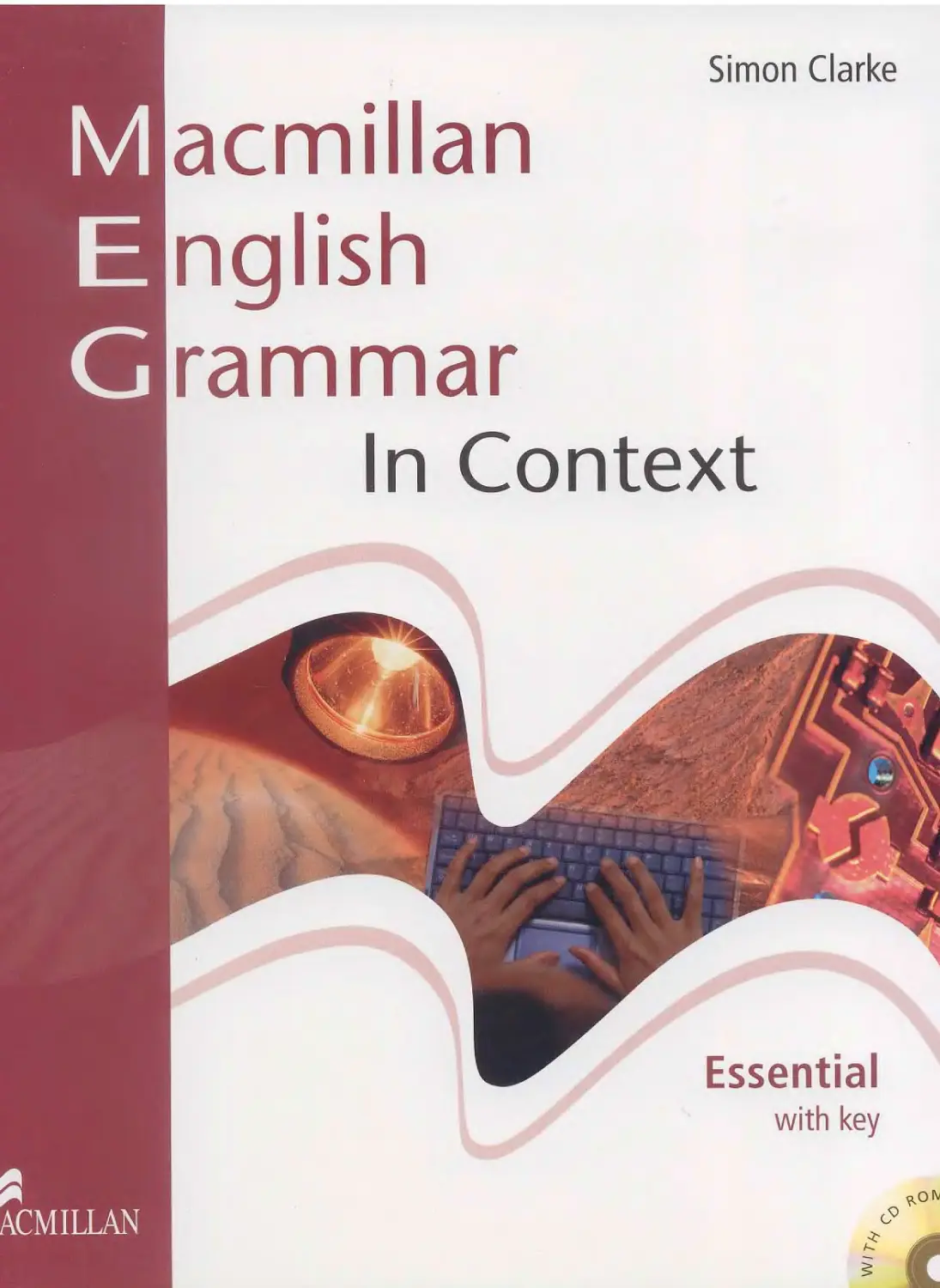
                    Simon Clarke
acmillan
nglish
rammar
In Context
AC MILLAN
s<ob
Macmillan Education
Between Towns Road, Oxford 0X4 314’
A division of Macmillan Publishers Limited
Companies and representatives throughout the world
ISBN 978-1-4050-7049-2 (with key)
ISBN 978-1-4050-7145-1 (without key)
Text © Simon Clarke 2008
Design and illustration © Macmillan Publishers Limited 2008
first published 2008
All rights reserved; no part of this publication may be reproduced, stored in a retrieval system, transmitted in any form, or
by any means, electronic, mechanical, photocopying, recording, or otherwise, without the prior written permission of the
publishers.
Designed by Giles Davies
Illustrated by David Atkinson; Giles Davies; Karen Donnelly; Roger l ereday; Joy Gosney; Sue Mason; Chris Molan; Julian
Mosedale: Sarah Navler; Chris Paveiey; Martin Sanders; Kath Walker; Gary Wing
Cover concept by Giles Davies
Cover design by Katie Stephens
Cover photographs by Comstock, Corbis, Corbis/Zefa
Author's acknowledgements
This book has been a long time in tire writing and there are many people I am grateful to tor their help and support.First and
foremost 1 must thank David Riley for asking me to do it in the first place. Another person to whom I owe a huge debt of
thanks is Roy Turner who went through the manuscript, corrected a great deal of my errors and made numerous suggestions
on how to improve things. There have been several editors and publishers who have worked on the book at different stages.
Catriona Watson-Brown. Penny Hands, Gillian Francis, Carl Robinson, Amanda Holmbrook and Sarah Curtis were all generous
in their help and support. On a more local note I would like to thank friends and colleagues at Lacunza-IH San Sebastian for
their ideas and advice, particularly Philip Rickett who always seemed ready to discuss things like prepositions and how to
teach them at the drop of a hat, and whose enthusiasm for grammar was infectious. Finally, my long suffering wife and two
sons have continued to put up with me over the years and I thank them for their understanding and patience.
The author and publishers are grateful for permission to reprint the following copyright material: Extracts 'Population
Density: Brazil' from Letts Revise GCSF. Geography by Alan Bilharn-Boult and John Hancock (Letts Educational, 2001); Letts
Revise GCSF. Information and Communication by Steve Cushing (Letts Publishing, 2001) both reprinted by permission
of the Huveaux Pic. Extract from 'A Balanced Diet' taken from www.sambal.co.uk copyright © Gondar Design, reprinted
by permission of the publisher. Extract from 'Marriages Increase' and 'Activities undertaken on the computer at home all
taken from www.statistics.go.uk copyright © Crown Copyright, reprinted by permission of the Controller of HMSO. Extract
from Central Intelligence Agency website used with kind permission www.cia.gov/cla/notices.html. Extract from 'Climatic
and Environmental Problems' taken from www.s-cool.co.uk, reprinted by permission of the publisher. Extract from 'Sir
Isaac Newton' taken from www.lucidcafe.com, reprinted by permission of Robert Chew. Extract from 'Battelle Predicts Ten
Most Innovative Products by 2006’ taken from wwtv.battelle.org, reprinted by permission of the publisher. Extract from
Global Warming - What is predicted?' by Ray Lovegrove taken from http://www.rayspoint.com copyright © Ray Lovegrove,
reprinted by permission of the author. Extract from 'What would happen if I drilled a tunnel through the center of the Earth
and jumped into it?' taken from http://science.howstuffworks.com, reprinted by permission of the publisher. Extract from
‘Here Is An Evaluation Of Homework The Kids Are Going To Love' by Peter Brimelow taken from www.ncpa.org, reprinted
by permission of the author. Extracts from Senior Secondary Science and Technology' Student’s Book 4 by Bainton et al
(Macmillan Malawi Ltd, 2003), reprinted by permission of Macmillan Education. Extract from 'Impressionism' taken from
www.uncg.edu reprinted by permission of the publisher. Extract from 'Bullying: Don't Be A Victim' from http://homeworktips.
about,comSomewhere Only We Know Words and Music by Tim Rice-Oxley, Tom Chaplin & Richard Hughes copyright © BMG
Music Publishing Limited 2004, reprinted by permission of Music Sales Ltd. All Rights Reserved. International Copyright
Secured. Extract from 'Your Weight on Other Worlds' by Ron Hipschman copyright © Ron Hipschman Exploralorlum taken
from http://www.exploratorium.edu, reprinted by permission of the author. Extract from 'World Geography Facts - Water'
taken from http://kidzworld.com copyright Kidzworld.com Inc (dba Kidzworld Media), reprinted by permission of the
publisher.
These materials may contain links for third party websites. We have no control over, and are not responsible for, the contents
of such third party websites. Please use care when accessing them.
Although we have tried to trace and contact copyright holders before publication, in some cases this has not been possible. If
contacted we will be pleased to rectify any errors or omissions at the earliest opportunity.
The authors and publishers would like to thank the following for permission to reproduce their photographic material:
Alamy/ Melvyn Longhursl p 66, Sciencephotos p I52t, Trip p 157, Friedrich Saurer p 169; Art Archive/ Marc Charmet p 121,
Beethoven House Bonn / Dagli Orti p 135, Society of the Friends of Music, Vienna/ Dagli Orti p 156; Bananastock pp27,
p 152b, Brand X Pictures pp 95, 1041, 104r, 175, 198; Bridgeman Art Library/ Art Institute of Chicago, p 16, Private Collection,
Archives Charmet p 117; ComStock p 116, Corbis/ p 84r, Reuters p 841, p 89, Paul Seheult/ Eye Ubiquitous p 131, Josh
Westrich/zefa p 144t, Archive Iconografico, S.A. p 148, Ralph White p 168, Ruaridh Stewart/ZUMA p 172; Digital Stock p
161, Empics/ Petty Officer 2nd class Andrew Meyers/ АР/ PA Photos p 153; Getty Images/ Justin Pumfrey p 70, Htlllon Archive
p 140b, Image Source pp 39, 1441; Macmillan/ Haddon Davies pp 55, 144b & r; Mary Evans Picture Library/ pp 57. 77c;
Photodisc pp 29, 91, 145, 181, Photoalto p 125, 149; Robert Harding/ E. Simanor p 32; Science and Society Picture Library/
Science Museum p 105t; Science Photo Library/ Тек Image p 105tl, Ben Johnson p 105Ы; Stockbyte pp 22, 23, 33, 53, 104c,
113, Superstock pp 11, 38, 95, Bridgeman Art Library p 17, Age Fotostock p 77.
Printed and hound in Thailand
2012 2011 2010 2009 2008
10 9 8 7 6 5 4 3 2 I
Introduction
This book is designed to teach and revise grammar points at the level of Council of
Europe Framework (CEF) Al, A2 and includes some Bl grammar.
The practice material includes a wide range of topics to reflect both everyday
language use and the kinds of subjects learners might be studying in schools or colleges.
Many learners are likely to use English to learn another subject during their education
and the choice of text tries to reflect this fact. Some texts contain information which
learners should find interesting or challenging. The intention in general is that language
should have a familiar context and that learners should have something to use language
for.
Within each unit, exercises range in difficulty. This allows learners to build up
their confidence with the simpler, more familiar tasks before moving onto the more
challenging ones later in the unit. The longer, topic-based texts include highlighted
words whose definitions can be found on the accompanying CD-ROM. This is a good
opportunity for learners to widen their vocabulary and see grammar used in realistic
contexts.
The Review section at the back of the book offers more activities for students who
have finished the other exercises. It is also for students who feel that they haven't fully
grasped the grammar point and need some further practice. In addition, it can be used
as a means of testing or revising previous study, either in class or at home.
The CD-ROM
This includes two further exercises for each unit in this book, and a test section.
Plus, where you see highlighted words like this, you will find the definitions in the
glossary section. Just follow the link from the homepage.
To the student
Macmillan English Grammar In Context has been written to make grammar more
interesting than other books on the market. We hope you find it enjoyable as well
as useful. If you are studying at home, the units can be covered in any order but the
exercises within each unit have been graded. If you find some exercises difficult, read
the presentation page again. The extension activities and Review offer the opportunity
of further practice.
To the teacher
Unlike many other grammar books, Macmillan English Grammar In Context puts
grammar into context. The aim is to encourage students to see grammar used more
realistically and in more interesting ways. The topics covered in the exercises can
be used as a starting point for a lesson, as a subject for discussion, and as a means of
helping to build students' vocabulary in useful areas. There is opportunity for individual
study, group work and homework, plus testing, in the different sections of the book.
Contents

Unit	Topic	Page
1	the verb to be (1)			6
2	the verb to be (2)	8
3	there is, there are		12
4	there isn't, there aren't	14
5	present simple (1)	18
6	present simple (2)	20
7	present continuous (1)	24
8	present continuous (2)	26
9	asking questions: present	30
10	past simple (1)	34
11	past simple (2)		 36
12	past continuous (1)	40
13	past continuous (2)	42
14	present perfect simple	46
15	present perfect with for and since	50
16	present perfect continuous	52
17	asking questions - past	54
18	the future: making predictions	58
19	the future: plans and decisions	62
20	asking questions - future	64
21	have (got)	68
22	can and could	72
23	must, have to, should	74
24	must, may, might, could, can	78
25	passives				82
26	conditionals (1)	........ 	 86
27	conditionals (2)	90
28	used to 		92
29	like	.	.							... .	96
30	purpose ...„.л..,......,,..л...........................	100
31	defining relative clauses	102
Unit	Topic	Page
32	reported speech (1)	106
33	reported speech (2)	108
34	infinitive or -ing form?	110
35	the infinitive	114
36	verbs and objects		118
37	linking words (1)	122
38	linking words (2)	126
39	indirect and polite questions	128
40	of and possessive's	132
41	pronouns	136
42	indefinite pronouns	138
43	countable and uncountable nouns	142
44	quantity	146
45	articles	.150
46	all, every, each, both	154
47	adjectives	158
48	adverbs of manner	162
49	comparatives and superlatives (1)		 166
50	comparatives and superlatives (2)	170
51	enough, too			174
52	time expressions	176
53	in, at, on	180
54	movement	182
55	dependent prepositions (1)	186
56	dependent prepositions (2)		 188
57	phrasal verbs	190
	Review	192
	Wordlist		204
	List of irregular verbs	207
	Grammar index	208
	Answer key 		 		209
the verb to be (1)
( FORM )
affirmative
I am
You
We are
They
He
She is
It
happy.
short forms
In spoken and informal English, it is natural to use short forms of the verb to be.
I	am	=	I'm
You	are	=	You're
We	are	=	We're
They	are	=	They're
He	is	=	He's
She	is	—	She's
It	is	—	It's
We can also use short forms with names.
John is tall. = John's tall.
London is a very big city. = London's a very big city.

We use the verb to be to talk about
•	ages.
•	occupations.
•	prices.
•	the time.
•	feelings and states.
•	nationality.
•	colours.
I'm 7 6 and my brother is six.
She's a student and her parents are teachers.
This watch is £30.
It's nine o'clock.
I'm hungry.
They're Argentinian.
His eyes are blue.
1 Complete the spaces with is, are, or am.
a Cars ace, . expensive.
b John	. a student.
cl	the best in the class.
d My sister.............a teacher.
e The train .. .... ....late again.
f You	in class 3B.
g That computer .	... very slow.
h It	.	cold today.
i We..............interested in shopping.
j I	tired.
к Stephanie and Luke...............from Canada.
2 Rewrite these sentences using the short form.
a She is funny.	Shtt’s Am.iA.4j.
b They are clever. __________________________________
c We are cold.	______________________
d I am an astronaut.
e He is tall.
f You are friendly.
g They are kind.	........................
h She is a good teacher. ...........................
i They are bad dogs. .............................
j You are nice students.
к Sally is 15 years old. .......  .
3 Use the prompts to write a sentence. Use short forms.
a He / angry
b They / happy
c It / hot now
d You / intelligent
e We / unhappy today
f I / a doctor
g You / good students
h She I from Mexico
i My eyes / green
j We / Australian
к Michael / young
э verb to be (1)
H&’s
the verb to be (2)
(form)
negative
1	am not	(I'm not)
You		(You're not / You aren't)
We	are not	(We're not / We aren't)
They		(They're not / They aren't) interested
He		(He’s not / He isn't)
She	is not	(She's not / She isn’t)
It		(It's not / It isn’t)
questions
Am I
you
Are we
they late?
he
Is she
it
short answers
Yes, 1	am.	No, I'm not.
you	you're not / you aren't.
Yes, we are.	No, we're not / we aren't.
they	they're not / they aren't.
he	he's not / he isn't.
Yes, she is.	No, she's not/she isn't.
it	it’s not/it isn't.
Cusp
We can use the verb to be to ask about
• ages.
• occupations.
• prices.
• the time.
• feelings and states.
• nationality.
• colours.
How old are you? Is he 16?
Are you a student? No, I'm not.
How much is this? Is it expensive?
Is it ten o' clock? No, it isn't. It's eleven o' clock.
I'm not tired. Are you tired?
No, they're not Spanish, they're French. Are you English?
His eyes aren't green, they're blue.
Includes material from Units 1 and 2.
1 Complete the sentence with is, is not, are, are not, am or am not.
a 1 fltu no+	Spanish, I'm Greek.
b Peter. ...	a good student. He's a bad one!
c Our eyes ...................     blue.	They're brown.
d My sister....................... a	police officer, she's a journalist.
e	his brother tall?
f The bus .......	.	.......late, it's here now.
g _____ ....... you okay?
h That film ................... ... . ... very good. The story is very boring.
i They......... .	........tired, they're hungry.
j	it cold today?
2 Write short answers to the questions.
a Are you a good student? .....Yes, I r?iu. / рил jtq-b..............
b Are your parents at home now? ................
c Is it Monday today?....................
d Are you hungry?............. .
e Are your friends with you now?
f Is your school in a large city? ............................. .....
g Is it cold outside?............................
h Are you young? ...... ..........................
i Is English easy?
j Are these exercises difficult? ..	. ...	.........
3 Correct the sentences.
а 424Ю 14.00/
It's twelve o’clock. tJojb H>s o’docit.
b +64Ю 17.00/
It's four o'clock. .............. .......... .... .....
c I iimstkiv Friday /
It's Thursday today. ................................................
d nurse doctor /
She's a nurse. __ ______ _________________________________________
e dorter engineer /
He's a doctor. ..... .............................................
f €50 €60/
The tickets are 50 euros. .. .....................................
g H~.5G $1.60/
It's one dollar, fifty.
h expensive cheap /
They’re expensive. ................... .............. ...............
i 45 14/
Julian is thirteen...............
0 the verb to be (2)
geography
4 Use the prompts and is, is not, are or are notto write full sentences. The map will help you.
Paris
Strasbourg
FRANCE
Andorra
Luxembourg
Lichtenstein
Bosnia-Herzegovina
Serbia and Montenegro
BELGIUM
. * "
Brussels,
UNITED
KINGDOM NETHERLANDS
Ber
GERMANY
SPAIN
Lisbon
Lyon
Turin
Atlantic
ftcean
a Berlin / Germany
Berlin. is in. Ge,nuanq.
b Paris I France
c Lyon / Spain
d Milan and Turin I Italy
Brussels and Strasbourg / Germany
f Spain / the south of Europe
g Norway / the south of Europe
h Lisbon / Portugal?
Bern and Basle / Switzerland?
j you / Europe?
Berlin
* POLAND
CZECH
REPUBLIC
Sl	SLOVAKIA
AUSTRIA }
(SWITZERLAND	HUNGARY
SLOVENIA
Milan	Croatia
^terranean I Sea
ITALY
©
5 Complete the dialogue with the correct form of the verb to be. Use short forms where possible.
daniela:	Hello, a Are.		 you from here?
estevan:	No, we b	...... c 		you?
daniela:	No, I d	from Italy. My name e	Daniela.
estevan:	Nice to meet you	.If 	Estevan.	And this g					 Maite and Javier.
daniela:	This l	... Estelle, and this i		Maria. Where j
	you from?
estevan:	We к	from Spain.
daniela:	I				you from Madrid?
estevan:	No, we m 			 .	We n			... from the north of Spain. Javier and I
		from Bilbao, and Maite p 				from San Sebastian.
daniela:	q		you here on holiday?
estevan:	No, we r	. It s		a study trip. This t	 a
	beautiful place.
daniela:	Yes, it u			 . v				the trip fun?
estevan: Some of it. The museums w ____________ ______boring, x . ..	..	you here for a
holiday?
daniela: Yes, [	with my parents but I want to be with my friends.
It z	much fun.
EXTENSION ACTIVITY
Translate these sentences into your own language.
a My brother is six years old.
b I am 13 years old.
c A cup of coffee is €1.
d Is your father a teacher?
We're not interested in computers.
0 the verb to be (2)
there is, there are
( form)
affirmative
There is (There's) a book on the table.
There are three students in the room.
(TsF)
We use there is / are to say something exists.
There is a mistake in this exercise.
NOTA.-misl-ake is in the exercise, or It's a mistake in the exercise.
There are 109 elements in the Periodic Table.
NOT 109 elements are in the Periodic Table, or They-are 109 elements in the Periodic Table.
After we say that something exists with there is I are we can then use it is or they are to give more
details.
There's a computer in the classroom. It's very useful.
There's a book on the table. It's not mine.
There are nine planets in the solar system. They're easy to see with a telescope.
There are some instructions available for this DVD but they're on the Internet.
A:	There's someone on the phone for you.
B:	Who is it?
A:	It's your sister, I think.
A: There are some people outside the door.
B:	Who are they?
A: They're students.
1 Complete the sentence with is or are.
a b	There	25 students in the class. There	a hospital in the city centre.
c d	There	a big supermarket near my house. There 	 two	teachers in the room.
e f	There	12 songs on this CD. There	a good film on TV tonight.
g h i	There	his friends. There	your mobile phone. There	a computer and a TV	in my room.
j к	There	seven books in my bag. There	no homework today.
2 Complete the sentence with there or it.
a b	There is a CD on the desk. И	is mine, is a nice day today.
c d	is a new student in my class. There is a park next to my house	is	very beautiful.
e f	is three o' clock. is no one in the room.
9 h i	is a man outside the window. There is a big shopping centre in my town.	is very popular, is a teacher at my school called Mr Smith.
j к	is so hot in this room! is a swimming pool at my school.	is also a tennis court.
3 Complete the sentence with there, it or they.
a b	are two bottles of water on the table, are nurses, not doctors.
c d	There's a cat in the kitchen.	is black and white. There are 30 people at the party..................................... are all my friends.
e f	is cold outside. There's snow on the ground, are from London.
g h i	They’re in the hall. . .	is an exam now. is a very interesting book. There is my bag.	is next to the desk.
j к	My key is in my pocket.	is in a safe place! The students are very tired.	study too hard.
e there is, there are
there isn't, there aren't
Q form)
negative
There is not (There's not/There isn't) a laboratory in the school.
There are not (There aren't) any plants in the classroom.
questions
Is there an Internet connection in the room?
Are there any notes in your book?
short answers
Yes, there is. I No, there isn't. / No, there's not.
Yes, there are. I No, there aren't.
GID
a /an, some, any
We often use there is and there are with a I an, some and any. We use
•	a / an with singular, countable nouns.
There isn't a book under the table. There is an apple in the fridge.
•	some and any with countable and uncountable plural nouns.
There is some water in the bottle. There aren't any pens in the cup.
•	a / an and some in the affirmative.
There's a letter for you. There are some people waiting.
•	any with questions and negative statements.
is there any coffee left? Are there any good films at the cinema?
There isn't any paper in the photocopier. There aren't any girls in the class.
Includes material from Units 3 and 4.
1	Complete the gaps with there is / isn't or there are / aren't.
a Th&rz are. twelve stars on the European flag.
b	... any gravity in space.
........ ... ....a Rome in every continent of the world.
d	any deserts in Europe.
. over 40,000 characters in Chinese writing.
f In Las Vegas casinos ...................  any	clocks.
g in over 90 % of plane crashes .	a survivor.
h In an average bar of chocolate	eight insect legs!
2	Use the prompts and There is / are and There isn't / aren't to write sentences.
a a post office Tm-rc ts a post	............._ ..............
b a hospital Tmr'c. /?лЧ <я .h.oSp/+^.l.-................
c two banks .	.......... . ________________________ _____________
d a supermarket .	... .... .....
e an airport
f elethes-shops ..........................................................
g three schools	.................
h a theatre ............................................. .......	.___ ......
i a cinema ______________ ___________________________ _________... ...
j museums .
3	Complete the questions with Is there or Are there. Then write short answers.
In your town ...
a is	a cathedral? ТИслх is. / Mo, ••cite rr.. /Sn'-r.
b .........    ...	many shops? .. . .. ...... .. ...
a shopping centre? ............................
d.................... a hospital?.......................
many things to do and see?...............
a museum?.................................
g .................... a theatre?......................  ...	.
h ................... good bus and train services? ..................
4	Correct the sentences. Use the Internet to help you.
a There are four continents. Mq rumt’T. Tar rr. are. -fivq
b There are six planets in the solar system. .... ...............
c There are ten countries in the European Union. ................
d There are red and black blood cells. __ . .. .
e There is one element in water, hydrogen (H7O)..................
f There are ten centimetres in a metre. .. _______________ ______
g There are more speakers of English than of Chinese.........
h There are seven questions in this exercise.....................
© there isn't, there aren't
5 Complete the sentence with there, it or they.
a b	...TfW'W. . are five continents.	..	are Africa, America, Asia, Australia and Europe. . 	..	is someone in the house. Who is .. . .	?
c d	is very wet today and 			 is	a lot of traffic. In his class	are 12 students but 	aren't any girls.	are all boys.
e f	What time is	. ...	..? ...........	is half past four. . are some shops in the village but	 are	all closed.
9 h	is a cinema but	aren't	any good films on. aren't any tickets left for the concert.	is sold out.
Complete the text with
there is / are / isn't /
aren't, it is / isn't, and
they are / aren't.
Vincent’s
Bedroom at Arles
a There. /S a picture next to this text, b ..	a famous painting by Van
Gogh of his bedroom at Aries, c .	a small room, d	some
furniture in the room. For example, there is a bed on the right of the picture, e
a bed for one person. Above the bed f .	some pictures on the wall. Next to the
door, on the left, g	a chair, h	another chair between the table
and the bed. The table and chair are below the window. On the table i	some
objects - a jug, a glass and a bowl. Next to the door on the right j	a towel on a
peg. Behind the bed к .	some more things on the wall but I
easy to see. Of course, m	any modern things in the room and
n	very comfortable.
7 Use the prompts to write sentences about a second painting.
a above / another painting / Van Gogh
Above. •bk/s	is	p^/k-hkyj Ь/f Уж Gocjk.
b name / painting / The Potato Eaters
c five people / picture
d two women / two men / one young girl
e all poor people
f food I table
g above I table / lamp
h a dark / depressing picture
i not comfortable / room
EXTENSION ACTIVITY
Translate these sentences into your own language.
a There's a fly in my soup.
There's a packet for you and it's very big.
c There isn't a class on Thursday.
d We can't go because there isn't any time,
e There aren't many students in the school.
e there isn't, there aren't
present simple (1)
( FORM )
I / You / We / They work / watch / fly I do.
He / She / It	works / watches / flies / does.
spelling rules for he, she and it
Most verbs: add -s.
Verbs ending in -s, -sh, -ch: add -es.
Verbs ending in a consonant followed by -y: change the -y to -ie.
Verbs such as do, go, have and be are irregular.
live ~+ lives buy —♦ buys
miss -* misses search —> searches
carry —* carries study —* studies
do —* does go —► goes have —* has
CusF)
time expressions
We often use the present simple with always, never, often, sometimes and usually. These are
called adverbs of frequency and normally go before the main verb.
I always watch TV afterschool.	Sue usually has cereal for breakfast.
She often arrives late for college.	They sometimes have a match on Friday
They don't often forget their homework. И/е never give customers a refund.
The verb to be is an exception. Adverbs of frequency go after the verb to be.
I am always at school before 08.00. Maths is sometimes quite difficult.
Always and usually are slightly different. They express how often something happens, but only
at a particular time, and not in a general way. Compare the sentences below.
He sometimes plays tennis. /	We often go to the cinema. V
He always plays tennis. X	We usually go to the cinema. /
He always plays tennis after work V We usually go to the cinema on Saturdays. У
1 Write the he /she / it form of the following verbs.
a	go	CJQ&S ...	g	pull	m	read	s	dance
b	do	h	want	n	get	t	swim
c	study	 ...	i	have 		о	finish				u	cry.. ....
d	walk	j	drink		p	pick 		V	wash
e	eat	к	buy 			q	wait ....	w	meet .
f	push . 		I	play	r	need	X	open
2 Complete the sentence with the affirmative form of the verb in brackets.
a	I (read) rYc'td ..... ...		the newspaper every day.
b	She (like)			. computers and going to the cinema.
c	They(go) .	.. to school by bus.
d	We (want) 		ice cream now!
e	He (study) You (walk)		French,	German and English.
f		. . ... 			very fast.
g	I (play) .	. football and basketball.
h	She (finish) 					her homework quickly!
i	It (work)			 very slowly.
3 Put the words in order to make a sentence.
a go they early home always	<gp hotup.
b never sweets eats she......... ..............................................
c we cinema usually Saturdays go the to on ....................................
d sometimes warm winter in is it .........................................
e football often with friends his plays he .. ..	.. ..... .... ...	.. .
f always January it rains in_____	___ .............................. .......
g dancing usually Fridays on go they ............... ..........................
h often music listens to he evenings the in________________ ___________________
4 Use the prompts and a verb from the box in the correct form to write full sentences.
get watch play do go rain cook wear drink
a We / for our friends (sometimes) Sotu.&+ltu&S..c.QQk &c..oi4r.
b She I her homework (always)..................................................
c They I tennis at the weekend (often) ........................................
d I / on holiday in June (usually) .... ................... ....... ...... ....
e He / coffee for breakfast (always) ......... . ................. ...	.... . .
f You I up early in the morning (never)..........................................
g She / TV before dinner (sometimes)...... ........ ... ....... .................
h We / jeans at the weekend (usually)................ ....................... .
i It / in the summer (sometimes) ____________ _____ _____ __ _____ ____________
e present simple (1)
present simple (2)
Q form)
We use do not I does not + bare infinitive to make the negative form of present simple.
I / You I We I They do not (don't) work.
He / She / It does not (doesn't) work, (not works)
I don't understand this.
Argon is an inert gas; it doesn't react with anything.
We use do / does + subject + bare infinitive in present simple questions.
Do I / you / we / they work?
Does he / she / it work? (not works?)
We also use do / does and do not / does not in short answers.
Yes, I /you / we /they do.	No, I / you / we/they do not (don't),
he / she / it	does.	he / she / it	does not (doesn't).
Do girls study more than boys? Yes, they do I No, they don't.
Does your school provide lunch? Yes, it does. / No, it doesn't
Cusp
We use present simple questions to ask about
•	facts.	Does water contain hydrogen and oxygen? Yes, it does
•	habits or routines. Do you usually go to bed at eleven o'clock? No, I don't
Negatives are used in the same way.
The Sun doesn't travel round the Earth. The Earth travels round the Sun.
I don't usually play computer games during the week.
Includes material from Units 5 and 6.
1	Look at Mark's timetable. Complete the sentence with the affirmative form of the verb in brackets.
	Mon	Tue	Thu		Wed	Fri	j
09.00-10.00	Geography	French	German	08.00-08.55	German	Maths
10.00-11.00	Music	Maths	Religion	08.55-09.50	Maths	Physics
11.30-12.30	Maths	Sport	Physics	09.50-10.45	English	IT
12.30-13.30	Biology	Sport	Geography	11.15-12.10	Biology	English
15.00-16.00	Religion	English	Maths	12.10-13.05	French	German
16.00-17.00	Art	German	French	13.05-14.00	Geography	Biology

a Mark	to school five days a week, (go)
b He	to school every day. (go)
c On Mondays the classes	at 09.00. (start)
d On Thursdays Mark .................. school at 17.00. (finish)
e On Tuesday between 11.30 and 13.30 Mark's class.................. .sport, (do)
f Mark	a maths class every day of the week, (have)
g Mark	three different languages - English, French and German, (study)
h At Mark’s school the pupils	IT. (study)
2	Complete the sentence with the negative form of the verb in brackets.
a Mark do&Sn.'-F	to school at the weekend, (go)
b He	to school on Wednesday or Friday afternoon, (go)
c On Wednesday the classes	at 09.00. (start)
d On Fridays Mark	school at 17.00. (finish)
e Mark's class ................  sport	Monday, Wednesday, Thursday or Friday, (do)
f Mark	an English class on Thursday, (have)
g Mark	Chinese, (study)
h At Mark's school the pupils.................Chemistry, (study)
3	Complete the question with Do or Does. Then write short answers.
a	Mark have an art lesson on Monday? Ус-S, кг- Jo&S.
b	classes start at 08.00 on Tuesday?
c .......	. the students study IT at Mark's school?............
d	. Mark go to school on Friday afternoon? ............
e ............. they have any time for sport? ....................
f	you study religion at your school?
g	your school have a similar timetable?
h	you study more subjects than Mark?
present simple (2)
science
4 Use the prompts to write questions.
a
b
d
e
f
Yes, they have some similar properties.
Oxygen reacts with hydrogen (to form water). And argon (Ar)?
No, pure gold does not react with oxygen.
Elements in the same group have similar properties. And in the same period?
Water boils at 100°C. And oil?
Docs oil boil 100 C
No, most oils boil at 200-300°C.
Iron reacts with oxygen (to form rust). And gold?
Argon does not react with oxygen, or water.
Marie Curie made important scientific discoveries.
And Albert Einstein?
Yes, he discovered the theory of relativity,
E=mc2.
Chemists work in laboratories.
And physicists?
Yes, they do.

5 Put the words in order.
a for children often a computer school work use
Children	с-т+лп.zjSc a	£or School. Atork.
b don't chat rooms most 11 to 18 year-olds often visit
Most 11 to 18 year-olds
c computer at home school pupils have often a
School pupils .	..................
d play computer teenagers a sometimes CDs on
Teenagers	.
e are schools in UK there computers in usually the
There	....................................
f are to the Internet some connected computers always
Some computers..........................................
g prefer for games people often PlayStation® playing
People..................................................
h never these people send days most letters
Most people ............................................
socia
6 Read the text about differences between boys and girls at school
Complete the text with the correct form of the verbs in the box.
exist like score reach explain punish believe
Are girls better students than boys?
Most people think that girls are better students than boys. In England, girls a Score,
higher marks in tests in most subjects and at most ages. At the age of seven, 88% of girls
b	the expected level for their age, but only 80% of boys do. By the age of
11, the difference is 80% to 69%, and the gap is wider at 14 years old. A similar situation
c	in the USA and many other countries.
However, two American researchers, William Draves and Julie Coates, d	that
it is not the boys who are the problem, but the schools. Their book, Nine Shift: Work, life, and
education in the 21st century e..................... that	in fact boys are better prepared for the
future. Boys are more interested in computers and the Internet. They f	taking
risks, and thinking about ways of making money and teamwork - things that are important for
success at work.
The problem is that schools g	boys for this behaviour because they are bad at
listening and following instructions.
7 Make the underlined verbs negative.
a Boys study more than girls at school.
'Bo^jS dort’l S-ivicZj tv.orc -bhan cj/r'IS School.
b The average boy scores higher marks in tests.
c At seven, 12 % of girls reach the expected level.
d The researchers say that boys do badly at school because they are less intelligent.
e Most schools give prizes to boys for their behaviour.
f Some boys listen well to their teachers.
g William Draves thinks boys are the problem.
EXTENSION ACTIVITY
Translate these sentences into your own language.
a I go to school at 08.00 every morning.
b We don't have IT classes at our school.
с I don't like maths and physics.
d He doesn't often use the computer.
e Do you play any sports?
0 present simple (2)
present continuous (1)
( FORM )
affirmative
I	am ('m)
You/We/They are ('re) working.
He/She/It	is ('s)
spelling rules
Most verbs: add -ing.
Verbs ending in -e: remove the -e and add -ing.
Verbs ending in one vowel followed by one consonant:
double the consonant and add -ing.
work -♦ working buy —* buying
take —► taking write —* writing
get ~► getting run —> running
(but open —» opening)
Note: die ~♦ dying lie —* lying
Cusp
We use the present continuous to talk about
•	things happening now.
Where's John? In his room. He's doing his homework.
You're speaking too fast forme.
•	temporary activities.
We're learning about trees this week.
My brother is staying with friends in London until he finds somewhere to live.
•	situations of change.
The hole in the ozone layer is getting bigger. The number of pupils in the school is falling
•	future arrangements.
We're flying to Spain on a school trip next month. I'm seeing the head teacher after class.
present continuous or present simple?
It rains a lot in Scotland, (habitual situation)
Put on an anorak. It's raining (now)
Scientists do experiments to test their theories, (always true)
Scientists are doing experiments to see if there is life on Mars, (currently)
She speaks French and German. (She can speak these languages.)
Wait a minute, she’s speaking to someone on her mobile, (now)
We do not usually use these verbs in the present continuous: believe, like, hate, prefer, want, depend,
love, know, remember, forget, mean, need and understand.
She doesn't understand the formula. NOT She isn't understanding this formula
Excuse me, what does this mean? NOT What is this meaning?
1 Write the -ing form of the verb.
a	enjoy	e	play	i stop
b	hit	f	heat			 			j shut
c	shoot			 			9	organize	к buy
d	smoke	h	use .	1 tidy
2 Use the prompts to write full sentences.
з I / eat dinner I	d/iturtry
b You / do your homework _______________
c She / go to the park .... . ....... ...
d John and Sven / buy new trainers
e My parents I talk to my teacher .
f We / listen to CDs	....
g He / write a book ...................
h It / rain today .....................
i I / work hard
3 Underline the correct form.
a I'm happy today. Everything goes / is going well.
b Just a minute, 1 can't hear you. I'm listening /1 listen to the radio. Let me turn it off.
c A lot of people speak / are speaking Spanish in the USA.
d On this space shuttle mission they study /are studying the effects of gravity in space.
e He is doing / He does his homework now.
f I’m liking 11 like the new sports hall. Do you?
g Wake up! The teacher is asking / asks you a question.
h You know I You are knowing my friend Cindy.
i That's the book I'm reading /1 read at the moment.
4 Use the prompts and a verb from the box to write either present simple or present continuous
sentences.
stay do look watch listen know tmderstand
a I / this question I za'i.d&r'S-fyii'i.d -Wife
b She / to music now________________________________.. ..
c They / maths homework now ............................
d You / a lot about computers......................... . ......
e Manuela and Sam / TV at the moment . ..	. .....
f We / in a hotel near the beach .. .
g 1 / for Jack. Do you know where he is? ........... ..	..
@ present continuous (1)
present continuous (2)
(form )
negative
I	am not ('m not)
You/We/They are not ('re not / aren't) coming.
He/She/It is not ('s not / isn't)
questions
Am I
Are you / we/they
Is he / she I it
short answers
I
Yes, you I we / they
he I she / it
I
No, you/we/they
he / she / it
getting fat?
am. (not Yes, I'm.)
are. (not Yes, you're.)
is.
'm not.
aren't / 're not.
isn't /'s not.
We use present continuous questions to ask about
•	things happening now.
Are you going to the cinema? What are your parents doing?
•	temporary activities.
What are you studying in class now? Are you staying in a hotel?
•	situations of change.
/5 the weather in your country getting hotter? Are people living longer?
•	future arrangements.
Are you going to the party on Friday? Are we having a test next lesson?
We use the negative form of present continuous in the same ways.
I'm not listening to music, I'm playing a computer game.
She's not staying in a hotel, she's staying with a friend.
Computers aren't getting more expensive, they're getting cheaper.
We're not going to the party on Friday.
Includes material from Units 7 and 8.
07.00 jet up
07.05 have a shower
07.30 A« ve break fas t
io school
1 What is John doing now? Look at
the information and use the
prompts to write present
continuous sentences.
07.45 goto school
08.30 arrive at school
09.00 start classes
12.30 have lunch
16.00 yo to football training
19.00	arrive коме and have dinner
19.30 start homework
21.00 relay and watch some TV
22.00 go to bed
a 07.0.3 I John / get up
l+’s 7.03 M<J John /S	4tp..........
b 07.10 / he / shower
c 07.35 / he / have / breakfast
d 08.00 / John / go / school
e 09.15 / John and his friends / sit / in class
f 12.45 / he and his friends / have / lunch
g 16.10/he / play / football
h 22.45 / he / sleep
2 Now write negative sentences using the prompts.
a 07.05 / he / sleep
l+’s 07.06. Ho /Sn'-k SlrteC.pmrj.
b 08.45 / he / go to school
c 10.00 / John and his friends / do / their homework
d 12.35 / he / have / breakfast
e 15.00 / his team / playing football
f 18.45 / he / have / lunch
g 20.00 / he / watch / TV
h 23.00 / he / do / homework
3 Use the prompts to make a question. Then write a short answer.
a 07.05 / John / having breakfast ?
l-f-’s 07.05. IS John. having	No, ho tSn’T.
b 08.00 I he I go to school ?
c 09.30 / he I sit / class ?
d 12.00 / John and his friends I play I football ?
e 12.45 I you / have / lunch ?
f 19.15 I John and his family / have / breakfast ?
g 21.15 / he / relax ?
h 22.30 / you and your family / watch / TV ?
science
4 What's happening in your body right now?
Use the prompts to write sentences.
a blood / circulate / around my body
Blood /s circbtla-h'n.^ around пл^ bodzj.
b my heart / pump / blood
c my lungs I absorb / oxygen
d my diaphragm / move / up and down
e my heart / beat
my lungs / produce / carbon dioxide
g my stomach / digest / food
h chemical reactions / happen / my cells
my eyes / send / messages to my brain
5 How is society changing? Put the words in order to make questions. Then write a short answer.
a are taller people getting
Arc. prrpi,- cjc.+'k/nq Ardlpr?	йг'г..
b is getting life expensive more
c more we energy using are
d people going to more university are
e older getting population is the
f getting fewer are people married
g longer are we living
geography
6 Complete the text with the present continuous form of the verbs in the box.
etrt get increase cause change melt rise have
Global warming
Power stations, cars and factories produce carbon dioxide (CO.,).Trees and plants change
it back to oxygen, but we a. ЛС& сл-Нтг^...............down trees in the Amazon
rainforests,so the amount of carbon dioxide in the air b ....
The carbon dioxide allows radiation from the sun to enter the atmosphere but not to leave
it.This c	the atmosphere to heat up.
Scientists think that the polar ice caps and glaciers around the world
d	........ .This is creating more water and the level of the sea
................................In	many parts of the world there is a possibility of floods
on land near the coast. In general, the world’s climate f..........
This means warm areas g................................colder winters, and previously
cold areas h	.................... warmer.
EXTENSION ACTIVITY
a Write five sentences about things
that you are doing at the moment.
b Write five sentences about things
that are changing in your country.
\_______________________________________
0 present continuous (2)
asking questions - present
When we ask questions, the position of the subject in the sentence usually changes.
yes /no questions
is / are	+ subject +	etc
Are	you	English?	Yes, 1 am. / No, I'm not.
Is	he	happy?	Yes, he is./ No, he isn't
is / are	+ subject +	verb + etc
Is	it	raining?	Yes, it is. / No, it isn't.
Are	they	reading?	Yes, they are. / No, they aren't.
do I does	+ subject +	verb + etc
Do	you	speak German?	Yes, 1 do. / No, 1 don't.
Does	Dan	play football?	Yes, he does. / No, he doesn't.
questions with what, why, when, where, how, who
question word When Where	+ is / are + is are	subject + she they	etc
			at home? students?	She's at home in the evening. They're students at university.
question word	+ is ! are +	subject +	verb + etc
What time	is	John	leaving?	He is leaving at 11.00.
Why	is	he	going out?	He's going out to buy some bread.
How	is	she	feeling?	She's feeling better.
What	are	you	playing?	We're playing cards.
question word +	do i does +	subject +	verb + etc
What time	does	John	start work?	He starts work at 08.00.
Who	does	Sarah	go out with?	She goes out with Jim.
When	do	they	meet?	They meet every Tuesday.
The form of question shown above is only possible when we know who or what the subject is.
Sometimes we don't know and we need to ask questions where the question word (who, what,
how many, etc) is the subject of the question.
John loves someone.
object
Someone loves John.
4
subject
Who does John love?
Who loves John?
In this type of question you cannot use do or does.
Who helps you? NOT Who does help you?
How many people study here? NOT How many people do study here?
Which computer works best? NOT Which computer does work best?
1 Match questions a to h with answers 1 to 8.
a
b
c
d
e
f
g
What's the time?	1	675867564
How old is your sister?\	2	In India.
Where's the Taj Mahal? \	3	Pedro.
What's your name?	\	4	About €300.
Where are the books?	\	5	Fine, thanks.
What's your phone number? \	6	She's 18.
How much is an i-pod?	7	Ten past five
8 In the cupboard.
h How are you?
2 Write questions for the answers.
a Where are, apu	?	Me? I'm at school.
b 			7	Me? I'm 15.
c	?	His mobile number? It's 687958475
d	7	My mother? She's fine.
e 	 		?	Your pen? It's on the table.
f 									?	A Coke? About €1.30.
q 		?	The time? It's five to six.
h 			7	The date? It's 10th May.
3 Put the words in order to form questions.
a he where study does ? Where does he	?
b time you do what start school ? ...........   ................       ................ ?
c take long school how does it to get to ? ______ ________________________________.... ______ ?
d people many know how you do here ? ...... ........................................... ?
e month you doing this in what are class ?    .....................................     ?
f think of what the new do you teacher ? ..__ ______ .___________ . . . . .. .. .	.... ...	. ... ?
g where holiday the do in go on they summer ?.......................................... ?
h do accident about you the know ?.........................................          .	?
i are enjoying the you party ? . _. .	... . . ... ..................                  ?
4 Write questions about the things underlined in the statements.
a Sam sees Joe every day at school.	..Who does Srtru. See eyervj daq л-к School	?
b Sam sees toe every day at school.	.................................... ?
c Sam sees Joe every day at school................................       „.................. ?
d He is playing for Manchester United this season. .	.... .	............. ..... ....?
e His school has four different sites. ...........................................              .	?
f Over 2,000 students take the exam.	?
g The school employs over 20 teachers.    ................. ?
h He's studying photography in the evenings. .............
i He is working in a factory this summer. . ................ . ................
@ asking questions - present
geography
5 Put the words in order to form questions. Then underline the correct answer.
capital what of the Iran is ?	rS слр/+л1 o-C Iran.
Tabriz Esfahan Kabul Tehran
b Atlas Mountains where the are ?	............ ..........
Mexico Morocco Ethiopia Argentina
c Negev is Desert the where ? ...........
Israel Jordan Egypt Iran
Africa highest which the mountain inis?
Everest Kilimanjaro Mount Kenya Annapurna
Cape Horn is where ? .............................................
USA South Africa Canada Chile
f Islands are the Balearic where ? ...	.......................
In the Atlantic In the Pacific In the Caspian Sea In the Mediterranean
g longest where the world's river is ?
In America In Africa In Asia In Australia
h where K2 is ? ......................... ........
In the Himalayas In the Andes In the Rockies In the Alps
i the is what Yucatan? .
a mountain a river a peninsula an island
?
?
7
7
7
6 Use the prompts to write questions and complete the dialogue.
A:	a (how often / use / a computer) . HcM 0-P+e.n. Jo Zjou use. а corupu+e-r	?
B:	A lot. I like computers.
A:	b (where / use / them)........................................................      ?
B:	At home and at school.
A:	c (what / do / on your computer) ___ .	... ... .. ... .. . . ..... ... . . .. .. ?
B:	At home? I do my homework on it and use MS Messenger for chatting.
A:	d (play I games / it) .....................................................         ?
B:	No, I don’t. I play games on my PlayStation - it's better.
A:	e (surf / Internet)	?
B:	Yeah, sometimes I look at stuff about football.
A:	1 (how long / spend / on the computer each day)
?
В: I don't know. One or two hours.
A: g (learn I computers / school) ..........................................            ?
B:	A bit. We have an IT lesson on Fridays.
A:	h (interesting) .........................................................            .	?
B:	Well, sometimes it is.
A:	i (who / fix / the computer / if it goes wrong) ...............                  .	?
B:	My dad. He knows a lot about them.
EXTENSION ACTIVITY
Write ten questions you would like to
ask your favourite famous person.
Q asking questions - present
10
past simple (1)
(form)
The past of regular verbs is formed using the ending -ed.
I / You/We / They	. .. . .
....	, ljL opened / hved / tried.
Ы£1 / чКп / It
spelling rules
Most verbs: add -ed.
Verbs ending in -e: add -d.
Verbs ending in a consonant followed by -y: change the -y to -ied.
Verbs ending in a single vowel followed by a single consonant:
double the consonant and add -ed.
wish —► wished
date —> dated
carry —> carried
fit —* fitted
fill — ► filled
close —* closed
study —* studied
tap —> tapped
irregular verbs
Many common verbs have irregular past forms.
go —> went have —► had take ~> took
I / You / We / They
He / She / It
went to the cinema.
The verb to be has two past simple forms.
I / He/She / It
You / We / They
was
were
at school yesterday.
See the List of irregular verbs on page 207.
We use the past simple to talk about finished states, events and actions in the past.
Last year we studied the lives of the ancient Greeks in History. Then in the summer we visited Athens and
saw the Acropolis. It was very interesting.
Neil Armstrong was the first man to land on the moon. On July 20, 1969, he walked on the surface of the
moon for two and a half hours.
1 Read the sentences and underline all the examples of the past simple.
a I usually go to school by bus but today I walked.
b I liked the film, it was so exciting!
c He went shopping yesterday.
d They stayed at home at the weekend because they were ill.
e I don't like the theatre but I saw the play anyway.
f He studied hard and passed the exam.
g I did the washing up today and yesterday. You never do it.
h I thought the lesson was fun and our teacher is very nice.
i He had a bike accident at the weekend.
He bought two bars of chocolate and gave one to his friend.
2 Write the past simple of these regular verbs.
a talk	e open	i pick	m use
b wait	f close 	... ....	j like	n rest
c stop	g walk		к shop		 о	print
d want	h drop	I chat	P Play
3 Write the past simple form of these irregular verbs.
a make		e is		i buy	m leave
b take		f eat		 i	go		n feel
c come		g see	к think		 о	give
d have.		h put	! bring 			p do
4 Use the prompts to write sentences.
a He / go / swimming yesterday
b They / see / a film last night
c I / do / my homework ...........................................
d You / wait / for an hour ...	..	. ....... .....
e Michael / have / a cold
f The teacher / be / late
g Sue and Juan I walk I to school today
h I I take / my dog for a walk
i She / talk / to her friends.....................................
j We / give / him the answers
к Marcella / come / to the party.. ...............................
I The dog / eat / my breakfast! ..................................
0 past simple (1)
past simple (2)
( FORM )
To form negatives, questions and short answers in the past simple, we use the auxiliary did + bare
infinitive.
negative
I / You / He / She / It / We / They did not (didn't) work yesterday.
questions	short answers
Did I/you/we/they	work?	Yes, I/you / he/she/it/we/they	did.
he/she/it	No,	didn't.
NOTE I didn't work, l-dtdn't worked.
Did he arrive on time? Did hmarrived on time?
was and were
The verb to be follows a different pattern. We do not use did to form questions and negatives.
negative
I/She/He/It was not (wasn't)
You / We / They were not (weren't)
questions
Was	I/she/he/it	?
Were you/we/they	ere"
She wasn't at school yesterday.
They weren't very nice to me.
Was / late?
Were you at the party?
(use )
We use the past simple to talk about finished states, events and actions in the past.
A Madame Curie lived in Paris and discovered radiation. We studied this last year.
B: She didn't discover radiation in fact. That was Bacquerel.
A:	So why did she win the Nobel Prize?
B:	She won it twice. In 7 903 she and her husband shared the Nobel for physics with Bacquerel for
discovering radium and polonium. Then she got the Nobel for chemistry in 1911.
Includes material from Units 10 and 11.
1 Write the negative past simple form of these verbs.
a do didn к do	e eat .					i study
b see	f walk ... . 						 j	drink
c be	g buy	к go
d have	h read	О I use
2 Use the prompts and a verb from the box to write past simple questions.
read walk pay give eat buy win go study play
a you / swimming yesterday? don rjc SW.'iuaravj	?
b she / pizza last night? ........................	........	. . . __ .. . ?
c they/tennis? ..............................................................................             ?
d your teacher / you a test? ..........................................................     ........	?
e you / for the exam? . ... ...	_____________________________ . ....	........... . ?
f we / the bill?	_______________ ___ _________________ .... ......	?
g your sister / you a present? ... .......................................... ..	_______... ... ?
h you / that book? ............................................                 ?
i they / the game? .......................................................      ?
j he / to the library? ..	.... ....... .......................................?
3 Look at the diary of Joanna, a student who went on a school trip to London. Complete the gaps
with the past form of the verbs in the box. You will need to use some verbs more than once.
meet go have see visit leave arrive stop do
Tuesday
a	at school.
b			for London in bus.
c		. to hare packed lunch onjourney.
d				the Science Museum
e 							at youth hostel.
After dinner, f	to cinema, g	new James Bondfilm.
Wednesday
h	breakfast.
i 		to Madame Tussaud's and the Planetarium.
j		on Thames River Cruise. Lunch on boat.
к		St Paul's Cathedral
After dinner I	to a theatre — m	the Lion King.
Thursday
After breakfast, n	HMS Belfast
О 			. some shopping.
After larch, p .				London.
q -				. home in evening.
© past simple (2)
4 Correct these statements about Joanna's trip.
On Tuesday ....
a They went to London by train, 4’he.^ d/dn’J- go bq +ram. The^ bg baS.
b Joanna visited a zoo............................................
c They went to the theatre......................................................
On Wednesday ....
d They had lunch at the Planetarium..
e Joanna saw the new James Bond film. .
f They visited 11 MS Belfast......................................
On Thursday ....
g They did an exam. _______ ____ .______ . .... .... ... ... .
h They arrived in London.
Complete the text with the past simple form of the verbs in the boxes. They are all regular verbs.
Sir Isaac Newton: scientist and mathematician
dte change provide
Isaac Newton was bom on December 25, 1642 in Woolsthorpe, near
Grantham in Lincolnshire, England. He was born in the same year that
Galileo a di&d	Newton is probably the most important
scientist in history. His work on mathematics and physics
b	a basis for modern science, and his ideas
c	the world.
design use publish
Newton d .................his	work in two books, Opticks and
Principia. These contain his taws of motion and gravity. He
e	these laws to predict the movements of the stars,
and the planets around the Sun. He also f.............and built
the world’s first reflecting telescope.
produce live study move
Newton g
at Trinity College, Cambridge, from 1661
to 1696. In this period, he h
most of his important
work.. Then, in 1696, he i ..........to	London, where he
j .	until his death on March 20, 1727.
soc
6 Complete the text with the past simple form of the verbs in the box.
get spend play conclude stimulate compare look find
Video games
Ten years ago, studies a conclude-d	that players of video games were very intelligent
and motivated people. They b	good results at school and at work. In those
days, video games were quite simple, so what about the more complex games of today?
Many children start to play video games at seven. For most of them this is not a problem, but some
of them become addicts. A recent study of children aged 13 and 14 c	that
almost a third played video games daily. Seven per cent d	at least 30 hours
playing every week. Addiction to games can lead to other problems such as stealing money to buy new
games, failing to do homework or not going to school.
In another study, scientists at Japan’s Tohoku University e................... at the brain
activity of hundreds of students as they f .......... ....	a Nintendo game. They
g	this with the brain activity of other students doing maths. The results
were surprising. The computer game only h	those parts of the brain
related to vision and movement, but not parts of the brain which are important for behaviour,
memory, and learning.
7 Complete the dialogue using the affirmative, negative and question past simple forms of the
verbs in the box.
buy download pass have (not) play spend have finish get fail do
A:	I’m doing a survey about video games. Do you play them? Can I ask some questions?
B:	Yeah, I play them. Go on then.
A:	a ...P/.d . you Spp^............any time playing video games last week?
B:	Yeah, 1 did. I b..........a new? game last Saturday. It's called Need for Speed Underground.
A:	Oh yes, 1 know it. Is it good?
B:	Yes, it's great.
A:	c ... _ .. . ... you .. .. ... . .it?
B:	No, Id ...........it from the Internet.
A:	e..............you..............with it yesterday?
B:	No, not yesterday. I had football training.
A:	Okay, so f............you ...	.......... time for your homework?
B:	Yeah, we g	much. I h .......  .	... .. it on the bus on the way home.
A:	Do you think playing games affects your school work?
B:	No, I don't think so,
A:	How i	. you .
in the last exams?
B:	Okay.
A:	So you j............all of them.
B:	No, not all of them. I к .......
Maths.
EXTENSION ACTIVITY
Translate these sentences into your own language.
a I saw the film last night but I didn't like it.
b Last summer we went to Spain on holiday.
c Newton was born in the same year that Galileo died.
d Did you have lunch at school yesterday?
I didn't answer all the questions in the exam.
0 past simple (2)
12
past continuous (1)
( FORM )
affirmative
I / He / She I It
You / We / They
was working,
were
We do not usually use these verbs in the past continuous form: believe, like, hate, prefer, want,
depend, love, know, remember, forget, mean, need and understand.
We use the past continuous
• to talk about an activity in progress at a particular time in the past.
/iSjj Ш
ЯГ-'ll»" II l" l 1*111' I 1^
They started construction
of the Eiffel tower
in January 1887.
In 1888 they
were building the tower
In May 1889 they
finished the tower.
It was raining on Monday so we didn't play football.
Don't turn the radio off! I was listening to it!
•	to talk about an activity that is interrupted by an event.
My mobile rang while I was doing my homework.
He was driving to work when the accident happened.
•	to describe the background scene or situation for events in the past.
The 100 Years War started because England was supplying wool to Flanders for their cloth trade and France
was trying to take control of this source of foreign exchange. When the French king died..
We were driving home after school. Dad turned on the radio and that's when I first heard that...
0
1	Use the prompts to write a full sentence.
a She I eat / pizza She- ..«)«£ pizza.
b They / go I to the cinema
c We / walk I the dog . ...................
d I / shop .................................
e You / do / your homework................
f Steven and Amanda / drink / tea......
g The teachers / talk / in the staffroom
h My sister I clean / the kitchen
i We / listen I to music
j It / snow / all day yesterday
к I / play / a computer game
2	Correct these sentences.
a I was understanding the question. । /.mJca'sTood The. C(ae.s+/pn.
b She were cooking dinner for her family.
c He was remembering his homework yesterday.
d They was listened to the radio...................
e I did my homework when the phone rang.
f You were speak too loudly.
g We did watching TV last night.
3	Underline the correct form.
a Dave arrived I was arriving at Sue's house at 19.30, but she wasn't there. She did I was doing
some shopping at the supermarket.
b At this time last week, we lay / were lying on a beach in the sun.
с a: I phoned I was phoning you yesterday after school. Where were you?
в: Oh. My mobile was off because I rehearsed I was rehearsing for the concert on Saturday.
d When 1 walked / was walking into the class, the teacher talk I was talking about the new course.
e a: What did you do I were you doing when the alarm went off?
в: 1 did I was doing an experiment in the science laboratory.
f I watched I was watching the episode on TV when the electricity went off. Can you tell me what
happened / was happening?
g Derek told me / was telling me about the match, but I did I was doing something on the
computer at the time so I can't tell you what he said / was saying.
h What a coincidence! When you called I were calling I thought I was thinking about you.
i The Titanic crossed I was crossing the Atlantic when it hit I was hitting an iceberg.
j My uncle lived I was living in Berlin for ten years. In fact he lived I was living there in 1999
when the Berlin wall came down.
13
past continuous (2)
negative
I/He/She/It wasn't (was not) working.
You / We / They weren't (were not)
questions
Was he / she / it working?
Were you / we / they
short answers
Yes,	he / she / it	was.
you I we I they were.
No,	he/she/it	wasn't,
you/we/they weren't.
We use past continuous questions to ask about
•	an activity in progress at a particular time in the past.
What were you doing yesterday morning? Were you sleeping at midnight7
•	an activity that is interrupted by an event.
What were they doing when the teacher came into the room? They were cheating on the test.
Were you sleeping when the alarm clock went off? No, I wasn’t.
•	the background scene or situation for events in the past.
И/as it raining when you left school?
Was Sir Alexander Fleming already looking for antibodies when he discovered penicillin? Yes, he was.
Includes material from Units 12 and 13.
	Fit Sid	Fat Jack
08.00	do 1 exercises	lie / bed
08.30	have / breakfast	have / breakfast
09.00	walk/ school	go / school / car
11.00	play/football	eat / crisps
13.00	prepare / salad / lunch	buy 1 hamburger / lunch
17.00	do /10 km run	have / rest
19.00	play / computer game	play / computer game
1	Use the information to complete the sentences about Fit Sid and Fat Jack in the past continuous.
Yesterday, at...
a 08.00, Sid was dcwg SV&r'c/S&S and n)aS tyinq in be-d.
b 08.30, both Sid and Jack
c 09.00	............................	.........................
d 11.00................ ...............................................
e 13.00	................................
f 17.00	..........
g 19.00
h 22.00 . .. .	............ ......................
2	Use the prompts to make a question. Then write a short answer.
a Sid / lie / bed / 08.00	0^-00	? hfo, кл itiaZn'T.
b they / have I breakfast I 08.30
c Jack / go / school / 09.00	?
d Jack / play / football / 11.00	.........................?
e you / prepare / salad / 13.00	....... ?
f Sid / run / 17.00	...............................?
g they / watch / TV / 19.00 ...............................  ?
h you / watch / TV / 20.00 ...................................?	..............
О past continuous (2)
3	Use the prompts and a verb from the box to write negative sentences.
rain clean buy drive study work play drink go listen
a They / for the test лОй-Сй-и. b Sb<ud^fH.cj -Cob The. -Ьй-Sb.
b She / home for the weekend _______... ......	...
с I / tea. ft was coffee. .............................     ....
d it / yesterday. It was sunny.................................
e You / to me! ............... .............. . .............
f Michelle / more shoes
g We / computer games..................... .................
h His brothers / their bedroom
i Pierre / the car....... ..........................................
j The computer / because it was broken
4	Complete the dialogue with the present simple, past simple or past continuous form of the
verbs in brackets.
A:	Excuse me, we're doing a survey about time use. Have you got time to answer some
questions?
B:	Yes, but not too long.
A:	No, don't worry, just a couple of minutes. I want to ask you about your activities yesterday.
For example, at eight in the morning were you a (sleep) .	...........or were
you awake?
В:	I was up. At eight o'clock I b (have).......................... my	breakfast.
A:	Do you c (have)............ ............... breakfast at the same time every day?
B:	Yes, I usually get up at half past seven.
A:	Okay, mid morning, at eleven, d (work)........................  ?
B:	No, 1 e (study)	. I'm still at school. I f (do)
an experiment in the science lab.
A:	At one o’clock, g (have)	lunch?
B:	Yes. We have an hour and a half for lunch and then classes again in the afternoon.
A:	Were you at school at five o'clock?
B:	No, I h (walk)	home.
A:	And at eight o'clock?
В:	I i (do)	my homework. After that I watched TV for a bit and
then I j (go) .....  .	..... .	. ....to bed.
A:	So at midnight...
B:	... I was asleep.
A:	Thanks very much.
B:	You're welcome.
5 Put the verb in brackets into the past simple or past continuous.
William Tell
This is the legend of William Tell, the national hero of Switzerland. There was a very cruel ruler, Hermann
Gessler. One day his soldiers arrested William Tell and his son. Gessler a (know)
that Tell was an expert with a crossbow. He took Tell's son and put an apple on his head. He
b (order)	Tell to shoot the apple.
Tell took two arrows and c (put)	one in his crossbow. He aimed carefully and hit
the apple without touching the boy. While the people d (cheer)	Gessler asked Tell
about the second arrow. Tell said, "It's for you."
Gessler was very angry and decided to take Tell to his castle on the other side of Lake Lucerne. While
they e (cross)	the Lake a storm started and Tell was able to escape. Later, when
Gessler and his soldiers arrived at the castle, Tell f (wait)	for them there. As they
g (walk)	along the path to the castle, Tell h (jump)	out. With
his crossbow and the second arrow, Tell i (kill)	Gessler. Tell's example encouraged
his people to fight for their freedom.
EXTENSION ACTIVITY
Translate these sentences into your own language.
At 17.00 yesterday I was sitting on the beach with some friends.
We saw Dave at the cinema when we were buying the tickets.
c He was travelling around the world when he disappeared.
While we were doing the exams the weather was awful.
e Were you watching TV when I called you?
ч_________________________________________________________________,/
6 past continuous (2)
14
present perfect simple
affirmative
I/You	have ('ve)
We/They	finished.
He/She	has ('s)
It
negative
I/You	have not (haven't)
We I They
He / She	has not (hasn't)
It
finished.
questions
Have
Has
I / you
we/they finished?
he / she / it
short answers
Yes I have. / No, I haven't.
Yes, we / they have. I No, we / they haven't.
Yes, he / she / it has. / No, he / she / it hasn't.
Has Jane done* the homework?
* The past participle of regular verbs is the same as the past simple, but with many common irregular
verbs it is different. See page 208 for a list of irregular verbs.
infinitive	past simple	past participle
go	went	gone
come	came	come
GID
We use the present perfect
•	to talk about life experiences. John has travelled all over the world.
I've never stayed overnight in a hospital. Have you ever seen an eclipse?
•	to talk about change over a period of time, contrasting the past with the present.
They have made the exams more difficult The climate has got warmer.
•	to talk about achievements.
Man has walked on the moon. Scientists have identified all the genes in human DNA.
•	to talk about multiple actions repeated at different times.
И/e've won six matches this season. I've seen this film three times.
present perfect or past simple?
All the examples above refer to things that happened at some unspecified time in the past. The exact
time the action happened is not important - the important thing is that it is before now. To 'fix' things
in the past (eg stages in our life, events in history, events in a narrative) we use an expression of time in
the past, and the past simple tense.
Newton studied at Cambridge from 1661 to 1665.
Britain and France declared war when Germany invaded Poland.
Sometimes the time expression you choose determines which tense you must use. We use the past
simple with 'finished' time expressions.
I went to the doctor yesterday. We didn't have a maths class last week
He spoke to me ten minutes ago.
With 'unfinished' time expressions we use the present perfect.
I've had four exams this week. There haven't been any problems until now
She's lived in five different countries in her life
1 Write the past participle of these verbs. Use a dictionary if necessary.
a see	e find	i write ..	m fall
b buy	f come	I break 			n rise
c sell	q pul 		к set 		о meet ...
d do	h take 			 					1 read		p think
2 Use the prompts to write a sentence.
a Tire teacher / arrive hacker kriS arrived.
b The students / leave ...........................
c The exams / finish .............................
d Danny / break /leg..............................
e 1 / sent / you I e-mail ........................
f She / see / this film / before ___ . . ..
g Dave and Joe / win / a scholarship..............
h There / be / accident...........................
3	Write the negative form of the sentences in Exercise 2.
a The..	hasn'tarrived.
b ________________________________________________________
c ______________ _________________________________________
d.........................................................
e	.. ........................................
f ...........................................................
g .............................••••................  -	----
h ............. ..........................................
4	Put the words in order to make a question. Then write a short answer.
a you have school finished ?
Нж- apu -wn/Sk&d Sckool?	I kriv.’. / bio, I Iwon'T.
b rained has today it ?
c done this you exercise have before ?
d got better has for life people ?
e have world's risen temperatures the ?
f gone petrol the price up has of ?
g at you have seen a the play theatre ?
h season football has the begun ?
@ present perfect simple
5	Match the questions a to g with the answers 1 to 7.
a Where is my pen?
b Why are you looking so pleased with yourself?
c How is the maths going?
d Why are you buying a new mobile?
e Is it sunny outside?
f Why are you looking so fed up?
g Where's Jeremy?
1	No. It's started to rain.
2	I've passed all my exams.
3	Because someone has stolen my old one.
4	I've had a really bad day.
5	Not very well. It's got much more
difficult this term.
6	Haven't you heard? He's had an accident.
He's in hospital.
•7 I don't know. I haven't seen it.
6	Complete the sentence with a verb from the box in the present perfect and any other necessary information,
do step rise get lose arrive change leave
a Half an hour ago it was raining and now it isn’t.
IT has s+opp&d rammcj.................................................................
b John is at school. His homework is at home.
_____________ ______________________________ . at home.
c Ten minutes ago you ordered a pizza by phone. The doorbell is now ringing.
Great. My pizza ...	................ .... ... ..................
d Last year the school had 540 pupils. This year there are 600.
The number of pupils	by 60.
e You can't find your revision notes.
....................................................................................   notes.
f You're doing an experiment. You did the same experiment last week and the week before.
This is the third time
g Philip Jones goes to your school. Last year he went to a different school.
............................... ...	...................................... ........... schools.
h Last year your school work was easy. Now it's not.
The school work .............................................. ... more difficult this year.
7	A journalist is interviewing a politician on a radio programme. Underline the correct form.
INTERVIEWER Mrs Blake, you want people to vote for you again. Our listeners want to know why.
POLITICIAN: I think our achievements are very clear.
Well, not always. For example, under your government unemployment a has risen I rose by ten
per cent.
P: Yes, but you have to look at the international context. The price of oil
b has increased I increased to over forty euros last year and there c has been I was a world
recession this year.
I- But now the price of oil d has fallen / fell again.
P: Yes, the future looks very good. Since we came to power we e have cut / cut taxes three times.
The last government f has increased I increased them.
I: The opposition says that services g have suffered / suffered. What about the health system?
Several hospitals h have closed / closed recently.
P: Yes, but people can see now that we i have introduced / introduced big improvements. Those
hospitals j have been I were old. We к have invested / invested in new and better hospitals.
I: But people are waiting longer for their operations.
P: No, that's not correct. Patients waited longer before we came to power. The latest statistics
show that we I have reduced I reduced the number of people waiting for operations.
I: What about your record on education?
P: Standards were terrible under the last government. When we m have introduced / introduced the
new education law, the results improved very quickly.
I: Thank you Mrs Blake. Now, the news
EXTENSION ACTIVITY
Translate these sentences into your own language.
a His sister has won a swimming competition,
b I've seen this film three times.
c They've built a new road.
d Have you finished your homework?
e Has he decided what he wants to do?
0 present perfect simple
present perfect with for and since
(FORM )
past simple: I started studying here five years ago.
present simple: I study here now.
present perfect: I've studied here for five years.
NOT I am sludymgriemdom^
past simple: I met John for the first time in 2003.
present simple: I still know him.
present perfect: I've known John since 2003.
NOT I know John since 2003.
I've worked here for five years. NOT I am working here for five years.
I've had a car since 2003. NOT l-have a car since 2003.
We use the present perfect to talk about situations which began in the past and continue into the
present, and we want to say how long they have lasted. We often use how long, for and since with the
present perfect to express this idea.
for and since
To say how long a current situation has lasted
•	we use since with a point in time in the past (8 o'clock, 1975, August, last week, I was bom,
he arrived).
I've lived here since 2004.
Things have been better since I changed schools.
•	we use for with a period of time that continues until now (82 years, a month, a few minutes,
half an hour, ages, hundreds of years).
I've lived here for four years. (NOT since four years ago.)
My dad has had the same car for fifteen years!
You can also use for with the past si mple. Compare these sentences.
present perfect: I've lived in Hamburg for three years I since 1998. (I still live in Hamburg.)
past simple: / lived in Hamburg for three years / from 1995 to 1998. (Now I live somewhere else.)
We also use the negative form of the present perfect with for and since to say the last time something
happened.
The last time it snowed was at Christmas. - It hasn't snowed since Christmas.
The last time I spoke to David was two days ago. = I haven't spoken to David for two days.
1	Complete the sentences with for or since.
a Kathy has been off school... Syncg,..last Thursday.
b Graham has had his own PC................a few months now.
c We haven't had a holiday .__..	__Easter.
d The school has had that old microscope ... . .......years.
e They have been friends_________ ___ they were at primary school.
f I haven’t seen you.............a while. How are things going?
2	Complete the second sentence so it means the same as the first.
a The last time I cooked a meal was on Saturday.
I I'UW&n.’-E cooked a ...	since Saturday,
b The last time I washed up was a week ago.
......................................................................................          for	a week.
c The last time my dad did any gardening was six months ago.
.....................	... .......................................................for six months.
d The last time we helped with the shopping was at Christmas.
..........................................................................                since	Christmas.
e The last time I did some DIY was when 1 painted the sitting room.
. .........................................       ..	I painted the sitting room,
f The last time John did any housework was a month ago.
John ________________ _____________________________________.................................. month.
3 Rewrite these sentences in the present perfect. Use the verb in brackets.
a I met him at school, (know) 1 knoaln lu'm Since School.
b Jane arrived here an hour ago. (be)___	_____________
c You bought that mobile last year, (have) .......    .............
d I got this book in January, (have) .............
e They got married two years ago. (be) ... ________________ ...._____
f Sarah liked History when she six. (like) . . .	.. ... ........ ....
the arts
4 Underline the correct form.
The world famous author of the Harry Potter books, JK Rowling, was born in 1965
in England. She a studies I studied / has studied French at Exeter University and then
b works / worked / has worked as a bilingual secretary. When she was 26 she c moves
/ moved / has moved to Portugal where she d teaches I taught / has taught English and
e works I has worked / worked on a story about a wizard. She f returns / returned / has
returned to the UK and g lives / lived / has lived in Scotland since then. For a while she
h teaches I taught / has taught French but since the first Harry Potter book was published
she i makes I made I has made her living from writing. In fact, she is at the top of the
best sellers lists and j is / was / has been for several years. JK Rowling says she к enjoys I
enjoyed / has enjoyed writing stories since she was a child and it is only now, after many
years of hard work, that she I achieves / achieved / has achieved success.
О present perfect with for ands since
16
present perfect continuous
( form)
affirmative
1 / You/We/They have fve) been watching TV.
He / She / It	has ('s)
negative
I / You / We / They have not (haven't) been studying.
He/She/It	has not (hasn't)
questions
Have I / you / we / they been working?
Has he/she/it
short answers
Yes, I / we / they have. No, I / we / they haven't.
Yes, he / she / it has. No, he / she / it hasn't.
CysT)
We use present perfect continuous to talk about actions in progress from the past up to the present
(often with for or since).
We've been studying Russian for three years.
I've been doing homework since five o'clock.
The action may be recently finished or continuing.
They've been waiting for an hour. You're late. (The waiting is finished.)
They've been waiting for an hour and he still isn't here. (The waiting continues.)
We sometimes use the present prefect continuous to emphasise an action repeated many times, or the
length of time of an action.
I've been phoning you all day. Where were you?
He's been feeling ill for over a week and he isn ’t getting better.
present perfect simple or continuous?
When we refer to the duration of an action or situation, there is often very little difference in meaning
between the present perfect simple and present perfect continuous.
How long have you worked! been working here?
I've worked I been working here for five years.
The tense we use often depends on where we want to focus - on the activity itself or the result of the
action.
'Why are your hands dirty'? 'I've been fixing my bike', (focus on the activity)
‘You look pleased.' 'Yes. I've fixed my bike.' (focus on the finished result).
If the result of an action is a quantity (how much or how many) we do not use the continuous form.
Tve done three exercises so far. NOT
They've been saving for a year and they've saved over a thousand pounds.
We do not usually use the continuous form with verbs which refer to states (eg to be, to want, to have, etc)
Tve had a cold for the last week. NOT Tve-been-havmg-a-eoleHfefHhe-last-week:
You've been depressed since Christmas. NOT You've been being depressed. .
1	Use the prompts to write present perfect continuous sentences.
a James I write e-mails / since this morning lutS b&e-n «in-hug ^..-rtuuls Sntcz. -HuS
b She / teach / for ten years ... _____________________________________________________________
c We / not tell / lies to you! ...................................................
d My parents / shop / for furniture...	.... .........................................
e Juan / not do I his homework ....................................................................
f It / not rain I for long _______ . ... .	.......	....................
g Mariella / buy new clothes _____ ..     . ... . . . ______________...... . .....  ....... . ...
h I / read this book / for weeks! .........................................
i They / talk / for hours....................................................... ..............
j You / not clean / your room! .............................               ....	.. ......
2	Use the prompts to write present perfect continuous questions. Then write short answers.
a you / study for the exam? Yes
Have- qoa s+ackpkcj -Жг е.'/ам?	У»’sj Uwe..
b How long / they / live in Hong Kong? Three years
c she / wait I long? No
d they / practise / the piano? Yes
e How long I he I playing that game? Two hours
f you / sit / there all day? No
g How long / it / snow? Half an hour
h he / eat / chocolate? Yes
3	Underline the correct form.
I a learned /'ve learned I've been learning to play the guitar since Christmas because my parents b bought
I have bought I have been buying me one as a present. I c always wanted /'ve always wanted I've always
been wanting to be in a band but I can't sing. My teacher
d was / has been / has been being very patient. 1 e started I
've started I've been starting with a few simple chords and
now 1 can play one song. My fingers f hurt I've hurt I've
been hurting when I practise too long. Today I g practise
I've practised I've been practising since lunch and I
think I'll have to stop soon. My parents h listened I have
listened / have been listening to me and I think they want
me to stop as well!
@ present perfect continuous
asking questions - past
yes / no questions
was / were	+ subject +	etc
Was	he	at the party?	Yes, he was. I No, he wasn't.
Were	they	on time?	Yes, they were./ No, they weren't.
was / were	+ subject +	verb + etc
Was	she	waiting for you?	Yes, she was. / No, she wasn't.
Were	they	working?	Yes, they were. / No, they weren 't
did	+ subject +	verb + etc
Did	it	rain on your holiday?	Yes, it did. / No, it didn't.
Did	you	see the film?	Yes, I did. / No, 1 didn't.
have I has	+ subject +	verb + etc
Have	you	been here before?	Yes, 1 have. / No, 1 haven't.
Has	Jane	phoned?	Yes, she has. / No, she hasn't.
questions with what, why, when, where, how, who
question word	+ was / were +	subject +	etc
When	was	she	at school?	She was at school ten years ago.
Where	were	the boys	yesterday?	They were at home.
question word	+ was / were +	subject +	etc
What	was	she	doing there?	She was watching a tennis match.
Where	were	the boys	going at 18.00?	They were going to the park.
question word	+ did +	subject +	verb + etc
What time	did	John	leave the class?	He left at 10.00.
Why	did	he	say that?	He said it because he was angry.
What	did	you	tell them?	1 told them it was unacceptable.
question word	+ has/have +	subject +	verb + etc
Which train	has	she	taken?	She's taken the 08.00 train.
Who	have	you	seen?	1 haven't seen anyone.
What	has	he	done this time?	He's had an accident.
Sometimes we need to ask questions where the question word is the subject.
John phoned someone.
I
object
Someone phoned John.
subject
Who did John phone?
Who phoned John?
In this type of question you cannot use did.
Who helped you? NOT Who did help you?
How many people came? NOT How many people did come?
Which computer went wrong? NOT Which computer did go wrong?
1 Put the words in order to make a question,
a last where for your go did you holiday ?
Where. did цои go -?or цоио !^s+ holiday	7
b long you were holiday for how on ?
7
c travel how did there you ?
7
d for who paid holiday the ?
7
e it to how long did get there take ?
7
f you did have meals your where ?
7
g at who did the you meet airport ?
7
h the what did hotel think you of ?
7
i you do the what did evenings in ?
7
2
Щоу
Complete the gaps with did, was or were.
a	Were	you at school yesterday?
b		you go to school yesterday?
c	When ..	the last time you went on holiday?
d	Where ..	Pete and Sue last night?
e		Mr Green angry about the broken window?
f		there any calls for me?
g		it raining when you left home this morning?
h		... ... you see the film on TV last night?
i	Who	... you meet at the party?
j		there anyone you knew at the party?
© asking questions - past
3 Change each sentence into a question using the words in brackets.
a The book was under the table, (where)
Mke.ce. u)as book	?
b The keys were in his pocket, (where)
?
c He bought a new bicycle, (what)
?
d They studied for three hours, (how long)
7
e They went to school by bike, (how)
. ..........................................................................................    7
f They played tennis every day. (how often)
7
g She had soup for lunch, (what)
.............................................................................................   7
h A thief stole his watch, (who)
7
i They talked about their homework after the class, (when)
7
j Jean was happy about the results, (who)
7
4 Write questions with How long using the present perfect simple.
a you / play / for the football team Hew loitrj kave.	-Сое -H16 •voof'bzt.'l 4х<янл ?
b he / know I about this problem................................................................. ?
c she / be / student / at the college	?
d you / want / change subjects .................... ..	..........?
e he / be / interested / in religion..	............... ............ .........?
f he / have / a motorbike.............	....................................... ... ...... ?
5 Use the prompts to write present perfect questions for the answers.
a what / do / your hair
Mka-v have, qou done. +o цоис лл/г.....
b what / he / do / leg
c what / happen / bus
d who / you / invite / party
e where /1 / leave / my MP3 player
f why I you I change I computer settings
g how much / homework / you / do
? I've had it cut.
? He had an accident and broke it.
? I don't know. It's very late.
? Just a few friends.
? It's over there.
?	It’s easier to use.
?	About half of it.
Use the prompts to write questions for the answers.
How many pc-oplc. z-^S ТИлп/с	/'+!^+ Sp^+kzxiUp+pn
The Titanic was carrying over 2,200 people when it left Southampton.
b How fast ................ ............................
The Titanic was going at 22.5 knots when it hit the iceberg.
c Where........................ .......................................
The Carpathia was travelling from New York to Europe when the disaster happened,
d Who..........................................................
A reporter and his wife were travelling on the Carpathia.
e What
As they were travelling back to New York they interviewed the survivors.
f When	............................ ....?
As the Carpathia was entering the harbour the reporter threw his notes to a colleague.
g What	.	.	. .	?
EXTENSION ACTIVITY
Write five yes I no questions and five
question word questions about a famous
event that happened last year.
@ asking questions - past
18
the future: making predictions
f form)
will
affirmative
I / You/We/They will	work.
He/She/It
negative
I / You / We / They will not (won't) work.
He/She/It
questions
( FORM )
going to
affirmative
I	am
You/We/They are going to work.
He / She / It	is
negative
I	am not
You / We / They aren't going to work.
He/She/It	isn’t
Will I/you/we/they be okay?
he/she/it	have a good time?
short answers
Yes, I / you / we / they will,
he / she / it
No, I / you / we / they will not (won't).
he / she / it
questions
Am I
Are you/we/they going to start?
Is he/she/it
short answers
Yes,	I	am.	No,	I'm not.
Yes,	he / she / it	is.	No,	he / she / it isn't/'s not.
Yes,	you / we / they	are.	No,	you / we / they aren't / 're not.

We can use will + bare infinitive to express
predictions or beliefs about the future.
World temperatures will rise.
I'm sorry, but things won't get any better.
We often introduce predictions with I think
I think the DVD will disappear in ten years.
I think the exam will be difficult.
We avoid saying / think ... won’t...
We say / don't think ... will...
I don't think money will become obsolete.
NOT l-think-money won't become-obsolete.
I don't think it will rain this morning.
NOT I think it won't rain this morning
We can use will probably / possibly I definitely or
probably I possibly I definitely won't (notice the
difference in word order) to show how certain we
are that things will happen.
The teacher thinks we'll definitely I
we definitely won't pass the exam.
Scientists will probably I probably won't find a
solution to global warming.
CusF)
We can also use to be + going to + bare infinitive to
make predictions.
World temperatures are going to rise.
I'm sorry, but things aren't going to get any better.
No, there isn't going to be a war.
In situations where we are sure about the future
because of something we see in the present, we use
going to to make predictions, not will.
She's pregnant - she's going to have a baby.
NOT She will have a-baby.
Look at those big black clouds! There's going to be
a storm. NOT There wtH-be a storm.
And Beckham passes to Owen. He's going to score.
Goal! NOT He-wtH-scofe
1 Use the prompts to write a sentence with will. Use short forms where possible.
a you I have / time / finish / homework лдус. Tritv: To йп.мУг ttpur h.om.Pz<)pric.
b they / select I you / for the football team.......................
c they / increase / taxes / next year..............    ..	.	. ...  .
d prices / not come down. . ..... ... ___ . ... .. . . . . . . . .
e 11 not be / very long ...	...........
f it / not snow / this weekend.....................     .	...... . . . ...
g the football team / win I next match ................
h he / not be / school / tomorrow..............                .	......
2 Use the prompts to write questions with will. Then write short answers.
a	it / rain / today Milt /Т rYvk ТосСя/j	?	No, /Т л)ои.’Т.
b	the polar ice-caps / melt	?	Yes, . .. ......	. 	 ...... . .. ....
c	Jack / be rich	7	Yes,..
d	they / win / match	?	No, . .
e	Isabel / finish / race	?	No, ...
f	the police / catch / criminals	?	Yes,
g	the machine / work	7	No,
h	there / be / any help for us	?	Yes,
3 Use the prompts to write sentences with going to. Use short forms where possible.
a It's 08.30. Claire is still in bed. (miss / bus)
Sk&’s To rufes Thp baS.......................................................................
b John has the ball. There are no defenders near. The goalkeeper is in a bad position, (score / goal)
c Dave is exhausted. There are still 10 km to run. (not I finish / race)
d We are the home team. The score is 3-0. There are three minutes left, (win / match)
e They haven't studied. They're bad at maths. The exam is tomorrow, (not / pass)
f It's 10.00. The train leaves at 10.03. I'm 5 km from the station, (not / catch)
g There's a bright blue sky with no clouds, (be / nice day)
h It's very hot and humid. You can see big black clouds and lightning, (there / be / thunderstorm)
© the future: making predictions
4 Use the prompts to write questions with going to. Then write a short answer.
it / rain
a
	IS /+ qcinq +o r«/n.	?	No, /+ /Sn'+,
b	the bus / arrive on time
		?	Yes,
c	there / be / enough time	?	No,
d	they / have / a good time	?	Yes,
e	his plan / work
		?	Yes,
f	Sue / pass / exam	?	No,
g	Kevin / earn / a lot of money	?	No,
h	the students / learn / English	?	Yes,
5 Complete the sentence with will or won't and one of the verbs in the box.
analyse be pay go watch need ettre use help include lose check recognize
your
to the doctor so often.
According to technology experts the products below will be
the ten most successful by the year 2020.
1
2
3
4
5
6
Genetics. New medicines a л)/|1 ou.cc
diseases like Parkinson's and Alzheimer's.
Computers. A PC b
voice and follow your commands. They
c	...........any cables.
Cars. Cars d	petrol or
diesel, but other fuels like electricity, and natural gas.
A computer e	travel conditions
to select the best fuel to use.
Home entertainment. We f
on large, flat screens. Computers g
necessary because your TV will do everything.
Money. We h	for everything with
an electronic card.
Health. We i
Robots at home j	our health and warn us of problems.
7 Satellite navigation. GPS devices к	fight crime by tracking the
exact location of cars and other valuables.
8 Beauty. New beauty products I	weight-control drugs, anti-
wrinkle creams and cures for baldness so men m	their hair.
6 What is your opinion? Use the prompts to write sentences with will or won't, and possibly,
probably or definitely.
a new medicines / cure Alzheimer's	a),I.(. probablyс.кг~& Д1гкй,/»ибГ S.
b a computer I recognize the human voice.............................      .
c cars / use water / fuel.................................................................
d computers / still be necessary......... ....................................... ...	....
e we / use coins and notes___________________.....___ _______________ ______ ___________
f people / want robots to check their health
g GPS / help fight crime................................................................
h anti-wrinkle creams / work ..... ......................                               .
i men I stop going bald.......... . ....................
7 Write the negative of each sentence.
a 1 think that life is going to get better.
I cfon'+ -Hunk l/£& /s дома +o cpt-h Ьс.-Е+лг'.
b We will run out of oil soon.
c We are going to have economic problems.
d I think they will invent intelligent robots.
e 1 think I am going to pass all my exams.
f An asteroid will probably hit the Earth in the next hundred years.
g The population of the world is going to decrease.
h I think we're going to have a good time tonight.
i In 20 years' time, people will use CDs.
j My football team is going to win.
EXTENSION ACTIVITY
a Write five predictions about yourself with will.
b Write five predictions about yourself with going to.
ч____________________________________________________________
e the future: making predictions
19
the future: plans and decisions
( form)
I / You / We/They will / won't work. I	am
He/She/It	You/We/They are (not) going to work.
He/She/It	is
We can use will, going to and the present continuous to express decisions about future actions. We use
present simple for future events if they are part of a timetable.
We use going to when we have decided to do something, that is, when we are talking about our
intentions or plans.
I’m going to buy a laptop so I can work on the train.
He’s going to work in the USA this summer.
We use present continuous to talk about future arrangements and plans, especially when they involve
other people and have a time and date.
I'm going to see my tutor about my test results. (My intention - perhaps the tutor doesn't know.)
I'm seeing my tutor about my exam results on Monday at nine. (An arrangement with the tutor.)
When future events are part of a schedule or timetable we use present simple.
The winter term starts on 7 January.
The train leaves at 11.15 and arrives at 12.35.
will and shall
We use will and shall to show our intentions and attitudes towards other people.
We use will to express our desire or willingness to do things when
• reacting to present situations (making decisions at the moment of speaking).
7 can't do this.' ‘Don't worry. I'll help you.'
[phone rings] 'It's for me. I'll get it.'
•	making threats or promises.
The next time you do that I’ll send you out of the room.
Goodbye then. I'll phone you tomorrow to tell you what happened.
•	making requests.
Will you carry this for me, please?
Will you all be quiet?
We use shall with I and we in question forms to
•	make a request for advice.
What shall I tell him?
Shall I take a coat?
•	make a suggestion or an offer.
Shall we go to the cinema tonight?
Shall I phone you about the homework?
3
1 Two students are discussing their IT projects. Underline the correct form.
A Hi Dan. How is your IT project going?
В Okay 1 suppose, a I'll hand it in / I'm going to hand it in next week.
A I've heard you're doing a database application for the library.
В That's right. It's all on schedule, b We're testing it J We test it over the next few days.
A And you've got to write a user guide.
В I know, it's a lot of work. I think c I'm asking/ I’ll ask someone for some help.
A Yes, 1 had the same idea, d ГН ask / I'm going to ask Anne if she can help me.
В I'm worried about the hardware installation, e I'm doing / /7/ do it on Friday.
A I suppose Mr Wright is supervising it.
В Yes, I wanted to ask you a favour. Could you look at the program for me on Monday?
A I'm sorry Dan, but f I'm seeing / I'll see Mr Wright about my own project on Monday,
g I'm going to have / I'll have a look at yours on Tuesday if you like.
В Okay, thanks, h I'll remind / I'm reminding you later this week.
2	Put the verb in brackets in the most suitable form using will, going to or the present continuous.
a a What are your plans for this evening?
We (see)	a film. We bought the tickets on the Internet.
b a Do you want to go out for a meal next week?
в Yes, that would be nice. What about Wednesday? (do) .............. . you
......................... anything?
c a Did you see that new TV programme last night?
в Yes, I expect it (be). .. ....	.... popular for a couple of months and then
people (lose) ___________________________interest.
d a Well my darling, Happy New Year! Have you made any resolutions?
в Yes, I (leave)____ ... . .. ..............you!
e a Have you decided what to do when you leave school?
в More or less. I (have) . . . .. .	a holiday for a couple of months and then I
(start) .. . .......... my university course.
f a Are you ready to order, sir?
в I'm not sure. Oh, I know. I (have) ......................the roast chicken.
g a 1 (take)______ ...... ... ..... you to the football match if you like.
в No, thanks dad! I've spoken to John and his dad (take)	us.
h a Why are you turning on the TV?
в I (watch)	... .....the news.
i a 1 (do) ............  .....	....... some shopping.
в Are you? I haven't got any toothpaste.
a Oh, alright. I (get) .... . ..... ...... _ .. .. some if you like.
0 the future: plans and decisions
20
asking questions - future
(“form)
yes / no questions
will / shall	+ subject +	verb + etc
Will	she	wait for you?	Yes, she will. / No, she won't.
Will	they	come on time?	Yes, they will. / No, they won't
Will	we	arrive on time?	Yes, we will. / No, we won't.
Will	1	see you later?	Yes, you will. / No, you won't.
Shall	1	help you?	Yes, please. / No, thanks.
Shall	we	go to the park?	Alright. / No, let's say here.
is / are	+ subject +	going to +	verb + etc
Is	he	going to	help you?	Yes, he is. / No, he isn T.
Is	the weather	going to	get better?	Yes, it is. / No, it isn't.
Are	you	going to	speak to Sue?	Yes, lam. / No, I'm not.
Are	they	going to	win the match?	Yes, they are. / No, they aren't.
questions with what, why, when, where, how, who
question word	+ will +	subject +	verb + etc
What time	will	John	leave the class?	He'll leave at 10.00.
Why	will	they	do that?	They'll be very angry.
What	will	you	tell them?	I'll tell them to ask again later.
How long	will	it	take?	About twenty minutes.
question word	+ is / are +	subject +	going to +	verb + etc
Which train	is	she	going to	take?	She's going to take the 08.00.
Who	are	you	going to	see there?	I'm not going to see anyone.
What	is	he	going to	say now?	He's going to apologize.
We use questions with will and going to to ask about events and states in the future. The form we use
depends on our intentions and feelings.
We use will for predictions and beliefs.
Will I pass the exam? Will he get a good job?
\Ne use shall for offers and requests.
Shall I do that for you? Shall we watch TV?
We use going to for plans, and situations we have special knowledge about.
Are you going to see the concert tomorrow?
Is he going to be all right, Doctor?
1	Rewrite the statement as a yes I no question.
a He'll be here tomorrow. W/ll кг-пе-+omorro«)	?
b The exam will be difficult...	......... ?
c Your parents will let you go.	?
d She'll invite you to the party. ..	... .................... ... ?
e The ending of the film will be sad. ..... . .............. ...	.	................ ?
f They'll phone me later.	.......?
2	Rewrite the statement as a yes I no question.
a It's going to rain this afternoon. lS /+ +o rain. -Ht/S a-fae-Cnoon	>
b The price of oil is going to rise................. ...	............... ?
c	His parents are going to be angry.	?
d	The program is going to work.	  ?
e	She's going to have a baby.	?
f	They're going to send me an e-mail.	?
3	Complete the question with will, going to, is or are.
a When is she	get better?
b What	happen next?
c How	you going to contact them?
d What time	we get there?
e When	.this film going to end?
f How much are the prices	rise?
4	Put the words in order to form questions,
a you have are going today to lunch where ?
Wh&rg. асе цои <^oin^ +o have lunch. -ЬоЛщ	?
b other each will again we when see ?
7
c with exercise who to is help me going this ?
?
d to how many you times are say going that?
7
e who will meet airport me at the ?
7
f you going to have are lunch for what?
7
g are going to the they do about what problem?
7
h there get how will in they time?
7
© asking questions - future
5	A group from your school is going on a study trip to Peru. Look at the information, then use
the prompts to write questions for the answers with going to.
Day 1: CUSCO
Arrival at Cusco airport. Bus to the
hotel.
Afternoon - Cusco City Tour from 2 pm
to 6.30 pm.
This tour includes the Qoricancha
(Temple of the Sun) and the Cathedral.
Day 2: CUSCO / MACHU PICCHU
5:30 am leave the hotel and go to the
station to take the 6:00 am train.
9:40 am arrive at Aguas Calientes
Station, from where you take a 25
minute bus ride to the ruins of Machu
Picchu. Guided tour, with an English
speaking guide. Lunch at the Machu
Picchu Sanctuary Lodge included.
Afternoon - Return to Cusco by train
and transfer to the hotel (breakfast
included).
Day 3: TRANSFER OUT
Transfer from hotel to the airport
by bus.
a where / fly to ? ac&- Tk.’ZjTo To	?
Cusco airport.
b how / get / airport / hotel ? ...................    ......	...... .	.. ?
By bus.
c what / do / afternoon / Day 1 ?	.	___ .. ... .. ... .. .	. . . ....	.... ?
A tour of Cusco.
d how long / tour / Cusco City / take ?	........................ ..............................?
Four and a half hours.
e what / see / tour / Cusco city ? ........................................................      ?
The Temple of the Sun and the Cathedral.
f what time / leave / hotel / Day 2 ?.........................................................   ?
At 5.30 am.
g what / do / Aguas Calientes I station ?...............         ...	....... ?
Take a bus to Machu Picchu.
h what language / guide / speak ................ .	...... ... ... .... ...	.......... ....?
English.
i where / have lunch / Day 2 ?..	..... .	.	... .....?
At the Machu Picchu Sanctuary Lodge.
j how long / trip / last ?	....... ...	.	........... . ............... ?
Three days.
science
Read the text, then write questions for the answers using will.
Scientists Predict the Major Developments of the Next 50 Years
The magazine New Scientist asked important scientists
to make forecasts for the next fifty years. Here are
some of their predictions.
• it will be easy to replace our hearts, kidneys and
lungs with new ones when they stop working. We
will grow these new organs in special animals.
Accident victims will receive special genetic
treatments and a damaged arm or leg will grow
again. Surgeons will cure a broken back with new
techniques.
•	More expeditions will go to Mars. Rocks and soil
from the planet will show how life started to evolve
on Mars as well as on Earth. Explorations on the
moon will discover water in the form of ice beneath
the surface.
•	Scientists will create a machine to detect and
interpret the thoughts and emotions of animals.
We will understand how animals think and feel. As
a result, people will stop eating meat and fish and
we will all become vegetarians.
a What	be.	rpplzxcp	. ?
Hearts, kidneys and lungs which don't work.
b Where ......................................................................  ?
In special animals.
c Who ..........., _______ __ .	?
Accident victims.
d How .	.... ....................,...... ?
With new techniques.
a Which	............................. ................ ?
To Mars.
f Where	........ ......................... ................... ?
On the moon.
g What ................................................................   ...,.„?
A machine to detect and interpret the thoughts and emotions of animals.
h What	?
Vegetarians.
7 Use the prompts and going to or shall to write a response to each statement.
a Can you wait here for half an hour? (What I do?)
аге. ...#рд gpouj +p do	?
b I crashed my mum's car yesterday. She doesn't know yet. (When / tell her?)
7
c Can 1 borrow your calculator? (When I buy you own?)
7
ci I'm feeling really bored. What do you feel like doing? (watch / DVD?)
......................................... ?
e There's a match on Saturday afternoon, (you / play?)
__________________________________________________________________ ?
f We've got a trip to the Science Museum next week. (How / get there?)
............................................................................. ?
g I need to buy some new clothes, (parents / give I money?)
?
EXTENSION ACTIVITY
Write ten future questions
for your favourite famous
person.
@ asking questions - future
21
have (got)
We can use have in several different ways.
auxiliary verb
We use have I has as an auxiliary verb to form the present perfect tense (see Units 14, 15 and 16).
Have you seen my pen? He hasn't had a holiday for ten years.
possession
We use have as a verb to talk about possessions, relationships, illnesses and the characteristics of
people and things. We form questions and negatives with the auxiliary verbs do, does and did.
I have a Toshiba laptop. The car doesn't have any air conditioning.
Does she have any children? I didn't have time to do my homework.
You have a terrible cold. Did you have any problems with the exercise?
In Britain, people often say have got instead of have. The structure is the same as the present perfect:
have/ has + got (past participle of get), but we use it to talk about the present.
I've got a Toshiba laptop. Has she got any children?
You've got a terrible cold. The car hasn't got any air conditioning.
Have got is informal. It is common in conversation but not usual in written English.
We don't use got in the past.
When I was at university, I had a motorbike. (NOT l-had got a motorbike.)
actions
We use have* +	object to talk about different actions. In these expressions have can mean:
to eat / drink	have	breakfast / lunch! dinner / a meal / a drink I coffee
to take	have	a bath I a shower! a rest / a holiday / a day off / a rest
to enjoy	have	a good time / a nice evening
to give birth to	have	a baby
Some verbs can be used
swim —* have a swim
ride —♦ have a ride
wash ~+ have a wash
as nouns after have*.
walk —> have a walk
chat —* have a chat
look —* have a look
★ Have I has got cannot be used when have refers to actions.
obligation
We use have I have got + to-infinitive to talk about obligations and rules (see Unit 23).
I've got to go /1 have to go to the doctor this afternoon.
We've got to do I We have to do this assignment for next week.
1	Use the prompts to write sentences with have got. Use short forms where possible
a They / a fast computer Tkezf v'c.	rt-r«S-r сотргНхг.
b She / a digital camera	...............................
c They / good teacher..............................................................
d Sarah / long hair . ..... .......  ...	.. .... .... .............................
e He I a motorbike ...........................................................
f She / friends in London............... .	. .......
g Dan / a cold ......	......................................................
h They / exam next week .
2	Rewrite the sentences in Exercise 1 so they are true for you.
l've. a соплрп+е.г. / l кдурл'-Ь cjo+ <я согира+бГ.
b ................................................................
c ..................................................................................
d _________________________________________________________________________________
e ................. ...............................................................
f ____________________________________________________________________________ ______
g ................................................................- ----------------
h .................................................................................
3	Rewrite the sentences in Exercise 1 as questions.
a Нлуе. rjo+ a -Crts-L cptupa-ter	?
b .....................................................................................................       ..?
c ..........................................................................    .............	?
d .....................................................................................................       .	?
e ........ .........................................................................................            ?
f	___________________ _________________________________ ________________ ?
g .........................................................................................................     ?
h .........................................................................................................     ?
4	Complete the sentence with have, has, do, or got. Use one word only.
a Sue	three brothers.
b Dave doesn't	an Internet connection.
c Pete's .	a dog which likes cats.
you got an appointment at the doctor today?
e Does Bianca................any brothers or sisters?
f Have you............... the	time?
g .	they have cable TV at home?
h The team doesn’t........... a chance of winning today.
© have (got)
5	Complete the text with the words in the box.
to have have having have got haven't got has have got
socia
Bath or shower?
According to the results of a survey by a soap manufacturer
the shower is much more popular than the bath.This is mainly
because people find it quicker and more economical
a -ho have.	a shower than a bath. However even
in Spain, one of the 'cleanest’ countries in the survey, only 43 % of
the population b ........................a shower every day.
The average Spaniard c ......................five showers
a week, with 20 % d	a shower just
once a week.The survey also showed that practically 100 % of
houses e .........................at least one shower; and
that around 50 % f .................. ... two.There are
still some houses (ten per cent) which g ............
a full-sized bathtub, although this figure is decreasing.
6	Put the words in order to make a question.
a to a people prefer have why do shower do people. ргх-fer +o have. a shou)e.r ?
have a shower average how often does the Spaniard
7
c	have many in shower Spain houses how got a	  ?
d	prefer to shower a do you have a bath or	?
e	often do bath you how have a	?
f	many house got has how showers your	?
g	a bath you in house got have your	?
О
7 Complete the gaps with the expressions below. Make any changes necessary.
have a rest have a look have a baby have a nice meal
have a chat have a fantastic time have a walk
a I'm feeling tired, I'm going to have. a re.s+.
b What was the restaurant like? 1 hope you .................................
c In this country, you can take maternity leave when you ..................................
d The director wants to .......	with me about my exam results,
e They say it's a good idea to	every day to keep fit.
f It was a wonderful holiday, we
g Will you let me	at your revision notes?
8 Read the encyclopaedia entry on Brazil. Then complete the dialogue with the words in the box.
has has has has hasn't have have got got
A What about Brazil? Brazil's	a huge population.
Yes, it's also a huge country, so it	quite a low population density - only 20
people per square kilometre.
A So people are very spread out.
В Yes. It	...... five regions. The north	.	. got a very high population.
A Because of the Amazon.
В Yes, it's all tropical rainforest.
A What about Rio?
В Rio and Sao Paulo are in the south east and they	the highest population
densities, of course. There are a lot of people and they don't	much space
- that’s why the poorer people build houses on the sides of the hills.
Don’t they call them 'favela'? I saw something about them in a magazine.
Yes, a lot of famous football players come from them. A lot of people live in the south too. It
good agriculture, and the industries in the area are growing fast.
A That leaves one more region.
Yes, the centre west of the country. This region h ...... the capital, Brasilia, but it's
still	a very low population. That was partly the reason for putting the capital
there - to attract people to the area.
EXTENSION ACTIVITY
Brazil
Overall pop. density: 20 people/km2. Varies
from region to region:
North - Amazon river and tropical rainforest;
very low population density.
North East - one in three Brazilians live here;
problems with water supply; decreasing
population.
South West - Rio de Janeiro and Sao
Paulo; economic centre of country; highest
population density.
South - high population density because of
good agriculture and growing industry.
Centre West - low population density, but
growing because Brasilia, the capital, attracts
people to the area.

Translate these sentences into your own language.
Have you got any brothers or sisters?
We don't have classes on Friday afternoon.
The town hasn't got a very high population.
I haven't got time to help you.
Does Joe have a mobile phone?
can and could
( FORM )
Can and could are modal verbs. The form is the same for I, you, he, we, they, etc.
affirmative	negative
I You	can	swim.	1 You	can't (cannot)	swim.
He/She/It could go.	He / She / It couldn't (could not) go.
We	We
They	They
questions	short answers
1	Yes, I can. / No, 1 can't.
Can	you	run?	Yes, you can. / No, you can't.
Could he/she/it swim?	Yes, he / she / it can. / No, he / she / it can't.
we	Yes, we can. / No, we can’t.
they	Yes, they can. / No, they can't.
Cusp
We use can to express the idea of ability (to be able to) or permission (to be allowed to). In this
context, the past of can is could.
ability
Present: Our cat is amazing - it can sing! (It is able to sing.)
I'm afraid of the water because I can't swim. (I'm not able to swim.)
Can he play a musical instrument? (Is he able ?)
Past:	Our cat was amazing - it could sing. (It was able to sing.)
I was afraid of the water because I couldn't swim. (I wasn't able to swim.)
Could he play a musical instrument when he was a child? (Was he able to ?)
permission
Present: We can use the computers in the library. (We are allowed to use them.)
You can't talk during the exam. (You are not allowed to talk.)
Can we look words up in a dictionary? (Are we allowed to . . ?)
Past:	We could use the computers in the library. (We were allowed to use them.)
You couldn't talk during the exam. (You were not allowed to talk.)
Could you look words up in a dictionary? (Were you allowed to . ?)
polite requests
We also use could to sound more polite when we are asking for permission.
Could I open the window, please?
Could we leave early today, sir?
1	Put the words in order to form sentences.
a speak language she can four
She’, can spe-йк -roue lanquaq&S.
b can't scooter you park your the outside school
c how you swim far can ?
d you hear what are I can't saying
e understand can him anybody ?
f can metres seconds he run a in hundred eleven
g can't this sleep with I all noise
h use telephone can your I ?
2	Match the questions to the answers.
a Can you play the guitar?------------------------------ I
b Could you help me with this exercise?
c Could you wear trainers to school, dad?
d Can you tell me the time?	4
e Could you speak English when you were younger?
f Can Jane write the program?	6
g Could you lend me some money?
h Could they go to school yesterday?
Yes, I can, but I only know one song.
No, she doesn't know anything about computers.
Alright. How much do you need?
I'm sorry but I can't. I'm too busy.
No, we couldn't. It was against the rules.
No, they couldn't because there was too much snow.
No, 1 can't. 1 haven't got a watch.
No, I couldn't. We didn't study it at school.
3 Complete the gap with can, can't, could or couldn't.
a b	Sue слл	play the piano really well. 1			 . remember his name. Do you know it?
c d	You	take your driving test until you are 18. We	go now. It's stopped raining.
e f	We.	.	go to the party because we went to a wedding. Last week he . 		  come	to school because he was ill.
g h i	Not many people	 run a marathon is less than three hours. I	. swim even when I was a baby. You	install this program without a password.
© can and could
23
must, have to, should
QFORM )
have to		must 1
1	have to /
You We They	don't have to work hard.	You	must / mustn't do it. They etc
He She It	has to/	work hard. doesn't have to	should 1 You	should/shouldn't doit.
Do Does	1/you / we/they have to work hard? he / she / it	They etc
Cusp
	... to do something	... not to do something
It's very important or necessary ...	You must be back home by 12 o'clock. He has to do military service next year.	We mustn't be late. You mustn't make so much noise.
It's NOT necessary or important...	1 don't have to wear a tie to school. You don’t have to wash up. I’ll do it.
It's a good idea or right...	You should do more sport. He should drive more carefully.	You look tired. You shouldn't work so hard. He shouldn't speak to her like that.
Both must and have to express the idea that something is necessary or very important.
With must, the speaker is expressing a personal opinion or authority.
I must write to Aunt Julia. I haven't written for months. (I think it's important.)
You must do your homework more carefully. (The speaker thinks it's important.)
Must is used in written instructions and orders.
Visitors must report to reception on arrival.
We use have to when commenting on something which is obligatory or important because of a
law or rule, or because someone else says it is.
Children have to start school when they are five. (It's the law.)
We have to do page 8 for homework. (The teacher said so.)
Don't have to and mustn't have completely different meanings from each other.
•	Mustn't expresses prohibition - it is important or necessary not to do something.
You mustn't drink alcohol if you're going to drive.
I mustn’t forget to post this letter tomorrow.
•	Don't have to is used when there is no obligation to do something or when something
is not necessary.
You don't have to come tomorrow. I'm not working tomorrow, so I don't have to get up early.
•	Should/ shouldn't expresses what the speaker thinks is the right or best thing to do / not to do.
You're always buying useless things. You should spend your money more carefully.
If you have problems sleeping, you shouldn't drink coffee after dinner.
©
1 Use the prompts and the correct form of have to to write sentences.
a we / do / all the exercises We. taw, do zall &k&rc./Se,S.
b we / not do / exercise five ................. ....................................
c they I arrive / before 09.00	.................................................
d Joe / not wear / a uniform ..................................................
e Jane / go / to the doctor today .............................  .	... .
f my friends / get / home by 12.00 ... _______ ..___________ .	..............
g they / not study / music this year ..............................................
h 1 / go / home now ____________________________________
i you / not get up / early.......... ................................              .	.
j she / work / tomorrow? ............................... ...........................
2	Use the prompts and the correct form of must to write sentences.
a you / do / all the exercises Уо^ tuaS-b do <all -hhe. e,.*e..cci£>e.S.
b we I not / shout in class............ ............................................
с I / arrive / on time today ............... .......................................
d you / not tell / the others ............................           .....	.. ... ......
e you / answer / all the questions ., .......................
f we / plan / next weekend's trip .... . ....	.	.................
g I / not forget / my mobile .......................................................
h they / leave / soon...............................................................
i Pierre / stop / smoking . .. .... ...................... ..... . ...
j I / start / exercising...........................    ..	... .............
3	Use the prompts and the correct form of should to write sentences.
a we / go / out for a meal sometime should cjo op-F £pr a rufcrtl Sofue.-k irwe..
b Martin / do / more sport ............................. ........................
c you / see I a dentist ______ .. ....... ...................................... ...
d you I not be / rude to Chris.............. ...... .... ......      ....
e we / study / for the exam ....................   ..	.	.... ....... . .. ..
f I / not use / the computer so much ...............................................
g she / send / me an e-mail .............................. ... ....... ......... ...
h they / buy / him a present_______ _____
i he / wear / smart clothes _________ ______________________ ___ __________ ....
j the bus / be / on time................
must, have to, should
4	Rewrite these sentences using must, mustn't, should, shouldn't, have to or don't have to.
a Parking in this street is prohibited.
You	/и. -Ht/S s+rp&+.
b It's not a good idea to swim immediately after a meal.
c (Doctor to patient) It's really important to take this medicine three times a day.
d Is it necessary for me to do this exercise?
e It's Saturday tomorrow, so it's not necessary for me to get up early.
It's a good idea to listen to the weather forecast before you go hill walking.
g I can recommend this book to you - I think you would like it a lot.
h It's a good idea to have a medical check-up every two years.
i It's very important not to drink the water there. It will make you ill.
Is it really necessary for us to finish the work today?
к Did the teacher tell you to see him tomorrow?
5	Explain what these signs mean using must, mustn't, have to and can.
a You
80 kfU/h.
f
social studies
6 Read the information about food labelling.
Food labelling
It is obligatory for labels on food to include:
	the true name.The description must be accurate.
Strawberry yoghurt can only be called 'strawberry' or show
a picture of strawberries if the flavour comes from the real fruit.
	a complete list of ingredients, including water.
	a date mark. Foods like cheese, meat and fish must have a
‘use by’ date.
	instructions about how to prepare the food.
	the name and address of the food company.
	storage instructions, eg ‘keep in fridge after opening’.
	information about food additives like colouring,
preservatives and sweeteners.
	the amount of any particular ingredient (butter, fruit) that
the label highlights, eg‘Made with butter’ or‘with added fruit’.
Food products called ’low calorie’ must have less than 40 calories
(kcals) per 100g or 100mL Drinks called ‘low calorie' mustn’t
contain more that 10 calories /42 joules per 100ml.
Nutrition Facts
Serving Size 2 biscuits (46g)
Servings Per Container 9
Amount Per Serving	2 Biscuits			1 Biscuit I 	80 1
Calories			160
Calories from Fat	5		o|
	% Dally Val ue1 ’ |
Total Fat 0.5g’		1%		0%l
Saturated Fat 0g	0%		0%|
Polyunsaturated Fat Og		1
Monounsaturated Fat Og		|
Cholesterol Omg	0%		0%l
Sodium Omg		-^0%
Potassium 200mg	—	A
Tntai Carbohydrate 38g
Dietary Fiber 5g
Insoluble Fiber 5g
Suoars Og
Other Carbohydrate 33g
Decide if the sentences which follow are true or false. If they are false, write true sentences.
A 'strawberry-flavoured' yoghurt doesn't have to contain real strawberries.
Trnc.	.	.......................................
b The list of ingredients doesn't have to include water.
FTtlSC,. The, |/sT o-C /kgr&df&n+s k^S +o rkc-luJe.
The label on soft cheese must include a ‘use by’ date.
You should buy fish and meat after the 'use by' date.
The label doesn't have to say how to cook the food.
The label must include the name and address of the manufacturer.
The label must say how to eat the food.
'Low calorie’ soft drinks mustn't have calories
и fl
EXTENSION ACTIVITY
Write one sentence with each of these modals about
rules you have to follow:
must, mustn't, don't have to, have to, should, shouldn't.
® must, have to, should
must, may, might, could, can
We use must, can, may, might and could to say if we think things are certain or possible. They are
modal verbs. There is no -s in the third person singular. After modal verbs, we use the bare infinitive.
must and can't
We use must and can't to express a logical deduction based on present evidence. We are certain
something is true.
You've been working all day. You must be tired.
That can't be Jim because he's in Canada.
You can't be hungry after eating so much.
may, might and could
We use may, might and could to say something is possible in the present or the future. Perhaps it is
true, will be true or will happen.
She might/ may / could be Dave's sister. She looks like him. (Perhaps she is Dave's sister.)
Dave didn't come to class today. He may / might / could be ill. (Perhaps he is ill.)
If you takea taxi you may / might / could get there on time. (Perhaps you will get there on time.)
Take a coat. It may / might / could rain later. (Perhaps it will rain.)
may not, might not
To express a negative possibility, we use may not or might not. Couldn't has a different meaning.
Compare:
Don't worry. It may / might not ever happen. (Perhaps it won't happen.)
Don't worry. It couldn't ever happen. (It's impossible for it to happen.)
can
We use can to say if we think something is possible because
•	of someone's ability.
When they are three, most children can speak.
Can you use a computer?
I can’t understand this exercise.
•	it is permitted.
You can go home now if you want.
I'm sorry madam, you can't park here. (It isn't permitted.)
Can I open the window? - Yes, of course you can.
We also use can to say that something is possible in a general sense.
Learning a new language can be difficult.
You can take a train there. There's one every hour.
NOTE Can is different from may / might / could.
Compare:
It can snow a lot here in winter. (It's possible for it to snow in general.)
It may snow this weekend. (Perhaps it will snow this weekend) NOT ft-ean-snow this weekend?
If we are talking about the possibility that something specific will happen, we use may / might/ could.
1	Put the words in order.
a might 1 it later rain think ' +lwk /+ tu/rjhT ram
b think do you us they can see	...	.	. . ..
c may the experts the climate say warmer get ....................................
d the think answer I correct don’t can this be ...........................................
e the lights they are on at home must be because ................................... ..
f could right you be but not sure I'm _________ .. .... ...	... ..........................
g it’s can't park there prohibited because you	... ....... .......
h they the too results can't be right are because high........................
2	Underline the correct form.
a That may I must be John's calculator but I'm not sure.
b She am I could be Italian because of her accent.
c There's still no answer so they must / can't be out for the evening.
d You never know, it can / could be sunny tomorrow.
e That information can I might be correct but I'm going to check on the Internet.
The Loch Ness monster may / can't exist. It's impossible.
; I can't I might go to the football match but 1 don't know yet.
h This must I could be the right answer - I'm certain.
It сан I might be difficult to get a job without a good education.
He's been working on the book 14 hours a day for a month. He could I must be exhausted,
к He can’t I may be from Austria. He doesn't speak German.
3	Complete the sentence with an appropriate modal verb.
a She speaks with a London accent, so she ruaS-r be from England.
b She .. be a model, but I don't think so. She's not really tall enough.
c That	. be John. He always calls when we're having lunch!
d She .. ............ be a teacher. I know she has long holidays.
e Young children	be quite difficult to control.
We .	go to Ibiza this summer, but it's not certain.
g He	run a hundred metres in 11 seconds.
h It .	be difficult to find somewhere to park sometimes.
i I.. .	understand a word he said.
j He	be fourteen. He's got a beard!
к You	leave early if you finish all the exercises.
4	Correct the sentences.
a It can't be Yuko's birthday today. There are cards and presents on her desk.
I-E be, yuko’s b/r+ltd^^ ..............................................
b Can you swim when you were younger?
c That must be her car over there. It's the same colour.
© must, may, might, could, can
d They said on the TV it can rain tomorrow.
e You must smoke here. There's a 'No smoking' sign.
f Might you speak Arabic?
g I can use this mp3 player, the instructions are too difficult to understand.
5 Look at the road accident statistics in the table and complete the sentences with might, may,
can, can't, must or could. More than one answer may be possible.
Г	 Greece		Spain	France	Italy	Austria	Portugal	Sweden	UK
Fatal road accidents	1,484	3,643	4,766	5,082	818	1,024	430	3,106
Road deaths	1,670	4,741	5,530	5,625	878	1,294	480	3,368
By million of pop,	153	113	93	97	108	125	54	56
By user:
Driver (%)	60,9	60.3	70.4	66.5	69.0	59.7	65.0	59.4
Passenger(%)	21,6	25.2	19.1	20.7	15.9	22.4	21,0	20.0
Pedestrian (%)	17,5	14.4	10.5	12.6	15.0	17.9	14.0	20.6
By gender:
Female (%)	21.8	23.7	24.4	20,1	24.5	20.4	24.2	24.6
Male (%)	78.0	74.9	75.6	79.9	75.5	79.4	75.8	75.4
By Vehicle
Car (%)	46.4	56.8	60.9	50.2	54.7	41.5	60.0	52.2
Motorbike / moped (%)	26.0	16.0	21.8	25.9	16.2	23.3	15.4	18.0
Other Vehicles (%)	10.0	12,7	6.8	8.8	14.1	17.2	10.6	9.2
Based on statistics published on the website of CARE - Community Road Accident Database
European Transport Commission
a For the population, there are far fewer road deaths in the UK and in Sweden than in other
countries. It	_..be because they are safer drivers.
b The UK	.. have better roads but it's difficult to say. In Sweden the road
be good because they have a lot of snow and ice.
c There are far more road accident deaths in Greece, Spain and Portugal. There .	be a
reason for this. Perhaps the roads are not as good.
d The percentage of drivers (compared to passengers) who die is very high in France and in
Austria. There	be more cars per family than in other countries. That would explain
it because there would be fewer passengers.
e Far more men are killed in accidents. This	. be because women are safer drivers or it
be because there are more male drivers.
f Differences in the quality of roads............. explain all the variations in accident figures.
g A high percentage of pedestrians are killed in the UK. What	be the reason for that?
h The percentage of people killed in accidents with motorbikes and mopeds in Greece, Italy and
Portugal	be because of the warm weather. On the other hand, Spain is hot as well
and the percentage in much lower so that ... .... ....be the reason.
science
6 Read the text about Darwin's theory of evolution.
The Theory of Evolution
Charles Darwin based his theory of evolution on his observations as a naturalist. He
noticed that animals produce more young than they need to replace themselves. He
also noticed that animals of the same species can be different, and that the young
inherit these differences from their parents.
Imagine a bird species. One day a bird is bom with a beak that is longer than
the beak of other birds in the species, a Perhaps this longer beak helps
the bird to catch more food. Because the bird can catch more food, it is
healthier than the other birds, b It will possibly live longer as a result.
The chicks inherit the gene for the longer beak. They also live longer and
therefore have more chicks. The gene continues
from generation to generation, c Eventually, it is
possible that all the birds in the species will
have the longer beak.
d We are certain that this process takes
thousands of years. The better adapted
animals are more successful, e When a species
cannot evolve fast enough, it is possible
for it to die out. f Perhaps this explains the
disappearance of the dinosaurs.
Darwin’s Theory of Evolution is based on what
we can see now. g It is not possible for us to
be sure that it is correct. That is why it is a
theory and not a law.
Rewrite the sentences in bold using the words given.
might
b may
c could
d must
e can
f might
g can't
'Th/S Ionize bc<xk ke-lp b/rj -To ся+ch ncone. -food.
EXTENSION ACTIVITY
Translate these sentences into your own language.
a It can be difficult to learn a foreign language.
b There may be a storm this afternoon.
c Your computer could have a virus.
d Your answer to the maths problem can't be right.
e She must be tired after the walk.
2 Write five sentences speculating about the accident
statistics.
ч________________________________________________________/
e must, may, might, could, can
25
passives
(FORM )
All passive sentences are formed in the same way. The tense of the verb to be changes to give the
different tenses in the passive.
subject + to be + past participle
It	is	made	in Spain.
	is being	sent	to the cleaners.
	was	broken	by my brother.
was being
has been
will
is going to be

In the following sentences the person or thing responsible for the action is
• unknown.
• obvious.
• not important.
Someone stole my bicycle yesterday.
They arrested the terrorist early this morning.
Someone services the car every year.
Sometimes who or what causes an action is not important and we are more interested in what
happens to a thing or a person. In the above situations the important information concerns the bicycle,
the man and the car, and what happens or has happened to them. We can emphasize this using the
passive.
The passive is formed with the verb to be + past participle. We put the bicycle, the man and car at the
beginning of the sentence as the subject.
My bicycle was stolen yesterday.
The terrorist was arrested early this morning.
The car is serviced every year.
If necessary, you can use by to say who or what is responsible for the action.
Don Quixote was written by Cervantes.
The equipment is damaged by exposure to water.
The passive is more common in written than spoken English. It sounds formal and impersonal, and for
this reason is often used in
•	reports of crimes or legal procedures.
•	newspaper reports.
•	scientific writing.
•	announcements.
•	notices.
He was sentenced to two years in prison.
63 people were killed and 45 were injured in the accident.
Three millilitres of water are added to the mixture.
Flight IB 302 to London is delayed by two hours.
Customers are requested not to smoke.
1 Read the sentences and underline all examples of the passive.
a Great Expectations was written by Charles Dickens. He also wrote David Copperfield, Oliver Twist
and many other popular books.
b Shampoo is tested on animals before it is sold in shops. This is because it might be dangerous
for humans.
. The rainforests are disappearing, so most newspapers are printed on recycled paper.
d A new sports stadium is being built in London.
e Toyota cars are made in Japan. They are more environmentally friendly than other cars.
The city of Atlantis has never been found, but many people are still looking for it.
g Star Wars was directed by George Lucas. It is one of the most popular films ever made.
h Football was invented in England and is now played all over the world.
I The Taj Mahal was built in the 17th century but nobody is sure who designed it.
j Chinese New Year is celebrated in January or February, depending on the moon.
2	Rewrite the sentences using the present passive without by.
People speak English in Australia. 6n.<gl/sk /s spoken m Az/S+r'«[/«.
b They sell mineral water in plastic bottles. ... ..................
c People don't use this room very often. ...........................
d The postman delivers the letters at 08.00.	____ . ..	. ........
e They are cleaning the classrooms now.................... .. . .
f People use the Internet all over the world........................
g They are repairing the road at the moment...................
h The teacher is marking the tests. ................................
i They aren't using the computer. _____ ...
j He is doing the washing up.
3	Rewrite the sentences using the past passive without by.
a They postponed the match. ”1^4.	pos+pcmej.
b They built this house a hundred years ago. .................
c Did anyone answer your e-mail? ...................................
d Someone found this wallet in the street.
e A teacher wrote this workbook last year,
f They included VAT in the bill. ..............
g They were building the metro when we were there. .................
h Someone was locking the doors when we arrived. ......... ...... ..
i He gave me a test. . ..... _ . .. ___ ... ..........................
j Someone woke us up early.
passives
4	Answer the questions using the passive form of the verbs below and by. If you need help,
some of the answers are given below.
mverrt replace form write own heat write manufacture
г Who was the inventor of the light bulb?
Th& 1/cjkT /<.’,«£ mve.nlej by Thoriuas Bd/Son.
b Which currency replaced the peseta, the franc, and the lira in 2002?
c How many countries form the United Kingdom?
d Who is the author of this book?
e Who is the owner of this book?
What type of heating have you got in your school - oil, gas, or electric?
g Who was the author of Hamlet?
Which company was the manufacturer of the first PC?
Three (England, Scotland and Wales; Northern Ireland is a province); Shakespeare; IBM ; the euro
5 Match the dates to the historical events. Say when they happened using the prompts.
1939 1919 1963 1961 1912 1981 1953 1941 1-990
Nelson Mandela
Еж I г л
THE . „LIGHT
4ЛЧ лчПКНв'ЕП? T«
JFK SHOT TO DEATH!
COHHALLY WOUNDED
Nelson Mandela / free feson ,Мяпс!&1л alas m ITO,
b Kennedy / assassinate	.................................   .	...
c Everest / first / climb ............................M....... ...
The Titanic / sink / iceberg
c Second World War / declare ................................
Atlantic / first / cross / plane.......
.. Pearl Harbour / attack .........................
A man / launch / into space for the first time ....
The first IBM'PC'/ sell ...... .
о Д
- • ---------------------------------------------------!---------------------—------------
science
6 Use the verbs below in the passive form to complete the text. The diagram will help you.
breathe bum absorb store convert release compress
Carbon exists in the atmosphere, mostly in the form of carbon dioxide gas.
. Carbon dioxide gas fS absorbsd	by plants through their leaves. The carbon
dioxide	into carbohydrate that is stored in the plant.
People and animals eat plants. The carbon in the plants goes into the people. Some of the
carbon is used to make up muscles and some c.......... as fat.
When animals breathe to produce energy, the carbon stored in fat reacts with oxygen to form
carbon dioxide. This	out and goes back into the atmosphere.
Plants and animals die. When this happens, the carbon goes into the ground.
Some of the dead plants and animals e	over millions of years to
form coal and oil.
Plants such as trees and coal and oil f ...... as a fuel. When a fuel is burnt,
it reacts with oxygen to produce carbon dioxide. This carbon dioxide
back into the atmosphere.
EXTENSION ACTIVITY
Write five sentences in the passive which
are true about your life or country.
passives
26
conditionals (1)
( form)
Conditional sentences have two clauses (or parts): an if clause which expresses the condition,
and a clause which expresses the consequence of that condition.
condition			consequence
zero	1	If there is something good on,	/ usually stay in and watch TV.
conditional	2	If you heat water to 100°C,	it boils.
		future condition	future consequence
first	3	If 1 have time,	/ will phone you.
conditional	4	If he studies hard,	he will pass the exam.

zero conditionals
Examples 1 and 2 are open or zero conditionals. We use the simple present for both the if clause and
the consequence clause to refer to a situation that is always true.
first conditionals
In examples 3 and 4 we use if + simple present, even though we are talking about a future condition.
if or when ?
In zero conditionals we can use if or when with little or no change in meaning.
If I When the temperature drops to below 0° C, water freezes
In first conditionals (when we are talking about the future), we use if to express the condition. We do
not use when. When refers to something that will definitely happen at a specific time, and does not
express a condition.
If I have time, I will phone you (I may not have time, I don't know.)
When I have time, I will phone you. (I will definitely have time and I will definitely phone.)
NOTE You cannot use the future tense after if or when.
The //clause can come first (followed by a comma), or second. When if comes second, we don't use a
comma.
If I have time, I'll finish the homework this afternoon.
I'll finish the homework this afternoon if I have time.
If you arrive late, we won't wait for you.
We won't wait if you arrive late.
unless
We often use unless instead of if... not, especially in the context of something negative or
unfortunate happening (the bad thing will happen except if something prevents it).
Unless we get (If we don't get) more petrol, we won't get there.
You'll catch a cold unless you put on (if you don’t put on) some warm clothes.
Unless we do (If we don't do) something now, global warming will get worse.
You cannot use unless in questions.
What will you do if you don't pass your exams? NOT unless you-pass your exams?
0
1 Match the sentence beginnings a to j with endings 1 to 10.
a If you cool water to zero degrees, it -
b Most things expand
When magnesium burns in oxygen,
d If x times у is six and x is three,
e If you touch a live wire,
f Green plants can't survive
g When a bicycle speeds up,
h If you put food in a fridge,
i If you rub a balloon with a cloth,
If you fill a balloon with hydrogen,
I it produces magnesium oxide.
2 it lasts longer.
- 3 forms ice.
4	you get static electricity.
5	you get an electric shock.
8	if you heat them.
7	it is more difficult to stop.
8	when there is no light.
9	then у is two.
10	it floats in the air.
2 Complete the sentences using the words in brackets.
a If you don't take an umbrella,
(get wet)
b If you don't wear a coat,
(catch / cold)
c If he watches too much television,
(hurt / eyes)
d Unless you put on some sun cream,
(get sunburnt)
e I'll be angry	.......................
(you / scratch / car)
f We won't get tickets for the match unless
(buy I now)
g If he gives us any more work,
(not do it)
h Will you give John the message
। You can't go into the club unless
? (see / him)
(be / member)
3 A friend has decided to cycle round the world. Write questions to ask him / her using the
prompts provided.
a leave the bike I want to go shopping.
Where. m)/II z-jon l^rw& +hp b/ke. r£ pon /.<yxh.-|- +o Shoppmej	?
b repair the bike / something breaks
How	.	?
c sleep I not find a hotel
Where	?
d eat / run out of money
How	............... ?
e do / not stop raining
What	?
f get home / steal / bike
How.........................................................................       ?
e conditionals (1)
4 Complete the sentences using one of the verbs below in the correct tense. Use each verb once.
find get de take travel fmts-h go stop enjoy have save visit not get
A What a	do when you b -firusk	the exams?
В I'm not sure. If I c	good enough results, Id	to
university.
A Me too, but if I can, I e	a year off to work and then If
for six months.
В Whereto?
A That depends. If I g	enough money, I h	Australia
and the Far East.
В Won't you find it difficult to study again if you i....	.... for a year?
A I don't think so. 1 reckon I j	my studies more if I к
a break first.
В Anyway, unless you I	a job first, you won't have enough money to
travel.
A I know. I'll start to look for work straight away when we finish here in June.
13 Well, you might be lucky. Come on, unless we do some studying now, we
m	places at university.
5 Complete the sentences using the conditional with will.
a You should work hard, or you won't pass the exam.
If you s+^d4j цои'Ц p<ass Ткл ........................
b You shouldn't speak to the teacher like that or you'll get into trouble.
If you........... ............................................
c Dave should go to football training tonight or he won't play on Saturday.
Unless Dave..	..............................
d You should be careful who you give your e-mail address to, or you’ll get a lot of spam.
If you................... .........................
e You should go to bed early or you'll be tired tomorrow.
Unless you......... ................ ......... ................................. .
f Sue should study something technical or she won’t get a job when she leaves school.
Unless Sue
g You should fix your computer or you won't be able to use the Internet.
If you	................................
h You shouldn’t go out this weekend or you won't have time to study.
If you	..............................
We should leave now or we'll miss the start of the film.
Unless we.......................................................................
science
6 Read the text and then complete the sentences using the prompts.
Global warming: what are the consequences?
What are the consequences of global warming? These are some predictions.
A rise of only a degree or two in the temperature of the planet will cause floods in many pans of the
world. This is because the melting of the ice caps will cause a big rise in sea level. We will lose a lot ol
important farmland, and people will have to leave some of the worlds biggest cities.
Some deserts are growing so fast that we can see and measure the changes. Some scientists believe this
is because of human activity (mainly cutting down trees), but others think that it is an effect of global
warming. Good agricultural land is being changed into desert.
Animals adapt to survive in the climate ol the area where they live. II the climate changes, it will become
too hot for some animals and too cold lor others. Insects like mosquitoes will move to new areas and
take malaria with them. Some crops won't grow and many people will starve.
Some scientists believe that nature will absorb the effects of greenhouse gases. For example, carbon
dioxide dissolves easily in sea water. Shellfish use it to produce their shells. One theory is the shellfish
will be able to absorb the extra carbon dioxide in the atmosphere.
Plants also absorb carbon dioxide. We know that the rainforests use carbon dioxide to photosynthesize
and produce oxygen. This is why the rainforests are so important. If we don’t protect them, the level of
carbon dioxide will increase.
If temperatures go up by a degree, -tko Эол «1/1.1. flood awJj рлг-кз о-? «lorld.
b If the polar ice caps melt, the level ...........
c We will lose a lot of farmland if the level .............................
d If mosquitoes move to new areas, they
e Many people will starve if.......	........ ...
If there is extra carbon dioxide in sea water, shellfish.....
g The level of carbon dioxide will increase unless...........
EXTENSION ACTIVITY
Complete the sentences with your own words.
If it rains this afternoon,
b If I get enough money,
с I have my hair cut if
We put on warm clothes if
Unless there is a problem,
к_____________—________________
0 conditionals (1)
27
— t
conditionals (2)
lf+ present	+ will
1 If I have enough money, I'll go to Greece this summer.
If + past	+ would + bare infinitive
2 If I had enough money, I’d go to Greece this summer.
C^sT)
In example 1, the speaker thinks there is a real possibility of having enough money, so we use a
first conditional (see unit 26). In sentence 2, the speaker doesn't think it's a real possibility. He is
speculating. We use If + past, and would + bare infinitive to talk about imaginary present or future
situations. This is sometimes called the second conditional. Look at these examples.
imaginary present situation
3 If John studied,
imaginary future situation
4 If I won a big lottery prize,
imaginary present consequence
he would get better marks at school.
imaginary future consequence
I would travel around the world.
In example 3, John doesn't study, and as a result he gets bad marks at school. The speaker is imagining
the consequences of a different situation. In example 4, the speaker doesn't think winning a lottery
prize is very likely, He is just dreaming.
Many languages have a subjunctive tense to express this idea. In English we use the past tense when
we are talking about imaginary present or future situations. Here are some more examples.
5	If he were / was a friend, I would invite him to the party this weekend.
Not ff-i-re-would-be-a-fnend Not I will invite ...
6	What would you do if you found a wallet in the street?
7	We wouldn't be lost if we had a map.
8	If I were I was taller, I would be good at basketball.
In examples 5 and 8 we can use were instead of was.
In examples 6 and 7 if comes in the middle of the sentence, so there in no comma.
first or second conditional?
The type of conditional we use depends on the attitude of the speaker. Is it a real possibility, or is it just
an imaginary situation?
If an asteroid hits the earth, it will cause a new ice age. (The speaker thinks this is likely.)
If an asteroid hit the earth, it would cause a new ice age. (The speaker thinks this is unlikely.)
1	Put the verb in brackets into the correct form, ts it first or second conditional?
a If you (study)	hard, you will pass the exam.	-flrs-b
b If the factory shuts, over 100 people (lose) ...... ...........  their	jobs.
If he (give)...................up smoking, he'd feel a lot better.
d If I sold my grandfather's watch, I (get)____ ... __ _________a lot of money for it.
e Would Peter mind if I (borrow)	....... his bicycle?
If you (go)	to live in a different country, would you e-mail me?
g He's useless at football. If he (be) ......... . .... . any good, he (be)
in the school team.	.......
h Don't worry, your secret is safe. If I (see) _______ ________. . John today, I
(not / tell)	..... .	.... him.
2	Respond to the sentences using the prompts. Decide if the situation is real or imaginary.
a Are you going to tell her about it? (If / tell / she / laugh at me)
Noway., 1-f I h&r «фоа+Д’ .ske-.’J'Jauqh	jue.......
' Do you think he is going to pass his driving test? (Unless / get nervous / not have / problems)
1 think so.	____________ ____________________ .... . . .. . ... .. . .....
c Are you going to invite Sarah to the party? (If / invite / Dave / have to invite Sarah too)
It depends................ ... ........... ................................................
cl I've got a bad headache but we haven't got any aspirin. (If / take I aspirin / you / feel better)
Oh dear.	.	.	... .	.... . ... ............
e He almost had an accident. (Unless / stop / drinking and driving / kill himself)
What, again?.........	...............................................................
f 1 haven't enough time to start a hobby. (If / have / time / start one)
g Can you tell me the answer to question five? (If / know / answer I tell you)
No, I'm sorry.	...........................
Complete the text with the verb in brackets. Use would + bare infinitive or the past tense.
scienc
What would happen if I
ailffinsithrough the centre of
the Earth and jumped into it? J
It would be impossible to do this on Earth because it is
too hot, but you could do it on the moon.
Imagine a tunnel through the moon. If you
(jump) jzap&l	into the tunnel you
b (accelerate) ..............	toward the centre
at a very high speed because of gravity. Then you
c (go)	through the centre and
start slowing down. Then, when you
d (reach)	.	the end of the tunnel
on the other side of the moon, you
e (stop)...................... ..., and then you
f (fall) .......................back down the tunnel in
the other direction. You g (go)............................
backwards and forwards like this forever.	4^*
о
13 fl
© conditionals (2)
28
used to
(FORM )
used to + bare infinitive
She used to be a teacher.
They didn't use to like cooking.
Did you use to live in the country?
to be + used to + -ing
I'm used to walking to work.
We're not used to working hard.
Are you used to living alone?
C^T)
We use used to + bare infinitive to talk about how things were different in the past. Sometimes we
want to talk about habitual behaviour in the past and to contrast it with behaviour now, which is
different in some way.
Dave used to play rugby but now he plays football.
Do you like cycling? I used to cycle every day. I'd like to start again but I haven't got time.
Sometimes we want to contrast past situations with present situations.
Geoff used to like science subjects but now he wants to study languages.
My dad used to have an old Opel Astra but he's got a BMW now.
We can always use the past simple instead of used to, but we cannot always use used to instead of the
past simple. For example, used to does not refer to single past events.
I went swimming last Saturday. NOT I used to go swimming last Saturday.
We form the negative and questions in the same way as regular verbs using did + use to,
(NOT did + used to).
I didn't use to like coffee but now I love it. NOT didrdt used to
Julian didn't use to read much, but Harry Potter changed his attitude.
Did you use to play football or rugby at school? NOT Did you used to
We often say never used to instead of didn't use to.
I never used to like tea, I always drank coffee.
You never used to be so bad-tempered.
We can only use used to to talk about the past. For frequent actions and events in the present, we use
the present simple + usually.
Dominic usually arrives late to class. NOT Dominic uses to arrive late to-dass?
used to + -ing
There is a similar structure in English which is to be used to + -ing form. This structure means 'to be
accustomed to doing something'.
I used to get up early because I had to get to school at 08.00.
(This was the situation before, I no longer have to get up early because I don't go to school.)
I'm used to getting up early. (I am accustomed to it because I've been doing it for some time.)
Jane isn't used to having her evening meal so early.
Are you used to studying after school?
We're all used to doing exams after doing so many.
О
1	Make sentences with the prompts and used to or didn't use to about life in the USA.
One hundred years ago in the USA...
a ... the average life expectancy was 47.
people / die earlier People- frSe-d +p die ..............
b ... only 14% of the homes had a bathtub,
houses / have baths	.....	____ ..... .........
... the maximum speed limit in most cities was 10 mph.
cars / go so fast ____ _____ ______ ___________________________ ________
d ... the average wage, was $0.22 / hour,
workers / earn a lot less________________________________ . ...............
e ... more than 95% of all births happened at home,
women / have babies / in hospital ............................. .	___
f ... only six per cent of all Americans were high school graduates,
most teenagers / go / high school	.
g ... marijuana, heroin and morphine were all available in shops,
be legal / buy addictive drugs ............ .	....	. ... .	..
h ... there were only about 230 reported murders in the entire US.
be / much less crime ........... .........................................
2	Complete the dialogue with the verbs in the box and used to or didn't use to.
watch get tove kiss work like pay go help
A Darling, do you love me?
В Yes, of course I do.
A Do you? 1 think you a . nSi'd' +?	. me, but I'm not sure that you do now.
В Why not?
A You b	me more attention.
В 1 still do.
A No you don't. You c ....... ....	. .. .......................... me and give me presents.
В Don't be ridiculous.
A You d	.................. ... ....... so much football. You
e	..... out with me.
3	What are you talking about? 1 haven't changed.
A Yes, you have. You never f .....................................      angry	like you are now.
В I'm not angry. In any case, you g....... ......... ....... .	..	.	.... . football.
A No, I didn't really. I just pretended I did.
В Did you?
A Yes, I did.
В Things are different now. We didn't have the children and 1
h ............................ ...... .. so hard.
A That's another thing. You i ...........................................more	with the housework.
Nowadays you don’t do anything.
used to
3 Read the situations and write sentences using the prompts and be used to.
John works at night and sleeps during the day. It doesn't bother him. He's had this job for two years.
John / work / night 4®^ ,s +o riorfcinq mrjkT.
r Computers are common in schools these days and students do a lot of their work on them.
School students nowadays / work I computers
с I sit at this desk every day and 1 don't like having to sit at another desk.
I / sit / desk......................................... ................ .................
The children were bom in a hot country so they don't mind the weather here.
They I live I hot country
e Our cat, Muxu, never goes outside. He never has so he doesn't know what it's like.
Muxu / live / flat... ......................................... ...............
With this new job 1 have to get up early and I find it difficult.
11 not / get up / early . ..... ...... ..................... ...
. He hasn't lived in the country before and finds it too quiet.
He / not / live / country .......... _______________ ......................
Dave and Sue have lived in Japan for ten years.
They / eat / rice / chopsticks...................
4 Complete the sentences with used to and be used to and the correct form of the verb in brackets.
Helen lives in England so she (drive) 'S -bp driyin.^ on the left.
In Sweden they (drive) ...................................   on	the left but now they drive on the right,
с I (sleep)	on a soft bed but my back hurt so I bought a harder one.
He plays in a football team so he (train)
e He (play) ..	in a football team but now he plays basketball.
f Jake (like)	pizzas but now he won't eat them.
g People in the UK (have)	an early evening meal, but I'm not.
h Joel is a student so he (live)	on very little money.
Matt is a baker so he (get)	up early in the morning.
j When I was little 1 (believe)	that all cats were female dogs.
5 Read the information about marriage in England and Wales.
t
Marriage and divorce in England and Wales
1 Since 1973, the number of marriages taking place in England and Wales has decreased. The highest
number of marriages was in 1970 (almost 340,000) and has since fallen to less than half this number
- 150,200 in 2002.
2 Compared to the past, people get married when they are older. The average age for first marriages in
England and Wales in 2003 was 31 for men and 29 for women. This compares with 26 for men and 23
for women, 40 years earlier.
3 One explanation for this is an increase in the number of people who live together without getting
married. There are also other factors. Nowadays, for example, more young people (especially women)
continue their education after school and go on to higher education and university.
4 The number of couples who get divorced has gone up a lot. In 1961, there
were 27,200 divorces. By 1969 the figure was 55,600. The number of divorces
then doubled again by 1972, to 124,600.
5 Over the last ten years, the average age for divorce in England and Wales has
risen from 39 to 42 for men, and from 36 to 40 for women.
Complete the sentences with the phrases in the box. Which paragraph
does each sentence summarise? Write the number.
used to get didn't use to be used to be didn't use to go
used to be didn't use to live used to marry
a More people -bo cjc-T	married in the UK than at present.	.1
t In England and Wales there	more marriages than there are now.
c People	together before getting married.
d In general, women	.......... to university,
e Divorce	so common.
People	earlier in life.
. The average age for divorce
lower.
Correct the sentences. All of them have one mistake.
. 1 use to do more sport. I ^SeJ do More. Spor+.
b We didn't used to have so much work.
c Did you use be so good at swimming?
d Where did you used to live? ..................
e He isn't used to work hard......................
f He used to working hard.
g Are you use to getting up early?.....
h People didn't use to living so long.
EXTENSION ACTIVITY
Write down
a three things that you used to do, but now don't,
three things that you are used to doing.
\_________________________________________________/
used to
29
like
like + noun / -ing form
She likes reading.
I don't like spiders.
Do you like coffee?
would like +noun / to-infinitive
The children would like some ice-cream.
I wouldn't like a drink.
Would you like to see a film?
like + to-infinitive
I like to go running before breakfast.
She doesn't like to go to bed late.
Do you like to get up early?
(use )
like as a verb
We use like with things and people.
I like Ann and she likes me. All children like ice cream.
We use like with the ing form to say that we find certain activities enjoyable.
We like going out at the weekend. Helen likes meeting new people.
We use like with to-infinitive to say that we think it's a good idea to do something and make a habit
of it.
I like to get some exercise at least three times a week. We like to have a good breakfast.
We use would + like to ask for something. Compare:
I'd like a coffee, please. (= I want one now) and I like coffee, (a general preference)
Would you like to come round for dinner tomorrow? Yes, I'd like that.
like as a preposition
We use like as a preposition to say things are similar.
Bob is like his brother. They're both good at football.
The kangaroo is a marsupial like the koala or the wallaby.
We use like after the verb look to say things have a similar appearance.
The dolphin looks like a fish but in fact it's a mammal.
Joe looked like his father. They both had red hair.
If we want someone to describe a person or thing we can ask What is / are / was / were like?
What was the exam tike? Fine. I think I did OK.
What was your holiday like? Not very good. The hotel was very noisy.
We use What does look like? when we are asking about someone's appearance. Compare:
What does Dave look like? He's tall and thin, and he wears glasses.
What is Dave like? He's always very cheerful; you'll like him.
Note that we use How is ? when we are asking about someone's health.
"How is Dave?" "He's very well, thanks."
like and as
Like and as are easily confused. We use as, not like, to say what job a person has, or what function
something has.
He worked as a gardener while he was studying for his degree. NOT like a gardener
You can use a computer as a television if you have the right hardware
1 A friend is on a student exchange in the USA. Ask questions about life there.
a the food WkrtT S Tho -rood Ifkc.	7
b the school ...	............. .......................................?
c the cities .......	............................................................... ........... ?
d the other students...........................................................................................____________ . ?
e the cars...............	.... .................................................. ?
f the TV.........................................................................................................   ........	?
2 Match the questions a to h to the answers 1 to 8.
a Do you like ice cream?------
b Would you like some ice cream?	2
c What does your brother look like?
d What is your brother like?	4
e What was your weekend like?
f What would you like to do this weekend?
g How often does she like to see you?
h Do you like travelling?	8
I don’t know. Go out with my friends I suppose.
Yes, I do, especially vanilla flavour.
Every week.
He's not very tall, has blonde hair and wears glasses.
Yes please. Just some of the strawberry.
Not much. I find it tiring.
Not very interesting. I didn't go out at all.
He’s very bad-tempered most of the time.
3 Complete the dialogue with phrases using tike.
A Hello Jim.	Woixld Upu l/кй- something to drink?
В Oh, thanks, b	a coke, please. So, how was your holiday?
A It was great. We had a really good time.
В Where did you go this time?
A Tunis. It's very interesting and really cheap.
В What c	.........the weather	....? It's been awful here.
A
В
A
В
A
В
A
Perfect. Hot and dry during the day and cool at night.
:	__________________ . the people ................ .
very polite and friendly. We didn't have any problems
zou go again?
t to the same hotel. We f
was really ugly. In fact, it g ......................
m. It was also a bit noisy at night.
The world at eighteen
What is life like for young people in today’s world? We asked 18-year-oids in different countries about
their likes, dislikes, problems and hopes for the future.
from		likes	dislikes	hopes	background
Petra	Holland	sailing	religion	to be a designer	lives in a nice house
Joeni	Pop: 16,5 m GDP: $32,000 Lit: 99% LE: 79 yrs	travelling	politics	and have her own company	has holidays abroad
Agnes	Kenya	her house	having to walk	to be a hairdresser	lives in a hut
Ngilu	Pop: 36 m GDP: $1,200 Lit: 85% LE: 55 yrs	football players pop groups	five minutes to get to a bathroom	to get married to a nice man	no money for studies
Marcella	Argentina	the country	the city	to study biology	mother doesn’t work
Morelli	Pop: 40 m GDP: $15,200 Lit: 97% LE: 76 yrs	open air life reading & music	alcohol smoking	or geology	father has a business
Chow Yuan	China Pop: 1,300 m GDP: $7,700 Lit: 91 % LE: 73 yrs	basketball	speeches about discipline from director of school	to be able to vote to design computer games	lives in small house but has own room
Stefan	Poland	being with friends	wars, taxes and	to go to	father engineer
Kisielewski	Pop: 38,5 m GDP: $14,300 Lit: 99% LE: 75 yrs	cinema meeting people from other countries	unemployment	university to study business to have his own business	with own business last holiday in Greece
Mark	USA	going out with	the beds in his	to work in	rich parents
Warner	Pop: 301 m GDP: $44,000 Lit: 99% LE: 78 yrs	his friends helping people	student residence	cinema or TV to have his own business	studies cinema
GDP = Gross Domestic Product per capita (the total income of the country divided by the population).
Lit = literacy (percentage of the population that can read and write).
LE = life expectancy (how long people expect to live).
4 A magazine asked young people in different counties about their lives. Look at the information
and answer the questions.
a What doesn't Petra like? She,	l/ke. polf-hcS and reJiqion.
b What would Petra like to do in life? ....................
c What is Agnes' life like?	.......
d What does Marcela like doing?
e What doesn't Stefan like? ...............
f What is Chow's house like? .............................................................. о
5 Look at the information again and write questions for the answers.
a Wh«T Jo&S kv-a l/kc.	7	She likes sailing and travelling.
b 	     .........				7	She doesn't like having to walk five minutes to get to a bathroom.
c 		 					7	He wants to study at university and have his own business.
d 		7	Not bad. Her father has a business so they have quite a good standard of living.
e 			 		?	He'd like to able to vote in free elections.
f 		?	He likes going out with his friends and helping people.
g	-	-		7	It has an enormous population and the people don't earn a lot of money.
h 				7	A hairdresser.
6 If necessary, correct the sentences below. Tick (/) the ones which are correct.
a Would you like to go out tonight?
b Would you like a sandwich? ~ -Yesy-l-do. Thanks. 1 Mould.
c How is Daniel? Oh, he's one of the ugliest people I know. ..............
d Nowadays you can use most mobile phones like a camera.......... . ... ..... .
e I've been working as a waiter to earn some money. ......... ............
f This weekend I like to see some friends.
g I like a hamburger and chips, please....................
h Did you like the film last night? No, I wouldn't.
i He's always behaving like a dictator.
j What is your sister like? Oh, she's fine thanks. .......................
к Do you like my face? Would you like to look as me? .	..... ..........
EXTENSION ACTIVITY
Complete the sentences so they are true for you.
a Right now I'd like
b I like	but I don't have enough time to do it.
c In my family, I am most like
d Some people say I look like
e I like	because I think it's healthy.
\>
0 like
purpose
(^form)
I stayed at home to rest.
for a rest.
in order to rest.
so (that) I could rest.
because I wanted to rest.

There are different ways to express the purpose of an action or the reason why we do things.
to-infinitive
I went to the shop to buy some food. NOT for buying some food.
My tutor called my parents to discuss my marks. NOT for discussing my marks.
for + noun
Compare these two sentences:
Dave went to the shop to buy some bread.
Dave went to the shop for some bread.
in order to
We normally prefer to use in order to + bare infinitive instead of the to-infinitive
•	when we want to be more formal.
The scientists did the experiment in order to test the new drug.
In order to avoid any problems please install the anti-virus program.
•	before verbs which indicate states (not actions) like know, seem, appear, understand, have, etc.
She is saving all her pocket money in order to have enough to go on holiday.
In order to understand this exercise, you need to pay close attention.
When the purpose is to avoid doing something, we have to use in order not to - not to is not possible.
In order not to upset you I didn't say anything about the accident. NOT Not to upset-yeti.
We’re going to leave now in order not to be late. NOT leave now-not-io-be-late.
so (that)
So (that) is a less formal way of saying 'in order (not) to'. We use so (that is optional)
•	with the negative forms don't, doesn't (purpose in the present or future),
won't (purpose in the future) and wouldn't (for purpose in the past) where the purpose of an
action is to avoid something.
He's going to take a map so he won't / doesn't get lost. (... in order not to get lost.)
You should drive slowly so you don't have an accident. (... in order not to have an accident.)
We left early so we wouldn't arrive late. (... in order not to arrive late.)
•	with can (purpose in the present or future) or could (purpose in the past).
I'm learning to type so I can write my assignments faster. (... in order to write ...)
He's doing the work now so he'll be free at the weekend. (... in order to be ...)
Jane stayed behind after the class so she could talk to the teacher. (... in order to talk ...)
We also use so (that) when one person does something to make it possible for another to do
something else. NOTE We can't use in order to in this situation.
He sent me an e-mail so I knew what time he was arriving. NOT m-erdeH-knew ...
She wears dark glasses so nobody recognizes her in the street.
1	Complete the sentence beginnings with the endings below and for or to-infinitive.
send and receive e-mails	pass the exam	dangerous experiments
table reservations	healthy growth	open the door
test the theory	lunch	keep awake
an eye test	check the time of the flight
a He needs a computer J’o an<! re.ae.ive. e..-M.ai\s.
b You can use the restaurant's web page
c They did an experiment.....................................
d You should go to an optician...............................
e You need to study hard ....................  .......... ...
f Children should have a balanced diet ......................
g 1 went to a cafe
h She rang the airport ......................... ............
i We wear these special glasses. .
j He needed the key
к I only drink coffee... .... ........
2	Rewrite each sentence with the words in brackets so it means the same.
a He took an umbrella in order not to get wet. (so that)
„+оок ал zaubrrJiit So Th/T he. «.'cziL-bt'-fqe.-t- rea-r.
b I shouted because I wanted someone to help me. (so that)
c We advise passengers to arrive an hour before departure so we can avoid delays, (in order)
d You should book your seats well in advance in order not to be disappointed, (so that)
e He's training hard in order to get fit. (because)
f She gave me her phone number because she wanted me to call her. (so that)
g I'm going home early in order to study, (so that)
h He carefully wrote the message down so he wouldn't forget it. (in order)
i I'm leaving now because I don't want to miss the train, (so)
j She's studying because she wants to be a doctor, (to)
© purpose
defining relative clauses
(FORM
relative pronoun + verb	People	Things who, that	which, that The student who had the key	We did an experiment which showed arrived late.	the density of gases. The scientist that discovered radium The elephant is an animal that lives was a woman.	in hot countries
relative pronoun + pronoun/noun + verb	who, that, —	which, that, — The maths teacher who we had last The film which 1 saw last night was year was very strict.	great. He is the best footballer that 1 have	Where is the pen that 1 left on the table? ever seen. The man the police arrested was	Has anyone seen the magazine 1 was innocent.	reading?
G*D
Defining relative clauses describe or identify the people or things we are talking about. For this reason
they are also known as adjective clauses.
A man and a woman are talking to each other in a restaurant. Who are they?
The woman who is talking to the man is the manager.
The woman who* the man is talking to is the manager.
The customer is the man who is talking to the woman.
The customer is the man who* the woman is talking to.
The clauses in bold indicate which woman and man we are referring to.
*	When the relative pronoun refers to the object of the adjective clause we often leave it out in
spoken English. We can say:
The woman the man is talking to is the manager.
The customer is the man the woman is talking to
We normally use who, which and that as relative pronouns.
We also use whose, where and when with defining relative clauses.
•	We use whose to show that something belongs to someone or something.
There's the man whose car they damaged.
(There's the man. They damaged his car.)
I've found a plant whose flowers are yellow.
(I've found a plant. Its flowers are yellow.)
•	Where refers to a place.
We went to a campsite where we stayed ten years ago
(We went to a campsite. We stayed there ten years ago.)
•	We use when to refer to a time.
Is there a time (when) we can talk about this?
I'll never forget the day (when) I met you
I remember the holiday when we went to Greece
We can omit when after words which refer to time - the time, the day, the week, etc.
1	Underline all the defining relative clauses in the sentences, including those that do not have a relative
pronoun.
a Technology is something that we use every day.
b The food that we eat, the places where we live, the clothes we wear are all things that technology
helps us with.
c The book you are using now was made with technology.
d The mobile phone you have in your pocket is a piece of technology.
e The house where you live is full of technology: washing machines, TVs, DVD players.
f Scientists who work for big companies are busy making new products all the time.
g A person whose job is to design new products is called a 'product developer'.
h Technology that was once very fashionable becomes out-of-date very quickly.
For example, CDs that used to be very modern are now old-fashioned because everyone wants mp3
players.
j To be environmentally friendly, only buy products that can be recycled.
2	Complete the sentences with who, which, whose or where.
a A person ™ло......... doesn't have a mobile phone is hard to contact.
b An mp3 player	has a 40GB memory is more expensive than one with a 20GB memory.
c E-mails  .......  .	. . advertise things are called'spam'.
d A subject	. you might like is Information Technology.
e Someone .... ........ is scared of technology is called a 'technophobe'.
f A place	.. you can get cheap technology is the Internet.
g A person	. e-mail account is full won't be able to send or receive any e-mails.
h Airports are ...... .... you can buy new electronic products without paying tax.
3	Put the words in the correct order to complete the sentence.
a night was great the we went to last film see
The	s&e. l^s+ teas,
b dad the works going to close company is my for down
The.........	................................................. .......... ....
c picture you looking 1 are painted the at
I	............................................................................
d accident about you Peter had told the me
Peter	.. ............................... ...	________
e spoke is the man my to you uncle
The	........ ............ .................................
f family the staying she Jane is likes with
Jane	.	____ ...	... .	______________________
g hotel you what the is the name at of stayed?
What	.....................
h classroom they painting the study in we are
They	............................ ...... ..........................................
(Ц defining relative clauses
Ю6
4 Match a to m with 1 to 13, and complete
with who, which or where.
a Photosynthesis is a process...
b Magnetism is a force...	\
c Gravity is a force...	\	3
d DNA is a material...	'4-4
^k/ck
e Haemoglobin is a protein ...
A thermometer is an instrument... 6
every living cell inherits.
attracts objects containing iron
studies space.
plants use to make food,
easily explodes.
we use to measure temperature.
g An astronomer is someone...
h An astrologer is someone...
A meteorologist is someone...
A telescope is a thing...
к A microscope is a thing...
I A laboratory is a place...
m Hydrogen is a gas...
7	we do scientific experiments.
8	predicts the weather.
9	carries the oxygen in our blood.
10	attracts bodies with mass.
11	we use to look at very small things.
12	we use to look at the stars.
13	predicts the future.
° 7 9
5 Combine the phrases to make one sentence. Make the information in italics the adjective clause.
a I have a friend. He speaks four languages.
1 kw. a. -Criewd икс speaks £ouc
b An American girl is staying with us. We met her last year.
Тле Амспс.ал cjir! zeko toe ktsP hcac is s-fvu-fmcj al/'+k ms.
c We have a teacher. She comes from Australia.
d A girl lent me a book. I sat next to her.
e There were three people at the party. They knew me.
f We lost the match. We played it on Saturday.
g Has anyone seen the paper? I had it a minute ago.
h I didn't accept the money. He offered it to me.
i What did you think of the film? It was on TV last night.
j 'Hie teacher was a substitute. She gave our class today.
к I have read the book, fohn was talking about it.
I He's a friend. I've known him for years.
science
6 Complete the gaps in the descriptions with who, which, whose or when. Then put the name of
the invention in the box which corresponds to each description.
electricity microchip sliced bread penicillin glasses Velcro
the printing press steel the Internet the sextant paper the bicycle
a
b
c
d
e
f
This is a machine	is used for making books, magazines and newspapers.
-Hv..	pr&SS.
Most people ...........
with their friends.
When you Hip the switch
possible.
A small piece of silicon
study use this to get information and communicate
This is a useful invention for a person
a sandwich but doesn't have a knife.
Fleming was a scientist
makes the computer work.
turns on the lights this makes it
wants to make
discovery has saved millions of
к
lives. This is the name of it.
g The page.....................you	are looking at
now is made of this.
This is an important invention for people
eyesight is not very good.
i A machine................ many people
say is the most efficient form of transport.
'	j.i. ................
j The town	you live is full
of buildings and objects made of this material.
There are many sailors and explorers in history
success depended on this device.
I There are times.	this
invention is the best way to hold
things together. ......................
EXTENSION ACTIVITY
Translate these sentences into your own language.
a That is the worst joke I've ever heard.
He's the man whose dog attacked the child.
This is a picture of the hotel where we stayed on holiday.
The girl talking to the boy is my best friend.
The student who invented the machine is now a millionaire.
@ defining relative clauses
32
reported speech (1)
If the reporting verb is in the past (eg said, told), present tenses in the words spoken become past
tenses when reported.
present —» past
Direct Speech
/ love spaghetti.
John doesn't like the new film.
I'm quite happy.
The school isn't very good.
We are studying Spanish.
Reported Speech
He said that he loved spaghetti.
She told us that John didn't like the new film.
She said she was quite happy.
He said that the school wasn't very good.
John said they were studying Spanish.
Here are some other changes in verbs.
can —♦ could
will —> would
have —» had
must / have to
—* had to
I can drive.
I'll phone later.
We have finished the exercise.
I must go to the dentist.
We have to go
Lenny said he could drive.
She said she would phone later.
John said they had finished the exercise.
He said he had to go to the dentist.
She said that they had to go
Some modal verbs do not change.
should —♦ should
would —+ would
could —► could
You should see a doctor.
I would like a cup of tea.
We could take the train or bus.
He told me I should see a doctor.
She said that she would like a cup of tea.
He said they could take the train or bus.
In reported speech it is normally necessary to make changes to pronouns.
I —* he / she	I like fish.
my —* his/ her etc	It is my book.
Adverbs of time and place also often change.
Peter said that he liked fish.
Jane told us that it was her book.
here —* there
now —► then
today —* that day
etc
/ don't like it here.
We'll see you now
We've worked hard today
Paul said he didn't like it there
They said they would see me then
She said they'd worked hard that day.

There are two ways of reporting what people say.
1 John said "This book is very interesting. ”
2 John said (that) the book was very interesting.
We can repeat the actual words spoken in quotation marks (" "), as in sentence 1, or use reported
speech as in sentence 2. When we use reported speech, the pronouns, tenses and adverbs of time and
place may all change.
Say and tell are the most common reporting verbs. There is an important difference.
Tell is always followed by a direct object: tell + someone (that) + reported statement.
He told her that he was tired. NOT HeHold-that-he-wasdifed.
Say is not followed by a direct object: say (that) + reported statement.
He said he was tired. He said to me he was tired. NOT He said-me-th&Hte-was t:red
1 Complete the sentences with said or told.
a The new student	history was his favourite subject.
b The teacher	us that sand was used to make glass.
c Scientists have ....	........ ...we shouldn't use so much energy.
d He.......... . . me that Athens was the capital of Greece.
e Martina	she didn't like maths.
f Jacob	...... his friend that he wanted to go to the library.
g My parents . me thatI couldn't go to the party.
h She .... ..... ...... pi was 3.14.
i Joaquin	him it was his birthday that day.
j He .	there were eight planets, not nine.
2 Complete the sentences from Exercise 1 in direct speech.
a	"My favourite subject	iS	   History,
b	"Sand .	. . to make glass."
c	"You	so much energy.”
d	"Athens .	.. of Greece."
e	"I	maths.”
f	"1 		to the library,"
9	"You	to the party."
h	"Pi	3.14."
i	"It	today."
j	"There	. ., not nine."
3 Rewrite these statements as reported speech. Make all necessary changes.
a "I'll see Sally this week."
He said И& ч’с-nlJ Sc.’ Srtll^ ТклТ zdfc&k.
b "I work for a travel agency.”
She said	..................................................
c "You'll have an exam tomorrow."
The teacher told us
d "1 think the film is brilliant."
John said
e "I can't go to the party tonight."
She said ...........................     ....	.... ....... ...... ... ..... ...
f "I don't think it's a very good idea."
lie toid us	...........................
g "I'm thinking of going to England this summer."
She said
h "I have my car here, so I can give you a lift."
She told him .	.	.. .	...........
@ reported speech (1)
reported speech (2)
In Unit 32 we looked at ways of reporting statements using say or tell.
"/ am tired."	—* John said that he was tired.
"I know the answer."	—» Jan told me that she knew the answer.
"I won't see you tomorrow." —» Dave said he wouldn't see me the next day.
"We don't like the book." —» The students said they didn’t like the book.
We can report a question using the verbs ask or want to know.
He wanted to know how John was feeling.
She wanted to know who knew the answer.
I asked her if I would see her tomorrow.
The teacher asked them if they liked the book.
When we report a question there are some changes which are the same as for reported statements.
•	changing of the person eg I —* He
•	change of tenses eg present tense —* past tense
•	changing of expressions of time eg yesterday —» the day before
In reported questions there are some other changes. In reported questions
•	we use the same word order as for a statement (subject - verb).
How are you? They asked me how I was.
How long are you staying here? He asked me how long I was staying there.
•	we do not use the auxiliaries do / does I did or a question mark (?).
Where do you live? He asked me where I lived.
NOT He asked me where ! did-live.
What time do you get up? She wanted to know what time I get up
NOT She wanfed-to know-what time I do get up
• with yes / no answers there is no question word (why, what, when, etc) so we use if or whether.
Are you tired? He asked whether I was tired.
Will you be at the party? She wanted to know if he would be at the party.
1	Complete the sentences to report the questions.
a "What are you doing?" She asked him
b "Do you want to go to the cinema?" They asked him
c "Where is the nearest bank?" He wanted to know
d "Can I borrow your bicycle?" She asked me ....................................
e "Do you have anything to declare?" The customs officer asked him..
f "What is Jim doing here?" He asked me
g "Where are you going on holiday?" She asked them
h "Do you ever go abroad?" We asked them
2	A student has a meeting with his tutor. Put the dialogue in order.
TUTOR:	Good morning Blakemore. Now, do you have your homework with you?
I...	STUDENT: Err No, I don't but I can explain why.
STUDENT: Yes sir. I'll make a special effort to catch up with my work.
STUDENT: Thank you sir. Goodbye.
STUDENT: I know sir, but the final is on Friday.
STUDENT: I'm very busy this week because the football team is training every night.
TUTOR:	Well, I'm sorry but your schoolwork is more important.
.2 TUTOR:	Oh dear. What is the excuse?
.....TUTOR:	I understand but this year is very important for your future.
TUTOR: Very well. You can give me your homework next week.
3 Now complete the gaps to report the conversation.
BROWN: How did it go with the tutor last week?
SMITH: Not very well. He asked me a ।	and I had to tell him
b	........ ... Then he asked me c __________ _____________________
BROWN: What did you say?
SMITH: I said d	because ........ .................
BROWN: How did he react?
SMITH: He told me that e......................... but	I said
f.......................... but...........................
BROWN: And what did he say to that?
SMITH: Well, he said g	.but
BROWN: He always says that.
SMITH: Yeah, so I said h	....................
BROWN: Did he believe that?
SMITH: Yeah, he said i	next week.
BROWN: So you got away with it. That was lucky.
(D reported speech (2)
infinitive or -ing form?
verb + to-infinitive
We usually use to-infinitive after verbs which express plans, decisions, expectations and commitments
(ideas about actions which follow).
arrange forget	learn	plan
decide	hope	offer	refuse
ask help manage promise
expect intend prepare want
He asked to leave the class early. И/е are learning to use a new program.
My brother promised to help me with my homework.
Other verbs which take to-infinitive are those connected with the idea of making people think
something: pretend, appear and seem.
verb + -ing form (gerund)
We use an -ing form after some common verbs.
avoid feel like mind* risk delay give up miss	spend	time	/ money
dislike practise suggest enjoy keep put off understand
Please avoid arriving late for class tomorrow. My tutor suggested revising for the exam.
How much time do you spend watching TV every day?
(*) We use mind in questions and negative sentences.
Did he mind lending you his notes?
I don't mind being alone when I'm busy.
verb + to-infinitive or -ing form: little or no change in meaning
After like, love, hate, prefer, start, intend, begin, continue and prefer we can use either the to-
infinitive or the -ing form with little or no change in meaning.
He started to play / playing the piano when he was four.
Why do you continue to behave I behaving in this way?
I like to get / getting up early in the morning.
Note: After would like, would prefer, would love, and would hate we use the to-infinitive.
I'd love to go the party. I’d hate to fail the exam. Would you like to have a coffee?
verb + to-infinitive or -ing form: different meanings
After other verbs (such as like, try, remember, forget, stop) you can use a to-infinitive or an -ing form,
but the meaning changes.
I remembered to buy a pen on the way to school. (I didn't forget to buy it.)
I remember locking the door when I left home. (I know I locked it.)
He stopped having lunch at school. (Now he has lunch at home.)
At twelve we stopped to have lunch. (The reason for stopping was to have lunch.)
We tried to call you but your mobile was off. (We made an attempt to call you.)
The scientist tried using different materials but none worked. (He did experiments with different
materials to get a result.)
1 Underline the correct form.
a They expect you to work I working hard all year.
b We decided to go I going into town in the afternoon.
c Jane enjoys to write I writing poetry.
d They seem to be / being very kind.
e He enjoys to go I going cycling at the weekend.
f We hope to see I seeing you again soon.
g I can't imagine your mum to get I getting angry.
h His parents agreed to let I letting him stay out late.
i Laura should stop to smoke I smoking.
j He wants to buy I buying a new computer game.
к Jenny practises to play / playing the piano every day.
I Would you mind to pay I paying for my lunch?
m Please avoid to make I making silly mistakes in this exercise.
n It is not worth to worry / worrying about.
о I suggested to go / going out for a walk.
2 Complete the sentence with the to-infinitive or -ing form of the verb in brackets.
a I prefer "to plfl/j	music than to listen to it. (play)
b 1 prefer	music to listening to it. (play)
c Do you remember		 him	the key? (give)
d Did vou remember 			 	 		   him	the key? (give)
e You should stop				..... 				 chocolate	- it's bad for you. (eat)
f You should stop			 something - you need energy, (eat)
g TH never forget	my first computer, (buy)
h Don't forget	............some bread on your way home, (buy)
3 Complete the sentences using the words in the box.
	mind offered like	remember intend learn planning stop regret
a	Would you tu/nj	closing the window? It's cold.
b	I'd	to speak to Mr Davis, please. Is he there?
c	They 		 				to build houses on the school playing fields.
d	She doesn't		telling	him about the party.
e	When I'm 18 I'll buy	a car and	 . .. .	 . . .. to drive.
f	He's	. to go to university when he leaves.
g	1 really	buying this computer - it’s useless.
h i	He ..	. making that noise! It's really irritating, to help her but she said no.
© infinitive or -ing form?
4 Study the chart which compares how students in different countries use their leisure time.
Hours per week spent on leisure activities by eighth grade students
3.5
Watching TV
or videos
Use the information given in the chart to complete the sentences.
Students in nearly every country except Italy and Russia enjoy	TV or yid&oS
more than anything else.
b Students in Italy and Russia prefer	than any other activity.
c In most countries students like	. In six out of eight they
spend more than 1.5 hours a week on it.
d Everybody avoids	.............. Russia is the only country where students
dedicate more time to this than to sport.
e Students around the world apparently dislike	. In every
country except Russia it accounts for less than one hour a week.
Although people think that students like	, England is the only
country where the average time is over an hour.
, [xRY
1.5 hours a week is the minimum average time that students spend	g?
S: fl
5 Complete the sentence using a verb from the box and the word in brackets. Make any necessary changes.
You will have to use some verbs more than once.
	stay go play watch do write stay
a	1 love .. б-Ыфпс? in bc.d 	 especially	at the weekend, (bed)
b	Tonight I'd like	       but	1 have to do my homework, (out)
c	If 1 can choose, 1 prefer 	   (home)	to	(sport)
d	Most of my friends avoid 	     (housework)
e	1 don't mind 	   (DVD),	but 1	(cinema)
f	I don't understand how some people like	(essavs)
6 Complete the dialogue between two friends with the to-infinitive or -ing form of the verbs in brackets.
A Hey! Stop a (work) ^ргк/rirj so hard. It's bad for you.
В It's my maths homework. I forgot b (do)	it last night.
A Did you? What happened?
В I wanted c (finish) .	.........something on the computer and it took ages.
A I know what you mean. 1 always put off d (start) .............my homework until the last minute.
My parents keep e (ask)	about it all the time.
В I don't mind f (study)	, but it's hard to get started. I should do it because I want to go to
university.
A Yeah, I want g (go)	to university too. I'm trying h (finish)	that
geography project, but I've still got lots to do.
В Me too. I'm planning i (do) ...............it	this weekend. Anyway, see you later.
social studies
7 Complete the text with the to-infinitive or -ing form of the verbs in the box.
de be go study get spend improve benefit
A homework evaluation the kids are going to love
Some children do too much homework. According to data from the US
Department of Education, if you spend more than two hours a
your homework, it can be bad for your marks.
Researchers looked at the maths scores of students in the eighth grade and the
amount of homework they did.Then the results were compared with similar
studies of homework in other countries.They expected the results
b	similar around the world but they weren’t.
In the US scores are best for students when they do about one hour of
homework each night.When they keep c	longer than
two or more hours their marks begin to fall.
In Japan when students study for more than two hours their marks start d
down — but only slightly.

Canadian students seem e
from between one and two hours of homework - but
when they do more, they don’t manage f
when they work for only one hour!
German students get higher marks when they do two to three hours homework a night, but risk
g	lower scores when they do three or more hours.
their results.They are about the same as
1
The conclusion seems to be that you should avoid
h	too much time on
your homework!
EXTENSION ACTIVITY
Translate these sentences into your own language.
a He always avoids doing the shopping or cleaning.
b Have you learnt to use the new program?
c Tom doesn't enjoy running or swimming.
d Did you remember to bring the books?
e We tried to open the door but it was locked.
© infinitive or -ing form?
35
the infinitive
We can group verbs which are used with the infinitive according to the structures that we can use with
them - some of them take an object and some take the to-infinitive. Here are some common examples.
1 verb + to-infinitive (with no object after the verb and followed by to-infinitive)
agree
decide
forget
hope
offer
promise
plan
to go
to work
He decided to buy (her) a new pair of trainers.
NOT He deeided her to buy...
Lenny forgot to bring his books to school.
2 verb ( + sb / sth) + to-infinitive (with or without an object after the verb and followed by to-infinitive)
want
ask
expect
would like
help
choose
to go
to work
you
John	to go
the students to work
They expected to pass the exam.
They expected James to pass the exam.
I'd like to come later.
I'd like you to come later.
Jan helped (to) carry the books. *
Jan helped Ms Stevens (to) carry the books. *
* After help we can use bare infinitive or to-infinitive.
3 verb + sb / sth + to-infinitive (always with an object after the verb and followed by to-infinitive)
tell
remind
order	you	(not)	The Janitor reminded us to lock the door.
teach	John	to go	NOT TheHanitor reminded to lock....
invite force	the students	to work	Jack often tells the children not to be so noisy. Why don't you use a screwdriver to open the can? I usually use a computer to do my homework.
use a mobile	a knife to call	to cut
4 verb + sb + to-infinitive OR verb + -ing form
advise	going	Mr Jones advised Joe not to apply for the course.
encourage	working		Mr Jones advised applying for the course.
allow	you	(not)	They don’t allow us to eat in class.
permit	John	to go	They don't allow eating in class.
	the students	to work	They encouraged him to join the team.
They encouraged joining the team.
5 verb + sb + bare infinitive (always with an object after the verb and followed by bare infinitive)
make you	go They make the students work hard at his school
let	John	work ЛЮ7~ They make the students to work
the students	Her parents won't let her go to the concert.
6 to be + adjective + to-infinitive
I'm
It was
pleased
happy
difficult
impossible
hard
to be here.
to meet you.
to say what happened.
to remember everything.
1	Underline the correct form.
a Sarah agreed help I helping I to help me with the project.
b They won't permit build / building / to build in the village.
c My parents always expect me to do / doing I do well in exams.
d Her dad won't let her to stay / staying I stay out late at night.
e The coach told me to train / training / train harder if I wanted to play in the team.
f The weather was too bad to play I playing / play the match.
g They don't allow to park I parking / park in our street.
h You asked me to come / coming I come so here I am.
i Do you want me to give I giving / give you a lift to school?
j He offered to lend / lending / lend me some money.
к At my school they encourage all students to do I doing I do some sport.
2	Rewrite each sentence using the verb in brackets and a bare infinitive or to-infinitive.
a "Stay at my house on Saturday night," Jean said to Maria, (invite)
Jean iM'i-bc-d Maria To S-Ьац a-b Jigr kp«Sg> ол Qa-bard^.-..
b "You should go to the police," they said to me. (advise)
They	............ ........................................................
c His older brother forced him to tidy the bedroom, (make)
His older	.	...............
d "I'm going to leave immediately," he said, (decide)
He	.......................................
e The people there give the impression of being very kind, (seem)
The people	.............................................................. ..
f His mother gave him a cookery lesson, (teach)
His mother .....................................	.. .......
g Dave doesn't allow anyone to touch his computer, (let)
Dave	................ ...................................... ................
h "Don't forget to clear up," Mr Brown said to us. (remind)
Mr Brown ............................................................... ...............................
i She told him that he should be quiet, (warn)
She.....................................................................................................
j We were surprised to see him. (expect)
We	................................. ............................
3	Complete the sentences with the words in the box.
want allow love expect remind ordered invites warning persuaded
a I alan-b my dad to lend me some money.
b We would	.. you to come on holiday with us.
с I didn't ........... the meal to be so expensive.
d Please	me to buy some bread on the way home.
e Janet's parents didn't	her to go to the concert.
f Doctors are	people not to eat so much fast food.
g His friends	him to go with them.
h The captain	the men to shoot.
i Jake often	friends to stay at his house.
@ the infinitive
4 Read the text about advantages and disadvantages of using the Internet. Complete the
sentences with the bare infinitive, to-infinitive or -ing form of the verbs in the box. Use each
verb once.
send obtain know commit surf become filter publish do attach waste join
Advantages and disadvantages of the World Wide Web
ADVANTAGES
a E-mail allows us
messages all around the world quickly and easily
b You can print out an e-mail and keep it as proof
that someone has agreed
something for you.
c It’s easy	......documents,
photos and files to e-mails.
d People can use e-mail
mailing lists on topics that interest them and
receive regular news and updates.
e The Internet allows people ...
information easily and cheaply on a limitless
range of subjects.
f Organizations can publish news as it happens and let people	what is
happening.
DISADVANTAGES
g In working situations, the use of the Internet and e-mail can encourage	time,
h The Internet helps criminals	crimes involving fraud and attacking systems,
i Children can use the Internet	web sites that are unsuitable for them.
j Over-use of the Internet can make certain people	addicts who are no longer
interested in anything else.
к The problem of unwanted junk mail forces us	all our incoming messages.
I A lot of information on the Internet is inaccurate.There is very little quality control and this allows
dishonest operators	information that is quite untrue.
A J»
5 Put the words in order. Then complete the sentence with the correct form of the verb.
a hard / find / study / it's / time
l+’s k<trd -ho -find TAue. To sT&dzj.
b this software / easy / use
c was / I / see / surprised / in town last night / Pippa
d your e-mail / nice / it / get / was
e lovely / last / it / see you / was / weekend
f hot weather I in April / unusual / have I it's
g my / pleased / say / passed / all / I've / I'm / exams
6 Read this text about Elizabeth Bathory. Then complete the text with the bare infinitive, to-infinitive or
-ing form of the verbs in the boxes.
die
stay
murder
watch
Elizabeth Bathory: ‘The Blood Countess’(1560-1614)
start
stop
do
marry
send
investigate
take
stop
confess
Elizabeth Bathory was a Hungarian countess. According to legends, four women helped her
a	between 20 and 2,000 girls. She did not let her victims
b	quickly, and liked c	them stiffer. They say that she
hoped d	......... young by drinking blood.
She was born in Hungary in August 1560. In 1575, her family made her e
Francis Ntidasdy, a soldier. Her husband knew about her activities, but he did not try
f	her. He was busy fighting wars, so he allowed her g
what she wanted. A witch taught Elizabeth black magic and encouraged her h
torturing and killing for pleasure. At first her victims were poor people, but later she began
inviting rich families i	their daughters to the castle.
Because of her social position, it was difficult
j	.........her, but in the end the
complaints forced the Emperor
к................action. He ordered the
prime minister I .....................the
case. The prime minister arrested Elizabeth
and her four helpers.
Elizabeth denied doing anything wrong, but
the investigators made three of her helpers
m	under torture. They
were burned alive and Elizabeth was sealed
into the walls of her castle. She survived for
three years and died on August 21, 1614.
c,^
EXTENSION ACTIVITY
Complete the sentences so they are true for you.
a I have promised
b My parents expect me
с I would like to invite
d In my school they allow us
e I am very happy to
© the infinitive
36
verbs and objects
Every sentence or clause has a subject and a verb. If the verb has an object, it is transitive. The object
can take different forms. It might be a noun, a pronoun, a reflexive pronoun or a that clause.
noun:
pronoun:
reflexive pronoun:
clause:
I bought a book. NOT hbottght.
It's too difficult. I can’t do it. NOT I can't do.
Did you enjoy yourself at the party. NOT Did you enjoy at-t-he party?
She said that she was tired. NOT She said.
Examples of transitive verbs are: build, make, find, hate, hit, like, lock, remind, tell, and warn.
If the verb does not have an object, then the verb is intransitive.
/ usually sleep very well.
The cat ran across the room.
Examples of intransitive verbs are: appear, arrive, come, disappear, exist, fall, go, happen, live, occur,
remain, rise, sleep and wait.
Many verbs have both transitive and intransitive uses.
transitive (with an object)
И/е finished the exams.
The teacher opened the door.
Did you telephone your parents?
intransitive (without an object)
The exams finished.
The door opened.
Did Jim telephone this afternoon?
With some verbs we can use two objects - usually a thing (direct object) and a person (indirect object).
There are two possible word orders.
a person + thing
Peter gave my sister a book.
They pay John a lot of money
She showed us the new house.
b thing + to + person
Peter gave a book to my sister
They pay a lot of money to John
She showed the new house to us
If we want to give special importance to the person, we use b. There are some cases where you must
use the word order shown in b:
• when the thing is a pronoun.
You must give it to John tomorrow. NOT You must give John it tomorrow.
• with certain verbs. For example: describe, explain, report, introduce, mention, prove, recommend,
repeat, report, say, suggest.
Can you explain the rule to me again? NOT Can you-explain me the rule again?
He recommended the A5 notebook to Joe. NOTHe-reeemrrrrneed Joe the A 5 notebook:
With some verbs we use for + person instead of to + person.
person + thing	thing + for + person
They bought the teacher a present	They bought a present for the teacher
My mum left me my lunch on the table.	My mum left my lunch for me on the table.
Other examples of these verbs are: bring, buy, call, change, choose, cook, cut, do, fix, keep, leave,
make, mend, order, prepare and save.

1	Some of the sentences below are not complete. Tick (/) the ones which are correct and put a
cross (X) after the ones which are missing an object.
a I like.	X
b He's talking.	J .
c We enjoyed on the holiday. ............
d He's wearing.
e She's fallen.	.... ...
f Where did you go?
g We're trying to do.
h You 're lying.
i Did you buy today?
j I don't run.
2	Underline the correct alternative. If necessary, use a dictionary to check if the verbs are transitive
or intransitive (usually marked with a Tor an /).
a The teacher waived to us I warned us that we had an exam the next day.
b I can't remember what he said me I said to me.
c Please remember to telephone us I telephone to us when you arrive.
d He spoke to me / me the other day and said he was having a good time.
e The scientist described the reporter the experiment I the experiment to the reporter.
f Before you leave please remember to lock the door I to lock.
g You remind me I remind of my brother.
h Can you lay me table / the table for me?
i I've mended the computer for you I to you.
3	Put the words and phrases in order to make a sentence.
a please to give after the lesson your compositions me
Please /jonr corupoS/T/onS To л-СТог Tint le-SSom
b your compositions me please after the lesson give
Please...........   ...	......... .... ...................................
с I this morning you sent to a text message
I..		  ..	.. ................ ....................................................................
d I'll an e-mail send you tomorrow
I'll	............ .............................................................
e you a friend sell to should never anything
You	..............................................
f you give should never anyone over the Internet personal information
You	...................... .............	.....................................................................
g I last week to you lent ten euros
I.....................................................................................
h David Jane's to returned hasn’t physics notes her
David	.... ...	....	______
i he from an online store bought a present his brother
He......................................................................................................
j they a scooter if he passes Alan his exams will buy
They....................................................................................................
@ verbs and objects
4 If the sentence is correct put a tick (/). If it is wrong, write the correct sentence.
a Can you explain the problem to me again?
b Last year Mr Johnson taught to us history.
Lrtsl Mr dohnSor.	os h/s+ony.
c My dad has worked the government all his life.
d 1 left my homework on the bus this morning.
e We gave the teacher our essays last week and she still hasn't returned us them.
f A friend told to me that you were leaving.
g My parents bought a car to my sister last year.
h I'm going to recommend them it because we all thought it was good.
i Jonathan slipped in the shower and broke his arm.
j Peter showed to me the answer when the teacher wasn't looking.
5 Complete the sentences with to or for.
a Nowadays boys don't often buy flowers	girls.
b My grandparents gave some money............ me	last year.
с I showed my marks ......... my parents and they were very pleased.
d Will you watch my bike .	.. . me while I go in the shop?
e I downloaded this program ... _ .... you from the Internet. Do you want it?
f Are you suggesting ........ me that we should all leave school at 16?
g Peter mentioned ......      me	that he was thinking of going to the match.
h I've changed the settings ......   you	so the program should work better.
i Do you want me to turn off the computer .........you?
history
6 Put the phrases in the appropriate gap. They are all objects of transitive verbs.
ecm-rm-H-nitics and families some weapons change and progress the Republic
bad equipment that the war was over a quick victory Guernica
The Spanish Civil War
All wars are terrible but perhaps civil wars are the worst. They divide a coiv.iiumihtts «nJ -fmil^S
with brothers sometimes fighting on different sides. The Spanish Civil War (1936-1939) was no different.
It lasted for three years and at the end over 350,000 were dead.
In 1936 Spain had big political and social problems. The Republicans, Socialists, Communists and
Anarchists wanted b ........ .......... .On the other side there were Monarchists,
Carlists, the Falange and the Catholic Church. They wanted to keep their power and position and they
hated the new republican government.
Franco and some other Spanish army generals began the war on 18 July 1936. At the beginning, about
half the army supported
c	and about
half joined Franco and the rebels. However, the
rebels had the best soldiers while the republican
army had d	.......... .............
and was inefficient.
Both Hitler and Mussolini helped Franco and
German and Italian forces bomb
e.................................   (the	subject
of the famous painting by Picasso.)
The republicans had problems getting help from
abroad. Russia supplied
f	...................and the
volunteers of the international Brigades fought
with them.
Franco and the rebels expected
g	............. but they
were wrong. They quickly took control of most of
the country, but failed in Barcelona and Madrid.
The fighting continued for three long years before
Franco was able to announce
h...................................
EXTENSION ACTIVITY
Translate these sentences into your own language.
We gave Mr Jones a gold watch when he retired.
I've mended that old clock for you.
The teacher didn't explain the rule to us.
d I've left the books for you on the table.
You gave us the homework yesterday.
0 verbs and objects
37
linking words (1)
Look at these two sentences:
It was raining. I took my umbrella.
We can join them together to form one sentence like this:
It was raining, so I took my umbrella.
The two clauses in the sentence are joined with the word so. The word so shows that the second idea is
the result of the first.
So is a conjunction. A conjunction is a word which joins two separate ideas together into a single
sentence. Conjunctions have different functions.
and, but, or, so
We put and, but, or and so in the middle of a sentence, usually preceded by a comma.
function		example
and	joins two related ideas together	The lesson finished, and everyone went home. She doesn't like him, and he doesn't like her.
but	joins two contrasting ideas	1 didn't like the film, but Andy thought it was great. They are English, but they live in France.
or	joins two alternative ideas	We could go out, or we could stay in and watch TV. Do you want a cup of tea, or would you prefer coffee?
so	shows that the second idea is the result of the first	Jane was sick, so she didn't go to school. 1 arrived late, so 1 didn't see John.
because, as, although, even though
We can put because, as, although and even though at the beginning of a sentence (with a comma at
the end of the clause) or in the middle (with no comma).
although	function expresses a contrast between ideas
even though	extra emphasis between contrasting ideas
because	shows that the idea after the conjunction is the cause of the other idea
as	a more formal word for because
example
Although it was hot, he was wearing a coat.
He was wearing a coat although it was hot.
I failed the exam even though I studied for it.
Even though it was 40° in the shade, he kept
his jacket on.
Because I was often late, I lost my job.
I lost my job because I was often late.
As I didn't know anyone at the party, I went
home.
I went home as I didn't know anyone at the
party.
so and because /as
So, because and as are conjunctions which show relationships of cause and result. Compare:
result <— cause: We didn't go to the match because I as we had to study.
cause —»result: We had to study so we didn't go to the match.
1 Complete the sentence with one of the words in the box.
and but so or
a David was cold, . .So he closed the window.
b Martin wanted to watch the film, ... he fell asleep half way through.
c To get into town, you can take the bus,......... ... you can walk.
d It isn't in a very nice part of town, ....... it's	a good restaurant.
e I wanted to buy some of those new trainers, ...	. . .. . I couldn't find them anywhere,
f Pierre was having some problems with maths, .	....he had some private lessons,
g The climate is getting warmer. Maybe it’s natural,.... ........ maybe	it's caused by us.
h Julian loves football,	. he plays really well.
2 Complete the sentence with one of the words in the box.
although as but so and
.... As	it was raining, I took an umbrella.
Ana couldn't go to the concert ......	she didn't have any money.
....... I like football, I prefer to watch rugby on TV.
Dominic got fantastic marks, . ... . . . ............ mine
were awful.
We wanted to sunbathe ........................ it
rained all day.
Maria didn't do any revision, ..........  ...	. ...
she didn't pass the exam.
...... .	he was only 15 they
offered him a place at the university.
1 don't drink fizzy drinks....................
no one really knows what's in them.
1 didn't like the book	I
don't like the film.
a
b
c
d
e
f
g
h
i
my marks were awful and the teacher was angry
3 Complete the text with and, but, or, so, as, although and even though.
Hello Nina
This is just a quick e-mail а be.c.auSZ	I'm going out soon. I hope you're feeling better
b ______ will be back at college on Monday. I know you were worried about missing
classes c.............. here is a list of homework.
Maths: Finish page72 and 74 d ...........	. don't do page 73. Mr Carson said we'll do it
next lesson.
Chemistry: Write a report on the experiment we did on Monday, e............... the	one
on Wednesday - you decide.
Geography: f ..................we	had a test last lesson, we still have homework! Write 100
words about global warming g ................. 100 words about what we can do about it.
History: No homework h .......... the teacher was away.
1 didn't get very good marks last week i	I'm going to study really hard this
weekend, j ............there's	a party tomorrow night!
Bye, Simone
0 linking words (1)
4 Join the two sentences using the word in brackets.
a It's an old computer. It works okay, (although)
AlThoz/cjh /T’s an old c.orupzrfv_.r, /+ zc’orts оклгр
b There weren't enough students. They closed the village school, (as)
c Some students came to school as usual. Others stayed at home, (but)
d There was no snow. We couldn't go skiing, (because)
e Cycling is fun. It can be hard work, (although)
I Nobody wanted to go. They cancelled the school trip, (so)
g Do you want to go out tonight? Have you got to study? (or)
science
5 Read the text about how to connect a plug. Then underline the correct conjunction.
Household wiring
In nearly all countries, household electricity has alternating current (AC). In Europe the frequency of
alternating current is 50Hz, a but / because in the USA it is 60Hz. The voltage and power rating can also
vary from place to place b as I so some electrical devices will work in one country, but not in others.
The electrical cable used in household circuits consists of three wires:
 The brown (or red) wire is the live wire. The current of the live wire alternates from positive to
negative, c so / but the current flows backwards and forwards through the circuit. If you touch a live
wire, you get a shock d although / because the current passes through your body to the earth.
The blue (or black) wire is the neutral wire. It completes the circuit by providing the return path to
the mains supply e but / because there is no danger of
an electric shock when you touch it.
The green and yellow wire is the earth wire. This
wire is for safety purposes f os / and some electrical
appliances have metal cases. If the covering of a live
wire becomes damaged, the wire might make contact
with the case. This makes the case 'live', g but /
so there is a danger of electrical shock, h However
/Although, if the case is connected to the earth wire,
the current will flow to earth through the wire instead
of through the person.
i Because / Although the switch must be on the live
wire it is very important to wire domestic sockets
and plugs correctly. If the switch is on the neutral
wire, turning off the switch on the wall socket will
not disconnect the appliance from the live terminal
and the appliance will still be Live. This means that
j although / because the current is switched off it is
still possible to get a shock from it.
social studies
6 Read the text below about the origin of money.
What is money?
Everybody uses money. We all want it, work for it and think about it, a ।	?
Throughout history people have used things like animal skins as money. A
standard unit of value like an animal skin made it easier to buy and sell products
and services. In those days, the things people used were valuable because they
were useful, b . It was also important that they were strong and easy to
carry and store.
Gold is another example of something people have used as money, c .
It is valuable because people want it. It’s not very useful - you can’t eat it Л
or use it to keep warm, d . Gold is something that is only valuable
. The use of gold as money gives us an idea of how our modern
money works. The money we use is made of paper and cheap metals,
f . This is the result of our perception and ‘faith’, g they have
symbolic value. They represent the power to buy things. Money is valuable
because we want it, but we only want it h
Now write the number of each phrase below (1-8) in the gaps.
1
2
3
4
5
6
7
8
but most people think that it is beautiful
but it has value in the same way as gold does
so people wanted them
Although the notes and coins have no material value
because we can obtain a desired product or service
but in a different way
because people agree it is


EXTENSION ACTIVITY
Complete the sentences so they are true for you.
a Although I find it difficult,
b As I don't like ...............................
I am studying so
d I like watching TV but
e Even though I
0 linking words (1)
38
linking words (2)
In Unit 37 we saw how we can use conjunctions as linking words to join two separate sentences
together in a single sentence. We can also use adverbials as linking words and phrases to connect ideas
from one sentence to another. Compare:
Howard Hughes died a very rich man, but he did not have a happy life.
Howard Hughes died a very rich man. However, he did not have a happy life.
NOT Howard Hughes died a very rich-man, however he did not have a happy life.
We use but to join two ideas in one sentence. We use however to link the idea of the second sentence
to the idea in the first sentence.
function		example
however on the other hand	used for making contrasts	Engineering is an interesting career. However, you have to be good at maths. Science can explain a lot of things. On the other hand, there are many things we don't understand.
as a result	meaning 'because of this'	It was raining and all the buses were full. As a result, we were late for the match.
for example for instance*	used for giving examples	Some things are much better than in the past. For example, education and health care have improved. To do some jobs you have to study for a long time. For instance, doctors do five years at university.
actually in fact	used for modifying or contradicting ideas	1 didn't go to the film because 1 wasn't feeling well. Actually, 1 had a temperature of 39°. He said he was ill. In fact, he just wanted to stay at home.
otherwise	used for showing possible consequences of something not happening	Please be careful. Otherwise, you might have an accident. You should go to bed. Otherwise, you'll be tired tomorrow.
then next finally	used for showing sequence	1 got home at six and had tea. Then 1 did my homework. Switch on the computer. Next, enter your log-in information.
also* as well 1 too* apart from that in addition	used for adding new information	We did a lot of sightseeing in London. We also went shopping. / We went shopping as well / too She was very tired. She was also very hungry. / She was hungry as well / too He's very clever. In addition / Apart from that he is good at sport.
* Most of these linking words and phrases come at the beginning of the sentence, but we usually put
also before the verb (and after the verb to be). Too and as well always come at the end of a sentence
or clause. We can also put for example / for instance in the middle of the sentence (with a comma
before and after) or at the end.
Doctors, for instance I for example, do five years at university.
Doctors do five years at university for instance I example.
1	Complete the sentence with however, as a result, then, otherwise, in fact, also or as well.
a My penpal has lived in the Alps all his life.	............., he has never learnt to ski.
b I had a problem with my bike. .........................., I was late for school.
с I entered all the information on the on-line form.... ....................	I clicked the 'submit' button.
d You should save some money. ............................ , you won't have enough for the summer holidays.
e The Internet makes it easy to communicate with people in other countries.	, ideas
now spread very quickly.
f The school play wasn't very good. ..... ...... ............ ,	it was a complete disaster.
g I'm glad you enjoyed the book. Have you seen the film? That was good.............
h The Internet makes it easier to get information. .	....	................, you have to check that it is
correct.
i You have to be 18 to drive in the UK...........................,	you can ride a scooter when you're 16.
j To be a doctor you have to study biology, but chemistry is ...................... important.
к He didn't wear a suit for the interview. ...	............... , he didn't get the job.
I You should be more careful when you're cycling on busy roads. ......................... ,	you might have
an accident.
2	In the dialogue the linking expressions are in italics. Six of them are wrong. If the linking expression is correct put
a tick. Where there is a mistake, cross out the word and write the correct word. Use the words in the box.
as-weH for example Apart from that Actually Actually Otherwise
A Hi Don, how are you?
В Fine, a In fact, I'm on holiday. And you?
A Yes, I'm on holiday b also. Listen, I've bought this new computer and I wanted to ask your advice.
В My advice? c However, I don't really know that much about computers.
A 1 bet you know more than me. I'm worried about all these problems with viruses d in addition. Is it a problem?
В It depends. I've never had any, but it's true that you have to be careful.
A What? Do you mean you need an anti-virus program?
В Yes, that's important, e Too, you need a firewall.
A What's that?
В It's a kind of program that stops people getting into your computer from the Internet.
A I see. So I need a good anti-virus and a firewall.
В f Therefore, they say that the best anti-virus is common sense.
A What do you mean?
В Well, don't open any e-mails that look suspicious. You have to be careful about which web sites you use g too.
h Next, having virus protection might not help you.
A Alright. Well, thanks for your help. See you.
В You're welcome. Bye.
a	c
b <я£	d
e	g
f	h
@ linking words (2)
39
indirect and polite questions
Sometimes we put a question 'inside' another sentence. There are two ways we can do this.
indirect questions
An indirect question looks like a question inside a statement. It does not directly ask a question, and it
does not have a question mark (?) at the end.
I don't know where he is going. (Where is he going? I don’t know.)
She didn't tell us what she does (What does she do? She didn't tell us.)
In an indirect question there is a clause (subject-verb- [object]) after either a question word or if.
with a question word
(who, why, what, when,
where or how)
with if or whether
I (don't) know
I (can't) remember
I'd like to know
He hasn't told us
И/е need to find out
I wonder
what John wants.
where I left the keys.
what her telephone number is.
why they did it.
how far it is to the airport.
if I whether he is coming.
if / whether she locked the door.
As in reported questions (see Unit 33), we do not use the interrogative word order or the auxiliaries
do, does or did.
I'd like to know why you shouted. NOT I'd like to know why did youshout
I wonder if she arrived on time. NOT ! wonder if she did-arrive on time
polite questions
Sometimes we introduce questions with another question like Could you tell me...? or Do you know...?
as a more indirect way of asking for information, and to sound more polite. These 'questions within
questions' are common in more formal speech. They are similar to indirect questions, but they have a
question mark (?) at the end.
Where does he live? Do you know? —* Do you know where he lives?
When is he arriving? Can you tell me? —♦ Can you tell me when he is arriving?
Here are some more examples.
direct question
Where is she from?
How old is she?
What time is it?
How far did he run?
Does he like football?
Will it rain tomorrow?
Did Mr Smith phone?
Has he got the address?
indirect question
Can you tell me
Could you tell me
Do you know
where she's from?
how old she is?
what time it is?
how far he ran?
if he likes football?
if it will rain tomorrow?
whether Mr Smith phoned?
whether he has got the address?
1	Write the direct form of the question.
a Could you tell me what time it is?
WAx-f ,'s /+.......................................................................... ?
b She hasn't told us if we've got a maths class tomorrow.
?
с I wonder if he told the police.
..................................................................................     7
d Do you remember what date the Hundred Years War started?
................................................................................... 7
e Can you tell me who invented the printing press?
?
f I'm not sure what time Dirk will get here.
.....................................................................................  7
g Could you tell me if the train is late?
7
h Can you remember what time the match is going to start?
.....................................................................................  7
i I wonder when the film finishes.
..7
j Do you know if we have a test tomorrow?
..................... ?
2	Put the words into the correct order. Some are indirect questions and some are polite questions.
a tell where post office the could me you is
CoM цои л'.с.. .Am?. Aiz. poSy о-Р-нсб fe........................................... 7
b this know do what word you means
.................................................................................   7
c parked remember I I where car can't the
d know the what bus time do leaves you
?
e what I we wonder going do to are
f John if know you do coming tonight is
7
g passport tell you could if need my 1 me
7
h he remember if locked he the doesn't door
i know our where you do is teacher ?
?
j sure homework is what not I'm the
0 indirect and polite questions
3	Use the questions to complete the second sentence.
a Where is his school?
You haven't told me ukcce. hrs School /S.
b What time does the class usually finish?
Do you know....... ....................
c Will he bring us any presents?
I wonder
d Is Sarah coming to class today?
Do they know	...........
e How much does a new computer cost?
My mum doesn't know
f How often is there a bus?
Can you tell me
g How long can I park here for?
Have you any idea
h Have you ever done anything illegal?
Will you tel I me
i Why did you speak so rudely to her?
1 can't imagine .	.... ... ..
j What is your teacher's name?
Could you tell me
?
4 Combine the two sentences into one sentence.
a He went somewhere. Do you know where?
Do upu. клол) «Jhcrc he zVe-nT	?
b Jane kissed someone at the party. Do you know who?
?
c Someone kissed Jane at the party. Do you know who?
7
d They are going to meet somewhere tonight. Can you remember where?
e Mr Smith said something about the exam. I can’t remember what.
f We have to buy a book for the history course. I’m not sure which.
g A scientist discovered penicillin. Does your book say which?
7
h A historic event happened in 1066. Have you any idea what?
7
i The computer is broken. Do you know why?
7
j Manuela is having a party. I can't remember when.
5 Use the questions in the box to make noun phrases and complete the dialogue.
When did It start? When did Japan invade Manchuria? Who started it?
When will I get a chance to use a computer? How many people died?
When did it end? What was Germany doing?
What are you doing?
My history homework. Can you help me?
I don't know. What's the problem?
I'm doing this project on the Second World War. I'm still not even sure
a ZclAC’-n /+ S-hac+gJ
Wasn't it August 1939 when Hitler invaded Poland? But some people say it really started before
- when Italy invaded Abyssinia and Albania or b................ ...............
It depends on your point of view.
I need to explain what caused the war.
It's difficult to say. There were lots of reasons. On one hand, it was a fight for economic power
and influence. Germany believed it was badly treated after World War One and wanted to restore
its power. On the other hand, most other countries weren't worried about
They were more worried about Russia and Communism.
B: So we can't say d......................................
Well, I think most historians would blame Germany
and its leaders at the time.
 How many people were killed?
A:	No one knows exactly e ...............................
but we can guess - around 17 million soldiers and 20
to 30 million civilians.
B:	Do historians agree on ............................. ?
- The Germans surrendered in May 1945, but the war
in the Pacific didn't end until the Americans dropped
atom bombs on Hiroshima and Nagasaki on the
9th and 11th of August. The Japanese signed their
surrender on 11th September. Why don't you have a
look on the Internet?
That's a good idea. I'm not sure
but yes, I
will. Thanks for your help.
EXTENSION ACTIVITY
Complete the sentences with your own, words.
a I don't know where
b Do you know why ................................... ?
c Can anyone tell me if	?
d Do you know when	?
e I wonder what ______ _________________ __ ___________
к________________________________________________________/
© indirect and polite questions
of and possessive 's
Q forivQ
We use an apostrophe and an s to show ownership by a person or animal of an object, idea or quality.
A noun with's at the end indicates possession of the noun that follows it.
Joe's new computer Suzanne's essay the dog's bowl the teacher's explanation Charles's bike*
*	We usually add's even if the name ends in 's'. Exceptions are Jesus (Jesus' disciples) and nouns ending
in an 'iz' sound (Jeff Bridges' film career).
Plural nouns just have an apostrophe after the s.
the students'committee the lions'cage my parents'house
When two or more named people share something, we put's only after the last noun.
/ really enjoyed Julia and Phil's party last Saturday.
When we talk about different things belonging to different people we put's after each.
Both Hugo's and Jacinto's marks were really good last term.
possessive's only
We use's
•	when we talk about things belonging to a person or an animal.
That's Dave's book. NOT That's the-book of Dave or That's the Dave's book.
The cat's basket is in the kitchen.
•	when someone has done or created something.
Have you seen Clint Eastwood's new film? (Eastwood directed the film.)
Have you read James's letter? (James wrote the letter.)
•	for an action done to or by a particular person.
The police are investigating the woman's murder. The head teacher's resignation was a surprise.
•	to say when specific events happen or how long they last.
Sunday's match was a disaster. (The match was on Sunday.)
We've got two months' holiday now. (The holiday lasts two months.)
of or possessive's
We can also use of to show how one thing 'belongs' to another. When we are talking about
organizations, countries and places we can usually use either of or a possessive's.
The rules of the school are very strict.
The population of China is enormous.
The streets of London are very crowded.
For inanimate objects we generally use of to show that one thing belongs to another.
There was snow on the top of the mountain NOT the mountain's top.
I'll give you your homework at the end of the lesson NOT the lesson's end.
The school's rules are very strict.
China's population is enormous.
London's streets are very crowded.
However, in some cases where we can use of (but not’s), we can put one noun in front of another to
form a compound noun. The first noun is like an adjective qualifying the second noun. You have to
note examples of this because there are no easy rules to tell you which form you can use.
The corner of the street or The street corner NOT The street's-comer
The results of the exam or The exam results NOT The-examH-results
We also use of instead of 'swith a long phrase.
Have you got the telephone number of the boy we met on Friday?
NOT Have-you got the boy we met on Friday's telephone-number?
1	Rewrite each phrase using the possessive apostrophe.
a the son of Mr Smith Mr Stu/TJi s Son.
b the daughter of Mrs Charles .............. ....
c the books that belong to the students......... ...
d the photo of the author
e the water bowl of the dog
f the project of Guillaume and Henri
g the motorbikes that belong to Sam and Phil
h the speech of the President
i the research of Dr Ulrich
j the products that the company makes . _______ .
к the feathers of the birds.... .........
2	Look at each sentence. If it is correct, give it a tick (/). If it is wrong, rewrite it correctly.
a Marie Curie is famous for radioactivity's discovery.
Млп& Curie- is -тлис^й -тог 4М<’.. dfSc.ovg.rzj o£ rad/oztc+/Vf+zj.
b Sunday's meeting was to vote for the European Constitution.
/ ........................................ ............................
c We have a class in Information's Technology tomorrow.
d Next week's exam will be a disaster.
e Have you seen the new scooter of Heinrich?
f The cat climbed up to the tree's top.
g He asked to see me at the end of the class.
h I don't like this coat's colour.
i Europe's trees are in danger of being damaged by acid rain.
j Shakespeare and Goethe's work cannot really be compared.
к I cried at the end of the film.
I Do you like the new book of Simon Clarke?
m The CD's cover is broken.
n Marek's and Pawel's exam results were very good.
(D of and possessive’s
3	Rewrite the two sentences as one sentence using's.
a Sally has eyes. They are green.
S«l!^'s e.^e.s arc qrccn,
b Dave is married. His wife is a doctor.
c My dad had an operation. It was successful.
d lan McEwan has written a new book, ft's very good.
e I’ve got a holiday at Easter. It lasts for ten days.
f It was a very boring lesson. It was yesterday.
g Mr and Mrs Davis have a house. It's over there.
h Derek sent me an e-mail. It didn't say very much.
i Somebody murdered a man. They mentioned it on the news.
4 Read this text about how colour television works. All instances of the word of have
been removed. Put a slash (/) where they should go. The first one has been done for
you. There are nine more examples.
science
Colour television
In science, red, green and blue are
primary colours because they cannot be
made from other colours / light. (The
primary colours an artist uses are not
the same - they are red, yellow and blue.)
When they are mixed, the combination
the three colours is white light.
If you look closely at the screen a colour
TV you will see many lines tiny dots.
They are divided into sets - one red,
one green and one blue.The amount red,
blue and green light emitted by each dot
is controlled separately by three beams
electrons.These beams scan across the
screen, activating each set dots many
times per second.This gives the effect a
continuous picture.All the colours that
we see on the screen are obtained by
varying the strength red, blue and green
in each group dots.
/
5 Read this short biography of Beethoven.
The Life of Beethoven
Ludwig van Beethoven was a German composer of classical
music and a IA
Beethoven was born in Bonn, Germany in 1770. Noone
is absolutely sure of his b although 16 December is the
probable date. Beethoven’s father was a musician. He gave the
young Ludwig his first c
In 1792 Beethoven moved to Vienna. Unlike other composers
who depended on the support of the church or a noble court, he
earnl his living with public performances, d and money
from noblemen who recognized his talent.
He composed symphonies, string quartets, concertos, piano
sonatas and one opera. He extended the e . He was interested in the ideals of the Enlightenment,
and the fourth movement of his Ninth Symphony includes f
Beethoven had a complicated life. When he was 28, he started to go deal. He was a difficult person
and often argued with his family and friends. On top of all this he often had g
Beethoven was often in poor health, and in 1826 it suddenly got worse. His death the following year was
probably the result of h ...
Now choose the correct forms from each of the pairs below (A or B), and match them to
the gaps in the text.
the most important musician bctweerrthe-G-lassical and Romantic eras
between the Classical and Romantic eras’ most important musician
1	A
В
2	A liver's disease
В liver disease
3	A music's lessons
В music lessons
Schiller's'Ode to Joy'
'Ode to Joy' of Schiller
5 money problems
money's problems
6 A date of birth
3 birth's date
sales of his works
his works' sales
- time's musical forms
musical forms of the time
EXTENSION ACTIVITY
Translate these sentences into your own language.
John's and Jean's bikes are outside.
b John and Jean's bike is outside.
Saturday's match was a disaster.
The exam results will be out soon.
We have two months' holiday in the summer.
@ of and possessive 's
pronouns
personal pronouns and possessive adjectives
Subject Pronoun	Object Pronoun	Possessive Adjective	Possessive Pronoun
1	have a book.	He gave me the book.	It's my book.	It's mine.
You	you	your	yours.
We	US	our	ours.
They	them	their	theirs.
He has a book.	him	his	his.
She	her	her	hers.
It is a dog.	Give it a kick!	Its* name is Spot.
(*) Don’t confuse its (possessive adjective) with it's. It's is the contraction of it is. For example,
It’s okay. It's going to be fine and it's a lovely day.
reflexive pronouns - myself, yourself, himself, herself, itself, ourselves,
yourselves, themselves
We use a reflexive pronoun when
•	we want to give emphasis to the subject of the sentence.
/ created the program myself (with no help.) They made all the preparations themselves.
•	the subject and object of the sentence are the same.
She hurt herself skiing.
We enjoyed ourselves on the trip. И/е had a good time. NOT We enjoyed on the trip.
•	as an object after a preposition to refer to the subject.
Doug bought a present for himself Why are you talking to yourself?
You can only use a reflexive pronoun (myself, yourself, themselves, etc) if a subject pronoun (/, you,
they etc) comes before it in a sentence.
They gave a book to John and me NOT They-gave a book to John and myself
demonstrative pronouns and adjectives - this, that, these, those
We use this, that, these and those to 'point to' things. This and these are for things we see as close to
us and that and those for things which are at a distance eg This is my book (the one in my hand) and
that is yours (the one over there). We can use these words
•	as pronouns (instead of a noun).
This is nice! (what we are eating.)
That was nice! (after a good meal.)
These are absolutely delicious! (biscuits)
Are you going to wear those! (trousers)
• as adjectives (before a noun).
This book is great.
That film last night was awful.
I bought these jeans last week, (the ones I'm wearing)
You've had those shoes for years, (the ones you're wearing.)
1
Complete the sentence with a personal pronoun for the words in brackets.
a
b
c Have you seen
d ...
likes chocolate. (David)
is studying for her exams. (Sarah)
? (my parents)
...sleeps during the day. (the cat)
e Please tell	how to get there, (the people)
are watching TV. (I and my brother)
g	are at work, (my mum and dad)
h He told	a joke. (Dave and me)
2
I hurt myself playing football.
a
b
c
d
e
f
9
h
Complete the sentence with a reflexive pronoun.
I hurt	playing football.
He took a photo of	on the top of Everest.
Eneko and Maria went to the cafe to get.... some lunch.
We made all the Christmas decorations..............
My dad taught	to play the piano.
They left the baby in the car all by
Cats are very independent and can look after
Did she enjoy	on holiday?
3 Complete the gaps with the words in the box.
yours your myself its me these it she your this yourself
Oear Kc^ra,
Thank cpu Tor а	leTTer. If- mas inTeresTinp -to hear abouT pour
life. Mom I manT To -fell pou SomeThinq abouT b ...........................
UJeii, I am sTill aT school. 1 have a broTher. de is older Than c
and qoes To universiTp. Ue don'T qed on very meil. fly dad is a Teacher buT mp mum
doCSn'T mork, d	is a housemi₽e. ide have a caT -
e	name is rfluxu.
rT)p familp and 1 live in a TlaT in a small Tomn. ThaT's normal here - people don’T
usuallp live in houses in mp CounTrp. IDhaT abouT in f ........ ? The Tomn isn’T
verp preTTp buT me live close To The sea and To mounTains. ThaT means me can qo To The
beach in summer and ski inp in The minTer.
A+ school I'm sTudpinp maThs, phpsics, ChemisTrp and bioloq^. I Think
g.......	subjecTs are more diTTiCulT Than sTudpinp liTeraTure and The arTs.
I manT To be a docTor. bJhaT abouT h	plans?
Zinpmap, i ................is The PirsT Time I've mriTTen a ICTTCr in fnplish So I
hope pou can undersTand j.................... .	Take care of к	and
mriTe Soon.
Oar id.
pronouns
42
indefinite pronouns
( form)

We use words such as something, everyone, nowhere and anytime to talk about people, things, places
and time in a general 'indefinite' way, perhaps because you don't know or don't want to be specific
about who or what someone / something is. Indefinite pronouns express the ideas of all, any, none,
or some.
ALL	SOME	ANY	NONE
people	everybody / one	somebody / one	anybody/one	nobody / no one
things	everything	something	anything	nothing
places	everywhere	somewhere	anywhere	nowhere
time		sometime	anytime
Cusp
As the subject of a sentence, all the indefinite pronouns take the singular form of the verb.
Has anyone called this morning? NOT Have anyone called this morning?
Everybody likes ice cream NOT Everybody like ice cream.
However, we normally use they, them and their to refer back to indefinite pronouns.
Has everyone done their homework? If anyone wants to say something, they should do it now.
any-
We can use pronouns with any- in
•	sentences with a positive verb when there is
no limit to the possibilities.
/ can do anything I want.
Anyone can understand this.
•	in sentences with a negative verb to mean
'none' (see pronouns with no- below).
There isn't anybody here today.
OR There is nobody / no one here today.
I can't do anything about this.
OR I can do nothing about this.
•	questions.
/s there anything I can do to help you?
Is anyone here a doctor?
some-
We can use pronouns with some- in
•	sentences with a positive verb.
I've got something to tell you.
Jack's gone somewhere -1 don't know where.
•	questions, when we make offers or requests.
Would you like something to drink?
Can I leave my coat somewhere?
no-
We use pronouns with no- in
•	sentences with a positive verb to mean no
people, things, or places.
Nobody came to class yesterday.
Nothing happens in the film, it's really boring.
We don't use no- in sentences with not, we use any-
(see above).
There isn't anything in the fridge.
OR There is nothing in the fridge.
every-
We use pronouns with every-
•	as the subject in sentences with a positive verb to
mean all the people, things or places in a group.
Everyone came to football training.
(All the members of the team.)
/ got home and everything was in a mess.
(All the things in the house.)
When we want to express the idea of 'not all the
people' we can use not everyone I everybody with a
positive verb.
Not everyone came to football training.
NOT Everyone didn't come to football tfaifttngr
Not everybody likes tomatoes. OR Some people don't
like tomotoes.

Pronouns with every- can be the object of a sentence
with a negative verb.
I don't know everybody in the class but I do know
most of them.
1	Complete the sentence with a word from the box.
something everyone everything anyone something
somewhere anything someone nothing
a I don't know what it is but SpfUpJdviVJ is worrying him.
b I always arrive first to class so there is never	there.
c I'm sorry, I don't know .	. ....... about Nietzsche so I can't help you.
is wrong with this computer. It won’t start.
has left a message for me on my mobile but I don't know who.
f We arrived late and	....	. was waiting for us.
g I've made my decision and	will change my mind.
h There's a shop that sells artists’ equipment	on the other side of town.
i Is ...	........okay? You all look a bit tired.
2	The indefinite pronouns have been removed from the sentences. Replace them.
something something everyone someone anyone anyone
anything nothing anything nobody anywhere
a I'm bored - tell me / interesting!	Sont^-Hun^
b I didn't have for breakfast because I wasn’t hungry.
с I didn’t feel well but the doctor said there was wrong with me.
d The old man said in French but we didn't understand it.
e Has seen my bag? I can’t find it.
f Not gets grade A in all their subjects.
g I can't find a cartridge for this printer: I've tried every shop in town.
h I'm a bit thirsty - I haven't had to drink all morning.
i There's in the house - all the lights are off.
j I don’t know who, but has broken the window.	.................
к Jane didn't know at the party.
3	Some of the lines containing an indefinite pronoun in the dialogue below contain a mistake
(wrong pronoun or wrong verb form). If the line is correct, put a tick. If there is a mistake, cross
out the word which is wrong and put the right one in the gap.
A Have you seen my iPod?
B: No, sorry. I haven't.
A: I've looked anywhere for it and I can't find it. a pypr^A)hprp
B: It must be somewhere around. When did you last have it? b .........
A:	I had it when I arrived this morning and I haven't been nowhere else, c
B:	Have anyone else been in here? d
A: No, I don't think nobody has. e
B: Well, I shouldn't worry, there must be anywhere you haven't looked. What about under
those papers? f
A:	Hang on. Oh, well done. Here it is. Thank goodness for that.
B:	You see. There was something to get so upset about, g
A:	I know, but everything seem to be going wrong recently, h
B:	Well, that's one less thing to worry about.
A: Yes, 'All's well that ends well’, as everyone said, i.
B: It's the title of a play by Shakespeare.
A: Oh, is it? It's true, 1 suppose. Nothing that ends well is not really a problem, j.
@ indefinite pronouns
4 Read this article about bullying and underline the correct words.
Bullying: Don’t Be A Victim
If you are being bullied, there is always a something / anything you can
do to stop it. Bullying is not just a problem at school - it can happen b
anywhere / somewhere. You can be bullied at home, at school or even
at work. Bullying can happen at c anytime / anywhere, so it is very
important that you learn how to react to it now.
Arguing or fighting back against a bully will only make the
situation worse - a bully will look for a big reaction from you, so
stay calm and if possible, don't say or do d anything / something.
If there is no reaction, it makes attacking you less fun for the bully.
Even if you're scared, don't show that you are, but don’t do
e nothing / anything to provoke the bully.
Of course, some situations are more serious, and you need to tell
f someone / everyone about it. Go to an older person you can trust
like your parents or a teacher. Keep telling people until you find
g everyone / someone who will help.
Finally, remember that h nobody / everybody deserves to be
bullied. Never think that it’s your fault. You are a great person, so
put a stop to the bullying now.
[xRY
Complete the text with the words in the box.
anyone sometime nobody nobody everything everything
everybody somebody somebody somebody
Great Expectations by Charles Dickens
Pip lives with his sister and her husband. When he is a young boy, he meets
an escaped criminal and helps him to hide from a	. Pip is
poor and b	thinks he is special, but a rich old woman in his
village, Miss Havisham, invites him to her house. Miss Havisham lives with a
girl called Estella, and Pip falls in love with her because he has never met
as beautiful. Sadly, Estella doesn't love him and Pip grows up poor and
miserable. When he is older, Pip gets some very good news: d	has given him lots
of money and now he is rich. He moves to London and starts a new life and e	is
very good for him. Pip thinks the money has come from Miss Havisham, but he is wrong, it has
come from f	else. The criminal he helped as a boy has given him the money and
now needs Pip's help again. To make matters worse, Estella has married g	else. Pip
goes to visit Miss Havisham, but there is a terrible fire and h	can save her and she
dies. A very unhappy Pip tries to help the criminal leave England, but the police find him and
he is sent to prison, i	seems to be going wrong for Pip, but he moves to Europe
and starts a business. Many years later he returns home and meets Estella again. At the end of the
novel they are friends again and there is the hope that, j
get married.
in the future, they will
6 Indefinite pronouns are frequent in popular songs.
Complete the gaps in this song with the words in
the box.
something x 3 somewhere x 7 everything x 3
Somewhere Only We Know by Keane
I walked across an empty land
I knew the pathway like the back of my hand
I felt the earth beneath my feet
Sat by the river and it made me complete
Oh simple thing where have you gone
I'm getting old and I need a Spiup+h/ruj to rely on
So tell me when you're gonna Let me in
I'm getting tired and I need b	to begin
I came across a fallen tree
I felt the branches of it looking at me
Is this the place we used to love?
Is this the place that I've been dreaming of?
Oh simple thing where have you gone
I'm getting old and I need c	to rely on
So tell me when you're gonna let me in
I'm getting tired and I need d	to begin
And if you have a minute why don't we go
Talk about it e .	..... only we know?
This could be the end of f
So why don't we go
g	only we know?
Oh simple thing where have you gone
I'm getting old and I need h	to rely on
So tell me when you're gonna let me in
I'm getting tired and I need i	to begin
So if you have a minute why don't we go
Talk about it j	only we know?
This could be the end of к
So why don't we go
So why don't we go
This could be the end of I
So why don't we go
m	only we know?
EXTENSION ACTIVITY
Write ten sentences about the room you're
in beginning with indefinite pronouns.
s________________________________________________
© indefinite pronouns
43
countable and uncountable nouns
Compare these two lists of nouns.
A: coin detail suitcase job chair
'.  money information luggage work furniture
The words in list A are names of things you can count. They are countable nouns. The words in list В
are names of materials or things we see as 'mass', and not as separate items. You cannot count them,
they are uncountable.
countable nouns
Countable nouns have a singular and plural form. Most plural forms of countable nouns end in -s:
minute / minutes brother / brothers boy! boys leaf / leaves
Some plural forms are irregular.
child! children woman I women mouse / mice man / men
Some countable nouns have the same form for both singular and plural.
a sheep / nine sheep one salmon I three salmon
With countable nouns you can
•	ask the question How many... ?
How many students are there? How many biscuits would you like?
•	use a I an, some, any, one and other numbers.
Have you got an apartment or a house? She has some friends in Seville.
He owns three cars Are there any tickets for the concert?
uncountable nouns
Uncountable nouns always go with a verb in the singular. You can
•	ask the question How much... ?
How much time have you got? How much water do you want?
•	use some or any, (but not a / an or a number).
I have some information for you. I'm sorry, there isn't any wine left. Have you got any mineral water?
Some nouns are countable when they refer to something specific and individual, or mean 'a type of'or
'a cup / glass of', and uncountable when they have a general meaning.
I'd like a glass of water, (countable) Windows are made from glass (uncountable)
Would you like a coffee? (countable) Where does coffee come from? (uncountable)
Some uncountable nouns cause confusion because they end in -s. Examples of this type of noun are:
news, athletics, economics, maths, politics, measles, diabetes.
Do you do much athletics these days? Politics is boring.
With uncountable nouns, you can use a word or phrase which shows a part or a quantity of something.
a piece of news a litre of milk half a bottle of water two bars of soap
Nouns which refer to groups of things or people (eg government, team) can be singular or plural.
Sometimes we think of them as a single unit, and sometimes as a collection of different things or people.
Real Madrid have I has lost three matches so far. The class is I are going on a school trip.
People is always plural.
There were 30,000 people at the match. Some people still think the world is flat.
some or any?
We use some in affirmative sentences for uncountable nouns and plural countable nouns.
There's some water in the bottle. Some friends are coming round tonight.
We use any in negative sentences.
He hasn't got any money or any friends. There isn't any milk left.
We can use either any or some in questions. We usually use any in requests for information.
Have you got any notes from the last lesson? Is there any milk left?
We usually use some in offers and requests.
Would you like some fruit? Can I have some sugar, please?
1 Complete the sentence with a, an, some or any.
a 1 haven't got .лк/}. money.
b Jack hasn't got	sister and he hasn't got ...... brothers either,
c He wanted to use the computer to see .......... e-mails he was expecting.
d I need to buy	.. toothpaste before I go on holiday.
e 1 don't normally have . . lunch except for ................ sandwich.
f You don't need to take	food on the trip.
g You've got ........ great films in your DVD collection.
h We went skiing this weekend but there wasn't ..........snow.
i I found	insect in my salad so we left the restaurant.
j I’d like	bread, please.
2 Complete the question with much or many.
a How ruifck	time have you got at the moment?
b How	trains into town are there on a Sunday?
c How	pens do you take when you have an exam?
d How	orange juice have you had today?
e How	people are there in your class?
f How	kilometres do you run each week?
g How	children has she got?
h How .	homework do you get?
i How	. food do we need?
j How	pairs of shoes does she own?
3 Complete the sentence with some or any and a word from the box.
chairs people petrol news apples aspirins wine ink programmes housework
a The meeting was very short because there weren't chza/rs	in the room.
b There isn't ___________ . .. . .. .....  left	in the printer cartridge. Can you buy a new one?
c I've got	for you. I passed the exam!
d .........	.. hate studying but I quite enjoy it.
e There is...............................left in the bottle if you want some: 2004 was a good year
for Rioja.
f I couldn't find .	...	..	... in the market so 1 bought these pears.
g TV in this country is awful. I haven't seen	. ..	.	.. interesting
___	..... ......... recently.
h 1 need to buy . ... . . . .. .. ........... .	The tank is nearly empty.
i If you go to the chemist, can you buy... ...  ...	? I've got a headache,
j I always cook the dinner and wash up. You never do................ I
© countable and uncountable nouns
Match the phrases on the left with the uncountable nouns on the right. Use a dictionary if
necessary.
a
b
c
d
e
f
g
5 Complete the sentences with the phrases from Exercise 4.
a Is there a chemist near here where I can buy л ...o-f. -hoo+kp^S-f'C. ?
b When I get home after school 1 always get	from the fridge
because I'm thirsty.
c Can you buy. ................................on your way home to go with the strawberries?
d We need ... ............................. to make the sandwiches for everyone.
e You'll need ................ ................to write this down on.
f Here's ........................... ..for you. Never ask friends for money.
g We could see his face in the	from the torch.
6 Tick ALL the boxes where the word above correctly completes the sentence in the first column.
The sentences need not be true for you.
	homework	friends	money	exam	news	coat	suggestion	cheese
a 1 haven't got any ...	/
b 1 haven't got a / an ...
c There are some ...
d There is a / an ...
e There’s ...
f They’re ...
g It's a / an ...									J
geography
I 7 Underline the correct form.
The day after tomorrow?
Rising temperatures since 1980 suggest that the world's climate
a are /_is changing. Many scientists believe that human activity
b cause I causes these changes. They say that the average
temperature c have I has increased by 0.6°C in the last 100
years and predict another rise of 3°C by 2100.
There d is I are people who question the global warming
theory. They say that climatic change is a political issue and
that there e isn't I aren't any scientific evidence for it. These
scientists believe that there have always been periods of
climatic change - long before human activity had f effect I an
effect. Other reasons are:
•	Global warming research g contain / contains many
mistakes.
•	Predictions about the climate are inaccurate because we do
not fully understand how the climate h work I works.
•	Carbon dioxide does not have i any I some significant
impact on global temperatures.
However, more and more people believe we can't take j any
risk / any risks with our climate, and it is necessary to do
something now - before it is too late.
8 Decide if each sentence is correct. If it is not, correct the mistake. If there are no mistakes,
put a tick (/).
a How much people was there? маЩ people. мель к'ле.гс.?
b I've got some news for you. Z .........................................................
c We've had a good weather recently. ........................ ...........................
d Would you like a cheese with your pasta? ..... .... ....	.. ................
e There are two fish in the tank. .......................... ......
f He lost two tooth in the accident.............. ..............................
g Let me give you an advice. .............................................................
h How many homeworks have you got? ........................... ..	... . ...... .... ......
i Do you want some paper? ................................
EXTENSION ACTIVITY
Translate these sentences into you own language.
a Why is your hair wet?
b There are some pieces of paper on the floor.
c Can you give me some advice?
d The news was very depressing today.
e How much milk is there in the fridge?
@ countable and uncountable nouns
quantity
We use a quantifier before a noun to show the quantity or amount of something. There are two basic
patterns - with and without of. When we need to use the, this, that, this, these, those, my, your etc
before the noun, we put of after the quantifier.
all		all
most	trees	all of
some	people	most of
no	music	some of
any	food	none of
		any of
the trees/ people I music / food
this I that music/ food
these I those trees / people
my / your / our / his / her friends / family
us / them / you
1	We can use all + of+ the or all + the.
2	We use none instead of no before of.
3	A little / a few means 'some'. Little / few emphasizes the 'smallness' of the quantity, and means
the same as 'not many' or 'not much'.
The quantifier we use depends on a) the quantity and b) whether the noun is countable or
uncountable (see Unit 43).
COUNTABLE (eg trees, people)
? How many apples would you like?
How many eggs did they eat?
100 % All studen ts need to study.
All (of) the students failed the exam.
Most people have a car.
I've read most of his books.
A lot of/ Lots of/ Many features in the
latest version of the program are new.
I knew a lot of / lots of/ many of the
people who were there.
In some / a few schools I know, the
students wear a uniform.
Here are some / a few of the mistakes
in your homework.
Not many / few people visited me in hospital.
Not many / Few of the rivers in Europe are
unpolluted.
0% There were no / There weren't any messages
on my mobile.
None of the messages were important.
UNCOUNTABLE (eg music, food)
How much bread would you like?
How much cheese did they eat?
All paper comes from trees.
Here's all (of) the information.
I like most music.
He's eaten most of the cheese!
Do you drink a lot of / lots of / much wine
in your country?
A lot of / Lots of / Much of the stuff we
study is quite boring.
If you've got some / a little money, you
should buy a new calculator
I've got some / a little of the cream you wanted.
There's not much / little hope of winning the
match on Saturday.
Not much of / Little of the food was very nice.
I'm sorry, I've got no / haven't got any time
for this.
None of the news is very interesting
We can also use quantifiers without a noun.
"Do you like Tom Cruise's films?" "Well, I like some, but not all of them."
"Do you want any ice cream?" "No thanks, I've just had some."
We can put a quantifier before a pronoun.
"How many of you went on the trip?" "Oh, most of us went."
Anthony has an amazing book collection but he hasn't read any of them.
1 Match the phrases with the values.
none of them most of them many of them some of it some of them little of it
	all of them	all of it much of it	few of them noneofit most of it
a	0%	countable non& o-£ -Hte.ru.	uncountable
b	5-25%
c	25-50%
d	50-75%
e	75-95%
f	95-100%
2 Underline the correct phrase.
a This term has been really hard. We've had a lot of/ a lot work to do.
b The problem is that we only have л few / few good teachers at our school.
c Most of the time / Most of time it's too noisy at home to study well.
d No, I'm not drunk! I only had a little / a little of beer to drink.
e He said something about it this morning but I paid any / no attention.
f All / All of experts say the climate is changing.
g Most of / Most advice you get from other people doesn't seem to help.
h They say a little / a little of knowledge is a dangerous thing.
i Few / A few people know as much about computers as me.
j It doesn't do any / no good to complain.
к I've read many / many of his books.
3 There are mistakes in some of these sentences. If the sentence is correct put a tick (/).
If the sentence is wrong, correct the mistakes.
a Peter did а-few research on gases.
b He did some experiments.	J
c How much experiments did John do?
d Dave did lots of research too.
e Sue didn't do many research.
f Anne did a few experiments.
g Not much of the experiments were successful.
h "Did everyone go to the class?" "Yes, well, most them did."
i I didn't do no experiments because I was away.
j Some my experiments went wrong.
к All the experiments were done safely.
@ quantity
4 Complete the gaps with the quantifiers in the box.
ne-fte-af all of no a little a few most of many a lot of most
a The trip was cancelled because..Л<Ж&. pT....the students wanted to go.
b There are not	people who always tell the truth.
с I phoned every shop in town and	them said that the game was sold out, so I
had to get something else instead.
d There was	reason at all to speak to him like that.
e There is always one teacher who makes life difficult, but .......... them	are okay.
f I've only got	money but it's enough for the bus.
g Nowadays	mobiles have a camera, but this one doesn't.
h Hurry up! We haven't got	time. The train leaves in ten minutes.
i Only	people signed the petition - it was very disappointing.
the arts
5 Read the text about impressionist artists. Then underline the correct form.
The Impressionists
I he impressionist style of painting developed in the nineteenth century.The movement started
in France and a most of the artists I the most of artists were French, but not b all I all of it.
In 1855 a World Fair took place in Paris.The fair gave c a lot of importance / a lot importance to
art, and Paris became the centre of attention for young artists, d Many of them I Much of them
travelled there in search of an opportunity. Pissarro, Monet, Guillaumin and Cezanne first met at
the Academie Suisse.
The artists didn't have e much / much of money, and the models they needed were free at the
Academie Suisse.The Academie was a place for talking about art, and the students spent
f a lot of their time I many times discussing their ideas about painting. Each year the Academie
held an exhibition where the members judged the entries.The problem for the artists was
that the professors didn't like
their new style of painting. As
a result, g a few I few of the
painters decided to hold their
own exhibition.The exhibition,
in 1874, had h many paintings
I much painting which later
became famous, including
Monet's 'Impression: Sunrise
I 872'. This was the painting
which gave the movement its
name.
The original group did nearly
i all their work I all of work
between 1867 and 1886.
Edgar Degas and Paul
Cezanne also did
j some of / some painting in
the impressionist style in the
early 1870s.
Monet's'Impression: Sunrise 1872'
6 Rewrite the sentence using the words in brackets.
a Nowadays most children watch a lot of TV. (lots of)
juoS-b ctvldrg-n lo+s o-C TV.
b Very few people passed the exam, (most I failed)
с I didn't do the exercise because 1 had no time, (any)
d 1 went to the shop but they didn't have any of the books I wanted, (none)
e She speaks good Spanish and she also speaks some Basque, (a little)
f The were some people waiting for the match to start, (a few)
g There's little unemployment in the area because of the tourism, (much)
h It's a very old town and there are few modern buildings - just one or two. (many)
social studies
Complete the gaps with the words and phrases in the box. There may be more than one answer.
most lots lot of few some some many many all
The cost of smoking
Everybody knows smoking is bad for your health. There are health warnings on packets of
cigarettes in a	countries in the world. However, if you don’t smoke it can also
save you b	of money. It’s difficult to calculate what the costs really are because
c	. smokers admit how much they smoke, but we can guess.
There are d	people who smoke two packets of cigarettes a day. Not
e	packets of cigarettes cost less than €2.50, so the cost of smoking two
packets a day for one year is at least €1,825. Then the health costs of smoking are €660 for
each smoker. Now we have a total of €2,485 per smoker.
Smoking also costs employers a f	money. According to g
estimates an employee who smokes costs a company an extra €1,000 a year. Apart from
smokers taking more sick leave, h	the walls and furniture in the office are
affected by tobacco smoke and need to be cleaned. If we add €1,000 to the previous
total we reach the figure of €3,485 a year, or €290 a month. If the smoker continues
smoking for fifty years, the final total would be €174,250, the price of a medium-sized
a Most of the time I haven't got much time.
b A few of the children had some problems.
c He doesn't do much work and has a lot of holidays,
d There's a little wine left in the bottle.
e There's little wine left in the bottle.
© quantity
45
articles
а /ап - one of many
We put a I an before a singular noun to indicate
it is not a particular one, it is just one of many.
A I an might refer to
•	a single object or person.
John's got a car.
I bought a book today.
•	a job.
My dad's a doctor.
•	a kind of, or example of something.
She's a beautiful girl.
He's doing a university course.
Note that we use one instead of a / an to
contrast with other numbers.
We've got six computers but only one printer.
a or an?
We use a
•	before nouns starting with a consonant.
a boy a car a house
•	before и and eu when they sound like 'you'.
a European a university a unit
We use an
•	before nouns starting with a vowel.
(a, e, /, о or u).
an apple an orange an egg
•	when the noun is followed by of and a phrase
which makes it specific.
The life of a farmer is very hard.
(Compare with Life is hard.)
The cells of a plant contain cellulose.
•	with superlatives.
Everest is the highest mountain.
This is the most difficult exercise.
no article - general meaning
We do NOT use an article
•	before plural countable nouns and uncountable
nouns when we mean 'in general'.
I like cats.
Doctors have to study for a long time.
9 before abstract nouns.
What is the difference between jealousy and envy?
9 before names of meals, languages, sports, and
many expressions of place and time.
I never drink before breakfast
Can you speak German?
Do you play tennis?
I'll see you next week.
He stayed at home because he was ill.
My mum went to work at six this morning.
generalizations with a / an and the
9 before an h which is not pronounced.
an hour an honour (but a history)
the - restrictive meaning
We can use the before nouns to restrict the
meaning to a specific example
• when it has already been mentioned.
A boy fell in love with a girl. Unfortunately the
girl wasn't interested.
9 when the noun is defined by a relative clause.
The book that you gave me last week was
really good.
He's the boy we saw on television
9 because we think of it as unique.
the Sun the moon the world the President
We can make generalizations by using a singular
noun as an example, with a / an before the noun
to mean 'any'.
A cat makes a good pet. (= Cats make good pets.)
A car costs a lot to maintain. (= Cars cost a lot to
maintain.)
In a scientific context or talking about technology
and inventions we often use the with singular
nouns to make generalizations.
The knee is one of the most complex joints in
the body.
The telephone was invented by Alexander
Graham Bell.
9 with names of geographical areas and oceans.
theCaribbean the Sahara the Atlantic
9 with names of some countries.
the USA the UK the Republic of Ireland
1 Complete the sentences with the noun in italics. Use the when necessary.
a water .........WixTc.r'.....always flows downhill.
in this bottle is dirty,
b mountains	are an obstacle for clouds and affect the weather.
Only 11 climbers have climbed all	in the world over 8,000 metres high,
c electricity	is an essential part of our modem way of life.
Most of.........	. that we use comes from oil-fired power stations.
d information Some of ...........	........ you gave us was inaccurate.
The Internet is an important source of
e maths A lot of people find	very difficult.
A lot of	that we study at school is not very useful for normal life.
f computers ........ ................have	made a big difference to our lives.
Half of ................... at	our school don't work.
g technology Do you study information	at your school?
we need to go to Mars is not yet available.
2 Underline the correct form.
a The hydrogen I Hydrogen is lighter than the atmosphere I atmosphere.
b Windows / The windows are made of the glass I glass.
c Many people say they are interested in the nature / nature and the environment,
d We're studying the grammar / a grammar of the English / English.
e Most experts agree that ice I the ice at the North and South Pole is melting.
f The gravity I Gravity is the force / force of attraction between masses / the masses.
g The global warming I Global warming is causing a rise I rise in temperature.
h Scientists I The scientists have discovered a new galaxy I the new galaxy.
3 Correct the sentences by adding a, an, or the.
a I need /new mouse for my computer.	а
b Why are you always in good mood?	........
c Red, yellow and blue are three primary colours.
d Photoshop is program for editing digital images.
e Acid rain is big problem in parts of Europe.
f We went out for meal last night at Indian restaurant in South Street.
g My brother became engineer because he liked playing with motors.
h I lost all my work when computer crashed.
i This is book she gave me.
j It takes one hour to finish unit of this book.
@ articles
4 Rewrite the generalizations using a I an and the.
a Birds have an aerodynamic shape and feathers to enable them to fly.
A bird кдз лп a&rod^naruic S/шус. and -Ce-a-bne-rs Ao enable- <A Ao -f/у
b Geiger Counters are used to measure radiation.
c Not much is known about how brains work.
d Human bodies have around 206 bones.
e Falcons are the fastest living creatures on earth.
f Bicycles are among the most efficient machines invented by man.
g Football players need to be extremely fit.
h Washing machines are probably the most useful domestic devices.
science
5 Complete the sentences with the, a, or an, or leave the space blank if no article is needed.
No gain without pain
Pain is necessary. It is a ... body's way of
telling us that something is wrong. However,
b scientists do not understand how
pain works. People experience c pain
in different ways. It depends on d
different biological factors.
There is e very rare condition where
the sufferer doesn't feel any pain at all.
Doctors have only found 33 people with this
condition. In one case f young child
broke his ankle but continued to play and
chemical which is
run. One possible cause may be a lack of 'betaendorphin', g
responsible for controlling h pain.
pain stops us from doing things that can hurt us like putting our hand in j
fire, or burning ourselves with к boiling water. It also means that we do something
to protect I injured part of our body. For example, we are careful to avoid putting
weight on m injured ankle. This child mentioned above will keep hitting his head
but it doesn't hurt him. On the other hand, n normal children learn to be careful
because their mistakes are painful.
6 Correct the mistakes with articles in the following sentences.
a I like to spend time in an open air.
I l/ke.+o spe.nj in. орел aic.
b I'm very interested in the history, especially history of South America.
c We are having a good weather this summer.
d I'm going to do a shopping. Do you want anything from the supermarket?
e A Yangtze is the famous river in China.
f I was late for the school yesterday.
g An Atlantic Ocean is smaller than a Pacific.
h A Japanese make very good electronic products.
geography
7 In the text below, 11 examples of the, a and an have been removed, Replace them. The first one
has been done for you.
Tsunami is Japanese for 'harbour wave'. It is / a powerful ocean wave usually caused by earthquake
under the sea. The movement of the ocean floor displaces water above it by several metres. The wave
which this produces is different from normal wave, tsunami can have a wavelength of over 100 km
and can travel long distances across the ocean at more than 700 km/h. As it approaches the coast,
the wave slows down and increases in height. Normal waves hit beach and retreat very quickly,
tsunami is more Like extreme form of tide which rises and surges over the land with millions of tons
of water. The water keeps coming for several minutes. The speed, height and power of tsunami make
it very destructive. It can cause severe damage
and many deaths in low-lying coastal areas.
On 26 December 2004 huge tsunami killed
over 200,000 people in countries surrounding
Indian Ocean. It was one of the worst
natural disasters in recorded history.
EXTENSION ACTIVITY
Translate these sentences into your own language.
a I would like to study biology at university.
b He says that nature and the environment are his hobbies.
c The dolphin is an intelligent animal.
d The brain is a complex organ.
e He injured his knee in a football match.
© articles
46
all, every, each, both
all
We use all before plural and uncountable nouns
to refer to a group or a unit which is complete.
All the people in the room were silent.
Have you eaten all the bread?
All the water leaked out of the bottle.
All children need affection.
I've invited all my friends to the party.
I've been waiting all my life for this.
All can also be used to mean 'everything'
(see also Unit 44).
That's all, there is no more to pack.
All's well that ends well.
All can also mean 'the only thing'.
I'm afraid that's all I can tell you.
I'm tired and all I need is a hot bath!
all and every
Every has a similar meaning to all, but we can
only use every before a singular noun (and with
a verb in the singular). Compare:
All students have to participate.
Every student has to participate.
and
All (of) the players were exhausted.
Every player was exhausted.
each and every
Like every, we use each with a singular noun. We
use each to direct attention to the members of a
group as separate individuals. However, usually
either word is possible.
Each I Every child in the class has a notebook.
We installed the anti-virus software on each I
every computer.
The President spoke to each I every member of
the team.
We can use each with two or more people or
things. We can use every for three or more, but it
is normally used for big groups or numbers.
He was carrying a suitcase in each hand. NOT tfl-
everyhand
We can use each of with a plural noun, but we
cannot say every of.
We had to do each of the experiments again.
OR every I each experiment
Each of the classes is in a different room.
OR Each I Every class is in a different room.
OR All of the classes are in different rooms.
both, either and neither
We use both, either and neither to talk about two
things. We use both with a plural noun.
Both children were born in Italy.
He has crashed both of the cars I both the cars I
both cars
You can also use both on its own.
If you can't decide between the two jerseys, buy
both
Jacques and Jerome are French, and both come
from Paris.
We can use either and neither with a singular
noun or alone.
There are two good hotels in town. Either place is
fine. / Either is fine.
We tested two ant-virus programs. Neither
program is any good. I Neither is any good.
We can use either and ne/therwith of and a
plural noun.
Neither of the films was any good.
I didn't like either of the books I read this
summer.
other, another, others
We use another and other before a noun to refer
to something different or alternative. We have to
use another with singular nouns.
Would you like another cup of tea?
I've still got another exercise to do.
We can use other with a singular noun or a plural
noun.
There are other jobs you could try.
Is there any other reason not to go?
We can use another and others on their own.
Here is one computer and there is another next
door.
Some students have arrived, but where are the
others?
1	Complete the sentence with all, every, or each.
a Sam is the president of the class. ..Al!... the	students in the class voted for him.
b	. of the students in the class has their own desk.
с I could tell you	___1 know about computers in less than five minutes,
d I have three bikes and	of them is in perfect condition.
the trains arrived late this morning because there was a problem with the snow.
I have three cousins and...........of them plays a musical instrument.
g Don't rush - I've got............ the time in the world.
h You tell me the same story	time 1 see you.
i He has two children and	is good at something different.
j I like	these CDs. I just don't have the money to buy them.
к	piece of homework must be given to the teacher now!
2	Complete the sentence with both, either, or neither.
a There were only two questions in the test and I couldn't do erttlg-r	of them.
b I took the driving test twice and failed .	. times.
c We've got pasta and rice - you can have	for lunch but not
d How embarrassing! They're	wearing the same dress.
e I found two pairs of good shoes in the sales so I bought
f I didn't like	of the choices they gave us.
g I couldn't decide between them -1 liked them ...............
h	of them was feeling well so they stayed at home.
i I didn't think much of	of the films I saw this weekend.
was worth seeing.
j You can have . ....	. .....coffee or tea. Which do you prefer?
к	of the exams was easy.
3	Complete the sentence with other, others, the other or another.
a I'm sorry to say this but there’s no o-Ht&r way to do it.
b Some people like dogs and ...................like	cats.
c Can 1 have .....	.. coke, please?
d There are only three people here. Where are .............. ... .members of the group?
e The football ground is on .	............side of town. You'll have to take a bus.
f Some of the students go outside in the break and .. ..............  go	to the library.
g This is one possibility but there are ... ........... solutions to the problem.
h I asked the head teacher for .	.............chance but he said no.
i He scores a lot of goals and it will be hard to find .. .........   player	like him.
j I'm not sure if I like this coat or................ one more.
к Don’t give him .................. biscuit!	He's already eaten five!
all, every, each, both
I
Underline the correct form.
Elgar and Vaughan Williams were English. Both of them I All of them died in the first half of
the twentieth century and composed their music in the Modern period.
Beethoven composed in two styles. One was Romantic and the other I another was Classical.
c Strauss, Schumann, Wagner and Mendelssohn were all / both German. Each of them belongs I
belong to the Romantic period.
d Rachmaninov and Stravinsky were all / both Modern Russian composers.
Neither I Both Haydn and Mozart composed in the Classical
period but either I neither of them was German.
f Mozart, Mahler and Haydn were all / each Austrian.
g Rossini and Verdi were both I all Italian and both I either
composed Romantic music.
h Vivaldi, Bach and Handel belong to the Baroque period. Every
I All of them were born at the end of the seventeenth century,
i Every composer / All the composers belonging to the Modern
period was alive and working at the beginning of the
twentieth century.
j Gershwin was an American composer of the Modern period,
while the others / another were mainly European.
Now complete the table with the information from above.
Composer	Nationality	Dates	Period
Antonio Vivaldi	Italian	1678-1741
Claude Debussy	French	1862-1918	Modern
Edward Elgar	English	1857-1934	Modern
George Frideric Handel	German	1685-1759
Felix Mendelssohn		1809-1847
George Gershwin	American	1898-1937	Modern
Gioachino Rossini		1792-1868
Giuseppe Verdi		1813-1901
Gustav Mahler		1860-1911	Late Romantic
Igor Stravinsky		1882-1971
Johann Sebastian Bach	German	1685-1750
Joseph Haydn		1732-1809
Ludwig van Beethoven	German	1770-1827	Classical and
Maurice Ravel	French	1875-1937	Modern
Pyotr Ilyich Tchaikovsky	Russian	1840-1893	Romantic
Ralph Vaughan Williams		1872-1958
Richard Strauss		1864-1949
Richard Wagner		1813-1883
Robert Schumann		1810-1856
Sergei Rachmaninov	Russian	1873-1943	Modern

Wolfgang Amadeus Mozart		1756-1791
			5,
science
6 Complete the text with the words in the box.
both each other other another another both neither every all
Weight, Mass and Inertia
What is the difference between mass and
weight? It is confusing and people often
think a bo+h	words mean the
same thing, but to an astronomer or a
physicist b	concept is
completely different.
What is weight? c
object in the universe attracts
d	objects. The attraction
depends on the size of the objects and the
distance between them. This attraction is
called gravity. Weight is the effect of the
Earth’s gravity on objects on its surface.
If you weigh 70 kg, that is the result of the
Earth's gravity on your body, but on
e	planet of a different size
your weight would be different.
What is mass? f.................
objects have a quality called 'inertia1. Mass is a measure of how much
inertia an object has. Imagine you are an astronaut floating in space with
g	astronaut. In space h...................of	you would be
weightless but i	of you would be mass-less. If you wanted
to move the j	astronaut, you would have to push him to get
him going and pull him to make him stop. A body in space has inertia, and
therefore mass, but it has no weight.
all, every, each, both
47
adjectives
We use adjectives to modify nouns. However, unlike a noun, an adjective has no plural form.
There were three black dogs. NOT There-were-three-blacks-degs.
We put most adjectives before a noun...
We've got a new teacher. He's wearing an old jumper.
... or after 'linking' verbs like be, seem, look, feel, etc.
That teacher is new His jumper looked old.
There are certain adjectives that we normally only use with linking verbs. The most common are well,
ill, afraid, alive, alone, asleep, aware, content, glad, ill, ready, sure, and well.
BUT...
NOT...
William looked afraid.	Frightened children often cry.
The children were ill	She looks after sick children.
I am glad that you've come. Jane is a happy girl
Afraid children often cry.
She-looks after ill children
There are many adjectives formed from either the past participle or the -ing form of a verb. For
example: surprised - surprising, bored - boring, tired - tiring, confused - confusing, etc. There is an
important difference between the two.
We use the past participles of verbs as
adjectives (ending with -ed) to describe how
we feel about something or someone.
You must be tired after the journey.
The match was very bad and I was bored
We were amused by Leonor's jokes.
We use the present participles of verbs as
adjectives (ending with -ing) to describe the
thing or person that produces the feeling.
It must have been a very tiring journey.
It was a boring match and I fell asleep.
We found Leonor's jokes amusing
We can make adjectives stronger or weaker with words like very, a bit, quite, extremely, etc.
What was the talk like? Oh, it was very interesting
Yesterday it was quite warm, but it's extremely cold today.
You cannot put very or extremely before some adjectives because they are already 'extreme'. Examples
of these 'extreme' adjectives are: wonderful, fantastic, excellent, awful, terrible, etc. You can, however,
use absolutely or really before these adjectives.
That's a really excellent book. NOT Thaldm very excellent book.
He scored an absolutely fantastic goal. NOT He scored an extremely-fantastic goal.
Sometimes we want to use two or more adjectives before a noun. Adjectives which express opinion
always go before other adjectives. Other adjectives usually go in the order given below.
	opinion lovely	size	shape	age old	colour	origin English	material	purpose sheep	noun dog
A! An	attractive interesting beautiful	large tall	round		red	Italian American	wooden	scientific sports basketball	table experiment car player
1	Put the words in the correct order.
a very good teacher Mr Smith was a English
Mr Smith . л good English 'fe-ac.he-r.
b glad found am maths 1 have exercise my book 1
I ______________________________________________________ __________________
c the asleep telephone because didn't was John hear ring he
John	...........................
d Internet connection really our school is slow
Our
e cold woollen hat a good for weather is
A	.	. .	.......... ................................
f new delicious the was food at really restaurant the Thai
The food ..	....  ........................................,
g dark afraid little was of the room the girl
The little __________________________ ...______________________..... ____.......
h announced children the missing were safe they that
They...........................................................................
i office if you school are you must call the ill
You	.......... .............................
2	Add -ing or -ed to the adjectives.
a The final of the basketball match was very excit ing.
b Do you ever feel embarrass . . about asking your parents for money?
c She was amaz ....  ...	when she heard she had a place at university.
d It's astonish what you can do with computers nowadays.
e The teacher was not amus. .	. by the joke and gave us extra work.
f They were disappoint . .. with the results of the experiment.
g After football training I often feel exhaust......
h Grey wet weather is depress .
i She thinks accountancy is very interest........
j I am not surpris .. your parents were upset by the exam results.
3	Underline the correct form.
a He was carrying a black plastic / plastic black bag.
b They've bought a new massive I massive new freezer.
c He was wearing a leather motorcycling / motorcycling leather jacket.
d Has anyone seen my army Swiss I Swiss army knife?
e They live in a lovely little old! little lovely old house in the country.
f You've got big green beautiful I beautiful big green eyes.
g He's just bought a new expensive I an expensive new laptop.
h The famous ancient Inca I famous Inca ancient ruins of Machu Picchu are in Peru.
i My brother has got a lightweight American mountain / American lightweight mountain bike,
j We have a huge modern science I modern huge science laboratory at school.
© adjectives
4	There are some mistakes with adjectives in this dialogue. If the sentence is correct, put a tick
(/). If there is a mistake, correct it.
A Did you have a good holiday? a /
В Yes, it was fantastic. We had sunny lovely weather, which was nice. It was a really beautiful
place, and there were lots of interesting things to do. b JpV^.I^. SzmrUj
A It sounds very brilliant, c
В What about you? You look a bit depressing, d
A That's not surprising. I've had an awful holiday. We stayed here and it was really boring.
e ..........................
В So nothing interested happened while I was away? f
A No, I've never been so boring in my life, g . .. ............................
В Why didn't you go somewhere then? h .
A That's a well question. My parents said they were tired and needed to rest.
I ................,,
В But going on holiday isn't tired, j............................
A They say it is. Anyway, it's embarrassed going on holiday with your parents.
к ..........................
В 1 didn't feel embarrassing. I
A That's because your parents are okay. Mine are always complaining. They're never satisfying
with anything. Especially me. m .................................
В Oh dear. Well, next time you'll have to come with us. We're going again next month.
n . ...........,...........
A Are you serious? I'd really like that, о ....... .................
В Yes, so don't worry, be happy. By the way, have you done all the maths extra exercises we're
supposed to do? p
A Yes I have, there was nothing else to do. Have you done them? q ...
В No, I'm a bit worrying, actually. 1 don't think I'll have time now. r
A I can lend you my notes if you want. You will find them a bit bored though.
s ................................................................
В No, I'm sure they're okay. Thanks, t..............................
A College again on Monday. Isn't it depressed? u
В Yes, it is a bit. I'm feeling a bit nervous about all the exams we have this term.
v ...........................
A I suppose so, but I'm quite exciting about seeing everybody again,
w..............................
В Me too. It'll be good to get started. Can 1 have those notes then?
x ..........................
istory
5	Underline the correct form.
The mystery of the pyramids
How were the pyramids built? This question is one of the a great historical I historical great
mysteries. How did the ancient Egyptians build these b stone enormous / enormous stone
monuments? We know about their c daily normal / normal daily lives - religion, food, politics,
customs - but nothing about the pyramids.
French vs the English
1066 is an important date for the British and French. On October 14th, 1066, William of
Normandy and Harold, king of England, fought an d exciting / excited battle for the crown of
England. At first, the e brave English / English brave soldiers were winning, but it was the French
army who finally won. The events of the Battle of Hastings can be seen on the Bayeux Tapestry,
a f long beautifiil I beautiful long piece of art.
Poets of war
was an li amazed I amazing amount of good poetry. Although
the soldiers suffered i really terrible I very terrible conditions,
some of them wrote wonderful poems. Wilfred Owen,
Siegfried Sassoon and Rupert Brooke wrote poems about
their experiences that people are still j interesting /
interested in today.	JjS
One of the g surprising / surprised results of the First World War
О•' .
1
EXTENSION ACTIVITY
Man on the moon?
The Americans were the first nation to put a
man on the moon. But were the к amazing
I amazed photos of the event faked? The
photos of the Apollo moon landings J
in the 1960s and 70s have been
seen all over the world, but some
I suspicious scientific / scientific
suspicious experts say they
were really taken in the
Nevada desert.

Translate these sentences into your own language.
a The sweet little baby is asleep.
She bought a nice new pair of brown leather boots.
Bored children can be very naughty.
He is very interested in ancient history.
e We had a long hot tiring journey.
@ adjectives
adverbs of manner
f form)
We can form this type of adverb by adding -ly to an adjective.
quick —* quickly bad —* badly	shy —► shyly
careful —> carefully	quiet —* quietly	heavy —* heavily (1)
reasonable —* reasonably (2)
dramatic —* dramatically (3)
1	Adjectives of more than one syllable ending in -y: change the -y to -i and add -ly.
2	Adjectives ending in -ble: remove the -e and add -ly.
3	Adjectives ending in -ic: add -ally.
The adjective good does not follow the -ly rule. Its related adverb is well.
He's a good football player. He plays football well.
Some adverbs and adjectives are the same: eg fast, hard, early, late, high, low, right, wrong.
It's a fast computer. This computer boots up fast.
He's a hard worker. He studies hard.
Note that some adjectives end in -ly and are not adverbs: lovely, friendly, silly, lonely, deadly, etc. To
make an adverb from these adjectives we say in a lively I friendly / silly way / manner.
He was talking in a silly way They danced in a lively manner.
One adverb that causes confusion is hardly. It is not the adverb relating to hard (see above). It means
almost not. We use it before a verb.
I’m sorry, I hardly know him. (= I almost don't know him.)
I’ve hardly studied for the test because I was ill. (= I almost haven't studied.)
GID
Look at these sentences:
1	This is a slow train.
2	This train seems slow.
3	This train goes slowly.
Slow is an adjective. We use adjectives to describe nouns, as in sentences 1 and 2 above. If we want to
say how things happen, we use an adverb. In 3, slowly is an adverb of manner.
word order
Adverbs of manner can come before or after a verb ...
He drove carefully because the weather was bad. She quietly went up the stairs.
but they must come after an object if there is one.
You speak French well. NOT Или speak well French.
He answered the questions wrongly NOT He-answefed-wrongfy-the-questtefisv
If the object is a long phrase we usually put the adverb before the verb (but not when the adverb is
hard, fast, well or badly)1.
The teacher carefully explained the correct answers to the question.
The centre forward skillfully headed the ball into the net.
When a sentence consists of verb + preposition + object, we can put the preposition before the
preposition or after the object.
She listened to me carefully She listened carefully to me.
Dan went over the exercise quickly Dan went quickly over the exercise.
When we use a passive form, the adverb goes before the past participle.
He was badly injured in the car crash.
The flight was seriously delayed by the bad weather.
Write the adverb forms of these adjectives.
a	good	f	hard (almost not)
b	bad		 			g	painful
c	fast	h	happy
d	slow					i	interesting
e	hard (difficult) 		j	friendly
2	Underline the correct form.
a Daniela speaks gooj / well Italian.
b Daniela speaks Italian good / well.
c Old people usually drive slowly / slow.
d Be quick I quickly. We're in a hurry.
e In April it often rains heavy I heavily.
f Please go over your notes carefully I careful before the exam.
g What's the matter with him? He looks angry I angrily.
h She travelled around the world alone I lonely.
i The policeman looked at me suspiciously I suspicious.
j We've all been working very hard I hardly and now we're tired.
3	Use the prompts to write present simple sentences.
a John / write / quickly John. zrin-fxS <^/c.klzp
b Diana I talk / soft
c They / cook I good .................... .	.......................... .........
d Pierre I drive I dangerous...........................
e Regina and Cindy / eat I quick
f We / play tennis / bad	...
g Michael / complain / loud
h I / write / neat ....................... .............. . ...........................
i She / work / hard . ....................... .............. ....................
j You I type / too slow
4	Use an adverb from box A with a verb from box В to complete the sentences.
A:	slightly badly scientifically specifically tragically carefully urgently freshly
B:	damaged considered killed painted injured planned proven designed
a The CD was	in the post but still worked.
b Dave was	in the crash and was in hospital for six months.
c The trip was	but we didn't expect such bad weather.
d The seat has been	so don't sit on it.
e The theory has never been
f New measures are being	by the government to deal with the crisis.
g This device has been	for use with a 12-volt supply.
h Tarzan's parents were	in an air accident.
(D adverbs of manner
5	Complete the second sentence so that it means the same as the first.
a There was a brief rest after the first class.
We rc-ST^-c/bnZ-rl<y л-т+е-г-ffrsh clrtSS.
b There was a dramatic improvement in his marks this term.
His marks.......................... ... ...............................
c There has been a significant fall in the number of students.
The number	_______ ____________ _____________________________________ ......
d There was a gradual rise in the average temperature last century.
The average.....................................................................
e There has been considerable growth in the economy this year.
The economy.....................................          ......	......... .......
f There has been amazing development in the area of genetics.
The area __________ . ________________________ .	_ .... ......... .. .	__
g There has been slow progress in the search for an AIDS vaccine.
The search......................................................................
h There will be a steady decrease in the price of computers.
The price	................ ..... . ..... ... ....................
6	Complete the second sentence so it means the same as the first. Some sentences contain
adverbs, some are adjectives.
a He finished War and Peace in a week because he reads quickly.
He finished War and Peace in a week b&cauSZ he. /& а фле'с. r&ad&c.
b He is late for school because he is a slow walker.
He is late for school because__	.......	.... ... ... .	...............
c He did a silly dance and everyone laughed.
................... ......................and everyone laughed.
d The home team won and their fans did a loud cheer.
The home team won and ...
e "I've failed my exams!" he said in a dramatic voice.
"I've failed my exams!"__________
f 1 went on holiday last week and now I've got almost no money.
I went on holiday last week and now ...................... .....................
g We couldn't go out because there was heavy snow at the weekend.
We couldn't go out because............ .............
h "We haven't studied, so we shouldn't have the test today." he said reasonably.
"We haven't studied so we shouldn't have the test today.".. . ..	..........
i After the accident he was a more careful driver.
After the accident.......................................
j His test results were very bad because he didn't study.
because he didn't study.
7	Read this text about a condition called 'narcolepsy'. For each paragraph, complete the text with
the adverb form of the adjectives in the box.
When life is a dream
good unexpected repeated
Most of us sleep a	at night and manage to stay awake at school
or at work. But what would life be like if you fell asleep while talking to someone or walking
down the street? That is what happens to sufferers of narcolepsy. Narcoleptics
b	go to sleep, often at inappropriate times and places.These attacks
can occur c.......	. in a single day, and the sleepiness can last for long periods.
deep gradual active direct
Normally, when a person falls asleep, the brain waves d
become slower and less regular. After about 90 minutes the brain starts working
e	again, although the person is sleeping
f	This sleep state, called rapid eye movement (REM),
is when dreaming occurs. In narcolepsy, the brain goes	i
g	into REM sleep.
temporary usual careful
Apart from the problem of sleepiness, there are other problems.
Sometimes when they fall asleep or wake up, sufferers are
h	unable to talk or move.
Unfortunately, there is no cure for narcolepsy although (
medicine can help to reduce the effects. Although	1
narcoleptics can fall asleep in any place and while doing any
activity, they can lead productive lives.They
i	sleep for 15 minutes and then wake
up.They need to plan their lives j	.... so they
are able to take naps.

@ adverbs of manner
49
comparatives and superlatives (1)
(form)
one-syllable adjectives
To form the comparative add -er and to form the superlative add -est to adjectives such as cheap,
clean, dark, light, small, slow and tall.
tall taller the tallest
Add -r or -st to adjectives ending in -e: large, late, strange, nice, safe.
safe safer the safest
Double the final consonant and add -er or -est to adjectives ending in one vowel and one consonant.
hot, fat, sad, big, wet.
hot hotter the hottest
regular adjectives with two syllables and more
Change -y to -i and add -er or -est to adjectives ending in -y: easy, lazy, noisy, happy, funny, sexy, silly,
easy easier the easiest
NOTE you will often see more or most with these adjectives as an alternative eg more funny - the most
funny, more noisy - the most noisy.
Use more or most in front of most other two-syllable adjectives: tiring, precise, perfect.
tiring more tiring the most tiring
You will see either form (more or most in front, or add -er or -est) used with a limited number of
adjectives such as clever, common, cruel, gentle, narrow, pleasant, polite, quiet, simple, stupid and
tired.
cleverer the cleverest
more clever the most clever
However, if in doubt it is safer to use the more / most form.
Use more or most in front of all adjectives with more than two syllables: beautiful, intelligent,
comfortable, interesting and expensive.
expensive more expensive the most expensive
irregular adjectives
good	better	the	best
bad	worse	the	worst
far	further / farther	the	furthest / farthest
Cusp
We use comparatives and superlatives to show how people or things are different in some way.
We normally use comparatives to compare two things. Comparatives show more of a quality or
characteristic. We use than in sentences where two people or things are compared using a comparative
adjective.
I am faster than John. She is taller than me.
Berlin is larger than Hamburg. It's hotter today than yesterday.
We use superlatives to talk about a person or thing who has more of a particular quality than all others
of their type. We always use the definite article the before superlative forms and we don't use than.
I am the most intelligent student in the class. NOT hafrrJdre-more-HTteBJgen-ts-ttidefrt-
Who is the richest person in the world? The USA is the most powerful country in the world.
Bio de Janeiro is one of the most beautiful cities in the world. He's the worst teacher I know.
1 Write the comparative and superlative forms of the adjectives.
Adjective Comparative	Superlative
a quiet	ф/аТ&г................................... q<u/&-f-e.S-h
b economical
c comfortable
d easy
e quick
f noisy
g clever
h exciting
i soft
j smooth
2 Write the opposites using the adjectives in the box.
difficult cheap old noisy light narrow slow cool
clean far beautiful sad dangerous interesting
a	easier	ru.org,	h	warmer
b	quieter		i	wider
c	dirtier		j	happier
d	uglier			 к	faster
e	more boring			-							 I	more expensive
f	heavier			 m	safer
g	nearer		n	younger
3 Study the information about three countries.
(	Canada	Brazil
Area (sq km)	9,984,670	186,112,794	3,287,590
Coastline (km)	202,080	7,491	7,000
Population	32,805,041	182,032,604	1,080,264,388
Average age (years)	38.54	27.81	24.66
Births / 1000 population	10.84	16.83	22.32
Population growth rate	0.9%	0.94%	1.4%
Life expectancy (years)	80.1	71.69	64.35
GDP (Gross Domestic Product)	$1.047 billion	$1.58 trillion	$3.678 trillion
GDP per capita	$32,800	$8,500	$3,400
GDP growth rate	2.8%	2.6%	7.1%
Unemployment	6.8%	9.9%	9%
Complete the sentences with the comparative or superlative form of the adjective in brackets.
a India is . йпшН^г' than f3raz/l ............ (small)
b The coastline of	is	than the coastline of Brazil, (long)
c	has	population, (big)
d	Brazil	and	India have	populations than	(young)
e	.	has	..........birth-rate, (high)
f People in	have	lives than people in Brazil, (short)
g	is	country of the three, (poor)
h The economy of	has	growth rate, (slow)
@ comparatives and superlatives (1)
geography
4 Complete the sentences with the superlative form of the adjectives below. You will have to
use some of them more than once.
deep high low great large small short long wet
The	SpOt jn the oceans is called the Mariana french and is 35,979 feet
deep in the Pacific Ocean. That's deeper than the height of the world's highest mountain,
Mount Everest, which is 29,002 feet high.
b Lake Titicaca in Peru is the	navigable lake in the world. It is about 12,500
feet (3,810 metres) above sea level.
c The	lake is the Dead Sea (it's considered a lake but it's called a sea), which
is in the Jordan Valley of Israel. The surface of the water is 1,302 feet below sea level. It is
also the saltiest lake in the world. Almost nothing can survive in it besides some special
green algae.
d Lake Superior is the freshwater lake that covers the	surface area in the
world. It covers over 82,000 km2 of land.
The	lake in the world is north of the Mongolian border and is 5,712 feet
(1,741 metres) deep - more than one mile straight down. It is Lake Baikal and is found in
Siberia, Russia.
f The	ocean in the world, the Pacific Ocean, covers a third of the Earth's
surface.
g The	ocean is the Arctic Ocean, which is one tenth the size of the Pacific
Ocean.
h The Nile River in Egypt is the	river and is 4,145 miles long.
The world's	river, according to the Guinness Book of World Records, is
the Roe River. It is only 200 feet (61 metres) long and flows between Giant Springs and the
Missouri River near Great Falls, Montana.
j The Amazon Basin in South America is the	river because it has the
greatest water flow. This is because it flows through the Amazon rain forest - the largest
and	rainforest on Earth.
Angel Falls (Salto Angel) in Canaima National Park, Venezuela is the
waterfall in the world at 3,212 feet (979 metres).
5 Complete the text with the comparative form of the adjectives below.
stressful young green bad healthy easy happy long
Is life better now than it was in the past? Older people look back to when they were а /jOMiqc-c __
and complain that young people today don't realise how difficult things were then. Of course in
many ways life is b.......	now. We live in a world which is cleaner and safer. It is generally
as well, and because of improvements in medical care, both men and women can
expect to live d	lives. Our day-to-day existence is more comfortable, but are we
e............... ?
The rhythm of life is faster, and f.......... ....	People are always in a hurry. In the end it is
hard to say if things were better or g . ..........before. As the saying goes 'the grass is always
h ...............on	the other side of the fence'.
6 Complete the text with the adjectives in brackets() in comparative or superlative form.
OS battles
Windows, Linux and Unix are different computer operating systems (OS). You need an operating system
to run any computer - both PCs at home or in the office, and the big network servers that connect
other computers. Windows is the a (popular) »uos+ popnl^r system for PCs in the world. There
are also versions of Windows for network servers, but in this market, Unix-based systems are
b (common)	. than Microsoft systems. A newcomer to the battle is Linux.
If we compare Windows and Unix as systems for network servers, they have different strengths and
weaknesses, but many experts say that Unix is a c (good)	system. It is
d (small) ........................  and	e (efficient)........	than Windows. In addition, it is
f (stable)	, while Windows has a reputation for ‘crashing’. Linux is based on Unix
but it is g (easy)	to use.
The main difference between Linux and the other two systems is that it is ‘open source’. This means it
is free and that anyone can modify it or write programs for it. This makes it much
h (cheap) .	.but for most people Linux systems are still
i (difficult)	to use than Windows.
Another advantage of Windows for PC users is that it has the j (big)
offer of programs and applications. The range of software for Linux
is к (wide) ......................than	before, but there is still a
problem for people who want to play games, for example.
EXTENSION ACTIVITY
Complete these sentences so they are true for you.
a The nicest person I know
The tallest person in my class
с I am better at
d The most difficult subject
e I am a faster
._______________________________________________________________________________/
@ comparatives and superlatives (1)
50
comparatives and superlatives (2)
form)
A is bigger / faster / more expensive than В
Everest is higher than K2.
Norway is further north than Denmark.
Physics is more difficult than history.
Bikes are more ecological than cars.
В is not so / as big / fast / expensive as A
K2 isn't as high as Everest.
Denmark isn't as far north as Norway.
History isn't as difficult as physics.
Cars aren't as ecological as bikes.
CysT)
We can compare two things which are equal with as + adjective + as. We can add just for emphasis.
For me, chemistry is (just) as difficult as physics. Sue is (just) as good at basketball as Nicky.
We can use not so / as + adjective + as to compare things instead of the comparative form of the
adjective with than.
big differences and small differences
You can use much, a lot, a bit and a little with the comparative form of adjectives to show how big the
differences are. You can use not quite, almost, nearly and not nearly with as ... as.
small differences	a little a bit slightly not quite almost nearly	A costs £8.50 and В costs £9. В is a little more expensive than A. James is a bit older than me. The exam was slightly more difficult than 1 expected. A costs £8.50 and В costs £9. A isn't quite as expensive as B. A is almost as expensive as B. I'm nearly as old as James.
big	a lot	Mexico City is a lot bigger than Rome.
differences	much	A Ferrari is much more expensive than a Ford.
	far	A DVD is far better than a video for watching films.
	not nearly	Rome isn't nearly as big as Mexico City. A Ford isn't nearly as expensive as a Ferrari. A video isn't nearly as good as a DVD for watching films.
With superlative forms of the adjective you can use second, third, etc.
Mexico City is the second largest city in the world.
Germany is the third most developed country in the world.
You can use by far to emphasize superlatives.
John is by far the best in the class. China is by far the most populated country in the world.
You can also use less ... than and the least to show differences.
Life in the past was less comfortable than it is now. Jack is the least hardworking boy in the class.
We can compare adverbs in a similar way to adjectives.
I left school earlier than you. I You didn't leave school as early as I did.
Jane did the exercise more quickly than John. / John didn't do the exercise as quickly as Jane.
1	Complete the sentence with as or than.
a The film wasn't as good AS I thought it would be.
b The holiday was more expensive ............... we expected.
c This classroom is a lot nicer	the one we had last year.
d We're all feeling much more tired	yesterday.
e Portable CD players aren't as small ...........mp3 players.
f I’ve got less time	I used to have.
g He's not really	tall as he looks on TV.
2	Put the words in order to make sentences.
a more notebooks than desktop computers are expensive a bit
Notebooks App a b/+ rupee., pkppns/v^ dpsk+pp corupAtprs.
b aren't as expensive nearly as youth hostels hotels
Youth hostels	.......
c a easier to learn Chinese English is lot than
English	............................. .....................
d a more for long trains are bit comfortable journeys than buses
Trains are .......................................... ....................
e think is quite as physics I don't chemistry as difficult
I don't ..................................	........................
f planes much safer according to statistics are than cars
According .	.............................................
g is warming up lot than the climate a faster people think
The climate .
3	Complete the second sentence using the word in brackets.
a Cycling is faster than walking, (as)
Walking /S nod’ rAS't AS cqcl/n^.
b iPods are more fashionable than other types of mp3 player, (as)
Other	. ..............................
c Motorcycle racing isn't quite as exciting as Formula 1. (slightly)
Formula 1 is ........................................
d Health is a lot more important than money, (nearly)
Money isn't .................................. . ..........................
e This year's course isn't nearly as easy as last year's, (much)
Last year's....................................
f This computer is much faster than the old one. (a lot)
The old computer............................................
g It isn't quite as hot today as yesterday, (almost)
It is
h Today's exam was much shorter than yesterday's, (a lot)
Yesterday's exam.............................. .................... .......
@ comparatives and superlatives (2)
mp3 players comparison
model	description	memory	price
A	Aurolog Compac Jukebox III	40 GB	$391.95
В	Hexadec Sound Jukebox Multimedia with Photo Module	20 GB	$339.99
C	Hexadec Jukebox FM 20 MP3 Player, Recorder & FM Radio	20 GB	$268.95
D	Aurolog Compac Jukebox MP3 player USB/Firewire	20 GB	$265.95
E	Hexadec Sound JukeBox MP3 Player	20 GB	$240.95
F	Hexadec Jukebox Multimedia with Camera & Memory Card Reader	20 GB	$222.95
G	Aurolog Compac Nomad Jukebox MP3 Player	10 GB	$221.95
H	Diablo iTP-168T MP3 Player	512 MB	$189.00
I	Aurolog Compac Jukebox 2 MP3 Player	10 GB	$169.00
J	Paloma RIO 600 MP-3/WMA PLAYER	64 MB	$123.95
К	Aurolog Compac II C MP3 Audio Player	64 MB	$89.89
L	iLynx 530 MP3 Player	128 MB	$84.95
M	Aurolog Compac Xanadu	64 MB	$59.99
4	Use the prompts to write sentences comparing the mp3 players.
a A / have I much I big / memory / В
Mod&l A has a	-than. Ъ.
b C / little I expensive I D
c G / quite I expensive / F
d E / slightly / good value / D
e A / lot / good / M
f memory / M / nearly / big / A
g В / second / expensive
h A / has / by far / large / memory
i К / small / memory / L / but / cheap
5 Correct the sentences.
a This computer game costs €20 and that one costs €35. This one is nearly as expensive as that one.
(Sn’+nccxf 1zi aS c./ocns/vc.	....... .....................................
b I really like pasta. It tastes less nicer than rice.
c Jake scored five goals and I scored one. I'm almost as good as Jake at football.
d Estelle is 18, and Marek is 11. Estelle is slightly older than Marek.
e The River Nile is longer as the River Thames.
f It is cheap to live in China than in England.
6 Match the words and phrases (1-7) to the gaps a-g.
1	happiest
2	not as busy
3	much happier
4	the least satisfying
5 most hated
6 more slowly
7 much more comfortable
Time, money, and happiness
What makes us feel good? A recent study by Richard Layard of the London School of Economics compares
the amount of time people use for different daily tasks, and the ‘happiness’ that each of these tasks gives
them. The activities that make us feei a ! include socializing, relaxing, sex, doing
sport and praying. We only spend around 23% of our time doing these things. The
b activities include travelling to work, working, returning
home from work, looking after children and
doing the housework. We spend 42% of our
time doing these things. In other words, we
spend most of our time on c things.
Although society encourages us to work
hard and to earn as much as we can,
being rich doesn't seem to make most
people d
EXTENSION ACTIVITY
a
b
c
d
e
People complain about the stress of
modern life, but we actually work less
and have more holidays than in the past.
In practical terms, life is e.. for us
than for our grand parents, but perhaps they
lived f . They had less to do and were
g in their spare time.
Translate these sentences into your own language.
My life isn't quite as simple as yours.
John is by far the most intelligent student in the class,
This unit isn't nearly as hard as the last one.
Sam can't run as fast as Sarah.
It was the second most difficult exam I've done.
@ comparatives and superlatives (2)
enough, too
We use too, enough and not enough with adjectives, adverbs and nouns.
•	Too means 'more than is necessary or desirable'.
•	Enough means 'as much as is necessary'.
•	Not enough means 'less than is necessary'.
You have to be 18 to vote. You 're 16, so you Те too young /not old enough.
It was his eighteenth birthday last May so now he's old enough to vote.
position	example
(not) enough	after an adjective / adverb	His parents were angry because his marks weren't good enough / he didn't study hard enough.
	+ uncountable noun	1 can't buy a scooter because 1 haven't got enough money
	+ pl. countable noun	Have you got enough tickets for all of us?
	as a pronoun (on its own)	"Do you want some more tea?" "No thanks, I've had enough."
too	+ adjective	The game was cancelled because the weather was too bad.
	+ adverb	1 can't understand; you're talking too quickly.
	+ much + uncountable noun	He can't come because he's got too much work to do. We've got too much luggage to carry.
	+ many + pl. countable noun	I've got too many problems -1 can't cope. I've eaten too many sweets.
(not) + adjective + enough / too + adjective	+ for + someone / something + for + someone + to-infinitive	This jumper is (not) big enough for you. These jeans are too small for me. It's too hot for me to drink. The hole was(n’t) big enough for me to get through.
+ to-infinitive
This coffee is too hot to drink.
You're too young to take a driving test.
He didn't train hard enough to win the race.
She's not old enough to leave school.
1	Underline the correct form.
a 1 can't go. I don't have enough money I money enough.
b My computer is old enough I too old and I have to buy a new one.
c The music is playing too fast I fast enough - there must be something wrong with the CD.
d Brian isn't really enough clever / clever enough to go to university.
e I want some new trainers but they are too expensive I expensive enough.
f This classroom is too small / small enough for 30 students - they won't all fit in.
g My dad says he doesn't earn enough I enough earn to buy a yacht.
h Her parents say their house is big enough I too small and they want to move.
i We wanted to see more of Paris but there was too little I too few time.
j Have we got enough food / too much food for everyone or do I need to go to the shops?
2	Complete with too, enough, too much or too many.
a 1 don't feel well. 1 think I've eaten +op.mnc.k.
b There were......................... people at the concert and you couldn't see anything.
c We want to form a rugby team but we don't have	players.
d Can you switch off the heating? It's	hot in here.
e Now that you are 18 you are old	to take your driving test.
f As usual he's had	beer and he's drunk again.
g Do you think we should buy some more food for the party? I'm not sure we've
got
h I can't come out this evening because I've got	things to do.
i You had to write a 200-word composition but this one has over 300 words so there
are..........................
j Don't study	late tonight. It's not a good idea the day before an exam.
3	Complete the text with the words in the box.
too much too much too many too many enough not enough enough too
The human body is like a machine. It needs fuel to work normally, to grow
and to repair body tissues, but many people in the west consume
foo	food and therefore b	calories.
Excess food and energy is stored as fat in the body. Most of us don't eat
fibre and starchy carbohydrates, and possibly
vitamins and minerals, which are all essential for
good health.
The diet in most western countries is e	high in fat,	_
particularly saturated fat. This increases the risk of heart disease. We also tend
to eat	. salt (sodium) and sugar. Eating g
sugary foods is a major cause of tooth decay, obesity and diabetes.
The World Health Organisation (WHO) recommends eating at least five portions of
fruit and vegetables every day. This is an easy way to consume i
vitamins and minerals, as well as fibre.
MW
@ enough, too
time expressions
We can use different time expressions to say when something happens or how long a situation lasts.
See Unit 53 for expressing time with in, at and on.
use
form
to show the
start point
and end point
of an action
or situation
from + point in time +
to + point in time
example
We go to school from Monday to Friday.
From 1723 to 1759 Handel lived in London.
to show the start point of an action or situation with the present perfect	since	+ point in time + clause (in past tense)	1 haven't seen him since Thursday evening. We've lived here since we arrived in the country
to show the end point of	until	+ point in time	They'll be here until Friday
an action or situation		+ clause*	И/e waited until he finished his homework We will wait until he finishes
to show how		+ period of time	For 36 years Handel lived in London.
long an action	for	(two years.	NOT during 36years.
or situation lasts to show how		a week, two days, five minutes, etc)	I've lived here for two years. 1 came to live here two years ago
long before now an action happened (with the past simple)	ago		Handel lived in London nearly 300 years ago. John phoned ten minutes ago
to show when an	after	+ noun phrase	After lunch he goes to school.
action happens in a sequence		+ clause*	He went to bed after he finished his homework.
	before	+ noun phrase + clause*	He has breakfast before school He had breakfast before he went to school
to show an action happens in a	while	+ clause*	We watched the news while we were having lunch.
particular period of time	during	+ noun phrase	We watched the news during lunch.
(*) You can't use the future tense in these clauses even if they refer to the future.
I'll see you before you go NOT Ht-seeyett-befere-ycnrwiH-go.
They'll wait for you while you are doing the shopping. NOT while you-wiH-be-doing the shopping
1 Match the sentence beginnings a to j with their endings 1 to 10.
9
h
Five minutes ago...-------------------—
My grandfather was in the army ...
He's had that bike since ...
He broke his leg while ...
Jack's parents make him stay at the table ...
He was never the same after ...
I haven't known Brett ...
The school year lasts from ...
They finished dinner before ...
I started playing the guitar ...
1	... you said something different.
2	... until he's eaten everything.
3	... 1 arrived, and there was nothing left.
4	... the accident.
5	... during the war.
6	... for very long.
7	... September to June.
8	... last Christmas.
9	... he was skiing.
10	... three years ago.
2	Organize the words to make a sentence.
a paper to read the during breakfast my dad likes
My dad !/k&S -ho r&ad prtp&r
b everyone start until arrives they won't
They
c football on Dan goes after school Mondays training to
On	........... ...........
d should twice start writing before you you question read the
Before .	..........
e since I've had cold Christmas this
I've	...............
f Manchester my years moved to ten family ago
My family .. .......................... .................
g from children school to nine four the are at
The
h drinking like I dinner coffee after having
I........	...............
i him seen school she leaving hasn't since
She	........................
j he explaining weren't listening while was what to do you
@ time expressions
3	There are some mistakes with the time expressions in this dialogue. If the line is correct, put a
tick (/). If there is a mistake, correct it.
A So David, this is your first job interview, a .*.............
В No, I’ve worked after now. b	be.-Core.
A Oh yes, when was that?
В Last year. I worked in a summer camp since the holidays, c ............ .
A Right, well, first we'll talk about your background. Until that, you can ask any questions
you have, d ................	..
В Okay.
A Tell me a bit about school.
3 I've been at the City Institute during five years. Before that 1 went to a school in the town
where we lived until I was twelve, e.......... ....... . .
A Why did you move?
В My father had to change jobs after his company closed down, f........ ...
A I see. What subjects do you like?
В From we started the International Baccalaureate I've preferred the science subjects.
Э.............-.......
A That's good. What time can you start work in the afternoon?
В 1 have school from eight to two and afterwards I have lunch. I can't really start before
three-thirty, h.............. ......
A That's okay. And how many hours do you want to work?
В I could stay during about three hours. I need some time for homework, i
A Yes, of course. Do you mean since Monday to Friday? j................... .
В I don't think I can work every day.
A Yes, that's what I thought. Until you're studying, how about Wednesday and Friday
afternoons, and Saturday mornings? к .....
В That sounds good.
A Right, now, do you have any questions about the job?
4	Write sentences using the prompts.
a Johann / live / Hamburg / 2003 » «Johann.	,/n НлмЬ-ипд s/ncm. 2.0C3.
b Johann / live / Hamburg / for ............... .....................
c Dominic / live / Zurich / 2000 - 2003
d Dominic / live / Zurich / for
el/ wait / you / —>5 o’clock...........
f I / wait / you / 4 o'clock - 5 o'clock
g Sarah / be / here / 8 o'clock —*
h Sarah / be / here / for
5	Complete the text with the time expressions in the box.
sto
for 28 years until 1999 until May 1949 After this crisis was over
until 13 August 1961 after months of problems until the collapse of
While it existed for 318 Since October 1990
The Berlin Wall
If you visit Berlin today you will find a rich, busy
European capital full of tourists. It is hard to
believe that a -for 25	the city
was divided by a 3.5 metre high wall.
When World War 2 ended, Berlin was divided
into different areas, each under the control of a
different Ally - American, British and French on
one side, and Russian on the other. This was not
a good idea and b ....................... and
arguments, on 24 June 1948 Russia closed all
roads into West Berlin. The Americans and British
did not want another war, so
c	days they sent
food and medicines into the city by air. The crisis
continued d	, when the
Russians opened the road and rail links again,
e	the city was still
divided, buff	people
could still cross from one area to the other. On that day, without warning, the East German
security forces closed most of the crossing points to West Berlin with barbed wire. This
soon became a concrete wall, over 150 km long, completely surrounding West Berlin. The
wall remained g	Communism, and the Berliners were finally able
to smash it down on 9 November 1989. h	over 200 people were
killed while they tried to pass over or dig under the wall.
i	Berlin has been the capital of a re-unified Germany,
although the German parliament and government did not move there from Bonn
j	. The wall has nearly disappeared and now only small parts
remain as a reminder of the city’s history.
... WEST
/GERMANY
I
EXTENSION ACTIVITY
Complete these sentences so they are true for you.
a Since Christmas
b During the
While I ..........
d After I
e Before we
@ time expressions
in, at, on
In, at and on are prepositions. They locate people, objects and events in time and space.
time
We use at before exact times, special holiday
periods, night and the weekend.
The meeting is at five o'clock.
I like it when it snows at Christmas.
I like to relax at the weekend (In American
English you can say on the weekend.)
He's not doing anything at the moment.
We use on before days, dates, and when we refer
to part of a particular part of the day.
I'll see you on Monday.
My birthday is on 4 May.
I have Spanish lessons on Tuesday mornings /
afternoons/ evenings.
place
We use at to refer to a position as a point.
He is standing at the bus stop.
There's someone at the door.
Note that we do not use the article the after at
with the nouns home, school, work, university and
college.
We use on to refer to a position in relation to a
surface or a line.
I left my book on the table, (surface)
The school is on a very busy road, (line)
We also say on a list, on an agenda, on a page and
on a train I tram / bus / plane.
We use in before months, years, seasons and
longer periods of time.
His birthday is in May.
Berlin is a cold place in winter.
The Normans invaded Britain in 1066
Newton was born in the 17th century
We can also use in to say
•	how soon something will happen.
I'll see you in a week
The match will end in five minutes.
•	how long something takes to happen.
He can run 100 metres in under 10 seconds.
No preposition is required before next, last, this,
one, any, each, every, some and all.
Last month we had a school trip.
I'll see you next Friday
There's no class this week
We use in to refer to a position in relation to
a three dimensional space or when something
is surrounded on all sides eg a country, a town,
a room, a field, a forest, or any place with
boundaries.
I left my book in the dining room.
They met each other in Italy.
Note that we do not use the article the after in
with the expressions: in bed, in hospital, in prison
and in church.
Other expressions where in is used are in a picture
I book / photograph / collection / circle, in Spanish
etc, in alphabetical order and in the sky.
The preposition we use can depend on the
context.
•	We can be in or at a building: in means inside
only, at can mean inside or outside.
I’ll meet you in the cinema. (= inside the cinema.)
I’ll meet you at the cinema. (= i nside or on the
street outside.)
•	Sometimes we use at with an area when we
mean 'at this point on a journey’. Compare:
We live in Birmingham.
I had to change trains at Birmingham.
(a point on a journey.)
•	We use in the sea / river / lake / swimming pool
to mean actually in the water. At the sea / river
etc means 'next to' or 'near' it.
We had a swim in the river.
We had a picnic at the river
•	Note that with addresses we say:
He lives at 14 Clapham Road.
He lives in Clapham Road.
He lives on the third floor.
1 All the prepositions on, in and at have been removed from the sentences. Add the missing
preposition to each sentence.
a I've got a computer /my bedroom.	'A.
b There were a lot of people the train yesterday.
c The Nile is the longest river the world.
d What do you usually do the weekends?	.......
e This calculator has your name it.
f We usually visit my grandparents Christmas.
g Where were you Christmas day?
h His photo was the newspaper yesterday.
i We often go skiing the winter.	...
j The head's office is the end of the passage.
к Hamburg is the north of Germany.
I Go up the street and turn left the traffic lights.
m Why is my name the bottom of the list?
geography
2 Complete the gaps in the text with in, on or at.
Tropical storms
Tropical storms develop over oceans a	the
summer, b	different parts of the world they
are called cyclones, hurricanes, typhoons and willy-
willies. Tropical storms are particularly dangerous
if they reach land because of the heavy rain, high
winds and rises in sea level. Katrina became the
fourth hurricane of the season c
25 August 2005. It reached the Land later that day
d	13.30, between Hallandale Beach and
Aventura, towns e	the coast of Florida.
Katrina went out to sea and came back to land again
f	06.10 g	29 August with winds
of 235 km/h. It went north at a speed of 20 km/h,
and many seaside communities were damaged by the
strong winds. The storm was so large, it created a
rise in sea Level which affected the entire Mississippi
Gulf Coast. The 10 metre rise which was recorded
h	Biloxi, Mississippi is the highest ever
seen i	America.
This rise in sea level and waves made a gap j	the flood defences which protect New Orleans
(built к	ground below sea level) and most of the city was flooded. As a result, Hurricane
Katrina will be remembered as the most destructive natural disaster I	the history of the
United States. 1,302 people died and damage cost about $130 billion.
in, at, on
movement
We use verbs with prepositions to talk about movement in relation to: points (to, from), three-
dimensional spaces (in / into and out of), surfaces (on I onto and off), and directions (towards, away
from, along, past, up and down).
We went to the beach on Saturday.
I need to go to the post office.
We walked along the river.
He followed me along the corridor.
Jacques comes from France.
Jane walked home from school.
She walked through the room.
The river flows through the city.
She walked towards me and
then stopped.
The plane flew low over the city.
I walked over the bridge.
Sam walked into the classroom.
Nora travels into the city by train.
We went up the stairs to his room.
I couldn't cycle up the hill.
The man got out of the taxi.
She's looking out of the window.
The prices are going down.
My granny fell down the stairs.
Please leave the food on the table.
H I put my bags on the floor.
Go around the comer.
We walked around the city centre.
Get off the sofa and do some work!
I fell off my bike yesterday.
Go under the railway bridge.
Never walk under a ladder.
I’ve flown across the Atlantic twice.
A fan ran across the football pitch.
We drove past a church.
She just walked past me.
talking about moving from place to place
We can talk about how we move from place to place in two basic ways:
• we can use a phrase: on foot, by car, etc.
• we can use a 'verb of movement': drive, walk, run, fly, cycle, or, if you are talking about public
transport, an expression with take: take a bus I train / plane / taxi, etc.
verb	+ where	+ how	how	+ where
go	to school	on foot	= walk	to school
come	to the match	by bike	= cycle	to the match
	to the airport	by car	= drive	to the airport
	to Italy	by plane	= fly	to Italy
It’s faster to go to the centre on foot / It's faster to walk to the centre.
Why don't you come here by bike? / Why don't you cycle here?
We went to the airport by taxi. / We took a taxi to the airport.
1	Use the pairs of words to complete the sentences.
to + train to + by took + to out + into trains + to from + to
off + stop on + cycles into + exam into + from travel + by
a It was late so I went To.............the airport fyj...... taxi.
b Every morning thousands of commuters	into the capital	train.
c After work Joe gets	his bike and	.... home.
d Lindsay flew .	Lyon ............. Stansted.
e Then she	the train	London.
f She got	the car to escape	the pouring rain.
g Jean walked	the room just as the	finished.
h We got	of the taxi and ran	the airport terminal.
i There are high-speed	that go from Tokyo ................Osaka	in two hours thirty
minutes.
j Only 16% of students in the USA go	work by bus or	..........
к I got	the bus at the wrong	and there wasn't another one for half
an hour.
2	Fill in the gaps so that the second sentence means the same as the first.
a My dad goes to work by car everyday.
My dad drives To	work every day.
b In Japan not many people drive to work.
In Japan not many people	car.
c Johan goes to school by bicycle.
Johan	... .............. .school.
d I went from here to the centre on foot yesterday.
I	the centre yesterday.
e Normally I take a bus to the college.
Normally I	by bus.
f Late at night the best thing is to go home by taxi.
Late at night it's best to.	home.
g A lot of people take the train from Oxford to London every day.
A lot of people travel	train every day.
3	Complete the text with the prepositions in the box.
out of on down up to on out of on to off into
My journey to school takes 45 minutes. That's an hour and a half each day there and back. At
six thirty 1 walk a o^T o£ the house, get b	my bike and cycle
c ..............  the	station. I get d ............  my	bike and walk e .............the
station with it. I get f	the train with my bike, sit g	and try to
sleep. Sometimes you have to stand, because there are no seats. When the train gets to the city
I get h.................., walk i.. ... ....... the station and get j.............  my	bike
again. I get к	school at eight or just after.
movement
4 In eight of the sentences the preposition of movement is wrong. Put a tick if the sentence is
correct. If it is wrong, cross out the preposition and write the correct one.
a David has gone towards the shops to buy some bread. ...+p .
b She walked into the room and said hello. </ ...... .................
c The dog jumped onto the river.
d The book fell over the floor...............
e The plane landed on the runway.
f We walked to the mountain for an hour, but turned north before we reached it.
g Joe got out from his car and locked it.
h He fell of the stage because he was drunk.
We carried the box down the street to the rubbish dump.
j 1 cycled past your house but you weren't there.
к We couldn't find the shop and walked past the centre for hours looking for it.
I The cat jumped off the table and ate my steak.
5 Read the text about two different types of force. Then underline the correct preposition.
science
Circular movement -
centripetal or centrifugal force?
Car accidents often happen when a car is travelling
a around I off a corner too fast.The car can go
b from I off the road and crash c away I into something.
People usually think this is the result of centrifugal force,
but is it?
According to Newton’s first law of motion, a moving
object will travel d towards I along a straight path unless
an outside force acts on it. So, to move in a circle, an
object needs a constant force pushing it e towards I along
the centre.This is centripetal (or‘centre-seeking’) force.
If you swing a ball on the end of a string above your head,
you can feel the string pulling f up I away from you.This is
the centrifugal force. However the force which the string
applies to the ball is centripetal. If the string breaks, the
ball will fly g off/ past. Without a centripetal force to pull
the ball h into / out of the centre of the circle, it continues
in a straight line.
In a car going i along / around a bend, the centripetal
force is the sideways friction between the tyres and the
road surface. If the car goes too fast, it goes j off / onto
the road because the friction is not strong enough to
provide the necessary centripetal force to keep it on
the road.
centripetal acceleration
a=v2/r
centripetal force
F=mv2/r

°7o
geography
6 Complete the text with suitable prepositions.
The water cycle
1
2
Rain Clouds become too full of
water and it rains. The rain falls
a onTp mountains, hills, fields
and towns.
Surface runoff A large part of the
rain that falls runs
b	the surface of
the ground and c	the
slopes of hills and mountains to
form rivers. Rivers flow
d	lakes and then
eventually e	the sea.
Groundwater Some of the rain
soaks f	the ground.
It filters g	the soil until
it is stopped by rock. It cannot go
h	the rock and collects
underground. We can pump this
groundwater i	. to the
ram
transpiration
mountains
evaporation
from lakes
and seas
5
surface j	boreholes.
Transpiration Some of the water that soaks к
the ground is absorbed by plants
I	their roots. Most of this water passes m	the plant n
the
atmosphere. This water also helps to form clouds. This process is called transpiration.
Freezing In cold parts of the world and in mountainous areas, the water that falls о
the ground as rain or snow freezes to form ice. This ice may later melt to provide surface
runoff, or may stay as ice.
6 Evaporation The sun heats water that has flowed p	rivers, lakes and the sea.
The heat makes the water evaporate and the water vapour rises q	the sky. The
vapour forms clouds that eventually produce rain, and the cycle begins again.
EXTENSION ACTIVITY
1	Translate these sentences into your own language.
We went home by car.
I fell off my bike as I went round the corner.
c Why don't we take the bus into town?
d He crawled under the bed to hide.
e The car went straight into a tree.
2	Write a paragraph describing in detail your last journey.
__________________________________________________________7
(D movement
55
dependent prepositions (1)
Many verbs, nouns and adjectives are used with particular prepositions.
verb:	I am applying for a holiday job at the zoo.
adjective: Valentino is interested in motorcycle racing.
noun:	There has been an increase in the temperature.
Words with a similar or opposite meaning often take the same preposition.
care I worry about someone apply I ask I send for information depend / rely on someone
There are no really useful rules to help you. In the tables below there are some common dependent
preposition combinations which you need to learn. (SO = somebody, ST = something).
verb + preposition
Today we talked about the problem. The pen belongs to me.
What happened to John yesterday? Don't laugh at mel
ask* agree* argue*			believe participate succeed	in	SO / ST ST
care complain forget hear know laugh* learn talk think* worry write	about	SO / ST	consist approve get rid hear think*	of	ST SO/ST
			concentrate rely decide depend	on	ST / so
laugh* look*	at	SO /ST	belong happen listen refer apologize talk write	to	SO / ST
recover suffer	from	ST
apologize		ST
apply hope prepare ask*	for	SO/ST	agree argue*	with	SO/ST SO
pay look* vote wait work
write
We can often put an -ing form after a preposition.
They talked about dosing the school. I'm thinking of buying a motorbike.
He apologized for losing the compositions. He insisted on coming with us.
(*) Some verbs can go with different prepositions, depending on the situation.
I agree with you. I agree about the football team.
Lenny apologized to the teacher. Lenny apologized for arriving late.
What do you think of the concert? (= What is your opinion?)
My parents are thinking about a holiday abroad this year. (= They are consider! ng it.)
He writes for a newspaper. He writes about sport. Did you write to your mother?
1	Underline the correct word.
a Do you believe in I for I about God?
b Lydia asked about I for I to our holiday.
c You need to ask someone who knows of I about / with computers.
d What I do next year depends on /of / to my marks.
e I can't stop thinking on / about / of the film. It was very disturbing.
She belongs to / with / in a sports club and goes there twice a week.
g Dave was upset because everyone laughed at / about / for his new haircut.
h We're learning of / to / about the Hundred Years War at school this week.
i Don't argue at / with / about the teacher or you'll get into trouble.
j Look at my new shirt. What do you think about / of / on it?
2	Complete the sentence with about, on, to, for or at.
a Don't worry гл.Ъои-Ь the washing up. We'll do it later.
b You can't rely	Rachel - she never arrives on time.
c Listen	me or you won't know what to do.
d My mum has worked	the same company all her life.
e In your answer you should refer	three different examples.
f I waited	the bus but it didn't come.
g 1 don't care	the result of the match because I don't like football.
h Jane was upset because Joel forgot ..... .... her	birthday.
Everything will be okay if you apologize	the mistake.
j James always complains .	___ the food in the school canteen.
к Jim paid	his holiday with the money he earned last summer.
I Please look ... me when I'm talking.................. you.
3	First match the words from list A to the words in list B. Then complete the sentences with the
pairs of words.
A:	consists looking concentrate recovered agree apply hear participating
B:	of at from about in for on with
a A CD ccmS/?>J'S o+	plastic and aluminium.
b Did you	the accident on the radio?
c That man over there is	me in a strange way.
d Beckham has	his injury very quickly.
e I'd like to	a place at university.
f It's important to	the road when you're driving.
g I like acting and enjoyed	the school play.
h John thought the film was good but Mary didn't	him.
@ dependent prepositions (1)
56
dependent prepositions (2)
verb + object + preposition
She forgave him for the mistake.
He blamed everything on me.
They accused Jim of the theft.
SO = someone
ST = something
arrest	SO	for	ST
blame
charge
forgive
punish
thank
exchange	SO 1ST		SO/ST
mistake
provide	ST		so
keep
use			ST
help	so	with	ST
present
provide
compare	SO /ST		SO / ST
discuss	ST		so
share
accuse	so	of	ST
cure
suspect
remind			SO/ST
congratulate	so	on	ST
blame	ST		SO
tell	so	about	ST
remind
invite	so	to	ST
add	SO/ST		SO /ST
introduce
prefer
admit	ST		so
explain
give
lend
send
show
stop	SO	from	doing ST
prevent
borrow	ST		SO
hide
adjective + preposition
He's not happy about the results.
Shonagh was disappointed by the meal.
We are very grate ful for your help.
aware made tired afraid fond frightened jealous proud scared	of	ST ST /SO
engaged friendly grateful married polite	to	so
addicted limited		ST
angry annoyed friendly patient bored satisfied disappointed pleased	with	SO/ST
dressed interested involved	in	ST
angry excited happy worried	about	ST
bored disappointed discouraged frightened	by	ST/SO
made protected	from	ST
famous grateful known prepared	for	ST
responsible		SO /ST
1	Insert the missing prepositions for, from, of, on, to and with into the sentences.
a If you go to the USA you need to exchange euros /dollars. -PoC
b The government should prevent young people drinking.
c He introduced his parents his new girlfriend.
d She borrowed a book me and hasn't returned it yet.
e Can you help me my homework?
You should thank your aunt your birthday present.
g Can you add bread the shopping list?
h Are you hiding somebody?
i He accused her stealing the money.
j The school provides all students textbooks.
к They congratulated us winning the match.
I You remind me somebody famous.
2	Complete the sentences with a word from list A and a word from list B.
A:	excited patient prepared protected made interested polite addicted frightened
B:	about in to of by from for to with
a 1 am	лЬогН'	the summer holidays.
b The paintings are. .........	...............damage by special glass.
c Are you	the entrance exam?
d lam .	........astronomy, not astrology.
e It looks like metal, but actually it is	plastic.
f People can't stop smoking because they're	nicotine.
g A good teacher must be . . ...	.................. students.
h Were you	the thunder storm last night?
i She wasn't______	... .........her boss so she lost her job.
3 Correct the adjectives and prepositions.
a He's very proud with his new car.	pr'pzrJ o-C
b My parents weren't satisfied for my exam results.	................
c I'm afraid by spiders. Are you?
d He's very greedy, he never shares his sweets to anyone.
e 1 didn’t know she was married with him!
f The class isn't very friendly about the new student.
g Students shouldn't be punished of not doing their homework. ....................
h Lots of people now use the Internet by shopping.
Getting angry in the computer doesn't help to fix it.
j Stop comparing me about my brother!
© dependent prepositions (2)
phrasal verbs
A phrasal verb is a verb plus a particle (a preposition or an adverb). It is usually difficult to guess the
meaning of the phrasal verb from the words themselves. For example:
Can you hold on? = Can you wait a moment?
Okay, carry on with the exercise. = Okay, continue with the exercise.
I ran into Sam at the cinema. = i met Sam unexpectedly at the cinema.
Here is a list of some common phrasal verbs.
verb + particle
phrasal verb
come across
take after
look after
break down
cut down
turn down
run into
keep on
look out
get over
give up
hold up
take up
turn up
wash up
meaning
find something by chance
look or act like someone
older in the family
take care of
stop working (machine, car)
reduce
refuse
meet someone by chance
continue
be careful
recover from
stop doing something
delay
start a new activity
arrive
clean the dishes
example
I came across this great new web site yesterday.
Everyone says I take after my dad.
Who's going to look after the cat while we're on holiday?
The car broke down so we had to walk the rest of the way.
We should try and cut down on the amount of paper we use.
He turned down the job because it sounded boring.
I ran into Clare in the supermarket.
We've got to keep on studying!
Look out, there's a car there!
He's still getting over the flu so isn't coming to the party.
I'm trying to give up eating crisps but I can't.
The injured player held up the start of the match.
If I had time I'd take up karate.
He always turns up late for class and annoys the teacher.
I'll cook the dinner then you can wash up
verb + object + particle OR verb + particle + object
take off	remove
Take your shoes off! Take off your shoes before you go in the living room
try on	try wearing new clothes, shoes
You should always try new shoes on I try on new shoes before you buy them.
look up find a word in a dictionary
If you don't know what 'exasperated' means, look it up
pick up meet someone in a car and drive them somewhere
My mum is going to pick me up and take me to my friend's house afterschool.
1	Complete the spaces with a phrasal verb from the box. Change the form if necessary.
took after keep on turn down take up get over turn up
wash up hold up come across run into cut down
a l ie has five dogs and a cat so he must be good at . look/nr? л-f-Fpr	animals!
b Julianne always	five minutes early to each class and gets the best seat.
с I was in this great second hand bookshop and	this signed copy of Charles
Dickens' David Copperfield, it's worth thousands of pounds!
d He wants to be healthier so he has	on cigarettes and fried food.
e This plate is still dirty! You never	properly!
f I can’t .......... .. . . running, I'm too tired.
g Have you	your cold yet?
h He	the class by arguing with the teacher.
i She ______________............... his invitation to the party and now he’s really upset.
j My mum was talking to your mum for ages! They	each other on the bus into
town.
к He said he's going to .............. .. sky diving but I don't believe him.
2	Underline the correct preposition to complete the phrasal verb.
a Lots of fruit and vegetables will help you get on I over I up your cold.
b I never try up / off / on clothes before buying them. It takes too much time.
c My mum says I take into I down I after my grandmother because I talk too much!
d I suggested taking on I up I down a sport to help him lose weight.
e Look up I out I on! You're going to drop that if you're not careful.
f He said he's going to give in / up I into shopping on the Internet because he spends too much money.
g That job is too good to turn up / down / off.
h You should take your hat in I over I off in the cinema. People will get angry with you.
i She has to took on I in / after her younger brother when her parents are out.
j I had lots of shopping and people were angry with me because I was holding on / off / up the queue.
3	Complete the second sentence with a phrasal verb from the box so it means the same as the first. Change the
form if necessary.
pick up take after turn down
take off look after turn up
a I'll meet you in my car at half past seven.
i’ll p/’ck мои no a-f hitl-f p«sT,S6V6H..
b They offered him a place at university but he refused it.
c He always arrives at parties without an invitation.
d Dave isn't like his dad.
e When you come inside you should remove your coat and hat.
f My neighbour has to care for his mother who is very old.
@ phrasal verbs
Review
How to use this section
a As extra practice, if you have finished the rest of the unit and the Extension Activities.
b To test yourself. Do the exercises, check your answers, then decide if you need to have a look at
tire presentation page again.
c If you need extra practice, read the presentation page(s) again, then try to do the Review exercises.
the verb to be
1 Complete the sentence with is, are, or am.
a Ford . iS an American company.
b I	the captain of the school team.
c Where	the dining room, please?
d They	English.
e The people in this town..........very nice.
: That man	the chemistry teacher.
g Jose Garcia	responsible for IT.
h Mr and Mrs Baker . .........here.
i Where	my newspaper?
j	I late?
Score:_____/10
2 Complete the sentences with the negative form of to
be. Use short forms.
a New York	the capital of the USA.
b We	at school today.
с I ............  German!	I'm Swiss.
d My house .........    .	in the city centre.
e I'm afraid most people _____________here now.
f This exercise . .....   difficult.
g You	late. It's only nine o'clock.
h The director	, .... in his office.
i Her car .	. ...	...... in the street.
j I	Alison Jones, I'm Alison Smith.
Score:_____/10
there is, there are
1 Complete the spaces with is there or are there.
a	Are. J-h&re.	any cars in the car park?
b		any milk in the fridge?
c	school?	. any foreign students at your
d		a telephone near here?
e		any cinemas in town?
f	How many students ... .... 	 in the class?
g	How much time lesson?	before the
h		a message for me?
i	tonight?	any good programmes on TV
j	classroom?	... any air conditioning in your
Score:_____/ 10
2 You want some information about a hotel in
England. Use the prompts and is there and are there
to make questions.
a swimming pool / in the hotel?
Is -hkpre. a	pool At hc+d ?
b airport / near the hotel?
?
c bathroom / in every room?
7
d good restaurants / in the area?
7
e car park / near the hotel?
?
f how many rooms?
?
g activities for young people?
7
h sports facilities?
?
Score:_____/ 8
192
3 Answer these questions with Yes, there is I are or No,
there isn't/aren't.
a Is there a shop near your school?
Y&S, -Ht&re. fe. /.bio, -hhe-ce, /Sn’-E
b Is there a swimming pool near your house?
c Are there any plants in your classroom?
d Is there any money in your pocket?
e Is there a mobile in your pocket?
f Are there any trees in your street?
g Is there any time left before the class?
h Are there any mistakes on this page?
Score:____8
present simple
1 Complete the text with the correct form of the verbs
in the box.
walk start arrive get up work finish have go
listen show
Hi. My name's Ed Roberts. I'm a doctor and I
a . zcorit jn a hospital in Manchester. I
at 7.30 every day and have a cup
of coffee for breakfast. Then I c	to
the hospital by car. I d	work at
8.00. The first patient e	at 8.30. My
colleagues and If	a coffee break at
11.00. After coffee I g	to a clinic
near the hospital. The clinic h............. at
2	Complete the sentence with don't or doesn't.
a My friend doe,SvC-L speak English,
bl	study in the afternoon.
c We................study	religion at my school.
d He	study in my group.
e The school	have a basketball team.
f The clothes shops in town	open on
Monday morning.
g I'm sorry sir, we	accept credit cards.
h He	smoke.
Score:_____/ 8
3	Complete the question with do or does.
a Where 4°.......... you live?
b	Billy live here?
c How often	you visit your grandparents?
d ......... you ever watch football on TV?
e What time	the teacher usually arrive?
f When	you go on holiday?
g	you like cheese?
h ....	it rain a lot in the mountains?
i	he buy a new mobile every year?
j	you understand this exercise?
к . .. .......your sister work?
I What time	you finish school?
m What	your father do?
n	both your brothers live at home?
о Where	he go to school?
p Where	your cousins live?
Score:_____/16
3.00 and then I have lunch. I sometimes go back
to the hospital in the afternoon. In the evening
I read and i	to music, but I like to
watch football when they j	a good
match on TV.
Score:____/10
Review
193
4	Complete the question and answer with do, does,
don't or doesn't.
a Pps-S ..	. your brother study here?
No, he _________ ....
b	. your sister speak French?
No, she
c ............. . .. you have friends in Italy?
No, we
d ... ___________they have a new car?
No, they
e	......... the school pay for the books?
Yes, it .
f Where ....	rubber come from?
g How many famous people ................. you	know?
h How often .	........you feed the cat?
i When	the shopping centre close?
j What ............... he do?
Score:____/10
past simple
1	Complete the sentence with was or were.
a He /MS . in London yesterday,
b In 2005 we .11 years old.
c	there a book on the chair?
d My last computer	a Dell,
e Where	. . you yesterday?
f We......... in class yesterday,
g The library . ..      open yesterday,
h It . ...... my birthday on Saturday,
i Where	.. . they on Sunday?
j	.. you at school last week?
Score:____/ 10
2	Complete the text with the past simple form of the
verbs in the box.
Five invent work go use start want make
change be
FORD - A REVOLUTION IN MANUFACTURING
Henry Ford was born in Dearborn, Michigan in
1863. He a 1'W in a farming area and he
to a small local school. When he
was young he was very interested in machines. This
was not very common at the time because farmers
animals for work. Henry Ford
for the Edison company and in the
evenings he worked in a small garage. He
e ............ to make a car. In 1896 he
f............ . his first car.
From 1896 to 1905 Henry Ford produced about
ten to 15 cars. These cars were very expensive. In
1912 Ford g .	. producing cars for $600.
This was very cheap and many people bought his
cars. This completely h	American
society as a new generation of younger people started
to travel more.
Using special manufacturing techniques, Ford
i...... ..... .. . ..'mass production'. As a result, by
1914 there j	over half a million Ford
cars in America.
Score:____/10
3 Use the prompts to make a negative past simple
sentence.
a 1 / go / to Madrid
I. cf/d.K. +.. <rjo. +o M<adn.d.
b I / see / him yesterday
c He / mark / the homework
d His mother / telephone / them
e They / send / the report
f He / visit / London last year
g Simon / finish I the project
h This exercise / be / difficult
Score:_____/ 8
7 Use the prompts to make past simple questions.
4 Complete the sentence with was or were.
a	There	a bus strike last month.		a	he / go / on the trip?
b	There .	a lot of people at the meeting.		Vid ко on Tko Top.	?
c	There	a file on the desk.	b	they / change / the shoes?
d e	There There	an interesting programme on TV. three visitors from Ireland.	c	you I finish / the report?	7
f		there any problems with the			7
g	homework? there a message for me?		d	he 1 be 1 in London yesterday?	7
h i		there a TV in your hotel room? there any trains yesterday?	e	my dad 1 telephone?	7
j		there a lot of rain last month?	f	you / enjoy / the course?
Score: 		/10 5 Write the negative form of the sentence.			g	they / check / the results?	? ?
a	I went to London. I dfdn’T qp To London.		h	we / pass / the exam?	7
b	I watched TV last night.				Score:	/ 8
c He did the exam.
d They sent us the information.
e I answered the e-mail.
f They stayed at home last week.
g We were sure about the answer.
h This exercise was easy.
Score:____/ 8
6 Complete the question with do, does or did.
a Vid .... . you go to the cinema yesterday?
b	you live in the USA? No, I don't.
c	you watch television last night?
d	she finish the project? No, she didn't.
e	you smoke? No, I don't.
f	he go to London last month?
they speak French? No, they don't.
h	you go to university before starting
work?
Score:_____/ 8
8 Write a question about the words in bold beginning
who, what, when, how or where.
a He saw the accident.
ЙклТ did ко. soo	?
b They went there by car.
?
c He made 17 copies.
7
d They arrived at 9.30.
7
e They opened a new shop in Paris.
.............................................  7
f He went to the doctor on Friday.
.............................................  7
g She telephoned Tom.
7
h They bought a new sofa.
7
Score:_____/ 8
Review
195
9 Turn the sentence into a yes / no question.
2 Use the prompts to write a past continuous question.
a He went to the office.
Vid he go To Tk<t. odd, cc	'!
b They changed the printer.
?
c They wrote the essay.
?
d You finished the project.
?
e He was at home yesterday.
?
f They sent it by e-mail.
?
g Bob telephoned.
7
h She got good results in the test.
7
i The package arrived on time.
7
j The exam was easy.
?
Score:____/ 10
past continuous
1 Use the prompts to write past continuous sentences
about what Mr Jones did yesterday.
a 08.15 / have / breakfast
AT 0S.| 5 kc, keying
b 08.45 / read / a newspaper
c 09.45 I wash / his car
d 10.30 / listen / music
e 11.45/swim
f 12.45 / cook I lunch
g 13.30 / have / rest
h 15.00/watch/TV
Score:____/ 8
a what / he / do / when you saw him?
Wk#T u)(& ke, doing «)кбп l\ou	к/пл.	?
b what / you / do / at 11.00?
?
c what / she I wear / last night?
?
d it / rain / when you went out?
7
e where / you / live / in 1991?
7
f who / you / talk / this morning?
7
g you / have / lunch / at 12.30?
7
h what / you / do / this time yesterday?
196
3 Put the verb in brackets into the past simple or past
continuous.
a	When we (leave) the office, it (rain) u)a£ raining.
b	(von / talk)		to
c	someone when I (phone) you? He wasn't at home when I called. He (work)
d	I (get up)	early this
e f	morning. I (had)	 breakfast and then (go) to work. I (walk to work) when I (see) He (have)				him. a crash
g h i	while he (drive) work. When I (meet) Clare at the party she (wear) .		 a red dress. He (not / drive) fast when the accident (happen) She(not/go)	to to
j к	work yesterday. She (be)				 ill. "What (you / do) on Saturday evening?" "I (go) to see a film." "What (you / do) at nine o'clock on Saturday?" "1 (watch)
a film on TV."
I I was late for the appointment so he (wait)
...............................for me when I
(arrive)	....
Score:____/12
present perfect
1 Complete the sentence with the past simple or
present perfect simple form of the verb in brackets.
a	I (work) £VC- «JprkcJ	hard this week.
b	(you see).	him yesterday?
c	They (send) e-mails this month.	a lot of
d	He (go) month.	to Munich last
e	I (leave) hours ago.	home about five
f	She (start)	work in 2004.
g	I (live) life.	in England all my
h	They (meet) students on Tuesday.	the German
i	We (have)... exam in March.	an important
j	We (be) classroom before.	in a different
к	Until now he (not / say) thing.	a
I	I (like) younger.	the sea when I was
m	He (drive)	800 km today.
n	We (paint) weekend.	the house last
о	I (hear) breakfast this morning.	the news at
P	When (you / go)	to Paris?
q	No, I (not / met) before.	him
r	He (live) 2004 to 2006.	in France from
s	She (study)	at Cambridge University and now she has a good job.
t	Cervantes (write) ... Quixote.	Don
u	JK Rowling (write) novels.	many Score:	/ 21
Review
197
2 Six of these sentences are incorrect, including the
example. Write them correctly.
a I have finished my work at two o'clock.
I е'л/йлс J m/j. «lock ,;e:	o'clock.........
b I have worked here for three years.
c Have you see that new film last night?
d The minister has visited the school two times.
e "Where's John?" "He's been to visit a client."
f 1 haven't seen you at the party on Friday.
g Mr Jones has arrived.
h The weather has been very bad last week.
i He lives here for five years now.
Score: _ / 9
questions
1 Match questions a to j with answers 1 to 10.
a What time is it? —
b Where do you study? \	2
c Where did Pete go? I
d How do you travel to I 3
college?	\ 4
e Would you like a drink? 5
f Do you smoke?
g How often does he
come?
h Excuse me, where’s the
bank?
i How many mobiles
have you got?
j What do you do?
I'm a student.
He went to
Barcelona.
No, thank you.
Once a week.
It's half past ten.
Sorry, I don't know.
No, I don't.
By car.
At a sixth form
college.
Only one.
Score:_____/ 10
2 Write the question word or phrase for the following
answers.
a	WXcrv..	In the office.
b		A car.
c		Twice a week.
d		€26.
e		Mr Smith.
f		Now.
g		In front of the school.
h		Today.
i		Three or four.
j		At 08.30.
к		By car.
Score: _/11
3 Put the words in order to form questions using the diagram below.
a do have lunch what time you on Sunday ?
b where work you do ?
c does speak Rafa English ?
d car you do a have ?
e eat sweets how many do you in a day ?
f a shower have do you in the morning ?
g play the team does on Saturdays ?
h spell that do you how ?
i help can how 1 you ?
j English they are ?
к use computers at school you do how much ?
I in you are which year ?
m how much do you television watch every day ?
n where Joe was last week ?
о which read you do newspaper ?
p your mobile can see I ?
QUESTION (NOUN) AUX SUBJECT VERB ETC
a hnyx..........	do I^oia..........iuwo ...... Ort	?
b	................... .	?
c	    ?
d	     ?
e .............................................................................................................................................      ?
f	     ?
9	?
h	?
I	     ?
j	............... .....	.................... ?
к	.	............................ ?
I	    ?
m	   ?
n ........	?
о	..................... ...............	................	?
p .............................................................................................................................................   ...?
Score:_____________16
Review
199
4 Write the question for the answer.
a	Wh^i+’s aour name.	?
b	My name is John.	?
c	I play football.	?
d	I live in a village near here.	7
e	It's five past four.	7
f	I get to school by car.	?
g	The university is in Manchester.	?
h	They study engineering.	?
i	Her tutor is Mr Carson.	?
j к	My boss is in his office.	7
	We travelled here by bus.	?
I	The football match starts at 14.30.	7
I	She's not well so she couldn't come. Score:		_/ 12
5 Write the questions for these answers. They are questions ending in a preposition. a Who dos-S he. Work кос		all ?
b	He works for Microsoft.	7
c	They export to the Middle East.	7
d	He bought it for his girlfriend.	?
e	They study with their friends.	7
f	This song is by U2.	?
g	It's for controlling the temperature.	7
h	They make them from plastic.	?
i	They need it by Tuesday.	7
	She got a letter from Bill. Score:	9
6 Correct the question.
a Where you live?
Whe.r& do цои Iivo	?
b Does she speaks English?
7
c Where went you yesterday?
?
d Who did write the report?
?
e Who want you speak to?
7
f What time did arrive he?
7
g What did happen?
7
h How many people do work there?
?
i Who did tell you that?
?
j You know each other?
7
Score:____10
future: going to
1 Use the prompts + going to to make a question.
a what / you / wear / to the party?
ЙЬл+ ace. мри ejo/kg -ho we-ac -bo +h& p#r+/j?
b when I you / visit me again?
7
c what time I they / phone you?
7
d how long I they / stay here?
?
e what time / he / arrive?
7
f she / write another book?
7
Score:____/ 6
200
2 Complete these sentences using going to and one of
the verbs in the box.
eat give rain repair study walk
a John's university course begins in October.
He £S rjoatcj -ho s+ird/j	engineering,
b My camera is broken but they
it.
с I don't want to go home by bus.
I	........................... .
d Take an umbrella with you.
It	...............................
e It's Ann's birthday next week.
We	.	.	.. her a present,
f I'm hungry. I.........................
this sandwich.
Score:____/ 6
tenses: past, present or future?
1 Complete the sentence with the past simple, present
simple or going to form of the verb in brackets.
a He SrtA)	the head teacher last week.
(see)
b	They	. at 10.00 every day. (start)
c	She (write)	seven e-mails yesterday.
d	My parents (go)	to Paris last July.
e	David day. (drink)	coffee for breakfast every
f	My brother yesterday, (give)	me a present
g	Next year I	New York, (visit)
h	They (open)	the new building in 2010.
i	We (recycle)	our rubbish every week.
j	He	me at the airport next
Monday, (meet)
Score:____/10
2 Write the negative form of these present and past
simple sentences.
a They have lunch at school.
Thc/j скжЧ luvz Izmch a-t School.
b He went to the beach last week.
c The league stops in summer.
d They went on holiday last year.
e The mechanic repaired the car.
f They often visit us.
g The new teacher speaks English.
h We have a copy of your e-mail.
i The register included all the names.
j He has a shower every day.
Score:_____/10
auxiliary verbs
1	Put the words in the correct order.
a have small a car we got
Wc htfvc cjoT a Sncrtll car.
b blue I a suit wearing am
c has short Simon hair got
d chairs two are there office in my
e finishing homework are their they
Score:_____/ 5
Review
201
2	Complete the sentence with have, has, am, is, or are.
a John hzaS fair hair and a moustache,
bit	a small car, but it	four doors,
c They	a nice house in the country.
d Her hair	long and black.
e Sarah and David ,..........four small children.
f Where .. . my trousers, darling!
g A dog	four legs.
h There	some beer in the fridge.
i I	a writer.
j He	got a cold.
Score:_____/10
3	Write short affirmative answers.
a Do you study History?
YfcS, I do.
b Is he a student?
c Can you speak English?
d Does she live with her parents?
e Have you got a car?
Score:_____/ 5
4	Write short negative answers.
a Are they married?
I\fo, -they're, H.o+.
b Has he got a job?
pronouns
1	Complete the sentence with a pronoun: I, you, he,
she, it, my, your, his, or her.
a Mr Bush is President of the USA. He. is
American.
b Carmen is from Spain........ is Spanish.
c His car is German.	is an Opel.
d He's from England.	name is John.
e “What's	name?" "Simon."
f "Are	Italian?" "No, I'm Spanish."
g	name's Hugo. I'm from Germany.
h The university is in France.	is a French
university.
Score:____/ 8
2	Correct these sentences.
a Her name is David.
H/s ням is /David.
b My company is Microsoft. He is a very big
company.
c He is from Paris. Her name is Michel.
d The BMW is a German car. Is a very good car.
e Give the book to she.
f What is you name?
Score:____/ 6
c Can he drive?
d Do you like coffee?
e Is it on the first floor?
Score:_____/ 5
quantity
Put much or many in front of these nouns.
a		petrol	j	problems
b		pressure information	к			 plans
c			I	workers
d e		notes air	m n	students books
f □		coffee men	О p	toothpaste flour
h		money	q	. news
i		children	r	.... space
				Score:	/ 18
202
comparisons
1	Use the prompts to write comparative sentences.
a Coffee I tea / expensive
is tuor'c. expensive, -Hwn
b Л Ferrari / a Ford I fast
c India / China / poor
Russian / English I difficult
e Cars I vans I small
f The north / the south / wet
g London / Birmingham / important
h February / July / cold
Score:____/ 8
2	Rewrite the sentences using the words in brackets.
a Berlin is bigger than Bonn, (as big)
Воин, isn-i as b/'<g «S Be.rt/n.
b Beer isn't as expensive as wine, (expensive than)
c The bus is cheaper than the train, (as cheap)
d Flying is quicker than driving, (as quick)
e Italian is easier to learn than French,
(difficult than)
f Manchester United weren’t as good as Chelsea,
(worse than)
g Paris isn't as far from London as it is from Rome,
(further)
Score:____/ 7
prepositions
Complete the sentence with a preposition: at, on, in,
under, or between.
a My birthday is on May 4th.
b Christmas is	December.
c The drinks machine is . the corner
the table and the door.
d I live	the centre of town
London Road	number 14
the second floor.
e First left, second right, and it's
left.
f The meeting is	Tuesday
09.00	room 303
floor.
g The waste paper bin is	my desk.
h E is ... . D and F in the dictionary.
i Why are you hiding	the table?
j I never said 1 was interested	chemistry!
Score:_____/10
your
the third
Topic	Score	%
the verb to be	/20
there is, there are	/26
present simple	/44
past simple	/80
past continuous	/28
present perfect	/30
questions	/68
future: going to	/12
tenses: past, present or future?	/20
auxiliary verbs	/25
pronouns	/14
quantity	/18
comparisons	/15
prepositions	/10
Total	/410
Review
203
Wordlist
Red words
based on Macmillan
School
Dictionary
*“ most common and
basic words
** very common words
* fairly common words
Unit 1
angry (adj) ***
astronaut (n)
clever (adj) **
friendly (adj) **
funny (adj) ***
intelligent (adj)
kind (adj) *
Unit 2
boring (adj) **
doctor (n) ***
engineer(n)*
hungry (adj) *
journalist (n) “
map (n) **
nurse (n) **
police officer (n)
south (adj)
tall (adj) ***
tired (adj) ***
Unit 3
exam (n) **
ground (n) ***
instruction (n) ***
key (n) ***
mistake (n) **
planet (n) *
pocket (n) “
solar system (n)
telescope (n)
Unit 4
blood cells (n)
bowl (n) **
casino (n)
cathedral (n)
comfortable (adj) “
continent (n) **
(plane) crash (n) *
depressing (adj)
famous (adj) ***
gravity (n)
insect(n) *
jug (n)
laboratory (n) *
lamp (n) **
museum (n) ***
painting (n) **
peg(n)
photocopier (n)
theatre (n) **
towel (n) *
traffic (n) ***
wet (adj) ***
Unit 5
cereal (n)
cinema (n) **
customer (n) ***
refund (n)
sweet (n)
Unite
argon (n)
behaviour (n) ***
contain (vb) ***
discovery (n) **
element (n) ***
expected (adj)
gap (n) “
inert (adj)
iron (n) **
level (n) ***
mark (n) ***
oil (n) ***
period (n) ***
prepared (adj)
prize (n) **
property (n) ***
provide (vb) ***
react (vb) *
relativity (n)
researcher (n)
risk (n) ***
rust (n)
similar (adj) ***
success (n) ***
test (n) ***
Unit 7
anorak (n)
experiment (n) **
formula (n)
mission (n)
space shuttle (n)
theory (n) **
trainers (n)
Unite
absorb (vb)
atmosphere (n) **
beat (vb) ***
chemical (n)
circulate (vb)
climate (n) **
coast (n) **
digest (vb)
factory (n) ***
glacier (n)
(polar) ice cap (n)
party (n) ***
population (n) ***
power station (n)
produce (vb) ***
pump (vb) *
radiation (n)
rainforest (n)
reaction (n) ***
relax (vb) **
team (n) ***
training (n) ***
Unit 9
accident (n) ***
capital (n) ***
chat (vb) *
Unit 10
lesson (n) ***
moon (n) **
surface (n) ***
Unit 11
addict (n)
basis (n) *
bill (n) ***
brain (n) **
complex (adj) **
memory (n) ***
modern (adj) ***
motion (n) **
motivated (adj)
movement (n) ***
packed lunch (n)
predict (vb) *
present (n) ***
reflect (vb) ***
simple (adj) ***
vision (n) **
Unit 12
background (n) **
cloth (n)***
electricity (n) **
exchange(n)**
foreign (adj) ***
interrupt (vb) *
loud (adj) **
source (n) **
supply (vb) ***
trade (n) ***
Unit 13
aim (vb) ***
arrest (vb) **
arrow (n)
castle (n) **
cheer (vb)
clean (vb) ***
crossbow (n)
cruel (adj) **
encourage (vb) ***
escape (vb) **
expert (n) **
freedom (n) ***
hero (n)
legend (n)
ruler (n) *
soldier (n) **
storm (n) **
Unit 14
achievement (n) **
declare (vb) **
eclipse (n)
gene(n)
improvement (n) ***
oil (n) ***
operation (n) ***
opposition (n) ***
overnight (adv)
politician (n) **
recession (n)
revision (n)
scholarship (n)
statistics (n)
tax (n) ***
temperature (n) ***
unemployment (n) **
vote (vb) ***
war (n) ***
Unit 15
author(n)**
best-seller (n)
bilingual (adj)
housework (n)
publish (vb) ***
secretary (n) *
wizard (n)
Unit 16
band (n) ***
furniture (n) **
guitar (n) **
patient (adj) **
practise (vb) **
sing (vb) ***
Unit 17
broken (adj) ***
colleague (n) **
disaster (n) *
dock(n)
harbour(n)
iceberg (n)
invite (vb) ***
meal (n) ***
religion (n) ***
reporter (n)
(computer) setting (n)
survivor (n)
unacceptable (adj)
Unit 18
asteroid (n)
bald (adj)
cable (n)
cloud (n) ★**
command (n) *
criminal (n) **
disease (n) ***
earn (vb) **
exhausted (adj)
fuel (n) **
humid (adj)
lightning (n)
location (n) **
medicine (n) **
obsolete (adj)
204
robot(n)
score (vb) **
screen (n) **
thunderstorm (n)
track (vb)
valuables (n)
wrinkle (n)
Unit 19
favour(n) “
(hardware) installation (n)
laptop (n)
remind (vb) **
resolution (n) *
schedule (n) *
supervise (vb)
Unit 20
apologize (vb) **
calculator (n)
contact (vb) ***
damage (vb) ***
detect (vb)
ending (n) *
evolve (vb)
expedition (n)
forecast (n)
guide (n) **
interpret (vb) **
organ (n) “
prediction (n)
replace (vb) ***
ruins (n)
soil (n) ***
surgeon (n)
tour (n) **
(genetic) treatment (n) ***
trip (n) **
vegetarian (n)
Unit 21
agriculture (n)
appointment (n) ***
auxiliary verb (n)
bathtub (n)
chance (n) ***
characteristic (n)
connection (n) ***
(population) density (n)
economical (adj)
favela (n)
industry (n) ***
manufacturer (n)
maternity leave (n)
motorbike (n)
region (n) ***
survey (n) **
tropical (adj)
Unit 22
install (vb) *
(musical)
instrument (n) *“
marathon (n)
password (n)
program (n) **
rule (n) ***
Unit 23
accurate (adj) *
additive (n)
alcohol (n) *
(medical) check-up (n)
dentist (n)
flavour (n) *
ingredient (n)
obligatory (adj)
post (vb) *
preservative (n)
storage (n) *
sweetener (n)
uniform (n) **
Unit 24
adapt (adj)
beak (n)
beard (n)
chick (n)
dinosaur (n)
download (vb)
evolution (n)
generation (n) ***
inherit (vb)
model (n) ***
naturalist (n)
observation (n) *
park (vb) *
prohibit (vb)
species (n) **
young (n)
Unit 25
announcement (n) *
assassinate (vb)
compress (vb)
convert (vb) *
currency (n) **
exposure (n)
launch (vb) **
procedure(n)*
store (vb) **
terrorist (n) *
muscle (n) **
Unit 26
agricultural (adj)
balloon (n)
consequence (n) ***
desert (n) **
dissolve (vb)
expand (vb) **
farmland (n)
fix (vb) **
flood (n) *
malaria (n)
mosquito (n)
photosynthesis (n)
shellfish (n)
spam (n)
sunburnt (adj)
Unit 27
accelerate (vb)
aspirin (n)
attitude (n) ***
drill (vb)
driving test (n)
hobby(n)
imaginary (adj)
secret(n) **
speed (n) ***
tunnel (n) *
Unit 28
accustomed (adj)
attention (n) ***
average (adj) **
chopsticks (n)
divorce (n, vb) *
(addictive) drug (n) ***
explanation (n) ***
factor (n) ***
habitual (adj)
marriage (n) ***
pretend (vb) *
take place (phr vb)
Unit 29
designer (n) *
discipline (n) **
kangaroo (n)
koala (n)
marsupial (n)
polite (adj) *
residence (n) *
Unit 30
assignment (n)
(balanced) diet (n) **
optician (n)
reservation (n)
Unit 31
device (n) **
efficient (adj) **
explode (vb) *
fashionable (adj) **
flip (a switch) (vb)
invention (n) *
mass (n) **
modern (adj) ***
star (n) ***
substitute (n)
technology (n) ***
Unit 32
brilliant (adj) *
energy (n) ***
Unit 33
borrow (vb) **
catch up (phr vb)
effort (n) ***
lucky (adj) **
Unit 34
according to (prep) ***
avoid (vb) *“
commitment (n) **
conclusion (n) ***
dedicate (vb)
irritating (adj)
lend (vb) ***
minimum (adj) **
poetry (n) *
risk (vb) **
slightly (adv) *“
Unit 35
black magic (n)
complaint (n) **
confess (vb)
countess (n)
dishonest (adj)
fraud (n)
impression (n) **
investigate (vb) **
junk mail (n)
limitless (adj)
proof(n) *
regular (adj) ***
seal (vb)
suffer (vb) ***
unsuitable (adj)
witch (n)
Unit 36
bomb (vb)
civil war (n)
composition (n) *
inefficient (adj)
last (vb) ***
progress (n) ***
rebel (n)
republican (adj)
support (vb) ***
victory (n) **
volunteer (n)
warn (vb) ***
weapon (n) ***
Unit 37
alternative (adj) **
cancel (vb)
circuit (n)
contrasting (adj)
current (n)
electric shock (n)
faith (n) **
flow (vb) **
mains (supply) (n)
perception (n)
service (n)
(animal) skin (n) ***
symbolic (adj)
valuable (adj) **
voltage (n)
Wordlist
Unit 38
contradict (vb)
firewall (n)
modify (vb)
penpal (n)
suspicious (adj)
Unit 39
civilian (n)
economic (adj) ***
historic (adj)
influence (n) ***
invade (vb)
restore (vb) **
rude (adj)
surrender (vb)
Unit 40
activate (vb)
apostrophe (n)
beam (n)
complicated (adj) **
composer (n)
court (n) ***
deaf (adj) **
dot (n)
electron (n)
emit (vb)
noble (adj)
scan (vb)
specific (adj) ***
support (n) ***
Unit 41
emphasis (n) **
mountain (n) ***
reflexive (adj)
Unit 42
beneath (prep) **
branch (n) **
bully (vb)
calm (adj) **
cartridge (n)
deserve (vb) **
dream (vb) **
empty (adj) ***
fall in love (vb)
fault (n) “
fire (n) “*
hide (vb) ***
miserable (adj)
pathway (n)
provoke (vb)
Unit 43
athletics (n)
chemist (n)
effect (n) ***
evidence (n) ***
impact (n) ***
issue (n) ***
significant (adj) ***
soap (n) **
tank (n) **
Unit 44
admit (vb) ***
affect (vb)
calculate (vb) **
employer (n) **
entry (n) ***
estimate (n) *
exhibition (n) “
fair (n)
impressionist (adj)
judge (vb) **
movement (n) ***
opportunity (n) **’
petition (n)
quantifier (n)
sick leave (n)
style (n) ***
warning (n) **
Unit 45
acid rain (n)
approach (vb) **
biological (adj)
chemical (n) ***
condition (n) ***
destructive (adj)
displace (vb)
force (n) ***
gain (n)
galaxy (n)
generalization (n)
low-lying (adj)
obstacle (n)
ocean (n) *
pain (n) ***
rare (adj) **
restrictive (adj)
retreat (vb)
severe (adj) **
superlative (n)
surge (vb)
wave(n)**
Unit 46
astronomer (n)
Baroque (adj)
compose (vb) *
concept (n) ***
embarrassing (adj) *
float (vb) *
goal (n) ***
inertia (n)
mass (n) **
physicist (n)
Romantic (adj)
weight (n) ***
Unit 47
battle (n) **
brave (adj) **
fake (vb)
landing (n)
modify (vb)
monument (n)
mystery (n) *
poem (n) *
stone (n) ***
suspicious (adj)
tapestry (n)
Unit 48
brain wave (n)
dramatic (adj) *
gradual (adj)
inappropriate (adj)
narcolepsy (n)
sleepy (adj)
temporary (adj) ***
type(vb)
urgent (adj)
vaccine (n)
Unit 49
algae (n)
application (n) **
economical (adj)
navigable (adj)
network (server) (n)
operating system (n)
range (n) ***
smooth (adj) **
strength (n) ***
stressful (adj)
waterfail (n)
weakness (n) *
Unit 50
pray (vb) *
satisfying (adj)
socialize (vb)
stress (n) *
task (n) ***
Unit 51
carbohydrate (n)
decay (vb)
diabetes (n)
fibre (n)
obesity (n)
saturated (fat) (n)
starchy (adj)
Unit 52
Ally (n)
barbed wire (n)
collapse (n)
concrete (adj) *
crisis (n) **
divide (adj)
reminder (n)
sequence (n)**
smash (vb) *
Unit 53
defence (n) ***
destructive (adj)
flood (n) *
protect (vb) ***
seaside (n)
Unit 54
apply (vb) ***
borehole (n)
constant (adj) **
corner (n) ***
eventually (adv) ***
filter (vb)
friction (n)
path (n) ***
pump (vb) *
rock (n) ***
root (n) **
sideways (adj)
slope (n) *
soak (vb)
straight (adj) **
string (n) **
swing (vb) ★*
tyre (n) *
vapour(n)
Unit 55
canteen (n)
disturbing (adj)
participate (vb)
Unit 56
boss (n) **
greedy (adj)
Unit 57
invitation (n) **
remove (vb) ***
206
List of irregular verb forms
Infinitive	Past simple	Past participle	Infinitive	Past simple	Past participle
be	was / were	been	lay	laid	laid
beat	beat	beaten	lead	led	led
become	became	become	learnt	learnt / learned	learnt / learned
begin	began	begun	leave	left	left
bend	bent	bent	lend	lent	lent
bitebit	bitten		let	let	let
blow	blew	blown	lose	lost	lost
break	broke	broken	make	made	made
bring	brought	brought	meet	met	met
build	built	built	pay	paid	paid
bum	burned / burnt-	burned / burnt	put	put	put
burst	burst	burst	read	read	read
buy	bought	bought	ride	rode	ridden
catch	caught	caught	ring	rang	rung
choose	chose	chosen	rise	rose	risen
come	came	come	run	ran	run
cost	cost	cost	say	said	said
cut	cut	cut	see	saw	seen
deal	dealt	dealt	sell	sold	sold
dig	dug	dug	send	sent	sent
do	did	done	shake	shook	shaken
draw	drew	drawn	shine	shone	shone
drink	drank	drunk	shoot	shot	shot
drive	drove	driven	sing	sang	sung
eat	ate	eaten	sink	sank	sunk
fall	fell	fallen	sit	sat	sat
feed	fed	fed	sleep	slept	slept
feel	felt	felt	speak	spoke	spoken
fight	fought	fought#	spend	spent	spent
find	found	found	stand	stood	stood
fly	flew	flown	steal	stole	stolen
forgive	forgave	forgiven	stick	stuck	stuck
freeze	froze	frozen	swim	swam	swum
get	got	got	take	took	taken
give	gave	given	teach	taught	taught
go	went	gone	tear	tore	torn
grow	grew	grown	tell	told	told
hang	hung	hung	think	thought	thought
hear	heard	heard	throw	threw	thrown
hide	hid	hidden	understand	understood	understood
hit	hit	hit	wake	woke	woken
hold	held	held	wear	wore	worn
hurt	hurt	hurt	win	won	won
keep	kept	kept	write	wrote	written
know	knew	known
Grammar index
а/ап	14, 150
adjectives	158
adverbs
of frequency			18
of manner	162
ago	176
all	146, 154
although				122
and			122
another		154
any	14, 142, 146
articles		150
as	96, 122
be	6, 8, 36
because	122
both	154
but	122
can, can 't 			72, 78
clauses, relative	102
comparisons	166, 170
conditionals	86, 90
conjunctions	122, 126
could, couldn’t	72, 78
countable nouns	142, 146
each	154
either	. .	......	154
enough 			174
every	138, 154
first conditional	86, 90
for	50, 100, 176
future time
going to .....................................	58, 62
with present continuous	62
with present simple	62
questions						64
shall	62
will	58, 62
gerund: see -ing form
have (got)			68
have to			74
if	86, 90
infinitive 			110, 114
-ing form	110
in order to	100
intransitive verbs	118
it 		12, 136
it's, its	136
like	96
many	142, 146
may		78
might	78
modals
ability	72, 78
advice	......	74
certainty	78
obligation	74
permission					72, 78
requests	72
much	142, 146
must	74, 78
myself 		136
neither	154
none	138
or			.. 122
other, others	154
otherwise	126
passive	82
past time
continuous		40, 42
questions	54
simple	34, 36
phrasal verbs	190
possessive apostrophe ('s)	132
possessive of	132
prepositions
after adjectives	188
after verbs			186
movement	182
of place	180
of time 		180
present continuous	24, 26
present perfect continuous	52
present perfect simple	46, 50
present simple		18, 20
pronouns	136, 138
purpose	100
quantity	146
questions
future	64
indirect	128
past	54
present	30
reported	108
reported speech	106, 108
say	106
second conditional	90
shall	62
should	74
since	50, 176
so	122
so (that)	100
some	14, 138, 142
superlatives .	166, 170
tell	106
that, this	136
the	150
there	12, 14
these, those	136
too	174
transitive verbs	118
uncountable nouns	142, 146
unless	86
until	176
used to							92
wsz were ....	36
while	176
will
conditionals ........ 			86, 90
future	58, 62, 64
zero conditional	86
Ex 5
Answer key
Unit 1
Ex 1
a are b is c am d is e is f are g is h is
i are j am к are
Ex 2
a She's funny, b They're clever, c We're cold.
d I'm an astronaut, e He’s tall, f You're friendly.
g They're kind, h She's a good teacher.
i They're bad dogs, j You're nice students.
к Sally's 15 years old.
Ex 3
a He's angry, b They're happy, c It's hot now.
d You're intelligent, e We're unhappy today.
f I'm a doctor, g You're good students.
h She's from Mexico, i My eyes are green.
j We're Australian, к Michael's young.
a	Are b aren't / f	am /'m g is m	aren't / 're not r	aren't / 're not x	Are у am /'m	're not c Are d am /'m e is / 's h is i is j are к are I Are n are о are p is q Are s is /'s t is	u is	v Is	w are z isn’t /'s not
Unit3 Ex 1 a are b is c is i is j are к is Ex 2	d are e are f is g are h is
a It b It c There d It e It f There g There h It i There j It к There, There
Ex 3
a There b They g There h It i	c It d They e It f They It j It к They
Unit 4
Unit 2
Ex 1
Ex 1
a am not b is not c are not d is not e Is
f	is not g Are h is not i are not j Is
Ex 2
a There are
e There are
Ex 2
b There isn't
f there aren't
c There is
g there is
d There aren't
h there are
a Yes, I am. / No, I'm not.
b Yes, they are. I No, they aren't / they're not.
c Yes, it is. / No, it isn't I it's not. d Yes, I am. / No, I'm not.
e	Yes,	they are. / No, they aren’t / they're not.
f	Yes,	it is. / No, it isn’t I it's not. g Yes, it is. /
No, it isn't I it's not.
h	Yes,	I am. / No, I'm not. i Yes, it is. / No, it isn't.
j	Yes,	they are. I No, they're not / they aren't.
Ex 3
a No, it isn’t. It's two o'clock.
b No, it isn’t / it’s not. It's five o'clock.
c	No, it isn't I it's not. It’s Friday.
d No, she isn't / she's not. She's a doctor.
e No, he isn't / he's not. He's an engineer.
f No, they aren't / they're not. They're 60 euros.
g No, it isn't / it's not. It's one dollar, sixty.
h No, they aren't / they’re not. They're cheap.
i No, he isn't / he's not. He's fourteen.
a
c
e
g
i
There is a post office.
There are two banks.
There isn't an airport
b There isn't a hospital.
d There is a supermarket.
f There aren't any clothes shops.
There are three schools, h There isn't a theatre.
There is a cinema, j There aren’t any museums.
Ex 3
a Is there .. Yes, there is. I No, there isn't.
b Are there .. Yes, there are. / No, there aren't.
c	Is there	.. Yes,	there is.	/ No,	there isn’t.
d	Is there	.. Yes,	there is.	I No,	there isn't.
e Are there .. Yes, there are. I No, there aren't.
f	Is there	.. Yes,	there is.	/ No,	there isn't.
g	Is there	.. Yes,	there is.	/ No,	there isn't.
h Are there .. Yes, there are. I No, there aren't.
Ex 4
Ex 4
a Berlin is in Germany, b Paris is in France.
c Lyon isn't in Spain, d Milan are Turin are in Italy,
e Brussels and Strasbourg are not I aren't in Germany,
f Spain is in the south of Europe.
g Norway isn't in the south of Europe.
h Is Lisbon in Portugal?
i Are Bern and Basle in Switzerland?
j Are you in Europe?
a No, there aren't. There are five.
b No, there aren't. There are nine.
c No, there aren’t. There are 26.
d No, there aren’t. There are red and white cells.
e No, there isn't. There are two elements, hydrogen
and oxygen.
f No, there aren't. There are a hundred centimetres in
a metre.
g No, there aren't. There are more speakers of Chinese,
h No, there aren't. There are eight.
Ex 5
a There, They b There, it c It, there
d there, there, They e it, It f There, they
g There, there h There, It
Ex 6
a There is b It is c It is d There is e It is
f
j
n
there are g there is	h There is	i there are
there is к there are I they aren’t m there aren't
it isn't
Ex 7
a Next to this text there is another painting by Van Gogh,
b The name of the painting is The Potato Eaters.
c There are five people in the picture.
cl There are two women, two men and one young girl.
e They are all poor people.
f There is some food on the table.
g Above the table there is a lamp.
h It is a dark and depressing picture.
i It isn't a comfortable room.
Unit 5
Ex 1
a	goes	b does c studies d walks e eats
f	pushes	g pulls h wants i has j drinks
к	buys	1 plays m reads n gets о finishes
P	picks	q waits r needs s dances t swims
u	cries	v washes w meets x opens
Ex 2
a read b likes c go d want e studies
f walk g play h finishes i works
Ex 3
a They always go home early.
b She never eats sweets.
c We usually go to the cinema on Saturdays.
d It is sometimes warm in winter.
e He often plays football with his friends.
f It always rains in January.
g They usually go dancing on Fridays.
h He often listens to music in the evenings.
Ex 4
a We sometimes cook for our friends.
b She always does her homework.
c They often play tennis at the weekend.
d I usually go on holiday in June.
e He always drinks coffee for breakfast.
f You never get up early in the morning.
g She sometimes watches TV before dinner.
h We usually wear jeans at the weekend.
i It sometimes rains in the summer.
Unit 6
Ex 1
a goes b goes c start d finishes e do / does f has
g studies h study
Ex 2
Ex 3
a Does.. Yes, he does, b Do .. No, they don't.
c Do .. Yes, they do. d Does.. No, he doesn't.
e Do .. Yes, they do.
f Do .. Yes, 1 / we do. I No, I / we don’t.
g Does.. Yes, it does. I No, it doesn't.
h Do .. Yes, I / we do. I No, I / we don't.
Ex 4
a Does oil boil at 100°C?
b Does gold react with oxygen?
c Do elements in the same period have similar
properties?
d Does argon react with oxygen?
e Did Albert Einstein make important scientific discoveries?
f Do physicists work in laboratories?
Ex 5
a Children often use a computer for school work.
b Most 11 to 18 year-olds don’t often visit chat rooms.
c School pupils often have a computer at home.
d Teenagers sometimes play CDs on a computer,
e There are usually computers in schools in the UK.
f Some computers are always connected to the Internet,
g People often prefer PlayStation for playing games.
I > Most people never send letters these days.
Ex 6
a score b reach c exists d believe e explains
f like g punish
Ex 7
a Boys don't study more than girls.
b The average boy doesn't score higher marks in tests.
c At seven, 12 per cent of girls don’t reach the
expected level.
d The researchers don't say that boys do badly at
school because they are less intelligent.
e Most schools don't give prizes to boys for their
behaviour.
f Some boys don't listen well to their teachers.
g William Draves doesn't think boys are the problem.
Unit 7
Ex 1
a enjoying b hitting c shooting d smoking
e playing f heating g organizing h using
i stopping j shutting к buying I tidying
Ex 2
a I am eating dinner, b You are doing your
homework.
c She is going to the park.
d John and Sven are buying new trainers.
e My parents are talking to my teacher.
f We are listening to CDs. g He is writing a book.
h It is raining today. 11 am working hard.
a doesn’t go b doesn't go c don't start
d doesn't finish e don't do f doesn't have
g doesn't study h don't study
10
Ex 3
a is going b I'm listening c speak d are studying
e He is doing f I like g is asking
h You know i I'm reading
Ex 4
a I understand this question.
b She is listening to music now.
c They are doing maths homework now.
d You know a lot about computers.
e Manuela and Sam are watching TV at the moment.
f We are staying in a hotel near the beach.
g I am looking for Jack.
Unit8
Ex 5
a Are people getting taller? Yes, they are.
b Is life getting more expensive? Yes, it is.
c Are we using more energy? Yes, we are.
d Are more people going to university?
Yes, they are. / No, they're not / aren't.
e Is the population getting older?
Yes, it is. I No, it isn't / it’s not.
f Are fewer people getting married?
Yes, they are. / No, they're not / aren't.
g Are we living longer? Yes, we are. I No, we're not / aren't.
Ex 6
are cutting
are melting
are having
a
d
9
b is increasing c is causing
e is rising f is changing
h are getting
Ex 1
a It’s 07.03 and John is getting up.
b	It’s 07.10 and he is having a shower.
c	It's 07.35 and he is having breakfast.
d It's 08.00 and John is going to school.
e It's 09.15 and John and his friends are sitting in class.
f It's 12.45 and he and his friends are having lunch.
g It's 16.00 and he is playing football.
h It’s 22.45 and he is sleeping.
Ex 2
a It’s 07.05. He isn’t sleeping.
b It's 08.45. He isn't going to school.
c It's 10.00. John and his friends aren't doing their
homework.
d It's 12.35. He isn't having breakfast.
e It's 15.00. His team isn't / aren't playing football.
f It's 18.45. He isn't having lunch.
g It’s 20.00. He isn’t watching TV.
h It's 23.00. He isn't doing his homework.
Ex 3
a It's 07.05. Is John having breakfast? No, he isn’t.
b It's 08.00. Is he going to school? Yes, he is.
c It’s 09.30. Is he sitting in class? Yes, he is.
d It’s 12.00. Are John and his friends playing football?
No, they aren't / they're not.
e It's 12.45. Are you having lunch? Yes, I am. / No, I'm not.
f It's 19.15. Are John and his family having breakfast?
No, they aren't I they're not.
g It's 21.15. Is he relaxing? Yes, he is.
h It's 22.30. Are you and your family watching TV?
Yes, we are. / No, we aren't / we're not.
Ex 4
Unit 9
Ex 1
a 7 b6 c2 d3 e8 fl g4 h5
Ex 2
a Where are you? b How old are you?
c What's his mobile number? d How's your mother?
e Where's my pen? f How much is a Coke?
g What's the time? I What time is it?
h What's the date?
Ex 3
a Where does he study?
b What time do you start school?
c How long does it take to get to school?
d How many people do you know here?
e What are you doing in class this month?
f What do you think of the new teacher?
g Where do they go on holiday in the summer?
h Do you know about the accident?
i Are you enjoying the party?
Ex 4
a Who does Sam see every day at school?
b Where does Sam see Joe, every day?
c Who sees Joe every day at school?
d Who is he playing for this season?
e How many sites does his school have?
f How many students take the exam?
g How many teachers does the school employ?
h What is he studying in the evenings?
i Where is he working this summer?
a Blood is circulating around my body.
b My heart is pumping blood.
c My lungs are absorbing oxygen.
d My diaphragm is moving up and down.
e My heart is beating.
f My lungs are producing carbon dioxide.
g My stomach is digesting food.
h Chemical reactions are happening in my cells.
i My eyes are sending messages to my brain.
Ex 5
a What is the capital of Iran? Tehran
b Where are the Atlas Mountains? Morocco
c Where is the Negev desert? Israel
d Which is the highest mountain in Africa? Kilimanjaro
e Where is Cape Horn? Chile
f Where are the Balearic Islands? In the Mediterranean
g Where is the world's longest river? In Africa
h Where is K2? In the Himalayas
i What is the Yucatan? a peninsula
Ex 6
Ex 3
a How often do you use a computer?
b Where do you use them?
c What do you do on your computer?
d Do you play games on it?
e Do you surf the Internet?
f How long do you spend on the computer each day?
g Do you learn about computers at school?
h Is it interesting?
i Who fixes the computer if it goes wrong?
Unit 10
Ex 1
a walked b liked, was c went d stayed, were
e saw f studied, passed g did h thought, was
i had j bought, gave
Ex 2
a talked b waited c stopped d wanted e opened
f	closed g walked h dropped i picked j liked
к shopped I chatted m used n rested о printed
p played
Ex 3
a made b took c came d had e was f ate
g saw h put ibought j went к thought
I brought m left n felt о gave p did
Ex 4
a He went swimming yesterday.
b They saw’ a film last night.
с I did my homework.
d You waited for an hour.
e Michael had a cold.
f The teacher was late.
g Sue and Juan walked to school today.
h 1 took my dog for a walk.
i She talked to her friends.
j We gave him the answers.
к Marcella came to the party.
I The dog ate my breakfast!
Unit 11
Ex 1
a Met b Left c Stopped d Visited e Arrived
f went g Saw h Had i Went j Went к Visited
I	went m saw n visited о Did p left g Arrived
Ex 4
a No, they didn't go by train. They went by bus.
b No, she didn't visit a zoo. She visited a museum.
c No, they didn't go to the theatre. They went to the
cinema.
d No, they didn't have lunch at the Planetarium. They
had it on a boat.
e No, she didn't see the news James Bond film. She
saw the Lion King.
f No, they didn't visit HMS Belfast. They visited
St Paul's Cathedral.
g No, they didn't do an exam. They did some shopping,
h No, they didn't arrive in London. They left London.
Ex 5
a died b provided c changed d published e used
f designed g studied h produced i moved j lived
Ex 6
a concluded b got c found d spent e looked
f played g compared h stimulated
Ex 7
a Did you spend b got c Did you buy d downloaded
e Did you play f did you have g didn't have
h finished i did you do j passed к failed
Unit 12
Ex 1
a She was eating pizza.
b They were going to the cinema.
c We were walking the dog.
d I was shopping, e You were doing your homework.
f Steven and Amanda were drinking tea.
g The teachers were talking in the staffroom.
h My sister was cleaning the kitchen.
i We were listening to music.
j	It was snowing all day yesterday.
к I was playing a computer game.
a didn't do	b didn't see c wasn't d didn't have
e didn't eat f didn't walk g didn't buy
h didn’t read i didn’t study j didn't drink
к didn't go I didn't use
Ex 2
a Did you go swimming yesterday?
b Did she eat pizza last night?
c Did they play tennis?
d Did your teacher give you a test?
e Did you study for the exam?
f Did we pay the bill?
g Did your sister buy you a present?
h Did you read that book?
i Did they win the game?
j Did he walk to the library?
Ex 2
a I understood the question.
b She was cooking dinner for her family.
c He remembered his homework yesterday.
d They listened to the radio.
e I was doing my homework when the phone rang.
f You were speaking too loudly.
g We watched TV last night.
Ex 3
a arrived, was doing b were lying
c phoned, was rehearsing d walked, was talking
e were you doing, was doing f was watching, happened
g told me, was doing, said h called, was thinking
i was crossing, hit j lived, was living
12
Unit 13
Ex 2
Ex 1
a doing exercises and Jack was lying in bed.
b were having breakfast.
c Sid was walking to school and Jack was going to
school by car.
d Sid was playing football and Jack was eating crisps.
e Sid was preparing a salad for lunch and Jack was
buying a hamburger for lunch.
f Sid was doing a 10 km run and Jack was having a rest.
g both Sid and Jack were playing a computer game.
h Sid was going to bed and Jack was sleeping on the sofa.
Ex 2
a Was Sid lying in bed at 08.00? No, he wasn't.
b Were they having breakfast at 08.30? Yes, they were.
c Was Jack going to school at 09.00? Yes, he was.
d Was Jack playing football at 11.00? No, he wasn't.
e Were you preparing a salad at 13.00?
Yes, 1 was. / No, I wasn't.
f Was Sid running at 17.10? Yes, he was.
g Were they watching TV at 19.00? No, they weren't.
h Were you watching TV at 20.00?
Yes, I was. / No, 1 wasn’t.
Ex 3
a They weren’t studying for the test.
b She wasn't going home for the weekend.
с I wasn't drinking coffee.
d It wasn’t raining yesterday.
e You weren't listening to me!
f Michelle wasn't buying more shoes.
g We weren't playing computer games.
h His brothers weren't cleaning their bedroom.
i Pierre wasn't driving the car.
j The computer wasn't working because it was broken.
Ex 4
c have
e was studying f was doing
h was walking i was doing
a
d
9
j
sleeping b was having
were you working
were you having
went
Ex 5
a
e
h
knew b ordered c put d were cheering
were crossing f was waiting g were walking
jumped i killed
Unit 14
Ex 1
a seen b bought c sold d done e found
f come g put h taken i written j broken
к set I read m fallen n risen о met p thought
a The teacher has arrived.
b The students have left.
c The exams have finished.
d Danny has broken his leg.
e 1 have sent you an e-mail.
f She has seen this film before.
g Dave and Joe have won a scholarship.
h There has been an accident.
Ex 3
a The teacher hasn’t arrived.
b The students haven't left.
c The exams haven't finished.
d Danny hasn't broken his leg.
e I haven’t sent you an email.
f She hasn't seen this film before.
g Dave and Joe haven't won a scholarship.
h There hasn't been an accident.
Ex 4
a Have you finished school?
Yes, I have. / No, I haven't.
b Has it rained today? Yes, it has. / No, it hasn't.
c Have you done this exercise before?
Yes, 1 have. I No, 1 haven't.
d Has life got better for people?
Yes, it has. I No, it hasn't.
e Have the world's temperatures risen?
Yes, they have. / No, they haven't.
f Has the price of petrol gone up?
Yes, it has. I No, it hasn't.
g Have you seen a play at the theatre?
Yes, I have. I No, 1 haven't.
h Has the football season begun?
Yes, it has. I No, it hasn't.
Ex 5
a 7 Ь2 c 5 d3 el f 4 g6
Ex 6
a It has stopped raining,
b He's left his homework at home.
c Great. My pizza has arrived.
d The number of pupils has gone up by 60.
e I've lost my revision notes.
f This is the third time I have done this experiment.
g He's changed schools.
h The school work has got much more difficult this year.
Ex 7
a	has risen b increased c has been d has fallen
e have cut f increased g have suffered
h have closed i have introduced j were
к have invested I have reduced m introduced
Unit 15
Ex 1
a since b for c since d for e since f for
s Answer key
Ex 2
a I haven't cooked a meal since Saturday.
b 1 haven't washed up for a week.
c My dad hasn't done any gardening for six months.
d We haven't helped with the shopping since Christmas.
e I haven't done any DIY since I painted the sitting room,
f John hasn’t done any housework for a month.
Ex 3
a I've known him since school.
b Jane has been here for an hour.
c You've had that mobile since last year.
d I've had this book since January.
e They have been married for two years.
f Sarah has liked History since she was six.
Ex 4
a
f
j
studied b worked c moved d taught e worked
returned g has lived h taught i has made
has been к has enjoyed I has achieved
Unit 16
Ex 1
a James has been writing e-mails since this morning.
b She's been teaching for ten years.
c We haven't been telling lies to you!
d My parents have been shopping for furniture.
e Juan hasn't been doing his homework.
f It hasn't been raining for long.
g Mariella has been buying new clothes.
h I've been reading this book for weeks!
i They've been talking for hours.
j You haven’t been cleaning your room!
Ex 2
a Have you been studying for the exam? Yes, I have.
b How long have they been living in Hong Kong?
For three years.
c Has she been waiting (for) long? No, she hasn't.
d Have they been practising the piano? Yes, they have.
e How long has he been playing that game?
For two hours.
f Have you been sitting there all day? No, 1 haven't.
g How long has it been snowing? For half an hour.
h Has he been eating chocolate? Yes, he has.
Ex 3
a 've been learning b bought c've always wanted
d has been e started f hurt g ‘ve been practising
h have been listening
Unit 17
Ex 1
a Where did you go for your last holiday?
b How long were you on holiday for?
c How did you travel there?
d Who paid for the holiday?
e How long did it take to get there?
f Where did you have your meals?
g Who did you meet at the airport?
h What did you think of the hotel?
What did you do in the evenings?
Ex 2
a Were b Did c was d were e Was f Were
g Was h Did i did j Was
Ex 3
a Where was the book? b Where were the keys?
c What did he buy? d How long did they study (for)?
e How did they go to school?
f How often did they play tennis?
g What did she have for lunch?
h Who stole his watch?
i When did they talk about their homework?
j Who was happy about the results?
Ex 4
a How long have you played for the football team?
b How long has he known about this problem?
c How long has she been a student at the college?
! How long have you wanted to change subjects?
e How long has he been interested in religion?
f How long has he had a motorbike?
Ex 5
a What have you done to you hair?
b What has he done to his leg?
c What has happened to the bus?
d Who have you invited to the party?
e Where have I left my MP3 player?
f Why have you changed the computer settings?
g How much homework have you done?
Ex 6
a How many people was the Titanic carrying when it
left Southampton?
b How fast was the Titanic going when it hit the
iceberg?
c Where was the Carpathia travelling from?
d Who was travelling on the Carpathia?
e What did they do as they were travelling back to
New York?
f When did the reporter throw his notes to a colleague?
g What did the dock reporters do?
14
Unit 18
Ex 7
Ex 1
a You'll have time to finish your homework.
b They'll select you for the football team.
c They'll increase taxes next year.
d Prices won’t come down.
e I won’t be very long.
f It won't snow this weekend.
у The football team will win the next match,
h He won't be at school tomorrow.
Ex 2
a I don't think that life is going to get better.
b We won’t run out of oil soon.
c We aren't / 're not going to have economic problems.
I don't think they will invent intelligent robots.
e 1 don't think I'm going to pass all my exams,
f An asteroid probably won't hit Earth in the next
hundred years.
g The population of the world isn’t going to increase,
h 1 don't think we're going to have a good time tonight.
i In 20 years' time, people won’t use CDs.
j My football team isn't going to win.
a Will it rain today? No, it won't.
b Will the polar ice-caps melt? Yes, they will.
c Will Jack be rich? Yes, he will.
d Will they win match? No, they won't.
e Will Isabel finish the race? No, she won't.
f Will the police catch the criminals? Yes, they will.
g Will the machine work? No, it won't.
h Will there be any help for us? Yes, there will.
Unit 19
Ex 1
a I'm going to hand it in b We're testing it
c I'll ask d I'm going to ask e I'm doing
f I'm seeing g I'll have h I'll remind
Ex 2
Ex 3
a She's going to miss the bus.
b He's going to score a goal.
c He's not / He isn't going to finish the race.
d We're going to win the match.
e They're not / They aren't going to pass the exam.
f I'm not going to catch the train.
g It’s going to be a nice day.
h There's going to be a thunderstorm.
a are going to see b Are you doing
c '11 be, will lose d'm going to leave
e	'm going to have, 'm going to start
f	'11 have g '11 take, is going to take
h 'm going to watch i'm going to do,'11 get
Unit 20
Ex 4
a	Is it going to rain? No, it isn't.
b	Is the bus going to arrive on time? Yes, it is.
c Is there going to be enough time? No, there isn't I
there's not.
d Are they going to have a good time? Yes, they are.
e Is his plan going to work? Yes, it is.
Is Sue going to pass the exam? No, she isn’t / she's not.
g Is Kevin going to earn a lot of money? No, he isn't /
he’s not.
h Are the students going to learn English? Yes, they are.
Ext
a Will he be here tomorrow?
b Will the exam be difficult?
c Will your parents let you go?
d Will she invite you to the party?
e Will the ending of the film be sad?
f Will they phone me later?
Ex 2
Ex 5
a Is it going to rain this afternoon?
b Is the price of oil going to rise?
c Are his parents going to be angry?
d Is the program going to work?
e Is she going to have a baby?
f Are they going to send you / me an e-mail?
a
d
9
к
will cure b will recognise c won't need
won't use e will analyse f will watch
won't be h will pay i won't go j will check
will help I will include m won't lose
Ex 3
a going to b will c are d will e is f going to
Ex 6
Suggested answers;
a Genetics will probably cure Alzheimer’s.
b A computer will definitely recognize the human voice.
c Cars definitely won't use water as fuel.
d Computers will definitely still be necessary.
e We probably won't use coins and notes.
f People possibly won't want robots to check their
health.
g GPS devices will definitely help fight crime.
h Anti-wrinkle creams probably won't work.
I Men probably won't stop going bald.
Ex 4
a Where are you going to have lunch today?
b When will we see each other again?
c Who is going to help me with this exercise?
c How many times are you going to say that?
e Who will meet me at the airport?
f What are you going to have for lunch?
g What are they going to do about the problem?
h How will they get there in time?
Answer key
Ex 5
a Where are they going to fly to?
b How are they going to get from the airport to the hotel?
c What are they going to do the afternoon of Day 1?
d How long is the tour of Cusco City going to take?
e What are they going to see on the tour of Cusco City?
f What time are they going to leave the hotel on Day 2?
g What are they going to do at Aguas Calientes station?
h What language is the guide going to speak?
i Where are they going to have lunch on Day 2?
j How long is the trip going to last?
Ex 6
a What will it be easy to replace?
b Where will we grow new organs?
c Who will receive special genetic treatments?
d How will surgeons cure a broken back?
e Which planet will expeditions go to?
f Where will explorations discover water?
g What will scientists create?
h What will we (all) become?
Ex 7
a What are you going to do?
b When are you going to tell her?
c When are you going to buy your own?
d Shall we watch a DVD?
e Are you going to play?
f How are you going to get there?
g Are your parents going to give you any money?
Unit 21
Ex 1
a They've got a fast computer, b She's got a digital camera,
c They've got a good teacher, d Sarah's got long hair,
e He's got a motorbike, f She's got friends in London,
g Dan's got a cold, h They've got an exam next week.
Ex 2
a
b
c
d
e
f
9
h
I've got / I haven't got a fast computer.
I've got / I haven't got a digital camera.
I've got 11 haven't got a good teacher.
I've got /1 haven't got long hair.
I’ve got /1 haven't got a motorbike.
I've got /1 haven't got friends in London.
I've got /1 haven't got a cold.
I've got /1 haven't got an exam next week.
Ex 4
a has b have c got d Have e have f got
g Do h have
Ex 5
a to have b have c has d having e have got
f have got g haven't got
Ex 6
a Why do people prefer to have a shower?
b How often does the average Spaniard have a shower?
c How many houses in Spain have got a shower?
d Do you prefer to have a bath or a shower? / a shower or
a bath?
e How often do you have bath?
f How many showers has your house got?
g Have you got a bath in your house?
Ex 7
a have a rest b had a nice meal c have a baby
d have a chat e have a walk f had a fantastic time
g have a look
Ex 8
a got b has c has d hasn't e have f have
g has h has i got
Unit 22
Ex 1
a She can speak four languages.
b You can't park your scooter outside the school.
c How far can you swim?
d 1 can't hear what you are saying.
e Can anybody understand him?
f He can run a hundred metres in eleven seconds.
g I can't sleep with all this noise.
h Can 1 use your telephone?
Ex 2
a 1 b4 c5 d7 e8 f2 g3 h6
Ex 3
a can b can't c can't d can e couldn't
f couldn't g can h could i can't
Ex 3
Unit 23
a Have they got a fast computer?
b Has she got a digital camera?
c Have they got a good teacher?
d Has Sarah got long hair?
e Has he got a motorbike?
f Has she got friends in London?
g Has Dan got a cold?
h Have they got an exam next week?
Ex 1
a We have to do all the exercises.
b We don't have to do exercise five.
c They have to arrive before nine.
d Joe doesn't have to wear a uniform.
e Jane has to go to the doctor today.
f My friends have to get home by twelve.
g They don't have to study music this year.
h I have to go home now.
i You don't have to get up early.
j Does she have to work tomorrow?
216
Ex 2
a You must do all the exercises.
b We mustn't shout in class.
с I must arrive on time today.
d You mustn’t tell the others.
e You must answer all the questions.
f We must plan next weekend's trip.
g I mustn't forget my mobile.
h They must leave soon.
i	Pierre must stop smoking.
j	I must start exercising.
Ex 3
a We should go out for a meal sometime.
b Martin should do more sport.
c You should see a dentist.
d You shouldn't be rude to Chris.
e We should study for the exam.
f I shouldn't use the computer so much.
g She should send me an e-mail.
h They should buy him a present.
i He should wear smart clothes.
j The bus should be on time.
Ex 4
a You mustn’t park in this street.
b You shouldn't swim immediately after a meal.
c You must take this medicine three times a day.
d Do I have to do this exercise?
e It’s Saturday tomorrow, so I don't have to get up early.
f You should listen to the weather forecast before you
go hill walking.
g You should read this book -1 think you would like it
a lot.
h You should have a medical check-up every two years,
i You mustn't drink the water there.
j Do we have to finish the work today?
к Do you have to see the teacher / him tomorrow?
Ex 5
Suggested answers
a You mustn't go faster than 80 km.
b You mustn't ride a bicycle.
c You must turn left.
d You mustn't drink the water.
e You have to show your passport.
f You can park here without paying.
Ex 6
a True
b False. The list of ingredients has to / must include
water.
c True
d False. You shouldn't buy fish and meat after the 'use
by’ date.
e False. The label has to say how to prepare the food.
f True
g False. The label doesn't have to say how to eat the
food.
h False. ’Low calorie' soft drinks mustn't have more I
must have less than 40 calories per 100g or 100ml.
Unit 24
Ex 1
a I think it might rain later.
b Do you think they can see us?
c The experts say the climate may get warmer.
d 1 don't think this can be the correct answer.
e They must be at home because the lights are on.
f You could be right but I'm not sure.
g You can't park there because it’s prohibited.
h The result can't be right because they are too high.
Ex 2
a may b could c must d could e might
f can't g might h must i can j must к can't
Ex 3
a must b might / may / could c must
d might / may / could e can f might / may / could
g can h can i couldn’t j can't к can
Ex 4
a It must be Yuko's birthday today.
b Could you swim when you were younger?
c That may / might / could be her car over there.
d They said on the TV it may / might / could rain
tomorrow.
e You can't / mustn’t smoke here.
f Can you speak Arabic?
g I can't use this mp3 player the instructions are too
difficult to understand.
Ex 5
a must b might / may / could, can't c must
d might / may / could e could / might I may, could I
might I may f can't g could / might / may
h could / might I may, can't
Ex 6
a This longer beak might help the bird to catch more
food.
b It may live longer as a result.
c Eventually, all the birds could have the longer beak.
d This process must take thousands of years.
e When a species cannot evolve fast enough, it can die
out as a result.
f This might explain the disappearance of the dinosaurs.
g We can't be sure that it's correct.
Unit 25
Ex 1
a
d
g
i
was written
is being built
was directed
b is tested, is sold c are printed
e are made f has never been found
h was invented, is now played
was built j is celebrated
Ex 2
Ex 3
a English is spoken in Australia.
b Mineral water is sold in plastic bottles.
c This room isn't used very often.
d The letters arc delivered at 08.00.
e The classrooms are being cleaned now.
The Internet is used ail over the world.
The road is being repaired at the moment.
h I he tests are being marked
the computer isn't being used.
I he washing up is being done.
Ex 3
'I he match was postponed.
b This house was built a hundred years ago.
c Was your e-mail answered?
This wallet was found in the street.
This workbook was written last year.
f VAT was included in the bill.
g I he metro was being built when we were there.
h I he doors were being locked when we arrived.
i I was given a test.
j We were woken up early.
Ex 4
a Ihe light bulb was invented by Thomas Edison.
о The peseta, franc and lira were replaced by the euro
in 2002.
c The United Kingdom is formed by three countries
(and a province).
ci This book was written by Simon Clarke.
e This book is owned by ....
f My I our school is heated by ...
g Hamlet was written by William Shakespeare.
h The first PC was manufactured by IBM.
Ex 5
a Nelson Mandela was freed in 1990.
b Kennedy was assassinated in 1963.
c Everest was first climbed in 1953.
The Titanic was sunk by an iceberg in 1912.
e The Second World War was declared in 1939.
f I he Atlantic was first crossed by a plane in 1919.
g Pearl Harbour was attacked in 1941.
A man was launched into space for the first time in 1961.
The first IBM 'PC' was sold in 1981.
Ex 6
a is absorbed b is converted c is stored d is breathed
a Where will you leave your bike if you want to go
shopping?
b How will you repair the bike if something breaks?
c Where will you sleep if you can't / don’t find a hotel?
d How will you eat if you run out of money?
e What will you do if it doesn't stop raining?
f How will you get home if someone steals your bike? /
if your bike is stolen?
Ex 4
a will you do b finish c get d will go e will take
f will travel g save h will visit i stop j will enjoy
к have I find m won't get
Ex 5
a If you study hard, you'll pass the exam.
b If you speak to the teacher like that, you’ll get into
trouble.
c Unless Dave goes to football training tonight he
won't play on Saturday.
d If you’re not careful who you give your e-mail address
to, you’ll get a lot of spam.
e Unless you go to bed early, you'll be tired tomorrow.
f Unless Sue studies something technical, she won't
get a job when she leaves school.
g If you don't fix your computer, you won't be able to
use the Internet.
h If you go out this weekend, you won't have time to
study.
i Unless we leave now, we'll miss the start of the film.
Ex 6
a the sea will flood many parts of the world,
b	of the sea will rise.
c	of the sea rises.
d will take malaria with them.
f crops don't grow.
g will (be able to) absorb it.
h we protect the rainforests.
Unit 27
Ex 1
a study (first) b will lose (first) c gave (second)
d would get (second) e borrowed (second)
f went (second) g was, would be (second)
h see, won't tell (first)
e are compressed are burnt / burned g is released
Ex 2
Unit 26
Ex 1
a 3 b6 cl d9 e5 f8 g7 h2 i4 jlO
Ex 2
a No way. If I told her about, it she'd laugh at me.
b Unless he gets nervous he won't have any problems.
c If I invite Dave, I'll have to invite Sarah too.
d If you took some aspirin, you would feel better.
e Unless he stops drinking and driving he’ll kill himself.
f If I had enough time, I'd start one.
g If I knew the answer, I'd tell you.
a you'll get wet b you’ll catch a cold
c he'll hurt his eyes d you'll get sunburnt
e if you scratch the car f we buy them now
g we won't do it к if you see him i you're a member
Ex 3
a jumped b would accelerate c would go
d reached e would stop f would fall g would go
18
Unit 28
Ex 1
a People used to die earlier.
b Houses didn’t use to have baths.
c Cars didn't use to go so fast.
d Workers used to earn a lot less.
e Women didn’t use to have babies in hospital.
Most teenagers didn't use to go to high school,
g It used to be legal to buy addictive drugs.
h There used to be much less crime.
Ex 2
a used to love b used to pay c used to kiss
d didn't use to watch e used to go f used to get
g used to like didn't use to work i used to help
Ex 3
a John is used to working at night.
b School students nowadays are used to working with
computers.
I'm used to sitting at this desk.
d They are used to living in a hot country.
e Muxu is used to living in a flat.
f I'm not used to getting up early.
g He isn't used to living in the country.
h They are used to eating rice with chopsticks.
Ex 4
is used to driving
is used to training
are used to having
is used to getting
a
d
g
b used to drive c used to sleep
e used to play f used to like
h is used to living
j used to believe
Ex 3
a Would you like b I'd like c was the weather like
Did you like e were the people like f didn't like
g looked like
Ex 4
She doesn't like politics and religion.
b She’d like to be a designer and have her own company.
c Hard. She lives in a hut and has no money to pay for
studies.
d She likes being in the country and the open air,
reading and music.
e He doesn’t like wars, taxes and unemployment.
f It's small but he has his own bedroom.
Ex 5
a What does Petra like? b What doesn't Agnes like?
c What would Stefan like to do?
What is Marcela's life like?
e What would Chow like to be able to do?
f What does Mark like doing?
g What is Chow's country like?
h What would Agnes like to be?
Ex 6
a / b Yes, I would.
c What does Daniel look like? / He's fine.
d Nowadays you can use most mobile phones as a camera.
e / f This weekend I'd like to see some friends.
g I'd like a hamburger and chips, please.
h No, I didn't.
i / j How is your sister? I She's nice, etc.
к Would you like to look like me?
Ex 5
a used to get (1) b used to be (1)
c	didn't use to live (3) d didn't use to go (3)
e	didn't use to be (4) f used to marry (2)
g used to be (5)
Unit 30
Ex 1
Ex 6
a 1 used to do more sport.
b We didn't use to have so much work.
c Did you use to be so good at swimming?
d Where did you use to live?
e He isn't used to working hard.
f He is used to working hard.
g Are you used to getting up early?
h People didn’t use to live so long.
a He needs a computer to send and receive e-mails.
b You can use the restaurant's web page for table
reservations.
c The did an experiment to test the theory.
d You should go to an optician for an eye test.
e You need to study hard to pass the exam.
f Children should have a balanced diet for healthy growth.
g I went to a cafe for lunch.
h She rang the airport to check the time of the flight.
i We wear these special glasses for dangerous experiments.
j He needed the key to open the door.
к I only drink coffee to keep awake.
Unit 29
Ex 1
a What's the food like? b What's the school like?
c What are the cities like?
d What are the other students like?
e What are the cars like? f What is the TV like?
Ex 2
a 2 b 5 c 4 d 8 e 7 f!
g3 h6
Ex 2
a He took an umbrella so that he wouldn't get wet.
b 1 shouted so that someone would help me.
c We advise passengers to arrive an hour before
departure in order to avoid delays.
d You should book your seats well in advance so that
you won't be disappointed.
e He's training hard because he wants to get fit.
f She gave me her phone number so that I could call her.
g I'm going home early so that 1 can study.
h He carefully wrote the message down in order not to
forget it.
i I'm leaving now so I won't miss the train.
j She's studying to be a doctor.
Unit 31
Ex 1
a Technology is something that we use every day.
b The food that we eat, the places where we live, the
clothes we wear are all things that technology helps
us with.
c The book you are using now was made with technology.
d The mobile phone you have in your pocket is a piece
of technology.
e The house where you live is full of technology:
washing machines, TVs, DVD players.
f Scientists who work for big companies are busy
making new products al! the time.
g A person whose job is to design new products is
called a 'product developer'.
h Technology that was once very fashionable becomes
out-of-date very quickly.
i For example, CDs that used to be very modern are now
old-fashioned because everyone wants mp3 players.
j To be environmentally friendly, only buy products
that can be recycled.
Ex 2
a who b which c which d which e who
f where g whose h where
Ex 3
a The film we went to see last night was great.
b The company my dad works for is going to close down.
с I painted the picture you are looking at.
d Peter told me about the accident you had.
e The man you spoke to is my uncle.
f Jane likes the family she is staying with.
g What is the name of the hotel you stayed at?
h They are painting the classroom we study in.
Ex 4
a 4 (which) b 2 (which)
e 9 (which) f 6 (which)
i 8 (who) j 12 (which)
m 5 (which)
c 10 (which) d 1 (which)
g 3 (who) h 13 (who)
к 11 (which) I 7 (where)
Ex 5
a I have a friend who speaks four languages.
b The American girl who we met last year is staying
with us.
c We have a teacher who / that comes from Australia.
d The girl (who / that) I sat next to lent me a book.
e There were three people at the party who I that
knew me.
f We lost the match (which I that) we played on Saturday,
g Has anyone seen the paper (which / that) I had a
minute ago?
h I didn't accept the money (which / that) he offered me.
i What did you think of the film which / that was on
TV last night?
j The teacher who I that gave our class today was a
substitute.
к I have read the book (which / that) John was talking
about.
1 He's a friend (who / that) I've known for years.
Ex 6
a which - the printing press b who - the Internet
c which - electricity d which - microchip
e who - sliced bread f whose - penicillin
g which-paper h whose - glasses
i which - the bicycle j where - steel
к whose - the sextant 1 when - velcro
Unit 32
Ex 1
a	said	b told	c said	d told	e said	f told
g	told	h said	i told	j said
Ex 2
a is b is used c shouldn't use d is the capital
e don't like f want to go g can't go h is
i is my birthday j are eight planets
Ex 3
a He said he would see Sally that week.
b She said she worked for a travel agency.
c The teacher told us we would have an exam tomorrow.
d John said he thought the film was brilliant.
e She said she couldn't go to the party that night.
f He told us that he didn't think it was a very good idea.
g She said she was thinking of going to England that
summer.
h She told him she had her car there so she could give
him a lift.
Unit 33
Ex 1
a what he was doing.
b if he wanted to go to the cinema.
c where the nearest bank was.
d if she could borrow my bicycle.
e if he had anything to declare.
f	what Jim was doing there.
g where they were going on holiday.
h if they ever went abroad.
:20
Ex 2
Tutor: Good morning Blakemore. Now, do you have your
assignment with you?
Student: Err ... No, 1 don't but I can explain why.
Tutor: Oh dear. What is the excuse?
Student: I'm very busy this week because the football team
is training every night.
Tutor: Well, I'm sorry but I think your schoolwork is more
important.
Student: 1 know sir, but the final is this Friday.
Tutor: I understand but this year is very important for your
future.
Student: Yes sir, I will, and I'll make a special effort to catch
up with my work.
Tutor: Very well. You can give me your homework next week.
Student: Thank you sir. Goodbye.
Ex 3
a if I had my homework
b I didn’t but that 1 could explain why.
c what the excuse was
d I was busy because the football team was training
every night of the week.
e he was sorry but that my schoolwork was more
important.
f I knew that but that the final was on Friday.
g he understood but that this year was very important for
my future
h 1 would make a special effort to catch up with my work
i I could give him my homework.
Ex 6
a working b to do c to finish d starting
e asking f studying g to go h to finish i to do
Ex 7
a doing b to be c studying d going
e to benefit f to improve g getting h spending
Unit 35
Ex 1
a
f
j
to help b building c to do d stay e to train
to play g parking h to come i to give
to lend к to do
Ex 2
a Jean invited Maria to stay at her house on Saturday,
b They advised me to go to the police.
His older brother made him tidy the bedroom.
d He decided to leave immediately.
e The people there seem to be very kind.
f His mother taught him (how) to cook.
g Dave doesn't let anyone touch his computer.
h Mr Brown reminded us to clear up.
i She warned him to be quiet.
j We didn't expect to see him. / We expected not to
see him.
Ex 3
Unit 34
a want b love c expect d remind e allow
f warning g persuaded h ordered i invites
Ex 1
Ex 4
a
f
к
о
to work b to go
to see g getting
playing I paying
going
c writing d to be e going
h to let i smoking j to buy
m making n worrying
a
e
i
to send b to do c to attach
to obtain f know g wasting
to surf j become к to filter
d to join
h (to) commit
I to publish
Ex 5
Ex 2
a
f
to play b playing c giving d to give e eating
to eat g buying h to buy
Ex 3
a mind b like c intend d remember e learn
f planning g regret h Stop i offered
a It's hard to find time to study.
b This software is easy to use.
с I was surprised to see Pippa in town last night.
d It was nice to get your e-mail.
e It was lovely to see you last weekend.
f It’s unusual to have hot weather in April.
g I'm pleased to say I've passed all my exams.
Ex 4
a watching TV or videos
b playing or talking with friends
c playing / to play sports
d doing jobs at home
e reading for pleasure
f playing computer games
g playing or talking with their friends
Ex 5
Ex 6
a (to) murder b die c to watch d to stay
e marry f to stop g to do h to start i to send
j to stop к to take I to investigate m confess
Unit 36
Ex 1
a X b/ cX dX e/ f/ gX h/ IX j/
a staying in bed b to go out
c staying at home to playing sport, d doing housework
e watching a DVD, to go I going to the cinema
f to write / writing essays
Ex 2
a warned us b said to me. c telephone us
d to me e the experiment to the reporter.
f to lock the door, g remind me h the table for me?
i for you
Barcelona and Madrid. The fighting continued for three
long years before Franco was able to announce h that the
war was over.
Unit 37
Ex 3
a Please give your compositions to me after the lesson.
b Please give me your compositions after the lesson.
I sent a text message to you this morning.
d I'll send you an e-mail tomorrow.
e You should never sell anything to a friend.
f You should never give anyone personal information
over the Internet.
g I lent ten euros to you last week.
h David hasn't returned Jane's physics notes to her.
i He bought his brother a present from an online store.
j They will buy Alan a scooter if he passes his exams.
Ex 4
Ex 1
a so b but c or / and d but e but f so
g or h and
Ex 2
a
g
As b as c Although d but
Although h as i and / so
e but f so
Ex 3
a because b and c so d but e or
f	Although / Even though g and h because / as
i so j although / even though
a / b Last year Mr Johnson taught us history.
c My dad has worked for the government all his life.
d / e We gave the teacher our essays last week and
she still hasn’t returned them to us.
f A friend told me that you were leaving.
g My parents bought a car for my sister I my sister a
car last year.
h I'm going to recommend it to them because we all
thought it was good.
i / j Peter showed me the answer I showed the
answer to me when the teacher wasn't looking.
Ex 5
a for b to c to d for e for f to g to
h for i for
Ex 6
All wars are terrible but perhaps civil wars are the worst.
They divide a communities and families, with brothers
sometimes fighting on different sides. The Spanish Civil
War (1936-1939) was no different. It lasted for three years
and at the end over 350,000 were dead.
In 1936 Spain had big political and social problems. The
Republicans, Socialists, Communists and Anarchists wanted
b change and progress. On the other side there were
Monarchists, Carlists, the Falange and the Catholic Church.
They wanted to keep their power and position and they
hated the new republican government.
Franco and other Spanish army generals began the war
on 18 July 1936. At the beginning, about half the army
supported c the Republic, and about half joined Franco
and the rebels. However, the rebels had the best soldiers
while the republican army had d bad equipment and was
inefficient.
Both Hitler and Mussolini helped Franco and German
and Italian forces bomb e Guernica (the subject of the
famous painting by Picasso.) The republicans had problems
getting help from abroad. Russia supplied f some weapons
and the volunteers of the International Brigades fought
with them.
Franco and the rebels expected g a quick victory but
they underestimated the resistance of the republicans. They
quickly took control of most of the country, but failed in
Ex 4
Although it's an old computer, it works okay.
b As there weren’t enough students they closed the
village school. / They closed the village school as
there weren't enough students.
c Some students came to school as usual but others
stayed at home.
d We couldn't go skiing because there was no snow.
I Because there was no snow we couldn't go skiing.
e Although cycling is fun, it can be hard work. I
Cycling can be hard work, although it is fun. I
Cycling is fun although it can be hard work.
f Nobody wanted to go, so they cancelled the school trip,
g Do you want to go out tonight or have you got to study?
Ex 5
a but b so c so d because e but f as
g so h However i Because j although
Ex 6
a l Ь4 c 7 d2 e 8 f3 g5 h6
Unit 38
Ex 1
a However b As a result c Then
e
i
As a result f In fact g as well
However j also к As a result
d Otherwise
h However
I Otherwise
Ex 2
a / b as well c Actually d for example
e Apart from that f Actually g / h Otherwise
222
Unit 39
Unit 40
Ex 1
Ex 1
a What time is it?
b Have we got a maths class tomorrow?
c Did he tell the police?
d What date did the Hundred Years War start?
e Who invented the printing press?
f What time will Dirk get here?
g Is the train late?
h What time is the match going to start?
When does the film finish?
j Do we have a test tomorrow?
Ex 2
a Could you tell me where the post office is?
b Do you know what this word means?
с I can't remember where I parked the car.
d Do you know what time the bus leaves?
e I wonder what we are going to do.
f Do you know if John is coming tonight?
g Could you tell me if I need my passport?
h He doesn't remember if he locked the door,
i Do you know where our teacher is?
j I'm not sure what the homework is.
Ex 3
a You haven't told me where his school is.
b Do you know what time the class usually finishes?
с I wonder if he will bring us any presents.
d Do they know if Sarah is coming to class today?
e My mum doesn't know how much a new computer
costs.
f Can you tell me how often there is a bus?
g Have you any idea how long I can park here for?
h Will you tell me if you have ever done anything
illegal?
i I can't imagine why you spoke so rudely to her.
j Could you tell me your teacher's name?
Ex 4
a Do you know where he went?
b Do you know who Jane kissed at the party?
c Do you know who kissed Jane at the party?
d Can you remember where they are going to meet
tonight?
e I can't remember what Mr Smith said about the exam.
f I'm not sure which book we have to buy for the
history course.
g Does your book say which scientist discovered
penicillin?
h Have you any idea what historic event happened
in 1066?
i Do you know why the computer is broken?
j I can't remember when Manuela is having a party.
Ex 5
a when it started b when Japan invaded Manchuria
c what Germany was doing d who started it
e how many people died f when it ended
g when I'll get a chance to use a computer
a Mr Smith's son b Mrs Charles's daughter
c the students' books d the author's photo
the dog’s water bowl Guillaume and Henri's project
g Sam's and Phil's motorbikes I the President’s speech
Dr Ulrich's research j the company's products
к the birds’ feathers
Ex 2
a Marie Curie is famous for the discovery of
radioactivity.
b / c We have a class in Information Technology
tomorrow.
d / e Have you seen Heinrich's new scooter?
f The cat climbed up to the top of the tree, g /
h I don't like the colour of this coat. i /
j Shakespeare's and Goethe's work cannot really be
compared, к /
I Do you like Simon Clarke’s new book?
m The cover of the CD is broken, n /
Ex 3
a Sally’s eyes are green.
b Dave’s wife is a doctor.
c My dad’s operation was successful.
d Ian McEwan's new book is very good.
e I’ve got ten days' holiday at Easter.
f Yesterday's lesson was very boring.
g Mr and Mrs Davis’s house is over there.
h Derek’s e-mail didn't say very much.
i They mentioned a man's murder on the news.
Ex 4
In science red, green and blue are primary colours because
they cannot be made from other colours I light. (The
primary colours an artist uses are not the same - they
are red, yellow and blue.) When they are mixed, the
combination / the three colours is white light.
If you look closely at the screen / a colour TV you will see
many lines / tiny dots. They are divided into sets - one
red, one green and one blue. The amount I red, blue and
green light emitted by each dot is controlled separately by
three beams / electrons. These beams scan across the screen,
activating each set / dots many times per second. This gives
the effect / a continuous picture. All the colours that we see
on the screen are obtained by varying the intensity / red,
blue and green in each group / dots.
Ex 5
a 1A b 6A с 3B d 7A e 8B f 4A g 5A h 2B
Unit 41
Ex 1
a He b She c them d It e them f We
g They h us
Ex 2
a myself b himself c themselves d ourselves
e himself f itself g themselves h herself
Ex 3
a your b myself c me d she e its f yours
g these h your i this j it к yourself
Unit 42
Ex 1
a something b anyone c anything d Something
e Someone f everyone g nothing h somewhere
i everything
Ex 2
a I'm bored - tell me something interesting!
b I didn't have anything for breakfast because I wasn't
hungry.
с I didn't feel well but the doctor said there was
nothing wrong with me.
d The old man something said in French but we didn't
understand it.
e Has anyone seen my bag? I can’t find it.
f Not everyone gets grade 'A' in all their subjects.
g 1 can't find a cartridge for this printer anywhere.
h I'm a bit thirsty, I haven't had anything to drink all
morning.
i There's nobody in the house - all the lights are off.
j I don't know who but someone has broken the window.
к Jane didn't know anyone at the party.
Ex 3
a everywhere b / c anywhere d Has
e anyone / anybody f somewhere g nothing
h seems i someone / somebody j Anything / Something
Ex 3
a any chairs b any ink c some news
d Some people e some wine f any apples
g any programmes h some petrol
1 some aspirins j any housework
Ex 4
a a tube of toothpaste b a beam of light
c a bottle of coke d a carton of cream
e a loaf of bread f a sheet of paper
g a piece of advice
Ex 5
a a tube of toothpaste b a bottle of coke
c a carton of cream d a loaf of bread
e a sheet of paper f a piece of advice
g beam of light
Ex 6
	homework	friends money exam news coat			suggestion	cheese
a	1 haven't got any... /	/	/			/
b	1 haven’t got a / an ...			/ /	/
c	There are some...	/
d	There is a / an...			/ /	/
e	There's...	/		/			/
f	They're...	/
g	It’s a/an...			/ /	/
Ex 7
a	is b causes c has		d are	e isn't f an effect
g	contains h works	i	any	j any risks
Ex 8
Ex 4
a something b anywhere c anytime d anything
e anything f someone g someone h nobody
Ex 5
a
e
i
everybody b nobody c anyone d somebody
everything f somebody g somebody h nobody
Everything j sometime
a How many people were there? b /
c We've had some good weather recently.
d Would you like some cheese with your pasta?
e s/ f He lost two teeth in the accident.
g Let me give you some advice.
h How much homework have you got? i /
Unit 44
Ex 6
Ex 1
a something
d somewhere
g Somewhere
j somewhere
m Somewhere
b somewhere
e somewhere
h something
к everything
c something
f everything
i somewhere
I everything
Unit 43
Ex 1
a	any	b a, any c some d	some e	any, a
f	any	g some h any i an	j some
Ex 2
a	much	b many c many	d much	e many
f	many	g many h much	i much	j many
a none of them, none of it
b few of them, little of it
c some of them, some of it
d many of them, much of it
e most of them, most of it
f all of them, all of it
Ex 2
a a lot of b a few c Most of the time d a little
e no f All g Most h a little i Few j any
к many of
224
Ex 3
a Peter did some research on gases, b /
c How many experiments did John do? d /
e Sue didn't do much research, f /
g Not many of the experiments were successful.
h "Did everyone go to the class?" "Yes, well, most of
them did."
I didn't do any experiments because I was away,
j Some of my experiments went wrong, к /
Ex 4
a none of b many c all of d no e most of
f a little g most h a lot of i a few
Ex 5
a
d
g
most of the artists b all
Many of them e much
a few h many paintings
c a lot of importance
f a lot of their time
i all their work j some
Ex 2
a Hydrogen, the atmosphere b Windows, glass
c nature d the grammar, English e the ice
f Gravity, the force, masses g Global warming, a rise
h Scientists, a new galaxy
Ex 3
a I need a new mouse for my computer.
b Why are you always in a good mood?
c Red, green and blue are the three primary colours.
d Photoshop is a program for editing digital images.
e Acid rain is a big problem in parts of Europe.
f We went out for a meal last night at the / an Indian
restaurant in South Street.
g My brother became an engineer because he liked
playing with motors.
h ! lost all my work when the computer crashed.
i This is the book she gave me.
j It takes one hour to finish a unit of this book.
Ex 6
a Nowadays most children watch lots of TV.
b Most (of the) people failed the exam.
с I didn't do the exercise because. 1 didn't have any time.
d 1 went to the shop but they had none of the books 1
wanted.
e She speaks good Spanish and she also speaks a little
Basque.
1 The were a few people waiting for the match to start.
g There isn't much unemployment in the area because
of tourism.
h It's an old town and there aren't many modern
buildings - just one or two.
Ex 4
a A bird has an aerodynamic shape and feathers to
enable it to fly.
b A Geiger Counter is used to measure radiation.
c Not much is known about how the brain works.
d The human body has around 206 bones.
e The falcon is the fastest living creature on earth.
f The bicycle is among the most efficient machines
invented by man.
g A football player need to be extremely fit.
h The washing machine is probably the most useful
domestic device.
Ex 7
a most b lots c few d some / many e many
f lot of g many / some h all i many / some
Ex 5
a the b — c - d- ea fa да h - i -
j a / - к - I the m an n -
Ex 6
Unit 45
Ex 1
a Water always flows downhill. The water in this
bottle is dirty.
b Mountains are an obstacle for clouds and affect
the weather. Only 11 climbers have climbed all the
mountains in the world over 8,000 metres high.
c Electricity is an essential part of our modern way of
life. Most of the electricity that we use comes from
oil-fired power stations.
d Some of the information you gave us was inaccurate.
The Internet is an important source of information.
e A lot of people find maths very difficult. A lot of
the maths that we study at school is not very useful
for normal life.
f Computers have made a big difference to our lives.
Half of the computers at our school don't work.
g Do you study information technology at your
school? The technology we need to go to Mars is
not yet available.
a I like to spend time in the open air.
b I'm very interested in history, especially the
history of South America.
c We are having good weather this summer.
d I'm going to do the shopping. Do you want
anything from the supermarket?
e The Yangtze Is a famous river in China.
f 1 was late for school yesterday.
д The Atlantic Ocean is smaller than the Pacific.
h The Japanese make very good electronic products.
Ex 7
Tsunami is Japanese for 'harbour wave'. It is a powerful
ocean wave usually caused by an earthquake under the
sea. The movement of the ocean floor displaces the water
above it by several metres. The wave which this produces
is different from a normal wave. A tsunami can have a
wavelength of over 100 km and can travel long distances
across the ocean at more than 700 km/hr. As it approaches
the coast, the wave slows down and increases in height.
Norma! waves hit a beach and retreat very quickly. A
tsunami is more like an extreme form of tide which rises
and surges rapidly over the land with millions of tons of
water. The water keeps coming for several minutes. The
speed, height and power of a tsunami make it incredibly
destructive. It can cause severe damage and many deaths in
low-lying coastal areas.
On 26 December 2004 a huge tsunami killed over
200,000 people in countries surrounding the Indian Ocean.
It was one of the worst natural disasters in recorded history.
Unit 46
Ex 1
a	All	b Each	c all d each e All f each
g	all h every i each j all к Every
Ex 2
a either b both c either, both d both
e both f either g both h Neither i either, Neither
j either к Neither
Ex 3
a other b others c another d the other
e	the other f others g other h another
i	another j the other к another
Ex 4
a Both of them b the other c all, belongs
d both e Both, neither f all g both, both
h All Every composer j the others
Composer	Nationality	Dates	Period
Antonio Vivaldi	Italian	1678-1741	Baroque
Claude Debussy	French	1862-1918	Modern
Edward Elgar	English	1857-1934	Modern
George Frideric Handel	German	1685-1759	Baroque
Felix Mendelssohn	German	1809-1847	Romantic
George Gershwin	American	1898-1937	Modern
Gioachino Rossini	Italian	1792-1868	Romantic
Giuseppe Verdi	Italian	1813-1901	Romantic
Gustav Mahler	Austrian	1860-1911	Late Romantic
Igor Stravinsky	Russian	1882-1971	Modern
Johann Sebastian Bach	German	1685-1750	Baroque
Joseph Haydn	Austrian	1732-1809	Classical
Ludwig van Beethoven	German	1770-1827	Classical and
			Romantic
Maurice Ravel	French	1875-1937	Modern
Pyotr Ilyich Tchaikovsky	Russian	1840-1893	Romantic
Ralph Vaughan Williams	English	1872-1958	Modern
Richard Strauss	German	1864-1949	Romantic
Richard Wagner	German	1813-1883	Romantic
Robert Schumann	German	1810-1856	Romantic
Sergei Rachmaninov	Russian	1873-1943	Modern
Wolfgang Amadeus Mozart	Austrian	1756-1791	Classical
Ex 5
a both b each c Every d other e another
f All g another h both i neither j other
Unit 47
Ex 1
a Mr Smith was a very good English teacher.
b I am glad I have found my maths exercise book.
c John didn't hear the telephone ring because he was
asleep.
d Our school Internet connection is really slow.
e A woollen hat is good for cold weather.
f The food at the new Thai restaurant was really
delicious.
g The little girl was afraid of the dark room.
h They announced that the missing children were safe.
i You must call the school office if you are ill.
Ex 2
a exciting b embarrassed c amazed
d astonishing e amused i disappointed
g exhausted h depressing i interesting j surprised
Ex 3
a black plastic b massive new c leather motorcycling
d	Swiss army e lovely little old	f beautiful big green
g	an expensive new h famous ancient Inca
i	lightweight American mountain
j	huge modern science
Ex 4
a / b s-uiiny lovely lovely sunny
c very brilliant absolutely / really brilliant
d depressing depressed e /
f interested interesting g boring bored h /
i weH good j tired tiring
к embarrassed embarrassing
I embarrassing embarrassed
m satisfying satisfied n / о /
p maths extra extra maths
q r worrying worried s bored boring t/
u depressed depressing v / w exciting excited x /
Ex 5
a
c
f
i
I
great historical
normal daily
beautiful long
really terrible
Unit 48
Ex 1
b enormous stone
d exciting e brave English
g surprising h amazing
j interested к amazing
suspicious scientific
a well b badly c fast I slowly e hard
f hardly g painfully h happily i interestingly
j in a friendly way / manner
Ex 2
a good b well c slowly d quick e heavily
f carefully g angry h alone i suspiciously j hard
226
Ex 3
Ex 3
a John writes quickly, b Diana talks softly.
c They cook well, d Pierre drives dangerously.
e Regina and Cindy eat quickly.
f We play tennis badly, g Michael complains loudly.
h I write neatly, i She works hard.
j You type too slowly.
a smaller, Brazil b Canada, longer
c	India,	the	biggest
e	India,	the	highest
g	India,	the	poorest
d younger, Canada
f India, shorter
h Brazil, the slowest
Ex 4
Ex 4
a slightly damaged b badly injured
c carefully planned d freshly painted
e scientifically proven f urgently considered
g specifically designed tragically killed
Ex 5
a deepest b highest c lowest d largest
e deepest f greatest / largest g smallest h longest
I shortest j largest, wettest к highest
Ex 5
a younger b easier c healthier d longer
e happier f more stressful g worse h greener
a We rested briefly after the first class.
b His marks improved dramatically this term.
c The number of students has fallen significantly.
d The average temperature rose gradually last century.
e The economy has grown considerably this year.
f The area of genetics has developed amazingly.
g The search for an AIDS vaccine has progressed slowly.
h The price of computers will decrease steadily.
Ex 6
a because he is a quick reader.
b he walks slowly.
c He danced in a silly way / manner
d their fans cheered loudly.
e he said dramatically.
f I've got hardly any money.
g it snowed heavily at the weekend.
h he said in a reasonable voice.
i he drove more carefully.
j He did badly in the tests.
Ex 7
Ex 6
a
d
g
most popular b more common c better
smaller e more efficient f more stable
easier h cheaper i more difficult j biggest
к wider
Unit 50
Ex 1
a as b than c than d than e as f than g as
Ex 2
a Notebooks are a bit more expensive than desktop
computers.
b Youth hostels aren't nearly as expensive as hotels.
c English is a lot easier to learn than Chinese.
d Trains are a bit more comfortable for long journeys
than buses.
e I don't think chemistry is quite as difficult as physics.
i According to statistics, planes are much safer than cars.
g The climate is warming up a lot faster than people think.
a	well b unexpectedly c repeatedly
d gradually e actively f deeply g directly
h	temporarily usually j carefully
Unit 49
Ex 1
a quieter, the quietest
more economical, the most economical
c more comfortable, the most comfortable
d easier, the easiest e quicker, the quickest
f more noisy / noisier, the noisiest
g cleverer, the cleverest / more clever, the most clever
h more exciting, the most exciting
i softer, the softest j smoother, the smoothest
Ex 2
a more difficult b more noisy / noisier
c cleaner d more beautiful	- more interesting
f lighter g farther / further . cooler i narrower
j sadder к slower I cheaper more dangerous
n older
Ex 3
a Walking is not as fast as cycling.
b Other types of mp3 player are not as fashionable as
iPods.
c Formula 1 is slightly more exciting than motorcycle
racing.
d Money isn't nearly as important as health.
e Last year's course was much easier than this year's.
f The old computer was a lot slower than this one.
g It is almost as hot today as (it was) yesterday.
h Yesterday's exam was a lot longer than today's.
Ex 4
Model A has a much bigger memory than B.
b Model C is a little more expensive than D.
' Model G isn't quite as expensive as F.
d Model E is slightly better value than D.
e Model A is a lot better than M.
f The memory of model M isn't nearly as big as the
memory of A.
g Model В is the second most expensive.
h Model A has by far the largest memory.
i Model К has a smaller memory than I. but isn’t as
cheap / it's not as cheap / L is cheaper.
Answer key
Ex 5
a isn't nearly as expensive b much nicer
c not nearly as good d a lot / much older
e longer than f cheaper to live
Ex 6
a 1 Ь5 c 4 d3 e 7 f6 g2
Ex 5
a for 28 years b after months of problems c for 318
d until May 1949 e After this crisis was over
f until 13 August 1961 g until the collapse of
h While it existed i Since October 1990 j until 1999
Unit 53
Unit 51
Ex 1
a enough money b too old c too fast
d clever enough e too expensive f too small
g earn enough h too small i too little j enough food
Ex 2
a too much b too many c enough d too
e enough f too much g enough h too many
i too many j too
Ex 3
a too much b too many c enough d not enough
e too f too much g too many h enough
Unit 52
Ex 1
a 1 b 5 c 8 d 9 e2 f 4 g 6 h7 i 3 jlO
Ex 2
a My dad likes to read the paper during breakfast.
b They won't start until everyone arrives
c On Mondays Dan goes to football training after school.
I On Mondays after school Dan goes to football training,
d Before you start writing you should read the question
twice.
e I've had this cold since Christmas.
f My family moved to Manchester ten years ago.
g The children are at school from nine to four.
h I like drinking coffee after having dinner.
i She hasn't seen him since leaving school.
j You weren't listening while he was explaining what to do.
Ex 3
a / b after before c since during d Until After
e dtirmg for f / g From Since h / i during for
j since from к Until While
Ex 4
a Johann has lived in Hamburg since 2003.
b Johann has lived in Hamburg for (5) years,
c Dominic lived in Zurich from 2000 to 2003.
d Dominic lived in Zurich for three years.
e 1 waited for you until 5 o'clock.
f I waited for you from 4 o'clock to 5 o'clock,
g Sarah has been here since 8 o'clock.
h Sarah has been here for (2) hours.
Ex 1
a I’ve got a computer in my bedroom.
b There were a lot of people on the train yesterday.
c The Nile is the longest river in the world.
d What do you usually do at the weekends?
e This calculator has your name on it.
f We usually visit my grandparents at Christmas.
g Where were you on Christmas day?
h His photo was the in the newspaper yesterday.
i We often go skiing in the winter.
j The head's office is at the end of the passage.
к Hamburg is in the north of Germany.
I Go up the street and turn left at the traffic lights,
m Why is my name at the bottom of the list?
Ex 2
a in bln con d at eon fat gon
h at / in i in j in к in / on I in
Unit 54
Ex 1
to + by b travel + by c on + cycles d from + to
took + to f into + from g into + exam
out + into i trains + to j to + train к off + stop
Ex 2
a drives to b go to work by c cycles to
d walked (from here) to e go / get to college
f take / get a taxi g from Oxford to London by
Ex 3
a out of b on c to d off e into f on
g down h up i out of j on к to
Ex 4
a towards to b / c onto into d over onto / on
e / f to towards g ettt from out of h ef off
i	/ j / к past around I off onto I on
Ex 5
a around b off c into d along e towards
f away g off h into i around j off
Ex 6
a onto / on b off c down / off d into e into
f into g through h through i up j through
к into I through m through n into
о onto / on p into q into
28
Unit 55
Ex 1
a in b about
g at h about
c about d on
i with j of
e about f to
Ex 2
a about
h about
b on c to d for e to f for g about
i for j about к for I at, to
Ex 3
a I’ll pick you up at half past seven.
b They offered him a place at university but he turned it
down.
c He always turns up at parties without an invitation.
d Dave doesn't take after his dad.
e When you come inside you should take off your coat
and hat.
f My neighbour has to look after his mother who is very
old.
Ex 3
a consists of b hear about c looking at
d recovered from e apply for f concentrate on
g participating in h agree with
REVIEW
the verb to be
Ex 1
Unit 56
Ex 1
a	is	b am c is
i	is j Am
d are e are f is g is h are
a If you go to the USA you need to exchange euros for
dollars.
b The government should prevent young people from
drinking.
c He introduced his parents to his new girlfriend.
d She borrowed a book from me and hasn’t returned it yet.
e Can you help me with my homework?
f You should thank your aunt for your birthday present.
g Can you add bread to the shopping list?
h Are you hiding from somebody?
i He accused her of stealing the money.
j The school provides all students with textbooks.
к They congratulated us on winning the match.
I You remind me of somebody famous.
Ex 2
a excited about
d interested in
g patient with
b protected from c prepared for
e made of f addicted to
h frightened by i polite to
Ex 3
a proud with proud of b satisfied for satisfied with
c afraid by afraid of d shares to shares with
e married with married to f friendly about friendly to
g punished of punished for h trse-by use for
i angry in angry at j comparing about comparing with
Unit 57
Ex 1
a looking after b turns up c came across d cut down
e wash up f keep on g got over h held up
i turned down j ran into к take up
Ex 2
a over b on c after d up e out f up
g down h off i after j up
Ex 2
a	isn't	b aren't	c Tn not d isn’t e aren't
f	isn't	g aren't	h isn't i isn't j'm not
there is, there are
Ex 1
a	Are there
e	Are there
i	Are there
b Is there
f are there
j Is there
c Are there
g is there
d Is there
h Is there
Ex 2
a Is there a swimming pool in the hotel?
b Is there an airport near the hotel?
c Is there a bathroom in every room?
d Are there (any) good restaurants in the area?
e Is there a car park near the hotel?
f How many rooms are there?
g Are there (any) activities for young people?
h Are there (any) sports facilities?
Ex 3
a	Yes,	there	is. I No, there	isn't.
b	Yes,	there	is. / No, there	isn't.
c Yes, there are. I No, there aren't.
d	Yes,	there	is. / No, there	isn't.
e	Yes,	there	is. / No, there	isn't.
f Yes, there are. / No, there aren't.
g Yes, there is. / No, there isn't.
h Yes, there are. / No, there aren't.
present simple
Ex 1
a work	b get up c go d start e arrives f have
g walk h finishes i listen j show
Ex 2
a doesn't b don't c don't d doesn't e doesn't
f don't g don't h doesn’t
Ex 3
a do b Does c do d Do e does f do g Do
h Does i Does j Do к Does I do m does
n Do о does p do
Ex 4
a Does .. doesn't b Does.. doesn't c Do .. don't
d Do .. don't e Does .. does f does g do h do
i does j does
Ex 8
a What did he see?
b How did they go / get there?
c How many copies did he make?
d What time did they arrive?
e Where did they open a new shop?
f When did he go to the doctor?
g Who did she telephone?
h What did they buy?
Ex 9
past simple
Ex 1
a	was	b were	c Was	d was	e were f were
g	was	h was	i were	j Were
Ex 2
a lived b went c used d worked e wanted
f made g started h changed i invented j were
Ex 3
a I didn't go to Madrid.
b I didn't see him yesterday.
c He didn't mark the homework.
d His mother didn't telephone them.
e They didn't send the report.
f He didn't visit London last year.
g Simon didn’t finish the project.
h This exercise wasn't difficult.
Ex 4
a was b were c was
g Was h Was i Were
d was e were f Were
j Was
a Did he go to the office?
b Did they change the printer?
c Did they write the essay?
d Did you finish the project?
e Was he at home yesterday?
f Did they send it by e-mail?
g Did Bob telephone?
h Did she get good results in the test?
i Did the package arrive on time?
j Was the exam easy?
past continuous
Ex 1
a
b
c
d
e
f
g
h
At 08.15 he was having breakfast.
At 08.45 he was reading a newspaper.
At 09.45 he was washing his car.
At 10.30 he was listening to music.
At 11.45 he was swimming.
At 12.45 he was cooking lunch.
At 13.30 he was having a rest.
At 15.00 he was watching TV.
Ex 5
Ex 2
a I didn't go to London.
b I didn't watch TV last night.
c He didn’t do the exam.
d They didn't send us the information.
e I didn't answer the e-mail.
f They didn't stay at home last week.
g We weren't sure about the answer.
h This exercise wasn't easy.
a What was he doing when you saw him?
b What were you doing at 11.00?
c What was she wearing last night?
d Was it raining when you went out?
e Where were you living in 1991?
f Who were you talking to this morning?
g Were you having lunch at 12.30?
h What were you doing this time yesterday?
Ex 6
a Did b Do c Did d Did e Do f Did g Do
h Did
Ex 7
a Did he go on the trip?
b Did they change the shoes?
c Did you finish the report?
d Was he in London yesterday?
e Did my dad telephone?
f Did you enjoy the course?
g Did they check the results?
h Did we pass the exam?
Ex 3
a When we left the office, it was raining.
b Were you talking to someone when I phoned you?
c He was working.
d I got up early this morning. I had breakfast and then
went to work.
e I was walking to work when I saw him.
f He had a crash while he was driving to work.
g When I met Clare at the party she was wearing a red dress.
h He wasn't driving fast when the accident happened.
i She didn’t go to work yesterday. She was ill.
j "What did you do on Saturday evening?” "I went to see
a film."
к "What were you doing at nine o'clock on Saturday?" "I
was watching a film on TV.”
I I was late for the appointment so he was waiting for me
when I arrived.
30
present perfect
Ex 1
a I've worked hard this week.
b Did you see him yesterday?
c They've sent a lot of e-mails this month.
d He went to Munich last month.
e I left home about five hours ago.
f She started work in 2004.
g I've lived in England all my life.
h They met the German students on Tuesday.
i We had an important exam in March.
j We were in a different classroom before.
к Until now he hasn't said a thing.
I I liked the sea when I was younger.
m He's driven 800 km today.
n We painted the house last weekend.
о I heard the news at breakfast this morning.
p When did you go to Paris?
q No, I haven't met him before.
r He lived in France from 2004 to 2006.
s She studied at Cambridge University and now she has a
good job.
t Cervantes wrote Don Quixote.
u JK Rowling has written many novels.
Ex 2
a I finished my work at two o’clock, b
c Did you see that new film last night? d л/
e "He's gone to visit a client."
f 1 didn't see you at the party on Friday, g
h The weather was very bad last week.
i He has lived here for five years now.
questions
Ex 1
a 5 b 9 c 2 d 8 e 3 f7 g 4 h 6 110 jl
Ex 2
a Where b What c How often d How much
e Who f When g Where h When i How many
j What time к How
Ex 3
a What time do you have lunch on Sunday?
b Where do you work?
c Does Rafa speak English?
d Do you have a car?
e How many sweets do you eat in a day?
f Do you have a shower in the morning?
g Does the team play on Saturdays?
h How do you spell that? i How can 1 help you?
j Are they English?
к How much do you use computers at school?
I Which year are you in?
m How much television do you watch every day?
n Where was Joe last week?
о Which newspaper do you read?
p Can I see your mobile?
Ex 4
a What's your name?
b What (sport) do you play?
c Where do you live?
d What time is it? I What's the time?
e How do you get / go to school?
f Where is the university?
g What do they study?
h Who is her tutor?
i Where is your boss?
j How did you travel / get here?
к What time does the football match start?
I Why couldn’t she come?
Ex 5
a Who does he work for? b Where do they export to?
c Who did he buy it for? d Who do they study with?
e Who is this song by? f What is it for?
g What do they make them from?
h When do they need it by?
i Who did she get a letter from?
Ex 6
a Where do you live? b Does she speak English?
c Where did you go yesterday? d Who wrote the report?
e Who do you want to speak to?
f What time did he arrive? g What happened?
h How many people work there?
i Who told you that? ; Do you know each other?
future: going to
Ex 1
a What are you going to wear to the party?
b When are you going to visit me again?
c What time are they going to phone you?
d How long are they going to stay here?
e What time is he going to arrive?
f Is she going to write another book?
Ex 2
a He is going to study engineering.
b My camera is broken but they are going to repair it.
с I am going to walk.
d It is going to rain.
e We are going to give her a present.
f I'm going to eat this sandwich.
tenses: past, present or future?
Ex 1
a saw b start c wrote d went e drinks f gave
g am going to visit h are going to open i recycle
j is going to meet
Ex 2
a They don't have lunch at school.
b He didn't go to the beach last week.
c The league doesn't stop in summer.
d They didn't go on holiday last year.
e The mechanic didn't repair the car.
f They don't often visit us.
g The new teacher doesn't speak English.
h We don’t have a copy of your e-mail.
i The register didn't include all the names,
j He doesn't have a shower every day.
auxiliary verbs
Ex 1
a We have got a small car.
b 1 am wearing a blue suit.
c Simon has got short hair.
d There are two chairs in my office.
e They are finishing their homework.
Ex 2
a has b is, has c have d is e have f are g has
h is i am j has
Ex 3
a Yes, 1 do. b Yes, he is. c Yes, I can.
d Yes, she does, e Yes, I have.
comparisons
Ex 1
a Coffee is more expensive than tea.
b A Ferrari is faster than a Ford.
c India is poorer than China.
d Russian is more difficult than English.
e Cars are smaller than vans.
f The north is wetter than the south.
g London is more important than Birmingham.
h February is colder than July.
Ex 2
a Bonn isn't as big as Berlin.
b Wine is more expensive than beer. / Beer is less
expensive than wine.
c The train isn't as cheap as the bus.
d Driving isn't as quick as flying.
e French is more difficult to learn than Italian. / Italian is
less difficult to learn than French.
f Manchester United were worse than Chelsea.
g Paris is further from Rome than it is from London.
prepositions
a on b in c in , between d in, on, at, on e on
f	on, at, in , on g under h between i under j in
Ex 4
a No, they're not / aren't, b No, he hasn't.
c No, he can’t, d No, 1 don't, e No, it isn't /'s not.
pronouns
Ex 1
a He b She c It d His e your f you g My h It
Ex 2
a e	His name b It is a c His name is		d It is a
	to her	f your name
quantity
a	much	b much c much d many	e much
f	much	g many h much i many	j many
к	many	1 many m many n many	о much
P	much	q much r much
232
Macmillan
English
Grammar
In Context
Essentia
A grammar reference book that takes students from the traditional practice
of grammar forms through to topic-based practice exercises
•	Clear, conventional presentation and explanation of essential
grammar points
•	A range of well-known exercise types to build student confidence
•	Topic-based exercises from areas such as Science, History and The Arts,
which practise the grammar in context
•	Review section for extra practice
•	Grammar index and Wordlist for easy use
Ideal for self-study or classroom use
Included on the CD-ROM
•	A glossary of all words that are highlighted in the book
•	Extra practice for each unit
•	Printable tests for each language area
	Macmillan English Grammar In Context Essential	Macmillan English Grammar In Context Intermediate	Macmillan English Grammar In Context Advanced
With key	978-1-4050-7051-5	978-1-4050-7143-7	978-1-4050-7054-6
Without key	978-1-4050-7146-8	978-1-4050-7144-4	978-1-4050-7148-2
Cambridge ESOL exams	KET / PET	PET / FCE	CAE / CPE
Council of Europe Level	A1 / A2 / B1	B1 / B2	C1 / C2
MACMILLAN
www.macmillanenglish.com
Use your Macmillan Dictionary
with this book.