/




Текст
                    rsi

111
\V

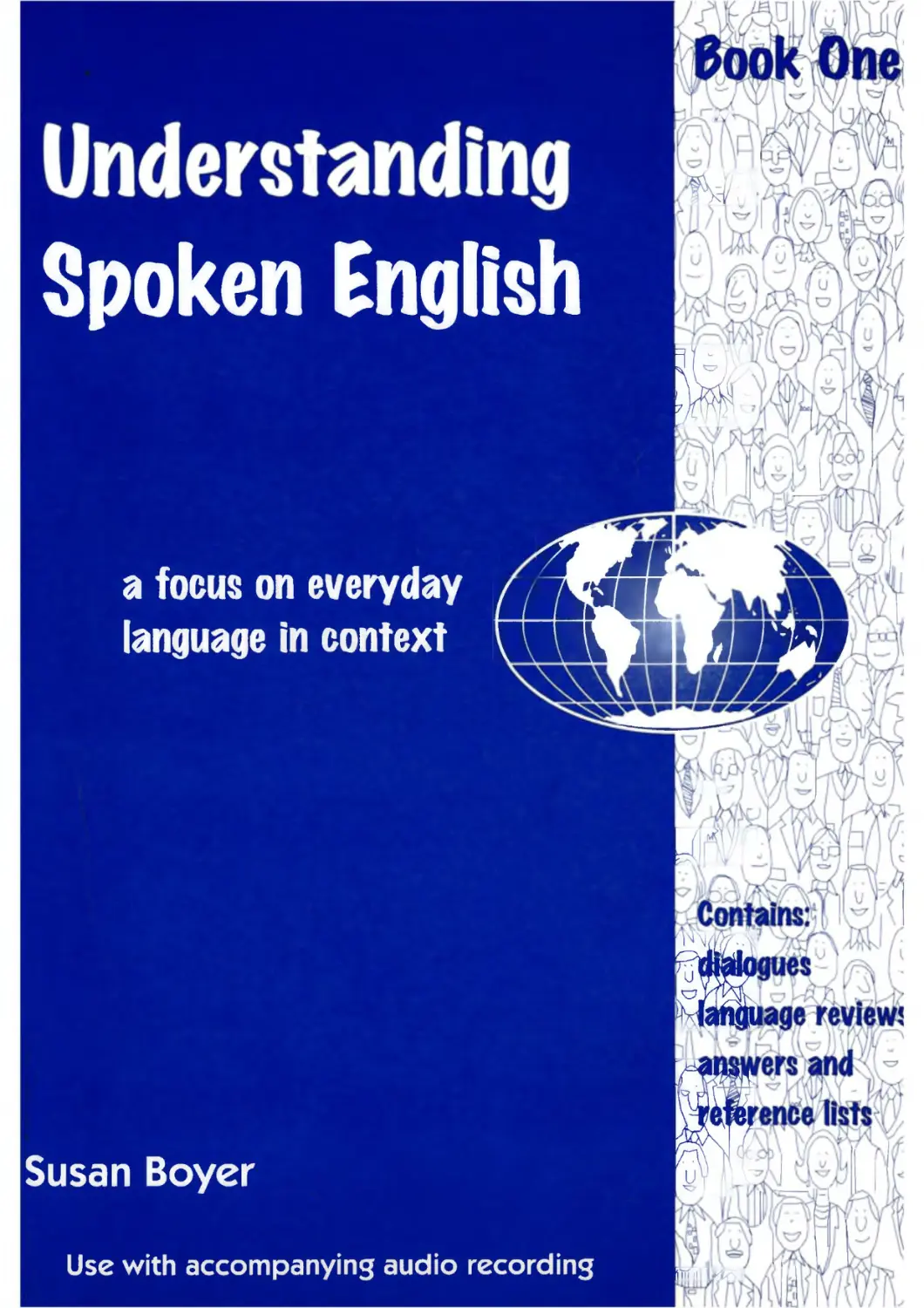
Spoken English
U
a focus on everyday
language in context

W

M

m

.

rapw

M iin in
vims

IH
■M M

1

|||

m & k

wm
Kfla

Susan Boyer
Use with accompanying audio recording

rmi m i

Published by
Boyer Educational Resources
for worldwide distribution.
Phone/fax +61 2 4739 1538
E-mail: boyer@emunet.com.au
Web address: www.boyereducation.com.au
Acknowledgments
I would like to express my thanks to the following people for their contribution to the final presentation
of this book:
Firstly, I would like to thank all the teachers who trialed material contained in the original edition of this
book and suggested improvements. I wish to say thank you to Terry Stroble for his time and constructive
comments regarding North American usage of expressions included in this book.
I would like to thank Matthew Larwood for his creative illustrations. I would like to say thank
you to Darrell Hilton Productions for the production of the accompanying audio recordings and to
Jeanette Christian for proofreading. And of course, I am particularly indebted to the many students who
have given me the necessary insight into the language needs of English language learners around the
world.
Also, I want to thank my dear husband, Len, for his encouragement and support throughout the project, as
well as the many hours spent in the production of this resource.
Dlustrations on pages 8 (pictures 1,5,7,8,9), 20,30,41,42,54,75,76, 86,96 & 109 are by Matthew J Larwood.
The images used herein were obtained from IMSI's MasterClips Collection,
1895 Francisco Blvd. East, San Rafael, CA 94901-5506, USA.
(Except the kookaburra clipart which was obtained from Australian Graphics Selection, New Horizons,
Armidale. Australia.)

Boyer, Susan
Understanding Spoken English: a focus on everyday language in context
ISBN 1 877074 08 X
1. English language - Spoken English - Textbooks for foreign speakers.
2. English language - Spoken English - Problems, exercises, etc. I. Boyer Educational Resources
II Title
428.34

No part of this publication may be reproduced, stored in a retrieval system or transmitted in any form
or by any means electronic, mechanical, photocopying, recording or otherwise, without the prior
consent of the publisher.
© Boyer Educational Resources 2003
Boyer Educational Resources
PO Box 255, Glenbrook, 2773 Australia,
Phone/Fax +61 2 4739 1538

Dear English Language Student,
W elcome to Understanding Spoken English - a focus on everyday language in context.
This book, along with its accompanying audio recording, has been designed to help you
to understand English as it is spoken in 'everyday' situations in English speaking
environments around the world. As a student o f English as a second or foreign language,
you are no doubt aware o f the difference between the formally presented language o f
many textbooks and the speech you hear, outside the language classroom, in the English
speaking media or in conversations with native English speakers.
As well as introducing and explaining the meaning o f many w idely used everyday
expressions, each unit focuses on other aspects o f English, such as the use of
contractions (eg. won't rather than will not% ellipsis (incomplete sentences) and
intonation (the rise and fall o f the voice pitch). These features are distinctive
characteristics o f spoken (rather than written) English. You w ill also learn social
conventions involved in everyday situations such as making a telephone call, dealing
with service people and informal social interactions.
I sincerely hope you enjoy and benefit from using Understanding Spoken English -

a focus on everyday language in context.

Susan Boyer

A note on ‘English’ accents used in the audio recording
The conversations on the accompanying audio recording present speakers with a variety
of different English accents as they are encountered in English speaking environments
around the world. This is because it is very beneficial for students to become accustomed
to the different accents of English speakers that will be encountered in the media, in
international business contexts and social situations.
The intention of presenting different accents, however, is not to provide particular models
for imitation but to increase familiarity with a variety of different accents.
It should be noted that, though the accents of the speakers vary, the vocabulary and grammar
points presented in each unit of this book are those used by all varieties of ‘native speaker’
English.

ABOUT THIS BOOK
Understanding Spoken English has been designed so that you can work through it alone,
without the help o f a teacher, or in a classroom situation with other students. The book
contains nine units o f work, each based on a conversation about a particular topic. The
units are divided into six parts that have been designed to introduce unfamiliar language,
step by step, in a gradual and systematic way. The layout o f the book is as follows:

Part 1 - Focus on listening fo r general understanding
Part 1 introduces the topic and invites you to listen to an everyday conversation and
answer a few general questions by putting a tick next to the correct answers. You will be
listening fox general understanding o f the conversation only. (You will not need to
understand every word.) This is an important step as it will help you to realise that it's not
always necessary to hear every word to understand the general meaning o f a
conversation. In some units, you are asked to check words in a dictionary, so have a
dictionary nearby when you are studying.

Part 2 - Focus on reading & finding the meaning
In this section, you will read Conversation 1 as you listen again. When you have finished
listening, your task is to compare Conversation 1 with Conversation 2 (which will be
next to Conversation 1). Conversation 1 contains the everyday expressions and
Conversation 2 contains an interpretation o f the expressions in Conversation 1. This
section will help you to learn the meaning o f the everyday expressions.

Part 3 - Focus on listening fo r detail
Now you will listen to Conversation 1 again and write in the missing words in the spaces
as you hear them. Don’t worry about spelling as this exercise focuses on your listening
skills - you can check your spelling later. Listen to the conversation as many times as you
like, then check your answers (and spelling) by comparing w hat you have written with
Conversation 1.

Part 4 - Focus on listening and writing fo r reinforcement
This section reinforces (strengthens) your memory as you listen once more to
Conversation 1 and tick the new ly learnt everyday expressions on the list as you hear
them. Then you are asked to look at the list o f expressions (all taken from Conversation
1) and try to remember their meaning. Write in the ones that you can remember, then
check your answers by reading Conversation 1 again or checking the reference list at the
back o f the book. This may seem like hard work but writing the meanings o f the newly
learnt expressions is a useful w ay o f reinforcing what you have just heard and read.

Understanding Spoken English - Book 1

© Boyer Educational Resources

Part 5 - Focus on language revision - crosswords
N ow it’s time to test yourself and see w hat you have learnt by trying the language
revision and crossword activity. In this section, you are asked to use the newly learned
expressions in a different context. In each unit you are asked to complete sentences with
the appropriate expression and complete the crossword. The answers to the exercises can
be found in the answer section o f this book.

Part 6 - Focus on other aspects o f spoken English
In this section, there will be exercises for you to complete and/or cultural advice for you
to remember. This section focuses on aspects o f spoken English (grammar, pronunciation
etc.) that may make it difficult for learners to understand. Each unit focuses on
conversation strategies or social conventions used by the speakers in Conversation 1 o f
that particular unit.

Language Reviews
A fter Unit 3, U nit 6 and U nit 9 you will find a language review that consists o f pictures
and sentences containing the ‘everyday’ expressions, which were introduced in the
preceding units, for you to m atch together. This will help you to see how much you have
remembered.

IMPORTANT NOTE TO STUDENTS
Please be aware that the m eaning o f colloquial language is very dependent on the
context or situation in which it is used, ‘Understanding Spoken English’ has been
designed to introduce and explain the meaning o f colloquial expressions used by
English speakers in the everyday situations presented in this book. However, because
colloquial expressions can have different meanings in different situations, it is not
recommended that students o f English immediately begin using the newly introduced
expressions indiscriminately. It would be much better to spend time becoming familiar
with, and understanding the correct m eaning o f expressions in different situations
before you use them in your conversations.
In this regard, the author and publisher o f this book will not be responsible to any
person, with regard to the m isuse o f language, caused directly or indirectly by the
information presented in this book.

Understanding Spoken English - Book 1

© Boyer Educational Resources

UNDERSTANDING SPOKEN ENGLISH - BOOK ONE
CONTENTS
PAGES
GLOSSARY OF LANGUAGE TERMS

6 -7

UNIT 1

8 - 18

STARTING SOMETHING NEW
Conversation with ‘everyday’ expressions
Focus on Spoken Language:
A) Spoken words and syllables
B) Contracted words in spoken English
C) Developing awareness of the stress patterns of English
D) Names and syllables
E) Stress in sentences

10

15-18

Reference Page - Understanding the stress patterns of English

19

UNIT 2

20-29

UNIT 3

TALKING ABOUT THE FAMILY
Conversation with ‘everyday’ expressions
Focus on Spoken Language:
A) Question tags in conversational speech
B) Hearing and pronouncing syllables correctly
C) Hearing and using correct stress in words

22

27-29

30-39
32
37-39

TALKING ABOUT OTHER PEOPLE
Conversation with ‘everyday’ expressions
Focus on Spoken Language:
A) Using pronouns
B) Pronouns - pronunciation and spelling
C) Changing the topic during a conversation
D) Giving an opinion

LANGUAGE REVIEW ONE - Units 1 -3

40-41

UNIT 4

42 - 52
44
49 - 52

TALKING ABOUT SHOPPING
Conversation with ‘everyday’expressions
Focus on Spoken Language:
A) Question tags - revision
B) Using intonation to communicate meaning
C) Developing awareness of ‘weak forms’ in spoken English
D) The linking of words in connected speech

Reference Page - Connected speech
UNIT 5

TALKING ABOUT HEALTH AND SICKNESS
Conversation with ‘everyday’ expressions
Focus on Spoken Language:
A) Some intonation patterns of English
B) Incomplete sentences in spoken English
C) Phrasal verbs
D) Stages in a medical consultation

Understanding Spoken English - Book 1

53
54 - 63
56
61 - 63

© Boyer Educational Resources

UNDERSTANDING SPOKEN ENGLISH - BOOK ONE
CONTENTS
PAGES
UNIT 6

WORRYING ABOUT MONEY
Conversation with ‘everyday’ expressions
Focus on Spoken Language:
A) Giving feedback
B) Giving reasons - Justifying actions and opinions
C) Making suggestions
D) Agreeing and disagreeing politely

64-73
66

71-73

LANGUAGE REVIEW TWO - Units 4 - 6

74-75

UNIT 7

TALKING ABOUT PLACES AND PREFERENCES
Conversation with ‘everyday’ expressions
Focus on Spoken Language:
A) Using intonation to check meaning
B) Talking about preferences
C) Ellipsis - leaving words out in short replies

76-85
78
83-85

UNIT 8

MAKING AN ARRANGEMENT BY TELEPHONE
Conversation with ‘everyday’ expressions
Focus on Spoken Language:
A) Stages in a phone request for service
B) Checking information given on the telephone
C) Using polite language when requesting service
D) Pronunciation of words ending with ‘ed’

86-95

UNIT 9

88

93-95

AT A SOCIAL GATHERING
Conversation with ‘everyday’ expressions
Focus on Spoken Language:
A) Making small talk - appropriate topics
B) Starting a conversation and keeping it going
C) Revision - Using 'question tags' to begin a conversation
D) Phrasal verbs - a note on correct word order

96 - 106
98
103 -106

LANGUAGE REVIEW THREE - Unit 7 - 9

108 -109

Answers to exercises and crosswords

110-121

Reference Lists - everyday expressions with definitions

122 - 130

Reference Page - Some pronunciation differences between varieties of English

131

Phonemic Chart of English Sounds

132

Understanding Spoken English - Book 1

© Boyer Educational Resources

GLOSSARY OF LANGUAGE TERMS
Use this list as a reference while you are using this book.
adjective:

a word which describes things (black car), people {beautiful girl),
places {multicultural city) or events {exciting race), etc.

alphabet:

The English alphabet consists of twenty six letters:
a, b, c, d, e, f, g, h, i, j, k, 1, m, n, o, p, q, r, s, t, u, v, w, x, y, z.
These letters are categorised into vowels: a, e, i, o, u.
and consonants: b, c, d, f, g, h, j, k, 1, m, n, p, q, r, s, t, v, w, x, y, z.
(The consonant letter 'y' can be pronounced as a vowel sound; for example: 'gym'.)

article:

The words 'a', 'an', 'the' are called articles.

auxiliary verb:

a 'helper' verb which is used with another verb to form tense, (eg. will come, did
come, have come) Modal auxiliary verbs are used with another verb to show
mood or manner, (eg. should come, might come, must come).

discourse marker:

Discourse markers show connection between what has already been said and
what will come next in a stretch of discourse., (eg.'...however,..', 'and I'm sure
you'll agree...'). A discourse marker is also a word or expression whiph shows
the speaker's attitude to what is being said. eg. ‘Infact,.... ’, ‘...and o f course... ’

ellipsis:

the omission of words from a sentence when the meaning is clear without them,
due to the context of the conversation, eg. Anything else? (meaning 'Is there any
thing else? '

imperative:

base (simple) form of a verb, used at the beginning of a sentence, to give orders,
instructions, directions, (eg. Be quiet: Turn left at the next comer).

intonation:

Intonation refers to the way our voice goes up and down in pitch when speaking.

noun:

a word which names things, (eg. car, sky); places (eg. New Zealand, ocean)
people (eg. John, President), as well as abstract things, things we can't see but
can experience/talk about, (eg. history, pain, ideas, education).

phrasal verb:

A verb that consists of two parts: a base verb and an adverbial particle,
eg. 'pick up', 'try on'

phonemic symbols:

See the explanation below for 'sound symbols’.

pronoun:

a word which is used in place of a noun. eg. it, she. they. (See Unit 3 - Part 6A, 6B)

schwa:

The symbol '9', and the sound it represents, arc referred to as 'schwa'. The symbol '9'
(schwa) is used in most dictionaries to represent weak, unstressed syllables in words.

sound symbols:

also called phonemic symbols - these symbols represent the sounds of English.
English sounds are generally divided into two main categories: vowel sounds,
and consonant sounds. The vowel sounds can be further divided into simple
vowel sounds and diphthong sounds. Diphthongs can be defined as 'two vowel
sounds linked or glided together within a syllable'. For example, the vowel sound
in the word 'voice' consists of two linked vowels sounds and is represented by the
symbol /Oi/.
See the Phonemic Chart of English Sounds on page 132 that shows the sound
symbols of English, along with example words to demonstrate each sound.
© Boyer Educational Resources

Understanding Spoken English - Book 1
6

GLOSSARY OF LANGUAGE TERMS
stress:

In spoken language, stress refers to the emphasis of a word or syllable within a word.

word stress:

In words with more than one syllable, one sound is usually stronger (spoken more
clearly) than the other(s). The term, stressed syllable, refers to the strongest
(primary) sound in words of more than one syllable.

sentence stress:

Words which carry the main message of the sentence contain stressed syllables.
Stressing the important words helps the listener to hear die message of the speaker,
eg. I want to go home.

syllable:

Spoken words are formed with syllables, meaning units of sound.
A syllable is a unit of unbroken sound, generally containing a vowel sound.

verb:

a word which shows action.
or state/experience.

eg. He ran all the way.
eg. She is a student. Ifeel cold.

‘Base form’ can refer to the simple present form of the verb. eg. be, go, see.

verb tenses:

Tenses show the time of an action, event or condition. Some examples are:

past simple tense:

indicates finished past action, eg. He went to Asia last year.______ ▼

present perfect tense:

a) used for an action/experience which began in the past and has continued to
the present, eg. I have lived here since 1998. eg. 1 9 9 8 ----------------|now^-

last year

[now

b) used when a past action/experience (which happened at an unspecified time)
has present significance.
(unspecified time)
eg.. He has been to Asia. ^ _____
present simple tense:

~^ow|

a) indicates a present condition/fact.
eg. I am hungry,

eg.

now

now/present time

b) indicates a present routine, eg. I work four days each week. eg.
present progressive:

(also called present continuous) a verb form made with am/are/is +...ing.
a) This tense is used to talk about an action which is happening at the time of
speaking, eg. We are waiting for him.
b) The present progressive is also used to refer to a future arrangement,
eg. He is leaving tomorrow.

future simple tense:

will +verb indicates future time. eg. I think, it will rain tomorrow. |nowl tomorrow

vowel sounds:

See notes under 'sound symbols' on the previous page.

NOTE:
This list is not intended as a complete guide. Refer to a comprehensive grammar book for more details.

Understanding Spoken English - Book 1

© Boyer Educational Resources

UNIT 1

STARTING SOMETHING NEW

© Boyer Educational Resources

Understanding Spoken English - Book 1
8

Unit 1 - STARTING SOMETHING NEW - Part 1
We all learn new things throughout our lives - sometimes because we want to and sometimes
because we have to. How do you feel about learning new things? Most people have ‘mixed feelings’
about starting new things. This means they often feel nervous and excited at the same time.

Listening for general understanding
Listen to this conversation between friends who are talking about starting something new.
(Unit 1 on the audio recording.) The conversation contains everyday expressions that will be
explained later in the unit - so don't worry if you don't understand every word. This time you
are listening for a general understanding of the topic. As you listen, tick the correct answers
below. (There may be more than one correct answer.) When you have finished you can check
your answers on page 110.

1) Chris is telephoning Lee to ask about:
a) a new job
b) a new language course
c) a new hobby

2) Lee suggests that Chris should do:
a) an accountancy course
b) a computer course
c) a cooking course

3) Chris says:
a) he is too old to learn new things
b) he already knows how to do it
c) he will enquire about a course this week

Now, we’ll look at the everyday expressions used
in the conversation - turn to the next page.

Understanding Spoken English - Book 1

© Boyer Educational Resources

Unit 1 - STARTING SOMETHING NEW - Part 2A

CONVERSATION 1 (with everyday expressions)
ii Replay Conversation 1
Read this conversation as you listen to the audio recording. Do you know what the
underlined words mean? They are colloquial or 'everyday' expressions.

Lee:
Chris:

Hello.
Hello Lee. It's Chris here. I thought I'd give you a buzz and see how you’re going in

Lee:

your new job.
Oh hi Chris. It's good to hear from you. I'm getting into the swing of things
now
thanks. I had a few hassles at first - you know everything was different. In the first
week I thought tfyej.ob was beyond me. I couldn't make head nor tail of the accounts
system but I stuck at it and I'm going well now.

Chris: Good for you!
Lee:
Thanks. What've you been up to anyway?
Chris: Not much. I’m in a rut in my job really. But I’ve been thinking about getting some
training and going for a better job too.
Lee:
Yes, you should. Why don't you do a computer course?
Chris: I don't really like the idea of studying again - it's so long since I left school. I don't really
know the first thing about computer technology. I mean, what if everyone else in the
Lee:

class catches on quicker than me. I'm getting a bit old to learn new things.
Oh, come off it! Tons of people study as adults these days.Everyone-in the class will

be in the same boat. Go on Chris! Once you start, I'm sure you'll soon get the hang of it.
Chris: OK. You've talked me into it. I'll enquire about courses this week.
Lee:

Good on you! Look, I'd better get back to work now - we're pretty busy today but I'll

call you next week to see how you're getting along.
Chris: OK. I'll talk to you then. Thanks for the encouragement!
Lee:

See you.. .and good luck.

Now let's see what the underlined expressions mean - look at the next page.

Understanding Spoken English - Book 1

www.boyereducation.com.au
10

Unit 1 - STARTING SOMETHING NEW - Part 2B

CONVERSATION 2 (explanation of everyday expressions)
Compare Conversation 1 with Conversation 2 - You will see that some of the words are
different but the meaning is the same in both conversations. Find the underlined expressions
in Conversation 1, then underline the words with the same meaning in Conversation 2.
For example: eive you a buzz (Conversation 1) = call you on the telephone (Conversation 2)

Lee:
Chris:

Hello.
Hello Lee. It's Chris here. I thought I'd call you on the telephone and see how you’re

Lee:

going in your new job.
Oh hi Chris. It's good to hear from you. I'm becoming familiar with the usual way of
doing things now thanks. I had a few problems/difficulties at first - you know
everything was different. In the first week I thought the job was too difficult for me. I
couldn't understand anything about the accounts system but I kept trying and I'm going
well now.

Chris: Congratulations!
Lee:
Thanks. What've you been doing anyway?
Chris: Not much. I’m in a boring pattern of doing

■
/
things in my job really. But I’ve been

thinking about getting some training and going for a better job too.
Lee:

Yes, you should. Why don't you do a computer course?

r

Chris:

I don't really like the idea of studying again - it's so long since I left school.
I don’t really know anything about computer technology. I mean, what if everyone else
in the class leams/understands quicker than me. I'm getting a bit old to learn things.

Lee:

Oh, I don't agree with you! A lot of people study as adults these days. Everyone in the
class will be in the same situation. You should do it, Chris! Once you start, I'm sure

Chris:

you'll soon understand what to do.
OK. You've convinced me/shown me good reasons why I should do what you suggest.

Lee:

I'll enquire about courses this week.
Good on you! Look, I'd better get back to work now - we're pretty busy today but I'll
call you next week to see how you're progressing/managing.

Chris:
Lee:

OK. I'll talk to you then. Thanks for the encouragement!
Goodbye...... and good luck!

Important note:
The language used in Conversation 2 (above) may seem easier to understand
when compared with Conversation 1. However, the ‘everyday’ expressions
used in Conversation 1 are used extensively by speakers of English. Therefore
it is beneficial to become familiar with the everyday expressions used by the
speakers in Conversation 1.

Understanding Spoken English - Book 1

© Boyer Educational Resources

____________ Unit 1 - STARTING SOMETHING NEW - Part 3____________
MReplay Conversation 1
Listen to the conversation again and fill in the missing words. You may have to listen more
than once. (Don’t worry about your spelling as this exercise focuses on listening skills - you
can check your spelling later.)
Lee:

Hello.

Chris:

Hello Lee. It's Chris here. I thought I'd give you a_______ and see how you’re going in
your new job.

Lee:

Oh hi Chris. It's good to hear from you. I'm getting into the_________of things now
thanks. I had a few hassles at first - you know everything was different. In the first
week I thought the job was________me. I couldn’t make_______ nor_______ of the
accounts system but I _______at it and I'm going well now.

Chris:

Good for you!

Lee:

Thanks. What've you been______to anyway?

Chris:

Not much. I’m in a_____ in my job really. But I’ve been thinking about getting some
training and going for a better job too.

Lee:

Yes, you should. Why don't you do a computer course?

Chris:

I don't really like the idea of studying again - it's so long since I left school.I don’t really
know the______ thing about computer technology. I mean, what if everyone else in the
class catches

Lee:

quicker than me. I'm getting a bit old to learn new things.

Oh, come_______it! Tons of people study as adults these days.
Everyone in the class will be in the same______ . Go on Chris! Once you start, I'm
sure you'll soon get the________of it.

Chris:

OK. You've talked me______ it_. I'll enquire about courses this week.

Lee:

Good on you! Look, I'd better get back to work now - we're pretty busy today but

I'll

call you next week to see how you're getting__________.
Chris:

OK. I'll talk to you then. Thanks for the encouragement!

Lee:

______ you...and good luck!

© Boyer Educational Resources

Understanding Spoken English - Book 1
12

Unit 1 - STARTING SOMETHING NEW - Part 4
In order to become more familiar with these new everyday expressions:
ii Replay Conversation 1
1) Listen and tick the boxes 0 next to the expressions as you hear them.
2) Write the definitions you can remember. (The first one has been done as an example.)
Check your answers with the reference list on page 122.
□

give (you) a buzz..........................

call (you) on the telephone_____

EH getting into the swing of things............

............................................................

□

hassles...................................................

............................................................

□

beyond (someone).................................

............................................................

□

not make head or tail of (something)...

_____________________________

EH stuck at it...............................................
EH Good for you!.......................................
EH What've you been up to?.......................
EH in a r u t..................................................
EH don *t know the first thing about (something)
EH catch on................................................
EH Come off it!..........................................
n
I— I tons.......................................................

EH in the same boat...................................
EH Goon!..................................................
EH get the hang of it..................................
EH talked (me) into it.................................
EH getting along........................................
EH See you.................................................

............................................................
............................................................
............................................................
............................................................
_____________________________
............................................................
............................................................
a
............................................................
............................................................
............................................................
............................................................
............................................................
............................................................
............................................................

LANGUAGE NOTES
1. The word 'buzz9(used as a noun) can have several meanings, depending on the context
in which it is used. It can mean ‘a low, continuous noise produced by an insect’.
It can mean ‘a call on the telephone as in the example in the conversation of this unit.
To give/get a buzz from doing something can mean to give/get a thrill or goodfeeling.
eg. ‘I get a buzz from helping people.'
The expression ‘Buzz offV is an impolite way of saying ‘Go awayV
2. The expressions not make head nor tail o f (something), not know thefirst thing about (something)
are usually expressed in the negative form.
3. The expression getting along meaning progressing/managing, can also be expressed as
getting on. eg. ‘How are you getting along in your job?’ or ‘How are you getting on in your job?’

Understanding Spoken English - Book 1

© Boyer Educational Resources

Unit 1 - STARTING SOMETHING NEW - Part 5

CROSSWORD - LANGUAGE REVISION
Complete the sentences, choosing from the everyday expressions that are listed in the box below.
You can use the clues in brackets ( ) at the end o f each sentence to help you.
Then complete the crossword using the everyday expressions you have written.
The first one has been done as an example.
get the hang-of
tons
stick at it
swing
beyond me
the first thing

head nor tail
in a rut

catch on
buzz

getting along
same boat

ACROSS
1) You'll soon get the hang of this game, (understand what to do)
3) It's easier to __________ to new things if you relax and enjoy learning, (leam/understand)
5) I'll give you a ______tonight and we can make arrangements for tomorrow, (call on the
telephone)
7) I can't make__________________ of this grammar book, (understand anything)
9) There're always_______ of people at the beach in Summer, (a lot of)
11)1 don’t think he’ll get a driving licence. He doesn’t seem to know_____________________
about driving, (know anything)
DOWN
2) I’m ________ . I need to change my life and do something more interesting, (in a boring
pattern of doing things)
4) This course is difficult but I'm going to ______________ . I'm sure it will get easier, (keep
trying)
6) I practise English everyday and now I'm getting into th e _________of things, (becoming
familiar with the usual way of doing things)
8) How are you___________________in your new job? (progressing/managing)
10) This textbook is _________________ . (too difficult for)
12) Everyone who has started their life again in a new country is in th e___________ .
(same situation)
8

10

12

t
1

4

2

£

e t

*

/

h e * h a

n

8

*

°

X

*

3

*

6
5
*

*
*

*

*

*

*

7

9

★
*

*

(Answers: page 110)

Understanding Spoken English - Book 1

www.boyereducation.com.au

____________ Unit 1 - STARTING SOMETHING NEW - Part 6___________

FOCUS ON SPOKEN LANGUAGE
A) Spoken words and syllables
•

Spoken words are formed with syllables (or units of sound).

•

A syllable is formed when individual sounds are pronounced together to form one unit of
unbroken sound within a word. Each syllable generally contains a vowel sound.

•

A word may contain one or more syllables.
For example: come = one syllable; welcome = two syllables; unwelcome = three syllables

Read the first few words of Conversation 1 below. Which word has two syllables?
'Hello Lee. It's Chris here.'
(Answer: page 110)

B) Contracted words in spoken English
In conversational English, speakers use 'contractions'. This means they link two (or more) words
together into one word. For example, instead of saying, It is... they say, I t ’s...
Contracted words are often pronounced as one syllable but there are exceptions, as you will see
in the exercise which follows.

4i Replay Conversation 1
Listen to Conversation 1 again and circle the contractions used in the conversation (page 10) as
you hear them. Notice the way the contractions are pronounced. Then do the following exercise.
Write the contracted form of these groups of words that have been used in Conversation 1.
Notice the correct position for the apostrophe ( ' ) when you check your answers on page 110.

For example:

Full form

Contraction

I would
you are
I am
could not
what have
do not
it is
you will
you have
I had
we are
I will

I ’d

How many syllables
in the contracted form?
1

Answers page: 110
•

Note: Contractions are not generally used in formal writing.

Understanding Spoken English - Book 1

© Boyer Educational Resources

____________ Unit 1 - STARTING SOMETHING NEW - Part 6____________

C) Developing awareness of the stress patterns of English
As you have learnt, spoken words are formed with syllables. A word may contain only one
syllable, as in the words, 'is', 'on', 'at'. However, words may have two or more syllables.
For example: for = one syllable; forgot = two syllables; forgotten - three syllables.
In words of two or more syllables, one syllable is spoken more clearly or strongly than others.
The most strongly pronounced syllable is called the stressed syllable. Look at the following twosyllable words as examples.
In the following words, the first syllable is stressed.
better
system
In the following words, the second syllable is stressed.
along
accounts
In Unit 2 you will practice using your dictionary to learn the stress patterns of new words.

D) Names and syllables
The speakers in Conversation 1 (page 10) are friends and therefore use given names, 'Chris'
and 'Lee' when speaking to each other, rather than family names (also called surnames).
The names 'Chris' and 'Lee' each have one syllable. However, 'Chris' is a shortened (abbreviated)
form of 'Christopher', a male name, which has three syllables; Chris-to-pher.

What about you?
•

When introducing yourself in an informal situation, do you use your given name or surname?

• When speaking with friends, do you use your given name or surname (family name)?
• How many syllables does your given name contain?
• How many syllables does your surname name contain?
•

How many syllables does your friend’s (or classmate’s) given name contain?

© Boyer Educational Resources

Understanding Spoken English - Book 1
16

Unit 1 - STARTING SOMETHING NEW - Part 6

Pronouncing names correctly - practice
It is important to remember the correct pronunciation of the names of people you meet. As you
have learnt, it is necessary to know how many syllables a word contains in order to pronounce it
correctly. It is also important to know which syllable is stressed.
•

Write the names of people in your class
(or people you work with) on a piece of paper.

•

Ask them to pronounce their name slowly.

•

Mark the syllables by drawing a line between each syllable
and underline the most strongly stressed syllable. For example, show Christopher as Chris/to/pher.

•

Check with them that you are pronouncing their names correctly.

NOTE ON TELEPHONE LANGUAGE
When we call people we know on the telephone, we often begin the conversation by saying
'Hello, this is Susan." or 'Hello, it's Susan here.' We never say, 'I am Susan'
Notice how Chris introduced his call to Lee in Conversation 1 (page 10).
However, when making a business call, we would introduce ourselves using our surname.
For example: 'Hello, this is Susan Boyer...' or if it's the initial call, 'Hello, my name is Susan
Boyer...'

E) Stress in sentences
In this section, you will see how stress is used in spoken English sentences. You will see how
some words are spoken more clearly and loudly than the other words in a sentence. These words
are called stressed words. The stressed words convey the main message of the speaker. To put
more simply, speakers stress the words they want their listeners to focus on.
On the other hand, words that do not carry the main message of the speaker are spoken quickly
and softly. They are wwstressed or reduced. For this reason, spoken English can be compared to
music where some sounds are l o n g and loud; some sounds are dwl and

& ji

Understanding Spoken English - Book 1

J

© Boyer Educational Resources

Unit 1 - STARTING SOMETHING NEW - Part 6
4i Replay Conversation 1
Listen and read the first two sentences from the beginning of Conversation 1 and notice the
stress pattern. The stressed words are marked by the symbol •.

•
•
•
•
•
•
• •
•
• •
Hello Lee. It's Chris here. I thought I'd give you a buzz and see how you're going inyour new job.

Did you hear that the stressed words marked • were spoken more loudly and clearly than the
other words?
(Note: In stressed words with two syllables (or more), one syllable has the main stress. For example,
in the word ‘going’, the first syllable is stressed, but the second syllable is unstressed.)
Did you notice that the words that do not carry the main message of the speaker are spoken
quickly and softly? They are unstressed. These words, they are referred to as weak or reduced.

Note:
It is not absolutely necessary for learners of English to use these features of spoken English to
be understood by others. However, the use of correct stress patterns is important in developing
the natural flow of English speech. It is also very important for students to be aware of these
stress features of spoken language in order for them to understand the natural speech of native
English speakers in the media and in business and social situations.

Understanding Spoken English - Book 1

© Boyer Educational Resources
18

Reference page
Understanding the Stress Patterns o f English
Word Stress
• Spoken words contain syllables. A syllable is formed by the linking of individual sounds
within a word to form one unit of unbroken sound. A word can contain one or more syllables.
For example: come = one syllable; welcome = two syllables; welcoming = three syllables.
• In spoken English, some syllables in words are spoken more clearly or strongly than others.
Strong or prominent sounds are called stressed syllables. For example, in the word welcome
which has two syllables, the first syllable is stressed.
The weaker or reduced syllables are called unstressed syllables and are often represented in
dictionaries by the symbol /a/. This sound and its symbol /a/ is called the schwa. For example,
the pronunciation of the word ‘welcome’ will be shown in the dictionary as /’welkam/
Note: Other symbols, such as /i/, may also be used to represent an unstressed vowel sound.
For example, the word 'hectic', will be shown in the dictionary as /’hektik/
Unit 2 will provide practice with using your dictionary
to learn the stress patterns of new words.
Stress within sentences
• In spoken English sentences, words that give important information contain stressed
syllables. These are generally content words, such as nouns (things), verbs (actions) and
adjectives (describers).
Words which don ’t carry the main message of the speaker (ie. structure words like the, of, a)
are generally unstressed. These unstressed words are spoken softly and quickly.
Look at the following sentence as an example:
content words (generally stressed in spoken English)
The

books are on the desk.
structure words (generally wwstressed and reduced;
generally spoken quickly and softly)

In Unit 4 you will learn more about strong and weak syllables in spoken English.

You can learn more about the stress patterns of English in the book,
‘Understanding English Pronunciation - an integrated practice course
See details on the final page of this book.
Understanding Spoken English - Book 1

www.boyereducation.com.au

UNIT 2

TALKING ABOUT THE
FAMILY

Understanding Spoken English - Book 1

© Boyer Educational Resources

Unit 2 - TALKING ABOUT THE FAMILY - Part 1

Listening for general understanding
This conversation contains colloquial or everyday expressions relating to family life. These will
be explained later in the unit so don't worry if you don't understand every word of the
conversation. This time you are only listening for general understanding of the topic. Listen to
the conversation between friends (Unit 2 on the audio recording) and decide which of the
photographs on the opposite page the speakers are talking about. (Answers: page 110)
Before you listen to the conversation again, check these words in a dictionary if you are not
familiar with their meaning. (Answers: page 110)
________ in-laws

characteristic

relationship

(cultural) background

tolerant_____

4<Replay Conversation 1
Listen to the conversation again and tick the correct answer below. You may need to listen more
than once. When you have finished, you can check your answers on pagel 10.
1) The photograph that the speakers are looking at
was taken:
a) last week
b) a few months ago
c) a few years ago
2) What is David's health problem?
a) an eye problem
b) a hearing problem
c) a heart problem

3) What has caused the problem between Jean's
daughters-in-law ?
a) business problems
b) cultural differences
c) health problems

Now, we’ll look at the everyday expressions used
in the conversation - turn to the next page.

Understanding Spoken English - Book 1

© Boyer Educational Resources

___________ Unit 2 - TALKING ABOUT THE FAMILY - Part 2A__________

CONVERSATION 1 (with everyday expressions)
ii Replay Conversation 1
Read this conversation as you listen to the audio recording. Do you know what the
underlined words mean? They are colloquial or 'everyday1expressions.
Merv:

Are these your sons, Jean? I haven't seen them for ages.

Jean:

Yes, that photo was taken a few months ago.
John hasn't changed a bit. He's the image of his father, isn't he?

Merv:
Jean:

Yes, he is. He takes after his father, that's for sure.

Merv:
Jean:

What's he doing these days?
He's followed in his father’s footsteps too and works in the family importing business.
He's living overseas at the moment.

Merv:
Jean:

Oh really? How does he like it?
It was difficult for him at first because he had to start from scratch, you know, finding
somewhere to live and making new friends. He's settled in now though and he loves it.

Merv:
Jean:

That's good to hear. And how's David?
Well I'm sorry to say he hasn't been very well. He's

been having problems with his

heart. We're very worried about him because heart disease runs in our family you know.
Merv:
Jean:

Really? I didn't know that.
Yes, my younger brother passed away last year after a heart attack.

Merv:
Jean:

Oh, I'm very sorry to hear that, Jean. He wasn't very old, was he?
No, he wasn't - only thirty-eight. At least David knows about the problem and he can

Merv:

look after himself.
Mm. And do the boys keep in touch? I remember they used to be very close.

Jean:

Yes they do - but not as much as before they were married. Their wives don't get along.

Merv:
Jean:

so it's a bit of a sticky situation, you know.
That's not good! In-laws can be a problem sometimes...
Yes, they can sometimes. This problem’s because they're from different cultural

Merv:
Jean:

backgrounds.
You're kidding?
Mm. It's a tough one because we brought up the boys to be tolerant about
other cultures and to get on with everyone.

Merv:

Well let's hope their ideas rub off on their wives.

Jean:

Yes, let's hope so.

Now let's see what the underlined expressions mean - look at the next page.

www.boyereducation.com.au

Understanding Spoken English - Book 1
22

Unit 2 - TALKING ABOUT THE FAMILY - Part 2B

CONVERSATION 2 (explanation of everyday expressions)
Compare Conversation 1 with Conversation 2 - You will see that some of the words are
different but the meaning is the same in both conversations. Find the underlined expressions
in Conversation 1, then underline the words with the same meaning in Conversation 2.
For example: for ages (Conversation 1) = for a long time (Conversation 2)
Merv:
Jean:
Merv:
Jean:
Merv:
Jean:
Merv:
Jean:

Merv:
Jean:

Merv:
Jean:
Merv:
Jean:
Merv:
Jean:
Merv:
Jean:
Merv:
Jean:
Merv:
Jean:

Are these your sons Jean? I haven't seen them for a long time.
Yes, that photo was taken a few months ago.
John hasn't changed a bit. He's the same in appearance as his father, isn't he?
Yes, he is. He is similar to his father, that's for sure.
What's he doing at the present time?
He's done the same as his father did too and works in the family importing business.
He's living overseas at the moment.
Oh really? How does he like it?
It was difficult for him at first because he had to start from the beginning without help,
you know, finding somewhere to live and making new friends. He's become established
now though and he loves it.
That's good to hear. And how’s David?
Well, I'm sorry to say he hasn't been very well. He's been having problems with his heart.
We're very worried about him because heart disease is a common characteristic in our
family, you know.
Really? I didn't know that.
Yes, my younger brother died last year after a heart attack.
Oh, I'm very sorry to hear that, Jean. He wasn't very old, was
he?
No, he wasn't - only thirty-eight. At least David knows about the problem and he can
look after himself.
Mm. And do the boys communicate regularly? I remember they used to be veryclose.
Yes they do - but not as much as before they were married. Their wives don't like each
other, so it's a bit of a difficult situation, you know.
That's not good! In-laws can be a problem sometimes...
Yes, they can sometimes. This problem’s because they are from different cultural backgrounds.
Really? That is surprising.
Mm. It's a difficult problem because we trained and educated the boys to be tolerant
about other cultures and to be friendly with everyone.
Well let's hope their ideas are transferred to/have influence on their wives.
Yes, let's hope so.

Important note:
The language used in Conversation 2 (above) may seem easier to understand
when compared with Conversation 1. However, the ‘everyday’ expressions
used in Conversation 1 are used extensively by speakers of English. Therefore it
is beneficial to become familiar with the everyday expressions used by the
speakers in Conversation 1.
Understanding Spoken English - Book 1

Boyer Educational Resources

Unit 2 - TALKING ABOUT THE FAMILY - Part 3
<4Replay Conversation 1
Listen to the conversation again and fill in the missing words. You may have to listen more
than once. Don't worry about your spelling as this exercise focuses on listening skills.
Merv:
Jean:
Merv:

Are these your sons Jean? I haven't seen them for__________ .
Yes, that photo was taken a few months ago.
John hasn't changed a bit. He's the________of his father, isn't he?

Jean:

Yes, he is. He takes________ his father, that's for sure.

Merv:
Jean:

What's he doing these days?
H e's___________ in his father's footsteps too and works in the family importing
business. He's living overseas at the moment.

Merv:
Jean:

Oh really? How does he like it?
It was difficult for him at first because he had to start from_______ , you
know, finding somewhere to live and making new friends. He's settled in

Merv:
Jean:

now though and he loves it.
That's good to hear. And how’s David?
Well I'm sorry to say he hasn't been very well. He's been having problems with his heart.
We're very worried about him because heart disease______in our family you know.

Merv:
Jean:

Really? I didn't know that.
Yes, my younger brother__________ away last year after a heart attack.

Merv:
Jean:

Oh, I'm very sorry to hear that,Jean. He wasn't very old, was he?
No, he wasn't - only thirty-eight. At least David knows about the problem and he can

Merv:

look after himself.
Mm. And do the boys keep in_______ ? I remember they used to be very close.

Jean:

Yes they do - but not as much as before they were married.
Their wives don't________ along, so it's a bit of a _________situation, you know.

Merv:

That's not good! In-laws can be a problem sometimes...

Jean:

Yes, they can sometimes. This problem's because they're from different cultural

Merv:
Jean:

backgrounds.
You’re kidding?
Mm. It's a tough______because we brought________ the boys to be tolerant about

Merv:

other cultures and to _______ on with everyone.
Well let's hope their ideas rub_____ on their wives.

Jean:

Yes, let's hope so.

Now check your answers by comparing this page with
CONVERSATION 1.

© Boyer Educational Resources

Understanding Spoken English - Book 1
24

______________U n it 2 - T A L K IN G A B O U T T H E F A M IL Y - P art 4

H Replay Conversation 1
In order to become more familiar with these new everyday expressions:
1) Listen and tick the boxes f/| next to the expressions as you hear them.
2) Write in the definitions you can remember. (One has been done as an example.)
Check your answers with the reference list on page 123.

EH for ages.............................................
EH the image of (someone)...................

...........................................................

□

...........................................................

take after...........................................

EH these days........................................
EH follow in (someone's) footsteps......
EH start from scratch............................
EH settled in..........................................
EH runs in (the family).........................
EH passed away....................................

for a Ions time_________________

...........................................................
...........................................................
...........................................................
...........................................................
.............................. t...........................
...........................................................

— keep in touch..................................

...........................................................

__ don't get along................................

...........................................................

EH sticky (situation)............................
EH You're kidding...............................
EH a tough one....................................
EH brought up (children)....................
EH get on with....................................
EH rub off on......................................

...........................................................
...........................................................
...........................................................
...........................................................
...........................................................
...........................................................

LANGUAGE NOTE:
The expression, ‘not get along with (someone) ’ can also be expressed as ‘not get on with (someone)

PRONUNCIATION NOTE:
Many English words, containing the letter 'a' may be pronounced as a short sound /ae/ or a long
sound /a:/ depending on which variety of English is being spoken. Two examples, taken from
Conversation 1, are the words ‘passed’ and '‘last’. (See more examples on page 131.)
Spelling
passed
last

Examples of pronunciation differences of the letter ‘a’ in the following words.
/paest/l Some speakers of English pronounce
/laest/J these words with the short vowel
sound /ae/ as in black hat

/pa: St/1 Some speakers of English pronounce
/la: St/ J these words with the long vowel
sound /a:/ as in large heart

The variation in pronunciation, shown in the examples above, is generally well known and therefore,
does not cause communication problems between speakers of different varieties of English.
Understanding Spoken English - Book 1

© Boyer Educational Resources

Unit 2 - TALKING ABOUT THE FAMILY - Part 5
C R O SSW O R D - L A N G U A G E R E V IS IO N
Complete the sentences, choosing from the everyday expressions listed below. You can use the
clues in brackets ( ) at the end of each sentence to help you. Then complete the crossword using
the everyday expressions you have written. The first one has been done as an example.
brought up
rub off on

sticky

get along
take after

settle in

runs in

passed away

keep in touch

ages

image

start from scratch

ACROSS
1) My grandfather passed away before I was bom. (died)
3) I w as____________ by my parents to believe that honesty and hard work are very important.
(trained and educated in the family)
5) Your daughter is th e______of you. (same in appearance)
7) When we moved here, it took us a year t o _____________and make new friends, (become
established)
9) Poor eyesight_________our family so most of us have to wear glasses, (is a common
characteristic)
11) When we moved overseas, we had to __________________ because we didn't know anyone.
(start from the beginning without help)
DOWN
2) My brother and sister-in-law don't_____________ . (don *t like each other)
4) I hope your good habits_______________ your brother, (influence/transfer to)
6) I haven't had a holiday fo r________.(a long time)
8) I ____________ my mother but my sister takes after my father, (am similar to)
10) Do you still_________________ with your friends from school? (communicate regularly)
12) My parents don’t get along with my fiance, so our wedding could be a b it_______.(difficult)

p a s s
10

12

li

(Answers: page 111)

www.boyereducation.com.au

Understanding Spoken English - Book 1
26

Unit 2 - TALKING ABOUT THE FAMILY - Part 6

FOCUS ON SPOKEN LANGUAGE
A)'Question tags' in conversational speech
In spoken English, we sometimes use 'question tags' at the end of a sentence to make it more
conversational. For example, 'It's very hot today, isn’t it?' (The last part, 'isn't it?' is called
the question tag).
•
•
•
•

Look at Conversation 1 of this unit again (page 22).
Find Merv's statements with a question tag at the end.
Write them in the space below. You should be able to find two sentences with question tags.
Look at the short replies that Jean gives and write them next to Merv's sentences.
Jean's first reply has been written for you. (Answers: page 111)

Merv’s Statements (with question tag)

Jean’s reply

1)_____________________________________________________ Yes, he is.
2) ___________________________________________________________________________
NOTICE THE PATTERN
Statement
H ejs the image of his father,

Question tag

Short reply

isn 't hel

Yes, he /s.

If the first part of the sentence has a positive verb, the question tag is negative.
If the first part of the sentence has a negative verb, the question tag is positive.
When the speaker is using a question tag to be conversational, the reply agrees
with the first part of the sentence. For example:
He wasn't very old,

was hel

No, he wasn't.

t ____________________________________________________t
Practise adding a tag to these statements. (Firstly, notice the verb in the first part of the
sentence - is it positive or negative?) Then add a short reply, agreeing with the statement.
a) Inlaws can be a problem sometimes,_____________________ ?

___________________

b) It was cold today,......................................................................... ?

___________________

c) This classroom isn't very big,........... ............................................?

___________________
(Answers: page 111)

SUMMARY - USING QUESTION TAGS
Generally, when we use question tags to be friendly or conversational, we are not asking for
information - we expect our listener to agree with us.
For example:
'Winter will be here soon, won't it?'
'It isn’t very busy today, is it?'

Reply
'Yes, it certainly will.'
'No, it isn't.'

There will be revision on 'question tags' in a later unit of this book.

Understanding Spoken English - Book 1

© Boyer Educational Resources

____________Unit 2 - TALKING ABOUT THE FAMILY - Part 6_________

B) Hearing and pronouncing syllables correctly
In Unit 1 you learnt that:
•
•
•

Spoken words are formed with syllables (or units of sound).
A syllable is formed when individual sounds are pronounced together to form one unit of
unbroken sound within a word.
A word may contain one or more syllables.
For example: come = one syllable; welcome —two syllables; unwelcome = three syllables

It's important to be able to hear how many syllables a word contains in order to be able to
pronounce it correctly.
LISTENING PRACTICE
4i Replay Conversation 1
• Listen to the first part o f Conversation 1 (printed below) again. As you listen, decide how
many syllables the underlined words contain.
•

Write the number of syllables above the words. The first one has been done as an example.
Pause the recording while you write your answer. You can check your answers on page 111.

Merv:

l
Are these your sons. Jean? I haven't seen them for ages.

Jean:

Yes, that photo was taken a few months ago.

Merv:

John hasn't changed a bit. He's the image of his father, isn't he?

Jean:

Yes, he is. He takes after_his father, that's for sure.

Merv:

What's he doing these days?

Jane:

He's followed in his father's footsteps too and works in the family importing
business. He's living overseas at the moment.

Note: The words 'family' and 'business' can be pronounced as two or three syllables.
However, when spoken quickly as in Conversation 1, they are pronounced as two syllables,
eg. fam(i)ly; b u s i ness

* For information on the pronunciation of words with 'ed' endings see Unit 8, Part 6.

Understanding Spoken English - Book 1

© Boyer Educational Resources

Unit 2 - TALKING ABOUT THE FAMILY - Part 6

C) Hearing and using correct stress in words
In words with more than one syllable, one syllable is usually stronger (spoken more clearly) than
the other syllables. Using the correct stress in words is essential to correct pronunciation.
Stress in words refers to the strongest (primary) sound in words of more than one syllable.

Important Note
A good dictionary will provide very useful information on how to pronounce words correctly.
At the beginning (or end) of your dictionary, near the Pronunciation Key, you will see an
explanation of how stress is shown on all words listed in the dictionary.
Dictionaries use various symbols to show which syllable should be stressed, so it's important to
check which symbol jo u r dictionary uses. For example, in the word seven (which contains two
syllables), the stress is on the first syllable. Look at the way this may be shown in a dictionary.
*some dictionaries show a small stress mark ' before and above the stressed syllable, eg. 'seven.
*some dictionaries show a small stress mark ' after and above the stressed syllable, eg. sev'en.
*some dictionaries use a line under the stressed syllable, to show the stressed part. eg. seven
To avoid confusion, check which way your dictionary shows word stress.
How does your dictionary show that the first syllable is stressed in the word seven? _________

DICTIONARY PRACTICE
Using your dictionary, check the following two-syllable words and show the stressed syllable,
using the stress symbol from your dictionary. Then check if you can hear the stress, by
listening to the words in the first section of Conversation 1 again.
ages

taken

ago

image

family

business

moment

DICTIONARY CHECKLIST
•
•
•

Does your dictionary give clear, simple definitions of words or expressions, with examples
of how the word may be used in different contexts?
Does your dictionary have a pronunciation key that gives clear examples of pronunciation?
Does your dictionary have a simple way of showing word stress'?

Pronunciation Note
There are some words in which the word stress differs between British and North American
English, so always refer to your dictionary if in doubt.

Understanding Spoken English - Book 1

© Boyer Educational Resources

UNIT 3

TALKING ABOUT
OTHER PEOPLE

Understanding Spoken English - Book 1

© Boyer Educational Resources

Unit 3 - TALKING ABOUT OTHER PEOPLE - Part 1
In English there is a saying, ‘It takes all kinds to make a world’ (sometimes we say, ‘It takes all
kinds...’) This means that every person is different and we have to accept these differences.
However, sometimes that's not so easy when we have problems with other people; especially
people we have to see often!

Listening for general understanding
Listen to the conversation (Unit 3 on the audio recording) between two friends who live in the
same area. They are talking about other people who live nearby. The conversation contains
everyday expressions that will be explained later in the unit - so don't worry if you don't
understand every word. This time you are only listening for a general understanding of the topic.
As you listen, tick the correct answers below. You can check your answers on page 112.
1) At the beginning of the conversation, Jane is:
a) very happy.
b) not very happy.
2) During the conversation, Jane says she:
a) doesn't like any of the people in her street.
b) likes the people living on both sides of
her house.
c) likes the people who live on one side of
her house but doesn't like the people on
the other side.
3) During the conversation, Bob says:
a) he hasn't met the new people yet.
b) he has met the new people.

4) Jane says that the person who lives in number 5:
a) likes gardening.
b) is probably watching TV.
c) is probably watching her and Bob.

Now, we’ll look at the everyday expressions used
in the conversation - turn to the next page.

Understanding Spoken English - Book 1

© Boyer Educational Resources

_________ Unit 3 - TALKING ABOUT OTHER PEOPLE - Part 2A

CONVERSATION 1 (with everyday expressions)
« Replay Conversation 1
Read this conversation as you listen to the audio recording. Do you know what the
underlined words mean? They are colloquial or ’everyday’ expressions.

Bob:
Jane:

Hi Jane. How are you?
I'm feeling a bit out of sorts this morning, Bob. I didn’t sleep a wink last night. The
people next door were making a racket again until all hours. They couldn’t care less
about anyone else. I'm fed up with the situation but I don't know what to do about it.

Bob:
Jane:

Why don't you give them a piece of vour mind?
Oh, I don't want to make waves. They probably would’t take any

Bob:
Jane:

Yes, I know what you mean - they seem a bit way-out.
It's not just the noise...Look at their place - it's such an eyesore.We just don't hit it off.
I wish they were like Chris and Tom, on the other side. They're terrific! They've lived

notice anyway.

there for years and we've never had any problems. But these other people...Oh I don't
know what to do. By the way, what are the new people next door to you like? Have you
Bob:

met them yet?
No I haven't... but they seem to be a bit standoffish. I've tried to say hello but they
give me the cold shoulder. So I think they're stuck up, if you ask me.

Jane:

Oh dear....well I suppose it's better than having a nosy person, like Mrs Jones, living

Bob:
Jane:

next door.
Mrs Jones?
Yes... you know the busybody from number five. She knows everything that's going on
in the street.... In fact she's probably watching us right now.

Bob:
Jane:

Yeah probably.
Oh well, it takes all kinds to make a world.

Now let’s see what the underlined expressions mean - look at the next page.

Understanding Spoken English - Book 1

www.boyereducation.com.au

Unit 3 - TALKING ABOUT OTHER PEOPLE - Part 2B

CONVERSATION 2 - (explanation of everyday expressions)
Compare Conversation 1 with Conversation 2 - You will see that some of the words are
different but the meaning is the same in both conversations. Find the underlined expressions
in Conversation 1, then underline the words with the same meaning in Conversation 2.
For example: out of sorts (Conversation 1) = unhappy/unwell (Conversation 2)

Bob:
Jane:

Hi Jane. How are you?
I'm feeling a bit unhappy/unwell this morning, Bob. I didn't sleep at all last night. The
people next door were making a lot of noise again until very late at night. They don't
care about anyone else. I'm very unhappy with the situation but I don't know what to do

Bob:

about it.
Why don't you tell them that you are displeased/upset with them.

Jane:

Oh, I don't want to cause trouble. They probably wouldn't listen/act on what I say anyway.

Bob:

Yes, I know what you mean - they seem a bit strange/unusual.

Jane:

It's not just the noise...Look at their place - it's such an ugly thing/place to look at.
We just don't like each other. I wish they were like Chris and Tom, on the other side.
They're excellent! They've lived there for years and we've never had any problems.
But these other people..... Oh I don't know what to do. By the way, what are the new
people next door to you like? Have you met them yet?

Bob:

No, I haven't..... but they seem to be a bit unfriendly. I've tried to say hello, but they
deliberately ignore me. So I think they believe they are superior to me, if you ask me.

Jane:

Oh dear........ well I suppose it's better than having a person who is always watching
what other people are doing, like Mrs. Jones, living next door.

Bob:
Jane:

Mrs. Jones?
Yes....you know, the interfering person from number five. She knows everything that is
happening in the street...In fact she's probably watching us right now.

Bob:
Jane:

Yes probably.
Oh well, it takes all kinds to make a world.

Important note:
The language used in Conversation 2 (above) may seem easier to understand
when compared with Conversation 1. However, the ‘everyday’ expressions
used in Conversation 1 are used extensively by speakers of English. Therefore
it is beneficial to become familiar with the everyday expressions used by the
speakers in Conversation 1.

Understanding Spoken English - Book 1

© Boyer Educational Resources

Unit 3 - TALKING ABOUT OTHER PEOPLE - Part 3
H Replay Conversation 1
Listen to the conversation again and fill in the missing words. Don't worry about your
spelling, as this exercise focuses on your listening skills - you can check your spelling later.
(You may have to listen more than once.)

Bob:

Hi Jane. How are you?

Jane:

I'm feeling a b it_____ of sorts this morning, Bob. I didn’t sleep a______last night.
The people next door were making a racket again until
care_______about anyone else. I'm fed

hours. They couldn't

with the situation but I just don't know

what to do about it.
Bob:

Why don't you give them a_________ of your mind?

Jane:

Oh, I don't want to make________ . They probably wouldn't_______ any notice anyway.

Bob:

Yes. I know what you mean - They seem a b it_____ out.

Jane:

It's not just the noise...Look at their place - it's such an eyesore. We just don't______ it off.
I wish they were like Chris and Tom, on the other side. They're terrific! They've lived
there for years and we've never had any problems. But these other people.. .Oh I don't know
what to do. By the way, what are the new people next door to you like? Have you met them
yet?

Bob:

No I haven't..... but they seem to be a bit_______ offish. I've tried to say hello but they
give me the______ shoulder. So I think they're stuck_____, if you ask me.

Jane:

Oh dear...well I suppose it's better than having a _person like
next door.

Bob:

Mrs Jones?

Jane:

Yes... you know the busy_____ from number five. She knows everything that's
going

in the street.... In fact she's probably watching us right now.

Bob:

Yeah, probably.

Jane:

Oh well. It takes all kinds to make a world.

Understanding Spoken English - Book 1

© Boyer Educational Resources

Unit 3 - TALKING ABOUT OTHER PEOPLE - Part 4
H Replay Conversation 1
In order to become more familiar with these new everyday expressions:
1) Listen and tick the boxes 0 next to the expressions as you hear them.
2) Write in the definitions you can remember. (One has been done as an example.)
Check your answers with the reference list on page 124.

□
□
□
□
□
□
□
□
□
□
□
□
□
□
□
□
□
□
□

out o f sorts..................................................

unhappy/unwell

didn’t sleep a wink......................................

...............................

a racket........................................................

..............................

all hours.............................,........................

..............................

couldn't care less........................................

...............................

fed up...........................................................

...............................

give (them) a piece of your mind..............

...............................

make waves..................................................

...............................

wouldn’t take any notice............................

...............................

way-out........................................................

...............................

eyesore........................................................

...............................

hit it off......................................................

...............................

terrific.........................................................

...............................

standoffish.................................................

...............................

give (me) the cold shoulder......................

...............................

stuck up......................................................

...............................

nosy............................................................

...............................

a busybody...............................................

...............................

going on....................................................

...............................

LANGUAGE NOTES:
1. In the expression, ‘They give me the cold shoulder’ other pronouns {us, them, him etc.) can be used.
2. To ‘make a racket’ means to make a noise (as in Conversation 1 of this unit), however, to be
‘involved in a ‘racket’ means to be involved in a dishonest business.
3. 'a busybody' refers to one person; 'busybodies' refers to more than one person.

Understanding Spoken English - Book 1

© Boyer Educational Resources

Unit 3 - TALKING ABOUT OTHER PEOPLE - Part 5

CROSSWORD - LANGUAGE REVISION
Complete the sentences, choosing from the expressions or words listed in the box below.
You can use the clues in brackets ( ) at the end of each sentence to help you.
Then complete the crossword using the everyday expressions you have written.
The first one has been done as an example.
sorts

standoffish

hit it off

cold shoulder

make waves

stuck up

eyesore

all hours
fed up

nosy

piece
busybodies

ACROSS
1) My boyfriend's parents aren't very friendly to me. They are standoffish towards me when
I visit them, (unfriendly)
3) He felt out o f ______ after hearing the terrible news, (unhappy/unwell)
5) Mrs Jones is very______ . She watches what everyone is doing from her window, (inquisitive)
7) I'm _______ with my boring job but I don't know what to do. (very unhappy)
9) I’m very upset with Ann. I’m going to give her a _________ o f my mind when I see her. (tell
her I ’m upset with her)
11)1 wish the people next door would tidy their garden. It's an_________. (ugly place to look at)
DOWN
2) My in-laws are v e ry ________ . They think they are superior to me. (snobbish)
4) The cat from next door is always in my garden but I don't want t o _______________ so
I won't complain about it. (cause trouble)
6) Mrs Jones gives me the_______________ every time I try to say hello. She doesn't want to
be friendly, (deliberately ignores)
8) The students in my class a l l ____________really well. Everyone is friendly, (like each other)
10) Last night, I stayed up t i l l _________________,finishing my homework, (very late at night)
12) The people next door are_______________ . They’re always trying to tell us what to do.
(interfering people)
4

6

8

2

s t a n d o /

I

/

S

h
10

*
*

12

*
3

*

*

*

5

*

7

9

11

(Answers: page 112)
www.boyereducation.com.au

Understanding Spoken English - Book 1
36

Unit 3 - TALKING ABOUT OTHER PEOPLE - Part 6

FOCUS ON SPOKEN LANGUAGE
A) Using pronouns
Pronouns (words such as I, you, they, she, him, we, it, etc.) are often used in English as a
substitute for previously mentioned names or things (nouns). To repeat the name continually
sounds very unnatural.
(noun)

(pronoun)

(pronoun)

For example, we say: 'Where is Sam i I told him to come as soon as possible. He's in trouble.'
(noun)

(noun)

(noun)

We do not say: 'Where is Sam i I told Sam to come as soon as possible. Sam's in trouble.
Sometimes the same pronoun is used in a conversation to refer to different people.
For example, in the excerpt from Conversation 1 below, the pronoun 'they' refers to several
different people. For example ‘they’ may refer to ’the people next door who were making a
racket’ or ’Chris and Tom, on the other side’ or ’the new people, next door to Bob’.
• Read the conversation and decide who 'they' refers to in each of the underlined sentences,
then do the exercise below.
Bob:
Jane:

Hi Jane. How are you?
I'm feeling a bit out of sorts this morning, Bob. I didn’t sleep a wink last night. The

Bob:
Jane:

people next door were making a racket again until all hours. They couldn't care less
about anyone else. I'm fed up with the situation but I just don't know what to do about it.
Why don't you give them a piece of your mind?
Oh, I don't want to make waves. They probably wouldn't takeany notice anyway.

Bob:
Jane:

Yes, I know what you mean - they seem a bit way-out.
It's not just the noise.... Look at their place - it's such an eyesore. We just don't hit it off. I wish

2)

3)

4)

they were like Chris and Tom, on the other side. They're terrific! They've lived there for years and
we've never had anv problems. But these other people ....Oh I don't know what to do. By the
way, what are the new people next door to you like? Have you met them yet?
5)

Bob:

6)

No I haven't......but they seem to be a bit standoffish. I've tried to say hello but they give me
the cold shoulder.

• Write your answers on the correct lines below. One has been done as an example.
1) They refers to 'the people next door who were making a racket'
2) They refers to____________________________________________________________ _______
3) They refers to__________________________________________________________
4) They refers to______________________ ______________________________________________
5) They refers to____________________________________________________________________
6) They refers to__________________________________________________________________ _
You can check your answers on page 112.

Understanding Spoken English - Book 1

© Boyer Educational Resources

Unit 3 - TALKING ABOUT OTHER PEOPLE - Part 6

B) Pronouns - pronunciation and spelling
In spoken language, pronouns are often followed by a contraction.
For example, 'he is' becomes he's; 'they are'becomes they're.
These pronouns are often confused with other words that have the same pronunciation.
Look at the underlined words in the following sentence from Conversation 1.

Jane: .. .Look at their place - it's such an eyesore. We just don't hit it off. I wish they were like.
Chris and Tom, on the other side. They're terrific!

If you listen to this sentence, you will see th at'their' and 'they're' are pronounced similarly.
However, they have different meanings: 'their' shows possession;'they're' is a contraction of 'they are ’.
The same problem can occur with other pronouns.
Look at the following sentences. The bold words in each sentence are pronounced the same.
•

The dog has eaten its dinner and now it's sitting quietly in the comer.
(its shows possession; it's —it is)

•

His mother said he's very lazy. (his shows possession; he's = he is)
Note: 'his' is pronounced with a short vowel sound /hiz/ whereas he's' is pronounced with a
long vowel sound /hi:z/, however, the correct usage of these words is often confused.

•

You 're clever because you always finish your homework first.
(you're = you are;your shows possession)

•

We were too late yesterday to see the movie so we're going to see it today.
(were is a past plural verb; we're = we are)

B) Practice - pronunciation and spelling
Complete the following sentences, by choosing the correct word from the box and writing it in
the appropriate space. Answers, page 112.
it's

its

their

they're

were

we're

he's

his

you're

your

1) _______ very upset because we lost our camera when w e ________ overseas last month.
2) _______ very happy that he's passed________ driving test!
3) _________much taller than________ sister but she's older than you, isn't she?
4) The cat has eaten____dinner and now ________ sitting under the tree.
5) _________coming by train because__________ car is being repaired.

Understanding Spoken English - Book 1

© Boyer Educational Resources

Unit 3 - TALKING ABOUT OTHER PEOPLE - Part 6

C) Changing the topic during a conversation
In spoken English we use certain expressions when we want to change the topic of conversation
or when something that is said reminds us of something else we want to ask or talk about. Some
o f these expressions are:
By the way,...
eg. 'It's very cold outside today, isn't it? By the way, I've ordered a new heater for the office. It
was a very good price.'
While I think o f it, ...
eg. 'It's very cold outside today, isn't it? While I think o f it, I've ordered a new heater
for the office. It was a very good price.'
That reminds me,...
eg. ‘It's very cold outside today, isn't it? That reminds me, I've ordered a new heater for
the office. It was a very good price.’
Listen to Conversation 1 again. You will notice that Jane changes the topic of conversation from
complaining about the people next door to her, to asking about the new people next door to Bob.
Which expression does she use to introduce the new topic? Write the expression on the line below.

(Answer: page 112)

D) Giving an opinion
In spoken English, we show that we are giving or expressing our opinion in several ways.
We can introduce our opinion by saying, 'In my opinion, the price of petrol is unfair.'
or 'The price of petrol is unfair, in my opinion.'
Another way to introduce our opinion is: 'If you ask me, the price of petrol is unfair.'
or 'The price of petrol is unfair, if you ask me.'
We also introduce an opinion by saying: 'As far as I*m concerned, the price of petrol is unfair. ’
Which of these expressions did Bob use when he was talking about his neighbours?
Check Conversation 1 and write your answer below.

(Answer: page 112)

Understanding Spoken English - Book 1

© Boyer Educational Resources

LANGUAGE REVIEW ONE
(Units 1 - 3)
This section reviews some of the expressions that were introduced in Units 1,2, and 3
and gives you a chance to see what you have remembered.
• Look at the pictures on the opposite page and decide what the people are saying by
choosing from the expressions below.
• Match each picture with an appropriate expression by writing the correct letter in the
box next to each expression.
• For extra practice, you could write the appropriate expression in the space provided
in the picture.

1) This is beyond me. I don’t understand one word.

2) Unfortunately poor eyesight runs in our family.

3) It looks like we’ll have to start from scratch again, my dear.

4) I don’t know why she is so stuck up. She thinks she is better than us.

5) Look at Mrs Jones. She’s such a busybody!

6) Your work is terrific. I’m really happy with it.

7) I knew I’d get the hang of it, if I stuck at it.

8) You’ll keep in touch, won’t you?

9) Well, it looks like we’re all in the same boat!
(Answers: page 112)

Understanding Spoken English - Book 1

© Boyer Educational Resources

Understanding Spoken English - Book 1

© Boyer Educational Resources

UNIT 4

TALKING ABOUT SHOPPING

© Boyer Educational Resources

Understanding Spoken English - Book 1
47

Unit 4 - TALKING ABOUT SHOPPING - Part 1
Some people love shopping while others hate it. A person who loves shopping is sometimes
jokingly called a 'shopaholic'. This means shopping has become a habit that they can't control.
Do you know any shopaholics?

Listening for general understanding
Listen to this conversation between friends who are shopping. (Unit 4 on the audio recording.)
The conversation contains colloquial or everyday expressions that will be explained later in the
unit - so don't worry if you don't understand every word. This time you are only listening for
general understanding of the topic. As you listen, tick the correct answers below. (There may be
more than one correct answer.)
When you have finished you can check your answers on page 113.

1) What does Mari (first speaker) want to shop around for?
a) a book
b) a pair of shoes
c) some furniture
2) Ingrid and Mari are having the conversation:
a) before they start shopping
b) after they have finished
shopping
3) Ingrid and Mari:
a) both enjoy shopping
b) both hate shopping
4) What time do the friends have to finish shopping?
a) twelve o' clock
b) two o' clock
c) two thirty

Now, we’ll look at the everyday expressions used
in the conversation - turn to the next page.

Understanding Spoken English - Book 1

© Boyer Educational Resources

Unit 4 - TALKING ABOUT SHOPPING - Part 2A

CONVERSATION 1 (with everyday expressions)
MReplay Conversation 1
Read this conversation as you listen to the audio recording. Do you know what the
underlined words mean? They are colloquial or ‘everyday’ expressions.
Mari:

I'm a bit broke at the moment Ingrid, so I don't want to spend too much today, but I'd

like to shop around for a pair of shoes that don't cost an arm and a leg.
Ingrid: Yeah, some shoes are a rip-off aren't they? We could check out the new shoe store
Mari:

next to the deli.
Oh, I think that store looks a bit pricey and I've heard they can be pushy in there too...
but we can have a look. I want to pick up a few bits and pieces at the deli anyway.

What're you after?
Ingrid: Well, I'm going to have a spending spree! I want to buy some new clothes for work
and I was hoping you'd help me. You seem to have the knack of finding bargains.
Mari:

OK, that'll be fun.

Ingrid: As you know, I often get conned into buying clothes that are far too expensive; and
then more often than not I don't like them when I try them on again at home.
Mari:

That's because you buy things on the spur of the moment. You see something and you

buy it... or you let yourself get talked into it!*
Ingrid: I know. But in future I'm going to mend mv wavs and shop around like you.
Mari: OK. Well let's start at the shoe store. But remember I have to go at two thirty. You
won't get carried away with your shopping and lose track of time, will you?
Ingrid: Don't worry, I won't! I have to go at two thirty as well.

*’To get talked into doing something’ means ‘to be persuaded to do something’ (see Conversation 1, Unit 1)

Now let’s see what the underlined expressions mean - look at the next page.

Understanding Spoken English - Book 1

www.boyereducational.com.au

Unit 4 - TALKING ABOUT SHOPPING - Part 2B

CONVERSATION 2 (explanation of everyday expressions)
Compare Conversation 1 with Conversation 2 - You will see that some of the words are
different but the meaning is the same in both conversations. Find the underlined expressions
in Conversation 1, then underline the words with the same meaning in Conversation 2.
For example: a bit broke (Conversation 1) = don’t have much money (Conversation 2)

Mari:

I don't have much money at the moment Ingrid, so I don't want to spend too much today,
but I'd like to visit a few shops to look for the best price for a pair of shoes that don't

cost too much money.
Ingrid: Yeah, some shoes are over-priced aren't they? We could look at/investigate the new
shoe store next to the delicatessen (the shop which sells cooked meat and cheese).
Mari:

Oh, I think that store looks a bit expensive and I've heard they can be very persistent
in there too... but we can have a look. I want to get/collect a few small items at the deli
anyway. What are you looking for?

Ingrid: Well, I'm going to have an enjoyable time spending money. I want to buy some new
clothes for work and I was hoping you'd help me. You seem to have the ability/skill of
finding bargains.
Mari:

OK, that'll be fun.

Ingrid: As you know, I often get persuaded/tricked into buying clothes that are far too
expensive; and then usually/often I don't like them when I try them on again at home.
Mari:

That's because you buy things on impulse. You see something and you buy it... or you

let yourself get talked into it!
Ingrid: I know. But in future I'm going to reform/improve my habits and shop around like you.
Mari: OK. Well let's start at the shoe store. But remember I have to go at two thirty. You won't
become too interested and involved with your shopping and forget about time, will you?
Ingrid: Don't worry, I won't! I have to go at two thirty as well.

Important note:
The language used in Conversation 2 (above) may seem easier to
understand when compared with Conversation 1. However, the
‘everyday’ expressions used in Conversation 1 are used extensively
by speakers of English. Therefore it is beneficial to become familiar
with the everyday expressions used by the speakers in Conversation 1.

Understanding Spoken English - Book 1

© Boyer Educational Resources

____________ Unit 4 - TALKING ABOUT SHOPPING - Part 3____________
H Replay Conversation 1
Listen to the conversation again and fill in the missing words. You may need to listen more
than once. (Don’t worry about your spelling as this activity focuses on listening skills; you
can check your spelling later.)

Mari:

I'm a bit______at the moment Ingrid, so I don't want to spend too much today, but I'd
like to shop around for a pair of shoes that don't cost an arm and a_____.

Ingrid: Yeah, some shoes are a______ aren't they? We could check_______ the new shoe
store next to the deli.
Mari:

Oh, I think that store looks a bit pricey and I've heard they can be pushy in there too
.. .but we can have a look. I want to pick up a few

and pieces at the deli anyway.

What're you_______ ?
Ingrid: Well, I'm going to have a spending spree! I want to buysome new clothes for work
and I was hoping you'd help me. You seem to have the________ of finding bargains.
Mari:

OK, that'll be fun.

Ingrid: As you know, I often g et______ into buying clothes that are far too expensive; and
then more often than not I don't like them when I try them on again at home.
Mari:

That's because you buy things on the_______ of the moment. You see something and
you buy it... or you let yourself get talked into it!

Ingrid: I know. But in future I'm going to ______ mv wavs and shop around like you.
Mari:

OK. Well let's start at the shoe store. But remember I have to

go at two thirty. You

won't get__________ away with your shopping and lose_________ of time, will you?
Ingrid: Don't worry, I won't! I have to go at two thirty as well.

Now check your answers by comparing this page with
CONVERSATION 1.

© Boyer Educational Resources

Understanding Spoken English - Book 1
46

U nit 4 - T A L K IN G A B O U T S H O P P IN G - P a rt 4

a Replay Conversation 1
In order to become more familiar with these new everyday expressions:
1) Listen and tick the boxes [7] next to the expressions as you hear them.
2) Write in the definitions you can remember. (The first one has been done as an example.)
Check your answers with the reference list on page 125.
C l a bit broke..............................................

C

to not have much monev

shop around.........................................
cost an arm and a leg...........................
*a rip-off..............................................

c

(to) check out.......................................

□

the deli.................................................
pricey...................................................

□

pushy....................................................

□

pick up..................................................

□

bits and pieces.....................................

□

What are you after?.............................

□ a spending spree..................................
□

the knack of..........................................
conned into...........................................

□

more often than not.............................

□

on the spur of the moment..................

□

mend (my) ways.................................
get carried away.................................
lose track of........................................
LANGUAGE NOTE:
The expression ‘a rip-off is generally used singularly even when referring to plural nouns,
eg. The tickets were a rip-off. (The tickets were overpriced.)
The expression 'check out* can have several meanings, depending on the context.
A check out (noun) means 'thepayment counter in a supermarket'.
To check out (verb) can mean to 'finalise departure at a hotel’.
To check out (verb) can mean to 'look at/investigate’(as used in Conversation 1 of this unit).
The expression 'pick up' can have several meanings, depending on the context.
To 'pick up' can mean 'improve in health', eg. He's picked up a lot today. (See Unit 5)
To 'pick up' something can mean 'learn easily', eg. I pick up other languages very quickly.
To 'pick up' (someone) can mean ‘to meet someone casually ’ (possiblyfor sexual purposes).
To 'pick upi (something or someone) can mean collect/get. eg. I pick up my son from school
at three o' clock each day.
(See the note on the word order of phrasal verbs, in Unit 9, Part 6D)

Understanding Spoken English - Book 1

© Boyer Educational Resources

Unit 4 - TALKING ABOUT SHOPPING - Part 5
C R O SSW O R D - L A N G U A G E R E V IS IO N
Complete the sentences, choosing from the expressions or words listed below. You can use
the clues in brackets ( ) at the end of each sentence to help you.
Then complete the crossword using the everyday expressions you have written.
The first one has been done as an example.
mend my ways
pick up

pushy

spur of the moment

conned into

the knack of

spending spree

arm and a leg
rip-off

deli

shop around

ACROSS
1) He decided on th e ________________________ to book a holiday to Rome, (on impulse)
3 ) 1 ________my son from school at three o’ clock each day. (collect/get)
5) I think she w as________________ buying that car. It was too expensive.(persuaded/tricked)
7) The shop assistant was so_______! I had to say, ‘No, I’m not interested.’ three times! (persistent)
9) I’m going to ______________ before I make a decision on the type of car to buy. (look for
the best price)
11) Houses in this area cost a n ___________________ . (a lot of money/too much money)
DOWN
2) I had a _________________ with my credit card but now I have to pay for it! (an enjoyable
time spending money)
4) Look at the price of this car! It's a _______ ! (overpriced)
6) I haven’t saved any money this year. But I’m going to ________________ next year.
(reform/improve my habits)
8) He is a great entertainer. He has_making people laugh, (the ability/skill of)
10) Could you go to the_____ for me and buy some cheese? (shop that sells cooked meat and cheese)

(Answers: page 113)
Understanding Spoken English - Book 1

www.boyereducation.com.au

Unit 4 - TALKING ABOUT SHOPPING - Part 6

FOCUS ON SPOKEN LANGUAGE
A) Question tags - revision
In Unit 2, we examined the use o f question tags in conversational language. For example,
"It's hot today, isn't it?" (The ending, "isn't it?" is called the question tag).
Remember the pattern!
If the first part of the sentence has a positive verb, the question tag is negative.
If the first part of the sentence has a negative verb, the question tag is positive.
When the speaker is using this pattern to get confirmation, the listener agrees with the statement
in the first part of the sentence. Look at the following example:
Statement

1

'Cooler weather will be here soon,
'The shop wasn't busy today,

Short Reply

Question tag

1

won't it?'

'Yes, it sure will.'

was it?'

'No, it wasn't.'

Practice
Find two sentences in Conversation 1 with question tags. Write them under the correct section
below. (There is no reply to the first statement.)
Statement

Question tag

Short reply

1)
2)
(Answers: page 113)

B) Using intonation to communicate meaning
Intonation refers to the way the voice goes upand do\$h in pitch when we are speaking.
In English, speakers use intonation in various ways to convey meaning.
Intonation with question tags
When usingcjuestion tags to be conversational and when seeking agreement, the speaker's
intonation falls on the question tag.

Understanding Spoken English - Book 1

© Boyer Educational Resources
a

r\

Unit 4 - TALKING ABOUT SHOPPING - Part 6
« Replay Conversation 1
Listen to the speakers using question tags with falling intonation when they expect the listener to
confirm or agree with what they have said.
'Some shoes are a rip-off, aren^hey?'
'You won't get carried away with your shopping and lose track of time,'wilj*you?'

Note that if a speaker, using a tag question, is unsure of the answer, the intonation pattern will
generally riseift the end, indicating that it is a real question.

C) Developing awareness of ‘weak forms’ in spoken English
In Unit One you learnt that in English, speakers stress words that are considered most important to
the message. These words are given more emphasis than the other words in the message.
•
•
eg. The books are on the desk.
Words that do not carry the main message of the speaker are spoken quickly and softly; they are weak
or unstressed. The weak, unstressed sound of English is shown in dictionaries as the symbol a.
This sound is the most frequently used sound in the major varieties of English, (ie. North
American, Australian and British English)
Some very common words in English, such as ‘a ‘fo r ’, ‘at’, ‘the’, ‘to’, ‘a n ’, ‘and ‘/ o f are often
pronounced with a weak pronunciation. When these words are pronounced with a weak sound, they
are referred to as weak form s (meaning unstressed words), containing the sound /a /.

Practice
Read the first few lines of Conversation 1 below and decide which words are missing.
Choose from the words shown in the box.
to

Mari:

at

the

a

for

and

an

of

I'm _ bitbroke________ moment Ingrid, so I don’t want___ spend too much today but
I’d like___shop around_______ pair__ shoes that don't cost___arm _______ leg.

MReplay Conversation 1
Listen to the first two lines of Conversation 1 and check your answers.
As you listen, notice the weak pronunciation of the words you have written.
You can also check your answers on page 113.

Understanding Spoken English - Book 1

© Boyer Educational Resources

Unit 4 - TALKING ABOUT SHOPPING - Part 6

D) The linking of words in connected speech
In written English, words are seen separately, with spaces between them on a page. However, in
spoken language, the words of a fluent speaker are not usually heard as separate, distinct words
but are linked together into groups of words.
When speaking in a natural, fluent, conversational way, English speakers (including educated
speakers) link words together to help the smooth flow of speech. This is called connected
speech. Below are some examples of the ways in which words are linked in connected speech.

Linking of consonant sound to vowel sound
• In spoken English, speakers usually link words that end in a consonant sound with a following
word that begins with a vowel sound. Look at the example from the first line of Conversation 1.
The linked sounds are shown with the symbol win between the linked words.
eg. rm w a bit broke w at the moment w Ingrid
Note that in the word ‘broke’, the final sound is the consonant sound /k/, as the letter ‘e’ is not pronounced.; it is silent.

Linking of consonant sound to consonant sound
• Linking also occurs between words when the same consonant sound ends one word and
begins the next word. For example, th e ’t' sound in the words ‘nextto’ is linked. The linking
sound is usually pronounced only once, but a little longer than usual. Look at the example
from the first line of Conversation:
eg. ‘We could check out the new shoe store nextwto the deli.’

Deleting of sounds in fast connected speech
• In fast, connected speech some sounds may be deleted by the speaker. For example, the sound
N may be deleted between the words ‘want to’, making the pronunciation of ‘wanMp’ sound
like ‘wanna ’. (Note: the symbol a represents a very short, weak sound.)
You will hear an example of this in the first sentence of Conversation 1.
wanna
eg. ‘.. .1 don’t wanHo spend too much today... ’

You will listen to and read the examples of linking and deletion of words in Conversation 1
when you turn to the next page.

Understanding Spoken English - Book 1

© Boyer Educational Resources

Unit 4 - TALKING ABOUT SHOPPING - Part 6
4i Replay Conversation 1
Listen to the examples of linking between words in the first few lines of Conversation 1.
w ann a

Mari:

I'm ^a bit broke ^ at the momenta Ingrid, so I don't want to spend too much today
b u ttl'd like to shop waround for^a pairwof shoes that don't cost wan warmwandwa

leg.
Ingrid: Yeah, some shoes ware w a rip-offw aren't they? We could check wout the new shoe
store next wto the deli.
(Note that in the word ‘are’, the final sound is the consonant sound /r/, as the letter ‘e’ is not pronounced.)

(See page 53 for a summary on ‘Connected Speech’.)

Note: It is not completely necessary for learners of English to link words in this way to be
understood by others. It is important however, for students to be aware of this feature
of spoken language in order to understand the connected speech of native English speakers
and to realise that the use of these features helps the smooth flow of speech.

Understanding Spoken English - Book 1

© Boyer Educational Resources
52

Understanding Connected Speech
When speaking in a natural, fluent, conversational way, English speakers (including
educated speakers) contract and link words to help the smooth flow o f speech.

Some ways words are linked in connected speech:
1) Contracted words are linked to the word before it.
eg. The book is here.
-> The book's here.
The job will be finished soon.
The job'll be finished soon.
See Unit 1, Part 6B for more information on contractions.
2) Unstressed words (called weak forms) are reduced (spoken quickly).
For example, words like 'a', ‘a n ’, 'o f
/a /

/a/

A cup wof tea. See Unit 4, Part 6C fo r more information on ‘weakforms
3) Words ending with a consonant sound and followed by words starting with a vowel
sound are usually linked.
eg. look out

lookout.

4) Words ending with a consonant sound are usually linked to words starting with
the same consonant sound. The sound is pronounced only once, but a little longer.
eg. bus stop

-»
busstop

See Unit 4, Part 6D fo r more information on ‘linking ’.
5) In fast, connected speech some sounds may be deleted.
For example, the sounds /d/ and /h/ are often deleted in unstressed words.
/av/

/an/

eg. Many books ^ave been written about health an^happiness
6) Words ending with a vowel sound which are followed by words starting with a vowel
sound can be linked with a ‘linking sound’. For example, when a word which ends with /u:/
or /u/ is followed by a word beginning with a vowel sound, speakers often link the words
with the sound /w/ in fluent speech. Eg. Who^else? 'There's two win the queue.'
/w /

/w /

You can learn more about the pronunciation o f English in the book,
‘Understanding English Pronunciation - an integrated practice course\
See details on the final page of this book.

Understanding Spoken English - Book 1

© Boyer Educational Resources

UNIT 5

TALKING ABOUT HEALTH
AND SICKNESS

Understanding Spoken English - Book 1

© Boyer Educational Resources

Unit 5 - TALKING ABOUT HEALTH AND SICKNESS - Part 1
Before you listen to a conversation between a doctor and patient (Unit 5 of the audio recording),
check the meaning of the following words in a dictionary if you are not familiar with their
meaning.
prescription_____examination_____ symptoms_____vims
Write the word next to its correct meaning on the lines below: (Answers: page 113)
• a sickness caused by a germ/micro-organism______________________________________
• signs or changes to the health of a person_________________________________________
• a doctor's written instruction for the use of medicine_______________________________
• a careful inspection___________________________________________________________

Listening for general understanding
Listen to the conversation between a doctor and patient. The conversation contains colloquial or
'everyday' expressions which will be explained later in the unit - so don't worry if you don't
understand every word. This time you are only listening for a general understanding of the topic.
As you listen, tick the correct answer below.
(There may be more than one correct answer) Answers: page 113.
1) Mrs Smith is visiting the doctor because:
a) her daughter is sick
b) she is pregnant
c) her son is sick
d) she feels unwell
2) One of Mrs Smith's symptoms is:
a) a backache
b) a headache
c) vomiting
3) The doctor suggests that she should:
a) have an operation
b) have a few days off work
c) take some headache tablets

Now, we’ll look at the everyday expressions used
in the conversation - turn to the next page.

Understanding Spoken English - Book 1

© Boyer Educational Resources

Unit 5 - TALKING ABOUT HEALTH AND SICKNESS - Part 2A

CONVERSATION 1 (with everyday expressions)
MReplay Conversation 1
Read this conversation as you listen to the audio recording. Do you know what the
underlined words mean? They are colloquial or ’everyday* expressions.

Doctor:
Mrs Smith:

What seems to be the problem, Mrs Smith?
Well actually, it's my son. He’s had a fever since Wednesday and he’s been

Doctor:

throwing up. He's picked up a bit today but he’s still under the weather.
Mm. He could have the bug that's going around. Pop him on the table and
I'll give him a check up. Has he complained about a sore tummy?

Mrs Smith:
Doctor:

He did yesterday - not so much today.
M m ... alright; well just keep an eve on him. I'll give you a prescription for some

Mrs Smith:

medicine but I think he's on the mend. Is there anything else?
Yes. I’d like you to take a look at me while
I'm here. I think I'm coming
down with something. Usually I'm as fit as
a fiddle but the last couple

Doctor:

o f days I've been feeling really off.
Mm. It could be the same bug.... Any other symptoms?

Mrs Smith:
Doctor:
Mrs Smith
Doctor:

Yes, I feel really run-down and I've had a splitting headache.
And when did these symptoms come on?
About five days ago... but I've been having bad headaches for a while now.
Mm. Have you been overdoing it lately? Are you worrying about something?

Mrs Smith:
Doctor:

I suppose I am. I've been pretty uptight lately about work at the office.
Well, first of all, I think you need a few days off work to take it easy. If the
problem doesn't clear up in a few days we'll run some tests and see what we
come up with.

Mrs Smith:

OK. Thank you Doctor.

Doctor:

Give me a call........

Now let’s see what the underlined expressions mean - look at the next page.

Understanding Spoken English - Book 1

www.boyereducation.com.au

Unit 5 - TALKING ABOUT HEALTH AND SICKNESS - Part 2B

CONVERSATION 2 (explanation of everyday expressions)
Compare Conversation 1 with Conversation ^ - You will see that some of the words are
different but the meaning is the same in both conversations. Find the underlined expressions
in Conversation 1, then underline the words with the same meaning in Conversation 2.
For example: throwing up (Conversation 1) = vomiting (Conversation 2)
Doctor:
Mrs Smith:

What seems to be the problem, Mrs Smith?
Well actually, it's my son. He’s had a fever since Wednesday and he’s been
vomiting. He's improved a bit today but he’s still unwell/sick.

Doctor:

Mm. He could have the virus that's going around. Put him on the table and
I'll give him an examination. Has he complained about a sore stomach?

Mrs Smith:
Doctor:

He did yesterday - not so much today.
Mm... alright, well just keep a careful watch on him. I'll give you a prescription
for some medicine but I think he's improving (in health). Is there anything else?

Mrs Smith:

Yes. I’d like you to examine me while I'm here. I think I'm getting a sickness.

Doctor:

Usually I'm very healthy but the last couple of days I've been feeling really unwell.
Mm. It could be the same virus.... Any other symptoms?

Mrs Smith:

Yes, I feel really unwell/tired and I've had a very bad headache.

Doctor:

And when did these symptoms begin?

Mrs Smith:
Doctor:

About five days ago.... but I've been having bad headaches for a while now.
Mm. Have you been working too hard lately? Are you worrying about something?

Mrs Smith:

I suppose I am. I've been quite anxious lately about work at the office.

Doctor:

Well, first of all, I think you need a few days off work to relax. If the problem
doesn't become better in a few days we'll run some tests and see what we find/discover.

Mrs Smith:

OK. Thank you Doctor.

Doctor:

Give me a call........

Important note:
The language used in Conversation 2 (above) may seem easier to understand
when compared with Conversation 1. However, the ‘everyday’ expressions
used in Conversation 1 are used extensively by speakers of English. Therefore
it is beneficial to become familiar with the everyday expressions used by the
speakers in Conversation 1.

Understanding Spoken English - Book 1

© Boyer Educational Resources

Unit 5 - TALKING ABOUT HEALTH AND SICKNESS - Part 3
H Replay Conversation 1
Listen to the conversation again and fill in the missing words. You may have to listen more
than once. Don't worry about your spelling as this exercise focuses on listening skills - you
can check your spelling later.
Doctor:
Mrs Smith:

What seems to be the problem, Mrs Smith?
Well actually, it's my son. He’s had a fever since Wednesday and
he’s been
__________ uj). He's picked
a bit today but he’s still________ the weather.

Doctor:

Mm. He could have th e_____that's going around. Pop him on the table and I’ll
give him a check_____. Has he complained about a sore tummy?

Mrs Smith:

He did yesterday - not so much today.

Doctor:

Mm... alright, well just keep an_______ on him. I'll give you a prescription for
some medicine but I think he's on the_________ . Is there anything else?

Mrs Smith:

Yes. I’d like you to take a________ at me while I'm here. I think I'm coming
_______ with something. Usually I'm as_____as a fiddle but the last couple
of days I've been feeling really

Doctor:

Mm. It could be the same bug... Any other symptoms?

Mrs Smith:

headache.
Yes, I feel really_______ down and I've had a ___________________

Doctor:

And when did these symptoms come______ ?

Mrs Smith:

About five days ago.... but I've been having bad headaches for a while now.

Doctor:

Mm. Have you been________doing it lately? Are you worrying about
something?

Mrs Smith:

I suppose I am. I've been pretty

tight lately about work at the office.

Doctor:

Well first of all, I think you need a few days off work to take it______ .
If the problem doesn't_______ ug in a few days we'll run some tests and
see what we come______with.

Mrs Smith:

OK. Thank you Doctor.

Doctor:

Give me a call.......

Now check your answers by comparing this page with
CONVERSATION 1.

Understanding Spoken English - Book 1

© Boyer Educational Resources

Unit 5 - TALKING ABOUT HEALTH AND SICKNESS - Part 4
H Replay Conversation 1
In order to become more familiar with these new everyday expressions:
1) Listen and tick the boxes 0 next to the expressions as you hear them.
2) Write the definitions you can remember on the line provided.
(One has been done as an example.) Check your answers with the reference list on page 126.

ED

throwing up............................................

vomitim________________________

□

picked up................................................

................................................................

□

under the weather..................................

................................................................

ED

a/the b u g ...............................................

................................................................

□

pop...................
a check-up......
tummy.............
keep an eye on.
on the mend....

ED

□
□
□
□
□
□
EH

ED
ED
EH
EH

take a look at...
coming down with (something).
fit as a fiddle.............................
off...............................................
run-down...................................
a splitting headache...................
come on......................................
overdoing i t ...............................
pretty uptight.............................
take it easy.................................
clear up.......................................
come up with.............................

LANGUAGE NOTE:
• The expression ‘come on ’ can mean ‘begin/start’ as in: ‘When did the symptoms come onV
• Come on! is also used as to tell someone to hurry, eg. ‘Come on\ Everyone’s waiting!’
• The expression ‘to come on to* someone means ‘to show interest in someone in a sexual way’

Understanding Spoken English - Book 1

© Boyer Educational Resources

Unit 5 - TALKING ABOUT HEALTH AND SICKNESS - Part 5

CROSSWORD - VOCABULARY REVISION
Complete the sentences, using the everyday expressions that have been listed below. You can use
the clues in brackets ( ) at the end of each sentence to help you. Then complete the crossword using
the everyday expressions you have written. The first one has been done as an example.
come down with
under the weather

on the mend
clear up come up with
overdoing it
keep an eye on
fit as a fiddle

throw up

run-down
pick up

ACROSS
1) Did your headache clear up before the exam started? (become better)
3) I feel______________ today, (tired/unwell)
5) I feel sick in the stomach. I think I'm going to ______________ . (vomit)
7) If he tries very hard, he w ill______________________ the answer, (find/discover)
9) I felt terrible yesterday but I'm _________________ now. (improving in health)
11) I've been______________at work. I think I need a relaxing holiday, (working too hard)
DOWN
2) He’s been_________________________ for a week. He should go to the doctor, (unwell/sick)
4) Everyone at the office has the flu. I hope I don't______________________ it too. (get sick)
6) If you take your medicine, you w ill__________ in a few days, (improve in health)
8) He never gets sick. He's a s _____________________________ . (very healthy)
10) Could you__________________the baby while I go shopping? (keep a careful watch)

u

10

it

(Answers: page 114)

Understanding Spoken English - Book 1

vmw.boyereducation.com.au

Unit 5 - TALKING ABOUT HEALTH AND SICKNESS - Part 6

FOCUS ON SPOKEN LANGUAGE
A) Some intonation patterns of English
As you learnt in Unit 4, intonation refers to the way the voice goes up and down in pitch when
we are speaking. In English, speakers use intonation in various ways to convey meaning.
As intonation is always related to the context in which it is used, it is not possible to give a ‘rule’
that applies in every situation. However, some general guidelines are given below with examples.
• Questions beginning with 'Wh' words, When, Where, Why, What, generally end with falling
intonation. When speakers use this type of question, they are usually asking for an
explanation or seeking new information.
• Statements/answers generally end with a falling intonation.
Look at the following examples from Conversation 1. Notice the intonation patterns.

Doctor:

What seems to be the problem, Mrs Smith?

Mrs Smith:

Well actually, it's my Ion. He's had a fever since Wednesday...

• Questions which begin: Is, Are, Have, Has, generally require an answer meaning, 'yes' or 'no'.
(However, the answer often includes more than 'yes' or 'no').
These type of questions usually end with a rising intonation.

Doctor:

Has he complained about a sore tummy?

Practice
Look at the following section from Conversation 1. Using the patterns shown in the examples
above, mark the probable intonation at the end of the questions and answers. Then listen to the
audio recording of Conversation 1 of this unit to check your answers.

Doctor:

And when did these symptoms come on?

Mrs. Smith: About five days ago.... but I've been having bad headaches for a while now.
Doctor:

Mm. Have you been overdoing it lately? Are you worrying about something?

Mrs Smith:

I suppose I am. I've been pretty uptight lately about work at the office.

(You can also check your answers on page 114).
Remember:
While the patterns described above apply in most cases, there can be variation depending on the
speaker and the situation. It is therefore not possible to give a ‘rule’ that will apply in every situation.

Understanding Spoken English - Book 1

© Boyer Educational Resources

Unit 5 - TALKING ABOUT HEALTH AND SICKNESS - Part 6

B) Incomplete sentences in spoken language
In conversational speech, speakers do not always use complete sentences. In fact words are often
left out, if the meaning is clear without using a complete sentence. This aspect of language is
referred to in language grammar books as 'ellipsis'.
For example:

Complete sentence

Informal spoken language

I will see you soon.
Are you coming?

See you soon.
Coming?

In Conversation 1, when the doctor asked: 'Any other symptoms?', he did not use a complete question.
A complete question would be:
‘Do you have any other symptoms?'
or
'Are there any other symptoms?'
Look at the following section from Conversation 1. Mrs Smith does not use a complete sentence
when replying to the doctor’s question. Finish her incomplete reply to make a complete sentence.

Doctor:
Mm. Have you been overdoing it lately? Are you worrying about something?
Mrs Smith: I suppose I am __________________________________________________

You can check your answer on page 114.

C)Phrasal verbs
In English it is common to use words such as ‘up’, ‘in’, ‘on’, after verbs to express a variety of
meanings. For example, 'come in' is another way of saying 'enter'. These ‘two word verbs’ are
called phrasal verbs.
Generally these 'two word' verbs produce a different meaning when the words are used together,
to the meaning of the two words when they are used separately. For example, the words 'turn'
and 'up' have a completely different meaning when used together as the verb, 'turn up', which
means 'arrive/attend'. As there are many phrasal verbs in English, students should try to learn the
meaning of each expression as it is encountered in different contexts.
Look at the following sentences used in Conversation 1 that contain phrasal verbs.
Underline the phrasal verbs and write the meaning of the phrasal verb on the lines provided.
(You can check your answers on page 114.)
1) He's picked up a lot today.

_____________________

2) And when did these symptoms come on?

_____________________

3) If the problem doesn't clear up in a few days we'll run some tests.

_____________________

For more information on phrasal verbs, see Unit 9, Part 6.

Understanding Spoken English - Book 1

© Boyer Educational Resources
62

Unit 5 - TALKING ABOUT HEALTH AND SICKNESS - Part 6

D) Stages in a medical consultation
During a medical consultation, the doctor usually asks questions about symptoms to decide what
the problem may be. There are usually certain stages in a consultation, after the initial greeting.
For example:
1)
2)
3)
4)
5)
6)

The doctor asks about the problem.
The patient talks about the symptoms (and answers the doctor’s questions.)
The doctor examines the patient (and asks further questions.)
The doctor suggests what he/she thinks the problem may be.
The doctor suggests some treatment or further tests.
Closing of consultation.

Of course, not all consultations are exactly the same. Sometimes the doctor suggests what the
problem might be before he/she examines the patient (or he/she may not need to examine the
patient.) Look at Conversation 1 again (below) and write the number of the stage next to each
section of the consultation. In this consultation, the doctor has two patients, Mrs Smith and her
son, so some stages will occur more than once. Some sections have been numbered for you.
When you have finished, you can check your answers on page 115.

Doctor:
What seems to be the problem, Mrs Smith?
Mrs. Smith: Well actually, it's my son. He’s had a fever since Wednesday and he’s been
throwing up. He's picked up a bit today but he’s still under the weather.
Doctor:
Mm. He could have the bug that's going around.
Pop him on the table and I'll give him a check up. Has he complained about 3
a sore tummy?
2
Mrs. Smith: He did yesterday - not so much today.
Doctor:
M m.. .alright, well just keep an eye on him. I'll give you a prescription for some
medicine but I think he's on the mend.
1
Is there anything else?
Mrs. Smith: Yes. I’d like you to you take a look at me while I'm here. I think I'm coming
down with something. Usually I'm as fit as a fiddle but the last couple
of days I've been feeling really off.
Doctor:
Mm. It could be the same bug....
Any other symptoms?
Mrs. Smith: Yes. I feel really run down and I've had a splitting headache.
Doctor:
And when did these symptoms come on?
Mrs. Smith: About five days ago.... but I've been having bad headaches for a while now.
Doctor:
Mm. Have you been overdoing it lately? Are you worrying about something?
Mrs. Smith: I suppose I am. I've been pretty uptight lately about work at the office.
Doctor:
Well, first of all, I think you need a few days off work to take it easy. If the
problem doesn't clear up in a few days we'll run some tests and see what we
come up with.
Mrs. Smith: OK. Thank you Doctor.
6
Doctor:
Give me a call.......

Understanding Spoken English - Book 1

© Boyer Educational Resources

UNIT 6

WORRYING ABOUT MONEY

© Boyer Educational Resources

Understanding Spoken English - Book 1
64

Unit 6 - WORRYING ABOUT MONEY- Part 1
There is an expression in English that says, 'Money doesn't go very far.' What do you think this
means? In English we also say: 'Money doesn't grow on trees!' Do you have similar expressions
about money in your first language?
In modem society, it is becoming a common practice for people to use 'plastic money' or credit
cards to pay for the things they need or want. Do you think credit cards are a good idea?

Listening for general understanding
Listen to this conversation about money. (Unit 6 on the audio recording.) The conversation
contains ‘everyday’ expressions which will be explained later in the unit - so don't worry if you
don't understand every word. This time you are only listening for general understanding of the
topic. As you listen, tick the correct answers below. (There may be more than one correct
answer.) When you have finished you can check you answers on page 115.

1) Where is the conversation taking place?
a) at work
b) at home
c) at the bank

2) What is the topic of conversation?
a) household bills
b) a bank account
c) a tax form
3) During the conversation the speakers:
a) have different opinions.
b) have similar opinions.

Now, we’ll look at the everyday expressions u
in the conversation - turn to the next page.

Understanding Spoken English - Book 1

© Boyer Educational Resources

Unit 6 - WORRYING ABOUT MONEY - Part 2A

CONVERSATION 1 (with everyday expressions)
H Replay Conversation 1
Read this conversation as you listen to the audio recording. Do you know what the
underlined expressions mean? They are colloquial or ‘everyday’ expressions.
Husband: Oh no, look at this phone bill! It's gone through the roof this time. Oh, I don't know.
Wife:

We just don't seem to be able to get ahead.
Mm. I know what you mean. I can't figure out where all the money goes.
We always seem to be forking out for one bill or another. Maybe we'd better

sit down and work out a budget.
Husband: Yeah OK. It’s got me beat though. Jim at work earns the same as me, yet they
seem to be pretty well off. They splurged on an expensive holiday last month and
here we are - we can’t make ends meet.
Wife:

They may seem to be well off but maybe they use plastic money. They may really
be u p to their ears in debt, for aU we know.

Husband: Mm maybe, who knows. I'd be happy if we could just get bv and have a bit
spare to put away each week to build a nest egg - you know, something to
Wife:

fall back on if something unexpected happens.
Mm. I know what you mean. I'm sick of being flat broke all the time too. We'll

have to talk to the kids about going easy on their phone calls in future.
Husband: Well, better still, we could ask them to chip in for the phone bill seeing they're the
ones who are on the phone for hours, chatting to their friends... And they're both
Wife:

working part-time now.
Mm. That sounds fair enough to me. We could talk to them about it tonight.

vnvw.boyereducation.com.au

Understanding Spoken English - Book 1

66

Unit 6 - WORRYING ABOUT MONEY - Part 2B

CONVERSATION 2 (explanation of everyday expressions)
Compare Conversation 1 with Conversation 2 - You will see that some of the words are
different but the meaning is the same in both conversations. Find the underlined expressions
in Conversation 1, then underline the words with the same meaning in Conversation 2.
For example: zone throueh the roof (Conversation 1) = reached an very hish price (Conversation 2)
Husband: Oh no, look at this phone bill! It's reached an extreme/very high price this time. Oh I
Wife:

don't know. We just don't seem to be able to progress financially.
Mm. I know what you mean. I can't understand where all the money goes.
We always seem to be unwillingly/reluctantly paying for one bill or another. Maybe
we'd better sit down and plan the details of a budget.

Husband: Yes OK. I don't understand though. Jim at work earns the same as me, yet they
seem to be pretty wealthy. They spent a lot of money on an expensive
holiday last month, and here we are - we aren't able to pay our expenses.
Wife:

They may seem to be well off but maybe they use plastic money. They may really

be deeply (involved) in debt, we don't really know.
Husband: Mm maybe, I don't know the answer to that. I'd be happy if we could just
manage our situation without difficulty and have a bit spare to save each
week to get/have some savings for the future - you know something available as a
Wife:

reserve for future use if something unexpected happens.
Mm. I know what you mean. I'm sick o f having no money all the time too. We'll
have to talk to the children about using less/spending less (time) on their phone calls

in future.
Husband: Well, better still, we could ask them to contribute some money for the
phone bill seeing they're the ones who are on the phone for hours, talking informally
to their friends... And they're both working part-time now.
Wife:

Mm. That sounds fair enough to me. We could talk to them about it tonight.

Important note:
The language used in Conversation 2 (above) may seem easier to
understand when compared with Conversation 1. However, the
‘everyday’ expressions used in Conversation 1 are used extensively
by speakers of English. Therefore it is beneficial to become familiar
with the everyday expressions used by the speakers in Conversation 1.

Understanding Spoken English - Book 1

© Boyer Educational Resources

Unit 6 - WORRYING ABOUT MONEY- Part 3
ii Replay Conversation 1
Listen to the conversation again and fill in the missing words. You may have to listen more
than once. (Don't worry about your spelling as this exercise focuses on listening skills - you
can check your spelling later.)
Husband: Oh no, look at this phone bill! It's gone through the________ this time. Oh, I don't
know. We just don't seem to be able to get ahead.
Wife:

Mm. I know what you mean. I can't figure______ where all the money goes.
We always seem to be forking______ for one bill or another. Maybe we'd better
sit down and_________________ out a budget.

Husband: Yeah OK. It's got me_____ though. Jim at work earns the same as me, yet they
seem to be pretty_____ off. They splurged on an expensive holiday last month and
here we are - we can't make_______ meet.
Wife

They may seem to be well off but maybe they use plastic money. They may really
be up to their_______ in debt, for all we know.

Husband: Mm maybe,_knows. I'd be happy if we could just get bv and have a bit
spare to _______ away each week to build a nest______- you know, something to
fall back on if something unexpected happens.
Wife:

Mm. I know what you mean. I'm sick of being flat________ all the time too. We'll
have to talk to the kids about going________ on their phone calls in future.

Husband: Well, better still, we could ask them to chip

for the phone bill seeing they're the

ones who are on the phone for hours,__________ to their friends... And they're both
working part-time now.
Wife:

Mm, that sounds fair enough to me. We could talk to them about it tonight.

Now check your answers by checking this page with
CONVERSATION 1.

Understanding Spoken English - Book 1

© Boyer Educational Resources

Unit 6 - WORRYING ABOUT MONEY - Part 4
a Replay Conversation 1
In order to become more familiar with these new everyday expressions:
1) Listen and tick the boxes 0 next to the expressions as you hear them.
2) Write in the definitions you can remember. (One has been done as an example.)
Check your answers with the reference list on page 127.
□

gone through the roof..................

reached a very high price_______

EH to get ahead.....................................

...........................................................

EH figure out .......................................

...........................................................

EH forking out ....................................
EH work o u t........................................
EH It’s got me beat .............................

...........................................................
...........................................................
...........................................................

EH splurged...........................
EH can't make ends meet......
__ up to (their) ears..............
— for all we know...............

EH who knows.......................
EH get by...............................
EH to put away (money).......
EH build a nest egg...............
EH something to fall back on,
EH flat broke..........................
EH go easy on (something)....
EH chip in..............................
EH chatting............................
LANGUAGE NOTE:
The expression, 'to go easy on (something)' means to use sparingly, not use too much of
(something). For example: 'Go easy on the milk, there's not much left.' means 'Don't use too
much milk, there's not much left.'
The expression, 'to be up to my ears in (something)' means 'to be deeply involved in
something' and usually refers to something unpleasant, eg. 'I'm up to my ears in work'
The expression, 'I'm up to my eyes (or eyeballs) in work' has the same meaning.

Understanding Spoken English - Book 1

© Boyer Educational Resources

Unit 6 - WORRYING ABOUT MONEY - Part 5

CROSSWORD - LANGUAGE REVISION
Complete the sentences, choosing from the everyday expressions which are listed in the box
below. You can use the clues in brackets ( ) at the end of each sentence to help you. Then
complete the crossword using the everyday expressions you have written. The first one has
been done as an example.
fork out

through the roof

make ends meet

nest egg

get by

chip in

put away

fall back-on

go easy on

up to our ears

who knows

broke

ACROSS
1) Take some extra travellers cheques in case you need something to fall back on. (a reserve for
future use)
3) The price of air travel has gone_________________________ in the past year, (reached an
extreme/veiy high price)
5) 'Which team do you think will win the game?' 'O h,_______________!' (I don’t know.)
7) I _________ on a small income. I have a strict budget and I’m careful with money (manage)
9) We’ve been_______________ in debt since I lost my job last year, (deeply involved in debt)
11)1 need to get a better job. I can’t __ _________________ on my present salary, (pay my expenses)
DOWN
2) I have a small____________ that I’m keeping for a nice holiday when I retire, (money saved)
4) Would you like to __________ for Sue’s wedding present? We’re buying a lamp, (contribute)
6) I can’t lend you any money. I’m _______too! (don’t have any money)
8) If w e___________ a small amount of money each week, we’d soon have enough to buy a
small car. (saved)
10) If you_________ for your son’s speeding fines every time, he won’t learn! (pay reluctantly)
12 ) ______________the milk. I will need some later! (use less of)

2
a

f

I

*

/

b

a

c

k

6

*

o

n

8

4
*

12

10
*

*

3

*
*
*

*

5

*
7
11

*

*

*

9

*

*

*
*

(Answers: page 115)
www.boyereducation.com.au

Understanding Spoken English - Book 1
70

_____________ Unit 6 - WORRYING ABOUT MONEY - Part 6____________

FOCUS ON SPOKEN LANGUAGE
A) Giving feedback
When having a conversation in English, it is very important to give 'feedback'. This involves
using expressions that show we are listening and understand what our partner is saying. We do
this by using such expressions as 'Yes,...', Mm...... ', 'Well.......', 'I see what you mean.....', etc.
This is an important aspect of spoken English as a conversation could sound rather abrupt and
unnatural without such expressions. In some cultures this aspect of communication is not so
important, but when communicating in English, it is necessary to give feedback to your partner
if you want to show you are interested and understand what has been said.
Read Conversation 1 (page 66) again and note three expressions the speakers use to give ‘feedback’
that indicates agreement.
1.

_________________

2. __________
3. ___________________________________________________________________
(Answers: page 116)
(For expressions that indicate disagreement in a polite way, see page 73.)

Non-verbal Feedback
We also use non-verbal feedback such as smiling and nodding our head (up and down) when
we agree with what is being said or frowning and shaking our head (side to side) if we hear
bad news, don't understand or disagree with the speaker. Someone who doesn't give feedback
or show that they are listening and interested is called 'deadpan', meaning they don't show any
reaction or expression on their face. So remember to give feedback!

B) Giving reasons - Justifying actions or opinions
A common word used to introduce a reason for an action or opinion in spoken English is
'because', eg. 'They should pay for some of the petrol because they often use the car.' In spoken
language, we sometimes use 'seeing' as a linking word to justify an action or opinion.
In Conversation 1, the husband suggests that the children should contribute some money towards
the phone bill, then he gives a reason for (justifies) his opinion.
Read Conversation 1 and complete the following sentences from the conversation.
1) We could ask them to chip in fo r the phone bill__________________________________

Understanding Spoken English - Book 1

© Boyer Educational Resources

Unit 6 - WORRYING ABOUT MONEY - Part 6
Look at Conversation 1 again and find another reason why the husband thinks his kids should
chip in for the phone bill. Use 'seeing' as a linking word to complete the following sentence.
2) He thinks they should chip in fo r part o f the phone bill____________________________

(Answer: page 116)
NOTE
We often use 'seeing' when justifying an action we have done or plan to do.
eg. 'We'll finish early today seeing you've all worked hard and made good progress.'
or
'I'm going to buy a new jacket, seeing I'm going for a job interview next week.'

Practice - What about you?
Think of something that you have done recently or plan to do in the future and write a sentence
justifying your action using 'seeing'.

C)

Making suggestions

When discussing issues or problems and possible solutions, we often make suggestions. When
making suggestions we use words such as could, should, have to, had better before the base verb
to show attitude about 'possibility' or 'certainty'. There are examples of this in Conversation 1.
Read the conversation again and complete the suggestions below.
1) Maybe w e ___________________ sit down and work out a budget.
2) We w ill__________________talk to the kids about going easy on their phone calls in future.
3) Well, better still*, w e___________ask them to chip in for the phone bill...

Notice that the words you have written are followed by a base verb. The words you have written
help to express the speaker’s attitude. Some expressions show certainty; some are less certain.
Which of the three expressions shows the most certainty? Check your answers on page 116.

*Note: The expression 'Better still...' is used by speakers in informal situations when they want
to respond to a suggestion by introducing a better idea than has already been suggested.

© Boyer Educational Resources

Understanding Spoken English - Book 1
72

Unit 6 - WORRYING ABOUT MONEY - Part 6

D) Agreeing and disagreeing politely
When discussing issues with family, friends or work associates, we don’t always agree with
each other. Therefore, it’s important to express an opinion in a way that doesn’t lead to an
argument. The following reference list shows expressions used when agreeing, disagreeing or
staying neutral in a discussion.
Expressions showing agreement

Expressions showing polite disagreement

That's for sure.

Yes, but I think ...

Absolutely!

Yes, but on the other hand...

I couldn’t agree more! (means: I agree 100%)

Yes, but don’t you think ...

Yes, I see what you mean.

You have a point but...

That’s a good point.

I agree to some extent but...
(means: I don’t agree completely.)
That may be the case, however...

Yes, I agree.

Expressions indicating a neutral position

Expressions showing stronger disagreement

Maybe, (who knows).

I’m sorry, I don’t agree with you.

I can see it from both sides.

I’m afraid, I must disagree with that.

When disagreeing with another person's opinion, beginning with 'Yes, bu t..' demonstrates
politeness by showing that you have listened to the other person's opinion before giving a
different opinion.

Understanding Spoken English - Book 1

© Boyer Educational Resources

LANGUAGE REVIEW TWO
(Units 4 - 6)
This section reviews some of the expressions which were introduced in Units 4, 5, and 6
and gives you a chance to see what you have remembered.
• Look at the pictures on the opposite page and decide what the people are saying by
choosing from the expressions below.
• Match each picture with an appropriate expression by writing the correct letter in the
box next to each expression.
• For extra practice, you could write the appropriate expression in the space provided in
the picture.

1) Look at the price of these shoes! What a rip-off!

2) My friend must’ve lost track of time. I’ll have another coffee while I’m waiting, please.

3) I feel under the weather. I’m going to lie down for a little while.

4) We all chipped in to get this for you.

5) Go easy on the milk or there won’t be any left for me!

6) You don’t look well. I think you may be coming down with something.

7) When did these symptoms come on?

8) They look very well off, don’t they?

9) Sorry I can’t make it. I ’m pushed for time this afternoon.
(Answers: page 116)

© Boyer Educational Resources

Understanding Spoken English - Book 1
74

Understanding Spoken English - Book 1

© Boyer Educational Resources

UNIT 7

TALKING ABOUT PLACES
AND PREFERENCES

© Boyer Educational Resources

Understanding Spoken English - Book 1
76

Unit 7 - TALKING ABOUT PLACES AND PREFERENCES - Part 1
Before you listen to the conversation about places and preferences, look at the illustrations on the
previous page. Which of the following words describe each illustration? (Answers: page 116.)
luxury_______resort_______ remote_____ camping
Write your answers here: A_______________________ B___________________________

Listening for general understanding
Listen to the conversation between John and Susan and tick the correct answers.
When you have finished, you can check your answers on page 116.
1) On which day is the conversation taking place?
a) Saturday
b) Friday
c) Monday
2) What is the topic of conversation?
a) last year's trip overseas
b) travel plans and preferred leisure activities
c) plans to take John to the airport

3) How long is John going to take off work to travel?
a) a week
b) a year
c) a month

4) During the conversation, the speakers:
a) have different ideas about leisure activities.
b) agree completely about leisure activities.

Now, we’ll look at the everyday expressions used
in the conversation - turn to the next page.

Understanding Spoken English - Book 1

© Boyer Educational Resources

Unit 7 - TALKING ABOUT PLACES AND PREFERENCES - Part 2A

CONVERSATION 1 - (with everyday expressions)
MReplay Conversation 1
Read the conversation as you listen to the audio recording. Do you know what the
underlined words mean? They are colloquial or ‘everyday’ expressions.

John: I'm glad it's Friday. Bye Susan, I'll see you on Monday.
Susan: Monday? I'll see you at your send-off tomorrow night.
John: Send-off? I thought I was going to Peter's house for dinner... So they're having a
send-off for me, are they?
Susan: Oh dear. I think I've let the cat out of the bag. But nobody told me to keep it hush hush.
John: Don't worry. I won't tell anyone you spilled the beans. It'll be fun!
Susan: Oh good ... I hear that you’re taking a year off work to travel. Where're you
planning to go?
John: Well, I want to see as much of the world as possible but I want to get off the beaten track
and away from the rat race of city life.
Susan: Well, it sounds like you'll be on the go.
John: I sure will and I'll have to rough it but I love camping so I'll be in mv element!
Susan: Really?... Well, that's not my idea of a fun time. I'd prefer to live it up at a resort where
I'd be waited on hand and foot. Somewhere I could let mv hair down, party at night
and then take it easy beside the pool during the day.
John:

Oh no. It'd drive me up the wall to lie around a pool all day. That's not mv cup of tea

at all.
Susan: Oh well, to each his own. I'll see you on Saturday anyway. Oh, and please don't tell
anyone I let the cat out of the bag.
John: Don't worry, I won't. I'll definitely keep it under wraps.

Now let’s see what the underlined expressions mean - look at the next page.

www.boyereducation.com.au

Understanding Spoken English - Book 1
78

Unit 7 - TALKING ABOUT PLACES AND PREFERENCES - Part 2B

CONVERSATION 2 - (explanation of everyday expressions)
Compare Conversation 1 with Conversation 2 - You will see that some of the words are
different but the meaning is the same in both conversations. Find the underlined expressions
in Conversation 1, then underline the words with the same meaning in Conversation 2.
For example: send-off (Conversation 1) = farewell party (Conversation 2)
John: I'm glad it's Friday. Bye Susan, I'll see you on Monday.
Susan: Monday? I'll see you at your farewell party tomorrow night.
John: Farewell party? I thought I was going to Peter's house for dinner....So they're having a
farewell party for me, are they?
Susan: Oh dear. I think I've revealed a secret. But nobody told me to keep it secret.
John: Don't worry. I won't tell anyone that you revealed the secret. It'll be fun!
Susan: Oh good... I hear that you’re taking a year off from work to travel. Where're you
planning to go?
John: Well, I want to see as much of the world as possible but I want to get away from the
populated areas and away from the constantly busy competition of city life.
Susan: Well it sounds like you'll be busy.
John: I sure will and I'll have to live without basic comforts but I love camping so I'll be in my
preferred situation!
Susan: Really?... Well, that's not my idea of a fun time. I'd prefer to live in luxury at a resort
where I'd have all my needs attended to. Somewhere that I could behave very informally,
party at night and then relax beside the pool during the day.
John:

Oh no.. .It would greatly irritate me to lie around a pool all day. That's not something

that interests me at all.
Susan: Oh well, everyone has his/her own preference. I'll see you on Saturday anyway. Oh, and
please don't tell anyone that I revealed the secret.
John: Don't worry. I won't. I will definitely keep the information a secret.

Important note:
The language used in Conversation 2 (above) may seem easier to
understand when compared with Conversation 1. However, the
‘everyday’ expressions used in Conversation 1 are used extensively
by speakers of English. Therefore it is important to become familiar
with the everyday expressions used by the speakers in Conversation 1.

Understanding Spoken English - Book 1

© Boyer Educational Resources

Unit 7 - TALKING ABOUT PLACES AND PREFERENCES - Part 3
MReplay Conversation 1
Listen to the conversation again and fill in the missing words. You may have to listen more
than once. Don’t worry about your spelling as this exercise focuses on listening skills. You
can check your spelling later.
John:

I'm glad it's Friday. Bye Susan, I'll see you on Monday.

Susan: Monday? I'll see you at your sendJohn:

tomorrow night.

Send-off? I thought I was going to Peter's house for dinner.... So they're having a
send-off for me, are they?

Susan: Oh dear. I think I've let the cat out of the

But nobody told me to keep i t ______

hush.
John: Don't worry. I won't tell anyone you spilled the_______ . It'll be fun!
Susan: Oh good ...I hear that you’re taking a year off work to travel. Where're you planning
to go?
John: Well, I want to see as much of the world as possible but I want to g et_____ the beaten
track and away from the______race o f city life.
Susan: Well, it sounds like you'll be on the_____ .
John: I sure will and I'll have t o _________ it but I love camping so I'll be in mv__________ !
Susan: Really?...Well, that's not my idea of a fun time. I'd prefer to live it

at a resort where

I'd be waited on_____ and foot. Somewhere I could let mv______ down, party at night
and then take it________beside the pool during the day.
John: Oh no. It'd drive me up the______to lie around a pool all day. That's not mv_____ of tea
at all.
Susan: Oh well, to each his own. I'll see you on Saturday anyway. Oh, and please don't tell
anyone I let the_____out of the bag.
John: Don't worry, I won't. I'll definitely keep it_________ wraps.

© Boyer Educational Resources

Understanding Spoken English - Book 1
80

U n it 7 - T A L K IN G A B O U T P L A C E S A N D P R E F E R E N C E S - P art 4
In order to become more familiar with these new everyday expressions:
<i Replay Conversation 1
1) Listen and tick the boxes [7] next to the expressions as you hear them.
2) Write in the definitions you can remember. (One has been done as an example.)
Check your answers with the reference list on page 128.
0

C
□
□
c
□
□
□
c
□
□
□
c
□
□
□
□

a send-off.....................................

a farewell partv

let the cat out of the bag.............
hush hush.....................................
spill the beans...............................
off the beaten track.......................
the rat race.....................................
on the go........................................
to rough it.....................................
in (my) element............................
live it up.........................................
be waited on hand and foot..........
let (my) hair down........................
take it easy.....................................
drive (me) up the wall..................
not my cup of tea.........................
to each his own.............................
keep (it) under wraps....................

LANGUAGE NOTES:
♦The expression 'not my cup o f ted is usually used in the negative to refer to an
activity or thing that is not liked by the speaker.

Understanding Spoken English - Book 1

© Boyer Educational Resources

U n it 7 - T A L K IN G A B O U T P L A C E S AND P R E F E R E N C E S - P art 5
C R O S S W O R D - V O C A B U L A R Y R E V ISIO N
Complete the sentences, using the everyday expressions which have been listed below. You
can use the clues in brackets ( ) at the end of each sentence to help you. Then complete the
crossword using the everyday expressions you have written. The first one has been done as
an example.
rat race
rough it
spill the beans
take it easy
let the cat out of-the bag
under wraps on the go
waited on hand and foot
live it up
up the wall
ACROSS
1) I ’m sorry I let the cat out o f the bag about your wedding plans, (revealed a secret)
3) I ’ve been_____________ all day, preparing for the party tonight, (busy)
5) I'm very angry with Tom because I asked him not to _____________________ to everyone
about our plans, (reveal the secret)
7) We had a wonderful holiday. We w ere___________________________ all week, (had all
our needs attended to)
9) Don’t worry, I’ll keep your plan______________ . (as a secret)
DOWN
2) I'm going t o ________________ on the weekend. I've had a very busy week, (relax)
4) When we were first married, we had to __________because we didn't have enough money to
buy any furniture, (live without basic comforts)
6) I am planning to move to the country to get away from t h e ___________. (constantly busy
competition of city life)
8) The people next door drive m e______________ . They play loud music all day. (irritate me)
10) I’m going to _____________ when I go to an expensive resort next month! (live in luxury)
4

6

2
8

1 /

e t

* t h e * c a t

* o u t

* o

*

*

/

* t h e * b a

g

10
3

*

*
*

*
*

5

*

*
*

*
*

*

*

*
*

9

*

(Answers: page 116)
Understanding Spoken English - Book 1

www.boyereducation.com.au

Unit 7 - TALKING ABOUT PLACES AND PREFERENCES - Part 6

FOCUS ON SPOKEN LANGUAGE
A) Using intonation to check meaning
As you have learnt in previous units, when speaking in English, we often use 'intonation', or the
rise and fall of our voice, to express meaning. For example, when we are confused, surprised or
think we have misunderstood something that has been said, we may repeat the word or
expression with a rise and fall tone to show we don't understand or need the information
repeated.
H Replay Conversation 1
Listen to the first part of Conversation 1 on the audio recording again as you read the
conversation below. You will notice two examples where the speakers have used this
conversation strategy (as shown by the arrows
John:

I'm glad^'s Friday. Bye Susan, I'll see you on Monday.

Susan: Monday? I'll see you at your send-off tomorrow night.
John:

Send-off? I thought I was going to Peter's house for dinner... So they're having a sendoff for me, are they?

Did you hear the rising and falling intonation pattern? Practise the sentences above using
rising and falling intonation for the underlined words.

CONVERSATION FILLERS
In spoken English, speakers often begin a reply or comment with a word such as 'Well' or
'Oh'. As we saw in Unit 6, one reason for this is to give feedback and show we are
listening. Read Conversation 1 of this Unit again and notice how many times these
expressions are used.
Using expressions such as 'Weir or 'Oh, well' at the beginning of a reply also gives speakers
more time to think about their reply if they don't agree with what has been said.
For example, Susan's reply at the end of the conversation: 'Oh well, to each his own':
'Oh w ell...' makes the comment less abrupt and more conversational.

Understanding Spoken English - Book 1

© Boyer Educational Resources

Unit 7 - TALKING ABOUT PLACES AND PREFERENCES - Part 6

B) Talking about preferences
The word 'would' is a modal auxiliary verb. This means it is used along with a main verb to
express attitude or degrees of certainty. Speakers use 'would' to talk about possible future
situations and to express preferences.
Find and underline the modal auxiliary verb 'would' or its contracted form, 'd, in the
conversation below. Note that in conversational English, 'would' is generally contracted t o 'd.

John: I want to see as much of the world as possible but I want to get off the beaten track and away
from the rat race of city life.
Susan: Well, it sounds like you'll be on the go.
John: I sure will and I'll have to rough it but I love camping so I'll be in my element!
Susan: Really?.... Well, that's not my idea of a fun time. I'd prefer to live it up at a resort where
I'd be waited on hand and foot. Somewhere I could let my hair down, party at night and
then take it easy beside the pool during the day.
John: Oh no. It’d drive me up the wall to lie around a pool all day. That's not my cup of tea at all.
Susan: Oh well, to each his own. I'll see you on Saturday anyway. Oh, and please don't tell
anyone I let the cat out of the bag.
John: Don't worry, I won't. I'll definitely keep it under wraps.

Note that in the conversation above, when the speakers use 'would', they are not talking about
definite situations but are talking about their 'ideas' or 'preferences' regarding travel and leisure
activities.

Ways of expressing preference:
Look at the following ways of expressing preference.
1)1 'dprefer to live it up at a resort.
2) I'd rather live it up at a resort.
3) I'd sooner live it up at a resort.
The meaning in each of the above sentences is the same but the grammatical structure is a little
different. Can you see how the first sentence is different to the other two?
Check your answer on page 117.

Understanding Spoken English - Book 1

© Boyer Educational Resources
84

Unit 7 - TALKING ABOUT PLACES AND PREFERENCES - Part 6
WHAT ABOUT YOU?
What kind of leisure activities do you prefer? Are you ‘in your element’ when camping like John
or do you prefer to 'live it up' at a resort like Susan?
Choose from the expressions below to explain your preference.
For example: I ’d prefer to:
get o ff the beaten track,
get away from the rat race,
live it up at a resort,
be waited on hand and foot,
take it easy beside a pool,
let my hair down.

Write about your preference for leisure activities.

C) Ellipsis - leaving words out in short replies
In Unit 5, you saw that in conversational speech, speakers do not always use complete sentences
if the meaning is clear to both speakers without using a complete sentcncc. Look at the short replies
taken from Conversation 1. Finish the incomplete, short replies to make the intended meaning clear.

Susan: Well, it sounds like you’ll be on the go.
John: I sure w ill__________________ and I'll have to rough it...
Susan: .. .please don't tell anyone I let the cat out o f the bag.
John: Don't worry, I w o n 't_______________________________
I'll definitely keep it under wraps.

Answers, page 117.

Understanding Spoken English - Book 1

© Boyer Educational Resources

UNIT 8

MAKING AN ARRANGEMENT
BY TELEPHONE

© Boyer Educational Resources

Understanding Spoken English - Book 1

86

Unit 8 - MAKING AN ARRANGEMENT BY TELEPHONE - Part 1
At some time you will probably need to make an arrangement by telephone. This unit provides
some useful information about the conventions of making an arrangement by phone, as well as
presenting some everyday expressions you may hear when making an arrangement by telephone.

Listening for general understanding
Listen to this conversation in which someone is trying to make an arrangement for a trades
person to do some household repairs. The customer is speaking to a receptionist. (Unit 8 on the
audio recording.) As you listen, tick the correct answers below.
When you have finished you can check you answers on page 117.

1) The customer is phoning:
a) a carpenter
b) a plumber
c) an electrician
2) What time can the trades person visit?
a) 9 o’clock
b) 5 o’clock
c) 6 o’clock
3) What is the customer’s name?
a) Mr Ford
b) Mr Ward
c) Mr Sword

Now, we’ll look at the everyday expressions used
in the conversation - turn to the next page.

Understanding Spoken English - Book 1

© Boyer Educational Resources

Unit 8 - MAKING AN ARRANGEMENT BY TELEPHONE - Part 2A

CONVERSATION 1 (with everyday expressions)
4i Replay Conversation 1
Read this conversation as you listen to the audio recording. Do you know what the
underlined words mean? They are colloquial or everyday expressions.
Receptionist: Good afternoon, Davison's Plumbing. Hold the line please............
Sorry to keep you waiting. Can I help you?
Customer:

Yes. Is that Davison's Plumbing?

Receptionist: Yes, it is.
Customer:
I'd like a plumber to take a look at my toilet please. It seems to be blocked.
Receptionist: Certainly. We're a bit snowed under this afternoon so the plumber
may not be able to make it there until tomorrow. Is that OK?
Customer:

Not really. We're in a fix because we've only got one toilet.
Is it possible for him to come sooner?
Receptionist: Mm. It's a bit iffy. I'm sorry. He's completely tied up with appointments all day... but
look, if you'd like to hang on a minute, I'll try to get in touch with him
and see how he's fixed for time.
Customer:
OK. Thank you...
Receptionist: ... Hello.. .Well you're in luck. He's had a good run with his work today
and his last appointment was called off, so he can fit you in at about 5 o’clock.
Customer:
Oh great! Could you give me a rough idea of the cost?
Receptionist: No sorry, not until he sorts out the cause of the problem, but don't worry
he'll fill you in on the cost before he goes ahead with the work.
Customer:

OK. Thanks very much for your help.

Receptionist: You’re welcome. Could I have your name and address please?
Customer:
Yes, it’s Mr. Ford.
Receptionist: Sorry, I didn't catch that. Did you say Sword?
Customer:
No. Ford. F for father, - O - R - D. My address is................

Now let’s see what the underlined expressions mean - look at the next page.

www.boyereducation.com.au

Understanding Spoken English - Book 1

88

Unit 8 - MAKING AN ARRANGEMENT BY TELEPHONE - Part 2B

CONVERSATION 2 (explanation of everyday expressions)
Compare Conversation 1 with Conversation 2 - You will see that some of the words are
different but the meaning is the same in both conversations. Find the underlined expressions
in Conversation 1, then underline the words with the same meaning in Conversation 2.
For example: Hold the line (Conversation 1) = Wait a moment (Conversation 2)
Receptionist: Good afternoon, Davison's Plumbing. Wait a moment please.............
Sorry to keep you waiting. Can I help you?
Customer:

Yes. Is that Davison's Plumbing?

Receptionist: Yes, it is.
Customer:

I'd like a plumber to inspect my toilet please. It seems to be blocked.

Receptionist: Certainly. We're a bit busy with work this afternoon so the plumber
may not be able to arrive there until tomorrow. Is that OK?
Customer:

Not really. We're in a difficult situation because we've only got one toilet.

Is it possible for him to come sooner?
Receptionist: Mm. It’s a bit uncertain, I'm sorry. He's completely involved withappointments all
day... but look, if you'd like to wait a minute, I'll try to contact/speak tohim and
see how much (spare) time he has available.
Customer:

OK. Thank you...

Receptionist: ... Hello .. .Well you're in luck. He's made good progress with his work today and
his last appointment was cancelled, so he can make time available for you at
Customer:

about 5 o’clock.
Oh great! Could you give me an approximate idea of the cost?

Receptionist: No sorry, not until he determines/finds the cause of the problem, but don't worry
he'll give you information on the cost before he starts the work.
Customer:

OK. Thanks very much for your help.

Receptionist:

You’re welcome. Could I have your name and address please?

Customer:

Yes, it's Mr. Ford.

Receptionist: Sorry, I didn't hear/understand that. Did you say Sword?
Customer:

No. Ford. F for father, - O - R - D. My address is...

Important note:
The language used in Conversation 2 (above) may seem easier to
understand when compared with Conversation 1. However, the
‘everyday’ expressions used in Conversation 1 are used extensively
by speakers o f English. Therefore it is important to become familiar
with the everyday expressions used by the speakers in Conversation 1.

Understanding Spoken English - Book 1

© Boyer Educational Resources

Unit 8 - MAKING AN ARRANGEMENT BY TELEPHONE - Part 3
H Replay Conversation 1
Listen to the conversation again and fill in the missing words. You may have to listen more
than once. (Don't worry about your spelling as this exercise focuses on listening skills - you
can check your spelling later.)
Receptionist: Good afternoon, Davison's Plumbing. H old the _______please..............
Sorry to keep you waiting. Can I help you?
Customer:

Yes. Is that Davison's Plumbing?

Receptionist: Yes, it is.
Customer:

I'd like a plumber to ______ a________ at my toilet please. It seems to be blocked.

Receptionist: Certainly. We're a b it___________ under this afternoon so the plumber may not
be able to ________ it there until tomorrow. Is that OK?
Customer:

Not really. We're in a_____ because we've only got one toilet.
Is it possible for him to come sooner?

Receptionist: Mm. It's a bit_____ , I'm sorry. He's completely tied uv with appointments all day
... but look, if you'd like to hang on a minute, I'll try to se t in touch with him and
see how he's_________ for tim e.
Customer:

OK. Thank you...

Receptionist: ... Hello... Well you're in luck. He's had a good _______ with hiswork today and
his last appointment was called_____ , so he can fit you
Customer:

at about 5

o’clock.

Oh great! Could you give me a________ idea of the cost?

Receptionist: No sorry, not until he sorts______the cause of the problem, but don't worry
he'll fill you
Customer:

on the cost before he goes_________with the work.

OK. Thanks very much for your help.

Receptionist: You’re welcome. Could I have your name and address please?
Customer:

Yes, it's Mr. Ford.

Receptionist: Sorry, I didn't_________ that. Did you say Sword?
Customer:

No. Ford. F for father, - O - R - D. My address is....................

Now check your answers by checking this page with
CONVERSATION 1.

© Boyer Educational Resources

Understanding Spoken English - Book 1
90

Unit 8 - MAKING AN ARRANGEMENT BY TELEPHONE - Part 4
In order to become more familiar with these new everyday expressions:
H Replay Conversation 1
1) Listen and tick the boxes 0 next to the expressions as you hear them.
2) Write in the definitions you can remember. (One has been done as an example.)
Check your answers with the reference list on page 129.

□
□
□
□
□

□
□
□
□
□
□
□
□
□
□

Hold the line...................................

Wait a moment

take a look at...................................

..........................

snowed under...................................

..........................

to make it.........................................

..........................

in a fix..............................................

..........................

iffy....................................................

..........................

tied up.............................................

..........................

hang on............................................

..........................

get in touch......................................

..........................

see how (he’s) fixed for time.........

..........................

a good run.......................................

..........................

called off.........................................

..........................

*fit (you) in....................................

..........................

a rough id ea..................................

..........................

sort out...........................................

..........................

*fill (you) in..................................

..........................

goes ahead w ith............................

..........................

catch..............................................

♦LANGUAGE NOTE:
Note the difference in meaning between the phrasal verbs ‘fit in’ and ‘fill in’ in the
following sentences:
‘The doctor will fit you in on Monday.’ (make time for you)
‘The doctor will fill you in on Monday.’ (give you information/details)
See Unit 9, Part 6D for information on the position of pronouns in some phrasal verbs.

Understanding Spoken English - Book 1

© Boyer Educational Resources

Unit 8 - MAKING AN ARRANGEMENT BY TELEPHONE - Part 5
CROSSWORD - VOCABULARY REVISION
Complete the sentences, using the everyday expressions which have been listed below. You
can use the clues in brackets ( ) at the end of each sentence to help you. Then complete the
crossword using the everyday expressions you have written. The first one has been done as
an example.
called off
a rough idea
catch
sort out
a fix

hold the line
make it
a good run
iffy
snowed under
take a look
get in touch

ACROSS
1) Could you hold the line please while I connect you to Mr Smith’s extension number, (wait
while speaking on the telephone)
3) The business meeting has b e e n ___________ . (cancelled)
5) We’ve had _____ _______ with this project. We'll be finished soon, (made good progress)
7) Don't worry. We c a n _______________ this problem, (find the answer to)
9) Could you________________ at my car please? It's making a strange noise, (inspept)
11) Do you have_how long it will take to do the job? (an approximate idea)
DOWN
2) I'll be home late tonight because w e 're ________________at the office, (very busy)
4) We’l l ________________ when your order is ready, (contact you)
6) It's ____whether the cricket will continue due to the heavy rain, (uncertain)
8) I won't be able t o _________ until 9 o' clock as the trains are late, (arrive)
10) Did y ou _________what he just said? I couldn't hear him. (hear/understand)
12) I’m in _______ because I don’t have any money to pay my expenses, (a difficult situation)
2

4
1 h o

I d * t

h e

8

6
* I i it e

10
*

*
5

*

*

*

*
7

12
9

*

•

*
11

*

i*

Check your answers on page 117.

Understanding Spoken English - Book 1

www.boyereducation.com.au

92

Unit 8 - MAKING AN ARRANGEMENT BY TELPHONE - Part 6

FOCUS ON SPOKEN LANGUAGE
A)

Stages in a phone request for service

A telephone request for service generally has the following stages:
1) Greeting and identification
2) Reason for the call
3) Making enquiries/arrangements (time and cost)
4) Giving and checking name and address
5) Closing the conversation
Find each of the stages in the following conversation and draw a line between each stage.
The first one has been done for you. (Answers: page 118)
Receptionist: Good afternoon, Davison's Plumbing. Hold the line please............
Sorry to keep you waiting. Can I help you?
Customer: Yes. Is that Davison's Plumbing?
Receptionist: Yes, it is.

1

Customer:
I'd like a plumber to take a look at my toilet please. It seems to be blocked.
Receptionist: Certainly. We're a bit snowed under this afternoon so the plumber
may not be able to make it there until tomorrow. Is that OK?
Customer: Not really. We're in a fix because we've only got one toilet. Is it possible for him
to come sooner?
Receptionist: Mm. It's a bit iffy, I'm sorry. He's completely tied up with appointments all
day.. .but look, if you'd like to hang on a minute, I'll try to get in touch with
him and see how he's fixed for time.
Customer:
OK. Thank you.
Receptionist: Hello ... Well you're in luck. He's had a good run with his work today and
his last appointment was called off, so he can fit you in at about 5 o’clock.
Customer:
Oh great! Could you give me a rough idea of the cost?
Receptionist: No sorry, not until he sorts out the cause of the problem but don't
worry he'll fill you in on the cost before he goes ahead with the work.
Customer:
OK. Thanks very much for your help.
Receptionist: You’re welcome. Could I have your name and address please?
Customer:
Yes, it's Mr Ford.
Receptionist: Sorry, I didn't catch that. Did you say Sword?
Customer: No. Ford. F for father,-O-R-D. My address is number 12 Mar Street, Newtown.
Receptionist: Could you spell the name of your suburb please.
Customer:
Yes it's N-E-W-T-O-W-N.
Receptionist: OK thanks. We'll see you this afternoon, at about 5 o' clock.
Customer:
OK thanks. Bye.
Receptionist: Bye.

Giving your name and address on the telephone
• Notice that in the above conversation, it was necessary for the customer to spell his
surname and suburb.
Remember! If you need to arrange for someone to come to your home, it's important to be
able to spell your surname, street name and suburb aloud.
Understanding Spoken English- Book 1

© Boyer Educational Resources

Unit 8 - MAKING AN ARRANGEMENT BY TELEPHONE - Part 6

B) Checking information given on the telephone
4i Replay Conversation 1
Listen to the first part of Conversation 1 again and notice how quickly the receptionist says the
company name. It is often difficult to hear a name clearly on the telephone when it is spoken
quickly, especially if English is not your first language.
How can a caller overcome this problem? Read the first few lines of Conversation 1 and check
the words the customer uses to make sure he has contacted the correct company.
Complete the customer’s part of the conversation below.
Receptionist: Good afternoon, Davison's Plumbing. Hold the line please...
Sorry to keep you waiting. Can I help you?
Customer:

Yes. _______________________________________________________

Receptionist: Yes, it is.
Check your answers on page 118.

C) Using polite language when requesting service
When dealing with service people such as tradespeople, shop assistants, or receptionists it’s
important to use polite language when we are asking for something. For example, in
Conversation 1 the customer uses expressions such as:
'Is it possible for him to come sooner?' and 'Could you give me a rough idea of the cost?'
When requesting service it would sound very rude if we spoke too directly by saying:
'Tell him to come sooner' or 'Give me some idea o f the cost', as these sentences sound like
commands.
Look at the following sentences and change them to a more polite form using,
'Could I........................ .please.' or 'Could you................................please.'
The first one has been done as an example.
1) Pass me a bag.

Could you pass me a bag, please?__________

2) Give the manager this message.______________________________________
3) Show me the blue shirt there.

______________________________________

4) Give me a bottle of Coke.

______________________________________
Check your answers on page 118.

Understanding Spoken English - Book 1

© Boyer Educational Resources
94

Unit 8 - MAKING AN ARRANGEMENT BY TELEPHONE - Part 6

D) Pronunciation of words ending with 'ed'
The pronunciation of'ed' endings of past tense verbs can be confusing for learners. In some words,
the 'ed' is pronounced as an extra syllable but in other words, the 'ed' is pronounced as part of the
preceding syllable. The following exercise and explanation will provide some guidelines.
•
•

Read the extract from Conversation 1 below and underline five words with 'ed' endings.
Now listen to the conversation. Are the underlined words pronounced as one or two syllables?

Customer:
I'd like a plumber to take a look at my toilet please. It seems to be blocked.
Receptionist: Certainly. We're a bit snowed under this afternoon so the plumber
may not be able to make it there until tomorrow. Is that OK?
Customer:
Not really. We're in a fix because we've only got one toilet.
Is it possible for him to come sooner?
Receptionist: Mm. It's a bit iffy, I'm sorry. He's completely tied up with appointments all day... but
look, if you'd like to hang on a minute, I'll try to get in touch with him
and see how he's fixed for time.
Customer:
OK. Thank you...
Receptionist: ... Hello.. .Well you're in luck. He's had a good run with his work today
and his last appointment was called off, so he can fit you in at about 5 o’clock.
Answers: page 119.

Read the following general rules about 'ed' endings
The pronunciation of'ed' at the end of a word depends on the sound that comes directly before it.
• 'ed' is pronounced as an extra syllable only when added to words which end in the sounds'd'
or't'. In these words, the 'ed' endings on words are pronounced as an extra syllable.
For example: the word 'ended' has two syllables 'end-ed'
the word 'patted' has two syllables 'patt-ed'
• However, in most words, an 'ed' ending becomes part of the preceding syllable, to form a onesyllable word. For example: the word 'missed' is pronounced as one syllable /mist/;
the word 'billed' is pronounced as one syllable /bild/.

Practice
Using the above 'rules', write the following words in the correct column below.
needed

worked

started

'ed' pronounced as an extra syllable

looked

washed

phoned

'ed' pronounced as part of the preceding syllable

You can check your answers on page 119.
Understanding Spoken English - Book 1

© Boyer Educational Resources

UNIT 9

AT A SOCIAL GATHERING

© Boyer Educational Resources

Understanding Spoken English - Book 1
96

Unit 9 - AT A SOCIAL GATHERING - Part 1
Social gatherings provide an opportunity for friends to meet informally, as well as an opportunity
for people to make new friends. What kinds of things do people talk about when they meet for
the first time at a party (or any social occasion)?

Listening for general understanding
Listen to the conversation between Len (a guest) and Bill (one of the hosts), who are meeting
for the first time at a barbecue organised by Bill and Kate (Unit 9 on the audio recording). The
conversation contains ‘everyday expressions’ that will be explained later in the unit - so don't
worry if you don't understand every word. This time you are only listening for general
understanding of the conversation. As you listen, tick the correct answers below.
(There may be more than one correct answer.)
When you have finished you can check your answers on page 119.
1) Bill introduces himself as:
a) Kate's brother
b) Kate's husband
i

2) Len knows Kate because:
a) they play the same sport
b) they are work colleagues
(they work for the same company)
3) Which topics do the men talk about:
a) the weather
b) politics

c) a person they both know
d) their work
e) sport hobbies
f) religion
g) local area/home

Now, we’ll look at the everyday expressions used
in the conversation - turn to the next page.

Understanding Spoken English - Book 1

© Boyer Educational Resources

Unit 9 - AT A SOCIAL GATHERING - Part 2A

CONVERSATION 1 (with everyday expressions)
H Replay Conversation 1
Read this conversation as you listen to the audio recording. Do you know what the
underlined words mean? They are colloquial or ’everyday’ expressions.

Bill: Hello. You must be Len. I'm Bill, Kate's husband.
Len: Oh, hello Bill. Nice to meet you. Thanks for inviting me.
Bill: You're welcome. Kate and I thought it was about time we had a get together and met
each other's work colleagues. Kate tells me you've just joined the company.
Len:

Yes. I've been there about four months now. Kate's been very helpful, showing me the

ropes.
Bill: Yes, she enjoys her job.
Len: What line of work are you in Bill?
Bill: I'm a builder. I work with Joe and Kevin over there.
Len: Oh yes, I met Kevin earlier. Well, it's a top spot you have here Bill.
Bill: Thanks. Yes, it has a lot going for it. It beats living in the city.
Len: You can sav that again. Have you lived here long?
Bill: Oh...going on three years now. Mind you the house wasn't like this when we moved in.
It's taken the good part of three years to do it up. But I enjoy decorating. It’s a hobby
really.
Len: Well, it's a credit to you. It looks great.
Bill: Thanks very much. Can I get you another drink?
Len:

No thanks, I’m OK. I'm playing golf first thing in the morning, so I want to have mv wits

Bill:
Len:

about me.
Oh, Kate and I play golf now and again. We should get together for a game sometime.
OK, that sounds good, I’ll take vou up on that. By the way, have you been following the

Bill:

tennis? Who won last night?
I’m sorry, I don’t know. I'm not really up on tennis. I watch a game on TV once in a
while but I'm not really into it. Come on, I'll introduce you to Joe - he'll be up on the
latest results.

Now let's see what the underlined expressions mean - look at the next page.

www.boyereducation.com.au

Understanding Spoken English - Book 1
98

Unit 9 - AT A SOCIAL GATHERING - Part 2B

CONVERSATION 2 - (explanation of everyday expressions)
Compare Conversation 1 with Conversation 2 - You will see that some of the words are
different but the meaning is the same in both conversations. Find the underlined expressions
in Conversation 1, then underline the words with the same meaning in Conversation 2.
For example: about time (Conversation 1) = timely (Conversation 2)
Bill: Hello. You must be Len. I'm Bill, Kate's husband.
Len: Oh, hello Bill. Nice to meet you. Thanks for inviting me.
Bill: You're welcome. Kate and I thought it was timely (we should have done it before now)
we had a social gathering and met each other's work colleagues. Kate tells me you've just
joined the company.
Len: Yes. I've been there about four months now. Kate's been very helpful, explaining how to
do things.
Bill: Yes, she enjoys her job.
Len: What line of work are you in Bill?
Bill: I'm a builder. I work with Joe and Kevin over there.
Len: Oh yes, I met Kevin earlier. Well, it's a nice place you have here Bill.
Bill: Thanks. Yes, it has a lot of advantages. It is better than living in the city.
Len:
Bill:

I agree with you. Have you lived here long?
Oh... almost three years now. However, the house wasn't like this when we moved in.
It's taken almost three years to repair/improve it. But I enjoy decorating. It’s a hobby really.

Len: Well, it’s something you should be very proud of. It looks very good/excellent.
Bill: Thanks very much. Can I get you another drink?
Len: No thanks, I’m OK. I'm playing golf first thing in the morning, so I want to be alert/clear
in my head.
Bill: Oh, Kate and I play golf sometimes. We should get together for a game sometime.
Len: OK, that sounds good, I'll accept that offer. By the way, have you been following the
tennis? Who won last night?
Bill: I’m sorry, I don’t know. I'm not really knowledgeable about tennis. I watch a game on
TV occasionally but I'm not really involved/interested in it. Come on, I'll introduce you to
Joe - he’ll be knowledgeable about the latest results.

Important note:
The language used in Conversation 2 (above) may seem easier to
understand when compared with Conversation 1. However, the
‘everyday’ expressions used in Conversation 1 are used extensively
by speakers of English. Therefore it is important to become familiar
with the everyday expressions used by the speakers in Conversation 1.

Understanding Spoken English - Book 1

© Boyer Educational Resources

Unit 9 - AT A SOCIAL GATHERING - Part 3
MReplay Conversation 1
Listen to the conversation again and fill in the missing words. You may have to listen more
than once. Don't worry about your spelling as this exercise focuses on listening skills. You
can check your spelling later.
Bill:

Hello. You must be Len. I'm Bill, Kate's husband.

Len:

Oh, hello Bill. Nice to meet you. Thanks for inviting me.

Bill:

You're welcome. Kate and I thought it was about time we had a_______together and
met each other's work colleagues. Kate tells me you've just joined the company.

Len:

Yes. I've been there about four months now. Kate's been very helpful, showing me the

Bill

Yes, she enjoys her job.

Len

What line of work are you in Bill?

Bill

I'm a builder. I work with Joe and Kevin over there.

Len

Oh yes, I met Kevin earlier. Well, it's a _________ spot you have here Bill.

Bill

Thanks. Yes, it has a lot_________ for it. It beats living in the city.

Len

You can say that_________ . Have you lived here long?

Bill

Oh....going on three years now.________ you the house wasn't like this when we moved
in. It's taken the________ part of three years to do it_____ . But I enjoy decorating. It’s
a hobby really.

Len: Well, it's a_________ to you. It looks great.
Bill:

Thanks very much. Can I get you another drink?

Len: No thanks, I’m OK. I'm playing golf first thing in the morning, so I want to have mv
__________ about me.
Bill:

Oh, Kate and I play golf now and_______ . We should get together for a game sometime.

Len: OK, that sounds good, FI]________ you up on that. By the way, have you

been

following the tennis? Who won last night?
Bill:

I’m sorry, I don’t know. I'm not really______ on tennis. I watch a game on TV
_________ in a while but I'm not really____it. Come on, I'll introduce you to Joe - he'll
be up on the latest results.
Check you answers by comparing this page with CONVERSATION 1, page 98.

© Boyer Educational Resources

Understanding Spoken English - Book 1

100

Unit 9 - AT A SOCIAL GATHERING - Part 4
In order to become more familiar with these new everyday expressions:
H Replay Conversation 1
1) Listen and tick the boxes |7] next to the expressions as you hear them.
2) Write the definitions you can remember (One has been done as an example.)
Check your answers with the reference list on page 130.

□
□
□
□
□
□
□
□
□
□
□
□
□

about tim e ................................................

timely (but it should have happened before now)

a get together............................................

......................................................................

showing (me) the ropes ..........................

......................................................................

a top spot...................................................

......................................................................

(has) a lot going for it..............................

......................................................................

beats..........................................................

......................................................................

You can say that again.............................

......................................................................

going o n ...................................................

......................................................................

mind you..................................................

......................................................................

the good part o f ......................................

......................................................................

do (it) u p .................................................

.....................................................................

It's a credit to you....................................

......................................................................

great..................... ;...................................

......................................................................

have my wits about me...........................

......................................................................

now and again........................................

.....................................................................

I'll take you up on that............................

......................................................................

up on (something).................................

......................................................................

once in a while........................................

......................................................................

into............................................................

LANGUAGE NOTES:
When we use the expression, 'about time' to describe the timing of an event, we often
mean that it should have happened earlier; it is overdue. For example:
'It's about time the train arrived' means 'The train should have arrived before now'.
'.It's about time I cleaned my room.' means 7 should have cleaned my room before now.'
In Conversation 1, Len asked B ill,'.. .have you been following the tennis?' The definite
article 'the' was used here as both speakers understood that Len was referring specifically
to the tennis competition currently in the news.

Understanding Spoken English - Book 1

© Boyer Educational Resources
1 A1

Unit 9 - AT A SOCIAL GATHERING - Part 5

CROSSWORD - VOCABULARY REVISION
Complete the sentences, using the everyday expressions which have been listed below. You
can use the clues in brackets ( ) at the end of each sentence to help you. Then complete the
crossword using the everyday expressions you have written. The first one has been done as
an example.
a get together
beats

up on
now-and-agam
mind you
into
take you up on
do up
good part of

a credit to you
about time

ACROSS
I) Since we’ve all grown up, I only see my cousins now and asain. (sometimes/occasionally)
3) In my opinion, travelling by train__________travelling by bus. (is better than)
5) Are you______ the latest desktop publishing software? I need some help, (knowledgeable about)
7) I’ve been working as a chef for the_______________ six years, (almost)
9) I’l l __________________ your offer to help me paint the house, (accept the offer)
II) We’re going to borrow some money t o ______ the house before we sell it. (repair/improve)
DOWN
2) He’s always late.______________ , he has a long way to travel, (but/however)
4) John’s having___________________at his house tonight. Are you going? (social gathering)
6) Your garden is _____________________ . It’s so beautiful, (something to be proud of)
8) It’s ____________ you arrived! I’ve been waiting ages, (you should have arrived before now)
10) He’s really______ fishing but I don’t like it. (interested/involved in)

n o w

n

n

10

11

(Answers: page 119)

Understanding Spoken English - Book 1

www.boyereducation.com.au

102

Unit 9 - AT A SOCIAL GATHERING - Part 6

FOCUS ON SPOKEN LANGUAGE
A) Making ‘Small Talk’ - appropriate topics
When we meet someone for the first time socially, we have to think of things to talk about to be
friendly and get to know the person. This is referred to as ‘making small talk*and means talking
about general, rather than personal topics.
People of different cultures have different ideas about what are appropriate and inappropriate
topics of conversation when speaking with someone they don’t know well.
Which of the topics in the box below do people of your culture consider appropriate subjects to discuss
when meeting someone for the first time?
Do you think your answer to the above question would be the same in all cultures?
the weather
sport

political issues

family

work/profession

the surrounding area
religion

sexual issues

Now look at the following questions. Which do you think would be inappropriate (not suitable)
questions to ask someone you have just met at a party or social gathering?
Put a cross (X) next to inappropriate questions. Then check the comments on page 120.

TOPIC
JOB

QUESTIONS
What type of work do you do?
How much do you earn?

FAMILY

Is your family here with you?
Are you married?
Why aren’t you married?
Do you have children?
Why don’t you have any children?

HOME

Do you live near here?
How much did your house cost?
What is your address?

Understanding Spoken English - Book 1

wvm.boyereducation.coiruau

Unit 9 - AT A SOCIAL GATHERING - Part 6

B) Starting a conversation and keeping it going
If you don’t know the other people at a social gathering or you don’t feel confident because your
language background is different to most people at the party, it is not always easy to start a
conversation. However, there are strategies that will help you to start a conversation and keep it
going.
Look at the following examples of informal introductions:
‘Hello. I ’m Bill. ’ (Note: People generally introduce themselves by their first name in informal situations.)
‘Hello. I don’t think we ’ve met. I ’m Bill. ’
‘Hi there. We haven’t met, have we? I ’m Bill. ’
‘Hello. You must be Len, I ’m Bill. ’
(Note: The phrase, 'You must be...' is used when the speaker is quite sure who they are speaking to.)
Read Conversation 1 again (page 98). Write Bill’s introduction on the line provided below.
_____________________________________ .________

Bill:

You will notice that when Bill introduced himself, he gave additional information about himself
that would help the conversation to continue. He introduced himself as 'Kate’s husband' because
he knew that Len worked with Kate. In other words, both speakers knew 'Kate', so they had a
'common topic' to begin their conversation.
One way of starting a conversation at a social gathering is by asking, ‘How do you know .. .(the
host of the social gathering)?’ This may give you a ‘common topic’ to begin your conversation.
Once you begin the conversation, it will then be easier to continue to talk about other topics.

Practice
M Replay Conversation 1
Listen to Conversation 1 again, and notice the order in which Len and Bill talked about different
topics. Number the boxes in the order in which the topics were discussed. The first topic has
been numbered.

C

someone they both know
their names (who they are)

LZ1work/jobs
EH home/nearby area

I— 1their hobbies
O sport in the news

(You can check your answers on page 120.)

Understanding Spoken English - Bookl

© Boyer Educational Resources

104

Unit 9 - AT A SOCIAL GATHERING - Part 6

C)Revision - Using ‘question tags’ to begin a conversation
In unit 2, you learned how question tags are used in conversational speech. Finish the following
‘conversation starters’ with the correct ‘question tag’. After you have checked your answers on
page 120, add a reply or question that would help to continue the conversation. Two have been
done as examples.
Conversation starter

Question tag

1) It’s been quite cold today, hasn’t it?

Reply (giving additional information)
Yes, it certainly has, and I was outside
gardening all day.

2) John is a great cook,

______________ ?

Yes, he is. Have you known him for a
long time?

3) It’s a great party,

____________ ? ______________________________________

4) That music was great,

Strategies to keep a conversation going

Examples

Ask questions - keep them general rather than
personal.

‘What kind of work do you do?’
‘Have you lived in this area very long?’

Give appropriate feedback to show you are
listening and interested.

‘Really?’ ‘That’s interesting’.
‘Yes, I know what you mean.’

Use appropriate ‘non-verbal’ feedback (also
called ‘body language’) to show you are
interested.

Smile and nod your head appropriately to
show you are listening.
Note: Different cultures have different ideas about
what is appropriate ‘body language’. For example,
speakers in some cultures stand quite close to
their partner when speaking, whereas in other
cultures, speakers stand a further distance apart.

When asked a question, give an extended
answer, rather than a short ‘yes’ or ‘no’ reply.

Question: ‘Do you like it here?’
Reply: ‘Yes. The thing I like the most is
the weather. I really enjoy...

When you have said all you want to say about
a topic, either change to another topic,

On another topic,... have you been following
the tennis?

orra : :
excuse yourself:

Understanding Spoken English - Book 1

Excuse me, I need to speak to .. .over there
before they leave.

© Boyer Educational Resources

Unit 9 - AT A SOCIAL GATHERING - Part 6

D)

Phrasal verbs - a note on correct word order

In Unit 5 your learned that in English it is common to use words such as ‘up’, ‘in’, ‘on’, after
verbs to express a variety of meanings. For example, 'come in' is another way of saying 'enter'.
These ‘two word verbs’ are called phrasal verbs. As there are many phrasal verbs in English,
students should try to learn the meaning of each expression as it is encountered in context.
It is important to note that when the object of the verb is replaced with a pronoun (it, her, him etc),
the position of the pronoun is generally immediately after the verb.
For example, in the sentence: ‘We’ve been do inn up*the house. The word ‘house’ is the object.
So if we use ‘it’ in place of the word ‘house’, the word order of the sentence will change.
eg. We’ve been doing uv*t\\e house‘ becomes ‘We’ve been doing: it u p ' Notice that the pronoun
‘it’ directly follows the verb.
The sentence: ‘We’ve been doing up ii. \ with the pronoun at the end of the phrase is incorrect.

♦doing up = repairing/improving

Practice
Rewrite the sentences using a pronoun in place of the underlined object.
The first one has been done as an example.
1) We brought up the bovs in Hawaii.

______________ We brought them up in Hawaii.

2) Have you tried on vour new coat yet?

________________________________________

3) I pick up mv son from school everyday. ________________________________________
4) I can’t work out this problem.

________________________________________

5) He called o ff our appointment.

________________________________________

6) When did you do up the house?

________________________________________

Answers: page 120.

Note:
The pattern above applies to phrasal verbs functioning as transitive verbs where the object is
replaced with a pronoun. Many modem dictionaries now list phrasal verbs and show their
grammatical structure.

Understanding Spoken English - Book 1

© Boyer Educational Resources

NOTES

Understanding Spoken English - Book 1

Boyer Educational Resources

LANGUAGE REVIEW THREE

(Units 7 - 9 )
This section reviews some of the expressions that were introduced in Units 7, 8, and 9 and
gives you a chance to see what you have remembered.
Look at the pictures on the opposite page and decide what the people are saying by
choosing from the expressions below.
Match each picture with an appropriate expression by writing the correct letter in the box
next to each expression.
For extra practice, you could write the appropriate expression in the space provided in the
picture.

1) I'm in a fix! What am I going to do now?

2) Oh no! I think I've let the cat out of the bag.

3) I'm going to take it easy this afternoon.

4) No thanks - anything containing egg doesn’t agree with me.

5) I love it here. I know we have to rough it but I’m in my element.

6) You can say that again! I’m having a great time!

7) Here’s Paul now. He’s been on the go all day, sorting out a problem at work.

8) I’m snowed under here at the office so I'll be home late.

9) Sorry I didn't catch that. It's a bit noisy in here.

□
□
□
□
□
□
□
□
□

(Answers: page 121)

© Boyer Educational Resources

Understanding Spoken English - Book 1
108

LANGUAGE REVIEW THREE

www.boyereducation.com.au

Understanding Spoken English - Book 1
1Art

ANSWERS TO UNIT ONE - STARTING SOMETHING NEW
PART-1
1) a) a new job
2) b) a computer course
3) a) he is too old to learn new things, & c) he will enquire about a course this week
PART-5 CROSSWORD

n Ig I* Io I f
c a

o n

c h

u z z
w
o n s

li

h e * f

s t

* t h i

PART - 6 FOCUS ON SPOKEN LANGUAGE
A) ‘Hello’ has two syllables.
B) There are 24 contractions in Conversation 1
Contraction How many syllables in the contracted form?

Full form

1
1
1
2
2
1
1
1
1
1
1
1

I'd
you’re
I’m
couldn’t
what’ve
don’t
it’s
you’ll
you’ve
I’d
we’re
I’ll

I would..........................
you are..........................
I am...............................
could not......................
what have.....................
do not...........................
it is...............................
you w ill........................
you have.......................
I had..............................
we are...........................
I will.............................

ANSWERS TO UNIT TWO - TALKING ABOUT THE FAMILY
PART-1
They are talking about the first photo, which is a photo of Jane's two sons.
in-laws
- people related by marriage
(cultural) background - person’s origin
characteristic - usual feature in appearance/habit
tolerant - respectful of other’s beliefs/ideas
relationship - association/friendship between people
1) b) a few months ago

2) c) a heart problem

Understanding Spoken English - Book 1

3) b) cultural differences
© Boyer Educational Resources

110

ANSWERS TO UNIT TWO - TALKING ABOUT THE FAMILY

PART- 5 CROSSWORD

w

10

m

12

ll

m

PART - 6 FOCUS ON SPOKEN LANGUAGE
A) 'Question tags' in conversational speech
1) He's the image of his father isn't he?
2) He wasn't very old, was he?

Yes, he is.
No, he wasn't - only 38.

a) In-laws can be a problem, can't they?
b) It was cold today, wasn't it?
c) This classroom isn't very big. is it?

Yes, they can.
Yes, it was.
No, it isn't.

B) Hearing and pronouncing syllables correctly
1
1
2
Merv: Are these your sons. Jean? I haven't seen them for ages.
2

2

2

Jean: Yes, that photo was taken a few months ago.
2

2

Merv: John hasn't changed a bit. He's the image of his father, isn't he?
l
l
Jean: Yes, he is. He takes after his father, that's for sure.
2

Merv: What's he doing these days?
2

2

3

Jane: He's followed in his father's footsteps too and works in the family importing
2

3

2

business. He's living overseas at the moment.
*For information on the pronunciation of words with ‘ed’ endings see Unit 8, Part 6D.

Understanding Spoken English - Book 1

© Boyer Educational Resources

____________ ANSWERS TO UNIT THREE - TALKING ABOUT OTHER PEOPLE____________

PART - 1
1) b) not very happy
2) c) likes the people who live on one side of her house but doesn't like the people on the other side.
3) a) he hasn't met the new people yet.
4) c) is probably watching her and Bob.
PART - 5

CROSSWORD
4
2
s

6
c

m
t

a

n

d

0

t

k

1

u

e
*

d
*

c

8

3

s

k
*

w
a

h

u

V

o

p

e

u

s

h
f

f

i

s

h

t
*

10
a

12
b

i

1

u

r

t
*

s

1
*

s
y

5 n

0

s y

h

b

0

0

0

1

f
7 f

e

d

i

e

c

e

u

P

d

0

i
e
s

r

d

9 P

*

11

e y

r

e s
s

r

PART - 6 FOCUS ON SPOKEN LANGUAGE
A) Using Pronouns
1) They refers to 'the people next door who were making a racket'.
2) They refers to 'the people next door who were making a racket'.
3) They refers to ‘Chris and Tom’.
4) They refers to ‘Chris and Tom’.
5) They refers to ‘the new people next door to Bob’.
6) They refers to ‘the new people next door to Bob’.
B) Pronouns - pronunciation and spelling
Practice
1) We're very upset because we lost our camera when we were overseas last month.
2) He's very happy that he's passed his driving test!
3) You're much taller than vour sister but she's older than you, isn't she?
4) The cat has eaten its dinner and now Ws sitting under the tree.
5) They're coming by train because their car is being repaired.
C) Changing the topic during a conversation
By the way, what are the new people next door to you like Bob?
D) Giving an opinion
So I think they're stuck up, if you ask me.
LANGUAGE REVIEW ONE
1)
2)
3)

F
D
A

4) H
5) E
6) I

7) C
8) B
9) G
© Boyer Educational Resources

Understanding Spoken English - Book 1

112

ANSWERS TO UNIT FOUR - TALKING ABOUT SHOPPING

PART -1
1) b) a pair of shoes
2) a) before they start shopping
PART - 5

CROSSWORD

2
1 s

4
P

u

r

6
*

0

f

*

t

h

e

*

m

0

i

P
e
n
5 c

3 P
*

i

0

n

c

k

*

u

i

f

n

f

1

*

h

0

P

*

a

r

0

r

m

*

a

n

d

*

a

*

t

n

e
*

i n t

d
*

k

m

n

y

a

u

o
s

h

n
1

*

c

w

k
*

d

a

e

y
s

P

a

n

P

7 P

u

e

h

i

g
*

m

8

e
10

n e d
e

d

9 s

3) a) both enjoy shopping
4) c) two thirty

g

0

f

e
e

PART - 6 FOCUS ON SPOKEN LANGUAGE
A) Question tags - Revision
Statement__________________ Question tag_______ Short reply
1) Some shoes are a rip-off,
aren't they?
(No reply)
2) You won't get carried away with
your shopping and lose track of time, will you?

Don't worry, I won't.

C) Developing awareness of ‘weak forms’ in spoken English
Mari:

I'm a bit broke at the moment Ingrid, so I don’t want to spend too much today but I’d
like to shop around for a pair of shoes that don't cost an arm and a leg.

________ ANSWERS TO UNIT FIVE - TALKING ABOUT HEALTH AND SICKNESS_______
PART-1
virus - a sickness caused by a germ/micro-organism
symptoms - signs or changes to the health of a person
prescription - a doctor's written instruction for the use of medicine
examination - a careful inspection
1) c) her son is sick & d) she feels unwell

Understanding Spoken English - Book 1

2) b) a headache

3) b) have a few days off work

© Boyer Educational Resources

ANSWERS TO UNIT FIVE - TALKING ABOUT HEALTH AND SICKNESS

PART - 5

CROSSWORD

1

u

n

r

o

e

a

r

*

u

d o w n

w

m

w

m

11 o

v

r

d

PART -6 FOCUS ON SPOKEN LANGUAGE
A) Some intonation patterns of English
Doctor:

And when did these symptoms come on/

Mrs. Smith:

About five dayiTajfb.... but I've been having bad headaches for a while no&

Doctor:

Mm. Have you been overdoing it lately? Are you worrying about sometfnng?

Mrs Smith:

I suppose I am. I've been pretty uptight lately about work at the office.

B) Incomplete sentences in spoken language

Doctor:
Mrs Smith:

Mm. Have you been overdoing it lately? Are you worrying about something?
I suppose I am worrying about something.

C) Phrasal verbs
1) He's picked up a lot today.
2) And when did these symptoms come on?
3) If the problem doesn't clear up in a few days we'll run some tests.

improved
bezin
become better

© Boyer Educational Resources

Understanding Spoken English - Book 1
114

ANSWERS TO UNIT FIVE - TALKING ABOUT HEALTH AND SICKNESS

D) Stages in a medical consultation
Doctor:
Mrs. Smith:
Doctor:

Mrs. Smith:
Doctor:

Mrs. Smith:

Doctor:
Mrs. Smith:
Doctor:
Mrs. Smith:
Doctor:
Mrs. Smith:
Doctor

Mrs. Smith:
Doctor:

What seems to be the problem, Mrs Smith?
Well actually, it's my son. He’s had a fever since Wednesday and he’s been
throwing up. He's picked up a bit today but he’s still under the weather.
Mm. He could have the bug that's going around.
Pop him on the table and I'll give him a check up. Has he complained about
a sore tummy?
He did yesterday - not so much today.
Mm. Just keep an eye on him. I'll give you a prescription for some
medicine but I think he's on the mend.
Is there anything else?
Yes. I’d like you to take a look at me while I'm here. I think I'm coming
down with something. Usually I'm as fit as a fiddle but the last couple
of days I've been feeling really off.
Mm. It could be the same bug....
Any other symptoms?
Yes. I feel really run down and I've had a splitting headache.
And when did these symptoms come on?
About five days ago.... but I've been having bad headaches for a while now.
Mm. Have you been overdoing it lately? Are you worrying about something?
I suppose I am. I've been pretty uptight lately about work at the office.
Well, first of all, I think you need a few days off work to take it easy. If the
problem doesn't clear up in a few days we'll run some tests and see what we
come up with.
OK. Thank you Doctor.
Give me a call.......

1
2
4
3
2
4/5
1
2
4
1

2
i
5

6

ANSWERS TO UNIT SIX - WORRYING ABOUT MONEY
PART-1
1) b) at home
2) a) household bills
3) b) have similar opinions
PART - 5

CROSSWORD
2

Understanding Spoken English - Book 1

© Boyer Educational Resources

ANSWERS TO UNIT SIX - WORRYING ABOUT MONEY

PART - 6 FOCUS ON SPOKEN LANGUAGE

A) Giving feedback The following expressions are all forms of ‘feedback’ that indicate agreement:
1. Mm. I know what you mean.
2. Yes OK.
3. Well, better still...
(This indicates agreement but then introduces a ‘better’ idea.)
4. Mm, that sounds fair enough to me.
Note: Maybe, who knows. (This indicates a ’neutral’ position - neither agreeing nor disagreeing.)
B) Giving reasons —justifying actions or opinions
1) We could ask them to chip in for the phone bill, seeins they're the ones who are on the phone for hours. . .
2) He thinks they should chip in for part of the phone bill seeins they're both working part-time now.
C) Making suggestions
1) Maybe we ‘d better sit down and work out a budget.
2) We’ll have to talk to the kids about going easy on their phone calls in future.
3) Well, better still, we could ask them to chip in for the phone bill ....
• ‘will have to’ + verb indicates the greatest degree of certainty.
LANGUAGE REVIEW TWO
1) D
2) H
3) B

4) I
5) C
6) E

7) A
8) F
9) G

ANSWERS TO UNIT SEVEN - TALKING ABOUT PLACES AND PREFERENCES
PART - 1

A) luxury, resort

B) remote, camping

1) b) Friday
2) b) travel plans & preferred leisure activities
PART - 5

8
u

CROSSWORD

1 1

e

p
*
t
h
e
*

5 s

w a
a
1
1

3) b) a year
4) a) have different ideas about leisure activities

P

2
t
a
k
e
*
i

*

t

h

e

*

c

a

3 0

t

*

n

*

o
t

u
h

t
e

4
r
* 0
u
*

*

f

t

i

t

h

e

*

b

e a

n

1
i

8 o

s

e
*

t

*
i

t

e
a

*

b

g

r
a
c
e

V

i

t

e

10

h
*
1 *

h

6
r
a
t
*

i

d

* o

n

*

s
y

h

a

n d

* a

n

d *

f

0

0

t

*
u
9 u

n

d e r

* w r

a

P

s

© Boyer Educational Resources

Understanding Spoken English - Book 1
116

ANSWERS TO UNIT SEVEN - TALKING ABOUT PLACES AND PREFERENCES

PART - 6 FOCUS ON SPOKEN LANGUAGE
B) Talking about preferences
John: I want to see as much of the world as possible but I want to get off the beaten track
and away from the rat race of city life.
Susan: Well, it sounds like you'll be on the go.
John: I sure will and I'll have to rough it but I love camping so I'll be in my element!
Susan: Really?.... Well, that's not my idea of a fun time. P d prefer to live it up at a resort where
r d be waited on hand and foot. Somewhere I could let my hair down, party at night and
then take it easy beside the pool during the day.
John: Oh no. It'd drive me up the wall to lie around a pool all day. That's not my cup of tea
at all.
Susan: Oh well, to each his own. I'll see you on Saturday anyway. Oh, and please don't tell
anyone I let the cat out of the bag.
John: Don't worry, I won't. I'll definitely keep it under wraps.

Ways of expressing preference:
1) I'd prefer to live it up at a resort.
In Sentence 1), ‘prefer’ is followed by ‘to’ + verb. This structure to + verb is referred to as the
infinitive in grammar books.
C) Ellipsis - leaving words out in short replies
I sure will be on the go.
Don't worry. I won't tell anyone you let the cat out of the bag.
ANSWERS TO UNIT 8 - MAKING AN ARRANGEMENT BY TELEPHONE
PART-1
1) b) a plumber
PART - 5

2) b) 5 o’clock

3) a) Mr Ford

CROSSWORD

m
10

w

12

11

Understanding Spoken English - Book 1

© Boyer Educational Resources

ANSWERS TO UNIT EIGHT - MAKING AN ARRANGEMENT BY TELEPHONE

PART 6 - FOCUS ON SPOKEN LANGUAGE
A) Making an arrangement by telephone

Customer:
Receptionist:

Good afternoon, Davison's Plumbing. Hold the line please...
Sorry to keep you waiting. Can I help you?
Yes. Is that Davison's Plumbing?
Yes, it is.

Customer:

I'd like a plumber to take a look at my toilet please. It seems to be blocked.

Receptionist:

Customer:

Certainly. We're a bit snowed under this afternoon so the plumber
may not be able to make it there until tomorrow. Is that OK?
Not really. We're in a fix because we've only got one toilet. Is it possible for
him to come sooner?
Mm. It's a bit ifiy, I'm sorry. He's completely tied up with appointments all
day.. .but look, if you'd like to hang on a minute, I'll try to get in touch with
him and see how he's fixed for time.
OK. Thank you.
Hello ....Well you're in luck. He's had a good run with his work
today and his last appointment was called off, so he can fit you in at about 5 o’clock
Oh great! Could you give me a rough idea of the cost?
No sorry, not until he sorts out the cause of the problem but don't
worry he'll fill you in on the cost before he goes ahead with the work.
OK. Thanks very much for your help.

Receptionist:
Customer:
Receptionist:
Customer:
Receptionist:
Customer:

You’re welcome. Could I have your name and address please?
Yes, it's Mr. Ford.
Sorry, I didn't catch that. Did you say Sword.?
No. Ford. F for father,-O-R-D. My address is number 12 Mar Street, Newtown.
Could you spell the name of your suburb please.
Yes it's N-E-W-T-O-W-N.

Receptionist:
Customer:
Receptionist:

OK thanks. We'll see you this afternoon, at about 5 o' clock.
OK thanks. Bye
Bye.

Receptionist:

Customer:
Receptionist:

Customer:
Receptionist:
Customer:
Receptionist:

1

2

3

4

5

B) Checking information given on the telephone
Customer:
‘Yes. Is that Davison's Plumbinz? ’
C) Using polite language when requesting service
1)
2)
3)
4)

Pass me a bag.
Give the manager this message.
Show me the blue shirt there.
Give me a bottle of Coke.

Could you pass me a bas. please ?
Could you give the manager this message, please?
Could you show me the blue shirt there, please?
Could I have a bottle of Coke, please?

Understanding Spoken English - Book 1

© Boyer Educational Resources
118

ANSWERS TO UNIT EIGHT - MAKING AN ARRANGEMENT BY TELEPHONE

D) Pronunciation of words ending with ’ed’
The underlined words with ‘ed’ endings are pronounced as one syllable. The ‘ed’ ending is
pronounced as part of the preceding syllable.
Customer:
I'd like a plumber to take a look at my toilet please. It seems to be blocked.
Receptionist: Certainly. We're a bit snowed under this afternoon so the plumber
may not be able to make it there until tomorrow. Is that OK?
Customer:
Not really. We're in a fix because we've only got one toilet.
Is it possible for him to come sooner?
Receptionist: Mm. It's a bit iffy, I'm sorry. He's completely tied up with appointments all day...
but look, if you'd like to hang on a minute, I'll try to get in touch with him
and see how he's fixed for time.
Customer:
OK. Thank you...
Receptionist: ... Hello... Well you're in luck. He's had a good run with his work today
and his last appointment was called off, so he can fit you in at about 5 o’clock.

Practice
'ed' pronounced as an extra syllable
(making two-syllable words)

'ed' pronounced as part of the preceding syllable
(making one-syllable words)

needed
started

worked
looked

phoned
washed

ANSWERS TO UNIT NINE - AT A SOCIAL GATHERING
PART-1
1) b) Kate’s husband.
2) b) they are work colleagues (they work for the same company)
3) c) a person they both know, d) their work, e) sport/hobbies, g) local area/home
PART - 5

CROSSWORD
m
w

10
i
_t_

o

11
Understanding Spoken English - Book 1

m

© Boyer Educational Resources

ANSWERS TO UNIT NINE - AT A SOCIAL GATHERING

PART - 6 FOCUS ON SPOKEN LANGUAGE
A) Making ‘Small Talk’ - appropriate topics
Inappropriate questions
• How much do you earn?
•
•
•
•
•
•

Are you married?
-1 Some people may think questions about marital/family status are
Do you have any children? j personal, so avoid asking if you are unsure.
Why aren't you married?
Why don't you have any children?
How much did your house cost?
What is your address? Depending on the situation this question may be too direct or personal.
Some people don’t like to give their address to someone they don’t know
well. It would be better to ask something less direct such as: ‘Do you live in
this area?’ ‘Did you have to travel very far?’ These questions give people
the option to give their address if they think it is appropriate.

B) Starting a conversation and keeping it going
Bill:

Hello. You must be Len. I'm Bill, Kate's husband.

[T~] someone they both know

[3 ] work/jobs

5 their hobbies

| i~| their names (who they are)

[ 4] nearby area/home

6 sport in the news

C) Revision - Using question tags to begin a conversation
Conversation starter

Reply (giving additional information or
continuing the conversation)
Various answers are possible.
Some possible replies are:

Question tag

1) It’s been quite cold today, hasn’t it?

Yes, it certainly has, and I was outside
gardening all day.

2) John is a great cook,

isn’t he?

Yes, he is. Have you known him for a
long time?

3) It’s a great party,

isn’t it?

Yes, I’m having a great time. Do you know
many people here?

4) That music was great,

wasn’t it?

Yes, I love the saxophone. Do you play a
musical instrument?

D) Phrasal verbs

Answers

1) We brought up the bovs in Hawaii.
2) Have you tried on vour new coat yet?
3) I pick up mv son from school everyday.
4) I can’t work out this problem.
5) He called off our appointment.
6) When did you do up the house?

We brought them up in Hawaii.
Have you tried it on yet?
I pick him up from school everyday.
I can’t work it o u t .
He called it off.
When did you do it up?

© Boyer Educational Resources

Understanding Spoken English - Book 1

120

ANSWERS TO LANGUAGE REVIEW THREE

1)
2)
3)
4)
5)

A
I
C
B
D

6)
7)
8)
9)

F
G
H
E

Understanding Spoken English - Book 1

© Boyer Educational Resources

STARTING SOMETHING NEW - REFERENCE LIST

EVERYDAY EXPRESSIONS

DEFINITIONS

give (someone) a buzz.........................................

call (someone) on the telephone

get into the swing o f things.................................

become familiar with the usual way to do things

hassles.................................................................... . problems/difficulties
be beyond (someone)........................................... . be too difficult for (someone)
not make head or tail of (something).................

not understand anything about

stuck at it................................................................

kept trying

Good for you!........................................................

Congratulations!

What have you been up to?..................................

What have you been doing?

in a r u t.................................................................... in a boring pattern of doing things

don’t know the first thing about (something)....

don’t know anything about (something)

catch on................................................................... leams/understands
Come off it!...........................................................

Oh, I don't agree with you!

tons.........................................................................

a lot of

in the same boat....................................................

in the same situation

Go on!....................................................................

You should do it!

get the hang of it...................................................

understand what to do

talked (me) into i t ..............................................

convinced (me) to do something

getting alo n g ........................................................

progressing/managing

See you............................................................ .....

Goodbye

*Where a word appears between brackets (
nouns may also be used in the expression.

Understanding Spoken English - Book 1

) in reference lists, it means that other pronouns or

122

www.boyereducation.com.au

TALKING ABOUT THE FAMILY - REFERENCE LIST

EVERYDAY EXPRESSIONS

DEFINITIONS

for ages..................................................

for a long time

the image of (someone)........................

the same in appearance

take after................................................

is similar to (an older family member)

these days..............................................

the present time

has followed in (someone's) footsteps

has done the same as (someone)

start from scratch..................................

start from the beginning without help

settled in................................................

become established

runs in (the family)...............................

is a common characteristic in (the family)

passed away...........................................

died

keep in touch........................................

communicate regularly

don't get along.......................................

don’t like (another person)

sticky (situation)...................................

difficult (situation)

You're kidding?....................................

Really? That is difficult to believe/understand

a tough one............................................

a difficult problem

brought up (children)............................

trained and educated (in the family)

get on w ith ............................................

be friendly with/ be compatible with

rub off on...............................................

have an influence on

Understanding Spoken English - Book 1

123

www.boyereducation.com.au

TALKING ABOUT OTHER PEOPLE - REFERENCE LIST

EVERYDAY EXPRESSIONS

DEFINITIONS

out of sorts....................................

unhappy/unwell

didn’t sleep a w ink.....................

didn’t sleep at all

a racket.........................................

a lot of noise

all hours........................................

very late at night

couldn't care less..........................

don’t care

fed up............................................

very unhappy

give (them) a piece of your mind.

tell (them) you are displeased/upset

make waves..................................

cause trouble

wouldn’t take any notice.............

wouldn’t listen/act on

way-out.........................................

strange/unusual

eyesore.........................................

an ugly thing/place to look at

*hit it off......................................

like each other

terrific...........................................

excellent

standoffish....................................

unfriendly

give (me) the cold shoulder.........

deliberately ignore (me)

stuck up........................................

think they are superior

nosy..............................................

inquisitive (describing a person who is always
watching what other people are doing)

a busybody....................................

interfering person who wants to know about others

going on.......................................

happening

Note:
*‘hit it off, meaning ‘like each other’, can also be expressed in the negative:
‘don’t hit it off, meaning ‘don’t like each other’

Understanding Spoken English - Book 1

124

www.boyereducation.com.au

TALKING ABOUT SHOPPING - REFERENCE LIST

EVERYDAY EXPRESSIONS

DEFINITIONS

a bit broke......................................................

to not have much money

shop around...................................................

visit a few shops to look for the best price

cost an arm and a leg.....................................

cost a lot of money/too muchmoney

a rip-off..........................................................

overpriced

(to) check out.................................................

look at/investigate

the deli...........................................................

delicatessen

pricey.............................................................

expensive

pushy............................................................

very persistent

pick up..........................................................

get/collect

bits and pieces..............................................

small items

What are you after?.....................................

What are you looking for?

a spending spree.........................................

an enjoyable time spending money

the knack of..................................................

the ability/skill

conned into...................................................

persuaded/tricked into doing something unwise

more often than not.....................................

often/usually

on the spur of the moment..........................

on impulse

mend (my) ways.........................................

reform/improve my habits

get carried away.........................................

become too interested/involved

*lose track of (time)....................................

forget about (time) because of a distraction

*Note: The expression 'lose track o f ...' can also be used to talk about a person (rather than ‘time’
In this case it means to lose contact/communication with a person,
eg. ‘I’ve lost track of my school friends. I haven’t seen then for six years’.

Understanding Spoken English - Book 1

125

www.boyereducation.com.au

TALKING ABOUT HEALTH AND SICKNESS - REFERENCE LIST

EVERYDAY EXPRESSIONS

DEFINITIONS

throwing up.........................................

vomiting

picked up.............................................

improved

under the weather................................

unwell/sick

a/the b u g .............................................

virus

pop.......................................................

put (something somewhere)

a check-up..........................................

a medical examination

tummy..................................................

stomach

keep an eye on....................................

keep a careful watch

on the mend........................................

improving in health

take a look at......................................

examine

coming down with (something)........

getting a sickness

fit as a fiddle......................................

very healthy

off.......................................................

unwell

run-down............................................

unwell/tired

a splitting headache............................

a very bad headache

come on.............................................

begin/start

overdoing i t ......................................

working too hard

pretty uptight.....................................

quite anxious

take it easy.........................................

relax/rest

clear up...............................................

become better

come up with.....................................

find/discover

Understanding Spoken English - Book 1

126

www.boyereducation.com.au

WORRYING ABOUT MONEY - REFERENCE LIST

EVERYDAY EXPRESSIONS

DEFINITIONS

gone through the roof.........................

reached a very high price

to get ahead..........................................

progress financially

figure out..............................................

understand

forking out .........................................

unwillingly/reluctantly paying

work o u t..............................................

plan the details

It's got me beat....................................

I don’t understand

well o f f ................................................

wealthy

splurged................................................

spent a lot of money

can't make ends meet...........................

are not able to pay living expenses

up to (their) ears in (something).........

deeply involved in (something)

for all we know...................................

we don’t really know

who knows...........................................

I don’t know the answer to that

get by...................................................

to manage (a difficult situation) without difficulty

to put away (money)...........................

save (money)

(build) a nest egg.................................

get/have money saved for the future

something to fall back on..................

a reserve for future use

flat broke.............................................

having no money

go easy on (something).....................

use less/spend less of (something)

chip in.................................................

contribute

chatting...............................................

talking informally

Understanding Spoken English - Book 1

127

www.boyereducation.com.au

TALKING ABOUT PLACES AND PREFERENCES - REFERENCE LIST

EVERYDAY EXPRESSIONS

DEFINITIONS

a send-off...........................................

a farewell party

let the cat out of the bag....................

revealed a secret

hush hush............................................

secret

spill the beans....................................

revealed a secret

off the beaten track............................

away from populated areas

the rat race.........................................

the constantly busy competition of city life

on the go............................................

busy

to rough it...........................................

live without basic comforts

in (my) element................................

be in (my) preferred situation

live it up.............................................

live in luxury

be waited on hand and foot.............

have all needs attended to

let (my) hair down............................

behave very informally

take it easy........................................

relax/rest

drive (me) up the wall......................

greatly irritate (me)

not my cup of tea.............................

not something that interests me

to each his own...............................

everyone has their own preference

keep (it) under wraps.....................

keep the information a secret

Understanding Spoken English - Book 1

128

www.boyereducation.com.au

MAKING AN ARRANGEMENT BY TELEPHONE - REFERENCE LIST

EVERYDAY EXPRESSIONS

DEFINITIONS

Hold the line.........................................

Wait a moment

take a look..........................................

inspect

snowed under......................................

busy (with work)

to make it.............................................

arrive

in a fix..................................................

in a difficult situation

iffy.........................................................

uncertain/doubtful

tied up..................................................

involved with

hang on................................................

wait

get in touch..........................................

contact/speak to (someone)

*see how (he) is fixed for time..

see how much spare time (he) has available

a good run.............................................

good progress

called off..............................................

cancelled

*fit (you) in...................................

make time available for (you)

a rough idea........................................

an approximate idea

sort out.................................................

determines/finds the answer to (something)

*fill (you) in..........................................

supply/give (you) information

goes ahead w ith .................................

starts

catch....................................................

hear/understand

*Where a word appears between brackets (
may also be used in the expression.

) in reference lists, it means that other pronouns

Understanding Spoken English - Book 1

129

www.boyereducation.com.au

AT A SOCIAL GATHERING - REFERENCE LIST

EVERYDAY EXPRESSIONS

DEFINITIONS

about tim e .....................

timely (but it should have happened before now)

a get together.................

a social gathering

showing (me) the ropes.

explaining to (me) how to do something

a top spot......................

a nice place

(has) a lot going for it....

has a lot of advantages

beats.............................. .

is better than

You can say that again..

1 agree with you

going on........................

almost/approximately

mind you........................

but/however

good part o f ..................

most of/almost

do (something) u p .......

repair/improve (something)

It's a credit to you.........

It’s something you should be very proud of

great...............................

very good/excellent

have my wits about me..

be alert/clear in my head

now and again...............

sometimes/occasionally

I'll take you up on that..

I’ll accept that offer.

be up on (something)...

be knowledgeable about (something)

once in a while..............

occasionally

be into (something).......

interested in/invol\cd in (something)

Understanding Spoken English - Book 1

130

www.boyereducation.com.au

Reference page
Some notable pronunciation differences between varieties of English
Words containing the letter ’a’
Many English words, containing the letter 'a', may be pronounced as a short sound /ae/ or a long
sound /a:/ depending on which variety of English is being spoken. See the table below which
shows examples of pronunciation differences across varieties o f English.
Spelling
ask
passed
last
laugh
can’t
half
plant

Examples of pronunciation differences for the following words.
/aesk/
/a:sk/
/paest/ 'j
/pa: st/
/laest/
/la: st/
/la:f/
y may be pronounced as the lengthened
/ laef/ V. may be pronounced as the vowel
/ka:nt/ vowel sound /a:/ as in large heart
/kaent/ sound /ae/ as in black hat.
/ha:f7
/haef/
/pla:nt/
/plaent/

Words containing the letter 'o'
There are differences between North American English and British English in the pronunciation
o f some words containing the letter 'o'. For example, in British English, the words stop, dot, lock
are pronounced with the vowel sound /d/. These words, in North American English, are
pronounced with the vowel sound /a/, a slightly longer sound. For example, in North American
English the words lock and lark are pronounced with the same vowel sound /a/, whereas in British
English lock is pronounced /lDk/ and lark is pronounced /la:k/.
Words containing the letter 'r'
In all varieties of English, the letter V in written words, is pronounced clearly in speech when
followed by a vowel sound. For example, 'r' is generally pronounced clearly where it is followed
by a vowel sound in the same word, eg. right, roll, paragraph; or when V is followed by a vowel
sound in the following word, eg. wear it; door open; for example.
However, where the letter 'r' is followed by a consonant sound or when it occurs at the end of an
utterance, speakers of some varieties of English (Australian/South African/Southern British and
other varieties) omit the sound /r/. Speakers of North American English (and other varieties), on
the other hand, always pronounce T, regardless of its position in a word or utterance.
Spelling Examples of pronunciation differences for words containing the letter 'r'
car
sport
sister
four

/ka:r/
/spo.rt/
/sistar/
/ fo:r/

Generally, speakers of North American,
Canadian, Scottish, Irish (and others)
^ pronounce the letter 'r' regardless of
its position in a word.

/ka:/
Generally, speakers of Australian,
/spo:t/ Southern British, South African, and
/sista/ ^ New Zealand English do not pronounce
/fa:/
'r' when it is followed by a consonant
y

Understanding Spoken English - Book 1

131

sound.

www.boyereducation.com.au

P h o n e m ic C h a r t o i n ,n g n s n s o u n a s
Below each sound symbol are examples of words containing the sound.

Vowel sounds
a

36

(short sound)

black hat

C
VIl '■

(long sound)

*far star

^3

D

(short sound)

red head

U

(not used in USA)

other brother

. . . . dots & sp o ts....

(short sound)

I

(short sound)

(short sound)

pink building

fun run

good foot

V y (unstressed sound)

■

V

A (long sound)

‘ purple skirt

1 1 ■“

r1 ■ (long sound)

■ (long sound)

(long sound)

*four more

blue moon

real green

As the pronunciation of some English vowel sounds varies across and within countries, the example words are intended as a general guide.

Diphthong (two vowel) sounds

grey day

noisy bov

00

ai

(also £9)

*fair hair

Consonant sounds
p
fietgig

11
Chinese child

f
fill four

C
sad song

m
milk man

1
little line

00

01

(also OU)

yellow gold

bright lime

19
clear beer

00

au

tour (also/tur/

brown mouse

Note: voiceless sounds are shown in a ishaded box.

b

t

d

big bag

tell two

d3

p # k.
■'

just joking

keep cool

V
very vivid

ttiink Hiin

z

J
short sheep

zig-zag

dirty dog

g

.

CD

ei

good girl

a
other brother

3

measure Asia

n

n

h

no never

long song

hot hill

I

w

m

wet winter

right rice

•

J

yes you

♦Note: In some varieties o f English, the letter 'r' is clearly pronounced wherever it occurs in words, (eg. star, purple, four), however
in some varieties o f English, *r’ is only pronounced when it is followe^ by a vowel sound.
132

© Boyer Educational Resources. 2003

Here is a preview of the some language features and topics in Student’s Book Two of this series:

UNPERSTANPINO SPOKEN ENGLISH - BOOK TWO
UNIT 1

A TELEPHONE ENQUIRY
Telephoning strategies
Giving a reason for the call
Pronunciation: Unstressed syllables; Word linking

UNIT 2

TALKING ABOUT STUDY PROBLEMS
Making suggestions; Giving Reasons
Pronunciation: the use of intonation to convey attitude

UNIT 3

TALKING ABOUT EMPLOYMENT
Use of articles (a, an, the)
Using the present perfect/ past simple tense
Interview strategies: Giving informative answers

UNIT 4

TECHNOLOGY AND BUSINESS
Pronunciation: Hearing & pronouncing syllables
Adjectives ending in ed and ing
Discourse markers

;-f'

UNIT 5

A NEW VENTURE - MAKING DECISIONS
'it' & 'one' as noun substitutes
Giving advice: 'IfI were you, I'd...;
'a lot o f and 'a bit o f with uncountable nouns

UNIT 6

TALKING ABOUT THE PAST
Using the expressions ‘used to’ and ‘would’ for past habits
Pronunciation: 'ed' endings on words

UNIT 7

ASKING FOR DIRECTIONS
Giving instructions or directions using imperatives
Giving feedback - showing you understand and checking information

UNIT 8

FUTURE PLANS AND POSSIBILITIES
Using future tenses: will/going to
Present continuous for future arrangements

UNIT 9

HAVING DINNER WITH FRIENDS
Me neither / Me too
Ways o f using of the verb 'have'

.

Books and audio resources by the same author:
TITLE

ISBN

Understanding English Pronunciation - an integrated practice course (student book only)
Understanding English Pronunciation - audio cassettes (set of 2)
•
Understanding English Pronunciation - audio CDs (set of 3)
Understanding English Pronunciation - an integrated practice course - Teacher’s Book
Spelling and Pronunciation for English Language Learners - Practice Book

0 9585395 7 X
0 9585395 8 8
1 877074 03 9
0 9585395 9 6
1877074 04 7

Understanding Spoken English - a focus on everyday language in context - Book One
Understanding Spoken English - a focus on everyday language in context - Cassette One
Understanding Spoken English - a focus on everyday language in context - Audio CD One
Understanding Spoken English - a focus on everyday language in context - Teacher's Book One

1 877074 m X
1 877074 09 8
1 877074 10 1
1 877074 11 X

Understanding
Understanding
Understanding
Understanding

1 877074
1 877074
1 877074
1 877074

Spoken English - a focus on everyday language in context - Book Two
Spoken English - a focus on everyday language in context - Cassette Two
Spoken English - a focus on everyday language in context - Audio CD Two
Spoken English - a focus on everyday language in context - Teacher's Book Two

12 8 '
13 6
14 4
15 2

To order any of these resources, check our web site for the supplier most convenient for you.
Contact us: www.boyereducation.com.au

Phone/fax: + 61 247 391538

boyer@emunet.com.au

'Understanding Spoken English - a focus on everyday language in context'

This series has been designed to help students of English understand spoken language as it is
encountered in everyday business and social situations in English speaking environments
around the world. In addition to helping students to discover the meaning of many widely used
everyday expressions, this resource provides valuable information about the social and business
conventions of spoken English such as, changing the topic of conversation, agreeing and
disagreeing politely, checking meaning, giving feedback and making 'small talk'.
Features of English pronunciation are also examined within the context of complete
conversations. The accompanying audio recordings present speakers with a variety of English
accents from around the world, including North America, Australia, South Africa, as well a
variety of British English accents. Information about the notable differences in pronunciation
between different varieties of spoken English is provided.
This m aterial is recommended for individual study (as answers to all exercises are included), or
as a supplementary class text to provide valuable listening practice and analysis of English as it
is spoken around the world.
Using this resource students will:
• Discover the meaning of many everyday expressions that are widely used around the world
in business and social situations, as well as the media.
• Gain valuable information about the conventions of spoken English in business and social
situations.
• Learn strategies for improving listening skills and overcoming pronunciation problems.
• Feel increasing confidence as communication skills improve.
B O O K S BY T H E S A M E A U T H O R :
TITLE

ISBN

Understanding
Understanding
Understanding
Understanding

Spoken
Spoken
Spoken
Spoken

English
English
English
English

- a focus oneveryday
- a focus oneveryday
- a focus oneveryday
- a focus oneveryday

Understanding
Understanding
Understanding
Understanding

Spoken
Spoken
Spoken
Spoken

English
English
English
English

Understanding
Understanding
Understanding
Understanding

English
English
English
English

Pronunciation
Pronunciation
Pronunciation
Pronunciation

- a focus on
- a focus on
- a focus on
- a focus on
-

language
language
language
language

in context
in context
in context
in context

- Book One
- Cassette One
- Audio CD One
- Teacher's Book One

everyday languagein context - Book Two
everyday languagein context - Cassette Two
everyday languagein context - Audio CD Two
everyday languagein context - Teacher's Book Two

an integrated practice
audio cassettes (set of
audio CDs (set of 3)
an integrated practice

course - Student'sBook
2)
course - Teacher'sBook

Spelling and Pronunciation for English Language Learners - Practice Book

Boyer Educational Resources
email: bover@ em unet.com .au
www.boyereducation.com .au

1 877074 08 X
1 877074 09 8
1 877074 10 1
1 877074 11 X

1877074
1877074
1877074
1877074

12
13
14
15

8
6
4
2

0 9585395 7 X
0 9585395 8 8
1 877074 03 9
0 9585395 9 6
877074 04 7

I SBN 1 - 8 7 7 0 7 4 - 0 8 - X