/
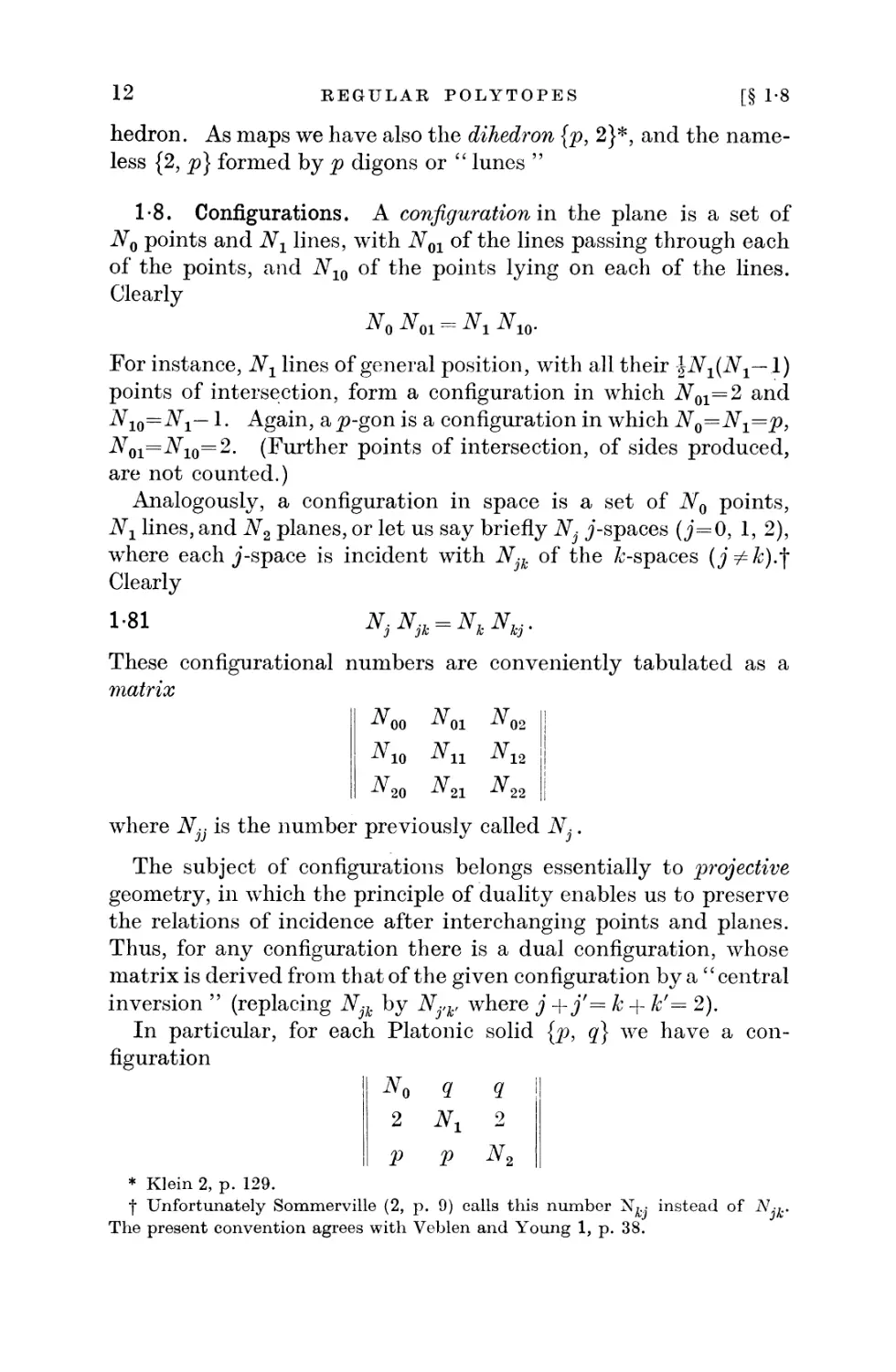
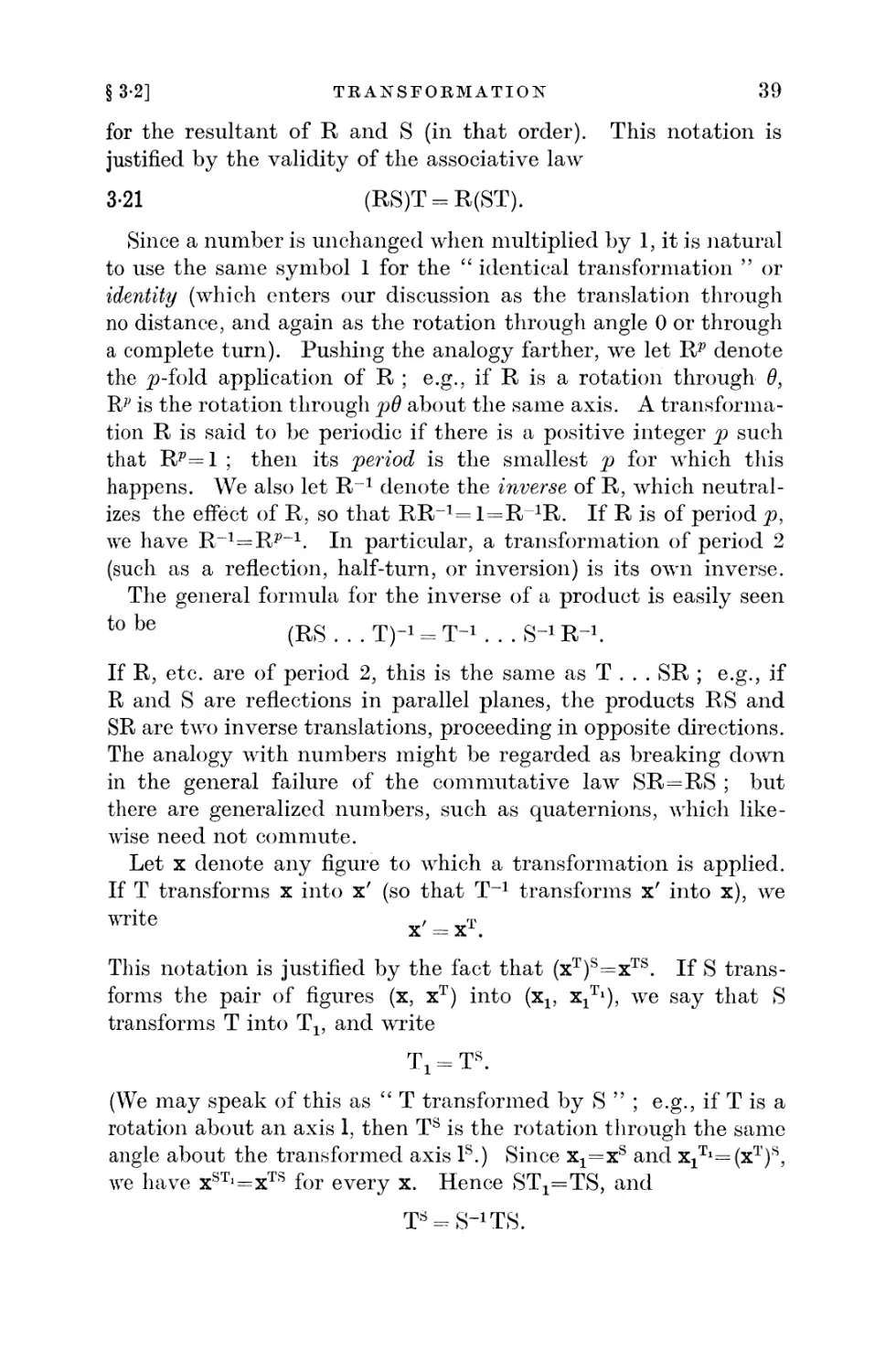
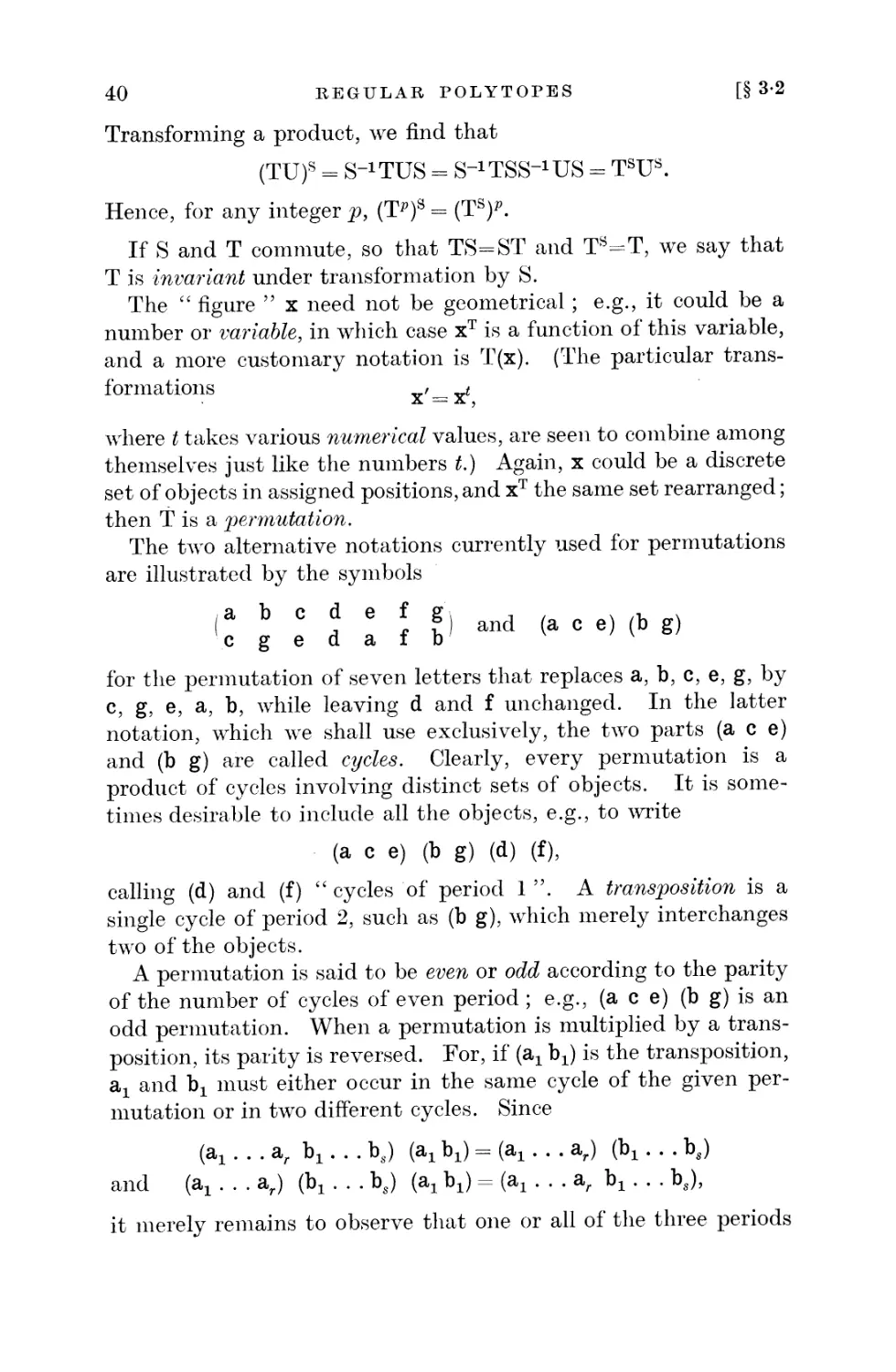
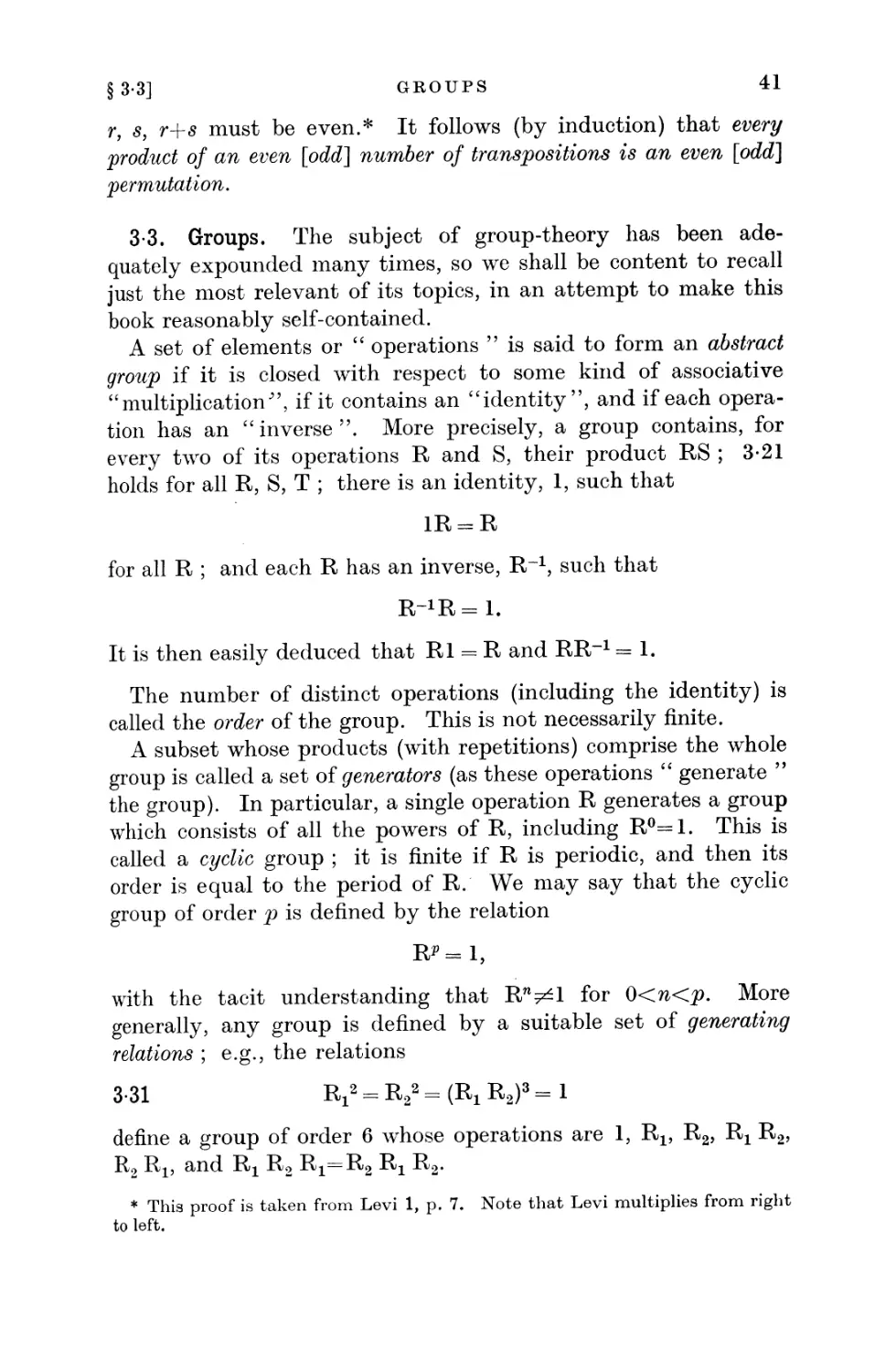
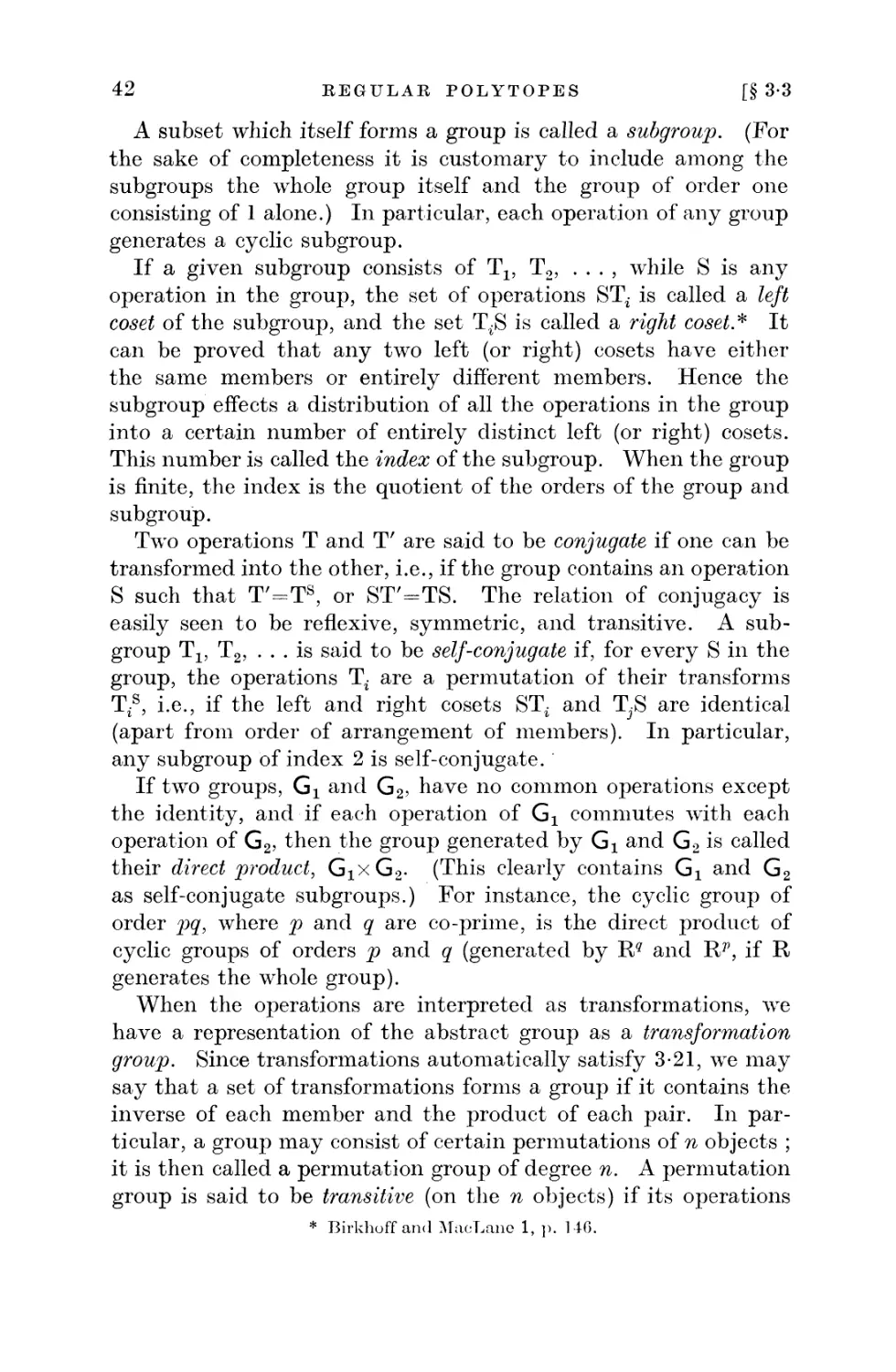
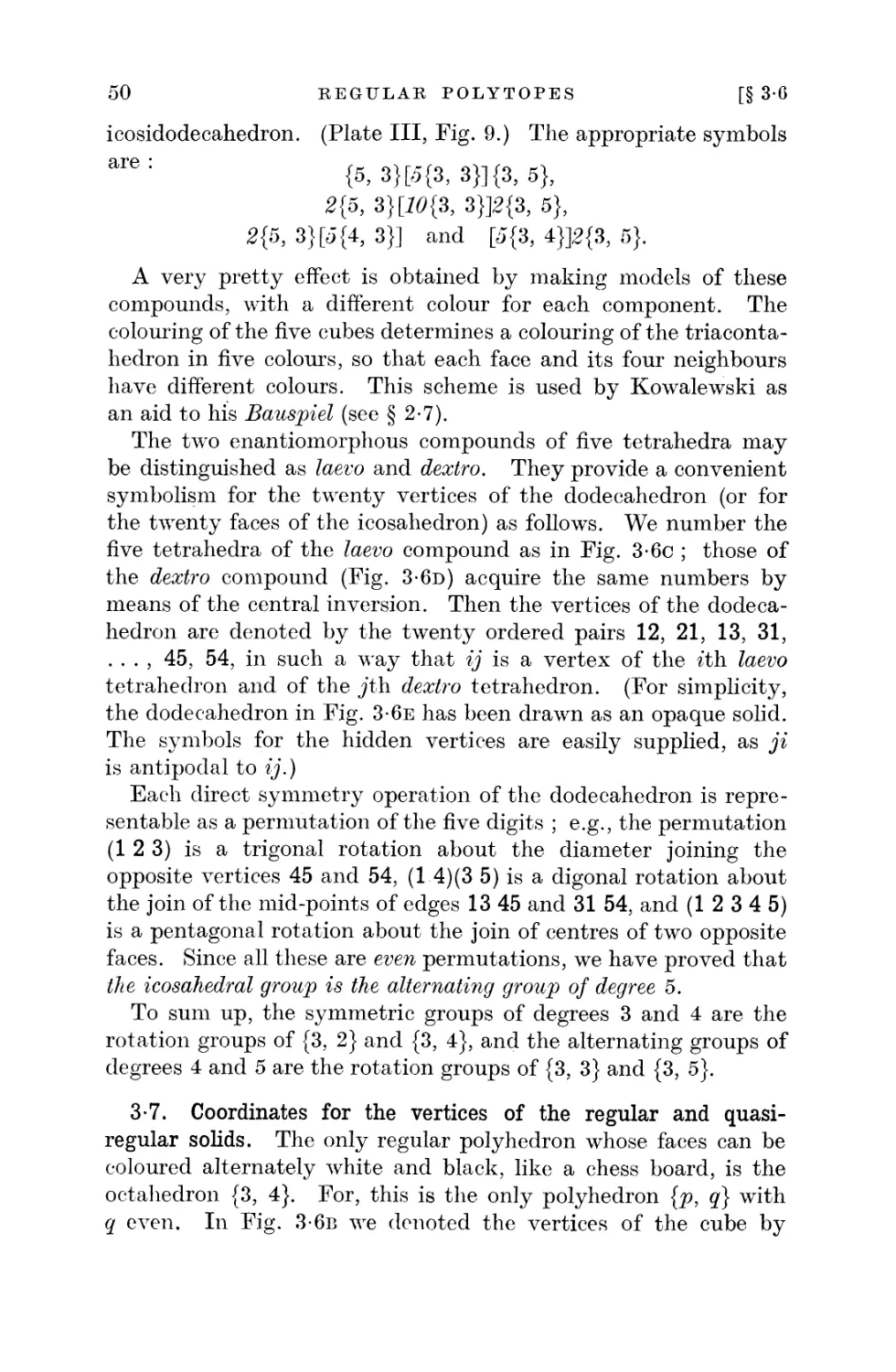
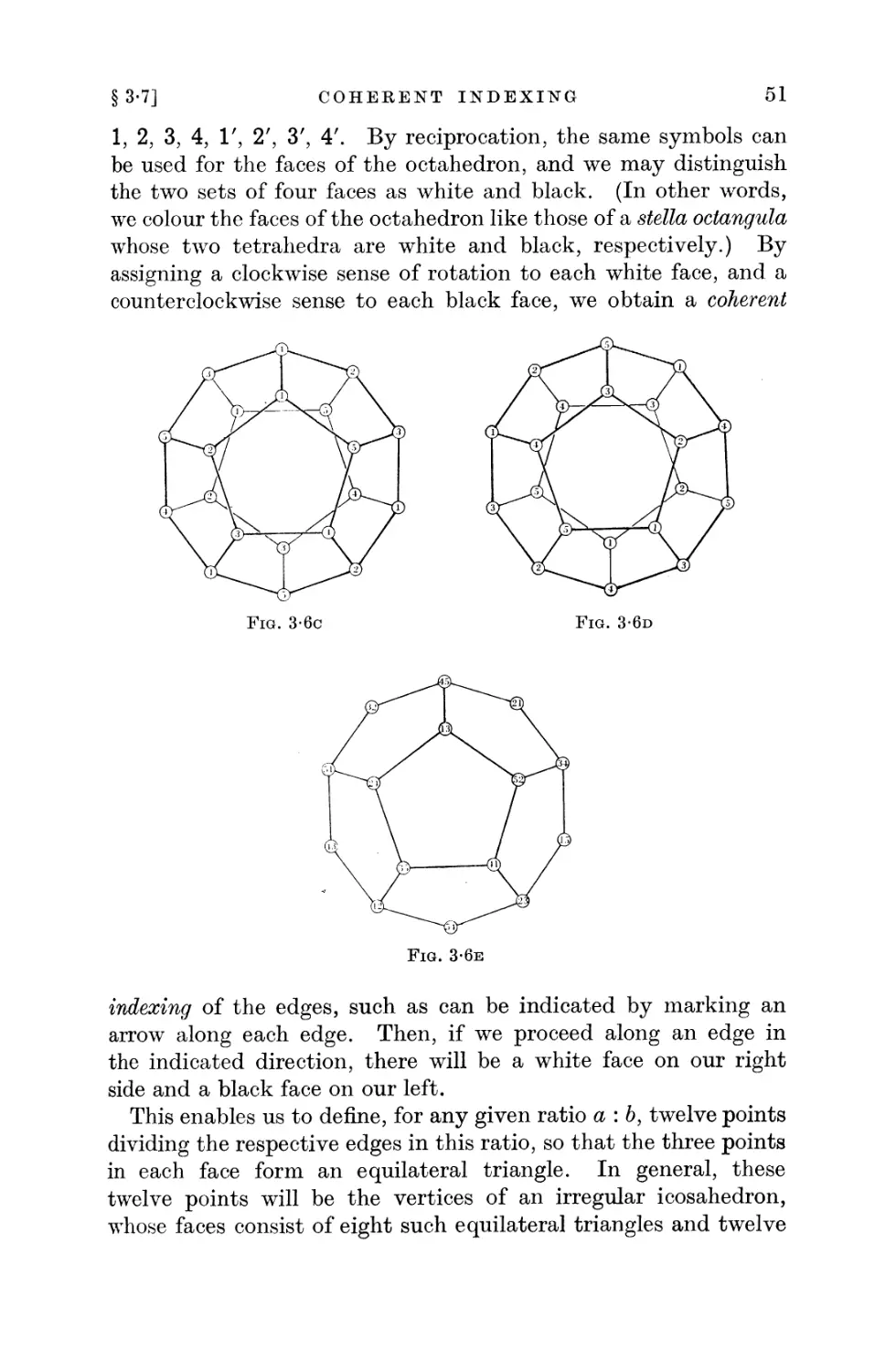
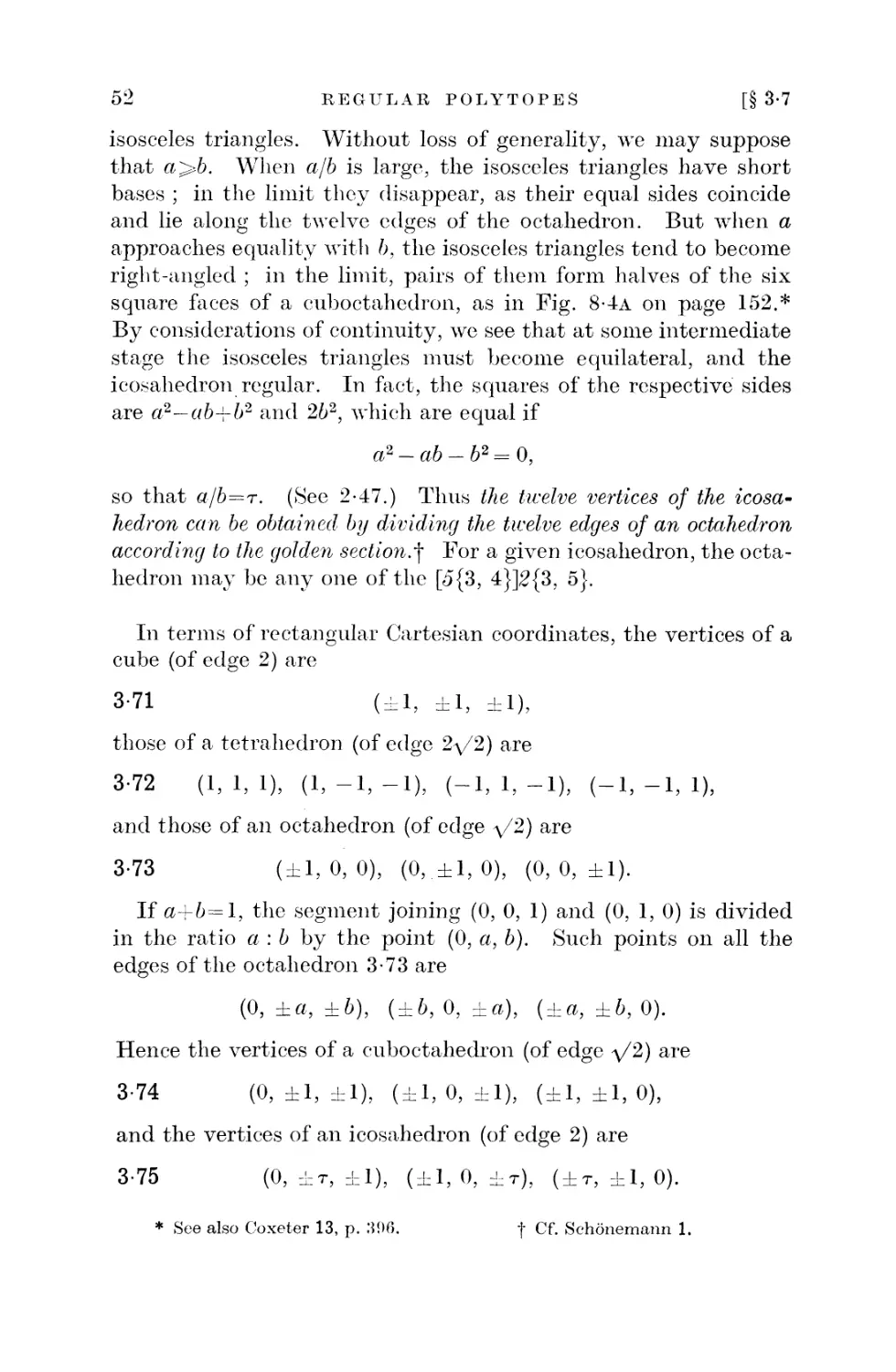
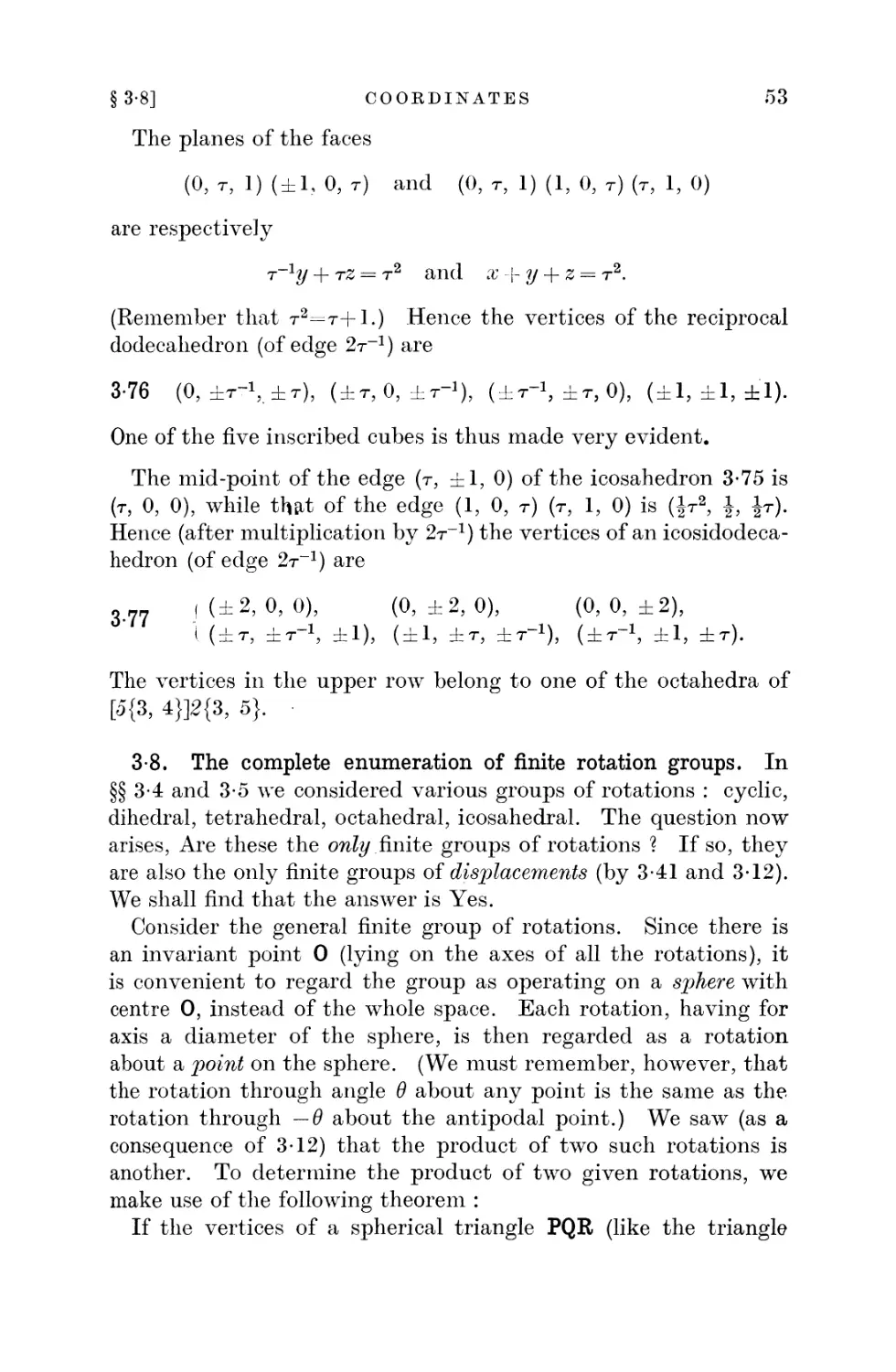
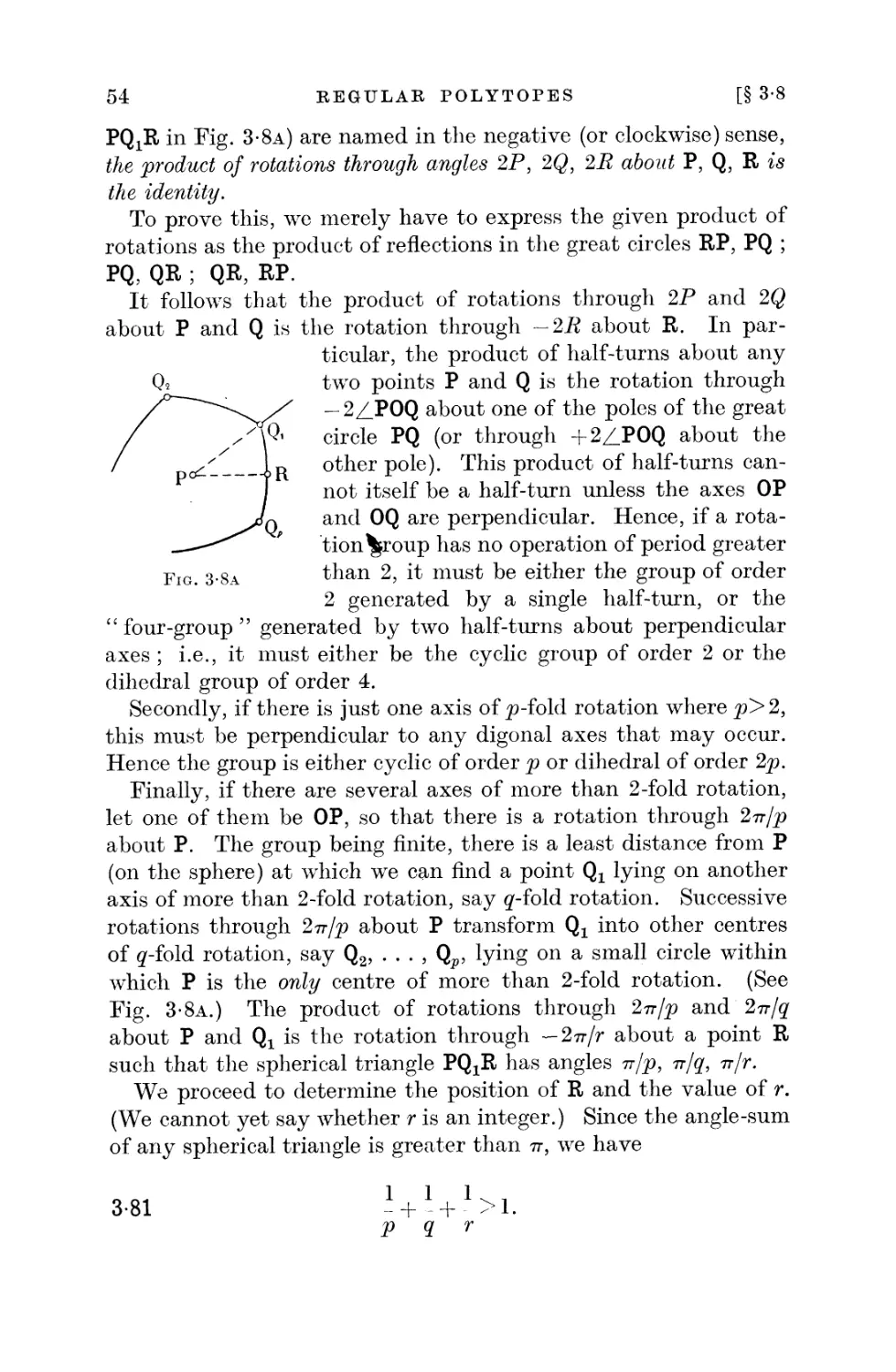
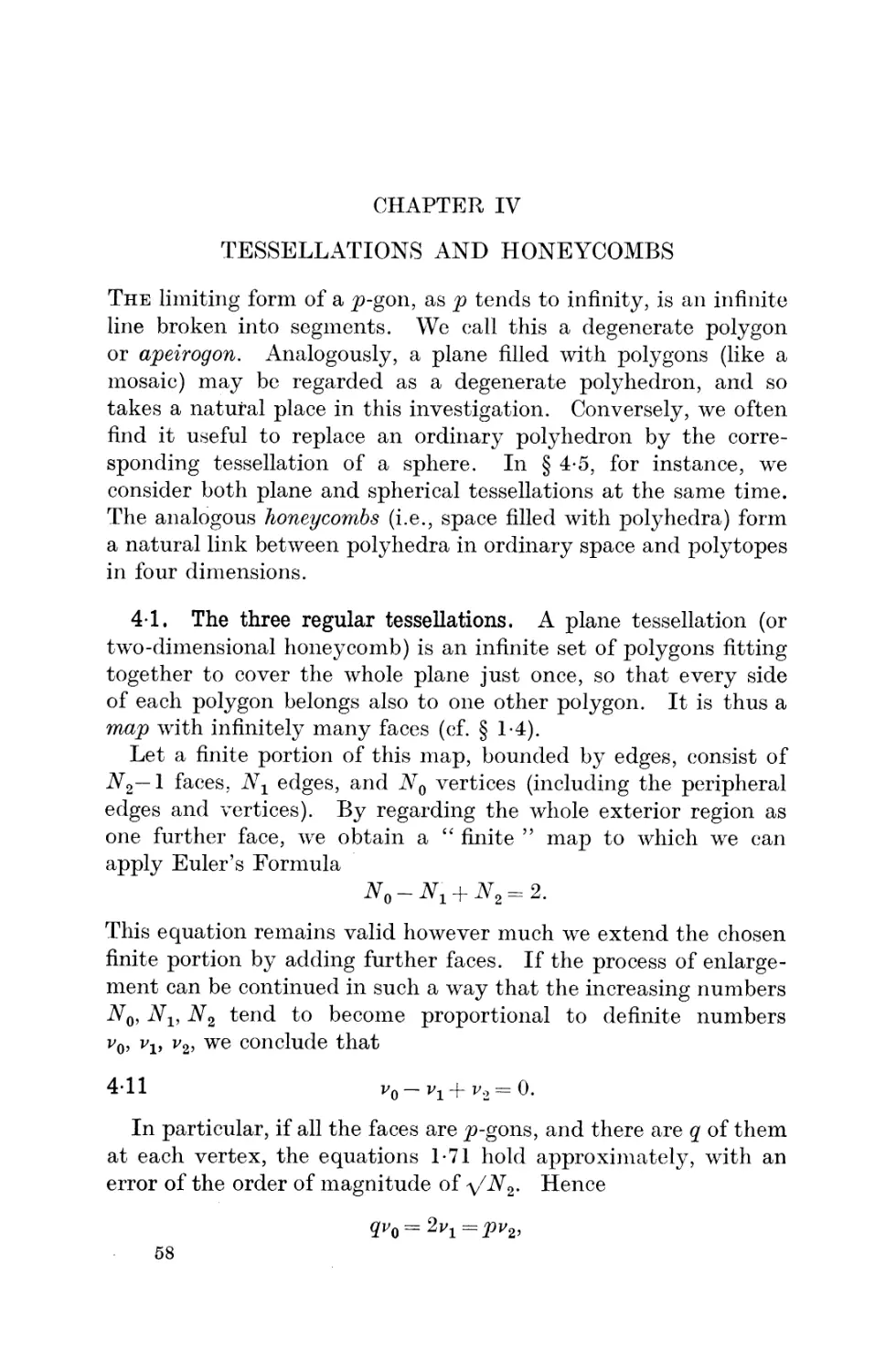
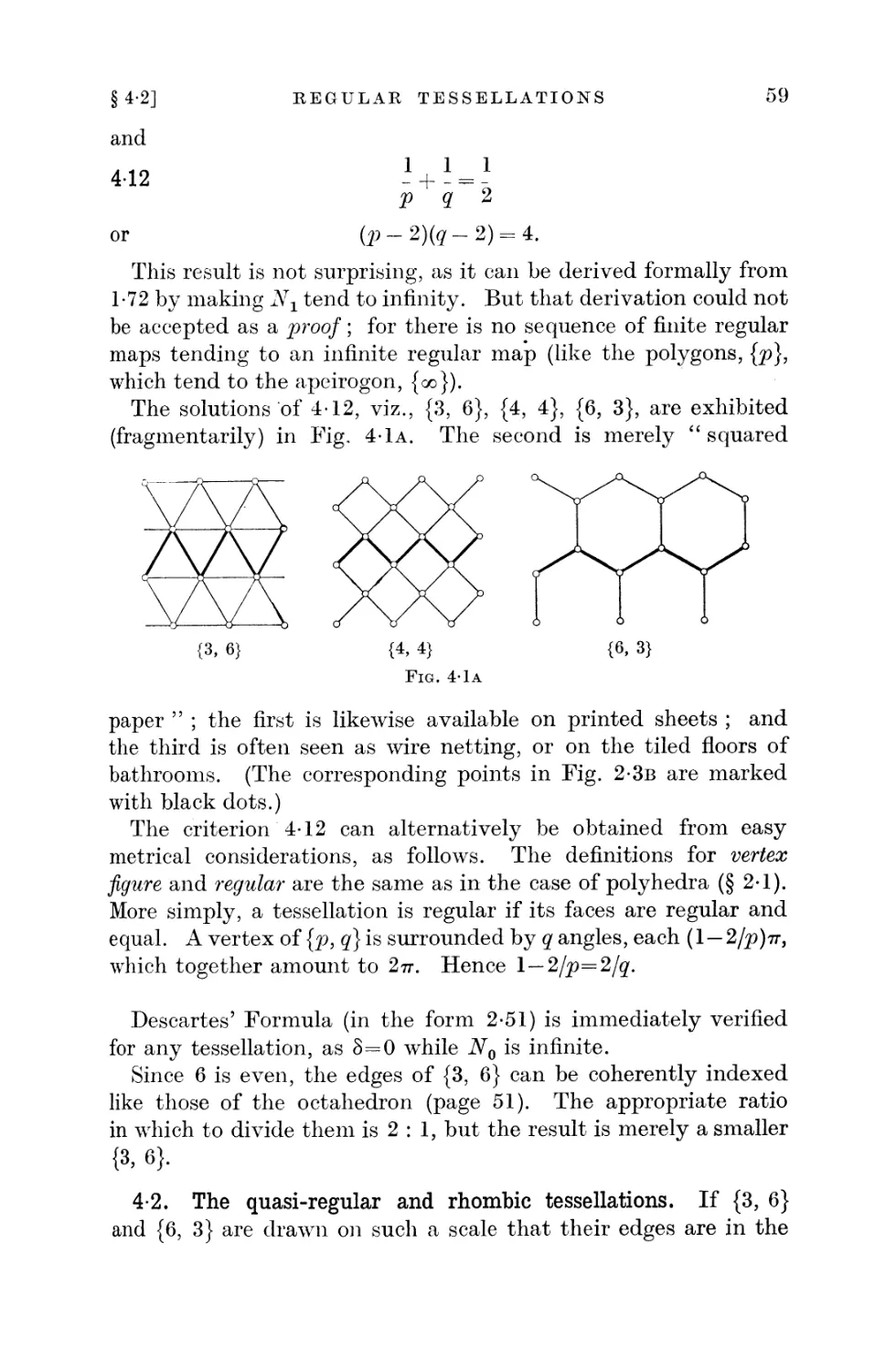
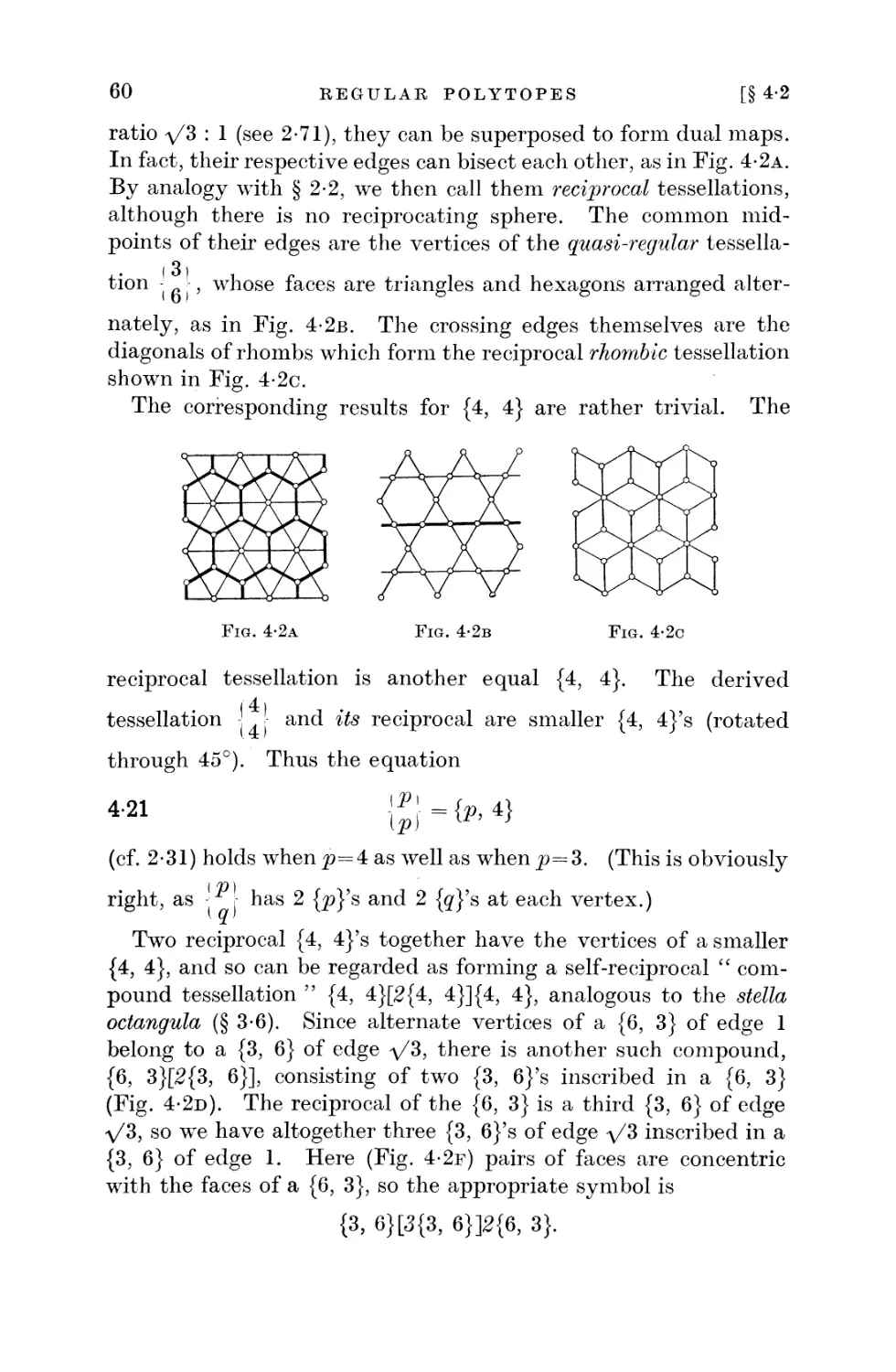
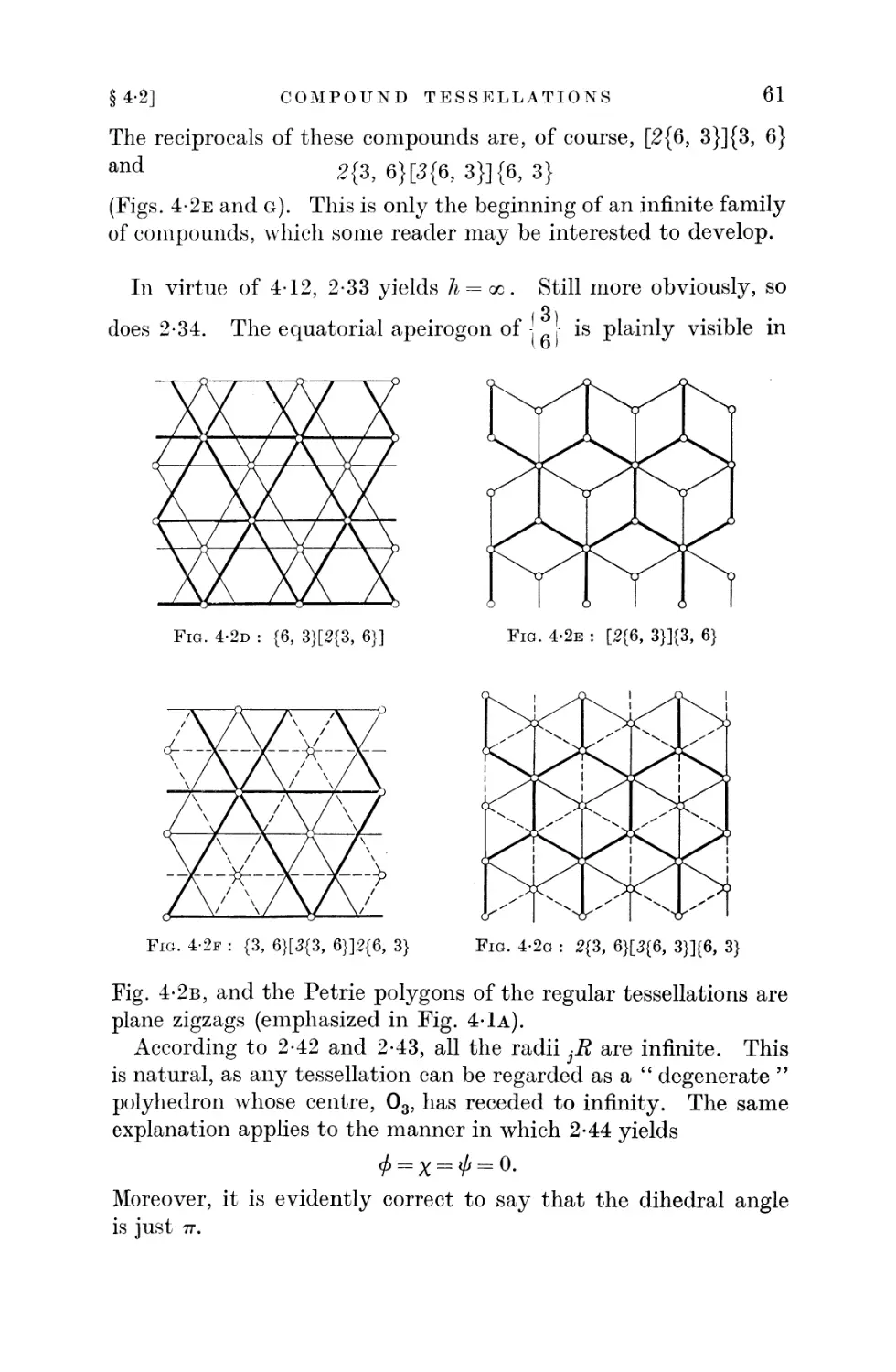
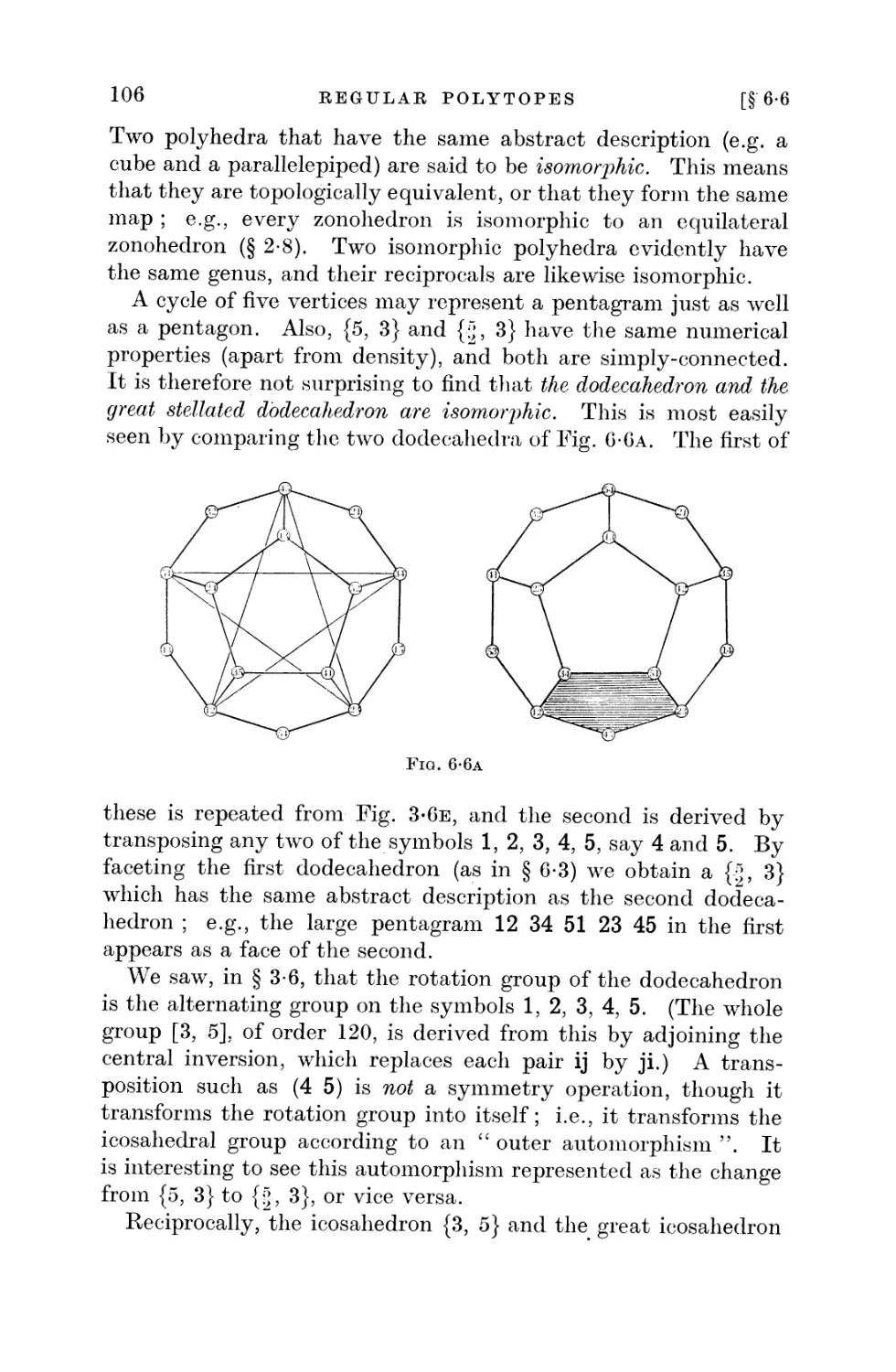
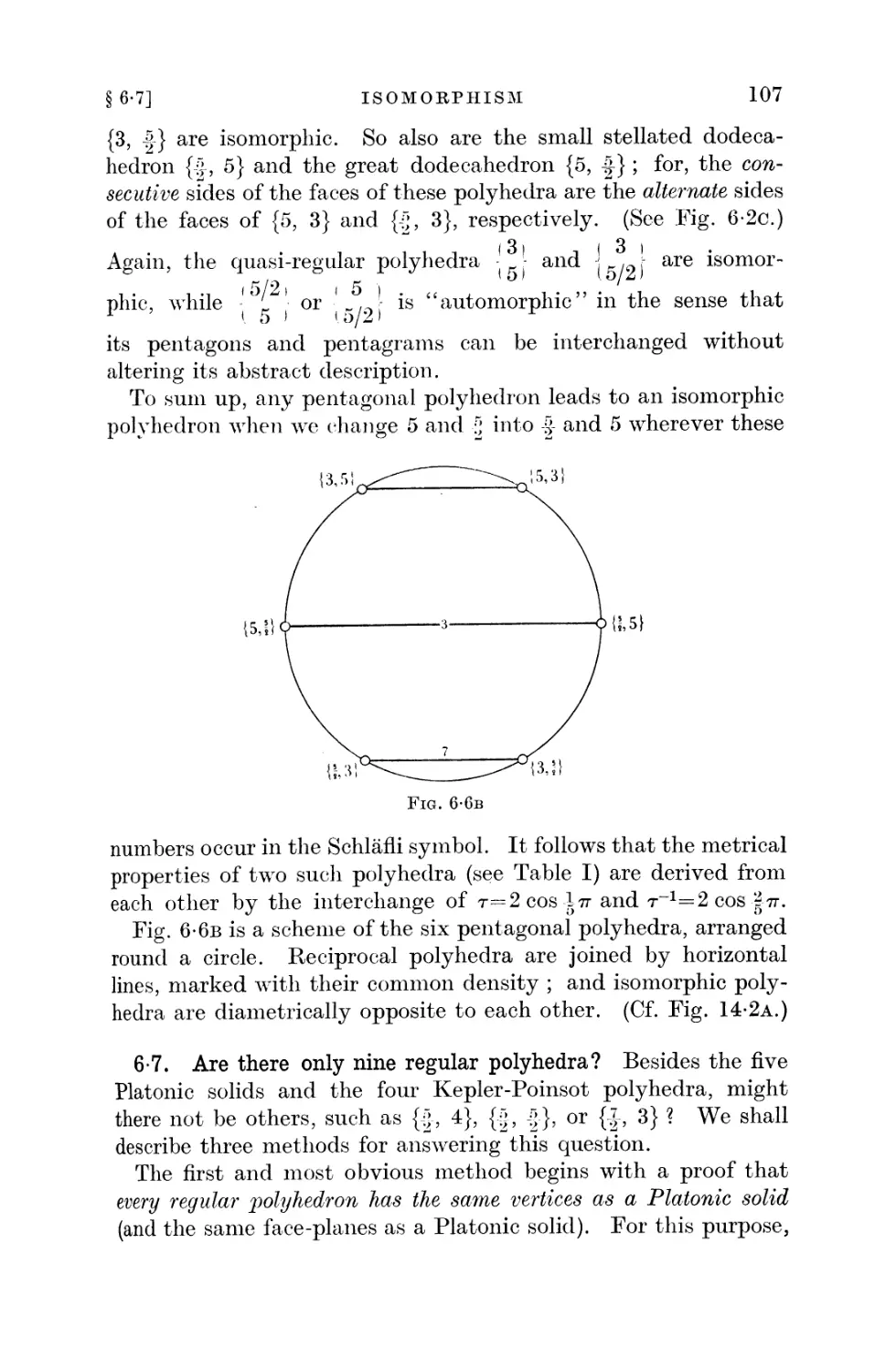
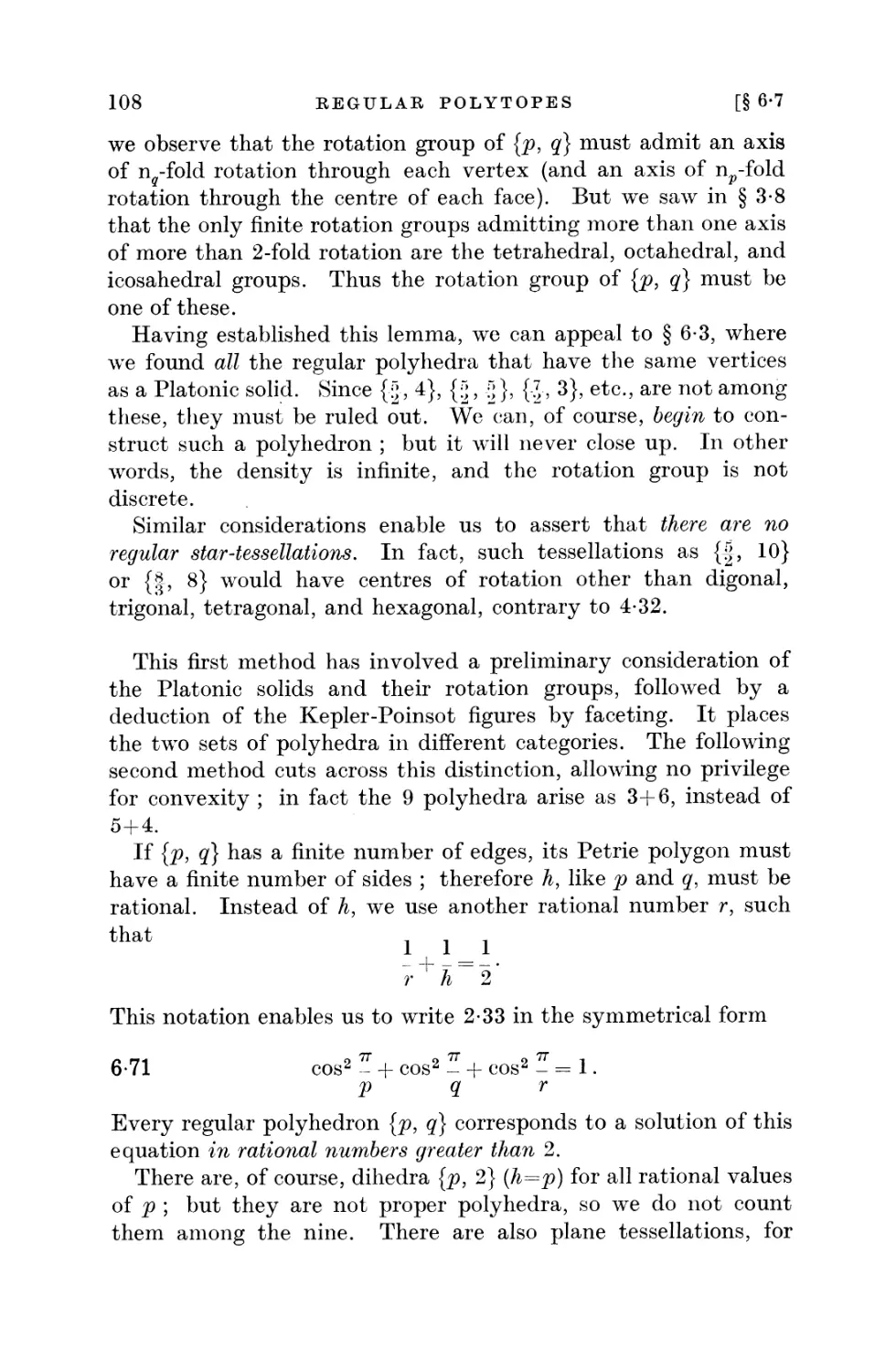
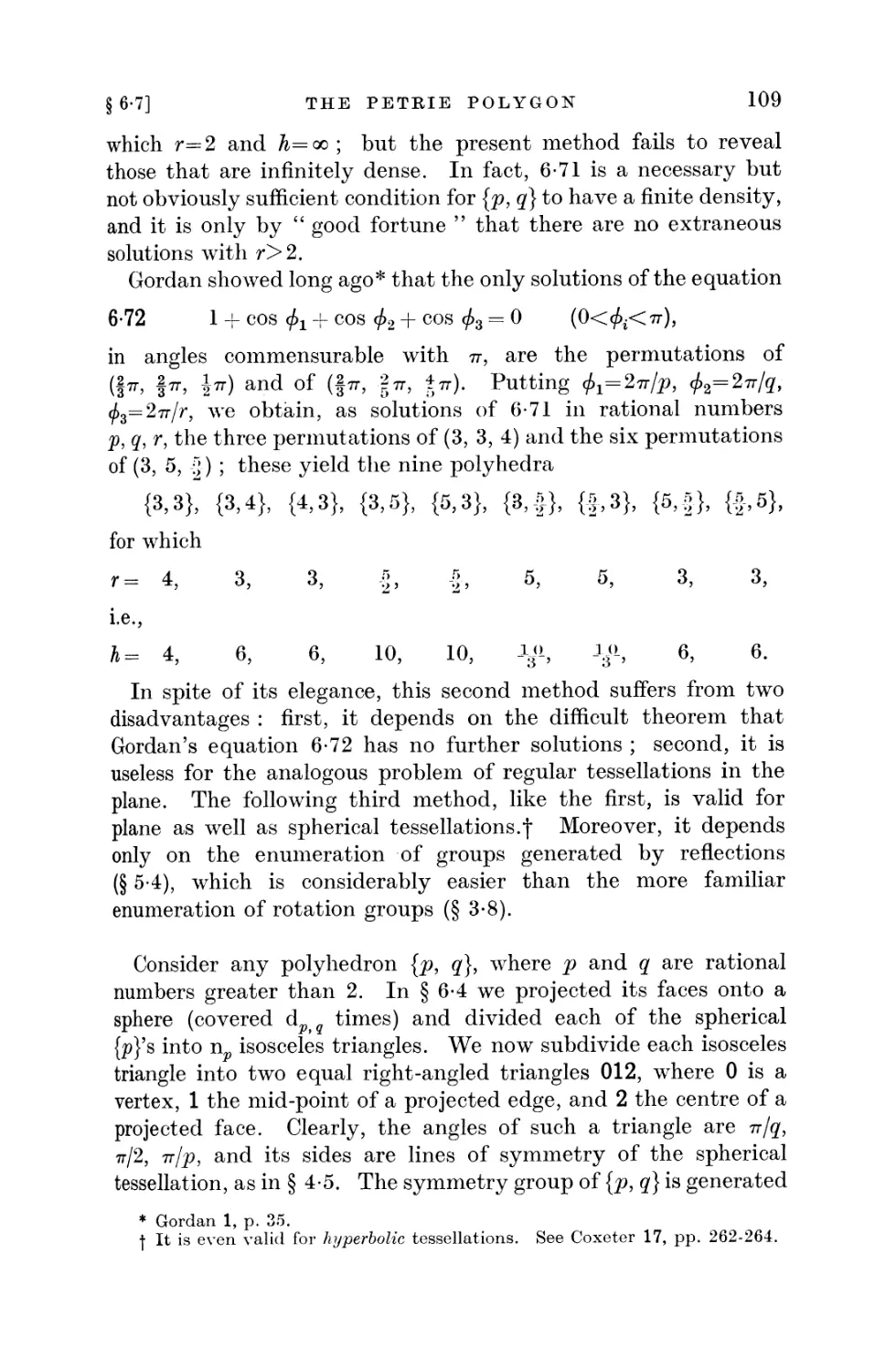
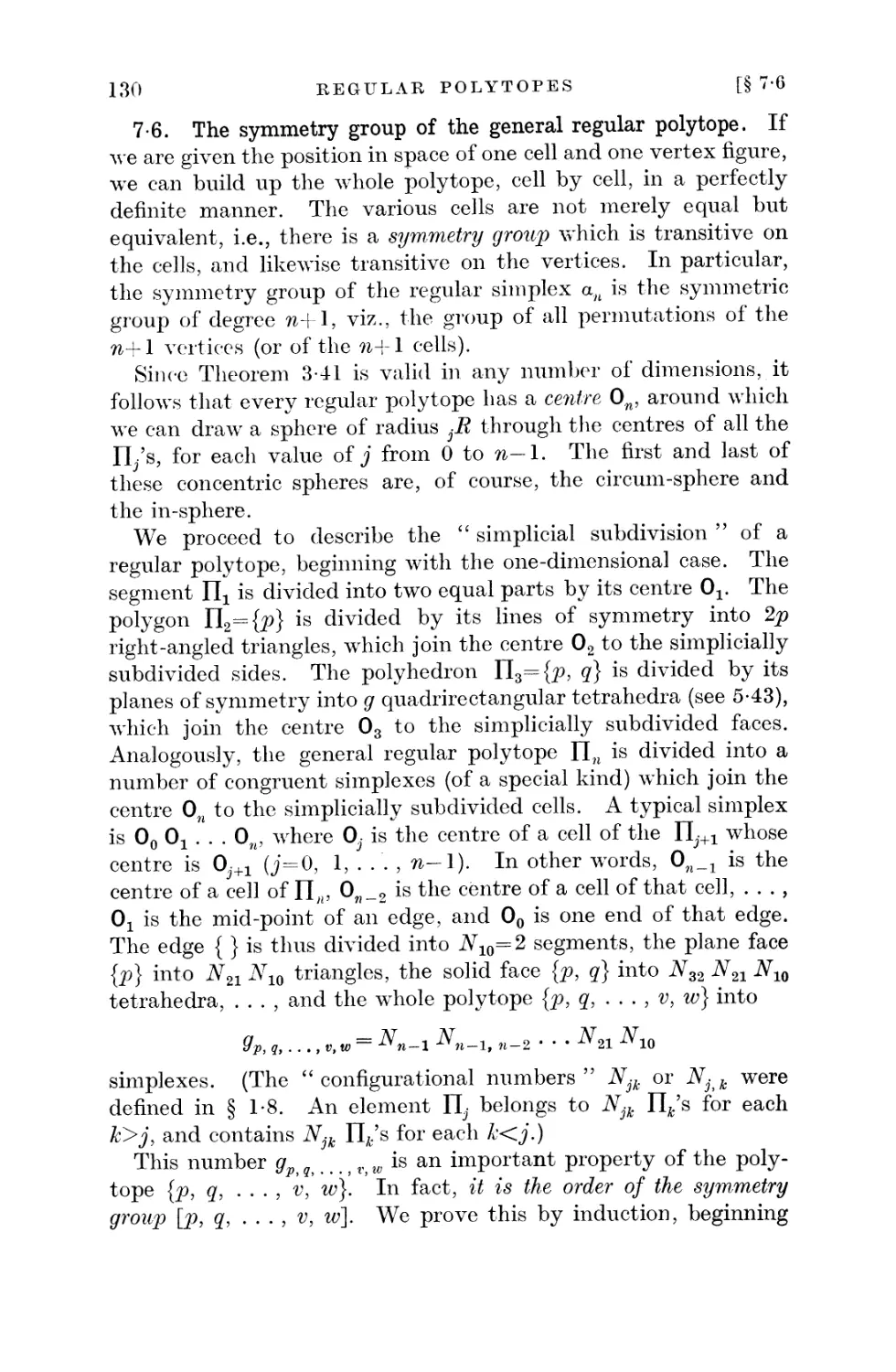
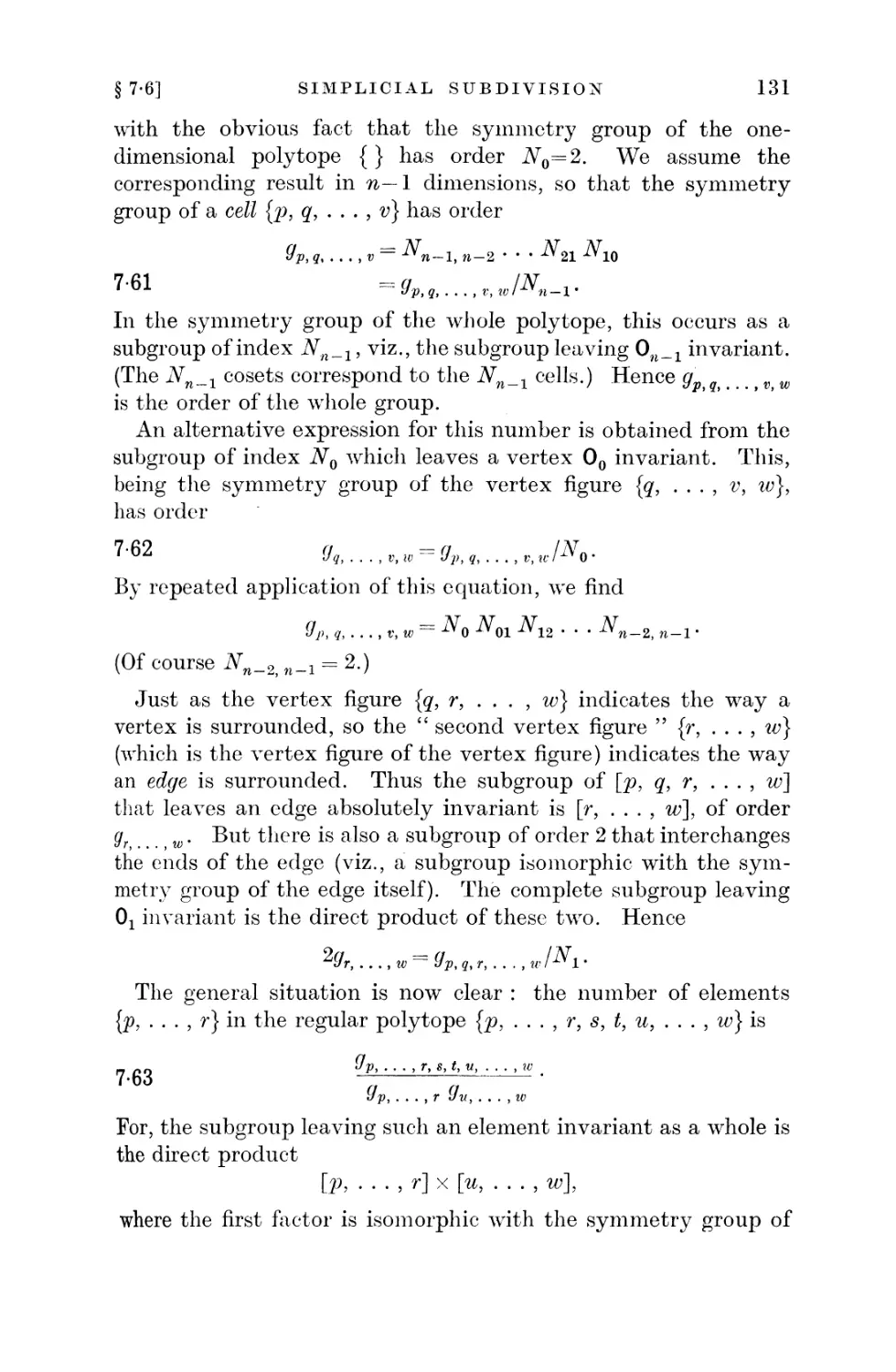
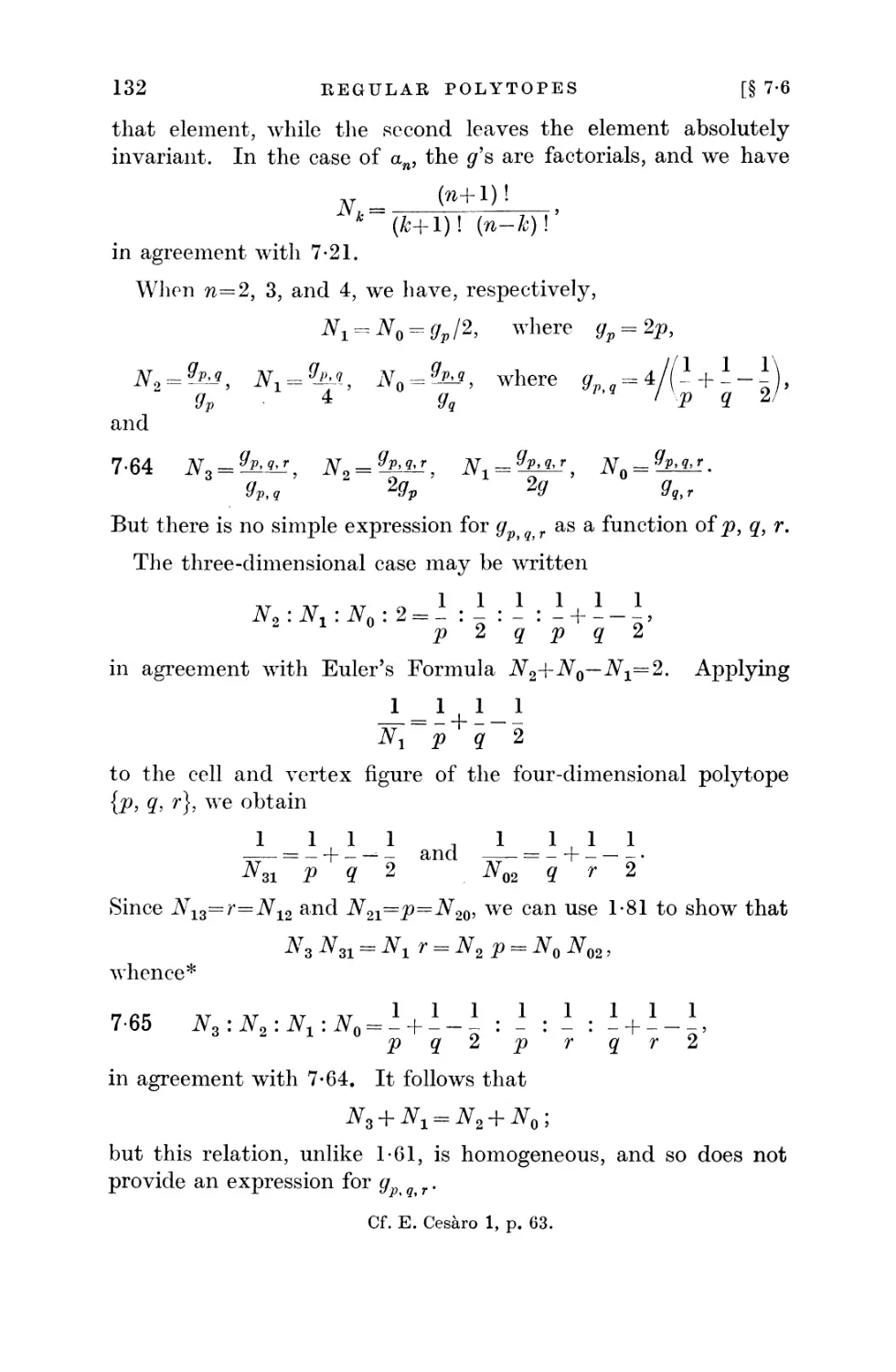
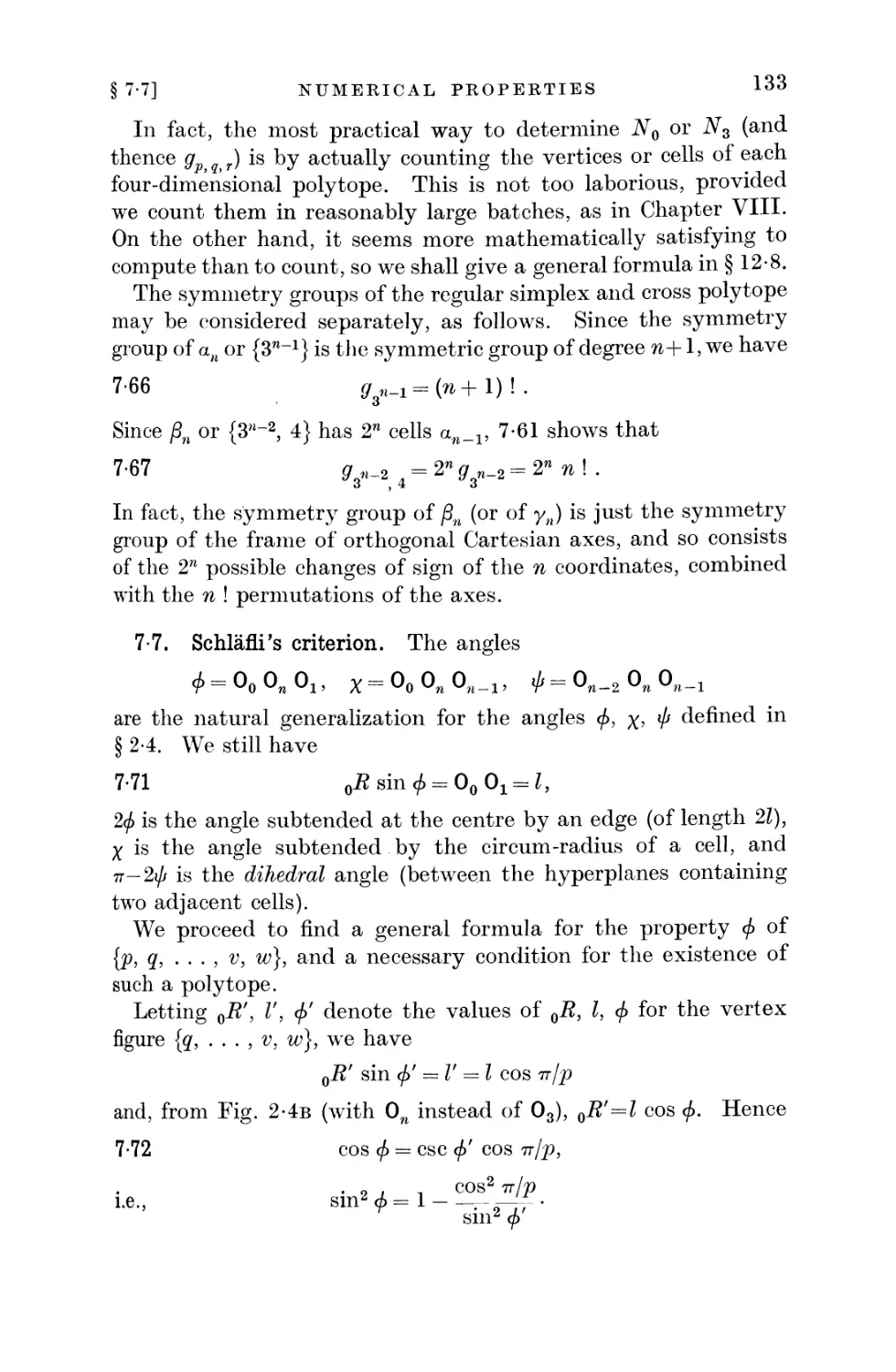
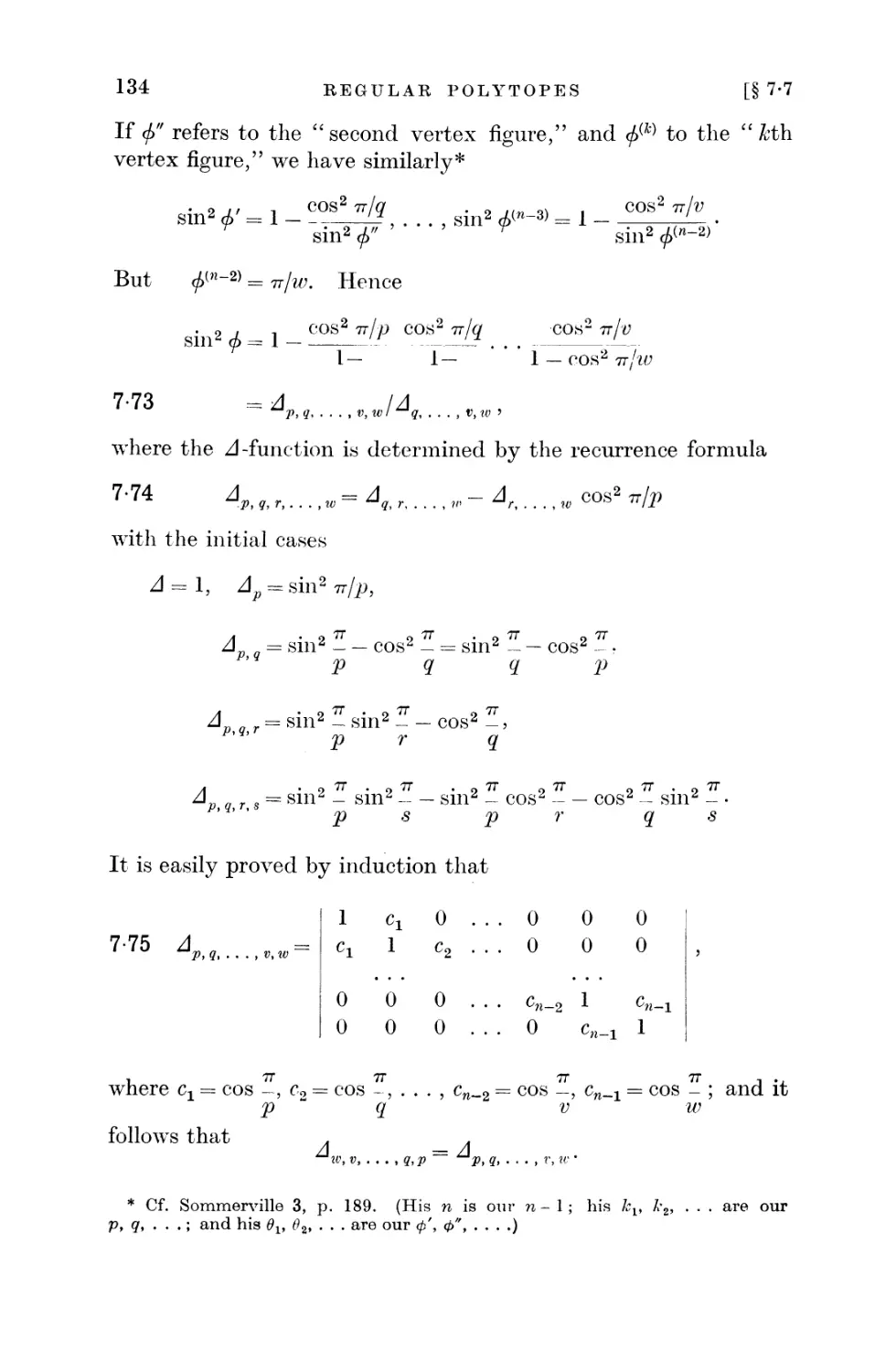
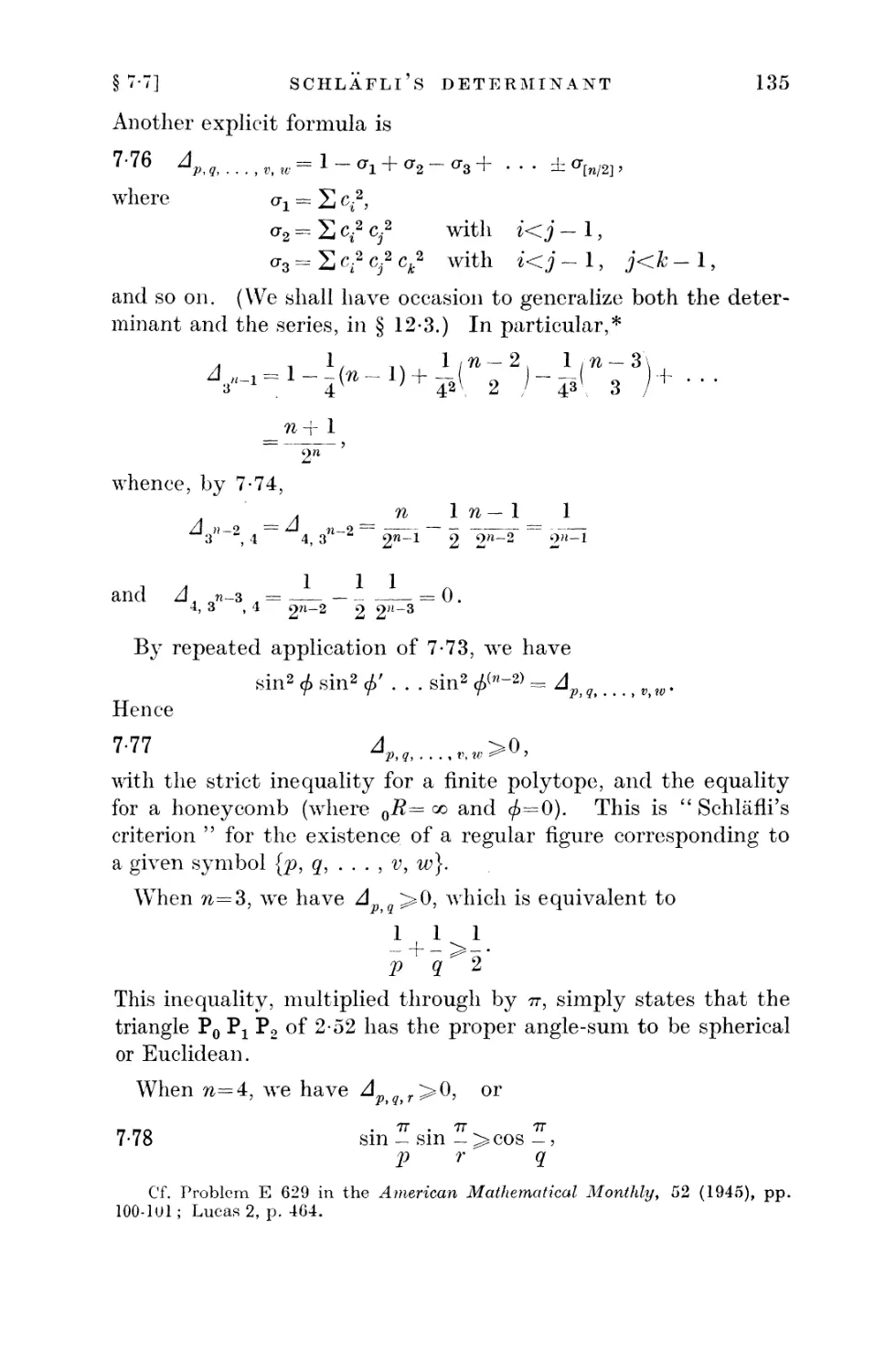
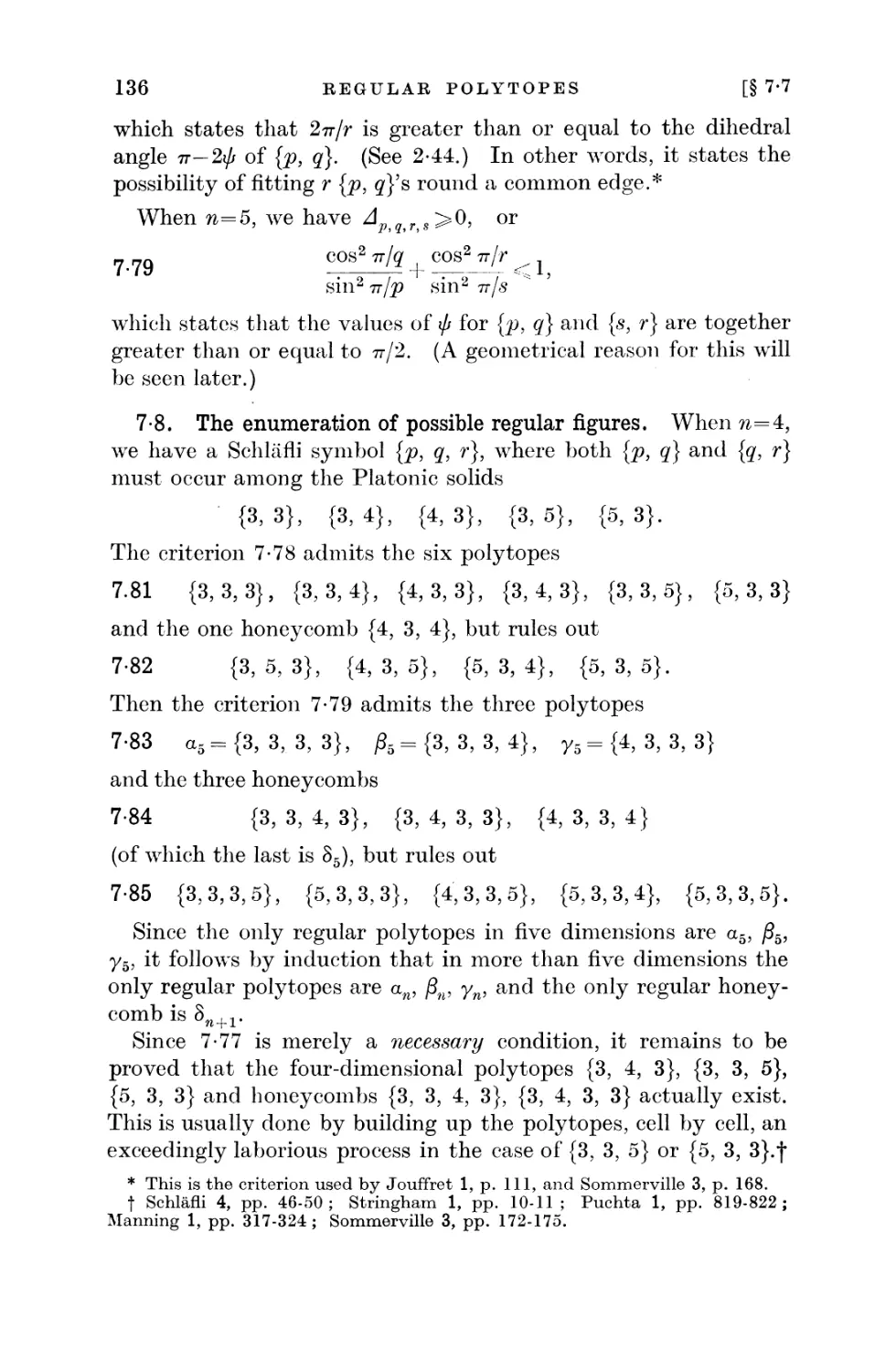
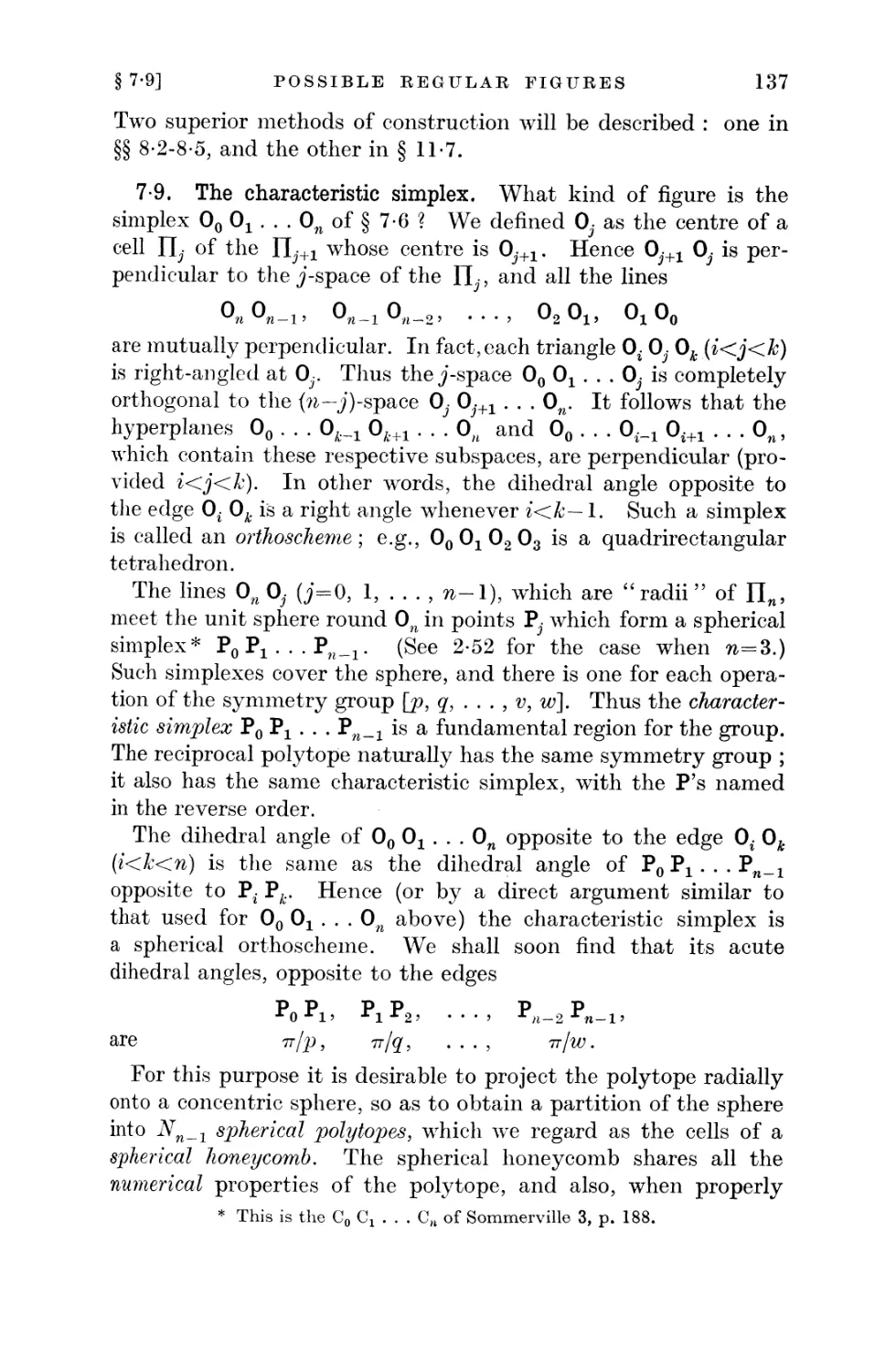
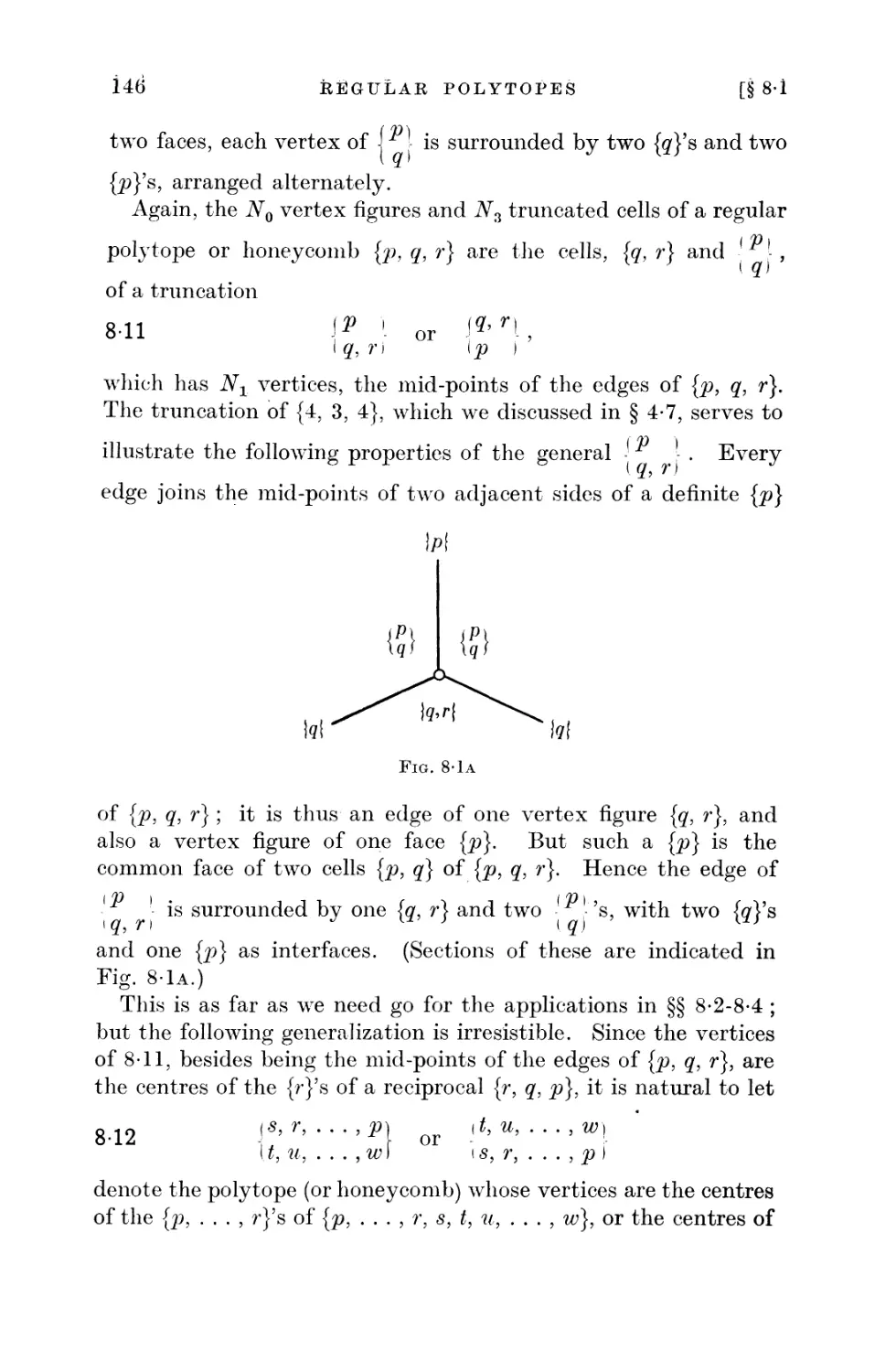
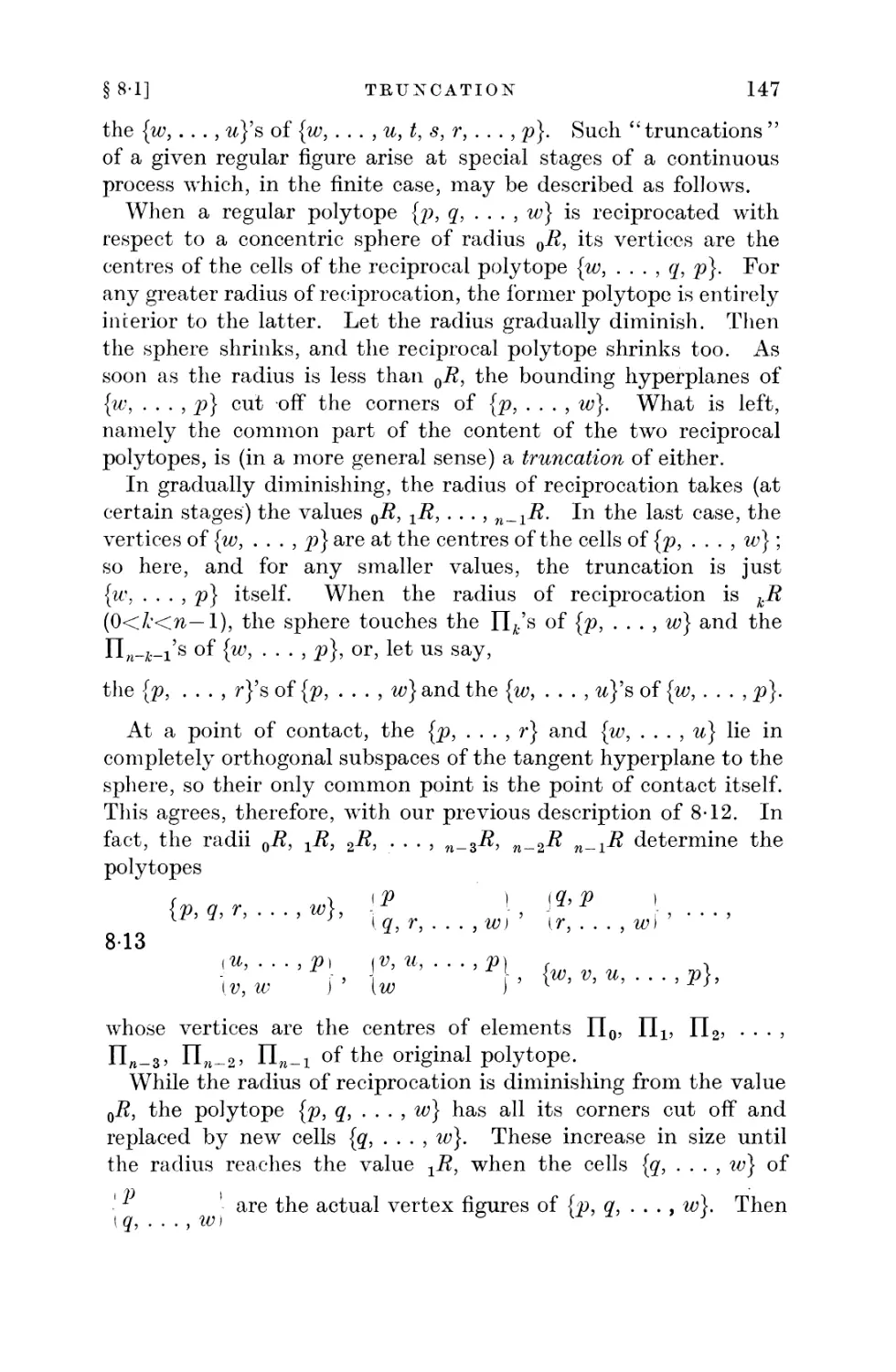
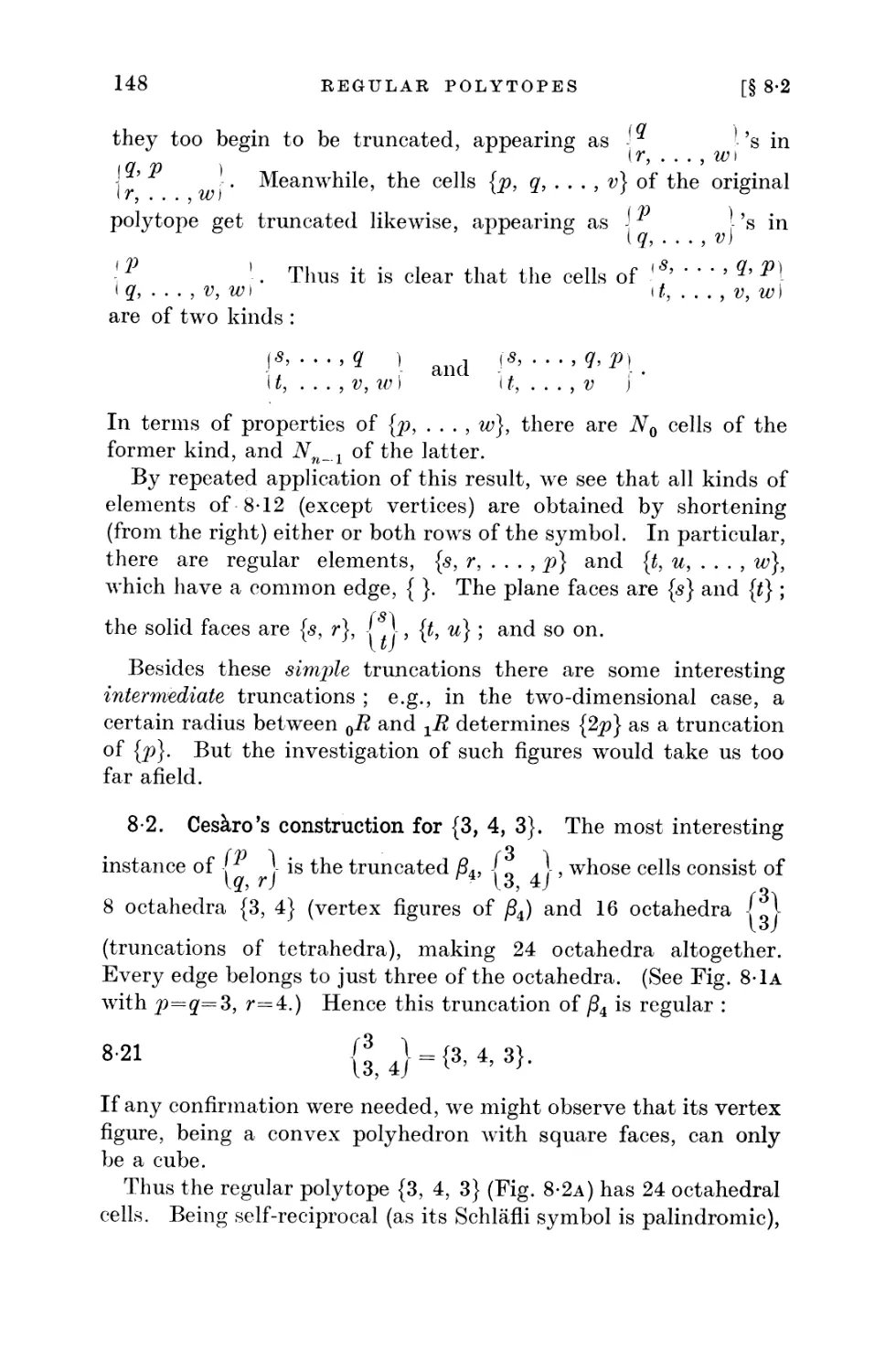
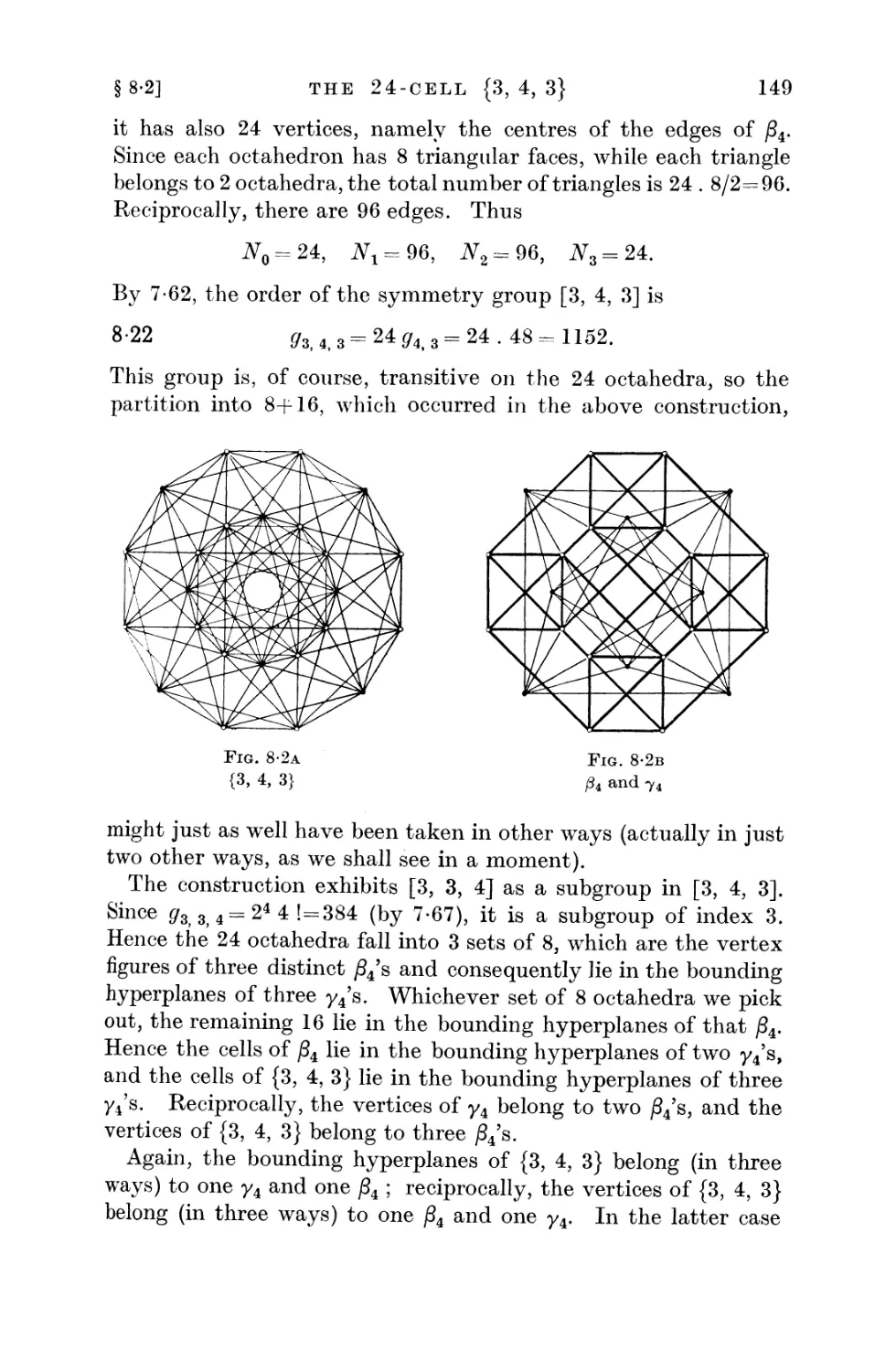
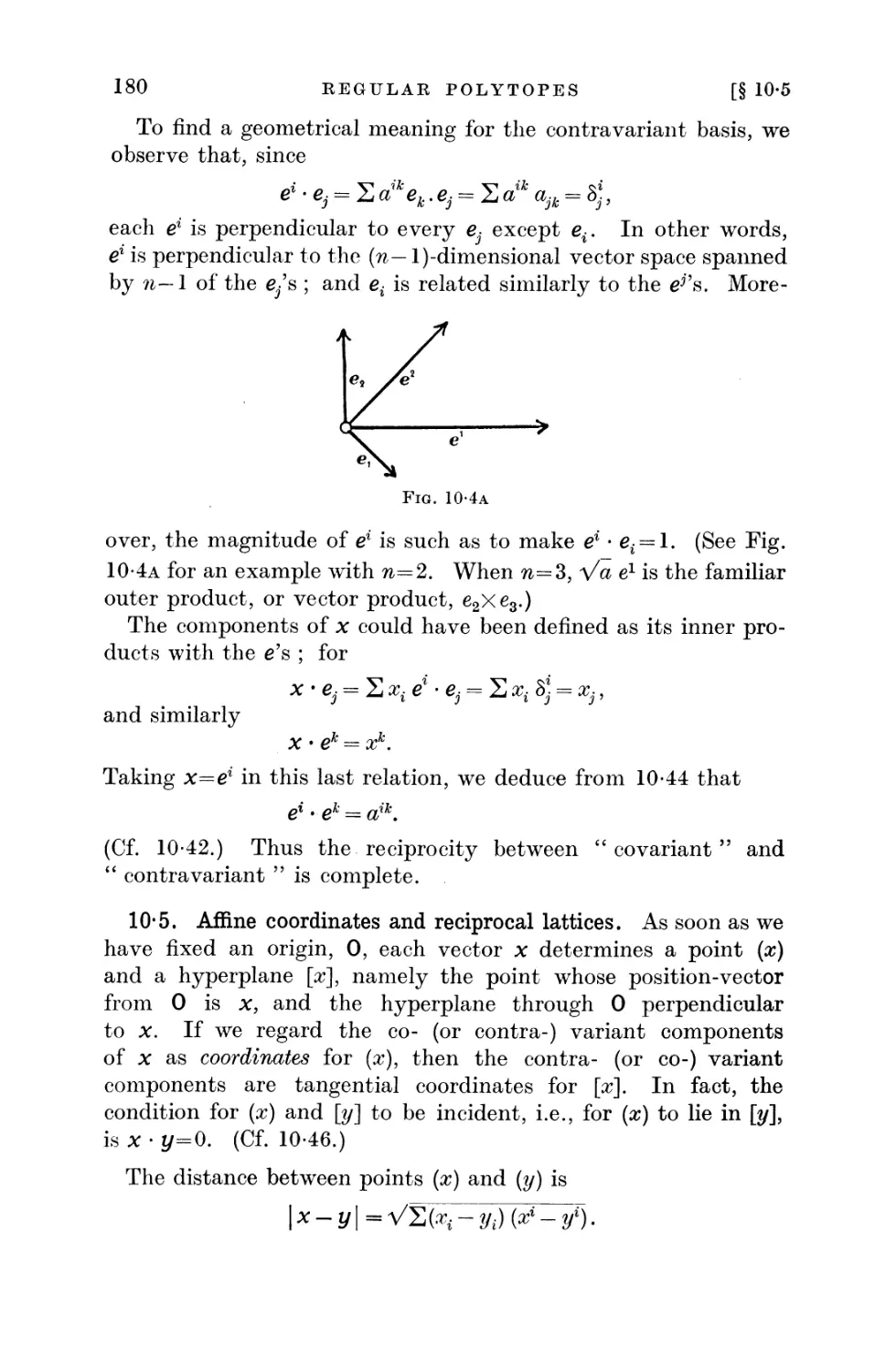
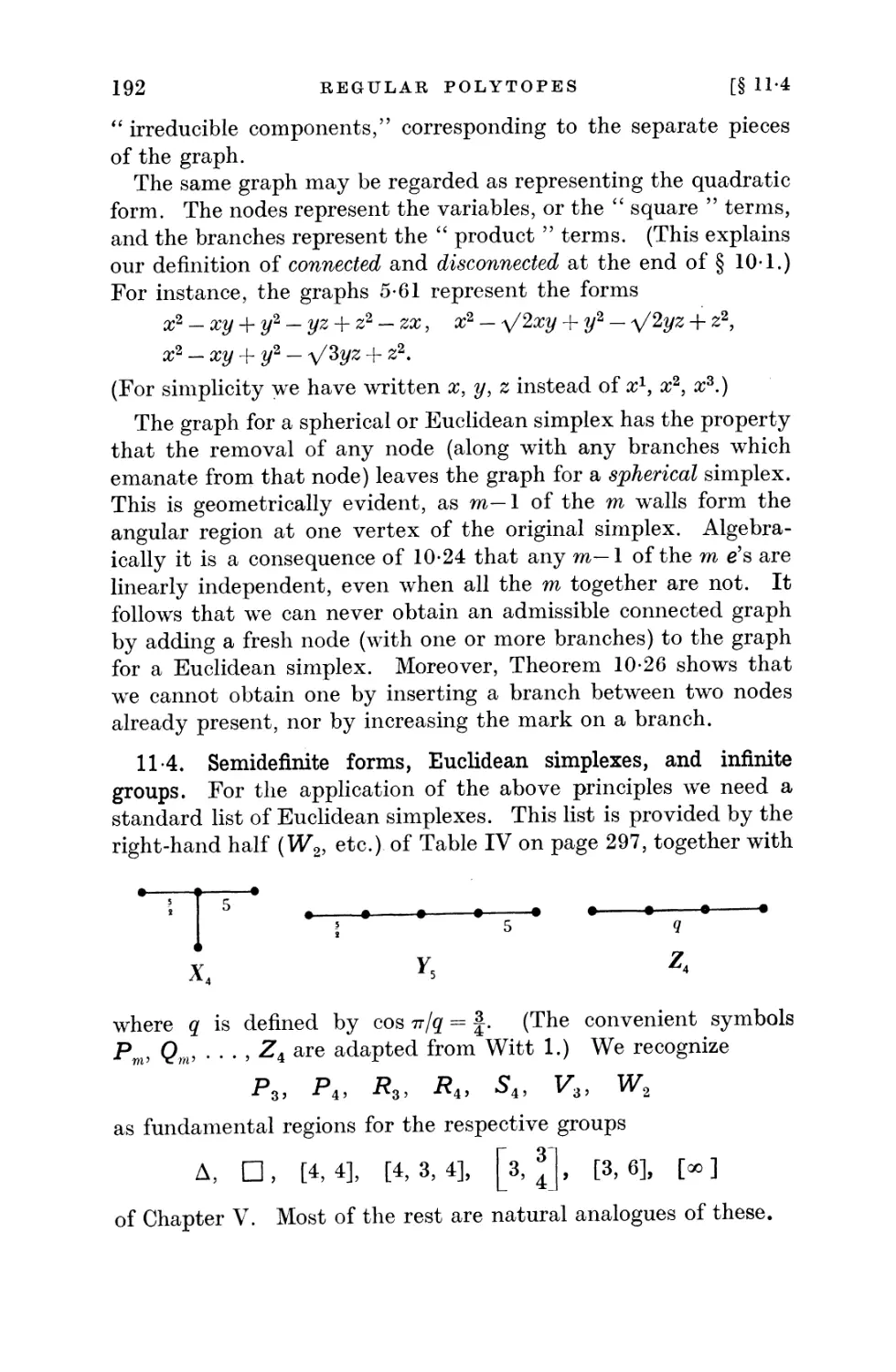
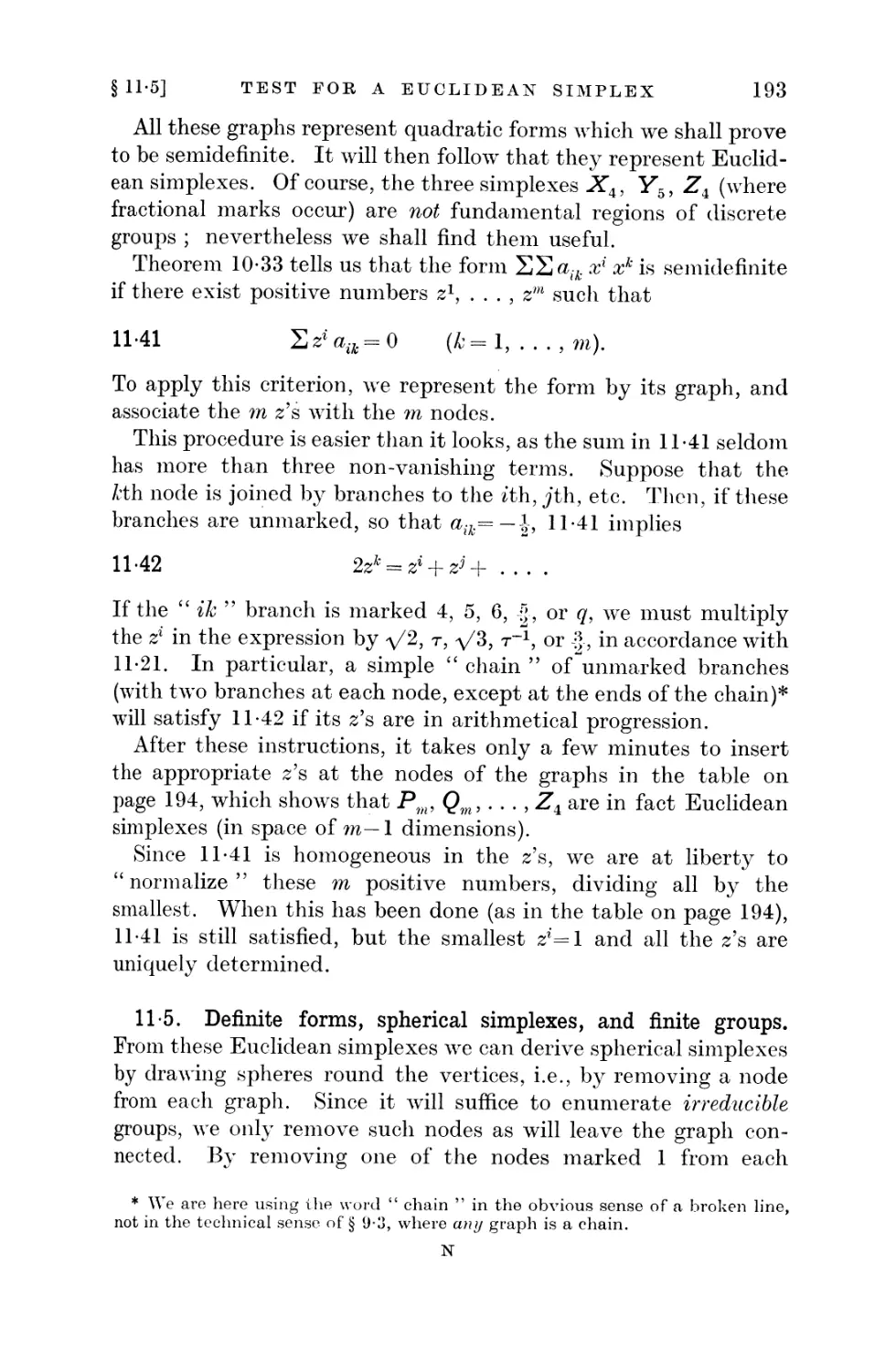
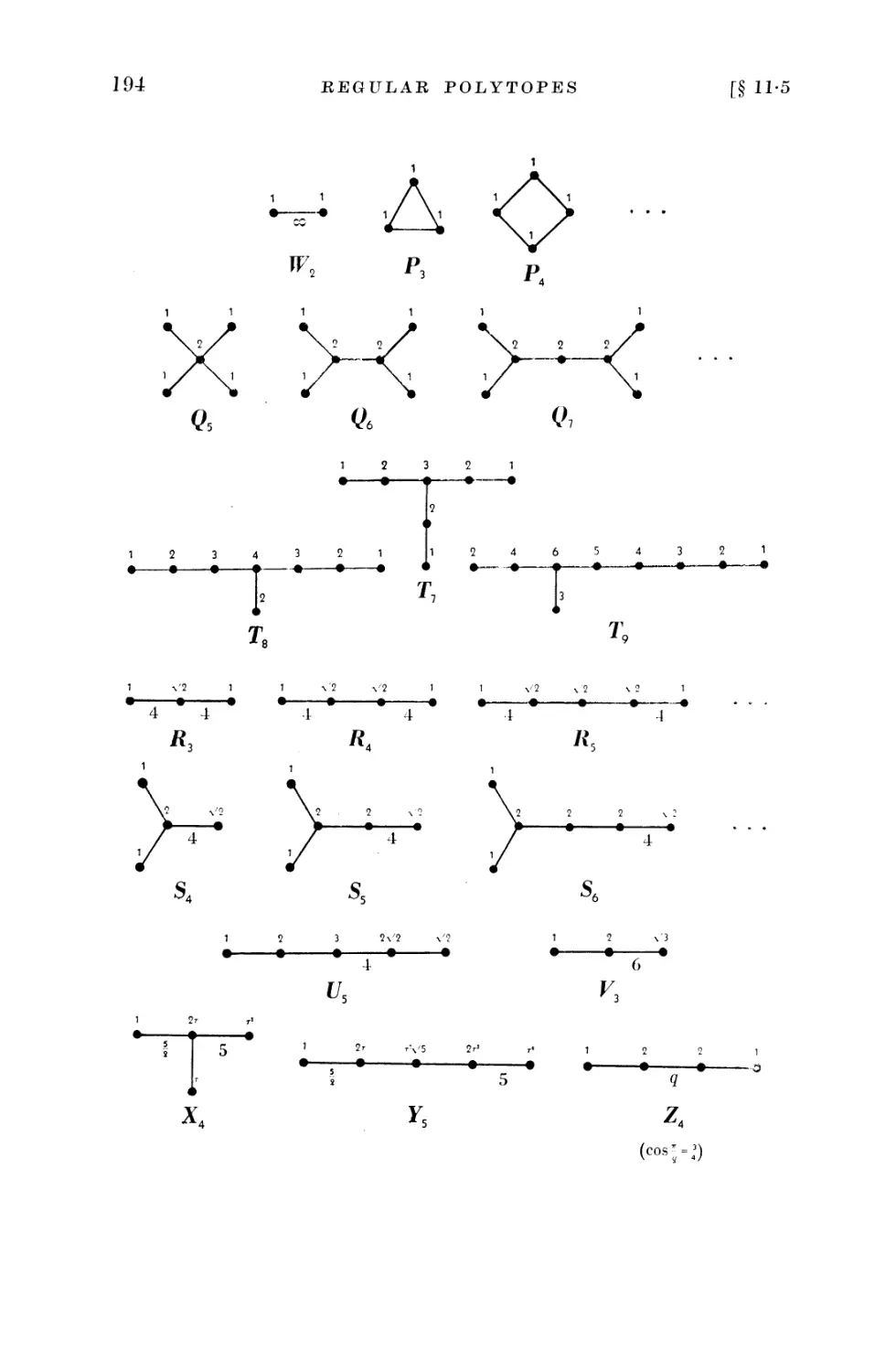
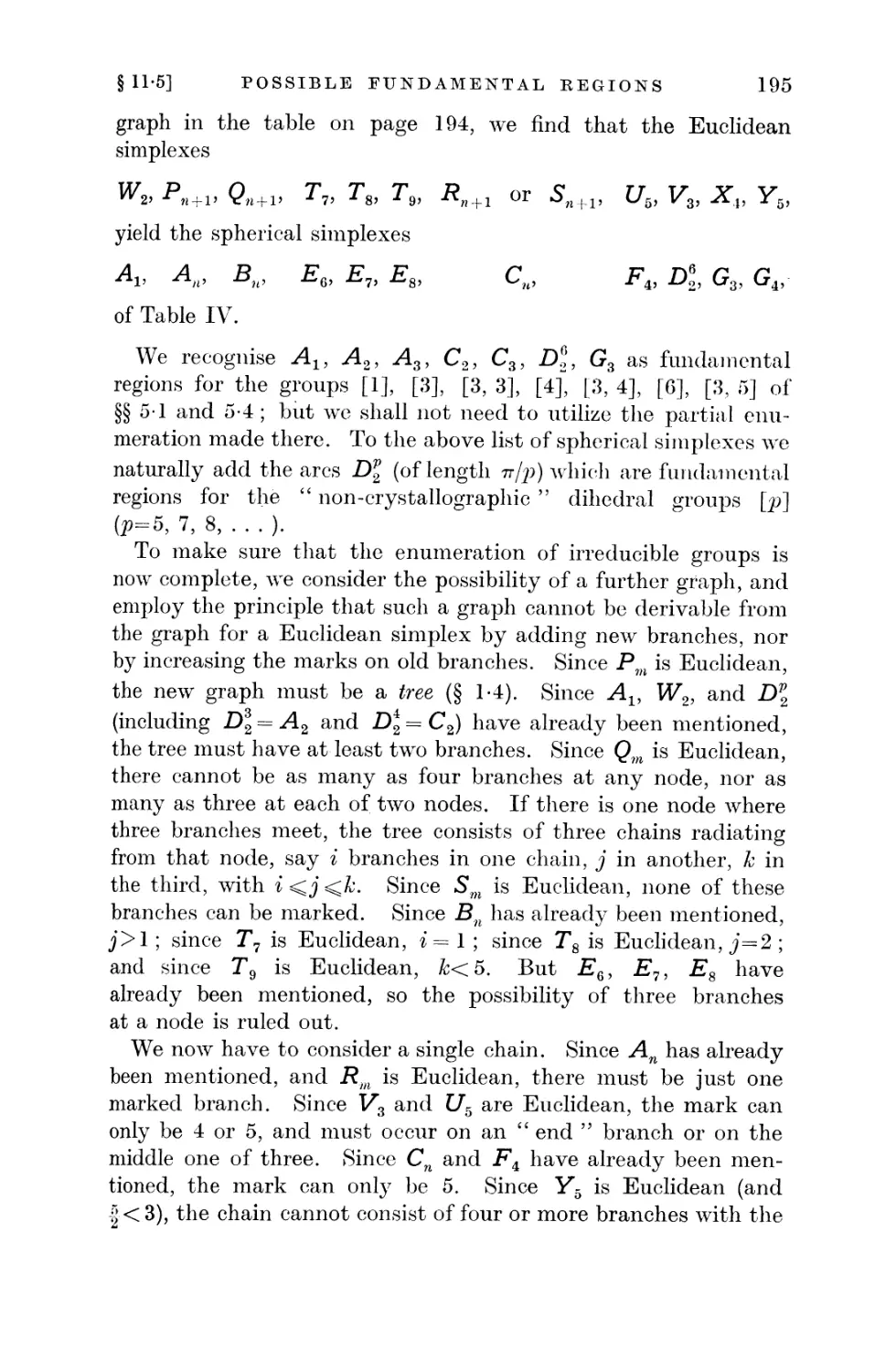
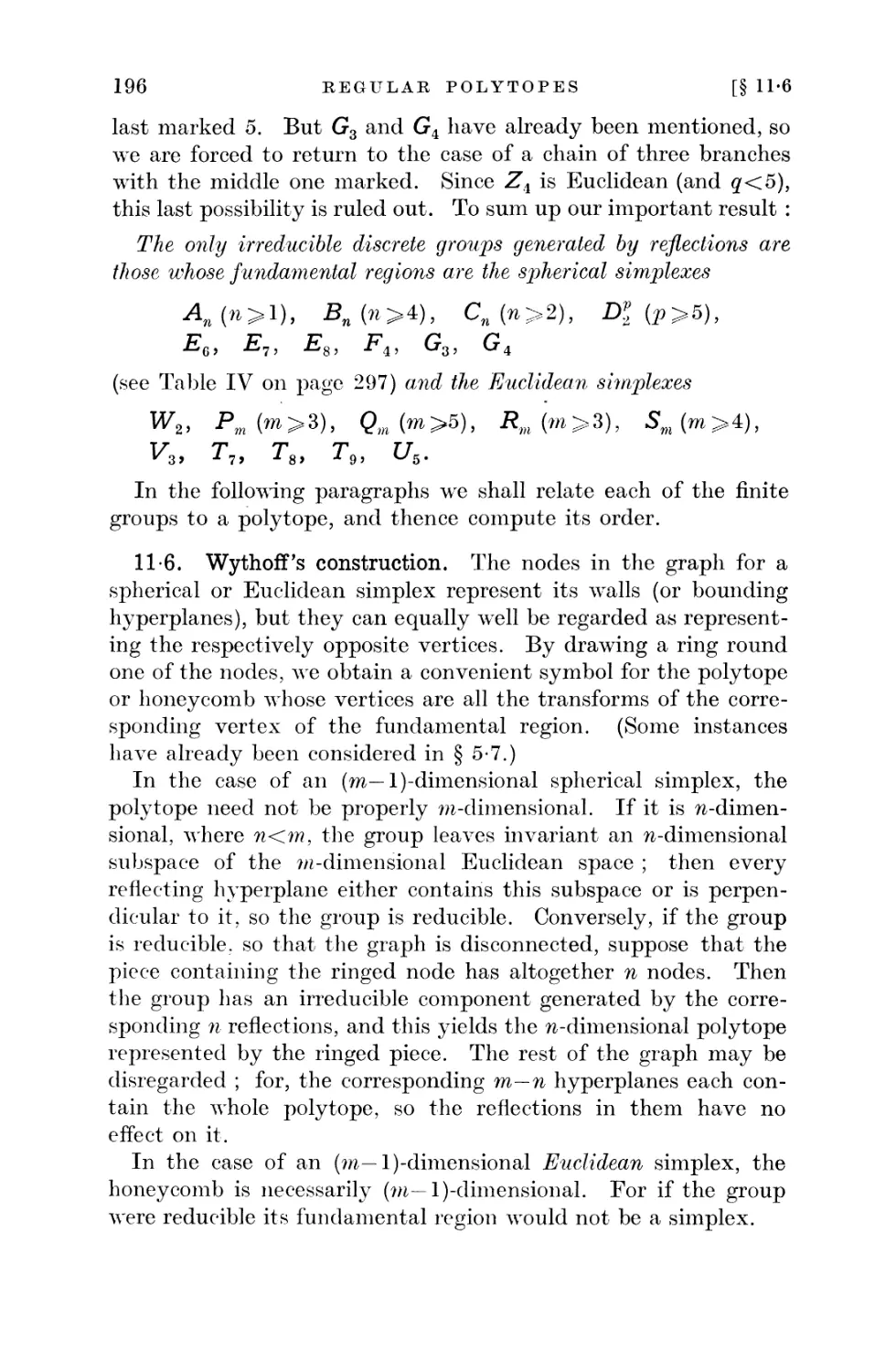
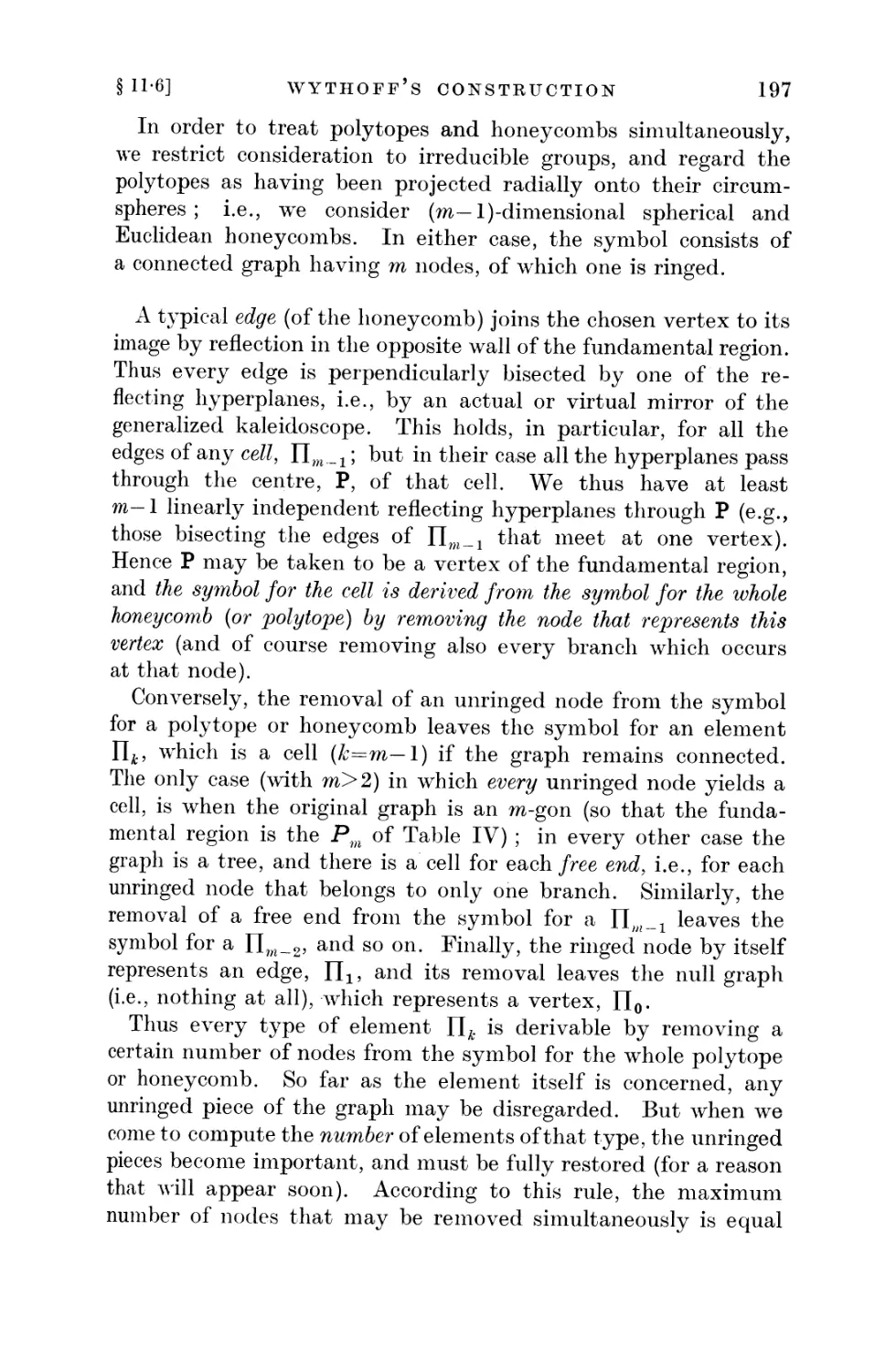
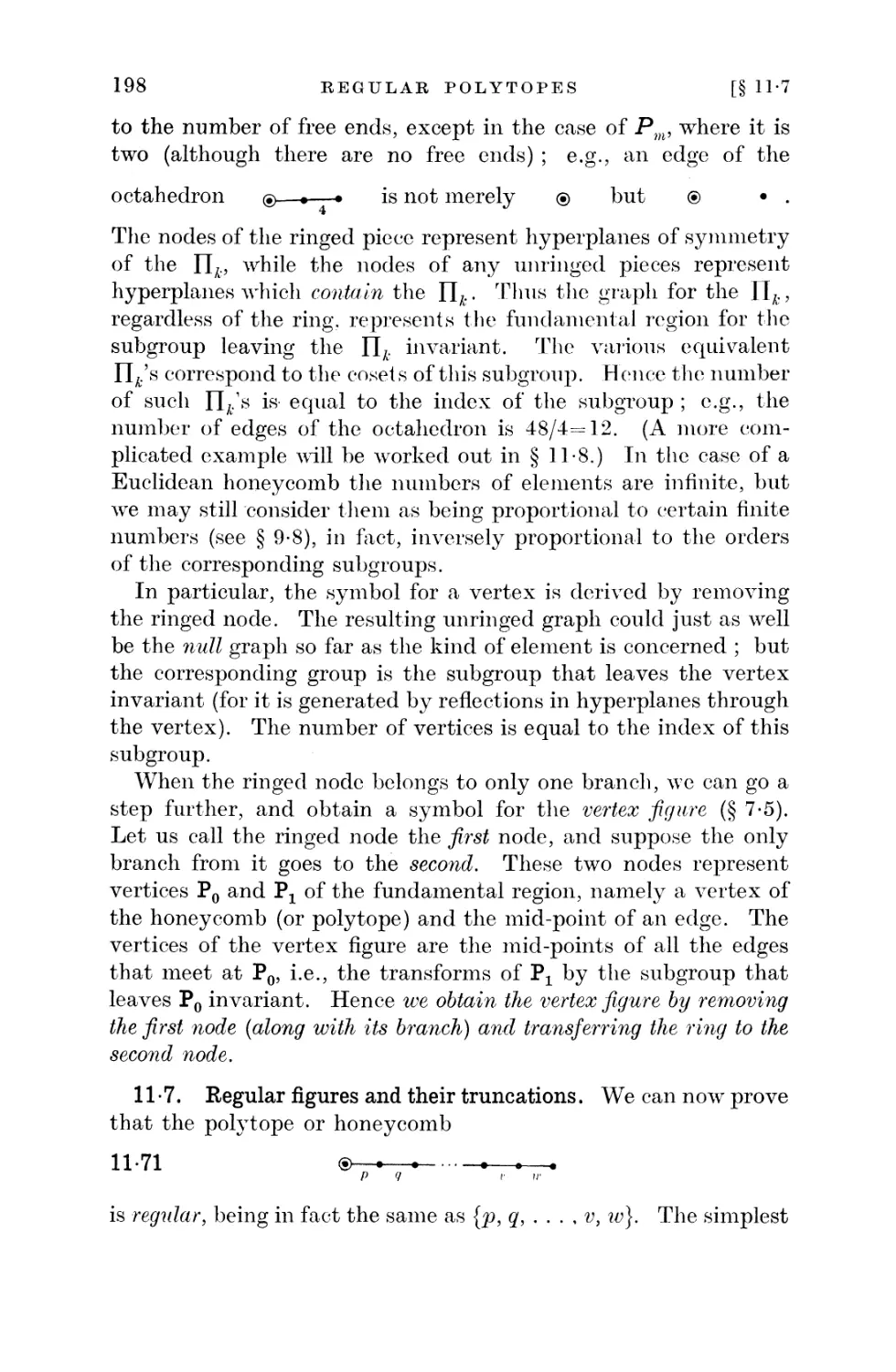
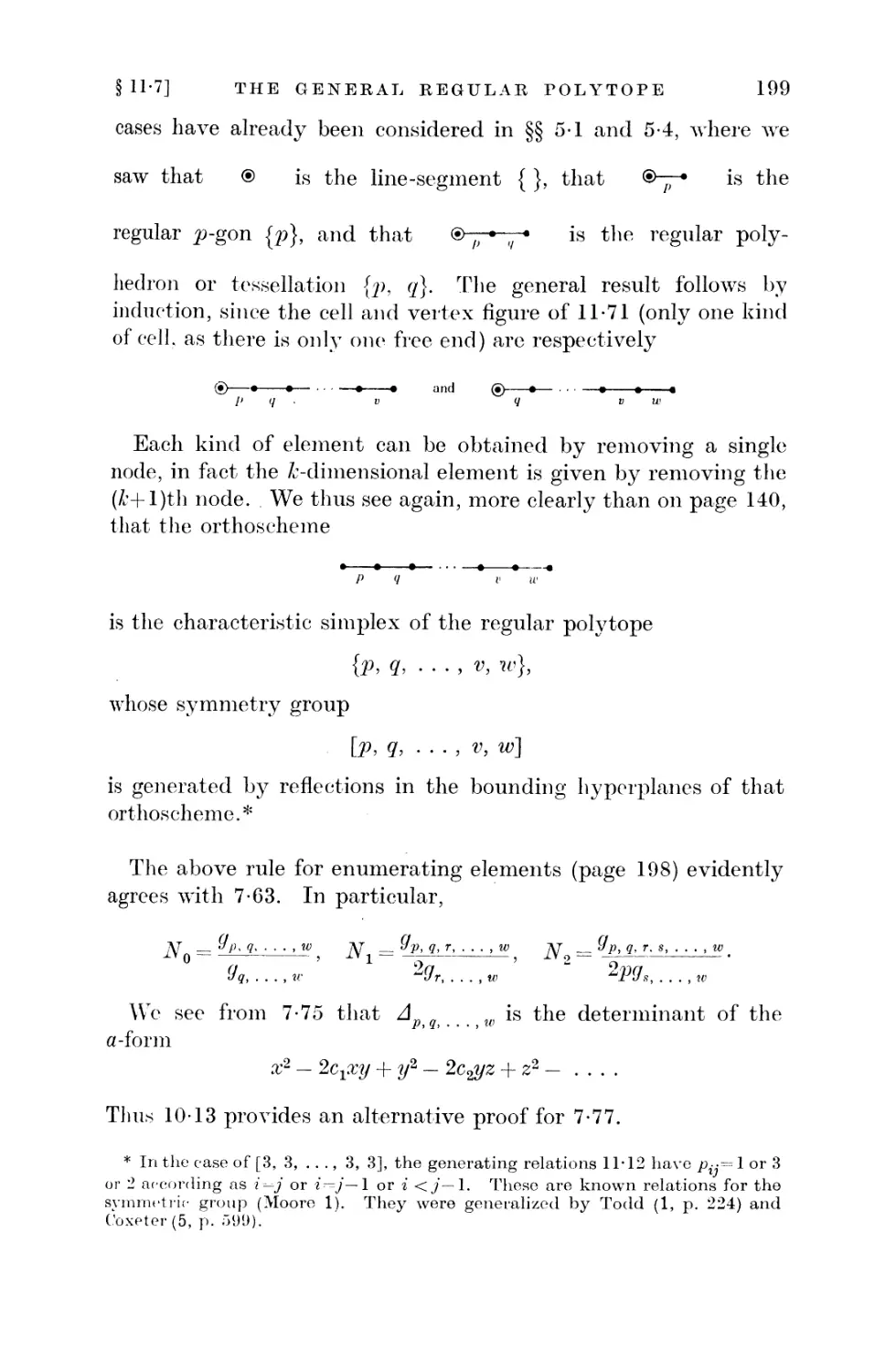
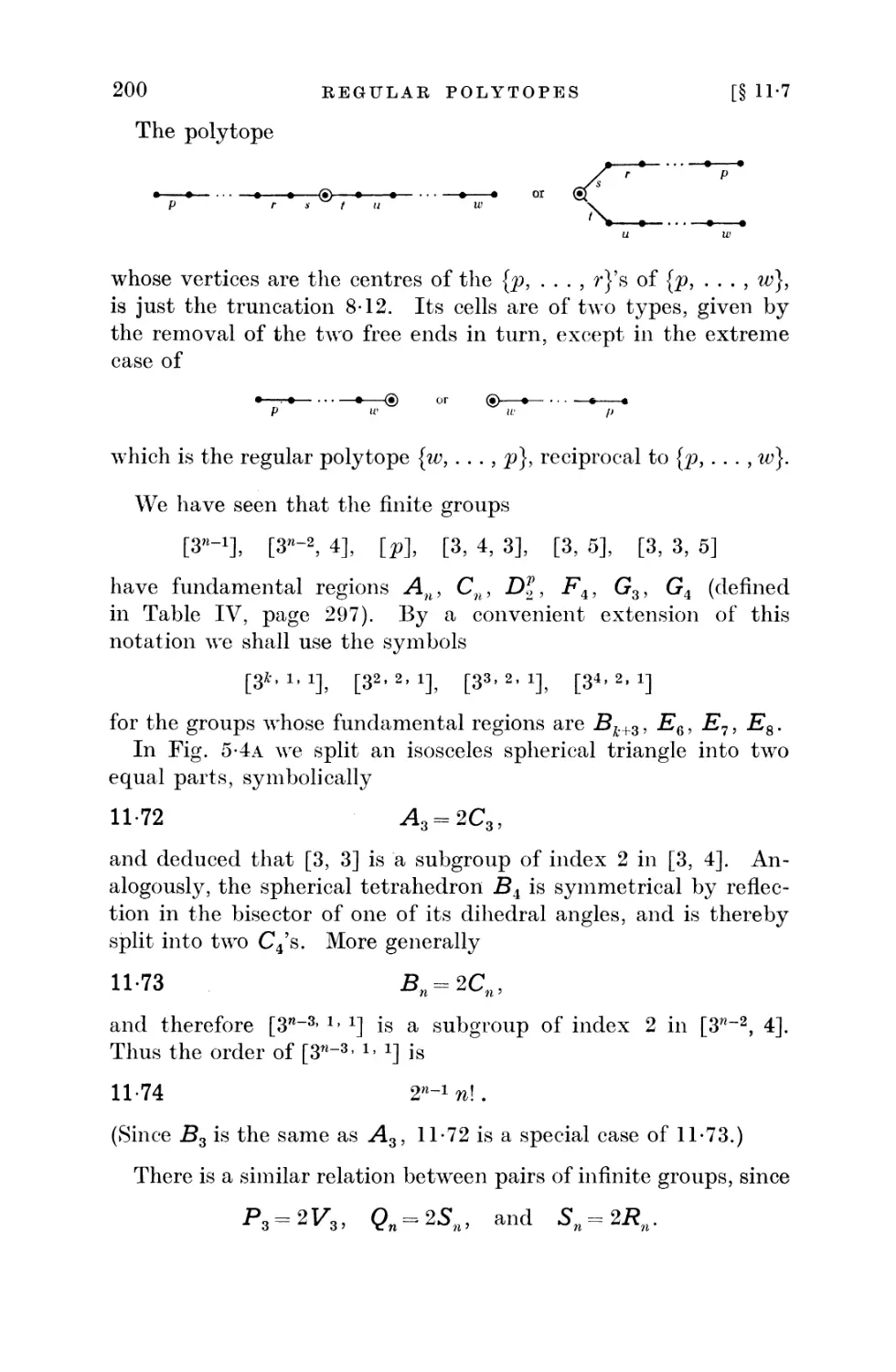
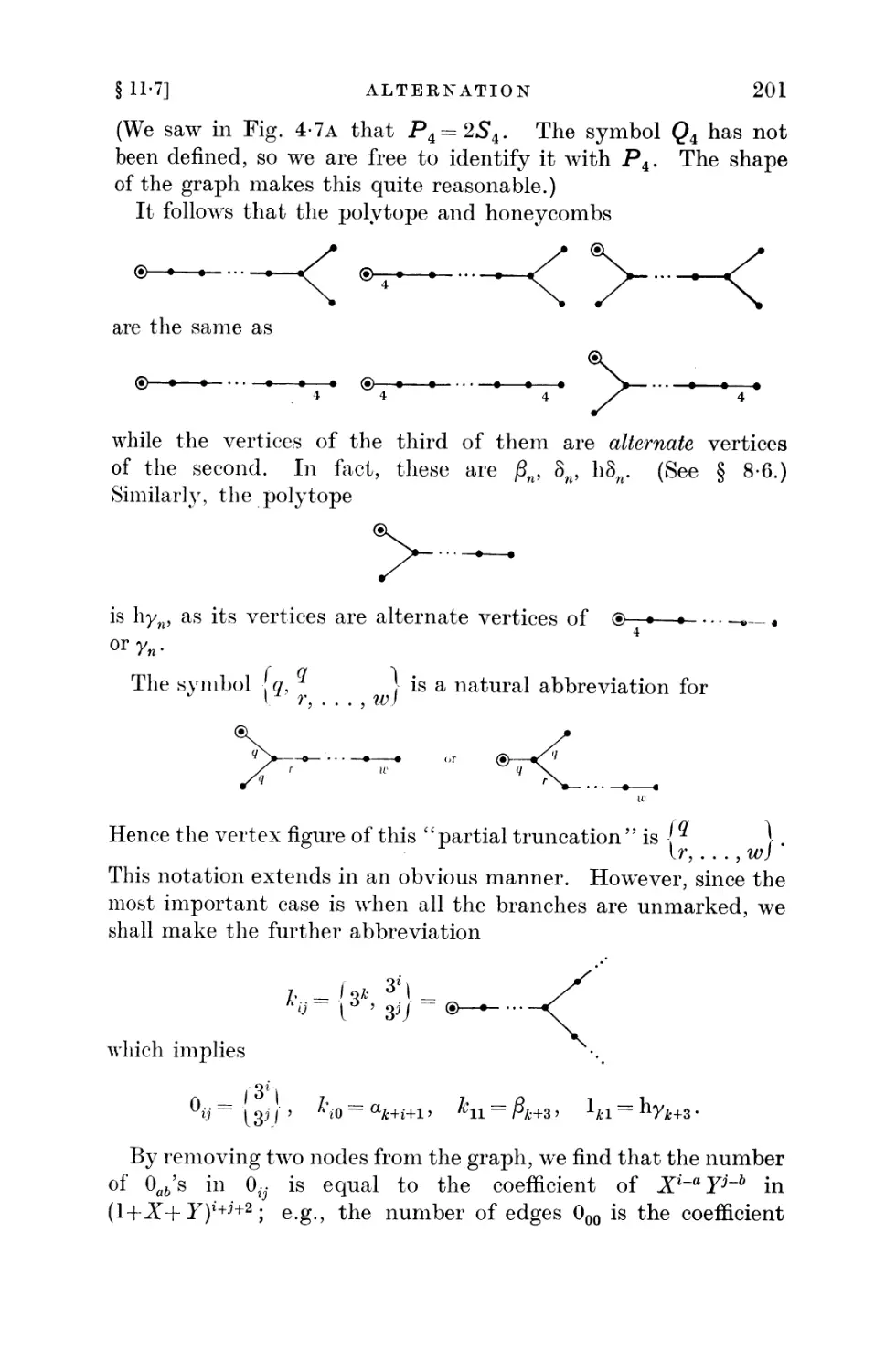
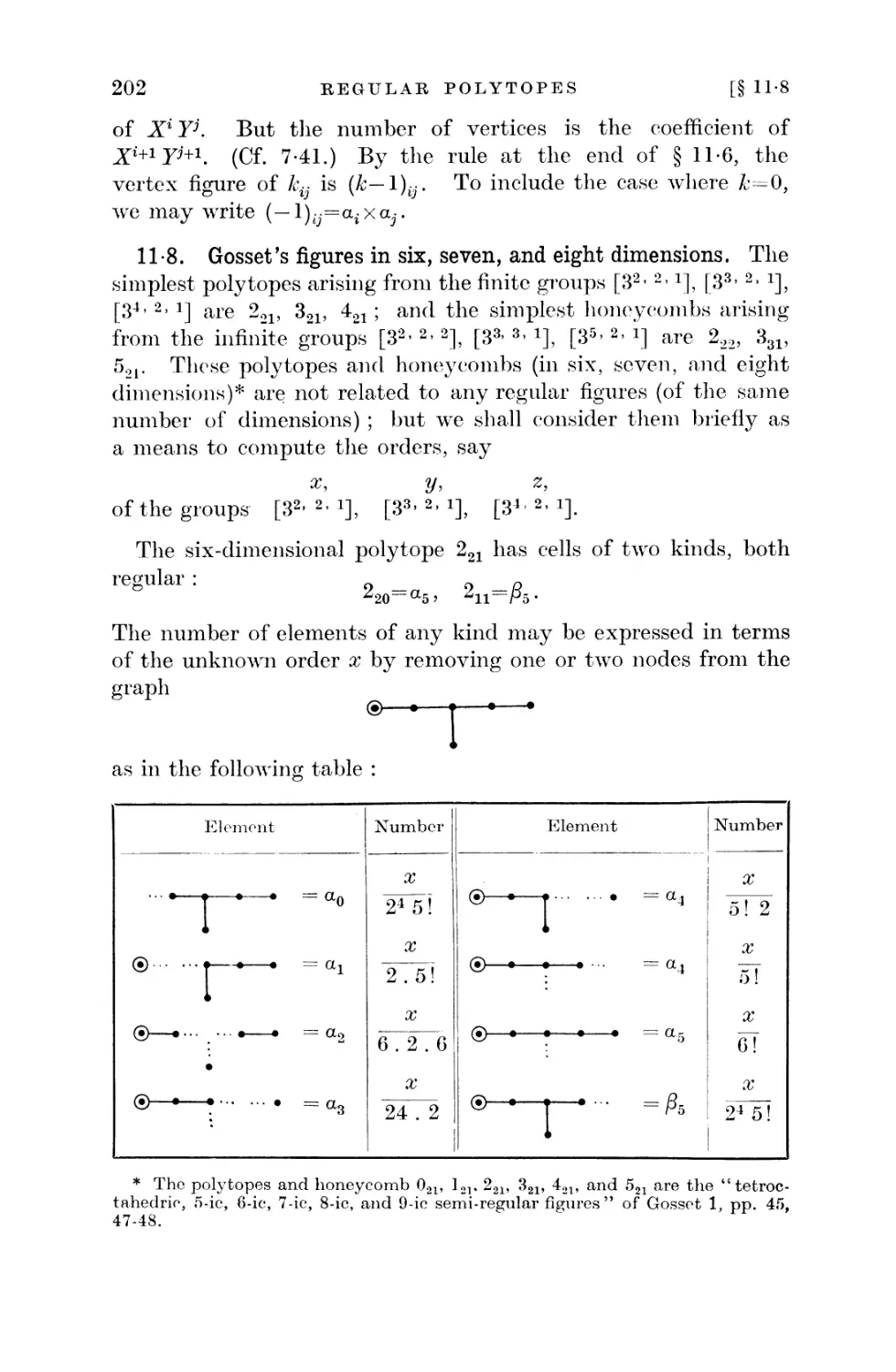
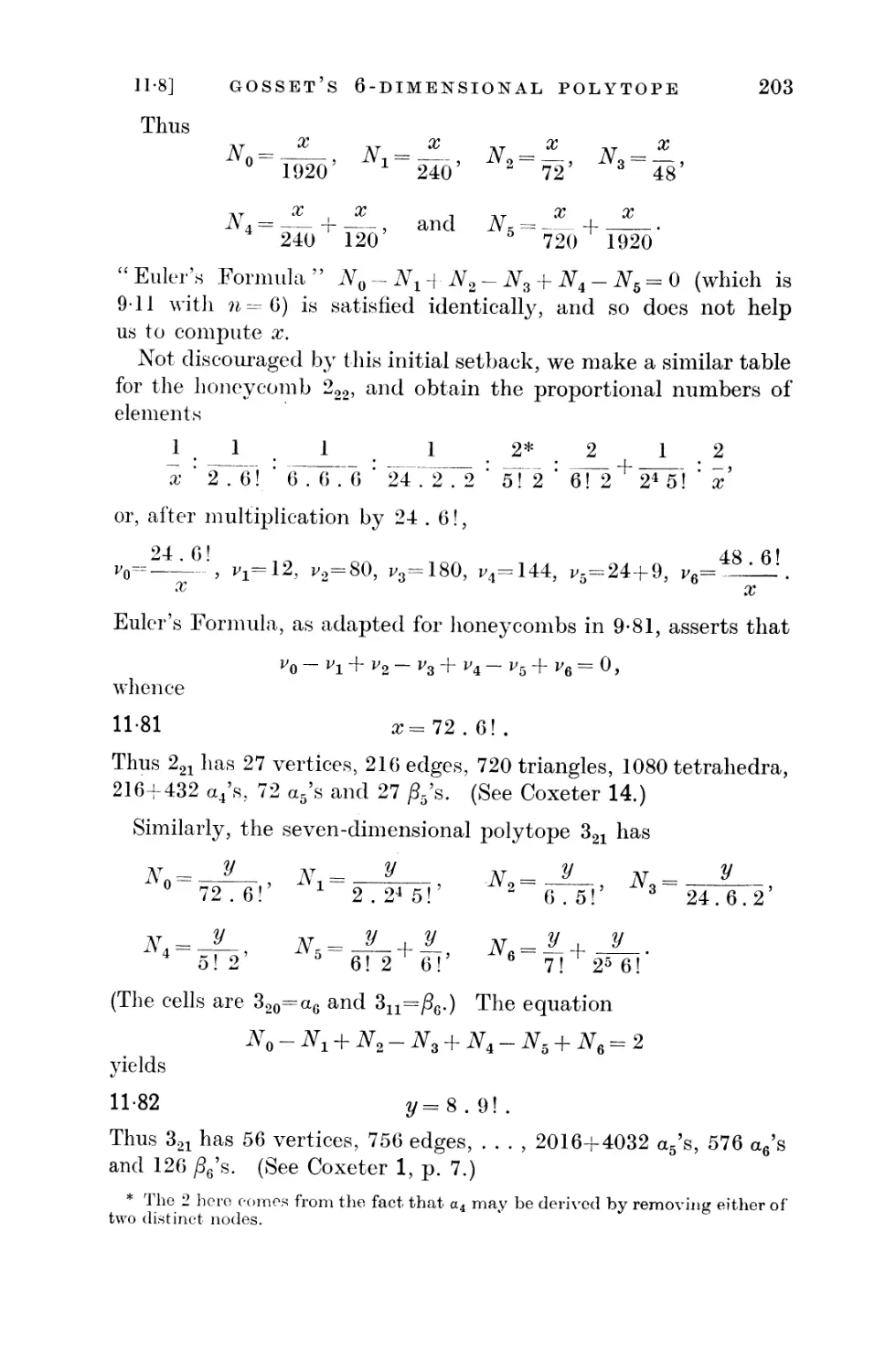
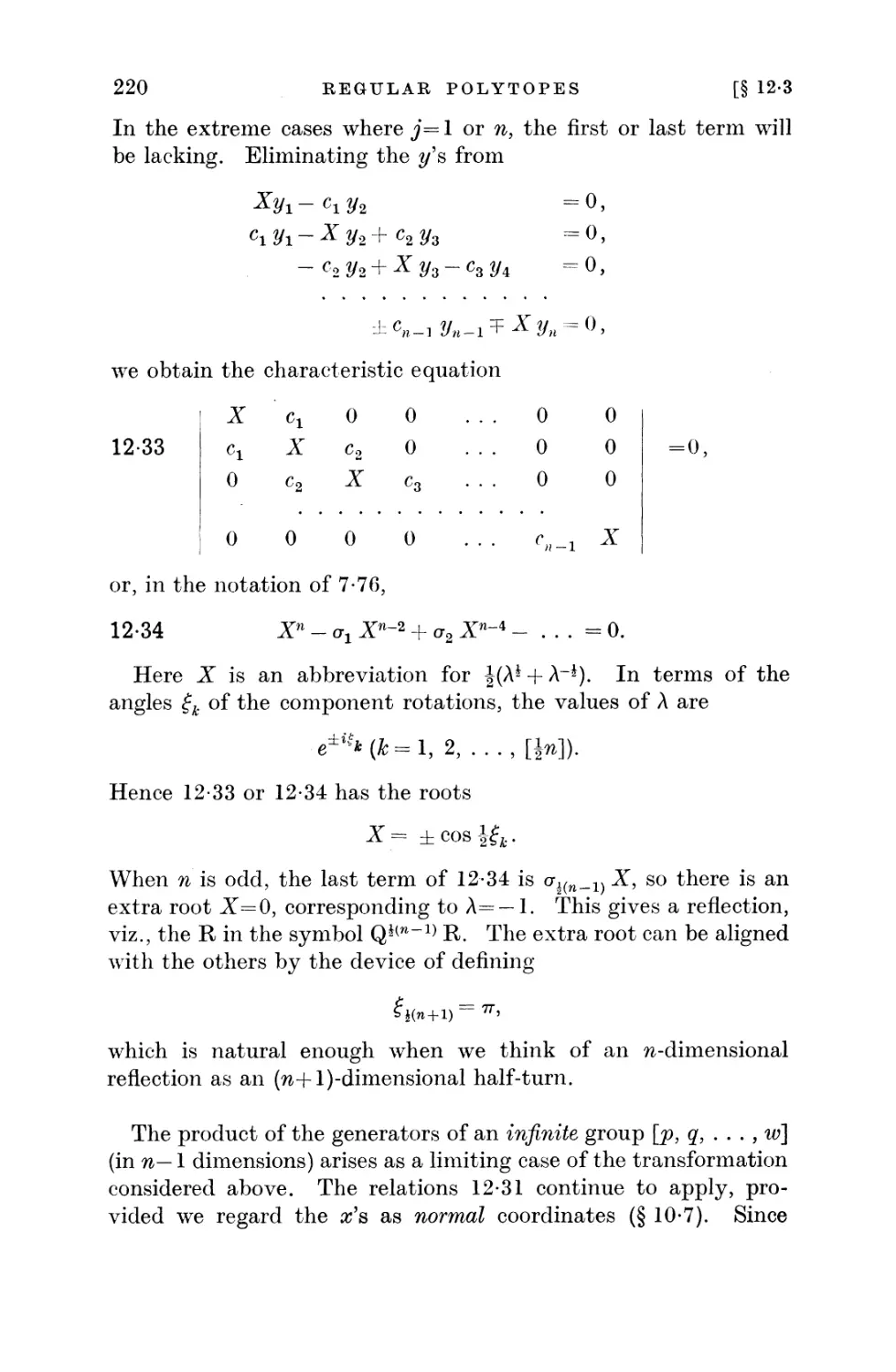
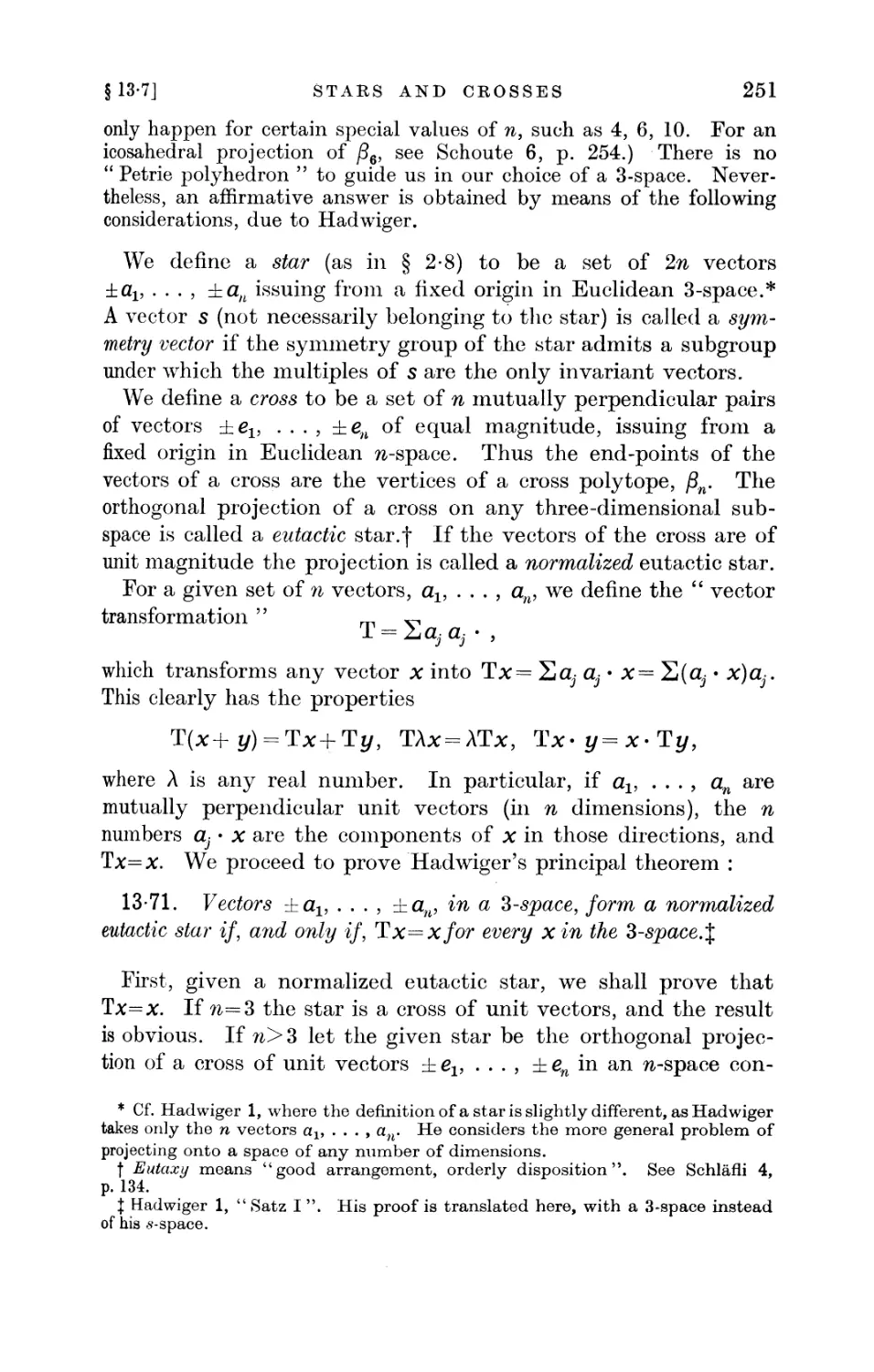
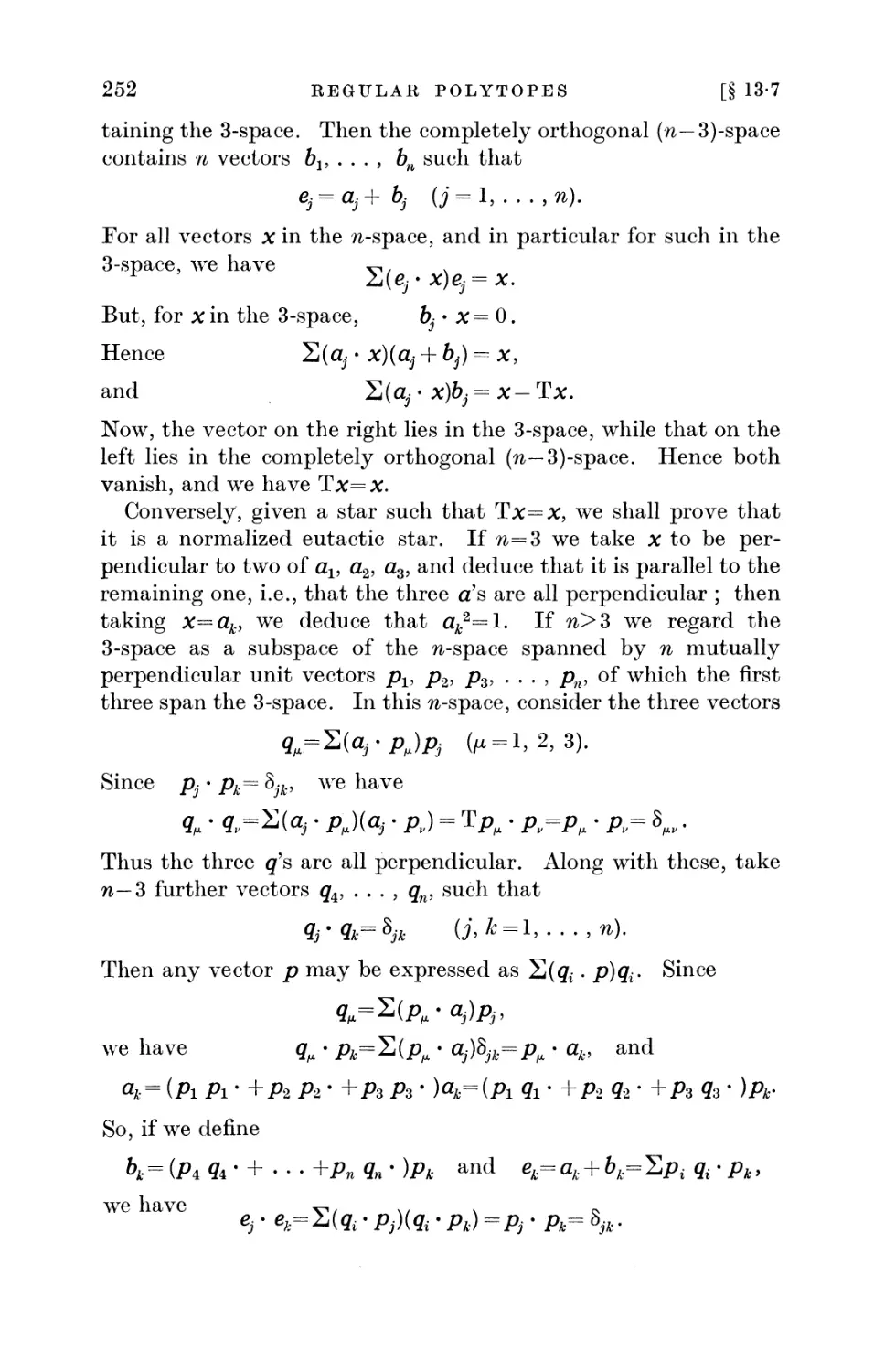
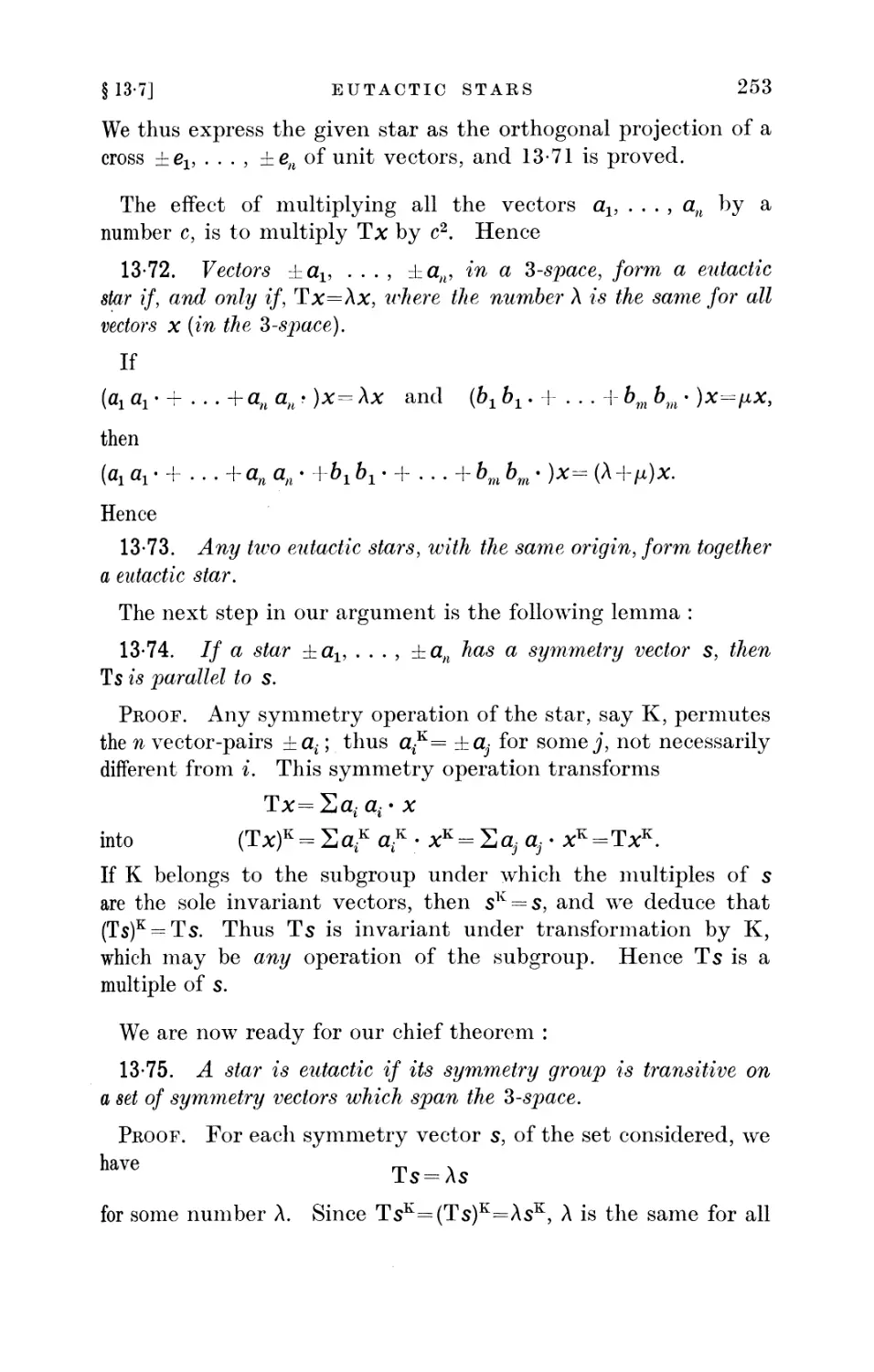
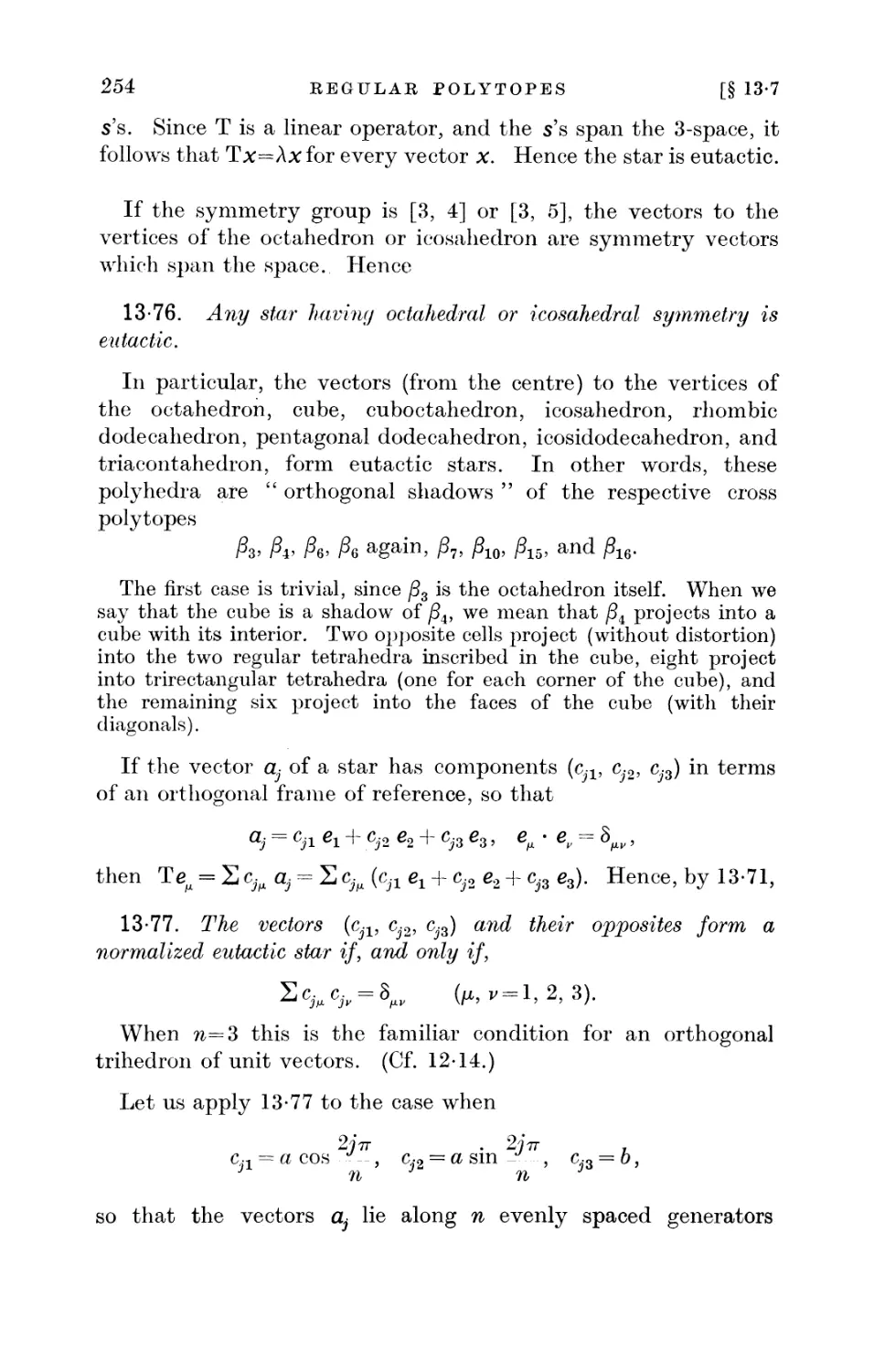
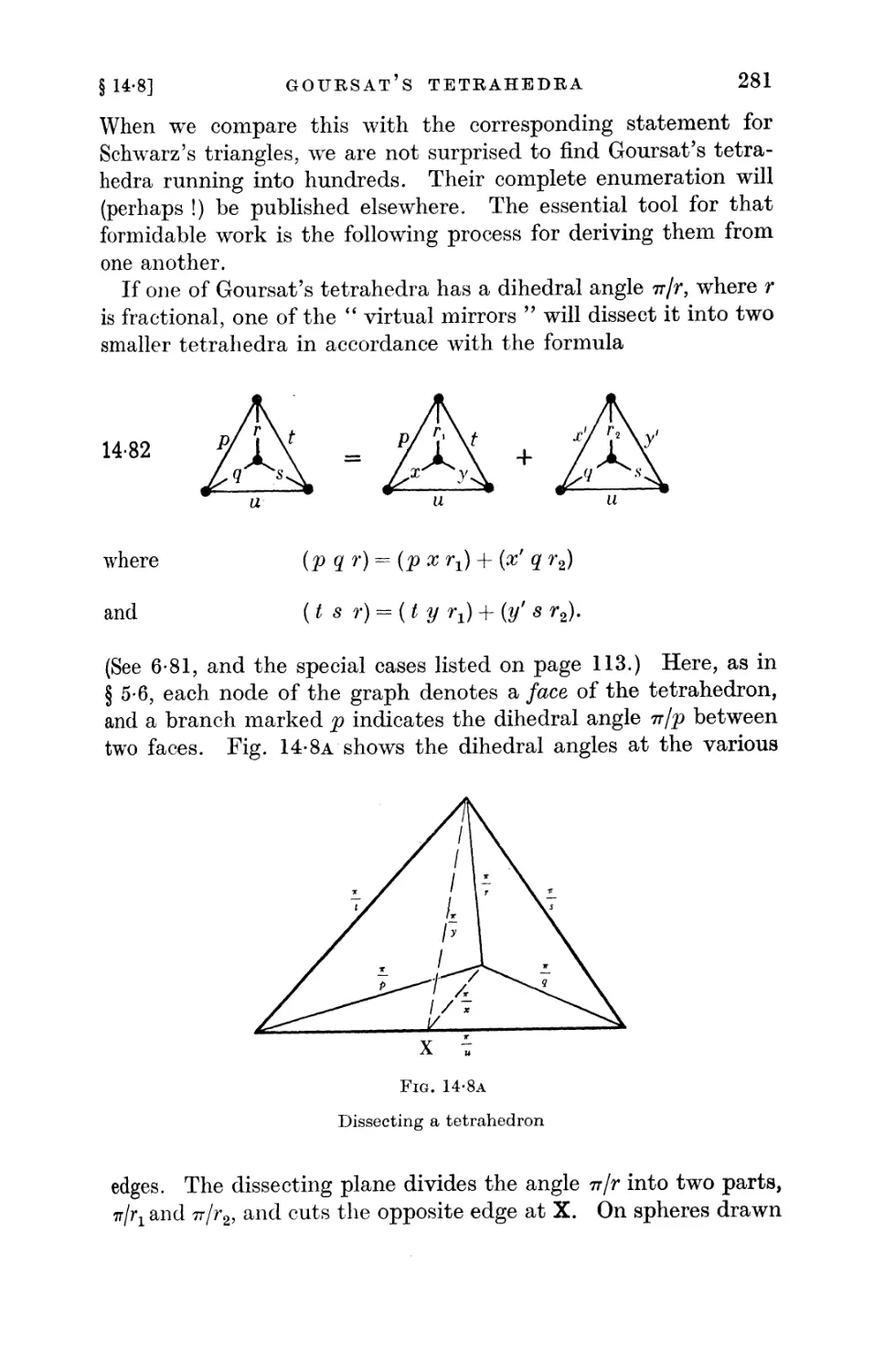
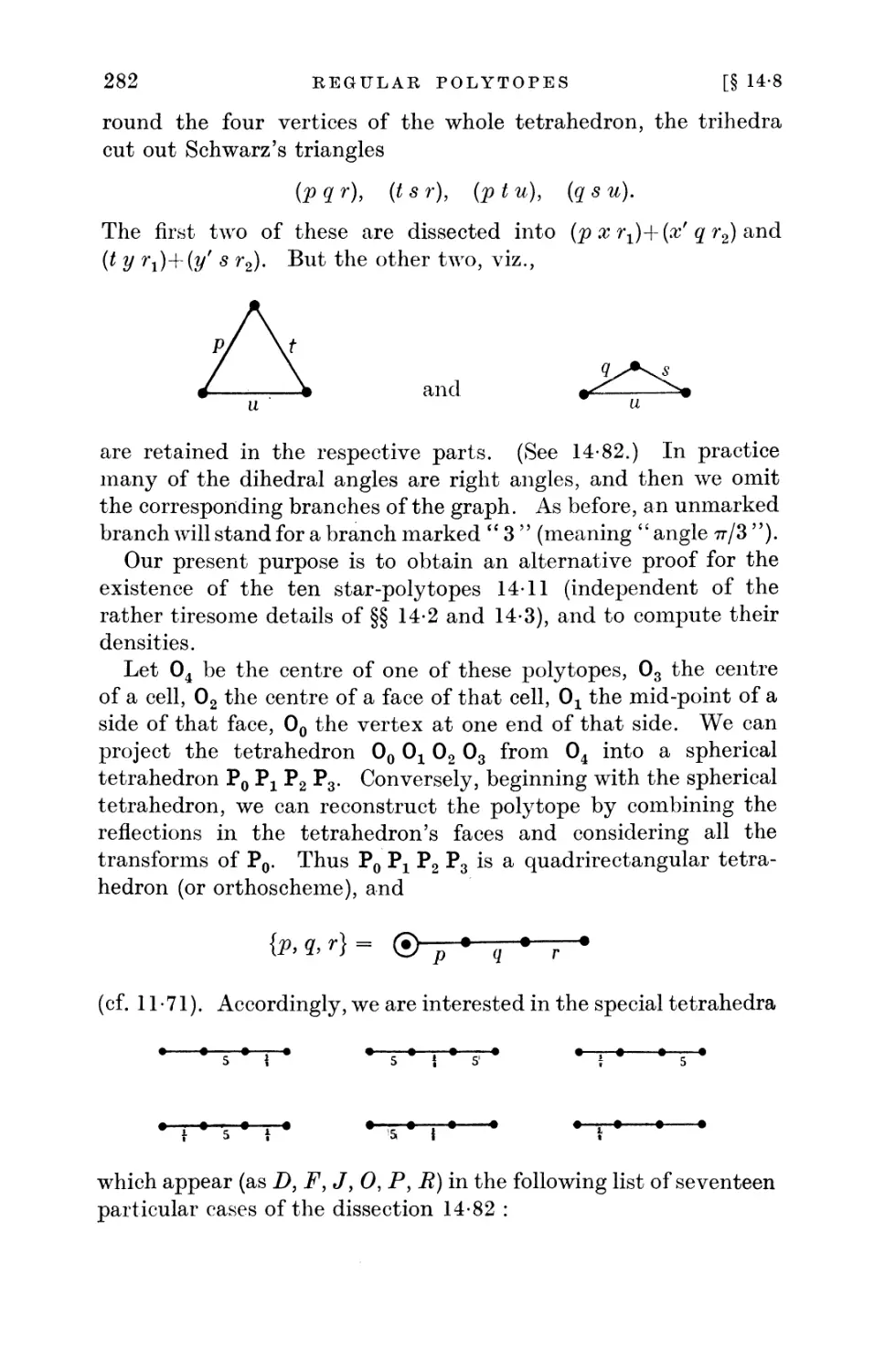
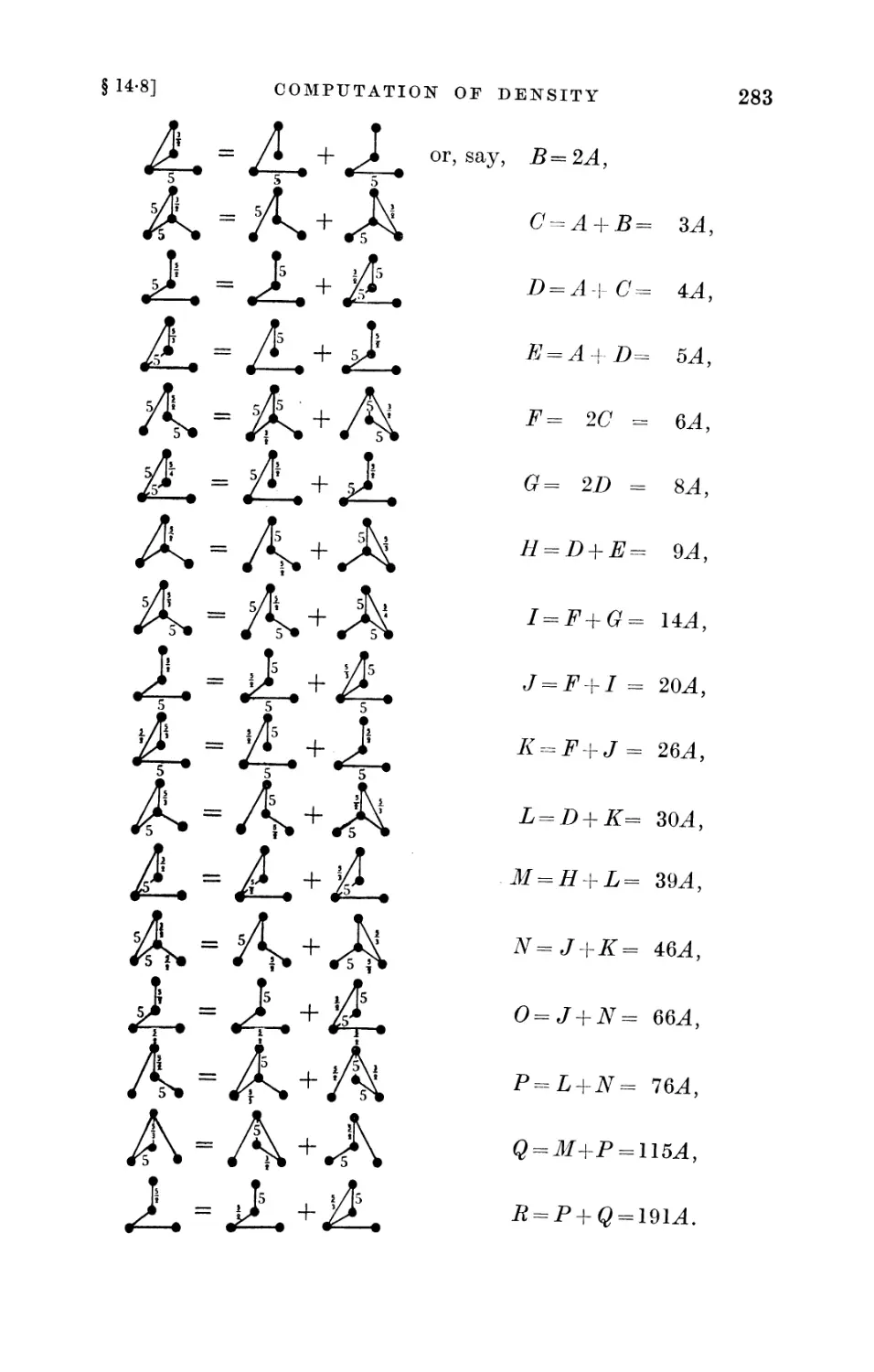
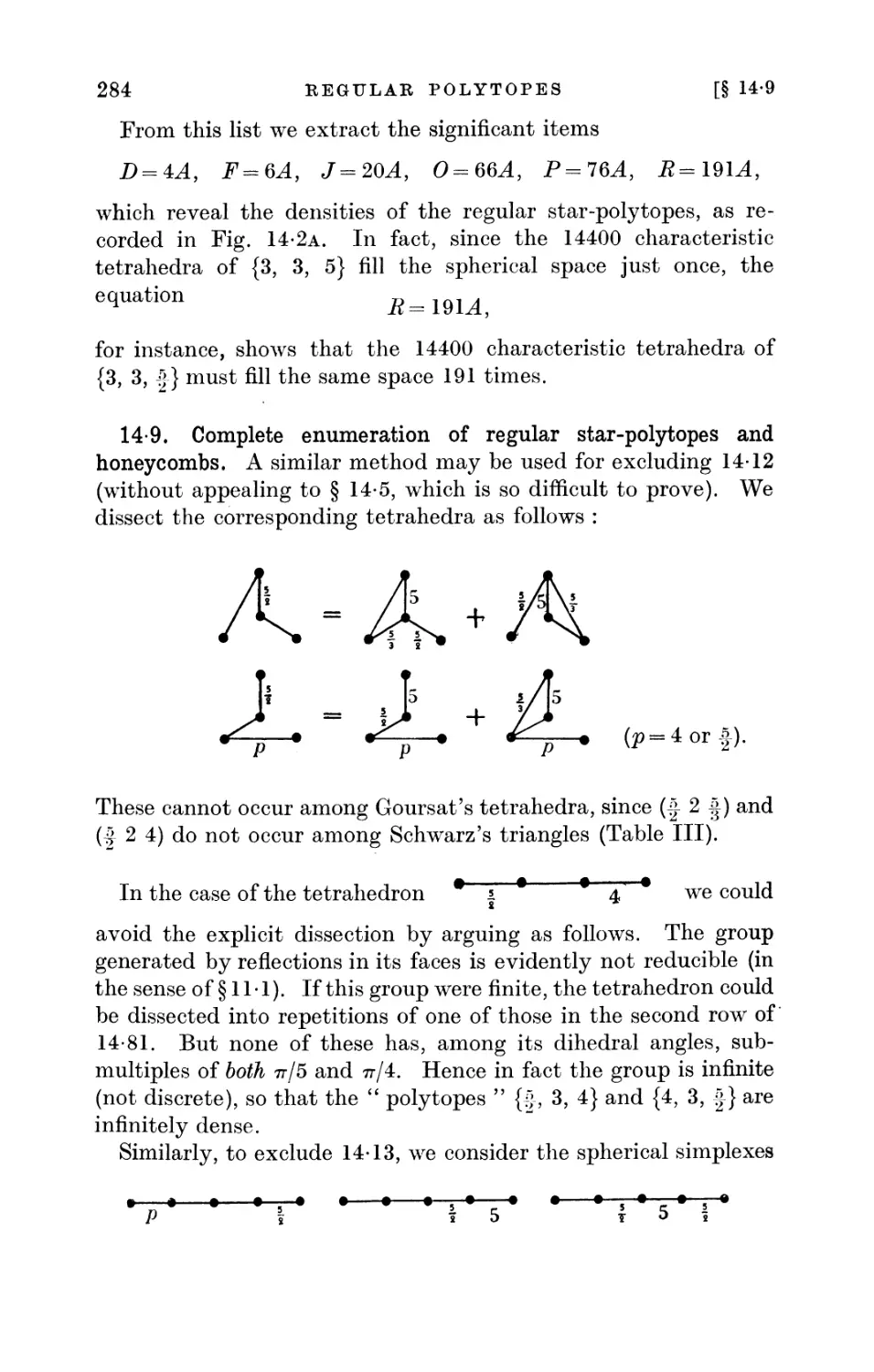


Текст
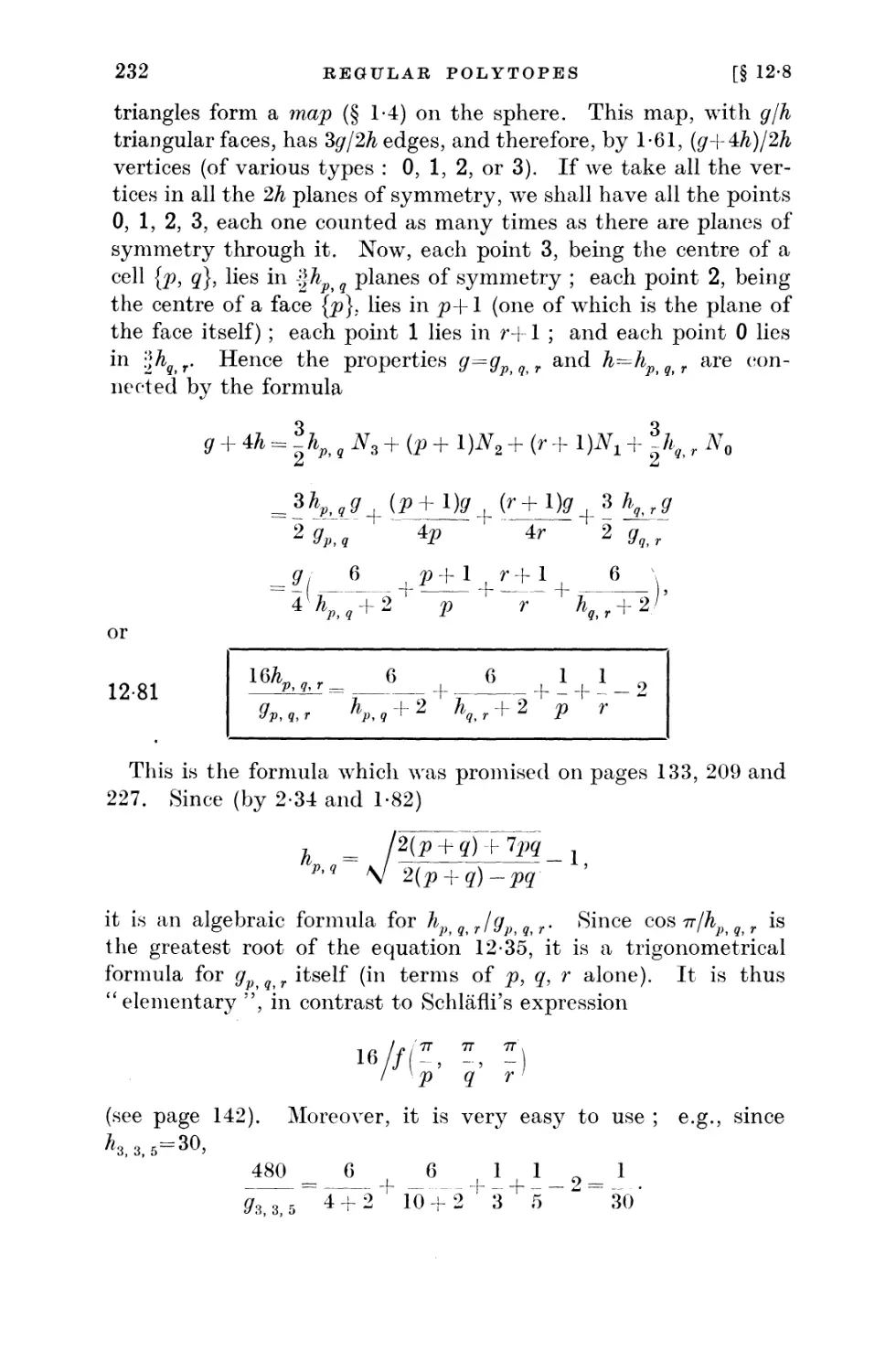
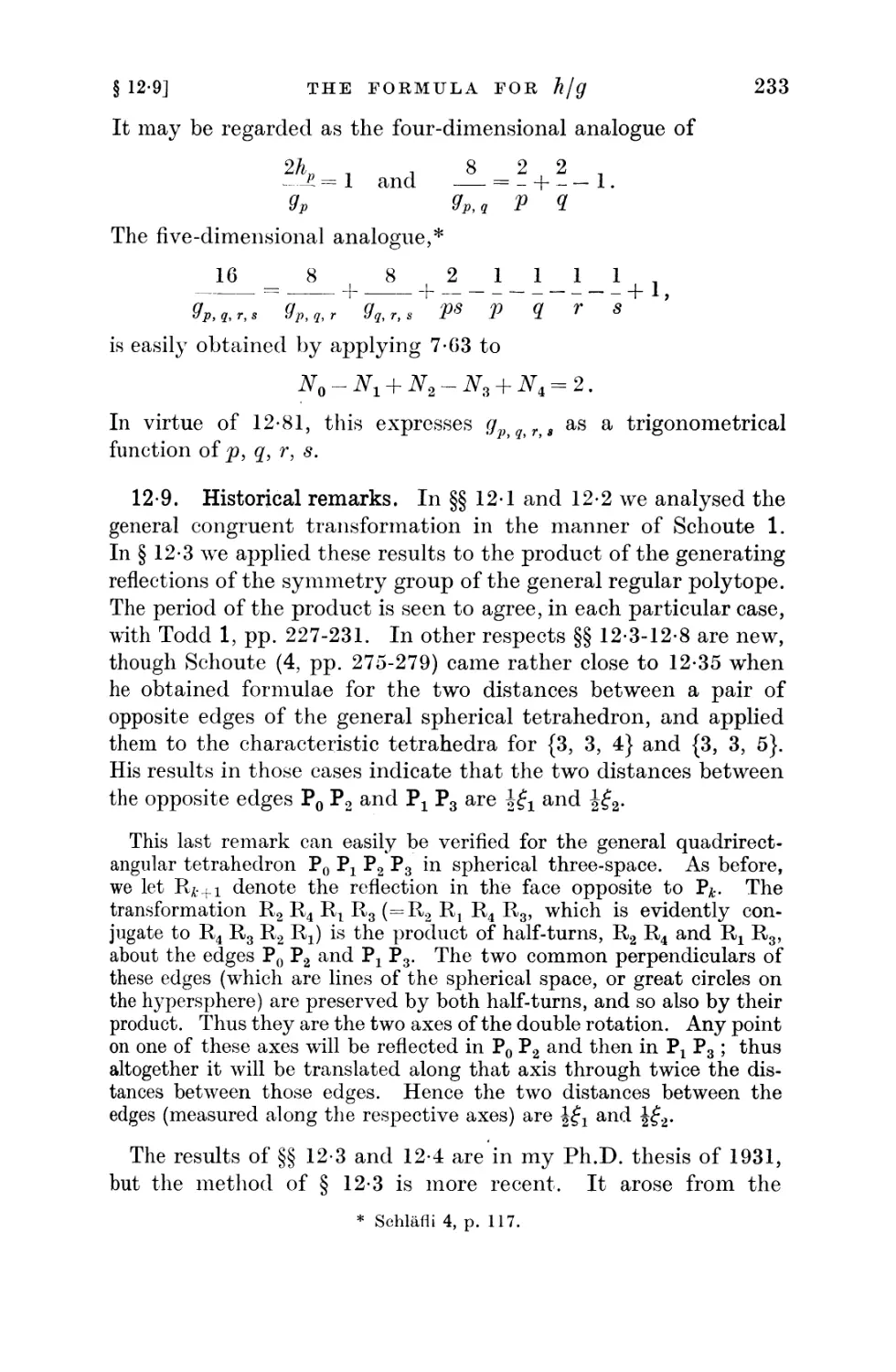
REGULAR
POLYTOPES
BY
H.S.M.COXETER
Professor of Mathematics in the University of Toronto
With eight Plates and numerous Diagrams
METHUEN&CO.LTD.,LONDON
36 Essex Street, Strand, W.C.2
REGULAR POLYTOPES
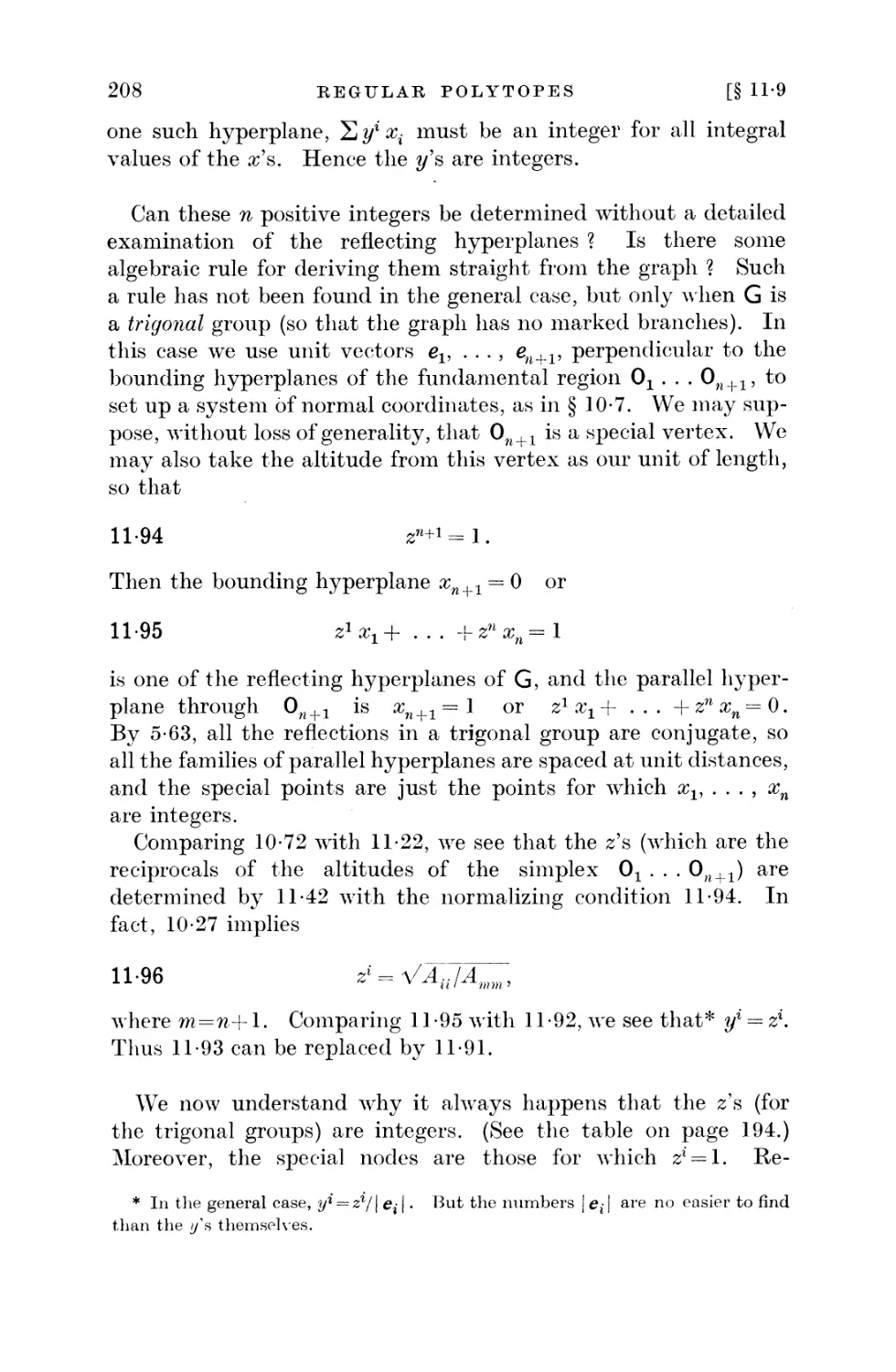
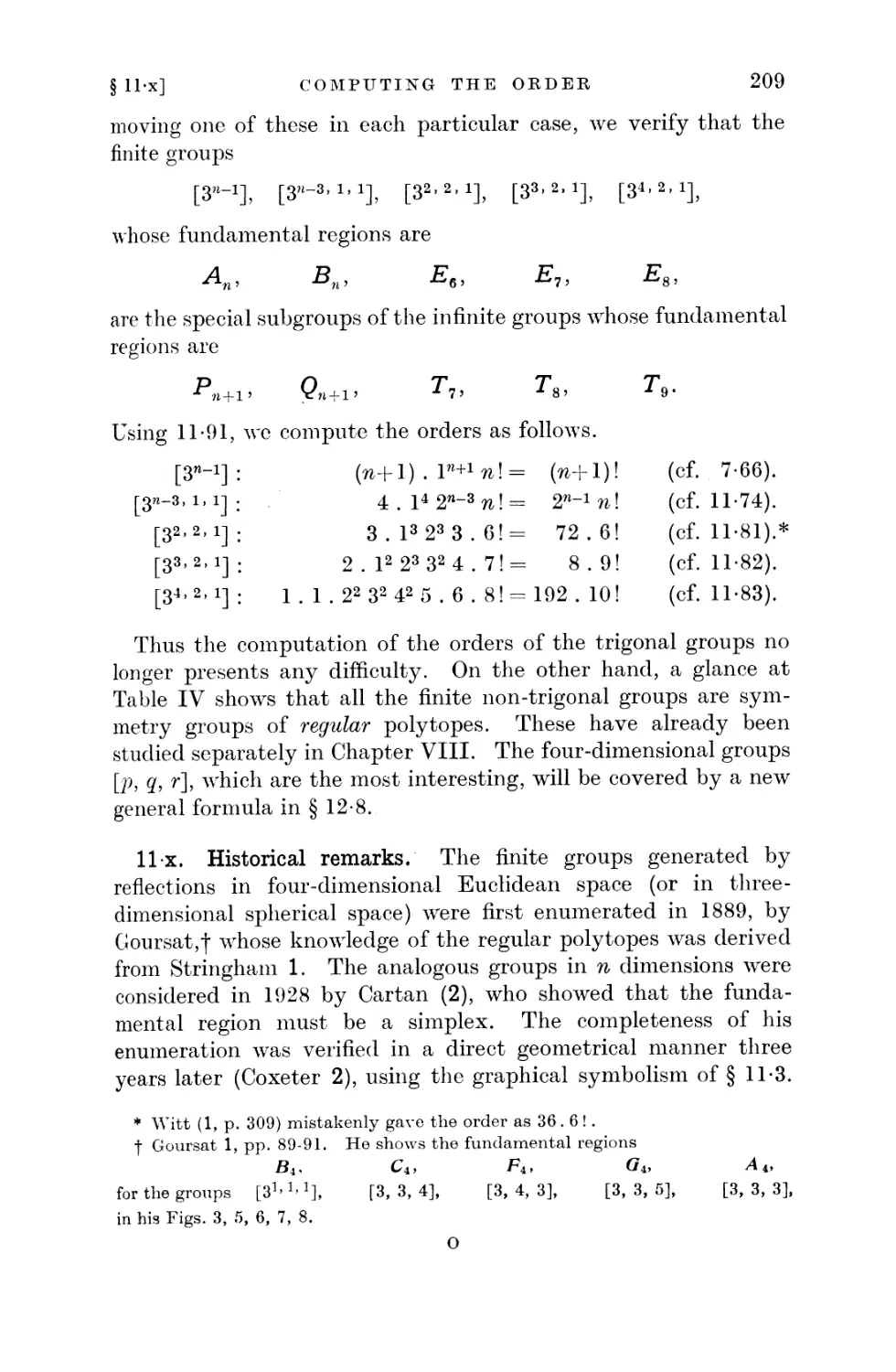
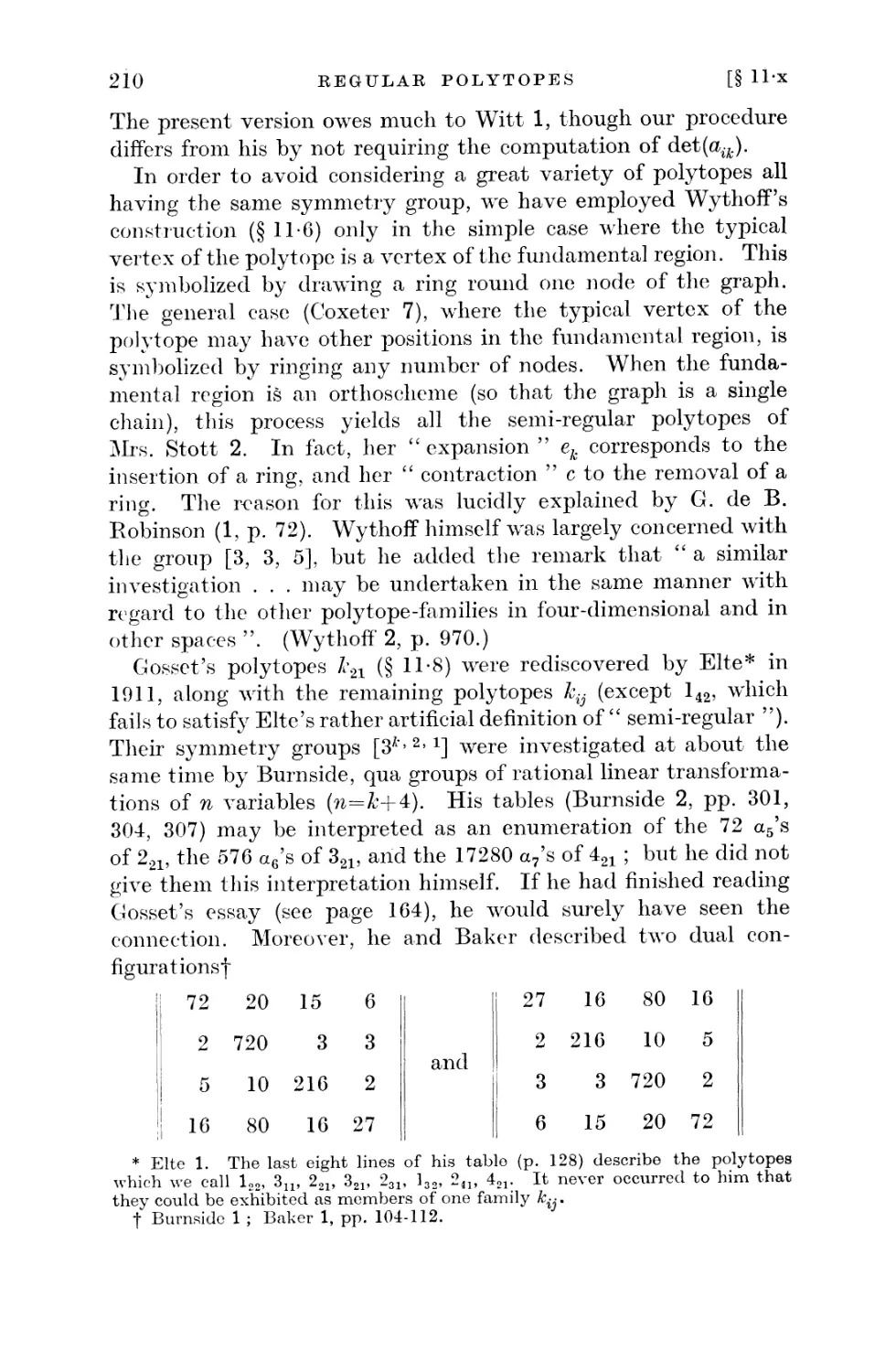
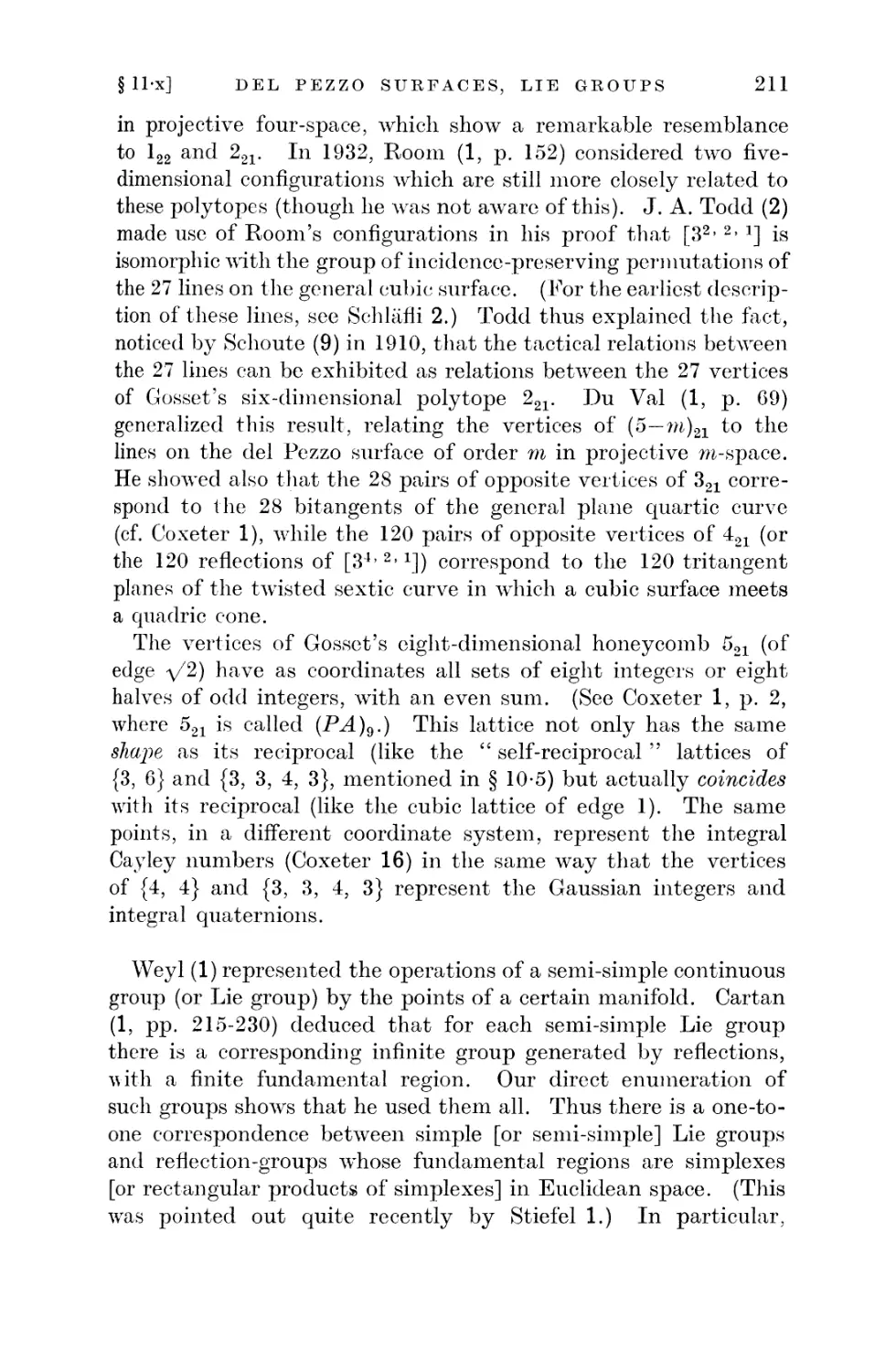
BY THE SAME AUTHOR
THE REAL PROJECTIVE PLANE
McGraw Hill,New York
NON一EUCLIDEAN GEOMETRY
University of Toronto Press
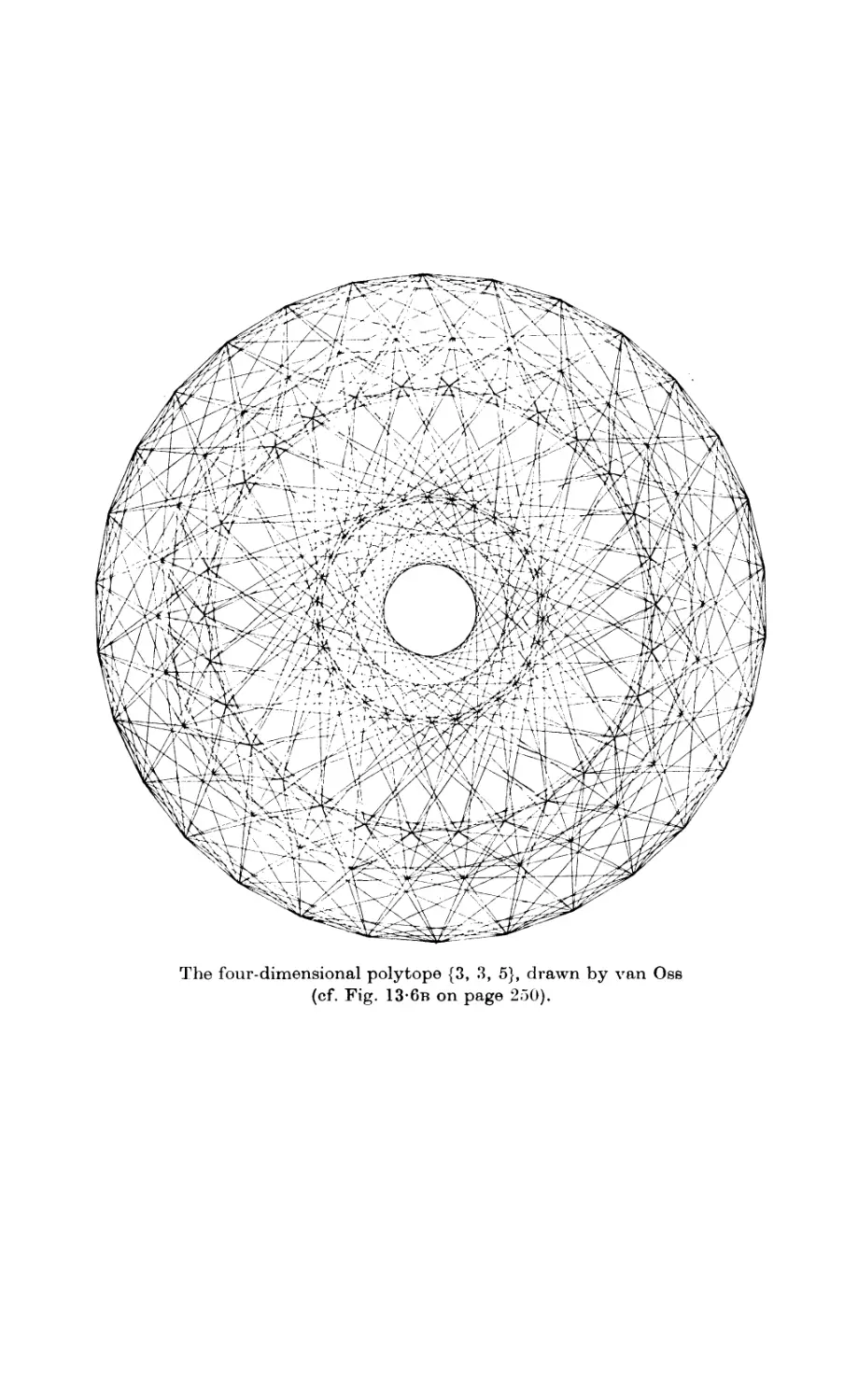
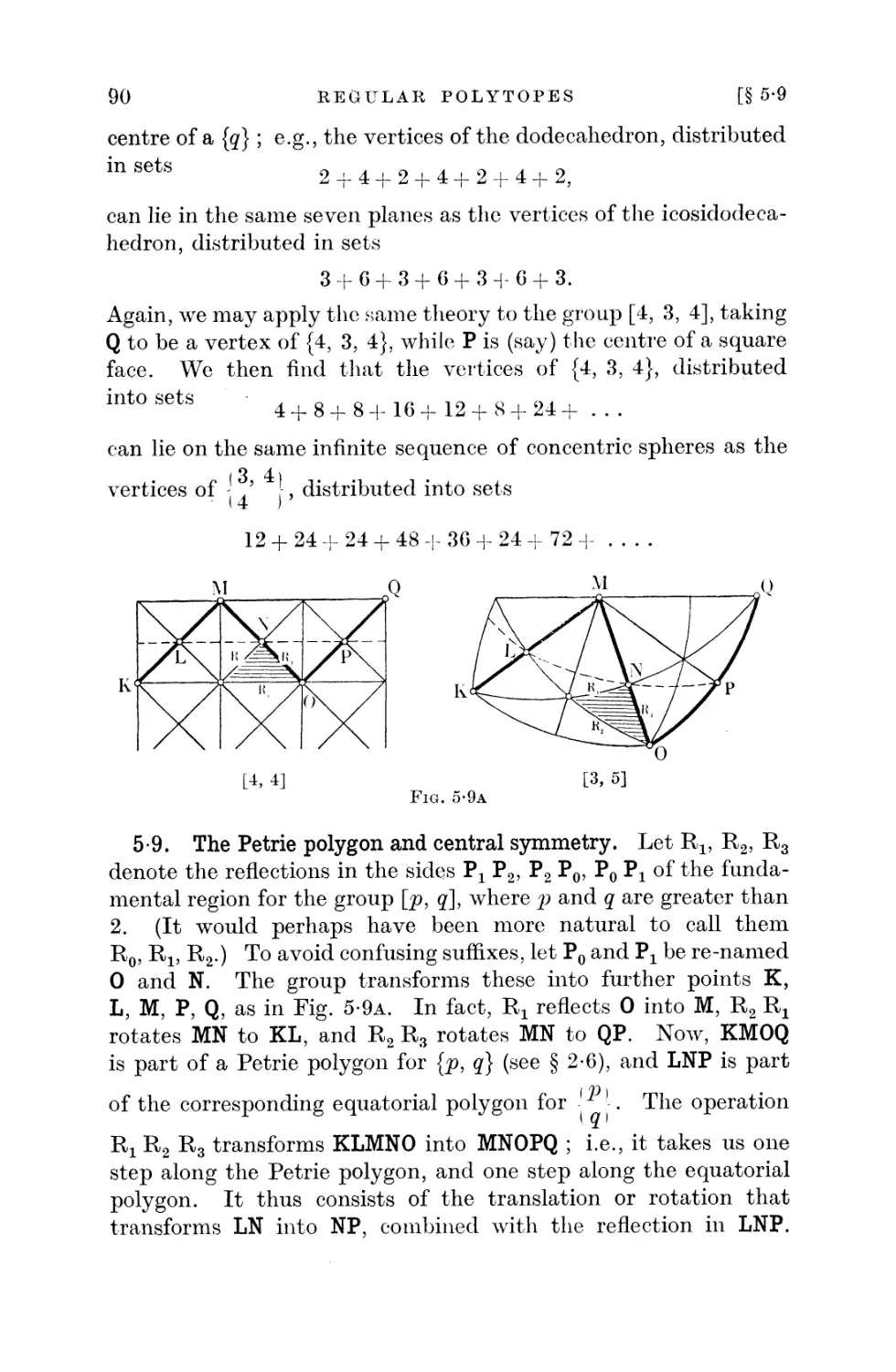
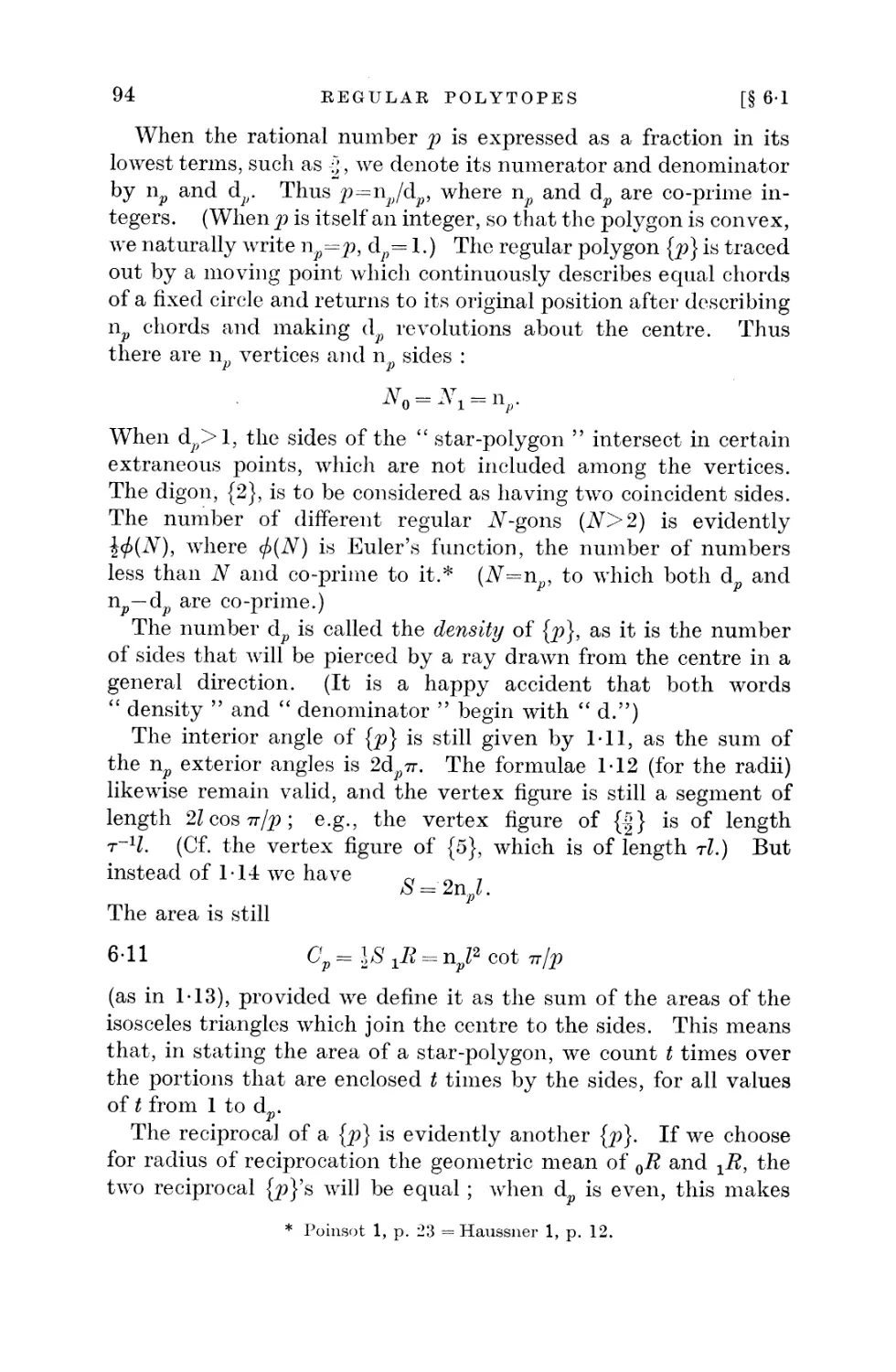
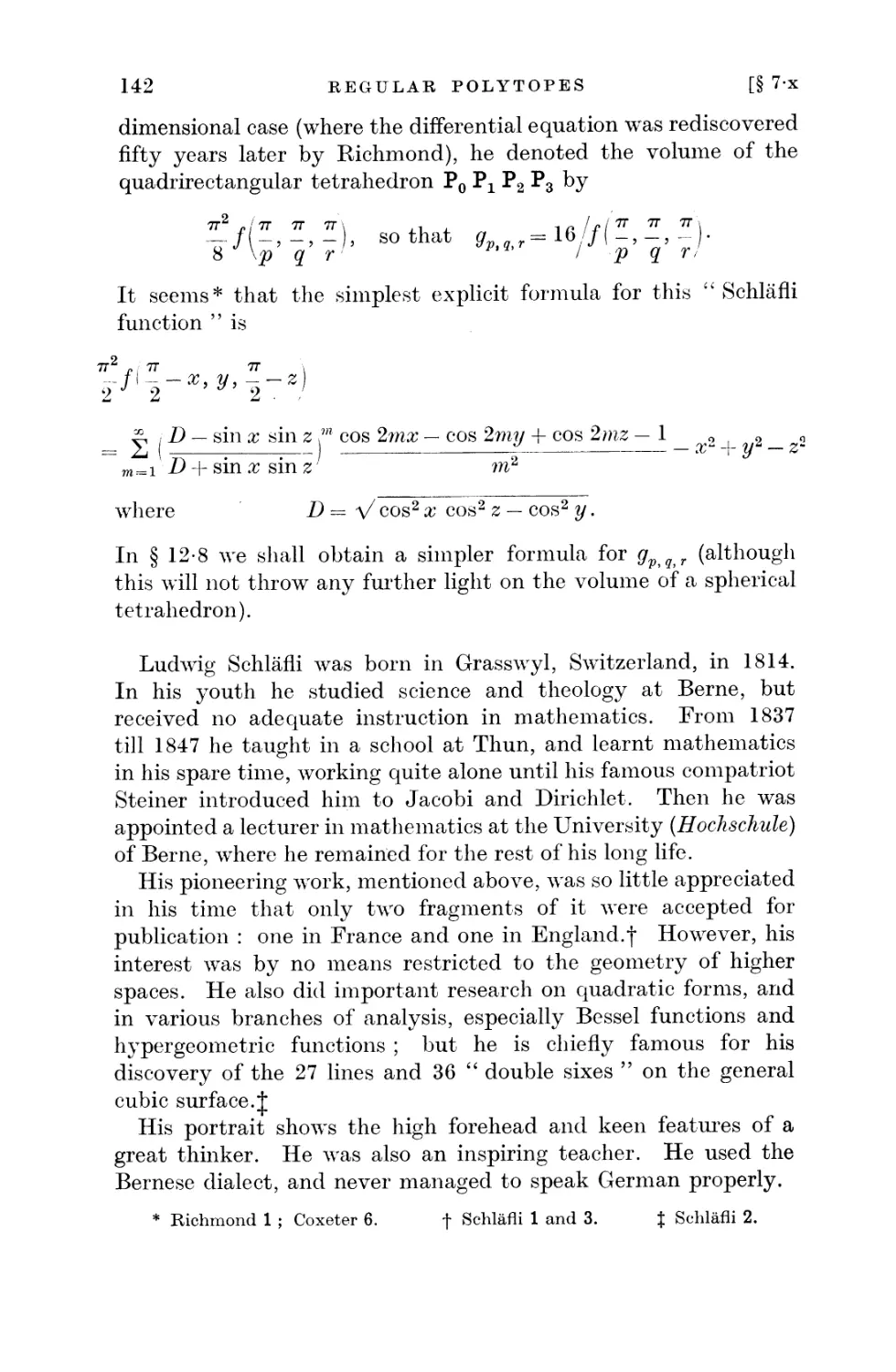
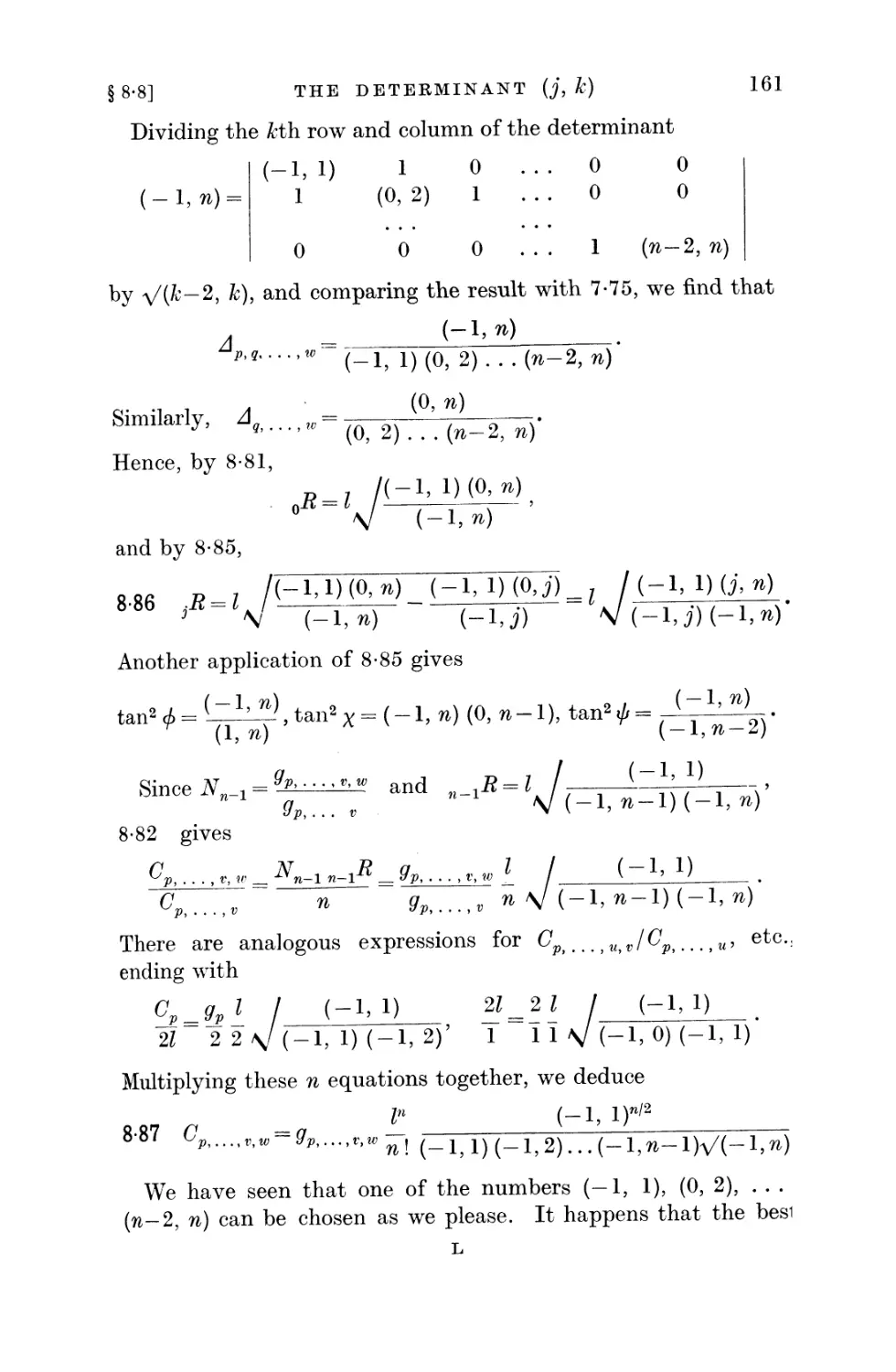
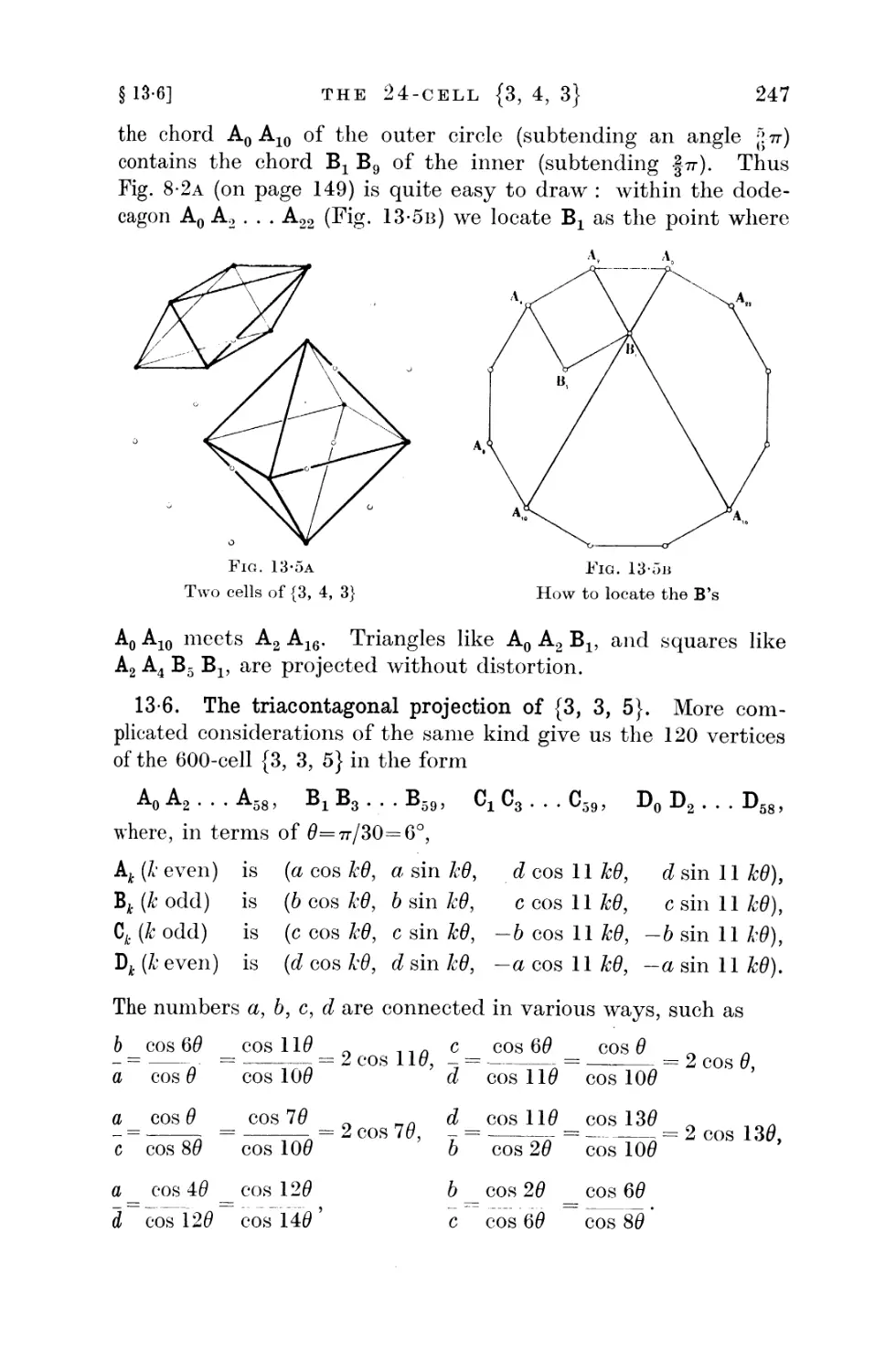
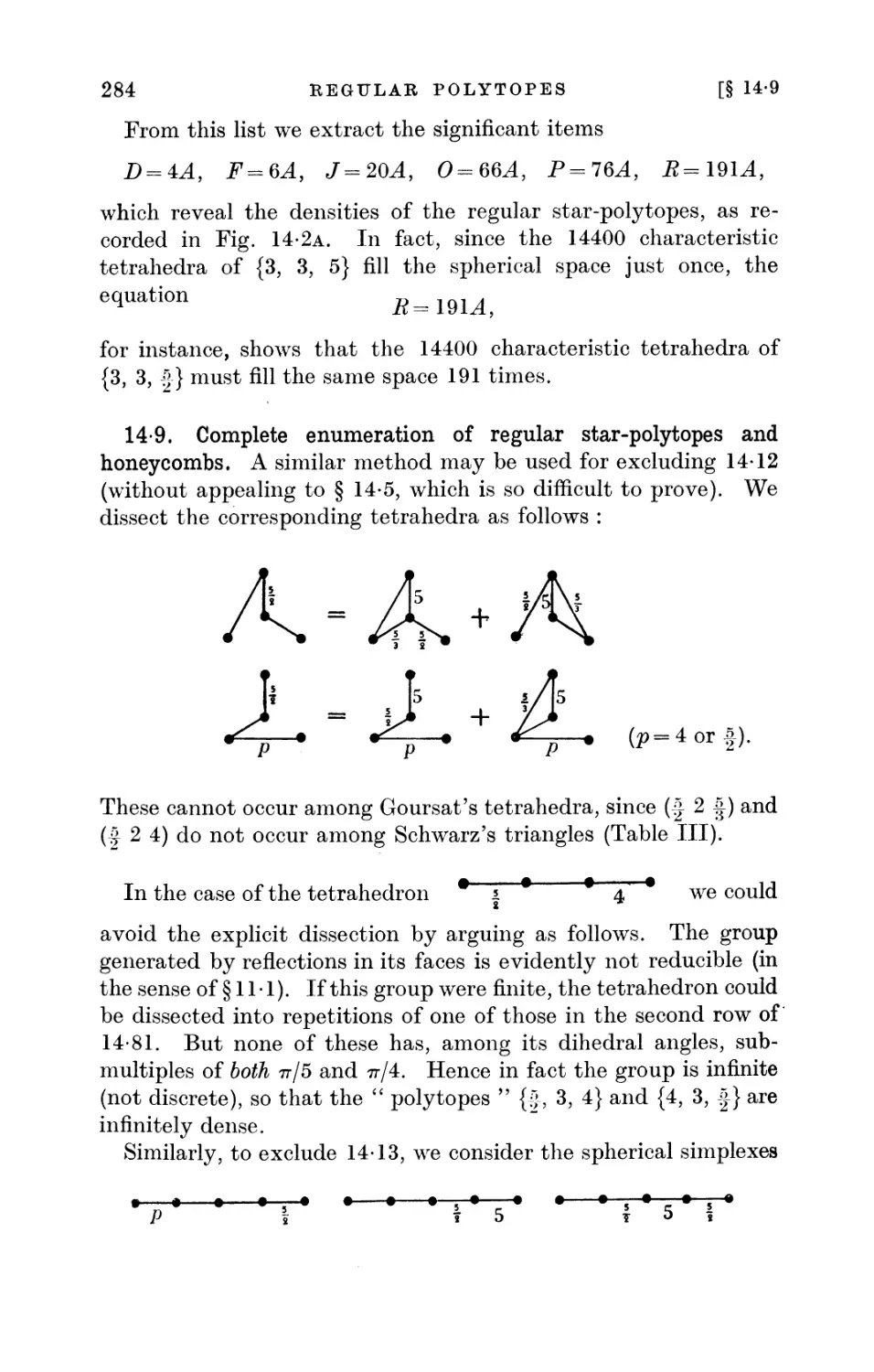
The four-dimensional polytope {3, 3,5},drawn by van Oss
(cf. Fig. 13·6B on page 250).
First published in 1948
CATALOGUE NO. 3960/U
THIS BOOK IS PRODUCED IN
COMPLETE CONFORMITY WITH THE
AUTHORIZEDECONOMY STANDARDS
PRINTED IN GREAT BRITAIN
Td
MY WIFE
PREFACE
A POLYTOPE is a geometrical figure bounded by portions of lines,
planes, or hyperplanes;e.g.,in two dimensions it is a polygon, in
three a polyhedron. The word polytope seems to have been coined
by Hoppe in 1882,and introduced into English by Mrs.Stott
about twenty years later.But the concept, under the name
polyscheme, goes·back to Schlafli,who completed his great mono-
graph in 1852.
The foundations for our subject were laid by the Greeks over
two thousand years ago.In fact,this book might have been
subtitled“A sequel to Euclid's Elements”.But all the more
elaborate developments (roughly, from Chapter V on)are less
than a century old.This revival of interest was partly due to
the discovery that many polyhedra (including three of the regular
ones) occur in nature as crystals.However, there is a law of
symmetry(4.32) which prohibits the inanimate occurrence of any
pentagonal figure,such as the regular dodecahedron.Thus the
chief reason for studying regular polyhedra is still the same as
in the time of the Pythagoreans,namely, that their symmetrical
shapes appeal to one's artistic sense.(To be sure,there is a little
more to it than that:Klein's Lectures on the Icosahedron* cast
fresh light on the general quintic equation.But if Klein had not
been an artist he might have expressed his results in purely
algebraic terms·)
As for the analogous figures in four or more dimensions,we
can never fully comprehend them by direct observation.In
attempting to do so,however, we seem to peep through a chink
in the wall of our physical limitations,into a new world of dazzling
beauty. Such an escape from the turbulence of ordinary life will
perhaps help to keep us sane.On the other hand,a reader tivhoce
standpoint is more severely practical may take comfort in
Lobatschewsky's assertion that“there is no branch of mathe-
*Listed as“Klein 1”in the Bibliography on pages 306-314.
IX
2 03- 66
X
REGULARrOLYTOPES
matics, however abstract, which may not some day be applied
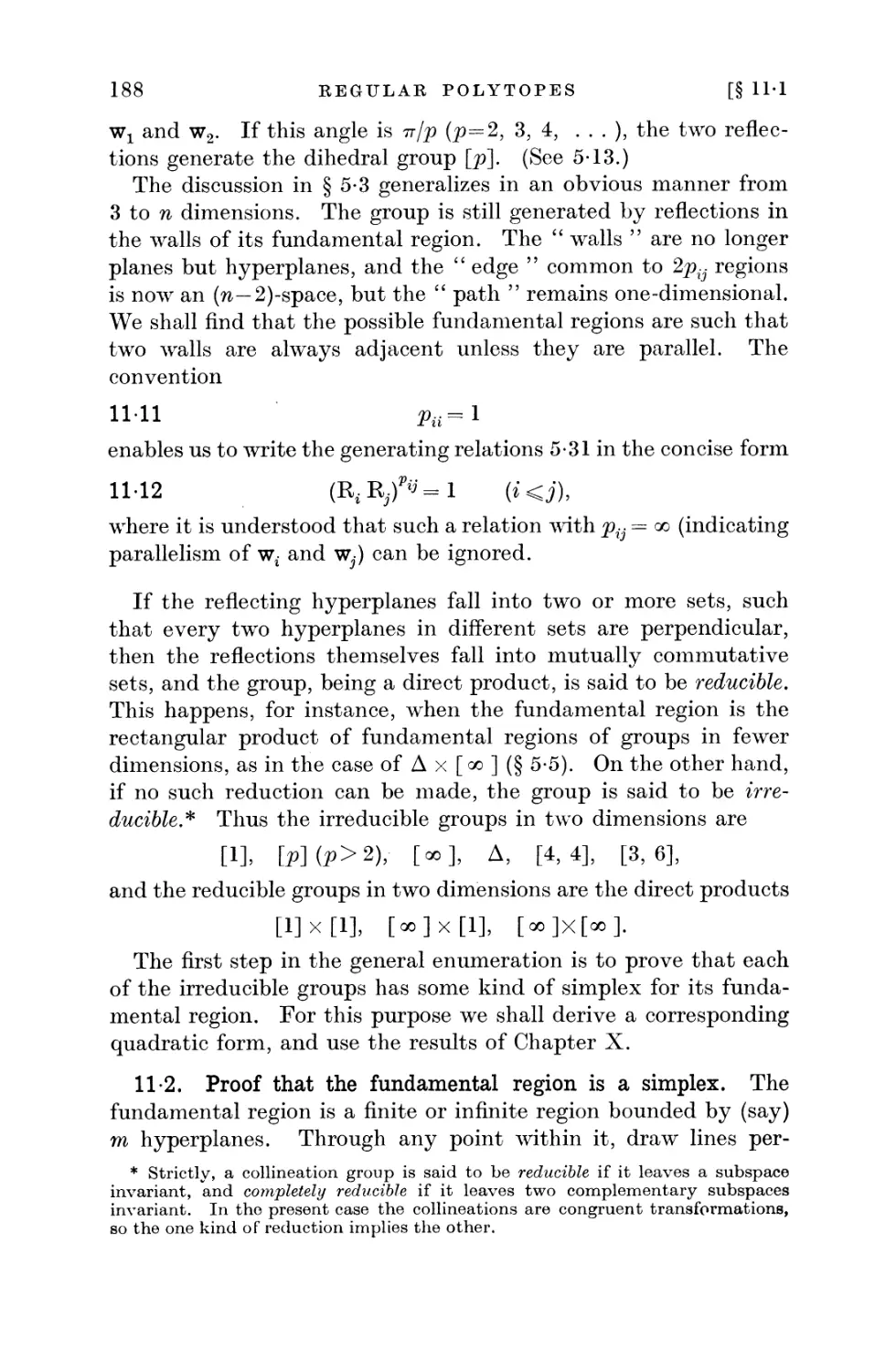
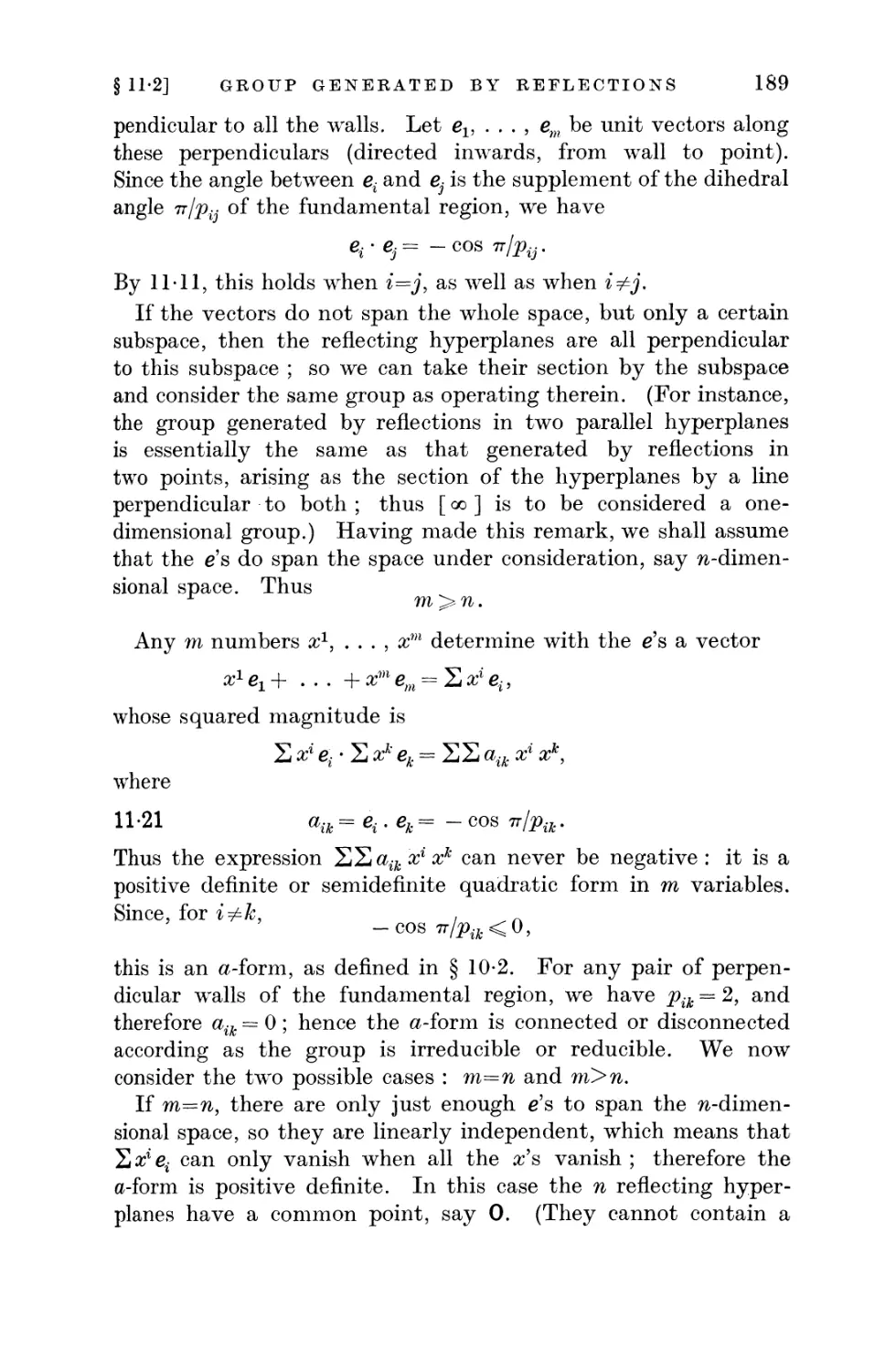
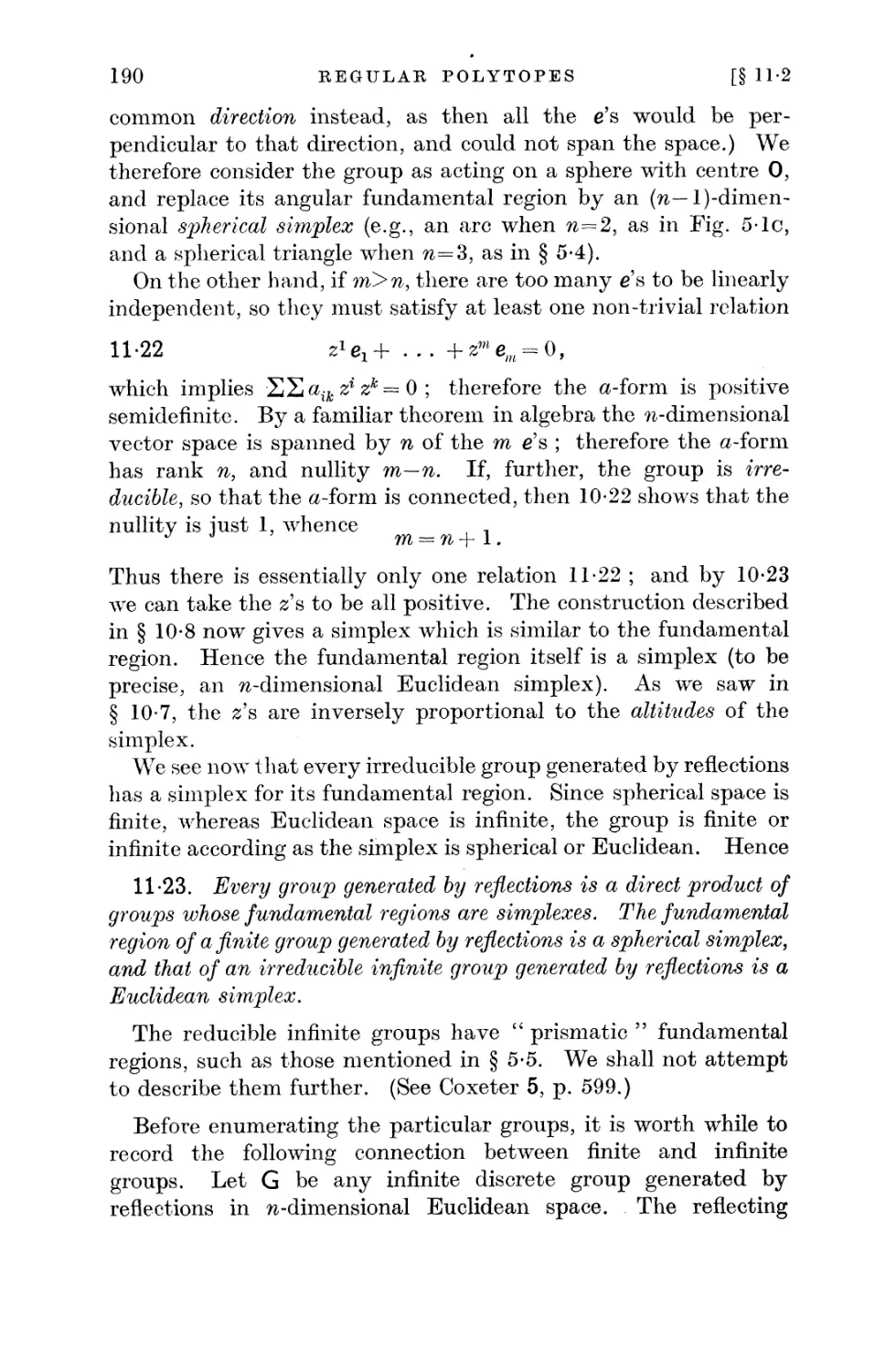
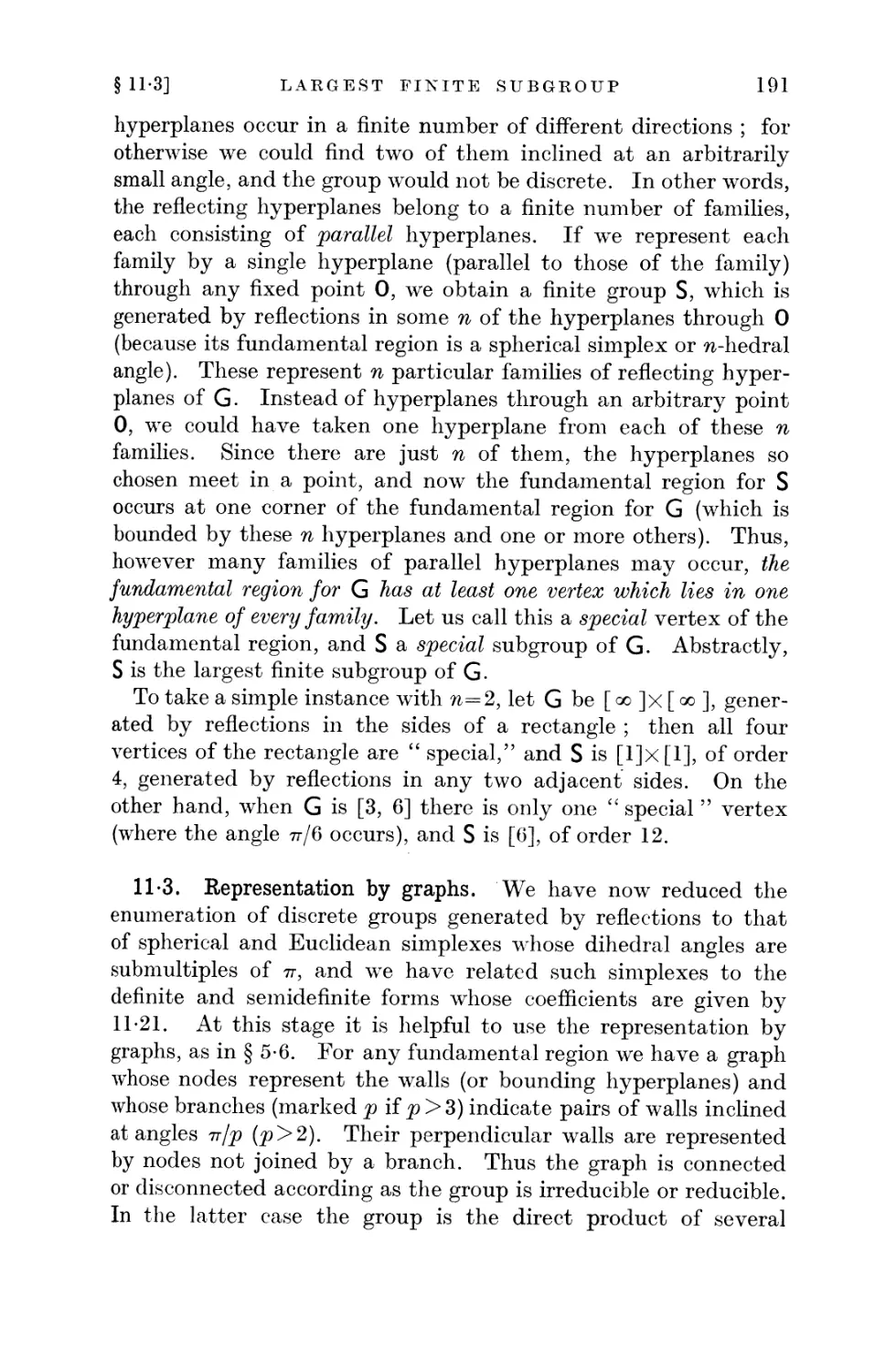
to phenomena of the real world”.
I have tried to make this book as nearly self-contained as is
reasonably possible。Anyone familiar with elementary algebra,
geometry, and trigonometry will be able to appreciate it,and may
find in it some fresh applications of those subjects;e.9-,Chapter
III provides an introduction to the theory of Groups.All the
geometry of the first six chapters is ordinary solid geometry;
but the topics treated have been carefully selected as forming
a useful background for the subsequent developments.If the
reader is at x:11 distressed by the multi一dimensional character of
the rest of the book, he will do well to consultManning's Geometry
I fo二r dimensions or Sommerville's Geometry of、dimensions
(i.e。,Manning 1 or Sommerville 3).
It will be seen that most of our chapters end with historical
summaries,showing which parts of the subject are already known.
The history of polytope一theory provides an instance of the
essential unity of our western civilization, and the consequent
absurdity of international strife.The Bibliography lists the
names of thirty German mathematicians, twenty一seven British,
twelve American, eleven French, seven Dutch,eight Swiss,four
Italian,two Austrian,two Hungarian,two Polish,two Russian,
one NorN、一egian,one Danish,and one Belgian.(In proportion
to population the S-\`-iss have contributed more than any other
nation.)
This book grew out of an essay on“Dimensional Analogy”,
begun in February 1923.It is thus the fulfilment of 24 years’
work,which included the rediscovery of Schld,fli's regular poly-
topes (Chapters VII and VIII),Hess's star-polytopes (Chapter
XIV) a·nd Gosset's semi-regular polytopes ('' 8·4 and 11·8).
Probably my own best contribution is the invention of the
“graph l c al”notation(' 5·6),Which facilitates the enumeration
of groups generated by reflections (' 11·5), of the polytopes
derived from these groups by Wythoff's construction(号11·6),
of the elements of any such polytope(号11·8),and of“Goursat's
tetrahedra”(号14·8).This last instance, which looks like some
PREFACE
x1
bizarre notation for the Music of the Spheres,is essentially a
device for computing the volumes of certain spherical tetrahedra
without having recourse to the calculus.The same notation can
be applied very effectively to the theory of regular honeycombs
in hyperbolic space (see Schlegel 1,pp.360, 444, or Sommerville 3,
Chapter X),but I have resisted the temptation to add a fifteenth
chapter on that subject.
In some places,such as '号8·2一8·5, I have chosen to employ
synthetic methods where t·he use of coordinatos might have made
the work a little’ easier.On the other hand,I have not hesitated
to use coordinates in Chapter XI,where they greatly simplify
the discussion,and in Chapter XII, where they seem to be quite
indispensable一
Many of the technical terms may be new to the reader, who
will be apt to forget what they mean.For this reason the Index
(pages 315一321)refers to definitions by means of page一numbers
in boldface type.Every reader will find some parts of the book
more palatable than others, but different readers will prefer
different parts:one man's meat is another man's poison.Chapter
XI is likely to be found harder than the subsequent chapters.
I offer most cordial thanks to Thorold Gosset,Leopold Infeld
and G.de B.Robinson for reading the whole manuscript a,nd
making many valuable suggestions.I am gratOeful also to Richard
Brauer, J. J. Burckhardt,J.D.H.Donnay, J. C.P.Miller,
E.H.Neville and Hermann Weyl for criticizing various portions,
to Mrs.E.L.Voynich for biographical material about her sister,
Mrs.Stott(' 13·9),to Dorman Luke for the gift of his models of
polyhedra(二:hich aided me in drawing some of t,he figures,e.g.
in '6·4),to P.S.Doncliian for the eight Plates,to H·G·Forder
and Alan Robson for help in reading the proofs,and to Messrs.
T.&A. Constable of Edinburgh for their expert printing of
difficult material.
H.5.M.COXETER
UNIVERSITY
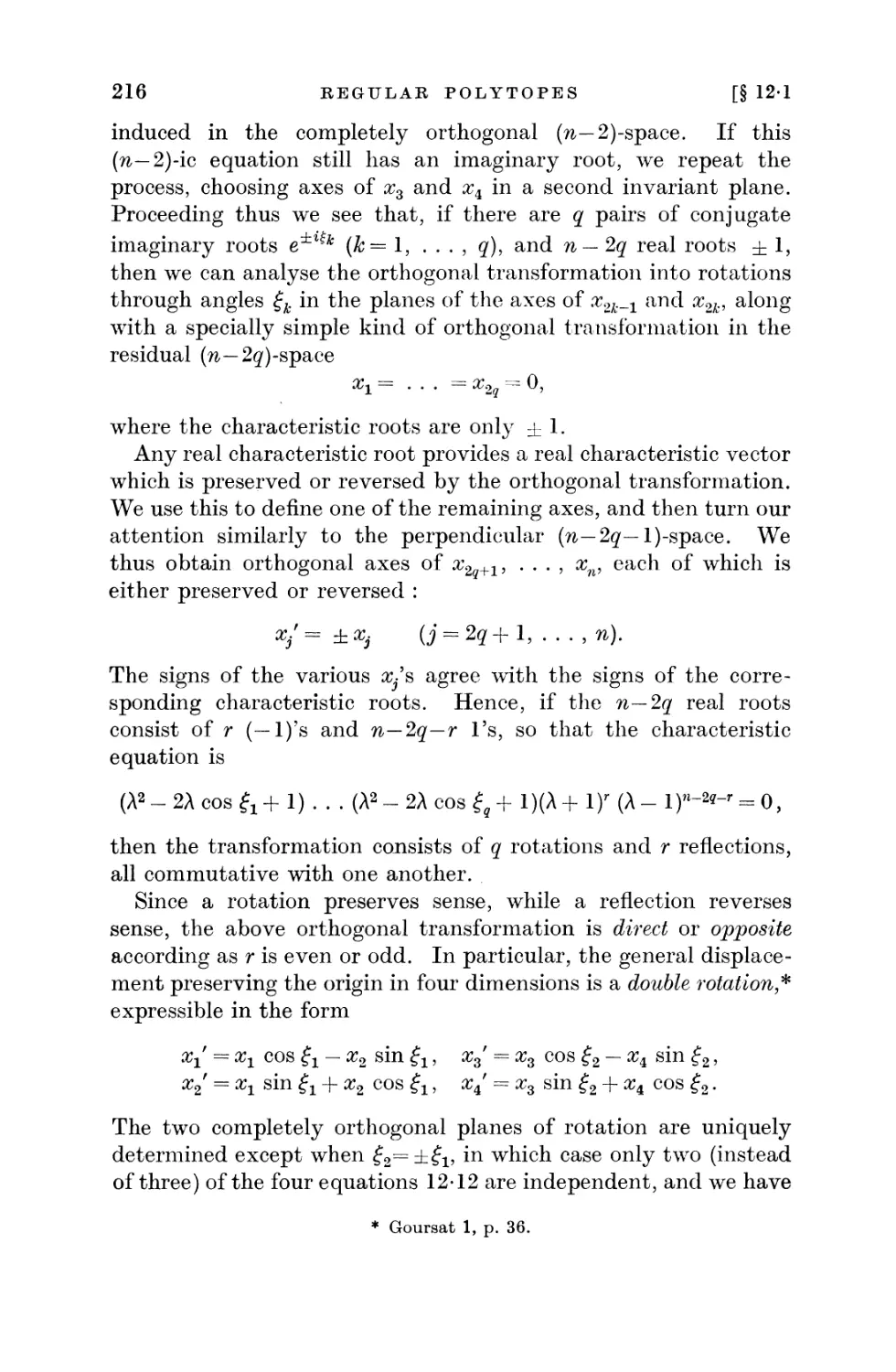
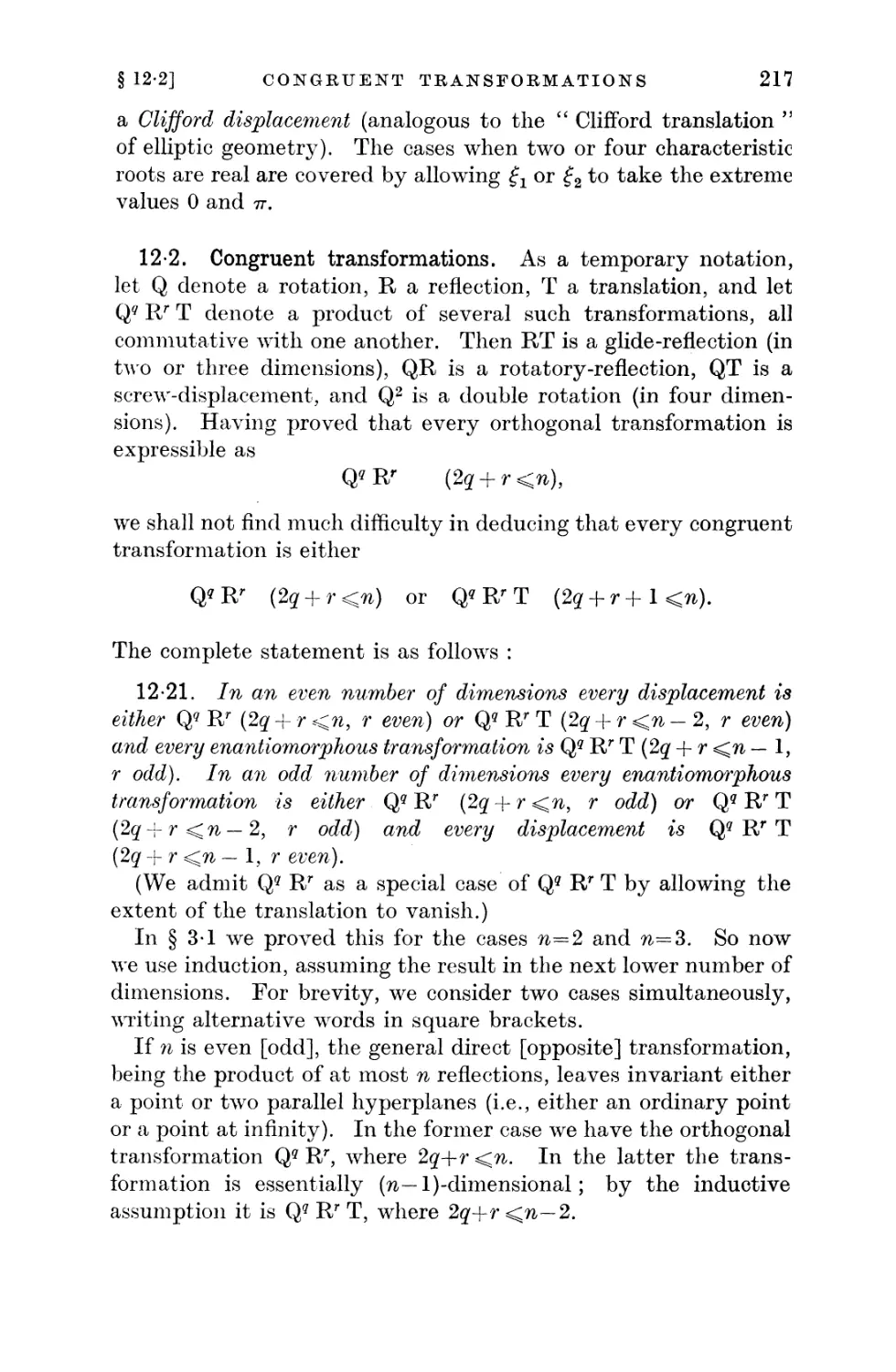
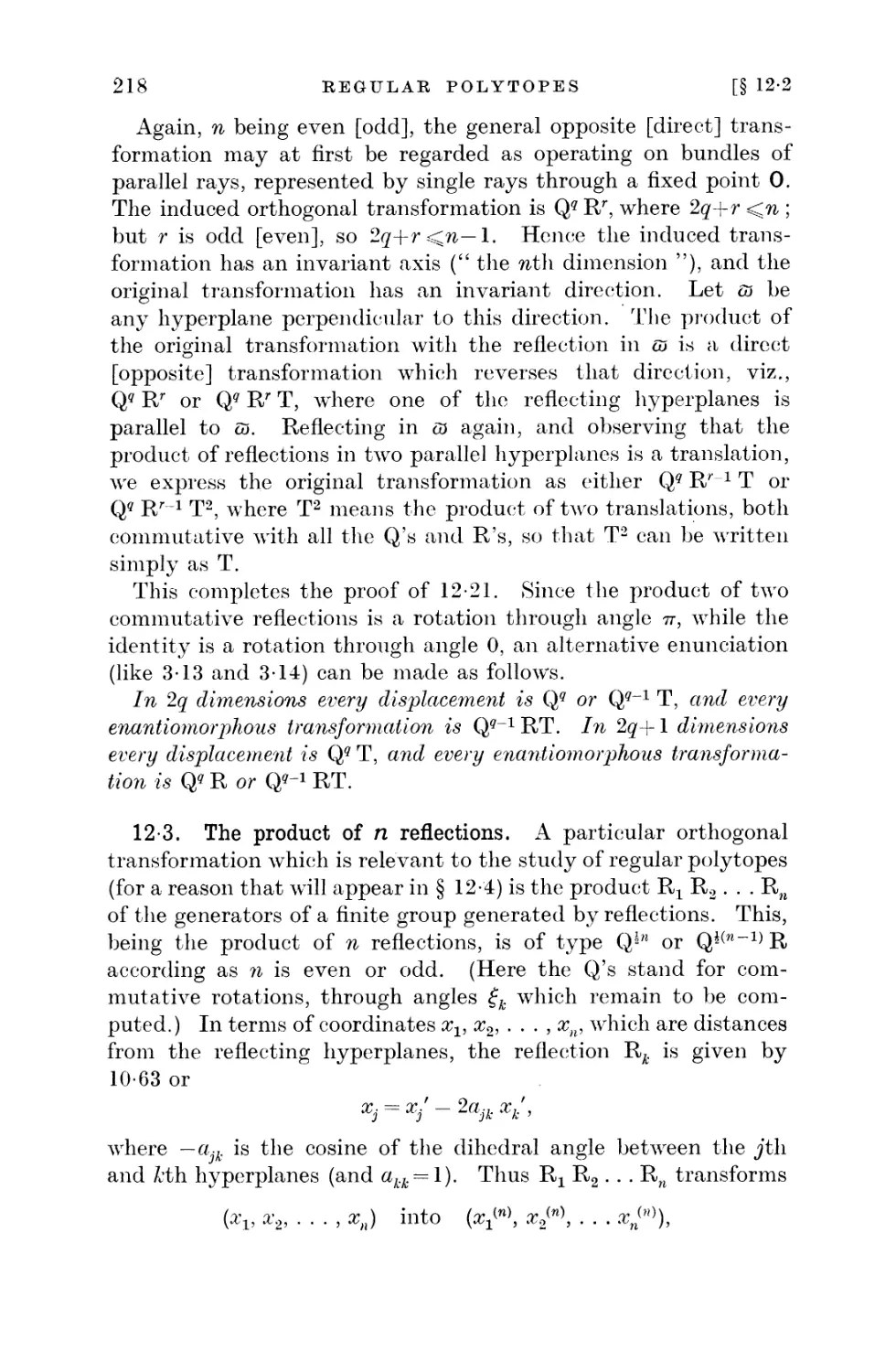
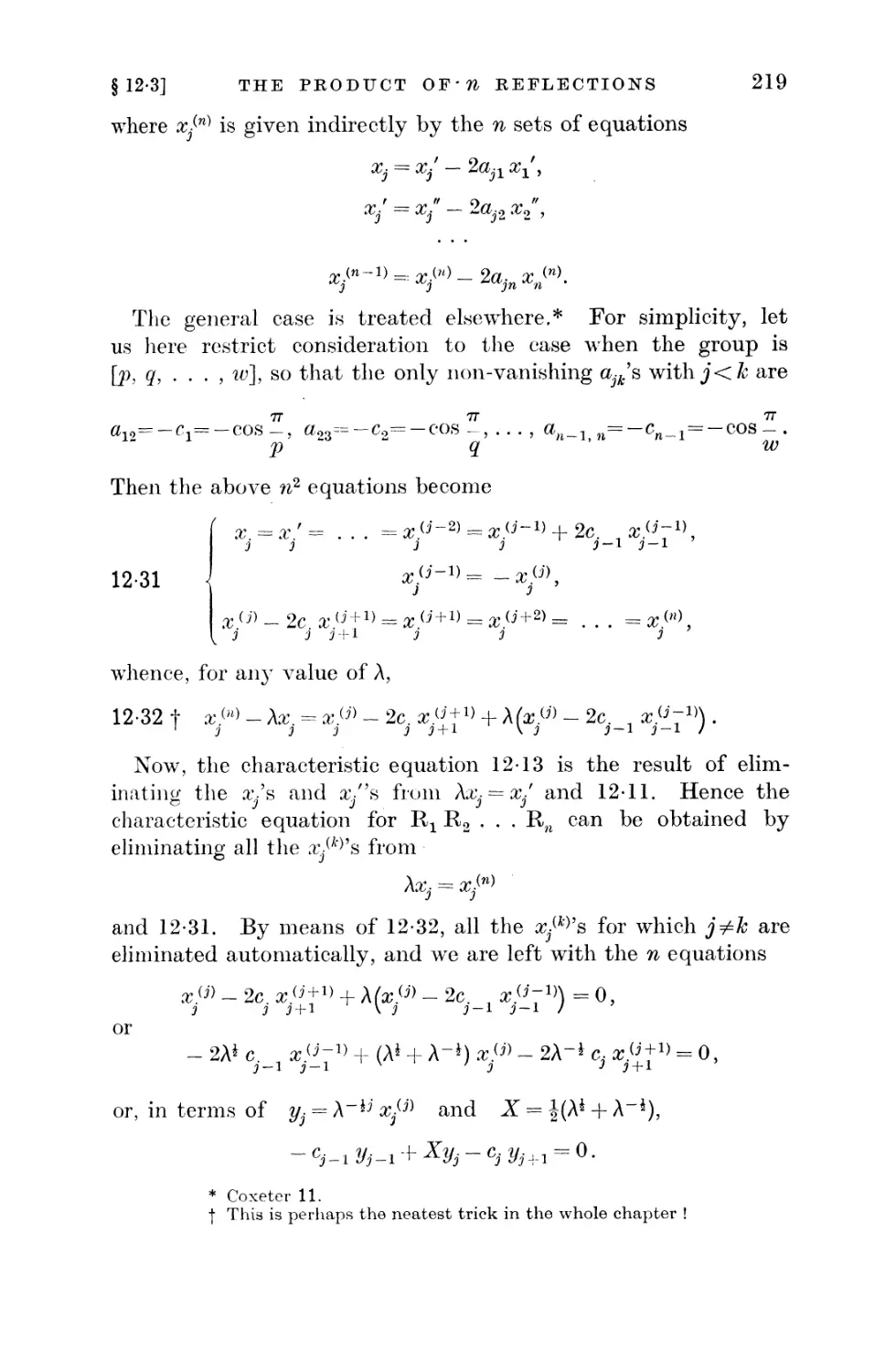
Apri
OF TORONTO
1947
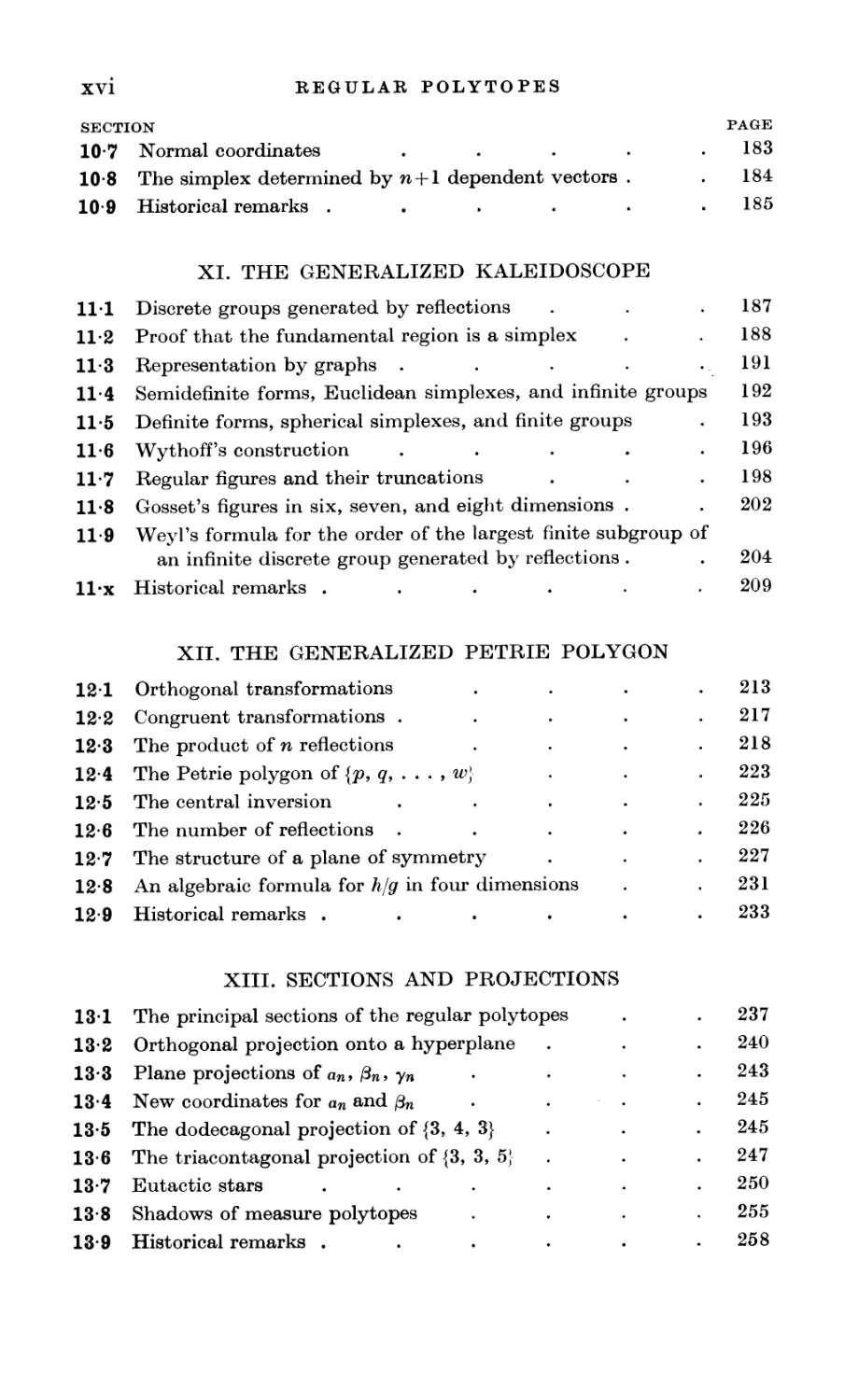
CONTENTS
I.POLYGONS AND POLYHEDRA
SECTION
1.1 Regular polygons
1.2 Polyhedra
1.3 The five Platonic Solids
1.4 Graphs and maps
1.5“A voyage round the world”
1.6 Euler's Formula
1.7 Regular maps
1.8 Configurations
1.9 Historical remarks
PAGE
1
45689111占ZnJ
-.书,.占1.︷
II.REGULAR ANDQUASI一REGULAR SOLIDS
5两了弓.onj41匀︻了0
IJL工.1.且IJL222223
2.1
2.2
2.3
2.4
2.5
2.6
2.7
2.8
2.9
Regular polyhedra
Reciprocation
Quasi一regular polyhedra
Radii and angles
Descartes' Formula.
Petrie polygons
The rhombic dodecahedron and triacontahedron
Zonohedra
Historical remarks
III.ROTATION GROUPS
nJS,..JL46工了
nJ34444
3.1
3.2
3.3
3.4
3.5
3.6
3.7
035
555
8.8
8.9
Congruent transformations.
Transformations in general
Groups
Symmetry operations
The polyhedral groups
The five regular compounds
Coordinates for the vertices of the regular and quasi-regular
solids
The complete enumeration of finite rotation groups·
Historical remarks
x111
REGULARrOLYTOrES
IV. TESSELLATIONS AND HONEYCOMBS
SECTION
4.1 The three regular tessellations
4.2 The quasi一regular and rhombic tessellations
4.3 Rotation groups in two dimensions·
4.4 Coordinates for the vertices
4.5 Lines of symmetry
4.6 Space filled with cubes
4·7 Other honeycombs
r.·8 Proportional numbers of elements
4.9 Historical remarks
PAGE
58
59
62
63
64
68
69
72
73
V. THE KALEIDOSCOPE
589,.1246802
门了片才阿了88QnOO890tj
5·1 Reflections in one or two planes, or lines, or points.
5·2 Reflections in three or four lines
5·3 The fundamental region and generating relations
5·4 Reflections in three concurrent planes
5·5 Reflections in four, five, or six planes
5·6 Representation by graphs
5·7 Wythoff's construction
5·8 Pappus's observation concerning reciprocal regular polyhedra
!+·9 The Petrie polygon and central symmetry
5·x Historical remarks
VI.STAR一POLYHEDRA
Star一polygons
Stellating the Platonic solids
Facetmg the Platonic solids
The general regular polyhedron
A digression on Riemann surfaces
Isomorphism
Are there only nine regular polyhedra?
Schwarz's triangles.
Historical remarks
93
96
98
100
104
105
107
112
114
VII.ORDINARY POLYTOPES IN HIGHER SPACE
Dimensional analogy
Pyramids, dipyramids, and prisms.
CONTENTS
XV
$ECTION
7.3 The general sphere
7.4 Polytopes and honeycombs
7.5 Regularity
7.6 The symmetry group of the general regular polytope
7.7 Schlafli's criterion
7.8 The enumeration of possible regular figures.
7.9 The characteristic simplex
7.x Historical remarks
PAGE
125
126
128
130
133
136
137
141
VIII.TRUNCATION
8.1
8·2
8.8
8.砚
8.5
8.6
8.7
8.8
8.9
The simple truncations of the general regular polytope
Ceshro's construction for {3, 4, 31
Coherent indexing
The snub f3, 4, 3}
Gosset's construction for {3,3,。}
Partial truncation, or alternation
Cartesian coordinates
Metrical properties.
Historical remarks
145
148
150
151
153
154
156
158
162
IX. POINCARE'S PROOF OF EULER'S FORMULA
9.1
9.2
9.3
9.4
9.5
9.6
9.7
9.8
9.9
Euler's Formula as generalized by Schlafli
Incidence matrices
The algebra of k一chains
Linear dependence and rank
The k-circuits
The bounding k一circuits
The condition for simple一connectivity
The analogous formula for a honeycomb
Polytopes which do not satis勿Euler's Formula
165
166
167
169
170
170
171
171
172
X. FORMS, VECTORS, AND COORDINATES
Real quadratic forms
Forms with non一positive product terms
A criterion for semidefiniteness
Covariant and contravariant bases for a vector space
Affine coordinates and reciprocal lattices
The general reflection
173
175
177
178
180
182
,几0习00心自甘000
八UnU八U八U八甘八甘
口二,几1占1山,几‘.‘
XV1
RE (1ULARPOLYTOPES
SECTION
10.7 Normal coordinates
10.8 The simplex determined by”+1 dependent vectors
10·9 Historical remarks
PAGE
183
184
185
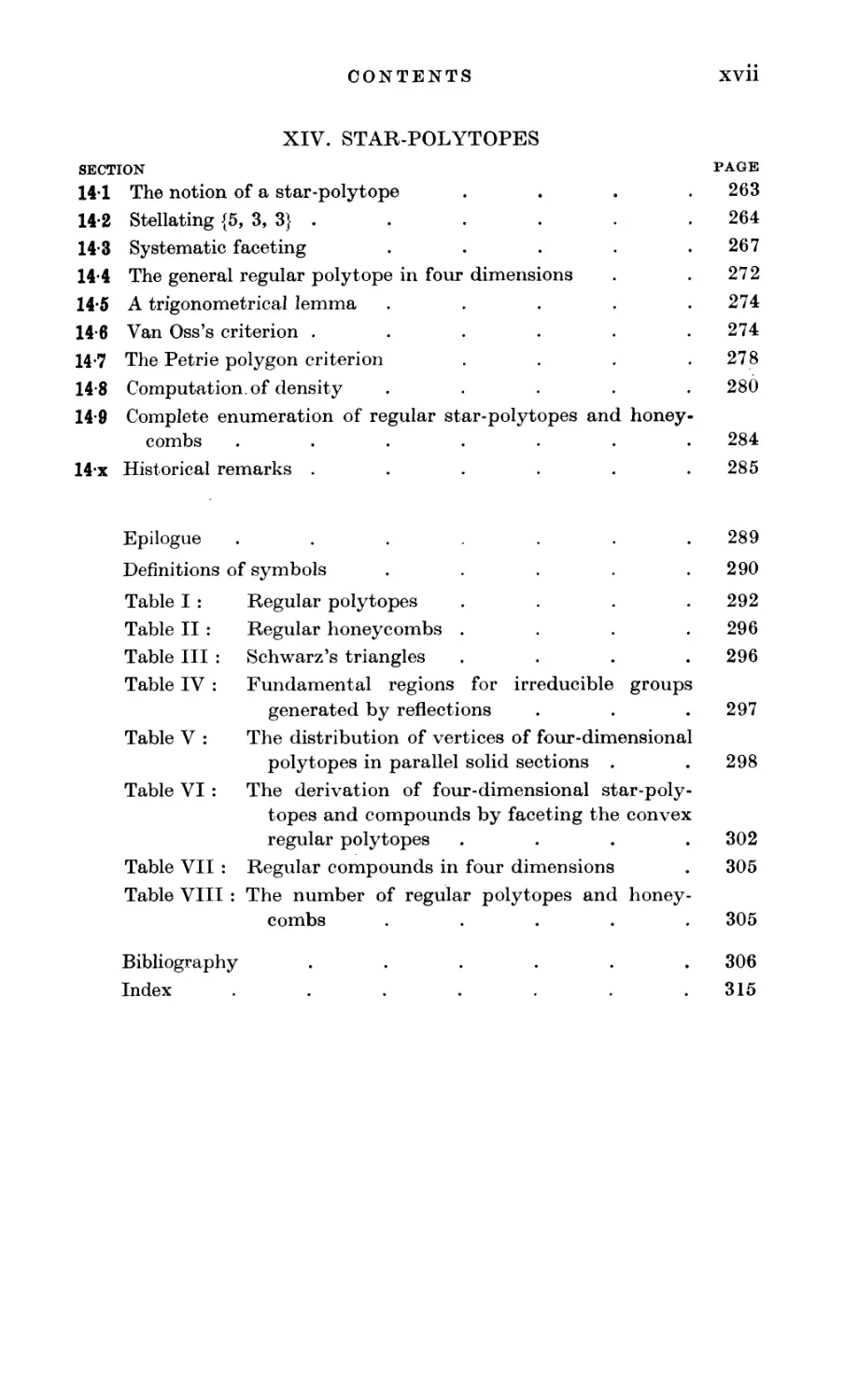
XI.THE GENERALIZED KALEIDOSCOPE
11·1 Discrete groups generated by reflections
11·2 Proof that the fundamental region is a simplex
11·3 Representation by graphs
11·4 Semidefinite forms, Euclidean simplexes, and infinite groups
11·5 Definite forms, spherical simplexes, and finite groups
11·6 Wythoff's construction
11·7 Regular figures and their truncations
11·8 Gosset's figures in six, seven, and eight dimensions.
11·9 Weyl's formula for the order of the largest finite subgroup of
an infinite discrete group generated by reflections.
11-x Historical remarks
187
188
191
192
193
196
198
202
204
209
XII.THE GENERALIZED PETRIE POLYGON
Orthogonal transformations
Congruent transformations.
The product of”reflections
The Petrie polygon of JP, q,·一‘{
The central inversion
The number of reflections
The structure of a plane of symmetry
An algebraic formula for h/g in four dimensions
Historical remarks
213
217
218
223
225
226
227
231
233
1占0习34甘O678Qtl
20习20曰0月0习0习22
.上.上,几11‘.上1占1人峨上1占
XIII.SECTIONS AND PROJECTIONS
The principal sections of the regular polytopes
Orthogonal projection onto a hyperplane
Plane projections of an,13n,yn
New coordinates for a,, and 13n
The dodecagonal projection of {3, 4, 3}
The triacontagonal projection of {3, 3, 5
Eutactic stars
Shadows of measure polytopes
Historical remarks
237
240
243
245
245
247
250
255
258
‘上2345几0附‘sno
:0……
8383n03383
,上1占,二1占.上1占1占.上1自
CONTENTS
XVll
XIV. STAR一POLYTOPES
SECTION PAGE
14.1 The notion of a star-polytope.…263
14.2 Stellating i5, 3, 3}……264
14.3 Systematic faceting..…267
14.4 The general regular polytope in four dimensions二272
14.5 A trigonometrical lemma..…274
14.6 Van Oss's criterion……274
14.7 The Petrie polygon criterion.…278
14.8 Computation. of density..…280
14.9 Complete enumeration of regular star一polytopes and honey-
combs.……284
14-x Historical remarks……285
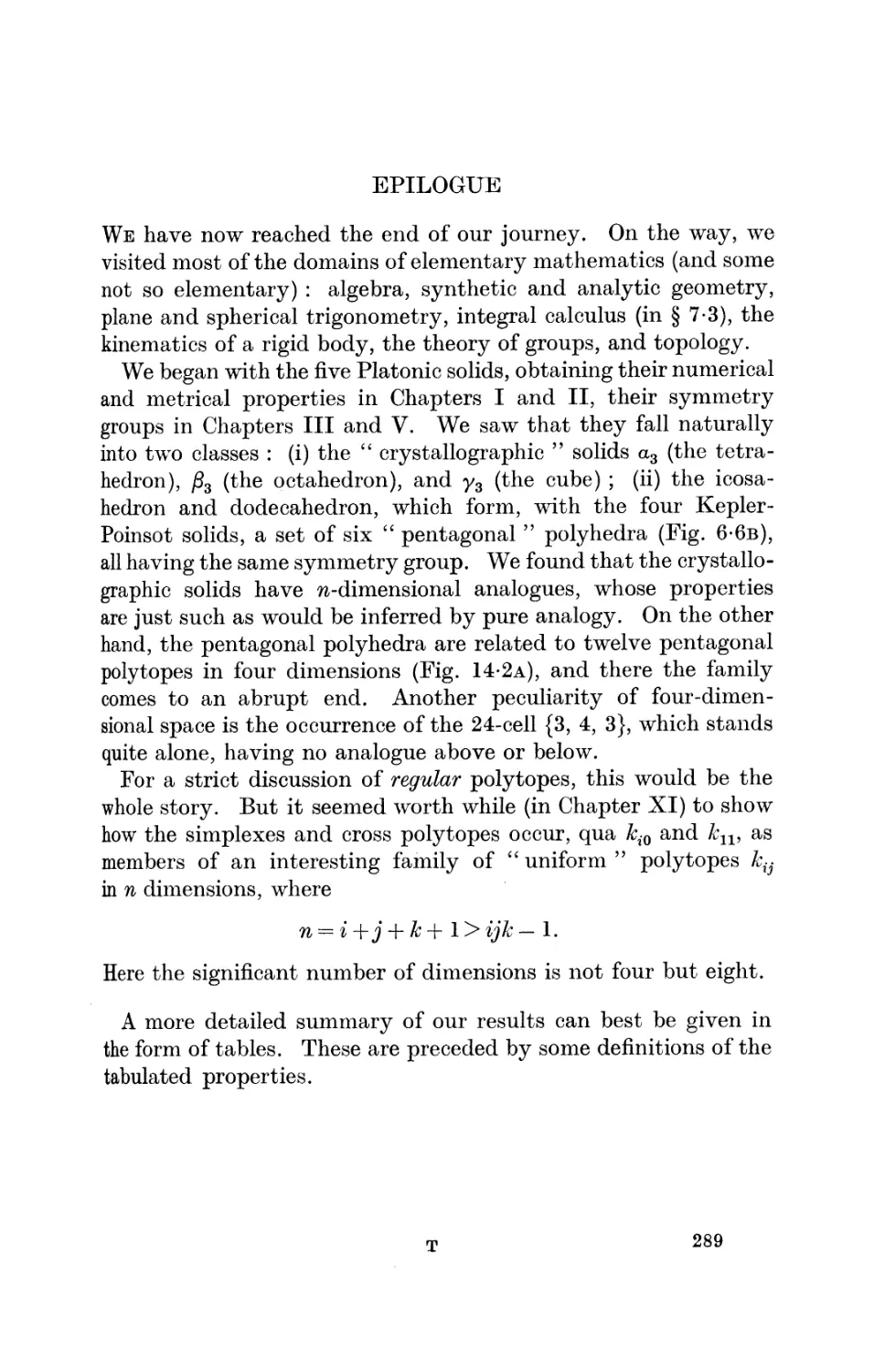
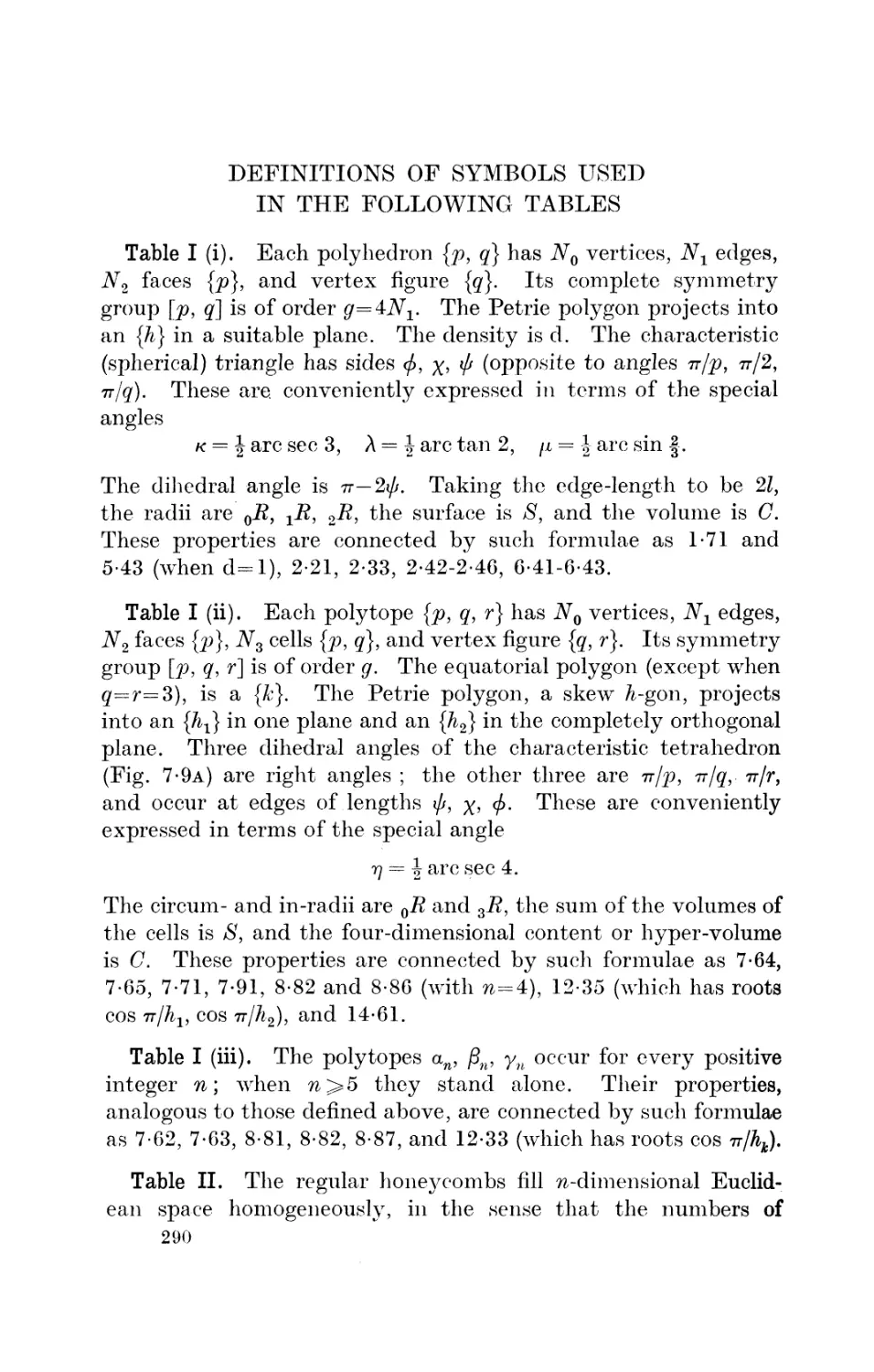
Epilogue.……289
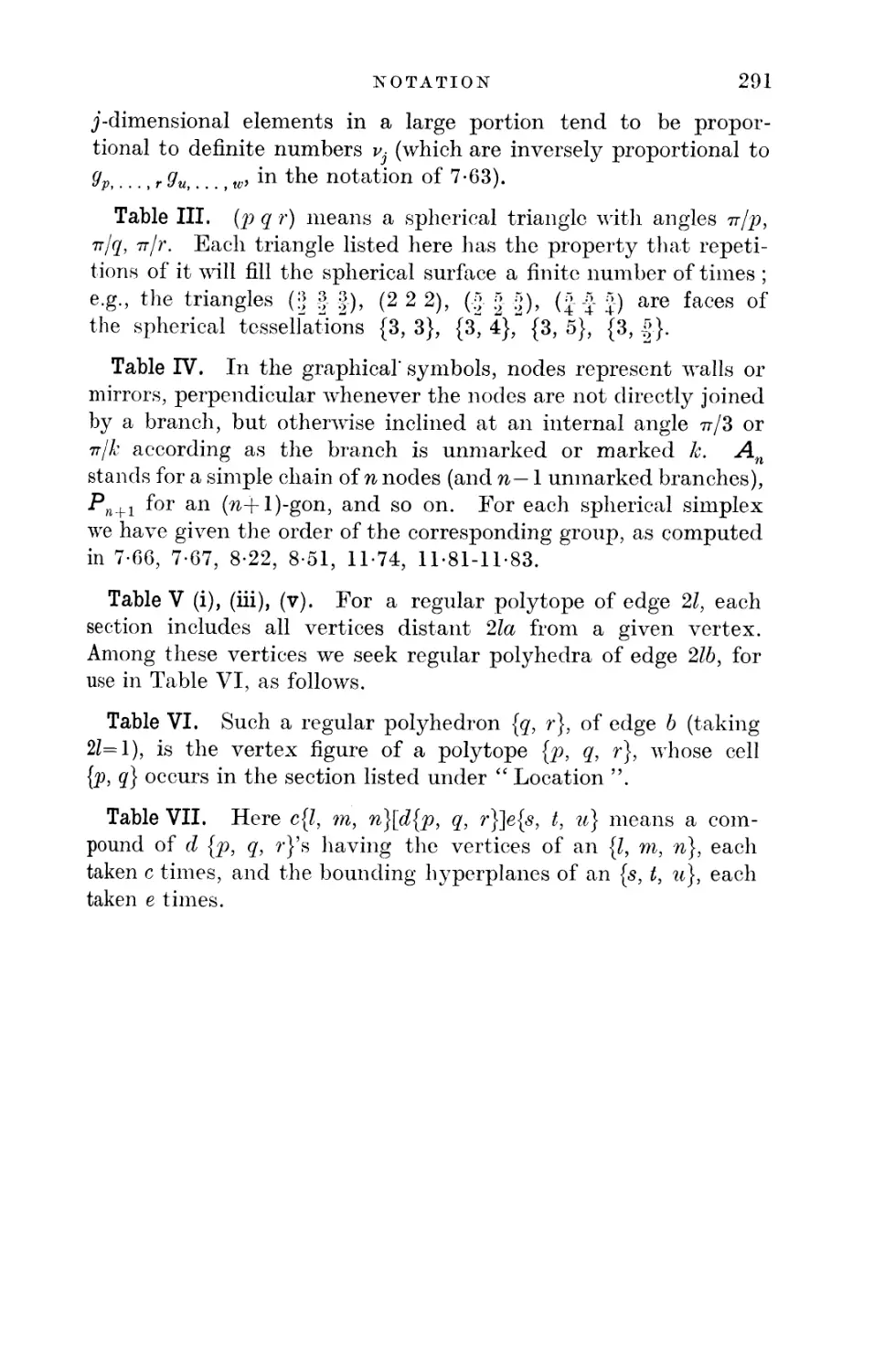
Definitions of symbols..…290
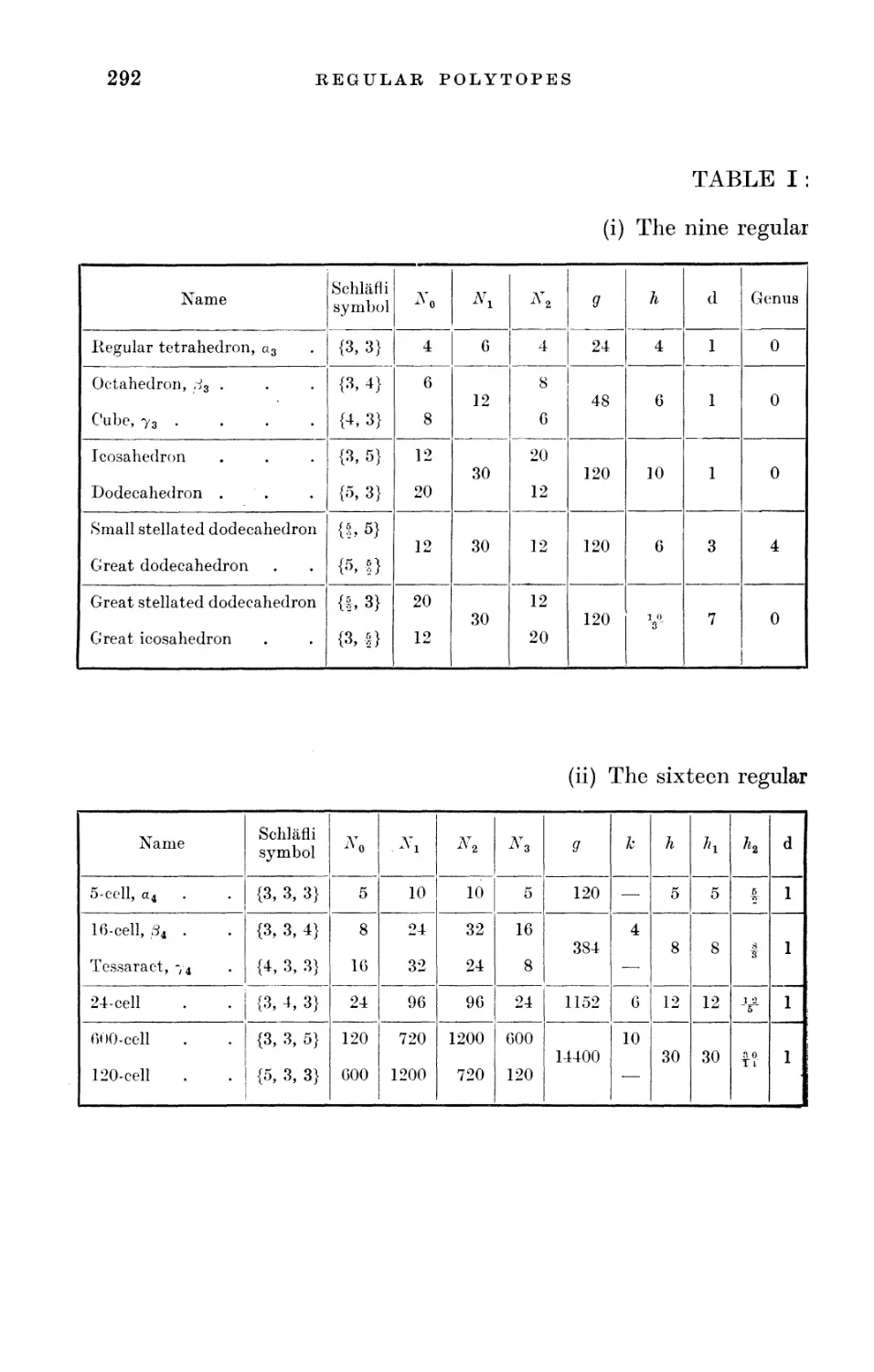
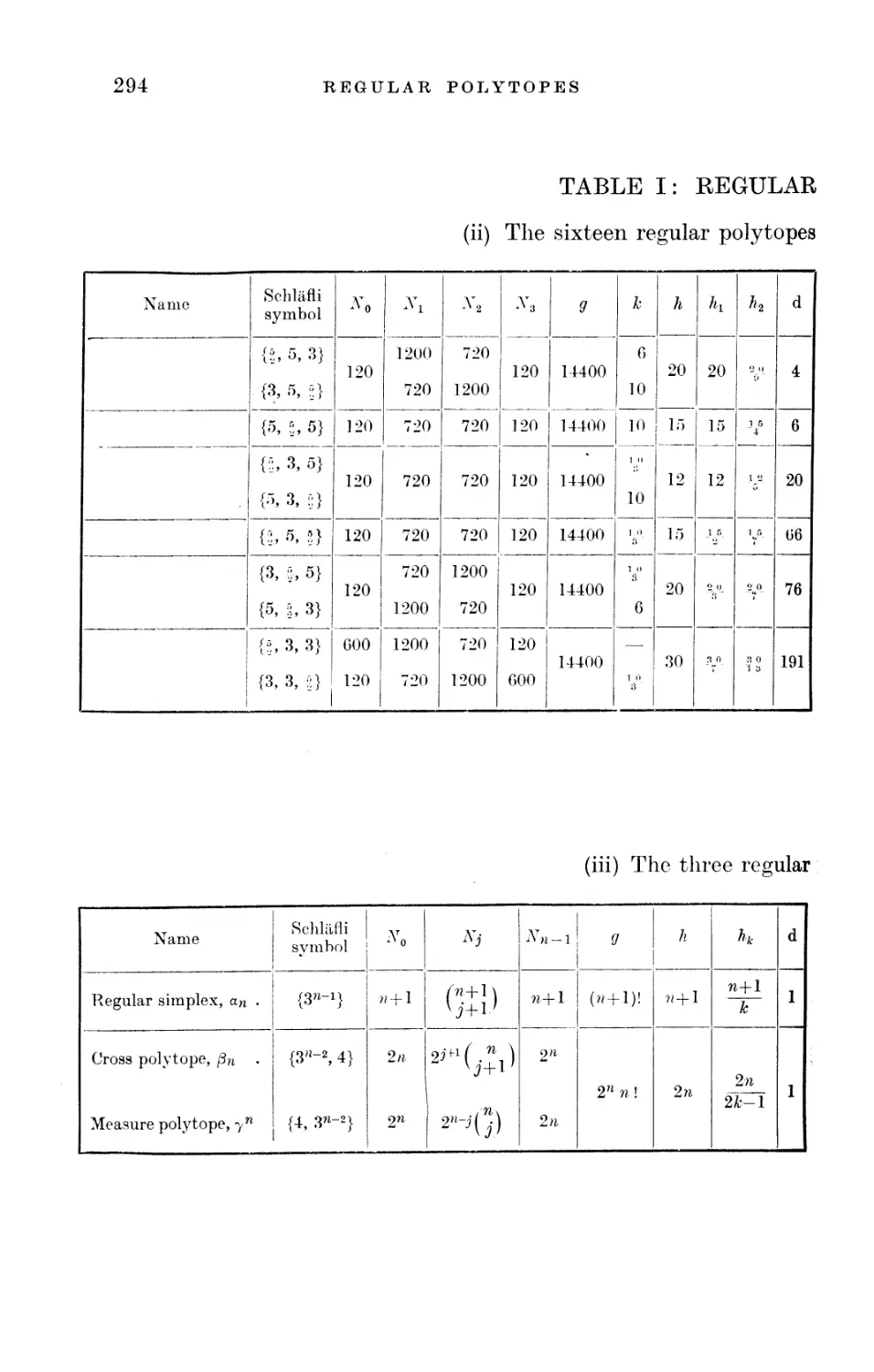
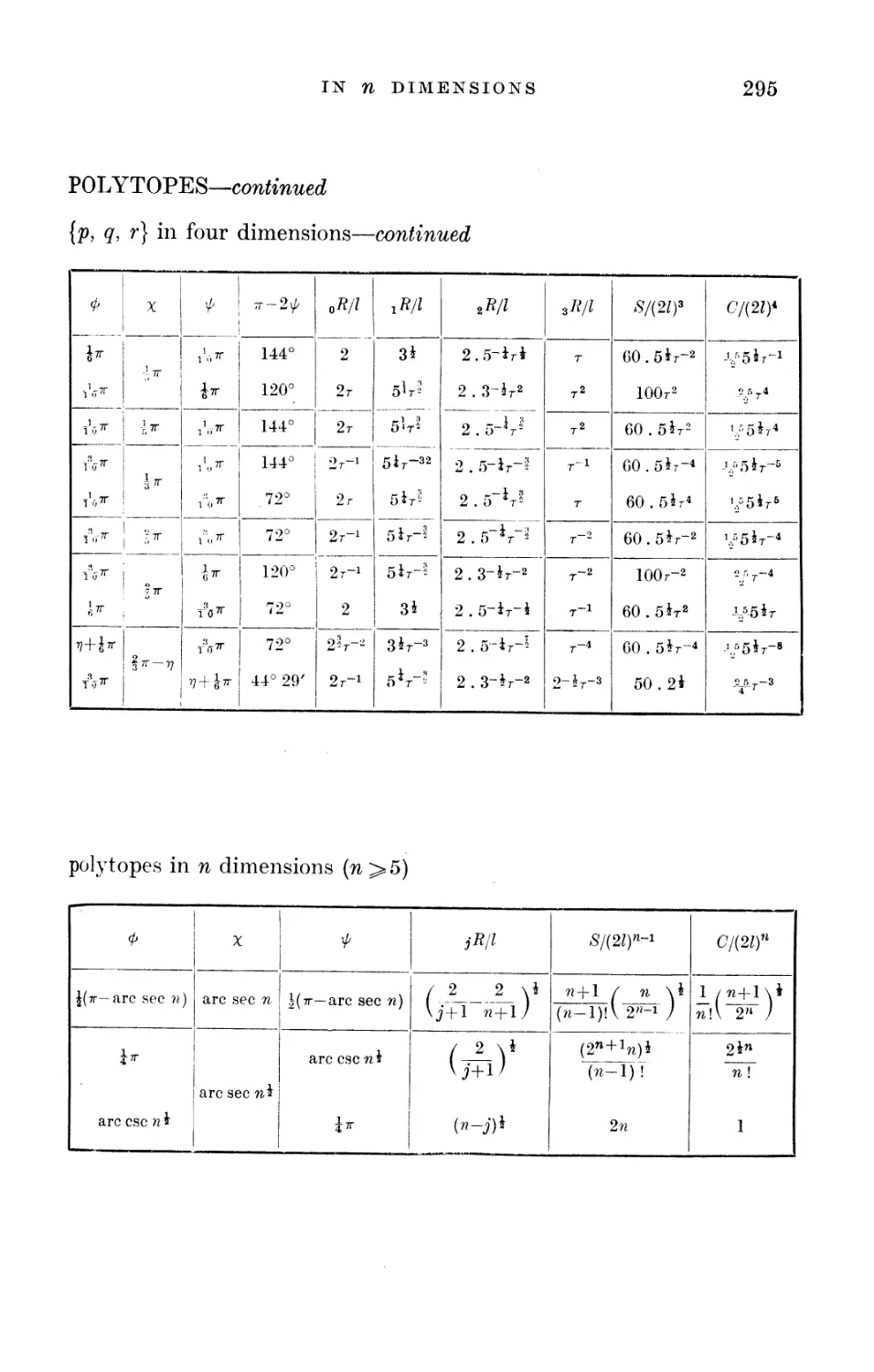
Table I:Regular polytopes.…292
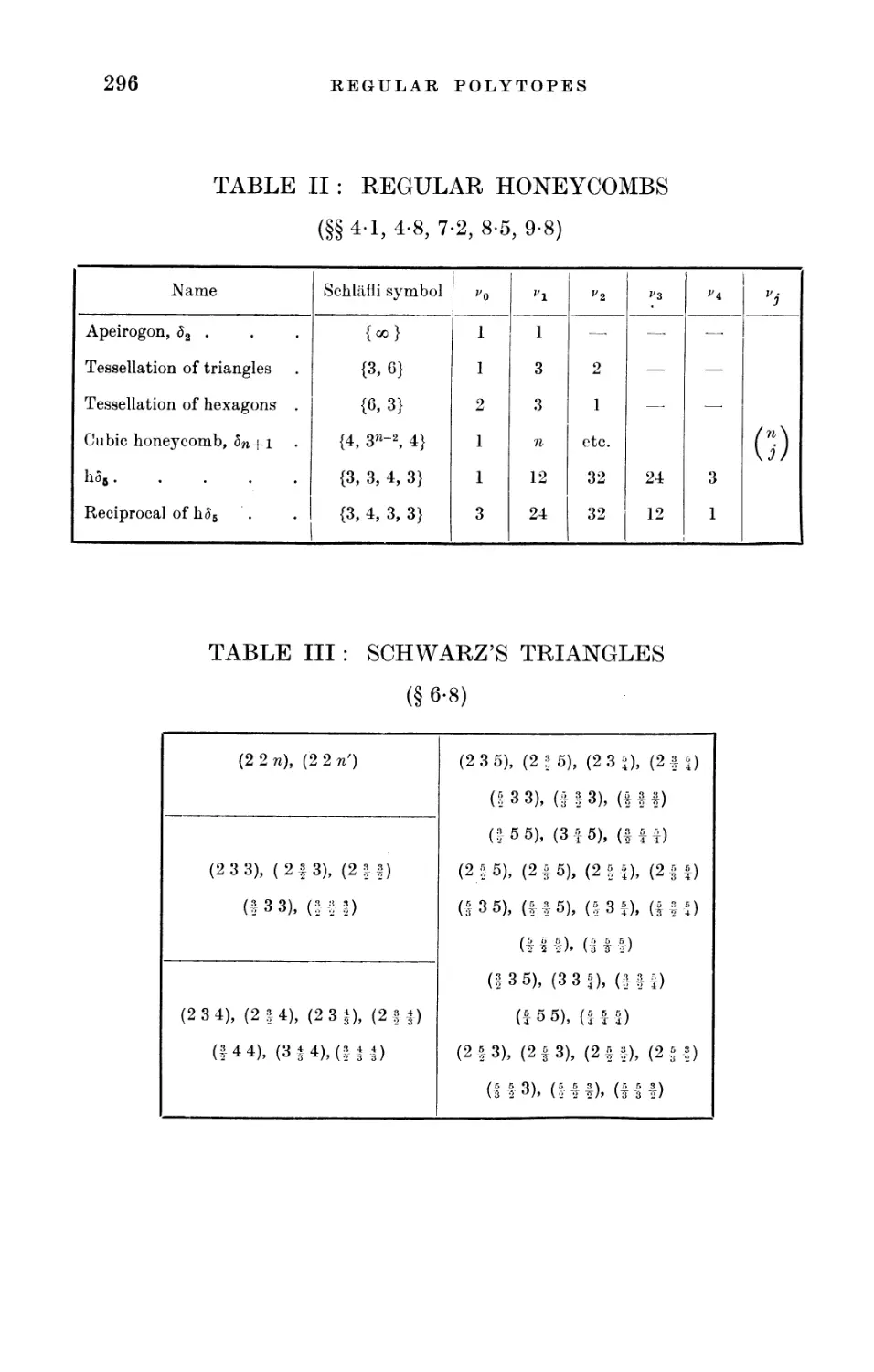
Table II:Regular honeycombs.…296
Table III:Schwarz's triangles.…296
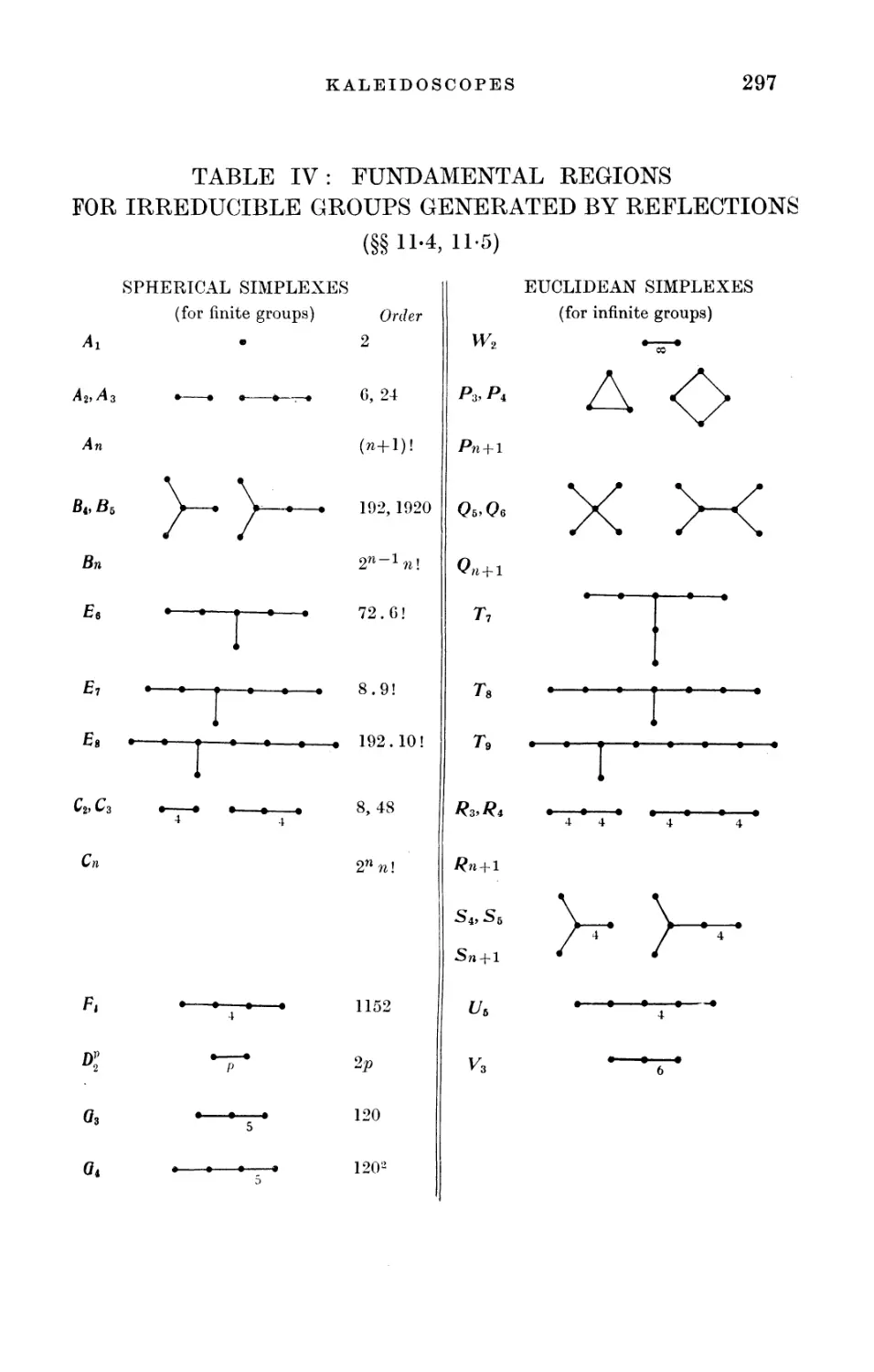
Table IV:Fundamental regions for irreducible groups
generated by reflections…297
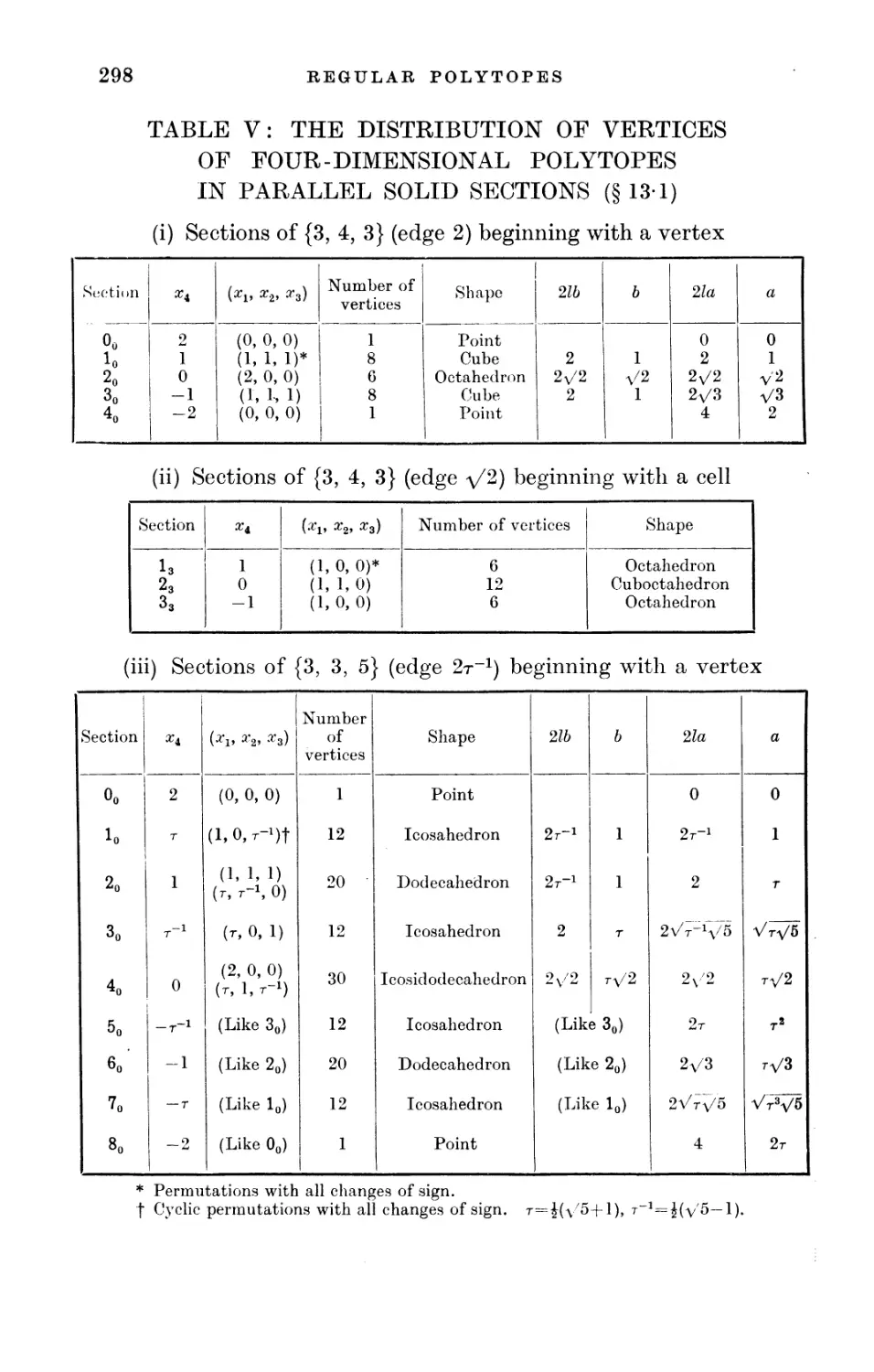
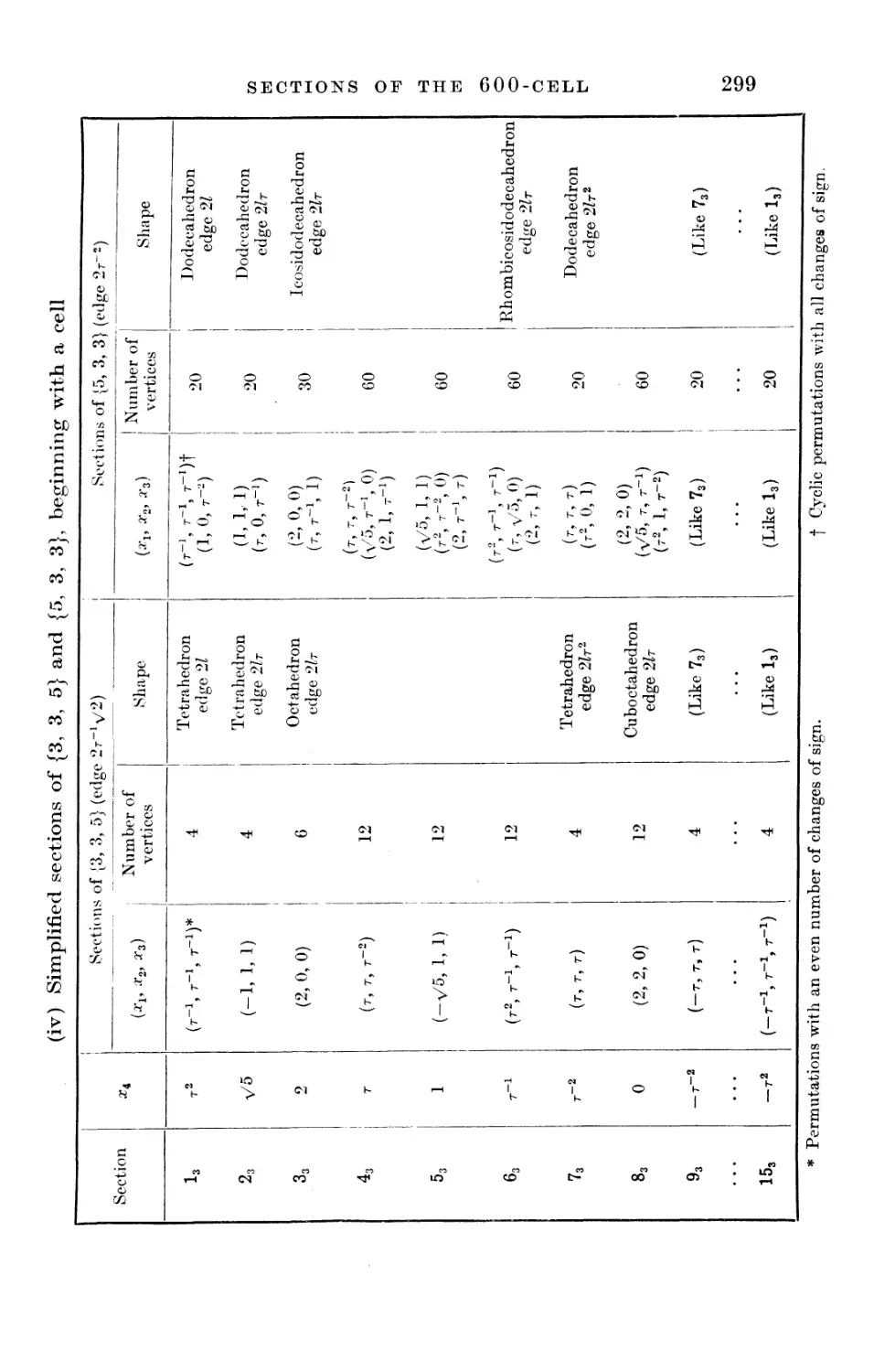
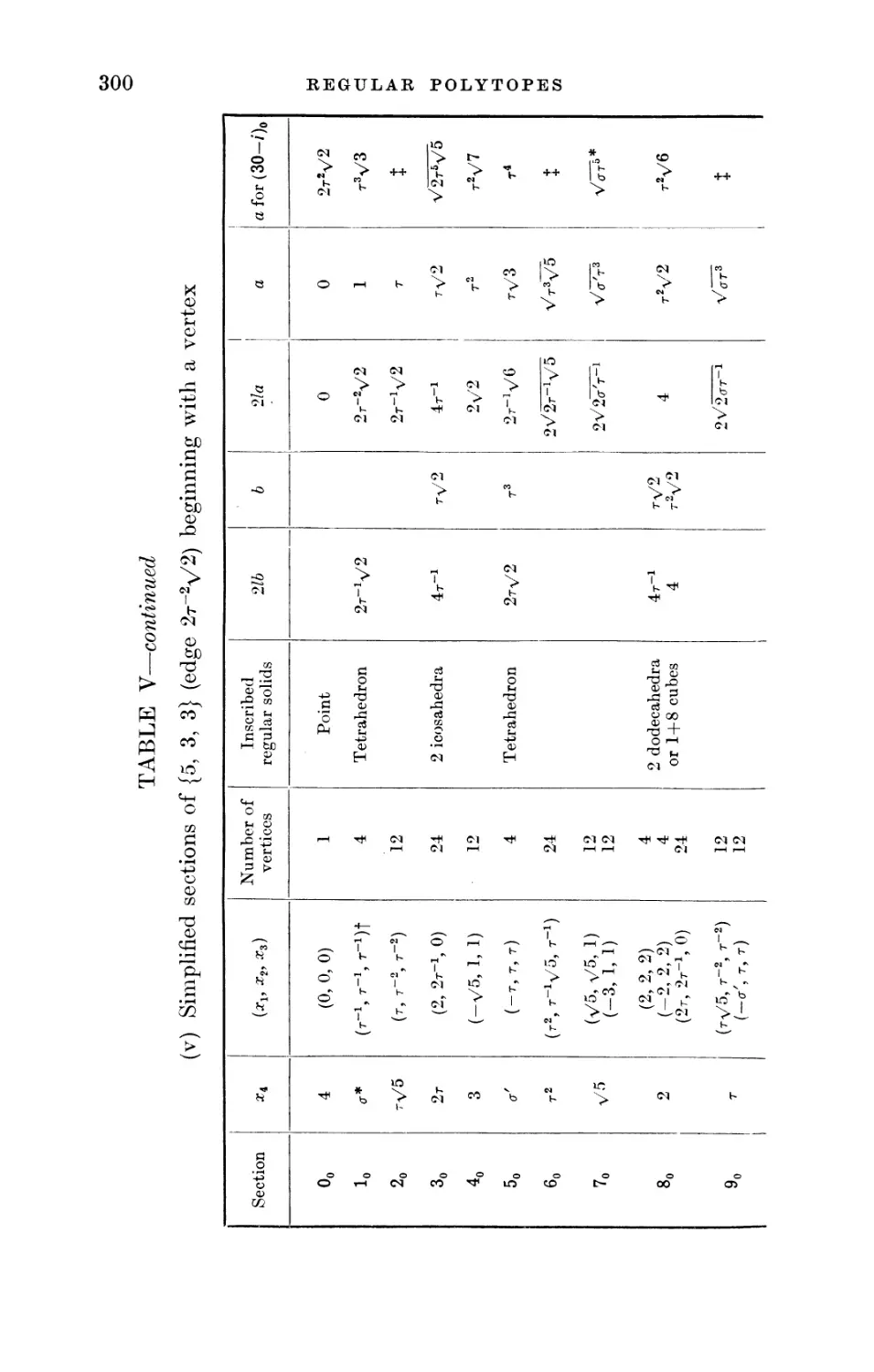
Table V:The distribution of vertices of four一dimensional
polytopes in parallel solid sections二298
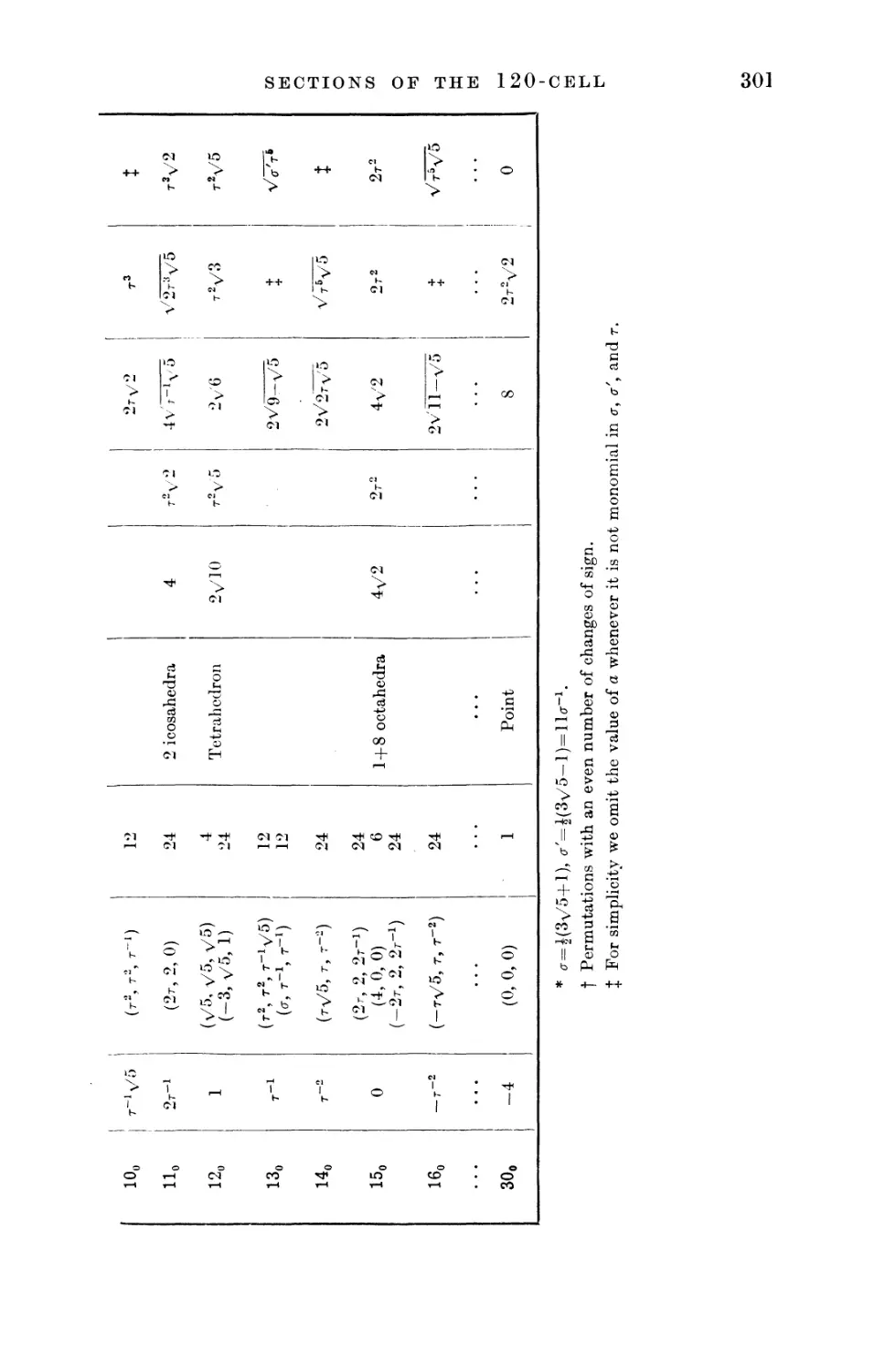
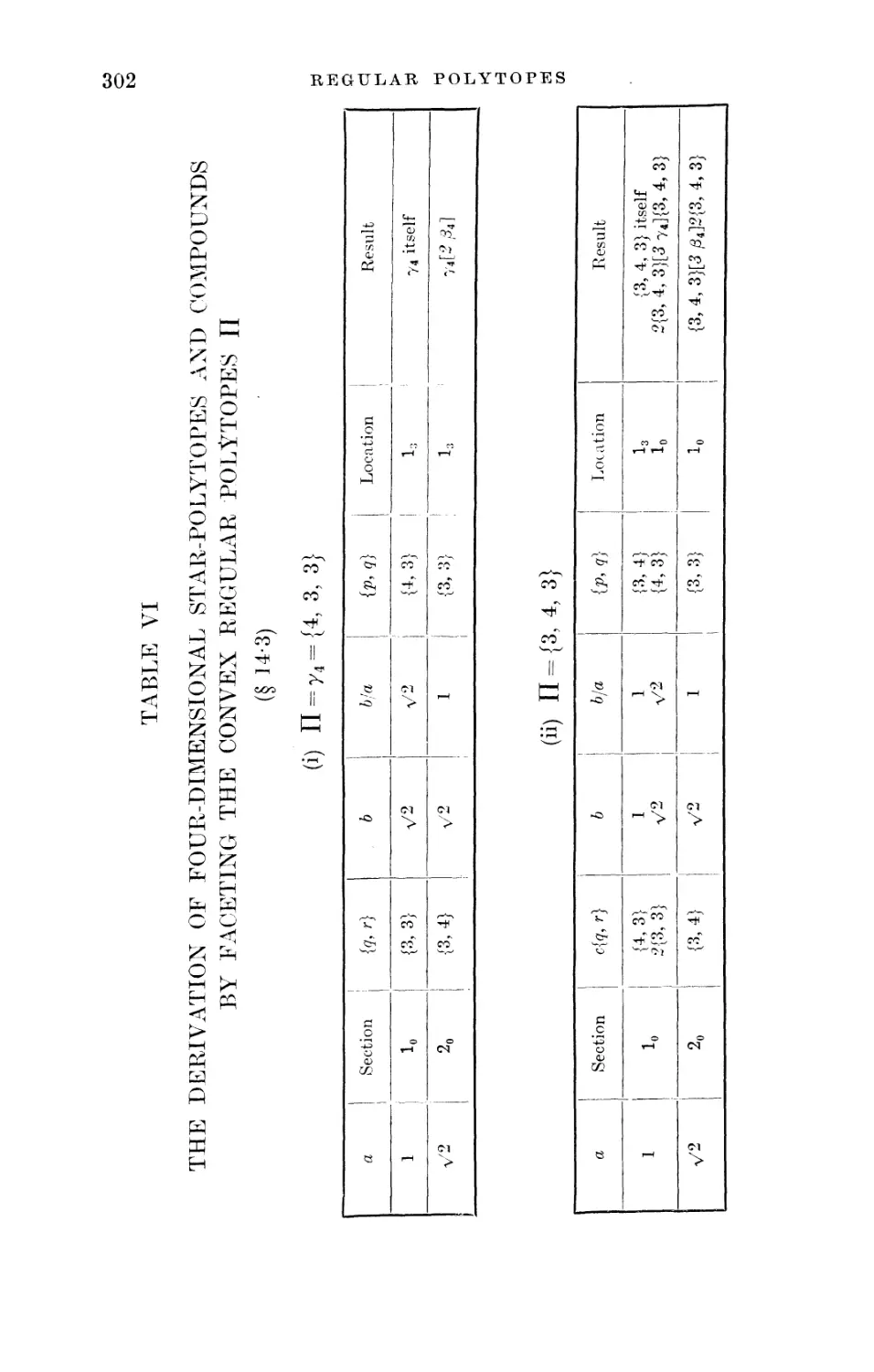
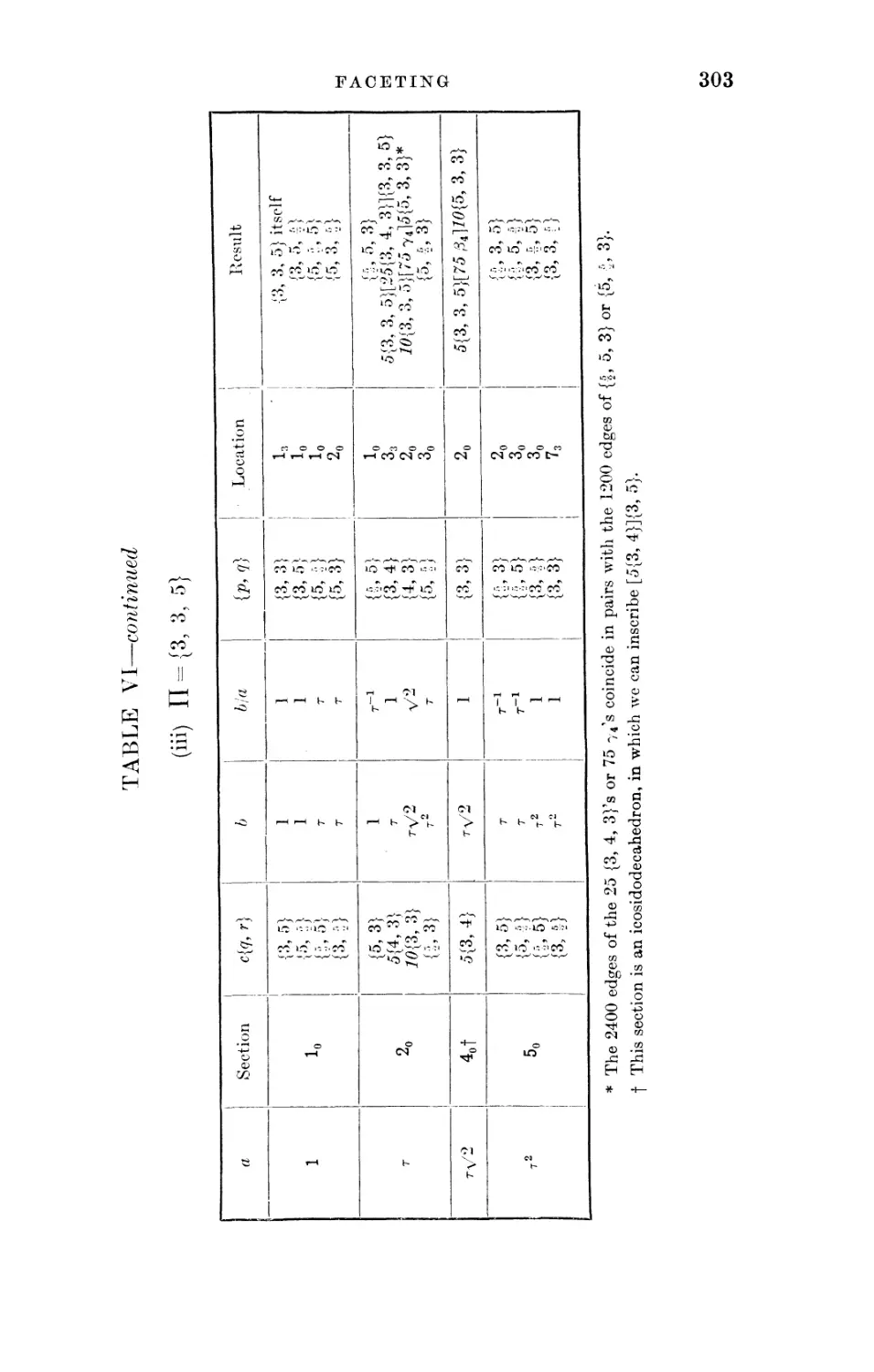
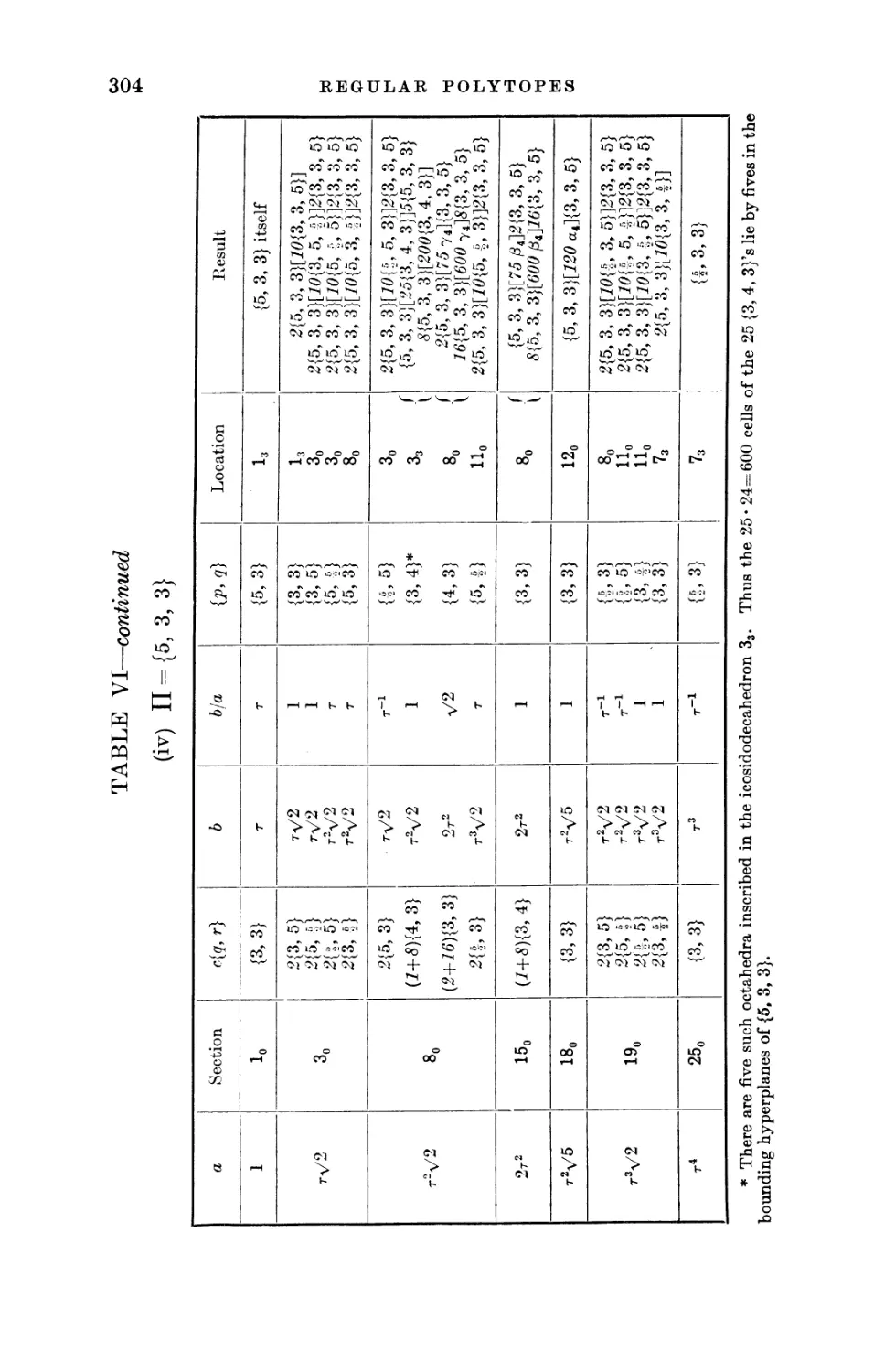
Table VI:The derivation of four一dimensional star一poly-
topes and compounds by faceting the convex
regular polytopes.…302
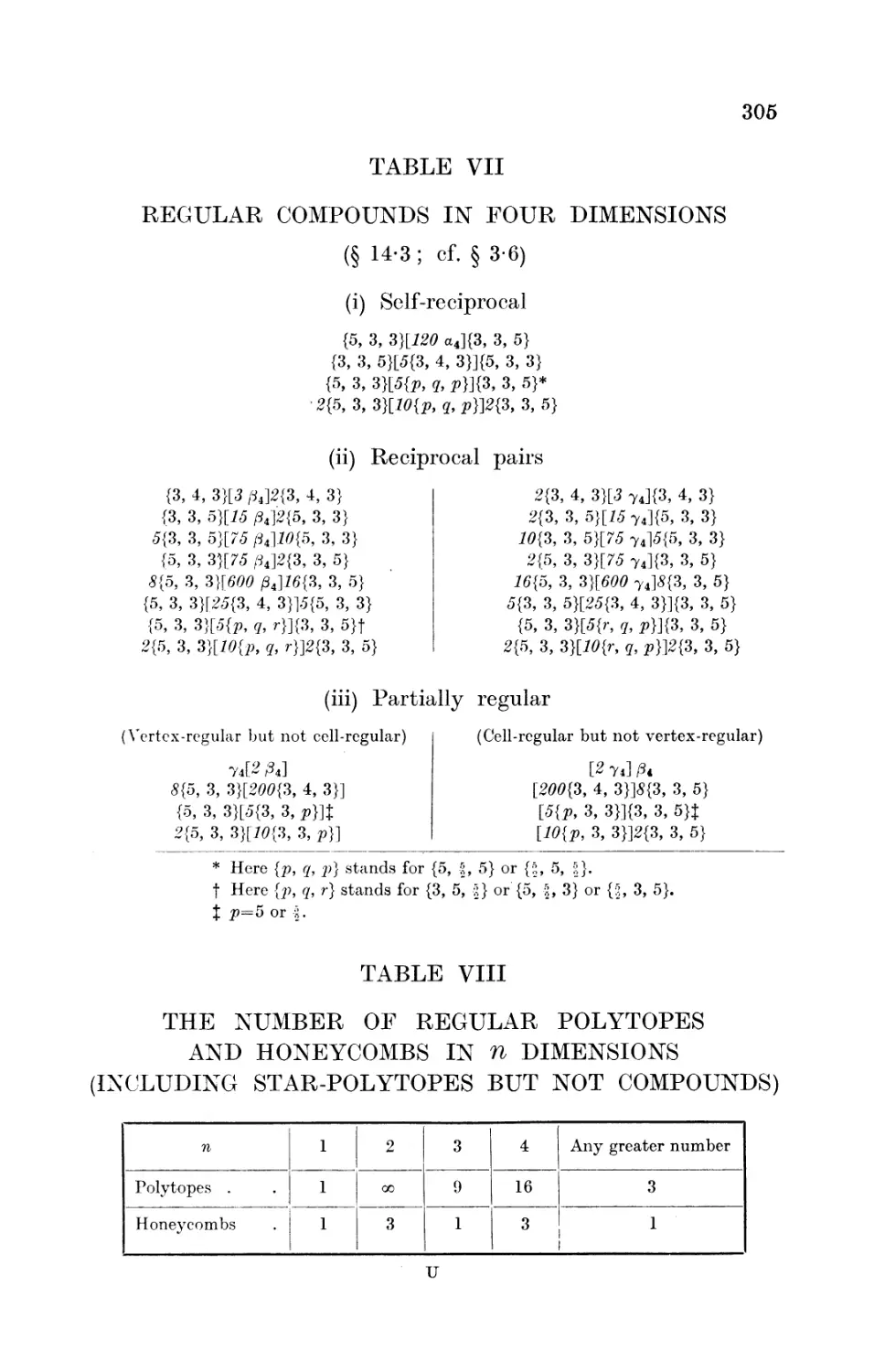
Table VII:Regular compounds in four dimensions.305
Table VIII:The number of regular polytopes and honey-
combs..…305
Bibliography
Index
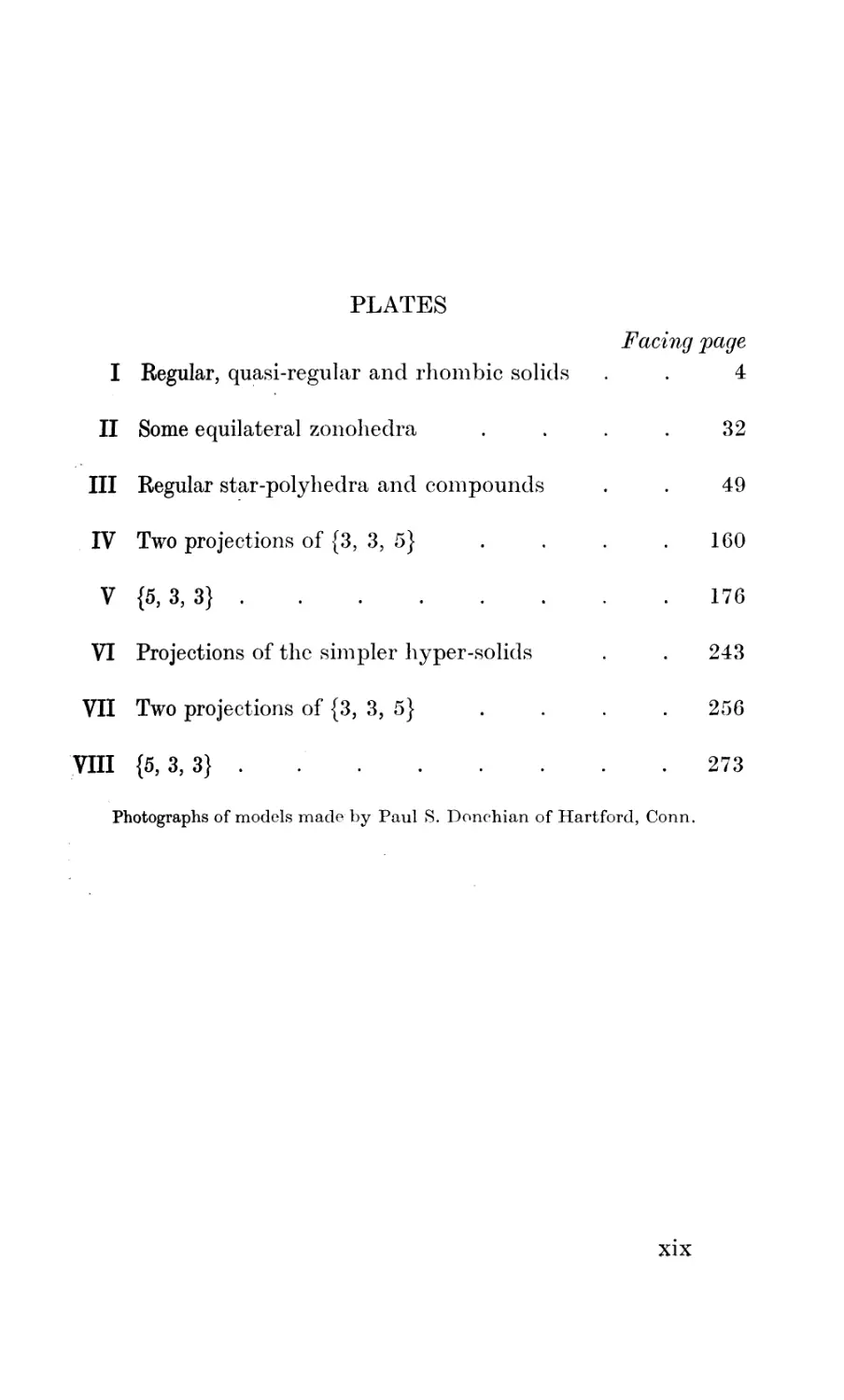
PLATES
.Facing page
I Regular, quasi一regular and rhombic solids,.4
II Some equilateral zonolledra.…32
III Regular star-polyhedra and compounds二49
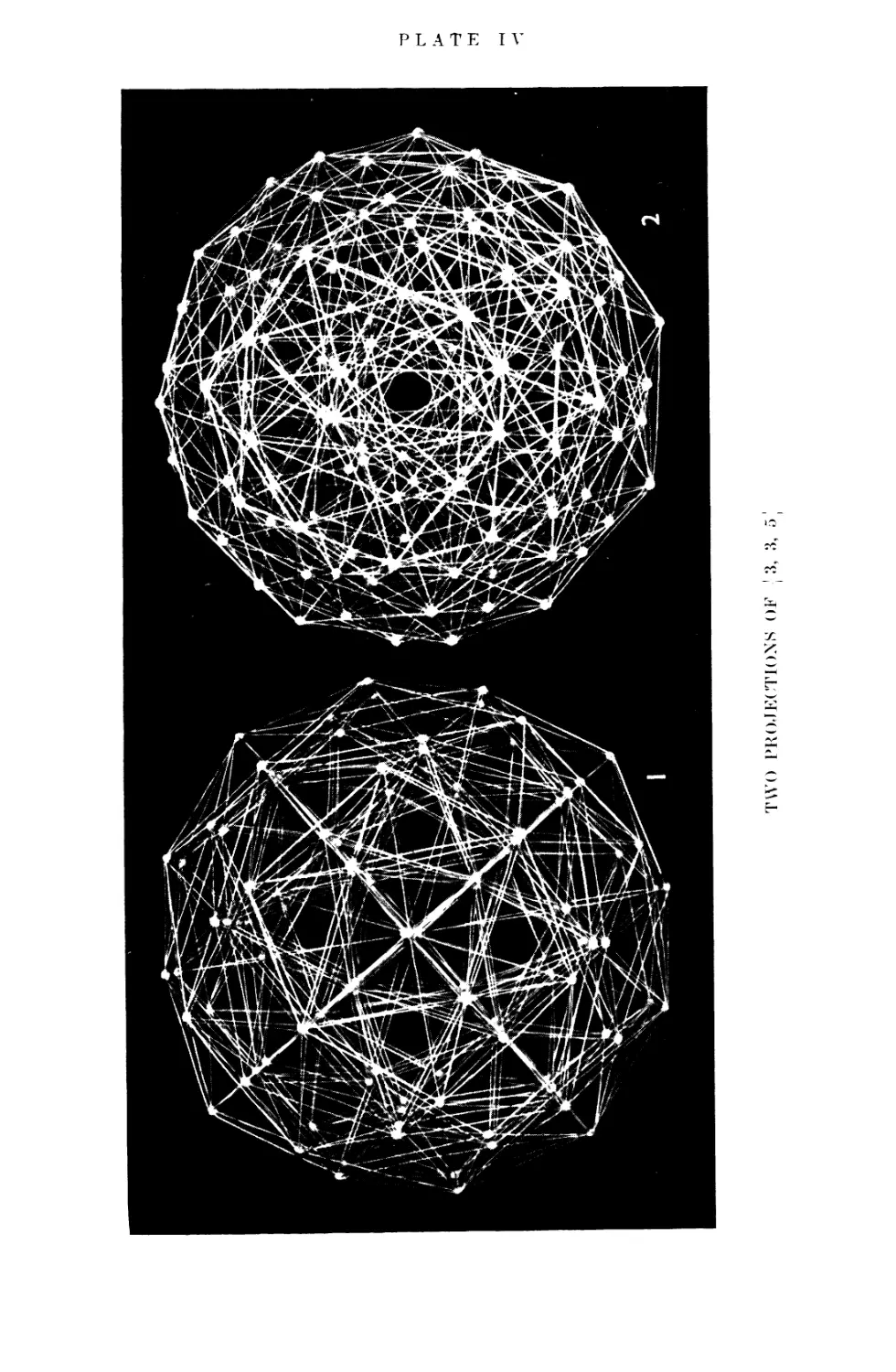
IV Two projections of {3,3,J}.…160
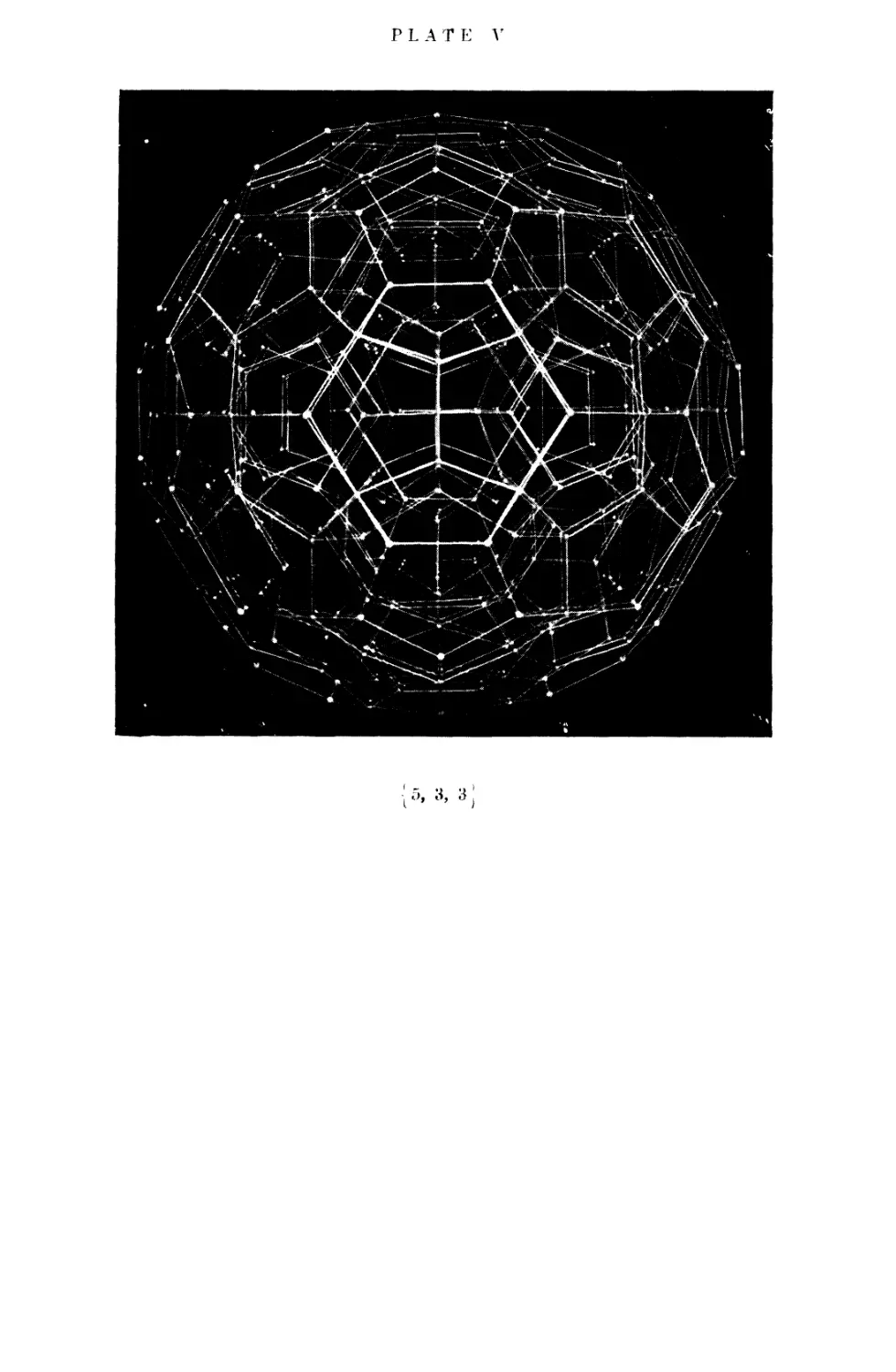
V f513) 3}.·……176
VI Projections of the simpler hyper-solids二243
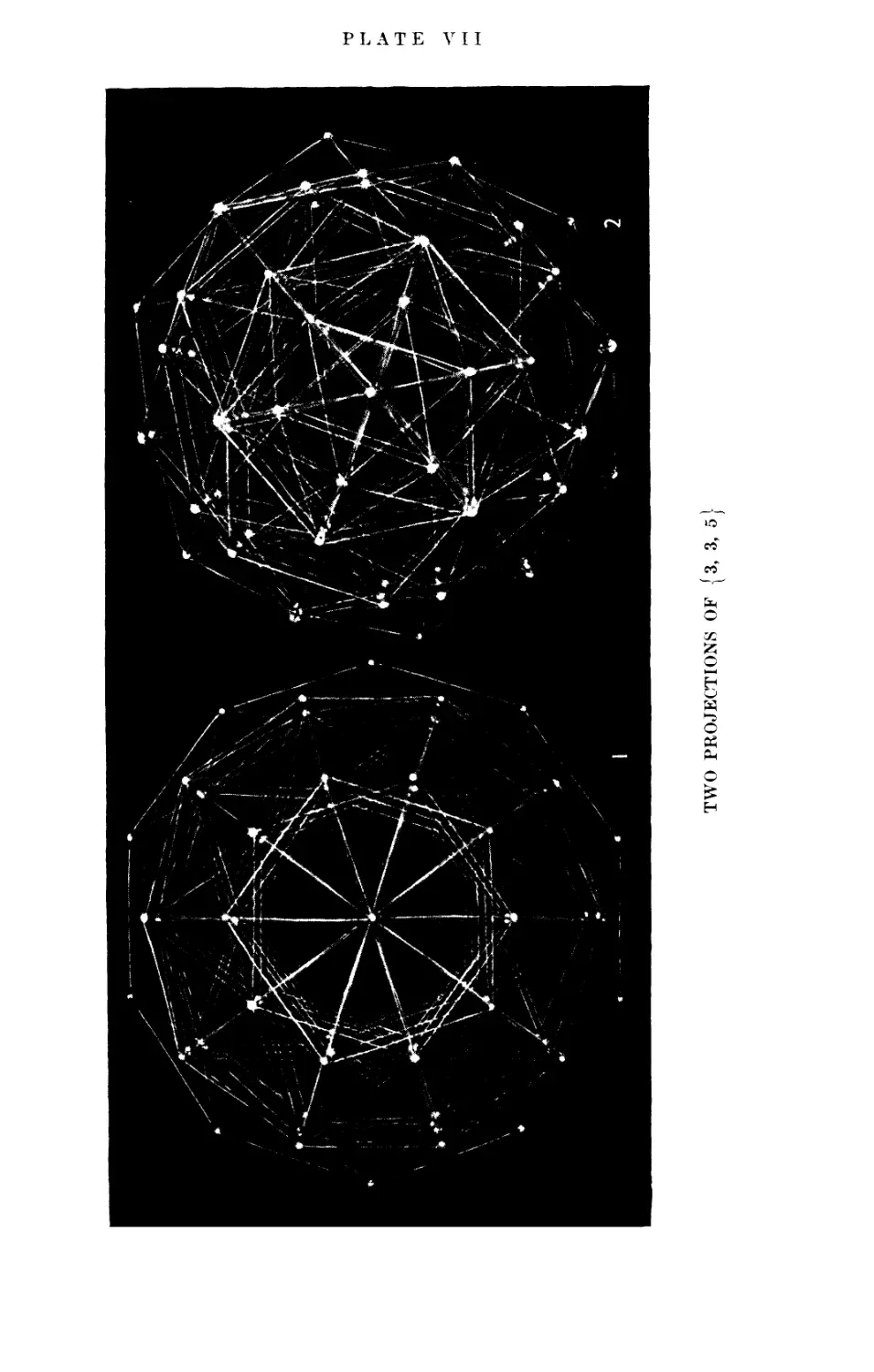
VII Two projections of {3,3,J}.…256
VIII {5, 3, 3}.·……273
Photographs of models made by Paul S.Donchian of Hartford, Conn.
The length and the breadth and
the height of it are equal.
Revelation 21.16
CHAPTERI
POLYGONS AND POLYHEDRA
Two一DIMENSIONAL polytopes are merely polygons;these are
treated in ' 1·1.Three一dimensional polytopes are polyhedra;
these are defined in ' 1·2 and developed throughout the first six
chapters.号1·3 contains a version of Euclid's proof that there
cannot be more than ,five regular solids,and a simple construction
to show that each of the five actually exists.The rest of Chapter I
is mainly topological:a regular polyhedron is regarded as a
map, and later as a co顽guration. In号I·5 we take an excursion
into“recreational”mathematics,as a preparation for the notion
of a tree of edges in von Staudt's elegant proof of Euler's Formula.
1·1.Regular polygons.Everyone is acquainted with some
of the regular polygons:the equilateral triangle which Euclid
constructs in his first proposition, the square which confronts us
all over the civilized world, the pentagon which can be obtained
by making a simple knot in a strip of paper and pressing it care-
fully flat,*the hexagon of the snowflake,and so on.The pentagon
and the enneagon have been used as bases for the plans of two
American buildings:the Pentagon Building near Washington,
and the Baha'i Temple near Chicago.Dodecagonal coins have
been made in England and Canada.
To be precise, we define a p-gon as a circuit of p line一segments
A1 A2, A2 A3,…,人AI,joining consecutive pairs of p points
A1, A2,…,人·The segments and points are called sides and
vertices.Until we come to Chapter VI we shall insist that the
sides do not cross one another. If the vertices are all coplanar
we speak of a plane polygon, otherwise a s}-ew polygon.
A plane polygon decomposes its plane into two regions,one of
which, called the interior, is finite.We shall often find it con-
venient to regard the p一gon as consisting of its interior as well as
its sides and vertices.We can then re一define it as a simply-
connected region bounded by p distinct segments.(“Simply-
connected”means that every simple closed curve drawn in the
Lucas 1,p.202.(Such numbers after an author's name refer to the Biblio-
graphy on
pages 306一314.
For some
exquisite photographs of
snowflakes, see Bentley and Humphreys 1·
A
2 REGULAR POLYTOPES [' 1.1
region can be shrunk to a point without leaving the region, i.e.,
that there are no holes.)
The most important case is when none of the bounding lines
(or“sides produced”)penetrate the region.We then have a
convex p-gon, which may be described (in terms of Cartesian
coordinates)by a system of p linear inequalities
akx+bky c ck (k一1, 2,…,p)}
These inequalities must be consistent but not redundant, and
must provide the range for a finite integral
‘ff“dy
(which measures the area).
A polygon is said to be equilateral if its sides are all equal,
equiangular if its angles are all equal.If p>3, a p-gon can be
equilateral without being equiangular, or vice versa;e.g.,a
rhomb is equilateral,and a rectangle is equiangular.A plane
p一gon is said to be regular if it is both equilateral and equiangular.
It is then denoted by lp};thus {3}is an equilateral triangle,
{4} is a square,{5} is a regular pentagon, and so on·
A regular polygon is easily seen to have a centre, from which
all t,he vertices are at the same distance OR, while all the sides are
at the salve distance 1R. This means that there are two con-
centric circles, the circum一circle and in一circle, which pass through
the vertices and touch the sides,respectively.
It is sometimes helpful to think of the sides of a p-gon as
representing p vectors whose sum is zero.They may then be
compared with p segments issuing from one point, the angle
between two consecutive segments being equal to an exterior
angle of the p-gon.It follows that the sum of the exterior angles
of a plane polygon is a complete turn, or 2-r. Hence each exterior
angle of fp}is 2二/p, and the interior angle is the supplement,
7T.
2一夕
一
11.1
/了1\
1·11
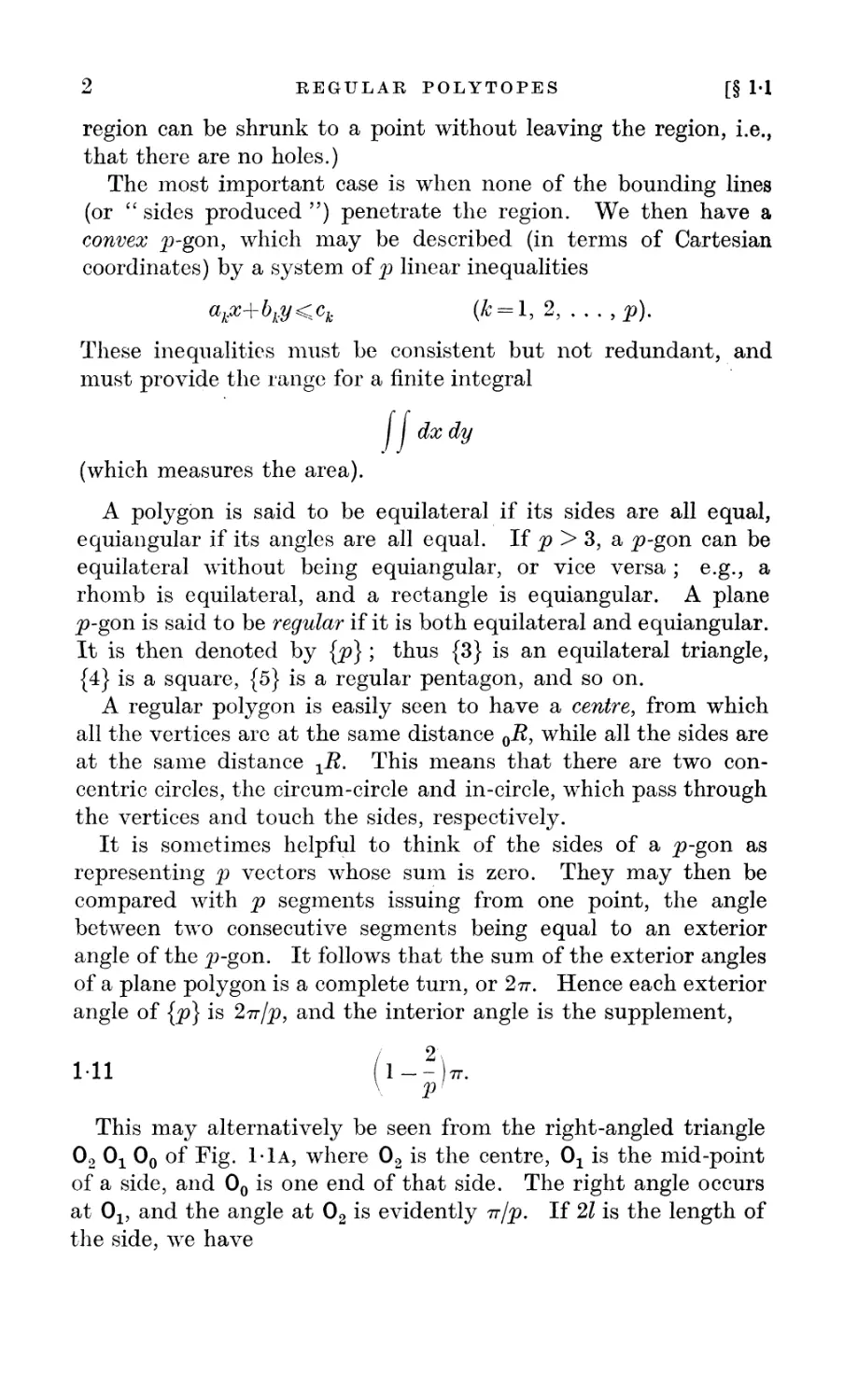
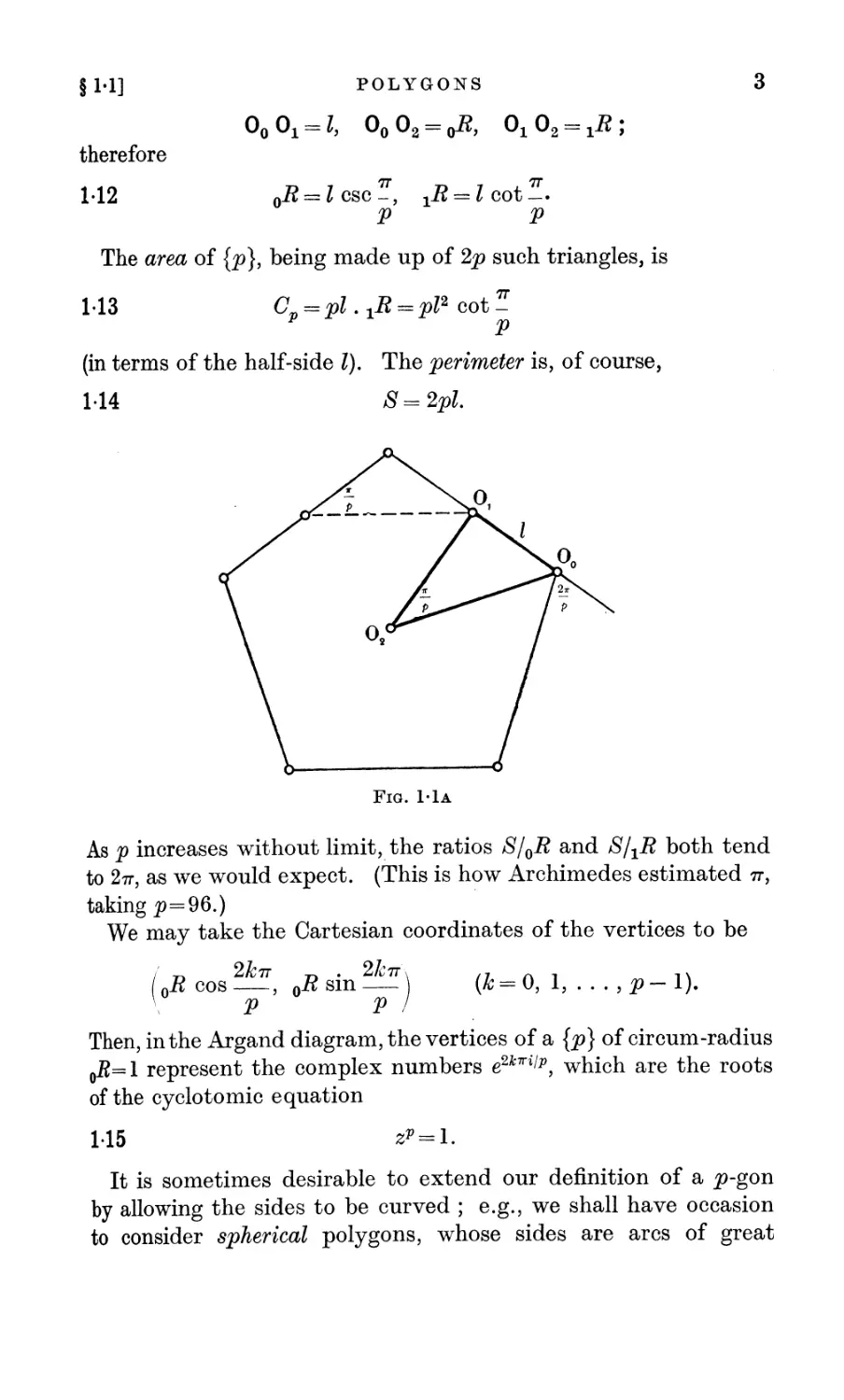
This may alternatively be seen from the right一angled triangle
020, 00 of Fig.1·1A, where 02 is the centre,01 is the mid-point
of a side,and 00 is one end of that side.The right angle occurs
at 01, and the angle at 02 is evidently二加.If 21 is the length of
the side,we have
怪1·1]
POLYGONS
3
000,=l, 0002
0102=1R
therefore
1·12
OR=l
7T
csc一,
p
=声I
1R=l
cot二.
p
The area of {p}, being made up of纱such triangles, is
1,13
Cp=PI·1R一p l2
cot竺
p
(in terms of the half-side l).The perimeter is,of course
1·14
S=助l.
FI(3. 1.1A
As p increases without limit,, the ratios SIOR and S/1R both tend
to 2二,as we would expect. (This is how Archimedes estimated二,
taking p一96.)
We may take the Cartesian coordinates of the vertices to be
2k仃
cos—
p
。.2lew,
A sin—}
”p/
(k二0, 1,…,p一1).
五
0
Then, in the Argand diagram, the vertices of a fp}of circum-radius
OR= 1 represent the complex numbers e2k7i/p, which are the roots
of the cyclotomic equation
1.15 zp=1.
n
0
g。
It is sometimes desirable to extend our definition of a p-
allowing the sides to be curved;e·g·,we shall have
consider spherical polygons,whose sides are arcs
occasion
of great
叮0
东U石切
4
REGULAR POLYTOPES
〔号1·2
circles
P=2:
sides.
on a sphere.This extension makes it possible to have
a digon has two vertices,joined by two distinct (curved)
1·2.Polyhedra.A polyhedron may be defined as a finite,
connected set of plane polygons,such that every side of each
polygon belongs also to just one other polygon, with the proviso
that the polygons surrounding each vertex form a single circuit
(to exclude anomalies such as two pyramids with a common
apex).The polygons are called faces, and their sides edges. Until
Chapter VI i`-e insist that the几ces do not cross one another.
Thus the polyhedron forms a single closed surface,and decom-
poses space into two regions。one of which,called the interior,
is finite.We shall often find it convenient t,o regard the poly-
hedron as consisting of its interior as well as its N2 faces, Ni
edges,and No vertices.
The most important
penetrate the interior.
case is when none of the bounding planes
We then have a
may be described (in terms of Cartesian
of inequalities
convex polyhedron,which
coordinates)by a system
a..二十bky -f- ckz心
(k=1,2,
These inequalities must be consistent but not
must provide the range for a finite integral
N2)。
redundant.and
‘厂{”‘)‘/dy“·
(which measures the volume).
Certain polyhedra are almost as familiar as the polygons that
bound them.we all know hOAAT a point and a p-gon can be joined
by p triangles to form a pyramid, and how two equal p一gons can
be joined by p rectangles to form a right prism.After turning
one of the two p-gons in its own plane so as to make its vertices
(and sides)correspond to the sides (and vertices)of the other,
we can just as easily join them by即triangles to form an anti-
prism,whose即lateral edges make a kind of zigzag.
A tetrahedron is a pyramid based on a triangle.Its faces consist
of four triangles,any one of which may be regarded as the base.
If all four are equilateral,we have a regular tetrahedron.This
is the simplest of the five Platonic solids.The others are the
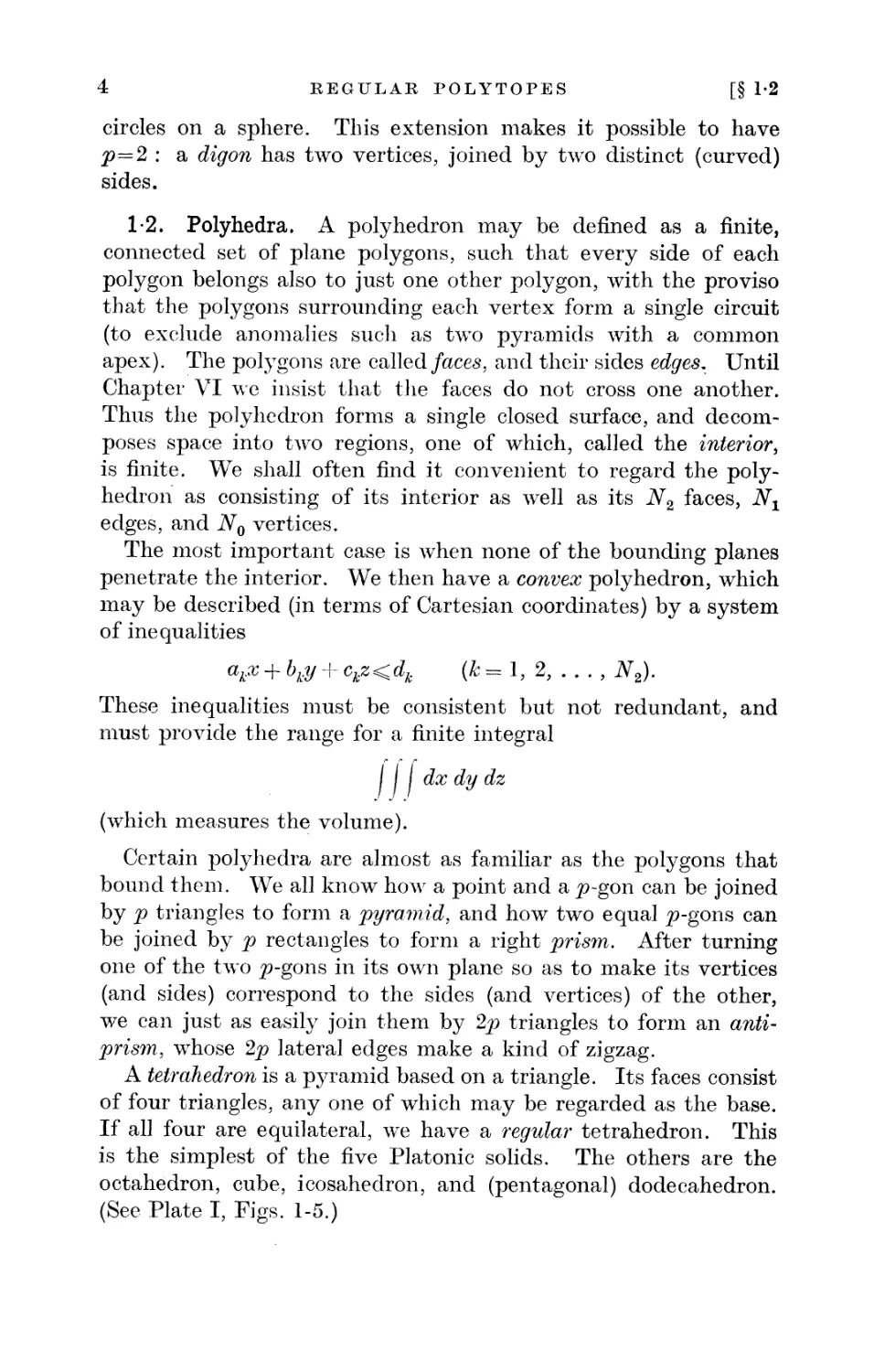
octahedron,cube,icosahedron,and (pentagonal)dodecahedron.
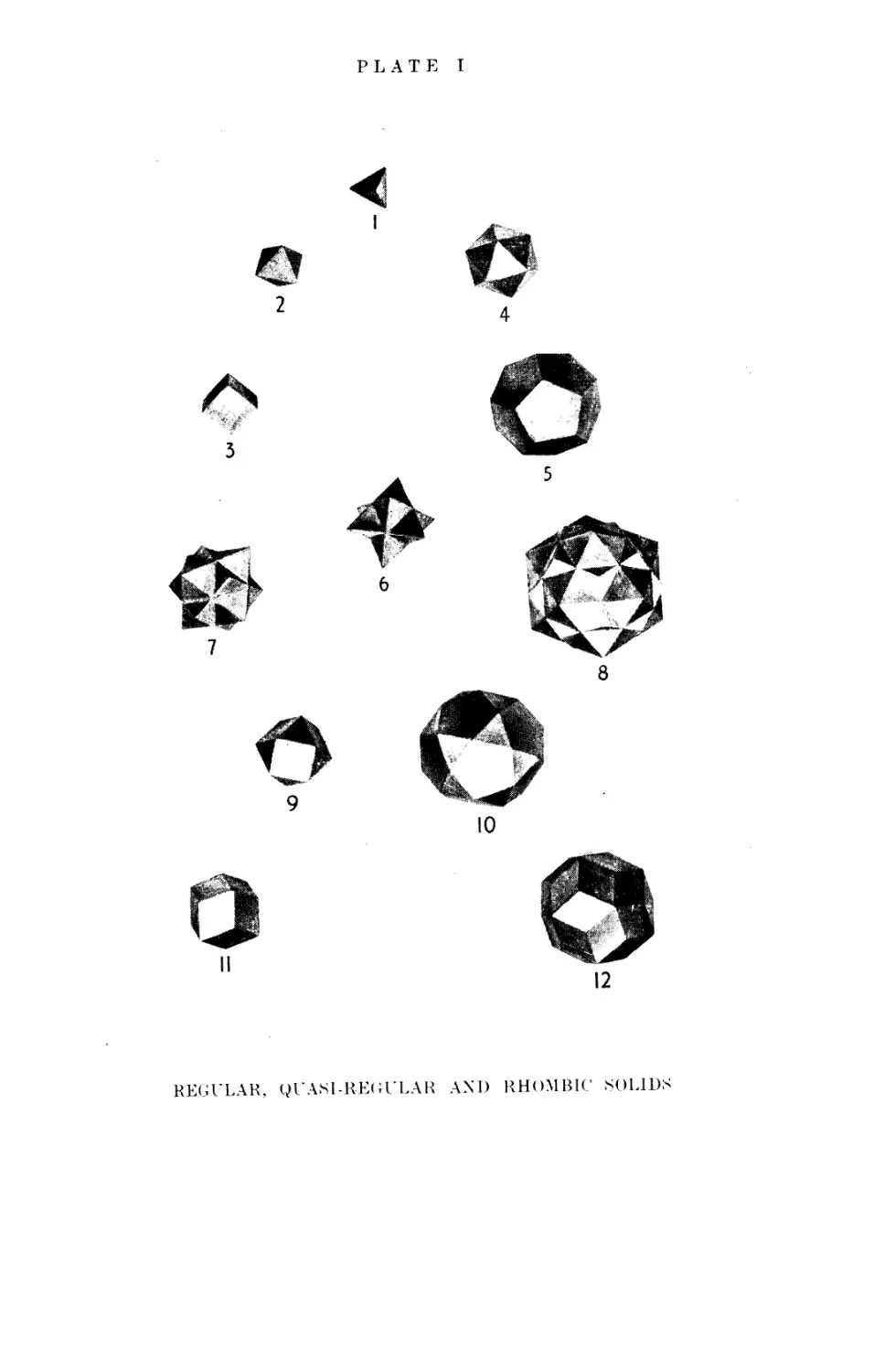
(See Plate I, Figs.1一5.)
PLATE I
确
’夸
24
臀今。
令。
今"5卵7
妙
!0
‘黔
11 12
RE('VL AR, tit" ASI一REGULAR A-NI) RH()AIBIC SOLIDS
'1·3] POLYHEDRA 5
1·3.The five Platonic solids.A convex polyhedron is said to
be regular if its faces are regular and equal,while its vertices are
all surrounded alike.(We shall see in号1·7 that the regularity
of faces may be waived without causing anything worse than a
simple distortion.A more“economical”definition will be given
in ' 2·1·)If its faces are fpj's,q surrounding each vertex, the
polyhedron is denoted by {p, q}.
The possible values for p and q may be enumerated as follows.
The solid angle at a vertex has q face-angles, each(1一2/p)二,by
1·11.A familiar theorem states that these q angles must total
less than 2二.Hence 1一2/p <2/q;i.e.,
1上一q自
势
1.几工q
+
1-尹
1.31
or (P一2)(q一2)<4. Thus {p, q} cannot have any other values than
{3,3},{3, 4}, {4, 3},{3,5}, {5,3}.
The tetrahedron {3, 3}has already been mentioned.’To show
that the remaining four possibilities actually occur, we construct
the rest of the Platonic solids, as follows.
By placing two equal pyramids base to base,we obtain a
dipyramid bounded by 2p triangles.If the common base is a
{p} with p<6,the altitude of the pyramids can be adjusted so
as to make all the triangles equilateral.If p=4, every vertex is
surrounded by four triangles,and any two opposite vertices can
be regarded as apices of the dipyramid.This is the octahedron,
{3, 4}.
By adjusting the altitude of a right prism on a regular base,we
may take it·s lateral faces to be squares.If the base also is a
square, we have a cube {4, 3},and any face may be regarded as
the base.
Similarly, by adjusting the altitude of an antiprism,we may
take its却lateral triangles to be equilateral.If p一3, we have
the octahedron (again).If p=4 or 5, we can place pyramids
on the two bases, making幼equilateral triangles altogether·
Up=5, every vertex is then surrounded by five triangles,and
we have the icosahedron, {3, 5}.
There is no such simple way to construct the fifth Platonic
solid. But if we fit six pentagons together so that one is entirely
surrounded by the other five,making a kind of bowl, we observe
that the free edges are the sides of a skew decagon.Two such
6 REGULAR POLYTOPES [' 1.4
bowls can then be fitted together, decagon to decagon, to form
the dodecahedron,*{5, 3}.
1·4.Graphs and maps.The edges and vertices of a poly-
hedron constitute a special case of a graph, which is a set of No
points or nodes, joined in pairs by N1 segments or branches (which
need not lie straight).If a node belongs to q branches, we have
evidently
1·41 Eq一21V1,
where the summation is taken over the No nodes.For a connected
graph (all in one piece)we must have
1·42 NJ >'No一1·
One graph is said to contain another if it can be derived from
the other by adding extra branches,or both branches and nodes.
A graph may contain a circuit of p branches and p nodes,i.e.,a
p一gon (p >2).A graph which contains no circuit is called a
forest, or, if connected, a tree.In the case of a tree,the ine quality
1·42 is replaced by the equation
1·43 N1=No一1;
for a tree may be built up from any one node by adding successive
branches,each leading to a new node.
The theory of graphs belongs to topology(“rubber sheet
geometry”),which deals with the way figures are connected,
without regard to straightness or measurement.In this spirit,
the essential property of a polyhedron is that its faces together
form a single unbounded surface.The edges are merely curves
drawn on the surface,which come together in sets of three or
more at the vertices.
In other words,a polyhedron with N2 faces,N1 edges,and
No vertices may be regarded as a map, i.e.,as the partition of
an unbounded surface into N2 polygonal regions by means of
AT, simple curves joining pairs of No points.One such map may
be seen by projecting the edges of a cube radially onto its circum-
sphere;in this case No一8, N1=12, }T2一6, and the regions are
spherical quadrangles.
From a given map we may derive a second,called the decal
map,on
the same surface.This second map has N2 vertices
See the self-unfolding model in the pocket of Steinhaus 1.
号1}4]
DUAL MAPS
7
one in the interior of each face of the given map;N1 edges,one
crossing
each edge of the given map;and No faces,one surround-
ing each vertex of the
face of the given map,
given map.Corresponding to a p-gonal
the dual neap will have a vertex where p
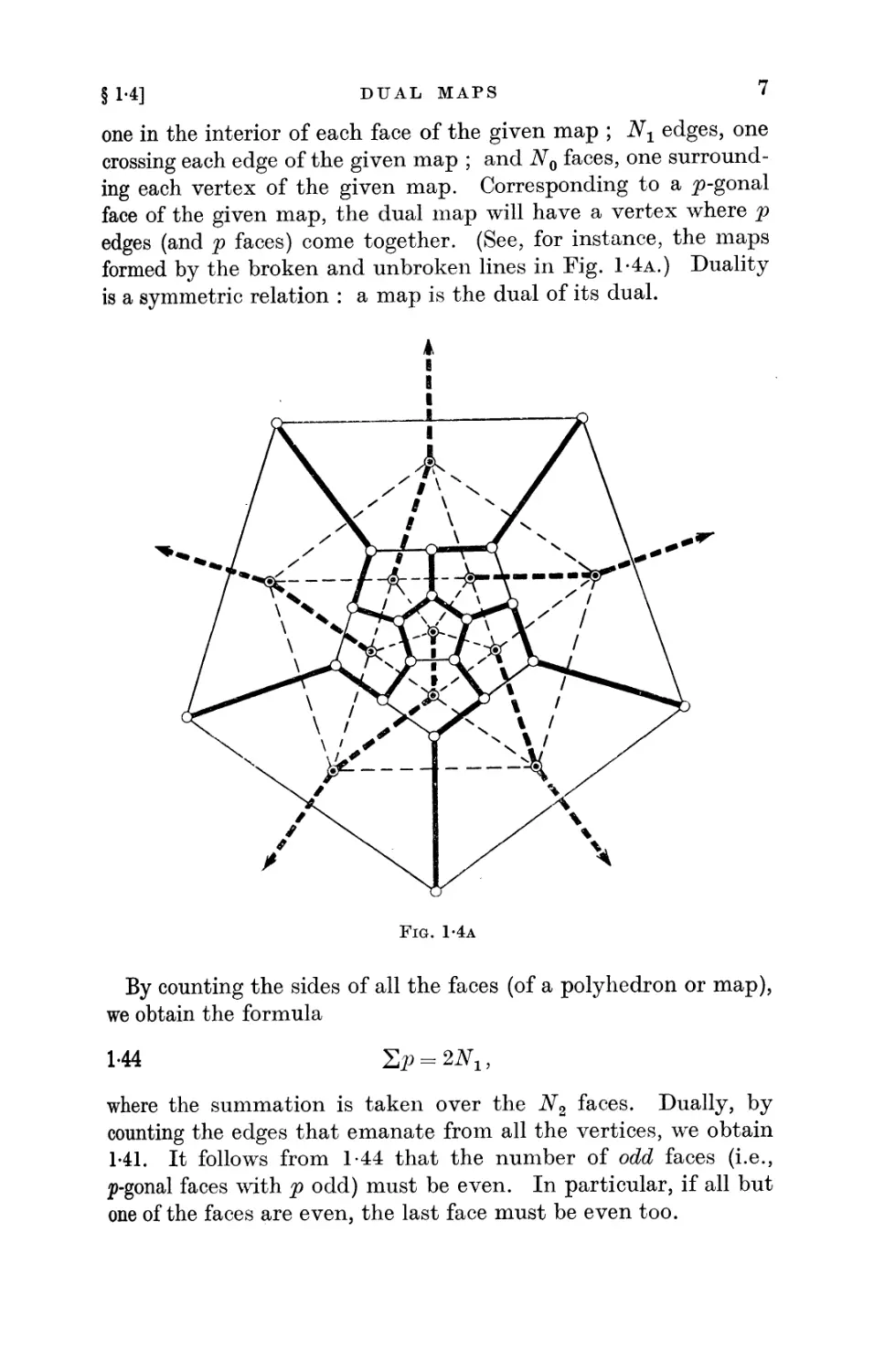
edges (and p faces)come together.(See,for instance
formed by the broken and unbroken lines in Fig.1·4A
is a symmetric relation:a map is the dual of its dual.
the maps
Duality
盆心.…
、
、
、
、
......日.
/
FIG. 1.4A
By counting the sides of all the faces (of a polyhedron or map),
we obtain the formula
1.44
EP一2N1,
where the summation is taken over the N2 faces.Dually, by
counting the edges that emanate from all the vertices,we obtain
1.41.It follows from 1·44 that the number of odd faces (i.e.,
p-gonal faces with p odd)must be even.In particular, if all but
one of the faces are even, the last face must be even too.
S
REGULAR POLYTOPES
[号1·5
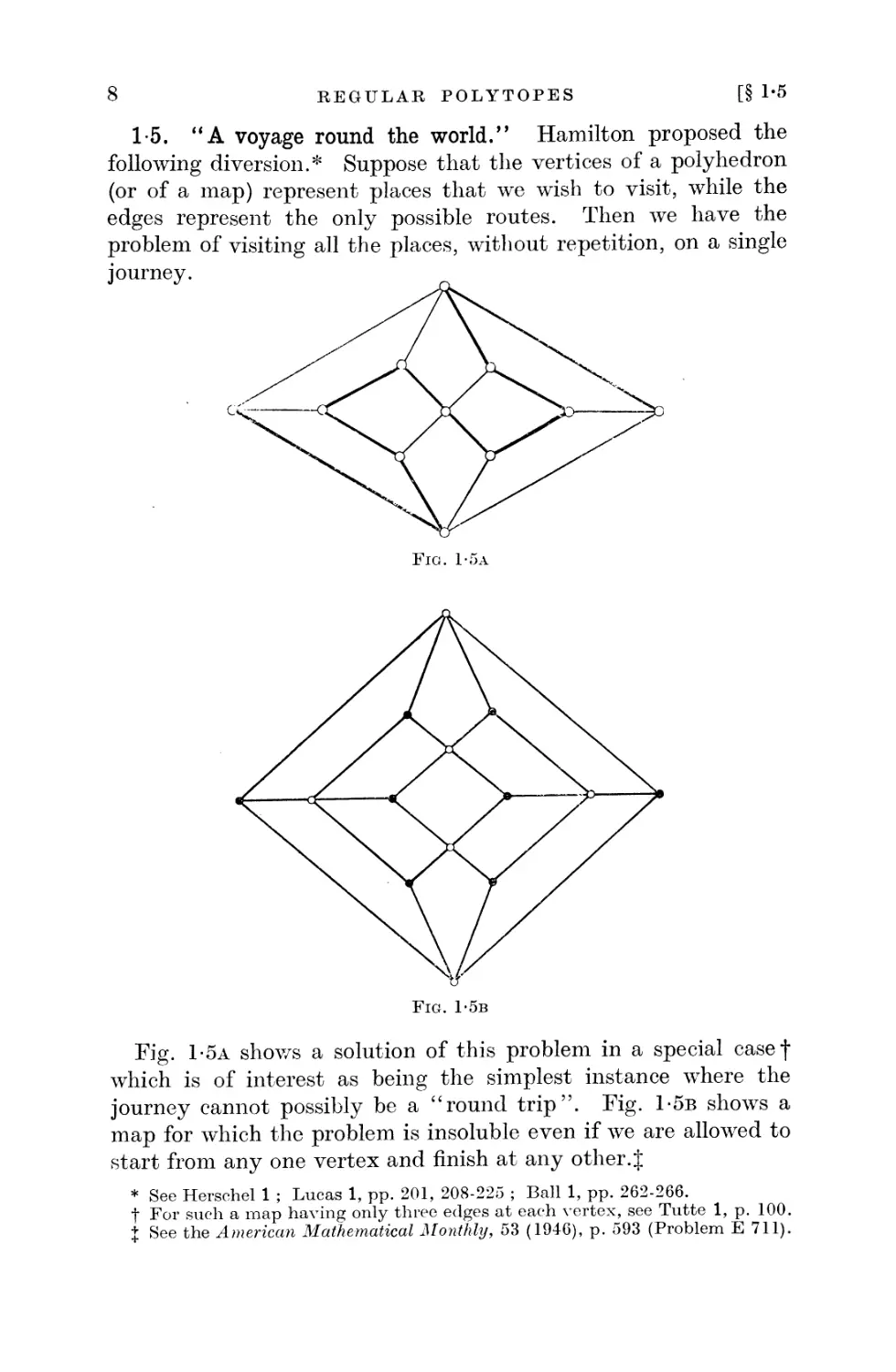
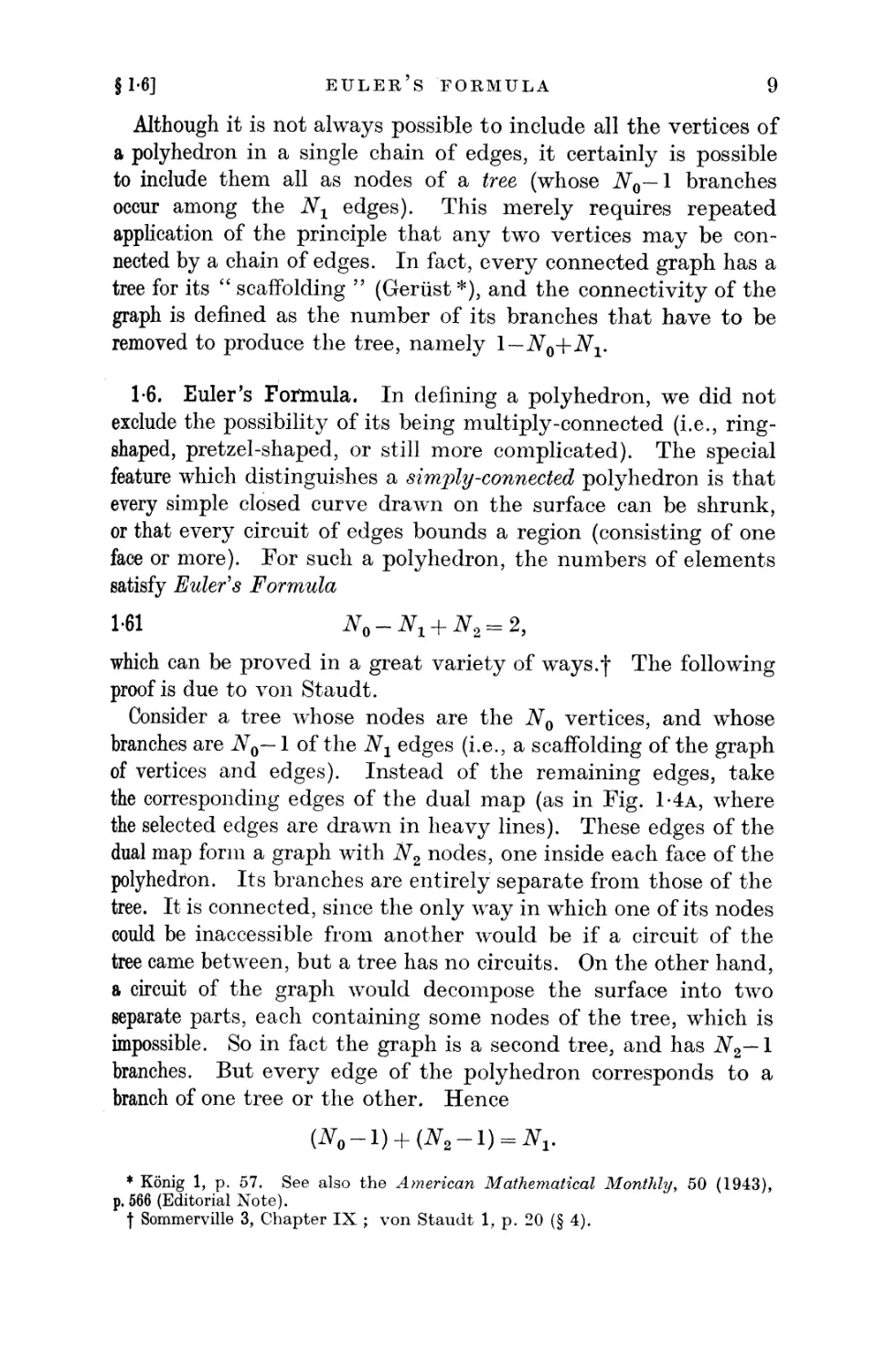
1·5.“A voyage round the world.”
following diversion.*Suppose that the
Hamilton proposed the
vertices of a polyhedron
(or of a snap)represent pl二ces that
edges represent the only possible
we
wish to visit
routes.
Then we
while the
have the
problem of visiting all the places,without repetition,on a single
J ourney·
FIG.1·5A
FIa. I·5B
Fig.1·5A shotirrs a solution of this problem in a special case t
which is of interest as being the simplest instance where the
journey cannot possibly be a“round trip”.Fig.1·5B shows a
map for which the problem is insoluble even if we are allowed to
start from any one vertex and finish at any other.丰
*See Herschel 1;Lucas 1,PP.201,208一225
;Ball 1,PP.262一266.
For such a map having only three edg
See the A?r?erican Mathematical Month
at
J3
each vertex,see Tutte 1,p.100.
(1946),p·593 (Problem E 711)·
小..+十
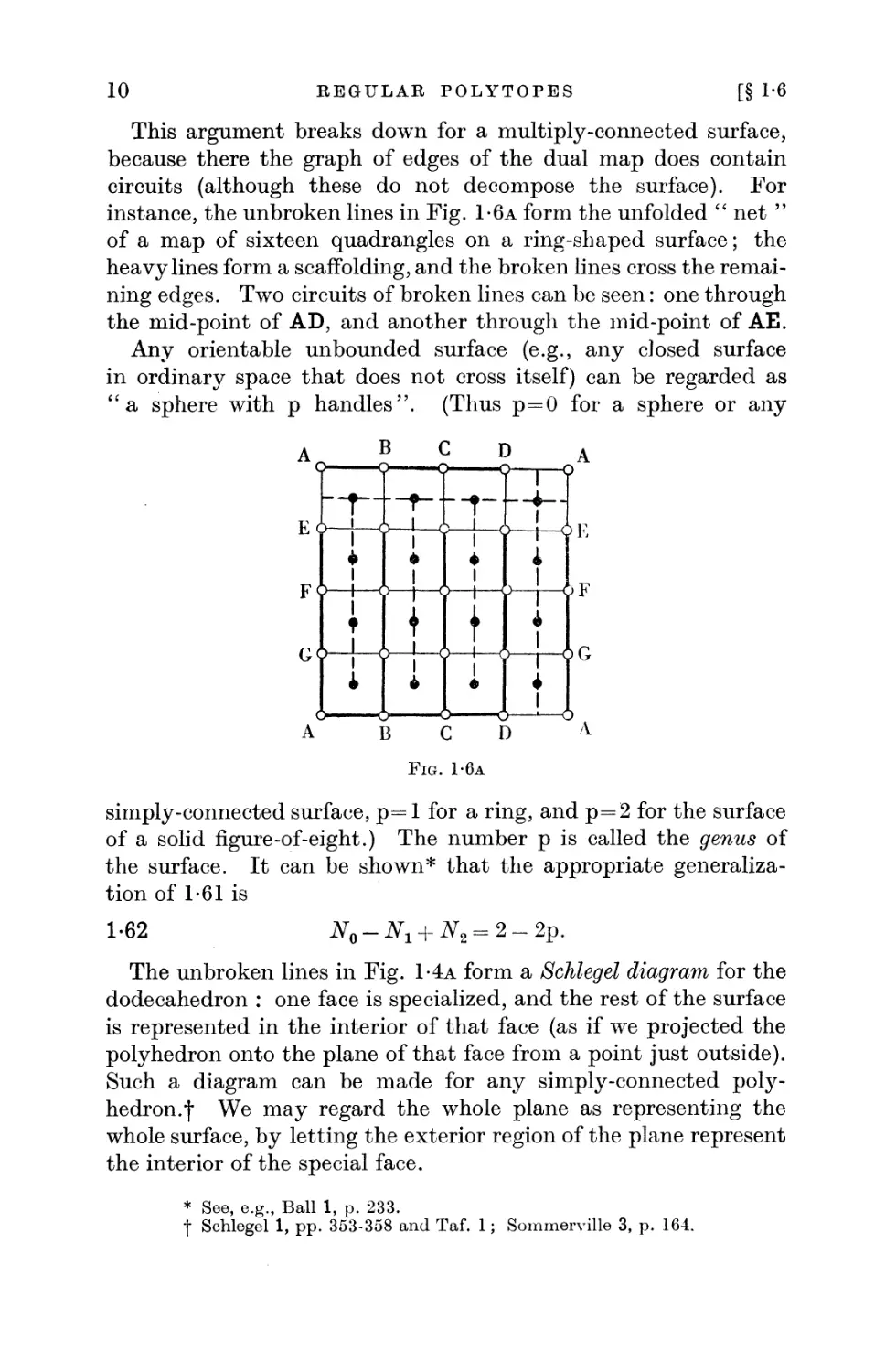
' I"6] EULER’S一FORMULA 9
Although it is not always possible to include all the vertices of
a polyhedron in a single chain of edges, it certainly is possible
to include them all as nodes of a tree (whose No一1 branches
occur among the N,. edges).This merely requires repeated
application of the principle that any two vertices may be con-
nected by a chain of edges.In几ct, every connected graph has a
tree for its“scaffolding”(Geriist*),and the connectivity of the
graph is defined as the number of its branches that have to be
removed to produce the tree,namely 1一No+Nl.
1.6. Euler's Formula.In defining a polyhedron, we did not
exclude the possibility of its being multiply一connected (i.e.,ring-
shaped, pretzel一shaped,or still more complicated).The special
feature which distinguishes a simply-connected polyhedron is that
every simple closed curve drawn on the surface can be shrunk,
or that every circuit of edges bounds a region (consisting of one
face or more).For such a polyhedron,the numbers of elements
satisfy Euler's Formula
1-61 No一N1+N2=2)
which can be proved in a great variety of ways.t The following
proof is due to von Staudt.
Consider a tree whose nodes are the No vertices,and whose
branches are No一1 of the N1 edges (i.e.,a scaffolding of the graph
of vertices and edges).Instead of the remaining edges,take
the corresponding edges of the dual map (as in Fig. 1·4A, where
the selected edges are drawn in heavy lines).These edges of the
dual map forn1 a graph with N2 nodes,one inside each face of the
polyhedron.Its branches are entirely separate from those of the
tree.It is connected, since the only way in which one of its nodes
could be inaccessible from another would be if a circuit of the
tree came between,but a tree has no circuits.On the other hand,
a circuit of the graph would decompose the surface into two
separate parts, each containing some nodes of the tree, which is
impossible.So in fact the graph is a second tree, and has N2一1
branches.But every edge of the polyhedron corresponds to a
branch of one tree or the other. Hence
(凡一1)+(N2一1)一N1.
5
K6nig
16(Ed6
1,P.57, See
torial Note).
also the American Mathematical Monthly, 50(1943),
fi Sommerville 3, Chapter Iii;von Staudt 1,P.`' 0(' 4).
10
REGULAR POLYTOPES
[号I·6
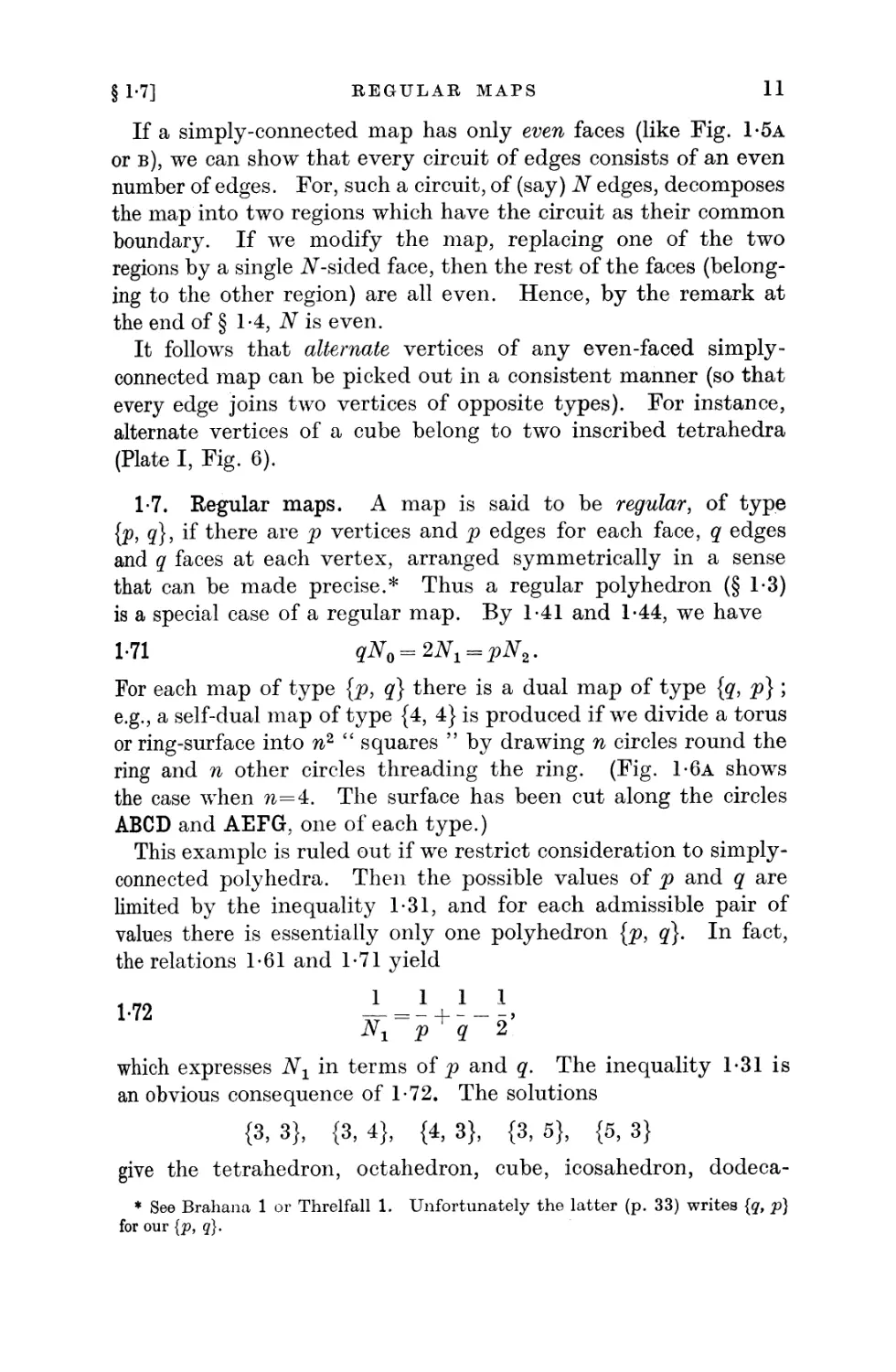
This argument breaks down for a multiply一connected surface,
because there the graph of edges of the dual map does contain
circuits (although these do not decompose the surface).For
instance, the unbroken lines in Fig.1·6A form the unfolded“net”
of a map of sixteen quadrangles on a ring一shaped surface;the
heavy lines form a scaffolding, and the broken lines cross the remai-
ning edges.Two circuits of broken lines can be seen:one through
the mid-point of AD, and another through the inid-point of AE.
Any orientable unbounded surface (e.g.,any closed surface
in ordinary space that does not cross itself) can be regarded as
“a sphere with p handles”.(Thus p一0 for a sphere or any
A
B
C
D
E
F
G
!
一诗一-
I
J
_._
一勺
碱
}
尸
卜
}
,!
}
月
,}
l
}
户
}
!
.
J目又
}
.
A
E
F
G
A
B
C
D
A
FIG. 1·6A
simply一connected surface,p=1 for a ring, and p=2 for the surface
of a solid figure一of-eight.)The number p is called the genus of
the surface.
Lion of 1·61 is
It can be shown*that the appropriate generaliza-
1·62
No一N1+N2=2一2p.
The unbroken lines in Fig.1·4A form a Schlegel diagram for the
dodecahedron:one face is specialized, and the rest of the surface
is represented in the interior of that face (as if we projected the
polyhedron onto the plane of that face from a point just outside).
Such a diagram can be trade for any simply一connected poly-
hedron.t We may regard the whole plane as representing the
whole surface,by letting the exterior region of the plane represent
the interior of the special face.
*See, e.g.,Ball
f Schlegel 1,pp
1,p.233.
353一358 and Taf. 1;Sommerville 3, p.164
号1.7] REGULAR MAPSn
If a simply一connected map has only even faces (like Fig. 1·5A
or B),we can show that every circuit of edges consists of an even
number of edges.For, such a circuit, of (say)N edges, decomposes
the map into two regions which have the .circuit as their common
boundary. If we modi行the map, replacing one of the two
regions by a single N一sided face,then the rest of the faces (belong-
ing to the other region)are all even.Hence,by the remark at
the end of号1·4, N is even.
It follows that alternate vertices of any even一faced simply-
connected reap can be picked out in a consistent manner (so that
every edge joins two vertices of opposite types).For instance,
alternate vertices of a cube belong to two inscribed tetrahedra
(Plate I, Fig.6).
1·7.Regular maps.A map is said to be regular, of type
{p, q},if there are p vertices and p edges for each face,q edges
and q faces at each vertex, arranged symmetrically in a sense
that can be made precise·*Thus a regular polyhedron (' 1·3)
is a special case of a regular map.By 1·41 and l·44, we have
1.71 qNo一2N1一PN2
For each map of type {p, q} there is a dual map of type {q, p};
e.g.,a self-dual reap of type {4, 4} is produced if we divide a torus
or ring一surface into n2“squares”by drawing n circles round the
ring and n other circles threading the ring.(Fig.1·6A shows
the case when n=4.The surface has been cut along the circles
ABCD and AEFG, one of each type.)
This example is ruled out if we restrict consideration to simply-
connected polyhedra.Then the possible values of p and q are
limited by the inequality 1·31,and for each admissible pair of
values there is essentially only one polyhedron fp, q}. In fact,
the relations 1·61 and 1·71 yield
一Q自
-
llij口1上
+
1-夕
一一
一1二
11~丫以
1.72
which expresses N1 in terms of p and q. The inequality 1·31 is
an obvious consequence of 1·72.The solutions
{3,3},{3,4},{4, 3},{3,5},{5, 3}
give the tetrahedron,octahedron,cube,icosahedron,dodeca-
*See Brahan二1 or Threlfall 1·Unfortunately the latter (p.33) writes {q, p)
for our j p, q}.
12
REGULAR POLYTOPES
hedron.
less {2,
As maps we have also the dihedron {p, 2}*
[' 1·8
and the name-
夕}formed by p digons or“lunes”
1·8.Configurations.A co喊guration in the plane is a set of
凡points and N1 lines,with Not of the lines passing through each
of the points,aizd N1o of the points lying on each of the lines.
Clearly
No Not一N1 N1o.
For instance,N1 lines of general position,with all their告N1(N1-.1)
points of intersection,form a configuration in which Not=2 and
N1o一N1一1.Again, a p一gon is a configuration in which No一Ni一p}
NO1一N1。一2.(Further points of intersection, of sides produced,
are not counted.)
Analogously, a configuration in space is a set of No points,
N1 lines, and N2 planes, or let us say briefly N, j-spaces (j一0, 1,2),
where each j-space is incident with Njk of the k--spaces (j:/L- k).t
Clearly
1.81戈戈、一戈叽·
These configurational numbers are conveniently tabulated as a
,nzatrix
Noo Nol
Nio Nil
N2o N21
where N-:is the number -Dreviously
:Ii上“
No2
N12
N22
called
Ni
The subject of configurations belongs essentially to projective
geometry, in which the principle of duality enables us to preserve
the relations of incidence after interchanging points and planes.
Thus,for any configuration there is a dual configuration,whose
matrix is derived from that of the given configuration by a“central
inversion”(replacing戈、
In particular, for each
figuration
by Ni,
wherej+j‘一k;+k-‘一2).
have a con-
吧尸幻8.
V、‘gd
少ty人甲j'k'
Platonic
solid {p,q}
2
叮ZN
No q
2 N1
p p
*Klein 2, p.129.
f Unfortunately Sommerville(2, p.9)calls this number
The present convention agrees with Veblen and Young 1,p.
instead of凡、·
夸1·9]
rOLYHEDRA IN NATURE
Here the relations
and then 1·61 fixes
1·71or1·81
the precise
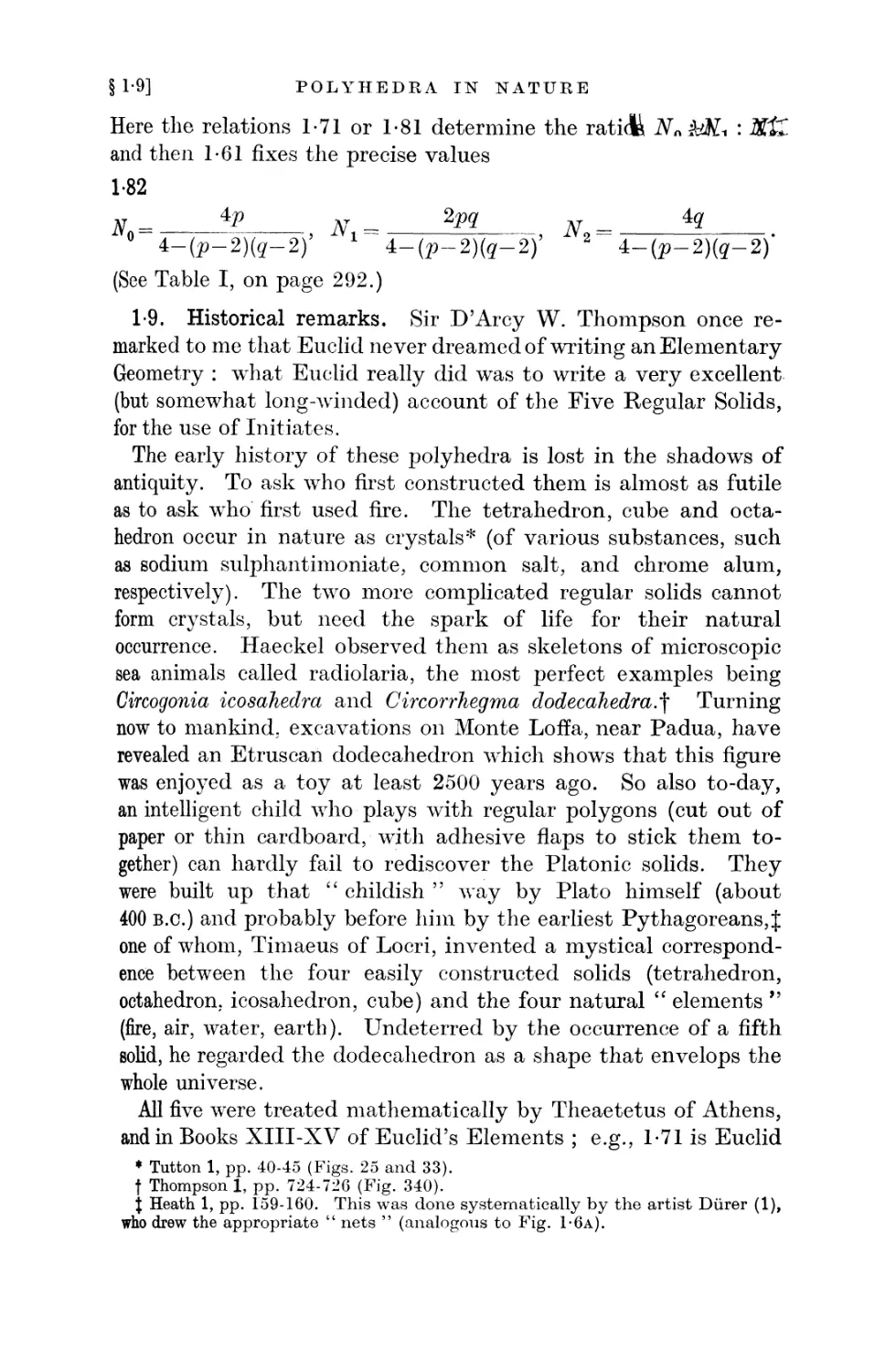
determine the rati徽N, n I-W
values
1.82
No=
4p
4一(p一2) (q一2)'
l UT
人,I
2pq
一4一(p一2) (q一2) '
N2
4q
4一(p一2)(q一2)
(See Table I,on page 292.)
1.9.Historical remarks.Sir D'Arcy W. Thompson once re-
marked to me that Euclid never dreamed of writing an Elementary
Geometry:what Euclid really did was to write a very excellent.
(but somewhat long-winded)account of the Five Regular Solids,
for the use of Initiates.
The early history of these polyhedra is lost in the shadows of
antiquity.To ask who first constructed them is almost as futile
as to ask who- first used fire.The tetrahedron,cube and octa-
hedron occur in nature as crystals*(of various substances,such
as sodium sulphantimoniate,common salt,and chrome alum,
respectively).The two more complicated regular solids cannot
form crystals,but need the spark of life for their natural
occurrence·Haeckel observed them as skeletons of microscopic
sea animals called radiolaria,the most perfect examples being
Circogonia icosahedra and Circorrhegma dodecahedra. t Turning
now to mankind,excavations on Vlonte Loffa,near Padua,have
revealed an Etruscan dodecahedron which shows that this figure
was enjoyed as a toy at least 2500 years ago.So also to一day,
an intelligent child who plays with regular polygons (cut out of
paper or thin cardboard,、with adhesive flaps to stick them to-
gether) can hardly fail to rediscover the Platonic solids.They
were built up that“childish”二?ay by Plato himself (about
400 B.C.)and probably before hills by the earliest Pythagoreans,丰
one of whom, Timaeus of Locri,invented a mystical correspond-
ence between the four easily constructed solids (tetrahedron,
octahedron, icosahedron,cube)and the four natural“elements”
(fire, air, water, earth).Undeterred by the occurrence of a fifth
solid, he regarded the dodecahedron as a shape that envelops the
whole universe.
All five were treated mathematically by Theaetetus of Athens,
and in Books XIII一XV of Euclid's Elements;e.g.,1·71 is Euclid
*Tutton 1,pp.40一45(Figs.25 and 33).
f Thompson 1, pp.724一1 26 (Fig. 340).
tHeath 1,pp. 159一160. This was done systematically by the artist Ddrer(1),
who drew the appropriate“nets”(analobous to Fig. 1·6A).
14
REGULAR POLYTOPES
[号1·NJ
XV, 6.(Books XIV and XV were not written by Euclid himself,
but by several later authors.)The pyramids and prisms are much
older, of course;but antiprisms do not seem to have been recog-
nized before Kepler (A.D.1571一1630).*
The Greeks understood that some regular polygons can be
constructed with ruler and compasses,while others cannot.This
question was not cleared up until 1796, when Gauss,investigating
the cyclotomic equation
capable of such Euclidean
odd prime factors of p are
practically- means that p
1·15, concluded that the only {pJ's
construction are those for which the
distinct Ferinat primes 22k+ 1.This
must be a divisor of
g
n
multiplied by any
{5}and{17}have
3.5.17.257.65537一225-1
power of 2.The simplest rules for constructi
been given by Dudeney and Richmond.Riche-
lot and Schwendenheim constructed {257}about
Hermes wasted ten years of his life on {65537}.His
is preserved in the University of Gottingen.
The theory of graphs (so named by Sylvester)
1892, and
manuscript
began with
Euler's problem of the Bridges in Konigsberg, and was developed
by Cayley, Hamilton, Petersen, and others.Euler discovered his
formula 1·61 in 1752.Sixty years later, Lhuilier noticed its failure
when applied to multiply一connected polyhedra.The subject of
Topology (or Analysis sites)was then pursued by Listing, M6bius,
Riemann,Poincare,and has accumulated a vast literature.
The theory of maps received a powerful stimulus from Mobius's
problem of finding, the smallest number of colours that will suffice
for the colouring of every possible map.The question whether
this number (for a simply一connected surface)is 4 or 5,has been
investigated by Cayley, Kempe,Tait,Heawood, and others,but
still remains unanswered.Evidently two colours suffice for the
octahedron,three for the cube or the icosahedron, four for the
tetrahedron or the dodecahedron.
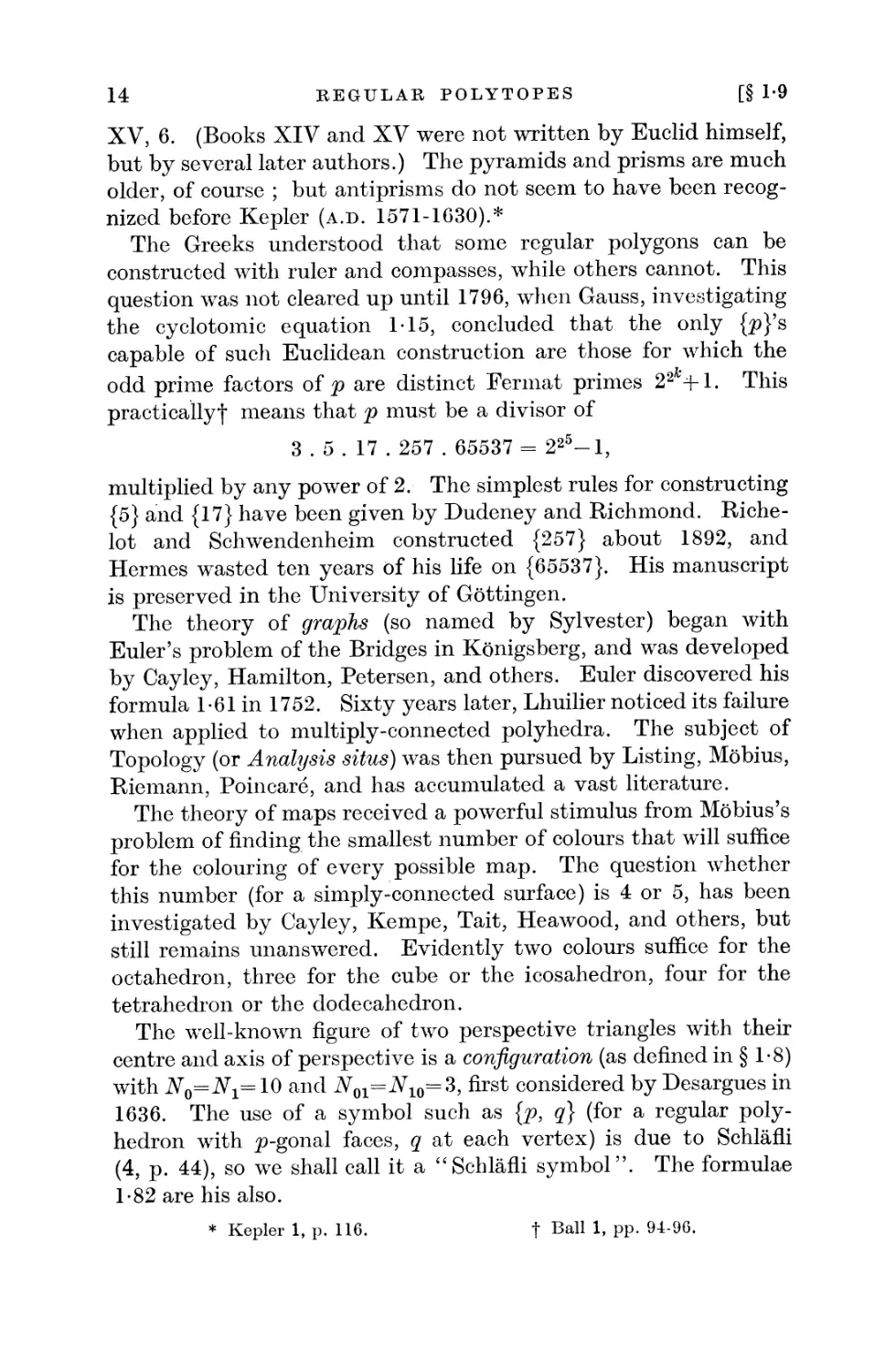
The well一known figure of two perspective triangles with their
centre and axis of perspective is a co叻guration (as defined in ' 1·8)
with No一N1一10 and Nol一Nlo= 3,first considered by Desargues in
1636.The use of a symbol such as {p, q} (for“regular poly-
hedron with p-gonal faces,q at each vertex)is due to Schlafli
(4, p.44),so we shall call it a“Schlafli symbol”·The formulae
1·82 are his also.
*Kepler 1,p.116·
fi Ball 1,pp.94一96.
CHAPTER II
REGULAR AND QUASI一REGULAR SOLIDS
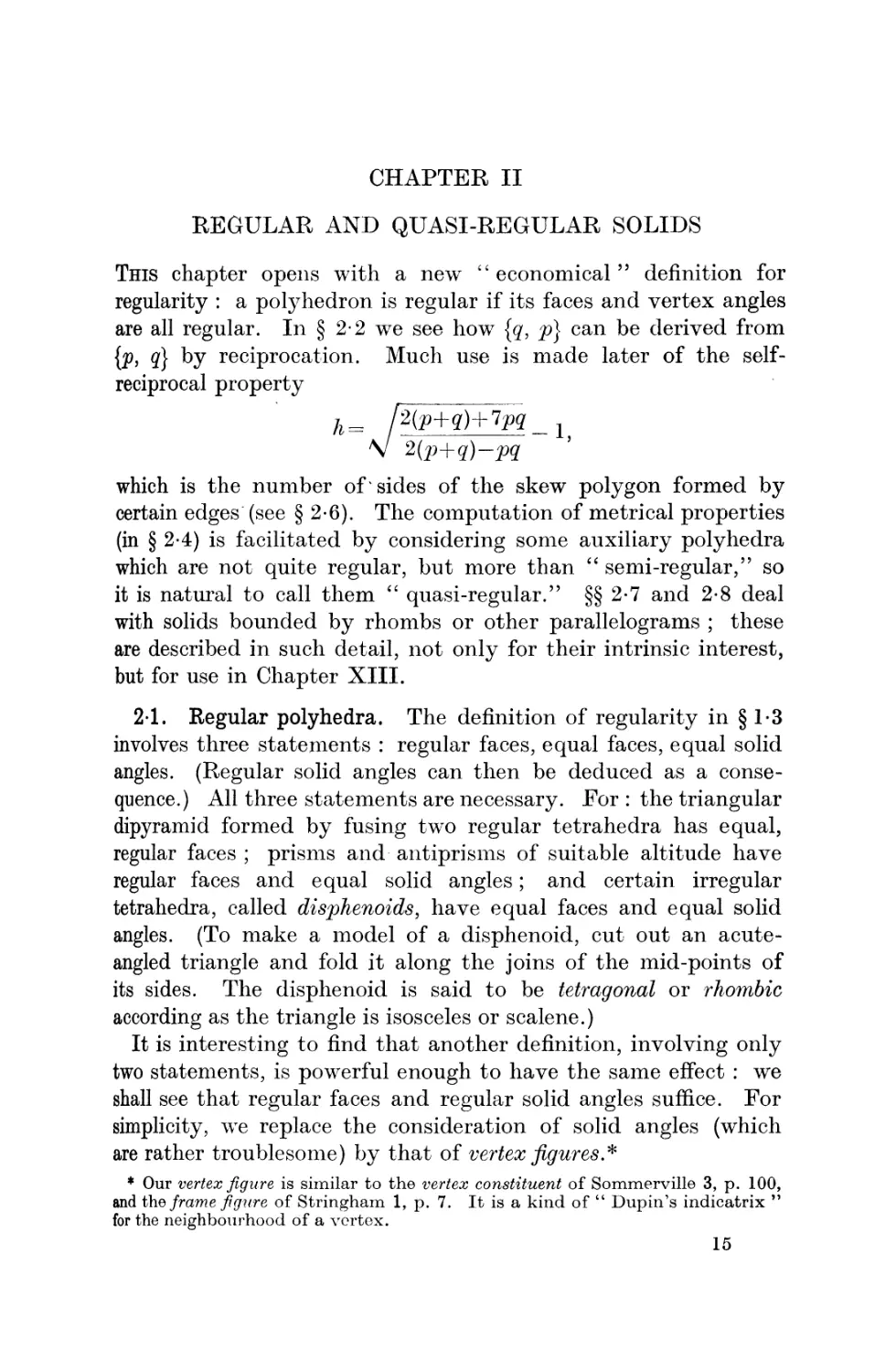
THis chapter opens with a new“economical”definition for
regularity:a polyhedron is regular if its faces and vertex angles
are all regular·In '2·2 we see how {q,pj can be derived from
{p, q} by reciprocation.Much use is made later of the self-
reciprocal property
。_12'(p+q)十7pq
,“一‘1—一1,
V 2(p+q)一pq
which is the number of、sides of the skew polygon formed by
certain edges一(see ' 2·6).The computation of metrical properties
(in ' 2·4) is facilitated by considering some auxiliary polyhedra
which are not quite regular, but more than“semi-regular,”so
it is natural to call them“quasi-regular.”'' 2·7 and 2·8 deal
with solids bounded by rhombs or other parallelograms;these
are described in such detail, not only for their intrinsic interest,
but for use in Chapter XIII.
2·1.Regular polyhedra.The definition of regularity in号1·3
involves three statements:regular faces,equal faces,equal solid
angles.(Regular solid angles can then be deduced as a conse-
quence.)All three statements are necessary.For:the triangular
dipyramid formed by fusing two regular tetrahedra has equal,
regular faces;prisms and一antipri sins of suitable altitude have
regular faces and equal solid angles;and certain irregular
tetrahedra, called disphenoids, have equal faces and equal solid
angles.(To make a model of a disphenoid,cut out an acute-
angled triangle and fold it along the joins of the mid-points of
its sides.The disphenoid is said to be tetragonal or rhombic
according as the triangle is isosceles or scalene.)
It is interesting to find that another definition, involving only
two statements,is powerful enough to have the same effect:we
shall see that regular faces and regular solid angles suffice.For
simplicity, we replace the consideration of solid angles (which
are rather troublesome)by that of vertex figures.*
*Our vertex声pure is similar to the vertex constituent of Sommerville 3, p.100,
and the frame figure of Stringham 1,p.7.It is a kind of“Dupin's indicatrix”
for the neighbourhood of a vertex·
15
16 REGULAR POLYTOPES [' 2.1.
The vertex figure at the vertex 0 of a polygon is the segment
joining the mid-points of the two sides through 0;for a沙}of
side 21, this is a segment of length
21 cos
7T
p
(See the broken line in Fig. 1·1 A on page 3.)The vertex figure
at the vertex 0 of *a polyhedron is the polygon whose sides are
the vertex figures of all the faces that surround 0;thus its
vertices are the mid-points of all the edges through 0.For
instance,, the vertex figure of the cube (at any vertex)is a triangle.
Now, according to our revised definition, a polyhedron is
regular if its faces and vertex figures are all regular.
Since the faces are regular, the edges must be all equal, of
length 21, say.Similarly, since the vertex figures are regular, the
faces must be all equal;for otherwise some pair of different faces
would occur with a common vertex 0,at which the vertex figure
would have unequal sides,namely 21 cos二加for two different
values of p.Moreover, the dihedral angles (between pairs of
adjacent faces)are all e qual;for, those occurring at any one
vertex belong to a right pyramid whose base is the vertex figure.
Each lateral face of this pyramid is an isosceles triangle with
sides l, l, 21 cos二加.The number of sides of the base cannot vary
without altering the dihedral angle.Hence this number, say q,
is t·he same for all vertices,and the vertex figures must be all equal。
We thus have the regular polyhedron {p, q}.Its face is a {p}of
side 21, and its vertex figure is a {q} of side 21 cos二加.
We easily see that一the perpendicular to the plane of a face at
its centre will meet the perpendicular to the plane of a vertex
figure at its centre in a point 03 which is the centre of three
important spheres:the eircum一sphere which passes through all
the vertices (and the circum一circles of the faces),the mid-sphere
which touches all the edges (and contains the in一circles of the
faces), and the in-sphere二:hick touches all the faces.*Their
respective radii t will be denoted by OR, 1R, and 2R.
Let 02
this face,
(i<j< k-)
2·11
be the centre of a几ce,01 the mid一point of a side of
and Oo one end of that side.Since the triangle Oi 0j Ok
is right一angled at 0;,Pythagoras’Theorem gives
OR2一12+1R2一(l CSC 7r/p)2+2R2}
i R21一(l cot二/p)2+:R22
German Urn
Briiekner(1
Ankugel, Inkugel.See Schoute 6
P.123)denotes these radii by R, A,and
P·151.
P. His a is our 2l.
*占1
务2.3] RECIPROCATION,TRUNCATION 17
2.2.Reciprocation.Consider the regular polyhedron {p,q},
with its No vertices,N1 edges,N2 faces.(See 1·82.)If we
replace each edge by a perpendicular line touching the mid一sphere
at the same point, we obtain the N1 edges of the rec勿rocal poly-
hedron {q, p}, which has N2 vertices‘and No faces.This process
is, in fact, reciprocation with respect to the mid一sphere:the
vertices and face一planes of {q, p}are the poles and polars of the
face-planes and vertices of lp,4}·
Reciprocation with respect to another (concentric)sphere would
户eld a larger or smaller {q, p}.The mid一sphere is convenient.
to use, as having·the same relationship to both polyhedra;e·g·,
it reciprocates the tetrahedron {3, 3}into an equal {3,3}·(See
Plate I, Figs. 6一8.)Moreover, when we use the mid-sphere, the
circum一。ircle of the vertex figure of {p,q} coincides with the
in一circle of a -face of {q, p},and these two {qJ's are reciprocal
with respect to that circle.
If properties of the reciprocal of a given polyhedron are dis-
tinguished by dashes,we have
2.21 OR 2R‘一1R 1R,=2R ORI;
for, each of these expressions is equal to the square of the radius
of reciprocation.Hence this radius can be chosen so that OR一O RI
and 2R= 2R';but then we shall not,in general,have also 1R一1 RI.
This process of reciprocation can evidently be applied to any
figure which has a recognizable“centre”.It agrees both with
the topological duality that ewe defined for maps(号1·4) and with
the projective duality that applies to configurations(号1·8).
2.3.Quasi一regular polyhedra.In the case when two regular
polyhedra, {p, q} and {q, p},are reciprocal with respect to their
common mid一sphere,the solid region interior to both polyhedra
forms another polyhedron, say{\召卜which has N1 vertices, n一‘y
the mid一edge points of either {p, q} or {q, p}. Its faces consist
of No tqj's and N2 tpj's,which are the vertex figures of fp,qJ
and {q, p}, respectively.There are 4 edges at each vertex,and
so 2N1 edges altogether. Euler's Formula is satisfied,as
N1一2N1 d- (No+N2)一2.
.
为酬B
111
S
a
e
m
a
S
e
h
于幻
S
.1五
Of cours一兰{
18
REG七LARPOD.YTOPES
When p=q= 3, this derived polyhedron is
「号2·3
evidently the octa-
hedron;for all its faces are {3}'s,and four meet at each vertex:
2·31
(3(3}一{{3, 4}·
Other cases the Ipj's and jqJ's are different;but still the e匆es
all alike,each separating a fp}from a {q}.
hedron, and{戮
{重}is the cubocta-
the icosidodecahedron (Plate I, Figs.9 and 10).
These are instances (in fact,the only convex instances)of quasi-
re yu lar polyhedra.
A quasi-regular polyhedron is defined as having regular faces,
while its vertex figures,though not regular, are cyclic and equi-
angular (i·e.,inscriptible in circles and alternate一sided).It
follows from this definition that the edges are all equal,.say of
length 2L, that the dihedral angles are all equal,and that the
faces are of two kinds,each face of one kind being entirely sur-
rounded by faces of the other kind.Moreover,by a natural
extension of the argument used for a regular polyhedron in ' 2·1,
the vertex figures are all equal·If there are r伽I's and r {qJ's
at one vertex, then it is the same at every vertex,and the vertex
figure is an equiangular 2r-gon with alternate sides 2L cos -irlp
and 2L cos二/q. The face-angles at a vertex make a total of
r(1一2加)二+r(1一2/q)二,
which must be less than 27T;therefore
___一1 1 1
2.32二+立十二>1.
p q
But p and q cannot be less than
‘31}3}
)4,一or(5,”
3;so r一2, and·{夸{is either
O
n examinlnga
icosidodecahedron
model of the octahedron,cuboctahedron,or
we observe a number of equatorial squares,
hexagons,
the centre
or decagons:polygons which,lying in planes through
are inscribed in
To study this
vertex figure
phenomenon in
great circles of the circum-sphere.
general terms,we observe that the
of
{p}
of opposite
ve
(q!
rtices
is a rectangle (since r= 2), and that either pair
of this rectangle are the mid-points of two
芬2.3) EQUATORIAL POLYGONS 19
adjacent sides of the equatorial polygon.If this polygon is an
{h}, its vertex figure is of length 2L cos二/h. But this vertex
figure, as we have just seen,is the diagonal of a rectangle of sides
2L cos二加and 2L cos二/q. Hence
7T一叮上
2.33
。7T n ?T。
n!% [`1‘_!l !1 Cti石1 nl1C‘
~。h一U价l-牛V份
I工J!
9J5
!J‘1、
(31
We can thus verity that h=4 for}。{-
‘(5)
(3、
ri for一,,一。and 10 for
(4)‘
belongs to just one equatorial {h};so there
夕q
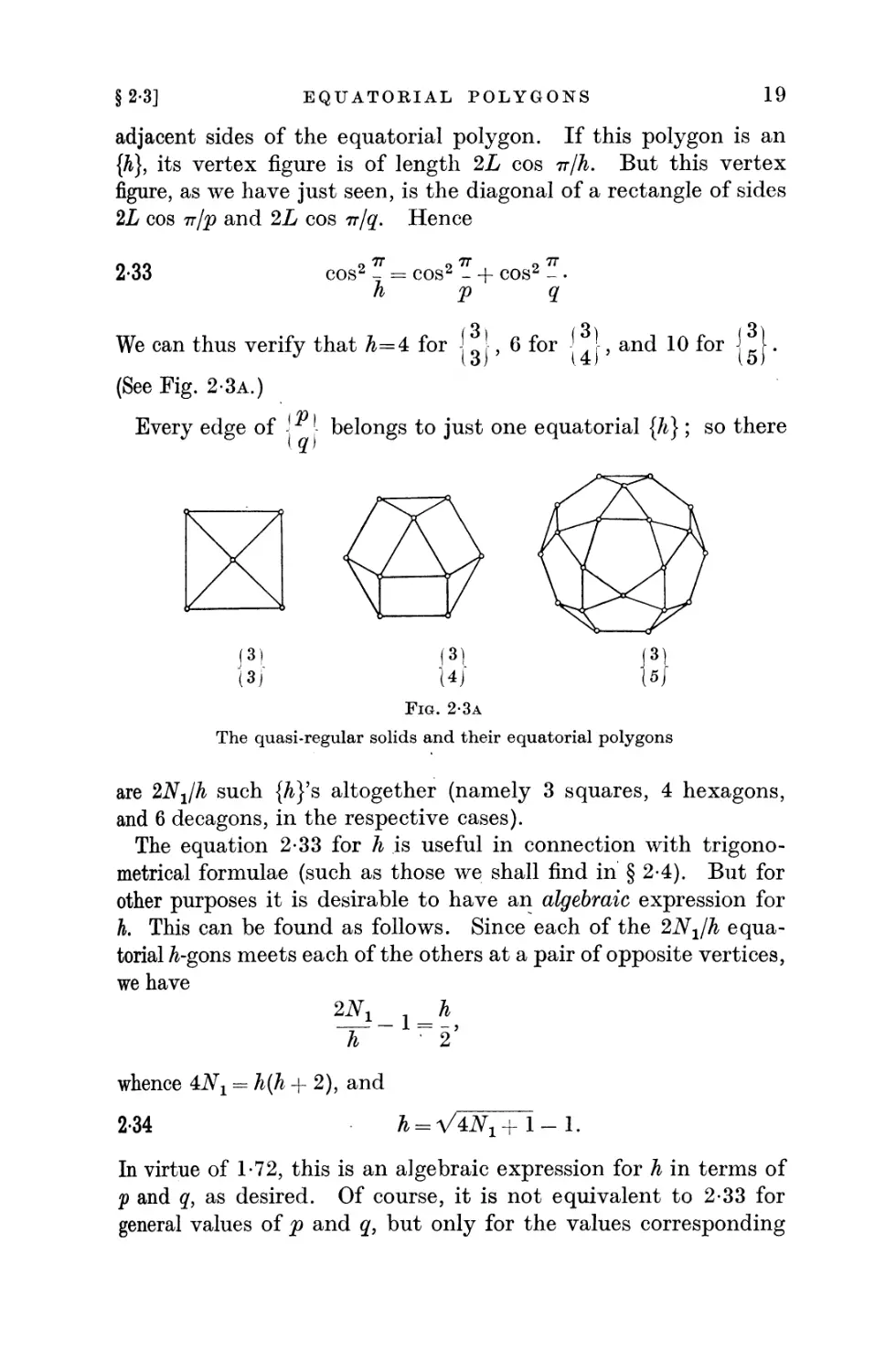
(See Fig. 2·3A.)
Every edge of
因件
!阳!
njs
了.,︺1
、‘.万‘尸!护
nJ4
夕.,tJ仇1
、,一...了
nJOO
‘!月J..、
FIG. 2·3A
The quasi-regular solids and their equatorial polygons
are 2N1/h such JhJ's altogether (namely 3 squares,4 hexagons,
and 6 decagons,in the respective cases).
The equation 2·33 for h一is useful in connection with trigono-
metrical formulae (such as those we shall find in'号2·4).But for
other purposes it is desirable to have an algebraic expression for
h. This can be found as follows.Since each of the 2N1/h equa-
torial h-gons meets each of the others at a pair of opposite vertices,
we have
2N,
—全一1=
h
h
2
whence 4N1=
2.34
h(h+2),and
h=斌4N1+1一1.
In virtue of 1·72, this
p and q, as desired.
algebraic
lsanajgis an
Of course
expression for h in terms of
it is not equivalent to 2·33 for
general values of p and q, but only for the values corresponding
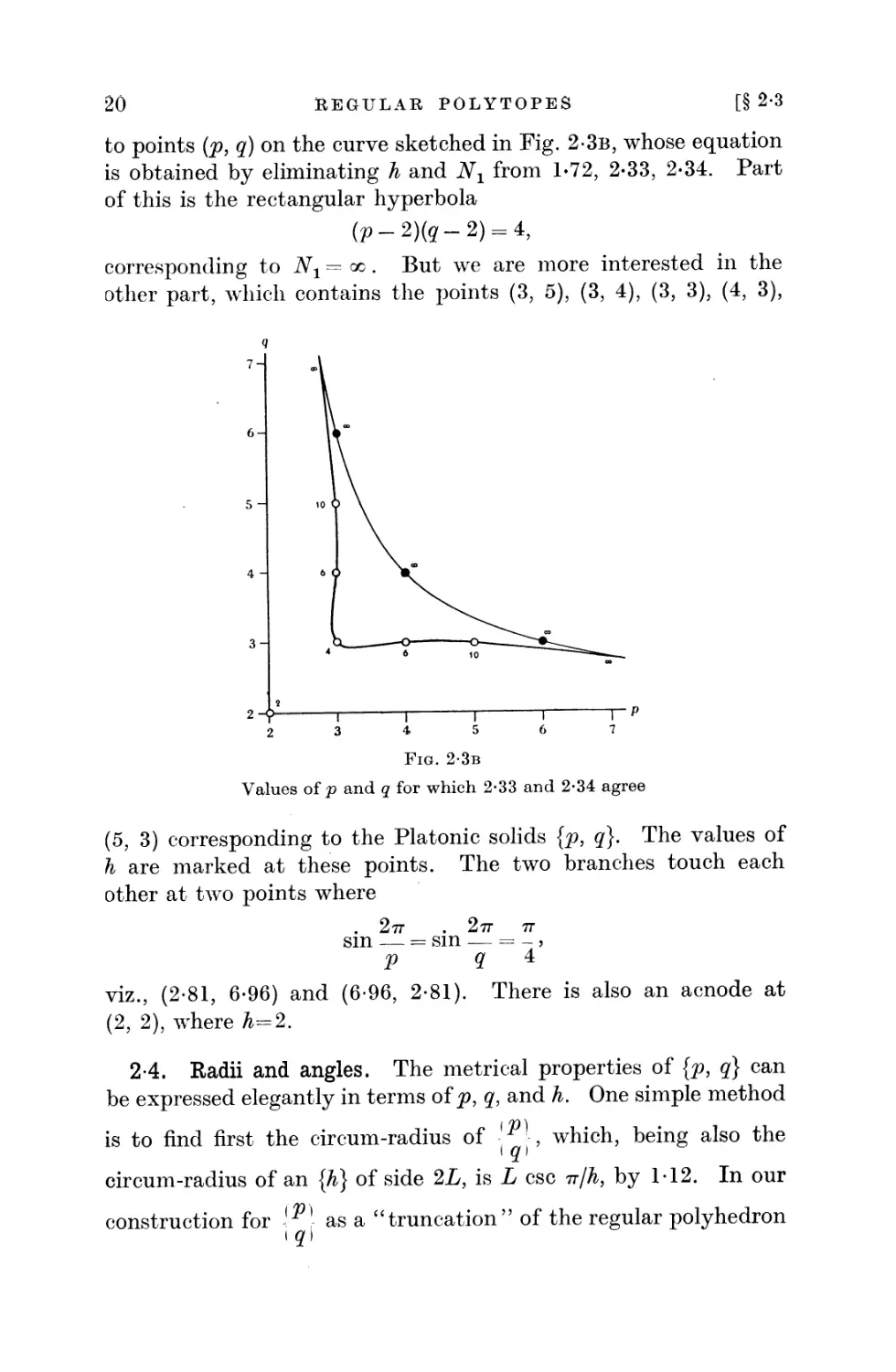
20 REGULAR POLYTOPES [' 2.3
to points (p, q) on the curve sketched in Fig.2·3B,whose equation
is obtained by eliminating h and N1 from 1·72,2.33,2·34.Part
of this is the rectangular hyperbola
(P一2) (q一2)=4,
corresponding to N1一OC.But we are more interested in the
other part,which contains the points(3,5),(3,4),(3,3),(4, 3),
FIG.2·3B
Values of p and q for which 2·33 and 2·34 agree
(5,3)corresponding to
h are marked at these
the Platonic solids fp, q}.The values of
points.The two branches touch each
仃-4
一一
仃一2
肠-q
Q曰-!.
other at two points where
sin
2仃
p
viz.,(2·81,6·96)and(6·96,
=sin
2·81).
There is also an acnode at
(2,2),where h=2.
2·4.Radii and angles.The metrical properties of {p, q} can
be expressed elegantly in terms of p, q, and h.One
‘·‘。find first the circum-radius of一pq{,which,
simple method
being also the
circum-radius of an {h} of side 2L, is L csc二/h, by 1.12.
In our
construction for)p、
(q)
as a“truncation”of the regular polyhedron
METRICALrROPERTIES
of edge 21, this circum-radius
occurs as
But the edge
naively 21 cos
2L of一‘p”一is the vertex
7T加.
L
(q)
Hence
21
the mid-radius of
figure of a face of
4]好a}.扑
62.协扭扭
2.41
l cos叮
p
and the mid-radius
2.42
of于2),
1R
q}is
一l cos万csc万.
1) h
It follows from 2·11and2·33 that the circum-radius and in-radius
are
2.43
声一l sin71CSC 77n - esc -
q h
2R一l cot叮CoS7TCsC ?Tcos - csc.
p q h
As a check,we observe that
symmetrically, in agreement w
the ratio OR12R involves p and q
ith 2·21.
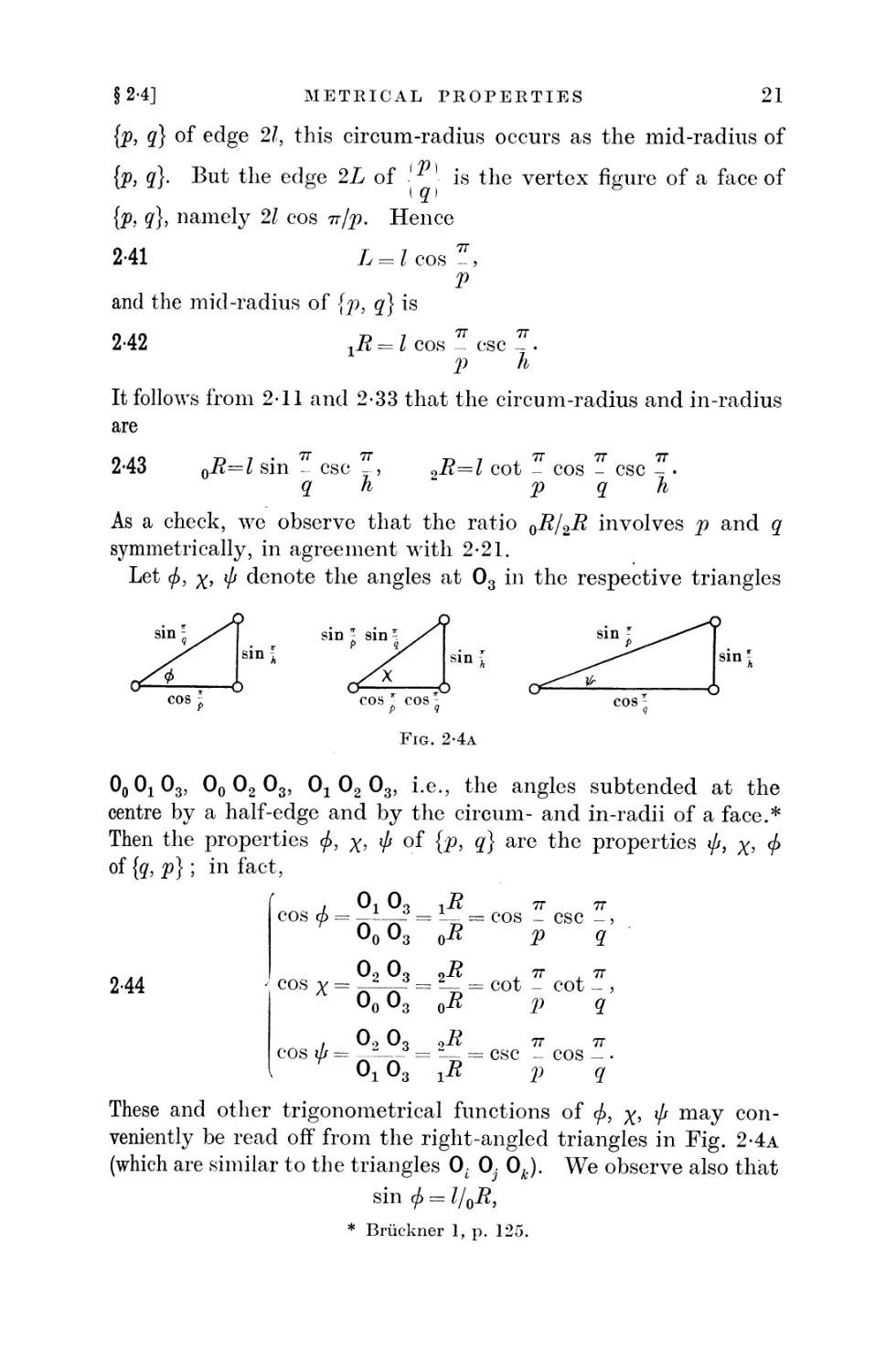
Let势,X, 0 denote the angles at 03 in the respective triangles
sin 9I sin:
碑1一b
Sin;sin 4 I.,
,_*I I sin万
买 X“
cos’cos二
P 9
FIG.2.4A
sin
cos
Y
cos
00 01 03} 00 02 03,01 02 03, 1.e.,the angles
centre by a half-edge and by the circum一and
Then the properties 0, x, 0 of {p, q}
of {q, p};in fact,
are
subtended at the
in-radii of a face.*
properties 0, x,势
介︼口上
ee
th韶
cot万
q
万一尹7T一尹
cos
势
cos
2.44
cos
X
cot
cos
必
0103 1R
0003 0五
0203 2R
0003 OR
0} 03 I)R
01 03 1R
7T
csc一cos
卯
q
尸口一口“一
These and other trigonometrical functions of势,X1必may con-
veniently be read off from the right一angled triangles in Fig.2·4A
(which are similar to the triangles Oi 0j 0,})·We observe also that
sin势一110R)
*Briickner 1,p.175.
22 REGULAR POLYTOPES「号2.4
and that二一20 is the dihedral angle between the planes of two
adjacent faces.(This is easily seen by considering the section
by the plane O1 02 03 which is perpendicular to the common edge
of t二一o such faces.)
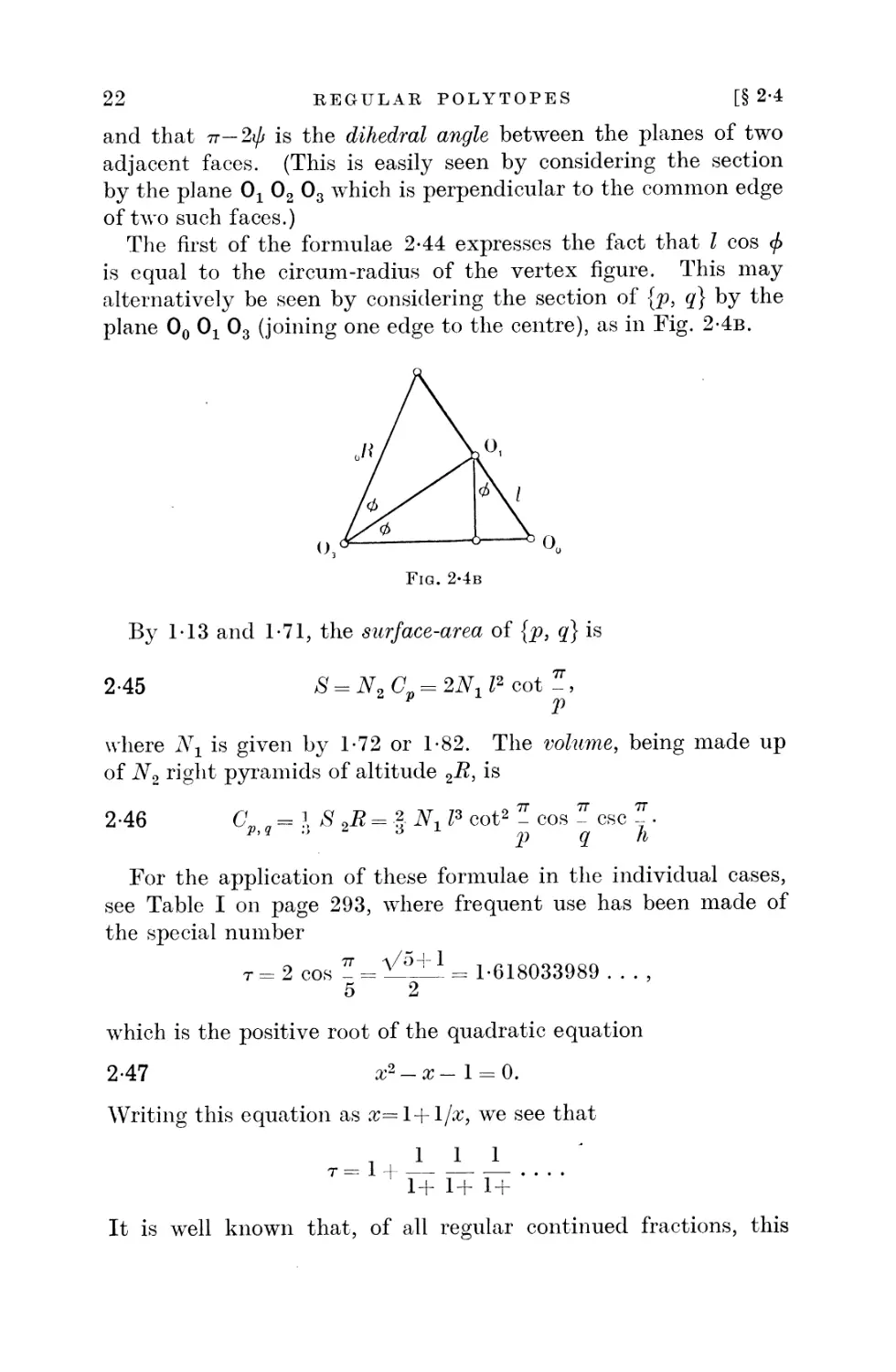
The first of the formulae 2·44 expresses the fact that l cos势
is equal to the circum-radius of the vertex figure.This play
alternatively be seen by considering the section of fp,q} by the
plane Oo O1 03 (joining one edge to the centre),as in Fig.2·4B.
1?
U,
必
必
0
()
OU
F1a.2"4B
By 1·13 and 1·71,the sicrface-area of {p, q} is
2.45 S一NO CM一2N, 12 cot "r ,
p
where N1 is given by 1·72 or 1·82.The volume, being made up
of N2 right pyramids of altitude 2R, is
;Nl 13 cot2 7r cos 7r。、。7T.
.p q h
these formulae in the individual cases
子f
20
2·46
C=1S
一夕, q
For the application
see Table I
the special
011 page 293,where frequent use
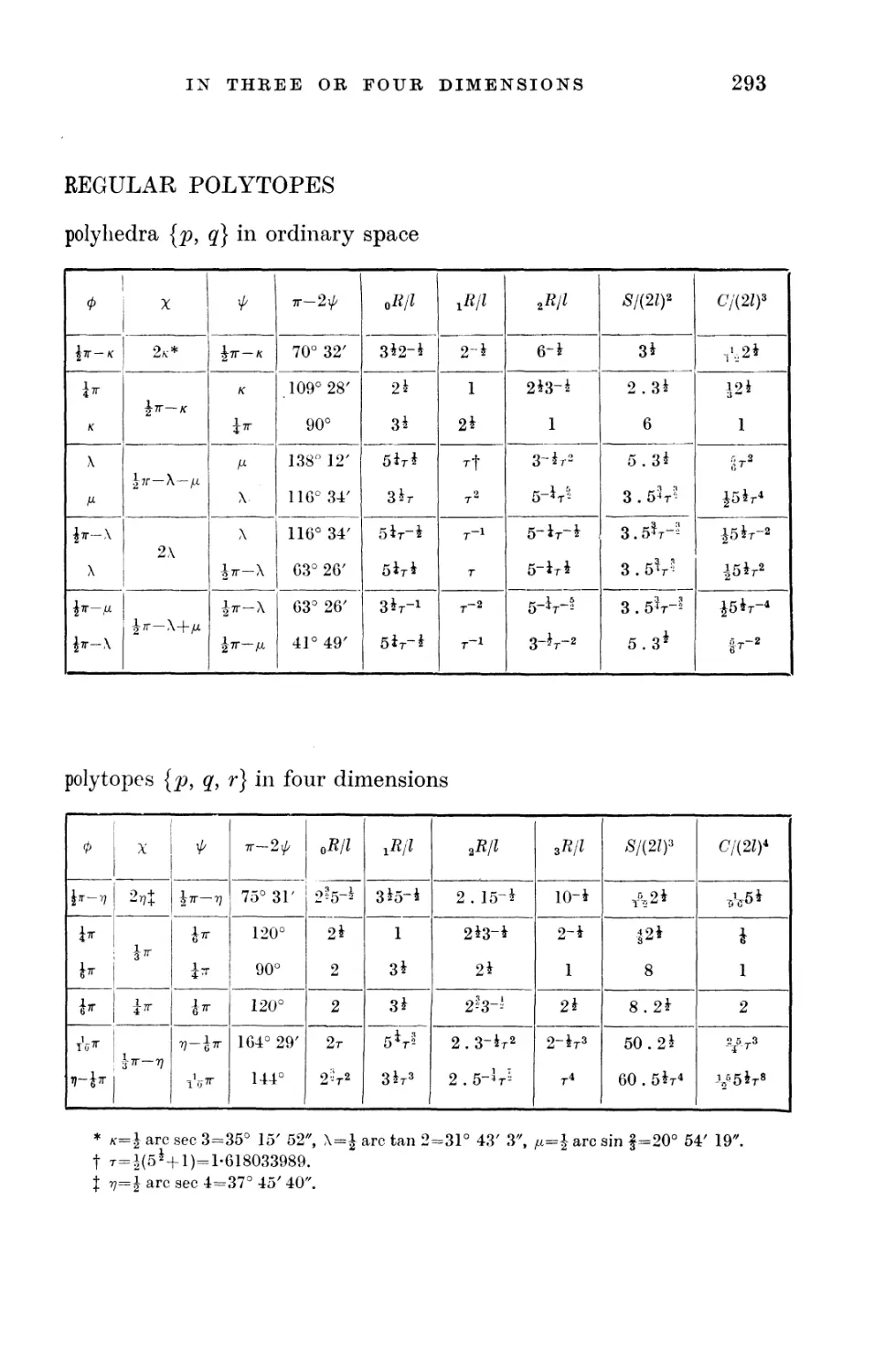
.皿.‘J,.几
has been made of
number
?T -% /5 '-1
7=2 cos二=v’=1·618033969…
5 2
which is the positive root of the quadratic equation
2.47 x2一x一1=0.
Writing this equation as二一1+1/二,we see that
1 1 1
丁=1+一一二.…
1+1+1+
It is well known that,of all regular continued fractions,this
号2.5]
converges slowest.
are the Fibonacci
t1NGULAR DEFICIENCY
Its nth convergent is f,,+I Ifn,where f,,S:,
numbers
1,1,2, 3,5, 8, 13, 21,34, 55,.…
These can be written down immediately, as
1+1=2,1-}-2==3, 2+3==5, 3+5=8,
and so on. Since T'‘一1十丁,‘=二,‘一卜', the integral powers of二
given by the formulae
23
are
2-r士儿-
工fII-N/5士(关‘一,+fn:一,)
!(1ti‘一,+fn、,)士fl,,V5
(n odd),
(n even)
e.g.,
?'3一A/5+2,二一c=9一4斌5.
2·5.Descartes’Formula.In the deduction of 1·31 and 2·32,
we used the principle that the几ce一angles at a vertex of a convex
polyhedron must total less than 2二.It is evident to anyone
making models,that the angular deficiency is small when the
polyhedron is complicated.The precise connection was observed
by Descartes,who showed that, if the face一angles at a vertex
amount to 27一5,then
万8=47r,
where the summation is taken over all the vertices.
If the vertices are all surrounded alike,this means that
2·51 No=4二/V,
i.e.,the angular d桥ciency is inversely proportional to the number
of vert-ices.In the case of {p, q}, we,have
8=2二一q(1一2加)二,
whence No=却/(即+2q一Pq),
in agreement with 1·82.If we measure 8 in degrees,the formula is
No一72o/s;
e.g.,the dodecahedron has three face一angles of 108。,totalling
3240, so the deficiency is 360, and N。一720/36一20.
Descartes’Formula is most easily established by spherical
trigonometry, using the well一known fact that the area of a
spherical triangle (whose sides are arcs of great circles on a sphere
of unit radius)is equal to its spherical excess, which means the
excess of its angle-sum over that of a plane triangle (namely二).
REGULAR POLYTOPES
[号2·5
4
9曰
Since any polygon can be dissected into triangles,it follows that
the area of a spherical polygon is equal to its spherical excess,
which means the excess of its angle一sum over that of a plane
polygon having the same number of sides.
By projecting the edges of a given. convex polyhedron from
any interior point onto the unit sphere around that point,we
obtain a partition of the sphere into N2 spherical polygons,one
for each face of the polyhedron.The total angl。一sun. of all these
polygons is clearly 27NO (i.e.,2二for each vertex). On the other
hand,t,he total angle一sum of the flat faces themselves’is
E (2二一5)一2 7NO一E6
(summed over the vertices).The difference,15,is the total
spherical excess of the N2 spherical polygons,which is the total,
area of the spherical surface,namely 4-,r.
Spherical trigonometry also facilitates the derivation of 2·44.
For, by projecting the triangle 00 01 02 from the centre 03 onto
the unit sphere around 03, we obtain a spherical triangle PO P1 P2
with angles
7T一夕
7T一2
7T]9
and (opposite)sides
2.52 P1 P2一价,P2 PO一X) PO P1一0.
The ordinary formulae for a right一angled spherical triangle give
2·44 at once.
2·6.Petrie polygons.We have seen that the vertices of
{召{一‘·lie mid-points of the edges of{,,,}·In par“一‘ar, the
vertices of an equatorial {h}are the mid-points of a special circuit
of h edges of {p, q}, forming a skew polygon which is sufficiently
important to deserve a name of its own:so let us call it a Petrie
polygon.It may alternatively be defined as a skew polygon such
that every two consecutive sides,but no three,belong to a face
of the regular polyhedron.The above considerations show that
it is a skew h一g on,where h i s given by 2.33 or 2.34.It is a sort of
Zigzag,as its alternate vertices form two { 2 h}'s in parallel planes.
In other words,its vertices and sides are the vertices and lateral
edges of a告h-gonal aiitiprism.(See ' 1·3, where the icosahedron
洲O
2
}2.7]
{3, 5}was
pyramids.
PETRIEPOLYGONS
derived from a pentagonal antiprism by adding two
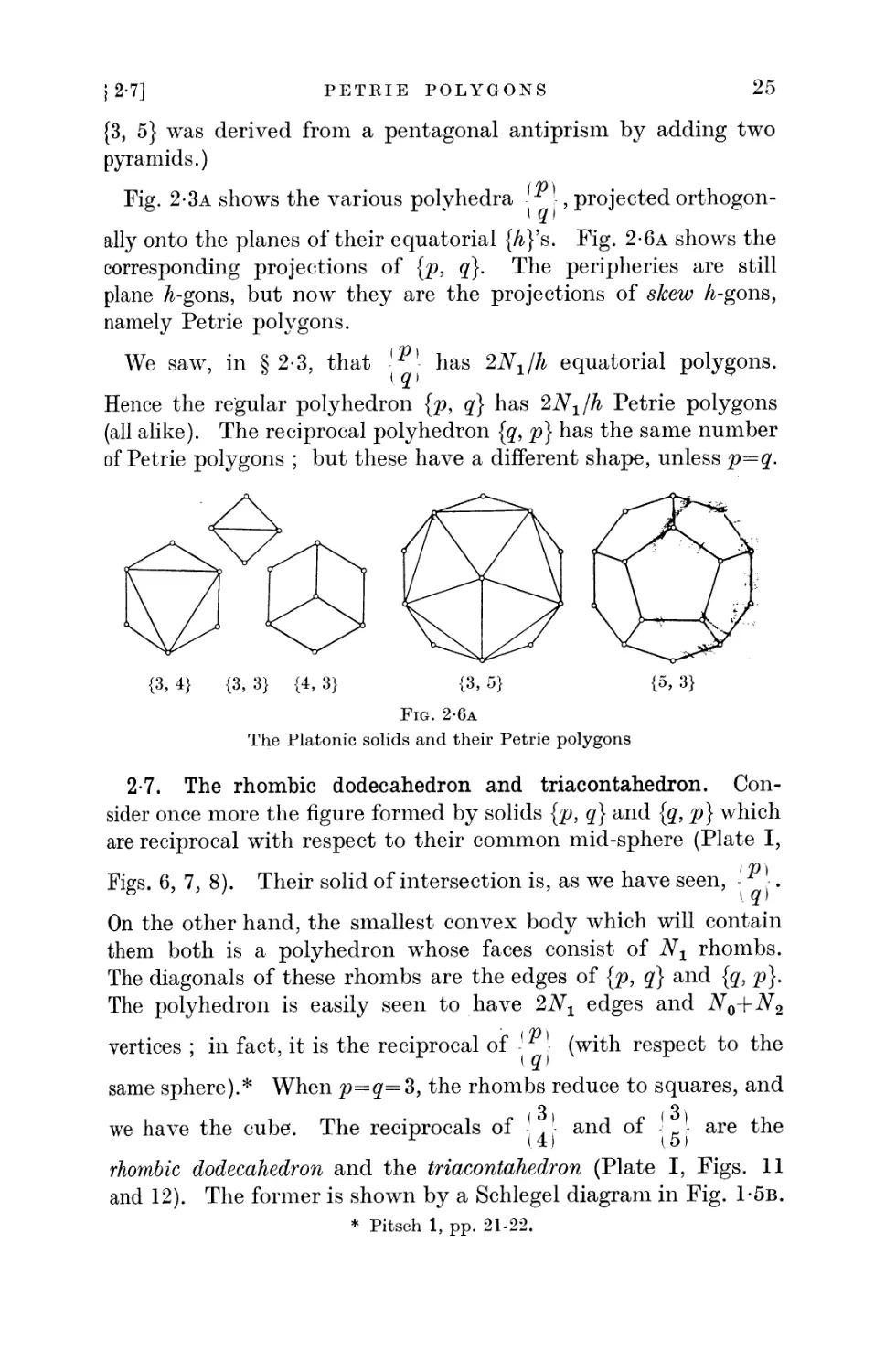
Fig·2·3A shows the v二‘ous polyhedra{琴{
ally onto the planes of their equatorial {hJ's.
corresponding
plane h一gons,
namely Petrie
probe
ctions of {p, q}.
but
now
they are
The
probe〔
,projected orthogon-
Fig.2.6A shows the
peripheries are still
ions of skew h-gons,
We saw, in
polygons·
'2·3,that
(P}
(q)
the
has
Hence the regular polyhedron {p, q}
(all alike).The reciprocal polyhedron
2N1 1h equatorial polygons·
has 2N1 1h Petrie polygons
Jq, p}has the same number
of Petrie polygons;but these have a different shape,unless p=q
弃介
13 , 41 {3, 31 {4, 3)
{3,5 }
{o-, 31
FIG. 2.6A
The Platonic solids and their Petrie polygons
2·7.The rhombic dodecahedron and triacontahedron.Con-
sider once more the figure formed by solids {p, q} and {q, p}which
are reciprocal with respect to their common mid一sphere (Plate I,
Figs·6, 7,8,·Their solid of intersection is,as we have seen,{、琴}·
On the other hand, the smallest convex body which will contain
them both is a polyhedron whose faces consist of Nl rhombs·
The diagonals of these rhombs are the edges of {p, q} and {q, p}.
The polyhedron is easily seen to_have 2N1 edges and No+ N2
vertices;in fact,“is the recipro二‘of一、琴}(with respect‘。the
same sphere).*When p=q一3, the rhombs reduce to squares,and
we“一‘he cube. The reciprocals of{、:{and of{:}一the
rhombic dodecahedron and the triacontahedron (Plate I,Figs.11
and 12).The former is shown by a Schlegel diagram in Fig.1·5B.
*Pitsch 1,pp.21·22.
P, EG七LARPOLVTOPES
[号2·7
the fact that its
户0
勺曰
The shape of the rhomb is determined by
diagonals are 21 and 21',where,by 2·41
2·71
cos
1)
This may alternatively be seen
=l’Co、7rl' cos -.
q
from the fact that the rhomb is the
reci-Drocal of the vertex fiorure of
1 v
that its diagonals are in
仁J.
O
S
11!
尹q
the same ratio as the sides of that rectangle.
In particular, the face of the rhombic dodecahedron has
diagonals in the ratio 1:丫2.This suggests an amusing method
for building up a model.*Take two equal solid cubes·Cut one
of them into six square pyramids based on the six faces,with
their common apex at the centre of the cube.Place these
pyramids on the respective faces of the second cube.The result-
ing solid is the rhombic dodecahedron·
Alternatively,- a model of the rhombic dodecahedron can be
built up by juxtaposing four obtuse rhombohedra whose faces
have diagonals in the ratio 1:丫2.(A rhombohedron is a parallele-
piped bounded by six equal rhombs.It has two opposite vertices
at which the three face一angles are equal.It is said to be acute or
obtuse according to the nature of these angles.)
By 2·71 again,the triacontahedron's face has diagonals in the
“golden section”ratio 1:T. A model can be built up from
twenty rhombohedra,ten acute and ten obtuse,bounded by such
rhombs.丰(The thirty faces of the triacontahedron are accounted
for as follows.Seven of the obtuse rhombohedra possess three
each,and nine of the acute rhombohedra possess one each.The
remaining four rhombohedra are entirely hidden in the interior.)
Corresponding
polyhedron has
to the equatorial“一gon of{召卜
a zone of h rhombs,encircling it
the reciprocal
like Humpty
Dumpty's cravat.The edges along which consecutive rhombs of
the zone meet are,of course,all parallel.It follows that the
dihedral angle of the“rhombic N1一hedron”is
7T
2一人
一
1.1
1.e.,90。
for the
for the cube,1200 for the rhombic dodecahedron, and 1440
triacontahedron.
*Briickner 1,P.130.
丰Kowalewski 1,PP.22一,)9
t Kowalewski 1,P.50.
怪2·8]
STARS
27
2·8.Zonohedra.These rhombic figures suggest the general
concept of a convex polyhedron bounded by parallelograms. We
proceed to prove that such a polyhedron has n(n一1)faces,where
n is the number of different directions in which edges occur.
Since all the faces are parallelograms,every edge determines a
zone of faces,in which each face has two sides equal and parallel
to the given edge.Every face belongs to two zones which cross
each other at that face and again elsewhere (at the“counter-
face”).Hence the faces occur in opposite pairs which are
congruent and similarly situated in parallel planes.So also,the
edges occur ,in opposite pairs which are equal and parallel,and
the vertices occur in opposite pairs whose joins all have the same
mid-point.In other words,the polyhedron has central symmetry.
Hence each zone crosses every other zone twice.If edges occur
in n different directions,
pairs of opposite faces,
there are n zones,each containing n一1
j} n}
ancu Hence一2一pairs of opposite races
altogether. In fact,for every two of the n directions there is a
pair of faces whose sides occur in those directions.Thus there
are n、一1)faces.*
Moreover, there are 2(n一1) edges in each direction:2n(n一1)
edges altogether.By 1·61,there are n(n一1)+2 vertices.
Let us define a star as a set of n line一segments with a common
mid-point, and call it non一、ing-ular if no three of the lines are
coplanar. Then we may say that every convex polyhedron
bounded by parallelograms determines a non一singular star, having
one line-segment for each set ,of 2(n一1)parallel edges of the
polyhedron·
Conversely, the star determines the polyhedron.To see this,
consider n vectors el,e2,…,e,,,represented by the segments of
the star (with a definite sense of direction chosen along each).
The various sums of these vectors without repetition, say
2·81 x1 el+X2 e2+…+Xn en (xi=0 or 1),
will lead from a given.point to a certain set of 2n points,not
necessarily all distinct.The smallest convex body containing all
these points (on its surface or inside)is a polyhedron whose edges
represent the vectors ei in various positions.If the star is non-
singular, the faces are parallelograms.
*See Ball 1,p.1.13, where this statement appeared as an unproved conjecture.
28 REGULAR POLYTOPES「号2.8
To see which sums of vectors lead to vertices,consider a plane
of general position through a fixed point from which the vectors
el,…,e,, proceed in their chosen directions.The sum of those
vectors which lie on one side of the plane is the vector leading to
a vertex of the polyhedron;the suns of the vectors on the other
side leads to the opposite vertex.Hence the number of pairs of
opposite vertices is equal to the number of ways in which the
n vectors can be separated into two sets by a plane.By con-
sidering what happens in the plane at infinity, we can identi勿
this with the number of ways in which n points in the real pro-
jective plane can be separated into two sets by a line.By the
principle of duality, this is equal to the number of regions into
which the plane is dissected by n lines.If the given star is
non一singular, these n lines are of general position (no three con-
。二,,,」1In\.
current),anct the num Der of regions is wen known Zo De(、2)十1,
in
agreement with our
previous computation of the number of
ver
tices of the polyhedron.
Here are
determines
opposite
mines a
ve
some simple instances:the general star with n一3
a parallelepiped;and the star whose segments join
rtices of an octahedron,cube or icosahedron,deter-
cube, rhombic dodecahedron or triacontahedron,re-
spectively.
The analogous process in two dimensions leads from a star of
n coplanar segments to a convex polygon which has central
symmetry, its n pairs of opposite sides being equal and parallel
to the n segments.Since such a flat star is a limiting case of a
star of n non一coplanar segments, the“parallel一sided 2n-gon”can
/n、、
be ctissectea (in various ways)into(、2)paraiieiograms·
The general star (wherein various sets of m lines are coplanar)
leads to a convex polyhedron whose faces are parallel一sided
2m一gons (e.g., when m一2, parallelograms). This is the general
zonohedron.By a natural extension of the above argument, we
see that every convex polyhedron bounded by parallel一sided
犷th
2m一gons is a zonohedron.Hence,
hedron has central symmetry, so has
every face of a convex poly-
e whole polyhedron.*
The expression n(n一1),for the number of parallelograms in
a“non一singular”zonohedron,applies also to the general zono-
hedron, provided we regard each parallel一sided 2m-gon as taking
*This theorem is due to Alexandroff. See Burckhardt 1.
n冲
9目
2.8]
PARALLELOHEDRA
。1?儿、
,
the place of(\2)parallelograms’
ever the pairs of opposite f aces
Thus,if万indicates summation
we have
2·82
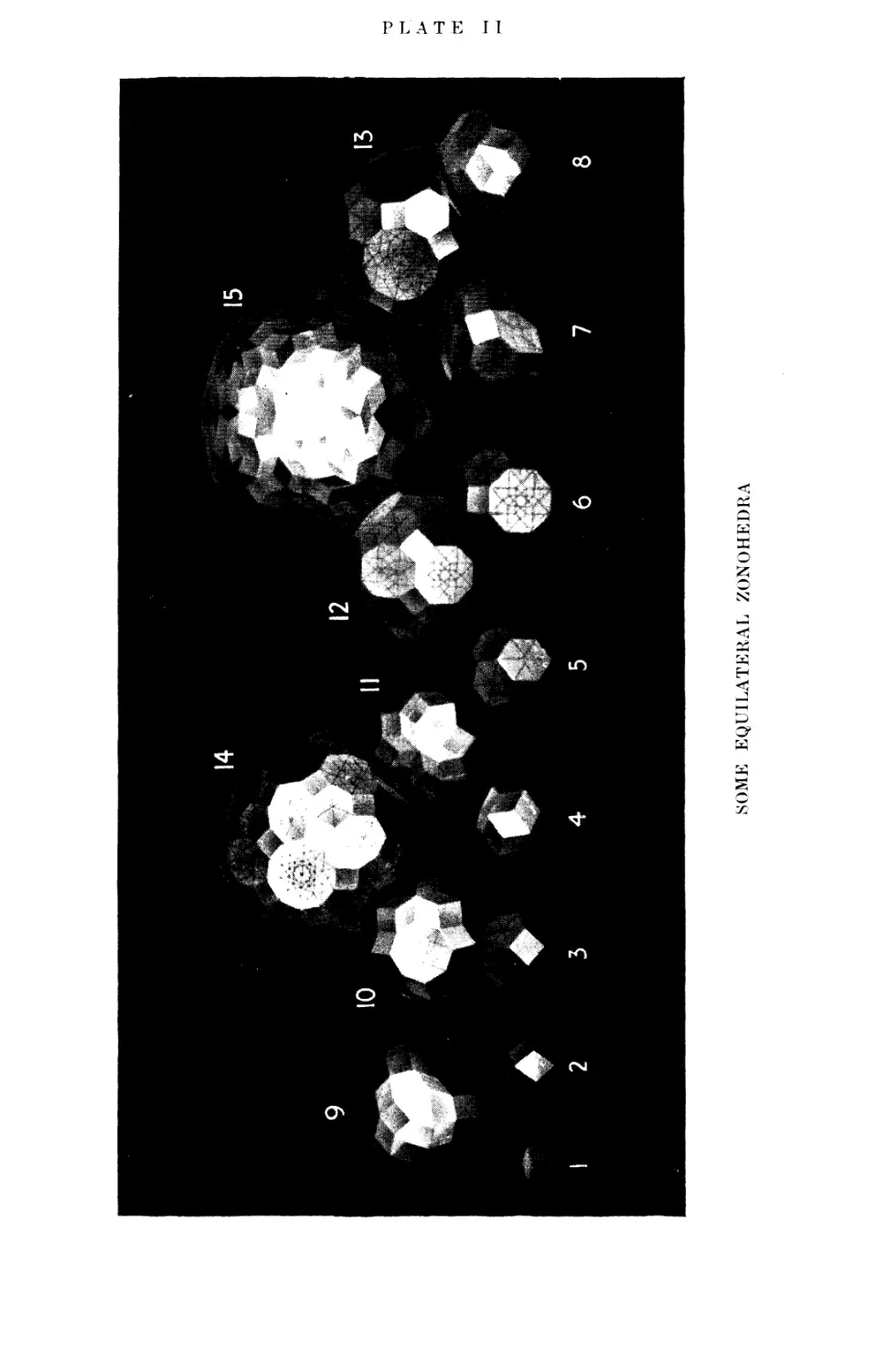
习7)Z一今or E7n(m一‘)一72(7‘一‘).
Plate II shows a collection of equilateral zonohedra, whose stars
consist of equal segments.(The faces with m>2 have been
marked according to their dissection into rhombs,in various
ways simultaneously.The reason for doing this will appear’in
号13·8.)
By removing one zone from the triacontahedron,and bringing
together the two remaining pieces of the surface,we obtain the
rhombic icosahedron, which has a decidedly“oblate”appearance.
The corresponding star consists of five of the six diameters of the
7乙=3
?乙=4
n=6
FIG.2·8A:Polar zonohedra
icosahedron,i.e.,five segments joining pairs of opposite vertices
of a pentagonal antiprism.More generally, the star which joins
opposite vertices of any right regular、一gonal prism (n even)or
antiprism (n odd)determines a" polar zonohedron (Fig.2·8A)
whose faces consist of n equal rhombs surrounding one vertex,
n other rhombs beyond these,and so on:n一1 sets of n
rhombs altogether, ending with those that surround the opposite
vertex.*
Another special class of zonohedra consists of the five“primary
parallelohedra”,each of which, with an infinity of equal and
similarly situated replicas,would fill the whole of space
interstices.t
dodecahedron
These are the cube,hexagonal
“elon-yated dodecaledron”
〔一尹
prism,
13·8B
without
rhombic
onpage
g1
飞孟、、.矛尹
*Franklin 1,p.363.
t See Tutton 2, p.567(F
(properly tricncated octahedron
See also Thompson 1,P.5:i 1.
448) or.
must riot
P·
be
723 (Fig.
(Fig
58动.
His cubo一octahedron
confused with Kepler's c2clioctahedron.
REGULAR POLYTOPES
[号2·9
0
介O
257),and“truncated octahedron”.The last is bounded by six
squares and eight hexagons;its star consists of the six diameters
of the cuboctahedron,and the corresponding lines in the real
projective plane are the sides of a complete quadrangle (giving
twelve regions)·
2·9.Historical remarks.As long ago as 300 A.D.,the unknown
author of Euclid XV,3一5,inscribed an octahedron in a cube,a
cube in an octahedron,and a dodecahedron in an icosaliedron;
this,in each case,amounts to reciprocating the latter solid with
respect to its in一sphere (which is the circum一sphere of the former).
He also inscribed an octahedron in a tetrahedron (Euclid XV, 2),
thus anticipating 2·31.=But Maurolycus(1494一1575)was probably
the first to have a clear understanding of the relation between
two reciprocal polyhedra.
The cuboctahedron and icosidodecahedron,described in号2·3,
are two of the thirteen Archimedean solids.Unfortunately,
Archimedes’own account of there is lost.According to Heron,
Archimedes ascribed the cuboctahedron to Plato.*
The number of sides of the Petrie polygon of {p, q} is given by
the alternative formulae 2·33 and 2·34, the latter of which is
published here for the first time.tWhen the general formulae
of '2·4 are applied to the individual polyhedra,as in Table I on
page 293,the results are seen to agree with van Swinden 1,pp.
378一390.But some of these results are far older.Euclid himself
found all the circu。一radii (or, rather, their reciprocals,the edges
of the solids inscribed in a given sphere;see Euclid XIII, 18).
Hypsicles (Euclid XIV)observed that,if a dodecahedron and an
icosahedron have the same circum一sphere,they also have the
same in一sphere,丰and their volumes are in the same ratio as their
surfaces,viz.,丫二2+1:丫3.Formulae 2·43 and 2·45 enable us
now to make the snore general statement that the values of
S/OR2 (or of C/OR3) for {p, q} and {q, p}are in the ratio
27.2-}T
sin—:sin—·
p q
A line一segment is said to be divided
Section if its two parts are in the ratio
according to the
1:二.(See 2·47.
Golden
A con-
*Heath 1,p.295.
十For 2·33, see Coxeter
丰Hypsicles attributed
century r3.c.).
3,号5 (p.202).
this discovery (cf
2·`} 1)to Apollonius of Perga (third
号2·9]
struction for this
century B.c.Since
rIBONACCINUMBERS
31
section was given by Eudoxus in the fourth
T2=二+1,the larger part and the whole segment
are
again in the ratio 1:T.
sides are in this
hedron)has the
ratio (viz.,
In other words,a rectangle whose
the vertex figure of the icosidodeca-
property that,when
remaining rectangle
sequence of integers
is similar to the
a square is cut o代the
original.The related
waS
investigated in the thirteenth century
A.D.by Leonardo of Pisa,alias Fibonacci.*More recently, the
remarkable formula
【z )1]
J )l}一,一E
r=U
7Z一n.,
was discovered by Lucas(2,pp.458, 463).It was Schlafli (4,
P.53)who first noticed the occurrence of various powers of T in
the metrical properties of the icosahedron and dodecahedron (and
of other figures which we shall construct in Chapters VI, VIII,
and XIV).
“Descartes’Formula”(号2·5),which is practically an anticipa-
tion of Euler's Formula(1·61),was discussed in a manuscript
De Solidorum Element、is.This was lost for two centuries, and
then turned up among the papers of Leibniz·t
Meier Hirsch(1,p.65)used spherical trigonometry in 1807 for
his proof of the existence of the Platonic solids.The characteristic
triangle PO P1 P, tiaras used extensively by Hess (3,pp.26一29)·
The rhombic dodecahedron and triacontahedron(号2·7)were
discovered by Kepler(1,p.123)about 1619.The former occurs
in nature as a garnet crystal, often as big as one's fist.
'2·8 has the peculiarity一of being concerned with af ne geo-
metry.The theory of zonohedra is due to the great Russian
crystallographer Fedorov(1),who was particularly delighted with
formula 2·82.He does not seem to have realized, however, that
a convex zonohedron is capable of such a simple definition as this:
a convex polyhedron whose faces are centrally symmetrical
polygons.
John Flinders Petrie,who first realized the importance of the
skew polygon that now bears his name,is the only son of Sir W. M.
Flinders Petrie,the great Egyptologist.lie was born in 1907,
and as a schoolboy showed remarkable promise of mathematical
ability.In periods of intense concentration he could answer
*For
十See
thi
Br
botanical application known as phyllotaxis,
iiel.:ner 1
,1).60, or Steinitz andRademacher
see Thompson 1,P.923.
1,PP.9一10.
32 REGULAR POLYTOPES「' 2.9
questions about complicated four一dimensional figures by“visual-
izing”there.His skill as a draughtsman can be seen in his
unique set of drawings of stellated icosahedra.*In 1926,he
generalized the concept of a regular skew polygon to that of a
regular skew polyhedron·(Fascinating as that idea is,there will
be no room for it in this book.The theory is complete only up to
four dimensions,t and the analogous“skew polytopes”have not
been investigated at all.)
*Coteter, Du Val,Mather, and Petrie 1,Plates I一Xx.
f Coseter 9.
CHAPTERIII
ROTATION GROUPS
THIS chapter provides an introduction to the theory of groups,
illustrated by the symmetry groups of the Platonic solids.We
shall find coordinates for the vertices of these solids,and examine
the cases where one can be inscribed in another. Finally, we shall
see that every finite group of displacements is the group of rota-
tional symmetry operations of a regular polygon or polyhedron·
3·1.Congruent transformations.Two figures are said to be
congruent if the distances between corresponding pairs of points
are equal, in which case the angles between corresponding pairs
of lines are likewise equal.In particular, two trihedra (or tri-
hedral solid angles)are congruent if the three face一angles of one
are equal to respective face一angles of the other. Two such trihedra
are said to be directly congruent (or“superposable”)if they
have the same sense (right一or left-handed), but enantiomorphous
if they have opposite senses.The same distinction can be applied
to figures of any kind,by the following device.
Any point P is located with reference to a given trihedron by
its (oblique)Cartesian coordinates x, y,:.Let P‘be the point
whose coordinates,referred to a congruent trihedron,are the
same x, y,:.If we suppose the two trihedra to be fixed,every
P determines a unique P‘,and vice versa.This correspondence
is called a congruent transformation, P‘being the transform of P.
If another point Q is transformed into Q‘,we have a definite
formula for the distance PQ in terms of the coordinates,which
shows that P'Q‘一PQ.In other words,a congruent transformation
is a point一to-point correspondence preserving distance.It is said
to be direct or opposite according as the two trihedra are directly
congruent or enantiomorphous, i.e.,according as the transforma-
Lion preserves or reverses sense.Hence the product (resultant)
of two direct or two opposite transformations is direct,whereas
the product of a direct transformation and an opposite transforma-
tion (in either order)is opposite.(In fact,the composition of
direct and opposite transformations resembles the multiplication
of positive and negative numbers,or the addition of even and odd
numbers.)A direct transformation is often called a displacement,
C 33
34 REGULAR POLYTOPES [' 3"I
as it can be achieved by a rigid motion.Any two congruent
figures are related by a congruent transformation, direct or
opposite.Two identical left shoes are directly congruent;a pair
of shoes are enantioniorphous.(Some authors use the words
“congruent”and“symmetric”where we use“directly con-
gruent”and“enantiomorphous”.)
We shall find that all congruent transformations can be derived
from three“primitive”transformations:translation (in a
certain direction,through a certain distance),rotation (about a
certain line or a二is,through a certain angle),and r叨ection .(in a
certain plane).Evidently the first two are direct, while the third
is opposite.
There is an analogous theory in space of any number of dimen-
sions.In two dimensions we rotate about a point,reflect in a
line,and a congruent transformation is defined in terms of two
congruent angles.In one dimension we reflect in a point,and
一叫一一一一心一一一一)~
0
Reflection (opposite)
一-(卜今卜一代卜一-一一0-弓
0 Q O'
Translation (direct)
FIG. 3·1A
a congruent transformation is defined in terms of two rays (or
“half lines”).In this simplest case,if any point 0 is left in-
variant,the transformation is the reflection in 0,unless it is
merely the identity (which leaves every point invariant);but if
there is no invariant point, it is a translation, i.e,,the product
of reflections in two points(0 and Q,in Fig.3·1A).
In two dimensions,a congruent transformation that leaves a
point 0 invariant is either a reflection or a rotation (according as
it is opposite or direct).For, the transformation from an angle
XOY to a congruent angle X'OY' (Fig.3·1B)can be achieved as
follows.By reflection in the bisector of乙XOX',乙XOY is trans-
formed into /X'OY1. Since this is congruent to乙X'0Y',the ray
OY‘either coincides with OYl or is its image by reflection in OX'.
In the former case the one reflection suffices;in the latter, it has
to be combined with the reflection in OX‘,and the product is the
rotation through ZXOX' (which is twice the angle between the
two reflecting lines)·
In particular, the product of reflections in two perpendicular
lines is a rotation through二or half-turn.In this single case,it
' 3.1] PRODUCT OF TWO REFLECTIONS 35
is immaterial which reflection is performed first;in other words,
two reflections commute if their lines are perpendicular.it is
important to notice that the half-turn about 0 is the product of
reflections in any two perpendicular lines through 0.
A plane congruent transformation without any invariant point
is the product of two or three reflections (according as it is direct
or opposite).For, in transforming an angle XOY into a congruent
angle X' 0'Y',we can begin by reflecting in the perpendicular
bisector of 00‘,and then use one or two further reflections,as
above.
The product of two reflections is a translation or a rotation,
Reflection (opposite)
Rotation (direct)
FIG.3·1B
according as the reflecting lines are parallel or intersect.Hence
every plane displacement is either a translation or a rotation.*
In the product of three reflections,we can always arrange that
one of the reflecting lines shall be perpendicular to both the others.
The following is perhaps not the simplest proof, but it is one that
generalizes easily to any number of dimensions.If we regard a
congruent transformation as operating on pencils of parallel rays
(instead of operating on points),we can say that a translation
has no effect:it leaves every pencil invariant.Since each pencil
can be represented by that one of its rays which passes through a
fixed point 0,any congruent transformation gives rise to an
“induced”congruent transformation operating on the rays that
emanate from 0:congruent because of the preservation of angles.
If the given transformation is opposite,so is the induced
*Kelvin and Tait 1,P.F0.
36 REGULAR POLYTOPES [' 3·1
transformation.But the latter, leaving 0 invariant, can only
be a reflection,say the reflection in OQ.This leaves 0 and Q
invariant;therefore the given transformation leaves the direction
OQ invariant.Consider the product of the given transformation
with the reflection in any line,p, perpendicular to OQ.This is
a direct transformation which reverses the direction OQ;i.e.,
it is a half-turn.Hence the given transformation is the product
of a half-turn with the reflection in p.But the half-turn is the
product of reflections in two perpendicular lines,which may be
chosen perpendicular and parallel to p.Thus we have altogether
three reflections,of which the last taro can be combined to form
a translation.The general opposite transformation is now reduced
to the product of a reflection and a translation which commute,
the reflecting line being in the direction of the translation.This
kind of transformation is called a glide一r叨ection.
In three dimensions,a congruent transformation that leaves a
point 0 invariant is the product of at most three reflections:one
to bring together the two x-axes, another for the y-axes, and a
third (if necessary)for the:一axes.Since one further reflection
will suffice to bring together two different origins (i.e.,the vertices
of the two congruent trihedra),
3·11.Every congruent transformation is the product of at most
four reflections.
Since the product of two opposite transformations is direct,a
product of reflections is direct or opposite according as the number
of reflections is even or odd.Hence every direct transformation
is the product of two or four reflections,and every opposite
transformation is either a single reflection or a product of
three.
The product of reflections in two parallel planes is a translation
in the perpendicular direction through twice the distance between
the planes,and the product of reflections in two intersecting
planes is a rotation about the line of intersection through twice
the angle between them.Two reflections commute if their planes
are perpendicular, in which case their product is a half-turn (or
“reflection in a line”).
Since the product of three reflections is opposite,a direct
transformation with an invariant point 0 can only be the product
of reflections in two planes through 0,i.e.,a rotation.Thus
' 3.1] E U L E R’S ROTATION THEOREM 37
3·12.Every displacement leaving one point invariant is a
rotation.*
Consequently the product of two rotations、with intersecting
axes is another rotation.
The three“primitive”transformations (viz.,translation,
rotation,and reflection),taken in commutative pairs,form the
following three products.A screw一displacement is a rotation
combined with a translation in the axial direction.A glide-
r叨ection is a reflection combined with a translation whose direc-
Lion is that of a line lying in the reflecting plane.A rotato-ry-
r叨ection is a rotation combined with the reflection in a plane
perpendicular to the axis.In the last case,if the rotation is a
half-turn,the rotatory-reflection is an inversion (or“reflection
in a point”),and the direction of the axis is indeterminate.In
fact,an inversion is the product of reflections in any three per-
pendicular planes through its centre;e.g.,reflections in the axial
planes of a Cartesian frame reverse the signs of x, y,:,respectively,
and their product transforms(二,M:)into(一x,一y,一z).
We proceed to prove that every congruent transformation is
of one of the above kinds.
An opposite transformation, being the product of (at most)
three reflections,leaves invariant either a point or two parallel
planes (and all planes parallel to them).The latter possibility
is the limiting case of the former when the invariant point recedes
to infinity;it arises when the three reflecting planes are all
perpendicular to one plane,instead of forming a trihedron.
If there is an invariant point 0,consider the product of the
given (opposite)transformation with the inversion in 0.This
direct transformation, leaving 0 invariant,must be a rotation.
Hence the given transformation is a“rotatory-inversion”,the
product of a rotation with the inversion in a point on its axis.
By regarding the inversion as a special rotatory-reflection,t we
see that a rotatory-inversion involving rotation through angle 9
is the same as a rotatory-reflection involving rotation through
e一Tf. Hence every opposite transformation leaving one point
invariant is a rotatory-reflection.
*Kelvin and Tait 1,p.69.
卞Crystallographers prefer to take translation, rotation, and inversion as
“primitive”transformations, and to regard a reflection as a special rotatory-
inversion.See Hilton 1,Donnay 1.
38 REGULAR
If, on the other hand,it is two
the transformation is essentially
POLYTOPES
[夸3·1
parallel planes that are invariant,
two一dimensional:what happens
in one of the two planes happens also in the other and in all
parallel planes.By the two一dimensional theory, we then have a
glide-reflection.Hence
3.13.Every opposite congruent transformation is either a
rotatory一reflection or a glide一r叨ection (including a pure reflection
as a special case).
In order to analyse the general displacement or direct trans-
formation,we first regard the transformation as operating on
bundles of parallel rays,represented by single rays through a
fixed point 0.The induced transformation, leaving 0 invariant,
is still -direct, and so can only be a rotation.The direction of the
axis,OQ,of this rotation, must be invariant for- the original dis-
placement as well.Let二be any plane perpendicular to OQ.
The product of the displacement with the reflection in w is an
opposite transformation which reverses the direction OQ,i.e.,a
rotatory-reflection or glide-reflection whose reflecting plane is
parallel to cv.Reflecting in w again, and remembering that the
product of reflections in two parallel planes is a translation,we
express the displacement as the product of a rotation or transla-
tion with a translation,i.e.,as either a“rotatory一translation”
or a pure translation.The latter alternative can be disregarded,
as being merely ,a special case of the former.This“rotatory-
translation”is the product of a rotation about a line parallel to
OQ with a translation in the direction OQ (or QO),i.e.,a screw-
displacement.Hence
3·14. Every displacement is a screw一displacement (including,
in particular, a rotation or a translation).*
3·2.Transformations in general.The concept of a congruent
transformation,applied to figures in space,can be general-
ized to that of a one-to一one transformation applied to any set of
elements·t When we speak of the resultant of two transforma-
tions as their“product”,we are making use of the analogy that
exists between transformations and numbers.We shall often
use letters R, S,…to denote transformations,and write RS
*Kelvin and Tait 1,PI).78一79.
t See Birkhoff and MacLane 1,PP.1214一12.
' 3.2] TRANSFORMATION 39
for the resultant of R and S (in that order).This notation is
justified by the validity of the associative law
3.21 (RS)T=R(ST).
Since a number is unchanged when multiplied by 1,it is natural
to use the same symbol 1 for the“identical transformation”or
identity (which enters our discussion as the translation through
no distance,and again as the rotation through angle 0 or through
a complete turn).Pushing the analogy farther, we let RP denote
the p一fold application of R;e.g.,if R is a rotation through 8,
RP is the rotation through p8 about the same axis.A transforina-
tion R is said to be periodic if there is a positive integer p such
that RP=1;then its period is the smallest p for which this
happens.We also let R一1 denote the inverse of R,which neutral-
izes the effect of R, so that RR-1一1一R-1R. If R is of period p,
we have R一1=RP一1.In particular, a transformation of period
(such as a reflection,half-turn,or inversion)is its own inverse.
The general formula for the inverse of a product is easily seen
to be,。。m、lml自’“’
(RS…T) -1一T-1…S-1 R-1.
If R,etc.are of period 2,this is the same as T…SR;e.g.,if
R and S are reflections in parallel planes,the products RS and
SR are two inverse translations,proceeding in opposite directions.
The analogy with numbers might be regarded as breaking down
in the general failure of the commutative law SR一RS;but
there are generalized numbers,such as quaternions,which like-
`rise need not commute.
Let x denote any figure to which a transformation is applied.
If T transforms x into x‘(so that T一1 transforms x' into x),we
writex‘一X 'r.
This notation is justified by the fact that (XT)s一X TS.If S trans-
forms the pair of figures (x, xT)into (x1,X1 T,),we say that S
transforms T into T1, and write
T1一Ts.
(We may speak of this as“T transformed by S”;e.g.,if T is a
rotation about an axis 1, then TS is the rotation through the same
angle about the transformed axis is.)Since x1一Xs and x1 Ti一(X T)S,
we have XST,一X TS for every x.Hence ST1.= TS,and
Ts=8一IT5.
REGULAR POLYTOPES
[号3.2
0
4
Transforming a product,we find that
(TU)5一S-1 TUS=S-1 TSS-1 US=TsUs.
Hence,for any integer p, (Tp )s一(Ts)p.
If S and T commute,so that TS一ST and TS=T, we say that
T is invariant under transformation by S.
The“figure
number or vari
,’x need not be geometrical;e.g.,it could be a
able, in which case XT is a function of this variable,
and a more
formations
customary notation is T(x).
e particular trans-
where t takes various
x'二xt,
numerical values,are seen to combine among
themselves just like the numbers t.)Again,x could be a discrete
set of objects in assigned positions,and XT the same set rearranged;
then T is a permutation.
The two alternative notations currently used for permutations
are illustrated by the symbols
一ac;c d ee d a;g}b } and (a。e,(b g)
for the permutation of seven letters that replaces
c,g,e,a,b,while leaving d and f unchanged.
a,b,c,e,
In the
g, by
latter
e)a
c.15
notation,
and (b g)
which we
shall use
are
called cycles.
exclusively, the two parts (a
Clearly, every permutation
product of cycles
times desirable to
involving distinct sets of objects.
It is some-
include all the objects,e.g.,to write
一(a c e) (b g)(d)(f)
calling (d)and (f)“cycles’of period 1”·
A transposition is a
single cycle of period 2,such as (b g),which merely interchanges
two of the objects.
A permutation is said to be even or odd according to the parity
of the number of cycles of even period;e.g.,(a c e)(b g)is an
odd permutation·
When a permutation is multiplied by a trans-
position,its parity is
reversed.For, if (al b1)is the transposition,
al and b1 must either occur in the
mutation or in two different cycles.
same cycle of the given per-
S
lnce
and
(al…a. b1…bs)
(al…ar)(b1…bs)
it merely remains to observe that one or
二ar)(b1…bs)
二ar b1…bs),
all of the three periods
:
IJLI
aa
一一=
、、.产、、.,产
11
b,D
IJLI人
(a(a
号3·3]
r, s, r+ s must be even.*
GROUPS
41
It follows (by induction)that
product of an
permutation.
己v已n
[odd] number of transpositions is an even
every
[odd]
3·3.Groups.The subject of group-theory
quately
just the
expounded many times,so we shall be
has been ade-
content to recall
most relevant of its topics,in an attempt to make this
book reasonably self-contained.
A set of elements or“operations”
group if it is closed with respect to
is said to form
some kind of
“multiplication”,if it contains an“identity”,and if
an abstract
associative
each opera-
Lion has an“inverse”.More precisely, a group contains
every two of its operations R and S,their product RS;
holds for all R,S, T;there is an identity, 1,such that
for
3·21
1R=R
for all R;and each R has an inverse,R一1, such that
R-1R一1.
It is then easily deduced that R 1=R and RR一1=1.
The number of distinct operations (including the identity)is
called the order of the group.This is not necessarily finite.
A subset whose products (with repetitions)comprise the whole
group is called a set of generators (as these operations“generate”
the group).In particular, a single
operation R generates a group
which consists of all the powers of R,including R0=1.
This
called a
order is
group of
cyclic group;
equal to the
it is finite if R is periodic, and then
is
its
period of R.’We may say that the cyclic
order p is defined by the relation
RY一1
~,一一~,
with the
generally,
relations;
tacit understanding that Rn _741 for OC n< p.More
any group is defined by a suitable set of generating
e.9.,the relations
3·31
define
R2 R1,
R12一R,22一(R1 R2 )3一1
a group of order 6 whose operations are 1,R1,R2, R1 R2,
andR1R2R1一R2R1R2"
*This proof is taken from Levi 1,p.7. Note that Levi multiplies from right
to left.
42 REGULAR POLYTOPES〔' 3.3
A subset which itself forms a group is called a subgroup.(For
the sake of completeness it is customary to include among the
subgroups the whole group itself and the group of order one
consisting of 1 alone.)In particular, each operation of any group
generates a cyclic subgroup·
If a given subgroup consists of T1, T2,…,while S is any
operation in the group,the set of operations STi is called a left
cosec of the subgroup,and the set TjS is called a right coset.*it
can be proved that any two left (or right)cosecs have either
the same members or entirely different members.Hence the
subgroup effects a distribution of all the operations in the group
into a certain number of entirely distinct left (or right)cosecs.
This number is called the index of the subgroup.When the group
is finite,the index is the quotient of the orders of the group and
subgroup.
Two operations T and T' are said to be conjugate if one can be
transformed into the other, i.e.,if the group contains an operation
S such that T‘一Ts,or ST'=TS.The relation of conjugacy is
easily seen to be reflexive,symmetric,and transitive.A sub-
group T1,T2,…is said to be self-conjugate if, for every S in the
group, the operations Ti are a permutation of their transforms
Tis,i.e·,if the left and right cosecs STi and TES are identical
(apart from order of arrangement of members).In particular,
any subgroup of index 2 is self-conjugate.‘
If two groups,G1 and G2,have no common operations except
the identity, and if each operation of G1 commutes with each
operation of G 2,then the group generated by G 1 and G:is called
their direct product, G 1 x G 2.(This clearly contains G 1 and G 2
as self-conjugate subgroups.)For instance,the cyclic group of
order pq, where p and q are co一prune,is the direct product of
cyclic groups of orders p and q (generated by Rq and RP, if R
generates the whole group)·
When the operations are interpreted as transformations,we
have a representation of the abstract group as a transformation
group.Since transformations automatically satisfy 3·21,we may
say that a set of transformations forms a group if it contains the
inverse of each member and the product of each pair.In par-
ticular, a group may consist of certain permutations of n objects;
it is then called a permutation group of degree n.A permutation
group is said to be transitive (on the n objects)if its operations
*Birhhoff and ALtcLane 1,1'.1-16
芍3·3] A GROUP OF ORDER SIX 43
suffice to replace one object by all the others in turn.The three
most important transitive groups are:
(i)the symmetric group of order n!,which consists of all the
permutations of the n objects,
(ii)the alternating group of order n!/2,which consists of the
even permutations,
(iii)the cyclic group of order n,which consists of the cyclic
permutations,viz.,the powers of the cycle (al…a.).
We easily veri斤that the alternating group is a subgroup of
index 2 in the symmetric group (of the same degree).When
n一2, (i) and (iii) are the same. When n一3, (ii) and (iii) are
the same.
The six operations of the symmetric group on a,b,c are
3·32 1,(a b),(a c),(b c),(a b c),(acb).
In terms of the two generators R1=(a b)and R2一(ac),these are
1,R1) R2,R1 R2 R1, R1 R2,R2 R1·
It is instructive to compare this with the group consisting of the
following six transformations of a variable x:
X一,1,::/一1一二,、,一里,、/
劣'L
x'
劣
x
LV一1
1一x
x一1
x
Two such groups a,re said to be isomorphic, because they have the
same“multiplication table”and consequently both represent
the same a「bstract group.*In the present instance the abstract
group is defined by 3.31.
Let a group G contain a self-conjugate subgroup T. Then
any operation S of G occurs in a definite coset <S>=ST=TS.
The distinct cosets can be regarded as the operations of another
group,in which products,identity, and inverse are defined by
<R> <S>一<RS>, <1)一丁,<S>-1 - <S-1>.
This new group is called a factor group of G,or more explicitly
the quotient group G /T.If it is finite,its order is equal to the
index of T in G.
It ma,y happen that G contains a subgroup S whose operations
*F'or an interesting diselission of the identification of
see LF:、一i1,Y).i().
isomorphic systems,
44
马“represent
REGULAR POLYTOPES
,’the cosecs of T, in the
sense
[号3·4
that the distinct
cosecs are precisely<Sj>·
Then S is isomorphic with G厂.For
instance, if G is the symmetric.group 3·31,while T is the cyclic
subgroup generated by R1 R2,then S could consist of 1 and R1.
Again,if G is the continuous group of all displacements,while
G厂is the same group regarded as“operating on bundles of
parallel rays”(see page 38),then T is the group of all transla-
tions, and S is the group of rotations leaving one point invariant.
It may happen,further, that the subgroup S is self-conjugate,
like T. Then Ti Sj = Sj Ti, and G一S x T. For instance; if G is
the cyclic group of order 6 defined by R6=1,S and T might be
the cyclic subgroups generated by R2 and R3, respectively.
3·4.Symmetry operations.When we say that a figure is
“symmetrical”,we mean that there is a congruent transforma-
tion which leaves it unchanged as a whole,merely permuting its
component elements.For instance,when we say (as in ' 2·8)that
a zonohedron has central symmetry, we mean that there is an
inversion which leaves it invariant.Such a congruent transforma-
tion is called a symmetry operation. Clearly, all the symmetry
operations of a figure together form a group (provided we
include the identity).This is called the symmetry group of the
figure.
Conversely, given a group of congruent transformations,we
can construct a symmetrical figure by taking all the transforms
of any one point.The group is a subgroup of the symmetry
group of the figure一;in fact,it is usually the whole symmetry
group.If the given group is finite,the figure consists of a finite
number of points which the transformations permute.These
points have a centroid (or“centre of gravity”)which is trans-
formed into itself. Thus
3·41.Every finite group of congruent transformations leaves at
least one point invariant.*
It follows that the transforms of any point by such a group lie
on a sphere.
A group of transformations may be discrete without being finite.
This means that every point has a discrete set of transforms,i.e.,
that any given point has a neighbourhood containing none of its
transforms (save the given point itself).
*Bravais 1,P.143 (Theoreme III).
目勺
4
号3·4]
GENERALIZED REGULAR POLYGONS
In the case of the cyclic group generated by a single congruent
transformation S,the transforms of a point AO of general position
are…,A_2, A_1, AO) Ax, A2,一
where A、一Ao sito,.These may be regarded as the vertices of a
generalized regular polygon (cf. ' I·I).
The various kinds of congruent transformation lead to various
kinds of polygon.If S is a reflection,half-turn,or inversion,the
polygon reduces to a digon。f2}.If S is a rotation,the sides are
equal chords of a circle;if the angle of rotation is 2二加,we have
the ordinary regular polygon,{P}.(The case where p is rational
but not integral will be developed in ' 6·I.)If S is a translation
we have the limiting case where p becomes infinite:a sequence
of equal segments of one line, the apezrogon,{二}.If S is a glide-
reflection,the“polygon”is a plane zigzag.If S is a rotatory-
reflection,it is a skew zigzag, whose vertices lie alternately on
two equal circles in parallel planes;if the angle of the component
rotation is二加,the sides are the lateral edges of a p-gonal anti-
prism.(Gases where p=2,3,5 occurred as Petrie polygons in
'2·6.)Finally, if S is a screw一displacement we have a helical
polygon,whose sides are equal chords of a helix.
In every case except that of the digon, the cyclic group gener-
ated by S is not the whole symmetry group of the generalized
polygon;e.g.,there is a symmetry operation interchanging A,,
and A_,, for all values of n (simultaneously).In the case of the
ordinary polygon {p},the line joining the centre to any vertex,
or to the raid-point of any一、ide, contains one other vertex or
mid-side point;thus there are p such lines. The p-gon is sym-
metrical by a half-turn about any of them,besides being sym-
metrical by rotation through any multiple of 2二加about the
“axis”of the polygon.Thus the complete symmetry group of
{p} is of order即,consisting of p half-turns about concurrent lines
in the plane of the polygon,and p rotations through various
angles about one line perpendicular to that plane.
The symmetry operations of a figure are either all direct,or
half direct and half opposite.For, if an opposite operation occurs,
its products with all the direct operations are all the opposite
operations.Thus the rotation group formed by the direct opera-
Lions is either the whole symmetry group or a subgroup of index 2.
In the latter case the opposite operations form the single distinct
coset of this subgroup.
46 REGULAR POLYTOPES〔' 3.5
The complete symmetry group of fp},as described above, is the
rotation group of the dihedron fp,2}(号1·7),and is consequently
known as the dihedral group of order 21).On the other hand,the
complete symmetry group of {p,2}is of order却,as it contains
also the same rotations multiplied by the reflection that inter-
changes the two faces of the dihedron.As a symmetry operation
of {p}itself, the reflection in its own plane does not differ from the
identity.Thus the p half-turns can be replaced by their products
with this reflection,which are reflections in p coaxial planes.
The situation becomes clearer when we take a purely two-
dimensional standpoint,considering rotations about points and
reflections in lines.Then the symmetry group of fp}consists of
p reflections (in lines joining the centre to -the vertices and mid-
side points)and p rotations (about the centre);but the rotation
group of fp}is cyclic.
It is interesting to observe that the dihedral group of order 6
(or“trigonal dihedral group”)is isomorphic with the symmetric
、1产a
b户州0一
C
、夕
飞‘.二
C么
a
c;。AaCIAl) a co -1--},,
、J、叫,1
f‘
C
a△
LU
FIG. 3·4A
group of degree 3.In fact,the six symmetry operations of the
equilateral trian ale万3冬permute the vertices a。b,c in accordance
二v、少1/j
with 3·32 (see Fig.3·4A).The transpositions appear as reflections,
and the cyclic permutations as rotations.
3·5.The polyhedral groups.The most interesting finite groups
of rotations are the rotation groups of the regular polyhedra,
which we proceed to investigate.
Every rotation that occurs in a finite group is of finite period;
so its angle must be commensurable with二.In fact,the smallest
angle of rotation about a given axis is a submultiple of 2二,and
all other angles of rotation about the same axis are multiples of
this smallest one.For,*ifjand p are co一prime,we can find a
multiple of夕加which differs from 1加by an integer;so if 2可加
is the smallest angle of rotation that occurs,we must have j=1.
The rotations about this axis then form a cyclic group of order
*Bravais 1,p.1-l-?.
钾J..,
45
号3.6] POLYHEDRAL GROUPS
p, so we speak of an axis可p一ld rotation.When p=2,3, 4, or
the axis is said to be diffonal,triaonal,tetravonal,or -Dentavonal.
又夕/LJ/v -JLv
symmetry
户1户1
OO
Two reciprocal polyhedra obviously have the same
group, and likewise the same rotation group.The
{p, q} is joined to tale vertices
faces,by axes of q一fold,2一fold:
mid一edge points,and
and p一fold rotation.
centre
centres
Clearly, no
further axes of rotation can occur.In other words,the direct
symmetry operations of the polyhedron consist of rotations
through angles 2k.0二/q,二,and 2j7rlp, about these respective lines·
If we exclude the identity, these rotations involve q一1 values
for k, and p一1 -for j. But the vertices, mid-edge points, and
face一centres occur in antipodal pait-s.
hedron,
number
each vertex is opposite to a
(In the case of the tetra-
face.)Hence the total
of rotations,excluding the identity,is
/t夕‘,
2 [No(q一1) d- N1+N9-(P一1)]=2 (Nod'一2+N2p)=2N1一1
(by 1·61 and 1·71),and the order of the rotation group is 2N1.
The same result may also be seen as follows.Let a sense of
direction be assigned to a particular edge.Then a rotational sym-
metry operation is determined by its effect on this directed edge.
Thus there is one such rotation for each edge,directed in either
sense:2N1 rotations altogether.Still more simply, the order
of the rotation group is equal‘。the numl)一f edges of{岑.1.
for the group is transitive on those edges,and the subgroup
leaving one of them invariant is of order 1.
In particular, we have the tetrahedral group of order 12,the
octahedral group of order 24(二:hick, is also the rotation group of
the cube)and tOhe icosahedral group of order 60 (which is also the
rotation group of the dodecahedron).In ' 3·6 we shall identify
these with permutation groups of degree 4 or 5.
3·6.The five regular compounds.We define a compound
polyhedron (or, briefly, a compound) as a set of equal regular
polyhedra with a common centre.The compound is said to be
vertex一regular if the vertices of its components are together the
vertices of a single regular polyhedron, and face一reptlar if the
face-planes of its components are the face-planes of a single
regular polyhedron.For instance,the diagonals of the faces of
a cube are the edges of two reciprocal tetrahedra.(See Plate I,
Fig.G,or Plate T11,F j 0rn.石.)These form a compound,Kepler's
48 REGULAR POLYTOPES「号3.6
stella octangula, which is both vertex-regular and face-regular:its
vertices belong to a cube,and its face-planes to an octahedron.
We shall find it convenient to have a definite notation for
compounds·*If d distinct {p, q}'s together have the vertices of
{m, n}, each counted c times,or the faces of{,,t},each counted
e times, or both,we denote the compound by
c{m, n}[d{p,q}] or [d{p,q}]e{s, t} or c{m, n} [d{p, q}]e{s, t}.
The reciprocal compound is clearly
[d {q, p }] c {n, m}or e{t, s}[d{q> p}」or e{t, s} [d{q, p}]c{n, in}·
The numbers of vertices of{,、,n} and {p, q} are in the ratio
d:c, and the numbers of faces of {.s, t} and {p, q} are in the ratio
d:e.For instance,the stella octangula is
{4, 3}[2{3,3}]{3,4}
(with c一e一1).Other examples will be obtained in the course of
the following investigation of the polyhedral groups·
In order to identify the tetrahedral group with the alternating
group of degree 4, we observe that the vertices of a regular tetra-
hedron are four points whose six mutual distances are all equal.
FIG. 3·6A
FIG. 3·6s
This statement involves the four points symmetrically, so we
should expect all the 24 permutations in the symmetric group to
be represented by symmetry operations of the tetrahedron.In
fact,the transposition(12)is represented by the reflection in the
plane 034, where 0 is the mid-point of the edge 12 (Fig·3·6A).
*This symbolism is admittedly clumsy, but the obvious alternatives
be
we
more difficult to print. Note the different roles of the numbers c(or e)
have d distinct {p, q}'s, but c coincident {m,、}'S.
would
and d:
I I I
严轰渔二.澎脚胜、义遥蔚四.肠猫口娜剔rF,0
氛毯.时姗成场4翻曦簇锐.飞,
r翻黔口熟狠户办
A遗、
L
P
必势命。
7
8
_} II' ST A R一PO 11、一HE1)P A二\1 L)(’《)}II'()t"\l)
n扑︶
4
号3·61
REGULAR COMPOUND POLYHEDRA
But any even permutation, being the product of two transpositions,
is represented by a rotation.Thus the“tetrahedral group”
(which we have defined as consisting of rotations alone)is the
alternating group of degree 4.
In the stella octangula, every symmetry operation
tetrahedron is also
cube has additional
a symmetry operation of the cube;
of either
but the
operations which interchange the two tetra-
hedra.The rotation group of the tetrahedron 1234 evenly per-
mutes the four diameters 11‘,22‘,33‘,44' of the cube (Fig.3·6B).
But the odd permutations of these diameters likewise occur as
rotations;e.g.,11‘and 22‘are transposed by a half-turn about
the join of the mid-points of the two edges 12‘and 21‘.Hence
the octahedral group (which is the rotation group of the cube)
is the symmetric group of degree 4.
If ABCDE and AEFGH are two adjacent faces of a regular
dodecahedron,the vertices BDFH clearly form a square,whose
sides join alternate vertices of pentagons.Moreover,these four
vertices,with their antipodes,form a cube;and alternate
vertices of this cube form a tetrahedron (such as 1111 in Fig.
3·6c or D).It is easily seen that the rotations of this tetrahedron
into itself are symmetry operations of the whole dodecahedron,
i.e.,that the tetrahedral group occurs as a subgroup in the
icosahedral group (as well as in the octahedral group).The
remaining operations of the icosahedral group transform this
tetrahedron into others of the same sort, making altogether a
compound of苏ve tetrahedra inscribed in the dodecahedron.
(Plate III, Fig.6.)In other words,the twenty vertices of the
dodecahedron are distributed in sets of four among five tetrahedra.
The central inversion transforms this into a second compound of
five tetrahedra,enantiomorphous (and reciprocal)to the first.
The two together form a compound of ten tetrahedra (Fig·7),
reciprocal pairs of which can be replaced by five cubes (Fig.8).
Here each vertex of the dodecahedron belongs to two of the tetra-
hedra, and to two of the cubes.
We have thus obtained three vertex-regular compounds whose
vertices belong to a dodecahedron.By reciprocation, we find that
the compounds of tetrahedra are also face-regular, their face-
planes belonging to an icosahedron.But the face-planes of the
five cubes belong to a triacontahedron,so the reciprocal is a face-
regular compound of苏ve octahedra whose vertices belong to an
D
50 REGULAR POLYTOPES「号3·6
icosidodecahedron.(Plate 111, Fig.9.)The appropriate symbols
are:{5,3}[:{3,3}]{3,。},
2{5,3}[zo{3,3}]2{3, 5},
2{5,3}[514, 31] and [5{3, 4}]2{3,5}.
A very pretty effect is obtained by making models of these
compounds,with a different colour for each component.The
colouring of the five cubes determines a colouring of the triaconta-
hedron in five colours,so that each face and its four neighbours
have different colours.This scheme is used by Kowalewski as
an aid to his Bauspiel (see ' 2·7).
The two enantiomorphous compounds of five tetrahedra may
be distinguished as laevo and dextro.They provide a convenient
symbolism for the twenty vertices of the dodecahedron (or for
the twenty faces of the icosahedron)as follows.we number the
five tetrahedra of the laevo compound as in Fig.3·6c;those of
the dextro compound (Fig.3·6D)acquire the same numbers by
means of the central inversion.Then the vertices of the dodeca-
hedron are denoted by the twenty ordered pairs 12, 21,13, 31,
…,45,54, in such a way that叮is a vertex of the ith laevo
tetrahedron and of the jth dextro tetrahedron.(For simplicity,
the dodecahedron in Fig.3·6E has been drawn as an opaque solid.
The symbols for the hidden vertices are easily supplied,as ji
is antipodal to红.)
Each direct symmetry operation of the dodecahedron is repre-
sentable as a permutation of the five digits;e.g.,the permutation
(123)is a trigonal rotation about the diameter joining the
opposite vertices 45 and 54,(1,4)(35)is a digonal rotation about
the join of the mid-points of edges 13 45 and 3154, and(12345)
is a pentagonal rotation about the join of centres of two opposite
faces.Since all these are even permutations,we have proved that
the icosahedral group is the alternating group of degree 5.
To sum up,the symmetric groups of degrees 3 and 4 are the
rotation groups of {3,2}and {3,4}, and the alternating groups of
degrees 4 and 5 are the rotation groups of {3,3}and {3,5}.
3·7.Coordinates for the vertices of the regular and quasi-
regular solids.The only regular polyhedron whose faces can be
coloured alternately white and black,like a chess board,is the
octahedron {3, 4}. For, this is the only polyhedron {p, q} with
q even.In Fig.3·6P we denoted the vertices of the cube by
·7]
2,3,4, 1‘
CORERENT INDEXING
51
2‘,3',4'.By reciprocation,the same symbols
can
used for the faces of the octahedron,and we
no,e
又,。,上,0
the two sets of four faces as white and black.
may distinguish
(In other words,
we colour the faces of the octahedron like those of a stella octangula
whose two tetrahedra are white and black, respectively.)By
assigning a clockwise sense of rotation to each white face,and a
counterclockwise sense to each black face,we obtain a coherent
FIG.3·6c
FIG. 3·6D
FIG. 3·6E
indexing of the edges,such as can be indicated by marking an
arrow along each edge.Then,if we proceed along an edge in
the indicated direction,there will be a white face on our right
side and a black face on our left.
This enables us to define,for any given ratio a:b,twelve points
dividing the respective edges in this ratio,so that the three points
in each face form an equilateral triangle.In general, these
twelve points will be the vertices of an irregular icosahedron,
-Those faces consist of eight such equilateral triangles and twelve
52 REGULAR POLYTOPES〔' 3'7
isosceles triangles.Without loss of generality, we may suppose
that a ---b.When alb is large,the isosceles triangles have short
bases;in the limit they disappear, as their equal sides coincide
and lie along the t-N relve edges of the octahedron.But when a
approaches equality with h,the isosceles triangles tend to become
right一angled;in the lil;it, pairs of them form halves of the six
square几ces of a cuboctahedron,as in Fig.8.4A on page 152.*
By considerations of continuity,we see that at some intermediate
stage the isosceles triangles must become equilateral。and the
icosahedron.regular.In几ct,the squares of the respective sides
are a2一“b十h2 and 2b2, whid1 are equal if
a2一ab一b2=0,
so that alb一二.(See 2·47.)Thus the tzc;elve vertices of the icosa-
hedron can be obtained by dividing the hc,elve edges of an octahedron
according to the golden section.t For a given icosahedron,the octa-
hedron play be any one of tale [5{3,4}]2{3,5}·
In terms of rectangular Cartesian coordinates,the vertices of a
cube (of edge 2)are
3.71(士1,士1,士1),
those of a tetrahedron (of edge 2丫2)are
3.72 (l, l, 1), (1,一1,一1))(一1, 1,一1),(一1,一1, 1),
and those of an octahedron (of edge丫2)are
3.73(士1, 0, 0), (o,,土1, 0), (0, 0,士1).
If a+b一1,the segment joining(0)01 1)and(0, 1,0) is divided
in the ratio a:b by the point(0,a,b).Such points on all the
edges of the octahedron 3·7 3 are
(0,士a,士b),(士b, 0,士a),(士a,士b, 0).
Hence the vertices of a cuboctahedron (of edge丫2)are
3.74 (0,士1,士1),(士1, 0,士1),(士1,土1, 0),
and the vertices of an icosahedron (of edge 2)are
3.75 (0,士二,士1),(士1, 0,士二),(士二,士1, 0).
*See also Coxeter 13, p.,3百16. fi Cf. Schonemann 1.
几O
5
号3·8]
COORDINATES
The planes of the faces
(0,二,1)(士1, 0,二)and (0,二,1) (1, 0, T)(二,1, 0)
are respectively
_-1 /I if I一,_,r 2。。!1、、,;。,1,_,r 2
J梦洲一‘命一‘CUilu“‘-I-夕-r ti一‘
(Remember that 'T'2一二+1.)
dodecahedron (of edge 2二一1)
Hence the vertices of the reciprocal
are
3.76 (0,士二一1,士二),(士二,0,上二一,),(士二一1,士二,0),(士1,土1,士1).
One of the five inscribed cubes is thus made very evident.
The mid-point of the edge(二,士1, 0) of the icosahedron 3.75 is
(二,0, 0), while tl}at of the edge (1, 0,二)(二,1, 0) is (2T2, 2, 2T).
Hence
hedron
1。不丫八。、、。,11+;。1;。n+;二、。11、二0,..-1` +1-,!1 TrfN'"+7。。。n-。。;/1. /l n7N11Annn_
、cul UC1 1111,{1111F11VCU U1V11J‘I)U11G VU工U1l}UOV1O11 1Vljo1以U以C lJ。一
(of edge 2T-1)are
3·77
(士2, 0, 0), (0,士2, 0), (0, 0,士2),
(士二,士二一1,士1),(士1,士二,士二一1),(士二一1,士1,士二).
The
[5- 13,
vertices in the upper row belong to one of the octahedra of
4}]2{3,歼.
3·8.The complete enumeration of finite rotation groups.In
号'3·4 and 3·5 we considered various groups of rotations:cyclic,
dihedral, tetrahedral, octahedral, icosahedral.The question now
arises,Are these the only一finite groups of rotations ? If so,they
are also t·he only finite groups of displacements (by 3·41and3·12).
we shall find that the answer is Yes.
Consider the general finite group of rotations.Since there is
an invariant point 0 (lying on the axes of all the rotations),it
is convenient to regard the group as operating on a sphere with
centre 0,instead of the whole space.Each rotation,having for
axis a diameter of the sphere,is then regarded as a rotation
about a point on the sphere.(We must remember, however, that
the rotation through angle 8 about any point is the same as the.
rotation through一8 about the antipodal point.)We saw (as a
consequence of 3·12)that the product of two such rotations is
another. To determine the product of two given rotations,we
make use of the following theorem:
If the vertices of:spherical triangle PQR (like the triangle
REGULAR POLYTOPES
〔号3·S
4
5
PQ jR in Fig.3·SA) are named in the negative (or clockwise)sense,
the product of rotations through angles 2P,2Q,2R abo id P,Q,R is
the identity.
To prove this,we merely have to express the given product of
rotations as the product of reflections in the great circles RP,PQ;
PQ,QR;QR,RP.
It follows that
about P and Q is
FIG.3·8A
the product of rotations through 2P and 2Q
the rotation through一2R about R.In par-
ticular, the product of half-turns about any
two points P and Q is the rotation through
一2ZPOQ about one of the poles of the great
circle PQ (or through+2/POQ about the
other pole).This product of half-turns can-
not itself be a half-turn unless the axes OP
and OQ are perpendicular. Hence, if a rota-
.tion粉oup has no operation of period greater
than 2,it must be either the group of order
2 generated by a single half-turn, or the
“four一group”generated by two half-turns about perpendicular
axes;i.e.,it must either be the cyclic group of order 2 or the
dihedral group of order 4.
Secondly, if there is just one axis of p-fold rotation where p>2,
this must be perpendicular to any digonal axes that may occur.
Hence the group is either cyclic of order p or dihedral of order即.
Finally, if there are several axes of more than 2一fold rotation,
let one of them be OP,so that there is a rotation through 2二//p
about P.The group being finite,there is a least distance from P
(on the sphere)at which we can find a point Q1 lying on another
axis of more than 2-fold rotation, say q-fold rotation.Successive
rotations through 2二加about P transform Q1 into other centres
of q一fold rotation,say Q2,…,马,lying on a small circle within
which P is the only centre of more than 2-fold rotation.(See
Fig. 3.8A.) The product of rotations through 2-}r/p and 2二/q
about P and Q1 is the rotation through一2二/Ir about a point R
such that the spherical triangle PQ1R has angles 7/p,二/q,二/r.
We proceed to determine the position of R and the value of r.
(We cannot yet say whether r is an integer.)Since the angle一sum
of any spherical triangle is greater than ?T, we have
3·81
1 1 1、
一+一十一夕l.
p q r
' 3.9] ENUMERATION OF ROTATION GROUPS 55
But p>3 and q>3.Hence r<3, and consequently q> r. Thus
the triangle PQjR has a smaller angle at Q1 than at R, and the
same inequality must hold for the respectively opposite sides.
Hence R lies inside the small circle around P, and OR must be a
digonal axis;so the rotation through一2二/r about R, which
transforms Qp into Q1,can only be、half-turn.Hence r一2,and
OR bisects the angle马OQ1,i·e·,R is the raid一point of the side
Qp Q1 of the spherical p一gon Q1 Q2…马·Successive rotations
through 2二/q about Q1 transform this p-gon (of angle 2二/q) into
a set of q p一gons completely surrounding their common vertex Q1.
Further rotations of the same kind lead to a number of p-gons
fitting together to cover the whole sphere.
Thus the transforms of Q1 are the vertices of the regular poly-
hedron {p, q}, the transforms of P are the vertices of the reciprocal
polyhedron {q, p}, and the transforms of R are the vertices of the
“semi-reciprocal”polyhedron{召{·The inequality 3.81 (or
2·32)reduces to 1·73, and we have the three polyhedral groups of
' 3.5.(The triangle PQjR was called P2 P0 P1 in ' 2·5.)
From our construction we can be sure that the p一gonal and
q-gonal axes through the vertices of {q, p}and伽,q} are the only
axes of snore than 2-fold rotation.But can we be sure that the
axes through the vertices of{召{are the only digonal axes‘
Might not a further digonal axis occur midway between P and Q1,
if p=q ? No:that half-turn would combine with the rotation
through 2二加about P to give a rotation of period 4 about R,
which is absurd.
3·9.Historical remarks.The kinematics of a rigid body
(号3·1)was founded by Euler(1707一1783)and developed by
Chasles,Rodrigues,Hamilton, and Donkin.In particular, 3·12
is commonly called“Euler's Theorem”.
The theory of permutation groups (or“substitution groups”)
was developed by Lagrange(1736一1813),Ruf ni, Abel(1802一1829),
Galois (1811一1832), Cauchy (1789一1857), and Jordan (whose
famous Traite des Substitutions appeared in 1870).Lagrange
proved that the order of a group is divisible by the order of any
subgroup.Galois made such important contributions to the sub-
jest that he eventually became recognized as the real founder of
group一theory;yet his contemporaries scorned him, and he was
REGULAR POLYTOPES
汇'3·〔
八O
州0
murdered' at the age of twenty. The notion of a self-conjugate
subgroup is due to him,and it `gas he who first distributed the
operations of a group into cosets (though the actual word“co一set”
was coined in 1910 by G. A.Miller).The first precise definition of
an abstract group was given in 1854 by Cayley(1).
In号3·4二,e considered the set of transforms of a single point
by a group of congruent transformations.This idea occurs in a
posthumous paper of Mo bius(2).The rotation group of the
regular polyhedron {p, q} was investigated in 1856 by Hamilton
(1),who gave an abstract definition equivalent to
RP=5“=(RS)”=1.
The polyhedral groups also arose in the work of Schwarz and
Klein,一as groups of transformations of a complex variable.The
first chapter of the latter's Lectures on the Icosahedron (Klein 2)
may well be read concurrently with '' 3·5 and 3·6.
The compound polyhedra were thoroughly investigated by Hess
in 1876.t But the stella octanqula {4, 3}[2{3, 3}]{3, 4} had already
been discovered by Kepler(1,p.271)and may almost be said to
have been anticipated in Euclid XV, 1 and 2.It occurs in nature
as a crystal-twin of tetrahedrite.The existence of the remaining
compounds is a simple consequence of Kepler's observation that
a cube can be inscribed in a dodecahedron.It was Hess who
first gave Cartesian coordinates for the vertices of all the regular
and quasi-regular polyhedra,丰as in ' 3·7.
We proved in ' 3._8 that the only finite groups of rotations are
the cyclic,dihedral, and polyhedral groups.Our proof is essenti-
ally that of Bravais,amplified by justifying his assumption】}
“Le point A viendra en C.”Bravais's proof occurs as part of
the more complicated problem of enumerating the finite groups
of congruent transformations,which includes the enumeration
of the 32 geometrical crystal classes.**This enumeration was
*See Infeld 1.
t Hess 1,pp. 39 (five octahedra),
‘,.夕
,.八0
cubes)·Klein(1,p.1
old collections) models
丰Hess 3, pp. 295,
remarks in
45 (five or ten tetrahedra), 52 and 68 (five
a footnote that“one sees occasionally (in
5 cubes which intersect one another in such a way
340一343.
For the regular polyhedra, see also Schoute
。155一159.
}IBravais 1
p.166.
For this amplification I am indebted to Patrick Du Val.
ra
quite different approach,
see Ford 1,p.133 or Zassenhaus, 1
is interesting to recall that
Bravais (at the age of 18) won the
,pp·
prize
18.
the
Pb七
P万1
General Competition, on the occasion when Galois was ranked fifth!
**Swartz 1,pp.385一394;Burckhardt 2,p.71.
号3.9]
first achieved in
SPACE GROUPS
1830, by Hessel(1),
57
whose book remained
unnoticed till 1891.The next step in the same direction was
Sohncke's enumeration of 65 infinite discrete groups of displace-
ments.Finally, after Pierre Curie had drawn attention to the
importance of the rotatory一reflection, the famous enumeration
of 230 infinite discrete groups of congruent transformations was
made independently by Fedorov in Russia(1885),Schoenflies
in Germany(1891),and Barlow in England(1894).
CHAPTER IV
TESSELLATIONS AND HONEYCOMBS
THE limiting form of a p一gon,as p tends to infinity, is an infinite
line broken into segments.We call this a degenerate polygon
or apeirogon.Analogously, a plane filled with polygons (like a
mosaic)may be regarded as a degenerate polyhedron,and so
takes a natural place in this investigation.Conversely, we often
find it useful to replace an ordinary polyhedron by the corre-
sponding tessellation of a sphere.In号4·5,for instance,we
consider both plane and spherical tessellations at the same time.
The analogous honeycombs (i.e.,space filled with polyhedra)form
a natural link between polyhedra in ordinary space and polytopes
in four dimensions.
4·1.The three regular tessellations.A plane tessellation (or
two一dimensional honeycomb)is an infinite set of polygons fitting
together to cover the whole plane just once,so that every side
of each polygon belongs also to one other polygon.It is thus a
map with infinitely many faces (cf.号1·4).
Let a finite portion of this map,bounded by edges,consist of
N2一1 faces,-AT l edges,and No vertices (including the peripheral
edges and vertices).By regarding the whole exterior region as
one further face,we obtain a“finite”map to which we can
apply Euler.'s Formula
No一Ni+N2=2.
This equation remains valid however much we extend the chosen
finite portion by adding further faces.If the process of enlarge-
ment can be continued in such a way that the increasing numbers
No, N1, N2 tend to become proportional to definite numbers
vo, v1, v2, we conclude that
4·11 vo一v1+v,=0.
In particular, if all the faces are p一gons,and there are q of them
at each vertex,the equations 1·71 hold approximately,with an
error of the order of magnitude of丫N2.Hence
qvo=2v1=p v2,
58
n冲
lO
若4·2]
and
4·12
REGULAR TESSELLATIONS
1 1 1
+
p
q 2
or
(2)一2) (q一2)一4.
This result is not surprising, as it can be derived formally from
1·72 by snaking i}'1 tend to infinity.But that derivation could not
be accepted as a proof;for there is no sequence of finite regular
maps tending to an infinite regular map (like the polygons,{P},
which tend to the apeirogon,{,})·
The solutions 'of 4·12,vlz.,{3,6},{4, 4}, {6, 3},are exhibited
(fragmentarily)in Fig.4·IA.The second is merely“squared
{3, 6}
{4, 4}
FIG.4- IA
{6, 3}
paper”;the first is likewise available on printed sheets;and
the third is often seen as wire netting, or on the tiled floors of
bathrooms.(The corresponding points in Fig.2·3B are marked
with black dots.)
The criterion '4·12 can alternatively be obtained from easy
metrical considerations,as follows.The definitions for vertex
苏gure and regular are the same as in the case of polyhedra (' 2·1).
More simply, a tessellation is regular if its faces are regular and
equal.A vertex of {p, q} is surrounded by q angles, each(1一2/p)二,
which together amount to 2二.Hence 1一2/p一2/q.
Descartes’Formula (in the form 2·51)is immediately verified
for any tessellation, as 8一0 while No is infinite.
Since 6 is even,the edges of {3,6}can be coherently indexed
like those of the octahedron (page 51).The appropriate ratio
in which to divide them is 2:1,but the result is merely a smaller
{3, 6}.
4·2.The quasi一regular and rhombic tessellations.If {3,6}
and {6,3}are drawn on such a scale that their edges are in the
60 REGULAR POLYTOPES【' 4.2
ratio丫3:1 (see 2·71),they can be superposed to form dual maps·
In fact,their respective edges can bisect each other, as in Fig.4·2A.
By analogy with ' 2·2,we then call them rec切rocal tessellations,
although there is no reciprocating sphere.The common mid-
points of their edges are the vertices of the quasi一regular tessella-
,whose faces are triangles and hexagons arranged alter,
as in Fig.4·2B.The crossing edges themselves are the
no八n︸
111
n
O
.11
手七
nately,
diagonals of rhombs which form the reciprocal rhombic tessellation
shown in Fig.4.2c.
The corresponding results for {4, 4} are rather trivial.The
FZG. 4-2A
FIG. 4-2B
FIG. 4.2c
tessellation is another equal {4, 4}.The derived
and its reciprocal are smaller {4, 4}'s (rotated
44
reciprocal
tessellation
through 45。)·
4.21
Thus the equation
(cf. 2·31)holds when p一4
(p}
飞p)一
as well
fp, 41
as when p=3.(This is obviously
right,一{P'- has 2 {pj's and 2 {qJ'sq·‘each ver‘一,
Two reciprocal {4, 4}'s together have the vertices of a smaller
{4, 4}, and so can be regarded as forming a self-reciprocal“com-
pound tessellation”{4, 4}[2{4, 4}]{4, 4}, analogous to the stella
octangula('3·6)·Since alternate vertices of a {6, 3}of edge 1
belong to a {3, 6} of edge V/3, there is another such compound,
{6, 31[2{3, 61],consisting of two {3, 6}'s inscribed in a {6, 3}
(Fig.4·2D).The reciprocal of the {6,3}is a third {3,6}of edge
-\/3, so we have altogether three {3, 6}'s of edge \/3 inscribed in a
{3, 6}of edge 1·Here (Fig·4·2F) pairs of faces are concentric
with the faces of a {6, 3},so the appropriate symbol is
{3,6} [3 {3,6}]2{6, 3}.
' 4.2]
C0 Al P0UND TESSELLATIONS
61
The
and
reciprocals of these compounds are
of course,[2{6, 3}]{3,6}
(Figs.4-2E and G).
2{3,6}[3{6, 3}]{6, 3}
This is only the beginning of an infinite family
of compounds,which some reader may be interested to develop.
In virtue of 4·12,2·33 yields h一cc.Still more obviously, so
does 2·34·The equatorial apeirogon of{:{is plainly visible in
FIG·4.21):{6, 3}[2{3, 6}]
FIG.4-2E:[2{6, 3}]{3, 6}
FIG·4·2F:{3, 6}[3{3, 61]?{6, 31
FIG. 4.2G:2{3, 6}[3{6, 3}]{6, 3}
Fig.4·2B,and the Petrie polygons of the regular tessellations are
plane zigzags (emphasized in Fig.4·1A).
According to 2·42 and 2·43, all the radii }R are infinite·This
is natural, as any tessellation can be regarded as a“degenerate”
polyhedron whose centre,03, has receded to infinity. The same
explanation applies to the manner in which 2·44 yields
m一X=0一0.
Moreover, it is evidently correct to say that the dihedral angle
is just“·
62
REGULAR POLYTOPES
4·3.Rotation groups in two dimensions.
L号4·3
The following state-
ments can be verified without difficulty.The symmetry group of
a regular tessellation is an infinite group of congruent transforma-
tions in the plane.It contains transformations of all four kinds:
reflections,rotations,translations,and glide-reflections.(See
page 36·)There is a subgroup of index 2 consisting of transla-
tions and rotations alone,these being the only displacements.
We call this subgroup a rotation croup even though it contains
translations.(For these。after all, can be regarded as a limiting
case of rotations.)The translations by themselves form a self-
conjugate subgroup in either of the other groups.This translation
group is a special case of the lattice group generated by two
translations in distinct directions.The transforms of any point
by such a group make a two一dimensional lattice, consisting of
the vertices of a tessellation whose faces are equal paral-
lelograms,all orientated the same way (unlike the rhombs of
Fig. 4·2c,which are orientated three different ways).This
notion is important in the theory of elliptic functions.
The enumeration of discrete groups of displacements in the
plane is closely analogous to that of finite groups of rotations in
space,as carried out in号3·8.The conclusion is that there are
eight such groups:
(i)the finite cyclic group generated by a rotation through 2二加;
(ii)the infinite cyclic group generated by a translation;
(iii)the infinite dihedral group*generated by two half-turns
(+-hose product is a translation);
(iv) the lattice group,generated by two translations;
(v) the group generated by half-turns about three non-collinear
points, i.e.,the rotation group of a lattice;
(vi) the rotation group of {3,6},or of {6,3},generated by a
half-turn and a trigonal rotation;
(vii) the rotation group of {4, 4},generated by a half-turn and a
tetraoronal rotation,or by two tetragonal rotations:
、叭闷曰f吃沪‘一口,
(viii) the group
of (vi)·
The last of these
generated by two trigonal rotations -a subgroup
arises from the fact that the equation
4·31
1 1
一d--
p q
(p>3) q>3),
which replaces 3·81,does not imply r一2,but has the“extra”
solution p=q=r=3.
*This can be regarded as the rotation group of the
{‘,2}, which consists of a plane divided into two halves by
improper tessellation
an apeirogon.
芬4.4] POSSIBLE AXES OF ROTATION 63
One important fact which emerges from the above list is the
“crystallographic restriction”:
4·32.万a discrete group of rotations in the plane has more than
one centre of rotation, then the only rotations that can occur are
2一ld, 3一ld, 4一ld, and 6扣Id.
This theorem (which is closely related to Hauy's crystallo-
graphic“Law of Rationality”)can be proved directly, as follows.
Let P be a centre of p一fold rota-
tion, and Q one of the nearest
other centres of p一fold
the rotation through
transform P into P‘,
same kind of rotati
rotation.Let
2二加about Q
and let the
on
about
,‘、/P
p‘0,----...-..~升‘J‘一、
.、衬
transform Q into Q‘
as in
F
4
P‘
3A.
FIG.4-3A
It may happen
cide;then p=
therefore 2) C4.
that P
6.In
and
coin一
9、.咯
.11月..,
all other
cases
we must have PQ‘>PQ
(This simple proof is due to Wigner.)
We have now reached a suitable place to introduce the important
notion of a介ndamental region.For any group of transformations
of a plane (or of space),this means a region whose transforms just
cover the plane (or space),without overlapping and without in-
terstices.In other words,every point is equivalent (under the
group)to some point of the region,but no two points of the region
are equivalent unless both are on the boundary. Thus the eight
groups described above have the following fundamental regions:
(i)an angular region (bounded by two rays)of angle 2二加;
(ii) an infinite strip (bounded by two parallel lines);
(iii)a half-strip (bounded by two parallel rays and a perpen-
dicular segment);
(iv)a parallelogram (with translations along its sides);
(v)a parallelogram (with half-turns about the mid一points of
its sides);
(v1)an equilateral triangle (with a hexagonal rotation about one
vertex, and trigonal rotations about the other two);
(vii) a square (with tetragonal rotations about two opposite
vertices,and half-turns about the other two);
(viii) a rhomb of angle二/3 (as in Fig. 4-2c).
4·4.Coordinates for the vertices.
unit edge may be described
Cartesian coordinates are irate
as the
The vertices of a {4, 4} of
points whose rectangular
gers·
64 REGULAR POLYTOPES [' 4.5
The vertices of {3, 6},which likewise form a lattice,may be
similarly expressed in terms of oblique coordinates,with the axes
inclined at either 3二or 3v. The vertices of a {6, 3} of the same
edge-length can be selected from these by omitting all points
(x, y) for which x士y is a multiple of 3.(The upper or lower sign
is to be taken according as the inclination of the axes is号二or
告二.)The omitted points are the vertices of the reciprocal {3, 6},
of edge丫3.
The vertices of{:{consist of those
y are not both
{3, 6}of edge
the reciprocal
those of {3, G}
Returning
represent the
even.For, these are
2 for which x and y are
points (x, y) for which二and
the mid一edge points of the
both even.The vertices of
rhombic tessellation
are
of course,the same as
it is the edges and faces that are different.
to rectangular coordinates,
complex number z=x+y2.
let the point(‘,y)
Then the vertices of
{4, 4} represent the Gaussian integers (for which x and y are
ordinary integers).The rotation group of {4, 4} is generated
by the translation
z'=:+1
and the tetragonal rotation
之尸=iz.
Similarly, the rotation group of{3,6} is generated by the
same translation along with the hexagonal rotation
:‘一elri/3 z=一。2:一(1+w)z(。一e2,ri/3 ).
Hence the vertices of {3,6} represent the algebraic integers、+:。
(where、and:are ordinary integers).
4·5.Lines of symmetry.By projecting the edges of a
polyhedron from its centre onto a concentric sphere, as in号1·4,
we obtain a set of arcs of great circles,forming a map.The theory
of such neaps is so closely analogous to that of plane tessellations
that one is tempted to call them spherical tessellations. In the
following treatment of lines of symmetry, we shall consider both
kinds of tessellation simultaneously;e.g.,{4, 3}will not mean
the cube,but the map of six equal regular spherical quadrangles
covering a sphere.
Taking the sphere to be of unit radius we have,instead of a
regular polyhedron {p, q} of edge 21, a spherical tessellation {p, q}
of edge 2}, whose faces are spherical p-gons of angle 2二//q, as in
目勺
nO
号4.5]
号3.8.
radius
rLANES OF SYMMETRY
The properties X and必of '2·4 now appear as the
and in-radius of a face (measured as arcs of great
circum·
circles).
Similarly, instead of the derived quasi-regular polyhedron
of edge 2L, ewe
whose faces are
势,respectively.
have“spher‘二“一“ation I p )I, q )
of edge 2二/h,
spherical p-gons and q-gons of circum-radii 0 and
The reciprocal is a spherical tessellation of
edge X, whose faces are spherical“rhombs”of angles 27r/p, 2二//q.
If a plane (or.solid)figure is symmetrical by reflection in a
certain line (or plane)w,we call w a line of symmetry (or plane of
symmetry).We saw in ' 3·4 that the regular polygon {p}has p
lines of symmetry.When p is odd, each joins a vertex to the
mid-point of the opposite side.But when p is even,the lines are
of two distinct types:告p of them join pairs of opposite vertices,
and百 p of them join the mid-points of pairs of opposite sides·
For each plane of symmetry of a polyhedron,there is a great
circle which acts as a“line of symmetry”for the corresponding
spherical tessellation,and we shall use this terminology even
though such a line is not straight.Thus the lines of
of a spherical polygon have the
plane polygon.
In Figs.4·5A and B*we have
mid一points of edges,and centres
tions {3,3},{3, 4},{3, 5},{3,6},
same description
aS
symmetry
those of a
marks 0, 1,2 at all the vertices,
of faces,of the regular tessella-
and {4, 4}. (The corresponding
figures for
t}he marks
{4, 3},{5,
0and2.)
3},{6,3}
In other
can
be derived by in优rchanging
words,the points marked 0, 1,2
夕q
are the vertices of the three related tessellations{,,,},{
{q, p},respectively.The lines of symmetry are easily picked out,
as in the following list, where the periodic sequence (02120212)
is abbreviated to(0212)“,and (01010101)to (01)4:
{3,3}has 6 lines (010212);
{3,4} has 6 lines (0212)“and 3 lines (01)4;
{3, 5}has 15 lines (010212)2;
{3, 6}has‘lines (0212)‘and oc lines (O1)00;
{4, 4} has‘lines (01)‘,‘lines (02)‘,and‘lines(12)‘.
*Dyck 1,Taf. 11;Klein 2, pp.130一137.
REGULAR POLYTOPES
[号4.5
八O
八O
{3, 3}
{3,,4}
{3, 5}
FIG.4·5A
We have not mentioned the“improper”tessellations,where
porq=2,because much of the following discussion would break
down if applied to them.The discussion will lead us to a simple
expression for the number of lines of symmetry.For a plane
芬4.5] CHARACTERISTIC TRIANGLES 67
tessellation this number is,of course,infinite;so let us restrict
consideration to a proper spherical tessellation fp,q}.
The lines of symmetry divide the spherical surface into a
tessellation of congruent triangles 012,like the triangle PO P1 P2
described at the end of号2·5.Since each point 1 is surrounded
by four of the triangles,the total number of triangles is 4N1,
where N1 is given by 1·72.Since each segment 01 or 02 or 12
belongs t·o two of the triangles,there are
type altogether.
N1 edges of伽,
triangles which
(The 2N1 segments 01 are
2N1 segments of each
just the halves of the
,}.)Each edge of)理、!joins
、I/)
leave a common hypotenuse
the vertices 1 of two
02.Thus the eptator
{3,61
{4, 4}
FIG.4·5s
in二·hich any equatorial polygon is inscribed (see page 18)contains
h points 1 and crosses h segments 02.
A line of symmetry is met by the 2N11h equators in the following
manner.Any two antipodal points 1 belong to two of the equators,
and any two antipodal segments 02 are crossed by one of the
equators.*Since each point 1 belongs to two adjacent segments
01 or 12,it follows that the number of segments (or of marked
points)on a line of symmetry of any type is equal to t二?ice the
number of equators,tiTiz.,4N1/h.
An equator is met by the lines of symmetry in the following
manner.Each point 1 lies on two lines of symmetry, and each
*甲卜;。;。xir1,nrn +1,n。,.。,,1
"
+、、一‘
,1,1 CII;1 ;}'、,二。+,;n月+八n Y,}1、二;++八4-1,八习;卜n月,八。
11110 10VV 1工、Jl V V1主V(为Ly--11111V11V VV、11几Ill工《儿L1 11 Vv l/V11V1.几幻V CL.少U工V 1 V V V幻11C 1i111G111 V11,
、~产月卫‘产产
whose two equators coincide with a line of symmetry. In the
tessellation,am equator and a line of symmetry may be parallel.
case of a plaize
68 REGULAR POLYTOPES [' 4.5
segment 11 (i.e.,each side of the equatorial polygon)is crossed
by one line of symmetry.Since the equatorial polygon has h/2
pairs of opposite vertices and h/2 pairs of opposite sides,the total
number of lines of symmetry is 3h12.
Combining this result with 2·34, we may say that a regular solid.
with N1 edges has盆 (1/4N1+ 1一1)planes of symmetry·This
breaks down for the dihedron fp,2}.A slightly more complicated
expression that applies to the dilledron as well is
4·51
This is
鑫(丫4N1(p十q一1)+1+1).
found by considering the
manner
in which one line of
symmetry of the tessellation meets all the others.
4·6.Space filled with cubes.A three一dimensional honeycomb
(or ,solid tessellation)is an infinite set of polyhedra fitting to-
gether to fill all space just once,so that every face of each poly-
hedron belongs to one other polyhedron.There are thus vertices
flo, edges H1, faces fl,, and cells (or solid faces)1 j3:in brief,
4一dimensional elementsn才(i=0。1.2。3、.As in } 1·8,we let
1V、,.(?:L k)caenote the number of,.s tnat are inciaent witna
孟,夕k \J)认幻uU叼勺‘11勺u认ui心勺J-UJL二JLk -“切‘,JL“叼‘认划JLxU,,JL“JLx‘
single几;e·g一
4.61 N1o一2, N23一2.
For each H2 or 111,respectively, we have
4·62 X20=N21,N12一N13·
A honeycomb is said to be regular if its cells are regular and
equal.If these are {p, q}'s,and r of them surround an edge (so
that N12一ly,13一r), then the honeycomb is denoted by {p, q, r}.
The number r must be the same for every edge,as it necessitates
a dihedral angle 2二/r for the cell.Moreover, Table I shows that
the cube is the only regular polyhedron whose dihedral angle
is a submultiple of 27.Hence the only regular honeycomb is
{4, 3,4},the ordinary space一filling of cubes,eight at each vertex.
This can alternatively be seen as follows.
all the edges that emanate from a given vertex
The mid-points of
are the vertices of
a polyhedron called the vertex乒gore of the hone
are the vertex figures of the cells that surround
yc
th
omb;its faces
e given vertex.
(For instance,the vertex figure of {4, 3,4} is an
If the edges of the honeycomb are of length 21, the
has a circum一sphere of radius l. If all the faces
octahedron.)
vertex figure
are {p}’s,the
'4·7lTHE SCHL人FLI SYMBOL 69
edges of the vertex figure (being vertex figures of fpJ's)are of
length 21 cos 7T/p.Thus the vertex figure of a honeycomb沙,q, r}
of edge 21 must be a {q, r} of edge 21 cos 7r/p, whose circum-radius
is l. But (by Table I again)the only regular polyhedron whose
edge and circum-radius have a ratio of the form 2 cos 7r/p is the
octahedron, for which this ratio is ,/2一2 co。二/4. Hence {p, q, r J
can only be {4,3,4}·
Incidentally,a regular honeycomb could just as well have been
defined as one whose cells and vertex figures are all regular;for
the cells would then have to be all alike,and so would the vertex
figures.(Cf. ' 2;1.)We can regard the“5chldfli symbol”
{P,q, rJ as the result of telescoping the respective symbols
fp,q} and {q, r) for the cell and vertex figure·
4·7·Other honeycombs.A honeycomb is said to be quasi-
regular if its cells are regular while its vertex figures are quasi-
regular.This definition (cf. ' 2·3)implies that the vertex figures
are all alike,and that the cells are of two kinds, arranged alter-
nately.To find what varieties are possible,we have the same
two alternative methods as in ' 4·6.Either we seek (as cells)
two different regular polyhedra whose respective dihedral angles
have a submultiple of 2二for their sum;these can only be a
t·etrahedron and an octahedron,where the suns is -ir. Or we look
at the possible vertex figures,admitting the cuboctahedron whose
edge is equal to its circum一radius, and discarding the icosi-
dodecahedron (for which the ratio of edge to circum-radius is
2 sin二/h一2 sin二/10=2 cos 2二/。)·From either point of view,
`N-e conclude that there is only one quasi-regular honeycomb·*
Each vertex is surrounded by eight tetrahedra and six oetahedra
(corresponding to the triangles and squares of the cuboctahedron).
All the faces are triangles;each belongs to one {3,3}and one
{3,4}.Thus an appropriate extension of the Schldfli symbol is
n04
OO
!﹄一1
For the development of a general theory, it is an unhappy
accident that only one honeycomb is regular, and only one quasi-
regular.Of course,there are many with a slightly lower degree
of regularity:“semi-regular”,let us say.For instance, t there
*For a picture of it, see Andreini 1,Fig. 12, or Ball 1,P.147.
t Andreini 1,Fig. 18.
REGIT LARPOLYTOPES
〔号4.7
0
脚了
is one called
octahedra {3,
,3, 4、
(4
4}
in which each vertex is
and four cuboctahedra
a cuboid (or square prism)with base
2丫2.
The relationship of these
aid of rectangular (artesian
surrounded by two
Its vertex figure is
l and lateral edges
figures is very
coordinates.
silliply
All the
three coordinates are integers
are
the vertices, of
edge 1.Those whose coordinates
seen with the
paints w11ose
、}4, 3,4}of
of edge 2.,nose ii'llose
14, 3,41·These two {4,
as the vertices of either
“,,’(,“11 even bel‘一,,Ig t「o a {4, 3,4}
coordinate、are all()dd form another equal
3, 4}’、of edge 2 are said to be rec切vocal,
are the centres of the cells of the other,
AN-hile the edges of either are
of the other.The inid一edge
perpendicularly bisected by the faces
points of either (which are the face-
犷工
O
centres
{3,4。
{4}’
of the other)
are easily recognized as the vertices
These are the points whose coordinates are one odd and
two even, or vice versa.The octahedra arise
{4, 3) 4}, and the cuboctahedra as truncations
as vertex figures of
of its cells.These
results are
Let the
0,1,2, or
conveniently expressed as follows.
points with integral coordinates(二,M:)be marked
3 according to the number of odd coordinates,as in
a·4.7A.These points
of one of our t,二,o reciprocal {4, 3, 4}'s,and to the elements
n。.IT-1.汀。of the other.The -points 1 (or 2)are the vertices
correspond to the elements IIo, 111, II'},
Moreover,一the points 0 and 2 together (or 1 and 3
tog
。3, 4}
}. 4)
ether
pl了.1一.JLn+1
丁工了.IT..JLO
are easily recognized as the vertices of}3,重{一;these
are just the points whose coordinates have an even (or odd)sUm.
Thus the vertices of一3,:{are
ve
CeS
just as the vertices of {3, 3}
the stella octangula).In fact
are
alternate
alternate
Ve
ces
of {4, 3,4},
of {4, 3}(in
the cells of{3,重{consist of tetra-
hedra inscribed in the cubes of {4, 3, 4},and octahedra
the omitted vertices.The reciprocal honeycomb is the
surrounding
well一known
space一filling of rhombic dodecaliedra.*The in-spheres
form the
一a fact
“cubic close-packing”or“norma·l piling”
of its cells
of spheres
which is sometimes adduced as a reason for the
resells-
*Andreini 1,Fig, 33
号4.7] CHARACTERISTIC TETRAHEDRA 71
blance between this particular space一filling and the honeycomb
actually constructed by bees.
The planes of symmetry of {4, 3,4} are its face-planes and the
planes of symmetry of its cells.They are thus of three distinct
types (containing points 0, 1,2;0, 1,2,3;and 1,2,3)and
intersect in axes of symmetry of six types:tetragonal axes
(O1)' and(23)00,trigonal axes (03)',and digonal axes (02)00,
(12 ) rr,(13)W.These planes and
congruent quadrirectangular tetra-
liedra 0123,whose edges 01,12,23
are mutually perpendicular.*(See
Fig.4.7A.)
Such a tetrahedron is in some
respects a more natural analogue
for the right一angled triangle than
is the trirectarngular tetrahedron
(where all the right angles occur at
one vertex).Just as any plane
polygon can be dissected into
right一angled triangles,so any solid
polyhedron can be dissected into
quadrirectangular tetrahedra.A
special feature of the characteristic
tetrahedron 0123 is that the per-
pendicular edges 01,12,2 3 are all
equal (so that the remaining edges
lines form a honeycomb of
FIG.4·74
are of lengths丫2,丫3,丫2一;in fact the edge红is of length
灼一i。if i< j).
All the points 0, 2, 3 (without 1)form a honeycomb of tri-
rectangular tetrahedra 0023, whose face-planes are
symmetry of{3,:{一(not that whose vertices are 0
the planes
and 2,but
of
a
larger specimen whose vertices are alternate points 0).This
trirect}angular tetrahedron 0023, whose edge 00 is of length 2,
can be obtained by fusing two quadrirectangular tetrahedra 0123
which have a common face 123.
Finally,the points 0 and 3 together form
tetOragonal disphenoids (or“isosceles tetrahedra
a
,,
honey
)0033
*wythoff(1)called such
a tetrahedron“double一rectangular”.
“duadrirectang
allgled triangles
from one corner
ular”draws
attention to the fact that all four faces
,whereas。“trirectangular”tetrahedron (which
of a cube)has only three right一angled faces.
can
comb of
,each of
The word
are right-
be cut off
72 REGULAR POLYTOPES〔' 4.8
which is obtained by fusing two trirectangular tetrahedra 0023
which have a common face 002.The opposite edges 00 and 33
are both of length 2, and the four edges 03 are all of length丫3·
The importance of these various tetrahedra will be seen in ' 5·5.
4·8.Proportional numbers of elements.We can extend 4·11
to a three一dimensional honeycomb as follows.Let a finite portion,
bounded by faces,consist of N3一1 cells,N2 faces,N, edges,and
No vertices.By regarding t11。whole exterior region as one
further cell,we remedy the exceptional character of the peripheral
elements.if Z戈、is understood to be summed over all the Hi's,
we have
4.81 E戈、一I叽
(cf. 1·81).By Euler's Formula 1·61,applied first to a cell and
then to a vertex figure,we have
N3o一X31+N32=2,
Not一Not+N03一2.
Summing these expressions over all cells and all vertices,respect-
ively,and subtracting, we obtain
(E N30一E N03)一(EN31一ENO.))+(万N32一E N01)一2N3一2No.
But E A73。一EAT03} ElNT31一E-AT13一EN12一I N21一E N20一E N02
(by 4.62), and EN32一I.ZATOZ一E `T 23一E N10一212一2N1 (by 4.61)·
Hence 2 AV,一2vA.d一21V3一2 -V0, or NI O} 0一I-ATJ + INT2一N3一0.*
If t·he chosen portion can be enlarged in such a way that the
increasing numbers戈tend to become proportional to definite
numbers v,,we conclude that
4.82 v0一v1 + v2一v3一0.
This is the desired extension of 4·11.
For a portion of a regular honeycomb,1·81 holds approximately,
with an error of the order of magnitude of N3'-.Thus
vi戈、一"k NO
for the whole honeycomb.In particular, taking PO一1,we have
4.83 vi一Nod 1Njo·
*For an alternative proof of this formula, see Cauchy 1,P.77·
nO
阿才
号4.9] NUMBERS OF ELEMENTS
Here Not) Not,and N03 are simply the numbers of vertices
and faces of the vertex figure.Hence,for {4, 3,4{, whose
figure is an octahedron,we have
edges,
vertex
1.1
-一
818
v1一tu一3, v2一1护一3, v3一
In brief,。is equal to the binomia‘一fc‘一‘一:!,二d‘·82 is the
expansion of(1一1)3.(5ce Table II on page 296·)
The same formula 4·83 can be used for any honeycomb whose
vertices are all surrounded alike,provided we consider the various
kinds of几separately·Thus the numbers of vertices,edges,
triangles,tetrahedra and octahedra in{3,:{are proportional to
4多
Q气电
1,一,子一6,
and 4·82 is verified as
=8.乃一=2 and f=1.
斗U‘
1一6+8一(2+ 1)=0.
4·.,9.Historical remarks.Plane tessellations were discussed
by Kepler, who seems to have been the first to recognize them as
analogues of polyhedra.*But spherical tessellations,both regular
and quasi-regular, were described by Abu'1 Wafa (940一998).t
The notion of reciprocal tessellations (' 4·2)is due to an anonymous
author(Isis)who is believed to have been Gergonne(1).His
work on semi-regular tessellations and polyhedra was continued
by Badoureau(1)and Hess(3).The latter made a very thorough
investigation of spherical tessellations (which he called“nets”).
In '4·3 we mentioned eight plane“rotation groups,”the last
five of which possess finite fundamental regions.These five
occur among the seventeen discrete groups of congruent trans-
formations丰enumerated by Polya and Niggli in 1924.
We saw in号4·5 that the planes of symmetry of a regular poly-
hedron meet a concentric sphere in 3h/2 great circles,each decom-
posed by the rest into 4N11h一h+2 arcs (altogether 6N1 arcs,
the sides of 4N1 triangles),and that the“equators”consist of
2AT11h great circles,each decomposed by the rest into h arcs
*Kepler 1,pp.116 (regular),117(quasi一regular and rhombic).See also
Badoureau 1,P.93.
t See Woepcke 1,PP.352一3a-7.
丰Polya 1;Niggli 1.For elegant drawings of ornaments having these various
symmetry groups, see Speiser 1,pp.76一97.
REGULAR POLYTOPES
L号4·9
4
斤了
(altogether 2N1 arcs, the sides of 1V2一2N1/p {pj's and N。一2N1/q
{9)`s).The relevance of the number h does not seem to have been
recognized before.Hess and Briickner*noticed that势一I- x+价is
commensurable with }r. Actually
势一卜x一卜必一3h-,7/2N1.
The expression 4·51 for the number of planes of symmetry is a
special case of:、formula discovered by(一牙iu、 e-ppc Cesaro.But
Fedorov claimed the latter as being itself a special case of his
“zonoliedral formula in its second signification.”t
Anyhow,’Fedorov(1)eras the first to make a systematic study
of three一dimensional honeycombs (which he used in his enurnera-
Lion of the 230“space一groups”;see the end of号3·9).Their
interest was enhanced by the discovery of their relevance to the
arrangement of atoms in a crystal.For instance,the atoms of
iron,in one crystalline variety, occur at the vertices of two
reciprocal
and silver
lattice).
{4, 3, 4}'s (the“body一centred
each occur in the manner of一3,
,’lattice).Copper, gold,
:{一(the“face一centred”
The atoms of sodium and chlorine in rock一salt form two
+十
S
!闷1
nQ4
介O
complementary
The notion
of rec勿rocal honeycombs seems to be due to
Andreini(1),whose monograph is handsomely illustrated with
stereoscopic photographs.The present treatment is intended as
a preparation for the study of four一dimensional polytopes in
Chapters VII and VIII.
*Hess 3, p.25;Briickner 1,pp.1251·126, 130·
fi G. Cesaro 1,p.173 (with,、=2, N= IN1, P=IN2=NIlp, Q=P'10=N1/q)·
Fedorov 1,号70;2.
士For a fine drawing of this arrangement of atoms, see Tutton 2, p.6 55.
CHAPTER V
THE KALEIDOSCOPE
THIS is an account of the discrete groups generated by reflections,
including as special cases the symmetry groups of the regular
polyhedra and of the regular and quasi一regular honeycombs.The
analogous groups in higher space -}N-ill be found in Chapter XI.
5·1.Reflections in one or two planes,or lines,or points.when
an object is held in front of an ordinary mirror, two things are
seen:the object and its image.If Alice could take us through
the looking一glass,we would still see the same two things,for the
image of the image is just the original object.In other words,a
single reflection R generates a group of order two,whose opera-
tions a.re 1 andR
5·11
There are no further operations,since
R2=1
and consequently R-1一R. Instead of a plane mirror in space, we
can just as well use a line-mirror in a plane, or a point一mirror in a
line.A point divides a line into two half-lines or rays, and serves
as a mirror to reflect the one ray into the other.
But二?lien an object is held between two parallel mirrors,there
is·theoretically no limit to the number of images;for there are
images of images,ad infinitum.The mirrors themselves have
infinitely many images:virtual mirrors which appear to act like
real mirrors.In other words,two parallel reflections,R1 and R2,
generate an infinite group whose operations are
1,R1,R7:,,R1 R2,R2 R1, R1 R2 R1,R2 R1 R2,.…
As an abstract group,this is called the“free product”of two
groups of order two;it has the generating relations R12=1,
R2 2一1,or, briefly,
5.12R12=R22y一1.
we can just as well regard the R's as reflections in two parallel
lines of a plane,or in any two points on a line.The two points
and their images (the virtual mirrors)divide the line into infinitely
many equal segments,which can be associated with the operations
of the group,as folloNvs.The segment terminated by the two
75
76
REGULARPOLYTOPES
[号5.1
given points (i.e.,the region of possible objects)is associated with
the identity, 1;and any other of the segments is associated with
that operation which transforms the segment 1 into the other
segment·(See Fig.5·1A.)
Let any point and all its images (or transforms)be called。set
of equivalent points.Then every point on the line is equivalent
to some point of the segment 1 (including its end points),but no
two distinct points of the segment are equivalent to each other.
Thus the segment is a户mdainental region for the group generated
by R1 and R2.(See page 63.)Similarly,the group generated
by R alone has a ray for its fundamental region, and the two
complementary rays are associated with the two operations
1 andR.
Two intersecting mirrors form an ordinary kaleidoscope.This
can be made very easily by joining two square,unframed mirrors
(RA),R2R,Rq R, R2 R2
1 R, R2 R, R,R2R,(R2 R,),
FIG. 5-1A
with a strip of adhesive tape,so that the angle between them can
be varied at will, and standing them on a table (with the taped
edge vertical).Taking a section by a plane perpendicular to both
mirrors (or considering the surface of the table一top alone),we
reduce the kaleidoscope to its two一dimensional form,where we
reflect in taro intersecting lines. Since the images of any point
(save the point where the lines meet)are distributed round a
circle,the group is discrete*only if the angle between the mirrors
is commensurable with -r.
It will be sufficient to consider 8u bmult勿les of二;for if the
angle is j7rlp, where j and p are co -prime, we can find a multiple
of jlp which differs from 1/p by an integer, and hence a virtual
mirror inclined at二加to one of the given mirrors.(Cf. ' 3·5.)
This may also be seen from the fact that the real and virtual
mirrors form a set of concurrent lines which is symmetrical by
reflection in each line,so that the angles between neighbouring
lines must be all equal.
*A geometrical group is said
bourhood containing no other 1
we see only a finite number of i
to be discrete if every given
pint equivalent to the given
point has a neigh-
ages even when the angle
point.Actually,
incommensurable
with 7r;this is because we would have to“walk through”
is
in
order to observe
all the images that theoretically occur.
号r·1]DIHEDRAL KALEIDOSCOPE 77
Accordingly, we place an object between two mirrors inclined
at二//p, and observe 2p images (including the object),one in each
of the angular regions formed by the real and virtual mirrors·
(The case when p一3 is shown in Fig.5·1B.)Here the group is of
order即,and its fundamental region is the angular region of
magnitude二加formed by the two rays that represent the mirrors·
Each operation has two alternative expressions (e.g.,R1 R2 R1
and R2 R1 R2 for the operation not named in Fig.5·1B)according
to which generator we use first.But these expressions are equal
in virtue of the generating relations
5·13 R12=R22一(R1 R2)p=1·
We shall find it convenient to use the symbol [p] to denote this
group of order 21} generated by two reflections,or the correspond-
FIG.5-1B FIG.5-1c
ing abstract group.This notation is sufficiently flexible to
suggest the symbols[1」and[。]for the respective groups 5·11
and 5.12. (The relations 5.13 with p一1 imply R1一R2, and so
reduce to R12一1;but the relation (R1 R2)'一1 must be regarded
as stating merely that the element R1 R2 is not periodic.)
The manner in which〔二]arises as a limiting case of [p] is
most clearly seen when we take the section of the mirrors by a
circle with its centre at their point of intersection, and regard
the R's as reflections in points on this circle.Then the funda-
mental region is an arc, as in Fig.5·lc.The transforms of one of
the reflecting points (or of one end of the arc)are the vertices of a
regular polygon {p}.(In Fig.5·lc,this is a triangle.)Conversely,
[p] is the complete symmetry group of lp},i.e.,[p] is the dihedral
group of order知,as defined on page 46·Its cyclic subgroup of
order p is generated by the rotation R1 R2·
78 REGULAR POLYTOPES〔' 5.1
When p=2, the relations 5·13 can be expressed as
R12一1, R22一1, R 2 R1= R1 R2.
Thus [2] is the direct product of two groups of order two (generated
by the respective reflections,which now commute).The appro-
priate symbolism is
5·14[ZJ=}_1」X「1].
5·2.Reflections in three or four lines.Tile group generated
by reflections in any nuniber of litres is egl<ally well generated by
reflections in these lines and all t1、cir transforms (the virtual
mirrors).If the group is discrete,the whole set of lines effects a
partition of the plane into a finite or infinite number of congruent
convex regions,and the group is generated lay reflections in t}lhe
bounding lines of a,ny ogle of the regions.
The reader Avill probably be willing to accept the statement that
this is a户,ndamental region,especially if he has looked at three
or four material mirrors standing vertically on a table,with a
candle for object.It is obvious that every point of the plane is
equivalent to some point in the initial region,but not obvious
that two distinct points of t1lis region cannot be equivalent.(In
t·he ell切tic plane:t二’o such points can be equivalent.)However,
二,e shall postpone the complete proof till号5·3, where we discuss
the general theory in three dimensions,from which this two-
dimensional theory can be derived as a special case.
The internal angles of the region must be submultiples of 7r, as
otherwise it would be subdivided by virtual mirrors.Thus the
possible angles are二/2,二/3,一,none of them obtuse. This
remark fa·cilitates the actual enumeration of cases.In particular,
it rules out the possibility that a region might have more than
four sides,
A triangular region with angles二加,二/q,二/,·satisfies 4.31,
so (p q r) must be
(333)or(2 4 4) or(236)
(or a permutation of these numbers).We thus have an equilateral
triangle,an isosceles right一angled triangle,and one half of an
equilateral triangle (see Fig.5·2A).The corresponding groups
are denoted respectively by
5·21△,[4,4],〔3,6].
' 5.3] PRISMATIC KALEIDOSCOPE 79
The two last are the complete symmetry groups of the regular
tessellations(cf. Fig.4·5A).
The other possible regions are:a half-plane,an angle,a strip,
a half-strip, and a rectangle.The corresponding groups are
[1],[p],〔‘I,【‘]x「1],[‘]x[‘」.
The last three are the groups that occur when we have mirrors in
△
/熬
。\1
、、.
.....
O‘
,、吸
百....
1、
R
/
/
、、\112 R〕R2
、、
、、
R2 R3 "2、二
R, R3R2
R,R:
///R2Rl
//
、、
R2 R, R2
、、
、、
,、_
、、
[4, 4]
[3, 6]
Fla.5·9A
two opposite walls of an ordinary room,or in three walls,or in
all four.
5·3.The fundamental region and generating relations·The
group generated by reflections in any number of planes is equally
well generated by reflections in these planes a,nd all their trans-
forms.If the group is discrete,the whole set of planes effects a par-
tition of space into a finite or infinite number of congruent convex
REGULAR POLYTOPES
【号5·3
0
OO
regions, and the group is generated by reflections in the bounding
planes of any one of the regions.Let these bounding planes or
walls be denoted by w1,W2,…,and let Ri denote the reflection
in w;.The dihedral angle between two adjacent walls,Wi and
玛,is 7T加。,where pig(一pji)is an integer greater than 1.The
case when wi and玛are parallel may be’included by allowing
p」ig to be infinite.
The generating reflections evidently satis勿the relations
5.31 Rig一l, (Ri Rj )pij一1,
where the period of R:,乓is specified for every edge of the region·
We proceed to prove that the region bounded by the w'8 is a
介ndamental region for the group, and the relations 5·31 8?磷ce for
an abstract d叨,,ition. (This means that every true relation
satisfied by the R’s is an algebraic consequence of these simple
relations.)
The regions can be named after the operations of the group,as
in号5·1.In other words,if the original region is o, the derived
region o8 can be called,briefly,“region S”.Our only doubt
is whether region S might coincide with region 8‘for two distinct
operations S and S‘.
The rule for successively naming the various regions is as
follows:we pass through the ith wall of region S into region R,i S.
This rule is justified by the fact that S transforms regions 1 and
Ri,with their common wall wi,into regions S and Ri S,with their
common wall wis.(In other words,S transforms o and o"i,with
their common wall wi,into os and o--"is,with their common wall
wis.The reflection in the latter wall is Ris,which transforms
0s into o8RiS一0R is.)For instance,we reach region R1 R2 R3 from
region 1 in three stages:passing through the third wall of region 1
into region R3,then through the second wall’of the latter into
region R2 R3,and finally through the first wall of this into region
R1 R2 R3.Thus the different names for a given region are given
by different paths to it from’ region 1.(By a path we understand
a continuous curve which avoids intersecting any edge.)Two
such paths to the same region can be combined to make a closed
path,which gives a new name,say
R。Rb…Rk-}
for region l itself. If we can prove that the relations 5·31 imply
Ra Rb…R、一1,it will follow that the naming of regions is
务5.4] THE CORRESPONDING ABSTRACT GROUP 81
essentially unique,that region 1 is fundamental, and that the
relations 5·31 are sufficient.
For this purpose,we consider what happens to the expression
Ra Rb…Rk when the closed path is gradually shrunk (like an
elastic band)until it lies wholly within region 1.Whenever the
path goes from one region into another and then immediately
returns,this detour may be eliminated by cancelling a repeated
Rz in the expression,in accordance with the relation R22一1.
The only other kind of change that can occur during the shrinking
e
e.八沙1
C赶一Ll十U
process is when the path momentarily
crosses an ed
This change
Rj
regions
…(or
=1.
vice versa),
in
will replace Rz
accordance with
(common
R‘…by
relation
Rj)夕”
.口侧
to几(R
The shrinkage of the path
reduction of the expression
thus corresponds to an algebraic
Rb…Rk by means of the relations
5.31.The possibility of shrinking the path right down to
point (or to a small circuit within region 1)is a consequence
the topological fact that Euclidean space is simply一connected.
It follows that Ra Rb…Rk=1,as desired.
Incidentally, every reflection that occurs
conjugate to one of the generating reflections.
in the group is
For, if it is the
reflection in the ith wall of region S, it is expressible as Ris.
5.4.Reflections in three concurrent planes.If any number of
reflecting planes are all perpendicular to one plane, we can take
their section by that plane,and deduce the theory of reflections
in lines of a plane(号5·2).Similarly, if the reflecting planes all
pass through one point (so that all the images of any object are
equidistant from that point),we can take their section by a
sphere with its centre at that point, and deduce the theory of
reflections in great circles of a sphere.The fundamental region
is now a spherical polygon (instead of a solid angle).As trivial
cases,we must admit the hemisphere (when the group is〔1])and
the lune (when it is沙]).In all other cases the fundamental
region is a spherical triangle. For, since the angle一sum of a
spherical n-gon is greater than that of a plane n-gon, namely
(n一2)二,at least one of the angles must be greater than(、一2)二/、;
so for n>4 at least one angle must be obtuse.
The enumeration of groups generated by reflections in con-
current planes thus reduces to the enumeration of spherical
F
82
REGULAR POLYTOPEs
triangles with angles 7/p,二/q,二/r. Solving 2.32, we
possible values of (p q r) to be
[号5.4
find the
(22p),(233),(234),(235).
(Tile last three are illustrated in Fig.4·5A.)The respective
groups are denoted by
5·41 [p,2],[3,3],[3,4],[3,5];
for, as we shall soon see,they are the complete symmetry groups
of the dihedron,tetrahedron,octahedron (or cube),and icosa-
hedron (or dodecahedron).To distinguish them from the rotes-
tion groups,these are known as the extended polyhedral groups.*
The fundamental region for [p,2] is bounded by two meridians
and the equator.Thus its kaleidoscope is formed by two (hinged)
vertical mirrors standing on a horizontal mirror.Since the first
two reflections both commute with the third,this group is a
direct product:
5·42 [p, 2]=[p] x[1」·
The connection with the dihedron is explained on page 46·
Combining 5·42 with 5·14, we have
[2,2]=[1]x[1]x[1].
This is the group generated by three mutually commutative
reflections (i.e.,by three perpendicular mirrors).
The fundamental region for [p,q] (which is the same as [q, p])
is a triangle with angles 7rl p,二/q,二/2, whose area (if drawn on
a sphere of unit radius)is-
7T 77 7r / 1 1 1\
一+一+二一7T =(一十一一二)7T .
p q L \p q L,/
The order of [p, q] is the number of such triangles that will just
cover the sphere (of area 4二),viz.,
三、_-一一8pq一一-.
2’ 4一(P一2) (q一2)
-
1.JLMW口上
+
1-夕
///了
4
-一
g
5·43
By 1·72, this is four times the number of edges of {p, q}. In fact,
the great circles which forth these triangles are just the lines of
symmetry of the spherical tessellations considered in号4·5.Thus
all the operations of [p, q] are symmetry operations of {p, q};
*Klein 1.-DD. 20. 24
尹11r
' 5.5] TRIHEDRAL KALEIDOSCOPE 83
and since its order is twice that of the rotation group(号3·5),
[p, q] is the complete symmetry group of Ip,q}.
Each of the three“trihedral kaleidoscopes”is formed by
three mirrors (preferably of polished metal)cut in the shape of
sectors of a circle (of as large radius as is convenient,say 2 feet)·
The angles of these sectors are,of course,势,X1必.(See Table I
on page 293·)The curved edges of the mirrors form the triangle
PO P1 P2 of 2·52, which gives rise to a spherical tessellation as in
Fig.4·5A.An object placed at the vertex PO (where 2q triangles
meet)has images at all the points 0,viz.,the vertices of {p, q}.
Similarly an object at P1 or P2 (where 4 or助triangles meet) has
images at the vertices of -} plq{。·
When {p,q} is a cube,so that
{,,P},respectively.
the angle at P2 is二/4, the triangle
P2
竺
3
P0
P1
P
r
0
F工G.5·4A
FIG. 5-4B
PO Pi P2 can be fused with its image in P1 P2 to form a right-
angled triangle PO PO' P2 (Fig. 5·4A) which is the fundamental
region for [3,3].The reflections in the sides of this larger triangle
transform PO and Pa' into the vertices of two reciprocal tetrahedra.
Thus the stella octangula arises from the fact that the fundamental
region for [3,4] is one half of the fundamental region for [3,3],
which shows that the group [3,4] contains [3, 3] as a subgroup
of index two.Similarly, the infinite group [3,6] contains△as
a subgroup of index two.(See Figs.4·2A and 5·4B.)
5.5.Reflections in four, five,or six planes.We have completed
the enumeration of groups generated by one,two,or three reflec-
tions.The groups generated by four or more reflections will be
treated by more powerful methods in Chapter XI.It will then
be seen that the following list is exhaustive.
84 REGULAR POLYTOPES [' W
We may take one horizontal mirror with three or four vertical
mirrors standing on it.Then the fundamental region is an
infinitely tall prism,and the groups are the direct products
△x[1],[4, 4] x〔1],L3,6] xL1],[00]x[,]x[1〕.
(The last is the group that occurs when we have mirrors in all
four walls of a room,and in the ceiling as well..)
Or we may take two horizontal mirrors (the upper facing down-
ii, ard)with two or three or four vertical mirrors between then,
Then the fundamental region is an infinite wedge,or a triangular
prism of three possible kinds,or a rectangular parallelepiped,and
the groups are the direct products
[p] x[二〕,△x[‘],[4, 4] x[00],[3, 6] x[OQ],[‘]x【‘」x[‘」.
When p一2,-the first of these splits further into[1]x〔1]x[00]·
Finally, we may reflect in all four faces of a tetrahedron (pro-
vided the six dihedral angles are submultiples of二).The funda-
mental region may be the quadrirectangular tetrahedron 0123 of
号4·7,or the trirectangular tetrahedron 0023,or the tetragonal
disphenoid 0033;and the groups are
denoted by
口.
几O
f||﹂
5·51
[4, 3, 4]
The first two of these are the complete symmetry groups of the
honeycombs {4, 3, 4} and{3,重{一The second contains the third
as a subgroup of index two,and is itself a subgroup of index two
in the first.
5·6.Representation by graphs一The various possible funda-
mental regions are very conveniently classified by associating
them with certain graphs (see号1·4).The nodes of the graph
represent the walls of the fundamental region (or the mirrors of
the kaleidoscope,or the generating reflections),and two nodes
are joined by a branch whenever the corresponding walls (or
mirrors)are not perpendicular. Moreover, we mark the branches
with numbers A, to indicate the angles二加。(pi->3)·Owing to its
frequent occurrence,the mark 3 will usually be omitted (and left to
be understood).Thus the fundamental region for [p] is denoted by
二
份一一-~.-.
P
according as p=1 or 2 or 3 or more (including p一‘)·
号5.6] TETRAHEDRAL KALEIDOSCOPE 85
The case when p=2 (cf. 5·14) illustrates the fact that the group
is a direct product of simpler groups whenever the graph is dis-
connected.Other instances are the disconnected graphs
奋~~-...~~-.劝.-.~~.奋---~..-一-川.奋一~曰..-一一书..一~~州.今--户,奋-~-叫.
公。00 E) 00 0o CO a的00
representing the half-strip, rectangle, infinite wedge,infinitely
tall prism on a rectangle,and rectangular parallelepiped,which
are the fundamental regions for
【‘]x【1],[‘]x[‘],[p] x[00],[‘]x「‘]x[1],[do]x【ono]x[‘1·
The reader can easily draw the graphs for the other prismatic
regions in terms of the graphs
5·61
八
.~-一-闷卜一--一布
44
.~-~~一今一-~~-.
6
which represent the plane triangles that are fundamental regions
for the infinite
corresponding to
groups 5·21.Similarly, the spherical triangles
the finite groups 5·41 are represented by
.-~-~叫..
P
.一-曰..一口一劝
杏一~一一今一---.
4
.--一一州卜一一一一.
S
and the tetrahedra corresponding to the infinite groups 5·51 are
represented by
5·62
~<
口
The convenience of this representation is seen in the following
theorem:
5·63.In the case of a connected graph without any even marks
(e.g.,if no branches are marked),all the r叨ections in the group
are co可agate to one another.
To prove this,let R. and R,; be two reflections represented by
占产‘J 1‘
the nodes that terminate
unmarked branch if m=1).
a branch with踢一2m+ 1 (e.g.,an
S
ince
Ri=(乓Ri)”‘乓(Ri
(Ri乓)
Ri)饥一
2m+1=1,we have
R (RiRj)m.
Thus Ri and几are conjugate·But the relation“conjugate”is
transitive, so the same conclusion holds if the ith andjth nodes
are
number of such branches.
case
〕nnec刃eQ0ya chain0l any
of a connected graph without
connected by acha 'nof
any even marks,this
In the
means
86 REGULAR POLYTOPES [' 5.6
that all the generating reflections are conjugate.Hence,by the
remark at the end of ' 5·3, all the reflections are conjugate.
For instance,the fifteen reflections in [3, 5] are all conjugate.
More generally,
5·64.万we delete every branch that has an even marlo (leaving its
two terminal nodes intact),the re&Oting graph consists of a number
of pieces egical to the nu)nber of classes of cov j agate,,叨ections i二
th。grow p·
To prove this,consider what happens geometrically when two
generators R2 and R j are conjugate.It means that the ith wall
of one region coincides with the jth wall of another, i.e.,that the
ith face of t「he former occurs in the same plane as the jth face of
the latter. These two faces can be connected by a sequence of
consecutively adjacent faces in the same plane.If two such
adjacent faces are the ath of one region and the bth of another,
the period of the product R+ Rb must be odd.(For, if a fib, the
two faces belong to a“pencil”of faces,pa, of each kind,radiating
from their common side.If a一b,the product is the identity,
and the two faces may, for the present purpose,be considered
as one.)Such a sequence of faces corresponds to a chain of
odd一marked (or unmarked)branches connecting the ith andjth
nodes.It follows that,if two nodes are disconnected after the
removal of all even一marked branches,then the corresponding
reflections cannot be conjugate.Thus 5·64 is proved.
Here we have used the language of three dimensions.For the
two一dimensional case we merely have to replace the words“face”
and“plane”by“side”and“line”.We have already observed,
in ' 4·5,that the plane or spherical tessellation {p, q} has lines of
symmetry of 1 or 2 or 3 types according as the symbol {p, q}
contains 0 or 1 or 2 even numbers·As another instance,{4, 3,4}
has planes of symmetry of three types (see page 71)because
the graph卜 4今一峥 :t一确 is divided into three pieces by the
removal of the two branches marked 4.
5·7.Wythoff's construction.In the graph " P - y for a
right一angled triangle,the three nodes represent the three sides:
the first and second inclined at二加,and the second and third at
二/q, while the fu-st and third (not being directly joined by a
号5.7] WYTHOFF’S CONSTRUCTION 87
branch)are perpendicular.These nodes can equally well be
regarded as representing the respectively opposite vertices:one
where the angle is二/q, one where it is二/2, and one where it is
二加.By drawing a ring around one of the nodes,we obtain a
convenient symbol for the tessellation or polyhedron whose
vertices are all the transforms of the corresponding vertex of the
fundamental region,i.e.,all the points 0 or 1 or 2 in Fig.4·5A,
Thus the modified graphs
④下4下确卜万母万,卜万令二@
which can just as well be drawn as
C卜于,
尸U
<
a-一、--一一
(r u
represent the respective tessellations
fp, q},
In fact,the Schlafli symbols
for the modified graphs.
(p}
!q{
may
(or polyhedra)
{q, p}.
be regarded as abbreviations
Simi,二‘y}△一‘s一“一“ve symbol for {3, 6},‘一二一
represents the polygon {p},and@is the analogous one-
dimensional figure一一a line一segment·
In any of the graphs 5·62,the four nodes originally represent
the four faces of the tetrahedron,but can equally well be regarded
as representing the respectively opposite vertices,namely (in the
notation of Fig.4·7A):
r七‘口
。口
0 1 2 3
奋~--一闷卜~一-一-月卜一~-~.
n
0 24 3
By drawing a
for the honey
corresponding
ring around one of the nodes,we obtain a symbol
comb whose vertices are all the transforms of the
vertex of the fundamental region.Thus the
modified graph
0 4 0一 4-育闷or气~-~二沟
88
REGULAR POLYTOPES
represents the regular honeycomb {4, 3,4};similarly
d卜针丫|卜
n|
a
卜丁矩)一州卜丁.
1网‘‘,声r
4
nO4
represents the semi一regular honeycomb
、『}_. or卜一灯@ or
)、_‘、、
I011、
represents the. quasi一regular honeycomb
(_3)_
一3. .‘一In tact
(’生)
rd
、On
I工Ja
symbols{
and j 3,3}
t‘4)
may be regarded as abbreviations
4
nO4
two of these graphs,namely
《万
and
(I&)-,--
It is important to notice that the
honeycombs automatically contain
faces and cells.
graphs for the polyhedra
the graphs for the various
5·8.Pappus's observation concerning reciprocal regular poly-
hedra.In the fourth century A.D.,Pappus observed that an
icosahedron and a dodecahedron can both be inscribed in the
same sphere in such a manner that the twelve vertices of the
former lie by threes on four parallel circles,while the twenty
vertices of the latter lie by fives on the same four circles.What
is the general theory underlying this observation ?
In the trihedral kaleidoscope which illustrates the group [p,q]
of order q (see 5·43),any object will give rise to g images,
including the object itself. When the object, which we take to
be a point, is moved towards a vertex PO or P, or P2 of the funda-
mental region (or towards the line of intersection of two of the
three mirrors),the images approach one another in sets of 2q or
4 or即,at all the points 0 or 1 or 2.This shows clearly that the
numbers of elements of fp,q} are
5·81
No=9/2q, Nl一9'/4, N2=Y/纱
(c f. 1·71).
For any discrete group of congruent transformations,and any
two points P and Q,we can prove that the distances from P to all
QU
8
务5.8]
RECIPROCALPOLYHEDRA
the trap
Qtoall
equal (in
sforms of Q are
the transforms of P.
some order) to the distances from
In fact
formation,
}.0一1
r0
the point-pair P,QS is
if S is any congruent trans-
congruent to the point一pair
,Q,from which it can be derived by applying S.Letting S
denote each operation of the group in turn, we see that the various
positions of Qs are all the transforms of Q,while the various
positions of PS一1 are all the transforms of P.
In particular, if the group is [p, q],and P, Q are P2, PO, then the
transforms of Q coincide in sets of 2q at the vertices of {p, q},
while those of P coincide in sets of知at the vertices of {q, p};
and we deduce that the distribution of vertices of {p,q} according
to their distances from a vertex of the reciprocal {q, p}agrees
with the distribution of vertices of {q, p}according to their
distances from. a vertex of its reciprocal {p, q}·In other words,
if we distribute the vertices of {p,q} in circles,according to their
various distances from the centre of one face,and then do the
same for {q, p},we will find that the two systems of circles are
similar, and that the numbers of vertices occurring on corre-
sponding circles are proportional (in the ratio p:q).
For instance,the twelve vertices of {3, 5}lie by threes on four
circles in parallel planes,and the twenty vertices of {5, 3}lie by
fives on four circles in parallel planes;these can be taken to be
the same four planes,provided the position and size of the two
polyhedra are so adjusted that the planes of two opposite faces
are the same for both.(This is二case where two polyhedra of
reciprocal kinds are considered together without being in their
actually reciprocal positions,)
The corresponding result for{3,, 4} and {4, 3},where two
opposite faces account for all the vertices,is an immediate conse-
quence of the fact that two reciprocal polyhedra which have the
same circum-radius have also the same in-radius (see 2.21).The
case of {3, 6}and {6, 3}, where we distribute the vertices in con-
centric circles,is again very simple,as the two tessellations can
be so placed that the vertices of the former are alternate vertices
of the latter (see Fig.4·2D).
More complicated results of the same nature can be obtained by
taking P to be P1,while Q
distribution of
distances from
vertices
of
is still Po. We then compare the
{p,q}, according to their various
vertices of)P’)
(q)
the mid-point
·according to
of an edge,with the distribution of
their various distances from the
90
centre of a {q}
in sets
REGULAR POLYTOPES C' 5·9
e.g.,the vertices of the dodecahedron, distributed
2+4+2+4+2+4+2,
can lie
hedron
in the same seven planes as the vertices of the icosidodeca-
distributed in sets
3一6+3+6+3+6+3.
Again,we may apply the same theory to the group [4, 3,4],taking
Q to be a vertex of {4,3,4},while P is (say)the centre of“square
face.we then find that the vertices of {4,3,4},distributed
into sets‘4十8+8十16+12+8斗一24+…
can lie on the same infinite sequence of concentric spheres as the
4
nO4
!︺1
vertices of
distributed into sets
12+24一}一24十48一{一3 6 d- 2 4 -f- 7 2 d
NI
Q
X1
()
、、\J
\
\
L
P
N
K
K
一一rP
()
H;
0
[4, 4]
[3, 5]
FIG.5·9A
5·9.The Petrie polygon and central symmetry·Let R1,R2,R3
denote the reflections in the sides P1 P2,P2 POI PO P1 of the funda-
mental region for the group [p,q],where p and q are greater than
2.(It would perhaps have been more natural to call them
Ro) R1, R2.)To avoid confusing suffixes,let PO and P1 be re一named
0 and N.The group transforms these into further points K,
L,M, P, Q,as in Fig.5·9A.In fact,R1 reflects 0 into M, R2 R1
rotates MN to KL,and R2 R3 rotates MN to QP.Now, KMOQ
is part of a Petrie polygon for {p, q} (see ' 2·6),and LNP is part
of the corresponding equatorial polygon for
R1 R2 R3 transforms KLMNO into MNOPQ;
step along the Petrie polygon,and one step
{、公{·The operation
i.e.,it takes us one
along the equatorial
polygon.
transform,
It thus consists of the translation or rotation
LN into NP.combined with the reflection in
that
LNP.
号5·9J CENTRAL INVERSION 91
(This agrees with 3·13,where we saw that the product of three
reflections is either a glide-reflection or a rotatory-reflection.)
Since the equatorial polygon is an h一gon (see 2·33),the operation
Ri R2 R3 is of period h.
From 2·34 and 5·81,we see that this period is connected with
the order of the group by the simple formulae
5.91 g一h (h -F- 2), g + 1一(h +1)2, h一1/q -f- 1一1.
Since g is always even,so also is h.
When [p,q] is finite,R1 R2 R3 is a rotatory-reflection involving
rotation through 2二/h;therefore(R1 R2 R3)jh is a half-turn or
the central inversion according as吉h is even or odd.In the
former case the group cannot contain the central inversion unless
it also contains the reflection in LNP;and this possibility is
excluded by our assumption that p and q are greater than 2.
Hence the central inversion belongs to the group沙,q] (p>2, q> 2)
犷and only了告h is odd, and then it is expressible as
(R1 R2 R3)'h.
The first part of this theorem provides an arithmetical explana-
tion for the fact that {3,3}is the only one of the Platonic solids
whose vertices do not occur in antipodal pairs.
Having observed the connection between the Petrie polygon
for伽,q} and the operation R1 R2 R3 of [p, q],we naturally ask
what kind of skew polygon is analogously related to the operation
R1 R2 R3 R4 of [4, 3,4].Since R1 R2 R3 R4 is a screw一displace-
ment,this will certainly be a helical polygon (see page 45).If its
sides are edges of {4, 3, 4}, we shall feel justified in calling it a
generalized Petrie polygon for that regular honeycomb.
Consider the helical polygon KLMNOP…(Fig. 5·9B)which is
defined by the property that any three consecutive sides,but no
four, belong to a Petrie polygon of a cell (i.e.,of a cube).This
will serve our purpose,provided we define the generating reflec-
tions as follows:R1 is the reflection in the perpendicular bisector
of NO,and R2,R3,R4 are the reflections in the respective planes
LMO, LNO,MNO.For these four planes form a suitable quadri-
rectangular tetrahedron;and we have
LRIR2R3一M一M R4, MRIR2一N一NR4R3, N R1一。一0R4R3R2
whence R1 R, R3 R4 transforms L into M,M into N, and N into 0.
92 REGULAR POLYTOPES [' 5.x
5.x.Historical remarks.The general theory of geometrical
groups and their fundamental regions was developed by Schwarz
(2),Klein,Dyck(1),and Poincare.The sufficiency of the abstract
definition 5·31 was established by Witt(1,p.294).
The trilledral kaleidoscope(号5·4),which exhibits the trans-
forms of a point under a group generated. by reflections,is due
to M6bius.*As a means for constructing regular and semi-
regular figures,it,s importance is more clearly seen in its extension
to four dimensions,which Wythof considered.t The chief novelty
弓二一___,J
F工G.J' 9B
of the present treatment is the use of graphs('' 5·6, 5·7)·Witt
has recently begun to use them too.
In ' 5·8 we saw why it happens that the icosahedron and dodeca-
hedron can both be inscribed in the same set of four small circles
of a sphere.This fact was observed by Pappus of Alexandria
(Book III,Props.54一58);it appeared to be purely fortuitous
until Wythoff's construction revealed its inner meaning.丰
J·A·Todd(1,pp.226一231)worked out the period of the product
of all the generators of each finite group generated by reflections·
Its connection with Petrie polygons and the consequent formulae
5·91 are believed to be new.
*
(pp
A1obius 1,pp. 374;3, pp.661,677, 691 (Figs.47, 51,54).
See also Hess 3
262一265)and 5;Klein 1,p.24;Coxeter 13, p.390. The original
“Kaleido-
scope,”invented
graph consisting
t tivythoff 2;
丰Heath 2, pp
by Sir David Brewster about 1816, is here represented by the
of two nodes joined by a single unmarked branch.
Robinson 1;Coxeter 7.
368一369;Ball 1,p.133;Coxeter 13, p.399.
CHAPTER VI
STAR-POLYHEDRA
THIS chapter is mainly concerned with the four Kepler一Poinsot
polyhedra (which are the first four figures
page 49).
Having agreed that these are
in Plate III,facing
polyhedra (according
to a slightly modified definition),we
cannot deny that they are
regular.Thus the number of regular
five to nine.In’号6·7 we shall see (in
there are no more.
polyhedra is raised from
three different ways)why
6·1
and let
Star-polygons. Let S be a rotation through angle 2二/P)
Ao be any point not on the axis of S.Then the points
A、一A0 s2(‘一0,士1,士2)…)
are the vertices of a regular polygon {p},whose
segments Ao A1, A1 A2,A2 A3,…(cf. page 45)·
sides are the
When p is an
integer (greater than 2)this definition is equivalent to that given
介吞书
}3)
‘奋、,︸
8万
f、L
、.了少
尸‘一曰~
f、几
(尹决卜乒争,入_\}zf
廿誉下V布
Iyl
1己)
I10飞
1一3,
f旦飞
t11夕
f旦l
t4)
FI(I. 6-IA
in号1·1.
But the polygon can be closed without p being integral
is merely necessary that the period of S be finite,i.e.
rational.We shall still stipulate that p ]2,since
,that p
positive
.Ie
itb
rotation
rotation
through an angle greater than 7r is the same
through
exhibited in Fig.
an angle less than -r. Some
6·1A.
as a negative
instances are
93
94 REGULAR POLYTOPES〔号6.1
When the rational number p is expressed as a fraction in its
lowest terms,such as妥,we denote its numerator and denominator
by np and d,·Thus p一n,,/d,,, where np and dp are co-prime in-
tegers.(When p is itself an integer, so that the polygon is convex,
we naturally write np一2) } dP一1·)The regular polygon {p} is traced
out by a moving point which continuously describes equal chords
of a fixed circle and returns to its original position after describing
np chords and snaking dp revolutions about the centre.Thus
there are np vertices and np sides:
to一`AIT1一I1 p .
When心>1,the sides of the“
extraneous points,which are
star-polygon
not included
The digon,{2},is to be considered as having
The number of different regular 1V一goes
,’intersect in certain
among the vertices.
two coincident sides.
(N>2)is evidently
告势(N),where功(N)
less than N and co
is Euler’s function.
-prime to it.* (N=
np一dp are c。一prime.)
the number of numbers
巧,to which both dp and
The number dp is called the density of Ip},as it is the number
of sides that will be pierced by a ray drawn from the centre in a
general direction.(It is a happy accident that both words
“density”and“denominator”begin with“d.”)
The interior angle of Ip}is still given by 1·11,as the sum of
the np exterior angles is 2d,二·The formulae 1·12 (for the radii)
likewise remain valid,and the vertex figure is still a segment of
length 21 cos二加;e·g·,the vertex figure of {5}is of length
二一‘l. (Cf. the vertex figure of {5}, which is of length Tl.) But
instead of 1·14 we have
The area is still
S一’2巧l.
6.11 Cp一1 S 1.R一nP12 Cot 77/p
(as in 1·13),provided we define it as the sum of the areas of the
isosceles triangles which join the centre to the sides.This means
that,in stating the area of a star-polygon,we count t times over
the portions that are enclosed t times by the sides,for all values
of t from 1 to心·
The reciprocal. of a {p}is evidently another {p}.If we choose
for radius of reciprocation the geometric mean of OR and 1R,the
two reciprocal {pj's will be equal;when丐is even, this makes
*Poinsot 1,P.23=Haussner 1,P.12
愁6·1]STAR一AND COMPOUND POLYGONS 95
them actually coincide.The simplest of such completely self-
reciprocal polygons is the pentagram, {5}·
The general regular polygon {p}can be derived from the convex
polygon {np}by either of two reciprocal processes:stellating and
faceting.In the former process,we retain the positions of the
{6
5}
{5,音}
{2) 3}
131晋}
FIG.6.2A
sides of {np},and produce them at both ends,all to the same
extent,until they meet to form new vertices.In the latter, we
retain the vertices of {np}and insert a fresh set of sides,so that
each new side
The same
polygons
subtends the same central angle as d- old sides.
v尸
two
processes also yield the regular compound
such as the
equal triang
Jewish
{knp}[k{p}]{knp},
symbol {6}L2{3}]f6}which consists of two
les in reciprocal positions.
96 REGULAR POLYTOPESL' 6.2
6·2.Stellating the Platonic solids.Just as the definition of
a polygon can be generalized by allowing non一adjacent sides to
intersect,so the definition of a polyhedron can be generalized by
allowing non一adjacent faces to intersect;and it is natural at the
same time to allow the faces to be star一polygons.We proceed
to describe four such polyhedra,which are regular according to
the definition in ' 2·1:the small stellated dodecahedron V L , 5}
and the great stellated dodecahedron{晋,3},whose faces are pelota-
grams (five or three at each vertex);and their respective re-
ciprocals,「the great dodecahedron {5,霆}and the great icosahed ron
{3,音},whose vertex figures are pentagrams。(See Fig. 6.2A and
Plate III, Figs.1,3,2,4.)We can construct these“Kepler--
Poinsot polyhedra”by stellating or faceting the ordinary
dodecahedron and icosahedron.
In order to stellate a polyhedron, we have to extend its faces
symmetrically until they again form a polyhedron.To investigate
all possibilities,we consider the set of lines in which the plane
of a particular face would be cut by all the other faces (sufficiently
extended),and try to select regular polygons bounded by sets
of these lines.For the tetrahedron or the cube,the only lines
are the sides of the face itself. (The opposite face of the cube
yields no line of intersection.)In the case of the octahedron,the
faces opposite to those which immediately surround the particular
face 111 meet the plane in a larger triangle 222 (Fig.6·2B)
whose sides 22 are bisected by the points 1.The eight large
triangles so derived from all the faces form the stella octangula
{4, 3}[2{3,3}]{3,4}. (Plate III, Fig·5·)
Let us now stellate the dodecahedron {5, 3},of which one face
11111 is shown in Fig.6·2c.*By stellating this pentagon we
obtain the pentagram 22222,which is a face of{普,5}·The large
pentagon that has the same vertices 22222 is a face of {5,晋一}·
By stellating this pentagon we obtain the large pentagram 33333,
which is a face of 15,3}·(Thus the great stellated dodecahedron
is literally the“stellated great dodecahedron.”)The process
now terminates,since the ten lines of Fig.6·2c account for all
the other faces of {5, 3},the twelfth face being parallel to 11111.
To make sure that these stellations are single polyhedra,not
compounds like the stella octangula, we observe that adjacent
faces of {5, 3}or {5, `;-} stellate into adjacent faces of{号,5}or
*Cf. Haussner 1,PP.55-57 (Figs.97一3?).This little book has beautiful shaded
dra xings at the end.
芍6·2]
THEKEPLER一POINSOT POLYHEDRA
respectively, so
many faces as
has twelve faces
that in
the old
(as well
each case the
new
97
polyhedron
{5, z }, being reciprocal to
as twelve vertices).
FIG.6·2B
FIG.6·2c
FIG. 6.2D
Since{孚一,3}has the vertices of a dodecahedron,its reciprocal
must be obtainable by stellating the icosahedron.*The eighteen
lines of Fig.6·2D are the intersections of the plane of the face 111
*For a full account of all kinds of stellated icosahedra, see Coxeter, Du Val,
Flather, and Petrie 1.
G
98 REGULAR POLYTOPES ['6-2
of {3,5}with the planes of all the other faces save the opposite
one.Their tangential barycentric coordinates,referred to the
triangle 111,are the permutations of
(1, 0, 0),(二,1, 0),(二,1, T-x), (1, 1,二一‘).
They forth six concentric equilateral triangles,111,333,3‘3'3',
666,6'6'6',777, each of which leads to a set of twenty when we
apply the rotations of the icosahedral group.The twenty triangles
333 have no common sides,but when taken along with the twenty
triangles 3‘3'3' they form the compound of five octahedra,
["{3,4}]2{3,5}·(See page 49.)The twenty triangles 666, and
the twenty triangles 6‘6'6',are the faces of the two compounds
of five tetrahedra
f55 3}[5{3, 3}」{3,5},
which are enantiomorphous and reciprocal,and which together
form the compound of ten tetrahedra,2{5,3}[10{3,3}]2{3, 5}.
Finally, the twenty triangles 777 are the faces of the“great
icosahedron”{3,r}.
Having now constructed all the four Kepler一Poinsot polyhedra,
we can record their properties戈,as in Table I (page 292).We
observe that N1一30 in every case;in fact,the edges of {5,z}
coincide with those of {3,5},while fi-)2,3}has longer edges lying
in the same lines·Similarly, the edges of{晋,5}coincide with
those of {3,2-},and lie along the same lines as those of {5, 3}·
The construction shows also that the six pentagonal polyhedra
、L‘少
~介一2
~月一91
r少t
6·21
{3,5},{5, 3},{音,5},{5,名},
3},{3,
all have the same symmetry group [3, 5],and the same (icosa-
hedral)rotation group.
6·3.Faceting the Platonic solids.The above method is quite
perspicuous when one has models to compare with the diagrams;
but it would not be of much use to an inhabitant of Flatland.*
The reciprocal method of“faceting,”however, lends itself more
naturally to systematic treatment.
It is sometimes helpful to employ the following terminology.
The core of a star-polyhedron or compound is the largest convex
solid that can be drawn inside it,and the case is the smallest
convex solid that can contain it;e.g.,the stella octangula has an
octahedron for.
icosahedron has
core and a cube for its case,while the great
an icosalledron for its core and another icosa-
*Abbott 1.
号6·3] SYSTEMATIC FACETING 99
hedron for its case.The compound or star-polyhedron may be
constructed either by stellating its core (which has the same
face一planes)or by faceting its case (which has the same vertices).
Thus stellating involves the addition of solid pieces,while faceting
involves the removal of solid pieces.
For the systematic treatment of faceting, we first distribute
the vertices of a Platonic solid n (the“case”)in sets, according
to their distances from a single vertex, 0.This is easily done
with the aid of coordinates(号3·7).If the v vertices at distance
“from 0 include the vertices of a {q} of side a, then each side of
this {q} forms with 0 an equilateral triangle,and we have a {3, q}
inscribed in H.More generally, if the v vertices at distance a
include the vertices of a {q} of side b,where
b/a=2 cos二加
(for some rational value of p),and if a {p}of side
occur among the vertices of II,then we have a {p,q}
a is known to
inscribed inn.
If v=n_.so that the vertices
'/
of {q} are the only verb
ces
ofn
distant a from 0,then either
with the same vertices asn,
AVe
find a single polyhedron {p,4j
or (if lp,qj has fewer vertices than
fl) we find several such polyhedra forming a vertex-regular
compound II[d{p),}],
as fp,q}.
polyhedron
include the
On the other
is ruled out.
vertices of c
W's (C>1),we find a compound
cII[d{p,q}1,
such that H has d/c times as many vertices as lp,q}.Then,if d/c
is an integer, say d',it may be possible to pick out d' of the
d {p, q}'s so as to form IZ[d'{p,q}],but we cannot assume this
without geometrical investigation.(These details seem rather
elaborate,but they will facilitate our understanding of the
analogous four一dimensional procedure in ' 14·3·)
To carry out the required distribution of vertices of 11,we
observe that the first set (after the point 0 itself) is at distance
21, and belongs to a section similar to the vertex figure.If H is
the tetrahedron or the octahedron,the distribution is then complete
(apart from the single opposite vertex of the octahedron).Other-
wise,there is another set, antipodal to the first,at distance 2 11?.
If II is the cube or the icosahedron,the distribution is again com-
100 REGULAR POLYTOPES [' 6.4
plete.There remain for consideration two sets of six vertices of the
dodecahedron.Using the coordinates 3·76 for a dodecahedron of
edge 2T-1, we find that the plane x+y+:=1 contains the six vertices
(0,一二一1,二),(1,一1, 1))(二,0,一二一1), (1, 1,一1),(一二一1,二,0),(一1,1,1),
which we are inclined to dismiss as an irregular hexagon,until we
notice that they form two crossed triangles of side 2斌2.These
vertices are distant 2 from(1,1,1),and by reversing signs we find
another such set distant 2丫2.
The various Platonic solids 14 (other than the tetrahedron and
octahedron,which obviously make no contribution)are system-
atically faceted in the following table.For simplicity we take
the edge of II as our unit of measurement (so that l一2).
11
a
v
q
b
bla
夕
Result
Cube
1
侧2
3
3
3
3
丫2
斌2
侧2
1
4
3
{4, 3} itself
Two tetrahedra
Icosahedron
1
丁
“{
“{
5
5
5
5
‘)
1
丁
1
丁
1
T
丁-1
1
3
5
3
{3,5} itself
15,普}
I A2) 51
{3,合}
Dodecahedron
1
丁
丁丫2
丁2
3
6
6
3
3
3
3
3
T
丁斌2
丁丫2
丁
了
斌2
1
丁一1
5
4
3
5
·{5,3} itself
Five cubes (c= 2)
Five or ten tetra-
hedra
{鲁,3}
The only case where the location of伽}is not obvious is in the
last line of the table.Alternate vertices of the dodecahedron's
Petrie polygon form a pentagon of side T, which has the same
vertices as the desired pentagram of side二2.In Fig. 3·6E (where
the peripheral decagon is the projection of a Petrie polygon),the
pentagon is 12 23 34 45 51,and the pentagram is 12 34 51 23 45.
6·4.The general regular polyhedron.Most of the properties
of Ip,q}, as described in Chapter II, hold with but slight modifica-
tions when p or q is fractional.Pairs of reciprocal polyhedra can
still be arranged so that corresponding edges bisect each other
at right angles,as in '2·2;and the actual vertex figures of two
such reciprocal polyhedra are the faces of a quasi-regular poly-
号6.4]
hedron一P,
'q)
the middle
QUASI一REGULAR STAR一POLYHEDRA
101
(5/2)(5/2')__.
1.e.,‘一or一。A,一In TV. 6.4A, the -Doint seen in
(‘0)LJ)lJ‘.L
is really at the bottom of a pit (bounded by three
FIG. 6-4A
(12 pentagrams,
12 pentagons)
FIG. 6.48
(12 pentagrams,
20 triangles)
rhombs,which are parts of three large pentagons).Similarly, the
small pentagon in the middle of Fig.6·4B is at the bottom of a pit
102
REGULAR POLYTOPES
[号6·4
(bounded by five irregular pentagons,which are parts of five large
triangles). As in the convex case, so here, the reciprocal of{、召{
has rhombic faces whose:diagonals are the edges of {p, q} and
{q, p}·In Fig. 6·4c,parts of three rhombs have been made
transparent to reveal one of the twelve internal vertices (whence
the broken lines radiate).At the middle of Fig。6·4D we look
down on a“rosette”,somewhat like a corner of 15,},protruding
from.the bottom of a pit (bounded by parts of five large
rhoinbs).
The Petrie’ polygon of {p, q} can be defined as in ' 2·6,and the
mid-points of its sides still form一quatorial polygon。‘{琴{一
which is ail {h}, where h is given by 2·33.The rational number h
is not necessarily an integer, so the number of sides of the Petrie
polygon is the numerator, ii,,, and the total number of Petrie
polygons (or of equatorial polygons)is 2N1ln,,.But two equatorial
polygons may intersect at other points than vertices,so 2·34 is no
longer valid. Actually h is 6 for{晋,5} or {5, 5}, and ? J >- for
f 06,)) 3} or {3,},while Ni一30 in each case, so the number of such
polygons is 10 for the first two polyhedra, and 6 for the last two.
(Figs.6·2A and 6·4A, B are analogous to Figs.2·6A and 2·3A.)
Formulae 2·41一2·45 continue to hold,provided we interpret心
as in 6·11.Analogously, the volume is still given by 2·46, provided
we define it as the sum of the volumes of the pyramids which join
the centre to the faces一This means that,in stating the.volume
of a star-polyhedron,eve count t times over the portions that are
enclosed t times by the faces,enclosure by the pentagonal core
of a pentagram counting twice.The maximum value of t,
which occurs at the centre (and throughout the core of the
polyhedron),is called the density of {p, q},and is denoted by
dP1,·In other words,the density is the number of intersections
the faces make with a ray drawn from the centre in a general
direction (counting two intersections for penetrating the core of
a pentagram).
In order t一o obtain a formula for dA,,we compute the number
of tunes the surface of the concentric unit sphere is covered when
we make a radial projection of the faces,as in ' 2·5.Each face
projects into a spherical {p}of angle 2二/q, which can be divided
into np isosceles triangles by joining its centre to its vertices,
夸6·4]
RHOMBIC STAR一POLYHEDRA
103
Fla.0·4c
Small
stellated
triaconta-
hedron
(30 rhornbs)
FIG.G-4D
Great
stellated
triaconta-
lledron
(30 rhombs)
104
There are
spherical
REGULAR POLYTOPES【号6.4
two such triangles for every edge of {p, q}, and each has
excess
7T.
、!//
,.1
一
_2仃万仃
万=一十一+-- - 7T =--
P q q
2
2
+
p q
,l
N
\、!
11-2
一
1llq孟
+
1-夕
/1、\
The multiply一covered sphere
2N1E, obtaining
6.41 dp,,一
has area 47d-_,which we equate to
P>笙'孟
Thus the 1/N1 of 1·72 has to be replaced by dp, q1-Y1·(Of course
the density of a convex polyhedron is 1.)we note incidentally
that心,,一dq,,:reciprocal polyhedra have the same density.
Another way of reckoning the total area of the 2N1 isosceles
triangles is to observe that their angles together amount to 2dg7r
at each vertex of {p, q}, and 2心二at the centre of each spherical
{p}.Subtracting二for each triangle,we obtain the total area
27r(dq No-+-丐N2一N1),whence
6.42 dq N。一N1-}-- dp N2一2dp,q .
These two expressions for心,,,the latter of which is a generaliza-
Lion of Euler's Formula,are deducible from each other with the
aid of the obvious relations
6.43 nq No一2N1一np N
(cf. 1·71).
For the six pentagonal polyhedra
6·43 and 6·41,obtaining N2一60/巧,
即一q
+
30一夕
dp,。一
6·21,we can write N1=30 in
N。一60/nq, and
一15.
Thus{音,5}
density 7.
and {5,一霆-} have density 3,
This means
e·9·,
core
that a
while{音,3}and {3,晋}have
ray drawn from the centre
of {2, 5} penetrates the
of one pentagram and
one of the
peripheral triangles of another.
6·5.A digression on Riemann surfaces.The multiply一covered
sphere considered above is an instance of a Riemann surface;in
fact it is a case where three or seven sheets are connected at
twelve simple branch-points.
The general Riemann surface consists of an 7n一sheeted sphere
(or m almost coincident,almost spherical surfaces)with the sheets
connected at certain branch-points (or“winding-points”).At a
RIEMANN SURFACEs
105
branch-point of order r一1, r sheets are connected in sucn a way
that,when we make a small circuit around the point, we pass
from one sheet to another, and continue thus until all the r sheets
have been taken in cyclic order. Our path is like a helix of very
small pitch,save that the rth turn takes us back to the starting
point.(This makes it impossible to construct an actual model
without extraneous intersections of sheets.)In other words,the
total angle at an ordinary point is still 2二,but the total angle
at a branch-point of order r-1 is 2r-r.
The method used above,to establish 6·42,can be adapted to
prove
6·51
the well一known formula
p=-1E (r一1)一m+1
for the genus of a Riemann surface.*For this purpose,let us
“triangulate”the Riemann surface by taking on it a sufficiently
large number of points,say No, including all the branch-points,
and joining suitable pairs of them by N1 geodesic arcs so as to
form N2 spherical triangles.Since the sum of all the angles of
all the triangles amounts to 27 for each ordinary vertex and 2r?r
for each branch-point of order r一1,the total spherical excess is
2二〔1 \TO+E (r一1)]一N27T.
Equating this to the total area 4-,Tm, we obtain
N。一2N2+Z (r一1)一2m.
Since the faces of the map are triangles,we have 2N1一3N2;so
No一N1+N:一-AT。一2 N2+N:一No一2N:一2m一Y (r一1).
By 1·62,this is equal to 2一2p.Thus 6·51 is proved·
In particular, for any one of the Kepler一Poinsot polyhedra we
have 7n一呜,,
and E (r-1)一12;so the genus is
(or directly from the value
and {5, 1}are
of genus 4,
of N。一NJ+N2),the
while the other two,
7一dP1,·Hence
polyhedra{晋,5}
in spite of their
more complicated
appearance,are simply一connected.
6·6.Isomorphism.A polyhedron may be described“ab-
stractly”by assigning symbols to the vertices and writing down
the cycles of vertices that belong to the various faces.For
instance,the cube (Fig.3·6B)is given by the abstract description
12‘34',2‘31'4, 31'24',1‘23'4, 23‘14',3'12'4.
*For the usual topological proof, see,
e·g.,Ford 1,pp.221一227.
106
REGULAR POLYTOPES
【号’6·6
Two polyhedra that have the same abstract description (e.g.a
cube and a parallelepiped)are said to be isomorphic.This means
that they are topologically equivalent, or that they form the same
map;e·g.,every zonohedron is isomorphic to an equilateral
zonohedron(号2·S).Two isomorphic polyhedra evidently have
the same genus,and their reciprocals are likewise isomorphic.
A cycle of five vertices may represent a pentagram just as well
as“pentagon·Also,{5,3}and{一二,3}have the same numerical
properties (apart from density),and both are simply一connected.
It is therefore not surprising to find that the dodecahedron and the
great stellated dodecahedron are isomorphic.This is most easily
seen by comparing the two dodecaliedra of Fig.6·6A.The first of
FIG. 6"6A
these is repeated from Fig.3·6E,and the second is derived by
transposing any two of the_symbols 1,2, 3, 4, 5,
faceting the first dodecahedron (as in ' 6·
say 4 and 5.By
abstract description
3)
which has the same
aS
we
the
obtain
second
hedron;e·g.,the large pentagram 12 34 51 23 45 in
appears as a face of the second.
a{- 3}
dodeca-
the first
We saw, in号3·6, that the rotation group of the dodecahedron
is the alternating group on the symbols 1,2,3, 4, 5.(The whole
group [3, 5],of order 120, is derived from this by adjoining the
central inversion,which replaces each pair ii by ji.)A trans-
position such as (4 5)is not a symmetry operation,though it
transforms the rotation group into itself;i.e.,it transforms the
icosahedral group according to an“outer auto niorphis in”.it
is interesting to see this automorphism represented as the change
from fa-,3}to{ri2,3},or vice versa.
Reciprocally,the icosaliedron {3,5}and the. great icosahedron
号6.7]
{3} 2 J
ISOMORPHISll
107
are
isomorphic.
,5}and the
So also are
the small stellated dodeca-
hedron
secutive
great dodecahedron
sides of the faces of these polyhedra
of the faces of {5,3}and { ;,3},respectively.
2};for, the con-
the alternate sides
(See Fig.6-2c.)
.”一2
rJ屯
Again,the
phic,while
quasi一re- ular -Dolvlledra
工t夕.Lf
are isomor-
d
n
a
!11)
9口5
S
;.几
!lrl
9曰
广七J苦了了
尸O
,5/2、
(、5!
0r
“automorphic”
.!3)
(5/2!
in the
sense that
its pentagons and pentagrams can be interchanged without
altering its abstract description.
To sure up,any pentagonal polyhedron leads to an isomorphic
polyhedron when we chauge 5 and二 into一and 5 wherever these
FIG.6-6B
numbers occur in the Schlafli symbol.It follows that the metrical
properties of two such polyhedra (see Table I) are derived from
each other by the interchange of二一2 cos -J二and二一‘一2 cos一 5.二·
Fig.6·6B is a scheme of the six pentagonal polyhedra, arranged
round a circle.Reciprocal polyhedra are joined by horizontal
lines,marked with their common density;and isomorphic poly-
hedra are diametrically opposite to each other.(Cf. Fig.14·2A.)
6·7.Are there only nine regular polyhedra?
Platonic solids and the four Kepler一Poinsot
Besides the five
polyhedra, might
there not be others,such as {;-)J,4})
名一},or{晋,3}? We shall
~月一9曰
了,、L
describe three methods for answering this question.
The first and most obvious method begins with a proof that
every regular polyhedron has the same vertices as a Platonic solid
(and the same face一planes as a Platonic solid).For this purpose,
108 REGULAR POLYTOPES [' 6·7
we observe that the rotation group of {p,q} must admit an axis
of nq-fold rotation through each vertex (and an axis of n,一fold
rotation through the centre of each face).But we saw in ' 3·8
that the only finite rotation groups admitting more than one axis
of more than 2一fold rotation are the tetrahedral,octahedral,and
icosahedral groups.Thus the rotation group of {p,q} must be
one of these.
Having established this lemma,we can appeal to ' 6·3, where
we found all the regular polyhedra that have the same vertices
as a Platonic solid. Since{52,4}){52,名},t 7-- } 31, etc.,are not among
these,they must be ruled out.We can,of course,begin to con-
struct such a polyhedron;but it will never close up.In other
words,the density is infinite,and the rotation group is not
discrete.
Similar considerations enable us to assert that there are no
regular star一tessellations.In fact,such tessellations as{福,10}
or{爵,8}would have centres of rotation other than digonal,
trigonal,tetragonal,and hexagonal, contrary to 4·32.
This first method has involved a preliminary consideration of
the Platonic solids and their rotation groups,followed by a
deduction of the Kepler-Poinsot figures by faceting. It places
the two sets of polyhedra in different categories.The following
second method cuts across this distinction,allowing no privilege
for convexity;in fact the 9 polyhedra arise as 3+6, instead of
5+4.
If {p,q} has a finite number of edges,its Petrie polygon must
have a finite number of sides;therefore h, like p and q, must be
rational.
that
Instead of h, we use
another rational number r, such
1 1
h 2
This notation enables us to write 2·33 in the symmetrical form
+
7T一q
+
7T一尹
6·71
cost
ni-,n2
七t声i7)
。7T,
门了、。G_1
勺气少0——1
Every regular polyhedron {p,q} corresponds to a solution of this
equation in rational numbers greater than 2.
There are,of course,dihedra lp,2}(h一p)for all rational
of p;but they
them among the
are not proper polyhedra,so we do not
values
count
nine.
There are
also plane tessellations,for
96·7] THE PETRIE POLYGON 109
which r= 2 and h一00;but the present method fails to reveal
those that are infinitely dense.In fact,6·71 is a necessary but
not obviously sufficient condition for {p, q} to have a finite density,
and it is only by“good fortune”that there are no extraneous
solutions with r>2.
Gordan showed long ago*that the only solutions of the equation
6·72 1+cos Y'1+cos }2+cos 03=0 (0<势;<二),
in angles commensurable with 7r, are the permutations of
(3二,3二,2二)and of (23二,25二,4二)·Putting 01一2,7rlp, }2一2Tr/q,
Y'3- 2二/r, we obtain, as solutions of 6.71 in rational numbers
p, q, r, the three permutations of(3,3,4)and the six permutations
of(3, r), 55 5 2);these yield the nine polyhedra
{3, 3},{3141, {4, 3},{3,5},{5, 3},{3,普},{晋一,3{},{5,5, 2},{5, 51,
for which
r=4, 3, 3,名,名,5,5, 3, 3,
i.e.,
h一4, 6, 6,10, 10,号里,1爹1,6, 6·
In spite of its elegance,this second method suffers from two
disadvantages:first,it depends on the difficult theorem that
Gordan's equation 6·72 has no further solutions;second,it is
useless for the analogous problem of regular tessellations in the
plane.The following third method,like the first,is valid for
plane as well as spherical tessellations.}- Moreover, it depends
only on the enumeration一of groups generated by reflections
(' 5·4),which is considerably easier than the more familiar
enumeration of rotation groups('3·8).
Consider any polyhedron {p, q}, where p and q are rational
numbers greater than 2.In ' 6·4 we projected its faces onto a
sphere (covered dp,,times)and divided each of the spherical
fpJ's into np isosceles triangles·We now subdivide each isosceles
triangle into two equal right一angled triangles 012, where 0 is a
vertex,1 the mid-point of a projected edge,and 2 the centre of a
projected face.Clearly, the angles of such a triangle are二/q}
二/2,7/p, and its sides are lines of symmetry of the spherical
tessellation,as in ' 4·5.The symmetry group of fp,q} is generated
*Gordan 1,p.35.
fi It is even valid for
hyperbolic tessellations.See Coxeter 17, pp.262一264.
110
by reflections in
REGULAR POLYTOPES「号6.7
these sides,and its operations transform one
triangle into the whole set of 4N1 triangles,which cover the sphere
dP,,times·In other words,we regard the group as operating on
a Riemailn surface;if p or q is fractional, there is a branch-point
of order d,一1 or d,一1 wherever an angle -jrlp or二/q occurs. In
this sense the triangle is a fundamental region for the group
(cf. ' ")·3)even when dp,、>1·The same group,considered as
operating on the single一sheeted sphere,is generated by reflections
in the sides of a smaller triangle ti0iose angles are submult勿les
of二,i.e.,it must be one of tale groups
L2,,*],[3,3],[3,4],[3,J],
say[,,、,7z]. But the 4N1 small triangles (with angles二/,,,、,二/2,
二/n)cover the sphere just once,whereas the same number of
large triangles (with angles -,T
二/2,二//q) cover
dp,,
t
1nles。
Hence each large triangle is
issected
mirrors
厂甲.11
声.J,.1
J产者了︸‘
into exactly d-_small triangles.(Cf. } 5
‘尸,Y v、。
(by“virtual
·2.)
Let(二Y:)denote a triangle with angle。二加,
notation,a triangle
so we write
The two cases
(p 2 q) is dissected into心,。
(p 2 q)一dp),(in 2n).
-IT/y, 7T/z.In this
triangles (7n 2 n),
(名2句一3(325),
(二23)一7(325)
are illustrated in Fig.6·7A.This is the easiest way to see that the
densities of f;-)2,5}and,3}are 3 and 7·
Instead of deriving the triangle (p 2 q) froin a given polyhedron
l7},q},二?e can just as well derive .the polyhedron(by Wythoff's
construction)from a suitable triangle.In the notation of ' 5·7,
1P,、}i5
@~一闷卜一一
pU
even when p or q is fractional.It remains to be seen what frac-
tional values p and q may have.
Since repetitions of one angle of the small triangle (m 2 n) must
fit into each angle of the large triangle (p 2 q),the angles二加and
-r/q must each be a multiple of either二/。or二/n;i.e., the
numerators of the rational numbers p and q must each be a
divisor of either,,*or n.Now, if m and n are greater than 2, one
of them must be 3, and the other 3 or 4 or 5.Hence,setting aside
the dihedron fp,2},which evidently occurs for every polygon {p},
' 6.
the
7]
THECHARACTERISTIC TRIANGLE
111
only possible regular star一polyhedra
are
{晋,5},
reciprocals,and
Z}·But this last possibility is
{音,3},their
ruled out by
口aJ工
了,改t﹄
the consideration that the liiid一points of its edges would be the
zA
F1G,.6·7A
vertices of
。5/21
(5/2,
一抬,外(See 4.21·
In other words,we could
bisect the right angle
which is inadmissible.
The impossibility of
of the triangle
)to obtain(音24),
5一2
2
5玄
辱飞may alternatively be seen as follows.
u少%/ V
~a一2
r少1、
FIG.6·7B
The fifteen lines of symmetry (or planes of symmetry)of the
icosahedron divide the sphere into 120 triangles(325),fifteen
of which form an octant (or trirectangular triangle)XYZ,as in
Fig. G·7B.If any set of triangles(325)form a triangle (p 2 q),
where p,q are rational and greater than 2, we can take the two
112 REGULAR POLYTOPES [' 6.8
perpendicular sides of (p 2 q) to lie along ZX and ZY. The tri-
angles ABZ and BCZ of Fig. 6·7A are the only possibilities.For,
the three arcs AB,BC,CD,their images by reflection in YZ,ZX,
XY, and the latter arcs themselves,account for all the fifteen
great circles.
The same method can be applied to plane tessellations {p, q},
using plane triangles instead of spherical triangles.Here the
group can only be [3, 6] or [4, 4] (as A. provides no right angles,
and〔二]x[二」no acute angles), so the numerators of p and q must
occur among the rmlnbers 3,4, 6.Thus neither p nor q can be
fractional,and, we see again that there are no regular star-
tessellations.
We could use an analogous argument to prove that there are no
regular star-honeycombs.But it is simpler to observe that,if a
honeycomb {p,q, r} has cell fp,q} and vertex figure {q, r}, as in
' 4.6, then the dihedral angle of the cell is 2二/r, where r一3, 4, 5,
or雹·On referring to Table I we see that,of the nine regular
polyhedra,only the cube has such a dihedral angle.Therefore
fP,q, r} can only be {4, 3,4}.
6·8.Schwarz's triangles.The above considerations (especially
Fig.6·7A)suggest a snore general problem which was proposed and
solved by Schwarz in 1873:to find all spherical triangles which
lead,by repeated reflection in their sides,to a set of congruent
triangles covering the sphere a finite number of times.*Clearly
the reflections generate a group [2,n] or [3,3] or [3, 4] or [3,5]·
Hence the sides and their transforms dissect such a triangle
(p q,’)into a set of congruent triangles(22n)or(323)or
(324)or(325).We can thus distinguish four families of
“Schwarz’s triangles”.
Replacing each vertex in turn by its antipodes,we derive from
(p q,’)three colunar triangles
(p q' r'
(p' q r'
(p‘q' r),
where
1一尸
十
1一r
1,
1,
1一了
+
1一q
一一
1一厂
止·
1一尹
In other words,two angles are replaced by their supplements.In
Table III (on page 296),colunar triangles are placed together on
one line,in increasing order of size.
*Schwarz 2, p.321:“Alle spharischer Dreiecke zu finden…”
号s·8]
SCHWARZ,S PROBLEM
The largest triangles of each family, bein& col
smallest, are
u}} r七o theT
(22、‘),(号一2鲁),(普24.>),(3 2备)·
All the others can be obtained by systematic dissection
four in accordance with the formula
6·81 (pqr)==(pxrj)+(二‘q r2),
where
and
1一r
一一
1一几
十
1一rl
7r/7r.7T 7r.7r\/_亡__7r
一={cos一sin一一cos一sin一1/s一
x'\q r1 p r2,1/r
cos二/x (which is obtained by equating two
cO:命
仃
cos一=一
x
This expression
expressions for cos RX in Fig.6·8A)need never be used in practice,
since the particular triangles are all visible in Fig.4·5A on p·66·
FIG.6·8A
The following special cases of 6·81 will be used in ' 14·8:
n
dl+d2
卜'22影十一22分
9曰
2
,产.了,沙,夕.了.
、、口产、,.声产、几./‘、.口了、..产.、‘万产、.口了
233
323
253
一墓一55
35
5恋5恋5一2
9曰n口gd
1。︸25一3.。一35一3
介09曰介OnQ
25.。一22
了叮几、了‘吸、2‘吸、了口、、
SOOnO
35512
姆协俘暗惜暗烤
+十+十+++
‘、.‘.夕‘、.刃了、、.才夕、、.户.、.,产、、刀产、..了.
55555恋33
5︷2.打一425一235一25一2
怜佰暗浮浮怜浮
一-一-一---一一一一一-
‘、..声.‘、.刀产、、口尹、,.产‘、、,产‘.、.,了.
3一23恶
35
5一2
2
2‘‘、月矛.,、
、,J咨‘、..万了‘、,月J夕、..了产、、.了J、、,1、.11
~介一25︷25
55n0
29曰2
J矛‘.、.了‘.、.了‘吸、了叮.、了‘.、、J了.、、了‘.、.
+++++++
、吸,了、、刀了、、.了‘、.口了‘、、刃声、!了‘、.,了
33355.。125
23玄23222
nOgJ59曰QJ5nO
/‘.、2..、了了、、/‘龟、了‘.、.了.几、/..、、
一一-一-一--一-一一一-
.、.口了、、,声、、.了、1刀尹、、刀尹、,.产、、,了
3一23一23一艺丘25一3互45一2
9J21O555nO
介000109曰nQ5nO
矛口.、‘了‘.、、了夕毛、了‘.、了口.、、了‘、、/百.、、
For
gous
the sake of
to Schwarz’s
completeness,here is
:to find all plane
another problem,analo-
triangles which lead,by
H
114
REGULAR POLYTOPES
「号6.9
repeated reflection in their sides,to a tessellation covering the
plane a finite number of times.Since any such triangle can be
built up from repetitions of(333),(424),or(326),there is,
besides these three,only
(6 6)一(623)+(2 6 3),
and this leads t·o a tw。一fold covering of the plane.(Each triangle
is counted twice,with opposite orientations,and there is a simple
branch-point wherever the angle 2二/3 occurs.)
6·9.Historical remarks.One of the stellated polygons,the
pentagram {_}2},may be as old as the seventh century B·C·,for it
is said to occur on the vase of Aristonophus found at Caere.*
The Pythagoreans used it as a symbol of good health.t The
systematic study of star-polygons was begun by a fourteenth-
century Englishman,Bredwardin (alias Bradwardinus),who
obtained{n,)_ by stellatingd{六{·Kep‘二(‘,pp. 8‘一“3) made
a deeper investigation.He observed,in particular (p.104),that
the ratio(2l/0R)“for a regular heptagon satisfies the equation
z3一7z2+14:一7=0,
whose three roots correspond to the three heptagons {7},{2,}}{3}.
It was lie also (p.122)who first stellated the dodecahedron to
obtain{晋,5}and{音,3}·Strangely enough,although Kepler
admitt·ed star一shaped faces,the reciprocal possibility of star-
shaped vertices remained unrecognized for two centuries,until
Poinsot discovered {5,号}and, {3,}(and rediscovered their
reciprocals)in 1809.Cauchy soon proved that any regular
polyhedron must have the same face-planes as one of the five
Platonic solids,and deduced that no further regular polyhedra
can exist·丰The two polyhedra {21,3}and {3,普}were rediscovered
by Schldfli (4, pp·52,133),who called them(晋,3)and(3,5)·
(I have taken the liberty of changing his round brackets into the
more distinctive curly ones.)But against all the indication of his
own general results,Schldfli refused to recognize the possibility
of{窗,5}and {5,音}(p·134) because he believed that every poly-
hedron must satisfy Euler's Formula without modification.The
Heath 1,
SeeBall
.162.
p.248, for a pleasant
Poinsot 1=Haussner 1
anecdote about this.
Cauchy 1=Haussner 1,Pp.49-72.
p1,
,pp. 3一48
*条|+十
号6·9]
BADOUREAU,HESS,PITSCH
115
modified formula 6·42 is due to Cayley (2,p.127),who is also
responsible for the English names“small stellated dodecahedron”,
etc.The French and German equivalents*are as follows:
王里,5l,dodecaedre de troisieme
espece a faces etoiles,
{5,二},dodecaedre de troisieme
espece a faces convexes,
Sterndodekaeder dritter Art;
、!卜!、、....胜‘..了
dodecaedre de septieme espece,
icosaedre de septieme espece,
Dodekaeder dritter Art;
Sterndodekaeder siebenter Art;
Ikosaeder siebenter Art.
、健r‘1、歹
qOS一。1
汽.竺no
f、叹f、、
Thus in the present context the word“espece”or“Art”
be translated“density”·The symbols{一2,5}and {5,晋
is to
}(or
rather,:; 5 and 5)were first used in 1915
The quasi-regular polyhedra{5/25{and
,by
。5/2)
(3)
van Oss (2,p.4).
were discovered
almost simultaneously by Badoureau in France,Hess in Germany,
and Pitsch in Austria.-} Excellent photographs of them have
FiG. 6·9A
been published by Pitsch(1,Plate I, facing p·64)and Briickner
(1,IX 13丰and XI 9).Hess and Pitsch described also their
reciprocals (Briickner 1,X 2 8 and XI 17),whose faces are related
to those of the triacontahedron in the manner of Fig.6·9A (which
is part of the drawing of the“complete face”in Hess 1,Fig.3,
Lucas 1,PP.206一208,
224
:夕
.产
、、.了吝L
e。1
Badoureau
~占,
(Fig
Haussner 1,P.105.
.117)and 134 (Fig.
120, incomplet
*么胜!
Pitsch
丰
Taf.
22.
Plate
1,PP.132
IX,Fig.
13”,or, as Bruckner himself would put
Hess 2;
“Fig. 13
p“
,.
,二。
e
IX
116 REGULAR POLYTOPES【号6.9
or Briickner 1,11 18).The rhomb 1 2 1 2 is a face of the triaconta-
hedron itself (our Plate 1, Fig.12),2 8 2 8 is a face of the small
stellated triacontahedron (Fig.6·4C),and 8 14 8 14 is a face of
the great stellated triacontahedron.The double occurrence of
the diagonals 2 2 and 8 8 is explained by the observation that
{3,5}has the same edges as {5,二),while{舀,5}has the same
edges as {3,叠}.
The interpretation of the Kepler一Poinsot polyhedra as Riemann
surfaces('6·5)was suggested by Du Val about 1930.The notion
occurred also to Threlfall(1,P.20),who considered the case of
t5,晋}in detail·Riemann(1,pp.124一129)obtained the formula
w一2n=2(p一I ),
which is the same as 6·51 if we set、=I (r一1)and n=m.
The isomorphism of{普,5}and {5,雹一}('6·6)tiaras noticed inde-
pendently by M6bius (2,P.555)and Cayley (2,p.127).The
explanation in terms of an outer automorphism of the rotation
group appears to be new, though the automorphism itself was
used by Goursat(1,p.62)in a different connection.
In '6·7 tiff e compared three methods for the complete enumera-
tion of regular polyhedra (including star-polyhedra).The first
method is essentially Cauchy's.The second is based on Petrie's
remark that,for a ,polyhedron {p, q} to close up, a necessary
condition is the closing of its Petrie polygon.He found that this
necessary condition is also sufficient.It is interesting to note
that Gordan’s equation 6·72 arose in connection with the enumera-
tion of finite groups of rotations;thus the first and second
methods are more closely related than they seem.
The third method appears to be new.Of course,the essential
ideas are due to Schwarz;but he,like Gordan,was not concerned
with star-polyhedra.
Hessel (2,p.20) observed in 1871 that the Platonic solids are
not the only convex polyhedra which have equal faces and equal
vertex苏gures.There are also the tetragonal and rhombic di-
sphenoids:tetrahedra with isosceles or scalene faces,all alike.
If we denote an isosceles triangle by{1+2}and a scalene triangle
by{1+1+1},appropriate Schldfli symbols for these disphenoids
are{1+2,1+2}and{1+1+1,1+1+1}·
Hess(1)considered the possibility of further isohedral-isogonal
polyhedra, and found, besides the Kepler一Poinsot figures,the
following eight:
号6.9]
ISOHEDRAL一ISOGONAL POLYHEDRA
117
、行!产、
114
++
,.~4
++
1.︸4
、1‘户.夕2
9创
十
,.工
3+6
一2’
!3+6
t4
{4+4+4
t5
9州
十
1..一
3+6}
2)
1d-2,
3+6)
一了)
{1+1+1,
t
1十1十‘}
4+4+4!
3)
(1+1+1,
k
Q曰
+
,.几
isomorphic pairs:two
These occur in-
triacontahedra
stellated icosahedra, two stellated
two faceted dodecahedra
and two faceted
decahedra.The faces of the first
enneagrams
icosido-
formed
by the nine points 4 and the
nine
two* are irregular
points 8 inFig. 6·
2D (which is Hess's
Fig. 2 or 4).
Hess remarks (p.
42)that the first has the same vertices
aS
Of
one of the
thirteen Archimedean
solids,the rhombicosidodecahedron。
course all eight have
described in Bruckner 1,
the same symmetry group,[3,5].They are
pp.207-212;and seven of them are shown
in photographs:
IX 17,XI 14,
—XII 10 and 16
XI 4 and XII 7,XII 8 and 20,
XIIIIand17.XII 12 and 21.
In a later
polyhedra.
work Bruckner went further and found many
These, however
could be excluded by
one case (Bruckner 2,
mak
ping
other such
some quite
natural restrictions;
e.g.
in
p.161)the face is
a hexagram two of whose vertices coincide!
*They
and III).
are called
DandHin Coxeter
Their reciprocals are called D
Du Val,Flather, and Petrie 1 (Plates I
and H' in Coxeter 15, p.302.
CHAPTER VII
ORDINARY POLYTOPES IN HIGHER SPACE
POL YT OPE is the general term of the sequence
point, segment, polygon, polyhedron,.…
Many simple properties of polytopes may be inferred by pure
ana,logy:e.g.,2 points bound a segment,4 segments bound.a
、quare,6 squares a cube,8 cubes a hyper一cube,and so on.'7·1
contains some cautionary words about this process of“dimen-
sional analogy”.In ' 7·2 we introduce the symbols a3, 93,Y3,
and 53 for the tetrahedron,octahedron,cube,and“squared
paper”tessellation,and define the general an,凤‘,y" 1 8..'7·3 is
a digression on t,he general sphere,which is not a polytope!
'7·4 is a more formal introduction to the subject.In ' 7·5 we
define the n一dimensional Schlafli symbol, which enables us to read
off many properties of a regular polytope at a glance;e.g.,the
elements of Jp,q},·,…},besides vertices and edges,are plane
faces {1)},solid faces {p,q},and so on.(The number of digits
1),q, r,…is one less than the number of dimensions.)In号7·6
we subdivide the general regular polytope into a number of
congruent“characteristic”simplexes,a,nd show how this number
is related to other numerical properties.In号7·7 we obtain a
criterion limiting the possible values of p,q, r,…,with the con-
elusion (in号7·8)that there can only be a few regular figures for
each,、>2.In号7·9 we express the dihedral angles of the char-
acteristic simplex in terms of p,q,r,…,and see why lp,q, r,…}
reciprocates into{…,r, q, p}.The historical remarks in ' 7.x
are dominated by the name of one mail,Scllldfli, to whom prac-
t.ically all these developments are due·
7·1.Dimensional analogy.There are three ways of approach-
ing the Euclidean geometry of four or more dimensions:the
axiomatic,the algebraic (or analytical),and the intuitive.The
first two have been admirably expounded by Sommerville and
Neville,and we shall presuppose some familiarity with such
treatises.*Concerning the third,Poincare wrote,
Un homme qui y consacrerait son existence arriverait peut一etre
a se peindre la quatrieme dimension.
*Sommerville 3;Neville 1.
118
号7.11 THE FOURTH DIMENSION 119
Only one or two people have ever attained the ability to
visualize hyper一solids as simply and naturally as we ordinary
mortals visualize solids;but a certain facility in that direction
may be acquired by contemplating the analogy between one and
two dimensions,then two and three,and so (by.a kind of extra-
polation)three and four. This intuitive approach * is very fruitful
in suggesting what results should be expected.However, there
is some danger of our being led astray unless we check our results
i6th the aid of one of the other two procedures.
For instance,seeing that the circumference of a circle is 2二,·,
while the surface’ of a sphere is 4-,rr2, we might be tempted to
expect the hyper-surface of a hyper-sphere to be 67rr3 or 87rr3.
It is unlikely that the use of analogy, unaided by computation,
would ever lead us to the correct expression,2仃 2r 37T r
Many advocates of the intuitive method fall into a far more
insidious error.They assume that,because the fourth dimension
is perpendicular to every direction known through our senses,there
must be something mystical about it.t Unless we accept Hou-
dini's exploits at their face value,there is no evidence that a
fourth dimension of space exists in any physical or metaphysical
sense·We merely choose to enlarge the scope of Euclidean
geometry by denying one of the usual axioms(“Two planes
i}-hich have one common point have another”),and we establish
the consistency of the resulting abstract system by means
of the analytical model wherein a point is represented by
an ordered set of four (or more)real numbers:Cartesian
coordinates.
Little,if anything, is gained by representing the fourth Euclid-
can dimension as time.In fact,this idea,so attractively developed
by H.G. Wells in The Time Machine, has led such authors as
J.W. Dunne (An Experiment with Time) into a serious mis-
conception of the theory of Relativity. Minkowski's geometry of
space一time is not Euclidean,and consequently has no connection
with the present investigation.
After these words of warning, we proceed to describe some of
the simplest polytopes,following the intuitive approach so far as
is safe,and utilizing coordinates whenever they help to clarify
the subject.
*Abbott 1.
f Accord
also Hinton
incy to Henry More(1614一1687),spirits have four dimensions. See
120
REGULAR POLYTOPEs
「号7·2
7·2.Pyramids,dipyramids,and prisms·In space of no dimen-
sions the only figure is a point,110. In space of one dimension we
can have any number of points;two points bound a line一segment,
ill,which is the one一dimensional analogue of the polygon 112
and polyhedron II3. By joining 110 to another point,we construct
fil.By joining Hl to a third point (outside its line)we construct
a triangle, the simplest kind of r12.By joining the triangle to a
fourth point (outside its plane)we construct a tetrahedron, the
simplest 113.By joining the tetrahedron to a fifth point (outside
its 3一space!)we construct、pentatope, the simplest II4.(See
Fig.7·2A.)The general case is now evident:any n+1 points
which do not lie in an(二一1)-space are the vertices of an n-dimen-
·_\介
0〕o--一----~---10 0}---一一----{0‘eeweweee-se一-‘毛
仪口以1
仪2
a3
仪4
FIG.7·2A:Simplexes
sional simplex, whose elements
of the n+ 1 points, namely the
are
ve
tetrahedra
simplexes formed by subsets
/n+ 1\
ces themselves,气2尸eages,
…,and finally, n-(-1 cells:
、入12/了
,.上
+4
n
1、\
}triangles,
in a single formula,
7·21
Nk
n+1
k+1
一\、
r" "'l。.1.,」.j-n十1\
The iamiilar reiatiion(\k+1夕一
n
k十1
)、一n)is illustrated by the
,。\\/C!
construction of a simplex as a“pyramid”
“base”and the opposite vertex as“apex
k一dimensional elements belong to the base
(with any cell as
,’).In fact,some
while others are
-Dvramids erected on沃一1卜dimensional elements of the base.
A line一segment is enclosed by two points,a triangie by tnree
lines,a tetrahedron by four planes,and so on.Thus the general
simplex may alternatively be defined as a finite region of n一space
enclosed by n+ I hyperplanes or (n一1)-spaces.
号7·2] SIMPLEX AND CROSS POLYTOPE 121
It may happen that the告n(n+ 1)edges are all equal.We then
have a regular simplex,which we shall denote by a,,.Thus
a。一110, a1-111) a2一{3}, a3一{3, 3}.
Fig.7·2A shows a sort of perspective view of these simplexes.
The equilateral triangle a2 has been deliberately foreshortened
to emphasize its occurrence as a face of a3.
One of the fundamental properties of n一dimensional space is the
possibility of drawing n mutually perpendicular lines through any
point 0;n points equidistant from 0 along these lines are evi-
dently the vertices of a simplex a、一1.Producing the lines beyond
0,we obtain a Cartesian frame or cross.Points equidistant from
}1
02卢3
FIG.7-2B:Cross polytopes
0 in both directions are the 2n vertices of another important
figure,the cross polytope月,‘,whose cells consist of 2't a、一1's1.Thus
91一11P N2一{41 } 93一{3, 4}.
The octahedron N3 is an ordinary dipyramid based on 92;similarly
94 is a four一dimensional dipyramid based on月3 (with its two
apices in opposite directions along‘the fourth dimension).The
93 of Fig.7·2B is not an orthogonal projection of the octahedron
but an oblique (parallel)projection,to emphasize its occurrence
as base of the dipyramid月4.
Since民is a dipyramid based on民一1,all its elements are either
elements of /3二一1 or pyramids based on such elements. Thus all
are simplexes,and the number of ak's in民is
Nk一N,k+2N k_1,
where Nk is the number of ak's in民一,(which vanishes when
k=、一1).Also N。一2n. It is now easily proved by induction that
\、、一.
1.JL
n十
︸人扣
7.22
V__9k+1
人’k—~
122 REGULAR POLYTOPES【号7.2
(For Nk, change n into n一1.)Thus P4 has 8 vertices,24 edges,
32 plane faces,and 16 cells.
The derivation of a,‘一1 and月,‘from a cross shows that the
permutations of
7·23(1,0, 0,…,0)
are coordinates for the vertices of an a,,一1 of edge丫2,lying in the
hyperplane万x一1,and that the permutations of
7·24(士1,0, 0,…,0)
are coordinates. for the vertices of a风of edge丫2.
A third series of figures may be constructed as follows.When
a point flo is moved along a line from an initial to a final position,
it traces out a segment 111.When fl, is translated (not along its
own line)from an initial to a final position,it traces out a parallelo-
gram.Similarly a parallelogram traces out a parallelepiped.The
n一dimensional generalization is known as a parallelotope.It has
21 vertices.The remaining elements are k一dimensional parallelo-
topes.Their number, N..,can be computed by considering the
initial and final positions of a cell,which possesses,say, N龙
of them.*Since
N、一2斌+N'A-1
we easily prove by induction that
7·25
N、一Zn一‘(n2,z-k
Thus the four一dimensional parallelotope (the y4 of Fig.7·2C)has
16 vertices,32 edges,24 faces,and 8 cells.(It is instructive to
look for the eight parallelepipeds in the figure,and to observe
how each parallelogram belongs to two of them.)
The n translations used in constructing the parallelotope define
n vectors, represented by the n edges that meet at one vertex.
In other words,all the vertices are derived from a certain one
of them by applying all possible sums of these n vectors,without
repetition.Similarly, by applying all possible sums of all integral
multiples of the n vectors,we obtain the points of an n一dimen-
sional lattice, which are the vertices of a special n一dimensional
honeycomb whose cells are equal parallelotopes.
If the n vectors are mutually perpendicular (as of course they
*Sommerville 3, p.29
号7·2]
HYPER一CUBEOR MEASUREPOLYTOPE
123
can be,in n
dimensions),the parallelotope is
generalization of the rectangle
pendicular vectors all have the
and the“box
an orthotope, the
If the n per-
same magnitude,the orthotope
is a hyper一cube or measure
polytope, y,,,and the corresponding
今0乍1
今‘2
乍3
7 4
FIG.7·2c:Measure polytopes
lattice determines the cubic honeycomb,8-n+1,of which the three-
dimensional case (84)was described in ' 4·6.We write Sn+1
rather than 8n,because of the resemblance between n一dimensional
honeycombs and (n+1)一dimensional polytopes (e.g.,between plane
tessellations and polyhedra);in fact,we regard honeycombs as
“degenerate”polytopes.Thus
7.26 Y。一n o, Y1一H 1 } Y2一{41, Y3一{4, 3;
7.27 5:一{二},83一{4, 4}, 54一{4, 3, 41.
The name“measure polytope”is suggested by the use of the
hyper一cube of edge 1 as the unit of content (e.g.,the square as the
unit of area,and the cube as the unit of volume).The usual
processes of the integral calculus extend in a natural manner;
e.g.,the content of an n一dimensional pyramid is one nth of the
product of base一content and altitude.
We have constructed the n一dimensional orthotope by trans-
lating the (7z一1)-dimensional orthotope along a segment in a per-
pendicular direction.Clearly, the same process may be applied
to any (n一1)一dimensional figure II,:一1, and we have the analogue
of a right prism.In this construction,instead of regarding each
point of a moving 11,‘一1 as travelling all along a fixed segment
ill,we can just as well regard each point of a moving II;as
travelling all over a fixed H、一1 (including the interior)·Accord-
124 REGULAR POLYTOPES【号7.2
ingly, we call the generalized prism the rectangular product of
II,‘一1 and 111,and use the symbol
11。一,x H1.
More generally,*any two figures,I1; and Hk, in completely
orthogonal spaces,determine a
几x II。(or IL x I13
In particular
+k)一dimensional figure
the product of a p一gon
and a q-gon is a four一dimensional
figure whose cells consist of
q p-gonal prisms and p q-gonal prisms. An intuitive idea of this
may be acquired as follows.
Let q solid p一gonal prisms be piled up,base to base,so as to
form a column.In ordinary space the base of the lowest prism
and the top of the highest are far apart.But in four一dimensional
space,where rotation takes place about a plane (instead of about
a point or a一line,as in two or three dimensions),we can bring
these two p-gons into contact by bending the column about the
planes
into a
of the intermediate bases.The column is thus converted
ring, whose surface consists of pq rectangles.Another such
ring can
be made from p q一gonal prisms.If the lengths of the
edges are
rings can
properly chosen (e.g.,if they
be interlocked in such a way
are all e qual),the two
that the two sets of pq
rectangles (or squares)are brought into coincidence.There are
then no external faces,and we have constructed the rectangular
product of two polygons.In particular, the rectangular product
of two rectangles is the four一dimensional orthotope, and the
rectangular product of two equal squares is the hyper一cube:
物 X Y2=Y4-
More generally, Yj x Yk一Yj+k
If II、is itself a rectangular product of two figures,then 11 , x II。
is a rectangular product of three figures,which may be taken in
any order;for this kind of“multiplication”is associative as well
as commutative.Similarly we may define the rectangular product
of any number of figures.In particular, the rectangular product
of n segments is an n一dimensional orthotope,and that of n equal
segments is the n一dimensional measure polytope:
Y1n=Yn·
More generally, Yj x Yk x··一Yj+k+.…
*Schoute 3. Cf. Sommerville 3, p. 113,
where the product of j- and k-
dimensional simplexes is called a“simplotope of type
angula,·product is due to Polya.
k)”.The name
rect-
号7·3]
THESURFACE OF A SPHERE
125
7·3.The general sphere.The word sphere (rather than
generally used for the locus of a point at
from a fixed point;thus a one一dimensional
Sr
.-.1
“hypersphere”)
constant distance
sphere
is a point-pair, and a two-dimensional sphere is a circle.
(Topologists,being
more
concerned with the dimension一number
of the locus itself than with
to call the point-pair a 0-sph
that of the underlying space,prefer
ere,the circle a 1一sphere,and so on.)
Let
an
S,z denote the (n一1)-dimensional content or“
n一dimensional sphere of unit radius;e.g.,S1
surface”of
=2) 52=2二.
Then the“surface”of a sphere of radius r is,of course,Snrn一1, and
the n一dimensional content or“volume”of a sphere of radius R is
7·31
厂R
)Sn rn-i dr一
-} o
S-__
一些里If',F,.
n
When integrating anyfunction of:一丫x1”十x22+…+xn2
throughout the whole n一dimensional space,
we may take the
element of content to be either dxl dx2…dxn or Sn r”一1 dr.
An
expression for凡‘(as a function of n) can be obtained
by comparing these two methods of integration as
the special function e一r2.We have
very neatly
applied to
}00,-r z Sn r it0一dr一‘70 r GO-00 J-00…cA-m
一00-m一‘’“甸
e一2a一xX22··一x;,
dx, dx2…dx。
But the integrals involved are gamma functions:
in fact
r00 r0o
2)e,-r2 r 2m一‘dr一丈e一“n一‘d‘一
“0“u
r(饥)
and
—口0
厂的
。一”dx=2 1_ e-z' dx=r(2).
JO
Hence
2Snr(2n)={r(2)}”.
Since S2=2-r, the case when n=2 yields the well-known value
r(告)=WI. Thus
7.32 Sn=2 7rjn/ I'(2n);
e.g.,S4= 2二2. Since T(m+1)=mh(m),it follows from 7·31 that
the n一dimensional content (for radius R) is
7.33 S,, Rn/n一7, n Rnl h (2n十1).
126 REGULAR POLYTOPES【号7.4
The particular values of S,2 are very easily computed with the
aid of the recurrence formula
S ,z+:一278,,/n
which states that the (n十1厂dimensional content of the (n+2)-
dimensional unit sphere is 27r times the n一dimensional content of
the n-dimensional unit sphere;e.g.,S2/2一二and 83/3一4二,so
84一2二“and S5一3 77 2.
With respect to the sphere x12+…+xn2一,.2, any point
(yI)…,.y 7t)(other than the centre,which is the origin)has a
polar hyper plane ylxl+…+y,1 x。一r2, which is a tangent hyper-
plane if the point (pole)lies on the sphere.if夕points determine
a (j一1)-space,their j polar hyperplanes intersect in a polar
(n一J-space.It is easily seen (as in two or three dimensions)that
the relation between two such polar spaces is symmetric·
On comparing 7·22 with 7·25, we find that the value of Nn
for,,。is the same as the value of戈_,for尽、,,namely 23
1 'it J三口,“
is no mere accident,but
because /3., and -v,,, are
f 7t , It
n', l.This
夕/
rec勿rocal
polytOopes:
hyperplanes
the
vertices
happens
of either
are
the poles of the bounding
of the other, with respect to a concentric sphere;
consequently the (j一1)一spaces of the jh_1's of the one, being
determined by sets of j vertices,correspond to the (n-j)-spaces
of the II,、一’s of the other, which are determined by sets of j
intersecting hyperplanes.In fact,the sphere x12+…+xn2=1
reciprocates the 2n vertices 7·24 of民into the 2n hyperplanes
x1=士1,…,礼‘=士1,
which bound the y,2 (of edge 2)whose 21 vertices are
7·34
Similarly,
another
7·21.)
a'ra
(士1,…,士1).
a,, is self-reciprocal (or, rather, reciprocates into
in agreement with the fact that N ,t。一Ni _1. (See
7·4.Polytopes and honeycombs.After the introductory
account of special cases in ' 7·2,we are now ready for the formal
definition of a polytope.For simplicity, we assume convexity
until we come to Chapter XIV.(A region is said to be convex if
it contains the whole of the segment joining every pair of its
points.)Accordingly, we define二polytope as a finite convex
号7·4]
THE GENERAL POLYTOPE
127
region of n一dimensional space enclosed by a finite number of
hyperplanes.If the space is Euclidean (as we shall suppose until
'7·9),the finiteness of the region implies the inequality
N,‘一1>n
for the number of bounding hyperplanes·
Analytically, a Euclidean polytope Hn is the set of all points
whose Cartesian coordinates satisfy N。一1 linear inequalities
bk1 X 1+bk2 x,')+…+bkn xn(bk0 (k=1) 2,…,Nn-1);
which are consistent but not redundant,and provide the range
for a finite integral
(the content of the polytope)·
in
one of the hyperplanes
is
dxl dx2…dx,,
The part of the polytope that lies
called a cell.Since one of the in-
equalities is here replaced by an equation,each cell is an (n一1)-
dimensional polytope, 11,‘一1.The cells of the 1j,‘一,are H,‘一2's2
and so on;we thus obtain a descending sequence of elements
11、一1,II,:一2l…,111, 11。.All,;一:is given by two equations
(and those of the remaining inequalities which continue to be
effective);it therefore belongs to just two of the 14,一1's1.
Thus a four一dimensional polytope II;has solid cells H 3,plane
faces II:(each separating two cells),edges H1, and vertices H。.
It differs from a three一dimensional honeycomb(号4·6) in having
a finite number of elements.
An n一dimensional honeycomb (or“degenerate H,;+1”)is an
infinite set of 11?‘’s fitting together to fill n一dimensional space
just once,so that every cell of each II。belongs to just one other
11。.
If we reciprocate a polytope with respect to any sphere whose
centre is interior, we obtain another polytope,whose H,‘一,'s
correspond to the original H,一1's1,as in '7·3·Whenever the given
polytope has a special interior point which can be called its
centre, we naturally choose this same centre for the reciprocating
sphere.We can then speak of the reciprocal polytope,as its shape
is definite (though of course its size changes with the radius of
reciprocation).In、 particular, if there is a sphere which touches
all the cells, then the points of contact (which are the“centres”
of the cells)are the vertices of the reciprocal polytope.By
analogy, if the cells of a honeycomb have centres,we define the
128
REGULARPOLYTOPES
[号7·4
reciprocal honeycomb
For instance,the 8 ,,+1
as having those centres for its vertices.
whose vertices have n even coordinates (in
every possible arrangement)is reciprocal to the 8n+1 whose vertices
have n odd coordinates.
It is natural to regard an n一dimensional polytope as having one
n一dimensional element,namely
N7z
itself;so we write
。。月·_______、_、1二_:__4-~-4-1-。I。。。。,。L,了君八1,。。八、、、二n、飞+;1-1. -"*
neciprocatilon converts this jai to Ulu 1G}3;5 V IV V 1V u!) U"11 V vl1 U1"11
N_1=
Both formulae are in agreement
for k< n, and 7·25 only for k, >0.
with 7·21;but 7·22 holds only
we observe incidentally that,
with these
reservations,Nk for an is
Nk for月。is the coefficient
the coefficient of X k+1 in
(1+X )n+l
Nk for y,,
of Xk+l in
is the coefficient of Xk in(2+X) n.Hence
(1+2X)”,and
卞
92+1
7·41
E N3-,Xj一
9=0
(1+X) n十1,
(1+2X)“+X n+1
1+(2+X )nX,
in the three
sions in号9。
respe
1.
ve cases.We shall make use of these expres-
7·5.Regularity.If the
mid-points of all the edges that
emanate from a given vertex
if there are only n such edges,
0 of II、lie in one hyperplane (e·g.,
0r
and all the edges are equal),then
if all the vertices lie on a sphere
these mid-points are the vertices
of an (n一1卜dimensional polytope
called the vertex laure ofn_
.了毛尹,.
at 0.Its cells evidently are
the vertex figures (at 0)of those
cells of II、which surround 0·(Cf. '' 2
Beginning with the regular polygons
define a regular polytope inductively,
1,4·6.)
{3},{4},{5}},…,we can
as follows.A polytope
11、(,。>2)is said to be regular if its cells are regular and there
is a regular vertex figure at every vertex.By a natural extension
of the argument used in ' 2·1,the cells are all equal,and the
vertex figures are all equal.(The equality of vertex figures is
_* TI_1 is, the ", null polytope‘一乒_
of every other polytope, lust a·s the
it has no
“null set
elements
isa
ntsat
part of
all, but is an element
every set.
t Cf. E.Cesaro 1,p·60.
号7.5] THE SCHLAFLI SYMBOL
actually easier to establish in four dimensions than in
For instance, the polytopes
129
three!)
are regular
月。_1,、_1
a., 1`'n , Yn
with cells a。一1,a。一1,Y。一1,and vertex figures、一1,
There
regular
plicity.
figures.)
only in
are,of course, several other possible definitions for a
polytope.The one chosen has the advantage of sim-
(We do not need to assume equality of cells,or of vertex
But admittedly it has the disadvantage of applying
more than two dimensions:
a0, a1,
declared regular by a special edict.
The same definition of regularity can be
though it is simpler to say (as in号4·6)that
and {p}have to be
if its cells are regular and equal.
i6th cells y. and vertex figures风.
used for a honeycomb,
a honeycomb is regular
For instance,Sn+1 is regular
Since the cells of the vertex figure are
a regular fl, Whose cells are
vertex figures of cells,
伽,q} must have vertex figures
(Here r is simply the number of cells that surround an
Accordingly, we write
{q}:}.
edge.)
e.g.,
114=伽,q, r};
a4一{3, 3, 3 } } 94一{3, 3, 4} , V4一{4) 3, 3 }
(cf. 7·27).Similarly, a regular
have vertex figures {q, r, s},
115
and
=={P:
115 whose cells are {p, q, r} must
we write
,q, r,;}.
The same kind of symbol will describe a four一dimensional honey-
comb.
fk q1
{q}…
Finally,
v,
the general regular polytope or honeycomb
、}has cells {p,
:,w}.(Of course,both
q}·
1P, q
must be polytopes, even if {p, q,…
In particular, for any n> 1,
二,:}and vertex figures
…,好and {q,…,:,、}
:,w} itself is a honeycomb.)
a。一{3, 3,…,3, 3}, or, say, {3n-1},
fln一{3, 3,…,3, 4}一{3n-2, 4
Yn一{4, 3,…,3, 3}一{4, 3n-2}}
8n+,一{4, 3,…,3, 4}一{4, 3n-2} 4}.
Carrying this notation back to one dimension, we write
al一{}·
The only“misfit”is 8:一{cc}.
13f)
REGULARPOLYTOrES
7·6.The symmetry group of the general regular
we are given the position in space of one cell and one
〔号I'6
polytope.if
vertex figure,
we can
definite
build up the whole polytope,
cell
are
by cell
in a
manner.The various cells
not merely e
perfectly
qual but
equivalent,i.e.,there is
a symmetry group which is transitive on
the cells,and liketivise transitive on the ve
t·he symmetry group of the regular simplex
group of degree
n+1 vertices (or
n十1,vi7.,the group of all
',ices.In particular,
a), is the symmetric
periilutations of the
Since Theorem
of the,、月一1 cells).
3·41 is valid in any number of dimensions
follows that every regular polytope leas a centre On,around which
we can draw a sphere of radius、
JLJ
R through the centres of all the
II, 's,for each value of j from
t一hese concentric spheres are,
0ton一1.
of course,
The first and last of
the cireum一sphere and
the in一sphere.
we proceed to
regular polytope,
describe the“simplicial subdivision”
beginning with the one一dimensional case.
segment 111 is divided into two equal parts by its centre 01.
of a
The
The
polygon 112一{p}is
divided by its lines of symmetry into助
right一angled triangles,which join the
subdivided sides.The polyhedron
cent
113
re
fp}
planes of symmetry into g quadrirectangular
02 to the simplicially
q} is divided by its
tetrahedra (see 5·43),
which join the centre 03 to the simplicially
Analogously, the general regular polytope fl,,
subdivided faces.
is divided into a
number of congruent simplexes (of a special kind)which join the
centre 0,, to the simplicially
subdivided cells.A typical simplex
is 0. 0,…0-,,where 0, is the ce
U上7L/J
ntre of a cell of the几+,whose
centre is 0j+1 (j一0, 1,一,n一1).
In other words,0,,一1 is the
centre of a cell of 11,‘,0,一2 is the centreV
01 is the mid一point of an edge,and 00
of a cell of that cell,…,
is one end of that edge.
夕礼
介b夕
了少、、
The edge{}
is thus divided into N1o= 2 segments,the plane face
{P}into N21 N1o triangles,the solid face
tet,rahedra,…,and the whole polytope
外,,
。,。一Nn一;Nit一1,,‘一2…
,q} into N32 N21 N10
q)…,”,、}into
N21 N10
simplexes.
defined in
(The“configurational numbers”
号1.8.
An elementn、belon,as to
J~
Njk or-1T Tf,Nj,r、were
1V,、llk s Ior each
k>j,and contains戈、His for each k< j . )
This number外,、,…,:,w is an important property of the poly-
tope fp, q,…,:,w}.In fact,it is the order of the symmetry
group [ p,q,…,v, w]·We prove this by induction,beginning
号7·6] SITNZPLICI AL SUBDIVISION 131
with the obvious fact that the symmetry group of the one-
dimensional polytope{}has order N。一2.We assume the
corresponding result in n一1 dimensions,so that the symmetry
group of a cell {p, q,…,:}has order
外 f,,
。一Nn一1,。一2
7·61
=外,,,
…N21 N10
2。/N,‘一;.
In the symmetry group of the whole polytope,this occurs as a
subgroup of index戈:一1,viz.,the subgroup leaving 0,t_1 invariant.
(The 1V二一1 cosets correspond to the Nn一,cells.)Hence 9p,,,…,。,。
is t}he order of the whole group.
An alternative expression for this number is obtained from the
subgroup of index No which leaves a vertex 00 invariant.This,
being the symmetry group of the vertex figure {q,…,:,,。},
has order
7·62
Yq )…,。,、。一外,,,…,。,,。/1V0·
By repeated application
qh,、,
of this equation,we find
.,:,二一I -NO NoI NTO 01 12…戈一2,、一1·
(Of course N,,一2,,;一1一2.)
Just as the vertex figure {q, r,…,、}indicates the way二
vertex is surrounded,so the“second vertex figure”{r,…,、}
(which is the vertex figure of the vertex figure)indicates the way
an edge is surrounded.Thus the subgroup of [p,q, r,…,w]
that leaves an edge absolutely invariant is [r,…,w],of order
yr,…,w·But there is also a subgroup of order 2 that interchanges
the ends of the edge (viz.,a subgroup isomorphic with the sym-
metry group of the edge itself).The complete subgroup leaving
01 invariant is the direct product of these two.Hence
2gr,·”
The general situation is
外
now
,,,:,…,211 IN,.
clear:the number of
,·}in the regular polytope {p,
r, s, t, u,
elements
.,、}is
the subgroup leaving such an element invariant as a whole is
direct product
。noe弓
、而匕刀Le
刀‘‘伙,随,n
r上t厅1~‘上.令幻
[1),
where the first factor is
…,r] x「、,…,w],
isomorphic with the symmetry group of
132
that element,
invariant.In
REGULAR POLYTOPES「号7.6
while the second leaves the element absolutely
the case of an, the g's are factorials,and we have
in agreement
When n=2,
、了(n+1)!
lV ,.:二二二—
“(k+ 1)[(“一/c)!
with 7·21.
\、1/
11一2
-
,﹄.上一口上
+
,任卜少
知到/
一一-一
3,and 4, we have,respectively,
N1一N。一gp /2, where gp
N2一粉,N1一gp, q, ly4 '。一货,where
a11d
7.64 N。一红q, r, N。一红q, r, N、一gp, q, r
9p,,‘“2g p“2g
But there is no simple expression for外,,,,as
gp),
N。一gp,q,r.
gq,,
a function of p, q, r.
The three一dimensional case may be written
11一Q曰
-
,..上iU上
+
1-夕
111-口上
llJL-9曰
1一夕
-一
N2:N1:No:2
in agreement with Euler's Formula N2+N0一N1=2.Applying
IJL工口二
+
1一夕
1
N1
to the cell and vertex figure
{夕,q},},we obtain
2
of the four一dimensional polytope
1 1 1 1
一=一+一一二
刀31 p q 2
1 1 1 1
and一=一+一一一
刀02 q r 2
Since N13一r一N12 a,nd N21=p一N20, eve can use 1.81 to show that
-A73 N31=N1 r一N2 p=No Not,
-1,弘。。no*
VI 111"111.V
1 1
一+一
in agreement with 7·64. It follows
1 1
p r
that
11一9曰
-
1-口二
+
1一夕
7·65 N3:N2:N1:N0=
q
1
2
N3+N1=N2+N0
but this relation,unlike 1·61,is homogeneous,and so does not
provide an expression for外,,,;·
Cf. E.Cesaro 1,p, 63.
芍7·7]
NUMERICAL PROPERTIES
133
In fact,the most practi
thence外,,,,)is by actually
four一dimensional polytope.
cal way
to determine No or N3 (and
counting the ver
This is not too
ices or cells of each
laborious,provided
we count them in reasonably large batches,as in Chapter VIII·
On the other hand,it seems more mathematically satisfying to
compute than to count,so we shall give a general formula in ' 12‘8·
The symmetry groups of the regular simplex and cross polytope
may be considered separately, as follows.Since the symmetry
group of a,, or {3n一‘}is the symmetric group of degree n+1,we have
7·66
9311-1一(n+1)!.
Since & or {3,‘一2, 4} has 2n cells a,,_1,7·61 shows that
7·67
93n-2} 4一2n 93n-2一2n n
In fact,the symmetry group of凤‘(or of y,,)is just the symmetry
group of the frame of orthogonal Cartesian axes,and so consists
of the 2n possible changes of sign of the n coordinates,combined
with the n!permutations of the axes.
7·7.Schla$i's criterion.The angles
m一Ooon01, X一00 On 0,‘一1)
the natural generalization for the
4. We still have
0一0。一:On 0,、一1
angles价,X1价defined in
7.71 OR sin功一0001=l,
2势is the angle subtended at the centre by an edge (of length 21),
X is the angle subtended一by the circum-radius of a cell, and
二一20 is the dihedral angle (between the hyperplanes containing
two adjacent cells).
We proceed to find a general formula for the property 0 of
{p, q}…,:,、},and a necessary condition for the existence of
such a polytope.
Letting OR',l',势‘denote the values of OR, l,价for the vertex
figure {q,…,:,、},we have
and,from Fig
7.72
i.e.,
OR' sin }‘一l‘一l cos 7/p
2·4B (with 0,} instead of 03),OR '=t Cos }·Hence
cos价=csc价‘cos二加,
。;。2
0 111
价=1一
cos“二加
sin
m
134
REGULAR POLYTOPES
[号7·7
If }" refers to the“second vertex figure,”and OR) to the“fh
vertex figure,”we have similarly*
sin“m
sln2 }(”一3)一
1一
But }0Z-2)一
V
q卜
一J口产,./
q;
2 }L__
0111甲一
1一
7/w
1一
cos”二/q
一m2 off’
Hence
cos“二/尸
1一
cos“二/:
51112价(“一2)
cos“二/q
1一
'cos- 7r/v
1--. r-. c, G_
1—l一Vim "If
7·73
,,,,。/刁,,
v, Zv
多
尹
刁
where the d一function is determined by the recurrence formula
7·74
刁,,q,,,…,,。一d q,;,…,,;,一d r,
,。Cos2二/P
with the initial cases
一
7T一叮
_。;、飞2_去。
一。111 / I/尸,
一Sii12卫一Cos2 -_sine
夕 q
一Sii12二sing -一COS2 -
p r q
Cost下,
夕
=Sin“竺Sing卫一S1112 - COS2
p s p
7T
?,
Cos2万
q
。7T
slit‘一.
s
It: is easily proved by induction that
00
00。11
00
0
9﹄
C
1
C工.1
,上
1且C
7.75心,q,
秒,叨
0
0
Cn一2
0
c
,‘—JL
c,;一1
1
00
00
wh
7T
ere c1=Cos一
夕
follows that
c',=Cos
q
古
︸梦L
.才
,
八仁
·,4', p
·,Cn--2=
=刁,,Q,·
7T_?T一I,」
Cos一,Cn-1=Cos一;and 1Ti
v汉夕
秒
刁
*Cf
p, Q',·
Sommert,ille 3, p.189.
.;and his 01, 02,…are
(His n is otl:工n一1;his 4^1, Z-2,
are our
our‘,0
号7·7
SCHL人FLI’S DETERMINANT
135
Another explicit formula is
,:,,:=1一or,+U2一Cr3+…土U[n/2]
全
夕
刁
7·76
where
91一工Ci 2,
Or2一I Ci2 Cj 2 with i< j一1,
U3一Y, CL 2 C,2 Ck2 With i< j一1,
and so
min ant
011
(we shall leave occasion to generalize
j<k一1,
both the deter-
and the ,series,in ' 12·3.)In particular,*
1,_、1,n一2、1,n一3 `,
口3it‘一‘一4(n一‘)+42 },:/)一43、 3夕’十
NJ-hence,by 7·74
刁3?,一2, 4一
n
2n一1
In一1
22It一2
c) n一1
and
By
1 1 1
v.-n-3_=—一一—二U.
2n-2 2 211-3
repeated application of 7·73,we have
sln2 Y' sln2 o'…sine 0(I1一2)一j P,,,…,。,,。·
Hcnce
7·77』,,,,…,,,,2L})0,
with the strict inequality for a finite polytope,and the equality
for a honeycomb (where OR一二and }一0). This is“Schlafli's
criterion”for the existence of a regular figure corresponding to
a given symbol fp,q}…,:,w}·
when n一3,we have刁,,。>0, -"-hick is equivalent to
1 1 1
This inequality,
triangle PO P1 P2
or Euclidean.
一+一》二·
p一q一2
multiplied through by二,simply states that the
of 2·a -2 has the proper angle一suns to be spherical
When n=
4、we have d__,》0,or
尸, Y),2
7.78
?T。7r 7r
sin一sin一>cos一
p r q
Cf. Problem E 629 in the Anterican Mathematical Monthly, 52(1945),PP.
100-101;Lucas 2, p.464.
136
REGULAR POLYTOPES
[号7·7
which states that 2二/r
angle -,r一20 of伽,q}.
is greater than or equal to the dihedral
(See 2·44.)In other words,it states the
,八。。:队;1二手二,八V召 4-4-。从f。。),。、八,1,-, a。。八。。八。n月。。*
口Vk};!)1111111U V V1 11幻U111a Y、‘口,C/ t K}) 1 V Lt llu(为VU111111U11 vl.ly,C-,。
1 "/ V kl一,v
When n一J,we have 4p,,,:,,》0, or
7·79
p r, r, 2_/.,. " 1", n 2_/,
生翌二卫兰Y+v丝 }一纽
。,;,、2一/。’。,;。艺一/0
'111 '1i/尸;7111 l l/0
《1,
which states that the values of 0 for fp,q} and {s, r} are together
greater than or equal to二/2.(A geometrical reason for this will
be seen later.)
7·8.The enumeration of possible regular figures.When n一4,
we have a Schla.fli symbol {P, q,呼,where both {p, qj and {q,呼
must occur among the Platonic solids
一{3,3},{3,4},{4, 3},{3,5},{5, 3}.
The criterion 7·7 8 admits the six polytopes
7.81 {3,3, 3},{3, 3, 4},{4, 3,3},{3,4, 3},{3,3,5},{5, 3,3}
and the one honeycomb {4, 3,4},but rules out
7·82 {3, 5,3},f4} } 3,5},{5,3,4},155 3, 5}·
Then the criterion 7·79 admits the three polytopes
7.83 a。一{3, 3, 3, 3 } , f3。一{3, 3, 3, 41, y5一{4,3,3,3}
and the three honeycombs
7·84 {3,3,4, 3},{3,4, 3,3},{ 4, 3, 3,4}
(of which the last is 85),but rules out
7·85 {3,3,3,5},{5,3,3,3},{4, 3,3,5},1553,3,4},{5,3,3, 5}.
Since the only regular polytopes in five dimensions are a5,95)
y5,it follows by induction that in more than five dimensions the
only regular polytopes are an,凤‘,y., and the only regular honey-
comb is 8n+1·
Since 7·77 is merely a necessary condition,it remains to be
proved that the four一dimensional polytopes {3,4, 3},{3, 3, 5},
{5,3,3}and honeycombs {3,3,4, 3},{3,41 3,3}actually exist.
This is usually done by building up the polytopes,cell by cell, an
exceedingly laborious process in the case of {3,3,5}or {5, 3,3].}
*This is the criterion used by Jouffret 1,P.111,and Sommerville 3, p. 168.
j' Schlafli 4, pp. 46-50;Stringham 1, pp. 10-11;Puchta 1, pp. 819-822;
Manning 1, pp. 317一324;Sommerville 3, pp. 172一175.
' 7.91 POSSIBLE REGULAR FIGURES
Two superior methods of construction will be described:
'' 8·2一S·5,and the other in号11·7.
7·9.The characteristic simplex.What kind of figure
137
one in
is
simplex 00 01…
cell I1i of the Hi
On of ' 7·6 ? We defined
+1 Whose centre is Oj+1·
qas the centre
Henceq+:乌is
pendicular to theJ一space
On 0,一1,0、一1
of then:,and all the lines
一一J‘
Oil _ 2,…,0201,
are mutually perpendicular. In fact,each triangle
is right-an glee at 0,. Thus the j-space 00 01…
orthogonal to the(“_j)一space 0i
hyperplanes 00…0、一10k. +1…
+1
…On.it
and 00,二
0100
OiqOk .(i<j<k)
qis completely
follows that the
0;一1 Oi+1…On,
oj.久
二·hick contain these respective subspaces,are perpendicular (pro-
vided is夕<k).In other words,the dihedral angle opposite to
the edge Oi Ok is a right angle whenever i<k一1.Such a simplex
is called an orthoschenze;e.g.,00010 2 03 is a quadrirectangular
tetrahedron.
The lines On 0i ( j一0, 1,…,n一1), which are“radii”of Hn,
meet the unit sphere round On in points耳which form a spherical
simplex*PO P1…P,‘一1.(See 2·52 for the case when n=3.)
Such simplexes cover the sphere, and there is one for each opera-
tion of the symmetry group沙,q1…,:,w],Thus the character-
istic simplex Po P1…P。一1 is a fundamental region for the group.
The reciprocal polytope naturally has the same symmetry group;
it also has the same characteristic simplex, with the P's named
in the reverse order.
The dihedral angle of Oo 01…On opposite to the edge Oi Ok
(-iCk<n)is the same as the dihedral angle of POP,…P。一1
opposite to Pi Pk.Hence (or by a direct argument similar to
that used for 00 01…On above)the characteristic simplex is
a spherical orthoscheme.We shall soon find that its acute
dihedral angles, opposite to the edges
Po P1, P1 P2 ,…,P,z--2 Pn-1
are 7T加,7/4,…,,r/wI.
For this purpose it is desirable to project the polytope radially
onto a concentric sphere,so as to obtain a partition of the sphere
lnt o lyn一1 spherical polytopes, which we regard as the cells of a
spherical honeycomb.The spherical honeycomb shares all the
numerical properties of the polytope,and also,when properly
*This is the Co C1…C,, of Sommerville 3, p. 188.
138
REGVLAR POLYTOPES
〔号}'9
interpreted, its
angular properties.Pairs of adjacent vertices are
joined,
circles
These
not by Euclidean straight segments,but by arcs of great
(which
“edges”
are the straight lines of“spherical space
are of length 2Po P1=2势.The cells are (n一
,’).
1)-
dimensional spherical polytopes of
in-radius P。一:P,‘一,一必·
circum-radius P
Prt,,=Y and
V it—1 /1'
We allow the Schlafli
to have three different
meanings:二Euclidean polytope,a spherical pol}17tope,and a spherical
honeycomb.This need not cause any confusion,so long as the situa-
tion is frankly recognized.The differences are clearly seen in the
concept of dihedral angle.The dihedral azigle of a spherical polytope
is greater than that of the corresponding Euclidean polytope,but a
spherical honeycomb has no such thing (save in二limiting sense,where
we might call it二).An infinitesimal spherical polytope is Euclidean;
and as the circum一radius of a spherical polytope increases from o to
二/2, the dihedral angle increases from its Euclidean value to二,the
final product being a spherical honeycomb.
For instance,{4,3},qua Euclidean polytope,is an ordinary cube
(of dihedral angle二/2),which may be a cell of the Euclidean honey-
comb {4,3,4}.Qua spherical polytope (on a sphere in four dimensions)
its faces are spherical quadrangles,and its dihedral angle may take
any value between二/2 and二;in particular, when the dihedral angle
is 2二/3,the spherical hexahedron is of the right size to be a cell of the
spherical honeycomb {4,3,3}.Finally, qua spherical honeycomb it
covers a sphere in ordinary space, and its faces are spherical quad-
rangles of angle 2二/3.
The arrangement of characteristic simplexes covering the
sphere can be obtained directly as a simplicial subdivision of the
spherical honeycomb.In fact,P
t「he centre of a cell of that cell
,‘一1 is the centre of a cell, P,:一2 is
,and so on.From the corner
Pn_1 of the characteristic simplex Po. P1…P、一;of {p
a small sphere with centre P-,`rill
}- rc—1
cut
qI…,:,、},
orthoscheme
P6P;…P二一2 (with P;on
P7:一1 pi)which is
out an
similar
to the char-
、、‘少
刃
acteristic simplex of the cell fp,
corner PO a small sphere with centre
Again,froth the
will cut out
华P
P11 P
0 1…P"n一:(with Pi on Po P i+1)similar to
simplex of the vertex figure {q,…,:,Zv·
it an orthoscheme
the characteristic
The characteristic simplex of于V冬is an arc R, P, of length
书、占,阅J1(夕
m
一XP一OV一-JT/p.
That of {p, q}
isa
spherical triangle
二/2,-ir/p at the respective vertices
POP,一九,,,PO P2一
and
Po P1 P-),with angles二/q}
sides
肠
whose trigonometrical functions can
P1 P2一汽,,,
be read off from Fig.2·4A.
' }}9J
CHARACTERISTIC SIMPLEX
139
The characteristic simplex of
spherical tetrahedron PO P1 P2 P3
dimensions by four hyperplanes
q, r}
isa
quadrirectangular
口.C,.了
.门里/卜、斗七
r少、L|
cut
out from a sphere in four
rough the centre 04),whose
Fia.7·9A
solid angles at the vertices P3 and Po correspond to the character-
istic triangles of fp,q}and{q, rj.(See Fig.7·9A.)Thus the
dihedral angles at the edges P2 P3,PO P3, PO Pi are
7r/P,二/q,二/r,
while the remaining three are right angles.*Also the face一angles
at the vertices P3, PO are
ZPo P3 P,一价,,,,
/Pi PO P2一0q,;,
乙PO P3 P2一场,,,
乙Pi PO P3一Xq,;,
z Pi P3 P2一汽,,,
Z P2 PO P。一Oq),,
and the remaining acute angles,being equal to dihedral angles, are
zP0 P2 Pi=一二加,/P2 P1 P3=二/r.
Hence,from the right一angled spherical triangles Po P1 P2,PO P1 P3,
P1 P2 P3,
犷
7T一,q,
"-h
n
;1
S
///
7T︼r
5了111/15
OT一,10
列刀-r只
cos Op,,,
”r IT
一cos ro“一cos - cse (p,p)一
7T
一sin
p
COs寿,。,r
一cos PO P3一cot九,,Cot Xq, r
7T
=cos一cos
p
cos
s
in
sin
q
仃
hp),
7T
hq.,
、.且
飞l
;且
S
///
7T-夕
cos汽,,,:一
cos P, P3=
仃
cos一
r
csc汽,、一
sin
7T
hp,,
*Cf. Todd 1,P.216.
140 REGULAR POLYTOPES「号7·9
We have seen that the characteristic simplex of {p, q,…,:,w},
being a spherical orthoscheme, has dihedral angles二/2 opposite to
all its edges except
Po P1, P1 P2 ,…,Pn-2 Pn-1 9
We are now ready to prove that the remaining dihedral angles are
7r加,二/q,…,7/w.
This statement has already been verified in 2,3,and 4 dimen-
sions;so let us assume it for n一1 dimensions and use induction.
The derived orthoscheme P6P'1…P二一2 has dihedral angles
7T加,'r/4,…,7r/v
opposite to_ its edges Po P1,P' P'1 29…,Pn - 3 Pn一:;similarly
P" P"0 1一P"一2 has dihedral angles
7T/q,}r/r,…,r/w
opposite to its edges Po P1, P犷P笠,…,P7111-3 pnit_2. But the
dihedral angle of Po P呈…P'n一2 opposite to P?巧is the same as
that of P0 P1…P,一1 opposite to Pi Pj (i C j C n一1), and the
dihedral angle of Po P"…P"n一Zopposite to P2 Pi is the same
as that of PO P1…P。一1 opposite to Pi+1耳+1(J>2>0)·Hence
PO P1…P。一1 has the dihedral angles 7Tlp,二/q)…,二/:,二/w,
as required.
Since the reciprocal honeycomb has the same P's in the reverse
order, it follows that
The reciprocal可伽,q
:,w} is {w,:,…,q}川.
Most of the above theory applies to Euclidean honeycombs just
as well as to spherical honeycombs.The characteristic simplex
PO P1…P、一1 (or 00 01…0。一1) is then a Euclidean orthoscheme,
the fundamental region for the infinite symmetry group·
We observed that 7·78 is equivalent to
7·92
Since汽
that the
汽,,+.7/r>-j7/2.
,。一/P1 P3 P2 and二/r一z P3 P1 P2, this simply means
angle一sum of the right一angled triangle P1 P2 P3 is greater
' 7-X]
than
given
7·93
RECIPROCAL PROPERTIES
or equal to 7r. Exactly the
to the inequality
same interpretation
14.
can b(
OP),+08,,>二/2,
which cozies from 7·79.
we find Z-P1 P3 P2一汽,,
For, in the orthoscheme P. P, P. P} P
V 1白口‘
and, reciprocally, Z-P3 P1 P2一0s,,·
The angles } and 0 are reciprocal properties,in the sense that
OW)…,,一ort…,叨·
Hence we can reciprocate 7·7 3 to obtain
7·94 sine o一d p,,,…,。,,/AP,,,…,。·
This provides an expression for the dihedral
Euclidean polytope知,q}…,:,、}.We
a new criterion by remarking that a known
angle二一2必of the
might expect to find
polytope沙,q}…,。}
can serve as the cell of a possible polytope or
comb伽,q}
angle can be
(Euclidean)honey-
”,、}provided w repetitions of its dihedral
fitted into a total angle of 2-,r, i.e.,provided
刁,,…,。,:/
However,
condition
since d p,,二,。,:,。
is merely
刁,,…,二>COS2 '77/w.
一d p,…,,,:一AP,…,,‘COS2二/w, this
a restatement of 7·77
7.x.Historical remarks.Practically all the ideas in this
chapter (with the exception of Schoute's generalized prism or
rectangular product, described on page 124)are due to Schlafli,
who discovered them before 1853-a time when Cayley, Grass-
mann,and Mobius were the only other people who had ever
conceived the possibility of geometry in more than three
dimensions.*
Observing that g,,_.___,,,is equal to the number of repetitions
of the spnericai orthoscheme Po P1…P、一1 that will suffice to
cover the whole sphere,Schlafli investigated the content of such
a simplex as a function of its dihedral angles.He showed how
this function can be defined by a differential equation, and
obtained many elegant theorems concerning it.In the four-
*Mobius realized, as early as 1827, that a four-dimensional rotation would
required to bring two
p. 4. This idea was
enantiomorphous solids into coincidence.
neatly employed by H.G. Wells in The
See Manning
Plattner Story.
e,
LO‘.占
142 REGULAR POLYTOPES「苦7-x
dimensional case (where the differential equation was rediscovered
fifty years later by Richmond),he denoted the volume of the
quadrirectangular tetrahedron PO Pl P2 P3 by
7T一r
7T一9
7T一夕
/丫/
“一夕
,声‘、、、\
厂材
。一8
_2
'id
so that外,,,,=16
7T-r
7T一q
It semis*that the simplest explicit formula for this“Schlafli
function”is
之
一
仃一2
y
劣
一
7T一2
n于」
9曰一
万一2
一r一D-T ,奥x sin z
m==1 L十sin x sin z
,,,cos 21nx一cos 21ny+cos 2」w:一1
饥2
一x2+y2一z2
where一D=,\/ COS2、CO52:一COS2 y.
In ' 12·8二?e shall obtain a simpler formula for gP,,,;(although
this will not throw any further light on the volume of a spherical
tetrahedron).
Ludwig Schlafli was born in Grasswyl,Switzerland, in 1814.
In his youth he studied science and theology at Berne,but
received no adequate instruction in mathematics.From 1837
till 1847 he taught in a school at Thun, and learnt mathematics
in his spare time,working quite alone until his famous compatriot
Steiner introduced him to Jacobi and Dirichlet.Then he was
appointed a lecturer in Inatheinatics at the University (Hochschule)
of Berne,where he remained for the rest of his long life.
His pioneering work, mentioned above,was so little appreciated
in his time that only two fragments of it were accepted for
publication:one in France and one in England.t However, his
interest
spaces·
waS
by no
He also did
in various
branches
hypergeometric fun
discovery of the 27
cubic surface·丰
means restricted to the geometry of higher
important research on quadratic forms,and
of analysis,especially Bessel functions and
ctions;but he is chiefly famous for his
lines and 36“double sixes”on the general
His portrait
great thinker.
shows the high forehead and keen
He was also an inspiring teacher.
features of a
He used the
Bernese dialect,and never managed to speak German properly.
*Richmond 1;Coxeter 6
十Schlafli 1 and 3.
丰Schlafli 2.
'7·x] SCHL父FLI’S LIFE AND WORK 143
He died in 1895.Six years later, the Schweizer-ische Xa,tur-
forschender Gesellschaft published his Theorie der:ielfachen
Kontinuitdt as a memorial volume.*That work is so closely re-
levant to our subject that a summary of its contents will not be out
of place. '' 1一9 provide an introduction to n-dimensional ana-
lytical geometry, including the general pyramid and parallelotope
(“Paralleloschem”).The genet、二1 polytope(“Polysellem”)is
defined in号10.Our criterion 7·7 8 is used in号17 to determine
the regular four一dimensional polytopes,which are then con-
structed in a direct (though laborious)manner. Their numerical
and metrical properties (see our Table I (ii) on page 292)are all
computed very elegantly.The five一dimensional polytopes and
four一dimensional honeycombs are obtained in ' 18,where it is
also shown that the only higher regular figures are an,凤a}
The“surface”and
of an n一dimensional
7n) 8n.
sphere
are
in号19.
“volume
(The
simpler method which we
use
obtained
号7.3 is a
302一303.
comparatively recent discovery.See Courant 1,
'' 20一24 deal with the general spherical simplex
(“Plagioschem”);号22 contains the crucial theorem.In ' 25
the general simplex is dissected into orthoschemes.'' 26一31
are concerned with the function which expresses the content
of the spherical orthoscheme in terms of its acute dihedral
angles.(The continued fraction 7·73 and determinant 7·7 5 are
both used in号27.)The connection with regular polytopes is
developed in ' 33·Coordinates for the vertices of {3, 3, 5}
are tabulated in号34, and there is also a description of some
of the star一polytopes which we shall investigate in Chapter
XIV.
The French and English abstracts' of this work,which were
published in 1855 and 1858, attracted no attention.This may
have been because their dry一sounding titles tended to hide the
geometrical treasures that they contain,or perhaps it was just
because they were ahead of their time,like the art of va,n Gogh.
Anyhow, it was nearly thirty years later that some of the same
ideas were rediscovered by an American.The latter treatment
(Stringham 1)二一as far more elementary and perspicuous,being
enlivened by photographs of models and by drawings similar t·o
our Figs.7·2A,B,c.The result was that many people imagined
StringhaYn to be the discoverer of the regular polytopes.As
evidence that at last the time was ripe,we may mention their
*Schli fii 4.
144
REGULARrOLYTOPES
independent rediscovery, between 1881 and 1900, by
【号7-x
Forch-
hammer(1),Rudel(1),Hoppe(1,3),Schlegel(1),Puchta
E.Cesaro(1),Curjel(1),and Gosset(1).Among these,
Hoppe and Gosset rediscovered the Schlafli symbol {p,q5…
Actually, Schlafli
Gosset wrote
and Hoppe used ordinary parentheses,
(1),
only
,w}.
but
The latter form has two
I川引…}叫·
advantages:the number of dimensions
is given by the number of upright strokes,and the symbol exactly
includes the symbols for the cell and vertex figure.In fact,
Gosset regards}p as an operator which is applied to,I…}w}
produce a polytope with p-gonal faces whose vertex
…}叫·
oq︷
本L!
in order
figure is
H0
funct
ppe
ion
(2, pp.280一281)practically rediscovered the Schlafli
when he showed that
where
cos”二/q
cos“必
工W
d
里甲才
,q介一r
广
一
一2
一一
.r
9曰一,
T一口二
the upper limit for d being Given by cos djM_=
“,v v q/ I pig
cos二行_·。」」
一一一一一一二二。as in z·44
少i,
sin 7T/p
But he used his geometrical knowledge
particular cases
directly.
of qp,,,,in the
various
and did not attempt to evaluate the integral
CHAPTER VIII
TRUNCATION
WE have described three families of regular polytopes:the
simplexes an (viz.,the triangle,tetrahedron,etc.),the cross
polytopes月,(the square,octahedron, etc.),the measure polytopes
y. (the square,cube,etc.);and the one family of cubic h oney-
combs 8n.Besides these,there are the remaining regular polygons,
the triangular and hexagonal tessellations,the icosahedron and
dodecahedron.We proved (in ' 7·8)that the only other regular
(convex)polytopes and honeycombs that can possibly exist in
Euclidean space are the four一dimensional polytopes
13) 4, 3},{3, 3, 5},15,32 3}
and the four一dimensional honeycombs
{3,3,4, 3},{3,4,3,3}.
In the present chapter we establish the existence of these“extra”
figures by giving simple constructions for them.We also find
coordinates for all their vertices.Metrical properties are com-
puted in ' 8·8,first for the particular polytopes and then for the
general fp,q)…,w}, in terms of a new symbol (j, k -),without
which the formula for content(8·87)would be too unwieldy.
Certain semi一regular figures,arising incidentally, are of some
interest in themselves.
8·1.The simple truncations of the general regular polytope.
The actual vertex figures of a regular polygon {p}are the sides of
another {p}which we may call a truncation of the first (as it is
derived from the first by cutting off all the corners).Its vertices
are the mid-points of the sides of the first;in fact,the two W's
are reciprocal with respect to the in一circle of the first,which is
the circum一circle of the second.Somewhat analogously, the
vertex figures and truncated faces of a regular polyhedron or
tessellation {p,q} are the faces of a truncation
{p!or
}q)_I-___
}厂,W1.1V;5匕
(夕)
vertices are
4.2.)Since
the mid-points of the edges
each edge of Jp,q} joins two
of {p,
q)
qJ.
ve
ces
(See号号2·3,
and separates
A
145
146
九EGULAR POLYTOPES
[谷8·1
two faces, each vertex of{plq}
W's,arranged alternately.
Again,the No vertex figures
is surrounded by two {qJ's and two
and N., truncated cells of a regular
U〔J
polytope or honeycomb fp,q, rJ
of a truncation
8·11
p,
qI7’)
or
…the cells, {q,·}and{pq一
(q, r!
‘P’
which has N,_, vertices,the mid一points of the edges of {p, q, r}.
The truncation of {4, 3,4},which we discussed in ' 4·7,serves to
illustrate the following properties of the general
夕
(、q, r)
Every
edge joins the mid一points of two adjacent sides of a definite {p}
FIG. 8·1A
of {p,q, r };it is thus an edge of one vertex figure {q, r},
also a vertex figure of
on
common face of two cells
face Ip}.But such a {p}
,q} of {p, q, r}.Hence the
is
and
the
edge of
今夕
以、了,、L
(p
,q,
and
Fig
!is surrounded by one于q, r冬and two
r)“、一
(p},____:、二、__一
N,WIUil UWU
(.q)
jqj's
one伽}as interfaces.(Sections of these are indicated in
8·1A.)
This is as far as we need go for the applications in号号8·2一8·4;
but the following generalization is irresistible.Since the vertices
of 8·11,besides being the mid一points of the edges of {p,q, r}, are
it is natural to let
、佗r少,,不L
0。r
/J.e
,:V
the centres of t,he trj's of a reciprocal {r, q
S
哟.J州.ICe
!﹄!
夕叨
8·12
{s, r,…
}、t, u,…
0r
denote the polytope (or honeycomb)
of the I(p,…,r}'s of fp,…,,·,s,
(t, u,.
(s, r,·
whose
t, 2t,二
、},or
are the centres
the centres of
苦s'1] TRUNCATION 14'7
the {w,…,、}'s of {w,…,。,t, s, r,…,p}.Such“truncations”
of a given regular figure arise at special stages of a continuous
process which,in the finite case,may be described as follows.
When a regular polytope {p,q}…,、}is reciprocated with
respect to a concentric sphere of radius OR, its vertices are the
centres of the cells of the reciprocal polytope{、,…,q} p}·For
any greater radius of reciprocation,the former polytope is entirely
ulterior to the latter.Let the radius gradually diminish.Then
the sphere shrinks,and the reciprocal polytope shrinks too.As
soon as the radius is less than OR, the bounding hyperplanes of
{u'' }…,1'}cut -off the corners of {p,…,w}.What is left,
namely the common part of the content of the two reciprocal
polytopes,is (in a more general sense)a truncation of either.
In gradually diminishing, the radius of reciprocation takes (at
certain stages) the values oR, 1R,…,21一1R.In the last case,the
vertices of {w,…,p}are at the centres of the cells of {p,…,、};
so here,and for any smaller values,the truncation is just
{“,,…,p}itself. When the radius of reciprocation is hR
(o<1.<n一1),the sphere touches the H、's of {p,…,w} and the
fj,t_k_1’ s of{、,…,p l, or, let us say,
the {p,…,弓,s of {p,…,w} and the{、,…,、}'s of{、,…,p}.
At a point of contact, the {p,…,r} and{、,…,、}lie in
completely orthogonal subspaces of the tangent hyperplane to the
sphere,so their only common point is the point of contact its
This agrees,therefore,
fact,the radii A 1R,
polytopes
{p, q, r,…,、},
8·13
(2c,…,1")
(、v, u%)
with
2R}.
our previous description of 8·12.
elf.
In
、一3R}。一2R、一1R determine the
.
.
,产
勺J
;0曰
、.之少r..L
.夕丁1
}
w1
{w,”,“,
叨夕
whose
11。一3,
ve
cesare
the centres of elements II。,II 1,
H71一2,11,‘一1 of the original polytope.
While
oR, the
the radius of reciprocation is diminishing from the value
pol ytope {p, q,…,、
cut off and
tilofen
un衅呱
replaced by
new cells {q,
}has all its
、}.These
corners
increase
in
the radius
、夕
reaches the value 1R,
are the actual vertex
(q,
2刀{
when the cells {q,
figures of {p, q,…
148
REGULAR POLYTOPES
「号8·2
they too begin to be truncated,appearing
,s
in
w)
!q} p)
{r,…,w)’
polytope get
Meanwhile,the cells {p, q,…
truncated likewise,appearing
as口
(r,·“
,:}of the
(p
as少‘
Lq,二’
original
!'s in
v)
尹叨
弘认
Thus it is
·一,v,W)
of two kinds:
clear that the cells of}:,’.’.’.’
夕华re
!.a
卯
口J衫
,沪气2
8子乙︸
1,二..龟,
!s,
{t,
and
In terms of properties of fp,…,、},there are No cells of the
former kind,and戈一1 of the latter.
By repeated application of this result,we see that all kinds of
elements of,8·12 (except vertices)are obtained by shortening
(from the right)either or both rows of the symbol.In particular,
there are regular elements,{s, r,…,p}and {t,“,…,w},
which have a common edge,{}.The plane faces are {s} acid {t};
the solid faces are {s, r},
Besides these simple
intermediate truncations
(s、
l t)
ft,、};and so on·
truncations there
are some interesting
;e·g·
in the two一dimensional
case,a
certain radius between OR and 1R determines{纱}as a truncation
of {p}.But the investigation of such figures would take us too
far afield.
8·2.Cesaro's construction for f3.4.31.
七,,,
The most interesting
whose cells consist of
、112
4
nonO
/1护-1、
is the truncated月4
、.t廿.j
nonO
21~t
、11/
r
instance of
沂p
}q}
8 octahedra {3, 4} (vertex figures of 94)and 16 octahedra
,h
、川7吝L
(truncations
of tetrahedra
Every edge belongs to just
making 24 octahedra altogether.
ree of the octahedra.(See Fig.8·IA
Hence this truncation of 3A is regular:
口‘全‘一夕
=={3,4, 3}.
、、12
4
OOno
厂.,﹄1、
with p=q=3, r=4
8·21
If any confirmation were needed,we might observe that its vertex
figure,being a
be a cube.
convex polyhedron with square faces,can only
Thus t·he regular polytope {3,4, 3}(Fig.8·2A)has 24 octahedral
cells.Being self-reciprocal (as its Schlafli symbol is palindromic),
'g·2] THE 24一CELL{3,4,3}149
it has also 24 vertices,namely the centres of the edges of月4.
Since each octahedron has 8 triangular faces,while each triangle
belongs to 2 octahedra, the total number of triangles is 24.S/2一96.
Reciprocally, there are 96 edges.Thus
No=24, N1=96,N2=96) N3=24.
By 7·62,the order of the symmetry group〔3,4, 3] is
8.22 y3, 4, 3一2494,3一24.48一1152.
This group is,of course,transitive on the 24 octahedra, so the
partition into 8+16, which occurred in the above construction,
Fia. 8.2A
{3, 4, 3}
FiG.8.28
尽;and y4
might just as well have been taken in other ways (actually in just
two other ways, as we shall see in a moment).
The construction exhibits [3, 3, 41 as a subgroup in [3, 4, 3].
Since 93, 3, 4一244卜384 (by 7·67),it is a subgroup of index 3.
hyperplanes of three y4's.
out,the remaining 16 lie in
Hence the cells of月;lie in
Linto 3 sets of 8, which are the vertex
,and consequently lie in the bounding
Whichever set of 8 octahedra we pick
the bounding hyperplanes of that /34.
the bounding hyperplanes of two y4's,
Hence the 24 octahedra fall
figures of three distinct fl4's
and the cells of {3, 4, 3}lie in the bounding hyperplanes of three
y4’ s.Reciprocally, the vertices of y4 belong to two月4's, and the
vertices of {3,4, 3}belong to three fl4's.
Again,the bounding hyperplanes of {3, 4, 3} belong (in three
ways)to one y4 and one P4;reciprocally, the vertices of {3,4, 3}
belong (in three ways)to one月;and one 74- In the latter case
150 REGULAR POLYTOPES [' 8.3
(Fig.8·2B)the 32 edges of the 74 occur among the 96 edges of
{3, 4, 3};the remaining 64 fall into 8 sets of 8,joining each
vertex of the月;to the vertices of the corresponding cell of the
Y4·Thus the 24 cells of{3,4, 3}are dipyramids based on the 24
squares of the y4. (Their centres are the raid-points of the 24
edges of the 94.)
We mentioned,in号2·7,a construction for the rhombic dodecc-
hedron from two equal cubes.We now have an analogous con-
struction for {3,4, 3}from two equal hyper一cubes.Cut one of
the y4's into 8 cubic pyramids based on the 8 cells,with their
common apex at the centre.Place these pyramids on the
respective cells of the other y4. The resulting polytope is {3, 4, 3}.
We shall refer to this as Gosset's construction for {3,4, 3}.It is
related to Cesaro's by reciprocation:Cesaro cuts pyramids from
the corners of月4, while Gosset erects pyramids on the cells of y4.
Incidentally, we have found four regular compounds.By a
natural extension of the notation defined in号3·6,these are
Y4[2月41,[2741月4,
{3,4, 3}[3月412{3,4, 3},2{3,4, 3}[3-/41{3,4, 3}.
Other compounds will be found in ' 14·3.
8·3.Coherent indexing.We saw in号3·7 how the edges of an
octahedron can be“coherently indexed”in such a way that the
four edges at any vertex are directed alternately towards and
away from the vertex.The sides of each face are directed so as
to proceed cyclically round the face,and alternate faces acquire
opposite orientations.In other words,the octahedron has four
clockwise and four counterclockwise}faces (as viewed from outside).
If the polytope {3,4, 3}can be built up from 24 such octahedra,
so that each triangle is a clockwise face of one octahedron and a
counterclockwise face of another, then we shall have a coherent
indexing for all the 96 edges of {3, 4, 3}.But it is not obvious
that such“building up”can be done consistently.We therefore
make a deeper investigation, as follows.
Let us reciprocate a coherently indexed octahedron,and make
the convention that each edge of the cube shall be indexed so as
to cross the corresponding edge of the octahedron from left to
right (say).The consequent indexing of the edges of the cube
is naturally not“coherent,”but each edge is directed away from
a vertex of one of the two inscribed tetrahedra and towards a
号8.4] COHERENT INDEXII\TG 151
vertex of the other.The same kind of“alternate”indexing
can be applied to the edges of 74, by means of its two inscribed月4's4.
Now consider Gosset's construction,where {3, 4, 3}is derived
from y4 by adding eight cubic pyramids.The“alternate”
indexing of the 74, and consequently of each of the eight cubes,
enables us to make a coherent indexing of the cubic pyramids,
and consequently of the whole {3, 4, 3}·
The general statement,of which this is a particular case,is
that the edges of a polytope or honeycomb {p, q,…,w} can be
coherently indexed if, and only if, q is even.
8.4.The snub于3,4,3冬.In }8·2 we derived f 3,4, 31 from
王3,3, 4圣.In ' 8·5 time shall derive {3,3,5}from {3, 4, 3},not
directly but with the aid of a kind of modified truncation which
we proceed to describe.
By truncating {3, 4, 3}we derive the polytope
1-3、
t4, 3少
whose
cells consist of 24 cubes and 24 cuboctahedra.Its vert
the mid-points of the 96 edges of {3,4, 3}.Every edge
cesare
is
rounded by one
cube and two cuboctahedra.(See Fig.
with p-
squares,
3, q=4, r=3
Thus the plane faces are
triangles
each triangle belonging to two cuboctahedra and
square to one cuboctahedron and one cube.
24 cubes has 12 edges and 6 faces,there
are
square faces altogether.
triangular faces,which
The 288 edges
are
Since each of the
288 edges and 144
the sides of the 96
are truncations
Collecting results,-
and 24+24 cells.
j3、
}43 3
has 96 vertices
of the faces of {3, 4, 3}.
288 edges,96+144 faces,
Instead of bisecting the edges
n
;.上
、11了
9d
介04
产121.又
them in any ratio
coherent indexing.
a:b (the same
of {3,4,3},let us now divide
for all)in accordance with their
thus obtain a distorted
each cuboctahedron
hedron,as in ' 3·7.
is replaced by a
Since the edges
(generally irregular)
at a vertex of {3, 4,
which
icosa一
3} are
directed alternately towards and away from the vertex, each cube
of
f3}
4, 3少
is replaced by some figure having the symmetry of a
regular tetrahedron.We may suppose,without loss of generality,
that a > b.In the limiting case when alb approaches 1,the
irregular icosahedron becomes a cuboctahedron (Fig.8·4A)with
152
REGULAR POLYTOPES
[号8·4
one diagonal drawn in each square face.But each square face
belongs also to a cube.Hence in this case all the cubes likewise
have one diagonal drawn in each face.The question arises,
Which diagonal ? The only way to preserve tetrahedral sym-
metry is to take those diagonals which form the edges of a regular
tetrahedron inscribed in the cube (Fig.8·4B).The cube is then
divided into five tetrahedra:the regular one,and four low
pyramids.When alb increases,the regular tetrahedron remains
regular;but the pyramids grow taller, and there is no reason to
expect them to remain in the same 3一space.
On comparing the new polytope with{:,。{-,AN?一‘hat there
FIG. 8.4A
FIG.84B
are still 96 vertices.Besides the 288 original edges,there are
144 new edges,arising from diagonals of the 144 squares.Besides
the 96 original triangles,there are the 96 faces of the new regular
tetrahedra, and 288 isoscel-es triangles arising from the halves of
the 144 squares.The 24 cubes become 120 tetrahedra (of which
24 are always regular),and the 24 cuboctahedra become 24
(generally irregular)icosahedra·At each of the 288“original”
edges we find one pyramid and two icosahedra;at each of the
144“new”edges,one regular tetrahedron and two pyramids
and one icosahedron.
When alb一二一2(x/5+ 1),the icosahedra are regular, as we saw
in号3·7;hence all the triangles are equilateral and all the
pyramids are regular tetrahedra.We thus obtain a“semi-
regular”polytope,say
s{3,4,3},
having 96 vertices,288+144 edges,96+96+288 triangular faces,
24+96 tetrahedra, and 24 icosahedra.One type of edge is
'g·5] T”E 600一CELL {3,3,5}153
surrounded by one tetrahedron and two icosahedra,the other by
three tetrahedra and one icosahedron.
8·5.Gosset's construction for {3,3,5}.Since the circum-
radius of an icosahedron is less than its edge-length,we can
construct,in four dimensions,a pyramid with an icosahedron for
base and twenty regular tetrahedra for its remaining cells.Let
us place such a pyramid on each icosahedron of s{3,4, 3}.The
effect is to replace each icosahedron by a cluster of twenty tetra-
bedra,involving one new vertex,twelve new edges,and thirty
netiN- triangles.Thus we obtain a polytope with 96+24 vertices,
288+144+288 edges,96+96十288+720 triangular faces,and
24一-L96+480 tetrahedral cells.For the purpose of counting the
number of cells that surround an edge,each icosahedron of
s{3,4, 3}counts for two tetrahedra.Thus an edge of any of the
three types is surrounded by just five tetrahedra.This,therefore,
i5 the regular polytope {3,3,5},
and we have found that No=120, Ni一720, N2=1200, N3一600.
(See Plates IV and VII.
It follows by
polytope {5, 3,
reciprocation that the remaining four一dimensional
3}has 600 vertices,1200 edges,720 pentagonal
and 120 dodecahedral cells.(Plates V and VIII.)
7·62,the symmetry group [3,3,5] (of either of these two
氏y
CeB
fa
reciprocal polytopes)is一of order
8.51 Y3, 3, 5一" A..d'0 93,5一1202一14400.
The construction indicates that a certain subgroup of index 2 in
[3,4, 3] is a subgroup of index 25 in [3,3,5].In fact,the
vertices of {3,3,5},each taken 5 times,are the verUines of 25
{3,4, 3}}s.(See Table VI (iii) on page 303.)
We have
7.81.As for
now established the existence of all the polytopes
飞厂y
4b
the honeycombs 7.84, we begin with 85一{4, 3, 3,
4“
The centres of its squares are
8·21,consists entirely of {3, 4,
the ver“一f一{;:
3}'S.Hence this
4
},which,
truncation”
is regular:
={3} 4, 3,
飞‘.少
44
qQnO
厂1‘..、
and the centres
honeycomb
of its cells
{3,
are the
3};
vertices
of the reciprocal
3,4, 3}.
154
REGULAR POLYTOPES
Thus four一dimensional space
{3, 4, 3}'s,just as well as with
the dihedral angle of either N4
Another case of a regular“
厂3、
(、3,4,3少
can be filled with 94's,or
Y4 's.It follows,incidentally,
or {3,4,3}is exactly 2二/3.
truncation”is
一{3,4, 3,3}.
8·6.Partial truncation,or alternation.We saw, in号号3·6,4·2,
4·7,and 8·2,that it is possible to select alternate vertices of {4, 3}
or {4, 4} or {6,3}or {4,3,4} or {4, 3,3}in such a way that every
edge has one end selected and one end rejected.Since this can
also be done to any even polygon,it is natural to expect that it
can be done to every polytope or honeycomb tp,q, r,…,w}
with p even.(It obviously cannot be done when p is odd.)In
fact,the argument used at the end of ' 1·6 may be extended to
any number of dimensions,with the conclusion that alternate
vertices of a simply一connected polytope or honeycomb can be
selected whenever every face H:has an even number of s,ides.
The details are as follows.
A polytope or honeycomb is said to be simply一connected if it
is topologically equivalent to a“map”drawn (without any
overlapping of cells)on a sphere or a flat space,respectively.
(This is certainly the case for all the figures so far considered,
except those in Chapter VI.The honeycombs cover a flat space
by definition,and the polytopes can be projected onto concentric
spheres without altering their topology.)Hence a circuit of
edges can be shrunk to a point without leaving the manifold (i.e.,
without leaving the“surface”of the polytope).In other words,
such a circuit is (generally in many‘ different ways)the boundary
of a two一dimensional region or“2一chain,”consisting of a number
of 14 2's fitting together in such a way as to be topologically
equivalent to a circle with its interior, or to the curved surface
of an ordinary hemisphere.If the circuit consists of N edges,
we can transform the 2一chain into a complete topological poly-
hedron (or two一dimensional map) by adding one N-sided face.
Hence,by the remark at the end of ' 1·4, if every 14:has an even
number of sides,the number N must be even too.Finally, we
ielect those vertices of the polytope or honeycomb which can be
reached from a given vertex by proceeding along an even number
)f edges.Since every circuit is even,this can never give an
i,mbiguous result;we shall have selected just half the vertices.
号8.6) ALTERNATION 155
If 14,‘一{p,q, r,…,w}, where p is even, let us use the symbol
1114,;to denote the polytope or honeycomb whose vertices are
alternate vertices of II,‘
h{p}一
b f4, 3}一
h f6, 3}一
11 {4, 3,3}一
e·g
11{4, 4卜{4, 4},
、r.夕
n04
飞,J、佗了,飞广少
29)口”︸
fl)/
{3,
{3,
i3,
3,4},h f4,
3, 4}一{3,
(The“11”may be regarded as the initial for either“half”
or“hemi.”)
These instances make it clear that l1 H、is a partial truncation
in the sense that,when 11、is、polytope,the rejected corners are
cut off by hyperplanes parallel to those of the corresponding
vertex figures.In fact,h{p,q1…,:,、},with p even,has
1No vertices,古No cells {q,…,:,、},
and戈z_1 elements b {p,q}…,:}.
The last are cells,except in the case of h{p} or h{4, q}. Since
11{}is a single point,while h {4}is a digon,the partially truncated
sides of Ip}are not sides but vertices of h {p},and the partially
truncated faces of {4, q}are not faces but edges of h{4, q}.
Since
8·61 h{4, q}一位,q},
二:hile in higher space the cells of h{4, q,…,:,、}are {q,.。.,。,、}
and h{4, q,…,:},an appropriate extension of the Schlafli
symbol is_,·一:
h t4,,,r,一”·‘}一{q)
For,we can now assert that the cells
qr,…,:,、}·
of this polytope or honey-
口上r
口丈
产!﹃、.又
comb are
毛q,r,…,:,、}and
This notation covers every case except
h{6, 3}一{3, 6}. But it is not so far-reaching
actually q= r一..一v一3, and ewe have only
by。一h{4, 3't-2}一h {4, 3, 3,…,3}
h{p}一{p/2}
as it looks,
and
since
介O
厂.,‘.又
h S,‘一1114, 3't-3, 4}一h{41
3一}__
3,…,3少一
3,…,3,4}
3、
3,…,3, 4)
3
3n-3
no,
/11、no
3
3n一4
八O
/1、﹄.、
nO
广11、
156 REGULAR POLYTOPES〔' 8.7
The polytope hy,, is regular when n=1,2,3,4:
hyi = ao } hY2一al } hY3 - a3, hY4一Pa
The honeycomb 118n is regular when n=2,3,5:
1‘82一82, 118。一83) 118。一{3, 3, 4, 3 1.
(The regularity of 1185 follows front the fact that its cells,月;and
hy4,are alike.)
The possibility of selecting alternate vertices of 8、一}一1 gives, by
reciprocation,the possibility of selecting alternate cells of,
say white and black cells.In other words,the chess一board has
a,n n-dimensional analogue. When n一4, take a white Y4, and
place on each of its eight cells a cubic pyramid consisting of
one一eighth part of the neighbouring black 74.We thus obtain
a{3,4, 3}(by Gosset's construction,page 150)·Such {3,4, 31's,
derived from all the white y4's,will exactly fill the four一dimensional
space,coming together in sets of eight at the centres of the black
Y4’ s,as well as at the vertices of the 55.We thus obtain{3,413,3}.
(The analogous procedure in three dimensions leads to the honey-
comb of rhombic dodecahedra,which is the reciprocal of h54 or
厂。3、
一{_”,4少·See ' 4.7.)
8·7.Cartesian coordinates.Much of the above discussion can
be simplified by the use of coordinates.If we take the vertices
of 94 to be the permutations of
8.71(一士2,0,0,0),
we immediately deduce the mid-points of its edges,which are the
vertices of {3,4, 3},as being the permutations of
8.72(士1,士1, 0, 0)
(cf. 3·74).The bounding hyperplanes of this {3,4, 3}are
xi=士1,x2=士1,x3=士1,x4=士1,and士xi士x2士x3士x4= 2.
Hence the vertices of the reciprocal {3,4, 3}(with respect to the
sphere x1”+x2“+x32+x42=2)are 8·71 and
8.73(士1,士1,土1,士1),
二·hick we recognize as the vertices of 94 and y4 (Fig·8·2B)·
'8·7} THE 120一CELL {5,3,3}157
The coherently indexed edges of 8·72 are divided in the ratio
a:b (where a+b=1)by points whose coordinates are the even
permutations of
(士1,士a,士b , 0).
Putting a一T-1, b一T-2, and multiplying through by T, we obtain
the vertices of s{3,4, 3}as even permutations of
8.74(士二,士1,士二一1, 0).
The vertices of {3, 3,5}are these 96 together with those of a
{3,4, 3}reciprocal to 8·72 and of the same circum一radius as 8·74,
namely 8·71 and 8·73 together;i·e·,the vertices of {3, 3, 5}are
8·71,8·73,and 8·74.The edge一length of this {3,3,5}(or of the
s{3,4, 3})is the distance between the two neighbouring vertices
(二,1,士二一1, 0), namely 2二一1
Locating the centres of the tetrahedra of various types,and
multiplying through by 4T-2, we obtain the 600 vertices of the
reciprocal 15, 3, 31 (of edge 2二一2) as the permutations of
(士2,土2, 0, 0) ,(土丫5,士1,士1,士1),
(士T,士T,士T,士二一2),(士T2,士二一1,士二一1,士二一1)
along with the even permutations of
(士二2,士1,士二一2} 0) }(士丫5,士二,士二一11 0),
(士2,土二,士1,土二一1) .
The simplest coordinates for the n+1 vertices of the regular
simplex an (of edgeV2)are the permutations of
8·75(1,0'2),
i.e., 1 and n 0's, in the hyperplane E二一1 of (n+ 1) -dimensional
space·An element aj is given by restricting the permutations
so as to allow the 1 to occupy any one of j+1 definite positions.
Hence the centre of a typical a; (after multiplying through by
J+1)is
(1,41, On一,).
In other words,the truncation
the permutations of
of{3j+k} has for vertices
8·76
1j+1.ok+1
158
REGULAR POLYTOrES
Similarly, the vertices
mutations of
8·77
of the
cross
polytope
[号8·7
民are the per-
(土1, On-1
and those of the truncation
are the permutations of
、11了
4
3)
3k
厂1‘
、112
44
8.78(:二1i+1, Ok+1
Again,the vertices of the honeycomb
厂33
}3k
ments of j+1 odd and k-;-1 even coordinates.
vertices of {3,4, 3,3}have two odd and two
are all the arrange-
In particular, the
even coordinates.
The 2't points(士1't) are,of course,the vertices of the measure
polytope y,, (of edge 2).From these we pick out the 2'‘一1 vertices
of the“half二easure polytope”hy. (of edge 2丫2)by allowing
only even (or only odd)numbers of negative signs.This rule is
justified by the fact that every edge of y,, joins two points which
differ by unity in their number of negative signs.
The cubic honeycomb 5n+1 (of edge 1)is formed by all the points
with 7z integral coordinates.From these,we pick out the vertices
of h8n+,(of edge丫2)by restricting the coordinates to have an
even (or odd)sum·For, an edge of 8n+1 joins two points whose
coordinates differ by unity in just one place.In particular, the
vertices of {3,3,4, 3卜h65 can be taken to have four coordinates
with an even sum,in every possible arrangement.
8·8.Metrical properties.The circum-radius OR of each regular
polytope is easily computed from the coordinates of the vertices.
For instance,each vertex of the simplex 8·75 is distant
一11
n一十
-扑
/了叼
7、2“
-
一.工
ti/
n
n十1
1)
+一=
(n+ 1)“
from its centre
典)
n+ 1/
But the edge is丫2;hence for
一11
一.工︼土1
/、、、
J]!
an an of edge 21,
_,/2n
1九=乙/—.
叼、十1
Alternatively, we may use the general formula
8·81
OR
which follows from 7·71and7·73.
谷8·8] METRICAL PROPERTIES
The other radii jR can be deduced from the
triangle 0o 0j 0,z is right一angled at 0i·(See ' 7·9
have to subtract the squared circurn-radius of a
element from the squared circurn一radius of the tiv_
e.a.,for a;,,
159
fact that the
.)We merely
、一二l.户n二 2j_2/一万一二
\/lz一 -1 i十1勺j十1
2
n一1
The
are
u1ar
angI
then
properties }一000 it 01l X一000 it 0,‘一:,功一0,‘一2071 or‘一;
given by
R
,二
一
儿
Sill
0r
OR
last
-一11?一_.
uu一‘币,uu}s X一
01‘
OR
and cos*一嗦·
儿一2书.
From the
of these we deduce the dihedral angle二一20.
If
cells,
认’e
know the contentC。,of a cell,and the number of
产,,。二,‘
we obtain the surface一analogue as
S一N111 -I CP)…,:
By dissecting the polvtope into NM,pvramids with their common
一~~‘一.月,〔—1.三‘‘尹
apex at the
analogue)as
8·82
centre
obtain the whole content (or volume-
。,2U=,‘一1 R S/n.
僻味
These formulae enable us to prove by induction that the contents
o f a,i,911,y,, are respectively
(1-,/2)n,,//元} 1/n!,1 )1 2艺 n/n!,(21)n
(Of course the last of these results is obvious from first principles.
In t·he case of风,the cell is a,‘一1,so induction is not needed there.
Other special cases can be seen in Table I, on page 293.)
If general formulae are desired (in terms of p, q,…,w),the
best procedure is to define n numbers
(一1,1),(0, 2),(1,3),
(n一2,n)
so as to satisfy the relations
(一1, 1) (0, 2)一see2 _, (0, 2) (1, 3)一see2 -
8·83夕 q
(、一3,、一1) (n一2, n)一see 2 - .
w
160
REGULAR POLYTOPES
H 8
Further numbers (j, k) are then defined by
(J,j+1)=1,
.、.口产
无
00
01.1几
8·84(j, k)=
00
and (k,
8·85
=一(j,
(h)
;,J+2)1
1(J+1,J+3)
0 0
0 0
k),whence*
i)(j, k)+(h, j)(k,
U} j)=0,
0 0
0 0
1 (k-一31
0
k一1)
1
1
(k-一2,
幻十(h,助(i,力=0.
It follows that (0, k)/(一1,k) is the kth convergent of the continued
fraction
1一(l,a)--
1一卜
(一1, 1一)
One of the n numbers(一1,1),.
have any convenient value;the
8·83.It is convenient to arrange
table
二,(n一2, n) can be chosen to
rest are then determined by
all the U, k)'s in a triangular
(一1,1)
(一1,
(0, 2)
(1,3)
2) (0,3)
(一1,3)
by means of the recurrence formula
(;’,k)=
(j, k一1)(j+1) k)一1
For instance,when n=3 we
(j十1", k一1)
might take (0, 2)一1 and deduce
7T工g7Tlg
。7T
叹一1, 1)==sec‘一
p
(1,3)一sect
,八、:。7T
叹一1, Z)=tan‘一
p
(0, 3)=tang
。、,。7T.11 ?T
吸一1, 3)=tan‘一tan‘一一I
夕 q
*It is interesting to observe that 8·85 implies(j} j)=0 and (k, j )+(j, k)=0
号8·8]
THEDETERMINANT
161
Dividing the kth row and column of the
n
(一1,n)=
(一1,1)
1
1 0
(0,2)1
(i,k)
determinant
0 0
0 0
1 (n一2,
by \/(k一2,k),and comparing the result with 7·75,we find that
刁p, q.…,。
Similarly, d,,…,,。
Hence,by 8·81,
(一1,、)
=下1, 1) (0, 2万. . (n- 2, n)’
(0,n)
:二二二一~一一一一一.
(0, 2)…(n一2,n)
,R_‘/
叼
(一1,1)(0, n)
(一1,n)
and by 8·85,
8.86,*一l了
(一1,1)(0, n)
(一1,n)
(一1,1)(0, j)
(一1,j)
八一1,1)(j,n)
二二二G一二
V(一l, j)(一1, n)
Another application of 8·85 gives
tang势=
(一1,n)
(1,n)
tang X=(一1, n) (0, n一1), tang o=
(一1,n)
(一l, n一2)
Since Nn-1=
7p}…,Z, u
P ,…”
9
and,;一1:一‘了
(一1,1)
(一1, n一1)(一l, n)
8·82 gives
C p,
Cp
There
ending
公,z之,
_N,一1,一1R
n
_外,.
y p,
V, 2v ln、/
v一万
(一1,1)
(一1, n一1)(一1,、)
are analogous expressions for吼,…,,,。/味,
with
·…,‘,etc.
(一1,1)
(一1, 1)(一1, 2)
21一2l/
1 11叼
(一1,1)
____~~~~~~~~~.~目.....
(一l, 0)(一1, 1)
/叼
112
外一2
-一
吼一21
Multiplying these n equations together, we deduce
、只:。_。In
““’"p,一”,‘a p,…,”,20 n!
(一1,1)n/2
(一l, 1)(一l, 2)…(一1,、一1)V/(一1, n)
We have seen that one
of the numbers(一1,1),(o, 2)
(n一2,n)can be chosen
as we
please.It happens that the best
L
162 REGULAR POLYTOPES [' 8.9
choice is (0, 2)=2, whenever、>3.Then the values for all the
numbers (j, k)are as follows:
for an, (j, k)一k -};
for gn, (j, k)一k-j (j<k<n-1), (j,,‘)一1 (j<7‘一1);
for y,,2, (j, k)一k-j (0 <j <k-),(一1, 1;)一1 (k > 0);
for {3, 4, 31, (j, ILK)一1L-j (j <k < 2), (j, 3)一1 (j <2),
(j, 4)一j+2 (j《2);
for {3, 3, 5}, (j, l)一k-j (j-<1c(3),
(一1, 4)一二一s, (0, 4)一2二一45 (1, 4)一,\/5二一s} (2, 4)-2二一2;
for f5, 3, 31, (j, k )一k-j (0 < j <k),
(一l, 1)一2?-2(一1, 2)二丫5丁 -3,}/ 7 }(一1} 3)一2-r-4,(一1, 4)=二一6
In the last case, a concise summary is(一1, k)=1一k二一3 (/0 >0).
8·9.Historical remarks.In ' 8·2 we obtained{3, 4, 3} by
taking, as vertices,the mid-points of the edges of the cross
polytope月4.We have ascribed this construction to Ernesto
Cesaro(1,p.65)because,although Schldfli must have understood
it,he did not actually say so.The general“curtail”
8·91
was described by Gosset
厂P飞
_}q5…,W)
in the first part of a most remarkable
essay(1897)of which only a brief abstract was published (Gosset
1).In the
s{3,4, 3}by
same essay he constructed the auxiliary polytope
vertices
distorting
actually lie
in
_}- . But he overlooked the fact that
3)
the edges of {3, 4, 3},dividing them
nO4
/1召t
according to the golden section;this was pointed out by Mrs.
Stott in 1931.*
Gosset also obtained s{3, 4, 3} from another point of vie二一,as
one of the“semi-regular”polytopes,which he defined as having
regular cells (of several kinds)and a symmetry group that is
transitive on the vertices.He made a complete enumeration of
such polytopes,a·nd of the analogous honeycombs,using the fact
that the vertex figure must be either semi-regular or“partially
regular”(i.e.,having regular cells and a circum一sphere,without
a transitive symmetry group).For instance,the vertex figure of
(3
}_3,
(,一3 or 5) is the semi-regular r-gonal prism{}x{,};and
*See Coxeter 7, p.338.
﹄11了
r
号8·9] THOROLD GOSSET 163
the vertex figure of s{3, 4, 3}is a solid bounded by five triangles
and three pentagons (Fig.8·9A),which may be derived from an
icosahedron (the vertex figure of {3,3,5}) by truncating three non-
adjacent corners,i.e.,by cutting off three pentagonal pyramids,
just as s{3, 4, 3}itself can be derived from{3,3,5}by cutting
off 24 icosahedral pyramids.The still more remarkable last part
of Gosset's essay is concerned with the polytopes k21 which we
shall construct (in a quite different manner) in ' 11·8.
The general theory in号8·6 is new, but the idea of partial
truncation was suggested by Mrs.Stott (2,p.15)and the sig-
The
cases hy, hSn
FiG. 8-9A
vertex figure of s{3, 4, 3}
nificant
(10, pp·
were discussed analytically by Schoute
73,90).The identity
h85一{3,3, 4) 3}
may be said to have been anticipated by Gosset in his (reciprocal)
remark that the cells of {3,4, 3, 3}are concentric with alternate
cells of 85;this enabled him to construct all the regular polytopes
and honeycombs without using any“deeper”truncation than
8·91.
The general process of truncation(号8·1)is a special combination
of沁s.Stott’s two processes of expansion and contraction,*which
led to her discovery of a great variety of“uniform”polytopes.
~11了
nO
qQ4
厂1、1、
Most of these,e.g.
are not semi-regular in Gosset's sense,
as they admit cells that are not regular (although there are still
symmetry groups transitive on the vertices).In Mrs.Stott's
*Stott 2;Ball 1,P.139.
164 REGULAR POLYTOPES[号8·9
notation,the truncation whose vertices are the centres of the
fl k'S of fl. is cek fln.But she also defined other polytopes
ei…ek 1I,‘and cei…ek rIn (0<‘<…<k<n)
which,unfortunately, are beyond the scope of this book.
The coordinates that we found for {3,4, 3}in ' 8·7 are due to
Schlafli (4, p.51).He also obtained coordinates for {3,3,5},but
with a different frame of reference (p.121).The coordinates chosen
here are due to Schoute(6,pp.210一213),*though he failed to observe
that the points 8·74 by themselves form a semi-regular polytope·
We saw, in ' 4·4, that the vertices of {4, 4} may be regarded as
representing the Gaussian integers.Analogously, the vertices of
{3,3,4, 3}(whose coordinates are either four integers or four
halves of odd integers)represent Hurwitz's integral quaternions
(see Dickson 1,p·148).The vertices of {3,4, 3}(viz.,8·71 and
8·73,divided by 2)represent the 24“units”
士1,士i,士j,士lip,(士1士i士i士k)/2
of that arithmetic.
It was Schlafli (4, pp.52一56)who found the radii,
content of each
attempt to give
regular polytope,as in号8·8;but
angles,and
he did not
a general formula for content,such as 8·87.
Thorold Gosset was born in 1869.After a largely classical schooling,
he went up to Pembroke College, Cambridge, in 1888.He was called
to the Bar in 1895,and took a law degree the following year. Then,
having no clients, he amused himself by trying to find out what regular
figures might exist in n dimensions.After rediscovering all of them,
he proceeded to enumerate the“semi一regular”figures.He recorded
the results in the above一mentioned essay, which he sent to Glaisher in
1897.Glaisher showed it to Whitehead and Burnside. It is tempting
to speculate on the possibility that some of its ideas, unconsciously
assimilated,bore fruit in Burnside's later work.This,however, is
unlikelv;for Burnside declared (in a letter to Glaisher, dated 1899)
that he never found time to read more than the first half.“The
author's method,a sort of geometrical intuition”did not appeal to
him,and the idea of regarding an (n一1)-dimensional honeycomb as a
degenerate n一dimensional polytope seemed“fanciful.”He thus failed
to appreciate the new discoveries,and Glaisher was content to publish
the barest outline.That published statement remained unnoticed
until after its results had been rediscovered by Flte and myself. As
he was a modest man, Gosset let the subject drop,and pursued his
career as a lawyer. He has written books on the Investigation of
Titles.At the present tinge(1947)he is still living in Cambridge.
*To see how elegant Schoute's coordinates really are, compare them with
Puchta 1,pp. 817·819.
CHAPTER IX
POINCARE'S PROOF OF EULER’S FORMULA
THE discoverer and
(vlz.,Schlafli,
observed that
earliest rediscoverers of the regular polytopes
Stringham,Forchhammer, Rudel,and Hoppe)all
the total number of even一dimensional elements
the total number of odd一dimensional elements are either e
(as in the case of a polygon)or differ by 2 (as in the case
convex polyhedron).Schlafli (4, p.20),like most of the others,
attempted a general proof;but the dependence on simple-
connectivity was not properly appreciated until 1893, when
Poincare wrote a short note on the subject, which he expanded
six years later.*
This,like the last half of Chapter I,belongs to the realm of
topology (or analysis sites).Incidentally, it seems odd that
topologists have never adopted the word“polytope.”They
continually use“simplex.”The antithesis,“complex,”means
a collection of polytopes meeting one another at any kind of
element;e.g.,a one一dimensional complex is a graph.
9·1.Euler's Formula as generalized by Schlafli.Consider the
follmiring sequence of propositions.
A line一segment fl, has two ends:
A polygon 112 has as many vertices as sides
An ordinary polyhedron 113一satisfies Euler's
An ordinary polytope 114 satisfies
No=2.
:No一N1=0.
Formula
No一N1 + N2=2.
No一N1+ N2一N3= 0.
(We proved this in ' 4·8.)
Schldfli exhibited these as special cases of the formula
No一N1+N2一…+(一1)n一‘Nn_,一1一(一1)n
or
,,,9·11
or
No一N1 + N2一…干Nn一1士戈二1
N-1一No -f- N1一…士戈-1干戈=0,
which holds for any simply一connected polytope H
This is verified for the regular polytopes an,风
*Poincare 1 and 2.See also Veblen 1,pp. 76-
yn by setting
81
165
166 REGULAR POLYTOPES[号9·2
x=一lin7·41.As an instance where the polytope is not regular,
二:e may take the s f3, 4, 3}of '8·4, for which
No一96, Nl -- 432, N2一480, N3 = 144,
or the hy, of号8.6, for which
No = 16) N1= 80) N2一160, N3一120 , N4一26.
But the general case is not so easy. The usual proof by induction
(e.g.,Somerville 3, p.147)is the natural extension of Euler's
own proof of 1·61,and involves the same kind of unjustified
assumption about the manner in which a polytope play be
gradually taken‘apart or built up.The following procedure is
an attenuated version of Poincare's deduction of the analogous
formula for a circuit (I.e.,a generalized polytope which may be
multiply一connected).
},,9·2.Incidence matrices.It must be emphasized that 9·11 is
a theorem of topology, which is more general than ordinary
geometry in that it is not concerned with measurement, nor even
with straightness.The polytope fl,, may be distorted (by bend-
ing and stretching, as if it were made of rubber)without changing
the essential relationship of its vertices H。,edges fl,,plane faces
112,solid faces 113,…,and cells II。一1.In fact,its topological
nature is determined when
know whichn、一1's are
cells of
k
Nk
n
each Il。(for k一
concisely in terms
1,、2,
This information is
_r ,.__。-a,,。。,。,。,。。t,。。。__k月八召。., l7 fl。
U1 Z'/GG'Gat7Guu '7GIG'f/cuGY。’11、;,UG1111C1A。。
,0J
expressed
follows.
Let the various II、,。(for each Ic)be named f 1l,ij 2k-,
in any definite order.We write
:令,一1 or·0
according as II笼一,does or does not belong to Ilk.For each k
these numbers form an incidence 7natri二(or rectangular table)of
N、一1 ro-Nvs and Nk- Columns.The ith row shows which H、,。
surround II孟一,,and the jth column shows which II、一1's bound
fl孟.Since all the II、_1's are cells of the whole polytope H二,the
final matrix{}:nj}{consists of a single column of 1's,1·e·,
9.21 qi1一1, (i一1, 2,…,-T二一1)
Dually, as in ' 7·4, we regard all the elements as having a common
“null”element II一1;in other words,二·e make the convention
9.22 770,一1 (j一1, 2,…,No) ,
so that j}:呈、}I consists of a single row of 1's·
号9.3] INCIDENCE MATRICES
Consider, for example, a tetrahedron ABC D(、=3)with
AD, B D,CD, BC, AC, AB,and faces BCD, ACD,ABD,
Here the -q's are the entries in the following four tables:
167
edges
ABC.
AD BD CD BC AC AB
BCD ACD
0 1
1 0
1 1
1 0
0 1
0 0
ABD ABC
刀3
ABCD
,.且11二
BCD
ACD
ABD
ABC
0001.111.1几1.︷
000se.JL
,一DDDC.cB
刀-ABCBAA
For an obvious reason, we have chosen a
incidence matrices for {3,3,5} would
very simple example. The
fill a bicr book:and in } 11·8
气于夕,.J
we shall have occasion to describe
(called 421)whose incidence matrices
an eight一dimensional pol对ope
would fill about a million books.
9.3. The algebra of k-chains. A k-chain is defined to be any
selection of 1I、,s (for a definite k),considered as the sum of its
elements,e.g.,II孟+11菜+11丈.(Thus a 1一chain is a graph. con-
sidered as the sum of its branches.)The sum of the cells of二
II k+l is a special k一chain which we call the boundary of the
11k+1.The sum of two k一chains is defined as consisting of the
distinct elements of both,with any common elements omitted.
Thus a k -一chain is a formal sum
,产
;Jk
n
与
,人,J
N万1
where each x,一0 or 1
了=1
and the sum of two k一chains is
9·31
z马 fl 3xj k+E y; fl,一E (x?+对lik,
n
T1
with the coefficients reduced modulo 2.
coefficients are not ordinary numbers but
other words,the
residue一classes,*“0”
See, e.g.,Ball 1, pp.60, 73, or Birkhoff and MacLane 1,p.26
168
and“1”
ing to the
.,,9·32
REGULAR POLYTOPES[号9·3
meaning“even”and“odd.”These combine accord-
finite arithmetic
0+0
This
as the
convention
:0,0+1=1+0=1,1+1=0.
enables us to define the boundary of a k一chain
sum of the boundaries of itsn,., s.For, if the k一chain
——儿声
contains two 11k's which are juxtaposed to the extent of having
a common rl。一1,this is naturally no part of the boundary of the
k -一chain. In particular, the boundary of a II、 _F1 is a k一chain whose
bounding (k一1)-chain vanishes;1.e.,it is an unbounded k一chain,
or L--circuit. Sa also the boundary of any (1c+ 1)-chain is a k--
circuit.
In the tetrahedron used as an example above,the boundary of
the 2一chain ABC+BCD is
AB+AC一十BC+BC+BD+CD=AB+AC+BD+CD;
and this 1一chain is a 1一circuit, as its boundary is
A+B+A+C+B+D+C+D=0.
Returning to the general case,the boundary of 14贡consists of
those II、一1's which are incident with it,namely
Nk一1
E:j jlk一,;
and the boundary of the k一chain
E xj Il芫 is E E xj qkj } }一1
(summed for i and j).
In particular,
万 '}k} x一0
}x, 1lk is a
k一circuit if
9·33
for each‘.On the other hand,万x, IIk is a bounding
if it is the boundary of some(、+1)一chain Z,‘11k+,,i.e
exist coefficients y, (l一1,2,…,Nk+1)such that
k一circuit
if there
},,9·34
x一万y‘ ,qk+a ji‘·
We are regarding 9·33 and 9·34 as equations whose coefficients
and unknowns belong to the finite arithmetic 9·32.But we could
just as well regard them as congruences, by writing“三(mod 2)”
instead of“=.”
The convention 9·22 implies that the 0一chain Z x, rlo is“un-
bounded”(according to the criterion 9·33)if万xi一0, i·e·,if the
number of its points is even.In saying that the boundary of a
芬9.4]
(k+1)一chain is a
CHAINS AND CIRCUITS
169
k -一circuit
tiVe
implied
vention makes this hold also when k=0.
that k? 0;but our con-
Conversely, any 0一circuit,
consisting of (sav)2m vertices。is
t少、U,,
the boundary of a 1一chain
consisting of m connected sequences of edges.
When k=n一1,9·34 shows that the condition
for Z x, IIn一,to
be a bounding (n一1)-circuit is that all the二,s be equal (to y1).
The case when they all vanish is of course excluded;hence
xi一1, and the only bounding (n一1)-circuit is I IIn一,,
bounds the whole H,‘.
every
which
9·4.Linear dependence and rank.The rule 9·31 suggests the
abstract representation of the 1i’一chain E x3 . IZk as a vector
(x1) x2,·一xyvk) whose components x, are 0 or 1 (mod 2). The
linearly independent“vectors”11孟(J一1,2,…,Nk)form a
basis,in the sense that every vector is expressible as a linear
combination of these N. -.In other words,the class of k一chains
can be represented as an N、一dimensional vector space*(over the
field of residue一classes modulo 2).
The class of k一circuits constitutes a subspace of this vector
space.The number of dimensions of the subspace is the number
of independent k -一circuits,or the number of independent solutions
of the N、一1 homogeneous linear equations 9·33 for the Nk un-
known x's.
The bounding k一circuits likewise form a subspace.Its number
of dimensions,being the number of independent bounding
k,,-circuits, is the number of independent vectors (x1, x2,…,XNk )
urhich are expressible in the form 9·34.
As a step towards the computation of these numbers,we pro-
ceed to define“rank.”By selecting certain rows of a matrix,
and the same number of columns,we obtain a square submatrix
whose determinant may or may not vanish.The number of rows
(or columns)is called the order of the determinant.The rank of
the matrix is defined as the largest order, say p, for which a
non一vanishing determinant occurs.This p may take any value
froth 0(二·hen the matrix consists entirely of zeros)to the number
of rows or columns (whichever is smaller).Since each determinant
of order p+1 vanishes,every row (or column)can be expressed as
a linear combination of p particular rows (or columns),namely
of those which were selected in forming a non-vanishing deter-
minant.
*Birkhoff andMacLane 1,PP.167一180.
REGULARPOLYTOPES
[号4.7
0
阿了
is one called
octahedra {3,
a cu boid (or
!3, 4,
(4
4}
in which each vertex is
)‘
and four cuboctahedra
square prism)with base
surrounded by two
Its vertex figure is
l and lateral edges
2丫2.
The relationship of these figures is very siiiiply seen诫th the
aid of rectangular Cartesian coordinates.All the points whose
three coordinates are integers are the vertices of、f4, 3,4} of
edge 1.Those whose coordinates are all even belong to a {4, 3,4}
of edge 2.Those, ii.-hose coordinates are all odd form another equal
{4, 3,4}.These two {4, 3, 4}'s of edge 2 are said to be recij)rocal,
as the vertices of either are the centres of the cells of the other,
while the edges of either are perpendicularly bisected by the faces
of the other一The mid一edge points of either (which are the face-
centres
;3,4,
。4)’
of the other) are easily recognized as the vertices of
These are the points whose coordinates are one odd and
two even, or vice versa.The octahedra arise as vertex figures of
{4, 3, 4}, and the cuboctahedra as truncations of its cells·These
results are conveniently expressed as follows.
Let the points with integral coordinates (x, J, z) be marked
0,1,2,or
Fia.
113
113,
4·i4.
of one
3 according to the number of odd coordinates,as in
These points correspond to the elements Ilo, rIl,112,
of our two reciprocal {4, 3,4}’s,and to the elements
112,
of
}3,4,
4
fi l,HO of the other.The points 1 (or 2)are the vertices
Moreover, the points 0 and 2 together (or 1 and 3
together)are easilv recognized。、the vertices of}3,冬,一:these
户‘v V{.’4{
are just the points whose coordinates have an even (or odd)szcm.
Thus the vertices of一3,:{are
ve
ces
.1上!﹃1
rt34
e,
VnO
!~1\
just as the vertices of {3, 3}
the stella octangula).In fact
are
alternate
alternate
ces
of {4, 3,4},
of {4, 3}(in
the cells of
consist of tetra-
hedra inscribed in the cubes of {4, 3, 41,and octahedra surrounding
the omitted vertices.The reciprocal honeycomb is the well-known
space一filling of rhombic dodecaliedra.*The in一spheres of its cells
form the“cubic close-packing”or“normal piling”of spheres
一a fa一ct which is sometimes adduced as a reason for the resem-
*Andreini 1,Fig. 33
' 4'7]
CHARACTERISTIC TETRAHEDRA
71
blance between this particular space一filling and the honeycomb
actually constructed by bees.
The planes of symmetry of {4, 3,4} are its face-planes and the
planes of symmetry of its cells.They are thus of three distinct
types(containing points 0, 1,2;0, 1,2, 3;and 1,2,3)and
intersect in axes of symmetry of six types:tetragonal axes
(01)
(12)
X and (23)',trigonal axe's(03)00,and digonal axes (02)00,
‘,(13)‘.These planes
lines form a honeycomb of
congruent guadrirectangular
lhedra 0123,whose edges 01,
are
F
ig
mutually perpendicular.*
4·7A
Such
respects
a
a
tetrahedron is in
and
tetra-
12,23
(See
some
more natural analogue
for tOhe right一angled triangle than
is the trirectangular tetrahedron
(二:here all the right angles occur at
one vertex).Just as any plane
polygon can be dissected into
right一angled triangles,so any solid
polyhedron can be dissected into
quadrirectangular tetrahedra.A
special feature of the characteristic
tetrahedron 0123 is that the per-
pendicular edges 01,12,2 3 are all
equal (so that the remaining edges
FiG.4·7A
are of lengths丫2,丫3,丫2;in
fact the edge万is of length
灼一i,if i<力.
All the points 0, 2,3 (without 1)form a
honeycomb of tri-
rectangular tetrahedra 0023, whose face-planes are
symmetry of{3,:{(not that whose vertices are 0
the planes
and 2,but
of
a
larger specimen whose vertices are alternate points 0).This
trirectangular tetrahedron 0023, whose edge 00 is of length 2,
can be obtained by fusing two quadrirectangular tetrahedra 0123
which have a common face 123.
Finally, the points 0 and 3 together form
tetraffonal disphenoids (or“isosceles tetrahedra
LJJ‘、
a honeycomb of
,’)0033, each of
d卜ff
兀ho
侧gt
从·,lJn
,rt
*AN'vthoff(1)called such
a tetrahedron“double一rectangular”.
“quadrirectang
atlgled triangles
ular”draws
attention to the fact that all four faces
The
are
from one corner
,,N-hereas。“tr1rectangular”tetrahedron (which can be e
of a cube)has only three right一angled faces.
172 REGULAR POLYTOPES [' 9.8
increasing numbers戈tend to become proportional to definite
numbers
9·81
Vi,we conclude that
v。一v1+v2一…+(一1)nv,一0.
In particular, if the honeycomb has a symmetry group,transi-
tive on its vertices (so that Noj is the same at all vertices),then
we can apply 1·81 to the topological 11,;+,,obtaining
X jIN。一No Noj一IN'i,
where N岛is the reduction in the number of Hj’s at a peripheral
vertex of the chosen portion.Since the honeycomb is Euclidean,
the number of peripheral vertices is of a lower order of magnitude
than the number of internal vertices·Thus Z戈。INo tends to
the fixed value Noj·
of vertices of a f1j,
we may call v,/。。·
In other words,if夕、。is the average number
JU、一尸
戈INo tends to the fixed value Nod lNjo,which
Hence 9·81 is valid in this case (which is just
where we shall need it).
9·},,9.Polytopes which do not satisfy Euler's Formula.Schlafli
(4, p.134)seems to have believed that 9·11 must hold for star-
polytopes as well as for ordinary polytopes.Thus he rediscovered
the polyhedra {3,}and J-7-)21,3},which are isomorphic to ordinary
polyhedra,but refused to recognize {5,一瑟}and {,5},for which
No一Nl + N2一12一30+12一一6.
To see why Euler’s Formula breaks down here,we observe that
{5,音 } contains 12 -一circuits which do not bound. Such a 1一circuit
is formed by the sides of a face of the icosahedron that has the
same vertices and edges as {5, 5}·
However, Schlafli (4, p.86)has himself provided a suggestion
for properly modifying 9·11 (as Cayley modified 1·61in6·42).In
fact,the term Nk- has to be replaced by万dd‘,where d is the
density of a 11、,and d' is that of the angular figure formed by
the higher elements incident with the same H、(i.e.,d' is the
density of the“(k+1)th vertex figure”).
CHAPTERX
FORMS,VECTORS,AND COORDINATES
THis chapter is a collection of various results in algebra('' 10·1-
10·3)and analytical geometry(号号10·4一10·8).Most of them are
familiar, and the rest are closely related to known theorems.
They are included here partly for their intrinsic interest,but
chiefly for t,he sake of their applications to the theory of reflection
groups,which will be developed in Chapters XI and XII.The
algebraical part is mainly concerned with quadratic forms none
of whose“product”terms have positive coefficients,especially
with the condition for such a form to be incapable of taking a
negative value.In the geometrical part we see how the position
of a point,in n一dimensional Euclidean space,is determined by
its distances from n hyperplanes (inclined to one another at
given angles).
10·1.Real quadratic forms.A homogeneous polynomial of
the second degree in n variables x1,…,xn is called a quadratic
form.We shall deal only with the case where the coefficients
and variables are real numbers.There are“square”terms such
as all x12;and“product”terms such as 2a12 x1 x2,which we
shall write as (a-12+a21)x1 x2.The whole form is expressible as
a double sum
10·11
艺万ai k xi xh,
where a2、一aki.The coefficients are the elements of a symmetric
matrix II ajk·
A quadratic form is said to be positive d娇nite if it is positive
for all values of the variables except (0,…,0),and to be positive
semid娇nite if it is never negative but vanishes for some values
not all zero.It is said to be ind琪nite if it is positive for some
values and
(x1一二2)2 1S2 )2
negative for others.Thus for n=2,x12+ x22 is definite,
Let A,,.
I八
semidefinite,and x12一x22
denote the cofactor of aik
is indefinite.
in the determinant
a一det(ai.)·
173
174 REGULAR POLYTOPES【号10·1
Then we know that*
10.12 Eaii A、、一a8} k,
where the“Krone cker delta”凡、means 1 or 0 according as
j= k or jok,. (When j一k) 10. 12 is the ordinary expansion of a
by means of its kth column.When j }无, it is the analogous
expansion of a determinant with two identical columns,)
The first of the following theorems is very well known:
1013.The determinant of a positive definite form is positive.
PROOF.This is trivial when n一1.So we use induction,and
assume the result for every positive definite form in n一1 variables,
such as that derived from the given positive definite form 10·11
by setting x,==0;i.e。,we assume that Akk>0.Being positive
definite,10·11 must take a positive value when xi一Aik, in which
case,by 10·12,
0 C E E air x2 xj一万a8jk x.3一axk一aAkk·
Hence a> 0.
10·14.I f a positi二semidefinite form E E aik‘;xk vanishes for
x‘一“(i=1,…,n),then
E zi ai、一0 (k一1)…,n).
PROOF.The form,being positive semidefinite,is positive or
zero for all values of the x's;in particular, when x;一yi+Azi.
Thus the inequality
0《EE aik (yi+Azi) (yk+Azk)一1 Z aik yi yk+2A万E aik“;yk
must hold for arbitrary values of A, and the y's.But this is only
possible if the coefficient of A vanishes,which means that,for
arbitrary values of the y's,
E(Z aik zi )y、一0.
Thus 10·14 is proved.
It follows that the values of (x1,…,二,乙)for which a semi-
definite form
equations
10·15
10·11 vanishes are just the solutions of the linear
E ai、二.‘一0
(k=1,…,n).
Wherex-er an unqualified互 occurs, the variable of summation is understood
to be the one that occurs twice in the expression.
芍10·2] POSITIVE SEMIDEFINITE FORMS 175
These sets of values constitute a vector space of n一p dimensions,
where p is the rank of the matrix}!aik}!.This number n一p is
sometimes called the nullity of the form.
In particular, if n一P=1,there is a solution (z1,…,z") such
that every solution is a multiple of this,viz.,(Az1,…,Az)z)·
We need one
theorem 10·22.
more definition,in preparation for the important
bar) if it is“sure
A form is said to be disconnected(German zerleg-
of two forms involving separate sets of variables;
if not,it is said to be connected:e.g.,'}1 201一}X22 is disconnected,
but x12一x1 x2-1-x,2 is connected.
10·2.Forms with non一positive product terms.
specially
whenever
concerned with those quadratic forms in
We shall be
Which ask- <0
iok.For brevity,let us call them a一forms.
1021.If a positive semidefinite a -form vanishes for xi一“、,
it also vanishes for xi一}:;!.
PROOF. The expressions Z Z aik:、:、and E E aik}:、i}:、】differ
only in those terms for which:;:、<0.But for such terms
aik c 0.Hence
0《E E aik}:、}i:。}(I Z aik:;:、一0
and we can put“一”in place of“(.”
10·22.Every positive semidefinite connected a -form is of nullity 1.
PROOF.Let us first suppose that a given positive semidefinite
Form vanishes for x、一:;,where z1 z2…“。‘}0 (m<n) and the
By 10·21 and 10·14, eve have
E}:、}ai、一0
and here the
2《”、.Thus
only non一vanishing terms are those for which
E E】:、!ai、一0
艺石饥k ->M
and this sure contains no positive terms.Hence aik=0 whenever
i《m and k ->In;so the form is disconnected.
It follows that, if the form is connected, we must have
。,0
、、.了于丰L
zi z2…之、00.
Every solution of 10·15 must be proportional to (z1,…,:,‘
n
T1
any two non一proportional solutions could be combined
a solution with one (but not all)of the x's equal to zero.
r,ve
fo.91
176
REGULARPOLYTOPES
[号10.2
other words,the solutions constitute a one一dimensional vector
space, and the form is of nullity 1.
Since every solution of万万aik xi xk= 0 is proportional to the
positive solution(}:小…,}:。!),the二’s for which a positive
semidefinite connected a一form vanishes are either all positive or
all negative or all zero.The next two theorems follow at once
from this remark.
10·23.For any positive semid哪nite connected a一rm there ex,ist
positive numbers:;such that
0
(k=1,
and these are
multiplying all
10·24.If we
apart from the
…,n),
obvious possibility of
=e,
U
q
月气n
艺u
by the
mod梅
same constant.
a夕os2
ma舰ng
form in
For
definite
of the variables vanish, we obta
Zconnected a一rm by
in a positive d桥nite
tive semid挤nice
remaining variables.
instance,x, 2+x02+x,2
‘1.自.d
is semi-
but x12+x22一x1 x2 is
一x2 x3一x3 x1一x1 x2
definite.
Another
forms share
property which positive semidefinite connected a-
with positive d娇nite forms is
10·25.
The square terms of a positi二
all positive.
the following:
semid娇nite connected
a一rm are
PROOF.
efficient aik
respect to
balance the
For each k there is at least one non-vanishing co-
(i o k),or‘else -the form would be disconnected with
the term akk xk2.Hence we must have akk>0, to
negative terms in I:、aik.(See 10·23.)
On the other hand,the following property distinguishes these
from definite forms:
·价for.23,=0.
10·26.A
d幼nice when
PROOF.
positive semid叨nite connected a一rm becomes
any of its co麒cients are decreased.
By 10·25, the form takes the positive value
(1,0,…,
there are
But if we
Hence the
values.
0),both before and after the modification.By
以11
10
positive numbers z1,…,:,such that万万aik:‘:、
decrease any of the aik's we decrease this expression.
modified form is capable of both positive and negative
号10·3]
CROSBY,S LEMMA
177
It is interesting to observe that the:'s can be expressed directly
in terms of the coefficients a-.二:
奋砚奋
10·27.If a positive
xi=zi,then
where Aii is the cofactor
ar厉trary constant.
semidefinite connected a一rm vanishes for
:、一}VlAii,
of aii in the determinant a, and A is an
PROOF. Solving the equations 10·15 by
means of determin-
ants,we
any row
see that z1,
zn are
proportional to
k
,乞
A
or column of the adjoint matrix
A话=14zi zk,
the elements of
Hence
where,by 10·13 and 10·24, 1u>0.The desired result follows when
we set k0=i and [c=1丛“.
Incidentally, since Aik=lU'zi:。,where 11 and the。’s are positive,
1028. The adjoint of a positive semidefinite connected a-matrix
has entirely posit,ive elements.
The corresponding“adj oint form”is IZ A、。二;x、一/(4zi xi)2.
10·3.A criterion for semidefiniteness.With a
view to the
applications we shall make in
able to see at a glance whether
next chapter,
we wish to be
ven a一form is
suitable criterion is easily established by means
lemma:
semidefinite.A
of the following
10·31.
ZE
I f sI.
aik xi xk
一‘蚤aik-1(、-
一E sk xk2一
1,
n) and aki=aik,then
晋万万aik (xi一xk)2.
PROOF.We have
EE aik xi xk一l (Sk一Z aik) xki+冬aik xd xk2
一E sk xk2一I Z aik (x,&-一xi) xk.
Writing the same result with i and k interchanged (in the final
sum)and adding, we obtain
21E aik xi x、一2E s、xk2一lEaik (xk一Xi
as desired.
M
178
REGULAR POLYTOPES
〔号10.3
Writing xi/zi instead of二、,
instead of aik, we deduce
1032.If z1::…z,,:A 0 and
:、sk instead of 8k,and zi“、aik
E zi a1、一8k ( k一1
,n),then
that
、、1
。沃-k
2-之
一
长一气
EE adk IT, i IT, k
0,2
一EOk &"/ k--_
之k
1VV,,
2‘曰‘曰气" 'k "2k
We are now ready for the criterion
10·33.万there exist positive numbers z1,…,:,‘,such
E zi ai、一0 (k一1,…,、),
then the a一、、EE aik xi xk is positive semidefinite.
PROOF.By 10·32 with 8k-=0 and:、>0 and aik《0 (i 0 k),the
given form is equal to a sum of squares,and so cannot be negative.
But it vanishes when x、一:、.Hence it is positive seinidefinite.
Combining this result with 10·23,we have
10·34.A necessary and。哪cient condition for a connected
a一rm to be positive semidefcnite is that there exist positive
numbers z1,…,z,, such that万:、ai、一0.
10·4.Covariant and contravariant bases for a vector space.
The inner product (or scalar product)of two vectors x and y,in
n一dimensional Euclidean space,is defined by the formula
x·y=lx}}y!cos 6,
where!x{and}y}are their magnitudes,and 0 is the angle between
them.In particular,
x·x=!x}2.
Since the space is n一dimensional,we can take n linearly inde-
pendent vectors el,e2,…,e,,.These span the space,in the sense
that every vector x is. uniquely expressible as a linear com-
L二、、n+;n。*
Omation-i,,。
心上“,‘一“一p l P _ -4- 'r2 p本--甲n
..c, `' 1 1一-ti ` 2 -1~…门一山‘n.
The n chosen vectors e; are called a covariant basis,and the
*Here x1, x2
will be a、一oided
fusion.
etc.,do not mean powers of x.
save in such expressions as x
For the
where
rest of this chapter po
there cannot be any
were
con-
号10·4] VECTORS 179
coefficients xi are called the contravariant components of the
vector x.The magnitude of x is given by
1041 1XI“一x.x一E二‘ei. Z二“e、一E E aik xi xk
where
1042 ai、一ei ' ek(一aki) .
In particular, the magnitude of ei is}ei}一咖、‘·
The angle,0, between x and y, is given by
1043 I-XI jyj cos B一x - y = Z E aik x2 yk .
In particular, non一vanishing vectors x and y are perpendicular if
万万aikxiy“一0.
The; magnitude!x j cannot vanish unless all the components x2
vanistl;therefore the quadratic form 10·41 is positive definite,
and by 10·13 its determinant a is positive·
Now, defining A、。as in 10·12,let us write aik一A、、/a, so that
、订,_ik
‘aid a=
(which means 1 or 0 according as j
set of n vectors
“{
:korjok).Consider a new
1044
梦=万aik ek.
These again span the space,since
10·45
E aij e2一Z Z aij a'k e。一E 8k e、一马;
may appropriately一call them the contravariant basis.
vector x has covariant components xi, such that
A
讹en
50·glv
x=万xi砂二
These are related to the contravariant components by the formulae
xj=万aij xi,
xi一万aij xj,
which are obtained by substituting 10·44 or 10·45 in the vector
identity万xi e‘一万xj e;·In this notation the inner product
10·43 is simply
10·46
So the magnitude
10·47
x’J=
of x is
E xi Yi=万xk Y气
{xl一V/x - x一
丫E xi。
x.
乙
180 REGULAR POLYTOPES [' 10.5
To find a geometrical meaning for the contravariant basis, we
observe that, since
ei·ej一E aik e..ej一E aik aj。一可,
each ei is perpendicular to everv e,. except e:.In other words.
e- is perpencicular t,o vie (n一1厂dimensional vector space spanned
by,‘一1 of the en's;and ei is related similarly to the ej's.More-
Fla.10.4A
over, t·he magnitude of ei is such as to make ei·e‘一1.(See Fig.
10·4A for an example with n一2. When n一3, 1/a el is the familiar
outer product,or vector product,e2X e3·)
The components of x could have been defined as its inner pro-
ducts with the e's;for
x·e,一Z xi e2·e,一Ex i 82%一xi,
and similarly
x·ek=xk.
Taking x一ei in this last relation, we deduce from 10·44 that
ei·ek=ai气
(Cf. 10·42.)Thus the一reciprocity between“covariant”and
“contravariant”is complete.
10.5.Affine coordinates and reciprocal lattices.As soon as we
have fixed an origin, 0,each vector x determines a point (x)
and a hyperplane〔‘],namely the point whose position-vector
from 0 is x, and the hyperplane through 0 perpendicular
to x. If we regard the co- (or contra-) variant components
of x as coordinates for (x), then the contra一(or co一)variant
components are tangential coordinates for[二].In fact, the
condition for(二)and [y] to be incident, i.e.,for(二)to lie in [y],
is x·Y=0.(Cf. 10·46.)
The distance between points (x) and (y) is
}x一纠一-\/E (Xi一yi) (xi一y2) .
号10·5] RECIPROCAL LATTICES 181
The distance between the point (x)and the hyperplane [y],
measured along the perpendicular, is the projection of x in the
direction of y, namely
一一
夕工J
-夕
X-。
10·51
山 xi y`
丫万专:?/,
万
y ?/2
When [y] is the coordinate
iy一可,
and the distance is
10·52
hyperplane x、一0, we have
y;一万aidla 8J一aik,
xk
斌akk
The points(二)whose covariant coordinates are integers form
a lattice, i.e.,the set of transforms of a point by a group of trans-
lations.(See号4·3.)The generating translations are given by the
contravariant basic vectors ei. Similarly, the points whose
contravariant coordinates are integers form another lattice.
Crystallographers (such as Ewald 1)call these two lattices
“reciprocal.”If y1,…,y" are integers with greatest common
divisor 1,the hyperplane [y] or E y‘二;一0 and the parallel hyper-
plane艺yix‘一1 each contain infinitely many points of the first
lattice,but no such point can be found between them.By
10·51,the distance between these two parallel hyperplanes (or
the distance froth the origin to the latter)is 1/}夕1,i.e.,the re-
ciprocal of the distance from the origin to the point (y) which
belongs to the second lattice.In other words,any“first rational
hyperplane”of the first lattice corresponds to a point of the
second lattice situated at the reciprocal distance in the normal
direction.This point of. the second lattice is“visible from the
origin”(i.e.,it is the first lattice point in that direction)because
we have supposed the coordinates yi to have no common divisor
greater than 1.By interchanging“covariant’一and“contra-
variant”we see at once that the relation between the two lattices
is symmetric:each is reciprocal to the other.
The n一dimensional cubic lattice (consisting of the vertices of a
Sn+1 of edge 1)is obviously its own reciprocal.On the other
hand, the lattice of vertices of {3,6}('4·4) is reciprocal to another
lattice of the same shape,rotated through a right angle about
the origin (so that their vertex figures are reciprocal hexagons).
Similarly in four dimensions,there are two reciprocal lattices
182 REGULAR POLYTOPES〔号10·6
formed by two {3, 3, 4, 3}'s with a common vertex at the origin,
so placed that their vertex figures are reciprocal {3,4, 31's.
The concept of reciprocal lattices must not be confused with
that of reciprocal honeycombs, as defined in ' 7·4;e·g·,the honey-
comb reciprocal to {3,3, 4, 3}is not another {3,3,4, 3}but
{3,4, 3,3}(whose vertices do not form a lattice).On the other
hand,the present use of the word rec勿rocal is not inappropriate,
as the“visible point”(y)is the pole of the“first rational
hyperplane”Ey‘二;一1 with respect to the unlit sphere E二‘x、一1.
10·6.The general reflection·Let(二‘)be the image of(‘)by
reflection in the hyperplane [y].Then x一x‘is a vector parallel
to y, of magnitude twice 10·51.Thus
。x’y
人一人=‘r.一 iMY)
分’分
。x‘J二
x’=x一z—梦,
J‘y
10·61
‘一。一2端yi-
In particular, the reflection in the coordinate hyperplane xk=0
(where y=e-)is the transformation
10.62 xi一xi一2xk aik lakk .
If we are willing to sacrifice the reciprocity between“covari-
ant”and“contravariant,”we can take the ek's to be unit
vectors.Then ak。一1,and a,ik is the cosine of the angle between
ei and ek. By 10·52,the covariant coordinates of a point (x) are
」ust its distances from the coordinate hyperplanes x、一0, measured
in the directions of the respectively perpendicular vectors ek.
The lines along which these hyperplanes intersect (in sets of
n一1)are in the directions of the vectors e' (which,in general, are
not unit vectors).The contravariant coordinates of a point,being
the coefficients in the expression万xkek for its position vector,
are the familiar“oblique Cartesian”coordinates, referred to
axes in the directions of the unit vectors ek.The transformation
10·62 is now simply
10-63 x?=二、一2ai。二。.
This same result could have been obtained directly as follows.
Since xk is now the distance of(二)from the hyperplane x、一0,
the reflection in that hyperplane is given by
x一x‘=2xk ek·
号10·7] OBLIQUE AND NORMAL COORDINATES
Taking the inner product of both sides with ei, we deduce
183
xi一xi一2二。aik ,
which is 10·63
10·7.Normal coordinates.
simplex 0, 0。…0-,.,,we
‘占‘7L,寸,1,
With reference to an n一dimensional
define the normal coordinates (x1,
1X2)…,x,‘-P 1)of a point to be its distances
hyperplanes, with the usual convention
from the n+1 bounding
of sign (so that the
coordinates of an interior point are
“trilinear”coordinates when n=2,“
all positive).These are
quadriplanar”when n=3.
Let Ci denote the content of the cell
the reciprocal of the
opposite to Oi, and z2
corresponding altitude.
times the content
of the whole simplex.So also
01 x1+C2 1X2十…+Cn十11X71-{-1
Hence the identical relation
Then C'/z' is n
IS
for any point(二).
n一lx'sis
satisfied by the
10·71
Let el,e2,
hyperplanes,
Then
z1 x1+z2 x2+…+zn+l xn +1=1.
…,en+1 be unit vectors perpendicular to
and directed inwards (towards each opposite
the n+1
vertex).
and a;二is the
乙几
aii=ei·ei=1,
cosine of the angle between ei and e.
so
the cosine
of the corresponding dihedral angle of the
一ai. is
Only n of the n+1 vectors ei are linearly
find that the relation connecting them all
independent.
simplex.
We shall
is
10·72
z1 el+z2 e2+…+zn+l en +1=0.
This is an important result,so we shall give two
The first depends on the fact that, when a
gonally projected onto any hyperplane
alternative proofs.
polytope is ortho-
the sum of the contents
of the projections of the cells is zero,provided we make a con-
sistent convention of sign.Projecting the simplex onto a hyper-
plane perpendicular to a vector x, we see that the content of the
projection of the ith cell is Ci e;·x.Hence
(C1 e,+C2 e2+…+Cn+1 en+1)·x=0.
Since x is arbitrary, and the C's are proportional to the:'s,this
implies 10·72.
The second proof is more elementary but less elegant (in that
184 REGULAR POLYTOPES[号10·7
it specializes one of the e's).Let x denote the vector from
On+1 to any point (x1,…,x22 ,0)on the opposite hyperplane
x it+1=0.Then
ei·x一xi(‘C n) and e,,+1·x一一I /Z11+1.
Hence,using 10·71 with x,一。1=0,
(z1 el+·" " _P. zn e,,+z n+1 e}a+1)·x一z1 x1+…+zn x、一1一0.
As before,the arbitrariness of x enables us to deduce 10·72.
It follows,by taking the inner product with ek,that
10.73万z2 aik=0
(summed for the n+1 values of i).
It also follows that the quadratic form
E E ai.、‘xk一Z二‘eL·Ex kek一}Exiei}“
vanishes when xi一分,but is never negative;so it is positive
semidefinite.Moreover, it is of nullity 1,since any n of the
n+1 e's determine a system of affine coordinates;in fact,we
obtain a positive definite form in n variables by making any one
of the x's vanish.
The reflection in xk=0 is still given by 10·63, with the range
of i
the
by
and k extended to n+1.
behaviour of x,,+1,and
For, the only possible doubt lies in
10·63 is
10·73
E zi(、;一2aik xk)
乞
consistent with 10·71 since
=E之‘Xi.
10·8.The simplex determined by n+1 dependent vectors·We
have seen that vectors drawn inwards (or outwards),perpendicular
to the bounding hyperplanes of a simplex,satisfy the relation
10·72,where all the:’s are positive.Conversely, given n--{-1 unit
vectors ei,which satisfy such a relation (with positive:'s)while
el,…,e,, are linearly independent,we can construct a corre-
sponding simplex as follows.
Represent the n+1 vectors ei by concurrent segmentsM、I,
directed towards their common point I,as in Fig.10·sA (where
n一2).Through the points Mi so determined draw respectively
perpendicular hyperplanes.These bound a simplex (with in-
centre I);for the first n of them determine a system of affine
coordinates in which the remaining hyperplane has the equation
护xi+…+zn xn=1.
号10·9)
WITT,MAHLER,DU VAL
185
10·9.Historical remarks.The only novelty about the treat-
ment of quadratic forms in号10·1 is the avoidance of the reduction
to canonical (or diagonal)form.The proofs of 10·14, 10·21,and
10·22 are taken from Witt 1,p.292.The first of these theorems
is the natural extension of the geometrical statement that, if a
cone has no real generators,its only real point is its vertex.
Although ' 10·2 is largely due to Witt,some properties of these
“a-forms”(which have ai。一aki(0 whenever i :}6 k), and of the
corresponding“a一matrices,”had already been established by
other authors.Mahler (about 1939)proved that if
万:;ai,>0 (k一1,…,n),
where the a's are the coefficients of a positive definite a一form,then
:、>0.Du Val(3,p.309)deduced that the inverse of a positive
01
M3
112
'J 2
M,
Fla.10-8A
03
d护nite a一?natrix has no negative elements, and that a spherical
simplex which has no obtuse dihedral angles has no obtuse edges
either.Theorem 10·2 3 can be regarded as the analogue of
Mahler’s result,when the a一form is semidefinite (and connected)
instead of definite.Similarly 10·2 8 is the analogue of Du Val's
result.
Lemma 10·32,which facilitates the proof of 10·33 in a quite
spectacular manner, was discovered by W.J.R.Crosby, a re-
search student at the University of Toronto.It shows,further,
that if there exist positive numbers:;such that万:‘aik>0, then
the a一form is positive definite.(Cf. Minkowski 1.)These results
are special cases of a theorem due to Tambs Lyche(1)for a
matrix}}aik}lwhich is not necessarily symmetric.An elegant
proof of that more general theorem has been given by Rohr-
bach(1).
186
REGULAR POLYTOPES
[号10·9
The treatment of vectors in号号10·4. and 10·5 is due to Hessenberg
(1).It may be regarded as a very simple case of Ricci's tensor
calculus (which Einstein uses in his general theory of relativity).
But the essential ideas,in the three一dimensional case,occurred
to the crystallographer W.H.Miller as early as 1839.In fact,
if the covariant vectors el,e2, e3 o f ' 10·4 represent the three
crystal axes*a, b, c, then the Millerian几ce一indices h, k, l are
the covariant components of a vector perpendicular to the crystal
face (hkl),i.e.,they are the covariant tangential coordinates
(X10·5)of a plane parallel to the face.Also the zone一indicest
u,v, w are the·contravariant components of a vector along the
zone axis,or the contravariant tangential coordinates of a plane
perpendicular to all the planes of the zone [uvw].Thus the
zone axis is a diagonal of the parallelepiped formed by the vectors
u e,,vet,we3, and the condition for the face (hkl) to belong to the
zone [uvti87] is hu+kv+lw= 0.
The formula 10·61 for a reflection is due to Weyl(1,P.367).
*Miller 1,pp. 1一4;
fi Miller 1,pp.7一10;
Tutton 2, Chapter
Tutton 2, Cllap
〕r V.
ter VI
CHAPTER XI
THE GENERALIZED KALEIDOSCOPE
IT may be thought that we have wandered far froze the title of
this book.But since the symmetry group of any regular polytope
or honeycomb is generated by reflections,it seems desirable to
complete the enumeration of such groups(}} 11·1一11·5)even
though not all are related to regular figures.The simplest
polytopes and honeycombs that arise (as having these groups for
their symmetry groups)are described in号号11·6一11·8.From the
polytopes we compute the orders of the finite groups.This
computation is rather elaborate;so we take it up again (in
'11·9)by a different method,due to Weyl,which is particularly
useful for the groups not related to regular polytopes.The
treatment in号号11·2一11·4 and 11·9 is analytical:we use the
fundamental region (for a finite or infinite group)to set up a
system of affine or normal coordinates,and we study the corre-
sponding quadratic forms by the methods developed in Chapter X.
11·1.Discrete groups generated by reflections.In n一dimen-
sional Euclidean space the reflection in a hyperplane w is the
special congruent transformation that preserves every point of
w and interchanges the two half-spaces into which w decomposes
the whole space.In terms of rectangular Cartesian coordinates,
the reflection in x1= 0 interchanges the two points
(士x1, x2, x3,一,xn).
In terms of oblique coordinates it is the slightly more complicated
transformation 10·63 (with k=1).(The general theory of con-
gruent transformations will be discussed in Chapter XII.)
Any subspace perpendicular to w is transformed into itself
according to the reflection in the section of w by that subspace.
Thus the product of reflections in two intersecting hyperplanes,
w1 and W2, can be investigated by considering what happens in
any plane perpendicular to both hyperplanes.Now, the product
of reflections in two intersecting lines is a rotation about their
common point through twice the angle between them;so the
product of reflections in w1 and W2 is naturally called a rotation
about the(、一2)-space (w1·W2)through twice the angle between
187
188 REGULAR POLYTOPES[} 11·1
w1 and w,.If this angle is二加(p=2,3,4,…),the two reflec-
Lions generate the dihedral group [p].(See 5·13.)
The discussion in号5·3 generalizes in an obvious manner from
3 to n dimensions.The group is still generated by reflections in
the walls of its fundamental region.The“walls”are no longer
planes but hyperplanes,and the“edge”common to助ij regions
is now an (n一2)-space, but the“path”remains one一dimensional.
We shall find that the possible fundamental regions are such that
two walls are always adjacent unless they are parallel.The
convention
11·11 pig==1
enables us to write the generating relations 5·31 in the concise form
11·12_(Ri Rj)pij一1(‘《j),
where it is understood that such a relation with p。一‘(indicating
parallelism of wi and玛)can be ignored·
If the reflecting hyperplanes fall into two or more sets,such
that every two hyperplanes in different sets are perpendicular,
then the reflections themselves fall into mutually commutative
sets,and the group,being a direct product,is said to be reducible.
This happens,for instance,when the fundamental region is the
rectangular product of fundamental regions of groups in fewer
dimensions,as in the case of△x[,]('5·5).On the other hand,
if no such reduction can be made,the group is said to be irre-
ducible.*Thus the irreducible groups in two dimensions are
[1],[p] (P>2),一[00],△,[4, 4],L3,6],
and the reducible groups in two dimensions are the direct products
[1]x[1],[00]x[1],[,]X〔00」.
The first step in the general enumeration is to prove that each
of the irreducible groups has some kind of simplex for its funda-
mental region.For this purpose we shall derive a corresponding
quadratic form,and use the results of Chapter X.
11·2.Proof that the fundamental region is a simplex.The
fundamental region is a finite or infinite region bounded by (say)
m hyperplanes.Through any point within it,draw lines per-
*Strictly, a collineation group is said to be reducible if it leaves a subspace
invariant, and completely reducible if it leaves two complementary subspaces
invariant. In the present case the collineations are congruent transformations,
so the one kind of reduction implies the other.
夸11.2]
GROUP GENERATED BY REFLECTIONS
189
pendicular to all the walls.Let el,…,e,1Z be unit vectors along
these perpendiculars (directed inwards,from wall to point).
Since the angle between ei and ej is the supplement of the dihedral
angle二加。of the fundamental region,we have
e2’ej一一cos vlpi;.
By 11·11,this holds when i= j, as well as when i习.
If the vectors do not span the whole space,but only a certain
subspace,then the reflecting hyperplanes are all perpendicular
to this subspace;so we can take their section by the subspace
and consider the same group as operating therein.(For instance,
the group generated by reflections in two parallel hyperplanes
is essentially the same as that generated by reflections in
two points,arising as the section of the hyperplanes by a line
perpendicular一to both;thus[00]is to be considered a one-
dimensional group.)Having made this remark, we shall assume
that the e's do span the space under consideration,say n一dimen-
sional space.Thus
饥》n.
Any m numbers x1
x''z determine with the e's a vector
x1 el+…十x912 eln一万xi峨
whose squared magnitude is
万x2 e,·万xk ek一艺万aik- xi xk,
where
11.21
aik
=ei·e.-=一
El aik xi xk
cos二加,。·
Thus the expression
positive definite or
Since,for i o k,
can never be negative:it is a
semidefinite quadratic form in m variables.
一cos 7/pik《0,
this is an a一form,as defined in号10·2.For any pair of perpen-
dicular walls of the fundamental region,we have pi.=2, and
therefore aik=0;hence the a一form is connected or disconnected
according as the group is irreducible or reducible.We now
consider the two possible cases:m=n and m>”.
If m=n, there are only just enough e's to span the n一dimen-
sional space,so they are linearly independent, which means that
E xi ei can only vanish when all the x's vanish;therefore the
a一form is positive definite.In this case the n reflecting hyper-
planes have a common point,say 0.(They cannot contain a
190
REGULAR POLYTOPES
[号11·2
common atrectton lnsteau, as tnen all the e一s WOUIa De per-
pendicular to that direction,and could not span the space。)We
therefore consider the group as acting on a sphere with centre 0,
and replace its angular fundamental region by an (n一1)-dimen-
sional spherical simplex (e.g.,an arc when n=2,as in Fig.5.1c,
and a spherical triangle when n一3,as in '5·4).
On the other hand,if in> n, there are too many e's to be linearly
independent, so they must satis勿at least one non一trivial,工elation
11·22 z1 e,+.,.+:”‘e,、一0,
which implies工万ask:‘zk==0;therefore the a一form is positive
semidefinite.By a familiar theorem in algebra the?、一dimensional
vector space is spanned by n of the m e's;therefore the a一form
has rank n, and nullity m一n. If, further, the group is irre-
ducible, so that the a-form is connected,then 10·22 shows that the
nullity is just 1,whencem一、+1.
Thus there is essentially only one relation 11·22;and by 10·23
we can take the z's to be all positive.The construction described
in ' 10·8 now gives a simplex which is similar to the fundamental
region.Hence the fundamental region itself is a simplex (to be
precise,an n一dimensional Euclidean simplex).As we saw in
号10·7,the z's are inversely proportional to the altitudes of the
simplex.
We see now that every irreducible group generated by reflections
has a simplex for its fundamental region.Since spherical space is
finite,whereas Euclidean space is infinite,the group is finite or
infinite according as the simplex is spherical or Euclidean.Hence
11·23.Every group generated b y r叨ections is a direct product of
groups whose fundamental regions are simplexes. The fundamental
region of a苏nice group generated by r叨ections is a spherical simplex,
and that可an irreducible i衫nice group generated by r叨ections is a
Euclidean simplex.
The reducible infinite groups have“prismatic”fundamental
regions,such as those mentioned in ' 5·5.We shall not attempt
to describe them further.(See Coxeter 5,p. 599.)
Before enumerating the particular groups,it is worth while to
record the following connection between finite and infinite
groups。Let G be any infinite discrete group generated by
reflections in n一dimensional Euclidean space.The reflecting
号113] LARGEST FINITE SUBGROUP 191
hyperplanes occur in a finite number of different directions;for
otherwise we could find two of them inclined at an arbitrarily
small angle,and the group would not be discrete.In other words,
the reflecting hyperplanes belong to a finite number of families,
each consisting of parallel hyperplanes.If we represent each
family by a single hyperplane (parallel to those of the family)
through any fixed point 0,we obtain a finite group S,which is
generated by reflections in some n of the hyperplanes through 0
(because its fundamental region is a spherical simplex or n一hedral
angle).These represent n particular families of reflecting hyper-
planes of G.Instead of hyperplanes through an arbitrary point
0, we could have taken one hyperplane from each of these n
families.Since there are just n of them,the hyperplanes so
chosen meet in a point,and now the fundamental region for S
occurs at one corner of the fundamental region for G (which is
bounded by these n hyperplanes and one or more others).Thus,
however many families of parallel hyperplanes may occur, the
fundamental region for G has at least one vertex which lies in one
hyperplane of every family. Let us call this a special vertex of the
fundamental region,and S a special subgroup of G.Abstractly,
S is the largest finite subgroup of G.
To take a simple instance with n一2, let G be[,]X〔二],gener-
ated by reflections in the sides of a rectangle;then all four
vertices of the rectangle are“special,”and S is〔1]X[1],of order
4, generated by reflections in any two adjacent sides.On the
other hand,when G is [3,6] there is only one“special”vertex
(where the angle二/6 occurs),and S is【6],of order 12.
11·3.Representation by graphs.‘We have now reduced the
enumeration of discrete groups generated by reflections to that
of spherical and Euclidean simplexes whose dihedral angles are
submultiples of二,and we have related such simplexes to the
definite and semidefinite forms whose coefficients are given by
11·21.At this stage it is helpful to use the representation by
graphs,as in号5·6.For any fundamental region we have a graph
whose nodes represent the walls (or bounding hyperplanes)and
whose branches (marked p if p>3)indicate pairs of walls inclined
at angles二加(p>2).Their perpendicular walls are represented
by nodes not joined by a branch.Thus the graph is connected
or disconnected according as the group is irreducible or reducible.
In the latter case the group is the direct product of several
192 REGULAR POLYTOPES [' 11·4
“irreducible components,”corresponding to the separate pieces
of the graph.
The same graph may be regarded as representing the quadratic
form.The nodes represent the variables,or the“square”terms,
and the branches represent the“product”terms·(This explains
our definition of connected and disconnected at the end of号10·1.)
For instance,the graphs 5·61 represent the forms
x“一xy+y“一yz+护一:二,x“一斌2xy十y“一丫2yz+护,
x2一xy+y“一,\/3yz+2z.
(For simplicity we have written x, y,:instead of x'-, x2, x3.)
The graph for a spherical or Euclidean simplex has the property
that the removal of any node (along with any branches which
emanate from that node)leaves the graph for a spherical simplex.
This is geometrically evident,as m一1 of the m walls form the
angular region at one vertex of the original simplex.Algebra-
ically it is a consequence of 10·24 that any m一1 of the m e's are
linearly independent,even when all the m together are not.It
follows that we can never obtain an admissible connected graph
by adding a fresh node (with one or more branches)to the graph
for a Euclidean simplex.Moreover, Theorem 10·26 shows that
we cannot obtain one by inserting a branch between two nodes
already present,nor by increasing the mark on a branch.
11·4.Semidefinite forms,Euclidean simplexes,and infinite
groups.For the application of the above principles we need a
standard list of Euclidean simplexes.This list is provided by the
right-hand half(W2, etc.)一of Table IV on page 297, together with
YS
we
5
4
丫.1...X
.J︸0.
︸
where
PM,Q
q
rn,
is defined by cos二/q一3· (The convenient symbols4'
二,Z4 are adapted from Witt 1.)We recognize
P3,P4,R3,R4,'s4,风,叭
as fundamental regions for the respective groups
△,口
of Chapter V.
[4,、:,[4, 3,4],[3,3]4
[3,6],
analogues
[‘]
Most of the rest are natural
of these.
芬11·5]
TEST
All these graphs
to be semidefinite.
FOR A EUCLIDEAN SIMPLEX 193
represent quadratic forms which we shall prove
It will then follow that they represent Euclid-
can simplexes.Of course,the three simplexes凡,矶,Z4 (where
fractional marks occur) are not fundamental regions of discrete
groups;nevertheless we shall find them useful.
Theorem 10·33 tells us that the form ZE az、二‘二his semidefinite
if there exist positive numbers z1,…,:,,‘such that
11.41
艺沙azh=0
(10=1,…,7n).
To apply this criterion,we represent the form by its graph,and
associate the 7n z's with the m nodes.
This procedure is easier than it looks,as the suin in 11·41 seldom
has more than three non一vanishing terms.Suppose that the
1}th node is joined by branches to the ith,jth,etc.T11 en,if these
branches are unmarked, so that ai、一一2) 11.41 implies
11·42
2zh=矛+沙+
62
八O
If the
the zi
11·21.
“i10”
marked 4, 5,
or q,
in the
branch is
expression
by }/2,二,,\/3,二一‘,or2
we must multiply
in accordance with
In particular, a simple“chain”of unmarked branches
(with two branches at each node,except at the ends of the chain)*
will satisfy 11·42 if its z's are in arithmetical progression.
After these instructions,it takes only a few minutes to insert
the appropriate:'s at the nodes of the graphs in the table on
page 194, which shows that PM,QM,…,Z4 are in fact Euclidean
simplexes (in space of m一1 dimensions).
Since 11·41 is homogeneous in the:'s,we are at liberty to
“normalize”these m positive numbers,dividing all by the
smallest.When this has been done (as in the table on page 194),
11·41 is still satisfied,but the smallest z'=1 and all the z's are
uniquely determined.
11·5.Definite forms,spherical
From these
by drawing
Euclidean simplexes ewe
simplexes,and finite groups.
can derive spherical simplexes
spheres round the vertices,i.e.,by removing a node
from each graph.Since it will suffice to enumerate irreducible
groups,
nected.
从,e
only remove such nodes as will leave the graph
B
了removing
one of the nodes marked
1 from
*eve are here using the Nvord“chain”in
not in the technical sense of号9·J,where any
N
the obvious sense of a broken line
graph is a chain.
194
REGULARrOLYTOPES
〔号11·5
11
.-一一一寸
Mw
`Y 2
么
1
令
P3
P4
1 1 1 1 1 1
\-/气:/凡。。广
/,\}Sl厂一入厂一\
Q5
Y6
()7
ti'2
、'2
、“2
、/2
、2
、口
.--一-份-----.
4
4
4
.一----.一一--月卜-一一~一.
4J
·1一\
1l3
ll4
1 1
卜)于
S4
S5
2x/2
X'2
.卜----闷卜-一--.
6
V3
2T
夕r
X!5
夕了3
.----叫份-一-一叫乡一一一一口
S
q
"5
Z4
Cos艺一3)
︸
5
4
了|.lLl’.X
弓︸一0舀
︸
号11·5] POSSIBLE FUNDAMENTAL REGIONS 195
graph in the table on page 194, we find that the Euclidean
simplexes
W2, P7;十1) Q71+1) T7} T81 T q) Rn+1 or S7:一。1 1 U5} V3} -XI I矶,
yield the spherical simplexes
A1,All,B,1,E6,E7,Es,Ch,F4, D6,G3,G4,-
of Table Iv.
We recognise A1,A2,A3,C2,C3,D雪,G3 as fundanlcntal
regions for the groups〔1],〔3],[3,3],[4],[3,4],[6],[3,;]of
'' 5·1 and 5·4;but we shall riot need to utilize the partial enu-
meration made there.To the above list of spherical simplexes we
naturally add the arcs D2 (of length 7T11))which are funda-mental
regions for the“non一crystallographic”dihedral groups [p]
(P=5,7,8,…).
To make sure that the enumeration of irreducible groups is
now complete,we consider the possibility of a further graph,and
employ the principle that such a graph cannot be derivable from
the graph for a Euclidean simplex by adding new branches,nor
by increasing the marks on old branches.Since PM is Euclidean,
the new graph must be a tree (' 1·4).Since A1,W2,and D理
(including D呈一A2 and D2一C2) have already been mentioned,
t·he tree must have at least two branches.Since Q,,, is Euclidean,
there cannot be as many as four branches at any node,nor as
many as three at each of two nodes,If there is one node where
three branches meet, the tree consists of three chains radiating
from that node,say i branches in one chain,j in another, k in
the third,with i《J(k.Since SM is Euclidean,none of these
branches can be marked.Since B,, has already been mentioned,
i>1;since T7 is Euclidean,2一1;since T8 is Euclidean,i=2;
and since T9 is Euclidean, k<5.But E6,E7,Es have
already been mentioned, so the possibility of three branches
at a node is ruled out.
We now have to consider a single chain.Since An has already
been mentioned,and R
2 is Euclidean, there must be just one
marked branch.Since V3 and矶are Euclidean, the mark can
only be 4 or 5,and must occur on an“end”branch or on the
middle one of three.Since Cn and F4 have already been men-
tioned, the mark can only be 5.Since矶is Euclidean (and
妥<3),the chain cannot consist of four or more branches with the
196 REGULAR POLYTOPES「号11.6
last marked 5.But G3 and G4 have already been mentioned, so
we are forced to return to the case of a chain of three branches
with t,he middle one marked.Since Z4 is Euclidean (and q<5),
this last possibility is ruled out.To sum up our important result:
The only irreducible discrete groups generated by r叨ections are
those whose fundamental regions are the spherical simplexes
An(,、》1),Bn(、>4),Cn (n》2),DP (p>5),
E6,E7,E8,F4,G3,G4
(see Table IV on page 297)and the f; uclid can s i rnplexes
W2,PM(。>3),Q,,, (m >5),RM(,。》3),s
z (m>4),
矶,T7,T8,T9,矶.
In the following paragraphs we shall relate each of the finite
groups to a polytope,and thence compute its order.
11·6.Wythoff's construction.The nodes in the graph for a
spherical or Euclidean simplex represent its walls (or bounding
hyperplanes),but they can equally well be regarded as represent-
ing the respectively opposite vertices.By drawing a ring round
one of the nodes,we obtain a convenient symbol for the polytope
or honeycomb whose vertices are all the transforms of the corre-
sponding vertex of the fundamental region.(Some instances
have already been considered in ' 5·7.)
In the case of an (m一1卜dimensional spherical simplex,the
polytope need not be properly nz-dimensional.If it is n一dimen-
sional,where n < in,the group leaves invariant an n一dimensional
subspace of the,,,一dimensional Euclidean space;then every
reflecting hyperplane either contains this subspace or is perpen-
dicular to it,so the group is reducible.Conversely, if the group
is reducible,so that the graph is disconnected,suppose that the
piece containing the ringed node has altogether n nodes.Then
the group leas an irreducible component generated by the corre-
sponding n reflections,and this yields the n一dimensional polytope
represented by the ringed piece.The rest of the graph may be
disregarded;for, the corresponding m一n hyperplanes each con-
vain the whole polytope,so t,he reflections in them have no
effect on it.
In the case of an(,、一1)-dimensional Euclidean simplex,the
honeycomb is necessarily (nz一1)-dimensional.For if the group
were reducible its fundamental region would not be a simplex.
'11·6] WYTHOFF’S CONSTRUCTION 197
In order to treat polytopes and honeycombs simultaneously,
we restrict consideration to irreducible groups,and regard the
polytopes as having been projected radially onto their circum-
spheres;i.e.,we consider (m一1)-dimensional spherical and
Euclidean honeycombs.In either case,the symbol consists of
a connected graph having m nodes,of which one is ringed。
A typical edge (of the honeycomb)joins the chosen vertex to its
image by reflection in the opposite wall of the fundamental region.
Thus every edge is perpendicularly bisected by one of the re-
fleeting hyperplanes,i.e.,by an actual or virtual mirror of the
generalized kaleidoscope.This holds,in particular, for all the
edges of any cell, H
:一1;but in their case all the hyperplanes pass
through t·he centre,P, of that cell.We thus have at least
m一1 linearly independent reflecting hyperplanes through P (e.g.,
those bisecting the edges of fl,,‘一1 that meet at one vertex).
Hence P may be taken to be a vertex of the fundamental region,
and the symbol for the cell is derived from the symbol for the whole
honeycomb (or polytope)by removing the node that represents this
vertex (and of
at that node).
Conversely,
for a polytope
course removing also every branch which occurs
the removal of an unringed node from the
or honeycomb leaves the symbol for an
symbol
element
fl k,which is a cell (k -一M一1)if the graph remains connected.
The only case (with m> 2)in which every unringed node yields a
cell, is when the original graph is an
mental region is the PM of Table IV)
m一gon (so that the funda-
;in every other case the
graph is a tree,and there is
unringed node that belongs
a cell for each free end, i.e.,for each
to only one branch.Similarly, the
removal of a free end from the symbol for a H,,:一1 leaves the
symbol for a fl,。一2,and so on.Finally, the ringed node by itself
represents an edge,fil,and its removal leaves the null graph
(i.e.,nothing at all),·which represents a vertex,TT。.
‘门昌.了一一,J
Thus every type of element H、is derivable by removing a
certain number of nodes from the symbol for the whole polytope
or honeycomb.So far as the element itself is
unringed piece of the graph tray be disregarded.
concerned,any
But when we
come to compute the number of elements of that t,
pieces become important,and must be fully
ype,the unringed
restored (for a reason
that will appear soon
number of nodes that
According to this rule,the maximum
may be removed simultaneously is equal
198 REGULAR POLYTOPES「号11·7
to the number of free ends,except in the case of P
z,where it is
two (although there are no free ends);e.ab.,an edge of the
octahedron子一 4 is not merely@but@
The nodes of the ringed piece represent hyperplanes of symmetry
of the II、,while the nodes of any u1,ringed pieces represent
hyperplane、二?hicll con-ta -n the 1Z、.Thus the graph for the II、,
regardless of the ring,represent、the fundamental region for the
subgroup leaving then、invariant.The various equivalent
n、’s correspond to tli。coset、of this subgroup.Hence the number
of such 11、’、is. equal to the index of' the subgroup;e.g.,the
number of edges of the octahedron is 48/4一12.(A more com-
plicated example will be worked out in号11·8.)In the case of a
Euclidean honeycomb the numbers of elements are infinite,but
we may still一 consider them as being proportional to certain finite
numbers (see ' 9·8),in fact,inversely proportional to the orders
of the corresponding subgroups·
In particular, the symbol for a vertex is derived by removing
the ringed node.The resulting unringed graph could just as well
be the null graph so far as the kind of element is concerned;but
the corresponding group is the subgroup that leaves the vertex
invariant (for it is generated by reflections in hyperplanes through
the vertex).The number of vertices is equal to the index of this
subgroup.
When the ringed node belongs to only one branch,we can go a
step further, and obtain a symbol for the vertex万y are(号7·5)·
Let us call the ringed node the苏rst node,and suppose the only
branch from it goes to the second.These two nodes represent
vertices Po and P1 of the fundamental region,namely a vertex of
the honeycomb (or polytope)and the mid一point of an edge.The
vertices of the vertex figure are the mid-points of all the edges
that meet at PO, i.e.,the transforms of P1 by the subgroup that
leaves PO invariant.Hence we obtain the vert。二万gure by removing
the first node (along with its branch) and transferring the ring to the
second node.
11·
that
7.Regular figures and their truncations.We can now prove
the polytope or honeycomb
11·71
P 9
is rea2clar, being in fact the same
t产,〔一,
·“-一叫卜一一一一.一一一一.
老’了才’
as Ip,q}…,:,w}.The simplest
夸11·i]
THEGENERAL REGULAR POLYTOPE
199
cases have already been considered in '号5·1 and 5·4,`-here we
saw that@
is the line一seLyment f I.that Q-"
〔夕、少产1,
is the
regular p-gon fp},and that 0 P---1 a is tlie regular poly-
hedron or tessellation fl,,q}.The general result follows 1}y
induction,spice the cell and vertex figure of 11·71 (only one kind
of cell,as there is only of、(、free encl)are respectively
(乡一一.一
1) q
and C)一···一
9砂切
Each kind of element can be obtained by removing a single
node,in fact the 1L一dimensional element is given by removing the
(k,+ 1)th node一We thus see again,more clearly than on page 140,
that the orthoscheme
.卜-一-州.卜一~一刁卜-~
l' 9
一一闷卜一一一一奋-—书
乙1to
is the characteristic simplex of the regular poly tope
fp,q)…,:,,‘,},
Whose symmetry group
1p,q)…,:,、]
is generated by reflections in the bounding hyperplancs of that
orthoscheme.*
The above rule for enumerating elements (page 198)evidently
agrees with 7·63.In particular,
No
Y}P,、,…,,‘
Yq,…,,:
Nl一
外
少尹, q,犷,…,w
2a
Jr.。.。。YO
_Y P,,,:。,,…,。
却YS,…,,。
We see from 7·75 that AP,,,
a一form
determinant of the
几﹄e
户h
丰七
S
;1
口
口︺
22一2clx y+Y2一2c2yz+z2一.…
Tip us 10·13 provides an alternative proof for 7·77.
*In the〔·ase of[3,3,.
‘),、Zaccording as i-j or
s}-mmetri‘·group(Moore
C'oxeter(5,p.5 J'1)).
二,3,
i-J一1
31,the aeneratina relations 11·12 have=lor3
一。。孟c_/
or
1).They
<j一1.These are known relations for the
were generalized by Todd(1,p.224) and
门了
1.JL
-.1
n入丫U:
一..L~1
一P一W
200
REGULAR POLYTOPEs
The polytope
奋一~~闷卜--
P
_。r扩rsor }e
w、一~…
u
whose vertices are the centres of the 11),…,>}’s of {p,…,w},
is just the truncation 8·12.Its cells are of two types,given by
the removal of the two free ends in turn,except in the extreme
case of
F二,一..二~-} or公一·。.一
尸u, It, /i
which is the regular polytope {w,…,p},reciprocal to {p,…,2v}·
We have seen that the finite groups
[3n-9} [3n-21 4], [p], [3, 4, 3], [3, 5], [3, 3, 5]
have fundamental regions A,,,C ,z,D霎,F4,G3,G4 (defined
in Table IV, page 297).By a convenient extension of this
notation we shall use the symbols
[3k-,1,11,[32,“,11,[33,“,11,[34,“,11
for the groups whose fundamental regions are B k+3,E6,E7,E8.
In Fig.J·4A we split an isosceles spherical triangle into two
equal parts,symbolically
11·72 A3一2C3,
and deduced that〔3,3] is -a subgroup of index 2 in [3,4].An-
alogously, the spherical tetrahedron B4 is symmetrical by reflec-
tion in t,he bisector of one of its dihedral angles,and is thereby
split into two C4's.More generally
11.73 B二一2 C,t ,
and therefore [3n-3, 1,1] is a subgroup of index 2 in [3'1-2, 4].
Thus t,he order of〔3't一3,‘,1] is
11·74 2n一1 n!.
(Since B3 is the same as A3,11·72 is a special case of 11·73.)
There is a similar relation between pairs of infinite groups,since
P3一2V3} Q。一2Sn, and S。一2Rn.
号11·7] ALTERNATION 201
(We saw in Fig.4·7A that P4=2s4.The symbol Q4 has not
been defined,so we are free to identify it with P4。The shape
of the graph makes this quite reasonable.)
It follows that the polytope and honeycombs
长一
are
the sane as
@一.~确一···一.一-一.-一-.
4
一价《卜
一...一卜
while t.he vertices of the third
of the second.In几ct,these
Sinlilarly,the_poly tope
of them
are
alternate
ve
are凤、,3n,118n.
(See ' 8
ces
·6.)
卜一
is hyn,as
or下。·
its vertices are alternate vertices of唇 0 _0
一,砂一—.
The symbol
、
w夕
is a natural abbreviation for
叮工r
q
产11、
\一‘”一
卢‘”“
、11了
叨
令产
.
.
.
ql’,
衬1‘.又
Hence the vertex figure of this“partial truncation”is
This notation extends in an obvious
most important case is when all the
shall make the further abbreviation
manner.
branches
However
since
are
unmarked,
the
we
kip一{3k 32, 13j)
which implies
弄i0=ak+i+l,
kl;一风+3,lkl=hYk+3.
2︸。,J
gJOO
\"1、
一一
二U
0
By removing two nodes from the graph,we find that the number
of Oub's in 0ij is equal to the coefficient of X2-a Yj-b in
(1+X+Y)i+9+2;e.9.,the number of edges 000 is the coefficient
202 REGULAR POLYTOPES〔' 11.8
of Xi Yj.But the number of vertices is the coefficient of
Xi+1户+1.(Cf. 7·41.)By the rule at the end of ' 11·6) the
vertex figure of kip is (k一1)。·To include the case where k一0)
we may write(一1)ij一aixaj·
11·E"?.Gosset's figures in six,seven,and eight dimensions.The
Simplest polytopes arising from the finite groups[32,“,1],[33,2】‘],
134,“,1] are 2,1,321,421;and the simplest honneycombs arising
from the infinite groups[3 2,“,“],X33'“,1],[35,“,‘」are 2.,-,),331,
591·These polytopes and honeycombs (in six,seven,and eight
dimensions)*are not related to any regular figures (of the same
number of dimensions);but we shall consider them briefly as
a means to compute the orders,say
x,
of the groups- [32,“,‘]
y}
33,“,11
z,
L34,“,11.
The six一dimensional polytope
has cells of two kinds,both
regular:
220=a5,
221
211
The number of elements of any kind
of the unknown order x by removing
graph
月;.
may be
one or
expressed in terms
two nodes from the
~可一~
as in the following table:
r
e
b
m
ll
N
@
11·8] GOSSET’s 6一DIMENSIONAL POLYTOPE
203
Thus
劣一48
一一
N
x一72
No一
N4=
1920
N1
一+一
240 120
x、,
=—一刀。-
240‘
and N,5一
x x
二一+一
720 1920
“Euler',s Formula”N0一-NJ -j-- N:一I -NT3+N;一N5==0 (which is
9·11 tivith,‘一6)is satisfied identically, and so does not help
us to compute x.
Not discouraged by this initial setback,we make a similar table
for the honeycomb 2,2,and obtain the proportional numbers of
element:s
9曰一劣
1
6.6.f
1
24.2.卫
2*2
:一二:一+一一;:
5!2 6!2 24 5!
一6
,.1一
一2
1一劣
or, after multiplication by 24.6
24.6
vo=—一
x
、。。八,__、,,_,_48.6!
Vi=1G,v2=6V5 V3=1 zSV, v4=144, v5=24+y, v6=-—
x
Euler's Formula,as adapted for honeycombs in 9·81,asserts that
va一Vi+v2一v3 -{- v4一v,+Vs=0,
whence
11·81 x=72.6!.
Thus 221 has 27 vertices,216 edges,720 triangles,1080 tetrahedra,
216+432 a4’、,7 2 a5's and 27月。's.(See Coxeter 14.)
Similarly, the seven一dimensional polvto-De 30,
~1 k/ 1 G 1
NTn=一竺一
72.6
V
人,4
5!2
l'1一
N5一
y
2.24 5!
N2==
N6=
y
6.5!
has
Nei_一鱼生-
24‘6.2
y:y
二,了一代:士勺一丁
6!2 6!
y,y
二二-二十二二二一二,二
7!20 6!
(Tlle cells are 320=a0 and 311=月G.)The equation
INTO一N1+N2一N3+N4一N5+Ns=2
yields
11·82 y==8.9!.
Thus 321 has 56 vertices,756 edges,…,2016+4032 a5's,576 as's
and 126月s’}.(See Coxeter 1,p
*The `? here corner from the fact that
two distinct nodes.
7.)
a4 may be derived by removing either of
204
REGULARrOLYTOPES
[号11·8
Again,the eight一dimensional polytope 421 has
之
6.24 5!
24.5!
=一+一,
7!2 7!-
N3一
N7=
一二一十一.
8!艺b7!
凡戈
nU
。一
2
6
-一一一
︸n
N
一9一
一QU之一众U
之一,一
一8一5
一一--
NN
(with cells 420=a7 and 411一月7).Euler's Formula is satisfied,
regardless of the value of:.But the honeycomb 521 has the
proportional numbers
z 2.8.9!6.72.6!
24.24 5’
24
5!5
6!6.圣
2
1
7!2
一+一
9!2(8!
1一8!
十
-2
一00
or, after multiplication by 192.10
192.10!
v0=—
之
v1=120
v2一2240,v3=15120
v4=48384
v二=80640
g
v6=
ation
69120
vn=8640+17280。vo=1920+135.
‘./0
From the equ
we deduce
vo一vi+v2一v3十v,一v5+v6一v7+v8=0
11·83 z=192.10!.
Thus 421 has 240 vertices,6720 edges,…,69120+138240 a6's,
17280 a7's and 2160月7's7.(See Gosset 1,p.48.)
This completes our computation of the orders of the finite
groups generated by reflections,as given in Table 1V (page 297).
11·9.Weyl's formula for the order of the largest finite sub-
group of an infinite discrete group generated by reflections.The
above method for computing the order of[3k,”,1] is rather com-
plicated,and involves the formula 9·81,which is itself difficult to
establish.Accordingly, it seems worth while to describe the
quite different method used by Weyl in his lectures on Continuous
Groups.Weyl's formula gives the order of the“special”sub-
group (see page 191)of any irreducible infinite discrete group
generated by reflections,but it is most readily applicable to the
tri yona l groups,which contain no rotation of period greater than
3.In this case all the dihedral angles of the fundamental region
are either二/2 or二/3, and the graph has no marked branches.
' 11.9] THE ORDER OF THE GROUP S 205
We shall find that the order of the special subgroup of a trigonal
group in”dimensions is
11·91 fz1 z2…z n+1 n!,
where f is the number of special vertices of the fundamental
region for the infinite group,and the z's are defined as at the end
of ' 11·4.Corresponding to the special vertices,the graph has f
special nodes,and we shall see that these are just the nodes for
which z‘一1.The rest of the:,s are then given by 11·42 (so that
the:'s along a chain are in arithmetical progression).Thus the
computation is very simple.
Let S be the special subgroup of an irreducible infinite group
G,as in ' 11·2 (only nova we insist on irreducibility,so that the
fundamental region for G is a simplex,and the corresponding
graph is connected).Then S consists of those operations of G
which preserve a special vertex 0 of the fundamental region,and
this subgroup S is isomorphic to the quotient group G /T, where T
consists of all the translations in G.(Cf. Burckhardt 2,p.103.)
The fundamental region for G,being a simplex,is bounded by
n+ 1 hyperplanes,n of which pass through 0.Reflections in
these n generate S,while the remaining one serves to reflect 0
into another“special”point 0’.Thus 0 0‘is an edge of the
honeycomb*whose symbol is derived from the graph by ringing
the 0一node,and this edge is perpendicularly bisected by one of
the reflecting hyperplanes of G.The reflection in the parallel
hyperplane through 0 must likewise belong to G (in fact, to S).
The product of these two reflections is the translation from 0‘
to 0.Since any vertex of the honeycomb can be reached by a
path along a sequence of edges,the subgroup T is generated by
translations along edges.Thus the vertices,which are the trans-
forms of 0 by G,are also the transforms of 0 by T;this shows
that they form a lattice.
A typical cell of the rec咖rocal honeycomb is a polytope having
0 for in一centre.Its bounding hyperplanes perpendicularly bisect
*When the fundamental region is几‘+1,so that the graph is an
see at once that the cells of the honey
simple truncations
(n+1)一gon, we
of all of every
kind, viz.,Oij (2+j==n一1;
titular honeycomb
have n+1 integral
The remaining
follows:
in 1908
=0, 1,…,、一1).Schoute (8)
from a quite different point of
discovered this par-
view.Its vertices
Cartesian coordinates with a constant sum (say zero
fundamental regions and corresponding honeycombs are as
R,
5M,
h8m,
T,,
222"
Tg
T9
qr,
"31,"21,
Ua,叭,W2;
{3,3,4, 3},{3,6},{‘}·
.J
n
份口
‘O
卜勺护八口
f﹀h
206 REGULAR POLYTOPES【号11·9
the lines joining 0 to the nearest other lattice points (which are
the transforms of 0‘by S).Its simplicial subdivision consists of
repetitions of the fundamental region for G,in number equal to
the order of S.The polytope,being a fundamental region for T,
has the same n一dimensional content as a“period parallelotope”.
The order of S is the ratio of this content to that of the funda-
mental region for G (in agreement with the fact that this order
is equal to the index of T in G).
We have seen that the reflecting lyperplanes of G occur in
various families of parallel hyperplanes.Suppose the fundamental
region has f special vertices.If f=1 the points of the above
lattice are the only points which lie in representative hyperplanes
of every family.But in general the totality of such special points
2)
o)
FJIG. 11·9A
consists of f superposed lattices,which together form a single
lattice of finer mesh.
This is still a lattice.For, the reflecting hyperplanes through
any two special points are respectively parallel;so there must be
a translation carrying the one special point to the other, even if
this translation does not occur in T. (In fact, the translation
transforms G according to an automorphism,which need not be
an inner automorphism.)
The situation is illustrated in Fig.11·9A,where G is [4,4],so that
S is [4],
isosceles
into the
of order 8.Here
triangle,and f = 2.
the fundamental
The two special
region is a right一angled
vertices
“white
are transformed
These form two
lattices, which are
tope having 0 for
and
the
“black”points,respectively.
vertices of two reciprocal {4,4}'s.The“poly-
in一centre”is a face of the black {4, 4}, and at the
same time serves as a period parallelogram for T.
8 times that of the right一angled isosceles triangle.
finer mesh”consists of the white and black points
a smaller {4,4}·
Its area
The“
is plainly
lattice of
together, forming
号11·9]
WEYL’S LATTICES
207
Since f lattices (of transforms of 0 by T or G)are superposed
to make the lattice of all special points,the period parallelotope
of the former is f times as large as that of the latter. The smaller
period parallelotope is bounded by the hyperplanes of the n
generating reflections of S and by n further hyperplanes parallel
to these (the next in the respective families).We now choose a
system of affine coordinates in such a way that these 2n hyper-
planes are
二‘= 0 and xi = 1“一l, 2,…,n).
Then the special points are just the points -NN,,here covariant
coordinates are integers (as in Fig.11·9A).The contravariant
vectors ei, which determine these coordinates,proceed along the
edges through 0 of the fundamental region,and are of such
magnitudes as, to reach the nearest special points along those
edges.*
The fundamental region for G is bounded by the n hyperplanes
xi一0 and by one further hyperplane,say
11.92 y1 X,+…>- y'‘二,‘=1 (y; > 0).
The edges through 0 represent vectors
e1 /y1,…,en/Y11
which lead to the vertices(1 /y1} 0,…,0,0),…,(0, 0,…,1/y n)·
The content of the simplex is 1/n!times that of the parallelotope
based on these vectors.This,in turn,is 1 /(y1…yn)times the
content of the parallelot·ope based on el,…,en, which is 1/f times
that of the fundamental region for T.Hence the order of S is
11·93 fyl…yn n!,
where yi is the number of tinges the ith edge through 0 (of the
fundamental region for G)has to be produced before we come to
another special point.In particular, y‘一1 if the edge joins 0 to
a second special vertex,but otherwise yi>1.
The hyperplane through 0 parallel to 11·92 is E yi x‘一0.Hence
the family of hyperplanes to which these belong is given by
E tY*X‘一il
where j is an arbitrary integer.Since every special point lies in
*mL,八。八。,。。,、二、。!I l )l。l9ll}7ATiA。手二,
A+,._八、、八+.,。。 r.r..r-AA 1-._. c二 r1-。-4-1-八‘.,,,,~
-L 116 VV11,。IJVlll.i111片V kJ、认1 IC111 U、UVUV1。‘4 al弓U1 CL11;!31V1111G以UV J 111U" U11G 'UeCCUT
~~JU
diagram of van der Waerden 1.Their magnitudes are the
tances
generat
tween consecutive hyperplanes in
by these vectors
10.5.
ej
is rec咖rocal to
th,e
the
various
reciprocals of the dis-
families.The lattice
lattice of special points, in the
sense of号
208 REGULAR POLYTOPES [' 11·9
one such hyperplane,万yi xi must be an integer for all integral
values of t·he x's.Hence the y's are integers.
Can these n positive integers be determined without a detailed
examination of the reflecting hyperplanes ? Is there some
algebraic rule for deriving them straight front the graph ? Such
a rule has not been found in the general case,but only when G is
a trigonal group (so that the graph has no marked branches).In
this case we use unit vectors el,…,e,,+1,perpendicular to the
bounding hyperplanes of the fundamental region 0,…0 ti+1,to
set up a system of normal coordinates,as in号10·7.We may sup-
pose,without loss of generality, that 0,2+1 is a special vertex·We
may also take the altitude from this vertex as our unit of length,
so that
11·94
z n+1一1.
Then the bounding hyperplane x,,+1==0 or
1195 z1 x1 +.. .卜 z'I x、一1
is one of the reflecting hyperplanes of G,and the parallel hyper-
plane through 0,2 + 1 is xn + 1一1 or z1 x1…+zn x。一0.
By 5·63,all the reflections in a trigonal group are conjugate,so
all the families of parallel hyperplanes are spaced at unit distances,
and the special points are just the points for which二1,…,xn
are integers.
Comparing 10·72 with 11·22,we see that the z’s (which are the
reciprocals of the altitudes of the simplex 01…0 11+1)are
determined by 11·42 with the normalizing condition 11·94.In
fact,10,27 implies
11·96
之1
一丫A、‘/A ;},,*,
NA-here m=n+1.
Thus 11·93 can
Comparing 11·95 with 11·92,we see that*Y2一:‘.
be replaced by 11·91.
We now
understand why it always happens that the:’s
the t·rigonal groups)are integers·
the table on
Moreover, the special nodes
are
(See
those
for which
Pabe
之2一1.
(for
194.)
Re-
than
In the general case, y‘一“‘/}ei I·Taut the numbers!ei I are no easier to find
the y's themselves.
号11"x] COMPUTING THE ORDER 209
moving one of these in each particular case,we verify that the
finite groups
[3n-1], [3n-3, 1, 11 } [32 ,“,1]} [33,“,1], [34,”,1]l
whose fundamental regions are
An,Bit,E6,E7,Eg,
are the special subgroups of the infinite groups whose fundamental
regions are
尸,乙+1,
Tg
Using 11·91,we
[3”一1]:
[3n一3,1,1]:
[32,“,1]:
「33,“,1]:
[34,“,1]:
QIi+1,T7,
compute the orders
(”+1).In+1
4.14 2n-3
3.13233.
2.12 23 32 4.
I.I.223 2 422 3.6.
as follows.
n!一(n+1)!
n!=2n一1n!
6!=72.6!
7!=8.9!
8!=192.10!
(cf. 7·66).
(cf. 11·74).
(cf. 11·81).*
(cf. 11·82).
(cf. 11·83).
Thus the computation of the orders of the trigonal groups no
longer presents any difficulty.On the other hand,a glance at
Table IV shows that all the finite non一trigonal groups are sym-
metry groups of regular polytopes.These have already been
Studied separately in Chapter VIII.The four一dimensional groups
11),q, r],which are the most interesting, will be covered by a new
general formula in号12.8.
11-x.Historical remarks.、The finite groups generated by
reflections in four一dimensional Euclidean space (or in three-
dimensional spherical space)were first enumerated in 1889,by
Goursat,t whose knowledge of the regular polytopes was derived
from Stringhanl 1.The analogous groups in n dimensions were
considered in 1928 by Cartan (2),who showed that the funda-
mental region must be a simplex.The completeness of his
enumeration was verified in a direct geometrical manner three
years later (Coxeter 2),using the graphical symbolism of号11·3.
*Witt(1,P.309)mistakenly gave the order as 36·6!·
t GGoursat 1,PP·89一91·He shows the fundamental regions
B4,C4,凡,G4,
for the groups [31,1,1],[3, 3, 4],[3, 4, 31, [3, 3, 5]
in hisFigs.3, 5, 6, 7,8.
0
A4,
[3, 3,3]
210
REGULAR POLYTOPES
〔号11-X
The present version olives much to Witt 1,though our procedure
differs from his by not requiring the computation of det(aik)·
In order to avoid considering a great variety of polytopes all
having t,he same symmetry group,we have employed Wythoff's
construction(号11·6)only
vertex of the polytope is a
in the simple case where the typical
vertex of the fundamental region.This
is s.yrnbolized by drawing
a ring round one node of the graph.
The general case
(Coxeter
7),where the typical vertex of the
polytope may have
other positions in the fundamental region,is
symbolized by ringing any number of nodes.
When the funda-
mental
chain),
二、
region is an
this process
orthoscheme
yields all
(so that the graph
is a single
f工
0
the semi-regular polytopes
Mrs.Stott 2.
insertion of a
In fact,her“expansion”
ring,
ring.The reason
and her
for this
“contra
on
ek corresponds to the
c to the removal of a
was lucidly explained by G.de B.
Robinson(1,p.72).Wythoff himself was largely concerned with
the group[3,3,5],but he added the remark that“a similar
investigation…may be undertaken in the same manner with
regard to the other polytope一families in four一dimensional and in
other spaces”.(Wythoff 2,p·970·)
Gosset's polytopes 1C21(} 11·8)were rediscovered by Elte*in
1911,along with the remaining polytopes k2j (except 142,which
fail、to satisfy Elte’s rather artificial definition of“semi一regular”)·
Their symmetry groups[31-,“,1] were investigated at about the
same time by Burnside,qua groups of rational linear transforma-
tions of n variables(?、一k-+4). His tables (Burnside 2, pp. 301,
304, 307)may be interpreted as an enumeration of the 72 a5'S
of 221,the 576 a,,'s of 321, and the 17280
give them this interpretation himself.
a7Is of 421;but he did not
If he had finished reading
Cosset’s essay (see page 164),he would surely have seen
connection.Moreover, he and Baker described two dual
the
con一
figurationst
72 20 15 6
27 16
2 720
3 3
2 216
80 16
10 5
and
5
16
216 2
3
3 720 2
16 27
6 15 20 72
00
11Q0
*Elte 1.The
+hieh +-e call' "2
they could be etih
fi Burnside 1;
last
,311,
eight lines of his table (p·
2219 321,
231,132,C)2319 132,;1,421
It
128) describe the polytopes
never occurred to him that
ibited as members of one
Baker 1,pp.104一112.
family k2i·
号l l}x)
DEL PEZZO SURFACES,LIEGROUPS
211
in projective four一space,which show a remarkable resemblance
to 122 and 221.In 1932,Room(1,p.152)considered two five-
dimensional configurations which are still more closely related to
these polytopes (though lie was not aware of this).J. A.Todd(2)
made use of Room's configurations in his proof that[32,“,1] is
isomorphic with the group of incidence-preserving permutation、of
the 27 lines on the general cubic surface.(For the earliest descrip-
Lion of these lines,see Sclildfli 2.)Todd thus explained the fact,
noticed by Schoute (9)in 1910, that the tactical relations bet二·een
the 27 lines can be exhibited as relations between the 27 vertices
of Gosset’s six一(dmensional polytope 221.Du Val(1,P·69)
generalized this result,relating the vertices of(r一,,、)21 to the
lines on the del Pezzo surface of order m in projective in一space.
He showed also that the 28 pairs of opposite vertices of 321 corre-
spond to the 28 bitangents of the general plaice quartic curve
(cf. Coxeter 1),while the 120 pairs of opposite vertices of 421 (or
the 120 reflections of[3",“,11)correspond to the 120 tritangent
planes of t,he twisted sextic curve in which a cubic surface meets
a quadric cone.
The vertices of Gosset’s eight一dimensional honeycomb 521 (of
edge丫2)have as coordinates all sets of eight integers or eight
halves of odd integers,with an even sum.(See Coxeter 1,p.2,
where 521 is called (PA)。.)This lattice not only has the same
shale as its reciprocal (like the“self-reciprocal”lattices of
{3,6}a·nd {3, 3,4, 3},mentioned in ' 10·5) but actually coincides
til'ith its reciprocal (like the cubic lattice of edge 1).The same
points,in a different coordinate system,represent the integral
Cayley numbers (Coxeter 16)in the same way that the vertices
of {4, 4} and {3,3,4, 3}represent the Gaussian integers and
integral quaternions.
Weyl(1)represented the operations of a semi一simple continuous
group (or Lie group)by the points of a certain manifold.Cartan
(1,pp. 215一230) deduced that for each semi-simple Lie group
there is a corresponding infinite group generated by reflections,
`6t·h a finite fundamental region.Our direct enumeration of
such groups shows that he used them all.Thus there is a one-to-
one correspondence between simple [or semi一simple] Lie groups
and reflection一groups whose fundamental regions are simplexes
[or rectangular products of simplexes] in Euclidean space.(This
eras pointed out quite recently by Stiefel 1.)In particular,
212
the
REGULARPOLYTOPES
C'
to simplexes
11·x
classical”groups (Weyl 2)correspond
aS
follows:
the unimodular linear
the orthogonal group
t·he symplectic group
the orthogonal group
group on 7n variables
on 2n variables
on 2n variables
pin;
Q11+1;
Rn+1;
on 2n+1
That same paper (Cartan 1)
Cartan’、groups管 1,(sj‘,‘9(p
fiindament·al region for G.H
laid
228)
variables二Si:+1.
the founda,tiotis for our号11·9.
are our G,S,T.His (P)is the
is (R)is the
wIf ile (R)
that his
although
is the lattice
coordinates
of transforms of 0.
lattice of special points,
It should be emphasized
for 222(“type E6”,p.230)are oblique,
those for
“connectivity,’of
331 and 521 are rectangular.His h (the
the group manifold)is our f. Finally, his
,,,1,…,7ni(Cart an 2,p.256)are the y1,…,y'2 of our 11·92.
These y’s have various other applications.Weyl's astonishing
fornlula} 11·93 employs their product.Here is another, involving
their sm)z:the total number of families of parallel hyperplanes
in an infinite group G (or the total number of reflections in the
special subgroup S)is
2(1+y1+y2十…+yn)n;
e·g·,the number of families in [3“,”,11,or of reflections in [34,“,11,
is告(1十2十2十3-E--3+4+4+5十6)8=120. This formula has never
yet· been explained in general terms.It is equivalent to the state-
ment that the number of parameters (Ghederzahl)of a simple
continuous group is
(2+y1+y2+二,.+yn)n·
we have already seen that,in the important case of the trigonal
groups,these y,、are the same as the:'s of号11·4.Du Val(2,
p.456)has shown that the trees which represent the fundamental
regions for the finite trigonal groups (i.e.,the unmarked graphs on
the left side of Table IV)also represent the neighbourhoods of an
important kind of singular point on an algebraic surface.The
numbers z2 occur as the coe伍cients of the partial neighbourhoods
in the expression for the whole neighbourhood.
CHAPTER XII
THE GENERALIZED PETRIE POLYGON
Iw ' 7.x we quoted a formula for the order of the group沙,q, r]
as a Schlafli function,i.e.,as a rather formidable infinite series.
In '' 8·2 and 8·5 we obtained the order in each special case by
constructing the regular polytope fp,q, r}.The chief result
of the present chapter is the new formula 12·81 in terms of
elementary functions.On the way we find a simple expression
(12·61)for the number of reflections in the group, i.e.,the number
of hyperplanes of symmetry of the general regular polytope.The
preliminary results obtained in号号12·1 and 12·2 are well known,
but the proofs are not readily accessible.
12·1.Orthogonal transformations.In n dimensions, as in
three,a congruent transformation is“point一to-point correspon-
dence preserving distance.It consequently preserves collinearity,
i.e.,it is a special kind of collineation.It is determined by its
effect on an n一dimensional n-hedral angle (the analogue of a
trihedron)·By a procedure analogous to that used in ' 3·1,we
can express it as the product of at most n+1 reflections.Again
it is direct or opposite (i.e.,a displacement or an enantiomorphous
transformation)according as the number of reflections is even
or odd.
The special case when there is at least one invariant point is
called an orthogonal transformation.This is the product of at
most n reflections (in hyperplanes through the invariant point).
In terms of afflne coordinates with their origin at the invariant
point, it is a linear transformation
12·11
xj‘一E cjk xk(;’一l, 2,…,n),
where the coefficients cjk
are
certain real numbers.This followq
from the
reflection
general theory of collineations.Alternatively,
is a linear transformation (see 10·61),so also
since a
is any
product of reflections.
The vectors whose directions
transformation 12·11 are given
12·12
Axj
are preserved (or reversed)by the
by the n equations
E cjk xk .
214
REGULAR POLYTOPES
[号12·1
The first step in solving these is to eliminate the x's,obtaining
a single equation of the nth degree in A:
0
一一
12·13
入一C11
一C21
一C12
入一C99
一C13
一C.,3
一‘1,‘
一cZ,‘
一C.,
,+
一Cn2
一c11
入一c91)d
Each root of t·hi、。quation yields a value of A which we can sub-
stitute in the n equations 12·12 (at least one of which will be
redundant);then tiN -e can solve for the二’s and so obtain an in-
variant direction.
A real root gives a real vector, and ail imaginary root an
imaginary vector.In order to take the latt·er into consideration,
tive suppose our real Euclidean?‘一space to be embedded in a
complex Euclidean?、一、pace.
We shall find that the roots of 12·13 suffice to determine the
nature of the transforiilation (e.trb.,if it is:、rotation they deter-
mine its angle).Accordingly,they are called characteristic roots,
the corresponding vectors are called characteristic vectors, and
12·13 is called the characteristic equation.The transformation
preserves the direction of each characteristic vector, but multi-
plies its magnitude by a definite number, which is the character-
istic root.Being geometrical properties of the transformation,
the characteristic roots are invariants, independent of the chosen
coordinate system;in particular, they a,re the same whether the
coordinates be rectangular or oblique.
Any linear transformation has characteristic roots.One special
feature of an orthogonal transformation is that its characteristic
roots have unit modulus:}a}一1.This can be seen as follows.
If 12·11 is an orthogonal transformation,it preserves the inner
product of any two vectors.(Since the characteristic roots are
invariants,we are at liberty to use rectangular Cartesian co-
ordinates.)If two vectors x and y are transformed into x' and
y‘,the inner products are
x·y一E xk Y、一E E sk‘二、Y1
and
x‘·y'一Ex j' yj‘一E (E cjk xk)(E Cjl Y1)一E E E cjk cjl xk y1·
The conditions for these to be equal are
12.14 1 Cjk Cj‘一Ski (k, 1=1, 2,…,n).
芬12·1]
Any
ORTHOGONAL TRANSFORIITATIONS
215
characteristic root is connected with the corresponding
vector by
conjugate
the equations 12·12·Multiplying A肠by its complex
Axe一E Cpl ,7c- l
and summing, we have
A} E x, xj一I E E Cj, C'l x,;,一E E Sh.,二、;,一E二、,、.
But E 2i -一I xk xk>U . Therefore as一1,and
1215 1 J1 I一(4)‘一1,
as we -}%}ished to prove.
Incidentally,the relations 12·14 are necessary and su伍cient
conditions for the linear transformation 12·11 (of rectangular
Cartesian coordinates)to be an orthogonal transformation.An
important instance is the rotation (through angle 6)
12·16
劣1
x2
6一二:
e+、2
sin若,
cos e.
Here
roots
the characteristic
一劣I cos
=劣1 Sin
equation
is
are
cos苦士2 Sill若
林一COS 6)2+S1,12 e一0, and its
=e士S},Z
We proceed to show how airy orthogonal transformation can
be expressed as a product of commutative rotations and reflec-
tions.This is closely related to the algebraic theorem that every
polyiioinial with real coefficients can be expressed as a product
of real quadratic and linear factors.
For an imaginary characteristic root eve can find at least one
characteristic vector.(If there are many, choose one at random·)
Its complex conjugate vector has likewise an invariant direction,
and tale two together span二real invariant plane (through the
origin).Let us choose two real perpendicular vectors in this
plane as axes of x1 and x2, and insist that the remaining n一2 axes
shall lie in the completely orthogonal(、一2)-space,which is like-
00
wise invariant.
invariant plane
such as 12·16.
are now
The congruent transformation induced in the
leaves no real vector invariant,so it is a rotation
The first two rows of the determinant in 12·13
A一Cos若
一sin苦
sin若0
A一cos苦0
After removing the factor (A一cos 6 )“一卜sine e一(A一ei})(A一e-it),
`ire are left with the characteristic equation of the transformation
216 REGULAR POLYTOPES〔' 12·1
induced in the completely orthogonal (n一2)-space.If this
(二一2)-ic equation still has an imaginary root, we repeat the
process,choosing axes of x3 and x4 in a second invariant plane.
Proceeding thus we see that, if there are q pairs of conjugate
imaginary roots e士‘4 (k一1,…,、),and n一2q real root、士1)
then we can analyse the orthogonal transformation into rotations
through angles 6. in the planes of the axes of x2,,_1 and x2,., along
with a specially simple kind of orthogonal transformation in the
residual (n一2q卜space
x1一··,一x,,一0,
where the characteristic roots are only 1 1.
Any real characteristic root provides a real characteristic vector
which is preserved or reversed by the orthogonal transformation.
We use this to define one of the remaining axes,and then turn our
attention similarly to the perpendicular(、一2q一1)-space. We
thus obtain orthogonal axes of x2q+1,…,x,2, each of which is
either preserved or reversed:
与‘一士马(} = 2q + 1, . . . , n).
The signs of the various xj's agree with the signs of the corre-
sponding characteristic roots.Hence,if the n一2q real roots
consist of r(一1)'s and n一2q一r 1's, so that the characteristic
equation is
(A2一2A cos e1+1)…(A2一2A Cos e.+1)(}+1)r (A一1)n-2q-r一0)
then the transformation consists of q rotations and r reflections,
all commutative with one another.
Since a rotation preserves sense,while a reflection reverses
sense,the above orthogonal transformation is direct or opposite
according as r is even or odd.In particular, the general displace-
ment preserving the origin in four dimensions is a double potation,*
expressible in the form
x1 '=x1 Cos el一x2 sin 61,x3 '=x3 Cos e:一二;sin e2,
x2 '=x1 sin el+二:Cos el,x4 '=x3 sin 62+二;COS e2.
The two completely orthogonal planes of rotation are uniquely
determined except when e2一士e1, in which case only two (instead
of three)of the four equations 12·12 are independent,and we have
*Goursat 1,P.36
号12·2] CONGRUENT TRANSFORMATIONS 217
a Clifford displacement (analogous to the“Clifford translation”
of elliptic geometry).The cases when two or four characteristic
roots are real are covered by allowing el or 62 to take the extreme
values 0 and -g.
12·2.Congruent transformations.As a temporary notation,
let Q denote a rotation,R a reflection,T a translation,and let
Qq Rr T denote a product of several such transformations,all
coninlutative with one another.Then RT is a glide-reflection (in
two or three dimensions),QR is a rotatory-reflection, QT is a
sere二一displacen1ent, and Q2 is a double rotation (in four dimen-
sions)·Having proved that every orthogonal transformation is
expressible as
Qq Rr(2q+r《n),
we shall not find much difficulty in deducing that every congruent
transformation is either
Qq Rr(2q+,·《n) or Qq Rr T(2q+r+1《n).
The complete statement is as follows:
12·21.In an even number of dimensions every displacement is
either Qq Rr(2q+r《,‘,r even) or Qq Rr T(2q+r《n一2,r even)
and every enantiomorphous transformation is Qq Rr T(2q十:《、一1,
r odd).In an odd,、umber of dimensions every enantiomorphous
transformation is either Qq Rr(2q+:《n, r odd)。:Qq Rr T
(2q+r(n一2,r odd) and every displacement is Qq Rr T
(2q+r《n一1,r even).
(we admit Qq Rr as a special case of Qq Rr T by allowing the
extent of the translation to vanish.)
In号3·1 we proved this for the cases n=2andn=3.So now
we use induction,assuming the result in the next lower number of
dimensions.For brevity, we consider two cases simultaneously,
writing alternative words in square brackets.
If n is even [odd],the general direct [opposite] transformation,
being the product of at most n reflections,leaves invariant either
a point or two parallel hyperplanes (i.e.,either an ordinary point
or a point at infinity).In the former case we have the orthogonal
transformation Qq Rr, where 2q+r《n.In the latter the trans-
formation is essentially (n一1卜dimensional;by the inductive
assumption it is Qq Rr T, where 2q+r《n一2.
218 REGULAR POLYTOPES「号12.2
Again,n being even [odd],the general opposite [direct] trans-
formation may at first be regarded as operating on bundles of
parallel rays,represented by single rays through a fixed point 0.
The induced orthogonal transformation is Qq Rr, where 2q+r(n;
but r is odd [even],so 2q+r<、一1.Hence the induced trans-
formation has an invariant axis(“the nth dimension”),and the
original transformation has an invariant direction.Let W be
any htiTperplane perpendicular to this direction.The pi-oduct of
the original transformation with the reflection in w is:、direct
[opposite] transformation which reverses that direction,viz,,
Qq Rr or Qq Rr T, where one of the reflecting hyperplanes is
parallel to cv.Reflecting in (-,-o again,and observing that the
product of reflections in two parallel hyperplanes is a translation,
we express the original transformation as either Qq R'‘一1 T or
Qq Rr-1 T2, where T2 means the product of two translations,both
commutative二?ith all theQ’、and R's, so that T- can be written
simply as T.
This completes the proof of 12·21.Since the product of two
commutative reflections is a rotation through angle二,while the
identity is a rotation through angle 0, an alternative enunciation
(like 3·13 and 3·14)can be made as follows.
In 2q dimensions every displacement is Qq or Qq-1 T,and every
enantiomo7 phous transrn2ntion is Qq-1 RTfo.In 2q+1 dimensions
every displacennent is Qq T,and every enantiomor phous transforma-
tion is Qq R or Qq一1 RT.
12·3.The product of n reflections.A particular orthogonal
transformation which is relevant to the study of regular polytopes
(for a reason that will appear in ' 12.4)is the product R1 R2…R,2
of the generators of a finite group generated by reflections.This,
being the product of n reflections,is of type Q "' or Q香 (n一‘)R
according as?‘is even or odd.(Here the Q’s stand for com-
mutative rotations,through angles ek which remain to be com-
puted.)In terms of coordinates x1,x2,…,xt,which are distances
from the reflecting hyperplanes,the reflection Rk is given by
10·63 or
where一
and loth
xi一xi‘一2ajk X. -‘,
、is the cosine of the dihedral
yperplanes
(and akk=1).Thus
angle between the jth
R1 R2…R、transforms
价知
(X,,二2,
二,,)into (x1(n),x }(n)
…劣(,‘)、.
儿,J
务12·3] THE PRODUCT OF·n REFLECTIONS 219
where xj(n) is given indirectly by the n sets of equations
xi一xj’一2aj1 x1 ',
xj‘一xi一9a,2 `}2
与 (nxj一‘)一x.(11)一2ain xn(n).
The general case i、treated elsewhere,*For simplicity, let
us here restrict consideration to the case '"Then the group is
[p, q1…,w],so that the only non一vanishing av.'s with j<k are
7T 7T
a=一C=一Coy一,a。二二一C=一Cos一
切12一'1一七U’J一,切23一灯2一、U卜少一
1 q
7T
an一,,、一Cn一‘一Cos - .w
Then the above 122 equations become
x.(了一2)
J
一x .(.79一‘’十2C.3一,x.(j9-了‘’
X,
一一
段,
一
12·31
x. (j一1)=
J
(.7+1)
一}一1
=x (7+1)=x_(3十2)=...=x.间
劣
C.,
Q﹄
一
whence,for any value of A,
C,
9曰
-
j)
,/.,
及
一一
12·32卞戈
回一入x
J
XP +1).?+1+入(x (j)一“3一,班-1)19-1·
Now,the characteristic equation 12·13 is the result of elim-
mating the xj’s and x,‘’s.from Axe一xj' and 12·11·Hence the
characteristic equation for R1 R2…R,,2 can be obtained by
eliminating a·ll the xj(k)’s from-
axe一x, (n)
and 12·31·By means of 12·32,all the x,(k)'s for which i o k are
eliminated automatically, and we are left with the n equations
可力一“j X-}-1‘’十入(叮9)一“c,.一,x.(j-J-1‘))一0,
Or
一“A'i C.3一1马性-11,十(入‘--f-入一‘)可”一“入一‘C3马住+11,一0)
or, in terni5 of y,一A一ii XP) and X7一1 (Ai2+入一i) I
一Cj一,Yj一,一干Xyj一Cj Yj、一,一o.
Coseter 11.
This is perhaps the neatest trick in the whole chapter!
*千1
220 REGULAR POLYTOPES [' 12.3
In the extreme cases whereJ=1 or n, the first or last term will
be lacking. Eliminating the y's from
Xy1一C1 y2一。,
C1 y1一X y2 --f- C2 y3一0,
一C2 J2十X y3一C3 y4一0,
士c,,一1 Y,‘一1干X y,‘一0,
we obtain the characteristic equation
12·33
0
c2
X
0
0
000
000
00气
U
亡.,X
1艺—1
clX气.0
XclOO
in the notation of 7·76
X'‘一O'1 X n-2+Q2 Xn-4一..一0.
乙‘
nJ
几2.
0月.孟
Here X is an abbreviation for告(A!+A-1).In terms of the
anLrles }二of the com-Donent rotations,the values of A are
‘夕目儿」,‘
e士‘bSk (k一1) 2,…,[2n]).
Hence 12·33 or 12·34 has the roots
X=士cos告6k.
When n is odd, the last term of 12-34 is or.,(二一1 ) X, so there is an
extra root X一0, corresponding to A=一1.This gives a reflection,
v1Z.,the R in the symbol QI(n一‘)R.The extra root can be aligned
wit·h the others by the device of defining
61(二+1)一7T,
which is natural enough when we think of an n一dimensional
reflection as an (n+1)一dimensional half-turn.
The product of the generators of an i喊nite group [p, q,…,‘]
(in、一1 dimensions)arises as a limiting case of the transformation
considered above.The relations 12·31 continue to apply, pro-
vided we regard the二,s as normal coordinates (' 10·7).Since
号12.3]
THE COMPONENT ROTATIONs
221
up,,,…,,。=U (see -i -'i。,'i’7 6),the equation 12·33 or 12·34 now
h
as roots X=士1,which may be interpreted as giving a com-
ponent translation, viz.,the T in the symbol Ql(n一2) T or QI(“一”)RT.
For instance,in the case ofL3,6] the equation is
X3一X=0
whose roots 0
reflection RT,
and土1
which is
correspond to the R and T of the glide-
the product of reflections in the three
sides of a plane triangle.
when、一3, 1234 becomes X(X2一al)一0, where
91
一COS2二d- COS2
夕
?T n 7T
_n fl0‘
q一七U。h
i n the notation of 2·33.Thus the angle of the rotatory-reflection
R1 R2 R3 in [p, q] is 61一2二/h.
When n=4, we have
12·35
X‘一!COS2
竺+COS2卫+COS2卫)X2+COS2卫cost卫一。
P q r' P r
or(X2一COS2
夕
X2一Cos2 -)一X2 COS2 "r-.In each particular case
r/y
二-的
a more elegant equation (With roots x=2 cos e1,2 cos 62)is obtained
by setting X2一4(x+2).By一analogy with the three一dimensional
case,we let h denote the period of the .double rotation R1 R2 R3 R4·
The details are as follows:
Group
Equation for 2 cos
}i,S
")弓9曰nUO
58止H义
岁tll.IOOc
4一
6,‘
7T
314
7T
1口6
2_
万廿1
7T7T7T7T0
。︸5141615
沪+x一1=0
x2一2=0
X2一3=0
x2一T -lx一T2= o*
x2一x一2==0
,...Jl..J一1.J工...Jl..J
OO4qol04
q000400qO
gjqonoqO4
︸...Lr...Lree.Lr..Lr..L-
*丁=2(A/5+1).
222
REGULAR POLYTOPES
【号I2-:
When n>4, we make use of the Chebyshev polynomials*
扣艺
T
(X)一n
2
(-1)r' n一r
儿一r、r
)(2X)’‘一2”,
U,i(L 1T)一
「Ail]
E(一1) r
r=()
7Z一r
!(2 ,r111xllly)”一2r
or卞
00
00
0 0…0
1 0…0
2X 1…0
0 0…1
0
2X
Un(X)二1
0
0
]0 0
2X 1 0
0
2工1…0 0
0 0…12
1鱿1一0
Xloo
Tn(X)=
In
(NATlth
the
case
of the symmetric group〔37‘一1],the egl]atlon 12·3q-}
every一row of the determinant doubled)becomes
Un(X)一0.
since Un(cos 0)一
sin (n+1)e
sin 8
identically,the angles L are the
住洲产、-夕‘J九
values of 20 for which sin (n+ 1)8一0 (0<e<1二),namely
4.一2k二
n+I
(k -一‘,“,…
\
「n旦一{
L_2」
Thusthe period of R1 R2…R it
representation of the reflections
1S
aS
,‘+1,in agreement with the
Iran即osi ti o718:
R1==(12),R2==(23),…,R.n=(n n-+--1).
In the
similarly
Case
of [3n-2, 4] or [4, 3'z-2] (where c1一1/ 1),
we have
Tn(X)==
0)一。os n8, the angles
0
Since式(cos
ek-
are
the values of 28 for
which cos nB=0(0<e《告二),namely
刁1|一
+l一2
n一
厂leel卜
G
2k一1
72
Thus the period of R1 R2·
(k -一I,2,
\
R,z is 2n.
*
the
ing
Unhappily, we are using square brackets in two different senses
dihedral group of order 2p, but「告n] means the greatest integer
告,:.
:[p] means
not exceed-
Pascal(1,PP.155一156)ascribes these determinants to Studni0ka(1886
7).
n口
E.l8
今!d
飞
、五
a
芬12·4]
CHEBYSHEV POLYNOMIALS
223
It happens that, when the 6's are arranged in ascending order,
all of them are multiples of e1.Hence the period of R1 R2…R,z
is always 2二/e1, where cos告e1 is the greatest root of the equation
12·33 or 12·34.
12·4.The Petrie polygon of fp,q)…,W}·We saw, in ' 5·9,
that the product of the three generating reflections of the group
沙,q] takes us one step along a Petrie polygon of the regular
polyhedron or tessellation fp, q},and that the product of the
four generating reflections of [4, 3,4] has a similar effect on the
regular honeycomb {4, 3, 4}.We proceed to generalize these
results to n dimensions.
We recall that a Petrie polygon of {p,q},as defined in ' 2·6,
is a skew polygon such that any two consecutive sides,but no
three,belong to,a face.The case of {4, 3,4}Suggests the appro-
priateness of defining a Petrie polygon of fp,q, r} as a skew
polygon such that any three consecutive sides,but no four,belong
to a Petrie polygon of a cell.Finally, a Petrie polygon of an
n-di7)?ensional polytope,or可an (n一1关dimensional honeycomb,is
a skew polygon such that any n一1 consecutive sides, but no n, belong
to a Petrie polygon of a cell.This,of course,is an inductive
definition.We might have begun by declaring that the Petrie
polygon of a plane polygon is that polygon itself. Moreover,
instead of“n一1 consecutive sides”we could have said“n
consecutive vertices”,and instead of a polytope we may consider
the corresponding spherical honeycomb.
Let A_1 AO A1…A*一2A二一1…be a Petrie polygon of the
spherical or Euclidean honeycomb Ip,g}…,w},so that
A-1 AO Al…A,‘一:and (say) B AO Al,…Aj‘一2 A,t一,belong to
Petrie polygons of two adjacent cells.Choose the orthoschenne
PO P1…P,‘一1 in such a position that PO is 4 P1 is the slid-point
of AO Al,and Pk is the centre of the k -一dimensional element
AO…Ak.Let Rk+1 denote the reflection opposite to Pk ('.e.,
the reflection in the hyperplane containing all the P's except Pk).
We shall find that the operation R1 R2…Rn of号12·3 permutes the
vertices of the Petrie polygon.Actually they are shifted backwards;
it is the inverse operation Rn…R2 R1 that shifts them forwards,
transforming Aj into A,+1 for every j·In fact,we shall prove that
12·41
A .Rn”‘R -) It‘一A;+1
(一1 <j <n一2).
This transformation of spherical or Euclidean (n一1关space is com-
224
REGULAR POLYTOPES
pletely determined by its effect on the n points A_z,AO,…
so the restriction“j《、一2”can afterwards be removed.
[号12·4
All一2;
When n一2 we have a plane polygon AO A1…
name
for A., and P, is
..- L
the mid-point of the arc
PO is another
AO A1 of the
clrcum一circle.R1 and R2 are the reflections in P1 and PO (or in
the radii to these points),
as in Fig.12.4A.
soR。R, is the rotation from A
to A,.
~击U1,
when n=
3 we have
Fig.5.9A (on page 90)
A_1 (as in Fig.12.4-B)
a plane or
but with K,
so that A_1
spherical tessellation such as
M,0,Q re一named A.,,Al,AO,
AO AI and B Ao A1 A2 are two
A
A_,
1P711, ; R,
A2
P \2’‘
A、
一一0
B
FIG. 12·4A
FIG. 12·4B
adjacent faces.The rotation
Ao, AO into Al,and A1 into A2.
R2 R1 about P2 transforms B into
Hence
AR3R2R1一。R2R1一▲AR3R2R1一AR2 R1-一A_A_R3 R2 R1 =A, R2R1-
八-1--一=D-一=-'ILO)热 o-一=几。一品1)品 1一‘占I
When n=4 we have the situation illustrated in Fig.5·9B,
with L, M, N, 0, P re-named A3, A2, A1, AO) A_1.
We -Drove the general case by induction, assuming the resul
an (n一1)-dimensional }polytope, such as the cen 1s n.o·…
of the given honevcom b.`l'lius we assume tnat nn_1…JD
transforms B into AO,AO into A1,…,anca A、一2 into a
NowR_。being the reliection in vie fyperplane &o n1…r
transforms the cell B AO Al…Ay‘一2 into the aajacent
A_, A} A,…A,_。.Hence
:AZ.
but
一I
R,
1
一I
cell
A-1 RIIRn一I"二R2R1一BRn-I”“R2R1一Ao,
A .RnRy2一‘’‘’R2、一A .R}z -”‘’R2R1一.A j+1
{o(J《、一2),
and 12·41 is established.
夸12·5]
THE REGULAR PETRIE POLYGON
225
Thus the Petrie polygon of {p, q, r,…,、}is a skew h-gon, where
7T.,了,,,P,7
cosh’s the greatest root of toe equation
X
0
0
0
0
X
7T
cos一
q
X
0
0
0
0
0
7T
cos
0
0
X
0
0
0
0
7T
coS一
切
In particular, the Petrie polygon of {3, 4, 3}is a skew dodecagon,
and the Petrie polygons of {3, 3,5}and {5,3, 3}are skew triacon-
tagons.(See the table on page 221.)Since h一n+ 1 for a,,,and
h一2nfor0,,,the Petrie polygons of these simplest polytopes
include all the vertices of each.
12·5.The central inversion.We satin, in号5·9, that a necessary
and sufficient condition for the group [p,q] to contain the central
inversion,i.e.,for the polyhedron fp,q} to be centrally sym-
metrical,is that告h be odd.Let us now extend this result to
n dimensions,defining h to be the period of R1 R2…R,Z in
[p} q5…,w],or the number of sides of the Petrie polygon of
{1', qI…,二}.
The odd polygons {p}(p odd)and simplexes a,. (n>1)are
certainly not centrally symmetrical;for they have vertices
opposite to cells.Hence their symmetry groups,[p] (p odd)and
[3r‘一1] (n> 1),do not contain the central inversion.We proceed
to prove that a·ll the other finite groups [p,q)…,w] do contain
the central inversion,in the form
(R1 R2…R,L)‘”.
We have seen that the orthogonal transformation R1 R2…R ,t
is a“multiple rotation”through angles el,e2,…,e};,,],with
an extra reflection when n is odd.Moreover, 61=2二/h, and every
ej is an exact multiple of e1,say
ej一mj e1 (I一m1< m2<
It follows that,when h is even
P
…<M H n.P
(R1R:…
all integers).
R,2) }h is a multiple
226 REGULAR POLYTOPES〔号12·6
rotation through angles ni,二;combined,when n is odd, with the
(告h)th power of a reflection.Hence the following three conditions
are necessary
inversion:
and sufficient for(R, R.…R、、211 to be the central
、1 u is,
(i)h must be even;
(ii)every vzi must lie odd;
(iii)when n is odd,鑫h must be odd too.
Tile following table shows that these conditions are satisfied
in each ease:
C,roul>
[p] (p ev ei’
[31‘一.,,4]
}3,一r]
L3,4,3]
「3,3,5]
1)11,M,,,))1
1
],3,5,…
1
1,5
1,11
,儿曰村9一n村
多2如上汐
9曰nQO4月吮
Thus all re b ular Dolvtopes are centrally symmetrical,exceiDt
V 1 }/ 1 a/ }/ } 1
the odd polygons and the simplexes (n>2).
12·6.The number of reflections.
polytopes are centrally symmetrical,we
hyperplanes of symmet「ry each one has.
Knowing which regular
can easily find how many
An odd polygon{1)}obviously has N1一p lines of symmetry,
namely the perpendicular bisectors of its sides.Similarly, the
simplex a,, has N1=告、(n+1)_hyperplanes of symmetry,which are
the perpendicular bisectors of its edges.In fact,the symmetry
group of the regular simplex AO Al…Alit is generated by the
transpositions
R1=(AO Al),R2=(A1 A2),…,R,2=(All_1 All),
each of which is the reflection in the llyperplane joining the
raid-point of an edge to the opposite a,‘一2;and 'all the reflections
in the group are of this nature (by Theorem 05·63, which evidently
continues to hold in n dimensions). In other二?ords, [3n-1] is the
symmetric group of degree
traiispositiorls.
n._」、In+1\
n+1,ana its renections are tine、、2尸
、了__
八0、、
opposite
consider a
cells II,‘一1
centrally symmetrical polytope fl,,.Two
reflect into each other provided H,‘一1 is itself
号12·7]
THE NUMBER OF REFLECTIONs
227
centrally symmetrical;there are then告戈、一;such reflections.
Similarly,there are告 N,‘一:reflections relating pairs of opposite
II,‘一2,’ s, provided IJ,、一:is centrally symmetrical.Reciprocally,
there is a reflection for each pair of opposite vertices provided the
vertex fibure is centrally symmetrical,and a reflection for each
pair of opposite edges provided the“second vertex fibure”is
centrally symmetrical.These remarks enable us to tabulate the
number of hyperplanes of symmetry in each case,as follotii7s:
jPj (2) even), 1(No+N,)一P;
Ova,·一鑫-(No+ N1)一,Z2 ;
7,10 z (Nn--2+Nit -1)一,Z2;
{3,5) ' o r{5,3},1-N,一15;
{3,1,3},告(No-}-- Ns)一24;
{3,3,升,么}2 -T o一00;
i5, 3, 3,1N' 3一60.
For instance,the above entry for月,‘means that there are、
reflections interchanging pairs of opposite vertices,and n(n一1)
interchanging pairs of opposite edges.(There is no reflection
interchanging a pair of opposite ac's for 1o>1,as such aj,'s are
oppositely oriented.)By Theorem 5·64 the groups [p] (p even),
[3'‘一2,4],and[3,4, 3] have each two types of reflection,while
[3, 5] and[3,3,5] have each only one.Hence the above list is
complete.
It is remarkable that all these cases are covered by one simple
formula:
12·61.The sy)ometry yroap of
contains exactly孟nh,·叨ections.
an n一dimensional regidar polytope
The case when n一3 was proved by a general argument in
号4·5.we shall endeavour to extend that argument to t,he case
when n=4.As an interesting consequence we shall obtain an
algebraic expression for外,,,,in terms of p,q, r, and h·
12·7.The structure of a plane of symmetry.In Chapter II we
were able to simplify the discussion of Petrie polygons of {p, q}
by comparing them -\vith the equatorial polygons of-
Ip、}
}q少
Mane polti7} ons.No such simplification is possible
工J- C/ k--II~一
which are
in higher
space;on
the contrary,
-\N-e shall use
a modified Petrie polygon
228 REGULAR POLYTOPES [' 12"?
which is still skew but neither equilateral nor equiangular. As a
basis for suggestive analogy,let us begin by doing the same work
in ordinary space,although the results will be familiar.
Consider the simplicial subdivision of the spherical tessellation
f1?,q}, i.e.,a sphere covered -with ,g一
modified Petrie polygon 012012二
外,,triangles 012.The
(marked with heavy lines
in Fig.4.5A)
the ordinary
every two (b
is defined for this“irregular”tessellation just as
Petrie polygon is defined for a regular tessellation;
1,10
This polygon is a
R3 R2 R1 takes us
three)consecutive sides belong to
skew 3h一gon,since the symmetry
three steps along it.In fact,the h
a triangle.
operation
毕七
U
nU,上
ve
belong to an ordinary Petrie polygon
belong to an equatorial polygon of-
belong to an ordinary Petrie polygon
of Ip,qJ,the h ve
ces
ces
IT)
1q{
and the h vertices
2
of {q,川.
Each of the要g
modified Petrie
sides of the g triangle's is a common side of two
polygons.For, if a modified Petrie polygon
contains one side of a given triangle,it will also
the other two sides.Thus the modified polygons
contain one of
together have
a total of 3g sides.
洲h mod抓ed Petri e
But each has 3h sides.Hence there are歹ust
polygons.
This number could also be found as the index
leaving one
modified Petri e polygon invariant,viz.,
generated by R3 Rz R,.Or again,it is twice the
of the subgroup
the cyclic group
Petrie polygons;for,the half-turn about a
number of ordinary
vertex
modified Petrie polygon without chap
Incidentally,by 2·34(where 4A', can
.洲护.尹、1
ping the ordinary
be replaced by g),
I changes the
Petrie polygon.
列h=_h+2.
Now, any two great circles of a sphere intersect at two antipodal
points.A line of syn11netry is a great circle,and a modified
Petrie polygon is approximately a great circle (deviating from an
“equator”alternately to right and left).Thus every modified
Petrie polygon penetrates a given line of symmetry twice.At
e。、ch penetration a side of the modified Petrie polygon forms an
arc of the line of symmetry. But,as we have seen,each arc is a
side of t二?o modified Petrie polygons.Hence the number of arcs
u, It i ch irzake up a ulhole line of symmetry is equal to the number of
1110d护e(I Petrie I)olyyons, namely ylh.
Since there are琶y arcs altogether, it follows that the number
of lines of symmetry is一盆h (as we saw in ' 4·5).In fact,二modified
Petrie polygon has 3h sides,which belong in pairs to the various
12.7]
THEMODIFIEDPETRIEPOLYGON
229
lines of symmetry. (See Fig.12·7A, where the case p=q= 3 is
shown in stereographic projection.)The irregularity of the
modified Petrie polygon is such that two sides which belong to
the same line of symmetry need not be two“numerically op-
posite”sides of the polygon,and need not be antipodal arcs of
the line of symmetry.
The analogous simplicial
fp},,r} consists of,一9P)
subdivision of the spherical honeycomb
q,犷
tetrahedra 0123 covering a sphere
FIG. 12·7A
(i.e.,hypersphere)in
01230123…is a
four dimensions.The modified Petrie polygon
skew polygon of which every three
consecu一
Live sides belong to a tetrahedron.
(which is a double rotation through
in two completely orthogonal
The operation R1 R3 R2 R1
angles e1一27TIh and e2一m2 e1
this polygon,which is
planes)takes us four steps along
consequently
is given by the table on page 221.
a skew
In fact
4h一gon,where h
the h vertices 0
belong t·o the ordinary Petrie
vertices 3 belong to that of the
polygon of {p, q, r} (and the h
reciprocal {r,,,p})·
230 REGULAR POLYTOPES〔' 12·7
For the purpose of eventually finding an algebraic relation
between g,h。and p:q,:,we need a ribbon rather than a skew
polygon:besides the arcs 01,12,23, 30, 01,12,…,which are
sides of the modified Petrie polygon,we consider the triangles
012,123,230,301,012,…,as in Fig.12·7B.Every two con-
secutive triangles are faces of a tetrahedron,namely 012 aund 123,
or 123 and 230,or 230 and 301,or 301 and 012.
Each of the 2g faces of the g tetrahedra can belong to either
of taro ribbons.For, if a ri)一)bon contains oiie face of a given
tetrahedron,it will also contain one of tu,o other几ces.Thus the
FIG.12·7B
ribbons together contain a total of 4g triangles.But each ribbon
contains 4h triangles.Hence there are g/h ribbons.
This number could also be found as the index of the subgroup
leaving one ribbon invariant,viz.,the cyclic group generated by
PL4 1113 R2 R,.It is again twice the number of ordinary Petrie polygons.
Fig.12·7c shows part of a ribbon for the Euclidean honeycomb
{4, 3,4}.(Fig.12·7B is the same ribbon,flattened out.)But here g,h,
and y;'h are all infinite.(There is some justification for writing y一,“,
h=ac 1,g/ h==二“.)However,the following argument is valid only for
a spherical honeycomb,where g and h are finite.
Any great circle and“great sphere”of a hypersphere intersect
at two antipodal points.A hyperplane of symmetry of the four-
dimensional polytope fp,q, r} intersects the hypersphere in a
“plane of symmetry”of the corresponding spherical honeycomb,
i.e.,in a great sphere.A ribbon is approximately a great circle
in the plane of the smaller rotation 61;it deviates from that
circle rather like a helix winding round its axis (see Fig.12·7c).
Thus every ribbon penetrates a given plane of symmetry twice.
To be quite safe,we should say at least twice;for the deviations
might conceivably cause repeated penetration of certain planes
of symmetry (viz.,those which cut the great circle at small
' 12.8] TRIANGULATION OF A GREAT SPHERE 231
angles)·*At each penetration a triangle of the ribbon forms
part of tOhe plane of symmetry.But,as we have seen,each
triangle belongs to two ribbons.Hence the number of triangles
which make up the whole plane of symmetry is equal to (or
possibly greater than)the number of ribbons,which is g/h.
By 12.61 (with n一4), the number of planes of symmetry is 2h.
Since there are 2g triangles altogether,the average number of
triangles in a plane of symmetry is g/h.But we have just seen
that the actual number is at least A.Hence every plane of sym-
metry contains exactly y1 h triangles,二,id every ribbon penetrates
FIG.12·7c
each plane of symmetry exactly twice.In fact,a ribbon contains
4h tr-iawgles,which belong in pairs to the 2h planes of symmetry.
When n>4 the analogous conclusion is that the modified Petrie
polygon determines a“hyper-ribbon”,containing nh(,‘一2)-
dimensional simplexes which belong in pairs to the告nh hyper-
planes of symmetry.
12·8.An algebraic formula for h 1g in four dimensions.Of
course,a plane of symmetry of the spherical honeycomb Jp,q, r}
is a“plane”only in the language of spherical geometry.From
the Euclidean standpoint it is an ordinary sphere,and the y1h
*Could the deviations prevent any penetration at all?Certainly not if the
ribbon is centrally symmetrical.Thus the only doubtful case is that of the
simplex{3,3,3},`vhere the number of triangles in a plane of symmetry, being
the same for all such planes, must be equal to the average, viz·,Jllh=24·(See
the next paragraph.)In fact, the only case where the discussion of penetration
is vital is that, of the cross polytope {3, 3, 4}, whose planes of symmetry are of
two distinct types.
232 REGULAR POLYTOPES [' 12·8
triangles form a map (' 1·4)on the sphere.This map,with g/h
triangular faces, has 3gl2h edges,and therefore,by 1·61,(q+ 4h)/2h
vertices (of various types:0,1,2, or 3).If we take all the ver-
tices in all the 2h planes of symmetry,we shall have all the points
0, 1,2, 3, each one counted as many times as there are planes of
symmetry through it.Now, each point 3, being the centre of a
cell {p,,},lies in '气,,planes of symmetry;each point 2, being
the centre of a face {p},lies in p+1 (one of which is the plane of
the face itself);each point 1 lies in r+ 1;and each point 0 lies
in盆 hq,,·Hence the properties,一gp,,,,and h一hp,,,are con-
netted by the formula
0
N
r
q,
h
gd一2
3,
9十执一2气,N3十(p十1脚2+(r+1)N1十
2
玩 q g+
3
gp,,
(p+1)g.(r+1)g,
-一——月一--—廿-
却4r
3
2
hq:g
gq,,
,沪
、!产
.r+1.6
十一一一十一
r气,,十2
+一夕
夕一
+
一2
一+
6一1
一气
9一4
-一
or
2
一
1.1一r
Ll
一
12·81
16气,,,r
gp,。,,
6
6
=;—-—+一+一
hp,。十一2 hq, r -{- 2 p
This is the formula which eras -aromised on Da-yes 133。209 and
1工《孟夕,
227.Since(by 2·34 and 1·82)
2(p十q) + 7pq_1
2(p+q)一pq’
犷.
.矛
q
it i;san
algebraic formula for hp,,,,/9J,,,,;·
cos 7T/hp,
is
the greatest root of the equation
formula for外
“elementary”
__itself (in terms
,q, r、
12·35,it
of p, q,
Since
isat-
r alone
(yonometrical
‘‘,
It is thus
in contrast to Schlafli’。expression
16 If(,,7T,7T
/、p q r
(see page 142).Moreover, it is very easy to
h3,3,5一30,
use;
e·9·,since
480
6
6
1 1
0
Qd
93.3.:
—一朴一一二一卜一+一
4+2 10+2 3 5
一2=
夸12·9]
THE FORMULA FOR
233
It may be regarded as the four一dimensional analogue of
2hp一1 and 8一扎2一1.
外外,。p q
The five一dimensional analogue,*
1.JL
+
1王-8
一
一...1一r
一
~.1万口丈
-
1-P
16 8 8 2
一—一—+—一卜一一
9P Y,,,,:9P),,,q(I,:,。Ps
is easily obtained by applying 7·63 to
No一N1+N2一N3+N4=2。
In virtue of 12·81,this expresses外,,,,,,as“trigonometrical
function of p,q, r, s.
12·9.Historical remarks.In号号12·1 and 12·2 we analysed the
general congruent transformation in the manner of Schoute 1.
In号12·3 we applied these results to the product of the generating
reflections of the symmetry group of the general regular polytope.
The period of the product is seen to agree,in each particular case,
with Todd 1, pp. 227一231.In other respects '' 12.3-12.8 are new,
though Schoute (4, pp.275一279)came rather close to 12·35 when
he obtained formulae for the two distances between a pair of
opposite edges of the general spherical tetrahedron,and applied
them to the characteristic tetrahedra for {3, 3, 4} and {3, 3, 51.
His results in those cases indicate that the two distances between
the opposite edges PO P2 and P1 P3 are 2苦 } and 2e2·
This last remark can easily be verified for the general quadrirect-
angular tetrahedron PO Pt P2 P3 in spherical three一space.As before,
we let Rk+1 denote the reflection in the face opposite to Pk.The
transformation R2 R4 R1 R3(一R2 R1 R4 R3,which is evidently con-
jugate to R4 R3 R2 R1)is the product of half-turns, R2 R4 and Rl R3,
about the edges PO P2 and P1 P3.The two common perpendiculars of
these edges (which are lines of the spherical space, or great circles on
the hypersphere)are preserved by both half-turns,and so also by their
product.Thus they are the two axes of the double rotation. Any point
on one of these axes will be reflected in PO P2 and then in P1 P3;thus
altogether it will be translated along that axis through twice the dis-
tances between those edges.Hence the two distances between the
edges (measured along the respective axes)are告e1 and告62·
The results of '' 12·3 and 12·4 are in my Ph.D.thesis of 1931,
but the method of号12·3 is more recent.It arose from the
*Schldfl i 4, p.117.
234
REGULAR POLYTOPES
observation that 12·33一 the characteristic equation
duct of reflections in the bounding hyperplanes of an
[号12·9
for the pro-
一can be derived from the determinant of
between the hyperplanes,by putting X's
cosines
orthoscheme
of the angles
all down the main
diagonal.I found (Coxeter 11)that it is not necessary for the
hyperplanes to form an orthoscheme:the same rule applies
whenever the corresponding graph is a tree.Thus the products
of generators of the trigonal groups (see page 204)work out
as follows:
(A' roup
Equation for X二Cos I睿
}I,}}0,
-,.份」
-司.J
t3,‘一1
甄‘(X)二一0
11+1
「3,‘一“,
XTn一1(X)=0
2(n一1)
9曰000
llJLllnO
,...JlesJ工...weJ
,11.111
[32,2
[33, 2,
[34, 2,
(y一1) (y2一4y+ 1)一0 (y一4X2)
X(尹一6y“十9y一3)=0
少一7y3+ 14y2一8y+ 1一0
0仃4万
元不1’n d- 1””
万3万
示1’n一1,…
}7T)且二,一言77
19一二,一云7T,二7T
11J,1I J II,1 1_77,1
Here,as before,h denotes the period of the product of the n
generating reflections (in any order).Applying the rules (i),
(ii),(iii)of ' 12·5,we see that the groups〔31‘一3,‘,‘」(n even),
〔33, 2,‘]and[34, 2, 1] all contain the central inversion,while
〔3“一“,‘,‘](,‘odd)and[32, 2,‘]do not.It is a remarkable fact
(still unexplained)that for all these trigonal groups,
h=护+…+zn+z'1 +1
in the notation of ' 11·4.(More generally,for the special sub-
group of any irreducible infinite group generated by reflections,
h一1+Y1+…+y}z,in the notation of号11·9.)
We have compared 12·81 with the expression for外,,,:as a
Schlafli function.In defence of Schlafli,it is only fair to draw
attention to the fact that we could not have obtained 12·81
without first knowing the particular values of gp,,,:·For ' 12·6
makes use of the numbers Nk,which depend on g.It is therefore
hoped that some reader will supply a direct proof that a ribbon
cannot penetrate a plane of symmetry more than twice,or a
direct proof that the number of reflections (when?、一4)cannot be
less than 2h.
务12.9]
P.H.SCHOUTE
235
It seems fitting t,o close this chapter with a few words about
the life of Pieter Hendrik Schoute.He was born in 1846 at
tivorlnerveer, Holland.He started leis career as a civil engineer,
but in 1870 took his Ph.D.at Leiden with a dissertation on
“Honiography applied to the theory of quadric surfaces”.After
eleven years of teaching lie became a professor of mathematics
at〔;roningen,where lie worked until leis death in 1913.His
uninterrupted series of mathematical papers (including some
thirty on polytopes)began in 1878.The work on congruent
transformations appeared in 1891,and from that time he became
increasingly interested in n一dimensional Euclidean geometry.
About 1900 H.Schubert asked him to write a couple of volumes
for his Saininlung matheniat‘ischer Lehrh-iicher(Schoute 4 and 6).
Die linearen Ra-ume appeared in 1902,and Die Polytope in 1905;
they are still“classics”,though by no means easy to read.
CHAPTER XIII
SECTIONS ANDPROJECTIONS
THIS chapter provides some indication of the manner in which the
more complicated illustrations in this book were constructed.
The illustrations make no important contribution to the theor-
etical development of our subject,but they have、psychologic二1
value in making us feel more familiar with the individual poly-
topes.It play be claimed, also,that they have some artistic
merit.
Inhabitants of Flatland,*desiring to get an idea of solid
figures,would have two general methods available to them:
section and projection.According to the first method,they would
imagine the solid figure gradually penetrating their two一dimen-
sional world,and consider its successive sections;j- e.g.,the
sections of a cube,beginning with a vertex,would be equilateral
triangles of increasing size,then alternate一sided hexagons(“trun-
cated”triangles),and finally equilateral triangles of decreasing
size,ending with a single point一 the opposite vertex.According
to the second method, they would study the shadow of the solid
figure in various positions;e.g.,a cube in one position appears
as a square,in another as a hexagon.
The same two methods are available to us in our attempt to
visualize hyper一solid figures.The method of section is described
in ' 13·1.(The details,though rather complicated,are included
for two reasons:they give a clue to the projections described in
号13·2,and we shall find them useful in the enumeration of star-
polytopes in ' 14.3.)The rest of the chapter is devoted to the
method of projection.This has wider application,as we may pro-
jest an n一dimensional figure onto a space of any smaller number
of dimensions,such as two(谷号13·3一13·6)or three ('' 13·7,13·8).
In particular, the projections of 7n onto a three一space are found
to be zonohedra.
It is perhaps worth while to mention a third method for representing
an n一dimensional polytope in n一1 dimensions:the unfolded“net”.
Two instances will suffice.The cube y3 is unfolded into a kind of cross,
consisting of a square with four other squares attached to its respective
*The two-dimensional world imagined by Abbott 1
t Hinton 1,PP.106一108.
236
夸13.1]SECTIONS OF POLYHEDRA 237
sides and a sixth beyond one of those four. The hyper一cube y4 is
unfolded into a kind of double cross,consisting of a cube with six other
cubes attached to its respective faces and an eighth beyond one of
those six.But we shall not have occasion to use this method.
13·1.The principal sections of the regular polytopes.The
Flatlander's sequence of parallel sections of a regular solid might
be taken in any direction,but it would be simplest to use planes
perpendicular to one of the axes of symmetry 0i 03,which join
a vertex (j一0) or mid-edge point (j一1)or face一centre (j一2) to
the centre of the solid.Analogously, we three一dimensional
creatures can get some idea of the appearance of the four一dimen-
—/乃\
UD
OOO
\/一—
Ieosahedron, vertex first
OV00△
Dodecahedron, vertex first
‘口份口份口:
一
,r:,,
︹叮啡
国
、:J
汁lee’.k︺
矛..‘
Ieosahedron, edge first
Dodecahedron, edge first
△守必、仑介孕4)
Ycosahedron, face first
Dodecahedron, face first
FIG.13-1A
sional regular polytopes by observing a sequence of parallel
“solid sections”,perpendicular to one of the four principal
directionsq04 U一0,1,2, 3)·For the sake of completeness,we
shall describe the n一dimensional generalization, where we consider
the sections of a regular Hn by a sequence of parallel hyperplanes
perpendicular to the line 0i O,, (which joins the centre of an
element Hi to the centre of the whole IIn)·Thus the initial
section is the II; itself.
From the continuous sequence of parallel sections,it is natural
to pick out the finite sequence of sections containing vertices of
n,*.Each section is,of course,a convex (n一1)-dimensional
polytope whose vertices are either vertices of H,2 or sections of
edges.If any vertices of the latter type occur, the remaining
238 REGULAR POLYTOPES〔'13·]
vertices (which are vertices of II,‘)determine an inscribed polytope
which we shall call a simpl抓ed section.Fig.13·1A* shows the
sections of the icosahedron and dodecahedron (n一3),with the
simplified section drawn in full lines,and the rest of the section
(when there is any more)i,,broken lines.To obtain the simplified
sections ab initio (as in号6·3),we merely have to distribute the
vertices of 11,‘in sets of parallel hypcrplanes perpendicular to
0j 0)t·
When?*>3 we shall be content to describe those sequences of
sections which begin with a vertex or a cell, so that j一0orn一1.
The simplified sections beginning with a vertex are conveniently
denoted by,。
00,to,20,…,k0
(so that 00 is the vertex itself, and 10 is similar to the vertex
figure),and -those beginning AN-ith a cell by
1n-1 } 2。一1)…
(so that 1,、一1 is the cell itself).In the case of al, the sections are
quite trivial;so let us set that case aside and assume that lin
has central symmetry.Then the last section in each sequence
will be the same figure as the first,the last but one the same as
the second,and so on;thus(k一i)。and io are alike,and ko is the
vertex opposite to 00.
It follows from Pappus's observation('5·8)that any two
reciprocal polytopes have corresponding sections 1,‘一1,2,‘一1,…:
the numbers of vertices are proportional,and so are the circum-
radii.As a trivial instance,all the vertices of either凤‘or yn are
included in the two sections 1,:一1 and 2,‘一1,which are two opposite
cells.
In tabulating the simplified sections io,it is convenient to let
a denote the distance from the point 00 to any vertex of io,in
terms of the edge of jI,‘as unit;e.g.,a一1 for 10,0R/1 for the
“antipodes”k0,and 1R11 for (k一1)0.In other words,the edge
length being 21, the vertices of i0 are distant 21a from 00.
The simplified section i0 may be a regular polytope of edge 21b
(say),or it may be irregular.In the latter case we shall be
interested in the possible occurrence of inscribed regular polytopes
(having solve of the same vertices);e.g.,the section 20 or 30
of the dodecahedron is an irregular hexagon in which we can
inscribe two equilateral triangles of side 21-r1/2. (See ' 6.3.)
*Cf. Sommerville 3,h.177.
夸13·1) SECTIONS OF THE MEASURE POLYTOPE
239
In the case of the cross polytope
to 00,while 10 is the equatorial g,‘一1
A'Ve saw, in 7·34, that the verti
入are(士1,士l,·一
Shifting t·he origin to(一1,一1,二。
unit of measurement,we obtain
尽‘,20 is the vertex opposite
(with a=b一1).
ces
of the
pleasure polytope
、、夕/、,.口了
111.11
士1,士
,一1,-
.、,,2、.刃1
01.1
0,.1
,护,了
01.1
111.1
子才.性、/叮吸、
13.11(0,0,…,0,0)
(1,1,…,1,0)
and doubling t,he
(1‘,01‘一‘),
with the coordinates permuted arbitrarily.
have been distributed into sets of
Here the 2'Z ve
ces
1+叮一,一、…+n'
/n
},!十1
、n一1’
which belong to the respe
00,to,二
ve sections
io,…,(n一1)。,no.
Hence
,一f 3i-1、
} 3'2-i一1)
八n
门了
(with a
b一丫2);e.g.,the section 20 of y4 is the octahedron
On.鱿
y﹀
b--
!!2
nono
了.少1、
For the remaining regular polytopes in four dimensions,eve
express the coordinates of the vertices of 11;in such a form that
the line 04 00 or 04 03 may be taken along the x4一axis.Then the
simplified sections are picked out b_y arran.ina the vertices ofn,
一‘v v一~生
according to decreasing values of x4;and in each case the values
of (x1,x,X3)enable us to ascertain the shape of the simplified
section (which is an ordinary polyhedron).
The {3,4, 3}tivith vertices 8·71 and 8·73 can be derived from
its reciprocal,8·72,by the transformation
x1
which
=x1一x25 x2=x1+X2) x3=x3一X4, X4‘一x3+x4,
1Sa
Clifford displacement
magnification.Applying the same
with vertices 8·71,8·73,8·74
{3, 3, 5} (of edge 2二一‘,/2) * as
(page 217)combined with a
transformation to the {3,3,5}
ces
another
nt︸1,
O一
we obtain the verti
the permutations of (-r2,二
and(二,二,二,
with all odd
一一2
碑
with an even number of minus signs.
‘‘Jj
number of minus signs, and(士2,士2) 0,
(斌5,
0).
二一I,二一’)
1,1,1)
*Schoute 2;Robinson 2, p.45
240 REGULAR POLYTOPES[号13·2
Similarly, the reciprocal {5, 3, 3} (of edge 2二一2-}/2) is given by
the permutations of
(丫5, 1/5} 1/5} 1), (T2,二n7",二一,A/5,二一1) ,1 with an even number of
(9,二一1,二一1,二一1), (T"\ 5, T,二一2,二一2 )少 minus signs,
( Q,二,二,二),(3,丫5, l, 1) with an odd number of minus signs,
and(士4) 0, 0, 0 )(士2,士2,士2,士2)1(士2-r,士2,土2二一1} O)7
where二一告(31/5-;-1), Q‘一1(3\/5一1). We observe, incidentally,
t·hat 120 of the 600 vertices of {5,3,3}belong to an inscribed
{3,3,5}.
Using these results,and referring to ' 3·7,we obtain the sections
exhibited in Table V (pages, 298一301).The latter half of Table
V (v)has been omitted,to save space;but nothing is lost,as
(30一i)0 is just like i0, and the value of a is given in the final
column.Most of the sections of {5,3,3}are irregular, but some
(viz.,30, 80, 110, 120, 150)are partially regular, in the sense that
their vertices include the vertices of one or more regular solids.
The pairs of interpenetrating icosahedra in the two similar sec-
tions 30 and 110 are evident from 3·75 (since all permutations of
the three coordinates occur, whereas the cyclic permutations give
an icosahedron).The reciprocal pair of interpenetrating dodecc-
hedra*occurs in 80.Here the two dodecahedra (one given by
cyclic permutations of the given coordinates)have eight common
vertices(士2,士2,士2), belonging to one of the且ve cubes that can
be inscribed in either dodecahedron.The remaining eight cubes
of the two {5,3}[5{4, 311's form a symmetrical set;each of the
8+24 vertices belongs to two of them.In other words,80 con-
tains a set of 1+8 cubes (one special).Reciprocating again,we
obtain a set of l+8 octahedra,as in 150. By 3·77,the same
vertices belong to two interpenetrating icosidodecalledra,whose
common vertices are those of the special octahedron.The re-
maining 48 vertices of the two icosidodecalledra are distributed
among the remaining 8 octahedra.Finally, the connection
between 150 and 30 (or 11。)is as follows:the two overlapping
compounds [15t3,4}]{3,5}in 150 have the same face一planes as a
pair of icosahedra like 30 or 110.
13·2.Orthogonal projection onto a hyperplane.The general
procedure for projecting an n一dimensional figure may be described
*I3ruckner 1,VIII 31 and p.212.
夸13.2] PROJECTIONS OF POLYHEDRA 241
as follo二:。.Given an 8-space and an (n一s)-space which have only
one colnnloil point (and therefore“span”the whole、一space),we
project onto the s一space by drawing, through each point of the
figure, an(、一、)一space parallel to the given(、一s)-space, to meet
the s一space in a defiliite“image”point.This process of parallel
Icosahedron.vertex first
Dodecahedron, vertex first
Icosahedron,edge first
Dodecahedron, edge first
Icosahedron, face first
Dodecahedron, face first
FIG. 13-2A
projection is called orthogonal projection if the(二一s)-space is
completely orthogonal to the s一space.
The most familiar instance of parallel projection (with、==3 and
。=2)occurs when the sun casts a shadow on the ground.The
projection is orthogonal if the sun is at the zenith.Fig.13·2A
shows various orthogonal projections of the icosahedron and
dodecahedron (i.e.,shadows of wire models of the vertices and
Q
242 REGULAR POLYTOPES〔' 13.2
edges)·Comparing this with Fig.13·lA,we see how such a
projection can be derived from a sequence of sections.Each
section is projected (onto a parallel plane)without any distortion;
so the whole projection can be constructed by superposing the
simplified sections and joining certain pairs〔)f vertices (by
f of c、j飞(}rtcr。d cdg(一、)·
In the case of the“vertex first”projection,t。一‘)opposite
vertices二’ould naturally be projected into coincidence at the
centre of the plane figure.In h lg.13·2A we leave avoided this
coincidence by making二slight distortion.We may j usti勿this
distortion by pretending that the direction in which we project
differs from the direction 0300 by a very small angle.A similar
device has been employed to separate two opposite edges in the
“edge first”projection.To save space we have omitted the
analogous figures for the simpler Platonic solids;but it is worth
while to mention that the neatest way to separate the nearest
and farthest faces of the cube in its“face first”projection is to
introduce a slight degree of perspective,making the one face a
little smaller than t·he other.(The result,in this case,is a Schlegel
diagram;cf. page 10.)
Analogously,each sequence of simplified sections of a fl,, can
be superposed concentrically,in their proper size and orientation,
to form an (n一1)-dimensional projection.The only case of
practical interest is when n一4, so that the resulting figure can be
constructed as a solid model.Such models of the regular H 4's
have been made by Donchian,using straight pieces of wire for
the edges,and globules of solder for the vertices.(See Plates
IV-VIII.)The vertices are distributed on a set of concentric
spheres (not appearing in the model),one for each pair of opposite
sections.Donchian did not attempt to indicate the faces,because
any kind of substantial faces would hide other parts (so that the
model could only be apprehended by a four一dimensional being).
The cells appear as“skeletons”,usually somewhat flattened
by foreshortening but still recognizable.Parts that would fall
into coincidence have been artificially separated by slightly
altering the direction of projection,or introducing a trace of
perspective.
The“vertex first”and“cell first”projections of {3,3,5} are
shown in Plate IV (facing page 160)and again in Plate VII (page 256).
The“cell first”projection of {11),:;,3} is shown in Plate V (page 176)
and again in Plate VIII (page 273).
资~1二器、
号13·3]
PROJECTIONS OF POLYTOPES
243
The arrangement of figures in Plate VI is as follows:
一Vertex first
Edge first
一
y4 or {4,3,3}1j 2
u4 or{3,3,3}{r一6
}4 or{3,3,4}一}7{8
{3, 4, 3}一}“一‘2
Some of these figures are quite easy to describe.Fig.5 is a tetra-
hedron with all its vertices joined to its centre;Fig. 10 is a cube with
its face一diagonals drawn;and Fig.14 is a cuboctahedron with its
vertices joined to pairs of points near the centres of its square faces·
Donchian claims,with some justification,that these models are
more perspicuous than those of Schlegel 2,which are exhibited in
certain museums.Donchian's are more like portraits,involving a
minimum of distortion.As he says,“They hell) to remove the mystery
from a seemingly complicated subject.…Each component part is
distinctly visible and tangible,in practically its true position and
relationship.”
13·3.Plane projections of a,,,I" 9b,Y1z.In Figs.7·2A,B,c,we
assumed that the vertices of a4 and月;can be projected into the
vertices of the regular pentagon {5}and octagon {8},and that
Y4 can be projected isometrically (so that all the edges project
into equal segments).One feels instinctively that such highly
symmetrical figures are really orthogonal projections.We shall
find that this instinctive feeling is in fact justified.
We saw, in Chapter YII, that the vertices of the Petrie polygon
of a regular polytope are cyclically permuted by an orthogonal
transformation which consists of rotations in[告n] completely
orthogonal planes,along with a reflection when n is odd.We saw
also that one of the angles of rotation is 2二/h, while the rest are
multiples of that one,say 2m二/h for various values of,.(See
the table in ' 12·5.)It follows that the orthogonal projections
of the Petrie polygon on the various planes are regular polygons
伍加},with m一1 in one case.
When?、一1,so that the Petrie polygon projects into an ordinary
regular h一gon,it is not surprising to find that the remaining
vertices and edges of the polytope project into points and seg-
ments inside the h-gon.(See Figs.2·6A, 7·2A, B,c,8·2A, 13·3A, and
the frontispiece.)In other words,the h一gon is the periphery of
the projection,like the shadow of an opaque solid.
244 REGULAR POLYTOPES〔' 13·3
When the polytope is a,, or凤‘,all its vertices belong to one
Petrie polygon,a,nd therefore every edge is either a side or a
diagonal of that skew polygon.Hence the vertices and edges of
an can be projected into an {n+1}with all its diagonals,while the
vertices and edges of g, can be projected into a {2n} with all its
diagonals excel)t those that pass through the centre.
The corresponding projection of y,,, is isometric;for every edge
of y
is parallel to one of the diameters of the reciprocal凤‘,and
tOhese project into the diameters of the {2n},uYhich are all equal.
The coordinates 13·11 (on page 23‘))show clearly that any vertex
Ten rhombs in a decagon
Isometric projection of ,
FIG.13·3A
can be derived from a particular vertex by applying a vector of
the form
1331 ei+ej+…+e
Z (1(i<i<…<m(n),
where the e's are selected from n unit vectors in perpendicular
directions.In particular, the vectors el,e2,…,e,,2 proceed along
n consecutive sides of a Petrie polygon (with一el,一e2,…,一en
along the remaining n sides).We know that there is one plane
on二?hich this skew polygon projects into an ordinary {2n}.
Then the vectors ej project into vectors along n consecutive sides
of this f 2n}.The projections of the remaining vertices and edges
。'1 -1.,1:。、.,,/n\
may De constiructea Dy nning tine }zn} witn一2)rnomps in
possible wav.(See naffe
1盯、1 C-)
28.)The cases n一4andn=5 are
respectiN-ely.
every
shown
iii FiL's.7·2c and 13-3A
〔j
号13·5) SIMPLEX AND CROSS POLYTOPE 245
13·4.New coordinates for an and g,,.We found,on page 222,
that the angles of rotation of the Petrie polygons for a,z and凡
consist of the first〔告n] multiples of 2二/(n+1)and the first〔告n]
odd multiples of二/n, respectively.This remark suggests a new
representation for these polytopes in terms of Cartesian co-
ordinates.
Let A,. denote the -Doint (x..…
几1、1,
x2r一1=COs
2rk-,r
n+ 1
x2r
=sin
.,二。),
2rk-rr
n十1
where
(r=1,2,…,〔告n])
and if n is odd,二,,一(一1)k/A/2. Then, if OC k< n+l, we have
(人A;+k)“
一【窗、、、rk-,r、2 sine k- -IT sin2 norn n一分2 sin 2
r"=1 n十1 G G r=1
rk 7
n+1
全乙
=n+1一万cos
2rk-ir
n+ 1
n十1.
犷二0
Hence AO Al…Alt is a regular simplex of edge丫奋砰工
Again,let B., denote the point (x1,…,二。),where
劣2r-1=cos
(2-r一1)k二
x2r=sin
n
(2r一1)k二
n
(r=1,…,[告n])
and if n is odd,x it=
by n,
「3)t]
(Bj Bj+、) 2一E4
(一1)k-/丫2.Then,provided k is not divisible
CI;。2
0111
r=1
(2r一1)k二
2n
+2 sine肠sln2 n}-
22
一n:sin 2 (2r-1)k-a一二一n
cos
犷=1
n
犷=1
(2r一1)k二
2n
n
Hence B1…B-971 is a cross polytope of edge丫n.
We obtain the orthogonal projections,{n+ 1}and {2n}, by
keeping the coordinates x1,x2, and discarding all the rest.
13·5.The dodecagonal projection of {3,4,3}.Other polytopes
may be treated similarly·The 24一cell {3, 4, 3}has a Petrie
polygon Ao A2 A4…A22,where Ak (k even)is
7T一)"
加一9曰
无-匕
曰0一.
n
.︸.几
S
厂_k -,r_.k7T
}a cos-一,a sin一一,a cos
1 `}‘12-
5k仃
12
b
246
REGULAR POLYTOPES
[谷13·5
Since the triangle Ao A2 A4 is equilateral,
a丫3+1丫2
b丫2丫3一1
Thus,if the circuln-radius is 1,so that the edge also is 1,we have
13·51
20-=1-1-3一舀,2b2=1一3一玉.
In other word、,a and b are the positive roots of the equation
6x4一6X2十1一0.
Now,Ao A2_ A4 A6 is part of the Petrie polygon of an octahedron,
tivhich leas an equatorial square AO A4 A6 B1,Where B1 is
1
一a
2
2一丫3
2
2+双3,、
v,一--一二一一v)
2/
1llQ自
a
7T一2
曰公.1.JL
ll
;1
S
a
Ur
仃
一b cos 12
b sin二
12
a cos
5?T
12
This is one of twelve vertices Bi B3 B5
…B23,
51;'7r
—。a
where B,_(1} odd、is
力尹\1
1} 7r
U Sin—,a cos
12‘
12
,5k}7r、
sill-一一!.
12‘
The
twelve
{乙
24 ver-
ces
of {3,4,3}consist of the t”一elve A's and the
..B’、.The 96 edbes are:
Aj Ak,
人B、,
Bj Bk,
!i一1i!
lj一IC
}j一10
三2 or 4 (mod 24),
三lor5,
三4 or 10.
Iii other words,there are 12 like AO A2,12 like AO A4, 24 like
AO B1 (and A2 B1),24 like AO B5 (and A6 B1),12 like B1 B5,and
12 like B;Bil.As for the 24 cells (octahedra),there are 12 like
Ao A2 A4 A6 B。B1 and 12 like B1 B11 B21 B;A2 A6.(See Fig.
13·5A.)The twelve B's,taken in the order
13·52 B1 B11 B21 B7 B17 B3 B13 B23 B9 B19 B5 B15)
form another Petrie polygon.
After projection onto the (x1, x2)-plane,the A's and B's form
two concentric dodecagons,inscribed in circles of radii a and b.
The Petrie polygon 13·52 appears as“dodecagram·{」孑}.Since
b cos 5二/12
a
cos二/3
号13·6] THE
the chord AO A10 of the
contains the chord B1 B。
Fig. 8·2A (on page 149)is
cagon AO A…A22 (rig .v
24一CELL{3,4,3}247
outer circle (subtending an angle霖二)
of the inner (subtending号二).Thus
quite easy to draw:within the dode-
13·5B)we locate B1 as the point where
FIG.13·5A
Two cells of{3, 4, 3}
FIG.13·5B
How to locate the B's
AO A10 meets A2 A16.Triangles like AO A2 B1,and squares like
A2 A4 B5 B1,are projected without distortion.
13·6.The triacontagonal projection of {3,3,5}.MO
plicated considerations of the same kind give us the 120
of the 600一cell {3, 3, 5} in the form
AO A2…A58,
where,in terms
Bi B3…B5。,Cl C3…C59,Do D2
of 0=二/30=60
nn
;1.11
SS
dC
Ak (k even)
Bk (k odd)
Ck (k odd)
Dk (k even)
(a cos k0
(b cos k0
(。cos k0
(d cos 0
a, sin
b sin
汉cos
c cos
一b
一a
cos
cos
11 k0,
11 k0,
11 k0,
11 k0,
一b
一a
sin
sin
口口口0.
无方无无
nn
.11;.1
SS
Cd
5555
.11.IJL.1二.1且
The numbers a, b,c, d are connected in various
such as
b cos 60 cos 110
a cos 0 cos 100
a cos 0 cos 70
c cos 80 cos 100
a cos 40 cos 120
d一而s120一cos一 140’
2 cos 110,
2 cos 70
c cos 60
d cos 110
d cos 110
b cos 20
b cos 26
c cos 60
ways,
cos 6
cos 108
cos 138
cos 106
cos 66
cos 80
2 cos
e,
2 cos
136,
248 REGULAR POLYTOPES[' 13
If the circum-radius is 1, so that the edge is T-1, we have
2a2=1+3-15-1秒2, 9 VA-=I十3` 5-1 7--'/)3 2
2c2一1一3-1 5-1 T -l", 2d2=1一3一告5一圣下3/23-10 -1 T .
In other words,a,b,c, d are the positive roots of the equation
45x8一90x6+60x1一15x2+1=0.
The 720 edges are:
!j一L!三2 or 4 or 6 (mod 60),
1 or 5,
90
120
60
30
120
60
30
120
90
720
9曰
9曰
r
O
,1.JL6
00,.1,.几
rrr
000
,了勺2.7.J
qO69曰n0656
杯耳C&,巧CI,巧几巧nx,
人人人马耳耳q几几
Thus AO A2…A58 and
13·61
Do D22 D44 D6 D28 D50 D12 D34 D56 D18 D40 D2 D24 D46 D8
D3o D52 Dl4 D36 D58 D2o D42 D4 D26 D48 Dlo D32 D54 D16 D3。
are Petrie polygons·
The various types of cell are all given by taking sets of four
consecutive vertices of two further Petrie polygons:
13·62
and
13-63
(Fig.
of the
AO A2 A6 A4 A8 A10 B9 A14 B15 C17 A20 C23 B25 A26 B31
A30 A32 A36 A34 A38 A40 B39 A44 B45 C47 A50 C53 B55 A56 B1
DO D38 D54 D16 D32 D10 C21 D26 C15 B23 D20 B17 C25 D14 C1。
D30 D8 D24 D46 D2 D40 C51 D56 C45 B53 D50 B47 C55 D44 C49
13·6A).Thus the 600 tetrahedra consist of thirty of each
“symmetrical
AAAA
,’types
AABB,CCDD,DDDD
and sixty of each of the“asymmetrical
AAAB,AAB C,ABBC, ABCC, BBCD
,’types
BCCD,BCDD,CDDD
(For instance,we regard A4 A8 A10 B9 as being of the same type
芬13·6]
THE 600一CELL{3,3,5}
as A6 A2 Ao B1,since either can be derived from the other
subtracting respective suffixes froze 10.)
249
by
After proiection onto the (x,。x"、--Dlane。the A's,B's,
上廿、-L,‘,1 I,,
D's form four concentric triacontagons,inscribed in
C's,and
circles of
radii a, b,c,and d. There is no need to compute these magnitudes;
FIG.13·6A
Two Petrie polygons of{3, 3,5}
for, when we have drawn the outermost triacontagon AO A2…Ass
(Fig. 13·6B),the relations
cos 118
cos 108
c
a
cos 108
cos 78
d cos 128
a cos 49
一-
,口-a
enable us
section
to locate B,。C,。D
as the respective
l' l' V 1
points of inter-
(A2 A40·A22 AO),(A4 A44·A18 Ass),(A8 A44·A16 A52).
The Petrie polygon 13·61 appears as a triacontagram{3011}.This
projection eras first drawn by van Oss.(See the frontispiece.)
The vertices of the reciprocal to-,3,3},being the centres of the
600 cells of {3,3, 5},project into the centroids of the projected
250 REGULAR POLVTOPE-S [号 13·7
sets of four points,e.g.,Ao A2 A4 A6.We thus have a plane figure
in which 600 points occur on twelve concentric circles:thirty on
each of four circles (including the outermost),and sixty on each
of the remaining eight.The details are rather involved.An
actual drawing was made by Wythoff but never published.
FIG. 13·6B
How to locate the B's, C's, and D's
13·7.Eutactic stars.So far, we have projected polytopes of
more than four dimensions into two dimensions only.It is natural
to expect that a clearer idea would be obtained by projecting
them into three dimensions.The simplexes an are already so
simple that there is not much ad.vantage in projecting them.
(It is perhaps worth while to mention that a2p一1 can be projected
into凡;e·g·,a5 into an octahedron·See Schoute 6, pp·253一254·)
But we shall describe various projections of the cross polytopes
and measure polytopes.
We have seen that the vertices of月,can be orthogonally projected
into the vertices of a regular 2n一gon in a suitable plane.We now ask
whether they can also be projected into the vertices of a regular or
quasi一regular polyhedron in a suitable 3一space. (Of course this could
' 13.7] STARS AND CROSSES 251
only happen for certain special values of n,such as 4, 6,10.For an
icosahedral projection of月。,see Schoute 6,p.254.)There is no
“Petrie polyhedron”to guide us in our choice of a 3一space.Never-
theless,an affirmative answer is obtained by means of the following
considerations,due to Hadwiger.
We define a star (as in号2·8)to be a set of 2n vectors
士al,一,士ah issuing from a fixed origin in Euclidean 3-space.*
A vector s (not necessarily belonging to the star) is called a sym-
metry vector if the symmetry group of the star admits a subgroup
under which the multiples of s are the only invariant vectors.
We define a cross to be a set of n mutually perpendicular pairs
of vectors土el,…,士e,, of equal magnitude, issuing from a
fixed origin in Euclidean n-space. Thus the end-points of the
vectors of a cross are the vertices of a cross polytope,风.The
orthogonal projection of a cross on any three一dimensional sub-
space is called a eutactic star.t If the vectors of the cross are of
unit magnitude the projection is called a normalized eutactic star.
For a given set of n vectors,a1,…,a,,,, we define the“vector
transformation”
T一E aj aj’
which transforms any vector x into Tx一E a, a,·x一E(ai·x) aj·
This clearly has the properties
T(x十y)=Tx -f- T y, TAx一ATx, Tx " y= x·T y,
where A is any real number.In particular, if al,…,久are
mutually perpendicular unit vectors (in n dimensions),the n
numbers aj·x are the components of x in those directions,and
T x= x. We proceed to prove一Hadwiger's principal theorem:
1371.Vector。士al,…,士风‘,in a 3一space, form a normalized
eutactic star if, and only if, T x一x for every x in the 3-space.
First,given a normalized eutactic star, we shall prove that
T x= x. If it=3 the star is a cross of unit vectors,and the result
is obvious.If n>3 let the given star be the orthogonal projec-
tion of a cross of unit vectors士el,…,士en in an n-space con-
*Cf. Hadwiger 1, where the
takes only the n vectors a,,二
projecting onto a space
definition of a star is slightly different, as Hadwiger
a.,.He considers the more Lreneral problem of
了乙、~护J‘
t Eittaxy means
p. 134.
ace of any number of dimensions.
“good arrangement, orderly disposition
See Schlafli 4
丰Hadwiger 1,“Satz 1”.
of his、一space.
His proof is translated here, with a 3一space instead
252
REGULARPOLYTOPES
[号13·7
twining the 3一space.Then the
contains n vectors b,,…,戈
e3一aj+乌
completely
such that
(i一1,…
orthogonal (n一3升space
n)
For all vectors x
3一space,we have
But,for x in the
Hence
and
in the n一space,and in particular for such in the
E(ej·x) ej一x.
3-space,乌·x一0.
E(aj·x) (a,+bi)一x,
Z (a,·x)b;一x一Tx.
Now, the vector on the right lies in the 3一space,while that on the
left lies in the completely orthogonal (n一3卜space.Hence both
vanish,and we have T x= x.
Conversely, given a star such that Tx一x, we shall prove that
it is a normalized eutactic star.If n=3 we take x to be per-
pendicular to two of a1, a2, a3, and deduce that it is parallel to the
remaining one,i.e.,that the three a's are all perpendicular;then
taking x=a.., we deduce that ak2=1.If n> 3 we regard the
3-space as a subspace of the n-space spanned by n mutually
perpendicular unit vectors p1,p21 p3}…,pit,of which the first
three span the 3一space.In this n-space, consider the three vectors
qt 4_-习a, ' p,)pj (/I一1,2,3).
Since pj·Pk一8jk,we have
q1.·q。一Z(a,·p,) (a,·PP)一T p,·p。-ptt·p。一8ta v·
Thus the three q's are all perpendicular. Along with these,take
n一3 further vectors q4,…,qn,such that
qj·qk-马、(;’,k一l,…,n).
Then any vector p may be expressed as E(qi.P) qi.Since
qt,一习P}.·aj) pj,
we have qll " pk= Z (pll - aj )8,k= p, - a.,, and
久一(A A·+P2 P2·+P3 P3·)气一(P, q,·十P2 q2·十P3 q3·)八·
So,if we define
bk一(P4 q4·
we have
+…+Pn qn·)Pk and ek= ak -F- b、一EPi qi·Pk
ej·e,一E(qi.·Pj)(gi·Pk)一Pj·Pk一Sjk·
夸13.7]
EUTACTIC STARS
253
We thus express the given star as the orthogonal projection of a
cross士el,…,士et of unit vectors, and 13.71 is proved.
The
number
effect of multiplvinLy all the vectors a,,…,a., by a
1 a/仁夕1'产 /D v
c, is to multiply Tx by c2.Hence
13.72. Vectors士al…,士an, in a 3-space, form a eutactic
star if, and only if, Tx一Ax, where the number A i8 the same for all
vectors x(in the 3一space).
if
(a, al·+…+ an an,)x一Ax and (b1 b1·+…d一 bm bM·)x=}Ux,
then
(al al·+二。+an an·+blbl·+…+b72 bm·)x==(A+IL)x.
Hence
13·73.Any tivo eutactic stars,with the same origin, form together
a eutactic star.
The next step in our argument is the following lemma:
1374. I f a star士al…,士an has a symmetry vector s, then
Ts is parallel to s.
PROOF.Any symmetry operation of the star, say K,permutes
the n vector-pairs士ai ; -thus aiK一士马for some j, not necessarily
different from i.This symmetry operation transforms
Tx一万ai ai·x
into (Tx)K一E aiK aiK , xK一Z aj aj·xK一TxK.
If K belongs to the subgroup under which the multiples of s
are the sole invariant vectors,then s"一s, and we deduce that
(Ts)K一Ts. Thus T s is invariant under transformation by K,
which may be any operation of the subgroup.Hence Ts is a
multiple of s.
We are now ready for our chief theorem:
13·75.A star is eutactic犷its symmetry group is transitive on
a set of symmetry vectors which span the 3一space.
PROOF.For each symmetry vector s, of the set considered,we
haveTs=As
for some number A.Since TsK=(Ts)K=A SIR,A is the same for all
254
REGULAR POLYTOPES〔' 13·7
Since T is a linear operator, and the s's span the 3一space,it
follows that Tx=Ax for every vector x. Hence the star is eutactic.
If the
vertices
symmetry group
of the octahedron
is[3,4] orL3,5],the vectors to the
or icosahedron are symmetry vectors
}}crhich span the space二Hence
13
e,? tac
76.Any star having octahedral or i cosahedral symmetry is
In particular, the vectors (front the centre)to the vertices of
the octahedron,cube,cuboctahedron,icosahedron,rhombic
dodecahedron,pentagonal dodecahedron,icosidodecahedron,and
triacontahedron,form eutactic stars.In other words,these
polyhedra are“orthogonal shadows”of the respective cross
polytopes
月3,月4,se,96 again,月7,910, 915,and P16·
The first case is trivial,since月3 is the octahedron itself. When we
say that the cube is a shadow of月4,we mean that月4 projects into a
cube with its interior. Two opposite cells project (without distortion)
into the two regular tetrahedra inscribed in the cube,eight proj ect
into trirectangular tetrahedra (one for each corner of the cube),and
the remaining six project into the faces of the cube (with their
diagonals).
If the vector aj of a star has components (cj1,Cj2,cj3) in terms
of an orthogonal frame of reference,so that
aj一cj 1 e1 -{--_ cj 2 e2+c, 3e3 , e,·e。一6}. v,
then T e一E cj} aj一E cj, (Cj 1 e1+C }} e,}} 2+cj3 e3). Hence, by 13.71,
13·77·The vectors (C,11 cj 2,Cj 3)and their opposites form a
normalized eutactic star if, and only if,
E Cj. Cj,一8'4v (1k, v一l, 2, 3).
When n一3 this is the familiar condition for an orthogonal
trihedron of unit vectors.(Cf. 12·14.)
Let us apply 13·77 to the case when
2i7._2i 7r
c'! ,=a coy竺 --。c2=a sin --一。C-110=0
'I .L,'I自J,IQ
7Z一,n
so that the vectors a, lie along n evenly spaced generators
号13·8]
SHADOWS OF CROSS POLYTOPES
255
of a cone of revolution (like the ribs of an umbrella).We obtain
the conditions
a“艺COS2
万sin
肠一。2E,Si,12少一、b2一1,
n n
肠一E。。、2j“一E。。、肠sill肠一。)
71 n n 7?,
Which are satisfied if。一‘/2。一‘/ I- . It follows, by。change of
叼n叼n
scale,that the unit·vectors
1378‘/;。。。少,/
’叼3n‘\/
2
一Sill
3
万7T
,
n
euta
3
(i一0, 1,…,,‘一1),
form (with their opposites)a
c star.Thus the cone of
semi一vertical angle arc tan丫2 has the remarkable property that
vectors of equal magnitude,taken in both directions along n
symmetrically spaced generators,form a eutactic star, for all
values of n.(When n is a multiple of 3,the same conclusion can
be deduced at once from 13·73,which shows that any number of
eutactic stars,with the same origin,form together a eutactic star.
In the present case we have n/3 crosses.)In other words,
13·79.A right regular n-gonal prism (n even)or an咖rism
(n odd)i s an orthogonal shadow of P,,,provided its altitude is -\/2
times the circum-radius of its base.
When n一4 the prism is a cube, which we have already recognized
as a shadow of月4. When n=5 we have a special pentagonal antiprism
(with isosceles lateral faces),which is the most symmetrical projection
of月5. For 96, however, we have already found two other projections
which,for most purposes, are preferable to the hexagonal prism.
13·8.Shadows of measure polytopes.On comparing 13·31 with
2-81,we see that every eutactic star determines a zonohedron which
is an orthogonal shadow of y,,,,i.e.,the surface of an orthogonal
projection.In particular, since a zonohedron has the same
symmetry as its star,
Every zonohedron which has octahedral or icosahedral symmetry
is an orthogonal shadow of a measure polytope yn.
The number of dimensions of the measure polytope is naturally
equal to the number of directions of edges of the zonohedron;
256 REGULAR POLYTOPES [' 13·8
e.g.,the rhombic dodecahedron is a shadow of 74, and the tria-
contahedron of Y6.The fifteen equilateral zonohedra shown in
shadows of y7, for the following
e,
ro︶
a心.刃
Plate II (facing page 32)
values of n:
3,4, 6, 6,7,9,10
12,12, 12,13,15,21,24.
(The numbers in bold type refer to zonolledra having icosaliedral
symmetry;the rest have octahedral symmetry.)Each 21n-gonal
face (in> 2)has been filled with overlapping rhombs (like Fig.
13·3A)so as to exhibit it as a plane projection (orthogonal or
oblique)of an element y,
z.The three shadows of 712, and the
shadow of Y24,are capable of continuous variation, and any two
varieties of the former may have their stars superposed to give a
different shadow of y24.But the remaining eleven (along with
shadows of 716,Y25,Y31,which have icosahedral symmetry) are
unique,in the sense that no other isometric projections of the
same y,,, can have the same symmetry.This happens because
their stars are obtained by selecting one or more of the vertices
0, 1,2 of the spherical tessellations shown in Fig.4·5A.
By considering the star formed by equal vectors along evenly
spaced generators of a cone of semi一vertical angle arc tan丫2,
we see that the
polar zonohedra
(Fig.2.8A) are
orthogonal
shadows
angle、、’
rhombs
of
ith
measure
the axis
polytopes whenever their edges make that
of symmetry.The angles of the various
are the angles between pairs of the vectors 13·78;i.e.,
there are n rhombs of angle
arc一;
___2下7T.
Cos一一十
n
3
、‘/2._下7T丫,
=z arc sin(‘/- sin~)
\'\/ j n,
for each value ofjfrom 1 to n一1.When n is even,the value
i一2n gives n“vertical”rhombs which have the same shape as
the faces of the rhombic dodecahedron.When n is a multiple
of 3, tOhe values告n and号n give 2n squares·
The isohedral rhombic icosahedron (Fig.2·8A,、一5),whose edges
make an angle arc tan T with its axis of symmetry, is too“oblate”
to be an orthogonal shadow of y5;but this defect can be remedied
by stretching it in the direction of its axis.The stretching has
no visible effect on the particular projection shown in Fig. 2·8A
(which is a“plan”);so I have drawn another projection (an
/);: .
价一:
\
\
咨廿,.,,丈少
号13·8]
“elevation
of angle
SHADOWS OF MEASUREPOLYTOPES
257
,’)in Fib. 13·8A. This solid. bounded by ten rhombs
,、‘护尹碑.2
arc cos二=570 22
3
(five at each“pole”,shaded in the figure)and ten rhombs of angle
~一1
‘一_八_,
arc cos_二7 8' 7‘
3
(in the“tropics”),*is one of the most symmetrical shadows that
can be found for y5.Another is derived from the five unit vectors
(士斌一a,0,丫志),(0,士斌居,斌一入一),(0, 0, 1).
(See Fig.13·8B.In this case the“plan”would be indistinguish-
FIG. 13.8A
FIG.13.8B
Projections of y.
able from Fig.2·8A, n=4.)This elongated dodecahedron is bounded
by eight rhombs of angle arc cos着一800 24' (at the poles,shaded)
and an equatorial zone of four equilateral hexagons,each having
two opposite angles arc cos(一号)=131049‘while the remaining
angles are all equal.It is of particular interest as being one of
Fedorov's parallelohedra (or space一fillers)·
For simplicity, we have restricted consideration to projections onto
a3一space.But most of the above theory can be extended to proj ec-
tions onto any subspace of the n一space. For instance, the four-
dimensional shadows of yn will be“hyper一zonohedra”whose cells
are parallelepipeds or,more generally, zonohedra. By an argument
*The ratio of the tropical and polar in一radii is found to be(2,V+3)/x/55
=10075…,so this solid is practically indistinguishable from Fedorov 1,Plate X1,
Fig. 107, which has a single in一sphere·
R
258
REGULAR POLYTOPES
analogous to
dissected (in
that used in ' 2·8 we deduce that a zonolledron
「号13·9
can be
in\
various ways)into(3)paranetepipeus,one工or every tnree
of the?*segments in the star. When the zonohedron is a shadow of
y,1 the various parallelepipeds arise二s projections of elements y3
(i.e.,cubes).
13·9.Historical remarks.Alicia Boole Stott(186()一1940)was
t「he middle one of Greorge Boole’、five damgllters。Her father, who
is famous for his algebra of logic and his text一book oil Finite
Differences,died when she AN-as four years old;so her mat}he-
matical ability vas purely hereditary.She spent her early years,
repressed and unhappy,with her maternal grandmother and
great一uncle in Cork.When Alice was about thirteen the five girls
were reunited with their mother (whose books reveal her as one
of the pioneers of modern pedagogy)in a poor, dark,dirty,and
uncomfortable lodging in London.There was no possibility of
education in the ordinary sense,but Mrs.Boole's friendship with
James Hinton attracted to the house a continual stream of social
crusaders and cranks.It was during those years that Hinton's
son Howard brought a lot of small wooden cubes,and set the
youngest three girls the task of memoriziii g the arbitrary list of
Latin words by ix-hich lie named them,and piling them into
shapes.To Ethel,and possibly Lucy too,this was a meaningless
bore;but it inspired Alice (at the age of about eighteen)to an
extraordinarily intimate grasp of four一(dimensional geometry.
Howard Hinton wrote several books on higher space,including a
considerable amount of mystical interpretation.His disciple did
not care to follow him along these other lines of thought,but soon
surpassed hire in geometrical knowledge.Her methods remained
purely synthetic,for the simple reason that she had never learnt
analytical geometry·
In 1890 she married Walter Stott,an actuary;and for some
years she led a life of drudgery, rearing her t+,o children on a very
small income.Meanwhile,in Holland,Schoute(2)二·as describ-
ing the central sections (perpendicular to the principal directions
q04)of the regular four一dimensional polytopes;e·g·,the
sections 40, 83 of {3,3,5},and the sections 150,83 of fo-,3,3}·
(See' 13·1 a,nd Table V.)Mr.Stott drew his二?fife's attention to
Selloute's published Avork;so she wrote to say that she had
already determined the whole sequence of sections i3,the middle
section (for each polytope)agreeing -\A-ith Schoute's result.In an
吞13·9]
enthusiastic reply, he
and work with her.
MRS.STOTT
asked when lie might come over
259
to England
of her dis-
coveries in 1900
rest of his life.
to her house at
arranged for the publication
and
friendly collaboration continued for the
Her cousin,Ethel Everest,used to invite them
Hever, Kent,where
summer holidays.Mrs.Stott’
they spent many happy
supplemented Schoute's
s power of geometrical visualization
Inore
orthodox methods,
an ideal team.After his death in
so they
1913 she attended the
were
ter-
centenary
conferred
celebrations
of his university of Groningen,
which
upon her
and exhibited her
models.
She resumed her
an honorary degree,
mathematical activities
nephew, G.I.Taylor, introduced leer to
nle.
her
and
simplicity of her character
in 1930, when
The strength
interests to make her an
combined with the diversity of her
inspiring friend.She collaborated with
me In
the investigation of Gosset's four一dimensional
s{3, 4, 3}('8·4),which I had rediscovered about that
polytope
time.She
made models of its sections
Cambridge.
,which are probably still on view in
The work of Schoute and Mrs.Stott,on sections of the
polytopes,is summarized
(6, p.226)used the letters
in Table V (on pp
A,B, C, D, E, F)
298一301).
regular
Schoute
G, H to denote the
simplified sections 13,23,
sketched
described
in his Fig.75.
33,435 53,63,73) 83 of {3,3, 5},which lie
The corresponding complete sections were
in detail by Mrs.Stott(1,
and IV give the beginnings of“nets
pp.8一21).Her Plates III
,’which can be folded and
stuck together to form cardboard models.“
refer to the sections
She also constructed
nets in her Plate V.
Diagrams I一VII”
23一83 (because 13‘is merely a tetrahedron
the sections
i3 of{5,3,3},exhibiting the
Diagrams VIII-XIV”refer to the sections
13一73;but 83 is missing.
a rhombicosidodecahedron
Incidentally, Diagram XIII (our 63)is
,the Archimedean solid mentioned on
page 117 (which is No.XV of Catalan 1,pp.
32,48, and Fig.51).
discussed briefly by
_少he simplified sections io of{“,”,”}were
Nehoute(b, p.229*),who used the letters A,B,…
P, Q for 00, 1。,…,901 100,…,140,
K, L,
*For t,he benefit of anyone who reads that
Sehoute himself noticed
page, between“12(12fq),
quently, two lines later,
our section 12(,.)
150.
page,
here is a
correction
(t
oo late
the middle
and
for
(12) e
pr
2hi
inting):just
insert
insert
below
(24礴勿h,
289”between the two adjace
4e3 q,),”·
nt 24's.
which
of the
Conse-
(This is
260
号13·2
regular
graphed
REGULAR POLYTOPESL号13·.,,9
was inspired by Donchian's solid projections of the
four一dimensional polytopes,which have been photo-
in our Plates IV-VIII.
Paul S.Donchian is
grandfather
many of his
was a Jew
an American of Armenian descent.His great-
eller at the court of the Sultan of Turkey, and
other
He was born in
ancestors
Hartford,
were oriental jewellers and handicraftsmen.
Connecticut,in 1895.His mathematical
training ended with high school creometry
〔夕L夕气尸.丫
always interested in scientific subjects.He
and algebra,
inherited the
established by his father,
and has operated it since 1920.
but lie vas
rug business
At about the
age of thirty he suddenly began to experience a
and challenging dreams of the provisionary
七yPC
In
number of startling
soon to be described
by Dunne in“An Experiment with Time”
an attempt to solve
the problems
analysis of the
thus presented,he determined
geometry of hyper一space.His
subject to its- simplest terms, so that anyone
to make a thorough
aim was to reduce the
like himself with only
elementary mathematical training could follow every
purpose he devoted many years to the task of makin
For this
exquisite
models mentioned above.Their construction required all the patience
and delicate craftsmanship that could be provided by his oriental
background.In the complicated cases it was not feasible to superpose
sections in the manner suggested in号13.2,because frequently the edges
of a section are not edges of the polytope.He took the central section
as an“exterior shell”,but for the rest he made use of various plane
projections published by Schoute
and elevation,like an architect.
and van Oss,regarding them as plan
He observed that any solid projection
may be
proj ecti
regarded as an intermediate stage in the formation of a plane
on,which means that the solid projection should present the
appearance of a plane projection when viewed(from far away) in any
direction.To quote Donchian's own words:“My system is to build
first the central grouping [e.g.,the cell 13, or 1。with 00 at its centre],
then the. exterior shell,with the central grouping inserted at the last
moment and suspended by temporary stay一cords·The process of
connecting the innermost and outermost portions proceeds by constant
testing of the results [by comparison with the known plane projections]
and the plodding application of common sense·The models are
fortunately fool一proof, because if a mistake is made it is immediately
apparent and further work is impossible.The final joining of the inner
and outer portions carries something of the thrill experienced by two
tunnelling parties,piercing a mountain from opposite sides
they finally break through and find
in line.”In 1934 the models were
that their diggings
exhibited at the
are
,when
exactly
Century of
Progress Exposition in Chicago,and at the Annual Exhibit of the
American Association for the Advancement of Science,in Pittsburgh.
The plane projections described in '' 13.3一13·6, though not the
same as those used by Donchian,are likewise due to Schoute (6,
pp. 252一254) and van Oss(1).Van Oss inherited Wythoff's remarkable
'13·9] EUTACTIC STARS 261
drawhi g of于J,3,3},and showed me it when I visited him in 1932.
Duti tine i zvu edges are too taint for photographic reproduction.
The history of ' 13·7 goes back to 1864, when Schwarz(1)gave
a simple proof for Pohlke's theorem to the effect that any two-
dimensional star士al,士a2,士a3 may be regarded as a parallel
projection of a three一dimensional cross.Recently Hadwiger(1)
discovered the condition for an s一dimensional star to be an
orthogonal projection of an、一dimensional cross。In 1372 we
assumed s=3, but the same kind of argument is valid for any
s-space.We can show, further, that
A一E aj2/s·
In fact, if p1,…,p8 are s mutually perpendicular unit vectors,
so that ai一(A A·十…+ps ps·)马,then
艺 aj 2一E aj·(A A·+…+ps ps·)aj
一A·E aj aj·Pi十…+ps·E马a,·p$
一A·Tpi+…+ps·Tps一A(pi2+…+A2)一As.
The special case when the a's are unit vectors was considered
long ago by Schlafli,*who defined such a star by the relation
E(ajO x) (aj·y)一ax·y,A一n/s,
for every pair of vectors x, y. (This is clearly equivalent to
Tx=ax.)Schlafli showed that the vectors to the vertices of any
regular polytope (from its centre)are eutactic;but he did not
think of the eutactic star as forming. as a projected cross.That
import一ant step was taken by Hadwiger.
Theorem 13·75 remains valid in s dimensions,and then says
rather more than Hadwiger's“Satz IV”.In three dimensions it
can be expressed thus:
13·91.A star is eutactic扩its symmetry group is irreducible.
We do not know whether, in higher space,every irreducible
group of orthogonal transformations
symmetry vectors spanning the space.
is
transitive on
a set of
Thus 13·91 may turn out
to be a stronger statement than the s一dimensional form of 13·75.
(Our
Schlafli 3, p.107 (where“entactic”is a misprint for“eutactic”
,‘and s are his,\ and 7a.)
;4, p.138.
262
REGULAR POLYTOPES
[号13·9
Even so,it is still true, in virtue of a very general theorem proved
by Brauer.*
The idea of projecting measure polytopes into zonoledra
(号13·8)is due to Donchian,who made the models shown in Plate
II.By an intuitive feeling for the fitness of things,he suspected,
many years ago,that his“spherically symmetrical”zonohedra
would be odhoyonal shadows of measure polytopes.That con-
jecture is here,at last,justified.
*Brauer and Goxeter 1
in n dimensions),set h=I
Theorem 1”.To deduce 13·91(for a star of k lines
and use 13·7:2 (with一k/n)。
CHAPTER XIV
STAR一POLYTOPES
THIS chapter deals with the higher一space analogues of the four
Kepler一Poinsot polylledra described in Chapter VI.We verify
the assert-ion of Hess (4)that there are just ten of them,all in
four dimensions,and all having the same symmetry as {3,3,5}
and {5, 3,3}.In fact,nine of them have the same vertices as
{3,3,5},while the tenth has the same vertices as {5,3,3}·We
are introduced to them one by one in ' 14·2,and again more
systematically in ' 14·3,where we obtain as by-products several
regular compounds,some of which are new.The star一polytopes
are not all simply一connected,so it must be expected that some
of them二·ill fail t·o satisfy the Euler一Schlafli Formula
No一N1+N2一N3=0。
The modified formula that they all satisfy is 14·42.
In号14·6,14·7,and 14·9 we describe three different methods
for proving that there are no further regular polytopes beyond
those already discussed.The second and third methods are
original.The third shows also that there cannot be any regular
“star一honeycombs”.
The density of the star-polytopes takes the strange sequence
of values
4, 6,20,66,76,191.
These were computed laboriously by Schlafli and Hess.Some
prettier methods that have been proposed more recently(Coxeter
3) rest on rather flimsy foundations;so it is hoped that the new
method of号14·8 will be welcome.
14·1.The notion of a star-polytope.In view of the figures
discussed in Chapter VI,it is natural to extend the definition of
a polytope so as to allow non一adjacent cells to intersect,and to
admit star-polygons and star-polyhedra as elements. Accord-
ingly,ii-e proceed to investigate the possible regular steer-polytopes
{p, q,,·},where the cell Jp,q} and vertex figure {q, r} both occur
among the nine regular polyhedra of号6·7,while at least one of
263
264
REGULAR POLYTOPES
p, q, r has the fractional value孚.I
following tentative list of possibilities
[号14.1
we find the
14·11
14·12
{-x,5,3}, {3 ,5,一;},{5,., 5}}{二 }3,5},{5}3,.2
{}> > 5,舀一 }} {5,音 , 3}, {3, L-, 5}, {霎, 3, 3}, {3, 3,一二},
、L‘少
卜冲一.,1
13, 2,3},{4, 3,舀},{2,3, 4},
3,
卜刁动~
‘少t
The existence of the ten four一dililensional star-polytopes 14.11
will be established by three different methods in号号14·2,14·3,
and 14·8.But we shall see (in '' 14·6, 14·7,and 14·9)that all of
14·12 must b「e excluded as having infinite density·
Selecting {p,’q, r} and {q, r, s} from 7·81 and 14·11,we obtain
the following list of possible five一dimensional figures {p,q, r, s}:
14. 13 {3, 3, 3,叠 }, {窟, 3, 3, 3}, {4, 3, 3,雹一},{皿, 3, 3, 4}, f-5-1 3, 3,一r:, },
{3, 3,一叠,51, {5,窗 , 3, 31, {3,霎 , 5,_公 J' {舀 ' 5, 51 31,
14.14 {5,3, 3,霍},{霆,3,3,5},{5,3,音,5}, {5,:i2,3,5},{3,一二,5, 3},
{3, 5,舀, 3}, {'} , 5, 3,霎 }, {-5 , 3, 5,霆 }, {5,一y., 5, , 5} }, 1> , 5,名一 , 5},
14·15 {3, 3,5,名},{2,5, 3,3},{3, 5,普,5},{5,召,5,3}·
We observe that all of 14·14
nn n2一/。
上兰三、.I I /11+
。;。2一/。
0111一,I/尸
satisfy
cost困r_1
sin“二/s
Each of 14·13 has a smaller value of p or s than one of 14·14, with
the same values for the other three constituents;
14·15 has
Schlafli's
a greater value of p or s than one
of 14
but each of
·14. Hence
criterion 7·7 9 rules out
could only be honeycombs.*But
14·15,and shows that
subtler considerations
us to rule out all these five一dimensional possibilities,as we
see in号14·9.
14·14
force
shall
14·2.Stellating {5,3,3}.The first stellation of{5,3,3}is
constructed by stellatiog the 720 pentagons into{2}'s,and the
120 dodecahedra into f:-),5}'s·The result is,5, 3}·We still
have r=3,because this is the number of cells meeting at an edge,
ind the edges are merely“produced”.(The discussion can best
be followed with the aid of solid models of the four Kepler一Poinsot
polyhedra·)The vertex figure of,5, 3}is,of course,a dodeca-
fiedron,whose edges and faces are vertex figures of pentagrams
*The first of these four-dimensional honeycombs was
〕.119.
considered by Schlafli 4,
号14.2] STELLATING THE 120一CELL 265
and of { ;J,5}’s·The second stage is to replace each pentagram by
the pentagon that has the same vertices,and consequently each
{妥,5}by a {5,舀}·In this process the vertex figure gets stellated
from {5,3}to{皿,5},and the result is {5, ;J,5}·Stellating this
again (and retaining r一5) we find{二,3, 5}.
To make sure that these stellations are single polytopes,not
compounds,we observe that adjacent cells of {5, 3,3} stellate into
adjacent cells of{.,,5,3},and these in turn into adjacent cells
of { 5,舀,5}and of{二,3,5}.
The next stage is to replace each cell{2,3}by the ordinary
dodecahedron that ha·s the same vertices.But without a good
deal more geometric intuition than most of us possess it is not
obvious that these dodecalledra will fit together to form a poly-
tope.If we assume this to be the case,NNYe shall have twenty such
dodecahedra surrounding each vertex;thus the vertex figure
trust be a great icosahedron{3,二},and the result is {5, 3,-,}·
On the other hand, the difficult step is not essential:we may
alternatively derive {5, 3,一三}from{二,3,5} by the unexceptionable
process of reciprocation.
Stellating {5,3,雹},we obtain{舀一,5,}·Replacing each cell
{霆,5}by the {5,}that has the same vertices,and allowing the
vertex figure {5,音}to become stellated, we find {5,一叠,3}·Finally,
the stellation of {5,音,3}is{一二,3,3},which reciprocates into
{3, 3,名}·
In {,3,3}there are only four cells {5, 3}at each vertex, and
the ordinary dodecahedra that have the same vertices certainly
do not fit together to form a polytope.This process of successive
stellation has come to an end;but there are two by-products
which must not be overlooked·If we replace each cell {5,}of
{5},5}by the icosahedron that has the same edges,the effect on
the vertex figure{ v,5}will be to replace each of its faces {}by
the ordinary pentagon that has the same vertices;i.e.,the vertex
figure becomes {5,一叠}·We thus obtain {3, 5,}·Similarly, if
we replace each cell {,5} of {-;-, 5, z } by the great icosahedron
that has the same edges,the effect on the vertex figure {5, z}will
be to replace each of its faces {5}by the pentagram that has the
same vertices;i·e·,the vertex figure becomes 15211,5}·We thus
obtain {3, 5,5}.
The last four sentences afford an instance of the phenomenon of
isomor2)hisin*which二,as described in号6·6.Fig.14·2A is a scheme
*van Oss 2,P.7
266
REGULARrOLYTOPES
[号14.2
of the twelve“pentagonal”polytopes (which all have the same
symmetry group [3, 3, 5]),represented as points
Here,as in Fig.6·6B,isomorphic polytopes are
on a circle.
diametrically
opposite to each other, while reciprocal polytopes are joined by
horizontal lines,marked with their common density (which will
be computed in号14·8).We note that the two isomorphic poly-
{51195}
5一分
,
一j
自产
5一又
FIG.14-2A
topes {5,3, 5) 2}and { z , 3, 5}are reciprocal,while {5,音,5}and
{,5,z}are both self-reciprocal.
We have derived all the ten star-polytopes; except {3, 3,一雪}} by
stellating {5,3,3}.Reciprocally,all save 152,3,3}can be derived
by faceting {3,3,5}.(This will be done systematically in ' 14·3·)
we conclude that{晋,3) 3}has the same vertices as its isomorph
{5,3,3},while all the other nine have the same vertices as {3,3,5}.
Moreover,*it will be seen that the four polytopes
{3,3,时,{3,5,升,{5,多歼,{0,3,升
*van Oss 2, p.7
' 14.3] THE 1 2 PENTAGONAL POLYTOPES 267
all have the same edges (see Plate IV or VII);so also do their
four isomorphs
{3, 3,一-7)一}, 13, 53} -21 517忱,5, 5},{舀, 3 , 51} -t2;
and the pair
{小5,3},f>> }},3}·
Finally,the following pairs have the same faces:
{3,3, 51,{3, 5,};{5二,5},{5,3,>_, 3, z};
{3,3,二}:{3,,5};{晋,5,音},抬一,3, 5}·
The numbers of elements (see Table I on page 294)are given
by 7.64 with gp,,,,一14400, q3,。一24, other y p,。一120, q。一6, and
入=Y5=10.
14·3.Systematic faceting.We proceed to investigate the
cases where the vertices of a rcpilar polytope {p, q, r}occur
among the vertices of. a convex regular polytope,114 or II·We
shall thus re一derive t,he ten star-polytopes 14.11 and also discover
a number of regular compounds.(The latter will arise when
{p, qI,·}has fewer vertices than R.)The procedure is closely
analogous to that of ' 6·3.
We make use of“simplified”sections of n,viz.,io and i3,
as found in号13·1.If the vertices of io are distant a from the
initial vertex Oo,it may happen that they include the vertices of
a polyhedron{3,,·}of edge a.Then each face of this {3,r} forms
u-ith Oo a regular tetrahedron,and such tetrahedra are the cells
of a {3,3,r} inscribed in 1l.More generally, if the vertices of io
include the vertices of a {q,,,}of edge b, where bia一2 cos w/p (for
some rational value of 1)),and if二{尹,q}of edge a is known to
occur in some section of Il,then such lp,q}'s are the cells of a
{p, q1,·}inscribed in H.In fact,the vertex figure of this {p, q, r}
is a付,r} of edge a cos }/p一z b, similar to the {q, r} inscribed in io.
If i一1 t·he edges (as well as vertices)of fp,q, r} belong to fj;in
this case the vertex figure of lp,q, r} is obtained by faceting the
vertex figure of II.
Since {p,q} must be one of the nine regular polyhedra, the only
admissible values for p are 3, 4, 5,一云,and so the only admissible
values for bla are l, ti/2, and二士’=吞(丫5士1).
If the vertices of the {q, r}of edge b are all the vertices of io,
then二,e find either a single polytope fp,q1:}with the same
268
vertices as II,or
compound
where H has
REGULAR POLYTOPES「号14.3
several such polytopes forming a vertex-regular
II[d{p} R'> r}],
ces as fp,q, r}·
hand,if {q,
of a single
d times as
}has only
pol ytope is
many verti
some of the
ruled out:
vertices of io,
if io includes
On the other
the possibility
the
ve
ces of
c {y, r}’s,we find a compound
cn[d{p,q, r}],
such that 1l has d/c times as many vertices as fp,q, r.If c and
d have a common divisor m (m> 1),it may be possible to pick out
d/m of the d {p,q, r}'s so as to form
刁||J
、‘J
r
d,
一1p,q)
刀z
but such cases will require individual consideration.
The various four一dimensional polytopes II (other than the
simplex and cross polytope,which obviously make no contribu-
tion)are systematically faceted in Table VI (on pages 302一304).
As in ' 6·3,we take the edge of 11 for our unit of measurement·
The values of b are those in Table V, multiplied by the values of
a in ' 6.3 (viz., 1, A/2,二,T-V/2,T2);i.e., every b is of the form
二,‘斌,,where、=0, 1,2, 3,4,or5,and:=1,2,4, 5,8 or 10.But
bla must be l,丫2,二or二一1. Hence the only sections io that
concern us are those in which a has the form二“丫:,where a is an
integer and”一?, l, 2,妥一, 4, 5, 8 or 10. Accordingly, all other
sections (such as 30 for y4) where a一丫3)are omitted from Table VI.
In the case of {05,3,3}we also omit sections 20, 40, 100, because
they contain no regular polyhedra.
After finding c {q, r}'s of edge b in the section i0, and deducing
{p, q} from the relation bla一2 cos -,71p, we can complete the table
without difficulty.To fill the column headed“Location”,we seek
a section that includes one or more lp,q}'s of edge a.If this entry
is j。,we obtain a polytope or compounc? whose cells (correspond-
ing to the vertices of 1l)lie in the bounding hyperplanes of H’,
the reciprocal of fl.
14·31
Such a compound is
cII[d{p,q, r}je II‘,
where e is the number
that 11‘has d/e times
of {p,qj’s
as many
in j。.We can veri行in each case
cells as fp,q, r}.On the other
14.3]
COMPOUNDS
269
hand,if the“
location”of {p, q) is k3,the result may be a
“stel-
lated II
1432
(where
number
,’such as {3,3,
u
},or a compound
cII[d{p,q, r}]ejI
II has d/e
of {p,q}'s
times as many cells as {p,q, r},“
in
is only vertex-regular
k3),or a compound cII[d{p,
(because H has fewer than
being the
r)] which
e times as
卜,J.了‘了
刀生d.
many cells
of II only
as {p, q,:},so
that the fp,q}'s inscribed in
account for some
of the cells of the d {p, q, r}
the
,5).
k3's
For
instance,in the case
of y4[2941 (see ' 8·2),16 of the 32 cells of the
2月4’ s
16 lie
are inscribed (by pairs)
in the 8 cubes of y4;the remaining
in the bounding hyperplanes
of another月4 (reciprocal to
the y4).Again,in the case of
2{5,3,3}口0{3,3,5}]
1200 of the 6000 cells of the ten {3,3, 5},s
in the 120 dodecahedra of {5,3,3};the
less symmetrical situation.
,
are inscribed (by tens)
remaining 4800 have a
It is remarkable that the vertices of {5,3,3} include the vertices
of all the other fifteen regular polytopes in four dimensions.The
dodecahedron {5,3} does not have the analogous property in three
dimensions;for,although we can inscribe a tetrahedron or a cube
in it.we cannot inscribe an octahedron or an icosahedron,nor any
of the Kepler一Poinsot polyhedra save {,3}·
Whenever two reciprocal polytopes are
R,their cells occur in the same section
inscribed in the same
{5,霆,3}and {3,号
This holds also for
5}occur in the salve
Jo;e。
section
g.,the cells of
30 of {3,3,5}·
14·31 and its reciprocal
e II [d {r, q,p}]cII‘·
Again,whenever two reciprocals
cells occur in“corresponding”
are inscribed in reciprocals,their
sections k3 (with the same k);
e.g·,the cells of {3,3,
{3,3,5}and {5,3,3},
its reciprocal
升and 15
3,3}occur in the se
on
T, of
O
respectively·
。II‘[d {r, q,
This holds also for 14·32 and
p}ICn‘.
These remarks are
(pages 88 and 238).
further illustrations of Pappus's observation
We saw, on page 240,that the section
an irregular compound of two icosahedra.
of this section is,of course,the same as
30 of {5,3,3}contains
The symmetry group
that of 10,namely the
extended tetrahedral group.
The reflections that occur in this
270 REGULAR POLYTOPRS「' 14.3
group interchange the two icosalledra;therefore the rotations
are symmetry operations of the separate icosahedra.Hence,if
we take one of the ten {3,3,5}'s of 2{5,3,3}[10 {3,3,5}」,and
apply the direct symmetry operations of{5,3,3},二·e shall obtain
the simpler compound
{5,3,3}[5f 3,3,51],
which uses each vertex of fa-,3,3}just once.In other words,
the tell{3,3,5}’s hiscrlbed in {5,3,3}fall into two enantio-
m orphous sets of five (j i,st like the ten tetrahedra inscribed in the
dodecahedron).Similarly we find {5,3,3}[5{3,3,音}],and also
{V,3,3}叫夕,q, r}]j3,3,5}
where f p,、,70} is {3,5,妥一} or{。,二,歼or {5, 3,}o r 15 , 5, 3 }
or {115,舀,3}OT -(.7-)(2,3,5} or{J,r,二}or {3,J,斗
In view of the existence of the two reciprocal compounds
J{3,3,5}[25 l3,4, 3}]{3,3,5},{5,3,3}[90-13,4, 3 }]5 {5,3,3},
it } i、natural to expect that five of the latter set of twenty一five
{3,4, 3}’s二·ill be inscribed ill each {3,3,5}of {5,3,3}[5{3,3,51],*
giving a simpler (self-reciprocal)compound
1433 {3,3,5}[5{3,4, 3}」{5,3,3}·
This expectation can be justified by referring to ' 13·6.In fact,
the vertices
AO A10 A20 A30 A40 A50 B7 B17 B27 B37 B47 B57
C1 C11 C21 C31 C41 C51 Ds D1s Des D3s D48 D5s
of {3, 3, 5} belong to one一inscribed {3, 4, 3}, from二·hich four
others ma,y be derived by adding’in turn 2,4, 6, 8 to all the
suffix一numbers (i.e.,by rotating Fig.14·3c through successive
multiples of 12。)·
The reader may be interested to see how the above selection of
vertices was made.Fig.14·3A shows the dodecahedron 20 correspond-
ing to t,he vertex 0。一AO of {3,3,5{.(Its vertices were found by
going five steps from AO along various Petrie polygons.)Fig.14.3B
shows one of the five cubes inscribed in this dodecahedron.This is
the section 1。of the desired {3,4,3};the parallel sections 20 (an
*Corresponding to the two enantio,二orphous sets of five{3,3, 5}'s inscribed
in{5,3, 3),there are two enantiomorphous ways of separating either of the
compounds of twenty一fi、一。{3, 4, 3}'s into five {3, 3, 5}[5<f 3, 4, 3.1]t5, 3, 3}'s.
Thus Schoute(6, p.231)was right +,hen he said that the 120 vertices of{3, 3, 5}
belong t‘)five{:;,4,J }.’、i:i ten different ways.The disparaging remark in the
second room,》te to Coleter 4, p.337, should be deleted.
号14.3]
THE 600一CELL
{3,3,5}
271
FIG.14-3A
A dodecahedral section of{3, 3, 51
0
.
0
0
0
0
0
0
0
G
.
FIG.14·
Parallel sections
3B
of'{3,4,31
272
REGULARrOLYTOPES
octahedron) and 30 (another cube) are shown too·
cube to is an equatorial square of an octahedron
(Each face
of which 00
14·4
the
,!f几
阵咖oj.
is
vertex;the remaining
easily completed,as in
we can distinguish the
vertex belongs to 20.)The {3
Fig.14.3c.By viewing this fi
4,3} is
one
then
gure obliquely
sections
13, 23, 33, of Table V (ii).
FIG.14-3c
One{3, 4, 3} of{3, 3, 51[5{3, 4, 31]{5, 3, 3}
Inscribing P4's or 74'S in the{3,4, 3}'s of 14·33,we obtain the
two reciprocal compounds
{3, 3,5}[l5月4]2{5, 3,3},2{3,3,51 [15Y41{5,3,3}·
Collecting results,we see that we have found six self-reciprocal
compounds,twelve reciprocal pairs,and six compounds which are
only vertex-regular.By reciprocating the last six we obtain six
二:hich are not vertex-regular but“cell-regular.”(See Table VII
on page 305.)
14·4.
results
The general regular polytope in four dimensions.
of号号7.7 and
7·9 remain
valid for star-polytopes.
The
In
;今
协
芬14.4]
particular, the
given by
1441
METRICAL PROPERTIES
273
angles势=00 04 01 and 0一020403
are still
cos
0
7T.7r/.7T
=cos - sin一/sin
勺 r/几__
孟梦)了
and
cos功
?r.?r/
=cos一sin -/sin
r夕/
as in 7.91.From these we can derive the circum-radius OR一l csc 0,
the other radii jR (as in ' 8·8),and the dihedral angle it一20. The
relation 3R/2R一cos.必will serve as a check.Alternatively, Table
VI (iii)shows that the four polytopes
、‘‘少
5.艺
{3, 3,5},{3,
{5,3,
‘IJ
5一2
,矛
5
all have the same circum-radius
{ 5, 5,5},
OR=21T. For
the other polytopes
inscribed in {3, 3, 5},the edge
OR
Defining the volume of {p,
surface一analogue of {p, q, r},
S=
21 is not 1 but a;so
=22二/a.
q} as in ' 6·4, we obtain,for the
N3马$,·
With the analogous convention, the content is
一马
(as in 8·82).The values
,,,一3R S/4
in the individual cases
。‘J
、,.声了‘吸、
Table I (on page 295
the auxiliary function
They may be checked
,k) of 8·84.
can be seen in
by employing
The density d-__will be com-Duted
‘夕> q1 T占
express it by any such simple formula as
the analogue of 6·42 is
号14·8.We cannot
·41or6·42.In fact,
fl6
.一.几
1442
d q),N。一dr Ni+dp N:一dp,。N3一0,
which does not involve d-__.
P)蟹y i
To prove 14·42, we consider the symmetry group of {p, q, r}
and the subgroups which preserve
one of the
0n. 00.0,。0
(viz二the centre of a cell or face
0,自,二,U、,
:fundamental points
or edge, or a vertex).
By 6·41,the orders of the subgroups are respectively
、!/
1上-Q自
一
IJL-r
+
︸.︷-口二
),4dp,,4dr·,4dq,,八
一2
-q
十
1一夕
了‘.龟、、、
///
口占
丐
4
274
By 7·64, these
REGULAR POLYTOPES
are inversely proportional
[号14·5
to the numbers of
elements.
~
︸.1一刀生
11一2
1一尹
11一9白
一
,.︷一口生
1一夕
心,,N3
(cf. 7·6-),
Hence
:dp N2:
and 14-
dr N1:(1,,;NO一
42 follows at once.
14·5·A trigonometrical lemma·In ' 6.7 we enumerated the
possible regular polyhedra with the aid of Gordan’s equation
1451 cos x7 + cos y7T + cos:二=一1 (0<二,J):<1),
whose only rational solutions are the permutations of(12,号,号)
and(莞,35含)·In '' 14·6 and 14·7 we shall treat polytopes in
higher space analogously, using the equation
1452 cos x}r + cos Y-IT -i- cos:二一0 (0 < x, Y, z c 1) ,
whose rational solutions play similarly be shown*to be the
permutations of
(X1 2 5一X) where 0《二《2}
(X,号一x,号-f- x) where 0《二C3)
(l,劣,号)and(1, 23',45)·
In most applications we shall be led to a slightly different form
of this equation,viz.,
1453 2 sin、二COs:二=sin、二(0《、,:,w <12),
whose rational solutions are consequently
(it) 2 s 0) } (0)。,0), (it, it, 2u),(、,it, 1一21t), (it, -3, it), (-1)”,12一”),
(、,。。,大,告),(式,,`}, 1),(、 1。,、几,1 ]--)1(: 4, 1]}' 6 )} ( 1 (1' J' 6 )' ( 1 .' :i 'r U' 11 ( 1 5' :}一},I10)' (1 5' :"1u,一131 0 )'
(71 J,17,了飞,)·
14·6.Van Oss's criterion.In号号14·2 and 14·3 we established
the existence of the ten star-polytopes 14·11 which,with the six
ordinary polytopes 7·81,make the grand total sixteen.We now
ask why the apparently possible symbols 14·12 fail to represent
finitely一dense polytopes.The simplest criterion is provided by
the remark of van Oss (2,p.6)that势must be commensurable with
二、henever the vertex万gore has central symmetry.
To see this,consider any regular polytope whose vertex figure
has central syinnletry (e.g.,the octahedron,whose vertex figure
is a square).The plane joining any edge to the centre 0 (or 0.)
*See Crosby's solution to problem 4136 in the American Mathematical Month勿,
53(1946),pp.103一107.
号14.6]
contains a
VAN OSS’S CRITERION
9兮气
泊曰.叱少
number of edges,forming an“equatorial”polygon·
Tivo consecutive sides of this polygon,say AB and BC, contain
opposite vertices of the vertex figure at their common vertex B.
If the equatorial polygon is a {k}, we have 2}一Z AOB一2二/k;so
1461 0='7T11C.
Reciprocally, 0 (and the dihedral angle二一20) must be com-
measurable with -,r whenever the cell has central ;yinmetry;for
there is then a“zone”of cells.Moreover, when both cell and
vertex figure have central symmetry,not only必and } but
also x will be commensurable with -a.
AVe can begin to construct any one of the would一be polytopes
14·12 by fitting cells together in the manner indicated by the
Schldfli symbol.The question is,Will the figure eventually close
up ? A necessary condition is the closing of the equatorial
polygon,and we shall find that this necessary condition is also
。哺cient.
Van Oss's criterion would not be of much use in three dinlen-
sion s;for it would only apply to {P,q} when {q}has central
symmetry,i·e·,when the numerator nq is even·But it is admirably
suitable for the enumeration of polytopes {p,q, r} in four dil11ei1-
siol1S,since eight of the nine possible vertex figures {q, r} do have
central symmetry.In fact, it can be applied in every case except
伽,3, 3},where there is no question anyhow, as we already know
this polytope does exist for p一3, 4, 5 or音·
By 14·41 and 14·61,every polytope {p,q, r} (where q and r are
not both equal to 3)must correspond to二rational solution of the
On
万仃77。万
sin - cos -=cos一sin一,
a 10 p r
h一6 if匆,r} is {3,4} or
h一10 if {q, r} is {3, 5} or
h一?-3'- if {q, r} is {3,韶。
{4, 3}or{二,5}or {5,一霆},
{5,
The most obvious solution is k
as we never have h=r. Another
= p, h=r;
3},
3}.
but this is irrelevant,
侧口一Ql
子.悦t
possibility is
仃万
Sill -h一Cosr
7T。7T
COs一=Sin一
k r
1..JL一9曰
人
1 1 1 1
一=一,二+一=
P2‘k- r
276 REGULAR POLYTOPES[号14.6
By 2·33 (with {p, q} replaced by {q, r}),the numbers p,q, r now
satisfy 6·71,and we have the nine polytopes
{3, 3,4},{31 4, 3},{4, 3, 3},
14·63 {3,5,J},{5)J,3},{15,3,5},
{3,:5"2,5},{二,5, 3},{5, 3,舀},
for which k.-一hp,,·(The occurrence of {4, 3, 3}, with q一r一3)
may be regarded as an accident.)
The remaining possibilities (according to 14·11 and 14·12)are
{3,3},{3,二,3},{二,3,J},{5,二,5},{2,5,二},{.>,3,4}
and the reciprocals of the first and last.Leaving the reciprocals
to take care of themselves,we observe that the respective values
of h一hq,;一are
1()1《)
一:于一,一3
7叹)
:奋
6,6,6
and that in each case either p= 3 or p一rorh一6. Thus 1462
may be replaced by one of the simpler equations
2。in7T。05 7T2 sin cos7 7一sin-sin - (p一3),
A ft; r
八.仃仃.2仃
L sin万 cos=sin一甲=r)
i2 is 7"
2
7T
sin一cos
7T_7T / z I-b、
p一cos - kit一n).
矛矛、.
e‘八7
8Z
Accordingly, we examine the rational solutions to 14·53,to
whether there are any of the form
2-5
IWM4
了万.、、
r
0
、、,2
,.5
公
,夕
116
了J.、、
、、..产
2一5
公
116
2甘‘、
、1口产
15
31 11,v,.,5),(31U
”,13),(310,”,
工J巧
We recognize only(
the criterion admits
33
1(),1 0,
),{5,名
2)5,(告,u,一兰
0
0
1《J,
Therefore
116
{3, 3,音}(k-一103-
5}(k一10),
{矛3,一霎一},{553,4}
份,5) } (k一j(),
Since the existence of
、.f衬
qO
卜9’)J1
excludes {3,
3,4},we can now assert the
卜刁2
r少1、
but
{4,
3,
would imply that of
、佘」
~.r)一Ql
impossibility of all 14·12.
Thus there are only sixteen rey z{ lar four一dimensional polytopes:
six convex and ten starry.(See Tables I and VIII.)
号14.6] EQUATORIAL POLYGONS 277
By examining the distances between pairs of vertices in the
notation of号13·6, we find the following equatorial polygons for
the polyt·opes that have 120 vertices:
、1,j
、硬.‘少
甲匀12
{3,3,5},{3,5,
{5,窗,5},{5,3,舀}
{号,5, 3},{。,舀
{3
f 2
3,合},{3,.;
3}
5})
5
3,51)
一decagon Ao A6 A12 A18 A24 A3o A36 A42 A4s A54;
一hexagon Ao A1o A20 A30 A40 A50;
一decagram B15 B57 B39 B21 B3 B45 B27 B9 B51 B33·
解月汀︺
r少.、
﹄1、‘J
‘刁Q工
The transition from the decagon to the decagram affords an
instance of the following rule for interchanging isomorphic
polytopes:
Al--}- B二15,一Bj--->. D7j-15,Cj一 -}-A7j+15,Dj一C7j+15·
(It is understood that the suffixes are to be reduced modulo 60.)
For the analogous consideration of 14·13, we apply van Oss's
criterion to
{3) 3,3, :), 2},{3,3,合,5}, {3,晋,5, ,5}2},{}, 3,3, 41, fi x , 3, 3,一叠},
whose vertex figures would all have central symmetry.We use
7·72 in the form
sin势‘COs势
In the first three
一cos 7r/p, 0一
OVP,,犷,”
cases
P=3
and 0‘=汽?T.
}all have the
0‘一04,,,,·
(The three vertex
same edges.)Thus
乃一艺
figures {3,3,晋},{3, .,,5},{音,5
But
this
2 sin击二cos 0=I=sin 2二·
14·53 has no rational solution of the form
(击,”,2)·Hence
will not
incommensurable with 7r, and the equatorial polygons
close up.
In the case
3,3, 4},we have
万
1-4
cos诱=csc
cos舅二一
2
s
in
cos;7T
J
方
14
,、),so功is again incom-
3,3,二一},
26,
but 14·53 has no rational solution(毒,
mensurable.Finally, in the case of
cos 0=csc式,二cos凳7T
_Q一一1_
—‘,.
1~
百’1
-1_~一2_
一‘—
1一二一1=1+2 cos 3 7r5)
but 1451 has no rational solution with x一,一5,and we come to
the same conclusion.
278
REGULARPOLYTOrES
〔号14·7
Hence there are no regular star-polytopes in苏ve or more dimen-
sions.
We shall see,in号14·9,that there are no regular star-honeycombs
either.But van Oss's criterion is not strong enough to decide
that question.The formula naturally gives势=0 for all 14·14.
Incidentally, it makes势imaginary for all 14·15.
14·7.The Petrie polygon criterion.In four dimensions,van
Oss's criterion amounts to this:if Ip,q, r} is a finitely dense
polytope,its equatorial polygon must close.Here {p, q} may be
any regular polyhedron,and {q, r} any one except {3,3}.An
alternative criterion (cf. page 108),applying without any such
exception,is this:if {p,q, r} is a finitely dense polytope,its
Petrie polygon must close, i.e.,if cos告e1 and cos省e2 are the positive
roots of the equation 12·35, then 61 and e2 must’be commensur-
able with二.In other words, if cos二/h1 and cos二/h2 are the
positive roots of 12·35,then the Petrie polygon projects into plane
polygons{h1}and ,h,}in two completely orthogonal planes,so of
course the numbers h1 and h2 must be rational.*
From the sum and product of roots of the quadratic equation
for X2, we obtain
!士
一hl
。八〔,2
七气J乃
cost卫一COS2叮+
h2 P
COS2叮+cost -
q
7T 7T仃
Cos一COs一=COs一cos
h1 h2 .p
For the nine polytopes 14·63, which satisfy 6·71,二·e have
1 1 1
2
and
2仃
sin—=
h,
JL
断_2 cos 'cos -.
h2 P
Hence,for
for {3,4, 3}or
for
and for
{3, 3,4} or
3。31。h,=8
,少,工
3,5}or
hl=12
hl=20
5,3}or
{5,一3}or
hl
2()
3
*These two rational numbers have a
number of vertices of the Petrie polygon.
common numerator卜,
This is the h of Table
h2一号;
h2一J2;
h2一209-;
h:一2(0·
,,,,which is the
I (ii)·
、.r少
5一艺
卜口91
r,1气
、、J、、‘少
.刁9110
nOS
︸刁.,~
r少.、
卜OQ]
.产,夕,产勺产
n4.5.nonO卜
;且‘夕.、了,、、‘2.、‘少.、
S
14·7)
PETRIE POLYGONS
279
The remaining possibilities may be treated by considering the
suns and product of COs 2二/hl and COs 2二/h2 (i.e., of COs 61 and
COs 62),viz.,
一一
7T·2
2了力
s=cos
h,
2仃
一?一十·
COs
2仃,
COS一十
夕
2仃.
COS一一十
q
2仃
2万,
COS—一十1
COS
一COs
2介
一1
q
仃?
乙一尹
2 Tr 2 rr
P=COS一COS=COS
h, 1c
,‘1“ '2
For {3,3,r}we have s一COs
一1一竺,
2 ,7T/r and P一一Cost 7T/r;so
2,2)
h1 h2
卜匀.,1
must be a
follows:
solution of 14·52,
r=3,
and the values of h, and h.
1‘
areas
h-1=5,
h2:
4, 5,
8,30,;
;咬)
‘
31)
01
3丁
8.3
in accordance with the solution
1又0
-
In the last two cases
(x,号一x,号+x)·
In the case of {3,
we have s=一cos 1
0
while
1一r飞妇
一-3
1一ltl6刃
P一4T-3. But the only rational solutions with x=-'
again,
are
i告,5)' (一5一} 17},一13)1(去, 31 r 5) 5 )号
and the corresponding values of cos yTr cos z二are 0,一4二一2) 4二一1
all different from P. Thus {3,晋,3} is ruled out。
。一4’
and P=一4二一2, so h1=15
了
1一2
For {5,,5}, S一
For {-
5,升,S一
3, 41, s一一
2 T-1 and P=一4T2, so h;一誉-
and h2一
and h2=
15
一下一
川月动1
户‘、、
For
2/h;二
告二一1 again, while P=一告.Thus
u1, 2/h2=1一、2, where 2 cos u1-7T cos u27T=1 (0< u1,、:<香).
Comparing this with 14·53, we see that the only rational solution is
8.3
u1=二2=J} h1
=8) h2
3,4} is
乃一2
了,、气
which Nvould make s=0.Thus
ruled out.
280
REGULAR POLYTOPES
Finally,
Therefore
in the case of V一。3. : J. we have s=一1 A/5
、乙,产乙少/仕,
「号14.8
and P一4二一1.
21h1
视17T
=1一二1, 2/h2=1一、2, where
2 cos
nna。,一_1, -1_Cr7Yl
w} c沁0ij乃j—口111、
‘白1
(0<u2<2t1<12)
7T
厂10
But the only rational values of (2t1,2t2)are(犷},,孔),(5,3),
(3号,介),none of which satisfy cos u1“+COS u27T一k\//54·Thus
{5E , 3,.52}is ruled out too·
We conclude,as before,that the only regular star-polytopes in
four dimensions are 14·11.
The absence of regular star-polytopes in five dimensions may be
verified analogously, using the equation
2
X
、!/.
二‘一COS2
COS2二+COS2卫+cosZ?TCost -
q
+
7T一夕
\
。7T.。仃。7T。仃。仃\_
nr% 0 4』匕n !l d‘n !l d‘.」一nr%oZ fir-104 I_‘I
w。一I w。一vv。一!w。一w0一/一v
r p s q s/
7T一夕
2
S
0
C
了1恤、、、
+
instead of 12·35·The case of{2,3,3,雪}is unique,in that one of
the two 6's is commensurable with二(actually 5二)while the
other is not.
It is only fair to point out that the Petrie polygon criterion,
like van Oss's,is inadequate for the discussion of honeycombs.
14·8.Computation of density.Goursat(1,pp.80一81)proposed
a problem analogous to that of Schwarz('6·8):to find all
spherical tetrahedra which lead, by repeated reflection in their
faces,to a finite set of congruent tetrahedra, i.e.,to a honeycomb
covering the hypersphere a finite number of times.Clearly, the
reflections generate a group,viz.(in the notation of号11·5),
[m] x [n] or [3, 3] x[1]or [3, 4] x[1]or [3, 5] x[1]
or [3,3,3] or [3,3,4] or [3,3,5] or [3,4, 3] or [31, 1, 1].
Hence the faces and their transforms dissect such a tetrahedron
into a set of congruent tetrahedra of one of the following shapes:
.卜--一劝.,,--劝
14·81‘,“‘
....叫,.-.川卜....
.---一月卜-一-心.
.~--州卜.~-心口~...
4
.~--叫介-.一~劝.
4
.卜~~.-书~.-一..
s
..~~-4户--~司卜~~~~心0-闷卜---闷卜~~--
54
人
互14.8]
GOURSATIS TETRAHEDRA
281
When we compare this with the corresponding statement for
Schwarz’s triangles,we are not surprised to find Goursat's tetra-
hedra running into hundreds.Their complete enumeration will
(perhaps!)be published elsewhere.The essential tool for that
formidable work is the following process for deriving them from
one another.
If one of Goursat's tetrahedra has a dihedral angle二/r, where r
is fractional,one of the“virtual mirrors”will dissect it into two
smaller tetrahedra in accordance with the formula
14·82
A r tq Ok's -U -一t tU·奉
where
and
(See 6·81
(p q r)=(p二r1)+(二,q r2)
(t s r)=(t y r1)+(y'.3 r2)·
and the special cases listed on page 113·)Here, as in
'5·6, each node of the graph denotes a face, of the tetrahedron,
and a branch marked p indicates the dihedral angle二加between
two faces.Fig.14·8A一shows the dihedral angles at the various
、了一r
飞几..、、、.1.
j/1
tJ产
r一引少口1
|夕.夕夕~
‘‘叮,口」
﹄口呀口,.
丁
军一q
,一p
-X.分一“
,.‘口一J产.尸﹄
FIG. 14"8A
Dissecting a tetrahedron
edges.The dissecting plane divides the angle二/r into two parts,
二{r1 and二/r2, and cuts the opposite edge at X. On spheres drawn
282
REGULAR POLYTOPES
round the four vertices of the whole tetrahedron
cut out Schwarz's triangles
[号14·8
the trihedra
(p q r),(t s,·),(p t、),
The first two of these are dissected into
(t y r1)+(y' s r2).But the other t二·0,vlz.,
(q s、).
(p二r1)-(二‘qr2) and
△
U
and
沪李s
are retained in the respective parts.(See 14·82.)In practice
many of the dihedral angles are right angles,and then we omit
the corresponding branches of the graph.
branch will stand for a branch marked“3
Our present purpose is to obtain an
existence of the ten star-polytopes 14
rather tiresome details of号号14·2 and 14
densities.
As before,a·n unmarked
,’(meaning“angle二/3”)·
alternative proof for the
·11 (independent of the
·3),and to compute their
Let 04 be the centre of one of these polytopes,03 the centre
of a cell, 02 the centre of a face of that cell, 0,. the mid-point of a
side of that face,00 the vertex at one end of that side.We can
project the tetrahedron 00 0102 03 from 04 into a spherical
tetrahedron PO P1 P2 P3.Conversely, beginning with the spherical
tetrahedron,we can reconstruct the polytope by combining the
reflections
transforms
hedron (or
in the tetrahedron's faces and considering all the
of PO.Thus PO P1 P2 P3 is a quadrirectangular tetra-
orthoscheme),a
{p, q, r}一
(cf. 11·71).Accordingly, we are interested in the special tetrahedra
卜一闷一犷卜了,卜丁令下-` s} }卜-十一+ sQ
卜下扣s十了, }}--了今一卜下卜一卜一,
which appear (as D, F, J, O, P, R) in the following list of seventeen
particular cases of the dissection 14·82:
14.8]
COMPUTATIONOF DENSITY
283
AA
nO4
,,勺了
AA
5八0
or, say, B==2A,
C一且+B=
D=A一}一C一
IV= A -f-- D二
,沙,J
AA
89
CD
9白2
=D+E=
FGH
I=F十G-
J一F十I=
K=F+J=
L一D+K=
M=H+L=
14A
20A
26A
30A
39A
N=J+K=46A,
O=J+N=66A,
尸=L+N=76A,
Q=M+ P=115A,
R=P+Q=191A.
么。未么么人么入入零零六么入么t人六么
+++++++十十+十++十十++
车人么么水么人人本零人么人么t未人么
一一一一一--一一一一一一一一-一一一--一一一-一一一一一一一一一
么从么么人么人火么。零水么水么人八么
284
REGULAR
POLYTOPES
significant items
O=66A,P=76A
[号14·9
From this list we extract the
D=4A,F=6A,J=20A,
R=191A
which reveal the densities of the regular star-polytopes,as re-
corded in Fig.14·2A.In fact,since the 14400 characteristic
tetrahedra of {3, 3, 5}fill the spherical space just once,the
equation R=191A,
for instance,shows that the 14400 characteristic tetrahedra of
{3,3}must fill the same space 191 times·
14·},9.Complete enumeration of regular star-polytopes and
honeycombs.A similar method may be used for excluding 14·12
(without appealing to ' 14·5, which is so difficult to prove).We
dissect the corresponding tetrahedra as follows:
(p=4 or音)·
八尊
十+
森李
一一一一
人李
These cannot occur among Goursat's tetrahedra, since (5 2号)and
(晋2 4) do not occur among Schwarz's triangles (Table III).
In the case of the tetrahedron卜事‘一礴4一we could
avoid the explicit dissection by arguing as follows.The group
generated by reflections in its faces is evidently not reducible (in
the sense of ' 11·1).If this group were finite,the tetrahedron could
be dissected into repetitions of one of those in the second row of‘
14·81.But none of these has,among its dihedral angles,sub-
multiples of both二/5 and二/4. Hence in fact the group is infinite
(not discrete),so that the“polytopes”{音,3,4} and {4,3,Z}are
infinitely dense.
Similarly, to exclude 14·13,we consider the spherical simplexes
P
s
兄
互
兄
5
284
REGULAR
POLYTOPES
significant items
0=66A,P=76A
[号14·9
From this list we extract the
D=4A,F=6A,J一20A,
R=191A
which
corded
reveal the densities of the regular star-polytopes,
asre一
in
Fig.14·2A.In fact
of {3, 3, 5}fill the
since the
14400
space
characteristic
tetrahedra
equation
spherical
191A,
just once,the
for instance
R
shows that the
14400 characteristic tetrahedra of
must fill the same space 191 times.
、‘‘少
卜卫艺
{3,3,
14·},,9.Complete enumeration of regular star-polytopes and
honeycombs.A similar method may be used for excluding 14·12
(without appealing to ' 14·5, which is so difficult to prove).We
dissect the corresponding tetrahedra as follows:
(P=4 or晋)·
八零
十+
么零
一一一一
人本
These cannot occur among Goursat's tetrahedra, since (音 2号)and
(音2 4) do not occur among Schwarz's triangles (Table III)·
In the case of the tetrahedron卜 s4一神 4一we could
avoid the explicit dissection by arguing as follows.The group
generated by reflections in its faces is evidently not reducible (in
the sense of ' 11·1).If this group were finite,the tetrahedron could
be dissected into repetitions of one of those in the second row of‘
14·81.But none of these has,among its dihedral angles,sub-
multiples of both二/5 and二/4. Hence in fact the group is infinite
(not discrete),so that the“polytopes”{音,3,4}and {4, 3,5Z}are
infinitely dense.
Similarly, to exclude 14·13,we consider the spherical simplexes
P
5
兄
互
只
5
286 REGULAR POLYTOPES [' 14-x
the circum-radius, i.e.,X一二/3. We may justify his stopping there
by remarking that,from the standpoint of topology, the six
figures which he missed arc not manifolds but only pseudo-
manifolds.
Edmund Hess was born in 1843,took his doctorate at Marburg
in 1866 (with a dissertation on the flow of air through a small
orifice),wrote a number of papers on polytopes,edited Hessel 1
for Ostwald's Klassih}er in 18‘)7,and died in 1903,long before his
discovery of the ten regular star-polytopes had received any
recognition.The relevant paper is so brief that several of its
results had to be left unproved.One such theorem (Hess 4, p.52)
is that every regular polytope has the same vertices as a convex
regular poly tope.Quite recently, Ure ch(1,p.43)made an
unsuccessful attempt to prove this,and concluded that Hess
probably made some unjustified assumption;thus Ure ch con-
sidered the existence of{公,3,ri2}and {3,_z,3}to be an open
possibility.Hess obtained the ten star-polytopes in a manner
resembling ' 14·3.As he did not use the Schlafli symbol Ip,q, r},
we may be sure that lie was not aware of Schlafli’。work.But
he computed all the densities,understood the relation between
reciprocals,and obtained the formula 14·42.
Independently again,Goursat(1,pp.100一101)used the method
of stellation t,o derive 15, , 5, 3 }, {5,,5} and f-2-,3, , 5} from {05, 3, 3},
as in '14·2·He also rediscovered{3,3,2}·In 1915 van Oss
denoted all the ten figures by their Schlafli symbols,and limited
them to ten by a neat criterion(号14·6)which is free from any
assumption about the situation of the vertices.However, he
regarded as obvious the statement that the computed values of
0 for 14.12 (e.g., arc cos 2二一1}/3) are incommensurable with二.
(van Oss 2,p.6.)Our ' 14·5 is designed to remedy that deficiency.
(The above theorem of Hess is thus finally established.)' 14·7
provides a full account of the alternative criterion outlined in
Coxeter 3, p.203.
We sa二:,in 13·61,that {3, 3, 5}has Petrie polygons
Ao A,) A4…Ass and Do D22 D44…D38,
which appear as the peripheral {30}and the central{势i}in the
frontispiece.That figure has been copied from van Oss 1,Tafel
VIII.By taking alternate vertices we obtain the skew 15一gone
AO A4 A8…A56 and Do D16 D32…D44,
夸14-x)
which are
HESS,VANOSS,SCHOUTE
287
Petrie polygons of {5,一叠,5}·Similarly,although
van
Oss eras not
of his Tafel
aware
of this,the peripheral{12}and central{毕}
VIa represent
the peripheral
Petrie polygons
{20}and
of {3,5,-
ce
Petrie polygons of {5,3,晋},while
ntral{习‘}of Tafel VIIa represent
、十」
10今曰
In号14·8 we computed the volumes of the various character-
istic tetrahedra by the strictly elementary process of dissection.
It is interesting to recall that Sclllafli (4, pp.101一102,formulae
(4)一(6), (8)一(11)) computed these same volumes in terms of his
function f(7T/1),二/q,二/r),二:hick enables us to express the density
of each star一polytope in the form
7T一5
7T一3
7T!3
厂U
///,/
c3=fi叮_竺
一,,q,r“、p’q
一900。 f( -,叮, -一
’p q r/
But he applied this only to {3,3,2},{5, 3,妥一},and their reciprocals,
because he believed that“der Cha.rakter{舀一,5, 3}kein echtes
Polyschem darstellt”.(Schlafli 4, p·134·)
Of the forty-two compounds that arose as by-products in ' 14.3,
eleven were discovered by Schoute(6, pp.215, 216, 231;cf.
Coxeter 4, p.337).The rest are new, except
{5, 3,3}[120 a4113, 3, 5},
which is due to LTrech(1,p.47)and was almost anticipated by
Hess (4, p.48)in his observation that [3,3,5] has a subgroup
[3, 3, 3].
To save space,we have disregarded the possibility of compounds
in more than four dimensions.Actually, there are none in five
or six dimensions.In seven and eight we find
CY7[]6ca7]cg7,CY8 [16Cp8l,[]6CY.I c月s,
where c一1,15 or 30. The case c=1 can be generalized to
Y1;一1 [day:一119,‘一1,Y. [dpn ],[dYn19n,
where n一2k and d一尹一“一’(k一
2,3) 4,…).The theory of
288 REGULAR POLYTOPES [' 14"x
these compounds is connected with orthogonal* matrices of
士1's.(For proofs of such statements,see Schoute 5,Barrau 1t
and Coxeter 4.)Similarly, the theory of compound honeycombs
MdSnlan
is connected with orthogonal*matrices of integers.
Here the word“orthogonal”is used in the loose sense, meaning merely
that今、cjl一0 when k:Al. (Cf. 12·14.
t Barrau's A,,, B921 C7z are our aW ,y,,, On
EPILOGUE
WE have now reached the end of our journey.On the way, we
visited most of the domains of elementary mathematics (and some
not so elementary):algebra, synthetic and analytic geometry,
plane and spherical trigonometry, integral calculus (in ' 7·3),the
kinematics of a rigid body, the theory of groups,and topology·
We began with the five Platonic solids, obtaining their numerical
and metrical properties in Chapters I and II, their symmetry
groups in Chapters III and V. We saw that they fall naturally
into two classes:(i) the“crystallographic”solids a3 (the tetra-
hedron),93 (the octahedron),and y3 (the cube);(ii) the icosa-
hedron and dodecahedron, which form,with the four Kepler-
Poinsot solids,a set of six“pentagonal”polyhedra (Fig·6·6B),
all having the same symmetry group.We found that the crystallo-
graphic solids have n一dimensional analogues,whose properties
are just such as would be inferred by pure analogy.On the other
hand,the pentagonal polyhedra are related to twelve pentagonal
polytopes in four dimensions (Fig.14·2A),and there the family
comes to an abrupt end. Another peculiarity of four一dimen-
sional space is the occurrence of the 24一cell {3, 4, 3},which stands
quite alone,having no analogue above or below.
For a strict discussion of regular polytopes,this would be the
whole story.But it seemed worth while (in Chapter XI)to show
how the simplexes and cross polytopes occur, qua kio and kll,as
members of an interesting family of“uniform”polytopes kid
in n dimensions,where
n=i+i+k+1>' * 'k13一I.
Here the significant number of dimensions is not four but eight.
A more detailed summary of our results can best be given in
the form of tables.These are preceded by some definitions of the
tabulated properties.
T
289
DEFINITIONS OF SYMBOLS USED
IN THE FOLLOWING TABLES
Table I (i).Each polyhedron fp,q} has No vertices,N1 edges,
N2 faces Jp},and vertex figure {q}.Its complete symmetry
group [p,q] is of order g一4N1.The Petrie polygon projects into
an {h}in a suitable plane.The density is d.The characteristic
(spherical) triangle has sides 0, x, 0 (opposite to angles -,Tlp,二/2,
二/q)·These are, conveniently expressed in terms of the special
angles
K=晋arc sec 3,A一告arc tan 2,/'t=省arc sin号.
The dihedral angle is二一2必.Taking the edge-length to be 21,
the radii are OR, 1R, 2R, the surface is S, and the volume is C.
These properties are connected by such formulae as 1·71 and
5.43 (when d=1), 2.21, 2.33, 2.42一2.46, 6.41一6.43.
Table I (ii).Each polytope {p,q, r} has No vertices,Ni edges,
N2 faces Jp},N3 cells Jp,q}, and vertex figure {q, r}.Its symmetry
group [p,q, r] is of order g.The equatorial polygon (except when
q一r一3), is a {k}. The Petrie polygon, a skew h-gon, projects
into a,n Ih,}in one plane and an {h2} in the completely orthogonal
plane.Three dihedral angles of the characteristic tetrahedron
(Fig. 7.9A) are right angles;the other three are 7T/p,二/q}·二//r,
and occur at edges of lengths必,X5功.These are conveniently
expressed in terms of the special angle
17=告arc sec 4.
The circum一and in-radii are OR and 3R, the sum of the volumes of
the cells is S, and the four一dimensional content or hyper-volume
is C.These properties are connected by such formulae as 7·64,
7·65,7·71,7·91,8·82 and 8·86 (with n一4),12·35 (which has roots
cos二/h1, cos二/h2), and 1461.
Table I (iii).The polytopes a,,,凤、,y,t occur for every positive
integer n;when n>5 they stand alone.Their properties,
analogous to those defined above,are connected by such formulae
as 7·62,7·63,8·81,8·82,8·87,and 12·33 (which has roots cos二/气).
Table II.The regular honeycombs fill n一dimensional Euclid-
ean space hornlogeiieously,in the sense that the numbers of
290
NOTATION
291
j一dimensional elements in a large portion tend to be propor-
tional to definite numbers vj (which are inversely proportional to
gp,…,,9u,…,,。,in the notation of 7·63).
Table III.(p q,,)means a spherical triangle `N产-itll angles二//P,
二/q,二/r. Each triangle listed here has the property that repeti-
tons of it will fill the spherical sur几ce a finite number of times;
e.g., the triangles (退一瑟 -), (2 2 2),(一霎一身一二), (罕母 }) are faces of
tlh。spherical tessellat,ions {3,3},{3,4}, {3,J},{3,'-12·
Table N.In the graphical" symbols,nodes represent walls or
mirrors,perpendicular whenever the nodes are not directly joined
by a branch,but otherwise inclined at an internal angle二/3 or
二/4,, according as the branch is unmarked or marked le. An
stands for a simple chain of、nodes (and n一1 unmarked branches),
P,;一、,for an (n+ 1)-gon, and so on. Far each spherical simplex
we have given the order of the corresponding group,as computed
in 7·66,7·67,8·22,8·51,11·74, 11·81一11·83.
Table V (i),(iii),(v).For a regular polytope of edge 21, each
section includes all vertices distant 21a from a given vertex.
Among these vertices we seek regular polyhedra of edge 21b,for
use in Table VI,as follows。
Table VI.Such a regular polyhedron {q,:},of edge b (taking
21=1), is the vertex figure of a polytope {p, q, r},二·hose cell
伽,q} occurs in the section listed under“Location”.
Table VII.Here c{l, 7n, n}[d{p, q, r}]e{s, t, u}means a corn-
pound of d伽,q5,·}’s having the vertices of an {1,、*,n}, each
taken c tinges,and the bounding hyperplanes of an {s,‘,2G},each
taken e times.
292
REGULARPOLYTOPES
TABLE I:
(i)The nine regular
Name
Schlafli
symbol
1}T0
丫
人’1
1Y2
9
h
d
Gonus
Regular tetrahedron, a.,,
{洲了.J
{3, 3}
4
6
4
24
4
1
0
Octahedron,X33
Cube, 'Y3
{3, 41
{4, 31
6
8
12
S一
6
{
48
6
1
0
lcosahedron
Dodecahedron
一{3,“}
{5,31
12
20
30
20
12
120
10
1
0
Small stellated dodecahedron
Great dodecahedron
{b,5}
15,一6}
12
30
12
120
6
3
4
Great stellated dodecahedron
Great icosahedron
{号,3}
{3,号}
20
12
30
12
20
120
1杯)
3
7
0
}
(ii)The sixteen regular
Name
Schlafli
symbol
Y
人’0
_1A 1
1Y-2
-N, r3
9
h
h
hl
h2
d
5一cell, a4
13,3,3}
5
10
10
5
120
5
5
丘
e
1
16一cell, 14
Tessaract,几,。
8
16
24
32
32
24
16
8
384
4
8
8
8
3
1
一{3, 4,“}
24
96
96
24
1152
6
12
12
1之
百-
1
600一cell
120一cell
{3, 3, 5 }
{5, 3, 3}
120
600
720
1200
1200
720
600
120
14400
10
30
30
几o
丁1
IN THREE ORFOURDIMENSIONS
293
REGULAR POLYTOPES
polyhedra lp, q} in ordinary space
一
0
一
X
沪
7r一2沪
ORll
1R11
2R/l
S/(2l)2
C'i(2l)3
I,一、
2‘*
香7r一、
700 32'
312-1
2一蚤
6-蚤
3蚤
:‘:2蚤
I一
4I
K
告T一K
K
士7r
1090 28'
900
2f
31
1
2香
213一i
1
2.31
6
12'1
1
入
9
告1f一n一kt
拜
入
1380 12'
1160 34'
5fTl
3ir
丁fi
丁2
3-1丁2
5一香T-
5.3I
3.5.1 naT0s
肚 a(IT
告51丁‘
2入
入
粤7r一入
1160 34'
630 26'
51丁一i
5卜i
丁-1
T
5一*T-*一
5-士二蚤
1 3.51T一:
3.5I丁过
-25 1T-2
15蚤:“
晋7r一入
青7r一A
630 26'
410 49'
31T-1
5士了一蚤
丁一2
T-1
5-'T-全
3-}T-2
3.5l二一h
5.3蚤
151T-4
音T-2
香T一y
香二一入
polytopes{p, q, r} in four dimensions
x
沪
)
r一2沪
一
JOR/1
All
3R/l
3R/1
S/(21)3
C/(21)a
1一,
百n一‘1
750 31’
告T一,J
}
{2爹5一告
3蚤5一i
2.15-1
10-i
Al21
1K丢
百订}'-
士7r
香A
;丢7r
一
告7T
14二
1200
900
!
2蚤
2
1
3蚤
213-1
2香
2一i
1
音2蚤
S
香
1
11
s矛.
1一
万,11
.t
告7f
1200
2
3蚤
2梦3一二
2蚤
8.2蚤
2
i:二
”一告T
{
丢T一71
一
刀一6二
11-_1 ,j 7T
1640 29'
1440
2丁
2!'T 2'T
5士:n
31 T3
2.3-iT2
2.5一t4丁乙
2- IT3
丁4
50.21
60.5IT4
誉T 3=4-T
一5iT8
*K= Z
t丁=1
丰刃=告
arc sec 3=350 15' 52",
(5i+1)一1618033989.
。ro qpf,, 4=37' 45' 40".
x=告arc tan 2=31“43' 3") ,cc=告arc sin号=200 54' 19".
294
REGULAR POLYTOPES
TABLE I:REGULAR
The sixteen regular polytopes
一{一
k -
一
h, h2 d
6
10
1 Il
10
12
丫
15
1 6’户66
13(,一
6一
20
竿旱76
、一
30一
l
1
丫钊191-
iii)The three regular
d一1一1
Name
Schldfli
svn-ibol
IXT
人’0
I 'Vi
刃II‘一I
h'k
Ilegular simplex, an
132‘一1}
,,+1
+1
n-}-1、
才11 I
?z+ 1
,,+1)!
?、+1
n+ I
k
目!
Cross polytope, }n
{3?‘一“,4}
2n,
2,十‘(j n,)
2n
Znn!
2n
2n
2k一1
22乙
\、、..尹
n;J
才才..、、
.刁
9曰
Measure polytope, yn
{-t, P-2}
2n
INnDIMENSIONS
295
POLYTOPES一cont茗n舫ed
伽,叮,r}infourdimensions一cont艺n、e汉
势
X
。R/1
:R/1
:R/1
13·/乙
一“/‘2‘’3
‘,/(21)‘
2
2T
3蚤
51丁翌
2.5一奸蚤
2.3一香TZ
丁
丁2
60.5蚤丁一2
100丁2
,护5蚤:一1
纷产
一几二
0二_圣全
白.口T
丁2
60.5蚤丁2
1。民弄,4
叱声‘1
畏7r
11。了万
2T
5飞书
11。犷
}恤莎-
5惫挤
13。了犷
丁1。了
丢7T
11,_,井
一1:,t,7r
1440
72。
2.5一卜一爹
2.5一气鳌
T一1
丁
60.5蚤了一4
60.5奸4
,:户5告:一5
,.-,55蛋:”
:只f、7r{兰7T
1‘’1_。万
7
90
{
5士厂量
0二一士_一讨
‘。元,T-
一印
丁-
60.5蚤T一2
1二气弄,一4
6.少.1
O
币’万万}
{
{.,
云7T
二7T,
12了一‘
{
2
5惫:一毯
3香
2.3一蚤了一2
2.6一圣丁一告
}
T一2
T一1
100:一2
60.5蚤丁2
粉丁一4
毕一6奸
刀+舌7r
孔一二
号7T一刀
2斗一“
ZT一1
3蚤T一3
5奋T月
2.5-一士:一通
2.3一蚤:一2
丁一4
2一蚤T一3
60.5奸一4
50.2蚤
。:户5蚤厂8
毕:一”
PolytoPesinndimensions(n>5)
5/(21)n一1
C/(21)’‘
蚤(二一arCSee
aI’CSeC
去(二一arcsec
n+1
(,2一1)!
(
牲
22卜1
生了竺卫、蚤
n!、22‘产
arccs。儿蚤
(2”+In)蚤
(”一1)!
7T
工4
aT’CSeC
2儿
7T
1丁
1胃.
儿
areCSe
l
296
REGULAR POLYTOrES
TABLE II:REGULAR HONEYCOMBS
(号号4·1,4·8, 7·2,8·5, 9·8)
Name
Schlafli symbol
二一二一二一二一、一二
I I I I}}!
2
、、,J/
n;沙
/了.、、
3
4Q曰
2,.1
21tc犯
e--
Q曰
qO
,盗乙q自4
33刀U么
Apeirogon, 52·
Tessellation of triangles
Tessellation of hexagons
Cubic honeycomb, 0-n+1
110-5.
Reciprocal of 1135
{二}
{31 6}
{6, 3}
{4, 3n-2} 4}
f 3q 3, 4, 3 }
{3, 4, 3, 3 }
3
TABLE III:SCHWARZ'S TRIANGLES
(号6·8)
(2 2 n),(22 n')
(235),(235), (235),(2鲁54
3百
3万
。百
614
5一3
劲(2
5一4
3百
、.,产.、.夕了
nOS
32‘一4
.达吕介」
了‘龟、了汀、、
3 3),
55)9
3万-
(233),(2鲁3),(23}
(2号5), (2号5).9(2已象),
54
3万
5丁
3-33),(3一 3 3
;35)1(号普5),(035'? 4 ) f
几一4
3万
3万1、1声口
誉3 5),(33
(一5会
54),
.J
、、.产
6万
.0奋
5万翻
614
5一4
5一4
5 5),
5一4瑞日‘
.-Jl...、
了叮、、
4习
3石一
(234),(234),(23丢),(2
(2金3),
号3),(2号3 )'12(25
4一吕
4份匕
3万~
才了.、、
勺户
、、.了
4
4畜
9J
夕夕..、‘
已尸
‘、..口产
4
4
,万1
3万
6召
3),(J_号鲁),(号
r曰巧1
5分3
KALEIDOSCOPES
297
TABLE IV:FUNDAMENTAL REGIONS
FOR IRREDUCIBLE GROUPS GENERATED BY REFLECTIONS
(号虽11·4, 11.5)
SPHERICAL SIMPLEXES
(for finite groups)
Order
EUCLIDEAN SIMPLEXES
(for infinite groups)
W2
..~-叫.
的
A 2, A 3
.卜~-杏一~尸~口
G, 2.1
P3, P4
△令
(n-{-1)!
Pn+1
84, Bb
卜芳-l
192, 1920
Qb, Q6
2n一1n!
Qrz+1
72.G
8.9!
192.10!
C21 C3
.~~.-右协---右一一一劝
44
R3, R4一一
Rn+1
丫
J
.。才
.
丫,
S4, Sb
S”十1
认Va
名洲2三
4不丈)广
‘.以.﹄扫100
8,妙n知[2l121
D''2
卜一-叫卜---价---心
4
.~~-州.
.~~~曰.~~~..
5
..~一-州卜一刁卜~-一口.
5
298
REGULARrOLYTOPES
TABLE V:THE DISTRIBUTION OF VERTICES
OF FOUR一DIMENSIONAL POLYTOPES
IN PARALLEL SOLID SECTIONS(' 13.1)
(i)Sections of {3,4) 3}(edge 2)beginning with a vertex
,______、一Number of }。,,_____一。7,、I:
Ix。x.。 :2',1一’一—’二一--一}洲盆l `LUO}L乙01 D
\山19山 2}“气 3!_____、:___}IJt玉(匆F幻I“。IL,
_!_verLICes一}____{_}_
(0,0,0)1 Point
(1,1,1)*8 Cube 2 1
(2, 0, 0) 6 Octahedron 2斌2 ti/2
(1,l., 1)8 Cube 2 1
‘0, 0, 0 )‘Point
21a
a
9曰Odll
0,1︷,人//9曰
(。VV‘.
2介0
02丫斌4
22
勺一210--l月
Sucti()I1
0000nU
-0︸110自Q口4
(ii)Sections of {3,4,3}(edge丫2)beginning with a cell
-)Q曰.)
八0比6
11.几1
(x1I x29 x3)
(1,0,0)*
(1,1,0)
(1,0, 0 )
Number of vertices
Shape
Octahedron
Cuboctahedron
Octahedron
(iii) Sections of {3, 3, 5} (edge 2二一1) beginning with a vertex
on
x4
(x1,。 ,。·2} 23)
Number
of
vertices
Shape
a
e
O乃
2
(010,0)
(1,0, T-1) t
(1,1,1)
(T, T-1, 0 )
(二,0, 1)
(2, 0, 0 )
(T, 1,二一1)
(Like 30)
(Like 20)
(Like 10)
(Like 00)
1
Point
0
12
Icosahedron
1
1
Dodecahedron
27--1
1
2
O
91
00CU
nUlio自
丁一1
12
Icosahedron
2
2-v/丁一1丫5
VIT}5
30
0
Icosidodecahedron
9、/9
~、,~
丁丫2
9、,/9
曰、目
二丫2
0
nO
Q自OQ自11
110自,1
—了
-1
Icosahedron
Dodecahedron
(Like 30)
(Like 20)
(Like 1。)
2丁
2斌3
了,
T斌3
Icosahedron
2,\/T-v /5
、/二3-/K
v I "V”
11TQ工
--一
000︵U
41勺八b月1
Point
4
2了
nU
只以
*Permutations with all changes of sign.
.f Cyclic permutations with all changes of sign. T一I(ti'S+ 1),T一’一i(v'5一1).
SECTIONS OF THE 600一CELL
299
.昆塌飞.。切u。乞洲州渭︸﹁娇suo~沪‘︺n日、。d。﹁1。卜Q朴
产口,、
亡刀
{
卜
C1
口
城
勺
GJ
、、曰沪户
产曰叭
口心
M
L^}
~洲
4叫
0
的
日
二
…叫
冲曰
奋
匀
工
O
灿
侧
产叫
,~明
关
日
0
白
日b
一~、J‘叫户叫
口vmm;甸户‘叫卜
0 0 } } o
向阳.C>.V ,.州 N一11-1
健翁r.. ti= rl v}} arc }}i "Oc?;'1 }cZ‘,i
屡奢鹰奢鬓音嚎普薯奢遣:H=
O O·舀·日夕
八e-}, "", 100
v闷
卜~叫O
闷
国
灿r
C刃
抽O
CJ口
r1书
点‘
0(71 1 CA cf}l 0 0 0霎 C) o.0 0co c}:0CA
尸口‘、
M
扮
C7
扮
二
扮
I--i
~一一~一~,,...~.-....,..月........,..-..神叫,.一-.~一一.一一~一一.‘..‘...一月.....‘...........,...,.一-...一‘一~~.、‘~-神.,...,.,.............,.月..户户..目..月.,.卜.......目...~护一一-—
咔一一
声口.、__
一尸声.、』尸‘.‘.
产闷代二、_--\_二‘产门.、
I一,一一0一一从、洲宁、甲亡、_甲N~一
‘卜C7 r'1宁户叫CJ几丫洲吮卜‘卜。公个二含’卜一I}之 m
1. r--q I屯二.},--:。__叭。、一_r"卜’.、曰‘一卜‘,,.月
n~叭._气~F,一’C7 w、一
f二 }w二 w’卜公二一1卜几犷}.+s。:F-‘二;厂^P"I:0
卜二二己全一卜L一’P"、从’r产_,户叫。户J刁
一二w毛丝;汾 ^、 iLJ二厂或。扛 I二厂或。扛;丝 ^ w ^ L且’ri
i~-一-一}}~一~一车一一二一一一
~、、沪尸
一。
{今
{沈
尸.闷
一澎
I‘-
卜一
CJ一
口{—
若{
U{‘峋叫
“!O功
布一_to. C.iQ} U
_J、}一冲曰
盯忆{口i.+
。{rr Gjrr
耸1点沪
吧币叫!
O{
'L}—
产司
卜叫r
幸{
屯一尹口..、、
U'11」C7
{口刁
!扮
一矛
一
口
洲洲_P"! O
a日日己C7六._一
日日:O岂E`.刘E- 1-1 ll-}
出悦之之谓之点索彭盛卜少一乡
7} ^I }=劝仑 }赎 C V兰 CV卜_州
。一’。“军场、月。一色一’‘、.,
毛忿老没澎巴白备 -} a}·(1)
ct_乙。cC }p书切 c3J巴J艺止巴J月.州
亡吮艺一公声罗哪杯育J妈.侧狱,侧‘叫一’r,
州丫日代二冲~r丈二土互n, O只‘】‘口
份口份U石 J。v。匕二匕二
Cr一CJ `}二:~},曲以 `i tir
E-i~甲曰乙
_一-一一—一一,~~~~‘~...~,.~~,一一份~~,一一一.~钾州.,~‘,钾.一一一-....曰.,卜
洲州。c1 c1 c} 1-t cl ..1,:IRt
、咨习。~洲洲洲、洲一。-
一一一一一一~一一一一一一—一‘.............阅
关产口、,
百布二万二万二二:.东
i三夏二军万w上:七
二‘~1
、..砂
呀
扮
;I-1>·一::。升:NI
口
c
.尸叫
协曰
C.)
O
叨
.M
V-4 N M } L7 CD t- GO‘:日
洲洲。。昭
.曰誉。飞。。切u司七七、。q日nuu。卜。日‘tl︸~导。uo﹃祠‘和u日﹄。自
月︸叫莽沙1﹃uu叫切。q叭︷的叭的叭晚︸pu‘︷心叭仍叭票℃。渭0叫︸。。。洲︶。唱叫属日员︵卜荟
300
REGULAR POLYTOPES
O
!
心)
M
白
云
始
i4,}
望妙})梦六乡
rN M++}- ? l-l”嗜宕-
廿
。:誉。仁餐髦M} l- } I } I b CAI b
勺
节、妇
登!
I心-
。I} fti Si' C'. h一立III,Ib
。,。,。,c} c} ca
卜‘匀
ci _1 C7
、、。;、、、护声
子户卜砂声0刀
卜卜卜
卜Q
户、白
C1
{
号:魁:
..一卜厂’卜州
’卜洲丙州
口11
必
.V :a
迢霎
.户叫
自阳
UCC或
日口
卜叫切
公
c-4
昭,
昌恋o意 }'
书} } }0 c U
’只,S,'' cd ,.C.," U的
p-+曾 ^ } 'b+
长 _ v '!-' O r-}
W一于W,,叫
E'+ c7 E-}东 O
、J.
勺叫
O的
灿口
C>口
毛 .}J-4-m)
同L-4
卜州Q
昌卜
尸闷洲CA洲合7寸州cq因寸寸叶c7的
_产叫c1尸叫c刀尸川尸叫ci尸.闷尸州
尹口.、、
M
扮
N
扮
二
扮
、‘.沪户
口口州.、、月产..、、
性二.___丫_一甲
一沪护一、仁二产尹~、1一产卜)1一
甲甲屯p,.叫吮、卜尸叫一_二令~卜几~
沪口.、._1_卜产叫丁户场、4叭p
I卜卜甲一9一:才}才t才-。。,_,丫。“.,
夏李万立i夏李万立CA二丈n三复三C' }^ CCA^ C' j I
.。~~哟,、.口沪一卜
卜卜、.口声
、~口口.、知口尸
哪
扮
必.-一u:
”bl-‘m一匕t-)GV卜
口
O
.护.叫
冲口
口
Q
叨
0 0 0 0户0 0 0 0 0
O r-i N M勺,to cc L` 00 m
x。祠?。卜‘t[祠叫沐黔叫uu叫淤q︵扣洛甲卜闪跳嗯︶︷的。的卜车飞。uo叫祠。。。P。喇叫[dttl员︵卜︶
飞铂n龚油钩龚。。1卜闰闷角州曰
SECTIONS OF THE 120一CELL
301
此阵洛
eI
卜
Oa
心匡阮洛
乃\洲.卜
址/的1
闪洛牛
N
卜
公 I
cI
、认
_卜
口l
与补卜卜淤
U/,心,/甲
心\钾.卜
口\,N七
两份队旧洛
M
.卜P曰招
今匕日﹁[已~日。日。日
沙冲日旧俩、泛扣
钾矛寸
帅比们洛引
陀盯吻洛引
二泛1
钱、、,今
心、\产1!卜分叶
们卜卜引
卜
01
晚千牛
引\产。卜
po曰渭p﹁﹄。卜。u。渭卜匕JO。nl昭卜。渭p君日。。渗
.口脚。飞。。切u日月。飞、。q日nuu。卜。口比月祠﹃沐
.丫六1二︵1!叻洛悠砌日、匕
的洛寸
二叫译日
产、L、、,0
祠曰﹃0山
‘JP。q‘祠。05+1
tlo﹄P。[1弓﹄祠。曰
‘﹄P。q日50。﹃引
!: 7
户叫合7
叶洲CA e, I
,:,I尸叫尸叫
洲
0卫
洲心洲
CV c刁
洲
O1
汽祠﹃。﹁工d日书J。国科
。uo﹁祠昭衬n日、。山朴
.︵1+心洛的︶吻11-o*
︵0叭0叭。︶
甲卜叭卜叭帅洛卜乙
Tll引叭扣叭卜扣!︶
︵O
叫1卜引
0卜之
叭扣叭卜引
卜叭卜叭劝洛卜︶
︵丫卜仇丫卜.忽
︵嵘洛丫卜.t.飞︶
︵1叭叻洛叭的|︶
︵晚洛爪嵘卜.晚洛︶
︵0卜引卜卜的
.叫
{
卜
卜
}
寸
}
1卜
TI卜
tl卜们
心\了!卜
OO
.匀尸叫
,.闷甲叫
0
Cq
,叫
0 0
M阅
,叫沪叫
0 0
以勺《口
,.闷,~月
0
《二)
C口
302
REGULARPOLYTOPES
︷的.郊.耸斗通艺︷的.寸.擎
︷的.寸.蚁︹,卜也︷的
钠[。。︸﹁︷的.寸.
祠一口5。消
一程匕厂
铂一。的渭叫卜
祠工t洲明。国
.呼.的︸勃
的︸
c勺0
甲,门尸.,
口c﹁祠比︶0,曰
目。﹃祠、沈。0闷
︷的叭叶叭的︸
气.‘勺尸
产,爪.)
勺
呻
︷b.匆︸
日口︵渭︶
饱
闷之
C1
)
互一夏一r^}M"-r
一
心一
v一互r}n一、
、一
一
︷的叭的叭乙川甘卜?口三
1卜闰闷国州一
们
)
0I
\补
产、、产.~
从C勺
Z-- c:
、叭,刁协产J
。凶一卯矛
。州一洲
日。﹃祠。。叨
︵的·艺︸︶
口功闰山0一钾闷0斗国州闷冲必国国州国卜冰OQ国国曰必名曰一国口州知卜答
的自之户0自昌OQ自才州更国自0曰卜月0自·国州一叨闷州名01功名闰洲1自。国po自匆0么01一州卜1闰国自闰国曰
FACETING
303
时︸忿︷的。心.叩︸飞霉比毛
产,脚~产.一产.叭产满,
1匀:创孙1匀,.:I:,
全口、护甲、
口勺嵘叫:‘口勺
口,甲、r、口、
哎;:。:训口yJ M
、一.刁,、,,尸,,-J
︷的.的.车段一逻哭︼︷心.的。巴吮
......,Ilesf胜、...一一
︷的.中.一。的
︷的叭的.乌冷,卜羚︸︷心.帅.的
.改.改︸一︷的.洲。代︸晚;,’1︷心。的
产.、气
心苦
如1。。︺﹁︷心.怕。的
祠1[尸加。州1
心 O
号喇卜叫
1几
C^ O O
尸闷,.闷,.叫
O C勺C
甲叫C门口11
000M
口1C门C勺L勺
.︷心
00们1
口。一衬记。0闷
叭耸﹁︷寸.巴晚︸。q﹃。。5日﹃日‘。。沙
。心11祠﹃导。?﹃日d层。P﹁。u~0。
|后阵|IWWM|卜||
产,分一一-I-产尹.、
C心】C.:=}G0
口、口、.、口、
mcrJUJL%}
、一.目场产曰、‘产甲与产副
r'一产、产由一尸月一,
心寸亡勺心:‘
口、叭口、护
=.: , V' J叶 LrJ
场,产曰协丫勺产、.产“、,产曰
产决一产产~产产一产夕,
的帅,:小亡勺
口、口、卜口、
。:;,。二刀口弋口心
、气刁与.闯协.曰‘,刀
︷b.匆︸
艺
一~~
闷之)
,叫
1rl
r;1
、)卜
丫丫,,
渭。﹃q详月,口。﹄P。月‘。。PoP~50。﹃口‘渭日。﹁p。。5渭渭曰
尸!户次忿尸︷的.寸.的︸。们。tl?Jo留切p。00娜因。渭︸
︷功叭的叭耸川口曰忿
11。1C1一
1.。1..\、口.1、\1二0A口J
心}洲洲卜卜!洲卜户卜}户}卜卜卜卜
二血二卫_
飞劲啼︸龚喃~走。劫!1卜闰闷闰州一
︷呻.的︸晚
产J-.1产护一~.,
1几.几:,lf}
口、.、护、
亡佗i^ }:补
C勺
、~产“
C
r-,产.、汽产么晰产曰卜
i0:。卜10心补
口、口、护、入
V' . 1匀。:;,C勺
1'Y-一一户,产目、气,.J
︷、.拿。
十。哪
(TA
\\
尹
卜
304
REGULAR POLYTOPE8
。内乃,冷.0丫105口日出叫0卜Qp卜口翻口1心口口00
。qp日﹃因。卜仁卜q。﹃[功二户的.寸.聋均的。月pJ。5目。。000。寸凶·劝凶。qpsn月LT,.刃口。、P。月‘。。PoP一500叫。曰祠口叫P。q叫?。su叫‘﹄P。渭‘祠。。11。n的。卜川。﹄‘。白。月日朴
产门,、产.、气产、、
心心心
口、口、口‘
口勺勺0
尸j,
e-^,心
心时
f。‘。‘冲
即﹄︺、尸0
︹︷中.的.耸含︸︷的.的.母饥
︷心叭的.耸魁一心.中.魏含﹂︷的.的.车饥
︷心.的.耸斗︷中.心.架段﹂︷的.的.车勃
︷心.的.的︸饥[︷心.的.卿︸01︼︷的.的.心︸如
︷心.的.耸︻90如匕︷的.的.车
叭擎9卜︻通0毛︸一的
.的叭耸煞过次﹂︷改.
.的︸议一︷︸.帅
‘的︸饥一︷心.的
叭的叭车句
的卜车
︷心.的.改︸饥︹︷的.叩.心︸0卜]︷的.的.晚︸灼
︷心.的.帅︸00︻哪卜009︸︷的.的.晚︸心卜
︷心.的.的︸︹呻卜晚卜︸︷的.的.晚︸饥
︻︷的.洲.的︸00勃︸︷的.的.心︸句
︷的.的.心︸晚︹︷的.寸.的︸心勃︸︷的.的.心︸
︷帅叭的叭的︸勃一︷的.心.卿︸0卜]︷拍.的.帅︸如
口、.、
心 l0
、产J,曰
O忆
卜叫卜叫
l l l I
产以-广口..、
CtJ M
.耸煞︷叩.心.帅︸0乙︷的
︹{心.的.拍︸0卜︼︷的.的.﹃
怕1。5祠﹁︷的.的.心︸
祠一口因。川
104'J O
‘产J叭叭仇
C,,4 M c勺勺
护口、.,
lf}l0L-}
、,r协、-份产J
cvc}C}I2
—;———卞一一1-}二-}一一1一屯二.二厂1一一一i一一一一一1—-
M
M O O O
甲叫CO‘勺心丈)
__O
o C7 M0M M o0昌
C匀
以〕
O1
甲.闷
O00笃曹M
M
日。﹃润‘00闷
尸、气产、、产‘、户‘气
c0嵘心,的
护护口、叭
c勺C7 lf} l.^}
、气.J、、~场、曰‘产曰
产声一‘产“叭产产叭产户卜
mI匀told c0
尸泊,
c口
.0户丹1乃’刹
、-l曰与叼
口、口、
口C口
‘~产曰、,产r
︷的叭华
︷的.的︸
︷中叭票
︷的.寸︸
*{寸.的︸
︷心叭叩︸
|以映俘!1一,!se|卜||1一1|卜一1一|1泞博eeeewe一lsewe睡尸well一|卜||
︷b叭认︸
妞
、~,
“匀
尸.叫尸叫卜卜
尸闷
!
卜
Oq
)卜
洲尸闷
!!尸叫尸叫
卜卜
护叫
I
卜
︷的.仍叭半日目︵忿︶
飞书获吵帕欢。幼|1卜闰闷国州日
M
闪洛飞
闪洛飞
们洛飞
凶洛。卜
与、训.卜
1/巴
卜
C刁
引洛。卜
。卜引
因洛t
凶洛卜
}rVG}7C7
一一}一}}二M}二}}
产八口、
口口
产夕.、
lqt
︷的叭耸
护‘卜产产一产八色产护,、
1口心,1口心,
口户叭口、护、
口心心心引口勺
、,产曰‘、目协产夕‘产夕
今2 r-11)
尹.八,产产,产产。、产‘气
10.:1。。10心户
.、口、.、口、
勺帅心ic i心
‘份产夕、,产以、.产曰‘产J
办2今2饥勃
︷的叭耸
叭耸︵句+匕
︷的叭絮饥
.悠︵9卜+巴
卜忿︵00十匕
︷的.心︸饥
︷、.拿。
OM
(,
以〕
.O
,.闷
00
甲叫
O
,.闷
嵘
口刁
日。渭。。工
牛
因洛。卜
与\训.卜
址/,2.
卜
CA
们洛t
们洛卜
305
TABLE VII
REGULAR COMPOUNDS IN FOUR DIMENSIONS
(怪14.3;cf.参3·6)
(i) Self-reciprocal
{5, 3, 3}[120 a4]{3, 3, 51
{3, 3, 51[5{3, 4, 3}]{5, 3, 3}
{5, 3, 3}[5{p, q, p}]{3, 3, 5}*
2{5, 3, 3}[10{p, q, p}]2{3, 3, 5}
ii) Reciprocal pairs
,朴J厅.
l1I(lO、rJ户t
3}料洲歼:,53,,53,
{3, 4, 3)[3 fi4]2{3, 4, 3}
{3, 3, 51[15 }412{5, 3, 3}
5{3, 3, 5}[i5 }4110f,`), 3, 3}
{5, 3, 31[75 t34]2{3, 3, 5}
8{5, 3, 3}[600041-16{3, 3, 51
{5, 3, 31[25{3, 4, 31飞5{5, 3, 3}
{5, 3, 3}[5{p, q, r)]{3, 3, 5lt
2{5, 3, 3}[10{1, q, rl]2{3, 3, 5}
2{3, 4, 31[3 741{3, 4,
2{3, 3, 51[15 y4]{5, 3,
10{3, 3, 51['15 -y4]5{ 5, 3,
2{5, 3, 31[75 741{3, 3,
16{5, 3, 31[600 741813,
5{3
{5
,3, 51[25{3, 4, 31]{3,
,3, 3}[5{r, q, p}]{3, 3,
2{5, 3, 3l[10{r, q, pl]2{3,
(Vertex一regular but not
y4[2 }4]
(iii) Partially
cell一regular)
8{5, 3, 31[20013, 4, 3}]
{5, 3, 3l[5{3, 3, p}]丰
2{5, 3, 3l[10{3, 3, pl]
regular
(Cell一regular but not vertex一regular)
[2 y4]月‘
[200{3, 4, 3118{3, 3, 51
[5{p, 3, 311{3, 3, 51丰
[10{p, 3, 31]2{3, 3, 5}
*Here f p, q, p}stands for {5, 5,5} or{2,r, 5J 9 .,}·
fi Here {1), q, r} stands for {3, 5, ,}or {5,,3} or{仑,3, 5 }
丰p=5 or·
TABLE VIII
THE NUMBER OFREGULAR POLYTOPES
AND HONEYCOMBS IN 72 DIMENSIONS
(INCLUDING STAR一POLYTOPES BUT NOT COMPOUNDS)
一一土一
·I‘1
Honeycombs一丁一
21 3 4
0o 6 16
二下一丁
U
BIBLIOGRAPHY
Abbott 1.
Boston
Flatland:a romance
1885 and 1928.
of many dimensions,勿A Square.
Andreini 1. Sulle, reti di-1 Il C1 J% 'I -I州iedri regolari
uella }ocietia rua11ana ctelle Scienze(3),
e semiregolari.Memorie
Badoureau 1.Memoire sur
14(1905),PP.75一129.
Polytechnique,
les厂gures isosceles.Journal de 1'丘Cole
49(1881),PP.47一172.
Baker 1.Principles of Geometry.
Ball 1.Mathematical Recreations
Vol.IV. Cambridge,1925.
1947.
Barrau 1.
Archief
and Essays(11 th edition).London
Die zentrische Zerlegung der reguldren Polytope.
voor Wiskunde(2),7(1906),PP.250一270.
N
1euw
Bentley and I-Iumphreys 1.Snoiv Crystals.
Birkhoff and MacLane 1.A Survey of Modern
Brallana 1.Regular maps and their group
Mathematics。49(1927)。by.268一284.
New York, 1931.
Algebra.New York, 1941.
s.American Journal of
Brauer and Coxeter 1.A generalization
Meh7nke
Canada,
on polytopes.
of theorems
Transactions of the
34(1940),Section III,pp·
of Sch6nhardt and
Royal Society of
QU10
9自‘子」
Bravais 1.Mentoire sur
Mathematiques(1),
les polyedres de
一34.
rme sym
ique.Journal de
14(1849),pp.141一180.
Briickner要·Vielecke and Vielfache·Leipzig, 1900·
—2. Uber die gleicheckig-gleic妞dchigen, diskontinuierlichen and
?、ich tkonvexe二Polyeder. Abhandlungen(=Nova Acta) der Kaiser-
lichen Leopoldinisch一Carolinischen Deutschen Akademie der
Naturforscher, 86(1906),pp.1一348.
Burckhardt 1.Cber konvexe Korper mit Mittelpunkt.Viertelj ahrs-
schrift der Naturforschenden Gesellschaft in Zurich,85(1940),
pp.149一154.
一一2. Die Bezvegungsgruppen der Kristallographie. Basel, 1947.
Burnside 1.On a configuration of twenty-seven hyper-planes in four-
dimensional space.Proceedings of the Cambridge Philosophical
Society, 15(1910),pp.71一75.
—2.
of
Pr
Pp
The determination
万nite order which
of all groups of rational linear substitutions
contain
oceedings of the London
.284一308.
the symmetric group in the variables.
Mathematical Society (2),10(1912),
Cart an 1.La砰meo 'trie des
(4),4(1927),pp.209一256
groupes simples.Annali di Matematica
-—2.Complement au me moire sur
Ibid.,5(1928),pp.253一260.
la geometrie des groupes simples.
Catalan 1.Memoire
Pol37technique,
sur la theorie des polyedres.
Journal de 1'Pcole
41(1865),PP.1一71.
306
Coxeter]
Cauchy 1.
BIBLIOGRAPHY
Recherches sur les polyedres.
307
Journal de 1'Pcole Poly-
technique,
16(1813),
68一86.
Cayley 1.On the
equation on=1.
,,J),pp·
theory丫
groups,as depending
on the symbolic
Philosophical Magazine (4),7(1854),pp·40一47;
or Collected Mathematical Papers,2(1889),
—2.On Poinsot's four new Regular Solids.
pp·123一130。
Philosophical Maga-
zine (4),17(1859),pp.123一128;or Collected
Papers,4(1891),pp.81一85.
Mathematical
E.Cesaro 1.Forme poliedriche regolari e semi一regolari in tutti gli
spazii.Memorias da Academia Real das Sciencias do Lisboa
(Classe de Sciencias Mathematicas, Physicas e Naturaes),Nova
Serie,6·2(1887),pp.1一75.
G.Cesaro 1.Sur une propriete numerique de l'ensemble des
axes de
sym 'trie situes dan8 les plans de symetrie d'un polyedreyme.Mineral-
ogieal Magazine, 17(1915),pp.173一177·
Courant 1.Vorlesungen iiber D淤rential一,nd Integralrechnung.
Vol.2.Ber血,1931.Translated by E.J.McShane as D淤r-
ential and Integral Calculus (Vol. 2),New York,1936.
Coxeter 1.The pure Archimedean polytopes in six and seven dimensions.
Proceedings of the Cambridge Philosophical Society, 24(1928),
pp.1一9.
—2·Groups whose介ndamental regions are simplexes.Journal of
the London Mathematical Society, 6(1931),pp.132一136.
—3.The densities of the regular polytopes·Proceedings of the
Cambridge Philosophical Society, 27(1931),pp·201一211;28
(1932),pp.509一531。
—4.Regular compound polytopes in more than four dimensions.
Journal of Mathematics and Physics, 12(1933),pp·334一345·
—5·Discrete groups generated by r叨ections. Annals of Mathe-
matics, 35(1934),pp.588一621.
—6.The functions of Schldfli and Lobatschefsky. Quarterly Journal
of Mathematics, 6(1935), pp. 13一29二
—7.Wythoff's construction for uniform polytopes. Proceedings of
the London Mathematical Society (2),38(1935),pp·327一339.
—8·On Schldfli's generalization of Napier's Pentagramma Miri-
万cum. Bulletin of the Calcutta Mathematical Society, 28(1936),
PP.123一144.
—9.Regular skew polyhedra in three and four dimensions.Pro-
ceedings of the London Mathematical Society (2),43(1937),
PP.33一62.
—10.An easy method for constructing polyhedral group-pictures·
American Mathematical Monthly, 45(1938),PP·522一525·
—11·Losung der Aufgabe 245.Jahresbericht der Deutschen
Mathematiker一Vereinigung,49(1939),PP.4一6.
—12.The groups Gm,”,,.Transactions of the American Mathe-
matical Society, 45(1939),PP.73·150.
U*
308
Coxeter 13.
REGULAR POLYTOPES
五egular and semi一regular polytopes.
[Coxeter
Mathematische Zeit-
schrift,46(1940),pp.380一407.
—14
on
The polytope 221,whose
the general cubic surface.
27 vertices correspond to the lines
American Journal of Mathematics,
62(1940),pp.457一486.
—15.The map一coloring of unorientable
matical Journal, 10(1943),PI).293一304.
surfaces.Duke Mathe-
—16.Integral Cayley numbers.Duke Mathematical Journal,13
(1946),pp.561一578.
-一一17. The nine regular
Mathematical Congress
Coxeter,Du Val- Flather,
University of Toronto
solids.Proceedings of the First Canadian
(Toronto,1946),pp.2152一264.
and Petrie 1.The F价y一nine Icosa hedra.
Studies (Mathematical Series),6(1938) ,
pp·1一26.
Curjel 1.Notes on the regular hypersolids.
28(1899),pp.190一191.
Messenger of Mathematics.
‘一夕,
Dickson 1.
Donnav 1.
Toronto
Algebras and their Arithmetics.Chicago,1923.
Derivation of the Thirty一two Point一Gro
Studies (Geological Series),47(1942),
ups·University of
pp.33一51.
Diirer 1.Underiveysung der messung m-it dem
ebnen unnd gantzen corporen.
zirckel and richtscheyt in
Niirnberg,1525.
1) u
、、1
浦lj.公1111
nO
O白
Tal. 1.On the directrices of a set of points
of the London Mathematical Society (2),
2n a川ane.
35(1933),
Proceedings
—2.On isolated singularities of。urfaces which do
PP·
not
conditions of adjunction.
sophical Society, 30(1934),
Proceedings of the Cambridge
the
ilo-
pp. 453一465)483一491.
—3.The二nloading problem for plane curves.American Journal
of Mathematics, 62(1940),PP.307一311.
Dyck 1.Gruppentheoretische Studien.Mathematische Annalen,20
(1882),PP.1一44.
Elte 1.The Semiregular Polytopes of the Hyperspaces.Groningen, 1912.
Euler 1.Elementa doctrinae solidoriem.Novi commentarii Academiae
scientiarum imperialis petropolitanae(=Akademiya nauk Lenin-
grad),4(1752),Pp.109一160.
Ewald 1
fur
Fedorov
Das“rez切roke Gitter”in der Strukturtheorie.Zeitschrift
Krystallographie,56(1921),pp.129一156.
1.Elemente der Gestaltenlehre.
chestvo,Leningrad(一Verhandlungen
Mineralogicheskoe obsh-
der Russisch一Kaiserlichen
Mineralogischen Gesellschaft zu St.Petersburg) (2),21(1885),
pp. l一279 (especially pp. 193一198).Abstract in Zeitschrift fur
Krystallographie and Mineralogie, 21(1893),pp.688一689.
—2.
The numerical relation between th
hedron.Mineralogical Magazine,18
hezones and faces
(1919),PP.99一100
of a
Forcllhanluler 1.Pmver paa Geometri med.户。Dimensioner.
Poly-
Tids-
skrift, for AIathenlatik (4),5(1881),IT.]57一166
Hirsch]
Ford 1.
BIBLIOGRArHY
309
Automorphic Functions.New York,1929.
Franklin 1.Hypersolid concepts,and the completeness
phenomena.Mathematical Gazette,21(1937),pp·
of things and
360-364.
Gergonne 1.Recherches sur les polyedres,renfermant
commencement de solution du probleme propose a
en particu2化r
la page 256
un
d,it
septieme volume des Annales.Annales deMathematiques pures
et appliquees, 9(1819),p.321.
Gordan 1.Ueber endliche Gruppen linearer Transformationen
j'eranderlichen.Mathematische Annalen, 1 2(1877),PP.
Jt 1.On the regular and semi一regular ,figures in space of
>ions.Messenger of Mathematics,29(1900),pp·43一48·
ezner
一46.
nO
9曰
n dimen-
G oursat.1. Sur’ les substitutions orthogonales etl les divisions regul-ieres}. . r, , , , f, , ,.-r -I n }
de G'espace.Annales }iclentinques de i'r:coie Lvormate ouperleure
(3),6(1889),Pp.9一102.
Hadwiger 1·,Ober二 ausgezeichneteI V ektorsterne and,.AA ,, " TT 1 . . 7 d i7 nA"\
Uommentarll lvlatnematici neivetic],1。灭1 y'1V ),
Hamilton 1.Memorandum respecting a new System
reguldre Polytope.
pp.90一107.
of Roots of Unity.
Philosophical Magazine (4),12(1856),P·446·
Haussner 1.Abhandlungen iiber die regelmdssigen Sternkorper, von
L.Poinsot(1809),A.L.Cauchy(1811),J. Bertrand(1858),A.
Cayley(1859).Leipzig, 1906.
Heath 1,2.A History of Greek Mathematics.(Two volumes.)Oxford,
1921.
Herschel 1.Sir W m.Hamilton's Icosian Game. Quarterly Journal of
pure and applied Mathematics, 5(1862),p·305·
Hess 1.Ueber die zugleich gleicheckigen and gleic叨dchigen
Polyeder.
Schriften der Gesellschaft zur Beforderung der gesalnmten
Na七ur-
wissenschaften zu Marburg, 11·1(1876).
—2.Uber vier Archimedeische Polyeder hoherer Art.Kassel. 1878.
—3.Einleitung in die Lehre von der Kugelteilung. Leipzig,1883.
一一4. Uber die reguldren Polytope h6herer Art. Sitzungsberichte der
Gesellschaft zur Beforderung der gesammten Naturwissenschaften
zu Marburg, 1885,pp.31一57.
一一5.Uber die Zahl and Lage der Bilder eines Punktes bei drei eine
Ecke bildenden Planspiegeln. Ibid.,1888.
Hessel 1.Krystallometrie, oder Krystallonomie and Krystallographie.
(Ostwald's Klassiker der exakten Wissensch aften,88 and 89.)
Leipzig,1897.
—2.Uebersicht der gleicheckigen Polyeder. Marburg, 1871.
Hcssenberg 1.Vektorielle Begriundung der Di, fferentialgeometrie.Mathe·
matische Annalen, 78(1917),pp.187一217.
Milton 1.Note on the thirty一two classes of symmetry·Mineralogical
ATa}azine,14(1906),pp.261一263·
Hinton 1.A New Era of Thought. London,1888.
Hirsch 1.Sommlung geometrischer A,必aben. Vol.2.Berlin, 1807.
310
Hoppe 1.
REGULAR POLYTOPES
Regelmiissige linear begrenzte Figzcren von
[Hoppe
vier Dimensionen.
Archiv der Mathematik
—2.
pp
—3.
Berechnung einiger
.269一290.
and Physik,67(1882),pp.29一43·
vierdehnigen W inkel.Ibid.,67(1882),
Die regelmassigen linear begrenzten Figuren
Dimensionen.Ibid.,68(1882),pp.151一165.
jeder Anzahl von
In几Id 1.
Jouffret 1.
1903.
Kelvin and
Whom the Gods Love.New York,1948.
Traite elementaire de尹。meo 'trie a' quatre dimensions.Paris
Tait 1.Natural Philosop勺.Cambridge,
Kepler 1.
Klein 1.
Harmonice Mundi.Opera Omnia:Vol.5.
1888.
Frankfurt.1864.
Vorlesungen iiber das Ikosaeder
ungen fiinften
as Lectures on
Grades.Leipzig,1884.
the Icosahedron
and die Ayflosung der Gleich-
Translated by G. G.Morris
London
—2.Elementarmathematik
vom
y
b
Berlin, 1924.
as Elementary
York,1932.
K6nig 1.T heorie
1936.
Translated
Mathematics
hoheren
E.R.
1913.
Stan咖unkte aus.Vol. 1.
from
an
Hedrick and C.A.Noble
Advanced Stan咖oint, New
der endlichen and unendlichen Graphen.Leipzig,
Kowalewski 1.
1938.
Der Keplersche Korper and andere Bauspiele.Leipzig,
Levi 1.
Lucas 1.
—2.
Lyche 1.
Algebra.Vol.1.Calcutta,1942.
Recreations Mathemat匆ues.Vol.2.
Theorie des Nombres.Vol.1.Paris
Un theoreme sur les determinants.
Videnskabers Selskab Forhandh
Paris,1883.
1891.
Det Kongelige Norske
nger, 1(1928),pp.119一120.
Manning 1.Geometry of Four Dimensions.New York,1914.
lleier Hirsch.See Hirsch.
A"Tiller 1
A Treatise oiz Crystallography. Cambridge,1839.
..,NTinkowski 1.
korpern.
Zur Theorie der Einheilen in
Nachrichten
den algebraischen Zahl-
von derKoniglichen Gesellschaft der
Wissenschaften and der Georg一Augusts一Universitat zu Gottingen,
1900, pp.90一93;or Gesammelte Abhandlungen, l(1911),pp.316一319.
1T6bius朴价ber das Gesetz帜.SymmeT " .7妙der Krysta lle_ and die A”-
臀7mung ateses. Ueserzes our ate E2ntheitung der xrystatte in NystemeV1 r " 1 1 l 'l. }·
“ournai fur ale reine una,angewanateTTT 7 - ,,Dlathematik, 43 (1852),
pp. 50。一1514;or Gesammehe W erke, z (1 NN6), pp. 349一350.
—2.Zur Theorie der Polyeder and der Elementarverzvandtschaft.
Gesammelte Werke. 2(1886),1")p.515一559
一一3.
Moore 1.
Theorie der symmetrischen Figuren.Ibid.,pp.561一708.
Concerning the
hedrically isomorphic
abstract
with the
groups o厂order k!and 1k!holo-
~~,产J山
8t艺 t2ttion一groups on k letters.
symmetric and the alternat,ing sub-
Proceedings of the London Mathe-
inatical Society(1),28(1897),pp.357一366.
Rudel] BIBLIOGRAPHY 311
Neville 1.The Fourth Dimension.Cambridge, 1921.
Niggli 1.Die Flachensymmetrien homogener Diskontinuen.Zeit-
schrift fur Krystallographie and Mineralogie,60(1924),pp.
283一298.
van Oss 1.Das regelmeissige Sechshundertzell and seine selbstdeckenden
Bewegungen. Verhandelingen der Koninklijke Akademie van
Wetenschappen to Amsterdam (eerste sectie),7·1(1901).(18 pp.,
14 plates·)
—2.Die regelmdssigen vierdimensionalen Polytope hoherer Art.
Ibid.,12·1(1915).(13 pp.,6 plates.)
Pascal 1.Die Determinanten.Leipzig, 1900.
Pitsch 1.Ober had bregulare Sternpolyeder. Zeitschrift fur das Real-
schulwesen, 6 (1881),pp. 9一24, 64-65) 72一89)216.
Poincare 1.Sur la generalisation d'un theoreme d'Euler relatif a二二
polyedres.Comptes rendus hebdomadaires des seances de
1'Aeademie des Sciences,Paris,117(1893),pp.144一145.
—2.Complement a l'Analysis Situs.Rendiconti del Circolo Mate-
matico di Palermo,13(1899),pp.285一343.
Poinsot 1.
1’丘cole
Memoire sur les polygones et les polyedres.Journal de
Polytechnique,10(1810),pp.16一48.
Polya 1.Ober die Analogie der Kristallsymmetrie in der Ebene.Zeit-
schrift fur Krystallographie and Mineralogie, 60(1924),pp. 278-
282.
Puchta 1.Analytische Bestimmung der regelmdssigen convexen Korper
im Raum von vier Dimensionen nebst einem a.llgemeinen Satz aus des
Substitutionstheorie.Sitzungsberichte der mathematisch一natur-
wissenschaftlichen Classe der kaiserlichen Akademie der Wissen-
schaften,Wien,89.2(1884),pp.806一840.
Richmond 1.The volume of a tetrahedron in elliptic space.Quarterly
Journal of pure and applied Mathematics,34(1903),pp.175一177.
R.iemann 1.Theorie der Abel'schen Functionen.Journal fur die reine
and angewandte Mathematik,54(1857),pp.115一155;or Gesam-
melte Mathematische Werke(1892),pp.88一144.
Robinson 1.On the fundamental region of a group,and the family of
configurations which arise therefrom. Journal of the London
Mathematical Society, 6(1931),pp.70一75·
—2.On the orthogonal groups in four dimensions.Proceedings of
the Cambridge Philosophical Society, 27(1931),pp.37一48·
Rohrbach 1.Bemerkungen zu einem Determinantensatz von Min-
kowski.Jahresbericht der Deutschen Mathematiker一Vereinigung,
40(1931),pp.49一53.
Room 1.The Schur quadrics of a cubic surface (I).Journal of the
London Mathematical Society,7(1932),Pp.147一164.
Rudel 1.Vom Korper hoherer Dimension. Kaiserlautern, 1882.
312 REGULAR POLYTOPES [Schlafli
Schlafli 1.Reduction d'une Integrale Mult勿le qui comprernd fart du
cercle et faire du triangle spherique comme cas particuliers.Journal
de Mathematiques(1),20(1855),pp·359一394·
—2.An attempt to determine the twenty一seven lines upon a su咖cc
of the third order, and to divide such sic
to the reality o厂the lines upon the 8u
pure and applied Mathematics,2(18;
r faces into species in reference
,介ce.Quarterly Journal of
110一120.
一一3. On the multiple integral f't dx dy二
V,=a,x+b, U A-…+几z>0,PC)>0,…,P;
+z2<1.Quarterly Journal of pure and
2 (18058), pp. 269一301;3 (1860), pp. 54-68,
.dz,whose limits are
>0 ; a.?? ,(l x2一}一y2+…
applied Mathematics,
97一108.
一4.Theorie·der vielfachen KontinuiOt.Denkschriften der
Schweizerischen naturforschenden Gesellschaft,38(1901),PP.
1一237.
Schlegel 1.Theorie der hoinogen zusammengesetzten Raumgebilde.Ver-
handlungen
Carolinischen
pp.343一459.
一Nova Aeta)der
Deutschen Akademie
Kaiserlichen Leopoldinisch-
der Naturforscher, 44(1883),
2.Ueber Projektionsmodelle der regelmdssigen vierdimensionalen
K6rper. Waren
Schonemann 1.Uber
1886.
die Konstruktion and Darstellung des I kosaeders
and Sterndodekaeders.Zeitschrift fur Mathematik and Physik von
Schlomilch一Cantor, 18(1873),pp. 387一392.
Schoute 1.Le d
Annales de 1
tent le plus general Bans l'espace a 7t dimensions.
Polytechnique de Delft,7(1891),pp.139一158.
—2.Regelmassige Schnitte und Projektionen des Hundertzmanzig-
zelles and Sechshundertzelles inn vierdimensionalen Raume(I).
Verhandelingen der Koninklij ke Akademie van Wetenschappen to
Amsterdam (eerste sectie),2·7(1893).(26 pp.)
一一3. Het vierdimensionale prismoide. Ibid., 5.2 (1896), p. 20.
—4.Mehrdimensi onale Geometrie,Vol.1 (Die linearen Raume).
Leipzig,1902.
一一5.
van
Centric decomposition of polytopes.Koninklij ke Akademie
Wetenschappen
of Sciences,6(1904),
to
pp
Amsterdam,Proceedings of the Secti
.366一368.
on
—6.Mehrdimensionale Geometrie.Vol.2 (Die Polytope).Leipzig,
1905.
—7.
zelles
Regelmassige Schnitte and Projektionen des Hundertz2vanzig-
and Sechshundertzelles im vierdimensionalen Raume
Verhandelingen der Koninklijke Akademie van Wetenscha
(II).
ppen
to Amsterdam (eerste sectie
—8.The sections of the net
with a space Sp,t一1 normal
9.4(1907).(32 pp·)
measure polytopes M,L of space Sp,z
a d,zagonal.Konin klij ke Akademie
卜ofto
van Wetenschappen to Amsterdam,Proceedings
Sciences,10(1908),pp.688一698.
of the Section of
Swinden]
Schoute 9.
BI$LIOGRAPRY
On the relation between the vertices of a d
polytope and the lines of a cubic surface.
375一383.
efin舜
Ibic'L
six一dimensional
13工11910),。‘PT).
Analytical treatment
regular polytopes (IV
of the polytopes regularM
).Verhandelingen der
rived from,
n︸e
1占h
.奋乙
一
Akademie van Wetenschappen to Amsterdam (cerste sectie),11.5
(1913),pp.73一108.
Schwarz 1.Elementarer Beweis des Pohlke'schen Flmdamentalsatzes der
Axoizometrie.Journal fur die reine and angewandte Matheinatik,
63(1864),pp.309一314;or Gesammelte Mathelnatische Abhand-
lungen, 2(1890),pp·1一7·
—2 Zur Theorie der hypergeometrischen Reihe.Ibid.,75(1873),
pp.292一335;’or Gesammelte Mathematische Abhandlungen,2,
pp.211一259.
Sommerville 1.Division of space by congruent triangles and tetrahedra.
Proceedings of the Royal Society of Edinburgh,43(1923),PP·
85一116.
—2.The regular divisions of space of n dimensions and their metrical
constants.Rendiconti del Circolo Matematico di Palermo,48
(1924),PP.9一22.
—3.An Introduction to the Geometry of n Dimensions.London,
1929.
Speiser 1.Die Theorie der Gruppen von endlicher Ordnicng.Berlin,
1937.
von Staudt 1.Geometrie der Lage.Niirnberg,1847.
Steinhaus 1.Mathematical Snapshots. New York,1938.
Steinitz and Rademacher 1.Vorlesungen iiber die Theorie der Polyeder.
Berlin,1934.
Stiefel 1.Ober eine Beziehung zivischen geschlossenen Lie'schen Gruppen
and diskontinuierlichen Bewegungsgruppen euklidischer Rdume and
i h re A nivendung a可die Aufzdhlung der einfachen Lie'schen Grup-
尹en·
Stott 1.
Commentarii Mathematici Helvetici,14(1942),Pp.350一380.
On certain
series
of secti
hypersolids.
Wetenschapp
5 plates.)
Verhandelingen
0ns
der
of the regular four一dimensional
Koninklij ke Akademie van
en to Amsterdam (eerste sectie),7·3(1900).(21 pp.
2.Geometrical deduction of semiregular from regular po
space苏llings.Ibid.,11·1(1910).(24 pp.,3 tables,3p
lytopes and
laces.)
Stringham 1.Regular figures in n-dimensional space. American
Journal of Mathematics,3(1880),pp.1一14.
5wartz 1·Proposed classification of crystals based on the recognition of
seven fundamental types of symmetry. Bulletin of the
Society of America,20(1910),pp.369一398.
Geological
van Swinden 1.Elemente der Geometrie.Jena, 1834.
C.F.A。Jacobi from the Dutch Grondbeginsels
Amsterdam,1816.)
(Translated by
der Meetkwide,
314 REGULAR POLYTOPES
Thompson 1.On Growth and Form.Cambridge,1943.
[Thompson
Threlfall 1.
enbilder.Abhandlungen
Physischen Klasse der Sachsischen Akademie
41·6(1932).(59 pp·)
der Mathematisch-
der Wissenschaften,
Todd 1.The groups of symmetries of the regular polytopes
of the Cambridge Philosophical Society, 27(1931),
pp
—2.Polytopes associated with the general cubic surface.
Proceedings
.212一231.
Journal of
the London Mathematical Society, 7(1932),PP.200一205.
Tutte 1.On Hamiltonian circuits.
matical Society,21(1946),pp.98
Journal of the LondonMathe-
一101.
Tutton 1.Crystals。London, 1911.
—2.Crystallography and Practical Crystal Measurement.
London, 1922.
Urech 1.Polytopes reguliers de l'espace a n dimensions et leers
de rotations。Zurich,1925.
van der Waerden.See Waerden.
van Oss.See Oss.
van Swinden.See Swinden.
Vol.1.
groupes
Veblen 1.Analysis Situs (American Mathematical Society, Col-
loquium Publications,5·2).New York,1931.
Veblen and Young 1.Projective Geometry.Vol.1.Boston, 1910.
von Staudt.See Staudt.
van derwae呼en 1..夕ie班协ssifikat势der einfachen/ 7 ---乡ieschen Grup-
pen·lvlatnematisene Geitscnritt,3'l(1933),PP.446一46.
Weyl 1.Theorie der Darstellung kontinuierlicher halb一einfacher Grup-
pen durch lineare T ran晌rmationen(11).Mathematische Zeit·
schrift, 24(1926),PP.328一376.
—2.The Classical Groups‘
Witt 1.枷iegelungsgruppen
Princeton,1939.
Ringe.Abhandlungen
and Aufzdhlung halbeinfacher Liescher
aus
dem
Hansischen Universitat, 14(1941),
Mathematischen Seminar der
pp.289一322.
Woepke 1.Recherches sur l'histoire des sciences
orientaux, d'apres des traites inedits arabes
Asiatique (5),5(1855),pp.309一359.
mathematiques chez les
et persans.Journal
hof 1.The rule of Neper in the four dimensional space.Konink-
1;;1,o e 17。ri。。;n、二0。'XATn+.cnYi c nh。。。。。+。e。c+nr}}。。prnnnn}};。no
0
2
—2.A relation between the polytopes of the
(1918),pp.966一970.
C60。一mily. Ibid.
Zassenhaus 1.Lehrbuch der Gruppentheorie.Leipzig, 1937.
INDEX
ABBOTT, E.A.,119, 236
ABEL, N. H.,55, 311
Abstract group, 41, 43, 80
AB UL WA FA,73
Acute rhombohedron, 26
Acljoint, 177
Affine coordinates, 180一184, 189, 213,
218一219;geometry, 27-28
a一form, 175一178
ALEXANDROFF, A.D.,28
Algebra, 167一178
Alice through the looking一glass, 7.5
Alternating group, 43, 48, 106
Alternation, 11,154一156, 201
Analogy, 118一124
Analysis situs, 14, 165
ANDREIN1, Angelo, 69,一70, 74
Angle of a polygon, 2, 94
Angular deficiency, 23
Antiprism, 4, 5, 14, 45, 255
Apeirogon{,},45, 58, 296
APOLLONIIIS of Perga, 30
Archimedean solids, 30, 117, 259
ARCHIMEDES of Syracuse, 3, 30
Area of a polygon, 2, 3, 94;of a poly-
hedral surface, 22
Associative law, 39
Atoms, 7 4
Automorphism, 106
Axis of rotation, 47, 63
BURCKHARDT, J. J.,xi, 28, 56, 205
BURNSIDE, William, 164, 210
BADOL READ, A.,73, 115
BAKER, H. F., 210
BALL,认几W.R.,8, 10, 14, 27, 69, 92,
11-1, 163
BARLOW, William, 57
BARRAU, J. A., 288
BENTLEY,从几A.,1
BERTRAN D, J. L. F.,309
Bessel functions, 142
BIRKHOFF, Garrett, 38, 42, 169
Bitangents of a quartic curve, 211
Body一centred cubic lattice, 74
BOOLE, George, 258
Botany, 31
Boundary, 167
Bounding k-chain, 168一171
BRA DWARDINUS, 114
BRAIIANA,H.R.,11
Branch of a graph, 6
BRAUER, Richard, xi, 262
BRAVAIS, Auguste, 44, 56
BREDWARDIN, 114
BREWSTER, Sir David, 92
BR i}CKNER, Max, 16, 21,26, 31,74, 115,
117, 240
Calculus. integral. xi. 125. 144
CARTAN, Elie, 209, 211一212
Cartesian coordinates, 2, 3, 5?一53, 63, 70,
119, 122, 127, 133, 156一158, 205, 214-
216,239一2409245一247
CATALAN,E.C.,259
CAUCHY, A. L., 55, 72, 114, 116, 309
CAYLEY, Arthur, 14, 56, 115, 116, 141,
172,309
Cayley numbers, 211
Cell, 68, 120, 127, 197
Cell一regular compound, 272
Central symmetry, 27, 91,225一226, 234,
238, 274一275;see also Inversion
Centre, 2, 130
CESAxo, Ernesto, 128, 132, 144, 148, 150,
162;Giuseppe(E.'s brother), 74
Chain, 167一171
Characteristic equation, 214一216,219一221,
225;root, 214一216, 220;simplex, 137-
141,199;tetrahedron, 71, 282一287,
290;triangle, 24, 31,66, 109一111,290;
vector, 214一216
CHASLES, Michel, 55
CHEBYSHEV, P. L., 222
Chess board, 50
Chlorine, 7 4
Chrome alum, 13
Circogonia and Circorrhegma, 13
Circuit, 166, 168
Circum一circle, 2;一radius, 3, 21, 133, 158,
161;一sphere, 16
CLIFFORD, IV. K., 217, 239
Close一packing, 7 0
Coherent indexing, 51, 59, 150一151
Collineation, 213
Colunar triangles, 112
Commutative law, 39
Complex numbers, 3, 64, 214一216
Compound, 47, 60一61, 95一100, 149一150,
268一272, 287一288, 305
Cone, 255
Configuration, 12, 130, 210一211
Congruent transformation, 33, 213一218
Conjugate, 42, 81,85一86, 208
Connected form, 175;graph, 6
Connectivity, 9
Content, 123一127, 141,161,183, 273, 293,
295
Continued fraction, 134, 160
Continuous group, 44, 204, 211一212
Contravariant, 179
Convex, 4, 126
315
316 REGULAR
Coordinates;see Afne, Cartesian,
Normal, Oblique, Quadriplanar, Tan-
gential, Trilinear
Copper, 7 4
Core, 98
Coset, 42
COURANT, Richard, 143
Covariant basis, 178;component, 179
COXETER, H. S. M.,30, 32, 52, 92, 97,
109, 117, 142, 162, 164, 199, 203, 209-
211,234, 262, 263, 270, 286-288
CROSBY, W. J. R., 185, 274
Cross, 121,251
Cross polytope },,, 121一122, 129, 136, 145,
149, 225, 244, 245, 254, 294
Crystal, ix, 13, 31,74;classes, 56;twin, 56
Crystallographic restriction, 63;solids,289
Cube y3一{4, 3}, 5, 152, 236, 298
Cubic honeycomb &n+1, 123, 136, 145, 156,
181,296;surface, 142, 211
Cuboctahedron, 18, 52, 69, 152, 298, 299
CURIE, Pierre, 57
CURJEL, H. +'., 144
Cycle, 40
Cyclic group, 41, 43, 54, 62, 77
Cyclotomy, 3, 14
POLYTOPES
Double rotation, 216, 221,
Dreams, prophetic, 260
Dual maps, 6, 60
DUDENEY, H. E.,14
DUNNE, J. `''V., 119, 260
Dupin's indicatrix, 15
DURER, Albrecht, 13
DU VAL, Patrick, 32, 56,
185, 211,212
DYCK, Walther, 92
do,94;dP, a,102一105;dl,,。,?·,273;
see also Density
Decagon{10}, and Decagram{气犷‘}, 277
Definite form, 173一174, 184, 189, 193
Degenerate polyhedron, 61;polytope, 123
DEL PEZZO, P.,211
Density, 94, 102一105, 263, 266, 1273, 282-
287, 290
DESARGUES, Girard, 14
DESCARTES, Rene, 23, 31,59
Determinant, Schlafli's, 134, 161,199;
(j, k), 160, 273
DlcxsoN, L. E.,164
Digon {2}, 4
Dihedral angle, 22, 61,133, 136一141,154,
273, 281一284, 293, 295;group[川,46,
54, 62, 77,188, 1959 222;kaleidoscope,76
Dihedron {p, 2}, 12, 46, 67
Dipyramid, 5, 121
Direct product, 42, 44, 78, 188;trans-
formation, 33, 213
DIRICHLET, P.G.L., 142
Discrete, 44, 76
Disphenoid, 15;see also Rhombic,
Tetragonal
Displacement, 33, 213一218
Dodecagon {12}, 1,246, 287
Dodecagram{誉},287
Dodecahedron {5, 3}, ix, 6, 49一53, 88, 96,
100, 237, 298一300;see also Elongated,
Rhombic
DONCHIAN, P. S., xi, xix, 242一243, 260, 262
DONKIN, tip'. F.,55
DON-NAY, J. D. H., xi, 37
Edge, 4, 120, 127
EINSTEIN, Albert, 186
Elements I1j, 68, 70, 127, 197
Elements, the four, 13
Elliptic functions, 62;geometry, 217
Elongated dodecahedron, 2,9, 257
ELTE, E. L.,164, 210
Enantiomorphous, 33, 141,213
Enneagon {9}, 1
Equator, 67, 73
Equatorial polygon {h}, 18, 90, 275一278
Equilateral zonohedra, 28一29
Equivalent points, 76
Etruscan dodecahedron, 13
EUCLID of Megara, ix, 1,13, 30
Euclidean geometry, 119, 171,235
EULER, Leonhard, 55, 166, 311
Euler's Formula, 9, 58, 104, 114, 132, 165-
172, 203一2049 232, 263, 273;function,
94;theorem on rotations, 37
Eutactic star, 251一257, 261;see also
Normalized
Even face, 7;permutation, 40, 49
EWALD, P. P.,181
Existence of star polytopes, 282
Expansion and contraction, 210
Extended polyhedral groups, 82
Face, 4, 127;see also Even, Odd
Face一centred cubic lattice, 74
Face一regular compound, 47
Faceting, 95, 98一100, 267一270, 302一304
Factor group, 43
FEDOROV, E. S.,31,057}749257
FERMAT, Pierre de, 14
Fibonacci numbers, 23, 31
Finite Differences, 258
Five cubes, 49, 100, 240;octahedra,49一5 50,
98一100,303}304;tetrahedra, 49, 98一100
FLATHER, H. T., 32, 97, 117
Flatland, 98, 119, 236
FORCIIHAMDIER, G., 144, 165
FoRD, L. R.,56, 105
FORDER, H. G., xi
Forest, 6
Form;see Quadratic
Four一colour problem, 14
Fourth dimension, 118一123, 141,258
FRANKLIN, C.H.H.,29
Free product, 75
rNDEX
317
Frontispiece, 243, 249, 286
Function, 40;see also Bessel, Elliptic,
Euler's, Gamma, Hypergeometric,
Schlafli
Fundamental region, 63, 76一87, 188, 194-
197, 200, 205一212, 297
g,,,,,,82,91;9尸.。,…,,,.,130一133,141一144,
149, 153, 232, 290
GALOIS, Evariste, 55
Gamma function, 125
Garnet, 31
(iAUSS, C. F.,14
Gaussian integers, 64, 164, 211
(a eneralized kaleidoscope, 187·212;
Petrie polygon, 91,2A23
Generating relations, 41, 75, 77, 80, 188
Generators, 41
Genus, 10, 105
(,ERGONNE, J
GLAISHER, J.
.D.,73
、\
164
Glide一reflection
GOGH, Vincent
(g'old, 74
Golden section,
’.L.,
,36;
Van,
37, 221
143
HERON of Alexandria, 30
HERSCHEL, A. S., 8
HESS, Edmund, x, 31,56, 73, 74, 92,
115一117, 263, 286, 287
HESSEL, J. F. C.,57, 116, 286
HESSENBERG, Gerhard, 186
Hexagon {6}, 1,277
HILTON, Harold, 37
HINTON, C. H.,119, 236, 258;James, 258
If 1RSCH, Meier, 31
Honeycomb, 58, 68, 122, 127, 171一172,
264, 288, 296;see also Cubic
HOPPE,Reiiihold, ix, 144, 165
HOUDINI, Harry, 119
HUMPHREYS,、\’.J.,1
120一cell {5, 3, 31, 153, 157, 162, 240,269, 292
If URWITZ, Adolf, 164
Hvnerbolic veometrv. xi。109. 171
且yper一cube, 116, n『 l;see acso measure
polytope
Hypergeometrie functions, 142
Hyperplane, 120
Hyper一sphere;see Sphere
HYPSICLES, 30
162
pn,(碑
u]5
gl’o{3,300
八OX
GORDAN
COSSET,
P.A.,
30, 52,
109, 11
Icosag
Icosah
on {20}, 287
Thorold, x,
edral
47一50,
162一164, 202一204, 210,
COURSAT, Edouard, 1,
280一281,284, 286
Graph, 6, 84一88, 191一2029
GRASSMANNT, Robert, 141
Great dodecahedron {5,
274
144, 150一153,
211,259
116, 209, 216,
Icosahedron
251,298,
5
52,
also
98
88, 97, 117, 237
s已e
Rhombic
280一285
Grent
lcosa-
升
hedron {3,},and
dodecahedron{b,31,
Great
9一98,
stellated
100
Great stellated triacontahedron, 102一103
Group, 41;see also
Cyclic, Dihedral,
Abstract, Alternating,
1cosahedral, Infinite,
Octahedral
Rotation,
Orthogonal,
Polyhedral,
Space
metry, Symplectic,
gonal, Unimodular
Groups generated by
280, 285, 297
Symmetric, Sym-
Tetrahedral, Tri-
reflections, x, 196
AOO
JJJ
11,15, 19, 61,67, 73, 91,102, 108一109,221,
225一234, 243, 278
1111。,155, 201
HADWIGER, H.,251一252, 261
HAECKEL, Ernst, 13
Half-measure polytope 1i-,, 155一156, 158
Half-turn, 34, 36
HAMILTON, Sir W.R.,7, 14, 55, 56, 309
HAt SSNER, Robert, 94, 96, 114
HA i'Y, R. J., 63
HEATH, Sir T. L.,13, 30, 92, 114, 115
HEAWOOD, P. J.,14
HEDRICK, E.R.,310
Helical polygon, 45, 91
Heptagon {7}, 114
HERMES, Oswald, 14
Icosian game, 8
Icosidodecahedron, 18, 50, 53, 298, 299,
303, 304
Identity, 34, 39
Image, 75
Incidence matrix, 166一171
In一circle, 2
Indefinite form, 173
Index of a subgroup, 42
Indexing;see Coherent
Indices of a crystal, 186
INFELD, Leopold, xi, 56
Infinite groups, 192一1961 205
Inner product, 178一184
In-radius n_1R, 3, 21, 161;一sphere, 16,
257
Integral calculus, 125, 144;Cayley num-
bers, 211;quaternions, 164, 211
Intuition, 119
Invariant, 40, 214
Inverse, 39
Inversion, 37, 91,225;see also Central
Iron, 74
Irreducible group, 188
Isolhedral一isogonal polyhedra, 116一117
Isometric projection, 243
Isomorphic groups, 43;polyhedra, 106-
107;polytopes, 265一267, 277
GOBI, C. F. A.,
RDAN, Camille,
UFFRET
E.P.,
C. G. J.,142
318
REGULAR POLYTOPES
Kaleidoscope,
Generalized,
Trihedral
92
see alsoDihedral
Prismatic, Tetrahedral
k一chain and k一circuit, 167, 168一171
KELVIN, Lord, 35, 37, 38
KEMPE, A. B., 14
KEPLER, Johann, 14, 29, 31,47, 56, 73,
114, 310
Kepler一Poinsot polyhedra, 96一111, 263-
265, 269
Kinematics of a rigid body, 33一55
KLEIN, Felix, vii, 12, 56, 82, 92
K6NIG, Denes, 9
K6nigsberg bridges, 14
KOWALEWSKI, Gerhard, 26, 50
KRONECKER, Leopold,. 174
NEPER;see Napier
Net, 10, 13, 236, 259
NEVILLE, E. H., xi, 118
NIGGLI, Paul, 73
NOBLE, C. A., 310
Node of a graph, 6
Non-existence of star一honeycombs, 285
Non一singular star, 27
Normal coordinates, 183,* 220
Normalized eutactic star, 251一254
Notation, 290
Null graph, 198;polytope 11_1, 128, 166
Nullity, 175
Number of elements, 13, 72, 131一132, 149,
153, 267, 274} 292, 294;of reflections,
68, 227
LAGRANGE, J. L., 55
Lattice, 62, 74, 122, 181,205一207;see
also Reciprocal
LEIBNIZ,G.W.,31
LEONARDO of Pisa, 31
LEvi, F.W.,41,43
LHUILIER, S. A. J.,14
LIE, M. S., 211一212, 313, 314
Linear group, 212;transformation, 213
Line of symmetry, 65一68, 86
Lines on the cubic surface, 211
LISTING, J. B., 14
LOBATSCHEWSKY, N. I., ix
LUCAS, Edouard, 1,8, 31,115, 135
LUKE, Dorman, xi
LYCHE, R-. Tambs, 185
Oblique coordinates, 64, 182, 187, 189
Obtuse rhombohedron, 26
Octagon {8}, 243
Octahedral group, 47
Octahedron f'3一{3, 41, 5, 50, 52, 121,150,
198}247,250,298一301,304
Odd face, 7;permutation, 40
Opposite transformation, 33, 213一216
Order of a group, 41,202一209;see also
9a),。,etc.
Orthogonal group, 212;matrix, 288;
projection, 243一262;transformation,
213一221,261
Orthoscheme, 137一143, 199, 210, 223
Orthotope, 123
Oss, S.L. van, iv, 115, 249, 260, 265, 266,
274一280, 286一287
MACLANE, Saunders, 38, 42, 169
MAHLER, Kurt, 185
MANNING, H.P., x, 136, 141
Map, 6, 58, 64, 232
Matrix, 12, 166一171,1759 210
MAUROLYCUS of Messina, 30
MCSHANE,E.J., 307
Measure polytope y, 123一124, 129, 136,
145, 150, 155, 239, 244, 255一258,262}294
Metrical properties, 158一162, 273, 293, 295
Mid-sphere, 16
MILLER, G. A.,56;J. C. P.,xi;W. H., 186
MINKOWSKI,Herma nn, 119, 185
Mirror, 175, 83;see also Reflection
MOBIUS, A. F., 14, 56, 92, 116, 141
Models, 5,242-243,260,262;see also Plates
MOORE, E.H., 199
MORE, Henry, 119
MORRIs, G. G., 310
Murder, 56
Music of the Spheres, xi, 283
Mysticism, 119, 258
{p}, 2, 94, 199;
69, 129, 136
[p], 77, 84;[p, q]
137, 1999 219
{p, q}, 5, 11;{pY q, rb
,82,290;[p} q9…,2v],
Nl, No,, etc., 12, 132
vo, v1, etc., 58,
NAPIER,
Nature,
291
307
314
PAPPUS of Alexandria, 88, 92, 238, 269
Parallelohedron, 29, 257
Parallelotope, 122, 206
Parallel一sided 2n一gon, 28
Partial truncation, 154一156, 201
PASCAL, Ernesto, 222
Path, 80, 188
Pentagon {5}, 1,3, 243
Pentagonal dodecahedron;see Dodeca-
hedron {5, 3}
Pentagonal polyhedra, ix, 98, 104, 107,
289;polytopes, 266, 289
Pentagram{普},93一96, 114
Pentatope a4一{3, 3, 31, 120, 292
Period, 39
Permutation, 40, 46, 49, 222, 226
PETERSEN, Julius, 14
PETRIE, J. F., 31一32, 97, 116, 117;Sir
`'N'. M. F.,31
Petrie polygon, 24, 61,90一99,102,108,223-
230,243一250, 270, 278一280,286一287,290
PEZZO, P. del, 211
hn,3l
Jol3,
INDEX
319
Phyllotaxis, 31
PITSCH, Johann, 25, 115
Plane of symmetry, 65, 71,739 86, 130,
226一234
Plates, xix, 4, 32, 49,160,176, 243, 256, 273
PLATO, 13, 30
Platonic solids, 5, 20, 116, 289, 292
POHLKE, Karl, 261,313
POIxCARE, Henri, 14, 92, 118, 165一171
POIN SOT, Louis, 94一97, 114, 307, 309
Polar hyperplane, 126;zonohedra, 29, 256
POLY A,f' eorge,
Polygon,
73, 124
see also Helical, Petrie,
Regular, Skew, Star-
Polyhedral groups, 47, 55
Polyhedron, 4;see’also Isohedral一iso-
gonal, Kepler一Poinsot, Platonic, Quasi-
regular, Regular, Star-
Polytope, ix, 118, 126;see also Null,
Pentagonal, Regular, Spherical
Positive definite form, 173一17 4,184,189,193
Prism, 4, 123一124, 255
Prismatic kaleidoscope, 78, 190
Product, 38, 124;see also Direct, Free,
Inner or Scalar, Rectangular, Vector
Projection, 236, 241一262;see also
Isometric, Orthogonal
Projective geometry, 12, 28, 211
PUCHTA, Anton, 136, 144, 164
Pyramid, 4, 120, 123
PYTHAGORAS, 16
Pythagoreans, ix, 13, 114
Quadratic form, 142,173一179, 192;see also
a一form, Definite, Indefinite, Semi-definite
Quadriplanar coordinates, 183
Quadrirectangular tetrahedron, 71, 84,
137一142, 282
Quartic curve, 211
Quasi一regular honeycomb, 69, 88;poly-
hedron,18,100一101,107;tessellation,一60
Quaternions, 164, 211
Quotient group, 43, 205
,OR, 1R, etc.;see Radii
RADEIIACHER, Hans, 31,313
Radii of a polygon, 2;polyhedron, 16, 293;
polytope, 130, 159, 161,273, 293, 295
Radiolaria, 13
Rank of a matrix, 169一171,175
Ray, 7 5
Reciprocal honeycombs, 70, 153, 205;
lattices, 181, 207;polygons, 94;poly-
hedra, 17, 89;polytopes, 126, 127, 140,
200, 265一266, 269一272;properties, 17,
141,275;tessellations, 60
1 kectangular product of polytopes,124, 202
Recurrence, 23, 126, 134, 160
Reducible group, 188
Reflection,34,75一92,182,187, 213, 217一230
Region;see Fundamental
Regular honeycomb, 68, 129, 136, 182,
198,296;map, 11;polygon, 2, 45, 93,
199;see also Apeirogon, Decagon,
Digon, Dodecagon, Enneagon, Hepta-
gon, Hexagon, 1cosagon, Octagon, Pen-
tagon, Square, Triacontagon, Triangle
Regular polyhedron, 5, 16, 199, 292;see
also Cube, Dodecahedron, 1cosahedron,
Octahedron, Tetrahedron
Regular polytope, 128, 136, 198, 209, 292-
295;see also Cross polytope, 120一cell,
Measure polytope, Pentatope, Simplex,
600一cell, 16一cell, Tessaract, 24一cell
Regular tessellation, 59, 296
Relativity, 119
Rhombic disphenoid, 15, 116;dodeca-
hedron, 25一26,31,70,256;icosahedron,
29, 256;tessellation, 60;triaconta-
hedron, 25一26, 49
Rhombicosidodecahedron, 117, 259, 299
Rhombohedron, 26
Ribbon, 230
Rlcci, M. M. G., 186
RICHELOT,F.J., 14
RICHMOND, H. W., 14, 142
RIEMANN, Bernhard, 14, 116
Riemann surface, 104一105, 110
Ring, 124;see also Torus
ROBINSON, G. de B., xi, 92, 210, 239
ROBSON, Alan, xi
RODRIGUES, Olinde, 55
ROHRBACH, Hans, 185
Room, T. G.,211
Rotation, 34, 47, 63, 124, 187, 215一221,
224, 243;see also Axis, Double
Rotation group, 45, 53一56, 62, 108
Rotatory一reflection, 37, 57, 91,221
ROUSE BALL, W. `V.;see Ball
RUDEL, K., 144, 165
RUFFINI, Paolo, 55
Salt, 13, 74
Scaffolding of a graph, 9
Scalar product of vectors, 178一184
SCHLAFLI, Ludwig, ix, x, 14, 31,114,
118, 135, 136, 141一144, 162一165, 172,
2119232一234, 251, 261一264, 285一287,307
Schlafli function, 142一144, 213, 232, 234;
symbol, 14, 69, 87, 116, 129, 138, 146-
148, 155, 275, 286
SCHLEGEL, Victor, xi, 10, 144, 243
Schlegel diagram, 10, 242
sCH6NEMANN,P.,52
SCHONFLIES, A.,57
SCHONHARDT, E., 306
SCHOUTE, P. H.,16, 56, 124,141,163, 164,
2059 211,233, 235, 239, 270, 287, 288
SCHUBERT, Hermann, 235
SCHUR, Friedrich, 311
SCHWARZ, H.A.,56,92,112一113} 116} 2619
12 8 0一284,2 9684, '4d
320 REGULAR
Screw一displacement, 37
Section, 236一240, 298一304;see also Golden
Self-conjugate subgroup, 42
Self-reciprocal polygon, 95;lattice, 211
Semidefinite form, 173一178, 184, 189,
192一193
Semi一regular polytope, 15.2, 162, 210
ShadoNv, 236, 240一258
Simplex a,,,120-121,129, 136, 141159 225,
24.1, 245, 250, 294;、。。also Character-
istic, Spherical
Simplicial subdiv ision,130, 138, 2(一)(;,228,
229, 285
Simplified section, 238
Simply一connected, 1,9, 171
Singular point on a surface, 212
Six一dimensional polytope 221, 202一203
600一cell {3, 3, )1,153,157, 163, 167, 239,
247一2-x9, 290, 270一2 7 2, 292
16一cell }4一{3, 3, 4},121一122, 129, 136, 149,
244,254,292
Skew polygon,,1;polyhedron, 32
Small stellated dodecahedron{垂,5},96-
98, 100
Small stellated triacontahedron, 102一103
Snowflake, 1
Snub 24一cell s{3, 4, 3}, 151一153, 157, 162-
163, 166
Sodium atoms, 74;sulphantimoniate, 13
SOHNCKE, L. A.,5 7
SOMJIERVILLE, 1). Al. Y.,h, ti, 9, 10, 12,
15, 118, 122, 124, 134一137, 166, 238
Space groups, 5 7
Space一time, 119
Special subgroup, 191,205
, SI:EisER, Andreas, 7 3'EISER,
Sphere, 119, 125一12G;see also Circum一,
In一,Alid-
POLYTOPES
STRINGHAM,W.I., 15, 136, 143, 165
209
STUDNICRA,F.J.,222
Subgroup, 42
Summation convention, 174
Surface, algebraic, 211,212
Surface area, 22, 119, 125, 293
SWARTZ,C.K.,56
SWIND EN, J. H.van, .30an, .
SYLVESTER, J. J.,14
Symmetric group, 43, 49, 133, 199, 222
22《1
Symmetry group, 44, 130一133, 172, 187
199, 210, 225一227, 253一256;operation
44, 253;vector, 251
Symplectic group, 212
Spherical
141,2?g
137一138
28.1一285,
excess, 23:lio
;polygon, 3, 24
ney comb, 137-
,81;polytope,
simplex, 137一143, 191
291;tessellation, 64一68,
291;tetrahedron, xi, 139, 142,
284;triangle, 24, 109一113, 135,
140
Square {4}, 2, 121
Star, 27, 251一258;see also Eutactic
Star一polygon, 93一94;一polyhedron,
111, 264一265;一polytope, 263一287
STAUDT, G. h. C. vorn, 1,9
STERNER, Jakob, 142
196,
228,
280-
138-
9
T, 22
TAIT, P. G.,14, 35一38
Tangential coordinates, 180, 186
TAYLOR, Sir G. 1.,259
Ten tetrahedra, 45, 98一100, 270
Tessaract Y4一{4, 3, 31, 123, 237, 292
Tessellation, 58一689296
Tetragonal disphenoid, 15, 71,84, 116
Tetrahedral group, 47; kaleidoscope, 84,
92
Tetrahedrite, 56
Tetrahedron a3一{3, 31, 4, 52, 120, 167一171,
299一301;see also Characteristic, Quad-
rirectan,uular, Spherical, Trirectan-aular
工HEAETETUS of Athens, 1_3
THOIrpsoN, Sir D'Arcy 11'.,13, 29, 31
THOmsoN, Sir William;see Kelvin
THRELFALL, William, 11,116
TIirAEUS of Locri, 13
Time, 119, 260
TODD, J. A., 92, 139, 1999 211,233
Topology, 6一11, 81, 154, 165一172
Torus, 10, 11;see also Ring
Transformation, 39;see also Congruent,
,Linear, Orthogonal
Transitive group, 42
Translation, 34一38, 205, 217一218, 221
Transposition, 40, 222, 226
Tree, 6, 9, 1905, 212, 234
Triacontagon {30}, 349
Triacontahedron, 25一26, 49;see also
Stellated
STEINHAUS,Hug
o, 6
31
48一51,56, 70, 83, 96, 98
acteristic,
:{3},2,
Spherical
Triangle a2一{3},
120
see also Char-
STEINITZ, Ernst,
Stella octangula,
ellated dodecahedron, great or small
96一98,100;icosahedron, 59 varieties, 32
triacontahedron, great or small, 102一103
Stellating
ST
ST
IEFEL
,95一98, 264一266
E.,211
OTT, Alicia Boole, ix, xi, 162, 163, 210
258一259;Walter, 258
INDEX
321
TuTTON, A. E.H.,13, 29, 186
94一。ell 13, 4, 3}, 148一154, 2245-2471 270-
272, 289, 292
LTnimodular linear group, 212
UREcH, Auguste, 286, 287
、一AN DER All’ AERDEN,B.L., 207
VAN f决 ocH, Vincent, 14.3
VAN 0SS, .5. L.,115
、一ANT SWIw,DENI .1'.H.,30
N'EBLEti-, Oswald, 12, 165
Veetcir, 2, 169, 178一1863}189,213一216, -2 4,1,
251一'157,261
WAERDEN,B.L. van der, 207
Walls of a fundamental region, 80, 188
WELLS, H. G.,119, 141
IVEYL, Hermann, xi, 186, 187, 204一2079
211一212
WHITEHEAD, A.N.,164
WIGNER, E.P.,63
WIJTIIOFF;seewythoff
NVITT, Ernst, 92, 185, 209, 210
\`'OEPCKE, F., 73
NVYTHOFF, NV. A.,x, 71,87, 92, 110,
196一2041 210, 250, 260, 307
Veetor
Vertex
]98,
product, 180
YouNG, J. W., 12
fi n,ure, 16, 68, '128, 162一163, 172,
2:38, 274
Vertex一regular
Virtual mirror
compound, 47,268
:,75
,102
G. K
lel L.
Volume, 4, 22,
v U --NISTAL DT
,125, 14.2) 287, 293
C.,1,9
VOY -NICx,
Et1
xi, 258
z1, z2,二,,176一178, 183-185, 190, 193一194,
205, 208, 212
ZASSENHAUs, Hans, 56
Zone, 26一29, 186, 257, 275
Zonohedron, 28, 106, 236, 255一258, 262;
see also Equilateral, Polar
Printed in Great Britain
at Hopetoun Street, Edinburgh,
by T. and A. CONSTABLE LTD.
Printers to the University of Edinburgh