/








Текст
                    WILFRID LAURIER UNIVERSITY
I яшв»
ИИЕИ W
QII1ITII IECHAIIC5
fl Ш1МИ
I «ИШ
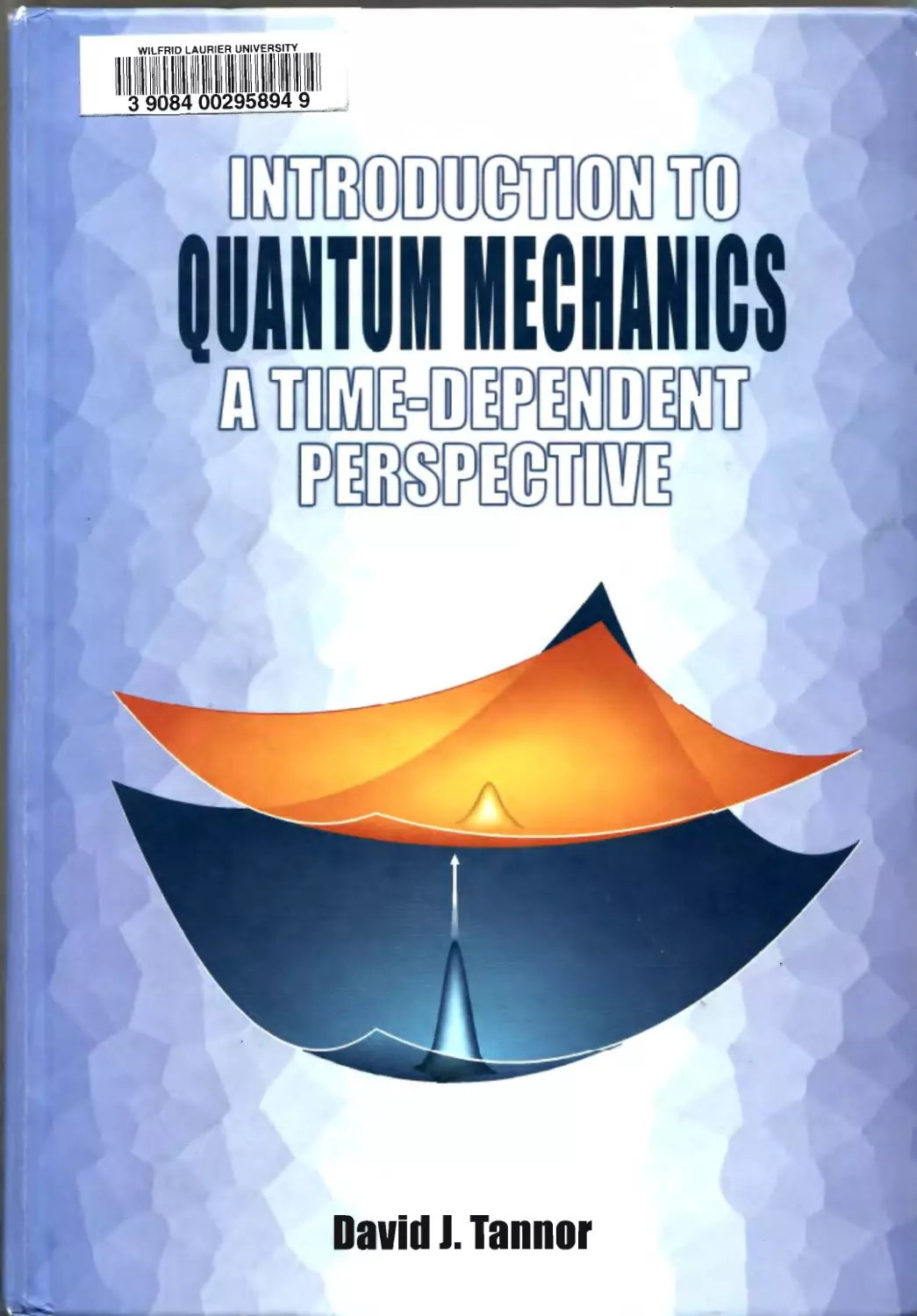
INTRODUCTION TO
QUANTUM
MECHANICS
A Time-Dependent Perspective
David J. Tannor
Weizmann Institute of Science
UNIVERSITY SCIENCE BOOKS
Sausalito, California
Property of the Library^
Wilfrid Laurier Universityj
University Science Books
www. uscibooks. com
Production Manager: Ann Knight
Manuscript Editor: Lee A. Young
Design: Mark Ong
Cover Design: George Kelvin
Illustrator: Lineworks
Compositor: Windfall Software, using ZzTgX
Proofreader: Jennifer McClain
Printer & Binder: Maple Vail Book Manufacturing Group
ISBN 10: 1-891389-23-8
ISBN 13: 978-1-891389-23-8
This book is printed on acid-free paper.
Copyright © 2007 by University Science Books
Reproduction or translation of any part of this work beyond that permitted by Section 107 or 108 of the 1976
United States Copyright Act without the permission of the copyright owner is unlawful. Requests for permission
or further information should be addressed to the Permissions Department, University Science Books.
Library of Congress Cataloging-in-Publication Data
Tannor, David Joshua, 1958—
Introduction to quantum mechanics : a time-dependent perspective / David J. Tannor.
p. cm.
Includes bibliographical references and index.
ISBN 1-891389-23-8 (alk.paper)
1. Quantum theory. I. Title.
QC174.12.T366 2006
530.12—dc22
2006043933
Printed in the United States of America
10 987654321
To Vivian,
my ’ГП nWK
Contents
Foreword xiii
Preface xv
Structure of the Book and Teacher’s Guide xix
part I Pictures and Concepts I
chapter I	The Time-Dependent Schrodinger Equation 3
1.1	Separation of Variables and Reconstitution of the Wavepacket 4
1.2	Expectation Values 5
1.3	A Worked Example: Particle in Half a Box 7
Further Reading and Historical Notes 10
References 11
chapter 2	The Free-Partide Wavepacket 13
2.1	General Solution 13
2.2	The Center of the Wavepacket 16
2.3	The Dispersion of the Wavepacket 18
Problems 20
Further Reading and Historical Notes 21
References 21
chapter 3 The Gaussian Wavepacket 23
3.1	The Gaussian Free Particle 23
3.2	General Properties of Gaussian Wavepackets 26
3.3	Gaussian in a Quadratic Potential 28
3.4	Reexamination of the Stationary Phase Method 31
Problems 33
References 34
chapter 4 Correspondence between Classical and Quantum Dynamics 35
4.1	Ehrenfest’s Theorem 35
4.2	Bohmian Mechanics and the Classical Limit 38
4.3	Fractional Revivals 46
Problems 49
References 53
vii
viii Contents
chapter 5 The Wigner Representation and the Density Operator 55
5.1	The Concept of Phase Space 56
5.2	The Wigner Representation of Wavepackets 58
5.3	The Density Operator 61
5.4	Wigner Representation of the Density Operator 68
Problems 74
References 76
CHAPTER 6
Correlation Functions and Spectra 81
6.1	Spectra as Fourier Transforms of Wavepacket Correlation Functions 81
6.2	General Properties of Fourier Transforms 86
6.3	Eigenfunctions as Fourier Transforms of Wavepackets 97
Problems 103
References 108
chapter? One-Dimensional Barrier Scattering 109
7.1	Wavepacket Formulation of Reflection and Transmission
Coefficients 110
7.2	Cross-Correlation Function Formulation of Barrier Scattering and the
S-Matrix 116
7.3	Scattering Theory Using Eigenstates 122
7.4	Overlap Integrals of Scattering Eigenstates 128
7.5	Reconstituting the Wavepacket from the Scattering Eigenstates 132
7.6	Resonances and Time Delay 134
Problems 138
References 140
part II
Formal Theory and Methods of Approximation 141
chapters* Linear Algebra and Quantum Mechanics 143
8.1	Linear Vector Spaces 143
8.2	Operators: Mapping a Wavefunction to Another Wavefunction 147
8.3	Discrete Basis Sets: The Bridge between Operators-Wavefunctions
<=> Matrices-Vectors 159
8.4	Continuous Basis Sets 172
Problems 179
References 183
chapter 9 Approximate Solutions of the Time-Dependent
Schrodinger Equation 185
9.1	The Schrodinger, Heisenberg and Interaction Pictures 186
9.2	Time-Dependent Perturbation Theory 190
9.3	The Magnus Expansion and Wei-Norman Factorization 193
9.4	Adiabatic Dynamics and the Geometrical Phase 199
Contents
ix
	9.5 Periodic Hamiltonians and Floquet Theory 208 9.6 Variational Principles and the Time-Dependent Self-Consistent Field Approximation 214 Problems 220 References 222
CHAPTER 10	Path Integration, the van Vleck Propagator and Semidassical Mechanics 227 10.1	The Classical Action 228 10.2	Path Integration 238 10.3	The van Vleck Propagator 240 10.4	The Propagator as a Unitary Transformation 246 10.5	Gaussian Wavepackets and the van Vleck Propagator 257 References 268
CHAPTER 1 1	Numerical Methods for Solving the Time-Dependent Schrodinger Equation 273 11.1	Spectral Projection and Collocation 275 11.2	The Pseudospectral Basis 281 11.3	Gaussian Quadrature 285 11.4	Representation of the Hamiltonian in the Reduced Space 293 11.5	The Discrete Variable Representation 297 11.6	The Fourier Method 301 11.7	Time Propagation 312 Problems 326 References 329
PART III	Applications 333
CHAPTER 12	Introduction to Molecular Dynamics 335 12.1	The Born-Oppenheimer Approximation 335 12.2	Adiabatic versus Diabatic Representations 338 12.3	Potential Energy Surfaces 345 12.4	Normal Modes of Vibration 352 12.5	Chemical Reactions and Transition State Theory 356 12.6	Symmetry and Permutations 370 12.7	Hyperspherical Coordinates 382 History and Further Reading 387 Problems 388 References 390
CHAPTER 13	Femtosecond Pulse Pair Excitation 395 13.1 First-Order Processes: Wavepacket Interferometry 395 13.2 Second-Order Processes: Clocking Chemical Reactions 403
X
Contents
	13.3 Coherent Nonlinear Spectroscopy 408 13.4 Density Operator Formulation of Optical Perturbations 419 References 424
CHAPTER 14	One- and Two-Photon Electronic Spectroscopy 427 14.1	Electronic Absorption and Emission Spectroscopy 433 14.2	Transition State Spectroscopy 445 14.3	Resonance Raman Spectroscopy 449 14.4	Dispersed Fluorescence Spectroscopy 465 Problems 473 References 475
CHAPTER 15	Strong Field Excitation 479 15.1	Two-Level System 479 15.2	The Feynman-Vemon-Hellwarth (FVH) Representation 482 15.3	Dressed States 486 15.4	Adiabatic Excitation with Strong Fields 490 15.5	Impulsive Excitation 499 15.6	Optical Paralysis 501 Problems 504 References 505
CHAPTER 16	Design of Femtosecond Pulse Sequences to Control Chemical Reactions 509 16.1	Intuitive Control Concepts 511 16.2	Variational Formulation of Control of Product Formation 516 16.3	Applications of the Variational Formulation 528 16.4	Multiple Pathway Interference 534 16.5	Chirped Pulse Excitation 539 16.6	Learning Algorithms 544 Problems 547 References 553
CHAPTER 17	Wavepacket Approach to Photodissociation 559 17.1	Introduction 559 17.2	The Eigenstates of an Asymptotic Hamiltonian 560 17.3	The Eigenstates of a Scattering Hamiltonian 561 17.4	Mpller Operators 566 17.5	Wavepacket Formulation of Photodissociation 569 17.6	Applications 571 References 577
CHAPTER 18	Wavepacket Correlation Function Formulation of Reactive Scattering 579 18.1 The Concept of an Arrangement Channel and the Problem of Coordinate Systems 580
XI
Contents
18.2	The Eigenstates of a Scattering Hamiltonian with Multiple Arrangement
Channels 581
18.3	Wavepacket Cross-Correlation Function Formulation of Spa(E) 586
18.4	Application to Collinear H + H2 —> H2 + H 591
18.5	Cumulative Reaction Probability 594
References 600
appendix A The Dirac Delta Function and the Cauchy Principal Value 603
A. 1 The Dirac Delta Function 603
A.2 The Cauchy Principal Value 605
References 608
appendix В Composite Systems 609
B.l	Wavefunction of a Composite System: Separability and
Entanglement 609
B.2	Density Matrix of a Composite System 610
B.3	Reduced Density Matrix 611
B.4	Purity of the Reduced Density Matrix 613
References 615
appendixC Normalization and Orthogonality of Scattering Eigenstates 617
C.l Single Step 617
C.2 Concatenation of Steps 620
Problems 620
References 621
appendix D Units and Conversions 623
D.l Energy Conversions and Time Scales 623
D.2 Units of Electric Field Amplitude and Intensity 624
Index 625
Foreword
The importance of the time-dependent formulation of quantum mechanics is evident to
theorists and experimentalists alike, but this wasn’t always so. Even though Schrodinger’s
Time-Dependent Equation was the birth of modem quantum theory, and even though
Schrodinger knew about the harmonic oscillator coherent states and their classical-like
motion, attention quickly turned to the Time-Independent Schrodinder Equation. There
were good reasons for this: physics was focused on line spectra and their predictions, and for
this purpose the time-dependent formulation is indirect. Tradition quickly grow around this
chronology, so that textbooks often begin with the Time-Dependent Schrodinder Equation
or introduce it in Chapter 1, only to drop it like a hot potato for the remainder of the book,
with the exception perhaps of a cameo appearance in the derivation of Fermi’s Golden Rule.
Now the advent of explicitly time-dependent experiments, and especially the thrust
toward many body systems (where computational and experimental requirements mean
that no eigenstate can be found or measured, or ever needs to be measured, beyond at
most the first few) make it imperative that students see time dependence put to good use as
soon as possible. Indeed even in the heyday of fine spectra the abandonment of the Time-
Dependent Schrodinger Equation was far too wide a swing of the pendulum. It is enough
of a shock for students of quantum mechanics that matter is a wave, and that Schrodinger’s
wave is a probability amplitude, and so on. Adding to that shock is that quantum physics was
done with still, motionless, stationary states. Absurd questions like “How does the particle
get past the node?” come up if one is divorced from time dependence. That teachers and
textbook writers took this question seriously underscores the poverty of an education only
about Hty = Eyjf. Using a time-dependent approach, some familiar intuition is still intact
from the classical world, and the classical intuition we all have can be put to good use to
understand quantum mechanics at a high level rather quickly.
The history of overemphasis on the Time-Independent Schrodinger Equation is there
for anyone to see in the old textbooks. What is shocking is that it is there for everyone to see in
most of the new ones too! Such “academic momentum” for textbook writers is a well-known
phenomenon. Thankfully, David Tannor’s book breaks free of this syndrome and takes a
far more balanced approach, employing time-dependent and -independent approaches in
the appropriate circumstances. The student of this text will come away well prepared to
tackle today’s explicitly time-dependent experiments and other stationary experiments with
a strong link to a simple time-dependent picture via Fourier transform. This is the fun way
to learn quantum mechanics applied to molecular dynamics.
All of the pillars of time-dependent methodology are here: wavepackets, correlation
functions, semidassical methods, and numerical methods. The treatment of strong fields,
femtosecond multipulse control of reactions, photodissociation, and reactive scattering, all
of which are treated in the latter half of the book, are made accessible banking on classical
xiii
xiv Foreword
intuition and the preparation in time-dependent quantum and semiclassical methods in the
first half.
My hope and expectation is that this book is not only a new and much needed vehicle
for training the current generation of students, but also the impulse required to change
the momentum of textbook writers of the future toward a balanced approach to quantum
molecular dynamics.
The author says in his introduction essentially that this is the book I promised to write,
but never did. He is half right: I promised to write a book, but the one I planned would not
have been as good as this one, nor as comprehensive.
Eric Heller
Harvard University
Preface
Many people find time-dependent quantum mechanics the most interesting and understand-
able part of quantum mechanics. Yet it is the orphan child in the standard curriculum of
physics and chemistry, both on the undergraduate and graduate levels. In physics courses one
generally learns a little about wavepackets—solutions of the Time-Dependent Schrodinger
Equation—but they are generally viewed as a curiosity, rarely compose more than a fraction
of the course, and their relationship with the canonical time-independent topics in the stan-
dard course is generally disjointed. Traditional quantum chemistry courses start with the
Time-Dependent Schrodinger Equation (TDSE); however, generally within half a lecture
a separation of space and time variables is invoked and the rest of the course deals with
the Time-Independent Schrodinger Equation (TISE). The latter then becomes treated as the
fundamental equation, with little or no further mention of time in the course.
The Time-Dependent Schrodinger Equation is the truly fundamental equation of non-
relativistic quantum mechanics in a way that the TISE is not. Many systems, most notably
those with time-dependent Hamiltonians, simply cannot be treated using time-independent
quantum mechanics. In contrast, there is no quantum phenomenon that cannot, in principle,
be described using time-dependent quantum mechanics. It should therefore be possible to
develop every major topic in quantum mechanics within a unified framework from the time-
dependent point of view—including stationary states and energy resolved cross-sections.
That is the approach of this book.
In addition to the above argument—that only a time-dependent approach has the
potential for treating the many diverse topics in quantum mechanics within a single unifying
framework—there are several additional compelling reasons to make the study of time-
dependent quantum mechanics a major part of the standard curriculum. These reasons
derive from three features of time-dependent quantum mechanics: its intuitive appeal, its
convenience for semiclassical approximations, and its formal simplicity. It is worthwhile to
expand on each of these aspects at greater length.
1.	Tune is a fundamental variable in virtually all areas of physics; the evolution of
a particle or a wave with time is at the center of virtually all the fundamental
equations of classical physics. Time is particulary important in applications of
quantum mechanics to two of the most important processes in physical chemistry:
photochemistry and reactive scattering. Any practicing organic chemist will tell you
that a photochemical reaction proceeds from parent molecule to fragment as time
progresses; and that in a chemical reaction, first reactants approach, then rearrange
and then products separate, in that order. In the time-dependent wavepacket approach
to reaction dynamics this aspect of a time sequence is preserved: the reactant
wavepacket approaches the transition state, some of the wavepacket gets over the
barrier and proceeds to products, while some is reflected back to the reactant
XV
xvi
Preface
region. This fundamental description can be grasped by any bright undergraduate.
In contrast, the time-independent theory of reactive scattering is technically quite
formidable, and this intuitive picture of a chemical reaction progressing in time is
lost.
2.	Classical mechanics—Newton’s laws—governs the dynamical behavior of macro-
scopic bodies all around us, and virtually everyone has a certain amount of intuition
about the motion of classical trajectories. Traditionally, classical trajectories have
played a central role in the study of chemical reaction dynamics and more recently
in atomic physics. The central object in time-dependent quantum mechanics—the
wavepacket—behaves very much like a classical trajectory. Its center, both in posi-
tion and momentum, is often well described by a guiding classical trajectory, while
its spatial width is simply a manifestation of the Heisenberg uncertainty principle.
In other words, the correspondence principle between classical and quantum me-
chanics is fully operative in time-dependent quantum mechanics, often even at low
energies, in contrast with the correspondence principle in time-independent quan-
tum mechanics which is valid only at high quantum numbers. This provides a great
aid to physical intuition and can be used as a starting point for developing a wide
variety of semiclassical approximations.
3.	In addition to being conceptually simpler for many processes, time-dependent quan-
tum mechanics is actually formally simpler in many cases. Within time-dependent
quantum mechanics, bound and free dynamics are treated formally in exactly the
same way; in both cases a square integrable wavepacket describes the time-evolving
state. This can lead to an enormous formal simplification. For example, the time-
dependent theory of one- and two-photon absorption (or resonance Raman scatter-
ing) is completely unaffected by whether the excited eigenstates are bound or free.
In contrast, the time-independent treatment employs square integrable wavefunc-
tions to describe absorption to bound states, and non-normalizable scattering states
to describe absorption to the continuum. In a similar vein, it is interesting to note
that rigorous treatments of scattering theory all begin with time-dependent quan-
tum mechanics because states are square normalizable; they then derive the more
conventional and less intuitive time-independent expressions from there. In fact, in
the treatment of scattering theory in Chapter 18 the fundamental formula for the S-
matrix is expressed only in terms of square normalizable states. The widespread use
of time-independent scattering theory apparently began because it provided the most
convenient means to a numerical solution. There is reason to believe that all this has
now changed: as a result of the remarkable strides in the numerical methods for
solving the TDSE in the last fifteen years, time-dependent methods are now being
used for state-of-the-art numerical work in reactive scattering. As another example
of its formal advantages, using time-dependent quantum mechanics one can treat the
interaction of a system with arbitrarily shaped time-dependent fields—either weak
or strong—together with the internal time dependence of the system (e.g. electronic
motion, phonon excitation or molecular vibrations), all within a single coherent
framework. In contrast, time-independent quantum mechanics does not provide a
convenient framework for treating the effect of arbitrarily shaped time-dependent
fields.
Preface
xvii
This book has, therefore, three objectives:
1.	To provide a unified treatment of quantum dynamical processes which keeps time-
dependent quantum mechanics (TDQM) at center stage throughout. The formulation
of virtually any experimental scattering or spectroscopic measurable—for time-
dependent as well as continuous wave excitation—starting from a time-dependent
approach provides a powerful connection between dynamics and experimental ob-
servables, and represents a new approach for a text.
2.	To introduce a wide variety of applications of TDQM, in the text as well as in the
exercises and the accompanying website (www.weizmann.ac.il/chemphys/tannor
/Book), that have never been collected in one place before. These applications
include many topics that are at the forefront of both experimental and theoretical
research, including multiple pulse optical spectroscopy, control of molecular dy-
namics using specially designed laser pulse sequences, and the interpretation of
spectra and scattering cross sections in terms of time correlation functions and fea-
tures of the potential energy surface.
3.	To present time-dependent quantum mechanics in a way that is accessible as early
as possible in a student’s training. This is attempted by developing the material in an
intuitive and pictorial way, by interconnecting the material in different chapters such
that the same phenomenon is viewed from multiple perspectives and with multiple
formalisms, and via exercises and (classroom tested) computational projects which
deepen and reinforce the understanding of the material in the text.
This book grew out of a one-semester graduate course (Quantum Mechanics 111) which
I taught in 1991 and 1994 at the University of Notre Dame, in 1993 at Columbia University
and in 1996, 1998, 2000, 2003, and 2005 at the Weizmann Institute. Students who have
had a course on the level of Quantum Mechanics by Cohen-Tannoudji et al. should be
well prepared; with suitable selections the book may be appropriate for students who
have studied from Quantum Chemistry by Ira Levine. Portions of the book can be used
to supplement a course using Molecular Reaction Dynamics by Levine and Bernstein. It is
hoped that the book will find a useful niche for students and researchers alike, interested in
time-dependent quantum mechanics in general and in an introduction to the exciting new
wavepacket approaches to molecular reaction dynamics in particular.
I gratefully acknowledge grants from the U.S. Office of Naval Research, the Israel
Science Foundation, the U.S. National Science Foundation, the Sloan Foundation and the
Birnbaum Foundation of South Bend. My thanks go out to the many colleagues and stu-
dents at Notre Dame, Columbia and Weizmann who have made valuable suggestions and
corrected errors in the text. Michael New typeset an early version of the book, starting with
lecture notes from a course I gave at Columbia, and generated some of the figures. Einat
Frishman, Efrat Rosenman, Anna Pomyalov and Yamit Maymon generated many of the
other figures. Both Einat Frishman and Malki Cymbaliste were very helpful with the typeset-
ting. The Matlab website (www.weizmann.ac.il/chemphys/tannor/Matlab_Programs) that
accompanies the text was built by Yamit Maymon, Anna Pomyalov, and Shlomo Sklarz.
Special thanks to them for an outstanding job. The Matlab programs in the website were writ-
ten by Shlomo Sklarz, Efrat Rosenman, Einat Frishman, Yossi Elran, Jim Faeder, Yiftach
Nevo, Nadav Katz, and Erez Boukobza.
xviii Preface
The influence of Eric Heller on this book is enormous, as evidenced by the references
to his work in most of the chapters. Had he published the book he had planned to there
would probably be little need for this one. Ronnie Kosloff has also had an enormous impact
on this work. He pioneered the numerical use of the Fourier method to solve the TDSE,
a method which ushered in a new era in quantum dynamics calculations and which forms
the basis for many of the computer programs on the accompanying website. He was also
intimately involved with the original work on photon locking/heating and design of pulse
sequences/optimal control which represent some of the most novel and interesting of the
applications included here. Phil Pechukas taught me my first course in graduate quantum
mechanics, and my treatment of linear algebra and some of the introductory material on
wavepackets follow his presentation. Smart Rice has contributed in numerous ways to the
sections on pulse sequences and optimal control; other valued collaborators in this area
include Pierre Gaspard, Andras Lorincz and my postdocs Jozsef Somloi and Vladimir
Malinovsky. The research of my former students and postdocs, Sanjukta Das, Carl Williams,
David Weeks, Sonya Garashchuk, Frank Grossmann and Daniela Kohen is the source of
much of the material in the sections on the interaction representation, reactive scattering,
semiclassical theory and the density operator, respectively. Vladimir Mandelshtam, Chris
Meier, Ulrich Kleinekathofer, Ignacio Martini, Maurice Schwartz, Jiri Vala, Shlomo Sklarz,
Erez Boukobza, Yair Goldfarb, David Avisar, Danny Neuhauser, Uzy Smilansky, Doron
Cohen, Nadav Katz, Adi Diner, Eli Pollak, Bob Wyatt, Aron Kuppermann, Jeremy Schiff,
Jeff Cina, Paul Banner, Jom Manz, Daniel Lidar, Ban Degani, Edriss Titi, Navin Khaneja,
Ken Schafer, Bilha Segev, Tucker Carrington, Jr. and Kai Willner made many valuable
comments on the manuscript. Lee Young did an expert job on copy editing. Jane Ellis
and Bruce Armbruster of University Science Books have been enormously supportive and
patient, and have demonstrated in every way a commitment to producing beautiful books. I
am indebted to my father and father-in-law for their constant,encouragement in this project,
and my parents and sisters for their unending support. Finally, immeasurable thanks are due
to my wife Vivian, and my four beautiful children Daniel, Philip, Clara and Shlomo, without
whose constant companionship and support this book would never have been possible.
y’rfrunn
Structure of the Book and Teacher’s Guide
This book is divided into three Parts: Part I, Pictures and Concepts; Part П, Formal Theory
and Methods of Approximation; and Part Ш, Applications. Before getting into details, there
are two major guidelines for using this book for teaching. First, for a one-semester course,
the syllabus should be built almost entirely from Part I (Chapters 1-7) and Part III (Chapters
12-18), that is, most of the material in Part П (Chapters 8-11) should be skipped in a
typical one-semester course. In many cases, the students will already have encountered
the material in Chapter 8, on Linear Algebra and Quantum Mechanics. Chapters 9-11 are
somewhat more specialized than the rest of the material in the book. The only portions of
Part П that are essential for Part Ш are the interaction and Heisenberg pictures (Section 9.1),
time-dependent perturbation theory (Section 9.2), and perhaps portions of Chapter 11 on
numerical methods, depending on whether the students will be doing numerical projects.
The second guiding principle is that wherever possible, the more advanced and/or more
specialized material has been put at the end of each chapter. Thus, when designing a syllabus,
a general rule of thumb would be to cut perhaps the last third from each chapter, although
this is very chapter dependent and dependent on the interests of the class and the teacher.
Now to the contents of the various Parts. Part I, Pictures and Concepts, focuses on
pictures and representations of the time evolving wavepacket. Wherever possible I have
emphasized classical-quantum correspondence, in order to make the material as intuitive
as possible. I have tried to present a wide variety of different handles on this correspon-
dence, from the stationary phase method (Chapter 2) to analytic properties of Gaussian
wavepackets (Chapter 3) , from Ehrenfest’s theorem to the geometrical optics limit of
quantum mechanics and wavepacket revivals (Chapter 4), to phase space pictures of the
Wigner distribution (Chapter 5). In the later chapters of Part I, the concept of a wavepacket
time-correlation function and its Fourier transform is introduced, first to obtain spectra
and eigenfunctions (Chapter 6) and then to obtain reflection and transmission coefficients
(Chapter 7). Chapter 6 contains an extensive, self-contained introduction to Fourier theory,
with many pictorial illustrations. The concept of the Fourier transform of a time-correlation
function will be a recurring theme under Applications (Part Ш); it appears there in the
formulation of electronic absorption and emission spectroscopy (Chapter 14), Raman spec-
troscopy (Chapter 14), photodissociation (Chapter 17) and reactive scattering (Chapter 18).
However, at this point the correlation function and the spectrum are viewed simply as an
intrinsic property of the wavepacket, alternative representations of the wavepacket, inde-
pendent of any particular application.
While Part I focuses on wavepacket evolution, Part П focuses on alternative represen-
tations of, and approximations to, the evolution operator or propagator. Of course, once the
evolution operator is known the wavepacket which evolves from any initial state can be ob-
tained immediately. Nevertheless, the isolation of the evolution operator and the study of its
xix
XX
Structure of the Book and Teacher’s Guide
properties and approximations is more formal and more abstract than the concrete, readily
visualized, time-evolving wavepacket. Several aspects of Part П deserve special mention.
Chapter 8 is a self-contained introduction to linear algebra and the formalism of quantum
theory. This chapter covers essentially the same material as in the corresponding section
of Quantum Mechanics by Cohen-Tannoudji et al., perhaps a little more succinctly; it is
included here to make the book self-contained, and accessible to students with an under-
graduate course on the level of say Quantum Chemistry by I. Levine. This chapter could
potentially be used for a half or a third of a course by itself. Logically, one could argue
that this chapter should be taught at the beginning of the course, before Part I, since some
of the mathematics used in Part I, such as Fourier transforms, Dirac 8 functions and the
operator e~,H,l\ is introduced without much discussion. However, I believe it is easier to
draw students in with the visually appealing wavepacket dynamics, leaving a few unset-
tled mathematical questions, and then come to the full mathematical framework when the
student is motivated.
Chapter 9 contains a discussion of dynamical representations and approximations, in-
cluding the standard topics of the Heisenberg and interaction pictures and time-dependent
perturbation theory. I have also included material that is not in standard textbook treatments,
including the Magnus expansion, the Wei-Norman factorization, Floquet theory, the quan-
tum adiabatic theorem and the geometric phase, and time-dependent variational methods.
The interaction picture is used to derive the adiabatic theorem and its non-adiabatic correc-
tions, leading to a heuristic derivation of the Landau-Zener formula.
Chapter 10 deals with semidassical approximations. This chapter begins with a dis-
cussion of the classical action, and the first and second variations of the action. Then a
brief, self-contained introduction to path integrals is given, followed by a derivation of the
van Vleck-Gutzwiller (WG) semidassical limit of the propagator. The WG propagator is
then placed in the more general context of Miller’s semidassical algebra. Finally, the initial
value representation (TVR) is introduced, along with the coherent state basis. These latter
two representations allow a rigorous connection to be made between Gaussian wavepack-
ets and the WG propagator. To contrast the material in this chapter with the material on
classical-quantum correspondence in Chapter 4, the focus here is the propagator and h —> 0
approximations to it. Of course, there are connections with the earlier material on classical-
quantum correspondence, in particular the stationary phase method, Gaussian wavepackets,
and the geometrical optics limit of quantum mechanics, and these connections are noted.
Finally, Chapter 11 deals with numerical methods for solving the TDSE. I try to get to
this materia] by the middle of the course because it provides a basis for understanding the
computer programs that the students will use to carry out their projects in the second half
of the course. Insofar as possible, the theory of numerical methods is developed in terms
of projections of the infinite Hilbert space onto a finite Hilbert space. The mathematics of
projection operators and unitary transformations, introduced in Chapter 8, is used here to
integrate the treatment of numerical methods with the rest of the book. The guiding principle
is that numerical methods should not be just a bag of tricks, or even based on some separate
body of numerical analysis, but should emerge from the quantum mechanics itself as a
well-controlled, and perhaps even optimal approximation.
Both semiclassical methods (Chapter 10) and numerical methods (Chapter 11) are areas
of active research, with many new papers published each year. Unfortunately (or perhaps
Structure of the Book and Teacher’s Guide
xxi
fortunately for the young reader!) there are just too many open questions in these areas to
present a tidy package. I have tried to keep three goals in mind: to give an introduction to
key concepts and general results (bearing in mind that this is a book about wavepackets,
not semiclassical or numerical methods); to provide exposure to a wide variety of different
methods and approaches (from path integration to Gaussian quadrature); and to develop
the material wherever possible from the basic conceptual principles introduced earlier
in the book (i.e. well-characterized or not-so-well-characterized approximations to the
propagator). These chapters should leave the inquisitive reader with many questions, and
perhaps novel ideas and connections. Each of these chapters contains many references to
current research literature, and should set the ambitious student on his or her way.
Part Ш, Applications, deals in general terms with the different possible projections
of the time-evolving wavepacket, and the recovery of both time- and energy-resolved
observables. For completeness, I have included a chapter called Introduction to Molecular
Dynamics (Chapter 12), which introduces the basic concepts of the Born-Oppenheimer
approximation, potential energy surfaces, normal modes, transition state theory, and optical
transitions in molecules, concepts that will appear in the subsequent applications. There is
some discussion of molecular symmetry, with emphasis on understanding the molecular
point group within the larger setting of the molecule’s permutation-inversion group.
The applications per se begin in Chapter 13, starting with the interaction of a molecule
with one or several ultrashort (femtosecond) laser pulses. This is one of the simplest ap-
plications of time-dependent perturbation theory (Chapter 9); at the same time it imme-
diately introduces the reader to an extremely interesting and active area of research in
chemical physics. The theoretical interpretation of “femtochemistry” experiments becomes
immediately transparent by combining the formal expressions from first- and second-order
time-dependent perturbation theory (Chapter 9) with the Born-Oppenheimer adiabatic ba-
sis (Chapter 12) and the concepts of wavepacket dynamics from Part I. Also included in
this chapter is a discussion of nonlinear optical spectroscopy (P(3)), both in the wavefunc-
tion and the density operator formulations. Within the context of we introduce linear
response theory and derive the formula for the absorption spectrum.
Chapter 14 deals with the interaction of single frequency (“continuous wave” or CW)
optical radiation with molecules. Experimental observables such as one-photon absoiption
and emission spectra and two-photon resonance Raman spectra are formulated in terms of
the Fourier transform of a wavepacket time-correlation function at the optical excitation
frequency. This powerful class of formulations has been used extensively in the last two
decades to give physical insight into the width, structure, and intensities of experimental
spectra in terms of the underlying wavepacket dynamics. The central formulas are derived
here starting from the general first- and second-order perturbation theory expressions (Chap-
ters 9 and 13), with the perturbations taken as single-frequency excitation. The first-order
formula is shown to be identical to that derived using linear response theory in Chapter 13.
Chapter 15 deals with strong-field excitation, beginining with the two-level system. The
importance of the two-level system is that it can be solved analytically almost completely,
and hence provides intuition about more complicated systems. First, the Rabi solution for the
time-dependent wavefunction is derived for CW excitation. Next, the optical Bloch equa-
tions for the density operator are formulated, along with the Feynman-Vemon-Hellwarth
(FVH) geometrical picture. The FVH picture allows one to visualize the solution to the
xxii
Structure of the Book and Teacher’s Guide
two-level system even for complicated pulse sequences where analytical solutions are not
available. Although the Rabi solution and the FVH picture are treated quite well in sev-
eral texts on nonlinear optics, they are developed here within the broader framework of
wavepacket dynamics. The concept of dressed states is then introduced—states that are so-
lutions of the Schrodinger equation in the presence of the field. This chapter also contains
a discussion of stimulated Raman adiabatic passage (STIRAP), as well as a useful gener-
alization of the optical Bloch equations from a two-level system to two electronic potential
energy surfaces. Nonadiabatic corrections to STIRAP are calculated by applying the general
non-adiabatic methodology of Chapter 9.
Chapter 16 deals with the very exciting new field of designing optical pulse sequences
to create a desired chemical product. The first section, based on second-order perturbation
theory, introduces a pump-dump sequence of two pulses to control reaction products. Next,
a fascinating variational formulation is presented to find optimal pulse sequences that may
have arbitrarily complicated time dependence. The close connection between this varia-
tional formulation and Optimal Control Theory, widely used in engineering applications, is
made explicit. Additional topics in this chapter include controllability theory, femtosecond
interfering pathway control, chirped excitation, and learning algorithms.
Chapters 17 and 18 deal with photodissociation and reactive scattering, respectively.
Photodissociation is treated before reactive scattering for obvious reasons: photodissoci-
ation is a half-collision process and is simpler than the full reactive scattering process.
Expressions for the partial and total photodissociation cross sections are derived in terms
of wavepacket dynamics. The total cross section in particular is expressed in terms of the
Fourier transform of a wavepacket correlation function, much like the expression for the
one-photon absorption spectrum.
Although Chapter 17 builds heavily on the earlier chapters, two new ideas are re-
quired. The first is the concept of multiple degeneracy of the eigenstates of the asymptotic
Hamiltonian. This degeneracy is concretized by viewing degenerate continuum states as
superpositions of time evolving wavepackets with well-defined asymptotic boundary con-
ditions, using the spectral method of Chapters 6 and 7. The second new concept is that of the
Mpller operators, closely related to the interaction picture of Chapter 9. By the end of Chap-
ter 17 the reader will be familiar with much of the technical notation of scattering theory
and its dynamical interpretation, and will be well poised to learn the material in Chapter 18.
The discussion of reactive scattering in Chapter 18 is in some sense the climax of the
book. All the new elements introduced in Chapter 17 will be needed here, but doubled, once
for reactants and once for products. Having learned about chemical arrangement channels
(Chapters 12 and 16), having understood the structure of the asymptotic degeneracy and
the concept of the Mpller operators (Chapter 17), and having learned about the Fourier
transform of wavepacket correlation functions (Chapters 6-7 and Chapter 14), these three
major ideas are brought together. The full collision process is then expressed in a way that
looks like a half collision in the reactant and the product arrangement channels, “matched”
together in the transition state region via the Fourier transform of a wavepacket cross-
correlation function. This formulation of reactive scattering has several attractive features:
it highlights the role of the transition state region, it provides a time domain interpretation
of the structure in the 5-matrix element as a function of energy, and it manifestly illustrates
the principle of detailed balance—the principle that if the identity of reactants and products
is interchanged and time is reversed the identical value of the S-matrix element is obtained.
Structure of the Book and Teacher’s Guide xxiii
In the final section, related expressions are derived for the total reaction probability (i.e. the
reaction probability summed over all initial or all final states) and the cumulative reaction
probability at energy E (i.e. the reaction probability summed over both initial and final
states).
The book contains a not-insignificant number of new derivations, ideas or discussion,
that have not been published previously. For example, Chapter 2: the use of momentum
space to calculate the center and width of the free particle wavepacket; Chapter 3: aspects
of the discussion of saddle point vs. stationary phase integration; Chapter4: the discussion of
complex Bohmian dynamics and the classical limit; Chapter 5: the relationship of the purity
of the density matrix, the uncertainty principle and positivity; Chapter 7: a) the formulation
of reflection and transmission coefficients in terms of the Fourier transform of wavepacket
correlation functions; b) the calculation of 5-matrix elements via the explicit overlap of
scattering eigenstates; Chapter 11: the use of projection operators to define pseudospectral
methods, leading to a newly developed derivation of Gaussian quadrature; Chapter 12:
a) the use of canonical transformations to obtain the G-matrix and skewed coordinates,
resulting in a formula relating the G-matrix and the skew angle; b) a method for visualizing
hyperspherical coordinates on a sphere.
Even when the material is not new, in many cases it has been synthesized from widely
different sources. Examples of this synthesis are: Chapter 6: the unified treatment of Fourier
transform, Fourier series and discrete Fourier transform Chapter 9: use of the structure
of the equations of motion in the interaction picture to derive non-adiabatic corrections
to the quantum adiabatic theorem, leading to a heuristic derivation of the Landau-Zener
formula. The approach is taken up again in Chapter 15 to calculate nonadiabatic corrections
to STIRAP; Chapter 10: integrated treatment of path integrals, the van Vleck propagator and
Gaussian wavepackets; Chapter 13: unified treatment of femtochemistry, linear response
theory and nonlinear spectroscopy, beginning from a wavepacket interpretation of time-
dependent perturbation theory; Chapter 14: integrated treatment of absorption, emission,
transition state spectroscopy and resonance Raman spectroscopy, with careful attention to
the prefactors and the dimensional analysis; Chapter 15: synthesis of the Rabi solution, the
FVH representation and the dressed states picture for strong fields; Chapter 16: integrated
discussion of the pump-dump scheme for quantum control, interfering pathways, calculus
of variations, optimal control theory, controllability and learning algorithms; Chapters 17-
18: unified treatment of photodissociation and reactive scattering using wavepackets and
M011er operators.
The book contains an extensive series of exercises, designed to help the student un-
derstand the interconnection between topics. In some cases the reader is asked, for peda-
gogical purposes, to solve the same problem using time-dependent and time-independent
quantum mechanics. Getting the same answer using these two different approaches at
once solidifies an understanding of the specific solution as well as the general relation-
ship between the TISE and the TDSE. Wherever applicable, the reader is asked to apply
the general principle of the chapter to the Gaussian wavepacket in the harmonic oscilla-
tor. In this way, the reader gains an appreciation of the connections between the chap-
ters via the different perspectives offered on the same specific example. Accompanying
the book is a library of Matlab programs to supplement the different chapters of the
text (www.weizmann.ac.il/chemphys/tannor/Book). Virtually all these programs solve the
TDSE numerically in one dimension, producing real time movies of the wavepacket while
xxiv Structure of the Book and Teacher’s Guide
calculating the observables of interest. These programs serve two purposes. The first is the
numerical verification of the analytical wavepacket results (e.g. for the harmonic oscillator).
This provides the student with additional confidence in both the analytical solutions and the
numerical methods. The second is to give the student a chance to explore a wide variety of
applications of TDQM in a hands-on way, with convenient control of the input parameters.
The applications include calculating wavepacket correlation functions and spectra, reflec-
tion and transmission coefficients, Wigner phase space movies of the evolving wavepacket,
multiple pulse wavepacket excitation, STIRAP, coherent control, and the calculation of
eigenstates from wavepacket dynamics via the spectral method, the relaxation method and
by quantum adiabatic switching. The versatility of the time-dependent method given a short
generic propagation routine is impressive indeed.
A word about notation. The usual designation of the position variable in this book is
the letter x. However, in certain sections, where classical-quantum correspondence is being
emphasized, the letter q is used instead for position. Where the letter q is used the reader
will not have to look far to find the conjugate variable p. It is hoped that this notational
nuance will heighten the reader’s awareness of the points at which an underlying classical
structure is manifesting itself in the quantum dynamics.
With this introduction, I welcome the reader to the wonderful world of time-dependent
quantum mechanics!
Part I
Pictures and Concepts
Chapter I
The Time-Dependent Schrodinger Equation
The central object of study in this book is the Time-Dependent Schrodinger Equation,
1Й^Ф(х, t) = ЯФ(х, Г),	(1.1)
where i =	1, H is Planck’s constant divided by 2тг, equal to 1.05450 x 10⁻²⁷ erg sec,
and H is the Hamiltonian operator:
H = - — V2+V.	(1.2)
2m
The potential function V = V(x, t) in general can depend on both coordinates and time;
however, we will assume that V = V (x), independent of time unless otherwise specified.
Note that Eq. 1.2 is for a single particle and nonrelativistic. For simplicity we will work
with the one-dimensional form of the Schrodinger equation unless otherwise specified, so
that x -> x and V2 —>
The function Ф (x, t), which satisfies this equation, is called the wavefunction. Accord-
ing to the conventional interpretation of quantum mechanics, |Ф(х, t)|2 dx is the probability
of finding the particle between x and x + dx, assuming that Ф(х, t) is normalized, that is,
f^o l'P(*, Ol2 dx = 1. |Ф(х, r)|2 is called the probability density for finding the particle
at position x at time t. Given Ф(х, 0) if we can determine Ф(х, t) for all positions and
all times we have a complete solution of the problem. The function Ф(х, t) is all that is
in principle knowable about the position of a particle—before a measurement is made.
The fact that there is a probability distribution associated with the outcome of the mea-
surement of x is a manifestation of the uncertainty principle, to be discussed more fully
below.
In introductory classes, the Time-Dependent Schrodinger Equation (which we will refer
to by the abbreviation TDSE) is usually solved by a separation of variables in position and
time. We will begin with this standard approach, but first offer a few remarks. The method
of separation of variables leads naturally to particular solutions of the TDSE, which have
the counterintuitive property of predicting time-independent observables. This point has
been a conceptual pitfall for generations of students, who have been left to wonder where
time disappeared in quantum mechanics. The resolution to this paradox is to note that the
general solution of the TDSE is an arbitrary superposition of the particular solutions. Only
by considering such superpositions can one observe time-dependent behavior in quantum
mechanics and recover some measure of contact with our classical mechanical intuition.
3
4
Chapter I: The Time-Dependent Schrodinger Equation
A central tenet of this book is that these superposition solutions, or wavepackets, far
from being anomalous, are both ubiquitous in nature as well as being conceptually more
transparent than the particular solutions.
I. I Separation of Variables and Reconstitution of the Wavepacket
The method of separation of variables assumes that solutions of the TDSE exist that can be
written in the product form: Ф(х, t) = i/r(x)x(t). Substituting this trial form into Eq. 1.1
and dividing both sides by Wx (0 yields
.ЙХ(£) = W	(1,3)
x(0	V<(x)
The left-hand side of Eq. 1.3 is a function only of time while the right-hand side is a function
only of position. Thus both sides must be equal to a constant; call it E for energy. We then
obtain two equations, one for 1Д(*) and one for x (t):
ifix(t) = Ex(0	(1.4)
f Й2 Э2	1
— +У(х)к£(х) = £Ш	(1-5)
I 2m ax£	J
Equation 1.4 may be readily solved to yield
х(0 = х<<И	(16)
Equation 1.5 is the Time-Independent Schrodinger Equation (henceforth TISE) and depends
on the specific form of the potential V (x). This equation is an “eigenvalue” equation; the
constant E is called the eigenvalue and the wavefunction Vr^(x) is called the eigenfunction
or eigenstate. For bound potentials, physically meaningful solutions exist only at special,
discrete values of E; for unbound potentials physically meaningful solutions exist over a
continuous range of E. We will refer to the set of energies supporting physically meaningful
solutions as the “spectrum.” In most cases, Eq. 1.5 cannot be solved analytically. We may
therefore write a solution to the Time-Dependent Schrodinger Equation as
Ф(х,Г) = 1Мх)Х(<*£'-	(1-7)
Note that Xo is 311 overall multiplicative factor, and as such may be absorbed into i/rE (x). The
magnitude of the latter is determined by the Time-Independent Schrodinger Equation only
to within an overall multiplicative factor, which is usually chosen so that the normalization
condition,
f |Ф(х, z)|2 </x = 1,
J—oo
is fulfilled, and therefore we may write without loss of generality
Ф(х, t) - 1/гЕ(х)е~лЕ‘.	(1.8)
Note that Eq. 1.8 has a rather trivial time dependence. If we consider the probability
density |Ф(х, t)|2, determined by Eq. 1.8, we obtain
|Ф(х, t)|2 = (i/fE(x)e~^Et)*i/rE(,x)e~^Et = liMx)!2,	d-9)
Section 1.2 Expectation Values
5
independent of t! If the probability density does not change with time, there is no time
dependence to where the particle is likely to be found—there is effectively no motion. Yet
quantum mechanics has to be able to describe motion since the microworld it is intended
to describe is constantly undergoing change. The resolution to this paradox is to realize
that Eq. 1.7 is what is known as a “particular” solution of the TDSE. In general, any linear
combination of particular solutions is also a solution of the TDSE. It is by forming linear
combinations of particular solutions, each with its own characteristic time-dependent phase
factor, that we obtain time dependence in the probability density. Consider the simplest
example, a linear combination consisting of just two of the particular solutions:
Ф(х, Г)=а^Е(х)е-^Е,+^Е'Ме~^Е'1-	(1.10)
Then the probability density is given by
|Ф(х, t)|2 = |п|2|^е«12 + \b\2WE’W)\2 + 2Re	I . (1.11)
Note that Eq. 1.11 has three terms: one from alone, one from tyE> alone, and a third term
that arises from an interference term between the two. This interference term is a result of
having a superposition of eigenstates with different energies—a wavepacket. All the time
dependence of ]Ф(х, t)|2 is contained in this interference term, and hence we can remark
quite generally that a wavepacket—a superposition of states having different energies—is
required in order to have a time dependence in the probability density and in other observable
quantities, such as the average position or average momentum of the particle.
We can write the general solution to the TDSE, expressed in terms of the particular
solutions, as follows:
00
Ф(х, t) = ani]rn(x)e~KE',t (discrete spectrum)
n=l
f00	i
= I a(E)i/rE(x)e~^Et dE (continuous spectrum).
Jo
(1.12)
(1.13)
(For systems with both a discrete and a continuous portion to their spectrum the general
solution is a sum of Eq. 1.12 and Eq. 1.13.) The important lesson is that in order to get a
nontrivial time dependence of any observable, after solving the TISE one must remember
to “reconstitute” the wavepacket, that is, to superpose the solutions of the TISE, each with
its own amplitude and phase factor.
1.2 Expectation Values
In quantum mechanics, all experimental observables are associated with the class of opera-
tors known as Hermitian operators. The average value of an experimental observable, given
that the experiment is repeated many times using indistinguishable systems, is simply each
possible outcome weighted by the probability of obtaining that outcome. This average is
6
Chapter I: The Time-Dependent Schrodinger Equation
Table I. I Some of the most common observables in quantum mechan-
ics, the corresponding operators, and the effect of each of the operators
on a wavefunction
Observable	Operator	Effect on a wavefunction
Position	X	хФ(х, Z)
Momentum	p	-»7г^Ф(х, z)
Potential energy	V	У(х)Ф(х, t)
Kinetic energy	л	-2 T — P- 1 ~ 2m
Hamiltonian	H = T + V
known as the “expectation value,” and may be represented in terms of the operator A that
corresponds to the observable and the wavefunction Ф(х, Z) as follows:
f°L^*(.x,t)A^(x,t)dx
(A} =	.	(1.14)
ОФ(х, t)dx
If Ф(х, Z) is normalized, the expression for the expectation value takes the simpler form:
(A) = f Ф*(х, Z)/W(x, z)dx.	(1.15)
J-00
A full discussion of Hermitian operators, as well as a proof of Eq. 1.14, is deferred until
Chapter 8. However, for our purposes here and the rest of Part I, the most commonly
encountered Hermitian operators and their effect on wavefunctions of the form Ф(х, z)
are summarized in Table 1.1.
Consider now the expectation value of x as a function of time:
(x)t = У Ф*(х, Z) x Ф(х, Z) dx.	(1-16)
For the wavefunction of Eq. 1.7,
— У x i/rE(x) dx	(1.17)
= (-f)o
and thus the expectation value is independent of time.
Now consider the case that Ф(х, t) is a superposition of two different specific solutions,
Eq. 1.10. Repeating the calculation of (x), using this wavefunction yields
(x)( = |a|2 У x|i/r£(x)|2Jx + |bpy x\tyEdx)\2 dx
!f	. (E'-E)t 1
a*b I xi//‘^(x)i//Ei(x') dx e 1 n J . (1.18)
Section 1.3 A Worked Example: Particle in Half a Box
7
As in the calculation of the probability density above, all the time dependence of (x}t
is contained in the interference term. Quite generally, to obtain time dependence in any
experimental observable it is necessary to have a superposition of states with different
energies.
1.3 A Worked Example: Particle in Half a Box
As an example of an analytically solvable model, consider a particle in a box that extends
from 0 to L. Assume the particle is in the lowest level of the box. At t — 0 the size of the
box is suddenly expanded, so that the box extends from 0 to 2L as in Fig. 1.1. The object
is to calculate the smallest period of time, r, at which Ф(х, t) = Ф(х, 0), and to draw a
picture of Ф(х, t) at t = r/2.
At t = 0, Ф (x, 0) is a normalized eigenstate of the old box [0, L]:
Ф(х,0) = У|^ sin .
Note that the eigenfunctions фп(х) and eigenvalues En of the new box [0, 2L] are
, , x /Т . / П7ГХ \
^W = yzs,n^—J
_ nW
" 8mL2
n — 1, 2, ...
To calculate the time evolution of Ф we expand Ф(х, 0) in a complete set of the new
eigenfunctions, tyn(x), since the time dependence of each of the new eigenfunctions is
just a simple phase factor under the new Hamiltonian. The expansion takes the form
Ф(х,0) = ^2 dn'I'nW,
n
where
dx.
Ф (x, 0)
L
0
2£ Figure I. I Initial conditions for particle in half a box
8
Chapter I: The Time-Dependent Schrodinger Equation
Ф4(л)
%(x)
Figure 1.2 Ф(х, 0) is orthogonal toall irn(x) if n is even. This is because
Ф (x, 0) vanishes outside of the range [0, L], and in that range all the even
eigenstates of the full box correspond, within a normalization factor, to
excited eigenstates of the half box. This is shown in the left panel for
n = 4. The one exception is the n = 2 state, shown in the right panel,
which is essentially a replica of Ф (x, 0) in the range [0, L]. Note that we
use capital Ф for the time-evolving state and small i/rn for the eigenstates.
Before doing this integral, notice that an = 0 for all even n, except n = 2, by symmetry
(see Figure 1.2). Since и = 2 is the only state of its symmetry with nonvanishing coefficient,
we calculate this overlap integral first:
To find an, n odd, we use the formula
sin(hx) sin (ex) dx = —
sin[(Zr + c)a]
b + c
sin[(h — c)a]
b — c
Setting a = L, b — ^, c = we find
(n — 2)tt
(n + 2)(n — 2)tt
where we have used the fact that
. mt \	, . 2±1
sin
sin
mt
tt----
2
n —1
(-1)“.
Section 1.3 A Worked Example: Particle in Half a Box
9
The numerical values for the first few overlap integrals are
-4^2	-4V2
a, —	= .600 (3)(-l)7T	a5 =	= —.086 (7)(3)тг
a2 = 4= - .707 V2	4л/2 a7 = —-— = .040 (9)(5)тг
4^2 a3 = — = .360 (5)7T	—4л/2 a« =	— = -.023. (И)(7)тг
As a check, note that V9 , |a„ I2 = .999 = 1.
'Л=1 1
We now combine the eigenstates with their phase factors and their coefficients to
analyze the time dependence of the wavepacket. Recall that
where we have defined w। =	To find the fundamental period, note that when a>rt = 2тг,
then n2<W|t is also an integer multiple of 2тг. Therefore, at t — r — the phase factor for
all n is equal to 1, and so Ф(х, т) = Ф(х, 0). Thus, т =	is the fundamental
period.
Before drawing Ф (x, |), we ask: what makes Ф(х, 0) cancel on the right and not on
the left? We know that	an fa (x) must be symmetric (since it is the sum of symmetric
functions); hence, we may infer that it must look as shown in Figure 1.3 to give cancellation
Figure 1.3 The component of fa (left panel) must be equal to that of all the fa, n odd, put together
(middle panel), to give precise cancellation in the amplitude of Ф(х, 0) on the right-hand side of the
box at t = 0 (right panel). Note that the amplitude in the box on the right is twice that of the boxes on
the left.
10
Chapter I: The Time-Dependent Schrodinger Equation
Figure 1.4 After half a period, the phase of >s back to its original value (left), while the phase
of all the фп, n odd, has changed by (—1) (middle). This leads to complete cancellation of Ф(х, ^)
on the left-hand side of the box (right panel). Note that the negative sign of the amplitude has no
consequence for the probability density, which is proportional to | Ф |2. As in Figure 1.3, the amplitude
in the box on the right is twice that of the boxes on the left.
We now ask what happens after half a period. When t = | ,
For all odd n, an e~,n я = — an, while for n = 2, an e~‘n л =an. Since all the odd t//n change
sign and 1^2 remains unchanged, Ф(х, t = |) must look as shown in Figure 1.4, that is, the
wavepacket is localized on the right-hand side of the box and cancels completely on the
left-hand side.
Further Reading and Historical Notes
Schrodinger’s original papers have been translated into English and collected (Schrodinger,
1928). It is interesting to note that Schrodinger started with the time-independent Schro-
dinger equation, and obtained the time-dependent Schrodinger equation only in the fourth
paper in his series (Schrodinger, 1926a, Part IV). In (Schrodinger, 1926b), Schrodinger
explores the time dependence of a displaced Gaussian in a harmonic potential—what would
be called a “coherent state” in modem terminology, which we will discuss at length in
Chapter 3. For a discussion of the introduction of time in Schrodinger’s original papers and
a provocative analysis, see Briggs (2000,2001).
References
II
References
General
1.	A. Messiah, Quantum Mechanics, vol. I (Wiley, New York, 1958).
2.	C. Cohen-Tannoudji, B. Diu and F. Laloe, Quantum Mechanics, vol. I (Wiley, New York,
1977).
3.	R. P. Feynman, R. B. Leighton and M. Sands, The Feynman Lectures on Physics, vol. Ill:
Quantum Mechanics (Addison-Wesley, Reading, MA, 1965).
4.	L. D. Landau and E. M. Lifshitz, Quantum Mechanics, Nonrelativistic Theory (Pergamon
Press, Oxford, 1965).
5.	L. I. Schiff, Quantum Mechanics (McGraw-Hill, New York, 1968).
Schrodinger’s Original Papers (titles from English translation)
6.	E. Schrodinger, Quantisation as a problem of proper values (Part I), Annalen der Physik 79,
361 (1926); (Part П), Annalen der Physik 79,489 (1926); (Part Ш), Annalen der Physik 80,
(1926); (Part IV), Annalen der Physik 81,109 (1926).
7.	E. Schrodinger, The continuous transition from micro- to macro-mechanics, Natur-
wissenschaften 28, 664 (1926).
8.	E. Schrodinger, On the relation between the quantum mechanics of Heisenberg, Bom, and
Jordan, and that of Schrodinger, Annalen der Physik 79, (1926).
9.	E. Schrodinger, Collected Papers on Wave Mechanics, translated from the second German
edition by J. F. Shearer and W. M. Deans (Blackie and Son, London, 1928).
Articles
10.	J. S. Briggs and J. M. Rost, Time dependence in quantum mechanics, Eur. Phys. J. D 10, 311
(2000).
11.	J. S. Briggs and J. M. Rost, On the derivation of the time-dependent equation of Schrodinger,
Foundations of Physics 31,693 (2001).
Chapter 2
The Free-Particle Wavepacket
In this chapter we will investigate the simplest form of the TDSE, where the potential energy,
V(x), is independent of x. This is known as free-particle motion. For simplicity, we may
take V (x) = 0. In this case we can write down a complete solution of the TDSE for an
arbitrary initial state, and the time evolution of the wavepacket can be examined in detail.
General expressions for the center and width of the wavepacket as a function of time will be
obtained, expressions that will be seen to resemble closely the corresponding expressions
in classical mechanics. The method of stationary phase integration, as well as the concepts
of phase velocity, group velocity and dispersion, will be introduced. These methods and
concepts are relevant beyond the TDSE, to wave equations in general.
The free-particle potential is a special case of a potential that is no higher than quadratic.
The latter will form the subject of the next chapter, and it is well to ask, why treat the free
particle separately? The answer is that although the next chapter deals with a broader class
of potentials, it assumes that the initial state is a Gaussian function of coordinates. In the
present chapter the initial state is allowed to be an arbitrary function of coordinates and
an analytic solution is still possible because of the vanishing potential. In addition, the
stationary phase methods introduced in this chapter will turn up again in Chapter 7 in the
context of scattering from potential barriers. Nevertheless, the reader should bear in mind
that the free particle is a special case of a potential that is no higher than quadratic and indeed
the free particle will be revisited again in the next chapter, albeit with the assumption of a
Gaussian initial state.
2.1 General Solution
Consider the free-particle potential, V (x) = 0. The Hamiltonian is then simply
„ K2 d2
2m dx2
(2.1)
We will construct general solutions of the Time-Dependent Schrodinger Equation, as in the
previous chapter, by first finding particular solutions and then summing (integrating) to get
the general solution. The spatial factor, i/f(x), of the particular solution must satisfy the
equation
Hi/r(x) = E^(x).
(2.2)
13
14
Chapter 2: The Free-Particle Wavepacket
The eigenfunctions and eigenvalues are
^(x) = e±,kx	(2.3)
h2k2 o2
E=—— = —,	(2.4)
2m 2m
where we have defined pshk based on the analogy to the classical expression for the
kinetic energy:
Ed=-mv2. =^.	(2.5)
C1 2 C1 2m
Note that the eigenvalues form a continuous spectrum—there is a physically acceptable
solution for every value of к (and every positive value of E). Combining the spatial and
temporal factors we obtain the particular solution:
Ф(х, t) = eikxe~*Et = ei(kx~^‘\	(2.6)
where we now allow к to run from —oo to oo.
Before analyzing how Ф (x, t) moves we discuss some of its static features in the context
of wave equations in general. First, we fix t and vary x. Note that the wave will have the
same value at x2 and Xj if Л(х2 — Xj) = n2?r. Choosing n = 1 gives a unique definition to
the wavelength к = x2 — xj and therefore kk = 2n or к = 2тг/А. Thus, к characterizes the
number of radians (which is 2tt times the number of cycles) per unit distance; к is called
the “wavenumber.” The definition of a wavenumber is a property of the solutions of any
wave equation; what is unique to the Schrodinger equation is that p = hk =h/k. This is
the famous de Broglie relationship that preceded wave mechanics. Its physical significance
is that momentum is proportional to the density of spatial oscillations, that is, the number
of oscillations per unit length.
We now fix x and vary t. We note that any wave of the form е,ш‘ will have the same value
at r2 and if (t2 — tj) = п2л. Choosing n = 1 defines the fundamental period, r = t2 —
and thus wr = 2?r. Thus, co characterizes the number of radians per unit time, and is called
the “angular frequency”; it is a factor of 2тг larger than the frequency v, defined by v = l/т.
Again, the definition of an angular frequency is a property of the solutions of any wave
equation; what is unique to the Schrodinger equation is that
E = ha> = hv.	(2.7)
This relation is due to Einstein and also preceded wave mechanics by many years.
Note that for the free particle,
hk2
H*) = —;	(2.8)
2m
there is a simple functional relation between ш and k. This functional relationship is known
as the “dispersion” relation. As in other wave equations, the dispersion relation a>(k)
determines both the “phase velocity” and the “group velocity” of the wave:
Section 2.1 General Solution
15
phase velocity = —	(2.9)
k
group velocity = —.	(2.10)
Эк
It is the specific functional relationship between co and к that distinguishes the motion of
quantum waves from other waves that occur in nature.
To explore the concept of phase velocity, we rewrite Eq. 2.6 as
Ф(х, t)=e't(jc-^')	(2.11)
_ gik(x-vt)
As long as the quantity x — vt = 0, we can change the values of x and t to obtain a constant
value of the wave amplitude. This leads to the condition x = vt. Since x increases as t
increases, Ф(х, t) is a wave traveling to the right with a velocity v =	= j called the
“phase velocity.” Since the momentum of the wavepacket, p, is equal to fik, the phase
velocity is p/2m, which is one-half the classical expression for the velocity. To obtain
classical behavior, we need to use a wavepacket and examine its “group velocity,” as
will be seen below.
From Eq. 1.13, we see that we may write the general solution for the free-particle
wavepacket as:
Ф(х, r) = [	dk.	(2.12)
The function a(k) may be found from the t = 0 wavepacket through the use of the
Fourier theorem. At t — 0, the wavepacket is
Ф(х, 0) = [ a(k)eikx dk.	(2.13)
J—OO
Multiplying both sides of Eq. 2.13 by exp(—ik'x), integrating overx, and using the property
of the Dirac delta function (see Appendix A)
/ОО
e~ik!xeikx dx = 2п8(к - к'),	(2.14)
-OO
we find that
a(k) = — [ ty(x,0)e~ikx dx.	(2.15)
2?r J-oo
It is instructive to rewrite Eq. 2.12 as
Ф(х, t)= [ a(k,t)eikx dk,	(2.16)
J—OO
where we have defined
ы2,
a(k, t)=a{k)e~’^t.	(2.17)
16
Chapter 2: The Free-Particle Wavepacket
Using Eq. 2.14 we find that
1 f00
a(k, t) = — / V(x,t)e~'kx dx.
2.71 J—co
(2-18)
Equations 2.16 and 2.18 display a symmetrical relationship between Ф(х, r) and a(k, t).
We will refer to a(k, t) as the к-representation of the wavefunction.
► Exercise 2.1
a.	Use Eq. 2.14 to show that if Ф(х, 0) is normalized it follows that
f a*(k,t)a(k,t)dk= [ a* (k)a(k) dk = —.
—oo	J—oo
(2.19)
b.	Combine the result of part a with Eq. 2.18 to show that if Ф(х, 0) is normalized so
is Ф(х, t).
2.2	The Center of the Wavepacket
2.2.1 Calculation Using the ^-Representation
We can now consider the time evolution of the center of the Wavepacket,
ZX. ф*(л- ОхФ(х, t) dx
M‘ = Д“Ф*(х,0Фи,0^
(2.20)
The evaluation of {x)t can be done analytically in the к-representation. Using the fact that
in the A:-representation the position operator* is given by i (see Chapter 8, Eq. 8.98), we
have
(x)t = f a*(k, t)i—a(k, t) dk i [ a*(k, f)a(k, f) dk (2.21)
J-oo dk / J-OO
f°°	( A * d	(	A
= 2?r /	(a(k)e~^m‘ I i—	I a(k)e~^r‘) dk	(2.22)
J-oo	X	/ dk	\	/
= 1tc f	a*(k)(Kkt/m)a(k) dk + (x)0	(2.23)
J-00
= — + Wo-	(2.24)
m
In obtaining Eq. 2.22 we have used Eqs. 2.17 and 2.19. The two terms in Eq. 2.23 come
from the derivative in Eq. 2.22, where we have noted that at t = 0 Eq. 2.22 reduces to
(х)0 = 2тг f а(кУг^Ю- dk.	(2.25)
J-oo dk
Notice that in Eq. 2.23 a{k) does not depend on time, and therefore (p) in Eq. 2.24 is time
independent. Thus {p)t = (p)0 = (p), in agreement with the classical mechanics of the free
particle.
Section 2.2 The Center of the Wavepacket
17
► Exercise 2.2 Show that if a(k) is real, (x)0 = 0.
Defining the “group velocity,” t>g, as the velocity of the center of the wavepacket, we
find that
_ d{x}t _ {p)_
Vg dt m
(2.26)
which is of course the analog of the classical relation vd =	. We see that for the free par-
ticle the group velocity is independent of time, as in classical mechanics, and is completely
determined by the distribution a(k) at t = 0. That the correspondence between classical and
quantum mechanics embodied in Eq. 2.24 survives/or an arbitrary distribution ofa(k) is
surprising and represents a special case of Ehrenfest’s theorem (see Chapter 4).
2.2.2 The Stationary Phase Method
We can obtain the same formula for the velocity of the center of the wavepacket from a
stationary phase perspective. Equation 2.12 can be rewritten in the form
Ф(х, t)= f a{k)ei<t,(k'x't} dk,
J—oo
where
Ф(к, x; t)=kx--1.
2m
(2.27)
(2.28)
We assume that a(k) is a smooth function, peaked at к — (к). The phase factor in Eq. 2.27
is an oscillatory function, leading to an alternation in the sign of the integrand that tends
to cancel out in the overall integral. To avoid the cancellation due to alternating sign,
the oscillation in the phase should be minimal under the envelope a (k). This leads to
the so-called stationary phase condition, dФ/dk\k_^k} = 0. Applying the stationary phase
condition to Eq. 2.28 leads to the equation
,	_ mvt _ {P)t
<x)t —	—
m m
(2.29)
Note that Eq. 2.29 has precisely the form of the classical equation of motion for the position
of a free particle (with {x)0 — 0; see Exercise 2.2). Since {x)t defines the center of the
wavepacket, we see that the center of the wavepacket moves in close agreement with the
equations of classical mechanics.
The stationary phase argument can be made somewhat more precise (see Figure 2.1).
We rewrite Eq. 2.12 as
Ф(х, t) = ei{k}x [°° a(k)ei{k-W)xe~ih[(k-{kn+{k^‘/2m dk
J —oo
(2.30)
= ei{k)xe-ih{k)2t/2m f°° a^e-ih(k-{kY)2t/2mei(k-(ky>(x-(x}l) dk
J—oo
(2.31)
18
Chapter 2: The Free-Particle Wavepacket
Figure 2.1 Pictorial explanation of the stationary phase method (cf. the last factor in the integral in
Eq. 2.31). The figure shows both the amplitude and phase of a function of к whose integral yields i(r (x).
The phase factor depends parametrically on x. In (a), x is fixed at a value such that |x — (x) | > 1/Дк,
where Ak is the width of а (Л). In this case the function to be integrated oscillates several times within
the interval Дк, and the integral is small. In (b), x is fixed at a value such that |x — (x) | < l/Дк, so
that the function to be integrated undergoes less than one full oscillation within the interval ДЛ, and
hence the integral is large. Adapted from Cohen-Tannoudji (1977).
where we have defined (x)t = h{k}t/m. If й(Ак)2г/2тп 2тг, where Ak is the width of
a(k), then the factor	'/2m can taken as unity. When |x — (x),| is large, the
integrand oscillates a latge number of times within the interval Ak; this is depicted in
Figure 2. la, where it is seen that successive oscillations lead to a cancellation of the integral.
On the other hand, if x (x)f, the phase in the integrand in Eq. 2.31 is approximately
constant, as depicted in Figure 2.1b, leading to a large value of Ф(х, t) for x «s {x)t.
Note that the values of x for which Ф(х, t) is significant are those determined by the
relation A к |x — {x)t\ < 1, so that the degree of oscillation of the integrand is not appreciable.
This implies an uncertainty relation in position and momentum,
Ak Ax « 1.
(2.32)
2.3	The Dispersion of the Wavepacket
What is the time evolution of the width of the wavepacket? The width of the wavepacket is
commonly measured by
Ax = [(x2) - (x)2]1/2.	(2.33)
A reasonable measure for the rate of change of the width is therefore the “dispersion,”
defined as
[(Ax)2 - (Ax)2]1/2
(2.34)
t
Section 2.3 The Dispersion of the Wavepacket
19
To calculate the second moments we again use the к-representation of the wavepacket:
(x2); = 2л-
Э2
Эк2
a(k)e ' I
dk.
(2.35)
The second derivative is equal to
(2.36)
and so (x2)f reduces to
(x2)z — — 2n f a*(k)a(k)
J—oo
1 Э2д 2 да
a dk2 + a dk
(2.37)
If we assume that a(k) is real {a* = a), this allows us to integrate the second term by parts,
with the result that the second and third terms cancel:
ZOO
a*(k)a(k)
•oo
1 Э2д
a dk2
fiWI
m2
dk.
(2.38)
At t — 0, this reduces to
	(x2)0 = 2tt	a*(k)a(k) J—QQ	1 Э2д a 3k2.	dk,	(2.39)
and thus,
	(X2} - lx2} - h2f2{k2} Xх	Xх /0 —	7			(2.40)
Finally,
(Ax)2 - (Ax)2 = (<x2>, - (x2)0) - (<x)2 - (x)2)	(2.41)
= = (242)
m2 \ m J
where we have used Eq. 2.40 with Eq. 2.24 and Exercise 2.2. Rearranging Eq. 2.42 we
obtain
[(Ax)2 - (Ax)2]1/2
t
= h Ak/m = £xp/m,
(2.43)
which is the desired formula for the rate of change of the width of the free-particle wave-
packet with time.
Note that the assumption in the derivation of Eq. 2.43, that a(k) is real, is not just to
simplify the mathematics, but has a sound physical basis. If a(k) is allowed to be complex,
the width of the wavepacket may actually get smaller before it gets larger (cf. Exercises 3.8
and 5.6), and the LHS of Eq. 2.43 ceases to be a meaningful ratio. This problem is avoided
by defining the t = 0 wavepacket to be maximally compact, implying that a(k) be real.
20
Chapter 2: The Free-Particle Wavepacket
We close this chapter by noting that the concepts of group velocity and dispersion are
generally applicable to the solutions of any wave equation. The general definition of the
group velocity is
(x}t - (x)0
(2.44)
and the general definition of the dispersion is
[(AX)? - (Ax)2]1/2
dispersion =---------------------
Э&Л2
Эк/
Эа>\2
Эк]
(2.45)
(see Exercises 2.4 and 2.5). Since for the Schrodinger equation ui(k) = hk2/2m, we find
that
_ h(k) (p)
mm
and
(2.46)
dispersion = — ({к2} — (к)2) / = — Ak ~
m '	> m m
(2ДТ)
Problems
► Exercise 2.3 Define the scaled plane wave, i/rp(x), as follows:
Jkx pipx/h
Ш = -^= =
(2.48)
a.	Show that Eq. 2.48 describes a momentum normalized plane wave, in the sense that
Zoo
K(x)^pdx) dx = S(p - p').	(2.49)
-oo
[Hint: use the property of <5-functions that 8(cx) = щ<5(х).]
b.	Ф(х, t) can be expressed in terms of the momentum normalized states as follows:
ZOO _	„ipx/h
4(p,t)—=dp.	(2.50)
-oo	A2nK
Show that
Ф(р, Г) =
/ОО
-00
e-ipx/h
Ф(х, t) dx.
у/2тгИ
(2.51)
Note that the symmetry between Ф(х, t) and Ф(р, t) in Eqs. 2.50 and 2.51 is even
more pronounced than that between Ф(х, r) and a(k, t) in the analogous relations,
Eqs. 2.16 and 2.18. The function Ф(р) is called the p-representation of Ф(х), and
is discussed at length in Chapter 8.
References
21
► Exercise 2.4 Replace a (k, t) in Eq. 2.17 with the more general form
a(k, t) = a(k)e-ia*k)l,
(2.52)
which is valid for general wave equations, not just the TDSE. Show that the generalization
of Eq. 2.26 is
► Exercise 2.5 Replace a(k, t) in Eq. 2.17 with the more general expression, given by
Eq. 2.52. Show that the generalization of Eq. 2.43 for arbitrary dispersion relations, co(k), is
[(A*), - (Ax)q]1/2
(2.54)
Further Reading and Historical Notes
The concept of group velocity was developed by Lord Rayleigh (1877), extending earlier
treatments by Hamilton and Stokes. Stationary phase integration and its relation to group
velocity was discovered by William Thomson (later Lord Kelvin) (1887). The short book by
Havelock (1914) is a gem; it provides a wonderful historical perspective on the development
of the concept of group velocity and its applications to many types of wave phenomena. The
book by Brillouin (1960) grapples with the question of group velocity versus signal velocity
and is also an excellent reference for the history.
References
General
1.	A. Messiah, Quantum Mechanics, vol. I (Wiley, New York, 1958).
2.	C. Cohen-Tannoudji, B. Diu and F. Laloe, Quantum Mechanics, vol. I (Wiley, New York,
1977).
3.	G. Strang, Introduction to Applied Mathematics (Wellesley-Cambridge Press, Wellesley, MA,
1986).
Group Velocity and Stationary Phase
4.	Lord Rayleigh, On progressive waves, Proc. London Math. Soc. 9, 21 (1877); reprinted in
Scientific Papers by John William Strutt, Baron Rayleigh, vol I, p. 322.
5.	W. Thomson, On the waves produced by a single impulse in water of any depth, or in a dis-
persive medium, Phil. Mag. 23, 252 (1887); reprinted in Mathematical and Physical Papers
by Sir William Thomson, Baron Kelvin (Cambridge University Press, 1910) vol. IV, p. 303.
6.	T. H. Havelock, The Propagation of Disturbances in Dispersive Media (Cambridge University
Press, 1914).
7.	L. Brillouin, Wave Propagation and Group Velocity (Academic Press, New York, 1960).
Chapter 3
The Gaussian Wavepacket
In this chapter, we will look at the motion of wavepackets of the Gaussian form Ф(х) =
exp(—ax2) and its generalizations. If the potential energy function V(x) is no higher than
quadratic, an initial Gaussian wavefunction Ф(х, 0) will lead to a Gaussian Ф(х, t) for
all times, a so-called “Gaussian wavepacket.” Gaussian wavepackets are useful not only for
potentials up to quadratic, but also as the basis for approximations for anhannonic potentials.
We will use the following formula for the integral of a generalized complex Gaussian
many times in this chapter:
(°° e-°*2+ibx+ic dx = JEe-b2/4aeic Re(a) > 0	(3 J)
3.1 The Gaussian Free Particle
We begin with the simplest case, a free-particle Gaussian wavepacket given at t = 0 by
Ф(х, 0) = Ne~a°x2.	(3.2)
For generality, we will allow a0 to be complex. The normalization factor, A, is determined
by the condition that Ф*(х)Ф(х) dx = 1.
► Exercise 3.1 Use Eq. 3.1 to show that
ao + go\1/4
n 7
1/4
(3.3)
To find an analytic expression for the time evolution of the wavepacket, we follow
the same procedure as in the previous chapters. We expand the Gaussian in terms of the
eigenstates of the free-particle Hamiltonian, elkx, with eigenvalues Ek = 4^:
Ф(х,г) = I a(k)e‘kx~'^ dk,
J—oo
where the a (k) are as yet unknown. At t = 0 the wavepacket is
Zoo	2
a(k)e,kx dk = Ne~aoX .
-OO
(3.4)
(3.5)
23
24
Chapter 3: The Gaussian Wavepacket
Following the procedure in Eq. 2.15, and using Eqs. 3.5 and 3.1, the coefficients a(k) are
given by
a(k) = — f Ф(х, 0)e~ikx dx = — [^e~k2/Aa°.	(3.6)
2?r J-oo	2л-V «о
Substituting Eq. 3.6 back into Eq. 3.4 we obtain
V(x,t) = —	[°° e-k2/4aOe~i(fikZ/2m}teikx dk	(3.7)
2лУа0^оо
	"	e-!'|4|4+£»	(3.8)
Defining	“‘= “4^	(3-9) ' m ih, /. 2ihant\ y, = -ln 1 +	5- ,	(3.10) 2	\	m /
Eq. 3.8 may be rewritten as	Ф(х, Г) = Ne-a’x2+iYllh.	(3.11)
Here we see the important property of Gaussian wavepackets that when freely propagated,
they remain Gaussian.
The time dependence of the free-particle Gaussian wavepacket can also be determined
by a completely different method, by assuming that Ф(х, t) = exp(—atx2 + iyt/K) and
then substituting this form into the Time-Dependent Schrodinger Equation. After equating
powers of x, one obtains the above expressions for at and yt. We will demonstrate this
technique by assuming a more general trial form,
Ф(х, t) = Nexp \-at(x-xt)2 + ^pt(x-xt) + ^yt) .	(3.12)
\	n	nJ
In this expression, xt, pt, at, and yt are all (potentially) time-dependent parameters. The
necessary derivatives are
ЭФ
dx
Э2Ф
Эх2
-2at(x -xt) + ^pt t
n
(3.13)
—2at(x -xt) +
(3.14)
ЭФ
dt
-a,(x - x,)2 + 2a,(x - x,)x, + -^(x - x,)p, - '-ptxt + '-yt
ft	n ft
(3.15)
Section 3.1 The Gaussian Free Particle
25
Using these derivatives in the Time-Dependent Schrodinger Equation and equating powers
of (x — xt), one obtains the following differential equations governing the time evolution
of the four wavepacket parameters:
2i ft 2
at ------a
m
pt=G
m
yt = ~— + Ptxt------
2m	m
(3.16)
(3.17)
(3.18)
(3.19)
Note that in obtaining the equations for p and x we have equated separately the real and
imaginary parts of the coefficients in the equation of order (x — x,). For the free particle,
the classical Hamiltonian is simply Hci — р2}/2т. Hamilton’s equations are then
Pci = -3Hci/9xci - 0
xcl = дНа/дра = pcl/m.
(3.20)
By comparison, one sees that xt and p, evolve according to the classical Hamilton’s equa-
tions and can be identified with the classical position, xcl, and momentum, pcl, respectively.
The equation for y, also has an intriguing interpretation in terms of classical mechanics.
Recall that the classical Lagrangian is given by the difference between kinetic and potential
energy (see Chapter 10):
Lci=mx2/2- V(x).
(3.21)
For the free particle, V (x) = 0, and the Lagrangian is simply Lc] = mx2/2. Therefore, the
equation of motion for the parameter yt, Eq. 3.19, may be rewritten as
y, = L
ft2at
cl
(3.22)
m
Integrating Eqs. 3.16-3.19, one obtains the final expressions for the time dependence of the
four wavepacket parameters:
Pl — Po	(3.23)
Xt—xo + — t	(3.24)
m
a -	a°	(3.25)

1 + (2ihaot/m)
Po ih , I 2Huxot\ Уi = - t + In 1 + 2m	2	\	m /	(3.26)
where x0 is the initial position of the wavepacket, p0 is the initial momentum and a0 is the
initial width of the wavepacket. One should note that Eq. 3.25 is identical to Eq. 3.9 and
that Eq. 3.26 is equivalent to Eq. 3.10, taking into account the term containing the initial
momentum.
26
Chapter 3: The Gaussian Wavepacket
► Exercise 3.2 Show that the classical Lagrangian can also be written as
Lci = px - E.	(3.27)
Equation 3.27 will be used in Section 6.3.
3.2 General Properties of Gaussian Wavepackets
In the previous section we have seen the generalized Gaussian form, Eq. 3.12. In this
section we will analyze some of the properties of such a Gaussian, in particular its center
in both position and momentum, its width both in position and momentum, and position-
momentum correlation. To emphasize that the discussion here has nothing to do with the
time evolution of the Gaussian per se, but is a property only of the “anatomy” of the
Gaussian, we will use the notation
Ф(х) = Ne-^-^* 2+ip'(x-x')/K+iY/h_	(3 28)
Here, a, x', p' and у are parameters that do not depend on x. We assume that x' and p' are
real, while a and у may be complex. For complex у, the normalization factor, /V, takes the
general form
►	Exercise 3.3 Show that if x' and p' are not real it is always possible to define a new set
of variables a', y', x" and p", such that x" and p" are real and the exponent in Eq. 3.28 is
unchanged.
►	Exercise 3.4 Show that for the generalized Gaussian in Eq. 3.28, (x) = x', (p) = p'.
[Hint: to keep the algebra simple, change variables to у = x — x'.]
►	Exercise 3.5 Show that for the generalized Gaussian in Eq. 3.28,
1
4 Re[a]
1/2 _ felal
VRe(a)
Ар = У(P2) ~ (p)2 = (2fi2a -
’	\ Re(a) /
xp + px
2
{x}{p} =
—h Im (a)
V Re(a) ’
We now check that the uncertainty principle is satisfied by these relations. Using the
formulas from the previous exercise we find
Ax(/) Ap(r) = M > |.	(3.29)
2 Rea 2
For the free particle, we may use for a the explicit form at, Eq. 3.25. Assuming that a0 is
real we find that
Rer„ i _	“o	i„ I = ________________
'	1 + 4Н2а^12/т2	‘	(1 + 4ffia2}t2 / m2){l2
Section 3.2 General Properties of Gaussian Wavepackets
27
and therefore
1 /1 + 4K2alt2/m2
2y «о
Др(Г) = hy/a^.
The uncertainty relation for the wavepacket is therefore
Дх(г) Др(Г) = ^ J1 +
(3.31)
(3.32)
(3.33)
4fi2ofo2 > h
m2 ~ 2
At t = 0, Ax(t) Ap(t) = fi/2 and the wavepacket is a minimum uncertainty wavepacket.
For t > 0, Ax(t) Др(г) is always greater then Й/2, obeying the Heisenberg Uncertainty
Principle.
►	Exercise 3.6 Substitute Eq. 3.7 into Eq. 2.51 to find the form of the free-particle Gaus-
sian wavepacket in the momentum representation. Calculate the width Др(г) directly from
the wavefunction in the momentum representation, and show consistency with Eq. 3.32.
►	Exercise 3.7 Show that Eqs. 3.31-3.32 for Дх(Г) and Др(Г) are consistent with the
general dispersion relations, Eqs. 2.45 and 2.47.
Figure 3.1 shows the time evolution of the free-particle wavepacket in space. The
narrowing of the packet at negative times and spreading at positive times is clearly visible.
Figure 3.2 shows the Дх of the packet as a function of time.
¥ (x, f)
Figure 3.1 Time evolution of the free-particle Gaussian wavepacket. The envelope is the absolute
value and the oscillatory curve in the interior is the real part of the wavepacket. The spacing between the
oscillations is a measure of the average momentum. The central momentum is constant in time, while
the central position changes at a uniform rate, <x)( = {p)tt/m. The width of the packet decreases
until t = 0 and then increases: at t = 0 the wavepacket is a minimum uncertainty state, that is,
Дх • Др = й/2, while at earlier and later times Дх • Др > fi/2. Note that the height of the wavepacket
changes in time in opposition to the width such that the norm of ^(x, t) is a constant.
28
Chapter 3: The Gaussian Wavepacket
Figure 3.2 Variation in time of the width Дх of the
wavepacket of Figure 3.1. For large t, Ax approaches
the dispersion <5xcl of the positions of a swarm of
classical particles that left x = 0 at t = 0 with a
dispersion in velocity Ap/m.
► Exercise 3.8 What is special about t = 0 that the wavepacket should be maximally
compact at this time? What was it in our choice of initial conditions that led to this state,
as opposed to, for example, the state that this evolves into at a later time? [Hint: see the
discussion below Eq. 2.43.]
3.3 Gaussian in a Quadratic Potential
What happens to a Gaussian wavepacket in the presence of a potential? Substituting the
ansatz
Ф(х, t) = N exp
-a,(x - xt)2 + l-pt{x - xt) + ~yt
n	ft
(3.34)
into the Time-Dependent Schrodinger Equation for a harmonic potential,
V (x) = ^тш2х2,
(3.35)
and equating equal powers of (x — x,) leads to the following equations for the wavepacket
parameters (see Exercise 3.18):
2i hni	2	(3.36)
m	(3.37)
pt = —ma)2xt	(3.38)
1	2 2 Й2 yt -	mw x,	at. 2m 2	' m	(3.39)
Section 3.3 Gaussian in a Quadratic Potential
2»
Figure 3.3 Gaussian wavepacket in a harmonic oscillator. The envelope is the absolute value and
the oscillatory curve in the interior is the imaginary part of the wavepacket. The zero-point phase
(a)t/2) has been removed for clarity. Note that the average position and momentum change according
to the classical equations of motion; the average momentum vanishes at the classical turning points
and is maximum at the potential minimum. The initial width is the same as the width of the ground
vibrational state of the oscillator: a0 — where ш is the angular frequency of the oscillator.
This is a so-called “coherent state,” where the Gaussian moves without spreading: at = a0.
Once again, xt and pt satisfy Hamilton’s equations (cf. Eqs. 3.37-3.38), with solutions
xt = Xq cos(wt) + (ръ/тш) sin (cut)
pt = pq cos(tut) — тшх0 sin(cut).
(3.40)
(3.41)
Equation 3.36 may be integrated directly and after some algebraic manipulations, one finds
that (Heller, 1975)
at = a
a0 cos wt + ia sin cut \
iaQ sin cut + a cos a>t) ’
(3.42)
where a = mco/2K. At t = 0, one has at = a0 while for the special choice of a0 - a, one
finds that at — a for all time. Since for a0 = a — ma>/2fi the wavepacket’s width does not
change, this state is called a “coherent state.” It actually behaves quite like a classical particle
since its average position and momentum follow Hamilton’s equations and its width is a
constant in time (see Figure 3.3).
If cq / a the Gaussian is called a “squeezed state”: the width spreads and contracts (or
contracts and spreads) periodically in time (see Figure 3.4). The geometrical significance
of the squeezed states will become clearer in Chapter 5, where the Wigner phase space
representation is introduced.
►	Exercise 3.9 The time-varying at leads to a time-varying Ax(t). Calculate Ax(t) as a
function of a0, a> and t, and make representative pictures.
►	Exercise 3.10 Substitute Eq. 3.34 into Eq. 2.51 to obtain the wavepacket in momentum
space. Show that for a coherent state the width of the wavepacket in momentum space is
constant in time.
30
Chapter 3: The Gaussian Wavepacket
Figure 3.4 Same as Figure 3.3, but for intial Gaussians with different width parameters, (a) The
initial Gaussian has width parameter a0 < mw/2h. The center of the Gaussian still satisfies the
classical equations of motion, however, the width first contracts and then spreads periodically in
time, twice per period, (b) The initial Gaussian has width parameter a0 > ma)/2h. The center of
the Gaussian again satisfies the classical equations of motion. Now the width first spreads and then
contracts, twice per period.
The solution of Eq. 3.39 is slightly more complicated and deserves some extra discus-
sion. Using the now known values of xt, pt, and at, it may be rewritten as
P? 1 э э H2 cos art + ia sin art \
Yt = —-------ma) xf-------a I —-------------------- I .	(3.43)
2m 2	m \ i a0 sin art + a cos art J
2
Noting that the classical Lagrangian for the system is LC1 =	~ I"1*»2*,2 and defining a
new variable
z = ia0 sin art + a cos art	(3.44)
so that
—iz = oxxq cos art + iaa) sin art,	(3.45)
we can recast the equation of motion of yt in the form
iah2 z	z„
yr = LC|H---------	(3.46)
ma) z
The second term may be integrated immediately to yield
ih sin (rtt + a cos art \
2	\ a )
Section 3.4 Reexamination of the Stationary Phase Method
31
Fbr the harmonic oscillator,
/r P‘x‘ ~ Po*o
Lci “t =--------------------,
cl	2
(3.48)
an expression that is easily verified by differentiating both sides of the equation with respect
to t, and using Eqs. 3.37 and 3.38. So, finally,
Yt =
PtXt - PqXq
2
iH i
+ 21П
sin art + a cos cot
a
(3.49)
For the coherent state, a^ — a, and yt reduces to
coherent___ Ptxt PO^O
Yt
Kwt
(3.50)
2
3.4 Reexamination of the Stationary Phase Method
We end this chapter with a discussion of the stationary phase evaluation of the Gaussian
integral from k to x in Eq. 3.7. In the previous chapter we used the stationary phase procedure
to derive an expression for the group velocity of the free particle. Here, we check the
accuracy of the stationary phase integration against the exact solution of the Gaussian
integral in Eq. 3.7. As we shall see, the stationary phase result is not exact, and in fact
leads to singularities at specific times (e.g., for the free particle at t = 0).
Equation 3.7, modified to include a central momentum, Нк$, can be written
Ф(х, t) = —	dk
2n \ a0 J-oo
(3.51)
Changing variables to к' = к — k0, we can rewrite this integral as
Ф(х,г) = ^ Г	dk1
J—oo
4™0 V/2C “°(X	(352)
1 + 2ihaQt/m)
where we have defined N' = We now proceed to perform the integral in Eq. 3.51 by
stationary phase. We begin by identifying the phase Ф as the imaginary part of the exponent
of the integrand:
.	, flk2t
Ф = kx--------
2m
(3.53)
As in the previous chapter, the stationary phase condition is
ЛФ
dk k
"sp
= 0
^sp
(3.54)
32
Chapter 3: The Gaussian Wavepacket
or
, mx
sp fit
(3.55)
which implies that
2
ф8р = ф(Ч> = ^--	(3-56)
We will also need the result:
„ <72Ф	fit
dk2	m
(3-57)
The stationary phase evaluation of the integral yields
/	. \ 1/2
Ф(х t)«N1 I 2jr; 1	е-(^р-*о)2/4«ое'Ф(^р)
\&"(ksp)/
.(3.58)
\iflt/m /
/ 0	\ 1/2	( «o'V 1-2|Д«о'/т (r л*оЛ
= N'( 2я _) Д' " )	"J.	(3.59)
yifit/m /
Comparing Eq. 3.59 with Eq. 3.52, we see that the stationary phase result differs from the
exact result only in the constant 1 missing from the denominator of both the prefactor and
the Gaussian width parameter. At long times this constant difference is insignificant, being
overwhelmed by the t (or t2) term. However, at short times the difference is significant,
and in fact at t = 0 the stationary phase result blows up! This is typical of stationary phase
approximations: there are special times, t, at which all the amplitude piles up at one point
in space, corresponding to times at which all the classical trajectories coalesce to a single
value of coordinate. For the harmonic oscillator, such times occur twice per period, but for
the free particle there is only one such time, at t = 0.
To gain further insight into stationary phase integration, note that the general stationary
phase procedure is to expand the phase to second order in the integration variable, leading to
a quadratic exponent. It therefore seems surprising that stationary phase integration does not
give the exact result for a Gaussian integral. A moment’s reflection reveals that it is because
the real part of the quadratic exponent is not included in the evaluation of the stationary phase
condition. One might well ask: why can’t one improve on stationary phase integration, at
least to the extent of gettting Gaussian integrals correctly, by including the real part of
the exponent in determining the stationary phase point? If this is done, the stationary phase
point moves off the real axis and into the complex plane. This generalization of the stationary
phase method, known as saddle-point integration, in fact works beautifully. Saddle-point
integration indeed gives the exact result for Gaussian integrals; in fact, one may view saddle-
point integration as replacing the integrand by the closest Gaussian approximation and then
evaluating the integral using the standard Gaussian integral formula.
The above example provides considerable insight into the potential advantages of
a semidassical method based on Gaussian dynamics, with the accuracy of saddle-point
Problems
33
integration, compared to x — p dynamics, with the accuracy of stationary phase integration.
In particular, the saddle-point method avoids problems with the conjugate points in time.
We will return to this point later in Chapter 10 dealing with semiclassical methods.
Problems
►	Exercise 3.1 i Show that the product of two Gaussians is a third Gaussian centered
between the first two.
►	Exercise 3.12 Find an expression for the integral of a product of two complex Gaussians
of the form in Eq. 3.28. Note that this expression is symmetric in x' and p'.
The text was very sketchy on the derivation of many of the central formulas in this
chapter. Exercises 3.13-3.18 fill in the details.
►	Exercise 3.13 Let Ф(х, 0) = Ne~aoxi. Find an expression for Ф(х, t) by using the
Fourier integral theorem. Show that Ф(х, t) can be written in the form Ф(х, t) =
►	Exercise 3.14 An alternative approach to the previous problem is this: guess that
Ф(х, t) = Ne~a,x2+‘Y^fi. Substitute this form into the Time-Dependent Schrodinger Equa-
tion and, by matching equations in powers of x, find expressions for at and yt. Show that
these expressions are equal to those derived in the previous problem.
►	Exercise 3.15 Take the more general trial form Ф(х, t) — #£_“»(л--"О2+кйС*-*г)+б>'<,
where x( and pt are real. Substitute this form into the TDSE and obtain expressions for
a,, x(, pt and yt.
►	Exercise 3.16 Find x(t) and Ax2(t), p(t) and Ap2(t) for Exercise 3.15 above. Show
that the uncertainty principle is satisfied:
Ax(t) Ap(t)>^.	(3.60)
►	Exercise 3.17 Take the form for the Gaussian wavepacket, Ф(х, t) = N exp(—at (x —
x,)2 + ^pt(x — xt) +	and substitute itinto the Time-Dependent Schrodinger Equation
for the linear potential, V(x) = — kx. Obtain expressions for the parameters at, xt, p, and
Y,
►	Exercise 3.18 Take the form for the Gaussian wavepacket, Ф(х, t) = N exp(—at(x —
x,)2 + %Р/(Х ~ xt) + ^уД and substitute itinto the Time-Dependent Schrodinger Equation
for the harmonic oscillator potential, V(x) — Ьпш2х2. Obtain expressions for the parame-
ters a„ x(, pt and yr. [Hint: to simplify the algebra, write ^ma>2x2 — |ma>2[(x — x,) + x,]2.
To solve the differential equation for at and yt it is convenient to introduce the substitution
a, — y, where c is a constant that gives the harmonic equation z = —&>2z.] What hap-
pens when a0 = In this case the wavepacket is sometimes called a “coherent state,” a
confusing but widely used label.
34
Chapter 3: The Gaussian Wavepacket
►	Exercise 3.19 Adapt your solution from the previous exercise to the parabolic barrier
potential, V (x) = —l/2mm2x2, by making the replacement a> -+ ia>. Draw a set of pictures
2
of the wavepacket as a function of time, taking Ф(х, 0) =	.
►	Exercise 3.20 Consider the forced harmonic oscillator: V(x) = ^m<o2x2 — F(t)x.
a.	Show that the wavepacket given by Ф(х, t) = N exp(—at(x — xf)2 + j.pt(x —
xt) + j-Yt) is a solution to this problem. Substitute this form into the Time-
Dependent Schrodinger Equation and obtain expressions for x„ pt, at and y,.
b.	A convenient way of solving the differential equations for xt and pt is to define
a complex quantity z(t) — pt + ima>xt. Then z(t) = e,a>‘ Fdt' +
e«u(»-ro)z(to) Differentiate z(t) with respect to time and show that the resulting
equation for z(t) is consistent with Hamilton’s equations of motion for xt and pt.
c.	Solve for z(Z) for
i.	F(t) = A sin(cwZ)
ii.	F(t) = A
iii.	F(t) = At.
Draw pictures in the complex plane of z(t) for all these cases.
d.	Show that in general, if t(dF/dt) <g. F, then z(t) = iF(t)/a> (taking x0 — Pq = 0).
[Hint: integrate by parts.] This is the limit of adiabatic forcing: if the change in the
Hamiltonian is slow enough, an initial eigenstate will stay an eigenstate for all time.
References
General
1.	E. Schrodinger, Der stetige Ubergang von der Mikro- zur Macromechanik, Naturwissen-
schaften 14, 664 (1926). English translation in Collected Papers on Wave Mechanics by
E. Schrodinger (Blackie and Son, London, 1928).
2.	D. ter Haar, Problems in Quantum Mechanics (Infosearch, London, 1960), problems 3.10—
3.15.
3.	E. J. Heller, Time-dependent approach to semiclassical dynamics, J. Chem. Phys. 62, 1544
(1975); E. J. Heller, Classical 5-matrix limit of wavepacket dynamics, J. Chem. Phys. 65,
4979 (1976).
4.	C. Cohen-Tannoudji, B. Diu and F. Laloe, Quantum Mechanics, vol. I (Wiley, New York,
1977).
Chapter 4
Correspondence between Classical and
Quantum Dynamics
In this chapter we explore the connections between quantum and classical dynamics. The
first part of the chapter deals with Ehrenfest’s theorem, which provides a relationship
between the expectation values {x)t and {p)t for a moving wavepacket and the classical
values xt and pt. Ehrenfest’s theorem is exact for potentials up to quadratic and is valid
for arbitrary potentials at short enough times. The second part of the chapter deals with
a formulation of the Tune-Dependent Schrodinger Equation, which strongly resembles
the classical time-dependent Hamilton-Jacobi equation; the latter is a lesser known but
powerful formulation of classical mechanics. The third section deals with wavepacket
fractional revivals—a quite general effect of wavepacket refocusing at times well beyond
those for which Ehrenfest’s theorem applies.
4.1 Ehrenfest’s Theorem
In this section, q and p will everywhere refer to operators; to simplify the notation we will
neglect the traditional hat to designate an operator. Also, the symbol q, rather than x, is
used to indicate the coordinate operator, to highlight the symmetry of p and q.
Consider the time dependence of the expectation value of some operator {A}. Since
{A) = / Ф*АФ dr,
(4.1)
then
d	Idl!	\	/	</Ф\	/	ЭА \
_(A)={—|ДФ +(Ф|А— +(Ф|—Ф .	(4.2)
dt	\ dt	I	\	dt I	\	dt I
From the Time-Dependent Schrodinger Equation we know that
ЭФ
ih— =
dt
ЭФ*
ih-— = -ЙФ*.
dt
35
36
Chapter 4: Correspondence between Classical and Quantum Dynamics
so we can rewrite Eq. 4.2 as
— (A) = _1(_Дф|АФ) + — (ФА|ЯФ) +(ф| —ф)
dt ih	ih	\ dt /
= ^(Ф|[А, Я]|Ф)+(^\.	(4.3)
in	\ dt I
If the operator A has no explicit time dependence, then the time evolution of its expectation
value is described by
ifi-^-(A) = (Ф|[А, Н]|Ф).	(4.4)
dt
Specializing Eq. 4.4 to the position, q, and momentum, p, operators we obtain
ih^q) = W\\.q,HW	(4.5)
at
ihy{p} = {H\[p,HW.	(4.6)
at
For Hamiltonians of the form H = p2IT.m + V(q), the commutators are easily evaluated.
The result is known as Ehrenfest’s theorem:
dt m
(4.7)
(4.8)
It is important to notice that Eqs. 4.7 and 4.8 do not form a closed set of ordinary differential
equations since we need to know the wavefunction in order to evaluate (—d V/dq}. If Eq. 4.8
had been the more “classical,”
dt	d(q)
then given a knowledge of only Ф(д, 0) and Ehrenfest’s theorem, one could predict the
time evolution of {q)t and (p)z.
Is it ever possible to use the classical equation, Eq. 4.9? Expand the derivative of the
potential operator, V'(q) = dV(q)/dq, in Eq. 4.8 in an operator power series about the
expectation value of q-.
V'(q) = V\{qY) + (q - (q»V"W)) + ^(q - (<?»2Vw«^)) + • • • •	(4.10)
The expectation value of V'(q) may then be approximated by
(V'(^))«V'(O + |xV"'((9)),	(4.11)
where / = {q2} — (q)2. The first term of Eq. 4.11 is the classical term appearing in Eq. 4.9.
The second term is the error in using the classical expression. This error term depends on
the width of the wavepacket and the third derivative of the potential. For up to harmonic
potentials, the third term in Eq. 4.10 vanishes and the classical Ehrenfest equations, Eqs. 4.7
Section 4.1 Ehrenfest’s Theorem
37
and 4.9, are exact. For more general potentials, the expectation values of position and
momentum follow the classical trajectories for compact wavefunctions (small width), for
short times (little dispersion) or for nearly harmonic potentials.
Given that we have a good zeroth order estimate for the position of the center of the
wavepacket, {q}, and hence V'"((q)), we could know when the classical and quantum
expectations diverge if we knew /. Note that x is determined by the global shape of
the wavefunction, and hence nominally requires solution of the full quantum equations
of motion. However, we will now show that an approximate equation of motion for x can
be derived that only involves the solution of a small set of ordinary differential equations
(ODEs). The equation of motion for x may be obtained by applying Eq. 4.4:
= у {(92) - (<7)2}
dt dt
1 э
= -{([<72, H]}-2{q}{{q,H})}
in
= -{{qp + pg}~^q){p)}.	(4.12)
m
Since we cannot evaluate {qp + pq} without having the wavefunction in hand, we take the
second derivative of x:
J2X	d f 1	1
-^ = - -«<?р + м)-2(<7)(р»
dt1	dt [m	J
= 4-{([?Р, W) + ([P<b H]) - 2{q){[p, H]) - 2{p){[q, H])}.
inm
The commutators may be calculated easily for time-independent Hamiltonians. If the Taylor
expansion of the potential, Eq. 4.10, is then used and terms containing only V'((g)) and
V"((<?)) are retained, we obtain
</2 x	2 э i „
-r4«^{(p2)-(p)2-^V"((9))x}.	(4.13)
We are not yet done since Eq. 4.13 contains (p2), which again nominally requires knowledge
of the full shape of the wavepacket. However, note that (H) — (p2}/2m + {V(q)) is a
conserved quantity. Moreover, the classical energy Ec| is conserved by the classical motion.
If we make the approximation that
£ci = ^ + Vci ~	+ У(Ш
2m	2m
then the quantity € = {H} — £cl, which is some sort of zero-point energy, is
6 =	_ Ml _
2m	2m
Expanding {V(q)) as before, we see that
(V(q))~ У((?))^хУ"(Ш
(4-14)
(4.15)
(4.16)
38
Chapter 4: Correspondence between Classical and Quantum Dynamics
and so Eq. 4.15 reduces to
c = ^-{(P2) - (p)2 +
(4.17)
This is the key equation. Since € is a conserved quantity it can be calculated once for all
time, at t = 0 when the full shape of the wavefunction is known. This equation then allows
us to eliminate the unknown quantity (p2) in terms of x, that is, we can rewrite Eq. 4.13 as
v'W)xl-
at1 m
(4.18)
We now have a set of three coupled ODEs that allow us to integrate the Ehrenfest equations,
and to know when they are breaking down:
dt m
dt	L
d2-	4
x = _{e _ V"((9))Z}.
dt2-	m
(4.19)
To integrate this set of equations, we compute x (0), X (0) and € from the choice of Ф(х, 0).
The value of x can be computed from the classical trajectory.
4.2 Bohmian Mechanics and the Classical Limit
In this section, we will examine an alternative formulation of the TDSE, often called the
hydrodynamic formulation. In this formulation, the TDSE is rewritten as two equations,
one for the probability density and one for a phase function whose derivative gives the local
velocity. The phase function is observed to obey an equation of motion almost identical
to the Hamilton-Jacobi (HJ) equation of classical mechanics. The classical HJ equation,
although it is a wave equation, is completely equivalent to Newton’s laws, and therefore it
is tempting to think of the quantum HJ equation as a natural way to pass to the classical limit.
However, the quantum HJ equation has an extra term relative to the classical HJ equation,
which is referred to as the “quantum potential.” The quantum potential can be incorporated
on the level of Newton’s laws as an additional “quantum force,” which was given a physical
interpretation by David Bohm. Although Bohmian mechanics is completely equivalent to
the Schrodinger equation, and recently efficient numerical methods have been developed for
implementing the equations of motion, we discuss some difficulties in using the Bohmian
viewpoint to pass to the classical limit, and present an alternative perspective.
4.2.1	Hydrodynamic Formulation of the Schrodinger Equation
We begin by writing the wavefunction in the following trial form:
Ф(х, t) = A(x, t)e^S(x,I),
(4.20)
Section 4.2 Bohmian Mechanics and the Classical Limit
39
which is the product of a magnitude and a phase. Both A(x, t) and S(x, t) are considered to
be real functions. Substituting this ansatz into the Time-Dependent Schrodinger Equation
and separating it into its real and imaginary parts we obtain two equations:
dS 1 /8S\2 „ H2 d2A
dt 2m \dx J 2mA dx2
dA XdAdS A d2S n
— +----------+--------- =0.
dt m dx dx 2m dx2
Multiplying both sides of Eq. 4.22 by 2 A we obtain
dp(x, /) ! IdpdS pd2S
dt m dx dx m dx2
where we have defined p as
p = A2 = |Ф(х, t)|2.
(4.21)
(4.22)
(4.23)
(4.24)
Clearly, p is a probability density. Equations 4.21 and 4.22 (or 4.23) are called the hydro-
dynamic formulation of the Schrodinger equation.
By analogy to classical fluid dynamics, there are two approaches to solving the hy-
drodynamic equations. In the Eulerian approach, the equations are solved in a space-fixed
frame, associated with djdt. To pursue the Eulerian approach we rewrite Eq. 4.23 as
Эр(х, t)	Э
dt	dx
' 1 dS
P~ —
. m dx
dp(x, t) d3(x, t))
dt	dx
(4.25)
where
. 1 95
3 = p— —
m dx
(4.26)
If we identify with a momentum mv, then 3 = pv is seen to have the interpretation of a
probability density times a velocity, which is a current, or flux. Equation 4.25 says that the
change in probability density at point x is given by the difference between the flow in and
the flow out at that point; this is just a statement of conservation of probability.
► Exercise 4.1
a.	Consider the usual expression for the probability density, Ф*(х, г)Ф(х, t). Show
that
Э(Ф*Ф) dn fltfihd4>\\	,A
—------ - —Re I Ф I---------II.	(4.27)
dt dx \ \m dx /)
b.	Equation 4.27 may be written in the form
^ + ^=0.	<4.23)
dt Эх
where p' = Ф*Ф is a probability density and Я' = 1т(Ф*(^ |^)) is a current or flux.
Substitute the ansatz for Ф(x, t), Eq- 4.20, into these expressions for p' and 3', and
show that p' = p = A2 and 3' — 3 =
40
Chapter 4: Correspondence between Classical and Quantum Dynamics
► Exercise 4.2 Show that in multidimensions, Eq. 4.25 takes the form
Эр(Х—- + V • Ж t) = 0,	(4.29)
dt
where
a = p-VS = pv.	(4.30)
m
In the Lagrangian approach, the equations are solved in a reference frame moving with the
fluid. From this perspective, x becomes a dependent variable, depending on t, and we see
that
dp(x(t), t)	dp	dp dx	dv
	=	1	— —p—,
dt------------------dt-dx dt-dx
(4.31)
where we have used Eq. 4.23 and the relation v -
4.2.2 Bohmian Mechanics
We now turn to Eq. 4.21. Equation 4.21 can be written in the following suggestive way:
dS(x, t) 1
dt	2m
\2
I + V(x, t) + (2(p;x, t) = 0.
(4.32)
Equation 4.21 is called the quantum Hamilton-Jacobi (HJ) equation; it is identical in form
to the classical HJ equation,
dS(x, t) 1
dt	2m
M+V(x,t)=0,
dx /
(4.33)
with the addition of the term Q, where
£>(р;л, t) - -
a2 i d2A
2m A dx2
-1/2Э2Р1/2
2m Эх2
(4.34)
Q may be thought of as a time-dependent quantum potential. Notice that the quantum
potential is a functional of the density distribution, p; in particular, Q is related to the
curvature of the probability amplitude. Although Eq. 4.32 has its roots going back to de
Broglie and Madelung in the 1920s, an attempt to give a physical interpretation to the
quantum potential and the associated quantum force is associated with David Bohm in the
early 1950s.
Both the classical and the quantum HJ equations are partial differential equations for
the quantity S(x, t). The classical HJ equation is completely equivalent to Newton’s laws,
and therefore can be solved by propagating classical trajectories. It is therefore natural to
ask if the quantum HJ equation can also be solved by propagating quantum trajectories.
The answer is yes, once one has calculated the quantum potential, whose determination is
nonlocal. The propagation of these quantum trajectories, along with their interpretation, is
known as Bohmian mechanics.
Section 4.2 Bohmian Mechanics and the Classical Limit
41
Taking the spatial derivative of Eq. 4.32 leads to the equation of motion:
(dv	dv\	Э
m(^7 + vr =-7-(V + e)-	(435)
\ dt	dx J	dx
Recognizing the LHS as the Lagrangian time derivative, d/dt = 3/3t + v-^, of v, we
find that
m— =fci + fq,
(4.36)
where the classical force, fci, is given by fcl = — and the quantum force, fq, is given
by /q = — Solving Eq. 4.36 is essentially the same as running classical trajectories,
once the quantum force /q is known. However, formally the quantum force is determined
by nonlocal information; it requires knowing the full density distribution p in space, and
can be sensitive to the behavior in the tails of the distribution. There are several key ideas
involved in developing efficient algorithms to calculate the quantum force. The first idea is
to solve for p in the Lagrangian frame, that is, in a frame that moves with the flow. Formally,
Eq. 4.31 for p in the Lagrangian frame can be integrated to give (Lopreore, 1999)
р(Г + ДГ)=бГЭ1д'р(Г).	(4.37)
The second idea has to do with the numerical sampling of p; the idea is to use the trajectory
locations calculated by solving Eq. 4.36 as a moving grid on which the equation for p is
calculated.
Equations 4.32-4.36 describe the passage from the S function to the propagation of
trajectories. It is interesting to consider the reverse passage as well—the reconstruction of
the S function from trajectory information. Equation 4.31, together with Eq. 4.36, gives the
density and the flux, but not the S function; yet, with a little extra work one can recover
the S function, and hence the time-dependent wavepacket from the Bohmian trajectories.
Since Ф(х, t) = A(x, t)e,s^x't'>/h, we can write
i л 1 Эи
A = p1/2 = tf-23Tp(0),
(4.38)
where we have integrated Eq. 4.31. Furthermore, S can be calculated by the time integral
of the quantum Lagrangian:
5(x(t)) = S(x(t0))+ / Lq(x(r))Jr,
Jto
(4.39)
where Lq(t) is the quantum Lagrangian at time t,
Lq = Lcl-Q = T-(V + Q).	(4.40)
Combining Eqs. 4.38-4.39 we obtain:
Ф(х/О) = Ф(хуОо))ехр
I dr x exp
•tj(r)
7 [ Lq(Xj(r))dr
Й JtQ
(4.41)
42 Chapter 4: Correspondence between Classical and Quantum Dynamics
where the index j indicates that all quantities are evaluated along the quantum trajectory
of particle j. The full wavefunction, Ф(х, t), is the sum over all quantum trajectories with
initial conditions determined by sampling the initial wavefunction (Wyatt, 1999).
4.2.3 The Classical Limit of the Quantum Hamilton-Jacobi Equation
It is tempting to use the quantum HJ equation as a starting point for analyzing the classical
limit of quantum mechanics. Indeed, many standard textbooks present the quantum hydro-
dynamic equations and then argue that since the term on the RHS of Eq. 4.21 associated
with the quantum potential, Q, goes as ft2, that the classical limit is obtained by setting
this term equal to zero. We now argue that this viewpoint is problematic, and present an
alternative.
To begin with, we will analyze the size of the quantum potential, Q, for the case of a
Gaussian wavepacket in a harmonic oscillator potential. Since this problem can be solved
completely analytically (Section 3.3), it provides a good example to examine the relative
size of all the terms. The Hamiltonian is given by
(4.42)
(4-43)
(4.44)
(4-45)
We choose as the wavepacket the coherent state from Section 3.3:
Ф(х, t) = e-a(x-Xl)2+‘-T(x~x‘)+ir,
with a = тш/2К. For this wavepacket, we can identify
A(x, t) = e~a(x~x‘)2
S(x,t) = pt(x-xt) + yt.
Carrying out the necessary derivatives yields Eq. 4.21 in the explicit form

1	ft2
pt(x - xt) + yt- ptx, + ~-p2 + V(x) = — (4a2 (x - x,)2 - 2a).	(4.46)
2m	2m
Using Eqs. 3.37-3.39, we may simplify Eq. 4.46 to
-ma>2(x — X;)2 = ^^a2(x — x,)2.	(4.47)
2	m
It is readily seen that if we take a = ты/2й, as for the coherent state in Section 3.3, the LHS
and RHS of Eq. 4.46 are indeed equal. However, note that the h2 term on the right-hand side
of the equation is no smaller than other terms we have been including! Specifically, Eq. 4.46
indicates that for a Gaussian wavepacket the quantum potential is an inverted parabola; since
classical-quantum correspondence is exact for a Gaussian in a harmonic oscillator potential,
one can well question the physical meaning of adding an inverted parabolic potential.
One may argue that the term on the RHS of Eq. 4.46 really is small if we take the
limit ft -> 0 “properly.” The form Ф = presupposes that there is an H dependence
only in the phase of Ф, but not in its amplitude, while in Eq. 4.46 we have introduced
an fi. dependence into the envelope of the Gaussian wavepacket through the relationship
a — mat/2ft. We will return to this objection at the end of this subsection, and take issue with
it. For the present we simply note that there is another disturbing problem with claiming that
Section 4.2 Bohmian Mechanics and the Classical Limit
43
the limit of the quantum potential Q —> 0 is the classical limit, and that is the inconsistency
with respect to Ehrenfest’s theorem. A key assumption in deriving Ehrenfest’s theorem
was that the wavepacket must be narrow relative to third derivatives of the potential (cf.
Eq. 4.11). However, in neglecting the RHS of Eq. 4.21, the ratio must be small,
which is just a condition that the wavepacket be broad! From the Ehrenfest perspective, a
“quantum correction” of the form / A must be an artifact: narrow wavepackets do not
in themselves signify a breakdown in classical-quantum correspondence, since the center
of an arbitrarily narrow Gaussian in a harmonic potential moves according to classical
mechanics. It is astonishing that many of the leading textbooks treat Ehrenfest’s theorem
and the classical limit based on Eq. 4.21 side by side, completely ignoring the contradictory
nature of the underlying assumptions!
The paradoxes described above with viewing the quantum potential as a “correction”
to classical mechanics prompts us to ask if we can reformulate Eqs. 4.21^4.22 so that at
least for a Gaussian in a harmonic oscillator the fi2 “quantum correction” term vanishes, or
nearly vanishes. The key is to include the quadratic exponent of the Gaussian along with
the phase in the definition of S, which in turn implies complex S. Consider the trial form,
Ф(х, t) — e^s^,l),	(4.48)
but where we now allow S(x, t) to be complex. Note that we now no longer have an envelope
function, A(x, t), since the envelope is included in the complex phase, S(x, t). Substituting
this ansatz into the Time-Dependent Schrodinger Equation we now obtain a single equation:
dS 1
dt 2m
3S\2	ih d2S
dx J	2m dx2
(4.49)
Although Eq. 4.49 looks almost identical to Eq. 4.21, there is a profound difference: the
quantum correction term now involves the second derivative of the phase, rather than the
amplitude. For a Gaussian in a harmonic potential this quantum correction term takes
the form
2m dx2 m
Comparing the RHS of Eq. 4.50 with the RHS of Eq. 4.46, we see that all x dependence
has now disappeared: at least for the harmonic potential, the “quantum correction” is
independent of coordinate, and will contribute only a time-dependent phase. In fact, this
quantum correction is identical to the peculiar nonclassical term that appears alongside
the terms responsible for the classical action in the equation for the phase in Chapter 3
(Eq. 3.39)! There, the extra term played two roles: it led to a nonclassical phase factor—a
time-dependent equivalent of the Maslov index that appears in Section 6.3—and it ensured
conservation of wavepacket normalization. In all probability the quantum correction term
plays the same role here. This points to a picture of quantum mechanics as classical
mechanics with complex actions and additional, geometrical quantum phases. This contrasts
with the Bohm interpretation of quantum mechanics, in which the action is real-valued, and
the ft2 term is viewed as giving rise to a peculiarly quantum force.
Notice that in adopting the ansatz Ф = e's!h, that is, incorporating the amplitude A into
the phase factor, we have effectively defined the classical limit h -> 0 as applying to both
44
Chapter 4: Correspondence between Classical and Quantum Dynamics
the amplitude and the phase. This reduces the size and character of the quantum potential
dramatically in such a way that consistency with Ehrenfest’s theorem is maintained. Since
the phase is generally closely related to the classical action, this leads formally to the
consideration of complex action integrals. Allowing S to be complex is reminiscent of our
discussion in the previous chapter, where we showed that stationary phase integration of a
Gaussian in a free-particle potential could be made exact by including the Gaussian envelope
in the definition of the (complex) phase of the integrand. To the author’s knowledge,
Bohmian mechanics with complex actions has not yet been explored, although a related idea
of time-dependent WKB theory with complex actions has been tested and gives impressive
results (Boiron, 1998).
4.2.4 The Geometrical Optics Limit of Quantum Mechanics
In this section we describe an analogy between the classical limit of the hydrodynamic
formulation of quantum mechanics and the geometical optics limit of wave optics. In
the geometrical optics limit of wave optics, light follows rays that are perpendicular to
the wavefronts representing constant optical path, or phase, of the electromagnetic field.
Similarly, classical trajectories can be understood as rays that move perpendicular to the
wavefronts representing constant values of Hamilton’s characteristic function, S, which is
the solution of the classical Hamilton-Jacobi equation.
To explore this idea more quantitatively, we return to Eq. 4.21. For a stationary state at
energy E, dS/dt = — E and Eq. 4.21 takes the form
(—) =2m(E-V) +
\Эх/
/г2Э2Л
А Эх2
(4.51)
or in multidimensional notation
7	7 V2A
(VS)2 = 2m(E - V) + fi2----.
A
Equation 4.52 may be rewritten as
(VS)2 = ^ (1 + A2^),
ЛЛ \ A /
(4.52)
(4.53)
where we have defined a characteristic wavelength, A, as
V2m(E- V(x))’
If the condition
(4.54)
is satisfied, Eq. 4.53 becomes
2V2A
A
(4.55)
(VS)2=^.
A4*
(4.56)
Since the velocities of the particles are proportional to VS, the trajectories of these particles
are orthogonal to the surfaces of constant phase S, as shown in Figure 4.1. Equation 4.56
Section 4.2 Bohmian Mechanics and the Classical Limit
45
Figure 4.1 The motion of surfaces of constant S.
These surfaces may be considered as wavefronts
propagating in configuration space.
has the structure of the equation of the wavefronts in geometrical optics (Bom, 1965;
Messiah, 1958). In optics, S is called the “optical path” and is equivalent to the phase of
the electric and magnetic field if polarization is neglected in Maxwell’s equations. The
role of Й2/Л2 is played by n2, where n is the (position-dependent) index of refraction.
In the limit of geometrical optics, the light rays move perpendicular to the wavefronts
determined by constant optical path. There are two significant things about this limit. First,
the path does not depend on the amplitude of the light, only on its phase. Second, once
the amplitude of the light is given at one point along the path, the amplitude at all other
points along the path is completely determined by geometrical considerations alone. One
might say that the amplitude is “slaved” to the phase along the ray of light (see Exercise
4.9). Combining these considerations we find that the path of the light ray, as well as
its amplitude, is completely decoupled from that of the neighboring rays. The analog in
classical-limit quantum mechanics is that trajectory motion becomes decoupled from its
neighbors, as opposed to fully quantum mechanical evolution where the change in amplitude
and phase at each point depends in principle on the values at all other points. Put another way,
quantum evolution is “global” while in the classical limit the evolution of both the phase
and amplitude is “local.” (Note that the analogy of the optical and the quantum mechanical
case is not complete in that in the optical case the RHS depends only on the properties of the
medium (the refractive index) whereas in the quantum mechanical case the RHS depends on
the particular solution to the wave equation through the value of the energy E.) In the applied
mathematics literature, the solution of a partial differential equation by solving ordinary
differential equations along certain curves is known as the method of characteristics, and
there is a rich literature on the subject (see, for example, Whitham (1974)).
► Exercise 4.3 How far can the geometrical optics analogy be taken if the wavefunction
ф(х, t) is not a stationary state?
Unfortunately, it is not generally the case that Eq. 4.55 is satisfied. Equation 4.55
corresponds to the neglect of the quantum force Q, which, as we discussed in the previous
subsection, is often questionable. Indeed, the quantum force is precisely what makes
quantum dynamics nonlocal. An alternative is to not neglect the LHS of Eq. 4.55 at all,
but to add it to the classical potential as an additional quantum potential as discussed in
46 Chapter 4: Correspondence between Classical and Quantum Dynamics
Section 4.2.2. One can still write a wavefront equation if one likes, but with a modified Л
that now depends on the amplitude since the second term in Eq. 4.53 involves V2A (Holland,
1993). However, this viewpoint is now of limited utility, since the value of A is no longer
determined just by the wavefronts of S and hence the evolution is fundamentally nonlocal
as in the full quantum mechanics.
4.3 Fractional Revivals
Within the general context of classical-quantum correspondence falls the interesting topic
of fractional revivals of wavepackets. Ehrenfest’s theorem tells us that on sufficiently short
time scales, the quantum expectation values {x)t and (p)t evolve in the same way as do the
classical variables xt and pt. However, on longer time scales for anharmonic potentials
Ehrenfest’s theorem quite generally breaks down. It is a remarkable fact that on a still
much longer time scale there is, in many cases of interest, an almost complete revival
of the wavepacket, and a second Ehrenfest epoch. In between these full revivals are an
infinite number of fractional revivals, which collectively have an interesting mathematical
structure. The concept of an Ehrenfest time applies again to each of these fractional revivals
(Averbukh, 1991).
Consider the preparation of a coherent superposition of bound states in an anharmonic
oscillator or a Coulomb system. The initial wavepacket can be written as
Ф(х, 0 = cnXn(.x)e-iE",/h.	(4.57)
n
In the region of energy E corresponding to large quantum numbers n, we may expand
En in a Taylor series about the central energy level, to obtain
dE _	1 d2E _ ,
Е„ = ЕЙ + —(n-n) + - —(n-n)2 + ----	(4.58)
dn	2 an2
In the limit of large n, we may make the identification J = nh, where J is the classical
“action” at energy En and h is Planck’s constant. This is the Bohr semiclassical quantization
condition, which will be discussed briefly in the next chapter. Substituting into Eq. 4.58
yields
Е'„ = Ей4-Л^(п-п) + ^-^-^(п-п)2Ч--------- (4.59)
dj	2 dj
This introduction of the classical variable, J, allows us to use the classical mechanical
relation
dE	1
--- = vcl = -->
dJ	Td
(4.60)
where vcl is the classical frequency of motion and Tcl is the classical period at energy En
(see, for example, Goldstein (1950), Ch. 9, Eq. (9-38)). Keeping only the first terms in the
Taylor series expansion we find
En = Eh + hvci(n - n) + ^-^y(n - n)2 H------
2 dJ
—	+ h(k/ Tcl + k2 / Trev),
(4.61)
(4.62)
Section 4.3 Fractional Revivals
47
where к = n — n = 0, ±1, ±2, ..., and we have defined
, _ 2 (d^E\ 1
rev h\dJ2)
2
h
(4.63)
where we have used the fact that
d2E dvc\ _dvc\dE dvcl
hj2 ~~dJ~ ~dE~dJ ~ ~dEVc}'
(4.64)
Substituting only up to linear terms into Eq. 4.57 yields
Ф(х, r) % Фс1(х, t) ее 22 ckXkMe 2л1к,/т<л.
к
(4.65)
(We are neglecting the overall phase factor	which does not affect the spatial
distribution). This series is perfectly periodic, and is identical to the series one obtains for
a harmonic oscillator, where the levels are equally spaced. This approximation is valid for
times
^rev
(An)2’
(4.66)
where An is the spread in quantum numbers with significant amplitude in the wavepacket.
When t « the quadratic terms in the Taylor series can no longer be neglected and we
obtain the following expression for the wavefunction:
Ф(х, t) =
OO	- .
. \	2л/
> , QXt(x)e
(4.67)
At times
m
t = —T
1	2 rev
n
(4.68)
where m and n are mutually prime integers, Eq. 4.67 can be written as
Ф(х, t)= 22 ckXkWe \ C1 /,
k=—<x>
(4.69)
where
l-k2
I n
(4.70)
is the fractional part of the argument. For example, {0.7} =0.7; {10.3} = 0.3, and so
on. The quantity 0k is periodic in k. If we take m = 1, n = 2, the sequence obtained is
0, 1/2, 0, 1/2, .... If m = 1, n = 3, the sequence obtained is 0, 1/3, 1/3, 0, 1/3, 1/3. The
general rule is that the periodicity is n except when {|} = 0, in which case the periodicity
is j.
Since the function 0k = {^-k2} is discrete and periodic in k, so is the function е~27"вк =
e-27r'l^*2) From the theory of the discrete Fourier transform (Section 6.2.4), the se-
ries e~2n‘6k can be expanded in a Fourier series with the number of terms equal to the
t «
48
Chapter 4: Correspondence between Classical and Quantum Dynamics
periodicity—either n or n/2. With complete generality we may take the Fourier series as
having n terms, since a series that has periodicity и/2 also has periodicity n. Therefore,
n—1
e-2niek = ^ase~2,liks/n к = 0, 1, ..., n - 1	(4.71)
5=0
with as given by
1 "-1
g—2л i0k+2niks/п	у2)
П k=0
Substituting Eq. 4.71 into Eq. 4.69 we obtain
n—1 oo
£ ciXk(x)e-2^^
5=0	k=—oo
n—1 oo	.
x—' z \ —2jri«r-(»+£Tci)
= Z_,as 21 ckXkWe Ъ
5=0	k=—oo
n—1
= 52 t + (s/n)Tcl).	(4.73)
5=0
In obtaining the last line we have noted that the extra phase e~2,llknTc} corresponds to a
shift in time by ^Tcl. Thus, the composite wavepacket is made up of replicas of the t = 0
wavepacket, shifted by J of the classical period, and weighted by the factor as. The number
of replicas, r, is equal to the number of nonvanishing as.
Using Eq. 4.72 it can be shown that all nonzero as are of the same modulus, \as | =	.
If n is odd, the number of replicas, r, is equal to n. If n is even, the number of replicas r is
equal to n/2, with all even as vanishing. * i
► Exercise 4.4 Show these properties of the as.
Solution The terms in the expression for as in Eq. 4.72 are periodic in к with periodicity
n. Therefore, as long as the sum spans n consecutive terms the result must be invariant to a
shift in the index. Defining к' = к + 1 and s' = (j + 2m) (mod n) we find
1 n
fl,=!y ^i^k^ik'.'/n
i n-1
_ J. у e-2ni%(k42kU)+2nKk+l)(s+2m)/n
П k=0
i "-1
n k=o
"a,.
(4.74)
Thus = |aj. If n is odd, n iterations of Eq. 4.74 show that all as have the same modulus.
If и is even, starting with an odd s, n/2 iterations shows all odd asr have the same modulus.
Starting with an even 5 shows that all even as have the same modulus, but this modulus is
Problems
49
zero. To see this, consider Eq. 4.72 for 5 = 0. Shifting the summation index by integer n/2
we find
i "-1
1 X-'' — Ini-k2
«o = - > , e
" F=0
= 1 g =	(4 75)
П k’=0
and therefore oq = 0. The same result obtains for all other as with even s. To find the
numerical value of the as, we make use of the relation
J>,|2=1,	(4.76)
s
which follows from Eq. 4.72. It follows that as = 1/^/r for those as that are nonzero, since
all r nonzero values of as have the same magnitude.
The following are important special cases of the general numerology (cf. Eq. 4.68 and
the paragraph preceding Exercise 4.4):
1.	t	= Tnv	(m = n = l,r = Y) => Ф(х, t) = Фс1(х,	0
2.	t	= jTrev	{m = 1, n = 2;r = 1) => Ф(х, t) = Фс1(х,	t +	|Tcl)
3.	t	= ±Trev	(m = 1, n = 4;r = 2) => Ф(х, t) =	t)	+
е‘1фс1(х, t + |TC1))
4.	t = ±TKV (m = 1, n = 3;r = 3) (also at t = t = jTrev, t = gTrev)
=► Ф(х, t) = 1+2gj z (ФС1(Х, t) + еТ-фС1(х, t + |Гс1) + еТфс](х, t + |Tc1))
For example, Figure 4.2 shows the wavepacket fractional revival structure at representative
times for an electron moving in a circular Kepler orbit. Fractional revivals have now been
seen in numerous experiments on electronic wavepackets in Rydberg atoms and vibrational
wavepackets in diatomic molecules.
Problems
► Exercise4.5 Consider the generalized probability density, Ф*(х, г)Ф2(х, t). Show that
Э(Ф^Ф2)	9	/	,/1ЙЭФ2\	, (ih 9ФЛ\
---—~ = — I Ф! I--- I - Ф2 I-1 I I
Эг dx \ 1 \2m dx /	\2m dx //
Equation 4.77 may also be written in the form of a flux equation:
dp" dd"
dt dx
(4.78)
50
Chapter 4: Correspondence between Classical and Quantum Dynamics
Figure 4.2 Evolution of the probability distribution in
the x-y plane for the wavepacket of an electron moving
in a circular Kepler orbit. The time t is measured in
units of Trev. The figure shows the absolute value
of the wavepacket at t = 0 (m = n = 0), t = TKV/6
(m = 1, n = 6, r = 3), t = ТКУ//5 (m = 1, n = 5, r = 5),
t = 3Trev/14 (tn = 3, n = 14, r = 7), t = Trev/4 (m = 1,
n = 4, r = 2) and t = Trev/2 (m = 1, n = 2, r = 1).
The position of the wavepacket replicas is somewhat
different from that given in the equations following
Eq. 4.76, due to a change in perspective from frame to
frame. Adapted from Z. D. Goeta and C. R. Stroud, Jr.,
Phys. Rev. A 42, 6308 (1990).
Problems
51
where p" — Ф*Ф2 is the generalized probability density and
„„	/1+ЛЛЭФ2\	, (ih 9Ф*\\
\	\2m dx /	\2m dx //
is a generalized flux.
►	Exercise 4.6 Consider the case where Ф^х, t) — i/rl(x)e~‘E,t/h and Ф2(х, t)
— i/r2(x)e_‘£2,/ft, where = Eli/rl and Hfa — E^2. Show that in this case
Э 3„= (fr-E;)	(4.79)
dx	m
Equation 4.79 implies that if E2 = Ex (corresponding to a single eigenstate, as well as
a pair of degenerate eigenstates), the generalized flux is independent of coordinate. This
result is usefid in the context of barrier scattering, where flux conservation under single
energy conditions establishes relations between reflection and transmission coefficients (see
Chapter 7).
►	Exercise 4.7 Consider the case where Ф is a stationary state; then it must have the form
Ф(х, t) = A(x, 0)e~*El.
(4.80)
a.	Equate this form with Eq. 4.20, to show that
^=0	— — —E.
dt	dt
b.	Set h -> 0 (i.e., neglect the RHS of Eq. 4.21) to obtain
(4.81)
(4.82)
Show that there are two solutions to this equation, which differ by only a sign:
S(x, 0) and -S(x, 0).
c.	Show that a stationary state of the HJ equation must have the form
Ф(х, t) = 2A(x, 0) cos ( -5(X’0) ) e~*Et.	(4.83)
\ h /
► Exercise 4.8 Consider the local kinetic energy, defined as
7} = Re
Ф*(-Й1 2 * * s/2ш)У2Ф
Ф*Ф
(4.84)
Substitute Ф = into Eq. 4.84 and show that 1} = Tj + Ts where the flow kinetic
energy, is defined as
1 , 1 ,
T	(yS) 2 =-mv2
2m	2
and the shape kinetic energy, Ts, is defined as
ft2
Ts = —— A-1V2A = Q.
s 2m
(4.85)
(4.86)
52
Chapter 4: Correspondence between Classical and Quantum Dynamics
► Exercise 4.9
a.	Show that for a stationary state the continuity equation, Eq. 4.23, takes the multi-
dimensional form
V • (pVS) = 0
(4.87)
b.	Show that Eq. 4.87 implies that
+ pV2S = 0,	(4.88)
к ds
where s is the trajectory coordinate, perpendicular to the surfaces of constant 5.
c.	Equation 4.56 can be integrated to give
rs h
S(s) = S0+ -ds	(4.89)
Jo к
once 50 and the energy E are specified. Combine Eqs. 4.88 and 4.89 to show that
p(s) = Ms)
p(0) A(0)’
(4.90)
showing that the density is slaved to the local wavelength along the trajectory.
d.	Use Eq. 4.90 to derive an expression for the quantum potential 4.34 in terms of
derivatives of the local wavelength к rather than the amplitude A = p1/2.
► Exercise 4.10 The Morse potential is defined by
V(x) = D (1 - e-<d*-x^2 .	(4.91)
This is a bound potential that goes to oo as x -> —oo and goes to the dissociation energy D
as x —> oo. The potential has a minimum at x = xe, and a harmonic frequency cd around the
minimum given by ^тш2 = Da2. The eigenvalues of the Hamiltonian T + V are given by
/	\	/	\ 2	?
En = (n + Л Hcd - (n +	(4.92)
\	2 /	\	2 / 4D
Classically, the energy of the Morse oscillator may be expressed in terms of the action, J, by
where J = J/In.
a.	Draw a picture of the Morse potential. Verify the formula for the position of the
minimum and the harmonic frequencies.
b.	Use Eq. 4.60 to calculate the classical period, Tcl, as a function of E for the
Morse oscillator. Show that at E = 0 the period is equal to the harmonic period,
To, increasing to infinity as E goes to D, the dissociation energy.
c.	Use Eq. 4.63 to calculate the revival time Tiev and the ratios Trev/Tci and 7j.ev/T0.
Discuss how the revival time is related to the other time scales in the system, as a
function of a and E.
References
53
References
Ehrenfest’s Theorem and Classical-Quantum Correspondence
1.	P. Ehrenfest, Z. Phys. 45,455 (1927).
2.	P. A. M. Dirac, The Principles of Quantum Mechanics (Oxford, 1978).
3.	A. Messiah, Quantum Mechanics, vol. I (Wiley, New York, 1958).
4.	A. Peres, Quantum Theory: Concepts and Methods (Kluwer, 1995).
5.	О. V. Prezhdo and Yu. V. Pereverzev, Quantized Hamilton dynamics, J. Chem. Phys. 113,
6557 (2000).
Bohmian Mechanics
6.	L. de Broglie, Sur la possibilite de relier les phenomenes d’interference et de diffraction &
la throne des quanta de lumidre, C. R. Acad. Sci. Paris 183, 447 (1926); L. de Broglie, La
structure atomique de la matiere et du rayonnement et la Mdcanique ondulatoire, C. R. Acad.
Sci. Paris 184,273 (1927).
7.	E. Madelung, Quantentheorie in hydrodynamischer Form, Z. Phys. 40,322 (1926).
8.	D. Bohm, A suggested interpretation of the quantum theory in terms of “hidden” variables.
I, Phys. Rev. 85,166 (1952); D. Bohm, A suggested interpretation of the quantum theory in
terms of “hidden” variables. П, 85,180 (1952).
9.	P. R. Holland, The Quantum Theory of Motion (Cambridge, New York, 1993).
10.	В. K. Dey, A. Askar and H. Rabitz, Multidimensional wavepacket dynamics within the fluid
dynamical formulation of the Schrodinger equation, J. Chem. Phys. 109, 8770 (1998).
11.	C. L. Lopreore and R. E. Wyatt, Quantum wavepacket dynamics with trajectories, Phys. Rev.
Lett. 82,5190 (1999).
12.	R. E. Wyatt, Quantum wavepacket dynamics with trajectories: Wavefunction synthesis along
quantum paths, Chem. Phys. Lett. 313,189 (1999).
13.	M. Boiron and M. Lombardi, Complex trajectory method in semiclassical propagation of
wavepackets, J. Chem. Phys. 108,3431 (1998).
Classical Limit of Quantum Mechanics
14.	P. A. M. Dirac, The Principles of Quantum Mechanics (Oxford, 1978).
15.	A. Messiah, Quantum Mechanics, vol. I (Wiley, New York, 1958).
16.	H. Goldstein, Classical Mechanics (Addison-Wesley, New York, 1950).
17.	A. Peres, Quantum Theory: Concepts and Methods (Kluwer, 1995).
18.	R. P. Feynman and A. R. Hibbs, Quantum Mechanics and Path Integrals (McGraw-Hill, New
York, 1965).
The Geometrical Optics Limit of Wave Optics
19.	R. P. Feynman, R. B. Leighton and M. Sands, The Feynman Lectures on Physics, Vol. I
(Addison-Wesley, Reading, MA, 1963), Chapter 26 and following.
20.	M. Bom and E. Wolf, Principles of Optics: Electromagnetic Theory of Propagation, Inter-
ference and Diffraction of Light, 3rd ed. (Pergamon, New York, 1965), Chapter 3.
21.	G. B. Whitham, Linear and Nonlinear Waves (Wiley, New York, 1974).
54 Chapter 4: Correspondence between Classical and Quantum Dynamics
Fractional Revivals
22.	I. Averbukh and N. Perelman, Fractional revivals—Universality in the long-term evolution
of quantum wavepacket beyond the correspondence principle dynamics, Phys. Lett. A, 139,
449(1989).
23.	I. Sh. Averbukh and N. F. Perelman, The dynamics of wavepackets of highly-excited states
of atoms and molecules, Sov. Phys. Usp. 34, 572 (1991).
24.	J. Parker and C. R. Stroud Jr., Coherence and decay of Rydberg wavepackets, Phys. Rev. Lett.
56,716(1986).
25.	I. M. Suarez Barnes, M. Nauenberg, M. Nockleby and S. Tomsovic, Semidassical theory of
quantum propagation: The Coulomb potential, Phys. Rev. Lett 71, 1961 (1993).
26.	M. Mallalieu and C. Stroud, Semidassical dynamics of circular-orbit Rydberg wavepackets,
Phys. Rev. A 49, 2329 (1994).
27.	M. Gruebele and A. H. Zewail, Femtosecond wavepacket spectroscopy: Coherences, the
potential, and structural determination, J. Chem. Phys. 98, 883 (1993).
28.	Ch. Meier and V. Engel, Electron kinetic energy distributions from multiphoton ionization of
Na2 with femtosecond laser pulses, Chem. Phys. Lett. 212, 691 (1993).
29.	T. Baumert, V. Engel, C. R. Rottgermann, W. T. Strunz and G. Gerber, Femtosecond pump-
probe study of the spreading and recurrence of a vibrational wavepacket in Na2, Chem. Phys.
Lett. 191, 639 (1992).
30.	M. J. J. Vrakking, D. M. Villeneuve and A. Stolow, Observation of fractional revivals of a
molecular wavepacket, Phys. Rev. A 54, R37 (1996).
31.	C. Leichtle, I. Sh. Averbukh and W. P. Schleich, Multilevel quantum beats: An analytical
approach, Phys. Rev. A 54 (1996).
Chapter 5
The Wigner Representation and
the Density Operator
In previous chapters we focused primarily on the wavefunction in coordinate space, Ф(х).
The main focus of this chapter will be a new representation of the wavefunction, called the
Wigner function, given the symbol f^{p, q), where p and q are momentum and position,
respectively (it is conventional to use q, rather than x, as the variable conjugate to p). We
will see that this representation allows us to give a qualitative picture of the motion that
corresponds closely to a classical description.
We will begin the chapter with a discussion of the utility of the p-q or phase space
representation in classical mechanics. We then introduce the Wigner function, restricting our
attention to pure state wavepackets and wavefunctions. These two sections are an integral
part of the development of the book, in that they provide an important new perspective
on wavepacket motion. Moreover, the Wigner function for pure states is developed without
mentioning density operators, or using any operator calculus, and thus this part of the chapter
is no more difficult than any of the earlier chapters.
The Wigner function is a particular representation of a more general object, the density
operator. The full power of the density operator is in its ability to describe thermal states,
and more generally, relaxation of a wavepacket to thermal equilibrium. In order to treat
these topics we first devote a section to the density operator in its more abstract setting, and
introduce the concept of mixed, or impure, states. Then, a qualitative discussion is given of
equilibrium and relaxation of the density operator in the Wigner representation, although a
discussion of the actual form of the relaxation equations is beyond the scope of this book.
Finally, the Wigner representation of arbitrary operators is discussed, culminating in the
(nondissipative) equations of motion for the Wigner distribution.
In principle, the density operator is more fundamental than its Wigner representation.
Fbr example, the Wigner representation is incapable of describing the important class of
density operators corresponding to spin or two-level systems. Therefore, from a strictly
formal viewpoint it would perhaps be more natural to begin with the density operator
before introducing the Wigner distribution. However, the former is difficult to grasp in
its general abstract setting, and the Wigner representation provides a convenient portal to
its understanding. Moreover, the density operator requires fluency with the mathematics
of Chapter 8. Indeed, with the exception of the phase space pictures of relaxation in the
Wigner representation, Sections 5.3-5.4 dealing with the general density operator are more
difficult than the rest of Part I of the book, and it is recommended that they be skipped on
a first reading.
55
56 Chapter 5: The Wigner Representation and the Density Operator
In Appendix В we introduce the concept of the reduced density matrix—the density
matrix associated with a subsystem of a larger system. As is shown there, even if the larger
system corresponds to a pure state, the reduced density matrix is generally characterized by a
probabilistic mixture of pure states. In fact, the concept of the density operator is sometimes
motivated in this way. that the probabilistic mixture associated with mixed states reflects
the loss of information associated with the tracing out of part of a larger system. In this
sense, Appendix В is an important complement to this chapter, but not necessary for the
understanding of the material presented here.
5.1 The Concept of Phase Space
In classical mechanics, p and q are referred to as conjugate variables. The p and q
coordinates, taken together, comprise the “phase space”; plotting orbits in the p-q, or
phase plane, allows one to visualize motion in both p and q simultaneously. For example,
Figure 5. la shows phase space orbits for a harmonic oscillator, H(p, q) =	+ ^ma>2q2 =
E. Note that the equation for the energy is the usual quadratic function of position and
momentum; however, when plotted as a function of p and q it is an ellipse. The ellipses are
concentric, larger ellipses corresponding to higher energy orbits.
► Exercise 5.1 Consider a particle in a harmonic well, starting at t = 0 with q = — q0 and
p = 0. Sketch the location of the particle in phase space at t = 0, т/4, r/2, 3r/4, and r,
where r is a period of motion. Connect the points and show that the orbit is an ellipse. Show
that one can scale the p and q coordinates to obtain a circular phase space orbit. Which way
does the phase space orbit circulate, clockwise or counterclockwise?
Figure 5. lb shows phase space orbits for a pendulum, H{p,	— mgl cos(V0 —
E, where the angle ifr is defined in Figure 5.1c and p is understood as the momentum
conjugate to . At low energies, the motion of the pendulum is the same as that of a harmonic
oscillator; this can be seen by expanding the potential energy term up to quadratic order in
тД and is reflected in the elliptical curves at low energies in Figure 5. lb. At higher energies,
the deviations from the harmonic oscillator become significant, reflected as distortions of
the curves from ellipses. At a certain critical energy, E = mgl, the pendulum has enough
energy to go over the top. At this energy and higher, the pendulum rotates with the same
sense of ad infinitum. There are thus two distinct types of motion possible for the
pendulum, “librational,” where ф changes sign twice each period, and “rotational,” where ф
maintains the same sign. The curve that divides rotational from librational motion is called
the “separatrix.” It corresponds to an orbit with exactly enough energy for the pendulum to
stand on its head, but which takes an infinitely long time to get to that point. There are two
distinct points that remain motionless for all time. One is at E = 0, where the pendulum
hangs vertically ; this point is called a stable, or elliptical, fixed point. The other is at E = mgl
with the pendulum standing on its head; this point is called an unstable, or hyperbolic, fixed
point.
Section 5.1 The Concept of Phase Space
57
Figure 5.1 (a) Phase space contours of equal energy for the harmonic oscillator potential. The
contours are ellipses, satisfying the equation H(p, ?) =	+ ^ma>2q2 = E. The symbols ©(©)
indicate the direction of increasing (decreasing) energy. Circulation is always such that © is on the
left, (b) Phase space contours of equal energy for the pendulum. The contours satisfy the equation
2
H(p, V) =	~ mgl cos(^) = E. At low energy, the motion is librational, similar to that of the
harmonic oscillator, at sufficiently high energies the motion is rotational. The separatrix (dotted line)
is the curve that divides these two distinct types of motion, (c) Diagram showing the definition of
as the angle of displacement of the pendulum from the negative vertical axis. Note that V = тг
corresponds to the pendulum in the unstable position, “standing on its head.” Adapted from Percival
(1982).
► Exercise 5.2 Consider a pendulum, starting at t = 0 with 1Д = 0 and p — p0. Sketch the
location of the particle in phase space at t = 0, r/4, r/2, 3r/4, and r, where r is a period
of motion. You should find three different regions, two corresponding to rotation and one
to libration, depending on the value of p0. Show that the direction of the rotational orbits
in phase space correlate smoothly with those of the libration at the separatrix.
In semiclassical mechanics, the Bohr quantization rule is J s f pdq =nh, where J is
called the classical “action.” Note that f pdq has the geometrical interpretation of a phase
space area. Indeed, the physical interpretation of the Bohr quantization rule is that quantum
states come at intervals that correspond to increments in phase space area by an integer
multiple of Planck’s constant.
Phase space plays a central role in classical statistical mechanics: the single particle
classical partition function in one dimension is given by
dp dq e PH(P’4\
(5.1)
We divide by h because this is the unit volume of a quantum state in phase space in
the classical limit. More generally, the N-particle partition function in three dimensions
contains a division by h3N.
Phase space enters into classical mechanics in several other contexts. One is Liouville’s
theorem, which states that a distribution function in phase space may change shape in time
but not change its phase space volume; this is simply a consequence of the conservation of
probability.
58
Chapter 5: The Wigner Representation and the Density Operator
5.2 The Wigner Representation of Wavepackets
5.2.1 Definition and Basic Properties
Given a wavepacket, Ф(х), we define the Wigner distribution function, q), as
If00.	I	s	\ I	v\
/w(P>?) = 7-T / enps lq--\4>\l^\q + -\ ds,	(5.2)
2.7t Hj J—oo	\	2	/ \	2/
where we are employing Dirac notation:
^_£|Ф^=Ф^_0	(5.3)
^Ф|д + 0 =Ф*	+ 0 .	(5.4)
Defining new coordinates x = q + | and x' — q — | we note that
Mp,Ч) = ^-кГ (х'|Ф)(Ф|х) ds.	(5.5)
2л h J-co
In words, the Wigner distribution function is constructed by first forming the product of
Ф(х') with Ф*(х), and then Fourier transforming along the difference coordinate, s —
x — x'.
► Exercise 5.3 To understand why the Fourier transform variable p has the physical
meaning of a momentum, examine the structure of the quantity (х'|Ф)(Ф|х) for the case
where Ф(х) = Ne-“ri--ro)2+'Po(J:-->:o)/\ This product is a function of the variables x and x'
and is complex. Plot the real part of this product and discuss the wavelength of oscillations
along the s = x — x' coordinate. If the object is Fourier transformed along the .? = x — x'
coordinate, where will its peak be in the Fourier variable, pl
The Wigner transform of a Gaussian wavepacket, Ф (x), is a Gaussian phase space dis-
tribution, fyj(p, q). For example, Figure 5.2a shows the lowest eigenstate of the harmonic
oscillator and its Gaussian Wigner function. The Wigner distribution has several important
properties that suggest its interpretation as a probability distribution:
/00
f^p,q)dp = {q\4}W\q} = mq)\2	(5.6)
-00
Zoo
/w(P, ?) dq = (р|Ф)(Ф|р) = |Ф(р)|2	(5.7)
oo
/ОО ЛОО
/	/w(p> q)dpdq = 1,	(5.8)
-00 J —oo
where Ф(р) is the momentum representation of the wavefunction |Ф) (see Eq. 2.51).
► Exercise 5.4 Derive Eqs. 5.6-5.8.
Section 5.2 The Wigner Representation of Wavepackets
59
Figure 5.2 (a) Equal amplitude contours of the Wigner phase space distribution, fw(p, q),
corresponding to the lowest eigenstate of the harmonic oscillator. The contours represent a two-
dimensional Gaussian with its maximum at p = q =0. Shown below it is	f^(p, q) d p = \4> (q)\2
and to the left is	fa(p, q) dq = |Ф(р)|2. Here and in the subsequent plots we use scaled
coordinates, p — Я = y/ma>q, in order to get circular phase space contours, (b) Equal
amplitude contours of the Wigner phase space distribution, fw(p, q), corresponding to the ninth
eigenstate of the harmonic oscillator. The dark regions correspond to negative values (see text). The
maximum of the distribution is along the broad annulus near the outer extreme of the distribution.
Shown below it is fw(p, q) dp = |Ф(q)|2, and to the right is /w(p, <?) dq = |Ф(p)|2.
These two functions, |Ф(^)|2 and |Ф(p)|2, have nodes but being true probabilities are nowhere
negative.
1Ф(р)Г
However, the Wigner distribution function can take on negative as well as positive values,
so that it cannot be interpreted strictly as a phase space probability density. For example,
Figure 5.2b shows the Wigner distribution function corresponding to the ninth eigenstate of
the harmonic oscillator, which has regions of negative amplitude. Note that these negative
values never survive when the Wigner function is integrated over p or q, as can be seen from
Eqs. 5.6-5.7. Despite the difficulty with interpreting it as a phase space probability density,
the Wigner distribution provides a very useful starting point for comparing classical and
quantum dynamics in phase space.
5.2.2 Phase Space Representation of a Gaussian in a Quadratic Potential
An important example of the dynamics of the Wigner distribution is that of the Gaussian
wavepacket in the harmonic oscillator potential. This system was discussed at length in
Chapter 3. Here we reexamine the solutions from that chapter using the Wigner phase space
representation.
Consider the normalized wavepacket
Ф(<7, t) =
1/4	7 i
e~a,(q-q,)+-Kpl(q-ql)+-KYl
(5.9)
60
Chapter 5: The Wigner Representation and the Density Operator
Figure S.3 The motion of the Wigner distribution of a “coher-
ent state,” or minimum uncertainty wavepacket, superimposed
on equal energy contours of the harmonic oscillator. Aq = Д p.
where we are taking yt to be real. As we saw in Chapter 3, the choice at = leads to a
wavepacket whose width is constant in time. Substituting this value of at into Eq. 5.2 yields,
after some algebra,
/w(?> ₽) = — e~^(q~q,)2e~^(p~p')2.	(5.10)
7th
Figure 5.3 shows the motion of the Wigner distribution; note that the center of the dis-
tribution follows a circular orbit in phase space, entirely in accord with classical mechanics.
(In this and subsequent figures we use scaled coordinates, p s -7=p, q = yjmcoq, in order
to get circular, rather than elliptical, phase space orbits.) For this initial state, the width of
the Gaussian is constant, both in q and p, leading to a minimum uncertainty wavepacket
(Ap • &q = Ap • A<7 = h/2) at all times. This state is the “coherent state” defined in Sec-
tion 3.3. In file more general case where
fan cos tat +ia sin cot \
at =a I —-------------------I	(5.11)
\ ia0 sin cot + a cos cot /
and where
the state is called a “squeezed state.” The Wigner distribution is still a Gaussian:
7th
but the width, both in p and q changes in time, as shown in Figure 5.4.
► Exercise 5.5 Derive Eq. 5.13.
Figure 5.4 shows two examples of the evolution of squeezed states. In Figure 5.4a, Ap(0) >
Aq(0). As the distribution moves along the classical trajectory, it rotates rigidly in phase
space, gaining uncertainty in q and losing uncertainty in p, and then the opposite. In
Figure 5.4b it is the reverse: Ap(0) < A<y(0), the distribution gains uncertainty in p and
loses it in q, and then the opposite. Note that squeezed states in coordinate space require
complex a, which leads to position-momentum correlation in the Wigner distribution. There
Section 5.3 The Density Operator
61
Figure 5.4 The motion of the Wigner distribution of two different
“squeezed states,” superimposed on equal energy contours of the harmonic
oscillator, (a) Aq(r = 0) < i±p(t = 0). (b) t\q(t = 0) > tb.p(t = 0). (The
initial conditions are (q)0 < 0, (p)0 = 0.) The squeezed state is not a
minimum uncertainty state in the conventional sense, since Др • Aq >
h/2, except at specific times. However, there is an (instantaneous) set
of rotated phase space axes for which the squeezed state does have a
minimum uncertainty product.
is nothing quantum mechanical per se about this rotation of the distribution function in phase
space; a swarm of classical trajectories, each moving independently, would display the same
overall rigid rotation of the distribution.
►	Exercise 5.6 Calculate the Wigner distribution as a function of time for the free-particle
Gaussian wavepacket. Sketch the shape of the Wigner distribution as a function of time. Use
your results to answer Exercise 3.8.
►	Exercise 5.7 Calculate the Wigner distribution as a function of time for a Gaussian
wavepacket on a linear potential.
►	Exercise 5.8 Calculate the Wigner distribution as a function of time for a Gaussian
wavepacket on a parabolic potential at t = 0.
5.3 The Density Operator
To understand the Wigner phase space representation of quantum mechanics in its full
generality, we must first introduce the density operator. The density operator takes some
getting used to, for several reasons:
1.	Mathematically, it is a different type of object than the wavefunctions we have been
dealing with until now. It is an operator, and as such the mathematics is more abstract
than that for wavefunctions.
2.	Operators have representations, just as wavefunctions do; but because operators are
to wavefunctions what matrices are to vectors, there are a greater number of possible
62
Chapter 5: The Wigner Representation and the Density Operator
representations, each giving a different physical picture. For example, there are the
(x, x"), (p, p'), (p, q) and (£, £') representations, just to name the common ones.
5.3.1 Definition of the Density Operator
The most natural starting point for introducing the density operator is to notice that Eq. 5.5
can be written as follows:
1	C°° i i	1	i z
/w(p> <7) =	/	е»р(л“л)(х'{|Ф)(Ф|}х)<й = -— / eHP(x~x){x'\p\x)ds,
ZjT fl J —oo	f^ J—oo
(5.14)
where
c	c
x=? + - x =q--	(5.15)
and where we have defined the “pure” state density operator as
Р = |Ф)(Ф|.	(5.16)
The most general definition of p includes both pure and “mixed” states:
/> = 2>|Ф,Ш	(5.17)
i
where p, > 0 and Pi = 1- This equation expresses p as an incoherent superposition of
pure state density operators, | Ф( ) (Ф,-1, where |Ф,-> is a wavefunction but not necessarily an
eneigy eigenstate. In Eq. 5.17, the p, are the probabilities (not amplitudes) of finding the
system in state | Ф,). Note that in addition to the usual probabilistic interpretation for finding
the particle described by a particular wavefunction at a specified location, there is now a
probability distribution for being in different states! Clearly, if one of the pi = 1 and all
the others are 0 the density operator corresponds to a pure state. Note that the states Ф, are ’
assumed to be normalized but do not need to be orthogonal.
We want to show now that p is an operator and that p is a density. We will show the
former now and the latter in the next section.
► Exercise 5.9 Show that p is an operator.
Solution In Chapter 8, a full set of rules for manipulating objects of the form \a) {b] will
be given. To see that |a) {b\ is an operator, note that
{|«№l)k) = |a)<fe|c) = {Wc)}|a).
(5.18)
Since the object {|a)(b|) turns the vector |c) into another vector, {(b\c)}|a), {|a)(fe|} is an
operator. We have used the fact that (b\c) is a scalar (as opposed to a vector or an operator),
and hence its position in the expression can be moved freely. Note that operators are to
wavefunctions what matrices are to vectors: an operator turns a wavefunction into another
wavefunction, while a matrix turns a vector into another vector. It takes only one index to
specify an element of a vector, but two to specify an element of a matrix. Similarly, it takes
only one index to specify a wavefunction, for example, Ф(х) = (х|Ф), but two to specify
Section 5.3 The Density Operator
63
an operator, (x'\p|x). Thus, the expression (x'|p|x) can be viewed as the (x', x) matrix
element of p, where x and x' are continuous variables.
An important property of p is that Tr(p)=l for all density operators.
► Exercise 5.10 Demonstrate the foregoing statement.
Solution
p=E	<5-19)
i
Tr(P)=E<oE	=E E ршмш=E = i-
n	i	n i	i
(5.20)
Note that we have used the fact that the Ф, are normalized but have not assumed them to
be orthogonal.
► Exercise 5.11 Show that if the |Ф,-> are orthogonal they are eigenfunctions of the p
operator with eigenvalues p(. (If the |Ф,-> are not orthogonal, the eigenfunctions can be
found by diagonalizing p in an orthogonal basis. Then p can be reexpressed in the new,
orthogonal basis, {Ф('|, as p — ррФрСФ,-!, where the p( = 1.)
5.3.2 Why “Density”?
To see that p is a density we note that the expectation value or average value of an observable,
A, corresponding to an operator A may be expressed in the compact form
(A),=Tr(pA).	(5.21)
► Exercise 5.12 Show this.
Solution
(A), = (Ф(/)|А|Ф(Г)) = Тг(|Ф(г))(Ф(Г)|А) = Tr(pA).	(5.22) * is
The proof of the second equality follows from the rules of operator manipulations that
will be discussed extensively in Chapter 8. What is important for now is that this expression
is the analog of the classical mechanical expression for the average of an observable,
A(p, q), over a classical density distribution, p(p, <?):
dpdqA(p, q)p(p, q).
(5.23)
Notice that in quantum mechanics, the trace operation plays the role of integration over p
and q in classical mechanics.
64
Chapter 5: The Wigner Representation and the Density Operator
► Exercise 5.13 Show that (A) = Tr(pA) for a general mixed state.
Solution
(А) = £л(Ф4|А|Ф4)
к
= ^2 Рк^к\т)(т\А\п)(и|Фл)
m,n,k
= 52 Рк(п\^к}(Ъ\т}(т\А\п')
т,п,к
=52<и1р|/п^'"^л>
т,п
= ^{п\рА\п)
п
= Тг(рА).	(5.24)
We have used the closure relation in Dirac notation, which will be discussed in Chapter 8.
Note that the derivation never assumes that the Ф* are orthogonal, only that |ФА) (Ф4|
= 1.
The following table of analogies between properties of the classical density operator
(classical phase space distribution function) and the quantum density operator shows the
aptness of the term “density operator.” The analogies will become even stronger below,
when we will see quantum mechanical expressions involving phase space integrals, using
the Wigner representation.
Classically
Quantum Mechanically
f Pa dp dq = \
(A)d = / pclAcl dp dq
dPa/St = (Pci» Hcl)
Pd = exp(-£/7cl)/ / exp(—dp dq
Sa = ~кв f Pa In Pci dp dq
Tr(p) = 1
(A)=Tr(pA)
dP/dt = ^[H, P]
РефШ = exp(-/W)/Tr(exp(-/W))
S = —fcBTr(p In p)
The first two of these relationships we have already encountered; the remainder of the
entries will be encountered below, either in the text or in exercises. Thus, we see that | Ф) < Ф |
is an operator, and also plays the role of a density.
5.3.3 Tr(p2) as a Measure of Purity
As discussed above, if pn = 1 for one particular Фп and pn = 0 for all others, p is a pure
state; otherwise it is a mixed state. Thus, a measure of the coherence of the system is given
by 52 Pn- 52 Pn = 1 ^ог a Pure state “d 52 Pn < 1 f°r a mixed state. This same measure
of coherence can be expressed as Tr(p2), as shown in the following exercise. The latter has
the advantage of being basis independent.
Section 5.3 The Density Operator
65
► Exercise 5.14 Show that in general Tr(p2) < 1, and that for a pure state Tr(p2) = 1.
Solution
Tr(p2) =	Р,РУ|Ф,)(Ф,|ФР(Ф7|)^„) л	ij	(5.25)
^PiPj^jW^W u	(5.26)
^Pipjwi^wjlvj) ij	(5.27)
= ИР-И Pj i	j	(5.28)
- 1,	(5.29)
where the second-to-last step follows from the Schwarz inequality. Note that we have not
assumed orthogonality of the {Ф,} in the proof. For a pure state, only one term in the double
sum survives, and the Schwarz inequality becomes an equality. Thus, the proximity of
Tr(p2) to 1 indicates how close p is to a pure state.
► Exercise 5.15 In the previous exercise we saw that Tr(p2) < 1 for a general density
operator. Below, we will see the result that
Tr(p2) = ~ Г Г dp dq 4(p, q),	(5.30)
27th J-oo J-oo
where
Pw(P> q) = 2?rh/w(p, q).	(5.31)
Show that if the Wigner representation of the density operator is of the form
pw(9, p) = _^_е-(9-?о)2/2(Д?)2е-(р-Ро)2/2(Др)2	(5 32)
ApAq
that the condition
Tr(p2) = f [ dpdq ^р' q) - 1
ZTtn J- OO J—oo
is equivalent to the uncertainty principle requirement:
h
Ap Aq > —.
► Exercise 5.16 Show that Tr(p2) > 1 implies that at least one of the pn in Eq. 5.17 must
be negative, and hence there is a negative probability to be in one of the eigenstates. This
has no physical meaning and is called “violation of positivity” of the density operator.
66
Chapter 5: The Wigner Representation and the Density Operator
5.3.4 Energy Representation of the Density Operator
In Exercise 5.9 we saw that p(x', x) = (x'|p|x) can be viewed as the density operator in the
coordinate representation. For pure states, this takes the form
р(х',х) = (х'|Ф)(Ф|х).	(5.33)
By inserting two complete sets of states we can find the elements of the density operator in
the energy basis:
p(x, x) = (х'|Ф)(Ф|х)
m,n
= 22	(^Е"‘) Гп{х)	(5.34)
m,n
= 22 (*')-%». V^(x),
m,n
where we have identified the elements of the density operator in the energy representation,
Pmn> as
pmn=ama*e^E-~E^.	(5.35)
As an example, consider the two-level system with eigenvectors and i/f2 and cor-
responding eigenvalues E] and E2. The density operator generated from the pure state
i/f = а^1е '£1^Й + b^2e~‘E2'^n, where \a\2 + |й|2 = 1, has the following form in the basis
of energy eigenstates:
_/	|a|2	\
Pmn~ \a*bei(E'~E^llh |Z>|2	/’	(5‘36)
Note that the diagonal elements are real and positive, while the off-diagonal elements are
complex. In the energy representation the diagonal elements are the populations in the
different energy levels and the off-diagonal elements are sometimes called the coherences
between the levels. In the absence of relaxation processes the populations do not change
with time and hence the time dependence appears only in the off-diagonal matrix elements.
We turn now to an example of a mixed state. The thermal density matrix, e~^H/Q,
takes an extremely simple form in the energy representation:
Pnm =	= ^n\e~pH/Q\K) =	8nm, (5.37)
in other words, the density operator is diagonal with elements e~^En)Q. Here Q is the
canonical partition function,
Q = Tr(e-fiH) =
n
which serves as a normalization factor for p. The variable /3 = 1/къТ, where kB is the
Boltzmann constant. There are two kinds of processes required for an initially pure state
to relax to an equilibrium state: the diagonal elements must redistribute to a Boltzmann
distribution and the off-diagonal elements must decay to zero. The first of these processes
Section 5.3 The Density Operator
67
is called population decay; in two-level systems this time scale is called The second
of these processes is called dephasing, or coherence decay; in two-level systems there is a
single time scale for this process called T2- There is a well-known relationship in two-level
systems that
where Tf is the time scale for so-called pure dephasing. (See Exercise 5.29.) Equation 5.38
has the following significance: it is impossible to have population relaxation without de-
phasing. An alternative perspective on this relationship will be given below using the Wigner
representation.
5.3.5 Equations of Motion for the Density Operator
A differential equation for the time evolution of the density operator may be derived by
taking the time derivative of Eq. 5.17 and using the Time-Dependent Schrodinger Equation
to replace the time derivative of the wavefunction with the Hamiltonian operating on the
wavefunction. The result is the Liouville-von Neumann equation:
ih— = [Я, p],	(5.39)
► Exercise 5.17 Show that this equation holds, both for the pure state form of the density
operator, p — |Ф)(Ф|, as well as for the mixed state form, p =
Although this equation of motion applies to either pure or mixed states, it does not
describe relaxation. For example, Tr(p2) is a constant of the motion under this equation, so
there is no change in the purity of the state.
► Exercise 5.18 Show that Tr(p2) is a constant of motion under this equation.
This equation of motion is the quantum mechanical analog of the classical Liouville
equation,
dpjdt = {Hd, pcl},	(5.40)
where
, ,	4 a n ЭА dB dAdB
{A,B} = AAB =--------------------- (5.41)
dq dp dp.dq
is called the Poisson bracket of A with В. In other words, the classical mechanical equation
that corresponds to the quantum mechanical equation for the density operator is obtained
by replacing the commutator by the Poisson bracket. At the end of the chapter the Poisson
bracket will reappear (cf. Eqs. 5.59, 5.63). We will see that the equations of motion for the
density operator in the Wigner representation, which are fully equivalent to Eq. 5.39, can
be written in a form that is strikingly similar to that of Eq. 5.41.
68
Chapter 5: The Wigner Representation and the Density Operator
5.4 Wigner Representation of the Density Operator
We now return to the Wigner representation of the density operator. The Wigner function
for general densities is given by
1	<
/w(P^) = ^/	e*pS
Z7t fl J—tx>
ds = ^—Pv/(p, q).	(5.42)
2ттп

In the earlier sections of this chapter we examined the Wigner representation of wavepack-
ets, that is, pure states only. We now explore the Wigner representation for more general
densities (mixed states). The most interesting examples are the thermal equilibrium state
and the process of relaxation—the approach to equilibrium—as it appears in phase space.
Our plan is to begin with the equilibrium state, where we are on solid ground, and then give
a qualitative discussion of relaxation by interpolating between an initial, pure state and a
final, thermal state. We will avoid discussing the actual form of the dissipative equations
of motion for the density operator or the Wigner distribution; however, an extensive list of
references is given at the end of the chapter.
5.4.1 Wigner Function for Thermal Equilibrium
The density operator for a state at thermal equilibrium takes the form
е-рн
P = -^~ e = Tr(e~^),	(5.43)
where the normalization factor, Q, is called the canonical partition function. We will refer
to this state below as the thermal density operator.
In the energy representation we have already seen that p takes the form
G = £	(5.44)
n
In the coordinate representation the thermal density matrix takes the form
(x|p|xz) =	Q= [°° {x\e^H\x)dx.	(5.45)
У	J—oo
To gain some insight into the form of the thermal density operator we examine the case of
a harmonic oscillator potential, where the analytical solutions are known.
For the harmonic oscillator Hamiltonian, H = 2m + |m<n2x2, the analytical expression
for the normalized thermal density in the x-representation is (Feynman, 1972)
(x'le_^Hlx) /ma ,	{ —та) r. 7	„ ,1
-----------= I —- tanh(//2)) exp {	.	 [(x2 + x'2) cosh(/) - 2xx ]},
Q \7tfi	/ I2hsmh(j)	J
(5.46)
where f = ha)/kT. Transforming variables to q = s = x — x' we find that
P(q, «) = — tanh(//2)
\ 7ТП.
1/2
exp
—ты
h
tanh(//2)q2 + - coth(//2)52
4
(5.47)
Section 5.4 Wigner Representation of the Density Operator
69
Figure 5.5 Equal probability contours of low-temperature and high-temperature density
operators in the x, x' representation, (a) Pure state (0 temperature), (b) Intermediate
temperature.
► Exercise 5.19 Derive Eq. 5.47 from Eq. 5.46. Verify that the width of p(q, s), plotted
in Figure 5.5, has the correct dependence on T.
Figure 5.5 shows a comparison of the harmonic oscillator thermal density operator at
low temperature and high temperature in the x, x' representation. Note that for a pure state
the coherence width is as large as the uncertainty width. As temperature increases, the width
along q increases, signalling greater thermal fluctuations in the position variable, while the
width in j decreases, signalling a reduction in coherence. The Wigner transform is simply
the Fourier transform of p(x, x') along the s = x — x' coordinate. The analytic expression
for the Wigner distribution for the harmonic oscillator thermal density is thus
PwCp, q) = 2 tanh(//2)e“	A	(5.48)
► Exercise 5.20 Derive Eq. 5.48.
Figure 5.6 shows the Wigner distribution corresponding to these same low- and high-
temperature density operators. Figure 5.6a is the Fourier transform of Figure 5.5a along
the .s' coordinate. The width in j is maximally large, signifying full coherence, and its
Fourier transform leads to the same value (Figure 5.5a). Similarly, Figure 5.6b is the
Fourier transform of Figure 5.5b along the coordinate. Since the distribution in s narrows
with increasing temperature, the distribution in p broadens, while the width in q remains
unchanged relative to Figure 5.5b. Note the spherical symmetry of the Wigner distribution
in q and p for both low and high temperatures, a manifestation of the equipartition theorem
in quantum statistical mechanics.
70
Chapter 5: The Wigner Representation and the Density Operator
Figure 5.6 Equal probability contours of the Wigner distribution corresponding to the low-
and high-temperature density operators, (a) Pure state (0 temperature). This figure is the
Fourier transform of Figure 5.5a along the s coordinate, (b) Intermediate temperature. This
figure is the Fourier transform of Figure 5.5b along the r coordinate.
5.4.2 Relaxation of the Wigner Function to Equilibrium
As mentioned at the beginning of this chapter, the density matrix is indispensible in describ-
ing quantum dissipative processes. The central issue in the theory of quantum dissipation,
an equation of motion for p that includes relaxation induced by the environment, is beyond
the scope of this book (for different approaches to this problem, see the end-of-chapter
references). Nevertheless, using the Wigner distribution function, we can make several ob-
servations about different possible types of behavior of the density matrix. Figure 5.7a is
a schematic picture of an initially pure state as it evolves toward thermal equilibrium in a
harmonic oscillator potential. The state spirals in to the center, indicating energy loss, while
the width evolves to the equilibrium thermal width of the Wigner distribution. In contrast,
Figure 5.7b is a schematic picture of the same state experiencing pure dephasing with no
energy loss. Note that the distribution becomes spread evenly on the original energy shell,
without any radial motion. This is the quantum analog of an ensemble of classical oscilla-
tors, all with the same energy and starting with the same initial conditions, but by virtue
of elastic collisions ending up with a uniform distribution of vibrational phases. Thus, we
find that dephasing has a simple pictorial interpretation in phase space: it is a measure of
the angle subtended by the distribution function in phase space.
Figure 5.7a can be obtained by starting in the energy representation and introducing
a decay factor e~^Ti for the nonequilibrium component of each diagonal element and
a decay factor of е~‘!ГГх for each off-diagonal component, and then transforming to the
Wigner representation. Figure 5.7b, in contrast, is obtained by letting 7) go to infinity, and
introducing a decay factor for the off-diagonal elements
An interesting observation is that it is impossible to have vibrational relaxation without
accompanying dephasing: as the distribution in Figure 5.7a spirals into the center, without
changing its width it automatically becomes more and more isotropic in phase until at
equilibrium it subtends 2тг. This is the phase space manifestation of the statement that
Section 5.4 Wigner Representation of the Density Operator
71
Figure 5.7 (a) Schematic evolution of the Wigner distribution in the presence of energy
relaxation. Note the spiralling in to the equilibrium state. The energy relaxation process
is normally accompanied by an increase in the width of the distribution (not shown),
(b) Schematic evolution of the Wigner distribution, starting with the same initial conditions
as in (a) but with only pure dephasing (i.e., no energy relaxation). Shown is the long-time
distribution, which is spread out uniformly over the initial energy shell. Adapted from Kohen
(1997).
T2 — 2Tp Even the factor of 2 in Eq. 5.38 comes out of this qualitative picture. We identify
the inverse of the angle subtended with the radial distance of the center of the distribution
function. Equating the time scale for the inverse angle to decay with T2, we have
dr 1
dt ~ Т2Г'
(5.49)
Noting that the energy E goes as r2,
_	(X) .	-O.	6t) о
E= -(P + <? 2) = ~r2,
(5.50)
we find that
dE	1	dr2	1 2
— =------E ==>-----=-----r
dt	T\	dt	T\
-r2
Тг
(5.51)
where we have used Eq. 5.49. The RHS of Eq. 5.51 indicates that ~r = Since the motion
in the radial coordinate provides only a lower bound to the dephasing rate, we may write in
general
1 _ 1 1
T2 ~	+ 7*’
(5.52)
identical to Eq. 5.38 for two-level systems in the energy representation.
72
Chapter 5: The Wigner Representation and the Density Operator
5.4.3 Wigner Representation of an Arbitrary Operator
The prescription used to compute the Wigner distribution from the density operator can be
used to construct a phase space representation of any quantum mechanical operator. The
phase space, or Wigner, representation of any operator A is given by
/•OO
Aw(p,q)= / eHps
J—oo
5 , . ,	5
q ~ ~\A\q + -
(5.53)
► Exercise 5.21 Show that the Wigner transform of the q operator is q-w(p, q) =q, and
of the p operator is pw(p, <?) = P- Show that the Wigner transform of the Hamiltonian,
H(q, p) = T(p) + V(q), is Н^(р, q) = H(p, q).
The Wigner distribution, Jw> is then related to the Wigner representation of the density
operator, Pw, by
/w = ~~ Pw-	(5.54)
2тгЛ
The definition of the Wigner representation may be used to show that
Tr(AB) = f i Aw(p,q)Bw(p,q)dpdq,	(5.55)
J—ooJ—oo
where the “hats” have been used to emphasize that the quantities on the left-hand side of
Eq. 5.55 are quantum mechanical operators.
► Exercise 5.22 Derive Eq. 5.55.
Equation 5.55 immediately leads to a key result of Wigner’s approach, which is to
express quantum mechanical expectation values as phase space integrals:
(A)=Tr(pA)
Pw(p, <?)Aw(p, q)dpdq.
(5.56)
► Exercise 5.23 Derive Eq. 5.56.
An important special case, which we have used above, is
। z*0O POO
Tr(p2) = ^. I / Pw(p,q)dpdq.
ZtC fl J ~ooJ—oo
Note that
(AB)W AWBW;
(5.57)
(5.58)
only the traces are equal. The correct relationship is
~ A	_ IK
(AB)W = Aw(p, q)e г B^(p, q),
(5.59)
Section 5.4 Wigner Representation of the Density Operator
73
where Л is the Poisson bracket defined in Eq. 5.41. This somewhat cryptic-looking expres-
sion will be used below to discuss the time evolution of the Wigner distribution.
To go in the reverse direction, from a phase space function to a quantum operator, one
uses Hermann Weyl’s two-step prescription:
a(a, r) = j j e ^l'Gq+TP>^w(P^ Я) dp dq
A(p,q) = У У e~^a^+z^a(a,t) da dr.
Weyl’s prescription does not remove the so-called operator ordering problem in passing
from a classical to a quantum expression. The correspondence between quantum operators
and phase space distribution functions given by Weyl’s prescription, starting from the
classical function, can be shown to be identical to that obtained by Wigner’s prescription,
which starts from the quantum operator.
5.4.4 Equations of Motion for the Wigner Distribution
Since the Wigner representation provides a path from quantum mechanical operators to
classical-like phase space distribution functions, can we find an explicit equation of motion
for the Wigner distribution function? Our starting point is the equation of motion of the
density operator, written in the form
ih^ =Hp- pH.	(5.60)
Taking the Wigner transform of Eq. 5.60 yields
= (//p)w _ (pf/)w	(5.61)
dt
The “quantum” Liouville equation for the Wigner distribution is then
ift^. = //we“TApw-HweTApw	(5.62)
Эг
or
dpw	2 ,,	. //1Л\
—— = — —//w sin I — j py/.	(5.63)
dt	n \ 2 /
Thus, the formal time evolution of the Wigner distribution is
^(0=е-^^«п(ел)^(0)	(5 64)
To lowest order in K, Eq. 5.63 is simply
~#w A pyj = {//w, PwL	(5.65)
dt
which is just the classical Liouville equation, 5.40. Equation 5.65 can be written in expo-
nential form as
Av(/)=e-'"wApw(0),
(5.66)
74
Chapter 5: The Wigner Representation and the Density Operator
► Exercise 5.24 Return to the table of classical-quantum correspondence at the end
of Section 5.3, and add a third column giving the quantum expression in the Wigner
representation. See how many entries in the third column you can figure out.
Problems
► Exercise 5.25 Calculate Tr(p) and Tr(p2) for the 2 x 2 density matrix in Eq. 5.36.
Then repeat, this time with the off-diagonal elements set equal to 0. Show that in the first
case Tr(p2) = 1 (pure state) and in the second case Tr(p2) < 1 (mixed state).
► Exercise 5.26 Calculate the entropy
S = —Tr(p In p)
(5.67)
for the pure state and mixed state in the above exercise.
► Exercise 5.27 Show explicitly that
1 г00	г00
Tr(p2) = — / dp dq p^(p, q)
2.71 fl J—qq	J—oo
for the equilibrium state of the harmonic oscillator potential. Calculate the LHS using both
the energy representation for p, Eq. 5.44 and the x representation for p, Eq. 5.46, and the
RHS using Eq. 5.48. Note that the higher the temperature, the farther p gets from a pure
state; Tr(p2) decreases with temperature. Plot Tr(p2) as a function of T.
► Exercise 5.28 Calculate the entropy of the equilibrium state p = e /Q, and show
that the result is the thermodynamic identity
S = 0E+ln(Q).
(5.68)
Find explicit expressions for E = Tr(pH) and Q — Tr(e~^H) for the equilibrium state of
the harmonic oscillator, using (a) the analytical expression for p(£, £'), (b) the analytical
expression for Pw(P, q) ar|d (c) the analytical expression for p(x, x').
► Exercise 5.29 This exercise is to establish that under certain assumptions about the
evolution of p(t), T2 < 27) (see Section 5.3.4). We follow Pechukas (1994). Consider a
two-level density matrix, and assume that
p(t) = £ W„p(°)Wj,
n
(5.69)
where
(5.70)
Problems
75
Furthermore, suppose that if
°
1 - p)
that
p(0) =
p + e 8
8*	l-p-8
(5.71)
P(t) =
p + ae
рз*
(5-72)
and p(t
1 — p — ae ) ’
P
0
a.	Show that (c, a) — (d, b) = (c, d) = (d, a) — (b, c) = 0, that (c, c) + (b, b) = 1,
that fl = (a, b) = (b, a) and that a = (a, a) + (b, b) — 1, where we use the notation
(и, v) =	u*v„. Hint: the relaxation of the form Eq. 5.72 can be written as four
independent conditions as follows:
Ew«
0
1-p
0 'I
1-/2/
a
0
E^
0
1
EW"
0
-1
p
0
о /
A
° /
b.	Show that part a implies that /1 < [Hint: use the fact that (a — b, a - b) =
(a, a) + (b, b) —2 Re(a, b) > 0.]
c.	Show that if the decay to equilibrium is exponential that part b implies that T2 < 27\.
d. Interpret the zero conditions in part a geometrically: the vectors c and d are orthogo-
nal and the vectors a and b are both orthogonal to c and d. Use geometrical reasoning
to establish the minimum value of n (dimension of the vector space) to obtain (i)
any form of relaxation; (ii) jT2 = 2T\, (iii) T2 < 27). (Consider the possibility that c
or d or both are zero.)
► Exercise 5.30 Show that density operators satisfy a convexity property, that is, if p{
and p2 are density operators, then
P — PiPi + P2P2
(5.73)
is also a density operator, where + p2 = 1, 0 < pb p2 < 1.
► Exercise 5.31 Recall that in the general definition of the density matrix,
Р = Ел1^)(^1,	(5.74)
i=i
the (1/,} need not be orthogonal. An important consequence of this fact is that the decom-
position in Eq. 5.74 is not unique.
a.	Consider the two ostensibly different density matrices,
3	1
Pi = -ЮХ01 + -|1)(1|	(5.75)
4	4
and
P2= ^l«>(«l + ^\b)(b\,	(5.76)
76
Chapter 5: The Wigner Representation and the Density Operator
where
<5-77>
Show that these two density matrices are in fact equal and that in the (|0), |1))
representation both are given by the matrix
P1 = P2=H t •	(5-78)
\ u 4 /
b.	The general rule for when two apparently different expressions for p are in fact
indistinguishable may be expressed as follows. Defining

(5.79)
the sets {|^,-)} and {|0p} generate the same density matrix if and only if
n
j=i
(5.80)
where и,;- are elements of a unitary matrix (JU |u(J|2 = JU |и(у|2 = 1). Return to
the example in part a, take
IW = /||0>,
iw = yjn>
(5.81)
and
\fa = ^=\a),	\ф2) = ~^=\b)	(5.82)
V2	V2
and verify that the transformation matrix is indeed unitary.
References
Phase Space
1.	I. Percival and D. Richards, Introduction to Dynamics (Cambridge University Press, Cam-
bridge, 1982).
2.	H. Goldstein, Classical Mechanics (Addison-Wesley, New York, 1950).
3.	V. I. Arnold, Mathematical Methods of Classical Mechanics (Springer-Verlag, New York,
1980).
4.	A. J. Lichtenberg and M. A. Lieberman, Regular and Stochastic Motion (Springer-Verlag,
New York, 1983).
Wigner Distribution
5.	E. Wigner, On the quantum correction for thermodynamic equilibrium, Phys. Rev. 40, 749
(1932).
References
77
6.	J. E. Moyal, Quantum mechanics as a statistical theory, Proc. Cambridge Philos. Soc. 45, 99
(1949).
7.	M. S. Bartlett and J. E. Moyal, The exact transition probabilities of quantum-mechanical
oscillators calculated by the phase-space method, Proc. Cambridge Philos. Soc. 45, 545
(1949).
8.	K. Imre, E. Ozizmir, M. Rosenbaum, and P. F. Zweifel, Wigner method in quantum statistical
mechanics, J. Math. Phys. 8, 1097 (1967).
9.	E. J. Heller, Wigner phase space method: Analysis for semiclassical applications, J. Chem.
Phys. 65, 1289 (1976).
10.	M. V. Berry, Semiclassical mechanics in phase space: A study of Wigner’s Function, Proc.
Roy. Soc. London A 287, 237 (1977).
11.	M. Hillery, R. F. O’Connell, M. O. Scully and E. P. Wigner, Distribution functions in physics:
Fundamentals, Phys. Repts. 106, 121 (1984).
12.	W. P. Schleich, Quantum Optics in Phase Space (Wiley-VCH, Berlin, 2001).
Density Operator
13.	J. von Neumann, Wahrscheinlichkeitstheoritischer Aufbau der Quantenmechanik, Gottingen
Nachrichten, p. 245 (1927); Thermodynamik quantenmechanischer Gesamtheiten, ibid,
p. 273 (1927). Reprinted in John von Neumann, Collected Works, vol. I (Pergamon, New
York, 1961).
14.	L. Landau, Das Dampfungsproblem in der Wellenmechanik, Z. Phys. 45, 430 (1927).
15.	A. Messiah, Quantum Mechanics, vol. I (Wiley, New York, 1958).
16.	R. P. Feynman, Statistical Mechanics (Addison-Wesley, New York, 1972).
17.	A. Peres, Quantum Theory: Concepts and Methods (Kluwer, Dordrecht, 1993).
18.	M. A. Nielsen and I. L. Chuang, Quantum Computation and Quantum Information (Cam-
bridge University Press, Cambridge, 2000), pp. 98-108.
Relaxation of the Density Matrix: General
19.	N. G. van Kampen, Stochastic Processes in Physics and Chemistry (North-Holland, Amster-
dam, 1992), Chapter 17.
20.	R. Zwanzig, Nonequilibrium Statistical Mechanics (Oxford University Press, New York,
2001).
21.	R. Kubo, M. Toda and N. Hashitsume, Statistical Physics II: Nonequilibrium Statistical
Mechanics (Springer, Berlin, 1995).
22.	S. Nakajima, On quantum theory of transport phenomena: Steady diffusion, Prog. Theor.
Phys. 20,948 (1958); R. Zwanzig, Ensemble method in the theory of irreversibility, J. Chem.
Phys. 33, 1338(1960).
T!-T2
23.	С. P. Slichter, Principles of Magnetic Resonance, 2nd ed. (Springer-Verlag, Berlin, 1978).
24.	D. Oxtoby, Dephasing of molecular vibrations in liquids, Adv. Chem. Phys. 40, 1 (1979);
D. Oxtoby, Vibrational population relaxation in liquids, Adv. Chem. Phys. 47, (Pt. 2) 487
(1981).
25.	В. B. Laird, J. Budimir and J. L. Skinner, Quantum-mechanical derivation of the Bloch
equations: Beyond the weak-coupling limit, J. Chem. Phys. 94, 4391 (1991); В. B. Laird
and J. L. Skinner, T2 can be greater than Tj even at finite temperature, J. Chem. Phys. 94,
4405 (1991).
78
Chapter 5: The Wigner Representation and the Density Operator
26.	P. Pechukas, Reduced dynamics need not be completely positive, Phys. Rev. Lett. 73, 1060
(1994).
27.	D. Kohen, Phase Space Distribution Function Approach to Molecular Dynamics in Solution,
Ph.D. thesis, University of Notre Dame (1995).
Bloch-Redfield Theory
28.	F. Bloch, Nuclear induction, Phys. Rev. 70, 460 (1946).
29.	A. G. Redfield, IBM J. Res. Dev. 1, 19 (1957); The theory of relaxation processes, Adv.
Magn. Reson. 1, 1 (1965).
30.	K. Blum, Density Matrix Theory and Applications (Plenum Press, New York, 1981).
31.	C. Cohen-Tannoudji, J. Dupont-Roc and G. Grynberg, Atom-Photon Interactions (Wiley,
New York, 1992), Section IV.
32.	J. M. Jean, R. A. Friesner and G. R. Fleming, Application of a multilevel Redfield theory to
electron transfer in condensed phases, J. Chem. Phys. 96, 5827 (1992); W. T. Pollard, A. K.
Felts and R. A. Friesner, The Redfield equation in condensed-phase quantum dynamics, Adv.
Chem. Phys. 93, 77 (1996).
33.	A. M. Walsh and R. D. Coalson, Redfield theory is quantitative for coupled harmonic
oscillators, Chem. Phys. Lett. 198, 293 (1992).
34.	D. Kohen and D. J. Tannor, Classical-quantum correspondence in the Redfield equation and
its solutions, J. Chem. Phys. 107, 5141 (1997).
35.	I. Kondov, U. Kleinekathofer and M. Schreiber, Efficiency of different numerical methods
for solving Redfield equations, J. Chem. Phys. 114, 1497 (2001).
36.	V. May and O. Kiihn, Charge and Energy Transfer Dynamics in Molecular Systems (Wiley-
VCH, Weinheim, 1999).
Semigroup Theory
37.	G. Lindblad, On the generators of quantum dynamical semigroups, Commun. Math. Phys.
48, 119(1976).
38.	V. Gorini, A. Kossakowski and E. C. G. Sudarshan, Completely positive dynamical semi-
groups of V-level systems, J. Math. Phys. 17, 821 (1976).
39.	E. B. Davies, Quantum Theory of Open Systems (Academic, New York, 1976).
40.	R. Alicki and K. Lendi, Quantum Dynamical Semigroups and Applications (Springer, New
York, 1986).
41.	P. Talkner, The failure of the quantum regression hypothesis, Annals of Physics (NY) 167,
390(1986).
42.	P. Pechukas, Reduced dynamics need not be completely positive, Phys. Rev. Lett. 73, 1060
(1994).
43.	M. Berman, R. Kosloff and H. Tal-Ezer, Solution of the time-dependent Liouville-von
Neumann equation: Dissipative evolution, J. Phys. A: Math. Gen. 25, 1283 (1992).
44.	D.A. Lidar, Z. Bihary and К. B. Whaley, From completely positive maps to the quantum
Markovian semigroup master equation, Chem. Phys. 268, 35 (2001).
Phase Space Approach
45.	D. Kohen, С. C. Marston and D. J. Tannor, Phase space approach to theories of quantum
dissipation, J. Chem. Phys. 107, 5236 (1997).
46.	D. Kohen and D. J. Tannor, Classical-quantum correspondence in the Redfield equation and
its solutions, J. Chem. Phys. 107, 5141 (1997).
References
79
47.	G. Ashkenazi, U. Banin, A. Bartana, R. Kosloff and S. Ruhman, Quantum description of the
impulsive photodissociation dynamics of 1^ in solution, Adv. Chem. Phys., 100, 229-315
(1997).
Non-Markovian Approaches
48.	Y. J. Yan and S. Mukamel, Semiclassical dynamics in Liouville space: Application to molec-
ular electronic spectroscopy, J. Chem. Phys. 88, 5735 (1988).
49.	S. Tsonchev and P. Pechukas, Binary collision model for Brownian motion, Phys. Rev. E 61,
6171 (2000).
50.	A. Suarez, R. Silbey and I. Oppenheim, Memory effects in the relaxation of quantum open
systems, J. Chem. Phys. 97, 5101 (1992).
51.	C. Meier and D. J. Tannor, Non-Markovian evolution of the density operator in the presence
of strong laser fields, J. Chem. Phys. Ill, 3365-3376 (1999).
52.	S. Jang, J. Cao and R. J. Silbey, Fourth-order quantum master equation and its Markovian
bath limit, J. Chem. Phys. 116, 2705 (2002).
53.	R. Baer and R. Kosloff, Quantum dissipative dynamics of adsorbates near metal surfaces:
A surrogate Hamiltonian theory applied to hydrogen on nickel, J. Chem. Phys. 106, 8862
(1997).
Path Integral Approaches
54.	R. P. Feynman, Statistical Mechanics: A Set of Lectures (Addison-Wesley, New York, 1972).
55.	R. P. Feynman and F. L. Vernon, Jr., The theory of a general quantum system interacting with
a linear dissipative system, Annals of Physics (NY) 24, 118 (1963).
56.	A. O. Caldeira and A. J. Leggett, Path integral approach to quantum Brownian motion,
Physica A 121,587 (1983).
57.	H. Grabert, P. Schramm and G.-L. Ingold, Quantum Brownian motion—The functional
integral approach, Phys. Rep. 168, 115 (1988).
58.	U. Weiss, Quantum Dissipative Systems (World Scientific, Singapore, 1993).
59.	N. Makri, Time-dependent quantum methods for large systems, Annual Rev. Phys. Chem.
50, 167 (1999).
Stochastic Schrodinger Approaches
60.	J. Dalibard, Y. Castin and K. Mplmer, Wavefunction approach to dissipative properties in
quantum optics, Phys. Rev. Lett. 68, 580 (1992).
61.	R. Dum, P. Zoller and H. Ritsch, Monte Carlo simulation of the atomic master equation for
spontaneous emission, Phys. Rev. A 45,4879 (1992).
62.	H.-P. Breuer and F. Petruccione, Stochastic dynamics of quantum jumps, Phys. Rev. E 52,
428 (1995).
63.	J. T. Stockburger and H. Grabert, Exact c-number representation of non-Markovian quantum
dissipation, Phys. Rev. Lett. 88, 170407 (2002).
Chapter 6
Correlation Functions and Spectra
In this chapter we introduce the concept of a wavepacket time-correlation function, C(t),
and its Fourier transform, the wavepacket spectrum, а (ш). Wavepacket correlation func-
tions and their Fourier transforms will play a major role in our treatment of spectroscopy
and reactive scattering in Part in of this book, Applications. However, for the time being we
will present these quantities as intrinsic properties of any wavepacket, essentially as alterna-
tive representations of the packet. For example, the spectrum simply represents the absolute
square of the energy components within the wavepacket; its definition does not require in-
voking any interaction with fight. Similarly, the wavepacket correlation function, which is
the Fourier transform of the spectrum, also has some sense of being a time representation
of the wavepacket.
Because the concept of wavepacket correlation functions will appear in so many
applications below, we use this opportunity to introduce many of the general features that
will be exploited repeatedly below. In particular, since the correlation function and the
spectrum are related via Fourier transform, an understanding of the time-domain approach
to spectroscopy is greatly facilitated if one has a thorough grounding in Fourier transforms.
Therefore, a significant fraction of this chapter is devoted to gaining experience with
conjugate Fourier pairs, via analytic relations as well as via qualitative observations and
general properties. The Fourier convolution theorem is introduced, which is the key to
understanding multidimensional spectra.
Although the Fourier transforms described here are between the time and energy
representations, the Fourier transform between position and momentum representations also
plays a major role below, both in the formal theory of quantum mechanics (Chapter 8) and
in the numerical methods (Chapter 11).
6.1 Spectra as Fourier Transforms of Wavepacket Correlation Functions
6.1.1 Formal Derivation
For a bound-state problem, we can expand a given wavepacket in the eigenfunctions of the
problem:
Ф(х, t) =	V<„(x) e~^E"'.	(6.1)
n
81
82
Chapter 6: Correlation Functions and Spectra
The “spectrum”, <r(<z>), is then given by
Cr(«) = ^2 |cn|2S(w-tw„),
n
(6.2)
where = En/h\ the spectrum is simply the sum of the absolute squares of the energy
components of the wavepacket, positioned at the eigenvalue energies. We can also compute
the spectrum from the Fourier transform of the wavepacket autocorrelation function:
1 f°°
а(<и) = — / (Ф(0)|Ф(/))е'“'Л.
2/Г J—сю
(6.3)
To show that Eq. 6.3 is, indeed, equivalent to Eq. 6.2, we substitute Eq. 6.1 for Ф(х, t) into
Eq. 6.3 and use the orthogonality of the eigenfunctions of H:
1 Г00
a(a>) = — / (Ф(0)|Ф(г))е'"'Л
J—oo
1 ЛОО ЛОО /  	\ /  	\
= 7“/	/ (ZZOmW	\ dx ela)t dt
J-oo J-oo у m	/ \ n	/
1 f 00	i
=	Z~ /	dt
27Г m,n
=	Л E Iе"'2 / ^Enteia' dt
Lit n J~OQ
=	^\cn\26
n	\	.	/
= E k„l2<5(«-«n).
n
Equation 6.3 states that the spectrum, <r(cu), and the wavepacket correlation function,
C(t) = (Ф(О)|Ф(Г)), are Fourier transform pairs. As we show below, this allows many
properties of the Fourier transform to be exploited in the intuitive interpretation of spectra.
► Exercise 6.1 We have adopted this definition of the spectrum to be normalized. Show
that if the wavepacket is normalized ((Ф(0)|Ф(0)) = 1), then the spectrum is normalized
(/ a(a>)da> - 1).
6.1.2 Pictorial Treatment
The above result—that the spectrum of a system may be obtained from the Fourier transform
of a wavepacket correlation function—is a powerfill and general relationship. Although
we derived this relationship under the assumption that the spectrum consists of a series of
sharp (^-function) lines, the result is actually much more general. To fully appreciate and
exploit this relationship, it is necessary to gain some familiarity with Fourier transform
pairs. Some of the more common examples are introduced in this subsection. A more
Section 6.1 Spectra as Fourier Transforms of Wavepacket Correlation Functions 83
Figure 6.1 Schematic diagram showing three time scales in the autocorrelation function (a) and the
corresponding three time scales in the energy spectrum (b). Adapted from (Heller, 1981).
complete description of the the most important properties of Fourier transforms are collected
in Section 6.2 below.
Figure 6.1 shows a typical example of a wavepacket correlation function, C(i), and its
corresponding spectrum, The absolute value of the wavepacket correlation function
|C(Z)| = |(Ф|Ф(/))| is shown in Figure 6.1a. At t =0, |(Ф|Ф(/))| = 1 because Ф is nor-
malized. The subsequent behavior of C(t) is characterized by three time scales. The first,
T], corresponds to the initial decay of C(t) as the wavepacket moves away from its initial
location in phase space. After one period of motion, T2, the wavepacket returns to its orig-
inal phase space location, leading to a recurrence in C(t). A series of such recurrences in
C(t ) are seen in Figure 6.1a at multiples of the period of motion. There is a third time scale,
T3, on which the recurrences in C(t) decay. This decay could have its physical origin in any
number of sources, including anharmonicity, coupling of the wavepacket motion to other
degrees of freedom, or irreversible decay due to indirect dissociation (“predissociation”), or
radiationless or radiative decay. Figure 6.1b shows the spectrum, a (&>), obtained by Fourier
transforming C(t). Each of the time scales in Figure 6.1a is manifested in a frequency scale
in Figure 6.1b. The shortest time scale, T\, manifests itself as the broadest scale in energy,
&>i = 1/Tp The time scale for the recurrences, T2, manifests itself as the spacing between
features in frequency, co2 = 2л/T2. The time scale for the overall decay, T3, corresponds
to the width of the structures in the frequency domain, l/T2. In principle, if there is no
source of irreversible decay, there could be a time scale T4 for later recurrences, which will
ultimately resolve the spectrum into 8-functions.
We make two general observations on the correspondence between time-domain and
frequency-domain structures. First, note that the shorter the scale of a feature in the time
domain the broader is the corresponding feature in the energy domain, and vice versa;
for example, the shortest time scale is 7\, which determines the broadest energy scale,
— 1/7). Second, note that decays in the time domain correspond to decays (i.e., widths)
84
Chapter 6: Correlation Functions and Spectra
(a)
Figure 6.2 (a) Correlation function with a single Gaussian decay, (b) The spectrum corresponding
to the correlation function in (a) is a single Gaussian peak. The spectrum has been scaled to unit
magnitude.
in the energy domain, while recurrences in the time domain correspond to recurrences (i.e.,
spacings) in the frequency domain. For example, 7) is a decay while Ej = 1/7) is a width;
T2 is a recurrence while E2 = 2тг/Г2 is a spacing.
To explore Figure 6.1 in more detail, we will analyze the Fourier transform relationship,
one time scale at a time. The shortest time scale decay is often close to Gaussian in shape. If
we take the correlation function as a single Gaussian decay of unit width C(z) =	, as
shown in Figure 6.2a, then, since the Fourier transform of a Gaussian is another Gaussian,
the spectrum, scaled to unit magnitude, will consist of a single Gaussian peak, о (ш) = е~^,
as shown in Figure 6.2b.
We now consider a series of perfect recurrences in the correlation function, as is
characteristic of motion in a harmonic system (Figure 6.3a). If only a finite number of
these peaks are included in the correlation function, the spectrum appears as in Figure 6.3b.
The spacing of the peaks in the spectrum is inversely proportional to the period of the
recurrences. The “ringing” of the spectrum (the oscillating positive and negative values) is
the result of the sharp truncation of the time signal in the middle of the second recurrence (see
Exercise 6.18). Finally, we consider the case when the correlation function is the product
of a slow Gaussian decay and a sum of faster Gaussian peaks, as shown in Figure 6.4a.
The spectrum retains the same qualitative peak structure as in Figure 6.3b, but is now
smooth, with each spectral feature having a width inversely proportional to the decay of C(t)
(Figure 6.4b).
6.1.3 Survival Probabilities: Paa and Pab
In this section we discuss an additional interesting connection between the wavepacket
correlation function and its spectrum. Define the wavepacket survival probability, Paa, as
follows:
Paa= lim Г |(Ф|ФО|2Л.
т->оо 2T J-t
(6.4)
Section 6.1 Spectra as Fourier Transforms of Wavepacket Correlation Functions
85
Figure 6.3 (a) Correlation function with a series of three recurring peaks, (b) The spectrum
corresponding to the correlation function in (a) showing structure arising from the interference
of the three peaks in the correlation function and “ringing” from the sharp truncation of the last of
the peaks.
Figure 6.4 (a) Correlation function given by the product of a slow Gaussian decay and a series of
three Gaussian peaks. The dashed line indicates the overall decay, (b) The spectrum corresponding
to the correlation function in (a). Note that the structure remains but the ringing has disappeared.
(b)
This quantity has the physical interpretation of the time average of the probability that the
wavepacket overlaps its initial state. This quantity can be rearranged as follows:
1 fT
Paa = lim — / ^|(Ф|е“'н'/й|Ф)(Ф|е'я'/й|Ф)|	(6.5)
т-юо 2T J-t
= Ес«сЕИт i I	(6.6)
т^оо 2T J-r
= Ес"<<Ф^>^т|Ф)Зтл	(6.7)
nm
= E|c«i4’
(6.8)
86
Chapter 6: Correlation Functions and Spectra
where we have recognized that
(Ф|^„)=с* and (^т|Ф)=ст.
Thus, the wavepacket survival probability has a direct measure in the square of the peak
intensities in the spectrum. Similarly, one can define
1 CT
Pab^hm — / |(Фй|Фа(г))|2Л,	(6.9)
т-юо 2T J-t
which has the physical interpretation of the time-averaged probability the wavepacket Фа
overlaps the stationary wavepacket Ф/,. Using steps that are parallel to those above for Paa,
one may show that
Pab = ^\c^d^'	(6-10)
n
where
(Фа11М = < and <^л|Ф/,)=^.
► Exercise 6.2 Derive Eq. 6.10.
6.2 General Properties of Fourier Transforms
6.2.1 Fourier Transform Pairs
We now turn to some general properties of Fourier transforms. The forward Fourier trans-
form is defined as
/00
f(f)e~ia>t dt	(6.11)
-00
and the backward Fourier transform is defined as
1	f00 -
/(') = —/	/(«)е+,йЯ^.	(6.12)
2тг J—о©
► Exercise 6.3 Verify Eq. 6.12.
Solution Substituting Eq. 6.11 into the RHS of Eq. 6.12, we obtain
1 2tt	/•OO	1	ГОО f ГОО / f	da> = — /	{/ f(t')e~i(Otdt' e+ia)t da> (6.13) J—OO	2Л J—oo I J — 00 i	POO POO = —	/	(6.14) Ml J —oo J —oo 1 c°° = — / f	— t') dt'	(6.15) 2tt J—oo = /(/).	(6.16)
Section 6.2 General Properties of Fourier Transforms
87
Sometimes the forward and backward Fourier transforms are defined more symmetri-
cally, namely, /(<w) =	f(t)e~ia)l dt, f(t) =	f(cD)eiM dcD. We will not
generally use this definition; as long as the forward and backward transforms are inverses,
it makes no difference in the final result. Note that our definition of the spectrum, Eq. 6.3,
is technically a backward Fourier transform of the wavepacket correlation function. This is
simply a consequence of the opposite choices of convention used in the definition of the for-
ward Fourier transform and in the evolution operator for the Time-Dependent Schrodinger
Equation.
The exercises below explore several common Fourier transform pairs, as well as some
general properties of Fourier transform pairs.
► Exercise 6.4 (Fourier Transform Pairs)
a.	Show that the Fourier transform of a Gaussian,	is a Gaussian,
where аш = 1/<т,.
b.	Show that the Fourier transform of an exponential, e~, is a Lorentzian,
c.	Show that the Fourier transform of the constant amplitude function is the Dirac
8-function 8 (cd — cd0), times 2тг.
►	Exercise 6.5 (Linearity) Show that the Fourier transform is linear, thatis, {/](t) + /2(1)}
— f\(w) + f2(<d). Use this property to find the Fourier transform of a cos(cu0t) + b.
►	Exercise 6.6 (Time Scaling) Show that the Fourier transform of f (kt) is щ /(^).
►	Exercise 6.7 (Time and Frequency Shifting)
a.	Show that the Fourier transform of f(t)e,M°‘ is f(a> — cd0). In words, multiplication
of a function by a linear phase in time corresponds to a shift of the Fourier transform
in frequency; similarly, a shift in time corresponds to a linear phase in frequency.
b.	Use the property of linearity and time shifting to find the Fourier transform of the sum
of three Gaussians,	+e~at +	.Discuss the connection between
your analytic result and Figure 6.4.
► Exercise 6.8 (Complex Arithmetic Symmetries)
a.	Show that if the Fourier transform of f(t) is f (&>), the Fourier transform of f*(t)
is (/(-«))*.
b.	Show that if a function f(t) is even (f(t) — f(—t)), its Fourier transform f (&>) is
even (f (cd) = f (—&>)). Show that if it is real and even the FT is real and even; if it
is imaginary and even the FT is imaginary and even.
c.	Show that if a function f(t) is odd (f(t) = — f (—t)), its Fourier transform f (cd) is
odd (/(cd) = — f (—cd)). Show that if it is real and odd the FT is imaginary and odd;
if it is imaginary and odd the FT is real and odd.
d.	Combine the previous results to show that if f(t) — f*(—t) then f (cd) is real.
88
Chapter 6: Correlation Functions and Spectra
► Exercise 6.9 (Fourier Inner Product Relation)
a. Let f (to) be the FT of f(t) and let g(co) be the FT of g(t). Show that
ЛОО	j /-С
/ f(t)g(t) dt = —
J—oo	J—i
(/(“)) g(to)t7to.
(6.17)
b. Use Eq. 6.17 to derive Parseval’s theorem,
POO	1 FOO
I \f(t)\2dt = — l7(to)|2dto.
— 00	d —oo
(6.18)
► Exercise 6.10 (Fourier Derivative Relation) Show that the Fourier transform of the
derivative of a function, F(r) = £ f(t), is given by F(<w) = ico f (<z>), where f (co) is the FT
of/(z).
Solution
= ico f (co) = F(<u),
(6.19)
where we have done an integration by parts and neglected the boundary term, since f(t) is
assumed to vanish at ±oo.
The result of the previous exercise can be inverted, to calculate the derivative of a function
over its entire domain in one simple and accurate procedure: (a) Fourier transform: f(t) —»
f(co), (b) Multiplication: f(co) -> ico f (co) = F(co), and (c) Inverse Fourier transform:
#((») F(t) = £/(t).
6.2.2 The Fourier Convolution Theorem
One of the most powerful properties of the Fourier transform is the Fourier convolution
theorem'.
roo	I f00
I	dt = —	f{w')g(<o - co) dco,	(6.20)
— 00	J —oo
where the LHS is the Fourier transform of the product of the two functions f(t) and g(t)
and the RHS is the convolution of the Fourier transform of f (co) and g(co), where f (co)
and g(co) are the Fourier transform of f(t) and g(t), respectively. The Fourier convolution
theorem can be written more succintly as
f(t)g(t) = f(a)®g(co),
(6.21)
Section 6.2 General Properties of Fourier Transforms
89
where tildes represent the Fourier transform of the function and the symbol ® is used for
the convolution.
► Exercise 6.11 Prove this theorem.
Solution
f(t)g(t)e~ia>t dt
f 'da>
/(co')g(co')8(a> - (a>' + co")) da)' da)"
e~ia>t dt (6.22)
(6.23)
1 -
= — / /(co')g(co - co') da)
2я J-oo
(6-24)
The convolution of two functions has a pictorial interpretation as follows (see Fig-
ure 6.5): the function g(co) is reflected around co = 0 (g(co')	g(—a)')); then the reflected
function is translated to —oo and swept through to +00 (g(co — co')), where co varies; at ev-
ery value of co the overlap integral with / (co') is performed, integrating over the co' variable.
The result of the overlap, plotted as a function of co, is the convolution of / (co) and g(co).
► Exercise 6.12 Derive the inverse form of the convolution theorem:
/(co)g(co)e'“" da) — 2л
f(t')g(t-t') dt'.
(6.25)
► Exercise 6.13 Show that / (co) ® g(co) = g(co) ® f(co). Convolute a single sawtooth
and a Gaussian pictorially and convince yourself that you get the same answer regardless
of which function is stationary and which function is swept.
► Exercise 6.14 Show that the convolution of any function with a й-function is the
function itself.
► Exercise 6.15 Use the Fourier convolution theorem, set g(t) = f*(t) and set co = 0 on
both sides to show Parseval’s theorem:
I/(co)I2 c/co.
(6.26)
You will need the result of Exercise 6.8.
90
Chapter 6: Correlation Functions and Spectra
Figure 6.5 Pictorial interpretation of the process of convolution/(&>) ® g(<o). The original functions
are (a) g(a>) = е~ш and (b) /(a>) = W(a>). The functions /(o>) and g(a>) are convolved by the
following four steps: (c) reflection, (d) displacement, (e) multiplication, and (f) integration. Adapted
from Brigham (1974).
Section 6.2 General Properties of Fourier Transforms
91
Figure 6.6 (a) Correlation function, C(t), given by the product of two correlation functions,
Cx(t) and Cy(t). If Cx(t) has its first recurrence at 2r and Cy(f) has its first recurrence at 3r,
then C(t) = Cx(t)Cy(t) will have its first recurrence at 6r. (b) The spectrum cr(<u), given by the
Fourier transform of the product spectrum C(t). Note that a (a>) has a low-resolution spacing of <w0/6,
smaller than the fundamental frequency either in л or у!
An important consequence of the Fourier convolution theorem is that if a wavepacket
correlation function can be factored, then the spectrum of the system is the convolution of
the two factored spectra, that is, if
С(0 = (Ф(х,у,0)|Ф(х,у, t))
= (Фл(х, 0)|Фл(х, t)) (Ф/у, 0)|Ф/у, г))
= Cx(t) C/r),
then
cr(a>) = — [ Cx(t)Cy(t)e,6j! dt = [ <Tx(a)'')ffy(a) — &>') dot',	(6.27)
2?r J—oo	J-oo
where
ax(w) = J- f Cx(t)eiM dt a(to) = — f Cy(t)eia>t dt. (6.28)
27Г J-oo	2tT J-oo
An interesting example is if Cx(t) has its first recurrence at 2r and Cy(t) has its first
recurrence at 3r, then C(t) — Cx(t)Cy(t) will have its first recurrence at 6r (see Figure 6.6a).
The Fourier transform of C(f), will have a low-resolution spacing of w0/6, where
o>q = (see Figure 6.6b). Note that this interval is smaller than the fundamental frequency
either in x or у!
► Exercise 6.16 By the convolution theorem, <r(w) = ох(ы) ® ay(a>). Use this relation
to gain a different perspective on where the spacing of co0/6 comes from.
92
Chapter 6: Correlation Functions and Spectra
Figure 6.7 The Fourier transform of a “picket fence” time signal with spikes separated by
T is a “picket fence” frequency spectrum with spikes separated by o>() = In/Т.
The convolution theorem is also useful when comparing an idealized, theoretical
spectrum with a real spectrum, obtained from sampling with a finite number of points.
This idea is developed in the next two exercises.
► Exercise 6.17 The Fourier transform of a “picket fence,”
00
Sr(0 = £ 3(r-nT),	(6.29)
n=—oo
is another picket fence:
OO
(OqS^O)) = <O0 ^2 nwo)	(6.30)
Л —— 00
(see Figure 6.7), where o>0 = 2rr/T (see Exercise 6.29). Multiply the picket fence function,
ST(t), by a smooth function, f(t), of width т » T (for definiteness, consider a Gaussian,
/(t) =	/2r ). The multiplication by 5(t) corresponds to discrete sampling of a contin-
uous time signal. Use the Fourier convolution theorem to predict the error in the spectrum
resulting from the discrete time sampling. This error is called “aliasing” and the spurious
spectra are called “ghosts.”
The previous exercise shows that discrete sampling in time corresponds to periodicity
in frequency. Because of the reciprocity of the Fourier transform relationship, the converse
must also be true: that periodicity in time implies a discrete spectrum in frequency. This
important observation is the basis for the Fourier series expansion, which is developed in
the next subsection. Using the picket fence Fourier transform pair, Fourier series emerge
naturally as a special case of the Fourier transform when the function to be transformed is
periodic.
► Exercise 6.18 Consider the window function, tVr(t), defined as
WT(t) = A(H(t + T) — H(t - T)),
where A is a constant and H(t) is a Heaviside step-function:
#« = (]’ lf'<0.
I 1, otherwise.
(6.31)
(6.32)
Section 6.2 General Properties of Fourier Transforms
93
Figure 6.8 The Fourier transform of a rectangular box time signal.
Show that the Fourier transform of Wr(r) is
uz < ч ->4'rsin(<w7’)
Vvy(<w) = 2AT-----------
a>T
(6.33)
(see Figure 6.8). Combine this result with the Fourier convolution theorem to predict the
error in the spectrum from the truncation of a time signal before it has decayed to zero. This
effect is known as Gibbs’s phenomenon or “ringing.” Discuss the connection of this result
with Figure 6.3.
► Exercise 6.19 Adapt the proof of the Fourier convolution theorem to show that
/(r)g(t + r) dr | e ,at dt = /(-m)j(m).
(6.34)
The term correlation function is sometimes used for the integral in brackets on the LHS.
6.2.3 Fourier Series
An important special case of Fourier transforms arises if the function is periodic in time. In
this case, the Fourier transform, rather than consisting of a continuous set of frequencies,
contains only discrete, evenly spaced frequencies. Although Fourier series are often devel-
oped independently of the Fourier integral, as we shall see the former emerge naturally from
the latter using the picket fence Fourier pair that was introduced in Exercise 6.17.
Consider a function fit) that is periodic with period T,
f(t + T) = /(r).	(6.35)
We shall show that its Fourier transform, f (w), is a sequence of equidistant spikes,
f (<w) = 2тг an8(a) — naif),	(6.36)
—OO
distance cu0 = apart. Before proceeding with the proof, note that by applying an inverse
Fourier transform to both sides of Eq. 6.36 we find that /(/) can be written as a sum of
exponentials,
OO
/(/)= £ ane'""o'.	(6.37)
n=—oo
94
Chapter 6: Correlation Functions and Spectra
Equation 6.37 is called a Fourier series; this series representation manifestly satisfies the
periodicity requirement f(t 4- T) = f(t) for T = The constants a„, which appear in
both the discrete Fourier spectrum, Eq. 6.36, as well as in the Fourier series expansion of
/(t), Eq. 6.37, are given by
1 fT/2
<*n = ~	f{t)e~^ dt.
1 J—T/2
(6.38)
The an are equal, within a factor of 1/T, to the Fourier integral of one unit cell of the
function /(t) at the discrete frequencies ш„ = пш0 — 2пп/Т. This expression for the an
underscores that the Fourier series is indeed a special case of the Fourier transform.
To prove Eq. 6.36, we begin by representing /(t) as a sum of disjoint portions /o(t) in
the different intervals:
f(t) = ^f0(t+nT),
(6.39)
where
Ш = /(f)
If I < T/2
If I > T/2.
(6.40)
= 0
Equation 6.40 may be expressed as a convolution:
/(f) = /o(f) ® ST(f),
(6-41)
where ST(t) is the picket fence from Exercise 6.17 and ® designates convolution. Defining
fo(w) as the Fourier integral of /0(t),
oo	fT/2
/0(o>) = /	/o(f)e-'"' dt = / f(t)e~iai‘ dt,
(6.42)
the Fourier convolution theorem gives
7(л>) = f0(w)o)0Sa)0(a>)
(6.43)
Equation 6.43 is of the form we sought, Eq. 6.36, with a„ given by Eq. 6.38. Taking the
inverse Fourier transform of Eq. 6.38 we obtain Eq. 6.37, which may be written in the
following alternative forms:
/(f) = £ /0(f+nT) = l £ e^'/o^o).
n=—00
n=—00
(6.44)
Section 6.2 General Properties of Fourier Transforms
95
► Exercise 6.20 We derived Eq. 6.44 under the assumption that /0(t) equals zero for
|t | > T/2. However, Eq. 6.44 actually holds for an arbitrary function 0(t) and its Fourier
transform Ф(со), namely,
OO	oo
/(t)= £ Ф((+пТ) = - £
П= — 00	n——00
with <u0 = y- • Show this. Equation 6.45 is known as the Poisson sum formula.
Solution
OO
^2 Ф(1 +пТ) = ф(1) ® ST(t),
(6.45)
(6.46)
n=—oo
where ST(t) is a picket fence function and ® is the convolution. By the Fourier convolution
theorem, the Fourier transform of Eq. 6.46 is
9	- -
/(w) = Ф(й»)5<ао(ш) = у ^2
Л —— OO
Ф(пй>0)«5(<и — na)0).
(6.47)
Taking the inverse Fourier transform of Eq. 6.47 yields Eq. 6.45. The only difference
between the ordinary Fourier series, Eq. 6.44, and Eq. 6.45 is that /0(t) equals zero for
|t| > T/2, whereas this is not true for 0(t). Taking t = 0 in Eq. 6.45 gives the following
special form:
OO	oo
/(0)= £ ф(пТ) = — £ Ф("«о)-	(6.48)
Л=— 00	n=—oo
6.2.4 Discrete Fourier Transform
So far we have discussed separately the case in which the time signal is discrete and the case
in which it is periodic. The former implies that the frequency spectum is periodic, while
the latter implies that the frequency spectrum is discrete (Fourier series). If the time series
is both discrete and periodic, then the frequency spectrum also is discrete and periodic. In
particular, let the time signal be spaced by At, with a periodicity of N points. This implies
a period T = Nht. By the Fourier series formula, the frequency spectrum will be discrete
with spacing A&> — y-. Moreover, the discrete time signal with spacing At implies that the
frequency spectrum must be periodic with period Q = ^ =	= NAm. Thus we have
found the remarkable result that if a discrete time series is periodic with periodicity N, the
discrete frequency spectrum is also periodic with periodicity N.
To proceed mathematically, we begin with Eq. 6.41 for a periodic function:
oo
F(t) = /o(O ® ST(t) = T £ fo((+rT).
(6.49)
96
Chapter 6: Correlation Functions and Spectra
If the time signal is sampled discretely, the resulting function, /(t) = F(t)  S&t(f) =
f0(f) ® ST(t)  S^t, can be written as
oo	N—\
f{t) = T E fod + '-T) ^8(t-kAt + rT)
r=-oo	k=0
oo JV-1
= T E 52 foik&tWt - к &t + rT)	(6.50)
r=-oo k=o
Taking the Fourier transform of Eq. 6.50 we obtain
ЛОО	00 N~l
f(<0)=	dt = T ^f(kAt)e-‘"j(k^-rT>	(6.51)
Г——00 k=o
Evaluating this expression at ш = n Aw we find
oo N-1
f(n Aw) = T	f(k \t)e~i2nnklN,	(6.52)
r=-oo k=0
where we have used the fact that Aw Ar = and that Aw T = 2тг. Since every replica
with different r is equal, it is customary to write Eq. 6.52 in the form
N — 1
fn = Y, fke~i2nnk,N n = Q, ±1, ±2, ....	(6.53)
*.-=o
where fn = f(n Aw) and 1^ = к Д1. Equation 6.53 is called the discrete Fourier transform.
The discrete Fourier transform will play an important role in the Fourier method in Chapter
11. There we discuss a remarkable algorithm for implementing the discrete Fourier trans-
form, known as the Fast Fourier Transform, or FFT.
The inverse discrete Fourier transform is given by the relation
fk = - E fnel2jrnk/N к = 0, ± 1, ±2, ...	(6.54)
N n=0
To verify Eq. 6.54 we substitute Eq. 6.54 into Eq. 6.53:
N-\ fn = X k=0	Г1 N-1	1 - У fre2”irk/N N L r=Q	J		e~2xink/h	(6.55)
, N	-1	nv-i	=
		glnirk/Ng-lnink/N		(6.56)
r-	=0	U=0
= fn,				(6.57)
where the last equality follows from the orthogonality relation
w-i
E e27tirk^N е~2л‘пк^ = N if r = n	(6.58)
k=0
= 0 otherwise.
(6.59)
Section 6.3 Eigenfunctions as Fourier Transforms of Wavepackets
97
The two sets of N numbers {fk} and {/„} are referred to as a discrete Fourier transform
pair. Clearly, there is a symmetry between the forward and inverse discrete Fourier trans-
form, reminiscent of the symmetry between the forward and reverse continuous Fourier
transform. Strictly speaking, the discrete set of values {fn] and {fk} represent a Fourier
transform pair only if they continue periodically over the infinite domain in both time and
frequency. However, the truncation inherent in Eqs. 6.53 and 6.54 may be given two inter-
pretations. The first is that the functions are still assumed to be periodic, and the truncation
of the domain is simply for economy of notation (and computation), since there is no new
information in the replica domains. The second interpretation is that the function fk is a
sampling of a function f (t). If f (<w) has no frequency components higher than у =
then /(&>) is called a “bandwidth limited” function and it can be shown that all the informa-
tion is contained in the discrete samples fk. This is the content of the Nyquist (also called the
Shannon) sampling theorem. Similarly, if f(t) is completely contained within the bounds
[0, T], then f(t) is called bandwidth limited and all the information is contained in the sam-
pled function fn. There are discrete analogs to virtually all of the relationships that hold for
continuous Fourier transforms, including the symmetry properties and the convolution and
correlation theorems. For further details, see Brigham (1974).
► Exercise 6.21 Show that
ЛГ-1	w-i
Eiai2=^E^i2-	(66°)
k=0	” n=0
This is the discrete version of Parseval’s theorem, Eq. 6.26.
6.3 Eigenfunctions as Fourier Transforms of Wavepackets
Until now in this book we have been thinking of wavepackets as coherent superpositions of
eigenstates. There is a fascinating converse relationship that we will explore in this section—
that an eigenstate can be viewed as a superposition of wavepackets. To see this, consider
the integral
/00
-oo
Ф(х, dt = f e лн,Ф(х, 0)e«£"' dt.
J—oo
(6.61)
Expanding Ф(х, 0) in eigenfunctions of H, Ф(х, 0) = am^m(x), and substituting into
the RHS of Eq. 6.61, yields
f Ф(х, t)e%E"‘ dt = f e~TiHt	e^Ent dt
J—oo	J-oo \ m	/
= f	dt
m
= 2nh^am^m(x)8(Em- En)ct^n(x). (6.62)
m
98
Chapter 6: Correlation Functions and Spectra
In the first step we brought the propagator inside the sum and used the relationship
IHl	,
e ч^т(х) = е n m	(6.63)
In the second step the integral relation for the Dirac 3-function was used.
Equation 6.62 is a remarkable formula, which for emphasis we rewrite as follows:
. multiplied by phase factor .
moving wavepacket r A	integrated over time
Zoo	z ч	4
Ф(х, t)	e^En‘	dt.	(6.64)
-00
The LHS of the equation is the eigenstate of H with eigenvalue En: H^n — En^n. The
RHS is the Fourier transform of the moving wavepacket, Ф(х, t), from time to energy at
the eigenvalue energy En. If we recognize that the integral is simply the continuous limit
of a sum, then the integral over time on the RHS can be viewed as the sum of wavepackets,
Ф(х, r) at different times t, added with the phase factors, e~lEn‘/h. This is what we meant in
the opening paragraph of this section when we said that an eigenstate (LHS) can be viewed
as a superposition of wavepackets (RHS).
The basic concept is illustrated for the harmonic oscillator in Figure 6.9. Note how
the wavepacket in different portions of its phase space orbit has different momenta: small
momentum at the classical turning points and largest near the potential minimum. Momen-
tum manifests itself as the local wave vector of the wavepacket, so that a high-momentum
wavepacket has a highly oscillatory phase factor, while a low-momentum wavepacket has
a nonoscillatory envelope. Adding these packets together produces an eigenfunction that
has a small density of oscillations at the classical turning points and a large density of os-
cillations at the potential minimum; this corresponds to the well-known result that the local
density of oscillations of an eigenfunction is in correspondence with the momentum of the
classical trajectory at the same energy passing through that point.
In Figure 6.9, the average energy of the wavepacket was approximately equal to the
energy of the eigenstate produced. This need not be the case: so long as the wavepacket
contains any finite component of a particular eigenstate, that eigenstate can be produced by
an appropriate superposition of wavepackets. Note that a single wavepacket can therefore
generate many different eigenfunctions. If the eigenvalue spectrum is nondegenerate, the
eigenfunction, i[fn(x), that is produced in a particular calculation is determined solely by
the value of En that appears in the phase factor in Eq. 6.64. If En does not match any of the
eigenvalues of H, the integral will give 0. Essentially, the production of the eigenfunction
via superposition with phase e,En^h can be viewed as constructive interference of the
component at energy E„ and destructive interference of the components at all other energies.
Equation 6.64 for the wavefunction can be used for the numerical construction of
eigenfunctions. One of the remarkable features of this formula is that although formally it
requires the exact quantum mechanical Ф(х, t) at every time to obtain the wavefunction,
in practice qualitatively accurate wavefunctions can be obtained with simple, approximate
assumptions about the form of Ф(х, t). In particular, although the shape of the exact wave-
function changes with time and generally spreads, one obtains high-quality approximations
to the wavefunction using a single Gaussian wavepacket whose center follows the classical
trajectory and whose width is constant. The phase of the wavepacket involves two terms,
the classical action and a time-dependent topological phase, which is the generalization of
Section 6.3 Eigenfunctions as Fourier Transforms of Wavepackets
99
Figure 6.9 The n = 40 harmonic oscillator eigenstate
as a sum of Gaussian wavepackets. The upper portion
of the plot shows a succession of snapshots of the real
part of a Gaussian wavepacket at different times. The
packets are positioned along the phase space orbit of
the classical trajectory corresponding to the center of
the packet. Note the high wave number where the
classical momentum is highest, and the low wave
number at the classical turning points. The lower
portion of the plot represents the sum (or integral)
of the contribution of all the packets at each value of x,
producing the n = 40 eigenstate. Adapted from Heller
(1991).
the factor a>t/2 in Eq. 3.50 of Chapter 3, and which can be viewed as a continuously varying
Maslov index.
Figure 6.10 shows the development of one of the highly excited eigenfunctions of
2	2
the potential H(x, y, px, py) = ^ + 2m + ^mMxx2 + {тшуУ2 ~ ^Ух2 (шх = 11, ыу —
1.0 and A. = —0.042) generated by forming a superposition of time-evolving Gaussian
wavepackets. Both the energy En and the initial conditions for the trajectory were known in
advance from a separate calculation. Figure 6.10 shows the wavefunction at different stages
of formation—/J Ф(х, t)e^En' dt for different accumulation times, r. Note that at short
times the accumulated state looks like a superposition of all the places the moving wave-
packet has visited. At longer times, however, the wavepacket returns to its initial location
(in both position and momentum), and the ultimate nodal pattern of the wavefunction that
is formed reflects the phase of the wavepacket as it returns in multiple passes; this phase in
turn is determined by the classical action and topological phase of the wavepacket, as well
as the energy at which the packet is Fourier transformed.
The success of the fixed-width Gaussians in generating eigenfunctions can be better
understood by examining the explicit form of Eq. 6.64 with Ф(х, t) a Gaussian wavepacket:
iM*)
e-aix-xly-+iptx,lh+iyl / h gi E„t/h.
(6.65)
100 Chapter 6: Correlation Functions and Spectra
(d)
Figure 6.10 Construction of a semiclassical wavefunction for a two-dimensional Barbanis Hamil-
2	2
tonian, H(x, y, px, py) = 5^ + 2^ + ^ma>2x2 + ^тш2у2 — Yyx2 (шх = 1.1, шу = 1.0 and X =
—0.042). The wavefunction is generated from a single time-evolving Gaussian wavepacket, super-
posed at each instant of its evolution with the phase factor where En is the energy of the
desired eigenfunction. Both the energy En and the initial conditions for the wavepacket were known
in advance from a separate calculation. The figure shows the real part of the accumulated wavefunc-
tion /J Ф(х, t)e*E"‘ dt for various times: (a) t = 2.5, (b) t = 7.5, (c) t = 20, (d) t = 230.3 (one
period of near return in both x and y). Based on Davis (1981).
Using Eq. 3.22 and Exercise 3.2 we have
Yt = / {Pt'*t' ~ E}dt - —,
J0	2
(6.66)
where the last term comes from the replacement of a, by the coherent state value mat/lh.
For anharmonic oscillators take ы to be the classical angular frequency at energy E, ш(Е),
which in general is different from the harmonic frequency near the bottom of the well.
Taking the energy of the classical trajectory to be equal to the eigenvalue of interest, E = En,
we have
ZOO	,
Ne-a(x-x,) +iplx,/heiYlIKdt^
-C£)
(6.67)
Section 6.3 Eigenfunctions as Fourier Transforms of Wavepackets
101
where
ptixti dt'
Hcot
(6.68)
Let T be a period of classical motion. Then pt+T = pt and xt+T = xt, and hence the
Gaussian factor e~a('x~x,'>2+,p,x,lfi in Eq. 6.67 is periodic with the period of classical motion.
Whether the Gaussians will add constructively or destructively is determined by the phase
factor y': if yt+T/h = yt/H + n2tt, then every time the Gaussian returns to a part of phase
space it has visited previously it will add constructively with the Gaussians from the previous
periods and an eigenfunction will build up. Thus we find the condition for eigenfunction
build up:
pt'Xti dt' — uh = n2nh,
(6.69)
where we have used the fact that a>T = 2л. Rearranging Eq. 6.69 and using the relation
fn pt'Xti dt' = fc p(x') dx', where C represents a closed circuit, we obtain
p(x') dx' —
h.
(6.70)
Equation 6.70 is the well-known Bohr quantization condition with n replaced by n +
More generally, we may write
where Д is known as the Maslov index, here equal to 2. The Maslov index is closely related
to the Morse index described in Section 10.1.3, but the latter is formulated in terms of the
dynamics of trajectories while the former is based purely on topological considerations in
the phase space. Note how the Bohr quantization condition arises here in a context seemingly
very different from the usual one, as the condition on the phase of the Gaussian wavepacket
necessary to obtain constructive interference at successive periods.
The spectral formula for constructing wavefunctions from wavepackets, together with
the success of substituting approximate, classical-like Gaussians for the exact wavepacket,
implies that in general there is an underlying classical orbit that may be associated with a
general eigenfunction. Some pictorial examples are given below. Figure 6.11 illustrates
a family of wavefunctions with a “pretzel” type topology. The corresponding classical
trajectories are shown in Figure 6.12. These trajectories live in a disjoint region of phase
space known as a resonance zone, which is separated from the rest of the phase space by
a separatrix. At the center of this resonance zone is a stable periodic trajectory (or “orbit”)
that makes 3 passes in the x direction for every 4 passes in the у direction; hence this is
known as a 3:4 resonance zone. Figure 6.13 shows a “surface of section,” which is a way of
visualizing the motion in phase space and characterizing its topology. The surface of section
is constructed by plotting px versus x for у = 0, py > 0, and py versus у forx = 0, px > 0.
A single trajectory inside the resonance zone generates a point on the surface of section each
time it passes through the defining surface; the locus of points generates a set of three ovals
on one surface of section and two on the other.
102 Chapter 6: Correlation Functions and Spectra
(d)
Figure 6.11 Semidassical wavefunctions for a two-dimensional Barbanis potential, gen-
erated by forming a superposition of time-evolving Gaussian wavepackets. The pretzel-like
topology reflects the resonance structure of the underlying classical mechanics, shown in the
next figure. Adapted from DeLeon (1984).
(a)	(b)	(c)
(d)
Figure 6.12 The classical orbits that generated the five wavefunctions in Figure 6.11. The
pretzel-like shapes are indicative of a 3:4 classical resonance. Adapted from DeLeon (1984).
► Exercise 6.22 The generalization of the Bohr quantization condition to multidimen-
sions is known as EBK (Einstein-Brillouin-Keller) quantization. In two dimensions, for
the trajectory topology shown in Figure 6.11, the EBK quantization conditions are
(6.71)
Problems
103
(b)
(c)
Figure 6.13 Classical surfaces of section (y versus py at x = 0, px > 0) for the same Hamiltonian
that generated the trajectories in Figure 6.12. (a), (b), and (c) refer to increasing energy. Aj and /?2
refer to classical resonance zones (Л2 is the 3:4 resonance zone where the trajectories of Figure 6.12
reside). Adapted from DeLeon (1984).
My (ny + ) h = j pydy,	(6.72)
\	2/ Jc
where C refers to a closed path in phase space, the integers Mx and My refer to the number of
windings that a particular trajectory makes in the л or у directions, and nx and ny are integer
quantum numbers. Use the EBK quantization conditions to extend the reasoning about
constructive interference of Gaussians to the multidimensional situation in Figure 6.11.
► Exercise 6.23 What determines which eigenstate is obtained if the energy, E„, that is
used in the spectral method is degenerate?
Figure 6.14 shows several representative wavefunctions for the stadium billiard poten-
tial. This system is known to be completely chaotic; if a surface of section for this system
were plotted at any energy, it would not show any type of phase space dividing surface of
the type in Figure 6.13; the surface of section looks like a scatter of dots. Yet, there is still
some nonrandomness to many of the eigenfunctions (which has been termed “scarring”);
this nonrandomness can be correlated, at least qualitatively, with unstable periodic orbits.
Figure 6.15 shows several representative wavefunctions for the lemon billiard potential.
This system is known to have coexistence of chaotic and regular (i.e., quasi-periodic, of
the type in Figures 6.10 and 6.11). Again, the close connection between features of the
wavefunctions and unstable periodic classical orbits is striking.
Problems
► Exercise 6.24 If C(t) is an autocorrelation function, it will generally satisfy C(—t) =
C*(t). Show that this property can be used to save a factor of 2 in calculations.
► Exercise 6.25
a.	Note that
C(2t) = (Ф|е“2,7/'/й|Ф) =	= (Ф*(г)|Ф(г)) (6.73)
104 Chapter 6: Correlation Functions and Spectra
Figure 6.14 Typical “scarred” eigenstates
of the stadium billiard. The scars, which are
regions of high amplitude, are generated by
periodic orbits, two of which are shown.
Adapted from Heller (1993).
if Ф is real. Discuss how this property can be used to save an additional factor of 2
in calculations.
b.	Show that
C(r) = (Ф(0) | Ф(0) = (Ф(т) | Ф(Г + г)),
that is, that the autocorrelation function is invariant with respect to a shift of the zero
of time.
► Exercise 6.26 Verify the formula that the spectrum is equal to the Fourier transform of
a wavepacket autocorrelation function,
1 Г00
<r(E) =— /	(Ф(0)|Ф(г))е,£г/й dt,
lit J-oo
(6.74)
by working out the formula analytically for the harmonic oscillator potential.
a.	First construct the wavepacket autocorrelation function,
C(t) = (Ф(0)|Ф(0) =
Ф*(х, 0)Ф(х, t) dx,
(6.75)
using the coherent state wavepacket discussed in Chapter 3. After some rearrange-
ment, the correlation function should be
Problems
105
Figure 6.15 Quantum eigenstates (left) and classical orbits (right) for the “lemon”
billiard system. This is a mixed dynamical system, having both chaotic motion (top
two images) and quasi-periodic motion (bottom six images). Adapted from Heller
(1993).

C(t) = e
where A = у/та>/Кхй is the so-called dimensionless displacement and x0 is the
initial displacement of the center of the coherent state from the minimum of the
harmonic potential (assume p0 = 0).
(6.76)
106 Chapter 6: Correlation Functions and Spectra
b.	Calculate the spectrum by performing the Fourier transform of the above result
analytically. [Hint: consider the expression e^e ‘ш‘ to be of the form ex. Expand
in a Taylor’s series and integrate term by term.] Your answer should agree with the
standard expression for the spectrum, which is a set of <5-functions with a Poisson
distribution of amplitudes:
n=0
a2 A2"
e'~------8
2nn\
E
h
Ct)
(6.77)
► Exercise 6.27 In this exercise we will analyze the origin of the short-time decay of the
autocorrelation function in the previous exercise, by deriving the functional form of the
decay two different ways.
a.	First, expand the exponential in the exponent of Eq. 6.76 in a Taylor series, up to
second order in t. This gives a Gaussian fit to the short-time behavior of C(/).
b.	Now, start from Eq. 6.75, substitute the coherent state Ф(х, t) from Chapter 3,
expand xt and pt up to first order in t (take p0 = 0) and finally do the integral over
x. The answer should agree with the result from part a. Does the decay of C(r)
come from motion in xt or p,? Can you interpret this result using the Wigner phase
space picture for the evolution of a coherent state, Figure 5.3, shown in the previous
chapter?
► Exercise 6.28 Verify the formula for an eigenstate in terms of an integral over wavepack-
ets having the appropriate phases,
— / Ф(х, t)e*E’ dt = Y NMx)8 - - V ’	(6-78)
2л «/—oo	\ fl fl /
by working out the formula analytically for the harmonic oscillator potential. For this
potential, En = (n + and use the coherent state wavepacket discussed in Chapter 3.
a.	First rearrange the coherent state wavepacket into the form
Ф(Х, t) = f—) ’ exp	+ XAe-'“' -	, (6.79)
\ rrfi /	\ 2	4	4	2 /
where we have introduced the dimensionless coordinate X = x and A =
/ты v
V ТГЛ0-
b.	Do the integral over t. [Hint: identify part of your expression for Ф(х, /) with the
generating function for the Hermite polynomials, elxz~z =	] At
energies E / En you should obtain 0, while for E — En you should obtain the well-
known expression for the harmonic oscillator wavefunctions,
1	x2
Vr„(X) = -/=H„(X)e-T,
(6.80)
times a Dirac й-function, multiplied by a proportionality constant Nn. Compare the
expression for Nn with the spectral intensity in Exercise 6.26b, and comment on its
physical interpretation.
Problems
f07
► Exercise 6.29 Show that the Fourier transform of a picket fence,
ST(t) = ^8(t -nT),	(6.81)
—OO
is another picket fence,
°°	2тг
=	s('a) ~пшо)' шо = —	(6-82)
-oo
(see Figure 6.7). [Hint: it suffices to show that the inverse transform of (2 л/ T) SOJo(a>) equals
5r(r):
1 00
^e>n^l = ST(tY	(6.83)
—00
Consider the function
1 N
kN(t) = -Y/ein^.	(6.84)
1 —N
Clearly, kN(f) is periodic with period T = Therefore, if we prove that in the interval
[—T/2, T/2] kN(t) tends to 3(0 as N —> 00, it follows that
lim kN(t) — ST(t)
N-too
over the entire interval, which is equivalent to Eq. 6.83.]
Solution
1 N
к»(0 = ±5УПШ°‘ =
1 —N
ei(N+})a>ot _ e-iNa>ot
T(eim0‘ - 1)
sin \N + jj a>ot	sin [N + jj a)Ot t
T sm(a>Qtf2)	Tt sin(<z>0r/2)
(6.85)
(6.86)
(6.87)
Note that the first factor satisfies the relation
sin (N + И (DOt
lim -------------------
w—>00	T t

(6.88)
and therefore,
lim kN(f) =
/V—>00
-------------3(0
T sin(o>0?/2)
T sin(«0Z/2) /=0
We have used the fact that the factor sin(tt^^2) is bounded in the region [-T/2, T/2].
To recapitulate, we have shown that limw^cc. kN(t) = <5(0 in the interval [— T/2, T/2].
Combining this with the fact that kN(t) is periodic with period T completes the proof.
(6.89)
108 Chapter 6: Correlation Functions and Spectra
References
General
1.	G. Arfken, Mathematical Methods for Physicists, 4th ed. (Academic, San Diego, 1995).
2.	E. Oran Brigham, The Fast Fourier Transform, (Prentice Hall, Englewood Cliffs, NJ, 1974).
3.	A. Papoulis, The Fourier Integral and its Applications, (McGraw-Hill, New York, 1962).
Spectra and Wavefunctions via Fourier Transforms
4.	E. J. Heller, The semiclassical way to molecular spectroscopy, Acc. Chem. Res., 14, 368
(1981).
5.	M. J. Davis and E. J. Heller, Multidimensional wave functions from classical trajectories,
J. Chem. Phys. 75, 3916 (1981).
6.	N. DeLeon, M. J. Davis and E. J. Heller, Quantum manifestations of classical resonance
zones, J. Chem. Phys. 80, 794 (1984).
7.	E. J. Heller and S. Tomsovic, Postmodem quantum mechanics, Physics Today, 46, 38 (July
1993).
Alternative Papers on the Fourier Transform Approach to Spectroscopy
8.	R. Zwanzig, Time correlation functions and transport coefficients in statistical mechanics,
Annual Rev. Phys. Chem. 16, 67 (1965).
9.	R. G. Gordon, Correlation functions for molecular motion, Adv. Mag. Resonance 3,1 (1968).
10.	M. Bixon and J. Jortner, Intramolecular radiationless transitions, J. Chem. Phys. 48, 715
(1968).
Chapter 7
One-Dimensional Barrier Scattering
In this chapter we discuss one-dimensional barrier scattering. The central dynamical event in
barrier scattering is easily grasped: an incident wavepacket collides with a potential barrier
and bifurcates into a transmitted and a reflected portion. The universality of this bifurcation
process is at the heart of the formal theory of scattering, and we will use this dynamical
event as a unifying theme to develop all the major ideas of this chapter.
To a certain extent, this chapter assumes that the reader has some minimal acquaintance
with the standard treatments of barrier scattering, including the calculation of reflection and
transmission coefficients for piecewise constant potentials and the use of conservation of
flux arguments. In addition to method based on conservation of flux, we introduce several
novel methods for calculating R(E) and T(E), two of which are time dependent and one
of which is time independent.
The first method is based on the autocorrelation functions of the reflected and trans-
mitted portions of the wavepacket after it has bifurcated. The Fourier transform of these
autocorrelation functions, properly normalized by the incident wavepacket, give R(E) and
T(E). Moreover, we show that R(E) and T(E) are simply related to the momentum rep-
resentation of the reflected and transmitted portions of the wavepacket, again properly
normalized. In the second method, we define four fundamental wavepackets—incoming
from the left, outgoing to the left, incoming from the right and outgoing to the right. We
show that the scattering or 5-matrix can be expressed in terms of the Fourier transform
of the cross-correlation functions of these four fundamental wavepackets, and we give the
explicit relation between the 5-matrix elements and E(E) and T(E). Corresponding to the
four fundamental wavepackets are four fundamental eigenstates. In the third method, we
show how the S-matrix can be calculated as the overlap of these scattering eigenstates. This
is an interesting but delicate mathematical undertaking, since the scattering eigenstates are
unnormalizable. However, after developing the rules for calculating the overlap of con-
tinuum states we show that we can obtain the orthogonality and normalization relations
among the scattering eigenstates, as well as the symmetry relations among the reflection
and transmission amplitudes, all within one coherent framework. Finally, we use the scat-
tering eigenstates to reconstitute the wavepacket, showing how the wavepacket bifurcation
behavior can be understood as emerging from a coherent superposition of the scattering
eigenstates.
This material has a close relationship with three other parts of the book. It is the natural
sequel to Chapter 2 on the free particle, since here, too, the wavepacket is a free particle at the
109
I 10 Chapter 7: One-Dimensional Barrier Scattering
beginning and the end of the process. The stationary phase arguments that were used there
for the full wavepacket will be applied in this chapter to the reflected and transmitted portions
of the wavepacket. The second connection is with Chapter 6 on correlation functions: by
expressing the reflection and transmission coefficients in terms of the Fourier transform
of time-correlation functions, we extend the approach of Chapter 6 from spectroscopy to
barrier scattering. Finally, this chapter is to some extent an introduction to Chapter 18 on
reactive scattering, where internal degrees of freedom of reactants and products will be
added.
7.1 Wavepacket Formulation of Reflection and Transmission Coefficients
7.1.1 Autocorrelations of Bifurcated Wavepackets
Consider the asymmetric one-dimensional potential shown in Figure 7.1. The Hamiltonian
is given by
w h2 92 _Li/r '	fV(x)=0 x->-oo
2m dx2	I У(*) — Ц) x ~* °°-
Figure 7.1a shows an incoming wavepacket, incident from the left. The incoming wave-
packet is defined such that as t -+ -00 it has only positive momentum components. For
convenience, we will refer below to the direction from which the packet is incident as “re-
actants,” and the direction on the corresponding region on the other side of the barrier as
“products.” In Figure 7.1, the average energy of the wavepacket is slightly below the energy
of the barrier maximum, and according to classical mechanics an incident particle would
be reflected with unit probability. Quantum mechanically, the wavepacket bifurcates, with
one portion reflected and one portion transmitted. This is seen during the collision in Fig-
ure 7.1b and after the collision, when the bifurcation is complete, in Figure 7.1c. We define
t = 0 as a time just before the collision, when the incident wavepacket has approached the
barrier but still consists entirely of positive momentum components. At time T, after the
bifurcation is complete, we can define the amplitude on the product side as Фт, and that on
the reactant side as Фк, and write
Ф(л, T) = Фт(х, T) + Фи(х, T).	(7.2)
The bottom part of each figure shows the wavepacket in the momentum representation, at
each of the three stages—before, during and after the collision. The bifurcation process is
just as evident in the momentum representation as in the coordinate representation: the
wavepacket before the collision is seen to have only positive momentum components;
during the collision the momentum distribution becomes complicated, but after the collision
it becomes fairly simple again, with both positive (transmitted) and negative (reflected)
components. In the momentum representation we can write
Ф(Л) = ФИ(Л) + ФТ(Л).
(7.3)
Section 7.1 Wavepacket Formulation of Reflection and Transmission Coefficients
III
Figure 7.1 Potential energy barrier separating reactants (left) from products (right), (a) Initial
wavepacket, incident from the left The average energy of the wavepacket is slightly below the
energy of the barrier height, (b) The wavepacket during the collision, (c) The wavepacket after the
collision. The reflected (Фк(л, T)) and transmitted (Фт(л, T)) portions of the wavepacket are seen
moving away from the region of the barrier, (d)—(f) The wavepacket in the momentum representation
corresponding to the same times as in (a)-(c), respectively. Note the bifurcation of the wavepacket in
momentum space, into a reflected portion (Фк(к)) and a transmitted portion (Фт(к)).
Consider the normalization condition applied to both sides of this equation:
f \4(x,T)\2dx
= [°° |Фт(х, T) + Фи(л, T)|2 dx	(7.4)
J—oo
= f°° (iM*, ni2 + IM*, T)|2 + 2Ке{Фт(х, Т)*Фк(х, T)}) dx (7.5)
J—oo '	f
=	(lM*, ni2 + I'M*, O2) dx,	(7.6)
where we have used the fact that the cross term in Фт and Фк vanishes. The vanishing of this
overlap may be understood qualitatively by noting that these wavefunctions are in different
regions of coordinate and momentum space. The rigorous proof that this overlap vanishes
requires tools developed later in this chapter (see also the discussion in the next paragraph).
We now define the spectrum of the transmitted and reflected wavepackets. This is done
by isolating the transmitted and the reflected wavepackets, constructing their individual
autocorrelation functions, and Fourier transforming. Defining Ф = Ф(0), we write
(Ф|Ф(О) = (Ф(Т)|Ф(Т + o>
= (ФИ(Т) + Фт(7')|Фк(Т +1) + Фт(Т + t))
= (ФК(Г)|ФК(Т + t)) + (Фт(Т)|Фт(Т + 0)
= (MM')> + (MMO).	(7.7)
I 12 Chapter 7: One-Dimensional Barrier Scattering
In the first and last step we have used the fact that the correlation function is invariant with
respect to the zero of time (see Exercise 6.25b). Moreover, we have neglected the cross-
terms of the form (ФК(7’)|ФТ(7’ +1)). This is a stronger requirement than the neglect of
(Фк(Т)|Фт(Т)) discussed above; it says that even if Фт is propagated backward in time it
will never develop any overlap with Фк, even though they may have components located in
the same region of coordinate space. This is a profound result that can be derived rigorously
using tools we will develop later in this chapter (see Exercise 7.6c). The physics is that the
orthogonality of the destiny of a pair of wavepackets at asymptotic positive times—outgoing
to the left versus the right—guarantees their orthogonality at all other times, even if the two
wavepackets evolve for dififerent amounts of time. Similarly, orthogonality of the history
of a pair of wavepackets at asymptotic negative times—incoming from the left versus the
right—guarantees their orthogonality for all relative time evolutions.
Taking the time-energy Fourier transform of both sides of Eq. 7.7 we find that
<r(£)=<7R(£)+<7T(£),	(7.8)
where we have defined the spectrum of the incident wavepacket, the reflected wavepacket
and the transmitted wavepacket using a self-evident notation. Dividing both sides of this
equation by <r(£) we find
1 =£(£) + £(£).	(7.9)
We have introduced the reflection coefficient, /?(£), and the transmission coefficient, T (£),
defined as
R(E) =	T(E) = °^-.	(7.10)
<t(£)	a(£)
The statement that R(E) and T(£) sum to 1 is simply a statement that at asymptotic times
all particles must be either reflected or transmitted.
The whole procedure is shown graphically in Figure 7.2. Figure 7.2a shows the absolute
value of the autocorrelation function for the incident wavepacket, (Ф|Ф(г)), the reflected
Figure 7.2 (a) Autocorrelation functions of the incident wavepacket, the reflected wavepacket and
the transmitted wavepacket, (Ф|Ф(/)), (Фк|Фк(7)) and (Фт|Фт0)), respectively, (b) Spectrum of
the three wavepackets in (a), a(E), <tr(E) and <rT(E).
Section 7.1 Wavepacket Formulation of Reflection and Transmission Coefficients
113
Figure 7.3 Reflection and transmission coefficients, given
by the ratios of the reflected and transmitted spectra to the
incident spectrum shown in Figure 7.2: R(E) = a^(E)/a(E)
and T(£) = стт(Е)/а(Е).
wavepacket, ('J/r|vPr(/)), and the transmitted wavepacket, (ФТ|ФТ(/)). Figure 7.2b shows
the Fourier transform, or “spectrum,” of each of these three autocorrelation functions.
Note that the “spectrum” corresponding to the reflected and transmitted wavepacket sums
precisely to that of the incident wavepacket (cf. Eq. 7.8). Figure 7.3 shows the reflection
and transmission coefficients, crR(E) and <rT(E) as a function of energy, from Eq. 7.10.
7.1.2 Projection of Bifurcated Wavepackets onto Plane Waves
We now continue discussing the wavepacket bifurcation process and present alternative
formulas for the reflection and transmission coefficients in terms of the projection of the
asymptotic wavepackets onto appropriate plane waves. We do the calculation first using
energy-normalized plane waves, which in a sense are more natural for the problem. We
then write the results in terms of momentum-normalized plane waves, where R(E) and
T (E) are expressed directly in terms of the relevant wavepackets in k space but a density-
of-states factor appears. We will need, however, to start with the definition of the momentum
normalized plane waves.
Momentum- versus Energy-Normalized Plane Waves
We begin by defining an asymptotic TISE for reactants and products, in which the potential is
taken as constant and equal to the asymptotic potential in the respective region. Since this just
gives a free-particle Schrodinger equation, we may write down the solutions immediately
I 14 Chapter 7: One-Dimensional Barrier Scattering
Table 7.1 Time-Independent Schrodinger Equation for reactants and products
Asymptotic TISE	Solutions	Energy
Reactants	Hq'I' = ~	= Еф Products Н^'ф = -	+ To = Еф
(see Table 7.1). The solutions given in Table 7.1 satisfy the normalization condition
=<*(*-*')	М±к\М=8(к-к').	(7.11)
We will refer to these states as momentum-normalized, despite the fact that we are using
the variable к instead of p = hk (compare Exercise 2.3). Using the property <5(/(x)) =
22,- уут^-yj-<S(jv — л,), where f(,Xi) = 0 (see Appendix A), we have
<$(£(*) - E'(k')) = -^-3(£ - к').	(7.12)
With the aid of Eq. 7.12 we may define the energy-normalized plane waves as
/	\ 1/2
^±*(£)=	е±^	(ЫЕ)\^±к\Е'))=8(Е-Е/),	(7.13)
\2Trnz|£| /
with analogous relations with к replaced by k. To define a completeness relation in terms
of the energy-normalized plane waves, we need to take into account the degeneracy of ±k
at every E:
Г {\^k,(E'))^k,(E')\ + \^_k/(E')){^k,(E')\] dE' = 1.	(7.14)
Jo
Equation 7.14 can also be written in terms of the к states with the lower limit of the integral
replaced by Vo, which are appropriate for expanding states in the product region of the
potential.
The Three Spectral Projections
Consider now the formula for a(£):
1 f°°
er(E)=——i	dt,
'Jjt J — OQ
(7.15)
where Ф is the incident wavepacket and a(E) is its energy spectrum. The key idea is to
note that we can replace H by in this equation. The argument for this replacement is
as follows. The correlation function (Ф | Ф (Г)) for a scattering process must decay on some
finite time scale; although in certain cases, for example, when resonances are present, this
time scale can be very long (see Section 7.6), it must be finite by the very definition of the
scattering process. Noting that the correlation function is invariant with respect to a shift in
time, we may take the zero of time far enough in the past such that the correlation function
of the incident wavepacket will decay to zero before the wavepacket reaches the interaction
potential. With this translation in time, the correlation function is determined entirely in
Section 7.1 Wavepacket Formulation of Reflection and Transmission Coefficients I I 5
the asymptotic region of reactants, and therefore it is permissible to replace H with Hq
in the propagator. Noting that the states i/f^E) are complete with respect to the incident
wavepacket Ф, we can write
<r(E) = — [ {V\e~iHS‘/h\V)eiE,/ridt	(7.16)
2?T J-oo
If00 Г	dt dE' (717)
2л Jo J-oq
= Г |(^(£')|Ф)|2г (E - E') dE' = I<^(Е)|Ф>I2,	(7.18)
Jo
where we have used Eq. 7.14 and made use of the fact that Ф does not have any projection
onto the — k' states.
Consider now the formula for or(E). The derivation is analogous to that of a(E).
Again we replace H with Hq , except that now the argument is based on taking the time T
after bifurcation sufficiently far into the future; moreover, the complete set of plane waves
appropriate for Фи is t/r(—k). Thus
aR(E) = f°° <Фк|Фк(г))е'£,/й dt	(7.19)
J—oo
= f°° /’ОО(Фк|^(£/))(^'(£/)|е-'Н0'/й|Фк)е'£,/йЛ^Е/ (7.20)
Jo J—oo
= |(^(Е)|ФК)|2.	(7.21)
Again we have used Eq. 7.14, this time noting that Фи does not have any projection onto
the +k' states.
Finally, consider the formula for ctt(E). The derivation is analogous to that of <tr(E),
except that now H is replaced by Hq and the complete set of plane waves appropriate for
Фт is ^(к):
/ОО
(Фт|Фт(/))г'£,/?1Л
-oo
(7.22)
<Фт|^(Е'))(^(Е')|е“‘Но,//1|Фт)^£'/йЛ^Е'
(7.23)
= |(^(Е)|ФТ)|2.
(7.24)
Again we have used Eq. 7.14, using the к plane waves as a basis and noting that Фт does
not have any projection onto the — к' states.
Reflection and Transmission Coefficients
We now turn to the calculation of the reflection and transmission coefficients. Substituting
Eqs. 7.21, 7.24 and 7.18 into Eq. 7.10 we obtain
_ IW-k(E)|ФИ>|2	_ |ОМЕ)|ФТ)|2
_	1 (xi) —
MWI2	l(^(W)l2
(7.25)
I 16 Chapter 7: One-Dimensional Barrier Scattering
The content of Eq. 7.25 is that R(E) and T(E) are the projections of the asymptotic
wavepackets Фр and Фт onto the appropriate energy-normalized free-particle eigenstates
at energy E, normalized by the coefficient at energy E in the incident wavepacket Ф.
Equation 7.25 can be rewritten in terms of the ratio of projections onto k-normalized
eigenstates:
|Ф(к)12
r(£)=*iW,
к |Ф(к)12
(7.26)
where we have used Eq. 7.13 and noted that Ф(к) = (1А>|Ф), and so on. The appeal of these
expressions is that they provide a direct connection between R(E) and T(E), and Фр, Фт
and Ф, which are the wavepackets Фк, Фт and Ф in the momentum representation and
calculated from the latter simply by performing Fourier transforms. The factor of £ that
appears in the transmission coefficient can be understood from a physical perspective, by
noting that the density of states at energy E is given by p (Е(кУ) =	, and p (E(k)) =	.
Using this relationship, Eq. 7.26 for T(E) can be rewritten as
I*t(OIW(O)
L ( tL )   n,	" •
|Ф(к)|2р(Е(к))
(7.27)
Thus, the transmission coefficient T(E) is the ratio of the probabilities of transmitted
to incident wavepacket at value к weighted by the density of к states at energy E in
the corresponding region. Note that the factor £ is the reciprocal of the factor which
appears in the formula for the transmission coefficient appearing in many textbooks: T (E) =
| |t (к) I2. This latter relationship will be derived in Section 7.3.3 within a time-independent
approach to scattering, and it will be seen to be entirely consistent with Eq. 7.26 for T(E),
after taking into account the precise definition of t (k) (Exercise 7.10).
7.2 Cross-Correlation Function Formulation of Barrier Scattering
and the S-Matrix
7.2.1 The Wavepacket Correlation Matrix
We have seen how to calculate reflection and transmission coefficients from the propagation
of an incoming wavepacket. What happens if the incoming wavepacket comes from the
opposite direction? Is there a simple relationship between the transmission and reflection
coefficients coming from the second direction relative to those coming from the first
direction? The answer is that the transmission coefficient, T(E), is the same in both
directions. In fact, since R(E) + T(E) = 1, R(E) is also the same in both directions (for
the range of energies at which both asymptotic regions are energetically accessible).
In order to derive this result we develop a more symmetrical approach to the scattering
process. We define four fundamental wavepackets, </>+, ф~, and ф&, where a indicates
the region to the left of the barrier, f to the right of the barrier. The superscript + indicates
incoming to the barrier at negative times; the superscript — indicates outgoing from the
barrier at positive times. These four fundamental wavepackets are, therefore, incoming from
the left on the left, outgoing to the left on the left, incoming from the right on the right and
outgoing to the right on the right, as shown in Figure 7.4.
Section 7.2 Cross-Correlation Function Formulation of Barrier Scattering and the S-Matrix
117
Figure 7.4 Pictures of the four fundamental wavepackets, incoming from the left on the
left (<£>+), outgoing to the left on the left (</>“), incoming from the right on the right (Фр)
and outgoing to the right on the right (фр). The vertical displacement of the wavepackets is
arbitrary and was chosen for clarity.
We note that
<фЖ> =	= <фр\фр = (фр\фр =1	<7-28)
=0.	(7.29)
The physical content of the first equation is simply normalization of the incoming and out-
going wavepackets. The content of the second equation is that an incoming wavepacket that
is made up exclusively of components coming in from the left is orthogonal to an incoming
wavepacket made up exclusively of components coming in from the right. Similarly, a final
wavepacket outgoing to the right is orthogonal to a final wavepacket outgoing to the left.
Again, the rigorous proof of this orthogonality will have to wait for the development of
additional tools below. However, one can appreciate the basic reason for this orthogonality
by examining the fundamental wavepackets in phase space. Figure 7.5 shows a phase space
picture of the equipotentials of a one-dimensional barrier potential. The equipotentials are
hyperbolae, with a separatrix dividing the phase space into different types of trajectories.
The figure shows </>+ (wavepacket incoming from the left) and фр (wavepacket incoming
from the right). As t —> —oo these packets are infinitely separated, and their overlap van-
ishes. Now consider propagating one of these packets, for example, ф+, while keeping the
other one fixed. Even at large positive times, when part of </>+(t) is located spatially in re-
gion p, the sign of its momentum is opposite to that of ф^. This gives a qualitative picture
of why the cross-correlation function of initial states with different initial histories vanishes
even at later times.
► Exercise 7.1
a. Draw phase space pictures of ф~ and </>J. Explain why their cross-correlation
function is zero even at negative times.
I 18 Chapter 7: One-Dimensional Barrier Scattering
Figure 7.5 Phase space picture of the equipotential
energy contours for a barrier potential. Overlaid are
schematic phase space equiamplitude contours of
, фр, ф~ and ф~^ in the Wigner representation.
Note that as t -> —oo, </>+ and фр not only are
separated in coordinate, but also have opposite signs
of momentum. Similarly, as t -> oo, ф~ and ф^
not only are separated in coordinate, but also have
opposite signs of momentum.
b. Explain why the overlap of ф+(t) with фр (0) can be nonzero at positive times. Find
three other cross-correlation functions that are generally nonzero, and describe the
underlying phase space dynamics.
Thus, the only nontrivial overlaps are formed by combining + and — wavepackets, and
there are four such combinations. We may define a 2 x 2 matrix of correlation functions:
(Caa(t) Сар(1)\ = /{ф^\е-^\ф+} {фр\е-‘н^\ф+)\
\Cpa(t) Cpp(t)) \{ф;\е-‘н'^\ф+} {фр\е-‘н,'н\ф+)) '
Note that the C-matrix is symmetric:
Cap{t) = Cpa{t).	(7.31)
To see this, we write
= ^н,,к\ф-рТ	(7.32)
= <(Ф^*\е~‘Н"П\(ФрГ}
= {ф-\е~1Н,1Н\ф+р}.	(7.34)
Equation 7.34 is an expression of time-reversal symmetry: the amplitude to go from фр to
фа is equal to that for going from фа to фр.
Section 7.2 Cross-Correlation Function Formulation of Barrier Scattering and the S-Matrix I 19
7.2.2 The S-Matrix
Suppose one is interested in the amplitude for making a transition from a -> fl at a specific
energy E. It seems quite plausible that this transition amplitude should be determined by
the overlap between an incoming wavepacket from channel a with an outgoing wavepacket
in channel fl, that is, given by the function C^a(t). However, calculating an overlap at just
one instant of time would have the effect of averaging the dynamical information over all
energies, since the reactant and product wavepackets have a broad spread in energies. We
therefore anticipate that some kind of Fourier transform from time to energy will be required
to filter the contribution from just a particular energy to the transition amplitude. We will now
introduce the S-matrix, which is a measure of transition amplitude from a -> /3 at energy E,
and we shall indeed see that its elements may be expressed in terms of the Fourier transform
of the elements of the cross-correlation function matrix.
Scattering Eigenstates as Wavepacket Fourier Transforms
Before proceeding, we need to provide a little background about the scattering eigenstates.
Since the latter will be discussed in detail in Section 7.3.1, in this section we will introduce
only what is necessary for the presentation at hand. The scattering eigenstates are solutions
of the TISE, Нф = Еф, with H given by Eq. 7.1. The reader may want to glance ahead
at Figure 7.7, which shows the structure of the four fundamental scattering eigenstates. As
we have seen in Chapter 6 (Section 6.3), the natural way to pass from a wavepacket to an
eigenstate is via the spectral method. In the case of one-dimensional barrier scattering, there
are eigenstates at every energy. In fact for E > Vo the states are two-fold degenerate. Which
of these degenerate states will be produced by the spectral method? The answer is that the
boundary conditions of the wavepacket determine the boundary conditions of the eigenstate
that it produces according to the correspondence
Фа^Ф« Ф^^К Фр^Фр Фр^Фр-
Consider, for example, the Fourier transform at energy E of a wavepacket incident
from channel a produces the eigenstate labelled ф+(E):
/ОО
е-тЧЪф+е^ЧЬ^.	(7.36)
-oo
The eigenstates ^(£), in turn, form a complete basis for the expansion of </>+ (Exercise
7.2). Therefore we can write
Ф« = Г Ча(Е)ф+(Е) dE,	(7.37)
JO
where we have defined ??a(£j as the coefficient of 1Д+(ZT) in ф+. Substituting Eq. 7.37 into
Eq. 7.36, we may obtain the proportionality constant of that equation:
^+(E) =	[ е-<НЧКф+е1ЕЧИ dt	(7 38)
t)a(E) J-oo
Similarly, we may write
poo
ф~= ptp(E^-(E)dE	(7.39)
120 Chapter 7: One-Dimensional Barrier Scattering
and
^-(E) = Г e-iH4^-eiE4hdt.
P flp(E) J-oo p
(7-40)
► Exercise 7.2 Prove that the eigenstates {0+} form a complete basis for </>+. [Hint: Sup-
pose that the eigenstates {1Д+} were not a complete basis for </>+ and had to be supplemented
by a linearly independent set, which we will call {фр}:
\г}а(Е)ф+(Е) + ^(E)Vr+(E)| dE.
(7.41)
What would the spectral method on </>+ yield?]
S-Matrix Elements as Overlaps of Scattering Eigenstates
We are now ready to define the scattering or 5-matrix. The elements of S are determined
by the overlap integral of a + eigenstate with a — eigenstate. For example,
{фр(Е')\ф+(Е}} = Spa(E)8(E - E')	(7.42)
with analogous definitions for Saa, Sap and Spp. Since the scattering eigenstates are of
infinite extent and non-normalizable in the usual sense, the overlap of two scattering
eigenstates, when it is nonvanishing, is infinite. This is the meaning of the factor 8(E — E!)
in Eq. 7.42. However, we may define coefficients of the infinite overlap that are finite; these
are the 5-matrix elements.
We substitute Eq. 7.37 for ф+(E) together with Eq. 7.39 for фр(Е') into the formula
for the 5-matrix, Eq. 7.42. We obtain a double integral over time and change variables to
t = t’ — t" and 5 = t’ +1"; the integral over s gives <5(E — E') and we obtain
{Ф^Е’)]ф+(Е)) =	‘ Г (фр\е-',Н1^\ф+)е,Е‘^1 8(E - E'). (7.43)
"	“ fj,p(E)r)a(E) J — 00
Comparing with Eq. 7.42 we find that
E-p\^	J-oo
Note that the elements of the 5-matrix are proportional to the Fourier transforms from time
to energy of the elements of the C-matrix (correlation function matrix).
Equation 7.45 and its generalizations form the central core of Chapter 18 on reactive
scattering. A more complete discussion of this formula is given there, and the reader who is
so inclined may want to look at that chapter now. Here we will make just a few additional
comments.
1. By expressing the S-matrix elements in terms of the Fourier transform of a time-
correlation function, Eq. 7.45 extends the approach of Chapter 6 from spectroscopy
to barrier scattering. Since the main features of the time-correlation function can
Section 7.2 Cross-Correlation Function Formulation of Barrier Scattering and the S-Matrix
121
often be understood in terms of classical motion, this formulation gives an underly-
ing dynamical interpretation to the S-matrix.
2. Equation 7.45 expresses the S-matrix in terms of square-normalizable wavepack-
ets. The conventional formulation, which is treated in Section 7.4, expresses the
S-matrix in terms of the non-normalizable scattering eigenstates. Although these
two approaches are completely equivalent, the formulation of the 5-matrix using
only square-normalizable states has distinct advantages from a purely formal math-
ematical point of view.
► Exercise 7.3 Verify Eq. 7.43. [Hint: Define E+ = (E + E'})'!., E_ = (E — E')/2. You
should obtain the factors е'Е+'^ and elE-s'h. Note that there is a factor of 1/2 that comes
from the Jacobian associated with the change of time variables that cancels the factor of 2
coming from 8(E~^E ).]
We may now assemble the various elements to form the scattering or S-matrix:
SfFI — f
S,£,~U„<£)
where we have defined the matrices
C(E) = [ C(t)eiE,/ndt;
J-00
Sap(E) \
Spp(E)J
0 'I
^7 ’
P'a
0
(7.46)
(7.47)


0
and we understand the Fourier transform of C(z) to be the matrix of the Fourier transform
of the individual elements.
Reflection and Transmission Coefficients
As will be shown in Section 7.4 (Eq. 7.91 combined with Eqs. 7.70, 7.72), the S-matrix
elements are related to the reflection and transmission coefficients, R(E) and T(E), as
follows. For a wavepacket incident from the left,
R(E) = \Saa(E)\2	T (E) = \Sap(E)\2,	(7.48)
while for a wavepacket incident from the right,
R'(E) = \S№(E)\2	T'(E) = \Spa(E)\2.	(7.49)
These equations provide us with an alternative to the method in Section 7.1 to calculate R(E)
and T(E) from wavepacket dynamics. The cross-correlations, their Fourier transforms and
the resulting reflection and transmission coefficients are shown in Figure 7.6.
► Exercise 7.4 Show that the S-matrix is symmetric, Sajg = Spa. As we shall see in Section
7.4.2 it is also unitary, that is, |S„„|2 + |Sa^|2 = 1, although the proof does not follow as
easily from Eq. 7.45.
The fact that Sap = Spa leads immediately to the conclusion that the transmission coef-
ficient T(£) is equal for a wavepacket incident from the left and the right. The fact that
.S„^|2 + |Saa|2 = |Spu|2 + |Spp|2 = 1 leads to the conclusion that R(E) is the same for a
I 22 Chapter 7: One-Dimensional Barrier Scattering
Figure 7.6 (a) Anti-autocorrelation function (Caa(t) = (</>~|</>+(t))). (b) Cross-correlation
function (C^a(t) = (</>J|</>+(t))). (c) Absolute value of the Fourier transform of the correlation
function in (a), (d) Absolute value of the Fourier transform of the correlation function in (b).
(e) Normalized spectrum derived from the Fourier transform in (c), which gives the reflection
coefficient, (f) Normalized spectrum derived from the Fourier transform in (d), which gives
the transmission coefficient.
packet incident from the left and the right. Note that in general, Saa / 5^; only their ab-
solute values squared are required to be equal. Furthermore, this equality of the reflection
coefficients is valid only for energies for which both channels, a and /3, are energetically
accessible.
7.3 Scattering Theory Using Eigenstates
7.3.1 Asymptotic Behavior of the Scattering Eigenstates
We now return to the eigenstates of the scattering Hamiltonian, satisfying the equation
Hi/f = Еф.
(7.50)
Section 7.3 Scattering Theory Using Eigenstates
123
Figure 7.7 Pictures of the four fundamental eigenfunctions,	i/ra and , corresponding
to the four fundamental wavepackets in Figure 7.4. For the normalization of these states see the text.
Consider the potential in Figure 7.7. In region I, the potential is V = 0. The eigenstates
behave like e±lkx, where E — hk2/lm. In region Ш, the potential is V = Vo. The eigenstates
behave like e±,KX, where E = hit2/2т + Vo. Since the eigenstate is characterized by a single
energy E, the asymptotic wave vectors к and к must be related by the condition
/г2Л2
2m
П2к2 .
= —------1- Vo = E.
2m
(7.51)
► Exercise 7.5
a.	Use Eq. 7.51 to show that dK/dk = к/к.
b.	Let E' — f?k?l2m — tt2K2/2m + Vo. Show that к2 — к'2 = k2 — k'2.
In region П the potential changes with distance and the eigenstates have no simple form; they
are determined by the TISE and the condition of continuity of 1Д and — d^/dx at every
point. The eigenfunctions are doubly degenerate for energies above Vo. In conventional
scattering theory notation, the eigenstate with incoming boundary conditions from the
reactants (here, from the left) is called (k):
^(k) =
e'kx + re ,kx region I
te‘KX	region Ш.
(7.52)
The degenerate partner of the state above is an eigenstate corresponding to incoming
conditions from the right, called (к):
U) =
Г'?-'**
e~iKX + r'eiKX
region I
region Ш.
(7.53)
Note the reversal of roles of region IH and region I and the exchange of roles of к and k
with an accompanying change in direction: к -> — к, к —k.
Since the eigenstates are degenerate, one can choose any linear combination of these
two eigenstates and still have a solution of the TISE at the same energy. In particular the
124 Chapter 7: One-Dimensional Barrier Scattering
Table 7.2 Asymptotic form of the four
fundamental scattering eigenstates
State	Region I	Region Ш
’А+да	e'kx + re~‘kx	te‘KX
к®	e-ikx + r*etkx	t*e-iKX
	t'e~‘kx	e-iKX + r,eiKX
	t'*eikx	eiKX + r'*e~,KX
complex conjugates of and which we will call i(r~ and фр, respectively, can each
be expressed as a linear combination of and
Consider first yjr~ = ir+*(ky.
e~'kx + r*e,kx region I
tA“(£)=	6	(7.54)
t*e lKX region Ш .
The effect of complex conjugation is the same as replacing к -* — к and к —> — к; since
fc(or к) determines the momentum, changing the sign is equivalent to time reversal. The
physical interpretation of the state is that the reflected and transmitted waves at negative
times combine to form a single outgoing wave at positive times, which proceeds to move
away to the left of the barrier region—which is indeed the time reversal of the process that
corresponds to This is a general rule, that complex conjugation is equivalent to time
reversal in quantum mechanics.
Consider now
t'*e,kx	region I.
4- r'*e~‘KX	region 1П .
(7.55)
The physical interpretation of the state is that the reflected and transmitted wave at
negative times combine to form a single outgoing incident wave at positive times, which
proceeds to move away to the right of the barrier region. This is the time reversal of
the process that corresponds to The asymptotic behavior of the four fundamental
eigenstates is summarized in Table 7.2.
Note that we have adopted a convention in which the argument of is written as k
and the argument of is written as к, independent of whether the wave is incoming
or outgoing. This simplifies the notation; moreover, the sign of k (or к) is completely
determined by the ± superscript.
7.3.2 Momentum- versus Energy-Normalized Eigenstates
There is a one-to-one correspondence between the four fundamental scattering states (Sec-
tion 7.3.1) and the four plane waves associated with incoming and outgoing solutions of H(“
and incoming and outgoing solutions of (Section 7.1.2). Explicitly, the correspondence is
^(k)	t(+k)
ФрН <=>
К ^(-^)
(7.56)
Section 7.3 Scattering Theory Using Eigenstates
125
This correspondence may be appreciated immediately by inspection of Figure 7.7: the
scattering eigenstates with channel label a are associated with the solutions of the TISE
for H^, while the scattering eigenstates with channel label ft are associated with the so-
lutions of the TISE for Incoming/outgoing (±) labels on the scattering eigenstates
correspond to left-moving/right-moving free-particle solutions (±k) for channel a; and to
right-moving/left-moving free-particle solutions (^k) for channel fl. In accordance with
the momentum-normalization conditions for the plane waves, Eqs. 7.11 and its analogs, we
scale the scattering eigenstates ф±(к), ^(k) by the factor 1/%/2тг to match the multipli-
cative factor of the momentum-normalized plane wave in the corresponding region. It is a
remarkable fact that the scattering eigenstates scaled in this way satisfy normalization equa-
tions that are precisely analogous to those of the corresponding free-particle eigenstates (cf.
Eq. 7.11 and its analogs for ф(—k) and
(^±(k/)|^(k))=^(k-k/)	(^(^)|Vt±(k))=3(k-k');	(7.57)
hence they are called the momentum-normalized scattering eigenstates. Furthermore, scat-
tering eigenfunctions that are either incoming or outgoing to different directions obey the
same orthogonality relations as the corresponding plane waves:
= Ш-/с'М(+к)) =0;
,	,	(7-58)
(* )1^а (*)) =	)llH-*)> = 0.
Equations 7.57-7.58 are proved in Appendix C by calculating explicitly the overlap inte-
grals between the scattering states. A much simpler proof, using the powerful method of
Mpller operators, is presented in Chapter 17. One heuristic explanation for these relations
is to think of the scattering eigenstates as evolving from the corresponding plane wave
while the barrier is turned on adiabatically. The quantum adiabatic theorem indicates that
an eigenstate will evolve into an eigenstate under an adiabatically changing Hamiltonian.
The norm of the wavefunction should not change during adiabatic evolution, and orthogonal
states should remain orthogonal (see, for example, Wu (1962), section Q).
► Exercise 7.6 Show that the overlap will be zero for any superposition of eigenstates of
the form ф^ with ф+, and ф& with ф~. This gives an orthogonality condition on entire
families of incoming and outgoing wavepackets. This result is what gives the rigorous
justification for neglecting the cross-terms in Eq. 1П.
In Section 7.1.2 we discussed an alternative normalization of the plane waves, known
as energy normalization. Applying the same scaling to the energy-normalized scattering
eigenstates as we used for the energy-normalized plane waves we obtain
/	\ 1/2	/X 1/2
= ( T77 )	(*),	(£) = I I (К).	(7.59)
\ rtf-k /	У ™ к / и
V^(E) and ф^(Е) satisfy the normalization conditions
= (ф±к,(Е')\ф±к(Еу = 8(E - E')	(7.60)
(ф±(Е')\ф±(Е)) = (ф±К,(Е')\ф±К(Е)) = 8(E - £')	(7.61)
and hence are referred to as energy-normalized scattering eigenstates.
126 Chapter 7: One-Dimensional Barrier Scattering
7.3.3 Reflection and Transmission Coefficients:
The Method of Conservation of Flux
In this section, we will show the relationship between the amplitudes r and t in the scattering
eigenstates, and the reflection and transmission coefficients, R(E) and T(£). In particular,
we will show that
Т(Е) = у|г(к)|2 R(E) = \r(k)\2.	(7.62)
к
Moreover, we will derive relationships among the scattering amplitudes r, r', t and t',
reflecting general relations between reflection and transmission for a wave incident from
the left and a wave incident from the right. Our derivation is based on the principle of
conservation of flux and generalized flux quantitites in steady state. In Section 7.4.1 we
give an alternative derivation of these same relations, showing that they emerge simply
from the conditions of normalization and orthogonality of the scattering eigenstates.
Consider a steady-state situation corresponding to an infinite stream of incident parti-
cles being reflected and transmitted. The flux must be equal everywhere—otherwise there
would be a buildup of amplitude at some location where the flux in was not equal to the
flux out, which contradicts the assumption of a steady state. Classically, the flux is given
by 3 = vp, where v is the velocity of particles and p is their density. In quantum mechanics
the flux corresponding to a wavefunction is given by the analogous formula
zj -zft / ,	, .di/r*(x)\
3 = —~ hA U)—------------------------ .	(7.63)
2m \ dx	dx J
First, we prove that d2/dx = 0; for an eigenstate the “flux” must be the same at all values
of coordinate. We write
*	6?2Vr(x)	J2i/r*(x) t / 2m(E-V)iM
Ф (x)——z-------W--------------------------------их---
dx1	dx1	\	)
(7.64)
(--------№-------J=°’
where we have used the fact that
=	V(x)]^(x),	(7.65)
ax2
which is simply a rewriting of //i/r(x) = ЕтД(х).
► Exercise 7.7 Consider the generalized flux
zj _ —iH
“ba — ~
2m
yd^a(x)	d^b(x)
«*)—i------Ш— ------
dx	dx
(7.66)
where x/xa and tyb are two different wavefunctions. Show that dfiba/dx = 0, just as for the
ordinary flux J.
We now use the fact that dfi/dx = 0 to equate the flux to the left and right of the
barrier. For clarity, we write the reflection and transmission amplitudes with an argument к
Section 7.3 Scattering Theory Using Eigenstates 127
or к, depending on whether the corresponding amplitude is located to the left or right of the
barrier, respectively. Thus, for a wave incoming from the left we adopt the notation r(k) and
t (/c), while for a wave incident from the right we adopt the notation г'(к) and t’(k). Consider
the flux corresponding to the density (^)*^- To the left: i/s(x) = e,kx + r(k)e~‘kx,
i/r*(x) — e~lkx + r*(k)elkx, and hence,
,	d^(x) di/r*(x)	21
(x) —-------—------------= 2z/c|l - |r(k)| ].	(7.67)
dx	dx
To the right: V<(x) = t(K)elKX, y/f*(x) — t*(K)e~,KX, and so
1Д*(х)^(Х) — тД(х)—— = 1К7*(к)Г(к:) + iKt(K)t*(K) = 2iic\t(k)|2. (7.68)
dx	dx
Equating the LHS and RHS we obtain
|r (fc) |2 + y-|t(>c)|2 = R(E) + T(E) = 1,	(7.69)
k
where we have defined
/?(£) = |r(k)|2 T(E) = ^\t(K)\2.	(7.70)
k
The equivalence of this definition of R(E) and T(E) with the definitions given at the
beginning of the chapter, Eq. 7.26, will be established in Exercise 7.10. The factor к/k is
somewhat counterintutive. It will be derived in Section 7.5 from stationary phase arguments.
A variety of other relationships among r (k) and t (к), and г'(к) and t'(k) (incident wave
coming from the right) may be proved, by using the coordinate independence of the flux,
and the generalized flux. Calculating the flux corresponding to (^)*^,to the left and
right of the barrier, we find that k\t'(k)\2 = k'[l — |г'(к)|2], and hence that
|/(/r)|2 + -\t'(k)\2 = R'(E) + Г(Е) = 1,	(7.71)
К
where we have defined
R'(E) = \r'(k)\2	T'(E) = ^\t'(K)\2.	(7.72)
k
Equation 7.72 is the analog of Eq. 7.70 for a particle incident from the right. Next, we
calculate the generalized flux corresponding to (V^)* to the left an<l right of the barrier.
We find that
kr(k)t\k) = -к1(к)г’*(к).	(7.73)
Finally, calculating the generalized flux corresponding to (^J)*^*,to the left and right of
the barrier, we find that
kt'(k) =Kt(K).	(7.74)
Equations 7.69-7.74 are summarized in Table 7.3. The additional entries in the table, which
take the form of overlap integrals, will be discussed in Section 7.4.
Combining Eq. 7.74 with Eqs. 7.70 and 7.72 we see that
T(E) = T'(E).
(7.75)
128 Chapter 7: One-Dimensional Barrier Scattering
Table 7.3 Correspondence between generalized densities, reflection and transmission
amplitudes, and overlap integrals
Generalized density	Relation between	Corresponding overlap
	|r|2 + f|t|2 = l	(^+(C)IVr+(*))=W-*')
(^+)v;	|rj2+ £|tj2=l
(^+)^+	kt'*r + Kr'*t = 0	(^+(^')I^+W)=o
	kt' = Kt	(V^OVr+O = W(fc - *'(*'))
Equation 7.75, together with Eqs. 7.69 and 7.71, implies that
R(E) = R'(E).
(7.76)
The physical interpretation of Eq. 7.75 is that the probability for a particle incident from
the right to be transmitted/reflected is identical with that of a particle incident from the left.
Equations 7.73-7.74 contain additional information not contained in Eqs. 7.75-7.76.
In particular, Eq. 7.74 indicates that the phase of the transmission amplitude is identical
whether the particle is incident from the left or the right. Similarly, Eq. 7.73 relates the
phase of the reflection amplitude for a particle incident from the left and the right, although
the relationship depends on the phase of the transmission amplitude.
7.4 Overlap Integrals of Scattering Eigenstates
In Section 7.3.2 we discussed the normalization and orthogonality relationships among
the scattering eigenstates, based on the proof in Appendix C. In this section we show that
these normalization and orthogonality relations lead to very general relationships among
r, t, r' and t’. These relations are identical to, and in fact in one-to-one correspondence
with, the relations derived by conservation of flux in Section 7.3.3. Nevertheless, it is
conceptually appealing to show that these relations can be derived from the normalization
and orthogonality conditions alone, without any need to invoke conservation of flux. In
an analogous way, in Chapter 11 we show that just the conditions of normalization and
orthogonality on a reduced subspace can be used as the foundation for deriving the theory
of pseudospectral representation.
Our approach will involve calculating the overlap integrals among scattering states
explicitly and comparing with the respective normalization or orthogonality condition.
Calculating this overlap is a little subtle mathematically; in particular, we must learn how to
combine sections of plane waves to obtain 5-functions. Nevertheless, the great number of
relationships that come out from a couple of simple rules well justifies the effort. Moreover,
by considering the overlap of scattering states of the form (VfJIVfa!') within the same
framework, we are led naturally to the S-matrix, which is discussed in Section 7.4.2. In
a certain sense, all the results of this section are already contained in Appendix C (Eq. C.6):
in the process of proving the normalization and orthogonality relations we obtain a very
general formula that contains all the results of this section as special cases. Nevertheless,
Section 7.4 Overlap Integrals of Scattering Eigenstates
129
Appendix C is somewhat abstract and it is worthwhile seeing how the individual relations
come out one by one, as we derive them in this section.
7.4.1 Relationships among t, r, t' and r'
Consider the simplest example of a piecewise continuous potential, the potential step. We
will focus on energies E > Vo, so that there are two degenerate eigenfunctions at each
energy. Consider the overlap {k')\^ (k)):
Wa+(Wa+W> =
+ r(k,')e~ikx)*(e‘kx + r(k)e~ikx) dx
(7.77)
o
)*(t(K)e,KX)dx ,
which according to Eq. 7.57 is equal to 8(k — k'). We may group the terms in these integrals
together according to whether they are “rotating” or “counterrotating”:
J	+ г^г^е-Пк-к^ dx + jf°° t\K')t{K)ei(K-K^x dx (rotating)
+ f |г*(Л')е'(Л+*)л + r(k)e~'(k+k ! dx (counterrotating).	(7.78)
J — CO I	*
In Appendix C we prove the remarkable result that the overlap integral between any two
scattering eigenstates, for a single step or multiple steps, vanishes identically unless к = к'.
In the case that к = к', only the rotating terms need to be considered (see Appendix C),
and we therefore shift our focus to these terms with к = к'. We will need the relations
e~,kx dx = f£° e,kx dx and Re /0°° e‘K(k>x dx = Re ^e,kx dx, which we will refer
to as rules for combining partial delta functions. (These formulas are derived in Appendix A,
Exercises A.6 and A.7.) Using these rules and setting к — к' in the coefficients, the rotating
terms can be rewritten as
8{k -k') = —
ei(k-k')x
|r|2e/(*-C)x + ^|r|2e/(^')x Лх
к
(7.79)
and thus
mi2 + y|t(O|2 = l.	(7.80)
к
Note that the limits of 0 in the integrals in Eq. 7.79 may be replaced by any finite values
without changing the value of the к — к' contribution (again, see Exercise A.7). Taking
the first integral (—oo, aL] and the second integral [aR, oo), where aL and aR define the
boundary of the scattering region, we see that the result in Eq. 7.80 depends only on the
asymptotic coefficients of the scattering eigenstates and hence is valid for any form of the
scattering potential in the intermediate region. This same reasoning may be applied to all
the results in this section—that is, they depend only on the asymptotic coefficients of the
scattering eigenstates—but for simplicity we will continue to write the integration limits as
0 instead of aL and aR. Equation 7.80 also comes out from a similar analysis on
Chapter 7: One-Dimensional Barrier Scattering
We next consider the overlap of	(к)) =8(k — к'). Calculating the overlap
in the two regions using the rules for manipulating partial <5-functions, we find that the
rotating terms can be rewritten as
and hence
|r'|2 + -1И2
К
e-i(K-K’)x dx + j°°	j dx
(7.81)
k
|r'tol2 + -nW = i-
к
(7.82)
Equation 7.82 also comes out from considering (/c'llV^ (/r)).
We now consider the overlap ((к) |	(k)) = 0. Again, using the rules for combining
partial 5-functions we find that the rotating terms can be rewritten as
1
2л
f t'*re,(k к >х dx + [ -tr'*e‘(k k^x dx
—oo	JO k
(7.83)
and hence
kt'*r + Kr'*t =0.
(7-84)
The same relationship comes out from considering the other orthogonality relation,
Finally, we consider the overlap ((к) 1<//+(k)). Overlaps of this form are neither zero
nor simply <5-functions. They define the elements of the S-matrix, which is the subject of
the next section. Using the rules for combining partial 5-functions, we find that the rotating
terms can be rewritten as
1
2л
f° t:ei(k-k’)x dx + f00 ^tei(k-k')x dx
—oo	Jo k
(7.85)
and hence
kt' — Kt.
(7.86)
To summarize, the normalization and orthogonality relations for the scattering eigen-
states lead to relationships among t, r, t' and r' as summarized in Table 7.3, in one-to-one
correspondence with the relationships derived by the method of conservation of flux (Sec-
tion 7.3.3).
7.4.2 The S-Matrix
Consider now the overlap between a scattering eigenstate incoming from channel a and
outgoing in channel	This overlap is not simply a 3-function, nor is it simply
zero. Recall that for E > Vo the TISE supports two eigenstates at every energy. This
two-dimensional Hilbert space can be spanned in different ways, for example, using the
orthogonal states [i[r+, or using the orthogonal states	}• The first choice of
(^WI^~W> = o.
Section 7.4 Overlap Integrals of Scattering Eigenstates 13 I
basis partitions the Hilbert space according to the history of the particle, whether in the
infinite past it was on the left or the right. The second choice partitions the Hilbert space
according to the destiny of the particle, that is, whether in the infinite future it will be on the
left or the right. However, the overlap (I *) corresponds to neither of these partitionings:
it represents the probability amplitude that the particle started on the left in the infinite past
and will end on the right in the infinite future. This is an interesting, nontrivial quantity,
which depends on the properties of the potential and the energy of the incident particle. As
seen in Eq. 7.42, it defines an element of the scattering or S-matrix through the relationship
= Spa8(E — E').
(7.87)
Similarly, we may consider

(7.88)
Analogous expressions define Sap and S^. The four elements Saa, Spa, Sap, Spp constitute
the scattering or S-matrix. We have already come across the scattering matrix earlier in this
chapter in the context of the time-dependent formulation.
Using the calculus of partial й-functions introduced in the previous section, we may
immediately derive relationships relating the S-matrix and the coefficients r, t, r', t'.
Defining lowercase .v as the coefficient of the <5-function in the A: representation, we find
that

sPa8(.k -
sap8{K — к'(к'))
saa8(k-k')
spp8{K - k')
t' = tKk=^a
t=t'~K=sap
r saa
r = spp
(7.89)
(note that the first of the relationships in Eq. 7.89 was derived above as Eq. 7.86). To
convert from to S, two manipulations are necessary. First, each of the states in the overlap
integral must be multiplied by its appropriate conversion from the к representation to the
E representation. We multiply the scattering states ’ф'^.к) and by (т/Н2к^2 and
the states ^рфс) and 'фр(к) by	(cf. Eq. 7.59). Second, we need the relations
8 (E(k) - E'(k')) = -g-k8(k - k') and 8 (Е(к) - Е'(к')) = -^8(к - к') (cf. Eq. 7.12).
Combining these relations gives
(7.90)
Assembling the elements of the S-matrix we have
(7.91)
It is interesting to rewrite Eqs. 7.80, 7.82, 7.84 and 7.86 in terms of the elements of the
S-matrix. Equation 7.86 implies that
$Pa’
(7.92)
132 Chapter 7: One-Dimensional Barrier Scattering
so the 5-matrix is symmetric. Equations 7.80 and 7.82 take the form
I Saa |2 + |%|2 = 1 = |^|2 + |5ДО |2,	(7.93)
thus the columns of the S-matrix are normalized vectors (similar relations can be shown for
the rows). Finally, Eq. 7.84 takes the form
SaaS^+SpaS^=0,	(7.94)
showing the orthogonality of the columns of the S-matrix. The last two properties taken
together show that the S-matrix has orthonormalized columns (the same holds true for the
rows), hence the 5-matrix is unitary (see Section 8.2.4).
The S-matrix will be discussed in more detail in Chapters 17-18.
7.5 Reconstituting the Wavepacket from the Scattering Eigenstates
Now that we understand the form of the scattering eigenstates, we want to go in the other
direction and reconstitute wavepackets as superpositions of these eigenstates. In particular,
we ask the following question: how do these unnormalizable scattering eigenstates com-
bine to give the wavepacket picture of approach, collision and ultimately reflection and
transmission? In this section we consider simple scattering potentials, and focus on the ef-
fect of different asymptotic potentials for the reflected and transmitted wavepacket. In the
next section we focus on more complicated potentials that support quasibound states, or
“resonances,” where interesting time delay effects come into play.
Consider a superposition of eigenstates of different energies, all of which have bound-
ary conditions corresponding to a particle incident from the left, so we have a superposition
of i/rj" (k) eigenstates:
ZOO	/-OO
dka(k)Vr+(k)e“,£'/fi= / dk а(к)^+(к)е“,Ы:'/2m, (7.95)
-oo	J—oo
where a (k) is a smooth envelope function peaked at к = k0. Substituting Eq. 7.52 for ^(k),
we obtain
Ф(х,Г) = / dka(k)(eikx +re-ikx)e~itik2,/2in region I (7.96)
J—oo
Z°°	?
dka(k)te,Kxe~,hk ’I7m region III.	(7.97)
-oo
For simplicity, we revert here to the unnormalized form of ^(k), absorbing the normal-
ization factor into a(k). According to the wavepacket picture, as t —> —oo the wavepacket
is entirely to the left of the barrier (only e‘kx should contribute); similarly for t —> +oo only
re~'kx should contribute to the left of the barrier and only te,KX should contribute to the
right of the barrier. This suggests that if we consider the two terms in the integral in Eq.
7.96 separately, we can identify the first term with the incident wavepacket, Ф](x, t), and
the second term with the reflected wavepacket, Фи(х, r):
Z	9	i	7
dk a(je)eikxe~ihk t/2m +	dk a(k)r(k)e~ikxe-ihk tllm region I (7.98)
-oo	J—oo
— 4>i(^, t) + Фи(-Г, t)-
(7.99)
Section 7.5 Reconstituting the Wavepacket from the Scattering Eigenstates I 33
What is the mathematical justification for this picture? Stationary phase analysis (see
Chapter 2) shows that the first term on the RHS is centered at x, = hkot / m, while the second
term is centered at xt — —hk^t/m. Thus, for t —oo, the first term on the RHS is indeed
on the left of the barrier (region I), while the second term is to the right of the barrier (region
Ш), where the region I form of the solution does not apply. Thus, for large negative times
only the first term contributes to the integral, consistent with the identification of this term
with the incident wavepacket. As t —> +oo the first term is to the right of the barrier, where
the region I solution is not physical, while the second term is to the left of the barrier, where
the region I form of the solution applies, consistent with the identification of the second
term with the reflected wavepacket.
Similarly, we would like to identify the solution to the right of the barrier with the
transmitted wavepacket, Фт(х, t):
ZOO	2
dka(Ji)t(K)elK{k)xe-,hk ,/2m region Ш. (7.100)
-oo
Note that we have left the integration variable as k, as in region I, but since the plane waves
in region Ш are characterized by wave vector к, we need to view к as a function of k with
the functional relationship determined by Eq. 7.51. We now expand the function к(к) in a
Taylor series around the value к = k0, which characterizes the center of the wavepacket:
die	kn
K(k) = K(k0) + (k-k0) —	+ ---=K0 + (k-k0)^.	(7.101)
dk k=i^	Ko
With this expansion, the transmitted wavepacket can be rewritten as
/* OO	kn о
Фт(х, t)« / dka^t^^e1^^^^'l2m}.	(7.102)
Stationary phase analysis indicates that this function is centered at x( — KKot/m, where
й2к2	fi2i2
+ to —	= £0> thus transmitted wavepacket propagates at the velocity pre-
dicted by classical mechanics on the basis of energy conservation.
► Exercise 7.8 Derive the stationary phase expression for xt.
Solution The phase, ф, is given by
ф = кох+ (k-ko)—x(7.103)
kq 2m
The stationary phase condition is
= ^,_5^=0=^, = ^.	(7.104)
dk k=k0 k0 m	m
Note that if higher-order terms in (k — k0) had been kept in the Taylor series expansion, Eq.
7.101, they would in any event have vanished at the stationary phase point к = k0.
As r —> — oo, the function is centered on the left of the barrier, where the solution is
not valid. However, for t -> +00 the function is centered to the right of the barrier, and thus
contributes. Thus, the stationary phase analysis allows us to recover the intuitive wavepacket
134 Chapter 7: One-Dimensional Barrier Scattering
picture: at negative times the particle is impinging from the left while at positive times there
is a reflected and a transmitted portion of the wavepacket.
Comparing the expression for the transmitted wavepacket, Eq. 7.102, with that for the
incident wavepacket (first term in Eq. 7.98), we see that
|Фти> 01~ O*o) Ф1 (—x’t
t > 0,
(7.105)
where we have assumed that t(x') is a smooth function of к and therefore k, and can be
replaced in the integral by its value at k0. Equation 7.105 is a remarkable relationship, which
suggests that the transmitted wavepacket is a close replica of the incident wavepacket, on a
contracted length scale of . For example, the width of the transmitted packet relative to that
of the incident packet is AxT = Axb and similarly the velocity is v-j- = consistent
with the expressions for x, for the transmitted and incident wavepackets, given above. Also,
due to the contraction of the transmitted packet the transmission coefficient is seen to be
approximately given by the product of two factors, T(E0) = j^l^o)!2- This gives a new
insight into the origin of the factor £ that we have seen several times already : the amplitude
factor of |r(zcq)I2 must be multiplied by the spatial contraction before it can be interpreted
as a transmission probability. Note that in a similar vein, one may show that
Ir)| ~ r(A'0)|_x, r)|,	t>0,
(7.106)
thus the reflected wavepacket is approximately a mirror image of the incident wavepacket,
travelling in the opposite direction and diminished in intensity by the factor r(kQ).
Equations 7.105-7.106 require some additional comment. Note that at t > 0 Eq. 7.99
for Ф;(0 is not valid. That expression at t > 0 corresponds to the incident wavepacket
continuing to propagate for t > 0 under the same free-particle potential it experienced at
t < 0. Although such a wavepacket does not exist physically, Eqs. 7.105-7.106 express
the reflected and transmitted wavepackets in terms of the functional form that this “ghost”
wavepacket would take if it did continue to propagate unperturbed.
7.6 Resonances and Time Delay
One of the most dramatic effects in scattering theory is that of resonances—sudden changes
in phase shifts and/or reflection/transmission coefficients as a function of energy. This sharp
dependence of the reflection and transmission amplitude on energy generally corresponds
to a matching of the energy of the free incoming or outgoing wave with an almost bound,
or “quasibound” state of the scattering potential.
From a time-dependent point of view, portions of the wavepacket are reflected or
transmitted immediately, while other portions, with energy contents approximately equal
to that of the quasibound state, spend a non-negligible amount of time in the region of
the interaction potential before reaching the asymptotic region of reactants or products.
The closer the quasibound state is to being truly bound, the longer the time delay and the
sharper the resonance in energy, by the time-energy uncertainty principle.
We will explore this phenomenon now by first looking at the scattering eigenstates in
the vicinity of a resonance. We will see how there are abrupt changes in the phase of the
scattering eigenstates in the vicinity of the energy of a quasibound state.
Section 7.6 Resonances and Time Delay 135
V(x)
00
Figure 7.8 Potential energy function supporting scat-
tering resonances. If Vo is sufficiently high, the potential
supports quasibound states, or “resonances” at energies
around those of the bound states for an infinite well in the
region [—a, 0].
Consider the potential shown in Figure 7.8. There is only one acceptable eigenstate at
each energy, since the wavefunction must vanish at x = 0. This solution takes the form
тД*(х) = — sin(fcx) — a<x<0	(7.107)
^k(x) = — A sin[Z:(x + b) — x < — b,	(7.108)
where A is an amplitude factor and % is a phase shift, and both are functions of k.
We now proceed to write the expression for ^(x) in the form
^k(x) = eikx + re~‘kx.
To do this, we first rewrite Eq. 7.108 in terms of complex exponentials:
ik(x+b) _ p-ik(x+b) „i/
=	~-------------	(7.Ю9)
2i
We next divide both sides of this expression by — ^.e'kbe~'x to obtain
^(x) = eikx - e~2ikbe2'xe~ikx.	(7.110)
Comparing Eq. 7.110 with Eq. 7.52 allows us to identify
r =—e~2ikbe2‘x.	(7.111)
Note that R = |r|2 = 1, as it must be: there is no transmission through an infinite barrier.
To explore the phenomenon of resonance, consider the following schematic pictures
of the scattering eigenstate as a function of energy, as the wave number к passes from
below to above the first resonance at к = п/a. Note that the eigenstate grows sharply in
amplitude in the region of the potential well and then decreases again (Figure 7.9a, c).
This is accompanied by a sharp change in the phase, x(&), over this narrow energy range
(Figure 7.9b). This abrupt change in the eigenfunction as a function of energy can be readily
understood from the following considerations. First, the wavefunction and its first derivative
must be continuous everywhere the potential is finite, and therefore at the points x = — a
and x = — b. Moreover, consideration of the curvature of the wavefunction shows that
in the region — b < x < — a the function is made up of an exponentially growing and an
exponentially decaying solution. Under very special circumstances, when the value of the
function is very small at the point x = —a, the exponentially decaying solution satisfies
136
Chapter 7: One-Dimensional Barrier Scattering
(a)
(b)
Figure 7.9 (a) The scattering eigenfunction as the energy is varied from below the energy of
the first bound state to above the energy of the first bound state of the corresponding potential
with infinite walls. At particular energies, the eigenstate grows sharply in amplitude in the
region of the potential well and then decreases again, indicating a resonance, (b) Phase of
the eigenfunction at position — b as a function of k. Note the sharp changes of phase every
time к passes through an integer multiple of k^ = Tt/b. (c) Ratio of the square magnitude
of the wavefunction in the well region compared with the asymptotic region. Note the sharp
peaks at integer multiples of k^, consistent with the behavior of the wavefunction in (a).
(c)
the matching condition of the function and its first derivative at x = — a, and the amplitude
inside the well is much larger than outside the well—this is the signature of the resonance. It
occurs at energies close to bound state energies of the corresponding well because the bound
states would have to satisfy the condition 1Д ~ 0 at x = — a at the eigenvalue energies. The
rapid change in phase stems from the fact that since the value of the function at x = — a
is small at energies near a resonance, and since the value changes continuously, it passes
through 0. This causes y/r to change sign in or near the region — b < x < — a and ultimately
the function that satisfies the continuity conditions at x = — b has the opposite sign.
Finally, we construct a wavepacket out of a linear superposition of eigenstates:
Ф(х,0) = f dk a(k)y/rk(x),
J—oo
(7.112)
where we assume that a(k) is a smooth function, sharply peaked at k0. Substituting Eq.
7.110 for y[rk(x), we have
Ф(х, 0) = / dk a(k){eikjc - e~2ikt>e2‘xe~ikx
(7.113)
—OO
Section 7.6 Resonances and Time Delay I 37
and hence
Ф(х, ?) = dk a(k){eikxe~ihk2,/2m - e-2ikbe2iXe-ikxe-ihkb/2m}	(7 j 14)
J-oo
As discussed above, the two terms in the integral correspond to the incident and the reflected
wavepackets, respectively, and satisfy two different stationary phase (SP) conditions. For
the incident wavepacket the SP condition is |	= 0, where ф1 = кх — hk2t /2т, and
thus the center of the wavepacket is given by
Identifying — v0 with the classical velocity of a particle moving to the right, we see that
the center of the incident wavepacket is moving to the right at the classical velocity. Note
that for t > 0 this gives x, > 0. As discussed before, there is no physical significance to this
result: the scattering eigenstates are defined to take on finite values only for x < 0.
I
For the reflected wavepacket we find that the SP condition is |	=0, where
= —kx — 2kb + 2/ — hk2t/m, and thus
x, = -2h-^+2—.	(7.116)
m dk
For a classical particle with instantaneous reflection off the wall at x = —b, the position
would be given by xt = —2b — vot. Identifying v0 = with the velocity of the corre-
sponding classical particle, we may write
x, = —2b — v0(t — r),
(7.117)
where
Vq dk
k=ko
(7.118)
If k0 is far away from a resonance, |
a resonance,
« 0 and hence r % 0. However, if kn is close to
l*=*o
can be large and hence r can be very large.
► Exercise 7.9 Show that if the width of the resonance is Ak, there is associated with the
resonance an energy width A£, such that A£ т « h.
Solution If the width of the first resonance is Ak, then (^)^ is approximately
А/ л-
Ak Ak
(7.119)
where ко is in the middle of the first resonance. Therefore,
2тг 2mn
v0 Ak hk0 Ak
(7.120)
I 38 Chapter 7: One-Dimensional Barrier Scattering
Now
/ h2k2 \ fi2kn Ak
AE = A[ ------- %------------,
\ 2m / m
(7.121)
so
2mn
hk0 Ak
— 2nH = h.
(7.122)
\ m
Problems
► Exercise 7.10 Show that the equation for T(E), Eq. 7.26, is consistent with Eq. 7.69,
that is,
к |ФТ(О12
к |Ф(Л)(2
= у I'OOI2,
к
despite the apparent reversal of к and к in the prefactor. [Hint: First show that
|ФТЮI2 = К^к)|Фт>12 = 1(^“(О|Ч'т>12 - К^"Ю|Ф)|2.	(7.123)
Then insert the set of states J (k'), which is complete with respect to the incident wave-
packet Ф and use the first of the equations in 7.89. You will need to use the result of Exercise
7.6a and b both in the forward and reverse direction.]
► Exercise 7.11 Show that the asymptotic form of the four fundamental eigenfunctions
can be reexpressed in terms of plane waves with coefficients given by S-matrix elements:
Region I
Region Ш

(7.124)
(7.125)
The outgoing states are given by complex conjugation. Note the general pattern: in this
representation of the scattering eigenstates, the S-matrix elements serve as the coefficients
of “energy-normalized” plane waves; however, the normalization factor is not uniform, but
is determined in each region by the local Л-vector.
► Exercise 7.12 Derive the following expressions for the reflection and transmission
coefficients, which are slight variations on Eqs. 7.45-7.49. These expressions exploit the
fact that R(E) and T(E) involve only the absolute value squared of the S-matrix elements
Problems
139
V(x)
Figure 7.10 Symmetric potential with two
barriers separating reactants (left) from products
(right).
and hence only the magnitude of the normalization constants z? and p., and therefore can be
determined from the power spectrum of the reactant (product) wavepacket.
R(E\ — \S (E)l2 f-oo^^e~iH,/h^eiE'/lidt
(7.126)
and
T(E) = | Sfia(E) |2 =

(7.127)
I /^о^\е~‘Н‘/ПЮе‘Е^ dt\^\ SZ^e~iHt/h^eiE'lh
► Exercise 7.) 3 The formulation of the 5-matrix in terms of the Fourier transform of
a wavepacket cross-correlation function (Section 7.2.2) is a useful approach for seeing the
connection between time delay and resonances. The time delay for a state-to-state transition
may be defined as follows (Smith, 1960):
(7.128)
ipa(E) = Re y-ih(Spa)
a. Use the cross-correlation function formulation of the S-matrix to show that, with a
judicious choice for ф+ and фр, т(Е) can be written as
Tpa(E) Re L /^Ф^е~‘н,/пюе1Е,/Пси
(7.129)
b. Discuss why Tpa gives an average measure of time delay, and analyze the behavior
of Tpa as a function of energy in the presence of resonances.
c. Show the relationship between Eq. 7.128 and Eq. 7.118.
► Exercise 7.14 Go through an analysis of the phase shifts, resonances and time delays
for the potential shown in Figure 7.10.
As opposed to the potential in Figure 7.8, this potential admits transmission. Show
that the phase shifts described in the previous example lead to dramatic changes in the
transmission coefficient as a function of energy, including energies below Vo for which
there is complete transmission. [Hint: Because the potential is even it is possible to construct
eigenstates with even or odd symmetry around x = 0:
ф\(х, k) = A \ sin[jt(jv — b) + %]]	x > b
<A2(x, k) = A2 sin[&(x — b) + %2]	x > b
140 Chapter 7: One-Dimensional Barrier Scattering
тД](х, A;) = A\ cos(Ax)	— b < x < b
t/r2(x, к) — A^ sin(Ax)	— b < x < b
k) = A] sin[/c(— x — b) + X]] x < —b
yjr^x, A) = — A2 sin[A(—x — b) + x2] x < —b.
Reexpress these functions in terms of complex exponentials, and form a linear combination
to get rid of the e~lkx terms.]
References
General
1.	A. Messiah, Quantum Mechanics, vol. I (Wiley, New York, 1958).
2.	C. Cohen-Tannoudji, B. Diu and F. Laloe, Quantum Mechanics, vol. I (Wiley, New York,
1977).
3.	G. C. Schatz and M. A. Ratner, Quantum Mechanics in Chemistry (Prentice Hall, Englewood
Cliffs, NJ, 1993), Chapter 7.
4.	E. Merzbacher, Quantum Mechanics (Wiley, New York, 1970).
5.	L. D. Landau and E. M. Lifshitz, Quantum Mechanics, Nonrelativistic Theory (Pergamon
Press, Oxford (1965).
6.	T.-Y. Wu and T. Ohmura, Quantum Theory of Scattering (Prentice Hall, Englewood Cliffs,
NJ, 1962).
7.	L. I. Schiff, Quantum Mechanics (McGraw-Hill, New York, 1968).
Time Delay in Scattering Theory
8.	L. Eisenbud, The Formal Properties of Nuclear Collisions, dissertation, Princeton, June 1948.
9.	D. Bohm, Quantum Theory (Prentice Hall, New York, 1951).
10.	E. P. Wigner, Lower limit for the energy derivative of the scattering phase shift, Phys. Rev.
98, 145 (1955).
11.	F. T. Smith, Lifetime matrix in collision theory, Phys. Rev. 118, 349 (1960).
12.	D. Wardlaw, P. Brumer and T. A. Osborn, Channel specific spectral properties of time delays
for bimolecular collisions, J. Chem. Phys. 76,4916 (1982).
13.	E. Pollak and W. H. Miller, New physical interpretation for time in scattering theory, Phys.
Rev. Lett. 53, 115 (1984).
Wavepacket Correlation Function Formulation of Scattering Theory
14.	D. J. Tannor and D. E. Weeks, Wavepacket correlation function formulation of scattering
theory: The quantum analog of classical S-matrix theory, J. Chem. Phys. 98, 3884 (1993).
15.	S. Garashchuk and D. J. Tannor, Correlation function formulation for the state-selected total
reaction probability, J. Chem. Phys. 109, 3028 (1998).
16.	D. J. Tannor and S. Garashchuk, Semiclassical calculation of chemical reaction dynamics via
wavepacket correlation functions, Annu. Rev. Phys. Chem. 51, 553 (2000).
Part I
Formal Theory and Methods
of Approximation
Chapter 8
Linear Algebra and Quantum Mechanics
This chapter contains a brief review of the mathematical structure of quantum mechanics.
The starting point is the requirement that all physically allowed wavefunctions in quantum
mechanics must be square normalizable. It is shown that the set of all square normalizable
wavefunctions has the mathematical properties of a linear vector space: add any two mem-
bers with any finite coefficients and the sum is also a member of the space. This mathematical
structure allows us to exploit fully an analogy between quantum wavefunctions and ordinary
(real) vectors in three-dimensional Euclidean space. All the concepts of linear indepen-
dence, subspaces, dot (or inner) product, orthogonality, normalization and completeness,
which are intuitively clear in Euclidean space, have their analogs with wavefunctions. For
wavefunctions, the dimensionality of the linear vector space (the “Hilbert space”) is infi-
nite, with each point in coordinate space (or any alternative basis) representing one of the
orthogonal directions. Thus, the inner product in quantum mechanics is a sum (integral)
over the product of two wavefunctions at all points in coordinate space.
The concept of operators is then introduced. Operators map one wavefunction onto
another wavefunction in the Hilbert space, in the same way that a matrix maps one vector
into another vector in a finite linear vector space. The three main kinds of operators,
Hermitian, unitary and projection operators, are described. Next, the concept of different
bases for both the wavefunctions and operators is developed. Starting with discrete bases,
we show how a basis set leads to the representation of a differential operator as a matrix.
Similarly, the representation of a wavefunction in terms of its components in a discrete
basis is easily understood by appeal to the analogous idea in Euclidean space. Finally,
we turn to continuous representations. We focus on the wavefunction both in the position
and momentum representations, and compare the structure with the representation in a
discrete basis.
8.1 Linear Vector Spaces
The square integral of a wavefunction in quantum mechanics is the probability density of
finding the particle somewhere in space. Thus, the only physically acceptable wavefunctions
are those that are square normalizable (for shorthand called L2):
/*00
/	|i/r(x)|2 dx < +oo.
J—oo
143
144 Chapter 8: Linear Algebra and Quantum Mechanics
The set of all square normalizable wavefunctions has the properties of a linear vector space
(LVS). This simple-sounding statement is actually very profound and has many important
consequences for quantum mechanics. We begin this section, therefore, with a review of
the properties of a linear vector space.
A linear vector space (LVS) is a set of vectors u, v,..., e S such that if и, v e S so is
any linear combination a и + fv.
In a real LVS a, f must be real numbers; in a complex LVS a, f may be complex. Here are
some examples:
1.	the set of real numbers
2.	the set of complex numbers
3.	the set of vectors in three-dimensional Euclidean space
4.	the set of L* 1 2 3 quantum states.
To prove that the set of all L2 wave functions comprises an LVS, we have to show that if iAj
and 1Д2 square integrable so isaf} + flfi- The proof is straightforward. Consider:
|а^1 + £^212 = («Ж + £V2*) Wi + Pfa)
= |« |2| I2 + \f\2\^2\2 + «W1V2 + ^V^2
< |a|2|<Ail2 + \P\2W2\2 + 2|a||/?|IV4llVr2l
< |a|2|^|2 + |£|2Ш2 + M£l (lV<iI2 + Ш2)
(8.1)
(8.2)
(8-3)
(8.4)
The last inequality holds since

which implies that
|^|2 + IV<2l2 >21^11^1-
The dimension of the “square normalizable wavefunction space” is infinite. It is called a
Hilbert space.
A linear manifold is a subset of an LVS that is itself an LVS.
A linear manifold is a special kind of subspace. Here are some examples:
1. 0 (the empty set)
2. S (the original LVS)
3. the set of vectors au, where a is any complex number.
Section 8.1 Linear Vector Spaces
145
Table 8.1 Comparison of properties of inner (dot) products for real vectors and wavefunctions
Properties	Real vectors	Wavefunctions
1. (и, v) = (v, и)*	U ’ v — v  и	f ф*(х)ф(х) dx = [f ф*(х)ф(х) dx}*
2. (и, и)>0	||И|| = («,«)1/2	f ф*(х)ф(х) dx — f |тД(jc)|2 dx > 0
3. (и, ащ + bv2)	и  (ащ + bv2) =аи  щ + bu  v2	f ф*(х) {аф^х) + @ф2(х)} dx
= а(и, Vj) + b(u, u2)		= af ф*(х)ф](х) dx + fl f ф*(х)ф2(х) dx
The linear manifold essentially divides the complete LVS into two parts, the part in the
manifold and the part outside. Any vector in the full LVS can be written as v = vM + u±,
where vM is that component in the linear manifold and Vj_ is the part outside.
An important feature of a linear vector space is that one can define an inner product or
dot product on the space, which is a measure of both the length and linear dependence of
two vectors. The inner product of two vectors, и and v, is written (и, v), and is defined by
the following three properties:
1. (u, v) = (v, u)*
1. (и, и) > О
3. (и, avi + bv2) = a(u, vt) + b(u, v2)
Table 8.1 compares the properties of the inner product as they appear for real vectors and
for wavefunctions.
►	Exercise 8.1 Show that (aii! + bu2, v) = a*(u\, v) + b*(u2, v).
►	Exercise 8.2 Show that for wavefunctions the above equality takes the form
(аф1 + Ьф2, ф) = (ф, афх + Ьф2}*
= [а (ф, ф^ + b (ф,	= а* (фь ф) + Ь* (ф2, ф) .
Note that the inner product is a measure of the overlap of two vectors in Euclidean
space, and of the overlap of two wavefunctions in the Hilbert space.
The normalization, or “norm,” of a vector is a measure of its length, and is defined as
||u|| = (и, и)1/2. For wavefunctions this definition takes the form
11^11 =
A vector, v, is called “normalized” if ||u|| = 1. Two vectors и and v are called “orthogonal”
if (и, v) = 0. For wavefunctions this takes the form ф*(х)ф(х) dx = 0. This is a
generalization of the idea of perpendicular vectors in three-dimensional space. A set of
vectors is called “orthonormal” if each vector is normalized, and the vectors are pairwise
orthogonal.
146 Chapter 8: Linear Algebra and Quantum Mechanics
From the definition of the inner product several inequalities, of essentially geometrical
nature, follow:
1. Schwarz inequality: |(и, v)| < ||u|| ||v||
2. Triangle inequality: | |u + v11 < 11и11 + ||v||.
These properties take the following form when applied to wavefunctions:
1-	I	< {/_“ |ф(х)|2</х] 1	|Vr(x)|2Jx} 1
2.	|/^ol0W + V<U)|2^| 7 <	|0(x)|2tfx} 7 + (П Ш*)12^} 7
► Exercise 8.3 Explain the geometrical meaning of the Schwarz and triangle inequalities
in three-dimensional space, and describe what theorems in geometry and trigonometry they
express.
► Exercise 8.4 Derive the Schwarz inequality.
Solution Consider the quantity (u — av, и — av). This quantity must be greater than 0
for any a, since it is the square of the norm of a vector. The key to the derivation is to
consider the particular choice, a — Expanding the inner product, and substituting in
the definition of a, we obtain
(и, и) — а(и, v) — a*(v, w) + (av, av) = ||и||2 —
(v, u)(u, v)
INI2
l(«, v)l2 |(и, »0l2
INI2 INI4
(8.5)
||v||2>0.
The second and fourth terms cancel; rearranging the remaining terms gives
l(«, v)|2<||«ll2||v||2
(8.6)
or
(8.7)
► Exercise 8.5 Show that the Heisenberg uncertainty relation follows from the Schwarz
inequality.
Solution Consider the quantity
/ОО
-oo
x — [тД*(х)’А (x)] dx.
dx
(8.8)
Integrating by parts we obtain
/•OO
xN(x)|2|t~- /	\i(r(x)\2dx.
(8.9)
—00
l(«,v)l<ll«lll|v||.
Section 8.2 Operators: Mapping Wavefunctions
147
For y< normalized, the second term equals —1; the first term vanishes since, if тД is square
integrable, (x)|2 must go to zero faster than 1/x as x —> ±oo. Therefore,
OO
3
Эх
Э£
Эх
w x— dx
dx
(8.10)
(xty)* —— dx
3x
ЭтД
Эх ’
3^
XW, —
. Эх
(8.H)
2
эу<
Эх
(8.12)
Writing out explicitly the expression for the norm we obtain
1 <2
-11/2 г
(8.13)
which implies that Ap Ax > p
► Exercise 8.6 Derive the triangle inequality.
Solution
0 < (и + v, и + v) = ||u + v||2
= (и, и) + (v, и) + (и, v) + (v, v)
< ||u||2 + Hull2 + 2|(u,v)|
<1Н12+1Ы12 + 2|И11Ы1
= (llu|| + ||v||)2,
(8.14)
(8.15)
(8.16)
(8.17)
(8.18)
where we have used the Schwarz inequality. Taking the square root of both sides gives
Hull + Hull > l|u + v||,
(8.19)
the desired result.
8.2 Operators: Mapping a Wavefunction to Another Wavefunction
Operators take a vector to another vector in the linear vector space: Av = v', 11 v'| | < oo. In
general, v' does not point in the same direction as (i.e., is not proportional to) v. However,
there are special cases where Av is proportional to v, in which case v is called an eigenvector
of A. Eigenvectors will be discussed extensively below.
Linear algebra is the study of linear operators. A linear operator is defined by the relation
A (av] + bv2) = aAv[ + bAv2.
148 Chapter 8: Linear Algebra and Quantum Mechanics
►	Exercise 8.7 Consider the operator A such that Av = (v, v)v. Check whether A is a
linear operator.
Products ofoperators are defined as operating from right to left: BAi/rfx) = В(АтД(х)).
Powers of operators are simply repeated action of the fundamental operator: A" = A A ... A.
More generally, functions of operators are defined in terms of their Taylor series expansions,
and hence in terms of sums of powers of the fundamental operator.
►	Exercise 8.8 Prove that if A and В are linear operators then В A is also a linear operator.
►	Exercise 8.9 Prove that if A is a linear operator so is eA.
In quantum mechanics an operator maps an L* 1 2 wavefunction onto another L2 wave-
function. Here are some examples of commonly used operators in quantum mechanics:
1. multiplication: Ai]/(x) — xfi(x) where x is a number
2. differentiation: АтД(х) =
d
3. translation: A^(x) = e %* i/r(x) = i/s(x + a)
4. scaling or dilation: Ai/r(x) =	^(x) = ^(eax)
5. evolution: Ai/r(x) = e^lM'^^(x') — t^(x, t)
6. projection:
a. Ai/f(x) = h(x)il/(x')
h(x)=0
x <0
h(x) = 1
x >0
(8.20)
b. A^(x) =	[V(x) + tH-x)]
► Exercise 8.10
function.
Show that all the operators above take any L2 function into another L2
► Exercise 8.11 Show that each of the above operators is linear.
► Exercise 8.12 Draw pictures of the action of each of the operators on a wavefunction.
The “translation,” or “shift,” operator ea dx is so called because it translates the wave-
d
function by an amount —a without changing its shape: ea^^(x) = i/r(x + a). The proof
of this relationship provides a nice illustration of the use of Taylor series expansions of
operators:
.... л— . . . f -	d	1 о d2	1 a d2	\	...
AiA(x) =e = 1 + a— + — a2 — + — a3 4—- -I-----------I ^(x).
\	dx	2! ax2	3! dx5	/
But the RHS is also the Taylor series expansion of i/r(x + a) around x = 0; hence the two
expressions are equal.
Section 8.2 Operators: Mapping Wavefunctions 149
The “scaling” or “dilation” operator squeezes the wavefunction. The proof provides a
nice illustration of another method for manipulating operators that appear in the exponent.
Define
f(a, x) — eax^ir(x).
Differentiating both sides of this equation with respect to a we obtain a differential equation
for/:
^=x^	/(0, x) = tfr(x).
da dx
The reader may easily check that the solution is
f = ^(eax).
A variant of the scaling operator that preserves the norm is
A^(x) = ea(x£+&x)ilf(x) = eair(e2ax).
We leave the proof to the reader.
The “evolution” operator	is so named because it generates the evolution
of тД(х, t =0) into /(x, t). To prove this, consider the Time-Dependent Schrodinger
Equation:	= Hi(r. Separating variables and integrating both sides we obtain
W) Jo iH	1H0) fi
This implies that
t(x,t)=e~iHl/n^(x,0),
and hence e 'w'/fimaps^(x, t = 0)into /(x, t). Because 11^(011 = 11^(0)11 (conservation
of probability), the evolution operator is also a norm-preserving operator.
►	Exercise 8.13 Show that the translation and evolution operators preserve the norm of
/(x). Show that the second variant of the dilation operator preserves the norm but the first
form does not.
Projection operators are sufficiently important that we devote a separate section to them
below. As we shall see there, the defining feature of a projection operator, P, is the property
P2 = P.
►	Exercise 8.14 Show that the two projection operators cited above satisfy the relation-
ship A2^ = A/-.
150 Chapter 8: Linear Algebra and Quantum Mechanics
Much of linear algebra deals with the solutions to the equation Av = Xv. This is known
as an eigenvalue equation. The vectors v are known as eigenvectors, and the quantity A is
known as an eigenvalue. The word “eigen” is a German word meaning “self: when A
operates on an arbitrary vector v, mapping it onto a new vector v', in the vast majority
of cases the new vector is not proportional to the old vector. Only in special cases is the
new vector proportional to the old vector, and the search for these special vectors, and the
proportionality constant, is one of the main goals of linear algebra.
►	Exercise 8.15 Find eigenfunctions and eigenvalues for each of the operators enumer-
ated preceding Exercise 8.10.
An operator A has a spectrum of eigenvalues, which may be finite or infinite, discrete or
continuous. If there are two or more eigenvectors with the same eigenvalue the spectrum is
called “degenerate”: specification of a degenerate eigenvalue is not sufficient to determine
the eigenfunction. The portion of the LVS associated with a particular degenerate eigenvalue
is a linear manifold, sometimes called the degenerate manifold.
►	Exercise 8.16 Show that any linear combination of eigenvectors in the degenerate
manifold is also an eigenvector.
►	Exercise 8.17 Show that if v is an eigenfunction of A, v is also an eigenfunction of
f(A), where f(A) is any linear function of A; if Av = Av, f(A)v = /(A)v. Use this result
to show that if Нфп = Епфп then е~1Н‘№фп = е~,Ел,111фп.
8.2.1 Adjoint of an Operator
Given an operator A, its adjoint, A1) is defined as follows:
(u, Av) = (а^и, v) .
In terms of wavefunctions this relation is
[ ф*(х)(Аф(х)) dx = f (А^ф(х))*ф(х) dx.
J—oo	J—oo
An adjoint is sometimes called a Hermitian conjugate. To find A^ for a given operator A
one begins with the expression for the inner product, and then must ingeniously rearrange
it to get rid of any operator operating on ф, moving all operators onto ф. Here are some
examples.
Section 8.2 Operators: Mapping Wavefunctions
151
1. Consider the operator АтД(х) = хтД(х). This is an easy example, but we will write
out each step carefully as a template for the procedure in more complicated cases.
[ ф*(х)(Аф(х)) dx = [ ф*(х)(хф(хУ) dx
J — 00	J-00 = У (x</>*(x)) ф(х) dx	(8.21) (replace the operator on ф by an operator that operates on </>*) = У (x*</>(x))* ф(х) dx	(8.22) (remove the * outside of the parentheses containing the operator) = У (хф(х))* ФМ dx	(8.23) (simplify the operator; x* can be replaced byx, since x is real) = У (а^0(х)) ф(х^х	(8.24) (identify what appears in parentheses as А^ф by definition).
Hence, А^ф(х) = хф(х).
2. We now follow the same steps for the more complicated case, Ai//(x) = i -^ф(х):
f ф*(х)(Аф(хУ) dx = [ ф*(х) (i—T/s(x) \ dx	(8.25)
J — OO	J—OO	\ ЭХ /
ZOO / о	\
I i —ф*(х)) ф(x) dx (8.26)
-oo \ dx	/
= 	- Г (ar^-Фм} фм^ J—oo X	/ Г00 / я	V
	/ If—</>(x) I i/r(x) dx	(8.28) /-oo \ Эх	/
	У ^A^(x)) ф(х^х.	(8.29)
In Eq. 8.26 we integrated by parts; this is the crucial trick to get the operator off ф
and onto ф. Notice that the boundary term vanished: it must be 0 at both limits if ф
and ф are both square integrable. Hence, А^ф(х) = i -^ф(х').
Notice that in both examples A — At, and hence both operators, x and i belong to
the class of Hermitian, or self-adjoint, operators.
152 Chapter 8: Linear Algebra and Quantum Mechanics
► Exercise 8.18 Find the adjoint of each of the operators enumerated preceding Exercise
8.10.
► Exercise 8.19 If the adjoint of A is A^ and the adjoint of В is B', find an expression
for the adjoint of AB.
8.2.2 Hermitian Operators
An important class of operators in quantum mechanics is the Hermitian operators. These
operators are their own adjoint: /И = A. This leads to the property that inner products
of the form (u, Au) are real. Since measurements in quantum mechanics correspond to
inner products of this form, and since all physical measurements are real, all observables
in quantum mechanics are associated with Hermitian operators. Here we describe the main
properties of Hermitian operators.
1. The eigenvalues of a Hermitian matrix are real. Proof:
The basic eigenvalue equation can be written Av = Xu. Now,
(v, Av) = (v, Xv) = X(v, v).
But,
(v, Av) = (A^v, v) = (Av, v) = (Xv, v) = X*(v, v)
2. Given two distinct eigenvalues of a Hermitian operator, the corresponding eigen-
functions must be orthogonal. Proof:
IfAv1 = XiV1, Av2 = X2v2, with X]/= X2,
then
(v2, AVj) = (v2, X^!) = X! (v2, Vj) .
But
(v2, Avi) = (а^п2, V]) = (Av2, V]) = X* (v2, vt)
= X2 (v2, V]) since X2 must be real.
This implies that
A-1 (»2. vi) =X2 (v2, vi)
or
(Xj - X2) (v2, V]) =0.
Since (Xi — X2) /= 0 by assumption, (v2, v;) must equal 0.
►	Exercise 8.20 Show that the Hamiltonian operator, H =	+ V(x), is Hermitian.
►	Exercise 8.21 Which of the operators enumerated preceding Exercise 8.10 are Hermi-
tian?
Section 8.2 Operators: Mapping Wavefunctions 153
► Exercise 8.22 Hermitian?	If A is Hermitian and В is Hermitian, under what conditions is AB
► Exercise 8.23	Let ф =	a,v,-, where Av, = A,v,-. Show that (Ф, A0)	л	/q z,	(8-30) (0, Ф) i
where	|a,|2	/oan Pi~^\ 12-	(831) Ei la/l
A central tenet of quantum theory is the following three-part statement:
1.	Every observable is associated with a Hermitian operator, A.
2.	The only possible outcomes of measuring the observable associated with A are the
eigenvalues of A, {A,}.
3.	Given a system in state ф = aivi, the probability of obtaining the outcome Л, is
given by pj, Eq. 8.31.
Thus, the RHS of Eq. 8.30 is the average value, or expectation value, of measuring A.
Writing the expectation value as (A), we find that
(</>, Аф)
=	(8.32)
(<P, Ф)
8.2.3 Inverse of an Operator
The inverse of an operator A, A-1, is defined as
Au — v => и = A 'v
for all и and v in the space. Multiplying both sides of the equation to the right of the arrow
by A gives
Au = (AA-1)v;
multiplying both sides of the equation to the left of the arrow by A-1 gives
(А-1А)и = A-1v.
Comparing these equations with the original equation gives
AA-1 = A-1A = 1.
Not all operators have inverses. Consider a situation in which an operator A brings two
different intial vectors to the same final vector:
Aui = v
(8.33)
(8.34)
Au2 = v.
154 Chapter 8: Linear Algebra and Quantum Mechanics
In this case, we have no way to decide whether A-1v = И] or w2, ar|d hence we say that the
inverse does not exist. An instructive way of expressing the condition for the nonexistence
of the inverse is obtained by subtracting Eq. 8.34 from Eq. 8.33:
A (wj — w2) = 0.
Thus A kills some nonzero vector.
► Exercise 8.24
a.	Consider an operator that maps every eigenstate of the harmonic oscillator onto the
state below it:
=	(8-35)
with the rule Ai/r0 = 0. Does this operator have an inverse?
b.	Now consider an operator that maps every eigenstate of the harmonic oscillator onto
the state above it:
AK = V^+I-	(8-36)
Does this operator have an inverse? [Hint: one needs to define the domain and the
range of the mapping.]
8.2.4 Unitary Operators
Another important class of operators in quantum mechanics is that of the unitary operators.
Unitary operators are defined by the property
A-1 = At
Here we describe several important additional properties of unitary operators.
1.	Unitary operators are norm-preserving. Proof:
(Au, Au) = ^А^(Аи), u^
—	(а-1(Аи), u^
—	((a-Ia) u, uj
= (u, u).
2. Eigenvalues of unitary operators have magnitude 1. Proof: First note that U v =
Xv => U~xv = т-v. Then,
(v, Uv) = (v, Av) = A(v, v).
But,
(v, Uv) = (l^v, v) = (u 'v, v) = ^v,	= ~^SV’ v)'
(8.37)
(8.38)
Section 8.2 Operators: Mapping Wavefunctions I 55
Therefore,
A = -i-	|A|2 = 1 => |A| = 1.
Л*
(8.39)
3. Eigenvectors of unitary operators with distinct eigenvalues are orthogonal. Proof:
(y2, t/uj) (v2, vj).
But,
(v2, Uvj) = (
t/^V2, V) I = ( U ’v2, 14
1
~v2, »1
Л2
(V2, V!) = Л2 (v2, Vj) .
Since, by assumption, Л2 —	0 => (v2, t^) = 0 .
There is an interesting relationship between Hermitian and unitary operators: if A is
Hermitian, e,A is unitary. Proof:
(i'"j ‘ = c-M = l+(-M) + L^ + ...
= 1+<M)t+[<^]2 + ..
The translation and evolution operators encountered above are examples of unitary
operators:
„_8_	[££
1.	A=e »*=et'A	a*) =e n (recall that p is Hermitian)
2.	A = e~lH,!h (recall that the Hamiltonian H is Hermitian)
► Exercise 8.25 Which of the operators enumerated preceding Exercise 8.10 are unitary?
► Exercise 8.26 If A is unitary and В is unitary, what are the conditions for AB to be
unitary?
► Exercise 8.27 Are there any Hermitian operators that are also unitary? If so, what are
the allowed eigenvalues of the operator?
8.2.5 Projection Operators
Projection operators project a vector onto a manifold of the linear vector space. An example
of this in three-dimensional space is the projection of an arbitrary vector onto the x-axis:
P (vb v2,1>з) = (V1> °- °) •
156 Chapter 8: Linear Algebra and Quantum Mechanics
More generally, we can express the action of a projection operator in terms of linear
manifolds. P discards that portion of the vector that is not inside the manifold:
Ф — Фм + Ф±
Рф = Фм-
From this simple expression follow the key properties of a projection operator:
1.	P2 = P. This follows because Р^Рфм) = Рфм = фм and Р(Рф±) = P(0) = 0 =
Р(ф±). Adding these two equations gives Р(Рф) = Рф.
2.	P is Hermitian. Proof:
(и, Pv) — (им + и±, P(vM + v±)) — (им + и±, vM) — (им, vM)
(Pu, v) = (P(uM + Mj_), VM + V_l) = (uM, VM + Uj_) = («М, uM).
But, (u, Pv) — (P'u, v) by the definition of the adjoint. Therefore, P^ = P.
3.	The eigenvalues of P are either 0 or 1. Proof:
Let Pv = kv. Then,
(y, Pv) = k(v, v) = (Pv, Pv) = | A |2( v, v).
Therefore,
|A|2 = A.
The only numbers for which this equation is satisfied are 0 and 1. Note that the
earlier, defining equations we used for projection operators can in fact be written in
the form of eigenvalue equations, with eigenvalue 1 or 0 depending on whether ф is
inside or outside the manifold onto which P projects:
РФм — Фм — ^Фм
Рф± = 0 = 0ф±.
► Exercise 8.28 Show that the two operators referred to as projection operators preceding
Exercise 8.10 indeed satisfy the condition P2 = P.
а. Аф(х) = h(x)ijf(x), where h(x) is the Heaviside function
h(x) = 1 if x > 0
h(x) = 0 if x < 0.
Then,
А2тД(х) = А(Аф(х)) = А(1г(х)ф(х))
= h(x)(h(x)^(x))
= }г(х)ф(х)
since
h(x)h(x) — h(x).
Section 8.2 Operators: Mapping Wavefunctions
157
b. АтД(х) = j [V(x) + ^(— x)] =	This operator has the effect of symmetrizing
Vr(x) about the value x = 0; hence the subscript i/fs.
A2if(x) = A{A^{x)) = A
| |V(x) + Vr(-x)
= | j [V (x) + ^(-x)] + | [>(-x) + ^(x)
= - ^(х) + ^(-х) = ^s(x) = АтД(а).
1
(8.40)
(8.41)
(8.42)
Again, A2 = A, indicating that A is a projection operator.
► Exercise 8.29 Are there any projection operators that are also unitary?
► Exercise 8.30 If Pj is a projection operator and P2 is a projection operator, what is the
condition that PjP2 be a projection operator?
8.2.6 Commutators of Operators
In general operators do not commute:
AB BA.
The commutator of two operators A and В is defined as
[A, B] = AB - BA.
The commutator is itself an operator. In many cases its generic form can be simplified. For
example, consider the commutator of the p and x operators,	xj. To calculate the
commutator, we proceed according to the following steps:
1. Put in a wavefunction i/f (x) for the commutator to act on:
—ill—, x i/r(x) = —ih— [x(i/r(x))l — x (—ih—i/r(x)
dx	dx	\ dx
(8.43)
— —ihx — ty(x) — ih—(\[r(x)) + ihx — ^(x). (8.44)
dx	dx	dx
2. Cancel like terms:
3. Remove ^(x):
—ih——, x ^(x) = — ihty(x).
dx
(8.45)
к d
—ih—, x
dx
-= —ih.
(8.46)
158 Chapter 8: Linear Algebra and Quantum Mechanics
►	Exercise 8.31 Find the commutator \eadx t xJ.
►	Exercise 8.32 Show that [А, В] = — [В, А].
►	Exercise 8.33
a.	Show that [AB, C] = A [B,C]+ [A, С] B.
b.	Show that [A, BC] = В [A, C] +[A, B]C.
► Exercise 8.34 Show the Jacobi relation
[A, BCJ+[В, CA]+[C, AB] = 0.	(8.47)
► Exercise 8.35 Verify the “conjugation-commutation” formula
eABe~A = В + [А, В] + ~[A, [А, В]] + ^[A, [A, [A, B]J] + • • •	(8.48)
by expanding the LHS in a Taylor series and matching with the RHS term by term.
A useful relation involving commutators is the Baker-Hausdorff relation,
eA+B =eAeBe~?[A'B\	(8.49)
valid if [A, B] commutes with A and В (see Exercise 9.8). A generalization of this relation
known as the Zassenhaus relation will appear in the context of the interaction picture (Ex-
ercise 9.25); the Magnus expansion in Section 9.3.1 can also be viewed as a generalization
of this relation to the case where an integral, rather than a sum, of operators appears in the
exponent.
Commutators enter in several ways in quantum mechanics. First, if two operators do
not commute, their corresponding observables cannot be measured simultaneously. Perhaps
the most important example is the noncommutation of p and x, which gives rise to the
Heisenberg uncertainty relation, Ax Ap > h/2. Conversely, if [А, В] = 0 one can find
a set of common eigenfunctions. This leads to the idea of a complete set of commuting
observables, which gives an unambiguous labelling for a quantum state.
► Exercise 8.36 Show that the Heisenberg uncertainty principle can be derived from the
commutation relation between x and p.
Solution f Г 00	г)	f00 ([x, ^]) = — ih | / тД*х— dx — I тД’ (J —00	Эх	J—oo = -/МГх^^+Гх^ J— 00	Эх	J —oo	0 ~—itt f x— ^/f*(x)^(x) dx. J—oo Эх _ From the Schwarz inequality we have — [ x—— тД*(х)^г(х) dx < 2 — Loo Эх L	J " Эх	“ — (x^)Jx	(8.50) Эх	J If*	1 — ^dx\	(8.51) x	J (8.52) II	II	(8.53)
Section 8.3 Discrete Basis Sets
159
(cf. Exercise 8.5); hence
([x, p]) = ih < 2; Др Дх
(8.54)
or
Др Дх >
(8.55)
Of particular importance are operators that commute with the Hamiltonian operator, H.
Finding an operator that commutes with H may simplify the problem of finding eigenvalues
and eigenfunctions of H. If [A, H] = 0, and if one can find easily the eigenvalues and
eigenfunctions of A, one can use these eigenfunctions as a “basis” (see the next section)
to solve for the eigenvalues and eigenfunctions of H. This partitions the problem of
finding eigenvalues and eigenfunctions of H into separate, smaller problems associated
with each different eigenvalue of A. A well-known example is the hydrogen atom, where
H, L2, Lz and s commute, allowing one to find common eigenfunctions of all four of these
operators. The eigenfunction is then labelled by the indices {n, I, m, s), which gives it
a unique specification. Another example, of great importance to chemistry, involves the
point group operators of molecules with some symmetry. These operators commute with the
Hamiltonian, and their eigenfunctions are found “trivially” through the use of appropriate
symmetry projection operators. Using the eigenfunctions of the symmetry operators as a
basis partitions the problem of finding eigenvalues and eigenfunctions of H into separate,
smaller problems associated with each different eigenvalue of the symmetry operator.
Commutators are also closely related to invariance principles. If an operator commutes
with p it is translationally invariant; if it commutes with the Hamiltonian operator, H, it is
time invariant—it is a constant of the motion. Conversely, if an operator does not commute
with H, it cannot be time invariant. Indeed, we saw in Chapter 5 that the equation of motion
of the density operator is proportional to [H, p]; thus the noncommutation of p with H is
responsible for the time evolution. Moreover, in the context of quantum control (Chapter 16),
we shall see that the ability to control a system governed by a Hamiltonian Ho requires the
existence of a control Hamiltonian such that [ Ho, //J / 0; if [Ho, H\] = 0 then cannot
steer the system to somewhere other than where it would evolve under Ho.
8.3 Discrete Basis Sets: The Bridge between Operators-Wavefunctions
<=> Matrices-Vectors
8.3.1 Introduction
Consider a set of orthonormal vectors {0,-} that span the LVS:
</>*(x)07 (x) dx = 1 if i = j
ф*(х)ф](х) Jx = 0 if i / j.
(8.56)
160 Chapter 8: Linear Algebra and Quantum Mechanics
For shorthand, we write
ф,*(х)</>/х) dx = 8и,
(8.57)
where we have introduced the Kronecker delta symbol, 8^. Now consider some arbitrary
wavefunction ф. тД can be expanded in the complete set [<pj}:
OO
iHx) =
i=0
How does one find a;? (Note that we use the symbol j for a particular coefficient; j is
one of the allowed values of i.) The trick is to left multiply by ф* and integrate over x: by
orthogonality this will eliminate any component of ф that is not along фр
ЛОО	Л 00
I ф*ф(х)Нх= /	0*(x)
—oo	J—00
dx
i=0
00 yOO
= Ea< / Ф*(х)Ф1(х)4х
i=o
00
=E a‘su=aj-
1=0
Now note that we can do a similar manipulation on Аф:
00
Аф(х) = ^2 c,0,(x)
i=0
/00	ЛОО
ф*(х)(Аф(х))Фх =	ф*(х)
oo	J— 00
0*(x) (A0,(x)) dx
(8.58)
It is instructive to think of Eq. 8.58 as a matrix equation of the form
OO
cj=E Ала‘’
i=0
where Ay,- is the expression in braces,
/ОО
ф*(х) (Аф^х)) dx.
-oo
In other words, the expression in braces depends on two indices, i and j; hence the values
of the integral as these two indices are varied can be stored as elements of a matrix whose
rows run over {Фу} and whose columns run over {</>,}. Each entry is a (complex) number.
Section 8.3 Discrete Basis Sets
161
<
Cl
Сз
\ : /
< An A12 A13 ... \
^21 ^22 ^23  • •
A3] A32 A33 .. .
X : i 'J
(M
«2
аз
\ ! /
< Alla1 + >412^2 + Ai3a3 + ... )
A?]^] + A22a2 + A23a3 + ...
A31a1 + A32^2 + A33a3 + . . .
\ /
► Exercise 8.37 Express the Time-Dependent Schrodinger Equation in matrix form.
Solution Starting with the TDSE,
ih—(x,t) = HV(x,t),
(8.59)
we left multiply by ф*(х) and integrate over x:
(ЭФ	\	f00
ih I ф*(х) I —(x, t) I dx = /	</>*(x) {НФ(х, /)} dx
J-oo J \dt	J	J-oo 1
ih— [ ф*(хУФ(x, t) dx = f ф*(х) {H4>(x, t)} dx
St J-oo 1	J-oo J
к d
ih—
dt
OO
^а^ф^х)
i=0
OO
H ^а^Оф^х)
i=0
dx
i	f°°	00	fOO
ih — 52 ai) I	=52 a> I	dx
i=0 J—oo	J=o	J—oo
In matrix form, this last equation reduces to
OO	00
i=0	i=0
(8.60)
where S is called the overlap matrix, with elements 5^- =	0*(x)0,(x) dx. If the {</>;}
are orthonormal then 5,, = and Eq. 8.60 gives
.daj^
th---
OO
= £ Hj^t).
i=0
(8.61)
► Exercise 8.38 Express the Time-Independent Schrodinger Equation in matrix form.
Solution Starting with the TISE,
ЯФ„ = En^n,
(8.62)
we left multiply by </>*(x) and integrate over x:
лею	ЛОО
I ф*(х)НЧп(х^х = Еп ф*(х)Чп(хих.
— OO	*/ — 00
(8.63)
162
Chapter 8: Linear Algebra and Quantum Mechanics
Expanding	a,n</»( (x) we obtain
00	/»oo	00 /»oo
^2ai„ I Ф*(х)Нф,(х') dx = E„^2ain I Ф*(х)ф,(х)ах (8.64)
1=0 CC	-_Q	J-oo
or
00	00
^7 ain^ji = EnainSji’’	(8.65)
i=0	i=0
where the SJ( are defined as in Exercise 8.37. If the {</>, } are orthonormal, Eq. 8.65 reduces
to
00	00
' ainHji = Enain&ij = EnUjn.
i=0	i=0
(8.66)
In matrix form, Eq. 8.65 is (HU)jn = (SUE)y„, or
HU = SUE,
(8.67)
where E is a diagonal matrix and we have defined L7,j = a^. Equation 8.67 is usually
referred to as the generalized eigenvalue problem. In matrix form, Eq. 8.66 takes the form
(HU)y„ = (UE);„, or
HU = UE.
(8.68)
This is the usual form of the matrix eigenvalue problem. The solution of matrix eigenvalue
problems of the form in Eq. 8.68 will be discussed in Section 8.3.2, while the solution of
the generalized eigenvalue problem, Eq. 8.67, is treated in Exercises 8.79 and 8.80.
Adjoint of a Matrix and Hermitian Matrices
The adjoint of a matrix is given by the complex conjugate of its transpose. Proof:
У 0*(x) (a^/x)} dx
f	ф*(х) dx
У (a^/x)) 0;(x)dx
У Ф*(х) (Аф,(х))
dx
= A*..
For a Hermitian matrix, A1' = A and hence
A^A*,,
Section 8.3 Discrete Basis Sets
163
thus the complex conjugate of the transpose is equal to the matrix itself. For diagonal
elements
A,/=A*,
that is, the diagonal elements of a Hermitian matrix must be real.
► Exercise 8.39 Verify that |	/ 2 i A I 1J	| is a Hermitian matrix.
Inverse of a Matrix and Unitary Matrices
Given a matrix A, its inverse, A-1, is defined by the relation
AA-1 = A-1A = 1,
where 1 is the identity matrix
/10 0 ...\
0 1 0 ...
0 0 1 ...
V J •./
A general procedure for finding the inverse of a matrix is to transform the matrix into
diagonal form (see below), invert the diagonal form, and transform back. In quantum
mechanics, the main interest in inverses is with regard to unitary matrices, where the inverse
is simply the adjoint:
U~l = t/t - [/*.
<j и л
From this relation, the following further property of unitary matrices can be derived:
,k = 8ik = (V'u)ik = E UijUJ^
j
But U-jUjk = U*tUjk, which is just the inner product of two columns of the matrix
U. Since this must equal 8ik, we conclude that the columns of a unitary matrix must be
orthonormal vectors.
► Exercise 8.40 Show that the same conclusions hold for the rows of a unitary matrix.
► Exercise 8.41 Consider the following matrix:
cos '^/2 sin \
- sin |e-'^2 cos	'
Show that it is unitary (calculate its adjoint and show that it is equal to its inverse). Then
show that its columns and rows are orthonormal vectors.
164 Chapter 8: Linear Algebra and Quantum Mechanics
8.3.2 Diagonalizing Matrices
Diagonalizing a matrix refers to finding a unitary transformation that puts the matrix in
diagonal form. The diagonal elements will then be the eigenvalues, and the columns of
the unitary transformation will be the eigenvectors. Generally in quantum mechanics one is
interested in diagonalizing Hermitian matrices. The eigenvalues are then real, and represent
the possible values of the physical observable that corresponds to the operator; the state of
the system at the time of the measurement is the eigenvector associated with the measured
eigenvalue. If the eigenvalue spectrum is degenerate, that is, if any of the eigenvalues
occurs more than once in the spectrum, then that measurement is not sufficient to specify
completely which state the system is in. The state of the system has then been determined
to within a degenerate manifold of the Hilbert space, and other measurements must be
performed, simultaneously, on observables that are not codegenerate but yet commute
with the original operator. In Section 8.3.1 (Exercise 8.38) we saw that the TISE can be
reformulated as a matrix eigenvalue equation, which accounts for the chief application of
diagonalizing matrices in quantum mechanics.
We begin with a review of the method for calculating eigenvalues and eigenvectors,
using as an example a 2 x 2 matrix. For matrices larger than 2 x 2 (or certainly 3 x 3) a
computer is recommended. Consider the matrix
The eigenvalue equation is
\ 1 2 ) \ V2 /	\ l>2 /
Solving this equation consists of finding all possible X, and for each X a vector (tq, v2). The
associated eigenvector is determined within an overall multiplicative constant (try multiply-
ing the vector (vb v2) by a constant c and you will see that the equation is unchanged). By
convention, the eigenvector is put into normalized form, with the phase of the first element
real and positive. To begin, we subtract the right-hand side from the left to obtain
Since we are interested in cases where the vector (tq, u2) 0, the only way this equation
can hold is if the rank of the new matrix is less than two, that is, the rows (or columns) are
linearly dependent. The condition for this is
2-X	1
1	2-X
= 0,
(8.69)
where
a b
c d
- ad — be
is called the determinant. Expanding the determinant we find
(2 - X)(2 - X) - 1 = X2 - 4X + 3 = 0
(8.70)
Section 8.3 Discrete Basis Sets
165
Equation 8.70 is known as the “characteristic equation” for the matrix A.
►	Exercise 8.42 Substitute these values of A back into Eq. 8.69 one at a time and show
that both the rows and columns are linearly dependent.
►	Exercise 8.43 Consider the matrix
a b
c d
Show that if either the rows or the columns are linearly dependent then the determinant
vanishes.
►	Exercise 8.44 The Cayley-Hamilton theorem says that every matrix satisfies its own
/2 1 \
characteristic equation (see Exercise 8.78). Verify this for the matrix A — I I.
We now pick the eigenvalues one at a time, and solve for the corresponding eigenvector:
(8.71)
Rather than using (vj, v2) we have written (1, a). To understand why we can do this, note
that Eq. 8.71 is really two equations, but they are linearly dependent (in general, for an
N x N matrix only N — 1 equations would be linearly independent). Thus, any one of the
vector elements can be chosen at random, so long as the others are chosen commensurately.
Ultimately, we will normalize the vector, and the initial form (1, a) will be moot. The choice
(1, a) simplifies the intermediate algebra and gives the conventional choice of phase to the
first element of the eigenvector. Equating components of the vector on the left- and right-
hand side we obtain
2 + a - 1 => a = — 1
1	+ 2a = a => a = — 1.
It is clear that these two equations are linearly dependent. Substituting a = — 1 we obtain
where the right arrow implies after normalization. Turning to the second eigenvalue we find
which implies
2	+ a = 3 => a = 1
1 + 2a = 3a ==> a = 1.
166 Chapter 8: Linear Algebra and Quantum Mechanics
Substituting a = 1 we find
►	Exercise 8.45 Verify that each of the two eigenvectors solves the eigenvector equation,
with its correct eigenvalue.
►	Exercise 8.46 Arrange the two normalized eigenvectors as columns of a 2 x 2 matrix,
and show that the matrix is a unitary matrix, U.
►	Exercise 8.47 Show explicitly for the 2 x 2 matrix that AU = U A, but AU AU.
►	Exercise 8.48 Show explicitly for the 2 x 2 matrix that U lAU = A:
unitary
/2 1\
\ 1 2/
Hermitian
unitary
/ 1 0\
\0 3/
diagonal
This exercise gives a slightly different perspective on the diagonal structure of A: when the
matrix A operates on each column of U, it returns that column times the eigenvalue. When
the inner product of that column is taken with the rows oft/-1, orthogonality guarantees that
the off-diagonal elements must vanish, and normalization guarantees that the inner product
of the diagonal elements equals 1 times the corresponding eigenvalue.
►	Exercise 8.49 The trace of a matrix is defined as the sum of its diagonal elements.
Verify that the trace of A is the same in the diagonal form as in the original form.
►	Exercise 8.50 Show that the determinant of A is the same in the diagonal form as in
the original form.
In general, the trace of a matrix is invariant to a unitary transformation. Here is the
proof:
Tr^Af/) = ^(t/t) (A^H^/
ijk
ijk
= E Sjk Ajk
jk
= E AJJ
= Tr(A).
The trace of a product of matrices is invariant to the order of the product. Here is the proof:
Tr(AB) = (AB)a = E AiJBji
'	<j
= E Ba A‘j = E =Tr(BA).
ij	j
Section 8.3 Discrete Basis Sets
167
► Exercise 8.51 Show that
Tr(ABC) = Tr(CAB) = Tr(BCA).
Use this result to give a simpler proof that Tr(t/M(7) = Tr(A) than that given above.
Every unitary transformation can be thought of as a change in basis, and every change
in basis as a unitary transformation. The elements of the unitary matrix, Utj, are given
by (wj, Uj), where {и} is the old basis and {u'j is the new basis. If one takes two sets
of orthonormal bases for an ^/-dimensional vector space (that is, two different sets of
orthonormal column vectors of length A, each set containing N vectors), then an N x N
matrix can be constructed from the N x N combinations of inner products of the basis
vectors. This N x N matrix will be unitary. A special case is the transformation to the basis
that diagonalizes a matrix, where the old basis is (1, 0, 0, ...), (0, 1, 0,	, and the
new basis is the eigenvectors.
►	Exercise8.52 Consider againthe matrix A= I	I. Using the eigenvectors (4=, 4=),
\ 1 Zj J	L "ч L
(-^, •==) derived in the text, construct all combinations of inner products with the vectors
(1, 0) and (0, 1) and verify that the unitary matrix that diagonalizes A is obtained.
►	Exercise 8.53 The determinant of a product of matrices is the product of the determi-
nants. Also, the determinant of a unitary matrix is 1. Using these properties, show that the
determinant of a matrix is unchanged by a unitary transformation.
►	Exercise 8.54 Evaluate Tr (e for the harmonic oscillator by representing the
operator in the basis of harmonic oscillator eigenstates.
8.3.3 Projection Matrices
In the same way that we defined projection operators above, we may define projection
matrices by the condition that P be a Hermitian matrix and
P2 = P.
(8.72)
► Exercise 8.55 Show that
1 / i 1\
2 V M
(8.73)
are projection matrices.
Like a projection operator, a projection matrix kills vectors that are not in the subspace
and does not affect vectors in the subspace onto which they project:
V = VM + Vj_
^* VM = VM
Pv± = 0.
(8.74)
(8.75)
(8.76)
168 Chapter 8: Linear Algebra and Quantum Mechanics
► Exercise 8.56 Find vectors vM and	for each of the projection matrices in the previous
exercise.
It is possible to form projection operators from vectors by taking their outer product with
themselves:
U1V’
v2v*
V1
v2
V1V*
V2v*
Such projection operators project onto the one-dimensional vector space spanned by the
vector used to form the outer product, and kill any vector perpendicular to this space.
► Exercise 8.57 In Section 8.3.2 above, we used the example of the matrix
Л = (1 2)	(8’77)
to illustrate finding the eigenvalues and eigenvectors of a matrix.
a.	Use the two eigenvectors of the matrix A,
(1 \	/ J_ \
) and I ] ,	(8.78)
to construct projection matrices.
b.	Show that the matrix A may be represented as a linear combination of its projection
matrices:
A = A1P1 + A2P2,	(8.79)
where А,- is the i th eigenvalue and P( is the projection operator formed from the outer
product of the ith eigenvector. Show that Рг + P2 = 1 and that P[P2 = P2P\ — 0.
► Exercise 8.58 In diagonalizing the matrix A earlier in this chapter we obtained the
equation
(V 91J	<8-8°)
у 1	2 — X / \ v2 /
where A = 3 or 1. Show that, for a given choice of A, the matrix in Eq. 8.80 is proportional
to the projection matrix corresponding to the eigenvector associated with the other value of
A, and find the proportionality constant.
Solution Consider first the case that A — Aj = 3. Equation 8.80 may be written asA —
A j (P] + P2), since Pl + P2 = 1. From the previous exercise, A = A ] Pl + A2 P2 and therefore
A - A^Pj + P2) = (A2 - А])Р2. Similarly, A - A2(P] + P2) = (A! - A2)Pb
8.3.4 Commutators of Matrices
The commutator of two matrices, A and B, is defined as
[A,	= AB - BA.
(8.81)
Section 8.3 Discrete Basis Sets
169
For example, if
(8.82)
[A, B] = AB - BA = 2	. „
\ i 0
► Exercise 8.59 The Pauli matrices are defined as
/0 1\
ffx = b o/’
/ 0 —i \
ay=\i oj’
(8.83)
Calculate the commutator of each pair of Pauli matrices, and show that the result is
proportional to another Pauli matrix.
If a set of matrices commutes it is possible to find a set of common eigenvectors for all
the matrices in the set.
► Exercise 8.60 Consider the matrices
(10	0 \
0-1 0	,
0 0 -1/
/ ! ° 0\
В = 0 0 11.
\0 1 0/
(8.84)
Show that these matrices commute and find a set of common eigenvectors for them.
► Exercise 8.61 Calculate the matrix elements of the operators x and p in the basis set of
the harmonic oscillator eigenstates. Then calculate the commutator of these matrices and
compare with the commutator of the operators x and p.
8.3.5 Matrices as Representations of Operators: Dirac Notation
We now introduce a shorthand notation for matrix manipulation, called Dirac notation. This
notation is especially useful for representing changes of basis. A very powerful result called
the “closure” relation, which expresses completeness of a basis, will emerge naturally in
Dirac notation. In the next section, the more abstract concept of continuous basis sets will
be introduced, and it is there that the full power of Dirac notation will become apparent: a
unified notational scheme for changing between any representations, discrete or continuous.
We take as a definition of Dirac notation
Aji = / (А<^х^ dx = ’
The object (</>; | is known as the bra and |</>,) is known as the ket; together they bra-ket
(bracket) the operator A. Setting A — 1 we find
f Ф*(х)ф^х) dx = (ф^),
I 70 Chapter 8: Linear Algebra and Quantum Mechanics
where by convention the two vertical bars are merged. Thus, the scalar product of two
vectors in Dirac notation is actually similar to our earlier notation (и, v). Note that
Aji< = У ф*(х) (Аф,(х)) dx = (</>; | A |0,) = (<£, |A</>,).
In other words, the equation f ф* (x) (A</>, (x)) dx may be viewed either as a matrix element
of the operator A or as an inner product of ф with Аф. The significance of this observation
is that the operator in the center in Dirac notation can be brought into the ket to make a new
ket, whose inner product is then taken with the bra.
Note that since
(u, Au) = (A^v, u) = (u, A^v)*
it follows that
(Ф\А\ф) = (ф\Аф) = (А^ф\ф) = {ф\А^ф)* = (ф\А^\ф)*.
We now give some examples of the use of Dirac notation.
1. We return to the equation for the Time-Dependent Schrodinger Equation, —
Нф, in matrix form (cf. Exercise 8.37):
d	A
ih—aj(t) = V Hjia^t).
dt	/Zo
In Dirac notation this takes the form
= ФЪ\нф) = У>|Ж1Ж№.
dt J	.
► Exercise 8.62 Verify this.
Comparing these two forms of the equation in Dirac notation leads to the
identification
i
This latter equation is called the “closure” relation, and is a statement of the com-
pleteness of the basis set {</>,} and the invariance of the scalar product to a change
in basis. One of the great simplifying features of Dirac notation is the ability to in-
sert the identity operator 1 in this form wherever desired, referring to any complete
basis.
For nonorthogonal bases the closure relation takes the form
<8-85)
4
where S is the overlap matrix, with elements = (ф,\ф^ (see Exercise 8.81).
Section 8.3 Discrete Basis Sets
171
2. As a second example, we reexamine the equations for diagonalizing a matrix in
Dirac notation. Recall that we had the generic matrix equation
ITXAU = A'.
In Dirac notation this takes the form
{i\U~}AU\j} = {i\A'\j),
where we use |z), |y) for |0,), and so on. Taking {/, j} to be the old basis, the
significance of the operators U, U~l is that they transform the operator into a new
operator that is diagonal in the old basis. An alternative interpretation is obtained
by writing
(i\U~l AU\j) = (i'\A\j'),
where \j'} = \Uj}, |z/) — \Ui). From this perspective, unitary operators rotate
the original basis vectors to a basis in which A is diagonal. Inserting the closure
relationship twice we obtain
^\и~{\1}(1\А\к){к\и\]} = ^i'\lHl\A\k){k\j'),	(8.86)
kl	kl
which leads to the identification
(k\U\j)={k\j'}
and so on. This equation indicates that the matrix of U in the original representation
(LHS) can be constructed by forming the inner product of the original basis {I, k}
with the basis that diagonalizes A, {/', j'} (RHS).
3. Asa third example, we use Dirac notation to show that Tr(A) is invariant to a change
in basis.
Tr(A) = £(v>,|W,)
i
= 52	{ФАА\Фк1 {Фк\Ф,}
ijk
= 52	tyiMj} (Ф]\А\Фк)
ijk
= ^2{Фк\Ф])(Ф]\А\Фк}
jk
= ^2(Фк\А\Фк}
к
The elements (фкУФ,) (and define a unitary matrix, whose elements are the
projection of each of the new basis functions onto each of the old basis functions.
This is the analog in Hilbert space of a change of axes (or equivalently, a change of
I 72 Chapter 8: Linear Algebra and Quantum Mechanics
unit vectors) in Euclidean geometry. Rewriting the above equations in matrix form
we obtain
Tr(A) = £ A* =	= £ Афкк,	(8.87)
i	i	к
where we have used the notation A^ and to express the representation of the
operator A in the two different sets of bases.
► Exercise 8.63 Use Dirac notation to show that Tr(AB) = Tr(B A).
8.4 Continuous Basis Sets
One of the great milestones in the history of quantum mechanics was the development by
Dirac of a unified symbolic treatment of Schrodinger’s wave mechanics and Heisenberg’s
matrix mechanics. Essentially, Dirac’s insight was that the quantum formalism of matrices
as representations of operators could be applied using the continuous bases, x and p, just
as well as using any discrete basis set. We will begin by showing this using ordinary
wavefunction notation, and then show how simply it arises, and can be used, using Dirac
notation.
8.4.1 Momentum Representation
Table 8.2 examines four of the important characteristics satisfied by any basis. The first
column states the property in words; the second column shows the now familiar equation
for this property in a discrete basis. The third column shows the four equations as they apply
in the momentum representation, the first three of which we have already encountered in the
first section of this book. The important point here is that if we identify the basis functions
{ф1(x)} with and the expansion coefficients {a,} with the ф(р), we see that these
familiar equations for expressing the wavefunction in the momentum representation follow
all the patterns of a basis set expansion. Note that the discrete (but infinite) index i is replaced
by the continuous variable p in these expressions; that is the key.
Table 8.2 Fundamental relations in the momentum representation compared with a discrete basis
representation
	Discrete basis representation	Momentum representation
Expansion in a basis	Ф(х) = ^°Loa^i(x)	=	/^Ф(Р)е‘р1!/Г‘dP
Orthonormality relation	JZ Ф*МФ}М dx = Sjj
Expansion coefficient	ai = fZ Ф*(Х)Ф(Х) dx	=	Л^(х)г-,₽х/л</х
Completeness relation	(VdVO = 1 = £2,- \ai\2	= 1 = /X, dp |^(p)|2
Section 8.4 Continuous Basis Sets
173
The last relation can be rewritten as 11Д(x) |2 dx =	|(p) |2 dp, and is called
Parseval’s relation. Here is its proof:
dp IW)|2
ylf{x')e~ipx'lh dx
t(x)e~ipx/ri dx (8.88)
FUW)
fiip[x'—x)/ti
------------dp
2тгй
dx dx'
(8.89)
тД*(х')^(х) {^(x' — x)} dx dx'
(8.90)
(8-91)
Parseval’s relation was already encountered in Exercises 6.9 and 6.15. Note the symmetric
form of Parseval’s relation obtained here, due to the symmetric definition of the forward
and backward Fourier transform (see Table 8.2).
8.4.2 Position Representation
Table 8.3 examines the same four characteristics of an arbitrary basis. The first column again
shows the equation for this property in a discrete basis, while the second column shows four
equations that follow trivially from properties of the Dirac <5-function. The importance of
the equations in the last column is not in any novel physics; rather it is in the revealing
of a consistent algebra if the basis functions {</>, (x)} are identified with 8(x — x') and the
expansion coefficients {a, } with i/r(x')- Again, note that the discrete index i is replaced by
the continuous variable x' in these expressions.
► Exercise 8.64 Prove the second entry of the array by using one of the two limiting
expressions for a <5-function:
a.	<5(x) = lim /(x)
b.	<5(x) = firn f (x)
/(x) = 1/Л (—й/2<х < й/2)
/(x)=0 (x < —й/2;х > Л/2)
/(x) = Jhfre~hx\
(8.92)
(8.93)
(8.94)
For pedagogical purposes, we will now prove the third and fourth entries in Table
8.3. Although these relations are trivial from one point of view, we wish to highlight the
essential parallel of this representation to the others by deriving the relations in a way that
174 Chapter 8: Linear Algebra and Quantum Mechanics
Table 8.3 Fundamental relations in the position representation compared with
a discrete basis representation
Discrete basis representation	Position representation
= а1ФМ	Ф(х) = fZ Ф(х')8(х - x') dx'
	fZ 8(x — x')8(x — x") dx = 8(x' — x")
ai = /^ооФ^МФМ dx	Ф(х') = /X,	- x') dx
<W> = i = £,- |e,i2	= 1 = /X, Ф*(х')\1г(х') dx'
is clumsy, but analogous to the derivations for the other representations, in that the basis
and the components are written explicitly.
т1г(х)8(х — x') dx = ( If тД(х")й(х — x") dx"
J—oo M—oo
3(x — x') dx
t(x")8(x' - x") dx"
= V'C*')
f i/f*(x)ip(x) dx = f I f ilf*(x")8(x — x") dx"
—oo	J—oo I J—00
8(x — x')8(x — x") dx
i/s*(x")\//(x') {(5(x'— x")| dx'dx"
^*(х')-ф(х') dx'
8.4.3 Dirac Notation for Continuous Basis Sets
If we now collect our results from the previous sections, we can make a table of alternative
expressions for ф{х). Using the concept of continuous basis sets, we now understand that
all three of these expressions are expansions of i/r (jc) in different basis sets. The basis set
and the component along each basis vector are shown in Table 8.4.
We may proceed to one more level of abstraction. Underlying ^r{x) is an abstract vector
IVO, of which ф(х) itself is only one representation. To see this more clearly, consider the
Table 8.4 Comparison of the discrete basis, the momentum, and the position representations
	Discrete	Momentum	Position
Expansion of ^(x)	£°°й,ф,(х)	f°° ^py-^ldp J-oo v V2WT r	f-oo V'UoW - -To) dx0
Basis functions	0,(x)	eipx!h	<5(x -x0)
Components of the basis		’A(p)	V<(x0)
Section 8.4 Continuous Basis Sets
175
Table 8.5 Expressions for the inner product in different
representations
Expression for (ф\ф)	Equivalent expression in Dirac notation
Л°ооФ*(х')ф(х)4х ^ФЧрУКр) dp	/^o(0|x)(x|Vf) dx dp
following three expressions for the inner product (ф\ф), associated with each of the three
representations above:
(01^) = 52^,4 = /" ф*{х)т!г(х) dx = f 4>*(pyijr(p)dp,
J—oo	J—oo
where is the expansion coefficient of ф associated with </>, . These three expressions can
be brought into analogous forms if we make the identification
<5(x -x0) => (x0|
fiipx/h
With this identification, we may take the inner product with the abstract vector |тД):
(*о1^) = У tA(x)S(x-x0) </x = ^(x0)
/e>px/h
^(x)—=dx = i//(p).
-J 2n ri
It is clear that the subscript 0 on x0 is only an artifact of our treatment in which we began
with an axiomatic definition of the inner product in the x representation, and used x0 to
distinguish this variable from x. In reality, x0 is a dummy variable, and we can now dispense
with the subscript; the final result, of great significance, is the pair of identifications
(x|^)=^(x)
<PlV0 = ^(p).
Table 8.5 shows the three expressions for the inner product and their analogous structure in
Dirac notation.
We now take notice of the three different expressions for the identity operator reflected
in these three expressions:
£ № (ф,-1=i
—OO
|p)(p| dp = 1.
176
Chapter 8: Linear Algebra and Quantum Mechanics
Table 8.6 Important special cases of the closure relation for x
Position space notation	Dirac notation
& (x — x')8(x — x") dx = 8(x' — x")	fZo<x"M(x\x'} dx = {x"\x')
	Z^o(p"W(*lp') dx = (p"|p')
f-^x-x^Sdx=^	ZX,U'l-r)Ulp') dx = (x'|p')
The first relationship we have seen before: it is the closure relationship in a discrete basis.
The latter two equations are closure relationships in the continuous variables x and p. As in
the case of the discrete closure relationship, these representations of unity can be inserted
wherever desired.
We illustrate the closure relationship for x on some important special cases in Table
8.6. For comparison, the same relationships are written in conventional form; it is apparent
that Dirac notation makes these relationships trivial to derive and exposes the underlying
unity of representation. Summarizing the key relationships, we have
(x'\x) = 8(x -x’y (p'\p) =8(p - р'У, {x\p) = —L=e,px/h. (8.95)
VZTrn
As an example, we show the invariance of the trace to a transformation from a discrete basis
representation to the x-representation:
Tr(A) = ^(0/|A|0/)
i
= f dx f dx'(4>i\x}{x\A\x'}{x'^i)
= 52 / dx j dx'{x'\<l>i}(<l>i\x){x\A\x')
= j dx j t/x^x'lx^xlAlx')
—	У dx У dx' <5(x — x')(x|A|x')
—	I t/x(x|A|x).
Two other important relationships involve the action of the operators x and p on the kets
|x) and |p):
x|x)=x|x); plp) = plp)-
(8.96)
► Exercise 8.65 Prove these relationships by using the definition of |x) and |p).
Section 8.4 Continuous Basis Sets
177
► Exercise 8.66 Rewrite the three expansions for тД(х) in Table 8.4 in Dirac notation,
and show how they represent different insertions of unity in Dirac notation:
a.	^(x) = a,-ift(x)
b.	= тЬп ^^е'рх1К dP
c.	xfr(x) =	(x0)5 (x - x0) dxQ.
► Exercise 8.67 Rewrite the three expressions for the coefficients of the basis functions
in the previous problem using Dirac notation:
a- ai = f-oo 0,*(*Жх) dx
b.	J-™ ^Ме~‘рх/П dx
c. Vr(x0) =	V<U)<5(x-x0) dx.
►	Exercise 8.68 Prove Parseval’s relation, f^dp |тД(р)2| = f^dx |i/r(x)2|, using
Dirac notation.
►	Exercise 8.69 Consider the expression {ф j | </>,) = 3(J , where </>, and </>j are orthonormal
members of the harmonic oscillator basis. Insert a complete set of x states and interpret the
orthogonality relation graphically.
►	Exercise 8.70 Consider the expression (x'|x) = <5(x — x') and insert a complete set of
harmonic oscillator eigenstates. Interpret the resulting orthogonality relation graphically.
We are now in a position to prove two of the most important, but most subtle, rela-
tions in quantum mechanics. From an early stage we have implicitly identified (x|	=
+ V(x)i/r(x). This follows from the identification of (х|У(х)|^) = V(x)i/r(x)
and (x|p|i/r) = —(x), relations that we now prove.
(x|V(x)|^ = (Vr|V(x)|x)*
= (i/r| V(x)|x)*(recall that if Av = kv, f(A)v — f(k)v)
= (Wx)V(x)y
= V(x)rlr(x).
Turning to the second relationship, we have
<х|р|^> = У {x\p){p\p\^} dp
/eipx/ti _
-~==p^(p)dp
\/271Г1
= [	~^г^(р)е‘РХ/К dp
J Эх l у2тг/г
= -i-2^x),	(8.97)
Эх
where in the last step we have used the fact that the order of integration and differentiation
can be interchanged.
178 Chapter 8: Linear Algebra and Quantum Mechanics
Finally, we wish to derive a formula for the reciprocal expression, (p |x | . Proceeding
in the analogous way we find
(p|x|^) = У (p\x){x\x\/} dx
/e-ipx/h
—-----xijr(x\ dx
V2tt/i
= ( i— |—=^(x)e~ipx/n] dx
J dp\'/2^h	J
(8.98)
Equation 8.98 was used in Chapter 2, to obtain Eqs. 2.24 and 2.35.
8.4.4 Uncapped Bras and Kets: General Properties of Dirac Notation
Dirac notation is at the same time the most abstract and the most powerful system of notation
in quantum mechanics. We conclude this chapter by collecting together the various rules
associated with the manipulation of the symbols in Dirac notation.
1.	In general, state vectors are represented in Dirac notation as kets: u, v —> |m), |v).
2.	Operators operating on bras and kets may be manipulated as follows:
А|и) = |Аи); (v|A =
3.	The general rules for exchanging bras and kets in Dirac notation are
a.	c —> c* (c is a number)
ь.	w
c.	(i/r\	|V<)
d.	A -> Af
e.	reverse order of operators.
► Exercise 8.71 Find the bra that corresponds to the ket c*(m|AB|v)CD|w).
Solution (w|D^Ct(v|B^At|u)c.
4.	The object |и) (u| is an operator. To see this, note that
{|n)(v|}|w) = |и) (v| w) = (v|w) |и),
hence |и) (u| maps the vector |w) into a vector proportional to \u). Anything that
maps a vector into a vector is an operator. (We have already seen that \ui) (ui I = 1,
the identity operator.)
5.	The adjoint of |и)(v| is |v)(w|. To see this, consider
(a|{|u)(v|}B) = (a\u){v\b) = {(Z?|v)(u|a))*.
Problems
179
Recall that
{a | A\b) = (A^a|Z>) = (blA^a)* = (й|А^|а)*.
We therefore identify with |г)(и|.
► Exercise 8.72 Find the adjoint of {c(w|A|v)|w)(V''|} •
Solution |}Д)(1у|(п|А^и)с*.
6.	The object |и)(и| is a fundamental projection operator if ||и|| = (и|и) = 1. To see
this, note that {|m){u|}|w) = (и|ш)|и), that is, |и)(и| maps the vector |u>) onto a
vector proportional to |и); the proportionality coefficient is the projection of w onto
и, (и|ш). To check that |и)(и| is a projector, note that
{|м)(и|}2 = |и)<и|{|и)(и|} = |и)<и|.
►	Exercise8.73 Showthat}2( is a projection operator if and only if = 8ij.
In the case that the sum over i ranges over a complete basis we recover the closure
relationship,	|и(-) (и,-1 = 1, which is effectively a complete projection.
Problems
►	Exercise 8.74 In this exercise we consider the form of the unitary matrix, U, that
diagonalizes a general 2x2 Hermitian matrix, V. Show that for any Hermitian U^VU = Л,
where
Vi V12\
V21 V2 J
- sin '^/2 \
cos /
A=fn (8-99)
\ v Л-2 /
u =
cos '^/2
sin |e'^/2
The angles 0 and ф are defined by
s>n^ COS0 = ^T ^ = ^2^ = ^,	(8.100)
where D = 4| V21|2 + (^i — F2)2- elements of the diagonal matrix, Л, are the two
eigenvalues of V:
M.2 = |(Vj + V2) ± ^(Vi-V2)2+4|V12|2.
(8.101)
[Hint: Do all the matrix multiplications using the above representation of U. At the end,
use the trigonometric half-angle relations sin2 | — ^(1 — cos0), cos2 | — |(1 + cos#)
and sin | cos | j sin 0.] The angles в and ф have a geometrical representation closely
180 Chapter 8: Linear Algebra and Quantum Mechanics
connected to the Bloch sphere, discussed in Section 15.2 (see Cohen-Tannoudji (1977),
Complement BIV, CIV).
► Exercise 8.75
a. Use a Taylor series expansion to show that
eA = UeAU“’,
(8.102)
where
A = UAU-1	(8.103)
and A is a diagonal matrix.
b. Show that in general
/(A) = U/(A)U-1	(8.104)
provided that the Taylor series of f(x) exists.
c. Give a 2 x 2 representation for eA with A = I
► Exercise 8.76
a. Use the result of Exercise 8.75 to show that
det (eA) = JrA.
(8.105)
b. Verify Eq. 8.105 explicitly for A =
► Exercise 8.77
a. Use a Taylor series expansion, together with the Cayley-Hamilton theorem (Exer-
cise 8.44) to prove that
oo	N—l
n=0	n=0
(8.106)
where A is a matrix of dimension N x N. [Hint: the Cayley-Hamilton theorem can
be interpreted as a statement about the linear dependence of powers of a matrix of
finite dimension.]
(2 1 \
j. Find the sets of coefficients [a„} and {a'n}
for the two expansions in part a.
Problems
181
► Exercise 8.78 An operator that satisfies the property
AfA - AAf
(8.107)
is called “normal.” All normal operators admit a decomposition of the form (cf. Eq. 8.79)
N
А =
i=l
(8.108)
where the P, are complete (52/Li — 1) an<^ orthonormal (P[Pj — Pt8ij)-
a.	Show that Hermitian and unitary operators are normal operators.
b.	Use the decomposition in Eq. 8.108 to prove the Cayley-Hamilton theorem (cf.
Exercises 8.44 and 8.78). (Note that the Cayley-Hamilton theorem applies even to
matrices that do not admit a decomposition of the form in Eq. 8.108, but the proof
for general matrices is more involved.)
c.	Show that the matrix
theorem.
is not normal, but still satisfies the Cayley-Hamilton
► Exercise 8.79 In Exercise 8.38 we encountered the generalized eigenvalue problem,
which we saw could be written in the form (Eq. 8.67)
HU - SUE.	(8.109)
Show that this equation can be transformed into the form
H'U' = U'E	(8.110)
by an appropriate transformation.
Solution Let T be the unitary transformation that diagonalizes S,
TSTf = s.	(8.111)
Then Eq. 8.67 can be rewritten
THT’TU = TST'TUE - sTUE.	(8.112)
Left multiplying both sides by the diagonal matrix s-1/2 we obtain
s-i/2THTts“1/2s1/2TU = sI/2TUE	(8.113)
or
H'U' = U'E,	(8.114)
where we have defined
H' = s~1/2THTV1/2, U' = s“1/2TU.	(8.115)
The generalized eigenvalue problem has an interesting geometrical interpretation. Consider
two generalized ellipsoids, one corresponding to S and one to H. In general, it is impossible
182 Chapter 8: Linear Algebra and Quantum Mechanics
to find joint principal axes for both ellipsoids. However, one may perform a principal axis
transformation on S and then scale the length of the S axes, deforming the 5-ellipsoid into a
sphere. The same two-part transformation that turns S into a sphere must then be applied to
the H-ellipsoid, which in general remains an ellipsoid. Now, a principal axis transformation
is applied to the deformed H-ellipsoid; the same transformation must be applied to the
deformed S-ellipsoid, but since the latter is a sphere, all directions correspond to principal
axes.
► Exercise 8.80
a.	In Exercise 8.79, take
H =
and
(8.116)
Find the eigenvalues and eigenvectors of Eq. 8.67 by solving Eq. 8.114. Note that
one must back-transform the solutions of Eq. 8.114 to obtain the eigenvectors of the
original Eq. 8.67.
b.	It is possible to solve Eq. 8.67 directly via the equation
|H- £S| =0.
(8.117)
Using the same H and S as in part a, calculate the eigenvalues and eigenvectors
using Eq. 8.117.
► Exercise 8.81 Show that for nonorthogonal bases the closure relation takes the form
^\Ф.} (S-1)..(0;|-1,
ij
(8.118)
where S is the overlap matrix, with elements = {ф,\ф^.
Solution Apply the operator on the LHS of Eq. 8.118 to an arbitrary state | Ф) = ^k ак\фк),
where [фк] is a nonorthogonal basis. Then
E |0,) (s-1).. (0/Ф) = ^2aJ0,) (5-1) (0,|0*) ‘j	4	ijk	(8.119)
ijk = ^ad0,)(5-1s).i ik	'	(8.120) (8.121)
= 52	=52	= ik	к	(8.122)
Since the operator on the LHS of Eq. 8.118 returns the original state | Ф) for any | Ф) it must
be equal to the identity operator.
References
183
References
General
1.	P. A. M. Dirac, The Principles of Quantum Mechanics (Oxford, 1978).
2.	C. Cohen-Tannoudji, B. Diu and F. Laloe, Quantum Mechanics, vol. I (Wiley, New York,
1977).
3.	G. Strang, Linear Algebra and Its Applications, 3rd ed. (Harcourt Brace Jovanovich, San
Diego, 1986).
4.	E. Merzbacher, Quantum Mechanics (Wiley, New York, 1970).
Linear Algebra in Quantum Chemistry
5.	I. N. Levine, Quantum Chemistry, 5th ed. (Prentice Hall, Upper Saddle River, NJ, 2000).
6.	D. A. McQuarrie, Quantum Chemistry (University Science Books, Sausalito, 1983).
7.	M. D. Fayer, Elements of Quantum Mechanics (Oxford, New York, 2001).
8.	N. Moiseyev, Quantum Mechanics: A Chemistry Perspective (Michlol, Haifa, 1996; in
Hebrew).
9.	A. Szabo and N. S. Ostlund, Modem Quantum Chemistry: Introduction to Advanced Elec-
tronic Structure Theory, revised 1st ed. (McGraw-Hill, New York, 1982).
Chapter 9
Approximate Solutions of
the Time-Dependent Schrodinger Equation
This chapter will introduce a variety of methods for approximating the Time-Dependent
Schrodinger Equation and its solutions. In general, the quality of an approximation depends
on the choice of representation with which one chooses to work, and a good choice of repre-
sentation is essential for an accurate approximation. Therefore, this chapter will begin with
a discussion of some alternative representations of the Time-Dependent Schrodinger Equa-
tion, specifically with a discussion of the Heisenberg and interaction pictures. Although
these are not approximations in themselves, the interaction picture in particular provides
an alternative starting point that is useful for a perturbation series expansion. The chapter
continues with a description of the Magnus expansion, which provides an expression for
the evolution operator for time-dependent Hamiltonians as the exponential of a generally
infinite sum of operators. The infinite sum in the exponent can be truncated at any desired
order, giving an approximation to the propagator. An alternative represention of the prop-
agator for time-dependent Hamiltonians, due to Wei and Norman, is also discussed. The
Wei-Norman formulation, based on the assumption of a closed Lie algebra, represents the
propagator as a product of exponentials of operators, as opposed to the exponential of a
sum in the Magnus expansion. The chapter proceeds with a discussion of certain limiting
cases of time-dependent Hamiltonians, specifically slowing varying Hamiltonians (adia-
batic dynamics) and periodic Hamiltonians. Normally, the evolution under time-dependent
Hamiltonians requires a more complicated description than for time-independent Hamil-
tonians. However, in these two special cases, the dynamics is well described using one
or a small number of time-dependent eigenstates. All the above topics, loosely speaking,
involve choosing the right “representation,” which then leads very naturally to a good ap-
proximation by keeping just a small number of terms or a small number of basis functions.
The chapter concludes with a discussion of time-dependent variational principles and the
time-dependent self-consistent field approach, which follows naturally.
It may be worthwhile to contrast this chapter with Chapter 11 on numerical methods.
Numerical methods, after all, also provide approximations to the true wavefunction. In
fact, a good choice of representation is essential for an efficient numerical method. Many
of the topics in this chapter have, in fact, been used in conjunction with numerical methods,
and there are probably many unexplored connections between topics in these two chap-
ters that warrant further thought. However, the key distinguishing feature of the methods
of this chapter is that one or a small number of terms in the expansion provides a use-
ful representation of the solution. In contrast, numerical methods are typically designed
185
186 Chapter 9: Approximate Solutions of the Time-Dependent Schrodinger Equation
to be efficient with hundreds of basis functions or iterations, and normally give a mean-
ingless representation of the wavefunction when only one or two terms or iterations are
retained.
9.1 The Schrodinger, Heisenberg and Interaction Pictures
In the previous chapter (Section 8.2) we encountered the evolution operator, e~nHl, which
maps Ф(0) into Ф(г):
Ф(/) = е-кн'ф(0).	(9.1)
The evolution operator is unitary (see Section 8.2.4) and is sometimes given the symbol
U(t) = e~iH,lh.	(9.2)
(If the Hamiltonian is time dependent, H = H(f), the evolution operator is still unitary but
the expression on the RHS has to be modified; see Section 9.3.1). Differentiating both sides
of Eq. 9.2 with respect to time we obtain
ihU(t) = HU(t), 1/(0) = 1,	(9.3)
indicating that U satisfies the Time-Dependent Schrodinger Equation. Equation 9.3 is in
fact more general than Eq. 9.2, since it is valid even for time-dependent Hamiltonians,
H — H(t). The evolution operator is often called the propagator.
Consider the expectation value of an operator A as a function of time:
(A), = (Ф(О|А|Ф(О)
= (е_нй'Ф(0)|А|е“Кя'Ф(0)).	(9.4)
This is called the Schrodinger picture: operators are stationary but expectation values may
evolve in time since the state vector Ф evolves in time.
We now turn to the Heisenberg picture. In the Heisenberg picture, the wavefunction
Фн is defined to be
ФН(/)=^Н'Ф5(/).	(9.5)
Since Ф5(Г) = exp(—/Нг/й)Ф5(0), we see that ФН(Г) = Ф5(0) = Фн(0); in the Heisenberg
picture the state vector is constant in time! Operators in the Heisenberg picture, AH, are
related to their counterparts in the Schrodinger picture, A, by the relation
AH(t) = eTiH' Ae~^H‘.	(9.6)
The constancy of the state vectors in the Heisenberg picture is compensated by the time
dependence of the operators, with the result that the expectation value of any operator in
the Heisenberg picture is the same as in the Schrodinger picture:
(A), = (Ф5(Г)|А|Ф8(Г))
= (Ф8(г)|е“И'еИ' А е“Н'еИ'|ф5(,))
= (Фн(0)| Ан(О|Фн(0)>-
Section?. I The Schrodinger, Heisenberg and Interaction Pictures 187
Since this is true for any state vector, it implies that the two formalisms give the same result
for any observable.
► Exercise 9.1 Show that the Hamiltonian in the Heisenberg representation 77H is
Ph
Hh = ^- + VUh) = W,	(9.7)
2m
where H is the Hamiltonian in the Schrodinger representation. Are the two Hamiltonians
and H equal term by term?
It is interesting to consider the form of the equations of motion governing the time evolution
of operators in the Heisenberg picture. Differentiating the definition of AH leads to
=	(9.8)
at
In general, if the operator A has some explicit time dependence, then
ih^-AH = [AH, H] + ihe^H!	(9.9)
= [AH,//] + ^^.	(9.10)
dt
Now specialize Eq. 9.8 to the operators p and q. Noting that [p, H] = —iKdH/dq
and [q, H] — ihp/m, we have [pH, H] = —ih(dH/dq)^ and [<?H, H] = ihp^/m. Using
Eq. 9.7 we obtain
^н=_ан=_аи	(9n)
dz Э<?н Э^н
^и=аи_Рн	(912)
dt дрц m
These equations are the operator analog to Hamilton’s equations in classical mechanics.
Although in the Heisenberg picture the degree of classical-quantum correspondence would
seem to be complete, recall that operators themselves are not measured, only the correspond-
ing expectation values. The degree to which the expectation values, that is, the average of
the operator over the wavefunction of the system, satisfy equations of motion identical to
Hamilton’s equations is the subject Ehrenfest’s theorem, which was discussed in Chapter 4.
In fact, Eqs. 9.11-9.12 served as the starting point for the derivation there.
Having discussed the Schrodinger and Heisenberg picture, we now turn to the inter-
action picture. It is often the case that the full Hamiltonian, H, can be partitioned into
H = Ho + V, where the time evolution generated by Ho is known. We define the interaction
picture wavefunction Ф[(?) as
Ф,(0 = e^H°'4>s(t) =e7iHo'e'TlH4s(0),	(9.13)
where Ф$(0 is the Schrodinger picture wavefunction that we have been using all along.
If “most” of the time evolution is generated by Ho, then the forward propagation under
188 Chapter 9: Approximate Solutions of the Time-Dependent Schrodinger Equation
Figure 9.1 Qualitative diagram showing the relationship between the Schrodinger and
interaction wavefunctions on a purely repulsive potential. The initial Schrodinger wave-
function starts from rest on the repulsive wall, and proceeds to the asymptotic region of the
potential. The dashed line represents the real part of the wavefunction, corresponding to
the momentum that the wavefunction develops as it accelerates down the potential. If Ho is
taken as the kinetic energy operator, the interaction wavefunction corresponds to propaga-
tion of the Schrodinger wavefunction backward in time under free-particle evolution (see
Eq. 9.13). Note that the interaction wavefunction is much closer to the initial state, both in its
width and its average position, than the time-evolving Schrodinger wavefunction, because
the wavepacket spreading and translation are largely reversed by the backward propagation.
Reprinted from D. J. Tannor et al., J. Chem. Phys. 95, 1721 (1991).
H should almost cancel with the backward propagation under Ho, and Ф] should undergo
much less evolution than in the Schrodinger picture. This is shown in Figure 9.1.
► Exercise 9.2 If V —> Vo as x —> oo, and if the Schrodinger wavepacket is completely
unbound, then Ф](/) reaches a limit (i.e., stops evolving) as f oo. Explain why. This
property is closely tied to the definition of the Mpller operators, which will play an important
role in Chapters 17-18.
We can obtain the equation of motion for the interaction picture wavefunction by simply
substituting it into the Time-Dependent Schrodinger Equation. After multiplying the result
by exp(z(70t/ft), one obtains
= V	(9.14)
= 771(/)Ф1(г),	(9.15)
where we have defined the interaction picture Hamiltonian, Ht, as
V	(9.16)
Section 9.1 The Schrodinger, Heisenberg and Interaction Pictures 189
Note the structural similarity between Eq. 9.15 and the original Time-Dependent Schrodinger
Equation, although in the interaction picture the Hamiltonian, is in general time
dependent.
Now suppose we have a set of functions {тДп} such that = E® ^n- Then we can
expand the interaction picture wavefunction:
n
When this ansatz is substituted in the equation of motion, and some algebra is performed,
one obtains a set of differential equations for the time evolution of the expansion coefficients:
iham(t) = E ymn^(Em~En),an(t),	(9.18)
n
where
Vmn = f€,v^n dx.	(9.19)
In the interaction picture, the {am(t)} are relatively slowly varying so a large time step may
be used to integrate the equations of motion. Defining
Wmn(t) = VmneLn^-E^‘,	(9.20)
we obtain a matrix representation of the Time-Dependent Schrodinger Equation in the
interaction picture,
=	(9.21)
n
The interaction picture can be seen as intermediate between the Schrodinger picture
and the Heisenberg picture. In the Schrodinger picture it is the wavefunction that evolves,
in the Heisenberg picture it is the operator that evolves, and in the interaction picture both
the state vector and the operator contain part of the time evolution. The relationship of the
three pictures is summarized by the following equalities:
(A), = (Ф8(0|А5|Ф5(г))	(Schrodinger)
= (Ф8(0)|Д"' А8е"^'|Ф8(0))
= (^hI^hO)I*h)	(Heisenberg) (9 22)
= (Ф8(О)|еИ'е-кно' e^H°‘ As e“Ho' е?Кяо'е-И'|Ф8(О))
= (Ф1(г)|А1(;)|Ф1(г)).	(Interaction)
► Exercise 9.3 Show that the generalization of Eq. 9.14 to time-dependent Hamiltonians,
H{t) = H0(t) + V(t),	(9.23)
is
=	~	(9-24)
= tWW),	(9.25)
190 Chapter 9: Approximate Solutions of the Time-Dependent Schrodinger Equation
where
Ф1(г) = Ц;](/)Ф(г);
(9.26)
U0(t) is the evolution operator generated by
► Exercise 9.4 Consider the periodic Hamiltonian, H(t),
H(t) =
-l^abEeiM
Eb
(9.27)
Find an interaction picture that transforms this Hamiltonian into a time-independent Hamil-
tonian, H'. Diagonalize H', and use the eigenvalues and eigenvectors to represent the
evolution of the state vector with initial conditions (1, 0) in the original basis.
9.2 Time-Dependent Perturbation Theory
The interaction picture, described in the previous section, is formally exact. In this section
we introduce time-dependent perturbation theory (TDPT), which uses the same partitioning
of the Hamiltonian into HQ + V to develop a series of successive approximations to the
evolving wavefunction. Like the interaction picture, TDPT is useful only if the dynamics
under Ho are known. Moreover, TDPT is not recommended unless V <SC Ho in some sense,
in other words unless V can be regarded as a perturbation on Ho. In fact, if V is too large,
TDPT will not converge. Below we will present two derivations of TDPT. The first employs
an ordering parameter to collect terms of the same order in the perturbation. In the second
derivation different terms in the perturbation expansion emerge naturally from an expansion
of the propagator in the interaction picture.
9.2.1 Derivation Using an Ordering Parameter A
Suppose we are interested in the time evolution generated by a Hamiltonian of the form
H — Ho + Hx, where Hq is time independent and H\ need not be. Further assume that we
can compute the time evolution generated by Ho. If H\ is “small enough,” then it should act
as a small perturbation on the time evolution generated by Ho. 'We introduce a parameter, A,
which will be used simply to organize terms that are in similar orders of the perturbation:
H = Ho + A/7j.	(9.28)
In the end, A will be set equal to one. We can expand the wavefunction of interest in a power
series in A:
Ф(0 = Ф«»(г) + АФ(1)(/) + А2Ф(2)(/) + • • • =	А"Ф(П)(Г).	(9.29)
п
Of course, we do not know a priori that this expansion will converge, but we will assume
it does. Substituting the expansion into the Time-Dependent Schrodinger Equation and
Section 9.2 Time-Dependent Perturbation Theory
191
equating terms with like powers of A leads to a series of equations for the terms in the
expansion, shown here up to second order:
ih АФ(0) = Яоф(о)	(9.30)
at
ih — ф(1) = ноф(1) + Н|Ф(0) dt	(9.31)
ih — Ф(2) = Я0Ф(2) + dt	(9.32)
The first equation, Eq. 9.30, is simply the Time-Dependent Schrodinger Equation for Ho
and serves as a consistency check for our method. We can solve Eqs. 9.30-9.32 to obtain
the correction terms Ф®, Ф(1) and Ф® in Eq. 9.29:
Ф<°>(Г) = e-Ho('-'o) ф(0)(/0)	(9.33)
Ф(1)(г) = — е-^Но‘ [	+	(9.34)
i h	J f0
Ф(2)(0 = —	[	еЪн<>‘' Hx(t')^m(t')dt' + e-Ho('-z°) Ф(2)(г0). (9.35)
ih	Jto
One can easily confirm that Eqs. 9.33-9.35 solve Eqs. 9.30-9.32, respectively, by taking
the derivatives of the former. We can rewrite Eq. 9.35 by making use of Eq. 9.34:
yV\t) = —L- [ dt' [ dt"
(ih)2 Jl0 Jl0
+ — f dt’ e-^Ho(,-,')H1(t')e-nHoC'-,o)\lf(1)(t())
ih Jt0
+ е~^о('^о)^(2)(1о)	(9.36)
where Ф(п)(г0) is the initial value of Ф("\ Usually, we will assume that Ф(/ц) = Ф<О)Оо)
and so Ф(1)(г0) = Ф(2)(*о) = 0- Then
Ф(1)(г) = A f dt’ е-пИоС-1') е-Ио<>'-'о)ф(0)(го)	(9.37)
ih Jt0
ф<2)(Г) = —!_ [ dt' [ dt" e~^Ho(,~,')H}(t')e~^Ho{,'-,")Hi(t")e~^Ho(!"~,°4m(to).
(ih)2 Jъ	Jt0
(9.38)
When the perturbation is on for a finite time one may take t0 = 0, defining the zero of time
to be before the perturbation takes effect. In Chapter 13 we will see examples involving
excitation with ultrashort laser pulses. In other situations, the perturbation is steady state so
that in principle it has been in effect since the infinite past. In this case it is appropriate to
choose t0 —> —oo. In Chapter 14 we will see examples of this t0 —oo limit in the context
of continuous wave (CW) electronic absorption and resonance Raman spectroscopy.
192
Chapter 9: Approximate Solutions of the Time-Dependent Schrodinger Equation
9.2.2 Derivation from the Interaction Picture
Equations 9.37-9.38 can also be derived using the interaction picture. Instead of finding
corrections to the wavefunction, we will find corrections to the propagator, U(t, to). We will
associate with the unperturbed Hamiltonian, Ho, a propagator, U^(t, t0), which satisfies
the Time-Dependent Schrodinger Equation:
t0) = H0U(fl)(t, t0).	(9.39)
dt
Recall the definition of the interaction picture wavefunction (Eq. 9.13):
Ф,(г) = eKHo'4>s(t) = еКно'е-Яя'ф5(О).	(9.40)
We can therefore define an interaction picture propagator, U\(t, t0) as
U{(t, t0) = екно('-'о)е~^Н(!~'о) = C7(0)t(t, t0) U(t, t0).	(9.41)
The interaction picture propagator also satisfies a Time-Dependent Schrodinger Equation
of the form
ih^-U}(t, t0) = H{(t)U}(t, t0),	(9.42)
dt
where
Hj(t) = e^Hot Hx(t)e~TiHo‘	(9.43)
is the interaction picture Hamiltonian. Eq. 9.42 may be solved (exactly) iteratively yielding
OO
I7i(t, t0) = 1 + £ Ui"\t, t0),
n=l
(9.44)
where
^(n)(', 'о) = 7^7 f dTn Г" drn_}  • • P dry №„)№„_')   • H^U^, to)
(iH)n JtQ JlQ	JtQ
(9.45)
and the integrals are performed subject to the constraint that t > rn > r„_l > •  • > r( > t0.
To construct a perturbation series from Eqs. 9.44 and 9.45, we replace Ut(rl, to) with 1,
which is the same as saying that H = Hq. After making this substitution, and using Eq. 9.41,
we can now write down a perturbation series for the Schrodinger picture propagator,
U(t, t0):
OO
U(t, to) = u(o\t, to) +	'o)>
n=l
(9.46)
where
1 ft fTn
UW(t, zo) = 77T7 / dTn / dr^--. dr{ u(m(t, т^Н^и^Чт,,, тп_})
(lK)n	JtQ	JtQ
X H^t^)   • t/(0)(r2,	to)
(9.47)
Section 9.3 The Magnus Expansion and Wei-Norman Factorization 193
and the integrals are still subject to the constraint that t > тп> тп_{>
stituting
Um(t, =
> Tj > t0. Sub-
(9.48)
into Eqs. 9.46-9.47 and applying the result to Ф(0)(г0) recovers our previous result for the
time-dependent perturbative corrections to the wavefunction (Eqs. 9.37-9.38).
9.3 The Magnus Expansion and Wei-Norman Factorization
9.3.1 The Magnus Expansion
We have already encountered in several places the integral representation of the Schrodinger
equation. For a time-independent Hamiltonian, H, the Schrodinger equation
1^Ф(х,0 = ЯФ(г,/)	(9.49)
can be rewritten as
Ф(х, t) = е-/я'/йФ(х, 0).	(9.50)
The same does not hold true if the Hamiltonian is time dependent. One might imagine that
the following simplest generalization holds:
Ф(х, t) = e~‘ fo H^dl'/n4>(x, 0),	(9.51)
but this is not correct. To see why, we Taylor series expand Eq. 9.51 to get
Ф(х, t) = Ф(х, 0) - i/h [ H(t') dt' Ф(х, 0)
Jo
- Г [' H(t’)H(t") dt' dt" Ф(х, 0) +   	(9.52)
2 ft2 Jo Jo
Note that this expression indicates that H(t') always operates after H{t"), regardless of
whether t' > t" or not, whereas the differential form of the Time-Dependent Schrodinger
Equation indicates that the Hamiltonian at different times must operate on the wavefunc-
tion in chronological order. A formal way of writing the integral representation for time-
dependent Hamiltonians is
Ф(х, t) = Те ‘ /о н(/')£"'/йФ(х, 0),
(9.53)
where T is the so-called time-ordering operator, which by definition orders operators in the
Taylor series chronologically. However, this is just a shorthand notation; what one would
like is to express the propagator in the form
U(t, 0) = eA(,\ A(f) = A{(t) + A2(0 + A3(t) + • • •.	(9.54)
This is what the Magnus expansion does.
194 Chapter 9: Approximate Solutions of the Time-Dependent Schrodinger Equation
The form of the first few A’s is as follows:
Al = ^- ['(9.55)
in Jo
1 / 1 \2 /•'	f‘2
A2 = -- -	/ dt2 dt}[H(ty), H(t2)]	(9-56)
2 \inj Jo	Jo
Аз = Ч (4) ( dh [3dt2 [ 2 dty(H(j{), [H(t2),	+ [[H(ГО, Я(Г2)], H(t3)]
6 \inj Jo	Jo	Jo
(9.57)
and so forth. Note that the leading term, A|, is indeed of the form anticipated in Eq. 9.51.
Furthermore, note that the correction terms, A2 and higher, involve averages of the com-
mutator of H(ty) with H(t2), and so forth. This is consistent with the observation that the
error in using the Aj term is only that the action of H(f) is not correctly time ordered; it
is thus to be expected that the corrections involve commutators, which may be viewed as
subtracting off the difference between the correct and the incorrect time orderings.
There are several derivations of the Magnus formula. We follow that of Pechukas and
Light (Pechukas, 1966), giving only the key components of the derivation. For more details,
the reader is referred to their original paper. The strategy is to find an equation for the time
derivative of A (which we will denote in this section by A') in terms of Hit). To this end,
we consider the time derivative of U — eA:
(e-4)' = A' + [(A A' + A'A)/2!] + [(AAA' + A A'A + A'AA)/3!] +  • •. (9.58)
Defining CAX — [A, X], CAX — CA(CAX) = [A, [A, X]], and so on, one may show that
(eAY =
f еСл - 1 ,
{------A
I cA
(9.59)
where, as usual, еСл is defined in terms of its Taylor series expansion. Since U' —
Eq. 9.59 can be inverted to give
cA y'(-ir+^cH н
2	,	(2n)! ih’
n—l
(9.60)
(9.61)
where the B’s are the Bernoulli numbers, By — B2 = and so on. Writing A =
A] + A2 + A3 + • • •, the terms An may be obtained by integrating Eq. 9.61 term by term.
The leading term in Eq. 9.61, Ab is seen to be of the form in Eq. 9.55. Higher-order A„ are
obtained by iteration; it is readily seen that the general term An will be a sum of 1,... n-fold
integrals of 1, ... n-fold commutators of H/ih, as indicated above.
Since the higher-order terms in the Magnus expansion involve sums of integrals, it
turns out that there are many equivalent ways of expressing this sum, and hence apparently
very different looking expressions for the higher-order terms in the Magnus expansion.
Salzman (1985) has given a straightforward procedure for calculating higher-order terms
Section 9.3 The Magnus Expansion and Wei-Norman Factorization 195
in the Magnus expansion, although the form of his terms looks very different from those
above. Salzman begins with the expression
— U = VU,	(9.62)
dt
where V = H/ih. Note that
U(t, 0) = 1 + T) + Z2 + /3 + •  ,	(9.63)
where the /’s are time-ordered integrals of products of V’s, for example,
h = [' dt^)
Jo
h = (' dt2 Г dtlV(t2)V(tl)
Jo	Jo
h = f dt3 pdt2 [ * 2 dfrV(r3) V(t2)V(ri).	(9.64)
Jo	Jo	Jo
Equating Eq. 9.63 with the assumed form of the Magnus expansion, Eq. 9.54, yields
1 + 7] + I2 + /3 + /4 +   •
= 1 + (Ai + A2 + A3 • • -)/l! + (Ai + A2 + A3 + - • -)2/2!
+ (A} + A2 + A3 + • • -)3/3! + (Ai + A2 + A3 + • • -)4/4! + • • •. (9.65)
Matching terms with equal powers of V on both sides of Eq. 9.65 (taking care that the A’s
of different order in V do not necessarily commute), one finds
Л = ^1
/2 = A2 + A]/2!
13 = A3 + (A2Ai + AiA2)/2! + A\/3\
/4 = A4 + (A3A1 + A]A3 + А^)/2! + (A2A2 + AtA2Ai + A2A2)/3! + A^/4! (9.66)
and so forth. These equations can be inverted to yield
Ai — /]
A2 = /2 —Z2/2
А3 = 7з-(/2/1 + /1/2)/2 + /13/3
a4 = /4 - (ЛА + АЛ + /22)/2 + (/2Л2 + Wt + Л2/2)/з - Л4/4	(9.67)
and so on.
► Exercise 9.5 Show explicitly for A2 that Salzman’s form and the Magnus form are
equivalent.
Solution Using the notation V = H/ih (cf. Eq. 9.62) we have
^2 = -^ I' dt2 [2dtl[V(tO,
2 Jo Jo
(9.68)
196 Chapter 9: Approximate Solutions of the Time-Dependent Schrodinger Equation
(9.69)
Replace the double integral by
[ dt2 f dt} 021,
Jo Jo
where 021 = &(?2 — zi) is the Heaviside step-function (0(t) = 0, t < 0; $(z) = 1, t > 0).
Write out the commutator to obtain
A2 = ~ ( f ' dt2 [’ dti02iV(tl)V(t2')- f dt2 f dtl62lV(t2)V(tl)} . (9.70)
2 \Jo Jo	Jo Jo	/
The labelling of the dummy variables of integration is immaterial, so the labels on t, and
t2 in the first term can be exchanged. Moreover, the integration order can be exchanged.
Performing these two operations we obtain
a2 = - V dt2 [ dti(el2v(t2)v(ti) - e21v(t2)v(tj\.	(9.7i)
2 \Jo Jo	/
Noting that 012 = 1 — 021 in the first term, we find
л2 = dt2 j‘ dty (V(t2)V(t}) - 2021V(t2)V(r1)^ .	(9.72)
This expression is readily seen to be equal to Eq. 9.56.
The Magnus expansion is an elegant alternative to time-dependent perturbation theory,
since it can be truncated at any order in the expansion and it still gives a unitary expression
for the propagator. First-order Magnus is quite accurate for sudden perturbations, while
there is some evidence that second-order Magnus is accurate for adiabatically changing
Hamiltonians. Issues of convergence of the Magnus expansion are difficult to prove in
general, but numerical evidence shows that in representative examples the series does
not converge in the Schrodinger picture but does in the interaction picture (Salzman,
1986). Recently, there has been great interest in the Magnus expansion among applied
mathematicians, with progress in developing general methods to sum the Magnus series
(Iserles, 2000).
9.3.2 Wei-Norman Factorization
An alternative to the Magnus formulation of the propagator has been given by Wei and
Norman (1964), in which the propagator is represented as a product of exponentials. There
are a number of reasons to consider this form. First, as pointed out in the original paper
by Wei and Norman, the Magnus representation of the propagator U (t) holds only in the
neighborhood of t = 0 (17 (t) = 1). By contrast, there exists a product of exponentials form
that is valid for all t provided that the operators in the exponent form a closed algebra with
fairly general properties. Second, the Lie algebraic framework that is used to derive the Wei-
Norman propagator anticipates the Lie algebraic analysis of controllability discussed in
Section 16.2.4. A third motivation is provided by quantum computing, where much current
effort is being expended in designing desired unitary transformation in systems with a 2®N
tensor product structure (tensor product of N two-level systems). There is a general theorem
that any 2®N x 2®w unitary matrix can be decomposed into unitary operators that act on
Section 9.3 The Magnus Expansion and Wei-Norman Factorization 197
only one or two of the two-level systems at a time (one- and two-“qubit” operations). Despite
this general theorem, there are no general algorithms at present for actually finding such
decompositions. The Wei-Norman factorization is almost certain to be of value in the quest
for such one- and two-qubit decompositions.
We start with the equation of motion for the propagator
^2 = ^C7(Z)	1/(0) = 1	(9.73)
at in
and we assume that
ai(t)Xi, n finite,	(9.74)
ih Z?
where the Xi are operators that are independent of time and that in general do not commute.
We define an algebra generated by the X,- under the commutation product [Xh Xj] =
XjXj — XjXj-, such an algebra is known as a Lie algebra. The dimension of the algebra
is defined to be the number of linearly independent operators produced by evaluating all
possible commutators and commutators of commutators in an iterative fashion. We assume
that the algebra is of finite dimension N, a property that is guaranteed if H(t) (and therefore
U(/)) are finite matrices. Wei and Norman showed that if U(t) is a solution of Eq. 9.73,
U(t) can be represented in the form
N	i
U(t) = J“[ egi(,}Xi (I/-1 = ["[ e^i(z)Xi).	(9.75)
i=l	i=N
The first n members of the set {X, , i = 1, ..., N} are the same as in Eq. 9.74, but we add
an additional N — n members to complete the algebra.
To prove Eq. 9.75, we need an intermediate result. We begin with the conjugation-
commutation formula derived in Exercise 8.35:
eAXe~A = X + [A, X] 4- [A, [A, X]]/2! + [A, [A, [A, X]]]/3! + • • •. (9.76)
Let X j, X2, • • •, XN be a basis for the Lie algebra with the multiplication table [X,, X;] =
53ь=1 YijXk’ j = h 2, • • •, N. Then repeated application of Eq. 9.76 gives
(9.77)
where iff = ^(gi, ..., gr) and r can take on any value between 1 and N. With Eq. 9.77
in hand, we turn to the proof of Eq. 9.75. Taking U(t) to be of the form in Eq. 9.75 we have
N	X N
— = 22 Пe8jXj Пe8jXj
dt <=1	V=1	/	V='
H(t}	N
= _^U(t) = y'ai(t)XiU(t),
lh	tr
(9.78)
(9.79)
198
Chapter 9: Approximate Solutions of the Time-Dependent Schrodinger Equation
where without loss of generality we have replaced n by N in the upper bound of the sum
on the RHS. Substituting Eq. 9.75 into the RHS of Eq. 9.79 and postmultiplying by
we obtain
N	N	/ i-l	\	/ t
E = e Пe8jXj lvl П e~8jXj
i=i	;=i	\j=i	/	v=i-i
Substituting Eq. 9.77 with r — i — 1 into Eq. 9.80 we may write
N	NN
i=l	i=l 4=1
(9.80)
(9.81)
where we write £ki instead of £kj l) since the superscript is superfluous. Changing the
summation index on the LHS from i to к we may match coefficients of Xk to obtain

8
a2
\aN /
'<£11
\ Zni
g2
(9.82)
^NN / \gN/
It is shown by Wei (1964) that is guaranteed to be invertible in the neighborhood of t = 0,
and therefore
-^-=rXa = f{a,g),	g(0)=0.
(9.83)
This completes the proof of Eq. 9.75.
► Exercise 9.6 Using the notation CAX — [A, X], CAX = [A, [A, XJ] as in the previous
section, show that Eq. 9.76 can be written as
eAXe'A = eCAX.
(9.84)
► Exercise 9.7 Using the result of Exercise 9.6, show that Eq. 9.80 can be rewritten
^2<г,(г)Х; =	j X' \ П e 8jXj
1=1	i=i \;=i	/ ум-1
= Е^(г) (neSjCXj| X-
'=1	V=1	/
(9.85)
► Exercise 9.8 The Baker-Hausdorff formula states that
(9.86)
if [ A, B] commutes with A and В. Derive this formula as a special case of the Wei-Norman
factorization.
£1W \

Section 9.4 Adiabatic Dynamics and the Geometrical Phase
199
► Exercise 9.9 Let
££<£2 =	= (a0(t)A0 + aKOAj + a2(t)A2)U(t)	(9.87)
dt in
with the Lie multiplication table
[AbA2] = A0;	[A1,A0] = 2A1;	[A2, Ao]=-2A2.	(9.88)
Setting
U(t) = eg^')A0egxn')AXeg2(.t)A2	(9.89)
derive the differential equations for g0, gj and g2 (Wei, 1964).
Solution Using the notation of Exercise 9.6 we obtain
a0A0 + Mi + a2A2 = g^A^ + g2(es°CAo)Al + g2(e8°CA<>eglCAt)A2 (9.90)
(cf. Eq. 9.80). Moreover,
(e^Aj = Л1 _ 2g0AA +	-----= e~2g0A\	(9.91)
(е«оСЛо^1СА1)Л2 = (е«оСл0)(Л2 +	+ g2Ai) = e2g0д2 + giAo + £2e-2g0Ai (9 92)
(cf. Eq. 9.77). Hence g0, gb g2 satisfy the equations
/	/1	о	51 \	/
	= 0	e-2£o	g2g-2g0	£1	(9.93)
\«2/	\0	0	e2g° )
9.4	Adiabatic Dynamics and the Geometrical Phase
The topic of this section is the special case of Hamiltonians that change slowly with time, or
“adiabatically.” The wavefunction evolving under such a Hamiltonian satisfies some quite
general properties. The three main results we will discuss are the quantum adiabatic theorem,
nonadiabatic corrections and the geometric phase.
9.4.1 Quantum Adiabatic Theorem
Consider a quantum system with a discrete level structure. The Time-Dependent Schrodinger
Equation reads
ih— Ф(х, t) = H(x, г)Ф(х, t),	(9.94)
200 Chapter 9: Approximate Solutions of the Time-Dependent Schrodinger Equation
where
/ Ea Vab(t)
H(t) = Vba(t) Eb
\...........
/ ФЛ
Ф(г) = Фй .
\ •••/
(9.95)
(9.96)
If the off-diagonal couplings are slowly varying, some general statements can be made.
Define the unitary transformation that diagonalizes the instantaneous H(t):
U~l(t)H(t)U(t) = D(t)	(9.97)
/7-1Ф = Ф'.	(9.98)
The TDSE can be written as
ih— (UV'(t))=ih[U(t) — + ^^Ф')	= H(t)U(t)^\t)	(9.99)
dt	\ dt dt /
or
ih—Ф'(г) = О(/)Ф'(/) - ihU~\t)^-^-^'(f).	(9.100)
dt	dt
If H(?) is slowly varying so will be U(t) and therefore also U~\t). In this case the second
term on the RHS may be neglected. This is the adiabatic approximation. The adiabatic
theorem in quantum mechanics states that if Ф(0) is an eigenfunction of 7/(0), and H(t)
is a slowly varying function of time, then Ф(г) will evolve in such a way as to remain
an eigenfunction of H(/) for all time, in the limit of infinitely slowly varying H(t). The
reader is referred to Messiah (1958) for a very careful derivation, but the essence is already
captured in Eq. 9.100.
The quantum adiabatic theorem may be exploited to calculate eigenfunctions for com-
plicated potentials, V, by starting with an eigenfunction of a simple potential Vo and slowly
“switching” on the difference potential, AV = V — Vo, that is, H(t) = Ho + X(t) AV,
where A(t) varies slowly from 0 to 1. This switching process is illustrated in Figure 9.2:
Vo is chosen as the harmonic oscillator potential, Vo = jkx2, and V is the double-well
potential, V = kjx4 — k2x2. The initial state may be chosen as any of the harmonic os-
cillator eigenstates; by switching on the difference V — Vo slowly, the eigenfunction of
the nth eigenfunction of the harmonic oscillator evolves into the nth eigenfunction of the
double-well potential. The eigenvalues as a function of the switching parameter yield a
“correlation diagram” between the spectrum of Ho and the spectrum of H (Figure 9.2c).
Note the pairwise coalescence of eigenvalues in the double-well system, corresponding to
the quasi-degenerate symmetric and antisymmetric doublets of a double well.
9.4.2 Nonadiabatic Corrections: The Landau-Zener Formula
In simple cases it is possible to evaluate the nonadiabatic correction (the second term on
the RHS of Eq. 9.100) explicitly. Consider the 2 x 2 Hamiltonian
H(t) =
EM
vba(t)
vab(t) \
Eb(t) ) ’
(9.101)
Section 9.4 Adiabatic Dynamics and the Geometrical Phase 201
Figure 9.2 (a) Energy levels of the initial potential, V0(x) (harmonic oscillator), (b) Energy levels of
the final potential V(x) (double well), (c) The correlation diagram of energy levels, E, as a function
of a switching parameter, Л, that changes the potential adiabatically from a harmonic oscillator to
a double well. An initial state that is an eigenstate of the oscillator will remain an eigenstate of the
switching potential and ultimately of the double well if the switching time T -> oo.
Using the general form for the unitary matrix that diagonalizes a 2 x 2 Hamiltonian matrix
(see Exercise 8.74) we have
U-1(z)H(t)U(r) = D(t),
(9.102)
where
	/ cos(£)e '^/2 - sin(|)e '^/2 \	/ £	0 \ U(f) =	.	D(r) =	(9.103) \ sinfj)^/2 cos(|)e'^/2 /	\ 0 E+ /
with	£± = ^(£й + £6)±|У(£а-£й)2 + 4|Уаь|2	(9.104) tan 9 = 2|Vafcl 0 < 0 < тс	(9.105) £a ~ Eb Уьа = \Уьа\е1ф 0<Ф<2л.	(9.106)
Substituting Eq. 9.103 into Eq. 9.100 we obtain
d / Ф_ \ _ / E_ 0 \ / Ф_ \
dt кф+/ \ 0 E+ /
f	ihd /0	— 1 \	fdp / cos в	— sin 6 \	/ Ф_ \
j	2\1	0 J	2 \ — sin 0	— cos 9 J	\ Ф+ /	’
where we have defined
(Ф \	- / ф \
- =U-’ / .	(9.108)
ф+/	\*ь/
202 Chapter 9: Approximate Solutions of the Time-Dependent Schrodinger Equation
Figure 9.3 Time-dependent energy levels in a two-level system, corresponding to the
scenario discussed in the text, (a) The bare energy levels, Ea and Eb, pass through a
degeneracy at some intermediate time, (b) Due to the coupling between Ea and Eb, the
eigenvalues of the coupled system, E+ and E_, are never actually degenerate.
The condition for the nonadiabatic coupling to be small is (see Exercise 9.10)
[(fif?)i 2 + (h$)2 sin2 <£ (E+ — E_)2 = cos $)2 .
(9.109)
► Exercise 9.10 Equation 9.107 can be rewritten in the form
t d
in—
dt
( Ф \	,
" = H'(t)
\ ф+ /
ф \
*+/’
a.	Find H'(t) and its eigenvalues E'±(t) [You may use Eq. 9.104 with appropriate
substitutions.]
b.	Adiabaticity is the condition that the E'±(t) are not significantly different from the
diagonal elements of Show that this leads to the inequality in Eq. 9.109.
Consider the simple case
Ea(t) = Eb + Et
v , — у, = у
vab vba v
(9.110)
(9.1И)
(see Figure 9.3). To calculate 0 we use Eq. 9.105:
-j-(tan0) = -
dt
2V
(Ea - ЕЬУ
Ё = sec2 в 0
i 	(	4V2
= (1 + tan2 0) 0 = 1 +-------
’	\ (Eb- Erf
	(E. - E_)2
6 = —---------'-0 (9.112)
(Eb ~ Erf
and therefore
2УЁ
(£+-£-)2'
(9.113)
Section 9.4 Adiabatic Dynamics and the Geometrical Phase 203
Since ф = ф = 0, the adiabaticity condition is
... 2HV 1Ё1	|E'+-E_|	,	,3
= ----------------------------1 or \E+— E_\ » 4HV \E\. (9.114)
(c_|_ — £._)	Z
At the point of closest crossing, Ea = Eb, hence E+ — E_ = 2V, so the adiabaticity
condition is
2V2/(fi\E\)» 1.
(9.115)
Given that as t —> — oo all the amplitude starts in Ea ъ E_, where will the amplitude
be as t —> oo? This problem was addressed by Landau (1932) and Zener (1932) in a
different form. They considered the case of two potential curves with spatial dependence;
taking the potentials to be linear in the region of the crossing we may write Ea(x) = Fax
and Eb(x) = Fbx, where Ea(x) and Eb(x) are the potential curves and Fa and Fb are
the slopes. The Landau-Zener formula expresses the transition probability between two
crossing diabatic states as
P = 1 - p,
p = exp
2л-V2
|Fa - Fb\
(9.116)
where v is the speed of passing through the crossing and Fa — Fb is the difference in slopes
of the diabatic potentials at the crossing. Identifying
we obtain
\Ea-Fb\v =	dE dx	dx dt	= |£|,	(9.117)
P = \~p,	tt = exp		2л-V2 Й|Ё|_	(9.118)
Clearly, Eq. 9.118 is consistent with the adiabatic criterion, Eq. 9.115: if V2/(fi |Ё|) J>> 1,
p ~ 0 and P ~ 1, indicating that the crossing of amplitude between diabatic states is
nearly complete. Similarly, if V2/(fi | Ё|)	1 we have p ~l and T ~ 0, indicating that the
amplitude remains on the diabatic state on which it originated. In physical terms, for strong
coupling of diabatic states and slow passage through the crossing region, the amplitude
follows the adiabatic state. For weak coupling of the diabatic states and rapid passage
through the crossing region, the system follows the diabatic state.
9.4.3 The Geometrical Phase
There is an additional intriguing aspect of adiabatically changing Hamiltonians to which
we now devote extensive discussion. The adiabatic theorem states that the system will be in
an eigenstate of the instantaneous Hamiltonian, but says nothing about the phase. Indeed,
if the Hamiltonian is changed adiabatically in such a way that the circuit described by the
parameters (we are necessarily dealing with more than one-dimensional parameter space)
encloses a value of the parameters for which the spectrum of the Hamiltonian is degenerate,
then the phase of the eigenstate upon return will have a purely geometrical portion, in
addition to the usual dynamical portion. This additional phase is called the geometrical
204 Chapter 9: Approximate Solutions of the Time-Dependent Schrodinger Equation
phase, or “Berry” phase, after the mathematical physicist who gave the general theory,
although the effect was known and understood in a variety of special contexts prior to Berry’s
work. In this section we follow closely Berry’s seminal paper (Berry, 1984).
Consider the Time-Dependent Schrodinger Equation
<П|Ф) = H(R(t))|vp(r)>,
(9.119)
where the Hamiltonian depends on a set of parameters, R — (X, У, ...), which vary with
time. At any instant in time there is an instantaneous basis of eigenstates of //(R(t)), which
we may call {n(R(t))J:
H(R(t))|«(R(t))) = £„(R(t))|n(R(t))).
(9.120)
Note that there is an arbitrariness to the phase of |«(R(t))) but we assume it to be single
valued for a given value of R, so that if R(T) = R(0) then |n(R(T))) = |n(R(0))).
If the system is prepared in state |n(R(0))) at time 0, and if H(R(t)) is varied adia-
batically, the quantum adiabatic theorem states that the system will stay in the eigenstate
|n(R(f))), which correlates with |n(R(0))). Thus, |Ф(г)) can be written
|Ф(0) = exp
~ f dz'En(R(t'))! e'^MRO);
n Jo	J
(9.121)
that is, the dynamical portion of the phase factor is given by the energy of the eigenvalue
associated with |n(R)), but we allow for the possibility of an additional, purely geometrical
phase, y„(t). Substituting Eq. 9.121 into Eq. 9.119 gives
yn(r) = i(«(R(r))|Vn(R(r)))R(O,
(9.122)
where Vn(R) = Vrzi(R). Let the parameter set R(t) trace out a circuit in parameter space
such that R(T) = R(0). Integrating Eq. 9.122 and substituting into Eq. 9.121, the total phase
change of |Ф) accumulated along the circuit C is obtained:
i
= е'>"(С)е"л Jo d,£'lW'))|ip(0)),	(9.123)
where
y„(C) = t£(n(R)|Vn(R)).JR
(9.124)
is the geometrical phase. The fact that («(R)|n(R)) = 1 for all R implies that
Re((n(R)|Vn(R)))=0,
(9.125)
so that («(R)|Vn(R)) is purely imaginary.
► Exercise 9.11 Verify Eqs. 9.122 and 9.125.
Solution Taking the derivative of Eq. 9.121 we obtain
|Ф(0) = (~En(R(t)) + iyn(t) + Vn • R j |Ф(?)} = -|tf(R(t))|Ф(0). (9.126)
\ n	/	ft
Section 9.4 Adiabatic Dynamics and the Geometrical Phase 205
Using Eq. 9.120, the first term in the middle expression cancels the RHS (note that the
Hamiltonian operator depends on R but does not operate on this variable) and hence
y„(/)|n(R(z)) = zVn(R) • R|n(R(z)).	(9.127)
Applying the bra (n(R)| to both sides, and using the normalization condition on |n(R)) for
all R gives Eq. 9.122. To show Eq. 9.125, note that
I n*(x;R)n(x;R) dx = 1	(9.128)
and thus
VR / n*(x\R)n(x; R) dx = 0	(9.129)
= У VRn*(x; R)n(x; R) dx + j" n*(x; R)Vr«(x; R) dx
(9.130)
= 2Re^y n*(x; R)VRn(x; R) ,	(9.131)
which is the desired result.
It is by no means obvious from Eq. 9.124 that y„(C) should be unique: there is an
arbitrary overall phase to |n(R)) and a somewhat more complicated arbitrary phase to
| Vn (R)), since the latter involves components of all the basis functions | n (R)). We therefore
seek an alternative expression in which it is apparent that any arbitrariness in the phase of
the basis set |n(R)) disappears. From Stokes’s theorem, the line integral in Eq. 9.124 can
be replaced by a surface integral:
Уп(С) =
i У У dS • V x (n|Vn)	(9.132)
i У У dS • (Vn| x |Vn)	(9.133)
i У У dS - y^(Vn|m) x (mVn). m^n	(9.134)
S denotes the element of area in R space; the exclusion in the summation is because (n | Vn)
is purely imaginary and y„(C) must be real. From Eq. 9.120 one can show that
(m|Vn) = (m|VH|n)/(E„ - Em), m^n.
Thus we obtain our final expression for the phase:
y„(C) = - J I dS-V„(R),
where
v	(n(R)|VH(R)|m(R)) x (m(R)|VH(R)|n(R))
~ En(R»2
(9.135)
(9.136)
(9.137)
206 Chapter 9: Approximate Solutions of the Time-Dependent Schrodinger Equation
From Eq. 9.136, y„(C) is zero if a circuit retraces itself and encloses no area. Clearly, any
arbitrariness in phase of \n(R)) and \m(R)) cancels; that is, the symmetric appearance of
these states in the bra and ket ensures the overall independence of y„(C) on any phase
convention for these states. Equation 9.137 was first derived by Mead and Truhlar in 1979,
assuming infinitesimal circuits, in the context of molecules in the Born-Oppenheimer
approximation.
► Exercise?. 12 In deriving Eq. 9.133 we have used the relation
VR x (n*(R)VRn(R)) = VRn*(R) x VRn(R).	(9.138)
Using the definition of V and V x show, for each component X, Y, Z, that the two expres-
sions are equal.
► Exercise 9.13 Verify Eq. 9.135.
Solution Applying VR to both sides of Eq. 9.120, we obtain
VR(tf(R)|n(R))) = Vr(£„(R)|«(R))).	(9.139)
Thus,
VrH(R) |n(R)) + tf(R)VR|n(R)) = VR£„(R)|n(R)) + £„(R)VR|n(R)). (9.140)
Applying the bra (m(R)| to both sides of the equation yields
(m(R)|VRZ7(R)|zi(R)) + (m(R)|tf(R)VR|n(R))
= (zn(R)|VR£„(R)|n(R)) + (m(R)|£„(R)VR|n(R)). (9.141)
Recognizing that (m\H — (w|£m, (m\n) = 0 form Ф n, and rearranging terms we find that
(m|Vn) = {m\VH\n)/(En - Em), m^n,	(9.142)
which is the desired result.
Equations 9.136-9.137 indicate that the contributions to y„(C) will be dominated by
states m in near degeneracy. In the most common situation the degeneracy involves only two
states, which we will denote + and -, with £+(R) > £_(R). Near a point of degeneracy,
R*, the leading term for V+(R) is:
V+(R) = Im
(+(R)|V#(R*)| - (R)) x (—(R)|Vtf(R*)| + (R))
(£+(R) - £_(R))2
(9.143)
It follows from the definition of the cross product that V_(R) = — V+(R), and therefore
that y_(C) = —y+(C). Without loss of generality we can take £±(R*) = 0 and R* = 0; the
Hamiltonian W(R) can then be written in a standard form:
1/ Z
2\X + iT -Z J'
(9.144)
Section 9.4 Adiabatic Dynamics and the Geometrical Phase 207
► Exercise 9.14 Show that the eigenvalues of this Hamiltonian are E+(R) = —£_(R)
= i(X2 + y2 + Z2)1/2=i/?.
► Exercise 9.15 Show that VH — that is, (УН)Х = jaX’	(VH)Z
= jaz, where the components, ctx, oy and crz of о are the Pauli spin matrices (see Eq. 8.83
for their definition).
► Exercise 9.16 If the z-axis is taken to be along R, the action of the Pauli spin operators
on the states | — (R)) and | + (R)) is given by the usual relations:
OX|±) = It), <Ty|±)=±i|T),	az|±) = ±|±).	(9.145)
Substituting into Eq. 9.143 the result of Exercise 9.15, and using Eq. 9.145, show that
Vx+ = Im((+ oy|—)(— <rz|+))/2/?2 = 0 VY+ = Im((+|az|-)(-|<Txl+»/2£2 = 0 Vz+ = 1т((+|ах|-)(-Ы+»/2Я2 = 1/2A2.	(9.146) (9.147) (9.148)
Because of the isotropy of spin, the result of Exercise 9.16 generalizes, for arbitrary
orientations of R, to
V+(R) = —V_(R) = R/2/?3.
(9.149)
Equation 9.149 combined with Eq. 9.136 has the form of an expression for the flux through
C of a magnetic field arising from a monopole of strength — j located at the degeneracy. A
result from the theory of electricity and magnetism is that this flux is just the product of the
monopole strength times the solid angle that C subtends at the degeneracy (see Figure 9.4a),
that is, yc — — jQ(C), and therefore
e'x±(C) =
(9.150)
For real Hamiltonians Eq. 9.150 simplifies. Since the circuit is now confined to the
X — Z plane, the solid angle subtended is Q = ±2тг if the degeneracy is enclosed; Q — 0
otherwise. Thus,
e«r±(C) = J -1’
I 0
if C encircles the degeneracy
otherwise.
(9.151)
This result implies a sign change of real wavefunctions as a degeneracy is encircled. This is
illustrated in Figure 9.4b, which shows a particular eigenfunction of a triangle as its shape
is taken in a circuit around the degenerate equilateral geometry. When the triangle returns to
its original shape (at the top of the figure) dark has changed to light and vice versa, signalling
the adiabatic sign change.
The result of the adiabatic sign change for real wavefunctions encircling a degeneracy
was known to Herzberg and Longuet-Higgins as early as 1963, in the context of degenerate
electronic states with conical intersections. As the electronic wavefunction is taken in a
circuit in the parameter space of nuclear displacements, the electronic wavefunction will
have changed sign when the nuclear displacements return to their original values if the circuit
208 Chapter 9: Approximate Solutions of the Time-Dependent Schrodinger Equation
Figure 9.4 (a) As the vector R(t) sweeps out a circuit C in parameter space, the vector
щ = r(t) traces out a closed circuit on the unit sphere whose area is equal to the solid angle
subtended by C at the center of the sphere. The phase change associated with a circuit C
of the R-vector is just half this solid angle, (b) Illustration of the circuit C in the space of
boundary shapes of triangular drums, surrounding a shape for which the vibrational mode is
degenerate. The dark and light areas of the vibrating drums correspond to the conventional +
and - labels. Note that the triangles on either side of the arrow (at the *) differ only by a sign
change—a phase of 180°. Adapted from Berry (1990).
encloses a degeneracy. Note that if one considers the total wavefunction—the product of
nuclear and electronic wavefunctions—the result must be single valued, and hence must
return to its original value when the original coordinates are restored. Since the electronic
wavefunction changes sign, this implies that the nuclear wavefunction must also change
sign as a result of the adiabatic transformation of the displacements. This sign change in
the nuclear wavefunction shows up a half-integral quantum number in the coordinate for
pseudorotation-, the coordinate that encloses the degeneracy. This is described in more detail
in Section 12.2.3. In the context of time-dependent calculations, the wavepacket describing
nuclear motion will pick up a geometric phase of tt upon encircling the degeneracy and
returning to its original location.
9.5	Periodic Hamiltonians and Floquet Theory
Another special case of time-dependent Hamiltonians is that of Hamiltonians that are
periodic in time. In this case it is also possible to make certain general statements about
the solution of the Time-Dependent Schrodinger Equation. The theory of these systems is
known as Floquet theory. The application of Floquet theory to quantum mechanical systems
was first introduced by Shirley (1965).
Consider the usual Time-Dependent Schrodinger Equation,
a
ift—Ф(г, t) = H(x, t)V(x, t),
(9.152)
Section 9.5 Periodic Hamiltonians and Floquet Theory 209
where the Hamiltonian is periodic in time with period T, that is, H(x, t + T) — H(x, t).
We assume the trial form
W)=« '£>,/йФх(х, t).
(9.153)
Substituting into the Time-Dependent Schrodinger Equation and regrouping terms we find
WF(x, Г)Фх(х, 0 =	0.
(9.154)
where
Hf(x, t) =
H(x, t) — iK—
(9.155)
is called the Floquet Hamiltonian and Фк(х, 0 is called a Floquet eigenstate. Equation9.154
is an eigenvalue equation in the two variables, (x, t), with time-independent eigenvalues
given by the Floquet energies, The key result of Floquet theory is that the Floquet
eigenstates, Фк(х, t), are periodic in time with the same period T as the Hamiltonian.
Equation 9.153 represents a particular solution of the TDSE. The general solution is given by
Ф(х, t) = 52 ахе-^‘1КФ^х, t).	(9.156)
A.
In order to develop some intuition for the Floquet eigenstates we examine some
limiting examples. First, if the Hamiltonian is time independent, H(x, t) = H(x), then the
Floquet states are just the eigenfunctions of H(x), and the Floquet eigenvalues are just the
eigenvalues of H(x). Second, if the Hamiltonian is changing adiabatically with no change
to the energy levels, as in the case of a harmonic oscillator whose minimum is shifted slowly
and periodically, the Floquet eigenstates are just the adiabatic eigenstates and the Floquet
eigenvalues are just the time-independent eigenvalues of H(x, t). Third, if the Hamiltonian
is changing adiabatically but with eigenvalues that do change with time, again the Floquet
eigenfunctions are the adiabatic eigenfunctions; the time-independent Floquet eigenvalues,
are given by the sum of two terms:
/*ОО	ЛОО	n
£/= / фл(х, t)H(x, г)Фл(х, t) dx - i / Фл(х, t) —Фл(х, t)dx. (9.157)
J—OO	J—OO	dt
The second term, involving a derivative with respect to time, compensates for the adiabatic
change in the eigenvalues of H(x, t) to ensure the constancy of the Floquet eigenvalue,
£x. The behavior of the Floquet eigenfunctions can deviate dramatically from that of the
adiabatic eigenfunctions when there is resonance, that is, when H(x, t) has frequency
components that promote transitions between the adiabatic eigenfunctions; indeed, this is
where Floquet theory is most useful. The case of resonance will be discussed below, after
we introduce an alternative formulation of the formalism in terms of basis sets in space
and time.
Note that it is possible to regroup the factors in Eq. 9.153, as follows:
Фл(х, t) = е“'^,/йФх(х, r)	(9.158)
=	(9.159)
210 Chapter 9: Approximate Solutions of the Time-Dependent Schrodinger Equation
This repartitioning corresponds to a series of new Floquet eigenvalues, £x + nha>, with
corresponding eigenfunctions, Фх„(х, t) = е1Па)'Фх(х, t). If n is an integer, Ф;„(л, t) will
be periodic in t so long as Фл(х, t) is. Yet the physical state 4\(x, t) is unchanged, and thus
the Floquet eigenvalues associated with distinct physical states are defined only modulo hco.
It is convenient to define a composite Hilbert space in both position and time, R ф T
(Sambe, 1973). The spatial part is spanned by square-integrable functions in configuration
space, while the temporal part is spanned by the complete, orthonormal set of functions
e"1"', where n = 0, ±1, ±2, .... The Floquet eigenstates, Ф),п(х, f), satisfy the orthonor-
mality condition
= 7 Г dt Г dx<t>*n(x, t)4>vm(x, t) = 8KV8nm (9-160)
1 JO J~oo
and form a complete set in R ф T:
=	(9.161)
КП
where we have introduced the double bra-ket notation to denote the inner product over both x
and t. Note that the vectors Фкп(х, t) and Фх.„/(х, t), differing only in n, are distinct vectors
in the Hilbert space R ф T, and all values of n are required for the complete expansion of
an arbitrary function. In other words, a single value of n, such as n = 0, is sufficient for
expanding the physically evolving wavefunction, Ф (x, t), but is not sufficient for expanding
an arbitrary wavefunction in R ф T.
We now turn to the representation of the Floquet Hamiltonian in an arbitrary com-
plete basis. As we shall see, using a complete basis in both position and time provides
a representation of the Hamiltonian that is time independent, allowing the application of
virtually all the techniques and theorems of time-independent Hamiltonians to periodic
time-dependent Hamiltonians. We introduce the notation |an)) = |a)|n), where |a) are
atomic or molecule eigenstates that solve Я(х)а(х) = E®a(x) and |n) are Fourier vec-
tors that satisfy (t\n) — e'na)l. Since both Фл(х, f) and H(x, t) are periodic in time, they
may be expanded in a Fourier series:
Zoo	00
Лх)Фл(х,г)Лх = £ ф^е‘та>‘	(9.162)
m=-oo
and
/00	00
a*(x)H(x, t)0(x)dx= £2 H^eina>l.	(9.163)
n=-oo
On substituting these expansions into the Schrodinger equation, one obtains an infinite set
of relations for ф%£:
^((ап\НР\0т»ф$ =	(9.164)
where HP is the time-independent Floquet Hamiltonian with matrix elements
+ nho>8a()8nm.	(9.165)
Section 9.5 Periodic Hamiltonians and Floquet Theory 21 I
n = 2 n = 1 n = 0 n = — 1 n = —2
A + 2o)l	в	0	0	0
в	A + <ol	в	0	0
0	В	A	в	0
0	0	В	A — <ol	в
0	0	0	В	А - 2<о1
Figure 9.5 Structure of the Floquet Hamiltonian matrix. The matrix A on the diagonal
consists of matrix elements of the time-averaged Hamiltonian. Typically, A is itself diagonal,
with entries the eigenenergies of the bare system Hamiltonian. In each diagonal block,
the matrix A is repeated with a shift of nhoA. The matrix В contains the Fourier component
at frequency a> of the coupling between the basis functions that is induced by the periodic
Hamiltonian.
The typical structure of this matrix is illustrated in Figure 9.5. The matrix A is given by
1 fT
Aap = {(aO\H(x,f)\fiO)) = — I (a\H(x,t)\p)dt = (a\H(x)\p), . (9.166)
1 Jo
where H(x) signifies the time average of H(x, t). For the common case that Z/(x, z) =
H0(x) + V(x, t) and V(x) = 0, the time-averaged Hamiltonian is just the bare system
Hamiltonian, H0(x). The basis functions {a, /3} may be chosen to be eigenstates of W(x),
in which case A is diagonal. The matrix В is given by
1 fT
Bafi = {{aO\H(x,tm) = - / {a\H(x, t)\fl)e,a>ldt. (9.167)
1 Jo
The Floquet matrix in Figure 9.5 corresponds to the common case of a Hamiltonian with
time dependence cos(ewz), so that blocks with \n — m\ > 1 vanish.
In addition to the matrix A, the diagonal blocks contain a shift by ntuol. The eigenstates
of H(x), shifted by multiples of ftco, are sometimes called “field-dressed states.” The off-
diagonal blocks, which arise from Fourier components of H(x, t), supply the coupling
necessary to mix the field-dressed states to produce the “dressed states” (cf. Section 15.3);
this mixing is most important when the states dressed by different values of n are quasi-
degenerate. Normally, in the dressed state treatment only a 2 x 2 block within Figure 9.5
is considered, with diagonal elements |al)) and |/S0)), where Ea + fdo ~ Ep. In the full
Floquet theory, the molecular states are coupled also by higher-order interaction through
quasidegeneracies of the form |an)) and \fin — 1)). Nevertheless, in cases of isolated
resonances, the reduced 2x2 treatment may contain much of the physics and can be
diagonalized, often with quite accurate results.
► Exercise 9.17 Return to Exercise 9.4 and interpret the time-independent matrix that
appears there, along with its eigenvalues and eigenvectors, in terms of Floquet theory and
dressed states. How many Floquet states are there? What are their eigenvalues?
21 2 Chapter 9: Approximate Solutions of the Time-Dependent Schrodinger Equation
Shirley has given an elegant interpretation of the matrix structure in Figure 9.5. The physical
source of the time periodicity of the system Hamiltonian has its origin in the interaction
with some degrees of freedom that are not explicitly treated. If those additional degrees of
freedom are treated explicitly, the joint system will have a Hamiltonian structure of the form
in Figure 9.5. In the commonly encountered case where the periodic change in the system
Hamiltonian arises from interaction with an electromagnetic field, the Hamiltonian structure
in Figure 9.5 corresponds to a treatment in which the field is quantized. The basis functions
of the joint system then become labelled by a quantum number for the molecule and a
quantum number for the field (number of photons in the field). Within this interpretation,
the quasidegeneracy described in the previous paragraph corresponds to the statement that
material state a plus n photons is quasi-degenerate with material state /3 plus m photons
within a treatment in which both the matter and light are quantized.
What happens when the matrix in Figure 9.5 is diagonalized? Formally, the number of
eigenvalues of the Floquet matrix in Figure 9.5 is infinite. However, we have seen above
that if E; is an eigenvalue, so is ek + nfuo = eXn, for any integer n. Similarly, although
the eigenvectors are distinct in the larger space of R ф T, they are interrelated through the
periodicity relationship
({a, n + p|ФА,те+р)> = {{а, п|Фх,т)).	(9.168)
Since the basis functions in the bra differ by a simple phase factor, e'pa)t, from those in
the ket, once they are combined with their associated Floquet eigenvalue they become
generators for identical dynamics. Thus, the formally infinite number of eigenvalues and
eigenfunctions obtained by diagonalizing the infinite Floquet matrix in fact reduces to Л/
physically distinct eigenvalues and eigenfunctions, where N is the number of basis functions
of H(x), due to the above periodicity relations.
As mentioned above, the matrix representation of the Floquet Hamiltonian in the joint
Hilbert space R®T provides a representation of periodic Hamiltonians that is compatible
with virtually all the techniques and theorems of time-independent Hamiltonians. One of
the remarkable consequences of this result is that one may write a closed-form expression
for the evolution operator in terms of the eigenvalues and eigenfunctions of the Floquet
Hamiltonian. This expression for the propagator is an attractive alternative to the Magnus
expansion because its basis set character allows for well-controlled convergence properties.
Specifically, the propagator is given by the following expression (Shirley, 1965):
t0) = £ ^(^п|Фи))е-'^('-'о)/й((Фк;|аО))?п"<'-'о)	(9.169)
n Л,/
=	(9.170)
n
Equation 9.170 is consistent with two interpretations. First, it is the amplitude of a system
initially in molecular state a at time t0 evolving to state fi at time t according to the time-
dependent Hamiltonian, H(x, t). Alternatively, it can be interpreted as the amplitude of a
system initially in Floquet state |a0)) at time t0 evolving to Floquet state |f?n)) at time t
according to the time-independent Floquet Hamiltonian, HF, summed over n with weighting
factors e‘na". Note that in the simplest case of one-photon absorption in a dressed-state
picture, n = — 1, since the photon number decreases upon absorption; the phase factor
Section 9.5 Periodic Hamiltonians and Floquet Theory 213
becomes e~,a“, consistent with the contribution of the photon energy, hco, to the forward-
in-time evolution of the dressed state.
The numerical diagonalization of the large Floquet matrix can be inconvenient, and
other numerical approaches to Floquet theory have been developed. It can be shown (Mil-
field, 1983) that for time-periodic Hamiltonians,
U(t + T, 0) = U(t, 0)U(T, 0),	(9.171)
from which it follows that
U(nT, 0) = U(T, 0)".	(9.172)
Thus, the time evolution operator over one period, U(T, 0), provides all the information ever
needed for the long-time propagation of a system with a periodic Hamiltonian. In a truncated
basis set, U(T, 0) may be diagonalized by some unitary transformation Z, yielding
U(T, 0) = Ze~iDTIhz\	(V.YTi)
where D is a diagonal matrix of the time-independent Floquet eigenvalues.
It stands to reason that the unitary time evolution operator obtained in Floquet theory
should be in agreement with the unitary time evolution operator one would obtain for the
same time-dependent Hamiltonian using the Magnus expansion and keeping all the terms.
Indeed, in an important paper, Lior has definitively established the equivalence of these two
approaches (Lior, 1992).
We close this section with a remarkable generalization of Floquet theory, which allows
the use of time-independent methods for any time-dependent Hamiltonian, not necessarily
periodic: the so-called (t, t') formalism (Peskin, 1993; Pfeifer, 1983). In this approach the
time-dependent solution
Ф(х,О = {7(г,го)Ф(х,/о)	(9-174)
for the explicitly Time-Dependent Schrodinger Equation is written as
Ф(х, t) = Ф(х, t', t)|,,=„	(9.175)
where
Ф(х, t', t) = е-Ир^.'')О-го)ф(Х; t't t())	(9.176)
with
HF = H(x,t')-ih-^.	(9.177)
► Exercise 9.18 Prove Eqs. 9.175 and 9.176.
Solution Using Eq. 9.176 we have
ih— Ф(х, t', t) = HF(x,	t', t0)	(9.178)
dt
= -ih-^4>(x, t', t) + H(x, г')Ф(х, t', t).	(9.179)
214 Chapter 9: Approximate Solutions of the Time-Dependent Schrodinger Equation
Hence,
zft	Ф(х, t', t) = H(x, г')Ф(х, t’, t).	(9.180)
Since we are interested in t' only on the contour t' — t, where = 1, we find that
ЭФ(х,^, t) ЭФ(х,С, t) = ЭФ(х, t', t)
dt' f=t dt t,=l St
which, combined with Eq. 9.180, completes the proof.
9.6 Variational Principles and the Time-Dependent
Self-Consistent Field Approximation
In this section we will discuss the use of variational principles to generate equations of
motion for an approximate wavefunction. Many different possible equations of motion may
be derived from variational principles. The common thread is that the functional form for
the wavefunction is assumed, but a restricted set of parameters within the function may be
varied. Variational principles lead to equations of motion for these parameters such that the
difference between the approximate wavefunction and the exact wavefunction is minimized
(Dirac, 1978; Frenkel, 1934; McLachlan, 1964).
Specifically, in this section we will derive two very different forms of variationally
optimal equations of motion, originating from very different representations of the wave-
function. The first is a fairly obvious set of equations for propagation of a wavefunction
represented in a finite basis; its counterpart, with an infinite set of basis functions, was de-
rived in Chapter 8. The second approximate equations of motion are the time-dependent
self-consistent field (TDSCF) equations (Hartree, 1927; Dirac, 1930). This is the coun-
terpart of the time-independent self-consistent field equations, in which the wavefunction
is taken by construction to be a separable product of one-dimensional (or more generally,
lower-dimensional) wavefunctions. Given the constraint of this form for the wavefunction,
the variational principle provides an optimal form for the approximate equations of motion.
A wide variety of different equations of motion can be traced back to variational
principles. Some of this variety originates from the many alternative representations possible
to describe the wavefunction; each representation will lead to a different form of equation
for the adjustable parameters. Moreover, one may quantify the difference between the exact
and the approximate wavefunction in a variety of different ways: in terms of the real or the
imaginary part of the error, the integral over space of the absolute value of the difference or
the absolute value squared, and so forth. Finally, an important point is that the variational
formulations described in this section are local in time—they minimize the difference
between the “exact” and approximate wavefunction at time t + At, assuming implicitly that
the wavefunction at time t is exact; however, in practice, if the wavefunction is propagated
forward in time iteratively the wavefunction at time t is known only imperfectly, and thus the
optimization of parameters is being performed by comparing with an imperfect reference.
An alternative is to develop variational formulations that are global—those that minimize the
difference between the exact and approximate wavefunction over the entire time interval.
Some of the numerical methods described in Chapter 11 involve global representations
Section 9.6 Variational Principles and the Time-Dependent Self-Consistent Field Approximation 215
for the propagator, and satisfy variational criteria defined over the entire time interval. We
can only conclude that variational formulations are probably as rich and diverse as time-
dependent quantum mechanics itself, and there is much remaining for the reader to explore!
We will meet variational equations again in the next chapter, in the context of path
integration, and again in Part Ш, in Chapter 16 on control of chemical reactions. Moreover,
as mentioned above, variational methods are closely connected with some of the numerical
methods that we will discuss in Chapter 11. Finally, it is worth noting that variational
formulations of spectra and scattering cross sections are possible, formulations that formally
circumvent the evaluation of the time-dependent wavefunction.
Our starting point is the Time-Dependent Schrodinger Equation:
ЭФ
ih— = HV.	(9.182)
dt
For some small time increment, call it r, we can write
Ф(/ + т) = Ф(О--6>(t)r,	(9.183)
h
where 0(r) is
ЭФ
0(f) = ih—.	(9.184)
If Ф were an exact solution to the Time-Dependent Schrodinger Equation then 0 = Н'У.
Since this is not true in general, we will let 0 vary. We can therefore define a variational
functional 3,
J = y |6>(z) - ЯФ(г)|2<П?,	(9.185)
and minimize it subject to variations in 0. We have defined dV as the volume dqxdq2 .. ,dqN,
where N is the number of degrees of freedom. The functional 3 is called the McLachlan
variational functional. Its first variation with respect to 0 is simply
<53= / 80*(0(t) - H4>(t))dV+ j (0(f) - HV(f))* 80 dV. (9.186)
Note that the McLachlan functional is local in time: it optimizes at time t, given Ф(г).
This has two implications. First, minimizing the error locally in time at every time step in
general is not equivalent to minimizing the global error over the full time interval. Second, at
intermediate times t in the propagation, Ф (t) in general will not be the exact wavefunction,
due to the approximate propagation in the previous steps. Thus, the McLachlan functional
is very different from what are in principle better measures of the true error: the time-local
functional
31(f) = j" |Фех(Ч. 0 - Фса1с(Ч, f)!2^
or the time-global functional
32= // |Фех(Ч, 0 - ФСа1с(Ч- t)\2 dV dt,
(9.187)
(9.188)
where Фех(ч, /) is the exact wavefunction and Фса1с(Ч> 0 *s the calculated wavefunction
at time t. Unfortunately, these alternative measures are not generally available since they
216 Chapter 9: Approximate Solutions of the Time-Dependent Schrodinger Equation
require knowledge of the exact wavefunction, and therefore we proceed with the discussion
of the McLachlan functional.
We can use the McLachlan variational functional to obtain the form of the Time-
Dependent Schrodinger Equation in a finite basis. Choose a set of N functions {Фл} and
expand Ф and 9 in them:
N
фю=Е с"(г)ф"
n=l
N
9(t) = ^dn(t)<I>n.
л=1
(9.189)
(9.190)
For completeness, introduce another set of functions {фа} such that the union, {Ф„} (J (фа},
is complete. In this basis, the part of the integrand of the McLachlan variational functional
that multiples 89* is
N /	N	\	N
9-HV = J2 \dn(t) - £	\ Ф„ - £ £ Натст(1)фа. (9.191)
n=l \	m=l	/	m~ 1 °
The first variation in J is therefore
N	N
M = Z 4*	- E H^m) + c.c. = 0.	(9.192)
W=1	712=1
We immediately obtain the equation
N
dn(t) = £ Hmncm(t).	(9.193)
m=l
From Eqs. 9.184, 9.189 and 9.190 we see that dn(t) = ihcn(f) and so Eq. 9.193 becomes
N
iHcn(t) = ^
m=l
(9.194)
which is the representation of the Time-Dependent Schrodinger Equation in a finite basis.
The McLachlan variational functional is also at the heart of the time-dependent self-
consistent field method for solving multidimensional problems. Suppose we wish to ap-
proximate a many-particle wavefunction as a product of single-particle or single-coordinate
wavefunctions:
Ф(^1, q2,  . -, qN, t) = ^i(qi, 0 ’ ’'	0-	(9.195)
For the Hamiltonian describing two-body interactions,
N	NN
H = h0 + v = ^	+ E E
1=1	1=1 j>i
(9.196)
Section 9.6 Variational Principles and the Time-Dependent Self-Consistent Field Approximation 21 7
what is the optimal choice of { VgJ? As before, we can vary each of the one-particle
wavefunctions independently, namely:
r + t) = r) - |б»;(<7;, t)r.	(9.197)
ft
The change, 9, in the many-body wavefunction is then given to first order in r by
N
0(^1, q2,..., qN, t) =	t) • • • t) •  • VOvG/iv- Ob (9.198)
<=1
Equation 9.186 takes the form
83 = I 89*xdV + c.c.,	(9.199)
where
X=9 -HV
N
=	• [0,(<?,-, 0 -	r)] • • • Tj/N(qN, Г)}
i=l
N N
-E E 0 • • • [Ц/?,-, qjWitqb t)^j(qj, r)] • •  ^N(.qN, 0).
i=i 7>i=i
Setting 83 = 0 leads to a set of N equations for the N unknown 1Д,:
iti^- = (Hi + Gi + ki)^i,	(9.200)
3t
where
N f
Gi(qi,t)= £ / ^*(^,t)V,7(^,^)^(?7,O^;	(9.201)
z/i=l J
N	NN
= £ (Hk - €k} + £ £ (Vkj(qk, qj)}	(9.202)
Л/1'=1	k^i j>k^i
e^t) = ih I dq,	(9.203)
and where the brackets stand for averages.
► Exercise 9.19 Verify Eqs. 9.200-9.203 for the case N = 3 by writing out the explicit
expressions for 89* and / and setting the coefficients of 89\, 892 and 89j independently
equal to zero.
The following general relations are satisfied by the e’s, A’s and G’s:
N	N
e,. = (W(+G,+A,)	= £xi = -(V).	(9.204)
i=l	i=l
218 Chapter 9: Approximate Solutions of the Time-Dependent Schrodinger Equation
► Exercise 9.20 Verify these relations by checking them explicitly for the case N — 3.
The presence of the X(’s is inconvenient as they depend on integrals over all the coordinates.
However, the ’s are arbitrary in the sense that changing any pair of them does not change
the solution, as long as the sum ^2 к,- remains constant. So instead of solving Eq. 9.200, we
may solve
ih^- = (Hj + G,)</>,	(9.205)
dt
and then construct the final solution as
(n	\
ПФ, (?,,/))	(9.206)
i=l	/
where
S(t) = f	= ~ f	(9-207)
i
Equations 9.200 with Eq. 9.195 (or Eq. 9.205 with Eq. 9.206) together constitute the time-
dependent Hartree (TDH) or time-dependent self-consistent field (TDSCF) method. The
name time-dependent Hartree generally implies that all the particles in the system are
identical, and hence all /7, and Vjj have the same form.
► Exercise 9.21
a.	Show that if the individual orbitals in the TDH method, {0,}, are normalized at t = 0
they are normalized at all times.
b.	Show that if H is independent of time, the total energy defined as 77( + G;/2 is
conserved in the TDH method, but the energy in the individual modes is not. Thus,
the TDH allows for the description of time-dependent energy transfer.
c.	Show that the individual orbitals in TDH do not in general retain orthogonality unless
one includes the so-called self-interaction term, that is, unless G( —> G,, where G(
includes the term j = i in Eq. 9.201.
d.	The TDH equations of motion can be modified to incorporate antisymmetric ex-
change symmetry of identical particles as follows (Dirac, 1930):
ifi^L =	+ g,)0,. - £ K^j,
dt	i—i j j
J
where the exchange part of the Hamiltonian is given by
(9.208)
(9.209)
Equation 9.208 goes by the name of the time-dependent Hartree-Fock (TDHF)
equation (Fock, 1930; Dirac, 1930). Show that the TDHF equation removes the
problematic self-interaction term, yet still maintains the time-dependent orthogo-
nality of the orbitals.
Section 9.6 Variational Principles and the Time-Dependent Self-Consistent Field Approximation
219
e.	Which of the properties in a.-d. apply more generally to the TDSCF method, where
Hi and may be different for different particles?
Solution
a. Consider
^(0,(010,(0) =	l^(') ) + c-c-	(9.210)
at	\ ot I
= -Д-([Н,- + G,]0,.(010,(0) + c.c.	(9.211)
—in
= -4т(0,(О|Я,- + G,l0,(r)) + c.c. = 0.	(9.212)
—in
In the last line we have noted that since the first term is purely imaginary the c.c. is
its negative.
b. Define the energy per mode as
e;(t) =	+ А £>/01^ 10/0) 10/(0),	(9.213)
2 j#
with the total energy
(9.214)
i
Then
= £ HF2 Hi + л	+c.c.
a i	\ и i	.
i	j&
Vij 10/0)10,(0) + c.c. (9.215)
Taking the potential to be symmetric in the indices i and j the second term can be
rewritten
Э0/О
dt
(0,(01 V7,|0,(O)I07(O)+C.C.
(9.216)
Noting that i and j are dummy indices we have
12/ si _ y^ / 90,(0
dt ~ dt
I
ул / 90/0
dt
I
Hi + ^2(0/О|1/10/О)10,(О) + c.c. (9.217)
;+<
Н,- + G,-10,(0) + c.c.
(9.218)
= Ушт + G,]2|0,(O) + c.c. = 0.	(9.219)
—in
Note that the proof relied on interchanging the double summation over i and j and
hence there is no reason that the individual dej/dt's should vanish. This implies that
220 Chapter 9: Approximate Solutions of the Time-Dependent Schrodinger Equation
although the total energy is conserved in TDH, the energy in the individual modes
is not.
~ (Ф, \<Pj) =	+ (Ф{\Ф^
dt 1 J J
= -Д- 1/7,- + G,-^) +	+ С}\ф}}.
-in	in
Note that for identical particles, H, — Hj, but
N	N
Gi= £ №(0IW*('))/G,= £ (ОЖдЮ)).
k^i=\	k£j=\
Hence, (</>, |0;) = 0. However, including the self-energy term we have
N
k=l
and hence £ {Фi\Фj') = 0. We leave the proof of d and e to the reader.
►	Exercise 9.22 If the range of the interaction between particles is much shorter than the
extent of the wavefunctions, one may write
Vij-gSiqi-qj).	(9.220)
Substitute this form for V- into the TDH equation and set all the orbitals to be identical.
Show that one obtains the Gross-Pitaevskii equation (Gross, 1961; Pitaevskii, 1961),
f^ = (W,+g(W-l)|0,|2)0I-.	(9.221)
dt
Note that Eq. 9.221 is of the form of a nonlinear Schrodinger equation.
Problems
►	Exercise 9.23 Using the conjugation-commutation formula (Exercise 8.35),
елВе~А = B + [A,B] + ^[A, [А, В]] + 1[A, [A, [A, B]]] + • • •, (9.222)
find an expression for the interaction picture Hamiltonian, H^t), for
a.	Ho = p2/2т and V (x) = —kx,
b.	Ho = p2/2m but arbitrary V(x), and
c.	Ho = p2/2m + l/2mw2x2 and arbitrary V(x).
► Exercise 9.24 Show that for the interaction picture Hamiltonian, with Ho =
p2/2m and V(x) = —kx, the time-dependent interaction wavepacket is given by Ф](х, t) =
N exp(—a,(x — x()2 + pt(x — xt) + ^yt). Substitute this form for the wavefunction into
Problems
221
the interaction picture equations of motion and obtain the following expressions for the
wavepacket parameters:
x,=x0-^t2	(9.223)
2m
Pt = Po + at	(9.224)
at = a0	(9.225)
a2
Yt —	+ “(Л/ + Yo-	(9.226)
6m
► Exercise 9.25 The Baker-Hausdorff formula states (see Exercise 9.8)
eA+B = eAeBe~?lA'B].	(9.227)
This formula is valid only if [A, B] commutes with A and B. The Zassenhaus formula
provides a generalization of the Baker-Hausdorff formula when the latter assumption does
not hold:
00
eA+B = eAeB ]“[ eCn(A’B\	(9.228)
n=2
where
c2(A, B) = -^[A, B]	(9.229)
c3(A, В) = -1[[А, В], В] - ±[[А, В], А].	(9.230)
3	о
Use the Zassenhaus formula to expand exp(— Ht), where H = p2 [2m — kx. Show that the
four factors in the expansion can be related to a shift of the wavepacket in coordinate space,
a shift in momentum space, a wavepacket spreading factor, and a coordinate-independent
phase factor.
► Exercise 9.26 Consider the “nested” interaction wavefunction
Ф^Г) = e-k<p>Re^Ho,4fs(t),	(9.231)
where Ho — p2/2m and (F) is assumed to be independent of time.
a.	Find the Hamiltonian, such that obeys an equation of motion of the same
structure as the Time-Dependent Schrodinger Equation:
ЭФ.'(Г)
ill—!— = H (Г)Ф (t).	(9.232)
Я i	1	1
b.	Show that Щ can be manipulated into the form

R + П
m
= V
R+{P + ^t
m
(9.233)
222 Chapter 9: Approximate Solutions of the Time-Dependent Schrodinger Equation
► Exercise 9.27 Derive the TDSCF equations for the two-dimensional harmonic po-
tential, H = p2/2 + p2/l + kx2 + ky2 + Txy. Calculate the correlation function and the
spectrum for the TDSCF motion. How does it compare with the exact solution? How does
it compare with the energies obtained from time-independent SCF?
References
General
1.	P. A. M. Dirac, The Principles of Quantum Mechanics (Oxford, 1978).
2.	A. Messiah, Quantum Mechanics, vols. I and II (Wiley, New York, 1958).
Interaction Picture: Quantum Mechanics
3.	S. Das and D. J. Tannor, Time dependent Quantum mechanics with picosecond time steps:
Application to the predissociation of Hel2, J. Chem. Phys. 92, 3403 (1990).
4.	D. J. Tannor, A. Besprozvannaya and С. J. Williams, Nested interaction representations in
time dependent quantum mechanics, J. Chem. Phys. 96, 2998 (1992).
5.	J. Z. H. Zhang, Interaction representation in time-dependent quantum scattering: Elimination
of finite boundary reflection, Chem. Phys. Lett. 160,417 (1989); J. Z. H. Zhang, New method
in time-dependent quantum scattering theory: Integrating the wave function in the interaction
picture, J. Chem. Phys. 92, 324 (1990); J. Z. H. Zhang, Multichannel quantum wavepacket
propagation in the interaction picture: Application to gas-surface scattering, Comput. Phys.
Commun. 63, 28 (1991).
6.	D. H. Zhang and J. Z. H. Zhang, Time dependent treatment of vibrational predissociation
within the golden rule approximation, J. Chem. Phys. 95, 6449 (1991).
7.	M. Founargiotakis and J. C. Light, A split interaction representation for quantum correlation
functions of dissociative systems, J. Chem. Phys. 93, 633 (1991).
Interaction Picture: Semiclassical
8.	R. T. Skodje, On the use of the interaction picture in classical mechanics, Chem. Phys. Lett.
109, 221 (1984); R. T. Skodje, Gaussian wavepacket dynamics expressed in the classical
interaction picture, Chem. Phys. Lett. 109, 227 (1984).
9.	J. D. Kress and A. E. DePristo, Semiclassical Gaussian wavepacket dynamics for collinear
reactive scattering, J. Chem. Phys. 89, 2886 (1988).
10.	N. E. Hendricksen and E. J. Heller, Gaussian wavepacket dynamics and scattering in the
interaction picture, Chem. Phys. Lett. 148, 567 (1988).
11.	J. Shao and N. Makri, Forward-backward semiclassical dynamics in the interaction represen-
tation, J. Chem. Phys. 113, 3681 (2000).
Exponential Operators: Magnus Expansion and Wei-Norman Factorization
12.	P. Pechukas and J. C. Light, On the exponential form of time-displacement operators in
quantum mechanics, J. Chem. Phys. 44, 3897 (1966).
13.	W. R. Salzman, An alternative to the Magnus expansion in time-dependent perturbation
theory, J. Chem. Phys. 82, 822 (1985).
References
223
14.	W. R. Salzman, Convergence of Magnus and Magnus-like expansions in the Schrodinger
representation, J. Chem. Phys. 85, 4605 (1986).
15.	A. Lior, Equivalence between dynamical averaging methods of the Schrodinger equation:
Average Hamiltonian, secular averaging and van Vleck transformation, Chem. Phys. Lett.
199, 383 (1992).
16.	A. Iserles, H. Z. Munthe-Kaas, S. P. Nprsett and A. Zanna, Lie-group methods, Acta Numer-
ica, pp. 215-365 (2000).
17.	W. Magnus, On the exponential solution of differential equations for a linear operator,
Commun. Pure Appl. Math. 7, 649 (1954).
18.	R. M. Wilcox, Exponential operators and parameter differentiation in quantum physics,
J. Math. Phys. 8,962(1967).
19.	J. Wei and E. Norman, On global representations of the solutions of linear differential
equations as a product of exponentials, Proc. Amer. Math. Soc. 15, 327 (1964).
20.	C. Altafini, Parameter differentiation and quantum state decomposition for time varying
Schrodinger equations, Reports Math. Phys. 52, 381 (2003).
Quantum Adiabatic Theorem and the Geometric Phase
21.	A. Messiah, Quantum Mechanics, vol. П (Amsterdam: North Holland, 1962).
22.	M. V. Berry, Quantal phase factors accompanying adiabatic changes, Proc. R. Soc. Lond. A
392,45(1984).
23.	M. V. Berry, Anticipations of the Geometric Phase, Physics Today, December, 1990.
24.	A. Shapere and F. Wilczek, eds. Geometrical Phases in Physics (World Scientific, Singapore,
1989).
25.	Y. Aharonov and D. Bohm, Significance of electromagnetic potentials in the quantum theory,
Phys. Rev. 115,485 (1959).
26.	G. Herzberg and H. C. Longuet-Higgins, Intersection of potential energy surfaces in poly-
atomic molecules, Discuss. Faraday Soc. 35, 77 (1963).
27.	C. A. Mead and D. G. Truhlar, On the determination of Born-Oppenheimer nuclear motion
wave functions including complications due to conical intersections and identical nuclei,
J. Chem. Phys. 70, 2284 (1979).
28.	G. Delacretaz, E. R. Grant, R. L. Whetten, L. Wdste, and J. W. Zwanziger, Fractional
quantization of molecular pseudorotation in Na3, Phys. Rev. Lett. 56, 2598 (1986).
29.	A. Kuppermann and Y.-S. M. Wu, The geometrical phase effect shows up in chemical
reactions, Chem. Phys. Lett. 205, 577 (1993).
30.	Z. Wu, Evolution of systems with a slowly changing Hamiltonian, Phys. Rev. A 40, 2184
(1989).
Landau-Zener Formula
31.	L. D. Landau, Zur Theorie der Energieiibertragung П, Physik. Z. Sowjetunion 2, 46 (1932);
English translation: A theory of energy transfer. П. In Collected Papers ofL. D. Landau, ed.
D. ter Haar (Gordon and Breach, New York, 1965).
32.	C. Zener, Non-adiabatic crossing of energy levels, Proc. Roy. Soc. London A137,696 (1932).
33.	E. C. G. Stiickelberg, Theorie der unelastischen Stosse zwischen Atomen, Helv. Phys. Acta
5, 369(1932).
224 Chapter 9: Approximate Solutions of the Time-Dependent Schrodinger Equation
Floquet Theory
34.	J. H. Shirley, Solution of the Schrodinger equation with a Hamiltonian periodic in time, Phys.
Rev. 138, 979(1965).
35.	H. Sambe, Steady states and quasienergies of a quantum-mechanical system in an oscillating
field, Phys. Rev. A 7, 2203 (1973).
36.	S. I. Chu, Recent developments in semiclassical Floquet theories for intense-field multiphoton
processes, Adv. At. Mol. Phys. 21, 197 (1985).
37.	K. F. Milfield and R. E. Wyatt, Study, extension, and application of Floquet theory for quantum
molecular systems in an oscillating field, Phys. Rev. A 27, 72 (1983).
38.	U. Peskin, R. Kosloff and N. Moiseyev, The solution of the time-dependent Schrodinger
equation by the (Z, t') method: The use of global polynomial propagators for time-dependent
Hamiltonians, J. Chem. Phys. 100, 8849 (1994).
39.	M. Grifoni and P. Hanggi, Driven quantum tunneling, Phys. Rep. 304, 229 (1998).
40.	U. Peskin and N. Moiseyev, The solution of the time dependent Schrodinger equation by the
(t, t1) method: Theory, computational algorithm and applications, J. Chem. Phys. 99, 4590
(1993).
41.	P. Pfeifer and R. D. Levine, A stationary formulation of time-dependent problems in quantum
mechanics, J. Chem. Phys. 79, 5512 (1983).
Time-Dependent Variational Principles
42.	P. A. M. Dirac, Note on exchange phenomena in the Thomas atom, Proc. Cambridge Philos.
Soc. 26, 376 (1930).
43.	J. Frenkel, Wave Mechanics (Clarendon, Oxford, 1934), p. 253.
44.	A. D. McLachlan, A variational solution of the time-dependent Schrodinger equation, Mol.
Phys. 8, 39(1964).
45.	E. J. Heller, Time dependent variational approach to semiclassical dynamics, J. Chem. Phys.
64, 63 (1976).
46.	S.-Y. Lee and E. J. Heller, Exact time-dependent wavepacket propagation: Application to the
photodissociation of methyl iodide, J. Chem. Phys. 76, 3035 (1982).
47.	R. D. Coalson and M. Karplus, Extended wavepacket dynamics: Exact solution for collinear
atom, diatomic molecule scattering Chem. Phys. Lett. 90, 301 (1982).
48.	R. C. Brown, Time-Dependent Methods for Radiative and Non-radiative Electronic Transi-
tions in Polyatomic Molecules, Ph.D. thesis, UCLA, 1983.
49.	R. T. Skodje and D. G. Truhlar, Localized Gaussian wavepacket methods for inelastic colli-
sions involving anharmonic oscillators, J. Chem. Phys. 80, 3123 (1984).
50.	S. Sawada, R. Heather, B. Jackson, and H. Metiu, A strategy for time dependent quantum
mechanical calculations using a Gaussian wavepacket representation of the wave function, J.
Chem. Phys. 83, 3009 (1985).
51.	M. Ben-Nun and T. J. Martinez, A multiple spawning approach to tunneling dynamics,
J. Chem. Phys. 112, 6113 (2000); M. Ben-Nun, J. Quenneville and T. J. Martinez, Ab
initio multiple spawning: Photochemistry from first principles quantum molecular dynamics,
J. Phys. Chem. 104, 5161 (2000).
52.	D. Shalashilin and M. S. Child, Time dependent quantum propagation in phase space,
J. Chem. Phys. 113, 10028 (2000); D. Shalashilin and M. S. Child, Description of tunneling
with the help of coupled frozen Gaussians, J. Chem. Phys. 114, 9296 (2001); D. Shalashilin
and M. S. Child, Multidimensional quantum propagation with the help of coupled coherent
states, J. Chem. Phys. 115, 5367 (2001).
References
225
Time-Dependent Self-Consistent Field Method
53.	D. R.Hartree, The wave mechanics of an atom with a non-coulomb central field. I. Theory and
methods; П. Some results and discussion, Proc. Cambridge Philos. Soc. 24, 89, 111 (1927).
54.	V. Fock, Naherungsmethode zur Losung des quantenmechanischen Mehrkorperproblems,
Zeit. fiir Phys. 61, 126 (1930). English translation: An approximate method for solving
the quantum many-body problem, in V. A. Fock, Selected Works: Quantum Mechanics and
Quantum Field Theory (CRC Press, 2004).
55.	E. P. Gross, Structure of a quantized vortex in boson systems, Nuovo Cimento 20,454 (1961).
56.	L. P. Pitaevskii, Vortex lines in an imperfect bose gas, Zh. Eksp. Teor. Fiz. 40, 646 (1961)
[Sov. Phys. JETP 13, 451 (1961)].
57.	P. A. M. Dirac, Note on exchange phenomena in the Thomas atom, Proc. Cambridge Philos.
Soc. 26, 376(1930).
58.	Time-Dependent Hartree Fock and Beyond, ed. K. Goeke and P.-G. Reinhard, Lecture Notes
in Physics, vol. 71 (Springer, Berlin, 1982).
59.	S. Levit, Time-dependent mean-field approximation for nuclear dynamical problems, Phys.
Rev. C 21, 1594 (1980); S. Levit, J. W. Negele and Z. Paltiel, Phys. Rev. C 21, 1603 (1980).
60.	R. B. Gerber, V. Buch and M. A. Ratner, Time-dependent self-consistent field approximation
for intramolecular energy transfer. I. Formulation and application to dissociation of van der
Waals molecules, J. Chem. Phys, 'll, 3022 (1982).
61.	R. Kosloff, A. D. Hammerich and M. A. Ratner, Time dependent quantum mechanical
calculation of the dissociation dynamics of the cluster He„-I2, in Large Finite Systems:
Proceedings of the Twentieth Jerusalem Symposium of Quantum Chemistry and Biochemistry,
ed. J. Jortner and B. Pullman (Reidel, Dordrecht, 1987).
62.	N. Makri and W. H. Miller, Time-dependent self-consistent field (TDSCF) approximation
for a reaction coordinate coupled to a harmonic bath: Single and multiple configuration
treatments, J. Chem. Phys. 87, 5781 (1987).
63.	J. Campos-Martinez and R. D. Coalson, Adding configuration interaction to the time-
dependent Hartree grid approximation, J. Chem. Phys. 93, 4740 (1990).
64.	U. Manthe, H.-D. Meyer and L. S. Cederbaum, Wavepacket dynamics within the multicon-
figuration Hartree framework: General aspects and application to NOCI, J. Chem. Phys. 97,
3199(1992).
65.	M. H. Beck, A. Jackie, G. A. Worth and H.-D. Meyer, The multiconfiguration time-dependent
Hartree (MCTDH) method: A highly efficient algorithm for propagating wavepackets, Phys-
ics Reports 324, 1 (2000).
Chapter 10
Path Integration, the van Vleck Propagator and
Semidassical Mechanics
This chapter deals with semidassical mechanics. Semidassical mechanics refers to a range
of methodologies in which the trajectories obey classical mechanics, but the dynamical
information is used to construct quantum mechanical amplitudes, rather than probabilities.
By adding the amplitudes before calculating the absolute value squared to obtain the
probabilities, one can observe interference effects between classical trajectories that travel
from the same initial point to the same final point by different routes. The construction of
quantum amplitudes based on the underlying classical dynamics is sometimes described
picturesquely as placing “quantum mechanical flesh on classical bones.” In this chapter we
will pay particular attention to the propagator, and its semidassical approximations, that is,
the use of classical trajectory information to approximate the quantum propagator.
Despite many beautiful results, the subject of semidassical mechanics is vast, difficult
and incomplete. Here we focus on several of the main concepts and perspectives. We will
begin with a discussion of the path integral formulation of quantum mechanics. Since the
classical action integral and its variations play a central role in this formulation, we have
added a preliminary section summarizing the key features of this quantity. After introducing
the path integral formulation we derive the van Vleck-Gutzwiller semidassical propagator,
which arises very naturally as an approximation to the full quantum path integral. Again,
the classical action integral and its variations are central, but now the sum is over only
classical paths, not over all virtual paths as in the quantum expression. We next introduce
Miller’s semidassical algebra: the concept that matrix elements of unitary operators in
quantum mechanics can be approximated quite generally by a sum over classical paths,
each weighted by an amplitude times a phase, Ae'^. The phase derives from the generating
function of the appropriate classical canonical transformation, while the amplitude is
related to the second derivative of the generating function with respect to the appropriate
initial and final variables. Probabilities are calculated as the absolute value squared of this
sum, and therefore generally have cross-terms that lead to interference contributions. The
term semidassical “algebra” refers to the fact that matrix elements obtained by successive
canonical transformations give the same result as those obtained in a single global canonical
transformation, if all integrals are performed by stationary phase. The van Vleck-Gutzwiller
propagator is then seen to be a special case, where the canonical transformation is the
dynamical transformation of the coordinate variable and the generator for the transformation
is the classical action. Finally, we turn to the links with wavepacket propagation. A variety
of approximate wavepacket propagation techniques have been proposed over the years,
227
228 Chapter 10: Path Integration, the van Vleck Propagator and Semiclassical Mechanics
especially by Heller. A particularly simple method expands an arbitrary initial state in a
basis of coherent states (i.e., Gaussians), and then propagates each coherent state according
to classical mechanics with a frozen width parameter. A very gratifying connection with
the van Vleck-Gutzwiller (VVG) expression was derived by Herman and Kluk (HK), who
started with the VVG expression and rigorously derived the frozen Gaussian method. Their
derivation led to the discovery of a curious new amplitude prefactor that can be viewed
as a generalizaton of the VVG prefactor, but is free from caustic singularities. Numerical
results with this technique are significantly better than with other wavepacket techniques,
or other semiclassical techniques in general. Thus, the inclusion of the central formulas
of this approach is highly appropriate in the framework of this chapter and this book as a
whole, due to the close relation to the VVG formula, the inherent wavepacket character of
the derivation and the high quality of the results.
10.1 The Classical Action
The classical action integral, or Hamilton’s principal function, S, plays a major role in
virtually every time-dependent semiclassical theory. We have already seen this quantity in
Part I, both in the context of Gaussian wavepackets (Chapter 3) and in the classical limit
of quantum mechanics (Chapter 4). In fact, the material in this chapter will have many
connections with those results, and provides a more complete framework for understanding
them.
10.1.1 Lagrange’s Equations of Motion
Before proceeding to the classical action, we will briefly review the Lagrangian formulation
of classical mechanics. The central object, the Lagrangian L, is defined as
L = T - V,
(Ю.1)
where T is the kinetic energy and V is the potential energy. Lagrange’s equations of motion
are given in general by
d
dt
dL
9?
^=0.
9 <7
(Ю.2)
We will be interested in the most common situation in which
T = m^2
2
(10.3)
(m time independent) and V = V(q) is assumed to be a function of coordinates q only. In
this case Lagrange’s equations reduce to
d2q dV
m~^ + — =0,	(Ю.4)
dt2 dq
which is immediately seen to be the usual expression for Newton’s second law.
Section 10.1 The Classical Action
229
The momentum is defined in Lagrangian mechanics as
P = ~4 =mq.	(10.5)
9?
This formula shows a simple proportionality between p and q, which belies the generality
of Lagrangian mechanics. Combining Eqs. 10.4 and 10.5 yields
— + — =0,	(10.6)
dt dq
which is a more general expression of Newton’s second law that applies to time-dependent
masses, motion in magnetic fields and so forth. Newton himself used this more general
formulation, which, by identifying the momentum as a fundamental object, to some extent
anticipates Hamilton’s formulation of mechanics.
Having defined the momentum, p, the Hamiltonian, Hip, q), is related to the La-
grangian by a Legendre transform:
H(p, q)=qp — L — q(.p)dL^^.’	- L(qlp), q, t).	(10.7)
Эд
2
►	Exercise 10.1 Show that for a Lagrangian given by L = T — V = -%-----V, Eq. 10.7
gives the usual quantity, H = T + V.
►	Exercise 10.2 Show that Hamilton’s equations
dH
P = ~ —
dq
. dH
<7 = -7“’
Эр
are fully equivalent to Lagrange’s equations.
(10.8)
(Ю.9)
10.1.2 Hamilton’s Principal Function and Its First Variation
The previous section dealt with the equations of motion for trajectories in terms of the
Lagrangian. We now distinguish between classical trajectories and paths. By a “path” we
mean a schedule of (q, t) with the endpoints (qr, t'), (q", t") fixed. Each path completely
determines the velocity q at all times, since q(t) = limA,^0 llL+Alt'ifO,jS) tw0 values
of q nearby in time determine the velocity at the midpoint in time. As a result, one can
assign values to L(q, q, t) along any path, regardless of whether that path is consistent
with Newton’s laws (or equivalently, Lagrange’s equations). There are an infinite number
of paths from (q', t'j to lq", t"), although all but a set of measure zero are virtual trajectories,
in the sense that they don’t satisfy Newton’s laws.
Hamilton’s principal function, S, is the time integral of the Lagrangian defined for each
of these paths, regardless of whether it satisfies Newton’s laws:
S[q(t)](q", t", q , t".
L(q, q, t) dt
(10.10)
230 Chapter 10: Path Integration, the van Vleck Propagator and Semiclassical Mechanics
(we follow Goldstein and most of the semiclassical literature in using the notation 5, al-
though Gutzwiller and others use W). Note that 5 is a function of the endpoints (q", t"\ q', tr),
but is a functional of q(t). Hamilton’s variational principle states that for a classical trajec-
tory, namely, a path that does satisfy Lagrange’s equations,
&S[qa(t)\q", t", q', t') = 8 ( L(qc], qci, t) dt = 0,
where we have used the shorthand
35[?ci(r)] =	(O]l9(r)=?d(o
(10.11)
(10.12)
and so on. The variation here must be applied with care. Recall that the only paths that are
being considered are those with the fixed endpoints q'(t') and q"(t"). Thus the variation is
over schedules of the path that connects between these two endpoints. Note that there may
be more than one classical path—or none!—that connects q' at time t' with q" at time t".
This is because of the double-ended boundary conditions. If instead of specifying q'(t') and
q"(t"), one were to specify initial conditions, q'(t') and p'{l'), the classical path would be
uniquely determined, but it might not lead to q" at t". Typically, the number of classical
root trajectories grows rapidly as the time interval t" — t' increases.
► Exercise 10.3
a.	Write down the Lagrangian for a classical trajectory with free-particle motion.
b.	Show that for the classical free particle
5[?cl(z)](^", t", q', f) =	(10-13)
► Exercise 10.4 Show that for a classical trajectory (i.e., S = S[gc|(г)])
a.
dS
W q",r
dt q',q"
where r = t" — t'.
Solution
a.	We need to show that = p", where
dq r ’
(pq - H)dt.
(10.14)
We begin by writing out the full functional dependence of S:
S(q", q', t", /') =
{/?(<?", q', t)q(q", q', t)
— H(p(q", q', t), q(q", q', Z))| dt.
(10.15)
Section 10.1 The Classical Action
231
b.	The proof for p’ follows similarly,
c. We need to show that
dS(q', q", r)
-----------= -E(q,q , r),
dr
(10.20)
where
S = [ (pq - E)dt = [ (p(q', q", r; Z) q(q', q", r; t) - E(q', q", r)) dt.
Jo	Jo
(10.21)
Note the functional dependence; this is of paramount importance to get the correct
answer. The independent variables are taken to be q', q" and r. Changing r but
leaving q' and q" unchanged leads to a different trajectory that extremizes the action,
and a different value for S, p', p" and E. It is in this sense that E is a function of т
(but not t—energy is conserved along the trajectory!).
dS	= (pq - E)|r + f J	dp .	dq dE	1 dt
dr	Jo = (pq - E)|T + f 1	dr	dr dr dp dH dH dq	_ dE_	dq T dt + p —
	Jo -4' ot T Jo	dr dp dq dr dH(p, q) _ dE_ dr	dr	dr . dt +	дт о ar о
(10.22)
(10.23)
(10.24)
„	„ „ (dq	dq\
= -E + p(r) — + —
dr J
-P(O)
dq(t)
Эт о
(10.25)
In the second line we have integrated by parts with respect to t, and then used Hamil-
ton’s equations, Eqs. 10.8-10.9. In the fourth line we have equated the Hamiltonian
with the energy, and hence cancelled their derivatives with respect to r. Proceeding
with the derivation, the last term in Eq. 10.25 vanishes by the boundary condition at
t = 0: q(0) = q'. The second and third terms cancel because of the boundary con-
dition q(t; t)|,_r = q". The proof of the latter requires some care. Recall that q is
232
Chapter 10: Path Integration, the van Vleck Propagator and Semidassical Mechanics
being viewed as a function of t and r, and therefore, for fixed q", along the line
t = r:
<5<?(г, t)|,=T =0=	<5r +
\ dt / T
dq
dt
Эт ) t
3r. (10.26)
In physical terms, if the final velocity is positive ((^|) > 0), increasing the time
interval r with fixed endpoints q' and q" will slow down the trajectory and therefore
lead to a decrease in the value of q(t) for a given t ((ff) < 0)- In conclusion, the
only term on the RHS of Eq. 10.25 that survives is the term — E, which is the desired
result.
► Exercise 10.5 Show that if H does not depend explicitly on time, for paths where 55 = 0
it follows that = 0.
► Exercise 10.6 Show that the statement <5 .S' = 0 is equivalent to Lagrange’s equations of
motion,
d_dL _ dL
dt dq dq
(10.27)
Solution
/*/	rt f n r	nr
8S = 8 I L(q, q, t)dt = /	—8q + — 8q
Jt'	Jt' I dq	dq
dt=0.
(10.28)
Integrating the first term on the RHS by parts and combining with the second term, we
obtain
dL	J d dL 3L1
—dq — I 1---------------}8qdt=0.
dq ti Jt' (dt dq dq J
(10.29)
The first term on the LHS vanishes since 8q(t') =	= 0. The integral must be 0 for
any variation dq, hence the quantity in braces must be 0. We recognize this as Lagrange’s
equation.
It may be worth working this same exercise out a little more explicitly. Take L =
^mq2 — V(q). Then
dS = Я<7о + <5q] - 5[<7ol
iw(^0 + 5^)2 - V(?o + S?)|
dt - Я<7о1
1 , ,1
-zn^o + mq(i8q - V(<y0) - V (q0)8q) 1 dt - Я<70]
{mq01S<7 - V'(qo)8q] dt
{—mq08q - V'(?o)<5?} dt + m q^dq^,
(10.30)
(10.31)
(10.32)
(10.33)
(10.34)
(10.35)
= 0.
Section 10.1 The Classical Action
233
• 2	T
In the third line we have neglected terms proportional to 8q and 8q . In the fifth line we
integrated by parts. The boundary term is 0 since the variation in q is constrained to be 0 at
the endpoints of the path. Thus we conclude that
mq0 + V'(^o) = 0,
(10.36)
which is just Newton’s second law.
10.1.3 The Second Variation
The statement is sometimes made that the classical trajectory follows the path of least action,
but this statement is not precise. In analogy with the ordinary calculus, the condition 55 = 0
guarantees that 5 is an extremum. But is 5 a maximum, a minimum or a saddle point? To
clarify this question, we note that even for one-dimensional dynamics the variations 8 5[q (t)]
are with respect to an infinite dimensional function space. If the change in 5 is negative for
all variations in this infinite dimensional space, 5 is a maximum; if the change in 5 is
positive for all variations, 5 is a minimum. If the change in S is 0 for first-order changes,
but positive for some second-order changes and negative for other second-order changes, 5
is a generalized saddle point in the infinite dimensional space.
Consider the path
q{t')=q0{t)+8q{t),
(10.37)
where q^it) corresponds to a classical trajectory. We assume throughout the fixed endpoints
(q", t"q', t'). Then 5 can be expanded in terms of various orders of 8q:
S — Sq + 8Sq + — 8* 2 * * SSo + • • ,
where
S° = it' L^0,q°’^dt
8SO = 8 /,	q°' ^dt = °
32S0 = 82 I L(q0, q0, t) dt.
(10.38)
(10.39)
(10.40)
(10.41)
This third term, the second variation of 5 around the classical trajectory, determines the
character of the extremum, just as the second derivative in the ordinary calculus determines
whether one has a maximum, a minimum or a saddle point. To obtain an explicit expression
for 82So we write
82S0 = 8S(q0 + 8q)-8S(qo)	(10.42)
= it’ [~m(q° +^q) ~ V'(q<) +Sq)} 5q dt ~	[~m4o~ & * 8Qdt (Ю.43)
i-t"
—m8q — V"(q0)8q] 8q dt.
(10.44)
234 Chapter 10: Path Integration, the van Vleck Propagator and Semiclassical Mechanics
Thus, the second variation can be written
32S = [ 8q(t)
d2
-V"(q0(J))-m —
dt2
8q(f) dt.
(10.45)
To make further progress it is convenient to expand 8q(t) in a basis of orthonormal eigen-
functions of A = — V"(<7o(?)) — m jyj- That is, we define a set of basis functions in time,
{n„(t)}, such that
An„(z) =Л„и„(г) un(t') = u„(t") = 0.	(10.46)
Then we may expand 8q(t) in a complete basis of the un(t):
8q(t) = ^anun(t)	(10.47)
n
and it follows that
82S = ^Xna2n.	(10.48)
n
The operator A has an infinite number of eigenvalues.
► Exercise 10.7 Find the eigenvalues of Л for the free particle and show that all eigen-
values are positive.
For short time r = t" — t', the motion is essentially free particle-like and hence all the
eigenvalues of A are positive; this implies that for small r the path of extremal action
is a minimum. However, for larger r one or more of the eigenvalues generally becomes
negative. It can be shown that, as a function of r, once an eigenvalue becomes negative it
never again becomes positive (see Figure 10.1). Thus, for longer time intervals, the paths of
extremal action are neither minima or maxima, but saddle points, heading closer toward the
character of a maximum as the time interval increases. The number of negative eigenvalues,
v, is known as the Morse index.
To gain an additional perspective on Eq. 10.45, consider the classical equations of
motion for q(t) = q0(t) + 8q(t). We now imagine, somewhat differently from before, that
the quantity 8q(t) is fixed to be 0 at t = t' but not at t = t"\ its value at time t is now not
to be chosen freely, but to be determined by propagating the classical equations of motion
with initial conditions q' = q(t') = qo(t') and p' = p(t') = mq^tt') + m8q(t'). It is possible
to solve for 8q(t) directly. Substituting the expression q(t) = qo(t) + 8q(t) into Newton’s
equations and cancelling the lowest-order terms yields
d2V
m8q -I------ — —A 8q = 0	(10.49)
dq2
Equation 10.49 is known as the Jacobi equation and 8q is known as the Jacobi field. This
equation must be solved with initial conditions
8q(tr') = 0
m8q(t') = 8p'.
(10.50)
(10.51)
Section 10.1 The Classical Action
235
Figure 10.1 Schematic figure showing the eigenval-
ues {/„} of the second variation operator, as a function
of time. All the eigenvalues are positive at short times.
As time progresses the eigenvalues may become nega-
tive; once they become negative they can never again
become positive. The number of negative eigenvalues
at time r = t" — t' is known as the Morse index v.
The variation in initial momenta leads to a spread of trajectories. The central trajectory,
g0(z), by definition satisfies the condition 8q(t") = 0; the neighboring trajectories may be
described by the equation
8q" = N8p',
(10.52)
where
82S \ '
8q"dq')
(10.53)
► Exercise 10.8
a.	Write Eq. 10.52 as
8q(t) = N(t)8p',
(10.52')
where N(t) =	,• Substitute Eq. 10.52' into Eq. 10.49 to show that Лф)
satisfies the Jacobi equation.
b.	Differentiate Lagrange’s equation (Eq. 10.2) with respect to p, employing the chain
rule with respect to q and q. Show that N(t) satisfies the Jacobi equation.
Levit and Smilansky proved a profound relationship between the product of the eigen-
values of Л and the partial derivative, /V, namely that
where Л®, № refer to the free-particle dynamics and in obtaining the last expression we
have used Eq. 10.13. Both the LHS and the two RHS expressions of Eq. 10.54 depend on the
236 Chapter 10: Path Integration, the van Vleck Propagator and Semiclassical Mechanics
Figure 10.2 Fan of trajectories originating
in the point q' and intersecting one another to
form a caustic. The main (heavy) trajectory
touches the caustic in the point conjugate
to q’.
time interval r = t" — t’. For short time intervals, the swarm of trajectories behaves as a set
of free particles. However, for longer time intervals there can be special times at which the
swarm reconverges; the trajectories coalesce to a point, called a conjugate point. At these
instants N vanishes, because changes in the initial momentum p' lead to the same final
coordinate, q". What happens to the Morse index at these values of t? Since the two RHS
expressions of Eq. 10.54 go to zero, the LHS must as well. But since, as described above,
the eigenvalues of A all start out positive, and once they become negative they never come
back, it follows that the Morse index increases precisely at these times. Specifically, the
number of negative eigenvalues of the operator Л is precisely equal to the number of times
a conjugate point was reached, known as the Morse index. This is the one-dimensional
statement of Morse’s theorem. The Morse index v will enter below in the phase of the
semiclassical propagator (Eq. 10.80), leading to a discontinuous change in the latter every
time a conjugate point is reached.
In multidimensions, the variation in initial momenta leads to a fan of trajectories. N
becomes a matrix with elements
/ dq'.'\
"ц = I 7-7 I	,	(10.55)
\др/ , ,
\ J / pvp2,...,qvq2,...
where p'- is excluded from the variables held constant on the RHS. At the conjugate point
the fan of trajectories intersect one another to form a caustic (see Figure 10.2). At this instant
in time the matrix N becomes singular, that is, one or more of its rows or columns becomes
linearly dependent. We may order the times for which this decrease in rank happens,
< t2 < t-} = t4 < ..., where decrease in rank by n is represented by n distinct entries with
an equal sign. The multidimensional version of Morse’s theorem states that the number of
negative eigenvalues of A is equal to the number of times tn in the list.
It is useful to define a second matrix, M, with elements
(10.56)
It can be shown (see Exercise 10.9) that
M = N“‘.
In multidimensions, Eq. 10.54 can now be written
Л	_ det(N) _ det(M°)
]=1	- det(№) “ det(M) ’
(10.57)
(10.58)
Section 10.1 The Classical Action
237
where detM0 refers to the free-particle dynamics and we have used the property that
(det M) =det(N-1) = (det N)-1. The quantity det M = (det N)-1 determines the density of
trajectories in the fan. The square root of this quantity will emerge below as the amplitude of
the semiclassical propagator. Note that the matrix M is manifestly symmetric and therefore
the matrix N = M-1 must be symmetric as well.
► Exercise 10.9 ShowthatM = N
Solution For the one-dimensional case the proof is trivial, since
N~' =
Э25
dq'dq"
= M.
(10.59)

For the general multidimensional case the situation is more subtle, since the independent
variables of N are p', q' and the independent variables of M are q', q", and hence the
variables that are held fixed when derivatives are taken are different. Consider, for example,
the two-dimensional case. The matrix M is given by
a2s a2s \	/	3p'i 3p'i \
a9;a9;	a9;a9" \ _	a9"	a?"
32S	32S	j	dp'2	dp'2
dq'23q';	dq'2dq" /	\	3<?"	“ 3," /
(10.60)
We need to show that
MN =
э^\ /_з«[
9P'i
dp'2	dq2
Э?2 ' \ 3Pi
Эр'
a9"
9p'2 /
(10.61)
1
0 M ’
Using the chain rule,
(MN)n =
dp'J
= 1,
?1?2p2
+
Э?2 / ,/ , , \ 9?j / , , ,
2/Ml«2 X 17^2p2
(10.62)
where we have viewed p\ as a function of the independent variables {q^q^p^p^}, namely,
9з)- ВУ similar analysis,
(MN)12 =
9р'Д
dp 2)
= 0;
(MN)21 =
dp'2
= 0;
ч\ч'2р2
(MN)22 =
The general multidimensional case proceeds in a similar way.
(10.63)
238 Chapter 10: Path Integration, the van Vleck Propagator and Semidassical Mechanics
10.2 Path Integration
In earlier chapters we have devoted a great deal of attention to the evolution operator,
or propagator, U	In this section we will explore a new perspective on the
propagator, due to Feynman, with close connections to classical mechanics (Feynman,
1965). The new perspective expresses the propagator matrix element	as the
sum over all paths from x to x' in time t, weighted by the phase factor e,s/h. In the classical
limit, S/h —> oo, this phase factor is rapidly varying and the contribution from nearby paths
cancels out, except in the region where = 0, just where 5 is stationary with respect
to small changes in the path. But this is just the necessary condition for a classical path,
according to Hamilton’s principle! This, then, explains how classical mechanics arises from
quantum mechanics in the classical limit.
The picture of summing over paths from x to x' is conveniently understood as a two-
step process. In the first step, we divide the time t into N pieces of time At = t/N, and
insert N complete sets of states |x,)(x,| dxh i = 1, ..., N. In the second step, a set
of these short time segments are strung together, with the terminal value of x, from one
segment of time serving as the initial value of x, for the next segment of time. Hamilton’s
principal function, S, for the combined path is the sum of Hamilton’s principal function
for each of the segments, and the complex exponential of the total 51 gives the amplitude
for a single path; the full propagator is then the sum of the amplitudes over all such paths.
Inserting N complete sets in position space, the matrix element of the quantum mechanical
propagator is given by
{x'\e~,H,/h\x} = У dx\dx2..xlxN(x,\e~'H^,i\xN){xN\e~'H&',/fi\xN_i)
... (х3|е-'йд,/й|х2)(х2|е-'//д'/й|х1){х1|е-'нд'/й|х). (10.64)
Consider now one of the short time propagators, such as (х2|<?_,//д,/Т1|х|). In the limit
At -> 0 (i.e., the number of partitions W -> oo) we can neglect the commutator of the p
and V operators and write
e-nwe-vw	(10.65)
where T is the kinetic energy operator and V is the potential energy operator, that is, the
commutator of the two factors on the RHS vanishes as At —> 0. Substituting the explicit
form for T and V we find
2л h
(x2\e-iH&,/,i\x}) % (x2|e-,P2A'/2mfie-'v(;f)A'/fi|x1)
= [	c-ip^t/2mn
J y/2jth
2jt h	J—ca
1/2	(Jr2~x|)2 л,
e-iV{x{)tst/he‘™^p-^
(10.66)
(10.67)
(10.68)
(10.69)
(10.70)
m
2лih At
Section 10.2 Path Integration 239
Figure 10.3 Illustration of the “sum over paths” in
path integration. A path is defined by slicing time
into small intervals, At, and specifying the value of
the coordinate x, at each time . All sequences of x,
versus t, are admissible, with no requirement that the
sequence of x, values satisfy any equation of motion;
in particular, each x,- can run over (—oo, oo). The
sum over paths refers to a sum over all sequences of
(x,-, t, ). The path integral is defined as the limit of the
sum over paths as At approaches 0.
where we have assumed that V(x) is continuous and smooth. In the limit At	0, -J2A(2~—>
xI 2, leading to
I m 1	/ m \ jLM/n. (10.71)
\2л7Й At /	\2лТ/гДг/
We have applied the operator V(x) to x, rather than x'. As long as At tends to 0, the
difference is negligible, since the difference in the potential can be made arbitrarily small.
Note the appearance of the Lagrangian, L(x, x) = ™------V(x), which is a fundamental
quantity in classical mechanics. The appearance of the Lagrangian here will be presented
from a different and more general perspective in Section 10.4.
The second step in achieving the picture of independent “paths” is to string together
these short time segments into a connected thread from x to x' in time t. We now combine
A of the above short time factors, corresponding to a preselected set of A intermediate po-
sitions x1;..., xN (cf. Figure 10.3). Combining the short time factors yields the amplitude
contribution from a single path:
/	\	>/2 —
. (x'|e-'H(/fi|x)path	=	)	e‘ E,	(10.72)
к	\2ТГ!ПДГ/
In the limit Д/ —> 0, the sum can be replaced by an integral, and we recognize the exponent
in Eq. 10.72 as S(x', x, t) = Jq L dt', where S(x', x, t) is known as Hamilton’s principal
function in classical mechanics, or sometimes called just the “action.” To complete the
expression for the propagator, we note that the above expression is the contribution for one
particular path—a set of intermediate values of x. The full expression for the propagator
240 Chapter 10: Path Integration, the van Vleck Propagator and Semiclassical Mechanics
contains A integrals, an integral over the value of x at each of the intermediate times. Thus,
the complete expression for the propagator is
e'iS(x,xl ,t)/h

ylniht J
all paths
/	\	l/2 f
= I )	/	®[х(г)к'5(л’л')/й
x lniht J J
(10.73)
where D [x (t)] represents an integral over all paths. Note that in the path integral formulation
all paths are given precisely equal weight, what Feynman calls “the democracy of histories.”
As discussed above, in the classical limit oo the phase factor is rapidly varying and
the contribution from nearby paths cancels out, except in the region where = 0, that
is, where S is stationary with respect to small changes in the path. But this condition is
just Hamilton’s principle in classical mechanics, which provides a necessary condition on
classical trajectories. This then accounts for the emergence of classical paths from amidst
the sea of all possible quantum paths.
Although we have worked out the normalization factor for the case of the free particle,
a careful analysis shows that the normalization factor is unaffected by the inclusion of the
potential energy. Hence, Eq. 10.73 is the correct expression for arbitrary potentials.
► Exercise 10.10 It is possible to write an alternative expression for the path integral in
the basis of eigenfunctions of the operator A defined at Eq. 10.45. The sum over all paths
can be written equivalently as the sum over all possible values of the a„, the coefficients of
the basis functions in the variation, as N -> oo, that is,

(x'\e ,Ht/h\x} = lim (—™
Г-Г d
. (10.74)
W—>oo \2тГ!Й/
litih
Work out the path integral for the free particle using this representation, and show that we
have indeed given the correct normalization factor.
10.3 The van Vleck Propagator
10.3.1 The Semiclassical Limit of the Path Integral
Since, in the classical limit, the main contribution to {x'\e~lHt/h\x} comes from classical
paths, it should be possible to use the path integral expression to develop a semiclassical
approximation to the propagator. Thus,
{x'\e~iH4h\x} =
eiS(X,x',t)ih

classical paths
Section 10.3 The van Vleck Propagator 241
Note that we have approximated the full path integral by a sum of path integrals with
quadratic functional variations around the classical paths. Although from the bookkeeping
point of view there is a multiple counting of each path, with the multiplicity equal to the
number of classical paths, the exponentially rapid decay of the contribution away from a
classical path makes this multiple counting irrelevant in most cases. We now use the results
obtained in Section 10.1. For classical paths, 3S = 0. To treat the second variation it is
again simplest to work in the basis that diagonalizes the stability operator A, described in
the beginning of this chapter:

(10.76)
n
Using the expansion Eq. 10.75 along with Eq. 10.76, we see that the integral Eq. 10.74 is
now a multidimensional Gaussian integral and can be performed exactly. The result is
{x'\e ,H'/fi|x)sc =	^2
all classical paths
1/2 Я, Д(0)
n—1
1/2 / V(0>(z)
1/2
1/2
*C1
all classical paths
N(l)
ЛС|
eiS/h
(10.77)
(10.78)
е15/П
/ —d2S/dx'dx
, . \	2л ih
all classical paths
1/2
(10.79)
where the superscript SC indicates that the matrix element is evaluated semiclassically, and
we have used the result of Levit and Smilansky, Eq. 10.54, in its one-dimensional form. In
n dimensions, Eqs. 10.78-10.79 take the form
(x'|e ,w'/fi|x)sc —
n/2
all classical paths
( det N(0)(r)
у detN(l)
(10.78')
Xcl
= E
all classical paths
det
-d2s
Эх'Эх
eiS/h
(10.79')
jS/H
Equation 10.79', is known as the van Vleck propagator, and the prefactor is known as the
van Vleck determinant. Note that the sign of the van Vleck determinant, and therefore
the phase of the semiclassical propagator, is determined by the number of negative A„’s
in Eq. 10.77, which is just the Morse index v. This number, in turn, is just the number
of conjugate times encountered between 0 and t. Following Gutzwiller, the phase of the
prefactor can be factored out from the amplitude, giving the following expression for the
semiclassical propagator:
{х'\е~‘н'^\х)&с =
all classical paths
— d2S/dx'dx
2л ih
1/2
(10.80)
where the magnitude and phase of the propagator are written explicitly and we have returned
to one dimension. As discussed above, there may be times when the prefactor of the
242
Chapter 10: Path Integration, the van Vleck Propagator and Semidassical Mechanics
exponential diverges. These singular points are precisely the times when the Morse index
changes.
Equation 10.80 contains a sum over all classical paths. The contribution from multiple
classical paths in general leads to interference, since each path contributes with a differ-
ent phase. This lies at the heart of the statement that classical mechanics plus quantum
superposition provides a qualitative description of quantum interference phenomena.
► Exercise 10.11 ShowthatEq. 10.80 reduces to the expression in Exercise lO.lOif V(x~)
is a constant.
Note the following relations governing the prefactor in the semidassical propagator:
32S
dx'dx
Э/А
Эх'/
dp'
dx
(10.81)
The first equality, in particular, gives an interesting perspective on the significance of this
prefactor. This expression can be rewritten as
8/Л
Эх'/ x
dx'
dp
(10.82)
Thus, it emerges that the prefactor is the inverse of the sensitivity of the final position to
the initial momentum. The more sensitive this quantity is the larger is (Эх'/dp)x and hence
the smaller is the weight from this trajectory; thus, if the final position is very sensitive to
initial momentum, trajectories that differ slightly in initial momentum do not focus closely.
On the other hand, there are times when an entire range of different initial momenta lead to
the same final position: these are times of extreme focusing, and are the conjugate points
described earlier. At these times (^)|x goes to zero and the van Vleck prefactor blows up.
The behavior of | t as a function of (x', r) can be understood from Figure 10.4, which
provides a phase space perspective.
The quantity (|^)| is an element of the linear stability matrix, T (also called the
“monodromy” matrix), defined as
T =
Э/>
Эх'
др
9p'
дх
дх'
дх
(10.83)
Р
Р
► Exercise 10.12 Show that the determinant of the T matrix is equal to 1.
► Exercise 10.13
a.	Show that for the harmonic oscillator
cos(<ut)
sin(a>t)/ma)
—ma> sin(wt)
cos(<z>z)
(10.84)
b.	Show that for the harmonic oscillator Eq. 10.84 can be rewritten as
T = exp
0
1/m
-тш2
0
t
(10.85)
Section 10.3 The van Vleck Propagator 243
Figure 10.4 Phase space interpretation of the quantity which enters into the van Vleck
prefactor, (a) At t = 0, the state (xjx(0)) = <5(x — x') is a vertical line with equal probability for all
p. (b) As time progresses, (x'|x(z)) = (x'|e_,H'/ft|x) evolves; the local slope is When a portion
of x(z) develops a vertical tangent |x = oo and hence 1 , = 0, a whole range of nearby initial p
lead to the same final x, giving a singular burst in the amplitude of the van Vleck propagator, (c) At
long times, especially in chaotic systems, (x'|x(z)) becomes very filamented, and quite generally has
singularities at all times. Adapted from Heller (1991).
► Exercise 10.14
a. Show that for the parabolic barrier
cosh (cot)
sinh(cot)/mco
mco sinh(av)
cosh(zuZ)
(10.86)
b. Show that Eq. 10.86 can be rewritten as
T = exp
0
1/m
2
mco
0
(10.87)
t
c. Find the eigenvalues of T, {A,}, and calculate the Liapunov exponents
a.- = lim - ln(A,(z)).	(10.88)
f->OO t
The Liapunov exponents are a measure of the rate of separation of nearby trajecto-
ries. For typical trajectories at long times the rate of separation is determined by the
largest Liapunov exponent.
► Exercise 10.15 Show that
— T = KT,	(10.89)
dt
where
/ 0	-V"\
K=	_	(10.90)
\ m 0 j
244
Chapter 10: Path Integration, the van Vleck Propagator and Semiclassical Mechanics
with the initial conditions
0\
1)
T<0) = (‘
(10.91)
Solution	— 1	( sPty	| / 0		^Pt\	(10.92)
	dt	\ ^xt >		0 ) \bxt)	'	<5x,) ’
Using			( 8p' \ $xt)	= T (Sp° X Sxo J ’		(10.93)
we have			_£T / Sp0 dt \ Sx0	К KT (M. /	X Sxo /		(10.94)
► Exercise 10.16 Since the propagator is a solution of the TDSE, it is perhaps not
surprising that the van Vleck propagator is a solution of the semiclassical TDSE, the coupled
equations for the amplitude and phase in Chapter 4 (Eqs. 4.21 and 4.25-4.26), with the
neglect of the H2 term. Show that this is indeed the case.
Solution The phase of the wavefunction is the classical action, which satisfies the
Hamilton-Jacobi equation. The amplitude of the wavefunction satisfies the continuity equa-
tion, as we now show. The continuity equation can be written
ЭА2
dt
-(a2-Y
dx \ m /
(10.95)
which means in our current notation
ЭА2
Эг2
Э Л2М
dx2 \ m J
(10.96)
where A - A(x, t), p2 —	_ p2(x2, xb t) and t = t2 — The claim is that A2 =
(f^Xq ~ ~Э *s a s°luti°n- Substituting this trial form into Eq. 10.96, we find
— A2 = — f—'j
3t2 dt2 \dx2JX)
(10.97)
(10.98)
Section 10.3 The van Vleck Propagator 245
10.3.2 The Initial Value Representation of the van Vleck Propagator
An important variation on the van Vleck propagator is the so-called initial value representa-
tion (IVR). Consider a correlation function between two square integrable wavefunctions,
Ф1 and <J>f:
Cfi(r) = (Фг|е-'н,/л|Ф1) = / dxx / </х2Фг(х2)*(х2|е-,н,/й|х1)Ф1(х1). (10.99)
Using the WG expression for the propagator, we obtain
б7х2Ф^(х2) 2тгИ
Эх2(хь Pi)
9Pi
-1/2
^/2ф.(Xj). (10.100)
We now change integration variables from x2 to px. Since X] is constant inside the x2 integral,
we can write
dx2 — dpi
Эх2(хь pi)
dpi
(10.101)
provided / 0- Substituting Eq. 10.101 into Eq. 10.100, we obtain
Q(0 = / dxx / dpi<b*{(x2(xb pi))
dx2(xb pi)
Эр]
-11/2
/2тгй
eiS(xi,pl(xi,x2))/ti-ivn/2^)^x^
(10.102)
All trajectory-related quantities now appear as functions only of the initial conditions
(x]; pi). There is the additional attractive feature that the Jacobian factor, |Эх2/Эр1|Л1,
now appears in the numerator in the integrand, rather than the denominator. Since the
semidassical propagator is most in error near classical turning points (the zeros of this
Jacobian), the turning points (or caustics, in multidimensions) now enter as zeroes in the
integrand, rather than as singularities. Also, because when the Jacobian passes through zero
the Maslov index v changes discontinuously, the fact that the integrand of this equation is
zero at such points means that the integrand itself is continuous even at these caustics.
The root search problem that would result if one evaluated the integral in Eq. 10.100
by stationary phase has thus been replaced with an integral over the phase space of initial
conditions, Eq. 10.102. Note that Eq. 10.100, and thus Eq. 10.102, formally has a fractional
error of order h (because the integrand does) and is thus in principle no more accurate than
the stationary phase approximation to the integrand. In practice, however, it may be more
accurate.
10.3.3 Matrix Elements of the van Vleck Propagator with Gaussian States
We now return to Eq. 10.99:
Cfi(r) = (Фг\e~' H,!h |Ф;) = dx{ г/х2Фг(х2)*(х2|е-'7/'/й|х1)Ф1(х1),	(10.103)
246 Chapter 10: Path Integration, the van Vleck Propagator and Semiclassical Mechanics
and take the initial and final states, Ф; and Фг, as Gaussians:
ф;(Х1) =	Фг(х2) = ^-“f(x2-^)2+w(-v2-^f)/fi. (Ю.104)
Using the VVG expression for the propagator, we obtain
Cfi(t) = / dxt / dx2N;e-a^'Xi}2-ip^-Xi)/h
classical paths
2tt h
Эх2(Х], pi)
3pi
~1/2 .
eiS(x2,xl)/H-ivjr /2^.e-aiU1-xi)2+<pi(x1-Ai)/fi
(10.105)
Expanding the action to second order in the coordinates, we obtain
S(X[, x2; r) = S(Xj, x{, t) + pf(r)(x2 - xf) - Pi(r)(x} - x,)
1
+ -
2
32sz ч2 32s.	2 d2s z
7-2^2 - xf) +	“ Xi)(*2 - -*f)
дх£	oxf	dx^oXf
(10.106)
where we have used the classical relations dS/dx^ = — Pj(r) and SS/dx^ = pf(r). Here,
Pi(r) = Pj(xj, xf; r) and pf(r) = Pf(Xj, xf, r) are the initial and final momenta, respectively,
of a classical trajectory starting from x, and ending in xf at time r. Inserting the expansion
Eq. 10.106 into Eq. 10.105 and integrating over X[ and x2, we obtain
Cfi(t) =	£	N(T)e''5W/V5[^(r)M'‘-[APwl,
classical paths
(10.107)
where
iS2
A = a------
2П
d2s/dx2
d2S/dXfdXj
S2 =
Ap(r) = [pf(r) - Pf, Pj(r) - Pil,
d2S/dxfdxi
32S/dx2
a* 0 '
0 «j
(10.108)
(10.109)
a =
Equation 10.107 will be useful in Section 16.5 (see Exercise 16.13).
10.4 The Propagator as a Unitary Transformation
Miller has given a beautiful, general framework for semiclassical theory in which semi-
classical matrix elements are calculated by performing the integrals using stationary phase
integration (Miller, 1974). An important feature of this classical-quantum correspondence
is the internal consistency of a semiclassical algebra. That is to say, if the matrix element
f dQ(q'\U[\Q}{Q\U2\q) is evaluated by using the stationary phase expression for each
matrix element, and performing the integration over the intermediate variable Q by sta-
tionary phase, one should obtain the same result as if the matrix element (q'\U\(72|<?) were
evaluated by stationary phase in one step. We will illustrate this “composition” property
below for the important example of successive operations of the semiclassical propagator
(Exercise 10.21).
Section 10.4 The Propagator as a Unitary Transformation 247
Miller’s approach focuses on matrix elements of unitary operators. Most interesting
quantities in quantum mechanics are transition amplitudes from one state to another, such as
Franck-Condon factors, S-matrix elements and so on, or transformation elements from one
basis to another, as in the case of coordinate representations of eigenstates, and therefore
can be expressed as matrix elements of unitary operators. For definiteness, consider the
transition between one value of coordinate and another, which can be written as (^|g).
Writing the matrix element in polar form, Ае'ф, Miller shows that in the classical limit, ф =
F}(q, Q)/h, while A = |^~Э ^'^f^3^36] > where F\{q, Q) is the classical generating
function from (q, p) to (Q, P), employing one old and one new coordinate (see below).
Analogous relations hold for each of the other three combinations of one old variable (q or
p) and one new variable (Q or P), with F^q, Q) being replaced by F^q, P), F3(p, Q)
or F4(p, P) and appropriate sign changes made (see Table 10.1 for the definition of the
generating functions).
Note the similarity in structure of the general semiclassical matrix element and
the van Vleck-Gutzwiller expression for the propagator. That is because the expression
(x'\e~lH,/fl\x) is the matrix element of a unitary operator. This connection will be made
explicit below. Thus, the semiclassical limit of (x'|e_,//'/fi|x) as expressed by the VVG
propagator can be put into a general context of the semiclassical limit of unitary operators
in a very elegant way. We begin with a review of classical canonical transformations. We
follow closely the treatment of Miller (1974), which is a wonderful introduction to canoni-
cal transformations as well as to semiclassical algebra. The reader is referred to the original
treatment for additional details.
10.4.1 Classical Canonical Transformations
Within the Hamiltonian formulation of classical mechanics, a change of variables (p, g) —>
(P, Q) is performed via a canonical transformation—a transformation ensuring that Hamil-
ton’s equations hold in the new variables (P, Q) just as they do in the old variables (p, q).
Canonical transformations preserve volume in phase space. By the same token, a change
of variables is accomplished in quantum mechanics via a unitary transformation, which is
norm preserving. As we shall now discuss, there is a deep correspondence between these
two.
We begin with a review of canonical transformations in classical mechanics. A canon-
ical transformation is a transformation from an old set of variables, p and q, satisfying
Hamilton’s equations,
dp ЭЩр, q)
dt dq
dq _ dH(p, q)
dt dp
to a new set of variables, P and Q, which also satisfy Hamilton’s equations:
dP _ ЭН(Р(р, q), Q(p, q))
dt ~	dQ
dQ _ ЭН(Р(р, q), Q(p, q))
dt ~	dP
248 Chapter 10: Path Integration, the van Vleck Propagator and Semidassical Mechanics
(These conditions are valid for a canonical transformation that is independent of time,
which is the case of interest to us.) If we take (p, q) to be the independent variables, then
the dependent variables are expressed as P(p, q~), Q(p, q), and H(P(p, q), Q(p, q)) =
H(p, q). The condition that P and Q be canonical variables is equivalent to the condition
that the determinant of the transformation from (p, q) -> (P, Q) = 1:
Г/Э/’х ,dP\ “I
d(P, Q) = d	( Эр	( dq >P	_ J
Э(р, q) ~ e	(£2)	(®2)
These equations provide a way to test if a transformation is canonical, but do not provide a
useful way to construct a canonical transformation. For that, it is necessary to choose one
old variable and one new variable as the independent variables; there are four combinations
for this choice. For example, consider (q, Q) as the independent variables, with p(q, Q)
and P(cp Q) taken as functions of them. Then a necessary and sufficient condition that the
transformation (p, q) —* (P, Q) be canonical is that
Эр(?, g) ЭР(?, g)
dQ dq
To satisfy this equation it is convenient to introduce an auxiliary function of the independent
variables, the “generating function,” F(q, Q). If an F(q, Q) is found such that
M=p(,.e) md	=	<1O.11O)
dq	dQ
the transformation will be canonical. It is generally quite easy to find a suitable function F
that satisfies these two conditions, which is what makes this technique useful. (Note that
Eq. 10.110 takes a different form for each of the four combinations of one old and one new
variable.)
The first equation immediately gives p(q, g), which must be inverted to give Q(q, p).
The second equation then gives P(q, Q(q, p)). This inversion in general has more than one
solution, and this is intimately tied in with the existence of multiple solutions to the classical
mechanics whose superposition leads to interference in the quantum mechanics.
In practice, one generally knows from the beginning one of the new variables as a
function of the old variables, in this case Q(q, p). The first part of the procedure is therefore
circular:
1.	Invert Q(q, p) to get p(q, Q);
2.	Integrate f p(q, g) dq to get F(q, Q) to within an unknown function C(g);
3.	Take
9F(g, g) = Q)	(10.111)
dq
and invert to get Q(q, p). This completes the circular part of the procedure.
4.	Finally, take
= P(q, g)	(10.112)
and substitute Q(q, p) to get P(q, Q(q, p)).
Section 10.4 The Propagator as a Unitary Transformation 249
Table 10.1 The defining relationships for the four types of generating functions. Note that on
the RHS of the first column the dependent variables are assumed to be expressed in terms of
the independent ones.
Generator definition	Derivative relation (I)	Derivative relation (II)
F\(q, G)	9-^ = Р<я,О)	=p(?j g)
F2{q, P) = Ffa, Q) + PQ	^ = P^,P)	= Q(q, P)
F3(p, G) = Fj(q, Q) - pq	_^Ql=q^ G)	_^& = p{p^ Q)
F4(p, P) = F}(q, Q) + PQ-pq	P)	= Q(p, P)
Clearly, one may define four types of F functions, depending on which of the two old
variables (g, p) and which of the two new variables (Q, P) are taken to be the independent
variables. Thus, we have F^q, Q), F2{q, P), F3(p, Q), F4(p, P). The defining relation-
ships for the four types of generating functions are collected in Table 10.1. Note that the
new coordinates and momenta may not bear any simple relationship to the conventional
concepts of coordinate and momenta; in fact, there is a canonical transformation that in-
terchanges the role of coordinates and momenta. It is therefore worth emphasizing that the
defining factor in determining whether a new variable is a coordinate or a momentum is
whether it satisfies the equation U = дН/SV or 17 = — ЭЯ/ЭV.
►	Exercise 10.17 Find an F2 generator such that the new variables (Q, P) are identical to
the old variables (q, p). This is an example of a point transformation, a transformation such
that the new coordinates are functions only of the old coordinates and not the old momenta.
►	Exercise 10.18 Find an F{ generator such that the new variables (Q, P) are identical to
the old variables (q, p), but with the roles of position and momentum reversed: (q, p) —>
(-Л Q).
10.4.2 Canonical Transformations and Classical-Quantum Correspondence
As discussed above, quite generally a matrix element of a unitary operator in quantum
mechanics can be expressed in the classical limit in terms of the appropriate classical
generating function for the corresponding classical canonical transformation. For example,
consider the matrix element of the form (q\U\qr) = (q\Q)‘, this is a complex number and
can be written in polar form as Ае,ф. In the classical limit, ф = F\(q, Q)/h, where F\(q, Q)
is the classical generating function for the transformation (q, p) —> (Q, P), which employs
one old and one new coordinate, and A = [3	 With minor variations, the
same types of formulas apply for every combination of old and new variable, involving
the corresponding classical generating function. We now discuss four interesting examples,
representing some of the variety of combinations of old and new variables that are possible.
250 Chapter 10: Path Integration, the van Vleck Propagator and Semiclassical Mechanics
A.	The Fundamental Matrix Element: (q |p)
The fundamental starting point for the semiclassical algebra is the object (q\p), which is
taken by assumption to be
y/lrtih
It follows that
{p\q} =
1 e-ipq/h
As discussed by Dirac, these transformations are equivalent to assuming the commutation
relation [q, p] = i Ft, and are thus equivalent to the uncertainty principle. These relations
are equivalent to taking the generator of the canonical transformation to be F2 — pq — Pq
or F3 = —pq = —pQ, that is, the new P equals the old p or the new Q equals the old q.
This is the identity canonical transformation. Note that = 1 and = — 1, which is
consistent with the form of the prefactors.
B.	Semiclassical Eigenstates: {q\E) <=>
The coordinate dependence of the energy eigenstate, {q\E}, can be regarded as the matrix
element of a unitary transformation between the eigenstate basis and the coordinate basis.
The associated canonical transformation from (p, q) —> (P, Q) is such that the new mo-
mentum P — E = p2/2m + V(q). The associated generating function, F2(q, P), satisfies
the following equations:
dF2(q, P)
dq
= p(q, P),
dF2(q, P)
dP
= Q(q, P)-
From the first equation we see that F2(q, P) = f p(q, P) dq + C(P). FromEq. 10.111 we
have p(q, P) = ±(2m(P — V(g)))1/2, leading to F2(q, P) = ± f (2m(JP — V(q)))1^2 dq,
where we may neglect C(P) without loss of generality. This is the solution to the Hamilton-
Jacobi equation in classical mechanics. Note that the multivalued inversion (the ± sign of
the square root in this case) will lead to more than one classical contribution.
We can now find Q from the relation
9F2(g, P)
dP
= Q(q, P) = ±
-1/2
dq.
(10.113)
To within an additive constant, Q is the time, t.
► Exercise 10.19 Show that the RHS of Eq. 10.113 is indeed the time, and that retaining
C(P) just corresponds to a shift in time.
The required second derivative of F2 is given by
92F2
dqdP
~(P-V(q))
m
"/2=±i.
Section 10.4 The Propagator as a Unitary Transformation 25 I
The final expression for the energy normalized wavefunction is
/2	V1/4
(q)E) = ^Г1'2 - [E - V(q)] j
\m	J
x ^-hr/A+ifdq (2m[E-V(q)])U2 ± jn/4-ifdq (2m[E~V(q)]^2
= (,27ihr^2v-'/2(.e-i,l/4+ifp dq + е‘л^~‘/Р dq).
(10.114)
(10.115)
This is the standard semidassical (so-called WKB) expression for the wavefunction. The
two terms emerge from the two roots in the inversion of the equations involving the
generating function. The phases e±l7r^4 are well known in WKB theory, and emerge here
automatically from careful attention to the phase of the prefactor.
C.	The Semidassical Propagator: {x'\e~'Hl^h\x) <=>
We now come to the important example of the propagator. As discussed above, the general
semidassical approach should lead to the van Vleck-Gutzwiller propagator directly. We
now show this.
In classical mechanics, the coordinates and momenta at time tb (qb p^, are related
to the coordinates and momenta at time t2, {q2, P2)’ by a canonical transformation. The
generating function depending on the old coordinate, <?i(0), and the new coordinate, q2 =
qi(t), is of the type F^q, Q) and is given by the classical action, S(q2, q{, t). Thus,
(<72l<7i0)> =
/-d2S/dqldq2
\ 2nih
1/2
(10.116)
exactly the expression obtained in the previous section (Eq. 10.79). In the present context
we gain a different perspective on this expression, as arising from the properties of the
Fl generator for the canonical transformation from q to q(t). Again, the nonuniqueness
of the classical trajectories going from q\(0) to q2(t) can be viewed as a manifestation of
the nonuniqueness of the functional inversion of the equation = p{q, Q) to find
Q(.q, p)-
► Exercise 10.20
a.	For the free particle, q2 = qx + Setting (P, Q) = (pb qx) and (p, q) =
(p2, (note the counterintuitive assignment of old and new variables), use the
first generating function equation, — }(^q® = p(q, Q), to show that F^q, Q) =
^(2), where C(Q) is a so-far undetermined function of Q. Use the
second generating function relation, — 3f|3p’^) = P(q, Q), to show that C(Q) =
Q2, so that Fi(<7, 2) = 27b (<7 - 2)2-
b.	Identifying F}(q, Q) with S(q2, qlt t), use Eq. 10.116 to evaluate the semidassical
transition amplitude.
252
Chapter 10: Path Integration, the van Vleck Propagator and Semiclassical Mechanics
The following equations follow immediately from the derivative relations for the generating
function:
35(^2,91)
---------- = Pl
dq2
q{) _ _
9<?i P
and thus
d2s
9?29?1
-i
4i
which as discussed in Section 10.1 is a measure of the sensitivity of final position to initial
momentum.
► Exercise 10.21 In ordinary quantum mechanics the propagator for two time steps obeys
a composition property:
Zoo
(x']e'iH,^>i\xi){xi\e-iH,l/ti\x)dxl = (х'|е“,//('1+'2)/л|х).	(10.117)
-00
Show that the property of composition holds for the van Vleck-Gutzwiller propagator as
well if the integral over the value of the coordinate at the intermediate time /[ is performed
by stationary phase. What we need to prove is
Zoo SP
{x'\e~iH'2^li\xi}sc(xj\e~iHll^\x)scdxi =	(Ю.118)
-oo
Solution Using Eq. 10.80, we need to show
/
E
\
a2S(x',x,,r2)
dx'dxj
2л ih
Э25(л|,л,11)
дх^дх
2л ih

\
dx]
/
\
eiS(x',x,t)/fi-i^
/
a2s(x',.x,t)
dx'dx
2л ih
(10.119)
where the sum is over all classical paths. This equality reduces to two conditions:
a. S(x', x, t) — S(x', xb /2) + 5(xb x, rf)
(10.120)
and
d2S \1/2 /	Э25 \1/2	/ Э25(х', Xi)	Э25(хь x)
ax'axj^, \ 3x13x/JVi=ii dx2	dx2
( 82s V/2
\ dx'dx /
(10.121)
Section 10.4 The Propagator as a Unitary Transformation 253
where x, is the stationary phase value of xp The second condition may be written equiva-
lently as
dp'(x', x^1'2 /Эр(хь x)V/2 / Эр/х', X|) a/qfxp x) \ ^2
3xj /	\ Эх[ /	\ 3xj	Эх] /
/ dp'(x', x)\1/2
\ dx /
(10.122)
(Note that we must specify carefully the arguments of the quantity whose partial derivative
is taken; when a cross partial derivative is taken the arguments are automatically assumed
to be the two variables with respect to which the derivatives are taken.)
We begin with the first condition. The stationary phase condition is that
9S(x', xj)
3xj
Э5(х1; x)
(10.123)
or
-Pi(x', xj) + Pi(xb x) = 0.
(10.124)
This stationary phase condition determines X! as a function of the fixed endpoints, x and x'.
Thus, we may write
xj(x, x')) + Pi(xj(x, x'), x) = 0,
(10.125)
where here and henceforth we take X] = xp The continuity of the momentum at coordinate
x' is the condition that the two “subtrajectories,” from x to Xj in time ?! and from x, to
x' in time ?2, combine to form one single trajectory from x to x' in time t = q + q. The
action integrals for the two subtrajectories add, giving Eq. 10.120. Note that action integrals
always add for subtrajectories; however, if X| X] the composite action integral will not
correspond to a classical trajectory and hence will not have a vanishing first variation. This
is shown schematically in Figure 10.5.
Figure 10.5 Schematic figure showing the signifi-
cance of the continuity of the first derivative of the
action at the stationary phase point, Xp The first
derivative of the action is the momentum; a continu-
ous first derivative implies that the final momentum
of one segment of the path is equal to the initial
momentum for the next segment of the path. This is
just the condition that the union of the path segments
correspond to a bona fide trajectory. Adapted from
Berry (1972).
254 Chapter 10: Path Integration, the van Vleck Propagator and Semidassical Mechanics
*1
Figure 10.6 Schematic figure showing the geometric
significance of setting 57(57-) = 0. Adapted from
Berry (1972).
We turn now to establishing the second condition. We take the derivative of Eq. 10.125
with respect to x for fixed x' and set the result to 0:
Эр/х', X!)	/ ЭхЛ	9pi(X], x)	/ ЭхЛ	Эр,	= 0
Эх]	\ Эх )Эх]	\ Эх )дх
(10.126)
The physical justification for setting the derivative to zero is important to understand.
Eq. 10.125 views the intermediate position X] = X](x, x') as a “floating” variable, always
satisfying the stationary phase condition. Thus, when we allow the value of x to change,
X| changes accordingly to maintain the stationary phase condition, Eq. 10.125. With this
understanding for the way in which x, varies, the RHS of Eq. 10.125 is maintained at 0 as x
is varied, and hence of the LHS is equal to 0. This is shown schematically in Figure 10.6.
Equation 10.126 gives
dp^x', x0	dpi(x}, x) _ Эр](х1; х)/Эх
Эх,	dxj	Эх](х', x)/dx
Substituting this equation into Eq. 10.122, we obtain
Эр'(х', x)V/2/Эр(Х], x)V2 / Эр1(х1, х)/Эх\ ^2
Эх] /	\ ЭХ| /	\ Эх[(х', х)/Эх /
/ Эр'(х', Х])\ */2/Эр(Х), х) \ */2 / Эр](х1;х)\ 1//2
\ дх ) х Эх, / X Эх /
(10.127)
(10.128)
(10.129)
In Eq. 10.128, the last two factors cancel since in both cases the quantity in parentheses
is equal to — 3	. Because of the condition that the momentum be continuous, the
double sum appearing on the LHS of Eq. 10.119 reduces to a single sum. Moreover, for
each different classical trajectory that satisfies the stationary phase condition, Eq. 10.123,
the Morse index is just v = v, + v2- This completes the derivation.
► Exercise 10.22 Show that the WG propagator satisfies time reversal symmetry; that
is, show that propagation forward for time t followed by backward propagation by the same
time t gives the identity operator.
Section 10.4 The Propagator as a Unitary Transformation 255
D. Semiclassical 5-Matrix Elements: (n'|e-,//,/fi|n)	(p\p(t))
In the quantum theory of scattering, which governs all molecular collisions as well as
chemical reactions, the central object is the S-matrix—the probability amplitude for making
a transition from a particular internal state of reactants, n, to a particular internal state of
products, n', at fixed total energy E. This subject will be discussed at length in Chapter 18.
Here, however, we note that the S-matrix is a unitary matrix, and thus it is natural to apply
the quite general treatment we have been using above to obtain semiclassical expressions
for the S-matrix elements.
Schematically, the scattering amplitude is of the form	To discuss the
semiclassical representation of this matrix element we first need to say a few words about
classical action-angle variables, which were used briefly in Chapter 4. In classical me-
chanics there is a canonical transformation, (p, q) —> (J, 0), where J is a constant of the
motion; it immediately follows that H(J, 0) is independent of 0, since J = —dH/d0 = 0,
while 0 = dH/dJ = co. The quantity J is called the classical action and 0 is the classical
angle. The classical action variables are the analog of good quantum numbers in quantum
mechanics: operators that commute with the Hamiltonian. These values are quantized in
semiclassical mechanics; hence we use the notation n instead of J.
The classical action is a generalized momenta variable; hence, the matrix element of
interest is of the form (p|p(/)). This object is similar in spirit to the {q |^r(t)) transformation
above, but since it involves momentum, the governing generating function is of the type f4.
Specifically,
{p2\e~iHt/li\P\> = (-д2(Кр2’ Р1)/ЭР1ЭРг\ 7 е.ф(р2,р0/п	(Ю.130)
\	2nifi /
= (-2тгП1(Эр2/Э^1)р1))“1/2^<^./'1)/«;	(10.131)
where
Ф(Р2, Pl) = ( 2 dt{-q(t)p(t) - H[p(t),	(10.132)
and t -t2 — ?i-
The S-matrix describes the amplitude for state-to-state transitions between specific
quantum states of collision partners. It will be discussed in much greater detail in Chapter
18. Here we present without proof a convenient formula for the S-matrix in terms of the
propagator (Miller, 1974):
(k2l l. \ '/2	foo
----P| (НМг'Мг / dteiEl/h(R2n2\e^iH,/ti\R]nl}.
p.2 J	Jo
(10.133)
Here and T?2 are Ле values of the relative translational coordinate of the fragments before
and after the collision, respectively, and p is the reduced mass in this coordinate. Similarly,
П] and n2 are labels for the quantized internal state of the fragments before and after the
collision. The |n) states are eigenfunctions of the internal Hamiltonian of the fragments
with N — 1 quantum numbers corresponding to the N — 1 internal degrees of freedom.
(For simplicity we specialize here to nonreactive collisions, although it is straightforward
to extend the approach to the reactive case.) The classical coordinates and momenta that
256 Chapter 10: Path Integration, the van Vleck Propagator and Semidassical Mechanics
correspond to the matrix elements in Eq. 10.133 are the ordinary translational coordinate
and momentum, R and P, and the action-angle variables, {nJ and {gj, i = 1, ..., N — 1,
for the internal degrees of freedom. The action variables n are the classical counterpart
of the quantum numbers for the internal degrees of freedom, and are a set of generalized
momenta. The classical Hamiltonian function is given in terms of these variables by
P2
H(P, R, n, q) = — + c(n) + V(R, n, q),
2/z
where c(n) is the energy associated with the semiclassically quantized wavefunction for
the internal degrees of freedom. The quantum numbers {n} are constant before and after the
collision, since V —> 0 as R}, R2 oo, and hence
dH
9q
In terms of the canonical variables (P, R, n, q) the matrix elements of the propagator,
Eq. 10.133, are in a mixed representation: a coordinate representation with respect to
translation and a momentum representation with respect to the internal degrees of freedom.
This causes no difficulty, however, and in the classical limit Eq. 10.133 becomes
W£) = -
i-	( ^1^2A
hm >	-----—
RifR2^>oo .	'	\ U2 /
classical trajectories
1/2
32</>(E2n2, Ptni; г)/Э(7?2п2)Э(7?1П1)
(—lit iti)N
where the action integral in the mixed representation is
1/2
(10.134)
<KR2n2, 7?1П1; = dt' [P(t')R(t') - q(r')n(r') - H]
and we have used the definitions
k' = -P}/ti,	k2=p2/h.
Equation 10.134 can be simplified by evaluating the time integral by stationary phase and
expressing the action integral, ф, in terms of the new phase Ф:
ф(/?2ii2, Rjiiii t) = Ф(n2, П]j E) P2R2 — P\R \ — Et.	(10.135)
With these modifications, Eq. 10.134 can be written as
Sn2,ni(£) = I’
 Э2Ф (n2, ni; Е)/Эп2ЭП1 J1/2
е|Ф(п2,П|;Е)/Л
(10.136)

We refer the reader to Miller (1974) for details of the derivation.
The sum over classical paths has the elegant interpretation of a sum over classical trajec-
tories that have quantized values of the action in both the reactant and product arrangement
channels, but connect smoothly across the transition state in time interval t. We will return to
Section 10.5 Gaussian Wavepackets and the van Vleck Propagator 257
this picture in Chapter 18, where we will present a rigorous quantum wavepacket approach
to reactive scattering with much of the same spirit.
In all the preceding examples we have suppressed the explicit dependence on the Morse
index. The amplitude prefactor as written has an unspecified phase; if the absolute value of
the amplitude prefactor were written instead, it would be necessary to give the phase factor
separately, with the Morse index v calculated as specified in the first section of this chapter.
10.5 Gaussian Wavepackets and the van Vleck Propagator
Despite the beauty of the van Vleck-Gutzwiller form for the propagator, it suffers from
several problems in actual dynamical applications:
1.	There is the need to solve a double-ended boundary value problem for the root
trajectories. This is significantly more difficult than solving an initial value problem.
2.	If there are nearby root trajectories the simple procedure of adding their contributions
and squaring the sum is no longer accurate; a so-called uniformizing procedure is
required, which essentially goes beyond the quadratic expansion around the classical
path in the derivation of the semiclassical propagator.
3.	Probability amplitudes diverge at certain times, when the denominator in the pref-
actor goes to zero.
4.	The Morse (or Maslov) indices are nontrivial to calculate.
In recent years, these problems have been largely overcome by two modifications to
the VVG propagator. The first is the use of the initial value representation, which avoids the
search for root trajectories, and also effectively avoids the problem with nearby roots. The
second modification is to change the representation of the semiclassical propagator from
coordinate (or momentum) to the “coherent state” representation, which is a compromise
between the two. The coherent state representation avoids the problem with divergence of
the probability amplitude, and also makes the Maslov index trivial to calculate. The com-
bined method is the culmination of an approach introduced by Heller in 1981 on heuristic
grounds, known as “frozen Gaussian” propagation. In 1984, Herman and Kluk formally
derived the frozen Gaussian method starting with the VVG propagator, by introducing a
coherent state basis and changing over to an initial value representation (Herman, 1984).
Their derivation revealed a complex amplitude factor that had not been in Heller’s treat-
ment, a factor that is a natural generalization of the VVG prefactor but is free from caustic
singularities and takes care of the Maslov index automatically.
The outline of the following sections is as follows. First, the coherent state representa-
tion will be introduced. Then, the path integral formula in the coherent state representation,
as well as its classical limit, will be described. Finally, the frozen Gaussian method will
be discussed. The Herman-Kluk prefactor will be derived from the classical limit of the
coherent state propagator, by going over to an initial value representation. The rigorous
connection between Gaussian wavepacket propagation and the VVG semiclassical prop-
agator is one of the great achievements in semiclassical theory in recent years, and has
led to what is presently probably the most accurate and efficient semiclassical method for
molecular systems.
258 Chapter 10: Path Integration, the van Vleck Propagator and Semiclassical Mechanics
10.5.1 The Coherent State Representation
The coherent state basis is a basis of nonorthogonal Gaussians all with the same width, but
centered at different locations in either q or p. The basis functions take the form
/ \1/4
q/.	(Ю.137)
\7T /
for all real p' and q' and we take the width parameter у to be real. Among the basic properties
of the coherent states are
(p) = (p\ q'-,Y\p\p', q'\y> = p\
(?) - (p', q'',Y\q\p', q'-,Y)=q',
(10.138)
(10.139)
independent of y. Thus, the parameters (q', p') determine the average position and momen-
tum of the state	(x)  As q' and p' vary, the centers of the Gaussians vary continuously
over the entire range of the p-q plane. Note that this set of Gaussians differs from the Gaus-
sian basis set used in electronic structure calculations, since these Gaussians are complex.
The complex Gaussian has a coordinate dependent phase that can describe rapidly oscillat-
ing portions of a wavefunction with one or several basis functions. There are other useful
relationships between coherent states. It is useful to define
1
z = ——
(10.140)
where b = and c = s/fimco, and a> is related to у through the equation у = m/h.
Then the overlap of two coherent states is given by
(z"|z'> = (/', q"\ у\p', q'\ у) = e-^"\2+\^2Hz"*Y _	(10.141)
► Exercise 10.23 Compare this formula with the formula for the overlap of two Gaussians
in Chapter 3. Show that the overlap has a simple physical interpretation—that the overlap of
two Gaussians decreases exponentially with the square of the phase space distance between
their centers.
The time evolution of a Gaussian in a harmonic oscillator was studied in Chapter 3.
Recall that if the Gaussian is a coherent state (the width parameter, a = ^ = y, where
ш is the frequency of the oscillator) the center of the Gaussian in both p and q evolves
according to the classical equations of motion. This result is expressed concisely in terms
of the coherent state notation z:
gz(x,t)=gzW(x) =
g - у (л	)2/2-H7>; (л /2)/Л,
(10.142)
where z(t) = z(0)e qt = y/2bRe(z(t)) and pt = \/2cIm(z(r)).
► Exercise 10.24 Show that qt and pt are the classical values of q and p, given initial
conditions q0, p0 at time 0.
Section 10.5 Gaussian Wavepackets and the van Vleck Propagator 259
►	Exercise 10.25 Substitute Eq. 10.142 into Eq. 10.141, identifying gz(x, t) with z' and
gz(x, 0) with z". Show that, aside from the zero-point phase, the result agrees with the
Gaussian time correlation derived in Eq. 6.76.
From Eq. 10.141 it is clear that the coherent states are not mutually orthogonal, although
if the centers of the coherent states are well separated the overlap is virtually zero. Although
the coherent states are nonorthogonal they are complete; in fact they are overcomplete in
the sense that there are many ways of choosing complete subsets among them. Despite this
flexibility in choosing subsets, the most useful completeness relationship for the coherent
states is one that involves the infinite, continuous set of all phase space centers:
ТлН / I dp'dq'= ~ / / d2z\z}{z\ = l, (10.143)
where d2z signifies integration over the whole complex plane:
d2z = d
V2b/ \j2cj
dq dp
“ 2Й
(10.144)
►	Exercise 10.26 Take the matrix element (x'|x) and insert the above completeness
relation for the coherent states. Do the phase space integral explicitly and show that the
result is 8(x' — x), as it must be.
The above coherent state completeness relationship has an interesting interpretation
in terms of even coverage of phase space. Any completeness relationship in quantum me-
chanics may be viewed as generating a complete phase space coverage. Whereas the usual
completeness forms, f |x)(x| dx and f |p)(p| dp, correspond to inserting lines in phase
space whose area (according to a well-defined limiting procedure) is h (cf. Figure 10.7),
the coherent state completeness relationship corresponds to inserting ellipses of area h (cf.
Figure 10.7 Phase space representation of the completeness relation: (a) f \q'){q'\dq' = 1,
(b) f |p') (p'| dp' = 1 and (c) a mixed representation. Adapted from Heller (1977).
260 Chapter 10: Path Integration, the van Vleck Propagator and Semidassical Mechanics
Figure 10.8 (a) Phase space representation of the coherent state completeness relation f dp' dq'
|p', q'\ y)(p', q'; y \ = 1. Note that the completeness relation calls for a continuous distribution of
Gaussians centered at every q', p'. However, because the above set is so vastly overcomplete, placing
one Gaussian at each phase space point on an evenly spaced grid is also complete, if the product of
grid spacings in p and q satisfy Др Aq = h. Other complete subsets of the coherent states include a
continuous line in q' or in p'. (b) Use of a line of coherent states all with centers at p = p0 to describe
the state |p0). (c) Use of a line of coherent states all with centers at p = p0 to describe the state |pj),
P] / po- Adapted from Davis (1979).
Figure 10.8). In either case, the basis functions satisfy the uncertainty principle; however, in
the first case all the uncertainty is found in x or p, while in the coherent state representation
the uncertainty is evenly distributed between the two. This compromise-in-uncertainty state
generally displays well-behaved numerics, while the x and p kets, because of their infinite
extent in one coordinate or the other, can lead to pathologies when dynamical or numerical
approximations are made.
The interpretation of the coherent state completeness relationship in terms of phase
space coverage has an interesting footnote. If one divides the phase space into regular cells of
area S and places a coherent state at the center of each cell, this gives a subset of the complete
set of coherent state, known as the von Neumann lattice (von Neumann, 1931). It can be
shown (Perelomov, 1971; Bargmann, 1971) that (a) if S <2nh. this set is overcomplete,
and remains so when a finite number of states are removed; (b) if 5 > 2tth the subset is
not complete; (c) if S = 2nh the subset is complete; it remains complete when one state is
removed but becomes incomplete when any two states are removed.
10.5.2 Coherent State Path Integral
Since the coherent states are a complete basis it is possible to develop a path integral
expression that consists of integration over all intermediate values of (q,/, pp) between
time 0 and t. Such an expression has been developed by Klauder (1978):
= (p", q^e-^^-'^p', q'}
= lim N [ e‘f'' ^-P4n^+qb-H(P,qWtrI)p^q^ (W 145)
Section 10.5 Gaussian Wavepackets and the van Vleck Propagator 261
where DpT)q = dp(t)dq(t), H(p, q) = {p, q\H\p, q) and N is a normalization factor
fixed by the composition law,
(/', q"', t'"\p', q', t')
= [{p’", q’", t"'\p", q", t")(p", q", t"\p', q',	(10.146)
J	ZTTfi
The semiclassical limit of the coherent state propagator has been derived by a number of
workers. It was derived by Klauder (1979) without the normalization factor in the form
p"~p"q"+q'p'-p'q'l+i //, [%(,pq-pq)-H(p,q)]dt	147^
where <7 (z) and p(t) are (generally) complex solutions of the usual classical equations
<7 = dH(p,q)	(10.148)
Эр
- = _д н(Р^	(10149)
3<7
with boundary conditions
m +	= i +	(10.150)
b	c	b	c
=	(10.151)
b	c	b	c
We emphasize that the endpoints q', q" and p', p" are real, while the endpoints <7 (z'), p(t'),
q(t"), p(t") and hence the trajectories q(t), p(t) are generally complex. Complex q(t), p(t)
are required in order to satisfy what would otherwise be an overdetermined set of boundary
conditions: given (q', p'), and admitting only real trajectories, q(t) and p(t) are completely
determined; hence it is not generally possible to satisfy the terminal conditions q (t") = q",
p(t") = p". However, allowing q(t) and p(z) to be complex makes it generally possible to
satisfy the conditions given by Eqs. 10.150-10.151 simultaneously.
An equivalent expression for the semiclassical coherent state propagator, including
the normalization factor, was derived independently by Heller, by positing the extension
of Miller’s semiclassical algebra to eigenstates of non-Hermitian operators (Heller, 1977).
Heller’s approach was recast in an elegant way by Weissman (1982), who showed that the
classical generating functions for the canonical transformation for (q, p) —> (Q, P) may
be associated with the unitary transformation in quantum mechanics from \q) and \p} to
the coherent states |и) and |v), where
<2 = (7z/2z)1/2 (- -i-V P = (£/2z)1/2 -H-Y (10.152)
\b c /	\b c J
In Weissman’s expression, the final expression has the same structure as the van Vleck
propagator; that is, the phase is the generating function for the canonical transformation
and the prefactor is the square root of the second derivative of the generating function with
respect to one initial and one final variable, yielding the general structure we have seen
in Section 10.4. Below we will use a slightly modified version of Weissman’s expression
262
Chapter 10: Path Integration, the van Vleck Propagator and Semiclassical Mechanics
derived by de Aguiar and Baranger (referenced in Grossmann (1998); see also Baranger
(2001)) that does not include the (y)1/2 prefactor in the new variables in Eq. 10.152. This
latter convention will be convenient in what follows, although as we shall see this leads
to a form of Hamilton’s equations, as well as relationships among the derivatives of the
generating function, which have an extra factor of i.
Following the notation of de Aguiar and Baranger, we may write the semiclassical
expression for the matrix element of the propagator as
(Z"|e-'^|Z')SC = £ j \	i			(10.153)
	n	du'dv"
Here, the complex action of the у th trajectory is given by
Sc-(v", и', t) =
vj(t')) dt'

(10.154)
The variables
1
ui ~ ~~r-
1
VJ = ~~F
q_L_iPi
b c
(10.155)
b c
satisfy a modified form of Hamilton’s equations:
,t. ЭН ,fc. ЭН
inu =------- inv =----------------
dv	du
The variables u and v each have one endpoint fixed:
и(0) = u' = z' = ~^= [ —
V2\b
(10.156)
(10.157)
c
v(t) = v” = z”*=-^
V2
;P
(10.158)
£
b
while the other endpoint, Uj(t) or Vj(0), is determined by the dynamics. The Hamiltonian
H is obtained by substituting the inverse of the transformation formula, Eq. 10.152, into
H(p, q), and thus is generally complex. Note that the sum is over all possible complex
trajectories satisfying the boundary conditions given by Eqs. 10.157-10.158.
► Exercise 10.27 Show that the derivatives of the complex action satisfy the following
generating function type relationship:
9.S’C
Эи"
—ihu(t),
^ = -/M0).
du1
(10.159)
Section 10.5 Gaussian Wavepackets and the van Vleck Propagator 263
► Exercise 10.28 Show that
i d* 1 2 3Sc	du(t) /du(t) dp'	du(t) dq'\
h du'dv" a D du' a „	\ dp’ du'	dq' du') „ n
=	+	(10.i60)
2 \dp' dq' dp' imaidq'J
Equation 10.160 will figure prominently in the next section as the stability prefactor in the
Heller-Herman-Kluk-Kay propagator.
10.5.3 Frozen Gaussians and the Heller-Herman-Kluk-Kay (HHKK)
Propagator
In 1981 Heller proposed the following simple semiclassical-type method for propagating
wavepackets based on coherent states (Heller, 1981):
1. Decompose the initial wavepacket into a set of coherent states. For simplicity, the
coherent states may be chosen such that their centers form an evenly spaced grid in
the phase space.
2. Propagate each of these coherent states approximately, letting the centers move in
time according to classical mechanics; the width is kept fixed at its initial value,
hence the name “frozen Gaussians.” The central classical trajectory may be called
the “guiding” trajectory.
3. Take the phase of the wavepacket to be the classical action integral along the path
of the guiding classical trajectory. Because the coherent states have a fixed width
the method was relatively simple to implement. Moreover, it proved to be accurate,
relative to available methods at that time.
Heller was well aware that a Gaussian wavepacket is not an accurate description of the
wavepacket in an anharmonic potential, and, as we saw in Chapter 3, even in a harmonic
potential the analytical Gaussian solution does not generally have a fixed width. Why then
the fixed width assumption? Why not let the width vary in some physically motivated way,
for instance as determined by an instantaneous locally quadratic potential around the guiding
classical trajectory? (This procedure, which had previously been tested by Heller (1975,
1976), he subsequently called “thawed Gaussians.”) The reasons are twofold: First, the
fixed width assumption is the simplest possible prescription, and simplicity is vital to have
a general, flexible and well-controlled algorithm. The second reason is that although the
individual Gaussians may not provide an accurate description of the wavepacket motion,
collectively they may do much better. For example, in a harmonic potential, although the
individual frozen Gaussians have fixed width, collectively they can describe the spreading
and contracting discussed in detail in Chapter 3. Moreover, the swarm of frozen Gaussians
can show position-momentum correlation, which is a key feature of the analytical solution
(see Figure 10.9). Since the individual frozen Gaussians evolve according to local equations
of motion, their collective behavior never deviates wildly from the form of the ensemble of
classical trajectories; in contrast, the width in the thawed Gaussian approach is governed
by a single global number and can become highly nonphysical. Finally, it happens quite
generally in full quantum wavepacket calculations with multiple arrangement channels or
264 Chapter 10: Path Integration, the van Vleck Propagator and Semidassical Mechanics
P
q
(a)	(b)	(c)
Figure 10.9 Phase space diagram showing how a swarm of frozen (nonspreading) Gaussians can
describe wavepacket spreading and position-momentum correlation, (a) Initial state (circle) and
time-evolved state (ellipse) in phase space, (b) Decomposition of the initial state in terms of a set
of nonspreading Gaussians. Although the individual Gaussians do not spread, collectively their
evolution accounts for wavepacket spreading, position-momentum correlation and even bifurcation,
(c) Decomposition of the initial state in terms of a set of spreading Gaussians. The collective dynamics
is qualitatively or quantitatively the same as that of the nonspreading Gaussians. Adapted from Heller
(1981).
electronic states that an initially localized wavepacket will bifurcate. It is quickly perceived
that a swarm of frozen Gaussians can describe this bifurcation process since the Gaussians
evolve independently, while a single thawed Gaussian, by virtue of its functional form,
inherently fails to describe bifurcation.
In retrospect, one recognizes in Heller’s approach two key features. First, its simplicity
stems from the forward propagation of trajectories and the avoidance of any type of root
search. This suggests a close relationship to initial value representations of the propagator.
Second, the use of coherent states leads exclusively to Gaussian integrals in determining
spectra and cross sections, and thereby avoids mathematical singularities that often plague
semidassical techniques. Since the coherent states form a perfectly legitimate basis set in
quantum mechanics, this suggests that the frozen Gaussian approach could be derived from
the van Vleck propagator in the initial value representation using a coherent state basis.
The connection between the frozen Gaussians and the van Vleck propagator was pro-
posed and proved by Herman and Kluk in 1984, just three years after Heller’s initial publi-
cation on the frozen Gaussian method. Beginning with the WG propagator, they inserted
a complete set of (nonorthogonal) Gaussian basis functions. In addition, they transformed
from the double-ended boundary value representation to an initial value representation. They
succeeded in recovering the frozen Gaussian approximation, but discovered an additional
prefactor, which is an analog of the stability matrix element in the usual WG propagator
but was absent in the earlier frozen Gaussian approach. With the addition of this prefac-
tor the frozen Gaussian approach is rigorously semidassical, norm preserving within the
stationary phase approximation (empirically the norm is preserved much better than in the
earlier frozen Gaussian approach) and it is exact for harmonic potentials.
The expression for the semidassical propagator derived by Herman and Kluk in N
dimensions takes the form
Section 10.5 Gaussian Wavepackets and the van Vleck Propagator 265
Ksctf', t-x', 0) = j I dp' dq' ^q,I?5(p'q'')/figy(q(, pz, x")g;(q', p', x'),
(10.161)
where
gz(q', p', x') = (-) exp f-^(x'-q')2+|p'(x'-q')Y	(10.162)
\7T /	\ 2	ri	/
/ x N/4	/	.	x
g (qz, pf, x") =	( - ) exp	(-^-(x" -	qj2 +	|p,(x"	-	q() )	,	(10.163)
\7T/	\ 2	n	/
and
Rp,,,, = /det (1 (?b +	- ,y6^ +	<10.164)
Рч' V \2 \Эр' 3q' Эр7 tiydq'JJ
Here, q( and p, are the coordinates and momenta at time t of a classical trajectory started
with initial conditions p' and p' at time zero. The integration goes over all initial values
(q', p'). Sp/qit is the classical action,
V,q'.< = / tP/'4r' - ^(р,,, q,,, t')]dt'.
Jo
(10.165)
The derivative of a vector with respect to a vector in Eq. 10.164 implies a matrix of partial
derivatives of components of one vector with respect to components of another vector. Note
that the prefactor has the form of a generalized van Vleck determinant.
In 1994, Kay provided a unified framework for comparing and deriving new initial value
representations of semiclassical dynamics, and gave a simplified procedure for calculating
the Maslov (Morse) index in the Heller-Herman-Kluk approach (Kay, 1994). In particular,
as shown by Kay, if the phase of Eq. 10.164 is chosen such that 7?pq( is a continuous function
of time, the Maslov (Morse) index is automatically taken into account. We will refer to the
final expression for the propagator as the Heller-Herman-Kluk-Kay or HHKK propagator,
to acknowledge the major contributions of Heller and Kay, as well as Herman and Kluk, to
the development of the expression.
► Exercise 10.29 Perhaps the most straightforward way to derive the HHKK propagator
is to insert two complete sets of coherent states into the (x", x') expression for the
propagator. If the semiclassical expression, Eq. 10.153, is used for the propagator between
initial and final coherent states and final phase space variables are integrated via saddle
point integration while retaining the integral over initial phase space variables, the HHKK
propagator is obtained (Grossmann, 1998). Derive the one-dimensional HHKK propagator
this way.
Solution Write
{x"\e~iH,^\x'} = [ — [ — {x"\z")^"\e-iH4h\z'^z'\x').
J 7Г J 7Г
(10.166)
1ЬЬ Chapter 10: Path Integration, the van Vleck Propagator and Semidassical Mechanics
After substitution of Eq. 10.153 for the semidassical coherent state propagator, the part of
the exponent in the integrand of Eq. 10.166 that depends on the final phase space variables
is denoted by
= isc(u", u', - ||z"|2 - ^-(x" - J2bz")2 + у (z" - z"*)	(10.167)
=	о - Vi2 - ^~(x" - q")2 +	(x" -	. (Ю.168)
n J	2 2oz	be \	2 /
The saddle point condition, doy/dz"* = 0, leads to the relation
Uj(t) — u" = 0,
(10.169)
where we have used Eq. 10.159 for dSc/dv", and written u" for z" since they are defined
by the same equation. Equation 10.169 can be rewritten as
7^(0 - <?") +	- /') =0-	(Ю.170)
b	be
Since q — Re(g) + ilm(^) and p = Re(p) + zlm(p), Eq. 10.170 can be rewritten as
Re^/r)) _ Im(py(Q) = £	(1Q
b	c	b
Re(p.(t))	Im(<7(r))	p"
—+ —(10.172)
c	be
But according to the boundary conditions given in Eq. 10.158, we have
Re(<y(z))	Im(p.(/))	q"
---(10.173)
b	c	b
WPjW _ W0) = £	(1Q 174)
c	be
Therefore, we conclude that Im(<7y(t)) = Im(py(t)) = 0. This implies that the saddle point
conditions are satisfied only for trajectories that are real throughout their time evolution.
For the case of real trajectories there exists only a single trajectory starting from an initial
point in phase space, and the phase factor in Eq. 10.153 reduces to
Sc+^(|v"!2+Im'I2))	= [ [Pt'Qe - H]dt' -\qp .
2	' do	2 о
(10.175)
As shown in Eq. 10.160, at the stationary phase point the radicand of the prefactor takes the
form
L d2s
h du’dv"
du(t)
du'
1 /др, dq,	dq, 1 dp,
_. I      — ItTld)— —  -------------
2 \dp' dq'	dp' im<i> dq'
(10.176)
</i.Pi
which is immediately recognized as the generalized stability prefactor of the HHKK prop-
agator.
Section 10.5 Gaussian Wavepackets and the van Vleck Propagator 267
The remaining task is the Gaussian integration using the second derivatives of the
exponent. By differentiating Eq. 10.168 we find that
Э2сг _	3
d2a
dp'^dq"2 4"Pi
(10.177)
2bc
d2a ___________1_
W'2 ч„р,~ 2c2’
Together with the factor of 1/(2тгй) appearing in the volume element of the final phase
space integration, this integration gives unity. The final result is then
(x"\e~iH^\x'} = j ^^(x"\z,)
l(dpt	3qt	.dq, 1 ЭрЛ
2 \dp'	dq' dp' ima> dq'J
W in^iPi	(10.178)
which is the one-dimensional version of the HHKK expression for the propagator, Eq. 10.161.
► Exercise 10.30 Show that if one does the integral over dp0 and dq0 in the HHKK
propagator one recovers the VVG propagator.
The above exercise illustrates an important general principle: the VVG propagator is in
some sense the lowest-level semiclassical approximation. It is obtained from the full path
integral expression by performing the integral over every time slice between t' and t" by
stationary phase. However, it is possible to leave one or more integrals expressed exactly,
giving an expression that is in principle closer to the full quantum mechanical expression.
This is what the initial value representation does.
As a final comment, the general form for the semiclassical time-correlation function of
the two states i(rA, yjrB is
CTb^ = f I dx'dx"^', 0)Ksc(x",f,x', 0Ж(х',0).
Substituting the HK expression for the propagator into this equation leads to the useful
formula
= jI dx'dx"^B(x",Q) У У	p„ x")g*(q0, p0, x')^A(x', 0).
(10.179)
Recent numerical results using the HHKK propagator show it to be essentially free
from all the problems with semiclassical methods described above, and to give impressive
accuracy. Applications include CO2 photodissociation (Walton, 1995), H + H2 reactive
scattering (Garashchuk, 1996) and a variety of system-bath calculations (Shao, 2000; Miller,
2001; Ovchinnikov, 2001).
268 Chapter 10: Path Integration, the van Vleck Propagator and Semiclassical Mechanics
References
Classical Mechanics
1.	M. Gutzwiller, Chaos in Classical and Quantum Mechanics (Springer-Verlag, New York,
1990).
2.	H. Goldstein, Classical Mechanics (Addison-Wesley, Reading, MA 1950).
3.	I. C. Percival and D. Richards, Introduction to Dynamics (Cambridge University Press, 1982).
4.	W. H. Miller, Classical-limit quantum mechanics and the theory of molecular collisions, Adv.
Chem. Phys. 25 69 (1974).
Path Integration
5.	P. A. M. Dirac, The Principles of Quantum Mechanics (Oxford, 1978).
6.	R. P. Feynman and A. R. Hibbs, Quantum Mechanics and Path Integrals (McGraw-Hill, New
York, 1965).
7.	L. S. Schulman, Techniques and Applications of Path Integrals (Wiley, New York, 1981).
Semiclassical Propagator
8.	J. H. van Vleck, The correspondence principle in the statistical interpretation of quantum
mechanics, Proc. Natl. Acad. Sci. 14, 178 (1928).
9.	M. C. Gutzwiller, Phase-integral approximation in momentum space and the bound states of
an atom, J. Math. Phys. 8, 1979 (1967).
10.	P. Pechukas, Time-dependent semiclassical scattering theory. I. Potential scattering, Phys.
Rev. 181, 166 (1969); P. Pechukas, Time-dependent semiclassical scattering theory. П.
Atomic collisions, Phys. Rev. 181, 174 (1969).
11.	S. Levit and U. Smilansky, A theorem on infinite products of eigenvalues of Sturm-Liouville
type operators, Proc. Am. Math. Soc. 65, 299 (1977).
12.	S. Levit and U. Smilansky, A new approach to Gaussian path integrals and the evaluation of
the semiclassical propagator, Ann. Phys. 103, 198 (1977).
13.	M. V. Berry and К. E. Mount, Semiclassical approximations in wave mechanics, Rep. Prog.
Phys. 35,315 (1972).
14.	W. H. Miller, Classical-limit quantum mechanics and the theory of molecular collisions, Adv.
Chem. Phys. 25, 69 (1974).
15.	M. S. Child, Semiclassical Mechanics with Molecular Applications (Clarendon, Oxford,
1991).
16.	E. J. Heller, Phase space interpretation of semiclassical theory, J. Chem. Phys. 67, 3339
(1977).
17.	E. J. Heller, Wavepacket dynamics and quantum chaology, in Les Houch.es, Session LU, Chaos
and Quantum Physics, eds. M. J. Giannoni et al. (Elsevier, 1991).
18.	R. G. Littlejohn, The van Vleck formula, Maslov theory, and phase space geometry, J. Stat.
Phys. 68,7 (1992).
19.	S. Tomsovic and E. J. Heller, Semiclassical dynamics of chaotic motion: Unexpected long
time accuracy, Phys. Rev. Lett. 67, 664, (1991); S. Tomsovic and E. J. Heller, Long-time
semiclassical dynamics of chaos: The stadium billiard, Phys. Rev. E 47, 282 (1993).
20.	E. J. Heller and S. Tomsovic, Postmodern quantum mechanics, Physics Today (July, 1993).
21.	F. Grossmann and E. J. Heller, A semiclassical correlation function approach to barrier
tunneling, Chem. Phys. Lett. 241,45 (1995).
References
269
Morse and Maslov Index
22.	M. Morse, Variational Analysis (Wiley, New York, 1973).
23.	J. W. Milnor, Morse Theory (Princeton University Press, Princeton, NJ, 1963).
24.	V. P. Maslov, Theorie des Perturbations et Methodes Asymptotiques (Paris, Dunod, 1972).
25.	V. I. Arnold, Mathematical Methods of Classical Mechanics, (Springer, New York, 1978).
26.	R. G. Littlejohn and J. M. Robbins, New way to compute Maslov indices, Phys. Rev. A 36,
2953 (1987).
Initial Value Representation
27.	W. H. Miller, Classical 5-matrix: Numerical application to inelastic collisions, J. Chem. Phys.
53, 3578 (1970); W. H. Miller and T. F. George, Analytic continuation of classical mechanics
for classically forbidden collision processes, J. Chem. Phys. 56, 5668 (1972). W. H. Miller,
Comment on: Semiclassical time evolution without root searches, J. Chem. Phys. 95, 9428
(1991) and references therein.
28.	E. J. Heller, Cellular dynamics: A new semiclassical approach to time-dependent quantum
mechanics, J. Chem. Phys. 94,2723 (1991); E. J. Heller, Reply to Comment on: Semiclassical
time evolution without root searches: Comments and perspective, J. Chem. Phys. 95, 9431
(1991).
29.	S. Levit and U. Smilansky, The Hamiltonian path integrals and the uniform semiclassical
approximations for the propagator, Ann. Phys. 108, 165 (1977).
30.	G. Campoleti and P. Brumer, Semiclassical collision theory in the initial value representation:
Efficient numerics and reactive formalism, J. Chem. Phys. 96, 5969 (1992); Phys. Rev. A 50,
997(1994).
31.	S. Keshavamurthy and W. H. Miller, Semi-classical correction for quantum-mechanical
scattering, Chem. Phys. Lett. 218, 189 (1994); B. W. Spath and W. H. Miller, Semiclassical
calculation of Franck-Condon intensities for reactive systems, Chem. Phys. Lett. 262, 486
(1996).
32.	M. A. Sepulveda and F. Grossmann, Time-dependent semiclassical mechanics, Adv. Chem.
Phys. 96, 191 (1996).
33.	K. G. Kay, Integral expressions for the semiclassical time-dependent propagator, J. Chem.
Phys. 100, 4377(1994).
34.	K. G. Kay, Numerical study of semiclassical initial value methods for dynamics, J. Chem.
Phys. 100,4432(1994).
35.	K. G. Kay, Semiclassical propagation for multidimensional systems by an initial value
method, J. Chem. Phys. 101, 2250 (1994).
36.	D. Zor and K. G. Kay, Globally uniform semiclassical expressions for time-independent wave
functions, Phys. Rev. Lett. 76, 1990 (1996).
37.	K. G. Kay, IVR formulation of Miller’s correspondence relations, J. Phys. Chem. A 105,2535
(2001).
Classical S-Matrix Theory
38.	W. H. Miller, Classical-limit quantum mechanics and the theory of molecular collisions, Adv.
Chem. Phys. 25, 69 (1974).
39.	W. H. Miller, Semiclassical theory of atom-diatom collisions: Path integrals and the classical
S matrix, J. Chem. Phys. 53, 1949 (1970).
40.	W. H. Miller, Classical .S' matrix: Numerical application to inelastic collisions, J. Chem. Phys.
53,3578 (1970).
270 Chapter 10: Path Integration, the van Vleck Propagator and Semiclassical Mechanics
41.	R. A. Marcus, Theory of semiclassical transition probabilities (5 matrix) for inelastic and
reactive collisions, J. Chem. Phys. 54, 3965 (1971).
42.	Y. Elran and K. G. Kay, Uniform semiclassical IVR treatment of the S-matrix, J. Chem.
Phys. 114, 4362 (2001); Y. Elran and K. G. Kay, Semiclassical IVR calculations of reactive
collisions, J. Chem. Phys. 116, 10577 (2002).
Coherent States
43.	J. R. Klauder and B.-S. Skagerstam, Coherent States (World Scientific, Singapore, 1985).
44.	W. H. Louisell, Quantum Statistical Properties of Radiation (Wiley, New York, 1973).
45.	L. Mandel and E. Wolf, Optical Coherence and Quantum Optics (Cambridge University
Press, New York, 1994).
46.	J. von Neumann, Die Eindeutigkeit der Schrodingerschen Operatoren, Math. Ann. 104, 570
(1931).
47.	A. M. Perelomov, On the completeness of a system of coherent states, Teor. Mat. Fiz. 6, 213
(1971). (English translation: Theor. Math. Phys. 11, 156 (1971).)
48.	A. M. Perelomov, Generalized coherent states and some of their applications, Sov. Phys. Usp.
20, 703(1977).
49.	V. Bargmann, P. Butera, L. Girardello and J. R. Klauder, On the completeness of the coherent
states, Rep. Math. Phys. 2, 221 (1971).
50.	M. Boon and J. Zak, Discrete coherent states on the von Neumann lattice, Phys. Rev. В 18,
6744 (1978).
51.	M. J. Davis and E. J. Heller, Semiclassical Gaussian basis set method for molecular vibrational
wave functions, J. Chem. Phys. 71, 3383 (1979).
Coherent State Path Integration
52.	J. R. Klauder, Continuous representations and path integrals, revisited, in Path Integrals and
their Applications in Quantum, Statistical and Solid State Physics, Proceedings of the NATO
Advanced Study Institute, eds. G. J. Papadopoulos and J. T. Devreese (Plenum, New York,
1978).
53.	J. R. Klauder, Path integrals and stationary-phase approximations, Phys. Rev. D19, 2349
(1979).
54.	E. J. Heller, Wavepacket path integral formulation of semiclassical dynamics, Chem. Phys.
Lett. 34, 321 (1975).
55.	E. J. Heller, Generalized theory of semiclassical amplitudes, J. Chem. Phys. 66,5777 (1977).
56.	Y. Weissman, Semiclassical approximation in the coherent states representation, J. Chem.
Phys. 76, 4067 (1982).
57.	J. R. Klauder, Some recent results on wave equations, path integrals, and semiclassical
approximations, in Random Media, the IMA Volume in Mathematics and its Applications,
ed. G. Papanicolauou, (Springer, New York, 1987).
58.	F. Grossmann, Semiclassical coherent state path integrals for scattering, Phys. Rev. A, 57,
3256 (1998).
59.	M. Baranger, M. A. M. de Aguiar, F. Keck, H. J. Korsch and B. Schellhaas, Semiclassical
approximations in phase space with coherent states, J. Phys. A: Math. Gen. 34, 7227 (2001).
Wavepackets and Semiclassical Mechanics
60.	E. J. Heller, Time-dependent approach to semiclassical dynamics, J. Chem. Phys. 62, 1544
(1975).
61.	E. J. Heller, Classical S-matrix limit of wavepacket dynamics, J. Chem. Phys. 65, 4979
(1976).
References
271
62.	R. G. Littlejohn, The semidassical evolution of wavepackets, Phys. Rep. 138, 193 (1986).
63.	D. Huber, E. J. Heller and R. G. Littlejohn, Generalized Gaussian wavepacket dynamics,
Schrodinger equation, and stationary phase approximation, J. Chem. Phys. 89, 2003 (1988).
64.	M. Boiron and M. Lombardi, Complex trajectory method in semidassical propagation of
wavepackets, J. Chem. Phys. 108, 3431 (1998).
65.	F. Grossmann, A hierarchy of semidassical approximations based on Gaussian wavepackets,
Comments in Atomic and Molecular Physics 34, 141 (1999).
The Heller-Herman-Kluk-Kay Method
66.	E. J. Heller, Frozen Gaussians: A very simple semidassical approximation, J. Chem. Phys.
75, 2923 (1981).
67.	M. F. Herman and E. Kluk, A semidassical justification for the use of non-spreading
wavepackets in dynamics calculations, Chem. Phys. 91, 27 (1984).
68.	M. F. Herman, Time reversal and unitarity in the frozen Gaussian approximation for semi-
classical scattering, J. Chem. Phys. 85, 2069 (1986).
69.	E. Kluk, M. F. Herman and H. L. Davis, Comparison of the propagation of semidassical
frozen Gaussian wave functions with quantum propagation for a highly excited anharmonic
oscillator, J. Chem. Phys. 84, 326 (1986).
70.	K. G. Kay, Integral expressions for the semidassical time-dependent propagator, J. Chem.
Phys. 100, 4377 (1994).
71.	K. G. Kay, Numerical study of semidassical initial value methods for dynamics, J. Chem.
Phys. 100,4432(1994).
72.	K. G. Kay, Semidassical propagation for multidimensional systems by an initial value
method, J. Chem. Phys. 101, 2250 (1994).
73.	A. Walton and D. Manolopoulos, A new semidassical initial value method for Franck-Condon
spectra, Molec. Phys. 87, 961 (1996).
74.	A. Walton and D. Manolopoulos, Application of the frozen Gaussian approximation to the
photodissociation of CO2, Chem. Phys. Lett. 244, 448 (1995).
75.	F. Grossmann, Time-dependent semidassical calculation of resonance lifetimes, Chem. Phys.
Lett. 262,470 (1996).
76.	S. Garashchuk and D. J. Tannor, Wavepacket correlation function approach to H2(v) + H ->
H + H2(v'): Semidassical implementation, Chem. Phys. Lett. 262, 477 (1996).
77.	F. Grossmann and A. L. Xavier, Jr., From the coherent state path integral to a semidassical
initial value representation of the quantum mechanical propagator, Phys. Lett. A 243, 243
(1998).
78.	J. Shao and N. Makri, Forward-backward semidassical dynamics in the interaction represen-
tation, J. Chem. Phys. 113, 3681 (2000).
79.	W. H. Miller, The semidassical initial value representation: A potentially practical way for
adding quantum effects to classical molecular dynamics simulations, J. Phys. Chem. A 105,
2942 (2001).
80.	M. Ovchinnikov, V. A. Apkarian and G. A. Voth, Semidassical molecular dynamics com-
putation of spontaneous light emission in the condensed phase: Resonance Raman spectra,
J. Chem. Phys. 114, 7130 (2001).
81.	W. H. Miller, On the relation between the semidassical initial value representation and an
exact quantum expansion in time-dependent coherent states, J. Phys. Chem. В 106, 8132
(2002).
82.	J. Burant and V. S. Batista, Real time path integrals using the Herman-Kluk propagator,
J. Chem. Phys. 116, 2748 (2002).
83.	M. S. Child and D.V Shalashilin, Locally coupled coherent states and Herman-Kluk dynam-
ics, J. Chem. Phys. 118, 2061 (2003).
Chapter I I
Numerical Methods for Solving
the Time-Dependent Schrodinger Equation
The formal framework for quantum mechanics is an infinite dimensional Hilbert space.
In any numerical calculation, however, it is necessary to truncate the basis at some finite
dimension, A. An elegant way of thinking about the dynamics on this reduced Hilbert
space is that the reduced space could, in principle, be the complete space for a different
quantum mechanical problem. Therefore, why not demand that all the usual formalism
of quantum mechanics apply on this reduced Hilbert space, for example, orthogonality
relations, completeness relations, unitary transformations and so forth. In favorable cases
we may even expect that commutator relations and the uncertainty principle may take the
same form as on the full Hilbert space. The key to providing a rigorous formulation of the
quantum dynamics on the reduced Hilbert space is to realize that the truncation to N basis
functions can be described by a projection operator, PN, projecting onto the space spanned
by the basis. The Hamiltonian viewed as a mapping on this subspace (see Section 11.1)
becomes
Hn = PnH Pn = PNT PN + PNV PN	(11.1)
and the Time-Dependent Schrodinger Equation becomes
ifi_^L = HNVN,	(11.2)
where Фдг(< = 0) = 7\Ф(г = 0).
However, the most prevalent methods for solving the TDSE today do not use con-
ventional orthogonal bases, but rather grid representations: a continuous wavefunction is
represented in terms of a discrete set of time-evolving complex amplitudes at a set of grid
points. What relationship, if any, is there between the representation in terms of complex
amplitudes at grid points and a representation in terms of a conventional basis of orthog-
onal functions? As will be shown in this chapter, the amplitudes at the grid points can be
interpreted as the coefficients of localized basis functions. The conventional basis of orthog-
onal functions is referred to as a “spectral” basis, while the basis of localized functions is
called a “pseudospectral” basis. If these two bases are related by a unitary transformation,
the projection operators associated with the two bases are identical. As a result, complete-
ness relations on the subspace that can be expressed in terms of the spectral basis can be
expressed in terms of the pseudospectral basis as well. It is usually convenient to evaluate
the kinetic energy, TN, in a spectral basis, and the potential energy, VN, in a pseudospectral
273
274 Chapter 11: Numerical Methods for Solving the Time-Dependent Schrodinger Equation
basis. Ultimately, a single representation has to be chosen for HN = TN + VN, but this is
easily accomplished provided the unitary transformation between the two representations
is known. The equivalence of the projection operators in the two representations guarantees
that the reduced Hilbert space on which H is represented is defined consistently. Two im-
portant examples of this combination of spectral and pseudospectral representation are the
Fourier method and the DVR (discrete variable representation) method, both of which will
be described in detail in this chapter.
In addition to the projection onto a subspace of the Hilbert space associated with
PN, there is a second source of numerical error, coming from the approximate evaluation
of the operators within this reduced Hilbert space. For the systems of interest in this
chapter, TN can be calculated exactly in the spectral basis, using derivative relations for the
orthogonal functions; however, the calculation of VN is generally approximate. Consider
the evaluation of VN in the spectral representation. Each element involves integrals of the
form f ф*т(х)У(х)фп(х) dx, with V(x), фт and фп normally quite complicated, and hence
in general the integral cannot be evaluated analytically. However, if VN is represented
in a pseudospectral basis, the matrix elements now involve integrals of products of the
complicated V(x) with localized basis functions. The simple procedure of essentially
treating the pseudospectral basis functions as if they were 3-functions turns out to be
remarkably accurate, leading to a diagonal representation of VN whose elements are simply
the value of V(x) at the position of the associated ^-function. As we shall show in this
chapter, this approximation can be described formally by the replacement
PNV(x)PN = VN(x)-+ V(xN) = V{PNxPN).	(11.3)
The representation of TN, while not diagonal or banded in the pseudospectral basis, is still
straightforward to calculate by applying an appropriate unitary transformation to the TN
in the spectral representation. Combining the two approximations to the Hamiltonian—the
projection onto a subspace and the evaluation of the matrix elements—we have
Hn TN(p) + VN(xN).	(11-4)
Finally, there is a third source of numerical error. This arises because the evalua-
tion of the evolution operator, иф)ф — е~,н,^ф = e~l(P /2т+}/МУ1/>1ф^ is more com-
plicated than evaluation of H ф, since in the former the x and p operators are entangled
through the exponentiation. There are several major approaches to evaluating the evo-
lution operator. One approach is to construct the H matrix and diagonalize it, that is,
e-iHt/h^ __ уpropagation is simple, but the price is that diagonaliza-
tion is expensive. Alternatively, the H matrix can be used to integrate the Time-Dependent
Schrodinger Equation via repeated evaluation of Нф to find ф. This can be accomplished
via several methods, for example, by rewriting the Time-Dependent Schrodinger Equation
in a form that displays the symplectic (i.e., canonical) structure of classical mechanics and
employing well-developed integrators for the classical problem. A second approach, called
the Split Operator method, approximates е-‘-'Ф !2m+v (x))t/h-ф
third class of approaches evaluates Нф, and then represents е~‘Н1^ф = апРп(Н)ф,
avoiding diagonalization; Pn(H) is some polynomial of the Hamiltonian operator, whose
operation on ф can be evaluated by iterative operations of H on ф. Many choices of Pn(H)
Section 11.1 Spectral Projection and Collocation 275
are possible; the different possibilities can be divided into two types, those that specify the
polynomials in advance (uniform methods) and those that do not (nonuniform methods).
In addition to the formal treatment of numerical methods, and the error incurred, one
of the goals of this chapter is to provide a practical guide to the most commonly used
algorithms. The reader will find the central equations, for example, for the DVR method,
the Fourier Grid Hamiltonian method, the FFT method, the Split Operator method, and the
Chebyshev method in Sections 11.5-11.7.
11.1 Spectral Projection and Collocation
11.1.1 Spectral Projection
Preliminaries
A spectral representation refers to the representation of a wavefunction and the operators that
act on it in terms of a basis set of orthogonal functions. Because any numerical representation
is inherently finite, the infinite set of orthogonal functions must necessarily be truncated at
a finite value, N. This truncation can be expressed in terms of a projection operator,
N
PN = X\^^	(П-5)
n=l
which projects the dynamics onto an V-dimensional subspace of the infinite Hilbert space.
Consider, for example, constructing a matrix representation of the Hamiltonian,
H = p2/2m+V(x),	(11.6)
using a set of N orthogonal basis functions. Assume also that the matrix elements {фт \Н\фп}
are known exactly. Truncation of the matrix H at N x N can be expressed in terms of the
projection operator PN as
HN = PNHPN = TN + VN.	(11.7)
Defining Qn — 1 — PN, the TDSE may be written as a set of two coupled differential
equations:
ЭФм
ih~-^ = PNHPN4>N + PNHQN4>±	(11.8)
dt
ih—± = QNHPNVN + QNHQN4>L,	(11.9)
at
where Фд> = PN^ and Ф^ = б^Ф = Ф - Ф#. We will consider in this chapter only nu-
merical methods that neglect the contribution from Фх. In the numerical analysis literature
this is known as the Galerkin approximation (see, e.g., Gottlieb, 1977) and corresponds to
the solution of the time-dependent variational formulation of the Schrodinger equation in a
finite basis described in Section 9.6. If the contribution of Ф± is neglected, the TDSE takes
the form
ЭФл,
ih—*- = PNHPN4N,	(11.10)
dt
276 Chapter 11: Numerical Methods for Solving the Time-Dependent Schrodinger Equation
and in integral form becomes
Фл,(0 = е_'^'/лФл/(О) = е“'/'и///3«//йФл,(О) « PNe-iH,/>iPN^(0). (11.11)
The approximation in Eq. 11.11 is exact if [Pw, H] = 0. If the basis functions фп were the
exact eigenfunctions of H, ±e commutator [PN, H] would indeed be 0; to the extent that
the basis functions are close to the exact eigenfunctions the approximation is a reasonable
one. Diagonalizing HN gives energies E„ and eigenstates which approximate the true
energies En and eigenstates фп. Propagation of the wavepacket using these approximate
energies gives
N
^N^ = ^an^e~iE-‘lh.
n=l
(11.12)
Equation 11.12 is an example of a “spectral” propagation method, “spectral” referring to a
basis of orthogonal eigenstates.
► Exercise 11.1 Derive Eq. 11.12.
Phase Space Interpretation of the Reduced Hilbert Space Projection Operator
Every spectral method, and hence every pseudospectral method (Section 11.2 and Eq.
11.49), can be given a phase space interpretation. Once a choice of basis functions is made
this defines a projection operator for a subspace of the Hilbert space,
N
n=l
(11.13)
The Wigner transform of the projection operator gives a representation of the region of
phase space spanned by the basis
™	-1 ЛОО /	\	/	\
=	UAq+S-\e^lKds. (11.14)
2л rt J—oq \	2 J \	2 J
n~k
If the basis spans the lowest N eigenstates of a Hamiltonian, one expects intuitively that
the Wigner function of the projection operator will be a function of uniform density 1 in
regions below Hip, q) » En and of uniform density 0 in regions above H(p, q) % En,
with a smooth transition region in between, where Hip, q) is the classical Hamiltonian
function. Numerical tests show that this is approximately true, although oscillations persist
in the interior region of phase space as may be seen in Figure 11.1 (Poirier, 2000).
The Spectral Projector Acting on a Wavefunction
We now consider the action of a spectral projection operator on a wavefunction. Although
these results are simple and straightforward we present them here in order to contrast them
with the action of the collocation projection operator in Section 11.1.2, which is most easily
understood in terms of its action on a wavefunction.
Section I I. I Spectral Projection and Collocation 277
Figure I 1.1 Phase space distributions p(p, q) corresponding to the projection operator
PN =	\фп) (Фп I for the one-dimensional harmonic oscillator /7 (p, q) = {q1 + p2)/2
with N = 20. (a) quasiclassical distribution; (b) exact quantum distribution based on the
Wigner representation of the projection operator, Eq. 11.14. Adapted from Poirier (2000).
Consider an arbitrary wavefunction ф(х). We may decompose ^(x) in terms of an
infinite, orthonormal basis {</>„} as follows:
t/r(x) = ^2<i„0„(x),	(11.15)
71 = 1
where
f Ф*т(х)Фп(х)<1х = 8mn, an = j ф*(х)ф(х) dx, m, n = 1, ..., oo. (11.16)
We define the spectral projection operator PN such that
N
ф(х) = Р^(х) = У/апф„(х),	(11.17)
Л = 1
with an given by Eq. 11.16 for n = 1,..., ЛС It is easy to show that
nn=N+'i:N.	(iLi8)
It follows that P^ = PN\
NN	N
Р„Ф(Х) = PN^^n(.x) = '}2аЛФ,1(х) = ^апфп(х) = PN^(x).	(11.19)
72 = 1	72=1	72 = 1
► Exercise 11.2 Show that PN — \Фп)(Фп\ satisfies Eq. 11.17 with an given by
Eq. 11.16. We have used a more cumbersome notation in Eqs. 11.16 and 11.17 in anticipation
of our discussion of the collocation projector.
11.1.2 Collocation
Definition of the Collocation Projector
Collocation refers to the numerical solution of a set of equations such that the result is exact
at a discrete set of points. One can associate with collocation a projection operator defined
as follows:
N
ф(х) = PN^(x) = ^2 Ьпфп(х),
n=l
(11.20)
278 Chapter 11: Numerical Methods for Solving the Time-Dependent Schrodinger Equation
where the bn are determined by the condition that ф(х) = ф(x) at the N collocation points
{xf}, i = 1, ..., N, that is,
N
= PN^(xi) = '^b„<j>n(xi) = i/r(xi') i = l,...,N.	(11.21)
n=l
Equation 11.21 defines an interpolation scheme at points other than the collocation points
via the relation
N
ф(х) = ^Ьпф„(х)»ф(х).	(11.22)
n=l
Consider now the action of P^:
N
(11.23)
m=l
where Eq. 11.23 defines the {c„}. But from Eq. 11.21 Рцф(х^ = i/r(x,) and hence
N
P^HxO = PrpHxi) = 1ЙХ,) = £ bn<Pn(Xi).	(11.24)
л = 1
For Eqs. 11.23 and 11.24 to be consistent we must have cn = bn, n = 1, ..., N and hence
p2n = pn-
Equation 11.21 can be written in matrix form as
Ф = ФЬ	(11.25)
where Фу — ф(х^) and the matrix elements are Фуя = фп(х]). Provided that the фп(ху ) are
linearly independent, the solution is
Ь = ф'Ф.	(11.26)
One of the principal properties of the collocation projection is that it obeys a composi-
tion property
Vq(x)^2U) = Ф\Фг{х).	(W.Z1)
► Exercise 11.3 Verify Eq. 11.27.
Contrasting the Spectral and Collocation Projectors:
Orthogonal versus Nonorthogonal Projection
We now observe that PN for both spectral projection and collocation project onto the
same subspace of the Hilbert space, which we may call = span{</>1; ..., ф^. The two
projectors differ not in the space onto which they project but in the state that they produce in
the reduced subspace, which manifests itself in terms of the difference in the coefficients {an}
Section I 1.1 Spectral Projection and Collocation 279
versus (bn). The difference in the state produced can be given a geometrical interpretation
as follows. Define the quantity
X = Ф - Ф-
(11.28)
For spectral projection we have
oo	N	oo
Х(.х) = ^апФпМ -^апф„(х)= апФпМ.
n = l	n = l	n=N+l
It is easily seen that (х1Ф) = 0:
(11.29)
(11.30)
The orthogonality of the residue % to the projected part of the state, ф, shows that the
spectral projector is an orthogonal projector. Now consider the collocation projector. In
this case the residue becomes
(11.31)
Now (xI’A) / 0:
OO	N
xU) =	- ^ьпфп{х\
n=l	Л=1
<Х\Ф} =
(11.32)
The collocation projector is a nonorthogonal projector. The fact that two projectors can
project a vector onto the same subspace but produce two different vectors is shown geomet-
rically in Figure 11.2.
Figure 11.2 Geometrical interpretation of orthog-
onal and nonorthogonal projection from a three-
dimensional to a two-dimensional Euclidean space.
Note that both the orthogonal and nonorthogonal
projectors have no z-component in the final vector.
In the orthogonal projection, the z-component in no
way influences the value of x or у in the final vector,
while in the nonorthogonal projection it does.
280 Chapter 11: Numerical Methods for Solving the Time-Dependent Schrodinger Equation
► Exercise 11.4
a.	Show that both
/ 1 0 0\
Pi= 0 1 0
\0 0 0/
and P2 =
1 0 1 \
0 10
0 0 0/
(11.33)
satisfy the relationship P2 = P, but only the first is Hermitian. The Hermitian
character of the matrix is the signature of an orthogonal projection.
b.	Calculate the action of P, and P2 on the column vector (a,	y)T. What happens
to the third component of the final vector under orthogonal projection? Under
nonorthogonal projection? What happens to the third component of the initial vector
under orthogonal projection? Under nonorthogonal projection? Interpret your result
geometrically using Figure 11.2.
► Exercise 11.5
a.	Show that if тД(х) lies within the projected Hilbert space, that is, ф(х)
~ ^2n=] апФп(х)-- then fi(x') for spectral projection and for collocation give the
same result.
b.	Show that the {a„} in both spectral projection and collocation satisfy the relationship
an= [ fin(x)fi(x)dx	(11.34)
(note that (x) and not ф(х') appears on the RHS).
Orthogonal Collocation
Is it possible for a projector that satisfies the collocation conditions exactly to also be an
orthogonal projector? Consider the case that the expansion functions фп (x) obey a set of
discrete orthogonality relations at the collocation points:
N
= m,n = l,...,N.	(11.35)
j=i
Equation 11.35 represents a set of orthogonality relations that are analogous to those of
Eq. 11.16, with the integral replaced by a sum over values at the collocation points, Xj, and
dx replaced by a generally j-dependent weight factor A; . Despite the flexibility in choosing
the points {х7} and the weights {Ay-}, Eq. 11.35 is nontrivial to satisfy: the same points and
weights must simultaneously satisfy all the orthogonality relations for 1 < m, n < N.
Equation 11.35 allows for direct inversion of the coefficients bn in Eq. 11.21 by left
multiplying by (xy)A7 and summing over j:
N
bn = '^fi(xj)fi*(xj^j.	(11.36)
j=i
With the {bn} chosen according to Eq. 11.36 the conditions for collocation are satis-
fied precisely. Yet clearly Eq. 11.36 is also a discrete approximation to the relation
a„= f ф*(х)ф(х) dx, which according to Eq. 11.16 is the condition for an orthogonal
Section I 1.2 The Pseudospectral Basis 281
projection! Because Eq. 11.36 is only an approximation to the integral Eq. 11.16, it does
not exactly define an orthogonal projection; nevertheless, because it provides a close ap-
proximation we will refer to schemes satisfying the property 11.35 (and hence 11.36) as
orthogonal collocation schemes.
Orthogonal collocation schemes can be recast in a simple and powerful way. We begin
by defining
$„(*,) = удХ(*А	(из?)
With this definition Eq. 11.35 can be written as
N
^Ф*т(хрФ„(х)) = 8тл l<m,n<N.	(11.38)
7=1
Defining Ф„(х ) = Фр1 we may rewrite Eq. 11.38 in matrix notation as
ф!ф = 1.	(11.39)
Equation 11.39 indicates that the transformation matrix Ф is unitary. The unitarity of the
transformation implies a second relation:
фф! = 1,	(11.40)
or in component form
N
^Ф„(х,)Фя*(х>) = й;7. l<i,j<N.	(11.41)
n=l
Despite the apparent similarity between Eq. 11.41 and Eq. 11.38, the physical significance is
completely different. Equation 11.41 is effectively an orthogonality relation for the different
grid points, the analog of the relation
(x'|x) = У~^(х/|и)(п|х) = 8(x — x')	(11.42)
n=l
on the infinite Hilbert space. Below, we will refer to Ф as the orthogonal collocation matrix.
Relations of the type in Eq. 11.39 will be referred to as basis orthogonality relations and
relations of the type in Eq. 11.40 as grid orthogonality relations. The grid orthogonality
relation, Eq. 11.41, is the starting point for our discussion of the pseudospectral basis in the
next section.
I 1.2 The Pseudospectral Basis
I 1.2.1 Definition of the Pseudospectral Basis
Although we have defined the projection operator PN in Eq. 11.5 in terms of the basis {</>„),
PN is an operator and therefore formally basis independent. This hints that PN may be
represented in a basis other than the spectral basis without any loss of accuracy, provided
that the new basis is related to the spectral basis by a unitary transformation on the reduced
Hilbert space.
282 Chapter I I: Numerical Methods for Solving the Time-Dependent Schrodinger Equation
An important special case is the representation of PN in a pseudospectral basis—
a basis of spatially localized functions, each one concentrated around a different spatial
center. Collectively, the N pseudospectral basis functions {0j} span exactly the same Hilbert
space as the N spectral basis functions from which they derive via a unitary (or orthogonal)
transformation. Hence the projector in the pseudospectral basis is fundamentally identical
to the projector in the spectral basis,
N	N
PN = X^^n\ = X\ej^ej\-
n=l	j=l
The major properties of the pseudospectral representation will be derived in this section.
It is interesting to see the pseudospectral basis emerge from the theory of orthogonal
collocation. If we replace Ф„(х;) -> фп(х) in only the first factor in Eq. 11.41 we obtain
N
£0„(х)Ф*(х;) = 0,(х),	(11.43)
n=l
where we have defined the pseudospectral basis functions, {Oj(x)J. Because the LHS of
Eq. 11.43 is in some sense close to the LHS of Eq. 11.41, we expect the functions {0y (x)} to
be close to <5-functions. In fact, the functions are localized, each one around a different
value of Xj. Moreover, they satisfy the modified Kronecker 3-function property
07(X,) = A;1/2a,r	(11-44)
as follows immediately from Eq. 11.43 together with Eqs. 11.37 and 11.41. Illustrations of
the functions 6j(x) таУ be seen later in the chapter in Figures 11.4 and 11.6.
Equation 11.43 can be written in matrix-vector notation as
ф1ф(х) = 0(х),	(11.45)
showing that the functions {#7(x)} can be viewed as an alternative basis to the original
basis {фп}. Because the basis {0,} and the original basis {</>„} are related by a unitary
transformation ф\ they project onto the same subspace of the Hilbert space. Thus, every
unitary (or in the case of real basis functions, orthogonal) collocation relation of the form
in Eq. 11.38 implies the existence of a set of localized basis functions that span the same
space as the original orthogonal functions; the form of the localized basis is determined
completely by the points and weights that enter into Eq. 11.38, and the primary basis of
orthogonal functions {</>„}.
I 1.2.2 Completeness and Orthogonality of Pseudospectral Basis Functions
The localized basis functions 0n have properties of completeness and orthogonality entirely
analogous to those of the original basis, ф. To show this, we first invert Eq. 11.43 by
multiplying by 0,* (x) and integrating over the domain. This gives

(11.46)
Section I 1.2 The Pseudospectral Basis 283
The grid orthogonality relation, Eq. 11.41, then becomes
N	N
E Ф„(х,)Ф„*(ху) = 8и = ^{01\фп){фп\О}) = (0,|0,).	(11.47)
Л = 1	n=l
Similarly, the basis orthogonality relation, Eq. 11.38, becomes
N	N
E WW = smn =	(11.48)
J=1	J=1
Equation 11.47 is a statement of the orthonormality of the different 0 basis functions.
This orthogonality may be understood qualitatively, given that each 0 function is peaked
around a different value of x, and vanishes at all other values Xj, but the precise orthogonality
includes the cancellation of the oscillatory portions of the 0 functions away from the peak as
well. Equation 11.48 is a completeness (or closure) relationship with respect to summation
over all the grid points j. The property of completeness says in essence that representation
onto the localized 0 functions represents projection onto the exact same subspace of Hilbert
space as the projection defined by the original basis of orthogonal functions. Both the
completeness and orthogonality of the 0 functions follow immediately from the fact that
the transformation matrix with elements Ф„(х,) is unitary. Thus, the formal statement of
the closure relation is
N	N
fy=Eiw=Eiw <п-49)
n=l	j=l
Consider applying the projection operator PN to a Dirac delta function:
N
Pn8(x - Xi) = '^(x\0j){0j\xi} = 471/20,(x),	(11.50)
j=i
where we have used Eq. 11.44. Equation 11.50 indicates that the functions (0,} can be
viewed as “smeared” delta functions that approach actual delta functions in the limit that
the size of the basis goes to infinity.
I 1.2.3 The Collocation Projector in the Pseudospectral Basis
We now return to the collocation relation, Eq. 11.20. Note that Eq. 11.43 can be inverted to
give
N
ФпМ = E фли;)^и),
(=1
(11.51)
or in matrix-vector notation
Ф0(х) = ф(х).
(11.52)
284
Chapter 11: Numerical Methods for Solving the Time-Dependent Schrodinger Equation
Using this relation we can rewrite the collocation relation as
N	N
= EbMx) = 22
«=1	1 = 1
N

zi=l
= 22 ^(х|)б’1(л)д’/2 ~
i = i
(11.53)
(11.54)
where we have used Eqs. 11.21 and 11.37. At the collocation points {x,} we have
N
i=l
(11.55)
Comparing Eq. 11.55 with Eq. 11.21 we see that it is a collocation formula with the basis
functions {0( J replacing {</>„}. The coefficients of the basis functions are the values of the
exact function тД(х) at the collocation points {xj—the same points as in the collocation
1/2
expression using {</>„}—with a weight factor of Д/ .
Multiplying both sides of Eq. 11.54 by 0,(x) and integrating we obtain
N
WjW} = £ lAUi) W)4,1/2 = ^(xy)A’/2.	(11.56)
i=l
The significance of Eq. 11.56 is that for any state 1Д that is in the space its inner
product with the в function centered at point x, is just given by the value of 1Д at the point
X; multiplied by a number that depends on the point but not on the function 1Д.
With the aid of Eq. 11.54 we can derive a simple formula for the collocation projector
in Dirac notation. We have
N
{х\ф} = ^2 ^(Xi)0i(x)A-/2
i=l
N
= £(Х|0,)(Х;|1Д)Д,'/2.
< = 1
(11.57)
(11.58)
But (х|тД) = (х|Рд,|1Д) so we see from Eq. 11.58 that the collocation projector may be
written formally as
N
pN = ^i\ei}(xi\^/2.
;=i
(11.59)
► Exercise I 1.6
a.	Show that PN given by Eq. 11.59 satisfies the properties P^ = PN but PN,
consistent with PN for collocation being a nonorthogonal projector.
b.	Use Eq. 11.59 to show the composition property of collocation projection —
Ф1Ф2 (cf- Exercise 11.3).
Section 11.3 Gaussian Quadrature 285
11.2.4 Evaluation of Integrals by Sampling at Collocation Points
Now consider the inner product (iAiI’Ai)- Using the form for the collocation projector,
Eq. 11.59, we may obtain a simple result about the exactness of evaluating this integral
by evaluating the integrand at the collocation points. In particular,
<^1I^2> =	= E	Д-/2а72	(11-60)
N	N
=	= E	(11-61)
where we have used Eqs. 11.59 and 11.47. Equation 11.61 says that the evaluation of the
inner product of two functions that he within the Hilbert space %N is exact if the integrand
is evaluated at the collocation points and summed with the weighting factor A,. The key step
in the derivation is inserting P^ and PN in the first step; this is permissible since both
and t/>2 He within the space and for functions within this space the collocation projector
is transparent. One may show that Eq. 11.61 implies that

N
dx = ^
i=l
(11.62)
for /(x) in .'H2V-1- Equation 11.62 is a remarkable result. It indicates that with just N
quadrature points and weights we can evaluate exactly the integral of any function that
exists within the associated 2N — 1 dimensional Hilbert space.
11.3 Gaussian Quadrature
A major component of our exposition of pseudospectral methods and their accuracy was
the assumption of an orthogonal collocation relation of the form of Eq. 11.35. But we have
not discussed how one might go about finding the points {x,} and weights {A,} that will
simultaneously make the set of N2 orthonormality relations hold. For a Fourier basis the
points and weights can be guessed intuitively: the points are evenly spaced and the weights at
every point are equal. However, for a general basis of orthogonal functions it is not obvious
how to find the points and weights. We will present here a method to find the points and
weights for a basis of orthogonal functions based on the classical polynomials. It turns out
that, in addition to allowing the points and weights for orthogonal collocation to be found in
a fully automatic way, there is an additional bonus: the evaluation of inner products using
the collocation points and weights is exact provided that the integrand lies within
rather than just Jf2v~i-
The property that an integral can be evaluated exactly for an integrand lying within a
27V-dimensional Hilbert space using only N points and weights is the characteristic feature
of integration by Gaussian quadrature integration. In what follows, we will show explicitly
the connection between the method presented for finding orthogonal collocation points and
weights and the theory of Gaussian quadrature. In Section 11.3.1 we will begin by assuming
286 Chapter 11: Numerical Methods for Solving the Time-Dependent Schrodinger Equation
the existence of Gaussian quadrature points and weights. In Section 11.3.3 we will show
that the theory of Gaussian quadrature can actually be derived from first principles from the
properties of the pseudospectral functions.
I 1.3.1 Quadrature Points and Weights by Matrix Diagonalization
We begin with a brief statement of the main results of the theory of Gaussian quadrature.
Consider approximating the integral of a function f (x) by a finite sum:
fb	N
/ w(x)f(x)dx^ Wif^’	(U.63)
Ja	i=i
where w(x) is a positive weight function and the N values {W,} are the weights to be
given to the A function values /(x;). If the points are not fixed there are 2N undetermined
parameters (the {WJ and the {x,}), precisely the number of parameters needed to determine
a polynomial of degree 2N — 1 (the extra parameter is needed to determine the constant term
in the polynomial). In Gaussian quadrature, the {x,} and the {W,} are chosen such that the
sum in Eq. 11.63 yields the integral exactly when f (x) is a polynomial of degree 2N — 1 or
less. As we shall see below, the {x, } are zeros of a polynomial pN of degree N orthogonal
(with respect to the weight function w(x)) to the space of all lower-degree polynomials
(see Eq. 11.96). Tables of points and weights for the classical orthogonal polynomials for
different numbers of quadrature points are given by Abramowitz (1964), for example.
► Exercise 11.7 The Lagrange interpolating polynomials are defined as
N x-x
^(*) = П—L-	(lk64)
j=\xi-xi
a.	Show that L,(x) is a polynomial of degree N — 1.
b.	Show that L;(x) is equal to 1 at x = x( and equal to 0 at the N — 1 nodes x = xy .
c.	Let /(x) = L,(x) in Eq. 11.63. Show that
= [ w(x)Lj(x) dx.	(11.65)
It turns out that there is a simple way to calculate the points and weights for integration
by Gaussian quadrature for any common set of classical polynomials. What makes the pro-
cedure remarkable is not only the ease and accuracy of the algorithm, but also the conceptual
bridge it establishes between integration by Gaussian quadrature and pseudospectral theory.
Consider a set of polynomials, {pn, n = 0, ..., N — 1), satisfying the orthogonality
relationship u>(x)pm(x)pn(x) dx = 8m„. This is a set of orthogonality relations remi-
niscent of Eq. 11.35 but with the inner product defined with respect to the positive weight
Section I 1.3 Gaussian Quadrature 287
function w(x). If the points and weights are chosen according to an 2V-point Gaussian
quadrature, Eq. 11.63 becomes an equality for polynomials up to degree IN — 1, and there-
fore
.b	*-1
/ w(x)pm(x)pn(x) dx = £2 Wipm(xi)pn(xi)=8mn. (11.66)
Ja	i=0
Defining the function
ф„(х) = y/w(x)pn(x),	(11.67)
and the corresponding matrix Ф with elements
Ф,п = у^рл(х,),	(11.68)
we can rewrite Eq. 11.66 as
ФТФ = 1,	(11.69)
indicating that Ф is a unitary matrix. Note the complete correspondence between Eqs. 11.68
and 11.69 and Eqs. 11.37 and 11.39 if we identify &Х-2фп (xj) = y/Wjpn (xj) or
Wj = &iW(Xj).	(11.70)
Consider now the integral J’j’ u>(x) pm(x)xpn(x) dx. This is a polynomial of degree no
higher than 2N — 1, and so Gaussian quadrature must be exact:
.b	N-l	N—l
/ W(x)pm(x)xpn(x) dx = ^ Wipm(.Xi)xipn(.Xi) = Фт1ХЧФЛ> = X>™ U L71)
Ja	i=0	i,j=o
or in matrix notation
Х = Ф*хФ,	(11.72)
where X is an N x N matrix with elements Xmn defined by the RHS of Eq. 11.71 and x
is a diagonal matrix with elements xtj. The decomposition in Eq. 11.72 is unique (for a
given ordering of the {%, }) and hence x,( is the i th Gaussian quadrature node and Ф,п must
satisfy Eq. 11.68. Eq. 11.72 suggests the following simple procedure for finding Gaussian
quadrature points and weights:
1.	Construct the N x N matrix representation of the x operator, X, using the first N
basis functions:
ХтП= Фт(х)хфп(х) dx = w(x)pm(x)xpn(x) dx. (11.73)
Ja	J a
The matrix X is tridiagonal, a consequence of the three-term recursion relation
satisfied by classical orthogonal polynomials. Examples of X for several of the more
common classical polynomials are given in Table 11.1.
2. Diagonalize X by a unitary transformation:
и-1Хи = ФХФ1' = х.
(И.74)
288 Chapter 11: Numerical Methods for Solving the Time-Dependent Schrodinger Equation
Table 11.1 Properties of the classical orthogonal polynomials and the matrix represen-
tation of x in their basis
	Chebyshev (2nd kind)	Legendre
	1/„(х);хб[-1, 1]	P„(x);xg[-1, 1]
w(x)	(1-x2)'/2	1
(l-З)1/2
1	2
(l-3)’/2	(3-5)'/2
2	3
(3-5)(5-7)'/2
3
(5-7)'/2
\  • • /
Laguerre	Hermite
L„;x€[0, oo)	Я„(х); x 6 (—oo, oo)
u>(x)	e x	e
The eigenvalues {л,} are the integration points of Eq. 11.71 and hence the Gaussian quadra-
ture points of Eq. 11.63. The weights can be easily extracted from the first row of the
transformation matrix, U = Ф1' (first column of Ф). Since the lowest member of every set of
classical polynomials is a constant, we have from Eq. 11.66 that Po(Xj) — w(x) dx)~1^2.
Substituting into Eq. 11.68 we obtain an explicit equation for the weights:
Wi = Ф20 I w(x)dx.
J a
(11.75)
Quadrature points and weights for several of the more common classical polynomials are
shown in Figure 11.3 for the case N = 12.
Historically, the procedure of constructing X and diagonalizing was introduced by
Harris, Engerholm and Gwinn (Harris, 1965; henceforth HEG) in the context of a novel
procedure for calculating matrix elements of the form f фп(х)У (х)фт (x) dx (Section 11.4).
The relationship between their method and Gaussian quadrature was established later by
Dickinson and Certain (Dickinson, 1968), who showed that the characteristic equation for
the points and weights obtained by matrix diagonalization agrees with known expressions
from Gaussian quadrature theory. Our discussion above represents an equally rigorous
proof, bypassing the lengthy algebra of Dickinson and Certain by invoking the uniqueness
of the decomposition Eq. 11.72. The relationship between diagonalizing X and Gaussian
Section 11.3 Gaussian Quadrature 289
Figure 11.3 Quadrature points and weights for several of the more common orthogonal polynomials.
In all cases N = 12, although the smallest weights are not always visible.
quadrature was discovered independently in the applied mathematics community by Golub
and Welsch (1969).
11.3.2 Properties of the Gaussian Quadrature Pseudospectral Functions
Having obtained an orthogonal collocation matrix in the previous section whose points and
weights are based on Gaussian quadrature, in this section we explore the properties of the
corresponding pseudospectral functions.
We begin by noting that from Eq. 11.74, the columns of are the eigenvectors of X,
hence the eigenfunctions of xN are given by
N
0,(x) = £>L</>nU), with Ф^(-=	(11.76)
n=l
This is exactly Eq. 11.43 (and 11.46), and the {0,} are the localized pseudospectral functions
that are linear combinations of the delocalized spectral basis functions.
290 Chapter 11: Numerical Methods for Solving the Time-Dependent Schrodinger Equation
The explicit form of the Gaussian quadrature pseudospectral functions may be obtained
by substituting Eqs. 11.67 and 11.68 into Eq. 11.41:
N	N
0j(x) = E ФпМФ^Х]) = E	(11.77)
n=l	«=!
Comparing this equation with the grid orthogonality relation
E ^Pn^PnW = 8ij	(11.78)
n=l
we find that
/ w \1/2
—(11.79)
Using Eq. 11.77, we may conclude that the Gaussian quadrature pseudospectral functions
are related in a simple way to the Lagrange interpolating polynomials (see Exercise 11.7)
with nodes at the Gaussian quadrature points:
N x - x / W  \ 1/12
L/x)= П -------L= H27 eJ^'	(И80)
This follows from the following observations. First, from Eq. 11.77 we see that 0j (x)/w(x)
is a polynomial of degree N — 1. The nodes of this polynomial determine the polynomial
uniquely up to an overall multiplicative factor. Substituting x = x, in Eq. 11.80 we see that
the LHS and the RHS have nodes at the same location. Finally, Eq. 11.79 guarantees that
the overall scaling factor in Eq. 11.80 is the correct one. Figure 11.4 shows the (scaled)
Legendre polynomials and the (scaled) associated pseudospectral functions, for the case
У= 12.
It is useful to rewrite Eq. 11.73 in Dirac notation:
Хтп = (фт\Х\фп) = {фт\Р„хР„\ф„},	(11.81)
where we are allowed to introduce the orthogonal projection operator PN on both sides of
x since both фп and фт are unaffected by this projection operator. For future use we define
the operator
Хд, = PNxPN.	(11.82)
The ij th element of Eq. 11.74 can now be rewritten as
N
(фхфЛ = E	(11.83)
= (0i\xN\ej}=xi8ij,	(11.84)
showing in a basis independent representation that the localized pseudospectral functions
are eigenfunctions of the projected x operator, xN. In the coordinate representation the
eigenvalue equation takes the form
хлг0,(х)=хД(х).
(11.85)
Section 11.3 Gaussian Quadrature 291
Figure I 1.4 (a) The first 12 (scaled) Legendre polynomials, фп(х) = w1/,2(x)p„(x). (b) The 12
(scaled) DVR functions, Ly(x) = (W^/2/w^2(x))0j(x) (see text). The scaled DVR functions are
identical to the Lagrange interpolating functions, and thus have the property that they are 1 at their
own grid point and vanish at each other grid point.
11.3.3 Derivation of the Theory of Gaussian Quadrature from the Properties of
the Pseudospectral Functions
In Section 11.3.1 we assumed the existence of Gaussian quadrature points and weights that
give exact values for integrals up to degree 2N — 1. We now show that we do not need to
assume this; the theory of Gaussian quadrature can be derived from first principles from the
properties of the pseudospectral basis functions.
We begin by returning to Eq. 11.73. Inserting two complete sets of the {0,} we obtain
N	N
Xmn = E	= E	(11.86)
i,J = l	i = l
where we have used Eqs. 11.49, 11.37 and 11.84. Comparing with Eq. 11.73 and using
Eq. 11.70 we see that
,b	n-i
/ w(x)pm(x')xpn(x) = E WiPm^xi)xiPn(xi)-
i=0
(11.87)
292 Chapter 11: Numerical Methods for Solving the Time-Dependent Schrodinger Equation
This is exactly the Gaussian quadrature relation that was assumed in Eq. 11.71. Here the
exact equivalence between the integral and a weighted sum of specific values of the integrand
is not assumed, but emerges automatically from the properties of the {0, }.
We can use Eq. 11.84 to show that the Gaussian quadrature points and weights give an
exact result for the integral of the form of Eq. 11.63 with f(x) any polynomial of degree
2N — 1 or lower; that is, we can use the properties of the {0;} to prove the usual statement
of Gaussian quadrature in Eq. 11.63 (Degani, 2005). Consider the integral
[ w(x)xnixx"2 dx 0 <пъ n2< N —	(11.88)
Ja
We define!" = w^2(x)xn. Since both!"1 and!"2 lie within the space (Ид, we can introduce
the projection operator PN before and after the central factor of x to obtain
f xnixxn2dx= f w(x')xnxxNxn'2 dx	(11.89)
J a	J a
N
= Yi(xn'\ei'){0i\xN\Oj')(ej\xn2')	(11.90)
ij=l
= £2 a’/2!"'x; A,1/2!''2 = £ W,x”1+"2+1,	(11.91)
i	i
where we have used Eqs. 11.56, 11.85 and 11.70. Equation 11.91 establishes that for any
monomial f(x) = j = 0, ..., 27V — 1,
/ w{x)f{x)dx = Yjwif(.xi}.	(11.92)
Ja
By linearity, Eq. 11.92 holds for any polynomial up to degree 27V — 1.
A well-known property of Gaussian quadrature points is that they fall on the zeros of
the polynomial of degree N that is orthogonal to the space of the N lower polynomials of
degree 0, ..., TV — 1. This may be derived simply as follows (Degani, 2005). Consider
(0,|!w+1) = {6i\x\xN} = {0i\xN\xN)=xi{ei\xN).	(11.93)
Continuing this procedure recursively we find that
(0,-|!'v+l) = W,.1/2x/+1,	(11.94)
where the factor wV2 comes from the last factor
(0,|I)= / wi!2(x)f),(x')dx = Wl/2	(11.95)
J a
(cf.Eqs. 11.56,11.70). By linearity we have that (<9;|р) = W;1/2p(x() for иЛ2р(х) т(Ид,+ 1
(note that the result applies to N 4-1, not just to N). Now consider a polynomial p± of degree
N + 1 that is orthogonal to the space (Ид,. Then
0	= W,1/2p(x,),	7 = 1, ...,7V.	(11.96)
Section 11.4 Representation of the Hamiltonian in the Reduced Space 293
Thus, the polynomial of degree V + 1 that is orthogonal to must vanish at the points
{%,}, i = 1, ..., N, and conversely, the N quadrature points must fall at the zeros of the
polynomial that is of degree N + 1 and orthogonal to
► Exercise I 1.8 Show that Eq. 11.95
(0,|I)=/ wxl4x)6i(x)dx = W(1/2
J a
(11.97)
is consistent with Eqs. 11.80 and 11.65.
11.4 Representation of the Hamiltonian in the Reduced Space
In the previous sections we introduced the notions of spectral projection, collocation and
the pseudospectral basis. The key results were as follows:
1.	Spectral projection and collocation are generally defined by two distinct projection
operators.
2.	Spectral projection can be represented in either a delocalized spectral basis or a
localized pseudospectral basis. These two representations of the spectral projection
operator are completely equivalent as long as the transformation between the spectral
and pseudospectral basis is unitary (orthogonal):
N	N
PN = J2^n>^n\=Y,\0i)^\-	(11.98)
n=l	i=l
3.	The projection operator for collocation is conveniently represented in the pseu-
dospectral basis as
N
;=i
Until now we have focused primarily on the action of these projectors on wavefunctions.
We now turn to the construction of the Hamiltonian operator H = T (p) + V (x) using these
projectors. In this section we will discuss construction of the Hamiltonian in the spectral
basis, PN = 22,^=i \фп)(фп|. In the following two sections we will discuss construction of
the Hamiltonian under orthogonal projection in a pseudospectral basis, PN = 22,-Xi IfyHfyl-
When this is done using pseudospectral functions derived from classical polynomials the
method is known as the Discrete Variable Representation (Section 11.5). When the pseu-
dospectral functions are based on complex exponentials it is known as the Fourier method
(Section 11.6). The collocation projector PN =	l will appear at various points
in our discussion.
294 Chapter 11: Numerical Methods for Solving the Time-Dependent Schrodinger Equation
Our treatment here will be cast in terms of one-dimensional systems. One can construct
a multidimensional extension in a straightforward way using the direct product. Consider a
Hamiltonian in two dimensions,
H = Tx + Ty + V(x, y),	(11.100)
and a finite basis representation that is of direct product form,
|фт„) = Ю®Ю>	(11-101)
where ® is the tensor product. The Hamiltonian matrix in multidimensions takes the form
(ФШ,„,|Я|ФШЛ) = (фхт,\ ® (фу,\Тх + Ty + V(x, У)\фхт) ® фУ} (11.102)
= (фх,\Тх\фх) ® 8У , + 5х ,®(фу,\Т„\фу)
+ (ФхтГ\®{фУп,\У(Х,у)\фхт)®\фу).	(11.103)
The size of the direct product basis grows exponentially with the number of degrees of
freedom, and becomes prohibitively large at 5-10 degrees of freedom. In the pseudospectral
basis, one can similarly build a representation of the Hamiltonian in direct product form.
Defining
\&ij} = W®\0y}	(H-104)
we can write the Hamiltonian matrix in multidimensions as
(0,v|tf|®,7) = (0x,\tx\0x) ® aj., + sxir ® (0y,\Ty\ey) + {0X\® (0y,\V(x, y)\0x} ® \0y).
(11.105)
However, one of the great attractions of the use of a pseudospectral basis is the possibility
of avoiding the direct product form of Eq. 11.105. This is a subject of considerable current
interest (Littlejohn, 2002; Dawes, 2004; Degani, 2005).
I 1.4.1 Spectral Projection of the Hamiltonian
Consider a Hamiltonian that consists of a sum of kinetic and potential energy operators:
H = p1/2т + V(x) = T(p) + V(x).	(11.106)
If one applies spectral projection down to an IV-dimensional Hilbert space the truncated
operators can be written as
HN = PNT(p)PN + PNV(x)PN,	(11.107)
where
N
PN = X^^-	(11.108)
и=1
Inserting Eq. 11.108 into Eq. 11.107 we see that the necessary matrix elements are of the
form
<Фп\Т(р)\фт) and (фп\У(х)\фт).
(11.109)
Section I 1.4 Representation of the Hamiltonian in the Reduced Space 295
(The index m should not be confused with the mass, the latter appearing only in the
combination .) While the kinetic energy operator can actually become very complicated
in multidimensions, in one dimension the T operator is generally quite simple. As a result,
in one dimension the matrix elements in the spectral representation, Tmn = (фт\Т\фп), can
generally be written down analytically. For example, if T = p2/2т, then
ti2 fb	d2
Ттп = {Фт\Т\фп) = -— / Ф*тМ—фп(х)с1Х	(11.110)
2/72 Ju	OX
for which there are generally analytic expressions. The potential energy matrix elements
Утп = {Фт\^)\Фп)= [ ф^(,х)У(х)фп(х) dx	(11.111)
J a
generally are not known analytically in the spectral representation. However, one may
employ Gaussian quadrature to approximate the integral of a function f(x) by a finite sum:
rb	N
/ w(x)f(x)dx^^Wif(xi).	(11.112)
Ja	i=i
Using the expression </>/(%) = wl/2(x)pt(x), I =n,m, we make the identification f(x) =
pn(x)V(x)pm(x) in the quadrature formula and obtain the following approximate expres-
sion for the individual matrix elements:
n
Vmn * E ^рт(х,)и(х,.)р„(х,),	(11.113)
i=i
with the points and weights taken from the theory of Gaussian quadrature.
11.4.2 The H EG Algorithm
In constructing the different matrix elements of V, one would a priori use different numbers
and locations of quadrature points to calculate each of the different matrix elements.
However, the procedure developed by HEG (Section 11.3.1) allows one to calculate all
the N x N potential energy matrix elements at once, using the same quadrature points for
all integrals. The HEG procedure for calculating potential energy matrix elements is as
follows (Harris, 1965):
1.	Construct the A x N matrix representation of the x operator, XN, using the first N
basis functions. This matrix has elements
Xmn= Фт(х)хФп(х) dx = w(x)pmMxp„(l)dx. (11.114)
J a	J a
The matrix XN is tridiagonal, a consequence of the form of the three-term recursion
relation satisfied by most classical orthogonal polynomials.
2.	Diagonalize XN by a unitary transformation:
U^XwUw=x,	(11.115)
where x,7 = x,<5iy . These first two steps in the HEG procedure are identical to the
procedure described in Section 11.3.1 to calculate Gaussian quadrature points and
weights by matrix diagonalization.
296 Chapter 11: Numerical Methods for Solving the Time-Dependent Schrodinger Equation
3.	Compute V(x). Sincex is diagonal, (У(х))|;- = У(х,)31;-.
4.	Transform back to the basis of orthogonal polynomials:
V™G = UwV(x)Ujv.	(11.116)
Multiplying out the matrices in Eq. 11.116 and using Eq. 11.68 we obtain
n	n
(V™G)mn = £ит1У(х,,.)(1Г),„ - £ W,.pm(x,)V(x,)pn(x,.).	(11.117)
i=l	i=l
Equation 11.117 is identical with Eq. 11.113, the expression obtained with an A-point
Gaussian quadrature approximation to the integral (VN(x))mrl, if the {л:,} are identified
with the Gaussian quadrature points and the {WJ are identified with the Gaussian weights
(see Section 11.3.1).
An alternative perspective on the approximation inherent in the HEG method is ob-
tained by noting that
V™G = UwV(x)U^ = V(XN).	(11.118)
The proof is straightforward. From Eq. 11.115 we have U^,XwUAf = x, and therefore
U;X”ftfUiV = (UtwXA/UA,)" = x".	(11.119)
Since Eq. 11.119 holds for all powers n, it is easily seen to hold for polynomial V(x):
4У(ХЛ = V(x),	(11.120)
which is equivalent to Eq. 11.118. Thus, the key approximation in the HEG method can be
expressed as the replacement
VW^V(XN).	(11.121)
The matrices with subscript N are all defined here in a particular basis, namely that
of the orthogonal functions. However, the approximation inherent in the HEG method can
also be expressed in a basis-independent fashion. Formally, the matrix XN corresponds to
the operator
x^ = PNxPN	(11.122)
(cf. Eq. 11.82). Comparing Eq. 11.124 with Eq. 11.107, and using Eqs. 11.118 and 11.122,
we see that the essential approximation in the HEG method may be expressed more ab-
stractly as the replacement
VN(x) = PNV(x)PN^ V(xN) = V(PNxPN),	(11.123)
where we now have a basis-independent representation for the approximation. The advan-
tage to this basis-independent representation is that it indicates that the approximation is
independent of the basis, and hence the numerical results should be identical whether cal-
culated in a spectral basis as in the HEG method or in a pseudospectral basis as in the DVR
method described below. Moreover, if the order of approximation can be quantified in one
basis we know what it must be in the other basis as well.
Section 11.5 The Discrete Variable Representation 297
This completes the calculation of the matrix elements Vnm. These matrix elements can
then be used to compute eigenvalues and eigenfunctions of the full Hamiltonian as follows
(Harris, 1965):
5.	Construct the approximate Hamiltonian matrix by adding the kinetic and potential
contributions:
H»EG=TA, + Vgeg.	(11.124)
6.	Diagonalize the matrix H^EG to solve the TISE, or to propagate the TDSE according
to Eq. ll.10orll.ll.
11.5	The Discrete Variable Representation
The Discrete Variable Representation or DVR method is a pseudospectral method for
calculating matrix elements of the Hamiltonian (Light, 1985). What is specific to the
DVR method is that the pseudospectral basis is related to the original spectral basis by
an orthogonal collocation matrix based on Gaussian quadrature points and weights. Since
many of the properties of the DVR method are common to all pseudospectral methods we
begin by presenting the elements of the DVR method within the more general context of the
evaluation of the Hamiltonian in a pseudospectral basis. In Section 11.5.2 we present the
specifics of the DVR algorithm, with some further discussion of its inherent assumptions
and approximations.
11.5.1 Evaluation of the Hamiltonian in a Pseudospectral Basis
As in Section 11.4.1 we consider a Hamiltonian of the form // = Г (p) + V (x). We seek an
orthogonal projection onto however now, instead of expressing the projector in terms
of the spectral basis we use the pseudospectral form
N
i=i
Considering HN = PNT(p)PN + PNV(x)PN in the pseudospectral basis it is clear that the
necessary matrix elements are of the form
^•|7’(p)|^) and (0,|V(x)|0p.	(11.126)
In Section 11.4.1 we dismissed the kinetic energy terms very quickly but gave a lengthy
discussion of the evaluation of the potential energy by Gaussian quadrature. Here the
situation is to some extent reversed. In the pseudospectral basis, the evaluation of the
potential energy matrix elements is given by a simple prescription. Since the basis functions
{$,} are localized and satisfy the orthonormality relation (0J0,) = 8^ it seems plausible to
make the replacement
Vu =	v(x,)3,.r
(11.127)
298 Chapter I I: Numerical Methods for Solving the Time-Dependent Schrodinger Equation
The replacement in Eq. 11.127 is the key step in all pseudospectral methods. In particular,
it is the central approximation of the DVR method described in this section as well as in the
Fourier method, described in Section 11.6.
For the DVR method it turns out that the replacement in Eq. 11.127 represents an
approximation identical to the Gaussian quadrature approximation in the HEG method. We
will express this approximation explicitly in terms of Gaussian quadrature at the end of
Section 11.5.2, after we have presented the DVR algorithm. However, we can already see
that the approximation is identical to that of HEG by the following consideration. Since in
the DVR method the orthogonal collocation matrix is based on Gaussian quadrature points
and weights, the pseudospectral basis functions satisfy the equation xN\0i) = x^Oj) (cf.
Eq. 11.85). Combining this relation with our earlier result that the central approximation
in the HEG method can be written as PNV(x)PN V(PNxPN) = V(xN) (Eq. 11.123)
and using the pseudospectral form for the projector (Eq. 11.125), the DVR pseudospectral
matrix elements take the form
N
V(xN)i} = £ (0,|V (|0*WW(0/l) |07)	(П.128)
k,l=l
N
= £(0,|V	\0j)	(11.129)
k=l
N
=	= v(x,)^..	(П.130)
k=l
It is interesting to note that one may give a different interpretation to the replacement
in Eq. 11.127. If PN is taken to be the nonorthogonal projector associated with collocation,
PN = X-=i I0,)(x(l,then
N	N
PnxP^n=^ \0l}{xl\V(i)\xJ)(fiJ\ = J2\f)l)V(xl)(0l\	(11.131)
i,j=l	<=l
with no approximation. Does it make any difference which of these two interpretations is
adopted? Possibly yes, in that it could lead to different prescriptions for how the projector
for the kinetic energy should be chosen. Suppose that the kinetic energy operator is dif-
ferent depending on whether it is evaluated under spectral projection or under collocation
projection, and suppose that its representation can be evaluated exactly for both projectors.
It could potentially be preferable to use collocation projection, which is nonorthogonal but
according to which the potential energy matrix elements have been evaluated exactly, rather
than spectral projection, which is orthogonal, but according to which the potential energy
matrix elements are only approximate. These remarks are highly speculative at this point,
but the concept is interesting and may be worth pursuing.
We now turn to the calculation of the kinetic energy matrix in a pseudospectral basis.
The calculation of these matrix elements is more complicated in the pseudospectral than
in the spectral basis, but is not particularly difficult. It requires the calculation of second
derivative matrix elements TtJ between two localized basis functions associated with dif-
Section 11.5 The Discrete Variable Representation 299
ferent grid points i and j. Although at first glance this seems complicated, there is a quite
simple procedure:
(Te\j = WTtfj)
N
= E Шп}{фп\т\фт)(фт\0^
n,m—\
N
/ /	/пт mj
п,т=1
= (ФТ*Ф%,
(11.132)
(11.133)
(11.134)
(11.135)
where we have used Eqs. 11.46 and 11.47. Equation 11.135 expresses the second derivative
matrix between pseudospectral basis functions, T61, in terms of a unitary transformation on
the second derivative matrix in the spectral basis ТЛ Once the transformation Ф between
the spectral and the pseudospectral basis is known, T6 is readily calculated.
A different perspective is obtained by rewriting Eq. 11.132 in the following form:
N
^)и = ^ШФп}(фп\т\^
71=1
(11.136)
(11.137)
Гл fr А Э2^
71 = 1
Equation 11.137 gives an approximate route to calculating the second derivative matrix
between two pseudospectral functions. The second derivative of the function 0j is evaluated
at grid point j by representing the value at the grid point as a sum over a basis of orthogonal
functions, and calculating (analytically) the second derivative of the basis functions at the
grid point. The approximation comes from the fact that
<^iti^) % (x7m).
(11.138)
Equation 11.137, which calculates derivatives by means of a spectral method, has
“global” accuracy, as opposed to the “local” accuracy of derivatives calculated by finite
differencing methods. Global methods converge exponentially with the number of basis
functions, while local methods converge polynomially. In particular, local methods for
calculating derivatives can make significant errors in the high к components of the wave-
function, as shown in Figure 11.5. The nonlocal evaluation of the derivative operators is
consistent with the uncertainty principle: since the evaluation of the coordinate operation
is local it is natural that the evaluation of the momentum operation be nonlocal, when rep-
resented on a coordinate space grid.
I 1.5.2 The DVR Algorithm
To implement the DVR method the first two steps are exactly as in the method of HEG.
However, in the third step the unitary transformation is performed on the kinetic energy
300 Chapter 11: Numerical Methods for Solving the Time-Dependent Schrodinger Equation
Figure 11.5 Comparison of the kinetic energy operator spectrum for a spectral (Fourier)
method with the fourth- and sixth-order finite difference methods. The spectral method,
which is global, converges exponentially while finite difference methods, which are local,
converge polynomially. Adapted from Kosloff (1993).
matrix instead of the potential energy matrix to leave the Hamiltonian in the pointwise
representation. The procedure is as follows:
1.	Construct the matrix representation of x in a truncated basis of N orthogonal
polynomials, xN. This matrix is tridiagonal; the form of the matrix elements for
some common orthogonal polynomials are given in Table 11.1.
2.	Diagonalize XN by a unitary transformation
и+Хд,и=х,	(11.139)
where (x)(J- = XjSjj.
3.	Compute V(x). Since x is diagonal, (V(x)),y = V(х,)3ц. It is this diagonal form of
the potential energy matrix, and its construction by simple evaluation of V (x) at the
grid points, that leads to both the attraction of the DVR method and its close kinship
to the Fourier method described in the next section.
4.	Calculate the kinetic energy matrix in the basis of orthogonal polynomials, which
we denote T^. The matrix elements are normally known analytically and this matrix
is typically diagonal or tridiagonal. In order that the Hamiltonian Hw=T/v + Vw
be expressed completely in the pseudospectral basis, T^, must now be transformed
by the same transformation U that was used to transform the matrix V,v to the
pseudospectral basis:
T°VR= (ufT*u). ..	(11.140)
Note that this expression matches the general structure of Eq. 11.135.
Section 11.6 The Fourier Method 301
5.	Construct the DVR Hamiltonian by adding the kinetic and potential energies:
HGVR = TGVR + VGVR	(11.141)
6.	Diagonalize the DVR Hamiltonian, HGVR.
From the DVR algorithm it is clear that the pseudospectral matrix HGVR differs from the
spectral matrix H™G of the previous section only in the choice of representation. Whereas
the HEG constructs the orthogonal projection of the Hamiltonian onto using the spectral
basis {</>, }, the DVR method constructs the Hamiltonian in the pseudospectral basis {0,}. As
discussed above, the two bases are related by an orthogonal (or unitary) transformation and
thus
UHGVRUf = H«EG.
(11.142)
Since the Hamiltonians differ only by a unitary transformation, they must have identical
eigenvalues and if used to propagate an initial wavefunction will give identical dynamics.
This is consistent with what we have already seen at Eq. 11.123, that in a basis-independent
formulation both algorithms make the replacement PNV(x)PN -> V(PNxPN).
It follows that the DVR method contains the same approximation of A-point Gaussian
quadrature integration as does the HEG method. From the discussion at Eq. 11.123 we can
conclude that the pseudospectral matrix elements of the potential in the DVR method will
be evaluated exactly, that is,
<0,|V(x)|^)= / ffi(x)V(x)0j(x)dx = ^Wkei(xk)V(xk)ffj(xi)=V(xi)Sij, (11.143)
provided that 0,(x)V(x)0j(x) — w(x)f(x) with f(x) a polynomial of degree 2N — 1 or
less. In summary, the replacement in Eq. 11.127 is an approximation to the evaluation of
PN H PN at an accuracy equivalent to an А-point Gaussian quadrature approximation to the
integral.
11.6	The Fourier Method
The Fourier method (Kosloff, 1983,1988, 1993; Feit, 1982; Colbert, 1992; Willner, 2001)
is a special case of a pseudospectral method on a grid of evenly spaced points. As in any
pseudospectral method, the potential energy matrix is diagonal and is just given by the
value of the potential at the grid point. The Fourier method has two implementations: the
Fourier Grid Hamiltonian method, which involves construction of the Hamiltonian matrix
in a pseudospectral Fourier basis (Section 11.6.4), and the Dynamic Fourier Method, in
which the construction of matrices is avoided by calculating their action on the wavefunction
directly via Fast Fourier Transform procedure (Section 11.6.5).
I 1.6.1 The Spectral Projector in the Fourier Method
In the Fourier method, the orthogonal basis functions are of the general form
фк(х) <xe,kjc.
(11.144)
302 Chapter 11: Numerical Methods for Solving the Time-Dependent Schrodinger Equation
The projector in the Fourier method depends on the choice of the range of x and k, but there
is some residua] freedom in the projector that depends on the exact choice of functions {k}.
We will discuss here two choices, a continuous basis in к and a discrete basis in k.
Continuous A>Basis
It is ubiquitous in the literature on the Fourier method to restrict the Hilbert space to
— К < к < К. Functions that have no components of |£| (or whose к components decay
exponentially) beyond К are called “band-limited.” If the coordinate space range is infinite,
then the (k-normalized) basis functions of the form in Eq. 11.144 are
—K<k<K,
— OO < X < 00.
(11.145)
The basis set corresponding to continuous values of k, Eq. 11.145, defines a projector
operator that we denote Pn:
Pn(P)= f \ФкХФк\а1^<
J-K
(11.146)
where the symbol П is meant to suggest visually the band-limited range of k.
Discrete &-Basis
If one assumes that the Hilbert space spans only a finite range of coordinate space, 0 < x <
L, the Hilbert space is said to have “finite support.” We may define a projection operator
associated with this finite range,
Pn(x) = f |x)(x|dx.	(11.147)
Jo
The normalized basis functions of the form in Eq. 11.144 are then determined by the
condition
f ф^{х)фк:{х) dx = 8^ = — f e~'kxe‘kx dx.	(11.148)
Jo	J- Jo
Note that Eq. 11.148 can be satisfied only for discrete values of k, satisfying к — к' =
or
A£ = y,	(11.149)
where Д/c is the difference in к between two neighboring basis functions. Thus, the nor-
malized basis functions are given by
eikx
ф^х)—-—	0<x<L, к — к/\к, —oo </с < oo. (11.150)
The restriction to discrete values of к corresponds to a projection operator Pu(p) defined
by the equation
OO
/>u(p)= E	(1Ы51>
K — -0Q
Section I 1.6 The Fourier Method
303
where pK = Нк Дк. The symbol и is meant to suggest visually the discrete, picket-fence-
like structure of the projector in k. From the theory of Fourier series we know that the basis
defined by Eq. 11.150 is complete with respect to the expansion of any periodic function
with period L = 2тг/Дк (see Section 6.2.3). Note that Pu(p) is close to but not identical
to Pn(x). Applying the former to a function Ф(х) produces the same function as the latter
on the domain Q <x < L, but produces in addition an infinite, periodically repeating series
of replicas. Despite the fact that the two projectors are not identical, the functions they
return have the same information content: from the periodic function one can construct the
function on the interval [0, L], and from the function on the interval [0, L] one can construct
the periodic function. This is essentially the content of the Nyquist theorem, which states
that for a function of finite support on [0, A], there is no loss of information by sampling it
at discrete values of к with ДА = 2тг/Т.
The Combined k-Basis
Can we combine the restriction of finite support on 0 < x < L with the restriction of band
limit, —К <k < KI Strictly speaking, no: since Pn(x) and Pn(p) do not commute (because
x and p do not), the product of the two is not Hermitian and therefore cannot be a projector.
Note, however, that the close relative of Pn(x), Pu(p), does commute with Pn(p) since
they are both functions of p. This combined projector can be written as
P = Pn(p)Pu(p),
(11.152)
where here and henceforth we assume that 2KI txk= KL/rt = N, where N is an integer (if
this condition is not satisfied it is always possible to increase the value of К slightly). The
combined projector has a simple geometrical interpretation in к-space: the operator Pn(p)
corresponds to multiplication of a function in к-space by a rectangular envelope, while the
operator Pu(p) corresponds to multiplication of a function in к-space by a picket fence.
Clearly the order of these multiplications is immaterial and hence the operators commute.
The combined projection operator, Eq. 11.152, corresponds to a normalized basis {фк],
N
Р = РП(р)Ри(р) = '^1\ФкХФЛ
к=1
(11.153)
where
giKAkx
gi2jtKx/L
-oo < x < oo. (11.154)
Although strictly speaking the basis functions in Eq. 11.154 are defined over the domain
—oo < x < oo, from the periodic function on the infinite domain one can trivially recover
the function on the unit domain [0, L].
I 1.6.2 The Orthogonal Collocation Matrix in the Fourier Method
There are two Fourier pseudospectral schemes, corresponding to the two different choices
of к-basis (discrete and continuous) described in the previous section. We begin with the
discrete basis defined by Eq. 11.154, and then turn to the continuous basis defined by
Eq. 11.145.
304 Chapter 11: Numerical Methods for Solving the Time-Dependent Schrodinger Equation
Discrete k-Basis
In the discrete basis, the pseudospectral matrix is chosen to make the orthogonality relation
exact:
fL	NN
/ Ф*Мфк{х) dx = 8KK, = £2 Ф*,(х7)^(ху)Дх = J2 Ф^ирФ/eUj)- (11.155)
Jo	j=i	j=i
Taking
Дх = —,	х,= /Дх = —	(11.156)
N J	N
the basis orthogonality relation is solved for
-yP^XInKjlN
Фк(х}) =------------ (11.157)
(cf. Eqs. 11.149-11.150). Although Фк(х.) differs from <^(х;) only in the factor -4= versus
-4=, this difference is important for normalization, and illustrates the general method for
v L
calculating the elements of the pseudospectral matrix. The corresponding grid orthogonality
relation takes the form (see Exercise 11.19)
N	zV
2	2
E фдх;)ф:(х;)= £
к = —"y + 1	к = — y + 1
л/^Т2ттKi/N ^—л/^12тгкj/N
-Sjj.
(11.158)
N
N
Continuous Л-Basis
We now turn to the continuous basis defined by Eq. 11.145. Again, the orthogonal colloca-
tion matrix is chosen to make the basis orthogonality relation exact:
/•oo	yoo i(k—k')x
I Фк'ФкМ dx = I ---------------dx =8(k - kf)
~oo	J—oo
OO	00
= E №№№ = E	(11.159)
j = -00	j — -00
Taking Дх —	, Xj = j Дх =	, the basis orthogonality relation is satisfied for
(11.160)
(see Exercise 11.20). Note that the “matrix” is continuous in the index к and discrete but
infinite in the index Xj. The corresponding grid orthogonality relation takes the form (see
Exercise 11.20)
(•K	[K ik{Xi-Xj)
I <Pk(xi)<i>*(xj)dk= —^dk = 5
-K	J-K 2K
(11.161)
Section I 1.6 The Fourier Method
305
Figure 11.6 Depiction of the pseudospectral basis functions, 0y(x) = sinc[A"(x — xp] in
the second variant of the Fourier method (see text). These functions display the characteristic
properties of all pseudospectral bases; the basis functions are orthonormal and each basis
function vanishes at all grid points except the one where it is centered.
11.6.3 Pseudospectral Basis Functions in the Fourier Method
The pseudospectral interpretation of the Fourier method has two variants, corresponding to
the two choices of discrete or continuous basis described above. The continuous variant is
obtained by substituting Eqs. 11.145 and 11.160 into Eq. 11.43:
ФкМФ*^) dk = 0j(x)
eikx е--кх}
dk
sin(K(x-x,)) к
—=--------}— =J-sinc[tf(x-x,)]	(11.162)
y/nK(x - Xj) V Л-	1
Each sine function is centered on a different grid point, the space between grid points being
Ax = y. Moreover, the width of each sine function is approximately у.
The behavior of the sine function is depicted in Figure 11.6. Note that the sine functions
have properties that correspond to those of pseudospectral basis functions in general: they
are 1 at their own grid point, vanish at all other grid points, are orthogonal to each other,
and form a complete, orthogonal set in a subspace of L2(—oo, oo) that consists of band-
limited funtions (functions whose Fourier transforms vanish outside the interval [— K, A']).
The latter statement will be formalized in the next section, using projection operators. The
basis of sine functions is sometimes called the Hardy basis.
The discrete pseudospectral functions are obtained by substituting Eqs. 11.154 and
11.157 into Eq. 11.158:
N/2	N/2
£2 ФкмФ*(.х})=0j(x) =	£2
K=—(N/2—V)	K=-(N/2-l)
ei2nKx/L e~i2nKXj/L
(11.163)
N
To appreciate the form of the resulting functions, note that the discreteness of the repre-
sentation in k implies periodicity in the x-representation (see Section 6.2); specifically, it
implies periodic boundary conditions in x with period L =	. Thus, the pseudospectral
basis functions corresponding to Eq. 11.154 are periodic trains of sine functions.
306 Chapter 11: Numerical Methods for Solving the Time-Dependent Schrodinger Equation
11.6.4 The Fourier Grid Hamiltonian
The Fourier Grid Hamiltonian (FGH) method (Marston, 1989) refers to the evaluation of
the matrix elements of the Hamiltonian using the Fourier pseudospectral scheme. Normally,
this matrix is diagonalized to obtain eigenvalues and eigenvectors. The starting point of the
FGH is the exact expression for the Hamiltonian operator in the coordinate representation:
(x\H\x'} = (x\T(p) + V(x)|x')	(11.164)
f00	h2k2
= I (x|Z:)------{k\x')dk + V(x)8(x — x')
J-oo	2m
t2 />oo S-lkx -yT-ikx'
=— /	—k2—dk+ V(x)<5(x-x').	(11.165)
2-m J-oo о/2п \J2ti
In the Fourier pseudospectral scheme, the coordinates x, x' are discretized at N evenly
spaced points,
x —> i Ax
x' —> J Ax,
(11.166)
and thus the Hamiltonian matrix in the FGH method is an V x N matrix with Htj corre-
sponding to position i Ax, j Ax. (In this section the letter i is used as an index and we
use for the imaginary number.) The potential energy matrix elements are given by
the usual DVR prescription, that the off-diagonal elements vanish and that the diagonal
elements are given by the local evaluation of V(x):
(x,|V(x)|x;) -> V(xy)5,7.
(11.167)
The kinetic energy matrix elements take the following form:
Zoo	;-2 roo уТшДл — txx
{xi\k){k\T{p)\k){k\Xj}dk = — I -------——k2------==—dk.
-OO	2m J-oo V2tt V2tt
(11.168)
In the FGH method one truncates the range of integration to a region [— К, K], where
К = тг/Дх, and discretizes the integral over k, with the spacing in к given by AZ: =
corresponding to the basis implicit in the Fourier pseudospectral scheme. Making the
replacement k=x M and using the relation
AZ: Ax = —,
N
(11.169)
we obtain
^/2 ^2rtKi/N	-J^hnKj/N
(x,|T(p)|x,) * —	£	-----——(/cAZ:)2-------—------AZ: (11.170)
K=-N/2+\	~J2K
fi2 (2K\2
= — — ) V -----------------К2---------------- (11.171)
2m \ N /	л/V	Jn
k=—/V/2+1
Section I 1.6 The Fourier Method
307
(cf. Eq. 11.158 and Exercise 11.19). The summation in Eq. 11.171 can be performed
analytically. For N even, this takes the form
fi2
(*i\T (p)\x j) =—
2m
¥('+^) <<=/)
2K2 (—1)>~'
№ sin2(Tftt)
(11.172)
O'/j).
(For N odd replace the 2 by 1 in the equation for i = j and add a factor cos(tt^) in the
numerator of the equation for i ;.) Note that Eq. 11.171 has the form
h2K2
(xi\T(p)\xj)	0;(^,) = (UfTU)y7 (11.173)
K=-(N/2-V)
exactly as in any pseudospectral scheme (cf. Eq. 11.137).
As described above, there is a variation on the original Fourier method in which the
underlying basis is taken as where к is a continuous variable, к G [—К, X"]. This
suggests a variation in the FGH method in which the region of integration is truncated with-
out discretizing к (Willner, 2001). Again, the matrix elements can be evaluated analytically,
with the resulting T matrix now taking a somewhat simpler form (Colbert, 1992):
(Xi\T(p)\Xj) ->
h2 fK
2m J-к
„V-lkiAx -d^-ikj/Sx
,___ k2 ,________ dk
y/2K J2K
K2
2m
K2
3
2K2 (-I)-'"'
я2 (j-i)2
(i = j)
(i/7).
(11.174)
(11.175)
In the limit	—> 00, Eq. 11.172 is equivalent to Eq. 11.175. Since in the second procedure
к is not discretized, this procedure avoids introducing periodic boundary conditions in x.
Adding the kinetic and potential energies (Eqs. 11.172 (or 11.175) and 11.167) we
obtain
ttFGH tFGH , ж/FGH
Ho =Tu +Vo
(11.176)
In principle, the approximation of the FGH matrix is the replacement
H tfFGH = Pu(p)Pn(p)H Pn(p)Pu(p)	(11.177)
or
FGH = Pn(p)HPn(p),
(11.178)
again depending on the choice of underlying basis. This is in addition to the approximation
inherent in the evaluation of the potential energy matrix elements.
11.6.5 The Dynamic Fourier Method
The Dynamic Fourier Method (traditionally known as the Fast Fourier Transform, or FFT
method), was pioneered by Feit and Fleck (1982) and Kosloff and Kosloff (1983). Although
similar in spirit to the Fourier Grid Hamiltonian method, the Dynamic Fourier Method
avoids ever constructing the Hamiltonian matrix. Historically, the Dynamic Fourier Method
308 Chapter 11: Numerical Methods for Solving the Time-Dependent Schrodinger Equation
was the first widely used pseudospectral method in quantum mechanics. It is simple to use,
very accurate and very efficient.
In the Dynamic Fourier Method, the operation of H/s is calculated as follows:
1.	The Hamiltonian operator is partitioned in the usual fashion, H — T + V. The
strategy is to calculate each operator locally. The potential operator is already local
in coordinate space, and therefore its operation is simply a multiplication of V(x/)
by 1Д(х;).
2.	A local operation of the kinetic energy operator is possible in momentum space
where it becomes a multiplication by the kinetic energy discrete spectrum: T(k) =
Н2к2/2т. Specifically, the kinetic energy operator is calculated by transforming 1Д
to momentum space by a backward Discrete Fourier Transform (DFT), multiplying
by T (k) and performing a forward DFT back to coordinate space. (Note that the
use of Fourier transforms to calculate derivatives was described in a more general
context in Exercise 6.10.)
The explicit matrix-vector representation of H-ф = (T + V)^r is as follows:
(11.179)
0
0
0

where w = e27Tl/N, TK = й	we ^ave factored out ^7= from the orthogonal
collocation matrices. (Note that TK runs over [—N/2 + 1, ..., 0, ..., N/2] but to match
the indexing of the FFT matrix the index of T is shifted to run from [0,..., N/2, —N/2 +
1, ..., -1].)
3.	Given H Ф (x, t0), the advancement in time may be performed by any of a variety of
methods to obtain ^(x, Д), discussed below. Steps 1-3 are then iterated to obtain
тД (t2), and so on. The use of the DFT, because of its discrete sampling in к-space, is
inextricably linked to periodic boundary conditions in x, that is, to basis Eq. 11.154,
not to basis Eq. 11.145.
In practice, the DFT is implemented by the Fast Fourier Transform (FFT ) algorithm,
in which the number of multiplications is In N rather than N2 for straightforward
implementation of the DFT. The use of the FFT gives a significant computational savings
Section I 1.6 The Fourier Method
309
for large vectors. The FFT is based on exploiting the symmetry of the factors w‘. The basic
idea of the FFT involves three steps (see Brigham (1974), Strang (1988); we present the
steps here in terms of 1Д —» 1Д, since that is the forward FFT):
1.	Split \jr into ij/' and ф" by separating its even- and odd-numbered components.
2.	Transform 1Д' —> тД', тД" —> тД" using the DFT matrix of size N/2.
3.	Construct ф from 1Д' and 1Д" using the formulas
1Д; = if'j +	у =0, ..., V/2-1	(11.180)
^j+N/2 = % -	7=0, ...,V/2-l.	(11.181)
► Exercise 11.9 Consider the FFT for the case N = 4. In matrix form, the three steps
above can be written as
/1	1	1	1\
1	i	i2	z3
1	i2	z4	i6
< 1	z3	i6	i9)
/10	1
0 1 0
1 0 -1
\0 1 0
0 \ /1
i 1
0	0
-if \0
1 0
-1 0
0 1
0 1
0 \	/ 1	о	0	0\
0	0	0	1	0
1	0	10	0
-1/	\0	0	0	1/
(11.182)
a.	Verify that the product of these matrices gives the DFT for N = 4. Explain why this
decomposition corresponds to the three steps described above.
b.	Verify that each of the 2 x 2 blocks in the middle matrix of the RHS is itself a DFT
for N = 2. Work out the three-step decomposition for each of these 2x2 blocks.
The example in Exercise 11.9 illustrates the following general principle: a DFT of size
N =2l can be decomposed into a product of three matrices, the middle matrix consisting
of two blocks, each of which is a DFT of size у — 2Z-1. As a result, the number of
multiplications required for a DFT of size V, instead of being N2, is just twice the number
required for the DFT of size у (second step) plus у additional multiplications by w\
j = 1, ... N/2 (third step). Representing by ON the number of operations for the DFT of
dimension N, we have
Од, — 20 N/2 + — •
Starting with Oj = 0 and iterating, we find that
ON = -Nl = -N In N.
2	2
(11.183)
(11.184)
► Exercise 11.10 Verify Eq. 11.184 by induction.
Solution Assume that ON = ^Nl. Then O2jV = j(2V)(/ + 1) = 2(jVZ) + N = 20N +
N, consistent with Eq. 11.183. Since Oi = 0 the assertion is proved.
3 10 Chapter 11: Numerical Methods for Solving the Time-Dependent Schrodinger Equation
The Dynamic Fourier Method has two apparent advantages over both the FGH and
other methods:
1. By exploiting the FFT algorithm to perform the DFT, the method scales semilinearly
with the number of points (N In N), rather than as № as with matrix multiplication
or № as with matrix diagonalization.
2. No matrices are ever constructed or stored. The FFT algorithm works simply by
rearranging the elements of the input vector (i.e., the wavefunction).
These advantages of the FFT method should be regarded with some caution, however, since
there are ways of obtaining comparable advantages with other methods as well.
I 1.6.6 Phase Space Analysis and the Scaled Fourier Method
In Section 11.1.1 we described a general approach to phase space analysis of spectral and
pseudospectral methods. In the case of the Fourier method there is an interesting alternative
way to understand the phase space structure (Kosloff, 1993).
In the Fourier method, the maximum wave number, K, is related to the sampling
spacing Дх by К = n/£s.x. Defining &range - kmax — £mm = 2K we have
Grange = 2тг/Дх.	(11.185)
Similarly,
Grange = 2ТГ/Дк.	(11.186)
Thus, grid spacing in coordinate space corresponds to grid range in momentum space,
and vice versa: grid range in coordinate space corresponds to grid spacing in momentum
space. The volume in phase space covered by the Fourier representation is calculated as the
product of the range of the grid in coordinate and momentum. Using the relations xrange = L,
Дх = L/N and prange = HkTange, where N is the number of grid points, we find the phase
space volume as
volume = xrange x prange = LhJ fsx = Nh	(11.187)
(see Figure 11,7a). This simple result has the following appealing interpretation: the volume
in phase space is proportional to the number of grid points, where the phase space volume
per grid point is Planck’s constant. A phase space representation is also useful for analyzing
the efficiency of the Fourier method (see Figure 11.7b).
The Fourier method is restricted to evenly spaced grid points, and therefore converges
very slowly with respect to the number of grid points for certain problems, such as the
Coulomb problem. However, it is possible to perform a nonlinear coordinate transforma-
tion that effectively distorts the potential energy function and makes an evenly spaced grid
suitable (Fattal, 1996). In one dimension, the original coordinate, q, is mapped to a new
coordinate, Q = Q(q, a), where a is a parameter for the mapping (see Figure 11.8). Wave-
functions are transformed as follows: Ф(<2) = ty(я(ОУ)- This results in a new scalar prod-
uct, (Ф|Ф) = / Ф*(2)Ф(2)7 dQ = f ty*(q)<Kq) dq, and in T =	^)2,
where J = in one dimension. Clearly, the mapping mixes the coordinates with the ki-
Section I 1.6 The Fourier Method
311
Figure 11.7 (a) The phase space structure underlying the Fourier method, 2Lpmax = Nh.
(b) The Fourier method is based on a square (or rectangular) phase space while for the
harmonic oscillator the maximum energy contour is a circle. This implies a maximum
efficiency for the Fourier method of л/4. This efficiency limit can be overcome using the
mapped Fourier method (see text). Adapted from Kosloff (1993).
Figure I 1.8 The relation between grids in the Carte-
sian coordinate system q and the mapped coordinate Q,
given by the mapping function in the text with /1 = 0.1
and A = 9.9. Notice the high density of sampling points
near the origin of the <7-coordinate, as appropriate for
the Coulomb problem. Adapted from Fattal (1996).
netic energy operator, inducing a correlation between the kinetic and the potential energy
operators.
For the Coulomb problem the mapping q = Q — A arctan(/3<2) is appropriate. Fig-
ure 11.9a shows the phase space included in the energy shells n = 1, ..., 20 contained
within the unsealed grid, while Figure 11,9b shows the portion of the phase space con-
tained within the scaled grid. Here p is the momentum conjugate to q, while P is conjugate
to Q.
3 I 2 Chapter 11: Numerical Methods for Solving the Time-Dependent Schrodinger Equation
Figure I 1.9 (a) The part of the energy shells n = 1, 3, ..., 20, which is represented by the grid
rectangle in the unsealed phase space. It is seen that the grid cannot represent the momentum portion
of the phase space, (b) The part of the energy shells л = 1, 3,.... 20, which is represented by the
grid rectangle in the scaled phase space. The same number of grid points are used as in (a), but now
the grid covers all the shells up to n = 20. Adapted from Fattal (1996).
The mapped Fourier method is an active area of research, with recent ideas exploiting
semiclassical concepts of the local de Broglie wavelength to optimize the grid spacing in
one and multidimensions (Kokoouline, 1999; Willner, 2002; Goldfarb, 2004).
11.7 Time Propagation
So far we have discussed numerical methods for performing the operation H т/r on a grid of
points. We now turn to the question of the numerical implementation of e~‘	There are
three basic strategies for doing this. The first is the straightforward, almost trivial, method of
using the approximate eigenvalues and eigenvectors of H to propagate. The main drawbacks
of this approach are that it is limited to time-independent Hamiltonians and it requires the
construction and diagonalization of the Hamiltonian matrix, the latter scaling as №. The
second approach is to retain the exponent structure of the propagator, but to approximate
the propagator as a product of a kinetic and a potential factor (Feit, 1982):

(11.188)

(11.189)
where T = This approach is called the “Split Operator” method, and explicitly
preserves unitarity. The third major strategy is to consider е-‘н‘1^ as a function of the
Hamiltonian, that is, f(H), and look for a suitable polynomial approximation to this
function (Leforestier, 1991; Kosloff, 1994):
n=0
(11.190)
Section I 1.7 Time Propagation 3 I 3
Because we know how to calculate Hijr, for example by pseudospectral methods, we can
calculate an(l ultimately Hnty for any n by iteration; therefore,	can be
calculated for any polynomial of H. There are many variations on the third approach (some
of which do not even look superficially to be in this form), which differ in the choice of the
polynomial used. Below, we describe in more detail all of these propagation strategies.
11.7.1 The Split Operator Method
The Split Operator method is one of the simplest and most popular methods for time
propagation of wavepackets (Feit, 1982). The method begins by representing the propagator
over the global time interval [0, t] as a product of propagators over short time intervals, Ar,
where NAt = t. Thus,
t/(r, 0) = e~iH,lh = e-iH^tihe-iH^ih ...
(11.191)
The strategy is then to approximate each short time propagator as a product of a kinetic
factor and a potential factor:
e-iH&t/h __ e-i(p2/2m + V(£))Az/fi
(11.192)
where T = p2/2m. Note that this product representation would be exact if T and V
commuted; we expect the error, therefore, to be proportional to the commutator [T, V].
► Exercisell.il Find the leading order corrections and show that they areindeed О (At2)
and proportional to [T, V].
Solution Expand e-^T+v^4h:
e-i(T+W = ! _ i(T + y) A£ + (-02(T + V)^
h	2fi2
, ./T1,nA<	(T2 + V2 + TV + VT) At2
= ! _ ,(7- + V)_---------------------
Now expand e	‘(Vbt/tt).
e-i(TLt/h)e-i(yM/h)
vAt (-zVAt)2
h 2/i2
At2
„ -TV — + •••
2fi2 fi2
Л ,TAt , (—zT At)2 ,
\ fi 2fi2 J \
, At .„At T2At2 V2At2
— 1 — iT-----i V-------------
fi fi 2ft2
(11.194)
Comparing the approximation, Eq. 11.194, with the exact expression, Eq. 11.193, we see
that the error is
TV-VT&t2
Error =---------—
2 fi2
[Г, V] At2
~ fi2”
(11.195)
314
Chapter 11: Numerical Methods for Solving the Time-Dependent Schrodinger Equation
It is easily verified that choosing the opposite order of the products,
e-iHM/h % е-ЦУД//Л)е-((7-Дг//г)
(11.196)
gives the same order of error. However, the leading order error can be eliminated by forming
a symmetrized product of the kinetic and potential factors:
= е-/(УДг/2Л)е-,(ТД,//г)е-,(УДг/2Л)	(11,197)
► Exercise 11.12 Find the leading order corrections to the symmetrized product and show
that they are indeed 6>(Дг3).
Solution Expand e i(T+V)^t/h.
Mvwn _ j _ i(T , ю A£ , (-i)2(T+V)W	(-z)3(T + V)3Af3
( + )h+	2h2	З!й3
1	77Х1/Л'	(r2+V2 + TV + VT) дг2
1 - t(T + V) —-------—---------
. (7’3 + TVT + T2V + TV2 + VT2 + V2T + VTV + V3)
+ •  • (11.198)
3!fi3
Now expand e 'VA,/2fig iT&t/tte iv&t/2h.
e-iVht/2he-iTAt/he-iV&t/2h
1
— iV— +
2h
(—iVAr)2
8fi2
1-/7’— +
(-iT At)2
2h2
At (—IV At)2
2Й. + 8fi2
1	77 4.^^	(T2+V2 + TV + VT)At2
+ ) к	2h2
. /V3 T3 VTV V2T VT2 T2V TV2\ At3
+ l \ 6+~6+^~ + ~r + ^~ + ^~ + ~Tj 1?+"'
(11.199)
Comparing the approximation, Eq. 11.199, with the exact expression, Eq. 11.198, we see
that the error of О (At2) vanishes and the leading error term is
„	. At3
Error - i ——
fi3
.At3
1 h3
(T[V, T] [T, V]T [T, V], V V[V, T]\
12	12	24	24 )
/[Г, [V, 7’]	[V, [V, 7’]\
\	12	24	/
(11.200)
Section I 1.7 Time Propagation 3 15
When multiple time steps are concatenated, the half-time steps with evolution under V
coalesce, and one obtains
e-iHt/h =
N times
_ -i(v^t/2h) -нты/ю-i(VAt/h) -цты/ю-i(v^t/h)...
v	v	c*	c*	e
e-i(T^t/h)e-i(V^/ft) e-i(TAt/n)e-i(VAf/2ti)^
N — 1 times
(11.201)
The operation	js calculated by multiplication, c-'and
_ e-ip2&.t/2mh^ js	by Ze~,p2Al^2mnZ^\lf(x), where Z1" is the trans-
formation between the coordinate and momentum representations. In most applications the
Split Operator method is implemented in the Fourier basis. In the Fourier basis Z1" is just a
Discrete Fourier Transform (matrix elements of the form Z^j = -^=e'PiX^h), which may be
calculated very efficiently using an FFT. However, it is worth noting that the Split Operator
method is not limited to the Fourier basis; in fact it can be used with other spectral bases pro-
vided that the Discrete Fourier Transform is replaced by the corresponding pseudospectral
о spectral transformation matrix. The Split Operator method is manifestly unitary, and is
recommended whenever the Hamiltonian can be written as a sum of operators that depend
on coordinates and operators that depend on momenta. However, the method cannot handle
operators that mix coordinates and momenta, such as an operator of the form eipx.
The Split Operator method may still be used, but requires slightly more work if the
dynamics is evolving on multiple electronic states. At every time step, in addition to
transforming between the coordinate and momentum representations, the coordinate space
wavefunction has to be transformed into a representation in which the potential is diagonal.
For two electronic states this transformation can be performed analytically. Since this is
a common case we present the algebra explicitly (Schwendner, 1997). Consider the two-
electronic-state evolution operator:
exp
T+V}
V2\
V12
T + V2
At
exp
0 \ At "I Г i / Vi
V12\ л ’
At exp
V2 /
i
0 \ At
T / ~2
+ O(At3).
(11.202)
The complication arises since the potential energy, V, is now a matrix, and is no longer
diagonal. This difficulty can be overcome by transforming the 2 x 2 potential matrix into a
representation in which it is diagonal, and then transforming back after the multiplication
operation on the wavefunction is performed. For a 2 x 2 Hermitian matrix this transforma-
tion can be done analytically (see Exercise 8.74). Note that since the V matrix is coordinate
i
h
i
h
T
0
3 16 Chapter 11: Numerical Methods for Solving the Time-Dependent Schrodinger Equation
dependent, so is the transformation matrix, U, that diagonalizes it. Denoting this matrix by
U, since U is unitary we can write
exp
- U exp
Vi2\
Ъ J
kt
U+
h
v12\
v2)
Uf = U
u+
(11.203)
U At
i ,	, At
= exp __(у1 + у2)_
П	2
V2-Vj
-2V21
-2V12
Vi-V2
0
(11.204)
where we have used the result of Exercise 8.74.
► Exercise 11.13 Verify Eq. 11.204.
Equation 11.204 is in a convenient form for numerical work, requiring only straightfor-
ward matrix multiplication. Combined with Eq. 11.202, it gives a full prescription for the
Split Operator propagator for the two-surface case. For three or more potentials, however,
there is no such simple analytical transformation, and a numerical matrix diagonalization
must be done for every coordinate. For time-independent potentials, this numerical diago-
nalization does not need to be repeated at every time step, but can be performed once at the
beginning of the propagation and the transformation matrices stored. However, for time-
dependent potentials— for example, evolution in the presence of pulsed laser fields—the
diagonalization must be performed at every time step.
11.7.2 Symplectic Integrators
Symplectic integrators are integrators that respect the symplectic symmetry properties of
a dynamical system; they preserve the canonical relationship between p and q. Such inte-
grators have been widely used in classical mechanics, and less so in quantum mechanics.
Recently, some encouraging preliminary applications of these integrators to quantum me-
chanics have been demonstrated (Gray, 1996).
The starting point is that the Time-Dependent Schrodinger Equation can be written in
discrete form as
i — c(t) = H-c(t).	(11.205)
dt
Take H to be a real symmetric, time-independent matrix. Define
9(t) = x/2Re(c(t)), p(t) = V2Im(c(/)),	(11.206)
and the Hamiltonian function
Л(?, P) = j 22 Hij(PiPj +	(11.207)
‘j
Section I 1.7 Time Propagation 3 I 7
Then Eq. 11.205 is equivalent to the equations
±q^ = ±h(.q,p) = Hp,	(11.208)
dt dp
^-p(t) = -^-h(q,p) = -H -q,	(11.209)
dt	dq
which are just Hamilton’s equations for a large set of quadratically coupled harmonic
oscillators. h(q, p) has the physical interpretation of the mean wavepacket energy. A
discrete procedure for integrating these equations is
Pj = Pj-x - bjtH • Qj-\,	(11.210)
qj =qj-i +ajzH • pj, j = 1,2, .. ., m.	(11.211)
Equation 11.211 involves numerical work equivalent to 2m evaluations of H on a real vector,
but the evolution matrix contains terms up to (//r)2m. In essence, what makes Eq. 11.211
symplectic is the use of Pj and not pj_x in the determination of q^ at each iteration.
I 1.7.3 Polynomial Methods
Polynomial methods represent the propagator as е~‘н'^ф = £2n anPn(H)ty, where P„(H)
is some polynomial of the Hamiltonian operator. Once a polynomial sequence is chosen, the
an are uniquely determined. Polynomial methods can be divided into two categories: those
that choose the polynomial in advance, and those that do not (Leforestier, 1991; Kosloff,
1994). An example of a method that chooses the polynomial in advance is the Chebyshev
method (Tal-Ezer, 1984). An example of the second type of polynomial expansion is the
Short Iterative Lanczos propagator (Park, 1986). We now discuss both of these methods in
some detail.
Chebyshev Propagation
For functions of scalar arguments, f(x), x in the interval [—1, 1], /(x) = anPn(x), the
representation in terms of N Chebyshev polynomials minimizes the maximum error in
the representation of the function over the interval. This minimization of the maximum
error allows the use of Chebyshev polynomials to reach the level of machine accuracy in
numerical computations.
Since we are interested in expanding the propagator in terms of Chebyshev polynomi-
als, we are interested in the representation of exponential functions in terms of Chebyshev
polynomials. For exponential functions this expansion takes the specific form
e 'aX =	л„(а)Фи(-(х),
(11.212)
where
а„(а)=
е'ахФп(х) dx
(1-x2)1/2
= 2J„(a)
(11.213)
with
а0(а) = 70(а),
(11.214)
3 18 Chapter 11: Numerical Methods for Solving the Time-Dependent Schrodinger Equation
where the Jn (a) are Bessel functions. The Chebyshev recurrence relation is
Фп+1 — —2/хФ„ + Фл_р
(11.215)
In implementing this expansion for the propagator, the argument —iHt/h must first be
mapped onto the domain [—i, i]:
_ H -НЛЕ^/2 + Е™)
“norm
A£grid
(11.216)
where AE^ = ^max — ^minis the range of energy supported by the grid. Here, Emax =
Vmax + Tmax and Emjn = Упцп are the maximum and minimum energy supported by the
grid, and Tm.dX —	/2m is the maximum kinetic energy supported by the grid, with
Grange — Д'/Ax. With this mapping, the wavefunction is given by
* ^(E^t/h+a) £ аДа)ФД-/ЯпогтШ0),
n
(11.217)
where the Ф„ are the complex Chebyshev polynomials and а =	 The polynomials
are generated by the recurrence relation,
Фп+\ — — 2i//norm0n + фп~],	(11.218)
where
0„ = Ф„(-гНпогт)0(О);	(11.219)
the recurrence is started with
фо = ф(О)	(11.220)
and
01 =-«Япогт^(0).	(11.221)
The Chebyshev propagator effectively does the propagation in a single time step,
and intermediate time results are not automatically obtained. However, since all the time
dependence and none of the spatial dependence is in the Bessel function coefficients, once
the calculation of the Chebyshev polynomials is done, information at any intermediate
time can be obtained cheaply. Similarly, time-correlation functions can be obtained by
calculating the overlaps of the Chebyshev polynomials with the wavefunction of interest,
and then weighting these time-independent overlaps by Bessel functions of time-dependent
arguments.
Short Iterative Lanczos Propagator
As an example of the second type of polynomial expansion, one for which the polynomial
is not determined in advance, we consider the Short Iterative Lanczos propagator. We first
introduce the concept of a Krylov space. This is a subspace of the full Hilbert space, obtained
by acting with a linear operator on an initial state N times. For example, if the linear operator
is the Hamiltonian, the Krylov space is spanned by the vectors Uj = HJ (0). The Lanczos
method constructs a matrix representation of the Hamiltonian in a basis spanned by the
Krylov space; the Hamiltonian matrix is then diagonalized and the diagonal representation
Section 11.7 Time Propagation 3 19
is used to propagate the initial state within the Krylov space. Since the operator H is used
to build the Krylov space, the Krylov space is in fact tailored to include that portion of the
Hilbert space that the wavefunction explores in the near future.
The functions that define the Krylov space, Uj = HJ 1Д (0), are generally not orthogonal.
However, in practice, it is usually more convenient to work with orthogonal functions. In
the Lanczos method, as each new Krylov vector is constructed it is also orthogonalized to
the previous Krylov vectors. Specifically, the first basis function, q0, is just the initial state
itself:
$0 = 1H0).
(11.222)
The second basis function, qb is determined by operating with H on q0, and subtracting off
the component of q0 in the result:
Hq0 — °Wo + farti’
(11.223)
where a0 = (qo\H\qo) and/?0 = {qr | H\qQ). The third member of the basis, q2, is determined
by operating with H on qx, and subtracting off the component of both q{ and q0 in the result:
— farto + arti + A<72>
(11.224)
where 04 = (<?j|H) and Py = (q2\H\qy). The general expression takes the form
Hqj = Pj-iqj-y + ajqj + faqj+y,	(11.225)
where the coefficients are given by
<Xj = {qj\Hqj)	(11.226)
and
0H=(W1>-	(11.227)
The striking feature of the general expression is that it never has more than three terms; for
example, Hq2 has no q$ term. This is a direct result of Hermiticity: since (q21H|#0) = 0
(which can be seen by taking the inner product of Eq. 11.223 with q2), it follows that
(<70|//(<72) must al80 be zero. We now note that the various coefficients in Eqs. 11.223,
11.224, and 11.225 are matrix elements of the Hamiltonian operator in the Lanczos basis.
This matrix is evidently tridiagonal, and takes the following form:
	< «0	fa	0		 0	\
	fa	«1	fa	0		 0
	0	fa	«2	p2 0	• • 	0
nN =				.	.	.	,	(11.228) •.	:	:	0
	0			’ ‘ ' Pn-2, aN-2 Pn~2
	I 0				 &N-2	aN-l /
where we have assumed the Hermiticity of the matrix to equate the lower and upper half of
the H matrix.
320 Chapter 11: Numerical Methods for Solving the Time-Dependent Schrodinger Equation
► Exercise 11.14 According to Eq. 11.225, Hq2 = plql+ a2q2 + Р2ЧУ Show explicitly
that the coefficient of qx is indeed the same as defined by Eq. 11.224.
Solution Define the quantity = (911 /¥92)  The task then is to show that as
defined by Eq. 11.224. We have
У1 =
\	Pl I
{Qi\H2\qi}Z1,
—	„	»	к1 1 .ZZy)
P\
where we have used the definition of q2 from Eq. 11.224. Since q2 is assumed to be
normalized, we have from Eq. 11.224
= <Hqx - ayth\Hqx - axqx)
=	—2.011(911/719!) + a2
= (<?!|H2|(?1)-a1(<?1|/7|<?1),	(11.230)
where we have used the relation ay = {q} | H\q(). Dividing both sides of Eq. 11.230 by fa
and comparing with Eq. 11.229 completes the proof.
► Exercise 11.15 Use a similar approach to show explicitly that (qt | Hq3) = 0.
Diagonalization of the matrix representation of the Hamiltonian gives
Z^HNZ = DN,	(11.231)
where DN is a diagonal matrix of eigenvalues of HN. Using the transformation matrix Z,
one obtains the following expression for the propagator:
U(Ar) = e-,HN^4^ = Ze-iz^DNz/\t/hzy = Ze-iDNt^t/hzy'	(Ц.232)
The propagated wavefunction is then given by
i//(At) = Ze^lO-vA,/fizV(0).	(11.233)
Note that in the Lanczos basis, the initial state тД(О) is just the column vector (1, 0, ... 0)T.
Hence, if we view Ze~' Dv as an N x N matrix, only the first column of this matrix
affects the calculation of ^(At).
We have commented above that the Krylov space spanned by Uj = spans that
subspace of the Hilbert space where i/z (0) will evolve in short times. The reasoning is that
this is the same subspace spanned by the Taylor series expansion of the propagator, which is
valid at short times. The size of the Krylov space determines the time for which the evolving
wavepacket will be confined within the Krylov space; the larger the Krylov space generated,
the longer it should be able to describe the packet dynamics. Indeed, one can show that for
a finite Hilbert space—an N -level system—a Krylov space of size N generates the exact
dynamics, within numerical error. In practice, there is a trade-off between generating a large
Section I 1.7 Time Propagation 321
Krylov space and using it for long time step propagation, and generating a small Krylov
space but using it for short time steps and updating it frequently, generating a new Krylov
space with the current initial state. The latter is called the Short Iterative Lanczos method.
There is some empirical evidence that the optimal numerical efficiency is obtained with a
Krylov space whose dimension is between six and twenty, depending on the system. The
Short Iterative Lanczos method can be used with a variable time step. A convenient way
to estimate the time step is to calculate the quantity ||^ — 1Д(0)11, where is obtained
as the finite difference between тД(Дг) calculated by the Lanczos method and y>(t). The
difference between these two quantities is an estimate of the numerical error; by calculating
this quantity and maintaining it below a desired error tolerance, one can propagate with an
adaptive step size.
I 1.7.4 Spectral Analysis of Time-Correlation Functions
The goal of wavepacket propagation is often to calculate some form of energy-resolved
transition probability. This transition probability may be, for example, an absorption spec-
trum, a(E), or a scattering matrix element, Spa(E). These transition probabilities, as well
as many others, can be formulated as Fourier transforms of wavepacket time-correlation
functions, that is, a(E) = C(t)elE4h dt. Thus, one is often in a situation of having a
time signal of some form and wanting to know its Fourier transform.
Conventional wisdom is that the maximum resolution of the frequency spectrum is
determined by the length of the time signal according to the time-energy uncertainty
principle, ДЕ « h/T. This is true if the frequency points are evenly spaced. However,
if the actual spectrum has detailed structure in some regions and is flat in other regions a set
of evenly spaced frequencies will not be optimal and it is possible to do much better than the
uncertainty principle limit. We describe in this section a remarkable method for obtaining
high-resolution spectra from short time signals. The method does not actually violate the
uncertainty principle, but simply circumvents it, essentially by exploiting prior information
on the functional form of the time signal. The method can be applied not only to calculations
but also to experimental data, providing high-resolution spectral information from a short
time signal.
The usual way to construct a frequency spectrum from a time signal is via a Discrete
Fourier Transform (DFT):
N
о{фт) = ^С^пУШт‘\	(11-234)
Л=1
where the tn are the times at which the signal is known. In the DFT, the frequencies wm
are specified a priori; since we assume no a priori knowledge of the spectrum, the a>m are
usually taken to be evenly spaced. The DFT amplitudes can then be viewed as the optimal
solution (in a least squares sense) to the following fitting problem: find the set of
m = 1, ..., N, such that
1 N
C(tn) = 77 E	(11.235)
N —
322 Chapter I I: Numerical Methods for Solving the Time-Dependent Schrodinger Equation
The equivalence of Eqs. 11.234 and 11.235 follows from the properties of the inverse DFT
(see Eq. 6.54). A consequence of the use of evenly spaced points is indeed that the highest
frequency resolution possible in the DFT is given by the uncertainty principle, &E^h/T,
where T is the length of the time signal.
Consider now allowing both the frequencies and the amplitudes to be optimized.
Writing the signal as
к
C{tn) = '^jdke~i<1>k'\ n = l, 2, ...,A,	(11.236)
k=l
if the number N of sampling points in time is larger than the number 2K of unknowns
contributing to the signal, which consists of К frequencies wk with their amplitudes dk,
one should be able in principle to extract all the unknowns. This problem, sometimes called
“harmonic inversion,” is a fundamental problem in physics, electrical engineering and many
other diverse fields. Unfortunately, as opposed to the DFT, the harmonic inversion problem
with variable frequencies is a nonlinear fitting problem.
In this section we describe a new and efficient approach to this fitting problem that has
recently emerged from the literature on wavepacket correlation functions. The approach,
invented by Wall and Neuhauser (WN) in terms of continuous time signals (Wall, 1995)
and later reformulated by Mandelshtam and Taylor (MT) in terms of discrete time signals
(Mandelshtam, 1997), involves two crucial ideas. The first is to associate the signal C(t)
with an autocorrelation function of a dynamical system:
C(0 = (ФОК/,Й|Фо)-	(И-237)
This estabfishes an equivalence between the problem of extracting spectral information
from the signal with the one of diagonalizing the evolution operator of the underlying
dynamical system. Because the operator e~‘tn has restrictions on the form of its eigenvalues
and eigenfunctions, Eq. 11.237 is equivalent to assuming something about the functional
form of the time signal.
The second crucial idea is that neither the identity of the operator e“"Q nor the basis
functions need be known explicitly: the matrix elements of e~‘,Si can be expressed in
terms of C(t) alone. Essentially, the one-dimensional sequence C(t) is converted to a
two-dimensional array; the latter can be diagonalized, so that the original nonlinear fitting
problem has been transformed into a standard problem in linear algebra. Note that from
the point of view of information content the matrix contains no more information than the
original sequence C(t), but it doesn’t need to: the final goal is a set of IK parameters (the
К eigenvalues and К overlaps of the eigenvectors), which is a one-dimensional sequence.
To develop the first idea, we express the evolution operator, e~l,a, in terms of its
eigenvalues and eigenvectors:
к
=	(11.238)
k=l
Section 11.7 Time Propagation 323
where the set of eigenvectors {uk} form an orthonormal basis set. Inserting Eq. 11.238 into
Eq. 11.237 we obtain
к
С(П = ^ке~“->к‘,
k=l
(11.239)
with
^ = |(И*|ФО)|2,	(11.240)
which is identical with Eq. 11.236. In keeping with conventional quantum mechanics, we
assume here that the Hamiltonian Q is Hermitian, implying that both wk and dk are real with
dk > 0. In this special case the signal has time reversal symmetry: C(—t) = C*(t). Note
though that in a more general formalism (see below) these assumptions are not necessary.
Equations 11.239-11.240 show the equivalence of the harmonic inversion problem
to one of matrix diagonalization, reducing this centuries-old problem to a standard linear
algebra calculation. For the case of a discrete time signal, C(r„) = С(лт), it is convenient
to define the evolution operator for a single time step, r:
к
и^е~‘^ = ^е‘^\ик)(ик\.	(11.241)
Л=1
Then e~“& = Un and the discrete analog of Eq. 11.239 is
к
C(tn) = C(nr) = ^2 dke~iav,r.	(11.242)
<t=i
The remaining step is how to construct a two-dimensional array from the one-
dimensional time signal cn = C(nr). Consider the Krylov-type basis
м
Чф7) = (c/zj' Фо,	(11.243)
n=0
for a set of complex values zj = e'^, j = 1,2,..., N taken on the unit circle (real </>7). The
function Ф(гу) will be dominated by the eigenvectors |и^) whose eigenvalues uk = eia>kT
are close to zy . This allows for control of the energy window of eigenvalues by the choice of
фг The decomposition of the problem into separate energy bands by the choice of the <j>j is
known as filter diagonalization, which is an optional, but normally a desirable, component
of the harmonic inversion scheme.
The matrix elements of the evolution operator in this Krylov-type basis take the form
=	(11.244)
Since the basis is not orthogonal we also need the overlap matrix

(11.245)
324 Chapter 11: Numerical Methods for Solving the Time-Dependent Schrodinger Equation
Inserting Eq. 11.243 into Eqs. 11.244 and 11.245 we obtain
M M
ujj'=XlLc»-»'+'z7zr	(1L246>
nz=0 n=0
M M
= (1L247)
n'=0 n=0
The double sum in Eqs. 11.246-11.247 can be reduced to a single sum (see Eqs. 11.256—
11.257 below for a similar but more general result). Although this simplifies the construction
of the matrix U, it should not obscure the main point: Eq. 11.246 shows that the matrices
Ujji and Sjy can be constructed from the one-dimensional sequence, c„, allowing the use
of matrix diagonalization techniques to solve the harmonic inversion problem.
Since the basis functions {Фу} are generally not orthogonal, we must solve the gener-
alized eigenvalue problem (see Exercises 8.79-8.80):
U IT — B;
(11.248)
where the bold characters U and S define the corresponding matrices of size N x N. The
eigenvectors B^ are then column vectors with elements Вjk satisfying
к
Wk) = E
7 = 1
Once we have the eigenvectors Bk the amplitudes dk can be obtained as
<П1ИФо)12 =
(11.249)
(11.250)
E^W
7 = 1
To generalize the formalism to complex {u^}, it is convenient to use a different con-
vention for the inner product on the Hilbert space than we have used elsewhere in this book.
Thus, instead of (u.|A|v) =	u*(x)(Av(x)) dx we use (u|A|v) =	u(x)(Av(x)) dx.
Then
C(t) = (фо|е-;,й|фо)	(11.251)
= (фо|й"|фо) = (фо|е-'"гП|Фо)	(11.252)
к й = ^2uk |«0 («0 •	(11.253)
k=l
Using the alternate inner product definition, the matrix elements of U take the form
MM	MM
ин' = 1717c^z7z7' = E^zj'/z^c^z~j'n+n'} <1L254)
n'=0 n=0	n'=0 /7=0
and the overlap matrix has elements
MM	MM
sir = E E cn+n'z7z7' = E Ew^^'’ <1L255)
nz=0 n=0	nz=0 n=0
Section I 1.7 Time Propagation 325
Making the substitution I = n + n', and summing over n one obtains
г M	2M
Ujj' —	_ , zj 2—i Cl+Pzj' z j 2-1 ci+pzy
zj j L /=o	i=m+\
М	2M	~
,	-i _i_ „-М	„	m-i+\
~zj'2^ci+pzj +zj' 2^ c‘+pzj
1=0	l=M+l
2M
и^ = ^М-\М~1\ + 1')с1+рг^,
1=0
(11.256)
(11.257)
with similar expressions for Sjj>.
To avoid spurious results, the time grid must be dense enough to adequately represent
the maximum frequency contributing to the signal:
(11.258)
Another condition, albeit not a very strict one, is on the imaginary part of шк:
Im wk < O(Nt).
(11.259)
This is also quite natural since it makes the signal C(t) bounded on the segment [0, Nr],
We note, however, that in most physically interesting situations the dynamics are strictly
dissipative, corresponding to all nonpositive Im^. This is equivalent to having all the
eigenvalues of U inside the unit circle in the complex plane, |ил| < 1 (see Figure 11.10).
In a slightly different form, the harmonic inversion problem was already formulated two
hundred years ago as a fit of a signal C(t) to the sum of purely exponentially decaying terms,
Figure 11.10 A schematic plot of the eigenvalues
of the operator U for the case of strictly dissipative
dynamics. Only a small portion (in the shadowed
region) of the eigenvalues uk are extracted by the filter-
diagonalization procedure.
326
Chapter 11: Numerical Methods for Solving the Time-Dependent Schrodinger Equation
and an algorithm for its solution was discovered by Baron de Prony. There are several ap-
proaches related to the Prony method currently in use for extracting a high-resolution spec-
trum from short time signals, such as the modem versions of the Prony method, MUSIC, ES-
PRIT, and so forth, (see, e.g., Marple (1987); Roy (1991)). All these methods differ from the
Fourier transform in that they are not based on a linear transformation of the signal and are in
fact highly nonlinear by their nature. However, the common feature present in most versions
of these methods is converting the nonlinear fitting problem to a linear algebra problem.
Problems
► Exercise 11.16 Show that the projection operator for the discrete к-basis can be written
in the alternative, more symmetric forms:
P = Pn(p)Pu(p)Pn(p) = Pu(p)Pn(p)Pu(p).
(11.260)
Solution These identities follow immediately from the fact that Pn(p) and Pu(p) commute
and the projection operator property Pn(p)7n(p) = Pn(P) and Ри(р)Ри(р) = Pu(p).
► Exercise 11.17 Use the Nyquist sampling theorem to show that
Pu(p)Pn(x)Pu(p) = Pu(p) Pu(x)Pn(p)Pu(x) = Pu(x) (11.261)
^n(p)^u(*)pri(p) = Pn(p) Pn(x)Pu(p)Pn(x) = Рп(х). (11.262)
Solution The first identity follows by noting that Pu(p), by sampling the wavefunction
discretely in p-space, renders the function periodic in x-space. Making the function periodic
in x, truncating it at the unit interval, and then making it again periodic in x is identical to
making it periodic the first time around. The other identities can be arrived at by similar
reasoning.
► Exercise 11.18 Consider the operators Pn(x)Pn(p) and Pn(x)Pu(p). Do these opera-
tors satisfy the equation P2 = P? Are they Hermitian? Are they projection operators?
► Exercise 11.19
a.	Noting that the basis orthogonality relation, Eq. 11.155, can be rewritten as Ф^Ф =
1, find the corresponding grid orthogonality relation.
b.	Find the continuous analog of this discrete grid orthogonality relation.
Solution
a.	The grid orthogonality relation, ФФ1 = 1, takes the form
N
2
N
2
E фд^)ф:(^)= e
*=-*+1
= 8ij. (11.263)
n_
2
N
N
Problems
327
Equation 11.263 may be rewritten as
2
4>K(.Xj)4>*(.Xj)	52
eVT~l2?r к i\ki/2K -J2Ti2xKbkj/2K
^2K
Ak — 8jj.
(11.264)
where


J1K
e~i2n к Ixkj/2К	2K
ФЛх;) =------—------ and Ak = —.
J V2K	N
(11.265)
b.	Equation 11.264 is the discrete version of the orthogonality relation
fH jktxi-xj)
I фк(х<)ф*(х^к = ——dk = 8iJ.
-K	J-K 2.K
(11.266)
To see this, note that if i = j the integral gives 1. If i j the integral gives
-ik^t-Xj)
---------dk =
2K
e-ik(xi-Xj)
-i(xt -Xj) _K
-i(Xj - Xj)
= 0, (11.267)
where we have used the relation К Ax = тг. Equation 11.264 plays an important role
in the Fourier Grid Hamiltonian method.
► Exercise 11.20
a.	Verify that Eq. 11.160 satisfies the basis orthogonality relation in Eq. 11.159.
b.	Find the corresponding grid orthogonality relation.
Solution
a.	Substitution of Eq. 11.160 into Eq. 11.159 yields
oo i(k-k')x-	00
---------= 52 8(к-к' -п2К)=8(.к-к'),	(11.268)
2 К
J =—O0	n=—<x
where the first equality follows from Eq. 6.83 and the second equality follows from
the restrictions — К <k,k' < K. Note that the pseudospectral “matrix,” Ф^(ху),
has an infinite number of rows since the [xj} are discrete but infinite, and an infinite
number of columns since к is a continuous variable.
b.	To find the corresponding grid orthogonality relation we note that Eq. 11.159 can
be written in matrix form as Ф^Ф = 1. The grid orthogonality relation, ФФ^ = 1,
takes the form
/•*	rK 1к(х;-х,)
I Ф^Ф^х^к^ — dk = 8ij.
— K	J-K 2Л
(11.269)
► Exercise 11.21 Show that the complete set of sine functions, Eq. 11.162, gives the same
projector as that of Eq. 11.146.
328
Chapter I I: Numerical Methods for Solving the Time-Dependent Schrodinger Equation
Solution The sine functions can be written in Dirac notation as
-ipXj/h
|0/)=Pn(P)	j = —oo,..., oo,	Ax = -,	(11.270)
'J'lK	K.
where
[ 0 otherwise
and
(x|0) = a(0).
Forming the projection operator from Eq. 11.270 we obtain
OO
p= E i<w
j=—oo
= Pn(p) £
;=-oo
= Pn(p)pu(^pn(p)
= /’п(Р).
(11.271)
(11.272)
(11.273)
(11.274)
(11.275)
where in the last line we have used Eq. 11.262.
► Exercise 11.22 In the original formulation of filter diagonalization by Wall and
Neuhauser, the basis functions are
Z°°	9
ФоЛ.
-00
(11.276)
a.	Compare Eq. 11.276 with the spectral method for constructing eigenfunctions (Sec-
tion 6.3). Discuss why Фу will have significant components of only these eigenstates
with energy in the range near Кш j.
b.	Show that Eq. 11.243 is essentially the discrete counterpart of Eq. 11.276.
c.	Discuss why Eq. 11.243 represents a Krylov-type basis. In what way is it similar
and in what way is it different from the standard Krylov basis discussed in Section
11.7.3?
References
329
References
General Numerical Methods, Gaussian Quadrature, Fast Fourier Transform
1.	B. Carnahan, H. A. Luther and J. O. Wilkes, Applied Numerical Methods (Wiley, New York,
1969).
2.	W. H. Press, В. P. Flannery, S. A. Teukolsky and W. T. Vetterling, Numerical Recipes: The
Art of Scientific Computing (Cambridge University Press, 1986).
3.	G. Strang, Linear Algebra and Its Applications, 3rd ed. (Harcourt Brace Jovanovich, San
Diego, 1988).
4.	E. Oran Brigham, The Fast Fourier Transform (Prentice Hall, Englewood Cliffs, NJ, 1974).
5.	P. J. Davis and P. Rabinowitz, Methods of Numerical Integration, 2nd ed. (Academic Press,
Orlando, 1984).
6.	Handbook of Mathematical Functions with Formulas, Graphs, and Mathematical Tables, eds.
M. Abramowitz and I. A. Stegun (National Bureau of Standards Applied Mathematics Series
55, 1964).
Spectral and Pseudospectral Representation
7.	D. Gottlieb and S. A. Orszag, Numerical Analysis of Spectral Methods: Theory and Applica-
tion (SIAM, Philadelphia, 1977).
Gaussian Quadrature via Matrix Diagonalization
8.	D. O. Harris, G. G. Engerholm and W. D. Gwinn, Calculation of matrix elements for one-
dimensional quantum-mechanical problems and the application to anhannonic oscillators,
J. Chem. Phys. 43, 151 (1965).
9.	A. S. Dickinson and P. R. Certain, Calculation of matrix elements for one-dimensional
quantum-mechanical problems, J. Chem. Phys. 49, 4209 (1968).
10.	G. H. Golub and J. H. Welsch, Calculation of Gauss quadrature rules, Math. Comp. 23, 221
(1969).
11.	I. Degani, J. Schiff and D. J. Tannor, Commuting extensions and cubature formulae, Nu-
merische Mathematik (2005).
Discrete Variable Representation
12.	J. C. Light, I. P. Hamilton and J. V. Lili, Generalized discrete variable approximation in
quantum mechanics, J. Chem. Phys. 82, 1400 (1985).
13.	J. C. Light, Discrete variable representations in quantum dynamics, in Time Dependent
Quantum Molecular Dynamics, eds. J. Broeckhove and L. Lathouwers (Plenum, New York,
1992), p. 185.
14.	R. G. Littlejohn, M. Cargo, T. Carrington, Jr., K. A. Mitchell and B. Poirier, A general
framework for discrete variable representation basis sets, J. Chem. Phys. 116, 8691 (2002).
15.	J. C. Light and T. Carrington, Jr., Discrete variable representations and their utilization, Adv.
Chem. Phys. 114, 263 (2000).
16.	R. Dawes and T. Carrington, Jr., A multidimensional discrete variable representation basis
obtained by simultaneous diagonalization, J. Chem. Phys. 121, 726 (2004).
330 Chapter 11: Numerical Methods for Solving the Time-Dependent Schrodinger Equation
Phase Space Representation
17.	M. J. Davis and E. J. Heller, Semiclassical Gaussian basis set method for molecular vibrational
wave functions, J. Chem. Phys. 71, 3383 (1979).
18.	R. Kosloff, Time-dependent quantum-mechanical methods for molecular dynamics, J. Phys.
Chem. 92, 2087 (1988).
19.	E. Fattal, R. Baer and R. Kosloff, Phase space approach for optimizing grid representations:
The mapped Fourier method, Phys. Rev. E 53, 1217 (1996).
20.	B. Poirier, Algebraically self-consistent quasiclassical approximation on phase space, Found.
Phys. 30, 1191 (2000); B. Poirier and J. C. Light, Phase space optimization of quantum
representations: Direct product basis sets, J. Chem. Phys. Ill, 4869 (1999); B. Poirier and
J. C. Light, Phase space optimization of quantum representations: Three-body systems and
the bound states of HCO, J. Chem. Phys. 113,211 (2000).
Fourier Method
21.	D. Kosloff and R. Kosloff, A Fourier method solution for the time dependent Schrodinger
equation as a tool in molecular dynamics, J. Comput. Phys. 52, 35 (1983); R. Kosloff and D.
Kosloff, A Fourier method solution for the time dependent Schrodinger equation: A study of
the reaction H++H2, D++HD, and D++H2, J. Chem. Phys. 79, 1823 (1983).
22.	M. D. Feit, J. A. Fleck, Jr. and A. Steiger, Solution of the Schrodinger equation by a
spectral method, J. Comput. Phys. 47, 412 (1982); M. D. Feit and J. A. Fleck, Jr., Solution of
the Schroodinger equation by a spectral method П: Vibrational energy levels of triatomic
molecules, J. Chem. Phys. 78, 301 (1983); M. D. Feit and J. A. Fleck, Jr., Wavepacket
dynamics and chaos in the Henon-Heiles system, J. Chem. Phys. 80, 2578 (1984).
23.	R. Kosloff, Time dependent methods in molecular dynamics, J. Phys. Chem. 92,2087 (1988).
24.	R. Kosloff, The Fourier method, in Numerical Grid Methods and Their Application to
Schrodinger’s Equation, ed. C. Cerjan (Kluwer, Boston, 1993).
25.	С. C. Marston and G. G. Balint-Kurti, The Fourier grid Hamiltonian method for bound state
eigenvalues and eigenfunctions, J. Chem. Phys. 91, 3571 (1989).
26.	D. T. Colbert and W. H. Miller, A novel discrete variable representation for quantum mechan-
ical reactive scattering via the 5-matrix Kohn method, J. Chem. Phys. 96, 1982 (1992).
Mapped Fourier Method
27.	F. Gygi, Adaptive Riemannian metric for plane-wave electronic-structure calculations,
Europhys. Lett. 19, 617 (1992).
28.	E. Fattal, R. Baer and R. Kosloff, Phase space approach for optimizing grid representations:
The mapped Fourier method, Phys. Rev. E 53, 1217 (1996).
29.	V. Kokoouline, O. Dulieu, R. Kosloff and F. Masnou-Seeuws, Mapped Fourier methods
for long-range molecules: Application to perturbations in the Rb2 (O+) photoassociation
spectrum, J. Chem. Phys. 110, 9865 (1999).
30.	Y. Goldfarb and D. J. Tannor, in preparation.
31.	K. Willner, O. Dulieu and F. Masnou-Seeuws, Mapped grid methods for long-range molecules
and cold collisions, J. Chem. Phys. 120, 548 (2004).
Time Propagation
32.	Time Dependent Methods for Quantum Dynamics, ed. К. C. Kulander, Comput. Phys. Com-
mun. 63 (1991).
33.	Time Dependent Quantum Molecular Dynamics, eds. J. Broeckhove and L. Lathouwers
(Plenum, New York, 1992).
References
331
34.	E. A. McCullough, Jr. and R. E. Wyatt, Dynamics of the collinear H + H2 reaction. I. Prob-
ability density and flux, J. Chem. Phys. 54, 3578 (1971).
35.	A. Askar and A. S. Cakmak, Explicit integration method for the time-dependent Schrodinger
equation for collision problems, J. Chem. Phys. 68, 2794 (1978).
36.	M. D. Feit, J. A. Fleck, Jr. and A. Steiger, Solution of the Schrodinger equation by a spectral
method, J. Comput. Phys. 47, 412 (1982).
37.	H. Tal-Ezer and R. Kosloff, An accurate and efficient scheme for propagating the time
dependent Schrodinger equation, J. Chem. Phys. 81, 3967 (1984).
38.	T. J. Park and J. C. Light, Unitary quantum time evolution by iterative Lanczos reduction,
J. Chem. Phys. 85, 5870 (1986).
39.	C. Leforestier et al., A comparison of different propagation schemes for the time dependent
Schrodinger equation, J. Comput. Phys. 94, 59 (1991).
40.	P. Schwendner, F. Seyl and R. Schinke, Photodissociation of ArJ in strong laser fields, Chem.
Phys. 217, 233 (1997).
41.	R. Kosloff, Propagation methods for quantum molecular dynamics, Ann. Rev. Phys. Chem.
45, 145 (1994).
42.	S. K. Gray and D. E. Manolopoulos, Symplectic integrators tailored to the time-dependent
Schrodinger equation, J. Chem. Phys. 104, 7099 (1996).
Spectral Analysis of Time Signals
43.	S. Marple, Jr., Digital Spectral Analysis with Applications, Prentice Hall, Englewood Cliffs,
NJ, 1987.
44.	R. Roy, B. G. Sumpter, G. A. Pfeffer, S. K. Gray and D. W. Noid, Novel methods for spectral
analysis, Comput. Phys. Rep. 205, 109 (1991).
45.	M. R. Wall and D. Neuhauser, Extraction, through filter diagonalization, of general quantum
eigenvalues or classical normal mode frequencies from a small number of residues or a short-
time segment of a signal. I. Theory and application to a quantum-dynamics model, J. Chem.
Phys. 102, 8011 (1995).
46.	D. Neuhauser, Bound state eigenfunctions from wavepackets: Time —> energy resolution,
J. Chem. Phys. 93, 2611 (1990).
47.	V. A. Mandelshtam and H. S. Taylor, A low-storage filter diagonalization method for quantum
eigenenergy calculation or for spectral analysis of time signals, J. Chem. Phys. 106, 5085
(1997).
48.	V. A. Mandelshtam and H. S. Taylor, Spectral analysis of time correlation function for
a dissipative dynamical system using filter diagonalization: Application to calculation of
unimolecular decay rates, Phys. Rev. Lett. 78, 3274 (1997).
Part III
Applications
Chapter 12
Introduction to Molecular Dynamics
Before starting on the Applications per se, we give a brief review of some basic concepts in
molecular reaction dynamics and spectroscopy. In particular, we will introduce the Born-
Oppenheimer approximation, leading to adiabatic molecular potential energy surfaces; the
concept of asymptotic arrangement channels and a transition state that divides them; and
the coupling between potential energy surfaces, either due to nonadiabatic interactions or
interaction with light via a transition dipole moment. These concepts will be central to all the
applications of wavepackets to molecular dynamics that we present in subsequent chapters.
To keep things as simple as possible, and to keep the focus on the dynamics, we focus on the
internal degrees of freedom of the molecule. The external degrees of freedom, translation
and rotation, would take us off our main line. Moreover, the calculus of angular momentum
is a complex subject to which we could not do justice here, and we simply refer the reader
to several excellent texts on the subject.
12,1 The Born-Oppenheimer Approximation
The full molecular Hamiltonian may be written as
— Zsd j_ g2 i y^ h Vn’‘ । y^ ZjZje2 _ y- Zjg2
2m j^\ri-rj\	2Mi ^|R,-RJ
(12.1)
= Te + Ve + TN + VN + VeN	(12.2)
where we use {r, Ve} to refer to the electron coordinates and momenta and {R, VN} to
refer to the nuclear coordinates and momenta. Z(- refers to the nuclear charge on nucleus i.
Equation 12.2 defines a shorthand notation for each of the five terms in Eq. 12.1, namely,
electron kinetic energy, electron-electron potential energy, nuclear kinetic energy, nuclear-
nuclear potential energy, and electron-nuclear potential energy. The TISE in the full space
of electronic and nuclear coordinates is
H(r, Я)Ф(г, R) = ЕФ(г, R),
(12.3)
335
336 Chapter 12: Introduction to Molecular Dynamics
where Ф (r, R) is an energy eigenfunction in the full coordinate space. To find an approxi-
mate solution of Eq. 12.3, we consider the TISE for the electrons only, at a fixed intemuclear
geometry, R:
He^(/-;R) = E(R)^(r;R)	(12.4)
where He = Te+ Ve+ VeN. We assume that the full electronic-nuclear adiabatic wavefunc-
tion can be written as
Ф(г, R) = ^r;/?)/(/?).	(12.5)
Substituting Ф (r, R) =	R)/(R) back into theTISEfor the/u// molecular Hamiltonian,
and using Eq. 12.4 we obtain
H(r, R){^(r; R)x(R)} = (E(R) + VN){iA(r; R)/(R)}
+ 52	(^r-	+ 2V^(r; R) • VX(R) + V2^(r; R)X(R))
i 1
(12.6)
= E<A(r;R)X(R),	(12.7)
where here and henceforth, V will refer to VN. The last two terms in Eq. 12.7 involve
derivatives of the electronic wavefunction with respect to the nuclear coordinates. The first
of these terms is more important than the second, since it involves only the first derivative
with respect to nuclear coordinates. However, both these terms are proportional to the mass
ratio of electrons to nuclei to some power, and they are typically orders of magnitude smaller
than the size of the other terms. If these terms are neglected we obtain
H(r, R)X(R) = (TN + E(R) + VN(R)) X(R) = EX(R). (12.8)
Equation 12.8 is a TISE for the nuclei under an adiabatic Hamiltonian whose effective
potential is given by the averaged electron-electron and electron-nuclear forces, contained
in £(R), and the instantaneous nuclear-nuclear repulsion, contained in VN(R). The neglect
of the last two terms in Eq. 12.6 is known as the Born-Oppenheimer approximation.
The physical picture that emerges from Eq. 12.8 is shown in Figure 12.1a. For every
value of R we need to solve a TISE for the electrons. The spectrum of eigenvalues is a
function of R\ connecting the values while preserving the ordering of levels gives rise to a
continuous set of adiabatic electronic eigenvalue curves. However, these same curves are
seen (when VN is added to them) to give the effective potential under which the nuclei
move in Eq. 12.8. Thus, these curves, including VN, are called potential energy curves, or
adiabatic potentials, or Born-Oppenheimer (B.O.) potentials. The B.O. approximation has
been called the most important approximation in quantum chemistry.
All these curves have several features in common. As the intemuclear distance goes to
zero the potential energy goes to infinity; this is due to the infinite nuclear-nuclear electro-
static repulsion at zero separation (we are neglecting the so-called strong and weak nuclear
forces in this discussion, which are responsible, for example, for fusion). At large intemu-
clear separation, all these potentials go to an asymptotic value: if the atoms are sufficiently
far apart the intemuclear forces vanish. At intermediate intemuclear separations there are
two classes of curves: those with a minimum and those without. Those with a minimum
Section 12.1 The Born-Oppenheimer Approximation 337
Figure 12.1 Slices of the four lowest potential energy surfaces of a particular symmetry of LiH2
as a function of Li-H2 separation. (The orientation of the H2 intemuclear axis is 60° relative to the
Li-H2 direction, and the H2 intemuclear distance is 1.4 A.) (a) Adiabatic representation. Note that
the adiabatic potentials, being of the same symmetry, satisfy a “no-crossing” rule. At the avoided
crossings, the physical character of the adiabatic electronic state generally changes, for example, from
ionic to covalent, (b) Diabatic representation. The diabatic potentials are continuous, and maintain a
consistent physical character. Adapted from Tully (1976).
imply that the molecule is stable in that electronic state (provided that the vibrational zero
point energy is lower than the asymptotic value of the potential; otherwise the molecule has
no true bound states); the equilibrium bond length is the value of the intemuclear coordinate
where the potential is minimum. The difference between the asymptotic potential energy
at large separations and the potential energy at the minimum is the bond dissociation en-
ergy. Those potential energy functions with no minimum correspond to unstable molecular
species.
Although the terms involving Vi/r (r; R) in Eq. 12.6 are ordinarily small, near an avoided
crossing of the type shown in Figure 12.1a, they can become quite significant. This is
because the adiabatic electronic states are defined to preserve the ordering of the energy
levels, but in general not their physical character. Thus, in the region of an avoided crossing,
the adiabatic states may change their character dramatically (e.g., from ionic to covalent),
and hence derivatives of the type in Eq. 12.6 can be quite large. In this case, it may be
more convenient to consider diabatic electronic states, as illustrated in Figure 12.1b. These
states do actually cross, and preserve the physical character of the electronic eigenfunction.
Pioneering work by Landau (1932), Zener (1932), and Stiickelberg (1932) showed that the
collision equations using the diabatic electronic states lend themselves to a treatment in
which the interaction between diabatic states can be treated in the high-energy limit as a
338 Chapter 12: Introduction to Molecular Dynamics
small perturbation causing inelastic transitions. As a general rule of thumb, when the nuclear
motion is slow, the adiabatic electronic states are more appropriate; when the nuclear motion
is fast, the diabatic electronic states are more appropriate (cf. the discussion in Section 9.4.2).
In the next section, we elaborate on the use of adiabatic and diabatic electronic states as a
complete basis for solution of the Schrodinger equation.
12.2 Adiabatic versus Diabatic Representations
In this section we go beyond the treatment in the previous section to discuss the use of the
adiabatic electronic states, as well as the alternative diabatic electronic states, as a complete
basis. This section also includes a discussion of the possibility of intersection of potential
energy curves in one dimension, or potential energy surfaces in multidimensions. These
topics are not required for understanding the rest of the chapter, and can be skipped on a
first reading.
12.2.1 Adiabatic Representation
It is possible to go beyond the Born-Oppenheimer approximation by writing a formally
exact solution in the adiabatic basis:
00
Ф(г;/?) = £	/?)/„ W-	(12.9)
n=0
Strictly speaking, the discrete sum over n spans only the bound electronic states. For a
complete representation one needs to include also an integral over the unbound electronic
states; for simplicity, we neglect this subtlety in what follows. Substituting Eq. 12.9 into
Eq. 12.6 and projecting from the left with R) leads to the set of coupled equations:
£ Hmn(R)Xn(R) = £{(7к + £П(Л) + VnW)^ +	• V + T^(R)}Xn(R)
n	n
= EXm(R),	(12.10)
where
=	T^(R) = {^m\^n)-,	(12.11)
here and in the remainder of this section the Dirac notation indicates integration over
electronic coordinates only. Here and henceforth, the operator V is a multidimensional
derivative with respect to mass-weighted nuclear coordinates, described more fully later
in this chapter. Note that T® is a vector, the number of whose components is equal to the
number of vibrational degrees of freedom (strictly speaking, there can be contributions from
the rotational degrees of freedom as well), and T&> is a scalar.
Taking the electronic wavefunctions as normalized to the same value at all nuclear
geometries,
(KIlM = Snm
(12.12)
Section 12.2 Adiabatic versus Diabatic Representations 339
it follows that the matrix T(1) is anti-Hermitian, that is,
mn
Tri) = _г(1)*	(12.13)
mn nm	x '
► Exercise 12.1	Derive Eq. 12.13 by considering the expression V (| i/rn).
It is always possible to choose the electronic wavefunctions to be real-valued, in which case
it follows from Eq. 12.13 that the diagonal elements of the matrix vanish:
T^(R) = 0.	(12.14)
Therefore, if we keep just the diagonal terms in Eq. 12.10 we obtain the adiabatic
Schrodinger equation for the nuclei, Eq. 12.8, with an additional contribution from
which is usually small but nonvanishing:
(7N + En(R) + VN(R) + T^\R))X„(R) - EXn(R).	(12.15)
As discussed above, in the region of an avoided crossing the adiabatic states may change
their character dramatically (e.g., from ionic to covalent), and hence derivatives of the type
in Eq. 12.7 can be quite large. Moreover, the nonadiabatic matrix elements of the form in
Eq. 12.10 are normally quite inconvenient to calculate. As a result, in regions of an avoided
crossing, other choices of basis may prove more convenient than the adiabatic basis. This
is the subject of the next subsection.
12.2.2 Diabatic Representation
An alternative to the adiabatic basis is to seek a diabatic basis, for which all electronic
matrix elements of the derivatives of the form and are absent, or as small as possible.
It turns out that these derivatives can be made to vanish in a trivial way, and in fact in an
infinite number of ways, simply by choosing the electronic basis functions to be independent
of the nuclear coordinates: i/r(r, R) —> Vr(r, Ro), where Ro is any suitably chosen nuclear
geometry, as in the asymptotic region of the potential. A choice of electronic wavefunctions
that do not change with nuclear geometry is sometimes called a “crude adiabatic” basis.
In the crude adiabatic basis, the wavefunction has the form
'P(r;R) = ^iAn(r;R0)X<0\R).	(12.16)
n
We take ^/n(r; Ro) as the solutions of the electronic Schrodinger equation at the reference
geometry, Ro:
H(r-, Ш(г; Ло) = {Te + V(r; R0)Wrt(r; Ro) = E„(/?0)^(r; Ro), (12.17)
where V(r;R0) includes Ve, VN and VeN (cf. Eq. 12.2). Substituting Eq. 12.16 into the TISE,
Eq. 12.3, and projecting on the left with Ro) we obtain the matrix equation
= £X^O),	(12.18)
n
where
Umn = (^m(R0)|V(r, R) - V(r, R0)|^(R0)>;	(12.19)
340 Chapter 12: Introduction to Molecular Dynamics
again the bra-ket notation refers to integration over electronic coordinates only. Note the
simplicity of Eq. 12.18 relative to Eq. 12.10! By changing from the adiabatic to the diabatic
representation, the coupling between the electronic potentials has moved from derivative
coupling, (d/dR}mn, to coordinate coupling, (U (/?)),„„. The diagonal elements of U are the
diabatic potentials, which, within an energy shift, follow the dashed curves in Figure 12.1b.
Transitions between diabatic surfaces are caused by the off-diagonal elements of Umn.
In principle, the set of coupled equations in the crude adiabatic representation, Eq.
12.18, can be solved by applying standard numerical methods known as close-coupling
methods. However, the crude adiabatic basis required is generally much larger than the
normal adiabatic basis; the large basis required is simply a reflection of the fact that
the electronic wavefunctions do in fact change significantly with nuclear geometry. In
practice, the crude adiabatic basis is convenient only when the off-diagonal elements Umn
are sufficiently small, that is, when
\Umn\« \Um - Un\.	(12.20)
Ideally, what one would like is the best of both worlds—the compactness of the adiabatic
basis along with the convenience of calculation of the diabatic basis. For many problems
of chemical interest only one or two adiabatic states contribute. One would hope that by
transforming from the adiabatic basis to an optimal diabatic basis one would be able to
significantly reduce the nonadiabatic coupling without increasing the size of the basis. It
turns out that the complete elimination of the nonadiabatic coupling is possible only for
diatomics. For polyatomics the story is more complicated—in general, only part of the
nonadiabatic coupling can be transformed away. In order to explore when a rigorous diabatic
representation is possible, we have to first develop the form of the vibronic Schrodinger
equation under a change of basis. This is done in the next few exercises.
► Exercise 12.2
a.	Define an orthogonal (unitary) transformation matrix, A1) that transforms the elec-
tronic basis from the adiabatic representation, i//(r, R), to the diabatic representa-
tion, ф'(г, R):
A^n(7?)=:(^(Zf)|^(/?))	^(r, R) = A4RW'(r, R).	(12.21)
Show that the transformation that transforms the nuclear basis from the adiabatic to
the diabatic representation is the adjoint matrix, A, so that
Х(Л) = А(Й)ХШ	(12.22)
b.	Use the definitions from part a to show that the nuclear Schrodinger equation in the
transformed representation is
AV2x'(7?) + 2(VA + T(1)A) • V/(7?)
+ (T(2) + V2 + 27’(1) • V)A — 4(V - E)A /'(/?) = 0.
Й2
(12.23)
Section 12.2 Adiabatic versus Diabatic Representations 341
► Exercise 12.3 Show that if the transformation matrix A satisfies the equation
VA + TWA=O,	(12.24)
then
V2A + 2T(1)- VA + T(2)A=0	(12.25)
and the resulting Schrodinger equation simplifies to
V2x'-^(Vk-£)x' = 0,	(12.26)
ri£
where
W = AWA	(12.27)
is the potential in the diabatic representation (Smith, 1969; Baer, 1985). Note the consistency
of Eqs. 12.26 and 12.18, with the role of W being played by U in the crude adiabatic basis.
It follows from Eq. 12.27 that
V = AWAt.	(12.28)
This shows that diagonalizing the potential matrix in the diabatic representation gives the
adiabatic potentials as the eigenvalues and the diabatic-adiabatic transformation matrix, A,
as the eigenfunctions.
Solution Calculate the divergence of Eq. 12.24 to obtain
V2A + V • T(1)A + T(1)  VA = 0.	(12.29)
Since T™ = (iAm(7?)| V^„(/?)) and T® = (^m(7?)| V2^„(/?)), it follows that
V • T(1) = -T(1) • T(1) + T(2).	(12.30)
Substituting Eq. 12.30 into Eq. 12.29 and using Eq. 12.24 we obtain Eq. 12.25. Equa-
tion 12.26 is now the straightforward result.
Does Eq. 12.24 always have a solution? Taking the curl of Eq. 12.24, and noting that
V x 7Ф = 0 for any Ф, we obtain the following necessary condition for Eq. 12.24 to be
satisfied:
Vx(T(1)A)=0.	(12.31)
In diatomics, Tfi> has only one component; V x = 0,and Eq. 12.31 is trivially satisfied.
In polyatomics, however, where has multiple components, Eq. 12.31 can be satisfied in
general only if the matrix A is as large as the full space of adiabatic electronic states (Mead,
1982). But this defeats the purpose of the diabatic basis, which was intended to provide
a compact representation in the presence of an avoided crossing. In fact, it can be shown
that the diabatic states obtained from solving Eq. 12.31 for A are independent of nuclear
coordinates in the limit that the adiabatic space is complete; they are just the crude adiabatic
342 Chapter 12: Introduction to Molecular Dynamics
states (Mead, 1982). The matrix can, however, be decomposed into a longitudinal
and a tranverse part,
T(l\R) = Tl('\R>)+ TIW(R),	(12.32)
where
V x Tt{i\R) = V x TW(R), V TIW(R) = Q,	(12.33)
and
7}(1)(7?) = V<b(1)(fl),	(12.34)
and where we have defined Ф(,\/?) as the scalar potential associated with T^fR). Note that
Eq. 12.33 as written is valid only for triatomics, since V x is defined only in three degrees
of freedom. For a general number of degrees of freedom, V x should be replaced by curl.
Equation 12.24 does have a solution in general if is replaced by T^\R) — 7Ф(1\Л):
VA + 7Ф(1)А = 0	(12.35)
(Mead, 1982; Kuppermann, 1996). Defining A by Eq. 12.35 and left-multiplying Eq. 12.23
by A1" we obtain
V2/'(/?)+2(r/1)(/?)). Vx'(/?)+ (T(2)J(f?) - ^(W - E) /(/?) = 0, (12.36)
where T<2>d = A^T^A and the superscript d stands for diabatic. In practice, the two
additional terms in Eq. 12.36 relative to Eq. 12.26 are generally neglected, which is a
good approximation in the neighborhood of a conical intersection (see below), where the
longitudinal component of dominates.
12.2.3 Intersection of Adiabatic Potential Energy Surfaces
The discussion of adiabatic and diabatic representation leads naturally to a more general
consideration of the nature of the intersection of molecular potential energy curves in
one dimension and potential energy surfaces in multidimensions. Specifically, we examine
the possibility of intersection of adiabatic potentials, since the diabatic potentials have a
residual potential coupling between the surfaces; nevertheless, the diabatic representation
facilitates the derivation.
Consider first a diatomic. As a function of intemuclear separation, two adiabatic curves
belonging to electronic states of the same symmetry quite generally do not cross, but exhibit
avoided crossings as in Figure 12.1a (von Neumann, 1927). The proof of this noncrossing
rule involves consideration of the potential matrix in the diabatic representation:
U =
l/ц t/12\
D21 U22 /
(12.37)
Diagonalizing the matrix U gives the adiabatic potentials
V± = -t711^22 ± y(Un~U22)2 + 4\Un\2.	(12.38)
Section 12.2 Adiabatic versus Diabatic Representations 343
Figure 12.2 Geometry of a conical intersection in
the potential energy functions V± as a function of
two nonsymmetric nuclear coordinates. Adapted from
Herzberg (1966).
The separation between the two surfaces is given by
Д V = V+ - V_ = y^u-i/22)2 + 4|t/l2l2-	(12.39)
For the two curves to cross, the two terms under the square root in Eq. 12.39 must vanish
independently, and thus
UU(R) = U22(R)	(12.40)
t/12(f?)=0.	(12.41)
Thus, two equations must be satisfied with only one independent parameter, the intemuclear
separation, /?; hence, in one dimension the curves generally do not cross.
In two dimensions, there is generally a single (or a discrete set) of isolated points
where the surfaces touch; these points are called “conical” intersections, because of the
geometrical structure of the intersection (see Figure 12.2) (Jahn, 1937, Teller, 1937). In
N > 2 dimensions, the intersection is normally a manifold of dimension N — 2, due to
the two constraints in Eq. 12.41. Conical intersections can have a profound effect on the
molecular dynamics, even if the dynamics never comes close to the intersection. For the
conventional choice of real, adiabatic electronic wavefunctions, the electronic wavefunction
has the bizarre property that it develops a phase of it for a circuit by 2тг around a conical
intersection (Herzberg, 1963; Longuet-Higgins, 1958); this was one of the first known
examples of the geometric phase (Section 9.4). Since the total wavefunction (electronic
times nuclear) must be single-valued, the nuclear wavefunction must also develop a phase
of л for a circuit around the conical intersection, even if the nuclei never approach the
intersection region! There are two approaches that avoid this discontinuity. The first is
to transform to a diabatic basis. Although, as discussed above, a strict diabatic basis
cannot generally be found for N > 2, it turns out that in the neighborhood of a conical
intersection the first derivative adiabatic coupling is dominated by the longitudinal part,
which can be transformed away. The second derivative adiabatic coupling diverges at
the conical intersection, but the divergence is also transformed away by the diabatization
344
Chapter 12: Introduction to Molecular Dynamics
process. Although the diabatic basis is well defined for this case, it requires the use of two
potential energy surfaces where one is sufficient from the point of view of energetics. The
second approach to avoiding the discontinuity is to use complex electronic and nuclear
wavefunctions. By multiplying the electronic and nuclear wavefunctions by suitable phases
that are equal and opposite, the wavefunctions can be made to be individually single valued
(Mead, 1979). The price for this choice of electronic and vibrational wavefunctions is
that the diagonal matrix element of the first derivative coupling no longer vanishes in
general (cf. Eq. 12.14) (Mead, 1979). Thus, there are at least three alternative approaches
to describing the electronic-vibrational wavefunction near a conical intersection, each
with its own numerical disadvantage. In the first approach, using real, adiabatic electronic
wavefunctions, the nuclear wavefunction changes sign for a circuit around the conical
intersection, and hence is somewhere discontinuous. In the second approach, using real
diabatic electronic wavefunctions, the dynamics must be followed on two potential energy
surfaces. In the third approach, using complex adiabatic electronic wavefunctions, there is
a diagonal matrix element of the first derivative term that is difficult to calculate.
The next exercise shows the origin of conical intersections of potential energy surfaces
in a simple two-dimensional model, as well as the origin of a geometric phase for adiabatic
circuits around the point of degeneracy.
► Exercise 12.4 Consider a molecule with two independent coordinates, x and y. If we
take the origin as a point of degeneracy, the simplest form for the 2 x 2 potential energy
matrix is
U\ i + /г 7?i
IR2
IR2 \
U^-hRj ’
(12.42)
a.	Show that the two eigenvalues of this matrix are
V±(Rb R2) = Un± y/(hR}y + (lR2)2,
that is, they form a double cone with its vertex at the origin.
b.	Show that if the electronic wavefunction is taken to be real, the normalized eigen-
vector associated with the lower branch of the double cone has the form (q, c2) =
(sin^fi), — cos(|#)). Note that as 0 increases from 0 to 2?r, (j and c2 both change
sign.
c.	Show that multiplying ch c2 by the phase factor e,f)-12 makes the electronic wave-
function single valued as 0 goes from 0 to 2тг, but at the expense of making 1Д
complex.
Solution We will confine ourselves here to the solution of part b. Define polar coordinates,
(R, в), such that hR^ = R cos 0, IR2 = R sin 0. The eigenvalue for the lower branch of
the cone becomes Un — R, and hence the eigenvector equation for the coefficients of the
wavefunction on the lower branch is
R + R cos 0
R sin 0
R sin 0
R - R cos 0
(12.43)
Section 12.3 Potential Energy Surfaces 345
The coefficients cb c2 therefore satisfy the equation
с, -sin# cos#-l	1	z,„
— =------------=-----------= - tan -0.	(12.44)
c2 1 + cos в sin в	2
If the coefficients cb c2 are to be real, the unique normalized eigenvector within an overall
sign is
cj = sin c2 = — cos	(12.45)
Writing the overall electronic wavefunction, i/r, as i/r = С\ф\ + с^ф^, we see that ф changes
sign as # goes from 0 to 2тг.
12.3 Potential Energy Surfaces
12.3.1 Qualitative Features
Figure 12.1 showed the potential energy as a function of intemuclear separation for a
diatomic molecule. In that case, there is only one coordinate of interest, and the potential
energy function is a one-dimensional curve. In the case of a polyatomic molecule there are
many more intemuclear coordinates. The generalization of the potential energy curve in a
diatomic is the potential energy surface, or hypersurface, in a polyatomic.
Consider, for example, the carbon dioxide molecule, O'CO", where we use the primes
to distinguish the two oxygens. For simplicity, we will temporarily freeze the bend angle and
consider the potential energy as a function of the two stretch coordinates. Figure 12.3 shows
both a stereoscopic projection of the potential energy function, as well as a contour map of
curves of equal energy. Note that there is now a two-dimensional potential energy minimum,
at the value of R\ and T?2 corresponding to the equilibrium bond lengths. Note, in addition,
that there are now two asymptotic regions of the potential, one corresponding to Rt -> oo,
and the other corresponding to T?2 —> oo. These regions correspond to O' + C—O" and
O'—С + O", respectively. As in the diatomic case, at large distances the interaction of
the fragments (now an atom with the diatom) vanishes. Still, at these distances, the di-
atomic has its own internal potential energy function, as seen in the figure. Finally, there
is a region corresponding to O'—C—O", for three-body breakup. These asymptotic re-
gions, which correspond to distinct fragmentations (O' + CO", O'C + О", O' + C + O")
are called chemical arrangement channels.
Note the symmetry of the potential energy surface about the line Rr = T?2. Since the
two О atoms are equivalent, there is no reason that the potential energy for stretching one
of them should be different from that for stretching the other. This is the simplest case
of symmetry considerations in potential energy functions, which will be put into a more
complete framework below. In fact, the ultimate origin of the symmetry of the potential is
the symmetry of the Hamiltonian with respect to permutation of identical nuclei.
At a fixed bend angle, O'CO" has two asymptotic two-body arrangement channels, one
corresponding to O' + CO" and one to O'C + O". However, triatomic molecules generally
have three two-body arrangement channels; for example, in O'CO", there is not only
O'C + O" and O' + CO", but also C + O'O". The third arrangement channel cannot be
346 Chapter 12: Introduction to Molecular Dynamics
(b)
O' + C + O"
3 -
O' + CO"
R,
Figure 12.3 Potential energy surface for collinear OCO in the ground electronic state, (a) Stereo-
scopic projection; (b) equipotential contour plot. Adapted from Herzberg (1966).
_ (SO
_ 180
visualized in Figure 12.3 because it corresponds to a large excursion in the bend coordinate.
The full range of triatomic arrangement channels is nicely visualized in hyperspherical
coordinates, as will be shown in the last section of this chapter. Moreover, for molecules
like H3 and O3, in which all three atoms are identical, hyperspherical coordinates show the
full permutational symmetry of the potential and the three two-body arrangement channels.
12.3.2 The Problem of Nondiagonal Kinetic Energy
We now turn to the form of the kinetic energy operator. Keeping with the example of O'CO",
the Hamiltonian for collinear O'CO", written in terms of the bond coordinates R[ and R2,
takes the following form:
H-T + v- h2 92	92
n — 1 + v —------r —-----~
2/zj Э7?]	2/z2 Э/?2
fe2 л2
+ V(/?"«2),	(12.46)
/Z3 oRidR2
where = (m^ + тв*) ^2 = (тв' + Мз — wb> and mA, mc are the
masses of atoms A, В and C respectively. Henceforth we will use the generic labels ABC
for the atoms O'CO". Note the cross-term in the kinetic energy, that is, the term of the form
n2 a2
Мз ЭЛ]/?2 ’
The cross-term in the kinetic energy, and ways of rewriting the kinetic energy operator
to remove the cross-term, are issues that go back to the very early days of molecular
dynamics. In the early 1930s, after the concept of adiabatic potential energy surfaces had just
been introduced, researchers wanted to learn quantitative relationships between potential
surface properties and reaction probabilities. This was well before computers were invented,
and the only avenue of exploration was analog calculation. Michael Polanyi and coworkers
Section 12.3 Potential Energy Surfaces 347
built potential energy surfaces for collinear H3 as a function of the two bond lengths out
of papier-mache, and rolled balls from one asymptotic region to the other. The position of
the ball represented the coordinates of the atoms in the two-dimensional space of R], R2,
and gravity played the role of the intemuclear potential. It was soon realized that for this
form of analog computation to be meaningful the kinetic energy terms of the ball had to
match the kinetic energy terms of the molecule; alas, the kinetic energy of the ball had only
a single mass and was diagonal in each coordinate, while the molecular kinetic energy in
general had several masses and cross-terms between them. The ingenious solution to this
problem is discussed in the next section.
In Exercise 12.5 we derive Eq. 12.46. This is the simplest example of a general
machinery developed by Wilson and coworkers (Wilson, 1955) for finding the form of
the kinetic energy in internal coordinates. The central object in Wilson’s approach is the
G matrix, a matrix of inverse masses. Off-diagonal elements of the G matrix correspond to
nondiagonal kinetic energy. The key idea in the derivation is to use the theory of canonical
transformation (Section 10.4.1) to find the momentum variables conjugate to the bond
coordinates, and then to express the kinetic energy in terms of these momentum variables.
► Exercise 12.5 Show that the kinetic energy for a collinear triatomic in bond coordinates
takes the form written in Eq. 12.46.
Solution Consider the classical mechanical problem of the coordinate transformation from
the Cartesian coordinates xA, xB, xc at the atomic centers to the bond coordinates Rt =
xB ~ xA, ^2 = xc ~ хв> = (mAxA + твхв + mcxc)/mABC’ where R2 is the center-of-
mass coordinate and mABC = WA + mB + mc- Although the coordinate A3 is necessary to
completely define the coordinate transformation it is not necessary for the problem at hand
and we omit it in what follows. This coordinate transformation can then be written in matrix
form as
r2)
-1
0
1
-1
( xk\
\xc)
(12.47)
0
1
or simply R — Bx. The new Hamiltonian is derived from the old Hamiltonian via a canonical
transformation. The F2 generator (see Section 10.4.1) is
F2(P, x) = PTBx,
(12.48)
where T indicates transpose. The old momenta are obtained from the relationship .
In vector form this becomes
pT = pTB or p = BTP.	(12.49)
The kinetic energy can now be written as
7’ = -^- + -^--|--^- = -prgp	(12.50)
2m A	2mB	2m c 2
= ^PTBgBTP = ^PTGP,	(12.51)
348 Chapter 12: Introduction to Molecular Dynamics
where
0	0 \
j- 0
0 — /
(12.52)
and
G - BgBT =
(12.53)
8 =
\ 0
Replacing the classical variable P, by the operator —zgives Eq. 12.46.
12.3.3 Skewed Coordinates
In the previous section we saw how nondiagonal kinetic energies can arise, and how this
imposes an obstacle to analog calculation of molecular dynamics. In this section we will
see that nondiagonal kinetic energies can be eliminated by a scaling of the coordinates 7?,
and T?2 such that the new kinetic energy is expressed in terms of a single mass and has no
cross-terms (Eyring, 1931; Hirschfelder, 1936; Smith, 1959; Hirschfelder, 1969). It turns
out that there are many choices of linear combinations of the and R2 that diagonalize
the kinetic energy. One specific choice is
6i = aR\ + bR2 cos P, Q2 = bR2s'm /3,	(12.54)
where a, b and cos /1 depend only on the masses:
1/2	г	-i 1/2
_ ..	1/2 h_ mCmAB	1/2 Л7 55Ч
— Ma.BC b — --------------- — Mc.AB (12.33)
- mABC -
cos2 ft - m^mc	(12.56)
WBCWAB
and mAB = znA + znB, znBC = znB + mc, = mA + mB + mc. The geometrical inter-
pretation of this change of variables is illustrated in Figure 12.4a. If Q\ and Q2 are taken as
two Cartesian axes, the effect of the transformation is to skew the two bond distances at the
angle fl to each other. Although there are many choices of coordinates that diagonalize the
™a™bc
a -
(b)
Figure 12.4 (a) The construction of the skewed coordinates Q\ and Q2 in terms of the intemuclear
bond coordinates R^ and RBC. (b) The grid corresponding to the skewed coordinate system. The
point (Q[, Q2) on the grid is the same as the point (Q{, Q2) in (a). Adapted from Hirschfelder (1969).
Section 12.3 Potential Energy Surfaces 349
Figure 12.5 (a) Ground electronic potential energy surface for HCN, as a function of the H-C and
C-N stretch coordinates. The skewed coordinates diagonalize the kinetic energy (see text). Within
an overall rotation, the skewed coordinates are equivalent to the normal mode coordinates, which
point along the major and minor axes of the elliptical contours at the minimum of the potential.
Adapted from Herzberg (1966). (b)—(c) Ground potential energy surface for IHI as a function of the
I-H and H-I stretch coordinates. The figure shows an example of a reactive trajectory (b) and a non-
reactive trajectory (c). A system with a small skew angle such as this one shows extreme sensitivity
of reactivity to initial conditions. Adapted from Skodje (1988).
kinetic energy, the skew angle ft is always the same, since it depends only on the masses.
Below, in Exercise 12.8, we give a simple derivation of Eq. 12.56.
It is instructive to examine the relationship between skew angle and the mass combina-
tion. For a collinear ABC molecule that is light-heavy-light, there is little or no skewing (the
skew angle is 90°); physically, this is because the heavy middle atom almost completely
prevents coupling of vibrational energy between the stretches of the two end atoms, just
as the 90° angle minimizes energy transfer between coordinates. For three equal masses
the skew angle is 60°. Finally, for a heavy-light-heavy mass combination, the skew angle
can approach zero arbitrarily closely. This leads generally to many bounces in the interac-
tion region, and great sensitivity of the fragmentation pattern to the initial conditions. The
potential energy surface corresponding to the two bond stretching coordinates of HCN is
depicted in skewed coordinates in Figure 12.5a, while the corresponding potential energy
surface for the unstable molecule IHI is shown in Figure 12.5b.
► Exercise 12.6 Use Eq. 12.56 to verify the properties of the skew angle described in the
previous paragraph, in (a) the limit of a light-heavy-light mass combination, (b) the limit
of a heavy-light-heavy mass combination and (c) three equal masses.
350 Chapter 12: Introduction to Molecular Dynamics
(3/2) (xB - xA)
Figure 12.6 Billiard ball collision of three particles in a Line, (a) m A = mB = mc, b) mA = 3/nB and
mc — 2mB, (c) same as (b) but for a different initial condition. The figure shows that a change in the
skew angle changes the trajectory from reactive to nonreactive. After Hirschfelder (1969).
(3/2)^ (xB - xA)
One may rightly ask, in the age of digital computers, is the transformation to skewed
coordinates still of interest? The answer is yes; the skewed coordinates that arise from
the transformation have an enormous impact of reaction kinematics, and ultimately give
qualitative insight into reaction dynamics. A simple but instructive set of examples involves
the collision of three hard spheres, described in Exercise 12.7.
► Exercise 12.7 Figure 12.6 shows some special trajectories for three hard spheres on a
line.
a.	For each of the three figures, describe in words what each of the three particles is
doing initially, and after the events in circles 1, 2 and 3, respectively.
b.	For each of the three figures, calculate the final momentum of all the particles, taking
the initial momentum of the incoming particle as having magnitude u. Verify that
momentum and energy are conserved in the collision.
In the next exercise, the skew angle is derived from the G matrix expression for the
kinetic energy, Eq. 12.51. The key idea is to define a transformation on the bond momenta
that diagonalizes the kinetic energy and then find the corresponding coordinates. Finally,
the angle between the bond coordinates is expressed in terms of these new coordinates
that diagonalize the kinetic energy. An interesting intermediate result of this derivation is a
simple formula expressing the skew angle solely in terms of the G matrix elements.
► Exercise 12.8 Derive the formula for the skew angle, Eq. 12.56, from the G matrix
expression for the kinetic energy, Eq. 12.51, using the method of canonical transformations.
Solution Defining a new matrix M such that
G = MTM,	(12.57)
Section 12.3 Potential Energy Surfaces 351
we may define a new momentum vector, P' = MP. It is easily seen that P' diagonalizes
the kinetic energy:
P = ^PtGP = ^Pt(mtm) P = ^PtP.	(12.58)
The coordinates {Qh Q2} that are canonically conjugate to the new momenta, P', may be
derived from the F3 generator (see Section 10.4.1),
F3(P, Q)=-QJMP,	(12.59)
using the relationship P, = —	. In vector form this becomes
-Ят = -ётМ or P = MT2.	(12.60)
(Alternatively, the new coordinates may be obtained by making appropriate substitutions
in Eqs. 12.47 (R = Bx) and 12.49.) In the basis of the new coordinates we may write
P] = (A/]](2i, Л/2162)	^2 =	^2262)-	(12.61)
By definition, the new coordinates Ql and Q2 form an orthogonal basis since in this coor-
dinate system T is diagonal, and without loss of generality can be taken to be orthonormal.
The skew angle, fl, is determined from the equation
• tf2= COS/3.	(12.62)
Substituting Eq. 12.61 into Eq. 12.62 we obtain
COS(«) =	= ________________^,2 + ^22______________________
|7?T . 7^1 l/2|flT . jj2|1/2 (AfTM]i +	(Mj]Mi2 + М2т2Л/22)'/2
_ ______(M M)12________ _	G]2	_ /_______mAmC__________
(MTM)(MTM)222 G}f G222	\ (mA + wb)(mB + wc)
in agreement with Eq. 12.56. In passing to the fourth expression we have used the fact that
each of the factors in the third expression can be viewed as the inner product of a row of
MT with a column of M; in passing to the final expression we have used the definition of
the G-matrix, Eq. 12.53. Note the intuitively appealing form of Eq. 12.63, which provides
an explicit connection between the skew angle and the off-diagonal elements of the kinetic
energy matrix. A related procedure can be used to derive the formulas for the mass scaling
factors a and b defined by Eq. 12.55 (see Exercises 12.20-12.21).
1/2
, (12.63)
The quantitative formulas for the mass-skewed coordinates described in this section are
relevant only to a pair of stretching coordinates. As discussed in the next section, the more
standard approach of finding normal modes of vibration also diagonalizes the kinetic energy,
and is applicable to any type and number of internal molecular coordinates, not restricted to a
pair of stretches. Nevertheless, the dynamics of two coupled stretching coordinates remains
an important reduced model for both internal energy transfer and reactive scattering, and
the qualitative dependence of the skew angle on mass combinations remains useful for
understanding kinematic effects in these processes.
352 Chapter 12: Introduction to Molecular Dynamics
12.4 Normal Modes of Vibration
In the previous section we discussed the mass-skewed coordinates that diagonalize the ki-
netic energy operator. It turns out that if the potential contains no terms higher than quadratic
it is possible to find coordinates that diagonalize not only the kinetic, but also the potential
energy; these are the normal modes, a relatively standard topic in mechanics courses. The
physical significance of the normal modes is that they define collective coordinates of the N
particles, such that if a single mode is displaced from equilibrium it oscillates about equi-
librium periodically for all time with a characteristic frequency, completely decoupled from
the other normal modes of the system. The characteristic frequency of vibration is exper-
imentally observable, manifesting itself as the position of a line in the infrared absorption
spectrum, for example.
The normal coordinates are thus collective coordinates composed of linear combina-
tions of the Cartesian displacements of each atom. In a polyatomic molecule with N atoms,
there are 3N independent Cartesian coordinates, x, у and z, for each atom. The number of
independent coordinates cannot change in the transformation from Cartesian to normal co-
ordinates, and hence there are 3N normal coordinates. Quite generally, three of the normal
coordinates involve overall translation of the molecule in the x, у and z directions, respec-
tively, and hence no internal motion of the atoms relative to one another. Moreover, three
of the normal coordinates involve overall rotation of the molecule around the x, у and z
axes, respectively (for a linear molecule, there are only two overall rotations, since rotation
along the molecular axis is ill defined). Thus, the number of normal modes of vibration—
involving internal motion of the atoms relative to one another—is 3N — 6 (3N — 5 for linear
molecules). Diagrams showing the form of these collective coordinates for a bent and for
a linear triatomic molecule are shown in Figure 12.7a and b, respectively. The vibrational
modes are referred to as (i) symmetric stretch, (ii) bend and (iii) asymmetric stretch. Note
that for the linear molecule the bending vibration becomes doubly degenerate, involving
motion in each of the two perpendicular planes that include the molecular axis. The ex-
istence of an additional bending vibration in the linear molecule is closely related to the
absence of a rotation along the molecular axis; one can form a linear combination of the
in-plane and out-of-plane bending motion, which is a rotation around the linear axis with
frequency zero, in this way recovering the third free rotation.
No true molecular system is harmonic, and thus the normal mode treatment in molecular
dynamics is an approximation to the true dynamics of anharmonic systems, valid if the
displacement from equilibrium is small. This may be seen geometrically in Figure 12.5.
The normal coordinate axes are oriented along the the major and minor axes of the ellipse
near the potential minimum in Figure 12.5. For small displacements, motion along one
of these axes will continue for all time, without coupling to the other coordinate. This is
consistent with our earlier statement, that the normal coordinates diagonalize the potential
as well as the kinetic energy, that is, they eliminate cross-terms that would lead to energy
transfer among the coordinates. The distortion of the equipotential contours from elliptical
at higher energies is the signature of anharmonicity, and it is intuitively clear that at these
higher energies simple harmonic motion is no longer possible.
Since the normal coordinates diagonalize the multidimensional kinetic energy operator,
and are uniquely defined, there must be some relationship between the normal coordinates
and the mass-skewed coordinates. In fact, these two coordinate systems introduce precisely
Section 12.4 Normal Modes of Vibration
353
Figure 12.7 (a) Normal modes of vibration for a bent symmetric
triatomic molecule, ABA. The modes are referred to as symmetric
stretch (V|), bend (v2), and asymmetric stretch (v3). (b) Normal modes
of vibration for a linear triatomic molecule, ABA. There are still
the symmetric and asymmetric stretch modes, but now there are two
degenerate bending vibrations involving bending motion in the two
perpendicular planes. Adapted from Herzberg (1966).
the same mass scaling, but are rotated with respect to one another: the mass-skewed
coordinates define Q2 to point along R2, thus treating R\ and R2 asymmetrically, while the
normal coordinates, Qi and Q2, involve linear combinations of ft] and ft2 that diagonalize
the potential energy, which do not point along either R\ or ft2.
Procedures for finding normal modes of vibrations for an A-atom system with any
geometry are well established, starting from both Cartesian coordinates and internal coor-
dinates for the component atoms. We will now review these procedures briefly.
Consider the set of ЗА Cartesian coordinates, corresponding to the displacement
in x, у and z, respectively, of each of the N atoms in the molecule from its equilibrium
geometry. The normal mode coordinates, QK, are defined as the linear combinations of the
354 Chapter 12: Introduction to Molecular Dynamics
which bring the kinetic and potential energies, T and V, simultaneously to the diagonal
forms
3N	3N
T = -^(QK)2 V =	(12.64)
2 k=\	2 X=1
where QK = dQK/dt. (The lack of restoring forces for translation and rotation makes six
of the wK equal zero.) If the canonical momentum is designated as
r) T
pk = ~^~^	(12.65)
the classical Hamiltonian consists of a sum of terms:
3N	3N
H = T+V=^Hk=^-(P2+m2kQ2k).	(12.66)
Х = 1	Л-=1 2
To find the transformation that relates QK to the £k, it is convenient to transform from
the £k to “mass-weighted” Cartesian coordinates:
4k =	(12.67)
where mk is the mass of the atom having displacement £k. In terms of the qk, the Hamiltonian
is transformed from
" = E + E	(12-68)
k 2	и 2d^i
to
H=E Й+E \ A~Aqkqi	(12-69)
k 2	77 2 dqkdqt
= H\pk + H \fkl4k4b	(12-70)
k 2	k,i L
where the pk are the momenta conjugate to the qk. Since the kinetic energy term is now
expressed as a simple sum of squares, any orthogonal transformation of coordinates will
preserve this form. Hence, one is free to choose the transformation so as to reduce the
potential energy to a sum of squared terms with no cross-terms. Defining the coordinates
?*=Ea^^	(12-71)
к
we obtain
V = | E f^kKalLQKQL	(12-72)
2 k,l,K,L
= ^E[a'lfa^^.	(12-73)
Z KL
We want this to equal a sum of terms of the form Q2K. This will be true if
(12.74)
Section 12.4 Normal Modes of Vibration 355
After some rearrangement, this can be written as
k = 1,2,..., ЗА.	(12.75)
/
For a nontrivial solution to these equations, a>K must satisfy the secular equation
1А/-Ф^/1=О-	(12.76)
Solution of Eq. 12.75 yields ЗА characteristic frequencies, <oK, and associated with
each, a set of ЗА coefficients a/K that define the corresponding normal coordinate. As
discussed above, for a nonlinear molecule, three of these normal coordinates correspond
to overall translation along the axes x, у or z, three correspond to overall rotations around
the axes x, у or z, and ЗА — 6 correspond to vibrations. Note that the a>K associated with
each of the three translational and three rotational coordinates vanish, since these motions
are unhindered.
►	Exercise 12.9 For HOH, there are three vibrational normal coordinates, whose form is
shown in Figure 12.7. Draw the corresponding pictures of the three translational and three
rotational normal coordinates.
►	Exercise 12.10 Consider finding the normal modes of the unstable species H3 in the
region of the barrier top. What differences would one expect relative to the normal modes
of a stable species at its minimum?
Solution Generally, we would expect to get six eigenvalues equal to 0 (three translations
and three rotations), 3N — 7 positive eigenvalues corresponding to bound motion (<w2
positive implies that co is real) and one negative eigenvalue corresponding to unbound
motion in the coordinate along the reaction path (a>2 negative implies that <w is imaginary).
Although mass-weighted Cartesian coordinates simplify the general theory, they are
often not the most practical for calculation. With only a slight change in the formulation of
the problem one can work with nonweighted Cartesian coordinates:
^fki-^2Kmkk]aIK=0, к =1,2,..., ЗА,	(12.77)
i
where mkk are elements of a diagonal mass matrix m and шк must satisfy the secular
equation
I fki ~ ш2кткк\ = 0;	(12.78)
however, the coordinate transformation is no longer orthogonal. More generally, one can use
non-Cartesian coordinates r]k in which there are cross-terms in the kinetic energy as well as
in the potential energy. In this case one again obtains a generalized eigenvalue equation and
secular equation of the form of Eqs. 12.77 and 12.78, respectively, but with a nondiagonal
mass matrix; mkk is replaced by mki.
A particularly useful approach is the use of internal coordinates. In this method one
eliminates the six redundant coordinates at the very beginning by using coordinates internal
to the molecule, such as bond lengths and angles. This reduces the size of the secular
356 Chapter 12: Introduction to Molecular Dynamics
equation from 3/V x 3W to (37V — 6) x (37V — 6), which greatly simplifies the solution.
In this approach, one defines a force constant matrix, F, and a matrix of inverse mass
combinations and geometrical factors, G, expressed in internal coordinates of bond lengths
and angles. The simple case of the G matrix for collinear triatomics was discussed in Section
12.3.2. Wilson gave the explicit form for these matrices for molecules of essentially arbitrary
complexity. The simultaneous diagonalization of both the F and G matrices, which is a
generalized eigenvalue problem of the form
Fv = AG-1v,	(12.79)
gives again the normal modes of vibration. This leads to a secular equation for the eigen-
values of the form
|F —AG-1|=0	(12.80)
or
|GF —IA|=0.	(12.81)
This approach is treated in detail in the excellent book by Wilson, Decius and Cross (1955).
► Exercise 12.11
a.	Solve the vibrational eigenvalue problem for a symmetric, collinear triatomic
molecule with masses m, M and m, using Cartesian coordinates. Use the form
of the secular equation
|f —g-1A.|=0,	(12.82)
where f and g-1 are 3 x 3 matrices. Interpret your eigenvalues and eigenvectors.
b.	Solve the same problem as in a, but using the two bond coordinates R\ and R2. The
secular equation can be written in the form
|GF —IA|=0	(12.83)
where G and F are 2 x 2 matrices and I is the 2 x 2 unit matrix. The two eigen-
values and eigenvectors should agree with the result of part a. Which eigenvalue/
eigenvector of part a is missing and why?
12.5 Chemical Reactions and Transition State Theory
12.5.1 Potential Energy Surfaces for Bimolecular Reactions
In our study of potential energy surfaces (Section 12.3), we were primarily concerned
with potential energy surfaces corresponding to stable chemical species such as OCO.
The potential energy surfaces associated with such species have minima at the coordinates
corresponding to the molecule’s equilibrium geometry. The evolution of a trajectory from
the region of the potential minimum to one of the fragment arrangement channels, such
Section 12.5 Chemical Reactions and Transition State Theory 357
Figure 12.8 Potential energy surface for collinear A + ВС -* AB + C. (a) stereoscopic projection;
(b) equipotential contours. Adapted from Levine (1974). Note that the “transition state” between
reactants and products has a saddle-like structure: a maximum along the reaction coordinate and a
minimum in the perpendicular coordinate(s).
as О + CO, is called a unimolecular reaction. Unimolecular reactions can be induced by
collision (collision-induced dissociation) as well as by light (photodissociation). The latter
process will be discussed in some detail in Chapters 16 and 17.
In this section we will be concerned with chemical reactions of the form A + BC —>
ABC* -► AB + C, in which ABC* is not a stable species. Such reactions are inherently
bimolecular, and require overcoming an energy, or “activation” barrier in order to proceed.
Despite the fact that ABC* is not stable, one can still construct the potential energy surface
for the three atoms as a function of intemuclear distance. Now the potential will not have
a minimum in the region of ABC*, but a saddle point. Consider, for instance, the three-
atom system H—H—H, which in its ground electronic state is an unstable species. Figure
12.8 shows the potential energy surface for collinear geometries. If we follow the minimum
energy path from reactants to products we see that it reaches a maximum somewhere in
the middle, the so-called “transition state” region. Perpendicular to the reaction path at the
transition state, the potential is generally bound. The combination of a maximum in one
direction and a minimum in the other gives rise to a characteristic saddle shape, hence
the name saddle point. The region around the saddle point is characterized by hyperbolic
equipotentials, as opposed to the elliptical equipotentials that characterize potential minima
and maxima.
This minimum energy path referred to above, also called the “reaction path,” defines
a coordinate system consisting of the local reaction path coordinate and the perpendicular
coordinates. In particular, one may diagonalize the matrix of mass-weighted second deriva-
tives of the potential at each point along the reaction path; for simple reaction coordinates
as in Figure 12.8, one will find one unstable mode of imaginary (or zero) frequency parallel
to the reaction path and 3N — 7 normal modes perpendicular to the reaction path, which are
generally stable. At the transition state the unstable normal mode has asymmetric stretch
character, while the perpendicular normal modes have symmetric stretch and bend character.
In the asymptotic regions of the potential, the form of the normal coordinates is completely
358 Chapter 12: Introduction to Molecular Dynamics
different: the unstable normal mode is now translational motion, while the perpendicular
coordinates are vibration and rotation.
12.5.2 Jacobi Coordinates and the Skew Angle Revisited
Another way to define the coordinates that is primarily relevant to chemical reactions of
the type A + ВС AB + C is in terms of so-called Jacobi coordinates (Child, 1991;
Manolopoulos, 1999). In this system, R is defined as the distance from A to the center
of mass of BC, and r is the distance between В and C (see Figure 12.9):
д=твхв + жс,с_л< = АД|!с + /?м	(12.84)
"*BC
r=xc— xB=RBC,	(12.85)
where X = -^£-. This choice of coordinates is suitable when r, that is, when A is well
mBC
separated from BC. One may similarly define an alternative set of Jacobi coordinates in
which r' is the distance between A and B, and R' is the distance between В and C:
mAxA + mBxB_ ,
K — XC--------------— л ''AB + ''BC
™AB
r' = xB — xA = /?AB
(12.86)
(12.87)
where A' = This choice of coordinates is suitable when R' r', that is, when C is
mAB
well separated from AB. For the reaction A + BC —> AB + C, the first choice of Jacobi
coordinates is suitable for describing the reactants, while the second choice is suitable
for describing the products. The Hamiltonian can be expressed in either system of Jacobi
coordinates:
1 , 1 ,
H = — Pl 4--------pt + V(R, r) (reactants)
2m 2p
H = ^,PR + ^p'r + v(R',	(products),
(12.88)
(12.89)
where
m = mAmBC/mABC, p. = mBmc/mBC	(12.90)
m' = тсткв/т^с, p! = mKmB/mKB.
(12.91)
► Exercise 12.12 Use canonical transformations to derive these Hamiltonians starting
from the Hamiltonian in the three Cartesian coordinates, H(x}, x2, x3,	p2, Pj). [Hint:
adapt the procedure from Exercise 12.8.]
In the next exercise, the skew angle discussed in Section 12.3.3 is derived from a new
perspective: the skew angle emerges as a kinematic angle of rotation between mass-scaled
Jacobi coordinates of reactants and products. Pictorially, the skew angle is the angle between
the translational asymptotes of reactants and products, when the potential is plotted in terms
of either set of mass-scaled Jacobi coordinates (see Figure 12.9).
Section 12.5 Chemical Reactions and Transition State Theory 359
Figure 12.9 The definition of the Jacobi coordinates for (a) reactants and (b) products, (c) Repre-
sentation of the mass-scaled Jacobi coordinates for reactants (Ra, ra) and for products (Rc and rc).
Note that the transformation angle 0 between the two sets of mass-scaled Jacobi coordinate systems
(Eq. 12.98) takes on a geometrical significance as the skew angle fi. Adapted from Manolopoulos
(1999).
► Exercise 12.13
a. Use canonical transformations to further transform to mass-scaled reactant and
product Jacobi coordinates in the following way:
Ra = kaR	ra = 'r	(reactants)
Rc = kcR'	rc = X~xr’	(products),
(12.92)
(12.93)
where
2	\ V4
WA^BC 1
WBWcwABC /
/	2	\ */4
|	(12.94)
У^А'^В^АВС /
b. Show that the new Hamiltonian can be written as		(reactants)	(12.95)
	H^~(P2r +p2r) + V(Ra,ra) 2/i K“
or	H = ^~(P2r +p2r) + V(Rc,rc) 2/z c Гс	(products),	(12.96)
where	/	\ 1/2 / ^AwBwc\		(12.97)
mABC
360 Chapter 12: Introduction to Molecular Dynamics
The appearance of a single reduced mass in both the reactant and product expres-
sions for H indicates that these mass-scaled coordinates provide a kinematically
democratic description of the reaction.
c. Show that
and
cos ©
sin ©
sin ©
— cos ©
(12.98)
cos ©
sin ©
sin © \ / PR
I I
— cos © / \ pr
/	\ r ra
(12.99)
Prc '
where
© - arctan

(12.100)
[Hint: express both (Rc, rc) and (Ra, ra) in terms of a transformation of the bond
coordinates (7?дв,	® has the physical interpretation of the angle between
the asymptotic mass-scaled translational coordinate for reactants and products (see
Figure 12.9c). Verify that Eq. 12.100 for 0 agrees with the formula for the skew
angle ft in Eq. 12.56.
12.5.3 Transition State Theory
The previous subsection dealt with some of the general features of the potential energy
surface for bimolecular reactions. In this subsection we describe some features of the
classical dynamics on these surfaces. The study of both unimolecular and bimolecular
dynamics using classical mechanics is a rich and fascinating field, with many close ties
to recent developments in classical mechanics, including periodic orbit theory, resonances,
cantori and classical chaos. These developments deserve a book on their own. Here I limit
the discussion to one or two topics that give a flavor for the interplay of translational and
internal motion in reaction dynamics, an effect that will be present in many of the quantum
wavepacket applications in subsequent chapters. This interplay can be approximated in a
number of useful ways, resulting in formulations of chemical reaction rates and probabilities
in which the dynamics no longer appears. The most important example of such a formulation
is classical transition state theory, which is now described.
One of the key concepts in the theory of rates of chemical reactions is that of the
transition state, which corresponds to the unstable species at the maximum of the reaction
path between reactants and products. For example, in the reaction A + ВС —> AB + C, if
there is an energy of activation to the reaction (see Figure 12.10) the intermediate complex
ABC is known as the transition state. The celebrated Arrhenius formula expresses the
thermal rate constant for a chemical reaction as an exponential that decays with increasing
barrier height:
k(T) = A(T)e~Ei/kBT,	(12.101)
Section 12.5 Chemical Reactions and Transition State Theory 361
Figure 12.10 Schematic representation of the struc-
ture of the transition state. The single most important
factor that determines the rate constant for reaction
is E*, the height of the barrier relative to asymptotic
reactants. However, in addition to the energetics of
the reaction path, the rate constant is also determined
by the frequencies in the 37V — 1 molecular motions
perpendicular to the reaction path, relative to their
asymptotic values for reactants. Simply put, high fre-
quencies mean a narrow transition state, which is hard
to pass, while low frequencies mean a broad transition
state, which, statistically speaking, is easier to pass.
The available phase space perpendicular to the reaction
path may be thought of as defining an entropy factor,
which, together with the energy factor for the barrier
height, defines a free energy of activation.
where E* is the energy of the transition state barrier relative to that of the reactants, kB is
the Boltzmann constant and T is the temperature. To gain insight into the prefactor A (T) in
Eq. 12.101, we note that at constant temperature the Helmholtz free energy, A, is the more
natural thermodynamic variable than E (do not confuse the Helmholtz free energy, A*, with
the Arrhenius prefactor, A(T)). Denoting the Helmholtz free energy at the transition state
as A* = E* — TS* we have
k(T) = А'(Т)е~А*/квТ.
(12.102)
This leads to the identification
A(T) = A’(T)eTsi.
(12.103)
Hence, the prefactor A(T) includes an entropy factor. If the entropy associated with these
perpendicular coordinates is larger at the transition state than for reactants, this increases the
rate constant; if the entropy factor for these coordinates is smaller it decreases the reaction
rate.
362 Chapter 12: Introduction to Molecular Dynamics
At the next level of sophistication one seeks a microscopic interpretation for this entropy
prefactor. From statistical mechanics we know the entropy is a measure of the number of
available states, or the size of the available phase space of the system. Thus this prefactor
measures the size of the available phase space perpendicular to the reaction coordinate, in
the transition state region relative to the reactant region. If there is no change from reactants
to transition state this factor drops out; but if there is a narrowing in the perpendicular
degrees of freedom this presents a bottleneck and decreases the reaction rate. Conversely,
if there is a widening in the perpendicular directions this opens more states and increases
the reaction rate. This idea is embodied in the so-called “absolute rate theory” expression
of Pelzer and Wigner (Pelzer, 1932) and Eyring (1935) for the rate constant:
h Q
(12.104)
In this expression, Q* is the partition function at the barrier in the ЗА — 1 coordinates
perpendicular to the transition state; Q is the partition function in the 3N degrees of
freedom of the reactants. Thus, the absolute rate theory formula expresses the entropy
factor as k^T/h times the ratio of the partition function at the transition state divided by
the partition function of the reactants. Both these partition functions require knowledge of
the vibrational frequencies, the first at the transition state and the second in the reactant
region. The latter is probed by standard spectroscopies; the former is much more elusive,
since the transition state is not a stable species (see Figure 12.10). Thus, it has been a goal
of chemical physics for many years to probe the frequencies of the transition state directly,
spectroscopically, rather than learning about the transition state only indirectly via highly
averaged rate constant measurements.
The rigorous formulation of the rate constant is in terms of trajectories that start in
the reactant region of the potential and may or may not end up in the product region. The
transition state theory expression for the rate constant (see below) can then be cast as a
well-defined approximation to this formulation. The continuity equation for particle flow is
— + V • (pv) = 0.	(12.105)
We define a dividing surface S that separates reactants from products and use Gauss’s
theorem,
f -^-dV ~ — У (pv • n) dS,
(12.106)
where n is the unit outward normal to dS. Equation 12.106 represents the rate of loss of
reactant in terms of the/Zux through a dividing surface that separates reactants and products.
Both the volume, V, and the surface, S, are properly defined not in configuration space but in
phase space (Keck, 1967). For simplicity, we assume that the phase space dividing surface
is actually a coordinate space dividing surface of dimension ЗА — 1 times a momentum
dividing surface of dimension ЗА, although more general definitions are possible. We
therefore write
pdV
.	3W	3P
I Р(Р-ч)П^П dqt
V	i=l	i=l
h3NQ
(12.107)
Section 12.5 Chemical Reactions and Transition State Theory 363
.	.	3N	32V —1
/ (pv • n) dS = / (p(p, q)v  n) dpi ]~[ dqh	(12.108)
Js	Js	i=i i=i
where p and q are ЗА dimensional vectors in momentum and coordinate, respectively.
The factor hiN appears as the usual normalization factor of classical phase space integrals
in order to approach the quantum mechanical result at high temperatures. Note that the
product in the surface integral is over only the 3N — 1 coordinates perpendicular to the
dividing surface. In what follows we will use the notation dp =	=i^p,^q = n?=i d^i’
for the elements of the multidimensional momentum and coordinate volume elements,
d<is=nf=r’1 dq, for the multidimensional coordinate space dividing surface element, and
qr and pT for the coordinate and momentum perpendicular to the coordinate space dividing
surface. Identifying the rate of loss of reactant with , and noting that this loss rate is given
as the product of the rate constant, k, and the reactant concentration, Q, we have
^ = _k2 = _J_ f(Py -n)dS =	[ pprdpdqs, (12.109)
dt	hiN Js	niN J
where we have used Eqs. 12.106-12.107. Here and henceforth we assume mass-weighted
coordinates.
Equation 12.109 is a nonequilibrium ensemble average; it is possible, however, to re-
place the nonequilibrium distribution, p(p, q, t), with an equilibrium distribution, е~н!къТ.
At equilibrium, however, the total flux through this surface is zero, since the amount of for-
mation of new product is exactly balanced by the amount of formation of new reactant.
Therefore, to extract a rate constant from an equilibrium distribution one must use just the
reactive flux through this dividing surface—the flux corresponding to particles that begin
as reactants and end as products (Pechukas, 1976).
This leads to the reactive flux expression for the rate constant:
= ~kQ =	( e~H(™^T prX(p, q)dpdqs. (12.110)
dt	hiN J
We have introduced the factor / (p, q), which takes the value 1 if (p, q) lies on a reactive
trajectory, and is zero otherwise; / (p, q) thus ensures that only the reactive flux is counted in
the formula. Here and below we set the mass to unity, which is appropriate if the calculation
is done in mass-scaled Cartesian coordinates.
The central assumption of transition state theory (TST) is that all trajectories passing
through the dividing surface with positive momentum will end up as products, and con-
versely, trajectories passing through with negative momentum will end up as reactants.
This is equivalent to replacing / (p, q) by a function x+(p, q),
[1, pT > 0
X+(p,q)= L u .	(12-111)
10, otherwise
(see Figure 12.11). This replacement allows for an analytical integration in Eq. 12.110 over
the momentum variable along the reaction coordinate. To see this, note that the Hamiltonian
can be written as
H(p, qs) = p2/2 + V(qs) = p2/2 + p2/2 + V(qs).
(12.112)
364 Chapter 12: Introduction to Molecular Dynamics
Figure 12.11 (a) Schematic picture of the phase space orbits associated with the barrier
shown in Figure 12.10. Note the existence of trajectories that recross the transition state (i.e.,
the barrier top), (b) Phase space structure assumed by transition state theory: lacking any
prior knowledge of the phase space structure, transition state theory assumes there are no
recrossing trajectories.
If we substitute Eqs. 12.111-12.112 into Eq. 12.110, the integral over the momentum in the
reaction coordinate gives къТ, leading to the transition state theory rate constant, kTST:
‘tst = ^ /	(12.113)
where we have defined the partition function at the transition state, Q\ as the reduced
dimensional phase space integral in the N — 1 coordinates perpendicular to the transition
state:
hw^Qte-Et/kBT = / d^d^e-^2+v^k^T.
(12.114)
This reduced partition function is referenced to a zero of energy for asymptotic reactants at
the potential minimum along the N — 1 coordinates perpendicular to the reaction path; this
accounts for the separate factor of е~Е^къТ. Note the agreement between Eq. 12.113 and
the Eyring formula, Eq. 12.104.
An alternative way to think about the / function, which is perhaps more transparent,
is to notice that since the integral in Eq. 12.110 is at the dividing surface we need only
the value of / at the surface. This function may be written as a Heaviside function in the
following way:
x(p, qs)= fan 0far(O;p, qs],	(12.115)
1—>OQ
where qT is the position of the trajectory along the reaction coordinate at time t given that
it started at time zero at the dividing surface with initial conditions p, qs, and
f 1
^rW]=L
if qr(t) > 0
if?rW<0.
(12.116)
Section 12.5 Chemical Reactions and Transition State Theory 365
The central assumption of transition state theory in this notation is the replacement of
X(P> qs) = lim 6[?r(r);p, qs]	(12.117)
by
X+(P-qs) = 0[Pr(O);p,qs],	(12.118)
that is, removal of all dynamics from the % function, and assigning its value as 1 if the
component of the velocity of a trajectory along the reaction coordinate is positive at the
dividing surface and otherwise assigning its value as 0:
1 1 if pr(0) > 0
^r(0)]= L .f	-	(12.119)
I 0 if pr(0) < 0.
What the transition state theory rate constant, Eq. 12.113, neglects is the possibility
of barrier recrossing: that trajectories passing through the dividing surface with positive
momentum might not end up as products, and conversely, that trajectories passing through
with negative momentum might not end up as reactants (see Figure 12.11). Substituting
Eq. 12.111, the TST approximation, into Eq. 12.110 shows that both these types of recross-
ing decrease the true rate constant with respect to the TST approximation: trajectories with
positive momentum at the top of the barrier that end as reactants are weighted by / = 0 and
hence do not contribute to the exact rate constant; and trajectories with negative momentum
at the top of the barrier that end as products are weighted by / = 1 and hence their negative
flux contributes to the exact rate constant. Since TST neglects both types of recrossings it
provides an upper bound to the true classical rate:
fcTST>fc-	(12.120)
One may write quite generally
k = Kk-VST 0<k<1,	(12.121)
where the “transmission coefficient,” к, is an average measure of recrossing.
► Exercise 12.14 Show that the neglect of recrossings can be expressed succinctly in
terms of the following inequality:
psx+(p. qs)>psx(p qs)
(12.122)
If the reactive flux is calculated exactly, the rate constant k is independent of the
choice of dividing surface between reactants and products. This is no longer true once
the assumption of no recrossing trajectories is invoked: kTST will in general depend on
the choice of dividing surface. But since kTST is always an upper bound to the true rate
constant, k, the best dividing surface is the one that minimizes the TST rate constant, since
this provides a lowest upper bound to the full classical rate constant. This is the key idea
behind the variational TST method, also due to Wigner, in which one searches the space
between reactants and products for a dividing surface that minimizes kTST.
366 Chapter 12: Introduction to Molecular Dynamics
Figure 12.12 (a) Schematic representation of the dynamical flow of phase space area from reactants
(CR) to products (CP) where there is no barrier recrossing, (b) Same as (a) but where there is barrier
recrossing, (c) Slice of the phase space in (b) denoted Cx. The area Cj evolves from CR, and the
area C'2 evolves from CP. Their overlap, given by the shaded area, corresponds to direct reactive flux.
Adapted from Pollak (1980).
A somewhat more sophisticated approach to understanding recrossing trajectories is
based on the phase space representation of the incoming and outgoing flux, shown in
Figure 12.12 (Pollak, 1980). The overlap of these fluxes gives the direct reactive flux:
the portion of amplitude that passes from reactants to products without recrossing the
barrier. In Figure 12.12a all the reaction is direct; in Figure 12.12b there is a direct and
an indirect component. A magnification of the dividing surface of Figure 12.12b is shown
in Figure 12.12c. The outer boundary, Cx, is the energetically accessible phase space.
The area C, evolves from CR, and the area C'2 evolves from CP. Both Cj and C2 provide
upper bounds to the rate constant. Their overlap, given by the shaded area, corresponds to
direct reactive flux. This intersection provides a lower bound on the rate constant, since it
discards trajectories that may cross on future passes. Of the sections of the manifold that
do not overlap, part will pass from reactants to products after recrossing the transition state
dividing surface an even number of times and part will return to reactants after recrossing
the dividing surface an odd number of times. Associated with each number of recrossing
is a manifold of trajectories. Formally, one can bound the exact rate constant from above
as well as from below ever more precisely by summing the contributions from manifolds
representing successive recrossings.
There is a fascinating connection between the structure of the phase space diagrams
in Figure 12.12 and the existence of periodic trajectories in the vicinity of the transition
state, shown in Figure 12.13. At energies sufficiently close to the energy at the saddle
point, the classical trajectory perpendicular to the reaction path that passes through the
saddle point is an unstable periodic orbit (central dark line in Figure 12.13a) (Pechukas,
1977). If the orbit of this periodic trajectory is plotted in phase space, it defines a surface
Section 12.5 Chemical Reactions and Transition State Theory 367
Figure 12.13 (a) Locations of periodic orbit dividing surfaces (PODS) at various energies for the
H + H2 reaction. The existence of secondary PODS away from the barrier top signals a flux manifold
as in Figure 12.12b. Adapted from Pollak, 1978. (b) Paths of trajectories initiated close to repulsive
(R) and attractive (A) PODS. Adapted from Child, 1991.
known as a periodic orbit dividing surface, or PODS, corresponding to the area Cx in
Figure 12.12a. This dividing surface is further termed a “repulsive” PODS, since any
trajectory that crosses it never comes back. As the energy is increased, typically a pair of new
unstable periodic trajectories appears, one on either side of the transition state. These new
PODS are repulsive—any trajectory crossing them in the direction away from the saddle
point never comes back, while the original PODS has become attractive—any trajectory
that crosses one of the repulsive PODS in the direction of the saddle point must cross the
attractive PODS before crossing another repulsive PODS. The energy at which the original
PODS changes from repulsive to attractive correlates precisely with the change in phase
space structure between Figure 12.12a and 12.12b. It can be shown that as long as there is a
single PODS, transition state theory is exact, while at energies at which there are multiple
PODS, transition state theory is no longer exact. The properties of the PODS can be used
to prove refined upper and lower bounds on the rate constant (Pollak, 1980).
► Exercise 12.15 Use the fact that Cx is an attractive PODS to prove the following upper
bound on the area in Figure 12.12c corresponding to the microcanonical reactive flux:
Cx - (C' U C') + (Cj П C'2),	(12.123)
where U is the union of two sets and P is the intersection. [Hint: Consider what happens to
a trajectory in the region C[ — (CJ P C'2). Explain why such a trajectory, if it is ultimately
reactive, cannot pass to products in the region C'2 — (Cj Cl Ci,).]
368
Chapter 12: Introduction to Molecular Dynamics
► Exercise 12.16 In the discussion above, the periodic orbit dividing surfaces clearly
represent a dynamical divider between reactive and unreactive trajectories. There is an
alternative perspective on the PODS, as surfaces that minimize the equilibrium reactive
flux in the TST approximation. Show that the PODS have this property.
Solution We specialize to the case of a single coordinate only perpendicular to the reaction
path. In this case the microcanonical (constant E) reactive flux integral can be written in
the TST approximation as
F(E) = 1 f f dp,dprdq,p^pry> (e-(^- + ^- + V(qs)
(12.124)
Take pT as fixed and integrate over ps:
F(E) = 2
dpTdqs pT
/	pj
2lE-V(qs)-^
-1/2
(12.125)
where means (^s)max, and so on, we have used the property of ^-functions
5(/U)-/o)-E^7-^5(x-xo>	(12.126)
\f (*o)l
(see Appendix A), and used the Heaviside function to set the lower bound of the integral
on pr to zero. The overall factor of 2 comes from the two choices of ps consistent with a
given pT and qs at energy E. Using the definite integral
a‘/2
------—-dx=al/2	(12.127)
(a — xzyl£
we find that
F(E) = 23/2 fSmaX dq, (E - V(7s))1/2 .	(12.128)
^smin
Equation 12.128 is an action integral, and according to the principle of least action in
classical mechanics qs should be the configuration space path of a classical trajectory of
energy E.
The case of multiple coordinates perpendicular to the reaction path is left for the reader.
12.5.4 Final Product Distributions
The previous subsection dealt with the overall rate constant for a chemical reaction. In this
section we look briefly at the factors that determine the final product distributions in the
reaction. In particular, we will focus on the factors affecting the vibrational final product
distribution.
Trajectories crossing the barrier generally have components of motion both along and
perpendicular to the reaction path. To what extent does motion parallel to the reaction path
at the transition state stay parallel until the asymptotic region, and similarly, to what extent
does motion perpendicular to the reaction coordinate stay perpendicular? The answer to
this question has implications for what seems at first glance to be an unrelated question: to
Section 12.5 Chemical Reactions and Transition State Theory 369
facilitate a chemical reaction at a given total energy, is it more efficient to put the energy in
translation motion of the reagents or in the internal vibration of one of the reagents? The two
questions are flip sides of the same coin; by time reversal symmetry, the energy disposition
of exiting products indicates the correct conditions for incoming reactants if the reaction is
run in reverse.
A simple set of rules was discovered by Evans and Polanyi in the early days of molecular
dynamics: early barriers (barriers that are closer to the reactant portion of the reaction path)
favor translational activation, while late barriers (barriers closer to the product portion of the
reaction path) favor vibrational activation. Some sample trajectories illustrating these ideas
are shown in Figure 12.14. These trends can be interpreted as indicating that the asymptotic
partitioning of energy is approximately preserved right up to the transition state, and the
Figure 12.14 Illustration of the Evans and Polanyi rules. Ev and Et refer to the incident
energy in vibration and translation, respectively. Early barriers—barriers located in the
reactant channel—are more easily crossed if the energy of reactants is deposited in
translation (a) rather than in vibration (b). Moreover, the outgoing products tend to have
a disproportionate amount of their energy in internal vibration (also seen in (a)). For late
barriers the situation is reversed: depositing reactant energy in translation is unfavorable for
reaction (c) while depositing it in vibration is favorable (d). Adapted from Levine (1974).
370 Chapter 12: Introduction to Molecular Dynamics
differences in reactivity in different systems arise from the orientation of the transition
state coordinates relative to those of reactants. Moreover, by time reversal symmetry, we
see that if products are formed vibrationally excited, then vibrational excitation would be
effective in promoting the reverse reaction; similarly if products are formed vibrationally
cold, translationally hot, then this distribution should be effective in promoting the reverse
reaction. Note that early barriers in one direction of reaction imply late barriers for the other
direction of reaction; thus, the conditions favoring reactivity in one direction can be quite
different from those favoring reactivity in the reverse direction. Note, however, that these
pictures do not take into account the skew angle (ironic, since the concept of the skew angle
was introduced by Eyring and Polanyi), which can have a profound effect on the outcome
of the reaction (see Smith (1959) for an illuminating discussion).
A somewhat more sophisticated approach to final product distributions uses the phase
space representation of the incoming and outgoing flux shown in Figure 12.12 (Pollak,
1980). Since the PODS represents the boundary between the phase space manifolds that
correlate with reactants and those that correlate with products, a small perturbation of
the PODS in one direction or the other will propagate exclusively to either reactants or
products. Once reaching the asymptotic region, the deformed boundary defines the boundary
of the internal (i.e., vibrational) distribution in the asymptotic region that is reactive. These
boundaries tend to be very simple for the direct component of the flux, but can become
very complicated for the indirect components. It is this author’s impression that there is
still interesting research to be done on the relationship between the mass-skewing angle,
the Evans-Polanyi rules and the propagation of the perturbed PODS into the asymptotic
regions.
12.6 Symmetry and Permutations
12.6.1 General Considerations
Even a casual familiarity with molecular structures indicates that often there is a high degree
of geometrical symmetry in molecules, for example, CH4, C6H6, or C60 (1). These are
symmetries in molecular structure, and our main interest in this chapter is in molecular
dynamics. Yet it is striking that the symmetries in molecular structure, the so-called point
group symmetries, reflect deeper underlying symmetries in molecular Hamiltonians, which
trace to the symmetry with respect to permutation of identical nuclei. The symmetries in
the molecular Hamiltonian manifest themselves both in the form of the potential energy
surfaces we have seen above, as well as in the electronic wavefunctions of the molecule.
These symmetries in turn dictate symmetries in the molecular dynamics, as manifested both
in the form of the normal modes of vibration and more generally in the form of the quantum
eigenstates and wavepackets.
The mathematical significance of the symmetry operations derives from the fact that
they commute with the molecular Hamiltonian. As a result, it is possible to find simulta-
neous eigenfunctions of both the symmetry operation and the molecular Hamiltonian, and
hence label molecular eigenstates by quantum numbers associated with their transformation
properties under different symmetry operations. These symmetry labels are important for
several reasons. First, they are helpful for understanding the anatomy of the energy eigen-
Section 12.6 Symmetry and Permutations 371
functions, which manifest the symmetry of the molecular Hamiltonian in different ways,
depending on the specific transformation properties of the wavefunction. Second, they are
important for discovering “selection rules” for transitions among molecular eigenstates by
perturbations having a specific symmetry. Third, it is generally easier to find eigenfunctions
of the symmetry operations than of the Hamiltonian; this leads to a useful numerical proce-
dure in which one first constructs eigenfunctions of the symmetry operations and then uses
these eigenfunctions as a basis for representing the Hamiltonian. The Hamiltonian takes a
block-diagonal form, each block associated with a different symmetry label.
12.6.2 Point Symmetry versus Permutation-Inversion Symmetry
The conventional approach to the systematic enumeration of the symmetries of molecular
Hamiltonians uses the group of point transformation on the molecule, the so-called point
group. The point group identifies the structural symmetries of the molecule at its equilib-
rium geometry. For example, the point group treats HOH as a rigid, isosceles triangle, and
enumerates the full set of finite symmetry operations that map the triangle into an indis-
tinguishable configuration. These operations consist of the identity (£), reflection in the
plane containing the molecule (a'), reflection in the perpendicular plane (<t„), and rotation
by 180° about an axis perpendicular to the plane of the molecule (C2). The set of point
symmetry operations of HOH form a group, called C2v.
► Exercise 12.17 Show that these operations indeed form a group. The requirements are
that there is an identity, that every element has an inverse, and that the composition of any
two elements gives another element in the group.
An important tool in the application of group theory to quantum mechanics is the
concept of a “representation” of a group. A group representation has the property that the
multiplication of the representation of two elements obeys the same product rules as do
the elements themselves. Figure 12.15b shows the full set of the so-called “irreducible”
representations (or “irreps”) of the group C2v, irreducible in the sense that they cannot be
Figure 12.15 (a) Definition of the reflection symmetry elements in a molecule belonging
to the C2v point group, (b) Irreducible representations of the C2v point group.
(b)
	E	C2	<rv
Оз to to — to —	1111 1 1-1-1 1-1 1-1 1-1-1 1
372 Chapter 12: Introduction to Molecular Dynamics
decomposed into simpler matrices (an observation that is trivial in the case of C2v, since
the matrices are 1 x 1). Note that the irreps are orthogonal to each other, and are complete
with respect to the vector space whose order, /г, is the number of elements of the group.
►	Exercise 12.18 Each of the normal coordinates of HOH must correspond to one of the
irreps of C2v. Use Figure 12.15b to assign the symmetry of the vibrations (Figure 12.7) as
well as the translations and rotations (Exercise 12.9).
►	Exercise 12.19 In the previous exercise, the symmetry of each of the normal modes of
HOH was assigned a posteriori. However, group theory can also be used to predict a priori
the number of normal modes of each symmetry type. The procedure has three parts. 1) One
builds a basis of ЗА Cartesian coordinates, from the x, у and z coordinate of each of the
N atoms. 2) One applies each of the symmetry operations of the group to the full set of
basis vectors to obtain a 3N x 3N matrix representation in the Cartesian basis. The entries
in these matrices may be calculated by inspection, by applying the symmetry operation in
question to the j th Cartesian basis vector and representing the result in terms of its projection
on the full set of Cartesian basis vectors. These matrices form a reducible representation
of the group. 3) Finally, one decomposes the reducible representation obtained in this way
into a sum of irreps. The multiplicity of each irrep in the decomposition is the number of
normal modes having the symmetry of that irrep (with the degenerate irreps weighted by
their degeneracy). The details can be found in any of the standard texts on group theory
(e.g., Cotton, 1971; Atkins, 1983). Use the procedure above to find the number of normal
modes of HOH of each symmetry type.
Clearly, for molecules such as CH4, C6Hg, or C60 the structural symmetries are much
higher, and the number of symmetry operations in the molecular point group therefore
is much higher as well. As a result, the number of irreps is not only larger, but more
complicated, involving multidimensional irreps. There are many excellent texts that develop
the point group approach fully, for molecules of any symmetry. Our goal here, in including
a section on molecular symmetry, is not to repeat this relatively standard—and beautiful—
theory, but to raise conceptual difficulties with the point group approach, and answer these
difficulties by showing how the point group symmetries have their ultimate origin in the
symmetry of permutation of identical particles.
Here are some of the conceptual difficulties and paradoxes that arise when trying to
apply point group theory to analyze the symmetry of nuclear dynamics, as well as electronic
wavefunctions, where the high structural symmetry of the molecule is generally broken.
1.	The point group symmetry implicitly treats the molecule as a rigid structure with a
finite symmetry. It is reasonable that this rigid structure would be relevant so long as
the displacements from the symmetric equilibrium geometry are small. Yet the point
group operations of reflection, inversion, and so forth, as conventionally interpreted,
generate large displacements of the atoms in space.
2.	The point group operations include rotations; yet rotational symmetry is external to
the molecule and does not require identical nuclei. What is the relationship of the
point group operation and the external rotation?
Section 12.6 Symmetry and Permutations 373
3.	Is the point group symmetry useful for large displacements, far from the original,
symmetrical geometry? The equivalence of identical nuclei does not break down at
large displacements, so the underlying symmetry considerations cannot disappear;
yet, at sufficiently large geometrical distortions the equilibrium structure becomes
irrelevant, if not incorrect, such as CH4 distorted from tetrahedral to coplanar
geometry.
4.	The point group treats the molecule ООО, which at equilibrium is an isosceles
triangle with a 120° bend angle, as having the same symmetry as OCO. Shouldn’t
there be a higher symmetry because the middle atom is identical to the two end
atoms?
5.	Is the point group symmetry relevant in the case of a chemical reaction, for example,
H + H2 —> H2 + H? From a comparison of Figures 12.8 and 12.3, there would seem
to be much in common in terms of symmetry between the unstable species, HHH,
and the stable species, OCO; yet HHH has no equilibrium geometry, let alone a rigid
one around which one can consider small displacements. Furthermore, even if one
assigned a point group symmetry of C2l) or £>зл to the HHH complex, how would
one take into account that when the collision partners are at a great distance, that
is, when they form H2 + H, the symmetry of the fragments is lower than that of the
complex?
6.	Does the point group operation apply to nuclear coordinates, electronic coordinates
or both? This is important in considering the symmetry of transition dipole moments
and/or nonadiabatic coupling functions, as seen below.
All these questions can be answered at once, by realizing that fundamentally the point
group symmetry has its origin in the permutational symmetry of identical particles. This
is a profound insight, first clearly enunciated and explored by Longuet-Higgins (1963),
which clears up many conceptual issues with point group symmetry in one sweep. Viewed
from the perspective of the permutation-inversion (PI) group, each point group operation is
isomorphic with a permutation of identical nuclei. For molecules of high symmetry, there
are generally many permutations of identical nuclei that are not feasible, and then the point
group is isomorphic only to the subgroup of feasible permutations in the PI group.
For example, consider the set of PI operations in HOH, = {£, (12), £*, (12)*}.
The operation (12) signifies permutation of the labels of nuclei 1 and 2, while * signifies
inversion of all particles (i.e., electrons as well as nuclei) through the origin. It is readily
checked that the four elements in form a group. Note that the operations in S2 are not
identical to the operations in C2u; the two sets of operations are contrasted in Figures 12.16-
12.18. For example, as seen in Figure 12.16, the point group operation C2j involves a small
displacement of the nuclei, while the PI operation (12) involves a large displacement; the
point group operation C2x operates on the electrons as well as the nuclei, while the PI
operation (12) operates only on the nuclei. Nevertheless, it is clear from Figures 12.16—
12.18 that there is a one-to-one correspondence between the elements of and those of C2v;
moreover, as illustrated in Figures 12.16-12.18, the elements of can be composed with a
374 Chapter 12: Introduction to Molecular Dynamics
Figure 12.16 The effect of the successive operations C^, R*
and P12 on a distorted water molecule and the equivalence of
this to the permutation (12). The molecule-fixed (x, y, 2) axes
are right-handed in all figures. The open circles are the nuclei
at the symmetric reference geometry, while the filled circles are
the actual positions of the nuclei at the distorted geometry. A
representative electron is designated by “eand ± represents
out of or into the page, respectively. The arrows are a schematic
representation of electron or nuclear spin. Adapted from Bunker
(1979).
supplementary spatial rotation and an exchange of nuclear spin, to yield the corresponding
point group operation precisely. Specifically, the composition relations take the form
	E = ER°p0	(12.129)
	C2x = (i2)Rxpi2	(12.130)
	axz = E Ry р^	(12.131)
	axy = (YiyR*pn,	(12.132)
where the operations R*, R? and R* represent rotations by тг of all particles in the system
(i.e., electrons and nuclei) around the x, у or z axis, respectively, and the operation p12 is
an exchange of nuclear spin variables. Note the profound difference between the rotation
operator R* and the point group operation С2л (Figure 12.16): although both operations
operate on both the electrons and the nuclei, R* is a true spatial rotation, reflecting the
isotropy of space and not any molecular symmetry, and hence exchanges the positions of the
nuclei, while the point group operation С2л characterizes only small-amplitude operations
about the nuclear frame, and hence does not exchange the labels of the nuclei.
Section 12.6 Symmetry and Permutations 375
Figure 12.17 The effect of the successive operations axz and
R” on a distorted water molecule and the equivalence of this to
the inversion E*. The molecule-fixed (x, y, z) axes are right-
handed in all figures. Adapted from Bunker (1979).
Figure 12.18 The effect of the successive operations axy, R?
and pl2 on a distorted water molecule and the equivalence of
this to the permutation-inversion operation (12)*. The molecule-
fixed (x, y, z) axes are right-handed in all figures. Adapted from
Bunker (1979).
376 Chapter 12: Introduction to Molecular Dynamics
With this understanding we have the answer to the first three questions we posed. The
point group operations are, when properly interpreted, indeed small-amplitude motions.
The rotations and reflections within point group symmetry are the composition of two
fundamental symmetry operations—permutation and spatial rotation-inversion—each of
which involves large-amplitude displacement in the laboratory frame, but when combined
give a small displacement! The point group rotation operation differs fundamentally from
a spatial rotation in that a spatial rotation keeps the labels on the atoms unchanged as they
rotate rigidly, while the point group operation leaves the atoms near their initial position.
Moreover, the PI group is in no way limited to small-amplitude motion. Since the
fundamental symmetries exploited in the PI group are in no way tied to a rigid geometry, the
PI symmetries apply equally well to stable (isomerizing) as well as unstable systems (e.g.,
dissociative and reactive systems). In these cases, the composition of the PI operation and the
spatial rotation gives a large distortion between symmetrically related geometries; the use of
point group symmetry for these large displacements is questionable, if not impossible. The
application of the PI group to unstable (dissociating or reacting) systems has an extra twist,
which we will discuss below after first introducing the concept of feasible permutations.
We turn to the question of when the permutational symmetry is higher than the point
group symmetry, as in ozone, O3. At equilibrium, this molecule has a bend angle of 120°,
and thus point group symmetry would label this as C2u, the same point group as HOH. Yet
clearly the permutation group is higher, 5^ versus S^. The point group does not recognize
that the middle atom is identical to the two end atoms, while the PI group does!
For most practical purposes, the fact that the middle atom is indistinguishable from the
two end atoms is irrelevant. Although in principle the middle atom can exchange position
with an end atom, at room temperature the time scale for this process is so long that it can
be neglected. Under these circumstances the PI group consisting of all feasible operations
is isomorphic with C2v. Nevertheless, we can imagine situations, perhaps at higher energy,
perhaps induced by collison or excitation by light, in which these atoms exchange and the
higher symmetry becomes revealed. Under these circumstances, the PI group consisting of
all feasible operations, called Sf is isomorphic with D3h.
The concept of feasible permutations can be further clarified by considering the global
potential energy surface of ozone as a function of its three vibrational coordinates; symmetry
dictates that there must be three equivalent minima, one with Oi in the middle, one with
O2 in the middle and one with O3 in the middle. The potential energy hypersurface is a
function of the three internal coordinates, which is difficult to visualize; however, with the
right choice of just two of these internal coordinates the three minima may be seen. Figure
12.19a shows equipotentials for the ground electronic state of ozone as a function of the
antisymmetric stretch and the bend, and indeed the three equivalent minima are seen. If
we consider just the region around the upper of these three minima the potential locally
is seen to have only reflection symmetry, similar to the reflection symmetry in HOH. For
vibrational spectroscopy and low-energy processes there is effectively no communication
with the other wells and hence no indication that there is a larger global symmetry. However,
for higher-energy processes or in electronic transitions to highly displaced or dissociative
excited electronic states, amplitude may travel from the region of one well to that of another.
Figure 12.19b shows the excited electronic state of ozone; in place of the three equivalent
minima there are now three equivalent saddle points.
Section 12.6 Symmetry and Permutations 377
Figure 12.19 Potential energy surfaces for ozone, as a function of the asymmetric stretch and the
bend, Qi and <23, respectively. This choice of coordinates shows the latent three-fold symmetric in
the ozone potential, (a) Ground electronic state potential, (b) Excited electronic state potential.
We now return to reactive systems. We said before that the PI group applies equally well
to stable systems (ООО) and unstable (reactive) systems (HHH). Yet in the case of unstable
systems, should one use the PI group of reactants, products, or the full set of particles?
A beautiful paper by Quack (1977) shows that there can be symmetry selection rules for
chemical reactions, when one takes into account the permutation group for the complex
and how that group correlates with the permutation group of reactants and products. Quack
suggests that if not all symmetry-allowed transitions are observed between reactants and
products, this gives valuable information on the effective permutation group of the complex,
and hence the subset of feasible permutations possible during the rearrangement of reactants
and products.
12.6.3 Symmetry of Electronic Wavefunctions and Transition Dipole Moments
Many of the applications of wavepacket dynamics in Part ID involve electronic transitions
mediated by absorption of light. The key molecular property that mediates its interaction
with the light is the transition dipole moment; we will therefore devote a little space here
to the definition of the transition dipole moment and discuss its coordinate dependence and
its symmetry properties.
The dipole moment operator, d(r, R), is defined as
d(r, R) = '^-eri + '^ZieRi.	(12.133)
It is a product of charge times distance, summed over all charged particles; in particular, the
dipole operator contains contributions from both the electrons and the nuclei. The transition
378 Chapter 12: Introduction to Molecular Dynamics
dipole moment, fx(R), is the matrix element of the dipole moment operator sandwiched
between two different electronic wavefunctions, for the electronic ground state and tyb
for the electronic excited state.
Hba(R) = 1 dr fo(r; R){d(r, RTrifa(r- R).	(12.134)
Note that in constructing the transition dipole moment the electronic coordinates are inte-
grated out, leaving behind the nuclear coordinate dependence. In analyzing the structure of
/xba(R), the first observation is that since the electronic wavefunctions viewed as functions
of r are orthogonal to each other at each value of R, the nuclear dipole operator doesn’t
couple them; therefore only the first term in Eq. 12.133 contributes:
Hba{R) ее / dr R)
^2 ~eri &a(r-,R).
(12.135)
For a molecule with a symmetrical equilibrium geometry, it is not uncommon for
the overlap at the equilibrium geometry to vanish. In this case the transition is called
“electronically forbidden.” Away from the symmetrical equilibrium geometry the overlap
may become nonvanishing; in such a case the transition is called “electronically forbidden,
vibronically allowed.” These ideas are illustrated in Figure 12.20, for the lowest-lying
electronic transition in HOH. In each of the six figures, the electronic wavefunction for the
totally symmetric (nodeless) electronic ground state, фа(г; R), is shown on the left, while
the electronic wavefunction of the antisymmetric excited electronic state wavefunction,
i/rb (r; R), is shown at the top. The transition dipole overlap integral involves first multiplying
the ground state wavefunction, ^/a(r-, R), by the dipole operator rh which can be visualized
as putting a node along the direction r, (Figure 12.20). This one-node wavefunction is then
multiplied by the excited state wavefunction i//b(r; R) and integrated over all space. It is
clear from Figure 12.20 that this transition is allowed at the equilibrium geometry for x-
polarized light (Figure 12.20a), and forbidden for y- and z-polarized light (Figure 12.20d
and e, respectively).
If the molecule is distorted from the symmetrical geometry, the simple reflection
symmetry of the electronic wavefunction is broken (cf. the wavefunctions on the left and
right in Figure 12.20c and f). However, closer inspection of these figures reveals that there
remains a global symmetry to the electronic wavefunction. As discussed in Section 12.6.2,
the key is to “interpret” the point group operations as operating on both the nuclei and
the electrons, specifically small-amplitude operations on the nuclei and large amplitude
operations on the electron (cf. Figures 12.16-12.18). With this proviso, one may use the
conventional symmetry labels for these electronic states, according to the point group C2v,
even at distorted geometries. Comparison of the transformation properties of the electronic
wavefunctions under the point group operations with the irreps in Figure 12.15b leads to
the assignment of the symmetry labels A] and respectively.
Combining this global symmetry of the electronic wavefunctions with the symmetry of
the dipole moment operator leads to selection rules that determine whether the transition is
electronically and/or vibronically allowed: if the direct product of the irreducible represen-
tations (irreps) corresponding to the two electronic wavefunctions and the polarization of
the light contains a component of A] symmetry, the transition is electronically allowed. If
the direct product transforms as some non-A । irrep, the transition can become vibronically
Section 12.6 Symmetry and Permutations 379
(a)
</0*(r, f?o)-x-t/ra(r, Ro)
фь*(г, 111)’Х’фа(г, Rt)
Figure 12.20 (a) The x-component of the
dipole operator puts a node in the ground
state wavefunction along the x-axis. This
leads to overlap with an electronic state of the
same symmetry, illustrating an electronically
allowed transition, (b) For symmetrical ge-
ometry distortions, the overlap may change
but symmetry says nothing about the magni-
tude or sign of the change. (Figure continued
on page 380.)
380 Chapter 12: Introduction to Molecular Dynamics
(c)
R^-x-il/^r, R2)
(d)
Фь(г- Ro)
Фа(г, Ro)
Figure 12.20 (continued) (c) The x-component
of the transition dipole operator for a geometry
distortion with the same symmetry as the dipole
operator. Careful inspection of the figure shows
that the change in the dipole must be a symmetric
function of the geometry distortion, (d) The y-
component of the dipole. The transition is not
only electronically forbidden, but forbidden for
any geometry distortion. (Figure continued on
page 381.)
Section 12.6 Symmetry and Permutations 381
(e)
<Mr’Ro)
(f)
Фа(г,К0)
г-фа(г,К())
ФьЧг^УфФ^г,!^)
фь*(г, -К-2)-г'Фа(г, ~Л2)
Figure 12.20 (continued) (e) The z-component of the transition dipole operator puts a
node in the ground state wavefunction along the z-axis. At the equilibrium geometry the
transition to the excited electronic state is forbidden by symmetry, (f) Geometry distortions
along the asymmetric stretch, /?3, remove the symmetry in (e), making the z-component
of the transition “electronically forbidden, vibronically allowed.” Adapted from Tannor
(1984).
382 Chapter 12: Introduction to Molecular Dynamics
allowed if there is a vibration that transforms as the same non-A] irrep, or more generally,
if the direct product with the vibration contains a component of Ap For the proof of this
statement, see any of the standard references on group theory in quantum mechanics, cited
in the references.
12.7 Hyperspherical Coordinates
We have dealt in this chapter primarily with geometry changes involving only stretching
motion. However, in general a triatomic molecule, ABC, undergoes bending motion as
well as stretching, and the full dynamics is three-dimensional. As discussed above, this
bending motion is not necessarily small, and in fact, if allowed to become sufficiently
large can lead to an entirely different chemical arrangement channel, as in the case of
HOH —> H2 + O. In fact, even the division of coordinates into two stretches and bend is
artificial, since two of the interatomic distances are being treated differently from the third.
These considerations suggest that there may be value in defining coordinates in which all
three interatomic distances are treated symmetrically. A convenient way to do this is via
hyperspherical coordinates.
In hyperspherical coordinates, there is a single coordinate, the “hyperradius,” which
measures the overall perimeter of the molecule; the remaining 37V — 7 internal coordinates
are hyperspherical angles. We will begin our discussion with the definition of hyperspherical
coordinates for the collinear triatomic molecule, in which there is a single hyperspherical
angle, and then proceed to the nonlinear triatomic, where there are two hyperspherical
angles.
For the collinear triatomic, the hyperspherical coordinates are simply the polar coordi-
nates:
P=(*a+'a2)1/2	<12’136)
and
= arctan |,	(12.137)
\Ra/
where a refers to one of the chemical arrangement channels (a or c) and Ra and ra
are the mass-weighted Jacobi coordinates associated with channel a. The hyperradius is
independent of the arrangement channel label a, as may be seen from Eq. 12.136. It is easily
verified that the hyperangles 0a and вс corresponding to different arrangement channels must
sum to the skewing angle, ©:
0a+0c = ©.	(12.138)
At a sufficiently large hyperspherical radius, p, the hyperspherical radius becomes parallel
to the translational coordinate, Ra, and the hyperspherical angle, 9a, becomes parallel to
the vibrational coordinate, ra, in each arrangement channel.
The kinetic energy operator in hyperspherical coordinates takes a relatively simple
form. The collinear Hamiltonian can be written as
я = + + + V(p’ва)' (12Л39)
2/r \ op2 p др p /
Section 12.7 Hyperspherical Coordinates 383
Figure 12.21 Definition of the unsealed and scaled Jacobi coordinates for the three different
arrangement channels in a triatomic molecule, ABC.
where p. = (mAmBmc/mABc)^2- The volume integral of an arbitrary function ftp, 0a)
takes the form
/(p, ea)pdpdda.
(12.140)
Generalizing to three-dimensional space, we have six coordinates once the center-of-mass
coordinates are removed. These six coordinates may be defined in terms of two mass-scaled
Jacobi vectors:
(12.141)
where r is an index for the arrangement channel. As shown in Figure 12.21, there are three
such choices of Jacobi vectors, corresponding to the three choices of arrangement channel
(A + BC, AB 4- C and AC + B). We can define a matrix T(x?T) that transforms between
arrangement channel r and arrangement channel
(12.142)
where T is a 6 x 6 matrix of the form
cos(/<T)l
- sin(xfT)l
sin(x<T)l
cos(x<r)l
(12.143)
384 Chapter 12: Introduction to Molecular Dynamics
Figure 12.22 Depiction of static triatomic geometries on the hypersphere. The north pole
corresponds to the equilateral triangle geometry, while the equator corresponds to all possible
arrangement channels for linear configurations, (a) View from approximately 45° latitude,
(b) View from near the north pole.
The six coordinates defined by the Jacobi vectors can be transformed to three Euler angles
and three internal coordinates. In doing so, it is convenient to generalize the transforma-
tion angle x connecting the mass-weighted Jacobi coordinates associated with different
arrangement channels to be a continuous variable. We refer the reader to the original paper
by Pack and Parker (1987) for the details, and present here just the final formulas for the
three internal hyperspherical coordinates, p, в and % in terms of the original mass-weighted
Jacobis:
p=(s?+s;)i/2
[<S?-s^2 + (2St-sT)2]l/2
Icul I/ - - ---------- -----------
2|ST||sT| sin ©T
(12.144)
(12.145)
(S? - s2)
sin(2/T) =
2ST • sr
------------------------Г7Г COS(2/T) = ------ ----- ----- -----
[(S2 _ S2)2 + (2ST . sT)2]1/2	[(S2 - S2)2 + (2Sr • Sr)2]
(12.146)
Although the arrangement channel index r appears in the final expressions, p and в are
actually independent of r, and / is simply shifted by 7r/3. As % goes from 0 to 2тг
each arrangement channel actually appears twice in this system of hypersphericals, with
the second appearance related to the first by inversion. There is an alternative definition
of hyperspherical coordinates in which the counterpart of the hyperspherical angle / is
doubled, so that as % goes from 0 to 2тг each arrangement channel appears only once.
The range of 0 is 0 < 0 < тг/2, while 0 < / < 2tt and 0 < p < oo. Therefore 0 and %
can be visualized as the polar and azimuthal angles spanning the upper half of a sphere (see
Figure 12.22), while p determines the radius of this sphere. The north pole corresponds
to equilateral triangle geometry while the equator corresponds to all linear geometries;
thus, the angle 0, which measures latitude, is a measure of the departure from equilateral
Section 12.7 Hyperspherical Coordinates 385
Figure 12.23 (a) Collinear plane of the PK2 H3 potential energy surface. X is the z-component of
SA and Y is the z-component of sA in a.u. This plot corresponds to the p~x plane, with 6 = n/2.
Arrangement channel A is near x = О, В is near x = —2тг/3 and C is near % = 2тг/3. The other
channels result from inversion, (b) Stereographic projection of the H3 potential energy surface as a
function of в and x on the surface of a sphere with p = 6.0 A. The shaded regions He above 10.0 eV.
Adapted from Pack (1987).
geometry. The longitudinal angle, /, determines the arrangement of the three atoms;
for example, which of the three atoms occupies the middle position. As the angle / is
changed continuously the identity of the middle atom varies in a cyclic fashion, from
ABC -> ВАС -> BCA
The following simple geometrical construction can be used to find the geometry corre-
sponding to every point on the hypersphere (cf. Figure 12.22). Place an equilateral triangle
with three differently colored balls at the center of the sphere, in the plane defined by the
equator. When viewed from above, this triangle indeed looks equilateral. However, when
viewed from the equator this triangle looks linear; whatever the visual projection of the
object from the infinite vantage point, that is the geometry drawn on the sphere at the cor-
responding finite radius. Clearly, according to this prescription the geometry changes from
equilateral to linear as one moves one eye in the latitudinal direction. By the same token, if
one fixes one’s vantage point at the equator but moves one’s eye in the longitudinal direction,
one will be viewing the equilateral triangle sidelong, from 0 to 2?r. Clearly, the atom of the
triangle that occupies the central position will cycle continuously and return to its original
value after rotation of 2n\ This interchange of identity of atoms is called pseudorotation.
It leads to the accumulation of an adiabatic phase if, as is often the case, the electronic
energy is degenerate at the equilateral triangle geometry. Furthermore, all permutational
symmetry of the Hamiltonian manifests itself in the symmetry properties of the potential
energy hypersurface with respect to the / angle. For example, consider the potential energy
hypersurface corresponding to H3 (Figure 12.23; note that the hypersurface for O3, for ex-
ample, has the same permutational symmetry). When viewed in the coordinates R\, R2, one
observes only the symmetry associated with the permutation of the two end atoms (Hj—
H3 or O[—O3). When viewed in the hyperspherical angle, %, one sees a six-fold symmetry,
corresponding to the previous left-right symmetry but duplicated three times, for the three
386 Chapter 12: Introduction to Molecular Dynamics
(d)
Figure 12.24 Depicting classes of triatomic motion on the hy-
persphere. Although the hyperspherical coordinates in the text are
defined only for the upper hemisphere, in the figure for continuity
the lower hemisphere is treated as the mirror image of the upper
hemisphere, (a) Bent -> linear -> bent motion; (b) free diatomic
rotation, for example, at large separations of A + BC; (c) a con-
certed motion in which rotating AB+C goes to A+ rotating BC
and back to rotating AB + C; (d) pseudorotation, a motion in which
there is a cyclical permutation of distorted arrangements of the form
AB + C —> В + AC -> BC + A In the figure, the pseudoro-
tation is accompanied by a bending motion as well.
possible choices of H (or O) in the middle. There is a final doubling due to parity, leading
to a 12-fold symmetry in the present, but not in all hyperspherical coordinate systems.
The hyperspherical coordinates are very useful for visualization. Figure 12.24 shows
how different classes of triatomic motion can be visualized on the hypersphere. Hyper-
spherical coordinates have the advantage of treating all the arrangement channels (at least
for triatomics) on an equal footing, and they provide a natural framework for taking advan-
tage of permutational symmetry in numerical calculations. However, they are not always
optimal in numerical calculations: in a fragmentation process, as the fragments separate
there is a numerical simplification in that only one chemical arrangement channel needs
to be followed, whereas hyperspherical coordinates are even-handed in their treatment of
the chemical arrangement channels at all points in the process of the reaction. Hence, a hy-
brid approach is usually used, in which Jacobi coordinates, which are tailored to a specific
arrangement channel, are used for both the early and late stages of the reactive collision,
while hyperspherical coordinates are used during the intermediate dynamics when chemi-
cal rearrangement is going on. For further details about the hyperspherical coordinates the
reader is referred to the References.
History and Further Reading 387
History and Further Reading
The adiabatic separation of electronic and nuclear motion has a subtle history. The original
paper of Bom and Oppenheimer (1927) is very different from modem treatments; it treats
the nuclear kinetic energy as a perturbation on the full rovibronic wavefunction and obtains
the adiabatic separation of electronic and nuclear motion only by a combination of tedious
algebra and imaginative extrapolation. The awkwardness of the original derivation is aptly
expressed by Pauling and Wilson (1935, p. 261): “Even in its simplest form the argument
of Bom and Oppenheimer is very long and complicated. On the other hand, the results of
their treatment can be very simply and briefly described.” The text by Bom and Huang
(1954) devotes ten pages to reviewing the method of Born-Oppenheimer, and then in a
short appendix (Appendix VIII) gives an alternative derivation based on Bom (1951). The
alternative derivation, in addition to being enormously simpler than the original derivation,
includes two improvements; a correction to the adiabatic energies and a rigorous expression
for the coupling between adiabatic states.
The first discussion of a rigorous diabatic representation for diatomics is given by
Felix Smith (1969). Baer extended Smith’s formalism to polyatomics and developed the
curl condition, which must be satisfied for Eq. 12.24 to have a solution (Baer, 1975; Baer,
1985, and references therein). Mead and Truhlar showed that in polyatomics this curl
condition cannot generally be satisfied unless the matrix A (see Eq. 12.31) is as large as the
full space of adiabatic electronic states (Mead, 1982). But this defeats the purpose of the
diabatic basis, which was intended to provide a compact representation in the presence of an
avoided crossing. In fact, the diabatic states obtained from solving Eq. 12.31 for A become
independent of nuclear coordinates in the limit that the adiabatic space is complete: they
are just the crude adiabatic states (Mead, 1982). The no-crossing rule for adiabatic states
of diatomics of the same symmetry was given by von Neumann and Wigner (1927). That
the no-crossing rule does not hold for two potential energy surfaces of a polyatomic was
realized in a general context by Teller (1937) and in a more specialized context by Jahn
(1937). The non-single valuedness of the electronic wavefunction for circuits around a
degeneracy, the precursor of the geometric phase, was noted in passing by Longuet-Higgins
et al. in a study of Jahn-Teller molecules (Longuet-Higgins, 1958, p. 12; Herzberg, 1966,
vol. 3, p. 63). Those authors also noted the requirement for a compensatory phase in the
nuclear wavefunction such that the overall wavefunction is single valued. Herzberg and
Longuet-Higgins (1963) generalized this result, realizing that the non-single valuedness of
the electronic wavefunction resulted simply from the conical geometry of the intersection,
and was therefore more general than the Jahn-Teller systems with their high permutational
symmetry. Mead and Truhlar (1979) showed that the adiabatic electronic wavefunction can
be single valued and continuous if it is allowed to be complex, but this introduces a new term,
with a vector potential character, into the nuclear Schrodinger equation. They also developed
a new expression for the phase change in a closed circuit that later figured prominently in
Berry’s general analysis of the geometric phase. A survey of the theory of the adiabatic-
diabatic transformation and the geometrical phase effect, with application to the H + H2
reaction, is given by Kuppermann (1996).
London (1928) was the first to realize that a chemical reaction could take place on a
single adiabatic potential energy surface that governs reactants, transition state and products.
Eyring and Polanyi (1931) introduced skewed coordinates, but they made an arithmetic
388 Chapter I 2: Introduction to Molecular Dynamics
mistake in calculating the skew angle, which was corrected only after some years by
Hirschfelder (1936). An amusing account is given in Hirschfelder (1984). Transition state
theory has its roots before quantum mechanics; however, the beginning of modem transition
state theory is associated with Polanyi and Wigner (1928), who used quantum mechanical
partition functions for the activated complex but did not have the concept yet of a potential
energy surface. The thermodynamic formulation of transition state theory is due to Pelzer
and Wigner (1932), Eyring (1935) and Evans and Polanyi (1935). Wigner (1938) gives an
insightful review of the thermodynamic approach; the same paper by Wigner introduces
the concept of a dividing surface between reactants and products and formulates the no-
crossing approximation inherent in the use of transition state theory. Wigner, in a separate
work submitted at almost the same time (1937), formulates the rate constant in terms of
the time evolution of the dividing surface. In both these works, Wigner makes a point
of the transition state theory rate constant as being an upper bound. The Trans. Faraday
Soc. 34, 1938, is a wonderful historical document for the early history of transition state
theory; this volume is summarized engagingly by Miller (1998). Transition state theory
underwent a renaissance in the 1970s, beginning with the reformulation of the no-crossing
dynamical assumption by Pechukas and McLafferty (1973). Pechukas and Pollak showed
the relationship between variationally optimal transition state theory and unstable periodic
trajectories (Pechukas, 1976; Pollak, 1978), and showed that the existence of a single such
unstable periodic orbit was a necessary and sufficient condition for transition state theory
to be exact (Pechukas, 1979). Pollak, Child and Pechukas (1980a, 1980b) showed that the
stable and unstable periodic orbit dividing surfaces of Pollak (1978) could be used to obtain
a lower bound for classical transition state theory, and in fact to obtain a succession of
increasingly more accurate upper and lower bounds.
The beginnings of hyperspherical coordinates were developed independently by Jepsen
and Hirschfelder (1959), and by Delves (1959). Jepsen and Hirschfelder showed how, us-
ing mass-scaled Jacobi coordinates, the kinetic energy could be put into diagonal form in
any number of ways, by drawing “mobile” diagrams clustering the particles into succes-
sively larger groups. It was Smith (1959) who recognized that in the mass-scaled Jacobi
coordinates of Jepsen and Hirschfelder, the transformations between the coordinates of the
three arrangement channels become simple kinematic rotations. Smith also gave a physi-
cal interpretation to the angular coordinate and corresponding quantum number appearing
in Delves’s work (1959). Additional properties of symmetrized hyperspherical coordinates
were derived by Kuppermann (1993). An illuminating historical review is contained in the
introduction of the comprehensive article by Pack and Parker (1987).
Problems
► Exercise 12.20 Derive the formulas for the mass scaling factors a and b defined by
Eq. 12.55.
Solution The expression R = MT<2 implies that
Q = (mt) 1 R = M"R.	(12.147)
Problems
389
To compare with Eq. 12.54 we write the latter in matrix form:
2Л
22 )
a b cos \ / 7? । \
0 b sin p J \ R2 /
(12.148)
or Q = M'P. To check consistency of Eq. 12.147 with Eq. 12.148 we compare M^M' with
m'tm' =
a
b cos /3
°
b sin ft )
b cos /3
b sin fi
a2
abcos fi
ab cos P
b2
(12.149)
a
0
which is equal to
m"tm"=M-1 (mt) 1 = (mtm) * = G-1 = — fmA(me + mc)
\	/	\	/	M \ rnAmc
mAmc
mc(mA + mB)
(12.150)
where M = mA + mB + mc is the total mass, and we have used the property that the inverse
of the transpose is the transpose of the inverse.
► Exercise 12.21 Show that replacing the matrix M in Eq. 12.57 by M = UM, where U
is an arbitrary orthogonal matrix, still diagonalizes the kinetic energy and leaves /3, a and b
invariant. Give a physical interpretation to this arbitrariness in the definition of (Qb Q2).
Solution We define a new momentum vector, p" = M P = UMP. Then
т = -ptgp = ^ртмтмр = -ptmt (uTu) mp = -ptm'tm'p = -p"tp",
2	2	2	\	/	2	2
(12.151)
leaving the kinetic energy diagonal. Moreover, replacing M by M and MT by MT in
Eq. 12.63 gives
m'tm' = MTUTUM = MTM,
(12.152)
leaving fl invariant. Finally, replacing M by m' in Eq. 12.147 gives M" = ^MTJ =
((UM)T) 1 = (MTUT)~1 and M"T = (m') ' = (UM)-1. As a result,
М"ТМ" = (UM)-1 (mtUt)“‘ = ((MTUT) (UM))”' = (Мтм)-1 = G-1, (12.153)
leaving a and b invariant.
The general expression for (Qt, Q2) can be written as
2Л
QiJ
cos a — sin a \ / a b cos fl\ f R{
sin a cos а / \ 0 b sin fl ) \R2
a cos(a) b cos (a + j8) \ / P| \
a sin(a) b sin(a + /8) / \R2 ) ’
(12.154)
390 Chapter 12: Introduction to Molecular Dynamics
where a is an arbitrary clockwise rotation angle of the new coordinates. If a is chosen so
that the axes (Q\, Q2) line up with the major and minor axes of the elliptical potential
energy contours near the minimum of the potential (cf. Figure 12.5), then Ql and Q2 are
the normal coordinates.
► Exercise 12.22
a.	Show that
sin2^ = »ABC =
mBCwAB
mBmc
mBC
WABC
тсткъ
Мвс
Mc,ab
b.	Show the <21 and Q2 defined by Eq. (12.54) can be written as
Qi — H--------—R2) — Ma.bc'/2^
wbc
e2 = ^sin;S7?2 = MBC1/2r,
where (R, r) are Jacobi coordinates (Eqs. (12.84)—(12.85)). Since the kinetic energy
remains diagonal if Q [ and Q2 are scaled by a common factor, one finds several
forms of mass-scaled Jacobi coordinates in common use: (Ма,вс^2Л> Мвс^2г);
((^^)1/2Я, r) (Figures 14.12, 14.13a); (7?, (j^)1/2r) (Figure 18.8);
((IfABC)1/4/?, (77Г5;)1/4Н	12.9, 12.23).
References
General
1.	L. Pauling and E. B. Wilson, Introduction to Quantum Mechanics with Applications to
Chemistry (McGraw-Hill, New York, 1935).
2.	M. Karplus and R. N. Porter, Atoms and Molecules (Benjamin, Menlo Park, 1970).
3.	P. W. Atkins, Molecular Quantum Mechanics (Oxford, New York, 1983).
4.	D. A. McQuarrie, Quantum Chemistry (University Science Books, 1983).
5.	G. C. Schatz and M. A. Ratner, Quantum Mechanics in Chemistry (Prentice Hall, Englewood
Cliffs, NJ, 1993).
6.	G. Herzberg, Molecular Spectra and Molecular Structure. I. Spectra of Diatomic Molecules;
II. Infrared and Raman Spectra; III. Electronic Spectra of Polyatomic Molecules (van Nos-
trand, New York, 1950; 1945; 1966).
7.	D. R. Herschbach, Molecular dynamics of elementary chemical reactions, Nobel lec-
ture (1986); Y. T. Lee, Molecular beam studies of elementary chemical processes, No-
bel lecture (1986); J. C. Polanyi, Some concepts in reaction dynamics, Nobel lecture
(1986). These lectures may be found in Nobel Lectures, Chemistry 1981-1990, editor-
in-charge T. Frangsmyr, ed. B. G. Malmstrom (World Scientific, Singapore, 1992), or at
http://nobelprize.org/chemistry/laureates/1986.
8.	R. D. Levine and R. B. Bernstein, Molecular Reaction Dynamics and Chemical Reactivity
(Oxford, New York, 1974); revised 1985.
9.	Dynamics of Molecular Collisions, ed. W. H. Miller (Plenum, New York, 1976), 2 vols.
10.	M. S. Child, Molecular Collision Dynamics (Academic, London, 1974).
References
391
11.	M. S. Child, Semiclassical Mechanics with Molecular Applications (Clarendon, Oxford,
1991).
12.	Theory of Chemical Reaction Dynamics, M. Baer, ed., 4 vols. (CRC Press, Boca Raton, FL
1985).
13.	Molecular Collision Dynamics, ed. J. M. Bowman (Springer, Berlin, 1983).
14.	Dynamics of Molecules and Chemical Reactions, ed. R. E. Wyatt and J. Z. H. Zhang (Dekker,
New York, 1996).
15.	J. Z. H. Zhang, Theory and Application of Quantum Molecular Dynamics (World Scientific,
Singapore, 1999).
16.	J. N. Murrell and S. D. Bosanac, Introduction to the Theory of Atomic and Molecular
Collisions (Wiley, New York, 1989).
17.	R. N. Zare, Angular Momentum: Understanding Spatial Aspects in Chemistry and Physics
(Wiley, New York, 1988).
18.	J. N. Murrell, S. Carter, S. C. Farantos, P. Huxley and A. J. C. Varandas, Molecular Potential
Energy Functions (Wiley, New York, 1984).
Adiabatic and Diabatic Representations
19.	M. Bom and R. Oppenheimer, Zur Quantentheorie der Molekeln, Annalen der Physik 84,
457 (1927); M. Bom, Nachr. Akad. Wiss. Gottingen. П. Math-Physik. KI. (1951), Nr. 6;
M. Bom and K. Huang, Dynamical Theory of Crystal Lattices (Clarendon Press, Oxford,
1954), Appendix VEH.
20.	L. D. Landau, Zur Theorie der Energieiibertragung П, Physik. Z. Sowjetunion 2, 46 (1932);
English translation: A theory of energy transfer П, in Collected Papers of L. D. Landau, ed.
D. ter Haar (Gordon and Breach, New York, 1965).
21.	C. Zener, Non-adiabatic crossing of energy levels, Proc. Roy. Soc. London, A137,696 (1932).
22.	E. C. G. Stiickelberg, Theorie der unelastischen Stosse zwischen Atomen, Helv. Phys. Acta
5, 369 (1932).
23.	F. T. Smith, Diabatic and adiabatic representations for atomic collision problems, Phys. Rev.
179, 111 (1969).
24.	M. Baer, Adiabatic and diabatic representations for atom-molecule collisions: Treatment of
the collinear arrangement, Chem. Phys. Lett. 35, 112 (1975).
25.	M. Baer, The theory of electronic nonadiabatic transitions in chemical reactions, in Theory
of Chemical Reaction Dynamics, ed. M. Baer, vol. П (CRC Press, Boca Raton, FL 1985).
26.	C. A. Mead and D. G. Truhlar, Conditions for the definition of a strictly diabatic electronic
basis for molecular systems, J. Chem. Phys. 77, 6090 (1982).
27.	J. von Neumann and E. Wigner, Uber das Verhalten von Eigenwerten bei adiabatischen
Prozessen, Physik Z. 30, 467 (1927).
28.	E. Teller, The crossing of potential energy surfaces, J. Phys. Chem. 41,109 (1937).
29.	H. A. Jahn and E. Teller, Stability of polyatomic molecules in degenerate electronic states.
I: Orbital degeneracy, Proc. Roy. Soc. A, 161, 220 (1937).
30.	Longuet-Higgins, Opik, Pryce and Sack, Studies of the Jahn-Teller effect П. The dynamical
problem, Proc. Roy. Soc. A, 244, 1 (1958).
31.	G. Herzberg and H. C. Longuet-Higgins, Intersection of potential energy surfaces in poly-
atomic molecules, Discussions Faraday Soc. 35, 77 (1963).
32.	C. A. Mead and D. G. Truhlar, On the determination of Bom-Oppenheimer nuclear motion
wave functions including complications due to conical intersections and identical nuclei,
J. Chem. Phys. 70, 2282 (1979).
33.	A. Kuppermann, The geometric phase in reaction dynamics, in Dynamics of Molecules and
Chemical Reactions, ed. R. E. Wyatt and J. Z. H. Zhang (Dekker, New York, 1996).
392 Chapter 12: Introduction to Molecular Dynamics
34.	M. Baer, On the Longuet-Higgins phase and its relation to the electronic adiabatic-diabatic
transformation angle, J. Chem. Phys. 107, 2694 (1997).
35.	J. Tully, Nonadiabatic processes in molecular collisions, in Dynamics of Molecular Colli-
sions, ed. W. H. Miller, (Plenum, New York, 1976), part B.
36.	L. Butler, Chemical reaction dynamics beyond the Born-Oppenheimer approximation, Ann.
Rev. Phys. Chem. 49, 125 (1998).
Potential Energy Surfaces, Skewed Coordinates and Coordinate Transformations
37.	F. London, Sommerfeld Festschrift (S. Hirzel, 1928), p. 104.
38.	H. Eyring and M. Polanyi, Uber einfache Gasreaktionen, Z. Physikal. Chem. В12,279 (1931).
39.	J. Hirschfelder, H. Eyring and N. Rosen, Calculation of the energy of H3 and H^-, J. Chem.
Phys. 4, 121 (1936).
40.	F. T. Smith, Participation of vibration in exchange reactions, J. Chem. Phys. 31, 1352 (1959).
41.	J. O. Hirschfelder, Coordinates which diagonalize the kinetic energy of relative motion,
J. Quant. Chem. 3S, 17 (1969).
42.	1. 0. Hirschfelder, My adventures in theoretical chemistry, Annual Rev. Phys. Chem. 34, 1
(1983).
43.	B. Podolsky, Quantum-mechanically correct form of Hamiltonian function for conservative
systems, Phys. Rev. 32, 812 (1928).
Normal Modes of Vibration
44.	E. B. Wilson, Jr., J. C. Decius and P. C. Cross, Molecular Vibrations (Dover, New York,
1955).
45.	M. Tinkham, Group Theory and Quantum Mechanics (McGraw-Hill, New York, 1964).
46.	H. Goldstein, Classical Mechanics (Addison-Wesley, Reading, MA 1950).
47.	G. Strang, Linear Algebra and Its Applications (Harcourt Brace Jovanovich, San Diego,
1986), pp. 343-345.
Transition State Theory
48.	M. Polanyi and E. Wigner, Zeits. f. Physik. Chemie A (Haber Band), 439 (1928).
49.	H. Pelzer and E. Wigner, Uber die Geschwindigkeitskonstante von Austauschreaktionen,
Zeits. f. physik. Chemie В15,445 (1932).
50.	H. Eyring, The activated complex in chemical reactions, J. Chem. Phys. 3, 107 (1935).
51.	M. C. Evans and M. Polanyi, Some applications of the transition state method to the calcu-
lation of reaction velocities, especially in solution, Trans. Faraday Soc. 31, 875 (1935).
52.	E. Wigner, The transition state method, Trans. Faraday Soc. 34, 29, (1938).
53.	E. Wigner, Calculation of the rate of elementary association reactions, J. Chem. Phys. 5, 720
(1937).
54.	J. C. Keck, Variational theory of reaction rates, Adv. Chem. Phys. 13, 85 (1967).
55.	P. Pechukas and F. J. McLafferty, J. Chem. Phys. 58, 1622 (1973); F. J. McLafferty and
P. Pechukas, Chem. Phys. Lett. 27, 511 (1974).
56.	P. Pechukas, Statistical approximations in collision theory, in Dynamics of Molecular Colli-
sions, ed. W. H. Miller (Plenum, New York, 1976), part B.
57.	P. Pechukas and E. Pollak, Trapped trajectories at the boundary of reactivity bands in molec-
ular collisions, J. Chem. Phys. 67, 5976 (1977); E. Pollak and P. Pechukas, Transition states,
trapped trajectories, and classical bound states embedded in the continuum, J. Chem. Phys.
69, 1218 (1978).
References
393
58.	P. Pechukas and E. Pollak, Classical transition state theory is exact if the transition state is
unique, J. Chem. Phys. 71, 2062 (1979).
59.	E. Pollak, M. S. Child and P. Pechukas, Classical transition state theory: A lower bound to the
reaction probability, J. Chem. Phys. 72, 1669 (1980a); E. Pollak and M. S. Child, Classical
mechanics of a collinear exchange reaction: A direct evaluation of the reaction probability
and product distribution, J. Chem. Phys. 73, 4373 (1980b).
60.	D. G. Truhlar, W. L. Hase and J. T. Hynes, Current Status of Transition State Theory, J. Phys.
Chem. 87, 2664 (1983).
61.	D. Chandler, Statistical mechanics of isomerization dynamics in liquids and the transition
state approximation, J. Chem. Phys. 68, 2959 (1978); J. A. Montgomery, D. Chandler and
B. J. Beme, Trajectory analysis of a kinetic theory for isomerization dynamics in condensed
phase, J. Chem. Phys. 70, 4056 (1979).
62.	W. H. Miller, Quantum and semiclassical theory of chemical reaction rates, Faraday Disc.
ПО, 1 (1998).
Product Distributions
63.	M. G. Evans and M. Polanyi, Notes on the luminescence of sodium vapour in highly dilute
flames, Trans. Faraday Soc. 35, 178 (1939).
64.	F. T. Smith, Participation of vibration in exchange reactions, J. Chem. Phys. 31,1352 (1959).
65.	E. Pollak and M. S. Child, Classical mechanics of a collinear exchange reaction: A direct
evaluation of the reaction probability and product distribution, J. Chem. Phys. 73, 4373
(1980).
66.	R. T. Skodje and M. J. Davis, A phase space analysis of the collinear I+Ш reaction, J. Chem.
Phys. 88, 2429 (1988).
Symmetry
67.	F. A. Cotton, Chemical Applications of Group Theory (Wiley, New York, 1971), 2nd ed.
68.	M. Tinkham, Group Theory and Quantum Mechanics (McGraw-Hill, New York, 1964).
69.	E. P. Wigner, Group Theory (Academic Press, New York, 1959).
70.	W. G. Harter, Principles of Symmetry, Dynamics and Spectroscopy (Wiley, New York, 1993).
71.	P. R. Bunker, Molecular Symmetry and Spectroscopy (Academic, New York, 1979).
72.	G. S. Ezra, Symmetry Properties of Molecules (Springer, New York, 1982).
73.	H. C. Longuet-Higgins, The symmetry groups of non-rigid molecules, Mol. Phys. 6, 445
(1963).
74.	M. Quack, Detailed symmetry selection rules for reactive collisions, Mol. Phys. 34, 477
(1977).
Transition Dipole Moment Symmetry
75.	D. J. Tannor, Time dependent approach to resonance Raman scattering, Ph.D. thesis, UCLA
(1984); D. J. Tannor, Anomalously polarized emission from molecules undergoing large-
amplitude motion, J. Phys. Chem. 92, 3341 (1988).
76.	D. S. Talaga and J. I. Zink, Choosing a model and appropriate transition dipole moments for
time-dependent calculations of intervalence electronic transitions, J. Phys. Chem. 100, 8712
(1996).
394 Chapter 12: Introduction to Molecular Dynamics
Hyperspherical Coordinates
77.	D. W. Jepsen and J. 0. Hirschfelder, Set of co-ordinate systems which diagonalize the
kinetic energy of relative motion, Proc. Natl. Acad. Sci. 45, 249 (1959); J. O. Hirschfelder,
Coordinates which diagonalize the kinetic energy of relative motion, Int. J. Quantum Chem.
Symp. 3, 17 (1969).
78.	L. M. Delves, Tertiary and general-order collisions, Nucl. Phys. 9, 391 (1959); L. M. Delves,
Tertiary and general-order collisions (II), Nucl. Phys. 20, 275 (1960).
79.	F. T. Smith, Participation of vibration in exchange reactions, J. Chem. Phys. 31, 1352 (1959);
F. T. Smith, Generalized angular momentum in many-body collisions, Phys. Rev. 120, 1058
(1960).
80.	A. Kuppermann, A useful mapping of triatomic potential energy surfaces, Chem. Phys. Lett.
32, 374 (1975); A. Kuppermann, A new look at hyperspherical coordinates, Advances in
Molecular Vibrations and Collision Dynamics, vol. 2B (JAI Press, 1993).
81.	R. T Pack and G. A. Parker, Quantum reactive scattering in three dimensions using hyper-
spherical (APH) coordinates. Theory. J. Chem. Phys. 87, 3888 (1987).
82.	D. Manolopoulos, Reactive scattering, in Encyclopedia of Computational Chemistry, ed.
P. Von R. Schleyer, (Wiley, 1999).
Chapter 13
Femtosecond Pulse Pair Excitation
We are now positioned to bring together the principles of molecular dynamics from the
previous chapter with the first- and second-order time-dependent perturbation theory for-
mulas derived in Chapter 9. The combination of these two leads immediately to a phys-
ically appealing treatment of the optical excitation of molecules with femtosecond laser
pulses (10-15 s). The beauty of this approach is that the molecular dynamics on the Born-
Oppenheimer potential energy surfaces is treated together with the time dependence of the
laser pulse or pulses in a single unified framework. In this chapter we will concentrate on
the effect on a molecule of one or several unshaped femtosecond pulses. The applications of
this treatment include the fascinating field offemtochemistry, including the real-time prob-
ing and clocking of chemical reactions, as well as nonlinear femtosecond spectroscopy. We
will defer to Chapter 16 the discussion of many additional interesting effects that occur
when one or several optical pulses are shaped in amplitude or phase using sophisticated
techniques of pulse shaping.
In this chapter we will be dealing with first-, second- and even third-order perturbation
theory. The Hamiltonian will be written H = Hq + H\, where Ho is the bare molecular
Hamiltonian and is the perturbation, taken to be —p  e(t), where p is the molecular
dipole moment vector and e(t) is the instantaneous electric field associated with the laser
pulse. In the first part of the chapter we consider the excited-state amplitudes created by
the pulse sequences; the absolute value squared of these amplitudes is the excited-state
population, which is assumed to be proportional to a fluorescence or ionization signal. In the
second part of the chapter we consider the coherences formed between different electronic
states. The coherences can be measured via nonlinear spectroscopy, which can provide a
directional, zero-background signal.
13.1 First-Order Processes: Wavepacket Interferometry
Adopting the Born-Oppenheimer approximation, and specializing to two B.O. states, Ho
can be written as
Ho =
Ha
0
0
HbJ
(13.1)
and H\ as
#1 =
0
-MO
-pabe*(t)
0
(13.2)
395
396
Chapter 13: Femtosecond Pulse Pair Excitation
where a and b refer to the ground and excited electronic states, respectively, and ^аь/Ьа *s
the transition dipole moment (we are neglecting the permanent dipole moment and higher-
order multipoles; moreover, for much of our treatment below we assume there is only one
component to the transition dipole vector and we neglect its vector character). We will
generally assume that before the excitation there is no amplitude in the excited electronic
state, so the initial state can be written
iA(0)(0) =
К
0
(13.3)
Substituting Eqs. 13.1, 13.2 and 13.3 into the generic first-order perturbation theory
formula, Eq. 9.37, we obtain the following formula for first-order optical processes:
iA(1)(x, t) = — [	dt'
ih Jo
- 1 [' (0	\(	0	-/W*(H \
~ ih Jo \	0	J \-fxbae(t') 0	)
(0	\( ^a(x, 0) \ ,
V 0	0 )dt
(13.4)
(13.5)
t) )
(13.6)
°
/o'	0) dt' J
(13.7)
The vector notation for is pedantic, since the first element is zero and we simply write
Vr(1)(x, t) = 1 f e~iiflb^''\-fxba£(.t')}e~^,,^a(x, 0) dt'. (13.8)
th Jo
Equation 13.8 has a very appealing physical interpretation, reading this equation from
right to left. The initial wavefunction, тДа, evolves from t = 0 until time t' under the ground
electronic state Hamiltonian, Ha. At time t’ the electric field of amplitude e(t') interacts
with the transition dipole moment, promoting amplitude to the excited electronic state.
This amplitude evolves under the influence of Hb from time t'. until time t. The integral
dt' indicates that one must take into account all instants in time t' at which the interaction
with the field could have taken place. In general, if the field has some envelope of finite
duration in time, the promotion to the excited state can take place at any instant under this
envelope, and there will be interference from portions of the amplitude that are excited at
one instant and portions that are excited at another. The various steps in the process may
be visualized schematically with the use of Feynman diagrams. The Feynman diagram for
the process just described is shown in Figure 13.1. The time t' on the Feynman diagram
should be understood as being any instant between 0 and t; what the Feynman diagram
emphasizes is that there is a correlation between the time at which the photon impinges
and the subsequent molecular evolution, as if the photon and the molecule synchronize
their clocks. This synchronization will become clearer in our discussion of second-order
processes, particularly in the next chapter.
If we assume that the initial state, J/a, is the vth vibrational state of Ha (HaJ/v = EVJ/V),
there is no spatial evolution on the ground electronic state potential energy surface, just the
Section 13.1 First-Order Processes: Wavepacket Interferometry 397
X----------------------®---------------------X
[-MteW-e(z')]	i/'Ja-.O)
Figure 13.1 Feynman diagram for the first-order
process described in the text. Time goes from right
to left.
accumulation of an overall phase factor. Then the quantity e~‘ На’'1кфа (x, 0) can be replaced
by e~,Ev! lhilrv(x, 0). The most common case of interest is v = 0, but to retain generality
we will call the initial state t/q, where	This allows us to rewrite Eq. 13.8 as
tA(1)(x,t) = l	dt' (13.9)
in JO
= -— [ МУ*£''')г’*и‘('ЛД(И'>	(13.10)
m Jo
where we have defined the state
0,(x,O) = /ZfeaUW*>O).
(13.11)
According to Eq. 13.10, </>,(x, 0) is the effective initial state that evolves on the excited-state
potential. Normally, the dependence of on x is weak and to a good first approximation
can be taken as independent of x. This is called the Condon approximation. In this case the
initial state on the excited-state potential is an exact replica of the initial vibrational state
i/fj. One speaks of the initial vibrational state as making a vertical, or Franck-Condon,
transition to the excited-electronic state, and the region of the excited state potential where
the initial state is bom is called the Franck-Condon region.
Although the Condon approximation is of very broad applicability, there are cases
where it fails completely. For example, as we saw in Section 12.6.3, there are times when
by symmetry the transition dipole moment vanishes at the Franck-Condon geometry but is
nonvanishing at asymmetrical geometries. In this case the nuclear coordinate dependence
of the transition dipole moment is crucial; otherwise one obtains no electronic transition
amplitude.
We will now proceed to work through some applications of Eq. 13.10 to different pulse
sequences. Perhaps the simplest is to consider the case of a 5-function excitation by light:
s(t') = 8(j' - Zj).
(13.12)
In this case, the first-order amplitude reduces to
V<(1)(x, t) = —	0)	(13.13)
ih
= -Хе-т.^'е-т^-^ф^х, 0).	(13.14)
ih
The first-order amplitude is simply a constant times the effective initial state, 0, (x, 0) =
11Ьа(,х)ф1(х, 0), propagated on the excited-state potential energy surface! This process can
be visualized by drawing the initial vibrational wavefunction, multiplied by the transition
398 Chapter 13: Femtosecond Pulse Pair Excitation
Figure 13.2 Wavepacket picture corresponding to
the first-order process described in the text. The initial
vibrational state, i//,, propagates on the ground state
surface until time t1( but because it is an eigenstate of
this surface it only develops a phase factor. At time Z,
a photon impinges and promotes the initial vibrational
state to an excited electronic state, for which it is not
an eigenstate. The effective state, ф, = >s now
a wavepacket and begins to move according to the
Time-Dependent Schrodinger Equation. At short times,
the ensuing motion is very classical-like, the initial
motion being along the gradient of the excited-state
potential. Shown here is a case that the excited-state
potential is dissociative and the wavepacket leaves the
Franck-Condon region permanently. If the excited-
state potential is bound, the wavepacket returns to the
Franck-Condon region, roughly at multiples of the
excited-state vibrational period.
dipole moment, displaced vertically to the excited-state potential (see Figure 13.2). Al-
though the initial vibrational state was an eigenstate of Ha, in general </>, is not an eigenstate
of Hb, and starts to evolve as a coherent wavepacket. For example, if the excited-state po-
tential energy surface is repulsive as in Figure 13.2, the wavepacket will evolve away from
the Franck-Condon region toward the asymptotic region of the potential, corresponding to
separated atomic or molecular fragments. If the excited-state potential is bound, the wave-
packet will leave the Franck-Condon region, but after half a period will reach a classical
turning point and return to the Franck-Condon region for a complete or partial recurrence.
An alternative perspective is as follows. A 5-function pulse in time has an infinitely
broad frequency range. Thus, the pulse promotes transitions to all the excited-state vibra-
tional eigenstates having good overlap (Franck-Condon factors) with the initial vibrational
state. The pulse, by virtue of its coherence, in fact prepares a coherent superposition of all
these excited-state vibrational eigenstates. From the earlier chapters, we know that each of
Section 13.1 First-Order Processes: Wavepacket Interferometry 399
these eigenstates evolves with a different time-dependent phase factor, leading to coherent
spatial translation of the wavepacket.
The ^-function excitation is not only the simplest case to consider; it is the fundamental
building block, in the sense that the more complicated pulse sequences can be interpreted
as superpositions of 8 functions, giving rise to superpositions of wavepackets that can in
principle interfere.
The simplest case of this interference is the case of two <T function pulses:
e(t') = 8(t' - t1)e_'"L,1 + 8(t' - 12)е~‘^е‘ф.	(13.15)
We will explore the effect of three parameters: t2 — q, o>L and ф, which are the time delay
between the pulses, the carrier frequency of the laser (relative to resonance with a transition
to a particular excited-state vibrational level) and the relative phase of the two pulses. We
will assume that the initial vibrational state is ф,(х, 0) = ф$(х, 0), namely, the ground
vibrational state of the ground electronic state. Using Eq. 13.7,
f(l>(x, t) = —0)
iti
+ J-e-Hb('-'2){_Mfcoe-'4.»2e^}e-K£o'2^0(X) o)	(13.16)
ifl
= A LH^'2-'i)e-'"L<'2-'i)e-'«o('2-'i)e‘'0 + Л	(13.17)
in \	'
where we have defined
iA(1J)(x, t) = е-^Нь(,-'1){-р.Ьае-^}е-^ф0(х, 0);	(13.18)
ф(1, l> has the physical interpretation of the contribution to the amplitude coming from the
first pulse.
To simplify the notation, we define Hb = Hb — Eqq and — (coL + co0) — Em/h,
where Em = EIM + EOb, ЕЖ) is the separation of the minimum of the two potentials and
EOb is the vibrational zero point energy in the excited state. This shift of the energy
scale references everything to the lowest vibrational level of the excited electronic state,
simplifying the form of Eq. 13.20 below (see the energy-level diagram in Figure 13.3).
Equation 13.17 can now be rewritten as
V<(1)(x, t) = — (е^НьТе^те‘ф + W(U)(x, t),	(13.19)
in
where we have defined r = t2 — ty.
To proceed further, we specialize to an excited-state harmonic oscillator potential with
frequency co. In this case,
о) = ф(х, 0),	(13.20)
where r0 — is the excited-state vibrational period; any wavefunction in the harmonic
oscillator returns exactly to its original spatial distribution after one period. (Note that the
zero of energy was chosen to eliminate an additional phase factor in Eq. 13.20.) Moreover,
for the harmonic oscillator level spacing we may write
u>l = neo + A,
(13.21)
400 Chapter 13: Femtosecond Pulse Pair Excitation
where A is the detuning from an excited-state vibrational eigenstate (another convenient
consequence of the zero of energy). We now assume that the time delay between pulses is
equal to the natural period of motion, that is, r — r0. Substituting Eqs. 13.20 and 13.21 into
Eq. 13.19 gives
^(1)(x, t) = —(еЯн^е-‘^+^ге1ф +	t)	(13.22)
ifi
= — L-'<Ar-0) + A	z)	(13.23)
ifi V	/
To illustrate the dependence on detuning, A, time delay, r, and phase difference, ф, it
is worth considering some special cases.
1.	If A = ф = 0 then the first term in braces gives 1 + 1 = 2. In this case, the two pulses
create two wavepackets that add constructively, giving two units of amplitude or four
units of excited-state population.
2.	If A = 0 and ф = ±tt then the first term in braces gives — 1 + 1 = 0. In this case,
the two pulses create two wavepackets that add destructively, giving no excited-
state population! Emission versus additional absorption is therefore controlled by
the phase of the second pulse relative to the first.
3.	If A = 0 and ф = ±у then the first term in braces gives ±z + 1. In this case, the
excited-state population	is governed by the factor (—i + l)(z + 1) = 2.
The amplitudes created by the two pulses overlap, but have no net interference
contribution. This result prefigures the phenomenon of “photon locking,” which
will be discussed in Chapter 15.
4.	If A = у and ф = 0 then the first term in braces gives — 1 + 1 = 0. This is the ultra-
short excitation counterpart of tuning the excitation frequency between vibrational
resonances in a single frequency excitation: no net excited-state population is pro-
duced. As in the case above, of the two pulses n out of phase, the two wavepackets
destructively interfere. In this case, the destructive interference comes from the off-
set of the carrier frequency from resonance, leading to a phase factor of у r = zr. For
time delays r that are significantly different from r0, the first wavepacket is not in
the Franck-Condon region when the second packet is promoted to the excited state,
and the packets do not interfere; two units of population are prepared on the excited
state, as in the case of a ±y phase shift. These different cases are summarized in
Figure 13.3.
► Exercise 13.1 Calculate the Fourier transform of the pulse sequence in Eq. 13.15.
Examine the dependence of the spectrum on the same three parameters just examined in the
time domain, namely, A, r and ф. From the point of view of the frequency domain, discuss
why the total absorption depends only on the combination of parameters Ат — ф, and not
their individual values.
Figure 13.4 shows the experimental results of Scherer et al. on excitation of I2 using
pairs of phase-locked pulses. By the use of heterodyne detection, those authors were able
to measure just the interference contribution to the total excited-state fluorescence (i.e.,
the difference in excited-state population from the two units of population that would be
Section 13.1 First-Order Processes: Wavepacket Interferometry 401
Delay = 1 period
0° phase angle
Delay = 1/2 period
any phase angle
Delay = 1 period
180° phase angle
(a)	Constructive interference;
enhanced fluorescence
(b)	No interference
(c)	Destructive interference;
diminished flourescence
Figure 13.3 Schematic diagram of wavepacket interferometry, (a) Delay of one period, 0° phase
angle. The two wavepackets interfere constructively, (b) Delay of 1/2 period. The two wavepackets do
not interfere because they do not overlap in phase space, (c) Delay of one period, 180° phase angle.
The wavepackets interfere destructively. Reprinted from Scherer et al. (1991).
prepared if there were no interference). The basic qualitative dependence on time delay
and phase is the same as that predicted by the harmonic model: significant interference is
observed only at multiples of the excited-state vibrational frequency, and the relative phase
of the two pulses determines whether that interference is constructive or destructive.
Figure 13.4 Wavepacket interferometry. The interference contribution
to the excited-state fluorescence of I2 is measured by heterodyne
detection, as a function of the time delay between a pair of ultrashort
pulses. The upper trace shows the case of 0° phase angle between the
pulses, corresponding to Figure 13.3a, while the lower trace shows
the case of 180° phase angle between the pulses, corresponding to
Figure 13.3c. Note that the structure in the interferogram occurs only
at multiples of 300 fs, the excited-state vibrational period of I2; at
other times the situation is as in Figure 13.3b. Adapted from Scherer
etal. (1991).
402 Chapter 13: Femtosecond Pulse Pair Excitation
Consider now the case of continuous wave (CW) excitation, that is, excitation with
a field of the form Ae~,MLt, where the envelope function A is a constant in time. In this
case, conventional wisdom is that if is tuned to a vibrational energy of the excited state
the corresponding vibrational eigenstate is prepared, while if a>L *s between resonances
nothing is prepared. How can one understand this result using the concepts in the previous
paragraphs? One can think of the CW excitation as a train of 3-function pulses with a
precise phase relationship. Each <5-function pulse excites an additional piece of wavepacket
amplitude from the ground to the excited state, and that portion starts to evolve. At the same
time, new amplitude is arriving on the excited state from later portions of the pulse. The
new amplitude will interfere with portions of the excited-state wavepacket that are returning
to the Franck-Condon region, and this interference will be either constructive, if cnL is on
resonance with a vibrational eigenstate, or destructive, if <wL is between resonances, exactly
as in the two-pulse case discussed above. That the spatial distribution of the state prepared
is proportional to the excited-state eigenstate at that energy may be seen from the formula
for^(1)(x, t):
Vr(1)(x, t) = — [	0) dt' (13.24)
ih Jo
= ~ f'	to) dt' (13.25)
Z / I J Iq
Note that t = 0 has been replaced by t = t(), and we are interested in the limit that t0 -> —oo.
This is because for true CW excitation the field must have already been on in the infinite
past. Changing integration variables to 5 = t — t' yields
1 f00 i -
V<(1)(x,t) = — /	(13.26)
ih Jo
This expression for t) is quite close to that of the spectral representation of eigen-
states discussed in Chapter 6. The only difference, aside from an overall multiplicative
factor, is that the lower limit of the integral is 0, as opposed to —oo. This is not just a math-
ematical artifact. The lower limit of integration, s = 0, essentially applies a step function to
the time integration. The physical interpretation of this step function can be seen by noting
that s = t — t' is the time difference between the excitation and the cunent time. Wavepack-
ets that were prepared in the distant past interfere with wavepackets that were excited both
earlier and later; however, the wavepacket that is currently being excited can interfere only
with past wavepackets; the future packets have not been promoted yet. For bound sys-
tems, excited on resonance, this contribution from 5 = 0 is insignificant compared with the
amplitude that has accumulated by constructive interference since t' = — oo. However, for
dissociative systems, or off-resonance excitation, the = 0 contribution is important, and in
fact can play a leading role in second-order processes, for example, two-photon absorption
or Raman scattering. We will return to this point in Chapter 14.
For pulse durations that are finite, but not infinite, there is an interplay between pulse
duration, pulse shape, carrier frequency, and the time scale of the excited-state dynamics.
Assuming a smooth envelope function for the excitation, to a first approximation	begins
to resemble the excited-state eigenstate at the excitation frequency (or to destructively
interfere, if the carrier frequency is between resonances) on time scales of the order of
one vibrational period.
Section 13.2 Second-Order Processes: Clocking Chemical Reactions 403
There is a good analogy between the effects of pulse pairs and pulse shapes, and
Fresnel and Fraunhofer diffraction in optics. Fresnel diffraction refers to the interference
pattern obtained by light passing through two slits; interference from the wavefronts passing
through the two slits is the spatial analog of the interference from the two pulses in time
discussed above. Fraunhofer diffraction refers to interference arising from the finite width
of a single slit. The different subportions of a single slit can be thought of as independent
slits that happen to adjoin; wavefronts passing through each of these subslits will interfere.
This is the analog of a single pulse with finite duration: there is interference from excitation
coming from different subportions of the pulse, which may be insignificant if the pulse is
short but can be important for longer pulse durations.
There is an alternative, and equally instructive, way of viewing the effect of different
pulse sequences, by Fourier transforming the pulse train to the frequency domain. In the
time domain, the wavefunction produced is the convolution of the pulse sequence with the
excited-state dynamics; in frequency it is simply the product of the frequency envelope with
the Franck-Condon spectrum (the latter is simply the spectrum of overlap factors between
the initial vibrational state and each of the excited vibrational states). The Fourier transform
of «^-function excitation is simply a constant excitation in frequency, which excites the entire
Franck-Condon spectum. The Fourier transform of a sequence of two 8 functions in time
with spacing т is a spectrum having peaks with a spacing of . If the carrier frequency
of the pulses is resonant and the relative phase between the pulses is zero, the frequency
spectrum of the pulses will lie on top of the Franck-Condon spectrum and the product
will be nonzero; if, on the other hand, the carrier frequency is between resonances, or the
relative phase is nr, the frequency spectrum of the pulses will lie in between the features of
the Franck-Condon spectrum, signifying zero net absorption. Similarly, a single pulse of
finite duration may have a frequency envelope that is smaller than that of the entire Franck-
Condon spectrum. The absorption process will depend on the overlap of the frequency
spectrum with the Franck-Condon spectrum, and hence on both pulse shape and carrier
frequency.
13.2 Second-Order Processes: Clocking Chemical Reactions
We now turn to second-order processes. The second-order amplitude is given by
^(2)(х, t)
= (4) f	0) dt'dt".
\inj JO Jo
(13.27)
This expression may be interpreted in a very similar spirit to that given above for one-
photon processes. Now there is a second interaction with the electric field and the subsequent
evolution is taken to be on a third surface, with Hamiltonian Hc. In general, there is also
a second-order interaction with the electric field through p,ab that returns a portion of the
excited-state amplitude to surface a, with subsequent evolution on surface a. The Feynman
diagram for this second-order interaction is shown in Figure 13.5.
Second-order effects include Ahmed Zewail’s experiments on “clocking chemical
reactions” (Zewail, 1988). The experiments are shown schematically in Figures 13.6-13.7.
404 Chapter 13: Femtosecond Pulse Pair Excitation
l	e~iHat"lh	0
x----------------------<8--------------------------®------------------------x
• e(r')]	• s(z")]	фа(х, 0)
Figure 13.5 Feynman diagram for the second-order process described in the
text. Time goes from right to left.
An initial 100-150 femtosecond pulse moves amplitude from the bound ground state to
the dissociative first excited state in ICN. A second pulse, time delayed from the first
then moves amplitude from the first excited state to the second excited state, which is
also dissociative. By noting the frequency of light absorbed from the second pulse, the
energy difference between the two excited-state surfaces can be estimated. By correlating
this energy difference with the time delay between pulses, one can infer the motion of the
wavepacket prepared on the first excited state and the time it takes to reach the asymptotic
region of the potential (Figure 13.6).
A dramatic set of experiments by Zewail (1988) involves the use of femtosecond pulse
pairs to probe the wavepacket dynamics at the crossing between covalent and ionic states of
Nal. A first pulse promotes wavepacket amplitude from the ionic to the covalent potential
curve. The packet begins to move out, but most of the amplitude is reflected back from
the crossing between the covalent and ionic curves, that is, the adiabatic potential changes
character to ionic at large distances, and this curve is bound, leading to wavepacket reflection
back to the FC region. The result is a long progression of wavepacket recurrences, with a
slow overall decay coming from amplitude that dissociates on the diabatic curve every period
(Figure 13.7). The process of impeded exit on the covalent state is referred to picturesquely
as the “harpooning” mechanism. The I is the whale and the Na is the whaler: as the Na and
I neutrals separate, an electron—the harpoon—leaves the Na and binds to the I, forming
Na+ and I-. The attractive Coulomb force between the ions draws them back together to
form Nal.
Another interesting application of ultrashort two-pulse interactions, by the Gerber
group, is to photoelectron spectroscopy, where the first photon prepares the wavepacket
on an intermediate electronic state and the second pulse ionizes the molecule (Baumert
(1992)). The total number of molecular ions or electrons is detected as a function of time
delay between the two femtosecond laser pulses.
The difference between ionization in the second step versus excitation to a neutral po-
tential energy surface is that the electron can come off with any kinetic energy, £k, between 0
and £max = £ex — Et, where £ex is the sum of the initial energy of the neutral plus the energy
deposited by the field, and Ej is the lowest energy state of the ion. To understand the effect
of Ek on the second-order amplitude, note that the larger is £k, the smaller is the residual
energy in the neutral. Thus, the role of £k is equivalent to an effective reduction in the ex-
citation frequency of the second field, as expressed in the following formula (Meier, 1993):
^(2)(x, r) = l f	dt' (13.28)
in Jo
\in/ Jo Jo
0) dt'dt".	(13.29)
Section 13.2 Second-Order Processes: Clocking Chemical Reactions 405
(a)
(b)
C-I Displacement (a.u.)
Figure 13.6 (a) A schematic representation of the three potential energy surfaces of ICN participat-
ing in the clocking of the dissociation time, (b) Theoretical quantum mechanical simulations for the
reaction ICN —> ICN* —> [I—CN];* -> I + CN. The wavepacket moves and spreads in time, with its
center evolving about 5 A in 200 fs. The wavepacket dynamics refers to motion on the intermediate
potential energy surface B. (c) The calculated femtosecond transient absorption signal (FTS), corre-
sponding to total fluorescence from state C, as a function of the time delay between the first excitation
pulse (A —> B) and the second excitation pulse (В —> C). In accordance with spectroscopic units, ш
is given in units of 1/wavelength. Adapted from S. O. Williams and D. G. Imre (1988).
Probe pulse delay (fs)
Here i/r(1) is the first-order amplitude on the neutral state prepared by the first excitation and
r is the center of the ionization pulse. Note that we have written e(z') =	;
and similarly for £(z"), that is, we have separated off the envelope function /(z) from the
carrier wave e-'(««-£k/fi)' t0 highlight the fact that Ek serves effectively just to shift the
carrier frequency co. Note that in principle the transition dipole moment to the ionic state,
/zlfo(Ek), is a function of the electron kinetic energy, although this is generally a relatively
minor effect. Clearly, a second-order amplitude with different spatial dependence is pre-
pared for each different value of Ek, due to the convolution of the wavefunction with fields
of different effective frequency fuo — Ek.
406 Chapter 13: Femtosecond Pulse Pair Excitation
Figure 13.7 (a) Potential energy curves for the reactions of the alkali halides, displaying the ionic
and covalent states of the reaction. The pump pulse (kj), indicated by the bell-shaped curve on
the vertical axis, takes the initial Na+I“ state to the covalent surface Nal*. As the bond stretches,
[Na—Ip*, the probe (X2) monitors the evolution of the wavepacket both in the transition state region
(A*) and at “infinite” separation (/“'). Note the avoided crossing between the ionic and covalent
curves and the possible trapping of the packet that may result from this electron harpooning at the
crossing point, Rx. (b) Experimental FTS results for the reaction of the alkali halides Nal*	[Na—
1P* -> Na +1. The signal at the bottom shows the oscillation of the wavepacket in the well. The
recurrence time is the time for round trip motion in the well; the decay of the oscillations is due to
the finite (~ .1) probability for escape each time the wavepacket encounters the crossing region. The
experiment was performed by exciting at 310 run and detecting off-resonance to the transition of
free Na atoms at 589 nm. The signal at the top was obtained using detection on resonance with the
asymptotic transition (i.e., k2 = A“). This signal probes the wavepacket amplitude that has escaped
the well region, integrated from the crossing point to oo. The steps come from new amplitude that
leaks out of the well region every time the wavepacket encounters the crossing, while the plateaus
indicate the constancy, between encounters with the crossing, of the integrated amplitude that has
escaped. Reprinted from A. H. Zewail (1988).
The total ionization probability is
dEk lim
K /-»oc
dx\ty^\x, t, Ek)|2.
(13.30)
Note that Pi depends on the time delay, r, between the two pulses. A plot of the low-lying
potential energy curves for Na2 is shown in Figure 13.8a. Figure 13.8b-d show plots of the
time-dependent wavepacket dynamics on the |s) state (left side of each panel) and the de-
pendence on time delay of the photoelectron energy (right side of each panel). Note how the
time-resolved photoelectron spectrum mirrors the wavepacket dynamics on the intermedi-
ate |s) state. When the wavepacket is near the outer turning point, the photoelectron energy
is a minimum, while when the wavepacket is near the inner turning point the photoelectron
energy is a maximum. This can be understood from Figure 13.8a, by noting that at the in-
ner turning point the energy separation of the |s) and |I) states is smaller than at the outer
turning point, and therefore, for fixed excitation energy Eex, more energy is available for
electron kinetic energy if ionization takes place at the inner turning point. In addition to the
striking correspondence of wavepacket dynamics and photoelectron signal is the dramatic
sequence of wavepacket spreading, followed by fractional revival, followed by full revival,
Section 13.2 Second-Order Processes: Clocking Chemical Reactions 407
Figure 13.8 (a) Three-photon ionization of Na2: the lower three potentials correspond to different
electronic states of the neutral molecule which can be coupled by an electronic dipole transition. The
upper potential energy curve is the ground state of the molecular ion. (b) Wavepacket dynamics (left
side of panel) and time-resolved photoelectron spectra (right side of panel) in the state |s) for short
delay times (up to 1 ps); (c) same as (b) but for time delays of around 22 ps. Note the wavepacket
fractional revival: the two replicas of the initial, compact wavepacket and the signature of these
compact replicas on the spectrum (see Section 4.3); (d) same as (b) but for time delays of about 44 ps.
In (d), the full revival of the vibrational wavepacket results in electron kinetic energy distributions
that resemble those for short times. Adapted from Meier (1995).
as one traces through Figure 13.8b-d. As discussed in Chapter 4, the phenomenon of wave-
packet revivals is a ubiquitious property of wavepacket propagation in one-dimensional
anharmonic systems. These revivals in Na2 were first predicted theoretically and have since
been observed experimentally, in data almost identical to that in Figure 13.8.
408 Chapter 13: Femtosecond Pulse Pair Excitation
13.3 Coherent Nonlinear Spectroscopy
13.3.1 Preliminaries
In the previous two sections we have examined the quantities and ^(2)(t). Implicitly,
we constructed the populations (тД|т/rand (t/r(2)(i)|t/A2\z)). These populations
are assumed to be proportional to the fluorescence signal, as in the case of the Zewail
experiments, or the ion count, as in the case of the Gerber experiments. This assumption
holds provided that the final state is bound and there are no radiationless transitions. There
is an additional class of experiments that measures not populations, but coherences, such as
<^(0)(t)|^(1)(0) and <^(1)(OI1A(2)(O), or more precisely, transition dipole moments of the
form	and (^(1)(r)|/z.|^r(2\r)). These coherences manifest themselves as
a macroscopic polarization of the sample, which enters as a new source term in Maxwell’s
equations and in general leads to emission in a direction other than that of any of the incident
beams (see Figure 13.9). This leads to a coherent optical signal that is directional and
background-free, features that are very attractive from the experimental point of view. We
will reserve the term coherent nonlinear spectroscopy for the cases where such a directional
signal is produced and measured.
What information is contained in coherent nonlinear spectroscopy? For gas phase
experiments—experiments in which the state of the system undergoes little or no dissi-
pation—the goal of coherent nonlinear spectroscopy is generally as in incoherent linear
or nonlinear spectroscopy: revealing the quantum energy-level structure of the molecule,
both in the ground and the excited electronic states. For example, nonlinear spectroscopy
allows transitions that are symmetry forbidden in linear spectroscopy, and hence nonlinear
spectroscopy allows the spectroscopic study of many systems that are otherwise dark.
Moreover, nonlinear spectroscopy allows access to highly excited vibrational levels that
cannot be accessed in these linear spectroscopies, as in the example of time-dependent
CARS spectroscopy below. In these cases, coherent nonlinear spectroscopy may give a
sensitive and elegant method of detection of quantum energy levels, but is not being used
specifically to probe the molecular coherences.
Consider now a molecule in solution. The decay of the coherences is an indicator
of molecule-solvent interactions. One normally distinguishes two sources of decay of the
Figure 13.9 Diagram showing the directionality of the signal in coherent spectroscopy. Associated
with the carrier frequency of each interaction with the light is a wave vector, k. The output signal in
coherent spectroscopies is determined from the direction of each of the input signals via momentum
conservation (courtesy of Graham Fleming.)
Section 13.3 Coherent Nonlinear Spectroscopy 409
coherence: inhomogeneous decay, which arises from static differences in the environment
of different molecules; and homogeneous decay, which arises from the dynamic interaction
with the surroundings and is the same for all molecules. Both these sources of decay
contribute to the linewidth of spectral lines; in many cases the inhomogeneous decay is faster
than the homogeneous decay, masking the latter. In echo spectroscopies, which are related
to a particular subset of nonlinear spectroscopies, one can at least partially discriminate
between homogeneous and inhomogeneous decay. We will not be able to do justice to this
fascinating application of nonlinear spectroscopy. For details on this subject the reader is
referred to the texts by Shen (1984) and Mukamel (1995).
Finally, nonlinear spectroscopy has emerged as a powerful probe of molecules in
anisotropic environments. For molecules at interfaces between a bulk solid and a liquid
or gas, there is a nonlinear signal that is absent for molecules in an isotropic environment.
Detection of this signal becomes a sensitive probe of structure and dynamics of the interface
molecules without background from the bulk. For further reading on these and other topics
in nonlinear spectroscopy the reader is referred to the excellent general introductions in the
references (Boyd, 2003; Bloembergen, 1965; Shen, 1984; Mukamel, 1995).
13.3.2 Polarization as the Rate of Change of Population and Energy
We begin our study of coherent spectroscopy with some relations that show the centrality of
the polarization in determining the rate of change of population and energy. The derivations
in this section are nonperturbative, that is, they are applicable to fields of arbitrary strength
(Kosloff, 1992, 1984; Lee, 1995). Later in this chapter we will apply the general relations
to the perturbative regime.
Change of Population
Consider the instantaneous rate of change of the ground state population, Na = ^a\^aY-
(I IN	•
at
= 2ReJ/^a-^W/> ta\]
I \ in in	IJ
Hg
—ih
^a] + \^b
dbg
ih
E(t)
(13.31)
(13.32)
(13.33)
= 2Re | ( фа
where in the second line we have used the TDSE for with H given by Eqs. 13.1-13.2.
The first term in braces is purely imaginary, so its real part vanishes. Writing the time
dependence of i/ra and explicitly we have
= jlm{(^(0lMfcaI^W)£(0}
dt h
= |lm{/W0e(0},
h
(13.34)
(13.35)
where
Pba(t) = WbWfJ'baWaW)
(13.36)
410
Chapter 13: Femtosecond Pulse Pair Excitation
is the ba component of the polarization. From Eq. 13.35, the integrated excited-state
population growth (the negative of the change of ground state population) is
= f d~T dt = lIm [ Pba^e^ dt
J dt nJ
= —Im [	da> = f ANa(aJ)da, (13.37)
a J—oo	J—oo
where
1 f°°	1
= — / Pab(t)e‘"'dt е(ш) =—— I s(t)e'0Jldt, (13.38)
2л J —oo	2л J~oq
and we have used the Fourier inner product relation, Eq. 6.17, and Exercise 6.8.
Note that in Eq. 13.38, and indeed in virtually all time-frequency Fourier transforms in
quantum theory, the phase е'ш1 rather than e~la)t enters into the time integral. It is convenient,
and general convention, to use the tilde as we have used it in Eq. 13.38 although strictly
speaking this corresponds to an inverse Fourier transform (see Eq. 6.12 and the discussion
following Exercise 6.3). All the results of Fourier theory in Chapter 6 can still be applied
with appropriate modification; for example, in the Fourier inner product relation, the Fourier
convolution theorem and Parseval’s relation the factor of 2?r gets replaced by its reciprocal.
Change of Energy
It is interesting to consider not only the rate of population change but also the power, or rate
of energy absorption. The latter is also determined by the polarization, P(t):
dE dt	__ dWHW dt					(13.39)
			dH dt		j	(13.40)
	= (fa,	/	0	-^ab£*(i)\ \ -/Wfi)	0	/			к \ tbl	(13.41)
	= -2Ке[(^ь|м.Ьв|^я)ё(г)]					(13.42)
	= -2Re[Pbfl(t)e(t)],					(13.43)
where E is the energy. The total energy absorbed, AE, is given by
AE =	f°° dE J I —dt = -oo dt	POO = —2Re / Pba(t)e(t)dt J —oo
=	POO -4тг1т / J —00	0P*t(<i>)f(w)dw =	POQ J —cc	AE(ru) da>.		(13.44)
In obtaining the last relation we have used the Fourier inner product relation (Eq. 6.17)
and the Fourier derivative relation (Eq. 6.19 with a sign change coming from the different
definition of the tilde).
Comparing Change of Population and Change of Energy
Comparing Eq. 13.44 with Eq. 13.37, we see that
AE(&j) = -Пш ANa(a>),
(13.45)
Section 13.3 Coherent Nonlinear Spectroscopy 41 I
that is, the integrated energy absorption at frequency a> is just the integrated excited-state
population growth at frequency w (the negative of the change of ground state population)
times the energy of each photon, ha). For the special case of monochromatic excitation,
e(t) = se~ia)t, there is also a relation between change of population and change of energy
on the differential level. Equation 13.43 gives
dE — =2Re[Pfca(t)i<u£e-'"'] dt = -2WIm[Pfea(t)£(t)]. Comparing Eq. 13.47 with Eq. 13.35 we see that	(13.46) (13.47)
dE	dNa	dNb — = — ha>	= nw	, dt	dt	dt	(13.48)
where Nb = Wb\irb) 's the population in electronic state b. The last relation follows from
the fact that in a two-electronic state system,	= 0. Equation 13.48 states that for
monochromatic excitation, the rate of energy absorption is just the rate of photon absorption
(the negative of the change in ground state population) times the energy of each photon,
Ha>. We will use this result below to argue that the absorption spectrum may be defined
equivalently in terms of the rate of energy absorption or the rate of photon absorption.
In summary, Eq. 13.45 for the integrated change is valid for arbitrary time-dependent
pulses while Eq. 13.48, relating to the instantaneous rate of change, is valid only for
monochromatic excitation. Bo± results are valid for arbitrary field strengths.
Definition of the Nonperturbative Spectrum
We now proceed to the spectrum, or frequency-dependent response. The absorption spec-
trum may be defined as the ratio of the total number of photons absorbed at each frequency
to the number of incident photons per unit area at that frequency. Hence the spectrum has
units of area, corresponding to an effective cross section for collision with a photon. We
identify the integrated population transfer on the RHS of Eq. 13.37 with the total number of
photons absorbed at frequency a>. The number of incident photons per unit area at a given
frequency is given by
N	|£(ro)|2c
A ha>
(13.49)
Constructing the ratio of Eq. 13.37 to Eq. 13.49 at a given frequency we obtain the
nonperturbative absorption spectrum:
a(a>) = -
4n-^Im(P*fc(w)s(w))
c |e(w)|2
(13.50)
where the negative sign reflects the fact that absorption corresponds to negative ANa.
► Exercise 13.2 Show Eq. 13.49.
Solution According to classical electromagnetism, the energy E in the field is given by
E =
E2 + B2
8тг
(13.51)
41 2 Chapter 13: Femtosecond Pulse Pair Excitation
It is convenient to rewrite the volume element as dV — Ac dt, where A is the area of the
beam and c dt is the distance traversed by the beam in time dt. This gives
[ E2(t) + B2(z)
E = I ---------------Ac dt
J 8tt
(13.52)
Taking E2 = (e + £*)2 = e2 + e*2 + 2,|e |2, only the last term on the RHS survives the time
integral since the other terms are rapidly varying. Noting that the average energies of the
electric and magnetic fields are equal, we obtain
E = У £^— дс di = у ]g(.co)\2Ac dco,
(13.53)
where in the second relation we have used Parseval’s theorem (Eq. 6.26). But by the Einstein
relation we know that the energy of a single photon of frequency co is given by fico, and hence
the total energy in the field at frequency co is
N(a>)tito dco,
(13.54)
where N(<o) is the number of photons per unit frequency at frequency co. Combining
Eqs. 13.53 and 13.54 we find that the total number of photons impinging per unit area
at frequency co is given by
N(co)	|£(cu)|2c
A tico
(13.55)
► Exercise 13.3 Because the absorption spectrum is a ratio, it is amenable to other
interpretations. Show that ±e absorption spectrum can also be interpreted as the ratio of
energy absorbed at frequency co to incident energy per unit area at frequency co.
13.3.3 Series Expansion of the Polarization
In the previous sections we have described the interaction of the electromagnetic field with
matter, noting the way the material is affected by the presence of the field. But there is a
second, reciprocal perspective: the excitation of the material by the electromagnetic field
generates a dipole (polarization) where none existed previously. Over a sample of finite size
this dipole is macroscopic, and serves as a new source term in Maxwell’s equations. For
weak fields, the source term, P, is linear in the field strength,
P = /s,	(13.56)
where the proportionality constant /, called the (linear) susceptibility, is generally fre-
quency dependent and complex. The imaginary part of the linear susceptibility determines
the absorption spectrum, as we shall see below, while the real part determines the dispersion,
or refractive index, of the material. There is a universal relationship between the real part and
the imaginary part of the linear susceptibility, known as the Kramers-Kronig relation, which
establishes a relationship between the absorption spectrum and the frequency-dependent
refractive index (see, for example, Mukamel 1995).
Section 13.3 Coherent Nonlinear Spectroscopy 413
For stronger fields the relationship between the macroscopic polarization and the
incident field is nonlinear. The general relation between P and e is written as
P =	+ x(2)e ;e +	; e : e + ... = p(D + p<2) + p(3) + .. .	(13 57)
The microscopic origin of x and hence of P is the nonuniformity of the charge distribution in
the medium. To lowest order this is given by the dipole moment, which in turn can be related
to the dipole moments of the component molecules in the sample. Thus, on a microscopic
quantum mechanical level we have the relation
P = p<0)(VdMW =P(0)P.	(13.58)
where P is the polarization per unit volume, pm) is the number of molecules per unit volume
and P is the polarization per molecule. Assuming that the system has no permanent dipole
moment, the existence of P depends on a nonstationary 1// induced by an external electric
field. For weak fields, we may expand the polarization in orders of the perturbation. For
simplicity, in what follows we will neglect the vectorial aspects of P and write
P(t) = (^) = P(04t) +	+ P(2) (r) + P(3) (Z) +  • • .	(13.59)
We can then identify each term in the expansion with one or more terms in the perturbative
expansion of
=	(13.60)
P(1\t) =	+ c.c.	(13.61)
P(2) W = {^(0)(ОИ1А(2)(О> + c.c. + ^(1)(0lMl^(1)(D>	(13.62)
and
P(3)(0 = <^(0)WImI^(3)G)) + c.c. + (v<(1) (01м1 iA(2) (0) + c.c.,	(13.63)
and so forth. Note that for an isotropic medium, terms of the form P(2n)(l) (P(0\r), P(2\r),
etc.) do not survive orientational averaging. For example, the first term,	is
the permanent dipole moment, which gives zero when averaged over an isotropic medium.
At an interface, however, such as between air and water, these even orders of P(l) do not
vanish, and in fact are sensitive probes of interface structure and dynamics.
The central dynamical objects that enter into the polarization are the coherences of the
form (V',(O)(O|P'IVr(1)(O) and (^ЧОМ^ЧР)}, and so on. These quantities are overlaps
between wavepackets moving on different potential energy surfaces (Tannor, 1985, 1987;
Pollard, 1990; Lee, 1995): the instantaneous overlap of the wavepackets creates a non-
vanishing transition dipole moment that interacts with the light. This view is appropriate
both in the regime of weak fields, where perturbation theory is valid, and for strong fields,
where perturbation theory is no longer valid. In the next section we will focus on the linear
term P(1). After that we will explore the nonlinear term P(3). Since the P(2) vanishes in an
isotropic medium, the P^ term tends to be the central object of study in nonlinear optical
spectroscopy.
414 Chapter 13: Femtosecond Pulse Pair Excitation
13.3.4 Linear Response
In the perturbative regime one may decompose the coherences described in the previous
section into a contribution from the field and a part that is intrinsic to the matter; the latter
is referred to as the response function. For example, note that the expression —
is not simply an intrinsic function of the molecule: it depends on the
functional form of the field, since does. However, since the dependence on the field
is linear it is possible to write Pq^ as a convolution of the field with a response function that
depends on the material. Using the definition of
^(1) = — [	dt1,	(13.64)
ih J-oo
we find that
P0(J)(Z) = — f	(1365)
Ш J—oo
i Г°°
= - / (^(0)(01ме-'я*т/^|^(0))еО -T)dT.	(13.66)
h Jo
Defining the wavepacket correlation function, Cqo(z), as
C00(O = ^(OV^'W/W(O)),	(13.67)
we find that Рд^Ю can be written as
(13.68)
where 500(z) Is the half, or causal, form of the autocorrelation function:
W<) — QoW t > 0 = 0 t <0 and ® signifies convolution. By the Fourier convolution theorem (cf. Exercise 6.12) where If00	1 /“ W") = T- / S^t)e‘M dt — — J~oo	27Г Jo	(13.69) (13.70) J e(«)S00(«) ,	(13.71) S00(f)eia>,dt.	(13.72)
Section 13.3 Coherent Nonlinear Spectroscopy 41 5
Substituting into Eq. 13.50, we find that the linear absorption spectrum is given by
z 4	47r<uIm(P0\,)W(*>))	(13.73)


C	|£(«)l2 4тгги Im(-^e*(m)%(m)e(w))
	(13.74)
c	£*(ш)£(ш)
8tt2<w -	2na> f00
=	Re{500H} = — / Coo(t)e-' dt flC	ПС J—co	(13.75)
= — [°0	dt,	(13.76)
he J-oo
where we have used the property that C00(t) = Cq0(—t). Equation 13.76 indicates that a first-
order spectrum may be interpreted as the Fourier transform of a wavepacket autocorrelation
function. This interpretation will play a central role in the next chapter on spectroscopy.
Equation 13.76 will be derived there from a completely different viewpoint, as the rate of
absorption of monochromatic radiation.
Equation 13.75 may be given an alternative interpretation in terms of the complex
susceptibility. Comparing Eq. 13.71 with the definition of the susceptibility, x (Eq. 13.56),
and using Eq. 13.58, we see that
X(1)(«) = ^^S00(«).	(13.77)
n
Note that Soo(a>)/fl has dimensions of volume, while x(1)(<n) is dimensionless. Using
Eq. 13.77, Eq. 13.75 can be written as
o'(w) =	(13.78)
establishing the statement above (at Eq. 13.56) that the absorption spectrum is related to
the imaginary part of the susceptibility x at frequency a>.
13.3.5 Coherent Anti-Stokes Raman Spectroscopy (CARS)
We now turn to the nonlinear material response, P(3)(t). Since P® vanishes in an isotropic
medium, this is the most commonly encountered nonlinear term. The terms that contribute
to this order are
P(3)(0 = (Vz<0) (Г) I (Z)) + (Vr(1\t)|Ml^<2)(0) + c.c. (13.79)
The terms of the form
(Vr(0)(/)|M#(3)O+C.C.	(13.80)
are responsible for the process of Coherent Anti-Stokes Raman Spectroscopy (CARS).
Similarly, the terms of the form
(^(1)(0|д|^<2)(0) + c.c.	(13.81)
are responsible for the process of stimulated emission or excited-state absorption spec-
troscopy.
416 Chapter 13: Femtosecond Pulse Pair Excitation
We begin by considering the CARS process. To arrive at a dynamical interpretation of
this process it is instructive to write the formula for the associated term in P(3) explictly
(Tannor, 1985):
P(3)(t) = < (0) (01ЛА-1 v<(3) (0) + C.c.	(13.82)
= 7^5 Г" Лз f'3 dh- Г
\lfl) J-OO J-oo J—oo
X {Me202)}e“;//A('2-'1)/fi{M£i(fj)}e_''//a,1IVf(0)) + c.c.,	(13.83)
where in the second line we have substituted explicitly for the third-order wavefunction,
i/r(3)(t). Equation 13.83, although slightly longer than the expressions for the first- and
second-order amplitude discussed in Sections 13.1-13.2, has the same type of simple
dynamical interpretation. Reading Eq. 13.83 from right to left, we see that the initial
wavepacket propagates on the ground surface, a, up until time tx. At time the
molecule interacts with the field and propagates on surface b for time r2 — t\, at time r2 it
interacts a second time with the field and propagates on the ground surface a for time t3 — t2;
at time t3 it interacts a third time with the field and propagates on surface b until variable time
t. The third-order wavepacket on surface b is projected onto the initial wavepacket on the
ground state; this overlap is a measure of the coherence that determines both the magnitude
and phase of the CARS signal. Formally, the expression involves an integral over three time
variables, reflecting the coherent contribution of all possible instants at which the interaction
with the light took place, for each of the three interactions. However, if the interaction is
with pulses that are short compared with a vibrational period, as we saw in Eq. 13.14, one
can approximate the pulses by 8 functions in time, and eliminate the three integrals, and the
simple dynamical interpretation above becomes precise.
Qualitatively, the delay between interactions 1 and 2 is a probe of excited-state dynam-
ics, while the delay between interactions 2 and 3 reflects ground state dynamics. If pulses 1
and 2 are coincident, the combination of the first two pulses prepares a vibrationally excited
wavepacket on the ground state potential energy surface; the time delay between pulses 2
and 3 then determines the time interval for which the wavepacket evolves on the ground
state potential, and is thus a probe of ground state dynamics (Tannor, 1985; Meyer, 2000;
Pausch, 2000). If a second delay—the delay between pulses 1 and 2—is introduced, this
allows large wavepacket excursions on the excited state before coming back to the ground
state. The delay between pulses 1 and 2 can be used in a very precise way to tune the
level of ground state vibrational excitation, and can prepare ground vibrational wavepack-
ets with extremely high energy content (Knopp, 2000). The sequence of pulses is shown
in Figure 13.10a. The wavepacket dynamics that results from the series of three pulses is
illustrated in Figure 13.10b. According to Eq. 13.83, the amplitude of the time-dependent
CARS signal is proportional to the overlap of the wavepacket on the excited electronic state
potential after the third pulse with the initial vibrational state on the ground state surface.
13.3.6 Dynamic Absorption Spectrum, o(3)(<y)
We now turn to excited-state absorption, arising from the terms in P^\t) of the form
<i/r(1)(t)|)U|Vr*2\r)) + c.c. By analogy to the case of this term in P(3) can be written as
(Pollard, 1990; Lee, 1995)
Section 13.3 Coherent Nonlinear Spectroscopy 41 7
Figure 13.10 (a) Pulse sequence for two-time delay CARS spectroscopy ((TD)2CARS). (b) Wave-
packet creation and evolution generated by the three-pulse sequence in (a). The amplitude of the
time-dependent CARS signal is proportional to the overlap, after the third pulse, of the wavepacket
on the excited electronic state potential with the initial vibrational state on the ground state surface.
P(3\t) = [	(13.84)
J —oo
However, because of the t' dependence in one cannot write that P(3) = e(t) ® 5ц(/).
For the latter to hold, it is necessary to go to the limit of a probe pulse that is short compared
with the dynamics on surface b. In this case, тД(1\г') is essentially frozen and we can write
тдО) % where we have indicated explicitly the parametric dependence on the pump-
probe delay time, t. Then
P® = e(t)®Sn(l),	(13.85)
where
5ц(1) = С11(г) t>0	(13.86)
= 0 t <0	(13.87)
Сц(0 = (ф^\е~‘н^п\ф^),	(13.88)
and
(13.89)
Therefore,
<r(3)(m) = 2wRe [ dt eia,tCn(t)=(D [ dt eia>lCn(t). (13.90)
JO	J—oo
The correlation function CH(t) represents the overlap of the state ф^\ propagated
on surface c, with the unpropagated state ф^ (see Figure 13.11). This is just first-order
spectroscopy on the frozen state, ф^\ on surface c. Note the residual dependence of the
frozen state on r, the pump-probe delay: different values of r define different states, ф^\
418 Chapter 13: Femtosecond Pulse Pair Excitation
Figure 13.1 I Bra and ket wavepacket dynamics that determine the coherence overlap, (ф^ф^).
Horizontal arrows indicate free propagation on the potential surface. Solid lines are used for the ket
wavepacket, while dashed lines indicate the bra wavepacket, (a) Stimulated emission, (b) Excited-state
(transient) absorption. Adapted from Lee (1995).
Thus, variation of the variables (u>, r) generates a two-dimensional dynamic absorption
spectrum. It is important to note that the pair of variables (a>, t) is not limited by some form
of time-energy uncertainty principle. This is because, although the absorption is finished
when the probe pulse is finished, the spectral analysis of which frequency components were
absorbed depends on the full time evolution of the system, beyond its interaction with the
probe pulse. Thus, the dynamic absorption signal can give high resolution both in time (i.e.,
time delay between pump and probe pulses) and frequency, simultaneously.
As with the first-order spectrum, one may integrate the dynamic absorption spectrum
over frequency to obtain the integrated spectrum:
A/(3) = f wIm{£pr(w)P(3)(cu)}dcu,	(13.91)
J —00
where £pr(w) is the probe pulse in the frequency domain.
If one first removes the a> prefactor from the absorption and then integrates, one obtains
the total photon loss from pump + probe, minus the photon loss from probe alone:
/>CO
A;V':3’= / da> Im{epr(<w)P<3)(&>)}.
J—co
(13.92)
► Exercise 13.4 Show that, analogous to the first-order case, A.V!3i is proportional to
Femtosecond pump-probe dynamic absorption spectroscopy has recently been applied
to systems of biological significance. A primary example has been the application of pump-
Section 13.4 Density Operator Formulation of Optical Perturbations 419
Figure 13.12 (a) Wavepacket dynamics on the first excited singlet state of the visual pigment,
rhodopsin, (b) Dynamic absorption spectrum of rhodopsin. Reprinted from Wang (1994).
probe techniques to study the first step in the vision process, the isomerization of the
visual pigment rhodopsin from 11-czr to W-trans (Wang, 1994). The dynamic absorption
spectrum shows a pronounced spectral shift, and coherent oscillations at times less than
200 fs following excitation (Figure 13.12). The authors infer from the ultrashort dynamic
absorption spectrum that the isomerization takes place in under 200 fs.
13.4 Density Operator Formulation of Optical Perturbations
There is an alternative formulation of pump-probe spectroscopy that is based on a pertur-
bative expansion for the density operator, instead of for the wavefunction (Bloembergen,
1965; Shen, 1984). We note that the populations and coherences described in the previ-
ous sections may be expressed conveniently using the density operator. For example, the
populations may be written as
0А(|)|1А(1))=Тг(Р®)
(13.93)
and the coherences as
=Tr^).
(13.94)
420 Chapter 13: Femtosecond Pulse Pair Excitation
The main reason for giving up the simplicity of the wavefunction formulation described
in previous sections is to incorporate the effects of dissipative processes; since dissipa-
tion destroys the purity of the state, these effects are included much more naturally in the
density operator formulation. The density operator approach distinguishes between certain
processes involving an overlap of wavepacket bra and ket, depending on whether the inter-
action with the transition dipole took place first with the ket and then with the bra, or vice
versa. The distinction between these processes is highlighted by a change in integration vari-
ables, to the time differences between bra and ket interactions, or, more generally, left/right
interactions of the field with the density operator. Depending on whether the time difference
between these interactions is greater or less than zero the process is given a different name
and a different physical interpretation. Specifically, in the presence of relaxation processes
(dephasing and population relaxation) different time orderings of left/right interactions lead
to different propagation intervals for diagonal versus off-diagonal elements of the density
operator, which in turn lead to different durations for which population versus coherence
relaxation processes are in effect. In order to treat consistently the time intervals for which
these processes act, one must synchronize the time variables in bra and ket, that is, have a
single time variable for the density operator (Mukamel, 1995).
As an example, consider the third-order density matrix element
Pab =	+ l^0)>(^3)|-	(13-95)
The first term may be written explicitly as
(zA) J—oq>	J—co
X 1 f	(13.96)
lH J— CO
= --±-= Г dt> f dt" ['
J—OO	J-oo j—OQ
x e~'ц,аЬе~1 H^''~‘"\bae~'Hal" 1^0))H“'"'^abe‘(13.97)
where here and for the remainder of this section, we take the field, e(t), to be real. This
expression for	is a triple integral over interaction times t', t" and t"'. In the
wavefunction formulation that we have used to construct this density matrix element, t"
is restricted to come before t' (these are the two interaction times for the ket), but the
interaction time for the bra, t'", is unrestricted relative to these ket times, as long as it
comes before the final time, t. As a result, one may distinguish three different contributions
to this triple integral, depending on whether the interaction time with the bra, t'", comes
before, in between or after the two interactions with the ket. The second term, |	I,
may also be written as a triple integral over time; however, since all the interaction times
are with the ket no separate contributions of the type above may be distinguished.
These three different contributions are shown schematically in Figure 13.13. The first
two of these processes may be classified as stimulated emission: since the bra and ket are
Section 13.4 Density Operator Formulation of Optical Perturbations 421
(a) Stimulated emission
(c) Resonance Raman
Figure 13.13 Time-ordered energy-level ladder diagrams representing the three terms in the density
matrix p®. The solid and dashed vertical arrows mark the transitions of the ket and bra wavefunctions,
respectively, between the electronic surfaces. Time moves forward from left to right. The first two
diagrams correspond to stimulated emission while the third corresponds to resonance Raman. Adapted
from D. Lee and A. C. Albrecht (1985).
pu	pu	pr	(>
(b) Stimulated emission
Figure 13.14 A representation equivalent to that in Figure 13.13, using double-sided Feynman
diagrams to show the interaction time of the ket (left) and the bra (right). Time moves forward from
down to up. Note that the three diagrams here are in a one-to-one correspondence with those in
Figure 13.13.
both excited before the third interaction takes place, there is a first-order population on
the excited state when the third interaction impinges. The third of these processes may be
classified as resonance Raman. It is different from the previous terms in the sense that the
first two interactions with the field are both with the ket; since the third interaction occurs
when there is no population on the excited state, it is a virtual process of the Raman type. The
physical significance of the distinction between these processes will be really meaningful
only when we introduce decay processes below. There we will see that the Raman type
processes are not subject to population decay factors, since no intermediate population is
created, while the stimulated emission (or resonance fluorescence type processes, if the
emission is spontaneous) are subject to this form of decay. An alternative depiction of the
different processes is shown Figure 13.14. This is a generalization of the Feynman diagrams
we saw earlier; such diagrams are referred to as double-sided, or dual, Feynman diagrams.
Mathematically, the separate contributions to the triple integral, Eq. 13.97, emerge
automatically by developing the perturbation theory expansion to third order explicitly in
terms of the density matrix:
422 Chapter 13: Femtosecond Pulse Pair Excitation
= b [‘ dt'e~Yba(,~^e~iHb('~p^	(13.98)
fl J — oo
Pbb^ = T	(l4a£(t'}p^ - p^(t')pabe(t')) eiH^-P)/b
fl J— oo	'
(13.99)
P™(t) = J /	(vab£(t')p%(t') - p%(t')pba£(f)) e‘Ha(t-tyn
(13.100)
Pab^ = Z [	(^abe(.t')p^(t') - p™(t'^abe(t')\
fl J —oo	'
(13.101)
We have introduced the electronic dephasing rate, yba, and the electronic population decay
rate, ybb. The electronic population decay rate, yaa, is included for didactic purposes, but
should be thought of as having magnitude zero. Aside from these decay rates, the expression
for p^(t) is identical to the expression above, Eq. 13.97. To see the correspondence
explicitly, note that since p®(0 and p^(0 each consist of two terms, p^b (?) consists of
four terms. One of these terms, which can be described as having all three interactions with
p,e on the left, corresponds to the term	The other three terms, which may be
described as having interaction sequences of the form right-left-left, left-right-left and left-
left-right, correspond to the partitioning of the term (V^l into the three contributions
described above.
Why does this partitioning emerge naturally in the density matrix formulation? Since
the density matrix treats bra and ket as a single, combined entity, there is only a single time
line for the interaction of the field with the density matrix. The price for having this single,
consistent time for bra/ket evolution is a proliferation of terms, reflecting different sequences
of left/right interactions. While this proliferation is cumbersome, it is precisely the parti-
tioning we sought, each term corresponding to a different sequence of interactions with bra
and ket (or more generally, left and right applications of the field to the density operator).
Writing all terms explicitly, and using the time difference variables, q = t — t', t2 =
t' — t" and z3 = t" - t'", we can write p® as
p^’ =	+ l^0)X^3)l	(13-i°2)
= f dt3 [ dt2 f dtxe(t-t2-t3)e{t-tx-t2-t3)
(ifiy Jo Jo Jo
+ e~iHa,1,^lnabe^iHb<'t[+,'P^pLbap{'(Pe‘HatdflpbabeiHb^'i+tPlfl^
_j_	Yba^3^~Yaa^2^~YbaI 1 | 1	рф g* ^o01_H2)/^
+ £-*Ла(П+'2+'з)Дп(°)и .е'нь*\1Ьи, eiHat^hu ие1Нь1з/^\\
• e	P b^ab^ Ь^Ьас b^ab^ J I
(13.103)
Section 13.4 Density Operator Formulation of Optical Perturbations 423
(b)
(a)
(c)
(d)
Figure 13.15 The four pathways in Liouville space that cor-
respond to the processes of stimulated emission ((a) and (b)),
resonance Raman (c), and CARS (d). Interactions of the density
matrix with the field from the right (left) is signified by a horizon-
tal (vertical) step. Note the one-to-one correspondence of (a)-(c)
with the diagrams in Figures 13.Band 13.14. The advantage to the
Liouville lattice representation is that populations are clearly iden-
tified as diagonal lattice points, while coherences are off-diagonal
points. This allows immediate identification of the processes that
are subject to population decay.
Three comments about Eq. 13.103:
1.	Note that tb r2 and t3 run over positive times only. This constraint is equivalent to the
requirement that t'" < t" < t' < t. This provides another perspective on the emer-
gence of three terms, where previously there had been only one: the triple integral
must be subdivided so that each term respects this definition of time ordering.
2.	Notice that the inclusion of the electronic population relaxation and dephasing
factors is expressed very naturally in terms of the time difference variables, reflecting
the fact that physically it is the time interval between interactions that determines
the duration for which a population relaxation or a dephasing process acts.
3.	Finally, note that we have abandoned the wavefunction bra/ket notation completely.
Indeed, under relaxation processes of a general nature, one cannot even speak of
bras and kets any longer, and the only time variables of any significance are those
that refer to the time line of the density operator. The generalization of sequences of
interactions with the bra and ket is now sequences of left versus right interactions
with the density operator: different time sequences of left/right interactions deter-
mine whether coherences or populations are formed, and are referred to as different
pathways in “Liouville space.”
The different pathways in Liouville space are conveniently diagrammed on a lattice,
where right interactions are horizontal steps and left interactions are vertical (Mukamel,
1995). The diagonal vertices represent populations and the off-diagonal vertices are co-
herences. The three different time orderings for contributions to	Eq. 13.96,
correspond to the three Liouville pathways shown in Figure 13.15. From such a diagram one
sees at a glance which pathways pass through intermediate populations (diagonal vertices)
and hence are governed by population decay processes, and which pathways do not.
As an example, we return to Eq. 13.103. With the lattice representation of Liouville
pathways in hand, we are in a better position to appreciate the distinction between the labels
for the different terms in Figure 13.13. We will consider the important case of spontaneous
light emission, where the processes refer to resonance fluorescence (instead of stimulated
emission) and resonance Raman. As discussed above, the former process is associated with
424 Chapter 13: Femtosecond Pulse Pair Excitation
some intermediate time electronic population relaxation process, while the latter is subject
only to electronic dephasing processes. This is clear from the diagrams for the different
Liouville pathways in Figure 13.15. Resonance fluorescence follows pathways (a) and (b);
that is, each of these pathways includes an intermediate vertex that is diagonal (a popu-
lation) after the second interaction, and hence is subject to population decay processes.
Resonance Raman scattering, which follows pathway (c), includes only off-diagonal inter-
mediate vertices (coherences), and hence is subject only to dephasing processes. (Note that
the converse is not true: resonance fluorescence pathways pass through off-diagonal inter-
mediate vertices and hence are subject to dephasing during a portion of their intermediate
time evolution.)
► Exercise 13.5 Use the bra-ket time line, the double-sided Feynman diagram and the
Liouville lattice representation to diagram all the pathways that contribute to excited-state
absorption. Discuss how an energy separation between surfaces b and c with a different tran-
sition frequency than between a and b would discriminate against some of these diagrams,
if the carrier frequency of the pump and probe pulses were identical.
It is worth pointing out that there is a growing literature involving numerically accurate
propagation of the density operator that is nonperturbative in the field interaction. In these
methods the consistency of the order of interaction with the field and the appropriate
relaxation process is achieved automatically (Seidner, 1995).
References
General
1.	Femtochemistry, ed. A. H. Zewail, vols. 1 and 2 (World Scientific, Singapore, 1994).
2.	Femtosecond Chemistry, eds. J. Manz and L. Woste (VCH, Heidelberg, 1995).
3.	Nobel Symposium on Femtochemistry, Stockholm, 1996, ed. V. Sundstrom (Imperial College
Press).
4.	G. R. Fleming, Chemical Applications of Ultrafast Spectroscopy (Oxford University Press,
New York, 1986).
5.	D. J. Tannor, Interaction of light with matter: A coherent perspective, in Encyclopedia of
Chemical Physics and Physical Chemistry, eds. J. H. Moore and N. D. Spencer (Institute of
Physics, Philadelphia, 2000).
Wavepacket Interferometry
6.	N. F. Scherer, R. I. Carlson, A. Matro, M. Du, A. I. Ruggiero, V. Romero-Rochin, I. A.
Cina, G. R. Fleming and S. A. Rice, Fluorescence-detected wavepacket interferometry: Time
resolved molecular spectroscopy with sequences of femtosecond phase-locked pulses, J.
Chem. Phys. 95, 1487 (1991).
7.	N. F. Scherer, A. Matro, L. D. Ziegler, M. Du, J. A. Cina and G. R. Fleming, Fluorescence-
detected wavepacket interferometry. II. Role of rotations and determination of the suscepti-
bility, J. Chem. Phys. 96 4180 (1992).
References
425
8.	V. Engel and H. Metiu, Two-photon wavepacket interferometry, J. Chem. Phys. 100, 5448
(1994).
9.	V. Blanchet, M. A. Bouchene and B. Girard, Temporal coherent control in Cs2: Theory and
experiment, J. Chem. Phys. 108, 4862 (1997).
Pump and Probe Spectroscopy
10.	A. H. Zewail, Laser femtochemistry, Science 242, 1645 (1988).
11.	D. J. Tannor and S. A. Rice, Coherent pulse sequence control of product formation in chemical
reactions, Adv. Chem. Phys. 70, 441 (1988).
12.	V. Engel, H. Metiu, R. Almeida, R. A. Marcus and A. H. Zewail, Molecular state evolution af-
ter excitation with an ultrashort laser pulse: A quantum analysis of Nal and NaBr dissociation,
Chem. Phys. Lett. 152, 1 (1988).
13.	T. Baumert, V. Engel, C. Rottgermann, W. T. Strunz and G. Gerber, Femtosecond pump-
probe study of the spreading and recurrence of a vibrational wavepacket in Na2, Chem. Phys.
Lett. 191,639 (1992).
14.	Ch. Meier and V. Engel, Electron kinetic energy distributions from multiphoton ionization of
Na2 with femtosecond laser pulses, Chem. Phys. Lett. 212, 691 (1993).
15.	Q. Wang, R. W. Schoenlein, L. A. Peteanu, R. A. Mathies and С. V. Shank, Vibrationally
coherent photochemistry in the femtosecond primary event of vision, Science 266, 422
(1994).
16.	S. O. Williams and D. G. Imre, Determination of real-time dynamics in molecules by
femtosecond laser excitation, J. Phys. Chem. 92, 6648 (1988).
17.	M. Shapiro, Real-time dependence of photodissociation and continuum Raman experiments,
J. Phys. Chem. 97, 7396 (1993).
18.	Ch. Meier and V. Engel, Pump-probe ionization spectroscopy of a diatomic molecule, in
Femtosecond Chemistry, eds. J. Manz and L. Woste (VCH, Heidelberg, 1995), Chapter 11.
19.	G. Haran, E. A. Morlino, J. Matthes, R. H. Callender and R. M. Hochstrasser, Femtosecond
polarized pump-probe and stimulated emission spectroscopy of the isomerization reaction of
rhodopsin, J. Phys. Chem. A 103, 2202 (1999).
20.	B. Hou, N. Friedman, S. Ruhman, M. Sheves and M. Ottolenghi, Ultrafast spectroscopy of
the protonated Schiff bases of free and C13=Ci4 locked retinals, J. Phys. Chem. В 105, 7042
(2001).
Nonlinear Spectroscopy
21.	N. Bloembergen, Nonlinear Optics (Benjamin-Cummings, Reading, MA 1965).
22.	Y. R. Shen, The Principles of Nonlinear Optics (Wiley, New York, 1984).
23.	R. W. Boyd, Nonlinear Optics (Academic Press, San Diego, 2003), 2nd edition.
24.	S. Mukamel, Principles in Nonlinear Optical Spectroscopy (Oxford University Press, New
York, 1995).
25.	D. Lee and A. C. Albrecht, A unified view of Raman, resonance Raman, and fluorescence
spectroscopy (and their analogues in two-photon absorption) in Advances in Infrared and
Raman Spectroscopy, vol. 12, p. 179, eds. R. J. H. Clark and R. E. Hester (Wiley Heyden,
London, 1985).
26.	D. J. Tannor, S. A. Rice and P. M. Weber, Picosecond CARS as a probe of ground electronic
state intramolecular vibrational redistribution, J. Chem. Phys. 83, 6158 (1985).
27.	D. J. Tannor and S. A. Rice, Photon echoes in multilevel systems, in Understanding Molecular
Properties, eds. J. Avery et al. (Reidel, 1987), p. 205.
28.	W. T. Pollard, S.-Y. Lee and R. A. Mathies, Wavepacket theory of dynamic absorption spectra
in femtosecond pump-probe experiments, J. Chem. Phys. 92, 4012 (1990).
426 Chapter 13: Femtosecond Pulse Pair Excitation
29.	S.-Y. Lee, Wavepacket model of dynamic dispersed and integrated pump-probe signals in
femtosecond transition-state spectroscopy, in Femtosecond Chemistry, eds. J. Manz and
L. Wdste (VCH, Heidelberg, 1995).
30.	S. Meyer and V. Engel, Femtosecond time-resolved CARS and DFWM spectroscopy on gas-
phase I2: A wavepacket description, J. Raman Spectrosc. 31, 33 (2000).
31.	G. Knopp, I. Pinkas and Y. Prior, Two-dimensional time-delayed coherent anti-Stokes Raman
spectroscopy and wavepacket dynamics of high ground-state vibrations, J. Raman Spectrosc.
31,51 (2000).
32.	R. Pausch, M. Heid, T. Chen, H. Schwoerer and W. Kiefer, Quantum control by stimulated
Raman scattering, J. Raman Spectrosc. 31,7 (2000).
33.	I. Pastirk, E. J. Brown, В. I. Grimberg, V. V. Lozovoy and M. Dantus, Sequences for
controlling laser excitation with femtosecond three-pulse four-wave mixing, Faraday Discuss.
113,401 (1999).
34.	J. Faeder, I. Pinkas, G. Knopp, Y. Prior and D. J. Tannor, Vibrational polarization beats in
femtosecond CARS: A signature of dissociative pump-dump-pump wavepacket dynamics,
J. Chem. Phys. 115, 8440 (2001).
35.	T. Joo, Y. Jia, J.-Y. Yu, M. J. Lang and G. R. Fleming, Third-order nonlinear time domain
probes of solvation dynamics, J. Chem. Phys. 104, 6089 (1996).
36.	S. M. Gallagher Faeder and D. Jonas, Two-dimensional electronic correlation and relaxation
spectra: Theory and model calculations, J. Phys. Chem. A 102,10489 (1999).
37.	M. Ovchinnikov, V. A. Apkarian and G. A. Voth, Semidassical molecular dynamics com-
putations of spontaneous light emission in the condensed phase: Resonance Raman spectra,
J. Chem. Phys. 114, 7130 (2001).
38.	M. T. Zanni, N. H. Ge, Y. S. Kim and R. M. Hochstrasser, Two-dimensional 1R spectroscopy
can be designed to eliminate the diagonal peaks and expose only the cross peaks needed for
structure determination, Proc. Natl. Acad. Sci. USA 98, 11265 (2001).
39.	L. Seidner, G. Stock and W. Domcke, Nonperturbative approach to femtosecond spectro-
scopy—General theory and application to multidimensional nonadiabatic photoisomerization
processes, J. Chem. Phys. 103, 4002 (1995).
40.	R. Kosloff and M. A. Ramer, Beyond linear response: Line shapes for coupled spins or
oscillators via direct calculation of dissipated power, J. Chem. Phys. 80, 2352 (1984).
41.	R. Kosloff, A. D. Hammerich and D. Tannor, Excitation without demolition: Radiative
excitation of ground-surface vibration by impulsive stimulated Raman scattering with damage
control, Phys. Rev. Lett. 69, 2172 (1992).
42.	G. Ashkenazi, U. Banin, A. Bartana, S. Ruhman and R. Kosloff, Quantum description of the
impulsive photodissociation dynamics of I3 in solution, Adv. Chem. Phys. 100, 229 (1997).
Chapter 14
One- and Two-Photon Electronic Spectroscopy
We now possess the tools to discuss one- and two-photon spectroscopies such as electronic
absorption spectroscopy and resonance Raman spectroscopy. The basic formulas can be
applied, with only minor modification, to a wide range of spectroscopies. For example, the
basic one-photon formula can be used to describe electronic absorption, emission, pho-
toionization. and photodetachment/transition state spectroscopy. Similarly, the same basic
two-photon formula describes resonance Raman scattering, two-photon absorption and dis-
persed fluorescence spectroscopy. The focus of this chapter will be on the formulation and
the interpretation of this wide range of spectroscopies in terms of the Fourier transform of
wavepacket time-correlation functions. However, before proceeding with the time-domain
formulation, a brief orientation will be given to these different spectroscopies.
The conventional approach to electronic absorption spectroscopy is cast in the energy,
rather than in the time, domain. The conventional formula for the vibronic (vibrational +
electronic) absorption spectrum is
^(^i) =	Щ ~ а>„),	(14.1)
3nc	—'
n
where <dj is the incident light frequency and <m;- is the frequency of the initial state—the
initial vibrational level in the initial electronic state. The coefficients of the 8 function in the
sum are called Franck-Condon factors, and reflect the overlap of the initial state with the
excited state i(rn at energy En = ftcon (see Figure 14.1). Formally, Eq. 14.1 gives a “stick”
spectrum of the type shown in Figure 14.1b.
If the excited electronic state is unbound, the final states are called predissociative
(Figure 14.2a). A typical electronic absorption spectrum for a predissociative state is shown
in Figure 14.2b. Note the diffuse vibronic spectrum. The smoothing out of the vibronic
spectrum is the result of the coupling of the quasibound states with the continuum.
Electronic absorption can also take place from vibrationally excited initial states. In
this case, the vibrational progression generally no longer consists of a single mode; it is
multimodal, with the number of modes in the spectrum equal to the number of nodes in the
initial vibrational states plus one.
The above formula for the absorption spectrum can be applied, with minor modifi-
cations, to other one-photon spectroscopies, such as photoionization and photodetachment
spectroscopy, as well as emission spectroscopy. Photoionization spectroscopy refers to elec-
tronic absorption, generally of a neutral molecule to produce a positive ion: A + hv ->
Л+ + e~. In photoionization spectroscopy, normally a single excitation frequency is used
427
428 Chapter 14: One- and Two-Photon Electronic Spectroscopy
Figure 14.1 (a) Potential energy curves for two electronic states. The vibrational wavefunctions
of the excited electronic state and for the lowest level of the ground electronic state are shown
superimposed, (b) Stick spectrum representing the Franck-Condon factors (the squares of the overlap
integrals) between the vibrational wavefunction of the ground electronic state and the vibrational
wavefunctions of the excited electronic state.
and the distribution of kinetic energies of the exiting electrons is measured. By conserva-
tion of energy, the energy of the positive ion can be deduced, and thus the spectrum of
energies of the exiting electrons can be interpreted as the spectrum of the positive ion. As
in the case with the electronic absorption spectrum, ±e photoionization spectrum generally
shows pronounced vibrational features corresponding to the vibrational levels in the ground
electronic state of the positive ion. Photodetachment spectroscopy is very similar to pho-
toionization spectroscopy, except that the initial species corresponds to a negative ion and
the final vibrational states are associated with the neutral molecule: A~ + hv A + e~.
Since much of conventional chemistry involves reactions among neutral species, photode-
tachment spectroscopy is a particularly valuable probe, allowing access to highly excited
vibrational levels of the neutral that is ordinarily not possible in one-photon experiments.
As will be discussed below, in some of the most interesting examples the neutral molecule
is actually unstable, corresponding to a transient intermediate in a reaction of other species.
Electronic emission spectroscopy refers to either spontaneous or stimulated emission
from an excited electronic state back to the ground electronic state. For spontaneous emis-
sion, the prefactor of <z>j in Eq. 14.1 is replaced by where cos is the frequency of the
spontaneous emission, whereas for stimulated emission, a>] is replaced by o>s. The extra
factor of cof in spontaneous emission is due to the density of states of vacuum field states
that induce the spontaneous emission, which increases quadratically with frequency. Note
that in emission spectroscopy the roles of the ground and excited-state potential energy
surfaces are reversed: the initial wavepacket starts from the vibrational state i = v' of the
excited electronic state and makes transitions to n = v" on the ground electronic state. (We
use “i” to represent the initial state and “n” to represent the final state, to highlight the anal-
Chapter 14: One- and Two-Photon Electronic Spectroscopy 429
Figure 14.2 (a) Potential energy curves for two electronic states. The electronically excited state
supports no true bound states. Electronic excitation produces “predissociation”—quasibound motion
that leads ultimately to decay into the dissociative continuum, (b) Diffuse vibronic absorption
spectrum, corresponding to the electronically excited state in (a). The smoothing out of the vibronic
spectrum is the result of the coupling of the quasibound states with the continuum.
ogy with absorption spectroscopy. In giving labels to these initial and final states, we follow
the conventional spectroscopic notation of v' for the vibrational level of the excited elec-
tronic state and v" for the vibrational level of the ground electronic state.) As a result, the
emission spectrum is to a first approximation the mirror image of the absorption spectrum,
since the higher the energy of the final vibrational state on the ground electronic state, the
lower the frequency of the transition.
The most common type of emission spectrum is from v' = 0—the ground vibrational
state of the excited electronic state; this is because in the presence of collisions, an electron-
ically excited molecule generally undergoes vibrational relaxation on a time scale that is
fast compared with the radiative lifetime. However, it is also possible to measure emission
spectra from specific, vibrationally excited states in the electronically excited state. As in
the case of absorption, the emission spectrum tends to reflect the number of nodes in the
initial state, with a single mode spectrum if v' = 0 and a multimode spectrum if v1 > 0.
So far we have discussed one-photon spectroscopies; we now turn to two-photon
spectroscopies. Arguably, the most important two-photon spectroscopy is Raman scattering,
where the final electronic state is the same as the initial electronic state, but there is a change
in vibrational quantum number. In Raman scattering, absorption of an incident photon of
frequency 04 carries the intial wavefunction, 1Д/, from the lower potential to the upper. The
emission of a photon of frequency a>s returns the system to the lower potential, to state 1/7,
where f is the vibrational quantum number of the final level in the ground electronic state. If
o)S = o>j then the scattering is elastic and the process is called Rayleigh scattering. Raman
scattering occurs when Д «j and in that case 1/7 # iA;  The measured quantity is the
Raman intensity, /(«Wj; &>s). The amplitude of the incident and emitted fields are taken as ej
430 Chapter 14: One- and Two-Photon Electronic Spectroscopy
Figure 14.3 Stokes Raman scattering, in which the final vibrational
state is higher in energy than the initial vibrational state. There are
two contributions, differing in the order of the interaction with the two
photons: (a) a>j precedes <z>$; (b) a>s precedes a>j. If the one-photon
process with is resonant, diagram (a) greatly dominates that in (b),
the latter corresponding to the improbable event of emission before
absorption.
and es. Typically in Raman scattering, the initial vibrational state is the ground vibrational
state of the ground electronic state, that is, i = 0, while the final vibrational state is excited,
that is, f > 0. If the final vibrational state is f — 1, the One in the Raman spectrum is
called a “fundamental”; if f > 1 the line is called an overtone. Note that in a polyatomic
molecule there are many vibrational coordinates, and hence many fundamentals and at times
many overtones as well. Moreover, in polyatomics there may be combination final states,
f = (v", Uj), that is, scattering to final states in which more than one vibrational mode is
excited. If the initial state is vibrationally excited, i > 0, it is possible to observe Raman
scattering to final states with a lower vibrational quantum number than the initial state.
This is called anti-Stokes Raman scattering, as opposed to the usual case where the final
vibrational state has a higher quantum number than the initial state, called Stokes Raman
scattering (see Figures 14.3 and 14.4).
Raman scattering, as is the case with all two-photon spectroscopies, is characterized
by two terms, which differ in the sequence of the interactions with the two different
frequencies of light. Under conditions where one of these frequencies is near-resonant with
an intermediate electronic state, one of these terms (the resonant term) will tend to dominate
the two-photon spectrum. However, a distinguishing feature of two-photon spectroscopies
is that there is no need for an intermediate (i.e., one-photon) resonance; similarly, in an
TV-photon process, only the sum of ;V-photon frequencies needs to be resonant with a
molecular transition; intermediate resonances, although they enhance the signal, are not
required. These two terms are shown in Figures 14.3 and 14.4, for Stokes and anti-Stokes
Raman scattering, respectively.
We now proceed to the quantitative description of Raman scattering, for which the
conventional, energy-domain formula is the Kramers-Heisenberg-Dirac (KHD) expres-
sion. The Raman scattering cross section, integrated over all directions and polarizations,
is (Albrecht, 1961; Myers, 1987)
(142’
Chapter 14: One- and Two-Photon Electronic Spectroscopy 43 I


--------------Wf)
(a)
Figure 14,4 Anti-Stokes Raman scattering, in which the final vibra-
tional state is lower in energy than the initial vibrational state. Anti-Stokes
Raman scattering necessarily originates with an excited vibrational level.
Again, there are two contributions, differing in the order of the interac-
tion with the two photons: (a) a>j precedes <us; (b) a>$ precedes a>j. If the
one-photon process is resonant, diagram (a) greatly dominates that of
(b)	.
where the polarizability, a, is given by
=- E E
Ej + Katy — Ekn + ihy Ej — hcu^ — Ekn + ihy
(14.3)
The subscripts p and Л. refer to x, у and z components of the vector p,. The summation index
к runs over all electronic states (excluding the ground electronic state), while the index n
runs over all vibrational states within a particular electronic state. We write aц (&>[) despite
the appearance of ws on the RHS, since by energy conservation = E) + h<j\ — Ef.
Equation 14.3 is the KHD expression for the polarizability a. Inspection of the denom-
inators indicates that the first term grows large on resonance, where E; + hw^ % En, while
the second term does not; hence the first term is called the “resonant term” and the second
the “nonresonant term.” Note the product of Franck-Condon factors in the numerator—one
corresponding to the amplitude for excitation and the other to the amplitude for emission.
The KHD formula is sometimes called the “sum-over-states” formula, since it requires a
sum over all intermediate states labelled by k, n, each intermediate state participating ac-
cording to how far it is from resonance and the size of the matrix elements that connect it
to the states 1Д, and Although formally there is a sum over all excited electronic states,
if the incident photon is resonant with a particular excited electronic state, then to a good
approximation the contribution of the other electronic states can be neglected and the sum
over к reduces to a single term.
► Exercise 14.1 Consider the case of excitation far off resonance. Let Ekn -> E/.(x0),
Ei -* E\(\q) and 4- a>s — ru,- —> o>i. Show that one may write
(ММрл = - E
к
E,(xo) + Zkuj - E*(xo) + ihy
W№ik,kihi,p№
E^Xq) -ha\- E^Xq) + ihy
(14.4)
432 Chapter 14: One- and Two-Photon Electronic Spectroscopy
Equation 14.4 can be written as
(14.5)
where Ppk define the elements of the Placzek polarizability tensor. Note that because the
states тД,- and тДу are orthogonal, Raman transitions are made possible only through the
coordinate dependence of Pp). This coordinate dependence can be traced to the coordinate
dependence of the	}. This indicates that off-resonance Raman transitions arise from
static properties of the transition dipole moment and not vibrational wavepacket dynamics.
Because of the two frequencies, aij and aig, that enter into the Raman spectrum, Raman
spectroscopy may be thought of as a “two-dimensional” form of spectroscopy. Normally,
one fixes <14 and looks at the intensity as a function of &>s; however, one may vary and
probe the intensity as a function of щ — a>s. This is called a Raman excitation profile.
Particularly interesting is the effect on the Raman spectrum of detuning from resonance
with the excited electronic state. This will be discussed is some detail in Section 14.3.4
below.
In the literature, the distinction is sometimes drawn between resonance Raman scat-
tering and resonance fluorescence, or dispersed fluorescence spectroscopy. In the absence
of relaxation processes, these two spectra are the same. In the presence of relaxation pro-
cesses one normally observes a set of sharp lines in the fluorescence spectrum, which shift
with the excitation frequency, and a broad background that does not depend on excitation
frequency. The former is normally called resonance Raman scattering and the latter reso-
nance fluorescence. These two contributions can be correlated with different histories of
interaction with the environment. To a good approximation, resonance Raman scattering
is associated with the early time emission from the electronically excited molecule, while
resonance fluorescence is associated with the late time emission.
Two-photon processes also include two-photon absorption, illustrated schematically
in Figure 14.5. Again, note the presence of two contributions, differing in the order of
the interaction of the system with the photons of different frequencies. Equation 14.3 can
be used equally well for the description of two-photon absorption, with the modification
—a>s —> Wj. There are a wide variety of other two-photon processes possible, including all
pairwise combinations of the one-photon processes we discussed above; the quantitative
description of all these processes is given by Eq. 14.3, once the appropriate replacement is
made for and a>s.
With this introduction, we now turn to the time-domain formulation of one-photon and
two-photon spectroscopies. The general approach will be as in the previous chapter, to treat
the interaction with the light using first- or second-order time-dependent perturbation theory,
with the Born-Oppenheimer molecular Hamiltonian providing the zeroth-order description.
However, now instead of the perturbation from the field being a short pulse or pulse pair, the
field is taken as continuous wave (CW), characterized by a single frequency. The spectrum
is defined in terms of the rate of absorption or emission of energy, which is proportional
to the rate of change of population induced by the light. Equations 14.1 and 14.3, the
central equations of one- and two-photon spectroscopy in the energy frame formulation,
will emerge automatically from the time-domain derivation.
Section 14.1 Electronic Absorption and Emission Spectroscopy 433
hu
hw'
(a)
tyf)
ha)'
Кы
(b)
Figure 14.5 Energy-level diagram for two-photon absorption.
There are two contributions to the two-photon absorption
process, shown in (a) and (b), differing in the sequence of the
interactions with the two photons. Note that there is no need for
an intermediate resonance at the one-photon energy, although
such a resonance would enhance the two-photon absorption.


14.1 Electronic Absorption and Emission Spectroscopy
For a one-photon process, we apply first-order perturbation theory, where the perturbing
Hamilitonian is the matter-radiation interaction. As in the previous chapter we employ the
dipole approximation and we treat the light field classically. Now, however, we take the
field as continuous wave, given by c(t) = £0 cos(cuZ) = ^e0(e,a)t + As we shall see
below, one of these exponentials is resonant and the other is nonresonant, depending on the
process, and to a good approximation the nonresonant term can be neglected. This is known
as the rotating wave approximation or RWA. Therefore, the matter-radiation interaction can
be written
/*1(0 =
— j/x -eje absorption
- j д • ese+‘ "s', emission,
(14.6)
where the incident (scattered) light has frequency <wj(a>s) and M Is the (possibly coordinate-
dependent) transition dipole moment for going from the lower state to the upper state.
Formally, Eq. 14.6 calls for the vector dot product of fz and £[ or es. We will neglect this
vector aspect in what follows, using instead ize, and reintroduce the vector aspect when
necessary.
Equation 14.6 for the matter-radiation interaction Hamiltonian represents a light field
that is “on” all the time from — oo to oo. This interaction will continuously move population
from the lower state to the upper state. The propagating packets on the upper states will
interfere with one another—constructively if the incident light is resonant with a transition
from an eigenstate of the lower surface to an eigenstate of the upper surface, destructively
if not. Since for a one-photon process we have two potential energy surfaces, and therefore
we have, in effect, two different H0's—one for before excitation (call it Ha) and one for
after (call it Hb). With this in mind, we can use the results of the previous chapter (Eq. 13.8)
to write down the first-order correction to the unperturbed wavefunction:
|тД(1)(О) = —- [	dt'. (14.7)
2ifi J-oo
434 Chapter 14: One- and Two-Photon Electronic Spectroscopy
If |i/rz (—oo)) is an eigenstate of the ground state Hamiltonian, Ha, then
=	( е-^А('“г'Чме<'",'^-^'''|^(-оо))Л/.	(14.8)
2z fl J—oo
Note that we have neglected a phase factor that, loosely speaking, is of the form
associated with the propagation of i/т from —oo to 0. This phase factor, if it were included,
would cancel below against an identical phase factor in the bra. By the same token, we will
simplify the notation for the initial state below and write Vq instead of ^(-oo).
In the previous chapter we defined the absorption spectrum as the ratio of number of
photons absorbed at each frequency to the number of incident photons per unit area at that
frequency (see discussion preceding Eq. 13.49). In this chapter we will define the absorption
spectrum as the ratio of the number of photons absorbed per unit time to the number of
incident photons per unit area per unit time. We shall see that the final expression emerging
from these two different definitions is identical.
The number of photons absorbed per unit time is equal to the rate of change of the
excited-state population. The latter is given in the perturbative limit by the expression
(V'^1-’(t)|iA(140)• Defining <z> = EJh + a>j, we can write
<VrO)(OIV<(1)(0> = 2 f dt'	(14.9)
4Й J—OQ	J — OQ
We may differentiate Eq. 14.9 with respect to t and, after making a judicious change of
variables, obtain an expression for the time derivative of the upper state population:
(^(Ol^1^)) =	dt. (14.10)
dt	4/i2 J-oo
► Exercise 14.2 Show Eq. 14.10.
Solution Differentiating Eq. 14.9 with respect to t we obtain two terms:
j	e2 f Ft
l^(1)(Z)|Vr(1)(z)) = -J-	/	dt^^^e-T^-O^yi^t')
dt	4h2 [J-oo
J-oo
(14.11)
Changing variables to т = t — t' dt' -> Jo°° dr) in the first integral and to т = t" - t
(./Loo dt" -> /2^ dr) in the second integral we obtain
2(тД(1)(г)|^(1)(г))
4?i2
dr^Jf^tie nHt,r/j,\J/j)e“°r
fO
J —oo
(14.12)
(14.13)
.2
-^'l^J/e^'dt,
435
Section 14.1 Electronic Absorption and Emission Spectroscopy
where in the last line we have combined the two integrals and renamed the integration
variable t.
To obtain the absorption spectrum we need to divide Eq. 14.10 by the number of incident
photons per unit area per unit time (incident photon flux). The latter is given by
Nc _ ф
V ?>Tthw\
(14.14)
► Exercise 14.3 Derive Eq. 14.14.
Solution According to classical electromagnetism, the energy E in the field is given by
8rr
(14.15)
Taking E = £j	We have E2 =	(e2'^' + e~2,ft7'' + 2). Only the last term
survives the volume integral since the other terms are rapidly varying. Noting that the
average energies of the electric and magnetic fields are equal we obtain
E =
£?
dV-^~
8tt
(14.16)
(compare with Exercise 13.2 with the identification s	e* |eIW|'). But by the
Einstein relation we know that the energy of a single photon of frequency ш is given by /wuj,
and hence the total energy in the field is
E = Nha>i,
(14.17)
where N is the number of photons. Combining Eqs. 14.16 and 14.17 we obtain
£l ~ \ V /
(14.18)
and hence =
Dividing Eq. 14.10 by Eq. 14.14 we obtain the formula for the absorption cross section
(Kulander, 1978):
£jC dt
= 2ttwi f	dl^
He J—co
(14.19)
(14.20)
At this point we recall the vectorial aspect of the interaction, /x  £j. Replacing /л in Eq. 14.20
by jtz • e, where e is the unit vector in the direction of the field polarization, gives a factor
436 Chapter 14: One- and Two-Photon Electronic Spectroscopy
of cos2 в in Eq. 14.20. Rotational averaging of this factor gives 1/3 (Exercise 14.4) and we
obtain
/ (</>,• 10,-dt,
jflC J—co
(14.21)
where we have defined |</>,) p-IV')) and ш = a>j + cnj, and where |0,(t)) = е_'н^й|0().
Equation 14.21 (or Eq. 14.20) will play a central role in the later parts of this chapter. Note
that these expressions are identical to Eq. 13.76, derived in the previous chapter from linear
response theory.
Since the absorption spectrum is a ratio it is amenable to other interpretations. One
such interpretation is that the absorption spectrum is the ratio of energy absorbed to energy
incident. From this perspective, the quantity	is interpreted as the rate of
energy absorption (per unit volume) since according to Eq. 13.48	while the
e2c
quantity is interpreted as the incident energy flux, which depends only on the field
intensity and is independent of frequency.
►	Exercise 14.4 To calculate the rotational average of cos2 в one evaluates the ratio
fo* fo cos2(A)sin^) de W	(1422)
J02;r fa sin(0) de d<j>
Verify that this gives a factor of 1/3.
►	Exercise 14.5 Show that the absorption cross section has dimensions of area, both in
its basic definition, as well as in the final expression, Eq. 14.20.
Solution That the definition of the absorption cross section has dimensions of area can be
seen as follows:
transition rate тг	(time'1)
=----------------------oc -jj- oc--------------—----------— cx area. (14.23)
incident photon flux	(length)(time ‘)/(lengthJ)
To see that Eq. 14.20 also has dimensions of area, note that the dipole p has dimensions of
(e • r), where e is charge. Therefore, the quantity
/(co) = [ {ir\iJi,e-iHl/fin\ylf}ei0),dt	(14.24)
J—co
has dimensions of (e • r)(e • r)t = yr3! = (energy)(volume)(time). Noting that ft has di-
mensions of (energy)(time), we find that
o-(w) = (cu) oc |	\—— ] ((energy)(volume)(time)) = area.
3nc \ (energy) (time) (length) (time )/
(14.25)
A convenient way to think about this area is to remove the factor e2 from I (co) and regroup
2
it with the prefactor. Noting that — has dimensions of energy we find that
Section 14.1 Electronic Absorption and Emission Spectroscopy 437
a (a)) a [--------------] (length2) (time) = area.	(14.26)
\ (energy) (time)/
Thus, the scale of area of the cross section can be viewed as arising from the square of the
length scale of the dipole multiplied by other dimensionless factors.
Equation 14.21 expresses the absorption spectrum as the Fourier transform of a wave-
packet correlation function. The identical result was derived in Chapter 13 from linear
response theory (compare Eq. 13.76). This is a result of central importance. In Chapter
6 we derived essentially the same formula, as an intrinsic property of the spectrum of a
wavepacket, without any need to invoke light absorption or first-order perturbation the-
ory. However, in the context of one-photon processes the Fourier transform relationship
between the wavepacket autocorrelation function and the absorption spectrum provides a
powerful tool for interpreting absorption spectra in terms of the underlying nuclear wave-
packet dynamics that follows the optically induced transition. For example for absorption
spectroscopy, the initial wavepacket is 0,- = ancl the relevant correlation function is
that of the moving wavepacket on the excited-state potential energy surface, 0,(r), with the
initial wavepacket 0, (0) = 0,-. In this case, the spectrum is a probe of excited-state wave-
packet dynamics, particularly in the Franck-Condon region (i.e., the region accessed by a
vertical transition at t — 0). This is illustrated in Figure 14.6.
Since often only short or intermediate dynamics enter in the spectrum (for example,
because of photodissociation or radiationless transitions to other electronic states) compu-
tation of the time-correlation function can be much simpler than evaluation of the spectrum
in terms of Franck-Condon overlaps, which formally can involve millions of eigenstates for
an intermediate-sized molecule. As mentioned in the introduction to this chapter, the same
formula with minor modifications applies to emission spectra, photoionization spectra and
photodetachment spectra (photoionization of a negative ion). Because of the widely differ-
ent physics of these processes we now show illustrations of each of these different types of
spectroscopies. In Chapter 17 we will derive a very similar formula for the photodissociation
spectrum, and again illustrate it by example.
► Exercise 14.6 Following the derivation in Chapter 6, insert a complete set of excited-
state eigenstates into Eq. 14.21 and derive the usual energy frame formula for the absorption
spectrum, involving Franck-Condon overlaps of stationary states:
cr^) = У |(0„|mI0JI25(&>1 - w„).	(14.27)
3ric —'
We may apply the mathematical manipulations of Exercise 14.6 directly to the inter-
mediate result, Eq. 14.10. This gives
j
У |(Wg|W№ - E„),	(14.28)
dt	4fi2
438 Chapter 14: One- and Two-Photon Electronic Spectroscopy
Figure 14.6 Wavepacket interpretation of the formula for
the one-photon absorption spectrum, cr(wj) (Eq. 14.21). The
state </>,• = is a wavepacket on the excited electronic
state potential and begins to move according to the Time-
Dependent Schrodinger Equation. The absolute value squared
of the autocorrelation function constructed from the overlap of
d>;(t) with </>i(0) is shown in the inset. The Fourier transform
of the autocorrelation function at frequency cZ>r determines the
absorption spectrum (see Eq. 14.21).
where Ej = hd)]. Changing the summation to an integration over energy gives
-(tA(1)(t)|tA(I)(O) = —т / |(^„|mI^)I2P(£)5(Ei-EME	(14.29)
dt	h 4 Jo
= —-J-|(^|/z|^)|2p(EI),	(14.30)
ft 4
where |(i/rn|/z|i/r,)|2 is the average square matrix-element and is the density of states
in an energy band between Ej and Ej + dEv The LHS is the rate of population transfer to
the excited state. Equation 14.30 is of the form of Fermi’s Golden Rule for rate k:
k=— |V|2P(E).
n
(14.31)
Thus, the rate is proportional to the product of the (average) coupling squared times the
density of states.
We now proceed to some examples of this Fourier transform view of optical spec-
troscopy.
Section 14.1 Electronic Absorption and Emission Spectroscopy 439
!)
Figure 14.7 Idealized UV absorption spectrum
of C02. Note the regular progression of interme-
diate resolution vibrational progression. In the
frequency regime this structure is interpreted as
a Franck-Condon progression in the symmetric
stretch, with broadening of each of the lines due
to predissociation. Adapted from Pack (1976).
14.1.1 Predissociation
Although our expression for the vibrational absorption spectrum seems to imply that the
spectrum is a series of sharp lines, in fact experimental absorption spectra range from narrow
lines to diffuse but separated features to broad, featureless spectra. For example, the UV
absorption spectrum of CO2, shown in Figure 14.7, is seen to have a long progression of
vibrational features of fairly uniform shape and width. What is the physical interpretation
of this vibrational progression and what is the origin of the width of the features? If we
can come up with a dynamical model that leads to a wavepacket autocorrelation function
whose Fourier transform agrees with the spectrum in Figure 14.7, we shall have supplied
the sought-after physical interpretation (Heller, 1978).
Figure 14.8a gives a plausible dynamical model leading to such an autocorrelation
function. In (1), equipotential contours of the excited-state potential energy surface of
CO2 are shown as a function of the two bond lengths, R\ and T?2, or equivalently, as a
function of the symmetric and antisymmetric stretch coordinates, v and и (the latter are
linear combinations of the former). Along the axis и = 0 the potential has a minimum; along
the axis v = 0 (the local “reaction path”) the potential has a maximum. Thus, the potential
in the region и = 0, v — 0 has a “saddle point.” There are two symmetrically related exit
440 Chapter 14: One- and Two-Photon Electronic Spectroscopy
Figure 14.8 (a) Qualitative diagram showing evolution of 0(r) on the upper potential surface of
CO2. Note the oscillation along the v (symmetric stretch) coordinate, and the spreading along the
и (antisymmetric stretch) coordinate, (b) The absolute value of the correlation function, |(0|0(t))|
versus t for the dynamical situation shown in (а). Г| corresponds to the first frame in (a), etc. (c) The
Fourier transform of (</>|</>(t)), giving the absorption spectrum. Note that the central lobe in the
correlation function, with decay constant 5, gives rise to the overall width of the absorption spectrum,
on the order of y.. Furthermore, the recurrences in the correlation on the time scale T give rise to
the oscillations in the spectrum on the time scale Adapted from Heller (1978).
channels, for large values of Ry and T?2, respectively, corresponding to the formation of
O'C + O" versus O' + CO". Figure 14.8a (1) also shows the initial wavepacket, which is
approximately a two-dimensional Gaussian. Its center is displaced from the minimum in the
symmetric stretch coordinate. Figure 14.8a (2)-(6) shows the subsequent dynamics of the
wavepacket. It moves downhill along the v coordinate, while at the same time spreading.
After one vibrational period in the v coordinate the center of the wavepacket comes back
to its starting point in u, but has spread in и (Figure 14.8a (5)). The resulting wavepacket
autocorrelation function is shown in Figure 14.8b. At t = 0 the autocorrelation function is
1. On a time scale r2 the correlation function has decayed to nearly 0, reflecting the fact that
the wavepacket has moved away from its initial Franck-Condon location (Figure 14.8a (2).
At time r5 the wavepacket has come back to the Franck-Condon region in the v coordinate,
and the autocorrelation function has a recurrence. However, the magnitude of the recurrence
is much smaller than the initial value, since there is irreversible spreading of the wavepacket
in the и coordinate. Note that there are further, smaller recurrences at multiples of r5.
The spectrum obtained by Fourier transform of Figure 14.8b is shown in Figure 14.8c.
Qualitatively, it has all the features of the spectrum in Figure 14.7: a broad envelope with
Section 14.1 Electronic Absorption and Emission Spectroscopy 441
resolved vibrational structure underneath, but with an ultimate, unresolvable linewidth. The
correspondence between features in the time and frequency domain follows exactly along
the lines of the discussion in Chapter 6: the shortest time decay, 8, determines the overall
envelope in frequency, 1/3; the recurrence time, T, determines the vibrational frequency
spacing, 2тг/ T; the overall decay time determines the width of the vibrational features. As in
Chapter 6 we note that decays in time correspond to widths in frequency, while recurrences
in time correspond to spacings in frequency. Moreover, the shortest time scales correspond
to the broadest frequency features and vice versa.
The photodissociation dynamics in Figure 14.8 is indirect and is called “predissoci-
ation.” The recognition that predissociation is responsible for intrinsically unresolvable
vibrational features in vibrational spectra is as old as vibrational spectroscopy itself. The
precise formulation of the spectrum as the Fourier transform of a wavepacket autocorrela-
tion function, and the systematic interpretation of features in this autocorrelation function
in terms of the underlying wavepacket dynamics, began with Heller in the late 1970s.
14.1.2 Photoionization and Photoelectron Spectroscopy
Photoionization generally refers to the excitation of a neutral molecule to an excited elec-
tronic state corresponding to a positively charged ion + electron. The formula for the
photoionization spectrum is essentially identical to that for photoabsorption, with the role
of the excited-state potential energy surface being played by the potential energy surface
of the cation. Photoelectron spectroscopy has essentially the same information content, but
instead of measuring the absorption as a function of incident light frequency one measures
the kinetic energy spectrum of the exiting electron for a fixed incident light frequency. Since
the total energy is fixed by the incident light frequency, the different electron kinetic ener-
gies leave the positive ion with different vibrational energy contents, and thus the electron
kinetic energy spectrum reflects the ion’s vibrational spectrum. Figure 14.9a shows the pho-
toelectron spectrum of HCN. The potential energy surface as a function of the two bond
stretching coordinates is shown in Figure 14.9c. The center of the wavepacket translates
in the symmetric stretch coordinate, while spreading in the asymmetric stretch. At longer
times some fragmentation to H + CN is observed. The general behavior is not unlike that of
CO2 discussed above, but the asymmetry here and the bound character of the ion potential
along the CN coordinate lead to a much more complicated-looking autocorrelation function
(Figure 14.9b), which is reflected in the variegated widths and features in the photoelectron
spectrum (Figure 14.9a).
14.1.3 Emission Spectroscopy
Emission spectroscopy refers to the process whereby a molecule initially in a vibrational
state of the excited electronic state spontaneously emits a photon, returning to the ground
electronic state. Since the process is not triggered directly by an incident photon it is more
natural to speak of the emission rate, rather than the cross section. The emission rate k± is
given by Eq. 14.10 with the following modifications (see Figure 14.10):
1.	the replacement £j —> es;
2.	the identification of with the initial vibrational state of the excited electronic state;
442 Chapter 14: One- and Two-Photon Electronic Spectroscopy
(a)	(c)
(b)
Figure 14.9 (a) Absolute value of the correlation function of the wavepacket as it evolves on the
B2S+ state of HCN+. (b) Photoionization spectrum corresponding to the autocorrelation function
in (a), (c) Potential energy surface of the B2S+ state of HCN+. The moving wavepacket (represented
by one thick contour line) is shown superimposed. (1) The initial wavepacket, 0(0), created by
ionization. (2)-(4) Subsequent motion of the wavepacket, 0(z), on the ionic potential energy surface.
The wavepacket oscillates along direction CD while spreading along coordinate AB. Adapted from
(Lorquet, 1982).
3.	the replacement a>] = a>t +	—> &>s = m, — «si
4.	the inclusion of a factor accounting for the density of states of the radiation field for
spontaneous emission.
Thus,
d	f s2 f°°	i
^=-^(1W(1))= T^P(ES)	dtdEs, (14.32)
dt	J 4fi2 J-oo
where ws = ц- — ws. The effective value of es is found by noting that the photon density is
g2
given by (Eq. 14.14)	= y. Setting N = 1 for spontaneous emission gives
£
2 _
S —
8tt Hws
V
(14.33)
Section 14.1 Electronic Absorption and Emission Spectroscopy 443
Figure 14.10 Typical arrangement of the electronic
potential energy surfaces in emission spectroscopy. The
most common situation is that the initial vibrational state,
i/fj, is the ground vibrational state of the excited electronic
state, and the emission takes place to the vibrational states,
i/rn, of the ground electronic state.
The factor p(Es) is given by (Exercise 14.7)
P(£s) =
V Ш1
(2rrc)3 Ft
d£l.
(14.34)
Combining Eqs. 14.32-14.34 we may write
dE$d£l
1	f00
(2лft)2 C3 J-oo
(14.35)
-‘"^pWJe^'dt.
Recall that 1Д, is the initial vibrational state on the excited electronic state. Equation 14.35
indicates that the emission rate can be calculated by propagating Vq under the ground
state Hamiltonian, Ha, and Fourier transforming the autocorrelation function at frequency
a>$ = a>j — a>s. Equation 14.35 is analogous to Eq. 14.20 for the absorption cross section
with the replacements	<w.s- Note that the factor for absorption is replaced
by <w| for emission.
► Exercise 14.7 Show that the density of photon states is
p(E) =
V m2
(2лс)3 fi
d£2.
(14.36)
444 Chapter 14: One- and Two-Photon Electronic Spectroscopy
Solution Consider a volume V = L3. The energy levels of the photon states are
Еп = -^^+п}+п}).	(14.37)
The total number of states at energy E is
N(E) = Ди(&nyAnz,	(14.38)
n
where Дил, Any and Anz are just integer steps, and hence each of these quantities is
equal to 1; this artificial notation for writing 1 is convenient for the change of variables
that follows. The sum over n = (nx, ny, nz) is over n2+n2 + n2< E. Noting that we can
express Eq. 14.37 in terms of the wave vector k,
En = tl2(k2 + k2y + k2z),	(14.39)
we have the relation Лкх = j- &.nx and so forth, and hence
/ j \ з
A(E) = V - ) Akx AfcyAfcz.	(14.40)
Passing from the sum to an integral and using the relationship dkx dky dkz — k2dkdO.
between Cartesian and polar volume elements we obtain
N(E) = — [ kldkV = — [	(14.41)
trJ J 8	7Г3 J 8cJ
In the last step we have used the relation к = oj/c for photons. The factor of 1/8 comes
from the fact that the sum over n (and hence k) is over positive integers only and hence the
integral in three dimensions is over one octant only. Finally, noting that p (E) =	= j.
we obtain
V <D2
p(E) = --——dQ.	(14.42)
(2n-c)J n
An example of the use of the wavepacket autocorrelation function formulation to
interpret an emission spectrum is shown in Figure 14.11. As an additional twist, this example
shows a case in which the emission spectrum has a single characteristic frequency of 550
cm- but this frequency does not correspond to any of the normal mode frequencies of the
ground electronic state. This phenomenon was discussed in Chapter 6, as an example of
the Fourier convolution theorem. The key observation is that a recurrence of a wavepacket
autocorrelation function requires a simultaneous return to the initial state in all degrees
of freedom. In the example in Chapter 6, the correlation function was factorizable into the
product of a correlation function in two separable coordinates, but the phenomenon is much
more general: the wavepacket motion takes place in a space of high dimensionality, and the
recurrence time may not bear any simple relation to a simple one-dimensional coordinate.
This has been called the missing mode effect, or MIME, and many examples have been
identified.
Section 14.2 Transition State Spectroscopy 445
Figure 14.11 (a) Emission spectrum illustrating the missing mode effect (MIME). The upper curve
is the experimental emission spectrum of W(CO)5py, while the lower curve is the calculated spectrum.
Note the low-resolution vibrational progression at 550 cm-1, a frequency that does not correspond
to any individual ground state vibration, (b) Upper curve: Overlap |(Ф^Ф^^У)	' /2 versus t.
Middlecurve: | (</>43210432(0) le~r ' versus/.Bottom curve: Absolute value of the product (ф\ф(1У)
of the two correlation functions. Note that the recurrence of the product is at a time in between those of
the individual modes. The Fourier transform of the correlation function gives the frequency spectrum
shown in (a), containing the 550 cm-1 MIME frequency. Adapted from Tutt (1982).
14.2	Transition State Spectroscopy
In Chapter 12 we learned the central concepts of transition state theory for rate constants
for chemical reactions. As discussed in Chapter 12, the Arrhenius expression gives the rate
constant as
k(J) = Ae~Ei/kvT.
(14.43)
We mentioned there that the prefactor may be viewed as an entropy factor. The “absolute
rate theory” expression introduced by Eyring, Eq. 12.104, gives an explicit form for the
prefactor:
k(T)^—^e-Ei/kT
h Q
(14.44)
In this expression, is the partition function in the coordinates perpendicular to the tran-
sition state; Q is the partition function for the reactants. In other words, the entropy factor
is given in terms of the ratio of the internal partition function at the transition state to the
internal partition function in the reactant region, multiplied by a thermal flux factor, k%T/ h.
446 Chapter 14: One- and Two-Photon Electronic Spectroscopy
Both the partition functions require knowledge of the vibrational frequencies, the first at
the transition state and the second in the reactant region. The latter is probed by standard
spectroscopies; the former is much more elusive, since the transition state is not a stable
species (see Figure 12.10). Thus, it has been a goal of chemical physics for many years to
probe the frequencies of the transition state directly, spectroscopically, rather than learning
about the transition state only indirectly via highly averaged rate constant measurements.
In the last fifteen years, a beautiful method, initiated by Neumark, has emerged for
probing the frequencies at the transition state spectroscopically. The key is the realization
that although the transition state itself is unstable and therefore short-lived, the negative ion
corresponding to the geometry of the unstable species is often, in fact, stable. This suggests
starting with the stable negative ion species and photodetaching the extra electron, thereby
preparing a Franck-Condon transition to the neutral potential energy surface. In favorable
cases, the Franck-Condon region on the neutral potential will be close to the transition
state between reactants and products, and the vibrational structure in the photodetachment
spectrum gives detailed information on the vibrational frequencies at the transition state in
the coordinates perpendicular to the reaction path—precisely the information needed for
input into a rate constant calculation.
Figure 14.12a shows the potential energy surface of the unstable BrHBr molecule, as
a function of the two bond lengths (or equivalently, as a function of the symmetric and
antisymmetric stretch coordinates). Superimposed is the time-evolving wavepacket, which
originated at the equilibrium geometry of the BrHBr- ion geometry. Note that, by symme-
try, the BrHBr- equilibrium geometry is at 0 in the antisymmetric stretch coordinate, while
it is displaced along the symmetric stretch coordinate. The subsequent motion of the wave-
packet is along the symmetric stretch, while at the same time it bifurcates symmetrically
in the antisymmetric stretch. Figure 14.12b shows the modulus of the time autocorrela-
tion function on the neutral surface, |C(t)| = | (</>|</>(t)) |, obtained from the wavepacket
dynamics in Figure 14.12a. The Fourier transform of the autocorrelation function gives the
BrHBr- photodetachment spectrum (dashed), shown in Figure 14.12c superimposed on the
experimental spectrum (solid).
The photodetachment spectrum in this and similar examples gives detailed, direct
information on the frequencies and motion in the coordinates perpendicular to the transition
state on the potential energy surface of the neutral. As described above, it is exactly
these perpendicular frequencies that enter into the entropy factor in transition state theory,
since they determine the width of the bottleneck to reaction. It is only in recent years
that direct spectroscopic observation of these frequencies has become available, through
photodetachment of negative ions, to obtain the spectra of the resulting unstable neutrals.
The modelling of the photodetachment using the wavepacket autocorrelation function
formulation is in some sense only incidental; the key is in the information content of the
spectrum itself and its connection to rate theory. Nevertheless, the wavepacket formulation
is very convenient for these systems, both because the spectrum is intrinsically diffuse and
hence the dynamics is relatively short time, and because of the conceptual connection it
presents between the spectrum and the transition state dynamics.
We turn now to one more example of transition state spectroscopy, involving the F + H2
reaction (Manolopoulos, 1993). Next to the H + H2 reaction, this is perhaps the most studied
reaction in the field of molecular reaction dynamics. Various aspects of the asymptotic
product energy and angular distributions of the F + H2 reaction have been measured in
chemical laser, infrared chemiluminescence, and crossed molecular beam experiments.
Section 14.2 Transition State Spectroscopy 447
(a)	t = 0.0 fs
Figure 14.12 Transition state spectroscopy: photodetachment of
BrHBr~ -> BrHBr + e~. (a) Time evolution of the initially prepared
wavepacket 0(0) on Br + HBr potential surface, x = (мвг, нвг/Мнвг)1/2
7?Br, HBr. У = ^HBr- (Continued on next page)
This reaction turns out to be an ideal case for photodetachment spectroscopy. Ab initio
calculations show that the precursor anion, FH^-, is essentially F“ weakly bound to H2,
so that the photodetachment should access the reactant side of the F + H2 potential energy
surface (see Figure 14.13a). A two-dimensional cut through the transition state region of the
F + H2 potential, as a function of the F—H2 distance and angle, is shown in Figure 14.13b.
The contours of the para FH^ vibrational ground state wavefunction are superimposed (the
corresponding ortho wavefunction may be obtained by reversing the sign of one of the two
lobes). Notice that the anion wavefunction has a good overlap with the neutral transition
state. The FH^ equilibrium geometry is believed to be linear with F—H and H—H distances
of 1.690 and 0.770 A, and the corresponding distances at the two degenerate saddle points
on the F + H2 surface are similar, at 1.541 and 0.772 A. The fact that the H—H bond
length changes so little from the anion to the neutral implies that Figure 14.13 contains
virtually all the relevant information. Notice further that, in contrast to the linear equilibrium
448 Chapter 14: One- and Two-Photon Electronic Spectroscopy
(c)
Figure 14.12 (continued) (b) Modulus of the time autocorrelation
function, |C(Z) I, obtained from the wavepacket dynamics, (c) The
calculated BrHBr- photodetachment spectrum (dashed) superim-
posed on the experimental spectrum (solid). Adapted from R. Metz
etal. (1992).
geometry of the anion, the saddle points on the F + H2 surface are bent at an F—H—H
angle of 119°. The coordinate that experiences the largest change in potential energy on
photodetachment is therefore the bending coordinate, which explains why the observed
FH2 photodetachment spectra are dominated by bending progressions. The comparison
of the experimental and simulated photodetachment spectra, for both para and normal
FFL7, is shown in Figure 14.14. The former contains only transitions to bending states that
correlate asymptotically with F + H2 (even j) while the latter contains transitions to states
that correlate with both F + H2 (odd j) and F + H2 (even j) in the usual 3:1 orthoipara
ratio. The fact that the largest geometry change is in the bending coordinate explains the
large difference between the photodetachment spectra of the para and the normal FH2
species.
Section 14.3 Resonance Raman Spectroscopy 449
Figure 14.13 (a) Collinear section of the T5a potential energy surface for the F + H2 reaction, with
the Franck-Condon region shaded, x = (jj.? hh/Mhh)^2^f, hh> У = Rhh- Adapted from Neumark
(1993). (b) The transition state region of the F + H2 PES and its overlap with the FH2 anion wave
function. The solid lines are contours of the F + H2 PES in steps of 0.4 kcal/mol from 0.4 to 2.8
kcal/mol, relative to the bottom of the asymptotic F + H2 valley. The long dashed lines are similar
contours from —2.8 to 0.0 kcal/mol. The short dashed lines are contours of the para FH^ anion wave
function, with its maximum at у /тг =0 and 1, and each successive contour representing a decrease in
the square modulus of the wave function by a factor of 10. The coordinates of the plot are the F—H2
distance R, and the Jacobi angle у (see inset); the H—H bond length r is fixed at 0.771 A throughout.
The F + H2 transition state saddle points are signified by S. Adapted from Manolopoulos (1993).
Figure 14.14 Comparison between experimental (solid line) and theoretical (dashed line) FH2
photodetachment spectra, (a) para РРЦ and (b) ortho FH2 . Adapted from Manolopoulos (1993).
14.3	Resonance Raman Spectroscopy
We will now look at two-photon processes. We will concentrate on Raman scattering,
although two-photon absorption can be handled using the same approach. In Raman scat-
tering, an incident photon of frequency ruy promotes the initial wavefunction, Vq, from the
lower to the upper electronic state. The scattering of a photon of frequency a>s returns the
450 Chapter 14: One- and Two-Photon Electronic Spectroscopy
system to the lower electronic state and vibrational state 1/7 • If &>s — &>i then the scattering is
elastic and the process is called Rayleigh scattering. Raman scattering occurs when a>s
and in that case i//y 7^ 1Д/. The measured quantity is the Raman intensity, /(ft);; <ns).
If the frequency of the incident photon is off resonance with any of the excited electronic
states the process is called ordinary, or off-resonance, Raman scattering. In this case, all
the excited electronic states participate approximately equally in the scattering process.
The scattering reflects little or no excited-state wavepacket dynamics and arises from the
coordinate-dependent transition dipole moment. In the traditional treatments of ordinary
Raman scattering the central quantity is the “polarizability,” which is, essentially, a weighted
sum of products of the transition dipole moment to all intermediate electronic states (cf.
Eq. (14.4)).
We will be interested primarily in resonance Raman scattering, where the incident
photon is on resonance or near resonance with a particular excited electronic state. In this
case we can ignore the contribution to the scattering coming from the other excited electronic
states and focus just on the contribution coming from the resonant electronic state. We will
derive the following central expression for the resonance Raman cross section:
(14.45)
pX
where (a/i(a>i))pl is the polarizability, which we will show is equal to
00
(ф/р[ф1) (1))е!Ш'dt + (nonresonant term). (14.46)
Equation 14.46 indicates that the wavepacket dynamics on the excited electronic state can
play a very important role. In fact, as we shall see, the resonance Raman spectrum is
a sensitive probe of wavepacket dynamics on the excited electronic state, and hence of
geometry changes between the ground and excited electronic state.
14.3.1 Derivation of the Resonance Raman Intensity Formula
Since Raman scattering involves two interactions with light, it is described by second-
order perturbation theory. We start from the expression for the second-order wavefunction
(Eq. 13.27):
\^2)(t)} =
-Д- [ dt' [ dt"
4/i J—00	J—00
(14.47)
where Ha (Hb) is the Hamiltonian for the lower (upper) potential energy surface and,
as before, = <wj + In words, Eq. 14.47 says that the second-order wavefunction is
obtained by propagating the initial wavefunction on the ground state surface until time t",
at which time it is excited up to the excited state upon which it evolves until time t', when it
is returned to the ground state where it propagates until time t. Note that as in the first-order
treatment we have neglected a phase factor that, loosely speaking, is of the form
corresponding to propagation from —00 to 0. As in the first-order treatment, we will simplify

Section 14.3 Resonance Raman Spectroscopy 451
the notation by writing i/q instead of 1ДД—00). Moreover, we will write /x • es = /zp£s and
M • «1 =
According to Eq. 9.35, the second-order wavefunction can also be expressed in the
following form:
|^(2)(r)> = _£s f dt!	(14.48)
21H J-oo
Consider now the first-order wavefunction, тД(1)(С), that enters into Eq. 14.48:
|^(1)(г')) = — [	(14.49)
2ifi J-00
We can rewrite this expression by multiplying and dividing by a phase factor and changing
variables:
|i/r(1)(r')) =	dt"
21 h J-00
=	Г	dr	(14.50)
2m Jq
2m 1
where we have defined the “Raman wavefunction,” R(&i (Heller, 1982),
IM
e-^^e+^^i'jdT.
(14.52)
The Raman wavefunction has an interesting physical interpretation that is discussed in
Section 14.3.4. For now, just note that the Raman wavefunction is independent of time and
as a result has a trivial time dependence—just an overall time-dependent phase.
Substituting Eq. 14.51 back into Eq. 14.47 we obtain
J—oo
= ~S f dt' e-^t-,'^pe+i^,'\R^,
4/i J - oo
(14.53)
(14.54)
where we have defined a>s = rys — o>j. Note that, due to the trivial time dependence of
тД(2) has the structure of a first-order amplitude in which the role of the initial
state is played by RljJ{. We can therefore proceed exactly as in the one-photon case, with
the Raman wavefunction playing the role of the initial state and the propagation being on
the ground state instead of the excited state. Taking the time derivative of (т/Л2)(г)|1Д(2\г))
yields (Heller, 1982)
dt	16fi4
{R^e-^R^e-^1 dt,
•oo
(14.55)
where
452 Chapter 14: One- and Two-Photon Electronic Spectroscopy
In Eq. 14.47, the interaction /z • £j preceded the interaction /z • £$. However, at the
level of second-order perturbation theory there is another term that enters, in which the
interactions are in the opposite order, that is, /z • £s precedes /z  £j. This gives rise to the
so-called nonresonant term, corresponding to the counterintuitive (and relatively unlikely)
process in which emission precedes absorption. Following through the algebra for this form
of gives the nonresonant contribution to the Raman wavefunction:
/*00	.
\R } = I e~TiHbzdr (nonresonant contribution) (14.56)
Jo
Formally speaking, R,11{ in Eq. 14.55 should be replaced by RM[ + RM$, where Rms — dx^ws-
Note the similarity of Eq. 14.55 with Eq. 14.10 for the one-photon process. Equation
14.55 indicates that the rate of change of the second-order probability is proportional to
the autocorrelation of the Raman wavefunction propagated on the ground state potential
surface, whereas Eq. 14.10 indicates that the rate of change of the first-order probability is
proportional to the autocorrelation function of the initial wavefunction propagated on the
excited state potential surface. In particular, the Raman wavefunction plays the role of an
effective initial state from which the emission labelled Raman scattering can be thought to
emanate.
If we now insert a complete set of final ground state wavefunctions in Eq. 14.55, we
obtain
j	£2£2	z*oo
=	dt	(14.57)
dt	lo/z ..	J—oo
Performing the integral over time yields a delta function in frequency. Thus (Heller, 1982)
d	iTte^e2
7(Я0|Я0) = ~^T E+«S - («I + *>/)) (14.58)
Cl I	10/ L j.
2jte2£2
— , У2 l0!/i(ft>i)12|5(<«/ +	— (a>i + tw,)), (14.59)
I6hz —
where we have defined the frequency-dependent polarizability, a ffod)'-
= (14-6°)
Equation 14.58 expresses the Raman scattering in terms of a Franck-Condon overlap
between the Raman wavefunction and the final vibrational state on the ground electronic
state. This further supports the viewpoint that Raman scattering may be viewed as emission
from an effective initial state, R0Jl. In a very precise sense, Rru] corresponds with what was
loosely called the “virtual state” in the older resonance Raman literature.
So far we have ignored the fact that Raman scattering involves sponanteous, rather than
stimulated, emission. As discussed in Section 14.1.3, the explicit inclusion of spontaneous
emission has two effects that must be included in the formula for {ty-2Tt)| ty<2)(0): 1) the
density of states of the radiation field must be taken into account, and 2) a suitable choice
Section 14.3 Resonance Raman Spectroscopy 453
of es, the amplitude of the scattered radiation, must be found. Switching variables from ы
to E (3(w) = /13 (E)), the density of states of the radiation field enters by writing
^(2)(W(2)(')> = E - Ef>	(14-61)
dt	16/z “ J	J
roo
-+—7^/ \«fi\2p(EWE-Ef)dE (14.62)
16ft Jo
2тГ£?£? o
= —^I«/,I2p(£).	(14.63)
16ft
Using £g = 87r^s (Eq. 14.33) and p(E) = (2Jc)3	14-42) and dividing by the
incident photon flux gives the spontaneous Raman cross section:
= (14 64)
e^c
8тг/ш>1
3
= -^1(М"1)М 2dQ,	(14.65)
where the subscripts p, к refer to the polarization of the scattered and incident light,
respectively. Averaging over all molecular orientations, summing over all incident and
scattered polarizations, and integrating over 4тг solid angle gives
^' = ^РЕ|(«/г("1))рх12>	(14-66)
where the summation indices p, Л are taken here to run over the values of the three Cartesian
axes x, у and z. As a check on the dimensions notice that the Raman cross section,
should have units of area. From Eq. 14.66, we have
(Un.e-'Xdme-i) 6
(length4) (time”4)
14.3.2 Resonance Raman Amplitude as the Fourier Transform of Wavepacket
Cross-Correlation Functions
Equation 14.60 expresses а у,- as a stationary Franck-Condon overlap. However, there is an
alternative perspective on а у,- that is very appealing. Substituting the expressions for the
resonant and nonresonant terms in Eqs. 14.52 and 14.56, respectively, into Eq. 14.58,
we find
afi(p>i) =	(14.68)
= ~	dt +	dt .
(14.69)
454 Chapter 14: One- and Two-Photon Electronic Spectroscopy
Figure 14.15 (a) Schematic diagram showing the promotion of the initial wavepacket, followed by
free evolution on the excited electronic state. The diagram corresponds to the first term in Eq. 14.7.
(b) The cross-correlation functions with the excited vibrational states of the ground state surface
determine the resonance Raman amplitude to those final states (Lee, 1979). The subscripts Л and p
on ф are omitted for simplicity.
Defining |0,=Мх,р10,)-10/л,р) =Mx,Pl0/)-and 10,(0) =c	can be
written as (Lee, 1979)
“fib) =
iti
(0/pl0,x(O)e'^' dt +
dt
(14.70)
matching the form of Eq. 14.46. The second term in ais called the nonresonant term, a
designation that will become clearer in Exercise 14.10.
Equation 14.70 has a simple physical interpretation. We will neglect the nonresonant
term in what follows, although it may be given an analogous physical interpretation. At
t = 0 the initial state, 0,-, is multiplied by g. This product, denoted </>,, constitutes an
initial wavepacket that begins to propagate on the excited-state potential energy surface
(Figure 14.15). If м is independent of R (Condon approximation), initially the wavepacket
will have overlap only with i/q, and will be orthogonal to all other on the ground state
surface. As a wavepacket begins to move on the excited state, however, it will develop
overlap with electronically ground, vibrationally excited states of ever increasing number.
Eventually, if the excited potential is bound, the wavepacket will reach a turning point
and begin moving back toward the Franck-Condon region of the excited-state surface,
now overlapping electronically ground, vibrationally excited states in decreasing order of
their quantum number. These time-dependent overlaps determine the Raman intensities via
Eqs. 14.70 and 14.66. If the excited state is dissociative, then the wavepacket never returns to
the Franck-Condon region and the Raman spectrum has a monotonically decaying envelope
(see Figures 14.22-14.23). If the wavepacket bifurcates on the excited state due to a bistable
potential, then it will have nonzero overlaps only with ground vibrational states that are of
Section 14.3 Resonance Raman Spectroscopy 455
Figure 14.16 (a) Phase space evolution of the excited-state wavepacket (elliptical orbit) superim-
posed on the contours of the vibrationally excited eigenstates of the ground electronic state (concentric
rings), (b) The absolute value of the overlap, |(<Z>/|</>,(t))|, for increasing values of f. The timing of
the overlaps is easily understood from the phase space picture in (a) (see text).
even parity; the Raman spectrum will then have “missing” lines (see Figure 14.24). In
multidimensional systems, there are ground vibrational states corresponding to each mode
of vibration. The Raman intensities then contain information about the extent to which
different coordinates participate in the wavepacket motion, and even in what sequence (see
discussion at Figure 14.21). Clearly, resonance Raman intensities can be a very sensitive
probe of wavepacket dynamics on the excited-state potential.
Figure 14.15a shows the promotion of the initial wavepacket to the excited electronic
state, followed by free evolution on the excited-state potential. The cross-correlation func-
tion with the first excited vibrational state of the ground state surface is shown in Fig-
ure 14.15b. Note that the cross-correlation function starts at 0 at t = 0, since the moving
wavepacket at t = 0 is just the ground vibrational state and hence is orthogonal to all excited
vibrational states of the ground potential surface.
► Exercise 14.8 The previous statement is within the Condon approximation (the as-
sumption of a coordinate-independent transition dipole). If the transition dipole moment
is coordinate dependent, it can lead to Raman transitions even without any excited-state
wavepacket dynamics. Show this both algebraically and pictorially.
The wavepacket cross-correlation functions, Cjj(t) =	have an inter-
esting interpretation in terms of phase space dynamics. Figure 14.16a shows the elliptical
orbit in phase space of the </>, (t) evolving on the excited electronic state potential energy
surface. Superimposed are the schematic phase space contours of the excited vibrational
states of the ground electronic state. Figure 14.16b shows the approximate |(</y|<A(/))| ver-
sus t for all фf having appreciable overlap. The magnitudes of the different overlaps are
readily understood from Figure 14.16a. In particular, the following features of |(</>/[</>, (t))|
are evident from the phase space dynamics:
1.	The higher eigenstates develop overlap later and with lower amplitude than the lower
eigenstates.
456 Chapter 14: One- and Two-Photon Electronic Spectroscopy
Figure 14.17 Same as in Figure 14.16 except that the excited state is dissociative. Again, the timing
of the overlaps in (b) is easily understood from the phase space picture in (a) (see text).
2.	The overlap is typically double-humped, centered at multiples of the period r. This
is because for bound motion, the wavepacket overlaps a given excited vibrational
level both on its way out and on its way back in to the Franck-Condon region.
3.	The double-humped structure separates for higher vibrational eigenstates, eventu-
ally coalescing for /raax around t/2, where /max is the highest vibrational eigenstate
that can be accessed given the energy content of </>, (/ ) as determined by the size of
the Franck-Condon displacement of the ground and the excited potential energy
surfaces.
Figure 14.17a shows the analogous phase space dynamics if the excited-state potential
energy surface is dissociative. The dynamics is reflected in the form of the
shown in Figure 14.17b. For the first half-period, the behavior is almost identical to that
obtained with bound motion, Figure 14.16; however, at longer times the recurrences that
were due to return to the Franck-Condon region are missing.
Note that if the transition dipole moments are taken to be unity, the time-dependent
probabilities Pt(f\i) obey the sum rule
E =Ewmm2== i- (мл)
f	/
This is a statement of conservation of probability, using the vibrational eigenstates as
the complete basis for representing the moving wavepacket </>, (t).
► Exercise 14.9 Show that the polarizability a has dimensions of volume.
Solution
I fl Jo	(energy) (time)
e2 /,	, 3ч (time)
=--------(length )---------------= volume,
length	(energy) (time)
(14.72)
Section 14.3 Resonance Raman Spectroscopy 457
► Exercise 14.10 For excitation that is resonant with only a single excited-electronic
state k, the Kramers-Heisenberg-Dirac (KHD) expression for the frequency-dependent
polarizability takes the form (cf. Eq. 14.3 with /z = p.ki (or /zljt):
—-----------------------1------------------------. (14.73)
n L Ej + fituj — En + ifiy Ej — h<i>s — En + ihy _
The quantity у is included to prevent the formula from diverging at exact resonance, and
may be interpreted as corresponding to the rate of spontaneous emission.
a.	Explain why the first term is resonant and the second term is nonresonant.
b.	Show that the time-domain formula for a, Eq. 14.69, is equivalent to Eq. 14.73, by
inserting a complete set of vibrational states {n} of electronic state к and integrating
over time.
► Exercise 14.11 Note that in Eq. 14.70 we have retained the dependence of a on the
direction of polarization of the incident and scattered light. It is customary to speak of the
3x3 polarizability tensor (a	where A. refers to the direction of polarization of
the incident light (x, у or z) and p refers to the direction of polarization of the scattered
light (x, у or z). The differences between excitation/scattering by/into x, у and z polarized
light result from differences in the coordinate dependence of the transition dipole along x,
у and z molecular axes. Substitute the qualitative form for from Figure 12.20 into
Eq. 14.70, and analyze each of the nine elements of the polarizability tensor. Specifically,
analyze the initial state that is prepared, its evolution on the excited state and its subsequent
emission (Tannor, 1988). Explain why the polarizability tensor is symmetric (akp = apk)
off resonance but not on resonance. The asymmetry of the tensor on resonance leads to an
effect called “anomalous polarization.”
14.3.3 Cross-Correlation Functions as a Probe of Dynamics
As discussed above, Raman spectroscopy is really a “two-dimensional” form of spec-
troscopy since there are two frequencies involved—u>i and cos. So-called “Raman excitation
profiles” are obtained when the intensity of scattering at a fixed a)s is monitored as a function
of The area under a Raman excitation profile may be interpreted as the amount of time
the moving wavepacket spends in the neighborhood of the final ground state wavefunction
(Heller, 1982). We may define a function Pr(f |i) as
/»OO
Рг(/Ю=2Г jf |a/,(Wl)|2d<yi,	(14.74)
where Г is a phenomenological lifetime of the excited state. By inserting the definition of
the Raman polarizability, setting the lower limit of the <z>i integral to —oo and performing
the integral first, one sees that
/•OO
Рг(/Ю = 2Г/	\{ф/\ф/Ш2е-2Г> dt.	(14.75)
Jo
This integral is simply the total time the wavepacket |0,- (r)) has a nonzero overlap with \фp
and is called the “survival probability.” If we define a time-dependent probability, Pt (f\i),
458 Chapter 14: One- and Two-Photon Electronic Spectroscopy
as	= |(</>y|</>;(/))|2 then the survival probability is simply
Рг(/|/) = 2Г [°° Р,(/|;)е-2Г' dt.	(14.76)
Jo
As indicated in Eq. 14.71, for all transition dipole moments set to unity the time-dependent
probability Рг(/|г) obeys the sum rule
^^(/10 = 1	(14.77)
f
and so the survival probability must obey the nontrivial sum rule:
52 Pr(/|i) = 1.	(14.78)
f
This sum rule states that the sum of the areas under all the excitation profiles must be one.
So, the integrated excitation profiles are a probe of the amount of time the system stays in
the region of the final state.
If we now fix and look at the Raman intensity as a function of cns, we can learn
something about the virtual state represented by the Raman wavefunction. Recall that
POO
J —00
(14.79)
To obtain the total dispersed fluorescence, we integrate the spectrum over n>s. Exchanging
the order of the time and frequency integrals yields
^TDF = / H®i',
(14.80)
The total dispersed fluoresence is seen to be equal to the norm of the Raman wavefunction,
a result that makes intuitive sense, since the latter is simply the amplitude in the virtual state
created by the first photon (see Section 14.3.4). If we assume that there are no radiationless
transitions and that the transition dipole moment is a constant (Condon approximation), then
within a proportionality constant the total dispersed fluoresence is equal to the absorption
spectrum, as we now show. Since
POO
=	e'"<'-r'|^(t))^,
(14.81)
the total dispersed fluoresence may be written as
/ТОр(й4) = - [ du [ dsei^ue~rs^i\e^Hb{s~u'))j?-e~iftHb(s+u)^i}, (14.82)
2 J-oo J\u\
where the variables of integration have been changed from t and t' to и = t — t' and
r — t + t'. Since we are assuming that the dipole moment is a constant, it may be removed
from the integrals. Carrying out the 5 integral we are left with (Heller, 1982)
ItdfO^i) — “
du е,ш>ие Г|"|(Ф,1<М«)> oc /abs(W[),
•oo
which is the formula for a damped absorption spectrum.
(14.83)
Section 14.3 Resonance Raman Spectroscopy 459
(1)
(2)
(3)
_________i_________i_________I_________I________
-0.5	0	0.5	1	1.5	2
Interatomic distance
Figure J 4.18 (a) Raman wavefunctions for a bound excited state, for laser excitation (1) resonant to
v' = 1, (2) resonant to v' = 0 and (3) 10 ha> below the bottom of the excited-state potential well. The
thick solid line is the absolute value, the dashed line is the real part and the chain-linked line is the
imaginary part, (b) Raman wavefunctions for a repulsive excited state, for laser excitation (1) on the
center of the absorption band, (2) off the center of the absorption band and (3) below the threshold of
the absorption band. Adapted from Williams (1988).
14.3.4 The Raman Wavefunction and the Role of Detuning
In this section we return to the Raman wavefunction, which was introduced in Section 14.3.1
as a convenient mathematical entity. But the Raman wavefunction has an interesting phys-
ical interpretation that, once understood, gives a new perspective on the Raman process.
According to Eq. 14.58, the amplitude of Raman scattering is given by the overlap of the
Raman wavefunction with the various final vibrational states of the ground state surface,
indicating that the Raman wavefunction is the state from which emission takes place, the
“virtual state” in the older Raman literature. Note the close resemblance between Eq. 14.52
for | R^} and Eq. 6.64, the formula for the spectral representation of an eigenstate. The only
difference, aside from an overall multiplicative factor, is that the lower limit of the integral
over r is 0, rather than — oo. This causes the Raman wavefunction to be complex, with a real
part that is proportional to the molecular eigenfunction at the energy corresponding to the
excitation but with an additional imaginary component. For bound systems on resonance,
the imaginary part is dwarfed by the real part, and the Raman wavefunction is essentially
just the molecular eigenstate; however, for unbound systems the real and imaginary parts
are of comparable magnitude. Moreover, for off-resonance excitation, the real part van-
ishes and the only contribution is from the imaginary part. These features are illustrated in
Figure 14.18.
► Exercise 14.12 Show that the real part of the Raman wavefunction is proportional to
the molecular eigenstate at energy fla^.
To understand these features of the Raman wavefunction we return to the definition,
Eq. 14.52. Following the approach introduced in Chapter 6, we interpret the integral as a
superposition of the propagating wavepacket at different times, added with the phase factor
460
Chapter 14: One- and Two-Photon Electronic Spectroscopy
e‘wl. In Chapter 6, we noted that at frequencies co corresponding to an eigenvalue the spatial
distribution of the eigenfunction is built up over time through constructive interference
of the wavepackets, while at frequencies away from an eigenvalue the wavepackets will
interfere destructively, and the resulting superposition will vanish. In the case of the Raman
wavefunction this situation is modified, since the lower bound of the time integral is 0 and
not —oo. The real part of the Raman wavefunction is still identical to the eigenfunction
produced by integrating (—oo, oo), but now the imaginary part does not cancel completely
because of the absence of negative time contributions.
This imaginary part of the Raman wavefunction, although always present, is sometimes
swamped by the real part. In particular, for bound systems with resonant excitation the wave-
packet returns periodically or quasiperiodically to the Franck-Condon region, interfering
constructively with previous wavepackets. The real part of the Raman wavefunction is spa-
tially just the molecular eigenfunction, but the amplitude continues to grow with each return
pass of the wavepacket. In contrast, the imaginary part of the Raman wavefunction suffers
destructive interference at subsequent passes, and only a small transient around t = 0 sur-
vives. However, there are other cases where the imaginary part of the Raman wavefunction
plays a significant, or even crucial, role. If the system is unbound, there is no quasiperiodic
return of the wavepacket to the Franck-Condon region: the real and the imaginary parts of
the Raman wavefunction record the track of the dissociating wavepacket, and display very
similar amplitude and spatial behavior, as seen in Figure 14.18b.
The imaginary part of the Raman wavefunction plays a crucial role if the excitation is
detuned from resonance. In this case, the real part of the Raman wavefunction vanishes and
the imaginary part, although it decreases with detuning, is the only contribution. Inspection
of the Raman wavefunction in Figure 14.18a (3) and b (3) indicates that it doesn’t resemble
any excited-state eigenfunction, but rather reflects the short time excited-state dynamics.
Indeed, for a detuning of Aw, the time interval that contributes to the integral for the
Raman wavefunction is effectively [0, r], where r sa 1/Aw is the “effective” lifetime on
the excited-state surface (see Figure 14.19). This reciprocal relationship between time and
detuning suggests that detuning may serve as a convenient experimental control over the
time interval that contributes to the dynamics, and hence as a kind of molecular clock.
An additional perspective on this detuning clock can be obtained by returning to the
second-order perturbation theory formula, Eq. 14.52. Equation 14.52 shows that the physical
Figure 14.19 Schematic diagram showing the time-
energy uncertainty principle operative in resonance
Raman scattering. If the incident light is detuned from
resonance by an amount Aw, the effective lifetime on
the excited state is т & \/&м.
Section 14.3 Resonance Raman Spectroscopy 461
significance of the integration variable т in the Raman wavefunction is the time interval
between the incidence of the first photon at t" and the scattering of the second photon at t'.
If the time interval between incidence and scattering is short, the process is “scattering”; if
it is long, the process is essentially a sequence of independent processes of absorption and
emission. Furthermore, Eq. 14.52 indicates that there is a synchronization between the light
and the matter: the time interval t' — t" between incident and scattered photons is precisely
the duration of the excited-state wavepacket evolution. Thus, the longer this interval, the
longer the effective propagation time on the excited-state potential. When W[ is on resonance
with the excited electronic state, large values of /' — t" contribute to the integral, implying
both a long time interval between incidence and scattering and correspondingly long-time
excited-state wavepacket dynamics; this manifests itself in a spatially extended Raman
wavefunction. However, as o>j is detuned from resonance only small values of t' — t"
contribute to the integral, corresponding to a short time interval between incidence and
scattering, and a Raman wavefunction that is localized to the Franck-Condon region.
Finally, note that according to Eq. 14.58 the overlap between the Raman wavefunction
and the vibrational eigenstates of the ground electronic state determines the Raman spec-
trum. This indicates that the Raman spectrum may be considered as an emission spectrum
in which the Raman wavefunction, rather than an eigenstate of the excited-state potential,
plays the role of the initial state. But this is just the defining property of the mysterious
“virtual state” in the older Raman literature—the effective intermediate state from which
the scattering can be viewed as originating, a state that exists at energies for which there are
no eigenstates and that goes smoothly into an eigenstate on resonance with a bound state.
Indeed, the Raman wavefunction may aptly be viewed as a rigorous definition of the Raman
virtual state.
Many of the properties of the Raman wavefunction can be understood by comparing
the integral /0°° dt with the integral	dt in the limit у -> 0. One may
show that (Appendix A)
1.	the real parts of the two integrals are equivalent within a factor of 2;
2.	the imaginary part of the first integral does not vanish but the imaginary part of the
second integral does;
3.	the imaginary part of the first integral goes as however, at ш — 0 the imaginary
part vanishes;
4.	the real part of the first integral is proportional to <$(&>).
The properties of the integral limz_^0 /0°° dt map onto those of the Raman
wavefunction. On resonance (corresponding to w = 0), the Raman wavefunction is real.
Away from resonance (<w Ф 0), the Raman wavefunction is nonvanishing but is imaginary,
and decays with detuning as l/o>. From the time-domain perspective, the nonvanishing
imaginary part of the Raman wavefunction is a result of the lower bound of 0 in the
time integral, corresponding to a sharp onset of the integrand at positive times. This sharp
onset destroys the balance between positive and negative time contributions that leads to
destructive interference in the imaginary part of the integral (-oo, oo). After a transient
time, r ~ l/<w, the positive time imaginary contributions begin to interfere destructively
among themselves, but the contributions from short positive times, r < l/ш, are never
cancelled unless and until the wavepacket returns to the t = 0 region of phase space.
462 Chapter 14: One- and Two-Photon Electronic Spectroscopy
(a)
(b)
hv
Figure 14.20 (a) Ring opening of 1,3-cyclohexadiene. (b) Geometry changes in 1,3-
cyclohexadiene 10 fs after photoexcitation. The arrows represent the superposition of the
motion along the 507, 948,1321, and 1578 cm-1 normal coordinates on the lB2 potential
surface. The displacements have been multiplied by 20 and the motions of the diene have
been suppressed for clarity. Adapted from Trulson (1989).
14.3.5 Resonance Raman Scattering from Isomerizing and Dissociating Molecules
Resonance Raman scattering is thus a frequency-domain probe of the excited-state wave-
packet within the first few femtoseconds after optical excitation. Therefore, it can serve as
a powerful tool for elucidating mechanisms of optically induced reactions. A good exam-
ple is the ring opening of 1,3-cyclohexadiene. The Woodward-Hoffmann rules, based on a
symmetry analysis of the molecular orbitals in the excited electronic state, predict that the
ring opening will be conrotatory, that is, the two branches after cleavage will rotate in the
same direction (see Figure 14.20a). This prediction is borne out by the resonance Raman
spectrum.
Figure 14.21a shows the proposed arrangement of the 2A{ and 'В2 surfaces in 1,3-
cyclohexadiene. The abscissa represents C=C stretching and other components of the
conrotatory ring opening coordinate. Figure 14.21b shows the resonance Raman spectrum
of 1,3-cyclohexadiene excited at 257.3 nm. The peaks at 393 and 1623 cm-1 are assigned as
(b)
Cyclohexadiene
257 nm excitation
rc O'O О O' Й ” I I 2
200	400	600	800	1000 1200 1400 1600
Energy/cm-1
Figure 14.21 (a) Proposed arrangement of the 2Aj and lB2 surfaces in 1,3-cyclohexadiene. The
abscissa represents C=C stretching and other components of the conrotatory ring opening coordinate,
(b) Resonance Raman spectrum of 1,3-cyclohexadiene excited at 257.3 nm. The peaks at 393 and
1623 cm-1 are the ethylenic torsion and stretch, respectively, of cw-l,3,5-hexatriene. Adapted from
Trulson (1989).
Section 14.3 Resonance Raman Spectroscopy 463
the ethylenic torsion and stretch, respectively, of m-l,3,5-hexatriene. Figure 14.20b shows
a simulation of the geometry changes in 1,3-cyclohexadiene 10 fs after photoexcitation.
The arrows represent the superposition of the motion along the 507, 948, 1321, and 1578
cm-1 normal coordinates on the ]B2 potential surface. The picture that emerges from the
resonance Raman spectrum is thus entirely consistent with short time conrotatory dynamics.
Although resonance Raman scattering is a rich probe of wavepacket dynamics on the
excited-state potential, it can be difficult to unravel the underlying dynamics. If, however, the
spectrum is dominated by short time dynamics, the Raman spectrum provides a relatively
unambiguous probe. A fascinating example is resonance Raman scattering from dissociating
molecules. In what follows, we will adopt the correlation function formulation of the Raman
spectrum, Eq. 14.70, although one could equally well focus on the Raman spectrum as
the overlap of the dissociative Raman wavefunction with the ground vibrational states, as
described at the end of the previous section.
As the molecule dissociates in the excited electronic state, it emits light; if the dis-
sociation is direct the total number of photons emitted is small, but the frequencies of
emission give a rich profile of the trail of the wavepacket on the route to dissociation. Figure
14.22 shows this concept schematically in one dimension. As the wavepacket exits on the
Figure 14.22 (a) Schematic illustration of a radiative recombination process (A* + BC -»
ABC + hv). The initial energy spread (A£) implies a broad and featureless absorption spectrum,
while the resonance Raman spectrum is quite structured. The figure also shows schematically the
relationship between different probes of photodissociation dynamics. The laser transfers the ground
state wavefunction to the repulsive excited state where it evolves (dashed wavepackets q, t2, r3, . . .,
etc.) into A* + BCf Indicated in the figure by numbers are accessible experimental probes:
(1) equilibrium geometry and spectroscopic constants of the final BC product, (2) internal state,
angular, and velocity distributions of the final products, (3) absorption (photodissociation) spectrum,
(4) emission spectrum, (a - wing emission, b - discrete emission), (b) Schematic representation of
the magnitude of the cross-correlation functions {Фо\Фо(1)}, (Ф}\Фо(1)},	Note the later
onset for higher overtones. Moreover, note the short time behavior: v = 0 decays as 1 — t2, v = 1
grows as t and v = 2 grows as t2. For a direct dissociation process these correlation functions have
no recurrences. Reprinted from Imre et al. (1984).
464 Chapter 14: One- and Two-Photon Electronic Spectroscopy
(a)	(b)
350	360	370nm	380	390	400
Figure 14.23 (a) CH3I Raman spectrum obtained by exciting at 355 nm (off resonance). Note the
weak overtone in the CH3—I stretch coordinate (32). Because of the large detuning from resonance,
the effective lifetime in the excited state is very short, and hence there is very little contribution to the
Raman spectrum from excited-state dynamics. The Raman activity ±at is seen can be traced to the
coordinate-dependent polarizability (which arises from the coordinate dependence of the transition
dipole moment to all excited electronic states), (b) CH3I Raman spectrum obtained by exciting at 266
nm (on resonance). Note the long progression in the CH3—I stretch coordinate (3„). On resonance,
the effective lifetime in the excited electronic state is very long, leading to extensive wavepacket
dynamics and an extended overtone progression. Reprinted from Imre et al. (1984).
excited electronic state, it overlaps progressively higher and higher overtones of the ground
state. This is reflected in the cross-correlation functions with v = 0, v = 1 and v = 2: these
correlation functions rise in strict sequence and have no future recurrences.
Figure 14.23 shows this concept in action in the experimental RRS spectrum from
photodissociating CH3I. The spectrum is dominated by a long progression in the CH3—I
stretching coordinate, which is the dissociation coordinate (b). If the incident frequency is
detuned from resonance, the effective lifetime on the excited state is shortened and only
the first few lines appear in the Raman spectrum (a). The main contribution to the Raman
spectrum in this case is from the coordinate dependence of
A second interesting example is the RRS spectrum from photodissociating ozone. The
potential surface for O3 in the two bond-length coordinates is shown in Figure 14.24a. The
Franck-Condon region is along the line of symmetry, and is marked with a black dot. The
photodissociation dynamics is shown schematically: at short times the wavepacket begins
to move along the symmetric stretch, but soon the unstable dynamics in the antisymmetric
stretch comes into play. The antisymmetric stretch motion essentially correlates with the
bond-breaking coordinate (O—OO or OO—O) while the symmetric stretch motion corre-
lates to some extent with vibrational motion in the asymptotic region. (Note that the true
wavepacket bifurcates and thus retains symmetry during the dissociation process, while
the trajectory in the figure shows only one-half of this process.) The RRS spectrum from
ozone is shown in Figure 14.24b. There is a long progression of overtones and combinations
in the symmetric and antisymmetric stretches (the bending motion is not observed). Note
Section 14.4 Dispersed Fluorescence Spectroscopy 465
Figure 14.24 (a) Ozone B2 excited-state surface along the two stretch coordinates <2i and (23, with
the bending coordinate fixed at the ground state value. A photodissociating trajectory is shown in
heavy lines. The spreading wavepacket is shown in dashed lines. Note the symmetry of the potential
and the time-evolving wavepacket with respect to the two end oxygen atoms. Note further that there
are quasibound regions in the exit channels, leading to long-lived trajectories, (b) Ozone resonance
Raman spectrum obtained by exciting at 266 nm. Bands are labelled by three numbers: v, (symmetric
stretch), v2 (bend) and v3 (antisymmetric stretch). Reprinted from Imre et al. (1984).
(b)
3300	3200	3100	3000	2900	2800	2700 J
X (A)	2663
that the RRS spectrum has both even and odd overtones in the symmetric stretch, but only
even overtones and combinations in the antisymmetric stretch. This reflects the symmetry
of the potential in the antisymmetric stretch and the resulting symmetry of the evolution
of the quantum wavepacket in the excited state with respect to the antisymmetric stretch
coordinate.
14.4 Dispersed Fluorescence Spectroscopy
As a final example of the power of the correlation function approach to problems in one- and
two-photon spectroscopy, consider the dispersed fluorescence spectra of a series of alkyl-
substituted benzene rings. Figure 14.25 shows a series of experimental absorption spectra
for the alkylbenzenes with increasing length of alkyl tail. The absorption spectra show no
apparent dependence on tail length ((a)-(c)). However, the dispersed fluorescence spectra
(DFS) show a significant dependence on tail length ((e)—(f)), increasing in complexity with
increasing tail length. We may partition the complex DFS in (e) into sharp lines and broad
background; (f) shows a blow-up of the DFS of pentylbenzene, with the sharp lines (marked
with asterisks) clearly distinguished from the broad background. To understand the origin
of these features, we note that the electronic excitation is localized to the benzene ring. The
sharp lines in the DFS are due to emission from the initial ring excited state, while the broad
background is due to emission from states in which the energy has redistributed from the
ring to the alkyl tail. A short tail has only a small number of available modes, but a long
tail has many low-frequency modes into which the initial quantum of ring energy can be
converted; thus, if the energy has a chance to fully redistribute in the long tail the DFS will
be quite complicated, reflecting emission from many electronically excited low-frequency
tail states.
466 Chapter 14: One- and Two-Photon Electronic Spectroscopy
(a)
2? 1.0 -i Methylbenzene
0	400	800
Relative frequency (cm-')
Methyl
Pentyl
Hexyl
2000
Frequency (cm-1)
Figure 14.25 (a) Absorption spectrum for jet-cooled methylbenzene. The arrow indicates
the 6hg vibrational feature, (b) Same as (a) but for pentylbenzene, (c) Same as (a) but for
hexylbenzene, (d) Form of the 6b^ normal mode, which involves no tail motion. The position
of the absorption feature associated with this vibration does not shift position as the length of
the tail is increased, (e) Dispersed fluorescence spectrum (DFS) of jet-cooled methylbenzene,
pentylbenzene and hexylbenzene. The incident light was tuned to the 6bg vibrational feature,
(f) Expanded trace of DFS for jet-cooled pentylbenzene. Asterisks indicate the sharp lines
or “tense” fluorescence. Broad features represent relaxed fluorescence. Reprinted from J. B.
Hopkins et al., I and П (1980).
The vibrational energy transfer from the ring to the tail can be described in terms of
wavepacket evolution, although there are some conceptual differences from the wavepackets
we have been dealing with so far in this chapter. We may define a Hamiltonian as
H —	+ HB + HsB’
(14.84)
where Hs is the Hamiltonian of the system (benzene ring), Яв is the Hamiltonian of the
bath (alkyl tail) and HSB is the system-bath coupling. In thinking about the energy transfer
Section 14.4 Dispersed Fluorescence Spectroscopy 467
from ring to tail it is convenient to define a zeroth-order Hamiltonian
HO = HS + HB	(14.85)
with zeroth-order eigenstates, \ln)
H0]ln) = En\l„).	(14.86)
Note that the states |Z„) are not eigenstates of the full ring + tail Hamiltonian; thus if one were
to prepare an initial state |/; ) (i is one of the n), it would could correspond to a superposition
of eigenstates of the full H. Thus, as time evolves this initial state will have changing
phase factors for each of its component eigenstates, leading to evolution, in this case
from the ring excitation to tail excitation. Note that the time scale here for the wavepacket
dynamics, which is the time scale for energy transfer between the ring and the tail, is on
the order of picoseconds for the short time dynamics and on the order of nanoseconds for
the long time dynamics. To avoid confusion, we emphasize that the experimental plots in
Figure 14.25 correspond to CW excitation, and not short pulse (picosecond) excitation,
which would literally prepare the initial state |/(). Nevertheless, in the same way that
wavepacket dynamics is a useful construct in interpreting the RRS spectrum in the previous
section—despite the CW conditions of the experiment—here too, the wavepacket dynamics
provides a useful picture and the relevant wavepacket is the zeroth-order state |/, ).
Having established the basic analogy with the early parts of this chapter we now
elaborate on two further aspects of this analogy. The first is that the sharp emission,
corresponding to emission from the vibrationally excited benzene ring with a cold tail,
is the analog of Rayleigh scattering. Although the sharp emission consists of many lines,
collectively all these lines have the character of no tail excitation and hence correspond to
emission from the initial vibrational mode without any time evolution into other vibrations
(i.e., the tail). Rayleigh scattering is the emission to the original vibrational state without
evolution to other states, even in the same degree of freedom. The sharp emission may
therefore be thought of as playing the role, on the picosecond time scale, of the Rayleigh
line on the femtosecond time scale, its depletion relative to the other lines measuring energy
transfer from the initial state/mode. Similarly, all the broad lines reflect emission from at
least a partially hot tail; they are inelastic scattering in the sense that the excitation has
left the initial portion of the molecule in which it was deposited and hence is the analog
of Raman scattering, in which the emission is to a state other than the initial one. In what
follows, this analogy will emerge precisely from the equations.
The second extension is the idea of detuning. Although the time scales are now
picosecond instead of femtosecond, the time-energy uncertainty relation Aw т ~ 1 still
applies. Tuning the exciting laser directly to one of the lines in the ring electronic absorption
spectrum, Aw = 0, results in the infinite-time (in this case, nanosecond) limit of the emission
spectrum. If the exciting laser is detuned from resonance, then the emission will probe
shorter (picosecond) time scales. The dispersed fluoresence spectrum of the long “tail”
alkylbenzenes should simplify upon detuning, resembling that of shorter and shorter “tail”
alkylbenzenes and eventually benzene itself. Moreover, the order of disappearance of lines
in the DFS as the exciting laser is detuned contains a great deal of information on the
“pathway” of energy transfer as it migrates from the ring to the tail and within the tail: the
lines that disappear first correspond to modes that received the energy later, and conversely,
468 Chapter 14: One- and Two-Photon Electronic Spectroscopy
(c)
Figure 14.26 (a) Schematic zeroth-order vibrational feature
(indicated by arrows) and corresponding zeroth-order state for
a system with a large bath, (b) Schematic Raman wavefunction
for the same potential as in (a), for w, + a>i tuned directly
to the zeroth-order vibrational feature, (c) Schematic Raman
wavefunction for the same potential as in (a) but <u( + is
detuned from the vibrational feature. Reprinted from D. J. Tannor
etal. (1984).
Bath
the lines that disappear last correspond to modes that received the energy first. One way of
understanding this simplification is in terms of the Raman wavefunction. On resonance, the
Raman wavefunction is excited in both the ring and the tail; if the incident light is detuned
from the vibrational absorption feature, the Raman wavefunction will reflect only short time
dynamics: vibrational excitation only in the ring (see Figure 14.26). The projection of the
Raman wavefunction onto the eigenstates of the ground state potential surface gives the
Raman spectrum, and hence detuning should lead to a Raman spectrum with only sharp
lines and no broad background (a cold tail).
The mathematical description is facilitated by defining projection operators, Ts and
TB, where projects onto states in the joint system-bath space that are cold (unexcited) in
the bath and (PB = 1 — (Ps projects onto everything else. In addition, we define projection
operators for disjoint regions of the energy spectrum. The well-defined vibrational structure
of the electronic absorption spectrum implies that one can replace the initial state, </>,, with
one of the zeroth-order system states, /,; the other zeroth-order states, ln,n z, are removed
in energy and to a good approximation do not contribute to either the absorption or the
Section 14.4 Dispersed Fluorescence Spectroscopy 469
(14.88)
(14.89)
(14.90)
scattering, provided the excitation is sufficiently close in energy to lj. One can exploit this
observation by defining a projector, T„, onto the energy range surrounding each of the
zeroth-order states, where (Pn = 1; we will be interested in the projector for n — i, ?,.
With the aid of these two projectors, and we now proceed to a quantitative analysis.
The ratio of “sharp” emission to the total emission is defined by
=	(,4.87)
where the prime on the index of the sum in the numerator indicates that the sum is restricted
to final states that are cold in the tail. Recall that the intensity of Raman scattering into a
final state, I-f is proportional to the square of the magnitude of the polarizability of the
transition, ay,(wj). Since ар- = {ф^\КЫ]}, then
E Л'^) =	= {R^R^.
f'	f' 4	* z
complete set of states
for cold tail only
Also recall that the total dispersed fluoresence is given by Eq. 14.80:
/теЦНЕ^^Л»-
f
Thus,
s(^)	(VW
/tdfC^) (R^Ra^
Equation 14.90 has the interesting physical interpretation that the sharp emission is the
emission from the system portion of the Raman wavefunction. To proceed further, we make
three observations. First, the zeroth-order vibrational states {ln} can be used as a complete
basis to expand the system Hilbert space, and therefore we can write
n
Second, for excitation at an energy near the absorption feature the scattering is dominated
by this single resonant feature. This leads to the conclusion (see Exercise 14.13) that the
energy spread of the Raman wavefunction, Rbv is localized within the energy range defined
by , and therefore
^R^ = R^	(14.92)
Third, applying the projection operator T, to both sides of Eq. 14.91 gives
зд=^Е|/«>^|® i°><°i = mi®io)(oi,	(14-93)
n
where the last equation follows from the definition of Tj. Inserting Eqs. 14.92 and 14.93
into Eq. 14.90 gives (Tannor, 1984b)
sy) = WEJE = l(/,l^)l2
/tDfC^)	(Ra^Rat')
470 Chapter 14: One- and Two-Photon Electronic Spectroscopy
► Exercise 14.13 Verify the statement above, that if the scattering is dominated by a single
resonant absorption feature, then the energy spread of the Raman wavefunction, RW[, is
localized within the energy range defined by Т\, and therefore = R
Solution Note that since the initial state, </>;, is localized to the system, the system zeroth-
order states {/„} form a complete basis for the expansion </>, = cnln. Therefore, the
Raman wavefunction can be written as
/>00
ф^е^+^-г‘dt
Jo
__ poo
= ^cn	dt
dt,
(14.95)
where the Raman detuning has been implicitly defined by requiring that ojj +	= шп +
Aw, where n is the index of the group of lines whose energy is closest to the excitation
energy. In Eq. 14.95 we have deleted the summation, since the detuning factor strongly
discriminates against zeroth-order states other than the one closest to the laser excitation
frequency. Since cnln = we find that
‘Упф1(1)е^ш'+ш^1~Гг dt = УпRWl,
(14.96)
since У„ can be taken outside the integral.
Substituting Eq. 14.95 into both the numerator and denominator in Eq. 14.94, and using
Eq. 14.83, we obtain the central result of this section (Tannor, 1984b):
Sfo) =
W*h) 2Г	dt’
where we have defined a>0 — wn, n = i (note that i here is the index for the zeroth-order state
that is in resonance). Equation 14.97 expresses the ratio of “sharp” to total emission as a ratio
of the square of the half-Fourier transform of the wavefunction autocorrelation function
to the full Fourier transform. Since (/,|/,(t)) can be determined from the high-resolution
absorption spectrum, all the quantities needed to apply this theory can be experimentally
determined. Note that the numerator, which is a measure of the total amount of sharp
emission, has the structure of an equation for Rayleigh scattering, except that [ф,) is replaced
by |Z,) in both the bra and the ket. In physical terms, the replacement in the ket is allowed
because the frequency of excitation is nearly resonant with one of the l„, allowing the neglect
of all the others. The replacement in the bra is allowed because the sum over all cold-tail
states in the ground electronic state spans the same subspace as the sum over all cold-
tail states in the excited state. The latter subspace is spanned by the {/„}, that is, all sharp
emission must come from one of the However, since all the ln are, by assumption, in
disjoint regions of the energy spectrum, the time evolution of /,• cannot access any other of
Section 14.4 Dispersed Fluorescence Spectroscopy 471
the ln; thus all the sharp emission may be viewed as coming from the short time dynamics
of a single zeroth-order state, This beautifully confirms our qualitative observation at the
beginning of this section, that the sharp emission, collectively, is the analog of Rayleigh
scattering. We see that Z; plays the dual role as the effective initially prepared state (the rest
of ф, is filtered by the excitation process) and as the probe for the collective emission to any
of the sharp lines.
Using Eq. 14.97 one can determine the behavior of the ratio of “sharp” emission to
total emission in some limits. For short times, corresponding to large detunings, (/, |Zz- (?)) =
1 + • •  and so
= 1.	(14.98)
/tdf(<z>i)
At large detunings, the sharp spectrum corresponding to emission from the benzene ring is
recovered. On the other hand, for resonant excitation, A<y = 0. If we take the band center,
o>q, as zero, and assume that (Z,|/,(t)) is real, then Eq. 14.97 may be written as
_ /о	V> dt
/tdf(^i) Ге“Г'л
This is simply the ratio of the amount of time the wavefunction is in the system to the total
time of the energy transfer (set by the lifetime Г). If one makes the common assumption
that (Z,|/,(Z)) ~ e~a^, then the ratio is
_AaL = _(14.100)
/tdf^) г + a
Surprisingly, this result has no dependence on the detuning. Since the Fourier transform of
an exponential is a Lorentzian, and since a Lorentzian has very slowly decaying wings, one
can never truly detune. However, has an unphysical cusp at t = 0. A more physically
reasonable form for the correlation function is the so-called Kubo form,
(Z,|/,(O)=e>'2^"	(14.101)
By varying у and A the Kubo form may be “tuned” between a Gaussian at short times to
an exponential at long times. For this form of the correlation function, the ratio of “sharp”
to total emission does, indeed, vary from 0 to almost 1 as the exciting laser is detuned from
resonance (see Figure 14.27).
Figure 14.28 shows a calculation on a three-dimensional model system Cx, y, z). The
ground state potential is three harmonic oscillators («л = 1.0, a>y = 1.1, cuz = 1.0), while
the excited-state potential is three harmonic oscillators (again ш, = 1.0, a>y = 1.1, a>, = 1.0)
coupled together by cubic terms and displaced in the x coordinate only. The initial state,
v = 0 of the ground state, consists of a superposition of eigenstates of the excited-state
zeroth-order Hamiltonian, which is the three-dimensional harmonic oscillator. This is a
superposition of the zeroth-order states, /„; conceptually we can think of a single, global
wavepacket corresponding to the v = 0 state evolving on the excited state, or of the l„ states,
each of which has a much narrower energy range (and correspondingly, a much longer time
scale for evolution) evolving independently. Sharp emission corresponds to RRS to any of
472 Chapter 14: One- and Two-Photon Electronic Spectroscopy
Figure 14.27 Correlation functions and 5/Ztdf using the Kubo model, Cfr) = </, |Z, (r)) =
—	— l+e_y()
e у	. A, у and Г (see Eq. (14.99)) all have dimensions of inverse time, (a) C(t)
for A = 0.15, у = 15, Г = 0.0015. (b) Same as (a) but A = 0.15, у = 0.15. (c) Same as (a)
but A = 0.015, у = 0.0015. (d) versus ш for the parameters in (а) (Й). (e)
versus ш for the parameters in (b). (f) versus a> for the parameters in (c). Reprinted
from D. J. Tannor et al. (1984).
the ground surface eigenstates with no tail (y, z) excitation, while broad emission is defined
as RRS to a ground surface eigenstate with any tail excitation whatsoever. The ratio of the
total sharp emission to the total dispersed fluorescence is shown in Figure 14.28. Clearly,
around each of the zeroth-order absorption features is a dip in this ratio, with the magnitude
of dip increasing at higher energies where the density of bath states is higher. Thus, each
absorption feature, corresponding to a different ln, functions independently, evolving from
ring to tail when the excitation is resonant and not having a chance to evolve completely
when the excitation is detuned from resonance.
Problems
473
(a)
Figure 14.28 (a) Form of the normal mode coordinates %, y, z for the three-dimensional anharmonic
system discussed in the text, (b) versus ш for a three-dimensional anharmonic system. Dashed
line is the absorption spectrum. Reprinted from Tannor (1984).
Problems
► Exercise 14.14 Using the generating function for the Hermite polynomials, show that
for the harmonic oscillator, with H = ^ma>2x2, the cross-correlation function C„0(r) is
given by


(—l)nA"
(2nn!)‘/2
(14.102)
where 1Д0 is the displaced ground state
\ 1/4
0)2
7ГЙ /
(14.103)
and A = '/ты/Ть x0.
► Exercise 14.15 This exercise and those that follow are based on a short time expansion
of Cn0(t), and hence the resulting formulas are intended to be used for moderate to large
detunings of «j from the absorption maximum, as well as for dissociative excited states
(Heller, 1982).
a.	Show that a short time expansion of Cn0(f) gives
 Et
Cn0(t) =e 2 Л (icot)"
A"(—1)"
(2rtn!)V2 ’
(14.104)
where we have defined a2 = and E =	= (H) is the expectation
value of the excited-state energy in the Franck-Condon region.
9 9 (V
b.	Show that for an excited-state harmonic oscillator we have a> A = where Vx
is the slope of the excited-state potential in mass-weighted (but not dimensionless)
474 Chapter 14: One- and Two-Photon Electronic Spectroscopy
coordinates. (The expression in terms of Franck-Condon slopes, although derived
from the harmonic expression, is in fact a more general form at short times.)
c.	Using the result of part b, show that the Raman intensity for scattering into a
fundamental vibration is given by
l«io(^)l2 = 7^1 ((14.105)
and that the Raman intensity for scattering into an overtone vibration is given by
I“2oH)I2 =	,	(14.io6)
8&>Qcr°	\ a /
where we have defined the function
and Q = Е/Й.
► Exercise 14.16
a.	Use the formula from part c of Exercise 14.15 to show that the ratio of Raman
intensities into two different fundamentals, in coordinates k and к', goes as (Heller,
1982)
rk	/ v \ 2
.	(14.108)
Ло Ш0к \Vk’/
b.	Show that the ratio of the Raman intensity into the overtone relative to the funda-
mental is
гЛ \/2 г
-T= . k 2 2 -CTo 	(14.109)
Ло 4^a2 Fj(^)
c.	Calculate the ratio F2(&>)/Fj(<n) numerically. Discuss the detuning dependence of
the different overtones relative to the fundamental, and draw a connection with the
time-energy uncertainty principle.
d.	Compare the accuracy of the short time formulas in parts a, b, and c with the exact
harmonic oscillator results, based on Eq. 14.104 without any short time assumption.
Show that they agree in the pre- and postresonant frequency regions. You will need
to do a numerical calculation, using MATLAB, for example.
► Exercise 14.17
a.	Show that in the case of multiple displaced modes one must replace a in the above
exercises by (Heller, 1982)
, x-л V2
cr2 = ) —k—.	(14.110)
References
47S
b.	Next, show that in the short time limit the absorption spectrum is given by
e(m]) = к/hi exp
(<z>i - Q)2
2a2
(14.111)
where the usual absorption spectrum prefactors have been absorbed into the param-
eter к.
c.	Note that absolute resonance Raman intensities are very difficult to measure exper-
imentally. The previous exercise showed how relative resonance Raman intensities
can give ratios of the slope of the excited-state potential in different coordinates.
Use the results of parts a and b of this exercise to describe how the absorption spec-
trum, Eq. 14.111 with Eq. 14.110, can be used to scale the slopes obtained from the
preresonance Raman intensities to obtain an absolute calibration.
► Exercise 14.18 Expand the correlation function in Eq. 14.104 for small Д. How does
the ratio of two fundamentals in the Raman spectrum scale with A in this regime?
► Exercise 14.19 Now consider the case that </>o(O) is a Gaussian centered on a parabolic
barrier, so there is wavepacket spreading but no displacement of the center. Take the state
фf again as the nth harmonic oscillator eigenstate.
a.	Use the analytic solution for a Gaussian spreading on a parabolic barrier (see
Exercise 3.19), together with the generating function for the Hermite polynomials,
to calculate C„0(t). Show that Cn0(t) = 0 if n is odd. Compare your results with
numerical calculations using MATLAB.
b.	Expand the expression for Cn0(t) in part a up to short times. Show that
(Up ~ VAx)2
8Wq<74
l°f20(o?l) I2 —
(14.112)
c.	From your numerical study of the ratio F^ca) / F	in Exercise 14.16, comment
on the detuning dependence of the intensity of overtones arising from wavepacket
spreading versus those arising from wavepacket displacement. Compare the analyti-
cal result in the pre- and postresonant frequency region with the numerical harmonic
oscillator results from MATLAB without any short time assumption.
References
General
1.	E. J.Heller, The semidassical way to molecular spectroscopy, Acc. Chem. Res. 14, 368
(1981).
2.	J. Franck, Elementary processes of photochemical reactions, Trans. Faraday Soc. 31, 536
(1925).
3.	E. U. Condon, Nuclear motion associated with electron transitions in diatomic molecules,
Phys. Rev. 32, 858 (1928).
Alb Chapter 14: One- and Two-Photon Electronic Spectroscopy
Absorption
4.	E. J. Heller, Quantum corrections to classical photodissociation models, J. Chem. Phys. 68,
2066 (1978).
5.	R. T Pack, Simple theory of diffuse vibrational structure in continuous uv spectra of poly-
atomic molecules. I. Collinear photodissociation of symmetric triatomics, J. Chem. Phys. 65,
4765 (1976).
6.	E. J. Heller, Photofragmentation of symmetric triatomic molecules: Time dependent picture,
J. Chem. Phys. 68, 3891 (1978).
7.	E. J. Heller and W. M. Gelbart, Normal mode spectra in pure local mode molecules, J. Chem.
Phys. 73, 626 (1980).
8.	E. J. Heller, E. B. Stechel and M. J. Davis, Molecular spectra, Fermi resonances, and classical
motion, J. Chem. Phys. 73, 4720 (1980).
9.	К. C. Kulander and E. J. Heller, Time dependent formulation of polyatomic photofragmen-
tation: Application to H^-, J. Chem. Phys. 69, 2439 (1978).
Emission
10.	L. Tutt, D. Tannor, E. J. Heller and J. I. Zink, The MIME effect: Absence of normal modes
corresponding to vibronic spacings, Inorg. Chem. 21, 3858 (1982).
11.	L. Tutt, D. Tannor, J. Schindler, E. J. Heller and J. I. Zink, Calculation of the missing mode
effect frequencies from Raman intensities, J. Phys. Chem. 87, 3017 (1983).
Photoelectron Spectroscopy
12.	A. J. Lorquet, J. C. Lorquet, J. Delwiche and M. J. Hubin-Franskin, Intramolecular dynamics
by photoelectron spectrsocopy. I. Application to Nj, HBr+, and HCN+, J. Chem. Phys. 76,
4692 (1982).
Photodetachment/Transition State Spectroscopy
13.	D. M. Neumark, Transition-state spectroscopy via negative ion photodetachment, Acc. Chem.
Res. 26, 33 (1993).
14.	R. B. Metz, S. E. Bradforth and D. M. Neumark, Transition state spectroscopy of bimolecular
reactions using negative ion photodetachment, Adv. Chem. Phys. 81,1 (1992).
15.	D. E. Manolopoulos, K. Stark, H.-J. Werner, D. W. Arnold, S. E. Bradforth and D. M.
Neumark, The transition state of the F + H2 reaction, Science 262, 1852 (1993).
Resonance Raman Spectroscopy
16.	H. A. Kramers and W. Heisenberg, Uber die Streuung von Strahlen dutch Atome, Z. Phys.
31, 681 (1925) (English translation, On the dispersion of radiation by atoms, in Sources of
Quantum Mechanics, ed. B. L. van der Waerden (Dover, New York, 1968)).
17.	P. A. M. Dirac, The quantum theory of dispersion, Proc. R. Soc. London 114, 710 (1927).
18.	D. Lee and A. C. Albrecht, A unified view of Raman, resonance Raman, and fluorescence
spectroscopy (and their analogues in two-photon absorption), in Advances in Infrared and
Raman Spectroscopy, vol. 12, p. 179, ed. R. J. H. Clark and R. E. Hester (Wiley Heyden,
London, 1985).
19.	S.-Y. Lee and E. J. Heller, Time-dependent theory of Raman scattering, J. Chem. Phys. 71,
4777 (1979).
20.	D. J. Tannor and E. J. Heller, Polyatomic Raman scattering for general harmonic potentials,
J. Chem. Phys. 77, 202 (1982).
References 477
21.	E. J. Heller, R. L. Sundberg and D. J. Tannor, Simple aspects of Raman scattering, J. Phys.
Chem. 86, 1822(1982).
22.	D. E. Morris and W. H. Woodruff, Detailed aspects of Raman scattering: Overtone and
combination intensities and prescriptions for determining excited-state structure, J. Phys.
Chem. 89, 5795 (1985).
23.	R. L. Sundberg and E. J. Heller, Preparation and dynamics of vibrational hot spots in
polyatomics via Raman scattering, Chem. Phys. Lett. 93, 586 (1982).
24.	S. O. Williams and D. G. Imre, Raman spectroscopy: Time dependent pictures, J. Phys. Chem.
92, 3363 (1988).
25.	A. B. Myers and R. A. Mathies, Resonance Raman intensities: A probe of excited-state
structure and dynamics, in Biological Applications of Raman Spectroscopy, ed. T. G. Spiro
(Wiley-Interscience, New York, 1987), vol. 2, p. 1.
26.	M. K. Lawless, S. D. Wickham and R. A. Mathies, Resonance Raman view of pericyclic
photochemical ring-opening reactions: Beyond the Woodward-Hoffmann rules, Acc. Chem.
Res. 28, 493 (1995).
27.	D. Imre, J. Kinsey, R. Field and D. Katayama, Spectroscopic characterization of repulsive
potential energy surfaces: Fluorescence spectrum of ozone, J. Phys. Chem. 86, 2564 (1982);
D. Imre, J. L. Kinsey, A. Sinha and J. Krenos, Chemical dynamics studied by emission
spectroscopy of dissociating molecules, J. Phys. Chem. 88, 3956 (1984).
28.	D. J. Tannor, Time Dependent Approach to Resonance Raman Scattering, Ph.D. thesis, UCLA
(1984).
29.	D. J. Tannor, Anomalously polarized emission from molecules undergoing large amplitude
motion, J. Phys. Chem. 92, 3341 (1988).
30.	J. Z. Zhang, E. J. Heller, D. Huber and D. G. Imre, Spectroscopy and photodissociation
dynamics of a 2-chromophore system: Raman scattering as a probe of non-adiabatic electronic
coupling, J. Phys. Chem. 95, 6129 (1991).
Alkylbenzene Spectroscopy
31.	J. B. Hopkins, D. E. Powers and R. E. Smalley, Vibrational relaxation in jet-cooled alkyl
benzenes. I. Absorption spectra, J. Chem. Phys. 72, 5039 (1980); J. B. Hopkins, D. E.
Powers, S. Mukamel and R. E. Smalley, Vibrational relaxation in jet-cooled alkyl benzenes.
П. Fluorescence spectra, J. Chem. Phys. 72, 5049 (1980); J. B. Hopkins, D. E. Powers and
R. E. Smalley, Vibrational relaxation in jet-cooled alkyl benzenes. Ш. Nanosecond time
evolution, J. Chem. Phys. 73, 683 (1980).
32.	D. J. Tannor, M. Blanco, and E. J. Heller, Simplification of the resonance fluorescence
spectrum by detuning from absorption features, J. Phys. Chem. 88, 6240 (1984).
33.	D. J. Tannor and E. J. Heller, Detuning from vibrational absorption features: A probe of
intramolecular dynamical pathways, in Time Resolved Vibrational Spectroscopy, ed. G. H.
Atkinson, (Gordon and Breach, 1987) p. 343.
Chapter 15
Strong Field Excitation
Until now we have dealt with the interaction of molecules only with weak fields, where
perturbation theory is valid. In this chapter, we turn to the interaction with strong fields.
The molecular dynamics becomes much more complicated in the presence of a strong
field, and it is generally very difficult to have detailed intuition for what will happen.
Nevertheless, for certain situations we are on solid ground. For structureless two-level
systems in a single frequency field there is an (almost exact) analytic solution, known as the
Rabi solution. The concept of Rabi cycling, and its dependence on intensity and detuning,
provide the foundation for all other strong field behavior. Next we describe the Feynman-
Vemon-Hellwarth (FVH) geometrical approach to the two-level system in the presence of
a strong field. This approach gives intuition into a wide variety of processes involving two-
level systems in the presence of fields with time-varying envelopes. We follow this with a
discussion of dressed states, which are analyzed from several perspectives. In particular, the
dressed states are eigenstates of the combined system + field Hamiltonian in an interaction
picture. This viewpoint can be extended to include adiabatically changing frequencies and
intensities, and the nonadiabatic corrections can be calculated. An important example is the
STIRAP (Stimulated Raman Adiabatic Passage) method for robust population transfer in
three-level systems, described in Section 15.4.2. Finally, we consider two variations of the
Rabi and FVH solutions, extending the concepts from structureless two-level systems to
coordinate-dependent potential energy surfaces.
15.1 Two-Level System
Consider a system with Hamiltonian having only two eigenstates, and ^rb, with
energies Ea = ho>a and Eb = ho)b. Define <n0 = a>b — a>a. The most general wavefunction
for this system may be written as
Ф(0 = а^е-^‘фа + b(t')e~ia>b'фь.	(15.1)
The coefficients a(t) and b(t) are subject to the constraint that \a(t)|2 + |b(t)|2 = 1- If this
system is coupled via its transition dipole moment to a light field, with coupling represented
as V = —)JbbaE cos(wt), then we may write the Time-Dependent Schrodinger Equation in
matrix form as
d_ / a(t)e~,a>«‘ \ = / Ea -ц,аь£ cos(cut) \ / a(r)e“'"«f \
1 dt \b(t)e~,a>b'J \ ~dba£ cos(n>r) Eb ) \b(t)e~,u>bt ) '
479
480
Chapter 15: Strong Field Excitation
This leads to a system of differential equations for the expansion coefficients:
a(t) =	+	(15.3)
2H
b(t) =	+ e+'<"+"o)')a(Z);	(15.4)
2h
where here and below we take ц,аЬ = /J.ba — дг. Note that Eqs. 15.3-15.4 are equivalent to
an interaction picture in which the free evolution of the two-level system has been removed
(cf. Eq. 9.21). To continue we invoke the rotating wave approximation (RWA). Assume that
co is close to &>0 and define a detuning, A = co — tu0. If | A| «wq then exp(—i(co — coo)t) is
slowly varying while exp(—i(co + cu0)t) is rapidly varying and therefore when integrated
gives approximately zero. We therefore ignore this term. We have already come across the
RWA in the weak field limit (cf. the discussion preceding Eq. 14.6). The equations of motion
for the expansion coefficients then become
d(t) = i^e+M'b(t)	(15.5)
b(t)=i^e~l^a(t).	(15.6)
2ft
By taking another time derivative and substituting for a(t) we may solve these equations.
The solution is
a(t) = - [ A ] е|Д' Г(д _ Q)Ae5Q' + (A + Q)S«Hq'
b(t) = e~^'^Ae^‘+ Be~^'Y
where the Rabi frequency, Q, is defined as
/ / \2
q = ,/a2+ (— ] =7a2 + q2.
(15.7)
(15.8)
(15.9)
where we have defined Q = fjcs/ft. Notice that when A = 0, Q = Q.
If we choose as initial conditions |a(0)|2 = 1 and |Z?(0)|2 = 0 then A = — В =
/z£/(2№) and the solution becomes
aft) = e+2&1 fcos(Qt/2) — A sin(Qt/2)
bft) = e~^'
IjLS
2Ш
(2i sin(Qz/2)) .
The populations as functions of time are then
/л\2 / \2
|a(0|2 = ( — ) +(^) cos2(Qz/2)
/ X 2
sin2(Qz/2).
(15.10)
(15.11)
(15.12)
(15.13)
Section 15.1 Two-Level System 481
t (units of fl ')
Figure 15.1 The population in the upper state as a function of time for
resonant excitation (solid line) and for nonresonant excitation (dashed
line).
The population in the upper state as a function of time is shown in Figure 15.1. There
are several important things to note. At early times, resonant and nonresonant excitation
produce the same population in the upper state because, for short times, the population in
the upper state is independent of the detuning:
/	\ 2	/	\ 2
., , . ,2	(	1	 2/Л-,	' small I 1	2
1^)1 = sin2(Qt/2) —>	— Г-
\2nJ
(15.14)
This result is consistent with the result of perturbation theory. One should also notice that
resonant excitation completely cycles the population between the lower and upper state with
a period of 2n7Q. Nonresonant excitation also cycles population between the states, with a
period 2тг/ Q, but never completely depopulates the lower state. Finally one should notice
that since Q for the nonresonant case is larger than Q (see Eq. 15.9), nonresonant excitation
cycles population between the two states at a faster rate than resonant excitation.
By turning off the pulse e(z) at a specific final time one can control the nature of
the final state produced. Consider specifically the resonance case, A = 0, Q = Q = ^.
Equations 15.10-15.11 reduce to
a(f) = cos
Qt
T
Z?(z) = i sin
Qz\
T) '
(15.15)
For a pulse of duration t = at the final time all the amplitude is in the excited state;
such a pulse is known as a zr-pulse. For a pulse of duration t = rr/(2Q), at the final time
the system is in a 50 — 50 coherent superposition of the ground state and the excited states;
such a pulse is known as a у-pulse.
► Exercise 15.1 RetumtoEqs. 15.3-15.4. Assumethat A =0 butthate is time dependent,
so that the equations take the form
Q(z)	• Q(z)
(15.16)
482 Chapter 15: Strong Field Excitation
Show that the solutions of Eq. 15.16 are the following generalized form of Eq. 15.15:
a(t) = cos
f' Q(f) dt'
*o 2
b(t) = i sin
Q(f) dt'
2
(15.17)
Equation 15.17 indicates that for resonant excitation the population transfer depends only
on the integral /J Q(z') dt' and not on the specific form of Q(t). This is known as the pulse
area theorem.
15.2 The Feynman-Vernon-Hellwarth (FVH) Representation
A geometrical, and somewhat more general, approach to the study of two-level systems
is provided by the Feynman-Vemon-Hellwarth picture. Recall that the Hamiltonian for a
two-level system may be represented as a two-by-two matrix,
Eb
Vab
Ea Г
(15.18)
where we have now chosen a more general form for the system-field interaction:
Vba —
(15.19)
The density matrix for the system may also be written as a two-by-two matrix:
/ bb* ba* \
\ab* aa* ) ’
(15.20)
where now a and b contain the bare system evolution phase factors. (Note that the ordering
of the rows and columns in both the H and p matrices differs from that in the previous
section; the present ordering leads to a more natural form of the geometrical representation
below.) We can express the Hamiltonian and density matrices as linear combinations of
the Pauli matrices, which form a complete basis for the space of two-by-two matrices. To
simplify some of the results that follow, we define our basis as 1/2 times the usual Pauli
matrices (Eq. 8.83). Thus,
 / 0 1 \	i / 0 —i \
СТ1 = Ц1 oj’ а2 = Ц/ 0 j’
! / 1	0 \	_ i ( i 0\
-J’ 674 ~ Цо 1J-
(15.21)
We can therefore write
H — <УаЬ + ^a)a’i + i(Vba ~ Vab)°2 + (Eb ~ Ea)(Tj + (Eh + Ea)a4,	(15.22)
p = (ab* + a*b)ai + i(a*b — ab*)a2 + (bb* — aa*)a3 + (bb* + aa*)a4. (15.23)
We now substitute Eqs. 15.22 and 15.23 into the quantum Liouville equation (Eq. 5.39):
ihp = [H, p].
(15.24)
Section 15.2 The Feynman-Vernon-Hellwarth (FVH) Representation 483
Note that the coefficient of <r4 in the expansion of the density matrix is the total population
and is therefore time independent. Furthermore, the a matrices obey the commutation
relations:
kb cr2] = ia3 [o-2, a3] = гст] [a3, CTj] = iff2
(15.25)
[<т4, <x,] = 0 for i — 1, 2, 3.
(15.26)
The Hamiltonian and the density matrices can therefore be represented as expansions in
terms of just alr a2 and
Qj	^2	^3
н = (Vab + Vba) <?1 + i(Vba - Vabja2 + (E^EJ <r3,
p = (ab* + a*b) <Ti + i(a*b — ab*) a2 + (bb* — aa*) <r3.
Г]	r2	r3
The Liouville equation can then be written as
+ r2O2 + Г3О3) = i(^2r3 ~ &3r2)a\ ~ j(^lr3 — &3Г\)&2 + «(^lr2 — ^2rl)CT3-
(15.27)
If one now defines two three-dimensional vectors,
r = (П, r2, r3),
(15.28)
£2 — —(Й1; Q2» «з),
К
(15.29)
then one can rewrite the Liouville equation for the two-level system as
—r =ftxr.
dt
(15.30)
Note that r3 is the population difference between the upper and lower states. Having all the
population in the lower state corresponds to r3 = — 1, while having a completely inverted
population with no population in the lower state corresponds to r3 = +1. In general, one
can say that the z-component of r is then the population difference.
This representation is slightly inconvenient since Q] and Q2 316 explicitly time depen-
dent. Specifically, if e(t) = s cos(<wt), and making the rotating wave approximation as in
the previous section, we find that Vba = —p,ba^e~ia>!, Vab = —p.ab^e'wl, and hence
~ I U.8	,	4	U.8 . , 4
S2 = I--------cos(n>r),--------sm(a>/), cu0
\ fi	h
(15.31)
where <w0 = (Eh — Ea)/h. Here and below we assume that pcab - p,ba = /z. The time
dependence of Q can be removed by transforming to a frame of reference rotating at the
frequency of the light field. To see this, define a new population vector, r1 = U~]r, where
IT' =
cos cot
— sin cot
0
sin cot
cos cot
0
0\
° '
1 /
(15.32)
484
Chapter 15: Strong Field Excitation
The Liouville equation for the transformed vector, /, becomes
—r' = £2' x r',	(15.33)
dt
where
=	(15-34)
n
is now time independent.
► Exercise 15.2 Derive Eq. 15.33.
Solution First note that Eq. 15.30 can be rewritten
—(Ur') = £2 x Ur'.	(15.35)
dt
Expanding the derivative on the LHS, rearranging terms and left-multiplying by I/-1 gives
—r' = U-lQUr' -U~lUr'.	(15.36)
dt
Next note that Eq. 15.30 can be written in matrix form:
Substituting the matrix form for £2 from Eq. 15.37 into Eq. 15.36 and using Eq. 15.32 for
U gives
f j \	/	0	— (ojq — w) 0 \ / rj \
r' I = I <w0 —	0 yue/h I I r2 I •	(15.38)
fj/ \	0	— уье/И,	0 / \r'3)
Expressing Eq. 15.38 in cross-product format yields Eq. 15.33 with £2' given by Eq. 15.34.
The geometrical interpretation of Eq. 15.33 is that the state vector, /, precesses around
the field vector, £2', analogous to the precession of a classical gyromagnet in a magnetic
field (£2' plays the role of the magnetic field vector, and / plays the role of the magnetic
moment vector). This representation of the two-level system is called the Feynman-Vemon-
Hellwarth, or FVH, representation; it gives a unified, pictorial view with which one can
understand the effect of a wide variety of optical pulse effects in two-level systems. For
example, the geometrical picture of Rabi cycling within the FVH picture is shown in
Figure 15.2. Assuming that at t = 0 all the population is in the ground state, then the initial
position of the r1 vector is (0, 0, — 1), and so r' points along the negative z-axis. For a resonant
field, a>0 — w = 0 and so the £2' vector points along the x-axis. Equation 15.33 then says
that the population vector simply precesses about the x-axis, at all times staying on the unit
sphere. It then periodically points along the positive z-axis, which corresponds to having
all the population in the upper state. If the field is nonresonant, then £2' no longer points
along the x-axis but along some other direction in the xz-plane. The population vector still
precesses about the field vector, but now at some angle to the z-axis. Thus the projection onto
Section 15.2 The Feynman-Vernon-Hellwarth (FVH) Representation 485
2
Figure 15.2 Feynman-Vernon-Hellwarth (FVH)
diagram, exploiting the isomorphism between the
two-level system and a state vector precessing
on the unit sphere. The state vector, r7, precesses
around the field vector, O', according to the equation
r7 = Й7 x r7. The z-component of the r7 vector is the
population difference between the two levels, while
the x- and у-components refer to the polarization,
namely, the real and imaginary part of the coherence
between the amplitude in the two levels. In the frame
of reference rotating at the carrier frequency, the z-
component of the Й7 vector is the detuning of the
field from resonance, while the x-and y-components
indicate the field amplitude. In the rotating frame, the
у-component of Й' may be set equal to zero (since
the overall phase of the field is irrelevant, assuming
no coherence of the levels at t = 0), unless there is
nonuniform change in phase in the field during the
process.
the z-axis of r7 never equals one and so there is never a complete population inversion. The
FVH representation is the optical analog of a representation originally developed in nuclear
magnetic resonance by Bloch; as such the state vector is sometimes called the “Bloch vector”
and the unit sphere is sometimes called the “Bloch sphere.”
The Feynman-Vernon-Hellwarth representation allows us to visualize the results of
more complicated laser pulse sequences. A laser pulse that takes r' from (0, 0, —1) to
(0,0, 1) is called а я -pulse since the r7 precesses n radians about the field vector. Similarly, a
pulse that takes r7 from (0, 0, —1) to (+1, 0, 0) is called a тг/2-pulse. The state represented
by the vector (+1, 0, 0) is a coherent superposition of the upper and lower states of the
system.
One interesting experiment is to apply a тг/2-pulse followed by a 7t/2 phase shift of
the field. This phase shift will bring parallel to r7. Since now Q' x r' = 0, the population
is fixed in time in a coherent superposition between the ground and excited states. This is
called photon locking.
486 Chapter 15: Strong Field Excitation
Figure 15.3 Feynman-Vernon-Hellwarth (FVH)
diagram, showing the concept of adiabatic following.
The Bloch vector, r', precesses in a narrow cone
about the rotating frame torque vector, Й'. As the
detuning A changes from negative to positive, the
field vector Q' becomes inverted. If the change in Й'
is adiabatic the Bloch vector follows the field vector
in this inversion process, corresponding to complete
population transfer to the excited state.
A second interesting experiment is to begin with a pulse that is far below resonance
and slowly and continuously sweep the frequency until the pulse is far above resonance.
At t = —oo the field vector is pointing nearly along the —z-axis, and is therefore almost
parallel to the state vector. As the field vector Q' slowly moves from z = —ltoz = +l,
the state vector r7 adiabatically follows it, precessing about the instantaneous direction of
the field vector. When, at t —> +oo the field vector is directed nearly along the +z-axis,
the state vector is directed there as well, signifying complete population inversion. This
scheme is known as “adiabatic following,” and is represented geometrically in Figure 15.3.
The remarkable feature of this method is its robustness—there is almost no sensitivity to
field strength or the exact schedule of changing the frequency, provided the conditions for
adiabaticity are met. For a quantitative treatment of adiabatic following, see Allen (1975),
and references therein.
15.3 Dressed States
In this section we follow closely the treatment by Boyd (2003). We begin by returning to
the Rabi solution of the two-level system and calculate the expectation value of the dipole
moment for a system known to be in the ground state at t = 0. This quantity is given by
(M) = (Ф(Г)МФ(Г)),
(15.39)
with Ф(г) given by Eq. 15.1. We assume that (VralMlV'a) = (V'blMlV'b) = 0, and /iah =
=	- P-ba — M- Hence, the induced dipole moment is given by
(M) = a*(f)b(t')(j,e~itObal + c.c.	(15.40)
Using Eqs. 15.10-15.11 fora(r) and bft) we have
W =	- (A - Q)e-'("+n’' - (A + Q)e-<“-n>'l цаЬ + c.c.
4Q2 fl L	J
(15.41)
Section 15.3 Dressed States
487
Weak field
уД +
|д -{n
Figure 15.4 Frequency spectrum of the wavefunction given by Eq. 15.1, with a(z) and bit)
given by Eqs. 15.10 and 15.11, respectively. The figure assumes that the detuning A > 0.
Adapted from Boyd (2003).
- |Д +
— у Д — у О
This shows that the induced dipole oscillates not only at the driving frequency co but also
at the Rabi sideband frequencies co + Q and co — Q. The presence of these frequencies
is a result of the fact that all these frequencies appear in the time-dependent wavefunction,
Ф(1), according to Eq. 15.1, where a (Z) contains frequencies -|(A ± Q) andb(z) contains
frequencies j(A ± Q). Figure 15.4 shows graphically the frequencies that are present in
the wavefunction; the frequencies at which the dipole oscillates correspond to differences
of the various frequency components of the wavefunction. In fact, in the presence of strong
fields fluorescence is observed at all three of the transition frequencies. This is called the
fluorescence triplet or Mollow triplet (Cohen-Tannoudji, 1992).
Another perspective on these combination frequencies in the induced dipole moment
is that they are the difference frequencies between the “dressed states” of the system. The
dressed states are stationary states of the Hamiltonian of the system + field. Since the
dressed state is a superposition of the bare eigenstates \[ra and i/^, the probability to be
in level or Vq, is also constant in time. According to the general form of the solutions,
Eqs. 15.7-15.8, the two dressed states correspond to two different pairs of integration
parameters A and В that lead to time-independent probabilities for the occupancy of levels
and тДб- The first solution, which we designate as corresponds to the case in which
A = 0, В = 1	(iA+).	(15.42)
In this case,
ft	„ i'ai in»
a(t) =	(A + П)е 2 e 2	(15.43)
fie
i&i _ iQt
b(t) — e 2 e 2 .	(15.44)
Thus,
4>(z) = zA+(t) =	+ Ь^е-^^ь	(15.45)
ft	i ДГ	lilt 	,	_ibl _i£ll  ,
— 7V+	(A +	2 e 2 e a + e 2 e 2 e b	, (15.46)
L
where N+ is a normalization constant. The second solution, which we designate as i/c
corresponds to the case where
A = 1,
b = o gm.
(15.47)
488 Chapter 15: Strong Field Excitation
In this case,
h	mt
a(f) =----(A - Q)e^"e~
(l£
_ i&t i&l
b(f) = e 2^2.
(15.48)
(15.49)
Thus,
Ф(Г) = V<_(t) = a(t)e~ia>a'i/fa + Z>(Z>“'"fc'VQ,	(15.50)
H	ibl iUl ,	iA/ /Я«	, , ,
-----(A — Q)e 2 e 2 e a +e 2 e 2 e ь^ь
flS
(15.51)
where N_ is a normalization constant. The normalization constants, N±, are determined by
the condition that
W±l^±) = 1 = N*
(A ± Q)2 + 1
(15.52)
Some rearrangement, using Eq. 15.9, gives
N± =
q=f a\1/2
2Q 7
(15.53)
and hence the explicit form for the normalized dressed states i/r± is
~Q± A~l1/2
2Q
/At i&t  , .
a‘i/fa +

-/At iflt  , t
е—е~^Ге-,а>ь,^ь. (15.54)
► Exercise 15.3
a.	Verify Eq. 15.53 for N±.
b.	Show that if the system is in a dressed state )Д±, the probability for the system to be
in level is given by
1(1Ш±)12 = -—(15.55)
and the probability to be in level is given by
□ Qt A
l(WWI2 = ^	(15.56)
Note that these occupancies are constant in time, and hence the dressed states
are stationary states of the coupled system + field Hamiltonian. Check that the
occupancies sum to 1.
c.	Show that the dressed states are orthogonal, that is,
(lW-)=0.
(15.57)
Section 15.3 Dressed States
489
Figure 15.5 The dressed atomic states y//+ and Vr
Boyd (2003).
for (a) A > 0, and (b) A < 0. Adapted from
► Exercise 15.4
a.	Show that the expectation value of the induced dipole for a system in a dressed state
is given by
(^±1м1^±) =	+ c.c.	(15.58)
Note that the induced dipole moment in a dressed state oscillates only at the driving
frequency.
b.	Show that the transition dipole moment between two dressed states is given by
/От-лЧ1/2	/O-UA\ri2
/,/, I,, I,/, \_l,,	iwt±iQt	fl.i±£S\ -iat ±iSit
(Vr±lMlyT) — I I e e =F Mafe I I e e
(15.59)
that is, the transition dipole moment between dressed states oscillates at the driving
frequency but additionally has sidebands at co ± Q.
c.	Interpret the frequencies in part a and b in terms of the transition frequencies in
the energy-level diagram in Figures 15.4 and 15.5. Note that although the dressed
states correspond to initial conditions different from the Rabi solution, the same
combination frequencies appear.
Consider the limiting form of the dressed states for the case of a weak applied field,
that is, for C | A|. In this limit, we can approximate the Rabi frequency Q as
/	/	\2\‘/2	/	1 /	\2\
Q = |A||l+[ —J] «|Д||1+-| — ) .	(15.60)
\	\ЙД/ /	\	2 \ЙД/ /
We treat the case of positive and negative Д separately. For positive Д we can approximate
the dressed state wavefunctions of Eq. 15.54 as
ir+ =	(15.61)
(15.62)
2Л.Д
Note that in this limit has primarily the character of ^а while is primarily tyb. The
frequencies associated with the smaller contributions (Vq, in and ,Да in i/r_) suggest
490 Chapter 15: Strong Field Excitation
the identification of these components with virtual levels induced by the transition (see
Figure 15.5a). For the case of negative A we obtain
=	(15.63)
’A- = ^ае-^' - ^-^ье~‘^+^‘.	(15.64)
Now 1Д+ is primarily and is primarily ^я- Again, the frequencies associated with
the smaller contributions (now i]sa in and ijsb in ^_) suggest the identification of these
components with virtual levels induced by the transition (see Figure 15.5b).
We end this section by discussing the connection between the treatment in this section
and Floquet theory (Section 9.5). According to Floquet theory, the number of Floquet
eigenvalues and eigenvectors is equal to the number of molecular states used in the basis.
Since the treatment in this section deals with only two molecular states there can be only
two Floquet states. In fact, the two Floquet states are just ^+(0 and i/r_(t) (Eqs. 15.46
and 15.51, respectively). Indeed, is a superposition of the upper branches of the ground
and excited doublet, while 4r~ is a superposition of the lower branches of the ground and
excited doublet. To a certain extent, Figures 15.4—15.5 are misleading, giving the appearance
that four dressed states emerged out of the two molecular basis states. Nevertheless, these
pictures are very useful: they rationalize the experimental observation of the fluorescence (or
Mollow) triplet of emission frequencies. In other words, although there are only two Floquet
states, there are three transition frequencies, a fact that is corroborated by experiment.
► Exercise 15.5 Rewrite the phases in the expressions for i/r+(t) and <A_(t) (Eqs. 15.46
and 15.51) in terms of just ш and Q. Show that, as required by Floquet theory, both ^(t)
and V'-(t) are products of a state vector that is periodic in time multiplied by an overall
time-dependent phase factor. What are the Floquet eigenvalues? Compare your result with
that obtained in Exercise 9.4. Where does the Floquet eigenvalue enter in that treatment?
15.4 Adiabatic Excitation with Strong Fields
In Section 15.2 we touched on the topic of adiabatically (slowly varying) Rabi frequencies.
In Section 15.3 we introduced the dressed state picture, always assuming that the field carrier
frequency and intensity were constant in time. In this section we combine the two ideas,
generalizing the dressed state picture to allow for adiabatically changing frequencies and
intensities. The dressed states emerge as the eigenvectors of the instantaneous Hamiltonian
of the molecular system plus the field. In the first part of the section we specialize to the
two-level system. For the case of adiabatic frequency changes we obtain a new perspective
on the process of adiabatic passage, as motion on the adiabatically changing dressed state.
In the second part we consider a three-level system, and focus just on adiabatic intensity
changes. The dressed state picture suggests a remarkable, counterintuitive scheme known
as Stimulated Raman Adiabatic Passage (STIRAP) for complete population transfer from
level 1 to level 3 without populating level 2. Finally, we consider an approximation to the
equations of motion for large detuning for two- and three-level systems. This approximation
Section 15.4 Adiabatic Excitation with Strong Fields 491
is often called “adiabatic elimination,” although it should be distinguished clearly from the
usual adiabatic approximation.
15.4.1 Adiabatically Changing Dressed States
Consider the Hamiltonian for a two-level system in the presence of a time-varying field. For
generality, we will allow both the envelope and the carrier frequency of the field to vary in
time. Thus we write
Ж0 =
_^e-'7Lo^'' + c.c.
_^e77“(''^' + c.c.
E2
(15.65)
We now define an interaction picture where
e-iEit/He‘	Q
Ф/ = (/-1Ф, (15.66)
where A(t) = <n(0 — a>0. Then
Hj(O

2
Ei
0
-Ei----—
4(0
nett)
n
(15.67)
\
h I
-Д(0/
(15.68)
Д£(0
2
-E1 + ^
0
h
2
Here and henceforth we neglect the counterrotating terms. (For the form of Eq. 15.67, see
Exercise 9.3.) Physically speaking, the diagonal elements of H}(t) can be thought of in the
following way: the lower level E} has been shifted up by the energy of the field, ftcu(t), and
then the zero of energy has been redefined to be centered between £’2 and the shifted Et. We
may define a second transformation U\(t) that diagonalizes the matrix H}(t) at each instant
of time:
171(0 =
cos(0(O/2)
sin (0(0/2)
- sin(0(O/2)
cos(0(O/2)
(15.69)
where
tan 0(0 -
Ats(O
fiA(0’
(15.70)
The new Hamiltonian matrix, Hj(t), is given by
= D(f) -
(15.71)
where
D(Z) = U~\0Hx(t)U^) =
ЕЛ0
0
°
£+(0 )
(15.72)
492 Chapter 15: Strong Field Excitation
Figure 15.6 Time evolution of the adiabatic eigenvalues in a two-level system for (a) adiabatic
intensity change with finite detuning, (b) adiabatic frequency sweep from below resonance to above
resonance. The solid lines are the adiabatic energies while the dashed lines are the diabatic energies,
(c) Population in the diabatic levels versus time for the adiabatic intensity change in (a). There is
some exchange of population in the diabatic basis, but the exchange is reversed when the intensity is
restored to its initial value, (d) Population in the diabatic levels versus time for the adiabatic frequency
sweep in (b). There is complete transfer of population in the diabatic basis. Adapted from Vitanov
(2001).
with the adiabatic eigenvalues, E±, given by
/	.. 2
=	=±Js2(/).
2 у	\ n /	2
(15.73)
Figure 15.6 shows the adiabatic eigenvalues for two different cases: adiabatic intensity
change (a) and adiabatic frequency sweep (b). We make three comments: 1) The adiabatic
eigenvalues E± are the energies of the adiabatically changing field-dressed states, that
is, the instantaneous eigenvalues of the molecular Hamiltonian + field in the interaction
representation. 2) The adiabatic eigenvalues E± are essentially the Floquet eigenvalues (cf.
Exercise 15.5), generalized to allow for adiabatic changes. 3) The difference between the
eigenvalues E± and the diagonal elements of	±| Д(/), is known as the AC Stark shift.
This represents the shift of the field-dressed eigenvalues of H (t) due to their coupling. Note
that the AC Stark shift depends on the field intensity.
Section 15.4 Adiabatic Excitation with Strong Fields 493
► Exercise 15.6 Calculate the AC Stark shift in the limit that (a) A(t)	/ze(i)/h, and
(b) p,e(t)/K » A(t).
Solution
a. For A(t) »we have
I « ) ,
£±(') = ±|
A(0 +
2A(0
/
(15.74)
and thus the AC Stark shift is
4fiA(t)
(15.75)
(cf. Eq. 15.60, taking into account Eq. 15.73). For p,s(t)/h » A(t) we have
Е±(,) = ±^ = ДЙС(().
(15.76)
As an application of the adiabatic-dressed-states picture, consider an adiabatic fre-
quency sweep from below resonance to above resonance (Figure 15.6b). As discussed at
the end of Section 15.2, if the frequency sweep is adiabatic there will be complete population
transfer from level 1 to level 2. There, the complete population transfer was visualized in
terms in the tight precession of the Bloch vector around the field vector as the latter moved
adiabatically from the south pole to the north pole of the Bloch sphere. Here, the same
phenomenon is given a completely different representation, in terms of motion on a single
adiabatic dressed state, the lower level in Figure 15.6b. At the beginning of the frequency
sweep, A < 0 and the lower adiabatic state corresponds to diabatic level 1, dressed by ы
(LHS of Figure 15.6b). At the end of the frequency sweep, A > 0 and now the upper adia-
batic state corresponds to the diabatic level 1, dressed by ш (RHS of Figure 15.6b). In the
middle of the frequency sweep, the adiabatic dressed states have an avoided crossing, cor-
responding to resonance between the two diabatic states. However, if the frequency sweep
is slow enough the population will stay on the adiabatic state on which it started, leading
to an overall process of complete population transfer from diabatic level 1 to diabatic level
2. The nonadiabatic corrections can be calculated with the aid of the Landau-Zener for-
mula (Section 9.4.2) applied to the avoided crossing of the dressed-state levels, as shown
in Exercise 15.7.
► Exercise 15.7 Find the nonadiabatic correction to complete adiabatic passage via a
frequency sweep.
Solution The TDSE in the interaction picture corresponding to Eq. 15.71 is
,*d
in—
dt
Ф_
Ф+
о\/ф_\ /о “'WM
E+) \*+)	2 Ь 0 )
(15.77)
0
494 Chapter 15: Strong Field Excitation
(cf. the treatment in Section 9.4.2). A calculation analogous to Eq. 9.113 gives
d	7	7	•	/	Q2\ .	QA _ AQ
— (tan в)	= sec2 0	0 = (1 + tan2 0)0	= I H-- I 0 =------, (15.78)
dt	\ Ьг) A2
where the last two relations follow from Eq. 15.70 with Q = pe/h. Therefore,
• QA - AQ
9=
(15.79)
where for generality we have let both the intensity and the frequency change with time. The
condition for adiabaticity is
AQ - QA
Q2
E, - E_
= Q(t)
(15.80)
h
or
IaQ — QAl<Kmin Q3 = Q3.
I	। Д(г)
(15.81)
We now specialize to the case of an adiabatic frequency sweep. Neglecting the second term
on the LHS of Eq. 15.81, the adiabaticity condition becomes
| a| «fi2.
(15.82)
The Landau-Zener formula (Eq. 9.119) estimates the total (time-integrated) probability for
crossing between adiabatic states as
p — exp
-гл-У2"]	Г-л-Q2
—[-Г7-	= exp —т-гу
J	[ 2 |A|
(15.83)
where in the second equality we have identified V — EQ/2 and | £ | = fi | A | (cf. Eqs. (9.102)
and (15.2)). For slowly changing frequency, Q2/ | A| J>> 1 and therefore p « 0, indicating
that adiabatic passage is virtually complete.
15.4.2 Adiabatic Dressed States in a Three-Level System:
Stimulated Raman Adiabatic Passage
In the previous section we discussed adiabatically changing dressed states in a two-level
system. In this section we extend our treatment to the three-level system. We show how
consideration of the adiabatically changing dressed states gives a simple recipe for transfer-
ring population completely from level 1 to level 3 without populating level 2. This method
is known as Stimulated Raman Adiabatic Passage, or STIRAP.
Consider the three-level system shown in Figure 15.7. Such a system is called a Lambda
(A) system because its structure resembles the form of the Greek letter A. The levels
interact with a pair of pulses of frequency <up and <us, with slowly varying envelopes
£p and £s, respectively. The pulse at frequency wp, called the “pump” pulse, is assumed
to excite selectively the |1) —> |2) transition, while the pulse at frequency <us, called the
Section 15.4 Adiabatic Excitation with Strong Fields 495
Figure 15.7 Three-level excitation scheme. The
initially populated state 11) and the final state |3)
are coupled by the pump laser, P, and the Stokes
laser, S, via an intermediate state |2). The detuning
of the pump and Stokes laser frequencies from the
transition frequency to the intermediate state are
Др and As, respectively. From K. Bergmann et al.
(1998).
“Stokes” pulse, is assumed to excite selectively the |2) —> |3), transition, due to resonance
considerations. Thus, the Hamiltonian is described by
/	Ej	+c.c.)	0	\
H= I _^(e-'4'-|-c.c.)	E2	-^(e-'A'+c.c.) . (15.84)
\	0	-^(e'^'+c.c.)	E3	/
Note the sequential form of the coupling: level 11) is coupled to level |2) and |2) to |3) but 11)
not directly to |3). The object is to find the envelopes ep and £s that transfer the population
completely and robustly from level 11) where it starts at time 0, to level |3).
The analysis is facilitated by representing the evolution in an interaction picture (or
equivalently, a rotating frame), using the free evolution operator,
t/0 =
r,W“p'
о
0
0
e-iE2t/H
0
0
0
(15.85)
Recalling the equation of motion in the interaction picture (Exercise 9.3),
- iKU~yU^x = with	(15.86)
we find that
/ 2Ap Qp
#! = -- Йр 0
\ 0 S2s
0
—2AS
(15.87)
We have defined Qp = p-2iep/^> £2S = M32es/^> Ap — (^i + wp ~ £2)/^ an<^ = (£3 +
a)s — E2)/h, and we have made the RWA.
We now specialize to the case of two-photon resonance, Ap = As = A. For simplicity,
we consider the case A = 0 here and leave the case A 0 to Exercise 15.10. Setting
Ap = As = 0, Hx takes the simple form
/ ° Qp 0 \
H, = Qp 0 Qs .
2 \ 0 Qs 0 /
(15.88)
496 Chapter 15: Strong Field Excitation
This matrix can be diagonalized, yielding the eigenvalues
E°’± = fi<o0’±=0, ±-Q, 2 where we have defined (for the section on STIRAP only!)	(15.89)
The corresponding eigenvectors are	(15.90)
|g0) = [fis|l> - J2P|3>] Q"1	(15.91)
ы =	[[qp|1) + ад] Q-1 T |2)] . Defining /ад	(15.92)
0 = arctan — I , w the field-dressed eigenstates can be written as	(15.93)
|g0) = cos 0| 1) — sin©|3)	(15.94)
|g+) = sin 0|1) - -^=|2) + cos O|3)	(15.95)
|g_) =sin 0| 1) + -Д=|2) + cos 8|3). v2	(15.96)
The eigenvectors |g0), |g±) are dressed states (cf. Section 15.3), that is, eigenfunctions
of the instantaneous Hamiltonian in the presence of the fields. Note that |g0) contains no
contribution from level |2). This is the basis for the remarkable STIRAP (Stimulated Raman
Adiabatic Passage) scheme, in which population is transferred from level 11) to level 13) with
negligible intermediate population in level 12), as we now explain.
Assume that as t —oo all the population is in level |1). Inspection of Eq. 15.91 shows
that this corresponds to all the population in the dressed state |g0). Consider an adiabatic
change in field intensities such that for t —> —oo Qs >> Qp, while for t -> oo Qp >> Qs
(see Figure 15.8a). Since the transformation is adiabatic, the population will remain in
the dressed state |g0) throughout the process, while changing its character from that of
level |1) to that of level |3). Since the dressed state |g0) contains no component of level
|2), this adiabatic change leads to complete population transfer from level |1) to level |3),
without populating level |2). This is the STIRAP scheme. Note the counterintuitive order
of the pulses: Qs precedes Qp; naively, one would expect, given the sequential nature of the
coupling |1) —> 12) —> |3), that Qp should precede Qs. Not only does the counterintuitive
pulse sequence work, but this sequence is actually robust with respect to the exact shape of
the envelope functions Qs and Qp, as long as three conditions are met: 1) the pump pulse
and the Stokes pulse must have sufficient intensity to satisfy the adiabatic assumption (cf.
Exercise 15.11); 2) the Stokes and pump pulses must have partial overlap for the scheme
to work (cf. Exercise 15.8); 3) the relative phases of the Stokes and pump pulses must be
kept extremely stable. In fact, Eq. 15.94 indicates that in the rotating frame, the phase of the
Section 15.4 Adiabatic Excitation with Strong Fields
497
Time
Figure 15.8 Time evolution of (a) the Rabi
frequencies of the pump and Stokes laser;
(b) the mixing angle © (tan(©) = 2^2);
(c) the dressed-state eigenvalues (fia>0,± =
£°.±); (j) the population of the initial level
(starting at unity) and the final level (ending
at unity). From K. Bergmann et al. (1998).
pump pulse must be precisely the opposite of the phase of the Stokes pulse. In a way that
is not completely clear, this condition is achieved and maintained in the laboratory without
any explicit control of the relative phase by the experimentalist.
► Exercise 15.8 Analyze the dressed states for the case where the Stokes and pump pulses
do not overlap. Show why the ST1KAP scheme breaks down in this case.
There is an interesting alternative perspective on the reason for the counterintuitive
order of pulses in the STIRAP scheme (Malinovsky, 1997a). For simplicity, we specialize
to Д = 0. From Eq. 15.87, the Schrodinger equation in the interaction picture takes the form
ih
Ol\
«2 1
«3/
0
Qp
0
Qp
0
Qs
«1
«2
«3
(15.97)
2
° \
Qs I
0 /
Note that a sufficient condition for the population in level |2) to remain constant is that the
fields maintain the condition d-ia^ = 0 . This condition can be reexpressed as
WOI2
dt
= 2Re{a*(t)fi2(0) = Qp(t)Im{a*(t)ai(t)} + S2s(t)Im{a*(t)a3(t)} = 0. (15.98)
498
Chapter 15: Strong Field Excitation
Equation 15.98 is satisfied if
Qp = -S2o(OIm{a*(t)a3(O}
(15.99)

(15.100)
In physical terms, the time rate of change of |a2(t) |2 involves two contributions, that from
level |1) and that from level |3). If these two contributions are equal and opposite, the
population in level |2) will remain constant; in this case, level |2) corresponds to what
is called a “dark” state, a state with no net absorption. From this perspective, STIRAP is an
adiabatic passage through a dark state. At early times, when al is large and a3 is small, Qp
must be small and Qs must be large in order for the contributions to cancel; at late times
the situation is reversed: a} is small and a3 is large, hence Qp must be large and Qs. This
provides a second perspective on the counterintuitive ordering of the pulses in the STIRAP
scheme.
15.4.3 Adiabatic Elimination: An Approximation for Large Detuning
In many cases a separation of time scales allows us to eliminate one or more of the equations
of motion to obtain a simplification. The simplest example is a two-level system with off-
resonant excitation:
.kd
in,—
dt
0
(15.101)
2
0
(cf. Eqs. 15.5-15.6). Integrating the equation for b and assuming that the envelope Q is
slowly varying with respect to the oscillations e~'&> so it can be taken out of the integral,
we obtain
Q
—e
2A
-1Д/
a.
Substituting back into the equation for a we obtain
iha — — — £2e“^!b
2
- ----a.
4A
(15.102)
(15.103)
(15.104)
b
Equation 15.104 provides an equation of motion for a from which b has been eliminated.
Note that the effect of eliminating b is to provide an effective shift of in the energy of
a, which is precisely the AC Stark shift described at Eq. 15.75.
Consider now a three-level system of the form shown in Figure 15.7. The equations of
motion in the interaction picture with f/0 = е-МоЧЬ are
d
in,—
dt
/	0
Ц<'др'
\	0
0
Qse,zV
° \
Qse-‘^' I
0	/
«i
a2
a3
П
2
(15.105)
Section 15.5 Impulsive Excitation 499
Integrating the equation of motion for a2 and assuming that Qs and Qp are slowly varying
with respect to e'As' and е'л₽', respectively, so that they can be removed from the integral,
we obtain
a2
2Ap
'As'
2AS
(15.106)
Substituting this expression for a2 into Eq. 15.105 we obtain
fe d
in—
dt
ЙПрЯ8 ,д f
4Др	4AS e e
4AS e e	4AS
(15.107)
indicating that the states (nb a3) can be treated as an effective two-level system. The base
fiQ2 fiQ2
energies of and a3 are shifted by the AC Stark shifts and дд5- respectively.
15.5 Impulsive Excitation
When the two-level system in the Rabi solution is replaced by two displaced electronic
states, with dependence on nuclear coordinates, there are a variety of new effects. One of
these effects is the creation of a “hole” in the coordinate space wavefunction: there is a
narrow region of coordinate over which the transition satisfies the resonance condition, and
the portion of the wavefunction in this region will be preferentially promoted (although the
ground state may be repopulated due to Rabi cycling, so that the instantaneous position
of the hole depends on field strength, duration and frequency). The second effect has to
do with momentum. If the excitation is short compared with the time scale for nuclear
dynamics, the wavefunction at each different value of the coordinate may be considered
to undergo independent Rabi cycling. A coordinate-dependent phase develops due to the
different resonance offsets at different values of the coordinate. But a coordinate-dependent
phase is momentum in quantum mechanics; thus the short pulse gives a momentum kick to
the ground state wavepacket. The direction of the momentum kick again depends on field
strength, duration and frequency.
In the general case, one requires the solution of the two-surface TDSE in the presence
of the strong field. Specifically, if the pulse is comparable to or longer than the time scale for
nuclear motion, the nuclear motion during the pulse mixes up the wavefunction at different
values of the coordinate. However, if the excitation is impulsive (short compared with the
time scale for nuclear motion), then the nuclear kinetic energy operator on both surfaces
can be neglected during the pulse, each value of the nuclear coordinate is decoupled from
the others, and the effect of the pulse can be obtained by considering the Rabi solution for
each coordinate independently. Using Eqs. 15.10-15.11, we obtain the following equations
for the wavepacket on the ground and excited electronic state surfaces, respectively:
тДй = a(t)e ,Ша‘ = е'л'/2 I cos
.A .
— I — sin
Q
(15.108)
= b(t)e~ia>b‘ = е~'л,/2
T

e~ia>b'.
(15.109)
500 Chapter 15: Strong Field Excitation
Noting that a>b + A /2 = соа + a> — A /2 and making the replacements
A = W-.O AW=W-^^=W-^^(15.110)
h	h
I	( \2\1/2	/	/ \2\1/2
Q=Ia2+( —)]	=> Q(R) = I A2(R) + I — ) ] ,	(15.111)
\	\ й / /	\	\ ti / /
we obtain
ta(R, t) =?д(/?)'/2 (cos (£Ж")	sin	e-im“'^a(R, 0) (15.112)
^b(R, t) = ei^(R'>t/2 (	(2, sin	e~iMle~ia>“‘ilfa(R, 0).	(15.113)
\2/iS2(7?)/ \	\ 2 //
A somewhat more rigorous derivation of Eqs. 15.112-15.113 is given in Banin (1994); in
comparing with their formulas note the difference in the sign of A and the factors of 2 in
the definitions of A, £ and S2.
The coordinate-dependent phase of the wavefunction is given by
k	A(/?)t	/ A(R) /Q(R)t\\
Фа(Л) = -<уо/ + —^4-+ arctan	tan	(15.114)
and
<W) = — (ша + <y)f 3---- + —	(15.115)
The momentum kick is given by
d$
8P = h—.	(15.116)
Since in most photoexcitation processes > 0 the momentum kick on the excited state is
positive. The ground state is more complicated. We consider three special cases.
1. At short times, the first nonzero term that enters into the phase is
which gives a negative momentum kick.
2. Far off resonance (| A| ^$> ^), there is rapid Rabi cycling. The average asymptotic
momentum shift is
. sp = (ps)2t dk 4ЙД2 dR	(15.118)
Assuming > 0, this gives a positive momentum kick. 3. On resonance, _ d<&„	\ (	2/1	(u.et\\ dA 8P^h—=- t	tan — I —	,	(15.119)
dR Rh 2 \ jjcs \ 2h J) dR
where 7?h is the position of the hole. The term tan (^) maximizes for just
below 7Г, after which it changes sign. Assuming that > 0, this gives a negative
Section 15.6 Optical Paralysis 501
momentum kick for pulses with below п and a positive momentum kick for
pulses with above тг. For further details the reader is referred to Smith (1994)
and Banin (1994).
► Exercise 15.9 Derive Eqs. 15.117-15.119.
15.6 Optical Paralysis
The photon-locking mechanism, described in the earlier discussion of two-level systems,
can be generalized to the case of two molecular electronic potential energy surfaces (Kosloff,
1992; Malinovsky, 1997b). The amplitude in each of the two levels becomes replaced by
coherent wavepacket amplitudes on each of the two potential energy surfaces. The analog of
the locking condition is that the total population in each of the two electronic levels is fixed;
however, the population within each electronic manifold may be redistributed over any set
of vibrational states. Thus, one can then excite or deexcite a vibrational wavepacket while
keeping the electronic populations fixed. We term this “optical paralysis,” or “excitation
without demolition” since the electronic excitation that leads to sample degradation is
turned off. To see how this works, we start from the matrix form of the Time-Dependent
Schrodinger Equation for a two-surface system:
Ha ~fie(t)
Hb
(15.120)
where Ha and Hb are the Hamiltonians for the lower and upper electronic potential energy
surfaces, respectively. The rate of change of the ground state population is
= 2 Ее^Ш
= 2КеШ
Mg(0
ih
-1Im (ШмШ£(0) >
(15.121)

where we have used the Time-Dependent Schrodinger Equation to express |in terms of
IV'T?)  Notice that the structure of Eq. 15.121 is the same as that obtained in the two-level
system. Specifically, compare the third component of Eq. 15.38:
—(bb* - aa*) = — — (i(a*b - ab*)) => — (aa*) = -^\m(a*b).	(15.122)
dt	h	dt	h
Returning to Eq. 15.121, we now choose e(t) =	Then
j-fVbllM = -I1™
= - |lm|(Vrfl|/z| V<b)|2
= 0.
(15.123)
502 Chapter 15: Strong Field Excitation
Thus the population in the ground electronic state and, by necessity, the population in
the excited state, are fixed. More generally we can choose s(t) = <T(/) < Vo, ImI V'o) for any
real C(t) and still maintain a fixed population difference. If we were to choose e(z) =
then we would cause population to be transferred to the excited electronic
state, while choosing e(f) = —iC(t)(\lrb\/i\^a) would dump population from the excited
state down to the ground state. So by controlling the phase of a laser, we can control the
direction of population transfer between the two electronic states. This is a well-known
property of two-level systems but only recently has it been appreciated in the context of
potential energy surfaces.
Since the population is controlled by the phase of e, we can try to use its amplitude, C(f),
to do something interesting. The change in the energy of the ground state under conditions
of population locking is
±E _ d ЩНМ
dt a dt
—— Re{^a\HM
WaWa)
. ^^а\На	W
WM \ I» /
« {ValVa)
(15.124)
We can therefore use the sign of C(t) to control the sign of dEa/dt and thus to “heat” or
“cool” the ground state wavepacket. The magnitude of C (t) controls the rate of “heating”
(or “cooling”). In Figures 15.9-15.11 this heating strategy is applied to a harmonic model
system (m = a> = 1) to illustrate the basic soundness of the approach. Figure 15.9 shows
Figure 15.9 Potential energy curves and transition dipole
moment of the model system for phase-locked vibrational heating.
The ground and excited-state wavefunctions (absolute value) are
shown after the first excitation pulse (not to scale). Adapted from
Kosloff (1992).
Section 15.6 Optical Paralysis 503
Figure 15.10 Change in population on the ground state (ANa) (dotted line), change in ground
state energy (AEfl) (dashed line) and the real part of the field e as a function of time, (a) Strong
field; (b) Weak field. The strong excitation pulse increases the ground state energy by a factor of 4 in
approximately five vibrational periods. The units are 1nla>. Adapted from Kosloff (1992).
the potential energy curves and transition dipole moment of the model system. Figure 15.10
shows, as a function of time, the real part of the field £ whose phase satisfies Eq. 15.123
and that makes the sign in Eq. 15.124 positive. Figure 15.10a shows a strong field, and
Figure 15.10b shows a weak field. The plots show the change in population on the ground
state {ANa) as a function of time, which is seen to be zero after an initial, weak seed pulse.
Finally, the plots show the change in ground state energy (AEa) as a function of time,
which is seen to increase monotonically in both cases, although about ten times faster for
the strong field. An additional perspective on how the fields work is obtained by examining
the power spectrum of the pulse of Figure 15.10a, shown in Figure 15.11. The field is seen
to be highly structured, with a spacing of features approximately equal to the excited-state
Figure 15.11 The power spectrum of the pulse of
Figure 15.10a. The arrow indicates the frequency of the
vertical transition. Adapted from Kosloff (1992).
504 Chapter 15: Strong Field Excitation
vibrational frequency. The arrow indicates the frequency of the strongest vertical Franck-
Condon transition: there is a conspicuous absence of intensity at this position, as well as at
the position of the other vibrational resonances of the excited electronic state. This is en-
tirely consistent with the zero population transfer condition: by exciting only at frequencies
in between the excited-state vibrational resonances no population is actually transferred to
the excited state. Yet, there is strong scattering, since the excitation is resonant, overall,
with the excited electronic state. The heating from this perspective is a stimulated Raman
process, in which virtual states are excited and emission is stimulated to higher and higher
vibrational states of the ground electronic state, that is, Stokes transitions are systematically
favored over anti-Stokes. If the phase relationship between the excitation frequencies were
not controlled, the energy change in the ground electronic state would be expected to be
random after a certain amount of time.
Problems
► Exercise 15.10 In the text, we considered the form of the STIRAP eigenvalues and
eigenvectors assuming that Ap = As = 0. In this exercise we return to the interaction picture
Hamiltonian in Eq. 15.87 and consider the case Ap = As — Д 0.
a.	Show that the eigenvalues of Ht(t) are given by Eo,± =	= ЙД, ± |УД2 + Q2(t).	(15.125) [Hint: the algebra simplifies if one adds the diagonal matrix —ft Д1 to Hj(t) and then adjusts the eigenvalues accordingly. Note that the addition of a diagonal matrix does not change the eigenvectors.]
b.	Show that the eigenvectors are given by l8o> = [S2s|l> - ^p|3>] Q-1	(15.126) Ы = [йр|1) + Qs|3) + 2^|2>] A”1,	(15.127) where 1V± = ((2w±)2 + £22)1/2 and Q = (q2 + fi2)1/2 ,	(15.128) and cd^ is defined by Eq. 15.125.
c.	Define the angle 1	Г Q ' Ф = -arctan 	 .	(15.129) 2	L-A. Show that the field-dressed eigenstates can be written as |go) = cos0|l) — sin©|3)	(15.130) |g+) = sin Ф sin ©|1) — cos Ф|2) + sin Ф cos 013>	(15.131)
References
505
|g_) = cos Ф sin 011) + sin Ф|2) + cos Ф cos 0|3).	(15.132)
[Hint: use the formula tan 2A = 2 tan A/(l — tan2 A).]
► Exercise 15.11
a.	Use the form of the STIRAP eigenvalues and eigenvectors in Exercise 15.10 to
define a transformation that diagonalizes the instantaneous, adiabatically changing
STIRAP Hamiltonian. Show that this defines a new Hamiltonian
H[=D- ihU^Ui	(15.133)
/ E°(t)	0	° \
= o E+(z)	0
\ 0	0	E'(0/
’/ 0	sin Ф cos Ф \	/0 0 0 \ '
— i h 1 — sin Ф	0	0	0+ ОО-1Ф.
_ \ — cos Ф	0	0 /	\0 1 0 / _
(15.134)
b.	Show that Eq. 15.134 implies that, to satisfy the condition of adiabatic transfer
of population, the Stokes and pump fields must be sufficiently strong so that the
energy separations between the field-dressed states, E+ — E° and E~ — Eo, are
much larger than the rate of change of |g0):
d<S>	\E+— E~\
	« 		-	L,	(15.136)
dt	h
dg(l\ \E± - E°\ I dg+\ \E+- E~\
g± -F «J---------Z----L’ (s- «J----------------------к (15.135)
dt I h	\ dt I h
c.	Show that Eq. 15.134 implies that the adiabaticity conditions
d& |E± - E°|
— «'—z—L>
dt	h
must be satisfied for all t.
d.	Show that Eq. 15.136 can be rewritten as
Qs(JS2p/dt) — Qp(</Qs/Jt) Q2		IE± - E°l « '	Z П,
A(dQ/dt) - V.(d\/dt) Q2 +A2	«	\E+— E~\ h	(15.137)
References
Two-Level Systems, the Rabi Solution and the FVH Representation
1.	LI. Rabi, Space quantization in a gyrating magnetic field, Phys. Rev. 51, 652 (1937).
2.	R. P. Feynman, F. L. Vernon, Jr. and R. W. Hellwarth, Geometrical representation of the
Schrodinger equation for solving maser problems, J. Appl. Phys. 28, 49 (1957).
3.	J. Steinfeld, Molecules and Radiation (МГГ Press, Cambridge, MA 1986).
506 Chapter 15: Strong Field Excitation
4.	L. Allen and J. H. Eberly, Optical Resonance in Two Level Atoms (Wiley, New York: 1975).
5.	M. Sargent Ш, M. O. Scully and W. E. Lamb, Jr., Laser Physics (Addison-Wesley, Reading,
MA 1974).
6.	M. D. Fayer, Elements of Quantum Mechanics (Oxford, New York, 2001).
Dressed States
7.	R. W. Boyd, Nonlinear Optics, 2nd ed. (Academic Press, New York, 2003).
8.	B. W. Shore, The Theory of Coherent Atomic Excitation, 2 vols. (Wiley, New York, 1990).
9.	C. Cohen-Tannoudji, J. Dupont-Roc and G. Grynberg, Atom-Photon Interactions: Basic
Processes and Applications (Wiley, New York, 1992).
10.	P. R. Berman, Theory of fluorescence and probe absorption in the presence of a driving field
using semiclassical dressed states, Phys. Rev. A 53, 2627 (1996).
Impulsive Excitation
11.	U. Banin, A. Bartana, S. Ruhman and R. Kosloff, Impulsive excitation of coherent vibrational
motion ground surface dynamics induced by intense short pulses, J. Chem. Phys. 101, 8461
(1994).
12.	T. J. Smith, L. W. Ungar and J. A. Cina, Resonant short-pulse effects on nuclear motion in
the electronic ground-state, J. Lumin. 58, 66 (1994).
Adiabatic Excitation
13.	K. Bergmann, H. Theuer and B. W. Shore, Coherent population transfer among quantum
states of atoms and molecules, Rev. Mod. Phys. 70, 1003 (1998).
14.	V. Malinovsky and D. J. Tannor, Simple and robust extension of the stimulated Raman
adiabatic passage technique to A-level systems, Phys. Rev. A 56, 4929 (1997a).
15.	N. V. Vitanov, B. W. Shore and K. Bergmann, Adiabatic population transfer in multistate
chains via dressed intermediate states, Eur. Phys. J. D 4, 15 (1998).
16.	T. Nakajima, Population transfer in А-level systems by dressing fields, Phys. Rev. A 59, 559
(1999).
17.	T. Halfmann, L. P. Yatsenko, M. Shapiro, B. W. Shore and K. Bergmann, Population trapping
and laser induced continuum structures in He, Phys. Rev. A 58, R46 (1998).
18.	M. N. Kobrak and S. A. Rice, Selective photochemistry via adiabatic passage: An extension
of stimulated Raman adiabatic passage for degenerate final states, Phys. Rev. A 57, 2885
(1998).
19.	S. Chelkowski and A. D. Bandrauk, Raman chirped adiabatic passage: A new method for
selective excitation of high vibrational states, J. Raman Spect. 28, 459 (1997).
20.	J. Oreg, F. T. Hioe and J. H. Eberly, Adiabatic following in multilevel systems, Phys. Rev.
A 29, 690 (1984); J. Oreg, G. Hazak and J. H. Eberly, Multilevel inversion schemes in and
beyond the adiabatic limit, Phys. Rev. A 32, 2776 (1985).
21.	T. Nakajima, M. Elk, J. Zhang and P. Lambropoulos, Population transfer through the contin-
uum, Phys. Rev. A 50, R913 (1994).
22.	T. A. Laine and S. Stenholm, Adiabatic processes in three-level systems, Phys. Rev. A 53,
2501 (1996).
References 507
23.	Y. Band and O. Magnes, Is adiabatic passage population transfer a solution to an optimal-
control problem?, J. Chem. Phys. 101, 7528 (1994).
24.	N. V. Vitanov, T. Halfmann, B. W. Shore and K. Bergmann, Laser-induced population transfer
by adiabatic passage techniques, Annual Rev. Phys. Chem. 52, 763 (2001).
Optical Paralysis
25.	R. Kosloff, A. D. Hammerich and D. Tannor, Excitation without demolition: Radiative
excitation of ground-surface vibration by impulsive stimulated Raman scattering with damage
control, Phys. Rev. Lett. 69, 2172 (1992).
26.	A. Bartana, R. Kosloff and D. J. Tannor, Laser cooling of internal degrees of freedom. IL,
J. Chem. Phys. 106, 1435 (1997).
27.	V. Malinovsky, C. Meier and D. J. Tannor, Optical paralysis in electronically congested
systems: Application to large amplitude motion of ground state Na2, Chem. Phys. 221, 67
(1997b).
Chapter 16
Design of Femtosecond Pulse Sequences to
Control Chemical Reactions
Since the invention of the laser in 1960, the chemist’s dream has been to take advantage
of the unique properties of laser light—enormous intensities, precise frequency tunability
and perhaps most importantly, phase coherence—to carry out photochemical reactions
selectively and efficiently. Most industrial chemistry is performed using temperature and
pressure control. Typically, a lot of energy is wasted and a lot of unwanted by-products are
produced. Laser light is an ideal chemical reagent in that all its parameters can be completely
controlled. It offers the promise of depositing energy in a molecule in a very nonstatistical
fashion, and thereby performing chemistry cleanly and energetically efficiently.
In the period 1960-1985 many intuitive approaches to laser selective chemistry were
tried. Most of these approaches focused on depositing energy in a sustained manner, using
monochromatic radiation, into a particular state or mode of the molecule. For diatomic
molecules this approach does not lead to fragmentation: a frequency that is resonant with
vibrational transitions at the bottom of the well is off-resonant with vibrational transitions
at higher energies, and it is impossible to reach the dissociation threshold, at least at
moderate intensities. For polyatomic and larger molecules, the situation is reversed. There
tends to be a very high density of vibrational/rotational states even at moderate energies,
and there are always resonances. The problem is that many unwanted photoproducts are
generally obtained and the distribution tends to be statistical and uncontrolled. The many
photofragments that are produced can be traced to the nature of the molecular eigenstates at
intermediate to high energies, where many degrees of freedom are simultaneously excited
in a nonseparable way. This is often expressed by saying that in polyatomic molecules,
intramolecular vibrational relaxation (TVR) is rapid compared with the time scale for
breaking the desired chemical bond.
In the mid-1980s attention began to shift to more sophisticated ideas for laser control of
chemical reactions. Both theory and experiment began to focus on the emerging capability
of producing femtosecond laser pulses (10-15 s). What makes this time scale significant is
that it is short compared with a vibrational period of motion (10-14 s-10-13 s). As a result,
femtosecond pulses can prepare vibrational wavepackets that are localized to a portion of the
vibrational orbit. Moreover, sequences of femtosecond pulses can “capture” the wavepacket
in a precise phase of its vibrational motion and transfer it to a new electronic state; this can be
carried out multiple times between multiple electronic states, with the time delays between
the pulses controlling the properties of the wavepacket that is produced.
In addition to the delay between femtosecond pulses, in the mid-1980s both theory
and experiment began to explore the consequences of shaping femtosecond pulses, in both
509
510 Chapter 16: Design of Femtosecond Pulse Sequences to Control Chemical Reactions
amplitude and phase. Given the rate of experimental progress, by the mid-1980s it was
already natural to ask: if any pulse shape or pulse sequence whatsoever could be crafted in
the laboratory, what shape would be optimal for cleaving a particular bond in a particular
molecule?
As we discuss below, the question of finding the optimal shape of laser pulses or pulse
sequences to cleave a particular bond is naturally formulated as a problem in the calculus
of variations. The calculus of variations is the mathematical apparatus for maximizing a
functional: an objective function that depends on another function. This class of problems
can be called “best shape” problems: find the best shape for a function, subject to constraints
that will maximize or minimize a certain quantity. For example, the shape that encloses the
maximum area for a given perimeter; the curve of minimum length that connects two points
on a sphere, subject to the constraint that the curve lie on the sphere; the shape of a cable
of fixed length and fixed endpoints that minimizes the potential energy; the trajectory of
a fixed speed that goes from point a to point b in least time; the trajectory that goes from
point a to point b in time t that minimizes the so-called action integral: all the above are
searches for the best shape, and all are problems that are naturally formulated and solved
using the calculus of variations. In our case, we are searching for the best shape of laser
pulse (electric field amplitude vs. time) to maximize a certain chemical product yield. If
we admit complex pulses this involves an optimization over the real and imaginary parts of
the pulse shape. We may be interested in the optimal pulse subject to some constraints, for
example, for a fixed total energy in the pulse.
There is another branch of mathematics, closely related to the calculus of variations,
known as Optimal Control Theory (OCT). One may view Optimal Control Theory as the
application of the calculus of variations to problems with differential equation constraints.
Optimal Control Theory is used in chemical, electrical and aeronautical engineering, where
the differential equation constraints may be chemical kinetic equations, electrical circuit
equations, the Navier-Stokes equations for air flow, or Newton’s equations. In our case, the
differential equation constraint is the Time-Dependent Schrodinger Equation (TDSE) in the
presence of the control, which is the electric field interacting with the dipole (permanent or
transition dipole moment) of the molecule. From the point of view of control theory, this
application presents many new features relative to conventional applications. Conceptually,
the transfer of the mathematics of control theory to control the microscopic equations of
motion is both a novel and potentially very important new direction.
This chapter begins by introducing a model triatomic ABC (masses H, H, D). This two-
degrees-of-freedom system is the simplest paradigm for control of chemical products. The
Tannor-Rice “pump-dump” scheme is reviewed briefly, to illustrate that some measure of
control is indeed possible and to set the stage for the type of mechanisms that may emerge
from the optimization procedure. This same example is then used to illustrate the formula-
tion of the variational problem. The “seat of the pants” optimization procedure, developed
by Kosloff et al., is then presented. Finally, the optimal control formalism is developed, lead-
ing to an expression for the optimal field that requires the solution to a set of coupled partial
differential equations. The numerical solution of these coupled equations is then shown to
involve many of the components from the “seat of the pants” procedure! The pulses that
emerge from the optimization are analyzed using the Husimi transform technique, to learn
about their mechanism. A general discussion of controllability theory is also provided.
The latter part of this chapter discusses additional topics relevant to quantum control.
The first is an analytic formulation of the phase profile of a femtosecond pulse to obtain
Section 16.1 Intuitive Control Concepts 51 I
desired objectives in simple two- and three-level systems. Then, several examples of control
of molecular dynamics via chirped pulses are presented. Finally, we give an introduction to
learning algorithms, in which the iterative process of finding optimal pulse shapes can be
conducted entirely in the laboratory through a feedback loop from the output back to the
pulse shaper.
16.1	Intuitive Control Concepts
Consider the ground electronic state potential energy surface in Figure 16.1. This potential
energy surface, corresponding to collinear ABC, has a region of stable ABC and two exit
channels, one corresponding to A + BC. and one to AB + C. This system is the simplest
paradigm for control of chemical product formation: a two-degrees-of-ffeedom system is
the minimum that can display two distinct chemical products. The objective is, starting out
in a well-defined initial state (v = 0 of the ABC molecule), to design an electric field as a
function of time that twill steer the wavepacket out of channel 1, with no amplitude going
out of channel 2, and vice versa.
We introduce a single excited electronic state surface at this point. The motivation is
severalfold:
1.	The interaction with the transition dipole moment /r(/?) is generally much stronger
than with the permanent dipole moment d(R), since the constant part of can
promote transitions (Condon approximation), while only the coordinate dependence
of d(R) can promote pure vibrational transitions.
Figure 16.1 Stereoscopic view of the ground and excited-
state potential energy surfaces for a model collinear ABC
system with the masses of HHD. The ground state surface
has a minimum, corresponding to the stable ABC molecule.
This minimum is separated by saddle points from two
distinct exit channels, one leading to AB + C the other
to A + BC. The object is to use optical excitation and
stimulated emission between the two surfaces to ‘steer’ the
wavepacket selectively out of one of the exit channels.
5 12 Chapter 16: Design of Femtosecond Pulse Sequences to Control Chemical Reactions
2.	The use of excited electronic states facilitates large changes in force on the molecule,
effectively instantaneously, without necessarily using strong fields. In contrast, with
a single surface one must make use of the forcing generated by the coordinate
dependence of the dipole.
3.	The technology for amplitude and phase control of optical pulses for many years
was significantly ahead of the corresponding technology in the infrared.
The object now will be to steer the wavefunction out of a specific exit channel on the ground
electronic state, using the excited electronic state as an intermediate.
Consider the following intuitive scheme, in which the timing between a pair of pulses
is used to control the identity of products (Tannor, 1985, 1986). The scheme is based on
the correspondence between the center of a wavepacket in time and that of a classical
trajectory (Ehrenfest’s theorem). The first pulse excites a vibrational wavepacket to the
excited electronic state. A second pulse, incident after some time delay, stimulates emission
of the vibrational wavepacket back to the ground electronic state. The time delay between
the pulses controls the time that the vibrational wavepacket evolves on the excited-state
potential energy surface. The Franck-Condon principle is used twice, once in the excitation
stage and once in the stimulated emission stage. The role of the Franck-Condon principle
in the excitation process is familiar by now: the vibrational wavepacket prepared by the first
pulse on the excited electronic state is a replica of the initial vibrational state on the ground
electronic state at t = 0. However, the role of the Franck-Condon principle in the stimulated
emission process is new, and quite interesting: the vibrational wavepacket prepared by the
second pulse on the ground electronic state has the same position and momentum as that
of the excited-state wavepacket at the moment of the stimulated emission. The position and
momentum of the wavepacket produced on the ground state give, in turn, some measure of
control over fragmentation products on the ground electronic state. The classical version of
this “pump-dump” scheme is illustrated in Figure 16.2, where a single classical trajectory
(a)	(b)	(c)
Figure 16.2 Equipotential contour plots of the ground and excited-state potential energy surfaces
(here a harmonic excited state is used because that is the way the first calculations were done), (a) The
classical trajectory that originates from rest on the ground state surface makes a vertical transition to
the excited state, and subsequently undergoes Lissajous motion, which is shown superimposed. The
arrows show the position and momentum of the trajectory at representative times tt and t2. (b) For
a vertical transition down at time q (position and momentum conserved) the trajectory continues to
evolve on the ground state surface and exits from channel 1 (masses H + HD), (c) If the transition
down is at time t2 the classical trajectory exits from channel 2 (masses HH + D). Adapted from
Tannor (1986).
Section 16.1 Intuitive Control Concepts 513
simulates the center of the quantum wavepacket. The trajectory originates at the ground state
surface minimum (the equilibrium geometry). At t = 0 it is promoted to the excited-state
potential surface (a two-dimensional harmonic oscillator in this model) where it originates
at the Condon point—vertically above the ground state minimum. Since this position is
displaced from equilibrium on the excited state, the trajectory begins to evolve, executing a
two-dimensional Lissajous motion. After some time delay, the trajectory is brought down
vertically to the ground state (keeping both the instantaneous position and momentum it
had on the excited state) and allowed to continue to evolve on the ground state. Figure 16.2
shows that for one choice of time delay it will exit into channel 1; for a second choice of
time delay it will exit into channel 2. Note how the position and momentum of the trajectory
on the ground state, immediately after it comes down from the excited state, are consistent
with the values it had when it left the excited state, and at the same time are ideally suited
for exiting out of channel 1 (Figure 16.2b) or channel 2 (Figure 16.2c).
A full quantum mechanical calculation based on these classical ideas is shown in
Figures 16.3-16.4. Parameters for the ground and excited-state potential energy surfaces
are given by Tannor (1986). Note that the two exit channels differ by only an isotopic
Figure 16.3 Top: Magnitude of the excited-state wavefunction for a pulse sequence of two Gaussians
with time delay of 610 a.u. = 15 fs. (a) t = 200 a.u., (b) t = 400 a.u., (c) t = 600 a.u. Note the
close correspondence with the results obtained for the classical trajectory (Figure 16.2a). Bottom:
Magnitude of the ground state wavefunction for the same pulse sequence, at (d) t = 0, (e) t = 800
a.u., (f) t = 1000 a.u. Note the close correspondence with the classical trajectory of Figure 16.2b.
Although some of the amplitude remains in the bound region, that which does exit does so exclusively
from channel 1 (masses H + HD). Adapted from Tannor (1986).
5 14 Chapter 16: Design of Femtosecond Pulse Sequences to Control Chemical Reactions
Figure 16.4 Magnitude of the ground and excited-state wavefunctions for a sequence of two
Gaussian pulses with time delay of 810 a.u. Top: excited-state wavefunction at t = 800 a.u., before
the second pulse. Bottom: Magnitude of the ground state wavefunction for the same pulse sequence,
at (a) 0 a.u., (b) 1000 a.u., (c) 1200 a.u. Although not all the amplitude exits, the amplitude that does
exit does so exclusively from channel 2 (masses HH + D). Note the close correspondence with the
classical trajectory of Figure 16.2c. Adapted from Tannor (1986).
substitution (channel 1 corresponds to masses H + HD while channel 2 corresponds to
masses HH + D. The dynamics of the two-electronic-state model is solved, starting in
the lowest vibrational eigenstate of the ground electronic state, in the presence of a pair
of femtosecond pulses that couple the states. Because the pulses are taken to be much
shorter than a vibrational period, the effect of the pulses is to prepare a wavepacket on the
excited/ground state that is almost an exact replica of the instantaneous wavefunction on
the other surface. Thus, the first pulse prepares an initial wavepacket that is almost a perfect
Gaussian, and that begins to evolve on the excited-state surface. The second pulse transfers
the instantaneous wavepacket at the arrival time of the pulse back to the ground state, where
it continues to evolve on the ground state surface, with initial conditions determined by its
position and momentum at the time of arrival from the excited state. For one choice of
time delay the exit out of channel 1 is almost completely selective (Figure 16.3), while
for a second choice of time delay the exit out of channel 2 is almost completely selective
(Figure 16.4). Note the close correspondence with the classical model: the wavepacket on
the excited state is executing a Lissajous motion almost identical with that of the classical
trajectory (the wavepacket is a nearly Gaussian wavepacket on a two-dimensional harmonic
Section 16.1 Intuitive Control Concepts 515
oscillator). On the ground state, the wavepacket becomes spatially extended but its exit
channel, as well as the partitioning of energy into translation and vibration (i.e., parallel and
perpendicular to the exit direction), is seen to be in close agreement with the corresponding
classical trajectory.
Before turning to pulse shaping and optimization, we point out an interesting alternative
perspective on pump-dump control. A central tenet of Feynman’s path integral approach
to quantum mechanics is to think of quantum interference as arising from multiple dynam-
ical paths that lead from the same initial to the same final state. The simplest example of
this interference involves an initial state, two intermediate states and a single final state,
although if the objective is to control some branching ratio at the final energy then at least
two final states are necessary. By controlling the phase with which each of the two inter-
mediate states contributes to the final state, one may control constructive versus destructive
interference in the final states. This is the basis of the Brumer-Shapiro approach to coher-
ent control (Brumer, 1992, 1995). It is interesting to note that pump-dump control can be
viewed entirely from this perspective. Now, however, instead of two intermediate states
there are many, corresponding to the vibrational levels of the excited electronic state. The
control of the phase that determines how each of these intermediate levels contributes to
the final state is achieved via the time delay between the excitation and the stimulated emis-
sion pulse. This “interfering pathways” interpretation of pump-dump control is shown in
Figure 16.5.
Figure 16.5 Multiple pathway interference interpre-
tation of pump-dump control. Since each of the pair
of pulses contains many frequency components, there
are an infinite number of combination frequencies that
lead to the same final energy state, which generally
interfere. The time delay between the pump and dump
pulses controls the relative phase among these path-
ways, and hence determines whether the interference
is constructive or destructive. The frequency-domain
interpretation highlights two important features of
coherent control. First, if final products are to be con-
trolled there must be degeneracy in the dissociative
continuum. Second, a single interaction with the light,
no matter how it is shaped, cannot produce control of
final products; at least two interactions with the field
are needed to produce interfering pathways.
5 16 Chapter 16: Design of Femtosecond Pulse Sequences to Control Chemical Reactions
16.2	Variational Formulation of Control of Product Formation
The pump-dump scheme is significant for three reasons: it shows that control is possible;
it gives a starting point for the design of optimal pulse shapes; and it gives a framework for
interpreting the action of two-pulse and more complicated pulse sequences. Nevertheless,
the approach is limited: in general with the best choice of time delay and central frequency
of the pulses one may achieve only partial selectivity. In addition, this scheme does not
exploit the optical phase of the light. Intuition breaks down for more complicated processes
and classical pictures cannot adequately describe the role of the phase of the light and
the wavefunction. The next step is therefore to address the question, How is it possible
to take advantage of the many additional available parameters (pulse shaping, multiple
pulse sequences and so on)—in general an s(t) with arbitrary complexity—to maximize
and perhaps obtain perfect selectivity?
Posing the problem mathematically, one seeks to maximize (Tannor, 1985, 1988)
J= lim Ш7Ж<ХП),	(16.1)
Г->оо
where Pa is a projection operator for chemical channel a (here, a takes on two values,
referring to arrangement channels A + BC and AB + C; in general, in a triatomic molecule
ABC, a takes on three values, 1,2,3, referring to arrangement channels A + BC, AB + C,
and AC + B). For photodissociation problems, the time T is understood to be longer than
the duration of the pulse sequence, e(t); the yield, J, is defined as T -> oo, that is, after
the wavepacket amplitude has time to reach its asymptotic arrangement. For other types
of problems, the time T can be some finite time at which the target state is desired. The
key observation is that the quantity J is a functional of e(t): J is a function of a function,
because depends on the whole history of eft). To make this dependence on e(T)
explicit we may write
J[£(r)]= lim (^([£(t)], T)|Pa|Vr([£(r)], Г)),	(16.2)
T-^oo
where square brackets are used to indicate functional dependence. The problem of maxi-
mizing a function of a function has a rich history in mathematical physics, and falls into the
class of problems belonging to the calculus of variations.
In the perturbative regime it is necessary to introduce a constraint on the norm of the
field; otherwise, the larger the field the larger the yield. This constraint takes the form
E= [ dt|e(t)|2,	(16.3)
Jo
where E is a constant. This leads to a maximization problem for the modified objective
functional (Tannor, 1985, 1988),
j= lim (^(Т)|Ра|^(П)-А [ dt\s(t)\2,	(16.4)
Г^-оо	Jo
where X is a Lagrange multiplier. Alternatively, it is possible to let the norm of the field
vary, but put a penalty on the size of the norm. In this case, one treats A as fixed: the higher
the value of A the higher the penalty. In the presence of strong fields it is not clear that such
a constraint or penalty is necessary, although it does serve to keep the field intensity within
Section 16.2 Variational Formulation of Control of Product Formation
517
physically reasonable limits. However, if this constraint is abandoned the resulting optimal
control problem is “singular,” and somewhat more sophisticated numerical methods are
required.
16.2.1 Perturbative Formulation: Calculus of Variations
Within first-order perturbation theory we have
1 CT
ф(Т) = — /	(16.5)
ih Jo
where is the initial vibrational state. As a preliminary example, we will choose the
objective to be a specially shaped wavepacket, ф, on the excited electronic state (subscript b)
at the finite target time T, and therefore the projection operator P is given by
Р = \Фь){Фь\-	(16.6)
Substituting Eqs. 16.5 and 16.6 into Eq. 16.4, we obtain
ih Jo
|£(t)|2df.
(16.7)
Assuming that ф, is an eigenstate of Ha with eigenvalue Eh we can replace the factor
e-iHat/h	cancels in the absolute value; we will henceforth drop this
factor. Defining
C(Z) -
(16.8)
where </>, = /zi/G, we have
7=4 f [ C\t)e\t)C(t')£(t')dtdt' -k f |£(t)|2dt.	(16.9)
h2 Jo Jo	Jo
The condition for an extremum (maximum, minimum or generalized saddle point) of the
functional is that
^=0,
8Ё
(16.10)
where Ё is the optimal field. This equation requires some explanation. J is a real quantity,
while £ is complex. If we take Ree and Ims as independent variables, the condition = 0
is interpreted as
(16.11)
<$7 л 8J
-----= 0 and -----------= 0.
<5Ree	<5Ime
Alternatively, £ and £* can be viewed as the independent variables, and thus the two
conditions for an extremum are
8J „ 8J n
— =0 and — = 0.
8Ё	8Ё*
(16.12)
Often, as in Eq. 16.9, J will have a symmetry with respect to £ and e*; then the two
conditions in Eq. 16.12 tend to be redundant and one condition suffices. For our present
518 Chapter 16: Design of Femtosecond Pulse Sequences to Control Chemical Reactions
purposes it is slightly more convenient to take the derivative with respect to s*, since from
the structure of Eq. 16.3 that gives directly a relation for e. Therefore,
8J = -^- f (	[ e(f)8e*(t) dt =0. (16.13)
n2 Jo Jo	Jo
Since the RHS must be zero for all 8e*(t), we have
i Г C(t')e(t')C*(t) dt' - Xe(t) = 0.	(16.14)
8e* Jo
The solution of this equation is easily checked to be (Tannor, 1985; Cao, 1997)
e(t) =aC*(t) = а(ф1\е1Нь(Т~Ып\ф) = а(^-|^(0),	(16.15)
where a is an arbitrary (complex but time-independent) multiplicative factor and
i [T	i fT
X =	\e(t)\2dt.	(16.16)
n2 Jo	h2\a\2 Jo
Equation 16.15 has the appealing physical interpretation that the optimal field is determined
by propagating the target state фь backward in time under Hb from T to t and overlapping
it with the initial state; the amplitude and phase of the overlap at time t determine the
amplitude and phase of the field at time t.
Before leaving the subject of optimization of first-order processes, we present a simple,
alternative approach (Ubema, 1998). The target state on the excited electronic state is
expressed as a superposition of excited-state vibrational eigenstates:
(16-17)
n
If we separate out the preparation stage from the subsequent dynamics we obtain
^(T) = 22 апе-‘Е"т1^Г^фп,	(16.18)
n
where апе~'Фл is determined by the preparation process. In particular,
a„e~'0n = £(w„ - ®,)OIW,	(16.19)
where ё(ш„ — co,) is the Fourier component of the field at the transition frequency,
and (^„ImIVg) is the Franck-Condon factor. Rearranging Eq. 16.19 we find
e(a>„ - co,) =
ane ,ф"
I'W'I'i)’
(16.20)
which gives a prescription for the amplitude and phases of the optimal field at the transition
frequencies a>n —
The first-order treatment given here provides a nice introduction to the variational
method. However, in some sense it does not achieve true coherent control. For example,
if the excited electronic state is dissociative with an intrinsic branching ratio of different
photochemical products, first-order excitation with any shaped pulse simply produces the
intrinsic branching ratio at each energy E, multiplied by the power spectrum of the excitation
at that energy. This is not to say that first-order excitation cannot produce interestingly
Section 16.2 Variational Formulation of Control of Product Formation
519
shaped wavepackets; but it cannot control quantities like photochemical yields that involve
asymptotic time properties. However, within second-order perturbation theory, control of
asymptotic time properties is indeed possible, as we have already seen in the pump-dump
scheme. The second-order variational treatment has been worked out by several groups. It is
more involved than the first-order treatment and we will omit a discussion of it here, going
directly to the complete strong field formulation.
16.2.2 Optimal Control Theory
In the previous section we described how the calculus of variations can be used, in the weak
field regime, to find optimal pulse shapes and pulse sequences that in principle can be of
arbitrary complexity. If the field is not weak, one cannot write an equation like Eq. 16.5,
in which the field appears in a simple way in the expression for the wavefunction; the
wavefunction at time T will in general have a complicated nonlinear dependence on the
entire history of the field at previous times. The weak field limitation can be overcome by
using Optimal Control Theory (OCT), where the complicated dependence of ilf(T) on e(t)
is effectively removed by deconstraining the problem using a Lagrange multiplier.
As an illustration of the OCT formalism, we apply it to the two-electronic-state problem
of control of reaction products described in Section 16.1. In this example, the Time-
Dependent Schrodinger Equation written as a 2 x 2 matrix in a Born-Oppenheimer basis set,
Eq. 16.22, is introduced into the objective functional with a Lagrange multiplier, sometimes
called the “dual” or “adjoint” wavefunction, / (x, t). The modified objective functional may
now be written as (Peirce, 1988; Kosloff, 1989)
lim	+2Re
T-t-vo
[ dt(x(t)\-	+ ^lVr(t))
Jo	dt i fi
-A / dt|£(t)|2,
Jo
(16.21)
where
and
Ha
Hb J
(16.22)
(16.23)
H =
It is clear that as long as satisfies the Time-Dependent Schrodinger Equation the new
term in J will vanish for any x(x, t). The function of the new term is to make the variations
of J with respect to £ and with respect to independent, to first order in 8s, that is, to
“deconstrain” and s. It turns out that because s and e* enter in different ways in Eq. 16.22
we will need to take the derivative with respect to these two variables independently.
Integrating Eq. 16.21 by parts we obtain
7 = lim (Vr(r)|Pa|^(D)-2Re(x|^)|J
T ->oo
(x (0111^(0) + Ш
in
dt |fi(t)|2.
(16.24)
0
520 Chapter 16: Design of Femtosecond Pulse Sequences to Control Chemical Reactions
Because the functional can now be varied without an auxiliary constraint equation, the
variations of 'ф(Т), e(t) and e*(t) may now be taken independently. The conditions
for a stationary point are
^L=o
_jLL = 0	E = o ^ = o.
5Vr(T)	8s 8s*
(16.25)
Thus,
8J = lim 2Re^(T)\Pa\8^(T))-2Re{x(T)\8^T)}
Т-юо
+ 2Re [
Jo
8^f(t)
+ (x(0IW0)
1 8H
ih 8s*
ih 8e
iHmSe* + (x(z)
-k [ dte(t)8e*(t) - A. [ dte*(t)8s(t),
Jo	Jo
(16.26)
where
8H
8s*
8H
8s
(16.27)
In order to satisfy the requirement that — 0 it is convenient to choose x to satisfy
the equation
ih^- = Hx,	(16.28)
that is, to have % satisfy the Time-Dependent Schrodinger Equation. Similarly, in order to
satisfy the requirement that = 0 it is convenient to choose the boundary condition of
X at the final time, T, to be
X(x, T) = Pa^(X, T);
(16.29)
in other words, at the final time T, x is equal to the projection operator operating on the
Schrodinger wavefunction at the final time. These conditions “conspire,” so that a change
in e, which would ordinarily change J through the dependence of fir (T) on £, does not do
so to first order in the field.
For a physically meaningful solution it is required that
ih-£- =	(16.30)
0) = ^0(x).	(16-31)
Some workers prefer to derive this latter equation from the condition that = 0. The
physical interpretation is that if one removes the constraint that fir must satisfy the Time-
Dependent Schrodinger Equation, one can attain only a maximum value of J higher than
or equal to the physical maximum. If one then proceeds to minimize this “fictitious” J
with respect to x one can hope to recover the global maximum of J corresponding to the
physical problem, but only if Eqs. 16.30-16.31 are satisfied; otherwise the condition =0
Section 16.2 Variational Formulation of Control of Product Formation
521
Figure 16.6 Pictorial explanation of an iterative method for optimizing the amount of wavepacket
amplitude that exits out the desired chemical channel, (a) The ground state wavefunction fa(T) at the
final time T. Note that there is amplitude in both exit channels, which is the generic result obtained
with an initial guess at the optimal pulse, (b) The excited-state wavefunction at the final time, Vq/T).
(c) The effect of applying a projection operator Pa = P{ to the ground state wavefunction at the final
time, which sets to zero all amplitude that is not in channel 1. This new wavefunction is called x and
the figure therefore illustrates x(T). Adapted from Kosloff (1989).
provides a least upper bound to the physical J. This forms the basis for a powerful, but
unconventional, approach to functional maximization.
We now turn to the equation for the optimal field. Taking the complex conjugate of the
term in Eq. 16.26 that is proportional to 8e v/e can express the integrand entirely in terms of
8e*. The optimal e(t) must satisfy the condition that = 0, which leads to the equation
£(t) = ^[(Ха(01м1^(0) - Ш 1д1Х/>(0>],	(1632)
where we have used Eq. 16.27. Equation 16.32 is our central equation for the optimal field.
Equations 16.28-16.32 form the basis for a double-ended boundary value problem,
is known at t = 0; taking a guess for £ (Z) one can propagate fir forward in time to obtain
fat). At time T the projection operator Pa may be applied to obtain x (T), which may be
propagated backward in time to obtain x (0- Note, however, that the above description is not
self-consistent: the guess of s(t) used to propagate ^(0 forward in time and to propagate
X (t) backward in time is not, in general, equal to the value of e(t) given by Eq. 16.32. Thus,
in general one has to solve these equations iteratively. This iterative scheme is described
pictorially in Figures 16.6-16.7.
Equation 16.29 for x has the following physical interpretation: at the final time T,
after the pulse at the current iteration has finished, all amplitude that is not in the desired
chemical channel is discarded (compare Figure ,16.6a with Figure 16.6c). The remaining
amplitude is x (x, T); it is propagated back to t = 0 (Eq. 16.28), essentially to find out what
were the components of the field that gave rise only to this portion of amplitude. According
to Eq. 16.32, the first term in the new field is given by the instantaneous dipole moment
corresponding to the filtered wavefunction on the ground state, xa, and the unfiltered
wavefunction on the excited state, fa, multiplied by i. This is the correct phase to make
faT) at the next iteration as close as possible to x(?) at the previous iteration, in other
522 Chapter 16: Design of Femtosecond Pulse Sequences to Control Chemical Reactions
(b)
e(*+D(f) =	[<A-gM(r)iMit/fe«(/)>
-<(/,gW(/)ljU,IXeW(0>]
e(*+l) = fiX [<Xg(*)(0l^li/'e(*+1)(Z)>
-<l/fg(*+1)(r)lMIXe(*)(0>]
Figure 16.7 In the optimization procedure, x (T) is propagated backward to t = 0; x and ф are then
propagated forward in parallel, (a) In the gradient method both x and ф are propagated under the old
field; the new field e^+1\r) is calculated from the overlap of ф^ф) and x^(0- (b) In the Krotov
method (Krotov, 1984) x is propagated under the old field and ф is propagated under the new field
£<*+’>(/), which is calculated “on the fly” from the overlap between ^(*+1)(0 and xW(0- In both
methods, at the final time T the projection operator is applied to the new ф(Т) to construct a new
x(T). These steps are repeated until convergence is obtained. For more details see Tannor (1992).
Adapted from Somloi (1993).
words, to increase the fraction of amplitude in the desired exit channel. The second term in
Eq. 16.32 corresponds to higher-order processes, as seen in Exercise 16.1.
► Exercise 16.1 Show the relationship between Eq. 16.32 and the first-order perturbation
theory result, Eq. 16.15.
Solution If the objective is a target state on the excited-state potential, as in the first-order
treatment, then xa(T) vanishes by definition. To lowest order, xa(t) is therefore zero at all
times, and the first term vanishes; similarly, to lowest order, фа(Г) in the second term is
replaced by ф,. Therefore, e(z) is proportional to (</>, |0/,(l)), where </>, = in agreement
with Eq. 16.15.
16.2.3 Hamiltonian Formulation of the Optimal Control Equations
There is an alternative formulation of the set of Eqs. 16.28-16.31 that bears the same
relationship to the original formulation as Hamiltonian mechanics does to Lagrangian
mechanics (Bryson, 1975). A control Hamiltonian, H, is constructed and the optimal pulse
is that for which the Hamiltonian is an extremal, so that = 0. Algorithmically, the search
for the optimal pulse can then be performed as a maximization of H. One should not confuse
the optimization Hamiltonian H with the physical Hamiltonian H.
The optimization Hamiltonian is defined as H = 2Re(x|/7/(z/г) | тД) — X|£|2.Thisisthe
Legendre transform of the original objective, neglecting the boundary term (^(T) 11° | ^(T)).
Hamilton’s equations take the form
Section 16.2 Variational Formulation of Control of Product Formation 523
ЭН
di/r
H
= —X
in
эн H ,
— = —-ф-
dx in
(16.33)
(16.34)
in agreement with Eqs. 16.28 and 16.30 above. In taking the derivatives with respect to
ф and % in Eqs. 16.33-16.34, we are treating ф and x at each value of x as independent
variables. Analogous equations exist with -> Ф* and X X*, but they are redundant.
The condition for the optimal field is
s — arg max H(t, £, ф(е)) = -
e	X
Ха T
n 1

n
Xb
(16.35)
in agreement with Eq. 16.32.
It is straightforward to show that = 0 for e = s(t), that is, the control Hamiltonian is
time independent on the optimal trajectory if H does not depend explicitly on time (i.e., other
than through its dependence on ф, x and e). This relationship can be used as a diagnostic of
how close a particular control is to one that satisfies the necessary conditions for optimality.
Note the analogy to the relationship in classical mechanics, that if = 0 then = 0 (i.e.,
energy is conserved) on a trajectory for which the integral of the Lagrangian is an extremum
(i.e., any physical trajectory).
► Exercise 16.2 Show that = 0 along the optimal trajectory.
Solution
t/H ЭН ЭН ;	ан., ЭН .
— =----F —+-----£ + —X
dt	dt	di/s	de*	dx
„„ (/	H	;\	I.	н ,\]	ЭН.
= 2Re{(X — lA)+ X — ’А +т-“£
l\	in I	\	tn /J	de*
= 2Re
эн
---£*
ЭН .
---£
d£
(16.36)
(16.37)
(16.38)
(16.39)
Since the last equation is zero along the optimal trajectory we have = 0.
16.2.4 Controllability Theory
It is natural to ask, Are there general criteria to decide if, given initial state 1Д1 at time 0, it
is possible to reach any final state ’Ay at time T1 The question of controllability has a rich
history. The main results have antecedents in the theory of differential equations associated
with the names Frobenius and Chow, but were translated to the context of control theory
by Brockett (1972,1973a) and Jurdjevic and Sussman (1972). The theory of controllability
as formulated in the general context of dynamical systems may be applied to the control
of finite-dimensional quantum systems without the need for any significant modification
(Butkovskiy, 1990; Ramakrishna, 1995), although the infinite-dimensional case is still
524 Chapter 16: Design of Femtosecond Pulse Sequences to Control Chemical Reactions
incompletely understood (Huang, 1983). Some striking new ideas exploiting a geometric
analysis of controllability have recently been introduced in the context of ?V-spin systems
(Khaneja, 2001a, 2001b), with relevance to optimizing gates in quantum computing.
Linear Control
Consider first a linear control system
x(t) = Ax(t) + Bu(t),	(16.40)
where u is the control (M components) and x is the state (TV components). (This may be
augmented by the equation y(t) = Cx(j), where instead of x, у is the output (p compo-
nents).) Equation 16.40 is said to be controllable if for every x0 and xq and every T > 0 there
exists a u(t) such that if x(0) = x0 then x(T) — Xp A necessary and sufficient condition for
controllability is that (see, for example, Brockett, 1970)
Rank(B, AB, ..., An~'B) = N,	(16.41)
where indicates a column partition and Rank indicates the number of linearly indepen-
dent columns.
The proof of Eq. 16.41 goes as follows. The formal solution of Eq. 16.40 is
x(t) = /	dt' + ел('“'о)х(Го).	(16.42)
Ло
For simplicity, we will take x(t0) = 0. From the Cayley-Hamilton theorem (see Exercises
8.44, 8.77), can be written as
/v-1
eA(t-t') =	-t'V,	(16.43)
i=0
where the {a,} are some scalar coefficients. Hence
n-i
x(t) = / '^aiAi(t — t')'Bu(t') dt'.	(16.44)
The vectors of the form A‘ Bu, i — 0, ... N — 1, correspond to directions in the Hilbert
space. Dividing the time interval [t0, t] into N subdivisions and viewing the value of u(t')
at these intermediate times as A independent controls, in principle one can create any state
spanned by the set {A'B}. Therefore, if Rank (В, AB,..., AN~lB) — N, then the reachable
space is the full Hilbert space, and the N independent controls и(г') allow any state in this
space to be accessed. The usual claim in linear controllability theory is even stronger, that
all states in this span can be created in an arbitrarily short time. This formal result can be
understood by noting that in principle, no matter how short the time interval t —10 is, it can be
subdivided into N subintervals giving N independent controls. However, this result has to be
treated with caution since going to extremely short times requires extremely strong controls,
for which the linear equations of motion are almost certainly no longer physically valid.
► Exercise 16.3 The derivation of the rank condition in Eq. 16.41 assumes that x, A and
В are real. Generalize the derivation of Eq. 16.41 to the case that x, A and В are complex.
Section 16.2 Variational Formulation of Control of Product Formation
525
Solution If x, A and В are complex we may separate the real and imaginary parts as
follows:
(xr + iXj) = (Ar + M,)(xr + iXj) + (Br + iBi)(ur + in,),	(16.45)
which can be rearranged to give
Ai \ f *r A | ( Br
Ar / \Xj )	\ Bj
= x = Ax + Bu,
~Bi \ / ur \
Br ) \ Uj )
(16.46)
(16.47)
where x is a vector of length 27V, й is a vector of length 2M, A is a matrix of dimension
2N x 2N and В is a matrix of dimension 2N x 2M. The rank condition can be applied to
Eq. 16.47 with the result that for complete controllability we need
Rank(B, AB,--, An-}B) = 2N.
(16.48)
Note that Eq. 16.40 is not homogeneous in x. Therefore, it is not directly applicable
to the full Schrodinger equation, which is homogeneous in тД- However, Eq. 16.40 can
be applied to the TDSE within the context of time-dependent perturbation theory, where
one obtains a linear, inhomogeneous equation for For instance, in the case of two
Born-Oppenheimer potentials we had
^\t) = — f	(16.49)
ih Jt0
(cf. Eq. 13.10). Consider representing the excited-state Hilbert space in a discrete basis of
dimension N. The rank condition tells us that if
Rank(^f, Hb^,HbN~ V,) = 2N	(16.50)
then the system is completely controllable. This implies that any final state V^G) can be
created from 1Д, in an arbitrarily short time, which contradicts physical intuition in that it
may take a finite amount of time for evolution under Hb to reach the desired final state. The
formal resolution to this paradox is that even if the dynamics under Hb is very short, it can
produce N basis functions that are marginally linearly independent. Formally, these N basis
functions, combined with independent values of u(t') in the time interval [t0, z], is enough
to create any desired state in the TV-dimensional Hilbert space. However, in practice, if the
propagation time under Hb is very short, the basis will be so close to linearly dependent
that expanding a distant state will be essentially impossible. Moreover, as discussed above,
the control fields become larger and larger as the time allowed to reach the target is taken to
zero, and the linear equations that arise from perturbation theory are no longer physically
appropriate. Thus, the statement that if a linear system is completely controllable the target
state can be reached arbitrarily quickly must be taken with caution.
526 Chapter 16: Design of Femtosecond Pulse Sequences to Control Chemical Reactions
Bilinear Control
Now consider control equations of the form
(m	\
А + ^2и,(г)В,-I x(t).	(16.51)
i=l	/
This family of control problems is bilinear (because the product of и and x enters in
the equation of motion). In quantum mechanics, the role of A is played by the operator
—iHo/h and В by — iHJh, and hence we will focus on the case that A and В are skew-
Hermitian matrices (A = iff, where H is Hermitian), which ensures that the norm of x(t)
is independent of time. This is a subtle, but significant, difference between x (t) in Eq. 16.40
and in Eq. 16.51. The requirement of norm preservation in Eq. 16.51 implies that x(t) does
not belong to a linear vector space (since generally axt + /3x2 will not be of unit norm and
hence is not an admissible state); as a result, for the bilinear equation, Eq. 16.51, there is
no direct analog of the rank condition for linear systems. The next best thing is to consider
the controllability of the evolution operator, rather than the state. As we have seen in the
context of the TDSE, the evolution operator (here a unitary N x N matrix) obeys the same
equation of motion as the state vector
(m	\
А+^иДОВ, I X(r),	X(0) = l.	(16.52)
i=l	/
If the evolution operator is completely controllable (within the space of unitary matrices of
dimension N x N) then it can take any initial state into any final state, and it follows that
there is complete controllability of the state space. However, controllability of the evolution
operator is a much stricter requirement than complete state-to-state control because it
requires simultaneous control of all N1 2 parameters of the evolution operator, whereas to
move any state to any other state requires controlling only one row or one column of the
N x N evolution operator at a time (N parameters). Thus, controllability of X is sufficient
but not necessary for controllability of x. Since X is just the propagator, the reachable
set of evolution operators X(T) determines the reachable set of x(T) via matrix-vector
multiplication.
The analysis of the controllability of X involves three major threads of reasoning:
1. As we have seen in other contexts, every evolution operator can be written in the
form X(t) = eCl, where C is a skew-Hermitian matrix. An arbitary N x N skew-
Hermitian matrix has N2 independent parameters (A real diagonal elements and
N (N — l)/2 complex off-diagonal elements), and therefore any N x N unitary
matrix X can be represented as
X = e^i=ia‘c‘,	(16.53)
where the C, are linearly independent skew-Hermitian matrices. Thus the problem
of being able to synthesize any unitary operator reduces to the problem of being able
to generate and control independently the coefficients of the N2 generators {C, } that
sit in the exponent.
2. Consider the case that there are only two generators, B} and B2, and that they
can be controlled independently. By choosing appropriate piecewise continuous
Section 16.2 Variational Formulation of Control of Product Formation
527
controls, one can concatenate the evolution operators associated with the individual
generators to obtain the following composite evolution operator:
ев^еВ21е-в1‘е~В2‘ = 1+ [Bb B21t* 1 + О(t3) = e[Bi’B2]'2 + O(t3). (16.54)
The physical significance of Eq. 16.54 is that by concatenating the evolution opera-
tors associated with Bl and B2 in the proper order one can generate a new generator
[Bb B2|. This new generator may be given an abstract geometric interpretation as
a new “direction” in the linear vector space of the generators. By extension, all it-
erated commutators of Bj and B2 lead to new generators and hence new allowed
directions.
► Exercise 16.4 Verify Eq. 16.54 by expanding both sides of the equation in a
Taylor series and comparing terms of the same order.
3. If Bi and B2 can be independently controlled, and {C,}, i — 1, ..., belong to
the algebra generated by Bx and B2 (that is, C, is a linear combination of the iterated
commutators of By and B2), then any unitary operator that can be written in the form
X = eb=i “<c-	(16.55)
can be synthesized by the proper choice of controls of Bx and B2 (Brockett, 1972).
To a certain extent, this result is a close cousin of the Wei-Norman factorization,
but applied in the reverse direction: rather than trying to express the exponential of a
sum as a product of exponentials, as in Wei-Norman, here we are claiming that the
product of exponentials can be represented as the exponential of a sum. Comparing
Eq. 16.55 with Eq. 16.53 we see that if imax = N2, B{ and B2 can be used to
generate any desired N x N unitary matrix. More generally, given a set of {B,}, i —
1, ..., M, then the set {C;} in Eq. 16.55 consists of all the iterated commutators of
the {B,}, and imm is the dimension of this iterated commutator algebra. The one case
that requires some special care is the generator associated with the free evolution,
A (Jurdjevic, 1972). Since evolution under A is only forward and not backward,
we cannot apply Eq. 16.54 to argue that the direction generated by [A, B,] can be
generated. However, for a wide class of systems the motion under A is quasiperiodic.
In this case, simply by waiting long enough one can effectively have the direction
(—A) participate in the algebra. For these systems (technically called compact Lie
groups) the algebra is determined by considering the iterated commutators of A
along with {B( }. For compact Lie groups (which is the case for unitary evolution
of V-level quantum systems), if the combined algebra generated by {A, Bb ...}
is of dimension N2 then X is completely controllable. There is another important
difference between the generator A and the {B,}. As opposed to the {B,}, the strength
of A is not under our control. As a result, there are restrictions on the time required
to reach a matrix X (or a state x) that relies on evolution under A.
In summary, for unitary evolution of TV-level quantum systems, if the combined algebra
generated by {A, Bb ...} is of dimension N2 then X is completely controllable. An explicit
algorithm for determining whether the algebra generated by {A, Bb • • •} is of dimension N2
528 Chapter 16: Design of Femtosecond Pulse Sequences to Control Chemical Reactions
is given in Schirmer (2001). A MATLAB code implementing tins algorithm can be found
at the web site for this book.
► Exercise 16.5
a.	Show that the criterion for nonlinear controllability reduces to that of linear control-
lability in the appropriate limit.
b.	Show why allowing for nonlinear control will always give a value of the linear rank
condition equal to or greater than that predicted by the linear test.
16.3 Applications of the Variational Formulation
We now turn to several applications of the variational formulation to control of fragmenta-
tion in molecular systems. The systems to be described are simplified theoretical models,
but the qualitative physics is expected to be very similar in typical molecular systems.
16.3.1 Model ABC System
The first example of the variational formulation is the model ABC system used earlier
to illustrate the pump-dump control. The objective, J, is given by Eq. 16.1, with Pa a
projection operator for chemical arrangement channel A + BC or AB + C (right- or left-
hand exit channels in Figure 16.2b-c). A penalty, X, is imposed on the integrated field
intensity, and hence the modified objective functional J is given exactly by Eq. 16.21.
The pulses presented below will be analyzed using a Husimi transform in a time-
frequency representation. The Husimi transform is proportional to the absolute value
squared of
Q(a>0, t0) = j	£(/) dt_	(i6.56)
The quantity Q(.co0, t0) is the overlap of the pulse with a family of Gaussians whose centers
vary continuously in both time and frequency. It transforms a time (or frequency) distribution
into a two-dimensional time-frequency distribution, allowing one to visualize both the
time delay and the frequency offset of the pump and dump pulses simultaneously. It is
very similar to a Wigner transform, in that it transforms a one-dimensional function into
a two-dimensional function of the original variable and its conjugate. However, there are
two reasons to prefer the Husimi transform over the Wigner transform to analyze shaped
pulses and pulse sequences. First, the Husimi distribution by its very definition decomposes
the pulse into a sum of Gaussians, which is conducive to analyzing the mechanism of the
pulse, as well as representing the pulse in terms of a small number of subpulses. Second,
for the simplest case of two Gaussian pulses with a time delay, the Husimi distribution
produces simply two Gaussians in time-frequency space, while the Wigner distribution
gives oscillatory amplitude between the two pulses. The former is a simpler and arguably a
more physically meaningful representation of the pulse, facilitating the unravelling of the
mechanism by which the pulse produces its control. There are times, however, when the
Section 16.3 Applications of the Variational Formulation 529
Figure 16.8 (a) Two-pulse sequence used in the pump-dump scheme, (b) The Husimi time-
frequency distribution corresponding to the two pulse sequence in (a), constructed by taking the
overlap of the pulse sequence with a two-parameter family of Gaussians, characterized by different
centers in time and carrier frequency, and plotting the overlap as a function of these two parameters.
Note that the Husimi distribution allows one to visualize both the time delay and frequency offset of
the pump and dump pulses simultaneously. Adapted from Kosloff (1989).
Wigner representation is preferred, the oscillations in the Wigner distribution serving as a
diagnostic of phase coherence between subpulses.
Figure 16.8a shows the initial guess for the pulse sequence (two Gaussians), and
Figure 16.8b shows its Husimi transform. Figure 16.9a shows the pulse obtained after
about 50 iterations, designed to yield high probability in arrangement channel A + BC, and
Figure 16.9b shows its Husimi transform. Figure 16.9c shows the norm on the ground and
excited-state surfaces as a function of time, under the influence of the pulse in Figure 16.9a.
Figure 16.9d shows the wavepacket on the ground state potential surface after 1500 a.u. (37.5
fs), under the influence of the pulse in Figure 16.9a. Note the high degree of selectivity
for exit into the A + BC channel. Figure 16.10a shows the pulse designed to yield high
probability in the AB + C channel, and Figure 16.10b shows its Husimi transform. Figure
16.10c shows the norm on the two surfaces as a function of time, under the influence of the
pulse in Figure 16.10a. Figure 16.1 Od shows the wavepacket on the ground state potential
surface after 1500 a.u. (37.5 fs), under the influence of the pulse in Figure 16.10a.
It is clear that these pulses are remarkably effective in directing wavepacket amplitude
out one channel or the other. Equally intriguing is the superficial similarity between the
two pulses, and between both pulses and the initial guess. The pulses in Figures 16.9a
and 16.10a occupy identical windows in time, in contrast with the simple pump-dump
control scheme of Tannor and Rice, which makes use of different windows in time to
achieve different products. The Husimi plots show that the two pulses are even similar
in their joint time-frequency distributions. There are significant differences, however. The
pulse in Figure 16.9a is still primarily a two-pulse, pump-dump sequence. The pulse in
Figure 16.10a, however, has substantial amplitude between the pump and dump, and is
much closer to being continuous excitation/de-excitation. This is confirmed by inspection
of the norm in Figures 16.9b and 16.10b. The norm in Figure 16.9b changes once from the
530 Chapter 16: Design of Femtosecond Pulse Sequences to Control Chemical Reactions
(a)
(b)
Figure 16.9 (a) The pulse sequence resulting from the optimization procedure described above,
with the objective of directing amplitude out channel 1. (b) The Husimi distribution corresponding
to the pulse sequence in (a). Note that the qualitative feature of a pump and a dump pulse survives,
(c) Norm of the ground and excited electronic state populations versus time for evolution under the
pulse sequence shown in (a), (d) Absolute value of the ground state wavefunction at 1500 a.u. (37.5
fs), propagated under the pulse sequence shown in (a), superimposed on equipotential contours of
the ground state surface. Adapted from Tannor (1991).
Section 16.3 Applications of the Variational Formulation 531
(a)
.075
-.025
-.050
— .050____i___i__।___i ______i__i___i___।___i
0	300	600	900	1200 1500
Time (a.u.)
Figure 16.10 (a) The pulse sequence resulting from the same iterative optimization procedure used
in Figure 16.9, but with the objective of directing amplitude out channel 2 (i.e., the projection operator
for channel 2, rather than channel 1 is used), (b) The Husimi distribution corresponding to the pulse
sequence in (a). Note that some of the character of pump and dump pulses is still present, but there is a
significant amount of pulse amplitude at times in between. This pulse sequence, viewed in its entirety,
is actually closer to a periodic frequency sweep, (c) Norm of the ground and excited electronic state
populations versus time for evolution under the pulse sequence shown in (a), (d) Absolute value of the
ground state wavefunction at 1500 a.u. (37.5 fs), propagated under the pulse sequence shown in (a),
superimposed on equipotential contours of the ground state surface. Adapted from Tannor (1991).
532 Chapter 16: Design of Femtosecond Pulse Sequences to Control Chemical Reactions
pump pulse and once again from the dump pulse. The norm in Figure 16.10b, corresponding
to the pulse in Figure 16.10a, undergoes three full cycles. It should be noted that there may
be significant phase differences between the two pulses in Figures 16.9a and 16.10a that are
not evident in the Husimi plots, the latter showing only the absolute value of the distribution.
The pulses in Figures 16.9a and 16.10a provide examples of how simple mechanisms
may underlie the pulses calculated using the TDSE/OCT machinery. The pulse sequence
in Figure 16.9a is qualitatively a simple pump-dump form: the time delay between the
two pulses is such that the wavepacket on the excited-state surface has the correct position
and momentum to exit out of channel 1 on the ground state surface. The pulse sequence
in Figure 16.10a reflects a different mechanism, closer to a cyclically repeating pump
and dump. The cyclical pump-dump pulse sequence provides a natural mechanism for
preparing highly excited symmetric stretch vibration, since this is the coordinate with
greatest difference in forces on the two potential surfaces and thus this motion is amplified on
each cycle. This can be seen in pictures of the wavepacket motion (not shown). If amplified
sufficiently this motion will lead to selective three-body fragmentation (A + В + C). In the
present study, however, with the objective of A + BC fragmentation, the symmetric stretch
motion is amplified only in the first stage of the pulse sequence. In the second stage of the
pulse sequence the energy in the symmetric stretch is channeled into the AB + C channel.
16.3.2 A System with Realistic Parameters: l2
The I2 system, which has been the subject of a substantial amount of femtosecond work, is
studied theoretically as a prospect for experimental control. The I2 system lacks the com-
plexity of a polyatomic system, with the prospect for selective bond breaking. Nevertheless,
its optical properties make it well suited for study with available femtosecond technology,
and the vibrational time scale is sufficiently long for currently achievable pulse sequences
to affect the dynamics on the time scale of a fraction of a period. Furthermore, because its
spectroscopy and potential energy curves are well known, it is an ideal system for initial
comparisons between theory and experiment.
Several theoretical studies have been undertaken to explore the use of femtosecond
pulse sequences to achieve dissociation of I2. Dissociation on the В state is taken as the
objective because of its experimental accessibility, although dissociation on any other
electronic state (including the X state) could have been chosen as well. The scientific
objective of the study is to find one or several interesting pulse sequences (i.e., those whose
mechanisms for achieving the objective are neither overly trivial nor so complex as to defy
a simple interpretation). If the pulse sequences are sufficiently interesting it is anticipated
that they would stimulate experiments, despite the absence of issues of chemical branching
in this simple system.
In work by Somloi et al. (1993), an unconstrained optimization of the electric field
was performed, designed to achieve maximal photodissociation yield on the В state. This
was to give the field the maximum freedom, so that unexpected mechanisms might be
discovered. Analysis of the optimal pulse sequence indicated that it was exploiting a quasi-
CW mechanism: the frequency of the excitation is resonant with the В state continuum, and
produces efficient dissociation, albeit in an uninteresting way.
To find a different mechanism from the quasi continuous-wave (CW) excitation, the
electric field was restricted to the frequency interval from 0 to 19752 cm-1. The optimal
Section 16.3 Applications of the Variational Formulation 533
Figure 16.11 (a) Optimal pulse for dissociation on the В electronic state of I2, where frequencies
corresponding to direct excitation from the ground vibrational state into the continuum have been
filtered out. (b) Husimi distribution for the pulse sequence in (а), (с) В state population (1) and
probability for exit on the В state (2) as a function of time for the pulse sequence in (a). Adapted
from Somloi (1993).
(c)
Time (100 fs)
pulse sequence under these conditions takes the form of a “pump-dump-pump” sequence
(Figure 16.11). (Although at first glance the pulse sequence looks like a four-pulse sequence,
the third and fourth pulses are both performing part of the same function. This point will be
expanded below.) This pulse sequence is a natural extension of the “pump-dump” scheme
(Tannor, 1985, 1986). The first “photon” excites the molecule, which then evolves on the
excited electronic state potential surface until the second “photon” dumps it by stimulated
emission. Since the ground state potential energy surface is steeper than the excited state,
the kinetic energy gained by the wavefunction on the ground state potential energy surface
is enough to generate dissociation on the excited-state potential energy surface after the
molecule interacts with the third “photon.”
As mentioned above, although the pulse sequence consists of four pulses, the third and
fourth pulses are performing the same function, namely, the final pump. This statement
is supported by the Husimi distribution, Figure 16.1 lb, which indicates that the third and
fourth pulses are at the same frequency. Moreover, the plot of the excited-state population
versus time, Figure 16.11c, shows clearly that both the third and fourth pulses are serving
to pump amplitude to the excited state. Extensive tests removing the third and fourth pulses
separately indicate that their effect is simply additive: they are not using interference to
increase the excited-state population. With the help of the Husimi transforms of the optimal
electric field a sequence of four Gaussian-shape pulses was constructed as a possible
candidate for experimental application. This approximating field gave 11% for dissociation
probability, and the wavefunction is well localized at the final time T. With higher values
of the amplitudes the dissociation probability can be increased further, since no final
optimization was done on the Gaussians with respect to their intensity. Both with respect to
intensity and pulse duration these Gaussian pulses should be producible in the laboratory
with current technology.
The remaining question is, How good is the physical model for I2? A similar model
was able to reproduce the qualitative features of the experimental wavepacket interferome-
try signal shown in Fig. 13.4 (see Chapter 13, ref. 6). That fact is encouraging, and suggests
534 Chapter 16: Design of Femtosecond Pulse Sequences to Control Chemical Reactions
that the qualitative effects described here should persist in the real system. Nevertheless,
a more sophisticated model—including a more accurate potential, initially hot vibrational
states of the ground electronic state and inclusion of the rotational degree of freedom (in par-
ticular, averaging over orientations)—is required to give completely accurate experimental
predictions.
16.4 Multiple Pathway Interference
As mentioned in Section 16.1, Feynman’s path integral approach to quantum mechanics
leads naturally to thinking of quantum interference as arising from multiple dynamical
paths that lead from the same initial to the same final state. The simplest example of
this interference involves an initial state, two intermediate states, and a single final state,
although if the objective is to control some branching ratio at the final energy then at
least two final states are necessary. By controlling the phase with which each of the
two intermediate states contributes to the final state, one may control constructive versus
destructive interference in the final states. This is the basis of the Brumer-Shapiro approach
to coherent control (Brumer, 1992, 1995).
With advances in the technology of amplitude and phase shaping of femtosecond
pulses, one can have a virtual infinity of interfering pathways, all ending up at the same
final state. Figure 16.12 shows a schematic energy-level diagram of nonresonant two-
photon processes. A cesium atom is irradiated using a single broadband laser pulse whose
carrier frequency is one-half the 6Sj/2 —> 8S1/2 transition frequency. Note that there is a
continuum of pairs of frequencies under the pulse envelope such that W] + <w2 — ^o>
two-photon resonance frequency. The existence of multiple paths to the same final state
that can all be excited by the same pulse envelope gives rise to the possibility of quantum
interference and a rich assortment of coherent control strategies. In the most general case,
the amplitude and phase of each frequency contained under the pulse envelope can be
independently controlled. Then the amplitude for the transition from the initial to the final
state via two-photon resonance is determined by taking into account all pairwise frequencies
that satisfy the two-photon resonance condition, and adding (integrating) them with the
appropriate amplitude and phase. Figure 16.13 shows the experimental arrangement for
controlling the amplitude and phase of each frequency component under the pulse envelope
independently.
Figure 16.12 Schematic energy-level diagram of the 6Sjy2-8Si/2
two-photon absorption in Cs. The power spectrum of the pulse
is shown at the left. Note that there is a continuum of pairs of
frequencies under the pulse envelope such that a>/ + a>2 = wo> the
two photon resonance frequency. The existence of multiple paths
to the same final state gives rise to quantum interference and the
possibility of coherent control.
Section 16.4 Multiple Pathway Interference 535
Figure 16.13 Experimental arrangement for phase and amplitude shaping of pulses.
There are a symmetrically arranged pair of diffraction gratings and achromatic lenses.
In the center is a programmable one-dimensional liquid-crystal spatial light modulator
(SLM array) composed of 128 discrete computer-controlled elements. In the absence
of the SLM array, the output pulse would be identical in amplitude and phase to the
input pulse; the SLM array allows the independent control of the phase and amplitude
of 128 different component frequencies of the pulse. Adapted from Weiner (1990).
The notion of interference of all the two-photon pathways can be put on a quantitative
basis using second-order time-dependent perturbation theory. The projection of the second-
order amplitude on the final state f can be written as
<^(2)(0) = -^£м/„Мп/£ £'	(16.57)
where a>ni = EnbE', and so on, and the summation is performed over all possible interme-
diate states n of the unperturbed atom. Equation 16.57 can be derived from Eq. 14.47 by
assuming a coordinate-independent transition dipole moment in the latter equation and in-
serting two complete sets {тДп} of eigenstates of Hb. Formally, the sum over n in Eq. 16.57
includes all excited electronic states. If we assume that all the intermediate states are far from
resonance, their contribution will add coherently only for a very short duration. Defining
this effective time duration as m-1, we may take the transition amplitude as being constant
during this interval. Hence (see Meshulach (1999)),
12 М/пМ„,е'£"('2 '|)/й
(^/1м2|^,),
0,
|ti -t2l 1
l*i — <г1 ><й-1
(16.58)
Assuming that co 1 «(Aw) ', where Aco is the spectral bandwidth, we obtain
P^f = lim <V<(2)(*)I^(2)(0>
J t-+oo
1
167г4
(У71м2Ш
cd
I s2 dt
-oo
(16.59)
(16.60)
536 Chapter 16: Design of Femtosecond Pulse Sequences to Control Chemical Reactions
where a>0 — (Ej- — E^/h. Denoting the last factor in Eq. 16.60 as S2 and rewriting this
factor in the frequency domain we obtain (Meshulach, 1999)
2
S2 =
e2(t)ei(^‘dt
/•oo	2
I ё(со)ё(сод — cd) dco
-oo
/•oo	2
J s(cuq/2 4- Q)£(cuq/2 — £2) d£2
-00
/•oo	2
|	A(co0/2 + Q)A(u>0/2 - я)е>(ф(<ио/2+й)+Ф(<Во/2-Я)] jq
-oo
(16.61)
(16.62)
(16.63)
(16.64)
where ё(со) = А(си)е,ф^ю> is the Fourier transform of e(t), and A(cd) and Ф(си) are the
spectral amplitude and the spectral phase, respectively. Equation 16.62 follows from the
Fourier convolution theorem, and Eq. 16.63 follows from the change of variables S2 =
co — coq/2. Equation 16.64 indicates that two-photon transitions occur for all pairs of photons
with frequencies &>i and co2, with cd1 + cd2 = co0, and cd} and co2 lying within the spectrum
of the exciting pulse. The two-photon transition probability can therefore be controlled by
tailoring the spectral phase within a single pulse. The change of variables in Eq. 16.63 is not
necessary, but is convenient for thinking about the pairs of photons as being symmetrically
arranged around cd0/2.
One can easily show that S2, and hence the two-photon transition probability, is max-
imized, for a given energy and power spectrum A2 (cd), by a transform-limited pulse, that
is, 0(Q) = 0. This pulse has the minimum time duration. However, consider a pulse with
the same energy and power spectrum, that is, with fixed A (cd) but having any antisymmet-
ric spectral phase distribution around the two-photon transition frequency coq/2, that is,
Ф(й>0/2 + Q) — — Ф(с^о/2 — Q). Figure 16.14a shows ё for a transform-limited pulse and
for a pulse with an antisymmetric phase profile. The absolute values of both are the same
(shown as the envelope) and hence the two pulses have the same power spectrum. For a
pulse with an antisymmetric phase profile, the phase terms in Eq. 16.64 cancel each other
pairwise, so that S2 and therefore the two-photon transition probability is identical with
that of the transform-limited pulse. Figure 16.14d shows the power spectrum of e2(t) for
both pulses: although the two power spectra differ at most frequencies, at cd = 0, which
corresponds here to the two-level transition frequency co0, the two-photon power spectra
are identical. Figure 16.14b-c shows e(t) and s2(t), respectively, for the two pulses. e(t)
and e2(t) for the transform-limited pulse have narrow peaks at the origin. e(t) and e2(t)
for the pulse with the antisymmetric phase profile consist of a sequence of pulses, and
correspondingly the peak power is lower; this could have significant advantages for effi-
cient excitation of a sample while minimizing damage due to multiphoton ionization or
dissociation.
While antisymmetric phase profiles do not affect the two-photon transition, other
profiles can change the intensity of the two-photon transition. In fact, some pulses can
completely turn off the two-photon transition; such pulses may be called “dark pulses.” One
may view these dark pulses, according to Eq. 16.60, as having a vanishing power spectrum
Section 16.4 Multiple Pathway Interference 537
Figure 16.14 (a) One-photon spectrum for a transform-limited pulse (e(a>) = A (w)) and for a phase-
modulated pulse (ё(а>) = A(a>) exp[ia sin (/?&>)] for a = 1,^ = 10). The envelope shows |fi(a>)|, which
is the same for both pulses, (b) e(z) for the two pulses in (a). The transform-limited pulse is a single
peak centered at t = 0, while the phase modulated pulse in frequency leads to ajjulse sequence in
time, (c) |e2(z)| for the two pulses in (a), (d) The two-photon power spectrum, |g2(<u)|, for the two
pulses in (a). The solid curve is for the transform-limited pulse while the dashed curve is for the phase-
modulated pulse. Note that there are points at which the two power spectra are equal, in particular at
co = 0, which corresponds here to the two-photon transition frequency, as well as at all a> = nlit/fi
(see text).
of e2(t) at a> = a>0. Consider a pulse with a single, discontinuous phase step of 7r at some
value of Q. The phase function may be written
Ф = ^$(Й-5),
(16.65)
where s(a>) = ±1 according to the sign of cu. For 8 = 0 we obtain an antisymmetric phase
profile around Q = 0 of the type discussed above. The two-photon absorption as a function
of 8 is shown in Figure 16.15 (upper panel). When 8 » A<w, the phase profile is effectively
flat over the power spectrum of the pulse, and the two-photon transition is the same as
538 Chapter 16: Design of Femtosecond Pulse Sequences to Control Chemical Reactions
Figure 16.15 Coherent quantum control of A-photon transition in a two-level system for
N = 2, 3, 4. The transition probability for excitation by a pulse with а л spectral step is shown
as a function of the normalized step position &/ Да». The transition probabilities are normalized
to the probability of excitation by a transform-limited pulse. Adapted from Meshulach (1999).
for a transform-limited pulse. For 8 = 0, the spectrum has an antisymmetric phase profile
and again the two-photon transition is the same as for the transform-limited pulse, by the
arguments of the previous paragraph. However, for intermediate values of 8 the two-photon
absorption can vanish. These phase profiles correspond to dark pulses.
Equation 16.61 can be rewritten as
— a>) da)
£(ш) £*(<£> — (i>q) da>
А(ы)А*(а> - Що)е‘[Ф(")-Ф(«-®о)] dm
(16.66)
(16.67)
where we have used the fact that since e(t) is real ё(а>) = £*(—а>). Equation 16.67 is
convenient for analyzing Raman excitations: this equation has the interpretation that the
Raman transition is excited by all pairs of frequencies that are separated by the Raman
frequency. It is interesting to consider what happens when the phase function Ф(а») in
Eq. 16.67 is periodic,
Ф(а>) = a cos($a> + ф).
(16.68)
Section 16.5 Chirped Pulse Excitation 539
Figure 16.16 Schematic energy-level diagrams of
nonresonant multiphoton processes, (a) Two-photon
absorption, with a schematic representation of the
pulse spectrum, (b) The analogous energy-level
diagram for the stimulated Raman process, (c) The
analogous diagram for multiphoton absorption.
Adapted from Meshulach (1999).
We have already noted that S2 takes on its maximum value for a transform-limited pulse,
Ф = 0. However, for any value of fl satisfying = п2тг, where n is an integer, S2 will be
equal to its transform-limited value. This can be observed in Figure 16.14d. Such periodic
phase structures will split an initial transform-limited pulse into a pulse sequence with
repetition rate fl = 2л/со0. A pulse sequence of this type reduces the peak power of the
pulse and narrows down the response of the Raman excitation, to cancel all but a desired
transition.
We consider now the extension of the discussion above to A-photon processes (see
Figure 16.16). The generalization of Eq. 16.60 to A-photon processes is obtained by
considering the power spectrum of eN(t) at a> = <z>0 (Meshulach, 1999):
2
eN(t)ei(^’dt

(16.69)
The second and third panels in Figure 16.15 show the A-photon absorption as a function
of 8 for N = 3 and N = 4. Note the following differences from the two-photon case: a) the
width of the region of reduced A-photon absorption increases with A; b) the absorption at
8 = 0 is much reduced from that of the transform-limited pulse and even vanishes for A
odd; c) the number of values of 8 for which the pulse is perfectly dark is precisely equal
to A.
16.5 Chirped Pulse Excitation
One of the simplest forms of pulse shaping is chirping, in which the central frequency of
the pulse changes with time. Consider the simplest case of linear chirping:
e(t) = £0 exp
— £0 exp
(t - to)2
2r2
- i«0(t - t0) - ic
4- c
(16.70)
(16.71)

540 Chapter 16: Design of Femtosecond Pulse Sequences to Control Chemical Reactions
where r is the pulse duration and c/2 is the linear chirp rate in time. Since s(t) is a
generalized Gaussian it can be Fourier transformed analytically to yield
e(<w) = / e(t)e‘mt dt
(16.72)
— £o
2tt
— £0
Y2)
2ttt2
e-(<u-®o)2/2y2
(16.73)
1 + ict2
е-(ш-а>о)г/2V1+ic' (<u-<yo)2/2
(16.74)
where we have defined y2 = 1/r2 + ic, Г2 = 1/r2 + c2r2 and с' = ст2/Г2. Г is the
frequency bandwidth of the pulse and c'/2 is the frequency chirp. Note the following
symmetric relations between bandwidth and chirp in the time and frequency domains:
с'Г2 = ст2
Г2 = 1/r2 + c2r2 <=> г2 = 1/ Г2 + с^Г2.
(16.75)
(16.76)
► Exercise 16.6 Verify the RHS of Eq. 16.76.
Solution Solving Eq. 16.75 for c and substituting into the LHS of Eq. 16.76 we obtain
Г2 = (1 + с'2Г4)/т2
(16.77)
and therefore
т2 = 1/Г2 + с,2Г2.
(16.78)
One distinguishes an upwardly chirped pulse, in which the central frequency increases
with time, from a downwardly chirped pulse, in which the central frequency decreases with
time. Figure 16.17a and c shows an upwardly and a downwardly chirped pulse, respectively.
The chirp is conveniently visualized in a Husimi time-frequency representation. In the
Husimi representation, an upward chirp corresponds to a positive slope of the major axis of
the Husimi distribution, and a downward chirp corresponds to a negative slope of the major
axis.
► Exercise 16.7
a.	Show that the Wigner transform of Eq. 16.71 for e(t) to the time-frequency domain
F(t, ы) = £q exp
- r2[w - (a>0 + c(t - r0))]2  (16.79)
b.	Show that this agrees with the form of the distributions in Figure 16.17.
Section 16.5 Chirped Pulse Excitation 541
Figure 16.17 (a) Amplitude versus time for an upwardly chirped pulse, (b) Time-frequency
Husimi distribution for the pulse in (a), (c) Amplitude versus time for a downwardly chirped
pulse, (d) Time-frequency Husimi distribution for the pulse in (c).
(d)
Frequency
Excitation of a molecule with a chirped pulse can lead to many different, even opposite
physical effects, depending on the nature of the molecular Hamiltonian, the nature of the
field-matter coupling (e.g., permanent vs. transition dipole moment) and the strength of
the field. In this section we will touch on only two of the effects, both occuring in optical
transitions coupled by the transition dipole moment interaction.
The first effect is wavepacket focusing using chirped excitation (Kohler, 1995; Cao,
1997). This effect can be described within first-order perturbation theory, treating the
chirped field and the anharmonic wavepacket evolution on the excited electronic state
within a single coherent framework. Following Wilson and coworkers, we distinguish the
case where the wavepacket focusing occurs before the classical turning point is reached (a
“cannonball”) and the case where the focusing occurs after the turning the point is reached
and the wavepacket is already on its way back to the Franck-Condon region (a “reflectron”).
Consider the objective of producing a reflectron. The simplest way of understanding
why a chirped pulse will produce the desired focusing is to consider the first-order analysis
in Eqs. 16.17-16.19:
0(T) = ^2a„e
n
with
ane ,ф”=Ё(а)п - си,)(^п|мШ-
(16.80)
(16.81)
For a Morse oscillator, the spacing between vibrational levels, En+l — En, gets smaller
with higher energy, and therefore the higher energy components effectively have a longer
542 Chapter 16: Design of Femtosecond Pulse Sequences to Control Chemical Reactions
Figure 16.18 The initial and target states for chirped control of wavepacket evolution. The
initial state is the ground vibrational state of the ground electronic state, while the target state
is a “reflectron”: a maximally narrow wavepacket with negative momentum, having reflected
off the outer turning point of the excited-state potential. Adapted from Kohler (1995).
period than the lower energy components. To get the entire wavepacket to come back to
the Franck-Condon region at the same time one should excite the slower, higher energy
components before the faster, lower energy components. This suggests a downward chirp,
which indeed is successful in full simulations as well as in experiments in producing a
reflectron. The shortcoming of this argument is that the spacing between the energy levels
of the Morse oscillator is relevant for predicting the dynamics on the time scale of a period
or so; this qualitative argument is therefore of limited use in predicting the chirp that will
produce a cannonball. Equation 16.106 (Exercise 16.13) gives a more quantitative treatment,
and shows that a positive chirp will maximize the overlap with the cannonball state, and a
negative chirp will maximize the overlap with the reflectron state.
Figure 16.18 shows the initial and target states for chirped control of wavepacket
evolution. The initial state is the ground vibrational state of the ground electronic state,
while the target state is a maximally narrow wavepacket with negative momentum, having
reflected off the outer turning point of the excited-state potential, a “reflectron.” Figure 16.19
shows the Wigner time-frequency distribution of the pulse that creates the reflectron in
Figure 16.18. The negative chirp appears as the downward rotation of the axes of the time-
frequency distribution. The negative chirp is in agreement with the prediction of Eq. 16.106.
The second effect of chirp that we will describe is its influence on wavepacket popu-
lation transfer between electronic states. Ruhman and Kosloff (Ruhman, 1990) developed
a simple physical picture, showing how a downwardly chirped pulse could efficiently lead
to intrapulse impulsive stimulated Raman scattering. This effect is shown pictorially in
Figure 16.20: as the wavepacket moves downhill on the excited-state potential surface,
the energy gap between the ground and excited potentials decreases. If the frequency of
the pulse decreases with time in such a way as to match the potential energy gap at the
instantaneous center of the wavepacket, the later portions of the excitation pulse will be
Section 16.5 Chirped Pulse Excitation 543
Figure 16.19 Wigner time-frequency distribution of the pulse that creates the reflectron
in Figure 16.18. The negative chirp shows up as the downward rotation of the axes of the
time-frequency distribution. Adapted from Kohler (1995).
Figure 16.20 Schematic diagram of intrapulse pump-dump mechanism. Such a mechanism
is favored by a downward chirp, so that the instantaneous frequency is matched to the
instantaneous energy separation of the two potential energy curves at the center of the
wavepacket. The inset shows a pulse with an upward chirp; such a pulse is as inefficient
as possible in dumping amplitude back to the ground state, and hence is optimal for achieving
complete population inversion to the excited electronic state. This pulse is called a “molecular
л pulse.” Adapted from Cao (1998).
544 Chapter 16: Design of Femtosecond Pulse Sequences to Control Chemical Reactions
efficient at stimulating amplitude back to the ground electronic state. A few years later, the
intrapulse pump-dump effect was inverted by Wilson and coworkers (Cao, 2000). Those
workers reasoned that if a downwardly chirped pulse is efficient at transferring amplitude
back to the ground electronic state, an upwardly chirped pulse should turn off the stimulated
Raman scattering, leading to efficient population transfer to the excited electronic state. In-
deed, they showed first theoretically and then experimentally that they could achieve nearly
100% population transfer to the excited electronic state using an upwardly chirped pulse
(Figure 16.20). Numerical calculations (Cao, 2000) show that an intense, positively chirped
pulse is robust in inverting the full thermal distribution of rotational-vibrational states over
a wide range of chirp rates, pulse intensities, temperatures and even electronic dephasing
times.
The effect of chirp on population transfer is a strong field effect, although it is already
discernable at second-order perturbation theory, as illustrated in Exercise 16.14. In that ex-
ercise it is shown that negative chirp maximizes the intrapulse impulsive Raman scattering
back to the ground state potential. This suggests that positive chirp will minimize impulsive
Raman scattering back to the ground state potential, consistent with the numerical calcu-
lations showing that positive chirp maximizes population transfer to the excited electronic
state surface.
16.6 Learning Algorithms
The use of optimal control theory to design optimal laser pulse shapes suffers from a number
of problems when the computed pulse shapes are tested in the lab. First, for all but the
smallest molecules, we do not know the Hamiltonian (i.e., the multidimensional potential
energy surfaces) accurately enough to predict the pulses that will work for the real molecule.
Second, the laser pulses in the lab inevitably have a certain amount of noise, as well as
uncertainty in amplitude and phase. This error in the pulse can lead to failure of the control
mechanism. Finally, there are effects that are generally neglected in model calculations, such
as additional potential energy surfaces, spin-orbit coupling, propagation effects in thick
samples, rotational levels, finite temperature and so forth that can also lead to the failure of
the calculated optimal pulse to perform as desired when applied to the real system.
All these problems can be circumvented using a variant strategy for iteratively finding
optimal pulses that leaves theory out of the loop completely. These strategies are sometimes
called ‘Teedback” or “adaptive” control. In a seminal paper, Judson and Rabitz suggested
letting the molecule solve its own Schrodinger equation, which it can do much faster and
much more accurately than any computer, automatically including all potential energy
surfaces, laser uncertainties, pulse propagation effects and so on (Judson, 1992). The idea
is to set up an input-output feedback loop such that a given input produces a certain output,
which is fed back into a computer that evaluates the merit of the input. Based on the merit, the
input is then modified in the next iteration. The simplest scheme to imagine is a Metropolis
Monte Carlo scheme. An initially random set of amplitudes and phases is chosen, and a merit
is assigned to the output. Then a random change, in either amplitude or phase, is made; if
the change increases the merit, the change is kept. If the change decreases the merit, the
change is kept with a probability e~$EIQ, where E measures the merit, is a parameter that
determines the probability of merit-decreasing transitions and Q is a normalization factor.
Section 16.6 Learning Algorithms 545
Note that in most engineering applications of control theory the time scale for the process is
usually seconds or longer; as a result, the measurement-feedback loop can be incorporated
into the process while it is going on. In contrast, in quantum control the typical time scales of
the processes of interest, 10-15 - 10-12 s, are much shorter than the time scale under which
the control can be updated (10“3 s). This implies that the measurement-feedback loop is of
no value for the original system (i.e., molecule) on which the measurement was performed;
instead, the feedback is introduced in the input control for an identical but distinct system
(i.e., molecule). This type of strategy is sometimes called “adaptive control,” to distinguish
it from bona fide feedback control, which feeds back on the original system in real time.
A more sophisticated type of adaptive control is based on analogies with Darwinian
evolution. Specifically, one starts with a random assortment of initial pulse sequences. The
merit that is assigned to the output of a particular pulse sequence is considered its “fitness.”
Each segment of each pulse sequence is considered to be a “gene.” The strategy is to let
the pulse sequences reproduce, via crossover of “genetic material” as well as via random
mutations, creating a new “generation” of pulse sequences. At each generation, only those
pulse sequences with the highest values of the fitness criterion are kept. By this combination
of crossover of genetic material, mutation and survival of the fittest, the biological process
of evolution is simulated. After many generations, the new pulse sequences are expected
to have a higher fitness than the original ensemble. A schematic diagram of experimental
adaptive feedback is shown in Figure 16.21.
Pulse shaper
optimization algorithm
Figure 16.21 Schematic diagram showing closed-loop feedback control. An acousto-optic
modulator (in other schemes, a liquid-crystal mask) imprints a phase and amplitude profile
on the pulse. The pulse impinges on a sample, and some experimental observable that reflects
the merit of the pulse is measured. The merit of one pulse (or many pulses) is used by the
computer to determine a new pulse (or family of pulses) for the next iteration. The term
“adaptive” control is to be preferred over the term feedback control, since the time scale to
apply the feedback is longer than the time scale for an individual experiment; the new pulse
calculated by the computer is applied to a new molecule. Adapted from Assion (1998).
546 Chapter 16: Design of Femtosecond Pulse Sequences to Control Chemical Reactions
Figure 16.22 Mass spectrum of CpFe(CO)2Cl. The peak at 91 amu represents an FeCl
fragment, while that at 184 amu represents CpFeCOCl. The white boxes represent the fragment
yields when a pulse optimized for FeCl production is applied, while the black boxes and cross-
hatched boxes represent the fragment yields when a pulse optimized for CpFeCOCl production
is applied. The contrast ratio that can be achieved is about a factor of 5. Adapted from Assion
(1998).
Adaptive feedback has led to extremely impressive examples of experimental quantum
control in the last few years, including control of fluorescence, laser pulse duration, high
harmonic generation, chemical branching ratios and energy transfer in a light-harvesting
complex. We show here two examples of control of chemical branching ratios. The first is
the landmark set of experiments by Gerber et al. showing control over the fragmentation
of CpFe(CO)2Cl to CpFeCOCl versus FeCl (Assion, 1998). Figure 16.22 shows the mass
spectrum of fragments. The peak at 91 amu represents an FeCl fragment, while that
at 184 amu represents CpFeCOCl. The contrast ratio that can be achieved is about a
factor of 5. Note that the Fe—Cl bond is the weakest in the molecule, and hence the
enhancement of the FeCl yield is particularly interesting. The second example is the
beautiful set of recent experiments by Levis et al. on control of the fragmentation of
acetophenone (C6H5COCH3) (Levis, 2001). Figure 16.23a shows the mass spectrum of
C6H5COCH3. Figure 16.23b shows the relative ion yield for C6H5CO+, C6H^ and the
C6H5CO+/C6H^ ratio as a function of generation when maximization of this ratio is the
objective in the closed-loop experiment. Figure 16.23c is the same as Figure 16.23b except
that the ratio C6H^/C6H5CO+ is to be maximized. Figure 16.23d shows the average signal
for toluene (C6H5CH^) as a function of generation when maximization of this ion signal is
the objective. The corresponding chemical branching processes are shown on the right of
Figure 16.23. Note that the production of toluene requires the extrusion of the CO moiety and
the joining of C6H5 with the CH3 group; this requires the breaking of two chemical bonds
and the formation of a new one, and is thus a highly counterintutitive photochemical product.
Moreover, toluene is completely absent from the electron impact ionization of C6H5COCH3,
indicating that toluene production is really active control of chemical reactions in the fullest
sense of the word.
Problems
547
Figure 16.23 Left: (a) Mass spectrum of acetophenone (C6H5COCH3). (b) The relative ion yield
for CgH5CO+, C6H^ and the C6H5CO+/C6H^ ratio as a function of generation when maximization
of this ratio is the merit in the closed-loop experiment, (c) The relative ion yield for C6H5CO+, C6H^
and the C6H^/C6H5CO+ ratio as a function of generation when maximization of this ratio is the
merit, (d) The average signal for C6H5CH^ as a function of generation when maximization of this
ion signal is the merit. Right: The chemical branching processes corresponding to the figures on the
left. Note that the formation of C6H5CH3 requires the extrusion of the CO moiety, which requires
the breaking of two chemical bonds and the formation of a new one. Adapted from Levis (2001).
Problems
► Exercise 16.8 Consider the objective of a maximum total excited-state population at
time T:
J = (^(1)(W(1)(D).	(16.82)
a.	Show that J can be written as
J = ~ Г Г(16.83)
Jo Jo
where Hb = Hb — Ej with Hb and E, defined as in Section 16.2.1.
548 Chapter 16: Design of Femtosecond Pulse Sequences to Control Chemical Reactions
b.	Define the modified objective as in Eq. 16.4 with J given by Eq. 16.83. Show that
the optimal field is given by
1 fT
e(t) = - / M(t, t'/z/t') dt',
Jo
(16.84)
where

(16.85)
c.	Equation 16.84 is an integral equation for e(t). Show that by discretizing time this
equation can be written as
Jmax
Xs(tk) = ^2 M(tk'	(16.86)
Describe how this equation could be solved numerically, and which value of A is
optimal (Yan, 1993).
► Exercise 16.9
a.	Show that if the {Bi} have zero trace, the algebra generated by them consists only
of matrices with zero trace.
b.	Show that if A is included in the algebra, Tr(A) / 0, then the only traceless matrix
in the extended algebra is A.
c.	Show that the dimension of the algebra of all traceless n x n matrices is n2 — 1.
d.	Finally, show that with the set of all traceless n x n matrices one can generate any
n x n unitary operator within an overall phase.
► Exercise 16.10
a. (3-level system) Consider the TDSE
— (Hq + H\)a
dt
with
(E|	0	0 \	/ 0	a
0 E2 0 Hi = la 0 0 .
0	0	E3 /	\ /3	0	0 /
Show that this system of equations is controllable,
b. Consider the system in a. except with
/Ei 0	0 \
Ho = 0 E2 0 I .
\ 0	0	E2J
(16.87)
(16.88)
(16.89)
Show that this system is not controllable.
Problems
549
c. Consider the system in a. except with
(0 a a \
a 0 0 .
a 0 0 /
Is it controllable?
► Exercise 16.11
a. (4-leveI system) Consider the TDSE
— (Ho + H\)a
dt
(16.90)
(16.91)
with
	(Ex 0	0	0 \		/0 a 0 0\
Ho =	о о О w4 jrn о О О	Я1 =	a	0	0	у /3	0	0	5
	к 0 0 0 E4 У		(0 у 8 0>
(16.92)
Show that this system of equations is controllable,
b. Consider the system in a. except with
	/ E] 0	0	0 \
	0 E2 0	0
Яо =	0 0 e2 o	(16.93)
	0 0 0 e4>
Is it controllable?
c. Consider the system in b. with each of the following choices for Hy.
	/0 a	P o\		/0 a p 0\
	a 0	0 a		a 0 0 P
7/i =			; =
1	0 o	o P	» 1	P 0 0 a
	\0 a	P		<0 P a 0/
		(0 a	P 0 \
		a 0	о P
Hi =
1		P o	0 —a
		<0 p	—a 0 )
(16.94)
Which of these systems is controllable?
► Exercise 16.12 In Section 16.4, we implicitly considered the two-photon absorption
assuming there is no intermediate resonance. If there is an intermediate resonance (see
Figure 16.24a), its contribution to the two-photon absorption is
1
a
f°° e(a))s(cL>fi — ш)
1тге(а>п1)е{шп — a>nj) + T /	---------------da>
J—co	~Ш
(16.95)
where IP is the Cauchy principal value (cf. Eq. A.22) and a>y, — coni =a>fn are the
resonance frequencies. (Do not confuse i = V—1 with the label i, which appears only as
a subscript.) The second term is known as the “dispersion term,” and is of the form of
550 Chapter 16: Design of Femtosecond Pulse Sequences to Control Chemical Reactions
(a)
frequencies
Figure 16.24 (a) Energy-level diagram for the initial state, i, the intermediate state, n, and the final
state, f. (b) An adjustable slit used to block spectral bands of the exciting pulse symmetrically around
a>y,/2. (c) The window for the optimal rr/2 phase mask, its leading and trailing edges located at the
resonance frequencies a>nt and <uy„, respectively. The phase mask ensures that two-photon transitions
whose intermediate energies are above the energy of the resonant intermediate state contribute with
the opposite sign from two-photon transitions whose intermediate energies are below the intermediate
resonance. Adapted from Dudovich et al. (2001).
the KHD resonance denominator of Eq. 14.3. Assume that the pulse bandwidth, Ды, is
large compared with the frequency separation of the resonance from the two-photon carrier
frequency, that is, Дш |<wy, /2 — wni |. Note the change in sign of the denominator of the
dispersion term as w passes from below to above ыт.
a.	Show that the contribution of the dispersion term to the two-photon absorption can
be increased by blocking the red detuned (&> < a>nt) and blue detuned (a> > o>yn)
frequency components of the pulse. We have assumed for definiteness that <
see Figure 16.24b.
b.	Show that the contribution of the dispersion term to the two-photon absorption can
be further increased if, instead of blocking the red and blue detuned frequencies,
the phase of these two sets of detuned frequencies is given a pairwise тг-phase
shift relative to the frequencies in between. Show that this may be accomplished
by imposing a phase shift of тг/2 over the spectral region &>„, < a> < see
Figure 16.24c (Dudovich, 2001).
► Exercise 16.13 Show that for an initial wavepacket on the inner turning point of a Morse
potential, the optimal field to create a cannonball is upwardly chirped while the optimal field
to create a reflectron is downwardly chirped. Use the first-order perturbation theory result,
Eq. 16.15, that the optimal field for a specified target is given by
£(t) = (0/|e-'H^|0,.)*	(16.96)
where </>, is the initial state, </>y is the target state, tj- is the final time, and r = tj — t. Assume
that ф,(х) and </>y(x) are Gaussian of the form
0,(x) =	(16.97)
ф/(х) =	(16.98)
Problems
551
The cannonball and reflectron are special cases of ф[(х) with large ay and />у > 0 or
Pf < 0, respectively, where Pf — Pi(x0), Xf — x,(r0). Assume that the classical trajectory
associated with the center of ф(- gets to the center of фу in time t.
a.	Substitute Eqs. 16.97-16.98 into Eq. 16.96 and use the semiclassical expression,
Eq. 10.107, to obtain
£(r) = ДГ*(т)е-<5(г)/йе-|[Др(г)]-П*-[Др(г)]>	(16.99)
where
Ap(^) = [Р/(т) - Pf, Pi(T) - pt],	(16.100)
Pf(To) = Pf, Pi(To) = Pi and П is given by Eq. 10.108.
b.	Expand S(r), py(r) and p;(r) around r = r0,
5(r) = 5(r0) + ^(т - т0) + 1^Ц(т - r0)2 + • • •	(16.101)
or0	2 3rfj
Pf(x) - Pf =	- To) Pi(.x) - Pi =	- r0), (16.102)
Эт0	Эт0
and substitute these expansions into Eq. 16.99. Match terms with Eq. 16.71 to show
that the temporal center is
го — lf ~ ro>	(16.103)
the carrier frequency is
Па)0 = -д5(т)/дт0 = Е,	(16.104)
the pulse duration is
4 = [Эр(т0)] • Ren • [Эр(т0)]	(16.105)
and the linear chirp rate is
g2c i
с = -^--[Эр(т0)]-1тП.[Эр(т0)].	(16.106)
9ro 2
We have used the shorthand notation [Эр(т0)] for the two-component vector
[Эру/Эг0, Эр,/Эт0].
c.	If we neglect the second term in Eq. 16.106 we find that с — д28/дт^ — —дЕ/дт0.
For a Morse oscillator, as the energy increases the potential becomes harder near
the inner turning point and softer near the outer turning point (cf. the excited-state
potential in Figure 16.18). For target time r < touter, where touter is the time for
the wavepacket to reach the outer turning point, дт/ЭЕ is dominated by the inner
turning point, and hence Эт/ЭЕ < 0. For target time r > touter, дт/дЕ is dominated
by the outer turning point (recall that overall ЭТ/ЭЕ > 0 for a Morse oscillator,
552
Chapter 16: Design of Femtosecond Pulse Sequences to Control Chemical Reactions
where T is the classical period at energy E), and hence дт/дЕ > 0. Use the above
considerations to show that Eq. 16.106 predicts that a positive chirp will maximize
the overlap with the cannonball state, and a negative chirp will maximize the overlap
with the reflectron state (Cao, 1997).
► Exercise 16.14 Consider the second-order expression for the ground state wavefunction
^2\T) =

(16.107)
where

(16.108)
and we assume that the transition dipole moment /z is a constant.
a.	Show that if the kinetic energy is neglected, the second-order expression for the
population on the ground electronic state can be written as
2
dtiGfa, fi)s(t2)e(/i)
(16.109)
where
G(t2, П) =	(16.110)
hw^x) = Vb(x) - V0(x),
(16.111)
and x0 is the center of ty0. We have assumed that T is longer than the duration of
£(/).
b.	Consider now the effect of the kinetic energy. Show that to first order in the kinetic
energy
G(f2, fi)	(16.112)
where s = t2 — > 0 and p(x) = Л(х)х2/2т, which is the displacement of the
wavepacket on the excited state due to the force fb(x) — — Vb(x).
c.	Show that Eq. 16.112 leads to an expression for the second-order population on the
ground electronic state of the form of Eq. 16.109, with
G(t2, /0 = e-'a,i(-ri)'2+'<ui(-to)zi!	(16.113)
where X[ = x0 + t](xq) is the center of the displaced wavepacket on the excited-state
surface.
d.	Expand o>i(xi) to linear order in x:
ш^хх) ^co^xq) - a(x0)£2,	(16.114)
where a(x0) = cujVy/2m = (V')2/2mft > 0, to obtain
G(f2, f]) « e~ia)>(zo)'2+<^2'2+'®i(-vo)'i.	(16.115)
References
553
e.	Substitute Eq. 16.115 into Eq. 16.109 and take e(t) to be a chirped pulse of the form
in Eq. 16.71. Show that
^2) = p2|C(A)I2,
where
C(A) =
Г ‘S ,	,2	 •	.« 3
------(c + aj) — tiA + z — s
(16.116)
(16.117)
P =	|	| dt =rt '/2 (^)2 r and A — cui(x0) — co0 is the detuning.
f.	Maximize by minimizing the square term in the exponent of C( A) with respect
to c (i.e., (c + as)2 я» 0). Since the average value of .v is on the order of the pulse
duration (i.e., .y ~ r) show that an estimate for the optimal linear chirp is c & —ar
(Cao, 1998).
References
General
1.	S. A. Rice and M. Zhao, Optical Control of Molecular Dynamics (Wiley, New York, 2000).
2.	D. J. Tannor, Design of femtosecond optical pulse sequences to control photochemical
products, in Molecules in Laser Fields, ed. A. Bandrauk (Dekker, New York, 1994).
3.	Controlling chemical reactions with laser light, Science 255, 1643 (1992).
4.	S. A. Rice, New ideas for guiding the evolution of a quantum system, Science 258, 412
(1992).
5.	W. S. Warren, H. Rabitz and M.Dahleh, Science 259, 1581 (1993).
6.	P. Brumer and M. Shapiro, Laser control of molecular processes, Annu. Rev. Phys. Chem.
43, 257 (1992).
7.	P. Brumer and M. Shapiro, Laser control of molecular motions, Scientific American 272, 34
(March, 1995).
8.	B. Kohler, J. L. Krause, E Raksi, K. R. Wilson, V. V. Yakovlev, R. M. Whitnell and J. J. Yang,
Controlling the future of matter, Acc. Chem. Res. 28,133 (1995).
9.	R. J. Gordon and S. A. Rice, Active control of the dynamics of atoms and molecules, Annu.
Rev. Phys. Chem. (1997).
10.	T. Brixner and G. Gerber, Quantum control of gas-phase and liquid-phase femtochemistry,
Chem. Phys. Phys. Chem. 4, 418 (2003).
11.	M. Shapiro and P. Brumer, Principles of the Quantum Control of Molecular Processes (Wiley-
Interscience, Hoboken, NJ, 2003).
General Theory of Optimal Control
12.	A. E. Bryson, Jr. and Y.-C. Ho, Applied Optimal Control (Hemisphere, New York, 1975).
13.	V. F. Krotov, Global Methods in Optimal Control Theory (Dekker, New York, 1996).
554 Chapter 16: Design of Femtosecond Pulse Sequences to Control Chemical Reactions
14.	D. E. Kirk, Optimal Control Theory: An Introduction (Prentice Hall, Englewood Cliffs, NJ,
1970).
15.	D. P. Bertsekas, Dynamic Programming and Optimal Control (Athena Scientific, Belmont,
MA, 1987).
Controllability
16.	R. W. Brockett, Finite Dimensional Linear Systems (Wiley, New York, 1970).
17.	R. W. Brockett, System theory on group manifolds and coset spaces, SIAM J. Control 10,
265 (1972).
18.	R. W. Brockett, Lie theory and control systems defined on spheres, SIAM J. Appl. Math. 25,
213 (1973a).
19.	R. Brockett, Beijing lectures on nonlinear control systems, AMS/IP Studies in Advanced
Mathematics, v. 17 (2000).
20.	V. Jurdjevic and H. J. Sussman, Control systems on Lie groups, J. Diff. Eqns. 12, 313 (1972).
21.	G. M. Huang, T. J. Tam and J. W. Clark, On the controllability of quantum-mechanical
systems, J. Math. Phys. 24, 2608 (1983).
22.	V. Ramakrishna, M. V. Salapaka, M. Dahleh, H. Rabitz and A. Peirce, Controllability of
molecular systems, Phys. Rev. A 51, 960 (1995).
23.	S. G. Schirmer, H. Fu and A. I. Solomon, Complete controllability of quantum systems, Phys.
Rev. A 63, 063410 (2001).
24.	A. G. Butkovskiy and Yu. I. Samoilenko, Control of Quantum-Mechanical Processes and
Systems (Kluwer, 1990).
25.	S. P. Shah, D. J. Tannor and S. A. Rice, Controllability of population transfer to degenerate
states: Analytical and numerical results for a four-level system, Phys. Rev. A 66, 033405
(2002).
26.	G. Turinici and H. Rabitz, Quantum wavefunction controllability, Chem. Phys. 267,1 (2001).
27.	F. Albertini and D. D’Alessandro, Notions of controllability for bilinear multilevel quantum
systems, IEEE Transactions on Automatic Control, 48, 1399 (2003).
28.	C. Rangan and A. M. Bloch, Control of finite-dimensional quantum systems: Application
to a spin-1/2 particle coupled with a finite quantum harmonic oscillator, J. Math. Phys. 46,
032106 (2005).
29.	N. Khaneja, R. Brockett and S. J. Glaser, Time optimal control in spin systems, Phys. Rev. A
63, 032308 (2001a).
30.	N. Khaneja and S. J. Glaser, Cartan decomposition of SU(2") and control of spin systems,
Chem. Phys. 267, 11 (2001b).
31.	N. Khaneja, T. Reiss, B. Luy and S. J. Glaser, Optimal control of spin dynamics in the presence
of relaxation, J. Mag. Res. 162, 311 (2003).
Pump-Dump or Pump-Pump Control
32.	D. J. Tannor and S. A. Rice, Control of selectivity of chemical reaction via control of
wavepacket evolution, J. Chem. Phys. 83, 5013 (1985).
33.	D. J. Tannor, R. Kosloff and S. A. Rice, Coherent pulse sequence induced control of selectivity
of reactions: Exact quantum mechanical calculations, J. Chem. Phys. 85, 5805 (1986).
34.	D. J. Tannor and S. A. Rice, Coherent pulse sequence control of product formation in chemical
reactions, Adv. Chem. Phys. 70, 441 (1988).
35.	Y. Yan, J. Che and J. L. Krause, Optimal pump-dump control, Chem. Phys. 217, 297 (1997).
36.	R. Mitric, M. Hartmann, J. Pittner and V. Bonacic-Koutecky, New strategy for optimal control
of femtosecond pump-dump processes, J. Phys. Chem. A 106, 10477 (2002).
References 555
37.	T. Baumert, J. Helbing and G. Gerber, Coherent control with femtosecond laser pulses, Adv.
Chem. Phys. 101,47(1997).
38.	E. D. Potter, J. L. Herek, S. Pedersen, Q. Liu and A. H. Zewail, Femtosecond laser control
of a chemical reaction, Nature 355, 66 (1992).
39.	G. K. Paramonov and P. Saalfrank, A new pump & dump strategy to control chemical
reactivity at surfaces: Application to photoisomerization of adsorbates, Chem. Phys. Lett.
301,509(1999).
Optimal Control of Molecular Dynamics
40.	D. J. Tannor and S. A. Rice, Control of selectivity of chemical reaction via control of
wavepacket evolution, J. Chem. Phys. 83, 5013 (1985).
41.	D. J. Tannor and S. A. Rice, Coherent pulse sequence control of product formation in chemical
reactions, Adv. Chem. Phys. 70, 441 (1988).
42.	A. P. Peirce, M. A. Dahleh and H. Rabitz, Optimal control of quantum mechanical systems:
Existence, numerical approximations, and applications, Phys. Rev. A37, 4950 (1988).
43.	R. Kosloff, S. A. Rice, P. Gaspard, S. Tersigni and D. J. Tannor, Wavepacket dancing:
Achieving chemical selectivity by shaping light pulses, Chem. Phys. 139, 201 (1989).
44.	D. J.Tannor and Y. Jin, Design of femtosecond pulse sequences to control photochemical
products, in Mode Selective Chemistry, eds. B. Pullman, J. Jortner, and R. D. Levine (Kluwer,
Dordrecht, 1991).
45.	V. F. Krotov and I. N. Fel’dman, An iterative method for solving optimal control problems,
Engrg. Cybernetics 21, 123 (1984).
46.	W. Jakubetz and J. Manz, Theory of optimal laser pulses for selective transitions between
molecular eigenstates, Chem. Phys. Lett. 165, 100 (1990).
47.	S. Shi and H. Rabitz, Optimal control of bond selectivity in unimolecular reactions, Comp.
Phys. Comm. 63, 71 (1991).
48.	Y. J. Yan, R. E. Gillilan, R. M. Whitnell, K. R. Wilson and S. Mukamel, Optimal control of
molecular dynamics: Liouville space theory, J. Chem. Phys. 97, 2320 (1993).
49.	D. J. Tannor, V. A. Kazakov, and V. Orlov, Control of photochemical branching: Novel
procedures for finding optimal pulses and global upper bounds, in Time-Dependent Quantum
Molecular Dynamics, eds. J. Broeckhove and L. Lathouwers, NATO ASI Series B: Physics
vol. 299 (Plenum, New York, 1992).
50.	J. Somloi, V. A. Kazakov and D. J. Tannor, Controlled dissociation of I2 via optical transitions
between the X and В electronic states, Chem. Phys. 172, 85 (1993).
51.	A. Bartana, R. Kosloff and D. J. Tannor, Laser cooling of internal degrees of freedom. II.,
J. Chem. Phys. 106, 1435 (1997).
52.	Y. Ohtsuki, W. S. Zhu and H. Rabitz, Monotonically convergent algorithm for quantum
optimal control with dissipation, J. Chem. Phys. 110, 9825 (1999).
53.	L. Liu and J. T. Muckerman, Strong-field optical control of vibrational dynamics: Vibrational
Stark effect in planar acetylene, J. Chem. Phys. 110, 2446 (1999).
Femtosecond Pulse Shaping—Technology and Applications
54.	A. M. Weiner and J. P. Heritage, Picosecond and femtosecond Fourier pulse shape synthesis,
Revue de Physique Appliquee 22, 1619 (1987).
55.	A. M. Weiner, D. E. Leaird, J. S. Patel and J. R. Wullert, Programmable femtosecond pulse
shaping by use of a multielement liquid-crystal phase modulator, Opt. Lett. 15, 326 (1990).
56.	C. W. Hillegas, J. X. Tull, D. Goswami, D. Strickland and W. S. Warren, Femtosecond laser
pulse shaping by use of microsecond radio-frequency pulses, Opt. Lett. 19, 737 (1994).
556 Chapter 16: Design of Femtosecond Pulse Sequences to Control Chemical Reactions
57.	M. M. Wefers and K. A. Nelson, Generation of high-fidelity programmable ultrafast optical
waveforms, Opt. Lett. 20, 1047 (1995).
58.	A. M. Weiner, D. E. Leaird, G. P. Wiederrecht and K. A. Nelson, Femtosecond multiple-pulse
impulsive stimulated Raman scattering spectroscopy, J. Opt. Soc. Am. В 8, 1264 (1991).
59.	T. C. Weinacht, J. Ahn and P. H. Bucksbaum, Controlling the shape of a quantum wavefunc-
tion, Nature 397, 233 (1999).
Husimi Distribution
60.	K. Husimi, Some formal properties of the density matrix, Proc. Phys. Math. Soc. Jpn. 22,264
(1940).
61.	Y. Kano, A new phase-space distribution function in the statistical theory of the electromag-
netic field, J. Math. Phys. 6, 1913 (1965).
62.	W. Schleich, Quantum Optics in Phase Space (Wiley-VCH, New York, 2001).
Coherent Control via Interfering Pathways: Frequency Domain
63.	P. Brumer and M. Shapiro, Laser control of molecular processes, Annu. Rev. Phys. Chem.
43,257(1992).
64.	L. Zhu, V. Kleiman, X. Li, S.-P. Lu, K. Trentelman and R. J. Gordon, Coherent laser control
of the product distribution obtained in the photoexcitation of HI, Science 270, 77 (1995).
65.	F. Wang, C. Chen and D. S. Elliott, Product state control through interfering excitation routes,
Phys. Rev. Lett. 77, 2416 (1996).
66.	E. Charron, A. Giusti-Suzor and F. H. Mies, Coherent control of isotope separation—
Separation in HD+ photodissociation by strong fields, Phys. Rev. Lett. 71, 692 (1993).
67.	B. Sheehy, B. Walker and L. F. DiMauro, Phase-control in the 2-color photodissociation of
HD+, Phys. Rev. Lett. 74,463 (1996).
68.	G. Kurizki, M. Shapiro and P. Brumer, Phase-coherent control of photocurrent directionality
in semiconductors, Phys. Rev. В 39, 3435 (1989).
69.	E. Dupont, P. B. Corkum, H. C. Liu, M. Buchanan and Z. R. Wasilewski, Phase-controlled
currents in semiconductors, Phys. Rev. Lett. 74, 3596 (1995).
70.	T. Seideman, The role of a molecular phase in two-pathway excitation schemes, J. Chem.
Phys. 108, 1915 (1998).
Coherent Control via Interfering Pathways: Time Domain
71.	R. Ubema, M. Khalil, R. M. Williams, J. M. Papanikolas and S. R. Leone, Phase and
amplitude control in the formation and detection of rotational wavepackets in the E,a+ state
of Li2, J. Chem. Phys. 108, 9259 (1998).
72.	D. Meshulach and Y. Silberberg, Coherent quantum control of two-photon transitions by a
femtosecond laser pulse, Nature 396, 239 (1998).
73.	P. H. Bucksbaum, Photonics: An atomic dimmer switch, Nature 396, 217 (1998).
74.	D. Meshulach and Y. Silberberg, Coherent quantum control of multiphoton transitions by
shaped ultrashort optical pulses, Phys. Rev. A 60, 1287 (1999).
75.	N. Dudovich, B. Dayan, S. M. Gallagher Faeder and Y. Silberberg, Transform limited pulses
are not optimal for resonant multiphoton transitions, Phys. Rev. Lett. 86, 47 (2001).
Chirping
76.	B. Kohler, J. L. Krause, F. Raksi, K. R. Wilson, V. V. Yakovlev, R. M. Whitnell and Y. Yan,
Controlling the future of matter, Acct. Chem. Res. 28,133 (1995).
References
557
77.	J. Cao and K. R. Wilson, A simple physical picture for quantum control of wavepacket
localization, J. Chem. Phys. 107, 1441 (1997).
78.	M. Sterling, R. Zadoyan and V. A. Apkarian, Interrogation and control of condensed phase
chemical dynamics with linearly chirped pulses: I2 in solid Kr, J. Chem. Phys. 104, 6497
(1996).
79.	J. Cao and K. R. Wilson, Detecting wavepacket motion in pump-probe experiments: Theo-
retical analysis, J. Chem. Phys. 106, 5062 (1997).
80.	S. Chelkowski and A. D. Bandrauk, Raman chitped adiabatic passage: A new method for
selective excitation of high vibrational states, J. Raman Spect. 28, 459 (1997).
81.	D. M. Villeneuve, S. A. Aseyev, P. Dietrich, M. Spanner, M. Y. Ivanov and P. B. Corkum,
Forced molecular rotation in an optical centrifuge, Phys. Rev. Lett. 85, 542 (2000).
82.	G. K. Paramonov, Coherent control of linear and nonlinear mulitphoton excitation of molec-
ular vibrations, Chem. Phys. 177, 169 (1993); J. Manz and G. K. Paramonov, Laser control
scheme for state-selective ultrafast vibrational-excitation of the HOD molecule, J. Phys.
Chem. 97, 12625 (1993).
83.	S. Ruhman and R. Kosloff, Application of chirped ultrashort pulses for generating large-
amplitude ground-state vibrational coherence—A computer-simulation, J. Opt. Soc. Am. В
7, 1748 (1990).
84.	G. Cerullo, C. J. Bardeen, Q. Wang and С. V. Shank, High-power femtosecond chirped pulse
excitation of molecules in solution, Chem. Phys. Lett. 262, 362 (1996).
85.	J. Cao, J. Che and K. R. Wilson, Intrapulse dynamical effects in multiphoton processes:
Theoretical analysis, J. Phys. Chem. A 102, 4284 (1998).
86.	J. Cao, C. Bardeen and K. R. Wilson, Molecular it pulses: Population inversion with positively
chirped short pulses, J. Chem. Phys. 113,1898 (2000).
Learning Algorithms
87.	D. E. Goldberg, Genetic Algorithms in Search, Optimization, and Machine Learning
(Addison-Wesley, Reading, MA, 1989).
88.	L. Davis, Handbook of Genetic Algorithms (van Nostrand Reinhold, New York, 1991).
89.	R. S. Judson and H. Rabitz, Teaching lasers to control molecules, Phys. Rev. Lett 68, 1500
(1992).
90.	C. J. Bardeen, V. V. Yakovlev, K. R. Wilson, S. D. Carpenter, P. M. Weber and W. S. Warren,
Feedback quantum control of molecular electronic population transfer, Chem. Phys. Lett 280,
151 (1997).
91.	A. Assion, T. Baumert, M. Bergt, T. Brixner, B. Kiefer, V. Seyfried, M. Strehle and G. Gerber,
Control of chemical reactions by feedback-optimized phase-shaped femtosecond laser pulses,
Science 282, 919 (1998).
92.	T. C. Weinacht, J. L. White and P. H. Bucksbaum, Toward strong field mode-selective
chemistry, J. Phys. Chem. A 103, 10166 (1999).
93.	R. J. Levis, G. M. Menkir and H. Rabitz, Selective bond dissociation and rearrangement with
optimally tailored, strong-field laser pulses, Science 292, 709 (2001).
94.	S. Vajda, A. Bartelt, E. C. Kaposta, T. Leisner, C. Lupulescu, S. Minemoto, P. Rosendo-
Francisco and L. Woste, Feedback optimization of shaped femtosecond laser pulses for
controlling the wavepacket dynamics and reactivity of mixed alkaline clusters, Chem. Phys.
267, 231 (2001).
95.	R. Bartels, S. Backus, E. Zeek, L. Misoguti, G. Vdovin, I. P. Christov, M. M. Mumane and
H. C. Kapteyn, Shaped-pulse optimization of coherent emission of high-harmonic soft X-
rays, Nature 406, 164 (2000).
96.	J. L. Herek, W. Wohlleben, R. J. Cogdell, D. Zeidler and M. Motzkus, Quantum control of
energy flow in light harvesting, Nature 417, 533 (2002).
558 Chapter 16: Design of Femtosecond Pulse Sequences to Control Chemical Reactions
97.	M. Q. Phan and H. Rabitz, Learning control of quantum-mechanical systems by laboratory
identification of effective input-output maps, Chem. Phys. 217, 389 (1997); M. Q. Phan and
H. Rabitz, A self-guided algorithm for learning control of quantum-mechanical systems,
J. Chem. Phys. 110, 34 (1999).
98.	J. Botina and H. Rabitz, Reduced control dynamics for complex quantum systems, Phys. Rev.
A 55, 1634 (1997); J. Botina and H. Rabitz, Learning control algorithm for nonlinear maps,
Phys. Rev. E 55, 5338 (1997).
99.	G. T. Toth, A. Lorincz and H. Rabitz, The effect of control field and measurement imprecision
on laboratory feedback control of quantum systems, J. Chem. Phys. 101, 3715 (1994).
100.	T. Hornung, M. Motzkus and R. de Vivie-Riedle, Adapting optimal control theory and using
learning loops to provide experimentally feasible shaping mask patterns, J. Chem. Phys. 115,
3105(2001).
101.	J. V. Tietz and S.-L Chu, Energy deposition in SO2 via intense infrared laser multiphoton
excitation, Chem. Phys. Lett. 101, 446 (1983).
102.	J. Chang and R. E. Wyatt, Preselecting paths for multiphoton dynamics using artificial
intelligence, J. Chem. Phys. 85, 1826 (1986).
Chapter 17
Wavepacket Approach to Photodissociation
17.1	Introduction
This chapter deals with the wavepacket formulation of photodissociation. Photodissociation
is a rich area of chemistry, of practical importance to organic chemists on one hand, and
amenable to detailed experimental study by physical chemists on the other. The central
theme of this chapter is the time-dependent formulation of both the partial and the total
photodissociation cross sections in terms of the dynamics of a wavepacket initiated in the
Franck-Condon region of the excited state potential.
Despite our ultimate interest in the time-dependent formulation of photodissociation,
we introduce the time-independent formulation first. This is for two reasons. The first is to
provide exposure to another, more conventional perspective on photodissociation. But more
importantly, it is to lay the groundwork for the derivation of the time-dependent expressions.
In particular, in our treatment the time-independent scattering eigenstates are formulated as
the Fourier transform of wavepackets with appropriately chosen boundary conditions. These
boundary conditions are then expressed naturally using the Mpller operators, which are
closely related to the interaction picture. The Mpller operators then facilitate the derivation
of the time-dependent formulation of the partial photodissociation cross section.
This chapter on photodissociation, and the next chapter on reactive scattering, are inex-
tricably intertwined. Photodissociation is often called a “half-collision” process, since the
process begins, as it were, from the middle—from the parent complex—and proceeds to
products, whereas in reactive scattering the process proceeds from reactants, to complex,
to products. It is therefore natural that we begin with photodissociation before proceeding
to the more complicated full-collision process. Indeed, virtually all the concepts and math-
ematical methods developed in this chapter—asymptotic Hamiltonians, scattering eigen-
states, and M011er operators—will be used again in the next chapter, but doubled—once for
reactants and once for products.
This chapter and the next chapter are to some extent the climax of the book, both physi-
cally and mathematically. Three of the cornerstones of the earlier chapters—the interaction
picture (Chapter 9), the spectral method for constructing eigenstates (Chapter 6), and the
Fourier transform of time-correlation functions (Chapters 6 and 14)—will all come together
in these chapters.
559
560 Chapter 17: Wavepacket Approach to Photodissociation
17.2	The Eigenstates of an Asymptotic Hamiltonian
In any scattering event it is assumed that at large enough separation of the fragments (either
reactants or products) the interaction between the fragments vanishes. We therefore write,
in general,
H = H0+V,	(17.1)
where H is the full Hamiltonian, Ho is the asymptotic Hamiltonian and V is the difference
between the two—the interaction potential between the fragments, which is zero at large
distances but nonzero at finite distances.
The asymptotic Hamiltonian, ff0, is by definition separable in the translational (R) and
the fragment internal degrees of freedom (r):
H0 = T + h,	(17.2)
where h is the fragment Hamiltonian and T is the kinetic energy operator for relative
translation of the fragments. For definiteness we choose
fi2 Э2
= (17’3)
2m Эк2
where m is the reduced mass associated with the relative translation of fragments. Since Ho
is separable, the asymptotic eigenstates, satisfying the equation
(17.4)
can be chosen as a product of an eigenstate of the internal Hamiltonian and a translational
eigenstate,
^E = K±*(£) = Хл	(17.5)
V nk
where the are orthonormal eigenstates of the internal Hamiltonian, h,
hXnW = EnXn(r)	(17.6)
<X„'IX„)=^n,	(17.7)
and the are the momentum-normalized eigenstates of T (R),
h2k2
T(R)^±k(R) = -——i/r±k(R)	(17.8)
2m
±ikR
i/r^R) = -7=	(17-9)
V2rr
W±kW±k} = 8±±&(k-k'),	(17.10)
where <5±± = 1 if the sign preceding к and k' is the same and is zero otherwise. The total
energy is a sum of the relative translational energy and internal energy of the fragments:
ti2k2
E = En + —.	(17.11)
2m
The asymptotic TISE, Eq. 17.4, can now be rewritten as
H0K±k(E) = Е^пЛк{Е),
(17.12)
Section 17.3 The Eigenstates of a Scattering Hamiltonian 561
Figure 17.1 Schematic picture of the potential energy function for the separable
Hamiltonian, Ho, corresponding to the asymptotic region of the potential. The
potential is a sum of an internal fragment potential in r and free particle motion in
the interfragment translational coordinate, R.
with	given by Eq. 17.5 and E given by Eq. 17.11. The factor	was
introduced into Eq. 17.5 to make the full eigenstate, Vrn,±jt(E), energy normalized:
= W±±S(E - £')
(17.13)
Note that the degeneracy of the states {ilrn ±k(E')} is equal to 2A, where N is the number of
internal states (i.e., eigenstates of Л) accessible at energy £, and the factor of 2 comes from
the two possible signs of к. The number N is referred to as the number of “open channels.”
For example, at the energy E shown in Figure 17.1 there are four accessible values of En.
For each of these values of En, the deficit E — En can be made up in translational energy.
Associated with this translational energy there are two possible signs of the momentum
к. Because of this degeneracy, any linear combination of these IN eigenstates is also an
eigenstate of Ho, but the states with well-defined labels (n, ±k) provide a convenient basis
for understanding any more general wavefunction, as well as for counting the degeneracy.
17.3	The Eigenstates of a Scattering Hamiltonian
17.3.1 Correlation with Separable States
Now consider the eigenstates of the full Hamiltonian, H, the so-called scattering eigenstates.
In the asymptotic region of the potential these eigenstates must be identical to the eigenstates
of Яо, since H — Ho in that region and therefore, locally, they must satisfy the same
TISE. Although the scattering eigenstates can become very complicated in the interaction
region, they can be labelled by the separable state y/fnk(E) to which they correlate in the
asymptotic region. For example, the scattering eigenstate labelled (E) has the same
spatial dependence in the asymptotic region as k(E). Similarly, the scattering eigenstate
labelled ty~(E) has the same spatial dependence in the asymptotic region as _k(E)
(see Figure 17.2). To avoid unnecessary subscripts, we leave off the subscript ±k from the
562 Chapter 17: Wavepacket Approach to Photodissociation
x <A*(E, E) = Фпк(г> R< E)
Figure 17.2 (a) Separable wavefunction
eigenstate of Hn. (b) Scattering eigenstate Vr+(£), which correlates
with the incoming separable state	in the asymptotic region.
The outgoing portion of the wavefunction would be quite complicated
and is not shown.
scattering eigenstates; the magnitude of k is determined by conservation of energy from
Eq. 17.11 and the sign is given by the superscript ±.
The scattering eigenstates solve the TISE
(17.14)
with the normalization conditions
^+(E')\/+(E)) = (Vr-(E')I^-(E)) = 8n,n8(E - E').	(17.15)
Note that the factor 5±± in Eq. 17.13 is absent here. The overlap of an incoming and an
outgoing scattering eigenstate is in general nonzero, and in fact such overlaps will be the
main topic of Chapter 18.
It is worth adding a few more comments to sharpen our description of the scattering
states. For simplicity, we will assume that we are dealing with only a single arrangement
channel, and thus all amplitude ultimately exits through the same region where it came in.
1.	Consider the scattering state ^„(E) in Figure 17.2. In saying that i/f+(E) has
the same asymptotic spatial dependence as V'n.fc(E) we comparing just the
positive к part. In addition to the separable, positive к part in this region, there
is in general a complicated, nonseparable superposition of negative к states. This
outgoing portion of the scattering state corresponds to reflection of the wavefunction
from the interaction region. Similarly, the scattering state ^(E) has the asymptotic
spatial dependence of фп,_к(Е) in its negative к component, but in addition has a
Section 17.3 The Eigenstates of a Scattering Hamiltonian 563
complicated, nonseparable superposition of positive k states that can be considered
as arising from reflection of the separable outgoing state backward in time.
2.	Recall that the degeneracy of the eigenstates of Ho was 27V, N being the number of
internal states available at energy E (“open channels”) and the factor of 2 coming
from the two possible signs of the momentum. For the scattering states, since the
incoming and outgoing states are not independent, this degeneracy is reduced to
N. One way of understanding this reduction in degeneracy is to note that each
of the sets of states {ф+(Е)} and {i[r~(E)} forms a complete basis, the former
decomposing an arbitrary wavefunction in terms of its incoming components and the
latter decomposing an arbitrary wavefunction in terms of its outgoing components.
In the presence of multiple arrangement channels, the degeneracy is the total number
of open channels over all arrangements. This corresponds to the observation that the
union of just incoming states from all arrangement channels constitutes a complete
basis, and similarly the union of just outgoing states from all arrangement channels
constitutes a complete basis. Thus, an arbitrary scattering wavefunction may be
analyzed completely in terms of its past or in terms of its future, as discussed for
one-dimensional systems in Section 7.2.
3.	For photodissociation we will need only the ф~(Е) states. What is measured in
photodissociation experiments is the “branching ratio” of population into each of
the accessible internal states of products. Since products correspond to the future
of the molecule, the appropriate theoretical description of these experiments is to
decompose the initial parent wavefunction in terms of a basis of scattering states with
well-defined internal states in the future; as discussed above, these are the Ф~(Е)
states. Although we need only the Ф~(Е) states for this chapter, it is nevertheless
convenient to introduce the incoming and outgoing scattering eigenstates together,
since the formulas are nearly identical and both will be needed in the next chapter,
on reactive scattering.
17.3.2 Spectral Method for Constructing Scattering Eigenstates
Now that we understand something of the nature and the degeneracy of the eigenstates
in the continuum, we turn to the time-domain represention of these eigenstates. We have
discussed earlier that it is possible to view eigenstates as a superposition of wavepackets,
via the relationship
ZOO
е-‘Н1/пфе‘Е,/н dt,	(17.16)
-oo
and that one may in fact use this relationship to select specific eigenstates from the same
wavepacket ф. In Chapter 6, the discussion was in the context of bound systems, and as-
sumed no degeneracy; in that case, the frequency (i.e., the energy) of the Fourier transform of
the wavepacket uniquely determines the eigenstate that is constructed. The question arises:
in the continuum, where in more than one dimension there is virtually always a massive de-
generacy, how does one go about using the spectral method to select a particular eigenstate
from within this degenerate manifold? The answer is that the particular degenerate eigen-
state that is produced is controlled by the choice of the initial wavepacket used to produce
it. To construct the eigenstate ф„(Е), for example, one needs to choose the wavepacket
564 Chapter 17: Wavepacket Approach to Photodissociation
Figure 17.3 The figure shows two wavefunctions. On
the left is the asymptotic separable state 0ASY(7?, r) =
X„(r)gASY(/?), used to prepare the eigenstate ^(E). On
the right is the nonseparable state <p+(.R,r) defined by
Eq. 17.20. Because this state evolves backward in time
into x„(r)gASY(R), and because Eq. 17.16 involves the
integral over (—oo, oo), the nonseparable wavefunction
on the right will generate the same scattering eigenstate
as the separable eigenstate on the left.
0 = </>+; the exact properties of ф+ will be discussed below but the operational definition
is any choice of ф that produces (E). The simplest choice of ф+ is
ф+iR, r) = </>ASY(/e, r) = х„(г)^¥(Я),	(17.17)
which is a product of an eigenstate xn (r) of the internal Hamiltonian h in the internal degrees
of freedom and a wavepacket, gASY(R), located in the asymptotic region of the potential
with incoming momentum in the translational coordinate (see Figure 17.3). However, more
generally, since the expression in Eq. 17.16 includes propagation backward in time to
t -> —oo, one needs to choose ф = ф+ only to correlate (i.e., evolve) into a separable state
of the type described above as t —> —oo (again, see Figure 17.3). This can be expressed
quantitatively by the condition
lim e'^/V'",/fi</>+(/?,r) = x„(r)g+(Z?).	(17.18)
t—> — oo	n
Note that the factor for negative times corresponds to propagation backward in
time. Why don’t we simply write lim^.oo е~‘н‘^ф+(Я, г)? The extra factor of e,H^lh
is introduced to make the limit exist. For suitably chosen Ф„(К, r), as t -> —oo the
wavepacket reaches the asymptotic region of reactants and becomes separable in R and
r ; but there is continued free propagation backward in time, and hence there is no well-
defined limit to the form of the wavepacket. The factor cancels this free propagation
in the asymptotic region, and ensures the existence of a limiting form of the wavepacket. The
sequence of these propagations is shown in Figure 17.4a. Note that we have written g+(R)
in Eq. 17.18 instead of gASY(/?), since the translational wavepacket g+(R) is generally not
located in the asymptotic region after the action of
The use of to obtain a limit was discussed previously in Section 9.1 on the
interaction picture (see Eq. 9.13 and Figure 9.1). In fact we recognize that
=	(17.19)
the propagator in the interaction picture.
We now rearrange Eq. 17.18 as follows:
ф+(^,г) = lim e'»4he-iH0t!h j (r)g+(/?)l .	(17.20)
The action of Ho on the separable wavefunction is particularly simple: x„(E) is invariant
while g+(R) evolves into gASY(E). This asymptotic wavepacket is then propagated into
Section 17.3 The Eigenstates of a Scattering Hamiltonian 565
(a)
Figure 17.4 (a) This figure should be compared with Figure 17.3. Backward evolution in time of
ф+(г, R) under H gives </>ASY(r, R) = X„(/?)gASY(/?) located in the asymptotic region. Subsequent
forward evolution under HQ gives the separable state фп (r, R) = xn (R')g+(R) located in the interaction
region, (b) This is the time reversal of (a). Backward evolution of фп(г, R) under Ho gives the state
</>ASY(r, £); subsequent forward evolution under H gives the state </>+ (r, /?). The Mpller operator Q+
is the sequential operation of backward propagation under Ho and forward propagation under H in
the limit t -> oo, and thus ф+(r, R) = £1+ф„(г, R). Alternatively, the Mpller operator can be viewed
as mapping фп(г, R) to Ф^(г, R).
the interaction region under the full H for the same amount of time. This action distorts
the wavepacket; it does not leave it separable. The sequence of these propagations is shown
in Figure 17.4b. Mathematically, the moving of thezlimit in Eq. 17.18 from one side of the
equation to the other requires care. On physical grounds the limit exists, because additional
time will simply increase propagation into the reactant channel, which is precisely cancelled
in the forward propagation under the full H.
The previous paragraph provides a prescription for obtaining a wavepacket ф+ that will
generate the eigenstate ф+(E). However, there is still an undetermined multiplicative factor,
where the factor depends on the component of ф+(£) contained in the wavepacket </>+. To
construct energy-normalized eigenfunctions we will therefore need at hand the coefficient
of ф+(Е) contained in </>+. The wavepacket ф+ may be expanded in terms of the energy-
normalized eigenstates of the full Hamiltonian:
with coefficients rj(E) given by
p(E)^+(E)dE
/?(£) = {ф+(Е)\ф+)
= (^п,к(Е)\фп)
(17.21)
(17.22)
(17.23)
(17.24)
(17.25)
The transition from Eq. 17.22 to Eq. 17.23, which shows that the overlap of the + states
is identical to that of the corresponding states without the +, is a remarkable result, which
will be proved in the next section. The final result, Eq. 17.25, indicates that ??(£) is simply
566 Chapter 17: Wavepacket Approach to Photodissociation
related to the к component of g+(A) at the value к — ^2m(E £"2; anj hence is computed
trivially from a к Fourier transform of the initial wavepacket. Substituting Eq. 17.21 into
Eq. 17.16 we obtain an expression for the energy-normalized eigenstate ф+(£):
^+(£)= — - /	(17.26)
2п1гт](Е) J-oo
Similarly, to obtain the eigenstate ф~(Е), one should choose ф = ф~ to be in the
asymptotic region of the potential with quantum numbers n and momentum such that the
wavepacket is outgoing (this will actually take the packet into the interaction region when
time is reversed). Analogous to Eq. 17.20, we have
Л+оо	{x„(r)g“(7?)} = ф~(Л, r),	(17.27)
where g~(R) is a wavepacket located in the asymptotic region of the potential with outgoing
momentum in the translational coordinate. The energy-normalized eigenstate is
1	Г°°
ф~(Е) =------------ /	e-,Ht/^~e,E‘^dt,	(17.28)
2яЙМ(£) J-oo
where ц.(Е') is the coefficient of the energy-normalized eigenstate фп (E) contained in фп :
/•OO
ф;= ц(Е)ф;(Е)аЕ.
Jo
(17.29)
The quantity ц(Е) is given by
M(£) =
= {фп(Е')\фп)
(17.30)
(17.31)
(17.32)
(17.33)
where Eq. 17.31 will be proved with the aid of the Mpller operators in the next section.
Equations 17.26 and 17.28 are the central results of this section. They give a precise
relation for the energy-normalized scattering eigenstates in terms of the Fourier transform
of a wavepacket with suitable boundary conditions.
17.4 Moller Operators
In this section we will define the Mpller operators, Q+ and Q_, and describe some of then-
most important properties. The Mpller operators are central objects in the formal theory of
scattering, and their use enormously simplifies certain derivations, such as Eqs. 17.23 and
17.31.
In Section 17.3.2 (Eqs. 17.20 and 17.27) we had the formulas
lim е<Н1/ие-‘но</Е I v (r)g±(7?)l = ф±(К, r).
(17.34)
Section 17.4 Moller Operators 567
Defining the M011er operators as
Q±= lim	(17.35)
/->^00
we may rewrite these equations as
S2± {xn('VW} = Ф±Ш, r).	(17.36)
The effect of the Mpller operators on an initial state ф can be viewed in two different
ways. The first perspective is sequential: the M011er operators propagate the initial state
backward (forward) to time t - —oo (t - +oo) under Ho and then forward (backward) to
time t = 0 using the full H (see Figure 17.4b). In practice, some large but finite value of r is
chosen for the backward propagation. As the propagation time т is increased the states ф±
reach an asymptotic limit. Note that the backward propagation under Ho can often be done
analytically. The second perspective on the M011er operators is nonsequential: the combined
action of the two parts of the M011er operator provides a mapping of the set of separable
states {фп = XnS±)t0 the set of “Mpller states,” {</>^} (cf. Eq. 17.36). Because the evolution
under H and under Ho largely cancels out, the mapping, although it distorts the shape of
the wavefunction, often produces minimal displacement or spreading (compare ф„ and </>+
in Figure 17.4). Many important properties of the M011er operators are statements about the
properties of this map. There is a numerical counterpart to this nonsequential perspective
on the Mpller operators. The M011er operator is equivalent to the infinite time limit of the
adjoint of the evolution operator in the interaction picture:
S2±= lim U?(t;O) = lim t/j(O; t).	(17.37)
Z—>±00	1	/—>±00
The numerical counterpart of the nonsequential perspective is to propagate фп in the
interaction picture. As the propagation time t increases, the interaction picture wavepacket
evolves from фп to ф± monotonically; the change at each time step becomes smaller and
smaller as the interaction wavepacket approaches its asymptotic limit. Each step in the
interaction picture propagation can be viewed as a mapping, producing only modest changes
in the interaction wavepacket, with no need to consider the intermediate Schrodinger
wavefunction. The concatenation of these mappings produces the Mpller operator as t —>
oo. The time т required for the sequence of interaction picture mappings to converge to the
Mpller operator is just the same as the time r required for backward propagation to reach
the asymptotic region in the sequential approach.
Because Mpller operators are a concatenation of evolution operators, it is natural that
they preserve the norm of the wavefunction on which they operate. Operators having this
property are called “isometric,” and satisfy the property
= 1.	(17.38)
However, in general the Mpller operators are not unitary:
/ Q;1.	(17.39)
Unitarity is satisfied only if there are no bound states supported by the Hamiltonian. For
an operator to be unitary it must be isometric, but it must also satisfy the property that the
range of functions produced by the operator spans the same Hilbert space as the domain
568 Chapter 17: Wavepacket Approach to Photodissociation
of allowed input functions. The domain of the Mpller operators is the full Hilbert space—
any initial state is an acceptable function on which the Mpller operator can act. However,
the range is the space of scattering functions—that is, the output state must he in the space
orthogonal to that of the bound states. For an extensive discussion, see Taylor (1972).
► Exercise 17.1
a.	Sketch the action of (i) Q±, (ii) and (iii) on a bound state by considering
the sequential action of propagation under and H, or H and Ho.
b.	Show that	when both operators are applied to a bound state.
c.	Try to find an initial state such that the output under the action of Q+ (or Q_) is a
bound state.
The eigenstates of the full H satisfy the equation
Q±Vr„>±*(E) = ^(E),
(17.40)
a relationship analogous to Eq. 17.36 derived above for the wavepacket. This is a remark-
able result that allows one to manipulate the nonsquare normalizable scattering eigenstates,
i/r±(E), in much the same way that one manipulates the square integrable wavefunc-
tions, ф±. For example, in Section 17.3.2 we wrote without proof that {ф±(Е')\ф±) —
(фП'±к(Е)\фп) (Eqs- 17.23, 17.31). Substituting Eqs. 17.36 and 17.40 into Eq. 17.22, and
using Eq. 17.38, we immediately obtain Eq. 17.23. Similarly, substituting into Eq. 17.30
we obtain Eq. 17.31.
► Exercise 17.2 Derive Eq. 17.40.
Solution Consider the expansion of the translational wavepacket in terms of the asymptotic
translational eigenstates:
8± = (°°	dE.	(17.41)
Jo V tik
Multiplying both sides by /„(r), applying and using Eq. 17.36 we obtain
ф±= [°° r]'(E)Q±^±k(E)dE,	(17.42)
Jo
where we have used Eq. 17.5. Compare Eq. 17.42 with Eqs. 17.21 and 17.29. Since the two
integrals on the RHS hold for arbitrary r](E) and t/(E), setting ?/(E) = г?(Е) we must have
^±(E) = Q±fi„(E) for all E.
In the next exercise we establish certain further properties of the Mpller operators.
► Exercise 17.3
a.	Show that
= ^±eiHot/n	(17.43)
Section 17.5 Wavepacket Formulation of Photodissociation 569
b.	Take the derivative with respect to r of both sides of Eq. 17.43 and set т = 0 to show
that
/7Q± = Sl±H0.	(17.44)
The two forms of Eq. 17.44, with the + and — sign, respectively, are called the
intertwining relations.
c.	Use the result of part b to show that
H0 = tf±HS2±.	(17.45)
17.5 Wavepacket Formulation of Photodissociation
17.5.1 Photodissociation Partial Cross Sections
The photodissociation partial cross section, a„(E), is given by the overlap of the Franck-
Condon wavefunction, ф0, with the energy-normalized outgoing scattering state ф~(Е)
(see, for example, Kulander (1978), Shapiro (2003)):
<7„(E) = ^|(^-(E)|0o)I2=^^(£),	(17.46)
3ftc	she
where ф0 = M’Ao, an(l M *s transition dipole moment connecting the ground and dissocia-
tive electronic states. The expression for a can be rewritten in the following way (Kulander,
1978):
a„(£) = |(V<n-(£)|0o)l2
lim е''Яг/^“,Но'/йхп(г) J ~^—eikR ) ф0(Л, r) dR dr
>->°o	V 2лНк /
(17.47)
(17.48)
— lim
/-►oo
(e~iHot/nxn(.r)eikIi)*e-iH,/^o(R, r) dRdr
= lim
Z—>OO
X„(r)e ‘ki^0(R,r,t)dRdr
2л hk’
2л hk
(17.49)
(17.50)
where <l>o(R, r, t) —	r). In Eq. 17.50 we have used the fact that
operating on an eigenstate of Ho gives just a simple phase factor, which cancels out when
the absolute value of the integral is taken. The mathematical manipulations in Eqs. 17.48-
17.50 correspond to a profound shift in perspective on the photodissociation process and
how to calculate it. In the initial expression, Eq. 17.46, the initial state ф0 is stationary; all the
“dynamics” is in the functional form of the scattering eigenstates, ф~(Е). These scattering
eigenstates have asymptotic boundary conditions, meaning they must be propagated inward
from infinity to the Franck-Condon region (corresponding to backward in time), where
they are overlapped with the initial state. In contrast, in the final formula, Eq. 17.50, all the
dynamics is in the initial state, corresponding to the intuitive idea that in photodissociation
there is a wavepacket bom in the Franck-Condon region of an unstable potential that
proceeds to evolve outward to the asymptotic region on that unstable potential. Once
570 Chapter 17: Wavepacket Approach to Photodissociation
in the asymptotic region, the overlap is calculated between the nonseparable asymptotic
wavepacket and the separable, asymptotic energy eigenstates.
Equation 17.50 is convenient for numerical application. One needs only know the
separable asymptotic states, not the scattering states, to evaluate the partial cross section.
By moving the evolution operator from the bra to the ket, only a single wavepacket—the
one uniquely defined by the vertical transition from the initial state—needs to be propagated
to obtain all the partial cross sections. Heller has compared the economy of using Eq. 17.50
versus Eq. 17.46 to that of calculating a cannonball trajectory from the cannon to its
destination versus calculating cannonball trajectories that start at all destinations and finding
those that enter the cannon!
17.5.2 Total Photodissociation Cross Sections
The total photodissociation cross section may be expressed as the sum of all the partials:
СТ(Е) = У ffn(£) = ^^Jn(E)	(17.51)
n	3hc n
=	- E') dE'	(17.52)
MC n JO
__ fOC poo
=	(17.53)
inc “ Jo J-oo
where Eq. 17.52 follows from Eq. 17.46 together with the definition of the <5 function.
Because the scattering states,	form a complete set of outgoing states, they
represent a complete basis for the outgoing wavepacket. We can therefore remove the
projection onto these states and write
or(E) =	f°° {ф0\е~‘н>^\ф0}е‘Е, 2'псИ.	(17.54)
Notice that the final expression, Eq. 17.54, expresses the total photodissociation cross sec-
tion as the Fourier transform of the autocorrelation of the initial wavepacket, ф0, propagated
on the excited-state potential energy surface. We have seen this form before; in fact Eq. 17.54
is virtually identical to the expression for the electronic absorption/emission spectrum dis-
cussed in great detail in Chapter 14, Eq. 14.21. All the qualitative pictures of excited-state
wavepacket motion discussed in Chapter 14, and the relationship between features in the
time and frequency domain (see also Chapter 6) hold equally well for photodissociation
as for absorption and emission. Indeed, several of the examples in Chapter 14 involved
dissociative processes.
The equality of the photoabsorption spectrum and the photodissociation spectrum is
true under two conditions:
1. That there are no radiative or radiationless processes that lead to channels other than
the dissociative one;
2. That the scattering states must form a complete set of outgoing states. The latter
is true only if the excited electronic state has no true bound states; otherwise,
the absorption spectrum will include a bound state component in addition to the
dissociative component, the latter being equal to the sum of the partials.
Section 17.6 Applications 571
17.6 Applications
We now discuss several representative examples, which were historically among the first
applications of the wavepacket correlation function formulas given above. The first is
CH3I —> CH3 + I, which has been a benchmark for quantum mechanical calculations of
photodissociation. In the parent molecule, before dissociation, the carbon atom is at the
center of what is essentially a tetrahedral geometry; the C atom is not coplanar with the
three H atoms. However, after dissociation, the free CH3 radical is planar (see Figure 17.5
(left)). As a result, the CH3 radical is expected to be vibrationally excited in the out-of-
plane, or “umbrella,” bending mode. Shapiro and Bersohn (Shapiro, 1980) developed a
reduced two-dimensional model of the dissociation in which only the CH3—I stretch (the
dissociation coordinate, <23) and the CH3 umbrella bending mode (02) are included. The
potential energy surface of Shapiro and Bersohn is shown in Figure 17.5 (right). A schematic
trajectory is shown superimposed, exiting along the dissociation coordinate but then sensing
the change in geometry in the umbrella vibration and beginning to move in the perpendicular
coordinate. Figure 17.6a shows the total absorption spectrum calculated using Eq. 17.54,
and the sum of the partial cross sections to individual vibrational states of the CH3 radical
(in principle the two should be identical). The individual partial cross sections, calculated
using Eq. 17.50, are shown in Figure 17.6b.
Our next example involves chemical branching, in which there is more than one possible
set of fragments in dissociation. The example we choose is HOD —> H + OD, D + OH.
From the point of view of wavepacket dynamics we can make an interesting and general
observation about systems that exhibit chemical branching. Each different set of chemical
products corresponds to a distinct and orthogonal region of configuration space. These
orthogonal regions are called arrangement channels; we have already met them in Chapter
16 on control and they will be discussed more formally in the next chapter on chemical
reactions. Since we know that wavepacket amplitude ends up in more than one of these
disjoint regions, there must be a wavepacket bifurcation process along the way.
Figure 17.5 Left: Structural transformation in CH3I photodissociation. Right: Schematic illustration
of the CH3I excited electronic state potential energy surface in the dissociation coordinate (£?3) and
the umbrella bending mode (g2)- Adapted from D. Imre et al. (1984).
572 Chapter 17: Wavepacket Approach to Photodissociation
(a)
(b)
Energy (102 cm ')
Figure 17.6 (a) Total photodissociation cross section of CH3I as a function of frequency. The solid
line is the sum over partial cross sections and the +’s are the Fourier transform of the wavepacket
correlation function, (b) Partial photodissociation cross sections for CH3I as a function of frequency,
calculated by exact wavepacket propagation, for v = 0, 1, ..., 8. Adapted from Lee (1982).
Energy (102 cm *)
Figure 17.7 shows a two-dimensional potential energy surface for the HOD electron-
ically excited state, in the two bond-stretching coordinates. Superimposed is the ground
vibrational state of the ground electronic state (v" = 0). The total photodissociation cross
section, shown in Figure 17.7b, was calculated according to Eq. 17.54. We may define a
chemical partial cross section for each arrangement channel (H + OD vs. D + OH), in
which we sum over all vibrational states consistent with a particular chemical identity of
fragments. The calculation of these chemical partial cross sections can be performed without
calculating the individual vibrational state partial cross sections in the following way. One
propagates the initial wavepacket until it has completed bifurcating into components with
distinct chemical outcomes; the Fourier transform of the autocorrelation of these individual
wavepacket components gives the chemical partial cross sections of interest. Figure 17.7
also shows the chemical partial cross sections for H + OD and D + OH, which are seen to
follow the total absorption spectrum fairly well. The branching ratio of H + OD/D + OH
as a function of frequency is also shown. Note that this branching ratio goes to infinity at
the low-frequency end of the absorption spectrum. This is because of a zero-point energy
effect: the zero-point energy of OH is higher than OD, and thus there is a small range of
frequencies that are above the threshold for OD production but below the threshold for OH
production.
It is tantalizing to inquire if one can control the branching ratio of the fragmenta-
tion pathways by varying the initial vibrational state in the ground electronic state. The
Section 17.6 Applications 573
(a)
miiiiiii i
imiiii 11
inuiiii i
пиши I
lllllllll i
lllllllll I
inuiiii i
inuiiii 1
inuiiii
inum \
ilium'
ilium
num
uum
iiiiii \
mm
um \
K0H(a-u.)
Figure 17.7 (a) Contour plot of the first excited PES (dashed lines) of HOD for H—О—D bond
angle 104.52°. The solid contours represent the initial wavepacket prepared on this surface starting
from v" — 0. (b) Absorption spectrum (dotted lines) for (1) H2O and (3) D2O starting from v" = 0,
and partial absorption spectra (solid lines) for (4) H + OD and (5) D + OH for transition starting from
v" = 0 in HOD. The solid line (2) is the absorption spectrum of HOD, which is the sum of the two
partial spectra 4 and 5. The bottom part of this figure shows the branching ratio (H + OD) / (D + OH)
as a function of frequency. Reprinted from Zhang et al. (1989).
О—H and О—D vibrations in HOD are known to be good “local modes”; vibrational en-
ergy deposited in one of these modes essentially never gets to the other mode. This suggests
that exciting one or several quanta of OH (OD) vibration before the electronic excitation
occurs will prepare an initial wavepacket with energy already in one of the modes and will
therefore predispose the system to fragment into D + OH (H + OD). This is a form of active
control of chemical reactions, although it is somewhat less sophisticated than the optimal
control framework discussed in Chapter 16, and is generally called “vibrationally mediated
photodissociation.”
Figure 17.8 shows contour plots of some of the vibrationally excited eigenstates of
the ground electronic state, superimposed on the excited electronic state surface. The local
mode character of the ground state is apparent in the orientation of the vibrational wave-
functions along either the OH or OD coordinates. The shaded regions of the wavefunctions
correspond to the low-energy excitation; it is clear that these portions of the wavefunction
are predisposed to exit selectively into one particular arrangement channel.
Figure 17.9 shows that indeed, by a combination of initial state preparation and elec-
tronic excitation at the low-frequency end of the absorption spectrum, almost complete
control over the branching ratio is possible.
Our final example is the photodissociation of ICN -> 1(F) + CN(j). This example
introduces two new features. The first is the electronic branching ratio between I and F,
which is associated with an electronically nonadiabatic interaction during the dissociation.
574 Chapter 17: Wavepacket Approach to Photodissociation
(b)
(a)
Figure 17.8 Initial wavepackets (solid contours) prepared on the excited-state PES (dashed
lines) of HOD fortransitions starting from (a) UqH = 1, (b)	= 2, (c) VqD = 1, (d) v"D = 3.
The shaded regions are used to indicate the low-energy portions of each wavepacket.
Reprinted from Zhang et al. (1989).
The second is the calculation of the partial cross section to the different rotational states of
the CN fragment. The model consists of two potential energy surfaces, one correlating with
I + CN, the other with I* + CN; while both are dissociative the former is linear (i.e., stable
in the bending coordinate) and the latter is bent (i.e., unstable in the bending coordinate).
Experimentally, no excitation of the CN vibration is observed, and this coordinate is
neglected in the model.
The initial wavepacket is prepared entirely on the linear state. Since the ground state
is linear, the amplitude that exits on this surface is expected to remain close to linear
Section 17.6 Applications 575
Figure 17.9 Left: Diagram showing the regions of the excited-state potential surface of HOD that
lead to D + OH production (shaded) and H + OD production (white). Middle: Absorption spectrum
for (a) H2O, (b) HOD and (c) D2O, starting from v" = 0. Chemical partial absorption spectra (solid
lines) for (d) H + OD and (e) D + OH for transition starting from i>qH = 2 in HOD. The solid line
f is the sum of the two partial spectra d and e. The shaded area marks the bond-selective region
of frequency. Right: Absorption spectrum for (a) H2O, (b) HOD and (c) D2O, starting from v" = 0.
Chemical partial absorption spectra (solid lines) for (d) H + OD and (e) D + OH for transition starting
from v"D = 3 in HOD. The solid line f is the sum of the two partial spectra d and e. The shaded area
marks the bond-selective region of frequency. Reprinted from Zhang et al. (1989).
Frequency (1000 cm ')
geometry at all times and therefore to be rotationally cold. However, amplitude that crosses
nonadiabatically to the bent surface is expected to exit rotationally hot. Thus, the I fragment
is expected to correlate with a cold rotational distribution, I* with hot. Figure 17.10a, b
shows the amplitude on both the linear and bent surfaces, after the wavepacket on both
surfaces has reached the asymptotic region. The wavepacket amplitude is shown not in the
coordinate variables (R, 0), but in the conjugate variable (k, j). As in the usual case with
representation in к-space, the wavefunction in these variables has the same information
content as in (7?, в); however, there are two advantages to this representation. The first
is that the amplitude in these coordinates (more precisely, its absolute value) becomes
time independent when the wavepacket reaches the asymptotic region, since there is no
longer any acceleration in translation or torque in the bend (mathematically, both p and
j commute with the asymptotic Hamiltonian). The second advantage is that the partial
cross section, <t7(E), can be directly related to the amplitude in this representation: since
E =	+ fi2_j(J + l)/2/zr2, the choice of a particular j determines к (the equation
is approximately an ellipse). Thus, taking the intersection of different ellipsoidal curves
with the wavefunctions in Figure 17.10a, b and squaring the amplitude gives the spectrum
after taking into account energy normalization.
Note the low rotational excitation of the wavepacket on the linear surface (Fig-
ure 17.10a) and the high rotational excitation on the bent surface (Figure 17.10b). The
partial cross sections are shown in Figure 17.10c, d, e for three different excitation ener-
gies, corresponding to different values of E. Note that although there are some differences
in the spectra at different energies, the basic pattern of a rotationally cold distribution in the
linear state and a rotationally hot distribution in the bent state persists.
576 Chapter 17: Wavepacket Approach to Photodissociation
Figure 17.10 Amplitude of the wavepacket for ICN photodissociation at t = 50.8 fs in the conjugate
momentum variables k = kR and j, on the (a) linear and (b) bent surfaces, respectively, (c, d, e)
Rotational distribution calculated from the wavepackets in (a) and (b) when it reaches its asymptotic
form (« 100 fs). The rotational distributions are shown at (c) 280 nm, (d) 266 nm, and (e) 248 nm.
The long dashed and solid lines are the results of the time-dependent calculation on the linear and
bent surfaces, respectively, while the dot-dashed and short dashed lines are the rotational distributions
for the linear and bent surfaces from a time-independent calculation. Reprinted from Qian (1992).
References
577
References
General
1.	R. Schinke, Photodissociation Dynamics, (Cambridge University Press, Cambridge, 1993).
2.	L. Butler, Chemical reaction dynamics beyond the Born-Oppenheimer approximation, Ann.
Rev. Phys. Chem. 49, 125 (1998).
3.	J. P. Simons, Stereochemistry and control in molecular reaction dynamics, Faraday Disc. 113,
1 (1999).
4.	F. F. Crim, Vibrationally mediated photodissociated: Exploring excited-state surfaces and
controlling decomposition pathways, Ann. Rev. Phys. Chem. 44, 397 (1993).
Dissociation to One Arrangement Channel
5.	К. C. Kulander and E. J. Heller, Time dependent formulation of polyatomic photofragmen-
tation: Application to H^, J. Chem. Phys. 69, 2439 (1978).
6.	R. T Pack, Simple theory of diffuse vibrational structure in continuous UV spectra of
polyatomic molecules. I. Collinear photodissociation of symmetric triatomics, J. Chem. Phys.
65,4765 (1976).
7.	E. J. Heller, Photofragmentation of symmetric triatomic molecules: Time dependent picture,
J. Chem. Phys. 68, 3891 (1978).
8.	S.-Y. Lee and E. J. Heller, Exact time-dependent wavepacket propagation: Application to the
photodissociation of methyl iodide, J. Chem. Phys. 76, 3035 (1982).
9.	N. E. Henriksen and E. J. Heller, Quantum dynamics for vibrational and rotational degrees
of freedom using Gaussian wavepackets: Application to the three-dimensional photodissoci-
ation dynamics of ICN, J. Chem. Phys. 91, 4700 (1989).
10.	D. Chasman, D. J. Tannor and D. G. Imre, Photoabsorption and photoemission of ozone in
the Hartley band, J. Chem. Phys. 89, 6667 (1988).
11.	B. R. Johnson and J. L. Kinsey, Phys. Rev. Lett. 62, 1607 (1989); J. Chem. Phys. 91, 7638
(1989).
12.	F. LeQuere and C. Leforestier, Hyperspherical formulation of the photodissociation of ozone,
J. Chem. Phys. 94, 1118 (1991).
13.	G. G. Balint-Kurti, R. N. Dixon, С. C. Marston and A. J. Mulholland, The calculation of
product quantum state distributions and partial cross-sections in time-dependent molecular
collision and photodissociation theory, Comp. Phys. Comm. 63, 126 (1991).
14.	S. K. Gray and С. E. Wozny, Fragmentation mechanisms from three-dimensional wavepacket
studies: Vibrational predissociation of NeCl2, HeCl2, NelCl, and HelCl, J. Chem. Phys. 94,
2817(1991).
15.	D. Imre, J. Kinsey, A. Sinha and J. Krenos, Chemical dynamics studied by emission spec-
troscopy of dissociating molecules, J. Phys. Chem. 88, 3956 (1984).
Chemical Branching Ratios in Photodissociation
16.	D. Krajnovich, L. Butler and Y. T. Lee, UV photodissociation of C2F5Br, C2F5I, and 1,2-
C2F4BrI, J. Chem. Phys. 81, 3031 (1984).
17.	S. Das and D. J. Tannor, Chemical branching in two-chromophore systems: Application to
the photodissociation of C2F4IBr, J. Chem. Phys. 91, 2324 (1989).
18.	K. Weide, S. Hennig and R. Schinke, Photodissociation of vibrationally excited water in the
first absorption band, J. Chem. Phys. 91, 7630 (1989); R. L. Vander Wai, J. L. Scott, F. F.
Crim, K. Weide and R. Schinke, J. Chem. Phys. 94, 3548 (1991).
578 Chapter 17: Wavepacket Approach to Photodissociation
19.	J. Zhang, D. G. Imre and J. H. Frederick, HOD spectroscopy and photodissociation dynamics,
J. Phys. Chem. 93, 1840 (1989).
20.	I. Bar, Y. Cohen, T. Arusi-Parpar, S. Rosenwaks and J. J. Valentini, J. Chem. Phys. 95, 3341
(1991).
Electronic Branching Ratios in Photodissociation
21.	L. Butler, Chemical reaction dynamics beyond the Born-Oppenheimer approximation, Ann.
Rev. Phys. Chem. 49, 125 (1998).
22.	N. Delaney, J. Faeder, P. E. Maslen and R. Parson, Photodissociation, recombination, and
electron transfer in cluster ions: A nonadiabatic molecular dynamics study of I^(CO2)„,
J. Phys. Chem. A 101, 8147 (1997).
23.	J. Zhang, E. J. Heller, D. Huber, D. G. Imre and D. Tannor, CH2I2 photodissociation:
Dynamical modeling, J. Chem. Phys. 89, 3602 (1988).
24.	X.-P. Jiang, R. Heather and H. Metiu, Time dependent calculations of the absorption spectrum
of a photodissociating system with two interacting excited electronic states, J. Chem. Phys.
90, 2555 (1989).
25.	J. Qian, C. J. Williams and D. J. Tannor, Understanding the origin of rotational distributions
in triatomic photodissociation: A k- j wavepacket study of ICN, J. Chem. Phys. 97, 6300
(1992).
26.	J. Qian, D. J. Tannor, Y. Amatatsu and K. Morokuma, Ab initio structure and wavepacket
dynamics of ICN photodissociation, J. Chem. Phys. 101, 9597 (1994).
27.	J. M. Bowman, R. C. Mayrhofer and Y. Amatatsu, Coupled-channel scattering calculations of
ICN A <— X photodissociation using ab initio potentials, J. Chem. Phys. 101, 8564 (1994).
28.	H. Wei and T. Carrington, A time-dependent calculation of the alignment and orientation of
the CN fragment of the photodissociation of ICN, J. Chem. Phys. 105, 141 (1996).
29.	J. F. Black, J. R. Waldeck and R. N. Zare, Evidence for three interacting potential-energy
surfaces in the photodissociation of ICN at 249 nm, J. Chem. Phys. 92, 3519 (1990).
30.	Z. H. Kim, A. J. Alexander, S. A. Kandel, T. P. Rakitzis and R. N. Zare, Orientation as a
probe of photodissociation dynamics, Faraday Disc. 113, 27 (1999).
Time-Independent Methods in Photodissociation
31.	M. Shapiro and R. Bersohn, Vibrational energy distribution of the CH3 radical photodissoci-
ated from CH3I, J. Chem. Phys. 73, 3810 (1980).
32.	G. G. Balint-Kurti and M. Shapiro, Photofragmentation of triatomic molecules: Theory of
angular and state distribution of product fragments, Chem. Phys. 61, 137 (1981).
33.	M. Shapiro and R. Bersohn, Theories of the dynamics of photodissociation, Annu. Rev. Phys.
Chem. 33, 409 (1982).
34.	M. Shapiro and P. Brumer, Principles of the Quantum Control of Molecular Processes (Wiley -
Interscience, Hoboken, NJ, 2003).
35.	D. E. Manolopoulos and M. H. Alexander, Quantum flux redistribution during molecular
photodissociation, J. Chem. Phys. 97, 2527 (1992).
36.	H. M. Lambert, P. J. Dagdigian and M. H. Alexander, Spin-orbit branching in the photofrag-
mentation of HC1 at long wavelength, J. Chem. Phys. 108, 4460 (1998).
Chapter 18
Wavepacket Correlation Function Formulation
of Reactive Scattering
In this chapter we discuss the quantum theory of chemical reactions, the theory of which is
based on a formalism called quantum reactive scattering. Scattering theory is traditionally
considered one of the most difficult topics in quantum mechanics, and within scattering
theory the theory of reactive scattering is considered especially difficult because of the
complications of dealing with the rearrangement of particles. Yet, it is precisely this rear-
rangement that is at the heart of chemical reactions—chemical reactions involve an approach
of reactants, a rearrangement of the atoms, and a separation of the products—and thus re-
active scattering is too important to neglect in a basic chemical physics training.
Fortunately, scattering theory in general, and reactive scattering in particular, are very
easy to grasp intuitively using a time-dependent approach. A wavepacket corresponding to
a well-defined internal state of reactants enters the interaction region and bifurcates: part
returns to reactants and part proceeds to (one or more) different product arrangements. The
projection of the product wavepacket onto the asymptotic eigenstates of products gives
the various transition amplitudes from the initial state to all final states—a column of the
scattering or S-matrix. Despite the great intuitive appeal of this description, this is actually
not the approach we adopt in this chapter. Instead, we adopt an approach that treats reactants
and products symmetrically: a wavepacket corresponding to a well-defined internal state
of reactants is propagated forward in time, while a wavepacket corresponding to a well-
defined internal state of products is propagated backward in time, and the cross-correlation
function between these wavepackets is calculated (see Figure 18.3 below). The Fourier
transform of the cross-correlation between these wavepackets, properly normalized, gives
the scattering amplitude, or S-matrix element, from the selected initial state to the selected
final state. Although one normally thinks of a chemical reaction as proceeding forward
in time—from reactants, to complex, to products—on further reflection there must be a
symmetry between reactants and products: there can be no absolute definition of reactants
and products since, depending on the experiment, today’s reactants can be tomorrow’s
products. Besides highlighting this formal symmetry, known as time-reversal symmetry, the
symmetric treatment of reactants and products we adopt here avoids to a great extent the
numerical difficulties posed by the existence of multiple arrangement channels and multiple
coordinate systems.
As in the previous chapter, before deriving the time-dependent formulation we first
present the time-independent treatment. The time-independent expression for the S-matrix
is given by the overlap between degenerate scattering eigenstates—one corresponding to a
579
580 Chapter 18: Wavepacket Correlation Function Formulation of Reactive Scattering
well-defined internal state of reactants and one corresponding to a well-defined internal state
of products. In the previous chapter we learned how to express the scattering eigenstates
in terms of the Fourier transform of “Mpller wavepackets” (Eqs. 17.26 and 17.28). In this
chapter we will use this relation twice: once for reactants and once for products. Expressing
both reactant and product eigenstates as the Fourier transform of wavepackets, we derive
our central formula for the individual 5-matrix elements as the Fourier transform of the
cross-correlation between a reactant and product Mpller wavepacket.
As mentioned earlier, this chapter is in some sense the climax of the book. Three
major ideas from the earlier chapters come together in our central formula for the S-matrix
elements—the interaction representation (Chapter 9), the spectral method for constructing
eigenstates (Chapter 6), and the Fourier transform of time-correlation functions (Chapters
6 and 14).
18.1	The Concept of an Arrangement Channel and the Problem of
Coordinate Systems
In Chapter 16, we considered a model two-degree-of-freedom system, corresponding to
collinear ABC, which could fragment in two ways: ABC -> A + BC, or ABC -> AB + C.
The different sets of fragmentation products, A + BC and AB + C, are termed “arrangement
channels.” More generally, a triatomic ABC can fragment into A + BC, AB + С, AC + В
or A + В + C. A chemical reaction corresponds to a transition from an initial state that is
in one arrangement channel to a final state that is in another arrangement channel, such as
A + BC -> ABC -> AB + C.
Each arrangement channel, у, corresponds to a different partitioning of the full set of
atoms in the system into fragments. As in the single arrangement case, at large enough
separation of the fragments the interaction between fragments vanishes and one can define
an asymptotic Hamiltonian, which is the sum of an internal Hamiltonian of fragments hY
and the relative kinetic energy between fragments TY:
H^ = TY + hY.
(18.1)
Note that in the multiarrangement case both the asymptotic Hamiltonian and its partitioning
into different degrees of freedom depend on the arrangement channel, у.
For a triatomic molecule, it is convenient to express Ho in Jacobi coordinates (see
Section 12.5.2). In Jacobi coordinates, the three internal coordinates are r, R and в, where
r is the separation between atoms 2 and 3, R is the separation of atom 1 from the 2-3 center
of mass, and в is the angle between the r and R vectors. Clearly, the Jacobi coordinates
corresponding to A + BC are different from that corresponding to AB + C or AC + B. This
is the famous coordinate problem in reactive scattering.
Henceforth, we will specialize to collinear triatomics. In Jacobi coordinates the Hamil-
tonian Hq for a collinear triatomic takes the form
Й2 Э2
HY(Ry, ry) = Ty(Ry) + hY(rY) = - — — + ^(ry),
(18.2)
Section 18.2 The Eigenstates of a Scattering Hamiltonian with Multiple Arrangement Channels 581
where my is the reduced mass associated with the relative translation of fragments in
arrangement channel у.
In general, we may express the total Hamiltonian as
H = (Ry, ry) + Vy(Ry,ry).
(18.3)
Although H does not depend on y, Vy does. At large enough separation of the fragments,
the interaction between the fragments vanishes, that is, Vy(R, r) —> 0 as Ry -> oo. This
vanishing of Vy manifests itself in the form of the potential energy surface, the equipotential
contours becoming parallel at large Ry. This applies to large separation in all arrangement
channels, y, and hence the potential energy contour maps for reactive scattering typically
have multiple regions of parallel equipotentials, corresponding to the different values of у.
18.2	The Eigenstates of a Scattering Hamiltonian with Multiple
Arrangement Channels
In the previous chapter we introduced the incoming and outgoing scattering eigenstates.
However, the discussion in the previous chapter was restricted to a single arrangement chan-
nel. In reactive scattering, since the final chemical arrangement of the atoms in the products
is different from that in the reactants, we will need to consider scattering eigenstates corre-
sponding to multiple chemical arrangements. We will be interested in incoming eigenstates
with well-defined boundary conditions in the reactant arrangement channel, and outgoing
eigenstates with well-defined boundary conditions in the product arrangement channel. The
S-matrix will then be defined in terms of the overlap of degenerate scattering eigenstates
with these different boundary conditions. This is the time-independent formulation of re-
active scattering.
18.2.1 The Eigenstates of the Asymptotic Hamiltonians
Consider the reaction A + BC —> AB + C. For any particular choice of у (A + BC and
AB + C in Figure 18.1), the properties of the eigenstates of the asymptotic Hamiltonian
are essentially identical to those of the eigenstates of the asymptotic Hamiltonian for the
single arrangement channel case discussed in the previous chapter, Eqs. 17.4-17.13, with
the addition of a label for the arrangement channel. For example, the asymptotic eigenstates
of arrangement channel у satisfy the equation
	H^yE = EtyE,	(18.4)
where	^ye = ХуП(уу) -^-t/r±ky(Ry) = yrx„i±t(E)	(18.5) у IlKy
and	h2k2 E = Ey„ + ——^-.	(18.6) 2m y
582 Chapter 18: Wavepacket Correlation Function Formulation of Reactive Scattering
(a)
(b)
Figure 18.1 Equipotential energy contours for collinear ABC as a function of T?AB and 7?BC. (a) A
scattering eigenstate that correlates with a precise internal state of reactants, (ra, Ra)(E). (b) A
scattering eigenstate that correlates with a specific internal state of products, ^л'(г^ > fy)(E')- (These
pictures are meant to be schematic. For clarity of presentation, we have not portrayed the reflected
portions of both eigenstates.) The overlap between the scattering eigenstates in (a) and (b) gives the
5-matrix element $0n',an8(E, E’). The 8 function comes from the fact that the scattering eigenstates
extend to infinity, hence if their overlap exists it is infinite.
The eigenstates of the asymptotic Hamiltonian corresponding to a particular arrangement
channel у satisfy the orthogonality relation
= ^±±8{E - E'),	(18.7)
but there is no requirement of orthogonality of the asymptotic eigenstates in different
arrangements.
18.2.2 The Eigenstates of the Scattering Hamiltonian
Now consider the eigenstates of the full Hamiltonian, H. In the asymptotic regions of
the potential these eigenstates satisfy the same TISE as the eigenstates of Hq. Recall that
for a single arrangement channel the scattering eigenstates can correlate with a separable
incoming or outgoing state but not both; so in the multiple arrangement channel case the
scattering eigenstates can correlate with a separable incoming or outgoing state in only
one arrangment channel. For example, the scattering eigenstate labelled ^„(Е) has the
same spatial dependence in the asymptotic region a as yfiank(E), but no simple dependence
in asymptotic region fi. Similarly, the scattering eigenstate labelled VfJn(E) has the same
spatial dependence in the asymptotic region as i//pn_k(E), but no simple dependence in
asymptotic region a. This idea is shown schematically in Figure 18.1. (a) shows a scattering
eigenstate with incoming boundary conditions from arrangement channel a having two
vibrational quanta (as reflected in the two nodes perpendicular to the reaction coordinate in
the asymptotic reactant region); (b) shows a scattering eigenstate with outgoing boundary
conditions to arrangement channel fi having one vibrational quantum (as reflected in the
one node perpendicular to the reaction coordinate in the product asymptotic region). The
Section 18.2 The Eigenstates of a Scattering Hamiltonian with Multiple Arrangement Channels 583
simple nodal structure of the former distorts as it enters the interaction region; likewise, the
nodal structure of the latter distorts as it enters the interaction region backward in time.
The orthogonality conditions on the scattering eigenstates for multiple arrangements
are an extension of those for the single arrangement case. Recall that for a single ar-
rangement, incoming scattering eigenstates corresponding to different initial internal states
are orthogonal; similarly, outgoing scattering eigenstates corresponding to different final
internal states are orthogonal. In the multiarrangement case, incoming scattering states cor-
responding to different initial internal states in the same arrangement are still orthogonal; but
in addition, incoming scattering states originating from different arrangement channels are
always orthogonal, regardless of their internal state. This condition is expressed as follows:
^+n,(E'W+n(E)) = 8yiy8nin5(E - E').	(18.8)
Similarly, outgoing scattering states corresponding to different final internal states in the
same arrangement channel are orthogonal; and in addition, outgoing scattering states
correlating to different arrangement channels are orthogonal for any internal state:
(Vr;,„,(E')|iAy“ (£)) = Sy,y8n,n8(E - E').	(18.9)
What is the degeneracy of scattering eigenstates at energy E? One might think that the
total degeneracy is the sum over the degeneracy of each of the asymptotic Hamiltonians.
Since the degeneracy of is 2Ny, this would predict a degeneracy of 2 ^y Ny. However,
as in the single arrangement case, the incoming and outgoing eigenstates of the full Hamil-
tonian are not independent: the incoming scattering states from all arrangements are enough
to span the space (dimension Na + Np for two arrangement channels), as are the outgoing
scattering states to all arrangments (also of dimension Na + Np for two arrangement chan-
nels). The number of independent eigenstates at energy E is therefore actually smaller by a
factor of 2: the degeneracy is Na + Np for two arrangement channels, or 52 y Ny for more
arrangement channels. This number, 52 у Ny, is called the number of “open channels” at
energy E. The concept of two different complete sets of basis functions, one based on the
history of the states and one based on the destiny of the states, appeared first in Section 7.2
and was seen again in Chapter 17.
18.2.3 The S-Matrix: Time-Independent Viewpoint
In the previous section, we saw that scattering eigenstates corresponding to incoming bound-
ary conditions from different arrangement channels are orthogonal, and similarly, scattering
eigenstates corresponding to outgoing boundary conditions to different final arrangement
channels are orthogonal. However, degenerate eigenstates—one associated with incoming
boundary conditions and one associated with outgoing boundary conditions—are in general
not orthogonal. In fact, it is the overlap between them that defines the transition amplitude
from an incoming state with one set of internal quantum numbers to an outgoing state with
a new set of internal quantum numbers:
^п',ап(Е)8(Е - E’) = Wpnz(^')lC(£)>•	(18-Ю)
Here and below we use a to represent the initial arrangement channel and /3 to represent
the final arrangement channel. One can visualize the quantity Spn/tan(E) as being formed
from the overlap of degenerate scattering eigenstates at energy E of the form shown in
584 Chapter 18: Wavepacket Correlation Function Formulation of Reactive Scattering
Figure 18.2 Block structure of the scattering
correlation matrix.
Figure 18.1. Note that the S function comes from the fact that the scattering eigenstates
extend to infinity; hence if their overlap exists it is infinite.
Clearly, one can construct a matrix of such overlaps of scattering eigenstates, for all
initial levels an going to all final levels pn’. This matrix is called the scattering or S-matrix,
and is the central object in scattering theory. For reactive collisions, a / P\ however, it is
convenient to define the S-matrix to include nonreactive collisions as well, a = p. When we
want to emphasize that we are dealing with reactive collisions we will use r for the initial
arrangement channel and p for the final arrangement channel.
Let us focus first on the reactive block of the S-matrix. If we choose some specific
energy E, the dimension of the reactive matrix will be Np x Nr, where Np is the number
of internal levels of product and Nr is the number of internal levels of reactant available at
energy E (product and reactant “open channels,” respectively). Similarly, the nonreactive
block has dimension Nr x Nr. The nonreactive transitions can be further broken down
into elastic scattering, if n' = n, and inelastic scattering, if n' / n. Combined with the
reactive S-matrix we obtain a matrix of dimension (Nr + Np) x Nr, corresponding to
Nr reactant states (columns) going to Nr + Np final states (rows). It turns out that it is
useful to extend the S-matrix to include transitions from level n' of products and going
to either level n of reactants (dimension Nr x Np) or to level n" of products (dimension
Np x Np). The combination of these two latter matrices gives a matrix of dimension
(Nr + Np) x Np, corresponding to Np product states (columns) going to Nr + Np final
states (rows). Putting all four of these matrices together, the overall S-matrix is square, with
dimension (Nr + Np) x (Nr + Np) (Figure 18.2). Thus, the dimension of the S-matrix is
equal to the number of open channels at energy E, reflecting the fact that the S-matrix is
a measure of overlap between two complete sets of bases for the degenerate manifold at
energy E, the incoming and outgoing states, both bases being of dimension Nr + Np. We
now revert to the notation a and P for the initial and final arrangement channels, regardless
of whether the process is reactive or nonreactive. To minimize the number of subscripts we
follow conventional usage and will use a and P to label all the internal state variables as
well as the arrangement channel.
One of the important properties of the 5-matrix is that it is symmetric:
Sfia(E) = Sap(E).	(18.11)
This is a consequence of time-reversal symmetry. This symmetry holds for both the non-
reactive blocks (P = a) as well as the reactive blocks (a P). We will derive this relation-
ship below when we develop the time-dependent formulation of the 5-matrix.
There is an interesting relationship between the S-matrix and the Mpller operators.
In Chapter 17 we showed that the scattering eigenstate could be expressed as the
Section 18.2 The Eigenstates of a Scattering Hamiltonian with Multiple Arrangement Channels 585
Mpller operator Q± operating on the asymptotic eigenstate il/nk(E) (Eqs. 17.35 and 17.40).
For reactive scattering we must generalize this idea to multiple arrangement channels, the
key difference now being that Ho in the definition of the Mpller operator must carry an
arrangement channel label, y, where у — a, /3. Thus,
Vr+(E) = S2“	= t firn^eiH,lhe~iHo,lh	(18.12)
and
^-(E') = fi^^(E')	= Дт еш,/пе~‘но'/н. (18.13)
Substituting Eq. 18.12 into Eq. 18.10 we obtain
Spa(E)8(E - £') = (^(Е')|Й^= {^pk'(E')\S\^ak(E)}, (18.14)
where we have defined the scattering operator S, which is related to the Mpller operators
by the equation (Taylor, 1987)
S = Q^fi“.	(18.15)
Note that we use boldface notation for the scattering matrix and plain italic notation for the
scattering operator. Using the explicit form for the M011er operators, the scattering operator
can be written as
S = lim е1Н^Ке-шЧке^'\	(18.16)
t—>oo
One of the key properties of the S-operator is that it is unitary. Equation 18.16 is enough
to show that the S-operator is norm preserving or “isometric,” but to show that it is unitary
we need the additional property that it describes a one-to-one mapping. Consider first the
case of single arrangement scattering. The M011er operators, Q±, map the full set of states
in the Hilbert space CH into a subspace of the full Hilbert space (IR+ for Q+ and for Q_).
Because the Mpller operators do not provide a one-to-one mapping they are isometric and
not unitary. The proof that the S-operator is unitary is based on the observation that both
CR+ and are the orthogonal complement of the subspace ® of all bound states:
CR++ IB = CR_ + IB = 1,	(18.17)
and hence,
Я+ = СК_ = СК.	(18.18)
It follows that the composite mapping Q±Q± is from CH to CR and then from CR back to CH.
Since the overall domain and range are equal to IH, the mapping is one-to-one.
For the multiarrangement case the proof is more subtle, and we only sketch the
argument here. The M011er operator maps the space CPa into the space CR+, while the
Mpller operator maps the space CRJ into the space CP^; neither the final space nor the
intermediate space is identical to the initial space. To show unitarity, one must generalize
the S-operator by writing
S = lim (Pa + PB +   .yHo‘/^e-iHt/heiHo4h^p + p + ...)	(18,19)
>00	и	и
= lim (PaeiHo,/K + PgeiHo,/fi +   -)еЧН!/п(е‘но>/пРа + e‘Hot/hPB + ••), (18.20)
586 Chapter 18: Wavepacket Correlation Function Formulation of Reactive Scattering
where Pa is a projection operator for the space r.Pa, and so forth. Now the mapping is from
Ey ?y t0 Ey ^y and from Ey back t0 Ey Because
У	Y
(since both sums span the space orthogonal to the bound states), it follows that the overall
mapping is one-to-one. Combined with the property that the multiarrangement S-operator
is linear and norm preserving, this is sufficient to guarantee unitarity. For an extensive
discussion of the unitarity of the 5-matrix the reader is referred to Taylor (1987).
The next exercise deals with some additional properties of the S-operator.
► Exercise 18.1
a.	Show that
eiHoTS = SeiHoT.	(18.21)
b.	Use the result of part a to show that
H$S = SH“.	(18.22)
c.	Derive the result of part b using the intertwining relation for the Mpller operators
(Eq. 17.44) twice.
18.3	Wavepacket Cross-Correlation Function Formulation of
We opened this chapter with a heuristic description of reactive scattering transition ampli-
tudes in terms of the Fourier transform of the cross-correlation between a reactant wave-
packet going forward in time and a product wavepacket going backward in time. We will
now show that an expression of this type can be developed that is rigorously equivalent to
the conventional definition of the S-matrix elements, Eq. 18.10. The key to the derivation
is the spectral formula expressing eigenstates as a superposition of wavepackets. The strat-
egy of the derivation is to use Eqs. 17.26 and 17.28 to construct ^(E) and typ(E'), and
then simply construct Spa from the overlap, using Eq. 18.10. Since the bra and the ket have
both been expressed in terms of wavepacket motion, we expect the resulting expression for
Spa(E), although it is energy resolved, to be an expression whose fundamental constituents
are time-dependent wavepackets.
18.3.1 Derivation of the Cross-Correlation Function Expression for Spa(E~)
The scattering eigenstates in the case of multiple arrangement channels can be generated
using the spectral method, entailing only a slight generalization of the treatment in Chapter
17, Section 17.3.1. To obtain the incoming eigenstate ^(Е), one must choose </> = </>+ to
correlate with a wavepacket in the asymptotic region of reactant channel a with internal
Section 18.3 Wavepacket Cross-Correlation Function Formulation of 5^а(£)	587
quantum numbers n and momentum such that the wavepacket is incoming. The energy-
normalized incoming scattering eigenstate then takes the form
1	f°°
<^+(£) =	/ е~1НЧкф+е,ЕЧп dt,	(18.23)
2nhr]a(E) J-oo
where t]a(E) is the coefficient of the energy-normalized eigenstate ф+(£) contained in </>+.
Similarly, to obtain the outgoing eigenstate фр(Е'), one must choose ф = to correlate
with a wavepacket in the asymptotic region of product channel with internal quantum
numbers n' and momentum such that the wavepacket is outgoing. The energy-normalized
outgoing eigenstate is then given by
1
2тг 1щр(Е’)
Фр(Е') =
p
(18.24)
where iip(E') is the coefficient of the energy-normalized eigenstate (£') contained in
Фр
From Eq. 18.10, the ^-matrix is then simply related to the overlap between these two
energy-normalized eigenfunctions:
S^(£)3(£ - £') = (^(£')|S|^a(£)) = (^(£')|i/r+(E)).	(18.25)
Substituting Eqs. 18.23 and 18.24 into Eq. 18.25, we obtain
5^(£)6(£ - £')
= -(27ГЮ~2 Г Г {ф-\е~‘н«-^^
^Е')т]а(Е) J-oo J-oo Р
(18.26)
where £+ s Е~^Е and £_ = ^£'. With the definitions t —t' — t", s=t' + t", the above
equation becomes
(£)<5 (£-£') =—2	[	[ {ф-\е-ш,1К\ф+)е1Е+’1К dteiE-s/h ds
2^*(£')^(£) J-oo J-oo P
(18.27)
= J,2e”-2e, Г «д	Л - «'>
J-oo
(18.28)
where the factor j in Eq. 18.27 comes from the Jacobian associated with the change of
variables, and is cancelled by a factor of 2 coming from &{E~2E )
Comparing both sides of Eq. 18.28 we find (Tannor, 1993)
' Г^p\e~iH,/»iE,/>i<18-29)
Ap(E)T]a(t.)
J—oo
the desired expression.
588 Chapter 18: Wavepacket Correlation Function Formulation of Reactive Scattering
Figure 18.3 Equipotential energy contours for
collinear ABC as a function of Лдд and RBC.
Superimposed are a separable wavepacket in the reac-
tant asymptotic region, ф+п(га, Ra) = xan(ra)g+(Ra),
and a separable product wavepacket in the product
asymptotic region, Фрп,(гр, Rfi) = Xpn'(rf)g~(Rp)-
(Strictly speaking, the asymptotic wavepackets are
separable in Jacobi, not bond coordinates.)
Figure 18.3 shows a separable wavepacket in the reactant asymptotic region,
Ф„п(га, ^a) = Xan(ra)8+(^a), аи<1 a separable product wavepacket in the product asymp-
totic region, Фр(гр, Rp) — xpni(rp)g~(Rp). For clarity, we now specify the internal (vi-
brational) quantum number explicitly. If the reactant wavepacket is propagated forward in
time and the product wavepacket is propagated backward in time to the central interaction
region, these packets will in general have some nonzero overlap. (Note that the product
wavepacket going backward in time still has its momentum pointing toward the product
region.) It is intuitively reasonable that this overlap is a measure of the probability ampli-
tude for making the transition from vibrational state n of reactants to vibrational state n'
of products. However, the reactant and product wavepackets contain many energy compo-
nents, and hence this overlap will contain the amplitude for the n —> n' transition only in
an eneigy-averaged sense. Nevertheless, the time-correlation function between the reactant
and product wavepackets contains all the information on the n —> n' transition amplitude:
through the Fourier transform of the time-correlation function, all the energy-resolved in-
formation on the n —> n' transition can be extracted. As we have seen in several other places,
the Fourier transform essentially acts as a filter, selecting just a single energy component
out of the time-correlation function that matches the energy of the Fourier transform.
18.3.2 Time-Reversal Symmetry of the 5-Matrix
A well-known property of the .S'-matrix is its symmetry under time reversal (Taylor, 1987):
Spu'-SaP’	(18.30)
where a and label the arrangement channel and internal quantum numbers of the initial
and final states, respectively, and the primes indicate the time-reversed value of the quantum
Section 18.3 Wavepacket Cross-Correlation Function Formulation of S^a(E)
589
numbers. Time reversal changes the sign of all the momenta and the spin in the system, but
leaves other quantum numbers, for example, vibrations, unchanged. The physical meaning
of this symmetry, which is sometimes called microscopic reversibility or detailed balance,
is that the probability amplitude for scattering ф^ ч- фа/ (for the process in which initial and
final states are time reversed) is the same as the probability of scattering фа 4- ф^ (for the
process in which the roles of initial and final states are exchanged). An appealing feature of
the correlation function expression for Spa, Eq. 18.29, is that this symmetry is immediately
apparent. Moreover, the correlation function has the same symmetry under time reversal as
the S-matrix. We now proceed to demonstrate these statements.
The time-reversal operator, T, operating on the state фу gives the complex conjugate:
Тфу=фу' = фу.
The time-reversal operator is therefore antilinear.
Тсфу — с*Тфу.
(18.31)
(18.32)
The adjoint of an antilinear operator is defined according to the following equation:
(фр\Тфа) = {Т^фр]фа}*.
(18.33)
Since T is norm preserving and antilinear it is an antiunitary operator, and satisfies the
equation
T^T = tt' = 1
(18.34)
The effect of time reversal on the Mpller operators is to interchange Q+ and (Taylor,
1987):
7’tQ<7’ = SZ.
(18.35)
We now have all the relations necessary to examine the behavior of the correlation function
under time reversal of the incoming and outgoing states:
Cp,a, s {фр^е~‘н,^а+\фа,)	(18.36)
= (фр\Т^^ТТЧчн‘/пТТ^а+Т\фа)*	(18.37)
= {фр\^е‘н,^Па_\фа}*	(18.38)
= {фа\^е-‘Н,^+\ф0}	(18.39)
— Cap-
(18.40)
Using Eq. 18.40 we find that the 5-matrix element between the time-reversed states is
given by
J—<x>
= .(2^ - Г (фа\^е-^‘^+\ф
J-00
= $ap-
(18.41)
(18.42)
(18.43)
590 Chapter 18: Wavepacket Correlation Function Formulation of Reactive Scattering
{фр\ ; \Фа)
{фр\ ; IФа)
{фр\ exp {«Hq t/й]
Transition state
Cpa(t) = {фр | exp {—i H tlh] | фр )
{фр\£1^ = {фр\ ; \ф^=С1“\фа)
Spa(E) 8(£ - £’) = {фр\£1^а°\фа)
= <^(£')|^(£))
Figure 18.4 (a) Schematic diagram of the computational scheme for constructing S-matrix elements
described in the text. Note the symmetry with respect to reactants and products, and the overlapping
of states in the transition state region. Reprinted from D. J. Tannor and D. E. Weeks (1993). (b) The
corresponding diagram for the time-independent formulation of the S-matrix. The symmetry with
respect to reactants and products has always been a cornerstone of the time-independent formulation
and provided motivation for developing the time-dependent formulation represented by (a).
This completes the proof of the two assertions. The key to the derivation is that time reversal
in quantum mechanics is equivalent to complex conjugation. Therefore, if we do both
operations (Eq. 18.38) the new result must equal the original quantity.
For elastic scattering /3 = a; in this case it is possible to choose the wavepackets in
Eq. 18.29 in such a way that фр — ф£. The correlation function now has an additional
symmetry: it is not quite an autocorrelation function, because the bra is the complex
conjugate of the ket; we shall refer to it as an “anti-autocorrelation function,” because
it is related to an autocorrelation function through the operation of the antiunitary time-
reversal operator on the bra. The simple relationship of bra and ket implies that in practice
the operation of only one of the M011er operators needs to be calculated.
The dynamical components of the expression for the S-matrix are summarized in
Figure 18.4. The symmetry of the figure highlights the time-reversal symmetry of both
the correlation function and the S-matrix. Thus, the time-dependent formulation of reactive
scattering involves three dynamical parts: the application of the reactant M011er operator
on a separable reactant wavepacket, the application of the product M011er operator on a
separable product wavepacket, and the calculation of the time-correlation function between
these two M011er wavepackets. In contrast, photodissociation requires the calculation of the
product M011er wavepacket. Thus, in the time-dependent formulation, photodissociation
corresponds to just one-third of the full-collision process!
Section 18.4 Application to Collinear H + H2 -> H2 + H 591
18.4	Application to Collinear H + H2 —> H2 + H
In Section 7.2 we presented a simple application of the cross-correlation function formu-
lation of the S-matrix to one-dimensional barrier reflection and transmission coefficients
(Figure 7.6). Equation 7.45, which was used there, is the one-dimensional version of
Eq. 18.29. In this section, we illustrate the ideas using a two-dimensional system, collinear
H + H2 reactive scattering. The two-dimensional case introduces the new aspect of an inter-
nal degree of freedom of reactants and products that couples to the reaction coordinate. In
the general IV-dimensional case, there are more internal degrees of freedom, but the basic
elements of interplay of internal and translational degrees of freedom are already contained
in the two-dimensional case.
The reaction H + H2 -> H2 + H in collinear geometry is the simplest model of a
chemical reaction, and has been well studied by theoreticians since the early 1970s. This
system has served as a traditional benchmark for testing new methods for calculating
reactive scattering probabilities. Here we show the calculation of state-to-state reaction
probabilities for this reaction using the wavepacket correlation function formalism presented
above, using the so-called LSTH potential surface (Weeks, 1994).
Figure 18.5a shows the initial state of the reactants at t = 0. It is a product of the
v — 0 eigenfunction of the asymptotic reactant vibrational Hamiltonian with a Gaussian in
0
Figure 18.5 Calculating S-matrix elements for the collinear H + H2 -> H2 + H reaction
using the LSTH potential surface, (a) Initial state of reactants, (b) The reactant channel
packet at t = —4000 a.u. The arrow indicates the direction of the following stage of the
propagation. Reprinted from D. E. Weeks and D. J. Tannor (1994).
592 Chapter 18: Wavepacket Correlation Function Formulation of Reactive Scattering
(a.u.)
Figure 18.6 Mpller wavepackets for collinear H + H2. (a) v = 0 reactants; (b) v = 0 products; (c)
v = 1 products; (d) v = 2 products. Reprinted from D. E. Weeks and D. J. Tannor (1994).
the translational coordinate, but located in the interaction region of the potential. Figure
18.5b shows the reactant channel packet at t = —4000 a.u. It is the state in Figure 18.5a,
propagated backward in time under the Hamiltonian (the asymptotic Hamiltonian
corresponding to reactants). Since this Hamiltonian is separable in vibration and translation
it does not introduce any correlation in these degrees of freedom into the wavepacket.
Figure 18.6a shows the Mpller wavepacket corresponding to v = 0 reactants: the state in
Figure 18.5b propagated forward in time back to t = 0, but under the influence of the full
H. Note that the net effect of the backward and forward propagations is to distort the initial
wavepacket (i.e., to introduce correlations between vibration and translation) but to leave it
localized in approximately the same region as the initial state.
Figure 18.6b-d shows the Mpller wavepacket corresponding to v = 0, 1 and 2 of
products, respectively. These states are the result of the same type of backward/forward
Section 18.4 Application to Collinear H + H2 —> H2 + H 593
propagation as in Figure 18.6a, but with initial states that are a product of v = 0, 1, 2 eigen-
functions of the asymptotic product vibrational Hamiltonian with a Gaussian in the product
translational coordinate of products, and the backward propagation performed under H&,
which is the asymptotic Hamiltonian corresponding to products. The cross-correlation func-
tions necessary to compute the S-matrix elements 0 —> 0, 0 -» 1 and 0 —> 2 are obtained
by propagating the incoming Mpller wavepacket, Figure 18.6a, and computing the time-
dependent overlap with each of the three outgoing Mpller wavepackets, Figure 18.6b-d.
These cross-correlation functions are shown in Figure 18.7a-c. The reaction probabilities,
|S^O(£)|2, for the transitions 0—> 0,0—> landO—> 2, computed using the cross-correlation
functions in Figure 18.7a-c, are shown in Figure 18.7d-f. These reaction probabilities are
in excellent agreement with calculations performed using a wide variety of other methods
(see, for example, Bondi, 1982).
(a)
Figure 18.7 Cross-correlation functions for collinear H + H2. (a) 0 —> 0; (b) 0 -> 1; (c) 0 -> 2.
State-to-state scattering probability for collinear H + H2, corresponding to the collinear functions in
(a)-(c). (d) 0 —> 0; (e) 0 —> 1; (f) 0 -> 2. Reprinted from D. E. Weeks and D. J. Tannor (1994).
594 Chapter 18: Wavepacket Correlation Function Formulation of Reactive Scattering
18.5	Cumulative Reaction Probability
The reaction probability may be defined at different levels of detail. Complete information
about the scattering process requires knowledge of all the individual S-matrix elements,
{S^a(E)}. Often, however, only some state-averaged quantities are of relevance, such as
the initial (final) state-selected total reaction probability
^)(E) = ^\Spa(E)\2,	(18.44)
or the cumulative reaction probability
ATE^^^CE)!2.	(18.45)
It is the cumulative reaction probability, averaged over the energy distribution, that gives
the thermal reaction rate constant
k(T) = n	/ N(E)e ^dE'	(18.46)
2nhQ(T) Jo
where Q(T) is the reactant partition function. From the practical point of view it is advanta-
geous to find the total or cumulative reaction probabilities directly without explicit reference
to the state-to-state probabilities. An example of such a formulation is the expression of
Miller, Schwartz and Tromp (Miller, 1983):
1V(E) = <2^ft)2Tr	_ H)F8(E - H)},	(18.47)
where H is the Hamiltonian of the system and F is the symmetrized flux operator. Formally,
the trace form of N(E) can be evaluated in any complete basis. Since Eq. 18.47 does not
refer to the asymptotic states explicitly, N(E~) can be calculated using only dynamics in the
transition state region (i.e., interaction region) (see Figure 18.8).
A variety of improvements to Eq. 18.47 have been proposed and tested by Miller’s
group (Seideman, 1992; Manthe, 1993). These improvements exploit absorbing boundary
conditions to minimize the space of the calculation, and the recognition that only a small set
of eigenfunctions of the argument of the trace in Eq. 18.47 have any amplitude. Zhang and
Light have developed what they call a wavepacket transition state theory for calculating
N(E), in which a small number of wavepackets are propagated at the transition state to
construct scattering eigenfunctions, from which the flux operators in Eq. 18.47 can be
evaluated efficiently (Zhang, 1996).
Given the averaging that occurs in N(E), this seems like a particularly natural quantity
to calculate semiclassically. Yet, it was found that semiclassical calculations of N(E) can
be expensive even in one dimension (Spath, 1996), and difficult or impossible to converge
at all for larger systems. Given the conceptual and numerical advantages of the wavepacket
correlation function formulation of the S-matrix, the question naturally arises whether it is
possible to use ideas in the same spirit to calculate state-selected total reaction probabilities,
Na(E), and cumulative total reaction probabilities, N(E). A brute force way to calculate
N(E) is to calculate the S-matrix elements for every state-to-state transition and then sum
the squares of the absolute values. However, as discussed above, the individual S-matrix
Section 18.5 Cumulative Reaction Probability 595
1.5	3.6	5.8	7.9	10
R
Figure 18.8 Contour diagram of the potential energy surface for
the collinear H + H2 -> H2 + H reaction. The dashed lines are
contours of an absorbing potential that does not affect the cumulative
reaction probability. Notice that the absorbing potential extends into
the interaction region, an indication that the cumulative reaction
probability is completely determined in the region around the
transition state and does not require propagation to the asymptotic
region. Adapted from Miller (1998).
elements are defined in terms of specific internal states in both the reactant and product
arrangement channels, which in turn implies that the calculation requires precise asymptotic
boundary conditions for both reactant and product wavepackets. Yet, as we have seen, the
cumulative reaction probability is in principle independent of the asymptotic basis and can
be calculated in a relatively small region around the transition state without knowledge of
the asymptotic boundary conditions. We describe below two key formulas that maintain
the spirit of the correlation function approach but remove, wholly or partially, the need for
asymptotic boundary conditions. The first, for the state-selected total reaction probability,
Na(E), is (Garashchuk, 1998)
v	^{Р+Ф+\е-‘н^]Р+ф+)е‘Е>^
fZ dt^+\e-iH>lh\*+}eiEtlh
(18.48)
This expression has the appealing property that both numerator and denominator are Fourier
transforms of wavepacket autocorrelation functions. P+ is a projection operator that for-
mally removes the nonreactive portions from the initial wavepacket ф+. The physical
interpretation of the expression is that the reaction probability from state a to all states
fr is the ratio of the spectrum of the reactive part of the wavepacket normalized by the total
spectrum of the wavepacket.
The second key formula is for the cumulative reaction probability, N(E) (Garashchuk,
1999a, 1999b):
A(E) =Tr ^Apr(E)A~1(E)Ajr(£)Ap-1(E)^ .
(18.49)
596 Chapter 18: Wavepacket Correlation Function Formulation of Reactive Scattering
Here, the A(E) are matrices that are constructed via the Fourier transform of matrices of the
form C(t) element by element. The latter is an array of reactant-product wavepacket cross-
correlation functions in the case of Apr(Cpr), and reactant-reactant or product-product
cross-correlation functions in the case of Ar(Cr) and Ap(Cp), respectively. The elements
in these matrices connect all initial and all final states, in an arbitrary (even nonorthogo-
nal) internal basis. Equations 18.48 and 18.49 are derived in Sections 18.5.1 and 18.5.2,
respectively.
As we show below, Eq. 18.49 combines beautifully with the HHKK propagator (Sec-
tion 10.5.3), giving a semidassical N(E) that is in semiquantitative agreement with the
converged quantum result. The semidassical calculation of N(E) is in fact more efficient
and robust than the calculation of the individual state-to-state probabilities. In contrast,
Eq. 18.48 for Na (E) surprisingly does not combine well with semidassical implementation.
18.5.1 Wavepacket Correlation Expression for the Initial State-Selected
Reaction Probability
The goal of this section is to find reaction probabilities averaged over the final (or initial)
distribution of internal states,
Aa(/3)(E) = £|%(£)|2.
P(a)
This quantity does not necessarily require the knowledge of the internal eigenstates of the
product (or reactant) asymptotic Hamiltonian, nor even of the dynamics in the exit (or
entrance) region of the potential, where the distribution between the internal eigenstates
of fragments is still changing but the total reaction probability is not. In this section we take
advantage of this idea to develop a variety of simple expressions for Na(pPE) that are in
the spirit of the wavepacket correlation function approach of the previous section but do
not require information on the asymptotic product (or reactant) asymptotic internal states,
or the exit (entrance) channel dynamics.
The starting point of the derivations is the definition of the .S-matrix:
^„(Е)3(Е-Г) = (^-е,|^+£).	(18.50)
The reaction probability from the initial state with internal quantum numbers a to a specific
final state of the reactants with the internal quantum numbers ft is proportional to
S*a(E)8(E - E'Y^E'W - E") = (<£IV^£,)(^£J<£„)- (18.51)
Integration over E' and summation over all ft of the product channel gives
52 S;a(E)S^(E")3(E - E") = (<£|P+I<£„),	(18.52)
P
where P+ denotes the operator projecting onto products
__ ЛОО
p+^52/ \^E,}^-E,\dE'.	(18.53)
p
Section 18.S Cumulative Reaction Probability 597
Using the relationship

(18.54)
which is an expression of the spectral representation of the scattering eigenstate, we have
£ S*fia(E)Sfia(E")8(E - E") = -—J—(ф+|5(Е - H)P+8(E” - Я)|ф+)
ft	a
= - £)-
??*(E)r?a(E")
(18.55)
Integrating Eq. 18.55 over E" and replacing 8(E — H) by its integral expression we obtain
N^ = T?7~2 Г dt{^+\P+e-iH4h\a>+)eiE4h.	(18.56)
IV£)I2 J~oo
Equation 18.56 expresses Na(E) as the cross-correlation function of the incoming wave-
packet |Фа) with its reactive part Р+|ф+).
Using the properties of the projection operator (P+)2 = P+ and (P+)^ = P+ and the
spectral representation of the normalization coefficient t]a we can rewrite Eq. 18.56 in a
symmetrized way:
Л(Р+Ф+|с~'н'/й|Р+Ф+)е''£'/й
"-(£)=  <18-57)
This expression is manifestly real since it involves the Fourier transform only of autocor-
relation functions. It expresses the state-selected total reaction probability as a ratio of two
spectra, that of the reactive wavepacket divided by that of the initial wavepacket, which has
both reactive and nonreactive components. The latter spectrum normalizes the former, en-
suring that the total reaction probability is between 0 to 1 and that the result at each energy
is independent of the choice of energy distribution in the initial translational wavepacket.
All expressions for the state-selected total reaction probability can be reversed to treat
the case of a single well-defined internal state of products, summed over all internal states
of reactants. To do so, the labels a and fi must be interchanged, and the projection operator
must be redefined to project onto reactants.
18.5.2 N(E) Based on Reactant-Product Cross-Correlation Functions
The derivations of Sections 18.3.1 and 18.5.1 for state-to-state and initial-state-selected total
reaction probabilities, respectively, involve wavepackets with well-defined internal quantum
numbers a for reactants and/or /3 for products. In this section we show how the previous
expressions for |Spa(E) |2 and Na(E) in terms of wavepacket correlation functions can be
generalized to calculate the cumulative reaction probability with an arbitrary complete set of
internal functions. Note that in order to obtain the cumulative reaction probability by brute
force, as a sum of the state-to-state probabilities, one has to define and propagate as many
wavepackets as there are internal states. Thus, for a system with NT internal eigenstates in
the asymptotic channel of reactants and Np internal eigenstates in the asymptotic channel
598 Chapter 18: Wavepacket Correlation Function Formulation of Reactive Scattering
of products, one needs a set {Фг} of Nr wavepackets on the reactant side that correlate
with the internal eigenstates of reactants, and a set of Np wavepackets {Фр} on the product
side correlating with internal product eigenstates. Now, let us consider wavepackets that are
arbitrary in the internal degrees of freedom, instead of being eigenstates. These wavepackets
are some unknown linear combinations of the energy eigenstates with different internal
quantum numbers, with incoming boundary conditions for reactant wavepackets and with
outgoing boundary conditions for product wavepackets. The vector of reactant and product
wavepackets can be written as
(l Фг’> ... |Фг"о) = J°° dE (|Vr+£) ... 1^+ £>) Mr(£)	(18.58)
for reactants and
(|ф*> • • • |ФрР)) = Г dE ... |^- £)) Mp(£)	(18.59)
for products. We emphasize that the matrices Mr/p are unknown and will not appear in our
final working expression. Here and below we represent the wavepackets as vectors explicitly
to avoid additional indices required for tensor notation.
Now we propagate the reactant wavepackets and calculate all the reactant-reactant
cross-correlation functions; similarly we calculate all the product-product cross-correlation
functions:
С/(г) = (Ф'|ехр(-1Яг/Й)|Ф/) and C^(t) = (Фр ехр(-/Яг//г)|Ф>)
for {i, j} = 1... NT for reactants and {i, j} = 1... Np for products. This defines an Nr x NT
matrix for reactants and an Np x Np matrix for products. Calculating the Fourier transform
of each element,
A'y(£) = f dt Cattle*E,/H and Ap(£) = f dt C‘pj (t)eiEl/h,
J—oo	J—oo
we form new matrices, Ar(£) and Ap(£). It is readily verified that Ar(£) and Ap(£) may
be written as
Ar(£) = 2тгМ*(£)Мг(£),	Ap(£) = 2ttMJ(£)Mp(£).	(18.60)
Equations 18.60 provide a strategy for eliminating the unknown coefficients Mr(£) and
Mp(£) in terms of the known matrices Ar(£) and Ap(£), provided that the matrix Mr/p
and its adjoint always come together; below we will show that this is indeed the case.
Finally, we define the reactant-product cross-correlation functions
C£(t) = <фр1 ехр(-/Яг/Й)|Ф>)
and their Fourier transforms Ap{(£), i = 1... Np, j = 1... NT. From Eqs. 18.58 and 18.59
the matrix Apr(£) — {Ap{(£)} can be written as
Apr(£) = 2JrMj(£)Spr(£)Mr(£).
(18.61)
Section 18.5 Cumulative Reaction Probability 599
where Spr(£) is a block of the scattering matrix that connects the chosen reactants and
products. Note that the product of the matrices in Eq. 18.61 produces the matrix Spr(E) of
dimension Np x Nr.
Now, realizing that the cumulative reaction probability can be expressed as a trace
A(E)=Tr(spr(E)S*r(E))
(18.62)
and using Eqs. 18.61 and 18.60 we obtain
N(E) =Tr (Apr(E)A;1(£)Ajr(£)Ap-1(E)) .
(18.63)
This is our final expression for N(E) in terms of the dynamics of incoming and outgo-
ing wavepackets in an arbitrary basis of internal functions. Note that all dependence on
the matrices Mr and Mp, which would require knowledge of the asymptotic states, has
disappeared.
If the wavepackets are initially located in the asymptotic region of the potential and
they each correspond to a single internal eigenstate a and ff then Eq. 18.63 reduces to
N(E) =	\Spa(E)\2. Each S-matrix element in this sum takes the form of Eq. 18.29.
Equation 18.63 was implemented for the collinear H + H2 -> H2 + H reaction on the
Wall-Porter potential surface, using both a fully quantum mechanical calculation and using
the semidassical propagator of Heller-Herman-Kay-Kluk, described in detail in Section
10.5.3. As shown in Figure 18.9, the cumulative reaction probability for the HHKK and
quantum mechanical propagation are in semiquantitative agreement.
Energy, eV
Figure 18.9 The cumulative reaction probability, obtained
from the semidassical propagation of wavepackets (solid
line) and the quantum mechanical result (dashed line). The
wavepackets were initially located at Ro = 4.7 a.u. in the
translational coordinate and were constructed as the harmonic
oscillator eigenstates in the vibrational coordinate. Adapted
from Garashchuk (1999a).
600 Chapter 18: Wavepacket Correlation Function Formulation of Reactive Scattering
We have reached the end of our journey. The calculation of cumulative reaction prob-
abilities has brought together almost all the major themes of this book: wavepacket corre-
lation functions, chemical reaction dynamics and semiclassical approximation methods. It
is my fervent hope that the reader will have obtained some appreciation of the fundamental
unity and simplicity of time-dependent quantum mechanics, and will be inspired to use the
concepts and methods presented here in original and imaginative new contexts.
References
General
1.	J. Taylor, Scattering Theory: The Quantum Theory of Nonrelativistic Collisions (Krieger,
Malabar, FL, 1987).
2.	R. G. Newton, Scattering Theory of Waves and Particles (Springer-Verlag, New York, 1982).
3.	R. D. Levine, Quantum Mechanics of Molecular Rate Processes (Clarendon Press, Oxford,
1969).
4.	M. Baer, ed., Theory of Chemical Reaction Dynamics, 4 vols. (CRC Press, Boca Raton, FL,
1985).
5.	J. Z. H. Zhang, Theory and Application of Quantum Molecular Dynamics (World Scientific,
Singapore, 1999).
6.	D. Manolopoulos, State-to-state reactive scattering, in Encyclopedia of Computational Chem-
istry, ed. P. Von R. Schleyer (Wiley, Chichester, 1999).
7.	D. J. Tannor and S. Garashchuk, Semiclassical calculation of chemical reaction dynamics via
wavepacket correlation functions, Annu. Rev. Phys. Chem. 51, 553 (2000).
8.	G. C. Schatz and M. A. Ratner, Quantum Mechanics in Chemistry (Prentice Hall, Englewood
Cliffs, NJ, 1993).
Spectral Method
9.	M. J. Davis and E. J. Heller, Multidimensional wave functions from classical trajectories,
J. Chem. Phys. 75, 3916 (1981).
10.	M. D. Feit and J. A. Fleck, Jr., Solution of the Schrodinger equation by a spectral method II:
Vibrational energy levels of triatomic molecules, J. Chem. Phys. 78, 301 (1983).
11.	R. Viswanathan, S. Shi, E. Villalonga and H. Rabitz, Calculation of scattering wave functions
by a numerical procedure based on the M011er wave operator, J. Chem. Phys. 91,2333 (1989).
Reactive Scattering Calculations Using Wavepackets
12.	E. A. McCullough, Jr. and R. E. Wyatt, Quantum dynamics of the collinear (H, H2) reaction,
J. Chem. Phys. 51, 1253 (1969); E. A. McCullough Jr. and R. E. Wyatt, Dynamics of the
collinear H+H2 reaction. I. Probability density and flux, J. Chem. Phys. 54, 3578 (1971).
13.	E. J. Heller, Time-dependent approach to semiclassical dynamics, J. Chem. Phys. 62, 1544
(1975); E. J. Heller, Classical S-matrix limit of wavepacket dynamics, J. Chem. Phys. 65,
4979 (1976).
14.	R. C. Mowrey and D. J. Kouri, On a hybrid close-coupling-wavepacket approach to molecular
scattering, Chem. Phys. Lett. 119, 285 (1985); J. Z. H. Zhang and D. J. Kouri, Phys. Rev. A
34, 2687 (1986).
References
601
15.	D. Neuhauser, M. Baer, R. S. Judson and D. J. Kouri, The application of time-dependent
wavepacket methods to reactive scattering, Comp. Phys. Comm. 63, 460 (1991).
16.	G. G. Balint-Kurti, R. N. Dixon, С. C. Marston and A. J. Mulholland, The calculation of
product quantum state distributions and partial cross-sections in time-dependent molecular
collision and photodissociation theory, Comp. Phys. Comm. 63, 126 (1991).
17.	D. H. Zhang, M. A. Collins and S.-Y. Lee, First principles theory for the H+H2O, D2 reactions,
Science 290, 961 (2000).
18.	F. Huarte-Larranaga and U. Manthe, Full dimensional quantum calculations of the CH4+H
-> CH3+H2 reaction rate, J. Phys. Chem. A 105, 2522 (2001).
19.	S. C. Althorpe, Quantum wavepacket method for state-to-state reactive cross-sections,
J. Chem. Phys. 114, 1601 (2001).
20.	S. C. Althorpe, F. Fernandez-Alonso, B. D. Bean, J. D. Ayers, A. E. Pomerantz, R. N. Zare
and E. Wrede, Observation and interpretation of a time-delayed mechanism in the hydrogen
exchange reaction, Nature 416, 67 (2002).
Wavepacket Correlation Function Formulation of the 5-matrix
21.	D. J. Tannor and D. E. Weeks, Wavepacket correlation function formulation of scattering
theory: The quantum analog of classical S-matrix theory, J. Chem. Phys. 98, 3884 (1993);
D. E. Weeks and D. J. Tannor, A time-dependent formulation of the scattering matrix using
M011er operators, Chem. Phys. Lett. 207, 301 (1993).
22.	D. E. Weeks and D. J. Tannor, A time-dependent formulation of the scattering matrix for the
collinear reaction H+H2(v) —> H2(i/)+H, Chem. Phys. Lett. 224, 451 (1994).
23.	D. K. Bondi and J. N. L. Conner, A new numerical method for collinear quantum reactive
scattering using Delves’ coordinates: Application to the H + H2 (n < 7) —> H2 (m < 7) + H
chemical reaction, Chem. Phys. Lett. 92, 570 (1982).
24.	A. Jackie and H.-D. Meyer, Reactive scattering using the multiconfiguration time-dependent
Hartree approximation: General aspects and application to the collinear H + H2 —> H2+H
reaction, J. Chem. Phys. 102, 5605 (1995).
25.	J. Dai and J. Z. H. Zhang, Time-dependent wavepacket approach to state-to-state reactive
scattering and application to H+O2 reaction, J. Phys. Chem. 100, 6898 (1996).
26.	D. J. Kouri, Y. Huang, W. Zhu and D. K. Hoffman, Variational principles for the time-
independent wavepacket-Schrodinger and wavepacket-Lippmann-Schwinger equations,
J. Chem. Phys. 100, 3662 (1994).
27.	N. Rom, J. W. Pang and D. Neuhauser, Scattering matrix elements by a time independent
wavepacket complex scaling formalism, J. Chem. Phys. 105,10436 (1996).
28.	F. Grossmann and E. J. Heller, A semidassical correlation function approach to barrier
tunneling, Chem. Phys. Lett. 241, 45 (1995).
29.	S. Garashchuk and D. J. Tannor, Wavepacket correlation function approach to H2(v)+H —>
H+H2(v'): Semidassical implementation, Chem. Phys. Lett. 262, 477 (1996).
30.	S. Garashchuk, F. Grossmann and D. J. Tannor, Semidassical approach to the hydrogen
exchange reaction: Reactive and transition state dynamics, J. Chem. Soc., Faraday Trans.
93, 781 (1997).
Cumulative Reaction Probability
31.	W. H. Miller, S. D. Schwartz and J. W. Tromp, Quantum mechanical rate constants for
bimolecular reactions, J. Chem. Phys. 79, 4889 (1983).
32.	T. Seideman and W. H. Miller, Calculation of the cumulative reaction probability via a discrete
variable representation with absorbing boundary conditions, J. Chem. Phys. 96,4412 (1992).
602 Chapter 18: Wavepacket Correlation Function Formulation of Reactive Scattering
33.	U. Manthe and W. H. Miller, The cumulative reaction probability as eigenvalue problem,
J. Chem. Phys. 99, 3411 (1993).
34.	D. H. Zhang and J. C. Light, Cumulative reaction probability via transition state wavepackets,
J. Chem. Phys. 104, 6184 (1996).
35.	B. Spath and W. H. Miller, Semiclassical calculation of cumulative reaction probabilities,
J. Chem. Phys. 104, 95 (1996).
36.	W. H. Miller, “Direct” and “correct” calculation of canonical and microcanonical rate con-
stants for chemical reactions, J. Phys. Chem. A 102, 793 (1998).
37.	S. Garashchuk and D. J. Tannor, Cumulative reaction probability in terms of reactant-product
wavepacket correlation functions, J. Chem. Phys. 110, 2761 (1999a).
38.	S. Garashchuk and D. J. Tannor, Semiclassical calculation of cumulative reaction probabili-
ties, Phys. Chem. Chem. Phys. 1, 1081 (1999b).
Appendix A
The Dirac Delta Function and
the Cauchy Principal Value
In this Appendix we discuss the definition and properties of the Dirac delta function and
the Cauchy principal value.
A. I The Dirac Delta Function
Consider the function /?a(x):

—a < x < a
0 x < —a, x > a.
(A.l)
Ra(x) is a rectangular function with area Ra(x) dx = \. We define the Dirac delta
function as the limit of Ra(x) as a —> 0:
5(x) = lim Ra(x)	(A.2)
<7^-0
Pictorially, the Dirac delta function is an infinitely high and infinitely narrow rectangle,
defined such that the integrated area is equal to 1 :
[ 8(x) dx = [ lim Rn(x) dx = lim [	Ra(x) dx = lim 1 = 1.	(A.3)
J—oo	J—ooa~*0	a—>0 J—oo	a—>0
A basic property of the delta function is that when it multiplies any smooth function
/(x), f(x) can be replaced with its value at the delta function:
f(x)8(x - x0) dx = /(x0)<5(x - x0).
(A.4)
This result can be rationalized as follows. Since the delta function vanishes everywhere
except at x = x0, it kills f (x) everywhere except in the infinitesimal neighborhood of x = x0.
In the infinitesimal neighborhood of x = x0, /(x) ~ /(x0). An immediate consequence of
Eq. A.4 is that when the delta function appears inside an integral along with a smooth
function, the value of the integral is simply the value of the integrand at the position of the
delta function. That is,
У(х)3(х - x0)dx = /(x0).
(A.5)
603
604 Appendix A: The Dirac Delta Function and the Cauchy Principal Value
►	Exercise A. I Show that the integral of the product of two delta functions is
/•OO
I 8(x — x0)8(x — x^dx = 8(x0 — x^.	(A.6)
J-oo
►	Exercise A.2 Show that
fx2	f 1 if Xi < Xn < X2
/ <5(x-x0)dx = |	;	(A.7)
Л]	10 x0 < Xj or x0 > x2
that is, the integral of a delta function over a finite interval gives 1 if the delta function lies
within that interval and gives zero otherwise. [Hint: consider the integral f(x)8(x —
x0) dx, where /(x) = 1 for X] < x < x2 and /(x) = 0 outside the interval [xb x2].]
An important property of the Dirac delta function is
S(ax) =
l«l
(A.8)
More generally,

where /'(x;) is the derivative of f(x') with respect to x evaluated at the positions x, where
/(x,) vanishes, provided that /'(x,) /= 0. The summation is over all such positions x,-.
► Exercise A.3
a.	Derive Eq. A.8 by considering the expression A.l and changing variables.
b.	Derive Eq. A.9 under the assumption that f (x) » /'(x()(x — x,) for x « x;, and
using the result of (a).
► Exercise A.4 Show that if a b,
3((x - a)(x - b)) = —!— [3(x - a) + 3(x - fe)].
|a ~b\
(A. 10)
We defined the Dirac delta function in terms of the limiting case of a rectangular area
that gets taller and narrower with its area preserved at 1. However, the specific choice of a
rectangular shape is arbitrary, and the Dirac delta function can be defined as the limit of a
wide variety of other functions. For example,
lim
a—>oo
(A.ll)
also becomes infinitely narrow and tall while keeping the area constant and equal to 1.
One of the most interesting and important representations of the Dirac delta function is
1 f°°
8(x) = — / elkx dk.	(A.12)
2тг J-oo
Section A.2 The Cauchy Principal Value 605
What is striking about this representation is that it is not immediately obvious that it
describes a function that is infinitely narrow and infinitely high. However, this representation
can be rationalized as follows. First, note that if x = 0 then the integrand is equal to 1 and
hence the RHS is infinite, consistent with the rectangular definition of the delta function.
Second, note that for any x / 0 the integrand oscillates periodically and hence in integrating
these oscillations from (—oo, oo) the positive and negative contributions cancel and one
obtains zero. More generally,
1 Г°°
8(x — x0) = — / е~‘кх°е‘кх dk.
2л- J-oo
(A. 13)
The significance of Eq. A. 13 is that both e~'kx° and e,kx are periodically oscillating func-
tions. If x and x0 are different, even ever so slightly, then over the infinite range of integration
the functions e,kx° and e‘kx will continue to get in phase and out of phase, leading to an over-
all cancellation of position and negative contributions in the product. Only if x and x0 are
exactly equal will the two functions continue to oscillate in phase for the entire range of
integration, in this case returning an infinite value for the integral. Equation A. 13 can be
viewed as the fundamental equation of Fourier analysis, and indeed we use it throughout
the book to calculate the inverse Fourier transform.
► Exercise A.5 Derive each of the following representations of the Dirac delta function by
viewing Eq. A. 12 as the limit of another expression and performing the integral analytically.
(The other expression may involve rewriting the limits of integration or inserting a factor
in the integrand that goes to 1 in the limit.)
a.	8(x) = lime^0 ±e
b.	3(x) = ± lim^o ^2
c.	8(x) = £ lim^oo
d.	Show that the representation 8 (x) = |x | satisfies the conditions of Eq. A.7.
A.2 The Cauchy Principal Value
In this section we study the quantity /0°° e‘kx dk. We shall see that under appropriate
conditions we can write
Г°° 	/ i \
I e‘kx dk = i? I - I + тг5(х),
'o	\X/
(A. 14)
where ? will be defined immediately below. As this point we simply draw attention to the
fact that, as opposed to e‘kx dk, f£° has a finite imaginary part in addition to the delta
function real part.
We begin our analysis by reconsidering the integral elkx dk. We do not a priori
know how to evaluate the integrand of this integral as, к oo or к —> —oo. We adopt the
convention that the integrand is understood to have a small but nonvanishing factor e±(k that
regularizes the integral so that the value of the integrand tapers off to 0 at each of the two
606
Appendix A: The Dirac Delta Function and the Cauchy Principal Value
infinite limits. In Exercise A.5 we added regularizing factors in order to derive alternative
expressions for the delta function; here we are adding these same factors to legitimize the
mathematics. Thus,
ЛОО	Z*OO
I eikxdk = hm / eikxe~(Wdk
—OO	€—>0 J_qq
= lim [° eikxe+ek dk + lim f°° eikxe~ek dk
e->0 J—oo	e-»0 Jq
= lim {-----------------
e->0 [ ix + e ix — 6 ,
2e
= lim —------- = 2тг<5(х).
6^0x2 + C2
(A.15)
(A.16)
(A.17)
(A. 18)
In the last step we are simply using one of the representations of the delta function that we
have already seen (Exercise A.5b).
Let us now consider the half integral /0°° elkxdk:
pOO	roo
= lim / e‘kx~ekdk
о	e->0 Jo
= lim --------
e->0 ix — €
e-^0x2 + €2	e^-0 X2 + €2
(A.19)
(A.20)
(A.21)
Comparing with Eq. A. 18 we see that the second term in Eq. A.21 is equal to тг 8 (x). The first
term goes to £ as e —> 0. The one point that requires special attention is x = 0. It turns out
that in spite of the divergence of the function £ at this point, if £ appears inside an integral
multiplied by a smooth function f(x) there is no contribution from the neighborhood
of the point x = 0. This is because the function j changes sign infinitely rapidly in this
neighborhood and hence the positive and negative contributions to the integral cancel:
f°° i f~e i Г°° i	Г°°	1
I f(x)—dx= I f(x)-dx+ I f(x)-dx = i'J} I f(x)—dx. (A.22)
—oo	J—oo X	X	J —oq X
У is called the Cauchy principal value of the function £. У ) is defined to be identical
with except at the singular point x = 0, which is excised from the domain. The ability to
replace with IP Q) is a formal way of saying that there is no contribution to the integral
from the neighborhood of x = 0.
Thus, provided that the expression is in an integrand together with a well-behaved
function of f(x) we have the ejfective equality
fOO	1	/1 \
/ elkxdk = lim ---------= / CP ( — ]
'o	e-»0 ix — € \x J
+ 7T<5(x).
(A.23)
Section A.2 The Cauchy Principal Value 607
We make several comments about this final result:
1.	The real part of this integral is 1/2 times the real part of e‘kx dx. This makes
sense since the range of integration is only [0, oo) instead of (—oo, oo).
2.	The imaginary part of the integral comes from the truncation of the lower limit of
the integral at 0. This can be seen by treating /0°° e,kxdk as an ordinary exponential
integral and considering the contribution from the integration limit 0.
3.	The function ? Q ) excises the singular point x = 0 from the domain of the function
1. Note that this is the one point for which the delta function is nonvanishing. In
a way that can be made rigorous using the tools of complex analysis, the delta
function in fact fills in for the missing point x = 0, with the phase difference of
rr/2 a consequence of deforming the integration along the real axis such that the
contour circumvents the singular point x = 0.
The next two Exercises establish some useful properties of the integral of e±,kx when
only one of the limits goes to ±oo. These relations are used in Section 7.4.1 to combine
various terms to obtain a 3 function, hence we will refer to these relations as “rules for
combining partial 3 functions.”
► Exercise A.6 Show that J"0 e ,kx dk = Г£° e,kx dk.
J —OO	JO
Solution As above, we adopt the convention that each integral is understood to have a
regularizing factor such that the integrand vanishes as t —> —oo or t —> oo. Thus
0	/*0	i
e~ikx dk = lim / e~‘kx+‘k dk = lim -----
-oo	e^°J-oo	e^O-zx+e
i	/*оо	лоо
= lim----------— = lim / eikx~ek dk = / eikx dk.
e->o ix - e	<?—>0 Jo	Jo
(A.24)
► Exercise A.7
a.	Consider the four expressions
dk.
(Hi) f e'kxdk,
Jo
(A.25)
Rewrite each of these expressions in the form A + B3(x), and show that В is
identical in all four cases. [Hint: you will need Eq. A.4.]
b.	Generalize your results from a. from e‘kx to For each of the four cases in a,
write the expression in the form A + B3(x), and show that В is identical in all four
cases.
608 Appendix A: The Dirac Delta Function and the Cauchy Principal Value
References
1.	P. A. M. Dirac, The Principles of Quantum Mechanics (Oxford University Press, Oxford,
1958).
2.	C. Cohen-Tannoudji, B. Diu and F. Laloe, Quantum Mechanics vol II (Wiley, New York,
1977), Appendix II.
3.	F. Reif, Fundamentals of Statistical and Thermal Physics (McGraw-Hill, New York, 1965),
Appendix 7.
4.	E. Merzbacher, Quantum Mechanics (Wiley, New York, 1970), 2nd ed.
5.	M. D. Fayer, Elements of Quantum Mechanics (Oxford University Press, New York, 2001).
6.	M. J. Lighthill, Fourier Analysis and Generalized Functions (Cambridge University Press,
Cambridge, 1958).
Appendix В
Composite Systems
In this Appendix we consider composite systems, that is, systems consisting of several de-
grees of freedom. We introduce many of the most important concepts such as entanglement
and separability by focusing on the simplest example, of a composite system consisting of
two two-level systems. We also use this system to introduce the concept of the reduced den-
sity matrix, that is, the density matrix of a subsystem, obtained by tracing out the remaining
degree(s) of freedom. As we shall see, even if the composite system corresponds to a pure
state, the reduced density matrix is generally a probabilistic mixture of pure states of the
remaining Hilbert space. In fact, the concept of the density operator is sometimes motivated
in this way: that the probabilistic mixture of pure states associated with the density operator
reflects the loss of information associated with the tracing out of part of a larger system. In
this sense, this Appendix complements and adds to the contents of Chapter 5.
В. I Wavefunction of a Composite System: Separability and Entanglement
Consider a Hilbert space corresponding to two two-level systems. We can define a basis for
system 1 as |1 : +), |1 : —) and a basis for system 2 as |2 : +), |2 : —). A general state of
system 1 is
10(1)) =a1|l:+)+^I|l:-)	(B.l)
and similarly a general state of system 2 is
|/(2)) = a2|l :+) +/32|2 : —).	(B.2)
A basis for the composite system may be defined as
| + +)	= |1	:+)|2:+)	(B.3)
| + -)	= |1	: +)|2 : -)	(B.4)
| —+)	= |1	: —)|2 :+)	(B.5)
| - -)	= |1	: —)|2 : -).	(B.6)
A product state of the composite system takes the form
10(D)lx(2)) = «,«2 + +) + a]/32l H—) + «2^11 —b) + $1^2!------)•	(B.7)
But note that this is not the most general state of the composite system: the most general
state has the form
|0) = a| + +) + f}\ + -) + у| - +) + 3| - -),	(B.8)
609
610 Appendix В: Composite Systems
with the only constraint being
l«|2 + |/j|2 + и2 + |<5|2 = 1.	(B.9)
For Eq. B.8 to be of the form of Eq. B.7 we must have
Composite states that are of the form Eq. B.7 are called “separable.” Composite states that
are of the form of Eq. B.8 but not of the form of Eq. B.7 are called “entangled.”
There is an important result that holds for wavefunctions of bipartite systems known as
“Schmidt decomposition,” which states that an arbitrary wavefunction for a bipartite system
can be written in the form
= (ВЛ1)
i
with Л,- > 0 and	orthonormal vectors in the Hilbert space of A and B, respec-
tively. Equation B.ll holds true even if the dimension of the Hilbert space of A and В is
different. The number of nonzero X, is called the “Schmidt number.” If the Schmidt number
is greater than one, the system is entangled. The largest possible value of the Schmidt number
is the dimension of the smaller of the two Hilbert spaces A and B, min(dim(A), dim(B)).
► Exercise В. I Find the Schmidt decomposition and Schmidt number for each of the four
Bell states,
(i)	(|+ +) + |--)),
V2
(iii) J=(| +-) + I -+)),
V2
(и)
(iv) -L|+ -)-!-+»
V2
(B.12)
B.2	Density Matrix of a Composite System
We now consider the density matrix of composite systems. We need to define the Kronecker
product of two arrays. Following standard notation, the Kronecker product of an m by n
matrix A with a p by q matrix В is an mp by nq matrix C:
	АцЯ ^12^	• • •	Л1«5
С = A ® В =	^21^ АцВ   	(B.13)
	1 S . to to 5 Й to 1
or in component notation,
C(i-l)p+a,(j-Dq+P =	AijBafl = cia,j0’	(B.14)
i = 1, . . ., m; j = 1	..., n; a = 1,..., p; fi = 1
where we use Roman letters to label A and Greek letters to label B. On the RHS we have
introduced the symbol lowercase c, defined by Eq. B.14, which provides a convenient and
Section B.3 Reduced Density Matrix 61 I
intuitive labelling scheme for the matrix elements of the matrix C. Note that since the density
matrix is square we will be interested below in the case mp = nq and particularly m = n
and p = q.
One way in which composite density matrices arise is from the tensor product of density
matrices that are defined on different spaces. For example, if
P
a= 1
2
and pB = -
2
(B.15)
one may represent the composite density matrix pAB using the Kronecker product as
(B.16)
where the horizontal and vertical lines in the pAB matrix are just for pedagogical purposes,
to highlight the way in which the pB block structure enters into pAB in this example. A
second way in which composite density matrices arise is from pure states of composite
systems. If the latter are entangled then pAB cannot be reduced to the form pA ® pB. For
example, the composite density matrix associated with the first Bell state is
-L(iooi) = ±
V2 2
/1
0
0
\1
о 0
о 0
о 0
о 0
1\
0
0
1/
(B.17)
which cannot be factored into the form pA ® pB.
From the bookkeeping perspective, notice that in the first example the composite
density matrix was formed from the tensor product of two 2x2 matrices while in the second
example the composite density matrix was formed from the outer product of a 4 x 1 and a
1x4 vector, but either way the result is a 4 x 4 density matrix.
B.3	Reduced Density Matrix
We now consider the reverse process, of passing from a density matrix of the composite
system to a reduced density matrix of one of the subsystems. This is accomplished by the
partial trace,
pA =TrB(pAB)	pB = TrA(pAB).	(B.18)
The partial trace is defined in two stages. First, we consider the partial trace of a single
element of the composite density matrix
TrB(|af){aj| ® \ba){bp\) = |а,)(а7|Тг(|^)^|),	(B.19)
where |a,) and |ap are any two vectors in the state space of A, and \ba) and \bp) are any
two vectors in the state space of B. The trace operation on the RHS is the usual trace for
612 Appendix В: Composite Systems
system B, so that Tr(|ba) {bp|) = {bp\ba). In the second stage, the definition of the partial
trace is extended by linearity to the full composite density matrix.
► Exercise B.2 Extend the definition of the partial trace to the full composite density
matrix
PAB = E	® \ba}{bp\.	(B.20)
ijafi
Derive general expressions for pA and for pB in terms of ciajp.
Solution
PA=тгв(Рлв) = e E c^bp\ba> = E	<B-21)
1,7=1 a,0=1	i,j=l
pB =TrA{pAB) = Ё \ba№p\ E	= E са,^ь^ (B.22)
O',/1=1 For {bp\ba) = 8ap we have	1,7=1	a,/1=1 cij — У cia,ja	(B.23) a=l
while for {aj\aj) = 8^ we have	Ca0 = E< Cia,ip'	(B.24)
The partial trace has a graphical interpretation, which depends on whether the trace is
over В or A. Consider the partial trace over В of pAB in Eq. B.16:
1 тГ II 1	1 1	1 1	1 1	1 1 CQ E- II	( 1 + 1	1 > + 1	1 f1 Ц
	1 + 1	1 + 4	~2 V 1/
(B.25)
The partial trace over В has the interpretation of adding the diagonal elements in each
block to form the “block traces,” and then combining the block traces into a new matrix of
dimension dim(A). Now consider the partial trace over A of pAB:
S np
P =TrA-
/ i -i i	-i i -i	i -i i	-n 1 -1	_ 2 ~ 4		1 -Г -1 1	+ 1 -Г		_ 2 / ~ 2 \	' i 4-i
\-i	i	-i	и				-1 1	J
(B.26)
Section B.4 Purity of the Reduced Density Matrix 613
The partial trace over A has the interpretation of discarding the off-diagonal blocks and
adding the diagonal blocks element by element to form a new matrix of dimension dim(B).
Consider now the partial trace of pAB given by Eq. B. 17, corresponding to the first Bell
state (cf. Exercise B.l). The partial trace over В gives
while the partial trace over A gives
/1 0
0 0
0 0
\1 0
° Ц
0 0
о 0
0 1/
2 /1
2 \0
. (B.28)
0
1
Similarly, the other three Bell states give reduced density matrices of the form
0\
1)
1
0

(B.29)
whether the partial trace is performed over В or over A.
► Exercise B.3 Verify that this is the form of the reduced density matrix for the other three
Bell states.
B.4 Purity of the Reduced Density Matrix
The example of the Bell states shows a remarkable property: that even if the wavefunction
of the composite system is pure, the density matrix of the subsystem after the partial trace
operation may be mixed. Some reflection reveals that if the wavefunction of the composite
system is pure and separable the reduced density matrix must correspond to a pure state.
Thus, entanglement is necessary in order to obtain a mixed reduced density matrix starting
from a pure composite system.
As we shall now prove, entanglement is also sufficient for the reduced density matrix to
be mixed. Since the Schmidt number is an indicator of entanglement in a composite wave-
function, one might guess that the Schmidt coefficients {} of the composite wavefunction
are related to the purity of the reduced density matrices that derive from the composite
density matrix. To establish this connection we first note that there is a simple relationship
614 Appendix В: Composite Systems
between the Schmidt number of the composite wavefunction and the eigenvalues of the
reduced density matrices. Using Eq. B.l 1, we have
n
PAB = E	® I	(B.30)
*,y=l
so that
n
рл=Тгв(/Ъ = ЕхМлИйл1	(B.31)
1=1
рв = ТгА(рЛЙ) = £*Ж><1-	(B.32)
1=1
Equations В.31-B.32 can be viewed as diagonal representations of pA and pB, respectively.
Viewed this way, it is apparent that the eigenvalues of pA and pB are both given by
P,=A2.	(B.33)
Equation B.33 expresses the remarkable property that given a pure, bipartite wavefunction
the eigenvalues of both reduced density matrices are equal. This holds even if the size of
the Hilbert space of the two subsystems is different; in that case, the additional eigenvalues
of the larger system must be zero. Since the eigenvalues of both reduced density matrices,
pA and pB, are identical so must be their purities:
n	n
Tr((pA)2) = Tr((pB)2) = £ p2 = £ 	(B.34)
1=1	i=i
Only if the composite wavefunction is separable is there a single nonzero value of Л;
in this case and only in this case we have Tr((pA)2) = Tr((pB)2) = 1, corresponding to
a pure state of the subsystems. If the composite system is not separable we necessarily
have Тг((рл)2) = Tr((pB)2) < 1, expressing the fully general result that entanglement of a
composite system implies a lack of purity of the reduced density matrices of the subsystems.
We have seen that entangled pure states of composite systems give reduced density
matrices that are mixed. The converse is perhaps even more remarkable: given any density
matrix p one can always find a pure state of a composite system that gives p as the reduced
density matrix after performing a partial trace. In fact, there is a school of thought in which
the probabilistic mixture of the density operator should always be viewed as arising from
the tracing out of part of a larger system.
► Exercise B.4 Given a density matrix pA —	show that pA can be “puri-
fied” by introducing a system В that has the same state space as system A with orthogonal
basis states |i//B) and defining a pure state for the composite system

(B.35)
References
615
Solution The reduced density operator for system A corresponding to the state | AB) is
Trfi(|AB)(AB|) = £	(B.36)
ij
= 52	= 52 Al^X^I = PA- (B.37)
ij	i
In the general case, a bipartite density matrix is called separable if it can be written in
the form (Werner, 1989)
N
PAB = '£PiPA®p‘i-	(B.38)
i=i
Entangled pure states (states of the form of Eq. B.ll with more than one nonzero X)
generate a composite density matrix pAB that cannot be written in the form of Eq. B.38, and
hence pAB is not separable. However, in the general case no simple sufficiency condition
is known to determine if a bipartite density matrix is separable, except in special cases
(low-dimensional Hilbert spaces). This is an active area of research.
References
General
1.	M. A. Nielsen and I. L. Chuang, Quantum Computation and Quantum Information, (Cam-
bridge University Press, Cambridge, 2000).
2.	A. Peres, Quantum Theory: Concepts and Methods, (Kluwer Academic, Dordrecht, 1993).
3.	J. Preskill, Physics 229: Advanced Mathematical Methods of Physics: Quantum Computation
and Information, Caltech, 1998. URL: http://www.theory.caltech.edu/people/preskill/ph229/.
4.	K. Kraus, States, Effects and Operations: Fundamental Notions of Quantum Theory, Lecture
Notes in Physics, Vol. 190, (Springer-Verlag, Berlin, 1983).
5.	J. von Neumann, Mathematical Foundations of Quantum Mechanics (Princeton University
Press, Princeton, 1955).
Entanglement and Measurement
6.	C. Cohen-Tannoudji, B. Diu and F. Laloe, Quantum Mechanics vol. I (Wiley, New York,
1977), Complement DIV.
7.	A. Einstein, B. Podolsky and N. Rosen, Can quantum-mechanical description of physical
reality be considered complete?, Phys. Rev. 47, 777 (1935).
8.	J. S. Bell, Speakable and Unspeakable in Quantum Mechanics (Cambridge University Press,
Cambridge, 1987).
9.	D. M. Greenberger, M. A. Home, A. Shimony and A. Zeilinger, Bell’s theorem without
inequalities, Am. J. Phys. 58, 1131 (1990).
10.	N. D. Mermin, Quantum mysteries revisited, Am. J. Phys. 58, 731 (1990).
616 Appendix В: Composite Systems
Density Matrices of Composite Systems
11.	R. F. Werner, Quantum states with Einstein-Podolsky-Rosen correlations admitting a hidden-
variable model, Phys. Rev. A 40, 4277 (1989).
12.	A. Peres, Separability criterion for density matrices, Phys. Rev. Lett. 77, 1413 (1996).
13.	M. Horodecki, P. Horodecki and R. Horodecki, Separability of mixed states: Necessary and
sufficient conditions, Phys. Lett. A 223, 1 (1996).
Appendix С
Normalization and Orthogonality of
Scattering Eigenstates
The primary purpose of this Appendix is to derive the normalization and orthogonality
relations among the scattering eigenstates that are introduced in Section 7.4. However, in
the course of the derivation we obtain a general equation relating the asymptotic coefficients
of any two scattering eigenstates (Eq. C.6). This equation includes as special cases the
four symmetry relations among r, t, r' and t' that are usually derived from the method
of conservation of flux, as well as the four S-matrix elements for one-dimensional barrier
scattering.
Our approach is to first derive the normalization and orthogonality for a potential with
a single step. We then show that the results apply equally well to an arbitrary number of
steps. Since an arbitrary one-dimensional scattering potential can be viewed as the limit of
concatenating a finite number of potential steps, the results are fully general.
In Section 7.4 we give a simplified version of this Appendix. There, the normalization
and orthogonality relations are not derived, but assumed. It is shown there that the four
symmetry relations follow just from these two assumptions. Moreover, the four S-matrix
elements follow immediately by examining the nonorthogonal overlaps.
С. I Single Step
We begin by reconsidering the problem of scattering from a single step treated in Section 7.4,
but now we take a general form for the incoming and outgoing waves. Consider a general
wavefunction of the form appearing in Figure C.la. Let x = a be the boundary between
region I and region III (region II is infinitely narrow in this example). Continuity of the
wavefunction and its first derivative at x = a gives two equations. These equations may be
arranged in the form
(C.l)
We define a matrix M(kK) = m '(fcjmGc). It is easy to check (Exercise C.2) that
A\
В )
Mu
M2i
M12 W c \ _ J_ ( <k + к)е-^к~к)а
M22 ) D 2k I (k - K)e^k+K>>a
(к - К)е-^к+к^а \ / С \
(к + к)е^к~^а J \ J '
(C.2)
617
618 Appendix C: Normalization and Orthogonality of Scattering Eigenstates
Figure C.l (a) General form of a scattering eigenstate for a potential with a single step, with
incoming and outgoing waves in each direction, (b) Schematic representation of the amplitudes in
each zone of a general scattering potential, showing the equality k( | A |2 — | В |2 = kt(\ J,|2 — |K,|2) =
к(|C|2 — |£>|2). Adding k|B|2 + к|£>|2 to all regions gives k|A|2 + k|D|2 = • •  = к|С|2 + k|В|2
(see text).
Consider now the overlap of two independent scattering eigenstates, 1Д and i/г, neither
of which is necessarily incoming or outgoing:
Region I
jr A(k)eikx + B(k)e~‘kx
A'(k')e'kx + B'(k')e~‘k'
Region Ш
С(к)е‘кх + D(K)e~iKX
С'(к')е‘кх + D'(K')e-‘K'-
(C.3)
The fact that i and тД' are independent implies that А', В', C, D' are in general different
from А, В, C, D. For example, for the overlap of тД^(к) with (k) we have (A = 1, В = r,
C = t, D = 0) and (A' = 0, B' = t', C = r', D' = 1). The general form for the overlap is
(i'(k')\ir(k)} = 2-
2л
+ B*(kl 2 3')eik'x')(A(k)eikx + B(k)e~ikx) dx
+ У (С\к')е-‘К'Х + 0'*{к'Ук'х){С(кУкх + D{K)e~iKX)dx^ . (C.4)
For simplicity we have taken the boundary to be at x = 0 although as discussed following
Eq. C.8 the final result is independent of the position of the boundary. To evaluate this
overlap we proceed as follows:
1. We first express A(k), B(k) in terms of the matrix М(кк) times C(/c), D(k), and
A'*(F), B*(k') in terms of М(к'к') times d'*(k').
2. We substitute the expressions for A(k), B(k), A *(k') and В *(k') in item 1 into
Eq. C.4 and multiply out the terms in parentheses. We then group the terms into
four sets, according to whether they contain the factor C *(k')C(ic), C *(«')D(x),
D*(k')C(k) or D*(k')D(k).
3. Each of the factors, for example, C *(/c')C(к), has associated with it five terms. The
x dependence of each of these terms appears only in the complex exponential, which
takes either the rotating form, e±‘<'k~k)л or >x, or the counterrotating form,
e±i(k+k )jc or е±1(к+к )л performing the integral over x, the rotating terms lead to
±i (k — k') in the denominator while the counterrotating terms lead to ±i (k + k')
in the denominator (the contribution to the integral coming from the limits — oo and
Section С. I Single Step 619
oo is taken to be 0, consistent with the discussion of the regularizing function in
Appendix A).
4. Substituting the explicit expressions for the elements of M from Eq. C.2, we collect
the five terms associated with each factor into a single term. It turns out that the
numerator of this term always vanishes. This cancellation of terms requires the
inclusion of both the rotating and the counterrotating terms.
5. Since the numerator vanishes quite generally, the coefficient of each factor as deter-
mined by (numerator)/(denominator) will vanish unless the denominator vanishes.
Taking into account that k, k' > 0, the denominators of the counterrotating terms
can never vanish; however, the denominators of the rotating terms do vanish for
к = к', giving 0/0. We set к' = к in the arguments of A *, В *, C *, D * but not in
the complex exponentials, and calculate the value of the integral using relations for
“partial 8 functions” derived in Appendix A.
We find that
(^'(^^(k)) =
A*A + -D*D \ei(k~k')xdx
к
-C*C + B*B
к
edk-k'^dx
(C.5)
Expressing А, В, A*, B* in terms of C, D, C*, D* multiplied by elements of the
matrix M(&/c) and using the symmetry properties of М.(кк) (Exercise C.3), we find that
the coefficients of each factor, for example, C *C or C *D, are equal in region I and region
Ш. This implies that
A*(k)A(k) + — D*(k)D(k) = -С*(к)С(к) + в'*(к)В(к),
к	к
(С.6)
where к =к (к).
► Exercise С. I Identify (А, В, С, D) and (А', В', С, D') for each of the four overlaps
in Table 7.3. Show that the four relations among r, t, r' and t' in Table 7.3 are all special
cases of Eq. C.6.
The special case A' = A in Eq. C.6 gives the relation
k\A\2 + K\D\2 = K\C\2 + k\B\\
(C.7)
Equation C.7 can be interpreted in terms of the equality of the norm of the total incoming
probability and the total outgoing probability. This equation can be rearranged into the form
£(|A|2 — |Z?|2) = k(|C|2 — |Z>|2).
(C.8)
Equation C.8 (and Eq. C.6 as well, for that matter) can also be obtained by applying the
method of conservation of flux (Section 7.3.3) to the wavefunctions in Eq. C.3.
In the discussion above, we chose the position of the potential step to be at 0. However,
the discussion leading to Eqs. C.5 and C.6 is valid for any position a of the potential step.
Specifically, for the case к k' the exponential phase containing the position of the step,
620 Appendix C: Normalization and Orthogonality of Scattering Eigenstates
a, drops out. For the case к = к', the coefficients of the 8 functions are independent of a
(Exercise A.7). In fact, the к = к' term is unaffected if the limits of the first integral are
(—00, aL] and the limits of the second integral are [aR, 00), that is, even if the boundaries
of the integrals do not join continuously. This will be important for the concatenation of
multiple steps, discussed below.
C.2 Concatenation of Steps
It is now relatively straightforward to extend the procedure above to an arbitrary number of
steps. Consider first the case к k'. Notice that the contributions to the integrals in Eq. C.4
came only from the boundary between regions, in other words, the contribution from the
upper limit of the left integral cancelled the contribution from the lower limit of the right
integral. The same will hold true no matter how many steps there are: the contribution
from the upper limit of one region will always cancel with the contribution from the lower
limit of the next integral. Therefore, the net contribution from all integrals vanishes unless
к = к'(к'). Consider now the case к — к', and suppose that there are many intermediate
regions with wavefunctions of the form ],е,к,х + Kje~‘kiX. Extending the treatment of the
single step potential, we have
k(A*A - B*B) = ... = kitJ'Ji - K'*Ki) = ...= K(C'*C - D*D),	(C.9)
and therefore
kA* A + kD*D = kiU'^Ji - K*Ki) + кВ* В + kD*D = ...= kC*C + кв'*В.
(C.10)
A pictorial representation of this rearrangement of terms is shown in Figure C.lb. Equation
C.10 indicates that the coefficient of e,<'k~k^x in the left asymptotic region is equal to the
coefficient of e‘<-k~k^x in the right asymptotic region. The discussion following Eq. C.8
shows that combining the two portions of the integral of gives
= (kA* A + KD*D)8(k - k') = (kC'*C + кв'*В)8(к - к') (C.l 1)
despite the finite intervening barrier region. Equating the coefficients of the 8 functions in
Eq. C. 11, we conclude that Eq. C.6 is valid for arbitrary piecewise-continuous potentials.
Problems
►	Exercise C.l Verify Eq. C.2 for the Af-matrix.
►	Exercise C.3
a. Verify the following symmetries of М(кк):
(i)	M*UMU - m*21m2] =
(ii)	m*2m22 - M*l2Ml2 =
References 621
(iii)	M*2Mn - M*2M2l = 0
(iv)	M*M12 - M*{M22 = О	(C. 12)
Show that if an arbitrary number of M matrices are multiplied together, the resulting
matrix has the same symmetries as the individual M matrices.
b.	Calculate the determinant of M. Find a simple expression for the determinant of a
product of an arbitrary number of M matrices.
c.	We may define the 5-matrix in terms of the following equation:
/5H 512\/A/Vfc\
СД/ic/ \ 52l S22)\D/^/k)
(C.13)
Whereas the M-matrix is a relationship between amplitude on the left and amplitude
on the right, the 5-matrix is a relationship between incoming and outgoing ampli-
tude. Use Eqs. C.2 and C.13 to find an expression for each of the elements of M in
terms of the elements of 5 and vice versa.
d.	Show that each of the symmetries of the M-matrix in part a corresponds to a
symmetry of the 5-matrix.
References
1.	L. D. Landau and E. M. Lifshitz, Quantum Mechanics: Non-relativistic Theory (Pergamon,
New York, 1977), p. 63.
2.	L. D. Fadeev and O. A. Yakubovsky, Lectures on Quantum Mechanics for Students-
Mathematicians (Leningrad University Publishing House, Leningrad, 1980) (in Russian).
3.	E. Merzbacher, Quantum Mechanics (Wiley, New York, 1970), 2nd ed., Chapter 6.
Appendix D
Units and Conversions
D. I Energy Conversions and Time Scales
Table D. I Conversion between different energy units
	a.u.	eV	cm 1	kcal/mol	Hz
a.u.	1	27.2107	2.19474 x 10⁵	6.27503 x 10²	6.57966 x 10¹⁵
eV	3.67502 x 10~2	1	8.06573 x 10³	23.0609	2.41804 x 10¹⁴
cm-1	4.55633 x 10“6	1.23981 x 10~4	1	2.85911 x 10“3	2.99793 x IO10
kcal/mol	1.59362 x 10“3	4.33634 x 10”2	3.49757 x 10²	1	1.04854 x 10'3
Hz	1.51983 x 10“16	4.13558 x 10⁻¹⁵	3.33565 x 10”11	9.53702 x 10⁻¹⁴	1
Table D.2 Atomic units
Quantity	Unit	Physical significance	Value in cgs units
Charge	e	Electron charge	4.80298 x IO-10 esu
Mass	m or me	Electron mass	9.1091 x 10“28 gm
Length	a0 =	Bohr radius	0.529167 x 10⁻⁸ cm
Velocity	v0 = e2/fi	Electron velocity in first Bohr orbit	2.18765 x 108 cm sec-1
Time	воЛо	Time required for electron in first Bohr orbit	2.41888 x 10⁻¹⁷sec
		to travel one Bohr radius
Energy	e2/a0	Twice the IP for hydrogen (infinite nuclear mass)	4.35942 x IO"11 erg
Table D.3 Conversion between time, frequency and energy for 1 fs
Time	Frequency = v = 1/T	Energy = hv
lfs=10-15s	1015 Hz	1015 s-1 x	s inio— = 3.33564 x 104 cm-1 2.99792 xl0lucm
41.3414 a.u.	1/41.3414 a.u. = .0241888 a.u.	2Л-/41.3414 a.u. = .151983 a.u. *
* Note the factor of 2тг in the conversion from frequency to energy in a.u., since ft = 1 = ft.
623
624 Appendix D: Units and Conversions
Table D.4 Time and frequency scales for some representative processes
Time (in periods) Frequency (1/period)
Electron in the first Bohr orbit	1.52 x 10“16 s (	1	1 x 1	7 s )	= 2.19 x 105 cm-1
		. I.52xl0-|6s )		< 3x 1010cm /
Vibration of H2	7.58xl0“15s	(	? 1 s i7.58xl0~15s )	1 x (	< 3x 1 Oio cm у	) = 4.40 x 103 cm'1
Vibration of I2	1.67 x 10“13 s |	' 1 1 11.67xl0~1’s J	1 X 1	^3xl0l°cm^)	1 = 2.14 x 102 cm-’
Rotation of H2	2.74 x 10“13 s |	\ 1 ' I 2.74x10“ 13s i	1 X I	Is' l 3xl010cm )	) = 2 x 60.8 cm-1
Rotation of I2	4.50 x 10“10 s |	\ 1 „s	1 x	I	s . I 7xx inlOxrr, ,	I = 2 x .037 cm-1
D.2 Units of Electric Field Amplitude and Intensity
In Chapter 13 we used the relation (Eq. 13.51)
f E2(t) + B2(t)
I ---------------a v.
V 8rr
(D.l)
Clearly, the electric field has units of (energy/volume)1/2. To convert from the electric
field in atomic units to cgs units (the unit of the electric field in cgs units is called the
esu - statvolt/cm = statC/cm2) we note that
energy \ ~ f 4.35942 x 10 nerg
volume/	\(0.529167 x 10⁻⁸cm)3
1/2
= 1.7152 x 10⁷esu. (D.2)
We also used the expression (Eq. 13.53)
/Г f l£(Z)2' A At
E~ I ------------Acdt.
J 2tt
(D.3)
According to this expression, the energy of the electric field per unit area per unit time,
called the “irradiance” or “power density,” is
= (D4)
Adt 2it '
The irradiance is often specified in W/cm2. To convert from atomic units to W/cm2 we note
that
4.35942 x 10“11 erg
energy ,	„	4.35942 x 10 11 erg	10 7 J
------------(a.u.) =  ---------——   ----------------------—----- x-------
(area x time) (0.529167 x 10⁻⁸cm)2 x (2.41888 x 10“17 sec) erg
= 6.436 x 10-Л.
cm2
(D.5)
Index
Key to index with Examples: Throughout this index, the following abbreviations have been
used: A = Appendix A; 8 = Chapter 8; 2.1.3 = Section 2.1.3; ex. 15.10 = Exercise 15.10;
12H = history section.
Absolute rate theory, 14.2
See also Reaction rate; Transition state theory
Absorption spectrum, 13.3.3
absorption in Floquet picture, 9.5
derivation from first-order perturbation theory, 14.1,
ex. 14.2
derivation from linear response theory, 13.3.3
dimensional analysis, 14.1, ex. 14.5
dynamic absorption spectrum, 13.3.6
of H2O, HOD, D2O, 17.6
integrated, 13.3.6
nonperturbative, 13.3.2
perturbative, 13.3.4, 14.1
as rate of energy absorption, ex. 13.3
as rate of population change, 13.3.2, 13.3.4
relation to photodissociation cross section, 17.6
relation to resonance Raman spectrum, 14.3.5, ex.
14.17
time-independent viewpoint, 14, ex. 14.6
two-dimensional, 13.3.6
AC Stark shift, 15.4.1, ex. 15.6, 15.4.3
Action integral. See Classical action
Action-angle variables
in wavepacket revivals, 4.3
in classical 5-matrix theory, 10.4.2D
Activation energy. See Barrier; Reaction rate;
Transition state theory
Ad (exponential of commutator)
in derivation of Magnus expansion, 9.3.1
in derivation of Wei-Norman factorization, 9.3.2,
ex. 9.7
Adaptive control, 16
contrasted with closed loop feedback control, 16.6
genetic algorithms, 16.6
learning algorithms, 16.6
Metropolis Monte Carlo implementation, 16.6
Adiabatic
circuits. See Pseudorotation
crude adiabatic basis, 12.2.2
eigenvalues, 9.4.2, 9.5, 15.4, 15.4.1, 15.4.2, ex.
15.10
electronic state (wavefunction), 12.1, 12.2.1, 12.2.2,
12.2.3
elimination, 15.4, 15.4.3
frequency sweep, 15.2, 15.4, 15.4.1
Hamiltonian, 15.4.1,15.4.2, ex. 15.10
intensity changes, 15.4, 15.4.1, 15.4.2
nuclear wavefunction, 12.1, 12.2.1, 12.2.2, 12.2.3
potential energy surfaces, 12.1, 12.2.1, 12.2.3, 12H,
ex. 12.4
representation, 12.2.1, ex. 12.1, ex. 12.4, 12H
states, 9.4.2, 9.5, 15.4,15.4.1,15.4.2, ex. 15.10
theorem, 9.4.1, 9.5
See also Adiabatic dynamics; Adiabatic passage;
Adiabatic switching;
Adiabatic-diabatic transformation
Adiabatic dynamics, 9, 9.4
adiabatic theorem for, 9.4.1, 9.5
condition for, ex. 9.10, 9.4.2,15.4.1, ex. 15.7, ex.
15.11
geometrical phase in, 9.4.3, 12.2.3, 12.7, 12H
in harpoon mechanism, 13.2
nonadiabatic corrections, 9.4.2,15.4.1, ex. 15.7, ex.
15.11
in second-order Magnus, 9.3.1
Adiabatic passage (adiabatic following)
in dressed state representation, 15.4,15.4.1
in FVH picture, 15.2
Adiabatic switching 9.4.1
of Gaussian in harmonic potential, ex. 3.20
of scattering eigenstates, 7.3.2
Adiabatic-diabatic transformation, 12.2.2, 12.2.3, ex.
12.2, ex. 12.3, ex. 12.4
in numerical methods, 11.7.1, ex. 11.13
Adjoint
in Dirac notation, 8.4.3
of a matrix, 8.3.1
of an operator, 8.2.1
625
626
Index
Adjoint (dual) wavefunction, 16.2.2
See also Optimal control theory
Aliasing. See Fourier transform
Angular distribution
in photodissociation, 14.3.5
Angular frequency
definition, 2.1
Anharmonic oscillator potential, coupling, 12.4, 14.4
See also Morse oscillator; Potential energy surface
Anti-autocorrelation function
in elastic scattering, 18.3.2
Anti-Stokes Raman scattering. See Raman scattering
Antisymmetric stretch, 12.4
in CO2 vibronic absorption spectrum, 14.1.1
in O3 resonance Raman scattering, 14.3.5
Antiunitary operator, 18.3.2
Approximation methods
comparison with numerical methods, 9 .
time-dependent perturbation theory, 9.2
time-dependent self-consistent field, 9.6
Arrangement channels
in control of chemical reactions, 16.2
in cumulative reaction probability, 18.5
in photodissociation, 17.6
in reactive scattering, 18.1, 18.2
three-body, 12.3.1
two-body, 12.3.1
See also Asymptotic region of potential
Arrhenius formula
relation to transition state theory, 14.2
See also Reaction rate
Asymptotic eigenstates
correlation with scattering eigenstates, 17.3.1
degeneracy, 17.2
normalization, 17.2
in reactive scattering, 18, 18.2.1
See also Scattering eigenstates: asymptotic behavior
Asymptotic Hamiltonian
in photodissociation, 17.1,17.2
in propagator, 7.1.2
in reactive scattering, 18.1, 18.2.1
TISE for, 7.1.2
Asymptotic momentum. See Momentum: asymptotic
Asymptotic region of potential, 12.3.1,12.5.1, 12.5.2,
12.5.4
behavior of scattering wavefunctions in, 17.3.1,
17.3.2, 18.2.2
in clocking chemical reactions, 13.2
in control of chemical reactions, 16.1, 16.2, 16.3
in defining Mpller operators, 17.4
in H + H2, 18.4
in reactive scattering, 18.3.1
See also Arrangement channels
Asymptotic wavenumber. See Wavenumber:
asymptotic
Asymptotic wavepacket
autocorrelation function, 7.1.1
correlation with scattering (Mpller) wavepackets,
17.3.2
in H+H2, 18.4
momentum representation, 7.1.2
in photodissociation, 17.5.1
projection onto plane waves, 7.1.2
in reactive scattering, 18,18.4
Atomic units, D
Autocorrelation function. See Wavepacket
autocorrelation function
Avoided crossing
of Born-Oppenheimer (adiabatic) electronic states,
12.1
in harpoon mechanism, 13.2
interpretation of adiabatic passage, 15.4.1
See also Potential energy surface: no-crossing rule;
Surface crossing
Baker-Hausdorff formula, 8.2.6
generalized (Zassenhaus formula), ex. 9.25
special case of Wei-Norman factorization, ex. 9.8
Bandwidth limited function
in numerical methods, 11.6.1
See also Fourier transform
Barbanis potential
semiclassical quantization of, 6.3
Barrier
early versus late, 12.5.4
height, 12.5.3
See also Barrier scattering; Potential energy surface;
Product distribution; Reaction rate; Transition
state theory
Barrier scattering
Flux, 7.3.3
Reflection coefficient, 7.1.1, 7.2.2, 7.3.3, 7.4.1, ex.
7.12
Resonances, 7.6, ex. 7.9, ex. 7.13, ex. 7.14
5-matrix, 7.2.2, ex. 7.3, ex. 7.4, 7.4.2, ex. 7.13
Transmission coefficient, 7.1.1, 7.2.2, 7.3.3, 7.4.1,
ex. 7.10, ex. 7.12
Basis change
as unitary transformation, 10.4
Basis set
change in, 8.3.2, 8.3.5
coefficients in, 8.3.1
completeness, 8.3.5
continuous, 8.4
of Lie algebra, 9.3.2
for diagonalizing density operator, ex. 5.11
discrete, 8, 8.3
in Floquet theory, 9.5
Fourier, 11.6.1
in harmonic inversion, 11.7.4
Index
of harmonic oscillator eigenstates, ex. 8.61
in Krylov space, 11.7.3
nonorthogonal, 5.3.1, ex. 5.10, ex. 5.14, ex. 8.37, ex.
8.38, 11.7.3, 8.3.5, ex. 8.81, 11.7.3, 11.7.4
in numerical methods, 11, 11.1.1, 11.1.2, 11.2.2,
11.6.1
orthogonality relation, 11.1.2, 11.2.2, 11.6.2
of plane waves, 7.1.2
of scattering eigenstates, ex. 7.2
for second variation operator, 10.1.3, 10.3.1
symmetrized, 8.2.6
in time, 10.1.3, 10.3.1
in variational method, 9.6
of weighted polynomials, 11.3, 11.3.1
Bell states
definition, В
reduced density matrix of, B, ex. Bl, ex. B3
Bending coordinate
absent in O3 resonance Raman scattering, 14.3.5
normal mode, 12.3.1
in transition state spectroscopy of F+H2, 14.2
See also Coordinates: bend; Normal modes of
vibration
Bernoulli numbers, 9.3.1
Berry phase. See Geometrical phase
Bessel function, 11.7.3
Bifurcation of wavepacket. See Wavepacket bifurcation
Bilinear control, 16.2.4
See also Controllability
Billiard potential
lemon, 6.3
stadium, 6.3
Bimolecular reactions. See Reactions: bimolecular
Bloch sphere, ex. 8.74,15.2
Bloch vector
in FVH picture, 15.2
Block-diagonal. See Diagonalization of matrices
Bohmian mechanics
with complex action, 4.2.3
defining equations, 4.2
difficulties with the classical limit, 4.2.3, 4.2.4
See also Hydrodynamic formulation of quantum
mechanics
Bohr quantization. See Semidassical quantization
Bond coordinates. See Coordinates: internal
Bond length, 12.1, 12.3.1
bond dissociation energy, 12.1, 12.3.1
Born-Oppenheimer approximation, 12.1, 12H
geometric phase in, 9.4.3
in resonance Raman scattering, 14
Bottleneck to reaction. See Reaction rate; Transition
state theory
Bound potentials
continuous wave (CW) excitation, 13.1
pulsed excitation, 13.1
627
Raman wavefunction for, 14.3.4
time-independent Schrodinger equation, 1.1
Boundary conditions
of asymptotic wavepacket, 7.2.2
of scattering eigenstates, 7.2.2
Bra. See Dirac notation
Branching ratio
chemical arrangement, 17.6
in control of product formation, 16.1
electronic state, 17.6
in photodissociation, 17.3.1
See also Product distribution, S-matrix
Broad (relaxed) fluorescence, 14
analogy with Raman scattering, 14.4
dependence on detuning, 14.4
See also Resonance fluorescence
Brumer-Shapiro coherent control scheme. See
Interfering pathways
C2„. See Group theory
Calculus of variations
for design of optimal pulses, 16, 16.2.1
first-order perturbation theory, 16, 16.2.1, ex. 16.1,
ex. 16.8
physical interpretation, 16.2.1
second-order perturbation theory, 16, 16.2.1
Cannonballs. See Chirped pulses; Wavepacket focusing
Canonical transformation, 10, 10.4.1, Table 10.1
from bond to skewed coordinates, 12.3.3, ex. 12.8
from Cartesian to bond coordinates, 12.3.2, ex. 12.5
from Cartesian to Jacobi coordinates, ex. 12.12, ex.
12.13
to exchange position and momentum, ex. 10.18
for free particle evolution, ex. 10.20
for identity transformation, ex. 10.17
point transformation, ex. 10.17
in symplectic integration, 11.7.2
See also Generating function; Momentum: conjugate
Cantori. See Classical mechanics
Carrier frequency. See Frequency, carrier
Cartesian coordinates. See Coordinates: Cartesian
Cauchy principal value, ex. 16.12, A, ex. A6
Caustic, 10.1.3
absence in HHKK propagation, 10.5
in semidassical propagator, 10.3.1
Cayley-Hamilton theorem, ex. 8.44, ex. 8.77, ex. 8.78
in controllability of linear systems, 16.2.4
Center-of-mass. See Coordinates: center-of-mass
Characteristic equation
Cayley-Hamilton theorem, ex. 8.44
in matrix diagonalization, 8.3.2
of position matrix, 11.3.1
Chaos. See Classical mechanics
Chebyshev polynomials
propagation method based on, 11, 11.7.3
628
Index
Chebyshev polynomials (continued)
quadrature points and weights, 11.3.1
Chemical branching. See Branching ratio
Chemical channel, chemical arrangement channel. See
Arrangement channel
Chemical reactions
quantum theory of, 18
scattering theory treatment, 18
See also Reactions: bimolecular
Chirped pulses
cannonballs, 16.5, ex. 16.13
for control of wavepacket evolution, 16
correspondence of time and frequency parameters,
16.5, ex. 16.6
downward chirped, 16.5
intrapulse impulsive stimulated Raman scattering,
16.5, ex. 16.14
molecular Pi pulse, 16.5
population inversion with, 16.5
reflectrons, 16.5, ex. 16.13
upward chirped, 16.5
use for wavepacket focusing, 16.5
Wigner distribution for, 16.5, ex. 16.7
Classical action (action-angle variables)
of Morse oscillator, ex. 4.10
phase space interpretation, 5.1
in wavepacket revivals, 4.3
Classical action (Hamilton’s characteristic function)
in transition state theory, 12.5.3, ex. 12.16
Classical action (Hamilton’s principal function), 10.1
complex-valued, 10.5.2
derivatives of, ex. 10.4, ex. 10.27
for free particle, ex. 10.3
in path integration, 10.2
in semiclassical propagator, 10.3.1-10.3.3,10.4.2C,
ex. 10.21
Classical chaos. See Classical mechanics: chaos
Classical electromagnetism, 13.3.2, ex. 13.2,14.1, ex.
14.3
Classical flux. See Classical mechanics: flux
Classical frequency
of Morse oscillator, ex. 4.10
in wavepacket revivals, 4.3
Classical limit, 4.2.3, 4.2.4
of path integration, 10.2
Classical Liouville equation. See LiouviUe equation,
classical
Classical mechanics, 4, 4.1-4.3
action integral, 12.5.3
average as phase space integral, 5.3.2
cantori, 12.5.3
chaos, 6.3, 12.5.3
classical resonances, 12.5.3
density distribution, 5.3.2
flux, 7.3.3
Hamiltonian, 11.1.1, 12.4, 12.5.2, 12.5.3
kinetic energy, 2.1
periodic and quasiperiodic orbits, 6.3, 12.5.3, 12.5.4
principle of least action, 12.5.3
trajectories, 10.5.3,12.3.2
See also Classical action; Canonical transformation;
Generating function; Hamilton-Jacobi equation;
Hamilton’s equations; Hamilton’s principal
function; Hamilton’s principle; Kinetic energy;
Lagrangian; Newton’s second law; Potential
energy
Classical motion
of the free particle wavepacket, 2.2, 2.3
of Gaussian wavepacket, 3.1, 3.3
recovery by stationary phase, 2.2.2
Classical paths
contrasted with paths, 10.1.2
sum over in semiclassical coherent state propagator,
10.5.2
sum over in van Vleck propagator, 10.3.1
Classical period
of Morse oscillator, ex. 4.10
in wavepacket revivals, 4.3
Classical statistical mechanics
equipartition theorem, 5.4.1
phase space, 5.1
Classical swarm (of trajectories)
in determining caustics, 10.1.3
for free particles, 3.2
in frozen Gaussian method, 10.5.3
for harmonic oscillator, 5.2.2
in phase space, 5.2.2
Classical turning points
in Gaussian wavepacket dynamics, 3.3
manifestation in eigenstates, 6.3
Classical-quantum correspondence, 4
in control of photochemical product formation, 16.1
for density matrix, 5.3.2, Table in 5.3.2, ex. 5.24
in energy partitioning, 16.1
Ehrenfest’s theorem, 4.1
quantum Hamilton-Jacobi equation, 4.2
wavepacket revivals, 4.3
in Wigner representation, ex. 5.24
Clocking chemical reactions
using pulse pairs, 13.2
Closed loop feedback control. See Adaptive control
Closure relation. See Completeness of a basis
Coherence
in nonlinear spectroscopy, 13.3.1, 13.4
in two-level density matrix, 15.2
Coherence decay
phase space interpretation, 5.4.2
two-level system, 5.3.4, ex. 5.29
See also Dephasing; T2
Index
629
Coherent anti-Stokes Raman spectroscopy (CARS)
with femtosecond pulses, 13.3.5
as probe of excited state dynamics, 13.3.5
as probe of ground state dynamics, 13.3.5
with two time delays, 13.3.5
See also Nonlinear spectroscopy
Coherent control
with antisymmetric frequency phase profile, 16.4
via discontinuous Pi-step frequency phase profile,
16.4
with frequency-shaped pulses, 16.4
N-photon excitation, multiphoton excitation, 16.4
via periodic frequency phase profile, 16.4
in the presence of intermediate resonance, ex. 16.12
of stimulated Raman scattering, 16.4
via symmetric frequency phase profile, 16.4
with transform limited pulses, 16.4
See also Interfering pathways; Optimal control
theory; Pulse sequences; Pulse shaping,
Two-photon absorption
Coherent nonlinear spectroscopy. See Nonlinear
spectroscopy
Coherent oscillations
in dynamic absorption spectroscopy, 13.3.6
Coherent state
autocorrelation function of, ex. 6.26
coherent state representation, 10.5.1
completeness relation, 10.5.1, ex. 10.29
definition, 3.3
generating function for, 10.5.2
in harmonic potential, 10.5.1
in momentum space, ex. 3.10
original discovery by Schrodinger, 1.4
overcompleteness, 10.5.1
overlaps, 10.5.1
in path integrals, 10.5, 10.5.2
semiclassical algebra, 10.5.2
in semiclassical propagator, 10.5,10.5.2,10.5.3
von Neumann lattice, 10.5.1
Wigner distribution, 5.2.2
See also Gaussian function; Gaussian wavepacket;
Heller-Herman-Kluk-Kay propagation
Collinear geometry. See Geometry; collinear
Collisions
inelastic, 12.1, 18.3.2
See also S-matrix
Collocation, 11.1.1, 11.1.2, ex. 11.6, 11.2.3, 11.2.4,
11.4, 11.5, 11.5.1, 11.6.2, 11.6.5
composition property, 11.1.2, ex. 11.6
in Dirac notation, 11.2.3
evaluation of inner products, 11.2.4
matrix, 11.1.2, 11.5.1, 11.6.2,11.6.5
nonorthogonal, ex. 11.6
orthogonal, 11.1.2, 11.2.1, 11.5
points, 11.1.2
on potential energy, 11.5.1
projector, 11.1.2, 11.2.3, 11.2.4, 11.4,11.5.1
weights, 11.1.2
Combination (frequency)
intensity, 4.3.5
in resonance Raman scattering, 14
Commutators
Baker-Hausdorff relation, 8.2.6, ex. 9.8
conjugation-commutation relation, ex. 8.35, 9.3.2,
ex. 9.6, ex. 9.23
definition, 8.2.6
in equations of motion, 4.1, 5.3.5, ex. 5.17
error in split operator method, 11.7.1
with Hamiltonian, 8.2.6
Jacobi relation, ex. 8.34
in Magnus expansion, 8.2.6, 9.3.1
of matrices, 8.3.4
of p-q, 8.2.6, 10.4.2A
in path integral derivation, 10.2
of Pauli matrices, 15.2
in photodissociation, 17.6
properties of, 8.2.6
of projection and Hamiltonian, 11.1.1
on reduced space, 11
relation to controllability, 8.2.6
of symmetry operation with molecular Hamiltonian,
12.6.1
in theory of controllability, 16.2.4, ex. 16.4, ex.
16.9-16.11
Zassenhaus relation, 8.2.6
Completeness (closure) of a basis
of coherent state basis, 10.5.1
continuous basis, 8.4.3, Table 8.5
discrete basis, 8.3.5
in expression for expectation values, 5.3.2
in Floquet theory, 9.5
in HK derivation, 10.5.3
overcompleteness, 10.5.1
phase space interpretation, 10.5.1
in pseudospectral basis, 11.2.2
on reduced space, 11
of scattering eigenstates, 7.1.2, ex. 7.2
in spectral basis, 11.2.1
in variational method, 9.6
See also Basis set
Complex variables
in coherent state basis, 10.5.1
complex trajectories, 10.5.2
Composite systems
density matrix of, В
entanglement, В
Schmidt decomposition, B, ex. Bl
Schmidt number, B, ex. Bl
separability, В
wavefunctions of, В
630
Index
Composition
in coherent state path integration, 10.5.2
of collocation projectors, 11.1.2
in semidassical algebra, 10.4
of semidassical propagator, ex. 10.21
Condon approximation. See Transition dipole moment
Conical intersection, ex. 12.4, 12.2.3, 12H
geometric phase in, 9.4.3
See also Potential energy surface
Conjugate momentum. See Canonical transformation;
Momentum: conjugate
Conjugate point, 10.1.3
in phase of van Vleck propagator, 10.3.1
Conjugate variables
defining phase space, 5.1
in photodissociation, 17.6
Conjugation-commutation relation, ex. 8.35, 9.3.2, ex.
9.6, ex. 9.23
Conservation of energy. See Energy: conservation
Conservation of flux. See Flux: conservation
Conservation of probability. See Probability,
conservation
Continuity
of wavefunction and derivative, 7.3.1, 7.6
Continuity equation
in hydrodynamic formulation of quantum mechanics,
4.2.1
for stationary state, Ex 4.9
in transition state theory, 12.5.3
Continuous basis, 8.4
in numerical methods, 11.6.1
See also Scattering eigenstates
Continuous spectrum. See Spectrum: continuous
Continuous wave (CW) excitation
in absorption spectroscopy, 13.3.4, 14, 14.1
between resonances, 13.1
contrasted with multiple pulse pairs, 13.1
off-resonance, 13.1
in Raman spectroscopy, 14, 14.3
on resonance, 13.1
Control
with chirped pulses, 16.5
coherent control via interfering pathways, 16.1
control Hamiltonian, 16.2.3
controllability, 16.2.4
geometric control, 16.2.4
optimal control, 16.2, 16.2.1, 16.2.2, 16.2.3, 16.3.1,
16.3.2
with phase-shaped pulses, 16.4
of photochemical products via vibrationally
mediated photodissociation, 17.6
of photochemical products with time-delayed pulse
sequences, 16.1
variational formulation, 9.6, 16.2, 16.2.1
See also Calculus of variations; Coherent control;
Controllability; Geometric control theory;
Optimal control theory; Pulse sequences; Pulse
shaping
Controllability
application to first-order perturbation theory for the
wavefunction, 16.2.4
caution in physical interpretation of linear control,
16.2.4
commutator with Ho, 8.2.6
controllability of the evolution operator, 16.2.4
extension of the rank condition for complex
variables, 16.2.4, ex. 16.3
finite dimensional systems, 16.2.4
formulation of bilinear control in terms of Lie
algebra, 16.2.4, ex. 16.4, ex. 16.5, ex. 16.9—
16.11
geometric control theory, 16.2.4
infinite dimensional systems, 16.2.4
of n x n matrix systems, ex. 16.10, ex. 16.11
rank condition for linear systems, 16.2.4, ex. 16.3,
ex. 16.5
relation of linear and bilinear controllability criteria,
ex. 16.5
See also Geometric control theory; Optimal control
theory
Convergence
of Magnus expansion, 9.3.1
of perturbation theory, 9.2
Conversion factors, D
Convolution. See Fourier convolution theorem
Coordinate representation. See Position representation
Coordinates
antisymmetric stretch, 12.4, 14.1.1, 14.3.5
bend, 12.3.1, 14.2, 14.3.5
Cartesian, ex. 12.5, 12.3.2, ex. 12.11, ex. 12.12, ex.
12.19
center-of-mass, 12.3.2, ex. 12.11
coordinates that diagonalize the kinetic energy, ex.
12.6-12.8, ex. 12.20-12.22, 12.3.3, 12H
hyperspherical coordinates, 12.3.1, 12.7, 12H
internal, bond, ex. 12.5, 12.3.2, ex. 12.11, ex. 12.13,
12.7
Jacobi, 12.5.2, ex. 12.12, ex. 12.13, 12.7, ex. 12.22,
18.1, 18.2.1
mass-weighted Cartesian, 12.2.1, 12.4
normal, 12.4, ex. 12.9, ex. 12.10
reaction coordinate, 12.5.1
skewed, 12.3.3, ex. 12.6-12.8, 12.5.2, ex. 12.13, ex.
12.20-12.22, 12H
stretch, 12.3.1
symmetric stretch, 12.4, 14.1.1, 14.3.5
See also Normal modes of vibration
Correlation diagram
of energy levels, 9.4.1
Index
631
Correlation function, ex. 6.19
See also Wavepacket autocorrelation function;
Wavepacket cross-correlation function
Coulomb potential, Kepler orbit, Rydberg atoms,
vibrational wavepackets, 4.3
in molecular Hamiltonian, 12.1
in scaled Fourier method, 11.6.6
Counterrotating terms
in overlap of scattering states, 7.4.1
See also Rotating wave approximation
Coupling
coordinate, 12.2.2
derivative, 12.2.1, 12.2.2, 12.2.3
longitudinal, 12.2.2
nonadiabatic, 12.2.1,12.2.2
transition dipole moment, 12.6.3
transverse, 12.2.2
Covalent potential curve
in adiabatic representation, 12.1
in diabatic representation, 12.1
in harpoon mechanism, 13.2
inNal, 13.2
Cross-correlation function. See Wavepacket cross-
correlation function
Cross section
for photodissociation, 17.1
for photon absorption, 13.3.2, 14.1, ex. 14.4
for Raman scattering, 14.3.1
Cumulative reaction probability, 18.5, 18.5.2
forH+H2, 18.5.2
D3h. See Group theory
D^f,. See Group theory
Dark pulse, 16.4
See also Pulse shaping; Two-photon absorption
Dark state
adiabatic passage through, 15.4.2
De Broglie wavelength, 2.1
in scaled Fourier method, 11.6.6
See also Momentum
Decay-envelope
Fourier relation, 14.1.1
Degeneracy
of bending vibration, 12.4
in conical intersection, 12.2.3
in curve crossing, 9.4.2
in dissociative continuum, 16.1
of eigenstates of the asymptotic Hamiltonian, 17.2,
17.3.1
in Floquet theory, 9.5
freedom of choosing basis, 17.2
in generalized flux, ex. 4.6
geometrical phase, 9.4.3
of plane waves, 7.1.2
quasidegeneracy in double well, 9.4.1
relation to labeling quantum states, 8.2, 8.3.2
of scattering eigenstates, 7.2.2, 7.3.1, 17.3.1
in spectral method, ex. 6.23
Delta function, Dirac
as basis in position representation, Table 8.2
in coherent state representation, ex. 10.26
composition of, ex. 8.64
convolution with, ex. 6.14
definition, A
for energy conservation, 12.5.3, ex. 12.16
in energy normalization, 7.1.2
Fourier transform, ex. 6.4
in overlap of scattering eigenstates, 7.4
relation to pseudospectral function, 11.2.2
Delta function, Kronecker
definition, 8.3.1
property of pseudospectral functions, 11.2.1
Delta-function excitation
in frequency domain, 13.1
in pulse-pair excitation, 13.1
in single pulse excitation, 13.1
in three-pulse excitation (CARS), 13.3.5
train of delta function pulses, 13.1
Density. See Probability density
Density matrix. See Density operator
Density of states
in Fermi’s golden rule, 14.1, ex. 14.6
of photon states, ex. 14.7
of radiation field, 14.1.3, 14.3.1
in resonance Raman scattering, 14
in spontaneous emission, 14, 14.1.3
in transmission coefficient, 7.1.2
Density operator, 5
commutator with H, 8.2.6
of composite system, В
convexity of, ex. 5.30
coordinate representation, ex. 5.9
definition, 5.3.1
diagonal elements (populations), 5.4.2, 13.4
double-sided Feynman diagram for, 13.4
eigenfunctions of, ex. 5.11
eigenvalues of, 5.11
energy representation, 5.3.4
entropy, Table in 5.3.2
equations of motion, 5.3.5
harmonic oscillator, 5.4.1, ex. 5.27, ex. 5.28
Kraus representation, ex. 5.29
lattice diagram, 13.4
for mixed state, 5.3.1
motivation for name, ex. 5.9, 5.3.2
in nonlinear spectroscopy, 13.4
non-uniqueness of decomposition, ex. 5.31
normalization, 5.3.1, ex. 5.25
off-diagonal elements (coherences), 13.4
632
Index
Density operator (continued)
optical Bloch equations for driven two-level system,
15.2
partitioning of, 13.4
perturbative vs. nonperturbative,13.4
for pure state, 5.3.1
purity. 5.3.3, ex. 5.25
reduced, В
representation in nonorthogonal states, 5.3.1, ex.
5.10
for thermal equilibrium, Table in 5.3.2, 5.4.1, ex.
5.19
.or 2-level system, 5.3.4
See also Purity; Wigner representation
Dephasing
of electronic state coherences, 13.4
lower bound, 5.3.4, 5.4.2, ex. 5.29
phase space interpretation, 5.4.2
See also Coherence decay; Relaxation; T2
Detailed balance
in reactive scattering, 18.3.2
See also Time-reversal symmetry
Determinant of matrix
of canonical transformation matrix, 10.4.1
in diagonalization, 8.3.2
of eA, ex. 8.75
in HK prefactor, 10.5.3
invariance to unitary transformations, ex. 8.53
of a product, ex. 8.53
of a unitary matrix, ex. 8.53
van Vleck determinant, 10.3.1
Detuning
in adiabatic elimination, 15.4.3
between vibrational levels, 15.6
in dressed states, 15.3, 15.4.1
in FVH picture, 15.2
large, 15.4.3
as molecular clock, 14.3.4
as probe of short-time dynamics (femtosecond or
picosecond), 14.4
in pulse-pair excitation, 13.1, ex. 13.1
in Rabi solution, 15, 15.1
relation to time-energy uncertainty principle, 14.3.4
in STIRAP, 15.4.2
Diabatic
basis, 12.2.2
electronic wavefunction, 12.2.2
in harpoon mechanism, 13.2
nuclear wavefunction, 12.2.2
potential, 9.4.2, 12.1, 12.2.2, 12.2.3, ex. 12.4, 15.4.1
representation, 12.2.2, ex. 12.2, ex. 12.3, ex. 12.4,
7H
Diagonalization of matrices
of adiabatic Hamiltonian, 15.4.1, 15.4.2, ex. 15.10
of adiabatically changing Hamiltonian, 9.4.1, 9.4.2,
ex. 9.10
block diagonal, 12.6.1
of density operator, 5.3.1
of Floquet matrix, 9.5
general procedure, 8.3.2
of general 2x2, ex. 8.74,11.7.1, ex. 11.13
of Hamiltonian matrix, 11, 11.1.1, 11.4.2, 11.7
of kinetic energy matrix, 12.3.3, 12.4
of position (X) matrix, 11.3.1
of potential energy matrix, 12.4
relation to projection matrices, 8.3.3
of rotating frame Hamiltonian, ex. 9.4
of 2 x 2 matrix, 9.4.2, ex. 9.10
Diffuse vibronic spectrum, 14, 14.1.1
Dilation (scaling) operator
definition, 8.2
norm-preserving, 8.2
unitarity, 8.2.4
Dimensionless displacement
of harmonic oscillator, ex. 6.26
Dipole moment operator
definition, 12.6.3
induced in dressed states, 15.3, ex. 15.4
multipole, 13.1
permanent, 13.1
transition dipole, 13.1,13.3.1, 14,14.1,14.3,14.3.2,
14.3.4, ex. 14.1, ex. 14.8
Dirac delta function. See Delta function, Dirac
Dirac notation
for change of basis, 8.3.5
closure relation, 5.3.2, ex. 5.13, 8.3.5, 8.4.3, Table
8.5
for collocation projector, 11.2.3
for continuous basis, 8.4.3
definition, 8.3.5, 8.4
for diagonalizing matrices, 8.3.5
for TDSE, 8.3.5
use in constructing Wigner representation, 5.2.1
Direct product (= tensor product)
of multidimensional wavefunction, 11.4, В
Directional (zero background) signal
in nonlinear spectroscopy, 13, 13.3.1
See also Nonlinear spectroscopy
Discrete basis set, 8, 8.3.1
change of, 8.3.2
compared to continuous basis, Table 8.2-8.4
in numerical methods, 11.6.1
Discrete Fourier transform, 6.2.4
contrasted with harmonic inversion, 11.7.4
decomposition, 11.6.5, ex. 11.9
in Fourier method, 11.6.1
in fractional revivals, 4.3
See also Fourier transform: discrete
Index
633
Discrete sampling
of time signal, ex. 6.16, 6.2.4, 11.7.4
Discrete spectrum. See Spectrum: discrete
Discrete Variable Representation (DVR), 11, 11.5,
11.5.1, 11.5.2
algorithm, 11.5.2
approximation in, 11.5.1, 11.5.2
as pseudospectral method, 11,11.5, 11.5.1
See also Gaussian quadrature
Dispersed fluorescence spectroscopy. See Resonance
fluorescence; Spectroscopy
Dispersion
in coordinate, 2.3, ex. 2.5, ex. 3.7
dispersion relation, definition, 2.1
dispersion relation for general wave equation, ex.
2.5
dispersion relation, relation to coordinate dispersion,
2.3
in momentum, 3.2, ex. 3.6, ex. 3.7
See also Spreading of wavepacket; Width of
wavepacket
Dispersion (optical)
calculated from linear response theory, 13.3.3
Displacements
large amplitude, 12.6.2
small amplitude, 12.4,12.6.2, ex. 14.18
Dissipation. See Relaxation
Dissociation. See Reactions: dissociation
Dissociative systems
first-order CW wavefunction, 13.1
Dividing surface. See Transition state theory
Dot product, 8.1
Double-ended boundary value problem, 10.5, 10.5.3
See also End points; Initial value representation
Double slit experiment
analogy to pulse-pair excitation, 13.1
Double well
eigenstates, 9.4.1
Dressed states
definition, 15, 15.3, ex. 15.3
in Floquet theory, 9.5
normalization, ex. 15.3
orthogonality of, 15.3, ex. 15.3
relation to rotating frame, ex. 9.4, ex. 9.17
sideband frequencies, 15.3
as superposition of bare states, 15.3, ex. 15.3
weak field, 15.3
Driving frequency. See Frequency: driving
DVR functions. See Discrete Variable Representation;
Pseudospectral basis functions
Dynamic absorption spectrum. See Absorption
spectrum; Nonlinear spectroscopy; Spectroscopy
Elcho spectroscopy
as probe of homogeneous linewidth, 13.3.1
Ehrenfest’s theorem
defining equations, 4.1, 9.1
in design of pulse timing, 16.1
for free particle, 2.2.1
relation to Bohmian mechanics, 4.2
relation to wavepacket revivals, 4.3
Eigenstates (eigenfunctions)
by adiabatic switching, 9.4.1
asymptotic behavior, 7.3.1
of asymptotic Hamiltonian, 17.2
for Barbanis potential, 6.3
bound (discrete), 17.2
for bound potentials, 1.1
in continuity equation, ex. 4.9
degeneracy of, 7.2.2
of density operator, 5.3.1
of double well, 9.4.1
of evolution operator, 11.7.4
of Floquet Hamiltonian, 9.5
in flux relation, ex. 4.6, 7.3.3
for free particle, 2.1
fundamental scattering eigenstates, 7.2.2, 7.3.1,
7.4.1
of Hamiltonian in numerical methods, 11.1.1
of harmonic oscillator, ex. 8.61, ex. 8.69, ex. 8.70,
9.4.1
instantaneous, 9.4.1, 9.4.2, 9.4.3
for lemon billiard potential, 6.3
momentum, 10.5.1
overlaps of, 7.4, 7.4.1, 7.4.2
position, 10.5.1
of projected position matrix, 11.3.1, 11.3.2, 11.3.3
in quantum Hamilton-Jacobi equation, ex. 4.7
reconstitution of wavepacket from, 1.1, 1.3, 2.1, 3.1,
ex. 3.13, 7.5
scarred, 6.3
scattering (continuum), 17.3.1
semidassical, 10.4,10.4.2B
spectral method for construction, 6.3, 7.2.2
for stadium billiard potential, 6.3
as superpositions of wavepackets, 6.3, 7.2.2
for unbound potentials, 1.1
as unitary transformation, 10.4,10.4.2B
in Wigner representation, 5.2.1
zeroth order, 14.4
See also Scattering eigenstates
Eigenvalue problem, ex. 8.38
generalized, ex. 8.38, ex. 8.79, ex. 8.80
Eigenvalues
by adiabatic switching, 9.4.1
for bound potentials, 1.1
definition, 8.2
of density operator, 5.3.1
of double well, 9.4.1
of evolution operator, 11.7.4
634
Index
Eigenvalues (continued)
of Floquet Hamiltonian, 9.5
free particle, 2.1
of Hamiltonian in numerical methods, 11.1.1
of harmonic oscillator, 9.4.1
instantaneous, 9.4.1-9.4.3, 15.4.1, 15.4.2, ex. 15.10,
ex. 15.11
from matrix diagonalization, 8.3.2
of Morse oscillator, ex. 4.10
as normal mode vibrational frequencies, 12.4, ex.
12.10, ex. 12.11
of position matrix, 11.3.1, 11.3.2, 11.3.3
of the reduced density matrix, В
of rotating frame Hamiltonian, ex. 9.4
of second variation operator, 10.1.3
of 3-level dressed states, 15, 15.4.1, 15.4.2, ex. 15.10
of 2-level system, 9.4.2, 9.4.3
for unbound potentials, 1.1
Eigenvector
common, 8.3.4
definition, 8.2
from matrix diagonalization, 8.3.2
as normal coordinates, 12.4, ex. 12.10, ex. 12.11
simultaneous, 12.6.1
symmetry, 12.6.1, 12.6.2, 12.6.3
of 3-level dressed states, 15, 15.3, 15.4.1, 15.4.2, ex.
15.10
Einstein energy-frequency relation, 2.1
in calculating number of photons, 13.3.2, ex. 13.2,
14.1, ex. 14.3
Einstein-Brillouin-Keller (EBK) quantization. See
Semiclassical quantization
Elastic light scattering. See Rayleigh scattering
Elastic scattering
of light, 14, 14.3, 14.4
calculated from an anti-autocorrelation function,
18.3.2
Electric field
energy in, 13.3.2, ex. 13.2, 14.1, ex. 14.3
units, D
Electron kinetic energy
in photoelectron spectroscopy, 14.1.2
Electron spin, 12.6.2
Electronic absorption spectroscopy. See Absorption
spectrum; Spectroscopy
Electronic emission spectroscopy. See Emission
spectrum; Spectroscopy
Electronic Schrodinger equation, 12.1, 12.2.2
Electronic wavefunctions, 12.1, 12.2.1, 12.2.2, 12.6.3
Electronically forbidden. See Selection rules
Elliptical (stable) orbits in phase space, 5.1, ex. 5.1, ex.
5.2, 14.3.2
elliptical equipotentials, 12.5.1
elliptical fixed point, 5.1, ex. 5.2
Emission spectrum
derivation from first-order perturbation theory, 14.1
discrete emission, 14.3.5
emission rate, 14.1.3
spontaneous, 14
stimulated, 14
time-independent view, 14
wing emission, 14.3.5
See also Resonance fluorescence; Franck-Condon
factors; Raman scattering; Resonance Raman
scattering; Spectroscopy
Endpoints
of path, 10.1.2, 10.5.2
Energy
as derivative of classical action, ex. 10.4
differential rate of change, 13.3.2
Einstein relation, 2.1
energy representation of density operator, 5.3.4,
5.4.1
incident photon energy, 13.3.2, ex. 13.2, 14.1, ex.
14.3
integrated rate of change, 13.3.2
ladder diagrams, 13.4
as new momentum in canonical transformation,
10.4.2B
role in spectral quantization method, 6.3
See also Energy conservation, Energy normalization,
Energy transfer
Energy conservation
in barrier scattering, 7.3.1, ex. 7.5
along classical path, ex. 10.5
in Ehrenfest’s theorem, 4.1
in TDSCF method, ex. 9.21
Energy normalization
of plane waves, 7.1.2, 7.3.2, 17.2
of scattering eigenstates, 7.3.2, 17.3.1, 17.3.2
Energy transfer
in alkylbenzenes, 14.4
probed by total dispersed fluorescence, 14.4
See also Vibrational energy
Entanglement
definition, В
signature in the partial trace, В
Entropy
of density operator, Table in 5.3.2, ex. 5.28
of pure and mixed states, ex. 5.26
in transition state theory, 12.5.3,14.2
Equilibrium
bond length, 12.1, 12.3.1
Equilibrium distribution
in transition state theory, 12.5.3
Equilibrium geometry
spectroscopic probes, 14.3.5
Equipartition theorem in Wigner distribution, 5.4.1
Euclidean space, 8
Index
635
Eulerian approach to hydrodynamics, 4.2.1
See also Hydrodynamic formulation of quantum
mechanics
Evans and Polanyi rules. See Product distribution
Evolution operator. See Propagator
Exchange symmetry. See Symmetry: exchange
Excited electronic state potential
dissociative, 14.3.2
multiple displaced modes, ex. 14.17
phase relaxation, 13.4
in photodissociation, 17.6
population relaxation, 13.4
probed by dynamic absorption spectroscopy, 13.3.5
probed by femtosecond CARS, 13.3.5
in resonance Raman scattering, ex. 14.15
slope, ex. 14.15
Exit channels. See Arrangement channels
Expectation value
definition, 8.2.2
in Ehrenfest’s theorem, 4.1
important examples, 1.2
in terms of density operator, 5.3.2, ex. 5.12
in Schrodinger, Heisenberg, interaction pictures, 9.1
time evolution of, 4.1
Exponential
correlation function, 14.4
Fourier transform of, ex. 6.4, 14.4
of Hamiltonian, 11, 11.7, 11.7.1
Extremum. See Calculus of variations; Optimal control
theory
Fy generator
for dynamical transformation (propagator), 10.4.2C,
ex. 10.20
to exchangep and q, ex. 10.18
See also Canonical transformation; Generating
function
F2 generator
in derivation of G-matrix, 12.3.2, ex. 12.5
for identity transformation, ex. 10.17,10.4.2A
for semiclassical eigenstates, 10.4.2B, ex. 10.19
See also Canonical transformation; Generating
function
F2 generator
for identity transformation, 10.4.2A
in coordinates that diagonalize the kinetic energy,
12.3.3, ex. 12.8
See also Canonical transformation; Generating
function
F4 generator
for semiclassical 5-matrix elements, 10.4.2D
See also Canonical transformation; Generating
function
Fast Fourier transform (FFT), 6.2.4, 11.6.5, ex. 11.9,
ex. 11.10
See also Discrete Fourier transform; Fourier method;
Fourier transform
Femtosecond laser pulses, femtosecond excitation,
femtosecond spectroscopy, femtochemistry. See
Nonlinear spectroscopy; Pulse sequences; Pulse
shaping; Quantum control
Fermi’s Golden Rule
derived from time-dependent perturbation theory,
14.1, ex. 14.6
Feynman diagram
double sided (dual), 13.4, ex. 13.5
for first-order processes, 13.1
for second-order processes, 13.2
Feynman path integration. See Path integration
Feynman-Vemon-Hellwarth (FVH) representation,
15, 15.2, ex. 15.2
adiabatic passage, 15.2
photon locking, 15.2
Pi-, Pi/2-pulse, 15.2
for 2-potential energy surfaces, 15.6
Rabi cycling, 15.2
See also Rabi solution; Strong field
FFT method. See Fast Fourier transform; Fourier
method
Field-dressed states. See Dressed states
Filter diagonalization. See Harmonic inversion
Final product distribution. See Product distribution
Finite basis representation
derived from variational principle, 9.6
Finite support
in numerical methods, 11.6.1
First-order perturbation theory
application to pulse-pair excitation, 13.1
application to short pulse excitation, 13.1
bound systems, 13.1
in control of chemical reactions, 16.2.1, ex. 16.1
in definition of Raman wavefunction, 14.3.1
in deriving one-photon spectroscopies, 14.1, 14.1.3
dissociative systems, 13.1
Feynman diagram, 13.1
weak field dressed states, 15.3
within second-order perturbation theory, 14.3.1
First-order spectroscopy
of intermediate surface, 13.3.6
Floquet theory, 9.5
Floquet eigenstates, 9.5, 15.3
Floquet eigenvalues, 9.5, 15.3, ex. 15.5
Floquet Hamiltonian, 9.5
generalization to aperiodic Hamiltonians (t-f
method), 9.5
relation to dressed states, 15.3, ex. 15.5
relation to rotating frame, ex. 9.17
See also Periodic Hamiltonians
636
Index
Fluorescence triplet, 15.3
See also Resonance fluorescence
Flux
of probability density, 4.2.1, ex. 4.1, ex. 4.2, ex. 4.5,
ex. 4.6
in barrier scattering, ex. 4.6, 7, 7.3.3
classical, 7.3.3
conservation of, 7, 7.3.3
flux operator, in cumulative reaction probability,
18.5
generalized, ex. 7.7, Table 7.3
in transition state theory, 12.5.3
Force, quantum, 4.2.2
Forced harmonic oscillator
Gaussian wavepacket solution, ex. 3.20
Fourier convolution theorem, ex. 6.11-17
with delta function, ex. 6.14
in derivation of linear response theory, 13.3.2, 13.3.4
discrete, 6.2.4
in explanation of missing mode effect, 6.2.2, 14.1.3
in first-order spectroscopy, 13.1
graphical treatment, 6.2.2
with sawtooth function, ex. 6.13
in two-photon coherent control, 16.4
Fourier derivative relation, 6.10, 13.3.2
Fourier Grid Hamiltonian. See Fourier method
Fourier inner product relation, ex. 6.9, 13.3.2
Fourier integral theorem. See Fourier transform
Fourier method
accuracy of derivatives, 11.5.1
collocation matrix in, 11.6.2
computing derivatives, 6.2.4, 11.6, 11.6.1-6
dynamic Fourier method, 11.6.5
Fourier Grid Hamiltonian, 11.6.4
phase space analysis, 11.6.6
pseudospectral approximation, 11.5.1, 11.6.4
pseudospectral basis in, 11.6.3
scaled Fourier method, 11.6.6
spectral projector in, 11.6.1
See also Fast Fourier transform
Fourier relation
decay-envelope, 14.1.1
recurrence-spacing, 14.1.1
Fourier series
derivation, 6.2.3
relation to Poisson sum formula, ex. 6.20
in wavepacket revivals, 4.3
See also Fourier transform; Picket fence
Fourier transform
aliasing, ex. 6.16
bandwidth limited functions, 6.2.4
of bound wavepackets, 6.3
convolution theorem, 6.2.2
of delta function, 13.1
derivative relation, 6.10
discrete, 4.3, 6.2.4, 11.6.1, 11.6.5, ex. 11.9, 11.7.4
fast, 6.2.4, 11.6.5, ex. 11.9, ex. 11.10
frequency shifting, ex. 6.7
ghosts, ex. 6.16
half Fourier transform (from t = 0), 14.4
inner product relation, ex. 6.9
inverse, ex. 6.3, 13.3.2
linearity, ex. 6.5
Nyquist (Shannon) sampling theorem, 6.2.4
Parseval’s theorem, ex. 6.9
of periodic functions, 6.2.3
position-momentum, 6
of pulse-pair excitation, ex. 13.1
ringing, 6.1.2
of scattering wavepackets, 7.2.2
of short pulse excitation, 13.1
in solution of free particle wavepacket, 3.1, ex. 3.13
symmetries, ex. 6.8
time scaling, ex. 6.6
time shifting, ex. 6.7
time-energy, 6, 6.1.1, 6.1.2, 6.2.1, 6.2.2, 6.2.3, 6.2.4
of wavepacket auto-correlation function, 6.1.1,
6.1.2, 7.1.1,17.1
of wavepacket cross-correlation function, 7.2.2,
18.3.1, 18.3.2, 18.4
in Wigner representation, 5.2.1, 5.4.1
See also Fourier convolution theorem; Fourier
series; Fourier transform pairs
Fourier transform pairs
constant, ex. 6.4
delta function, ex. 6.4
exponential, ex. 6.4
Gaussian, 6.1.2, 6.2.1, ex. 6.4, ex. 6.7
Lorentzian, ex. 6.4
picket fence, ex. 6.17, ex. 6.29
sine function, ex. 6.18
window function, ex. 6.18
See also Fourier transform
Fractional revivals. See Wavepacket: fractional revivals
Franck-Condon factors
for harmonic oscillator potential, ex. 6.26
in resonance Raman scattering, 14.3.2
in short pulse excitation, 13.1
as unitary transformation, 10.4
in vertical transition, 13.1
Franck-Condon (vertical) transition
in emission spectrum, 14
in predissociation, 14.1.1
in pulsed excitation, 13.1, 16.1
in resonance Raman scattering, 14, 14.3.2
in stimulated emission, 16.1
in vibronic absorption spectrum, 14, ex. 14.6
Fraunhofer diffraction
analogy to pulse duration effects, 13.1
Index
637
Free particle
center of the wavepacket, 2.2.1, 2.2.2, ex. 2.2, ex.
2.4, 3.1, 3.2, ex. 3.4
classical action, ex. 10.3
classical mechanics of, 2.2, 2.3, 3.1, 3.2, ex. 3.4
dispersion of the wavepacket, 2.3, ex. 2.5, 3.1, 3.2,
ex. 3.5-8, ex. 3.16
dynamical canonical transformation for, ex. 10.20
Gaussian wavepacket solution, 3.1, 3.2, ex. 5.6
general solution, 2.1
Lagrangian, ex. 10.3
path integral for, ex. 10.9
second variation of Hamilton’s principal function,
10.1.3, ex. 10.7
semiclassical transition amplitude, ex. 10.20
solution by separation of variables, 2.1
van Vleck propagator for, ex. 10.10
See also Gaussian wavepacket: free particle;
Wavepacket: free particle
Frequency
carrier, 13.1, 13.2, 15.1, 15.2, 15.3, 15.4.1, 15.4.2
classical frequency, 4.3
combination, 4.3.5, 14
driving, 15.3
fundamental, 14, ex. 14.15, ex. 14.16
harmonic frequency, ex. 4.10
of normal mode of vibration, 12.4, ex. 12.10, ex.
12.11
overtone, 4.3.5, 14, ex. 14.16
Rabi frequency, 15.1
scales, 6.1.2, D
shifting (Fourier relation), ex. 6.7
sideband, 15.3, ex. 15.4
Frequency spectrum
of time-dependent response, 13.3.2, ex. 13.2
of two-pulse sequence, 13.1
Fresnel diffraction
analogy to pulse-pair excitation, 13.1
Frozen Gaussian. See Gaussian wavepacket: frozen
Full revivals. See Wavepacket: fractional revivals
Functional
objective functional, 16
of path, 10.1.2
in TD variational principle, 9.6
See also Calculus of variations; Optimal control
theory
Fundamental (frequency)
intensity, ex. 14.15, ex. 14.16
in resonance Raman scattering, 14
Fundamental scattering eigenstates. See Scattering
eigenstates: four fundamental
Fundamental scattering wavepackets. See Wavepacket:
four fundamental
Gaussian function
center, ex. 3.4
correlation function, 14.4
decay, 6.1.2, ex. 6.27
flexibility of parameterization, ex. 3.4
Fourier transform, ex. 6.4
generalized form, 3
integrals, 3
nonorthogonal basis set, 10.5.1
normalization, ex. 3.1
overlap of two Gaussians, ex. 3.12, 10.5.1
product of two Gaussians, ex. 3.11, ex. 3.12
width, ex. 3.5
See also Coherent state; Gaussian wavepacket
Gaussian quadrature, 11.3, 11.3.1-11.3.3, 11.4.1,
11.4.2, 11.5.2
evaluation of potential energy by, 11.4.1, 11.5.2
pointsand weights, 11.3.1, 11.3.3
relation to HEG and DVR methods, 11.4.2, 11.5.2
See also Discrete Variable Representation
Gaussian wavepacket, 2, 3-3.4
in Bohmian mechanics, 4.2.3
coherent state, 3.3, ex. 3.10
connection to semiclassical mechanics, 10, 10.1,
10.5
in construction of semiclassical eigenstates, 6.3
flexibility of parameterization, ex. 3.3
for forced harmonic oscillator, ex. 3.20
free particle, 2, 3.1, ex. 3.6, ex. 3.13, ex. 3.14, ex.
3.15, ex. 3.16
frozen, 10, 10.5, 10.5.3
in interaction picture, ex. 9.24
for a linear potential, ex. 3.17, ex. 5.7, ex. 9.24, ex.
9.25
matrix elements of van Vleck propagator, 10.3.3
momentum, 3.2, ex. 3.4
in momentum space, ex. 3.10
normalization, ex. 3.1
overlap of, 10.5.1
on a parabolic potential, ex. 3.19, ex. 5.8, ex. 14.19
phase, 3.1, 3.2, 3.3
position, 3.2, ex. 3.4
position-momentum correlation, 3.2,
in a quadratic potential, 1.4, 3.3, ex. 3.18, 5.2.2
short-time dynamics, ex. 6.27
spreading, 3.1, 3.2, 3.3
squeezed state, 3.3
thawed, 10.5.3
time-evolution of, 10.5.1
width, 3.2, ex. 3.5-3.10, ex. 3.16
Wigner representation, 5.2.1, 5.2.2
See also Coherent state
Gauss’s theorem
in transition state theory, 12.5.3
638
Index
Generalized density. See Probability density:
generalized; Flux: generalized
Generalized eigenvalue problem, ex. 8.38, ex. 8.79, ex.
8.80
in harmonic inversion, 11.7.4
See also Nonorthogonal basis
Generating function
in canonical transformations, 10, 10.4.1, Table 10.1
for coherent states, 10.5.2, ex. 10.27
for exchange of position and momentum, ex. 10.18
for free particle evolution, ex. 10.20
for identity transformation, ex. 10.17
for point transformation, ex. 10.17
See also Canonical transformation
Generating function for Hermite polynomials, ex. 6.28,
ex. 14.14
Generators. See Controllability; Lie algebra;
Wei-Norman factorization
Genetic algorithms, 16.6
See also Adaptive control
Geometric control theory
concatenation of generators leading to new
directions, 16.2.4, ex. 16.4
directions in the linear space of generators, 16.2.4,
ex. 16.4
relation to time optimal control, 16.2.4
relation to Wei-Norman factorization, 16.2.4, ex.
16.4
See also Wei-Norman factorization
Geometrical optics
relation to classical limit, 4.2.4, ex. 4.3
See also Method of characteristics
Geometrical phase
from adiabatic circuit, 9.4.3, ex. 9.11-9.16
in conical intersections, 12.2.3, 12H
in hyperspherical coordinates, 12.7
Geometrical representation
of generalized eigenvalue problem, ex. 8.79
of hyperspherical coordinates, 12.7
of orthogonal and nonorthogonal projection, 11.1.2
of skewed coordinates, 12.3.3
two-level system, 15.2
Geometry
bent, 14.2
collinear, 12.3.1, 12.5.1, 12.5.2, 12.7, 14.2, 16.1,
16.3.1
coplanar, 12.6.2
equilateral, 12.7
isosceles, 12.7
linear, 12.4, 12.7
tetrahedral, 12.6.2
visualized in hyperspherical coordinates, 12.7
Ghosts. See Fourier transform
G-matrix. See Mass
Gradient method, 16.2.2
Grid
representation, 11
orthogonality relation, 11.1.2, 11.2.2, 11.6.2, ex.
11.19, ex. 11.20
Gross-Pitaevskii equation, ex. 9.22
See also Time-dependent self-consistent field
(TDSCF)
Ground electronic state
energy, 15.6
in photodissociation, 17.6
population, 15.6
vibrational wavepacket probed by femtosecond
CARS, 13.3.5
See also Wavepacket: ground state
Group theory
irreducible representations, 12.6.2, ex. 12.18, ex.
12.19, 12.6.3
permutation-inversion group, 12.6.2, 12.6.3
point group, 12.6.1, 12.6.2, 12.6.3
reducible representations, 12.6.2, ex. 12.19
selection rules, 12.6.1, 12.6.3
C2„, 12.6.2
S3*, 12.6.2
D3A, 12.6.2
See also Symmetry
Group velocity
definition, 2.1, 2H
for general wave equation, 2.3, ex. 2.4
Half-Fourier transform, 14.4
Hamiltonian
adiabatic, 12.2.1
asymptotic, 7.1.2, 17.1, 17.2, 18.1, 18.2.1
in bond coordinates, 12.3.2
Born-Oppenheimer, 12.1, 12.2.1
diabatic, 12.2.2
electron-nuclear, 12.1, 12.2.1
electronic, 12.1, 12.2.2
in hyperspherical coordinates, 12.7
in interaction picture, 15.4.1, ex. 15.7, 15.4.2,
15.4.3, ex. 15.11
in Jacobi coordinates, 12.5.2, ex. 12.12, ex. 12.13
in normal coordinates, 12.4
nuclear, 12.1, 12.2.2
in skewed coordinates, 12.3.3
symmetry of, 12.6.1
for3-level system, 15.4.2, 15.4.3
for two potential surfaces, 15.6, 16.2.2
for2-level system, 15.1, 15.2, 15.4.1, 15.4.3
Hamiltonian, classical
in canonical transformation theory, 10.4.1
modified (complex), 10.5.2
See also Hamilton’s equations
Hamiltonian, control
constancy in time, 16.2.3, ex. 16.2
Index
639
diagnostic of closeness to optimality, 16.2.3
as Legendre transform, 16.2.3
Hamiltonian, in numerical methods
in DVR method, 11.5.1, 11.5.2
exponential of, 11, 11.7.1
in Fourier method, 11.6.4, 11.6.5
harmonic oscillator, 11.1.1
projection onto reduced space, 11, 11.4
pseudospectral representation of, 11.5.1, 11.5.2
spectral representation, 11.4.1, 11.4.2
in split operator method, 11.7.1
for symplectic integrator, 11.7.2
time-dependent, 11.7.1
Hamiltonian operator, 1
asymptotic, 7.1.2
definition, 1.2
in Heisenberg picture, 9.1
in Wigner representation, ex. 5.21
Hamiltonian, zeroth order (Ho)
in adiabatic switching, 9.4.1
in interaction picture, 9.1
in time-dependent perturbation theory, 9.2
for system-bath dynamics, 14.4
three-dimensional, 14.4
Hamilton-Jacobi equation
for phase of the wavepacket, 4.2
quantum, 4.2.2, 4.2.3
relation to van Vleck prefactor, ex. 10.15
time-independent, 10.4.2B
Hamilton’s characteristic function. See Classical action
Hamilton’s equations
for free particle, 3.1
for harmonic oscillator, 3.3
relation to Heisenberg picture, 9.1
in canonical transformations, 10.4.1
definition, 10.1.1
modified (complex), 10.5.2
for symplectic integrator, 11.7.2
Hamilton’s principal function
See Classical action
Hamilton’s principle, 10.1.2, 10.2
Hardy basis. See Sine functions
Harmonic inversion
filter diagonalization, 11.7.4
of short time signals, 11.7.4
Harmonic oscillator potential
analytic resonance Raman formulas, ex. 14.14, ex.
14.15
in Bohmian mechanics, 4.2.3
construction of eigenstates via spectral method, 6.3
Ehrenfest’s theorem exact for, 4.1
eigenstates, ex. 6.28, ex. 8.61, ex. 8.69, ex. 8.70,
9.4.1
Franck-Condon spectrum, ex. 6.26
frozen Gaussians in, 10.5.3
Gaussian wavepacket solution, 3.3, ex. 3.18, ex. 3.20
in model of fluorescence spectroscopy, 14.4
normal modes of vibration, 12.4
phase space orbits, ex. 5.1
stability matrix, ex. 10.13
thermal density matrix of, 5.4.1, ex. 5.27
2-d TDSCF, ex. 9.27
in wavepacket interferometry, 13.1
in wavepacket revivals, 4.3
Wigner representation of eigenstates, 5.2.1
Wigner representation of Gaussian wavepacket
solution, 5.2.2
Harpoon mechanism
in Nal, 13.2
probed by pulse pair excitation, 13.2
Heaviside (step) function
in derivation of Magnus expansion, 9.3.1
in first-order wavefunction, 13.1
as projection operator, 8.2, ex. 8.28
in transition state theory, 12.5.3, ex. 12.16
Heisenberg picture, 9, 9.1
equations of motion in, 4.1, 9.1
expectation values in, 9.1
Heisenberg uncertainty principle. See Uncertainty
principle
Heller-Herman-Kluk-Kay (HHKK) propagation, 10,
10.5, 10.5.3, ex. 10.29, ex. 10.30
Helmholtz free energy
in transition state theory, 12.5.3
Herman-Kluk (HK) prefactor, 10.5, 10.5.3, ex. 10.28,
ex. 10.29
See also Heller-Herman-Kluk-Kay propagation;
Semidassical prefactor
Hermite polynomials
in analytic resonance Raman formulas, ex. 14.14
in harmonic oscillator wavefunctions, 6.3
quadrature points and weights, 11.3.1
Hermitian conjugate. See Adjoint
Hermitian operators
composition of, ex. 8.22
correspondence to observables, 1.2
definition, 8.2.2
eigenvalues, 8.2.2
Hermitian matrices, 8.3.1
in Lanczos method, 11.7.3
in orthogonal projection, 11.1.2
relation to unitary operators, 8.2.4
Heterodyne detection
in wavepacket interferometry, 13.1
High resolution, 11.7.4
Hilbert space, 8
composite in space and time, 9.5
infinite dimensional, 11
finite dimensional, 11
Krylov space, 11.7.3, 11.7.4
640
Index
Hilbert space (continued)
subspace, 11.1.1, 11.1.2
Homogeneous decay
probed by nonlinear spectroscopy, 13.3.1
Husimi representation
comparison with Wigner representation, 16.3.1
of optima] pulse, 16,16.3.1, 16.3.2
for pump-dump scheme, 16.3.1
See also Wigner representation
Hydrodynamic formulation of quantum mechanics, 4.2
relation to van Vleck determinant, ex. 10.16
for stationary states, ex. 4.7
See also Bohmian mechanics
Hyperbolic
equipotentials, 12.5.1
fixed point, 5.1, ex. 5.2
Hyperradius. See Coordinates: hyperspherical
Hyperspherical angles. See Coordinates: hyperspherical
Hyperspherical coordinates. See Coordinates:
hyperspherical
Hypersurface. See Potential energy surface
Identical nuclei. See Permutation-inversion symmetry
group
Identity. See Group theory
Imaginary frequency. See Normal modes of vibration:
imaginary frequency
Impulsive excitation, 15.5, ex. 15.9
Inelastic collisions, scattering. See Collisions: inelastic
Inelastic light scattering. See Raman scattering;
Resonance Raman scattering
Infrared
absorption spectrum, 12.4
pulse shaping, 16.1
See also Normal modes of vibration
Inhomogeneous decay
probed by nonlinear spectroscopy, 13.3.1
Initial value representation
of coherent state propagator, 10.5.3
of van Vleck propagator, 10.3.2, 10.5
Inner product
Fourier relation, ex. 6.9
nonconjugated, 11.7.4
on reduced space, 11.2.4, 11.3.3
of vectors, 8.1
of wavefunctions, 8.1
In-plane bending. See Normal modes of vibration:
bend
Intensity
in dressed states, 15.3, 15.4.1
in FVH picture, 15.2
in Rabi solution, 15, 15.1
in STIRAP, 15.4.2
in adiabatic elimination, 15.4.3
Interaction picture, 9, 9.1
to adiabatically changing basis, 15.4.1, ex. 15.7, ex.
15.11
in derivation of time-dependent perturbation theory,
9.2
in discrete basis, 9.1
equations of motion in, 9.1
Gaussian wavepacket in, ex. 9.24
Hamiltonian in, 9.1, ex. 9.4, ex. 9.23, ex. 9.24, ex.
9.26
nested, ex. 9.26
in photodissociation, 17.1, 17.4
relation to Mpller operators, 9.1, 17.1, 17.4
rotating frame (to remove carrier frequency), ex. 9.4,
15.1, 15.2, ex. 15.2, 15.4.1, 15.4.2
Interface, solid-gas, solid-liquid, structure, dynamics
probed by P<2), 13.3.1, 13.3.3
Interference of classical paths, 10, 10.3.1
Interference of wavepackets
in building energy eigenstates, 6.3
in Raman wavefunction, 14.3.4
in wavepacket interferometry, 13.1
Interfering pathways
with a broad spectrum of frequencies, 16.4, ex.
16.12
Brumer-Shapiro coherent control scheme, 16.1
relationship to pump-dump control, 16.1
See also Two-photon absorption; Coherent control
Internal coordinates
See also Coordinates: internal
Internal degrees of freedom
forH+H2, 18.4
in photodissociation, 17.2
in reactive scattering, 18.1, 18.2.1
Internal state distribution
in photodissociation, 14.3.5
Interpolation
defined by collocation projector, 11.1.1
Lagrange interpolating polynomials, ex. 11.7, 11.3.2
Intramolecular vibrational relaxation (FVR)
obstacle to selective bond breaking, 16
Inverse of operator
definition, 8.2.3
of matrix, 8.3.1
Inversion of functions
in canonical transformations, 10.4.1
in semiclassical eigenstates, 10.4.2B
in semiclassical propagator, 10.4.2C
Ion count
as probe of ion population, 13.3.1
Ionic potential curve
in adiabatic representation, 12.1
in diabatic representation, 12.1
in harpoon mechanism, 13.2
in Nal, 13.2
Index
641
Ionization
as probe of excited state wavepacket motion, 13.2
produced with short pulse, 13.2
Isomerization
as large amplitude motion, 12.6.2
probed by dynamic absorption spectroscopy, 13.3.6
probed by resonance Raman spectroscopy, 14.3.5
Isotropic medium
leads to vanishing P(2>, 13.3.1, 13.3.3
Iterative evaluation
of Hjr, 11
of optimal control algorithm, 16.2.2
in scaling of FFT, 11.6.5
Jacobi coordinates. See Coordinates: Jacobi
Jacobi matrix
Jacobi equation, 10.1.3
Jacobi field, 10.1.3, ex. 10.8
van Vleck determinant, 10.1
Jacobi relation
for commutators, ex. 8.34
Jacobian
of transformation to initial value representation,
10.3.2
Jahn-Teller effect. See Conical intersection; Potential
energy surface
Ket. See Dirac notation
Kinematic effects, 12.3.3, ex. 12.7, ex. 12.8
Kinematic angle, 12.5.2
Kinematic rotations, 12.7
Kinetic energy
classical, 10.1.1
flow, ex. 4.8
local, ex. 4.8
shape, ex. 4.8
See also Kinetic energy operator
Kinetic energy operator
definition, 1.2
in DVR method, 11.5.1, 11.5.2
for electrons, 12.1,12.2.2
in Fourier method, 11.6.4, 11.6.5
in hyperspherical coordinates, 12.7
in Jacobi coordinates, 12.5.2, ex. 12.12, ex. 12.13
neglected in impulsive excitation, 15.5
nondiagonal in bond coordinates, ex. 12.5, 12.3.2
in normal coordinates, 12.4
for nuclei, 12.1, 12.2.1, 12.2.2
in pseudospectral basis, 11, 11.4, 11.5.1, 11.6.4,
11.6.5
in scaled Fourier method, 11.6.6
in skewed coordinates, 12.3.3
in spectral basis, 11, 11.4, 11.4.1, 11.4.2, 11.6.4,
11.6.5
in split operator method, 11.7, 11.7.1
in Wigner representation, ex. 5.21
See also Mass: G-matrix
Kinetics. See Reaction rate; Transition state theory
Kramers-Heisenberg-Dirac formula
equivalence to time domain formula, 14.3.2; ex.
14.10
for resonance Raman scattering, 14
See also Resonance Raman scattering
Kramers-Kronig relation
relating absorption to dispersion, 13.3.3
A:-representation
normalization, 2.1, ex. 2.1
reality of coefficients, ex. 2.2
used to calculate center of wavepacket, 2.2.1, ex. 2.4
used to calculate free particle wavepacket, 2.1
used to calculate width of wavepacket, 2.3, ex. 2.5
See also Momentum normalization; Momentum
representation
Kronecker delta function. See Delta function,
Kronecker
Kronecker product, В
Krotov method. See Optimal control theory, 16.2.2
Krylov basis
in Lanczos method, 11.7.3
Krylov space, 11.7.3
in harmonic inversion, 11.7.4, ex. 11.22
See also Hilbert space
Kubo correlation function. See Wavepacket
autocorrelation function
Lagrange equations of motion, 10.1.1
derivation from Hamilton’s principle, 10.1.2
Lagrange interpolating polynomials, ex. 11.7, 11.3.2
Lagrange multiplier. See Calculus of variations, 16.2.1
Lagrangian
definition, 10.1.1
for free particle, 3.1, ex. 3.2, ex. 10.3
for harmonic oscillator, 3.3
in path integration, 10.2
in phase of Gaussian wavepacket, 3.1, ex. 3.2, 3.3
quantum, 4.2.2
Lagrangian approach to hydrodynamics, 4.2.1
See also Hydrodynamic formulation of quantum
mechanics
Laguerre polynomials
quadrature points and weights, 11.3.1
Lanczos method
in harmonic inversion, 11.7.4
for short iterative Lanczos propagation (SIL), 11.7.3
Landau-Zener formula
nonadiabatic corrections, 12.1
in strong field adiabatic passage, 15.4.1, ex. 15.7
See also Coupling: nonadiabatic; Diabatic surfaces;
Nonadiabatic corrections; Nonadiabatic dynamics
642
Index
Large displacements, large amplitude motion. See
Displacements: large amplitude
Learning algorithms. See Adaptive control
Legendre polynomials
pseudospectral functions, 11.3.2
quadrature points and weights, 11.3.1
Legendre transform, 10.1.1, 16.2.3
Liapunov exponents, ex. 10.14
Librational motion
phase space, 5.1, ex. 5.2
Lie algebra, Lie groups, 9
in controllability theory, 9.3.1, 16.2.4, ex.
16.9-16.11
generated by Hamiltonian, 9.3.2
in Wei-Norman factorization, 9.3.1
See also Controllability; Wei-Norman factorization
Lifetime
determined by detuning, 14.3.4
in resonance fluorescence, 14.4
Linear absorption spectrum. See Absorption spectrum;
Linear response; Spectroscopy
Linear algebra, 8
Linear control theory. See Controllability
Linear dependence
in matrix diagonalization, 8.3.2
Linear independence
of matrices in Lie algebra, 9.3.2
Linear manifold, 8.1
Linear molecule. See Geometry: collinear
Linear operator
definition, 8.2
Linear potential
evolution operator for, ex. 9.25
Gaussian wavepacket solution, ex. 3.17, ex. 5.7
Linear response
derivation of absorption spectrum, 13.3.4, 14.1
See also Absorption spectrum; Spectroscopy
Linear spectroscopy. See Absorption spectrum; Linear
response; Spectroscopy
Linear vector space
definition, 8.1
Linearity
of collocation accuracy, 11.2.4
of Fourier transform, ex. 6.5
of quadrature accuracy, 11.3.3
Linewidth, homogeneous
probed by echo spectroscopy, 13.3.1
Liouville equation, classical, 5.3.5, 5.4.4
Liouville equation, quantum. See Liouville-von
Neumann equation
Liouville space, 13.4, ex. 13.4
diagonal vertices, 13.4
lattice, 13.4, ex. 13.4
off-diagonal vertices, 13.4
pathways, 13.4, ex. 13.4
Liouville-von Neumann equation
for density matrix, 5.3.5, ex. 5.17
for two-level system, 15.2
in Wigner representation, 5.4.4
See also Liouville equation, classical; Time-
dependent Schrodinger equation
Lionville's theorem, 5.1
Liquid crystal phase modulator, liquid crystal mask.
See Pulse shaping: technology
Lissajous motion
in classical pump-dump scheme, 16.1
Local modes
in HOD photodissociation, 17.6
Lorentzian
Fourier transform of, ex. 6.4, 14.4
slowly decaying wings, 14.4
Magnetic field
energy in, 13.3.2, ex. 13.2, 14.1, ex. 14.3
in FVH analogy, 15.2
Magnetic moment
in FVH analogy, 15.2
Magnus expansion, 8.2.6, 9, 9.3.1, ex. 9.5
comparison to Floquet theory, 9.5
Manifold. See Linear manifold
Many-particle wavefunction
in TDSCF, 9.6
Maslov index
relation to Morse index, 6.3
in semidassical propagator, 10.5, 10.5.3
in semidassical quantization, 6.3
time-dependent, 4.2.3
See also Morse index
Mass
combination, 12.3.2, 12.3.3, 12.5.2
G-(inverse mass) matrix, ex. 12.5, 12.3.3, ex. 12.8,
ex. 12.11, 13.4, ex. 12.20, ex. 12.21
isotopic substitution, 16.1
mass-skewed coordinates, ex. 12.6-12.8, 12.3.3,
12.5.2, ex. 12.20-12.22,12H
mass-weighted Cartesian coordinates, 12.2.1, 12.4
mass-weighted Jacobi coordinates, 12.5.2, ex. 12.13,
12.7, ex. 12.22
reduced, 12.3.2, 12.5.2, 12.7
Matrices, 8
adiabatic-diabatic transformation, 12.2.2
adiabatic Hamiltonian, 9.4.1, 9.4.2, 9.4.3
adjoint, 8.3.1
characteristic equation, 8.3.2
commutator of, 8.3.4
coordinate transformation, 12.3.2,12.5.2, ex. 12.13,
12.7
determinant of, 8.3.2
diagonalization of, 8.3.2, 8.3.3, ex. 8.74
Floquet Hamiltonian, 9.5
Index
643
G- (inverse mass) matrix, 12.3.3, ex. 12.8, ex. 12.20,
ex. 12.21, 13.4
Hermitian, 8.3.1
inverse of, 8.3.1
Jacobi, 10.1
M- (square root) matrix, 12.3.3, ex. 12.8, ex. 12.20,
ex. 12.21
of nonadiabatic corrections, 9.4.3
overlap, ex. 8.37, ex. 8.38, 8.3.5, 11.7.4
Pauli, ex. 8.59, 15.2
of potential energy, 12.2.3, ex. 12.4, 12.4
projection, 8.3.3
rank of, 8.3.2
as representations of operators, 8, 8.3.1, 8.3.5
skew-Hermitian, 16.2.4
stability, 10.3.2
trace of, 8.49
traceless, ex. 16.9
2x2 matrix, 9.4.2, 9.4.3, 9.5
unitary, 8.3.1, 8.3.2, ex. 8.74
Matrix, in numerical methods
for adiabatic-diabatic transformation, 11.7.1
collocation, 11.1.2, 11.5.1, 11.6.2, 11.6.5
of evolution operator, 11.7.4
Hamiltonian, 11.4, 11.4.1, 11.7.3
kinetic energy, 11.4, 11.4.1, 11.4.2, 11.5.1, 11.5.2,
11.6.4, 11.6.5
overlap, 11.7.4
position, 11.3, 11.3.2, 11.3.3, 11.4.2
potential energy, 11.4, 11.4.1, 11.4.2, 11.5.1, 11.5.2,
11.6.4, 11.6.5
projection, 11.1.2, ex. 11.4
tridiagonal, 11.4.2, 11.7.3
Maxwell’s equations
in nonlinear spectroscopy, 13.3.1
Method of characteristics
relation to classical limit, 4.2.4
See also Geometrical optics
Microcanonical ensemble
in transition state theory, 12.5.3, ex. 12.16
Microscopic reversibility
in reactive scattering, 18.3.2
Minimum energy path. See Reaction path
Minimum uncertainty wavepacket. See Coherent state;
Gaussian wavepacket
Missing mode effect
arising from convolution theorem, 6.2.2
in emission spectroscopy, 14.1.3
Mixed states
definition, 5.3.1
entropy of, ex. 5.26
of harmonic oscillator, 5.4.1, ex. 5.27
purity of, ex. 5.14, ex. 5.25
thermal state, 5.3.4, 5.4.1, ex. 5.27
of 2-level system, 5.3.4
Mobile diagrams. See Coordinates: hyperspherical
Molecular reaction dynamics, 12, 14.2
See also Coordinates: skewed; Normal modes of
vibration; Potential energy surface; Product
distribution; Transition state theory
Mpller operators
geometrical interpretation, ex. 17.1
intertwining relations, 17.4, ex. 17.3
isometricity, 17.3.2
operating on non-square integrable states, 17.3.2,
ex. 17.2
in photodissociation, 17.1, 17.3.2, 17.4
in reactive scattering, 18, 18.2.3
relation to interaction picture, 9.1, 17.3.2
time reversal symmetry, 18.3.2
See also Scattering operator
Mpller wavepackets
defined, 17.4
forH+H2, 18.4
in photodissociation, 17.5.1
in reactive scattering, 18, 18.3.1, 18.4
Mollow triplet. See Fluorescence triplet
Momentum
asymptotic (к, к), 7.1.2, ex. 7.5, 7.3.3, 7.4.1, 7.4.2,
7.5, ex. 7.10, ex. 7.11
in Cartesian coordinates, 12.3.2
conjugate to bond coordinates, 12.3.2, ex. 12.5
conjugate to Jacobi coordinates, 12.5.2
conjugate to normal coordinates, 12.4
conjugate to skewed coordinates, 12.3.3, ex. 12.8
conserved in Franck-Condon transition, 16.1
as derivative of classical action, ex. 10.4, 10.4.2C
eigenstate, 10.5.1
of free particle wavepacket, 2.2.2
of Gaussian wavepacket, 3.1, ex. 3.4, 3.3
induced by impulsive excitation, 15.5, ex. 15.9
inversely proportional to wavelength (de Broglie
relation), 2.1
manifestation in eigenstates, 6.3
proportional to wavenumber, 2.1, 3.2, 6.3
in transition state theory, 12.5.3
See also Momentum normalization; Momentum
operator; Momentum representation
Momentum conservation
in nonlinear spectroscopy, 13.3.1
Momentum normalization, ex. 2.3
of plane waves, 7.1.2, 7.3.2
of scattering eigenstates, 7.3.2
Momentum operator
definition, 1.2, 8.4.3
exponential of, 11
in Heisenberg picture, 9.1
in position representation, 8.4.3
time evolution, 4.1
in Wigner representation, ex. 5.21
644
Index
Momentum representation
in barrier scattering, 7, 7.1.1
definition, ex. 2.3
Gaussian wavepacket in, ex. 3.6, ex. 3.10
properties of, 8, 8.4.1, Table 8.1, Table 8.3
symmetry of, ex. 2.3
See also ^-representation
Momentum shift
of wavepacket, ex. 9.25
Momentum state, 8.4.1
overlap with position state, 8.4.3
Monochromatic radiation. See Continuous wave (CW)
excitation
Monodromy matrix. See Stability matrix
Morse index
definition, 10.1.3
in HHKK propagation, 10.5, 10.5.3
in phase of classical S-matrix, 10.4.2D
in phase of van Vleck propagator, 10.3.1, ex. 10.21
relation to Maslov index, 6.3
See also Maslov index
Morse oscillator
action, eigenvalues, energy, frequency, period,
revival time, ex. 4.10
Morse’s theorem, 10.1.3
Multimodal spectrum, 14
Multiphoton excitation, 16.4
Multiple solutions
of inversion of functions, 10.4.1
Multipole moments
neglected, 13.1
Nanosecond
fluorescence lifetime, 14.4
Newton’s second law, 10.1.1, 10.1.2
No-crossing rule. See Potential energy surfaces
Nonadiabatic corrections
Landau-Zener formula, 15.4.1, ex. 15.7
in STIRAP, ex. 15.11
in strong field adiabatic passage, 15.4.1, ex. 15.7
Nonadiabatic coupling. See Coupling: nonadiabatic
Nonadiabatic dynamics
diabatic states, 9.4.2
in photodissociation, 17.6
for 2 x 2 matrix, 9.4.2
Nonequilibrium ensemble
in transition state theory, 12.5.3
Nonhermiticity
of nonorthogonal projection, 11.1.2
Nonlinear response, 13.3.5, 13.3.6
Nonlinear Schrodinger equation
derivation from TDSCF, ex. 9.22
Nonlinear spectroscopy, 13, 13.3.1
CARS, 13.3.5
excited state absorption, 13.3.6
with three-pulse excitation, 13.3.5
with two-pulse excitation, 13.3.6
See also Resonance fluorescence; Resonance Raman
scattering
Nonorthogonal basis
in definition of density operator, 5.3.1, ex. 5.10, ex.
5.14
form of closure relation, 8.3.5, ex. 8.81
of Gaussians, 10.5.1, 10.5.3
in Krylov space, 11.7.3, 11.7.4
overlap matrix, ex. 8.37, ex. 8.38, 8.3.5, ex. 8.81
Nonorthogonal projection, 11.1.2, ex. 11.4, ex. 11.6
See also Projection operator
Nonresonant excitation
in adiabatic elimination, 15.4.3
in FVH picture, 15.2
in impulsive excitation, 15.5, ex. 15.9
in Rabi solution, 15.1
Nonresonant term
in resonance Raman scattering, 14, 14.3.1
Nonuniform polynomial expansion, 11
Norm conservation, 8.2, 10.4.1
See also Unitary operators
Normal coordinates. See Coordinates: normal; Normal
modes of vibration
Normal modes of vibration
antisymmetric stretch, 12.4, 14.1.1, 14.3.5
bend, 12.4, 14.3.5
defined, 12.4
in emission spectroscopy, 14.1.3
imaginary frequency, ex. 12.10
relation to infrared spectrum, 12.4
rotation, 12.4, ex. 12.9, ex. 12.10
of stable species, 12.4, ex. 12.9
symmetric stretch, 12.4, 14.1.1, 14.3.5
symmetry of, 12.6.2, ex. 12.18, ex. 12.19
translation, 12.4, ex. 12.9, ex. 12.10
umbrella (out-of-plane) bend, 17.6
of unstable species, ex. 12.10, 12.5.1
zero frequency, 12.4, ex. 12.9, ex. 12.10
See also Coordinates: normal
Normalization
of adiabatic eigenstates, ex. 9.11
of asymptotic eigenstates, 17.2
in coherent state path integration, 10.5.2
of density operator, 5.3.1, ex. 5.10
of dressed states, ex. 15.3, ex. 15.10
energy normalization, 7.1.2, 7.3.2, 17.2, 17.3.1,
17.3.2
in Fourier basis, 11.6.1
of Gaussian wavepacket, ex. 3.1, 3.2, 4.2.3
in ^-representation, 2.1, ex. 2.1
momentum normalization, 7.1.2, 7.3.2, C
of plane waves, 7.1.2
in p-representation, ex. 2.3
Index
645
of scattering eigenstates, 7, 7.3.2, 17.3.1, C
of scattering wavepackets, 7.2.1
of semiclassical eigenstate, 10.4.2B
of spectrum, ex. 6.1
square normalizable states, 8, 8.1
of TDSCF orbitals, ex. 9.21
of vectors, 8.1
of wavefunctions, 8.1
of wavepacket, ex. 6.1
See also Energy normalization; Momentum
normalization
N-photon excitation, 16.4
See also Two-photon absorption
Nuclear magnetic resonance (NMR)
analogy to optical resonance, 15.2
Nuclear Schrodinger equation, 12.1, 12.2.2
Nuclear spin, 12.6.2
Nuclear wavefunction, 12.2.1, 12.2.2
Numerical methods
for evaluating the Hamiltonian, 11.4, 11.4.1, 11.4.2,
11.5, 11.5.1, 11.5.2, 11.6, 11.6.4, 11.6.5
relation to approximation methods, 9
for solving the TDSE, 11, 11.7, 11.7.1-11.7.3
variational principles, 9.6
Nyquist (Shannon) sampling theorem. See Fourier
transform
Objective, objective functional. See Calculus of
Variations; Optimal control theory
Observables
correspondence with Hermitian operators, 1.2, 8.2.2
expectation value of, ex. 5.12, 8.2.2
Off-resonance excitation
adiabatic elimination for, 15.4.3
Rabi solution for, 15.1
Raman scattering induced by, ex. 14.1
Raman wavefunction prepared by, 14.3.4
See also Detuning
One-photon electronic spectroscopy, one-photon
absorption spectrum. See Absorption spectrum;
Emission spectrum
Open channels
number of, 18.2.2
Operators, 8, 8.2
adjoint of, 8.2.1
antilinear, 18.3.2
antiunitary, 18.3.2
commutator of, 8.2.6
differentiation, 8.2
in Dirac notation, 8.4.4
evolution, 8.2
functions of, 8.2, ex. 8.75, ex. 8.77
general properties, 5.3.1
Hamiltonian, 1.2
in Heisenberg picture, 9.1
Hermitian, 1.2, 8.2.2
in interaction picture, 9.1
inverse of, 8.2.3, 17.4
isometric, 17.4,18.2.3
kinetic energy, 1.2
linearity, 8.2
momentum, 1.2, ex. 8.61
multiplication, 8.2
normal, ex. 8.78
position, 1.2, ex. 8.61
potential energy, 1.2
products of, 8.2
projection, 8.2, 8.4.4
scaling, 8.2
translation, 8.2
unitary, 8.2.4, 17.4, 18.2.3
in Wigner representation, 5.4.3
See also Hamiltonian operator; Hermitian operators;
Momentum operator; Position operator;
Projection operator; Propagator; Unitary
operators
Optical paralysis. See Photon locking
Optics
Fraunhofer diffraction, 13.1
Fresnel diffraction, 13.1
interference, 13.1
Optimal control theory, 16, 16.2.2
adjoint (dual) wavefunction, 16.2.2
algebraic solution, 16.2.1
gradient method, 16.2.2
Hamiltonian formulation, 16.2.3
inability of first order to affect yields, 16.2.1
Krotov method, 16.2.2
relation to first-order perturbation theory, 16.2.1, ex.
16.1
relation to variational formulation, 16.2.1, ex. 16.1
second-order perturbation theory, 16.2.2
singular control, 16.2
See also Adaptive control; Calculus of variations;
Coherent control; Control; Controllability;
Geometric Control; Optimal pulse shape
Optimal pulse shape
for ABC system, 16.3.1
constancy of optimization Hamiltonian, 16.2.3, ex.
16.2
for I2, 16.3.2
formula from optimal control theory, 16.2.1
mechanism, 16.3.1, 16.3.2
within perturbation theory, 16.2.1, ex. 16.1
physical interpretation, 16.2.1
physical interpretation using Husimi representation,
16.2.1
for selective bond breaking, 16, 16.2.2, 16.3.1
from variational formulation, 16.2.1
See also Optimal control theory
646
Index
Orthogonal collocation. See Collocation: orthogonal
Orthogonal projection, 11.1.2
See also Projection operator
Orthogonality
of asymptotic eigenstates, 17.2
of coordinates that diagonalizes the kinetic energy,
12.3.3, ex. 12.8
of density matrix basis, ex. 5.11
of discrete basis, Table 8.1, Table 8.2, 11.1.1, 11.3,
11.3.1, 11.6.1, 11.6.2
of dressed states, ex. 15.3
of eigenfunctions of H, 6.1.1
of Floquet basis, 9.5
of Fourier basis, 11.6.2
in p-representation, Table 8.1
of pseudospectral functions, 11.2.2
of scattering eigenstates, 7, 17.3.1, C
of scattering wavepackets, 7.1.1, 7.2.1, ex. 7.6
in TDSCF method, 9.6
in variational method, ex. 9.21
of vectors, 8.1
of wavefunctions, 8.1
of weighted polynomials, 11.3, 11.3.1
See also Basis set: orthogonality relation; Grid:
orthogonality relation
Outer product
in formation of density matrix, В
in formation of projection operators, 8.56
Out-of-plane bending. See Normal modes of vibration
Overcompleteness. See Completeness of a basis
Overlap of scattering eigenstates
to calculate normalization and orthogonality, 7.3.2
to calculate 5-matrix, 7.4.2
to calculate t and r, 7.4.1
mathematical methods, C, ex. Cl
Overlap matrix
in closure relation, 8.3.5
in harmonic inversion, 11.7.4
in TDSE, ex. 8.37
in TISE, ex. 8.38
See also Matrices
Overtone. See Frequency: overtone
Paa, 6.1.3
See also Wavepacket: survival probability
Pab, ex. 6.2, 14.3.3
See also Wavepacket: survival probability
Parabolic barrier
Gaussian wavepacket solution, ex. 3.19, ex. 5.8
in resonance Raman scattering, ex. 14.19
stability matrix, ex. 10.14
Parity. See Symmetry: parity
Parseval’s theorem
in derivation of incident photon flux, 13.3.2
derived from Fourier convolution theorem, ex. 6.15
derived from Fourier inner product relation, ex. 6.9
discrete, ex. 6.21
expressed in Dirac notation, 8.4.1, ex. 8.68
Partial cross section
in photodissociation, 17.1, 17.5.1, 17.6
Partial trace
of composite density matrices, B, ex. B2, ex. B3
Particle in a box
eigenstates, 1.3
eigenvalues, 1.3
fundamental period, 1.3
time-dependent behavior, 1.3
Partition function, canonical
in terms of density matrix, 5.3.4, 5.4.1
in thermal rate constant, 18.5
at the transition state, 12.5.3, 14.2
Path integration, 10, 10.2
classical limit of, 10.2, 10.3, 10.5.2
in coherent state representation, 10.5
connection to coherent control, 16.1
derivation of, 10.2
variational principles, 9.6
Paths
contrasted with classical paths, 10.1.2
Hamilton’s principal function for, 10.1.2
sum over in path integration, 10.2
Pauli matrices
definition, ex. 8.59
in FVH derivation, 15.2
in geometrical phase, ex. 9.15, ex. 9.16
Penalty function, 16.2.1
Pendulum potential
phase space orbits, ex. 5.2
Periodic Hamiltonians, 9, ex. 9.4
Floquet theory, 9.5
Periodic orbits
in semiclassical quantization, 6.3
in transition state theory, 12.5.3, ex. 12.15, 12.5.4
See also Classical mechanics
Periodicity
of time signal, 6.2.3, 6.2.4
Permanent dipole moment
neglected, 13.1
Permutation-inversion symmetry group
in chemical reactions, 12.6.2
definition of the operations, 12.6.2
feasible permutations, 12.6.2
See also Group theory; Selection rules; Symmetry
Perturbation theory, time-dependent, 9
Phase
in frozen Gaussian approximation, 10.5.3
of Gaussian wavepacket, 3.1-3, 6.3
of general wavepacket, 4.2.1, 4.2.2
geometrical phase, 9.4.3
in HHKK propagator, 10.5.3
Index
647
phase shifts in vicinity of resonance, 7.6, ex. 7.14
of reflection coefficient, 7.3.3, 7.4.1
of semiclassical eigenstate, 10.4.2B
of semiclassical propagator, 10.3.1, 10.5.2
of semiclassical 5-matrix element, 10.4.2D
of transmission coefficient, 7.3.3, 7.4.1
of wavepacket on linear potential, ex. 9.25
zero point, 3.3, 13.1
Phase, optical
antisymmetric phase profile, 16.4
chirped pulses, 16.4, 16.5
dark pulse, 16.4
discontinuous Pi-step phase profile, 16.4
periodic phase profile, 16.4
phase mask via liquid crystal phase modulator, 16.4
phase shaping, 16, 16.4
in pulse-pair excitation, 13.1, ex. 13.1
symmetric phase profile, 16.4
of transform limited pulse, 16.4
for wavepacket interferometry, 13.1
See also Pulse shaping
Phase space, 5, 5.1, ex. 5.1, ex. 5.2
for barrier scattering, 7.2.1, ex. 7.1
frozen versus thawed Gaussians, 10.5.3
for harmonic oscillator, 5.1, ex. 5.1
integral in Wigner representation, ex. 5.15, 5.4.3, ex.
5.22
interpretation of coherent state, 10.5.1
interpretation of completeness relation, 10.5.1
interpretation of Fourier method, 11.6.6
interpretation of momentum eigenstate, 10.5.1
interpretation of position eigenstate, 10.5.1
interpretation of projection operator, 11.1.1
interpretation of scaled Fourier method, 11.6.6
interpretation of stability prefactor, 10.3.1
in interpreting resonance Raman scattering, 14.3.2
for pendulum, 5.1, ex. 5.2
in semiclassical quantization, 6.3
surface of section, 6.3
in transition state theory, 12.5.3, ex. 12.15
volume preserved by canonical transformation,
10.4.1
See also Wigner representation
Phase velocity
definition, 2.1
Photodetachment
as one-photon process, 14.2
as probe of the transition state, 14.2
See also Spectroscopy
Photodissociation
chemical branching, 17.6
electronic branching, 17.6
as a half-collision process, 17.1
partial cross section, 17.1
relation to absorption spectrum, 17.5.2
resonance Raman scattering during, 14.3.5
rotational distribution, 17.6
time-dependent formulation, 17.1
time-independent formulation, 17.1
total cross section, 17.5.2
vibrational distribution, 17.6
vibrationally mediated, 17.6
wavepacket interpretation, 17.1, 17.5.1, 17.5.2
Photoelectron spectroscopy
as one-photon spectroscopy, 14.1.2
from pulse pair excitation, 13.2
Photoionization spectroscopy
as one-photon process, 14, 14.1.2
See also Spectroscopy
Photon energy, 13.3.2, ex. 13.2, 14.1, ex. 14.3
photon flux, 14.1, 14.3.1
photon number absorbed, 13.3.2, 14.1, ex. 14.3
photon number incident, 13.3.2, ex. 13.2, 14.1, ex.
14.3
Photon locking
in FVH picture, 15.2
for 2-potential energy surfaces, 15.6
in wavepacket interferometry, 13.1
Pi-pulse
for2-level system, 15.1, 15.2
for two potential energy surfaces, 16.5
See also Feynman-Vemon-Hellwarth
representation, Rabi solution
Pi/2-pulse
for2-level system, 15.1, 15.2
See also Feynman-Vemon-Hellwarth
representation; Rabi solution
Picket fence
in derivation of Fourier series, 6.2.3
in derivation of “ghost” spectra, ex. 6.17
in derivation of Poisson sum formula, ex. 6.20
in Fourier method, 11.6.1
Fourier transform, ex. 6.17, ex. 6.29
Picoseconds
for energy transfer, 14.4
Placzek polarizability tensor, 14, ex. 14.1
See also Polarizability; Raman scattering:
off-resonance
Plane waves
eigenstates of asymptotic scattering Hamiltonian,
7.1.2
eigenstates of free particle Schrodinger equation,
7.1.2
in free particle wavepacket, ex. 2.3
projection of bifurcated wavepacket, 7.1.2
Point group, 12.6.1, 12.6.2, ex. 12.17, ex. 12.18, 12.6.2
contrast with permutation-inversion group, 12.6.2
interpretation of the operations, 12.6.2
symmetry labels of normal modes, ex. 12.17, ex.
12.18
648
Index
Point group (continued)
See also also Group theory, Selection rules;
Symmetry
Point transformation. See Canonical transformation
Poisson bracket
analog of commutator, 5.3.5
in classical Liouville equation, 5.3.5
Poisson distribution
in harmonic oscillator spectrum, ex. 6.26
Poisson sum formula, ex. 6.20
Polarizability (off-resonance), 14, 14.3, ex. 14.1, ex.
14.8-14.11
dimensions, 14.3.2, ex. 14.9
tensor symmetry properties, 14.3.2, ex. 14.11
See also also Kramers-Heisenberg-Dirac formula;
Raman scattering; Resonance Raman scattering
Polarization
in nonlinear spectroscopy, 13.3.1, 13.4
nonperturbative,, 13.3.2
perturbative, 13.3.2
series expansion, 13.3.2
in two-level system, 15.2
See also also Coherence
Polarized light, 12.6.3
anomalous polarization, 14.3.2
incident, 14, 14.3.1, 14.3.2
scattered, 14, 14.3.1,14.3.2
Polynomials
in Gaussian quadrature, 11.3, 11.3.1-11.3.3
of Hamiltonian operator, 11, 11.7, 11.7.3
Lagrange interpolating, ex. 11.7, 11.3.2
orthogonality, 11.3.1
Population
in two-level density matrix, 15.2
in two-level system, 15.1
in nonlinear spectroscopy, 13.3.1, 13.4
See also Population decay; Population transfer
Population decay
of electronic states, 13.4
phase space interpretation, 5.4.2
two-level system, 5.3.4, ex. 5.29
See also Relaxation; T(
Population transfer
control of the direction, 15.6
integrated, 13.3.2
Lambda system, 15, 15.4.2
population locking, 15.6
rate of change, 13.3.2
in three-level system, 15.4.2
in two-level system, 15.4.1
See also Pi-pulse; Stimulated Raman adiabatic
passage (STIRAP)
p-operator. See Momentum operator
Position
of free particle wavepacket, 2.2.2
of Gaussian wavepacket, 3.1, ex. 3.4, 3.3
Position operator
definition, 1.2, 8.4.3
eigenstate of, 10.5.1
exponential of, 11
in Heisenberg picture, 9.1
in momentum representation, 8.4.3
time evolution, 4.1
in Wigner representation, ex. 5.21
Position operator, numerical methods
eigenfunctions of, 11.3.1-11.3.3
eigenvalues of, 11.3.1-11.3.3, 11.4.2
in Gaussian quadrature, 11.3.1-11.3.3, 11.4.2
position matrix, 11.3.1-11.3.3, 11.4.2
projected, 11.3.2,11.3.3, 11.4.2, 11.5.1
Position representation, 8, 8.4.2, Table 8.2, Table 8.3,
Table 8.5
of density operator, ex. 5.9, 5.4.1
Position shift
of wavepacket, ex. 9.25
Position state, 8.4.2
overlap with momentum state, 8.4.3
Position-momentum correlation
described by swarm of frozen Gaussians, 10.5.3
in squeezed states, 5.2.2
in Wigner representation, 5.2.2
Potential energy, classical, 10.1.1
Potential energy, in numerical methods
in DVR method, 11.5.1, 11.5.2
in Fourier method, 11.6.4, 11.6.5
by Gaussian quadrature, 11.4.2
pseudospectral approximation, 11.5.1, 11.6.4
in pseudospectral basis, 11, 11.4, 11.5.1, 11.5.2,
11.6.4
in spectral basis, 11, 11.4.1, 11.4.2
in split operator method, 11.7, 11.7.1
Potential energy operator
definition, 1.2
expectation value, 4.1
in Wigner representation, ex. 5.21
in x-representation, 8.4.3
Potential energy surface
adiabatic, 12.1, 12.2.3, 12H
anharmonic, 12.4, 14.4
asymptotic regions, 12.3.1, 12.5.1, 12.5.2, 12.5.4
avoided crossings, 12.1, 12.2.1, 12H
conical intersection, 12.2.3, 12H
diabatic, 12.1, 12.2.2, 12.2.3
diatomic, 12.1
harmonic, 12.4
no-crossing rule, 12.1, 12.2.3,12H
polyatomic, 12.2.3, 12.3.1-12.3.3, 12.4, 12.5.1-
12.5.4
saddlepoint, 14.2, 14.1.1,16.1
symmetry, 12.3.1
Index
649
transition state, 12.5.3
Potential, quantum, 4.2.2
Power, 13.3.2
See also Energy
Power spectrum, 15.6
Predissociation
Fourier transform interpretation, 6.1.2
in vibronic absorption spectrum, 14, 14.1.1
^-representation. See Momentum representation
Preresonant Raman scattering, ex. 14.19
See also Detuning; Resonance Raman scattering
Principal value. See Cauchy principal value
Principle of least action
in transition state theory, 12.5.3, ex. 12.16
See also Hamilton’s principle
Probability, conservation of, 8.2, 14.3.2
Probability density
generalized definition, ex. 4.5
in hydrodynamic formulation, 4.2.1, ex. 4.1, ex. 4.2,
ex. 4.5, ex. 4.6, ex. 4.9
interpretation of the wavefunction, 1
normalization of probability density, 8.1
slaved to phase, 4.2.4, ex. 4.9
Probe pulse
in dynamic absorption spectroscopy, 13.3.6
Product distribution
complementary to resonance Raman scattering,
14.3.5
Evans and Polanyi rules, 12.5.4
in photodissociation, 17.3.1
role of incoming translation, 12.5.4
role of incoming vibration, 12.5.4
of rotations, 17.6
translation, 12.5.4
vibration, 12.5.4, 17.6, 18.4
See also Branching ratio
Projection
onto plane waves, 7.1.2
Projection operator
for chemical arrangement channel, 16.2
composition of, ex. 8.30
in control of chemical reactions, 16.2.1
definition, 8.2
in Dirac notation, 8.4.4, ex. 8.73
for energy window, 14.4, ex. 14.13
Hermiticity, 8.2.5
idempotency (P2 = P), 8.2.5
projection matrices, 8.3.3, ex. 8.78
for symmetry type, 8.2, ex. 8.28
for system Hilbert space, 14.4, ex. 14.13
Projection operator, in numerical methods
for collocation, 11.2.3
on Dirac delta function, 11.2. 2
in Fourier method, 11.6.1, ex. 11.16-11.21
on Hamiltonian, 11, 11.4, 11.4.1
nonorthogonal, 11.1.2, ex. 11.4, ex. 11.6
orthogonal, 11.1.2
phase space interpretation, 11.1.1
on position operator, 11.3.2, 11.4.2, 11.5.1
on potential energy, 11.4.2, 11.5.1
projection matrix, ex. 11.4
in pseudospectral basis, 11, 11.2.1, 11.4, 11.4.1. ex.
11.21
in spectral basis, 11, 11.1.1, 11.4, 11.4.1, 11.6.1. ex.
11.16
for truncated harmonic oscillator basis, 11.1.1
Prony method. See Harmonic inversion
Propagator
definition, 8.2
on eigenfunction, ex. 8.17
equation of motion for, 9.1, 9.3.1, 9.3.2
factorization for linear potential, ex. 9.25
for Floquet Hamiltonian, 9.5
for Ho evolution, 9.1
in harmonic inversion, 11.7.4
in interaction picture, 9.1, 9.2
Magnus expansion for, 9.3.1
norm preserving, 8.2
numerical methods, 11, 11.1.1, 11.7, 11.7.1-11.7.3
path integral expression, 10, 10.2
semiclassical, 10.3.1-10.3.3, 10.4.2C
unitarity, 8.2.4
Wei-Norman factorization of, 9.3.2
Propagator, numerical methods
Chebychev, 11.7, 11.7.3
short iterative Lanczos, 11.7.3
spectral, 11, 11.1.1, 11.7, 11.7.3
split operator, 11.7, 11.7.1
Pseudorotation (circuit by 2pi)
in conical intersection, 12.2.3
and geometric phase, 9.4.3
in hyperspherical coordinates, 12.7
Pseudospectral basis functions
completeness, 11.2.2
eigenfunctions of P x P, 11.3.2
in Fourier method, 11.6.3
Kronecker delta property, 11.2.1
for Legendre polynomials, 11.3.2
orthogonality, 11.2.2
relation to Lagrange interpolating polynomials,
11.3.2
representation of Hamiltonian with, 11.4, 11.5.1,
11.5.2
as smeared delta function, 11.2.2
See also Pseudospectral method
Pseudospectral method
approximation in, 11.5.1, 11.5.2, 11.6.4
Hamiltonian in, 11.4, 11.5.1, 11.5.2, 11.6, 11.6.4
kinetic energy in, 11.5.1, 11.6.4
potential energy in, 11.5.1, 11.5.2, 11.6.4
650
Index
Pseudospectral method (continued)
projector in, 11.2.1, 11.2.2, 11.3.3, 11.4
relation to collocation, 11.2.1
relation to Gaussian quadrature, 11.3, 11.3.2, 11.3.3
See also Discrete Variable Representation; Fourier
method; Pseudospectral basis functions
Pulse area theorem
for resonant strong field excitation, 15.1, ex. 15.1
See also Strong field
Pulse sequences
counterintuitive in STIRAP, 15.4.2
delta function limit of single pulse and pulse pair,
13.1
frequency domain interpretation, 13.1
nonlinear spectroscopy with, 13.3.5, 13.3.6
pulse pairs, 13.1, 13.2
in quantum control, 16, 16.1-16.3
for selective bond breaking, 16, 16.1, 16.3.1, 16.3.2
with strong fields, 15.5, 15.6
with three pulses, 13.3.5, 16.3.2
train of delta function pulses, 13.1
in wavepacket interferometry, 13.1
See also Nonlinear spectroscopy; Pulse shaping;
Quantum control
Pulse shaping
contrasted with unshaped pulses, 13
infrared vs. visible, 16.1
' optimized for quantum control, 16, 16.2.1-16.2.3,
16.3.1, 16.3.2. 16.4. 16.5
optimized for selective bond breaking, 16, 16.2,
16.2.2, 16.3.1, 16.3.2
phase shaping, 16.4
technology, 16.4
See also Chirped pulse; Optimal pulse shape; Pulse
sequences; Quantum control
Pump-dump control
of chemical reaction products, 16.1
classical version, 16.1
pump-dump-pump control, 16.3.2
relation to interfering pathway control, 16.1
Pure states
definition, 5.3.1
entropy of, ex. 5.26
of harmonic oscillator, 5.4.1
purity of, ex. 5.14, ex. 5.25
of 2-level system, 5.3.4
Purification of the density matrix, B, ex. B4
Purity, 5.3.3, ex. 5.14, ex. 5.25, ex. 5.27
bounds, 5.3.3, ex. 5.14
constancy under Hamiltonian evolution, 5.3.5
of Gaussian density, ex. 5.15, ex. 5.27
of harmonic oscillator thermal state, ex. 5.27
of mixed state, 5.3.3, ex. 5.14, ex. 5.25
of pure state, 5.3.3, ex. 5.14, ex. 5.25
of reduced density matrix, В
relation of bounds to uncertainty principle, 5.3.3, ex.
5.15
relation of bounds to violation of positivity, 5.3.3,
ex. 5.16
of two-level system, ex. 5.25
Quadrature points and weights. See Gaussian
quadrature
Quantized field
relation to Floquet theory, 9.5
Quantum adiabatic theorem. See Adiabatic: theorem
Quantum computing
factorization of the evolution operator, 9.3.1
Quantum control. See Calculus of variations; Coherent
control; Control; Controllability; Geometric
control; Optimal control theory; Optimal pulse
shape
Quantum force. See Bohmian mechanics; Force,
quantum
Quantum Hamilton-Jacobi equation. See Bohmian
mechanics; Hamilton-Jacobi equation: quantum
Quantum Lagrangian. See Bohmian mechanics;
Lagrangian: quantum
Quantum Liouville equation. See Liouville-von
Neumann equation
Quantum number
for molecule and field, 9.5
relation to classical action, 4.3, 10.4.2D
Quantum potential, 4.2.2
See also Bohmian mechanics
Quasibound motion
in O3, 14.3.5
Quasibound states, 14
Quasiperiodic wavepacket motion
in multidimensional eigenstates, 6.3
in Raman wavefunction, 14.3.4
Rabi solution, 15, 15.1
cycling, 15, 15.1
frequency, 15.1
geometrical representation, 15.2
Pi-pulse, 15.1
Pi/2-pulse, 15.1
for 2-potential energy surfaces, 15.5
See also Feynman-Vemon-Hellwarth
representation; Strong field
Radiationless transitions
accounting for difference of photoabsoption and
photodissociation, 14.1
in total dispersed fluorescence, 14.3.4
Radiative recombination, 14.3.5
Raman scattering
analogy with broad fluorescence, 14.4
anti-Stokes, 14
off-resonance, 14.3, ex. 14.1
Index
651
Raman excitation profile, 14, 14.3.3
Raman intensities, 14.3.2
Raman spectrum, 14.3.4
Raman virtual state, 14.3.1, 14.3.4
role of t = 0, 13.1, 14
Stokes, 14, 15.6
See also Resonance fluorescence; Polarizability;
Resonance Raman scattering; Stimulated Raman
Adiabatic Passage (STIRAP)
Raman wavefunction
autocorrelation function on ground state surface,
14.3.1
overlap with ground vibrational states, 14.3.1
real part vs. imaginary part, on-resonance vs. off-
resonance, bound dynamics vs. dissociative
dynamics, 14.3.4, ex. 14.12
in resonance fluorescence, 14.4, ex. 14.13
role of detuning, 14.3.4
role of t = 0, 14.3.4
Rank of matrix
in diagonalization, 8.3.2
in linear control theory, 16.2.4, ex. 16.3
reduction at conjugate point, 10.1.3
Rate
of change of energy, 13.3.2, 14
of change of population, 13.3.2, 14
of incident photons, 13.3.2
of photon absorption, 13.3.2
Rate constant for chemical reaction. See Reaction rate
Rayleigh scattering, 14, 14.3
analogy with sharp fluorescence, 14.4
See also Resonance fluorescence; Raman scattering;
Resonance Raman scattering
Reaction coordinate, 12.5.1
See also Transition state theory
Reaction dynamics. See Molecular reaction dynamics
Reaction path, 12.5.1
Reaction probability
initial state selected, 18.5.1
Reaction rate
Arrhenius formula, 12.5.3
relation to cumulative reaction probability, 18.5
transition state theory for, 12.5.3, 14.2
See also Transition state theory
Reactions
bimolecular, 12.5.1-12.5.4, 18.1-18.5
dissociation, 12.6.2
isomerization, 12.6.2, 13.3.6, 14.3.5
photodissociation, 17.1-17.6
Reactive scattering
time-dependent formulation, 18, 18.3.1, 18.3.2
time-independent formulation, 18.2.3
Recrossing trajectories. See Transition state theory
Recurrence-spacing Fourier relation, 14.1.1
Reduced density matrix
corresponding to Bell states, В
matrix interpretation, В
purity of, В
Reflected wavepacket, 7
autocorrelation function of, 7.1.1
projection onto plane waves, 7.1.2
replica of incident wavepacket, 7.5
See also Reflection coefficient
Reflection. See Symmetry: reflection
Reflection coefficient, 7
from autocorrelation functions, 7, 7.1.1
from cross-correlation functions, 7, 7.2.2, ex. 7.12
from flux conservation, 7.3.3
from momentum representation of asymptotic
wavepacket, 7.1.2
from overlap of scattering eigenstates, 7.4.1
phase of, 7.3.3
relation to S-matrix, 7.2.2
symmetry of, 7.2.2, 7.3.3
Reflections. See Chirped pulses; Wavepacket focusing
Refractive index
calculated from linear response theory, 13.3.3
Relaxation, 5
of coherences, 5.3.4, 13.4
of populations, 5.3.4, 13.4
in Wigner representation, 5.4.2
Resonance
classical, 6.3
in Floquet theory, 9.5
phase shift at, 7.6, ex. 7.14
time delay at, 7.6, ex. 7.9, ex. 7.13, ex. 7.14
width of, 7.6, ex. 7.9
See also Resonant excitation
Resonance fluorescence
analogy to Rayleigh and Raman scattering, 14.4
described as nonlinear spectroscopy, 13.4
as probe of excited state population, 13.2
sharp and broad lines in, 14, 14.4
total dispersed fluorescence, 14.3.3
See also Resonance Raman scattering; Spectroscopy
Resonance Raman scattering
from bound electronic states, 14.3.2
combinations, 14, 14.3.5
cross-correlation function formulation, 14.3.2
derivation from second-order perturbation theory,
14.3.1
detuning, 14.3.4, 14.3.5
dispersed fluorescence spectroscopy, 14.4
from dissociative electronic states, 14.3.2, 14.3.5
expressed in terms of autocorrelation of Raman
wavefunction, 14.3.1
fundamentals, 14, ex. 14.14—14.18
from isomerizing molecules, 14.3.5
652
Index
Resonance Raman scattering (continued)
Kramers-Heisenberg-Dirac formula, 14, 14.3.2, ex.
14.10
in multidimensional systems, 14.3.2
as nonlinear spectroscopy, 13.4
off-resonance, 14, ex. 14.1
overtones, 14, 14.3.5, ex. 14.14—14.17, ex. 14.19
preresonance, ex. 14.19
as probe of excited state dynamics, 14.3.2, 14.3.5
Raman excitation profile, 14, 14.3.3
Raman wavefunction, 14.3.1, 14.3.4
role of incident light frequency, 14.3.3, 14.3.4
role of symmetry, 14.3.2
role of transition dipole moment, 14.3.2
spontaneous vs. stimulated, 13.4, 14.3.1
sum rules, 14.3.2,14.3.3
time-energy uncertainty principle, 14.3.4
time-independent viewpoint, 14
See also Kramers-Heisenberg-Dirac formula;
Polarizability; Raman scattering; Spectroscopy
Resonant excitation
continuous wave (CW) excitation, 13.1
in FVH picture, 15.2
in impulsive excitation, 15.5, ex. 15.9
in Rabi solution, 15.1
inSTIRAP, 15.4.2
Resonant term
in absorption, 14.1
in Rabi solution, 15.1
in resonance Raman scattering, 14.3.1
See also Rotating wave approximation
Response function. See Linear response; Nonlinear
response
Revivals. See Wavepacket: fractional revivals
Ring opening, con-rotatory
tested by resonance Raman scattering, 14.3.5
Ringing. See Fourier transform
Root trajectories. See Double-ended boundary value
problem
Rotating frame, ex. 9.4, 15.1, 15.2, ex. 15.2, 15.4.1,
15.4.2
Rotating terms
in overlap of scattering states, 7.4.1
Rotating wave approximation (RWA)
in derivation of one-photon spectroscopies, 14.1, ex.
14.3
in derivation of Rabi solution, 15.1
in FVH picture, 15.2
in STERAP, 15.4.2
Rotation
normal coordinates, 12.4, ex. 12.9, ex. 12.10
in photodissociation, 17.6
point group element, 12.6.2
product distribution, 17.6
spatial, 12.6.2
See also Symmetry: rotational
Rotational averaging
in one-photon spectroscopy, 14.1, ex. 14.4
Rotational motion
phase space, 5.1, ex. 5.2
S3*. See Group theory
Saddle point
on CO2 excited state potential, 14.1.1
in F+H2, 14.2
in pump-dump control scheme, 16.1
in second variation, 10.1.3
See also Potential energy surface
Saddle point integration
in derivation of HHKK propagator, ex. 10.28
relation to Bohmian mechanics, 4.2.3
relation to Gaussian integration, 3.4
relation to stationary phase integration, 3.4
Scaling (dilation) operator
definition, 8.2
norm-preserving, 8.2
unitarity, 8.2.4
Scarred eigenstates. See Eigenstates: scarred
Scattering. See Barrier scattering, Scattering
eigenstates; Scattering Hamiltonian;
Scattering operator; S-matrix
Scattering eigenstates
from adiabatic switching, 7.3.2
asymptotic behavior, 7.3.1, ex. 7.11
completeness, ex. 7.2
construction via spectral method, 7.2.2, 17.3.2
correlation with asymptotic eigenstates, 17.3.1
degeneracy, 7.2.2, 17.3.1
in flux relation, 7.3.3
four fundamental, 7, 7.2.2, 7.3.1
incoming (V<+), 17.3.1
normalization, 7.3.2, 17.3.1, C
orthogonality, C
outgoing (i/''-), 17.3.1
overlap of, 7.2.2, 7.4, 7.4.1, 7.4.2, 17.3.1, C, ex. Cl
phase of, 7.6
in photodissociation, 17.3.1
in reactive scattering, 17.3.1, 18.2.2
reconstitution of wavepacket from, 7.5
solutions of TISE, 7.2.2, 7.3.1
in vicinity of resonance, 7.6
See also Eigenstates
Scattering Hamiltonian
degeneracy, 17.3.1
eigenstates, 17.3.1
in photodissociation, 17.3.1
Scattering, light. See Raman scattering; Resonance
Raman scattering
Scattering matrix. See S-matrix
Index
653
Scattering operator
expressed in terms of the MpHer operators, 18.2.3
intertwining relations, 18.2.3, ex. 18.1
isometricity, 18.2.3
for reactive scattering, 18.2.3
unitarity, 18.2.3
See also Mpller operator; S-matrix
Schrodinger
original papers, IH
Schrodinger picture, 9.1
expectation values in, 9.1
Schrodinger equation. See Time-dependent
Schrodinger equation; Time-independent
Schrodinger equation;
Schwarz inequality
in bounding purity of density matrix, ex. 5.14
derivation, 8.1
Second variation
of Hamilton’s principal function, 10.1.3
Second-order perturbation theory
application to pulse pair excitation, 13.2
Feynman diagram, 13.2
in resonance Raman scattering, 14.3.1
wavefunction, 13.2, 14.3.1, ex. 16.14
Secular equation
for normal modes of vibration, 12.4, ex. 12.11
Selection rules, 12.6.1, 12.6.3
See also Group theory; Symmetry
Self-adjoint operators. See Hermitian operators
Self-interaction
in TDSCF, ex. 9.21
Semiclassical algebra, 10, 10.4
for coherent states, 10.5.2
Semiclassical criterion
in scaled Fourier method, 11.6.6
Semiclassical matrix elements, 10, 10.4.2
of eigenstates, 10.4.2B
of p-q matrix, 10.4.2A
of propagator, 10.4.2C
of S-matrix, 10.4.2D
See also van Vleck propagator
Semiclassical mechanics. See Semiclassical algebra;
Semiclassical matrix elements; Semiclassical
propagation
Semiclassical prefactor
of coherent state propagator, 10.5.2, ex. 10.28, ex.
10.29
of eigenstate, 10.4.2B
Herman-Kluk prefactor, 10.5, ex. 10.28, ex. 10.29,
10.5.3
of van Vleck propagator, 10.3.1, ex. 10.16, 10.4.2C
See also Stability matrix; van Vleck determinant
Semiclassical propagation
calculation of cumulative reaction probability,
18.5.2
forH+H2, 18.5.2
See also Heller-Herman-Kluk-Kay (HHKK)
propagator; van Vleck propagator
Semiclassical quantization
Bohr quantization, 4.3
Einstein-Brillouin-Kefier (EBK) quantization, 6.3
phase space interpretation, 5.1
via spectral method, 6.3, ex. 6.22
See also Semiclassical wavefunction
Semiclassical wavefunction
construction via spectral method, 6.3
derived from semiclassical algebra, 10.4.2B
Wentzel-Kramers-Brillouin (WKB) theory, 4.2.3
See also Semiclassical quantization
Sensitivity to initial conditions. See Classical
mechanics: chaos
Separability of density matrix, В
Separability of wavefunctions
signature in the partial trace, В
in TDSCF, 9.6
variational treatment, 9.6
Separatrix
for barrier scattering, 7.2.1
as boundary of resonance zone, 6.3
definition, 5.1
Shaped laser pulses. See Pulse shaping
Sharp (tense) fluorescence, 14
analogy with Rayleigh scattering, 14.4
See also Resonance fluorescence
Shift (translation operator)
definition, 8.2
norm-preserving, 8.2
unitarity, 8.2.4
Short iterative Lanczos method. See Lanczos method
Short pulse excitation. See Pulse sequences; Pulse
shaping
Short time
approximation in impulsive excitation, 15.5, ex. 15.9
expansion of correlation function, ex. 14.15
in resonance Raman scattering, ex. 14.15
signal, in harmonic inversion, 11.7.3
Sideband frequency. See Frequency: sideband
Sine functions
in Fourier method, 11.6.3
Fourier transform, ex. 6.18
as pseudospectral basis (Hardy basis), 11.6.3
Skew angle
in coordinates that diagonalize the kinetic energy,
12.3.3, ex. 12.6-12.8, 12.5.2, ex. 12.13, ex.
12.20-12.22, 12H
See also Coordinates; skewed
Skew Hermitian matrix. See Matrices
Skewed coordinates. See Coordinates: skewed; Skew
angle.
654
Index
Slowly varying envelope. See Adiabatic: intensity
changes
Small amplitude displacements, small amplitude
motion
in normal modes, 12.4
in point group operations, 12.6.2
time-correlation function for, ex. 14.18
S-matrix
in asymptotic form of scattering eigenstates, ex. 7.11
dimension, 18.2.3
elastic scattering matrix element, 18.2.3
formulation in terms of wavepacket cross-correlation
function, 18.3
for H+H2, 18.4
inelastic scattering block, 18.2.3
reactive scattering block, 18.2.3
relation to R and T, 1.2.2
relationship to transfer (Af)-matrix, C, ex. C3
semidassical expression, 10.4.2D
symmetry of, ex. 7.4
in terms of overlap of scattering eigenstates, 7.2.2,
ex. 7.3, 7.4.2
in terms of wavepacket cross-correlation function,
7.2.2, ex. 7.3, ex. 7.13
time-dependent viewpoint, 7.2.2, 18, 18.3.1, 18.3.2
time-independent viewpoint, 7.4.2, 18, 18.2.3
time-reversal symmetry, 18.3.2
unitarity of, 7.4.2
as unitary transformation, 10.4, 10.4.2D
See also Scattering operator
Solvent interactions
probed by nonlinear spectroscopy, 13.3.1
Spatial light modulator (SLM). See Pulse shaping:
technology
Spectral expansion, in numerical methods
basis, 11, 11.1.1
projector, 11.1.1, 11.1.2, 11.4, 11.4.1, 11.6.1
propagation, 11.1.1
relation to filter diagonalization, ex. 11.22
Spectral method for constructing eigenstates
for Barbanis potential, 6.3
for constructing scattering eigenstates, 7.2.2, ex. 7.2,
17.1, 17.3.2, 18.3, 18.3.1
for degenerate eigenstates, ex. 6.23, 7.2.2, 17.3.2
derivation, 6.3
for harmonic oscillator, 6.3, ex. 6.28
for lemon billiard, 6.3
for nondegenerate states, 6.3
for stadium billiard, 6.3
Spectral phase shaping. See Phase, optical; Pulse
shaping
Spectroscopy
dispersed fluorescence spectroscopy, 14, 14.4
electronic absorption spectroscopy (one-photon),
14, 14.1
electronic absorption spectroscopy (two-photon), 14
emission spectroscopy, 14, 14.1.3
nonlinear, 13.4
photodetachment spectroscopy, 14
photoelectron spectroscopy, 14.1.2
photoionization spectroscopy, 14, 14.1.2
predissociation, 14.1.1
Raman spectroscopy, 14, 14.3
resonance fluorescence, 14
Resonance Raman spectroscopy, 14, 14.3,
14.3.1-14.3.5
transition state spectroscopy, 14.2
two-photon absorption spectroscopy, 14
See also Spectrum
Spectrum
continuous, 1.1
defined for continuous wave (CW) excitation, 14.1
defined for pulsed excitation, 13.3.2, 13.3.4, ex. 13.3
defined as wavepacket property, 6.1
discrete, 1.1
as Fourier transform of correlation function, 6.1
of incident wavepacket, 7.1.1
normalization, ex. 6.1
of an operator, 8.2
of reflected wavepacket, 7.1.1
relation to time scales, 6.1.2, 14.1.1
ringing, 6.1.2
stick spectrum, 14
of transmitted wavepacket, 7.1.1
See also Cross section; Spectroscopy
Split operator method
for integration of TDSE, 11, 11.7.1
Spontaneous emission
in emission spectroscopy, 14.1.3
as following CW excitation, 14
in nonlinear spectroscopy, 13.4
in resonance Raman scattering, 14.3.1
Spreading of wavepacket
dispersion relation, 2.3
effect on resonance Raman intensity, ex. 14.19
for Gaussian wavepacket, 3.1, 3.3
propagator for, ex. 9.25
in Wigner representation, 5.2.2
See also Dispersion; Width of wavepacket
Squeezed state
definition, 3.3
Wigner distribution, 5.2.2
Stability (monodromy) matrix, 10.3.1
element of, 10.1.3, 10.3.1
in HK prefactor, 10.5.3
prefactor of HHKK propagator, 10.5.3
prefactor of van Vleck propagator, 10.3.1, 10.4.2C
relation to classical action, ex. 10.9, ex. 10.28
Stationary phase integration, 2.2.2, 2H
relation to Bohmian mechanics, 4.2.3
Index
655
relation to classical motion, 2.2.2
relation to saddle point integration, 3.4
of scattering wavepacket, 7, 7.5, ex. 7.8, 7.6
in semiclassical algebra, 10, 10.4, ex. 10.21
singularities, 3.4
Stationary state. See Eigenstate
Statistical mechanics
in transition state theory, 12.5.3
Step function. See Heaviside function
Stimulated emission
connection to spontaneous emission, 14.3.1, 14.3.2
with CW light, 14
as nonlinear spectroscopy, 13.4
in pump-dump scheme, 16.1
Stimulated Raman Adiabatic Passage (STIRAP), 15,
15.4.2
adiabatic dark state interpretation, 15.4.2
adiabaticity condition, ex. 15.11
dressed state eigenvalues and eigenvectors, ex.
15.10, ex. 15.11
dressed state interpretation, 15.4.2, ex. 15.10, ex.
15.11
importance of pulse overlap, ex. 15.8
Stimulated Raman scattering
with femtosecond pulses, 13.3.5
with frequency-shaped pulses, 16.4
intrapulse pump-dump effect, 16.5
in optical paralysis, 15.6
See also Coherent control; Two-photon absorption
Stokes Raman scattering. See Raman scattering
Stokes’s theorem
use in geometrical phase, 9.4.3
Stokes transitions, anti-Stokes transitions, 15.6
Stretching coordinate. See Coordinates: stretch;
Normal modes of vibration
Strong field, 15
adiabatic elimination, 15.4.3
adiabatic passage, 15.2,15.4
adiabatically changing strong fields, 15.4, 15.4.1-
15.4.3, ex. 15.7, ex. 15.8, ex. 15.10, ex.
15.11
dressed states, 15.3, ex. 15.3-15.6
FVH (geometrical) representation, 15.2, ex. 15.2
impulsive excitation, 15.5, ex. 15.9
nonresonant excitation, 15.1, 15.2, 15.4.3
optical paralysis, 15.6
photon locking, 15.2, 15.6
pulse area theorem, ex. 15.1
Rabi solution, 15.1, 15.5
resonant excitation, 15.1, 15.2, 15.4.2
rotating wave approximation, 15.1, 15.2, 15.4.2
3-level system, 15.4.2
2-potential energy surfaces, 15.5, ex. 15.9, 15.6
2-level system, 15.1-15.3,15.4.1,
See also Dressed states; Feynman-Vernon-
Hellwarth representation; Rabi solution;
Stimulated Raman Adiabatic Passage (STIRAP)
Sudden perturbations: first-order Magnus, 9.3.1
Sum-over-states formula, 14, 14.3.2, ex. 14.10
See also Kramers-Heisenberg-Dirac formula;
Resonance Raman scattering
Sum rule
of cross-correlation functions, 14.3.2
of Raman excitation profiles, 14.3.3
of total dispersed fluorescence, 14.3.4
Superpositions of wavepackets
created by multipulse excitation, 13.1
See also Interference of wavepackets
Surface crossing
in harpoon mechanism, 13.2
Landau-Zener formula, 9.4.2
in photodissociation, 17.6
See also Avoided crossing; Potential energy surface:
no-crossing rule
Surface of section. See Phase space
Survival probability. See Wavepacket: survival
probability
Susceptibility, 13.3.3, 13.3.4
Swarm of trajectories. See Classical swarm
Symmetric stretch, 12.4
in O3 resonance Raman scattering, 14.3.5
in vibronic absorption spectrum, 14.1.1
Symmetry
block diagonalizing matrices, 12.6.1
composition relations, 12.6.2
of correlation matrix, 7.2.1
in double well, 9.4.1
of electronic wavefunction, 12.6.1, 12.6.3
exchange, ex. 9.21
of Fourier transforms, ex. 6.8
in hyperspherical coordinates, 12.7
labels, 12.6.1, 12.6.2, 12.6.3
of normal modes, 12.6.1, 12.6.2, ex. 12.19
operations, 8.2, ex. 8.28, 12.6.1, 12.6.2, 12.6.3
parity, 12.7
permutational, 12.6.2
point group, 12.6.1, 12.6.2
of potential energy surface, 12.6.1, 12.3.1
projection operator for, 8.2, ex. 8.28
reflection, 12.6.2, 12.6.3
of reflection and transmission coefficients, 7
rotational, 12.6.2
of scattering potential, ex. 7.14
selection rules, 12.6.1, 12.6.3
of S-matrix, ex. 7.4
time reversal, 7.2.1, 7.3.1, ex. 10.21, 11.7.4, 12.5.4,
18.3.2
of transition dipole moment, 12.6.3
See also Group theory; Permutation-inversion
656
Index
Symmetry (continued)
(continued)
symmetry group; Point group; Potential energy
surface; Selection rules
Symmetry-forbidden transitions
probed by nonlinear spectroscopy, 13.3.1
in resonance Raman scattering, 14.3.2, 14.3.5
of transition dipole moment, 13.1
Symplectic integration
ofTDSE, 11, 11.7.2
Synchronization
of bra and ket, 13.4
System-bath dynamics
of alyklybenzes, 14.4
Hamiltonian for, 14.4
semiclassical calculations, 10.5.3
Tp population decay rate, 5.3.4, ex. 5.29
phase space interpretation, 5.4.2
T2: coherence decay rate, 5.3.4, ex. 5.29
phase space interpretation, 5.4.2
See also Coherence decay; Dephasing
Tannor-Rice scheme. See Pump-dump control
Taylor series
compared to Magnus expansion, 9.3.1
in controllability, ex. 16.4
in Ehrenfest’s theorem, 4.1
in derivation of conjugation-commutation formula,
ex. 8.35
in fractional revivals, 4.3
of functions of operators, 8.2, ex. 8.75, ex. 8.77
of propagator, 11.7.3
of transmitted wavepacket, 7.5, ex. 7.8
of wavepacket autocorrelation function, ex. 6.26, ex.
6.27
Thawed Gaussian, 10.5.3
See also Gaussian wavepacket
Thermal equilibrium
for harmonic oscillator, 5.4.1
in terms of density operator, 5, Table in 5.3.2
for two-level system, 5.3.4
Thermal flux
in transition state theory, 14.2
Thermal rate constant. See Reaction rate
Thermodynamics
in transition state theory, 12.5.3
Third-order perturbation theory
application to CARS spectroscopy, 13.3.5
third-order wavefunction prepared with femtosecond
pulse sequence, 13.3.5
Three-body breakup. See Arrangement channels
Three-level system
adiabatic elimination, 15.4.3
adiabatic population passage, 15, 15.4.2
Three-pulse excitation
in femtosecond CARS, 13.3.5
in quantum control, 16.3.2
See also Nonlinear spectroscopy; Pulse sequences
Time
classical period, ex. 4.10
harmonic period, ex. 4.10
as new position in canonical transformation, 10.4.2B
revival time, ex. 4.10
short time decay of autocorrelation function, ex.
6.27
time scales in wavepacket correlation function, 6.1.2
time-scaling (Fourier relation), ex. 6.6
time-shifting (Fourier relation), 4.3, ex. 6.7, 7.1.1,
7.1.2
Time delay
between incident and scattered light in Raman
scattering, 14.3.4
between pump and dump pulses in photochemical
control, 16.1
between pump and ionization pulse, 13.2
in CARS spectroscopy, 13.3.5
in pulse-pair excitation, 13.1, ex. 13.1
relation to phase control, 16.1
from S-matrix elements, ex. 7.13
in vicinity of resonance, 7.6, ex. 7.9, ex. 7.13, ex.
7.14
See also Time interval
Time-dependent Hamiltonians, 9
adiabatically changing, 9.4, ex. 9.10
diagonalization of, ex. 9.4, 9.4.1
evolution operator for, 9.1, 9.3.1
interaction picture for, ex. 9.3
nonlinear, ex. 9.22
periodic, 9.5
in rotating frame, ex. 9.4
in split operator propagation, 11.7.1
in TDSCF, 9.6
as 2 x 2 matrices, ex. 9.4, 9.4.2, ex. 9.10
Time-dependent Hartree (TDH) approximation. See
Time-dependent self-consistent field
Time-dependent perturbation theory
for Born-Oppenheimer Hamiltonian, 13
breakdown of, 15
derivation, 9.2
first-order, 13, 13.3.4, 14.1, 14.1.3, 14.3.1, 15.3,
16.2.1, ex. 16.1
second-order, 13, 13.3.6, 14.3.1, 16.2.1, ex. 16.14
third-order, 13, 13.3.5, 13.4
See also Feynman diagram; First-order perturbation
theory; Second-order perturbation theory;
Third-order perturbation theory
Time-dependent Schrodinger equation, 1
for adiabatically changing Hamiltonians, 9.4.1
for amplitude and phase, 4.2.1
Index
657
in Dirac notation, 8.3.5
for expectation values, 4.1
free particle, 2.1
Gaussian solutions, 3.1, 3.3, 3.4
general solutions of, 1.1
geometrical optics limit of, 4.2.3, 4.2.4
in Heisenberg picture, 9.1
hydrodynamic formulation, 4.2.1, 4.2.2, ex. 10.16
in interaction picture, 9.1
in matrix form, ex. 8.37, 9.1
numerical methods, 11, 11.1.1, 11.7, 11.7.1-3
in optimal control theory, 16.2.2
particle in a box, 1.3
particular solutions of, 1.1
for periodic Hamiltonians, 9.5
projection operator formulation, 11.1.1
on reduced space, 11, 11.1.1
solution by Gaussian trial form, 3.1
solution by separation of variables, 1.1
for time-dependent Hamiltonians, 9.1
variational solution, 9.6
for three-level system, 15.4.2, 15.4.3
for two potential energy surfaces, 15.6, 16.2.2
for two-level system, 15.1, 15.4.1, ex. 15.7
See also Liouville-von Neumann equation
Time-dependent self-consistent field (TDSCF), 9, 9.6
energy conservation, ex. 9.21
Gross-Pitaevskii equation, ex. 9.22
norm conservation, ex. 9.21
orthogonality, ex. 9.21
relationship with time-independent SCF, ex. 9.27
time-dependent Hartree (TDH), ex. 9.21
for 2-d harmonic potential, ex. 9.27
Time-independent Schrodinger equation, 1.1
asymptotic, 7.1.2
bound potentials, 1.1
degeneracy of solutions, 7.2.2, 17.3.1, 18.2.2,18.2.3
for electrons, 12.1
exponentiation of, ex. 8.17
for Floquet Hamiltonian, 9.5
flux conservation in, 7.3.3
free particle, 2.1, 7.1.2
in matrix form, ex. 8.38
for nuclei, 12.1
for particle in a box, 1.1
scattering solutions, 7.2.2, 7.3.3, 17.3.1, 18.2.2
semidassical quantization of, 4.3, 5.1, 6.3, ex. 6.22,
10.4.2B
solved by diagonalizing matrices, 8.3.2
as spatial part of particular solutions of TDSE, 1.1
unbound potentials, 1.1
Time interval
between incident and scattered photon, 14.3.4
in determining Raman wavefunction, 14.3.4
in first-order wavefunction, 13.1
as integration variable, 13.4
See also Time delay
Time ordering of interactions
in nonlinear spectroscopy, 13.4
relation to resonant and nonresonant terms in KHD,
14
Time-ordering operator, 9.3.1
Time-reversal operator
antilinearity, 18.3.2
Time-reversal symmetry
in analyzing final product distributions, 12.5.4
in harmonic inversion, 11.7.4
in reactive scattering, 18.3.2
of scattering eigenstates, 7.3.1
of the S-matrix, 18.3.2
of the van Vleck propagator, ex. 10.22
of the wavepacket cross-correlation matrix, 7.2.1
Time scales, 6.1.2, D
Time-varying envelope, carrier frequency, 15, 15.4
Time-energy uncertainty principle
circumvented in harmonic inversion, 11.7.4
in predissociation, 14.1.1
in Raman spectroscopy, 14.3.4
for scattering resonances, 7.6, ex. 7.9
in spectroscopy, 6.1.2
Torsion
in resonance Raman scattering, 14.3.5
Total cross section
in photodissociation, 17.1, 17.5.2, 17.6
Trace of matrix
cyclic invariance of, 8.3.2, ex. 8.51
definition, 8.3.2
of density operator, 5.3.1, ex. 5.10, ex. 5.25, ex. 5.28
in determining expectation value, ex. 5.12, ex. 5.13
exponential of, ex. 8.76
invariance to unitary transformations, 8.3.2, 8.4.3
of p2, ex. 5.14, ex. 5.25, ex. 5.27
of thermal operator, ex. 8.54
Traceless n x n matrices. See Matrices
Train of delta function pulses
contrasted with CW excitation, 13.1
Trajectory, long-lived
in O3, 14.3.5
Transfer (Af) matrix
in calculating scattering eigenstates, C
definition, C, ex. C2
relationship to S-matrix, C, ex. C3
symmetry properties, C, ex. C3
Transition dipole moment
Condon approximation, 13.1, 14.3.2
coordinate dependence, 13.1, 14, 14.3, 14.3.2,
14.3.4, ex. 14.1, ex. 14.8
of dressed states, 15.3, ex. 15.4
in nonlinear spectroscopy, 13.3.1
in pulse-pair excitation, 13.1
658
Index
Transition dipole moment (continued)
in Rabi solution, 15.1
in resonance Raman scattering, 14.3.2, ex. 14.8
symmetry, 12.6.3
vector character, 13.1
Transition state. See Potential energy surface;
Transition state spectroscopy; Transition state
theory
Transition state spectroscopy
as one-photon process, 14, 14.2
See also Spectroscopy
Transition state theory, 12.5.3, 12H
bottleneck to reaction, 12.5.3
lower bound, 12.5.3
periodic orbit dividing surface (PODS), 12.5.3. ex.
12.15, ex. 12.16
reaction coordinate, 12.5.1, 12.5.3
recrossing trajectories, 12.5.3, ex. 12.14
relation to principle of least action, 12.5.3, ex. 12.16
thermodynamic formulation, 12.5.3
transition state, 12.5.1, 12.5.3
upper bound, 12.5.3
variational, 12.5.3
See also Reaction rate
Translation
classical-quantum correspondence in, 16.1
forH+H2, 18.4
normal coordinates, 12.4, ex. 12.9, ex. 12.10
in photodissociation, 17.2
in reactive scattering, 18.1, 18.2.1
translational energy in product distribution, 12.5.4
Translation (shift) operator
definition, 8.2
norm-preserving, 8.2
unitarity, 8.2.4
Transmission coefficient, 7, 7.1.1, 7.2.2, 7.3.3, 7.4.1,
ex. 7.10
from autocorrelation functions, 7, 7.1.1
from cross-correlation functions, 7, 7.2.2, ex. 7.12
from flux conservation, 7.3.3
from momentum representation of asymptotic
wavepacket, 7.1.2
from overlap of scattering eigenstates, 7.4.1
phase of, 7.3.3
relation to 5-matrix, 7.2.2
symmetry of, 7.2.2,7.3.3
Transmitted wavepacket, 7
autocorrelation function of, 7.1.1
projection onto plane waves, 7.1.2
scaled replica of incident wavepacket, 7.5
See also Transmission coefficient
Triangle inequality, 8.1
Tridiagonal matrix
in Lanczos method, 11.7.3
position matrix, 11.4.2
Triple time integral
in third order perturbation processes, 13.4
t—t' method
generalization of Floquet theory, 9.5
Two-body arrangement channels. See Arrangement
channels
Two-body interactions
in TDSCF, 9.6
Two-dimensional spectroscopy
dynamic absorption spectroscopy, 13.3.6
resonance Raman scattering, 14, 14.3.3
See also Spectroscopy
Two-level system
adiabatic excitation, 15.4, 15.4.1, 15.4.2
adiabatic representation, 9.4.2
arising from adiabatic elimination, 15.4.3
coherence decay, 5.3.4
diagonalization of, 8.3.2, ex. 8.74
dressed states, 15.3
FVH representation, 15.2
geometrical phase, 9.4.3
non-adiabatic corrections, 9.4.2
population decay, 5.3.4
purity, ex. 5.25
Rabi solution, 15.1
in strong field, 15
See also Two-potential energy surfaces
Two-photon absorption
with antisymmetric frequency phase profile, 16.4
dark pulses, 16.4
via discontinuous Pi-step frequency phase profile,
16.4
with frequency-shaped pulses, 16.4
V-photon excitation (multiphoton excitation), 16.4
phase profile, 16.4
role of t = 0, 13.1
in the presence of intermediate resonance, 16.4, ex.
16.12
via symmetric frequency phase profile, 16.4
via periodic frequency phase profile, 16.4
time-independent view, 14
with transform limited pulses, 16.4
two-photon processes, 14.3
See also Absorption; Coherent control; Shaped
pulses; Spectroscopy
Two-photon resonance
in STIRAP, 15.4.2
Two-potential energy surfaces
avoided crossing, 12.1, 13.2, 15.4.1
conical intersection, ex. 12.4, 12.2.3, 12H
generalized Rabi solution, 15.5
photon locking, 15.6
in pump-dump control, 16.1, 16.2.2, 16.3.1,16.3.2
Ultrafast laser pulses, ultrafast excitation, ultrafast
Index
659
spectroscopy. See Nonlinear spectroscopy; Pulse
sequences; Pulse shaping; Quantum control
Unbound potentials
continuous wave (CW) excitation, 13.1
pulsed excitation, 13.1
Raman wavefunction for, 14.3.4
time-independent Schrodinger equation, 1.1
Uncertainty principle, 1
in coherent states, 10.5.1
for free particle wavepacket, 2.2
for Gaussian wavepacket, 3.2, ex. 3.16
included in semiclassical mechanics, 10.4.2A
in numerical methods, 11, 11.5.1
from p, x commutation relation, ex. 8.36
from Schwarz inequality, ex. 8.5
time-energy, 6.1.2, 7.6, ex. 7.9, 11.7.4, 14.1.1,
14.3.4
Uniform polynomial expansion. See Chebyshev
polynomials
Unitarity
of orthogonal collocation matrix, 11.1.2
of split operator propagation, 11.7.1
Unitary operators, 8
as change in basis, 8.3.2
definition, 8.2.4
eigenvalues, 8.2.4
relation to Hermitian operators, 8.2.4
unitary matrices, 8.3.1, 8.3.2, ex. 8.74
See also Norm conservation
Unitary transformation
adiabatic-diabatic transformation, 11.7.1
basis change as, 8.3.2, 8.3.5
between x and p, 11.7.1
coordinate representation of eigenstates as, 10.4.2B
to diagonalize time-dependent Hamiltonian, 9.4.1,
9.4.2
evolution operator as, 9.1
norm preserving, 10.4.1
p-q matrix as, 10.4.2A
on reduced space, 11, 11.2.1
relation to classical generating function, 10.4.2
semiclassical expression for, 10.4
See also Propagator
Units
atomic, D
centimeter-gram-second (cgs), D
electric field, D
Unstable normal mode. See Normal modes of vibration:
unstable
van Vleck determinant, 10.3.1, ex. 10.16, 10.4.2C,
10.5.3
See also Semiclassical prefactor; Stability matrix
Van Vleck propagator, 10
in coherent state basis, 10.5.3
composition property, ex. 10.21
in initial value representation, 10.3.2, 10.5.3
as limit of path integration 10.3
matrix elements with Gaussians, 10.3.3
phase of, 10.3.1
relation to Gaussian wavepackets, 10.5, 10.5.3
relation to HHKK propagator, ex. 10.30
relation to hydrodynamic formulation of TDSE, ex.
10.16
time-reversal symmetry of, ex. 10.22
as unitary transformation, 10.4, 10.4.2C
See also van Vleck determinant
Variational principles
in control theory, 9.6, 16.2, 16.3
in a finite basis, 9.6
Hamilton’s principle, 10.1.2
in path integration, 9.6
in scattering theory, 9.6
second variation, 10.1.3
in spectroscopy, 9.6
in TDSCF, 9.6
Variational transition state theory. See Transition state
theory: variational
Vectors
as representations of wavefunctions, 8, 8.3.1
Velocity distribution
in photodissociation, 14.3.5
Vertical transition. See Franck-Condon transition
Vibrational energy
classical-quantum correspondence in, 16.1
probed by total dispersed fluorescence, 14.4
redistribution in alkylbenzenes, 14.4
role in product distribution, 12.5.4
zero point energy, 13.1
Vibrations
energy in, 12.5.4, 14.4, 16.1
excited initial states, 14, 17.6
normal modes, 12.4
in photodissociation, 17.6
product distribution, 17.6
in reactive scattering, 18.4
See also Normal modes of vibration
Vibronic absorption spectrum
diffuse, 14
sharp, 14
Vibronically allowed. See Selection rules
Virtual level
in dressed states, 15.3
Virtual state
in Raman scattering, 14.3.1, 14.3.4
See also Raman wavefunction
Volume element
in calculation of field energy, ex. 13.2, ex. 14.3
in transition state theory, 12.5.3
Von Neumann lattice. See Coherent state
660
Index
Wavefunction
action of projector, 11.1.1
many-particle, 9.6
normalization, 1.1
as probability amplitude, 1
See also Eigenstates; Wavepacket
Wavenumber
definition, 2.1
asymptotic, 7.1.2, ex. 7.5, 7.3.3, 7.4.1, 7.4.2, 7.5, ex.
7.10, ex. 7.11
Wavepacket
amplitude, 4.2
asymptotic, 7.1.1, 7.1.2, 17.3.2, 17.5.1, 18,18.4
bifurcation, 7, 7.1.1, 7.1.2, 10.5.3, 14.2, 14.3.2,
14.3.5, 17.6, 18
Bohmian formulation, 4.2.2
center, 2.2, 3.2, ex. 3.4
classical-like motion, 1.3, 2.2, 3, 3.1-3.4, 4.1, 5.2.2,
16.1
in coherent control, 16.1, 16.2.1, 16.2.2, 16.3.1,
16.3.2, 16.5, ex. 16.13, ex. 16.14
displacement, ex. 14.19
Ehrenfest’s theorem for, 4.1
expansion in terms of eigenstates, l.l, 2.1, 3.1, ex.
3.13
expectation values, 4.1
focusing, 16.2.1, 16.5, ex. 16.13
four fundamental scattering wavepackets, 7, 7.2.1,
7.3.1
fractional revivals, 4.3, ex. 4.4, 13.2
free particle, 2-2.4, 3.1, ex. 3.6, ex. 3.13, ex. 3.14,
ex. 3.15, ex. 3.16
Gaussian, 3, 3.1-3.4,4.2
governed by hydrodynamic equations, 4.2.1, 4.2.2
ground state, 15.5, 15.6
hole, 15.5
for impulsive excitation, 15.5
interference of, 6.3, 13.1, 14.3.4
on linear potential, ex. 9.24, ex. 9.25
momentum representation, 7.1.1, 7.1.2
normalization, ex. 3.1, 4.2.3
for optical paralysis, 15.6
particle in a box, 1.3
phase of, 3.1, 3.2, 3.3,4.2.1,4.2.2,4.2.3
projection onto plane waves, 7.1.2
reconstitution from eigenstates, 7, 7.5
recurrences, 13.2
reflected, 7, 7.1.1, 7.1.2, 7.5
scattering replicas, 7.5
spreading, 2.3, 3.1, 3.3, 5.2.2, ex. 9.25, ex. 14.19
survival probability, 6.1.3, ex. 6.2, 14.3.3
time delay, 7.6, ex. 7.9, ex. 7.13, ex. 7.14
transmitted, 7, 7.1.1, 7.1.2, 7.5
for two-electronic state system, 15.5, 15.6, 16.1,
16.2.2, 16.3.1, 16.3.2
width, 2.3, 3.2, ex. 3.6-3.8, ex. 3.16
Wigner representation, 5.2.1, 5.2.2, 7.2.1
See also Gaussian wavepacket; Heller-Herman-
Kluk-Kay (HHKK) propagation; Wavepacket
autocorrelation function; Wavepacket bifurcation;
Wavepacket cross-correlation function;
Wavepacket focusing; Wavepacket overlap
Wavepacket, asymptotic. See Asymptotic wavepacket
Wavepacket autocorrelation function
anti-autocorrelation function, 7.2.1, 7.2.2
in barrier scattering, 7, 7.1.1
of bifurcation components, 7, 7.1.1, 17.6
decay, 6.1.2
defined, 6.1.1, 6.1.2
exponential, 14.4
in formulation of one-photon spectroscopies, 14.1,
14.1.1-14.1.3, 14.2
in formulation of photodissociation, 17.1, 17.5.2
Fourier transform, 6.1
Gaussian, 14.4
harmonic inversion of, 11.7.4
for harmonic oscillator, ex. 6.26
in initial-state selected reaction probability, 18.5.1
invariance to a shift in time, ex. 6.25, 7.1.1, 7.1.2
Kubo form, 14.4
in linear response, 13.3.4
matrix, 7.2.1, 7.2.2
recurrences, 6.1.2
of reflected wavepacket, 7.1.1
short time decay, ex. 6.27
short-time expansion, ex. 14.17
small displacement, ex. 14.18
symmetry, ex. 6.24. ex. 6.25
time scales, 6.1.2
of transmitted wavepacket, 7.1.1
Wavepacket bifurcation
autocorrelation function of, 7.1.1
in barrier scattering, 7, 7.1.1, 7.1.2
described by swarm of frozen Gaussians, 10.5.3
in O3, 14.3.5
in photodissociation, 17.6
projection onto plane waves, 7.1.2
in reactive scattering, 18
relation to reflection and transmission, 7
in resonance Raman scattering, 14.3.2
in transition state spectroscopy, 14.2
Wavepacket cross-correlation function
anti-autocorrelation function, 7.2.1, 7.2.2
in barrier reflection and transmission, 7, 7.2, ex. 7.1,
ex. 7.12, ex. 7.13
for cumulative reaction probabilities, 18.5.2
for dissociative excited states, 14.4, 14.15
for Gaussian wavepacket, ex. 10.25
forH+H2, 18.5.2
initial value representation, 10.3.2, 10.5.3
Index
661
matrix, 7.2.1, 7.2.2
non-Condon effects, ex. 14.8
overtones, 14.3.5, ex. 14.14—14.16, ex. 14.18, ex.
14.19
in resonance Raman amplitude, 14.3.2, 14.3.3
semiclassical expression, 10.3.3, 10.5.3
short-time behavior, 14.3.5, ex. 14.15, ex. 14.16, ex.
14.18, ex. 14.19
for S-matrix elements, 18.3, 18.4
sum rule, 14.3.2
Wavepacket focusing
analysis via eigenstate expansion, 16.2.1
cannonball, 16.5, ex. 16.13
with chirped pulses, 16.5, ex. 16.13
in Morse oscillator, 16.5
reflectron, 16.5, ex. 16.13
Wavepacket interferometry. See Interference of
wavepackets
Wavepacket overlap
defining coherences, 13.3.6, 13.4
in linear spectroscopy, 13.3.3, 13.3.4
in nonUnear spectroscopy, 13.3.3, 13.3.5, 13.3.6
in optimal control theory, 16.2.1
Wavevector
in nonUnear spectroscopy, 13.3.1
Wei-Norman factorization
Baker-Hausdorff formula as special case, ex. 9.8
in controllability theory, 16.2.4
derivation, 9.3.2
relation to Magnus expansion, 9
Wentzel-Kramers-Brillouin (WKB) theory. See
Semiclassical wavefunction
Weyl procedure
from phase space distribution to operator, 5.4.3
Width of wavepacket
in Bohmian mechanics, 4.2.3
in Ehrenfest’s theorem, 4.1, 4.2.3
of free particle wavepacket, 2.3, 3.2, ex. 3.6, ex. 3.7,
ex. 3.8, ex. 3.16
of Gaussian wavepacket, 3.1, 3.2, 3.3, ex. 3.6-3.10,
ex. 3.16
in Wigner representation, 5.2.2
See also Dispersion; Spreading of wavepacket
Wigner representation, 5, 5.2, 5.4
for an arbitrary operator, 5.4.3
for barrier scattering, 7.2.1
of chirped pulse, ex. 16.7
definition and motivation, 5.2.1, ex. 5.3
of density operator, 5.4
for equations of motion, 5.4.4
Gaussian wavepackets, ex. 5.3, 5.2.2, ex. 5.5-5.8
of harmonic thermal density, 5.4.1, ex. 5.27, ex. 5.28
to interpret decay of autocorrelation, ex. 6.27
negative regions, 5.2
phase space trace, 5.4.3, ex. 5.15, ex. 5.23
of a product of operators, 5.4.3, ex. 5.22
of projection operator, 11.1.1
relation to probabiUties, 5.2.1, ex. 5.4
for thermal equiUbrium, 5.4.1, ex. 5.20
See also Density operator; Husimi representation;
Phase space
Wigner-Teller rule. See Potential energy surface:
no-crossing rule
Wilson G-matrix. See Mass
Window function
Fourier transform, ex. 6.18
Woodward-Hoffman rules
tested by resonance Raman scattering, 14.3.5
л-operator. See Position operator
x-representation. See Position representation
Zassenhaus relation, 8.2.6, ex. 9.25
See also Baker-Hausdorff formula
Zero frequency. See Normal modes of vibration: zero
frequency
Zero point phase. See Phase, zero point
Zeroth order HamUtonian, Ho
in adiabatic switching, 9.4.1
in interaction picture, 9.1
for system-bath dynamics, 14.4
in timedependent perturbation theory, 9.2
three-dimensional, 14.4
Molecules
Alkali halides
in harpoon mechanism, 13.2
Alkylbenzenes
ring vibrations, 14.4
tail vibrations, 14.4
BrHBr
photodetachment spectrum, 14.2
transition state spectroscopy, 14.2
CH3I
off-resonance Raman spectrum, 14.3.5
overtone progression, 14.3.5
photodissociation, 17.6
resonance Raman spectrum, 14.3.5
CH4
symmetry of, 12.6.1, 12.6.2
CO2
photoabsorption, 14.1.1
photodissociation, 14.1.1
potential energy surface, 12.3.1
semiclassical calculations, 10.5.3
symmetry of, 12.6.2
C6H5CH3, as photochemical product. 16.6
C6H5COCH3, control of dissociation. 16.6
662
Index
сбн6
symmetry of, 12.6.1, 12.6.2
Сбо
symmetry of, 12.6.1, 12.6.2
Carbon dioxide. See CO2
CpFe(CO)2Cl, control of dissociation, 16.6
1,3-cyclohexadiene
resonance Raman spectrum, 14.3.5
D2O
photodissociation, 17.6
FH2 (F+H2)
photodetachment spectrum, 14.2
transition state spectroscopy, 14.2
HCN
skewed coordinates for, 12.3.3
HOD
photodissociation, 17.6
H2D
control of dissociation, 16.1
H2O
normal modes of vibration, ex. 12.9, ex. 12.18, ex.
12.19
vibrationally mediated photodissociation, 17.6
H3 (H+H2)
cross-correlation function, 18.4
cumulative reaction probability, 18.5.2
normal modes of vibration, ex. 12.10
periodic orbit dividing surfaces, 12.5.3
potential energy surface, 12.5.1
semiclassical calculations, 10.5.3
5-matrix elements, 18.4
Hexylbenzene
dispersed fluorescence spectrum, 14.4
ICN
photodissociation, 17.6
under pulse pair excitation, 13.2
IHI
skewed coordinates for, 12.3.3
I2
control of dissociation, 16.3.2
Ion, negative, 14, 14.2
positive, 14, 14.2
Methylbenzene
dispersed fluorescence spectrum, 14.4
Nal
femtochemistry of, 13.2
harpoon mechanism, 13.2
under pulse pair excitation, 13.2
Na2, 13.2
O3
resonance Raman scattering, 14.3.5
symmetry of, 12.6.2
Ortho-H2
in transition state spectroscopy of F+H2, 14.2
Ozone. See O3
Para-H2
in transition state spectroscopy of F+H2, 14.2
Pentylbenzene
dispersed fluorescence spectrum, 14.4
Rhodopsin (visual pigment)
coherent oscillations, 13.3.6
dynamic absorption spectrum, 13.3.6
W(CO)5py, 14.1.3
Water. See H2O
CHEMISTRY/PHYSICS
“This book is not only a new and much needed vehicle for training the current
generation of students, but also the impulse required to change the momentum
of textbook writers of the future, toward a balanced approach to quantum
molecular dynamics.”
-Eric Heller, Harvard University, from the Foreword to this book
“The Tannor book is a real winner and should be considered a standard text for
graduate courses in physical chemistry.”
-Robert Wyatt, University of Texas
This brilliant new text, a completely original manifesto, covers quantum
mechanics from a time-dependent perspective in a unified way from begin-
ning to end. Intended for upper-level undergraduate and graduate courses in
quantum mechanics, this text will change the way people think about and
teach quantum mechanics in chemistry and physics departments. An accom-
panying website with a complete set of animations has been designed to
assist in visualization.
David Tannor is the Hermann Mayer Professorial
Chair in Chemical Physics at the Weizmann
Institute of Science. He received his BA from
Columbia University followed by PhD work at
UCLA and Los Alamos, and was a postdoc at the
University of Chicago. He is the author of over 80
scientific articles and reviews, spanning quantum
mechanics, classical-quantum correspondence,
light-matter interactions, and the active control of
chemical reactions using taser light.
University
Science
Books
www.uscibooks.com
isbn-13: п?а-1-аз1заз-23-а
ISBN-10: 1-831363-23-6
9 0 0 0 0
About the cover: The figure on the front
cover was produced by Erez Boukobza and
Anna Pomyalov. It depicts a vibrational
wavepacket originating from the ground
electronic state and beginning its evolution
on the excited electronic state.
Cover design by George V. Kelvin
9 781891 389238